/






























Text
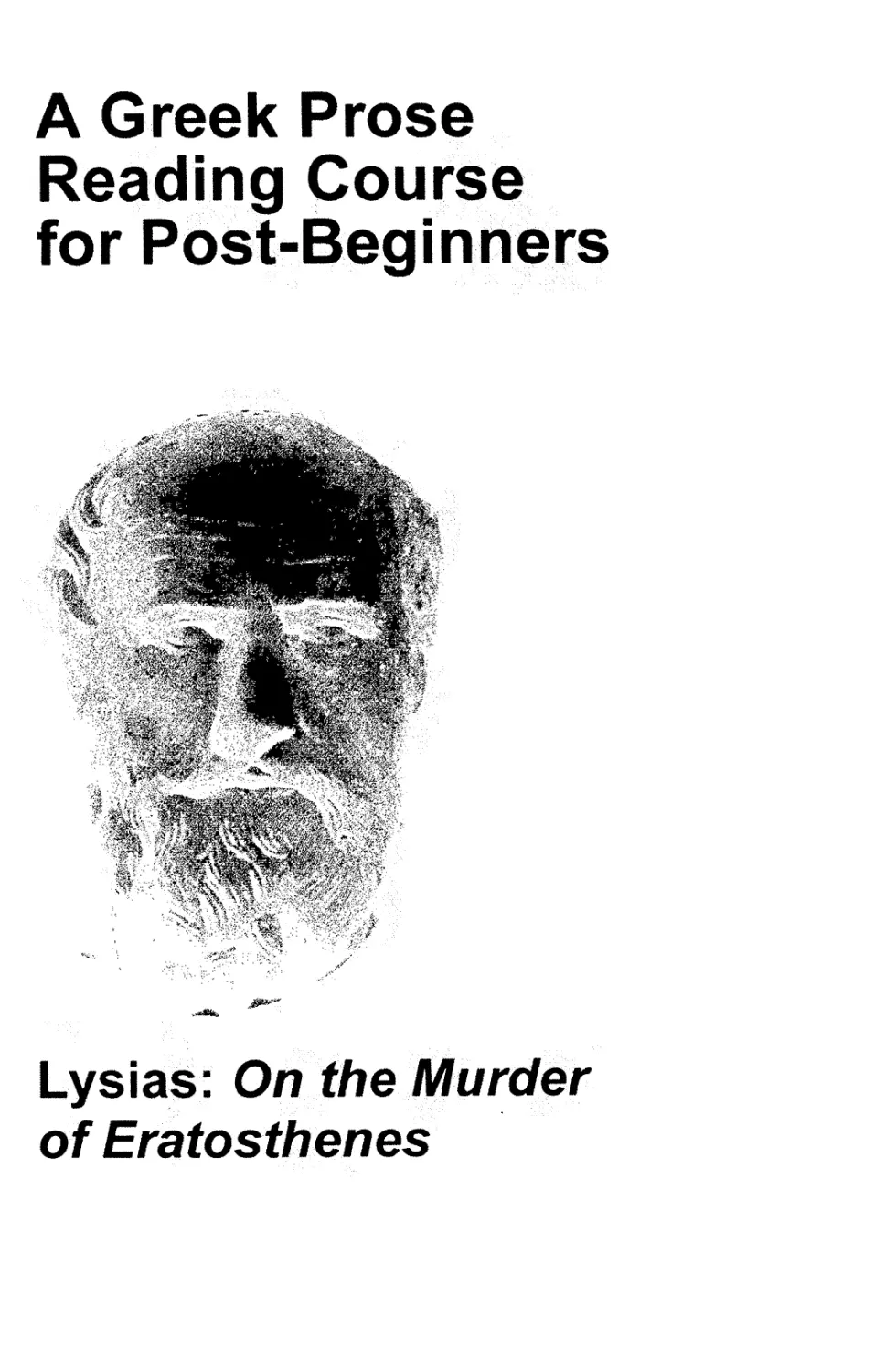
                    A Greek Prose
Reading Course
for Post-Beginners
Lysias: On the Murder
of Eratosthenes

A Greek Prose Reading Course
for Post-Beginners
Unit 1. Forensic Oratory
Lysias: On the Murder of
Eratosthenes
With Commentary and
Vocabulary by
MALCOLM CAMPBELL
Bristol Classical Press

First published in 1997 by
Bristol Classical Press
an imprint of
Gerald Duckworth & Co. Ltd
61 Frith Street
London W1D 3 JL
e-mail: inquiries@duckworth-publishers.co.uk
Website: www.ducknet.co.uk
Reprinted 1999,2002
© 1997 by Malcolm Campbell
All rights reserved. No part of this publication
may be reproduced, stored in a retrieval system, or
transmitted, in any form or by any means, electronic,
mechanical, photocopying, recording or otherwise,
without the prior permission of the publisher.
A catalogue record for this book is available
from the British Library
ISBN 1-85399-537-1
Typeset by Malcolm Campbell
Printed in Great Britain by
Antony Rowe Ltd, Eastbourne

UNIT 1. FORENSIC ORATORY
CONTENTS
Preface page iv
Introduction to the course v
Lysias On the Murder of Eratosthenes: Text 1
Morphology and Syntax 7
Notes 11
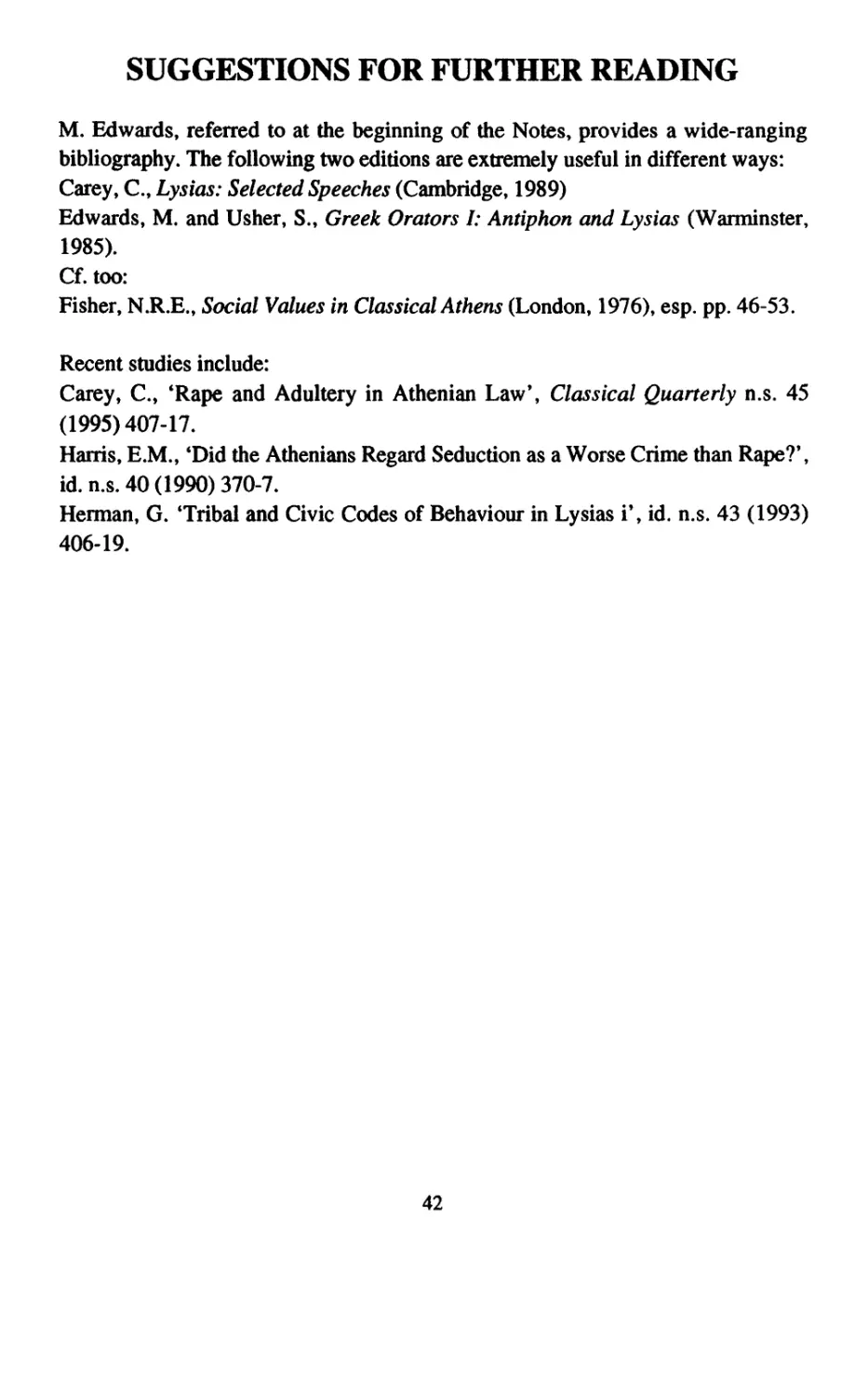
Suggestions for Further Reading 42
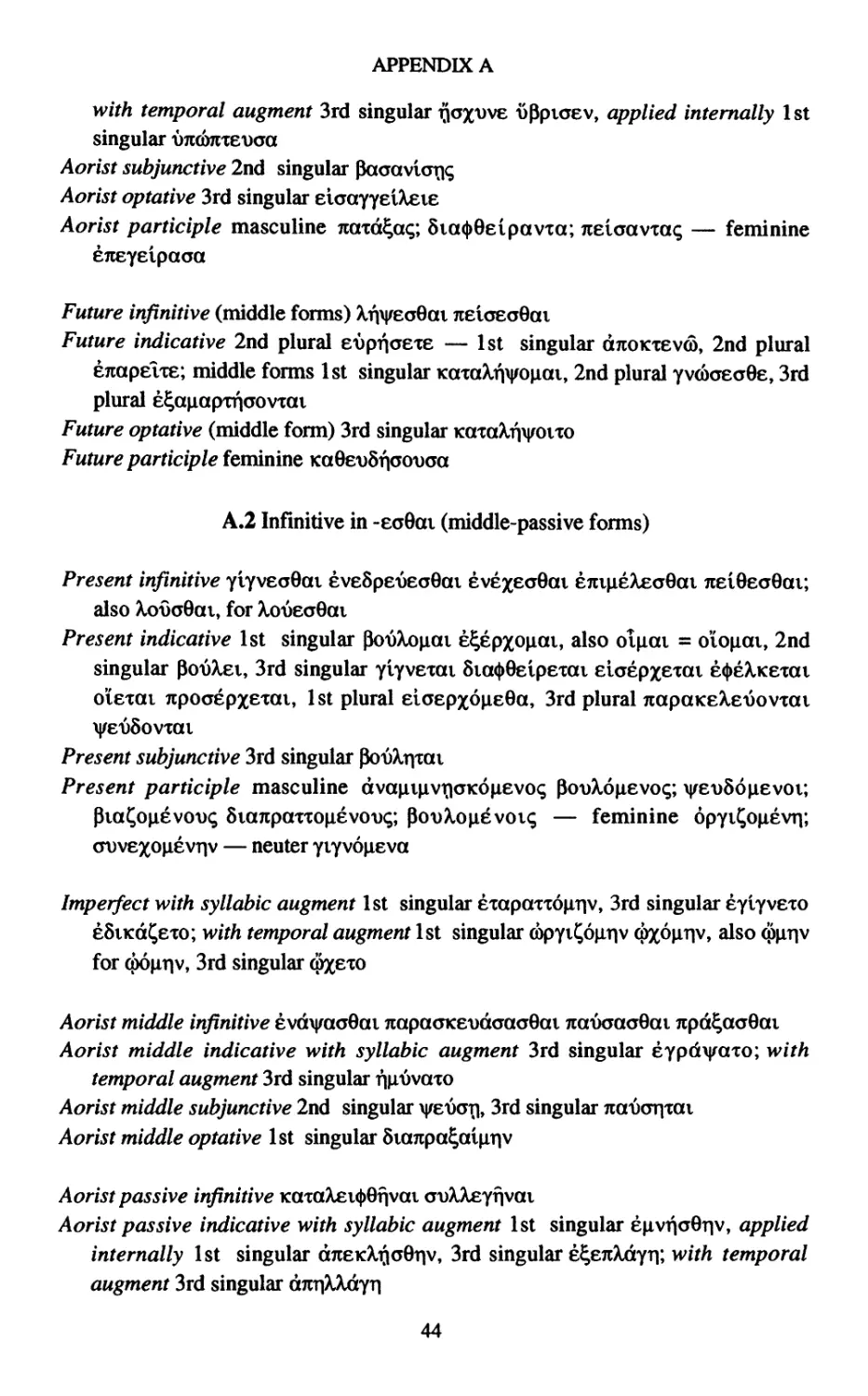
Appendix A: Survey of Verbal Forms 43
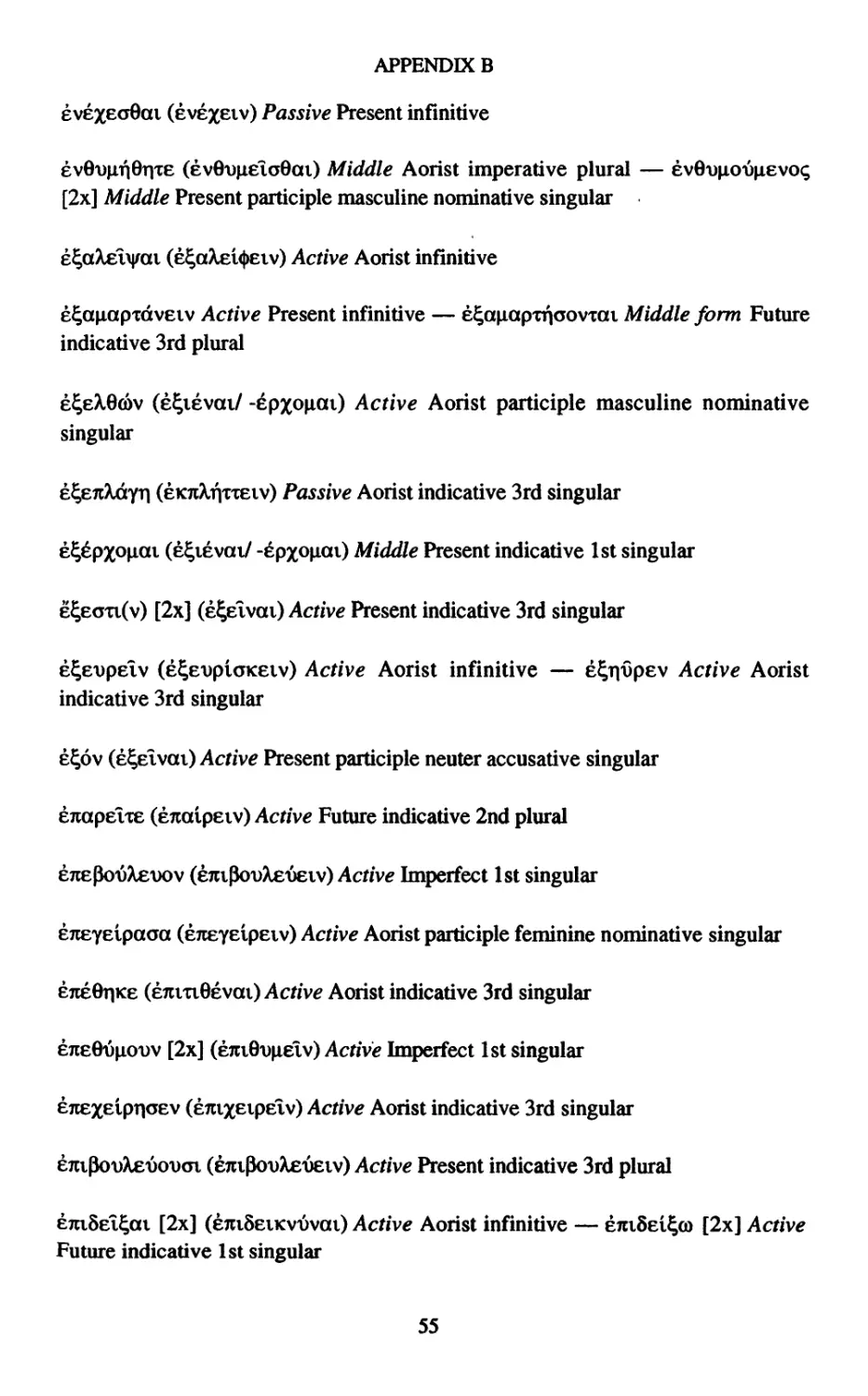
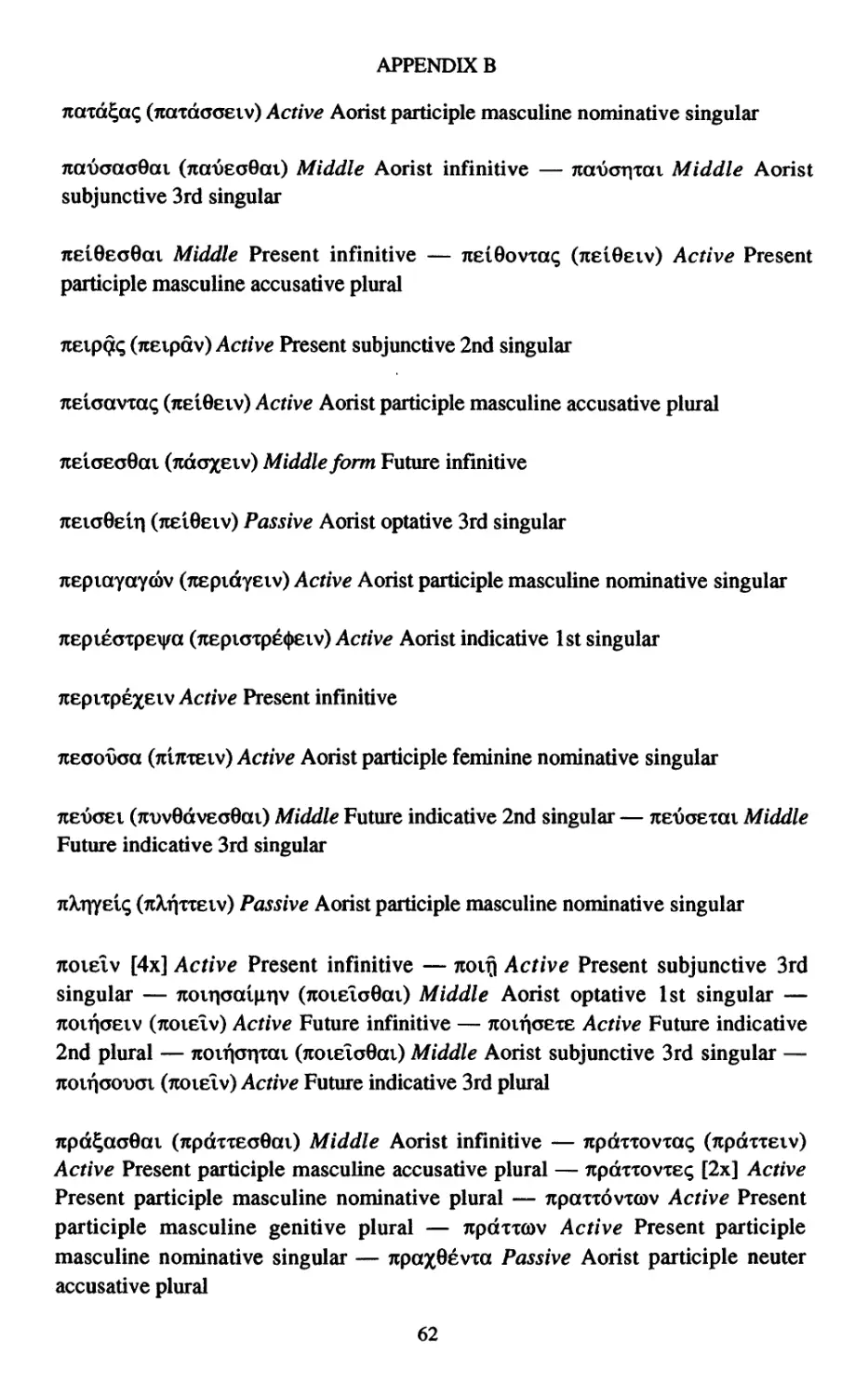
Appendix B: Checklist of Verbs 49

PREFACE
My thanks to John Betts for giving this project a warm reception and for very
helpful advice, and to his team at Bristol Classical Press, Jean Scott, Editor, and
Graham Douglas in Production, for welcome assistance with typesetting; to my
colleagues Professor Stephen Halliwell and Dr Niall Livingstone for taking the
time to read the typescripts and for suggesting a number of improvements; to my
wife Dorothy for her encouragement, patience and technical help; to my younger
son Richard for devoting more than one long evening to explaining to me what I
was unable to work out for myself through reading Macs for Dummies.
No two teachers of Greek are likely to agree for long on how textbooks of this
nature should be formatted, let alone what sort of information, and how much
information, they should contain. I have been guided here first and foremost by
our own students at St Andrews: I am grateful to them for discussing their
difficulties and needs with me, for filling in questionnaires, and for producing
some useful feedback on the form and content of earlier drafts of the Lysias and
Plato texts. I must thank too a class of Bristol undergraduates whom I have never
met, for offering general comment on the Lysias notes circulated to them in 1996
through the kind offices of John Betts and Onno van Nijf.
St Andrews, February 1997 M.C.
IV

GENERAL INTRODUCTION TO THE COURSE
Represented in this course are three of the giants among prose writers of the
Classical period, the historian Thucydides, the philosopher Plato, the orator
Demosthenes. The same ancient literary critic (Dionysius of Halicarnassus) who
called Demosthenes' Philippic iii "the greatest of the public orations directed
against Philip" also found much to admire in the speeches of Lysias (see M.
Edwards and S. Usher, Greek Orators I [Warminster, 1985], 128-9). There is
certainly much to interest the modern reader in On the Murder of Eratosthenes.
In annotating these texts I have tried to keep the needs of three classes of reader
constantly in mind:
Students fresh from Beginners courses (whether at University or elsewhere)
reading an extended (and undoctored) Greek text for the first time.
Post-A-level (or equivalent) students who wish to consolidate their reading skills.
Postgraduate students who have some Greek but require guidance in reading an
historical, oratorical or philosophical text in the original.
Since each unit is self-contained, those with an interest in Socrates, for example,
can take on Crito right away. But post-Beginners are advised to read the Lysias
speech before anything else: it is an excellent starter-text, and for that reason extra
help has been given with the verbal systems. For the benefit of those who do
choose to take on the course in its entirety the other three components have been
given different emphases: in the Plato special attention is paid to the use of
particles and particle-combinations, in the Demosthenes (a prime model for the
few who still do Greek prose composition) to a number of key differences between
Greek and English idiom; the Thucydides approximates more closely to the kind
of commentary students will encounter if they carry their Greek studies further,
with more extensive coverage of the subject-matter and explicit references to
secondary literature. One possible programme, extending over two or three
semesters: Lysias, Plato, Demosthenes and/ or Thucydides interspersed with a play
of Euripides or Sophocles and a book or two of Homer.
For all four units the layout is essentially the same, and recommendations on
study-methods are given in the respective prefaces:
1 Greek text. Observations are made from time to time in the Notes on the
constitution of the text, and those who wish to pursue these matters further may
consult the following editions, in which a critical apparatus (apparatus criticus) is
v

GENERAL INTRODUCTION
printed at the bottom of the page, where the editor, communicating in Latin,
records variant readings in ancient and mediaeval copies (identified in the "Sigh"
prefacing the text itself) and points to places where modern scholars have felt
dissatisfied with the transmitted text and considered it necessary to emend:
Lysias, Oxford text by K. Hude (1912), see also the edition by C. Carey (1989),
pp.12-13
Plato, Oxford text by E.A. Duke and others (1995)
Demosthenes, Oxford text by S.H. Butcher (1903), Bud6 text by M. Croiset (1955)
Thucydides, Bud6 text by J. de Romilly (1967), Oxford text by H.S. Jones and J.E.
Powell (2nd edn, 1942).
2 Preliminary remarks on word formation and syntax geared to the text in
question. Common to all: a systematic analysis of Perfects/ Pluperfects (usually
viewed with dread by post-Beginners, in my experience), and a review of the uses
of Subjunctive and Optative.
3 A brief outline of the entire work/ extract.
4 A summary of the content of each block of text.
5 Dedicated vocabularies, broken down into the various parts of speech. The
words within each category are arranged alphabetically according to type: in the
case of verbs, for example, infinitives in -eiv -eoOcti, then contracted forms -dv
-aaOai/ -eiv -eioGai/ -ovv -owBai, and finally -vai -o0cti.
6 Notes dealing with language, style and subject-matter.
7 It is envisaged that the material on each of the texts provided here will be topped
up by tutors with a course of lectures dealing with author, genre, general
background, broad issues and particular problems of interpretation. Those going it
alone will find something to suit most tastes in the secondary literature specified in
the suggestions for further reading.
vi

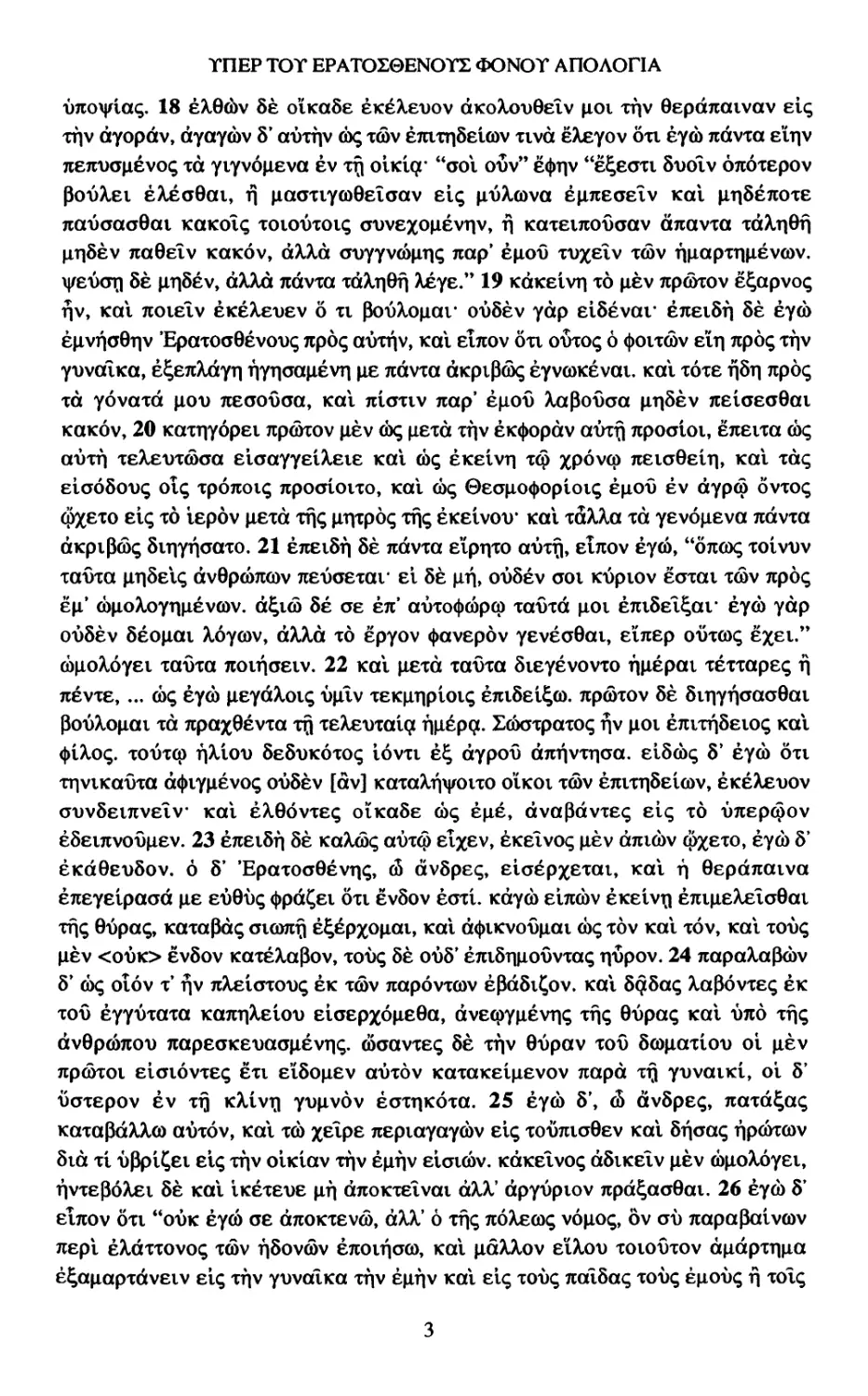
AYZIOY
YnEP TOY EPATOZ0ENOYZ OKDNOY
AFIOAOnA
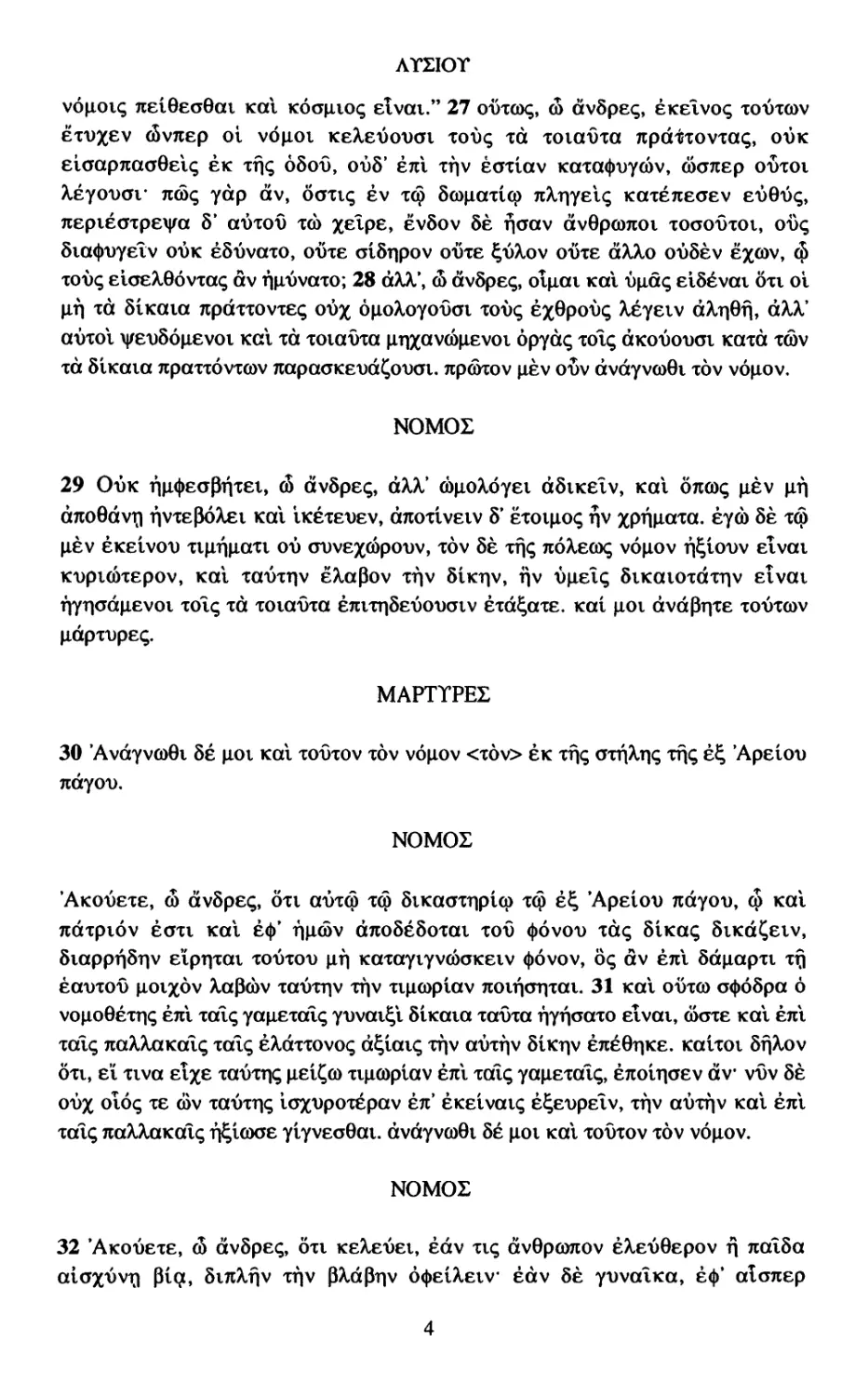
1 Ilepi noX7<x>x> dv noir\aai\ir]vf <5 dv8pe<;, to xoioikoix; i}\iaq ep.oi 8iKaaxd<; rcepi
xovxoi) xov rcpdy^axoq yevea9ai, oloircep dv v\liv ax>xoi<; eirixe xoiavxa
rcercov96xe<;' exi yap o!8' oxi, el rnv atixfiv yv(b\i7\v Tiepi xd)v aXkxov e%oixe, fivnep
rcepi i>^cov cruTcdv, o\>k dv eir| oaxiq ox>k eni xoi<; yeyevrmevoK; dyavaKxoiri,
dXXd ndvxeq dv Tiepi x©v xd xoiavxa emxn8ei)6vxoi)v xdq £,T\\ii(x<; lUKpdq fjyoia9e.
2 Kai xafixa o\>k dv eir\ \iovov nap v\ilv ovxax; eyvoa^ieva, akX ev dndafl xfj
'EAAtiSr Tiepi xouxoi) yap ^iovod xov d8iKriiiaxo<; Kai ev SrmoKpaxia Kai
6A,iyap%ia r\ avxi] Ti|icopia xoic; da9eveaxdxoi<; npbq xoxx; to iieyiaxa
Suva^ievoix; drcoS^Soxai, o&axe xov xetpiaxov x©v ax>xG>v ruyxdveiv xq>
peA,xiax(p* ovxax;, & dvSpeq, xawriv xfjv vppiv dnavxeq dv9pco7toi 8eivoxdxr|v
riyouvxai. 3 rcepi ^iev o'uv xou ^eye9oi)<; xfjq tjyiiaq drcavxaq v\ia<; vo\iiC,(o xqv
at>xfjv Sidvotav e%ew, Kai ot>8eva owax; o^iycopox; 8aiKeia0ai, ogtk; o'iexai
Sew a\)yyv(fyui<; xvy%dveiv fi ^iiKpdq C*lM^aS d^ioix; fiyeixai xovq xd)v xoiotixoov
epycov aixioax;* 4 fiyov^ai 8e, & dvSpeq, xowo ^ie 8eiv emSei^ai, dx; e^oi%e\)ev
'Epaxoa9evTi<; xf^v yvvaiKa xfjv e^v Kai eKeivrjv xe 8ie<|>9eipe Kai xovq rcaiSaq
xovq e\iov<; fioxvve Kai e^e avxov tippioev eiq xfjv oiKiav xfjv e^ifiv eiau&v, Kai
otixe e%0pa e^ioi Kai eKeivq) ot>5e|iia rjv riki\v xa\>xri<;, otixe %pri|idxG)v eveKa
ercpa^a xavxa, 'iva rikovoioq ek nevr|xo<; yeva^ai, owe dAAoi) Kep8oi)<; ox>8evo<;
nki\v xfj<; Kaxd xoxx; vd^oax; xi^icopiaq. 5 eyd> xoivov e£ dp%fi<; i)\tiv drcavxa
emSeU;© xd e\iavxov jrpdy^iaxa, ot)5ev 7rapaA,el7rcov, dXXd Xeycov xdXr|0fi-
xatixrjv yap ep.a\>xcp p.6vr|v fiyoi)p.ai acoxripiav, edv i)\iiv eiTceiv dzravxa 5\)vr|0c5
xd 7ce7rpayM.eva.
6 'Eycb yap, & 'A9rivdioi, e7tei8fi eSo^e ^ioi yfl^iai Kai y\>vaiKa rjyay6|ir|v eiq xr\v
oiKiav, xov |iev dAAov xpovov oikco 8ieKei^riv coaxe \ir\xe Xvneiv \iryie Xiav en
eKeivrj eivai 6 xi dv e9eXri zroieiv, e<|)i3Xaxx6v xe ax; olov xe fjv, Kai 7ipoaei%ov
xov vovv <oonep eiKO^ f\v erceiSfi 8e p.oi 7iai8iov yiyvexai, erciaxeuov fi5r| Kai
icdvxa xd e^iavxoi) eKeivrj TiapeScoKa, f)yo'6^evo<; xavxx\v oiKeioxrrra iieyiaxriv
eivai. 7 ev ^iev o^v x© icpcoxcp Xpovq), <& 'A9r|vaioi, icaa©v rjv peA,xiaxr|, Kai yap
oiKovd^ioq 8eivf| Kai <t>ei8(oA,6(; [dya9fi] Kai dKpiPc5<; Tidvxa 8ioiKO\)aa- eTceiSii
6e ^ioi fi iniTrip exeA,et>XT|ae, fi Tidvxcov x©v kokc&v a7co9avoi)aa aixia ^ioi
yey^vrixai — 8 en eK<|>opdv yap atixirj aKoA,o\)9r|aaaa ti e\xr\ y\)vfi i)nb xowov
xov dv9pcwto\) 6<|)9eiaa, %pov(p 8ia<t>0eipexai* e7i;ixnpc5v yap xriv 0epd7iaivav xrjv
eiq xf^v ayopdv Pa8i£ovoav Kai A,6yo\)(; xcpoa^pcov diccoAeaev at>xt|v. 9 7ip©xov

AY2IOY
\iev o5v, <5 dv8pe<; (8ei yap Kal xaW i)^iv 8irryr|aaa9ai), oikISiov eaxi ^ioi
5i7cAx){)v, iaa exov xd dv© xotq Kdx© Kaxd xf]v yuvaiK©vtxiv Kai icaxd xrjv
dv8p©vixiv. 87cei8fi 8e xo naiSiov eyevexo fpiv, f) jxf|xr|p awo eBriAxx^ev iva 8e
|xti, oicoxe Xoi)a0ai 8eoi, KivSuveurj *axd Tnq KA,i^aKo<; Kaxapaivovaa, ey© ^iev
dvco Sirjxotyiriv, ai 8e yvvaiKeq Kdx©. 10 Kai oikox; f$r\ ai)vei6ia^evov rjv, ©axe
icoXXaKiq rj yuvfi drcfjei Kdx© Ka9ei)8r(ao\>aa ©<; xo rcaiSiov, 'iva xov xix96v avxco
8i8q> Kai \ix\ PoqL Kai xavxa noXvv xpdvov oi3x©<; eyiyvexo, Kai ey© ox>8ercoxe
imcMixewa, &)X ovxgx; r|A,i9i©<; 8ieKei^ir|v, ©axe <§\it\v xr\v eauxou yuvaiKa
7iaa©v aax|>poveaxdxr|v eivai x©v ev xfj tcoXei. 11 npdiovxoq 8e xov %p6voi), ©
dvSpeq, fJKOv iiev dnpoaSoKfVr©*; e£ dypov, ixexd 8e xo Seutvov xo rcaiSiov epoa
Kai eSiKJKdXaivev ko xfj<; 9epa7iaivr|<; enixtfiet; AAmotiixevov, iva xavra rcoifj* 6
yap dv9p©rco<; ev8ov r\v vaxepov yap drcavxa envdo\ir\v. 12 Kai ey© xfiv
yuvaiKa dnievai eKeXeuov Kai 8o\>vai x© rcaiSi© xov xix96v, iva navarrxai
KXdov. fi 8e xo ^iev icp©xov ox>k T]9eXev, <bq dv daiievrj \ie eopaKiiia fjKovxa 8id
Xp6voir erceiSfi Se ey© ©pyi£6|ir|v Kai eKeXeuov auxfiv dmevai, "iva ov ye"
e<t>r| "rceipqi<; evxavGa xfjv naiSiaKTyv* Kai rcpoxepov 8e \ieQv(ov eiAjceq avxfjv."
13 Kay© jiev eyeA,©v, eKeivri 8e dvaaxdaa Kai dmovaa rcpoaxi9r|ai xrjv 6\>pav,
npoarcoiotyievri 7iai£eiv, Kai xfjv K^eiv e<|>eA,Kexai. Kay© xovxwv o\>8ev
ev9D^o\)|Lievo(; oi)8' xmovo©v eKd9eu8ov daiievoq, tik©v e£ dypou 14 e7cei8fj 8e
fjv Tcpoq fpepav, fJKev eKeivri Kai xqv Bupav dve©£ev. epojievot) 8e \iov xi ai
Giipai v\)Kx©p \|fO((K)iev, e<|)aaKe xov Mxvov dnoapea9f|vai xov rcapd x<p 7tai8i©,
elxa eK x©v yeixov©v evd\|faa9ai. eai©ic©v ey© Kai xaika oiix©<; exeiv
riyo^riv. e5o^e 8e ^ioi, © dv8peq, xo 7cpoa©7cov e\|fi^i\)9i©a9ai, xov abetyov
xe9ve©xo(; ovnco xpidKov9' f^epa^* o^i©^ 8' ot)8' oikox; ox>8ev ei7t©v 7tepi xov
Ttpdy^axoq e£eA,9©v q>x6^ir|v e^© ai©7cfj. 15 ixexd 8e xa\>xa, © dvSpeq, xpovoi)
\iexclZ,v 8iayevo^ievo\) Kai e\iov noXv d7ioXeXei^^evo\) x©v e^ia\)xo\) kok©v,
rcpoa^pxexai ^oi xk; npeafivxiq dv9p©7i0(;, vno y\>vaiKO^ \)7i07ce^<|)6eiaa iiv
eKeivoq e^oixevev, ax; ey© \iaxepov f]KO\)OV avxr\ 8e opyi^o^evri Kai
d8iKeia6ai vo^i^o\)aa, oxi ot)Kexi o^ioi©^ e<()oixa nap* at>xr|v, e^'uA.axxev e©q
e^rrupev 6 xi elr\ xo aixiov. 16 7cpoaeX9o\)aa ovv \ioi eyyax; tj dv9p©7t0(; xflq
oiKiaq xfi<; ejxfi^ ezrixTipoiiaa, "Evtyi\r\xe" e$i\ 'VriSe^iqi rcoA/impayiioa'ovTi
KpoaeXriX\)9evai \ie vo^ii^e npoq ae* 6 yap dvf)p 6 \)ppi£©v ei^ ae Kai xtiv gt\v
yvvaiKa exBpoq ©v f^iv xvyxdvei. edv o-uv M$r]<; xi\v 9epd7iaivav xf|v eiq
dyopdv pa8i^o\>aav Kai SiaKOvotiaav v\tiv Kai Paaaviorj<;, drcavxa Tceijaei. eaxi
8'" e<()r| "'Epaxoa9evri(; 'Ofi9ev 6 xavca 7tpdxx©v, 6<; o\> ixovov xf|v af^v yuvaiKa
8ie<()9apKev dXXd Kai dAAaq noXkaq' xat)XTiv yap [xnv] xexvriv exei." 17 xaOxa
eiTiovaa, © dvSpeq, eKeivri ^iev &nr\XKayr\t ey© 8' et>9e©(; exapaxxo^ir|v, Kai
7tdvxa iioi) eiq xf|v yv©^r|v eiarjei, Kai ixeaxoq r\ i)7ro\|fiag ev9\)^oi)^evo^ jiev ©^
d7teKA,fja9r|v ev x^ 8©^iaxi©, dva|xi^vrjaK6|xevo^ 8e oxi ev eKeivfl xfj v\)Kxi
e\|f6<()ei i\ jiexavXxx; 9\>pa Kai i\ a'uA.eioq, 6 ovSenoxe eyevexo, eSo^e xe ^ioi i\
yvvi] e^iri^vOiSaBai. xavxa \iov Tidvxa eiq xfiv yv©^r|v eiarjei, Kai ^ieaxo<; fj
2

YI1EP TOY EPATOEGENOYS OONOY AnOAOn A
imoyiaq. 18 eA.8©v 8e oiKaSe eKeXevov dKoXo\)0eiv \ioi ttiv 0epa7caivav eiq
ttjv dyopdv, dyay©v 8' avxx\v dx; t©v e7n.Tr|8ei©v Tivd eXeyov oxi ey© rcdvTa eir|v
rc£7rua|ievo<; t6 yiyvo^ieva ev x\i oucia* "aoi oxiv" etyr\v "el;eaTi Suoiv orcoTepov
Po\)A,ei eA,ea9ai, fj |iaaTiy©9eiaav eiq ^I'uA.cova e^zreaeiv Kai ^TiSercoTe
7iatJaaa9ai KaKOiq TOioikoiq ai)vexo|ievTiv, fi KaTeircofiaav drcavTa TdA,Ti0ri
^ir|8ev 7ia9eiv kokov, olXXol ai)yyv©p.iiq nap e\lov ruxeiv tcdv f^apTimevcov.
yevaxi 8e ^ir|8ev, dAAd ndvTa TdXr|9fi Xeye." 19 KdKeivri to ^iev rcpaVtov e^apvoq
flv, Kai rcoieiv EKeXevev 6 ti povXo|iar o\>8ev yap eiSevar eneiSfi 8e ey©
eiivrjo9r|v 'EpaTOa9evovq npoq a\>TT|v, Kai eircov oti oikoq 6 <|>oit©v eir| rcpoq xr\v
yovaiKa, e^ercAdyri riyriaaiievTi ^e rcavra dKpipdx; eyv©Kevai. Kai tote fj8r| rcpoq
xa yovaTa \iov rceaovaa, Kai rciaTiv nap' e^iou \a$ox>oa \it\$ev neiaea9ai
kokov, 20 KaTtiyopei npmov \iev dx; (ieTd ttjv eK<|>opdv amfi rcpoaioi, eneixa ©q
avxi] TeXe\)T<»aa eiaayyeiXeie Kai ©q eKeivrj t($ XP^vco rceia9eir|, Kai xaq
eia68o\>q oiq Tporcoiq rcpoaioiTO, Kai ax; 0ea^o<(>opioiq e\iov ev dyp© ovToq
cpxexo eiq to iepov ^iexd Tfiq inixpoq rn<; eKeivoir Kai xaAAa Ta yevo^ieva rcdvTa
dKpipdx; SiriyrjaaTO. 21 erceiSfi 8e rcdvTa eipryro ax>TTJ, etrcov ey©, "<k©q toIvdv
xama jxr|5el<; dv9pdm©v nevoExav ei 8e ^ir|, o\>8ev aoi Ktipiov eaTai to&v rcpoq
e\l' ri>iioA,oyTmevG)v. d£id) 8e ae en' at>TO(|>©p© Taind ^oi erciSei^ar eyd) yap
o\>8ev 8eo^iai A,6y©v, dM,d to epyov <(>avep6v yevea9ai, eircep oin©q e%ei."
©^loAxSyei Taika noirjaeiv. 22 Kai \lexcl Taika Sieyevovxo ruiepai Tercapeq fi
7ievTe,... ax; eya) iieydA,oiq fyiiv TeK^iripioK; ercUteil;©. npmov 8e 8ir|yr|aaa9ai
Po\)Xo^iai to 7tpax9evTa xfj TeAevxaia f^epa. ZaxjTpaxoq fjv |xoi eTcixriSeioc; Kai
<t>iAO<;. TOtixcp f)Xio\) SeS^KOTog Iovti e£ dypoi) dzriivTriaa. ei8cb<; 8' eycb oti
TriviKama d^iyixevoq ovbev [dv] KaTatafyoiTO oikoi to>v eniTriSeicov, eKeXeuov
a\)v8ei7cveiv Kai eXGovTe^ oiKaSe ax; e^e, dvapdvTe^ eiq to \mepo5ov
eSeiTtvoO^iev. 23 eTceiSf] 8e Kakax; ai)T^ ei%ev, eKeivoq ^ev am&v cp%eTO, eyd) 8'
eKd9ei)8ov. 6 8' 'EpaToa9evTx;, d) dvSpeq, eiaepxsTai, Kai i] Gepdicaiva
eTceyeipaad jie et)9i)^ <|>pdCei oti ev8ov eari. Kayd) ei7C(bv eKeiv^i e7ci^eXeia9ai
xn<; Gvpaq, KaTaPdq aiamiri e^epxo^iai, Kai d^iKvofijiai &<; tov Kai tov, Kai toxx;
|iev <ot)K> ev8ov KaTeXaPov, xovq 8e ot>8' e7ci8ryioi)VTa^ Ti^pov. 24 zrapaXapcbv
8* dx; oiov V fjv ziXeiaTOix; eK x&v napovxw epaSi^ov. Kai 8qt8a<; A,apovTe<; eK
tov eyyuTOTa KantiX-elou eiaepxo^ie6a, dve©Y^evr|(; xfi^ 9\>pa^ Kai vno xr\<;
dv9pa)7COD 7iapeaKe,uaa^evr|(;. ©aavTet; 8e tt^v 9\)pav to\) 8co^iaTio\) oi ^ev
Tcpdnoi eiaiovTe^ &ti e'iSo^iev atJTOv KaTaKei^ievov Tiapd tij yvvaiKi, oi 8'
i3aTepov ev ti] kA^Ivti yo\ivbv eaTTiKOTa. 25 eyd) 8', (5 dv8pe<;, naxa£,aq
KaTapdAAco at)TOv, Kai t© xeips xrepiayaycbv eiq TO\>7tia9ev Kai 8iiaa<; rjpakwv
8id t! \)ppi^ei eiq ttjv oiKiav xi\v e\ix\v eiai©v. KaKeivoq dSiKeiv ^iev ©jioXoyei,
r)VTep6A£i 8e Kai iKeTeve \ii\ drcoKTeivai 6XX dpyupiov 7ipd^aa8ai. 26 eyd) 8'
elrcov oti "o\)K ey© ae dTcoKTev©, dXV 6 xr\q note®*; v6\ioq, dv at) rcapapaiv©v
Jiepi EXaxxovoq t©v f)8ov©v ercouia©, Kai ^idAAov Eikov toiovtov d^idpTrma
e^ap.apTaveiv eiq tt^v yovaiKa ttiv E\ir\v Kai eiq TO\>q rcaiSaq TO\>q e^iovq r\ Toiq
3

ATXIOY
von.oi<; rcei0ea9ai Kai Koa^iioq eivai." 27 ovigx;, a> dvSpeq, eKeivoq xot>xa>v
exD^ev (Svrcep oi vdjioi KeXevovai xoix; xd xoiafixa rcpdi?xovxa<;, ovk
eiaaprcaaGeiq ek xfjc; oSot), otiS' em xfjv eaxiav Kaxa^uycov, oiarcep oiixoi
XeyoDar rcri)<; yap dv, oaxiq ev xop Scojiaxict) nXrtfEic; Kaxerceaev e^Oti*;,
rcepieaxpeya 8' atixov xcb xeip£> evSov 5e fjaav dvGpcorcoi xoaoakoi, ovq
Sia^uyeTv ovk eSuvaxo, ovxe aiSrpov oane £6A,ov oane dXXo ox>Sev excov, (S
xoix; eiaeA.06vxa<; dv ryvbvoLxo; 28 dAA\ (5 dv8pe<;, ofyai Kai u^dq ei8evai oxi oi
\ii] xd SiKaia rcpdxxovxe<; ot>x o^oXoyo-Oai xoix; exOpotx; Xeyeiv dA,r|0ii, aXX
avxoi \|/eD86p.evoi Kai xd xoiawa ^rixavco^evoi 6pyd<; xoi<; dKotiouai Kaxd xcov
xd SiKaia rcpaxxovxaw rcapaaKea)d£o'uai. rcpokov |iev oiiv dvdyva>0i xov vo^iov,
NOMOI
29 Ouk rj^eaPiixei, di dv5pe<;, aXX' co^oXdyei dSiKeiv, Kai O7cco<; \lev \ii\
drcoOavri f|vxeP6tei Kai iKexevev, drcoxiveiv 8' exoi^oq rjv xp^^axa. eycb 5e xcp
H&v eKeivoi) xin^jiaxi ov oDvexcopouv, xov 8e xfjq rcoXeax; vo^ov r£ioa>v eivai
KDpicoxepov, Kai xawiriv e^apov xtjv 81kt|v, tiv i>nei<; 8iKaioxdxr|v eivai
T)yr|adp.evoi xoiq xd xoiawa eTcixriSevoDaiv exd^axe. Kai jioi dvdprixe xovccdv
ndpx\)pe<;.
MAPTYPEI
30 'Avdyvo)0i Se pm Kai xotkov xov vop-ov <xov> ek xfj<; orntaiq xfj^ e£ 'Apeiou
rcdyoi).
NOMOX
'AKO\>exe, & dvSpeq, oxi aw© xq> SiKacrnpicp xcp e£ 'Apeiov rcdyou, $ Kai
rcdxpiov eaxi Kai e<)>' tj^cov drcoSeSoxai xov ^ovod xdq SiKa<; SiKdCeiv,
SiapprjSilv eip^xai xot>xoi) jifi Kaxayiyvo&aKeiv <|)6vov, 6<; dv em Sd|iapxi xfj
ea-oxoa) M^oixdv Xapcbv xavtrjv xfjv xijicopiav noir\cn\xcti. 31 Kai ovxco a<()68pa 6
vojio0exrj<; em xaiq ya^exaiq yuvai^i SiKaia xawa riyrjaaxo eivai, G>axe Kai tin
xaiq naXXaKcxiq xai<; eXdxxovoc; d^iai<; xpv at)xfiv 8ikt|v e7ce0r|Ke. Kaixoi Sfj^ov
oxi, ei xiva eixe xavxry; p.eiCo) xijicopiav £7ii xaiq ya^exaiq, e7ioir|aev dv vuv 5e
ov% oioq xe cdv xavxr\q ioxvpoxepav en eKeivaiq e^ea>peiv, xf^v at>xnv Kai em
xaiq 7taA,XaKai<; r^icoae yiyvea0ai. dvdyvo)0i 8e ^oi Kai xomov xov vojiov.
NOMOX
32 'AKO^exe, c5 dvSpeq, oxi KeA,et)ei, edv xi<; dv0pcwcov eA.e'uOepov f\ TcaiSa
aio%vvr{ pia, SinXr\v xi\v pXdpr|v 6<|>etXeiv edv 5e yuvaiKa, e<))' alarcep
4

YTIEP TOT EPATO10ENOT2:<DONOY AnOAOn A
drcoKxeiveiv e^eaxiv, ev xoiq ax>xoi<; evexeaGar oikox;, co dv5pe<;, xoix;
Pia^ojievotx; eAxmovo<; ^rmiaq d^ioax; fyyfiaaxo eivai i\ xoix; rcei0ovxa<;* xcov \lev
yap Odvaxov Kaxeyvco, xoiq 8e SircXiiv ercoiriae xf)v pX-dpriv, 33 fyyou^evoq xoix;
H&v 8iarcpaxxonevov<; pia vnb xcov piaa0evxcov niaeTa0ai, xoix; 5e neiaavxaq
oiixctx; avxcov xdq \jn>xd<; 8ia<)>0eipeiv, coax' oiKeioxepaq ctvxolq rcoieiv xdq
dAAoxpiac; yuvaiicaq fl xoi<; dvSpdai, Kai rcdaav en eKeivou; xf)v oiKiav
yeyovevai, Kai xovq rcaiSac; dSiftoix; eivai orcoxepcov xvyx&vovoiv ovxec;, xcov
dvSpcov n xcov iioi%cov. dv0' <5v 6 xov v6|iov xi9ei<; Gdvaxov avxoic; ercoiriae xnv
cjijiiav. 34 E\iov xoivuv, cS dvSpeq, oi nev vo^oi ov \io\o\ drceyvcoKOxec; eiai \ii\
d5iKeiv, dAAd Kai KeKeXeDKOxec; xavxqv xfjv 81kt|v Xanpdveiv ev 1411 v 8' eaxi
rcdxepov xpfi xoiranx; iaxvpoix; fi jir|Sevd<; d^iovc; eivai. 35 eycb jiev yap oijiai
rcdaa<; xd<; 7c6A.ei<; 8td xoiko xoix; vo^oix; xi9ea9ai, iva rcepi c&v dv rcpayjidxcov
drcopd)|iev, rcapd xovxoax; eX06vxe<; aKe\j/cfyie9a 6 xi fpiv rcovnxeov eaxi v. ovcoi
xoivuv rcepi xcov xoiotixcov xoiq d8iKo\)^evoi<; xoiaikriv SIkt^v Xa^pdveiv
TcapaKeXeiiovxai. 36 oi<; \)\lol<; d£ico xfjv a\>xf|v yvcfyiriv exeiv ei 8e \lt\, xoiavxnv
dSeiav xoi<; \ioixoic, rcoifiaexe, cbaxe Kai xoix; KXercxaq ercapeixe ^olokeiv
\ioixovc, eivai, ev ei86xa<; oxi, edv xai>xr|v xfjv aixiav rcepi eavxcov Xiycoai Kai
erci xowcp <|>daKCoaiv eiq xd<; dAloxpiaq oiKiaq eiaievai, oi>Sei<; awcov d\|/exai.
Tcdvxeq yap eiaovxai oxi xoix; nev vo^cuq xn<; jioixeia<; xaipew edv Sei, xfjv 8e
\|rii<|>ov xf|v i^exepav 8e8ievar awiri yap eaxi rcdvxcov xcov ev xi] noXei
K-opicoxdxri.
37 ZKeyaaGe 8e, c5 dvSpeq* Kaxnyopovai yap n<yu dx; eycb xfiv Gepdrcaivav ev
eKeivi^ x^i il^epa jiexeA-Geiv eKeXevaa xov veaviaKov. eycb Se, co dvSpeq,
SiKatov \ie\ dv rcoieiv i\yov\ir]\ cpxivtovv xpowcp xov xf\v yovaiKa xfiv e\ri\v
Sia<)>0eipavxa A,a^pdvcov 38 (ei yap A,6ycov eipr|p.evcov epyoa> 8e firiSevoq
yeyevrifievoi) p.exeX9etv eKeXevov eKeivov, riSiKODv dv ei Se fi8r| 7idvxcov
8iarcercpayn.evcov Kai koXXclkm; eiaeA,r|A,D06xo<; eic; xfjv oiKiav xfjv ep.f|v
cpxivioOv xporccp eXdp.pavov aixov, aax()poveiv <dv> e^iavcov 1lYO'U^lr|v)■ 39
aKe\|faa0e 8e oxi Kai xatixa vcuSovxai- paSicoq 8e ck xcovSe yvcoaea0e. ep.oi
yap, c5 dv8pe<;, owep Kai rcpoxepov elTcov, <))iX,o<; cov Zcoaxpaxo<; Kai oiKeicoq
8iaKeip.evo<; d7tavxr|aa<; e^ dypofi Tcepi r\Xiov $va\La<; aa>ve8ei7cvei, Kai erceiSfj
KaX,co<; elxev ai>xcp, drcicbv cpxexo. 40 Kaixoi Tcpcoxov jiev, c5 dvSpeq, ev0'u^lfl0r|xe•
[oxi] ei ev eKeiv\) tq vuKxi eycb ercePotiteuov 'Epaxoa9evei, Tcoxepov fjv \ioi
Kpeixxov avxco exepco0i Semveiv fi xov a\)v5ei7Miaovxd p.oi eiaayayeiv; oikco
yap dv rjxxov ex6A,p.r|aev eKeivo<; eiaeX9eiv eiq xfiv oiKiav. eixa Sokco dv \)p.iv
xov avv5ei7cvoi)vxa d^eic; ^ovoq KaxaXei<))0fivai Kai epj\\io<; yevea0ai, fi
keXeveiv eKeivov p.eivai, iva ^ex' e\lo\) xov ^oixov exi^copeixo; 41 e^ieixa, c5
dv8pe<;, ot>K dv Sokco i)\i\v xoiq eTuxrjSeioK; ^ie9' f^epav TcapayyeiXai, Kai
Ketefiaai aijxoix; aD^Xeyfivai eiq oiKiav xcov tyiXav xf|v eyyoxdxco, ^dX,A.ov fi
eiceiSfi xd%iaxa ijaOo^riv xfjq va>Kxd<; Tcepixpexeiv, ot)K eiScbq ovxiva oikoi
5

ATIIOT
KaTaA,T|\|/onm Kai ovxiva e^co; Kai dx; 'ApuoSiov \iev Kai xov Seiva fjA,0ov ox>k
eni$T}\LOx>vTOL<; (ov yap fiSri), exepoax; Se otjk ev8ov ovxaq KaxeXaPov, ovq 8' otoq
xe f\ A,apd>v epd5i£ov. 42 Kaixoi ye ei npor\Sr\y ox>k dv 8okc5 vjiiv Kai
9epdrcovxa<; rcapaaKeudaaaGai Kai xoiq tyiXoiq rcapayyeiXm, iv' ax;
da^aXeaxaxa \itv ctvxb<; eiafja (xi yap tjSti ei xi KdKeivoq ei%e ai8iipiov;), dx;
^exd TcXeiaxcov 8e jiapxtipoov xfjv xijioopiav e7ioiot>fir|v; vvv 8' ovSev eiSdx; x©v
eao^ievcDv eKeivTj xfj vuKxi, oiiq oto<; x f\ rcapeX-apov. Kai fioi dvdprixe xomcov
^idpropeq.
MAPTYPEZ
43 Taw ^iev jiapxtipcov dKr|Koaxe, (5 dvSpeq- aKeyaaGe Se nap' t>nav cxvxolq
oikax; rcepi xot>xoa> xov rcpdynxxxoq, £r|XO\)vxe<; ei xi<; ejioi Kai EpaxoaOevei
e%6pa rcdmoxe yeyevrixai nXi\v xavxriq. o\)8e^iiav yap evpiiaexe. 44 ovxe yap
(ruKO<t>avx©v ypa<|>d<; \ie eypdyaxo, owe eKpdAAeiv ek Tr\q nokecoq ercexeipriaev,
oiixe iSiaq SiKa<; eSiKd^exo, ovxe cmvfjSei kokov ovSev 6 eyd) SeSidx; \ir\ xiq
7ci)9r|xai eneQv\iovv auxov drcoXeaai, owe ei xaika Siarcpa£ain/r|v, ^Xm^ov
rcoOev xpTi^iaxa Arj\|/ea0ar evioi yap xoiotixoov rcpayjidxaw eveKa Gdvaxov
aXXr\koi(; EmfiovXevovoi. 45 xoaovxou xoivuv Set i\ Xx)i8opia i\ rcapoivia fi
aXXi\ xiq 8ia<))Opd fip.iv yeyovevai, dxjxe oi>8e eopaKdx; r\ xov dvGpamov rcdmoxe
nXi\v ev eKeivi^ xfi vukxL xi dv ovv p<n)X6|ievo<; eyd) xoiowrov KivSuvov
eKiv8\)vea)ov, ei \ri) xo neyiaxov x©v dSiKr^dxcDv f\ vn at)xo-0 r|SiKr|nivo<;; 46
erceixa rcapaKaXeaaq at>xo<; ndpxa>pa<; riaepow, e£6v poi, eircep d8iKQ)q
emQx)\LOvv awov drcoXeaai, jniSeva poi xovraw cruveiSevai;
47 'Eyco pev cuv, a) dvSpeq, ouk iSiav tmep enavxofi vojii^o) xawr|v yeveaGai
xf|v xipxopiav, d^A,' i)7cep xfi<; noXe&c, dTidariq* oi yap xoiai>xa rcpdxxovxeq,
6p©vxe<; oia xd d0X,a rcpOKeixai xd)v xoicuxcdv dp.apxr|p.dxQ)v, ii^ov ei<; xoix;
dXXoax; e^ajiapxnaovxai, edv Kai i^iaq 6pd)ai xqv amriv yvd>jir|v exovxaq. 48 ei
5e |xii, noXi) KdXXiov xoix; \iev Kei^evoax; vo\lov<; e^aXei\|fai, exepovq 8e Geivai,
oixive<; xoax; |iev <()a)Axixxovxa<; xd<; eaa>xd)v yovaiKaq xaiq ^njiiaK; £r|n.id>aoa)ai,
xoiq 8e $ovXo\levoic, eiq amaq dp.apxdveiv noXXi\v dSeiav noiT\oo\)oi. 49 noXi)
yap cuxco SiKaioxepov fi i)no xd>v vop.o)v xoix; noXixcu; eveSpcueaGai, oi
KeA^vovai ^ev, edv xk; ^oi%6v Xdpt], 6 xi dv ovv pov^rixai %pfja9ai, oi 5'
dyriWeq Seivoxepoi xoiq dSiKOunevoi<; Ka9eaxr|Kaaiv fi xoiq Tcapd xo\)<; v6p.oi)<;
xdq dAloxpiaq Kaxaiaxwoaxyi yuvaiKaq. 50 eyd) yap vvv Kai rcepi xov aa)^iaxo<;
Kai rcepi xd>v xpTip.dxo)v Kai Tcepi xd>v dA,Xa)v dicavxcov KivS'ove'OQ), oxi xoiq xfj<;
TcdXeox; vop.oi<; e7Ci06p.r|v.
6

MORPHOLOGY AND SYNTAX
The following few pages, to which constant reference is made in the running
commentary, focus on certain aspects of word-formation and syntactical
structures. If you have an imperfect grasp of any of the areas covered, you will
find it beneficial to study the data presented in the relevant section or sections
before you embark on the text itself.
A. THE PERFECT AND PLUPERFECT
A.1
In Beginners' courses, the perfect and pluperfect generally crop up at a late stage,
when there is mounting pressure to reach the final lesson. The former at any rate
can prove a real distraction among other more general difficulties commonly
encountered when an extended Greek text is tackled seriously for the first time. In
fact, the perfect systems do not lend themselves to total assimilation within a very
short time-span: one needs to work one's way into them, and to do that one has got
to read a fair bit of Greek. A few moments spent (preferably with a set of
paradigms illustrating the basic types by your side) on reviewing the perfects and
pluperfects that actually occur in this speech may prove useful.
A.2.a
The important perfect eiSevai "to know" (from the same root as ei5ov, the aorist
of opctv) is so eccentric that it is better considered separately. We find:
Indicative 1st person singular 018(a)
Infinitive eiSevai (2x), at)v-ei8evai
Participle ei5ax; (3x), ei56xa<;
— Past tense (~ pluperfect):
1st person singular fi8r| (2x), rcpo-flSri, 3rd person singular o\>v-fjSei
A.2.b
It is convenient to consider at this point the verb KeiaGai ("to have been put", "to
lie (down)"), since it serves as the perfect passive of xiGevai ("to put"):
Indicative 3rd singular 7cp6-iceixai
Infinitive 8ia-iceia9ai
Participle 8ia-iceiuevo<;, icaxa-iceiuevov, iceiuevoix;
— Past tense:
1st singular Si-eiceiur|v (2x)
7

MORPHOLOGY AND SYNTAX
A.3.a
— Active with reduplication:
Infinitive yeyov£vat (active form, from yiyvea0ai: ctr. under A.5.a) (2x),
8e8i£vat,l ~
Participle 8e5iax;l, 8e5i)K6T0<; (S\)(v)eiv), 7cercov06Te<; (rcdaxeiv); periphrastically
to give 3rd plural indicative KEKeXEVKoxeq (Keteveiv) <§34: supply eiai from
preceding drceyvcoKOteq eiai>
— Active with modified reduplication:
Participle xe6vecko<; (teOvdvai^)
— Active with 4Attic' reduplication 3;
Indicative 2nd plural dicr|ic6aTe (dKoueiv)
Infinitive rcpoa-eA,r|A/u9£vai (rcpoa-ievai/ -epxouai) and
Participle E\.G~E\T\kvQ&zo<; (eia-i£vai/ -epxouai)
A.3.b
— Active with (modified) augmentation/ irregularities:
Indicative 3rd singular 8i-£<|>9apKev (Sia-<|>9eip£iv), 3rd plural KaO-eaxnicaaiv
(KaG-iaxdvai)
Infinitive eyvooicevai (yiyvdknceiv)
Participle dneyvcoicdTeq eiai (drco-yiyvcoaKeiv) periphrastically (see A.3.a above);
and: eaxriKOTa (iaxdvai), eopaieuia^ (opdv), eiic6<;5 (eoiicevai)
A.4
— Pure Middle, only:
Participle d<|>-iyuevo<; (d<(>-iKveia9at); periphrastically with e'iriv to give 1st
singular optative: rce7n>au£vo<; (jruv9dvea9ai)
A.5.a
— Passive with reduplication:
Indicative 3rd singular yeyevrrtai (yiyvea9ai) (2x), drco-SeSoTca (drco-8i86vai)
(2x)
Participle yeyevrpevou & -oi<;, drco-teXeiuuevoi) (drco-teirceiv), rcercpayueva &
Sta-rcercpayuevo&v ((8ia-)7cpdxxetv)
A.5.b
— Passive with (modified) augmentation/ irregularities:
Indicative 3rd singular eiprp;ai (Xeyeiv)
Infinitive e\|fiuA)9td>a0at (\|nuD0io\)v) (2x)
Participle fpapxriu^vCDv (duapTdveiv), CD^ioXoyri^evcDv (ojioXoyeiv), and rcap-
eaKea>aap.evr|<; (jiapa-aKCud^eiv), dv-ecpyuevr|<^ (dv-oiyvuvai), eiprjuevrov
(Xeyetv); periphrastically with eiri to form 3rd person optative: eyvcoaueva [with
neuter plural subject] (ytyvcoaiceiv)
A.6
The past of the perfect, the pluperfect, in its pure form: 3rd singular passive etpTyco
(Xeyeiv); periphrastically with fj to form active 1st singular eopaKCD<^, passive 1st
8

MORPHOLOGY AND SYNTAX
singular rjSiicriuevoq (dSuceiv), with fjv to form passive 3rd singular cruv-
ei0iauevov6 (<ruv-e9i£eiv)
1 "to fear"/ "being afraid": these are "second perfect" forms, found alongside the "first perfect"
forms 5e$oiK6vai and 8e8oiKc5g. 2 "to be dead": xe6v£(6<; -<5>oa -6<; is another "second perfect"
type, coexisting with xeSviiKC*; -via -6c,. 3 Where a verb beginning with a vowel reduplicates the
initial vowel and consonant and lengthens the vowel that follows reduplication. 4 Notice the twin
augmentation in -ecpyu^vng; eopaica is alternatively spelled £(6paica (in either case 6pdv's
aspiration is retained). 5 Remember that this is a neuter singular participle; the 3rd singular
indicative is the very common £oiKe(v),"it seems". 6 Cf. the related perfect eiooOevai, "to be
accustomed".
B. THE SUBJUNCTIVE
B.l
This section reviews all the uses to which the subjunctive is put in the course of
the speech.
B.2.a
Final or purpose clauses, type "He does/ did this in order to be noticed".
Straightforward: 7x in all (§§4, 9, 10, 11, 12 twice, 35), all introduced by iva,
negative \ir\, in primary (leading verb to be supplied in §12 ... iva ...7teipqi<;) or
secondary sequence.
B.2.b
Object clause with verb expressing a prospective fear, "be afraid that x may/ might
happen": with jif| ("that") + subjunctive, lx (§44).
B.2.c
Object clause with verb voicing a request, in secondary sequence: "he implored
and he begged not to be ...", oncoq \ir\ + subjunctive lx (§29).
B.3
edv (i.e. ei + dv) clauses, used to express:
(a) A prospective condition, type "[protasis: edv + subjunctive] If you do so [viz.
at some point in the future], [apodosis: future indicative] you will be punished".
Examples in §§5,16,36,47. But the apodosis harbours ^present indicative in §5.
(b) A general condition or supposition, type "If somebody [in cases in which a
person] acts thus, the law stipulates [as a general principle] imposition of the
death-penalty". Examples: §§32 (a second edv here with the verb to be mentally
supplied), 49.
B.4
Indefinite clauses in primary sequence (ctr. under C.3), type "Whoever does this is
automatically put to death" (remember that English often dispenses with the suffix
"-ever"); 4x, introduced by the following, plus dv:
9

MORPHOLOGY AND SYNTAX
(a) A part of the ordinary relative pronoun 6q (§§30, 35);
(b) 6 xi, neuter of 6<m<;, "whoever", §§6 and (6 xi .. ofiv, neuter of oaxiaotiv, see
note) 49.
B.5
Once only, ur|(5ev) with 2nd person aorist subjunctive to express a prohibition,
"do not/ don't you ..." (§18).
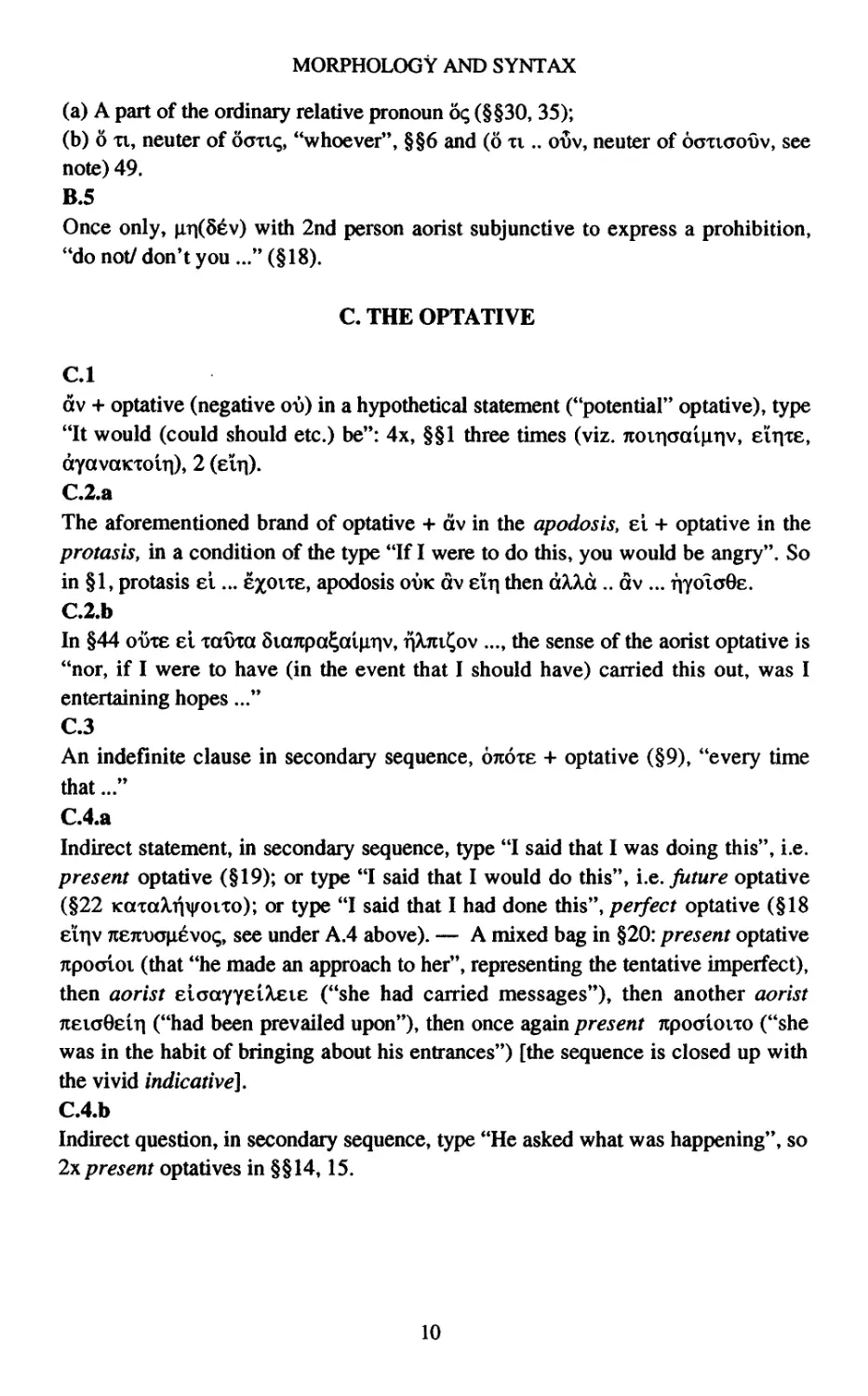
C. THE OPTATIVE
CI
dv + optative (negative ox>) in a hypothetical statement ("potential" optative), type
"It would (could should etc.) be": 4x, §§1 three times (viz. rcouiaaiurtv, eirtxe,
dyavaKToirt), 2 (etrt).
C.2.a
The aforementioned brand of optative + dv in the apodosis, ei + optative in the
protasis, in a condition of the type "If I were to do this, you would be angry". So
in §1, protasis ei... exoixe, apodosis oi>k dv e'irt then dAAd.. dv ... TryotaOe.
C.2.b
In §44 ovxe ei xavxa Siarcpcd;aiur|v, rjfaciCov ..., the sense of the aorist optative is
"nor, if I were to have (in the event that I should have) carried this out, was I
entertaining hopes..."
C.3
An indefinite clause in secondary sequence, orcoxe + optative (§9), "every time
that..."
C.4.a
Indirect statement, in secondary sequence, type "I said that I was doing this", i.e.
present optative (§19); or type "I said that I would do this", i.e. future optative
(§22 KctxctXr\\\fOixo)\ or type "I said that I had done this", perfect optative (§18
e'irtv rcejruonevo*;, see under A.4 above). — A mixed bag in §20: present optative
Tipooioi (that "he made an approach to her", representing the tentative imperfect),
then aorist eiaayyeiXeie ("she had carried messages"), then another aorist
TieiaGeiri ("had been prevailed upon"), then once again present rcpoaioixo ("she
was in the habit of bringing about his entrances") [the sequence is closed up with
the vivid indicative].
CA.b
Indirect question, in secondary sequence, type "He asked what was happening", so
2x present optatives in §§14,15.
10

NOTES
For an excellent short introduction to Lysias and other representatives of the genre
see M. Edwards, The Attic Orators (Bristol 1994); his first chapter deals succinctly
with early oratory, oratory and rhetoric in the fifth and fourth centuries,
deliberative, forensic and epideictic oratory, and the canon of ten Attic orators. —
A section "Suggestions for Further Reading" is appended to the present Notes.
Before looking at each portion of the text, study the Vocabulary provided for it.
It lists a number of words which are well worth committing to memory; those of
lesser importance are dealt with in the running commentary. Not included are the
very commonest words: any still unfamiliar to you as you work through the text
should be looked up (try Liddell and Scott's Intermediate Greek Lexicon), jotted
down and memorised at the earliest opportunity.
If you are having trouble with verbs, have a look at Appendices A-B.
"MS" refers to the introductory notes on Morphology and Syntax.
***
Synopsis
§§1-5 Introduction. The need to punish adulterers with the utmost severity. The
requirements of the present case.
§§6-28 Narrative. The speaker, whose wife had been having an affair, was initially
fooled into believing that all was well with his marriage. When he did get wind of
the liaison, he resolved to catch the offender red-handed, and ended up killing him
in the marital bedroom.
§§29-36 Arguments about the legality of his action.
§§37-42 Refutation of the charge that this was a case of entrapment.
§§43-50 Recapitulation capped not by a direct appeal for a favourable verdict but
by a reaffirmation of the need to uphold the city's laws.
The case
The speech was delivered by one Euphiletus, an Athenian charged by the relatives
of the young Eratosthenes with premeditated homicide (which carried the penalty
of execution and confiscation of property: cf. §50); premeditated because, it was
alleged, Eratosthenes did not just happen to be in Euphiletus* house on one of his
frequent visits (as claimed by Euphiletus) to conduct an affair with the latter*s
wife, but rather was lured to the house, hauled into it and killed by the sacred
11

LYSIAS ON THE MURDER OF ERATOSTHENES
hearth at which he had taken refuge (see §§27, 37; the speech for the prosecution
is not extant).
Under homicide law (cf. §30) a man who caught a seducer in the act of having
sex with his wife and killed him on the spot could not be convicted of murder. It
may be inferred from §28 that the law specifying procedure in cases of adultery
(which must be the law in question here) stipulated that homicide was lawful
where the offender (a) was caught in the act and (b) admitted to the charge.
Lawful, but not obligatory: alternative remedies were open to the aggrieved party
(cf. on §25), and these do not figure at all prominently in the present speech. The
suspicion that in Lysias' day summary execution was not generally resorted to, or
that it was not generally regarded as the most reasonable or humane among the
various means of redress, is strengthened by Euphiletus' insistence that he acted as
an enforcer of civic justice, indeed that he was "commanded" by "the laws of the
polis", the deterrent effect of which no responsible citizen would wish to
undermine, to take drastic action. In other words, in this case, the jury is given to
understand, an act of private vengeance administered by the victim must be
regarded as an act of public punishment administered by a court of law: Euphiletus
turns bedroom into courtroom at §§25ff.
On a more general level, at the start of the speech the point is made, obliquely,
that no penalty is too severe for adultery (see the note on icu; Cnuia<; in §1); and at
the end (§49) "the laws" are said to stipulate that anyone who "caught" an
adulterer (no "in the act" here) could deal with him "in any way he liked", this
reinforcing a statement that the aggrieved party would be justified in resorting to
"anv means whatsoever" to catch such an offender (§37). Whether any member of
the jury bore these general considerations in mind, and was moved to share
Euphiletus' professed indignation at the outrageous and socially disruptive
behaviour of a persistent (§16) offender, we shall never know; it is certainly hard
to believe that all, or even a majority, could swallow (to take one notable example)
the assertion that the accused, already determined to catch Eratosthenes red-
handed, found it necessary to scurry about in the hours of darkness in a frantic
attempt to round up witnesses.
§§1-5
Prooemium This falls into two parts. The speaker will have paused after §2, as
with rcepi uev otfv ..., "Well then, concerning ...", he closes up the topic of
punishment and prepares (uev) to consider the details of the offence. It is taken for
granted at the outset that Eratosthenes has committed a shocking crime, with
Euphiletus cast in the role of the victim who eventually triumphs over adversity.
§§1-3 are concerned first and foremost with the need to deal with (§3: a "pardon"
is out of the question), and to deal severely with, adulterers: this must be the
12

NOTES
universal feeling (rcdvxeq §1 - drcavxa<; §3) not only among the Athenian jury-
members but throughout the whole of Greece (cmctcm §2) and indeed among the
entire human race (dnavxe<; ibid.).
The jury is expected to feel indignation at what has taken place (§1). We can
detect the speaker's own sense of outrage in his insistent tone (§4): emphatic
possessive adjectives (xfjv e\ir\v, xovq euout;, xfjv e\it\v, all postpositive with
repeated definite article), emphatic third person pronoun (eiceivTiv), emphatic
reflexive (eue aiixdv, "me personally"). To a string of offences (icai ... Kai ... ical
...) is appended an emphatic denial of any sinister motive on the part of the
accused (Kai owe ... owe ... owe ...). This long sentence is capped with a
declaration that the punishment was in accord with "the laws". Finally (§5), the
jury is reminded that the wronged Euphiletus' own life is now in danger (...
acDTrjpiav), a point recalled at the close of the speech and related to observance of
"the laws of the polis".
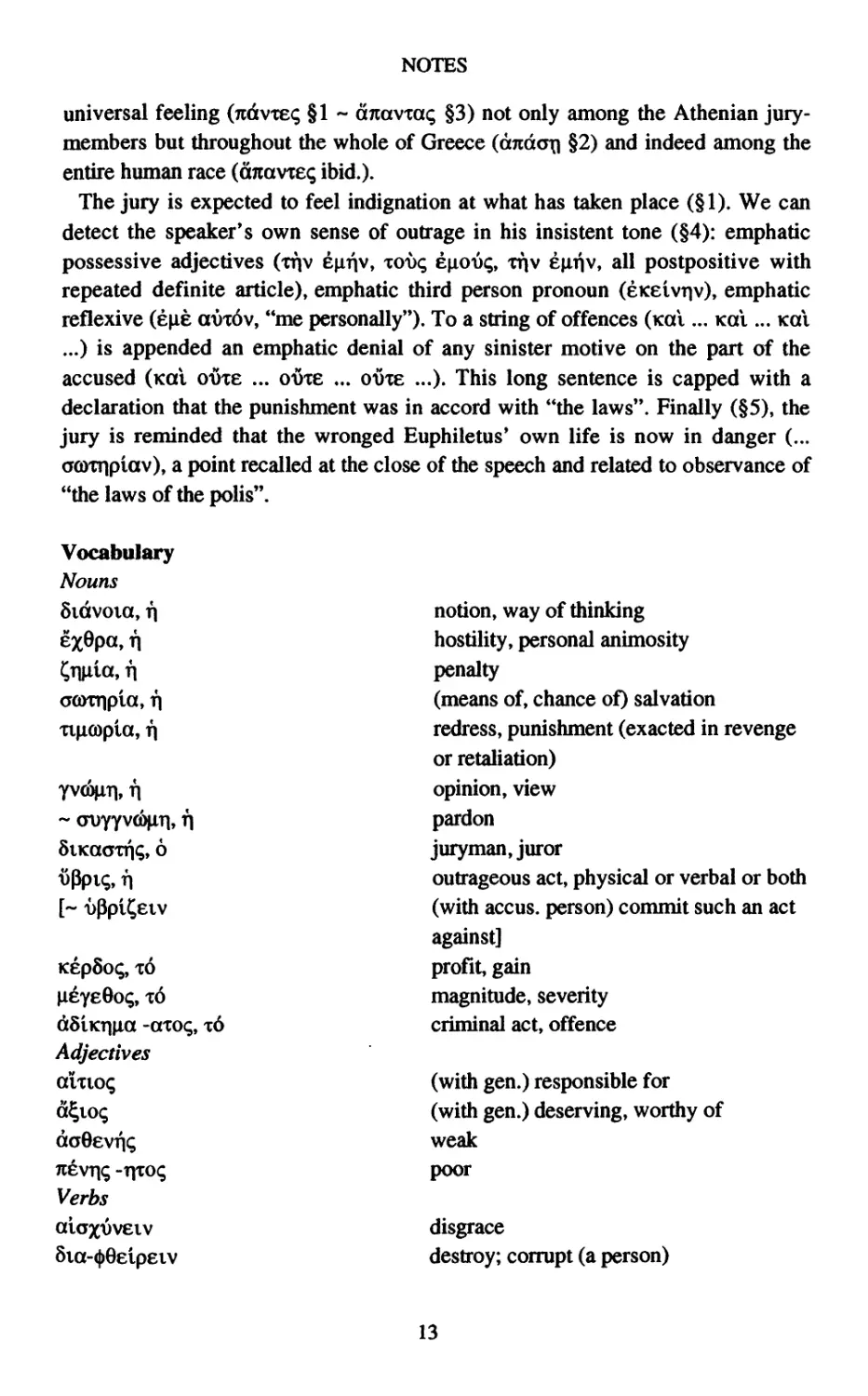
Vocabulary
Nouns
Sidvoia, fi
exBpa, ti
Criuia, fi
acoxTipia, i\
xiuoopia, Ti
Yvc&uii, fi
~ avYyvotyiri, i\
8tKaaxn<;, 6
vppi<;, fi
[~ a>ppi£etv
Kep8o<;, to
u£ye0o<;, x6
dSiKTijia -axoq, x6
Adjectives
aixioq
a^io<;
da0evT|(;
7ievr|<; -r|xo<;
Verbs
aiaxvveiv
8ia-<|)0eipeiv
notion, way of thinking
hostility, personal animosity
penalty
(means of, chance of) salvation
redress, punishment (exacted in revenge
or retaliation)
opinion, view
pardon
juryman, juror
outrageous act, physical or verbal or both
(with accus. person) commit such an act
against]
profit, gain
magnitude, severity
criminal act, offence
(with gen.) responsible for
(with gen.) deserving, worthy of
weak
poor
disgrace
destroy; corrupt (a person)
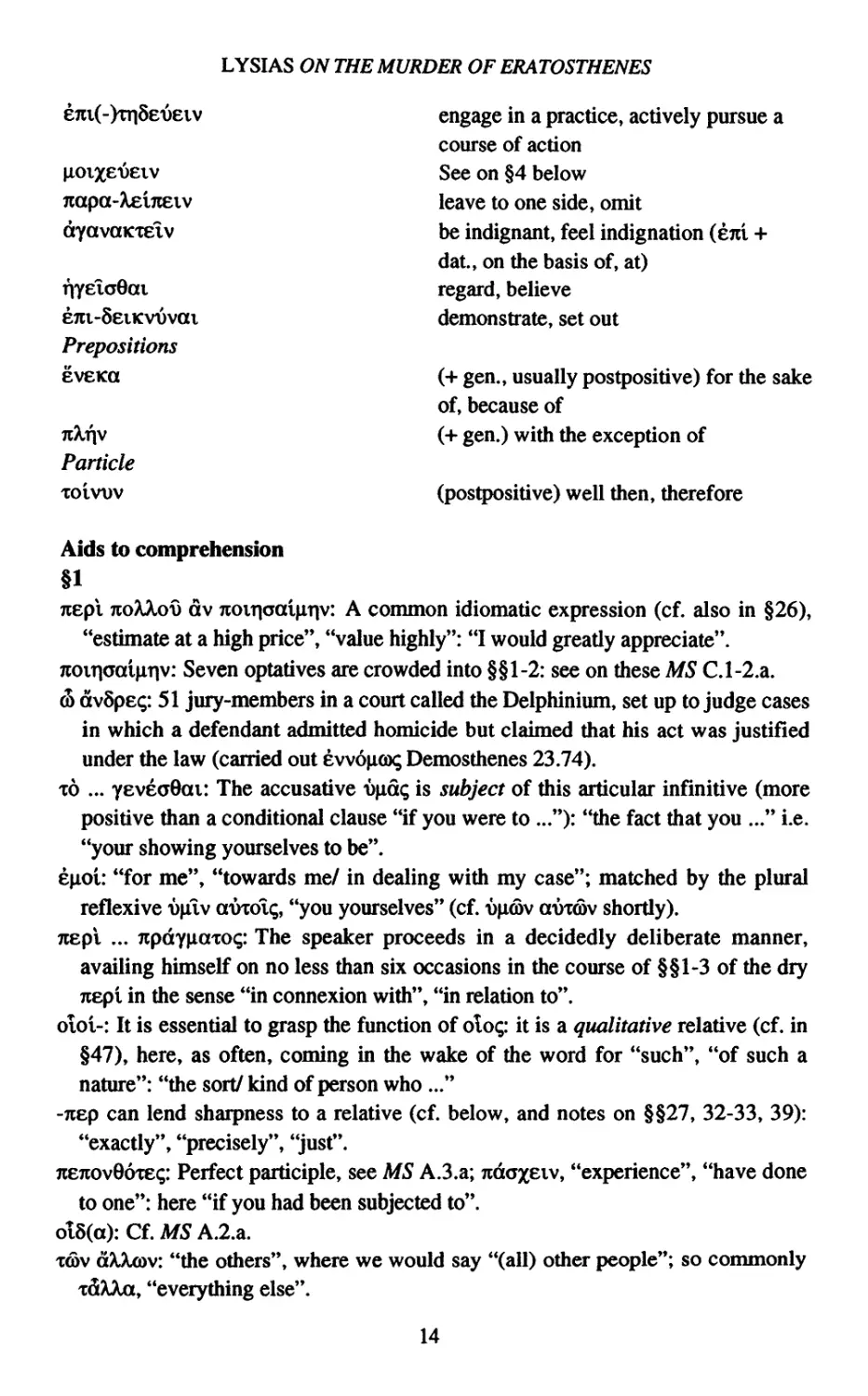
13

LYSIAS ON THE MURDER OF ERATOSTHENES
87u(-)rr|5e'6eiv
ux>i%etietv
napa-Xeineiv
dyavaKxetv
rryelaGai
e7ti-5eiKv6vai
Prepositions
eveica
nkr\v
Particle
xoIvdv
engage in a practice, actively pursue a
course of action
See on §4 below
leave to one side, omit
be indignant, feel indignation (em +
dat, on the basis of, at)
regard, believe
demonstrate, set out
(+ gen., usually postpositive) for the sake
of, because of
(+ gen.) with the exception of
(postpositive) well then, therefore
Aids to comprehension
§1
Tcepi noXkox* dv Tcouiaaiu^v: A common idiomatic expression (cf. also in §26),
"estimate at a high price", "value highly": "I would greatly appreciate".
noir\oai\ir\v: Seven optatives are crowded into §§1-2: see on these MS C.l-2.a.
& av5pe<;: 51 jury-members in a court called the Delphinium, set up to judge cases
in which a defendant admitted homicide but claimed that his act was justified
under the law (carried out evvouax; Demosthenes 23.74).
to ... yevea0ai: The accusative v\iaq is subject of this articular infinitive (more
positive than a conditional clause "if you were to ..."): "the fact that you ..." i.e.
"your showing yourselves to be",
euxri: "for me", "towards me/ in dealing with my case"; matched by the plural
reflexive vpiv ainoiq, "you yourselves" (cf. vuiSv avxm shortly),
rcepi ... npdyuaxoq: The speaker proceeds in a decidedly deliberate manner,
availing himself on no less than six occasions in the course of §§1-3 of the dry
Tcepi in the sense "in connexion with", "in relation to",
oioi-: It is essential to grasp the function of otog it is a qualitative relative (cf. in
§47), here, as often, coming in the wake of the word for "such", "of such a
nature": "the sort/ kind of person who ..."
-Tcep can lend sharpness to a relative (cf. below, and notes on §§27, 32-33, 39):
"exactly", "precisely", "just".
7ie7cov06re<;: Perfect participle, see MS A.3.a; rcdaxeiv, "experience", "have done
to one": here "if you had been subjected to".
ot5(a): Cf. MS A.2.a.
tcdv aXXxov: "the others", where we would say "(all) other people"; so commonly
xdAXa, "everything else".
14

NOTES
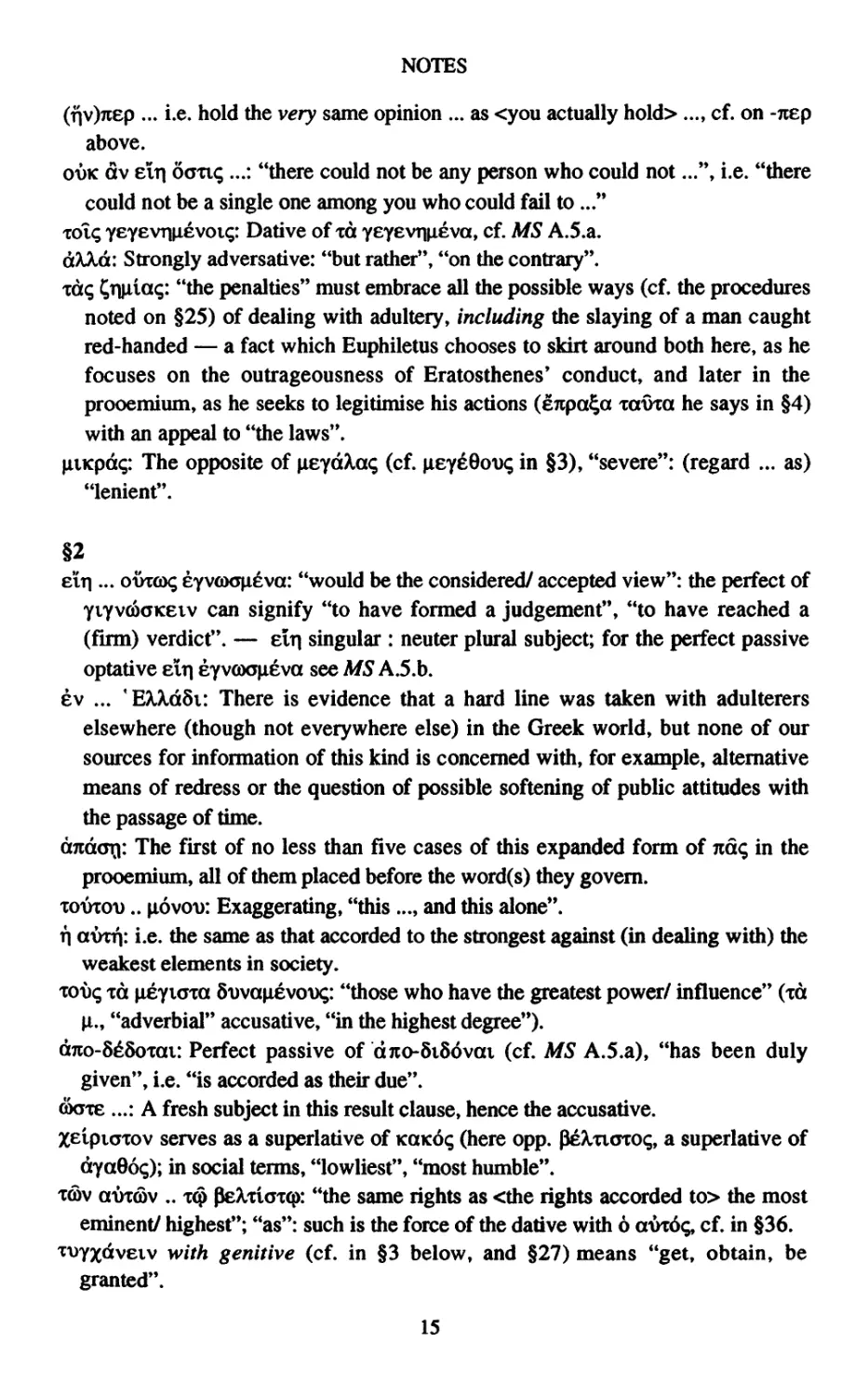
(r\v)nep ... i.e. hold the very same opinion ... as <you actually hold> ..., cf. on -rcep
above.
o\)K av eiti 6axi<;...: "there could not be any person who could not...", i.e. "there
could not be a single one among you who could fail to..."
xoi<; YeyevTttievoi<;: Dative of xd yeyevrpeva, cf. MS A.5.a.
dAAd: Strongly adversative: "but rather", "on the contrary".
xdq Crpiaq: "the penalties" must embrace all the possible ways (cf. the procedures
noted on §25) of dealing with adultery, including the slaying of a man caught
red-handed — a fact which Euphiletus chooses to skirt around both here, as he
focuses on the outrageousness of Eratosthenes' conduct, and later in the
prooemium, as he seeks to legitimise his actions (ercpa^a xavca he says in §4)
with an appeal to "the laws".
uxKpdq: The opposite of \ieya\a<; (cf. jiey60ov<; in §3), "severe": (regard ... as)
"lenient".
§2
eiti... owgx; eyvooou^va: "would be the considered/ accepted view": the perfect of
yiyvo&aicetv can signify "to have formed a judgement", "to have reached a
(firm) verdict". — elrj singular : neuter plural subject; for the perfect passive
optative eirj eyvaxjjieva see MS A.5.b.
ev ... *EAAti5i: There is evidence that a hard line was taken with adulterers
elsewhere (though not everywhere else) in the Greek world, but none of our
sources for information of this kind is concerned with, for example, alternative
means of redress or the question of possible softening of public attitudes with
the passage of time,
andon; The first of no less than five cases of this expanded form of na<; in the
prooemium, all of them placed before the word(s) they govern.
xowod.. jiovod: Exaggerating, "this ..., and this alone",
n awri: i.e. the same as that accorded to the strongest against (in dealing with) the
weakest elements in society.
toix; xd uiyioxa 5Dvau€vovQ: "those who have the greatest power/ influence" (xd
u., "adverbial" accusative, "in the highest degree").
d7co-8£8oxai: Perfect passive of drco-5t5dvai (cf. MS A.5.a), "has been duly
given", i.e. "is accorded as their due",
©axe ...: A fresh subject in this result clause, hence the accusative.
Xeipiaxov serves as a superlative of icaicdg (here opp. PeXxioxoq, a superlative of
dyaGoq); in social terms, "lowliest", "most humble".
xd)v ai>xd)v .. xcp peXxiaxcp: "the same rights as <the rights accorded to> the most
eminent/ highest"; "as": such is the force of the dative with 6 axndq, cf. in §36.
xvyxdveiv with genitive (cf. in §3 below, and §27) means "get, obtain, be
granted".
15

LYSIAS ON THE MURDER OF ERATOSTHENES
omtoc, — SeivoTdrnv: "so absolutely shocking*'.
ia\m\v tt|v iippiv: "this <particular brand of> outrageous conduct".
§3
uev is answered by 56 at the start of §4.
oXxy&pGx; 8taiceia8ai: The verb (cf. in general MS A.2.b), in conjunction with an
adverb, means "be so disposed/ inclined, be of a certain disposition": "to be so
permissive in his attitude" (adj. oXiycDpoq: showing little or no concern,
easygoing, casual to the point of negligence).
6crci<; oiexai is used here in preference to a standard result clause (recently
deployed) of the form ©ore olexai, "as actually to believe that..."
§4
towo: Emphatically placed: "that what I have to... is this, namely that..."
euoixevev [act: uoixeia; agent: uoixo<^: With accusative, "was having an illicit
affair with", the affair in this case involving the seduction of another's man's
wife.
5ie<|>0eipe ... rjoxuve: Imperfects, or aorists (see the flanking verbs)? The
coordination suggests the latter: wife + children + self, the respective parties
being subjected to moral corruption, social stigma and personal outrage, all as a
direct result of uoixela.
rcaiSaq: A single child is mentioned in the subsequent narrative. Euphiletus, now
up in arms, applies to his own particular case the general consideration that
adulterers can cause problems for "the children" of a marriage (see §33).
ei<;... eiaicov: A point to which Euphiletus will return (§25, cf. §§38, 40). The
intrusion into the house puts Eratosthenes on a par with a common thief, who
could be killed legally if caught in the act (~ §36 ... ei<; xaq aXKoxpiaq oiKiaq
eiaievai).
eia-icov (~ elui) serves as present participle of eia-epxouai (cf. -iovroq in §11,
-louaa in §13, i6vxi in §22, -i<dv in §23, -i6vxe<; in §24, -iriv in §25 and §39);
so infinitive -i£vai (§12 twice, §36), optative -lot (§20). Cf. Appendix A, under
D.n.
iva ... ydvtDum: Purpose clause, see MS B.2.a.
8k: *from" to denote the transition from one state to another, "after being".
KepSoix;: Supply eveica.
xn<;... xiucDpla^: "the satisfaction in-line-with (sanctioned by) the law(s)". xiuopia
could well describe an act of private vengeance; the vengeance exacted by
Euphiletus is a matter of civic justice: see in §47.
16

NOTES
§5
e£ ctpxiiq: "from beginning <to end>".
xaXr\Qr\: Crasis (t) Kpaoiq, "coalescing"), for xd dto|0fi.
xaucriv rather than a neuter, anticipating the feminine predicate.
edv ... 8i)vti0g) (aorist subjunctive of SvvaaBai): Prospective conditional clause,
cf. MS B.3. This reinforces o\)5ev ... TdXr|0fi: "if I can give you a complete
picture of...": a lengthy narrative is in the offing.
7ce7cpay^eva: Perfect participle passive, see MS A.5.a.
§§6-14
Narrative, part one. The story of how a harmonious and stable marriage is
undermined by Eratosthenes, who gains access to Euphiletus * house and has an
affair with his wife. She manages to fool her husband, so much so that even when
something about her appearance does strike him as odd he offers no comment and
goes about his business
Vocabulary
Nouns
Bepdncuva, i\
dypog, 6
Xvxvoq, 6
5ei7cvov, to
7cat8iov, to
Tcpoacwcov, to
yeiTCDv -ovo<;, 6
Adjectives
donevoq
actypo&v -ovoq
Verbs
pa5i£etv
Ka8-eii5eiv
KaTa-Paiveiv
Kiv8\>vei)eiv
KAxieiv
\ieQ\)Eiv
rai^eiv
Tcpoa-exeiv (tov vovv)
servant-girl, maidservant
silence; adv. -fi silently, without
comment
the country
lamp
dinner
(young) child
face
neighbour
glad(ly)
virtuous, chaste
go (usually on foot)
lie down to sleep, sleep
go down, descend
incur danger
cry, weep
be intoxicated
play/ fool about, joke
give (one) attention, devote attention (to
one)
17

LYSIAS ON THE MURDER OF ERATOSTHENES
DTC-OTCTEDeiV
<|>dcnceiv
oixeoGai
6pyi£ea0ai
poav
yeXdv
aiCDTcav
xeXevcdv
5i-avcaa0ai
dKoXoa)0eiv
5i-oiKeiv
tameiv
\|fo<|>eiv
5i-tiyeia0ai
ev-0\>^eio0ai
7ipoa-7coieia0ai
dv-oiyvuvai
7capa-5i56vai
epea0ai
Adverbs
dKpiPox;
a7tpoa8oKf[xco(;
ava)
elxa
ev8ov
eTcirnSec,
Xiav
vuKxcap
Particle
6|iax;
suspect, feel suspicion
claim, assert
be gone, have gone
get angry
shout, bawl
laugh
be silent, observe silence
finish off; with tov piov mentally
supplied, die
lead one's life, live
(with dat.) follow, be in attendance on
manage, administer, control
harass, annoy, irritate
make a noise (yo<f>o<;)
describe, explain in detail
think about, reflect on (with gen.)
pretend
open
hand over, entrust
(an aorist, indicative rjpojiriv) ask, put a
question
with precision, strict care, meticulously
unexpectedly
above, in an upper position, upstairs,
Opp. KdlCD
next, then; then (as a consequence)
inside, indoors, opp. e^co
on purpose, deliberately
too much, excessively
during the night
nevertheless, none the less
Aids to comprehension
§6
ydp very often follows declarations of the type "I shall tell you (the truth)", and
also exhortations such as "pay attention", "consider", cf. in §37 and §43; here an
introductory "now" would fit the bill
e8o£6 ux>i: The aorist of this verb is regularly used of reaching a formal decision:
"once I had made up my mind to..."
18

NOTES
yfjum: Aorist infinitive, "to get married".
r\yarf6\ir]v: The middle dyeotiai is a common term for the introduction of a wife
into one's household,
xov ... %povov: Accusative marking duration of time (cf. noXvv %povov in §10,
xptdKOvB* T^epa^ in §14), "for the remaining period", up to the point specified
by erceiSf]... below, i.e. "for the time being".
ovm SieiceiuTiv okixe ...: Cf. on 8iaKeio8ai in §3; "I was disposed not to ...", "my
attitude was this, that I should ..."
\ir\ie ... eivai: There is a switch from the implicit personal subject of the infinitive
>A)7ceTv to an impersonal construction: "nor that it should be too much in her
power", i.e. "nor to allow her too much freedom" to ...
6 xi av eBeXn; On the use of the subjunctive see MS B.4; although the sentence as
a whole is cast in secondary sequence, this clause is dependent on present
infinitive rcoielv.
(etyvXavzov) xe: Here a connective, "and".
gx; oiov xe fjv: "as it was possible", i.e. "as far as was practicable".
-ei%ov: Cf. on eitaceq in §12.
eiKoq is a neuter perfect participle, MS A.3.b: "reasonable",
uxn ... underlines the point that the child was his own: his wife's illicit liaison lies
in the future,
yiyvexai: The so-called "historic" present (cf. 8iac|>9eipexai in §8, and further
examples in §15, etc.), generally unacceptable in literary English: "was born".
e7cioxe\)0v f[&x\: "from this point on I began to ..."; then aorist rcape5a)Ka, marking
the grand gesture of a single transfer of responsibilities,
jcdvxa xa e\LCtwox>: "the management of all my own <domestic> affairs".
Tiyotiiievoq ... eivai: "considering that this was the strongest bond of intimacy
there could be between us" (oiKeioxry;: adj. oiKeioq "closely related, on
intimate terms").
§7
Kal yap: "since <she was> in point of fact".
oiKovojioq ... <f>ei5coX6<;: "a skilful [ctr. 5eivoxdxriv in §2] and thrifty [~
(|>ei5ea8ai, "to spare", "be sparing"] household-manager". The bracketed dya8fi
marks an interpolation in all manuscripts (an inept attempt, it would appear, to
ensure that <t>ei5a)X,6<; did not give the wrong impression: as a noun it can mean
"miser").
roi: Dative personal pronouns with possessive force ("my" etc.) are frequently
encountered in conjunction with substantives denoting family-members.
ft.... dfloGavowot... yeyeviixai: "who having died has turned out to be", "who by
her death/ whose death has proved to be". After yeyevrixai the speaker breaks
19

LYSIAS ON THE MURDER OF ERATOSTHENES
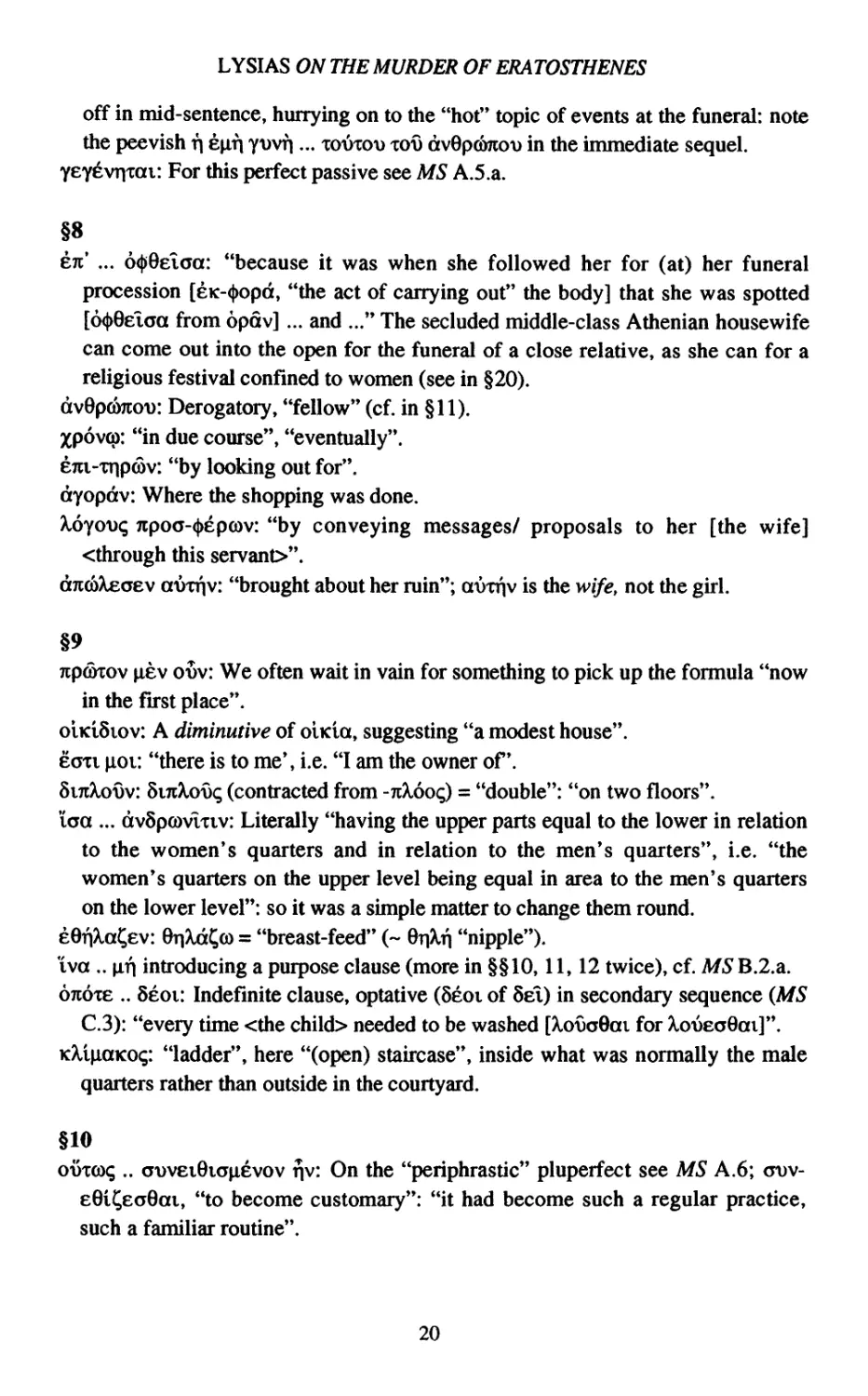
off in mid-sentence, hurrying on to the "hot" topic of events at the funeral: note
the peevish i\ euri yuvfi... xo\ra>\) tox> dv0pcwio\> in the immediate sequel.
YeY^vrixat: For this perfect passive see MS A.5.a.
§8
en ... o^Betaa: "because it was when she followed her for (at) her funeral
procession [eic-<t>opd, "the act of carrying out" the body] that she was spotted
[6<t>8eiaa from opdv] ... and ..." The secluded middle-class Athenian housewife
can come out into the open for the funeral of a close relative, as she can for a
religious festival confined to women (see in §20).
dvOpawioi): Derogatory, "fellow" (cf. in §11).
Xpovcp: "in due course", "eventually".
e7ci-Tr|pG>v: "by looking out for".
dyopdv: Where the shopping was done.
Xoyoax; 7tpoa-<t>epcov: "by conveying messages/ proposals to her [the wife]
<through this servant>".
diccoX-eaev cnkqv: "brought about her ruin"; orotnv is the wife, not the girl.
§9
7cp<Sxov u£v ovv: We often wait in vain for something to pick up the formula "now
in the first place".
oik15iov: A diminutive of oiKia, suggesting "a modest house".
eon uxn: "there is to me*, i.e. "I am the owner of*.
SutX,o\)v: 5i7cXo\)<; (contracted from -nXooq) = "double": "on two floors".
iaa ... dv5pa)vmv: Literally "having the upper parts equal to the lower in relation
to the women*s quarters and in relation to the men's quarters", i.e. "the
women's quarters on the upper level being equal in area to the men's quarters
on the lower level": so it was a simple matter to change them round.
e9f|X,aCev: BriX-dCco = "breast-feed" (~ 9rM "nipple").
wot.. |xf| introducing a purpose clause (more in §§10,11,12 twice), cf. MS B.2.a.
ojcoxe .. 5eoi: Indefinite clause, optative (5eoi of 5el) in secondary sequence (MS
C.3): "every time <the child> needed to be washed [XxniaBai for X,ovea9ai]'\
icMuaKoq: "ladder", here "(open) staircase", inside what was normally the male
quarters rather than outside in the courtyard.
§10
oiSxcoq .. aDvei9iau£vov rjv: On the "periphrastic" pluperfect see MS A.6; ovv-
e9i£ea9at, "to become customary": "it had become such a regular practice,
such a familiar routine".
20

NOTES
d7c-f|ei (drceiui ~ etui) serves as the third singular imperfect ("would go off, as a
matter of habit) of drcepxoum, cf. eta-fiei (twice) in §17, first person singular
eia-fja in §42, and the note on eioicov in §4.
Ka9ei)5r|O0'uoa: Future participle expressing purpose, "to sleep",
ox;: Here (cf. in §§18, 22, 23) a preposition with accus., "to (join) him", "to his
side", after the leading verb drcievai; we might prefer to link it with Ka9.,
"sleep by his side".
tit96v: "teat", "breast".
Pocx: Change of subject: <the child>; we might say "to stop the child ..."
xawa ... olkox; eyiyvexo: "things went on like this" (-exo: neuter plural subject).
r|X,i9io*; 5ieiceiur|v: On the verb see note on 5iaiceio9ai in §3; r|M9io<; means
"silly, simple-minded": "I had such a naive way of looking at things".
cjSuiiv i.e. co6ur|v, from oiea9oa (cf. the very common otum, = o'ioum, §§28, 35).
eawo\>: Third person pronoun, here for euuwo'u, a "normalising" variant reading
here, "my own".
§11
rcpo-'iovxoq ... xpovov: Genitive absolute, "time going forward": "time passed,
<and this happened>:"; for -lovxoq see on eioicov in §4.
dypoii: "the country", where he will have had farm-property. The definite article is
habitually suppressed with this noun.
ePoa ...: Imperfects, "started to..."
e5\>aic6X,aivev: This verb means "fret"; ~ adj. SwkoXxx;, "peevish, discontented",
iva ...: Subject the child.
§12
drc-ievai: Cf. on eioicov in §4.
£KeA£\>ov: "issued instructions", very commonly employed in the imperfect.
to ., Tcpdrcov: Adverbial, as often: "initially".
ouk f|9eXev: "didn't want to" (and kept saying so), not "refused (outright)"
(aorist).
cix; dv (sometimes written cbadv) is a stereotyped way of saying "as if: "as though
glad at having seen me ..."
eopaieoia: On this perfect participle see MS A.3.b.
ilKovta: Often the element "back" can be mentally supplied with verbs of coming/
going.
5id xpovoi): "after an interval of time", i.e. "after so long <away>".
c&pyi£6uT|v: Another inceptive imperfect, "began to..."
tva ...: "Yes [ye thus often; also emphasises pronoun here], <you're telling me to
take my leave> so that you can <stay> here <and> try it on with your precious
little slave-girl" (7tai5icncr|, a diminutive of jcaiq, here used contemptuously).
21

LYSIAS ON THE MURDER OF ERATOSTHENES
Kai Jtpoxepov 8e: "and [an indignant addition] on previous occasions also you
were <seen to be> -ing ..." We gather that Euphiletus was not impotent or
undersexed. He had fathered a child (§6) and he shared a bed with his wife (§10
init.).
eUiceg: Imperfect of eXiceiv (note the augment, cf. e%co ~ ei%ov), "draw, drag
along", here "pull about", "paw".
§13
Kdyco: Kai eya>.
eyeXxov: Inceptive imperfect; his wife then enters into the spirit of things — or
pretends to.
dva-crcdaa: dv-iaxdvai, "to make (somebody) stand up", intransitive in aorist
participle -crtdc; -ordaa -aiav, "having stood up", "got to one's feet".
ctn-iovca: Present participle (cf. on eiaiciv in §4) because the departure is
synchronous with the action described by the following verb.
7tpoa-xi0r|ai: "put to", in the sense "close, shut". On the tense of this verb and of
e^tacexai see on yiyvexai in §6.
xf|v kAeiv e<|>eXKeTai: kXeiv is accusative of Kteiq, "drew the <outside> bolt",
locking in our poor innocent (now in the bedroom of what had been the
women*s quarters, secured from the outside).
ot>5ev: Adverbial (see Vocabulary for construction of ev0\)^ieia9ai).
\mo-vod)v = imoTCTexioDv.
eKd0e\)5ov: Imperfect, "proceeded to go to bed and get some sleep". Note the
application of the augment to a preverb (Ka0-et>5eiv).
§14
rcpoq: "towards", "approaching".
dv-eq>!;ev: On the augmentation cf. MS A.5.b.
epouevoi).. jiod: Genitive absolute.
ai 0\>pai: Cf. on §17.
\jfo<t>oiev: Optative: MS C.4.b.
dno-apea0f|vai: From dTco-apevvijvai, "to extinguish, put out".
evd\|raa0ai: A middle of ev-drcxeiv (a7rceiv in the sense "set on fire, light"), "to
get oneself/ procure a light" from the neighbours <* fire>. Cf. Homer Odyssey
5.488-90 (transl. W. Shewring) "A neighbourless man in some lonely spot will
bury a burning log under grey ash, keeping alive the seed of fire and hoping thus
not to need to rekindle it from elsewhere".
e5o^e: The speaker has kept his peace all this while and has been inclined to
believe the story: but it did strike him (aorist!) that she was wearing make-up.
22

NOTES
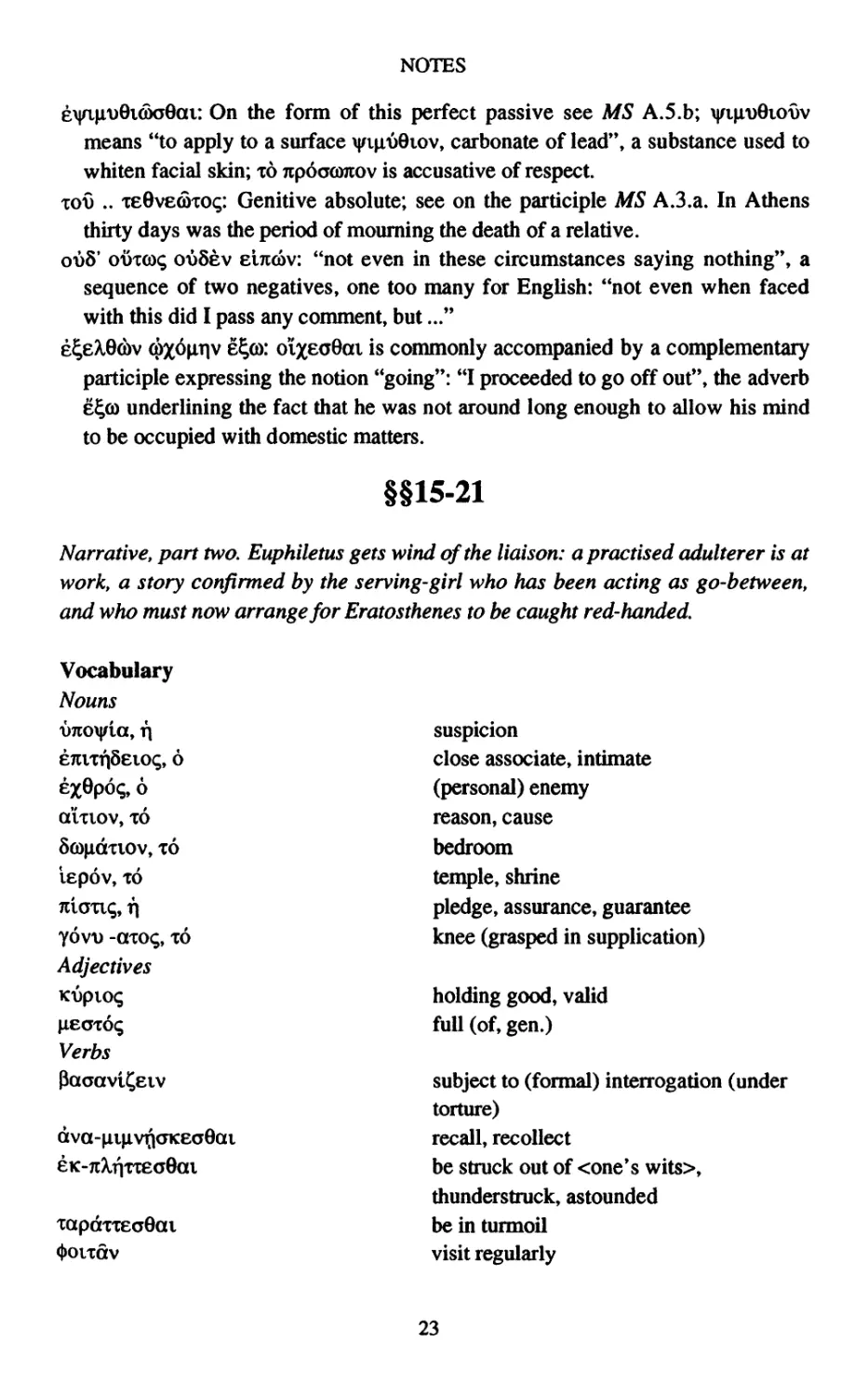
e\|tt^D0id)a9ai: On the form of this perfect passive see MS A.5.b; \|fi|rt)9io\)v
means "to apply to a surface \{nu\>0iov, carbonate of lead", a substance used to
whiten facial skin; to Tcpoaowcov is accusative of respect,
xoti .. TEdvemoq: Genitive absolute; see on the participle MS A.3.a. In Athens
thirty days was the period of mourning the death of a relative.
ov5' oikox; o\>5ev eirccov: "not even in these circumstances saying nothing", a
sequence of two negatives, one too many for English: "not even when faced
with this did I pass any comment, but..."
e£e>,0<i)v <ox6ut|v el;©: oixeaBai is commonly accompanied by a complementary
participle expressing the notion "going": "I proceeded to go off out*', the adverb
e£co underlining the fact that he was not around long enough to allow his mind
to be occupied with domestic matters.
§§15-21
Narrative, part two. Euphiletus gets wind of the liaison: a practised adulterer is at
work, a story confirmed by the serving-girl who has been acting as go-between,
and who must now arrange for Eratosthenes to be caught red-handed.
Vocabulary
Nouns
\mo\|fia, x\
erciTfi5eio<;, 6
ex9po<;, 6
amov, to
Sotyidnov, to
iepov, to
niouq, ti
yovi) -azoq, to
Adjectives
KTjpioq
\ieczoq
Verbs
Paaavi^ew
dva-^vxjaKea9ai
eK-7tXr|TTea0ai
Tap(raea0ai
<|>oiTav
suspicion
close associate, intimate
(personal) enemy
reason, cause
bedroom
temple, shrine
pledge, assurance, guarantee
knee (grasped in supplication)
holding good, valid
full (of, gen.)
subject to (formal) interrogation (under
torture)
recall, recollect
be struck out of <one's wits>,
thunderstruck, astounded
be in turmoil
visit regularly
23

LYSIAS ON THE MURDER OF ERATOSTHENES
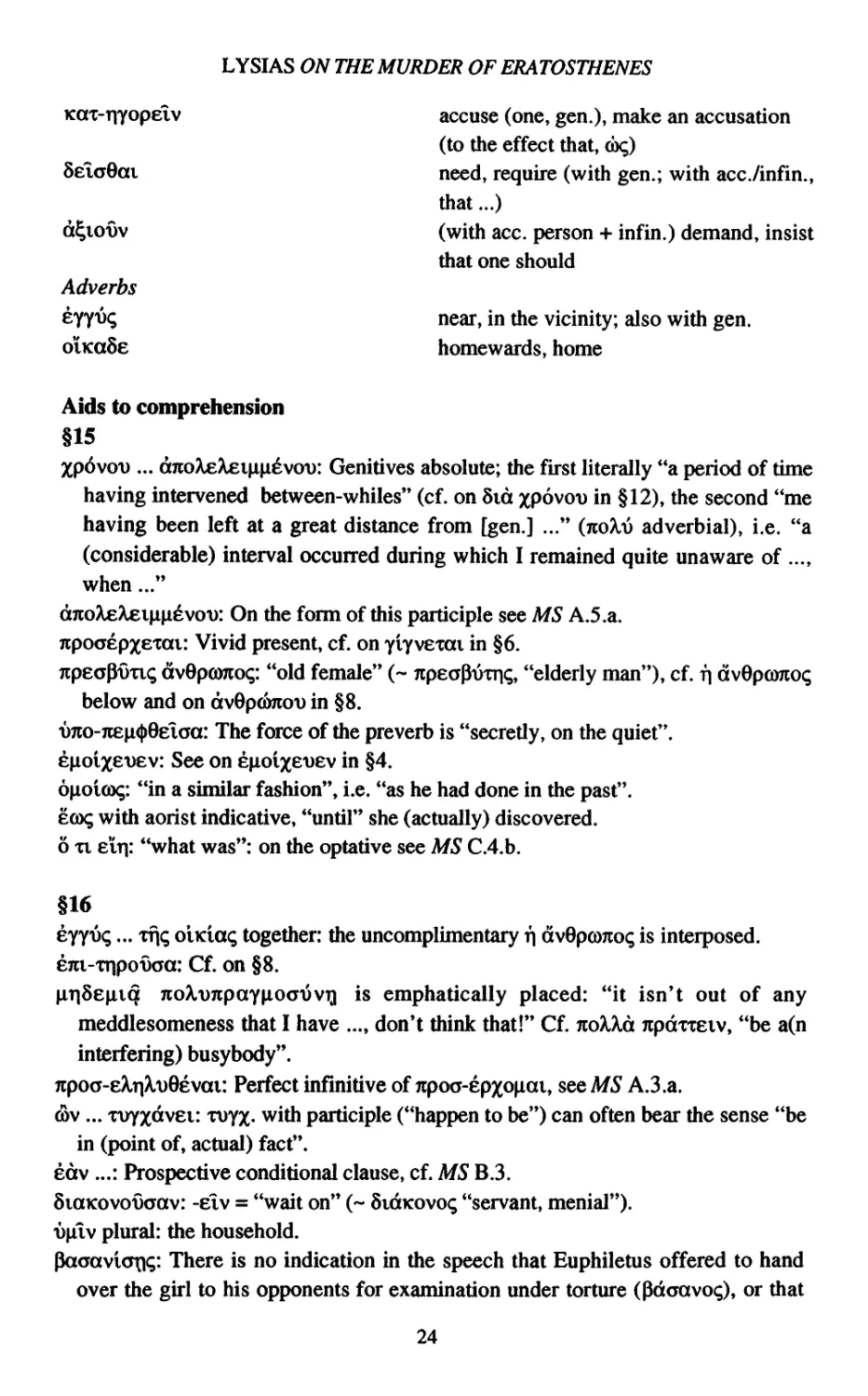
Kax-rryopeiv accuse (one, gen.), make an accusation
(to the effect that, ox;)
SeiaGca need, require (with gen.; with acc./infin.,
that...)
d£ioi)v (with ace. person + infin.) demand, insist
that one should
Adverbs
eyy™; near, in the vicinity; also with gen.
oiKa8e homewards, home
Aids to comprehension
§15
%p6voi)... dnoXeX£i|iudvo'u: Genitives absolute; the first literally "a period of time
having intervened between-whiles" (cf. on 8id xpovoi) in §12), the second "me
having been left at a great distance from [gen.] ..." (noXx) adverbial), i.e. "a
(considerable) interval occurred during which I remained quite unaware of ...,
when..."
dnoteteiuudvoi): On the form of this participle see MS A.5.a.
npoaepxexai: Vivid present, cf. on yvyvexai in §6.
npEGfivxu; avGpomoq: "old female" (~ rcpeaPvrnq, "elderly man"), cf. fj dvOpomoq
below and on dvOpawioi) in §8.
imo-neu<|>9eiaa: The force of the preverb is "secretly, on the quiet".
euoixeuev: See on eumxevev in §4.
ouoiax;: "in a similar fashion", i.e. "as he had done in the past".
eax; with aorist indicative, "until" she (actually) discovered.
6 xi eiri: "what was": on the optative see MS C.4.b.
§16
eyyuq... xf|q oiKtac; together: the uncomplimentary t) dvSpcojioq is interposed.
em-xripowa: Cf. on §8.
|ir|8e|iiq noXvnpay\ioox)VTi is emphatically placed: "it isn't out of any
meddlesomeness that I have ..., don't think that!" Cf. noXXa rcpdxxeiv, "be a(n
interfering) busybody".
npoo-eXr[XvQEvai: Perfect infinitive of rcpoa-epxouai, see MS A.3.a.
cov ... xixyxdvei: ruyx. with participle ("happen to be") can often bear the sense "be
in (point of, actual) fact",
edv ...: Prospective conditional clause, cf. MS B.3.
SiaKovotiaav: -eiv = "wait on" (~ Sidicovoq "servant, menial").
\)uiv plural: the household.
Paaaviorjq: There is no indication in the speech that Euphiletus offered to hand
over the girl to his opponents for examination under torture (pdaavoq), or that
24

NOTES
they demanded her for questioning. One possibility is that he had declined to
take the latter course, and that the extended account offered here is making the
point that a formal interrogation had been conducted, on his own terms and to
his own satisfaction.
'OflOev: "from/ of <the demo Oe".
5te<t>eapKev: Perfect: MS A.3.b.
xavxriv ... exei: The bracketed xfjv (to indicate an interpolation), present in all
manuscripts, would signify "because this is the trade he plies!". Without it (so
most editors): "he practises this as a profession!" (for xawrjv cf. the note on §5).
§17
aii'T]XX6,yr\: From dn-aM,dxxea9ai, "be removed/ remove oneself, i.e. "take
one's leave, make oneself scarce".
evQeayq = euGix;.
yvc6|ir|v: "mind", or as we might prefer "head" (seat of reasoning faculty/
perception),
eia-f|et: Singular in conjunction with neuter plural subject; for the form cf. on
drcfjei in §10.
dn;-£KA,fjo9r|v: From dno-KAeieiv "shut up, away".
e\|f6<t)ei: Singular because the two doors specified (the inside, viz. the door leading
from dv5pa)vuiq into courtyard, ouArj; and the outside, viz. the door leading
from courtyard to street) can be naturally regarded as a single entity from the
point of view of the observation about noise during the hours of darkness.
6 ovdenoxe eyevexo: "a thing that had never happened in the past",
xe: "and", as already in §6.
xcmxd n,o\)... yvc5|ir|v: n,ot) with yvcouriv (cf. above), the postpositive being slotted
into the preferred second position in the sense-unit.
§18
eKeteuov ...: Euphiletus chooses not to have it out with his wife. Instead, he will
tackle the go-between. Since this cannot be done indoors, the unsuspecting girl
is told to accompany her master on a shopping-trip. In keeping with his mission
to uphold civic justice, the aggrieved husband is now made to behave like a
stern but responsible official at an inquest.
cbq: Preposition with accusative, "to <the home of> one of..."
eir|v rcejruauevoq: For the form and employment of this perfect optative see MS
A.4/C.4.a.
5\)oiv ojioxepov: "whichever of two courses" (onoxepoq: cf. o\)8exepoq, "neither
of two**; 5-uoiv is genitive of 5\>o).
25

LYSIAS ON THE MURDER OF ERATOSTHENES
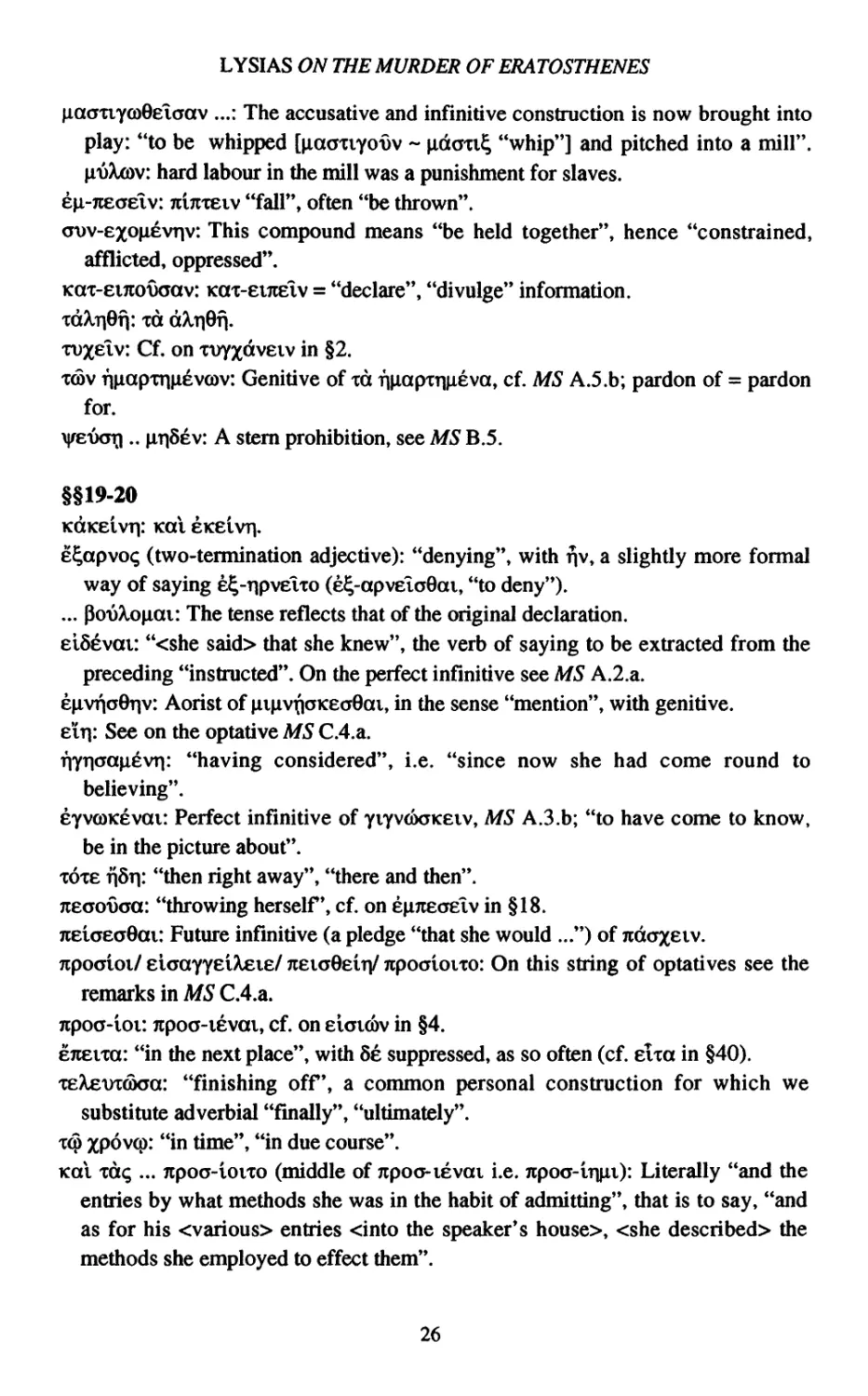
uucFTvyooGeiaav ...: The accusative and infinitive construction is now brought into
play: "to be whipped [uaaTvyo'Ov ~ udaxi£ "whip**] and pitched into a mill".
utiAxDv: hard labour in the mill was a punishment for slaves,
eu-rceaeiv: nljixeiv "fall**, often "be thrown*'.
<rov-exou£vriv: This compound means "be held together*', hence "constrained,
afflicted, oppressed".
Kax-eircotkrav: icax-eureiv = "declare*', "divulge*' information.
xdA,T|0fi: xd dA,r|9fi.
xv%£\\\ Cf. on xiryxdveiv in §2.
x<»v Tjuapxr|u£va)v: Genitive of xd Tjuapxriueva, cf. MS A.5.b; pardon of = pardon
for.
\|fei)aT|.. ur|8£v: A stern prohibition, see MS B.5.
§§19-20
KdiceivTi: Kai eKeivrv
e£apvo<; (two-termination adjective): "denying**, with fjv, a slightly more formal
way of saying e£-Tipveixo (e£-apvela9ai, "to deny").
... Poi3A,o|iai: The tense reflects that of the original declaration,
eifcevai: "<she said> that she knew", the verb of saying to be extracted from the
preceding "instructed". On the perfect infinitive see MS A.2.a.
eiiVTiaGnv: Aorist of uiuvfiaiceaGai, in the sense "mention", with genitive.
etr|: See on the optative MS C.4.a.
fryriaauevrt: "having considered*', i.e. "since now she had come round to
believing".
eyvcoKevai: Perfect infinitive of yvyvcoaiceiv, MS A.3.b; "to have come to know,
be in the picture about*',
xoxe ti5ti: "then right away*', "there and then",
jieaoxiaa: "throwing herself, cf. on eujieaeiv in §18.
neiaeaGai: Future infinitive (a pledge "that she would ...") of ndaxeiv.
rcpoaioi/ eiaayyei'kEie/ JieiaGein/ npoaioixo: On this string of optatives see the
remarks in MS C.4.a.
npoa-ioi: rcpoa-ievai, cf. on eiaicov in §4.
erceixa: "in the next place**, with 8e suppressed, as so often (cf. eixa in §40).
xetewdkra: "finishing off*, a common personal construction for which we
substitute adverbial "finally", "ultimately".
xq> xpovcp: "in time", "in due course".
Kai xdq ... rcpoa-ioixo (middle of Jipoa-ievai i.e. npoa-inju): Literally "and the
entries by what methods she was in the habit of admitting", that is to say, "and
as for his <various> entries <into the speaker's house>, <she described> the
methods she employed to effect them".
26

NOTES
@eauxx|>opioi<;: The dative means "at, on the occasion of the festival
Thesmophoria. Cf. on §8 (funeral).
eux)\)... 6vto<;: Genitive absolute.
\n\zp6c,: Euphiletus is concerned about the way adulterers disrupt family unity. His
wife is in with her lover's mother as well.
x&XKa: xa aMa.
§21
eiprjxo: A third singular (neuter plural subject) pluperfect, see MS A.6.
avxfj: The dative is the normal way of expressing the personal agent ("by") with
perfect/ pluperfect,
orcox;... nevoExoii: 6n<o<; \ir\ with future indicative in issuing a solemn warning:
"Right then, just you make sure that not a single soul gets wind of <all> this!",
ei 8e [ir\: A stereotyped way (cf. in §§36,48) of saying "otherwise".
tg)v ... (buoA,0YTi|ievG)v: Genitive of xa a^oAoynneva, see MS A.5.b.
en' a\>xo<t>copq>: Common in the sense "in the very act".
5eouai: A switch here from genitive to accusative and infinitive, see introductory
Vocabulary to §15-21.
e'wrep: "if really", "if in fact".
Tioiifaeiv: Future infinitive, since implementation of the agreement is prospective:
in English "that she would do" or just "to do".
§§22-28
Narrative, part three. Things come to a head when Euphiletus is told of
Eratosthenes' presence in the house. He sets off to gather all the witnesses he can
track down, bursts into the bedroom and dispatches the wrongdoer, after rejecting
an offer of monetary compensation, with an appeal to "the law of the polis,f. The
charge of entrapment is firmly rejected, as is the assertion that the killing was
carried out at the sacred household hearth.
Vocabulary
Nouns
eaxict, fj hearth
kAAvti, r\ couch, bed
apyvpiov, xo (sum of) money
xeKjXTipiov, xo proof, (item of) evidence; plur. (body of)
evidence
Adjectives
Koouioq decently behaved, law-abiding
xeAEittaioq last, final
27

LYSIAS ON THE MURDER OF ERATOSTHENES
Verbs
dva-yvyvcoaKeiv
en-eyeipeiv
IKEXEVEIV
Kaxa-kaupdveiv
Kaxa-^evyeiv
rcapa-paiveiv
napa-Xaupdveiv
naxdaaeiv
nXrytxeiv
<t>pd£eiv
dativea0ai
drc-avxdv
ur)xavaa9ai
dvxi-Poteiv
£ju-8rpeiv
(cruv)5eucveiv
a>9elv
em-ueteia9ai
Adverbs
OIKOl
07iia9ev
xnviicaika
Aids to comprehension
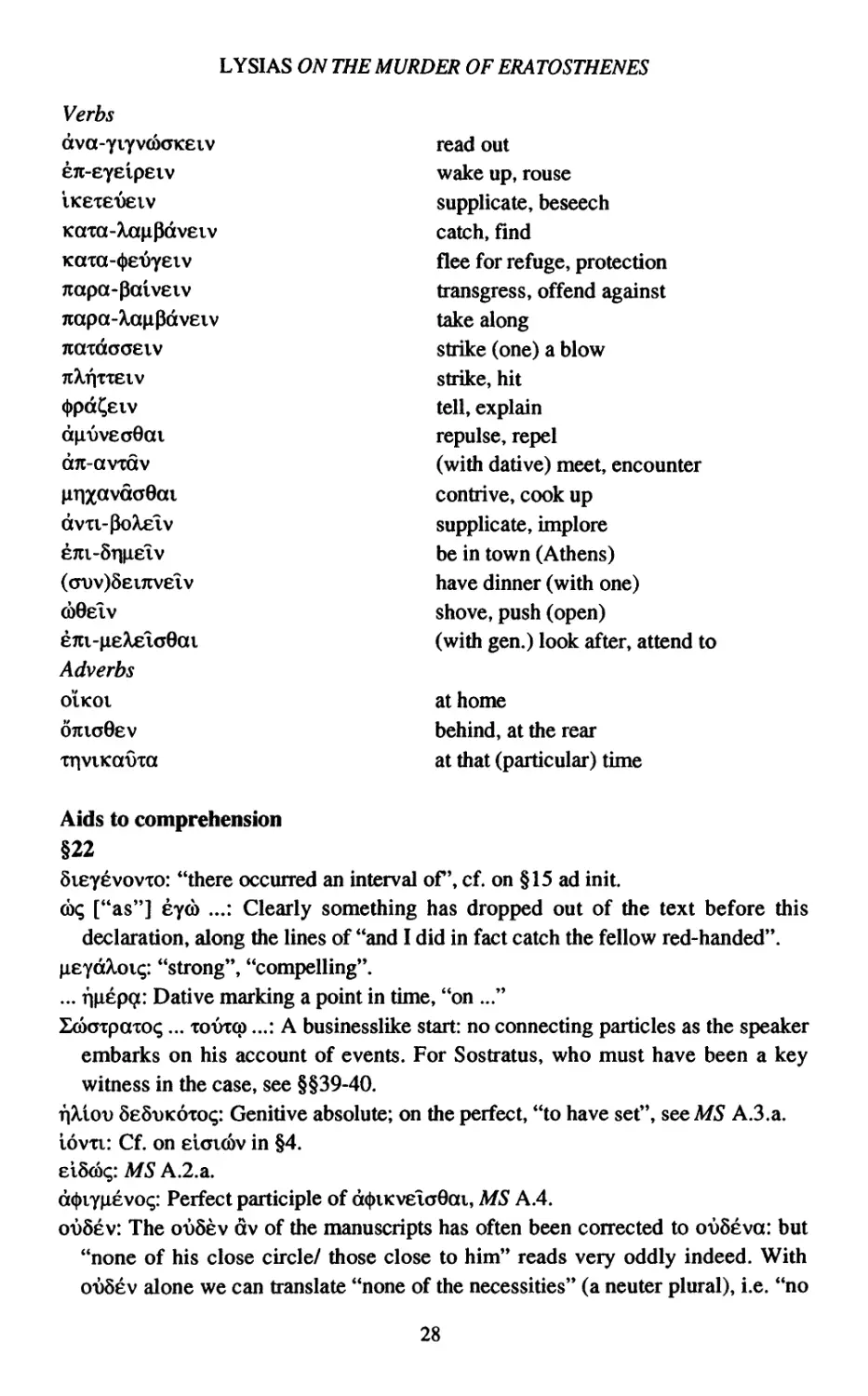
§22
5ieyevovxo: "there occurred an interval of \ cf. on §15 ad init.
(bq ["as"] ey(b ...: Clearly something has dropped out of the text before this
declaration, along the lines of "and I did in fact catch the fellow red-handed".
lieyaXoiq: "strong", "compelling".
... nuepo:: Dative marking a point in time, "on ..."
Eoxrcpaxoq... xorrap...: A businesslike start: no connecting particles as the speaker
embarks on his account of events. For Sostratus, who must have been a key
witness in the case, see §§39-40.
i]Xiov 5e8\)K6xo<;: Genitive absolute; on the perfect, "to have set", see MS A.3.a.
iovxi: Cf. on eiaicov in §4.
ei8c5<;: MS A.2.a.
dcjnyuevoc;: Perfect participle of d<j)iKveia9ai, MS A.4.
o\)5ev: The o\>5ev dv of the manuscripts has often been corrected to o\>8eva: but
"none of his close circle/ those close to him" reads very oddly indeed. With
oi)5ev alone we can translate "none of the necessities" (a neuter plural), i.e. "no
read out
wake up, rouse
supplicate, beseech
catch, find
flee for refuge, protection
transgress, offend against
take along
strike (one) a blow
strike, hit
tell, explain
repulse, repel
(with dative) meet, encounter
contrive, cook up
supplicate, implore
be in town (Athens)
have dinner (with one)
shove, push(open)
(with gen.) look after, attend to
at home
behind, at the rear
at that (particular) time
28

NOTES
provisions at all" — nothing on the menu at this late hour for his main meal of
the day. The unacceptable dv will have arisen from a misunderstanding of the
function of the ensuing optative.
Kaxa-tawoixo: Future optative of -Xaupdveiv (future infinitive -XifyeaGai), cf.
MS C.4.a.
ax;: Preposition with accusative once again.
dva-Pdvxe<;: From dva-Paiveiv (aorist participle -Pdq -pdaa -pdv), "having
ascended", "gone upstairs",
tiflepcpov: "room on the upper level", where the dv5pcovixiq was temporarily.
§23
ercei5fj... eixev: Literally "when it was well for him", i.e. "after enjoying a good/
proper meal" — the reason for the invitation; KaXdV; e%ei uoi means "I'm fine",
i'm happy with what I've had".
ei%ev: Augmentation: cf. on elAxeq in §12.
dji-id)v $xexo: See on eioicov in §4 and on (px,6\ir\v in §14.
eKdGeitfov: "I went to bed", cf. on §13 ad fin.
eiaepxexai and <|>pd£ei: Further examples of the "historic present" (4 more cases
in §§23-25), cf. on yiyvexai in §6.
eoxi: Present representing the tense in which the original utterance will have been
cast, cf. \>ppi£ei in §25.
Kdya): Kaieyo).
eirccDv: Here "telling" = "instructing".
Kaxa-pdq: Cf. on dva-pdvxeq in §22.
ctx; xov Kai xov: The xovs here have the force of demonstratives (as in 6 uev/ 6 5e,
cf. below), "to <the home of> one, then another".
<o\>k>: Angular brackets indicate an insertion — this an inescapable one — by
modern editors.
o\)5' corrected from otjk: "not even".
§24
ax;... nteicFToix;: d>q with superlative can itself mean "as ... as possible" (cf. in
§42).
epd5i£ov: "I proceeded <homewards>".
5(ji5a<;: 8cjt<; gen. 5qt86<;, i\ = "torch" (uncontracted form: 5at<;: ~ 8aieiv "kindle").
xov eyyuxaxa KanTiXeioa): "from the nearest shop"; we can represent the adverb
(superlative, alternative form eyyuxaxa) in §41: positive eyyuq) as an adjective.
Karcriteiov: the establishment of a K&nr\Xoq, a retail tradesman,
dveqyyuivric;...: Genitive absolute; on the perfect participles see MS A.5.b.
eia-iovxeq: Cf. on eiaicov in §4.
29

LYSIAS ON THE MURDER OF ERATOSTHENES
exi with Kctxaiceiuevov, drawn forward to emphasise the point that Eratosthenes
was indeed caught "in the act".
Kaxa-Keiuevov: "lying down", cf. MS A.2.b.
oi 8' wxepov: Supply eiaiovxeq.
eaxriKOxa: See MS A.3.b.
§25
T(b xelpe: Accusative dual of tj xsip, "both his hands'*.
nepi-aycrycbv eiq xoikiaOev (~ xo oniaQev) i.e. "having drawn ... behind his
back".
Srjaaq: e5r|aa is aorist of 8elv = "tie up".
\)ppi£ei... eiaid>v recalls the charge levelled in the prooemium, §4 (cf. also tippiv
in §2).
eia-uov: Cf. on eiaicov in §4.
KaKeivoq: Kai eiceivoq.
d8iKeiv .. <h\ioX6yei: "admitted that he was guilty/ his guilt".
fjvxepoXei: Note the double augment.
7ipd£aa9ca: Middle in the sense "exact for oneself, "negotiate a settlement" in
the form of a sum of money. Not surprisingly, there is no mention of a course
open (and, one would have thought, attractive) to an aggrieved party with
witnesses, that of taking the offender to court on a charge of uoi%eia.
§26
The bedroom is now, somewhat implausibly, turned into a court of law, with a
dignified Euphiletus presiding — and deciding on the spot what is to be done,
oxi "that" often prefaces direct speech,
nepl eXdxxovoq ... eno\r\G(o: Cf. on Jiepi noXkov jioieiaGai in §1: "rate less
highly", "regard as less important" than...
d|idpxr)ua e*;auapxdveiv strikes a solemn note; Greek is of course fond of such
pairings: ud%rrv udxea9ai, viKrrv viicav etc. etc. Cf. in §44 (twice, see note),
§45.
eic; yuvaiKa ...: Cf. in §4: here however, in the context of the slaying, there is no
mention of the outrage done to his own person.
§27
c&vnep ... Kete-uoDai: Supply xvxsiv (with genitive = "receive, get"): i.e. the
precise (form of) punishment that..., cf. on -nep in §1.
eia-apnaaGeiq: "snatched and dragged into <the house>" after being enticed there
by the slave girl,
o-uxoi: The relatives bringing the prosecution.
icgx; .. dv; "how could <he have done so>?".
30

NOTES
oaxiq: Sometimes, like the ordinary relative 6q, causal: "because here was a person
who..."
Ttepi-eaTpeya: "turned, twisted round", i.e. "pinned behind him".
ovq: "so many whom" amounts to "so many that... them".
5i<Mn>yeiv: "slip through" to make a getaway.
<ji8r|pov.. tfihov: "an object made of iron or of wood".
§28
otyai: Cf. on (pjiTiv in §10.
Kai i.e. as well as I do.
ei5evai: Cf. MS A.2.a.
oi p.fi...: As the negative (utj not ox>) indicates, generic: "people who do not..."
xd xoiavxa urixavctyievoi: "by resorting to such tricks".
opyaq... napa-oKeva^ovGi: "contrive to stir up angry reactions" among.
Kara with genitive, "against".
dvd-yvooGi: Singular aorist imperative, addressed to the clerk.
NOMOL: None of the documents or depositions specified has survived. At this
point a clause from the vouxx; noi%eia<; relating to the course of action taken by
Euphiletus must have been read out: cf. introductory note to speech.
§§29-31
Eratosthenes admitted his guilt and was punished in accordance with "the law of
the polis", one with the authority of the Areopagus behind it. A comparison of the
treatment accorded to those caught with (a) married women and (b) concubines.
Vocabulary
Nouns
yauexri (yuvf|)
TiaXXaKri, f)
<t>6vo<;, 6
5iKaaxr|piov, to
5dfiap -apxoq, fj
^idprix; -\)poq, 6
Adjectives
exoiuoq
ioxDpoq
Verbs
djio-xiveiv
Kaxa -yiy vawjKei v
xdxxeiv
31
married woman
concubine, mistress
homicide
court of law
wife
witness
ready, prepared (to, infin.)
strong, severe
pay in compensation
convict (one, gen.) of (an offence, ace.)
prescribe, stipulate

LYSIAS ON THE MURDER OF ERATOSTHENES
dii<|>ia-pr|xeiv dispute a point
cruy-xo&peiv agree with, accede to (dat.)
eni-TiGevai impose upon (dat.)
Adverb
o<|>65pa strongly, vehemently
Particle
Kaixoi (and) yet
Aids to comprehension
§29
r\\Ltyeo$rYcei: Cf. the note on rjvxepotei in §25.
oncoq.. |ift...: See on the construction MS B.2.c.
xijifpaxi: "assessment", his personal "estimate** as offender of the penalty to be
imposed,
elvai KDpKOtepov: "(insisted that... should) have greater authority**,
xaxmiv ... 5ikt|v: "I exacted that penalty**. The details of the killing are suppressed,
fiyrjadiievoi: Best represented by a principal verb: "you considered ... when you
prescribed..."
\iov "for me**, "in response to me**, a common way of saying "please**.
MAPTTPEZ: There to confirm the story of what happened on the night of the
killing.
§30
£K ... e£: We would say "from the pillar on the Areopagus**.
q>... 8iKd£eiv: "for which it is (which enjoys) an ancestral right, and <to which>
no less in our day the <same> right has been granted, <I mean the right> to
judge cases of homicide", ndxpiog lit. "relating to one*s Jiaxepeq, fathers/
forefathers"; em with genitive is common in the sense "in the time of.
drco6e6oxai: Cf. on §2.
5iappf|8r|v: "expressly", "categorically".
eiprixai: Perfect passive (MS A.5.b), hence the preceding dative of agent
8iKaaxrtpiq>, cf. on avqi in §21.
6q dv ... + subjunctive: see MS B.4.
ejii: "with regard to**, "in the case of": so recurrently in what follows.
jiouioryiai: "has manufactured for himself*, i.e. "has taken it upon himself to
exact" this <particular form of> punishment.
§31
vojio9dxr|q: "framer of a/ the law**, "lawgiver**: ~ vojiov xiGevai "enact a law** (cf.
in §§33,48).
32

NOTES
oxrce Kai: "that he actually/ even": icai often reinforces coaxe with (emphatic)
indicative.
naXkoLKdiq: Not any concubine (as the argument might suggest) but freeborn
concubines, whether Athenian or foreign, taken "with a view to fathering free
children" (Demosthenes 23.53).
eXctxxovoq: "of less consideration, regard>".
etys not eo%e: "had at his disposal" in deciding the issue,
xawnq: Genitive of comparison; another example follows.
usi^G): Irregular comparative of \ieyac;, accusative singular, alternative form
jieiCova.
ejioirjaev: Cf. noirjarixai above: "put into effect, bring into force".
v\)v 5e (as often) "but as things stood", "but as it was",
xfjv cruxfiv Kai erci ...: Kai often means "as" in conjunction with words denoting
"the same": "the same mode of punishment as <obtained> in the case of..."
NOMOX: The law dealing with rape.
§§32-36
Observations on the penalties imposed on rapists and seducers. The former are
dealt with less harshly than the latter, since seduction involves destruction of a
household's harmony and integrity. For this reason Euphiletus has been
commanded by the laws to take drastic action. It is the jury *s responsibility to
deter would-be adulterers.
Vocabulary
Nouns
K^enxTiq, 6
Adjectives
oXkoxpioq
oiKeioq
Verbs
djio-YiYvaKTKeiv
6<t>eiteiv
ajixeaGai
PidCeaSat
Sia-jipdxxea9ai
rcapa-Kete-ueaSai
cwtopeiv
Hiaeiv
vote
thief, burglar
belonging to other people
(with dat.) attached (to), on intimate
terms (with)
acquit (construction: see below)
owe, have to pay
(with gen.) touch, lay hands on
apply force, act violently
achieve one's ends
(with dat.) urge
be at a loss, perplexed (about, ace.)
hate
33

LYSIAS ON THE MURDER OF ERATOSTHENES
Aids to comprehension
§§32-33
Kskevev. Subject the vo\iodexr\q.
edv clauses: see MS B.3.
dvGpomov ... rcrii8a: "a free-born male adult or minor".
cdaxvvxi Pio:: "forcibly shames", i.e. rapes.
8uiXfjv xriv pXdpriv: "double the damages <due for raping a slave>", the latter
penalty presumably having been specified in the preceding NOMOI.
yuvdiKa, e<t>' atarcep ..,: "a woman, in the case of which particular [-rcep] category
[a switch to the plural, harking back to the case of seduced women, so
highlighting the less severe penalty dealt out to rapists] it is permissible to exact
the death-penalty" (this verb often has the sense "put to death, execute").
ev ... ev-exeo-0ai: "to be held in the same things" means "to be subject/ liable to
the selfsame penalty". — Things were not as straightforward as this observation
suggests. It was almost certainly the case that the law in question also exempted
from condemnation for murder a man who killed someone caught in the act of
raping his wife, mother, sister, daughter or free mistress. Since Euphiletus is out
to prove that seduction is a far more serious offence than rape, he does not refer
to this. It is also exceedingly likely that rapists could be prosecuted on grounds
of vPpu;, a process whereby the successful prosecutor could propose any
penalty he wished, including capital punishment.
xoix; pia^ouevoix;... xoix; rceiGovxac;: "those who employ force [= rapists]... those
who use persuasion [= seducers]"; xd>v = seducers, xoiq = rapists.
tg>v piao0evTOOv: "those upon whom force has been employed".
avxoiq: n.b. cri>- not cru-, "themselves".
Ttdoav ... YByovevai: Note the change of subject; en + dative here means "under
the control of, "in the power of; perfect infinitive yeyovevai (MS A.3.a) = "to
have become", "to come for good".
xo\)q naXSaq ... ovxeq: "the children are unclear ( i.e., as for the children, it is
unclear) to which of the two parties they actually belong". For 07toTepa>v cf. on
§18; for wyxdveiv, on §16.
dv0* [= dvxi] <5v: "for which/ these reasons".
xiGeiq: Cf. on vouoBexrv; in §31.
§34
dneyvcoKOTeq eioi ... KeKetevicoxeq: On the periphrastic perfects see MS A.3.a-b;
duo-YiyvcoCTKeiv with gen. person and \ir\ + infinitive means "acquit one of
doing", \it\ simply strengthening the element of negation present in the leading
verb.
ev \>ulv ... rcoxepov i.e. in your hands/ for you to decide whether...
iox\>po\x;: "strong", here in the sense "effective", "valid".
34

NOTES
§35
^ev: There is no answering 8e. This is often the case when nev is associated with
words expressing opinion, "implicitly contrasted with certainty or reality" as
J.D. Denniston puts it (The Greek Particles 382).
oium: Cf. on (purlin §10.
Sid xovto: Note the position: "that it is for this reason/ with this in mind that..."
xi0ea0ai: Middle this time: "make/ frame their laws",
iva ... oice\|K)fyie0a: Two subjunctive-clauses, one final, one indefinite: see MS
B.2.a/B.4.
(»v: Relative attraction, i.e. xovxcdv xd)v rcpcrftidxcov, a dv (rcpdyuma) drcopc5u£v,
the substantival antecedent being drawn into the actual relative clause.
Kapd: "to" them, as if paying them a visit for a consultation.
KOirixeov: A verbal adjective, literally "what is necessary-to be-done by us":
dative of agent, as commonly with the -xeoq type; cf. too the note on avrg in
§21.
ofiroi: Emphatic: "it is these... which ..."
§36
oiq ... xfjv cruxfiv yvofyiTiv exeiv: Relative again (cf. in §33) serving as sentence-
connective: "the same opinion as these/ they hold" (compendiously for "as <the
opinion of> these"; cf. on xcov ctoxodv in §2). As the jurors had sworn an oath to
abide by the laws of the assembly they could not but concur with what the laws
prescribe.
ei5euri:Cf.on§21.
d8eiav ... no\r\aexe: "create/ afford ... legal immunity" (d8eia = "freedom from
fear" [~ adj. dSeifc], "safe conduct").
Gmeicai: Cf. on §31.
KAircxac;: Under Athenian law thieves caught red-handed at night could be killed
by the victim.
ejc-apeixe: erc-aipeiv = "induce, incite".
eiSoxag: Cf. MS A.2.a.
edv clause: MS B.3.
eni xot>xq>:t "for this purpose".
eia-ievai: Cf. the note on eiaicov in §4.
Xaipeiv edv: "to allow to rejoice" (but recall too xdlpe, "farewell") is a common
way of saying "to disregard, dismiss, forget about, write off*.
xf}v ... 8e8ievai: "whereas it is your vote that they have to fear". On the perfect
infinitive see MS A.3.a.
croxTi — KDpiODxdxri: "because it is this that has supreme authority over all affairs of
state".
35

LYSIAS ON THE MURDER OF ERATOSTHENES
§§37-42
While maintaining that any mode of redress would be justifiable in the
circumstances, Euphiletus refutes the claim that he had resorted to enticement in
order to get his hands on Eratosthenes. Premeditation must be ruled out in the
light ofSostratus' involvement and other considerations.
Vocabulary
Nouns
veaviaKoq, 6
Gepdrcoov -ovxoq, 6
Adjective
eprinoc;
Verbs
em-fiovXeveiv
nap-ayyeXteiv
rcepi-Tpexeiv
auX-^eyeaeai
xofyiav
aox|>poveiv
Aids to comprehension
§37-38
yap: Cf. on yap in §6.
uex-eMteiv: "to go and fetch", "seek out".
... dv .. Tiyotiuriv: dv with imperfect, "would be considering", "would consider":
the speaker mentally recreates his thoughts and actions at that time; cf. r|8iK0\)v
dv ("would be guilty") in §38, <dv> ... riyovuriv ibid.; and the cast of the
sentence ei ev... eioayayelv in §40.
qmviovv xpoiKp: qmvioiiv is dative singular of ocraa-oiiv, "who(so)ever": "by
any method whatsoever", "by any means available to me".
Xa^ipdvcov: The present participle expresses the idea "in attempting/ seeking to
catch", cf. the imperfect eXdufkxvov presently.
Xoycov ... EiceXrykvQoTOC,: Genitives absolute; the first two perfect participles (MS
A.5.b/ A.5.a) express a condition, "if ..." (note negative uri8ev6q); the second
pair (MS A.5.a/ A.3.a), introduced by the temporal adverb i\$r\, may be
translated "once ... had ...."
8ia-rcercpayuiva>v puts the middle 8ia-rcpdTrea0ai, "achieve his objectives", into
passive form.
young man/ fellow
servant
solitary, abandoned, isolated
(with dat.) plot against, set a trap for
transmit messages, send word to (dat.)
run around, here there and everywhere
(be) gathered), assemble
dare
act reasonably, exercise proper self-
control
36

NOTES
§39
xawa yetiSovxai: "are telling lies in respect of these things", "about this".
yvaKjeoGe: Future of Yvyvaxjiceiv, "realise".
OTiep ...: Translate "just as... in fact".
oiiceiotx; 5iaiceiu€vo£ "on intimate terms with me": cf. on 8iaKeio0ai in §3.
8i)ajid<;: Suaum, "setting", usually in the plural, like its antonym, dv(a)xokai.
kc&g*; ... $%exo: Cf. on §23.
§40
[on]: There is no place for "that" — an insertion made without regard for the
following disjunction rcoxepov ... fj.
rcoxepov "whether" often prefaces a direct question — redundant in English.
KpeiTxov: "better", "more advantageous" for me to dine elsewhere myself, or to
bring into the house (eio-)...
xov o"uv8eircvnaovxd \ioi: Future participle with article, "the one going to have
dinner with me", that is to say, "somebody to have ..."
outgo: "in these circumstances", i.e. "in the latter eventuality".
... dv fjxxov exoAjinaev: "would have been less inclined to dare/ take a chance on
elxa to mark the next step in the argument, "then again", picking up npcaxov uiv
(cf. on §20); another stab with ejieixa, §41 init.
8okg> dv i)\iiv ... Kaxc&ei<!>8f]vai: "do I seem would to you ... to have been left
behind?", i.e. "do you think that I would have been left behind?", postpositive
dv being drawn forward to second place in the sense-unit. In negative form in
§41, "not would I seem to you to have ,..?", = "don't you think I would have
...?" (cf. in §42).
d<()ei<;: Aorist participle of d<|>-ievai - d<|>-ir|ui, "let go, dismiss".
iva ... exijicDpeixo: "so that he might punish", iva with indicative: the imperfect
(aorist or pluperfect if the reference is to past time) is employed in cases where
the action of the main verb is not fulfilled, so that the purpose is not achievable.
Cf. eiafia and ercoiofyinv in §42.
§41
ue9' fpepav: "by day", "in the daytime".
xfjv eyyvxax(o: "<I mean, naturally,> the one nearest <to my own>".
erceiSfi ^dxicxa: "as soon as", "the moment that".
THQ vukt6q: Genitive of time within which something occurs, "in the night",
"during the night hours".
ei5<6<; (again in §42): Cf. MS A.2.a.
KaxaXriyoum: The future tense carries us back in time to the problem as it
presented itself to the speaker on the night in question.
37

LYSIAS ON THE MURDER OF ERATOSTHENES
Kai ...: "and in fact I did go to <the homo of..."
xov Seiva: 6 8eiva = "so and so": "to somebody else's".
fiSrv Past tense of ol8a, cf. in §42, and MS A.2.a.
§42
Kaixoi ye ...: "yet/ but surely, if I did have foreknowledge".
Kai... Kai: "both ... and".
rcapaaice'udoaaGai: Middle in the sense "prepare/ provide for one's own use",
"arrange for them to be there at the ready",
iv*... eiofja ... enoiotiuriv: Cf. on §40 above, and for the form -fja the note on
cmrjei in §10.
dx; da<|>a^eaxaxa ... dx;.. kXeIcttcov: See on §24 ad init.
xi.. flSn; "in what respect did I know?", i.e. "how could I have known?".
KciKeivoq: Kai eKeivoq; Kai = "as well" as the speaker.
aiSipiov (cf. in §27): "iron tool" etc., here "weapon with a blade", "knife".
d>q jiexd rcXeiaxcov 8e uapnipcov: In prepositional phrases involving dx;, "as ... as
possible", that word comes first; and 8e is commonly postponed when used in
conjunction with preposition + adjective or pronoun or noun.
v\)v8':Cf.on§31.
tcdv eoouevov: Genitive of xa eaoueva, future participle of eivai, "of what was
going to happen".
§§43-50
Amplification of the denial of any personal animosity between the two men (cf in
§4), restatement of the enormity of the crime (cf in §2), refutation of any act of
impiety (cf in §27), reflections on the crucial part played by a right-minded jury
and on the absurdities of permissive legislation (cf in §36), with a final reminder
that the speaker is risking all because he obeyed "the laws of the polis,y (cf in
§§26, 29).
Vocabulary
Nouns
Xoi5opia, Tj
dycov -awoq, 6
evioi
Adjective
i8io<;
Verbs
eK-fJdMeiv
doePeiv
abuse, insulting language
competition; legal action, trial
some people/ individuals
personal, private
throw out, expel, banish
act impiously
38

NOTES
em-Guusiv be eager, anxious, desire
e7ti-xeipeiv attempt
£rrtelv enquire, look into a question
rcapa-Kateiv summon
£rtHl°tiv penalise
avv-ei8evai be aware of, privy to
Aids to comprehension
§43
dKrpcoaafc/ yey^vnTai: See MS A.3.a/ A.5.a.
nap \)ulv awoiq: "before yourselves" <as judges>, i.e. "in your own minds".
§44
cruKO<|>avTG)v: -eiv = "play the part of a auKo^dviri*;", a professional informer/
prosecutor who sets out to "get" people by bringing (in the perception of the
victim) baseless charges out of malicious and self-seeking motives.
Ypa<()dq .. eYP«Vai:0 ~ i8iaq 8iica<; eSucd^exo: Note the alternation of tenses: "he
had neither brought state-prosecutions against me [Ypd^eoGai = "indict" for
some public offence] ... nor did he make any move to engage in private
lawsuits". On the linkage of verb with cognate noun (cf. in §45, twice) see the
note on djidpTrpa e^auapTdveiv in §26.
aruv-fl8ei: MS A.2.a.
kokov: "criminal act, misdemeanour".
8e8idx; uf| ...: Cf. MS A.3.a/ B.2.b; i.e. "... of which I was afraid, in case ..., so
desiring..."
ovxe ei...: "nor, if [cf. MS C.2.b] I were to have carried this out [his destruction],
was I entertaining hopes of... -ing..."
no0ev: Unaccented, indefinite: "from anywhere, some quarter".
Xr\y£GQai ~ kaupdveiv, "to get", future infinitive dependent on eXni&iv.
§45
toowcod ... r\: Literally (8elv with genitive, "miss, need, require"), "XoiSopia ...
lacks so much to have taken place for us that...", i.e. "so far from any abusive
exchange or drunken quarrel or any other sort of difference [cf. 8ia-<|>epea9ai,
"be at variance"] having arisen between us, I had never as much as laid eyes on
»>
Y£Yov£vai: MS A.3.a.
eopaicdx; f\: On the periphrastic pluperfect (another shortly: f\... r|8iicrm£vo<;) see
MS A.6.
ti... $ovX6\levo<;: "what wishing ...?", i.e. "what would be my motive in running
such a risk?"
39

LYSIAS ON THE MURDER OF ERATOSTHENES
dv with 6Kiv8\>vei)ov (tense: see note on av .. fyyotiuriv in §§37-38), cf. on 8oko>
av vulv ... in §40.
to uiyiaxov ... r\ ... T|8iKriu6vo<;: One can say dSiiciav or dSiicrma dSiiceiv,
"inflict a wrong"; this can be converted into the passive, "have a wrong inflicted
on one", thus: dSiidav/ dSiiaiua d8iiceia9ai.
§46
eneixa: Cf. on §§20,40.
rcapaicaX£oa<;... T|a£Poi)v: There is no dv this time, nor is one to be mentally
supplied: "did I <really> take the step myself of summoning witnesses and then
proceed to commit an act of impiety?".
e£6v: Impersonal e^-eoxi, "it is possible, permissible", hence accusative absolute:
"when it was open to me ... that none should (to have nobody)...".
eurep: "if really/genuinely", cf. in §21.
m>v-ei8evai: MS A.2.a.
§47
oia ...: Cuttingly: "the nature of [cf. on oioi in §1] the prizes/ the kind of prizes
that are set up for ..."; rcpo-Keia6ai, "to have been placed before one", on open
display; see MS A.2.b.
t|ttov: See on §40.
edv clause: MS B.3.
§48
el8eur|: Cf. on §21.
noX\>: Adverbial, "far"; again in §49.
Keiu£voD<;: "that have been set up/ framed", i.e. "established"; serving as perfect
passive participle (cf. MS A.2.b) of xiGevai: cf. Geivai presently, and see the
comment on vonoBdxns in §31.
e£-ateiyai: Strong language: e£-aA£i<(>eiv = "wipe out/clean, obliterate".
oixtveq... ^riuiciaoDai: A regular way of expressing purpose, "ones which will/ to
♦>
§49
ti ... dv-eSpetieoOai: "that the citizen-body should be ensnared" (~ ev-e8pa,
"sitting in", "ambush"), an interesting choice of metaphor given the suspicion of
entrapment attaching to this case.
edvti<;...:Cf.MSB.3.
6 ti dv ofiv fk>\)Xi\zai: See MS B.4, and the note on qmviofiv in §37-38: "(in
respect of ~) in whatever way he wants".
XpfioGai: "to use" = "to treat" a person.
40

NOTES
oi 8*...: After "the laws stipulate uev that..." we do not expect the sentence to take
the turn it does; so the speaker puts his point across all the more forcefully.
dv©ve<;: See the Vocabulary; echoes the imagery of prizes in §47.
5eivoxepoi: "more threatening, dangerous".
Ka6-eoTr|Kaaiv: On this perfect see MS A.3.b; intransitive, "have established
themselves as", "have come to be".
rcapd: "in contravention of", "contrary to", opp. Kaxd mix; v6uov<; (cf. in §4).
Kaxaiax^voDai: Dative participle.
§50
Kai rcepi ...: Emphatic repetition to produce a forceful close.
a(ouaxoq: "body" for "life".
41

SUGGESTIONS FOR FURTHER READING
M. Edwards, referred to at the beginning of the Notes, provides a wide-ranging
bibliography. The following two editions are extremely useful in different ways:
Carey, C, Lysias: Selected Speeches (Cambridge, 1989)
Edwards, M. and Usher, S., Greek Orators I: Antiphon and Lysias (Warminster,
1985).
Cf. too:
Fisher, N.R.E., Social Values in Classical Athens (London, 1976), esp. pp. 46-53.
Recent studies include:
Carey, C, 'Rape and Adultery in Athenian Law', Classical Quarterly n.s. 45
(1995)407-17.
Harris, E.M., 'Did the Athenians Regard Seduction as a Worse Crime than Rape?',
id. n.s. 40 (1990) 370-7.
Herman, G. 'Tribal and Civic Codes of Behaviour in Lysias i\ id. n.s. 43 (1993)
406-19.
42

APPENDIX A
SURVEY OF VERBAL FORMS
If you have mastered the Greek verbal systems you will not need to consult this
review of those forms which actually occur in the speech (with the exception of
perfect/ pluperfect, dealt with elsewhere); if you have not, you might find it
profitable to run through these pages with a full set of paradigms (available in any
course-book or grammar) by your side. You should make a point of consulting the
alphabetical key in Appendix B in cases of difficulty.
A.l Infinitive in -eiv
Present infinitive auapxdveiv drcoKxeiveiv etc. (18 examples in all)
Present indicative 1st singular KaxaPdM,© iciv5\)ve\)a) voui£a), 3rd singular exei
KeA,ei3ei xvyxdvei \>Ppi£ei <|>pd£ei, 2nd plural dicovexe, 3rd plural
emPo'UA€\)0'uai keXevovci Xeyoixn rcapaoKe'ud^o'uai xa)y%dvouaiv
Present subjunctive 3rd singular aiax'uvrj eGeX^i KivS-uvetin,, 3rd plural Xeyaxii
<|>dOKGXJlV
Present optative 2nd plural exoixe
Present imperative singular Aiye voui^e
Present participle masculine e%cov fjico&v Xau^dvoov Xeyoov neGtioov rcapapaivaw
KapaXeircGDv 7tpdxxG)v 7tpoa<|>epa>v \>ppi£a>v; nicovxa; rcpdxxovxeq; exovxaq
rcei0ovxa<; Kpdxxovxaq <t>\)Adxxovxac;; emxr|8e'u6vx(Dv 7ipaxx6vxo>v; dKO-uo-uai
e7tixTi8e'uo'uaiv icaxaiax'uvo'uai — feminine KaxaPaivcuaa vouaCoiKja;
pa8i£ovaav — neuter e%ov kaixov
Imperfect with syllabic augment 1st singular epd8i£ov eiceXeDOv eKivStiveDOv
eXd^ipavov eteyov Eniaxevov e<|n3A,axxov, 3rd singular eSuoKdActivev
EQf\kaC,ev EKeXevev euoixevev e<|>aaKe e^Maxxev, applied internally 1st
singular e7iepo\)Xe'Uov, contrast 1st singular e-Kd6-ei)8ov; with temporal
augment 1st singular fjicov fjicoi)Ov f\kni£,ovy 3rd singular r\Qe\ev fJKev
iKexe'ue(v), irregular 2nd singular etAK£<;, 3rd singular eixe(v), applied
internally 1st singular rcpoaeixov
Aorist infinitive a7ioicxeivai e^ateiyca Ketetiaai ueivai rcapayyeiAm
Aorist indicative with syllabic augment 1st singular eKeAcuoa ercpa^a, 2nd plural
exd^axe, applied internally 1st singular Kepieoxpeya, 3rd singular 8ie<|>6eipe;
43

APPENDIX A
with temporal augment 3rd singular fjox'uve vppiaev, applied internally 1 st
singular tmowtxeuaa
Aorist subjunctive 2nd singular paactviory;
Aorist optative 3rd singular eiactyyeiXeie
Aorist participle masculine rcaxd^ctq; 5ia<|>0eipavTa; Tteiaavxaq — feminine
erceyeipaoa
Future infinitive (middle forms) A,r|\|feo0ai 7ceiaea9ai
Future indicative 2nd plural ei)pr\oeTE — 1st singular drcoicxevd), 2nd plural
ercapelxe; middle forms 1st singular Kaxa^wouai, 2nd plural yva>aea0e, 3rd
plural e^auapniaovxai
Future optative (middle form) 3rd singular KaxaAifyoixo
Future participle feminine Ka0eu5fioouoa
A.2 Infinitive in -eo0ai (middle-passive forms)
Present infinitive yiyveo0ai eve8pe\)eo0ai evexea0ai erciueAEaOai 7cei0ea0ai;
also A,o\>o0ai, for tan>ea0ai
Present indicative 1st singular poMouai e^epxouai, also oiuai = o'iouai, 2nd
singular poMei, 3rd singular yiyvexai 8ia<t>0eipetai eiaepxexai e<|>eA,Kexai
o'iexai rcpoaepxexai, 1st plural eioepxoue0a, 3rd plural rcapaiceXe'uovxai
\j/e-65ovxai
Present subjunctive 3rd singular poMrixai
Present participle masculine dvauiuvrjaicouEvoq pov>,6u€vo<;; \|fev56uevoi;
pia^ouevoix; 8iarcpaxxouevov<;; pouA,ouevoi<; — feminine 6pyi£ou£vn;
ai)vexouevT|v — neuter yiy voueva
Imperfect with syllabic augment 1st singular exapaxxouriv, 3rd singular eyiyvexo
eSucd^exo; with temporal augment 1st singular (opyi£6p,r|v cpxouriv, also <pur|v
for cpouriv, 3rd singular ©xexo
Aorist middle infinitive evd\|faa0ai rcapaoKevdaaaOai 7iai>aaa0ai 7cpd£aa0ai
Aorist middle indicative with syllabic augment 3rd singular eypdyctxo; with
temporal augment 3rd singular fpwaxo
Aorist middle subjunctive 2nd singular yeWTi, 3rd singular rccruorixai
Aorist middle optative 1st singular 5icmpa£aiur|v
Aorist passive infinitive icaxatei(|>0fivai aiAAeyfivai
Aorist passive indicative with syllabic augment 1st singular eu^a0T|v, applied
internally 1st singular drceKA,fjo0r|v, 3rd singular e^enMyr]', with temporal
augment 3rd singular aitt]Xhiyr\
44

APPENDIX A
Aorist passive optative 3rd singular rceio0eir|
Aorist passive participle masculine eiaaprcao0ei<; rckrryeic;; piao0evxo)v —
feminine \morceu<|>9eiaa — neuter rcpaxBevxa
Future middle indicative 2nd singular rcei>aei, 3rd singular dyexai rcexxjexai
B.l.a Infinitive in -dv
Present infinitive edv
Present subjunctive 2nd singular rceipgc;, 3rd singular poqi, 3rd plural opdxn
Present participle masculine <|>oixcdv; opcovxec;— feminine xeAEUxdxja
Imperfect with syllabic augment 1st singular ey£A,a)v eaiOMcov, 3rd singular epoa
e<|)oixa; with temporal augment 1st singular r|pa>xa)v
Aorist indicative with syllabic augment 3rd singular exEkewryje exoXutjaev; with
temporal augment 1st singular drcr|vxT|aa
Aorist participle masculine drcavxnoac;
B.l.b Infinitive in -do6ai (middle-passive forms)
Present participle masculine uTftavcauBvoi
Imperfect with temporal augment 1st singular 5mx<6unv
Aorist passive participle feminine o^Oeiaa
— Here belongs Present infinitive xpf]o9ai
B.2.a Infinitive in -elv
Present infinitive dSuceiv dKoA,ov6eiv 5eiv Seucveiv Xvneiv rcoieiv cruvSeutveiv
aa)<t)poveiv
Present indicative 1st singular 5okcd, 3rd singular 5ei, 3rd plural Kaxryyopo'uai
6noA,oyo'0ai
Present subjunctive 3rd singular 7coi§, 1st plural drcopcauev
Present optative 3rd singular dyavaKxoiri and 8eoi, 3rd plural yo<|>oiev
Present participle masculine ercixtipdw <n)Ko<|KXvx©v imovodw; auvSeircvo'Ovxa;
Ctixotivxe^; em5r|uo0vxaq — feminine 8ioiKo0aa emxripoOaa; 5iaKOvo\)aav
Imperfect with syllabic augment 3rd singular e\|f6<t>ei, 1st plural eSeucvofyiev,
applied internally 1st singular erceB'uuo'uv avvexcopovv, 3rd singular
avve5ei7cvei; with temporal augment 1st singular rjSiKOvv rjaepovv, 3rd
45

APPENDIX A
singular KaxTiyopei <b\ioX6yei — Double augment 3rd singular fiu^eapiYrei
f|VT£p6A£l
Aorist infinitive yr\\iai
Aorist indicative with syllabic augment 3rd singular ercoiTioe(v); e5o£e, applied
internally 3rd singular ercexeipTjoev
Aorist subjunctive (oKorceiv, middle form) 1st plural aice\|f(6ue9a
Aorist imperative (as above) plural OKeyaaBe
Aorist participle masculine 5tiaa<; 7capaicaA,eaa<;; ©aavxeq — feminine
aKoXoi)9f|aaoa
Future infinitive rcovnaeiv
Future indicative 2nd plural rcoiifaexe, 3rd plural rcoiifaovai
Future participle masculine ouvSeutvrioovxa
B.2.b Infinitive in -eiaGai (middle-passive forms)
Present infinitive d5iKeio9at uiaeiaOai
Present indicative 1st singular 5eouai/ dctaKvovum Tjyo'uuai, 3rd singular
fvyelxai, 3rd plural fyyo'Ovxai
Present optative 2nd plural fjvoioBe
Present participle masculine ev0vuo\)uevo<; r)yo\)U€vo<;; dSiKOvjievoK; —
feminine Ttpoarcoiouuevri — neuter tamotiuevov
Imperfect with syllabic augment 1st singular e7ioioi)uiiv, 3rd singular extuxopeixo;
with temporal augment 1st singular fyyotiujiv
Aorist middle infinitive 8iT|YT|aao0ai
Aorist middle indicative with syllabic augment 2nd singular eno\r\o<&; with
temporal augment 3rd singular fryrioaxo, applied internally 3rd singular
5inyT|aaxo
Aorist middle subjunctive 3rd singular 7coiT|orixai
Aorist middle optative 1st singular nou]cai\ir\v
Aorist middle participle masculine fjyiiaduevoi — feminine fiyr|oauevr|
Aorist passive imperative (active in sense) plural evGuuTiOrixe
B.3.a Infinitive in -ovv
Present indicative 1st singular d£io>
Imperfect with temporal augment 1st singular f£iovv
46

APPENDIX A
Aorist indicative with temporal augment 3rd singular f^io&oe
Future indicative 3rd plural Ctiuigxtovoi
B.3.b Infinitive in -owGou (passive form)
Aorist passive participle feminine naaxtyo)0eiaav
C.1 Imperfective (strong) aorists: active
Infinitive 5ia<twyeiv eirceiv eiaayayeiv eiaeA,0eiv eurceaeiv e^eupetv uexeXfleiv
7ca0eiv ru%eiv
Indicative 1st singular eutov etapov rjAflov Tyupov KaxeAxxpov rcapeXapov, 3rd
singular e^rivpev eru%ev Kaxerceaev, 1st plural e!8ouev
Subjunctive 2nd singular Aixprj<;, 3rd singular dnoGdvti, A,dpfl
Participle masculine dyayodv eircc&v eXGc&v e^eXflo&v Kaxa<tn)y(6v XaP©v
7tapaA,ap(6v 7cepiayaya>v; eA,06vxe<; A,aP6vxe<;; eiaeXGdvxaq — feminine
dTtoGavo'Oaa einovoa kapouaa rceaovaa 7cpoaeA,0ouaa; icaxeutouaav
C.2 Imperfective (strong) aorists: middle
Infinitive yeveaGai eA€G0ai
Indicative 1st singular em06ur|v ercvOouTiv riyayouriv i*|a06ur|v, 2nd singular
eiA,ov, 3rd singular eyevexo, 3rd plural 5iey£vovxo
Subjunctive 1st singular yevcoum, 3rd singular 7r60r|xai
Participle masculine 5iayevou6vou epoucvou — neuter yevousva
D. Verbs in -vai/ -a0ai ("-ui" verbs)
I elvai:
Present infinitive elvai
Present indicative 3rd singular eoxi etc./ e^eaxt(v), 3rd plural eioi
Present optative 1st singular euiv, 3rd singular eiri, 2nd plural evnxe
Present participle masculine ©v 6vxo<; 6vxe<; 6vxa<; rcapovxcov — neuter e£6v
Imperfect 1st singular rj, 3rd singular rjv, 3rd plural fjoav
Future indicative 3rd singular eaxai
Future participle neuter eaouevcov
— Cf. (xpflvai ~ XPH etvai):
Present indicative 3rd singular %pii
47

APPENDIX A
I Others, active forms:
Present infinitive dmdvca eiaidvca
Present indicative 3rd singular rcpoaxiGTiai
Present subjunctive 3rd singular 8i8q>
Present optative 3rd singular rcpooioi
Present participle masculine dmd)v eiaic6v, rcpoiovxoq, lovxi, eiaiovxeq; also
xiGeiq — feminine drcio'Oaa
Imperfect 1st singular eiofia, 3rd singular angei eiorjei; 1st singular e<t>r|v, 3rd
singular e<t>rj
Aorist infinitive Sovvai/ Gelvai; drcoteom/ em8el£ai
Aorist indicative 1st singular rcapeSoica, 3rd singular erceGriKe; 3rd singular
dvecp^ev/ drccoAEGev
Aorist participle masculine d<t>ei<; — feminine dvaoxdoa
— Also aorists pfivai ((Jaiveiv) and yvcSvai (yiyvaKJKeiv): Indicative 3rd singular
Kax£yv(D, Imperative singular dvdyvo>0i, plural dvdfirixe, Participle masculine
Karapd<; dvapdvxeq
Future indicative 1st singular emSetf;©; also, from eiSevai, 3rd plural (middle
form) eioovxai
III Others, middle-passive forms:
8t>vaa0ai: Present participle masculine 8i)vau£voi)<; Imperfect 3rd singular
eSvvaxo Aorist subjunctive 1st singular 8vvti0g> — Also Present infinitive
xi0eo6ai Aorist infinitive drcoapeaOiivai Present optative 3rd singular
npoaioixo
48

APPENDIX B
CHECKLIST OF VERBS
This alphabetical list provides a key to all verbal forms in the speech with the
exception of perfect/pluperfect, examined elsewhere.
dyayo&v (dyeiv) Active Aorist participle masculine nominative singular
dyavaKToiri (dyavaicreiv) Active Present optative 3rd singular
dSiKeiv [3x] Active Present infinitive — aSuceioOcu Passive Present infinitive —
d5iKOvuBvoi<; [2x] Passive Present participle masculine dative plural
aioxtivri (aia%t>veiv) Active Present subjunctive 3rd singular
dKoXovBeiv Active Present infinitive — dKoA,ov6iiaaoa Active Aorist participle
feminine nominative singular
dKotiexe [2x] (dicotieiv) Active Present indicative 2nd plural — dKO-uovai Active
Present participle masculine dative plural
djiapxdveiv Active Present infinitive
dvapdvteq (dvapaiveiv) Active Aorist participle masculine nominative plural —
dvdpnxe [2x] Active Aorist imperative plural
dvdyvo)9i [3x] (dvayiyvcoaiceiv) Active Aorist imperative singular
dvauinvxiaic6uevo<; (dvauauvrjaiceoGai) Middle Present participle masculine
nominative singular
dvaoxdaa (dviaxdvai) Active Aorist participle feminine nominative singular
dveco^ev (dvoiyvuvai) Active Aorist indicative 3rd singular
d£i(D [2x] (d^iouv) Active Present indicative 1st singular
49

APPENDIX B
drcavrfiaaq (drcavxdv) Active Aorist participle masculine nominative singular
drceickxiaOTiv (drcoKA-eiew) Passive Aorist indicative 1st singular
drcfiei (dmdvai) Active Imperfect 3rd singular
anrfafokyr] (drcaMxxxxeiv) Passive Aorist indicative 3rd singular
d7tr|VTT|aa (drcavxav) Active Aorist indicative 1st singular
drcievai [2x] Active Present infinitive — dmovaa Active Present participle
feminine nominative singular — drcicov [2x] Active Present participle masculine
nominative singular
drco0dvr) (drcoGvfjaKeiv) Active Aorist subjunctive 3rd singular — drcoGavovoa
Active Aorist participle feminine nominative singular
drcoKxeivai (drcoKxeivew) Active Aorist infinitive — drcoKxeivew Active Present
infinitive — drcoicxevd) Active Future indicative 1st singular
drcoXeaai [2x] (drcoXMvai) Active Aorist infinitive
drcopc&piev (drcopetv) Active Present subjunctive 1st plural
drcoapeaOfivai (drcoapevvvvai) Passive Aorist infinitive
drcoxiveiv Active Present infinitive
drcc&Xeaev (drcoXMvai) Active Aorist indicative 3rd singular
d<t>ei<; (d<|aevai/ -ir|ui) Active Aorist participle masculine nominative singular
d<|>iKvo'uum (d<t>iKveio0ai) Middle Present indicative 1st singular
dyexai (drcxeaGai) Middle Future indicative 3rd singular
pa8i£(n)aav [2x] (pa5i£eiv) Active Present participle feminine accusative singular
paoaviarjs (f3aoavi£eiv) Active Aorist subjunctive 2nd singular
50

APPENDIX B
pia£o^evov<; (pid£ea9ai) Middle Present participle masculine accusative plural
— piaoGevxcDv (pid^eiv) Passive Aorist participle masculine genitive plural
poqt (poav) Active Present subjunctive 3rd singular
pot>A,ei (poMeoBai) Middle Present indicative 2nd singular — poMrixai Middle
Present subjunctive 3rd singular — poMo^iai [2x] Middle Present indicative 1st
singular — povA,ojievoi<; Middle Present participle masculine dative plural —
povA,6jievo<; Middle Present participle masculine nominative singular
yeveaGai [4x] (yiyveaGai) Middle Aorist infinitive — yevo^ieva Middle Aorist
participle neuter accusative plural — yevo^iai Middle Aorist subjunctive 1st
singular
yr\\iai (ya^ieiv) Active Aorist infinitive
yiyveoGai Middle Present infinitive — yiyvexai Middle Present indicative 3rd
singular — yiyvojieva Middle Present participle neuter accusative plural
yvcoaeaBe (yiyvaxjiceiv) Middle form Future indicative 2nd plural
8el [3x] (8eiv) Active Present indicative 3rd singular — 5eiv [2x] Active Present
infinitive
Seircvelv Active Present infinitive
8eoi (8eiv) Active Present optative 3rd singular
Seojiai (8ela0ai) Middle Present indicative 1st singular
8r|oa<; (5eiv) Active Aorist participle masculine nominative singular
Siayevo^ievov (8iayiyvea9ai) Middle Aorist participle masculine genitive
singular
SiaKovoiiaav (Sicucoveiv) Active Present participle feminine accusative singular
8icmpa£ai^r|v (5iarcpdxxeo9ai) Middle Aorist optative 1st singular —
Siarcpaxxo^ievow; Middle Present participle masculine accusative plural
51

APPENDIX B
8iac|>0eipo;vxa (8ia(|>0eipeiv) Active Aorist participle masculine accusative
singular — 8ia<(>0eipeiv Active Present infinitive — 8ia<|>0eipexai Passive Present
indicative 3rd singular
8ia<t>vyeiv (Sia^e-uyeiv) Active Aorist infinitive
8i8q> (8i86vai) Active Present subjunctive 3rd singular
Sieyevovxo (8iayiyvea0ai) Middle Aorist indicative 3rd plural
8ie<|>0eipe (8ia<|)0eipeiv) Active Aorist indicative 3rd singular
8irryr|aaa0ai [2x] (8irtyeio0ai) Middle Aorist infinitive — 8uiyr|aaxo Middle
Aorist indicative 3rd singular
8inra>uT|v (8iaixao0ai) Middle Imperfect 1st singular
8iicd£eiv Active Present infinitive
SioiKO'Ooa (Sionceiv) Active Present participle feminine nominative singular
8oko> [3x] (8oKeiv) Active Present indicative 1st singular
8o\)vai (8i86vai) Active Aorist infinitive
Svvauevow; (8t>vaa0ai) Middle Present participle masculine accusative plural —
8vvr|0d) Middle in passive form Aorist subjunctive 1st singular
eav Active Present infinitive
epdSi^ov [2x] (PaSi^eiv) Active Imperfect 1st singular
epoa (poav) Active Imperfect 3rd singular
eyeAxDv (yeXdv) Active Imperfect 1st singular
eyevexo [2x] (yiyveo0ai) Middle Aorist indicative 3rd singular — eyiyvexo
Middle Imperfect 3rd singular
eypdyaxo (ypd<t>ea0ai) Middle Aorist indicative 3rd singular
52

APPENDIX B
e8eutvoi)uev (5eutveiv) Active Imperfect 1st plural
e5ncd£eto (5iicd£ea6ai) Middle Imperfect 3rd singular
e8o£e [3x] (5oiceiv) Active Aorist indicative 3rd singular
eSvvaxo (5\>vaa0ai) Middle Imperfect 3rd singular
e8i)OTc6Xaivev (5uoicoXaiveiv) Active Imperfect 3rd singular
eOe^rj (eGeXeiv) Active Present subjunctive 3rd singular
e6f|A,a£ev (GrjAxiCeiv) Active Imperfect 3rd singular
ei8ouev (opdv) Active Aorist indicative 1st plural
eiri [4x] (eivai) Active Present optative 3rd singular — eiriv Active Present
optative 1st singular — euixe Active Present optative 2nd plural
eltace<; (etaceiv) Active Imperfect 2nd singular
eiA,ov (aipeioGai) Middle Aorist indicative 2nd singular
eivai [llx] Active Present infinitive
eirceiv (Xeyeiv) Active Aorist infinitive — eutov [4x] Active Aorist indicative 1st
singular — einovoa Active Aorist participle feminine nominative singular —
eirccov [2x] Active Aorist participle masculine nominative singular
eiaayayeiv (eiodyeiv) Active Aorist infinitive
eiaayyeiteie (eiaayyeAAeiv) Active Aorist optative 3rd singular
eiaaprcaaGeiq (eiaaprcd£eiv) Passive Aorist participle masculine nominative
singular
eioeXBeiv (eioievai/ -epxo^iai) Active Aorist infinitive — eiaeA,96vxa<; Active
Aorist participle masculine accusative plural — eiaepxexai Middle Present
indicative 3rd singular — eiaepxoueGa Middle Present indicative 1st plural
53

APPENDIX B
eiofia (eiaievai) Active Imperfect 1st singular — eioijei [2x] Active Imperfect
3rd singular
eiai (eivai) Active Present indicative 3rd plural
eiaievai Active Present infinitive — eiaiovxeq Active Present participle masculine
nominative plural — eioicfrv [2x] Active Present participle masculine nominative
singular
elaovrai (ei8evai) Middle form Future indicative 3rd plural
6i%e(v) [4x] (exeiv) Active Imperfect 3rd singular
eKd0et)8ov [2x] (Ka0e'65eiv) Active Imperfect 1st singular
eicpdMeiv Active Present infinitive
eKetevev (KeXetieiv) Active Imperfect 3rd singular — eiceXeuov [5x] Active
Imperfect 1st singular — eicetevaa Active Aorist indicative 1st singular
eKiv8i)veD0v (Kiv5vvei>eiv) Active Imperfect 1st singular
eXaPov (ka^pdveiv) Active Aorist 1st singular — eXd^Pavov Active Imperfect 1st
singular
eteyov (Aiyeiv) Active Imperfect 1st singular
eAioOai (aipeia6ai) Middle Aorist infinitive
e^Govxeq [2x] (ievai/ ep%oum) Active Aorist participle masculine nominative
plural — eXQ(b\ Active Aorist participle masculine nominative singular
e^vr|a0T|v (uiuvfjaKeaGai) Middle Aorist indicative 1st singular
euoixevev [2x] (jioi%e\)eiv) Active Imperfect 3rd singular
eujceaeiv (eumrcxeiv) Active Aorist infinitive
evdyaaGai (evd7txea0ai) Middle Aorist infinitive
eve8pe\>ea0ai (eveSpeveiv) Passive Present infinitive
54

APPENDIX B
evexeaOai (evexeiv) Passive Present infinitive
evGvuiiBnre (Ev9\)u£ia0ai) Middle Aorist imperative plural — evQv\io\)\ievo<;
[2x] Middle Present participle masculine nominative singular
e£atei\|/ai (e^aXei<()eiv) Active Aorist infinitive
e^auxxpxdveiv Active Present infinitive — e^auxxpxifaovTai Middle form Future
indicative 3rd plural
e£eM)a)v (e^ievai/ -epxoum) Active Aorist participle masculine nominative
singular
e£e7iXdyn (eK7iW|Txeiv) Passive Aorist indicative 3rd singular
e£6pxoum (e^ievai/ -epxoum) Middle Present indicative 1st singular
e^eaxi(v) [2x] (e^eivai) Active Present indicative 3rd singular
e^evpeiv (e^evpiaiceiv) Active Aorist infinitive — e^vpev Active Aorist
indicative 3rd singular
e£6v (e^eivai) Active Present participle neuter accusative singular
ercapevte (ercaipeiv) Active Future indicative 2nd plural
enefiovtevov (enifiovtevew) Active Imperfect 1st singular
erceyeipaaa (erceyeipeiv) Active Aorist participle feminine nominative singular
erceGrjice (enixiGevai) Active Aorist indicative 3rd singular
eneQx)\iovv [2x] (EniQv\iel\) Active Imperfect 1st singular
ercexeipnaev (emxeipeiv) Active Aorist indicative 3rd singular
enifiovtevovai (enifiovteveiv) Active Present indicative 3rd plural
e7n,8ei^ai [2x] (em8eiicvi)vai) Active Aorist infinitive — erciSeiJ;© [2x] Active
Future indicative 1st singular
55

APPENDIX B
e7u8rpoa>vxa<; [2x] (erciSrpeiv) Active Present participle masculine accusative
plural
em96^r|v (7iei8eo9ai) Middle Aorist indicative 1st singular
emii£Xea8ai Middle Present infinitive
emaxe\)ov (rciaxetieiv) Active Imperfect 1st singular
eminSevovToov (ercixrtSeveiv) Active Present participle masculine genitive plural
— e7UTri8ei)ovaiv Active Present participle masculine dative plural
e7tixripoa)oa (emxripeiv) Active Present participle feminine nominative singular —
ercixrpo&v Active Present participle masculine nominative singular
ercoiriae(v) [3x] (rcoieiv) Active Aorist indicative 3rd singular — enoir\a(o
(rcoieioGai) Middle Aorist indicative 2nd singular — ercoio\>|iriv Middle Imperfect
1st singular
enpofyx (rcpdxxeiv) Active Aorist indicative 1st singular
EizvQ6\ir\v OruvGdveaGai) Middle Aorist indicative 1st singular
epo^evov (epea9ai) [aorist infinitive] Middle Aorist participle masculine genitive
singular
eoiawtoov (aioorcav) Active Imperfect 1st singular
eaojievcov (elvai) Middle form Future participle neuter genitive plural — eaxai
Middle form Future indicative 3rd singular — eaxi/ eaxi/ eaxi [7x] Active Present
indicative 3rd singular
exd^axe (xdxxeiv) Active Aorist indicative 2nd plural
exapaxxo^rjv (xapdxxeiv) Passive Imperfect 1st singular
exetewnae (xetevxav) Active Aorist indicative 3rd singular
exi|iG)peixo (xi^oopeiaGcti) Middle Imperfect 3rd singular
exd^rjaev (xoA^idv) Active Aorist indicative 3rd singular
56

APPENDIX B
etvxev (xvyxdveiv) Active Aorist indicative 3rd singular
evpf\GEXE (evpioKeiv) Active Future indicative 2nd plural
e<|>aaKe (<()daKeiv) Active Imperfect 3rd singular
e<t>eXxexai (e<|>eX,Kea8ai) Middle Present indicative 3rd singular
e<t>n [3x] (<|>dvai) Active Imperfect 3rd singular — etyr\v Active Imperfect 1st
singular
e<(>oixa (<|>oix6:v) Active Imperfect 3rd singular
e<|n3A,axxev (<|>\A,dxxeiv) Active Imperfect 3rd singular — e^vXaxxov Active
Imperfect 1st singular
e%ei [2x] (exeiv) Active Present indicative 3rd singular — exeiv [3x] Active
Present infinitive — exoixe Active Present optative 2nd plural — exov Active
Present participle neuter nominative singular — exovxaq Active Present participle
masculine accusative plural — ex<ov Active Present participle masculine
nominative singular
e\|f6<|>ei (\|fO(|>eiv) Active Imperfect 3rd singular
^rpietKJOvai (^rpiovv) Active Future indicative 3rd plural
Cnxovvxeq (£nxeiv) Active Present participle masculine nominative plural
fj [6x] (eivai) Active Imperfect 1st singular
rjyayouriv (dyea0ai) Middle Aorist indicative 1st singular
ryyeixai (TjyeiaSai) Middle Present indicative 3rd singular — tiynaa^ievri Middle
Aorist participle feminine nominative singular — Tyynad^evoi Middle Aorist
participle masculine nominative plural — fjyfiaaxo [2x] Middle Aorist indicative
3rd singular — fryoiaBe Middle Present optative 2nd plural — Tiyovum [2x]
Middle Present indicative 1st singular — riyovuevoq [2x] Middle Present participle
masculine nominative singular — rjyofyinv [3x] Middle Imperfect 1st singular —
Tjyovvxai Middle Present indicative 3rd plural
T|8iKoa>v (d8iKelv) Active Imperfect 1st singular
57

APPENDIX B
fiGeXev (eGeteiv) Active Imperfect 3rd singular
tjkev (tikeiv) Active Imperfect 3rd singular — tjkov Active Imperfect 1st singular
— riKovxa Active Present participle masculine accusative singular
tiKcuov (dicoiieiv) Active Imperfect 1st singular
tikcdv (tikeiv) Active Present participle masculine nominative singular
rjM)ov (lEvai/ ep%oum) Active Aorist indicative 1st singular
fitati^ov (ekni^eiv) Active Imperfect 1st singular
fiuwaxo (duweaGai) Middle Aorist 3rd singular
r|ux|>£aPTiT£i (d^iaPrixelv) Active Imperfect 3rd singular
rjv [12x] (eivai) Active Imperfect 3rd singular
r|vxep6Xei [2x] (dvxiPoXeiv) Active Imperfect 3rd singular
fi^ioDv (d£io€v) Active Imperfect 1st singular — ri^iaxre Active Aorist indicative
3rd singular
ripcoxoov (epcoxdv) Active Imperfect 1st singular
rjaav (eivai) Active Imperfect 3rd plural
rioepo-uv (doePeiv) Active Imperfect 1st singular
Tia66ur|v (aia6dvea6ai) Middle Aorist indicative 1st singular
fioxwe (aiax^veiv) Active Aorist indicative 3rd singular
rjvpov (evpioKeiv) Active Aorist indicative 1st singular
Geivai (xi9evai) Active Aorist infinitive
iKETei)e(v) [2x] (iKeTeveiv) Active Imperfect 3rd singular
iovxi (ievai) Active Present participle masculine dative singular
58

APPENDIX B
Ka6ev8r|ao\)aa (Ka0e'68eiv) Active Future participle feminine nominative
singular
KaxaPaivoDaa (KaxaPaiveiv) Active Present participle feminine nominative
singular
KCtxapdMcD (KaxapdAAeiv) Active Present indicative 1st singular
Kctxapdq (Kaxapaivew) Active Aorist participle masculine nominative singular
Kaxayiy vcknceiv Active Present infinitive
icaxaiax'uvo'uai (Kaxaioxuveiv) Active Present participle masculine dative plural
KdxaX£i(|>6fivai (Kaxateirceiv) Passive Aorist infinitive
KaxaXr|\|/oixo (Kaxakajipdveiv) Middle form Future optative 3rd singular —
KaxaMiyoum id. Future indicative 1st singular
Kaxa<t>\)ycov (Kaxa<j>e\)yeiv) Active Aorist participle masculine nominative singular
Kaxeyvo) (KaxayiyvcoaKeiv) Active Aorist indicative 3rd singular
Kdxeutookjav (KaxaXeyeiv) Active Aorist participle feminine accusative singular
Kaxetapov [2x] (Kaxaka^pdveiv) Active Aorist indicative 1st singular
Kctxerceaev (Kaxarcircxew) Active Aorist indicative 3rd singular
Kaxryyopei (Kaxryyopeiv) Active Imperfect 3rd singular — Kaxnyopowi Active
Present indicative 3rd plural
Keteuei (Keteiieiv) Active Present indicative 3rd singular — Ke^evieiv Active
Present infinitive — keT&vovoi [3x] Active Present indicative 3rd plural —
Keteuaai Active Aorist infinitive
Kiv8vvetin (KivSwevieiv) Active Present subjunctive 3rd singular — KivSwetioo
Active Present indicative 1st singular
kWxov (K^deiv) Active Present participle neuter nominative singular
59

APPENDIX B
taxprj (A-a^pdvew) Active Aorist subjunctive 3rd singular — taiprjq Active Aorist
subjunctive 2nd singular — A,ap6vxe<; Active Aorist participle masculine
nominative plural — Xa^ovaa Active Aorist participle feminine nominative
singular — Xafkov [2x] Active Aorist participle masculine nominative singular —
A,ctu$dveiv [2x] Active Present infinitive — Xajipdvoov Active Present participle
masculine nominative singular
Xeye (keyeiv) Active Present imperative singular — ^eyeiv Active Present
infinitive — Aiyovai Active Present indicative 3rd plural — Xeyov Active Present
participle masculine nominative singular — XeyoKri Active Present subjunctive 3rd
plural
Xr\\^eadai (Xajipdveiv) Middle form Future infinitive
X,ofta6ai = XoveaQai Passive Present infinitive
Xvneiv Active Present infinitive — Xvno\)\ievov Passive Present participle neuter
nominative singular
jiaaxiyooBeiaav (\iaaxiyovv) Passive Aorist participle feminine accusative
singular
u£6v)G)v (jieGtieiv) Active Present participle masculine nominative singular
uBivai (uiveiv) Active Aorist infinitive
\iete\Qei\ [2x] (ueuevai/ -ep%oum) Active Aorist infinitive
urixavol^ievoi (urixavdaSai) Middle Present participle masculine nominative
plural
uioeia8ai (uxaeiv) Passive Present infinitive
voui£e (voui^ew) Active Present imperative singular — voui^ovaa Active Present
participle feminine nominative singular — voui^oo [2x] Active Present indicative
1st singular
oiexai (o'ieaGai) Middle Present indicative 3rd singular — olum [2x] (= oioum)
Middle Present indicative 1st singular
ouotoyo'uai (ou^oyelv) Active Present indicative 3rd plural
60

APPENDIX B
ovxaq (elvai) Active Present participle masculine accusative plural — ovxeq Active
Present participle masculine nominative plural — ovxoq Active Present participle
masculine genitive singular
6pYi£ou£vrt (opyi^eaGai) Middle Present participle feminine nominative singular
opcovxeq (opav) Active Present participle masculine nominative plural — opoxn
Active Present subjunctive 3rd plural
6<t>eiA£iv Active Present infinitive
6<t>6£iaa (opav) Passive Aorist participle feminine nominative singular
7ta6elv (rcdaxew) Active Aorist infinitive
rcai£eiv Active Present infinitive
rcapapaivov (napapaiveiv) Active Present participle masculine nominative
singular
KapayyeiXai [2x] (napayy^TCkEiv) Active Aorist infinitive
napoLKateoaq (rcapaicaXeiv) Active Aorist participle masculine nominative
singular
TtapaKeAeuovxai (rcapaKete\>ea8ai) Middle Present indicative 3rd plural
KapaXaP©v (rcapa^auPdveiv) Active Aorist participle masculine nominative
singular
KapaXeiTtcov (napateineiv) Active Present participle masculine nominative
singular
rcapaaK£Dd£o\)ai (rcapaaKEvd^eiv) Active Present indicative 3rd plural —
rcapaaKEDdaaoOai (rcapacnce'ud££a8ai) Middle Aorist infinitive
7tape8o)Ka (rcapa8i86vai) Active Aorist indicative 1st singular
rcapeXaPov (napaXaupdveiv) Active Aorist indicative 1st singular
rcapovxoov (rcapeivai) Active Present participle masculine genitive plural
61

APPENDIX B
naxa^aq (rcaxdaaeiv) Active Aorist participle masculine nominative singular
7tai)aaa9ai (naveoBai) Middle Aorist infinitive — navor\Tai Middle Aorist
subjunctive 3rd singular
reei0ea6ai Middle Present infinitive — rceOovxaq (rceiGeiv) Active Present
participle masculine accusative plural
rceipcjtq (neipdv) Active Present subjunctive 2nd singular
rceiaavxaq (rceiGeiv) Active Aorist participle masculine accusative plural
neiaeaGai (rcdaxeiv) Middle form Future infinitive
TteiaGeirj (rceiGeiv) Passive Aorist optative 3rd singular
7cepiayaY(6v (nepidyeiv) Active Aorist participle masculine nominative singular
7cepieaxpe\|fa (7iepiaxpe<|>eiv) Active Aorist indicative 1st singular
Ttepixpexeiv Active Present infinitive
neaovaa (7ci7txeiv) Active Aorist participle feminine nominative singular
7iex>oei (nvvGdveaGai) Middle Future indicative 2nd singular — Tteuaexai Middle
Future indicative 3rd singular
rcX,iTyei<; (rikr\xxeiv) Passive Aorist participle masculine nominative singular
rcoieiv [4x] Active Present infinitive — notf) Active Present subjunctive 3rd
singular — 7ioinaaiuT}v (rcoieiaGai) Middle Aorist optative 1st singular —
rcoiiiaeiv (noieiv) Active Future infinitive — rcoirjaexe Active Future indicative
2nd plural — rcoif|anxai (rcoieiaGca) Middle Aorist subjunctive 3rd singular —
noif\aovo\ (rcoielv) Active Future indicative 3rd plural
rcpd^aaGcti (rcpdxxeaGai) Middle Aorist infinitive — rcpaxxovxaq (flpdxxeiv)
Active Present participle masculine accusative plural — rcpdxxovxeq [2x] Active
Present participle masculine nominative plural — rcpaxxovxoov Active Present
participle masculine genitive plural — rcpdxxov Active Present participle
masculine nominative singular — rcpaxGevxa Passive Aorist participle neuter
accusative plural
62

APPENDIX B
7ipot6vTO<; (Ttpoievai) Active Present participle masculine genitive singular
rtpoaelxov (rcpoa&xeiv) Active Imperfect 1st singular
7tpoaeM)o'Gaa (rcpoai^vai/ -epxo^ai) Active Aorist participle feminine
nominative singular — 7ipoa6pxexai Middle Present indicative 3rd singular
rcpoaioi (rcpoai6vai/ -epxo^ai) Active Present optative 3rd singular
rcpoaioixo (rcpooieaGai) Middle Present optative 3rd singular
npoonoiov\ieyn\ (7cpoo7coieia9ai) Middle Present participle feminine nominative
singular
rcpooTi0riai (7tpoaxi0evai) Active Present indicative 3rd singular
rcpoo^epoov (rcpoac|>Epeiv) Active Present participle masculine nominative singular
ttuOtitcii (7ti)v6dvea6ai) Middle Aorist subjunctive 3rd singular
cnce\|/o:a6e [3x] (aKorceiv) Middle form Aorist imperative plural — GKe\|/(6jie0a
id Aorist subjunctive 1st plural
aDKO(|>avTG)v (aa>KO(|>avTeiv) Active Present participle masculine nominative
singular
tfuAAeyfivai (auAAeyeiv) Passive Aorist infinitive
tfuv8euiveiv Active Present infinitive — cv\beinvr\ao\xa Active Future participle
masculine accusative singular — avv8ei7cvoi)vxa Active Present participle
masculine accusative singular — at)ve8ei7ivei Active Imperfect 3rd singular
ouvexo^evnv (avvtyp™) Passive Present participle feminine accusative singular
tfuvexoipovv (avyxcopelv) Active Imperfect 1st singular
aax|>pov£iv Active Present infinitive
TetevxcDaa (xeA-evrdv) Active Present participle feminine nominative singular
63

APPENDIX B
Ti9ei<; (tiBevai) Active Present participle masculine nominative singular —
tiBeoBai Middle Present infinitive
ruyxdvei (ruyxdveiv) Active Present indicative 3rd singular — ruyxdveiv [2x]
Active Present infinitive — ruy%dvoi)aiv Active Present indicative 3rd plural —
T\>xeiv Active Aorist infinitive
\)ppi£ei (\>ppi£eiv) Active Present indicative 3rd singular — x>Ppi£(Dv Active
Present participle masculine nominative singular — tippiaev Active Aorist
indicative 3rd singular
\movoc5v (tmovoeiv) Active Present participle masculine nominative singular
xmoneu4>9eiaa (xmoneuneiv) Passive Aorist participle feminine nominative
singular
vndmxevca (imonxeiyeiv) Active Aorist indicative 1st singular
<|)dcnceiv Active Present infinitive — <|>doK:G)oiv Active Present subjunctive 3rd
plural
<|)Oixc5v (<|)oixdv) Active Present participle masculine nominative singular
<|>pd£ei (<|>pd£eiv) Active Present indicative 3rd singular
tyvfaiTZOVTOK; (((nAd-crew) Active Present participle masculine accusative plural
Xaipeiv Active Present infinitive
Xpr| (xpflvaO Active Present indicative 3rd singular
Xpf|o8ai Middle Present infinitive
Yei)86u£voi Oj/etiSeoGai) Middle Present participle masculine nominative plural
— yetiSovtai Middle Present indicative 3rd plural — vetion. Middle Aorist
subjunctive 2nd singular
\|fo<|>oiev Oj/o<|>e!v) Active Present optative 3rd plural
(pHTiv (= (pouiiv) (oieoBai) Middle Imperfect 1st singular
64

APPENDIX B
(b^o^oyei [3x] (o^ioXoyeiv) Active Imperfect 3rd singular
d>v [3x] (eivai) Active Present participle masculine nominative singular
©pYiCouTiv (6pyi^eo9ai) Middle Imperfect 1st singular
Gxravxeq (a>9eiv) Active Aorist participle masculine nominative plural
cp%exo [3x] (oi%eo9ai) Middle Imperfect 3rd singular — cp%6ur|v Middle
Imperfect 1st singular
65