/












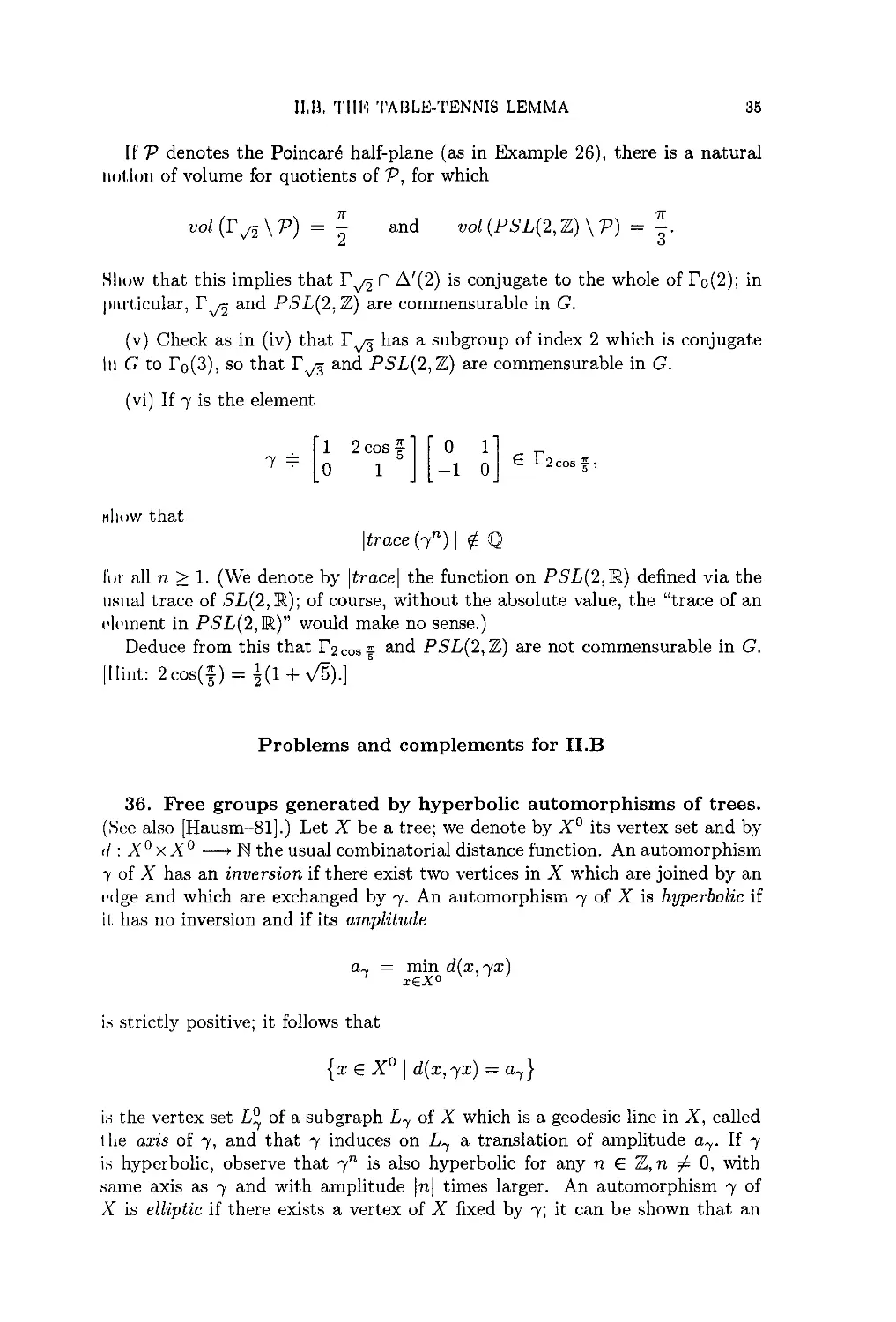











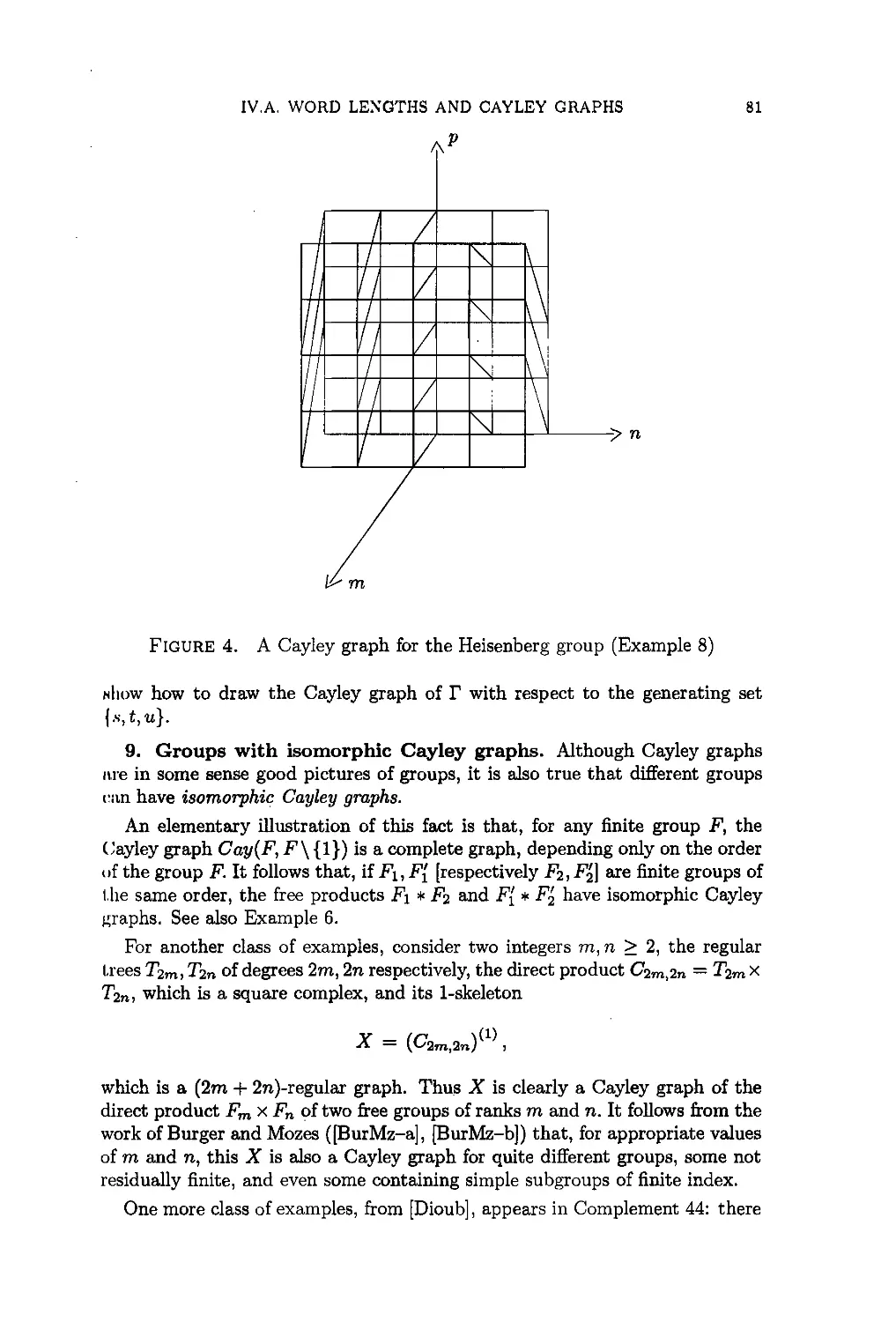

























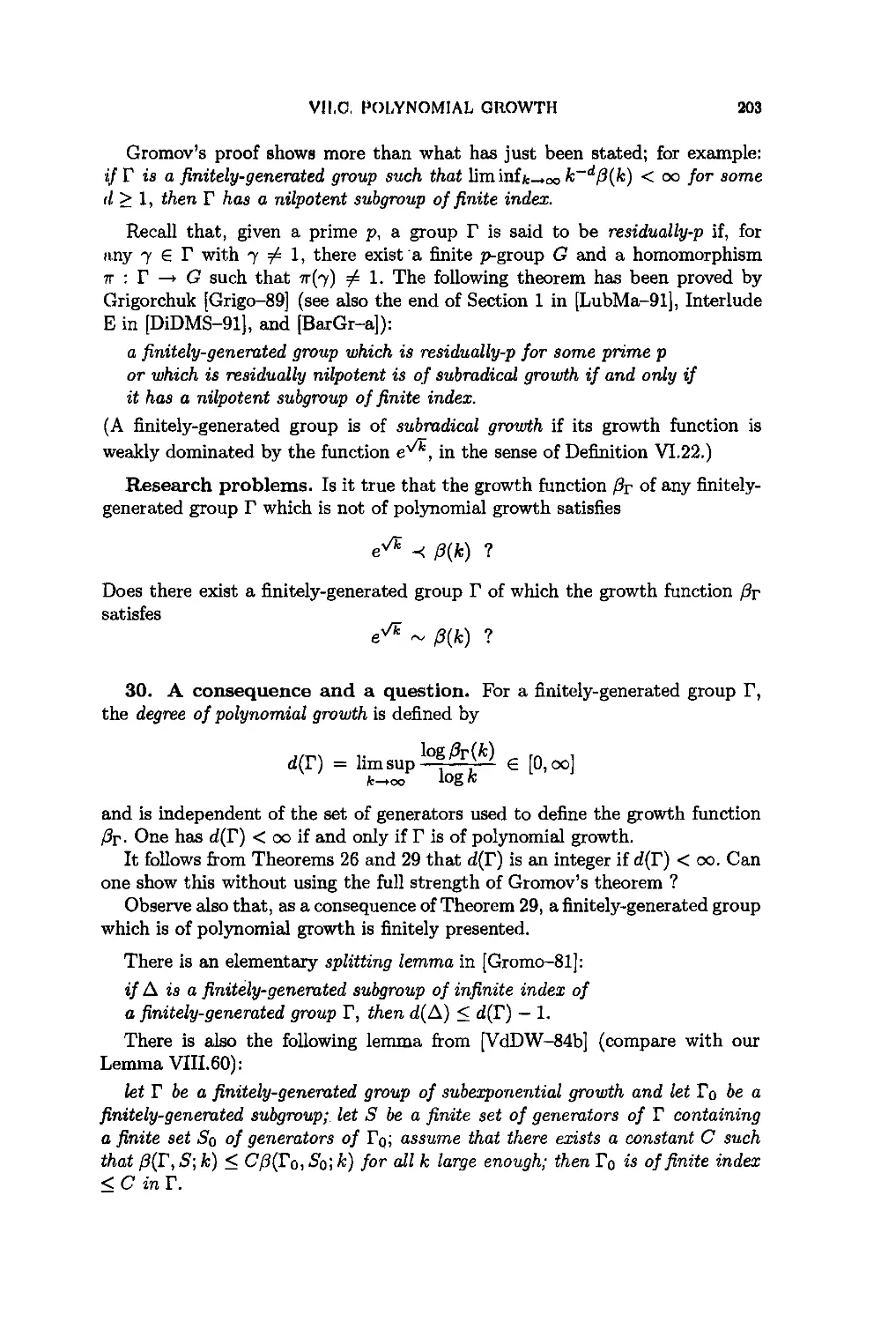
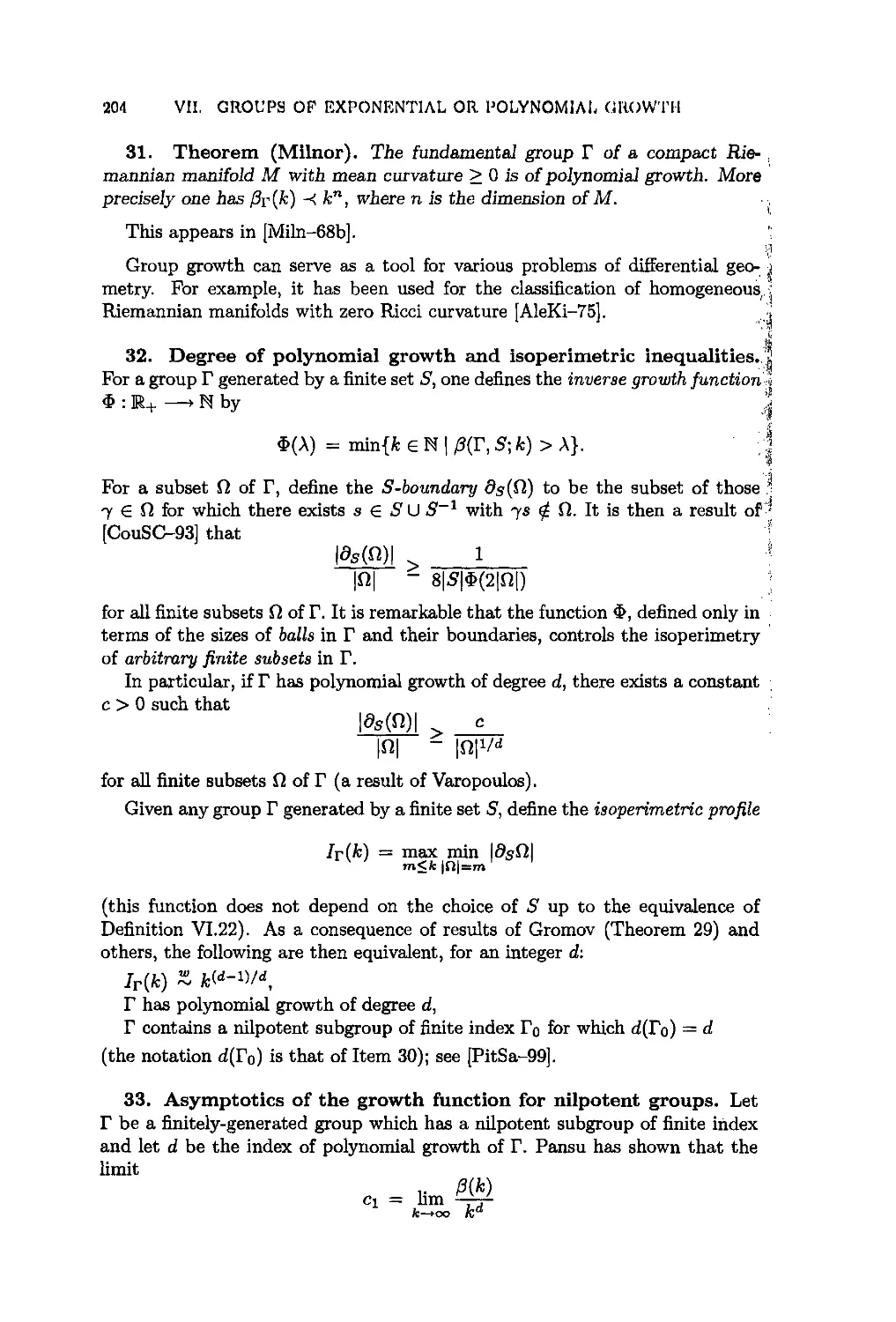
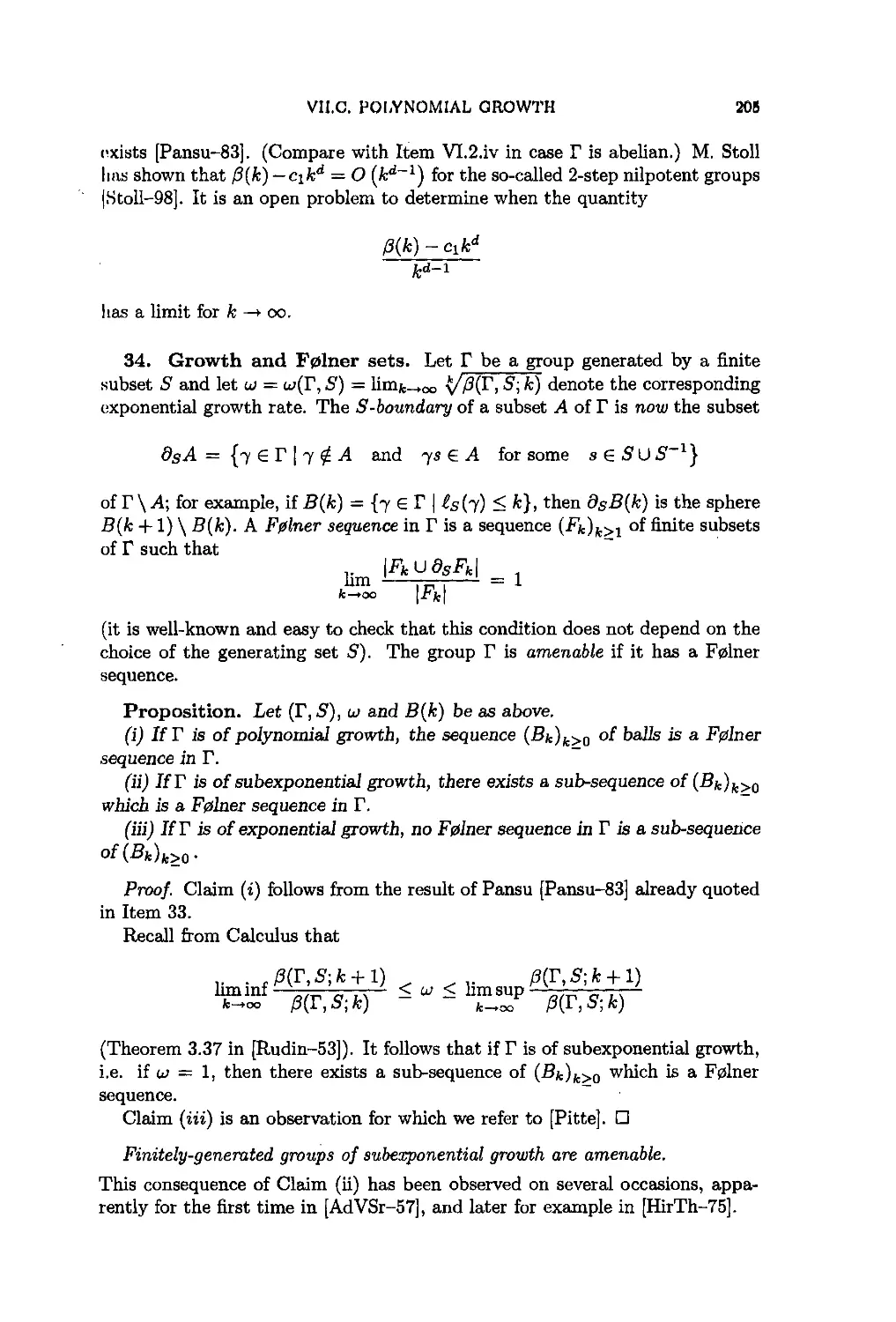
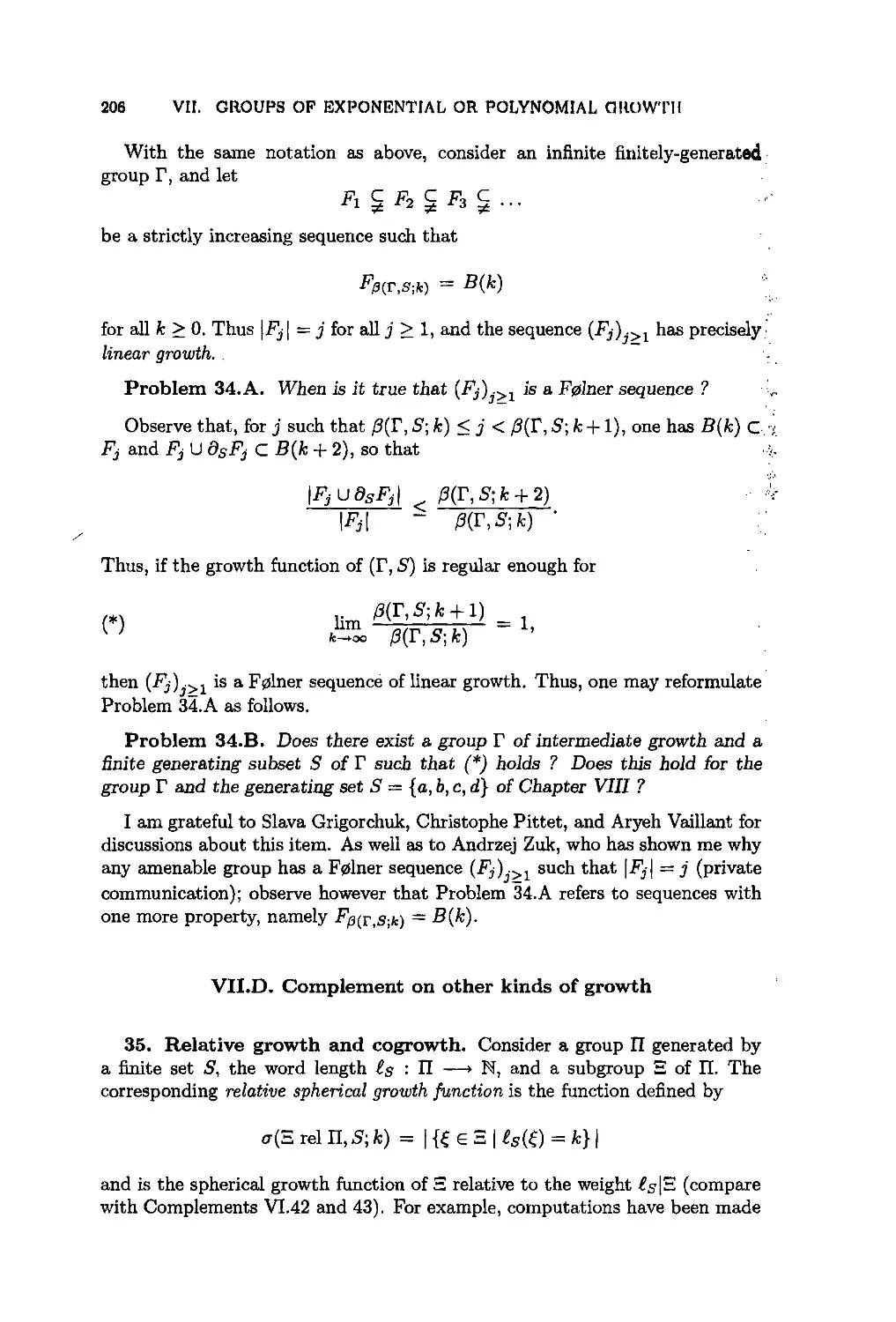






































Text
                    Pierre de. la Harpe
Topics in Geometric
Group Theory
The University of Chicago Press
Chicago and London

The University of Chicago Press, Chicago 60637
The University of Chicago Press, Ltd., London
© 2000 by The University of Chicago
All rights reserved. Published 2000 "
Printed in the United States of America
09 08 07 06 05 04 03 2 3 4 5
ISBN: 0-226-31719-6 (cloth)
ISBN: 0-226-31721-8 (paper)
Library of Congress Cataloging-in-Publication Data
La Harpe, Pierre de.
Topics in geometric group theory / Pierre de h Harpe.
p. cm.---(Chicago lectures in mathematics)
Includes bibliographic references and index.
ISBN 0-226-31719-6 (alk. paper)--ISBN 0-226-31721-8 (pbk. : alk. paper)
1. Geometric group theory. I. Title. II. Series.
QA183.L3 2000
512'.2--dc21
00-020271
 The paper used in this publication meets the minimum requirements of the American
National Standard for Information Sciences--Permanence of Paper for Printed Library
Materials, ANSI Z39.48-1992.

CONTENTS
Introduction
I. Gauss' circle problem and P61ya's random walks on lattices
I.A. The circle problem
I.B. P61ya's recurrence theorem
1/. Free products and free groups
II.A. Free products of groups
1/.B. The Table-Tennis Lemma (Klein's criterion) and examples
of free products
1/I. Finitely-generated groups
III.A. Finitely-generated and infinitely-generated groups
HI.B. Uncountably many groups with two generators (B.H.
Neumann's method)
1/I.C. On groups with two generators
III.D. On finite quotients of the modular group
IV. Finitely-generated groups viewed as metric spaces
IV.A. Word lengths and Cayley graphs
IV.B. Quasi-isometries
V. Finitelypresented groups
V.A. Finitely-presented groups
V.B. The Poincar6 theorem on fundamental polygons
V.C. On fundamental groups and curvature in Riernannian
geometry
V.D. Complement on Gromov's hyperbolic groups
VI. Growth of finitely-generated groups
VI.A. Growth functions and growth series of groups
VI.B. Generalities on growth types
VI.C. Exponential growih rate and entropy
5
5
7
17
17
25
43
43
60
68
71
75
75
84
117
117
135
145
148
151
151
167
180

CONTENTS
VII. Groups of exponential or polynomial growth
VII.A. On groups of exponential growth
VII.B. On uniformly exponential growth
VII.C. On groups of polynomial growth
VII.D. Complement on other kinds of growth
187
187
194
197
206
VIII. The first Grigorchuk group
VIII.A. Rooted d-ary trees and their automorphisms
VIII.B. The group F as an answer to one of Burnside's
problems
VIII.C. On some subgroups of F
VIII.D. Congruence subgroups
VIII.E. Word problem and non-existence of finite
presentations
VIII.E Growth
VIII.G. Exercises and complements
211
211
217
225
236
240
248
259
References
Index of research problems
Appendix: Corrections and Updates
Subject index
265
295
299
323

INTRODUCTION
All ornament should be based upon a
geometrical construction
(Proposition 8 of [Jon-1856])
Groups as abstract structures were recognized progressively during the 19th
century by mathematicians including Gauss (Disquisitiones avithmeticae in
1801), Cauchy, Galois, Cayley, Jordan, Sylow, Frobenius, Klein (Erlangen pro-
gram in 1872), Lie, Poincar6 ... ; see e.g. Chapter III in [Dieud-78] and [NeumP-
99]. Groups are of course sets given with appropriate "multiplications", and
they are often given together with actions on interesting geometric objects.
But the fact which we want to stress here is that groups are also interesting
geometric objects by themselves -- a point of view illustrated in the past by
Cayley and Dehn (see Chapter 1.5 in [ChaMa-82]), and more recently by Gro-
mov. More precisely, a finitely-generated group can be seen as a metric space
(the distance between two points being defined "up to quasi-isometry", in the
sense of Section IV.B below), and this gives rise to a very fruitful approach to
group theory.
The purpose of this book is to provide an introduction to this point of view,
with emphasis on finitely-generated versus finitely-presented groups, on growth
of groups, and on examples.
It has developed from a postgraduate course given in Geneva and Lausanne
during the winter term 1995/96. Several lectures I were given by R. Grigorchuk,
and one-by D.B.A. Epstein. The lectures about random walks on groups and
about amenability have not bcen written up; among several possible references
for these subjects, let us mention a recent book on random walks, [Woess-00],
and an article on amenability, [CecGH-99].
The backgrounds of the course participants were far from homogeneous.
Similarly, in the present book, the knowledge assumed of the reader varies
a great deal from one page to another. As we have chosen to concentrate on
examples, we hope that the reader who does not have the background for one
part of our exposition can nevertheless read later parts. We also hope that
tPart of the material exposed by R. Grigorchuk appears in parts of Chapters VI to VIII.
I). Epstein lectured on rewriting systems, which do not appear here (see [Epst6-O2], in par-
titular Chapter 6, and [lrown-92]).

2 INTRODUCTION
mature mathematicians, working outside geometric group theory, will find the
notes of interest and that they will enjoy the connections between various fields.
However, we definitely assume that the reader will have some knowledge of
basic group theory, such as a small part of a book like [KarMe-85] or [Rotma-
95], as well as some knowledge of elementary algebraic topology (fundamental
group and covering spaces), for which two aInong many good references are the
de Rham notes [Rham-69] and a book by Massey [Masse-67].
Most sections are followed by a choice of exercises, most of which should be
easy for the reader, and a list of problems and complements; problems range
from slightly more difficult exercises to research problems, and complements
often reduce to some comments on the literature. We feel it is crucial for the
reader to study many of the exercises (even if it is safe to avoid quite a few
others). On the other hand, problems and complements can be used for relaxed
bar-conversations after more serious lectures: what the reader will grasp there
could well depend strongly on the mood of the day.
An index of research problems appears after the references.
One consequence of the style adopted for these problems and complements
is a very long list of references. Even if nobody will imagine that I have studied
all of them in detail, my hope is that some readers will find it helpful; others
will forgive me for missing important contributions.
My choice of material to illustrate "geometric group theory" is clearly sub-
jective, and there are many important topics which are completely missing,
or to say the least under-represented, in this book. Besides random walks and
amenability, already alluded to, here are some of the topics that would certainly
deserve more attention.
• Small cancellation theory, and the geometry of defining relations [O1's-89].
• Mostow rigidity ([Mosto-68], [Mosto-73]).
• Margulis super-rigidity and arithmeticity [Margu-91].
• Thurston's geometrization conjecture
([Thurs-S2], [Scott-S3], [NeumW-99]).
• The congruence subgroup problem ([PrasG-91], [Rapin-92], [Rapin-99]).
• A proo] of Gromov's theorem on polynomial growth and nilpotent groups
[Gromo-81] (see VII.29).
• Asymptotic cones; see [Gromo-81] and Chapter 2 in [Gromo-93],
as well as [VGDW-84a], [KapLe-95] and [KleLe-98].
• Finite generation of kernels of abelian quotients of finitely-generated
groups, and Bieri-Neumann-Strebel invariants [BieNS-87].
• Groups acting on real trees [Morga-92], the work of Rips [Pauli-97],
and JSJ-decomposition of groups (see III.15).
• Moduli spaces of representations of a finitely-generated group in somc
algebra, it group (see [CulSh-83] and [BanSh-90}).

INTRODUCTION 3
• The course could not have been given nor the notes written up without the
help of many students, colleagues, librarians, and readers of earlier versions.
We would like to thank in particular
Slava Grigorchuk
as well as
Goulnara Arzhantseva, Roland Bacher, Laurent Bartholdi, Bachir Bekka,
Dietmar Bisch, Martin Bridson, Marc Burger, Tullio Ceccherini-Silberstein,
Bernard Dudez, Shalom Eliahou, Benson Farb, Steve Gersten, Etienne Ghys,
Andr Haefliger, Jean-Claude Hausmann, Michel Kervaire, Gilbert Levitt, Alex
Lubotzky, Igor Lysenok, Antonio Machl, Volodia Nekrashevych, Alexander Yu.
Ol'shanskii, Panos Papasoglu, Christophe Pittet, Gilles Robert, Felice Ronga,
Jan Saxl, Yehuda Shalom, Tatiana Smirnova-Nagnibeda, John Steinig, Jacques
Thvenaz, Aryeh Vaillant, Alain Valette, and Thierry Vust
for their much appreciated contributions. This incomplete list shows among
other things that support of the Swiss National Science Foundation has been
vital for this book, and more generally to keep Geneva in the flow of current
research.
One of my personal beliefs is that fascination with symmetries and groups is
one way of coping with the frustrations of life's limitations: we like to recognize
symmetries which allow us to grasp more than what we can see. In this sense,
the study of geometric group theory is a part of culture, and reminds me of
several things that Georges de Rham practised on many occasions, such as
teaching mathematics, reciting Mallarm, or greeting a friend.

CHAPTER I
GAUSS' CIRCLE PROBLEM AND
P(LYA'S RANDOM WALKS ON LATTICES
Much of the material in the later chapters is about results of the last 50 years.
However, there are related results which are classic; this introductory chapter
is about two of them. One goes back to Gauss; the other goes back at least to
P61ya (1921), and possibly to the first mathematically inclined drunkard.
I.A. The circle problem
Consider a group r and a function a : r --* ]+ which measures in some sense
the "size" of elements of F.
What can be said about  {7 E F [ a(7) _< t } for large t E ]+ ?
This theme, concerning growth, has many variations. Here we illustrate it with
a classical result due to Gauss about the circle problem, for which F = Z 2 and
a(a, b) = a  + b . (See [Chand-68].) More on this in our Chapters VI and VII
(in particular VI.42).
More precisely, set
for all t >_ 0. For example,
R(o) = 1
R(lO) = 37
R(1000) = 3149
R(1) = 5
R(100) = 317
R(10"000) -- 31"417.
The problem is to understand the asymptotic behaviour of R(t) when t is large.
1. Theorem (Gauss). We have R(t) - rt = O(v).
Proof. To each lattice point (a,b) E Z 2, we associate the unit square of the
Euclidean plane with (a, b) as its "south-west corner". If a 2 + b 2 _< t, the square
corresponding to (a, b) is inside the disc of radius V + v; hence
R(t) _< r (V+ V) 2

6 I. GAUSS' CIRCLE PROBLEM AND PdlLYA'S RANDOM WALKS
for all t _> 0. If the square corresponding to (a, b) touches the disc of radius
v/ - v, then a 2 + b 2 <_ t; hence
for all t >_ 0. Thus
for all t _> O. []
IR(t)- rt[ _< 2r (1 + v)
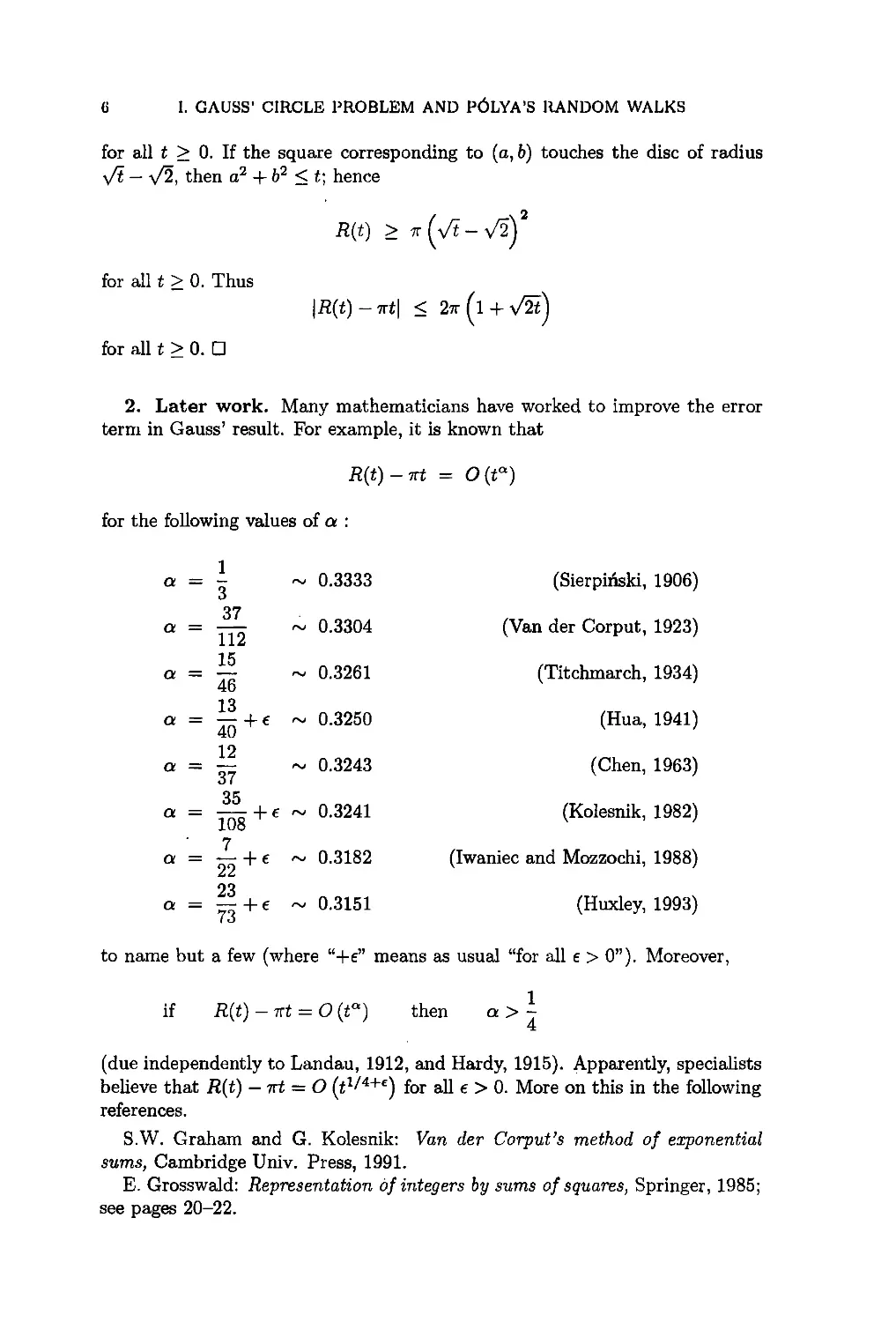
2. Later work. Many mathematicians have worked to improve the error
term in Gauss' result. For example, it is known that
R(t) - rt = O (t )
for the following values of a :
1
 ,, 0.3333 (Sierpifiski, 1906)
37
11-- ,, 0.3304 (Van der Corput, 1923)
15
4-- ,-, 0.3261 (Titchmarch, 1934)
13
 +e ,, 0.3250 (Hua, 1941)
12
3- , 0.3243 (Chen, 1963)
35
108 + e ,-- 0.3241 (Kolesnik, 1982)
7
 + e ,- 0.3182 (Iwaniec and Mozzochi, 1988)
23
- + e ,, 0.3151 (Huxley, 1993)
to name but a few (where "+e" means as usual "for all e > 0"). Moreover,
if R(t) - rt = 0 (t ") then
(due independently to Landau, 1912, and Hardy, 1915). Apparently, specialists
believe that R(t) - rt = 0 (t 1/4+) for all e > 0. More on this in the following
references.
S.W. Graham and G. Kolesnik: Van der Corput's method of exponential
sums, Cambridge Univ. Press, 1991.
E. Grosswald: Representation Of integers by sums of squares, Springer, 1985;
see pages 20-22.

I.B. POLYA'S RECUI{I.ENGE THEOREM , 7
G.H. Hardy and E.M. Wright: An introduction to the theory of numbers, 5 th
cd., Oxford Univ. Press 1979; see page 272.
M.N. Huxley: Exponential sums and lattice points II, Proc. London Math.
Soc. 66 (1993) 279-301 and 68 (1994).264.
I.A. Ivic: The tiemann zeta function, J. Wiley, 1985; see in particular pages
372, 375, 384.
B. Lichtin: Geometric features of lattice point problems, in Singularity theory,
D.T. L, K. Saito and B. Teissier Editors, World Scientific, 1995; see pages 370-
443. This has an exposition of R(t) - 7rt = O (tl/3+').
W. Sierpifiski: Elementary theory of numbers, 2 nd ed., North Holland, 1988;
see pages 383 ft.
Problems analogous to the circle problem have also been considered in ]R d
for d > 3, with ellipsoids instead of balls, and with other plane domains; see,
e.g., the papers by Lichtin and Huxley cited above.
There axe also natural problems in hyperbolic spaces (rather than in d),
about the asymptotic behaviour of numbers of lattice points in large balls.
Work on these problems goes back at least to Delsaxte [Delsa-42]. See § III.3 in
[BekMa] for an exposition of particular cases of results of Margulis and Eskin-
McMullen; see [Patte-87] for an exposition of more precise results of Patterson
and Sullivan.
I.B. P61yas recurrence theorem
Consider the simple random walk on the lattice  of integers. In loose terms,
a walker is at the origin at time 0 and moves one step to the left or one step to
the right, equiprobably, after each unit of time.
The question of recurrence for Z is to ask whether the walker has a 100 %
chance of visiting the origin again infinitely many times. (In the original paper
[P61ya-21], P61ya's question was slightly different; see Section 5.3 in [DoySn-
84] .)
The answer is yes, as we show, following Section 7.2 of [DoySn-84]; other
arguments are sketched in Exercise 5.
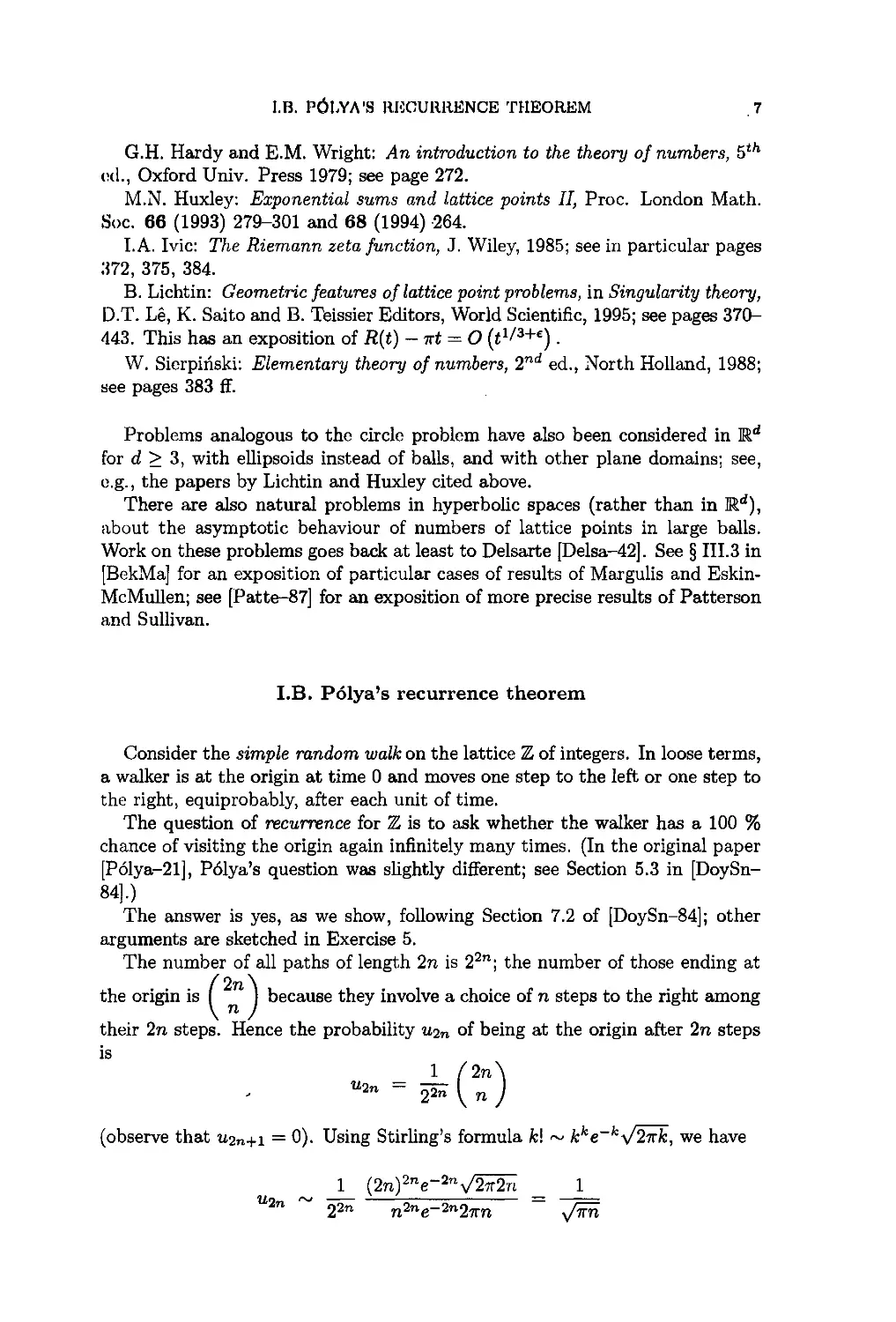
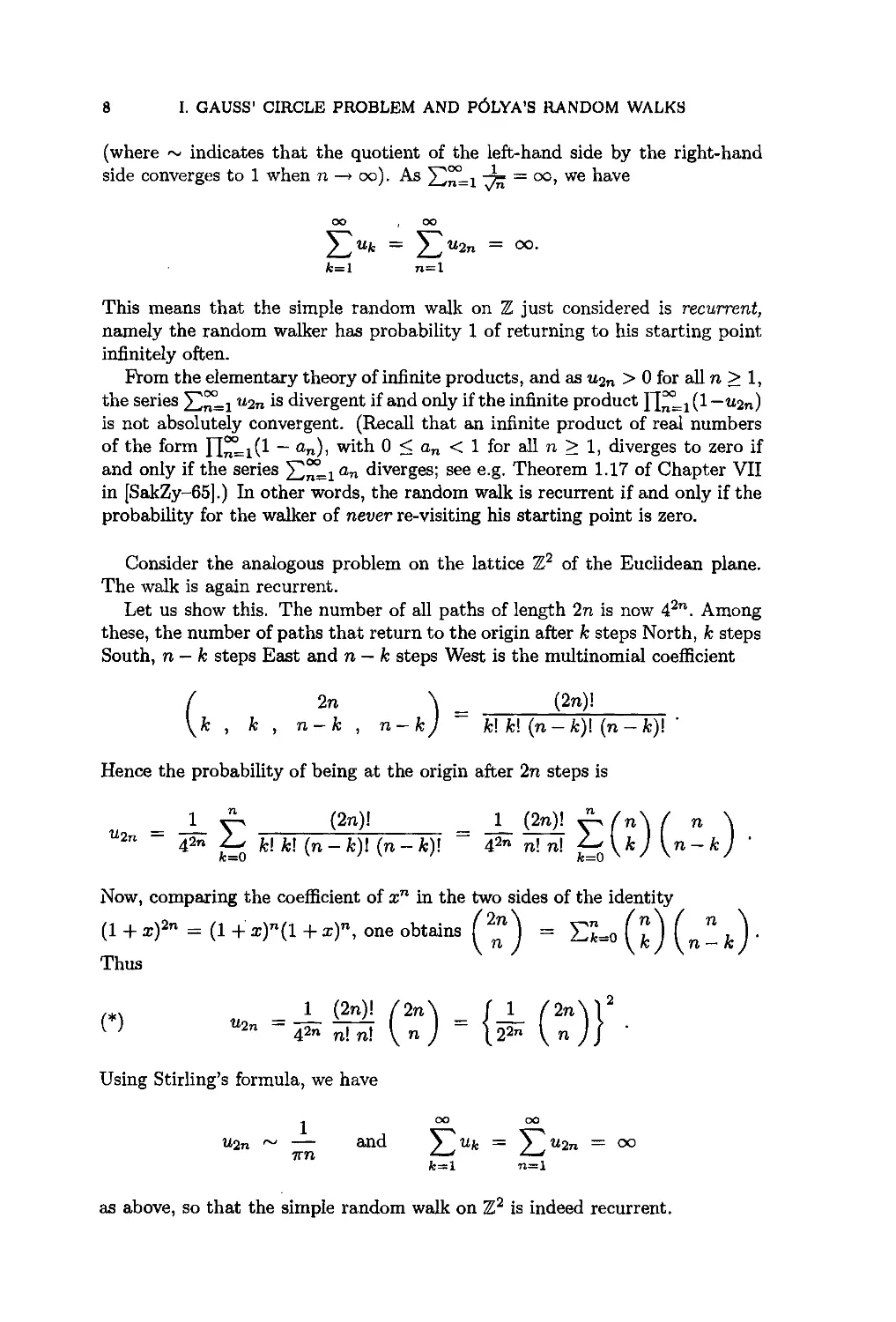
The number of all paths of length 2n is 22'; the number of those ending at
the origin is (2:)because they involve a choice of n steps to the right among
their 2n steps. Hence the probability u2, of being at the origin after 2n steps
is
(observe that u2+1 = 0). Using Stirling's formula k! ,--, kae-cx/"', we have
1 (2n)2ne-Zn2x/- 1
"" 2  n2,e-2,2rn =

8 I. GAUSS' OIl=rOLE PROBLEM AND POLYA'S RANDOM WALKS
(where  indicates that the quotient of the left-hand side by the right-hand
side converges to 1 when n - o). As o : we have
n=l = O,
k=l n=l
This means that the simple random walk on  just considered is recurrent,
namely the random walker has probability 1 of returning to his starting point
infinitely often.
From the elementary theory of infinite products, and as u2. > 0 for M1 n > 1,
the series .=1 2. is divergent if and only if the infinite product y[.=l (l-u2.)
is not absolutely convergent. (Recall that an infinite product of real numbers
 1
of the form 1-[.=1( - a.), with 0 <_ a. < 1 for all n >_ 1, diverges to zero if
and only if the series .= a. diverges; see e.g. Theorem 1.17 of Chapter VII
in [SakZy-65].) In other words, the random walk is recurrent if and only if the
probability for the walker of never re-visiting his starting point is zero.
Consider the analogous problem on the lattice 2 of the Euclidean plane.
The walk is again recurrent.
Let us show this. The number of all paths of length 2n is now 42". Among
these, the number of paths that return to the origin after k steps North, k steps
South, n - k steps East and n - k steps West is the multinomial coefficient
2n ) (2n)!
k , k , n-k , n-k = k!!(n-k)!(n-k)!"
Hence the probability of being at the origin after 2n steps is
Now, comparing the coefficient of x" in the two sides of the identity
(1 + x) 2" = (1 q: x)"(1 + x)", one obtains = k=0 n- k "
Thus
(*) u2. = 42" n!n! =  "
Using Stirling's formula, we have
U2.
U2.
k=l
as above, so that the simple random walk on 2 is indeed recurrent.

I,B, P)I,YA'8 RECURRENCE THEOREM
The situation is different in one more dimension: the simple random walk
on a is transient (this means precisely "non-recurrent").
As before, we have
U2n
1
j,k_>o
(2n)!
j! j! k! k! (n - j - k)! (n - j - k)!
For all j, k _> 0 with j -t- k _< n, we have
(**)
n!
j! k! (n- j- k)!
It]!
(Exercise 6). Consequently
1 (2:) 1 n,
<-
1
',_ 3 ' j!k] (n-j-
+k_<
As the last sum is 1, we have
1 (2:) 1 n,
Stirling's fomula shows that
1____ () 1 n' 1 (2n), v
and we have finally
for an appropriate constant K.
3. Theorem (Pdlya, 1921). The simple random walk on Z d is
recurrent if d = 1 or d = 2
transient ff d > 3.
Proof. The above proof for d = 3 carries over (with only minor changes) to
the case d _> 3. []

l0 I. GAUSS' CIRCLE PROBLEM AND PCLYA'S I,NDOM WALKS
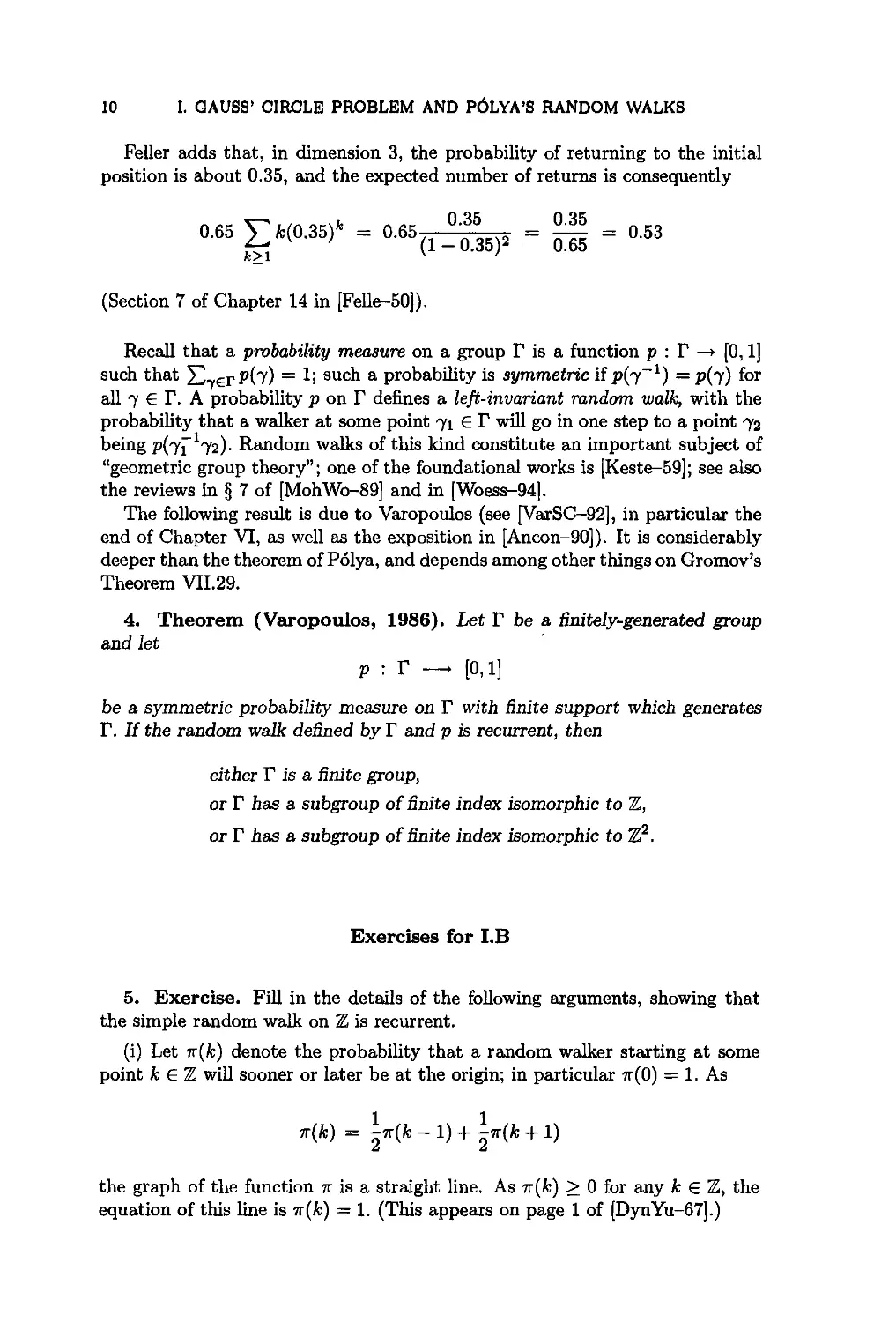
Feller adds that, in dimension 3, the probability of returning to the initial
position is about 0.35, and the expected number of returns is consequently
0.65 Zk(O'35)k = 0.65(1 0.35 = 0.35
k>l -- 0.35) 2 • 0.65
----- 0.53
(Section 7 of Chapter 14 in [Felle-50]).
Recall that a probability measure on a group F is a function p : F -- [0, 1]
such that TerP(7) = 1; such a probability is symmetric if p(7 -1) = P(7) for
all 7 E F. A probability p on F defines a left-invariant random walk, with the
probability that a walker at some point 71 E F will go in one step to a point 72
being p(,),-i,),2). Random walks of this kind constitute an important subject of
"geometric group theory"; one of the foundational works is [Keste-59]; see also
the reviews in § 7 of [MohWo--S9] and in [Woess-94].
The following result is due to Varopoulos (see [VarSC-92], in particular the
end of Chapter VI, as well as the exposition in [Ancon-90]). It is considerably
deeper than the theorem of PSlya, and depends among other things on Gromov's
Theorem VII.29.
4. Theorem (Varopoulos, 1986). Let F be a finitely-generated group
and let
p : r - [0,1]
be a symmetric probability measure on F with finite support which generates
F. If the random walk defined by F and p is recurrent, then
either F is a finite group,
or F has a subgroup of finite index isomorphic to Z,
or F has a subgroup of finite index isomorphic to Z 2.
Exercises for I.B
5. Exercise. Fill in the details of the following arguments, showing that
the simple random walk on Z is recurrent.
(i) Let 7r(k) denote the probability that a random walker starting at some
point k  Z will sooner or later be at the origin; in particular 7r(0) = 1. As
r(k) = -r(k - 1)+ -r(k + 1)
the graph of the function r is a straight line. As 7r(k) >_ 0 for any k  Z, the
equation of this line is 7r(k) = 1. (This appears on page 1 of [DynYu-67].)

[,B, PtLYA)$ RECURRENCE THEOREM
(ii) Let r denote the probability that a random walker starting at the origin
will later return to the origin. As
1 1 1 1
r = +r+§r2+... -
we have ¢r = 1. (This comes from the beginning of Chapter 3 in [Hughe-95].)
6. Exercise. (i) Explain Formula (*) above, showing that the probability
u:, for 2 is the square of the probability u:, for .
[Hint. The walk in Z2 is the "product" of a first walk with steps -4- (½, ½)
and of a second walk with steps =t= (½,-½). If a broader hint is necessary, see
[DoySn-84], Section 7.6.]
(ii) Check that a!b! > (a+ 1)!(b-1)! for positive integers a, b such that a < b.
Deduce from it the inequality (**) used above, shortly before Theorem 3.
7. Exercise. A walker on 1 is at  0 at time 0 and at 1 at time 1. If he
is at k at time n _> 1, then either k -- 0 and he stays there at time n + 1,
or k > 1 and he moves equiprobably one step to the left or one step to the
right. Denote by P the probability that the walker is at k at time n, and
set Pk(z) = ',=0 Fffz ' (a formal power series, which is called the generating
function of the sequence (P)n>o)"
(i) Compute P for n < 10.
(ii) Check that
P  (z)
pk(z)
Z
: l+z[Po(z)- 1] + Pl(z),
= z[i+P2(z)],
for all k > 2.
(iii) Deduce from (ii) that
k
for all k > 1 and that
Po(z) = 1 +
I--Z
Check that the first terms of the Taylor expansion of this function at the origin •
agree with the numbers found in (i).
lIn this book, N denotes the set of natural numbers, including O.

12 I. GAUSS' CIRCLE PROBLEM AND P(LYA'S RANDOM WALKS
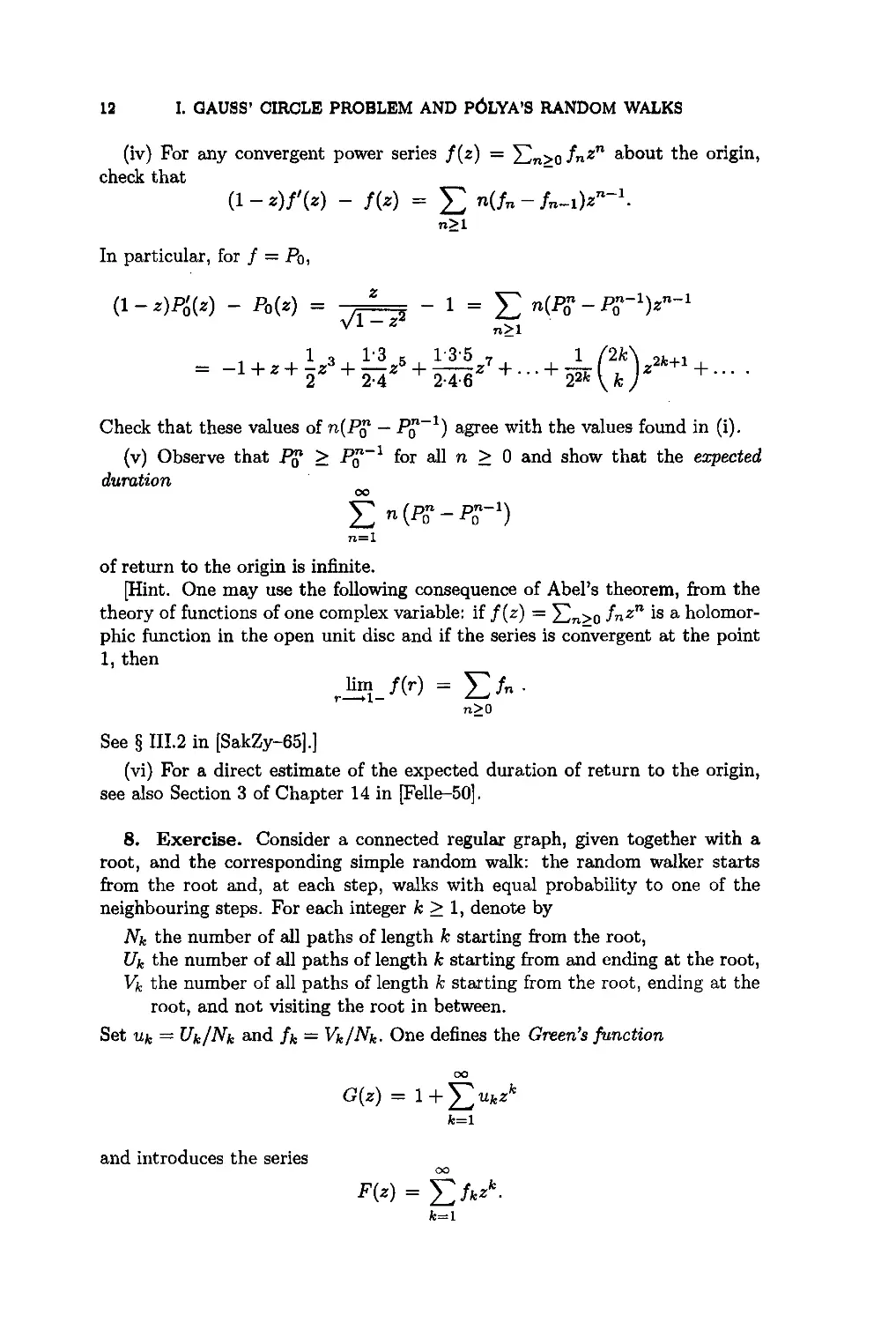
(iv) For any convergent power series f(z) = ,>o f, zn about the origin,
check that
(1 -- z)ff(z) -- f(z) =  n(fn -- fn-1)Z n-1.
n>_l
In particular, for f = P0,
(1 - z)P(z) - Po(z) --  1 =  R(W -- P-l) zn-1
= -l+z+Sz +7z +?.-.-.z +...+ + ....
Check that these values of n(P - p-l) agree with the values found in (i).
(v) Observe that P0 -> p-i for all n > 0 and show that the expected
duration
 n(P-P -)
of return to the origin is infinite.
[Hint. One may use the following consequence of Abel's theorem, from the
theory of functions of one complex variable: if f(z) = >0 f zn is a holomor-
phic function in the open unit disc and if the series is convergent at the point
1, then
n_>0
See § III.2 in [$akZy-65].]
(vi) For a direct estimate of the expected duration of return to the origin,
see also Section 3 of Chapter 14 in elle-50].
8. Exercise. Consider a connected regular graph, given together with a
root, and the corresponding simple random walk: the random walker starts
from the root and, at each step, walks with equal probability to one of the
neighbouring steps. For each integer k >_ 1, denote by
N the number of all paths of length k starting from the root,
U the number of all paths of length k starting from and ending at the root,
V the number of all paths of length k starting from the root, ending at the
root, and not visiting the root in between.
Set ut¢ ---- Uk/Nk and f = V/N. One defines the Green's function
and introduces the series
F(z) = -fz k.
k=l

I.B, P(LYAS RECURRENCE THEOREM 13
1
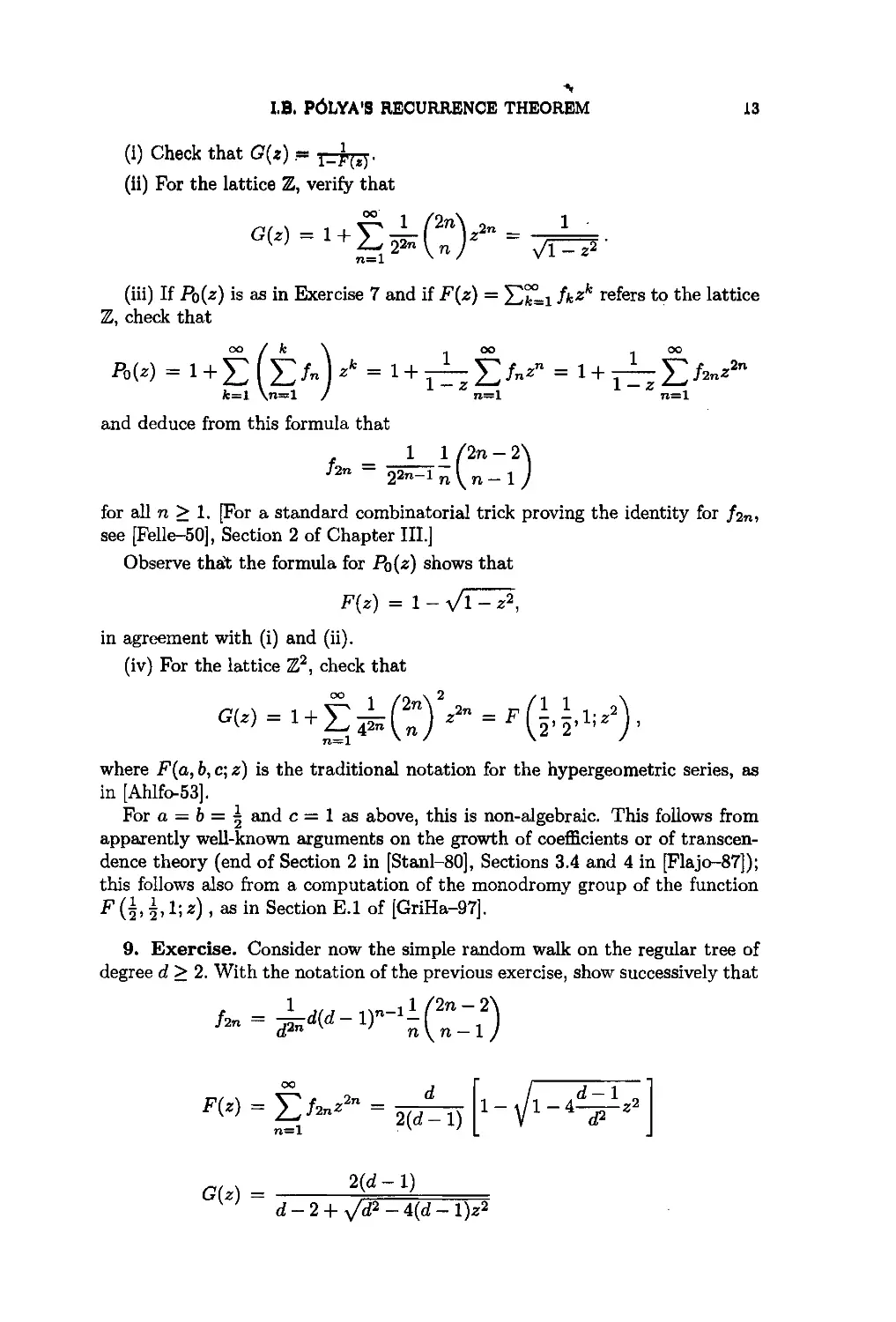
(1) Check that G(z) .-- ,
(ii) For the lattice Z, verify that
OO"
a(;) = l + ?_, (  )z v,V:.__  .
(iii) If Po(z) is as in Exercise 7 and if F(z) = _,k°°=l fkz  refers to the lattice
Z, check that
P0(z) = 1 +  k = 1 + .f," = 1 + .f2,z 2
and deduce from this formula that
1 1 (2:j12)
f2n  22n_ 1 n
for all n _> 1. [For a standard combinatorial trick proving the identity for
see [Felle-50], Section 2 of Chapter III.]
Observe tha% the formula for Po(z) shows that
F() = 1 - v- 2,
in agreement with (i) and (ii).
(iv) For the lattice Z 2, check that
z' = F 1
a() -- 1 +  , , ,
where N(a, b, c; ) is the traditional notation for the hypergeometric series,
in [Ahlfo-a].
For  = b = ½ and e = 1 as above, this is non-algebraic. This follows from
apparently well-known rguments on the growth of eoetficients or of transcen-
dence theory (end of Section 2 in [Stml-801, Sections .zl and 4 in [lajo--871);
this follows also from a computation of the monodromy group of the function
(g, g, 1; ,), as in Section E.1 of [GriHa-7].
9. Exercise. Consider now the simple random walk on the regular tree of
degree d _> 2. With the notation of the previous exercise, show successively that
F(z) = -f2.z " -
nl
G(z) --- 2(d- 1)
d - 2 q- v/d 2 - 4(d - 1)z 2

14 I. GAUSS' CIRCLE PROBLEM AND P(LYA'S RANDOM WALKS
(in case d is even, the formula for G appears as Formula (4.8) in [Keste-59])..
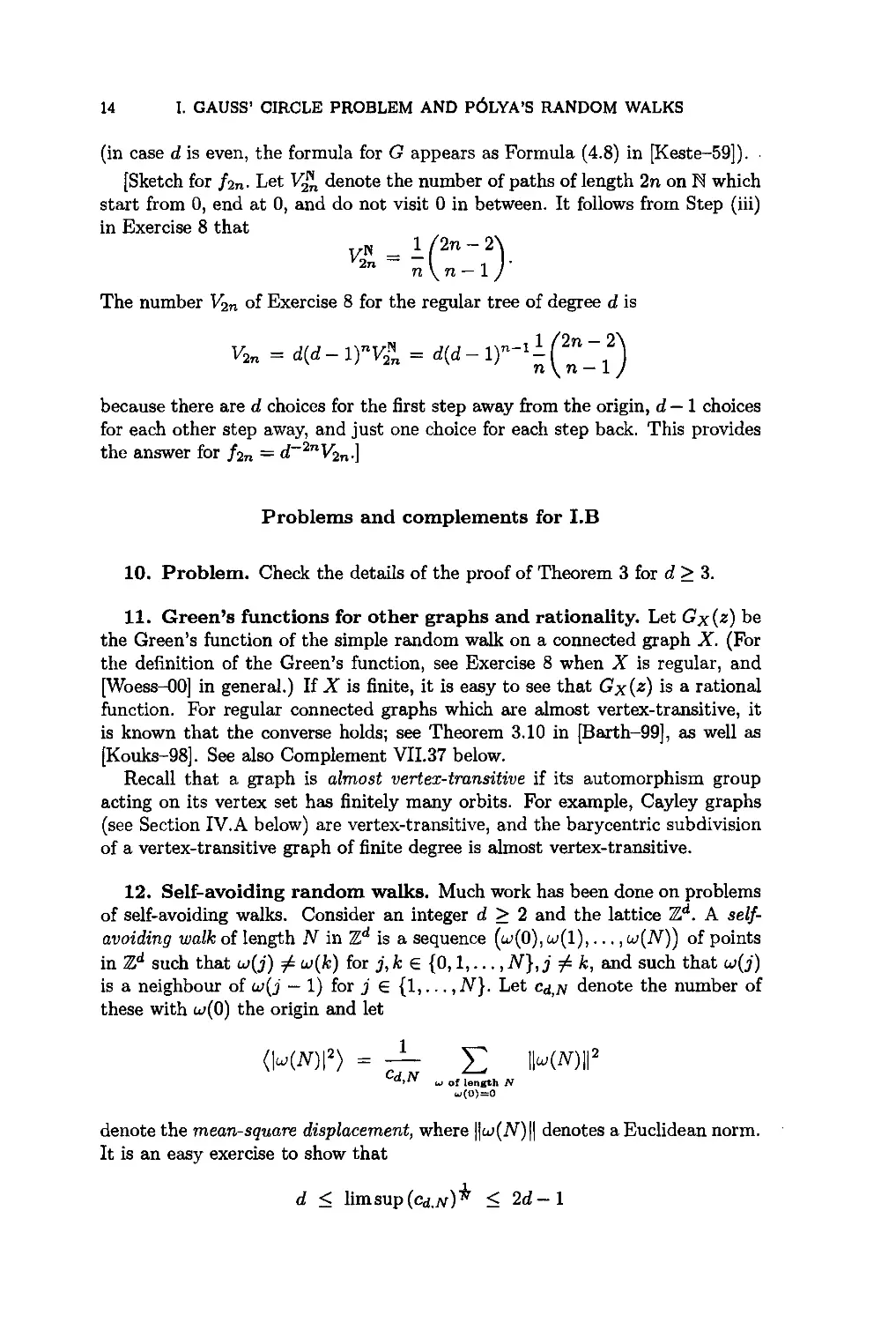
[Sketch for f2,. Let V2, denote the number of paths of length 2n on 1 which
start from 0, end at 0, and do not visit 0 in between. It follows from Step (iii)
in Exercise 8 that
n
The number V2, of Exercise 8 for the regular tree of degree d is
V2, d(d " " n-ll(2n-2)
= -1) V, = d(d-1)  n-1
because there are d choices for the first step away from the origin, d- 1 choices
for each other step away, and just one choice for each step back. This provides
the answer for f2, = d-2'V2,.]
Problems and complements for I.B
10. Problem. Check the details of the proof of Theorem 3 for d > 3.
11. Green's functions for other graphs and rationality. Let Gx(z) be
the Green's function of the simple random walk on a connected graph X. (For
the definition of the Green's function, see Exercise 8 when X is regular, and
[Woess-00] in general.) If X is finite, it is easy to see that Gx(Z) is a rational
function. For regular connected graphs which are almost vertex-transitive, it
is known that the converse holds; see Theorem 3.10 in [Barth-99], as well as
[Kouks-98]. See also Complement VII.37 below.
Recall that a graph is almost vertez-transiive if its automorphism group
acting on its vertex set has finitely many orbits. For example, Cayley graphs
(see Section IV.A below) are vertex-transitive, and the barycentric subdivision
of a vertex-transitive graph of finite degree is almost vertex-transitive.
12. Self-avoiding random walks. Much work has been done on problems
of self-avoiding walks. Consider an integer d _> 2 and the lattice Z d. A selfi
avoiding walk of length N in d is a sequence (w(0), w(1),..., w(N)) of points
in Za such that w(j)  w(k) for j,k E {0, 1,... ,N},j # k, and such that w(j)
is a neighbour of w(j - 1) for j E (1 ..... N}. Let ca,N denote the number of
these with w(0) the origin and let
(I(N)I=> =   II(N)ll 2
Cd,N  of length N
(o)=0
denote the mean-square displacement, where IIw(N)11 denotes a Euclidean norm.
It is an easy exercise to show that
d <_ ]]msup(cd.N) ¢ <_ 2d-1

I,B, P(I,YA'8 IECURRENCE TIIEOREM 15
for all d > 2.
Two basic problems are to understand cd,n and ([(N)I ) for large hr. One
.f the first results in this area is that the limit
#d = lim (Cd, N) -
exists (Hammersley and Morton, 1954); it is called the connective constant for
dimension d. The exact value of #a is unknown, even if d = 2 or d = 3. For the
numbers of self-avoiding walks and for the mean-square displacement, there are
conjectures according to which
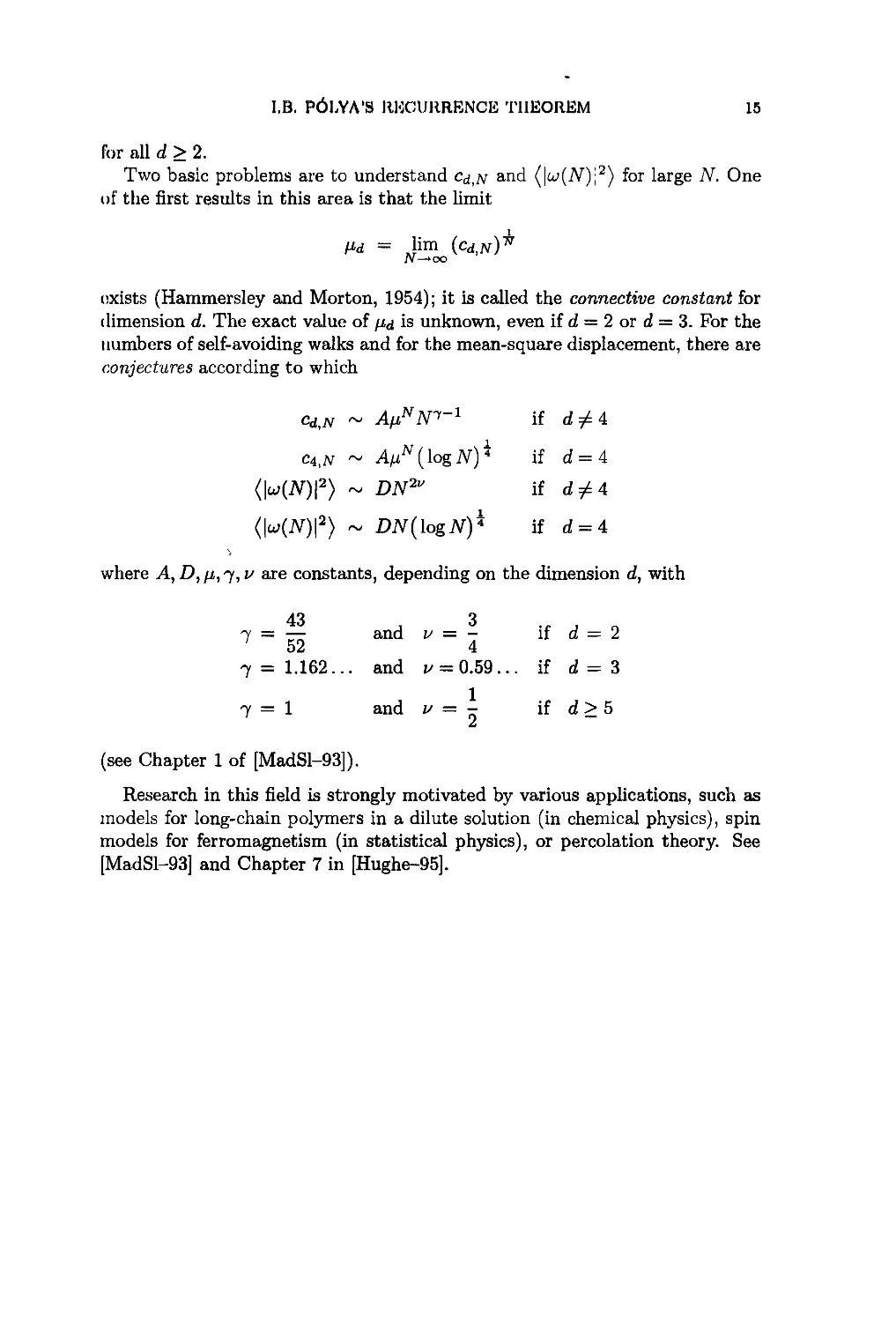
Cd,N " A#N N "r-1 if d # 4
C4,N " A# g (log N) ¼ if d = 4
([w(g)[ 2) ,, ON 2 if d # 4
([w(N)[ 2) ,- DN(logN) ¼ if d = 4
where A, D, #, 7, v are constants, depending on the dimension d, with
43 3
-- and v = - if d = 2
52 4
1.162... and v=0.59.., if d = 3
1
1 and v = - if d>_5
2
(see Chapter 1 of [MadS1-93]).
Research in this field is strongly motivated by various applications, such as
nodels for long-chain polymers in a dilute solution (in chemical physics), spin
models for ferromagnetism (in statistical physics), or percolation theory. See
[MadS1-93] and Chapter 7 in [Hughe-95].

CHAPTER II
FREE PRODUCTS AND FREE GROUPS
This chapter is built around the so-called "Table-Tennis Lemma", due es-
st,m,ially to F. Klein, and some of its applications, exposed in Section II.B.
II.A. Free products of groups
A monoid is a set given together with a multiplication which is associative
aml which has a unit. Given a set A, the free monoid on A, also called the set
,f words on A, is the set W(A) of finite sequences of elements of A; the product
is given by juxtaposition and the unit is the empty word. We write a typical
t,lemcnt of W(A) as w = ala2...a, where each aj is in A; the integer n is then
I.h length of w; it is 0 if w is the empty word. We identify A with the subset
.l' W(A) of words of length one.
Let (F)ei be a family of groups. Set A = LIe¢ F (disjoint union). Let
the equivalence relation on W(A) generated by
where e is the unit in F for some t  I
whenever a, b, c  F with c = ab for some c  I
l'-' all w, w   W(A). It is easy to check that the quotient W(A)/ is naturally
, monoid which is indeed a group; it is called the free product of the groups
1', (t  I) and is denoted by
• ir' .
']'he inverse of the class represented by the word w = aa2...a, is the class
r,presented by aa_...a- .
For A as above, a word w = aa2...a,  W(A), with ay  F, say, is said to
I,, reduced if +   (1 _< j _< n - 1) and if aj is not the unit element of F
(1 <_ j _< n). For example, ifI = {1,2} ,ifF = {e,a} is agroup of order
:!, and if F2 -- (e2, x, y) is a group of order 3, then axaya is reduced, but ae2,
.J'.'a, and xy are not.
17

18 If. FREE PRODUCTS AND FREE GROUPS
1. Proposition. Let (F)e I be a fam_ily of groups. Let A = [IexF and
*eir, = W(A)/ ~ be as above.
Then any element in the free product *elF is represented by a unique
reduced word in W(A).
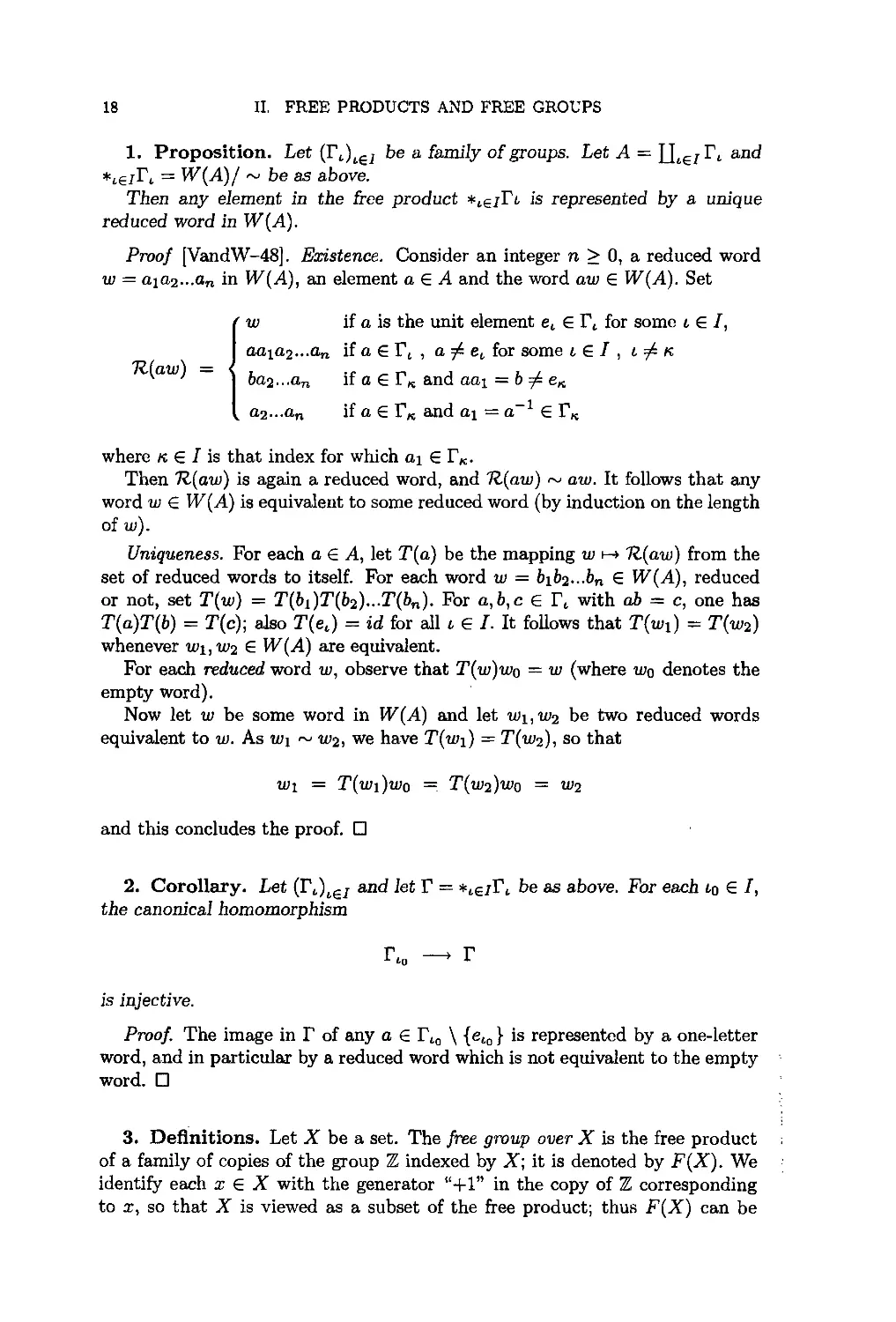
Proof [VandW-48]. Ezistence. Consider an integer n _> 0, a reduced word
w = ala2...a, in W(A), an element a 6 A and the word aw 6 W(A). Set
aala2...an
[aw) = ba2..
a2...an
if a is the unit element e 6 F for some e 6 I,
if a  F , a # e for some  6 [ ,  #
if a 6 F and aal = b  e
if a 6 F and al = a-1 6 F
where  6 I is that index for which al 6 F.
Then T(aw) is again a reduced word, and 7%(aw)  aw. It follows that any
word w 6 W(A) is equivalent to some reduced word (by induction on the length
of ).
Uniqueness. For each a 6 A, let T(a) be the mapping w - 7Z(aw) from the
set of reduced words to itself. For each word w = bb2...b, 6 W(A), reduced
or not, set T(w) = T(b)T(b2)...T(b,). For a,b,c 6 F with ab = c, one has
T(a)T(b) = T(c); also T(e) = id for all  6 I. It follows that T(w) = T(w2)
whenever w, w2 6 W(A) are equivalent.
For each reduced word w, observe that T(w)wo = w (where wo denotes the
empty word).
Now let w be some word in W(A) and let w,w2 be two reduced words
equivalent to w. As w  w2, we have T(w) = T(w2), so that
w = T(w)wo = T(w2)wo = w
and this concludes the proof. []
2. Corollary. Let (r,),6i and let F = *telF be as above. For each 5o 6 I,
the canonical homomorphism
is injective.
Proof. The image in r of any a  F o \ {e o } is represented by a one-letter
word, and in particular by a reduced word which is not equivalent to the empty
word. []
3. Definitions. Let X be a set. The free group over X is the free product
of a family of copies of the group  indexed by X; it is denoted by F(X). We
identify each x 6 X with the generator "+1" in the copy of  corresponding
to x, so that X is viewed as a subset of the free product; thus F(X) can be

II.A. FI:tEE PI:tODU(3TS 19
identified with the set of reduced words in X U X -1, the product in the group
corresponding to the juxtaposition of words followed by appropriate multipli-
cations and reductions (i.e., by deletion of any pair of consecutive letters of the
form xx - or x-ix).
The cardinality of X is called the rank of the free group F(X).
Let F be a group. A free subset of F is a subset X of F such that the inclusion
X F(X) extends to an isomorphism of the subgroup of F generated by X
onto the free group F(X).
4. Basic examples. The fundamental group of a wedge of k circles is a
free group of rank k. More generally, fundamental groups of
connected graphs,
connected surfaces with non-empty boundaries,
connected surfaces which are not compact
are free groups.
For these very classical consequences of the so-called Seifert - van Kampen
theorem, see e.g. [Masse-67], respectively Theorem VI.5.1, Exercise VI.5.2, and
Exercise VI.5.5.
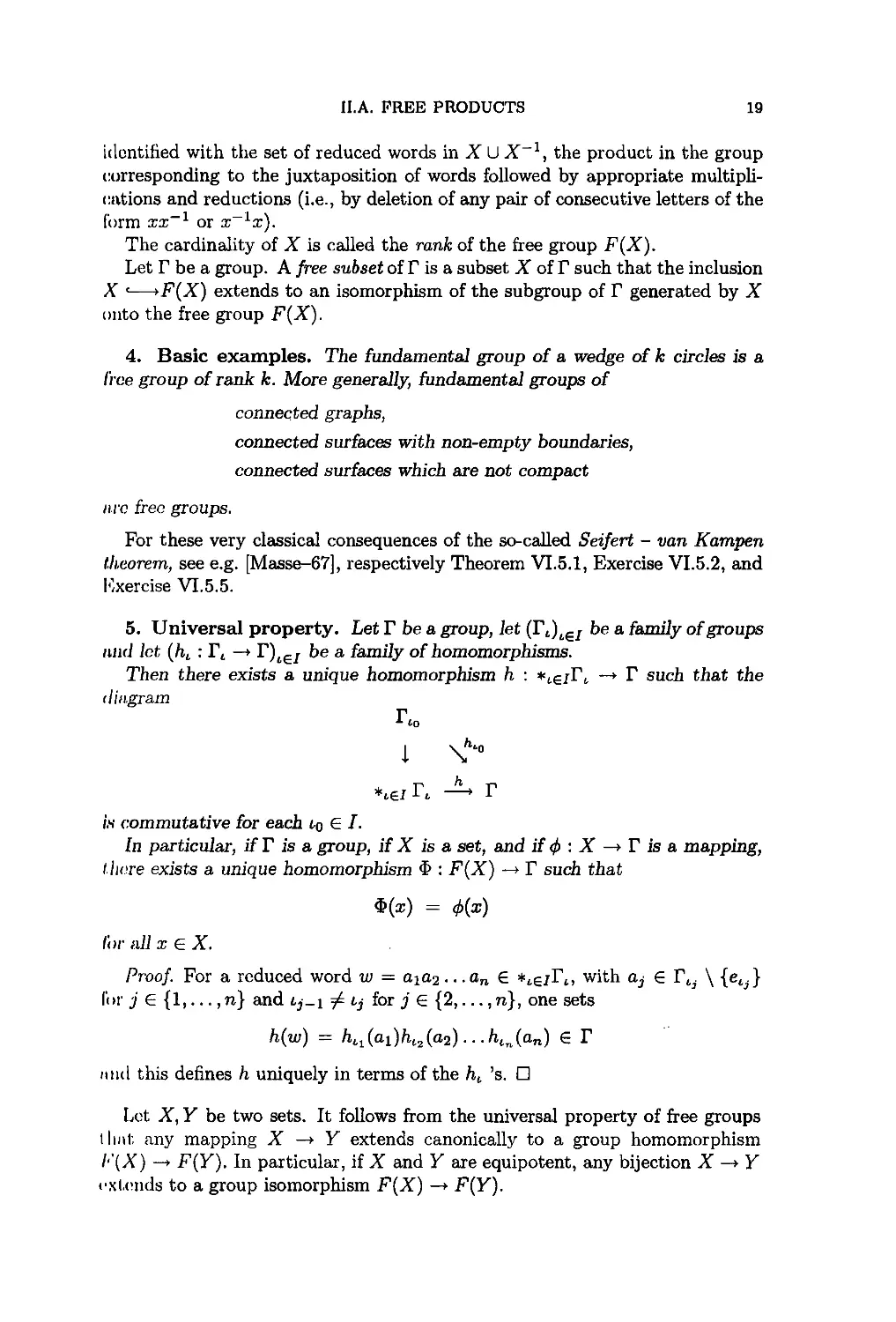
5. Universal property. Let F be a group, let (F)el be a family of groups
nnd let (h : F --* F)el be a family of homomorphisms.
Then there exists a unique homomorphism h : *elF --* P such that the
diagram
ro
is commutative for each o  I.
In particar, ff F is a oup, ff X is a t, d ff ¢ : X  F  a mappg,
t.b.re exists a unique homomorphism • : F(X)  F such that
=
Ibr all x  X.
Pzvof. For a rcduced word w = ala2...an e *elF, with a e Ft  {ere}
fi,rj  {1,...,n} and t_l #  for j  {2,...,n}, one ts
h(w) = h(a)h(a2)...h=(a=) e r
md this defines h uquely in terms of the h 's.
Let X, Y be two sets. It follows from the universal property of free groups
that any mapping X --* Y extends canonically to a group homomorphism
I"(X) --* F(Y). In particular, if X and Y are equipotent, any bijection X --* Y
.xl.cnds to a group isomorphism F(X) --* F(Y).

20 II. FREE PRODUCTS AND FREE GROUPS
6. Corollary. Any group is a quotient of a free group.
Proof. A group F is, for example, a quotient of the frec group on the under-
lying set of F. []
Exercises for II.A
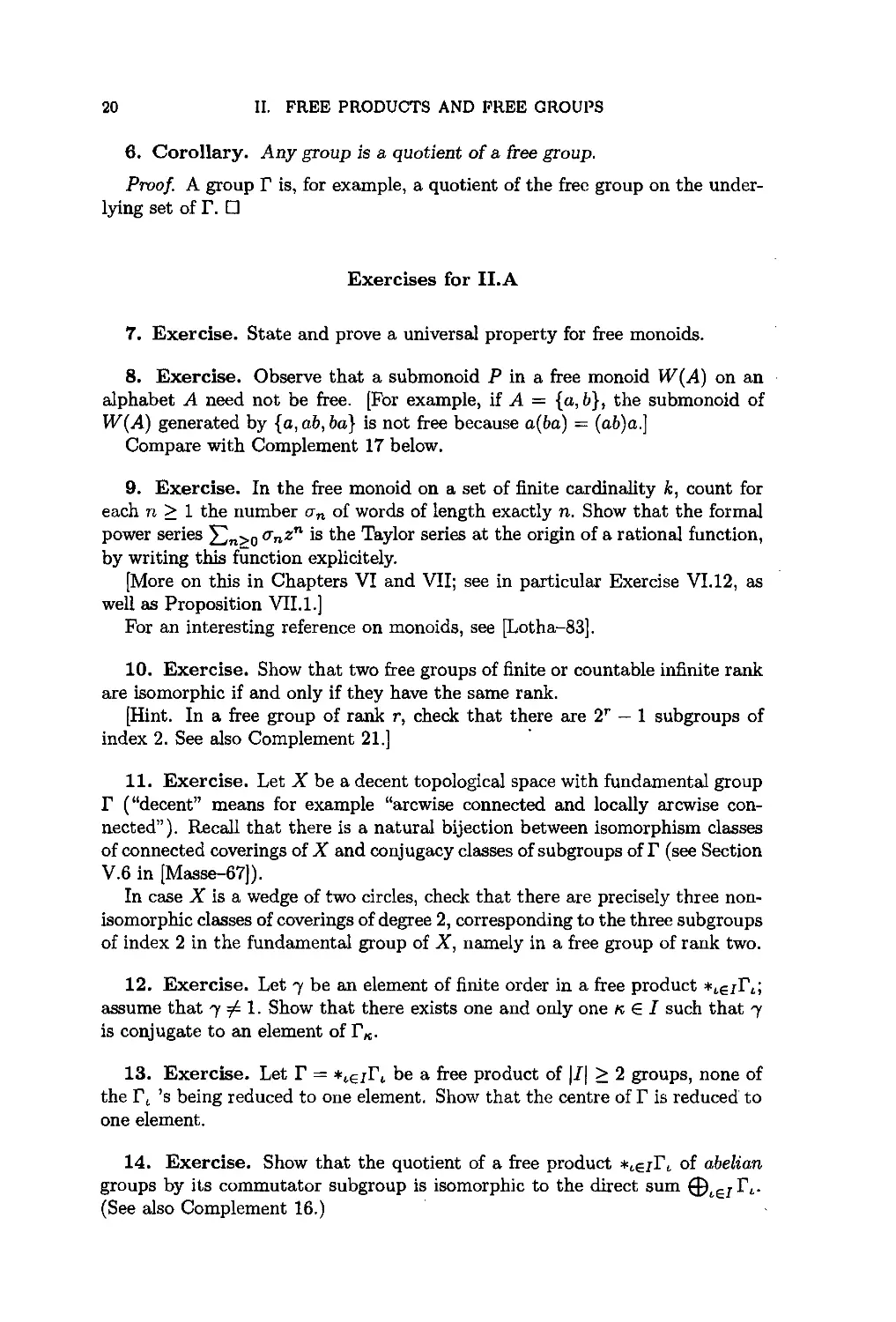
"7. Exercise. State and prove a universal property for free monoids.
8. Exercise. Observe that a submonoid P in a free monoid W(A) on an
alphabet A need not be free. [For example, if A = {a, b}, the submonoid of
W(A) generated by {a, ab, ba} is not free because a(ba) - (ab)a.]
Compare with Complement 17 below.
9. Exercise. In the free monoid on a set of finite cardinality k, count for
each n _> 1 the number a, of words of length exactly n. Show that the formal
power series ],>0 a, z is the Taylor series at the origin of a rational function,
by writing this function explicitely.
[More on this in Chapters VI and VII; see in particular Exercise VI.12, as
well as Proposition VII.1.]
For an interesting reference on monoids, see [Lotha-83].
10. Exercise. Show that two free groups of finite or countable infinite rank
are isomorphic if and only if they have the same rank.
[Hint. In a free group of rank r, check that there are 2 r - 1 subgroups of
index 2. See also Complement 21.]
11. Exercise. Let X be a decent topological space with fundamental group
F ("decent" means for example "arcwise connected and locally arcwise con-
rmcted"). Recall that there is a natural bijection between isomorphism classes
of connected coverings of X and conjugacy classes of subgroups of F (see Section
V.6 in [Masse-67]).
In case X is a wedge of two circles, check that there are precisely three non-
isomorphic classes of coverings of degree 2, corresponding to the three subgroups
of index 2 in the fundamental group of X, namely in a free group of rank two.
12. Exercise. Let /be an element of finite order in a free product *elF;
assume that 7  1. Show that there exists one and only one  E I such that
is conjugate to an element of F.
13. Exercise. Let F -- *elF be a free product of ]II _> 2 groups, none of
the F 's being reduced to one element. Show that the centre of F is reduced to
one element.
14. Exercise. Show that the quotient of a free product *erF of abelian
groups by its commutator subgroup is isomorphic to the direct sum (er F.
(See also Complement 16.)

II.A. FREE PRODUCTS 2l
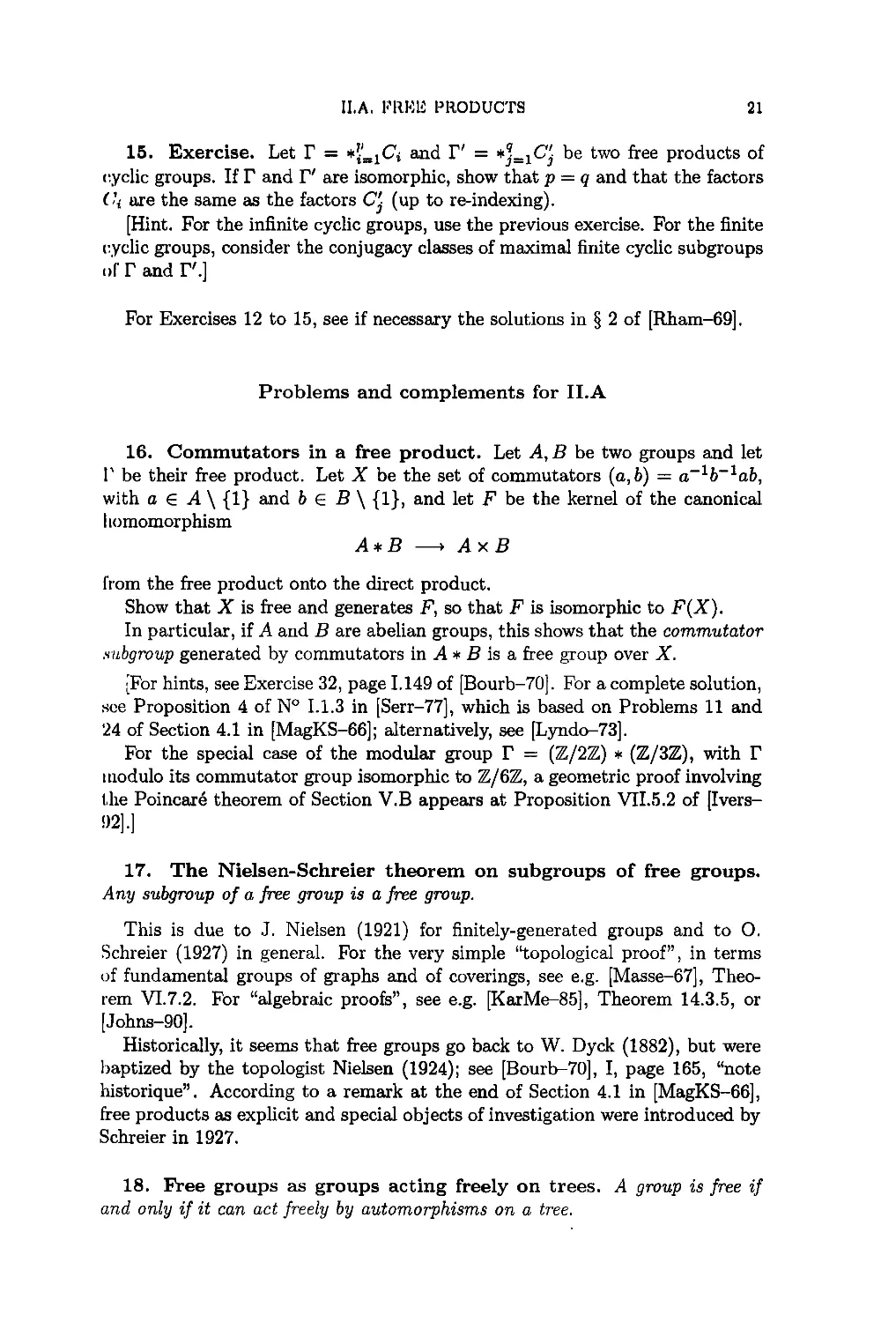
15. Exercise. Let F = *=1C and *q. 1C . be two free products of
3----
cyclic groups. If F and F  are isomorphic, show that p -- q and that the factors
(: are the same as the factors C (up to re-indexing).
[Hint. For the infinite cyclic groups, use the previous exercise. For the finite
cyclic groups, consider the conjugacy classes of maximal finite cyclic subgroups
.l'F and F.]
For Exercises 12 to 15, see if necessary the solutions in § 2 of [Rham-69].
Problems and complements for II.A
16. Commutators in a free product. Let A, B be two groups and let
I' be their free product. Let X be the set of commutators (a, b) = a-lb-lab,
with a E A \ (1} and b E B \ {1}, and let F be the kernel of the canonical
homomorphism
A*B  AxB
from the free product onto the direct product.
Show that X is free and generates F, so that F is isomorphic to F(X).
In particular, if A and B are abelian groups, this shows that the commutator
.ubgroup generated by commutators in A * B is a free group over X.
[For hints, see Exercise 32, page 1.149 of [Bourb-70]. For a complete solution,
see Proposition 4 of N ° 1.1.3 in [Serr-77], which is based on Problems 11 and
24 of Section 4.1 in [MagKS-66]; alternatively, see [Lyndo-73].
For the special case of the modular group F = (Z/2Z) • (Z/3Z), with F
modulo its commutator group isomorphic to Z/6Z, a geometric proof involving
the Poincar theorem of Section V.B appears at Proposition VII.5.2 of [Ivers-
21.l
17. The Nielsen-Schreier theorem on subgroups of free groups.
Any subgroup of a free group is a free group.
This is due to J. Nielsen (1921) for finitely-generated groups and to O.
Schreier (1927) in general. For the very simple "topological proof", in terms
of fundamental groups of graphs and of coverings, see e.g. [Masse-67], Theo-
rem VI.7.2. For "algebraic proofs", see e.g. arMe-85], Theorem 14.3.5, or
[Johns-90].
Historically, it seems that free groups go back to W. Dyck (1882), but were
baptized by the topologist Nielsen (1924); see [Bourb-70], I, page 165, "note
historique". According to a remark at the end of Section 4.1 in [MagKS-66],
free products as explicit and special objects of investigation were introduced by
Schreier in 1927.
18. Free groups as groups acting freely on trees. A group is free if
and only if it can act freely by automorphisms on a tree.

FREE PRODUCTS AND FREE GROUPS
This statement clearly implies the Nielsen-Schreier theorem of the previous
item. It can be found in Reidemeister's book lipide-32, Section 4.20] or in the
more recent book of Serre [Serf-77, § 1.3]; see also [Biggs-89].
There are other free actions by homeomorphisms, for example of Zd on  for
any d _> 1; in this context, recall the following result of HSlder (1901):
i.f a group acts freely on the real line or on the circle by homeomorphisms,
it is abelian
(see Section VIII.3.1 in [HecHi-83] or Theorem 6.10 in [Ghys-99]). It follows.
that groups which act freely on 1R by homeomorphisms are precisely the sub-i
groups of .
The theory of Bass and Serre of graphs o/groups provides a good under-,
standing of more general actions of groups on trees by automorphisms (-- by.
isometries for the combinatorial distance), actions for which each group element-'
may have fixed points but such that no point is fixed by the whole group; see
[Serr-77] and [Bass-93]. For example, one has the following characterization
(Theorem 8.4 in [Bass-93]):
A group has a free sub9roup o/finite index
if and only if it can act properly on a tree.
In this case, "properly" is equivalent to "when the isotropy group of any vertex
is finite".
Finitely-generated groups acting freely by isometries on real trees have been
characterized by E. Rips as free products of free abelian groups and of surface
groups; see [GabLP-94] and [BesF-95]. A real tree is an arcwise connected
metric space in which every arc is homeomorphic to an interval of , or equi-
valently a geodesic metric space which is 0-hyperbolic in the sense of Section
V.D. Ordinary trees are clearly real trees; other examples of real trees occur in
the theory of codimension 1 foliations with a transverse measure, or as Gromov
limits of hyperbolic metric spaces.
19. Free groups are groups of cohomological dimension one. There
is a cohomological characterization of free groups due to Stallings [Stall-68] and
Swan [Swan-69]. One defines cohomology groups H(F, M) associated to a
group F, a F-module M and an integer k >_ 0. The cohomological dimension
of F is the supremum (possibly c) of the integers k for which there exists a
F-module M with Ha(r, M) # {0}.
From the precise definitions, it is easy to check that a group has cohomo-
logical dimension zero if and only if it is reduced to one element. Also, a free
group (not reduced to one element) has cohomological dimension one; this fol-
lows for example from the fact that there exists a CW-complex of dimension
one (a wedge of circles) with fundamental group the given free group and with
universal cover contractible (a tree). The theorem of Stallings and Swan shows
that, conversely,
a group o/cohomological dimension one is necessarily free.
More on the cohomological dimension of groups in [Serr-71].

If,A, FREE PRODUCTS 23
20. Ranks of subgroups of finite index in free groups. Let k >_ 2 be
integer, let Fk be a free group of rank k and let n _> 2 be an integer. Show
tlmt tlmre exist subgroups of F of index n which are free of rank
l = l÷n(k-1).
particular,
a fze group of rank 2 contains subgroups which are free of rank I
f'r any l _ 2.
lnvcrsely, any subgroup of finite index, say n, in F is again free of finite rank,
ay l, and n, k, 1 satisfy the formula above.
l[Iint: the Euler characteristic of a connected covering of degree n of a bou-
qtm of k circles is n - nk.]
21. M. Hall's formula for the number of subgroups of given index
a free group of finite rank. For integers r >_ 1 and n _> 1, let N,.
dote the number of subgroups of index n in the free group of rank r. M.
}btll's inductive formula [HallM-49] states that
j----I
that, for example, N3, -- 3"6 - - 3"2 - + 1 (compare with Exercise 10).
For a given r, this implies that the radius of convergence of the formal power
mries ,>0 N,, z' is zero. In particular, the growth of (N,,r)n_> 0 is super-
r:Tonential.
There are other interesting groups r for which the numbers
N,,r -- number of subgroups of F of index n
have been studied with some detail (see [GruSS-88], [Lubo-95a], [Lubo-95c]).
[t is a conjecture of [Lubo-95e] that, for any lattice r in SO(n, 1), n >_ 3, the
growth of (Nn,r)n> is superexponential.
The following five steps provide a proof of M. Hall's formula.
(i) For a group r, there is a natural bijection between
the set of subgroups F0 of r of index n, together with a numbering of
the classes in r/F0 with number 1 on the class (F0) = F0/r0
and
the set of transitive actions of r on
Thus (n - 1)!N,, is the number of transitive actions of a free group of rank r,
say F, on the set X, -- {1, ..., n}.
(ii) The total number of actions of F on

24 If. FREE PRODUCT. AND FREE GROUPS
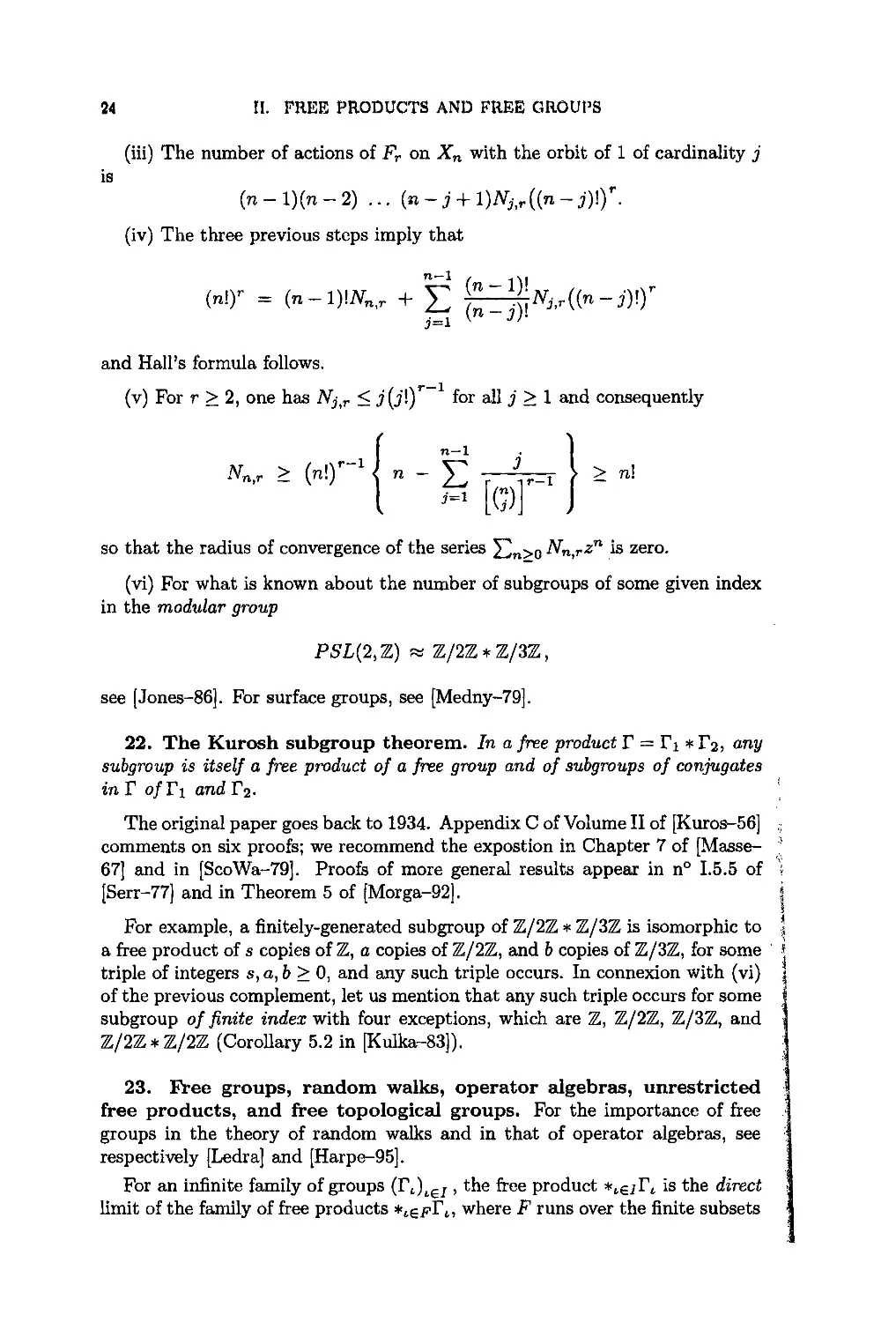
is
(iii) The number of actions of Fr on X, with the orbit of 1 of cardinality j
(n- 1)(n- 2) ... (n-j + 1)Nj,r((n-j)!).
(iv) The three previous stcps imply that
(n - n"
(n!) = +
and Hall's formula follows.
(v) For r _> 2, one has N, _< j (j!)-I for all j _> 1 and consequently
so that the radius of convergence of the series ',>0 N,,r z' .is zero.
(vi) For what is known about the number of subgroups of some given index
in the modular group
PSL(2,Z)  Z/2Z *
see [Jones-86]. For surface groups, see [Medny-79].
22. The Kurosh subgroup theorem. In a free product F = F * F2, any
subgroup is itself a free product of a free group and of subgroups of conjugates
in F of F1 and F2.
The original paper goes back to 1934. Appendix C of Volume II of IKuros-56]
comments on six proofs; we recommend the expostion in Chapter 7 of [Masse-
67] and in [ScoWa-79]. Proofs of more general results appear in n ° 1.5.5 of
[Serr-77] and in Theorem 5 of [Morga-92].
For example, a finitely-generated subgroup of W./2Z, W./3Z is isomorphic to
a free product of s copies of Z, a copies of Z/2Z, and b copies of W./3Z, for some
triple of integers s, a, b _> 0, and any such triple occurs. In connexion with (vi)
of the previous complement, let us mention that any such triple occurs for some
subgroup of finite index with four exceptions, which are Z, Z/2Z, Z/3Z, and
Z/2Z * Z/2Z (Corollary 5.2 in ulka-83]).
23. Free groups, random walks, operator algebras unrestricted
free products, and free topological groups. For the importance of free
groups in the theory of random walks and in that of operator algebras, see
respectively [Ledra] and [Harpe-95].
For an infinite family of groups (F)eI , the free product *elF is the direct
limit of the family of free products *eFF, where F runs over the finite subsets

ll.B. 'I'IIB TABIA,;-'I'ENNIS LEMMA 25
of l, with respect to the natural inclusions *eFF ----* *eGF whenever _ C
G. The unrestricted e product is the inverse limit of the se family, with
respect to the naturM epimorphisms *aF  *eFF whenever F C G,
m,d is naturally a topological gwup. Subgroups of unrestricted ee products
.eeur as fundamental groups of topologicM spies such as HawMian earrings.
See [Higma-52], vious papers by K. Eda including [Eda-92], d Item III.6
Imlow.
For free topological gmups, e [Mark45] and [Grv-48].
II.B. The Table-Tennis Lemma (Klein's criterion) and
examples of free products
The following criterion was used on many occasions by F. Klein, though
ft,: formulation below is more recent. See for example the study of Schottky
groups by Klein (reference in Item 26 below); for recent references, see among
o,hers [Tits-72], Proposition 12.2 of Chapter III in [LynSc-77], [Harpe--83], and
[] husm-81]. This same result is also called the "Ping-Pong Lemma" and the
"Schottky Lemma'.
24. The Table-Tennis Lemma. Let G be a group acting on a set X, let
I', F2 be two subgroups of G, and let F be the subgroup of G generated by F
nnd F2; assume that F contains at least 3 elements and F2 at least 2 elements.
Assume that here exis two non-empty subsets X, X2 in X, with X2 not
included in Xi, such that
7(X2) C X for all "  P , "  1,
v(X) C X2 for all V e P2 , V =t= 1.
Then F is isomorphic to the free produc F • r2.
Proof. Let w be a non-empty reduced word spelled with letters from the
disjoint union of P1 \ {1} and P2 \ {1}. We have to show that the element of r
h:fined by w (again written w) is not the identity.
If w = aibiab...aa with al, ..., aa  P1 \ {1} and b, ..., ba_ 6 P \ {1}, then
w(X2) ---- albl...ak-lbk-lak(X2) C aibl...aa-lbk-l(X1)
C aib...ak-l(X2) C ... C ai(X2) c X.
As X2  Xi this implies that w  1.
If w = bta2b2a2...b, choose a 6 F1 \ {1}; the previous argument shows that
,.wa - ¢ 1, so that w  1. If w = aib...aba, choose a 6 F1 \ {1,a -1} and
argue similarly with awa -. If w = bta2b2...aa, choose a  F1 \ {1,a¢} and
a.rgue with awa -. []
There are more precise results: see e.g. [PayVa-91], which has applications
.o groups acting on trees and their free subgroups. There is an analogous result
for frcc monoids (Proposition VII.2).

..II. FREE PRODUCTS AND FREE GROUPS
25. Example (free subgroup of 8L(2, 7L)). The two matrices
and 2
Proof. Let
and
be the infinite cyclic subgroups of SL(2, Z) generated respectively by the two
(1 2)and (; )WhegroupSL(2,)actslinearlyoniR2inthe
matrices 0 1 "
usual way. One can set
and
to apply the Table-Tennis Lemma. []
[A variant of this proof appears in [LynSc-77], Proposition III.12.3, where
the result is attributed to Sanov (1947). One can of course speculate that
Poincar6 knew the result (see Section V.B below).]
(10 k)and ( 01) generate a free sub-
Observe that the two matrices 1
group of rank two in SL(2, Z) for any k _> 2, for the same reasons, but not for
k -- 1, because
is of finite order. It is well-known that (  )and(ll 01) generate SL(2, Z ).
There is a large number of papers on the following question: for which
A  C do the matrices (10 21)and ( )generate a free subgroup in
0)
SL(2, C) ? As the conjugates of these matrices by x_ 1 are
01)
and Ax_ 2 , it is essentially the same question to ask for which z  C
the matrices ( )and (1 z  ) generate a free subgroup in SL(2, C). See

II,B. THE TAII,I-TENNIS LEMMA 27
I]xcrcise 33; see also Appendix III in [GooHJ-89] and the list of references in
IBambe]. A related question is: for which A   [respectively )  C] do the
two matrices above generate a discrete subgroup of SL(2, ) ? [respectively
'L(2, C) ?] See [Gilma-95]; the question makes sense for Lie groups of higher
',,ks [Oh-98].
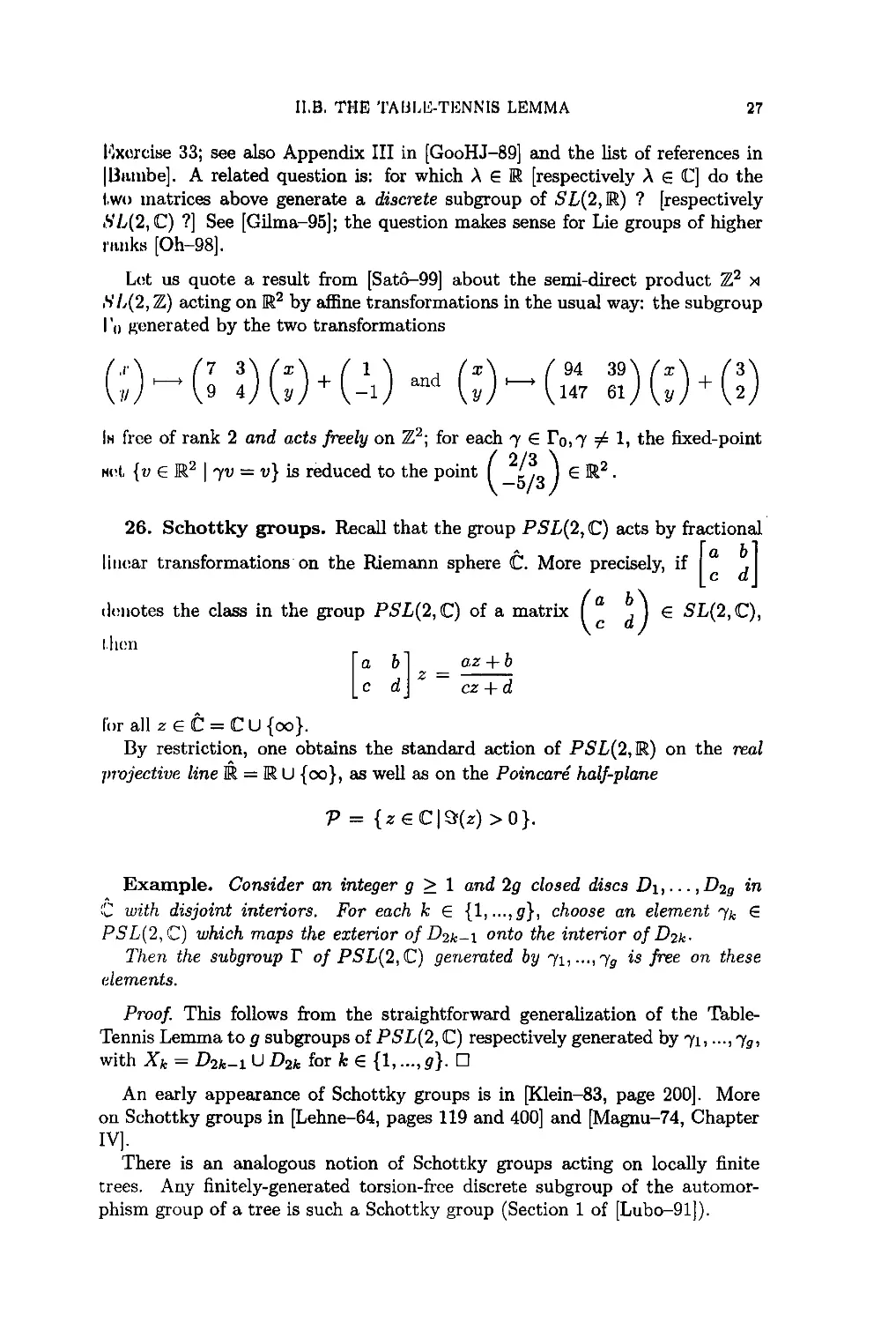
Let us quote a result from [Sat5-99] about the semi-direct product gu
,b'L(2, g) acting on  by affine transformations in the usual way: the subgroup
I'. generated by the two transformations
.' 7 3 x 94
is h'ce of rank 2 and acts freely on Z2; for each "),  F0,')' ¢ 1, the fixed-point
s,t {v e 2 I v = v} is reduced to the point -5/3 ] e .
26. Schottky groups. c that the oup PSL(2, C) ts by tionM
limar traformatio on the emn sphere . More precisely, if [:
deaotes the cls in the oup PSL(2, C)ofamatr (: )
SL(2,
C),
.hen
c +d
i,r all z e  = C U {}.
By restricgion, one obgNns the stdd acgion of PSi(2, N) on the
lrojee¢ive line   N U {},  we  on the PoineN
p =
Example. Consider an integer g >_ 1 and 2g closed discs D,... ,Dug in
 with disjoint interiors. For each k  {1,...,g}, choose an element /k
PSL(2, C) which maps the exterior of D2k- onto the interior of D2k.
Then the subgroup F of PSL(2, C) generated by /, ...,/ is free on these
elements.
Proof. This follows from the straightforward generalization of the Table-
Tennis Lemma to g subgroups of PSL(2, C) respectively generated by 7, ..., 7,
withX=Dua_tD2a fork{1 .... ,g}.[]
An early appearance of Schottky groups is in [Klein-83, page 200]. More
on Schottky groups in [Lehne-64, pages 119 and 400] and [Magnu-74, Chapter
There is an analogous notion of Schottky groups acting on locally finite
rees. Any finitely-generated torsion-free discrete subgroup of the automor-
phism group of a tree is such a Schottky group (Section 1 of [Lubo-91]).

2 II. FREE PRODUCTS AND FlEE GROUPS
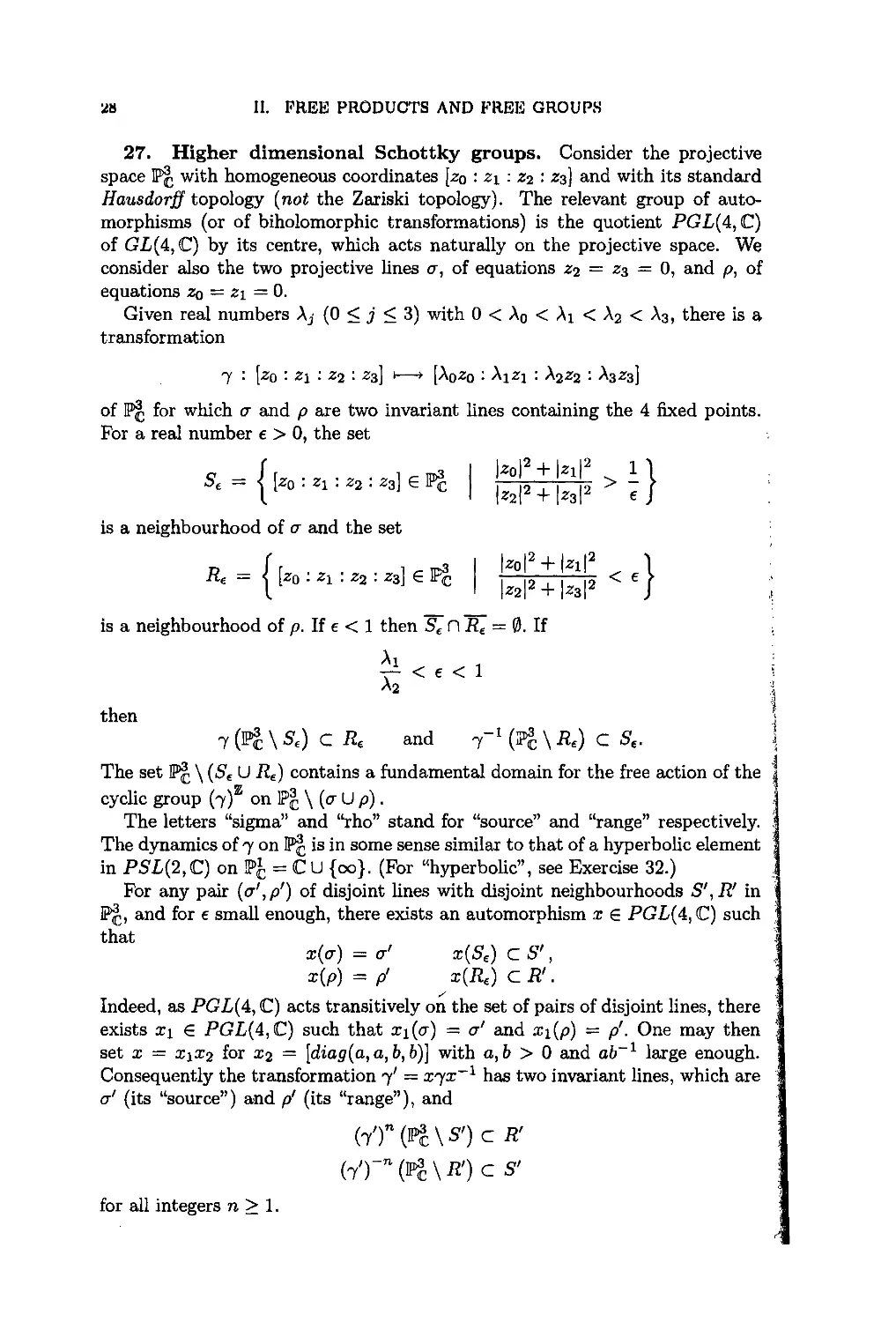
27. Higher dlmensional Schottky groups. Consider the projective
space lF with homogeneous coordinates [zo : zl : z2 : z3] and with its standard
HausdorJ topology (not the Zariski topology). The relevant group of auto-
morphisms (or of biholomorphic transformations) is the quotient PGL(4, C)
of GL(4, C) by its centre, which acts naturally on the projective space. We
consider also the two projective lines a, of equations z2 = z3 = 0, and p, of
equations Zo - zl = 0.
Given real numbers A d (0 <_ j <_ 3) with 0 < A0 < A1 < A2 < A3, there is a
transformation
 : [zo : zl :z2 : z3] -* [),ozo : ),zl : 2z2 : 3z]
of 1 c for which a and p are two invariant lines containing the 4 fixed points.
For a real number e > 0, the set
{ I 1}
S = [Z0 : Zl : Z 2 : Z3] •  IZ012 q- Izl12 > --
IZ212 q-IZ312
is a neighbourhood of a and the set
is a neighbourhood of p. If e < 1 then S n R = 9. If
then
(\s) c , and -'(\,) c
he set  \ (& U R,) contains a fundamental domain for the free action of the
eyelie group (3,) " on ]P \ (a U p).
he letters "sigma" and "rho" stand for "source" and "range" respectively.
• he dynamics of 7 on ]c is in some sense similar to that of a hyperbolic element
in PS'L(2, C) on ]P = C U {oo}. (For "hyperbolic", see Exercise 32.)
or any pair (¢,p) of disjoint lines with disjoint neighbourhoods S , R  in
lic, and for e small enough, there exists an automorphism • • PGL(4, C) such
that
• () = ' (s) c s',
• () = ' (,) c '.
Indeed, as PGL(4, C) acts transitively on the set of pairs of disjoint lines, there
exists x • PGL(4, C) such that x(a) = a' and x(p) = p'. One may then
set x -- xx2 for x2 = [diag(a,a,b,b)] with a,b > 0 and ab - large enough.
Consequently the transformation 7  = xTx - has two invariant lines, which are
a' (its "source") and p (its "range"), and
(')" ( \ s') c n'
(')-" ( \ ') c s'
for all integers n _> 1.

II,B, TIlE TAIHA,.'rENNIS LEMMA 29
Example. Let al, . . . , ag, Pt .... , pg be 2g pairwise disjoint lines in , with
prtitise disjoint neighbourhoods S1, . . . , Sg, R1, . . . , Ra spectively. For each
k ¢ { 1 .... , g}, choose an element 7  PGL(4, C) th "source" a and "mnge"
p,, such that  (  S) C R.
7'hn the su@roup F of PGL(4, C) generated by 7,...,% is fe on these
¢lrments.
I"r,of: analogous to that of Example 26. []
The same construction provides "Schottky groups" in PGL(n, C) for every
> 2, and indeed in any so-called reductive group: '[Benoi-96], [Benoi-97]; see
nls [Nori-96].
28. Example (Heeke groups).
A ... 2 cos(-), the elements
q
Consider an integer q > 3, the number
U = PSL(2, ) and the subgroup r of G generated by them.
7'hen
 (TZ/qTZ) , •
particular, for the modular group:
(vase q = 3).
Proof. We have
PSL(2, Z)  (TZ/az), (Z/2Z)
1
ha(Z) = z + $ and j(z) = --
Z
Ibr all z  79U, with :P and  as in Example 26.
( 1)(gl 1) (-A 1) has trace _A and determinan t
The matrix 0 = -1 0
I. Thus its eigenvalues are -exp (±i). It follows that
bx  axj = -1 : z  --+)
r,.nerates a subgroup F(U of G which is cyclic of order q. More precisely, as the
o]

S0 If, FI:tEE PRODUCTS AND FREE GI:tOUPS
of b is a rotation of  of angle -- with fixed point set {0, oo}, the element
itself is a hyperbolic rotation of 7  of angle - with fixed point exp
b
We denote by F(2) the subgroup {1,j} of G. It is straightforward that j is a
hyperbolic half-turn with fixed point i.
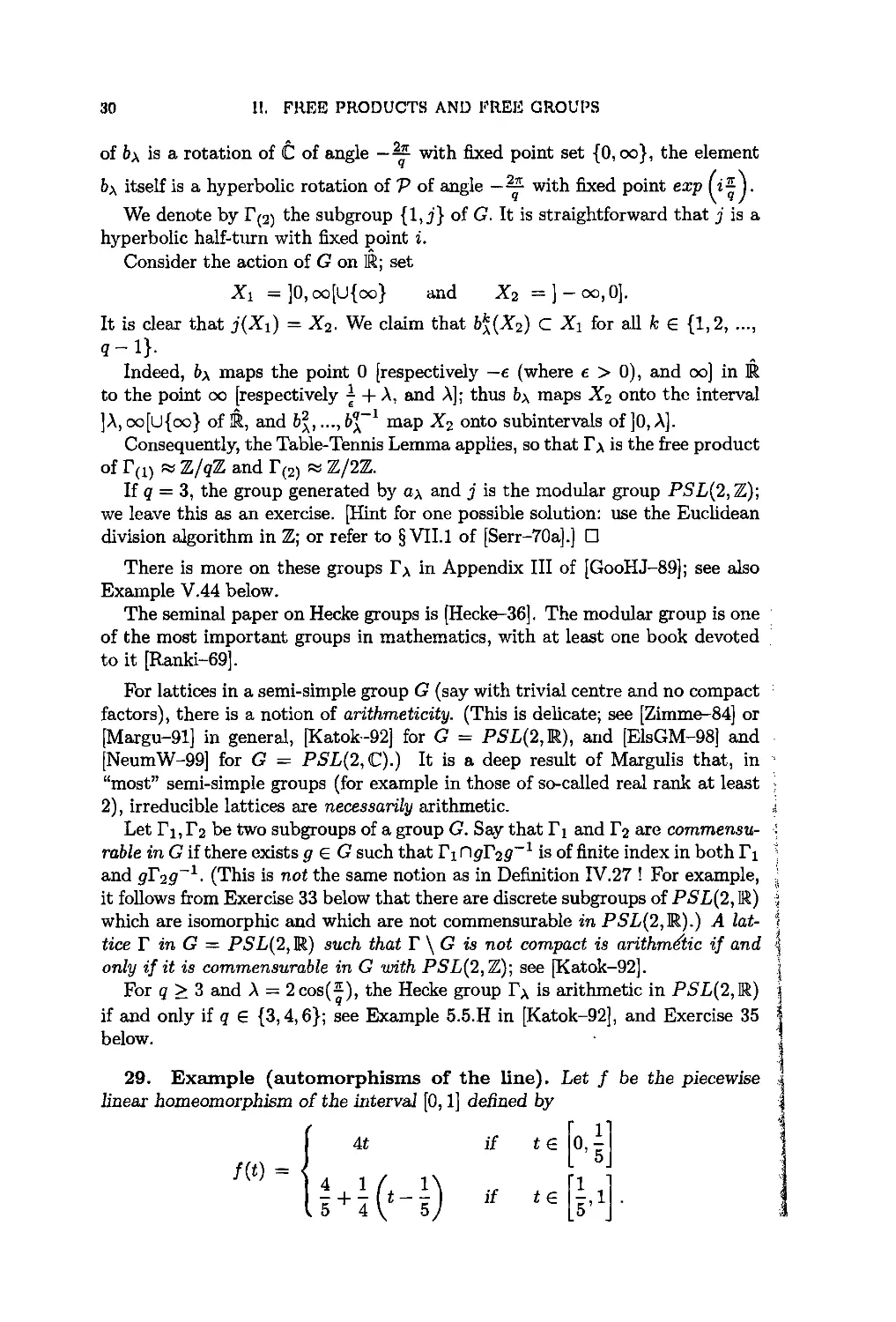
Consider the action of G on ; set
XI = ]0, oo[U{o} and X2 = ] - o% 0].
It is clear that j(X1) = X2. We claim that b(X2) C X1 for all k e {1,2, ...,
Indeed, b maps the point 0 [respectively -e (where e > 0), and oo] in
to the point oo [respectively  + A, and A]; thus b maps X2 onto the interval
]A, oo[3{oo} of ], and b, ..., b -1 map X2 onto subintervals of ]0, A].
Consequently, the Table-Tennis Lemma applies, so that F is the free product
of P(1 )  Z/qZ and r(2 )  Z/2Z.
If q -- 3, the group generated by a and j is the modular group PSL(2, Z);
we leave this as an exercise. [Hint for one possible solution: use the Euclidean
division algorithm in Z; or refer to § VII.1 of [Serr-70a].] []
There is more on these groups F in Appendix III of [GooHJ-89]; see also
Example V.44 below.
The seminal paper on Hecke groups is [Hecke-36]. The modular group is one
of the most important groups in mathematics, with at least one book devoted
to it [Ranki-69].
For lattices in a semi-simple group G (say with trivial centre and no compact
factors), there is a notion of arithmeticity. (This is delicate; see [Zimme-84] or
[Margu-91] in general, [Katok-92] for G = PSL(2,), and [ElsGM-gS] and
[NeumW-99] for G = PSL(2, C).) It is a deep result of Margulis that, in
"most" semi-simple groups (for example in those of so-called real rank at least
2), irreducible lattices are necessarily arithmetic.
Let F1, F2 be two subgroups of a group G. Say that F1 and F2 are commensu-
rable in G if there exists g 6 G such that FOgFg - is of finite index in both F1
and gF2g -. (This is not the same notion as in Definition IV.27 ! For example,
it follows from Exercise 33 below that there are discrete subgroups of PSL(2,
which are isomorphic and which are not commensurable in PSL(2, ]).) A lat-
tice F in G = PSL(2, ]) such that F \ G is not compact is arithmetic if and
only if it is commensurable in G with PSL(2, Z); see [Katok-92].
For q >_ 3 and A = 2 cos(), the Hecke group FA is arithmetic in PSL(2,)
if and only if q 6 {3, 4, 6}; see Example 5.5.H in [Katok-92], and Exercise 35
below.
29. Example (automorphisms of the line). Let f be the piecewise
linear homeomorphism of the interval [0, 1] defined by
•

II,B, THE TABLI.TENNIS LEMMA 31
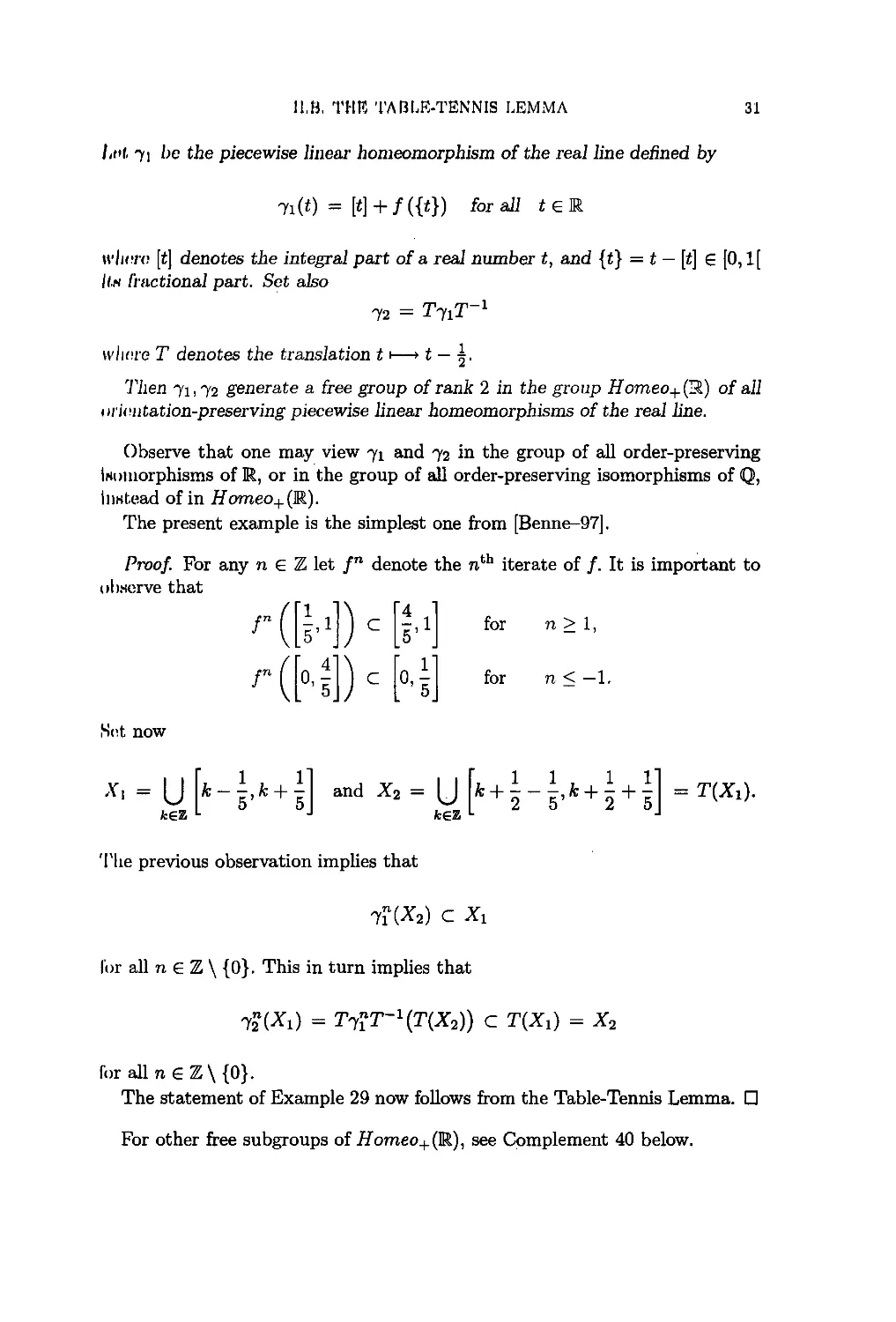
I,*,r, "l be the piecewise linear homeomorphism of the real line defined by
.,t.,,.,, It] denotes te integral prt oe a re nober t, and {t} = t - It] e [0, [
It, fi'actional pt. Set o
72 = TTxT -x
whm'e T denotes the translation t  t - .
Then 7, 7 generate a free group of rank 2 in tile group Homeo+(2) of M1
,rhmation-preserving piecewise line homeomorpis of She real line.
()bsee that one may view 7 d 7z in the group of all order-preserving
lmorphisms of , or in the group of  order-preserving isomorphisms of Q,
Inst;e of in Heo+().
The present exple is the simplest one om [Benny97].
Pwo For any n   let fn denote the n th iterate of f. It is impot to
observe that
f([,l]) c [,1] for nl,
f([O,]) C [0,] for -1.
now
kz 5' +
and X2 = (J k+-g, +7+ =T(XI).
The previous observation implies that
71(x) c x
for all n   \ {0}. This in turn implies that
(X) = TT-(T(X)) C T(X) = X2
fbr M1 n  Z  {0}.
The statement of Exple 29 now foows om the TablTens Lemma.
For other ee suboups of Homeo+(), see Complement 40 bdow.

11. FREE PRODUCTS AND FREE GROUPS
Exercises for II.B
30. Exercise. Let r be a group of transformations of the real line gencrated
by two half-turns with distinct centres. Show that r is isomorphic to the infinite
dihedral group (Z/2Z) * (Z/2).
rl/ 2/] and j be as in Example 28
31. Exercise. Let a -- 1
(Hecke
groups,
case q = c) and let sl, ..., sp E Z\ {0}, with p _> 2. Check that
a81jaSij...jaS  .
Deduce from this that, for two distinct integers k,l >_ 0, the subgroup of
PSL(2,1) generated by aja  and aja  is ee of rank two.
[This is the method used by yon Neumann in [vonNe-29, pages 633-634] to ..
show that PSL(2, I) contains non-abelian free subgroups.]
32. Exercise on parabolic and hyperbolic elements. In the group
G=PSL(2,1),anelementg=[: bd]lisparabolicifithasaurSquefixed
point in  (equivalently, if la ÷ d I --- 2, equivalently if it is conjugate in G to a
translation of ), hyperbolic if it has two distinct fixed points in ] (equivalently,
if la + dl > 2, equivalently if it is conjugate in G to a dilation x - )x of ),
and elliptic if it has a fixed point in the Poincar half-plane 7  (equivalently, if
[ cos7 sintT].
la + d I < 2, equivalently if it is conjugate in G to a rotation [ _ sin 8 cos 8 ] )"
For the equivalences, see for example Section 1.2 in [Magnu-74].
Let F be a subgroup of G generated by two elements 7, 72. Show that F
contains a free group of rank two in each of the following cases.
(i) 7l, 72 are parabolic with distinct fixed points in It,
(ii) 7 is parabolic with fixed point x E I and 7(x) # x,
(iii) /, ,2 are hyperbolic, respectively with fixed points a, w and a, w2,
and {a,}  {a,} = .
33. Exercise on free subgroups of PSL(2, C). For each z  C, let Fz be
the subgroup of PSL(2,C) generated by [10 ] and [ 01].
(i) Show that ( ;)and (lz )generate a free subgroup of rank two
in SL(2, C) if Izl _> 2. [See Example 25.]
(ii) Deduce from (i) that the subgroup Fz of PSL(2, C) is free of rank 2 if
(iii) Deduce from (ii) that F is free of rank 2 if z is transcendental. [Use a
wild automorphism of C.]

II,1t, Till,', TAIII,E-TENNIS LEMMA 33
(iv) For z E lt with ]z] > 2, show that Fz and F2 are not conjugate in-
side PSL(2, ). [The volume of the quotient of the Poincar half-plane P (see
Example 26) by F is infinite, and the volume of P/F2 is finite. 1
(v) Anticipating on Poincard's theorem on fundamental polygons of Fuchsian
z'oups and Section V.B, show that F2 is the fundamental group of an open
.m'face obtained from a 2-sphere by removing three points.
[Consider in the Poincar5 half-plane the fundamental "polygon" P limited
Iy the two half-lines of equation (z) = =t=l and the two half-circles of radius
Then / / applies the left half-line inthe boundary of
 centred at
,into its right half-line and [   ] applies the right half-circle of the boundary
,t'P onto its left half-circle. It is easy to check that the cusp conditions of Item
V.39 are satisfied.[
(vi) There exists also a pair of transformations in PSL(2,F4) generating a
I''ce group F of rank 2 which is the fundamental group of an open surface
,btained from a 2-torus by removing one point.
[With the notation of (v), consider appropriate elements of PSL(2, I) map-
ping the left half-line of the boundary of P onto its right half-circle and its
right half-line onto its left half-circle, and the group F generated by these two
,'lcments.]
(vii) Observe that the subgroups F and F of (v) and (vi) above are two
Iiscrete subgroups of PSL(2,I) which are both free of rank 2 and for which
lhe quotients P/F and P/F' have the same volume. Now the surfaces P/F
md 7)/F are not homeomorphic: any compact subset K of P/F is contained
i,, a larger compact subset L such that (P/F) \ L is connected (i.e.,
has one end, in the sense of Example IV.25.vi), whereas this does not hold for
P/F (which has three ends), It follows that F and F are not conjugate inside
PSL(2, I). This is a first way of showing that "rigidity in the sense of Mostow
does not hold for PSL(2,)" (see [Mosto-73], as well as [GroPa-91]).
(viii) By Teichmiiller theory, hyperbolic structures on an orientable closed
.urfacc E of genus g >_ 2 arc parametrized by the quotient of a disc of dimension
I;g - 6 by a countable equivalence relation. (See e.g. [ImaTa-72] and [Schmu-
!19[; see also the end of Example V.46.) In particular there are uncountably
many embeddings of the fundamental group of E in PSL(2, ), all as discrete
.ubgroups with a finite volume given by the Gauss-Bonnet formula, which are
pMrwise not conjugate. This is a second way of showing that "rigidity in the
.,nse of Mostow does not hold for PSL(2,:)".
34. Exercise on some subgroups of Hecke groups. With the same
lotation as in Example 28 (Hecke groups), set
md let 1" be the subgroup of l"a generated by {ax, a}.

4 I1. FREE PRODUCTS AND FREE GROUPS
If q is odd, check that = [Hint: a (a) -1 = b.]
If q = 2q' is even, check that F is of index two in F. [Hint: F is the kernel
of the homomorphism F -- 2/2, which counts the parity of the number ot
occurrences of j in reduced words in {b,j}.] It is known that F  2 * Z/q'2.
(This is Theorem 7 in [LynU1-69], but it is also an easy consequence of the
theorem of Poincar of Section V.B.)
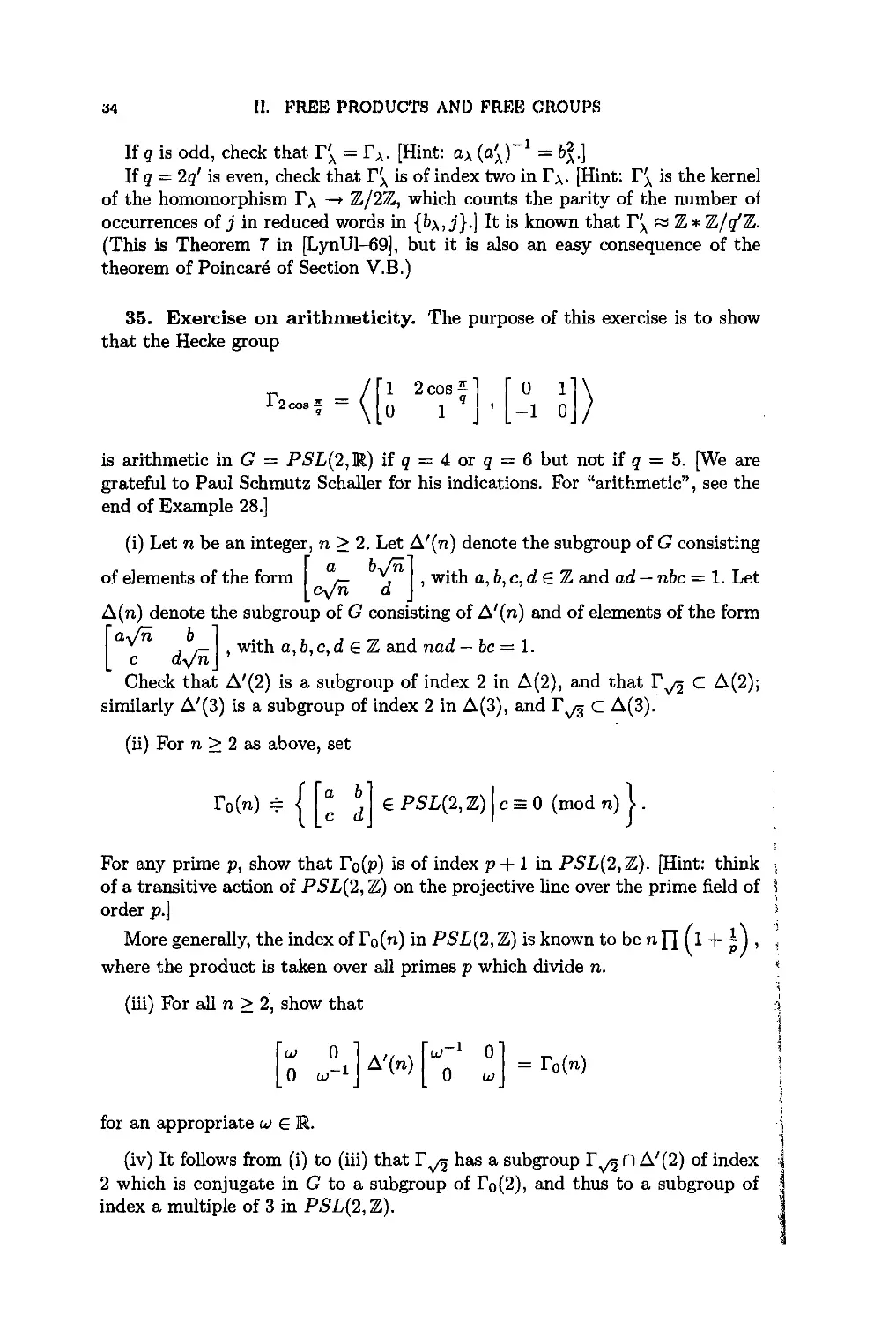
35. Exercise on arithmeticity. The purpose of this exercise is to show
that the Hecke group
is arithmetic in G = PSL(2, JR) if q --- 4 or q = 6 but not if q = 5. [We are
grateful to Paul Schmutz Schaller for his indications. For "arithmetic", see the
end of Example 28.]
(i) Let n be an integer, n _> 2. Let A'(n) denote the subgroup of G consisting
of elements of the form [ a bd ]
cv  , with a, b, c, d E 7/. and ad - nbc = 1. Let
A(n) denote the subgroup of G consisting of A(n) and of elements of the form
dv ' with a, b, c, d  , and nad- be = 1.
Check that A'(2) is a subgroup of index 2 in A(2), and that I',/
similarly A(a) is a subgroup of index 2 in A(a), and rv, g c A(3).
(ii) For n > 2 as above, set
Fo(n) - { [: bd] PSL(2,2) I c=O (modn)}.
For any prime p, show that F0(p) is of index p + 1 in PSL(2, Z). [Hint: think
of a transitive action of PSL(2, ) on the projective line over the prime field of
order p.]
More generally, the index of r0(n)in PSL(2, 2)is known to be n 1-I (1 q- ),
where the product is taken over all primes p which divide n.
(iii) For all n > 2, show that
for an appropriate w
(iv) It follows from (i) to (iii) that F has a subgroup F f3 A'(2) of index
2 which is conjugate in G to a subgroup of F0(2), and thus to a subgroup of
index a multiple of 3 in PSL(2, 2).

II,B, TIlE TABLE-TENNIS LEMMA 35
denotes the Poincard half-plane (as in Example 26), there is a natural
of volume for quotients of P, for which
\ p) =
and vol (PSL(2, Z) \ P) = .
Show that this implies that F,/ A A'(2) is conjugate to the whole of F0(2); in
lm.rticular, Fd and PSL(2, ) are commensurablc in G.
(v) Check as in (iv) that Fv has a subgroup of index 2 which is conjugate
in (7, to F0(3), so that F/ and PSL(2, 2) are commensurable in G.
(vi) If 7 is the element
3'@[10
that
Itrace(7=)] ¢ Q
fur all n k 1. (We denote by Itrace] the function on PSL(2,4) defined via the
usual trace of SL(2, ); of course, without the absolute value, the "trace of an
dmnent in PSL(2, )" would make no sense.)
Deduce from this that F2o  and PSL(2, 2) are not commensurable in G.
[llint: 2cos() = ½(1 + v).]
Problems and complements for II.B
36. Free groups generated by hyperbolic automorphisms of trees.
(See also [Hausm-81].) Let X be a tree; we denote by X ° its vertex set and by
d : X ° x X °  N the usual combinatorial distance function. An automorphism
 of X has an inversion if there exist two vertices in X which are joined by an
,,dge and which are exchanged by 7. An automorphism 7 of X is hyperbolic if
it has no inversion and if its amplitude
a = min d(z,
xX o
is strictly positive; it follows that
{x  X ° I d(x,x) =%}
is the vertex set L of a subgraph L of X which is a geodesic line in X, called
he axis of % and that  induces on L a translation of amplitude a. If
is hyperbolic, observe that  is also hyperbolic for any n  2, n ¢ O, with
same axis as  and with amplitude Inl times larger. An automorphism  of
X is elliptic if there exists a vertex of X fixed by ; it can be shown that an

a II, PREE PRODUCTS AND FREE (H{OUPS
automorphism without inversion is either hyperbolic or elliptic. (See n ° L6.4 in,
[Serr-771.)
Let k be an integer, &  O, and le  be a group of auomorphisms of
wihou inversion. Say  is -aeldeal if he fixed- '
  1 in F has diameter bounded b" - • . oln set of any elemenf
acylindricM is the same as saying that F acts freely on the edge set of X (This
 . m particular, saying that F is 0-
notion of k-acylindrical action, which appears in [Sela-97a], was explained to
me by T. Delzant, to whom I am grateful. See Proposition VII.18 below for an
application, and/Delz-99] for more gener notions.)
Consider two hyperbolic automorphisms ,  of X, respectively with am-
plitudes a, a2 and with is L, L2. We denote by (, 72) the group of auto-
morphisms of X generated by  and 2.
(i) Assume that L  L is either empty or reduced to one vertex. Show that
(, 72) is free on 7 and 2.
Hint. Let y  L and y  L be the end-vertices of the shortest geodesic
segment connecting Li to L2. (One has 9 = 92 in case Lt  L2 consists of
one vertex.) Define X to be the subse of X ° of those vertices x for which
the geodesic segment from x to y contains one of 7(y) '
7 (91), and define
X similarly. Apply the Table-Tennis Lemma to the subgroups (71), (72), of
Aut(X) and the subsets X, X of the vertex set of
(ii) Assume that L  L2 has finite length l 2 1, and let m, rn2
that mtat> l, m2a2 > I. Show that the group (7, 7) is free on
(iii) Assume that a = a2 = a 2 1, that 72 ¢ 7 , and that
k-acylindrical for some k > 0. Check that L  L2 is either empty or a segment
of length at most a + k. -
/Hint: observe first that, if 7, 72 are hyperbolic elements of amplitude a in a .
k-acylindrical group of automorphisms of X and if L1  L2 contains a segment
of lenh a + k + 1, then 72 =
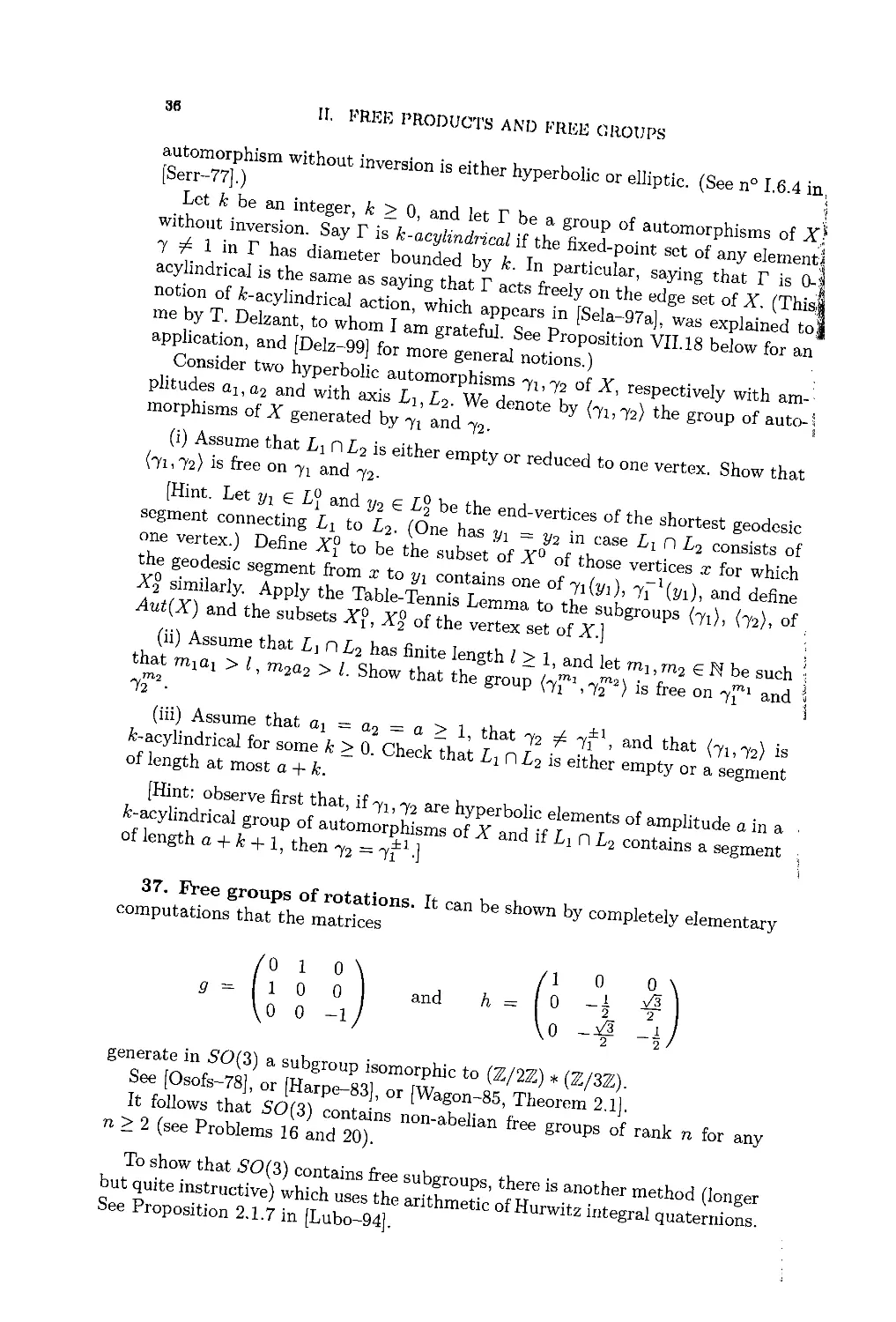
37. ee groups of rotations. It can be shown by completely elementary
computations that the matrices
g = 0 0 and h =
2
generate in S0(3) a subgroup isomorphic to (E/2E),
S [Osofs-78], or [Harpe-83], or/Wagon-85, Theorem 2.1].
It follows that SO(3) contains non-abelian free groups of rank n for any
n  2 (see Problems 16 and 20).
To show that S0(3) contains ee subgroups, there is another method (longer
but quite instructive) which uses the arithmetic of Hurwitz integral quaternions.
See Proposition 2.1.7 in/Lubo-94].

II.B. THE TAI}I,I.,'-TENNIS LEMMA 87
38. Free groups of rational matrices. There are free subgroups of rank
S0(3) n SL(3, Q). There are such subgroups for which any element distinct
fl'om t, he identity has no fixed point on the rational unit sphere 2 A Q3 [Sat6-
and similarly for the sphere (v 2)  Q3 for any rational number q > 0
[S,,C 98].
3). Highly transitive actions of free groups. There exists an action
,hc free group F of rank two on an infinite countable set X which is highly
Ounsitive, i.e., which satisfies the following property: given any integer n _> 1
two labelled subsets of size n in X, say {x,..., x,} and {Yl,. •., y,}, there
,slsts 7  F2 such that 7(xj) = y for j  {1,...,n}. See Section 9.3 of
[l)lxMo-96].
40. lesearch problem. Find an action of an appropriate group on an
n.ppropriate set and use the Table-Tennis Lemma to show that the transforma-
t  t + 1 and t  t a
0mrate a flee group of rank 2. The trformations c be seen
either  homeomorps of ,
r as germs of hommorphisms at  in .
I',r the existing proof (using algebra  la GMois), see [White-88], [AdeGM-91],
uM [CohG1-97]. Another proof would possibly cover other ces, such  one
.rm of homeomorphisms at  "tgent to the identity" ( t  t + 1) and
,nother such germ with appropriate '%ttrting" propeies ( t  t3).
41. Dense free subgroups of topological groups. For a topological
g,',,up G, let D,(G) [respectively Fn(G)] denote the subset of G n of n-uples
(!/,..., g,) generating a subgroup of G which is dense [respectively free of rank
Observe that F2(PSL(2,])) and F(SO(3)) are non-empty by Exercise 28
aud Complement 37. It follows from Lie theory that F,(G) is non-empty for
ay connected real Lie group which is not solvable; under the same hypothesis
, m G, Epstein has pointed out that the complement of F (G) in G  has measure
zero [Epste-71].
Standard arguments in Lie theory show also that, if G is a semi-simple con-
nected real Lie group, then there exist two elements in G generating a subgroup
which is both dense and free of rank 2; see [Bourb-75], Chapter VIII, § 3,
Exercise 10.
If G is a metrizable connected compact group, it is a classical result [SchU1-
35] that D2(G) is residual in G x G (residual subset = countable intersection
,,f open dense subsets). If G is moreover non-abelian, then Fn(G) is residual in
(1' for all n >_ 2; see [Mycie-73] for a stronger result.
If G is a metrizable connected locally compact group which is not solvable,
I').(G) is residual in G  for all n _ 2 by results going back to [Kuran-51]; see
Igain [Mycie-73].

S [l, FREE PRODUCTS AND FREE GROU[S
Let F be a subgroup of SO(3) which is dense and free of rank 2. Arnold
and Krylov have shown that there is a phenomenon of equidistribution, in the
following sense [ArnKr-63]. Choose two generators s, t of F. Let T) be a region
of the two-dimensional sphere which is bounded by a piecewise smooth curve.
For an integer k >_ 0, observe that there are 2 k elements in SO(3) which can be
written as words in s and t (not using the inverses), and let pk(:D) denote the
number of these which map the North Pole into 7). Then the numbers
have a limit when k  ¢¢, which is the ratio between the area of 7) and the
area of the sphere. (There are more recent results due to Lubotzky, Phillips,.
and Sarnak; see Chapter 9, "Distributing points on the sphere", in [Lubo-94],
as well as [Sarna-90].)
Similar results hold for homogenous spaces of motion groups R '  O(n) and
more generally of Lie groups G containing a nilpotent closed invariant subgroup
N such that GIN is compact, by results of Kazhdan [Kazhd-65] and Gnivarc'h
[Guiva-76].
It is an open problem to know whether this carries over to other cases, such
as appropriate subgroups of the group PSL(2, JR) acting by isometries on the
hyperbolic plane. I have been informed that R. Grigorchuk and Yu.B. Vorobets
have partial results for this case (unpublished).
If, moreover, G is an algebraic group such that the quotient of G by its sol-
vable radical is not compact, it is also known that G contains fee subgroups
which are discrete for the Hausdorff topology and Zariskiodense. Appropri-
ate formulations of this fact carry over to algebraic groups over other locally
compact fields [Wink-97a].
For Zariski-dense fee subgroups of algebraic groups defined over arbitrary
fields, see Theorems 3 and 4 in [Tits-72].
42. Tits' alternative [Tits-72]. Let F be a subgroup of GL(N,]K), for
some integer N >_ 1 and some field  of characteristic zero. Then either F has
a non-abelian free subgroup or F possesses a soluble subgroup of finite index.
There is an integer function n  A(n) such that, in case F has no free
subgroup of finite index, F possesses a normal soluble subgroup of index at
most (n) [Wang--81].
As stated above, the alternative is not true for a field of finite characteristic,
as shown by the example of the full linear group over an infinite algebraic
extension of a finite field. However an appropriate formulation carries over to
fields of characteristic > 0 (Theorem 2 in [Tits-72]).
A class C of groups is said to satisfy Tits  alternative if any group in C either
has a non-abelian free subgroup or possesses a soluble subgroup of finite index.
Besides the class of linear groups in characteristic zero (as above), other classes
are known to satisfy Tits' alternative:
• finitely-generated linear groups in finite characteristic [Tits-72],
• one-relator groups (Theorem 3 of [KarSo-71], see also [CecGr-97]),
• subgroups of mapping class groups of surfaces ([Ivano-S4] and [McCar-S5]),
• fundamental groups of appropriate 3-manifolds [Parr-92a],

II.B, THE TABLE-TENNIS LEMMA 39
. mtbgroups of Gromov hyperbolic groups
(see 8.2.F in [Gromo-87] or Theorem 37 of Chapter 8 in [GhyHp-90]),
. I'ree products studied in [FinLR-88],
• Mubgroups of the group of polynomial automorphisms of C 2
([Lany-98] and [Lamy]),
• groups of outer automorphisms of free groups of finite rank (see [BesFH-a]
md [BesFH-b], as well as the discussion in Section 10 of [BasLu-94]).
Thoc'bs of subgroups of automorphisms of locally finite trees does not satisfy
'l'lt,' alternative (see [GupS-S3b], as well as [PayVa-91]).
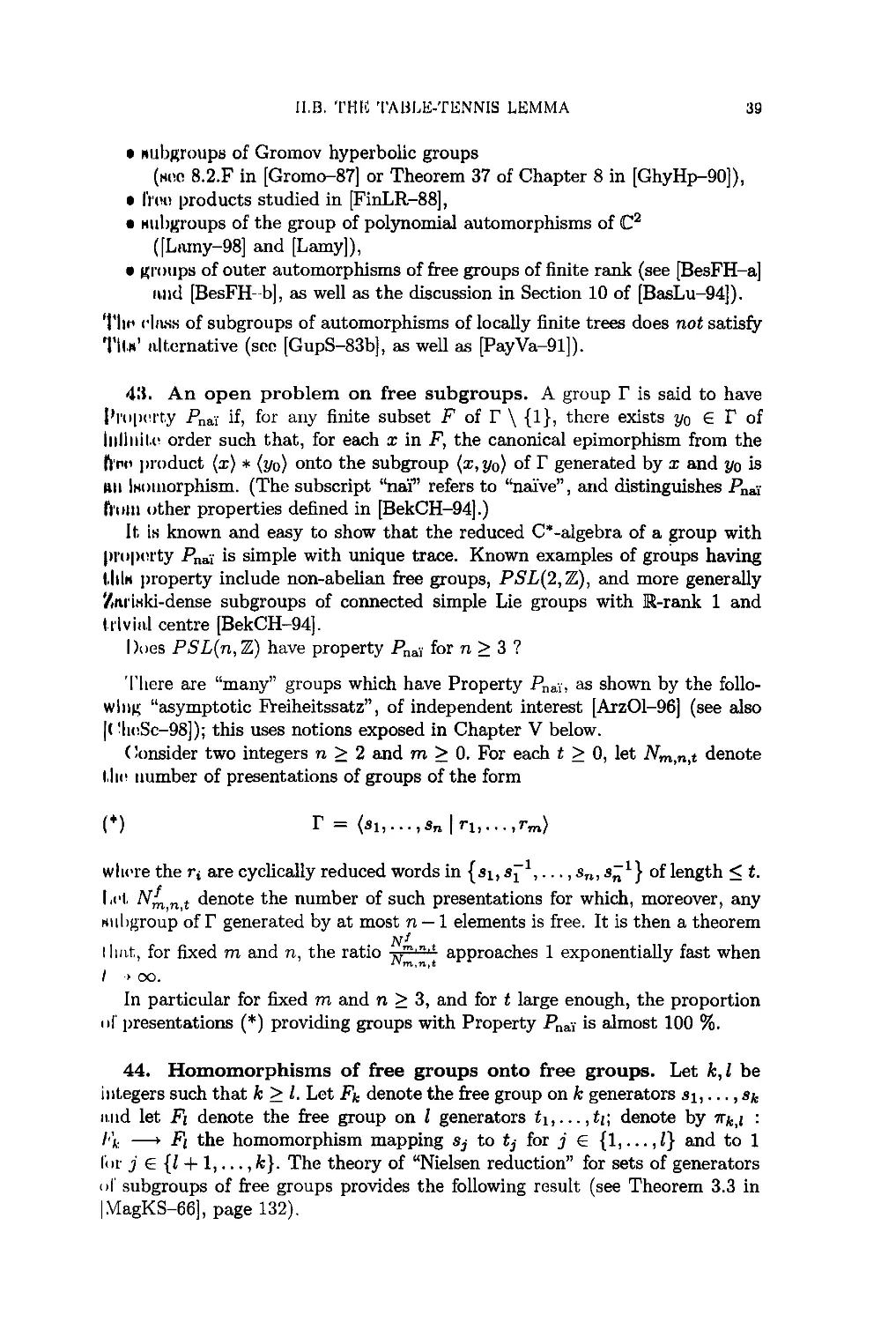
43. An open problem on free subgroups. A group F is said to have
Prqmrty P. if, for any finite subset F of F \ {1}, there exists Y0  F of
hdhfit.c order such that, for each x in F, the canonical epimorphism from the
1'0, product (x) * {yo) onto the subgroup {x, yol of F generated by x and Y0 is
m Isomorphism. (The subscript "na' ' refers to "naive", and distinguishes P
mm other properties defined in [BekCH-94].)
It is known and easy to show that the reduced C*-algebra of a group with
property P.i is simple with unique trace. Known examples of groups having
thl property include non-abelian free groups, PSL(2, ), and more generally
Zariski-dense subgroups of connected simple Lie groups with JR-rank 1 and
trivial centre [BekCH-94].
I)oes PSL(n, ) have property Pn' for n _> 3 ?
There are "many" groups which have Property Pn', as shown by the folio-
whig "asymptotic b-Yeiheitssatz", of independent interest [ArzO1-96] (see also
I{ !hcSc-98]); this uses notions exposed in Chapter V below.
(knsider two integers n > 2 and m _> 0. For each t _> 0, let Nm,n,* denote
the number of presentations of groups of the form
(*)
wl,,,re the ri are cyclically reduced words in {sl, s',..., s,, sff 1 } of length < t.
la,t N  denote the number of such presentations for which, moreover, any
mtbgroup of F generated by at most n - 1 elements is free. It is then a theorem
Ih,.t, for fixed m and n, the ratio  approaches 1 exponentially fast when
In particular for fixed m and n _> 3, and for t large enough, the proportion
1' presentations (*) providing groups with Property Pn'; is almost 100 %.
44. Homomorphisms of free groups onto free groups. Let k, l be
itegers such that k _> I. Let Fk denote the free group on k generators s,..., sk
and let Ft denote the free group on I generators tl,... ,t; denote by 7rk,t :
I,':  Ft the homomorphism mapping s1 to t for j  {1,..., l} and to 1
f,r j  {l + 1,..., k}. The theory of "Nielsen reduction" for sets of generators
,,f subgroups of free groups provides the following result (see Theorem 3.3 in
I,V[agKS-66], page 132).

40 I1. FREE PRODUCTS AND FREE GROUPS
Proposition. Ilk _ l, any homomorphism r from Fa onto F can be written
as r = rk, for some automorphism  of F, with rk, as above.
Concerning homomorphisms of (not necessarily free) groups onto flee groups,
there are open problems with a low-dimensional topology flavour in [Stall-95].
45. Open problem. For an integer g _ 1, consider the homomorphism
mapping the first g [respectively the last g] generators of F2g onto the g gener-
ators of the first factor [respectively of the second factor] in F x F.
Is is true that any homomorphism 7r from F2g onto F × F can be written
as r = c for some automorphism
The question has an affirmative answer for g = 1 (easy exercise). If the..
answer were affirmative for all g _> 2, it would imply the truth of a conjecture of
Andrews and Curtis on presentation of the trivial group with the same number
of generators and relations; see [Wrigh-75], page 205 in [GriKu-93], [BurMa-
93], [HogMe-93], and Problem 5.2 of Kirby-97].
46. Kervaire's conjecture. Let F be a group, let
of F and of an infinite cyclic g.roup, let r be an element of
smallest normal subgroup of F containing r. If the quotient /N is reduced to
one element, does it follow that F is reduced to one element ?
The problem arose from higher-dimensional knot theory [Kerva-65]. It was
first expressed in private conversation with Gilbert Baumslag in winter 1963/64
[gervaire, private communication]; record of this appears in [MaggS-66], page
403. Though progress has been achieved by A. Klyachko, the problem is still
open (see [Klyac-93] and [FenRo-96]). A discussion appears in Problem 5.7 of
[Kirby-97].
47. Combinatorial group formulation of the Poincar conjecture.
For an integer g >_ 1, consider the surface group
F a = (al,bl,...,ag,bg I [al,bl]... [a a,ba] -- 1)
(we anticipate here on presentations of groups, as in Chapter V below). For
homomorphisms from Fa onto free groups, the following two results are due to
H. Zieschang. (See the comment which follows Proposition 1.6.4 in [LynSc-77],
as well as [GriKZ-92].)
(i) There exists a homomorphisn from Fa onto F if and only if k _< g.
[To show the inequality, use the fact that the homomorphism Fa ---* Fk has a
section and the fact that, since the cup product in the cohomology H I(F, Q) is
zero, H(Fg, Q) must have a subspace of dimension k on which the cup product
is zero.]
(ii) For k _ g and two homomorphisms b, b f from Fa onto Fk, there exists
an automorphism c of F such that b

II,B. TI.IE TAI:ILE-TENNIS LEMMA 41
(',nsidcr now the homomorphism
llapling at,... ,ag [respectively bl,..., bg] onto the g generators of the first
flw.t,,r [respectively of the second factor] in Fg x F. (A Heegard splitting of
,,ms g of a closed 3-manifold gives such a pair of homomorphisms into free
rcups of rank g.)
1. it true hat any homomorphism r from F onto F x F can be written as
 : re for some automorphism a of F ?
It is an exercise to show that the answer is "yes" for g = 1. It is known
th,,t this question has an affirmative answer for all g _> 1 if and only if the 3-
dimensional Poincar conjecture is true. See [Stall-66], [Jaco-69], and Theorem
l,l.{; in [Hempe-76].
There are other open questions of low-dimensional topology which have a
mup-theoretic formulation, for example Whitehead's conjecture ([Bogle-93],
[]hgDy-95]): if Y is a sub-complex of a 2-complex X and if the universal
'vcr of X is contractible, then the universal cover of Y is conjecturally also
c'tractible. But at least one of this conjecture and another famous conjecture,
h "Eilenberg-Ganea conjecture", does not hold [BesBr-97].
48. Groups without non-abelian free subgroups. It may be true and
non-obvious that some given group does NOT contain any non-abelian free
group.
This is for example the case of the group PL+([0, 1]) of pieeewise linear
.dentation-preserving homeomorphisms of the real line, by Theorem 3.1 in
Ilh'iSq-85] (see also Corollary 4.9 in [CanFP-96] and Theorem 4.6 in [Ghys-99]).
[[owever, it is also known that this group satisfies no laws: for any non-empty
r,duced word w in the free group on two letters, there exist g, h  PL+([0, 1])
such that w(g, h)  1 [BriSq-85]. The same results hold for the Thompson
group which is a subgroup of PL+([0, 1])..
For linear groups, Tits' alternative of Complement 42 provides a criterion
fir the existence of non-abelian free subgroups.

CHAPTER III
FINITELY-GENERATED GROUPS
After a first section with simple examples, we concentrate in this chapter on
two-generator groups, and give in particular an exposition of B.H. Neumann's
ttrnment (1937) showing that there are uncountably many such groups.
III.A. Finitely-generated and infinitely-generated groups
A group F is finitely generated, or of finite type, if there is a finite subset
C F such that, for any y E F, there exists a finite sequence Sl, s2, ..., s of
vh,ments in S U S -1 with "7 = sis2 ... s. Equivalently, a group F is finitely
g,ncrated if it is a quotient of a free group of finite rank.
Observe that a finitely-generated group is necessarily countable. Finitely-
enerated groups are easier to understand than countable groups in general,
both in terms of their structure (think of abelian groups!) and in terms of their
notions (examples are given in Complements 20 and 25).
The present Section III.A is essentially a description of groups, both finitely
enerated and not. Some examples require knowledge outside the scope of these
mtes, but they can also be skipped by the reader without making it impossible
read later sections.
1. Example. The group  is finitely generated for any integer n.
2. Example.
More precisely, the four matrices
/o o o ... o \
|1 0 0 ... 0 0
s= [0 1 0 ... 0 0
. .;. .;. ::: ";" .;.
\0 0 0 ... 1 0
The group GL(n, Z) is finitely generated for any integer n.
/o 1 o...o o
/ 1 o o ... 0 o
s2= [0 0 1 ... 0 0
m :::
\0 0 0 ... 0 1
1 1 0 ... 0 0
0 1 0 ... 0 0
0 0 1 ... 0 0
0 0 0 ... 1 0
0 0 0 ... 0 1
S 4
--1 0 0 ... 0 0
0 1 0 ... 0 0
0 0 1 ... 0 0
0 0 0 ... 1 0
0 0 0 ... 0 1
43

44 Ill. FINITELY-GENERATED GROUPS
generate GL(n, ) for any integer n >_ 2.
Left [respectively right] multiplication by sl permutes rows [respectively
columns] cyclically, left [respectively right] multiplication by s2 permutes the
first 2 rows [respectively the first 2 columns], s3 differs from the unit matrix by
the single entry (sa)l,2 -- 1 and s4 differs from the unit matrix by the single
entry (sa)l,1 = -I.
Sketch of proof. Finite products of the sj's include permutation matrices
(this uses sl, s2) and "elementary matrices" differing from the unit matrix in
one off-diagonal entry only (this uses also
Now using the Euclidean algorithm, one can express any 7 E GL(n, ) as a
product of elementary matrices and of s4. This is a particular case of reduction
to Hermite's normal form of n-by-n matrices with coefficients in a Euclidean
ring.
For details, see e.g. Section 22 in [MacDu-46]. See also Example V.9. []
Hua and Reiner have shown that sl, s3, s4 suffice, by writing down a (rather
long) formula for s2 in terms of sl, s3, s4. Trott has shown that s], s3 generate
GL(n, Z) when n is even and SL(n, ) when n is odd. (References in § 7.2 of
[CoxMo-57].) It is known that SL(n, Z) can be generated by two elements for
all n >_ 2; see Proposition 5 in [Wilso-76].
There is another proof in terms of Siegel domains in GL(n, ); see [Borel-69],
in particular Corollary 4.8.
Comments. (i) Let R be the ring of integers of a number field and let n >_ 3
be an integer. Then SL(n, R) is finitely generated; this goes back to 1895 and
to A. Hurwitz (quoted on page 96 of [BasMS-67]), but classical methods are
considerably more difficult to apply for this case than for the previous example
of R = E. Since Kazhdan's work [Kazhd-67], the usual way of showing this uses
the so-called "Property (T)"; see Complement V.20.
The fact that SL(n, R) is finitely generated is relevant to K-theory. • (It
implies that "the group SK](R) is finite"; see the discussion in page 81 of
[lsen-94].)
(ii) It is not always easy to decide whether a given countable group is finitely
generated or not. See (ii) in Complement 16, the discussion in Example V.7,
or the open problem stated at the end of Exercise V.18.
(iii) It is also elementary to show that, for any n _ 3, there is a number
'n such that any matrix in SL(n, Z) can be written as a product of at most
u, elementary matrices [AdiMe-92]; in other words SL(n,Z) is boundedly ele-
mentary generated; analogous results for other rings require more machinery
([CarKc-83], [Tauge-91]). Bounded generation is an important ingredient in
Shalom's approach to Kazhdan Property (T); see [Shalo-a] and [Shalo-b].

III.A. FINITELY-GENERATI,D AND INFINITEIN-GENEItATED GROUI'8 45
3. Example. Let F be a t'ree group of finite rank, let N be a normal
lbgrolp off distinct om {1}, d let Q denote he quoien group FIN.
Then N is finitely generated if and only if N is of finite index, nely if and
,v if Q is a finite oup.
Pwof. As F is the ndament group of a bouquet of circles B, the norm
,bgr,up N corresponds to a covering  : X  B; the covering space X is a
,mmcted graph d the fibers of  e in bijection with Q.
] Q is finite, X is a finite graph d N  Hi(X) (the ndental group of
X) is finitely generated.
If Q is inflate, X is a connected infie graph wch is not a tree (because
ff ,he assumption N  {1}), on wch N acs properly discontinuously. Thus
," has infinitely many disjoint closed paths, and consequently its first homology
mup H1 (X, Z) is not finitely generated. A fortiori N  Hi(X) is not finitely
gmrated.
[,r other contions equivMent to Q being finite, see [Grun78]. For growth
fmctions of generating sets of Q when Q is inite,  Complement VIA1.
Chapter V is devoted to finitely-presented groups F, appearing in short exact
,quenc of the form 1  F   F  F  1 where F is a free group
f finitc rank d F  a normM subgroup generated as a nodal subgwup by
,. lignite subset of F; if F is infinite, Example 3 shows that F  is never finitely
ncrated as a gmup,
Here e two generalizations of Exple 3.
(i) Let F be  in Exple 3 d let R be a suboup of F of inflate index.
Assume that R contns a normM subgroup of F not reduced to (1}. Then R
Is not finitely generated, by Theorem 2.10 in Section 2.4 of [MagKS-66].
(ii) Let F = A * B be a ee product of two non-triviM groups and let A
b, t finitely-generated normM subgroup of F. Then either A is reduced to one
,ment or A has finite index in F (Theorem 3.11 in [ScoWa-79]).
4. Examples of groups which e not finitely generated.
Let X be an ite set and let Symy(X ) be the group of permutations
' X of fite support, nely of permutations a for wch {x  Xa(x)
.r} is finite. For y finite subset Y of X, the smetric oup Sym(Y) of
' is naturMly a subgroup of Symy(X ). Any fitely-generated subgroup of
,'ymi(X) is contorted in Sym(Y) for  appropriate finite subset Y of X; in
particul, Symf(X) is not finitely generated.
Similarly, y locMly fite infinite group is not finitely generated. It is known
thtt there e uncountably many pise non-isomorphic untable groups
which e infinite and locMly finite; see [KegW73]. (RecM1 that a oup is
l,,,'ally finite if a its finitely-generated subgroups are finite; the terminology
i well tabshed, even if it is not consistent with that for "locy compact
The additive group of Q is not fitely generated.  its fitely-generated
:bgroups distinct om {0} e imorphic to Z.

46 lII. FINITELY-GENERATED GROUPS
More generally, the additive group of any infinite field is not finitely gene-
rated. (If the field is infinite dimensional over its prime field, this should be
clear to the reader. Otherwise, the additive group of the field contains that
of Q, and the conclusion follows from the case of Q, because a subgroup of
finitely-generated abelian group is necessarily finitely generated.)
The multiplicative group Q* of Q is not finitely generated. More precisely,
any finitely-generated subgroup of Q* is contained in the free abelian group
of those rationals of the form -£ " with m and n products of primes in some finite
set S of prime numbers.
The same argument shows that the multiplicative group of a pure transcen-
dental extension Fq(T) of a finite field is not finitely generated. (The only
knowledge required is that the polynomial ring Fq[T[ comains infinitely many
irreducibles. This follows for example from the fact that there exists a finite
field of order q! for any integer f _> 1. Alternatively, this follows from known
exact formulas giving the number Nq(f) of monic irreducible polynomials of
degree f in ]Fq[T]; these formulas show in particular that Nq(f) _> 1 for all
f _> 1; see Theorem 3.25 in [LidNi-83].)
If ]K is an infinite algebraic extension of a finite field, then ]K* is an infinite
locally finite group, and as such it is not a finitely-generated group.
It follows that ]K* is not finitely generated for any infinite field. (The proof
again uses the fact that a subgroup of a finitely generated abelian group is itself
finitely generated, and the three previous particular cases.)
If n _> 2, the group SL(n, Q) is not finitely generated. All its finitely-
generated subgroups are contained in subgroups of the form SL (n,Z
for some integer N _> 1 (Exercise 12).
More generally, for any infinite field ]K of characteristic 0, the group SL(n, K)
is not finitely generated. (This requires some tools -- for example the simplicity
of SL(n,]K) and a result of Mal'cev [Mal'c-40] according to which finitely-
generated subgroups of GL(n, C) are "residually finite"-- see Complements 18
and 20 below.)
Let q be a prime power, let ]F be the finite field of order q, and let ]F[T]
denote the ring of polynomials in one variable with coefficients in ]Fq. It is known
that the group SL(2,IFq[T]) is not finitely generated (this is due to Nagao --
see page 121 of [Serr-70b]). Similarly, let G be a connected simple Lie group
of rank one over the local field ]Fq(T) and let F be a lattice in G such that G/F
is not compact; then F is not finitely generated (see [Lubo--89], [Lubo-91]).
However SL(n,]Fq[T]) is finitely generated whenever n _> 3, because these
groups have the "Property (T) of Kazhdan". (See [Kazhd-67] and [HarVa-89],
as well as Item V.20.iv below.)
For n _> 2, let Fn  Fn/[[Fn, Fn], [Fn, Fn]] denote the free metabelian group
on n generators (where Fn denotes the free group of rank n). Then Aut(Fn) is
finitely generated if and only if n  3 (see [Bachm-85], [BacMo-85]).

Ill.A, FINITELY-GENERNI'ED AND INFINITELY-GENERATED GROUPS 47
5. Examples of non finitely-generated subgroups of finitely-gene-
rated groups.
A first example is provided by the group
|' -- E GL(2,) a-2 nand b-- for some n,p, qEZ
which is generated by the tw° matrices (200) and (1011)1 , andthesub-
which is not finitely generated. (This F is the group I1,2 of Complement 21.)
A second example is F0 C F = F0  Z where F0 = je F(j) is a direct
mu of copies of Z indexed by Z, where Z acts on F0 by ss, d where
Italic.ares he corresponding semi-direct product. (The group F is known as the
wreath product Z  ; e II.3 below.)
A trd exple is given by a ee group of ra 2 d a suboup wch is
fr, of infinite rank. (Think either of an infinite connect covering of a wge
l' i,wo circles, or of the group generated by (anba-}n in the ee group on
{u, b}.) The kernd F in Problem II.16 for A  B inite provides  analogous
,xample.
There exists an example, due to Remeslenkov, of a finitely-presented group
whse centre is not fitely generated [mes-74]. It is an open problem to
[Imw whether any countable abdi oup is a subgroup of the centre of some
fi,itcly-prented group (Problem 5.47 of the Koov notebook our95]).
It is also unknown whether the centre of F is Mways finitely generated, for F the
hmdental group of a finite asphel complex. (Ts is Pt (A) of Mess'
Problem 5.11 in irby-97]; Pt (D)  ong other questions whether such
n Z,'oup c be of intermeate oh, in the nse of Chapter  below.)
la a finitely-generated group which is visually  polycyclic, namely which
,'a,ains a normal polycyclic 2 group of finite index, it is ey to show that y
ubgroup is n fitely generated. (Ts foows esntiMly om the same
property for finite oups d for finitdy-generated abeli groups; e Theorem
I. l(; in [MacDo-88] for the nilpotent case or Retook 4.2 in [Raghu-72].)
Here is a ptiM converse: a fitdy-generated soluble group wch is not
vi,',,uMly polycycc does contMn suboups which e not finitely generated.
More generMly, a group F is said to have virtually some Property (P) if F contains a
,,,group of finite index which do hve Property (P).
A group r is polycyclic if there exits  nted quence of subgroups
r=ro > r > ... >
,,,.h that Fi is a normal suboup of r-i nd r_/r is cyclic for h i  {1,... ,m}. By
th,orems of MMv and L. Auslander,  oup  polycyclic if and only if it  omohic to
,. s, dvable subgroup of GL(n, Z), for some n  1 ( Chapters 2 d 5 in [SegM3]).

48 III. FINITELY-GENERATED GKOUPS
(This follows essentially from the fct that an abelian group is polycyclic if
and only if it is finitely generated. See Proposition 4 of § 1.A in [Segal-83].)
But examples are known of finitely-generated infinite groups which are simple
(in particular not virtually solvable, and even less polycylic), and in which any
subgroup is finitely generated, indeed in which any proper subgroup is infinite
cyclic; one example appears as Theorem 28.3 in [O1's-89]. Ol'shanskii has also
shown that any non-elementary torsion-free hyperbolic group has a non-abelian.
torsion-free infinite quotient in which any proper subgroup is cyclic (Corollary
1 of [ors-3]).
A group is said to be slender if all its subgroups axe finitely genetatedii
[DunSa-99]. .
See also Complement 16 below.
6. Fundamental groups. Fundamental groups of finite CW-complexes!
and of compact manifolds are finitely generated (and indeed finitely presented:: I
see Example V.7 below). But more complicated topological spaces may have'!
"large" fundamental groups.
For example, for any integer n > 2, Antoine (1921) has constructed a nested:,
sequence (Nk)k>l of compact subsets of
is the union of (2n)  solid tori linked with one another, the so-called Antoinel
necklace A = q=lN is a Cantor set, and the fundamental group
is not finitely-generated (see § 6 in [lham-69]). Here is another example: the
fundamental group of the Hawaiian earring is not countable, and a fortiori not'i
finitely generated; it not free, for example because its abelianization contains an
element a ¢ 1 which is a kth power for infinitely many integers k (see [Smit-92] ..
and [CanCo]).
The following general result has been conjectured by Mycielski and provedl
by Shelah (see [Pawli-98]). The fundamental group of a compact metric space
which is path-connected and locally path-connected is either finitely generated"!
or of the cardinality of the continuum; in particular such a group cannot be,
isomorphic to Q.
It is apparently unknown whether any finitely-generated group can be re-
alized as the fundamental group of a compact metric space which is path-.:
connected and locally path-connected.
Exercises for III.A
7. Exercise. (i) Let F be the semi-direct product of Symf(Z) by the. :
translation n  n + 1 of Z (see the first example in Item 4 above for the.:
notation). Check that F is finitely generated, though Symf(Z) is not.
(ii) Define two permutations ¢ and ¢ of the set X consisting of the disjoint ..
union of Z and of a point * by
¢(x) = x+l for xEZ and ¢(*) = •
¢(0) = * , ¢(*) = 0 and ¢(x) = xif x{0,.}.

III.A. FINITELY-GENEKNI'ED AND INFINITELY-GENERATED GROUPS 49
that SymI(Z ) is a subgroup of the group generated by q and ¢ (this
,qqmars in [Ulam-74], page 677).
8. Exercise. Let F be a finitely-generated group.
(I) Show that any subgroup of finite index in F is finitely generated.
[ladication. One standard proof uses the so-called lidemeister-Schreier
mmthod, which indeed shows much more; see Corollary 2.7.1 in [MagKS-66].
also Corollary IV.24.i.]
(ii) Let S be an infinite generating subset of F. Check that there exists a
finite subset of S which generates F.
IH(,,c also Proposition V.2 and Exercise V.11.]
9. Exercise. (i) For the free group F2 of rank two, show that there exists
a, iniinitetowerF < F < ... < F < ... < F2 of subgroups ofF2 such
I.hm. F. # P+ for all n _> 1.
(ii) Let F be a finitely-generated group and let F < F2 < ... < F, <
.,. < F be an infinite tower such that F = U_>Fn. Show that F = F for n
bu'gc enough.
10. Exercise. Let p,... ,p be distinct prime numbers and let N be their
pr,,duct; set qj =  for each j e {1 .... , n} and S = {q,..., qn}. Check that
," gmerates Z and that no proper subset of S does.
11. Exercise. Show that, for any n k 2, there exist two finite groups F, F2
md a homomorphism of the free product F * F2 onto GL(n, ).
IHint. With the notation of Example 2, take for F the subgroup of GL(n, )
,mrated by {s, s, s4} and for F. the cyclic subgroup generated by the prod-
II(!t S4S283. ]
,%;e also Complement 39 below.
12. Exercise. Show that, for n >_ 2, any finitely-generated subgroup of
,'L('n,Q) is contained in SL (n, []) for some integer N _> 1.
[Hint: take for N the least common multiple of the denominators of the
matrix entries of the generators and of their inverses.]
Problems and complements for III.A
.13. Indecomposable groups and Grushko's theorem. A group F is
mdecomposable if, whenever it can be written as a free product F1 * F2, then F1
,, ['2 is reduced to one element. Here are a few examples of indecomposable
.:r,ups:
• finite groups,
• simple groups (see problems 13 and 23 in Section 4.1 of [MagKS-66]),

50 Ill. FINITELY-GENERATED GROUPS
• groups with non-trivial centres, and, in particular, abelian groups
(Exercise II.13),
• non-trivial direct products (see Problem 22 of Section 4.1 of [MagKS-66]),
• finitely-generated groups with one end (see Complement 15), and,
in particular, fundamental groups of orientable closed surfaces of genus
g >_ 1 and the groups PSL(n, 2) for n _> 3.
For other examples, see other problems of Section 4.1 of [MagKS-66].
A theorem of Grushko implies that any finitely-generated group is a free.
product of a finite family of indecomposable groups, and that the factors (not
reduced to one element!) in such a decomposition are well defined up to order
and isomorphism. This does not carry over to groups which are not finitely
generated. See Theorem 3.5 and the example on page 163 in [ScoWa-79].
(As far as we know, Grushko's 1940 paper, which is in Russian, does not
quote a 1929 theorem of Kneser, saying that a closed 3-manifold M is in a unique
way a connected sum of irreducible 3-manifolds, so that the fundamental group
1"I1 (M) is the free product of the fundamental groups of the factors [Miln-62].
But one of the main steps of Kneser's proof "contains obscurely something like
Grushko's Theorem" [Stall-71].)
The theorem of Grushko implies also that r(F1 * F2) = r(F1) + r(F2), where
r(F) denotes the minimal number of generators of a group F. Anticipating on
presentations (see Exercise V.14), we also quote an analogous result of Delzant
[Delz-96b]; for a finitely-presented group F, let T(F) denote the minimal number
of relations in a presentation of F all of whose relations have length two or three;
then T(r • r2) = T(rl) + T(r2).
There are other kinds of indecomposability results. For example, consider
on the one hand the fundamental group Fg of an orientable closed surfaces of
genus g _> 2 (which is indecomposable, as noted above), and on the other hand
the smallest class C of groups which
(i) contains all amenable groups (in particular all finite groups and all sol-
vable groups),
(ii) is closed under free products (i.e. F, A E C  F • A E C),
(iii) contains any group containing a subgroup of finite index in the class.
It is then a theorem that Fg is not in C [HirTh-75].
14.
these constructions, see e.g. § 1.1 in [Serr-77], or Chapter 11 in [Rotma-95], or
Chapter 1 in [ScoWa-79]. For their historical importance, in particular with
respect to the word problem for groups, see also [Stili-82].
Free products are particular cases of amalgamated free products, going back
to [Schre-27]. In the simplest case, one has three groups A,F,F and two
inclusions A ---F , A ---F2. The corresponding free product of F and F2
with amalgamation over A is denoted by F *A F2, and one may identify F,F2
with subgroups of it. One has the following universal property: for a group F
and
homomorphisms hi : Fi - F (i = 1,2) such that hi(a) = h2(a) for
two
Free products with amalgamation and HNN-extensions. For

III.A. FINITELY-GENERATED AND INFINI'rELY-GENERATED GROUPS 51
all a E A, there exists a unique tmmomorphism h : F1 $A F2 --' I such that
h('y) -- h('y) for all / e F (i = 1,2).
The group F1 *A I2 is finitely generated as soon as F1 and F2 are.
A theorem of Seifert and van Kampen shows that the fundamental group
.' a complex obtained by glueing two complexes over a common non-empty
c,mmccted subcomplex (with the above property of injectivity for fundamental
mups) is a free product with amalgamation; for example, the fundamental
mup F of an orientablc closed surface of genus g _> 2 is the free product of
a ['rcc group of rank 2g - 2 (the fundamental group of a surface of genus g - 1
with a small disc removed) and a free group of rank 2, with amalgamation over
a qpropriate cyclic subgroup. There are other standard examples, in some
,l,c more algebraic. One is
wit.hs=(01-1) generating the cyclic group of order 6 and f = (_01 )
cyclic group of order 4. Observe that the image of fsaf - in PSL(2, ) is
[ 1.1 ] and compare with Example II.28. Another one is,
SL (2, Z []) -. SL(2, Z) *ro() SL(2, )
w I rare
,%c n °` 1.4.2 d II.1.4 in [Serr-77]. Some examples can be 'ery strge",
.he for which F  F *c F with C inite cyclic [DunJ99].
Another construction of the utmost importce is the HNN-extension: ven
t group F , o subgroups A, B of F , and  isomorphism  : A  B, it
provides a group F,  injection F  ,F, and an element $  F such that
0(a) = t-ta$ for all a  A [HigNN-49]. The group F is generated by the image
.f F' and by t; a usual notation is F = ( F , $ ] $-At = B ), and another one is
The fundamentM group of a complex obtned om another complex by
"ding a handle" can be written naturally   HNN-extension. For example,
{br g  2, the sfe group F is  HNN-extension, with F  a  group
.u 2g - 1 generators (the fundmentM group of an orientable closed sfe
of genus g - 1 with o sm scs removed) and with A, B iite cycc
subgroups of F . See Mso the Baumflag-Solit groups of Complement 21 below
(with F  = (b) = Z d with 0 mapping the subgroup of Z generated by  to
that generated by bq).
ee products with amalgamation and HNN-extensions are the two basic
txamples in the theory of gphs of gwups (due to Bass and Serre, [Serr-77],

8fi III. FINITELY.GENERATED GROUPS
[Bass-93]) and the "higher dimensional theory" of complex of groups (see [Stall-
91], [Haefl-91], and [FloPa-97]).
15. Accessibility. A group F is said to split over a finite group if it can be
written in one of the forms:
 - I1 *A F2 with A a finite proper subgroup of both F1 and F2,
F -= ( F', t[t-lAt = B ) with A, B .finite subgroups of F'.
For example, SL(2, Z) -- (Z/6Z) *(/2) (Z/4Z) splits over a finite group. Oh-,!
serve that Z -- {1}*(1} splits over a finite group.
A fundamental theorem of Stallings (see [ScoWa-79]) shows that a finitely.
generated group splits over a finite group if and only if it has at least 2 ends)!
namely if and only if there exists a compact subset K of a Cayley graph C
F such that C \ K has more than one non-qompact connected component; it is
easy to check that this does not depend on the finite generating set of F chosen
to define C.
(In the same way that Grushko's theorem relates to Kneser's theorem on
connected sums of 3-manifolds, Stallings' theorem is related to work of Dehn
and Papakyriakopoulos on spheres in 3-manifolds. See [Stall-71].)
Suppose that F splits over a finite group, and is thus isomorphic to some
1 *A r2 or (F',t t t-lAt -- B) as above. If one of the factors (F1, F2, or
F') again has at least two ends, it again splits over a finite group, so that
the process can be iterated. The original group F is said to be accessible if
this process necessarily terminates. It is a theorem of Dunwoody that finitely-
presented groups are accessible [Dunwo-85]. (This does not carry over to all
finitely-generated groups [Dunwo-93].)
For finitely-generated groups which are torsion-free, accessibility follows ea-
sily from Grushko's theorem of Complement 13 (see the beginning of Chapter
7 in [ScoWa-79]).
There are generalized notions of accessibility for decompositions of the form
FI *A F2 or ( F', t ] t-lAt = B ) with A in various classes of "small" groups,
such as the class of cyclic groups, or the class of groups without non-abelian
free subgroups; see, e.g., [BesF-91a], [BesF-91b], [Rips-95], [RipSe-97], and
[Delz-99]. Much of this work has a strong flavour of low-dimensional topology,
such as actions of groups on real trees (and results explained in the summer of
1991 by E. Rips [Pauli-97]), and decompositions of 3-manifolds (results from
the late 70's of Jaco-Shalen and Johanssen, for which [NeumW-99] is a useful
introduction).
Accessibility makes also sense for graphs: see [ThoWo-93], and references
there.
16. Subgroups of finitely-generated groups. (i) There is no obstacle
to embedding a countable group in a finitely-generated group, because of the
following fact:
every countable group can be embedded in a group with 2 generators

III,A. IINITELY-GINERATI,I) AND INFINITEIY-GENEI,ATED GR.OUPS 53
[lligNN-49]. (See also Theorem 11.71 and Corollary 11.80 in [Rotma-95], as
w,qi as Complement V.26 below.) Here is a sketch of the argument, using
(',Oml)lement 14 above,
Let F be a countable group. If F is finite, F is a subgroup of a finite symmetric
group, and the latter can be generated by two elements.
If F is infinite, let ('),,),>o be an enumeration of its elements such that ")'o -- 1.
( l, msider
a free group of rank 2, denoted by F2, generated by two elements x, y,
the free product F • Fz,
the subgroup A of F * F2 generated by S . {x-'yx'},>o,
the subgroup B of F * F2 generated by T  {7,y-'xy'-,>_o.
{ )no checks that S and T are both free subsets in F * F2, and consequently that
there exists an isomorphism 0 : A - B such that tg(x-'yx ') = 7,y-'xy ' for
tll n >_ 0.
By 14 above, there exists an overgroup z of F • Fz and an element t  /
mmh that t-at = 9(a) for all a  A. Let A be the subgroup of/ generated by
II tnd t. Then A contains x = t-lyt, thus also S and T = O(S), and finally 7
fin' all n >_ 0. In particular A contains F.
(ii) Given a specific subgroup F of some finitely-generated group A, it may
be a difficult task to decide whether F is finitely generated or not. For example,
it is not trivial to show that the Torelli group T(g) is finitely generated if and
,rely if g _> 3 (see [Johns-83] and [McCuM-86]). The Torelli group T(g) is the
kernel of the homomorphism from Mod(g) to Sp(g, Z), where the domain is the
mapping class group of a closed orientable surface of genus g, and where the
.ymplectic group Sp(g, Z) is the group of automorphisms of the first homology
iroup of the surface which preserve the cup product.
17. Research problem on embeddings of Q. Find a "natural and
explicit" embedding of Q in a finitely generated group.
Anticipating Chapter V, we can also record the well-known problem of finding
a. natural and explicit embedding of Q in a finitely-presented group. Such a
group exists, by a theorem of Higman. (See [Higma-61], as well as Theorem
12.28 in [Rotma-95].)
Another formulation of the same problem is: find a "natural and explicit"
simplicial complex X which covers a finite complex such that the fundamental
roup of X is Q.
18. Residually finite groups. A group F is residually finite if, for any
 F, 7 ¢ 1, there exists a finite group F and a homomorphism ¢ : F --, F
.uch that ¢(7)  1.
(i) Observe that a subgroup of a residually finite group is again residually
tinite.
(ii) Show that SL(n, ) is residually finite for all n _> 1.
[Hint: the reduction Z --, /qZ induces SL(n, Z) --, SL(n, /qZ), for each

54 IIl. FINITELY-GENERATED GI{OUP$
Deduce from (i) and (ii) that free groups are residually finite.
(iii) It is known that a finitcly-presented group F is residually finite if and only
if the following holds: there exists a probability space (X, #) on which F acts
by non-singular invertible transformations, and with the following property:
for any e > 0, for any integer k >_ li and
for any sequence 71,- .. ,Tk of elements in
there exist invertible transformations gl,..., gk
in the "full group" of the action
such that gl,...,gk generate a finite group acting freely on X and
such that #({x E Z 17(x) = gj(x)}) >_ 1- e for j = 1,...,k.
This is one from several related results in [Stepi-83], [Stepi-84] and [Stepi-96].
(iv) Show that a group F is residually finite if and only if there exist a
Hausdorff topological space M and a faithful action by homeomorphisms of F
on M which is chaotic, i.e. which has the following two properties [Cair5-95]:
• the union of all finite orbits is dense in M,
• given two non-empty open subsets U, V of M, there exists , E F such that
"7(U) A V   (i.e. the action is "topologically transitive").
Check that SL(n, 2) has such a chaotic action on the n-torus.
See [Egoro--99] for another characterization of residual finiteness in terms of
an appropriate topological action on
(v) A group F is locally approximable by finite groups, or is a finite embeddidg
group, if, for every finite subset E of F, there exist a finite group F and an
injection ¢ : E  F such that ¢(7172) -- ¢(7)¢('2) for all 71,'2 e E with
71'2  E. Show that any residually finite group is locally approximable by finite
groups.
It is known that a finitely-presented group which is locally approximable by
finite groups is residually finite, and that this does not carry over to finitely-
generated groups; see [Stepi-96] and [Stroj-99].
(vi) If a group F has a subgroup of finite index which is residually finite,
show that F itself is residually finite.
(vii) Let 1  F'  F  F" -- 1 be a short exact sequence of groups
with F , F  residually finite and with F
is reduced to 1, then F is residually finite. Also, if the sequence splits, so that
F is a semi-direct product F  > F t, then F is residually finite. (Theorem 7 of
Chapter III in IMille-71].)
(viii) Let F be a finitely-generated group which is residually finite. It is
a result of Baumslag that the group of automorphisms of F is also residually
finite. See Section 2 of [BasLu-83].
(ix) We mention here two more classes of residually finite groups: finitely-
generated linear groups (see Complement 20) and fundamental groups of com-
pact 3-manifolds for which Thurston's geometrization conjecture holds, in par-
ticular fundamental groups of Haken manifolds IThurs-82].
(x) There exist short exact sequences 1 --* C  F  F" -- 1 with C
finite and central in F, with F  residually finite and with F not residually finite.

III.A. FINITELY-GENERATED AND INFINITELY-GENERATED GROUPS 55
'['here are examples with r" a cocompact lattice in Spin(2, 2m+l) for m _> 1,
a it follows from the main theorem in [Raghu-84]. (The method uses ideas of
I),ligne [Delig-781; A. Rapinchuk has informed me that Raghunathan's argu-
Izm'nt needs a result contained in [PraRa-96].) There are examples of a different
khxd with F" a 2-generated simple group of exponent p, where p is a large prime,
by Theorems 31.8 and 21.8 in [O1's-89]. There are finally examples with C of
rdcr two, F,F" finitely presented, F" with centre reduced to (1}, and F,F a
without any proper subgroup of finite index (Ol'shanskii, private communica-
(xi) If F, I'" are as in the examples of (x), deduce from (vi) that there cannot
,×i,t any group which is isomorphic to a subgroup of finite index in both r and
I'". (In the terminology of Definition IV.27, I' and F" are commensurable up
t. finite kernels but are not commensurable.)
(xii) The following finitely-generated groups are not residually finite: non-
lh)pfian groups and in particular appropriate Baumslag-Solitar groups (see
(',()mplement III.21), infinite simple groups (see Complement V.26), and infinite
p-groups of finite exponen (see Remark VIII.33).
(xiii) It is not known whether a Oromov-hyperbolic group is necessarily resi-
dually finite. See the discussion in [IvaO1-96].
19. Hopflan groups and a theorem of Mal'cev. A group is Hopfian
if any homomorphism F --. F which is onto is necessarily a bijection. The
tbllowing is a result of Mal'cev [Mal'c-40]:
a finitely-generated residually finite group is Hopfian.
Sketch of one proof. Let N be a normal subgroup of F such that FIN and
I' are isomorphic. Observe that, for ech k _> 1, the number of subgroups of
index k in r is finite (this uses finite generation), and is equal to the number
of subgroups of index k in r which contain N. It follows that any subgroups
tf finite index in F contains N. One uses residual finiteness to conclude that
N = {1}. []
Sketch of another proof (shown to me by M.R. Bridson). Consider a finitely-
generated group F which is non-Hopfian, a homomorphism ¢ of F onto F with
non-trivial kernel, and an element ,  Ker(¢), , ¢ 1. Consider also a homo-
morphism r of F to a finite group A. We will indicate why r(,) = 1, and thus
why F is not residually finite.
For each integer n >_ 1, choose 7,  F such that ¢(7) = 7 and let r, :
F -- A be the composition of ¢' with r. Observe that ¢+(7,) = 1, so that
r.(7) = 1 as soon as m > n. If we had r(7) ¢ 1, this would imply r(7 )  1,
so that the infinitely many homomorphisms r,, m _> 1, would all be distinct;
but this is absurd because F is finitely generated and A is finite. []
As an example of application, one can prove the following theorem of Nielsen:
let F be a free group of rank n and let S c F be a set of generators containing
exactly n elements; then S is a free set of generators of F.

"*) III. FINITELY-OI,]NEI{ATED GI.OUI,S
Sketch of one proof Let F be free on T. Consider a bijection ¢ : T  S and
extend it to a homomorphism ¢ of F onto F. Use Mal'cev's Theorem above to.,
conclude. []
(This is one method of proof: see e.g. Corollary 2.13.1 in IMagKS_661; for! I
another method, see Corollary 3.1 in the same book.)
It is known that torsion-free hyperbolic groups are Hopfian ISela__991. An
automatic group need not be Hop finn [Wise-96].
The theorem of Mal'cev was strengthened as follow - • •
let F be afinztely-generated residualb,nite - , ,s by Hrshon [Hlrsh_.771: '
 Jo group ana tet ¢ be an endomorphism :
of F such that the index IF : ¢(F) l is finite; then there exists an integer rn > 1
such that the restriction of ¢ to Cm(F ) is an injection (where cm denotes he
rata iterate ore),, in particular, ifF is torsion free, then ¢ is an injection. The
hypothesis IF : ¢(F) l <  cannot be removed [Wise_991.
20. Linear groups. A group G is linear over a field  if it is isomorphic
to a subgroup of GL(n, ) for some n _> 1. As any finitely-generated field oi
characteristic zero is a subfield of C, a finitely-generated group is linear over
some field of characteristic zero if and only if it is linear over C.
There are important consequences of linearity for finitely-generated groups,
among which we mention the following.
• Any finitely-generated group which is linear over C is residually finite
(due to Mal'cev IMal,c_401, and already mentioned in Item 4).
• In particular, a finitely-generated group which is linear has soluble
word problem (see Theorems 5.1 and 5.3 in IMille-92]).
• The "lemma" of Selberg on the existence of torsion-free subgroups
of finite index (see V.20.iii).
• The structure of finitely-generated subgroups of GL(2, C), due to Bass
(see, e.g., [Bass-84J and [Shale-99]).
• Lubotzky's result/Lubo_871: let  be a field of characteristic not 2 or 3,
F a finitely-generated infirdte subgroup of GL(n, ), and d an integer;
then F has a finite index subgroup whose index is divisible by d.
On the other hand, it requires some work to construct a group which is not
linear, and often even more to show that some specific group is not linear. Let
us mention
• simple infinite finitely-generated (or finitely-presented) groups,
as in Complement V.26,
• non-Hopfian Baumslag-Solitar groups of the next complement,
• the Grigorchuk group (see Item VIII.19),
• examples in/Meier_821,
• the group Aut(Fk) of automorphisms of the free group of rank k > 3
IF°rPr-921, _
• commensurators of uniform lattices in automorphism groups of
trees k-regular for k _> 3 ILubMZ_941.

III.A. FINTELY-CII.Nlo,I.ATEI) AND INI,INITELY-GENEPATED (.$1OUPS 67
There are, however, many difficult problems of this kind. For example, it has
h,lg been an open problem whether the so-called "braid groups" B, are linear
(wh,;rc n _> 4); see [Birma-98] and [Jones]. Now B4 is linear by [Kramm-a];
mrcover, both S. Bigelow [Bigel] and D. Krammer [Kramra-b] have recently
hwn that Bn is linear for all n _> 5.
There are group-theoretic characterizations of finitely-generated groups
which are linear over C: [Lubo-88] and Interlude B in [DiDMS-91].
Similarly, a topological group G is linearifthere exists an injective continuous
J,momorphism G  GL(n,C) for some n >_ 1. We want to point out that
lmrc exist non-linear locally compact groups which have linear lattices. More
pr,cisely, the universal covering G of PSL(2, ]) is not linear; see for example
II,urb-72], § 8, th. 1 and § 6, ex. 2; but  does contain linear lattices, as the
two following examples show.
Consider first the inverse image in  of the lattice PSL(2, Z) in PSL(2,]);
this is a lattice in . Here are two arguments showing it is a linear group. First,
,l.crvc that PSL(2, Z) has a subgroup of finite index F which is free of rank
2, mid that it is enough to show that its inverse image  in  is linear; as the
v×l,,nsion 1 -- Z   ---* F ---* 1 is both central and split (since F is free),
.h* subgroup  is a direct product of a free group and a cycic group, and is
,',sequently linear. Second, the inverse image of PSL(2, Z) in  is isomorphic
I., the braid group B3 on three strings (see Exercise V.16), and the Bureau
r,,presentation provides faithful homomorphisms from B3 into GL(3, C); see
I I lirma-98].
Consider next a cocompact lattice in PSL(2, JR) which is the fundamental
.roup of an orientable closed surface of genus at least 2, and its inverse image
1' ia ; then  is linear, as noted below at the end of Item IV.48.
21. Baumslag-Solitar groups. There are finitely-generated groups which
,.'; not Hopfian. Consider for example two integers p, q _> 1, (p, q) ¢ (1, 1) and
 h Baumslag-Soliar group
r,q = ( s ,  [ sts - = tq ).
is convenient to distinguish several cases.
First case: either p = 1, or q -- 1, or p = q. Then F, is residually finite,
,,d therefore Hopfian.
Other cases. The group F,q is not residually finite. Moreover, Fp,q is Hopfian
and only if p and q are meshed.
Here, two integers p, q >_ 1 are meshed if one divides the other or if they
htve precisely the same prime divisors. These results are essentially those of
IIauSo-62], but some corrections seem to be necessary in case one of p or q
,livides the other; see [ColLe-83] and [AndRV-92].
In particular ['2,3 is not Hopfian. For example, the group
H = (s,t ]s¢2s - = t 3 , (sts-l$-l) 2 = t)

aa lII. FINITELY-GENERATED GROUPS
is isomorphic to I2,3 and the kernel of the obvious quotient homomorphism
F2,3 -- H is not reduced to one element (a proof appears in Section 4.4 of
[MagKS-66]).
More on Baumslag-Solitar groups in Complement IV.43; see also [FarMo-98],.
[FarMo-99], and [MilSh-98].
There are other families of one-relator groups which are useful to know. For
p, q as above and I >_ 2, the group
F,q,, = { s , l (st's-lt-q) l =1 )
has torsion and is Hopfian; indeed, it is a theorem that any one-relator group
with torsion is Hop.fian [Baums-99]. Also, for p, q distinct primes, the group
is not Hopfian and all its finite quotient groups are cyclic [Baums-99].
22. Co-Hopfian groups. A group is co-Hopfian if any homomorphism
F - F which is injective is necessarily a bijection.
There are obvious examples of co-Hopfian groups, such a finite groups, the
additive group Q of rationals, and Q/Z (for the latter, observe that the subset
{7 e Q/Z IT k -- 0} is finite for each k _> 1).
Observe also that the fundamental group of a closed surface of genus at
least 2 is co-Hopfian. Indeed, from the correspondence between subgroups and
coverings, any proper subgroup of such a group is either of finite index, and
then the fundamental group of a surface of strictly higher genus, or of infinite
index, and then free (as the fundamental group of an open surface).
The same argument (together with other ingredients, including Mostow rigi-
dity) is used to show that the fundamental group of a closed manifold which has
a Riemannian structure of constant curvature -1 is co-Hopfian. For genera
lizations of this, see 5.4.B in [Gromo-87].
The group SL(n, ) is co-Hopfian for any n _> 3: this follows from an ele-
mentary super-rigidity result given as Theorem 6 in [Stein-85]. More generally,
an irreducible lattice in G is co-Hopfian for G a connected semi-simple real Lie
group which is linear and not locally isomorphic to the product of SL(2,)
with a compact group [PrasG-76].
It is known that there are uncountably many pairwise non-isomorphic co-
Hopfian quotients of the modular group [MillS-71].
There are also obvious examples of groups which are not co-Hopfian, such
as Z, Zk,Fk, and Q* (think of q  q3). The additive group of It( is not
co-Hopfian, since R  R @ R as infinite-dimensional vector spaces over Q; it
follows that l*  {:t:1} @  (this using the exponential) and (   @ R
are not co-Hopfian. The multiplicative group (* is not co-Hopfian since it is
isomorphic to the subgroup 1 of complex numbers of modulus 1; indeed,using
the exponential map and the polar decomposition, we have group isomorphisms
S "  /Z  /Z @   S  @   C*.

HI.A. FINITELY.OENEItATED AND INFINITELY-GENER.ATED GI.OUP$ 59
The modular group PSL(2, 77.) is not co-Hopfian: see Example V.45 below.
23. General Burnside problem. For a long time, it was an open question
wlmther there exist finitely-generated infinite groups which are torsion-groups
(namely in which any element is of finite order); this is known as the general
II,wnside problem.
Now, we know that there exist finitely-generated infinite torsion-groups. The
first constructions are due to Golod and Shafarevic (1964). References, and
.mther construction due to Grigorchuk, will be described in the last chapter
.l' I,his book (see in particular VIII.19).
24. Maximal subgroups. In a finitely-generated group,
any proper subgroup is contained in a maximal one
(Theorem 5 in [NeuBH-37]). The same property holds in certain other groups
(Example 6 in the same reference).
But there are groups, such as the additive group of the rational numbers Q,
which have no maximal subgroup. Let us indicate why.
A group F is said to be divisible if, for any element 7  F and any integer
k. _> 2, there exists an element x  F such that x k -- 7. Any quotient of a
divisible group is clearly divisible, so that any proper normal subgroup of a
divisible group has infinite index.
On the other hand, any maximal subgroup of an abelian group is necessa-
I'ily of index finite and prime. This holds more generally for nilpotent groups
(Theorem 5.40 in [Rotma-95]).
It follows that a group which is both divisible and nilpotent has no maximal
subgroup whatsoever. Besides Q, this applies for example to the group of upper
triangular n-by-n matrices
UT  (Q) =
fbr any n _> 2.
There are known examples of countable simple groups without maximal sub-
groups: see Theorem 35.3 in [O1's-89].
For a finitely-generated subgroup F of GL(n, K) (where ]K is some field), the
maximal subgroups of F are all of finite index if and only if F has a solvable
subgroup of finite index. In particular, groups like SL(n, Z) have maximal
subgroups of infinite index, indeed uncountably many of them [MarSo-81].
A subgroup F0 of a group F is weakly maximal if Fo is of infinite index in F
and if any subgroup of F which properly contains F0 is of finite index in F. An
example of a weakly maximal subgroup which is not maximal appears in Item
VIII.39.

 Ill', FINITELY-GENERATED GROUPS
The following fact was brought to my attention by R, Grigorchuk.
In a finitely-generated group I', any subgroup of infinite index
is contained in a weakly maximal subgroup.
To prove this, we have to show that the set S of all subgroups of infinite inde
of F, ordered by inclusion, has enough maximal elements. By Zorn's lemma,
is enough to show that any linearly ordered family (F,)¢z in S has an uppe'
bound. But F, = UzF cannot have finite index i F, otherwise it would b
finitely generated (by Exercise 8), and one would n, _
whlch is absurd ThusF c__a.,. . .. haveF_F for someLE
• ' w - - allU LII1S enfls tfle proof.
25. Geometrically finite groups. Let F be a discrete subgroup oi
PSL(2, JR), in other words a Fuchsian group• Then F is finitely generated i
and only if it is geometrically finite, which means that it has a .
domain in the Pv:::: ah:lif;)wh:hi:s a yfUmnad:n:dt:s
(possibly with atl:lygon w)th fimtel
" orem ot Negel that, if F is a
lattice, namely if there exists on PSL(2, JR)/F a PSL(2,JR)_invariant proba-
bility measure, then F is geometrically finite. See N °s 3.5.4, 4.6.1 and 4.1.1 in
IKatok-92 I.
A Fuchsian group F determines a limit set Ar in the circle (identified with
the boundary of the hyperbolic plane); this set is important in the study of the
dynamics of F. There are results which show that the structure of Ar is "simple"
in an appropriate sense if and only if F is finitely generated (see Theorem 10.2.5
in IBeard_831, or IStark_951)"
There is also a standard notion of geometric finiteness for discrete groups of
isometries of hyperbolic spaces of dimension _> 3 (in terms of polyhedrons with
finitely many faces). Such a discrete group of isometries which is geometrically
finite is then a/ways finitely generated (a consequence of the Poincar theorem
of Section V.B), but the converse does not hold.
III.B. Uncountably many groups with two generators
(B.H. Neumann,s method)
This section is an exposition of a result of B.H. Neumann INeuBH_37j. Se,
also Chapter X in IKuros_561.
26. Standard facts on finite alternating groups.
For any integer n > 3, let A denote the alternating group of degree n and
of order We recall the following facts.
Fact (i). The group An is generated by cycles of order 3.
Indeed, any element of A, is a product of an even number of transpositions.
The claim follows because
(xy)(xz) = (xzy) and (xy)(zt) -- (xtz)(xyz)

III.B UNCOUNTAI]LY MANY GI;tOUPS WITH 2 GENERATORS 61
fro' distinct elements , y, z, t
Fact (ii). If n is odd, An is generated by  -- (1 2 ... n) and f, = (1 2 3).
[talced, for n _> 5, we have
{:.lan(1 2 x)lfn = (1 2 x + 1) for x such that 3 _< x < n
(ly2)(12x)(12y) -- (lxy) for x  y such that x, y>_3
(1 zt)(1 yz)(ltz) -- (zyz) forx, y,z,t_>l, alldistinct
aml the claim follows.
()bserve that one can take for fn any cycle of the form (j,j ÷ 1,j ÷ 2), for
.  { 1,..., n} (mod n), rather than the cycle (1, 2, 3).
Fact (iii). If a normal subgroup N of A, contains a cycle of length 3, then
N is the whole of A,.
[ndeed, consider (r s t) e N , An and (x y z)  An. Upon changing from
(r . t) to (r s t) 2 = (r t s), we may assume that there exists an even permutation
,, ( A such that a(r)
N.
Fact (iv). If n >_ 5 then the group An is simple.
Indeed, consider a normal subgroup N of A, and an element a ¢ 1 in N. It
Is nough to show that N contains an element which is a cycle of length 3.
First case: cr contains a cycle of length >_ 4, say cr = (x y z t ... u)...(...) .
Then
(with the appropriate typographical modification if t = u).
Second case: a contains cycles of lengths 2 and 3. If a contains a unique
'ycle of length 3, then cr 2 is a cycle of length 3. Otherwise, a = (r s t)(x y z)...
. that
N B (ryz)cr(ryz)-cr - = (xryzs)
md the previous argument applies.
Third case: a = (x y)(z t). Then, for u  (,y,z,t}, we have
g = y).
Fourth case: a = (xt y)(x2 Y2) ... (x Yk) with k even. Then
and the argument of the third case applies.
[For another proof, see Theorem 11.08 in [MacDo-88].]
Fact (v). If n >_ 5 is odd,
[cfnc  , fin] I  1 1
Indeed, we have for example
/f re{3,4 .... ,n-3} or/f nlv
if v=n-2.
= (._ 1 . 1)
and this does not commute with fn = (1 2 3).

IlL FINITELY-ENEPATED GI:tOUP$
27. The construction of B.H. Neumann.
Let b/-- { 5 < ul < u2 < ...} be a strictly increasing infinite sequence of odd
integers. Let Xu be an infinite countable set with elements xj,k, with j >_ 1
and 1 < k < uj. Define two permutations c,  of Xu by
Xl, 2 ... Xl,ul ) (X2,1 X2, 2 ... X2,U2 ) (X3, l X3, 2 ... X3,U3) .......
271,2 Xl,3) (X2,1 X2,2 272,3) (X3,1 273,2 3,3) .......
and denote by Gu the group of permutations of Xu generated by a and
Observe that c is of infinite order and that  is of order 3.
For each j > 1, one has a homomorphism Cj : Gu --* Aj which is onto by
Fact (ii); one can observe that Cj() =  and ¢() =/.
Fact (vi). Any finite normal subgroup N of Gu is isomorphic to some finite
product of Au 's.
Indeed, for each j _> 1, the image Cj(N) is an invariant subgroup of A.
As the latter is simple, we have either ¢.(N) = (1} or ¢i(N) = A. As N is
finite, there exists jo _> 1 such that Cj(N) = (1} whenever j > jo. It follows
that (/-/i=1° ¢) (N) is an injective image of N and a product of some of the
A 's (1 < j < Jo). [See Exercise 31.]
Fact (vii). 8etc = [a"'-2Za-"'+,Z ] e G. Then
c(x,a) -- xi,k for all j > i , l < k < u,
c(xi,:)  x,t /or some k  {1,...,ui}.
This follows from Fact (v).
Fact (vii) implies that the normal subgroup N of Gu generated by {ci, ..., c}
is isomorphic to a normal subgroup of A × Au2 × ... × A,, which is not
reduced to 1}, and more precisely which is such that ¢(N) = Am. By an
easy induction argument on i, one then shows the first part of the following
fact (the second part being true by (vi)).
Fact (viii). For each i >_ 1, there ezists an invariant subgroup of G iso-
morphic to A. Any simple finite invariant subgroup of G is isomorphic to
one of the Au, 's.
An immediate consequence of Fact (viii) is the following item.
28. Proposition. If b/, b/' are two distinct sequences as above, the groups
Gu, Gu, are not isomorphic.
In particular, there exist uncountably many pairwise non-isomorphic groups
with two generators.
See Items 43 and 44 for other proofs of the second statement above.

29.
,ak¢n from Neumann's paper [NeuBH-37], anticipate Section V.A
r.up presentations. For each n >_ 1, let
III.B UNCOUNTABIY MANY GROUPS WITH 2 GENERATORS 63
Two mot8 facts. The following two facts and Proposition 30, also
below on
,hmote the nth Fermat number.
Fact (ix). Let m, n >_ 1;
i] n < m, then 3
<_ w,- 2 <_ w,, - 3,
if n > m, then wm I (w, - 2).
For the second claim, when n > m, we have
md the lt factor but one is precisely w.
Fact (x). For m, n  1,
O'ecall that a and  a defined in Fact Oi)). Then
,, = 1 ff men,
Cm,, ¢ 1 if m=n.
This follows om Facts (v) and (ix).
30. Proposition. The group
is not tely weseted.
Proof. For eh subset S of {1,2,3,...}, set
and let  : Gs  G be the eanoe projection. For a proper subset S of
{1, 2, 3,...}, we elm that Ker(¢s) is not reduced to {1}.
Wn =- 22"` + 1

u lII, IrNITELY'GENEIATED GROUPS
For any m  {1,2, 3 .... }, m  S, consider the dagram
G s
G
where Cm s defined by Cm() = and era(Z) = £ (tMs mes sens
because of Fact (x)). We have
by  ()
by definition of G, so that Ker(¢s)  Ker(¢m). In particular Ker(¢s )
as clmed, so that G is a proper quotient of Gs.
It follows that G is not finitely presentable (see Proposition V.2 and Exercise{
V.).
Exercises for III.B
31. Exercise. Let $1 .... , S be non-abelian simple groups and let G be
their direct product. Check that any normal subgroup of G is a product of
some of the Sj 's.
/Hint. Let N be a normal subgroup containing some g = (91 .... ,g) with
gj  1 for some j E {1 .... ,k}. Let h = (1 .... ,1, hi, 1 .... ,1); then N contains
g-lh-lgh, and it follows that N contains
32. Exercise. Let Fq denote the finite field of order q.
(i) Check that A4  PSL(2,F3), and that Sym(4) is not isomorphic to
SL(2,
(ii) Check that As , PSL(2,
The following isomorphisms are also well-known IDieud_541:
As , PSL(2, Fs); indeed, two simple groups of order 60 are isomorphic;
A6 , PSL(2, Fo); indeed, two simple groups of order 360 are isomorphic;
As  PSL(4, F).
33. Exercise. If n is even, check that An is generated by (2 3 4 n) and
(1 2 3). ICompare with Fact 26.ii.I ...
It is known that, for any n _> 3, for any x  A,,x  1, there exists y  An
such that x and y generate A IChigi_971.

III.B UNCOUNTABI,Y MANY GI;tOUPS WITH 2 GENEIATORS 65
Exercise. Anticipating Chapter V on presentations of groups, observe
.,ction III.B shows more precisely that
uncountably many pairwise non-isomorphic quotients. See also Comple-
37 below.
Problems and complements for III.B
35. On the structure of Gu. Let Aoo denote the group of permutations of
:Z ,t' finite support which are even, and let Boo denote the group of permutations
Jl' [Z generated by Aoo and the two-sided shift (= the unit translation).
The following points are reformulations of the last 10 lines of [NeuBH-37].
They show in particular that all Gu's are elementary amenable groups, in the
,,,use of [Day-57] and [Chou-80].
(i) Check that the group Aoo is simple [SchU1-33].
(ii) Check that there is a short exact sequence
1 ---* Aoo -- Boo -- Z -- 0
wit, h p (Aoo) = 0 and p (shift) = 1.
(iii) Check that Boo is generated by the two-sided shift and by the 3-cycle
({} 1 2). [Compare with Exercise 7.]
(iv) Show that, for any sequence b/as in Item 27 and Proposition 28, there
is a short exact sequence
1 -- {A,  Gu Boo  1
j=l
where r maps a  G [respectively   Gu] to the two-sided shift of  [respec-
tively to the permutation (0, 1, 2)].
[Hint for (iv). Set uy = 2n + 1 for all j _> 1 and
X{ = H{-nj'-nj+l''"'-l'0' 1,...,ny-l,ny}.
Define two permutations a , fl of X{, with c t acting as a long cycle and fl as
the 3-cycle (-1 0 1) on each factor. With minor modifications in Neumann's
construction, one obtains a group G of permutations of X, generated by
{a , }, which is isomorphic to Gu, and a homomorphism r  : G  Boo. It
is enough to show that the modified sequence
1 --' (A, ----* G --Boo -- 1
j=l

66 III. FINITELY-GENERATED GROUPS
is exact.
Consider 7 e G;. An integer k E  defines a point kj = k E {-nj,... nj} as
soon as nj _> }k I. Observe that the integer 7(kj) 6 {-nj,..., nj} is independent
of j for j large enough. Define r'(7 ) by
= lim
for all 7 6 G; and k e ; for example, r'(c') is the two-sided shift and
is the 3-cycle (-1 0 1).
To show that !m(/) C Ker('), consider the image of the element correm
ponng to c of Fact 27.vii.
For 7 6 Ker(='), choose some way of writing 7  a word in a' d ', and
observe that the exponents of the a' 's in this word must d up to zero. Show.
tinily that there e constts , Ch such that 7(k) = k  soon  j
- A .]
and k]  Ch, so that 7 6 =
(v) With the terminolo of Chapter VI, show that B is of exponentii.
groh. It follows that Gu is of exponentii oh for y sequence
above.
[Hint. Set a = v(a), b = (). For any integer j  1, the elements
a 3 b  asb  ... a sb, for e, e,..., e 6 {- 1, 0, 1 }, e distinct from eh other.
Thus the growth function fl(k) of B with respect to the generating set {a, b}
satisfies B(4j)  3 , so that B is of exponential oh. More precisely, if
A = lim , then A    1.316 > I.
Let  (k) denote the growth function of Gu with respect to the generating set
{,}, d set  = limk k). We have Au  A > I nd in particular
Q is of exponentil owth.]
Problem. Compute the numbers Au. (See Mso Problem Vl.61.)
36. Further uses of Neumann's construction. Neumann's construction
was profitably used for at least two other purposes: once to construct families
of finite graphs with required "expanding properties" [LubWe-93], and another
time to provide examples of groups with special properties regarding the growth
of subgroups of finite index [LubPS-96].
37. Quotients of SL(2, ) and SQ-universal groups. The two-generated.
modular group PSL(2, :Z)  (/2) • (/3) has uncountably many pairwise
non-isomorphic quotient groups. I do not know the simplest proof of this state-
ment, but here are some comments and references.
(i) The group SL(2, ) has a subgroup of finite index which is free of rank 2.
(See Example II.25. It is also known that the commutator subgroup of SL(2, )
is free of rank 2 and that the quotient of SL(2, ) by its commutator subgroup
is the cyclic group of order 12; see Exercise 8 in § II.4 of [Bourb-72].)
(ii) The previous statement and Proposition 28 do not seem to imply that
SL(2, 2) has uncountably many pirwise non-isomorphic quotient groups. In-
deed, there is an example of a finitely-generated group F and a subgroup F0

III.B UNCOUNTABLY MANY GROUPS WITH 2 GENERATORS 67
of finite index in F (of index 2) such that F0 has uncountably many pairwise
non-isomorphic quotient groups and F does not! See [BehNe-81].
(iii) A group G is said to be SQ-universal if, for any countable group F, there
,xists an embedding of F in a quotient of G (thus "S" stands for "subgroup"
and "Q" for "quotient"). Britton and Levin have shown that a free product
G = G1 * G2 with IGll >_ 2 and IG21 _> 3 is SQ-universal (Theorem V.10.3 in
[LynSc-77]). In particular, the modular group PSL(2, )  (/2) * (/3) is
,Q-universal, and so is a fortiori SL(2, ). More recently, Ol'shanskii has shown
{:hat any non-elementary hyperbolic group is SQ-univcrsal [Ol's-95b].
(iv) It is known that an SQ-universal group has uncountably many pairwise
ion-isomorphic quotient groups. For a group F and a subgroup Fo of finite
iLdex, it is also known that F is SQ-universal if and only if F0 is SQ-universal;
in particular, the property of being SQ-universal for the free group Z * W. and
for the modular group follow from each other. (See [NeuPM-73].)
(v) By methods like that of Section III.B (see also Exercise 34), one can show
i,hat the presentation
(s, t l s' = t3 = (st)3° = l}
defines a group which has uncountably many pairwise non-isomorphic quotients
[BruBW-79]; this implies afortiori the same claim for the modular group (s,t I
. = t  = 1).
38. Simple and solvable quotients of the modular group. It is
known that the modular group has uncountably many non-isomorphic simple
quotients. The same group also has uncountably many non-isomorphic solvable
quotients. (This follows from results of P. Hall, P.M. Neumann, and Schupp;
references and comments in [BruBW-79]. For solvable quotients of F2, see also
Lemma 40 below.)
39. SL(3, ) is almost, but not quite, a quotient of PSL(2, ). It is
known that SL(3, ) is almost a quotient of PSL(2, ). More precisely [Conde-
90], the (/2)-extension of SL(3, ) by its inverse-transpose automorphism is
isomorphic to a finitely-presented group, denoted by 4+(a), which contains a
quotient of PSL(2, ) as a subgroup of index 8.
This group 4+(a 12) arises in the study of finite symmetric graphs (with auto-
morphism group transitive on oriented edges); see Chapters 17-19 in [Biggs-74]
or an introduction to the subject, and [Biggs-84] for further information.
On the other hand SL(3, ) is not a quotient of PSL(2, ). This is an unpu-
blished result from the thesis of Paula Zucca (under the supervision of Chiara
Tamburini), communicated to me by Marston Conder. Another way of formu-
lating the same result is that "SL(3, ) is not (2, 3)-generated". (In this thesis,
it is proved that GL(3, ) is not (2, 3)-generated; the result for SL(3, ) follows
easily.)
However, it is known that, for each large enough integer n, the group SL(n, )
is a quotient of the triangle group (s,t I s2  ta  (st)), and a fortiori a

68 III, FINITELY-GENERATED GROUPS
quotient of PSL(2,Z). "Large enough" means n >_ 287 in [LucTW], n >_ 28 in
later work by the same authors, and conceivably n >_ 5. An earlier paper shows
that SL(n, Z) is a quotient of PSL(2, Z) for n >_ 28 [TaWG-94].
III.C. On groups with two generators :
,.
:
There are other ways than those in Section III.B of showing that the number.:.
of groups which can be generated by two elements is uncountable.
One goes as follows. Consider the free group F2 on two generators and
the set Af of all normal subgroups of F2. The first step is to show that Af is
uncountable. Then define N, N I E Af to be equivalent, and write N ,, N , if
the quotient groups F2/N and F2/N  are isomorphic. The second step is to
show that Af/,, is uncountable.
To make this precise, we state and prove two lemmas.
40. Lemma. The set of normal subgroups ofF2 is uncountable.
Proof. Let S = (s)je  denote a set of generators indexed by Z and define
(with [y, z] = y-lz-lyz for y, z in a group). Anticipating Chapter V, on pre-
sentations of groups, we define a group
r0 = (SIR)
and we denote by ¢ the automorphism of F0 which maps s to S+l for all i E Z.
Let
F = F0xCZ
be the corresponding se-dire product; if t is "the" generator of Z, we have
tTo t- = ¢(70) for  o e F0. Set fher u = [So, s] for M1 i e Z,i  0. We
have
(a) the commutator suboup of o, F0] is the ee abeli oup on
the set (u}e,o ,
(b)  a consequence of the definition of R, we have ¢(o) = 70 for
7o e [Fo, Fo], so that [Fo, Fo] is in the cemre of F,
(c)  F is generated by so and t, it is a quotiem of a fr oup F2 on two
two generators.
Now let X be any subset of Z  (0}, d let Nx denote the suboup of [Fo, Fo]
generated by (uz}ex. By (b) above, Nx is a norm subgroup ofF. It follows
that F comns uncountably many different normM subgroups, d the se
holds a fortiori for F. D
41. Remark. Let (DkF2)k>o denote the derived series of F2, defined by
D°F2 = F2 and DkF2 = [Dk-IF2,D-IF2] for k _> 1. The previous proof

III.C. ON GROUPS WITH TWO GENERATORS 69
h,ws in particular that F2 contains uncountably many normal subgroups N
r, mt,ining DaF2. In contrast, the number of normal subgroups N containing
1)"1', is countable: this is a result of P. Hall (Corollary 2 of Theorem 3 in
]1 hllP-541).
The idea of our proof of Lemma 40 comes from the same paper [HallP-54].
The next lemma is also used by P. Hall in [HallP-54], and given with all
,h,I.dls in [BruBW-79].
42. Lemma. For a finitely-generated group F, the following two properties
ar: equivalent:
(i) F has uncountably many normal subgroups,
(ii) F has uncountably many non-isomorphic quotients.
Proof. One has to show that (i) implies (ii). Let R (pronounce "aleph")
dnoe the cardinality of the set of normal subgroups of F and let  (pronounce
'%th") denote the cardinality of the set of isomorphism classes of quotient
roups of F.
Let us assume that R is uncountable and that " is countable; we will obtain
contradiction. By this assumption, there would exist a group Q and an
mmountable subset S of iV" such that FIN is isomorphic to Q for all N  S.
!onsequently, there would exist an uncountable number of homomorphisms
h'n F onto Q. But this is absurd because F is finitely generated and Q is
,',,untable. []
43. The second part of Proposition 28 again. There are ucountably
runny pairwise non-isomorphic two-generator groups.
Proof: immediate from Lemma 40, and Lemma 42 for F. []
Complements to III.C
44. Other proofs. Here is one more method of proof of the second part of
I'roposition 28. First, one observes that there are uncountably many pairwise
non-isomorphic countable abelian groups. For example, given any set S of
prime numbers, one can consider the direct sum Ts over p  S of the cyclic
groups Z/pZ; these groups are clearly pairwise non-isomorphic (because Ts has
,-torsion if and only if p  S).
Second, one shows that any countable group C can be embedded in a group
l' generated by 2 elements in such a way that, for any integer n >_ 2, the group
I  has an element of finite order n if and only if C does. This is due to Higman,
B.H. Neumann and H. Neumann in their 1949 paper [HigNN-49], and uses the
,onstruction of HNN-extension alluded to in Complement 14.
Another method is to show that, for any real number c _> 1, there exists a
finitely-generated group of cost c; see [Gabor-00] and IV.47.vi below. See also
]cmark IV.3.ix.

'0 III. FINITELY-GENEItATED GB.OUPS
45. Strengthenings. Anticipating on notions defined in Section IV.B, we
also mention that one knows uncountably many two-generated groups which
are pairwise non-quasi-isometric (and afortiori non-isomorphic) in the following
classes:
(i) amenable p-groups, for any given prime p, [Grigo-84], [Grigo-85].
(ii) non-amenable torsion-free groups [Bowdi-98].
A group is icc it all its conjugacy classes distinct from {1} are infinite;
group is known to be icc if and only if its yon Neumann algebra is a factor
of type II1. Does there exist an uncountable family of finitely-generated icc
groups such that the corresponding factors are palrwse non-lsomorphm . (For.:]
the question without "finitely-generated", Dusa McDuff has shown that the:, i
answer is yes; see Theorem 4.3.9 in [Sakai-71].)
46. Other finite and infinite groups with two generators. It is"!
known that any finite simple group can be generated by two elements: thisi
results from investigations going from L.E. Dickson and G.A. Miller around
1900 to Steinberg ([Stein-62], for the "groups of Lie type") and Aschbacher and
Guralnick [AscGu-84]. The proof of the general result relies on the classification
of finite simple groups.
There are more recent results, of a probabilistic fiavour, on the number of
pairs of elements which generate a finite simple group. On this, and on other
two-generation problems for finite simple groups, see [LieSh-96].
It is not easy to produce a finitely-generated infinite simple group which
cannot be generated by two elements. However, it has been shown that there
exist k-generator simple groups in which 2-generator subgroups are free, first
by V.S. Guba for k = 460 000 [Guba-86] and then by V.N. Obraztsov for k -- 3
[Obraz-93].
The above result for finite simple groups has some analogue for compact
groups, by the following result already recalled in Complement II.41: for a
compact connected second countable topological group G, the set of pairs of
G x G which generate a dense subgroup of G is a countable intersection of open
dense subsets [SchU1-35]. The same property holds for other groups, such as the
group of all Lebesgue-measure-preserving transformations of the unit interval
(see [UlavN-45] and [PrasV-81]).
It is, however, an open problem to find the minimal number of elements
which generate a dense subgroup in the unitary group of a factor of type
with the strong topology; it should be easy to show that this number is 2 for the
hyperfinite factor of type II. (It is another problem to find, in a given factor,
the minimal number of unitaries which generate the factor as avon Neumann
algebra; in ease of the hyperfinite factor of type II, this number is 2 [Sait6];
see also n ° 2.10 in [Harpe-95].)

III.D. ON FINITE QUOTIENTS OF THE MODULAR GROUP 71
III.D. On finite quotients of the modular group
c:ongruence subgroup of SL(n, ) is a subgroup of finite index which con-
the kernel of the reduction
f,. some integer £ _> 2. One defines similarly congruence subgroups of the
tlticnt group PSL(n, Z).
Ibr n _> 3, it is known that any non-central normal subgroup of SL(n, )
I a congruence subgroup ([BasMS-67], [Menni-65]). For n = 2, there are two
important differences:
(i) there are non-trivial normal subgroups of infinite index
(see Complement 37),
(ii) there are normal subgroups of finite index
which are not congruence subgroups.
I,'a.ct (ii) is due to F. Klein (§ 1, page 63, in [Klein-80]); see one proof in Section
111.2 of [Magnu-74]; there are references to other proofs in Section VII.6.C of
[Lchnc-64] and in [Jones-86]. We will now sketch a variant of the proof in
Mtgnus' book, which we learned from A. Lubotzky.
47. Definition. Let S, G be two finite groups. Say that S is involved in G
S is isomorphic to a quotient of a subgroup of G. (The terminology is that of
Section 1.1 in [Goren-68]; other authors say that S is a section of G: see e.g.
.cction 3.2 of [DixMo-96].)
Recall that a composition series for a group G is a series
G=Go > G >... >
in which either Gi = Gi-t or Gi is a maximal normal subgroup of Gi_ for all
,ie
It is clear that any finite group has a composition series. It is a theorem of O.
Schreier [Schre-28] that, if an arbitrary group G has a composition series, then
r, he Jordan-HIder theorem holds; this means in particular that the composition
factors Gi_/Gi not reduced to {1} depend only on G, up to isomorphism and
order, and not on the choice of the composition series. (We have followed the
terminology of Chapter 5 in [Rotma-95], and not that of Bourbaki, for whom
Gi is an arbitrary normal subgroup of Gi_.)
48. Lemrna. Let S be a simple finite group which is involved in a finite
group G. Then S is involved in a composition factor of G.
Proof. By hypothesis, there exists a subgroup H of G of which S is a quotient.
Let

72 IIL FINITELY-GENERATED GROUPS
be a composition series of G. The series
H=HGo > HG > ... > HGm = 1
can be refined to a composition series
of H, of which S is a composition factor by the Jordan-HSlder theorem appli."
to H. By definition of the series (*), there exist i 6 {1,..., m} and j 6 {1,...,
such that
HnG_I > H-I > Hj > HnG
and H#_I/H) . S. It follows that S is a quotient of the image of H'-I
G-I/G, and this concludes the proof. []
49. Corollary. A simple finite group S which is involved in a direct produ
I-["= Si of simple finite groups $1,..., S, is involved in one of St,..., S,.
We will use the next lemma and proposition for d = 2 only.
50. Lentma. For an integer d _> 2, a prime p and an integer a _> 1,
canonical reduction Z/pZ ---* Z/pZ provides a short exact sequence
where H is a p-group.
Proof. Set first
G(1) = {zeM(Z/pZ) [z--I (modp)}
where Md(TZ) denotes the ring of d-by-d matrices over a ring
Observe that any matrix x 6 G(1) is invertible. Indeed, as x = 1 + py for
some matrix y, the d th exterior power of z is of the form 1 + p(...), so that
det(z) - 1 (mod p). In other words, det(z) = 1 +p for some  6 Z/pZ; hence
det(z) is invertible, of inverse 1 - p + p +... + (-1)a-lp-l -l.
It follows that G(1) is a group, indeed a normal subgroup of GL (d,
and that there is an exact sequence
1 -- G(1) -- GL(d,Z/pZ) ---, GL(d,Z/pZ).
As the order of G(1) is clearly
G(1) is a p-group.
Now .e SV(  ) = SL (d, We havea short exact sequene
1 -- SG(1)  SL(d,Z/p'Z) -- SL(d,Z/pZ)  1
where SG(1) is a p-group (we leave it as an exercise to check the surjectivity
of r). When p -- 2, this is the short exact sequence of the 1emma. When p is
odd, this provides the statement of the lemma after dividing SL (d, Z/paZ) and
SL (d, Z/pZ) by their centres. []

III.D. ON FINITE QUOTIENTS OF THE MODULAR. GROUP 73
1. Proposition. Consider an integer d >_ 2, a prime p and an integer
, " i. If d >_ 3 or if p >_ 5, the composition factors of PSL (d,Z/paZ) are
ither isomorphic to /pZ,
or isomorphic to PSL (d, /p) .
I' d = 2 and p  {2, 3}, the composition ftors o[ PSL (2, /p) are cyclic
r    ps.
Proof. It is we known tha eh composition for of a group is  cycc
r.up of order p, and hat PSL (d, Z/pZ) is simple for d  3 or p  5 (Theorems
4.6, 8.13 and 8.23 in [ma-95]).
On he other hand, he composition fors ofhe groups PSL (2, Z/2Z)  S
aud PSL (2, Z/3Z)  A4 e cycle.
Consequently Proposition 51 follows from Lemma 50. G
52. Lemma. For anyprime p >_ 5, the Sylow 3-subgroups ofPSL(2, Z/pZ)
J.r cyclic.
Proof. This is well-known, and we now recall the main steps of the argument.
I,',r a complete description of the Sylow subgroups of PSL(2, finite field), see
!i II.8 in [Huppe-67].
Set F = PSL(2, TZ/pZ); this is a group of order ½(p + 1)p(p - 1). We begin
by describing two cyclic subgroups of F (knowing that the multiplicative group
of a finite field is always cyclic).
The first one is the image T in F of the diagonal matrices in SL(2,
this is a cyclic group of order ½(p- 1). (The letter T holds for '%orus", and the
subscript s for "split".)
For the second one, consider the finite field ]F as a vector space of dimension
2 over ]Fv = Z/pZ. This provides an embedding of the cyclic group GL(1,]F)
of order p2 _ 1 into the group GL(2,Z/pZ). Taking matrices of determinant
-1 one obtainsan embedding of the cyclic group of order p ÷ 1 into the group
SL(2, Z/pZ); see Theorem II.7.3.b in [Huppe-67] for details. Dividing by the
centre {=i= ( 01) } of the latter group one obtains a cyclic subgroup T, of
order ½(p q- 1) of r.
Now, if p --- 1 (mod 3), the largest power of 3 which divides
IF] = (p÷ 1)p(p- 1)
divides p - 1, and it is clear that T contains a Sylow 3-subgroup of F. And if
p _= -1 (rood 3), similar arguments show that T, contains a Sylow 3-subgroup
of F. Thus Sylow 3-subgroups of F are cyclic in all cases. []
Recall from Complement II.16 that the commutator subgroup of the modular
group PSL(2, Z) , (Z/37.) . (7/./2Z) is free on two generators and of finite
index; recall also from Item 26.ii that alternating groups can be generated by
two elements. I follows that homomorphisms such as r below do exist.

74 III. FINITELY-GENERATED GROUPS
53. Theorem. Consider the modular group PSL(2, Z) and a homomor,
phism
from its commutator subgroup onto the alternating group An, for some n > 6.
Then Ker(r) is not a congruence subgroup of PSL(2, Z).
Proo/. Let us assume that the kernel of r contains the kernel of the reduction
modulo £
F(g) 4- Ker(PSL(2, Z)---* PSL(2, Z/gZ))
for some integer g >_ 2; we will obtain a contradiction. If A denotes the canonii
cai image of D(PSL(2, )) in PSL(2, ,/e)  PSL(2, )/F(), the homomor:i
phism r induces a homomorphism r' of A onto An, so that An is involved in"
Pr(2, ./).
Let £ = [h=l P be the prime decomposition of g, so that
k
A composition factor of PSL(2, Z/Z) is
(i) either a cyclic group,
(ii) or a group isomorphic to PSL(2, Z/pZ) for some prime p _> 5,
by Corollary 49 and Proposition 51. It follows from Lemma 48 that A, is
involved in PSL(2, Z/pZ) for some prime p >_ 5.
Consider now a Sylow 3-subgroup P of A,. As n _> 6, the group P is not
cyclic. As A is a quotient of a subgroup of PSL(2, Z/pZ), it follows that the
Sylow 3-subgroups of PSL(2, Z/pZ) are not cyclic. (Indeed, if a finite group H
is a quotient of a finite group G, any Sylow subgroup of H may be written as
the image of a Sylow subgroup of G; for this standard fact, see e.g. [Bourb-70],
chap. I, § 6, n ° 6, corollaire 4.)
But this is absurd, because Sylow 3-subgroups of PSL(2, Z/pZ) are cyclic
by Lemma 52, and this concludes the proof. []
In Theorem 53, one may of course replace D(PSL(2, Z))  F2 by a subgroup
of finite index in D(PSL(2, Z)) (thus a free group Fk for some rank k >_ 2),
and An (n _> 6) by a simple k-generated finite group S "larger" in some sense
than what is allowed for the kernel of Fk --- S to be a congruence subgroup.
54. Complement. Let ]K = Q(v/L-) be an imaginary quadratic number
field and let O denote its ring of integers. A congruence subgroup of PSL(2, O) is
a subgroup containing the kernel of the reduction PSL(2, O)  PSL(2, O/a)
where a is a non-zero ideal of O. Arguments analogous to those used for The-
orem 53 can be used to show that PSL(2, O) has many subgroups of firfite
index which are not congruence subgroups (see for example Proposition 7.5.5
in [ElsGM-98]. For other groups of the type SL(2, -) in which any finite index
subgroup is a congruence subgroup, see [Serr-70b].

CHAPTER IV
FINITELY-GENERATED GROUPS
VIEWED AS METRIC SPACES
It can be non-trivial to decide whether or not a particular group is finitely
g:aerated. One set of tools for this comes from geometry. With this in mind,
,%:ction A is devoted to Cayley graphs and word lengths; it shows how a given
finitely-generated group can be viewed as a certain metric space. In Section B
wc introduce quasi-isometries between metric spaces and show how these ideas
pz'ovide proofs that some groups are indeed finitely generated (Theorem 23).
There are many more reasons for studying "Infinite groups as geometric
bjects" (we quote here the title of [Gromo-84]). In Item 0.3 of [Gromo-93],
(romov discusses several other motivations, such as
• widening the context to allow transcendental methods (analysis of infinity),
• introducing the geometric language to bring amplification and clarification,
• suggesting new concepts and constructions,
• extending the class of applicable ideas changes the class of essential
examples.
And Gromov ends this discussion with the following confession. "After all, the
actual reason why one approaches a problem from a geometric angle is because
one's mind is bent this way. No amount of rationalization can conceal the
truth."
IV.A. Word lengths and Cayley graphs
1. Definition. Let F be a group given as a quotient r : F(S) --* F of the
free group on a set S. Some authors refer to these data as a marked group.
The word length ls(/) of an element / E F is the smallest integer n for
which there exists a sequence (sl, s.,..., s,) of clements in S t S -1 such that
/ = r (sis2... s). The word metric ds is defined on F by
ds(, ) = ls(f l).
The group F is thus a metric space, and F acts on itself from the left by
isometries.
Since ds takes integral values, this metric space is discrete, and this could
impede geometric understanding. One way out (logically useless but intuitively
worthwhile) is as follows.

IV, FINITELY-CENERATED GROUPS VIEWED AS METRIC SPACES
2. Definition. Let r : F(S) --* r be as above. The corresponding Cayley
graph Cay(r, S) is the graph with vertex set F in which two vertices /1,72 are
the two ends of an edge if and only if ds(71,/2) = 1.
There is an obvious action from the left of r on this graph, which is transitive.
on the set of vertices and which has finitely many orbits on the set of edges.
Each edge of Cay(r, S) can be made a metric space isometric to the segment I
[0, 1] of the real line, in such a way that the left action of r produces isometries.
between the edges. One defines naturally the length of a path between two.
points (not necessarily two vertices) of the graph, and the distance between
two points is defined to be the infimum of the appropriate path-lengths. In'
this way, Cay(r, S) is made a metric space which is arc-connected, the natural
inclusion r C Cay(r, S) is an isometric embedding, and the left action of r on
Cay(r, S) is by isometries.
Cayley graphs of finite groups were introduced by Cayley (1878) and others,
but the first use of infinite Cayley graphs is due to Dehn (1910), for surface
groups and for the group of the trefoil knot. This is why some authors write
"Dehns Gruppenbild" for "Cayley graph".
3. Remarks. (i) In the two definitions above, one assumes that
the set S is finite
unless stated otherwise. The reason for this appears below in Item 22: there
is a metric structure on a finitely-generated group whose quasi-isometry class
depends only on the group, and not on the choice of a finite set S of generators.
Let us, however, mention two situations in which it is natural to consider
infinite generating sets. The first one is that of a free product r = *er as in
Proposition II.1. Then r is generated by S =HeeI (re \ {e}), and s(/) is the
length of the reduced word representing /E r. For the second one, consider a
group F; its commutator subgroup IF, F] is generated by the (usually infinite)
set of commutators S. The resulting length gs and the corresponding "stable
length", [r,r]  -, lim_ s(/"), have been investigated in [Bavar-
91]. For example, s is unbounded on IF, r] if F is a non-abelian free group or
SL(2, Z), but is bounded if r = SL(n, Z) with n >_ 3. (On stable lengths, see
also (viii) below.)
(ii) The definition of a graph used implicitly above is that of a set V of
vertices and a set E of edges given with an incidence relation between them; see
for example [Biggs-74] and [VaLWi-92]. Definition 2 forces the graph Cay(r, S)
to be simple, namely without loops and multiple edges.
(iii) A Cayley graph Cayir, S) is regular; its degree is the order of the set
e r I s(v) = 1 } = o s -1) n (r \ {1}).
(iv) For some investigations, it is important to define a graph by the following
data: a vertex set V, an edge set E, two mappings h : E -- V (head) and

IV.A. WORD LENGTHS AND CAYLEY GRAPHS
??
r : E ----* V (tail), and a fixed-point free involution e   on E (inversion),
mu'h t,hat h() = t(e) for all e E E. An orientation of such a graph is a subset
1',' f E such that E is the disjoint union of E+ and E+.
 ),m can then define a directed graph Cayl(F, S) with a vertex set V ---- F, the
pt,Nitively oriented part of the edge set E+ = F x S, and mappings h,t defined
h(,s) = , t(,s) = (s).
'['1, underlying non-oriented graph has no loops if and only if 1 ¢ 7r (S tA S -) ;
wh,u this condition holds, the graph has no multiple edges if and only if the
nst,'iction of r to S tA S - is injective. (This is exposed in [Serf-77]; see in
particular chap. I, § 2, n ° 1.)
One can moreover attach naturally a "color" from S to each edge, coloring
(7, s) by s. These colored directed Cayley graphs are those of Section 1.6 in
[MagKS-66], where necessary and sufficient conditions are given for a colored
di,'ccted graph to be such a Cayley graph; see also Chapter 3 in [CoxMo-57].
(v) As we axe mainly interested here in Cayley graphs as means of visualising
metric spaces, we will keep to Definition 2.
(vi) For the word metric ds on F as in Definition 1, the left action of F on
il,.clf is an isometry and .the right action is in general not an isometry. But, for
t,his same word metric, the right multiplication ¢ : ,  7'0 by some element
7 E F is at bounded distance of the identity in the sense that
sup ds(% ¢(7)) <
It, is sometimes interesting to consider both the left isometric action and the
right action of F on the metric space (F, ds); see for example [CecGH-99].
(vii) For a word length es : r - 1 as in Definition 1, and for 7,79. G F,
it is obvious that/s(7Tz) < es(7) + es(7). But it is not easy to understand
more about lengths of products in general. In case F is hyperbolic (in the sense
of Section V.D below) and for 7  F of infinite order, it is known that there are
constants c, c2 > 0 such that
Clln[ < gs(7") < c2ln[
for all n   (see e.g. Proposition 21 of Chapter 8 in [GhyHp-90]). In other
cases, the function n  es(- ) may behave quite differently; for example
Ol'shanskii has constructed a non-trivial 2-generated torsion-free group F such
that
s(Z ) = O(log
for all 7  F, 7 ¢ 1 [Ol's-99b]. (See also [O1's-97] and Complement VI.43.)
(viii) Given a group F and a word length (or some other type of length)
 : F ---* 1, one defines the stable length or translation number of a group
clement 7 E F by
r(7 ) = lim sup lg (7,).

IV. FINITELY.GENERATED GROUPS VIEWED AS METRIC SPACES
The following properties are straightforward [GerSh-91]:
0 _< r(7) = lin le(7") _< e(7) for all 7•r,
n--oo n
r(7'7 -) = r(7') for all ,'  F,
r() = k() forM1 er and
+
If r is hyperbolic and if g is a word length, Gromov has shown that
takes rational values, with bounded denominators (see 8.5.X in [Gromo-87i
and Proposition 3.1 in [Delz-96a]). Conner has exhibited examples of the forrdl
r = Z 3 )  Z, where • • GL(3, Z) has three eigenvalues of unit modulus, with!
irrational values of r(); for this and other properties of translation
see [Conne-97] and references quoted there.
(ix) Let X be a connected graph with vertex set X ° and base vertex x0.
ech automorphism  of X there corresponds a growth function defined by
k) = I d(  0, < k}
and a rotation number
The spectrum of a group r of automorphisms of X is the countable subset
Sp(r) = {r • [0, 2] I there exists   1 in r such that p(-) = r}
of [0, 2]. For example, the spectrum of a finitely-generated free abelian group
[respectively non-abelian free group] acting on its standard Cayley graph is
reduced to {0} [respectively to {2}].
Trofimov has shown that, for any countable subset C of [0, 2], there exists a
finitely-generated group r for which the spectrum, with respect to an appro-
priate Cayley graph, contains C; see [Trofi-89], as well as [Trofi-92[.
4. Convention. If the restriction to S of the projection r of Definition 1 is
an injection, we will improperly identify S and its image in r. Accordingly, we
speak of the Cayley graph Cay(r, S) of a group r with respect to a generating
set S C F, and it is usually assumed that 1  S.
There are situations in which one does not know a priori whether S injects
or not in F, and that is why Definition 2 is formulated in terms of r.
5. Examples. If F is the infinite cyclic group Z and if S = {1}, then
Cay(r, S) is the real line with integral points as vertices. (We identify a graph
and its geometric realization.)

IV.A. WORD LENGTHS AND CAYLEY GRAPHS 79
FIGJRE 1. A Cayley graph of Example 5
lfl'=2andifS={(lo) , (O1)},thenCay(F,S)isthestandardufft
rhl of the Euclidean plane.
Similarly for Z ' and its standard Cayley graph, which embeds in the Eu-
'lhlctn space n.
lf r =   s = {2, 3}, then Cay(F, S) is shown in Figure 1. Observe that,
frt,m a distance, this picture "looks like" a real line (see below Definition 20 of
t quasi-isometry, and Example 21.iii).
6. Example. Let F be a free group on two generators a, b and let S = {a, b}.
Then Cay(F, S) is a regular tree of degree 4, of which Figure 2 represents the
,,tll of radius 3 about the identity.
FIGURE 2. Ball of radius 3 of Example 6
More generally, let r be a free product of p groups of order 2 and q infinite
cyclic groups, and let S be the natural set of p ÷ q generators; set n = p q- 2q.
Then Cay(r, S) is a regular tree of degree n. (These groups appear again in
Examples V.42 and VI.2.vii.)
Example. Set Z/3Z = {1,a,a -} , Z/2Z --= {1, b}, let
r = Z/3Z, Z/2Z
denote the modular group, and set S = {a, b}. If u = a-lb-ab and v =
ab-a-b, recall from Problem II.16 that the set So --- {u, v} generates a sub-
group F0 of r of index 6 which is free of rank 2. Figure 3 represents part of the
Cayley graph Cay(r, S), with special marks on the vertices in r0. The reader
should imagine Cay(ro, So) represented on the same picture.

IV. FINITELY.GENERATED GROUPS VIEWED AS METRIC 8PACES
FIGURE 3. A Cayley graph for the modular group (Example 7)
8. Example. Consider the Heisenberg group
generated by the matrices
s= 1 t= 1 0 u=
0 1 1
satisfying
su = us tu = ut t-is-its = u.
Each element in F has a unique "normal form" in the generators, given by
(  oo)
k i 0 = sktum
m l 1
so that r is in natural bijection with Z 3. The formulas
(stu ") s = s+Itu +
(sktu rn) t = Skt+tu rn
(stu ") u = stu "+

IV.A. WORD LENGTHS AND CAYLEY GRAPHS
P
n
m
FIGURE 4. A Cayley graph for the Heisenberg group (Example 8)
Mhow how to draw the Cayley graph of F with respect to the generating set
9. Groups with isomorphic {2ayley graphs. Although Cayley graphs
are in some sense good pictures of groups, it is also true that different groups
cln have isomorphi c Cayley graphs.
An elementary illustration of this fact is that, for any finite group F, the
Cayley graph Cay(F, F\ {1}) is a complete graph, depending only on the order
,f the group F. It follows that, if F1, F [respectively F2, F] are finite groups of
I.he same order, the free products F1 * F2 and F * F have isomorphic Cayley
graphs. See also Example 6.
For another class of examples, consider two integers m, n _> 2, the regular
trees Tm, T2,, of degrees 2m, 2n respectively, the direct product C2m,2n = T2m x
T2, which is a square complex, and its 1-skeleton
which is a (2m ÷ 2n)-regular graph. Thus X is clearly a Cayley graph of the
direct product F, x F of two free groups of ranks m and n. It follows from the
work of Burger and Mozes ([BurMz-a], [BurMz-b]) that, for appropriate values
of m and n, this X is also a Cayley graph for quite different groups, some not
residually finite, and even some containing simple subgroups of finite index.
One more class of examples, from [Dioub], appears in Complement 44: there

8 IV. FINITELY-GENER.ATED GROUPS VIEWED AS METRIC SPAfi.'ES
are pairs FF, FF, of finitely-generated groups having isomorphic Cayley graph8
one group being solvable and the other not virtually solvable.
Exercises for IV.A
10. Exercise. Draw the Cayley graphs of the symmetric group Sym(3) fog
the following sets of generators
3) },
3), (13) },
(123) },
{1).
Draw the Cayley graph of Sym(4) for S = { (1 2) , (2 3) , (3 4) }.
ll. Exercise. Let P denote the Petersen graph. Its vertex set is the set of
unordered pairs from {1, 2, 3,4, 5), and two vertices {i, j}, {k, l} are connected
by an edge if and only if {i,j} N {k,l} = 0.
(i) Draw the Petersen graph.
(ii) Check that the automorphism group of P is the symmetric group Sym(5)
of order 120. (See if necessary the solution of Exercise 12.1 in [Lovs-79].)
(iii) Show that P is not a Cayley graph.
[Sketch of one argument: if P were the Cayley graph of some group F, this
group would be a subgroup of Sym(5) of order 10, and would in particular
contain an element of order 2; but any element of order 2 in Sym(5) has fixed
vertices in P; this is absurd because a group cts freely on the vertex set of any
of its Cayley graphs. Indication for another argument: show that the Petersen
graph cannot be split into three disjoint 1-factors; recall that a 1-factor in a
graph is a regular subgraph of degree 1, made up of disjoint edges which cover
all vertices, and that several 1-factors are said to be disjoint if their edge-sets
are disjoint; see Chapter 10 in [BigLW-76].]
12. Exercise. Show that a Cayley graph of a finitely-generated infinite
group contains an isometric copy of the line, namely a sequence (7#)je of
vertices whose distances satisfy d(7, 77) -- I i -J] for all i,j e %.
[Hint. There exists a sequence (xn)n>0 of vertices such that d(1, xn) -- n,
and therefore for each n _> 1 a geodesic interval I from 1 to x. Use a Cantor
diagonal argument to show that there exists a geodesic ray I from 1 to infinity,
say with vertices Yo = 1,y,y2,.... Translating J0 = I by each of the y-I 's,
one obtains an infinite sequence (Jn)n>0 of geodesic rays, with Jn contahting
1 at distance n from its finite end. Using again a Cantor diagonal argument,
one shows that there exists a geodesic line J with vertices ('y)e as requested,
and with 70 = 1.]

IV.A. WORD LENGTHS AND CAYLEY GRAPHS 83
11. Exercise. A graph X is said to have the extension property for geodesic
,lments if, for any pair x0, x of vertices of X, there exists a vertex x' which
1,  aeighbour of x such that d(xo, x') = d(xo,x) + 1 (where d denotes the
vtmbinatorial distance). Decide which of the following Cayley graphs have the
,xt,!l,sion property for geodesic segments:
(i) the Cayley graphs of Examples 5 through 8,
(ii) the Cayley graph defined by the direct product F =  x {e,j} and the
It,m;rating set S = {(1, e), (1,j)}. [Thanks to A. Valette for this one.]
Complements to IV.A
14. More on Cayley graphs and the extension property for geodesic
ugments. (Here we anticipate group presentations, as in Chapter V, and we
t'tl'cr to small cancellation theory, not discussed elsewhere in these notes.) It can
Im shown that presentations r = (S I R) satisfying a small cancellation hypo-
I, hesis C(1/6) provide Cayley graphs with the extension property for geodesic
ngments of the previous exercise (lemme 4.19 in [Champ-95]). But one-relator
presentations don't necessarily do this: consider the presentation of Z with two
gnerators s, t and one relator ststs = 1.
[Check the following: first st = ts, second st generates the group, third
there is no way to extend a geodesic segment from the origin to st. (If Z =
{...,a-2,a -, 1, a, a2,...}, think of s as a 2 and oft as a-3.)]
More on this in [Bogop].
15. Schreler graphs. In the same way that finitely-generated groups are
made visible to geometers as Cayley graphs, coset spaces are made visible as so-
called Schreier graphs. In the literature, there are variations on both definitions
(see Item 3). We choose here a definition of Schreier graphs which will make it
possible to state a result of J.L. Gross.
Let F be a finitely-generated group and let Fo be a subgroup of F. Let
S = {s,...,Sn} be a finite set, let F(S) denote the free group on S, and
assume that F is given as a quotient 7r : F(S) - F.
Define Sch(Fo \ F, S) to be the graph whose vertex set is the coset space
F0\F, and which has as many edges between two vertices F07, F072 as there are
s e StS - with Fo2 = FovTr(s). Observe that Sch(Fo \F, S) may have loops,
in case there are pairs (3', s) in F x (S U S -) with vTr(s)v - E Fo; it may also
have multiple edges, in case there are triples (% s, t) in Fx (S U S -) x (S U S -1)
with s # t and vTr(st)v - E Fo. There are examples of Schreier graphs in § 3.7
of [CoxMo-57].
The theorem of Gross we wish to mention is this:
let X be a connected regular graph of some degree k > 2;
if k is even, then X is isomorphic to a Schreier graph.
See Theorem 5.4 in [Lubo-95b], where the theorem is stated for finite graphs,
but with a proof which carries over cum grano salis to infinite graphs.

84 IV. FINITELY-GENERATED GROUPS VIEWED AS METRI( SPACES
Gross' theorem does not carry over to odd degrees. For example, the Petersel
graph is not a Schreier graph because it cannot be split into three disjoint 1
factors; see [BigLW-76], and Exercise 11 above. ..
IV.B. Quasi-isometries
16. Definitions. Consider two metric spaces X and X', respectively witty,
distance functions d and d'.
A mapping ¢ : X --* X' such that d'(¢(x), ¢(y)) = d(x, y) for all x, y e X i"
an isometric embedding. It is an isometry if it is also onto; the two spaces .
and X' are then isometric. Equivalently X and X' are isometric if there exis
isometric embeddings ¢ : X - X' and ¢ : X' - X such that ¢¢ = idx aR
¢¢ = id x , .
A geodesic segment between two points x, y 6 X is the image of an isometri
embedding ¢ of the interval [0, L] of the real line to X such that ¢(0) = x
¢(L) = y, where L = d(x, y). (This is what is sometimes called a minimizi(
geodesic segment in Riemannian geometry.) There may exist several geodesi4
segments between two given points!
A metric space is geodesic if any two of its points can be joined by at leas
one geodesic segment.
17. Definition. A metric space is proper if its closed balls of finite radius
are compact.
A proper space is locally compact and complete. There is a partial converse:
a metric space which is locally compact, complete, and geodesic is necessarily
proper (thdorme 1.10 in [GroLP-81]).
18. Examples. (i) Any connected smooth Riemannian manifold is naturally
a metric space. For two points x, y of the manifold, d(x, y) is the irdlmum of
the lengths of smooth curves from x to y.
A complete Riemannian manifold is geodesic and proper. This is the Hopf-
Rinow theorem; see e.g. [Miln-63], Theorem 10.9, or [Ballm-95], Chapter I,
Theorem 2.4.
(ii) Let F be a finitely-generated group, given as a quotient r : F(S) - F of
the free group on a finite set S, as in Definition 1. A geodesic from 7 to ' in
Cay(r, S) is a simple path going through vertices 0 = , , 2,..., 7n = ,
with n =/s(7-7'), such that 7-_7 6 r(S U S -) \ {1} for j e {1, ..., n}. In
general, there are several geodesic segments connecting 1 to 7-
The space Cay(F, S) is geodesic and proper. (If r(S) were infinite, the space
would still be geodesic, but would no longer be proper.)
19. Pseudo-metrics. To continue the presentation, it is sometimes con-
venient to consider pseudo-metric spaces rather than just metric spaces. A

IV,B, QUA,ql-hqOMETRIES S5
pmtdo-metric space is a space X given together with a mapping d : X xX
tnt,ll'ying
(i) d(x,x) = 0 for all xeX,
(ii) d(y, x) = d(x, y) for all x, y • X,
(iii) d(x, z) <_ d(x, y) + d(y, z) for all x, y, z • X
(X would be a metric space if moreover d(x, y) = 0  x = y).
For later appearances of pseudo-metrics, see e.g. Item VI.42 below.
20. Quasi-isometrics. Let X, X' be two pseudo-metric spaces. A mapping
¢ : X --* X ' is a quasi-isometric embedding if there exist constants/ _> 1, C _> 0
m'h that
d(x, y) - < d'(¢(x), ¢(y)) _< Ad(x, y) + C
C
ll,' all x, y • X. It is a quasi-isometry if there exists moreover a constant D _> 0
aw.h that any point of X' is within distance D from some point of ¢(X); the
two spaces X and X  are then quasi-isometric.
Equivalently, X and X  are quasi-isometric if there exist two mappings
¢ : X - X' X
, ¢: X
and constants A _> 1, C _> O, D _> 0 such that
d(¢(x), ¢(y)) _< Ad(x, y) + C d(¢(x'), ¢(y')) < Ad'(x', y') + C
di¢¢(x),x) <_ D d(¢¢(x'),x') <_ D
lbr all x, y • X and x , y' • X . (The proof of the equivalence relies on the
txiom of choice.)
We leave it to the reader to check that quasi-isometry between pseudo-metric
spaces is an equivalence relation.
21. Examples. (i) Any metric space of finite diameter is quasi-isometric to
a point.
(ii) Let F and S be as in Definitions 1 and 2. Then the natural inclusion
 -- Cay(F, S) is a quasi-isometry.
(iii) Let F be a group given as 7r : F(S) - F and also as 7d : F(S )  F,
where S and S  are finite sets. Let d, £ denote the corresponding metrics on F
and let ¢ be the identity mapping of F, viewed as a map (F, d) - (F, d'). Then
¢ is a quasi-isometry. Indeed, setting
= max{ i) I • s' },

one checks that
1
d(,) _< d'(¢(),¢()) _< d(,)
for all 5, y E F.
In particular, the Cayley graph shown in Figure 1 is quasi-isometric to the
real line.
(iv) Let r : F(S) --. F and d be as in (iii), and let a be an automorphism o
F. In general, a(Tr/S) )  r/S ) and a is not an isometry with respect to d. Bu
( is always a quasi-isometry: setting i
we have
1
- d(z, y) <_ d((z), ()) <_ . d(z, )
for all x, y E F.
(v) On a finite-dimensional real vector space, two distance functions corres-
ponding to two scalar products are necessarily quasi-isometric. It follows that,
on a connected real Lie group, two distance functions corresponding to two
left-invariant Riemannian metrics are necessarily quasi-isometric.
(vi) On a compact manifold M, two distance functions corresponding to two
Riemannian metrics are necessarily quasi-isometric. It follows that, on
either a connected covering of M
or a leaf of a foliation on M,
there is a distance function which is well-defined up to quasi-isometry.
(vii) Let M, M be two closed manifolds of the same dimension n with the .
same universal covering manifold, say M. Consider a Riemannian metric on M
and the corresponding metric on M, so that M is in particular a metric space..
Let _f : M  M2 be a homotopy equivalence. Then any lift f : M  M of i
_f is a quasi-isometry. (See also Example 25.v.) ..
If moreover M, M are Riemannian manifolds of constant negative curva-
ture, so that M can be identified to the hyperbolic space H ', the quasi-isometry
f induces a boundary transformation Of of the sphere at infinity of H . When
n _> 3, it is an important step in the proof of Mostow rigidity that there also
exists an isometry of H n which induces the same boundary transformation.
22. Proposition. (i) On a finitely-generated group, the word metric is
unique up to quasi-isometry.
(ii) There is a well-defined notion of quasi-isometry for finitely-generated
groups.
(iii) On a finitely-generated group F, let d : F x F
the following properties: -- i,+ be a metric with

[V.B. QUASI-ISOMETRIES 87
the resulting metric space is proper (Definition 17)
and long-range connected (see Exercise 37 below),
r operates from the leR on itself by isometries;
t|.n the identity from (F, d) to F with some word metric is a quasi-isometry.
l'roof. For li), see Example 21.iii above. Statement (ii) follows, because if
two groups F1, F2 are quasi-isometric in the sense of Defmition 20 with respect
t,o sone finite generating sets S1 of F1 and $2 of r2, then they are also quasi-
l,ometric with respect to any finite generating sets.
We leave the verification of Statement (iii) to the reader as an exercise. [Hint:
ffC is as in Item 375 below, the ball S of radius C, in (F,d) generates r.] []
Let F be a group acting by homeomorphisms on a locally compact space X.
R,:call that the action is proper, or that r acts properly, if, for every compact
ubspace K of X, the set {  fir I 7K ¢ K   } is finite. For such an action,
the orbit space F\X is Hausdorff and locally compact. (More on proper actions
in § 4 of Chapter 3 of [Bourb-60].)
The next theorem is the fundamental observation of geometric group theory,
a,d is essentially Lemma 2 in [Miln-68b]. It was already known to Efremovich
[Efrem-53] and Schwarzc  [Schwa-55] in the early 1950s.
23. Theorem. Let X be a metric space which is geodesic and proper,
[' be a group and let r × X -* X be an action by isometries (say from the le).
Assume tha$ the action is proper and that the quotient F \ X is compact.
Then the group F is finitely generated and quasi-isometric to X. More pre-
cisely, for any xo  X, the mapping F - X given by  -* ?xo is a quasi-
isometry.
Proof. Let r : X - F \ X denote the canonical projection. The space F \ X
has a canonical metric defined by
d(p,q) = inf{ d(x,y) [ x fi r-(p) , y 6 -(q) }.
(To check that d(p, q) = 0 implies p = q, one uses the hypothesis "X is proper" .)
As F \ X is compact, its diameter
R = sup{ d(p,)f,er\x }
is finite. Choose a base point x0  X and set
S = {xeXId(xo,x)<_R}.
Observe that (B)er is a covering of X. Set
s = {serl# ad sBB#O}.
iOtherspelling: varc.

88 IV, '|NITELY.flENERATED CROUPS VIEWED AS METRIC; .qI'ACES
Observe that S -1 = S, and that S is finite because the action is proper. Finally
set
(where d(B, 7B) is defined as usual to be the minimum of the distances d(x, y
for x E B and y E 7B) and set
A = maxd(x0,sx0).
S
.
Claim 1: r=min{ d(B,TB) lTer 7Su{1} } >0. ,
Choose 7' e F, 7' ¢ Su{1} and set r' = d(B,7'B); we have r'  0 b
definition of S and by compacity of B. Set ..
T = {TerlTCs  {  ), d(B,7B) <_ r'}.
Then T is non-empty (it contains 7 ) and finite (because r acts properly o
X). As r is the infimum of the strictly positive numbers d(B,7B) for 7 in th
finite set T, the claim follows.
[Exercise: show that r _< 2R.]
Claim : .S generates r and
(1) d(xo,Txo) <_ ds(1,7) _< d(xo,Txo) + 1
for all 7 E F.
To prove the claim, choose 7 6 F. We may assume that 7  SU {1}, otherwise
(1) is straightforward. Let k be the integer defined by
(2) R + (k - < d(=0, < R +
(7 ¢ S U {1} implies d(xo,Txo) > R and therefore k _> 1). As X is geo-
desic, we can choose Xl,... ,x,xk+z = 7xo  X such that d(xo, xl) < R and
d(x,x+) < r for i e (1,...,k}. As the F-translates of B cover X, we can
choose 70 = 1,,... ,7k-l,7k "" 7 in r such that x  V-IB for i e 1,..., k}.
Set s = 7i-_1% so that 7 = 8182...Sk. We have s e SU 1) because
d(B,sB) <_ d -
= <
(This and the definition of r imply that d(B, sB) = 0, i.e. that B  sB  ;
but we will not use this.) It follows that S generates r. Moreover, using the
first inequality in (2), we have
ds(1,7) <_ k <_ l_.d(xo,Txo)+ 1, _n
r r
and the second inequality of (1) follows. The first inequality of (1) is straight-
forward, by induction on ds(1, 7).

IV,B. QUASI-ISOMETRIES 89
Observe that {'r E r [ -rx0 = x0} is a finite subgroup of F which need not be
D'du¢:cd to {1} (this subgroup is inside S (A {1}). It follows that the constant
i" in uation (1) of Clam 2 may not be deleted. (But see the begin
Item 46.)
Claim 3: the mapping
f (r, ds) (X, d)
:
"  7x0
 a quasi-isometry.
hldeed, by left-invariance of the two metrics involved and by Claim 2, we
Imv(
d (/('h), /(72)) _< dx(71,'2)_< d(f(7),/(72))+1
fi,r all 7,72 E F. We also have d(f(F),x) <_ R for all x E X because (TB)r
1, a. covering of X. []
Anticipating Chapter V, one is tempted to ask under what additional con-
rill,ions the situation of Theorem 23 provides a finite presentation of . Here is
,,uc answer, from [Macbe-64] (see also [Swan-71], as well as the appendix to
!i 1.3 in [$err-77]). Let X be a connected topological space, let  be a group of
homeomorphisms of X, and let V be a non-empty open subset of X such that
X ---- Uer(3'V); set
" = {serlysy¢o} and R
[or each pair r = (s, t) 6 R, say with u -- st  S, we denote by w the element
in the free group over S represented by the 3-letter word stu -. Then S is a
(possibly infinite) set of generators of F; moreover, if V is path-connected and
i[X is simply-connected, then
is a (possibly infinite) presentation of
In particular, if a group acts simplicially on a simply-connected simplicial
complex and if the quotient space is compact, then the group is finitely pre-
sented. Conversely, any group which is finitely presented has such an action
(Exercise V.13, together with a subdivision argument).
We refer to [Brown-84] for a detailed discussion on how to obtain finite
presentations from actions with suitable hypotheses.
24. Corollary. (i) Let F be a finitely-generated group and let F' be a
subgroup of finite index in F. Then F' is finitely generated and quasi-isometric
to F.
(ii) Let 1 - F' --* F - F" --* 1 be a short exact sequence of groups, with F'
finite and F" finitely generated. Then F is finitely generated and quasi-isometric
to ".

O0 IV. FINITELY-OENERATED GROUPS VIEWED AS METIIO ,ql'A(:l'lS
(iii) Let F be the fundamental group of a compact Riemannian manifold
Then  is quasi-isometric to the Riemannian universal covering manifold of
In particular, the fundamental group of a closed orientable surface of genuS
at least 2 is quasi-isometric to the hyperbolic plane.
(iv) More generally, any finitely-presented group is quasi-isometric to some,
four-dimensional smooth Riemannian manifold.
(v) Let G be a connected real Lie group and let F be a uniform lattice in G,
namely a discrete subgroup of G such that the quotient space F \  is compac:i
Then  is finitely generated; moreover F is quasi-isometric to
metric space for some left-invariant Riemannian metric).
Proof. All claims except (iv) are straightforward particular cases of the pre
vious proposition, respectively applied to
(i) the natural action of r  on a Cayley graph of r,
(ii) the natural action of r on a Cayley graph of F",
(iii) the natural action of r on the universal covering of Y, .
(v) the natural action of r on G.
For (i), see also Exercise III.8. For (iii), see Example 21.vi. For (v), see Exampl '
21.v and Complement V.20.
For (iv), see Complements V.27 and V.29. []
For a reformulation of Claims (i) and (ii) of this corollary, see Remark 29.i..
There is an alternative for proving Claim (v), since easy arguments of genera !!
topology show that
in a locally compact group which is compactly generated,
any discrete subgroup with compact quotient is finitely generated
(see Item 0.40 in Chapter I of [Margu-91]).
25. Examples. (i) For two integers k, l >_ 2, the free groups of rank k and
are quasi-isometric, because F has a subgroup of finite index isomorphic to
and also one isomorphic to F (see Problem II.20); they are moreover Lipschitz
equivalent: see Complement 46.
Denote by r the fundamental group of an orientable closed surface  of
genus g. Then, similarly, for two integers g, h >_ 2, the groups F a and F are
quasi-isometric, because they are both subgroups of finite index, respectively
g- 1 and h- 1, in F2.
(ii) For a finite group F of order k _> 2, the free products Z* F and Z. (Z/2Z)
are quasi-isometric. Indeed, each contains a non-abelian finitely-generated free
group of finite index.
See also Item 46.ii.
(iii) The modular group PSL(2, )  (Z/3Z) • (Z/2Z) is quasi-isometric to
the free group on two generators (because F2 is a subgroup of index 6 in the
modular group, see Problem II.16). More generally, a non-trivial free product
of a finite number of finite groups is quasi-isometric to _P. Here, a free product
k
F *... * rk of groups is non-trivial if k >_ 2 and #= (IFjl - 1) > 2.

IV,B, QUASI-ISOMETRIES 91
(iV) Let G be a connected real Lie group with finite centre; let _G denote
tla quotient of G by its centre. Any finitely-generated subgroup in G is quasi-
lamctric to a finitely generated subgroup in _G (this applies to lattices, see
{ mplement V.20).
(v) Let M1, M2 be two compact Riemannian manifolds of constant curvature
I and of the same dimension. Then the fundamental groups of M1 and of M2
nt' quasi-isometric. This is a particular case of Corollary 24.iii, because the
mivcrsal coverings of M1 and M are both isometric to the hyperbolic space
I1", with n the dimension of these manifolds; see also Example 21.vii.
(vi) A finite group is clearly not quasi-isometric to an infinite group. The
l'ups , 2, F2 are pairwise not quasi-isometric because the complement of a
mpact subset of a Cayley graph of Z [respectively of Z2, of F2] has exactly two
I',spectively one, arbitrarily many] unbounded connected components. More
nerally, two quasi-isometric groups necessarily have the same "number of
OtldS".
For ends, and the basic results of Freudenthal and H. Hopf, see e.g. [Epste-
In21 or Paragraph 5 of [ScoWa-79]. A basic result of the theory is that a group
has 0, 1, 2, or infinitely many ends. Moreover, a group has 0 ends if and only
If it is finite, 2 ends if and only if it has a subgroup of finite index isomorphic
to Z, and groups of infmitely many ends have been characterized by Stallings
(,ce Item III.15); in this sense, Z2 behaves like "most groups" in having 1 end.
It is also true that m and n are not quasi-isometric when n  m, because
they do not have the same "growth type" (see Definition VI.35). Growth is the
most important invariant to distinguish quasi-isometry classes of groups.
There are many other invariants of quasi-isometry (Complement 50).
(vii) This as well as (viii) below were brought to my attention by Benson
Farb. Recall from Example 21.v that there is a natural distance on G, well-
defined up to quasi-isometry.
Let G be a real Lie group which is connected, simply-connected, and nilpo-
tent, and let g_ denote its Lie algebra. Assume that there does not exist any
rational form of g_, namely any Lie algebra go over Q such that g_ , go ® ;
by a theorem of Mal'cev (see VII.26.ii), this is equivalent to assuming that G
does not contain any lattice.
Does there exist a finitely-generated group F which is quasi-isometric to G ?
If the answer were "yes", F would have to be virtually nilpotent (by Gromov's
theorem VII.29), and there would be no loss of generality in assuming F nilpo-
tent and torsion-free (because any finitely-generated nilpotent group becomes
torsion-free after quotienting it by the finite normal subgroup of its elements of
finite order). By another theorem of Mal'cev (VII.26.i), F would be a lattice in
a nilpotent connected and simply-connected real Lie group, say N, of which the
Lie algebra would have a rational form. The above question may consequently
be reformulated as
does there exist a nilpotent Lie group N as above
which is quasi-isometric to G ?

02 IV. FINITELY.OENEP.ATED OIOUPS VIEWED
In fact, the two basic problems in this direction are
classify torsion-free finitely-generated nilpotent groups up to quasi-isomeT
classify simply-connected nilpotent real Lie groups up to quasi-isometry.
Theorem 3 of Section 1 in [Pansu-Sg] gives one indication: if two connected
simply-connected nilpotent real Lie groups are quasi-isometric, then the corres.
ponding graded Lie groups are isomorplic. ...
(viii) Consider now the standard semi-direct product G of the additive groul
]R 2 and of SL(2, ). Clearly, the group G has lattices, for example ?.2  SL(2,
Let us first recall that G does not have any uniform lattice.
Let r be a lattice in G. Its intersection with ]R 2 is again a lattice (by Corollar
8.27 of [Raghu-72], discussed below in V.20.vi), and we may assume withou:
loss of generality that Fn]R 2 -- Z2; also the canonical projection of r in SL(2,
is a lattice there (by the same Corollary 8.27 in [Raghu-72]). As the stabilise
SL(2, ) of Z2 in SL(2, ) is not cocompact, r itself is not cocompact in
The question is now: '.l
does there exist a finitely-generated group F which is quasi-isometric to
2 > SL(2, ) ? ..:
The question can be repeated for any connected Lie group without unifor
lattices. It is known that there axe only countably many simply-connected Lie
groups which admit lattices. (See Proposition 8.7' in [Witte-95], and [Wink-'
97b]; the restriction to simply-connected groups is necessary, by Example 8.8 of
[Witte--95].)
(ix) Let G be a connected real Lie group. There are some well-known con-
ditions under which G has co-compact lattices (e.g. G semi-simple [Borel-63],
or G simply-connected nilpotent satisfying the Mal'cev conditions of VII.26),
and some known conditions under which G has no such such lattice (e.g. G
non-unimodulaz).
Let moreover H be a closed subgroup of G. The question whether G has a
discrete subgroup F such that F\G/H is compact is more delicate. For example,
for G/H = SL(n,R)/SL(n - 1,JR) with n _> 3, such a subgroup F exists if and
only if n is even. See [Labou-96] and [Mazgu-97].
26. Variation on Theorem 23. Let X be a geodesic metric space and let
//_> 0 be a constant. A subspce Y of X is said to be R-quasi-convex if two
points of Y can be joined by a geodesic segment in the R-neighbourhood of Y.
A subspace of X is said to be quasi-convex if it is R-quasi-convex for some R.
An action of a group on X is quasi-convex if its orbits are quasi-convex. (See
5.3 and 7.3 in [Gromo-87].)
For example, the orbits of an isometric action of  or ]R on a Euclidean
plane are always quasi-convex. But there are isometric actions of :E and ]R on a
hyperbolic plane with non-quasi-convex orbits; more precisely, on the Poincar
half-plane { z E C I 9(z) > 0 } with its hyperbolic metric, the horocycle of
equation 9(z) -- 1 is not quasi-convex.
The following generalization of Theorem 23 appears in [Bourd-95].

IV.B, QUASI-ISOMETRIES 93
Proposition. Let X be a metric space which is geodesic and proper, let r
a group and let r x X -- X be an act/on by isometrics.
Assume that the action is proper and quasi-convex. Then r is a finitely-
tvnvrnted group and, for any xo E X, the mapping r - X given by / - /xo
a qmsi-isometic embedding.
On the proof. If the orbit of Xo is R-quasi-convex, the set
S = { sEFI sl and d(xo, SXo) <_2R+1}.
,qmrates F. []
Proposition 9.6 applies for example to the so-called convex co-compact Fuch-
[an groups, i.e. the discrete subgroups F of PSL(2, I) such that the quotient
by F of the hyperbolic convex hull of the limit set of F is compact.
27. Definitions. (i) Two groups F, ['2 are commensurable if there exist
two subgroups of finite index F < Ft, F < F2 such that F and F are iso-
morphic; the indices need not be equal. (If two subgroups of a given group are
.mmensurable in the sense of II.28, they are of course commensurable in the
present sense; the groups of Exercise II.33.vii show that the converse does not
I,.ld.)
For example, non-abelian free groups and non-trivial free products of finite
'oups are commensurable with each other. (See Examples 25.i and 25.iii.)
(ii) Two groups F1, '2 are commensurable up to finite kernels if there exists
a finite sequence
where each arrow indicates a homomorphism of groups with finite kernel and
with image of finite index.
For example, Bieberbach groups are commensurable up to finite kernels with
free abelian groups (see Item V.50).
Commensurable groups are obviously commensurable up to finite kernels,
but the converse does not hold. For example, SL(2, Q) and PSL(2, Q) are
clearly commensurable up to finite kernels; but they are not commensurable,
because any proper normal subgroup of SL(2, Q) is central (see, e.g., Theorem
4.9 in [Artin-57]), and in particular of infinite index, so that SL(2, Q) does not
have any proper subgroup of finite index. See Complement III.18, (x) and (xi),
for finitely-generated and finitely-presented examples.
"Virtually isomorphiC' is used by some authors for our "commensurable"
(e.g. [Witte-95]) and by others for our "commensurable up to finite kernels"
(e.g. [Furm-99a], [Furm-99b]).

4 IV, FINITELY.GENERATED GROUPS VIEWED AS METRIC' ,I'ACES
28. Proposition. (i) Two residually Finite groups are commensurable
and only if they are commensurable up to finite kernels.
(ii) Two groups F1, F2 are commensurable up to finite kernels if and only L
there exists a finite sequence
where each arrow indicates a homomorphism of groups with finite central kernel.
and with image of finite index. •
Proof. (i) It is suffcient to prove the following. Let  : F1 -- F2 be
homomorphism of groups with finite kernel and image of finite index. If F1 la "
residually finite, there exists a group F0 which is isomorphic to a subgroup o
finite index in both F1 and F.
By hypothesis, there exists for each x E Ker(), x  1 a normal subgrou
F of finite index in F1 such that x it F. Set F0  e(),¢lF. On on
hand F0 is clearly a subgroup of finite index in F1. It follows that (F0) is alsa
of finite index in F2. On the other hand, the restriction tF0 is injective, so
that F0 "is" also a subgroup of finite index in F. (By Problem III.18.vi, this
moreover shows that F is residually finite.)
(ii) It is sufficient to show that, if r : F -- F2 is a homomorphism of
groups with finite kernel and image of finite index, there exists a homomorphism
 : F ---* F with finite central kernel and image of finite index, where F
are subgroups of finite index in F1,Fu respectively. For this one defines
Irespectively d, F] as the centralizer in F of the kernel of r [respectively. the
restriction  I F, the image
I am grateful to L. Bartholdi and V. Nekrashevych for these simple argu-
ments. []
29. Remark. (i) One may reformulate as follows part of Corollary 24:
let F,F be two groups which are commensurable up to finite kernels; if F is
finitely generated, then F2 is also finitely generated, and quasi-isometric to
(ii) The next proposition shows that two finitely-generated groups which are
quasi-isometric need not be commensurable up to finite kernels. We have used
unpublished notes of C. Pittet, and [Barbo-90]; see also [BriGe-96].
A related and older reference is the first paper on Analysis Situs where
Poincar constructs torus-bundles over the circle associated to matrices in the
group GL(2, Z), and shows that two such bundles are homeomorphic if and only
if the matrices are conjugate; this appears in § 11 ("Sixime exemple") and § 14
• (page 255 of the "Oeuvres Completes") of [Poinc-95], just before Poincar asks
whether the fundamental group of a manifold determines its homeomorphism
type (see also V.27 below).
(iii) Here is another type of example. For two closed hyperbolic 3-manifolds
MI,M2, the fundamental groups rl(M1),rl(M) are always quasi-isometric,
as already observed in Example 25.v. (Here, "hyperbolic" means: Pdemannian

IV,IL QUASI-ISOMETP,,IES g5
malilblds with constant curvature -1. Observe that rl (M1), 7rl (M2) are finitely
tta,mrated and linear, so that Proposition 28.i applies.) There is a method due
ta Mtcbeath [Macbe-83] which shows that rz(Ml), rz(M2) are not necessarily
.mensurable.
Ir a cocompact discrete subgroup F of SL(2, C), let Q(trF) denote its trace-
]i.ld, namely the field generated by the traces of all elements of F, and let F()
b, the subgroup of F generated by {/ I / F}. Macbeath (with a correction
I,,,ited out by Reid [Reid-90]) has shown that Q(trF) is an algebraic number
li,,ld of finite degree, and that Q (trF (2)) depends only on the commensurability
a'b,-s of F. (Examples in [Reid-90] show that Q(trF) is not an invariant of the
.mmensurability class of F.)
Moreover Macbeath has shown that there exists an infinity of distinct com-
m,asurability classes of cocompact discrete subgroups F of SL(2, C) by produ-
.i,g an infinity of groups with different Q (trF(2)). In particular, there exists
m infinity of closed hyperbolic 3-manifolds with pairwise non-commensurable
fmdamental groups.
It is a conjecture that there exist pairs M, M2 of such manifolds with
irrational ratio vol(M)/vol(M2) of l.iemannian volumes (see Question 7.7 in
II]orel-81] and Question 23 of § 6 in [Thurs-82]); for such pairs, the corres-
ponding fundamental groups cannot be commensurable. But, as far as I know,
showing the existence of pairs of this kind is still an open problem (I am grateful
to Alan Reid for information on this point).
Observe that, by Mostow rigidity, two lattices in SL(2, C) are commensurable
i the sense of Definition 27 if and only if they are commensurable as subgroups
(see 11.28).
(iv) Consider an irreducible cocompact lattice Frr in G = PSL(2, itS) x
PSL(2, ). Any normal subgroup of F is of finite index, by Margulis' normal
subgroup theorem (see e.g. Chapter 8 in [Zimme-84]). Consider also a closed
surfeme E of genus g _> 2, and the direct product Fru = r(E) x r(E) as
 reducible cocompact lattice in G. This has non-trivial normal subgroups of
infinite index, for example the kernel of the abelianization Fg  Z2 ® Z2.
It follows that the groups Firr and Fred are not commensurable; they are quasi-
isometric since they are both cocompact in the same group G.
(v) Let n be a nilpotent real Lie algebra; assume that there exist two sub-Q-
Lie algebras a_, b such that g_ = _a®Q = _b®QL; see Remark 2.5 in [Raghu-72] for
a 6-dimensional example, with a the direct sum of two Heisenberg Lie algebras
over Q and b obtained from the Heisenberg Lie algebra over Q(V). Let N be
a connected simply-connected Lie group with Lie algebra n. By the theory of
Mal'cev (see Item VII.26), there exist two lattices F,Fb in N such that a is
the sub-Q-Lie algebra of _n generated by loggy (F_), and similarly for b. Then
F_ and Fb_. are not commensurable, but they are quasi-isometric by Corollary
24.5.
(vi) Other classes of examples appear in Complements 46 through 48.

IV, PINITELY.OENERATED GROUPS VIEWED AS METRIC
80. Proposition. Let A,B  GL(2, Z) be two matrices with traces o
absolute va/ues strictly larger than 2. The sem/-direct products Z 2 ) A  and
Z 2   Z are
(i) isomorphic if and only if A is conjugate in CL(2, Z) to B or B-1, .:
(ii) commensurable if and only if there exist integers p, q  Z \ (0}
such that A p and Bq are conjugate in GL(2, Q),
(iii) commensurable up to finite kerne/s if and only if
they are commensurable, .
(iv) quasi-isometric in all cases.
Proof. We prove (iv) here, and give hints for (i) and (ii) in Exercises 38 and
39; the equivalence (ii)  (iii) is a particular case of Proposition 285.
write FA for the semi-direct product Z a A Z. . ..
Observe that the condition [trace(A)[ > 2 means that A has two real eigen-
values distinct from 1 or -1, so that A is conjugate within GL(2, ) to the
diagonal matrix with these two eigenvalues.
Consider the solvable Lie group
which is the group of pairs (u, s)  u x  with multiplication given by
"II Vl 1 q- eSvl
If det(A) -- ÷1, the matrix A is conjugate in GL(2,) to diag(e,e -) for s
a solution of s ÷ s - = trace(A). It follows that IA may be identified with a
discrete subgroup of Sol. We have a diagram
0  1  Sol ---*  -- 0
showing that FA \Sol is a 2-torus bundle over the circle r = z\. In particular,
FA \ Sol is a compact manifold.
If one chooses on Sol a left-invariant Riemannian metric, the construction
above and Theorem 23 show that the finitely-generated group FA is quasi-
isometric to the Pdemannian manifold Sol.
In case det(A) = -1, observe that det(A ) = +1 and that IA  is a subgroup
of index 2 in FA, so that FA is also quasi-isometric to Sol. This shows Claim
(i..

IV,B, QUASI-ISOMETRIES 97
l)cnote by Q(A) the number field generated by the eigenvalues of A. If A, B
in the proposition with Q(A)  Q(B), for exanple if A = (21 11 / and
as
]l .= 1
Cllllnensurable.
l:or a comparison of Z 2 > A 7:, and Z 2 > B Z for any pair A, B of matrices in
(;L(2,), see [Barbo-.90] or Theorem 5.8 in [BriGe-96].
Exercises for IV.B
31. Exercise. Write down a quasi-isometry between two metric spaces
which is not a continuous map.
32. Exercise. On , let do denote the usual metric, do(x, y) = Ix- Yl, and
h.. d be the metric defined by d(x,y) = Ix-yl+log(Ix - Yl) for x,y E ,x  y.
l,(,t ¢ be the identity viewed as a map (, do)  (, d). Check that
(i) for any  > 1, there exists C _> 0 such that ¢ is a (, C)-quasi-isometry,
(ii) there is no C _> 0 such that ¢ is a (1, C)-quasi-isometry.
I'Fhis exercise is due to Gilles Robert.]
33. Exercise. For two constants/ > 0, d _> 0, say that a function f : N  N
is -Lipschitz on d-scale [Gromo-93, page 22] if
If(s)-f(t)l < Ns-tl÷d
lbr all s, t E !R. Given such a function, check that
: : (x, ) .-- (x, +1())
defines a quasi-isometry of the Euclidean plane onto itself. For an appropriate
function f, check that or: "is not near an isometry"; namely check that
sup =
(x,y)
for any isometry g of the plane.
Formulate and prove an analogous statement for
crf : (r, O) (r, O÷l-f(r) )
r
in polar coordinates.
34. Exercise. Let X be a locally compact space which is non-empty. Let
F, A be two groups acting properly on X by homeomorphisms, with compact

98 IV. FINITELY-GENERATED GROUPS VIEWED AS METRI(;
quotients. Assume that the actions commute. It is convenient to assume that
acts from the left and A from the right on X, so that the commutation condition
reads (/x)6 = ^/(x6) for all /e F, x E X and  E A.
(i) Observe that F, A need not be finitely generated.
[Hint: consider F = A = X.]
(ii) If r is finitely generated, show that A is also finitely generated.
[Hint. Choose a compact subset K of X such that the restrictions to K of!
the canonical projections X -- r \ X and X  X/A are both onto. Let S
be a finite generating set of F. For each s  S, let Ts be a finite subset of
such that sK C JteT, Kt. Set TI = (JsesT and Tr = {6  A I 6K
Check that T =- Tz U Tzz is a finite generating set of
(iii) Assume that r and A are finitely generated. Show that there exists
quasi-isometry ¢ : r  A.
[Hint. Choose a compact subset K of X as in (ii), a point x0 E K, a.
finite generating set S of F, and let T be as in (ii). For each "y  F, show by'
induction on the length ls(/) that there exists 57  A such that Vxo
and gT(67) _< is(')'). Show that there exists a constant C _> 0 such that the map.
¢ : r ----* A defined by ¢('y) = 67 satisfies
dT (¢(/1),¢('2)) <-- ds(/1,72) + C
for all 71,'Y2 E F. Show similarly that there exist a finite generating set S
a map ¢ : A  F, and a constant D _> 0 such that
ds, (¢(61), ¢(62)) <_ dT(, ) + D
ds, (/,¢¢('y)) <_ D
dT (6, ¢¢(5)) <_ D
for all , 2,6  A and ,y  r.]
35. Exercise. Let F, A be finitely-generated groups. For constants A >_ 1
and C _> 0, let XA,c denote the space of all mappings ¢ : r --* A such that
1
(.) -d(x, y) - C <_ d(¢(x), ¢(y) _< Ad(x, y) + V
d(¢(r), z) < C
for all x, y  r and z  A. Observe that, if F, A are quasi-isometric, then XA,c
is not empty for appropriate constants A and C.
The groups I" and A have natural commuting actions on XA,c, defined by
(^/¢6)(x) = 5-(¢('y-x)) for all  e F, ¢ e X,c, 6  A and x e F. We endow
X,c with the topology of pointwise convergence.
(i) Show that X,c is a locally compact space.
[Hint. For a finite subset F of F, a number k > 0 and an element ¢0 of
the neighbourhood
{¢ e x,c I d(¢0(),¢(z)) < k for all  e F}

|V,B, QUASI.ISOMETRIES Of)
cmpact by Ascoli's theorem.]
(ii) Show that F and A act properly on X,c.
(iii) Show that F \ X,c and X.v/A are both compact.
[Hint for X,c/A. Let (¢,)>1 be a sequence in X,c. For each n _> 1, let
B..(n) denote the ball of radius n centred at the identity cr of F. As A acts
t'ansitively on itself, there exists for each n >_ 1 an element 5n  A such that
(¢,) (er) = c. Observe that (¢,n)(Bs(k)) C BT(k + e) for all k  0,
ad use a diagonal argument to show that (¢,,5,,),,_> has a convergent sub-
s:quence.]
Exercises 34 and 35 show the topological criterion for quasi-isometry which
is Item 0.2.C of [Gromo-93]. Similarly two countable groups F, A are measure
equivalent if they have commuting measure-preserving actions on some infinite
Lcbesgue measure space (, #) such that each action has a fundamental domain
f finite measure; for this most interesting notion, see Item 0.5.E of [Gromo-93]
add [Furm-99a], [Furm-99b].
36. Exercise on torsion. Let F be a group which contains a torsion-free
subgroup F0 of index n < . Show that r does not contain any element whose
order is finite and strictly larger than n.
[Solution. Let ,  F be of finite order. Let x0 denote the class of 1 in
F/F0. There exist i,j  {0,1,..., n} with i  j and /x0 -- /x0, and thus also
k  {1,..., n} such that /  F0. As /has finite order, we have / = 1.]
This implies that a group which is commensurable to a torsion-free group
has no torsion of large order. Is this true for a group which is quasi-isometric
to a torsion-free group ?
A. Dioubina [Dioub] has observed that, for F a finite group of order n > 1,
we have a quasi-isometry between the wreath product Z  Z, which is torsion-
free, and (Z  F)  Z, in which any subgroup of finite index has elements of
order n.
37. Exercise on the Rips complex. Let X be a metric space and let r
be a positive number. The tips complex of X of parameter r is the simplicial
polyhedron Ripsr(X) with set of vertices X itself and, for each dimension k _> 1,
with k-simplexes the subsets (Xo, x,..., Xk} of X whose diameter is bounded
by r. One can view Ripsr(X) as a topological space (for the weak topology).
Rips complexes appear in print in [Gromo-87, 1.7 and 2.2], [Gromo--93, 1.B.c],
where they are named after Ilia Rips; they appear again below in V.3 and V.4.
(i) Check that Rips (X) is connected for r large enough if and only if X is
long-range connected. (This means that there exists a constant C such that,
given any pair (x, x ) of points in X, there exists a sequence x0 -- x, x,..., x =
x' with d(x_,x) <_ C for all i  {1,...,n}. See Item 0.2.A2 in [Gromo--93]).
(ii) Check that Ripsr(X) is finite dimensional for every r > 0 if and only if
X is uniformly quasi-locally bounded (this term is defined in Item VI.26, but it
is a good exercise to formulate one's own definition first).

I00 IV. FINITELY-GENERATED GROUPS VIEWED AS METRIC SPACES
(iii) For (F, S) as in Section IV.A and for the metric space X defined by the
word metric on F, we write R/ps(r, S) instead of Ripsr(X). Thus Cap(F, S)
is precisely the l-skeleton of Rips1(r, S).
Draw Rips2(Z, S) for S = {1}.
(iv) Let X, Y be two metric spaces and let ¢ : X - Y be a quasi-isometric.
embedding. For any r > 0, there exists R > 0 such that ¢ induces a canonical::
simplicial mapping Rips( X) -* RipsR(Y). "
(v) Let X, Y be two long-range connected metric spaes which are quasi-
isometric. Check that
Rips(X) is simply-connected for r large enough
if and only if
Rips(Y) is simply-connected for r large enough.
38. Exercise. For A E GL(2, 2), recall from Proposition 30 (and its proof)
that FA denotes the group of pairs (u, k) with u E 22, k  2 and with multipli-
cation
(,)(v,Z) = (+ Av,  +0.
We identify Z 2 with the subgroup of pairs of the form (u, 0).
The aim of this exercise is to show to what extent the matrix A is determined
by the isomorphism class of the group IA, at least in case Itrace(A)[ > 2.
(i) Check that (u, k) - (u, -k) defines an isomorphism FA  FA-1.
(ii) Check that, for any b e 22, the map
f (u+b+Ab+...+Ak-lb, k) if k_>0
(u- A-lb-...- A-Ilb, k) if k < 0
is an automorphism of IA.
(iii) For P e GL(2, 2) and B  PAP -, check that (u, k) - (Pu, k) defines
an isomorphism FA ---* FB.
(iv) Show that the commutator subgroup D(FA) of FA is the image of 7Z.2
by Id - A. If q-1 is not an eigenvalue of A, it follows that (Id - A)(Z 2) is a
subgroup of finite index in 22 and that
'y e FA I there exists an integer n  0 such that "y' E D(FA) }
can be identified with Z 2.
(v) Let A, B  GL(2, ) be matrices whose eigenvalues are real and distinct
from 1 and -1, and such that there exists an isomorphism  : IA -- IB.
Using (iv), show that • can be written as a composition of isomorphisms as in
(iii), (i), and (ii). Check that this implies that there exist P e GL(2,2) and
e e (1,-1} such that B = PAP -.

IV.B. QUASI-ISOMETR1ES i01
39. Exercise. Let A E GL(2, Z) and FA be as in the prcvious exercise. Now,
th, aim is to show how much of the matrix A is determined by the commensu-
ntbility class of the group FA, at least in the hyperbolic case ]trace(A)] > 2.
(i) Any subgroup of Z 2 is clearly a subgroup of IA. For each integer d _> 1
t,d for each Ad-invariant subspace V of Z 2, the semi-direct product V :A d Z
also a subgroup of FA.
Check that any subgroup of FA is of one of these forms.
(ii) Deduce Claim (ii) of Proposition 30 from (i) above and from Exercise 38.
Problems and complements to IV.B
40. A problem on groups quasl-isometric to free abelian groups.
l,ct F be a finitely-generated group which is quasi-isometric to a free abelian
group of some rank k. Then F contains a subgroup of finite index which is
isomorphic to k. (See e.g. Chapter 1 in [GhyHp-90].) The proof known to
,he author uses the deep theorem of Gromov which identifies almost nilpotent
groups to groups of polynomial growth (Theorem VII.29); for k = 2, see also
[SeiTr-97].
It is a natural problem to find another proof. Yehuda Shalom has recently
,renounced a proof which does not use Gromov's theorem; it uses the notion of
measure equivalence, alluded to after Exercise 35.
41. Groups of classes of quasi-isometries. Let X be a metric space.
Let (I(X) :denote the set of quasi-isometries from X to X. Say that two quasi-
isometries ¢,¢ from X to X are equivalent if supex d(¢(x),¢(x)) < o, and
let QI(X) denote the quotient set of (I(X) by this equivalence relation.
Show that there is a natural multiplication in QI(X) which makes it a group.
(See ,the discussion in Sections 3.3 and 3.4 of [GroPa-91].)
It is remarkable that, for many interesting spaces, the group QI(X) is canoni-
cally isomorphic to the group of isometries of X ! This is for example the case
if X is an irreducible Riemannian symmetric space of non-compact type, not
one of SO(n, 1)°/SO(n) or SU(n, 1)/S(U(n) x U(1)). Among many important
papers on these developments, we quote [Pansu-89], [KleLe-98] and [EskFa-97].
42. Groups quasi-isometric to lattices in semi-simple Lie groups.
Let G be a semi-simple group, by which we mean here a connected real Lie
group which is semi-simple, with finite centre and without compemt factors. A
lattice in G is a discrete subgroup F of G such that G/F has a G-invariant
probability measure; it is known that such a lattice is necessarily finitely gen-
erated (Complement V.20 below). A lattice F in G is irreducible if, for every
non-central normal subgroup N of G, the projection of F in GIN is dense; there
are several equivalent conditions: see Corollaries 5.19 and 5.21 in [Raghu-72].
The following theorems, essentially conjectured in Item 2C of [Gromo-84]
and recently exposed in [Farb-97], follow from extensive work by numerous peo-
ple. At one place of his paper, Farb quotes Cannon-Cooper, Sullivan, Tukia,

102 IV. FINITELY-GENERATED GROUPS VIEWED AS METR|{ ,qPACb',,q
Mess, Gabai, Casson-Jungreis, Pansu, Ghys - de la Harpe, Stallings, Schwartz
Farb-Schwartz, Chow, Koranyi-Reimann, Kleiner-Leeb, Eskin-Farb, and Eskin.
One may of course very safely add Borel, Furstenberg, Gromov, Mostow, Sel-
berg, Thurston, Weil, ...!
Theorem. Let r be a finitely-generated group which is quasi-isometric to
an irreducible lattice in a semi-simple group G. Then r is commensurable up
to finite kernels with some lattice in G.
Theorem. Let G, G I be two semi-simple groups with centres reduced to one
element. Let F be a lattice in G and let F  be a lattice in G'.
(i) If F and F  are quasi-isometric, then G and G  are isomorphic, and
G/F, GI/F  are either both compact or both non-compact.
(ii) If G/F is compact, any cocompact lattice in G is quasi-isometric to
(iii) If G/F is non-compact and if G is not isomorphic to PSL(2, I),
lattice A in G is quasi-isometric to F if and only if it is commensurable with
in G, i.e. if and only if there exists g E G such that gag -1 ¢F is of finite index
in both gag - and F.
(iv) If G/P is non-compact and if G  PSL(2, ]), any non-cocompact
lattice in G is quasi-isometric to F (and indeed commensurable with the ree
group F2 ).
Observe that Claim (ii) is a consequence of Theorem 23. Claim (iv) has
simple proof, because a lattice F as in (iv) has a subgroup of finite index which
is torsion-free [Selbe-60], and which is consequently the fundamental group of
a non-compact surface. Claims (i) and (iii) as well as the previous theorem
require considerably more work.
The previous two theorems imply for example that
for n >_ 3, a finitely generated group which is quasi-isometric to SL(n,
is commensurable up to finite kernels with SL(n, 2).
Thus we have some understanding of finitely-generated groups which are
quasi-isometric to lattices in semi-simple connected real Lie groups. The situ-
ation for solvable Lie groups is completely unclear, even for a low-dimensional
solvable group such as the group Sol defined in the proof of Proposition 30.
43. Quasi-lsometries of Baumslag-Solitar groups. For each pair in-
tegers p, q >_ 1 (not both 1), recall that the Baumslag-Solitar group is defined
by
BS(p, q) = ( s, t l stPs - = t q )
(see Complement III.21); it is solvable if and only if p = 1 or q = 1.
For two integers m, n > 2, the following are known to be equivalent [FarMo-
98]:
(i) m = a ¢ and n ---- a s for some integers a _> 2, k _> 1, l _> 1,
(ii) the groups BS(1,m) and BS(1,n) are commensurable,
(iii) the groups BS(1, m) and BS(1,n) are quasi-isometric.

IV,I. QUASI-ISOMETRIES 103
(Tiere are other classes of solvable groups for which it is known precisely when
two groups in the class are quasi-isometric; see [FarMo-99] and [FarMo].)
On the other hand, for pairs (Pl,ql),(P2,q2) with 2 _< pl < ql and 2 _<
l < q, it is known that BS(pt, ql) and BS(p2, q2) are always quasi-isometric
IWhyte-a].
44. Lamplighter groups. To a finite group F, one associates the wreath
prduct
where F i denotes a copy of F for each j e - and where the semi-direct product
is taken with respect to the shift action. This is clearly a finitely-generated
group, which is known to be finitely presented if and only if F is the group with
,m.e element [Baums-61].
Open problem. For two finite groups F and F  not reduced to one element,
trc the two groups FF and FF, quasi-isometric ?
It is easy to check that the answer is yes if F and F  are of the same order,
,.ad more generally if there exist integers k, k' >_ 1 such that IFI  = IF'I '. We
do not know the answer for F of order 2 and F  of order 3; thus, the previous
question constitutes a (possibly easy) research problem.
In particular, if IFI = IF'] < oo with F solvable and F' not, this provides an
example of two quasi-isometric groups, lF which is solvable and FF, which is
not almost solvable. This very simple observation, which is due to A. Dioubina
':Dioub], solves a question which had been open for more than ten years! I do
tot know of any pair of finitely-presented quasi-isometric groups, one solvable
tnd the other not almost solvable.
Groups of the form r F ---- (()je. F#/ : Z are probably more difficult to
deal with, because understanding word lengths and geodesics in these groups
presupposes understanding something about the "travelling salesman problem".
The group lF and similar groups associated to other wreath products
have been called lamplighter groups by J. Cannon [Parr-92b].
45. Rough isometrics. When A = 1, the notion of (A, C)-quasi-isometry
reduces to that of C-isometry (though e is used more often than C in this context
- see [BhaSe-97]), also called rough isometry in [Monod-97] and [BonSc].
Let us first mention a result answering a question which goes back to [HyeU1-
47] (see [BhaSe-97] for background, references, and proof). Let ' denote
the usual Euclidean space, and let f : I n ----. n be an e-isometry such that
f(O) = O. Then there exists a unique linear isometry g o] I n such that
sup IIg() - f(x)ll  2.

..... sastl,TD OROUpS VIEWE'D AS ME'I'IR, SPAFS
Let us also meaion the m • " '" '
mov hyperbolic geodesic . . am theorem of /BonSc
a Gromov  .....  ,. mec space with b 1. .et (X, d) be a
 ns[ant ,gu vatence
convex subset of the n-dim-- A. >  such that (X, Ad is -. " .hn the
cnsonat al hyperbolic ce ,ougnty sometnc to .
46. Lipschitz equivalen
ce C  0 of Defiaitio .... c.. Tere s also a va " " .
(X, d) and (X  : a zv. A Lzpschitz equiv  natron connected wth
 n A x etr
- " s such that th'
 eced to 1, then the natural appia
ae ambiaat space X)  r: ,nr,c) to the orbit F (with the tri.
 --  pschtz equivMeace, x° me
A etric space (X, d) is unifoly discte if
iafd(x,y) lx, yX with Xy} > 0.
A uafform]y discrete metric space (X, d) has b°undedgeometif, for any r > 0,
there exists a constant C such that subsets of X of diameter at most r have
at most C points. For example, Cayley graphs of finitely generated Oups are.
uniformly discrete and have bounded geometry. .
The following
ia [Grom93]). proposition answers a question of Gromov (see
It was proved independently by severM people
Volodymyr Nekrashevych [Nekra], Item 1.A'
Whyte /Whe-99]; Paaos including:
crete metric spaces, see Papasog/u [Pap_95], and Kevia
Mso /Bogop]. For the aotio .. .
see for example /CecGH-99b 1 * -Yf ameabhty of d
the Cayley graphs sociated with fiaitely_geaer'ate u only recM1 here that
groups Which are non-
amenable  groups (in particul groups containing aoa-abeliaa ee groups)
are metric spaces Which are nOn-amenable ia the sense used here.
Proposltloa. Two non-amenable uniformly discrete metric spaces with boun-
ded geometry are qui-isometric ff and only ff they are Lipschitz equivMeat.
Proo To show the aoa-triviM implication, consider two discrete aoa-ame_
aable spaces X, X  and a qui-isometry f : X
X and X' e Lipschitz equivMeat.  X'; one h to show that
The first step is to sho
to X' at - k ....... w that there exists
supd(x, y ouae dstaace om f. om aa injective quasi-iSometry from X
I x,y  X and f(x) = f(x)} is finite. As X h
try, there ests aa integer b s the hypothesis oa f, the quantity
°fX. A fortiori w   uch that ]f[(F')l <   bounded geome-
_ , = -ave I]  b//(F) I fo a£:,L': / x?r any finite subset F,
fin t F of X, where (F  . _ I I 1(¢ ,,.
non amenable, there exists a c stant r > 0 such that  < ...... a s
an injective map  : X  X' such that y(x) e (f(x)) for dl x  X.
"= nere exists
Observe that supe x d'(f,(x),g(x) )  r < , so that g is in particular

IV.I. QUA,I-ISOMETRIES 105
,,l, a quasi-isometry from X to X . For Hall's lemma, see [Mirsk-71]; for a
},',,]iminary exposition in the context of finite graphs, we recommend Chapter
ill ,,f [Bollo-79].
.imilarly, there exists an injective quasi-isometry g2 : X   X at a bounded
dlHtance from a quasi-inverse of fl.
(',onsider the bipartite graph with vertex set V = X A X  and with edge set
E = •
The, connected components of this graph are of four types:
(a) two vcrtices connected by one edge,
(b) cycles of even length,
(c) half-lines
(d) hi-infinite lines.
 ',onsider a subset F of E consisting of
all edges appearing in (a) above,
cvery other edge in each cycle of even length appearing in (b),
cvery other edge including the first one in each half-line appearing in (c),
every other edge in each line appearing in (d);
there are two possibilities and an arbitrary choice involved for each cycle and
f.r each line. Then F defines a 1-factor of the graph (V, E). (See Exercise 11 for
"[-factor".) Define h : X  X' by h(x) = x' whenever {x,x'}  F. Then h
is clearly a quasi-isometry which is ore-to-one and onto. (This step is a typical
Schrocder-Bernstein argument.)
The proposition follows, because a quasi-isometry between uniformly discrete
metric spaces which is a bijection is necessarily a Lipschitz equivalence. []
(i) Using the proposition, it is straightforward to check the following asser-
tions. Let F1, F, A be finitely-generated groups; assume that F1, F are quasi-
isometric and not amenable (hence they are Lipschitz equivalent); then the free
products F * A and F2 * A are Lipschitz equivalent, and in particular quasi-
isometric. Similarly, the free products F • F and F * F are quasi-isometric;
we will see in the next complement that they need not be commensurable, even
if F and F2 are commensurable.
(ii) Invariance of quasi-isometry by free products. Let F,F,F,F
be finitely-generated groups such that 1 is quasi-isometric with F and F with
F. Assume that (Irl - 1)(Irl - 1) > 1 and (Irl - 1)(Irl - l) > 1, so that
in particular neither F * F2 nor F * F is an infinite dihedral group. Then the
free products FI • F2 and F * F are Lipschitz equivalent.
This answers a question which appears in [Papas-95]. If the groups F,
F, F are non-amenable, it is a straightforward consequence of the previous
proposition. The arguments for the general case are more involved, but of a
sinilar nature [PapWh].
(iii) Here is another consequence of the proposition, pointed out by K. Whyte:
the sign of the Euler-Poincarg characteristic of a group
is not an invariant of quasi-isometry.

10ft IV. FINITELY-GENERATED GROUPS VIEWED AS METRIC,  8PA(:ES
This answers the question at the beginning of Section 3 in [Gromo-84], where
Gromov observes that this characteristic can be expressed in terms of the L 2.,
cohomology of the group, and that the vanishing of this cohomology is a quasi-.
isometry invariant; the question is repeated in Item 8.A4 of [Gromo-93]. Indeed,.
consider for example the three groups
r+ = (F3 x F3) • F
F0 ----- (Fa × F3) * F4 i
r_ - ( F3 × F3) * Fs. ,
As Fa, F4, F5 are subgroups of finite index in the same non-amenable grou
F2, they are Lipschitz equivalent with each other; thus F+, F0, and F_ are
also Lipschitz equivalent, and afortiori quasi-isometric, with each other. Recall
that the Euler-Poincar characteristic X(F) of a group F, when it is defined, i
a rational integer (or, in a larger setting, a rational number [Serr-71]) which
satisfies, among other properties:
(rl × rl) = (rl)(r_),
x(rl • r) = (r) + (r) - ,
x(r0) = [r : r0l(r) if F0 is of finite index in F.
In particular,
X(F+) = 1, X(F0)=0, and X(F-)--1
and the three groups F+,F0,F_ are not commensurable.
(iv) Similarly, for any r _> 2, the group (F3 x F3) * F has a presentation with
6 ÷ r generators and 9 relations, and this group is efficient. In particular one
computes the deficiencies
def ((F3 x F3) * F4) = 1,
def ((F3 × F3) * F3) = 0,
deI ((F × F) • F) = -t.
so that the sign of the deficiency is not a quasi-isometric invariant. (See Item
V.31 for the notions of deficiency and efficient group.)
(v) Using the same proposition, Papasoglu [Papas-95] has observed that the
quotient of two L2-Betti numbers is not invariant under quasi-isometry; this
answers another question from Item 8.A4 of [Gromo-93].
(vi) Consider again two uniformly discrete metric spaces with bounded geo-
metry which are quasi-isometric, but assume now that the spaces are amenable;
then they need not be Lipschitz equivalent. Indeed, there exists in the Euclidean
plane ]E 2 a subset L which is a separated net (this means that there exist two
positive constants , C such that d(x, y) >_ e for all x, y  L, x  y and d(z, L) <_
C for all z  ]E ) and which is not Lipschitz-equivalent to the lattice Z; this
carries over to ]E n for any n _> 2. See [BurK1-98] and [McMul-98].

IV,|I, Qt'ASI-ISOMETRIE$ 107
(vii) Open problem. Let F be a finitely-generated infinite group which
amenable and let F be a finite group; when are F and F × F Lipschitz
e,quivMent ? (Easy exercise: show they axe if F is free abel]an.)
More generally, does there exist a pair F1, F2 of two infinite finitely-generated
141'oups which axe quasi-isometric and not Lipschitz equivalent ?
47. Other examples of pairs of quasi-isometric groups which are
lint commensurable. (Much of (i) through (v) below is taken from [Whyte- •
I}91. ) For each integer g _> 2, let Fg denote the fundamental group of a closed
,l'icntable surface of genus g.
(i) Let g, h :> 2. Recall from Example 25.i that Fg and lh are commensurable,
ad in particular quasi-isometric. For g ¢ h, check that Fa and Ih are not
isomorphic. If Fa is isomorphic to a subgroup of lh, show that g - 1 is an
htegral multiple of h - 1.
IHint. Use coverings of surfaces and recall that, for finite coverings, the Euler
characteristic is multiplicative.]
(ii) Check that I3.12.12 is a subgroup of index 2 in F .F. More generally,
Ibr g :> 3 and h _> 2, check that Fa * lh * ... * lh (with g - 1 factors lh) is a
.ubgroup of index g - 1 in F2 • lh .
[Hint. Consider a space obtained by attaching g - 1 surfaces of genus h,
,ach by some point, to a surface of genus g. Make it a finite covering of a space
btained by attaching a surface of genus h to a surface of genus 2.]
(iii) It follows from the previous complement and from (i) and (ii) above that
the groups 1 * Fa *...* Fa and Fh * Fh *...* Fho are quasi-isometric (indeed
Lipschitz equivalent) whenever r, s _> 2 and g,..., g, h,..., h, >_ 2.
(iv) Let F be a subgroup of Fg * Fa of finite index, say m. Check that there
are integers g,..., gp _> 2 such that
P
F  Fa *... * Fa * F,+l_p and Z(g - 1) = 2(g - 1)m.
i=l
[Sketch. Let X be a space obtained from the disjoint union of two closed
orientable surfaces ], ] of genus g and an interval I = [0, 1] by identifying
0  I with some point of  and 1  I with some point of '. Then F is the
fundamental group of the total space Y of an m-sheeted covering r : Y -*
X. The connected components of r-( ) are orientable closed surfaces, say
of genus g,... ,gp,, and the connected components of r-( ') are orientable
closed surfaces, say of genus gp,+,..., gp. Using multiplicativity of the Euler
characteristic, we have
p p
(g-l) = Z (g-l) ---- (g-1)m.
i----1 j--p+l
Let Gy denote the graph obtained from Y by collapsing to a point each of these
connected surfaces; then G- is a connected graph with p vertices and m edges

IV, FINITELY.GENERATED aROUPS VIEWED AS METRI( SPACES
(these being in bijection with the connected components of vr -1 (I)), so that the
fundamental group of Gy is free on m + 1 - p generators. The statement of
is now a straightforward consequence of the Seifert - van Kampen theorem.
Check: we have x(X) 2(2 2g) 1; using
have also x(Y)
= =1(2 - 2g) - m = -4gin ÷ 3m; thus x(Y) = mx(X).]
(v) For two integers g, h with h > g _> 2, show that ra * ra and I" h * I'h are
not commensurable up to finite kernels ....
[Sketch. By Proposition 28, it is enough to show that these groups are
commensurable. Now, if
r  rg 1,...*rg*Fm+l_p and A
are respectively subgroups of finite index m and n of F * F and ['h * ['h, thei
(*)  g-1 = 2m and
If r and A were isomorphic, it would follow from the uniqueness part of
Grushko's theorem (Complement III.13) that p = q, m = n and that, pos-
sibly after renumbering, (g,... ,g) = (ht .... , h). But this is incompatible
with the equalities (*) if g 7t h.]
It is known that the groups r = rl *F *...*rg and A = I'h *I'h *.. -*I'h
are commensurable if and only if
r-1 r-1 s-1 s-1
(independently due to K. Whyte, Theorem 1.8 of [Whyte-99], and D. Gaboriau,
unpublished).
(vi) G. Levitt [Levit-95] and D. Gaboriau [Gabor-00] have introduced
new class of invariants for groups, for their actions on probability spaces, and
more generally for appropriate equivalence relations. In particular, the cost of
a countable group r is an extended real number C(F) e [0, col. Here .are some
of its properties:
* C(r) < 1 if and only if r is finite, and then
l'
* C(F) = 1 if r is infinite and amenable,
. C(F0) - 1 = IF: r0] (C(r) - 1) if F0 is of finite index in F,
• C(r x r2) = 1 for infinite groups I', I' if at least one of them contains
an element of infinite order,
• (r * r2) = C(r) + C(r2) under appropriate conditions
(called "fixed price") on
• in particular C(F) = n for a free group F of rank n,
• C(r) = 2g - 1 for r = rt(orientable closed surface of genus g),
• for any c  [1, oo], them exists a finitely-generated group of cost c.

IV,B, QUASI-ISOMETRIES
109
Moreover, for a group r }laving an Euler-Poincard characteristic x(F) as in
I,q,,rr--71], for example for groups containing subgroups of finite index which are
fmtdamental groups of finite complexes with contractible universal coverings,
tim quotient x(F)/(1-C(F)) is an invariant of commensurability (Corollary VI-
32 hi [Gabor-00]). This can be illustrated in several ways, as we now indicate
(w,: are gratcful to Damien Gaboriau for correspondence on this material).
(vii) Quasi-isometric finitely-generated groups with equal cost and different
E,dcr-Poincard characteristics are not commensurable. This applies to the fami-
ly of groups defined by
r,q,.s = (m+i x Fq+i) • (F.i x F+i)
wherc p, q, r, s are integers > 1. These groups all have cost 2, and we have
x (r,,,s) (-p)(-) + (-r)(-) -
=- 1-pq-rs.
(viii) Similarly, quasi-isometric finitely-generated groups which have equal
Euler-Poincard characteristics and different costs are not commensurable. Here
is an example, shown to me by Gaboriau. One first chooses integers p, q _> 1
aud n > 2, and then sets
Ai -- Fp+i x Fq+i
h = F
A = Ai * A
A0 = some subgroup of index n in A.
By straightforward applications of results of [Oabor-00], one obtains
C(A) = 1 x(A1) = pq
C(A) =mt x(A2) = 1 -pq
.. C(A) = 1 +m X(A) = 0
C(A0) = 1 + npq x(A0) = 0.
One now chooses a finitely-generated group A with 'fixed price" and which
has an Euler-Poincard characteristic X(A)  1, for example a non-abelian free
group or the fundamental group of an orientable closed surface of genus at least
two; then
C(A*A) =l+pq+C(A) #C(A0*A) :l+npq+
x(A,A)= x(Z)- =x(A0,A)
so that the quasi-isometric groups A * A and A0 * A are not commensurable.

II0 IV. FINITEIX-GENERATED GROUPS VIEWED AS METRIC SPACES
48. Example h la Milnor of a pair of quasi-isometrlc groups which
are not commensurable. Choose an integer g >_ 2; denote by g a closec
surface of genus g and by TiEg the space of its tangent vectors of length
Thus TIE is the total space of a circle bundle i -TI# ---* .#, and on
has a corresponding short exact sequence ::.
(*) 0 z --- i
of fundamental groups. As Eg is orientable, i.e. as there exist coherent orien
tations on the fibres of the circle bundle, this short exazt sequence is a centra
extension.
The groups r(To) and Z × rl(o) provide our last example.
Proposition (Milnor et al.). (i) The universal covering of PSL(2,])
quasi-isometric Co the direct product of the real line and the hyperbolic plane..
(ii) The groups rl (TE) and Z x rl () are quasi-isometric.
(iii) The groups r (TEg) and Z x r () are not commensurable.
(iv) The groups ri (TIE) and 2/. x rl (E) are not commensurable up toni
finite kernels.
Comments on proofs. (i) Let G = PSL(2,]); denote by  its universal
covering and by
the canonical projection. Recall from Example 21.v that  and G are metric
spaces, in a way which is well-defined up to quasi-isometry.
The group G itself acts naturally on the total space TiH  of the unit tangent
bundle of the hyperbolic plane H; as this action is simply transitive, one may
identify G with TiH . As the fibers 1 of the canonical projection TiH  --* H
are compact of constant diameter, this projection is clearly a quasi-isometry.
Thus G and H 2 are quasi-isometric for obvious reasons.
G is homeomorphic to a direct product of the circle PSO(2) and the con-
trctible space
(the proof uses Gram-Schmidt orthogonalization). The kernel of p, which is the
fundamental group of G, is infinite cyclic; and p- (PSO(2)) is a one-parameter
subgroup of  isomorphic to ]. But one does need an argument to show that
 and G × I arc quasi-isometric. One strategy is to look for a mapping
such that
(,¢) : --Cx
is a quasi-isometry. Such a mapping appears in Lemma 3 of [Miln-58], and
this is why we attribute Claim (i) to Milnor; the claim appears later in several
places: as an observation of C. Mess in [Chys-90], as an example of S. Cersten

IV.]. QIJASl-lSOM ETRIE$ 111
[,cm 8.A4 of [Gromo-93] or as Corollary 3.8 in [Gers-92a], and as Theorem
h [AloBr-95], among other places.
lore is one way of defining . There is a natural action of 6 on the affine real
]P: which is compatible wih the action of G on the circle 1 (__ projective
and with the covering map 11 -* S t. An appropriate generator T of
K"r(p) acts on 11 as x - x-t- 1. Now the Poincarg translation number provides
mtpping ¢ :  ---* ] such that
¢(gT) = ¢(g)+l for all g•6,
¢(gh) - ¢(g)O(h) is bounded on 6 × 6,
= for • 6, •
(Indeed the translation number is defined for mappings 11 -- ] much more
g,acral than those in 6); mappings which satisfy the second condition are
,,.lled quasi-morphisms, and play an important role in bounded cohomology.
I,'or the Poincar6 translation (and rotation) number, see for example n ° II.2 in
[l lcrma-79]; the original paper is [Poinc-85]. The first and fundamental remark
.[' [BarGh-92] is that ¢ is uniquely defined by the three conditions above; see
also [Ghys-99].
(ii) As r (T) is a discrete subgroup of  with compact quotient, it is
quasi-isometric to 6. As r () is quasi-isometric to H 2, the direct product
,' x r () is quasi-isometric to  x G. Claim (ii) of the proposition follows.
(iii) Given two groups A, B and a finite index subgroup A of the direct
product F -- At × B, there is a finite index subgroup F0 of A of the form
A0 x B0 for A0 [respectively B0] a finite index subgroup of A [respectively B].
(One may set A0 = A  F and B0 = B  F.)
In particular any finite index subgroup of ; x r() contains a finite index
subgroup of the form ; x r(h) with h a finite covering of . lit can be
.hown that any finite index subgroup of ; x r() is itself a direct product,
but this is of no use here.]
Observe that the vector space H  (; × r (h), 11) of all homomorphisms from
E x r (h) to 11 splits as a direct sum
tnd is consequently of odd dimension.
Claim (iii) follows from this observation and from the fact that H(A,) is
of even dimension for any subgroup A of finite index in r (T Eg), as we proceed
to explain.
Consider first a presentation of Zrl(E) with 2g generators al, bl,..., a, b
nd one relation albla-b'...abab  (see Example V.46). Choose ele-
ments l, l,..., ,  • rl(Tl]) which project to al, b,..., ag, bg •
respectively, and set

112 IV. FINITELY-GENERATED GROUPS VIEWED AS METltI(! ,I'ACES
which is an element of the kernel Z of (*). It is well known that lel = 2g-2, and
that e is the Euler class of the extension (*), or equivalently of the (orientedl).
tangent bundle of g; in particular e ¢ 0. It follows that any homomorphisgf
from rl(Tlg) to  vanishes on the centre 2, so that
is of even dimension.
Consider more generMly a subgroup A of finite index in (Ta). Its ima
in r() is a subgroup of finite index, thus a subgroup of the form rl(h)
some h  g, d fits into a centr extension
(**) 0    A  ,()
which is the pull-back of (*). As the mrresponng revering Eh  Ea is
finite deee, the indued mapping in cohomology
is just the multiplication by this finite degree. It follows that the Euler cl
of the exteion (**), which is a non-zero mtiple of 2g -2, is agn non-zer
The se gument  above shows that H(A,) is a vector spe of ev4
mension.
[See the appendix by D. Toledo in [gers-92a] for a related scussion. Se,
m page 466 of [Smtt-83], where it is shown that the group  does not mnt
any subgroup isomorpc to r(h).]
(iv) This clam is a coequence of Propmition 28.i and of the followi
proposition.
Proposition (Toledo, Millson, (ersten). With notation of the previou:
proposition, the groups rl(T) and  x rl() are linear.
On the proof. The claim for Z x rl(,,g) is straightforward. The proof
the linearity of rl(Tl,,a) has the following story. Around 1991, Domingo
Toledo showed this using Lubotzky's criterion for linearity [Lubo-88]. A few.,
weeks later, John Millson provided a faithful homomorphism r(Ta)
SL(2, I) x Heis(2g + 1) in terms of theta functions, where Heis(2g + 1) denotes
the Heisenberg group which is a connected nilpotent Lie group with abelianized
group l 2 and with one-dimensional centre. Then Steve Gersten came up with
the following argument. As far as I know, none of these proofs is published.
One shows first that r(T) has a subgroup r(E(1)) of finite index (in
fact index 2g - 2) which has a presentation with 2g generators 5, ,..., 5g,
and with relations to the effect that the product of commutators
is central. Let Heis(3, Z) denote the "discrete Heisenberg group" of Example
8, with presentation (s, t I t-ls-ts is central). Consider the homomorphism
(p,¢) : r(E(1)) -- SL(2,) x Heis(3,Z)

" IV.H. QUASI-ISOMETRIES 113
wh,rc p is now the composition of the canonical projection 7rl (E(1)) -- 7rl (g)
with mt embedding in SL(2,), and where ¢ is defined by ¢(j) = s, ¢() = t
fr tll j E {1,...,n}. It is easy to check that the homomorphism (p,¢) is
illj,cl, ive.
Thus r(E(1)) is linear, so that r(Tg) is also linear. []
[More generally, denote for each integer k > 0 by E(k) the circle bundle
m Z, with Euler class k, so that TZ$ = E(2g - 2). Then 7r(E(k)) has
imsttttation with 2g + 1 generators 5, b,..., g, , c and with relations
c is central,
Also, Try(E(1)) is a subgroup of index k in 7r(E(k)) for any k > 1.]
I lere is a research problem from D. Toledo: Let G be a non-linear connected
tral Lie group and let F be a lattice in G. Can one show that F is linear if and
,m.ly if it is residually finite ?
49. On quasi-convex subgroups. Let r be a finitely-generated group
giw;n together with a finite set of generators and with the corresponding word
m,tric d : F × F ---* l. According to Item 26, a subgroup Fo of F is quasi-
,m,vex if there exists a constant _R _> 0 such that any geodesic in r between two
,hments of ro is in the R-neighbourhood of ro.
A subgroup F0 of a finitely-generated group r can be quasi-convex with es-
pcct to one system of generators and not with respect to another. For example,
the cyclic subgroup generated by (1,1) in Z 2 is quasi-convex with respect to
{(1,0), (0, 1), (1, 1)} but not with respect to {(1, 0), (0, 1)}. However, inside a
hyperbolic group, quasi-convexity of subgroups is a notion independent of any
choice of generating set (see Lemma 7.3.A in [Gromo-87]). It is an easy exercise
. verify the following examples:
• finite subgroups are quasi-convex,
• subgroups of finite index are quasi-convex,
• if F0, r are finitely generated (with finite generating sets S0, S resp.),
then F0 is quasi-convex in F0 * F (with So U S as finite generating set).
We have also
• quasi-convex subgroups are finitely generated,
• a finitely-generated free group is locally quasi-convex
(i.e. any finitely-generated subgroup of such a free group is quasi-convex),
• the fundamental group of a closed surface of genus at least 2
is locally quasi-convex,
• if F0, Fz are two quasi-convex subgroups of a finitely generated group F,
the intersection F0 fq F is also quasi-convex in F. "
This can be used, for example, to show the following (generalization of a) the-
orem of Howson's:
in a free group or in the fundamental group of a closed surface of genus g >_ 2,
the intersection of two finitely-generated groups is again finitely generated.
See for example [Short-91], [Pitte-93], [Arzha-98], and [Kapov-99].

IV, FINITELY-GENERATED GROUPS VIEWED AS MICTItI( SI'A(;ES
Infinite cyclic subgroups are always quasi-convex inside hyperbolic groups,
but not necessarily inside arbitrary groups (see Remark 3.vii). More on quasi
convex subgroups of hyperbolic groups in [Arzha].
Let us indicate two examples of subgroups of hyperbolic groups which ar
finitely generated and not quasi-convex.
(i) Consider a 3-mnifold M which is a bundle over the circle with fiber(
closed surfaces of genus at least 2, and which has a Riemannian metric of!
constant curvature -1 (for the existence of such manifolds, due to Jorgensen, !
see [Sulli-81]). The fundamental group F of M is a semi-direct product of:.,,
a surface group F0 with 2, and the subgroup F0 is not quasi-convex in thei
hyperbolic group F; se [Pitte-93]...
(ii) Given a finitely-presented group A, FUps [FUps-82] has constructed
short exact sequence
1 --* N --* F - A --- 1
with F hyperbolic and with N generated by 2 elements ("generated" as a groupi
not just as a normal subgroup of F). If A has a subgroup A0 which is finitel
generated and not finitely presentable, F0 = r-(A0) is also finitely generate
and not finitely presentable; it follows that F0 is a finitely-generated subgroul
of the hyperbolic group F which is not quasi-convex. (This example was showr!!
to me by G. Arzhantseva.)
On non-quasi-convex subgroups of hyperbolic groups, see also Propositio
3.9, by Lustig and Mihalik, in [Shor8-91], as well as [MihTo-94].
Quasi-convexity as described here is a notion concerning a pair F0 < F o
groups. This should not be confused with Cannon's notion of almost convexity,,!
which refers to the geometry of balls inside one finitely-generated group given.:
together with a finite generating set (see [Canno-87], [Cann4-89], and [MilSh-
50. Geometric properties. A property (P) of finitely generated groups
is geometric if, for a pair (F1, F2) of finitely-generated groups which are quasi-
isometric, F has Property (P) if and only if F has Property (7). Examples of
geometric properties include the following.
• F is finite (obvious).
• F has an infinite cyclic subgroup of finite indexi i.e. F has two ends.
(See for example Exercise 16 in Chapter 1 of [GhyHp-90].)
• The number of ends. In particular, for torsion-free finitely-generated
groups, being a free product is invariant by quasi-isometrics,
by a result of Stallings [Stall-68] (see also [Dunwo-69]).
• F has a free subgroup of finite index. (One observes first that having
infinitely many ends is a geometric property; see Theorem 19 in
Chapter 7 of [GhyHp-90]; see also [Woess-89].)
• F has a free abelian subgroup of finite index (Complement 40).
• F has a nilpotent subgroup of finite index ([Gromo-81] and Section VII.C).
• F is finitely presented (Proposition V.4).

IV,B, QUASI.ISOMETI-t.IES
• There exists an Eilcnbcrg-MacLane space K(F, 1) of which the n-skeleton
is a finite simplicial complex -- this gives one geometric property for each
n > 2 (see Item 1.C in [Gromo-93] or the previous property for n = 2).
Moreover, for F satisfying this property, for an integer n and a
commutative ring R with unit, the cohomology group Hn(F,.,RF)
is also invariant by quasi-isometries [Gers-93].
• F is hyperbolic (Item V.55).
• F has a growth .function in some equivalence class (Proposition VI.27);
in particular F has polynomial growth, or intermediate growth,
or exponential growth (Section VI.C).
• F is amenable [F01ne-55].
• F is accessible (an immediate corollary of [ThoWo-93]).
The list could be extended considerably (see [Gromo-93], as well as Complement
42 above).
Among properties of a group F which are not geometric, but are nevertheless
htvariant by commensurability, let us list the following.
• Being commensurable with a solvable group (Item 44).
• The sign of the Euler-Poincar6 characteristic (Complement 46).
• The finite dimensionality of the second space Hb(F; E) of bounded
cohomology for every finite-dimensional module E
(this is an unpublished result due to the authors of [BurMn-99]).
• Being commensurable with a just infinite group (see Remark 29.iv).
• Being commensurable with a simple group.
• Being commensurable with a group which has a non-abelian free quotient.
For examplesshowing that these two last properties are not invariant by quasi-
isometry, we refer to recent work of Burger and Mozes already mentioned in
item 9.
There are also standard open problems. For example, the following properties
are not known to be geometric:
• F has a polycyclic subgroup of finite index,
• F has Kazhdan Property (T),
• F has uniformly exponential growth (see Item VII.20).
In connection with the first of these problems, it is known that two polycyclic
groups which are quasi-isometric have the same Hirsch number (Theorem 5.3 in
[BriGe-96]). The Hirsch number of a polycyclic group is the number of infinite
cyclic quotients in a subnormal series with cyclic quotients for the group.

CHAPTER V
FINITELY-PRESENTED GROUPS
The first section of this chapter introduces finitely-presented groups, and the
,cond explains an important theorem of Poincar which provides presentations
[,Jr discrete groups of isometries of spaces of constant curvature (in particular of
hYlcrbolic spaces). The third section, about fundamental groups of Riemannian
Immifolds, is a preparation for Section D, which contains some comments on
(.h'omov's hyperbolic groups.
V.A. Finitely-presented groups
1. Definition. A presentation of a group F is a pair consisting of
a free group F on a basis (si)e J and a homomorphism r of F onto F,
a family (r)e in F which generates Ker(r) as a normal subgroup
{thus Ker(r) is he group generated by the wrw
(}nc denotes such a presentation by
< >
,,r often by
r = < = >.
A finite psentation is one for which the sets I and J are finite; a group is
finitely psented if it h a te prentation.
2. Proposition. Let (
lignite) of a finitely-prented group F. Then there exis a finite subset Jo of J
;md a fite fily (f)iiSm off elements of the ee goup over Jo such that
( (sy)ieo  ()) is a finite presentation off F.
Pwof. Let B be a finite subset of F which generates F. Sin (sj)jej gener-
ates F, each b  B is a fite word, say Wb, in the si 's. Let J0 be the subset
of J of those indices j such that s appears in at let one of the Wb S. Then
• 10 is finite and (si)eJ0 generates F. om now on, we ite {si,... ,sn} for
For each j E J, we can write s1  a word in Sl,..., s, and their inverses.
By substitution, for each e  I, we obtn om r a new word  written with
Sl,..., s, d their inverses. Thus
117

II V, FINITELY-PRESENTED G.OUPS
is dearly a presentation of r.
By hypothesis, we also have a finite presentation
of the same group. .
For each I E {1 ..... q}, we can write b as a word in sl,..., s, and their,
inverses. For each k E {1,...,p}, we can write ak as a word in bl,...,b
and their inverses, hence after substitution as another word in st,...,
their inverses; since a represents 1, it is also
the  's and their inverses. Let I0 be the subset of I of those indices  suc.
that  appears in one of the v 's. Then I0 is clearly finite, and we wri
z0 =
Now, for each   I \ I0, we can write
the a 's and their inverses, and also (using the vk 's) as a word in the conjugate
of 1,..., , and their inverses. This shows that the relation  is redunda
for each  e I \ I0. []
This is why there is a notion of finite presentability of a finitely-generate
group F which makes sense without any reference to a particular surjection o
some free group onto r.
The number of isomorphism classes of finitely-presented groups is clearl
countable. In particular, "most" finitely-generated groups are not finitely,
presented (see Section III.B).
There are several interesting ways of sharpening the last observation. For.,
example, it is known that the direct product F2 x F of two free groups o,
rank two contains continuously many non-isomorphic subgroups, but that any
finitely-presented subgroup of F2 x F2 is a finite extension of a direct product
of two free groups of finite rank (see [BauRo-84] and [BriWi-99]).
There has been some work on finding presentations of groups which are
"large" in many senses, in particular of uncountable groups: these include
groups like SL(2, Q), GL(2, kiT]), groups with Tits systems (see § II.1 in [Serr-
77]), Kac-Moody groups [KacPe-85], or Cremona groups [Wrigh-92], to quote
only these. But presentations in the present book will be for countable groups
only.
3. Geometric reformulation of finite presentability. Let F be a group
given together with a free group F on a finite set S and a surjective homomor-
phism r : F  F; let Cay(F, S) be the corresponding Cayley graph. Observe
that the fundamental group of Cay(F, S) is free (because fundamentM groups
of graphs are free), most often of infinite rank. For a real number r > 0, denote
by L:(r) the subset of L .--" H (Cay(r, S), 1) represented by loops of the form
¢¢¢-t, where ¢ is a path in Cay(F, S) from 1 to some vertex
is a closed loop, starting and ending at 7, of length at most r.
Then F is finitely presented if and only if L:(r) generates L for r large enough,
namely if and only if the Rips complex Rips,(F, S) of Exercise IV.37 is simply-
connected for r large enough.

V,A, FINITELY-PRESENTED GROUPS 119
4. Proposition. A finitely.generated group which is quasi-isometric to a
l]ait, cly-presented group is itself finitely presented.
I"vof. This is a consequence of the reformulation above and of Exercise
IV.:7. []
5. Corollary. (i) Let r be a group and let F' be a subgroup of finite index
h F. Then F' is finitely presented if and only ff F is finitely presented.
(ii) Let 1 - F' - F - F" - 1 be a short exact sequence of groups, with F'
Iit, c. Then F is finitely presented f and only if F" is finitely presented.
The so-called Reidemeister-Schreier method provides an actual presentation
,Pf a given subgroup of a finitely-presented group. The classical exposition is
lm,bably that of Section 2.3 in [MagKS-66]; for an exposition which is shorter,
but does not conceal all the relevant geometry, see e.g. n ° 4.3.8 in [Still-80].
The two claims of the corollary are parallel to the first two claims of Corollary
[V.24. For finite presentability of groups appearing in IV.24.iii and IV.24.v, see
Example 7 and Complement 20 below, respectively.
6. Example: finite groups. Any finite group is finitely presented, for
xunple because the multiplication table of a finite group F provides a presen-
ution of this group with one generator for each - 6 F and one relation for each
(7,7) • r x r.
This illustrates a limiting case of Proposition 4, because a finite group is
quasi-isometric to the group with one element. It also illustrates the following
fact: in a free group of finite rank, any subgroup of finite index is again a free
group of finite rank (see Problems II.17 and II.20).
In particular, there are numerous presentations of the group with one ele-
ment! The following example appears in Section 1.2 of [MagKS-66]:
r---- (a,b,c[a a=b 3--c 4--1,at--ca -1 aba -l =bcb-l)
Indeed, we have successively
b 3=1 and abaa -l=bc3b -  c a--1
c 4--1 and c 3=1 === c=l
aba- z=bcb- and c=1  b=l
a 3 ---- 1 and a = a - === a ---- 1
so that F = {1}. For other presentations of the group with one element, see for
example [BurMa-93] and [MilSc-99].
Here is another pair of examples, the "homophonic groups". Consider the
group FEngl|sh given with a set of 26 generators {a, b, c,...,x, y, z} and with
all relations A = B where A and B are words with the same pronunciation in
English; according to [MeSWZ-93], the group ['English and the analogous group
FFrench are both reduced to one element.

190 V, FINITELY.PRESENTED GROUPS
TMs raises problems of pronunciation, as observed by J. Wiegold in Math
Reviews 952:00027: the question whether maid -- made is a relation or no
depends on who pronounces these two words.
7. Example: fundamental groups of compact complexes and mani
folds. The fundamental group of a connected finite CW-complex is finitel
presented: this is a straightforward application of the Seifert - Van Hamper.
theorem. It follows that the fundamental group of a compact smooth (or PL
manifold is finitely presented. (See Chapter VII in [Masse-67] or § VI.5 i
[Godbi-71].)
It is also true, but considerably more difficult to show, that the fundament
group of a compact topological manifold is finitely presented. (This is becausi
such a manifold, in general not a finite CW-complex, can be shown to have thl
homotopy type of a finite CW-complex; see § III.4 in [KirSi-77]. I believe it
even true that such a manifold is homeomorphic to a finite CW-complex -- b
the attaching maps of the cells are of course in general not PL !)
Any finitely-presented group is the fundamental group of a compact smoot|
manifold of dimension 4 : see Complements 27 and 29 below.
Observe that higher homotopy groups of finite CW-complexes need not be
finitely generated. For example, if X is the wedge of a circle and a 2-sphere.
then r2(X) and r3(X) are both isomorphic to the torsion-free abelian group o!
infinite rank ;(o).
Besides homotopy groups, there are other groups defined for mamfolds for
which proving fimte presentation (or ndeed fimte generation) s a non-tnva:i
problem. For example, the mapping class group of a closed orientable surface
finitely generated (a non-trivial result of Dehn [Dehn-38], see also [Licko-64]),:
and finitely presented (a more recent result of Hatcher and Thurston [HatTh-=:
80]). Another example is that of the Torelli group, mentioned in Complement::
III.16.
Some analogues of mapping class groups for manifolds of higher dimensions.
are not finitely generated. (See [McCul-80], [McCul-84]; this is related to
Complement 22.)
8. Early examples. Historically, the earliest known examples of presenta-
tions of infinite groups were finite presentations for groups related to the theory
of functions of one complex variable, to number theory and to geometry (modu-
lar group and its subgroups, Fuchsian groups, knot groups, braid groups, ...);
see [ChaMa-82]. It seems that it was B.H. Neumann who, in 1937, first pointed
out the existence of finitely-generated groups which cannot be finitely presented
[NeuBH-37]; see Section III.B, and in particular Proposition 30 there.
9. Example: SL(n, Z). Consider the group SL(n, Z) for some n >_ 3. For
each pair (i,j) with 1  i,j <_ n and i  j, let x,# denote the "elementary
matrix" in SL(n, ) which differs from the unit matrix by the single entry 1 in
the i t row and jth column. Then SL(n, ,) has a presentation with generators

V,A, FINITELY.PRESENTED GROUPS 121
• (x,, i) 1 _<C;_<, i#J and with relations
-1-1 (x,l if i¢l and j=k,
xi,jxk,txi,jxk,  =  1 if i¢l and jCk
nd
=
Thi. is due to Nielsen and Magnus; for the proof, we refer to [Miln-71]. For a
y,ry nice exposition of "some consequences of the elementary relations in St. "
, [Stein-85].
Let X denote the space of n-by-n reM smetric matrices of deternant 1
with all eigenlues > 0. The transitive action
( PSL(n,)  X  X
hows that X is a Riemannian symmetric space of non-compact type, soci-
,ted with the memni pair (PSL(n, ), PSO(n));in ptic X is a con-
rctible non-positively cued emannian manifold of dimension  - 1.
2
The quotient PSL(n, Z)  X is not compt, but X h a deformation retract
Y of codimension n - 1 (equM to the reM r of X) on whi PSL(n, Z) ts
properly with compt quotient; e ong others lash-77], [Sou178], d
]Bavar]. By the end of Item IV.23, this provides another proof (which could
apply to other groups) that PSL(n, Z) is finitely presented; this shows more,
fir example that the homologicM mension of a torsion-ee suboup of finite
i,dex in PSL(n, Z) is exactly
2 "
10. Cayley topology. Given an integer k _> 1, there are several spaces
which describe in some sense the set of isomorphism classes of k-generated
groups.
As any k-generated group F is the quotient of the free group Fk of rank k by a
normal subgroup, one of these is the space Af(k) of all normal subgroups of F.
Observe that the group Aut(F) of automorphisms of Fk has a natural action on
Af(k), that the group of inner automorphisms acts trivially, and consequently
that Af(k) has a natural action of Out(F) = Aut(F)/F.
For N1, N2 E Jkf(k), set
v(N,N) = max { n E l J N cB = NCB },
where B, denotes the ball of radius n about the identity in F, for the usual
word length on Fk. It is straightforward to check that
d(N, N) = exp( - v(N1, N))
defines a metric (indeed an ultrametric) on the space Af(k). The corresponding
topology is called the Cayley topology. This topology, and similar topologies on

,o. V. FINITELY-PR.EBENTED GROUPS
closely related spaces, have been used in [Grigo-83], [Grigo-84], [Champ], anl
[Stepi-96]. Here are a few elementary properties of this topology.
The space Af ( k ) is separable. Finitely-presented groups on k generators defin
a countable dense subset of Af(k). Moreover, if F = Fk/N is finitely presented
there exists a neighbourhood o/N in Af(k) in which all points. N' define groups
F' = Fk/N' which are quotients of F. Indeed, if F has a presentation with thai
generators of F and a finite number of relations, all of length at most n (say)i I
then any quotient Fk/N' with N' n B, = N n B, is clearly a quotient of F.
In particular, N is an isolated paint in Af(k) if the group F = F/N
finite. There are other isolated points, for example normal subgroups of
corresponding to finitely-presented groups on k generators which are simple.
The space Af(k) is compact. (This is essentially Proposition 6.1 of [Grig!
84].) Indeed, let (Nj)> 1 be a sequence of normal subgroups of Fk. As the bal!
B, are all finite, one %an use a diagonal argument to extract a subsequent_
(N.,)> 1 such that Nj,  B is eventually independent of i, for all n _> 1.
set N[n] = lim_ (N,  Y,) for n >_ 1; observe that N[n] C N[n + 1]. Finalt i
we set N = tJn>N[n]. It is obvious that N is a normal subgroup of Fk whirl
is adherent to the sequence (Nj)9>. It follows that Af(k) is compact.
Let rAf(k) be the subspace of elements N for which the group F is finite
and let rAf(k) denote its closure. Consider also an element N in Af(k),
set F = Fk/N. Then:
if F is residually finite, then Fk/N 6 ---(k),
if F is finitely presented and if F /N 6 JrAf(k ), then F is residually finite.
See Complement III.18 for the notion of residual finiteness and, if necessary
Proposition 1 of [Stepi-96] for a proof of these two facts.
Exercises for V.A
11. Exercise on finite presentations. Let F be a group which has
presentation with n generators and m relations, and which is also generated::
by some set T of l generators. Show that F has a presentation with set of.
generators T and k relations, with k _.< m + I.
[This is Lemma 8 in [NeuBH-37].]
12. Exercise on presentations with positive relations. Show that any
finitely-presented group
has a finite presentation
such that each r} is written with So .... , sn (and without s-,..., s).

V.A. FINITEIN.IRESENTED GROUPS 123
[Hint: set r = sos1 ... s,,. This trick is due to Dyck (1882); see [ChaMa-82],
pa,gc 182.]
13. Exercise on Cayley 2-complexes; Let r : (sl,..., s,[rl,.., r,) be a
[llitely-presented group. Define an oriented finite CW-complex g of dimension
 follows:
,he 0-skeleton of C is a point,
the 1-skeleton C1 of C is a wedge of n oriented circles,
the complex  is obtained from g by attaching one 2-cell for each relation.
.. P the attaching map of the 2-cell corresponding
M.re precisely, if r = s . sp,
'' goes first around the jh circle of the wedge (positively if e] = +1 and
m,gatively if e] = -1), thcn around the jh circle, and so on.
It is a consequence of the Seifert - Van Kampen theorem that F is the
hmdamental group of C. The universal covering Cay(s., r.) of C is the Cayley
2-:omplex of the given presentation.
(i) Check that the 1-skeleton of Cay.(s., r.) is the Cayley graph of F with
,'spect to the generating set {sl, ....
(ii) Determine the Cayley 2-complex for the presentation
(iii) Determine the Cayley 2-complex for the presentation
[ closed surface "
(iv) Observe that the Cayley complexes in (ii) and (iii) are contractible. It is a
result of Lyndon [Lyndo-50] that this holds, more generally, if F = (s,...,
r / is a one-relator group which is torsion-free, namely a one-relator group such
that the relator r is not a proper power in the free group on {s,...,
14. Exercise on presentations with short relations. Show that any
linitely-presented group has a finite presentation where the relations are all of
length _< 3. About presentations of this kind, see Complement III.13.
[Hint: subdivide the Cayley 2-complex to obtain a simplicial complex.]
15. Exercise on finite presentability of extensions. Show that finite
presentability is stable by extensions.
More precisely, consider a finitely-presented group B given together with a
homomorphism p from a free group F({ b,..., b, }) of rank m onto B and
a finite set v,... ,vq generating Ker(p) as a normal subgroup, as well as a
finitely-presented group C given together with a homomorphism a from a free
group F({cl,... ,c}) of rank n onto C and a finite set w,... ,w generating
Ker(a) as a normal subgroup. Consider also a short exact sequence
1--. B ¢- A ¢- C  1

124 V, FINITELY-PRESENTED CROUPS
of groups.
Let S denote the disjoint union of the bases {bl,..., b,n} and {cl,...
For each j e {1,...,n}, choose an element d e A such that ¢(c) =
Define a homomorphism  from the free group on S to A by mapping b
¢(p(b,)) for any i • {1,...,m} and c. to c for anyj • {1,... ,n}.
Check first that r is onto, so that in particular the group A is finitely gen
crated.
Then show that A is finitely presented.
[Hint: write q ÷ r ÷ mn relations, one for each v, one for each wj, and ond
for each conjugate -lb, d. See for example Chapter 10 of [Johns-90] for th
details.]
16. Exercise on the "universal covering" of the modular group
Show that the three presentations
rl = ( x,y, zlx=yzy -, y=zxz -1, z=xyx - )
F2 = ( x, y l xyx = yxy )
r3 = (a,b ta 3 -- b )
define isomorphic groups.
[Hint: if a =  and  = z, then  = () (-') = .]
As the Lie group SL(2,II) has the homotopy type of SO(2), its universal
covering group fits into a central short exact sequence
Check that - (SL(2, Z)) is isomorphic to the group Fa, and that one obtains
a central short exact sequence
by restriction of the exact sequence above. (See also complement III.20.)
Standard names for '%he" group appearing in this exercise are
the braid group on three strings,
the Steinberg group St(2, ),
the fundamental group of the complement in a 3-sphere of a trefoil knot.
The isomorphism r  r is related to a well-known presentation of the group
of a knot given by a plane diagram: associate one generator to each segment of
the diagram and one appropriate relation to each crossing; it is then standard
that each relation is a consequence of the others (see Example 3.7 in [BurZi-
85]). There is a neat geometric explanation of the isomorphism of St(2, Z) with
the group of the trefoil knot at the end of § 10 in [Miln-71].
17. Exercise on long words representing the identity. Say that a
finite presentation F = (S I R> has "Property (ALW)" if there are arbitrarily

V.A, F|N['|'ELY-IRESENTED GROUPS
i,li words w in S 2 S -1 representing 1 E r such that no non-empty subword
w represents 1 E r. Show that Property (ALW)
hlds for Z 2 = (s,t I sts-lt- = 1 ,
holds for the presentation of rg given in Example 46 below,
does not hold for a free presentation of a free group,
does not hold if r is a finite group.
llw.identally, the pr.oof of Lemma 1 in [MulSc-83] requires a correction.]
18. Exercise for anyone who has ever dropped a stitch. Consider
th, group defined by the presentation
r = (bo, bl,b2,... ] bbob'  = b2bb  = b3b2b  .... )
wil,h infinitely many generators and infinitely many relations.
(i) For any finite subset F of the integers, check that (b)ie# f generates
(ii) Check that there exists a homomorphism off onto Z, so that in particular
1' is infinite.
(iii) Check that r is not abelian.
[Hint. Define a homomorphism  from r onto the permutation group of
{ l, 2, 3} by (b) = (1, 2) if i is even and r(b) = (2, 3) if  is odd.]
I suspect that r is not finitely generated, but I haven't seen or found a proof .
The group F is the fundamental group of the complement in ll 3 of a wild
knot which should be easy to figure out for "anyone who has ever dropped a
stitch" [Fox-49].
Problems and complements for V.A
19. On nilpotent, polycyclic, and solvable groups. Show that a nilpo-
tent group which is finitely generated is necessarily finitely presented. [Hint:
this follows from the analogous property for abelian groups.] More generally, a
iinitely-generated polycyclic group is finitely presented (this is stated in [HallP-
54] as a "no doubt well-known result").
There exist finitely-generated solvable groups which are not finitely presented,
such as the wreath product ZZ of Example III.5. (More on this in, e.g., Chapter
2 of [Streb-84].) Recall that the wreath product G  H of two groups G and H
is the semi-direct product B n H where B is a direct sum of copies of G indexed
by H and where H acts on B by permutation of coordinates.
20. A theorem on lattices in Lie groups. Any lattice F in a connected
real Lie group G is finitely presented.
tAdded in proof (February 2000): Anna Dioubina has shown me a proof.

$ V, FINITELY-PRESENTED GROUP
Recall that a lattice in G is a discrete subgroup r such that the quotisIl
space r \ G has a G-invariant Borel probability measure.
This result, simple to state, has no simple proof. I am grateful to M. Burga
for explanations on the following points.
(i) If r \ G is compact (and thus a compact manifold), the lattice is finitel
presented. (See Example 7 above, as well as Theorem 6.15 in [Raghu-72];
also (vii) below.) One may thus assume from now on that F\G is not compac
or in other words that the lattice r is not uniform.
(ii) Consider first a discrete subgroup r in a product G =
non-compact simple real Lie groups with trivial centres, and make the cruci
assumption that r is torsion-free.
If K denotes a maximal compact subgroup of G, it follows from the cruci
assumption that M 4 F \ G/K is an analytic manifold which has a Riemanni
structure of curvature _< 0. It is a theorem that such a manifold is diffeomorphi
to the interior of a compemt manifold C with boundary, so that in particul
F  Hi(M) . HI(C) is finitely presented; the complement in M of the interior.
of C consists of points with small injectivity rdius and, with an argument
Morse theory, the theorem shows that deleting these points does not chang
the diffeomorphism type of M. The central ingredient of the proof is the "Mar s
gulis Lemmd' recalled below. The analyticity hypothesis cannot be removed in
general (it can if the curvature  satisfies -1 <  < -c 2 < 0 for some constan
For this important step, see [BalGS-85], in particular Lemma 7.11 (for th
use of the analyticity hypothesis), Theorem 8.3 (the Margulis Lemma), Remar
8.4, and Theorem 13.1 (the very result quoted above). .
The Margulis lemma. Given an integer n >_ 2, there exist constants
t(n) > 0 and I(n) >_ 1 such that the following holds.
Let M be a Hadamard manifold (i.e. a connected simply-connected complete
Riemannian manifold of non-positive sectional curvature) which satisfies the
curvature condition -1 <  < O. Let r be a discrete group of isometrics of M
("discrete" means that, for any compact subset C of M, the number of group
elements  such that C f C   is finite).
Let x be a point of M and let F(n)(x) denote the subgroup of F generated
by those 7  F for which d(v, Vx) _< #(n), where d denotes the Riemannian
distance on M.
Then Ft,(n)(x ) is virtually nilpotent. More precisely, r(n)(x) contains a
nilpotent subgroup with index bounded by I (n).
(iii) Let F be a discrete subgroup of a product G of simple groups, as in (ii).
As G has a faithful linear representation (for example the adjoint representa-
tion), one may view F as a countable subgroup of GL(N, C) for some integer
N>I.
Now make the important assumption that F is finitely generated. A result of
Selberg shows that a finitely-generated subgroup of GL(N, C) has a subgroup of

V.A, FINITEIY.PRESENTED GROUPS 127
Ihlltt index which is torsion-free. (See 9 [Selbe-60], or Theorem 4.1 of Chapter
 h ICasse-86]; for a stronger result, see § 17 in [Borel-69].) Thus I  is finitely
pl'snted for the same reason as in (ii).
(iv) The next theorem to quote is that, for a product G = G x ... x G of
lmplc groups as in (ii), a discrete subgroup F of G which is a lattice is finitely
lcllrated.
lu case the real rank of Gj is at least 2 for each j  (1,...,/, the group
/ald thus also the lattice F have the Property (T) of Kazhdan (see [Kazhd-
71, [HarVa-89]). In particular, F is fmitely generated. (Quoting Kazhdan's
I'mperty (T) is not only smart, but also unavoidable. It is true that, on the
m: hand, there axe proofs of finite generation for arithmetic groups, and that,
m the other hand, all groups which occur are arithmetic; but known proofs of
lh arithmeticity theorem of Margulis do require the a priori knowledge that
lh groups are finitely generated.)
In case at least one Gj has real rank 1, a delicate analysis due to Garland
slid Raghunathan again shows that F is fmitely presented (see [Raghu-72], in
particular Remark 13.21).
It would be interesting to see whether the argument alluded to in (ii) could
I extended to the present case of the orbifold M = F \ G/K (this is a research
prblem).
(v) It is now easy to show that any lattice in a connected real Lie group G
which is semi-simple is finitely presented, because the centre Z of G and the
compact factors of the decomposition of G/Z into simple groups (if any) are
harmless.
(vi) Let F be a lattice in an arbitrary connected real Lie group G. Let R
denote the solvable radical of G; let G = LR be a Levi decomposition of G and
let C be the maximal connected normal compact subgroup of the semi-simple
part L; we have a short exact sequence
and S = L/C is semi-simple without compact factor.
Then A .'-- rr(F) is a lattice in S and (CR) fq F is a cocompact lattice in
CR. This is due to L. Auslander and H.C. Wang. Part of the proof consists
in showing that A has the so-called Property (S) of Selberg, for which we refer
to the beginning of Chapter V in [Raghu-72], so that one may apply Theorem
3.4 in [Wang-63] to show that 7r(A) is a lattice. See also Theorem 1.13 and
Corollary 8.273 in [Raghu-72], as well as the clear discussion in Section 4 of
2This lemma, from a paper published in 1960, has a curious history. On one hand, it
follows easily from the work of Mal'cev on finitely-generated linear groups [Mal'c-40]; this
is well-known in the former USSR, and appears for example explicitly on pages 394-395
of [Merzl-87]. On the other hand, in he (comparatively) very particular case of Fuchsian
groups, it seems to have been first conjectured by W. Fenchel, then proved by J. Nielsen and
others ([BunNi-51], [Fox-52]), and then exposed again in [Menni-67].
SThere is some discussion about a technical point in Chapter 8 of [Raghu-72]; see [Wu-88].

I8 V, FINITELY-PRESENTED GROUIS
[Wang-72]. A later proof of the Auslander-Wang theorem is alluded to in the
introduction of [Zimme-87].
We now have a short exact sequence
and we know from (i) and (v) that (CR)  r and A are finitely presentedi
It follows that r is finitely presented (Exercise V.15), and the "proof" of
theorem stated at the beginning of this complement is complete.
(In case r is a lattice in a solvable connected real Lie group, it is an old
theorem of Mostow that F is co-compact, and in particular finitely presented.
see Theorem 3.1 in [Raghu-72]. In the general case discussed above, it is
possible to replace the subgroup CR by the solvable radical R, as the followin
example shows: let G be the direct product of ll and SO(3), and let r be
infinite cyclic subgroup of G generated by (1, p), where p E SO(3) is a rotatioi
by some angle which is an irrational multiple of 2; then r is a lattice in
but its intersection with the solvable radical R =  of G is not a lattice in/
because it is reduced to (1}.)
(vii) For a lattice r in a Lie group G over a field Qp ofp-adic numbers (or over:,
any local field of characteristic zero which is neither ] nor C), the quotient r \
is necessarily compact by a 1965 result of Tamagawa (see Proposition IX.3.7
in [Margu-91]). Thus F is finitely generated since, as already stated in Item.
IV.24, in a locally compact group which is compactly generated, any discrete
subgroup with compact quotient is finitely generated (see Item 0.40 in Chapte
I of [Margu-91]).
As F is finitely, generated, the result of Selberg quoted in (iii) above implies
that r has a subgroup of finite index F0 which is torsion-free. This F0 acts on
the building attached to G, which is a contractible space; the corresponding
quotient is a finite simplicial complex, and an Eilenberg-McLane space with
fundamental group 10. It follows that ro is finitely presented, and consequently
r is also finitely presented.
In the function field case ]F[[T]], there are Lie groups with lattices which are
not finitely generated, as the next complement indicates.
More on this in Section IX.3 of [Margu-91] and in [Lubo-95d].
(viii) Going back to lattices in semi-simple groups which are "arithmetic"
term already used in Item II.28 and in (iv) above, but with a definition which
goes beyond these notes -- see e.g. [A'CaB-94] or [Zimme-84]), the fact that
they are finitely presented also follows from the so-called "reduction theory".
This carries over to the larger class of "S-arithmetic groups"; see for example
labels-86], and [PlaRa-91], Theorems 4.2 & 5.11.
21. Examples of lattices which are not finitely presentable. If q
denotes a prime power and ]F the field of order q, the group SL(3,a[T]) is
not finitely presentable [Behr-79], though SL(n, F{T]) is. finitely presented for
n ___ 4 [RehSo-76].

V,A, I:INITE[N.IIE,S1;',NTBD GROUPS 129
{.',ompare with the fact already mentioned in III.4: SL(2, Fq[T]) is not finitely
a,,Imrted though SL(n, Fq[T]) is finitely generated for n _> 3.
i,'r each integer n >_ 2, define a group F to be of type (F,) if F is finitely
pl'sented and if the trivial Z[F]-module Z admits a projective resolution
• .. -- P+  P - ... -- ,,Pt -- Po ---o  -- o
wil,h P finitely generated for k _< n. Then it is known that, for q _> 2 "-2, the
,r,,up SL(n, Fq[T]) if of type (F,-2) but not of type (F,_) labels-91].
22. Finite presentability of automorphism groups. It is a theorem
l' Nielsen that the group of automorphisms of a free group of finite rank is
lititely presented [Niels-24]. The proof consists in showing that two bases of F
m'c always related by a fmite number of "Nielsen transformations"; see Section
3.5 in [MagKS-66]. (For a survey of automorphism groups of free groups and
.ther groups, see [Roman-92].)
Nielsen's theorem extends to a much larger setting, as a consequence of work
.f Sela which is beyond the scope of this book. Let F be a torsion-free hyperbolic
:l'mup which is not a non-trivial free product (see Complement III.13); then the
,,,utomorphism group off is finitely presented (see Theorem 1.9 in [Sela-97b]).
Let us also mention that a polycyclic group (and in particular a finitely-
generated nilpotent group) has a group of automorphisms which is finitely pre-
.cnted (see [Ausla-69], as well as page 123 of [Segal-83]).
There axe however examples of finitely-presented groups F with Aut(F) not
linitely generated ([Lewin-67], [McCul-80]).
23. Finite presentability and homology of groups. For a group F,
there are integral homology groups H,(F, Z), n = 0, 1, 2,..., which are abelian
groups. One of several equivalent definitions is to set H,(F, Z) = H,(X, Z) for
X a path-connected CW-complex with II(X) . F and H(X) = {0} for i >_ 2;
such a space is called an Eilenberg-MacLane space K(F, 1). (This definition of
course presupposes a proof that such spaces exist, and a proof that their homo-
logy does not depend on any choice.) We shall retain the following properties
of the integral homology groups of a group
(i) We have H0 (r, E) = E.
(ii) There exists a natural isomorphism of the first group Hi(F, Z) with the
abelianized group F/IF, F]. In particular, if F is finitely generated, so is Hi (F, Z).
(iii) Given a short exact sequence
(*) 1 --. R  F ---o F  1
with F free, there exists a natural isomorphism
g(r,)  (/  [F, F]) /[R, F]
(a formula of H. Hopf). In particular, if F has a finite presentation (*) with
F free on n generators and R generated as a normal subgroup of F by m

I0 V, FINITELY-PRESENTED GROUPS
relators rl,...,r,, then H2(F,Z) is finitely generated, and cm be generated
by m elements.
[For the last claim, it suffices to show that//[R, F] is generated by r[R, I,
..., rm[ , ']. But any element of R is the product of elements of the form xrx -1
with x e F and r e {r,... ,r}; as xrx - =_- r (mod JR, El), the claim is.
straightforward.]
More precisely, one can show that the minimal number of generators of
H2(F, Z) is bounded by m- (n- dim(H(G, Z)®. ). See Complement V.31 '
below, and Lemma 1.2 in [Epste-61].
For an interpretation of H2(F, Z) in terms of "commutator relations",
[Mille-52].
(iv) For a free product with amalgamation F --- A *v B (see Complementi.
III.14), we have a long exact sequence (we write H,(F) for Hn(r, 2)) ...
...  H(A)eH(B) - H(r) - H(C) - H(A)eHI(B) - Hi(r)
called the Mayer- Vietoris sequence. In particular, if A, B are finitely presented:J
and C is not finitely generated, then r is finitely generated and is not fmitelY
presentable.
For example, if C denotes the kernel of the homomorphisms from the free:
group F on two letters a, b to  which sends a to 0 and b to 1, the group
.!
F ,vF - (a,b,c, dlb'ab-'=amcd -' forall n>_0
is finitely generated and not finitely presentable. (The given presentation is of::
course not finite; but it requires some argument to show that this group
no finite presentation whatsoever, and the appropriate Mayer-Vietoris sequence.
provides one argument.)
For all this, see for example [Brown-82].
(v) Several strengthenings of finite presentability of a group r have been
investigated. One is to require that higher homology groups are also finitely.
generated. For H3, there is an example of Stallings showing that H3(F, Z) is
not necessarily finitely generated for a finitely-generated group F [Stall-63]. For
other finiteness properties, see Complement 21, Chapter VIII of [Brown-82],
[BesBr-97], and [BuxGo].
(vi) Ordinary (co)-homology groups of a group are isomorphism invariants.
There are other kinds of (co)-homology groups which are quasi-isometry in-
variants; one is the "coarse homology ', for which we refer to [Roe-93] and
[BloWe-97]. Here is a sample application.
For integers a, b, c, d _>_ 2 with (a, b}  (c, d}, the groups Z  * Z b and Z  *
are not quasi-isometric. (This was suggested to me by Panos Papasoglu and
later confirmed by Gabor Elek.)
24. Recursively-presented groups. Finitely-generated subgroups of
finitely-presented groups have been characterized by G. Higman as the so-called
recursively-presented groups. Arguments rely on an interesting mixture of group
theory and mathematical logic; see Chapter 12 in [Rotma-95].

V,A, I,'INITEI,¥.II.ESENTEI3 GI.OUPS 1:31
25. Universal finitely-presented group. A corollary of the previous
roult of Higman is that there exists a universal finitely-presented group bl,
that is, a finitely-presented group which contains an isomorphic copy of every
finitely-presented group as a subgroup (see Theorem 12.29 in [Rotma-95]).
This has the following interesting consequence (brought to my attention by
,% Gersten). Set F1 =/ x  and 1"2 =/ * T.. Then, clearly, 1"1 is isomorphic to
a subgroup of 1"2 and 1"2 is isomorphic to a subgroup of 1"1- However 1"1 and 1"2
ar not quasi-isometric, e.g. because 1"1 has one end and 1"2 has infinitely many.
26. On simple groups. In 1951, Graham Higman showed the existence of
finitely-generated infinite simple groups; he asked whether there exist finitely-
presented infinite simple groups (see [Higma-51], or n ° 1.1.4 in [Serr-77]). In
1965, R.J. Thompson constructed such
homeomorphism group of the triadic Cantor set [McKTh-73]. Since 1965, many
more finitely-presented infinite simple groups have been discovered; see e.g.
Illigma-?4] and papers by E.A. Scott and K.S. Brown in [BauMi-92], as well
as [CanFP-96], [Brin-96], [Brin-99], and [Buril-99] on Thompson's group(s!).
Burger and Mozes have recently constructed finitely-presented simple groups
which are torsion-free (see [Mozes-98], [BurMz-a], and [BurMz-b]). These
groups are free amalgams of the form F * F with F and G free groups of finite
'anks and IF : G] <
There are several results and conjectures involving simple groups and decision
problems (such as the three Dehn's problems: the word problem, the conjugcy
problem, and the isomorphism problem). We will only mention the following
statements.
• Any countable group can be embedded in a 2-generator simple group.
See Corollary 3.10 in [Mille-92], as well as our Item III.16.i.
• A rrecursively-presented (in particular a finitely-presented) simple group
has soluble word problem. See Theorem 6.2 in Mille-92].
• A finitely-generated group 1" has a soluble word problem if and only if
there exist a simple group
such that F < F1 < F2 ([BooHi-74], Theorem 6.4 in [Mille-92], and
Theorem 12.30 in [Rotma-95]).
• The previous statement holds with 1" simple and finitely generated
[Thomp-80].
• Conjecture: A finitely-generated group 1" can be embedded in a finitely-
presented simple group if and only if 1" has soluble word problem
(see [Scott-92]).
27. Finitely-presented groups as fundamental groups of closed
4-manifolds, first way. (i) Consider the curve C in  parametrised by
(t, t2, ta,t4,ts), with t  . Show that 6 distinct points on C are never con-
tained in one affine hyperplane of ].
[Hint: use the fact that a polynomial in [t] of degree 5 has at most 5 distinct
real roots.]

132 V. FINITELY-PRESENTED GROUPS
(ii) Deduce from (i) that any 2-dimensional finite simplicial complex can be
embedded in . More generally, similar arguments show that a finite simplicial
d-complex embeds in 2d+1. (See Section 0.2.3 in [Still-80]; in n ° 9.4.1, Stillwell.
quotes a 1912 paper by Dehn.)
(iii) With the notation of Exercise 13, show that a Cayley 2-complex K
Cay2(So, r°) of a finitely-presented group F embeds in 5.
[Hint: subdivide, to obtain a simplicial complex, and apply (ii).] :
(iv) We keep the same notation. Let j : K ---, ]R 5 be an embedding and let. ;.
M denote the boundary of a small neighbourhood N of the image of j; thus
is a smooth 4-manifold without boundary. Show that the fundamental group.:
of M is isomorphic to F. :!:
[Hint. Observe that N retracts by deformation onto j(K), so that K
Y have the same fundamental group. As j(K) is of codimension 3 in N, thai
complement N \j(K) has the same fundamental group as N, by transversalit)¢'!:
Observe finally that N \ j(K) retracts by deformation onto M.]
This is one way of showing that any finitely-presented group is the fundamen-
tal group of some closed 4-manifold, and in particular of answering the first two
questions of the following list, copied from the end of § 14 in the Analysis situs
of Poincar [Poinc--95]. The third question was answered by J.W. Alexander,i
who showed that two 3-dimensional "lens spaces" with the same fundamental
group can be non-homeomorphic [Alexa-19].
"I1 pourrait tre intressant de traiter les questions suivantes.
1 ° ]tant donn un groupe G dfini par un certain nombre d'quivalences
fondamentales, peut-il donner naissance h une varit ferme h n dimensions ?
2 ° Comment dolt-on s'y prendre pour former cette varidt ?
3 ° Deux varits d'un mme nombre de dimensions, qui ont mme groupe
G, sont-elles toujours homomorphes ?a
Ces questions exigeraient de difficiles tudes et de longs dveloppements. Je
n'en parlerai pas ici.
Je veux toutefois attirer l'attention sur un point. [...] un groupe G peut tre
beaucoup plus complexe qu'un autre groupe G  et cependant correspondre
une valeur plus petite du nombre PI."
[The number P1 is the first Betti number of an appropriate 4-manifold with
fundamental group G, i.e. the dimension of the vector space (G/[G, G]) ® Q.]
28. Free groups as fundamental groups of closed 4-manifolds. For
each integer n :> 1, the free group on n generators appears as the fundamental
group of the compact 4-manifold which is the connected sum of n copies of
29. Finitely-presented groups as fundamental groups of closed 4-
manifolds, second way. The construction sketched below was known in 1934.
4Was it not clear for Poincar in 1895 that the 4-sphere and the complex projective plane
are two simply-connected manifolds which are not homeomorphic ?

V,A, FINITELY-PRESENTED GROUPS 133
,%,, the final problems in Section 52 of [seir-34] (page 187 of the English
t'aaslation [SeiTr-80]); alternatively, see the last Note in Chapter 4 of [Masse-
If F has a presentation with generators sl,..., sn and relations rl,..., rm,
',sider first a 4-manifold with fundamental group free on n generators. For
,u'h i E {1 .... ,m}, represent the relator ri by an embedded loop c, and
'o,sider a tubular neighbourhood C around this loop, with CI,..., Cm pair-
wi,c disjoint. Observe that each C is homeomorphic to  ×  and that the
boundary OC is homeomorphic to S × $2. Replace each C by a copy of the
imply-connected ]2 × 2.
30. Groups which are fundamental groups of closed 3-manifolds.
The group 4 is not the fundamental group of any closed smooth manifold of
dimension 3.
[Sketch. Let F be a finitely-presented group and let X be a connected finite
 :W-complex with fundamental group I . To obtain an Eilenberg-McLane space
K(F, 1) from X, one has to attach cells of dimension at least 3. It follows that
Lhe inclusion X ¢--*K(F, 1) induces homomorphisms H(X, Z) --* H(F, Z) on
homology groups which are onto for j _< 2.
Assume now that X is a smooth closed 3-manifold and that F = . Then
H(X,) is 4 by definition, and thus H(X,T.) is isomorphic to  by Poin-
,..r4's duality. We have also H2(F, ) = H(K(F, 1), ) = H2(4-torus, ) = ..
This is absurd because Z 4 does not surject onto
There is a theorem of Reidemeister (1936) which shows that an abelian group
F is the fundamental group of some closed 3-manifold if and only if it is in the
tbliowing list: T., ., T. 9 T./2T., T./rT. for some r :> 2 [Epste-61].
[Exercise: show that these groups do indeed occur.]
For the solvable groups which are fundamental groups of some closed 3-
manifold, see EvaMo-72]. In this paper, the authors also prove that a non-
finitely-generated abelian group which appears as the fundamental group of
some (non-compact!) 3-manifold is necessarily isomorphic to a subgroup of the
additive group of the rationals.
There is a list of finite groups which are fundamental groups of closed 3-
manifolds, due to H. Hopf (1925-26), for which we refer to [Miln-57]. I. Ham-
bleton and R. Lee have recently shown that this list is complete.
31. Fundamental groups of 3-manifolds, coherence, and deficiency.
A finitely-generated group which is the fundamental group of a manifold of
dimension 3 is necessarily finitely presented. Moreover it is a coherent group,
i.e. all its finitely-generated subgroups are finitely presented [Scott-73]. (More
on coherent groups in [Serr-73] and [Wise-98].)
The deficiency of a finite presentation {s,..., sn I r,... ,rm) is the diffe-
rence n - m; the deficiency of a finitely-presented group F is the maximum
def(F) of the deficiencies of all its finite presentations. Here are a few facts
about deficiencies.

I4 V, FINITELY-PRESENTED GROUPS
• The deficiency of the free group on n generators is n [Epste-61].
• The deficiency of a finite group is <_ 0 (Theorem 8.16 in [Macdo-88]).
• The deficiency of a finitely-presented amenable group is _< 1; more precisely
a group of deficiency :> 2 contains a non-abelian free group
([BauSh-90], or [BauPr-78], or pages 82-83 in [Gromo-82]).
• Most lattices in connected Lie groups have deficiency <_ 0
(see [Lott-99] for a precise statement).
• There exist finitely-presented groups of deficiency -n for any n _ 0
(see e.g. Theorem II in [Levin-T8]). ....
• Deficiencies are not additive under free products
(there is an example in Section 3.1 of [HogMe-93]).
• We have def(r)  rank(Hi(F, Z)) - s(H2(r, Z)), where H. denotes the
homology of I" (Complement 23); for an abelian group A, the rank is the
integer dim¢ (A ® Q), and s(A) denotes the minimal number of
generators for A.
The group 1" is efficient if this inequality is an equality [Epste-61].
• There are infinite groups which are not efficient.
(See the last remark in IauWe-85]; see also Proposition 2.9 in [Lusti-93]i
[Lusti-95], and [BaiPr-97].)
The fundamental group F of a compact 3-manifold without boundary is effi-
cient and satisfies def(r)  O. (See Lemma 2.3 in [Epste-61]; see "also Chapter
IV of [BeyTa-82].) For applications of 2-homology to deficiencies of groups,
see [Eckma].
3-manifold groups have other interesting property from the point of view of
geometric group theory: see e.g. [Gers-94].
32. Open problem. Does there exist a smooth projective complex va-
riety whose fundamental group is infinite and simple ? (See Section 1.2.1 in
[ABCKT-96].)
33. Open problems. Anticipating Section V.C below, let us quote the
following questions.
Fundamental open question. Let r be a finitely-generated group "of
finite dimension" (i.e. here: which is the fundamental group of a finite-dimen-
sional polyhedron with contractible universal cover). Does there exist a com-
plete Riemannian manifold without boundary with curvature  <_ 0 and with
fundamental group isomorphic to I  ? (Item 0.5.C in [Gromo-93]).
Another basic open question. How does one characterize the finitely-
generated groups which admit a discrete cocompact action on some metric
geodesic space of strictly negative curvature ? (Item 7.B in [Gromo-93]).

V.B, THE POINCAI| THEOREM 135
V.B. The lo|ncar theorem on fundamental polygons
This theorem is a very powerful tool for exhibiting explicit presentations of
important groups appearing in geometry. We discuss first the particular case
.f the theorem for groups generated by reflections only.
34. Hyperbolic polygons. In the hyperbolic plane H 2, consider a compact
c.vex polygon P with n _> 3 vertices xl,... ,x enumerated in cyclic order
(bdices are taken modulo n). Assume that, for j = 1,... ,n, the interior angle
xj is of the form r/pj for some integer p :> 2. By the Gauss-Bonnet theorem
md easy constructions, such a polygon exists if and only if
- 1 <n-2.
j= PJ
[,ct aj denote the reflection of H 2 with respect to the side of P limited by xj and
xj+, and let 1" denote the group of isometrics of H 2 generated by {al,..., an}.
We have the obvious relations
a} =   e{, .... ,}
(_la) p =  j e { .... ,-}
(recall that 0 is identified with n).
35. Proposition. The generators {r ..... an} and the 2n relations above
constitute a presentation of F.
Moreover, F acts properly on H 2 and P is a fundamental domain for this
action.
Proof. (We follow Milnor [Miln-75]; see also livers-92], and references after
Theorem 40 below.) Let  be the abstract group defined by a presentation with
generating set {&l,..., ,,} and with relations
a =  j e{,...,n}
(a_a) =   e {,...,,}.
Let r :  - I" denote the homomorphism such that r(&j) = a for j
{1 .... ,n}. As r is onto by definition of F, we have to show that r is injec-
tive.
Form a cellular complex as follows. Start with the product  x P consisting
of a union of disjoint polygonal cells  x P. For each    and for each
j  {1..., n}, paste the jth edge of  × P onto the jth edge of  × P; let K
denote the cellular complex defined this way. Using the relations & -- 1, one
sees that precisely two polygonal cells are pasted together along each edge of
K'. It is easy to see that K" is connected and that there is a natural action of
on K.

• av V. FINITELY-PRESENTED GROUPS
Consider the canonical mapping /) :  × P --* H 2 which sends (', x) t o
r($!(x). There is an induced map D : K - H 2, which is clearly equivariant fo
r :F- r.
Claim: Dis a homeomohism. For eh vertex (,xj) of K, we have ideni.
tcations
(, #) = (#_, #) = (#_#, #) = (#_##_, #) .... .',
= (_... -, ) .:.
.,
where the lt term h p# generators b#_ d p# - 1 generators b#. A
(a_a) = 1, there are precisely 2p# polygonM ceils of K wN fit cycli
cMly ound (, x#). (Thee are distinct; indeed b#_, b#_b#, b#_b#b#_,...
e distinct in  because their images by  e distinct elements in .) It foHow;
st that the st neighborhood of (#, x), consisting of 2pj polygonM cells
maps homeomorpNcy onto a neighborhood of D(, x) in H , and secon
that the map D s a locM homeomorpNsm about (%x#). •
It s Mm true that D is a local hommorphism about points of the for
(, x) with x a point wNch is either inside K or on an edge of K, but not
vertex.
Using the Nct that K is tiled by copies of P, it is ey to eck that K h
a naturM metric for which it is complete, d then that every path in H
be lifted to a path in K. It follows that the map D is a covering. As H
simply-connected, the map D is a hommorpNsm,  claim.
The proposition is a strNghtforwd conquence of the clam.
In the proof above, D is the so-cMled developing map. The proposition shows
in particul that F is a Coxeter gmup, in the nse of [BourM8].
36. Example: hyperbolic triangular groups. Let a, b,c be integers,
such that
I 1 I
2 <  < b < c and -% - < i,
The corresponding group
Tg, b, = ( r,s, t lr2=s=t2=(st)a=(tr)b=(rs)c= 1 }
acts by isometries on the hyperbolic plane H 2 with fundamental domain a
triangle with interior angles    and therefore with area r a
,,,  .
It is easy to show that the subgroup T,b, of T*,b, of orientation-preserving
isometries, which is of index 2 in Tg, b,, has a presentation
To,, = ( ,  I ° = v ° = () =  >
(set u = rs and v = st). It acts on H 2 with fundamental domain a pair
of triangles as above, forming a quadrilateral of area 2r (1 -  -  - ). The
Ta,b,c are sometimes called the yon Dyck groups (Section 9.4 in [Johns-90]).

V,I, THE POINCARI THEOREM 137
The smallest area occurs
(a,b,c) = (2,3,7) ===
2(1 1 1 !) 2
This is the minimum value for the area of H2/r where F runs over all discrete
albgroups of the group of orientation preserving isometries of H 2 (a group
I,,morphic to PSL(2,)); see Theorem 2 in Section 3.4 of [Siege-71]. The
mup T(2, 3, 7) is important in the theory of Riemann surfaces; for example,
I (.ontains a normal subgroup of index 168 which is the fundamental group
1' t surface of genus 3, and the quotient is isomorphic to the simple group
P.S'L(2,F7)  PSL(3,F2) of order 168 (see [Dieud-54]). It follows that there
l t Riemann surface of genus g -- 3, called the Klein's quartic, whose group of
'aformal automorphisms is precisely this group of order 168 ---- 84(g - 1); this
Is remarkable, because the group of conformal automorphisms of a Riemann
surface of genus g :> 2 is a finite group of order at most 84(g - 1) by a theorem
,l' IIurwitz (Theorem 3 in Section 3.9 of [Siege-71]), and the Klein's quartic is
l.hc unique surface of genus 3 with a group of 168 automorphisms. (See Chapter
l] of [Magnu-74], [Bost-92], [Bavar-93], and references there.)
Triangular groups may be defined more generally for a, b, c  2 .... , } (see
Item 39 below). We have for example T,a,oo  PSL(2,Z) and Too,oo,oo  * ,.
37. Variation:. spherical triangular groups. If p,...,p,, are integers,
ach at least 2, such that '  > n - 2, then n < 3. Possibly after re-
fill pj --
rdering, the triple (P,P2,Pa) is one of
(2, 3, 3), (2, 3, 4), (2, 3, 5), (2, 2, k)
[br k _> 2. Considerations similar to those above hold for groups of isometries
of the 2-sphere generated by reflections in the sides of spherical triangles with
gles (/p, /p2, r/p3). One finds presentations of these finite groups, which
re the symmetry groups of the regular polyhedrons (respectively tetrahedron,
octahedron, icosahedron, dihedrons). For example, the group of isometries
leaving invariant a regular icosahedron has a presentation with 3 generators
a, ,aa and 6 relations
It is well known that this group is isomorphic to A × (Z/2Z), where A denotes
the alternating group on 5 letters. (See [Coxet-61], Section 15.8; much more
on this in the monograph [Coxet-48].)
38. Variation: Euclidean triangular groups. Similarly, if p, .... p,,
are integers, each at least 2, such that
=  = n - 2, then either n = 4 and
P ..... p4 = 2, or n = 3 and (P,P2,P3) is one of

138 V. FINITELY-PRESENTED GROUPS
possibly after re-ordering. One obtains presentations for three familar groupm
of isometries of the Euclidean plane.
39. Cycle and cusp conditions. For a more general formulation of the
Poincard theorem, consider a convex region P of H 2 limited by a finite numb .. '.
of sides, these being now finite or infinite intervals in geodesics. There may
be some vertices at infinity; we distinguish between proper vertices at infinit
where two sides end (such as xl in Figure 1) and improper vertices at infinity
where only one side ends (such as xa in Figure 1).
FIGURE 1. Proper and improper vertices at infinity
Consider also a map e  e I from the set of sides of P onto itself which is
involutory, namely which is such that (el)
the same hyperbolic length, for any side e. "Sides" are defined in such a way
that there are 6 sides in the example of Figure 1. For each side e of P, let
be an isometry of H 2 which maps e onto e I, and maps points inside P near e
to points outside P near e; we assume moreover that se, = (se) -1 •
Chains and cycles. Let xl be a vertex of P and let el be a side of P ending
at xl. Denote by sl the isometry attached to el.
Set x2 = s(x). If there is only one side of P ending at x2, stop there;
otherwise, let e2 be the side ending at x2 which is not sl(e), and let s2 denote
the isometry attached to e2. Set xa -- s2(x2), and go on iterating to obtain a
chain which is either finite (with the last vertex an improper vertex at infinity)
or infinite and periodic (because P has a finite number of vertices). In the
periodic situation, the period corresponding to (xl, ¢1) is the least integer p _> 1
such that (xp+l, en+l ) -- (x, el); the set (x,x2,... ,xp) is called a cycle
vertices. The cycle transformation at x is then defined to be the composition
spsn_.., sl; it fixes x and can be shown to preserve the orientation of H 2
(Lemma VII.1.4 of livers-92]). Observe that the cycle transformation at xj is
conjugate to that at x for each j

TIlE POINC;AR THEOREM t39
Cycle conditions. For each cycle (xl, x2,..., xn) of vertices at finite distance,
there is an integer m _> 1 such that m '=1 aj = 2r, where aj is the interior
41c of P at xj.
Cusp conditions. For each cycle (xl, x2,..., xn) of proper vertices at infinity,
the cyclic transformation spsn_ ... s is parabolic.
Relations. Given data consisting of a polygon P, an involution e  e  on the
t of its sides and an assignment ¢ - se as above, in such a way that the cycle
and the cusp conditions hold, define
the reflection relations:
the cycle relations:
(Se) 2 ----- 1 whenever e  = e,
(sn...sl) m = 1 for any cycle (x,...,xn)
with m as above.
40. Theorem (Poincar). With the previous notation, let F be the group
generated by the se 's. Then the reflection relations and the cycle relations
constitute a presentation of F.
Moreover, the action of F on H  is properly discontinuous, and P is a
fundamental domain for this action.
Proposition 35 corresponds to the case of a compact polygon P with e' = e
for all sides e of P.
For the (delicate!) proof of this theorem and for various generalizations
(such as hyperbolic spaces H n of higher dimensions), we refer to the literature,
in particular to [Poinc-82] for the original paper, to [l%ham-71] and [Maski-71]
for proofs of the theorem in dimension 2, to § 20 of Chapter 5 in [DouNF-82] and
to [Beard-83] for general discussions about Fuchsian groups (one quite short,
the other much more complete), to [EpsPe-94] for a proof in higher dimensions
(this reference includes a discussion of the existing literature), to [Harpe-91]
or some examples of reflection groups in higher dimensions, and to [FalZo-99]
for complex hyperbolic spaces.
We wouldlike to single out Iversen's book, whose central theme is the
Poincar theorem, for its clarity livers-92].
41. Example. Let P be limited by two half-geodesics starting from a vertex
x, with angle 2r/p, and let the involution e -* e t be the identity. There is a
unique cycle relation, and one obtains the presentation
< 81,82 I 8 : 822 = (SlS2) p = 1 >
of the dihedral group of order 2p.
42. Example. Let the polygon P have only improper vertices, as in Figure
2. Let n be the number of sides of P and let p be the number of sides e such
that e  = e; we have n -- p + 2q for some integer q >_ 0. There are no cycle

140 V. FINITELY-PRESENTED GI%OUP$
FIGURE 2. A Poincar polygon with improper vertices only
relations, and the group F of the Poincar theorem is here a free product of p
copies of Z/2Z and of q copies of g.
43. Example. Let P be the hexagon of Figure 3. For each j E {1, 2, 3},
the angle at xj is 2r/pj for some integer pj >_ 2, and the angle at yj is/j. We
assume that e and ej have the same length; we denote by sj the rotation of
angle 2rc/pj with fixed point x j, mapping e onto ej. We assume moreover that
fll + f12 + f13 = 2c/m for some integer rn _> 1.
The group generated by the s 's has the presentation
r = (sl,s.,s31s' = 8  = p = (1s2) = ).
Each vertex xj gives rise to a cycle of period 1, and there is one cycle of period
3 which is (yl, e), (Y2, e), (y3, e).
FIOU/tE 3. Hexagon for Example 43

TIlE I'OINCAR THEOKEM
141
44. Example-' Hecke groups. Consider an integer q _> 3, the number
A -; 2 cos(2r/q), and the subgroup F of PSL(2,]R) generated by
ax 1] and j = [_01 1
as in Section II.B. If P is as in the left-hand part of Figure 4, observe that ax
mq)s the side (oc, z) onto the side (oc, y), and that j exchanges the sides (i, z)
,ml (i, y). The vertices i and oc give rise to cycles of period 1, whereas z and y
ive rise to cycles of period 2. Poincar£s theorem shows that the Hecke group
(nerated by ax and j has presentation
N/qN * N/2N
s in Example II.28.
Consider now the polygon P as in the right-hand part of Figure 4 (the dotted
half-circle indicates the hMf-circle of the left-hand part); part of the boundary
of P lies on two circles with a verticM tangent at 0, containing e /q and e -/q
respectively. The two sides going to  are paired by ax, and the two sides
going to 0 are pNred by a = jaxj. Cycles are again of periods 1 and 2.
If q is odd, the cycle conditions are not fulfilled (but then ax and a generate
Fx: see Exercise II.34).
If q = 2q  is even, the Poincar theorem shows that ax and a generate a
group with presentation
rl =  , al (axal) q = 1  (E/q'E) . E.
Computing areas of P and P shows immediately that the index [rx : r] is 2.
P
T
FIGURE 4. Polygons P and pr for two Hecke groups of Example 44

142 V. FINITELY-PRESENTED GROUPS
45. Example: the modular group is a proper subgroup of itself,
In the previous example, when q = 3, so that A -- 1, one obtains the modula
group PSL(2, Z)  Z/3Z • Z/2Z.
Consider now an integer n _ 2, the translation
of H 2, and the ha]f-turn
around the point i + n. We consider the polygon P with the four following
the vertica] half-line from o¢ to exp (i),
the ha]f-geodesic from exp (i) to 0,
the ha]f-geodesic from n - 1 to n + i,
the ha]f-geodesic from n + i to n + 2
(the second side is on the unit circle translated by -1 while the third and fourth'i
sides together make up ha]f the unit circle translated horizonta]ly by n). Thi
polygon has the two vertices exp (i -) and n + i in g 2, as well as four vertices!:
at infinity (on OH2). The hyperbolic isometry
g ja3 1
of order 3 maps the first side above onto the second and the ha]f-turn h,
exchanges the third and the fourth sides.
It follows from the Poincar4 theorem that g and h, generate a group with
fundamenta] domain P of infinite area and with presentation .
which is a proper subgroup of the modular group isomorphic to the modular
group itself. In particular
the modular group is not co-Hopfian
(see Complement III.22).
46. Example orientable surface of genus g >_ 2. To simplify notation,
we assume that g = 2.
Let P2 be a convex compact octagon in the hyperbolic plane with vertices
x,... ,xs enumerated in cyclic order (indices are to be taken modulo 8). We
denote by a the interior angle of P2 at x, by e the oriented side with head x+
and tail x, and by ] the side obtained from e by reversing the orientation.
Assume that there exist
a hyperbolic isometry a mapping e to e-,
a hyperbolic isometry bz mapping e 2 to e',
a hyperbolic isometry a 2 mapping es to e-,
a hyperbolic isometry b2 mapping es to e-.

V.B. 'rile POINCARI THEOREM
143
AMSlUle moreover that
8
Z cj ---- 2r.
Then Poincard's theorem implies that al, bl, au, bu generate a oup with pr
.ltation
r =( a,b,a2:b  abzababab 1 = 1 )
lbr which P2 is a fundentM domn. The polygon P2, aer identification of
its 8 sides cording to the isometries az, bz, a2, b2, is a cloud orientable surfe
,[' genus 2; it follows that F2 is the ndentM oup of such a surfe. (A nice
picture for P2 giving a surface appes  Figure 109 of N ° 1.4.2 in [Still-80].)
== ababyla2b2abl = 1
FIGURE 5. A polygon P2 for Example 46
More generally, the fundamental group of a closed orientable surface of genus
g >_ 2 has a presentation
rg -- < al,bl,...,ag, bg I albla-lb 1...agbga;lb; 1 = 1 >
and such a surface can be obtained by appropriate identifications from a convex
polygon P with 4g vertices.
[Exercise: show that the same group also h a presentation
rg = ( al,a2,...,a2g_l,a2g l aa2...a2galal...a2l : 1 )
by considering other identifications of the sides of P2.
In fact, the number of distinct ways of identifying the sides of an oriented
polygon with 4g sides in order to obtain an oriented surface of genus g grows
quicy with g [BacVd]: it is for example 1, 4, 131, and
380 751 174 738 424 280 720

144 V, FINITELY.PRESENTED GROUPS
for, respectively, g = 1, 2, 3, and 10.] :
Observe that there is a large variety of polygons like Pg above, even ui.
to hyperbolic isometries. They form a space which can be shown to be "'o
dimension 6g - 6", as already mentioned in Item II.33.viii. Distinct polygonS1
provide distinct embeddings of Fg into the group PSL(2,kR) of orientatioj
preserving isometries of the hyperbolic plane, embeddings which axe in gener
not conjugate with each other. Some polygons deserve special mention, such
those providing embeddings of Fg into PSL(2, Q), or indeed embeddings
P < PSL 2, N ,
as worked out by Magnus in [Magnu-Ta] (see [Maski-94] for further work).
47. Example: non-orientable surface of genus g >_ 3. One shows as
the previous item that the fundamental group of a closed non-orientable surf
of genus g _> 3 is a subgroup of the isometry group of the hyperbolic plane wit
presentation
r; ° ,*g I = = =
-- .. 8182 ... Sg
FIGURE 6. A polygon for a non-orientable surface of genus 3
48. The case of an equilateral triangle (see Example 3.4 in [EpsPe-94]).
Let P be an equilateral triangle in an Euclidean plane E 2 (or in a hyperbolic
plane H2), and let E denote the set of the three sides of P. There axe 20 ways
of defining data
eEE  e' EE
e 6 E  s 6 Isom(E 2)
such that (e')' = e
such that s, = (s) -1
as at the beginning of Item 39.
Indeed the involution e -+ e' has either one fixed point (3 cases) or three
fixed points (1 case). Whether e' = e or e' ¢ e, there are two choices for
se, one preserving the orientation of E 2 and one reversing it. Counting gives
2 x 2 x 2 -- 8 sets of data for the case e' = e for all e  E, and 3 x 2 x 2 = 12 sets

V.O. ON FUNI)AMF, NTAI, GROUPS AND CURVNIUI.E 14S
,la.ta for the cases in which the involution e  e' has exactly one fixed side.
hlugether we have 8 + 12 = 20 possible sets of data. We leave it to the reader
t, d¢,tcrmine which sets of data are compatible with the cycle conditions.
49. On some 3-dimensional cases. In the Euclidean space 3, consider a
lvl;ular tesselation C by cubes and a tetrahedron P which occurs in the barycen-
lri, ubdivision of one cube of C. The reflections with respect to the fes of P
,m,rate a group with presentation
= s = s 3 (sos)  = (sos3)  = (ss3) 2 = 1
SO' Sl' 82' (SoSl) 4 (SlS2) 3 (S2S3) 4
lug on 3 with P as fundamental domain. It is Mso thc group of all isometries
143 leaving C invariant. Related examples occur in the theory of Coxeter
ff, mups, e.g. in Item 76 of [Harpe-91].
There are many other examples of presentations obtained from Poinca%'s
h¢orem, for groups acting on 3-dimensional hyperbolic space, in [ElsGM-98],
li,r example in Section 7.3 for PSL(2, [i]), PSL(2, [(]), and PSL(2, []),
where ( = - + , or in Chapter 10 for unit groups of quadratic forms.
V.C. On fundamental groups and
curvature in Riemannian geometry
This section is a digression to motivate the definition of hyperbolic groups
il Section V.D.
It is difficult to reach a good understanding of what is precisely the curvature
of a Riemannian manifold. It is much easier to describe some qualitative con-
.equences of rough conditions on the curvature. Here are four classical results
which support this claim; for proofs, see e.g. Chapters 8 and 9 in [CheEb-75]
and Chapter 10 in [Eberl-96]. All manifolds here are assumed to be smooth
and without boundary.
50. Bieberbach groups. Let V be a complete n-Riemannian manKold
with sectional curvature satis[ying
K>0.
Then there exist a nite normal subgroup F o[ the [undamental group rl(V)
and a short exact sequence o/ the/orm
 --  -- (V)/F -- F -- 1
where k _< n and where F2 is a tinite group.
In particular r (V) is commensurable up to tnite kernels with a/tee abellan
group.

[4 V. FINITELY-PRESENTED GI%OUP
51. The Bonnet theorem. If V is a complete Riernainia manifold wil
sectional curvature satisfying
for some constant  > O, then the diame*er of V is bounded by r/ and V
compact.
In particular, the fundamental group r I (V) is finite.
The condition K _> 2 means that K(r) >_ 2 for any 2-plane a in the':
tangent space to any point of V. The second part of the theorem follows frorg:.
the first, because the universal covering of V is also compact.
If V is a complete Riemannian manifold with sectional curvature satmfyir:.:
K > 0 and if V is non-compact, then V is contractible [GroMe-69].
For a discussion of the conditions K > 0 and K _> 0, see § 3 in [Gromo-91]i
There is also a spectacular theorem due to Synge: under the hypothesi
of the Bonnet theorem, if moreover the dimension of V is even, then V i
simply-connected in the onentable case and rl (V) has two elements n the non:,
orientable case [Synge-36]. (The analyicity hypothesis in Synge's paper is
needed: see Theorem .9 in [CheV, b-7].)
More recently, one has also understood much more about the groups
appearing in the odd-dimensional case [Pong-94]. ..:
9.. The Cartan-Hadamard theorem. If V is a complete Riemannian:il
n-manifold with secionM curvature satisfying
K <0
then the universal covering of V is diffeomorphic to I n and ri(V) contains no
elemen of finite order other than the identiy.
In particular, if V is also compact, then the fundamental group ri (V) is.
infinite.
This was proved by Hadamard for surfaces (1898) and by E. Caftan in his l
book "Lemons sur la gom6trie des espaces de Riemann" (1926). For manifoldg'
V1, V as in Theorem 52 which are also compact and with isomorphic funda-
mental groups, Farell and Jones have shown two striking results:
(i) Vi and V are necessarily homeomorphic [FarJ-89a],
(ii) V1 and V need not be diffeomorphic [FarJ-89b].
There are examples showing (ii) in any dimension n _> 5, and with sectional
curvature satisfying -1 _< K _< -1 +  for any  > 0.
53. Theorem. Le V be a compac Riemannian manifold.
(i, Preissmann). Assume tha the sectional curvature of V satisfies
K <0.
Then any non-trivial abelian subgroup of the fundamental group 1 (V) is iso-
morphic to Z.

V.C, ON FUNDAMENTAl, GROUPS AND CURVATURE 147
(|1, Gromoll-Wolf and Lawson-Yau). Assume that the sectional curva-
,lre of V satisfies
K<0
and let F be a soluble subgroup olel(Y), Then F is finitely generted; morover
t.h,,re is a finite normal subgroup F1 ofF, an integer k >_ O, a finite group
nnd a short exact sequence
i -- z k -- r/F, - F2 --- 1.
In particular, any soluble subgroup of rl(V) is commensurable up to finite
h,,rnels with a free abelian group.
Preissmann's theorem appears in [Preis-42]. Statement (ii) was shown inde-
p,,ndently by Gromoll-Wolf and by Lawson-Yau in the early 70's; see Theorem
). l in [CheEb-75].
For Lie groups which have left-invariant Pdemannian metrics with sectional
,'.urvature _> 0, or _< 0, see [Miln-76] and references there.
For a discussion of sign conditions on curvature, see [Gromo-91].
It seems too ambitious a project to try to define precisely the curvature for
metric spaces much more general than Riemannian manifolds. But theorems
s,mh as the four previous ones make it natural to define curvature inequa-
lity conditions in a larger setting. The most successful recent attempt in this
direction is certainly Gromov's definition of hyperbolic metric spaces, and in
particular of hyperbolic finitely-generated groups [Gromo-87]. Among many
possible equivalent definitions, we will state below one suggested by the follo-
wing fact. If Y is a subspace of a metric space X and if  is a positive number,
we set Aft(Y) = ( x e X [ d(x, Y) <_  }.
54. Triangles in negatively curved Riemannian manifolds. For each
constant  > 0 thexe exists a constant  > 0 with the following property.
Let V be a simply-coanected complete Riemannian manifold with sectional
curvature satisfying K _< _2. Let x, y, z be three points in V and let A be the
triangle consisting of the three geodesic segments Ix, y], [y, z], [z, x]. Then
On the proof. If V has constant curvature, this is a simple consequence of the
Gauss-Bonnet theorem for surfaces, which implies that there is a bound on the
area of any triangle in V (and afortiori a bound on the radius of the incircle
of any triangle). In the general case, one has to use a comparison theorem
 la Alexandrov-Toponogov; for a short reference on this, see M. Troyanov's
Chapter 3 in [GhyHp-90]; for a comprehensive one, see [BriHa-99]. []

148
V, FINITELY-P[,ESENTED G.OUP$
V.D. Complement on Gromov's hyperbolic groups
55. Hyperbolicity for metric spaces and for finitely-generate]
groups. A geodesic metric space X is defined to be hyperbolic if there exists
a constant  > 0 such that the following holds: given three points x, y, z
and three geodesic segments between them denoted respectively by Ix, y], [y,
Ix, z], we have
The exact value of  is irrelevant for most purposes.
Examples include metric trees (and real trees) and simply-connected cora
plete Pdemannian manifolds with sectional curvature satisfying K <_ _2 los
some constant  > 0. (Spaces of finite diameter are also trivial examples.) F6
n _> 2, the Euclidean space ]R  is not hyperbolic.
A fundamental fact is that a geodesic space quasi-isometric to a hyperboliC.
space is itself hyperbolic. This is not trivial to show, and we refer to one 0
[Gromo-87, page 76] (Gromov's indications remain obscure to this writer!
[CooDP-90, chap. 3], [GhyHp-90, chap. 5]. Thus it makes sense to define
hyperbolic group as a finitely-generated group whose Cayley graph is hyperboli
the invariance of hyperbolicity by quasi-isometries implies that the system
generators used to define the Cayley graph is irrelevant.
There are obvious examples of hyperbolic groups, namely finite groups,
finite cyclic groups, and more generally finitely-generated groups which ard
quasi-isometric to Z (or equivalently which contain an infinite cyclic subgrou
of finite index); they are called elementary. What follows provides examples o
non-elementary hyperbolic groups.
It is a consequence of Theorem IV.23 and Item 54 that the fundamental grouI
of a compact Pdemannian manifold of scalar curvature K < 0 is a hyperbolic
group. It is easy to check that the free product of two hyperbolic groups is agai
hyperbolic. Many other examples come from the "small cancellation theory"
which we do not discuss in the present notes. For more examples, see also'
[Gromo-93], [Champ-94], [Delz-96a], and [O1's-92].
For examples of pairs F0 C F with F hyperbolic and F0 finitely generated and
not hyperbolic, see [Pdps-82] and the comments on Rips' construction in Lecture
3 of [Brids-99] (see also [Wise-98]). For pairs with F hyperbolic and Fo finitely
presented and not hyperbolic, see Lecture 4 in [Brids-99], and [Brady-99].
.:...Iht us mention without proof some properties of hyperbolic groups.
' ".56:', HYP erbolic groups are finitely presented in a very strong sense.
Indeed, let F be a group generated by a finite set S, let r > 0 be a positive
number and let Rips(F, S) be the corresponding Rips complex. Recall from
Item 3 that F is finitely presented if and only if Rips(F, S) is simply-connected
for r large enough.

V.D, COMPhEMENT ()N GItOMOV'S HYPERBOLIC GROUPS 149
If F is hyperbolic, it is a theorem of Rips that Rips(F, S) is contractible
r large enough. An analysis of the canonical action of F on a contractible
Ilip.%(F, S) shows that F is finitely presented, that F has finitely many con-
jngacy classes of elements of finite order, and that F is of finite cohomological
dimension over Q. (If F happens to be the fundamental group of a compact
l{it,mannian manifold of negative curvature, the action of F on the universal
,'.w,ring of this manifold can be used instead of the action on the Rips complex
the same purpose.)
More on this in [Gromo-87] and, e.g., in chap. 4 of [GhyHp-90]. (Note
that, although it is a fact that a hyperbolic group contains a finite number of
,'mjugacy classes of elements of finite order, the proof of this in Proposition 13
[GhyHp-90, chap. 4] is not correct; see rather [CooDP-90], Lemma 3.5 in
( ',hapter 9.)
57. Linear isoperimetric inequalities. Let F = (81,... , 8 n I rl,...
I' a finitely-presented group. The corresponding Dehn function D :
,.sociates to an integer k _> 0 the smallest integer l _> 0 with the following pro-
prty: each reduced word of length at most k in the free group on {s,...,
which represents 1 in F can be written as a product of at most l conjugates
tl' the relators rj and of their inverses. If/ is the Dehn function for another
presentation of the same group F, one can show that there exist constants
,, c2, c3 such that
D(k) <_ cD(ck) + c3k and D(k) <_ ClD(ck) + c3k
I'or all k _> 0 (see for example [Gers-92b]). Consequently, it makes sense to say
that a group F has a linear, or quadratic, or polynomial, or subexponential, or
,xponential, or superexponential (...) Dehn function, without reference to an
actual finite presentation.
A finitely-presented group is known to be hyperbolic if and only if its Dehn
['unction is linear (see [Gromo-87] and [CooDP-90, chap. 6]), if and only if its
Dehn function is subquadratic in the sense that lim-.o D(k)k -2 = 0 [Ol's-
91b], [Bowdi-95].
For a list of examples of Dehn functions, with references, see [Pitte-97].
58. Boundaries of hyperbolic groups. Suppose that F is the funda-
mental group of a compact Riemannian manifold V of nonpositive curvature.
Let 0I" be the ideal boundary of the univcrsal cover  of V, namely the space
of geodesic rays in  modulo the relation of being at finite Hausdorff distance
(N ° 1.3.2 in [BalGS-85]). Then 0 has a natural topology which makes it a
compact spacand indeed a sphere of dimension dim(V) - 1.
In case of a hyperbolic group F, one defines similarly a Gromov boundary
0F which is a compact space on which F acts. If F = I(V) with V as above
and also of negative curvature (so that the fundamental group of V is indeed
hyperbolic), OF can be identified naturally with 0. If F is a non-abelian free
group, OF is a Cantor space.

l0 V, FINITELY-PIESENTED GROUP8
By using the action of a hyperbolic group P on its Gromov boundary, one
can show that, for any element 7 E P of infinite order, the centralizer
contains an infinite cyclic group of finite index. Also, any infinite hyperboliC.
group which does not contain a cyclic subgroup of finite index does contain
non-abelian free group. Thus, groups such as Z n for n _> 2 or SL(n, Z)
n _> 3 axe certainly not hyperbolic.
More on this in [Gromo-ST] and, e.g., in chap. 6 through S of
See also [Paul/] for a study of extra structures on boundaries of hyperboli,!
groups, and [CooPa--93] for the action of F on
59. Rationality of growth series. Let F be a hyperbolic group. Fo
any finite set S o] generators ofF, it is known that the growth series E(F, S;' (t:
introduced in Section VI.A below is rational (a paxticulax case is proved
VI.S).
60. Expositions, open problems, extensions. After Gromov's origin.
paper [Gromo-87], there have been several introductory notes on hyperbo
groups, including [Sowdi-91], [CooDP-90], [CooPa-93], [Ghys-90], [GhyH
90], and [Shor8-91]. Let us mention two among several standard open proble
• does every hyperbolic group contain a subgroup of finite index without
torsion ? (compare with the result of Selberg quoted in V.20.iii),
• is every hyperbolic group residually finite ? (see Complement III.18.xiii):i
(These questions axe equivalent, by Theorem 5.1 of [KapWi-00].)
Work has also been done to find an appropriate definition of semi-hyperboli
groups, which should be to curvature <_ 0 what hyperbolic groups are to curva:
ture < 0. See [Epst6-92] and [AloBr-95].

CHAPTER VI
GROWTH OF FINITELY-GENERATED GROUPS
To a group F, given together with a finite generating set S, there corres-
pnds a growth function; examples arc given in Section VI.A. To obtain an
In,variant of the group F, and not only of the pair (F, S), one needs an ap-
propriate equivalence relation for growth functions; Section VI.B presents two
,tural definitions of equivalence, which themselves turn out to be equivalent in
the present context (at least for infinite groups: see Proposition 34). In Section
VI.C, we observe that the growth function of a pair (F, S) is submultiplicative
md we define the three types of groups, which are of
exponential growth,
polynomial growth,
intermediate growth.
We postpone to the next chapters the discussion of more examples and of ap-
plications to Riemannian geometry, which have been important motivations for
the study of group growth.
VI.A. Growth functions and growth series of groups
1. Definitions. Let r be a finitely-generated group and let S be a finite set
of generators of F. Recall from Section IV.A that the word length £s(V) of an
element 3' E F is the smallest integer n > 0 for which there exist sl,..., sn
S LJ S -1 such that V -- sl ... sn.
The growth function of the pair (F, S) associates to an integer k > 0 the
number fl(F, S; k) of elements f  F such that £s(3') < k. The formal power
series
oo
B(r, S; ) = /(r, s; k)z  e .[[z]].
is the corresponding growth series.
One also defines the spherical growth function
k  o(r, s; k) = (r, s; k) - (r, s; k - ),
with a(F, S; 0) =/(F, S; 0) = 1, and the corresponding spherical growth series
s(r, s; z) = ( =  o(r, s; )z  = ( - z) (r, s; ).
3'EF k=0
151

182 VI. GROWTH OF FINITEIX-GENERATED GROUPS
When there is no risk of confusion, we write (k), B(z), a(k), Z(z) instead of
z(r, s; k),..., (r, s; z).
2. Examples. (i) The cyclic group of order n, considered with one genera,
tor, provides the spherical growth serics (or here polynomials)
l+2z+...+2z m-t+z m if n-2m is even
l+2z+...+2z '-t+2z ' if n=2m+l is odd.
(ii) For the infinite cyclic group Z with the natural generator 1, the spherica
and the plain growth series are
(z) = l÷Z 2zk l÷z l÷z
-- -_-:- and B(z) = (1 - z) 2"
Consider the infinite dihedral group F, namely the free product of two grou!
{1, a} and {1, b} of order 2, with the generating set {a, b}. Then the spheric*
growth series is also
1 ÷z
(z) = 1 -
because the Cayley graph of the free product {1, a} * {1,b} with respect
{a, b} is isomorphic to that of Z with respect to {1}. (Recall that in this boot
Cayley graphs do not have edges colored by generators; see Definition IV.2 an(
Remark IV.3.iv.)
(iii) The spherical growth series of Z with respect to {2, 3} is
E(z) = l+4z+8z +6(z a+z a+...) = l+3z+4z -2z a
XZ '
indeed, one easily shows by induction on k that, for k >_ 3, there are 6 elements
of length k, which are :t=(3k - 2), :t=(3k - 1), and ±3k.
(iv) For the free abelian group Z 2 with the usual basis of two generators, we
have
a(O) = 1 and a(k) = 4k for k>_l
so that
(z) ---- l÷Z 4kzk :  ÷z
\:-z/
(see also Example 5.i below). For the free abelian group Z ' with the usual basis
of n generators, it is straightforward to check that
lim fl(k__) = vol(K)
k- k n
where vol(K) denoges the volume of he mnvex hull of the generagors and heir
invers in N n.

VI.A. GOWTI! I.'tIN('I'IONS AND GI&OWTH SEIIIES 153
This holds more generally for sets of generators of the form S = KrqI', where
I' is a lattice in " and where K is a convex polytope in " with vertices in F.
hi this situation, the Ehrhart polynomial EK counts for each integer k >_ 0 the
mmtber Eg(k) of lattice points in kK. This has been investigated in [Ehrha-67]
l.tl later work; see the exposition of [Brion-96]; see also [BacHV-99].
One has/(k) _< Eg(k) for all k _> 0, and limk-oo  = limk--.oo k ----
,,l(K). (For the last equality, it is assumed that a fundamental domain for the
btttice F in n has. unit volume.) However, simple examples in dimension 3
with -K = K show that one can have/(2) < E(2) [BacHV-97].
(v) In each of the previous examples, as 3(k) is a polynomial in k, it makes
s,,ase to consider negative values of k. For example, in the "Ehrhart situation",
it is known that EK(-k) counts the number of lattice points in the interior of
kK; see again [Brion-96].
It would be nice to find further pairs (F, S) giving rise to growth functions
fl for which/(-k) has an interpretation, at least for some k >_ 1.
(vi) Let F be a group generated by a finite set S, and let gs : F -- lI denote
the corresponding length function. For each k _> 0, denote by S(k) the set of
,lements 3' 6 F of length gs(7) = k and by A the free complex vector space
• oo A
over S(k), with basis (6)es() The direct sum A = )=0  is a complex
,sociative algebra for the product defined by
' 5, if gs(') = ls() + gs(')
0 otherwise.
It is also a graded algebra, satisfying AAk, C Ak+,, which is finitely generated
by the subspace A t of elements of degree 1, a subspace of dimension I S U S-  I (if
  S) or [SU S-[- 1 (if 1 e S). Now the spherical growth series (F, S; z) =
=0 a(r, S; k)z  is precisely the Hflbert-Polncare series '=o dmc(Ak) of
the graded algebra of finite type A.
Assume now that P is abelian, so that A is a commutative algebra. It is
a classical result of Hilbert-Poincar that such a series is rational. For F free
abelian of rank m, one has more precisely
ps(z)
s(r, s; = (1 - z)=
where Ps(z)  [z] is a polynomial such that Ps(O) = 1; see for example
[KosMa-89], Chapter 3, Theorem 11.9 (and also [BacHV-99] for some specific
polynomials Ps ).
In other words, the growth series of a finitely-generated abelian group is ra-
tional. This method of proof is mentioned in [Billi-85]; there are other methods
of proof of the same result in [Benso-87] and in [Klarn-81].
(vii) A straightforward generalization of Definition 1 applies to connected
rooted graphs. For an integer n > 2, the spherical growth function of a regular

|4 V|, GFtOWT}I OF FINTELY-GENEKATD OROUI'S
tree of degree n is
(Z) = i - E Tt(Tt -- 1)k-l k -- 1 +
1 - (n- 1)z"
This apples in ptic to a  product of p copies of /2 d q copies
, with n : p + 2q; see Exple IV.6.
(viii) One does not understd well enough w& properties of a group.
e reflected in groh series of the form E(F, S; z). A remkable examp!
in [FloPa-97]: there exist two oups F, F2, respectively given wit
appes
finite generating sets S, S, such that
1 + 88z + 28z
(r, ; ) = E(r, ; z) =
with Y Gromov hyperbolic and F2 not.
See also the examples of Item IV.9, showing non-isomorphic oups havi
isomorphic Cayley aphs.
3. Immediate propeies. Let Y be
of n genators.
(i) The lenh fnction is symmetric and subadditive:
(7 -1) =
s ('1"2) < s ('1) + s (72)
for aJ 7,71,72 E r.
(ii) The growth function is submultiplicative:
(r, s; kl + k2) < z(r, s; kl)(r, S; k2)
for all kl, k2  N.
(iii) The growth function is majorized by that. of the free group of rank n
with respect to a free generating set:
(Y, S; k) <: 2n(2n - 1) -1
for Ml k >_ l.
Or) If F is infinite, the growth function/(F, S; k) is strictly increasing in k.
We will return to Property (iii) in Example 23 and in Remark 53.i.
The proof of the second part of the next proposition appears in [Johns-91].

VI.A. (3NOWTIt FUNCTIONS AND (3ROWTtI SEILIES 155
4. Proposition. For j = 1, 2, consider a group Fj generated by a finite set
and the corresponding sphericM growth series Pj (z).
(i) The spherical growth series of the dect product F1 x F2 with respect
generati set S 4 (S x {1})  ({1} x $2) is given by
, r(z) = () 2().
(ii) The spherical owth series of the  product F • F2 with respec
generating set S  S2 is given by
1 1 1
1 = -1+ -1.
r,.r(z) E(z) E(z)
Proof. (i) Any element in the direct product F1 x 1" 2 is of the form
with '1 E F1 and '2 E F2, and its S-length is given by
[ |ence
es(.n,.,.) = es, ('n) + s (/).
k
o(r, s; k) = y o(r, s; j) o(r2, s; k - j)
tbr all k _> 0 and the result follows.
(ii) Any element in the free product I' • F2 is of the form
(*)
where n _> 0 and
boal bl a2b2 . . . anbnan+ l
al,...,a,  F\{1} , a,+lF
b0F , b,...,b  F2\{1}
(normal form), and its ($1 LJ S2)-length is
es2(bo) + esl(ad + -ts(bj) + ts(a,+).
i=1 j=l
The set of words of the form (*) with a fixed value of n provides the growth
series
r() ( (r, (z) - ) (r2() - ) ) , (z).
Summing over all n _> 0 we get
Pr.r(z) = " P(z)P2(z)
1 - (Pl(z) - 1) (P2(z) - 1)
and this is equivalent to the formula of (ii). []
See also Exercise 17.

158 VI. GROWTH OF FINITELY-GENERATED
5. Examples. (i) For a fl"ee abelian group Z d with the natural set of
generators, the spherical growth function is given by
(but see also Exercise 16).
(ii) From the previous proposition, we again find the examples of growt h
series of free products given in 2.vii.
6. Heisenberg group. Consider the Heisenberg group
H = 1 k,l,m
of Example IV.8, generated by the set S of the two matrices
s= 1 0 and t= 1 .
0 1 1
It is easy to compute the equivalence class (in the sense of Section VI.B beloW" i
of the corresponding growth function:
B(H1, S; k)
(see Lemma 4 in [Miln-68b] or Proposition VII.22). It is known that the growI
series is
1 ÷ z - 4z 2 - llz a ÷ 8z 4 ÷ 21z  - 6z  + 9z 7 + z s
E(H1, S; z) = (1 - z)  (1 ÷ z ÷ z ) (1 ÷ z )
see [Benso-87] (beware of a mistake in the formula for F !), [Shapi-89], and
[Weber-89].
7. Modular group and Machi computations. Set Z/2Z-- {1,a} and
Z/3W. = [1, b, b2). The modular group
is generated by both
r = •
and
where t = ab. The corresponding spherical growth series axe
1 ÷ 3z ÷ 2z 2 1 - 2z - 2z 2 - z 3
E(F, S; z) -- 1 - 2z 2 and E(F, S'; z) = 1 - z - z 2

VI,A. OROWTII ],'IINCTIONS AND GROWTH SERIES 157
(l his example was shown to me by A. Machl).
Let us first prove these formulas ((i) and (ii) below), before spelling out two
.bscrvations by Machl ((iii) and (iv) below).
(i) Denote by ca(k) [respectively ab(k)] the number of elements in the free
product (Z/2Z) * (Z/3) which are represented by reduced words of length
k in a and b + ending in a [respectively in b or b-l]. We have a(F,S;k) =
a, (k) + ab(k) as well as
aa(k + 1) = ab(k) and ab(k q- 1) = 2Ca(k)
all k _> 1; moreover a(F, S; 0)
series a() # E7=1 o()
wlations above become
= 1, O'a(1 ) = 1 and ab(1) = 2. In terms of
and E(z) . y= a(k)z , the recurrence
:z +zE  o< + : z 0 +
k=l
a.lld
r,b(Z) = z + z E ( + ) z = z( + ra(Z)).
k=l
Since the solution of this linear system is
1+2z l+z
(z) = z  _ 2  and EKz) = 2z  _ 2z----,
we have
z(r, s; z) = +o()+(z) -
1 + 3z + 2z 2
1 - 2z 2
-- l+3z+4z2+6z3+8z4+ ....
(ii) Consider now the generating set S' = {a, t}; recall that a 2 = 1 and that
(at) 3 = 1. Any element in F has a normal form which is a word on the alphabet
{a, t, t -1} without subwords of the form a 2, tat, or t-la$ -1 (because tat can be
replaced by at-a and t-at -1 by ata). Let a(k) [respectively a(k)] denote
de number of words of this kind of length k ending in a [respectively in t or
t-l]. We have
a:(k+l) = a(k) and a(k+ 1) = a:(k) + a(k)
for all k  2. Therefore, writing a'(k) for air, S'; k) = a'(k) + a(k), we also
]lave
'( + 1) = Y() + '( - )
for all k _> 3 [mind the 3 because this fails for k = 2], and a'(k) is a Fibonacci
sequence. If one writes E'(z) for E(F,S';z), the above recurrence relations

155 VL GROWTH OF FINITELY.GENERATED
become
whence
'(z) =
1 + 2z + 2z 2 + z a
= 1 + 3z + 6z 2 + lOz 3 + 16z 4 + ....
(iii) From the formula for E(F, S; z) and from calculus, we find
fl(r,S;2k) = 7"2 k - 6
(F,S;2k+ 1) = 10'2 k-6
for all k _> 1. In particular, writing fl(k) for fl(P, S; k), we have
nm (2k) 7 =
k-fl(2k 1) =g < lim =v < lim fl(2k+l) 10
- -* a--* fl(2k) 7
so that fl(k + 1)/fl(k) has no limit when k - oo; this is related to the fact tha'
the series
 1 + 3z -t- 2z 2
.=0 (n)z" = (x - 2z2)(1 - )
is a rational function which has strictly more than one pole on its circle o
convergence. (The formula for the Taylor series about the origin of a rationa
function without a pole at the origin is discussed in Section 7.3 of [GraKP-91
-- among other places.)
(iv) For the other generating set S' = {a, t} of the same group and for th
resulting growth function fl(k) = fl(F, S'; k), a similar computation shows tha"
Z'(k + 1) v + 1
lim = = lim z-(k).
 '(k) 2
This limit exists because the rational function
 Z'(a) =
1 + 2z + 2z 2 + z 3
(1 -  - z)0 - z)
has a single pole on its circle of convergence.

VI.A. GROWTH FUNCTIONS AND GROWTI[ SERIES 159
8. Surface groups, and rationality. Let us compute the growth series of
tim fundamental group
Fa = ( a,b,...,aa, ba l abta-b...aabaa-b;  = 1)
[' an orientable closed surface of genus g >_ 2 with respect to the generating set
Sg = { al,bl,...,ag, b }
described in Example V.46. The computation is due to Cannon [Canno-80]
(see also [CanWa-92]).
Consider a fundamental polygon Pa as in V.46 and all its images by the
,lements of Pa; these form a tesselation T of the hyperbolic plane by isometric
('pies of P. Consider also a point x0 inside Pg; we may identify the group F
with the corresponding orbit Fax0. If one connects two points in this orbit by
m edge whenever they axe in images of P which share a side, one obtains the
tcsselation T  dual to T. The growth function of the pair (Pa, Sg) is then the
growth function of the graph underlying the 1-skeleton of T t.
In case F is a regular polygon, with its 4g sides of the same length and with
its 4g interior angles equal to -, the tesselations T and T t are isometric.
From now on, we assume for simplicity that g = 2. Define the type of a vertex
x of T' as follows:
x is of type 0 if it is the basis vertex x0,
x is of type 1 if it has precisely one neighbour xpd such that
d(xo, Xprd) = d(xo, x) - 1,
x is of type 2 if it has precisely two neighbours xd and xd such that
d(xo, X'prd) = d(x0, Z%rd) = d(xo, x) - 1.
Denote by a(k) [respectively a2(k)] the number of vertices of T' which are of
type 1 [respectively of type 2] and at combinatorial distance k from x0. Count
the edges joining some vertex at distance k to some vertex at distance k - 1
from x0 in two ways, summing on the vertices at distance k or k - 1, to get
a(k) + 2a2(k) = 7rl(k - 1) + 6a2(k - 1) for all k >_ 2.
Similarly, by counting in two ways the number of octagons joining some vertex
at distance k to some vertex at distance k - 4 from x0, we get
a2(k) = 6a(k - 4) + 5a2(k - 4) for all k >_ 5.
We also have
= 8 o  (1) = o  (2) = o:(a) = 0 o  (4) = s.
In terms of the series N(z)  = a](k)z  and 2(z)  = a2(k)z , the
able recrence relations become
- 8z + = + 6z    (z)
=

u Vl, GROWTH OF FINITELY-GENERATED OROUI'S
Since the solution of this linear system is
8z + 8z 2 + 8z 3 - 8z 4 8z 4
l(z) = 1 - 6z - 6z 2 - 6z 3 - z 4 and .(z) = 1 - 6z - 6z 2 - 6z 3 - z 4
we have
1 + 2z ÷ 2z 2 ÷ 2z 3 - z 4
(r2, S2;z) = l+El(z)-{-2(z) = 1--6z--6z 2-6z 3-Pz 4 "
Similarly, we have
1 + 2z + 2z 2 -P... -p 2z 2g-1 + z 2g
r(r, S; z) = 1 - (4 - 2)z - (4g - 2)z 2 -... - (@ - .)z2-1 + z2
(1 ÷ z)(1 - z 2g) ..;.
1 - (4g - 1)z + (4g - 1)z 2 - z 2+1
for all g >_ 2. (This is Theorem 4 in [Canno-80]; observe that the genus of the
surface, denoted here by g, is denoted by 2g in Cannon's typescript. For many:
other computations of this kind, see [BarCe-a].)
From the point of view of growth series, the choice of S is possibly not "the:
simplest one"; indeed, Alonso [Alons-91] has found a generating set S Al° of F'
for which
1%2z-{- z 2
'(ro,SgAl°;z) = 1-- (S 0-6)z-z 2 "
More generally, as already recalled in Item V.59, for r a Gromov hyperbolic
group and for S an arbitrary finite set of generators, it is known that the series
(r, S; z) is a rational function. (See 5.2 and 8.5 in [Gromo-87], as well as
[Canno-80], [Canno-84], and Chap. 9 in [GhyHp-90].)
Observe that a power series with rational coefficients is rational [respectively
algebraic] over C if and only if it is. rational [respectively algebraic] over Q.
(There is for example a proof in Lemma 3.1 in [Sto11-96].)
Surprisingly, it is more difficult to find simple examples of pairs (F, S) with
growth series which are not rational.
Let us first mention the following class of examples, from work of W. Parry
[Parr-92b]. Let A be a free product of p copies of Z/2Z and q copies of Z, and
set n = p + 2q; thus the natural generating subset SA of A, with SA = S ,
has n elements and the corresponding Cayley graph of A is a regular tree of
degree n (Example IV.6). Let B be a group generated by a finite subset Ss.
Let F -- B  A denote the restricted wreath product of B by A, with B emd A
identified with subgroups of F in the usual way (see VIII.3). Let S denote the
generating set SBJS A ofF. Ifn _ 3 and ifB  {1}, the growth series (r, S; z)
is not a rational function; there are large classes of examples (in particular all
examples with B a finite group) for which this series is an algebraic function.

VI,A, GROW'I'll IdJNCTIONS AND GI,OWTH SERIES 161
There are other examples of pairs (F, S) with growth series which are not
dg¢braic, and thus afortiori not rational: finitely presented groups with non-
,,lvable word problem (Theorem 9.1 in [Canno-80]), groups of intermediate
,,l'owth (see Chapter VIII), and nilpotent examples worked out by M. Stoll
I.o11-96]. See also the discussion in Section D of [GriHa-97].
9. An example for which the spherical growth function is NOT
monotonic. This example appears as Example 8.2 in [Canno-80] (the proof
h,ing left as an exercise), where Cannon observes that the corresponding spheri-
,tl growth function a never becomes monotonic. It was observed in [GriHa-98]
hat it also provides an answer to Problem 5.2 in [Kouro-95], because a(2k) >
½ ((2k - 1) + a(2k + 1)) for all k _> 3.
Consider an equilateral triangle of the Euclidean plane, the group gene-
rted by the three reflections defined by the three sides of the triangle, and its
subgroup F of orientation-preserving isometries. Then F has the presentation
as follows for example from the Poincar Theorem of Section V.B.
Figure 1 shows part of the corresponding Cayley graph, embedded in the
Euclidean plane. The vertices of this graph are the points with Cartesian coor-
dinates
(4x, y) for x   and y = 4k -- with k
(4x + 2,y) for x and y= (4k+2)- with k
1, v/5
(2x + 1,y) for x and y= (2k+)--- with kZ
and each vertex has been represented in Figure 1 by its combinatorial distance
from the origin.
The two relations s  = 1 and t " = 1 correspond to triangles (for example the
two triangles with vertices at combinatorial distances 0, 1, 1 from the origin)
and the relation (st) 3 = 1 corresponds to hexagons (for example two hexagons
with vertices at combinatorial distances 0, 1, 2 3, 2 1 from the origin and two
with vertices at combinatorial distances 1,2, 3, 3, 2, 1 from the origin).
Computations show that the spherical growth function for F and the gene-
rating system {s, t} is given by
-, (1 + 2z) (1 + 2z + 2z  + 2z 3 - z 4)
E(z)
G(n)z n
=0/---" (1 - z)
---- 1 + 4z + 6z 2 + 14z  + 18z 4 + 22z 5 + 28z 6 + 30z  + 38z s + 38z 9
+ 48 m + 46z  + 58z  + 54z 1 + 68z 14 4- 62z 15 + 78z 16 + ......

182 VI. GROWTH OF FINITELY-GENERATED OROUP
(see, e.g., [GriHa-98]). Thus, for the function r, we have a(0) = i, r(1) =
and
a(2k - 1) = 8k - 2 for all k _> 2
a(2k) = 10k - 2 for all k _> 1.
In particular, and as stated above, we have
r(2k - 1) ÷ r(2k ÷ 1) for all k > 3,
a(2k) > 2 -
a(2k ÷ 1) < a(2k) for all k _> 5.
6
6
5
5
5
6
6
6 6 6 6
6 5 5 5 5 5 5 6
4 4 4
5 4 3 3 3 3 4 5
4 2 2 4
4 3 2 1 1 2 3 4
3 0 3
4 3 2 1 1 2 3 4
4 2 2 4
5 4 3 3 3 3 4 5
4 4 4
6 5 5 5 5 5 5 6
6 6 6 6
6
6
6
5
5
5
6
6
6
FIGURE 1. Cayley graph for the group of Example 9
10. Finite groups and Coxeter groups. Even though finite groups are
not our main concern in these notes (they are quasi-isometric to the group
reduced to one element!), they do provide interesting growth series, or rather
growth polynomials.

VI.A, OROWTI{ FUNCTIONS AND GROWTH SERIES I'63
For example, for the symmetric group W of {1,2,..., n} and the generating
,,q, S = {(1,2), (2, 3),..., (n - 1, n)}, one finds
r--i
s; z) = I] (1 + z + z 2 +... +
This formula, due to O. Rodrigues, goes back to 1838 ! In those days, it was of
course stated in a different and purely combinatorial way; indeed, as L. Solomon
puts it, "groups were unknown, except to Galois" [Solom-66].
More generally, one knows the growth series for any Coxeter system with
finite generating set (the Coxeter group may be infinite); in particular, these
series are all rational. The original paper is by L. Solomon [Solom-66]; see also
cxercices 15-26 in § IV.1 of [Bourb-68], as well as [Paris-91] and [Harpe-91].
As a sample result, the growth series of the affine Coxeter groups acting on the
Euclidean plane are
l+t+...+t m
r4W , S; t) =
1 -- t  1 -- t"
where (m, R) is (1,2) Irespectively (1, 3), (I, 5)] for the group W generated by the
set S of the reflections fixing the sides of a triangle with angles (r/3, r/3, r/3)
[respectively (r/2, r/4, r/4), (r/2, r/3, r/6)]. The formulas for the other "affine
Coxeter groups" are analogous, in terms of their "Coxeter exponents" (exercice
VIA of [Bourb-68]).
Another example involving finite groups is that of the "Jacobian" of a finite
graph (a finite group introduced, among other places, in [BacHN-97]). For an
appropriate set of generators of this group, the resulting growth polynomial is,
up to normalization, the value T(1, z) of the Tutte polynomial of the graph
[Biggs-99].
Exercises for VI.A
11. Exercise. For a finitely-generated group F, one can consider the set
of all growth series of F, with respect to all possible finite sets of generators.
Check that these sets are the same for the two groups of order 4.
12. Exercise. Generalize Definition 1 to monoids (see Section II.A), and
compute the growth series of
• a free monoid of finite rank with respect to a "basis"
[this is Exercise I!.9 again],
• a free.abelian monoid 1 n with respect to the natural set of n generators,
• the monoid 1 with respect to (1, c, c2,..., cn} for positive integers
c and n.
13. Exercise. For a finitely-generated group F generated as a monoid by
a subset S, one has a growth series B'(z), in which the coefficient of z k is the

164 VI, GROWTH OF FINITELY-GENERATED GROUPS
number of elements in F which can be written as words of length at most k in
letters of S (no letters in S -z !), and a corresponding spherical growth series
E'(z) = (1 - z)B'(z).
Show that '(z) = 1 + z + z 2 + z 3 occurs for one of the two groups of order
4 but not for the other. Compare with Exercise 11.
14. Exercise. Given a sequence (a)k>0 of complex numbers, one can '
consider, besides the formal power series (z) = =o akzk, other expressions
such as
the exponential series =p(z) =  ak_.[ z'
the Dirichlet series
k=O
(see [GraKP-91], [Stanl-S6], [Will-90]). In the particular case of the values
aa = a(F, S; k) of the spherical growth function of a pair (F, S), one finds
corresponding variations on the theme of growth series.
(i) For aa = a(, {1}; k), check that
e=p(z) = 2e  - 1,
= + 2¢(8),
where  denotes the Pdemann zeta function.
(ii) Compute a few other examples.
Research question: are there other groups for which exponential series or
Dirichlet series have interesting properties that standard growth series do not
show ?
15. Exercise. Let F, S and B(F, S; z) be as in Definition 1. For each integer
m > 2, the set Sm . { 7 E F I£s(7) _< m } is obviously a generating set of F.
Show that
B(r,S.;z ") =  ' B (r,S;¢z)
=0
- r. (r, s; ¢;z)
E(F, S.; z " )
where  denotes a primitive mth root of 1. (This appes in sever places,
including T-88]; see o (3.7) in a82].)
In pticul, if B(F, S; z) (or, eqently, (F, S; z)) is  Mgebrc nc-
tion, then B (F, S; z ) is Mso Mgebraic.
[Hint. With fl(k) = fl(F, S; k), we have on the one hd
j=O k=O j=O k=O

VI.A. GROWTH FUNCTIONS AND GROWTH SERIES
md on the other
B(r, s; z) = - Z(mk) .
165
k=O
The first formula follows. Next,
1 m--1 l__zm
:(r'sm;z') = (1- z')B(r'S';z') :    27; (1-¢z)B(r,S;¢)
and the second formula follows.]
16. Exercise. Consider  integer N (thought of  bei lge), an
integer d  2, and the group  together with the generating set SN,d =
{ 1, N, N2,..., Ng}. Compute the spheric oh series (Z, SN, d; z).
Compe the first terms of this series with those of the spherical groh
scries of  with respt to a basis (Exple 52).
17. ExercMe. (i) With the notation of Proposition 4, show that the
groh series of the direct product F x F2 with respect to the generating
set (S U {1}) x ($2 U {1}) is given by
Br, xr,(z) = Br,(z) o Br,(z)
where o denotes the Hadama pwduct of series:
E E =
k=0 k=0 k=0
(Mind the ft that $1 x $2 needs not generate F x F.)
(ii) Show that the Hmard product of two rationM power series is agn
a ration power series. (See Section II.4 of [SS78], or Proposition 4.2.5 of
[Stanl-86].)
Problems and complements for VI.A
18. Complete growth series. Let F be a finitely-generated group and
let S be a finite set of generators. Let [F] denote the group ring of F, namely
the ring of all functions F -  with finite support, for the convolutibn product
defined by
for M1 ¢, ¢  [F] and -  F. One identifies any "/ F with its characteristic
function.

166 VI. GROWTH OF FINITELY.GENERATED GIOUPB
The complete growth series of (F, 5") is the formal power series
2¢omp(r, S; z) = 2comp(Z)
  • ' =  z s()
n=0
\ S ()="
with coefficients in the group ring. The augmentation map
z[r] -. z
induces a morphism of rings Z[F][[z]] - Z[[zl], again denoted by e, and we
clearly have e (comp(z)) = (z) e Z[[z]].
Show that
Stomp(z, s; ) =  + ] (6. + _.) z- =
n:l
1 -- Z 2
1 - (6 + 6_) z + z 9- '
and more generally that
op(Fk, S; z) =
1 -- Z 2
for the free group F on a set Sk with k elements. (Compare with exercice 3,
on Hecke operators, in N ° II.l.1 of [Serf-77].)
Complete growth series were introduced by F. Liardet [Liard-96]. They
have been studied by T. Smirnova-Nagnibeda (see [GriNa-97]), N. Changey
[Chang-97], and L. Bartholdi (unpublished), among others; see also Section (F)
of [GriHa-97]. They are known to be rational in the following cases: abelian
groups (for any choice of generators), Gromov hyperbolic groups (for any choice
of generators), and Coxeter groups (for generators of a Coxeter system).
19. Open problem on spheres becoming large. Do there exist an
infinite group F generated by a finite set S and a positive constant C such that
F does not contain a cyclic group of finite index and such that
a(F, S; k) < C for infinitely many values of k ?
(compare with Problem 65). If a(F, S; k) _< C for all values of k, then F either
is finite or has two ends, so that F contains a cyclic subgroup of finite index.
(This is Theorem 8.3 of [Canno-80], stated there for finitely-presented groups.
See also Exercise 16 of Chapter 1 in [GhyHp-89].)
20. Computing more growth series. Computations of growth series are
often interesting challenges, and we list a few open cases:

Vl.li. GR.OWTH TYPES 167
braid groups on standard sets of generators
(see [Charn-95], though this is not for the standard Artin generators),
knot groups (see [JohKS-95]),
the Pdchaxd Thompson group (s, t I [st-l, s-its] = [ st-i, s-ts2] = 1)
[Can.FP-96],
the Baumslag-Solitar group F = (a, b [ ab2a - = b 3)
(see [BauSo-62], as well as our III.21 and IV.43),
the Burnside groups [Adian-75],
the Grigorchuk group of Chapter VIII.
VI.B. Generalities on growth types
There axe several ways of defining comparison and equivalence for growth
functions. We introduce two of these (Definitions 22 and 29), and the main
result of this section is that they are equivalent as far as growth functions
of infinite finitely-generated groups axe concerned: see Proposition 34 below,
which is our formulation of Proposition 3.1 in [Grigo-84]. (Observe however
that the argument in [Grigo-84] relies on [Gromo-81] but that ours does not.)
The section ends with Proposition 36, which shows in paxticular that the
growth of the fundamental group of a closed liemarmian manifold is equivalent
to the growth of the volumes of Riemannian balls in its universal covering. As
far as we know, this was the first historical motivation for the study of growth
of groups by Efremovic [Efrem-53] and Milnor [Miln-68b].
We denote by + the closed interval [0, o[ of the real line. Remember that
our set 1 = {0, 1,2,...} does contain 0.
21. Definition. A growth .function is a non-decreasing function from ll+ to
+.
To any non-decreasing function fl : N ---* N one can associate the growth
function e(t) = B([t]), where It] denotes the smallest integer such that t _< rt].
On can also choose &(t) =/(k)t-/(k + 1) , where t = k + r with 0 < T < 1;
observe & is continuous. If B is submultiplicative in the sense of Item 54,
and & are also submultiplicative. Consequently, all considerations below about
growth functions apply also to non-decreasing functions 1  1.
Both choices occur in the literature, e.g. a in Lemma 3.1 of [Grigo-84] and
& in § 1 of [Shubi-86]. A third frequent choice is a'(t) = B[t], with It] is the
integral part of . However, 3 may be submultiplicative and a' not: if/ is
the growth function of the free group of rank 2 with respect to a basis, then
 (p+qq-1) 4" 3 p+q
a'(p+O.5)a'(q+0.5) -- 4.3-1'4"3q - :  is strictly larger than 1.
Most growth functions which occur below are unbounded, but some are
bounded, such as growth functions of finite groups.

oa VI, GROWTH OF FINITELY-GENERATED GROUPS
22. Definition. A growth function a2 weakly dominates a growth functioa
al, and this is denoted by
O 1  O 2 or Ol(t )  O2(),
if there exist constants A _> 1 and C  0 such that
a(t)  Aa2(At +C)+C
for 1 t  +.
For strictly positive growth functions eventually bounded below by 1,
equivalent definition of the relation - appears in Proposition 25 below. '"
Two growth functions al, a2 are weakly equivalent, and this is denoted by .
if each weakly dominates the other. We denote by [a] or [a(t)] the equiva-
lence class modulo  of a growth function a.
When we wish to emphasize the values of growth functions on integers, we
i
write also a(k) - a_(k) and a(k)  a_(k).
23. Examples. For a, b ]0, oo[, we have
and
e at  e bt.
If a growth function a is polynomial of degree d, we have a(t)  t  if ad only
if d <_ a and a(t)  t  if d oy if d = a.
Let F be a oup generated by a fite set S. Then
(r, s; k)
by Property 3.iii.
In the notation of Theorem IV.23 (F acting properly d comptly by
isometries on a metric spe X wch is geodesic d proper), the groh
functions
k  fl(r,S;k) = ]{7 e rds(,7)  k}
and
e r
e weary equivMent (the second of these is a weight  defined in Complement
42 below). If moreover X is a em mifold, they e M equilent
to the function whose vMue at k is the em volume of a b in X of
ri k about the be point xo (Proposition 36).

VI,B. (Ilt.OWTI[ TYPES 169
24. Lemma. Let Cl,2 5c two growth functions. Assume that a2(t) >_ 1
Ibr t large enough. Let to be such that a2(to) > O. If l - , there exists a
constant p  1 such that
()  ()
tbr all t  to.
Proof. By hypothesis, there exist two constants   1 and C  0 such that
a(t)  Aa2(At + C) + C
ILr all t  +. Let t  1 be such that a2(At l + C)  1; then
(t)  (+c)((+c)t)
Ibr all t  t. If t  t0, there is nothing more to prove.
Otherwise, set
{(t) %+C}
fl  max , .
Then
Ol(t)  Ol(tl) _ po2(to) _ pa2(pt)
all t E [to, tl], and this concludes the proof. []
The following proposition is a particular case of Lemma 24.
25. Proposition. Let a, a2 be two growth functions; assume that a2(0) >
0 and that a2(t) _> 1 for t large enough.
W
Then at - a2 if and only if there exists a constant p such that
al(t) _< pa(pt)
for all t  +.
26. Growth for uniformly quasi-locally bounded pseudo-metric
spaces. A pseudo-metric space X with pseudo-metric d is uniformly quasi-
locally bounded if
sup IB(x,t)l < cx for all t  +
xEx
where B(x,t) = { y  X Id(x ,y) _< t } denotes the (closed!) ball of radius
t about x. This is a property which plays an important role in the study of
various "pseudo-difference operators" on X, such as the Laplace operator and
the Green's function [Shubi-86]. The terminology is that of Gromov. (See page
12 of [Gromo-93]; see also Exercise IV.37.)
The growth function of such a space X with respect to a base point x0 is the
function fl whose value at t >_ 0 is the cardinality of the ball B(xo, t).
The metric space underlying a finitely-generated group endowed with some
word metric is clearly uniformly quasi-locally bounded, and in this case the
present definition of the growth function coincides with that of Section VI.A.
Recall from Example 9 that spherical growth functions need not be monotonic
(even for infinite groups), and thus are not necessarily growth functions in the
sense of Definition 21.

I?0 VI. GROWTH OF FINITELY-GENERATED (ROUPS
27. Proposition. For j = 1, 2, le X. be a pseudo-metric space which lm
uniformly quasi-locally bounded and let xj be a base point in Xj. Le fl denoCe
the corresponding growth function.
If here exists a qui-isomeric embding of Xi into X, hen
In paricu1, if X and X e qui-isomeric, hen
Proof. By hypothesis, there est a mapping ¢ : X  X and constants.
A  1,C  0 such that
(*) A-d(x,y) - C  d(¢(x),¢(y))  Ad(x,y) + C
for  x,y e X. Setting D = C + d2(x2,¢(x)), we have
¢(B(x, t)) C B(x, At + D)
for M1 t  + by the second inequity in (*). Thus
(**) [¢(B(x,t))]  (At + D)
for all t e +.
If x, y  X have the same image by ¢, we have d (x, y)  AC by the first
inequity in (*). It follows om the uformly qui-locally boundedness that
there ests a constant E  1 such that
z6X
Thus
(***)
for all t 6 +.
fll(:) --- tB(xl,t)[ <_ El¢(B(xl,t))l
The proposition follows from (**) and (***). V]
28. Consequences. Let F be a finitely-generated group. If S, T are two
finite sets of generators of F, the corresponding metric spaces (F, ds) and (F, dT)
are quasi-isometric (Item IV.22), so that the corresponding growth functions
are weakly equivalent:
fi(r, S; k)  (r, T; k).
This equivalence class, denoted by [fl(F; k)]w, depends only on the group, and
not on any generating set; it is called the w-growth type of the group. [This
definition will be slightly amended below! see Definition 35.]

Vl.lk GOWTH TYPES 171
Two groups F1, F2 which are quasi-isometric have the same w-growth type.
In particular, note the following consequence of Theorem IV.23. Consider a
metric space X which is geodesic and proper, and two groups F1, F2 acting on X
I,y isometries; assume that the two actions are proper with compact quotients.
Then the finitely-generated groups F1 and F2 have the same w-growth type.
29. Definition. A growth function o 2 strongly dominates a growth function
(, and this is denoted by
or l(t)
if there exists a constant A _> 1 such that
for all t  +. Two growth functions a, a2 e strongly equivalent, and this is
denoted by
• () ()
1  2 or 1 t  2 $
if each strongly dominates the other. We denote by [a] or [a(t)] the equiva-
lence cls modulo L of a groh nction a.
30. Example. For two growth functions at, a2, one obviously has
1  2  1  2
Se () = max{lloglog} and () = 2(2) for all  6 R+. Then    by
definiion bu i is no re that    (Exercise 37).
31. xampl. Le X ba a psudmaric spaca which is ufory qui-
locly boundad {se Iam 26) and le , 2 b wo be points in X. Then h
wo corresponng groh functions  :   B(, )  srongly qen.
Indeed if  = (2) hen ()  2( + ) for dl   R+. k foiorL
c
{)  () for  = i +  where , is the minimal distance sparaing
2 om ohar poin of X.
2. Consequences. La F ba  finitely genarad roup. If , T a wo
finia s of ganataots of  ha corrasponding owh ncions  srongly
equivn:
z(r, s; k)  z(r, T; k).
We will see below (Definition 35) that there is no re,on to introduce a speci
notation for the stro eqvence cls of the oh nctions of fitely-
generated groups.

172
VI, GItOWTH OF FINITELY-GENERATEI) GrtouPbl
33. Lemma. Let r be an infinite finitely-generated group given together.
with a finite set S of generators, and let fl(k) = fl(r, S', k) denote the corre$...
ponding growth function. For any real number p >_ 1, there exists an
K >_ 1 such that ,,
p3(pk) <_ fl(Kk) ..i:.
for all k > 1. :'
Proof. Consider an integer k _> 1 and the ball B(1, 3k) of radius 3k eentred'."!
at the group unit. The argument indicated for Exercise IV.12 shows that ther,i..::
exists a geodesic segment (x-3k,... ,x-l,xo ---- 1,xl,... ,Xsk) centred at
group unit and contained in B(1, 3k). As the balls of radius k about x-k-1 an.i:
xk+ l are disjoint, "
2f(k) _< f(3k).
By iteration, we also have
2"fl(k) _< f(3"k) ...
for all m _> 0 and k _> 1. Without loss of generality, we may assume that p is
an integer; choosing m such that 2 " __ p and setting K --- 3"p, we have finally
pfl(pk) <_ 2m/(pk) <_ f(3"pk) = /(Kk)
for all k _> 1. []
34. Proposition. For j = 1, 2, let Fj be an infinite finitely-generated group
given $ogether with a finite set S of generators, and let/(k) = f(F, S#; k)
denote the corresponding growth function. Then,
Proof. The non-trivial implication is a straightforward consequence of the
previous lemma and of Proposition 25. []
Observe that, if F, F2 in the proposition were finite groups with [Fzt >
we would have f - f but not/  f12 !
35. Definition. The growth type of an infinite finitely generated group F is
the equivalence class (according to one of Definitions 22 and 29) of its growth
functions, as defined in Section VI.A; it is denoted by [/(F; k)]. Observe that
there is no need to specify a generating set (see Item 28) or an index (w or s).
It is convenient to decide that all finite groups have the same growth type.
It follows from Proposition 27 that two finitely-generated groups which are
quasi-isometric have the same growth type. For example, the fundamental
groups of tw6 compact Riemannian manifolds with isometric universal coverings

VI.B, OFtOWTII TYPES 173
[mve the same growth type; and groups with different growth types, such as zm
nm! Z' for m ¢ n, are not quasi-isometric (see Examples 2.iv and 23).
It is straightforward to construct two abstract growth functions (in the sense
of Definition 21), say al,a2, such that neither al -< a2 nor c,2 -< al holds. It
is less straightforward to construct two finitely generated groups F1, F2, with
'.orresponding growth functions/,f12, such that neither 1 -</2 nor/2 -< 31
holds; but it is indeed a result of Grigorchuk that there exist uncountably
many finitely-generated groups of which the growth functions are pairwise non-
comparable with respect to -< (Theorem 7.2 in [Grigo-84], and Theorem 1 in
[Grigo-91]).
36. Proposition (Schwarzc, Milnor). Let X be a complete R/emann/an
manifold with Riemannian distance d. Choose a point xo  X and, for each
real number t >_ O, let v(t) denote the R/emann/an volume of the closed ball of
centre t and radius xo in X.
Let F be a group acting properly by isometrics on X in such a way that
the quotient F \ X is compact. Let 13(k) denote the growth function off with
respect to some finite set of generators.
Then v and  are weakly equivalen growth functions.
Proof. For z q X and  _> 0, let B(z, t) denote the closed ball of centre z
and radius t in X. As in the proof of Theorem IV.23, consider
the diameter R of the quotient space F \ X,
the covering (7B(x0, R)).re r of X,
the finite set of generators S = {s  F [ s ¢ 1 and sB  B ¢ } of F,
the separating distance r -- min {d(B, sB) I   F,  q S tA {1}},
the distance A = max {d(xo,sxo) [ s  S}
as well as
the order a of the isotropy subgroup F0 = {  F [ 3'x0 = x0}
(observe that F0 is finite and contained in S tA {1}).
Let k be an integer, k > 0. As the closed balls B(x, ir
_  ), for x in the orbit
Fx0, are pairwise disjoint, we have
It follows that/(F, S; k) - v(k). [Note that - may not be replaced by , since
fl(F, S; 0) = 1 and v(0) = 0.]
Let x e B(xo, k). There exists 3' e F such that x e B(/xo, R). Recall from
the proof of Theorem IV.23 that the word length ts() of 3' satisfies
is(7) _< d(xo,'Xo) + 1 <_ 1-d(X°'r x) + c

174 VI, GROWTH OF FINITELY-GENERATED GROUPS
where c denotes the constant - + 1. Consequently the ball B(xo, k) is covered
by the balls ,B(xo, R), for -,/E l" with is("/) bounded as above, and
It follows that v(k) - fl(F, S; k). []
Consequences of Proposition 36 appear in Items VII.6 and VII.7.
Proposition 36 applies to the universal covering manifold and the funda-,:
mental group of a compact manifold. For the generalization to other Galoi
coverings and the corresponding coset spaces of the fundamental group, we
refer to Section I of [MouPe-74].
Exercises for VI.B
37. Exercise. Check the details of Example 30.
38. Exercise. Let (F, S) and/3 be as in Lemma 33. Show that
() < ((4))
-
for all k >_ 1.
[Sketch. For x E F and r >_ 0, set B(x, r) = {7 e F I d(x, /) < r}. Let N be
a subset of B(1, 3k) such that
7,7  N, 7-7' == d(7,7') > 2k÷l
and which is maximal for this property. First, we have
INlfl(k) <_ fl(4k).
Second, we have
so that
for all k _>
B(1,5k) C U B(y, 4k)
yEN
fl(5k) _<
39. Exercise. Deduce from the previous exercise that, when k _> 1 is a
multiple of 4, we have successively
log fl(6k) _< 4log fl(4k) - 3 log fl(k)

V[,[], (I|.;.OWTH TYPES
Iwrite 6k < 5 (k + })], then
log (7k) _< 8 log (4k) - 7 log fl(k)
[write 7k  5 (k + )], and finly
log (8k)  16 log (4k) - 15 log (k)
[write 8k  5 (k + )]. Dedu that
Ibr  &  0 (mod 16) and for l j k 0.
The content of Exercis 38 d 39 appes in Section 3 of [Groml].
175
Problems and complements for VI.B
40. Which functions are growth functions of finitely-generated
groups ? Given a growth function c : + -- +, little is known about when
there exist pairs (F, S) such that c(k) and (F, S; k) are equal, or sufficiently
"similar"; a particular case of this question appears in Item VII.29. Rather
than speculate on possible partial answers, let us quote two results from other
subjects.
Let a : JR+ ----* JR+ be a function which is non-decreasing (as in Definition
21), unbounded, and continuous. Then there exists an entire function f such
that
sup { IS(z)l I N
for all t e JR+. See [Rubel-96], Theorem 10.3; there, a growth function is defined
to be non-decreasing, continuous, and unbounded (Definition 13.1.7); but the
last two requirements are not relevant to our subject.
Let M be a non-compact smooth manifold of dimension n _> 2 given together
with a base-point x0. Let a : + -- + be a function of class C 1 such that
a(0) = 0, a'(t) > 0 for all t > 0 and nmt-0"" a(t) = 1, where c0(t) denotes
the volume of a ball of radius t in JR". Then there exists on M a continuous
Riemannian metric for which the growth of balls centred in x0 is precisely
[GriPa=94].
41. Another interpretation of (the class of) a growth funetlon. Let
F be a finitely-generated group, let S be a finite set of generators, let Fs denote
the free group of base S, let 7r : Fs  F denote the corresponding projection,
and set N = Ker(Tr).
For each integer k _> 0, let Nk denote the subgroup of N generated by
{7 e N I £s(7) < k} and let rN(k) denote the smallest number n for which

1'8 VI. GROWTIf OF FINITELY.GENERATED GROUI,S
there exists a system of n generators of Nk. It is known that there exist constant
C1,C2, A1,A2 > 0 and an integer If > 0 such that
for all k _> K [Osin-ggal ' As a particular case, this shows again the claim oi
Example III.3: N is finitely generated as a group ff and only if F is finite.
More generally/Osin-99b, for a group F generated by a finite set S and
subgroup A (the #ee group Fs and the subgroup N above), define the 9enem
rank growth function of H by
rain n  0 [ there exists a n-generator subgroup Ao of A containing
the Ss-ball of radius k about the origin } •
D.V. Osin has shown that the weak equivalence class of r (in the sense
Definition 22) is independent of the choice of S.
Given any non-decreasing function f :    such that f(k)  a  for
some a  1 and all k  , Osin has also announced that there is a subgroup A
of the free group on two generators such that r(k)  f(k). He has moreover
results on the set of functions appearing as generM ra growth functions for
subgroups of various closes of groups F, e.g. for subgroups of finitely-generated
solvable groups, or linear groups.
42. Weights:
function
such that
definition and examples. A weight on a group F is a
A
for all 71,72 E F. To such a weight there corresponds the left-invariant pseudo-
metric d on F defined by
(see IV.19 for "pseudo-metric"). In case the function A is proper, namely in
case A-/0, tl is a finite subset of F for all t E +, it is natural to define the
function
Weights on groups generalize word lengths. Here are three kinds of examples.
(i) If F is a subgroup of a finitely generated group A, the restriction to F
of a word length on A is a proper weight, sometimes called a relative growth
function. (See Item 43 below.)

VI,B, GROWTtt TYPES
177
(ii) If F is a group given together with a finite set S of generators and a
I'mwtion a : S ---* + (say for simplicity with S -1 = S and a(s -) = a(s) for
M I s  S), one defines a weight A on F by
{ thereelstsl,...,snE
A(3') = min te]R+ withq,=s...s,andt= a(sj) "
A weight of this kind has been used quite efficiently in [Barth-98].
(iii) For a group F which acts properly by isometries on a metric space
(X,d) with base point x0, the formula dr(/1,/2) = d('hXo,%Xo) defines a
pseudo-metric on F, and the formula
$(7) = d(xo,Txo)
defines a proper weight on F.
A subexample of (iii) is given by the weight of Section I.A, namely by the
"Euclidean" proper weight on
$(a,b) =
lbr all (a, b) e Z 2.
43. Distortion functions for subgroups. Let F be a subgroup of a
finitely-generated group A and let A : I' - ll be the restriction to F of some
word length on A, as in Complement 42.i. It is obvious that
A(?-) = A('y) for all 7 e r,
A(7) = 0 if and only if 7=1,
(7t72) _< A(71) + A(72) for  71,72 e F,
]{TerlA(7)k)]  a } for some al and for all kO.
Conversely, given a weight A : F - 1 satisfying these conditions, there exist a
finitely-generated overgroup A of F and a word length on A whose restriction
A' to F satisfies
< <
for all 7 e F and for appropriate constants Cl,C2 > 0 [Ol's-99b]; see [O1's-97]
for the case of finitely-presented overgroups.
More on distortion in Chapter 3 of [Gromo-93], [LubMR-93], [Farb-94],
[Varop-99], and in [Osin].
44. Weights which do not extend. The following example, which is
Remark 2.1.7 in [Jolis-90], shows that proper weights do not always extend to
over-groups.

178 VI. GROWTH OF PINITEI,Y.GENERATED GRObl S
Consider the free group F2 on two generators x and y, the automorphism c
of F2 of order 2 defined by o(x) = xy and a(y) = y-l, and the correspondin
semi-direct product
where C2 = {1, -1} denotes the group of order two. .
Suppose there existed a weight A : F - + which extends the usual word
length  = [{,y} on F2. One would have
+ = +
for all k _ 1, and this is absurd.
Similarly, considerin the B
•  aumlag-olitar rou •
s, t and one relation sts- _ tq wi,  ._ _ , g , P BS(p, q) wth 2 generators},
45. Comparison between a word metric and a geometrical metric.
Le G be a semi-simple Lie group which is connected and with finite centre,:
and let F be an irreducible lattice in G. Let S be a finite set of generators
F and let ds denote the corresponding word metc on F. (See Complements
IV.42 and V.20.)
Let d R denote the geometcal metc, given by the restriction to F of a le-
invariant Riemannian distance function on G. (Observe that 7  dR(l, 7) is a
proper weight in the sense of Complement 42.)
If F  G is compact, the proof of Theorem IV.23 shows that there exist two
constants A k 1, C k 0 such that
(,) 1
ds(7,7')- C _< dn(7,7') _< Ads(7,7')
for all 7, 7   F. In particular, the metric spaces (F, dR) and (F, ds) are quasi-
isometric.
(ifi) = SL(2,I)and F = SL(2,), this does not hold. Indeed, ifu _-_
, then it is easy to check that dR(l, u )  O(log k) whereas ds(1, u )
grows linearly with k.
It is a theorem that (*) holds for any lattice in SL(n,I) when n > 3, and
more generally if the semi-simple group G has "real rank" at least 2 [LubMR-
9  1o -
46. Another comparison between a word metric and a geometrical
metric. Let F be a discrete group of isometries of the n-dimensional hyperbolic
space I . Let As : F - 1 be some word length on F and let A : F - 1 be
defined by A(7) = d(xo, /Xo) for some x0  I , as in Complement 42.iii. We
assume that F \  is compact and that "x0  x0 for -  F with -  1. It

VI.B. (tROWTH TYPES
follows from Claim 2 in the proof of Theorem IV.23 that there exist constants
A, B > 0 such that
A < As(') < B
- -
for all - E F.
This has been refined by Pollicott and Sharp: the quantity
hts a limit when T -- o and there exists a constant C > 0 such that
AS("/) . Ce(n--1) T
s T   (i.e., the quotient of thc left-hand side by the right-hand side tends
to 1 when T  ); e [PolSh-98].
47. An exercise on maps of degree  0, and compison of funda-
mental groups. Let X, X2 be two nnected closed manifolds of the se
dimension and let F, F2 denote their fundamemM groups. Assume that there
ests a continuous mapping
] : X  X
of degree fferent om zero. Show that
(the notation [(F; k)] w defined in Definition 35).
Sketch. It is cnough to check that the cocM image of F by f. is of ite
index in F2. If ts were not the ce, there would est  inflate covering
Y2 of X2 and a li ] : X  Y2 of f corresponding to the suboup f.(F)
of F2; hence f would indu the zero map H(X)  H(X2) in the to
dimensionM homology (where n = dim(X) = dim(X)), in contradiction with
the hothesis that the deee of f is not zero. (This exerci d its lution
were shown to me by Mc oyanov.)
48. Other orderings of growth functions. There e other interesting
orderings on the set of growth functions, besides  and  of Definitions 22 and
29. For exple one c define
D
1  2
if there exist constants A, B, C > 0 such that
a(t) <_ A(Bt) + Ct

° IB0 VL GROWTH OF FINITELY-C, ENERATED GROUPS
for all t E R+; this is indeed "the" natural definition in the study of the
called Dehn ]unctions on finitely-presented groups (see Item V.57). One
also define
if there exist integers p, q _ 1 such that
(t) < ((tv)) a
for all t E ]+; this is indeed "the" natural definition in some study of relatiw
growth functions, in work of D.V. Osin (see Complements 42 and 43).
VI.C. Exponential growth rate and entropy
49. Definition. Let (a)k>0 be a non-decreasing sequence of positive
numbers. Its exponential gowh rate is the upper limit
w = lim sup /  [0, oc].
Observations. Let (ak)k>_o, ( k)kO be two sequences as above and:
50.
let w, w  be the corresponding exponential growth rates.
(i) w -1 is the ralius of convergence of the series 'kc=O akZ .
(ii) If ak < a in the sense of Defin}tion 22, then
w>l == w>l.
In general, there is no more precise relationship between w and w . Consider
the example ak = B(k), a S = fl'(k), with the notation of (iii) and (iv) in Item 7.
We have a k ' ak, and also w > 1 and w' > 1, in accordance with Observation
(ii) above. But note that
v =  # ' = (vg + 1).
51. Definition. Let F be a group generated by a finite set S and let
(F, S; k) denote the corresponding growth function. The exponential growth
rate of the pair (F, S) is the upper limit
w(F, S) = limsup {//(P, S; k)
and its entropy is
h(r, S) = log (r, s).

VI,C, EXPONENTIAL GROWTH RATE
181
(It tbllows from Proposition 56 below that the upper limit is in fact a limit.)
The group r is said to be of
exponential growth if w(F, S) > 1,
subexponential growth if w(F, S) = 1,
polynomial growth if 3(r, S; k) - k d for some d _> 0,
,nd of intermediate growth if it is of subexponential growth and not of polyno-
mial growth.
These definitions will be reformulated in Item 58. There is in [DeuSS-95]
an interesting notion of "exponential growth rate" for a discrete metric space;
but this is definitely not (a generalization of) the notion of exponential growth
discussed here; see the discussion in [CecGH-99].
52. Observations. Let (F, S) be as in Definition 51.
Let F' be a subgroup of F. If r' is generated by S' = S n F', then w(F', S ) <_
s).
Let F" be a quotient of F and let r : F  F" denote the canonical projection.
If S" -- r(S), then w(r", S") < w(r, S).
In particular, if a group F has either a subgroup or a quotient group of
exponential growth, then I  itself is of exponential growth. (See also Proposition
VII.1.)
53. Remarks. (i) For (F, S) as above, we have
1 _< co(F, S) < 21Sl- 1
because, with n = ISJ, one has 1 _< f(r, S; k) < 2n(2n - 1) k-1 for all k > 1 by
Property 3.iii.
(ii) The property of being of exponential growth [respectively subexponential
growth, polynomial growth, intermediate growth] depends only on the group F,
and not on the choice of S (see Items 28 and 50 above). Indeed, these properties
are invariant by quasi-isometry.
(iii) A finitely-generated group is necessarily of one (and only one) of the
three types: exponential growth, intermediate growth, polynomial growth.
(iv) Among the groups appearing in Section VI.A, observe that finite groups
and free abelian groups are of polynomial growth, whereas non-abelian free
groups are of exponential growth.
The discovery of finitely-generated groups of intermediate growth is more re-
cent, and due to Grigorchuk ([Grigo-84], [Grigo-91]), answering in this manner
a question of Milnor [Miln-68a]. See Chapter VIII.
The existence of semi-groups of intermediate growth is easier to establish:
for a recent short proof, see [Natha-99]. The same paper recalls the following
related open problem, which has Number 10.12 in [Kouro-95].

,).) V[, GROWrgH 01 INITELY-GENEKATED CR.OUI:)S
Let F be a finitely-generated group and let M be a sub-semi-group of
assume that M is finitely-generated and generates F. Can F be of exponenti
growth and M be of intermediate growth ?
(v) Let F, S be as in Definition 51 and let a(F, S; k) denote the correspondin
spherical growth function. The upper limit ..
lim sup /r(F, S; k) ..
is the inverse of the radius of convergence R  of the spherical growth serif:
E(z) = -]k__0 r(F, S; k)z . If F is an infinite group, a(r, S; k) > 1 for all k
and R' _< 1, so that Z(z) has the same radius of convergence as the growtlI':
series =ofl( , S; k)z k _zE(z). It follows that .....
(and the upper limit is in fact a limit, again by Proposition 56 below.)
(vi) The term entropy for h(F,S) = logw(F,S) is used, for example, i
[GroLP-81]. One reason is that, if F is the fundamental group of a compem
Riemannian manifold of unit diameter, and if S is an appropriate generating
set (given by the geometry), then h(F, S) is a lower bound for the topologicallY:
entropy of the geodesic fiow of the manifold. See [Manni--79], strengthening
previous result of [Dinab-71], and the exposition in Chapter 5 of [Pater-99].
(The same word "entropy" has a different meaning in [Avez-72] and [Avez
76], where it applies to a pair (F, ) of a group F and a symmetric probability.:!i
measure  on this group.)
Here is another lower bound result. Consider a compact manifold M, its
fundamental group F, generated by some finite set S, and the corresponding
word length £s; consider also a continuous mapping f : M ---+ M and the
endomorphism f. of F induced by f. The growth rate of f. is defined as
(the proof of the second equality is left as an exercise to the reader). Then we
have  lower bound
hb" ) > (',)
for the topological entropy h(f) of the mapping f [Bowen-7S].
(vii) The number w(F, S) appears in the study of random walks on the Cayley
graph of a pair (F, S). For example, if u(F, S) denotes the spectral radius of the
simple random walk on this graph (see Item VII.37), then u(F, S) _> w(F, S) -/
by a simple application of the Canchy-Schwarz inequality (see Section (F) in
[GriHa-97]).
Lyons [Lyons-95] has studied a one-parameter family of nearest-neighbour
random walks (RW)> on  Cyley graph which are transient [respectively

VI,C,. EXPONENTIAL GROWTH I.ATE 183
p,sitive recurrent] if and only if A < w(F, S) [respectively if and only if A >
(P, S)]. See also [LyoPP-96] for the interesting particular case of lamplighter
41'ulips.
(viii) Our next object is to show that the lim sup above is in fact a limit.
54. Definition. A function a : 1 ---* ] is subadditive if
(p + q) _< (p) + a(q)
for all p, q E N. A function fl : l  >0 is submultiplicative if
fl(P T q) <_ (q)(q)
for all p, q E 1.
55. Examples. Let F be a group generated by a finite set S. Then fl(F, S; k)
and a(F, S; k) are submultiplicative functions.
The notion of subadditive function also makes sense for real-valued functions
defined on groups and semi-groups. The word length Is : F --* 1 is then
subadditive; this means that gs(//) _< gs(/) +s(/) for all /, / e F. (This
was already observed in VI.3.)
The next proposition is classical, and appears for example in [P61Sz-76,
Problem 98 of Part I, page 23], as well as in standard books on ergodic theory
[Walte-82, Theorem 4.9]. It is essentially the so-called Fekete lemma, going
back at least to 1923, given as Number 11.6 in [VaLWi-92].
56. Proposition. (i) For a subadditive function  : 1 --* R, the sequence
lim a(k) = inf
-oo k > k
Moreover, if L denotes this limit, then kL <_ a(k) <_ ka(1) for all k >_ 1.
(ii) For a submultiplicative function fl : I --* ti>0, the sequence of kth term
 converges and
lim  = inf -.
k-oo
Moreover, ira denotes this limit, then A  <_ fl(k) <_ fl(1)  for ali k >_ 1.
Proof. (i) The argument below applies to a shghtly more general case,.where
a(k) is defined only for k _> N, for some N _> 1.
Choose an integer a _> N. Write each k _> N as k = qa + r with q _> 0 and
r  {N,N+ 1,...,N+a- 1}. One has
 -- qa H- r -- qa qa

I4 VI. ROWTH OF FINITELY-GENERATED
 <  As this holds for all a > N, this show!
It follows that lim sup_o  _  . _
(i).
(ii) This follows from (i) applied to the subadditive function defined
: log fl(k). []
Observe tha he suence [  need oe be decreeing ( he sequene
with a(k) = 1 for k < 10 and a(k) = 2 for k > 11 shows). '
  .',4.
5. Corollary. Let fl : N  N>0 be a submultipBcative Nnction, d
O)
(ii) fl(k) , e if and only if fl(k) Z e , if and only if A > 1.
(iii) For v  ]R, v > 1, the following are equivalent:
thereex/sts c>0 such that fl(k) >_ cv  forM1 k >_ l;
fl(k) >_ v /'ora/l k_>l.
Proo]. Claims (i) and (ii) are straightforward consequences of Propositio
56. For (iii), if fl(k) >_ cv for all k _> 1, then fl(k)  >_ fl(ak)
a _> 1 and k >_ 1, so that fl(k) >_ (inf>l c /) v  = v  for all k
.1
58. Reformulation of some definitions of Item 51. Let F be a grouli!
generated by a finite set S and let (k) = (F, S; k) denote the corresponding!
growth function. The group F is said to be of
exponential growth if
polynomial growth if
intermediate growth if
fl(k) > cv k for somec>0andv>l,
fl(k) <_ ck d for somec>0andd_>l,
it is neither of exponential nor of polynomial growth.
Exercises for VI.C
59. Exercise. For j = 1, 2, let P1 be a group generated by a finite set S
and let w(Fj, S) be the corresponding exponential growth rate, as in Definition
51. Let F be the direct product Fi x F2 and set S - (S1 x {1}) U ({1} x $2).
Show that
: m=
[Hint: use Proposition 4.i.]

VI,C, EXPONENTIAL GROWTII R,NI'E 185
60. Exercise. Show that, for any integer n _ 2 and for any e > 0, there
,,xists a group F generated by a set S of n generators, such that
2n-l-e < w(F,S) < 2n-1.
[Sketch. Consider an integer N _> 1 and the group with presentation
2N 1).
r = (,1,...,sn I =
Imposition 4.ii shows that, for S = {sl,..., s,}, we have
(F,S;z) -- l-(2n-1)z+(2n-2)z N+*"
'Phe smallest pole of this rational function on the positive real half-axis is strictly
1 and this proves the claim.]
smaller than, but almost equal to, --=y_,
Problems and complements for VI.C
61. Research problem. For an integer n _> 2, denote by , the set of
those numbers of the form w(F, S), where F is a group generated by a set S of
at most n elements. It is known that
(i) the set 12, is a subset of [1, 2n - 1],
(ii) the point 2n - 1 is an accumulation point of
(iii) the point 1 is an accumulation point of
(See respectively Remark 53.i, Exercise 60, and [GriHa].)
It follows from (iii) and Exercise 17 that U,>12, is dense in [1, [. I do
not know whether this set is all of [1, [, let alone whether it is uncountable.
An obvious project would be to compute the exponential growth rates of the
Neumann groups described in Section III.B (Problem III.35.v).
62. Research problem on growth and non-amenability. For m integer
n _> 2, does there exist a constant an > 1, with an < 2n- 1, such that the
following holds ?
Let F be a group generated by a set S of n generators (so that the corres-
ponding exponential growth rate satisfies w(F, S)  [1, 2n- 1]). If w _> cn, then
F is not amenable.
(If w(F, S) -- 2n - 1, it is easy to check that F is free of rank n, and in
particular non-amenable. The proof appears in Section V of [GriHa-97].)
63. Research problem. Does there exist a finitely-presented group of
intermediate growth ? (Chapter VIII is an exposition of the canonical example
of a finitely-generated group of intermediate growth.)
64. Research problem. Is it true that a finitely-generated group of subex-
ponential growth is residually finite ?

This is the last question in [AdeSr-57], Note that it is a standard reet
that finitely-generated nilpotent groups are residually finite; hence it follow.
from Gromov's theorem VII.29 that groups of polynomial growth are residuall
finite. :'
65. Research problem. For j = 1, 2, let Fj be a group generated by&
finite set S., and let aj(k) - cr(r#, Sj; k) denote the corresponding spheric
growth function. Assume that the groups F1 and F2 are quasi-isometric,
that the growth functions fl(rl, $1; k) and (r2, $2; k) are strongly equivale,.:.
by Items 34 and 28.
When is it true that al s cr2 ? This question is related to that of Item 19.
Observe that this is true when the groups are of exponential growth; indeed[":"
Remark 53.v and Proposition 56 show that in this case a.
66. Complement on admisslble groups. A finitely-generated group
is admissible if there exists a nested sequence of subgroups
ro = {1} < rl < ... < r=r
with F_l normal in F. and FffF-i of subexponential growth for any j wi
1 _< j _< k. Such groups, which are amenable, play some role in analysis (se
Definition 7.1 in [Anton-88]) and deserve further study.

CHAPTER VII
GROUPS OF EXPONENTIAL OR POLYNOMIAL GROWTH
This chapter provides further examples of groups of exponential or poly-
mmiM growth. It also mentions the motivating connection between, on the
me hand, the growth of the fundamental group of a closed manifold and,
cn the other hand, curvature properties of Riemannian metrics on the mani-
[old. Historically, these go back to the early 1950s in the former Soviet Union
([Schwa-55], [Efrem-53]), and also (independently!) to the late 1960s in the
West [Miln-68b].
One should also mention work which may well have been under-estimated
[Dixmi-60]. There, in order to prove a property of the group algebra LI(G),
Dixmier shows that a nilpotent connected real Lie group G has polynomial
growth.
VII.A. On groups of exponential growth
1. Groups with free sub-semi-groups. Let SF2 denote the free monoid
on two generators, say here on A = (al, a2}, so that SF2 --- W((al, a2}) in the
notation of Section II.A. The growth function fl(k) = fl(SF, A; k) is given by
fl(k) = 1+ 2 +... + 2  = 2 +-1
and satisfies fl(k) ,-, 2  in the sense of Definitions VI.22 and VI.29. If F is a
finitely-generated group containing SF as a sub-semi-group, one may choose
a finite set S of generators for F containing a free set of generators of this free
sub-semi-group; consequently
fl(F, S; k) _> 2 +1 - 1
for all k _> 1. This proves the following result (compare with Observation VI.52).
Proposition. A finitely-generated group which contains a free semi-group
on two generators is of exponentil growth.
This proposition is a very efficient way of recognizing groups of exponential
growth: see Example 3 for a finitely-generated subgroup "of ax ÷ b type",
Theorem 28 for finitely-generated solvable groups in general, or Corollary 4.7
in [CanFP-96], where it is shown that Thompson's group F is of exponential
growth. However, there are groups of exponential growth without free semi-
groups -- such as the appropriate Burnside groups [Adian-75].
To recognize free monoids, one can use an analogue of the Table-Tennis
Lemma of Section II.B.
187

188 VIl, C,I:tOUPS Ol  EXPONENTIAL OR POLYNOMIAI ¢31OWTII
2. Proposition. Let F be a group acting on a set X. Assume that
exist 71, "2 E  and X1, X2 C X such that
X1 n X2 = ¢, 1 (XI u X2) c X1 , 2 (X1 u X) c X.
Then the semi-group generated in F by "h and "2 is free, and in particular F
of exponential growth.
Proof. Let  : SF --  denote the map which sends a word w  SF!
considered as a word in the two letters al and a2 (positive powers only), onto the
element of F obtained by substituting /1 for a and "/ for a2. Let w, w'
be two words such that ¢(w) = ¢(w')  F; we have to show that w = w'
If w is empty, the word w  may begin neither with al (this would impt
¢(w')(X2) C X1, in contradiction with ¢(w)(X2) = X2) nor with a2 (for
analogous reason); thus w  is also empty.
Hence
we may assume that both w and w  are non-empty, without restrictin
generality. Thus they are of the form '.'
w - 8v w   sty  8, s t  {al, a2}.
The action of ¢(w) = ¢(w') on X1 and X2 shows that s -- s'. Now, becaus
¢(w), ¢(w') are elements of a group F, we have
¢(0) = ¢(0')  ¢(. = ¢(¢).
The claim follows by induction on the smaller of the lengths of w and w . []
3. Example. The subgroup F of GL(2,R) generated by
01)
is of exponential growth.
Proof. The group, which.is
acts on ]R by
If a  1, the element
1 b / has a unique fixed point which is _b.
Forj=l,2, choose an element s --- ( b) Fwith
al
b b
< 1, a 2 < 1,   --
1 - a 1 -- a 2

VII.A. EXPONENTIAL GROWTH 189
a,ld choose an open interval I# of R containing b with 11 n I2 = {; choose
1-a
lso an inte I in  contning I 0 I 2.
Upon replacing s, s2 by large enough powers of themselves,  may sume
tlmt
It follows om the two previous propositions that F is of exponentiM growth.
IJ
One shows similarly that other Baumslag-Solitar groups are of exponential
growth (Complement 8).
The next proposition appes in the first pubfication of Schwzc on group
growth [Schwa-55]. We follow essentiMly Lena 6.2 of [Tits-81b].
4. Lemma. Let   GL(d, Z) be a matr which h an eigenlue A  C
such Chat [A[  2. Then there ests a tor v  gd such ta, for y k  0,
te 2 k+ tors
e0,+ e(. +... + e(.
are all dstinct, where 0, el,..., ek are in {0, 1}.
Pwo]. Let L : C d  C be a line form such that Lo = AL and let v  gd
be a vector such that L(v)  O. Then
 ( + ( +... + () = a (
and the numbers a Q are pairwise distinct for ca, e .... , e  {0, 1}.
he lemme d its proof hold more generMly for matrices bering en eigen-
vMue ougide ghe set of eros of polynoMs with 0, 1 coecients. Ns subset
of  is smer h the open disc {11 < 2}: see [OPga], and resets
Bouch quoted there.
g. Proposlgon. et   a(d,N) and let r =    denote te
pondi mi-dec produc. If  h  eiKenue A  C such he ]A[ ¢ 1,
hen r  of exponeni owh.
Po There ests r   such that D  a  satisfies the hypothesis of the
lemma. By a strghtforwd induction gument, one shows that, for y
integer  2 0 and for any 0, ,..., ¢  (0,
(.0, ) (., )... (., ) = 00 • .,() +... + .(), ( +
and the 2 +1 elements of r e all stinct by Lemma 4.
Thus r contns the ee semi-oup on the two generators (r,0) d (0,r),
so that r is of exponenti owth by Proposition 1. O
The following result is Theorem 2 of [Miln-68b].

190 Vll. OROUPS OF EXPONENTIAL OR POLYNOMIAL C, ROWTII
6. Theorem. Let X be a connected cornpsc Riemannian nanifold
strictly negative sectional curvature. The fundamen goup of X is of
ponenial gosh.
Pmof. Let z0 be a be point in the univers covering  of X and let
denote the Riemannian volume of a ball of radius r centred at z0 in . If
(hence also ) is of constant curvate -a  < 0, we hve
fl(r) = co (a -i sinh(at)) n-1 dt  (n - 1)(2a) n ::
for some constant c0. In the generM ce of curvature satising   -a  <
we have
for constants Cl, c2 d for Ml r lge enough, by results of Gfinther [Gunth-60l;
(See for example Section III.H in [Gal-87].)
It follows om Theorem IV.23, Example .23, and Proposition .36 tha
the fundament oup of X is a fitely-generated oup with owth nctio
wetly eqent to fl(r), and is in pticul a oup of exponentiM
Here is  improvement due to Avez. Let X be a connected compact Rie
mannian manifold o] dimension n  3 and of cuau  O. Then eiSher
is of eonential gwwth, or X is fiat Avez-70].
7. Consequences. Theorem 6 implies that a torus does not carry any
Riemannian manifold of strictly negative section curvature.
As othcr application, consider the quotient M 4 H/H of the Heisen-
berg oup over  by the Heisenberg group over . Then M does not cry
any Riemannian metric with strictly negative curvature, because H h poly-
norm growth (Exple .6 and Proposition 22 below). Ts cri over to
any compact nilmanifold, namely to y quotient of a connected d simply-
connected nilpotent real Lie group by a lattice. (For H-inviant Riemannian
metrics on M, see [Wolf-64], and the shaper Theorem 2.4 of [Miln-76].)
However,  the fofiowing two examples show, a compt manifold V may
have a fundental group of exponential growth even if it is not of negative
curvature
(i) Let V =  x g be the direct product of a circle and a closed orientable
surfe of genus g  2. Then l(V) = l()   is of exponential groh
by Obrvation VI.52, but V does not admit any Riemanni structure with
sectionM curvate < 0 by Preissmann's Theorem V.53.i.
(ii) Let V be a closed manifold with fundament oup a luble oup of
exponenti oh, for example a Baumslag-Solitar oup. Then V does not
admit any Riemannian structure with sectionM curvature  0 by Gromoll-Wolf
and Lawson-Yau, Theorem V.53.ii.

V|[,A, EXPONENTIAL GROWTH 191
Problems and complements for VII.A
8. Growth of Baumslag-Solitar groups. The Baumslag-Solitar group
Fp,q ---- (s, t lstPs -1 = t q)
o.f Complements III.21 and IV.43 is of exponential growth for any pair of inte-
(p, q) 1 < p _< q and (p, q) # (1,1).
The following proof'shows more, namely, using a notion defined later in
Section VII.B, that F,q has uniformly eponential growth.
Proof. Suppose first that p = q. Then Fp,n has a quotient isomorphic to
the free product F of an infinite cyclic group (generated by the image of s)
and a cyclic group of order p (generated by the image of t). The kernel of
the natural homomorphism from F to the cyclic group of order p is free by
Kurosh's Theorem II.22. Thus Fp,p has a subgroup of finite index which has a
non-abelian free quotient, hence Fp,p has uniformly exponential growth.
Suppose now that p < q with p, q coprime. Consider the subgroup F,q/p
( £ 01) (10 1) and thesubgroupAof
of GL(2,) generated by q p and 1 '
GL(2, N)consisting of matrices ( ) with a   [] . Then A is a subgroup
of F,q/p; indeed, for any n _ 2, there exist xn, Yn  Z such that xnpn÷ynq  = 1,
and
There is a short exact sequence
withr(qgP )---1 and r(A) -- 0, and the proof of Example 3 [respec-
tively the proof of Proposition 2.6 in [CecGr-97], relying itself on Lemma 4.8 in
[Rosbl-74]] shows that F,q/p is of exponential growth [respectively of uniformly
exponentialgrowth];asF,q/isaquotientofF,q, with(q p ) the image
[respectively of uniformly exponential growth].
Suppose finally that p = rf < q = rq , with r > 1 and with f, q coprime.
Then Ff,q, has uniformly exponential growth by the previous step, and is clearly
a quotient of Fp,q, so that the proof is complete. []
9. Exponential growth of free products with amalgamation. Let
F = F *I be a free product of two finitcly-generated groups. IfF and F axe

both of order 2, then F is the infinite dihedral group of Exercise II.30, which
has a subgroup of index 2 isomorphic to Z and is consequently of linear growth.
If (]I1} - 1) (IF21 - 1) > 2, then F contains a non-abelian free subgroup (see for
example Complement II.16), so that F is of exponential growth by Observatior
Now let F = F1 *A F2 be a free product with amalgamation (III.14), where:.
F1, F2 are finitely generated and where A is isomorphic to a proper subgroup of,;
both Ft and F2. There is a well-known normal form theorem for elements of I,:
for which we refer to N ° 1.1.2 in [Serf-77].
If ([FI: A] - 1) ([F2: A] - 1) > 2, it is easy to deduce from the normal forra!i
theorem that F contains a non-abel/an free group. It follows (again by Obser::
vation VI.52) that F has exponential growth.
If IF1 : A] -- IF2 : A] = 2, the group F may of course be of polynomial rowth :
as alr.eady observed above (in case A = {1}). But F may also be of expIenti.i
growth even if A is of polynomial growth, as the next examr)le shows /It i
t • • • - "  '
aken from an unpubhshed typescript of M.R. Brzdson, dated April 1997, and:.
entitled A remark about the growth of groups.)
Note the following fact, of which the proof is a easy exercise (and Lemma
in [BauSh-90]): a group F can be written as r  ,  r2 with [Fl: A] = IF2: A] --
if and only if there exists a homomorphism of F onto the infinite dihedral groupii
(Z/2) • (/21).
10. An example of M.R. Brldson. Consider the two matrices
in GL(2, ). The properties of b, c used below are that b, c axe both of order 2
and that their product bc is hyperbolic, namely has a real eigenvalue strictly
larger than 1 (see Exercise II.32). To the matrix b there correspond an action of i
the group J = {1,j} of order 2 on 2 and a semi-direct product Fb ---- 2 b J; ;
each element of Fb can be written uniquely either as (x, 1) or as (x,j), with
x  2. Similarly, we have a semi-direct product F = Z2 >%K with K = {1, k}
another copy of the group of order 2. We identify A = 2 with a subgroup of
index 2 in both Fb and Fc by the injective homomorphisms
¢: and
- ((), 1) - (c(), z)"
We thus have a free product with amalgamation
which obviously satisfies
I  -- Fb *AFc
[Fb:A] = [r,:A] = 2.

VI|.A. EXPONENTIAL GROWTH
Proposition. The group F -- Fb *A Fc
growth.
P'roof. We have short exact sequences
1 -- A - Fb -- J --- 1
1 --+ A -- Fc  K  1.
As @(A), (A) e of index 2, d in pticul e normM, in F, Fc respectively
the canonical image of A is a normM subgroup of F and we also have a short
exit sequence
IA FD  1
where D= = J * K is the infinite dihedral group generated by j and k. Indeed,
F may be seen  a semi-direct product
F = Z   D
where the action p of D on Z 2 is given by
() (x) = (x) or  x  Z
() () = () for  •  Z .
Thus, if Z is identified with the subgroup of D generat by j, the group F
h a subgroup of index 2 of the form
F0 = Z 2   Z,
where the notation indicates that the generator jk of Z acts on Z u by the
hyperbolic element bc  GL(2, Z). As Fo is of exponentiM owth by Proposition
5, ts concludes the proof.
193
defined above is of exponential
11. On the regularity of the growth functions for groups of expo-
nential growth. In general, for a pair (F, S) with f(k) = fl(F, S; k) of expo-
nential growth, little is known about when the quotients f(k+ 1)/f(k) converge
towards the exponential growth rate , or when the quotients o)-k(k) converge
towards some constant, for k  x (see also Problem 34.B below).
If F is hyperbolic, Coornaert [Coorn-93] has shown that there exist constants
cl, ca > 0 such that clw  _< f(k) _< co k for all k _> 0. There are some interesting
cases for which there exist constants c, d > 0 such that cw k -d _ f(k) _< cw+d
for all k _> 0 (see [Canno-80], [CanWa-92], various papers by W. Floyd, and
[BarCe-b]). But Mactfi's example VI.7 shows that this does not hold in general.

194
VII, CROUPS OF EXPONENTIAL OR POLYNOMIAl, GROWTH
VII.B. On uniformly exponential growth
12. Definition. Let F be a finitely-generated group of exponential growths'
Recall from Section VI.C that, to each finite set S of generators of F, one
associates the exponential growth rate
(r, s) = lira /B(P, s; k)
such that 1 < w(r, S) _< 2[S[ - 1. The minimal growth rate of r is defined to be
(r) = inf.(r, S), ,.
where the infimum is taken over all S as above; clearly, 1 _< w(F) _< 2IS I - 1.
The group F is said to have uniformly exponential growth if w(F) > 1. This::
notion appears in [GroLP-81] (Definition 5.11 and Proposition 5.13). See
[ShaWa-92], [GriHa-97], [CecGr-97], and [Shalo-a].
13. Proposition. The free group Fk on k >_ 2 generators has uniform/'i
exponential growth, and (Fk) = 2k - 1.
Proof. If Sk is a free generating set of Fk, it follows from Example VI.2.vi:::
that •
w(F, Sk) = 2k - 1.
Now let S be any finite generating set of Fk. The canonical image S of S
the abelianized group (F) ab -- Zk generates Z k. Thus _S contains a subset R,
of k elements generating a subgroup of finite index in Z . Let R be a subset:
of S projecting bijectively onto R. The subgroup (R/of Fk generated by R is
free (as a subgroup of a free group), of rank at most k (because IRI = k) and of
rank at least k (because the abelianized group of (R) is of rank k). Hence R is
a free basis of (R)  F, and it follows that w(Fk, S) >_ w((R), R) = w(F, S).
(This argument already appears in Example 5.13 of [GroLP-81].) []
Let F be a group with the following properties: it is non-abelian and all its
2-generated subgroups axe free. It is an obvious consequence of Proposition 13
that F has uniform exponential growth, indeed that w(F) >_ 3. It is a result of G.
A.rzhantseva and A. Ol'shanskii [A.rzO1-96], already mentioned in Complement
II.43, that "almost all finitely-generated groups" have these properties, so that
almost all finitely-generated groups have uniformly exponential growth.
14. Proposition. Let F be a finitely generated group, let r  be a subgroup
o finite index in F, and let F" be a quotient ofF'.
(i) (r") > 1, the (r) > 1.
(ii) Ifw(r') > 1, then w(F) > 1.

VII.B. UNIFORMLY EXPONENTIAL GROWTH 195
Oil) IfF has a subgroup of linite index which has a non-abefian ree quotient,
t.lw, n F has uniformly exponential growth.
Proof. Claim (i) is straightforward modulo Claim (ii). Claim (ii) follows
from the elementary (and smart!) Proposition 3.3 of [ShaWa-92], which shows
more precisely that
(r) 21r:r'l-1 _> (r').
(:[aim (iii) follows from Proposition 13 and from Claims (i)-(ii). []
There arc many examples of groups which can be shown to have uniformly
exponential growth by applying Claim (iii) of Proposition 14. For instance,
it, applies to Coxeter groups which are not virtually abelian, by a result due
independently to Gonciulea [Gonci] and to Margulis-Vinberg [MarVi].
Other cases need other techniques. For example, the Baumslag-Solitar group
[)resented with two generators s, t and one relation st2s - --- t 3 has uniformly
exponential growth by Complement 8; it has no subgroup of finite index which
has a non-abe]Jan free quotient (proof of Theorem 3.4 in [Pride-80]). Also, the
groups constructed by Golod to answer Burnside's problem [Golod-64] have
uniformly exponential growth; the argument of Section 3 in [BarGr-a] involves
the growth of an appropriate graded algebra.
Proposition 14 applies in particular to the groups considered in the next
proposition, and shows that w(r#) _> 2g - 1; however, Proposition 15 gives a
more precise estimate.
15. Proposition. The fundamental group Fg of a dosed orientable surface
of genus g _ 2 has uniformly exponential growth, and w(r) _> 4g - 3.
Proof. Let S be an arbitrary system of generators of rg. Observe that S
contains some subset R of 2g elements which generates a subgroup of finite index
in the abelianized group Z g of r. If Ro is the complement of one (arbitrary)
element in R, then Ro generates a subgroup (Ro) of infinite index in rg. Such
a group is free (since it is the fundamental group of a non-compact surface) of
rank exactly 2g - 1 (because its abelianization is isomorphic to Z2-1). Hence
(r, s) > (<Ro), P) = @ - 3. []
16. Open problem. What is the minimal growth rate of F# ? Is it the
growth rate of F with respect to the standard set of 2g generators (see Item
V.S) ?
We refer to [GriHa-97] for more examples of groups of exponential growth
which are known to have uniformly exponential growth; see also § 8 of [Shalo-
a]. However, we wish to quote a result of M. Koubi which was not entirely clear
at the time of [GriHa-97]:
17. Theorem [Koubi-98]. A non-e]ementary hyperbolic group has uni-
formly exponential growth.

190 Vll, GROUPS OF EXPONENTIAL OR POLYNOMIAL GROW'rll
18. Proposition. Let F = FI*Fa be a free product of two finitely-generate¢
groups, with [r I _> 2 and [r[ _> 3. Then F has uniformly exponential growth
and
(r) _> r ~ 1.2.
Proof. Let X be the bipartite graph with set of vertices X ° = F/F [A F/F2
and with set of edges identified with F, the edge " having origin "F1 and end,
"/F2. Thus X is the canonical tree on which r acts by automorphisms and
without inversion. (See Theorem 7 in § 1.4 of [Serr-77].) Observe that
acts freely on the edge set of X, namely acts in a 0-acylindrical way with the.
terminology of Problem II.36.
Observation: as the free product is non-trivial, F does not contain any normal :
subgroup isomorphic to Z. This is a consequence of a result, already mentioned in
Item III.3, which is Theorem 3.11 in [ScoWa-79]: In a free product F = F1 •
where F, F2 are non-trivial, a finitely-generated subgroup of F which is norma'
is either reduced to {1} or of finite index.
Suppose first that there exists an element s E S which is hyperbolic on
say of amplitude a. It follows from the above observation that there exists u
such that usu - q {s, s-l}. By Problem II.36, the axis of s and that of usu -1:,
have at most a edges in common, and the group (s2,us2u -1) is free on s 2 and.
us2u -1. As these two elements are in the ball Bs(4) of radius 4 with respect.
to S, the growth rate w(F, Bs(4)) is bounded below by the growth rate of the
free group of rank 2 with respect to a basis, which is 3. Consequently
o(r,s) = /,(r, Bs(4)) _>  ~ .316
and we have w(F) :>
Suppose now that any element of S has a fixed point on X. Then there exist
s, t  S such that st is hyperbolic on X (see Corollary 2 of Proposition 26 in
n ° 1.6.5 of [Serr-77]). One checks as in the previous case that there exists r
such that r str -1 q {st, (st)-}, that
(r,s) = /(r, Bs(6)) >  ~ 1.2
and finally that w(F) _> /-. []
Michelle Bucher has shown that the constant in Proposition 18 can be im-
proved from /  1.20 to V  1.41.
A finitely-generated free product with amalgamation F = F *A F, satis-
fying the condition ([F : A] - 1) (IF2: A] - 1) _> 2, is of uniformly exponential
growth; similarly, an I-INN-extension F defined by a finitely-generated group F
and an isomorphism  : A  B between two subgroups A, B of F , satisfying
the condition IF' : A] ÷ IF' : B] >_ 3, is of uniformly exponential growth. More
pecisely, in these cases, we have w(F) _> ; see [BucHa]; see also Lemmas 2.2
and 2.4 of [Lubo-96] for some special cases.

VII,C, POLYNOMIAL GROWTH 107
19. Main open problem. Does there exist a finitely-generated group
of exponential growth which is not of uniformly exponential growth ? (This
Itppears as Pemark 5.12 in [GroLP-81].)
Re.lated problems. Is it true that a soluble group of exponential growth has
imiformly exponential growth ? Is it true that a lattice in a simple Lie group of
higher rank has uniformly exponential growth ? (The question stands for Lie
groups over any local field.)
Does there exist an infinite group with Kazhdan Property (T) which is not
of uniformly exponential growth ?
What are the finitely-generated groups F for which there exist finite gene-
rating sets S such that w(F, S) = w(F) ?
A. Sambusetti has shown that w(FI*F, S) > w(FI*F2) if F1 is a non-Hopfian
group, F2 a group not reduced to one element, and S any finite generating set
of F * F2 [Sambu-99].
In [GriMa-97], there are speculations on a type of construction which could
lead to finitely-generated groups of exponential growth, not of uniformly expo-
nential growth.
20. Open problem. For two finitely-generated groups F1 and F2 of expo-
nential growth which are quasi-isometric, does w(F) > 1 imply w(F2) > 1 ?
VII.C. On groups of polynomial growth
Computations with the Heisenberg group. Let F denote the
21.
Heisenberg group of Examples IV.8 and VI.6. The three matrices
1 t= 1 u= 0 1
0 1 1 0
sktlu rn = 1
l
for all k, l, m  . In what follows, we consider the word length 7  I')'1 defined
by this generating set.
Lemma. Wih the above notation,
1( )
(iii) - [k[ + Ill + [vf <_ Isattu'I /'or all k,l,m e Z.
generate F and

Proof. Observe first that s-ts-t = u . Consider then an integer m _ 0
the integral part i of ., and the difference j = m-i 2, which satisfies j _ 2/0
As st-s-tu = u, we have Il _ 6v/. The case of an integer m c 0 ||
similar, and we have -
for all stu "  F.
From the formulas
(stu) s = s+hu+
(stu") t = st+tu'
(t% )  = t+
of Exple IV.8, it is straightfoard to check Clam (ii) by induction
stul, d Clam (iii) follows.  '
22. Proposition. The Heenberg oup  of polynomiM oh. More
precisel if B(r) denotes its growth fction, there eMst cotts c, c2 > 0
su hat :,
for all r  l. ""'
Proof. Let r  I. .,
Vor   ,    .a ,  ()" C*m (0 o p.io. m ow.
  < .  o*o  () a ( [] + )"   +  , n.y..
that fl(r)  clr 4 for an appropriate consist  and for  r > 1.
On the other hand, Clam (i) of the previous lemma shows that
for all r > 1. l
Z(r) < (+)2(2+) <
Gromov's main result on groups of polynomial growth (our Theorem 29) has
a "geometric corollary":
any expanding self-map of a compact manifold is topologically conjugate
to an infra-nil-endomorphism.
The proof of this corollary involves a lemma of Franks which we state here for
finitely-generated groups. See [Gromo-81], and Section 8 in [Frank-70].
23. Definition. Let F, F2 be two finitely-generated groups, each given
with some length function; denote by IT1 the length of an element 7 in either
of these groups. A homomorphism ¢ : p  F2 is expanding if there exist
constants A > 1 and C _> 0 such that

VIl,t, POLYNOMIAL GROWTH
('.r all 7 E rl with 171 -> C,
For an example with rl - I"2, consider the Heisenberg group r with the
#une word lenh  in Item 21, an integer   2, d the endomorphism  of
dened by
 1 = ak 1
1 a2m al
Ibr  k,l,m  . Lemma 21 implies that
and that ¢a is expanding, if a >_ 24.
We leave it to the reader to check that Ca (F) is of finite index in F.
24. Lemma (lranks). Let F be a finitely-generated group given with some
word length 7  171, and let ro be a subgroup of finite index in F, endowed
with the length induced by the word length on F.
Assume that there ests a homomorphJsm ¢ : ro  F which Js expanding,
with an image of finite index. Then r has polynomial growth.
Proof. Let N denote the index IF : ¢(F0)], choose representatives 7,..., 7N
such that F = I, Jl_<isN 4(Fo)7i and set D = maxl<isN 17d, Observe that the
balls of radius D about the points of 4(Fo) cover r. For any real number t > 0,
set
(t) = I{ E r I11 -< ft3}l .d oCt) = I{ e ro I11 _< Ft])I.
The functions , 0 : ]+  R+ are submultiplicative (see VI.21). Finally, let
A and C be constants for which ¢ satisfies the inequalities of Definition 23.
Consider a number
r,ll<_C
For any element y  F such that lY] -< t - D, there exists x  F0 such that
d(¢(x),y) = ]¢(x)-yl < D
and I¢(z)l < t; moreover Izl <  by the hypothesis on ¢. It follows that
(t-D) < (D)o (-) •
We will also use the rough estimates (t) < (D)(t - D) and o(t) < (t).
Thus

00 VII, CROUP$ OF EXPONENTIAL OR POLYNOMIAL fHtOWTII
where K is the constant (D) 2.
Now let k be the integral part of the logithm of tic in base A; t
logA(t/C) < k + 1 and thus tA -  AC. Iterating (*) k times one obtns
(t) <  K  < (AC)K °/c).
 K °(t/c) = K t°()°(t/v) = (t/C) M , with M = logA (K) , we have
where L is the constant (C)C -M. In other words, 0(t) is bounded
polomiM in t, for  t  0.
We use the following terminology: a visual isomohism om a group
a group F2 is  injective homomorpsm om a subgroup of finite index in..
onto a suboup of ite index in F2. Then as' lemma can be reformulat
a gup which has an eanding dual automohism h polynomial gw
The foowing "higher-order ks' lemma" appes with a sfightly ffere
formulation  Lemma 3.5 m [Gng84]. It ts  mportt step m pro
that the "fimt oup of Grigorchuk" is of intermediate oh (see Propositi6
II.63).
Lemma 24'. Let F be a flnitely-geneted gwup'ven with some wo leng
  . Let m be an nteger, m > 2, and consider the direc produc
together th the length nctwn (, . . . , m)  = .
If the ests an eanding viu isomohism m F m o F, then the
ests a constant  th 0 < a  1 such that he gwth nction B(k)
satisfies
e   ().
In icular F is of inteediate or exponential gwh.
25. Notation. For a group F, let (7,(F)),>1 denote the lower central
series, defined inductively by
l(r) = r .+l(r) = [r,.(r)].
For each n >_ 1, denote by dn the dimension of the vector space
((r)/,+, (r)) .
Assume now that F is finitely generated and nilpotent (i.e. 9'n(F) = {1} for
n large enough); the homogeneous dimension of F is the integer
=
j--1
where n is such that +I(F) --- {1}.
For example, the homogeneous dimension of Zk is k and that of the Heisen-
berg group is 4.

VII,O, I'()I,YNOMIAI, (:ROWTII 201
'6. Theorem (Dixmier, Wolf, Guivarc'h, Bass, and others). Let
 finitely-generated nilpotent group. Then F is of polynomial growth.
precisely its degree of polynomial growth and its homogeneous dimension
tncide:
r() ~ r.
The equality of this theorem is due to Yves Guivarc'h. The fact that the
dtgrce of polynomial growth is at most d(F) appears as a particular case of The-
l',,m 2 in [Guiva-70]; the equality is Statement 5 of the main result in [Guiva-
?1 I. See also the thesis [Guiva-73], and in particular Theorem II.1, which is
** more general theorem applying to other groups than just finitely-generated
dlpotcnt groups. (Part of the results of [Guiva-73] were found independently
by Jenkins [Jenki-731. )
The same formula is often attributed to H. Bass, who published it later [Bass-
72]. It has probably been discovered independently by several mathematicians
(besides Guivarc'h and Bass), including Brian Hartley (unpublished) as I have
been told.
Neither Guivarc'h nor Jenkins nor Bass quote a previous paper where Jacques
I)ixmier studied properties of unitary representations and group algebras of
dlpotent Lie groups. In the first three lemmas of this paper [Dixmi-60], Dixmier
.hows that a connected nilpotent Lie group G has polynomial growth in the
[ollowing sense: there exists an integer d, depending only on G, such that, given
t Hair measure # on G and a compact subset H of G, one has #(H k) = O(k )
when k  oe. From this and from Mal'cev's results, it follows that any finitely-
generated nilpotent group is of polynomial growth. We find it remarkable that
this paper of Dixmier, preceding by 8 years the re-discovery of group growth in
the West, has not attracted more attention.
It is appropriate to recall here results of Mal'cev [Mal'c-49]; see also Chapter
II in [tLghu-72], Chapter 5 in [CorGr-89], or exercices 29-33 in § III.9 of
[Bourb-72]. Recall that a rational form of a real Lie algebra g_ is a Q-subalgebra
g ofg such that the natural mapping g_Q® -- g is an isomorphism. We say
that two subgroups Fl, F2 of a group G are strictly commensurable if F1 ¢ F2 is
of finite index in both F1 and F2. (Thus F1, F2 are commensurable in the sense
of Item II.18 if and only if F1 and gF2g - are strictly commensurable for some
g  G.) For Assertion (ii), see Theorem 5.1.12 of [CorGr-89].
(i) A necessary and sucient condition for a group F to occur as a discrete
subgroup of a connected simply-connected nilpotent Lie group G with G/F com-
pact is that F be finitely generated, nilpotent, and without element  1 of finite
order.
(ii) Let G be a connected simply-connected nilpotent Lie group with Lie alge-
bra g_. A necessary and sucient condition for G to contain a discrete subgroup
F with G/F compact is that g has a rational form. More precisely, there is a
natural bijection between the set of strict commensurability classes of discrete
cocompact subgroups of G and the set of rational forms of g_.

202 V[l. GROUP8 OF EXPONENTIAL OR POLYNOMIAL GI.OWTII
(iii) Let Fj be a discrete subgroup of a simply-connected nilpotent Lie groul
Gj with Gj/Fj compact, for j = 1, 2; then any isomorphism from F1 onto
extends uniquely to an isomorphism from GI onto
The following is so a sandd result; see, e.g., Coroy 9.18 in [MacD
In a nilpoen group N, he elements of finite oer
a nodal subgwup N such that N/N I is torsion e.
Observe that if, moreover, N is finitely generated, then N is a finite group.
Some of the previous results cry over om nilpotent to lvable groups!.
see in picul [Witt95].
Let us quote without proof a few bic resets about groups of poIomi
oh.
Wh  o,  m Wo  0.
is of polynomial gosh ff d only if it eonns a MIpoen subgroup of
index, d  o[ exponential groh otherwise. " .
See olf-68], for a polycycc group, d [Miln8c], for he eomplemen¢
ging he hrem  saCed here; see o iCs-81a]. Lemma 1 of ilnSc
h been exploited in [Ross76] for showing he foowing heorem.
Let N be a nodal subgp of a finitelv-genemted group  of subezponential
gmwth; if FIN i olvable, then N is finitely genemted.
• he Mernaive of Theorem 27, of being either of polo groh or of
exponential goh, holds equMly for ely-generaed ne goups, by Tis'
Cheorem IIA [Tis-7]. (S Mso [Shal98], d Complemen II.4.)
Here is an interesting complement from [Rosbl-74]. (For further investigation
on linear semi-groups, see [OknSa-95].)
28. Theorem (l:h)senblatt). A finitely-generated solvable group is of
exponential growth ffand on/y flit contains a free sub-semi-group on two gene-
rators.
More generally, Theorems 27 and 28 hold for all "elementary amenable
groups", by Section 3 of [Chou-80].
29. Theorem (Gromov). A finitely-generated group is of polynomial
growth if and only if it has a nilpotent subgroup of finite index.
This theorem is a landmark in geometric group theory, and Gromov's proof
[Gromo-81], which is beyond the scope of this book, has been an inspiration for
much further work. Here, we wish to quote [VdDW-84a], [VdDW-84b], and
[Tits-81b], on Gromov's proof, and [Loser-87], on the extension of Gromov's
theorem to locally compact groups.
Here is a different formulation of Theorem 29. Consider a finitely-generated
group F and a field ]K; then the group algebra ]K[F] has finite Gelfand-Kirillov
dimension if and only if F has a nilpotent subgroup of finite index [KraLe-85].

VII,C, POI.,YNOMIAL GROWTH 203
Gromovs proof shows more than what has just been stated; for example:
i,.f F is a finitely-generated group such that lim inf-.oo k-d[3(k) < eo /or some
d >_ 1, then F has a nilpotent subgroup o] finite index.
Recall that, given a prime p, a group F is said to be residually-p if, for
any , E F with , ¢ 1, there exist a finite p-group G and a homomorphism
r : F -* G such that 7r(/)  1. The following theorem has been proved by
Grigorchuk [Grigo-89] (see also the end of Section 1 in [LubMa-91], Interlude
E in [DiDMS-91], and [BarGr-a]):
a finitely-generated group which is residually-p for some prime p
or which is residually nilpotent is of subradical growth if and only if
it has a nilpotent subgroup o] finite index.
(A finitely-generated group is of subradical growth if its growth function is
weakly dominated by the function e /-, in the sense of Definition VI.22.)
Research problems. Is it true that the growth function fir of any finitely-
generated group F which is not of polynomial growth satisfies
Does there exist a finitely-generated group F of which the growth function fir
satisfes
30. A consequence and a question. For a finitely-generated group P,
the degree of polynomial growth is defined by
d(r) = limsup logflr(k) e [0,]
k- log k
and is independent of the set of generators used to define the growth function
fir. One has d(r) <  if and only if P is of polynomial growth.
It follows from Theorems 26 and 29 that d(r) is an integer if d(r) < x. Can
one show this without using the full strength of Gromov's theorem ?
Observe also that, as a consequence of Theorem 29, a finitely-generated group
which is of polynomial growth is finitely presented.
There is an elementary splitting lemma in [Gromo-81]:
if A is a finitely-generated subgroup of infinite index of
a finitely-generated group F, then d(A) < d(r) - 1.
There is also the following lemma from [VdDW-84b] (compare with our
Lemma VIII.60):
let r be a finitely-generated group of subexponential growth and let F0 be a
finitely-generated subgroup;, let S be a finite set of generators of r containing
a finite set So of generators of F0; assume that there exists a constant C such
that fl(r, S; k) _< Cfl(r0, So; k) for all k large enough; then F0 is of finite index
<C inF.

204 VII, GROUPS OF EXPONENTIAL OR. POLYNOMIAL GI'tOWTH
31. Theorem (Mllnor). The fundamental group F of a compact Rie-
mannian manifold M with mean curvature _ 0 is of polynomial growth. Moro
precisely one has fr(k) - k n, where n is the dimension of M.
This appears in [Miln-68b]. "
Group growth can serve as a tool for various problems of differential
merry. For example, it has been used for the classification of homogeneous,.,, i
Riemannian manifolds with zero Ricci curvature IAleKi-75]. .,...
32. Degree of polynomial growth and isoperlmetric inequalities./.
For a group F generated by a finite set S, one defines the inverse growth
¢(A) = min{k E N I (r, S; k) > A}. .-
For a subset f of P, define the S-boundary Os(fl) to be the subset of those":!
7 E fl for which there exists s  S U S -1 with 7s $ ft. It is then a result of: !
[CouSC-93] that !
for all finite subsets f of F. It is remarkable that the function ¢, defined only in •
terms of the sizes of balls in F and their boundaries, controls the isoperimetry
of arbitrary finite subsets in F.
In particular, if I" has polynomial growth of degree d, there exists a constant •
c > 0 such that
IOs(n)l _>
for all finite subsets fl of F (a result of Varopoulos).
Given any group F generated by a finite set S, define the soperimeric profile
It(k) = max re_in
(this function does not depend on the choice of S up to the equivalence of
Definition VI.22). As a consequence of results of Gromov (Theorem 29) and
others, the following are then equivalent, for an integer d:
Ir(k)  k (d-1)/d,
F has polynomial growth of degree d,
F contains a nilpotent subgroup of finite index F0 for which d(F0) = d
(the notation d(F0) is that of Item 30); see [PitSa-99].
33. Asymptotics of the growth function for nilpotent groups. Let
r be a finitely-generated group which has a nilpotent subgroup of finite index
and let d be the index of polynomial growth of F. Pansu has shown that the
limit
(k)
c = -oolim kg

VII.G. PO[,YNOMIAL GROWTH 20
xists [Pansu-83]. (Compare with Iem VI.2.iv in case F is abelian.) M. Stoll
has shown that fl(k)- cl k d = 0 (k d-l) for the so-called 2-step nilpotent groups
IStoll-98]. It is an open problem to determine when the quantity
Z(k) -clk d
kd-1
has a limit for k -* oo.
34. Growth and F¢lner sets. Let F be a group generated by a finite
subset S and let w = w(F, S) = lim-o //(F, S; k) denote the corresponding
exponential growth rate. The S-boundary of a subset A of 1  is now the subset
OsA={TdrlT¢A and /seA forsome sSOS -}
ofF\A; for example, if B(k) = {7 E F I is(7) _< k}, then OsB(k) is the sphere
B(k + 1) \ B(k). A F¢lner sequence in F is a sequence (F)> of finite subsets
of F such that
lim IFk U OsFI = 1
(it is well-known and easy to check that this condition does not depend on the
choice of the generating set S). The group F is amenable if it has a F¢lner
sequence.
Proposition. Let (F, S), w and B(k) be as above.
(i) If F is of polynomial growth, the sequence (B)>o of balls is a F¢Iner
sequence in F.
(ii) IfF is of subexponential growth, there exists a sub-sequence of (B)>o
which is a F¢/ner sequence in F.
(iii) IfF is of exponential growth, no F¢Iner sequence in F is a sub-sequence
o (B)>_o .
Proof. Claim (i) follows from the result of Pansu [Pansu-83] already quoted
in Item 33.
Recall from Calculus that
lira inf fl(F, S; k ÷ 1) fl(F, S; k + 1)
-o, fl(F, S; k) _< w _< limsup
_ (r, s; k)
(Theorem 3.37 in [Rudin-53]). It follows that if F is of subexponential growth,
i.e. if w - 1, then there exists a sub-sequence of (B)>0 which is a Folner
sequence.
Claim (iii) is an observation for which we refer to [Pitte]. []
Finitely-generated groups of subexponential growth are amenable.
This consequence of Claim (ii) has been observed on several occasions, appa-
rently for the first time in [AdVSr-57], and later for example in [HirTh-75].

208 VII. GROUPS OP EXPONENTIAL OR POLYNOMIAL t'IROW'['I[
With the same notation as above, consider an infinite finitely-genertelt.
group F, and let
be a strictly increasing sequence such that
F(r,s;k) ---- B(k)
for all k _> 0. Thus [F[ = j for all j >__ 1, and the sequence (F)>t has precisely:
linear growth.. :.
Problem 34.A. When is it true that (F)>, is a F¢lner sequence ? •
Observe that, for j such that $(F, S; k) __ j < $(F, S; k + 1), one has B(k)
F and F U OsF C B(k + 2), so that ...
IFj[ - /(P, S; k) ...
Thus, if the growth function of (P, S) is regular enough for
(*) lim /3(r, S; k + 1)
k- /(r,s;k) = 1,
then (Fj)> is a Folner sequence of linear growth. Thus, one may reformulate
Problem 3.A as follows.
Problem 34.B. Does there ex/st a group F of intermediate growth and
finite generating subset S of P such that (*) holds ? Does this hold for the
group F and the generating set S = {a, b, c, d} of Chapter VIII ?
I am grateful to Slava Grigorchuk, Christophe Pittet, and Aryeh Valllant for
discussions about this item. As well as to Andrzej Zuk, who has shown me why
any amenable group has a F¢lner sequence (F)j>l such that [F-[ = j (private
communication); observe however that Problem 34.A refers to sequences with
one more property, namely F(r,s;) = B(k).
VII.D. Complement on other kinds of growth
35. l.elative growth and cogrowth. Consider a group II generated by
a finite set S, the word length gs : II  N, and a subgroup E of II. The
corresponding relative spherical growth function is the function defined by
a(, rel l-I, S; k) = I { •  I es() = k} I
and is the spherical growth function of E relative to the weight gsIE (compare
with Complements VI.42 and 43). For example, computations have been made

VII.I). COMPLEMENT 207
Ibr cases where  is the commutator subgroup of II (see [GriHa-97] for II a free
group and [Sharp-98] for II a hyperbolic group).
The most important case is the following: for a group F given as a quotient
r : Fn  F of a free group Fn on a free set Sn of n generators (n < cx),
set (H, S) = (Fn, Sn) and  = Ker(r): The relative spherical growth function
a(Ker(r) tel Fn, Sn; k) is the cogrowth function and the growth rate
a -- limsup /a(Ker(r) rel F,, S,; k)
the cogrowth exponent of r : F,  F. It is easy to see that either c = 1 (this
occurs if and only if Ker(r) = {1}) or vn - 1 < a < 2n - 1. It is also true
lhat, for a  1, one has
2-v/-Z- 1 < c _< 2n-1
with c = 2n - 1 if and only if F is amenable [Grigo-78].
This last criterion of amenability has been used on several occasions, for
example by Ol'shanskii [Ol's-80] to show the existence of a non-amenable group
without non-abelian free subgroups, and also by Adian [Adian-83] to show that
Burnside groups of large odd exponents are not amenable.
36. Open problem. Consider more generally a group  generated by a
finite set S and a surjective homomorphism r : 7  F; set
cz = limsup {/a(Ker(r) rel ,, ,5'; k).
k--oo
Assuming -= hyperbolic and non-elementary in the sense of Gromov, and with
the exponential growth rate w(, S) as in Definition VI.51, is it true that
s) <  _< w(_--, s) ?
(this already appears in [GriHa-97]).
37. Green's functions of simple random walks. Let X be a connected
graph, say here regular of some degree n for simplicity, and let X, Y be two
vertices of X. For each integer k > 1, let gk denote the number of all paths
from x to y of combinatorial length k. The normalized growth rate
v = llimsup
is independent of the choice of x and y, and is called the spectral radius of X.
For the importance of this notion, see [Keste-59], as well as [Woess-94] and
Chapter II of [Woess-00].
Assume moreover that X is the Schrcier graph (see IV.15) corresponding to
the free group F8 on a set S of m generators and a subgroup F0 of Fs; thus
the degree n of X is now 2m. For k >_ 1, let aa denote the number of elements

208 VII. GI:tOUP8 OF EXPONENTIAL OR POLYNOMIAL GROW'PII
in F0 of S-word length k; thus ak would be a(Fs rel F0, S; k) in the notation
of Item 35; set c -- limsupk_ fS. One may view ak as the number of patli
in X, from the base point to itself, of combinatorial length k, in which an edg
is never followed by the same edge backwards (this condition corresponds tO
words representing elements of Fs being reduced). This implies of course thM.
a _< g for all k _> 0 (with g counting paths from the base point to itself), bu:".
also suggests a more precise relationship between the ak's and the g's. Indeedi
Grigorchuk has shown that '
[Grigo-78]. (Moreover, if F0 is normal in
2mv/'--- 1.) More recently, the relationship ak  g has been studied furthei
and we will quote a particular case of results of [Barth-99]: for the formal powe
so that G is the Green's function of the simple random walk on the Cayley... i
graph of (F, S), we have !..
()
ormua (*), relating the rius of convergence  of P to the rius of convert'
genee  of G, follows easily.
8. lemarl on subgroup growth. Given
profinie oup , consider or  k  1 he number N of suboups of P;.
[respecily of clued subgroups of G] of index k. The sudy of he growth.
of k  N goes back to M. H's sudy of
conquenly older h he sudy of he groh of oups in he sense of our
Chnpers VI d VII. We refer o Problem II.21 d o more reeen work quoted
here.
39. Miscellanea. Given a group P generated by a finite set S, there are
several kinds of objects with interesting growth properties; in particular, the
following problems have been (and probably will be) studied.
• Growth of the number of subgraphs isomorphic to a given finite graph in
the successive balls of a Cayley graph of a group [EpsIZ-96].
• Growth of conjugacy classes, with various weights; see in particular Items
5.2 and 8.5 in [Gromo-87]. This is related to the number of closed geodesics on
a compact manifold. See also [Rivin].

VII.D. COMPLBMBNT 09
• Growth of coset spaces F0 \ F with respect to subgroups; see Section (E.2)
1,1 [GriHa-97].
• Growth of double coset spaces 1"1 \ F/l'2; this theme has not yet received
much attention, but probably should.
• Growth of geodesic segments starting from 1; see e.g. [BarCe-a] ad [Shapi-
97]. Information on the growth of pairs of geodesic segments from I to the same
group element provides estimates from below on the spectral radius [BarCe].
• Growth of graded associative algebras defined as follows. For a group F
aad a prime p, denote by A the augmentation ideal of the group algebra
The corresponding graded algebra is defined by Ar = (n>0 (An/A"+I) • If
I' is residually-p (see Item VII.29), there are interesting relations between the
growth of this graded algebra and the growth of F. See [Grigo-89], and Remark
VIII.66.iii below; see also [BarGr-a].
• Growth of the ranks of the subquotients of the lower central series, and of
'elated ranks [AlpPe-90]. (See also Remark VIII.31.e.)
• Growth of the maximal orders of finite subgroups contained in balls about
I E F [Ol's-99a] (say for a torsion group, or even better for a p-group F).
• Growth of the number of irreducible unitary representations as a function
of their dimensions. See the discussions in [HarRV-93] and [Rapin-99], as well
ts [PasTe-96].
40. Infinitely-generated groups and infinite families of finite
groups. There has been some work on the extension of group growth to coun-
tably generated groups.
A group F has uniform polynomial growth if there exists a sequence
of polynomials such that fl((S}, S; k) <_ P,(k) for all n-element subsets S of
F, where (S / denotes the subgroup of F generated by ,5'. Nilpotent groups are
known to have uniform polynomial growth [Bozej-80]. For example, if
for each j E , then eF has uniform polynomial growth; this shows that,
in general, the degrees of the polynomials P, 's cannot be bounded.
A group F has weak exponential growth if there exists an integer n such that
limsup sup /13(<S),S;k) > 1.
For example, the locally finite infinite group Syml(N ) of Item III.4 has weak
exponential growth [KaiVe-83].
Another subject of study is provided by a family  = (Fi)e of finite groups,
each Fi being given together with a set Si of generators, with sup/e/[Si[ < oo.
The growth function of G with respect to q -- (Si)ief is defined by
/(k) = sup;(r, s; k)
(the sup is in fact a max). S. Black has obtained results in this context analogous
to various results of Milnor, Wolf, and Gromov quoted above [Black-98].

CHAPTER VIII
THE FIRST GRIGORCHUK GROUP
The group F described in this chapter appears in [Grigo-80]. The word
"first" refers to the chronological order of discovery; other groups, discovered
later and sharing various properties with this one, will not be discussed here.
Our exposition borrows from [Grigo-98]; for another exposition, see [CecMS].
After generalities on full automorphism groups of rooted d-ary trees in Sec-
tion A, we. introduce the group I  in Section B. The main results we prove are
the following:
F is a finitely-generated infinite 2-group (Corollary 15 and Theorem 17),
F does not have any finite-dimensional linear representation which is faithful
(Item 19),
F and F x F are commensurable (Theorem 28),
for any n _> 1 there exists 3' E F such that /2  1 (Theorem 32),
any normal subgroup of F distinct from (1} is a congruence subgroup
(Theorem 42),
the word problem in I  is solvable (Algorithm 47 and Corollary 49),
F is not finitely presentable (Theorem 55),
F is of intermediate growth (Theorem 65),
any finite group of order a power of 2 is isomorphic to a subgroup of F
(Exercise 84).
The reader mostly interested in the growth of I  can read Section F (together
with the beginning of Section E) immediately after Section B.
This chapter, the longest of this book, is devoted to just one group! We
claim that this special treatment is j ustified by the importance of the Grigorchuk
group for many problems, such as growth [Grigo-91], amenability [Grigo-96], or
"just infinite" groups [Grigo-99]. There are other mathematical objects which
play a really central role in their subject: the hyperbolic plane for spaces of
negative curvature, SL(2, ) for representations of semi-simple groups, or the
hyperfinite 111 factor for von Neumann algebras, to mention only a few exam-
ples. In our opinion, the Grigorchuk group is a good candidate for membership
in this club.
VIII.A. Rooted d-ary trees and their automorphisms
1. The d-ary tree T (d). For an integer d _> 2, we denote by T (d) the
infinite rooted d-ary tree. The set T (d) of vertices of T (d) is the set of finite
211

212
VIII. TIlE GRIGORCHUK GROUP
sequences of elements in {0, 1,..., d - 1}. The empty sequence defines the ro¢
vertex denoted by x¢. We sometimes write a typical sequence as (J l, J2,...,
and sometimes as xjl, 2 ..... k, so that for example x0,0,1,0,1 = (0,0, 1,0, 1). Tw
vertices are connected by an edge in T (d) if their lengths (as sequences) diff
by 1 and if the shorter can be obtained by erasing the last term of the
Thus x¢ has d neighbours which are x0, x 1,..., d-1, and any other vertex h
d + 1 neighbours, one "ancestor" and d "descendants". .
..
The d-ary tree has levels with vertex sets '.i
L(d)(k) = {sequences of length k} '
for each k _> 0, so that
T(d) II L(d) (k)
(where I] stands for ':disjoint union"). We think of L (d) (k + 1) as being "below..:
For each x  T (d) , we denote by Tx (d) the subtree of T () spanned by vertic
beginning by x (as sequences). Observe that there is a canonical lsomorphm
6x : T (d)  Tx (d)
mapping a vertex y to the vertex xy obtained by concatenation of the sequence!
x andy.
For groups acting on T (d) when d _ 3, see for example [GupS-83a,b], [Gupta]
89], Section II.2 in [Baums-93], [Bass4-96] and [BarGr-c]. In this chapter, w
will concentrate on the case d : 2, and occasionally write T, T, and G instead
of T (2), T (2), and G(2).
000 001 010 011 100 101 110 111
FIGURE 1. A neighbourhood of the root in T (2)
2. The group G (d) of automorphisms of T (). Any automorphism g
of T (d) fixes the root x¢ and permutes the d subtrees T0 (d) .... , Td(_d). More
generally, for any k _> 1, the automorphism g permutes the d  subtrees T ()
with x  L (d) (k). It is easy to check that the automorphism group G(4) of T (d)
is uncountable. (For example because, together with the topology of pointwise

VH|.A. ROOTED TREES 213
:onvergence, G (u) is a topological group which is compact, and homeomorphic
to the Cantor set. See also Item 7 below.)
For k _> 1 and g E G (u), let xk(g) denote the signature of the permutation
induced by g on the level L(d)(k). The direct product Y[k_>l X provides a ho-
momorphism from G (d) to the direct product of infinitely many groups of order
two. Thus the quotient of G (d) by the closure of its commutator subgroup is
a compact abelian group which does not contain any finitely-generated dense
subgroups. A fortiori, G (d) does not contain finitely-generated dense subgroups.
Given d automorphisms go, gl,..., gd- of T (d), there is a well-defined auto-
morphism g of 7 (), which fixes the d vertices Xo,Xl,... ,xu-1 of L(d)(1) and
which acts on T (d) as 5g5- for each j E {0,1,..., d- 1}, with 5i as in Item 1.
Conversely, any automorphism of T (d) fixing these d vertices is of this form. It
follows that, if
denotes the subgroup of G (d) fixing all vertices of level 1, we have an isomor-
phism
f StG(d)(1 ) ----* G (d) X G (d) X ... X G (d)
where each bi is the composition of !0 and the appropriate projection. We will
write improperly
g = (go,g,...,gd-)
instead of b(g) = (g0, gl,... ,gd-) for g  StG()(1 ). Observe also that G (d)
acts transitively on L(d)(1) and that the corresponding homomorphism from
G (d) to the symmetric group Syrn(d) of {0, 1,..., d- 1} is onto. It follows that
StG(d) (1) is a normal subgroup of index d! in G (d).
More generally, for any k _> 1, one defines the subgroup
= {9 a(d) = • for all
fixing vertices of level _ k, which is a normal subgroup of finite index in G (d).
We have an isomorphism
where the last subscript k indicates that there are d  copies of G (d), where
d-uplets are indexed by the {0,..., d - 1}-sequences of length k, and where
bh ..... i is in fact the composition bi ...  b h. If T (d) (k) is the finite subtree of
T (d) spanned by the vertices of level at most k, we have a short exact sequence
1
1

VIII, THE GR.IGORCHUK GROUP
which splits, and we will identify the quotient G (d)/StG¢) (k) with the automoro
phism group of T (d) (k). One also has natural projections G (d)/StG<d) (k+ 1)  :
G(d)/stG¢d) (k) and one could identify the corresponding inverse limit with the
group G (d) itself.
The finitely-generated group r to be defined in Section B will share with',
G (2) this property of being commensurable with its square. See Definitiol
IV.27 for "commensurable", and Theorem 28 below for the fact itself. For
finitely-generated group r  1 isomorphic to r × F, see [Tyrer-74]. ."
3. Wreath products (a reminder). Let A, B be two groups and let L
a set on which A acts. Denote by B L the group of functions from L to B,
pointwise multiplication. Then A acts on B L by ..
xL.
a, a' 6 A
("f)(x) = f (a-lx) for all a e A, f e B L and
The corresponding semi-direct product
B}LA = B L A
(f,a)(f',a') = (f af,,aa,) for all f,f'  B L d
is called the wreath product of B by A relative to L. If A, B, and L are finite,.:
B L A is also finite, and of order
In case L = A, with A acting on itself by left multiplication, one obtains the.
wreath product B  A = B A ) A.
For more on wreath products, see e.g. Section 2.6 of [DixMo-96], § 6.2 of
[KarMe-85], or Chapter 7 of [Rotma-95]; see also § 25 of [Huppe-98] on linear.
representations.
4. Proposition. Let A, B, L, and B tL A be a above. Assume that the
action of A on L is faidneul and transitive.
(i) The centre of B L A is isomorphic to the centre of B.
(ii) Suppose that L is finite. The abelianization of B L A is isomorphic to
the dkect product of the abelianization of B and the abelianization of A.
(iii) Suppose that L = A is finite, with A acting on itself by left multiplica-
tion. For any group G for which there exists an extension
there exists a subgroup of B  A isomorphic to G.
Proof. For the first assertion, consider the natural mapping from the centre
of B to the subgroup of B  A consisting of pairs (f, 1), with f : L  Z(B)
a constant function from L to the centre of B, and with 1  A. It is easy to
check that this mapping is an isomorphism onto the centre of B L A.

VIII,A, ROOTED TREES
For a group G, let g   denote the quotient homomorphism from G onto
its abelianization G b = G/[G, G]. If L is finite, there is a natural homomor-
phism
and we leave it to the reader to check that this is an isomorphism onto. (See
a/so [Bass4-96], page 137.)
The third assertion is a standard theorem of Kaloujnine and Krasner; see
e.g. Th. 6.2.8 in [KarMe-85]. []
5. Proposition. With the notation of Items 2 and 3, we have for each
k > 1 an isomorphism
G(d)/stG(a)(]) - (e(d)/stG(d)(k - 1))L(1)Sym(d)
and the quotient Stack)(k - 1)/St()(k) is a group of order (d!) dk-1 .
In particular, if d = 2, the order [G(2) /St()(k)[ of the automorphism group
of 7 -(2) (k) is
IGC2) IS( )(¢)1 = 2 -
or eh k  O. (The nite tr T(2)(k) h been den in Item 2.)
Proo This is strghtfoard. Observe that, for eh j
the group G(d)/stv()(k - 1)  Aut ((d)(k- 1)) c be seen as acting on
T(d)(k), ing any vertex (JbJ2,... ,J) with/ {1,..., k} and jt ¢ j.
Obsee o that the quotient St() (k-1)/StG() (k) is natury in bijection
with the set of  mappi om L(k - 1) to Sym(d).
In case d = 2, we have 1
G(2)/Stv()(1)  Z/2Z,
G(2)/St() (2)  (Z/2)  (Z/2Z) is a dihedrM oup of order 8,
Indeed, for each k  1, the oup G/St()(k) is  iterated wreath product of
oups of order two, and thus Mso a Sylow 2-subgroup of the smetric group
Sym (2 ) . (Thc 1t statement is the particular case for the prime p = 2 of a
theorem of Koujnine on Sylow p-subgroups of Sym (p) ; see Theorem 7.27 in
[tm-95].)
1We denote by Z/2Z the group of order 2, even if it is appropriate to consider it as the
multiplicative group {1,-1} rather than as the additive group {0,

VIII. TIIE GRICORCHUK GROUP
6. Proposition. We have
=i ,)
In particular, the group G (d) is residuM1y fnite, and any fnitely-generatei
subgroup of G (a) is Hopfian.
Proof. The first cMm is a strghtforwd consequence of the definitions":
For the notion of a Hopfian group and for the result of Mal'cev from which
1 clam follows, see Complement III.19.
7. Automorphisms of infinite order, and the adding machine. Con '
sider agn  integer d  2, he infie y tree T (a), and its vertex set
 well  the smetric group Sflm(d) of {0, 1,..., d - 1}. To eh mappi,
a : T (d)  Sym(d)
one sociatds a permutation ga of T (d) defined inductively by
g.(j) =
= (Jl,...,jk-1),
g
with the second line for M1 j  L(d)(1) = {0,..., d- 1} d the third one for.}
all (jz .... ,j) e L(d)(k), for 1 k  2.  ,
One checks that the permutation ga of the set T (d) so defined is an automor,
psm of the tr T (d). (This sho agn that the automorpsm oup
of this tree is uncountable; a st gument w gin above, at the beginng ,
of Im 2.) .:
Now let e denote the circul permutation j  j+l (rood d) of {0,..., d-l}.
Let fl :T (d)  Sym(d) be defined by fl(x$) = e d
fl(J'""Jk) =
for k _> 1. We have for example
if j ..... jk=d-1
otherwise
g(jl) = j + 1
at the first level,
_-- f (Jl -b 1,j2) if jt ¢ d- 1
g(jl,j2)
(O, j2+l) if j=d-1

VIII,B, THE OROUP 1' AND [tURNSIDE'$ PROBLEM 217
at the second level, and
(Jl "]- 1,j2,ja) if j ¢ d- 1
g(jl,j2,j3) = (0,j2 + 1,j3) if Jl = d- 1 and j2 ¢ d- 1
(0,0,j3+l) if jl=j2=d-1
at the third level.
It is clear that the permutation of L(d)(k) induced by g is a cycle of order
d k for all k _> 1; it follows that g is an automorphism of infinite order of the
tree T (d).
The automorphism g appears in many places and, at least in some form,
goes back to von Neumann and Kakutani; see Chapter 6 in [Fried-70] and Chap-
ter 3 in [Nadka-95]. It is known under various names, including "odometer"
and "adding machine"; see also [Bass4-96], pages 5, 25, 116, and [Weiss-81].
The group of automorphisms of T (d) contains non-abelian free subgroups;
see in particular [BruSi] and [Olijn].
Each proper subgroup P of Sym(d) gives rise to an interesting group of
automorphisms of T (d), consisting of automorphisms of the form ga with a a
mapping from T (d) to P.
8. Remarks. (i) The space  of infinite rays of T (2} can be viewed as the
space of binary expansions of numbers in [0, 1]. Let  denote the space obtained
from  by erasing eventually constant sequences of 0 's and 1 's. Then  is in
natural bijection with the complement in [0, 1] of the set
D = {t e [0,1] I there exist integers a, b _> 0 with t = a2 -b}
of dyadic numbers. The group G (2) does not leave  invariant; but its subgroup
F of the next section does, and may therefore be seen as a group of transforma-
tions of [0,1] \ D. This is the context in which the group F of the next section
was defined in [Grigo-80].
(ii) One may also view Aut(T (2)) as the Galois group of an extension of Q-
associated to explicit sequences of polynomials. See [Sto11-92], and papers by
R.W.K. Odoni quoted there.
VIII.B. The group F as an answer to one of Burnside's problems
9. Grigorchuk's group F = (a, b, c, d). Le us define four automorphisms
of the binary tree T = T (2) of Item 1. If j  {0, 1}, we define  by  = 1 and
The automorphism a maps a non-empty (0, 1)-sequence to the sequence ob-
tained by changing its first element:
a(jl,j2,...,jk) = (l,J2,...,J).

218 VIII. THE GRIGORCHUK GROUP
It is clear that a 2 = 1, where 1 E F indicates the identity transformation of r i
and a has a unique fixed point which is the root x 0 of T.
The three automorphisms b, c, d of T are defined simultaneously and recurs.
sively (on the level k) as follows: they coincide with 1 on the root x0 and o.
the two vertices x0, xl of level 1, and
b = (a,c) c = (a,d) d = (1,b)
with the notation of Item 2. To spell out these equalities, we have
Example:
 b(0,j2,ja, ... ,jk) = (0,2,ja .... ,j) .
 b(1,j2,ja, ,jk) (1,c(j2,ja, .. ,j)) .:'
c(o,j,ja, ... ,j) = (o,,ja, ... ,j) !
c(1,j2,J3, ,Jk) (1, d(j2,j3,... ,Jk)) ...:
i
d(O,j2,ja,...,jk) = (O, j2,j3,...,jk)
td(1,j2,ja, ,Jk) = (1, b(j2,j3, ... ,jk)). .;
b(1,1,1,O, 1) = (1, c(1,1,O, 1)) = (1,1,d(1,O, 1)) = (1,1,1, b(O, 1))
= (1, 1, 1,0,0).
By definition, the "first" Grigorchuk group of the present chapter is the group
F of automorphisms of the tree T generated by a, b, c, d, and we will write
F = (a,b,c,d).
10. Observations. (i) r is a quotient of (Z/2Z) • V. We have a 2 = b 2 =
c 2 = d 2 = 1 and bc -- cb = d, so that l,b,c,d} constitutes a subgroup of F
which is a "Vierergruppe' V. (From now on, we denote Klein's Vierergruppe,
namely the group (Z/2Z) × (Z/2Z) of order 4, by V.)
Indeed, on the one hand, the equality a 2 - 1, already noted, is obvious. On
the other hand, one shows that
() = () = d() =
bc(x) = cb(x) = d(x)
for each vertex x E T by induction on the level of x. [Hint: show together
bc = cb = d, cd = dc = b, and db = bd = c.] It follows that F is a quotient of
the free product of (/2) = {1, a} with  = {1, b, c, d}. This free product may
also be seen as the group of isometries of the hyperbolic plane generated by the
three reflections a, b, c which fix the sides of a triangle with angles , 0, 0.

VIII.B. THE CtllC)t]l' I' AN[) 13URNSIDE'S PR.OBLEM 210
(ii) The definition of {b,c,d} revisited. Let 1 and e denote the two
lements of the symmetric group Sym(2) of {0, 1}. Define three maps ,/,
from the vertex set T to Sym(2) by
e if(jl,...,jk)=(1,..,1,0) andk-l=0orl (mod3)
(Jl .... 'Jk) = 1 otherwise
e if(jl,...,j)=(1,..,1,0) andk-l_=0or2 (mod3)
7(jl,. 'J) = 1 otherwise
e if(j1 ..... j) = (1 ..... 1,0) and k-1 --= 1 or 2 (mod 3)
(Jl'" 'J) = 1 otherwise
(so that k - 1 is in each case the number of "1"), and let gz,gT,g be the
corresponding automorphisms of 7-, as defined in Item 7. We leave it to the
reader to check that
g = (a, g) g = (a, )  = (, )
so that also
g = b g = c g = d.
[Proceed again by induction on the level of x  T to check that bZ(x) =
(a, 9)(x), ..., (x) = (a, 9)(x) or all x e T.]
(iii) Automata. There are finite state automata which describe the auto-
morphisms a, b, c, d. See [HopU1-79] for a basic book on automata, [MulSc-81]
and [MulSc-83] for early connections with group theory, § 23 in [KarMe-85] for
an introduction to this connection, and Section 2.3 in [BarGr-c]. Here, short
of any systematic exposition of automata, let us briefly describe one example.
Let ,4 be the automaton represented in Figure 2: it is a directed graph, each
directed edge is labelled either 0 or 1, each of the five vertices is labelled with
an element of the symmetric group {1, e} acting on {0, 1}, and each vertex has
precisely two outgoing edges, one labelled 0 and one labelled 1 (a label 0, 1
indicates two edges, one with each label).
1
FIGURE 2. An automaton for F

220
VIII. THE CIIGOICHUK GROUP
Consider first A together with its top left vertex as "initial state". To each
finite 0-1-sequence (jl,j2 .... ,j), namely to each vertex of the tree 7 "(2),
automaton marked at this initial state associates two things: first, a directed'
path in the graph, say with vertex-sequence (1, 2,..-, &+l), second, anothat:.
finite 0-1-sequence (31,.2,"'' '-k)' defined as follows: 1 is the initial vertex, the
list of labels on the edges of the path is precisely (jl,j2 .... ,j), and j is the:
image of j by the label of the vertex  (1 < i < k). Then the transformatioa.
is the automorphism b of T (2). .?:
We leave it as an exercise to check that .4 together with the central [respe'.
tively top right, bottom.left, bottom right] vertex as initial state defines thai
automorphism c [respectively d, a, the identity] of T (2). "
11. Remark. The group F is obviously generated by 3 elements, m0rei
precisely by a ad by any two of {b, c, d}. We will show below that 2 generator
are not enough (Proposition 22), though nearly enough (Proposition 23),
that any two elements of {a, b, c, d} generate a finite subgroup of F (Propositi0
12. Reduced words. As the canonical homomorphism
• v r
is onto (Observation 10.i), any positive word w in the letters a, b, c, d define
both an element in /2. / and an element in F. (We only need positivei
words, namely words without a-1, b-l, c-, d-1, because all four generators are
of order 2.)
Recall from the theory of free products in Chapter II that any element
(/2) * r can be represented uniquely by a reduced word, namely by a worci.i
of the form
uoa l au2a . . .
with I _> 0, with u,... ,u-i  {b,c,d} and with uo, u  {$,b,c,d}. Moreover,
for an arbitrary word w in {a, b, c, d}, the reduction r(w) of w is the unique
word representing the same element as w in (/2) * r. For example
r( ab S cda2 cdab ) = abab.
Of course several distinct reduced words may represent the same element of F;
this is for example the case for adada and dad, distinct in (/2) • ', but equal
in F (see Proposition 16 below).
1. The subgroup Str(1) and the homomorphis  = (¢,¢1). For
eh k >_ O, let Str(k) denote the subgroup of I" of those elements which fix
vertices of level _< k; observe that Str(k) = F Cl Sta( (k) is normal in F. One i

VIII,B. THE Ol:tOtll  [' AND BUR.NSIDE'$ PROBLEM 221
has of course Str(0) = F, and Str(1) is of index 2 in F. We will show below
that
F/Str(2)  G(2)/St(a)(2) is a dihedral group of order 8 (Exercise 74),
F/Str(3)  G()/St()(3) is of order 2  (proof of Proposition 22),
F/St(4) is a subgroup of order 2  in the group
G()/St() (4) of order 2  (Propition 41).
In the present Item, we concentrate on the suboup Str(1) of index 2.
A word in (a, b,c, d) represents an element in Str(1) if d only if it h
even number of occurrences of a. It follows that 8tr(1) is generated by the 6
elements
 = (, )  = (, )
c = (a,d) a = (d,a)
d = (1, b) ada = (b, 1).
Obrve that Str(1) can be generated by fo elements, e.g. b, c, aba, a.
The restriction to Str(1) of the homomorphism ¢ = (¢0, ¢) of Item 2 pr
vides a homomorphism Str(1)  F x F for wch we use the same notation.
14. Proposition. The homomorphism
is injective and is given by
¢0(b) -- a ¢1(b)
0(a) : a ¢1(C)
¢0(d) = 1 el(d)
(¢0, ¢1) : Str(1) -- F x F
= c ¢o(aba) = c ¢l(aba) = a
= d ¢0(aca) = d ¢l(aca) ---- a
= b ¢o(ada) = b ¢l(ada) = 1
Inparticular, ¢5 : Str(1) -- r is ono for j e {0,1}.
Proof: straightforward from the definitions; observe that both the image of
¢0 and the image of ¢1 contain {a, b, c, d}. []
(See Theorem 28 for the image of ¢, which is of index 8 in F x F.)
15. Corollary. The group F is infinite.
Proof: the group r has a proper subgroup Str(1) which is mapped onto F
by ¢0. []
16. Proposition. (i) The subgroup (a, d) of F generated by a and d is a
dihedral group of order 8.
(ii) (a, c) is a dihedrM group of order 16.
(iii) (a, b) is a dihedral group of order 32.
Proof. (i) As d = (1, b) and ada = (b, 1), we have (ad)  = (da) 2 = (b, b),
which is of order 2. This shows (i).

222 VIII. THE GRIGORCHUK GROUP
(ii) Similarly we have (ac)  = (da, ad) and (ca) 2 = (ad, da); by (i), these e
both of order 4 and (ac) 4 = (ca) 4. This shows (ii).
(iii) Similarly we have (ab) 2 = (ca, ac) and (ba) 2 = (ac, ca); by (ii), these
are both of order 8 and (ab) s = (ba) s. This shows (iii) and concludes the proof..
The following result and its proof will be sharpened in Theorem 70 below.
As F is given together with the generating set {a, b, c, d}, recall for the proof'.
that each element /E F has a well-defined length g(/) E N (see Section IV.A).
17. Theorem. The group F is a 2-group. In other words, for any "  F,.
there exists an integer N >_ 0 such that '
Proof. Let k denote the length of - and let w be a word of length k repre.
senting ". We clearly have " - 1 if k = 0 and 7 2 -- 1 if k = 1. Moreover .16 =
if k _< 2 by Proposition 16. We then proceed by induction on k, so that
assume that k _> 3 and that the theorem holds for words not longer than k - 1
We may also assume that the word w is reduced (see Item 12).
Suppose first that the length k of w is odd. Then either the first and
letters of w are both a, in which case /is conjugate to the element ata repre-
sented by a word of length k - 2; or the first letter u and the last letter v of
are both in {b, c, d}, m which case /is conjugate to the element utu represented i
by a word of length k - 1 or k - 2. Thus in all cases with k odd, the 6rder
/is the order of some element of F represented by a strictly shorter word, and
the induction hypothesis apphes.
We assume now that the length k of w is even. Upon replacing /by one of:.
bqb, c'lc, dtd if necessary, we may also assume that w begins with a and is thus
of the form
w = aulau ... aul
with I --  and ul,..., u  {b, c, d}.
If l = 2m is even, we have / Str(1) and
= ... =
where the last equality defines "o and -y1. The formulas of Proposition 14 for
¢(aua) and Cj(u), with j E {0,1} and u E {b,c,d}, show that /0 and /1 are
each represented by a word of length at most 2m -- . The induction hypothesis
implies that there exist L, M _> 0 such that 70  = 1 = 72M; as ¢ is injective,
the order of /is the least common multiple of the orders of /0 and "y1, and is
in particular a power of 2.
If finally l is odd, so that k = 4m - 2 for some integer m _> 2, then / is
. represented by the word

VIII,B, THI GItOUP F AND BURNSIDE'S PI.OBLEM 223
length 8m - 4. We have, as in the previous step,
¢(7 2)  ¢(ala)¢(2) ... ¢('2m-2)¢(aU2m-la)
= (, ]3)
rot some , ]3 • F, both of length _< 4m - 2. We now distinguish 3 subcases.
(i) There exists j • {1 .... ,2m - 1} such that uj = d. As ¢(auja) = (b, 1)
and ¢(uj) -- (1, b), each of a,  is in fact represented by a word of length at
most 4m - 3 -- k - 1, and the induction hypothesis applies to /2, showing that
the order of 72 is a power of 2.
(ii) There exists j • {1,..., 2m- 1} such that u = c. Then ¢(auja) = (d, a)
and ¢(u) = (a, d), so that each of a, ]3 is represented either by a word of length
4m - 2 involving d, in which case (i) pplies, or by a shorter word, in which
case the induction hypothesis applies.
(iii) There exists j • {1,... ,2rn-1} such that u = b. Then ¢(aua) = (c,a)
and ¢(uj) = (a, c), and one ends the arguments using (ii), as we did for (ii)
using (i).
[Alternatively, if neither (i) nor (ii) pplies, then w is an even word in a and
b, so that the order of /is at most 16 by the previous proposition.]
In all cases (i), (ii) and (iii), we have shown that the order of 78 is a power
of 2, and the proof is complete. [
Observe that, for /• Sr(1),/ 1 and (/) = (/0, /), we have /o  /and
/  /. This follows from the inequality
2 (j =
used in the previous proof (and repeated in Lemma 46), and from a direct
inspection for the three elements b, c, d of Str(1) of length 1.
18. Remark. Under closer inspection, the proof of Theorem 17 provides
for the order of an element 7 • F an exponential bound of the form
(/) <_ k  order(/) _< 2
but this is far from optimal. By Theorem 4.1 of [Grigo-85], there exists
polynomial P such that
t(-) _< k  order(/) _< P(k),
and we will show in Theorem 70 below (following Leonov and Lysionok 2) that
one may take P(k) = 2k 3.
2Other spelling: Lysenok.

224 VIII. TI-IE GR.IGORCIIUK GROUP
19. On Burnside problems. In 1902, Burnside [Burns-.02] asked the
following question, later known as the general Burnside problem:
Let F be a finitely-generated group such that each of its elements has
finite order; is F necessarily a finite group ?
The answer is "yes" under the additional assumption that F is a subgroup of
GL(n, IK) for some integer n and for some field :; after some partial results by
Burnside himself, this was first proved by Schur in 1911 when ]K is of characte- '
ristic zero, and the proof was adapted to the general case by Kaplansky; see
e.g. § 9 in [Lam-91]. But the answer is "no" in general, as was first shown by
Golod and Shafarevich [Golod-64]. There is a nice exposition of this due to
Herstein; see Theorem 8.1.4 in [Herst-68], as well as [Ol's-95a].
The group of the present chapter again provides a negative answer to the.
general Burnside problem; see also [GupS-83b] and [Sergi-91]. There is a third
class of examples illustrating this negative answer, due to Gromov and (hence)
quite geometric, involving quotients of hyperbolic groups; see Items 0.2(A) and
4.5.C in [Gromo-87], and [GhyHf-90]. It is moreover known that, given any
non-elementary hyperbolic group F, there exists an integer n = n(F) such that.
the quotient F/F  is infinite, where 1 n denotes the subgroup of F generated by
n th powers (see [IvaO1-96], as well as [Ol's-91a]).
The next corollary is a consequence of Corollary 15 and Theorem 17, together
with the Burnside - Schur - Kaplansky result recalled above.
Corollary. For any integer n > 1 and any field ]K, the image of any homo-•
. morphism
¢ : F -- GL(n,[)
is finite. In particular, the group F of Grigorohuk is not a "linear group".
A variant of the previous problem is the so-called Burnside problem:
Let F be a finitely-generated group of finite exponent, say N;
is F necessarily a finite group ?
(Recall that a group F is of exponent N if 7 N = 1 for all 7 E F.) The answer
is "yes" for N E {2, 3, 4, 6}: this is a very easy exercise if N = 2, a rather easy
exercise and a result of Burnside if N = 3, a theorem of Sanov (1940) if N = 4,
and a theorem of M. Hall (1958) if N = 6; the answer is unknown for other small
values of N. (For N < 4, see Theorems 5.24 and 5.25 in [MagKS-66].) And the
answer is "no" in general; this was shown by Novikov and Adian in 1968 for N a
sufficiently large odd integer. (Of course, "large" is a function of time; it means
N _> 665 in [Adian-75]; clearly it is enough to assume that N is a multiple
of such a "large" odd integer.) In 1992, Ivanov and Lysionok announced that
the answer to the Burnside problem is also "no" for all sufficiently large N;
detailed proofs appear in [Ivano-94] and [Lysen-96]; in case N is a power of 2,
"sufficiently large" means N _> 24s in Ivanov's paper and N _> 213 in Lysionok's
paper. See also [Ivano-98], as well as Math. Reviews 95h:2005i on [Ivano-94]
(by A.Yu. Ol'shanskii) and Math. Reviews 97j:20037 on [Lysen-96] (by V.S.
Guba). As far as I understand, experts agree at the time of writing that any
N _> 2000 is "sufficiently large".

VIII,C, SUBGROUPS OF F 22
A third problem has been considered by group theorists since the late 1930s,
and is known as the restricted Burnside problem (a terminology due to W.
Magnus):
For given natural numbers N and k, are there only finitely many
finite groups of exponent N generated by k elements ?
The answer is known to be "yes" for N a power of a prime, due to work of
Kostrikin and Zel'manov; assuming the classification of finite simple groups,
this implies that the answer is "yes" for any N. It follows that,
a finitely-generated residually finite group of finite exponent is finite.
See [Zelma-91], [Zelma-92], [Feit-95], and [VauZe-99].
Both the negative answer to the Burnside problem and the positive answer
to the restricted Burnside problem are, at present, much beyond the level of
this book. Related open problems are discussed in [Zelma-95] and [Zelma-99].
VIII.C. On some subgroups of F
The following result is a particular case of Proposition 8.1 in [Grigo-84]
(which applies to other groups as well).
20. Proposition. The centre o/F is trivial
Proof. Let /• F, "r ¢ 1.
Assume first that , ¢ Str(1), so that , = ha for some h = (h0, hi) • Str(1).
Then
¢(-rd-r -1) = ¢(h)¢(ada)¢(h -) = (he, hi)(b, 1)(he, hi) -1 = (hobh , 1)
¢ (1,b) ---
so that "r is not central.
Assume now that "r • Str(1), and let k be the word length of'r. If'r • {b, c, d}
then "r is not central by Proposition 16. We may thus assume that k >_ 2, and
we proceed by induction on k. We have ¢(7) = ('re, T1) • F x F. We assume
furthermore that /o ¢ 1 (the argument for the case /1  1 is similar). Thus
- - --W-- < = k
(see the observation which follows Theorem 17). By the induction hypothesis,
there exists he • F such that ho'ro ¢ 7oho. By Proposition 14 there exist
h • Str(1) and hi • F such that ¢(h) = (he, h). Thus
¢(h'r)  (hoTo, ha) ¢ (/oho,ahl) = ¢(/h)
and 7 is not central in F. [3
21. Remark. More generally, it is known that any conjugacy class of F
distinct from {1} is infinite [Rozhk-94].

226 VIII. THE GRIGORCHUK GROUP
22. Proposition. The group F has a quotient which is an elementary
abelian 2-group of order 8. In particular, F cannot be generated by two elements.
Proof. As F is generated by 3 elements of order 2 (for example a, 5 and c)i
any abelian quotient of P is of order at most 8.
For the present proof, let us denote by 1, 2,..., 8 the vertices
(o,o,o), (o,o,1), ..., (1,1,1)
of level 3 and by r : F  Sym(8) the natural homomorphism from F to the
symmetric group of these 8 vertices. One has
(a) = (1,5) (2, 6) (3, 7) (4, 8)
(b) = (1, 3) (2, 4) (5, 6)
(c) : C1, 3) (2, 4)
(d) = (5,6).
We now leave it to the reader to check that the image of z is a wreath product
((/2)(/2)) t(/2)
of order 27. (This is also the full automorphism group of the finite tree T(2)(3),
and also a 2-Sylow subgroup of Sym(8).) As the abelianization of this wreath
product is
(/2X) × (/2X) × (/2X)
by Proposition 4, this concludes the proof. []
More precisely, the commutator subgroup , F] is of index 8 in F, and the
abelianization F/IF, F] can be identified with the abelian 2-group
{(a',b',d,d) e Ib'+c+d'=O};
see Remark 31.d.
23. Proposition. The subgroup (b, ac} of F generated by b and ac is o£
index 2 in F. Similarly, each of (c, ad) and (d, ab) is of index 2 in F.
Proof. The subgroup (b, ac) of F is normal, because it contains each of
aba = (ac)b(ac) -1 a(ac)a = (aa) -1
bbb b(ac) b
CC ----- b c(ac)c = (ac) -1.
Now let p denote the canonical projection of F onto F/(b, ac). We have p(b) = 1,
hence p(c) = p(d), and p(ac) = 1, hence p(a) = p(c). Thus this quotient group

VIII,C, SUBGROUPS OF F 227
is of order at most 2. The previous proposition implies that (b, ac / is a proper
subgroup of F, hence IF : (b, ac)] : 2.
One shows similarly that conjugates of c and ad by the generators a, c, d of F
arc in (c, ad) [respectively that conjugates of d and ab by the generators a, b, d
are in (d, ab)] so that (c, ac) and (d, ab) are also of index 2 in F. []
24. Remark. It is known (§ 7 in [Rozhk-94]) that there are precisely
7 subgroups of index 2 in F, which are the three subgroups of the previous
proposition, the three subgroups
(a, b, cac) (a, c, dad) (a, d, bab)
and the stabilizer
of level 1 (see Item 13).
25. The normal subgroup B of F. Let B denote the normal subgroup
of F generated by b.
Proposition. The group B is of index 8 in F, and is generated by the four
elements
b, u = aba , v = (bada)  , w =-- (abad) .
Proof. We follow [Rozhk-94]. Set B1 = (b, u, v, w). In the quotient group
F/B, the four generators of B1 axe clearly mapped to the unit element. Hence
b E B1 < B. We claim that B1 is normal in F, so that B1 = B.
To prove the claim, one has to show that the conjugates of b,u,v,w by any
of a,b,c axe in B1. Conjugates of b and conjugates by a or b are obvious, so
that the claim is proved by the following 3 computations:
cuc = bd aba db = bw-abab = bw-ub
cvc *- c b dadad b dadad c = adabadab = v -
cwc = bd abad abad c = bw-ib
where -* indicates that the relation (ad) 4. = 1 has been used (see Proposition
16). For later use (proof of Proposition 305), let us also compute
dvd *- d b dadad b dadad d = badabada = v.
We now compute the index of B = B in F.
In the quotient F/B, the generator b is mapped onto 1, so c and d are mapped
onto the same element. Thus FIB is generated by the images of a and d. It
follows from Proposition 165 that the order of FIB divides 8.

228 VIII. THE GP..IGOP..CIIUK GROUP
Now let v : F ---* Sym(8) be as in the proof of Proposition 22, with Syrn(8)
being viewed as the symmetric group of the 8 vertices in L(3). The image v(B)
is generated by
r(b) -- (1, 3) (2, 4) (5, 6)
v() = (1, 2) (5, 7) (6, s)
(v) = (1, 2) (3, 4)
() = (5, 6) (7, 8).
We observe that v(v) and r(w) axe central in r(B) and generate a subgroup of
order 4. As
(r(b)r(u))2- - r(v)v(w), v(b) 2 -- 1, v(u) 2 = 1,
it follows that r(B) is of order at most 16.
We know from the proof of Proposition 22 that the image v(F) is of order
27 , and this implies that
2 r
lr/B] > Ir(F)/r(S)l _>  = 8.
As IF/BI also divides 8, we have ]r/Bl = s, and thus Iv(B)] = 16.
26. Corollary. The group F is a seud-direct product
\
F= BD
with B as inthe previous item and with D : (a, d) the dihedra/group of order
8 of Proposition 16.
Proof. The subgroup of F generated by B and D is F itself, because it con-
tains b, a, and d. As IB\FI = 8 and ID[ = 8, we have F = BD and BCD =
As B is normal in F, we have F = B  D. l
27. Notation. Set
D d'a = ((a,d), (d,a)) < F x F
D "''h* = ((1,a), (1, d)) < F x r.
Both D a*a and D right are isomorphic to the subgroup D = (a, d) of F, and in
particular are of order 8. Observe that D d*aa t D rh* = {1}. Set also
D  = (D d, D ) < F x F.
As D right is clearly normal in D , the latter is a semi-direct product
D  = D dia t D

VIII,(:. SUBGROUPS OF F 229
and is of order 64. It now follows from Corollary 26 that
(B x B) n (D d"g < D r'ght) = {1}
and that B x B is a normal subgroup of index 64 in F × F. Thus, we have shown
that
r × r = (B × B)  (D '°
Note however that F × F is not a semi-direct product of (B x B)  D dig and
D rght, because neither (B x B)  D d nor D rht is normal in F × F (see
Exercise 77).
28. Theorem. The/rnage of the injective homomorphism
¢ = (¢0,¢1) : Str(1)  F x F
of Proposition 14 is the subgroup (B × B)  D dag o£ index 8 off x F.
Proof. The formulas of Proposition 14 show that the image of ¢ is a subgroup
of F × F which contains on the one hand (b, 1) and (1, b), and on the other hand
(a, d) and (d, a).
For any 71 6 F, we know from Proposition 14 that there exist 7 E Str(1)
and 72 E F such that ¢(7) = (7,7). Hence Ira(C) contains (7b1,1). It
follows from the definition of B that Im(¢) also contains B × {1}. Similarly
Ira(g)) contains {1} × B. As (a, d) and (d, a) generate D d=", this shows that
Im(¢) contains (B x B) : D a".
The same formulas of Proposition 14 show that the 6 generators b, c, d,
aba, aca, ada of Str(1) are mapped into (B × B) ) D aag, so that the proof is
complete. [
Recall from Item 2 that for each k _ 1 there is an injective homomorphism
¢k --- (¢0,0,...,0,0, ..., ¢1,1 ..... 1,1) : /
Str(k)
F
, --* (o,o,...,o,o,... , 1,1 .....
In the proof of Proposition 30, we will use the homomorphism ¢, about which
we need a lemma.
29. Lemma. The composition o[¢ : Str(2) --- F x F x F x F wih any
projection F 4 --- F is onto.
Proof. This follows from the formulas
¢2(cadab) -- (¢(aba), ¢(dc)) = (c,a,a,
¢2(acadaba) : (¢(dc), ¢(aba)) = (a,c,c,
¢2(() 4) = (¢(dada), ¢(adad)) = (b, b, b, b)2
d from the fact that {a, b, c} generates F.
For ¢, e the gression at the end of the proof of Proposition 30.iv.
30. The normal subgroup K of F. Let K denote the nodal subgroup
of F generated by (ab) .

230 VIII. THE GRIGORCHUK GROUP
Proposition. (i) The group K is generated by he hree elements
t = (ab) , v = (bada) , w =- (abad) .
(ii) The group K is a subgroup of index 2 in the group B of Proposition 25,
and thus a subgroup of F of index 16.
(iii) We have Str(3) < K < Str(1) and [K : Str(3)] = S.
(iv) We have Str(5) < [K, K] < Str(3). (See Remark 31.c for the index.)
(v) We have K x K < ¢(K). (See also Exercise 81.)
(vi) For each k >_ 1, the image of Ck : Str(k) ---+ (F)  contains (K)  .
(vii) The element (ab) s • K, o£ order 2, is in Str(4) and
¢3 ((ab) s) = b, b, • r s,
s) = (a,c,a,c,...,a,c)4 • r
Proof. (i) Set K1 = (t, v, w). As K is the normal subgroup of F generated
by t, we have
td-lt-ld = abab d baba d = w • K
awa = v • g
and thus K1 < K. We claim that K1 is a normal subgroup of F, so that K1 = K.
The claim follows from the computations below, where *= denotes an equality
from the proof of Proposition 25, thus an equality which.is a consequence of the
relation (ad) 4 = 1, and where each equality may depend on the previous ones.
ata = t - • Ki
btb = t - • Ki
dtd = dababd = dabad(abaaba)b = w-it  Ki.
ava = w • gl
bvb = (adab)  = v -1 e K
dvd *= v • K1.
awa = v • Ki
bwb = bavab = babv-ibab = babaw - abab = t-lw-it • Ki
dwd = dabadaba = abvba = av-ia = w - • KI.
(ii) From Proposition 25, we know that B/K is generated by the images
of b and aba, and that these images are identical (because abab • K). Hence
IB/K I _< 2, and we have to show that K  B. We offer two different arguments.
First argument. Consider the subgroup (d, ab) of Proposition 23, which is
of index 2 in F, and in particular normal in F. As the quotient F/(d, ab) is

VIII.C. SUBGROUPS OF 1' 231
generated by the image of b (which is identical to those of c and of a), we have
B it (d, ab>. As K, the normal subgroup generated by (ab) 2, is inside the normal
subgroup <d, ab>, we have K # B.
Second argument. Consider the canonical projection r : F  F/Str(3).
Recall from the proofs of Propositions 22 and 25 that F/Str(3), of order 2 v,
and r(B), of order 24, are both subgroups of Sym(8). One easily checks that,
as a subgroup of Sym(8), the image r(K) is of order 23, so that K ¢ B.
(iii) The inclusion K < Str(1) is obvious from the definition of K. Now,
from (ii), we have on the one hand
[(F) : r(K)] = IF: KStr(3)] = 24
and on the other
IF: g] = 24.
It follows that the obvious inclusion K < KStr(3) is in fact an equality, so that
Str(3) < K. Observe that
[g: Str(3)] = [F: Str(3)] 2
[r:g] = 2- z=s.
(iv) The commutator subgroup [K, K] is generated as a normal subgroup of
F by the commutators of the generators of K, namely by It, v], [v, w], and [w, t].
One computes first
¢(t) = (.,
and then
In particular
¢(v) = (abab, 1), ¢(w) = (1, abab)
¢([t, v]) = ([¢o(0, Co(v)], [¢1(0, ¢1(,])
= ([=, (ab)2], [=, ])
= ((.ab), )
¢([V, W]) = (leo(V), ¢0(?/1)] , [¢1 (V), ¢l(g)])
= ([(), ], [, ()])
= 0,1)
¢([, ]) = ([¢0(0), ¢0()], [¢(.), ¢()])
= ([1, ca], [(ab) 2, ac])
= (1, babadabac).
¢([K, K]) < Sir(1) x Sir(1)
and we may apply ¢ again. As ¢(adab) = (ba, c), the image ¢([K, K]) con-
tains a
¢([,,]) = (¢((,,,,,)), ¢()) = ((,,)2, , , ).
3Observe that [t, v] 6 SF(3); by a similar computation, [w, t!  Str(3); hence [K, K] <
Str(3).

VIII. THE GRIGORCHUK QI;tOUP
Now [K, K] is a normal subgroup of Str(2) (indeed a normal subgroup
r). It follows from Lemma 29 that ¢2([K, K]) also contains the group
((ab)) r x {1} x {1} x {1}
where ((ab)2) r denotes the normal subgroup of F generated by (ab)2; but this
is precisely the group K x (1) x (1) x (1).
One shows similarly that ¢2([K, K]) contains
¢(1)) = (1, ,,, 1,
(¢(1),¢((,,,,))) = (1,1,,,,,,1)
so that ¢2([K, K]) also contains
{i} x K x {1} x {I} {1} x {i} x K x (1} {1} x {1} x {1} x K'!
by the same argument as above. Therefore ¢([K, K]) contains K x K x K x K.
Thus ¢2 (Str(5)) = Str(3) x Str(3) x Str(3) x Str(3) < ¢2 ([g, K]) by Claim
(iii), and Claim (iv) follows.
(Digression : from the computation of the images by ¢3 of (ab) s, (ac) 4, It, v],
bit, rib, air, via and ab[t, v]ba, it follows that the composition of ¢3 with any of
the 8 projections r s --. r is onto.) \
(v) From the formulas of Proposition 14, we have
¢ ((d) ) = (1, ).
For any 7  F, we know from the same proposition that there exist "  Str(1)
and "1 e F such that ¢('y) = (','Y2); hence ¢(K) also contains
¢ ((bd) -) = (1,
It follows that ¢(K) contains {1} x K. Also ¢(K) = ¢(aKa) contains K x {1},
and Claim (v) follows.
(Exercise: show that [¢(K) : K x K] = 4. Hint: IF × F : K × K] = 2 s and
[r × r: ¢(K)] = [r × r: ¢ (Str(1))] [Str(1) : K] = 2 . )
(vi) This follows from (v) by induction on k.
(vii) This is a straightforward consequence of the formulas of Proposition
14. (We have (ab)  = 1 by Proposition 16.) []
31. Remarks. (a) In the proof of (iv) above, we have shown that ¢2([K, K])
contains K × K × K × K. On the other hand, the group [K, K] is generated as a
normal subgroup of F by It, v] and [w,t] (recall that Iv, w] = 1); as ¢2([t,v]) =

VIII,C, ,qUBGROUP$ OF r 233
(baba, 1, 1, 1)2 and ¢2([w, t]) = (1,1,1, cabad)2 are both in K x K x K x K, it
follows that ¢2([K, K]) is contained in K × K × K × K. Thus we have
¢2([K,K]) = KxKxKxK.
(b) The index of Im(¢22) is given by
[r4:¢2 (sty(2))] -= 2 9.
Indeed, as the index of Str(2) in Str(1) is 4, the index of ¢ (Str(2)) in
¢ (Str(1)) = (B x B) > D dig is also 4, so that
IF x r: ¢ (Str(2))] = 4"8 -- 32 and • [Str(1) x Str(1) : ¢ (Str(2))] = 8.
Consequently and as the index of (¢ × ¢) (Str(1) × Str(1)) in r 4 is 8-8 = 26,
the index of ¢2 (Str(2)) in F 4 is 8'2 s = 29.
(c) The index of [K, K] is given by
[Str(2):iK, KI] = 27 or [K:[K,K]] = 2 s.
Indeed, as 2([K, K]) is of index 216 in r 4 by lmark (a) and Proposition 30.ii,
the commutator subgroup [K, K] is of index 218/29 = 27 in Str(2) by Remark
(b); the formula for [K : [K, K]] follows. Using Proposition 41 below, this also
shows that IlK, K] : Str(5)] = 212.
(d) Denote by (7,(G)),,>1 the lower central series of a group G, with 71(G) =
G and 7,,+l(G) = [7,,(G), G] for n k 1.
Proposition 22 shows that IF : 72(r)] k 8. Now K < 72(r) by definition of
K and, as [a, a  B by Proposition 16, we have [a, d] 6 K and IF : 72(F)] <
[F : K] = 16. Thus IF: 72(r)] = 8; also 72(F) is generated by g and [a, .
It is known that 7s(F) is of index 4 in 72(F). More generally, the index
of 7,+l(r) in 7,,(r) has been computed for each n k 1; see [Rozhk-96] and
Theorem 6.6 in [BarGr-a]; in particular, this index is always 2 or 4 for n k 2.
See also [Grigo], for both the derived series and the lower central series of r.
(e) A group G is said to be of finite width if
suprank(7n(G)/Tn+i(G)) < o¢,
n_>l
where "rank" means "smallest number of generators". Thus F has finite width.
The definition has interesting variants. See [KlaLP-97] and [BarGr-a].
Estimates on the width of a group provide lower estimates on its growth, like
those of Remark 66.ii. Width estimates for free groups go back to Magnus: see
[Bourb-72], Theorem 3 in § II.5 and Theorem II in § II.3, as well as [Jacob-
92]; they can be used to give another proof of our Proposition VII.13 on the
uniformly exponential growth of non-abelian free groups.

234 VIII. THE GRIGORCHUK GROUI
(f) Let T be an infinite rooted tree which is spherically symmetric: this
means that there exists a sequence (mk)k>_l such that, for a vertex x of T at
distance k - 1 >_ 0 from the root, the number of neighbours of x at distance
k from the root is m; we will assume that mk >_ 2 for all k _> 1. Let H be a
group of automorphisms of T. For each vertex x of T, define the rigid stabilizer
o]x to be the subgroup Rist(x) of H consisting of those h E H which restrict
to the identity outside the subtree :T of vertices "below x". For each integer
k _ 1, define the rigid stabilizer o] level k to be the subgroup Risti(k) of H
generated by the RistH(x) for all x at distance k from the root. A group H
is a branch group if it can act faithfully on a spherically symmetric tree T as
above in such a manner that
• H is transitive on each level of T,
• RistH(k) is of finite index in H for all k >_ 1. "
•
In case of the Grigorchuk group r acting on the binary tree T (), corresponding
to the constant sequence mk - 2 for all k _> 1, we have
•
r is a branch group
by Proposition 30.vi.
Here is one recent result which, among others, shows that the notion of
branch group is important. Recall that an infinite group F is just infinite if any •
normal subgroup of r distinct from I is of finite index, and that r is hereditary ."
just infinite if it is residually finite and if any subgroup of finite index in r is
just infinite; for these, see [Wilso].
Let r be an infinite finitely-generated group which is just infinite. Then one •
o] the ]ollowing holds:
(i) F is a branch group,
(ii) r contains an abelian subgroup of finite index
(see [McCar-68] and [McCar-70]),
(iii) F contains a subgroup of finite index which is a direct product of
finitely many copies o] a simple group,
(iv) F contains a subgroup of finite index which is a direct product
finitely many copies o] a hereditary just infinite group.
We refer to [Grigo] for further comments and for the proof of this theorem. For
branch groups, see also [BarGr-c].
32. Theorem. For any n 6 1% there ex/sts 7  r such that
Proo/. We will prove more precisely the following result, which yields the
theorem by induction on n.
Claim. Consider an integer n _ 1 and an element /,  K such that

VIII,C, SUBGROUPS OF P
Then there exists an element h, E Str(5) < K such that
V, Kh,) = ('r,, 1,..., 1)  K a,
and the element ")'+1 = (ab)Sh,  K. satisfies
2n41
%+1 # 1.
235
For any (%,0,0,0.0 ..... %,1,1,1,1) E K a2' there exists by Proposition 30.vi an
element h  Str(5) < K such that
bs(h) = (%,0,0,0,0,..., q'l,l,l,l,1)s E K 3a-
In particular, there exists h,  K such that
Cs(h, 0 = (%, 1,1,..., 1)s e g a,
with 31 = 2 s- 1 coordinates equal to 1; for the argument below, it is convenient
to write this as
¢,(h,) = ((%,1), (1,1), ..., (1,1)), e K ,
with 15 =  - 1 coordinates equal to (1,1).
Set 7,+1 = (ab)Sh,, which is in K because (ab) 2  K and hn E K. We have
¢' (L0 =
(a (,),,, ,1) a('),,,, 1), c(1,1)c(1,1), a(1,1)a(1,1), .... c(1,1)c(1,1)), =
(%, %,1...,1)
(with 30 coordinates equal to 1). Consequently
= "Y ,a ,I,...,I # 1
5
so that the proof of the claim is complete. []
33. Remark. Let G be an infinite finitely-generated p-group. A theorem by
Zel'manov already mentioned in Item 19 shows that G cannot be both residually
finite and of finite exponent; see [Zelma-91], [Zelma-92]. As r is residually finite
(Proposition 6), this provides another proof of Theorem 32.

238 VIII. TIIE GRIGORCHUK GROUP
VIII.D. Congruence subgroups
Recall from Proposition 6 that
N sir(k) = {I}.
34. Definition. A congruence subgroup of r is a subgroup which contains
Sr(k) for k large enough.
Observe that congruence subgroups are of finite index. The main result of !
the present section is that any non-trivial normal subgroup of r is of finite
index, and indeed is a congruence subgroup (compare with the beginning of l I
Section III.D). We also prove results on the finite quotients corresponding to '
the Str(k) 's.
35. Notation. Let k be an integer, k >_ 1. Recall from Item 2 that
denotes the finite subtree of T spanned by the vertices of level _< k. We denote
by rk the finite quotient r/Str(k), and we view it as a subgroup
< Aut(T(k))
of the group of automorphisms of T(k). As we have already observed in Item
13 and in the proof of Proposition 22,
F1 = Aut(q'(1)) is a group of order 2,
F2 = Aut(T(2)) is a dihedral group of order 8,
F3 = Aut(T(3)) is a group of order 27.
We will show below that F is a proper subgroup of Aut(T(k)) for any k >_ 4.
36. Proposition. For each k >_ 1, the action of r on the vertices of the
k th level L(k) is transitive.
In other words, the action of r on the leaves of T(k) is transitive.
Proo]. The claim is obvious for k = 1 because a e F exchanges the two
vertices of L(1). We proceed by induction on k, assuming that k > 2 and
that F acts transitively on L(k - 1). Consider two vertices x -- xjl ..... j and
z' = z .... in L(k).
If jl = j, there exists by the induction hypothesis q'Jl E r such that
/jl (xj ..... j) = x,...,j,, and by Proposition 14 there exists O' E Str(1) such
that ¢, (q,) = q,,. Thus q,
If jl j, set y = a(x), and proceed for x,y as above for x,x'. []
37. Ends. We denote by  the space of ends of the tree T, andwe identify
with the set of one-way infinite (0,1)-sequences, as in Remark 8.i.

VIII,D, CONGRUENCE SUBGROUPS 237
Two ends (ik)k>l, (Jk)>l are said to be equivalent if there exists k0 _> 1
such that ik = jk for all k _> k0. Below, we denote by [w] the equivalence class
of an end w E .
For a vertex x  T, set
Sir(x) = {V e T l'r(x ) = x}.
For /6 Str(x), we denote by -lTx the automorphism obtained by restriction
of - to the subtree T spanned by thc vertices "below x". Recall from Item 1
that there is a natural isomorphism 6 from the tree T onto the subtree T.
38. Lemma. For any x e T and 7  F, there exists q,  Str(x) such
Proo]. Let k denote the level of x. If k = 0, there is nothing to prove; if
k = 1, the lemma is contained in Proposition 14. We assume from now on that
k >_ 2, and we assume inductively that the lemma holds for every vertex of level
_<k-1.
Let x = . ..... .. Assume first that jl = 0. As x is of level k - 1 inside To,
there exists by the induction hypothesis an automorphism q',o of To such that
lq,,0  = % By Proposition 14, there exist q,x E Str(1) and q',l  F such
that ¢(q,) = (q',o, q',l). Then / has the desired properties.
The argument is similar in case jl = 1. []
39. Corollary. The orbits of the natural action of the group r on the space
of ends  coincide with the equivalence classes of ends (in the sense of Item
37).
Moreover, the action of r on each orbit is faithful.
Proof. Observe first that F preserves equivalence classes, because its gener-
ators do so. Consider then two ends w0 = (ik)> I and w - (j)>z in the same
equivalence class; we have to show that there exists / F such 'hat 7w = w0.
If w = Wo, there is nothing to show. Otherwise, let I denote the largest k
such that j  ik. By Lemma 38, there exists 7  Str(jl ..... j_) which acts
as a on the subtree T,...,i_ of T; in particular
(jl,..., j-, , +,...) = (jl,..., -1,, + .... ).
In other words, if 7w '
= (tc)k>. and if l t is the largest k such that j  ik, one
has 1  _< 1 - 1.
The same argument repeated as often as necessary (at most l times) shows
that w and wo are in the same F-orbit.
For the second claim, consider an element 7 e F,7  1, nd an equivalence
class [Wo] e ft. There exist k _> 1 and x = (Jl,... ,Jk)  L(k) such that q,(x)  x,

VIII. THE GRIGORCHUK GROUF
and there exists w E [Wol such that the first k terms of the infinite sequence
are precisely (jl .... ,jk); thus 7w  . []
It is known that the stabilizer of an end in F is a weakly maximal subgroup
of F [BarGr-b]. This means that any subgroup of F properly containing such a
stabilizer is a subgroup of finite index in F (see Item III.24).
40. On the finite quotients lk. For each k _> 1, denote by
the natural images of a, b, c, d in the finite group rk, constituting a generating
set (FR is defined in Item 35). Denote by AR the subgroup of r consisting of:..'
those automorphisms fixing the vertices x0, xl of the first level; it is also the:
subgroup of k of elements which can be written as words in aR, bk, Ck,
an even number of ak's. Moreover: .
for each k _> 3, the normal subgroup B of FR generated by
is of index 8 in Fk (see Proposition 25),
for each k >_ 3, the group Ik is a semi-direct product of B
and a dihedral group Dk of order 8 (see Corollary 26),
for each k _> 4, there is an injective homomorphism Ck : Ak ----+
whose image is of index 8 and is the semi-direct product of BR- × BR-1
r)dg of order 8 (see Theorem 28).
and of a dihedral group k-
These facts imply the following result.
41. Proposition. We ave
and consequently
]IR] = 2 5"2-+2 for all k >_ 3.
In particular, F4/s a subgroup o Ant(T(4))  Aut(T(3))  (Z/2Z) of order 2 2
nd of index 2 .
If G (2) -- Au$(-) is the group of Item 2, it follows from Propositions 5 and
41 that
lira log IF : Str(k)] = lira 5'2R- + 2 5
k-+ log [G(2) : Stc()(k)] k-+ 2  -- 1 ---- "
This is the Hausdorff dimension of the closure  of F in the profinite group G,
in the sense of [BarnS-97]. It is known that this closure  is a profinite group
isomorphic to the 2-completion of F (Theorem 10 in [Grigo]).

VIII.D. CONGRUENCE SUBGROUPS 239
42. Theorem. Any normal subgroup off distinct om {1}/s a congruence
.ubgroup (see Definition 34).
Proof. Consider 7 E F,7  1, and the normal subgroup N = (7)r of F
generated by % Let k _> 0 be the integer defined by
7  Str(k), 7 ¢ tr(k+ 1),
ad set
¢('Y) = ('o,o,...,o,o, "Yo,o,...,o,1, ... , "n, ..... i,i) E r .
By definition of k, there exists a component of ¢(7) which is not in Sir(l); we
assume from now on that 7o,o ..... o,o  Sir(l), and write
"Yo,o,...,o,o -- ha
with h  Sr(1), and ¢(h) = (ho, hi).
Choose first x E K. By Proposition 30.vi, there exists u  Str(k + 1) such
that
Ck+l(U) - (x, 1,..., 1)k+l = ((x, 1), (1, 1) ..... (1,1))k.
Then
¢([%u]) = (w, 1,..., 1)
with
--1
w = %,o,...,o,o(Z, 1) o,o,...,o,o(x, 1) = ah-i(z -, 1)ha(x, 1)
= a(h-[lx-lhi, 1)a(x, 1) = (x, h[ix-lhl).
Then choose y  K and let v  Str(k + 1) such that
¢+() = (y, 1 .... ,1)+.
Then
with
Ck([[%u],v]) = (zl, z, 1, ..., 1)k+l
(zl,z2) = w-i(y -, 1)w(y, 1)
= (-, 1) (v-, 1) (, ;-) (v, 1)
= ([, ], 1).
Observe that [[% u], v] e N. As x and y are arbitrary in K it follows that, for
any element z 6 [K, K], there exists t  N such that
+() = (z, 1,..., )+1.
Hence +l(N) contains [K,K] x {1} x... x {1}, with 2 k+l - 1 factors {1}.

240 VIII, THE GRIGORCHUK GROUP
As F is transitive on the level L(k + 1) by Proposition 36, the image k+l (N)
also contains the product of one copy of [K, K] and 2
any order, so that
[g,g] x [g,g] x ... x [K,K] < Pk+l(N)
(with 2 k+l factors [K, K]). Hence
Sir(5) x ... x Str(5) < ¢+I(N)
(with 2 +1 factors Sr(5)) by Proposition 30.iv. As
/k+(Str(k + 6)) = Str(5) x... x Str(5),
we have
Str(k + 6) < N,
and the proof is complete. []
VIII.E. Word problem and non-existence of finite presentations
Let S denote the generating set {a, b, c, d} of F, let S* be the set of all finite
words in letters of S (including the empty word 0), and let denote
the natural mapping. Our first goal in this section is to describe an algorithm
for deciding when a word w E S* represents w = 1 E F, and our second goal is
to show that F is not finitely presentable.
43. Notation for sets of words. For a word w  S*, we denote by
]wl the number of occurrences of a in w, and similarly for Iwlb, Iwlc, IWld,
IWtc,d = IWI¢ + tWld, and so on. We denote by the same letter  the word length
 : S* --1
I  lo + + +
on words and the lenh nction
on the group.
Let S:e d denote the subset of S* of all reduced words and let r : S*  S:e d
denote the reduction mapping. (See Item 12. Though Sd can be viewed as
the group (X/2X) * , we will not use this before Item 50.) Set
S *'a--O {W e Sea t ]wla is even

VIII.E. WORD PROBLEM -- INFINITE PRESENTKI'ION
*,a----O
and observe that any w E red 1Tlay be considered as a word in
b, c, d, aba , aca , ada
in a unique way. Observe also that, for w E S.d, we have
___ E StF(1) === /3 E red "
44.
suggest that one defines 50, 51 by
S *'a--° -- S*. The formulas of Proposition 14
The mappings 5o,51: ,d
and for longer words recursively by
for u  (b, c, d, aba, aca, ada}, w' a word in (b, c, d, aba, aca, ada} shorter than
)!.
4. Observation. (0 For w  S: °, we hae
= and =
]wl, is even and 5](w) = 1 6 F for j = 0, 1 4== w_ = 1  r.
Proo]. Claim (i) is a straightforward consequence of the definitions of ¢o, ¢1
(Proposition 14) and of o, 51 (just above). Claim (ii) follows from the injec-
tivity of the map ¢ = (¢0 ¢) : Str(1) --- F x F. []

242 Vlll, THE GRIGORCHUK GROUP
(i) We have
e(w) < (w) + 1
_  (j = 0,1).
(ii) If, moreover, w begins with a and ends with some u E {b, c, d},
or vice-versa, then
- 2 (i-- o,1).
Set 7 = w__ and 7i = ¢(), or equivalently  = w, for  = O, 1.
(iii) We have
() < () + 1
2 (j = 0,1).
(iv) If, moreover,  is not conjugate to an element of shorter length in F,
then
(j) <_  (j = o, 1).
Proof: Clear. []
47. Algorithm. Let w 6 S*. To decide whether or not  = 1 6 F, proceed
as follows.
(i) Compute
If [w[ais odd then w_  1  F.
If [w[ is even, compute r(w) as defined in Item 12;
ifr(w) is empty then _w = 1  F,
ff/(r(w)) > 1 go to (ii).
(ii) Compute wi = r(i(w)) for j = O, 1 and return to (/),
which should be performed for both Wo and
It is an easy consequence of Lemma 46 that the algorithm terminates.
For w  Sr*ed , define inductively reduced words w, where j is a finite (0,
sequence, as follows:
is not defined otherwise
= r .(wi ..... _) lfwi,,...j_, is defined and is in d
w,...,i_
is not defined otherwise.

VIII.E. WORD PROI]I,EM --- INFINITE PI:ESENTATION 243
The algorithm can be visualized as a branching process represented by a binary
tree; w --- 1 E F if and only if there exists n >_ 0 such that wjl ..... j is defined
whenever k _< n and such that wjl ..... ., is the empty word for any sequence
(Jl,-.. ,j,) of length n (it follows that wt is defined and is the empty word for
any sequence j of length _> n).
48. Example. Figure 3 shows two examples of the above algorithm.
(ac) s (acab) 8
i\
t\
1 1 1 1
FIGUIE 3. Binary trees of Algorithm 47 for (ac) s and (acab) s
49. Corollary. The word problem is soluble in F.
For generalities on the word problem, see for example [Still-82] and Chapter
12 in [Rotma-95]. Recall from Item V.26 the conjecture according to which
a group with soluble word problem can be embedded in a finitely-presented
simple group; with this in mind, C. RSver has shown how to embedd F (and
many other "similar" groups) in finitely-presented simple groups [RSver-99].
It is also known that the conjugacy problem is soluble in F (Leonov [Leon-
98a], Rozhkov).
50. The groups K,. Recall from Item 12 that the set S*d is in natural
bijection with the group
F # (/2) • V,
where we write (improperly 4) /2Z = {1,a} and Y = {1,b,c,d}. Thus the
restriction to S*d of the mapping S*  F introduced just before Item 43 may
now be viewed as a homomorphism
which is onto. To any w  Ker(r) there corresponds a family (wb, where
the index j describes finite (0, 1)-sequances, defined as in Item 47 (observe that
[wjl ..... _1 [ cannot be odd, because otherwise __w  1).
¢See the footnote to the proof of Proposition 5.

244 VIII, THE OI.IOORCHUK OP.OUP
Definition. For each n _> 0, let K denote the subset of {w • S*ed I _w --
1}, identified with a subset of Ker(r), consisting of the words w such that
w. 1 ..... j--foralljl, .... je{0,
Examples. We have (ad) " and (da) " in K1; also, (ac) s • K2, (ac) s ¢
and (acab) s • K3, (acab) s  K2, as the algorithm shows.
51. Lemma. For each n _> 0, t/e set K, is a normal subgroup ofF and
Ko = {1} < K <... < Kn < K.+ <... < U Kn = Ker(r).
0 .:
(About our notation, recall that K < Kn+I means that K is a subgroup of
K+, which could coincide with K+. However, it will be shown in Item 54
that K is a pwper suboup of K+.)
Pwof. The only non-obvious fact to check is that the subgroup K is normM
for each n  0. As ts is obvious for n = 0, we proceed by induction on n,
ung that n  1 and that K_ is normM in F. Obsee that
Kn -- {weF I Iwla is even and wo, weK,- }
with wj = r ((w)) for j = 0,1 (or w. = .(w) with the notation of Item 52
below).
We claim that, for w  K,, we have awa, bwb, cwc, dwd  K.
The claim for awa follows from the fact that lawa]a =- Iw}a (mod 2), and
from the fact that, for Iw]a even, one has (awa)o = Wl and (awa)l -- Wo.
The claim for bwb, cwc, dwd follows from
from the fact that, when Iwla is even, one has
(bwb)o = awoa (bwb) = cwlc
(cwc)o = awoa (cwc)l = dwd
(dwd)o = wo (dwd) = bwlb
and from the induction hypothesis.
We have already observed that Lemma 46 implies that Algorithm 47 termi-
nates, so that one has the equality U=oK, = Ker(r). []
52. The homomorphlsms ¢0, ¢ : Fa=-°  F. Let F a--° be the kernel
of the homomorphism F  /2 which maps a to 1 and b, c, d to 0. If F is
identified as above with the set S d of reduced words in {a, b, c, d}, then F -=°
corresponds to the subset .¢.,a--o of words with an even number of a. On the

VIII.E. WORD PROI31,EM ..... INFINITE IRESENTATION
other hand F -° has a set {b, c, d, aba, aca, ada} of 6 generators and is a free
product
F a--° = {1, b,c,d},{1, aba, aca, ada} .. V*V
of two Vierergruppen. One defines two homomorphisms ¢0, ¢1 from F a--° to F
by
o(b) = a l(b) -- c
o(C) = a 1(c) = d
o (d) = 1 I (d) = b
o(aba) = c l(aba) = a
o(aca) = d l(aca) = a
o(ada) = b (ada) = 1.
.¢.,a_--0 corresponding to an element in the group
Thus, for a reduced word w E  ,
F a=-°, and for j E {0, 1}, the reduction of the word j(w) defined in Item 44
corresponds to the image in the group F by  of this group element; we will
write (with some misuse of ntation) t(w) =r ((w)).
53. The endomorphism Y of F. This is defined by
Y(a) = aca, Y(b) = d, if(c) = b, if(d) = e.
From the presentation F = (a,b,e,d I a u = b u = e u = d  = bed = 1), it is clear
that the mapping from (a, b, e, d) to F defined by the formulas above exends
to an endomorphism of the group F itself.
Proposition. The image Of o- is the infinite dihedral group generated in
F by a and d. One has  = idF; in particular - is injective and  is onto.
Proof. The first claim follows from the formulas
¢-oY(a) = d, o(b) = 1, off(c) = a, off(d) = a
and the second one from
lY(a) = a, ff(b) = b, xff(c) = c, lff(d) = d.
54. Lemrna. One has K, # Kn+ 1 or all n > O. In other words, the
inclusions of Lemma 51 are strict.
Proof. Let us write  : S* d -- S* a for Y viewed as a transformation of
reduced words rather than as an endomorphism of the group F. We claim that
the word 5n((ad)a) defines an element in K,+I and not in K for all n > 0,

48 VIII, THE (]RI(IORCHUK GROUP
where 5 n denotes the n th iterate of 5. For n < 2, the claim can be checked by
easy applications of Algorithm 47, as was already observed in the examples of
Item 50. We proceed now by induction on n, assuming that n _> 3 and that the
claim holds up to n - 1.
For 5n((ad)4), Step (i) of the algorithm provides the number [5 n ((ad) 4) [
which is a multiple of 8 and which is in particular even. As 5 maps reduced
words to reduced words, we have also
Step (ii) consists in computing
= r (5-
for j ---- 0, 1. Consider first w0. One the one hand, by the first part of Proposition
53, w0 is a reduced word in the two letters a, d, so that w__ o is in the subgroup
(a, d) of F. On the other hand, because of the exponent 4 in (ad) 4, the element
w o is a fourth power. As (a, d) is of exponent 4 by Proposition 16, we have
w__ o = 1. Consider now wl. As the composition  is the identity by the second
part of Proposition 53, we have
=
By the induction hypothesis, we have wl  K,, w  K,-1.
Hence w 6 K,+, w  K. []
55. Theorem. The group F is not finitely presentable.
Proof. If F were finitely presentable, it would have a presentation of the form
I a 2 ---- b 2 - c 2 = d 2 - bcd= 1 \
F = a,b,c,d .
rl r2 ... - rk
In other words F would be a quotient of the free product F = {1, a} * (1, b, c, d}
by a normal subgroup generated (as a normal subgroup) by a finite number of
elements rt,..., r. But this would be in contradiction with Lemmas 51 and
54. []
56. Lysionok presentation. I. Lysionok [Lysen-85] has shown that F has
the presentation
I a 2 = b 2 = c 2 = d 2 = bc_.d = 1 \
F = a,b,c,d w=(w.w.+) a=l (n>_O)
where (w.).>0 is the sequence of words defined inductively by w0 = ad and
w.+ = 5(w). Here as in the proof of Lemma 54, the mapping 5 : S*4 -- S*a
is defined by 5(a) = aca, 5(b) = d, 5(c) = b, 5(d) = c and 5(ww') = 5(w)5(w')
for a reduced word ww  obtained by concatenation from two shorter words w
and w .
R. Grigorchuk has shown that Lysionok's relations are independent [Grigo-

VIII.E. WORD PROBLEM -- INFINITE PRESENTATION 247
57. Corollary. The endomorphism  : F  F of Item 53 induces an
injeetive homomorphism a : F  F wih image o[ ite index. In pic,
the goup F is not cHopfi.
Pmo cM1 that  : F  F denotes the naturM projection. Let w  F.
By Proposition 53, we have
(,) o,)() = (:(),()) e D  r
where D = (a, d) is the finite dihedral subgroup of F introduced in Proposition
16.
Suppose moreover that w  Ker(r),  that
(,) 0,) P(w) e D x {1}.
As (,) o,,) = (¢o,¢)([f°), we have
(,) O,I)(W) e (D x {1})  (Im(¢0,¢)).
Now (¢0, ¢) = ¢ and (D x {1})  Im(¢) = {1} by Theorem 28. It follows that
(,) o,;)() = 1 o 1  e ().
 ¢ is injective, we Mso have (v[F a°) V(w) = 1. This shows that P(ger(w)) C
K(w), so that a : F  F is we defined; obsee o that a(F) is a subgroup
of Str(1). The foowing diag shows the vious homomorphisms involved
in the previous gument.
F  FxF
 ¢=(o,¢1)
F , PxF
, F =o
I zrIF a-o
, Str(1)
¢(xm(¢)) = (.. (o,G) (-()) < D x r,
as ¢(F) is of finite index in F x F by Theorem 28, and as D is of infinite index
in F, the image of a is of infinite index in F.
And finally a is injective because ¢(a('r)) e D x {'r} for any "r E F. []

248 VIII. THE GRIGORCHUK GROUP
VIII.F. Growth
In this section, we consider the length function  : F  lI corresponding to
the generating set {a, b, c, d} of F defined in Item 9. Recall that
¢3 :  Str(3) ---* F s
denotes the third iterate of the homomorphism ¢ of Proposition 14. .:
58. Reduction of words. Let w be a positive word in a, b, c, d with
even. We use the notation ]wla,... , IWld,b of Item 43.
The formulas of Item 44 provide two words 0(w), l(w); as these are in
general not reduced, even if w is reduced, it is important to distinguish
from its reduction r(j(w)) as defined in Item 12 (j = 0, 1).
The process of reduction of some word w to the corresponding reduced word
involves a finite number of elementary reductions, each of one of the two fol-
lowing types
(i) uu' .. u" for some permutation (u, u', u") of (b, c, d),
reducing length by 1,
(ii) uu  empty word, for some u e {a, b, c, d},
reducing length by 2.
We will denote by p(w) the weighted number of elementary reductions of w,
namely the stun of the number of reductions of type (i) and twice the number of
reductions of type (ii). As an element of the free product (/2)*Y has a unique
normal form, the number p(w) does not depend on the order of the elementary
reductions involved in the reduction (see Item 12). Thus, for example, each of
the reductions
bbcc - cc -
bbcc  bdc  cc
gives p(bbcc) = 4.
In general, each of the quantities Iwla, twlb, IwI¢, Iwld does change during
the process of reduction. However, one has the following result.
Proposition. For any word w in {a,b,c,d}:
Ir(w)la =-Iwla (mod 2)
(mod 2)
Ir(w)l  , (mod 2).
Proof: straightforward. []
It follows that w  Iwl, w  Iwl,¢,   Iwl¢,d and zv - IWld,b are
homomorphisms. For example, the last one can be viewed as the composition

VIII.F. GROWTH 24f)
of the abelianization from F onto {(a',b,c',d ') E IF24 I b' ÷ c' ÷ d' = 0} with
the projection (a', b', d, d') - b' ÷ d from ]F onto IF2 (see the remark which
follows Proposition 22).
The following is Lemma 3.5 in [Gr, igo-85].
59. Main Lemma. Wih he previous notation, we have
[or all 7  Str(3).
Proof. As the lemma is obvious for 7 = 1, we assume that 7 # 1. Let
w  S*ed be a reduced word of length t(w) = t(7) representing 7. Using the
notation of Item 43, we have
(1) t(7 )-1 < [W[b,c,d < (7)+1
2 -- --
(as already observed in Item 12), and the number [w[a is even. It is straight-
forward to check that t(w) _> 4, and that w has one of the following four forms:
w - aula u2 auaa u4 ... aU2m-la U2m of length 4m
w - aula u2 au3a u4 ... au2m_ia of length 4m -1
w = uo aula u2 aura u4 ... aUm_la of length 4m
w - uo aula u2 au3a u4 • • • aU2m-la u2m of length 4m ÷ 1
where the uj's are in {b, c, d}. The formulas of Item 44 yield
(0()) + (()) < (7) +  -
I$o(")Io, + I$()Io, -- II,o.
For i,i,ia  {0, 1}, we set
and we analyse these words in three steps, as follows.
Step one. Denote by
the weighted number of elementary reductions involved in reducing o(w) to
wo and l(w) to wr. Then
(2) e(  o) + _< e(7) + - I  1. -

80 VIII. THE GRIGORCHUK GROUP
and
Using (1) and the equality lw[b,c,d = lwlb,c ÷ {wld, we deduce from the last
inequality that
(3) ]wo]o,d ÷ il]o,d >
Step two. Denote by
£(;) - 1
2
p = (o(o)) + ((o)) + (;o()) + ((1))
the weighted number of elementary reductions involved in reducing
o(Wo), o(wl), l(wo),
to Wo,o, Wo,,wt,o,wtj. On the one hand, in the same way as for (2) above, we
now have
(4)  e(,,,)  e(7 ) + 3 - Il - p -- Io1 -- I1 -- p
by usi (2). On the other hd, in the se way  for (3) above, we now
have
1i201
= ]o1¢, + I1¢, - Io1 - I1 - 2p
so that
by ing (a).
Ste thee. Argng e hird gime  we d for (2) above, we have
so that
(6)

VI|I.F, GROWTH 251
by using (4) and (5),
We now distinguish two cases.
Let us first assume that pl + p2 -< _.2. Then the inequality of the lemma
follows from (6).
Let us now assume that Pl + P2 > (__I. Then
- 4
by (4) and the inequality of the lemma follows again because
for each (Q,i2) e {0,1} 2. []
60. Lemma. Let A be a group generated by a finite set S and let Ao be
a subgroup of finite index, say n = [A : Ao]. Let ! : A ---+  denote the word
length defined by S. For each k e lq, denote by
= e ZX < k}l
the value at k o/' the growth/'unction o/' (A, S) and by
o(k) = e ao <
the vaIue at k o/' the relative growth function of Ao.
Then one has
fl(k) <_ nflo(k ÷ n - 1)
for a/l k _> 0.
Proof. The eoset space Ao \ A is naturally a metric space for the distance
defined by
d(aox, ao) = inf {e (-@) I  e ao}.
As S generates A, two points x, y of Ao \ A can always be connected by a
chain xo = x, x, ... , xm = y with d(x_,xl) = 1 for j e (1,...,m}. As
[A o \ A[ = n, the diameter of Ao \ A is at most n -- 1. Thus one can choose
representatives , 2,..., , in A of the n classes modulo Ao such that (i) _<
forj e
Now any x  A can be written as x = -y for some j  {1,...,n} and
y  Ao, and we have (y) _< () q- i(x) _< n - 1 q- (x). It follows that
for all k _> 0. []
[One can write a shorter proof if one assumes basic facts about Sehreier
systems; for these, see e.g. Section 2.3 in [MagKS-66].]
Concerning this lemma, see also the result from [VdDW-84b] quoted in Item
VII.30.

VIII. THE GRIGORCHUK GROUP
61. Theorem. The group F has subexponential growth,
Proof. For all k _> 0, set
(k) = I{ e r I() <
where  : F ---* N is the word length with respect to {a, b, c, d}. Set also
as in Definition VI.51. Choose e > 0. It follows from Proposition VI.56 that
there exists an integer ko such that ..
( _ )k < (k) < ( + )k "
as soon as k _> ko. Writing C for (k0), we have afortiori
..
(1) (k) < ( + )
for all k _> 0.
As ¢3 : Sr(3) -- F s is injective, Lemma 59 implies that
(2) rio(k) <_ Efl(k)fl(k) .fl(ks)
for all k _> 0, where the summation is over all (kt,..., ks)  N s with k +... +
ks _< ]k + 8. Recall that Str(3) is of index 27 in F (proof of Proposition 22).
By Lemma 60, Inequalities (1) and (2) imply that ..
for all k >_ 0, where D denotes the constant 2C s and where the summation
is now over all (kb..., ks) e Ns with k +... -b ks <_  (k q- 27 - 1) -b 8. Let
P(k) denote the number of 8-uples (k,..., ks) of positive integers involved in
this summation; it is well known that P is a polynomial (see e.g. Chap. II.5 of
[Felle-50 D. Consequently
(k) <_ D P(k)(w ÷ ) -(k't'2'-l)q-8
for all k _> 0. As limk--,o /DP(k)(w + e) (27-)+s = 1, this implies that
As this holds for any e > 0, we have w _< w¼. Thus w = 1 and the proof is
complete. []

VIII.F. GROWTH 2S3
62. Lemma. Let a : N  JR+ be a growth function such that a(0) = 1,
a(1) _> 2 and
=(k)  (k).
Then there exists a constant a > 0 such that
e "  ,(k).
Proof. Recall that the hypothesis on a means that a2(k) <_ a(Ak) for some
constant :k > 1 and for all integers k _> 1 (see Definition VI.29). We set
1
log2(X)
Define a function 3 : JR+  JR+ by 3(t) = a([t]), where It] denotes the
smallest integer such that t _< It] (see VI.21). We have 32(t) _< 3(M) for all
t_>O.
Let t _> 1, and set k = [logx(t)]. We have
Now on the one hand fl(tA -k) >_ f(1) = a(1) >_ 2; and on the other hand
logA(t)log2(A) = log2(t),
It follows that
(t) > 2(½ t)
and afortiori that
a(k) >_ V/ ()
[]
hence 2 k > _21og t 1 a
-- ---- t .
for all t e JR, t _> 1
for all kN, k_>l.
63. Proposition. Let F be a finitely-generated group which is quasi-
isometric to F x F, and let (k) denote a growth function of F. Then there
exists a constant a > 0 uch that
e   Z(k).
Proof. This is a straightforward consequence of Lemmas 60 and 62. []
64. l:temark. For examples of finitely-generated groups A isomorphic to
A x A, see [Meier-82].

VIII. THE ORIOOROHUK OROUP
65. Theorem. The group F is of intermediate Erowth.
Proof. This follows from the following three facts:
F has suhexponential grovh (Theorem 61),
F and F x F re commensurable (Theorem 28),
F is not of polynomial growth (Proposition 63). []
66. Remarks. (i) There are other ways of seeing that F cazmot be of
polynomial growth.
The elementary theory of finitely-generated nilpotent groups shows that such.
a group is finite if and only if all its elements have finite order (see for example
Theorem 9.17 in [MacDo-88]). Thus, it follows from Corollary 15 and Theorem
17 that F has no nilpotent subgroup of finite index, and from Gromov's theorem
VII.29 that F is not of polynomial growth. Proposition 63 above of course shows
more. .. •
(ii) For the Grigorchuk group F, a more detailed study shows that
e   fir(k)  e '
for O = log32(31 ). See Theorem 3.2 in [Grigo-85].
Recently, Laurent Bartholdi has shown that one may take  --- log2/n(2 ) ---
0.7674 and where ?  0.811 is the real root of the polynomial T 3 + T 2 + T - 2
[Barth-98]. Both Yu.G. Leonov and Laurent Bartholdi have shown that e
fir(k), respectively with a -- log(sT/22 ) 2 --- 0.504 and a -- 0.5157; see [Leon- '
98b], [Leon], and [Barth].
(iii) The following more general result has already been quoted in Comple- :
ment VII.29: for any finitely-generated infinite group F which is residually-p
for some p, or which is residually nilpotent and which is not almost nilpotent,
the growth function f satisfies
e"
(subradical growth).
(iv) As already indicated in Problem VII.29, it is conjectured that the growth
function f of any finitely-generated group which is not of polynomial growth
satisfies
e
(v) Let us quote the following results, even though the analogy could well
have no deep meaning.
Let G be a subgroup of the full symmetric group of a set l). For each integer
n _ 1, set
n = { n-uples of elements of l) }
l) (n) = ( n-uples of distinct elements of l) }
{n} = { subsets of l) containing n elements }

VIII.F. C, POWT H 255
and observe that G acts on each of n, fl(n), and (n}. For a given n, the
following properties are equivalent:
the number F* of G-orbits on  is finite,
the number F of G-orbits on (n) is finite,
the number f, of G-orbits on {'} is finite.
(For example, fn _< F _< n!f.) Define the permutation group G to be oligo-
morphic if these numbers are finite for all n _> 1.
Theorem (M. Pouzet, 1981; H.D. Macpherson, 1985). Let G be an
oligomorphic permutation group. Then
either there exists an integer d and constants cl, c2 > 0 such that
for all n >_ 1,
or, for any e > 0, one has
for n large enough.
Cl nd  fn  c2n d
See Theorem 5.23 in [Camer-99].
87. Corollary. The groh series o/' F with respect to {a, b, c, d} is trans-
cendental, and moreover has the uit circle as ntural boudary.
Proof. If a power series with integral coefficients is algebraic and its radius of
convergence is equal to 1, this series is necessarily rational, by a result of Fatou.
It follows from Theorem 65 that the growth series off is not algebraic. (See page
368 of [Fatou-06], or N ° 167 in Part VIII of [PT1Sz-76]. A simpler result is that
a rational power series has coefficients which are either of polynomial growth
or of exponential growth; see Section 7.3 in [GraKP-91]; this and Theorem 65
imply that the growth series of F is not rational.)
Morevoer, a theorem of Carlson [Carls-21] shows that a power series with in-
tegral coefficients that converges inside the unit disc is either a rational function,
or has the unit circle as natural boundary (in particular cannot be algebraic
irrational). []
68. Corollary. The group F is not in the class EG of Day.
Proof. In the terminology of [Day-57] (clarified by [Chou-80]), finitely-gene-
rated groups which are in the class EG of "elementary amenable" groups are
either of polynomial growth or of exponential growth. []
It is known that the HNN-extension of F by the endomorphism a of Corollary
57 is an amenable group which is not in the class EG of Day and which is
moreover finitely presented ([Grigo-96], [Grigo-98]).

VIII. THE GRIGORCHUK GROUP
69. Cyclic reductlon. Given a generating subset S of some group, with:
1  S, a reduced word in the letters of S U S -1 is said to be cyclically educed IX
either it is of length _ 1 or if the product of its first letter with its last letter tl
not an element of (1}  S  S-. In the particular example of a reduced wor
w  Sea, one can obtain a cyclic reduction s(w) as follows. ..'
Let w e Se d be a reduced word in {a, b, c, d}. Set
and
Then
/w  if w is of the form awa,
s(w) = w otherwise,
if w is of the form uwu for some u e (b, c, d},
if w is of the form uwu
where (u, u', u ') is a permutation of (b, c, d),
otherwise.
s(w) = (ss) Iv (w) for N large enough
(for example for N _> £(w)); in particular s(w) = s(w) = s(w) = w
£(w) < 2. Observe that, for w  S d, the words s(w), su(w) and s(w) are
again in S. .
For example, s(bac) = ad and s(acada) = ab; the first of these shows that
one may have s(w)  w even if w is cyclically reduced.
In the next proposition, k -= l means k -- l (mod 2). Recall that w denotes :
the element of F defined by a word w; here o(/)  1 denotes the order of an
element 7  F.
Proposition. For w 6 S d and s(w) as above, we have
(0 -- I'-'1o, Is(w)Ib,, =
I,¢"-')lb,d = ----
(ii) o(s(w)) =o(w).
(iii) Assume that s(w) = w; if Iwla is even, then
g((w)) _< -t(w) and o(w)=max{o(o(w)),o(l(w))};
if [w[ is odd, then
((ww)) <_ (w) and o(w_w) = max {o(o(ww)),o((ww)) }.
Proof. For (i) and (ii), see the formulas of Item 44. For the length inequa-
lities in (iii), see Lemma 46; the equality of the orders in (iii) follows from the
injectivity of the homomorphism ¢ = (¢0, ¢) : Str(1)  F.

Observe that 0(w) and $1(w) need not have the same order; for example,
if w -- dabadaba, then ¢0(w) -- 1 has order 1 and ¢1(w) --= (ba) 2 has order 8. []
The following theorem is contained in results due to Yurij Leonov [Leon-
98b] and Igor Lysionok [Lysen]. One method of proof is similar to that used
for Lemma 59.
70... Theorem. For any V E F, the order 0(7) and the length g(V) o/ with
respect to {a, b, c, d} satisfy
o(?) is a power of 2,
0(7) _< 2(7) s.
Proof. Let - E r. Choose a reduced word w E Se d such that w = " and
t(w) = £(3'). There is no loss of generality if we assume /cyclically reduced,
indeed if we assume that s(w) = w. Define a family (w_)_eT of reduced words
indexed by the set T of finite (0, 1)-ssquences, inductively on the length of j,
as follows. First set
Then consider an integer k _> 0, a sequence (Jl,... ,jk+l) E T, and assume that
wj ..... j has already been defined. If (jl,.-. ,jk) is of even type, by which we
mean that Iwj ..... jIa is even, set
If (jl ..... jk) is of odd type, by which we mean that Iwjl ..... ' I is odd, set
where wj ..... wj .....  is the word obtained by concatenation of two copies of
w,...,.
Claim A. Let (j,... ,jk+s)  T be such that the three sequences
.... ....
are of odd type. Then (j,... ,jk+s) is of even type.
Indeed, because of the formulas of Item 44 and the rules of reduction, the
,-hypothesis of the claim implies that

58 VIII. THE GRIGORCHUK GROUP
so that both Jwl .....  [b,c and Iwl .....  Ib,d re odd. If (, .... )+) were of odd
ype, one would
so that [w, ..... , I,d d w, .....  I, + Iw .....  Ib,d + IW ..... i I,d would Mso
odd. But this is absurd because ..
I¢ ..... ], +  ..... l, + 1 ..... [,u
 ( ..... 1 + I ..... 1 + , ..... )
is even, and this proves Claim A.
Proposition 69 implies that, if (j,..., jk) is of even type, then
1
(, ..... ,+)  eC, ..... )
o( ..... ,) = m{o(j ..... ,0),°( ..... j,)}
and, if (ix,... ,j) is of odd e, then
e ( ..... .+) g  ( ..... j)
o(,...,) = {o( ..... ,0), o( ..... ,)}.
It follows from Claim A that
e (wl ..... ,+,)
o (_ ..... ,)
1
divides 8 o (wj .....  dd', ",''')
for any (k + 4)-uple (ix,..., jk+4) and for any j, j', j", j" E, {0, 1}.
Claim B. Let w  Se d be a reduced and cyclically reduced word representing
element 7  F,7  1 of length g(7) = £(w) and let n be an integer such that
2 n-1 _< £(w) < 2 n.
Then 0(7 ) < 2£(7) 3.
Indeed, for n = 1, namely for £(w) = 1, it is straightforward to check tha
Claim B holds. We proceed by induction on n, assuming that n > 2 and tha
the claim holds up to n - 1.
Let (jx,j2,j3,j)  {0, 1} 4, and let Vad,s,, denote the element of F repre
sented by the word wt,,j,j associated to w. By Claim A we have
£(0,,,.,) < £(w) <
2-
0([)  S 0

VIII.G. EXERCISES AND COMPLEMENTS 259
By the induction hypothesis, this implies that
o() < s o(jl,j,j,j) < 16e(wjl,j2,j3,j,) 3 < e(w) 3
and the proof is complete. []
L. Bartholdi and Z. unil recently announced that o(/) _< 4g(7) .
71. Lower bounds for the maximum order functions. For an integer
n, define o(n) to be the maximum of the orders o(/) for 7 with length g(/) <_ n.
Thus Theorem 70 shows that o(n) <_ 2n 3. It has been shown by Lysionok [Lysen]
that
o(n) >_ 3v
for all n _> 0. (The method of proof of Theorem 32 above shows that o(n) >_ Cn
for an appropriate constant C.)
VIII.(:]. Exercises and complements
72. Exercise. Check that, with the notation of Items 2 and 7 and for all
k _> 0, the subquotient St()(k)/St()(k + 1) of G (d) can be identified with
the group of all mappings from L(k) to the symmetric group Syrn(d).
73. Exercise. For an element / F and an integer k >_ 0, let Fixk(7) dc-
note the number of vertices in the level L(k) which are fixed by 7. For example,
for the generator a of F, we have
1 if k=0
Fixk(a) = 0 if k_>l.
Let u  {b,c,d}. Clearly, Fixo(u) = 1 and Fix(u) = 2. Show that
Fix+l(b) = Fix(c)
Fix+(c) = Fix(d)
Fix+l(d) = 2  + Fix(b)
for all k > 1. Check that this implies that Fix(u) grows exponentially with k
if u is one of b, c, d, and in particular that
c 1 -- 2z 2 -- 3z 3
 Yi()z = ( _ 3)(1 _ 2)
k=O
There are similar rational functions, with the same denominator, for the series
=o Fi=() z an E=o Fi= (d)z .

260 VIII, THE GRIGORCHUK GROUP
More generally one can show that, for any /E F, the series
=0 Fix(')
is of the form (1-z)(1-2z), for some polynomial P(z).
IIf , e F,,  SSr(1), then Fix(') = Fix(a) for all k _> 0. If , e Str(1),
¢(')-- ('0, "I), use induction.]
74. Exercise. Let r2 : F -- Sym(4) denote the natural homomorphism
from F to the symmetric group of the 4 vertices of level 2. Show that the image
of r2 is a dihedral group of order 8.
'5. Exercise. Consider the homomorphism rs : F  Sym(8) defined in'
the proof of Proposition 22, as well as the homomorphisms r2 : F
and rl : F  Sym(2) corresponding to the actions of F on the levels L(2) and :
L(1) of the tree 7".
(i) Show that the natural homomorphism from Im(r3) to Im(r2) is onto,
that its kernel contains the images of d, ada, cadac, and acadaca, and cons
quently that its kernel is isomorphic to (Z/2Z) 4.
(ii) Show that the image of r3 is isomorphic to ((Z/2Z)  (Z/2Z))
(iii) Denote by X : Sym(21) --* {1,-1} the signature homomorphism (j
1, 2, 3). Observe that r2 and rl factor via the image of rs, so that X and
can be viewed as defined on r3(F). Show that the homomorphism
× ×
induces an isomorphism from the abelianization rs(F)/[s(F), 71"3(I)] onto the
elementary 2-group (Z/2Z) s.
(iv) With the notation of Proposition 14, show that the homomorphism
{ sr(1) -- (/2) × (/2) × (/) × (/2)
is onto [hint: compute the images of b, c, aba, aca], and induces an isomorphism
from the abelianization Str(1)/[Str(1), Str(1)] onto (Z/2Z) 4.
It follows that the minimal number of generators of Str(1) is four.
(v) Using the result quoted in Remark 24, deduce from (iii) that Str(1) is a
characteristic subgroup of F.
(vi -- Complement) In unpublished work, V. Nekrashevych, and R. Gri-
gorchuk and S. Sidki show the following result: the natural map from the
normalizer of F in Aut(T) to the group of automorphisms of F is in fact onto;
this implies that Str(k) is a characteristic subgroup of F for any k _> 1.
76. Exercise. Check that
K < B < (b, ac)Str(1) < (b, ac) < F

VIII,G, EXERCISES AND COMPLEMENTS 261
constitute a matriochka where each group is of index 2 in the next one.
[Indication: see Propositions 23, 25, 30, as well as Section 4.4 of [KarMe-85]
for the term "matriochka".]
77. Exercise. Check that, with the notation of Item 26, the subgroup
(B x B) > D diag is not normal in F x F.
[Hint. If it were, as (a, d) = b(c) E Irn(b) = (B × B)  D diag, one would
have (1, a)(a, d)(1, a)(a, d) = (1, (ad) 2) e (B × B)  D diag, which is impossible
by Theorem 28.]
78. Exercise. (i) Show that the smallest normal subgroup D off containing
d is isomorphic to B × B, and of index 16 in F.
(ii) Show that the smallest normal subgroup C of F containing c is of index
8inF.
[Itint. (i) As d = (1, b) and ada == (b, 1), we have D .. B × B. For the index,
observe that [Str(1) : D] = [Im(b) : B × B], and use the result of Theorem 28.
For (ii), the argument is analogous.]
79. Complement. Z. unit has checked that the smallest normal subgroup
F containing a is the kernel of the composition
F  {(a',b',d,d') e F[b'+d+d'= 0}  {(b',c', d') e F[b'+c'+d'= 0}
(see the remark which follows Proposition 22) and is the subgroup of F generated
by a, bah, cac, dad.
80. Exercise. The purpose of this exercise is to identify ¢(B) and (K);
see [BarGr-b].
(i) Show that Cj(B) is normal in F for j e {0, 1}.
(ii) Show that (B) contains K × K. [Hint: compute ¢(v) and ¢(w), where
v and w axe as in Item 25.]
(iii) Show that the index [b(B) : (K × K)] is 8. [Hint: use the value IF :
K] = 16.]
(iv) Let C diag denote the dihedral subgroup of F x F of order 16 generated
by b(b) = (a, c) and b(aba) = (c, a). Show that (K x K) N C dg is a group of
order 2 which contains ((ac) s, (ac) s) and that b(B) is generated by K x K and
cdiag.
(v) Similarly it can be shown that (K) is generated by K × K, which is of
index 4 in ¢(K), and the element b(abab) = (ac, ca), which is of order 8 and
which has its fourth power in K x K.
81. Exercise. The purpose of this exercise, also due to L. Baxtholdi, is to
identify the inverse image of K × K by b-1; notation is as in Proposition 30.

282 VIII. THE GRIGORCHUK GROUP
(i) Check that
() =(,I)
 (t-t -) = 0", )
so that 0-1 (K X K) is generated by
¢() = (1,t)
¢ (w-'-'t) = (,)
V , SV$ -1 , t-lvt  w, twt -1  t-lwt.
1
[K: (v,w>/] =  [Str(1) : = [Im(¢): (K x K)]
= 4 [(F x F): (g x g)].
Thus ¢-1(K x K) coincides with the normal subgroup of K generated by v
w, denoted below by {v, w) 1":. "
(ii) Show that (v, w)/ is of index 4 in K, by computing " i..
82. Exercise. Consider an integer k _> 4. The purpose of this exercise is to..:
describe the kernel Kerk of the natural homomorphism
r = rlStr(k) ---* r-i = rlStr(k - I).
See Items 40 and 41.
(i) Recall that (ab) 2 E K < Str(1). As ¢((ab) 2) -- (ca, ac), the element
(ab)  acts on T(2) as (a, a). Using the fact that the image of ¢_2 : Str(k -
2) -- F - contains K -, show that for any (il,... ,i_)  L(k - 2), the
automorphism 7(h ..... (_) of 7"(k) defined by
j-2,
j-l,
)
"Y(, ..... _)(J, .... j) =
(jl,..., Jk-, jk-1, Jk)
if (j .... ,j-2)=
(i,...,i_)
otherwise
is in r. Check that (7( ..... -))( ..... -)eL(-) generate a subgroup of Ker,
say A, isomorphic to (Z/2Z) u-.
(ii) Recall also that (ac)  e K 0 Str(3). As 03((ac) ) = (a, c, a, c, a, c, a, c),
the element (ac) 4 acts on T(4) as (a, 1,a, 1,a, 1,a, 1). Show that this provides
as in (i) a subgroup of Kera, say B, isomorphic to (Z/2Z) 2-.
(iii) Check that any element of A commutes with any element of B, that
A @ Sk is a subgroup of Ker of order 2 s'2-a, and deduce from Proposition
41 that it coincides with Ker itself.

VIII.O. EXERCISES AND COMPLEMENTS 263
More economically, we know from Proposition 41 that ]Kerkl = 2 '2k-4. As
x 2 -- 1 for any x E Kerk, this shows that Kerk is an elementary abelian 2-group
of the indicated order.
$3. Exercise. For k _> 0, set a() = (1 .... ,1,a)k 6 F 2. Let G be
the subgroup of Aut (T (2)) generated by a(0),... ,a(-l). Check that G is an
iterated wreath product
of k copies of /2Z, and also the full automorphism group of the finite tree
T (2) (k) spanned in T (2) by the vertices of level at most k.
84. Exercise. The purpose of this exercise is to show that, for any k _> 0,
the iterated wreath product (Z/2Z)  is also a subgroup of F. It then follows
from Proposition 4.iii that
any finite 2-group is isomorphic to a subgroup of F.
The strategy is to find elements a(0),..., a(-i) sharing some properties with
the ab- )'s of the previous exercise. The group K of Proposition 30 plays an
essential role.
(i) Set a(0) = (ab) s E K and u = (0, 0, 0, 0) E L(4). Check that a(o) is of
order 2, that it fixes the vertex u, and that $ia(0)$ = a if $ is, as in Item 1,
the isomorphism from the tree T to the subtree T.
(ii) Using Proposition 30, define inductively a(k) E K for k _> 1 by
¢4 ("(k)) = ("(k--1),1,..',1)4 e K '6.
If F denotes the subgroup of F generated by g(0),..., g(k-z), check that
Fk ---- Fk-1 t (Z/2)
so that Fa is indeed isomorphic to (Z/2Z) t.
(iii) Let us quote a result of D. Held [Held-66]: an infinite 2-group contains
infinite abelian groups.
85. Problem. As I" is a quotient of the free group of rank 3, it is afortiori
a quotient of the fundamental group of a surface of genus g _> 3.
Is I" a quotient of the fundamental group of a surface of genus 2 ?
86. Problem. I believe that the automorphism group of the Grigorchuk
group is not finitely generated. Prove this.
87. Project. For p an odd prime, Passman and Temple have obtained
results about finite-dimensional representations of p-groups analogous in a sense

4 VIII, THE GRIGORCHUK GI,OUP
the Grigorchuk group [PasTe-06]. Work out the theory for p = 2, and in
rticular for the Grigorchuk group.
The gods have imposed upon my writing the yoke
of a foreign tongue that was not sung at my cradle.
"Was dies heissen will, weiss jeder,
Der im Traum pferdlos geritten."
(Preface of [Weyl-39], and Gottfried Keller)

REFERENCES
Numbers in brackets {} indicate the item(s) in the book where the reference occurs
ABCKT-96.
Abels-86.
Abels-91.
A'CaB-94.
AdeGM-91.
AdVSr-57.
Adian-75.
Adian-83.
AdiMe-92.
Ahlfo-53.
AleKi-75.
Alexa-19.
AloBr-95.
Alons-91.
AlpPe-90.
Ancon-90.
AndRV-92.
J. Amor6s, M. Burger, K. Corlette, D. Kotschick, and D. Toledo, Fundamental
groups of compact Kihler manifolds, Mathematical Surveys and Monographs
44, Amer. Math. Soc., 1996 {V.32}.
H. Abels, Finite presentability of S-arithmetic groups, in "Proceedings of
Groups -- St Andrews 1985", E.F. Robertson and C.M. Campbell, Editors,
Cambridge Univ. Press (1986), 128-134 {V.20.viii}.
H. Abels, Finiteness properties of certain arithmetic groups in the function field
case, Israel J. Math. '6 (1991), 113-128 {V.21}.
N. A'Campo and M. Burger, Rgseaux arithmtiques et commensurateur d'aprs
G.A. Margulis, Inventiones Math. 116 (1994), 1-25 {V.20.viii}.
S.A. Adeleke, A.M.W. Glass, and L. Morley, Arithmetic permutations, J. Lon-
don Math. Soc. 43 (1991), 255-268 {II.40}.
G.M. Adel'son-Vel'skii and Yu. A. Sreider, The Banach mean on groups, Uspehi
Mat. Nauk. (N.S.) 126 (1957), 131-136 [Russian original: Uspehi Mat. Nauk
(N.S.) 12 1957 no. 6(78) pp. 131-136] {VI.64, VII.34}.
S.I. Adian, The Burnside problem and identities in groups, Ergebnisse der
Mathematik und ihrer Grenzgebiete, Band 95, Springer, 1979 [Russian origi-
nal: Nauka, 1975] {VI.20, VII.l, VIII.19}.
S.I. Adian, Random walks on fre'e periodic groups, Math. USSR Izvestiya 213
(1983), 425-434 {VII.35}.
S.I. Adian and J. Mennieke, On bounded generation of SL(n,Z), Internat. J.
Algebra Comput. 2 (1992), 357-365 {III.2}.
L.V. Ahlfors, Complex analysis, third edition, McGraw-Hill, 1979 (first
published 1953) {I.8}.
D.V. Alekseevskii and B.N. Kimel'fel'd, Structure of homogeneous Riemann
spaces with zero curvature, hnctional Anal. Appl. 9 (1975), 97-102 {VII.31}.
J.W. Alexander, Note on two three-dimensional manifolds with the same group,
Trans. Amer. Math. Soc. 20 (1919), 339-342 {V.27}.
J.M. Alonso and M.R. Bridson, Semihyperbolic groups, Proc. London Math.
Soc. '0 (1995), 56-114 {IV.48, V.60}.
J.M. Alonso, Growth functions of amalgams, in "Arboreal group theory", R.C.
Alperin, Editor, M.S.R.I. Publ. 19, Springer (1991), 1-34 {VI.8}.
R.C. Alperin and B.L. Peterson, Growth functions for residually torsion-free
nilpotent groups, Proc. Amer. Math. Soc. 109 (1990), 585-587 {VII.39}.
A. Ancona, Thdorie du potentiel sur les graphes et les varigtgs, in "Ecole d't
de probabilits de Saint-Flour XVIII -- 1988", P.L. Hennequin, Editor, Lecture
Notes in Mathematics 142', Springer (1990), 1-112 {I.4}.
S. Andreadakis, E. Raptis, and D. Varsos, Hopficity of certain HNN-extensions,
Comm. in Algebra 20 (1992), 1511-1533 {III.21}.
265

266 REFERENCES
Anton-88.
ArnKr-63.
Artin-57.
Arzha-98.
Arzha.
ArzOI-96.
AscGu-84.
Ash-77.
Ausla-69.
Avez-70.
Avez-72.
Avez-76.
Bachm-85.
BacHN-97.
BacHV-97.
BacHV-99.
BacMo-85.
BacVd.
BaiPr-97.
BalGS-85.
Ballm-95.
Bambe.
Barbo-90.
BarCe-a.
A. Antonevich, Linear functional equations. Operator approach Birkhiuser
1996 [Russian original 1988] (VI.66},
V. Arnold and A. Krylov, Uniform distribution of points on a sphere and
some ergodic properties of solutions of linear differential equations in a comple
region, Dokl. Akad. Nauk. SSSR 148 (1963), 9-12 {II.41),
E. Artin, Geometric algebra, Interscience, 1957 {IV.27)..:
G.N. Arzhantseva, Generic properties of finitely presented groups and Howson'$
theorem, Comm. in Algebra 26 (1998), 3783-3792 {IV.49}.
G.N. Arzhantseva, On quasiconvex subgroups of word hyperbolic groups
preprint, University of Geneva, 1999 {IV.49}.
G.N. Arzhantseva and A.Yu. Ol'shanskii, The clazs of groups all of whose sub-'
groups with lesser number of generators are free is generic, Math. Notes 511..
(1996), 350-355 (II.43, VII.13}.
M. Aschbacher and R. Guralnick, Some applications of the first cohomologg...
group, J. of Algebra 110 (1984), 446-460 (III.46}.
A. Ash, Deformation retracts with lowest possible dimension of arithmetic quo :
tients of self-adjoint homogeneous cones, Math. Ann. 225 (1977), 69-76
L. Auslander, The automorphism group of a polycyclic group, Annals of Math:"
89 (1969), 314-322 (V.22}...
A. Avez, Varidtds riemanniennes sans points focaucc, C.R. Acad. Sci. Paris, Sr..'
A 20 (1970), 188-191 (VH.6}.
A. Avez, Entropie des groupes de type fini, C.R. Acad. Sc. Paris Sdr. A, 275
(1972), 1363-1366 (VI.53}.
A. Ave, Croi.ssance des groupes de type fini et fonctions harmoniquss, in
"Thdorie ergodique, Rennes 1973/1974" J.P. Conze and M.S. Keaae, Editors,
Lecture Notes in Mathematics 532, Springer (1976), 35-49 (VI.53}.
S. Bachmuth, Automorphisms of solvable groups, Part I, in "Proceedings of
Groups -- St Andrews 1985", E.F. Robertson and C.M. Campbell, Editors,
Cambridge Univ. Presss (1986), 1-14 (III.4}.
R. Bacher, P. de la Harps, and T. Nagnibeda, The lattice of integral flows and
the lattice of integral cuts on a finite graph, Bull. Soc. Math. France 125 (1997),
167-198 (VI.10}.
R. Bacher, P. de la Harps, and B. Venkov, Sdries de croiseance et sdries
d'Ehrhart assocides aux rseaux de racines, C.R. Acad. Sci. Paris 325 (1997),
1137-1142 {VI.2}.
R. Bacher, P. de la I-Iarpe, and B. Venkov, Sdries de croiseance et polyn6mes
d'Ehrhart assocides av rdseaux de racines, Ann. Inst. Fourier 49 (1999),
727-762 {VI.2}.
S. Bachmuth and H.Y. Mochizuki, Automorphims of solvable groups, Part II,
in "Proceedings of Groups -- St Andrews 1985", E.F. Robertson and C.M.
Campbell, Editors Cambridge Univ. Presss (1986), 15-29 {III.4}.
R. Bacher and A.A. Vdovina, Counting some cellular decompositions of oriented
surfaces, preprint, University of Grenoble, 1998 {V.46}.
Y.G. Balk and S.J. Pride, On the eciency of Coxeter groups, Bull. London
Math. Soc. 29 (1997), 32-36 {V.31}.
W. Ballmann, M. Gromov, and V. Schroeder, Manifolds of nonpositive curva-
ture, Birkhhuser, 1985 {V.20, V.58}.
W. BaJlmann Lectures on spaces of nonpositivc curvature (DMV Seminar,
Band 5), Birkhiuser, 1995 {IV.18}.
J. Bamberg, Non-free points for groups generated by a pair of 2 x 2 matrices,
preprint, La Trobe University, 1999 {II.25}.
T. Barbot, Extensions de Z $ Z par Z, Mdmoire de D.E.A., Ecole Normale
Supdrieure, Lyon, octobre.1990 {IV.29-30}.
L. Bartholdi and T. Ceccherini-Silberstein, Growth series and random walks on
some hyperbolic graphs, preprint, University of Geneva, 1998 {VI.8, VII.39}.

I,EI,'ERENCES 267
BarCe-b.
BarGh-92.
BarGr-a.
BarGr-b.
BarGr-c.
BarnS-97.
Barth-98.
Barth-99.
Barth.
BasLu-83.
BasLu-94.
BasMS-67.
Bass-72.
Bass-84.
Bass-93.
Bass4-96.
BauMi-92.
Baums--61.
Baums-93.
Baums-99.
BauMS-99.
BauPr-78.
BauRo-84.
L. Bartholdi and T. Ceccherini-Silberstein, Growth series of some hyperbolic
graphs and Salem numbers, preprint, University of Geneva, 1999 {VII.11}.
J. Barge and E. Ghys, Gocycles d'Euler et de Maslov, Math. Ann. 294 (1992),
235--265 {IV.4S}.
L. Bartholdi and R. Grigorchuk, Lie methods in growth of groups and groups of
finite width, in "Proceedings of CGAMA Conference at Edinburgh, 1998", N.
Gilbert, Editor, London Math. Soc. Lecture Note Ser., Cambridge Univ. Press,
to appear {VII.14, VII.29, VII.39, VIII.31}.
L. Bartholdi and R. Grigorchuk, On the parabolic subgroups and growth of
certain fractal groups, preprint, University of Geneva, Spring 1999
{VIII.39, VIII.80}.
L. Bartholdi and R. Grigorchuk, On the spectrum of Hecke operators related to
some fractal groups, preprint, University of Geneva, Spring 1999
{VIII.l, VIII.10, VIII.31}.
Y. Baxnea and A. Shalev, Hausdorff dimension, pro-p-groups, and Kac-Moody
algebras, Trans. Amer. Math. Soc. 349 (1997), 5073-5091 {VIII.41}.
L. Bartholdi, The growth of Grigorchuk's torsion group, Internat. Math.
search Notices 20 (1998), 1049-1054 {VI.42, VIII.66}.
L. Bartholdi, Counting paths in graphs, l'Enseignement math. 45 (1999),
83-131 {I.11, VII.37}.
L. Bartholdi, Lower bounds on the growth of Grigorehuk's torsion group, Inter-
nat. J. Algebra Comput., to appear {VIII.66}.
H. Bass mid A. Lubotzky, Auomorphisms of groups and of schemes of finite
type, Israsl J. Math. 44 (1993), 1-22 {III.18}.
H. Bass and A. Lubotzky, Linear - central filtrations on groups, in "The mathe-
matical legacy of Wilhelm Magnus -- Groups, geometry and special functions",
W. Abikoff, J.S. Birman, and K. Kuiken, Editors, Contemporary Mathematics
169 (1994), 45-98 {II.42}.
H. Bass, J. Milnor, and J-P. Serre, Solution of the congruence subgroup problem
for SLn and Sp2,, Publ. Math. I.H.E.S. 33 (1967), 59-137 {III.2, III.D}.
H. Bass, The degree of polynomial growth of finitely generated nilpotent groups,
Proc. London Math. Soc. 25 (1972), 603-614 {VII.26}.
H. Bass, Finitely generated subgroups of GL2, in "The Smith conjecture", J.W.
Morgan and H. Bass, Editors, Academic Press (1984), 127-136 {III.20}.
H. Bass, Covering theory for graphs of groups, J. of Pure and Appl. Algebra 89
(1993), 3-47 {II.lS, III.14}.
H. Bass, M.V. Otero-Espinar, D.N. Rockmore, and C.P.L. Tresser, G'yclic renor-
malization and automorphism groups of rooted trees, Lecture Notes in Mathe-
matics 1621, Springer, 1996 {VIII.l, VIII.4, VIII.7}.
G. Baumslag and C.F. Miller III (Editors), Algorithms and classification in
combinatorial group theory, M.S.R.I. Publ. 23, Springer, 1992 {V.26}.
G. Baumslag, Wreath products and finitely presented groups, Math. Zeitschr.
75 (1961), 22-28 {IV.44}.
G. Baumslag, Topics in combinatorial group theory, Birkhiiuser, 1993 {VIII.l}.
G. Baumslag, Some open problems, in "Summer school in group theory in Banff,
1996", O. Kharlampovich, Editor, CRM Proceedings and Lecture Notes 17
(1999), I-9 {IH.21).
G. Baumslag, A.G.Myasnikov and V. Shpilrain, Open problems in combinato-
rial group theory, in "Groups, languages and geometry", R.H.. Gilman, Editor,
Contemporary Math. 250 (1999), 1-27 {Index of research problems}.
B. Baumslag and S.J. Pride, Groups rith two more generators than relations,
J. London Math. Soc. 17 (1978), 435-436 {V.31}.
G. Baumslag and J.E. Roseblade, Subgroups of direct products of free groups,
J. London Math. Soc. 30 (1984), 44-52 {V.2}.

268 REFERENCES
BauSh-90.
BauSo-62.
Bavar-91.
Bavar-93.
eavar.
Beard-83.
BehNe-81.
Behr-79.
BekCH-94.
BekMa.
Benne-97.
Benoi-96.
Benoi-97.
Benso-87.
BesBr-97.
BesF-91a.
BesF-91b.
BesFH-b.
BeyTa-82.
BhaSe-97.
BieNS-87.
Bigel.
Biggs-74.
G. Baumslag and P.B. Shalen, Amalgamated products and finitely presented
groups, Comment. Math. Helvetici 05 (1990), 243-254
{Introduction, V.31, VII.0}.
G. Baumslag and D. Solitar, Some two-generator one-relator non-Hopfian
groups, Bull. Amer. Math. Sac. 68 (1962), 199-201 {III.21, VI.20}.
C. Bayard, Longueur stable des commtateurs, l'Enseignement math. ST (1991),
109-150 {IV.3.i}.
C. Bayard, La sur]ace de Klein, Le journal de maths des 41ves de I'E.N.S. de
Lyon 1 (1993), 13-22 {V.36}.
C. Bayard, Classes minimales de rdseaux et rdtractions gdomdtriques dquiva-
riantes dans les espaces symdtriques, preprint, University of Bordeaux-I,
February 1999 (V.9}.
A.F. Beardon, The geometry o] discrete groups, Graduate Texts in Mathematics
91, Springer, 1983 {III.25, V.40}.
G. Behrendt and P.M. Neumann, On the number of normal subgroups of an
infinite group, J. London Math. Sac. 2a (1981), 429-432 {III.37}.
H. Behr, SLa(Fq[) is not finitely presentable, in "Homological group theory,
Durham 1977" C.T.C. Wall, Editor, Cambridge Univ. Press (1979), 213-224
{v.21}.
M. Bekka, M. Cowling, and P. de la Harpe, Some groups whose reduced
C*-algebra is simple, Publ. Math. I.H.E.S. 80 (1994), 117-134 {II.43}.
B. Bekka and M. Mayer, Ergodic theory and topological dynamics of group
actions on homogeneous spaces, Lecture notes from a Summer School in Tuczno,
1994, to appear {I.2}.
C.D. Bennet, Explicit free subgroups of Aut(R, _), Proc. Amer. Math. Sac. 125
(1997), 1305--1308 {II.29}.
Y. Benoist, Actions prepres sur les espaces homognes rductifs, Annals of
Math. 144 (1996), 315-347 {II.27}.
Y. Benoist, Propridtds asymptotiques des groupes lindaires, GAFA Geom.
Funct. Anal 7 (1997), 1-47 {II.27}.
M. Benson, On the rational growth of virtually nilpotent groups, in "Combina-
torial group theory and topology' S.M. Gereten and J.R. Stallings, Editors,
Ann. Math. Studies 111, Princeton Univ. Press (1987), 185-196 {VI.2, VI.6}.
M. Bestvina and N. Brady, Morse theory and finiteness properties of groups,
Inventiones Math. 129 (1997), 445-470 {II.47, V.23}.
M. Bestvina and M. Feighn, Boundin9 the complexity of simplicial group actions
on trees, Inventiones Math. 103 (1991), 449-469 {III.15}.
M: Beetvina and M. Feighn, A countereample to 9eneral accessibility, in
"Arboreal group theory", R.C. Alperin, Editor, M.S.R.I. Publ. 10, Springer
(1991), 133-141 {III.15}.
M. Bestvina and M. Feighn, Stable actions of groups on real trees, Inventiones
Math. 121 (1995), 287-321 {II.18}.
M. Bestvina, M. Feighn and M. Handel, The Tit alternative for Out(F)
I: Dynamics of exponentially growing automorphisms, preprint, revised version,
January 1999 {II.42}.
M. Bestvina, M. Feighn and M. Handel, The Tits alternative for Out(F)
H: A Kolchin type theorem, preprint, July 1996 {II.42}.
F.R. Beyl and J. Tappe, Group extensions, representations, and the Schur
Multiplicator, Springer, Lecture Notes in Math. 958, 1982 {V.31}.
R. Bhatia and P. Semrl, Approximate isometries on Euclidean spaces, American
Math. Monthly 104:6 (1997), 497-504 {IV.45}.
R. Bieri, W.D. Neumann, and R. Strebel, A geometric invariant of discrete
groups, Inventiones Math. 90 (1987), 451-477 {Introduction}.
S. Bigelow, Braid groups are linear preprin% 1999 {III.20}.
N.L. Biggs, Algebraic graph theory second edition, second edition, Cambridge
Univ. Press, 1993 (first published 1974) {III.39, IV.3.ii}.

ItEFEI(ENCES 269
Biggs-84.
Biggs-89.
Biggs-99.
BigLW-76.
Billi-85.
Birma-98.
Black-98.
BloWe--97.
BogDy-95.
Bogle-93.
Bogop.
Bollo-79.
BonSc.
BooHi-74.
Borel-63.
Borel-69.
Borel-81.
Bost-92.
Bourb-60.
Bourb-68.
Bourb-70.
Bourb-72.
Bourb-75.
Bourd-95.
Bowdi-91.
N.L. Biggs, Presentations for cubic graphs, in "Computational group theory",
M.D. Atkinson, Editor, Aglemi c Press (1984), 57-63 {III.39}.
N.L. Biggs, A proof of Serre's theorem, Discrete Math. T8 (1989), 53-57 {II.18}.
N.L. Biggs, The Tutte polynomial as a growth function, J. Algebraic Combina-
torics 10 (1999), 115-133 {VI.10}.
N.L. Biggs, E.K. Lloyd, and R.J. Wilson, Graph theory 1736-1936, Clarendon
Press, 1976 {IV.11, IV.15}.
N. Billington, Growth of groups and raded algebras: erratum, Comm. in Alge-
bra 13 (1985), 753-755 {VI.2}.
J.S. Birman, Review of "Braid groups are linear groups", Math. Rev., 98h:20061
{III.20}.
S. Black, Asymptotic grdwth of finite groups, J. of Algebra 209 (1998), 402-426
{VII.40}.
J. Block and S. Weinberger, Large scale homology theories and geometry, in
"Geometric topology, 1993 Georgia International Topology Conference", W.H.
Kazez, Editor, Amer. Math. Soc. (1997), 522-569 {V.23}.
W.A. Bogley and M.N. Dyer, A group-theoretic reduction of J.H.C. Whitehead's
asphericity question, in "Groups -- Korea '94", A.C. Kim and D.L. Johnson,
Editors, de Gruyter (1995), 9-14 {II.47}.
W.A. Bogley, J.H.C. Whitehcad's asphericity question, in "Two-dimensional
homotopy and combinatorial group theory", London Math. Soc. Lecture Note
Set., Cambridge Univ. Press 197 (1993), 309-334 {II.47}.
O.V. Bogopolski, Infinite commensurable hyperbolic groups are bi-Lipschitz
equivalent, Preprint, Bochum and Novosibirsk, August 1996 {IV.14, IV.46}.
B. Bollobs, Graph theory, an introductory course, Graduate Texts in Mathe-
matics 63, Springer, 1979 {IV.46}.
M. Bonk and O. Schramm, Embeddings of Gromov hyperbolic spaces, GAFA
Geom. Funct. Anal., to appear {IV.45}.
W.W. Boone and G. Higman, An algebraic characterization of groups with
soluble word problem, J. Austral Math. Soc. 18 (74), 41-53 {V.26}.
A. Borel, Compact Clifford-Klein forms of symmetric spaces, Topology 2
(1963), 111-122 [---- Collected Papers II, pages 344-355] {IV.25.ix}.
A. Borel, Introduction aux groupes arithmgtiques, Hermann, 1969
{III.2, V.20.iii}.
A. Borel, Commensurability classes and volumes of hyperbolic 3-manifolds,
Ann. Sc. Norm. Super., C1. Sci. 8 (1981), 1-33 [---- Collected Papers III, pos
617--649] {IV.29}.
J.-B. Bost, Introduction to compact Riemann surfaces, Jacobians and Abelian
varieties, in "From number theory to physics", M. Waldschmidt, P. Moussa,
J.-M. Luck, and C. Itzykson, Editors, Springer (1960), 64-211 {V.36}.
N. Bourbvki, Topologie ggngrale, chapitre 3, groupes topelogiques (thdorie
616mentaire), chapitre $, hombres rdels, Hermann, 1960 {IV.22}.
N. Bourbaki, Groupes et algbres de Lie, chapitres 3, 5 et 6, Hermann, 1968
(V.35, VI.IO}.
N. Bourbvki, Algbre, chapitres I  3, Bourbaki, 1970 {II.16-17, III.53}.
N. Bourbaki, Groupes et algbres de Lie, chapitres  et 3, Hermann, 1972
{III.20, III.37, VII.26, VIII.31}.
N. Bourbaki, Groupes et algbres de Lie, chapitres 7 et 8, Hermann, 1975
{II.41}.
M. Bourdon, Structure conforme au bordet riot 96odgique d'un OAT(-1)-
espace, l'Enseignement math. 41 (1995), 63-102 {IV.26}.
B.tt. Bowditch, Notes on Grerrnov's hyperbolicity criterion for path-metric
spaces, in "Group theory from a geometrical viewpoint (26 March -- 6 April
1990, Trieste)", E. Ghys, A. tiafliger and A. Verjovsky, Editors, World
Scientifi (1991), 64-167 {V.60}.

270 REFERENCES
Bowdi-9.
Bowdi-98.
Bowen-78.
Bozej-80.
Brady-99.
Brids-99.
BriGe-96.
BriHa-99.
Brin-96.
Brin-99.
Brion-96.
BriSq-85.
BriWi-99.
Brown-82.
Brown-84.
Brown-92.
BruBW-79.
BruSi.
BucHa.
BunNi-51.
Buril-99.
BurKI-98.
BurMa-93.
B.H. Bowditch, A short proof that a subquadratic isoperimetric
implies a linear one, Michigan Math. J. 42 (1995), 103-107 (V.57}.
B.H. Bowditch, Continuously many quasiisometry classes .of -generato'.
groups, Comment. Math. Helvetici T3 (1998), 232-236 {III.45}.
R. Bowen, Entropy and the fundamental group, in "The structure of attractors
in dynamical systems (North Dakota State Univemity, June 1977)", Springer
Lecture Notes in Mathematics 668 (1978), 21-29 {VI.53.vi}.
M. Bozejko, Uniformly amenable groups, Math. Ann. 251 (1980), 1-6 {VII.40}.
N. Brady, Branched coverings of cubical complexes and subgroups of hyperbolic
group, J. London Math. Soc. 60 (1999), 449-460 {V.55}.
M.IL Bridson, Non-positive curvature in group theory, in "Groups St Andrews
1997 in Bath, I", C.M. Campbell, E.F. Robertson, N. Ruskuc, and G.C. Smith,
Editors, Cambridge Univ. Press (1999), 124-175 (V.55}.
M. Bridson and S.M. Gersten, The optimal isoperimetric inequality for torus
bundles over the circle, Quart J. Pure Appl. Math. 47 (1996), 1-23
{IV.29-30, IV.50}.
M. Bridson and A. Haefllger, Metric spaces of non-positive curvature, Die
Grundlehren der mathematischen Wissenschaften, Band 319, Springer, 1999
{V.54}.
M.G. Brin, The chameleon groups of Richard J. Thompson: automorphisms
and dynamics, Publ. Math. I.H.E.S. 84 (1996), 5-33 {V.26}.
M.G. Brin, The ubiquity of Thompson's group F in groups of piecewise linear
homeomorphsms of the unit interva J. London Math. Soc. 60 (1999), 449-460
{v.26}.
M. Brion, Palyopes convexes entiers, Gazette des math4maticiens 67 (janvier
1996), 21-42 (VI.2}.
M.G. Brin and C.C. Squier, Groups of piecewise linear homecmorphisms of the
real line, Inventiones math. 7"9 (1979), 485-498 {II.48}.
M.R. Bridson and D.T. Wise, r complexes, towers and subgroups of F x F,
Math. Proc. Camb. Phil. Soc. 126 (1999), 481-497
K.S. Brown, Cohomology of groups, Graduate Texts in Mathematics 87,
Springer, 1982 {V.23}.
K.S. Brown, Presentations for groups acting on simply-connected complexes, J.
of Pure and AppI. Algebra 32 (1984), i-I0 {IV.23}.
K.S. Brown, The geometry of rewriting systems: a proof of the Anick-Groves-
Squier theorem, in "Algorithms and classification in combinatorial group
theory", G. Baumslag and C.F. Miller III, Editors, M.S.R.I. Publ. 23, Springer
(1992), 137-163 (Introduction}.
A.M. Brunner, R.G. Burns, and J. Wiegold, On the number of quotients, of one
kind or another, of the modular group, Math. Scientist 4 (1979), 93-98
{III.37-38, III.42}.
A.M. Brunner and S. Sidki, GL(n, Z) as a group of finite state automata, J. of
Algebra, to appear (VIII.7}.
M. Bucher and P. de la Harpe, Free product with amalgamation and HNN-
extensions which are of uniformly exponential growth Math. Notes, to appear
{vii.is}.
S. Bundgaard and J. Nielsen, On normal subgroups with finite index in F-
groups, Mat. Tideskr. B. 1951 (1951), 56-58 [= J. Nielsen: Collected mathe-
matical papers, volume 2 (1932-1955), pages 320-331] {V.20}.
J. Burillo, Quasi-iometrically embedded subgroups of Thompson's group F,
J. of Algebra 212 (1999), 65-78 {V.26}.
D. Burago and B. Kleiner, Separated nets in Euclidean space and Jacobians of
bilipschitz maps, GAFA Geom. Funct. Anal. 8 (1998), 273-282 (IV.46}.
R.G. Burns and O. Macedonska, Balanced presentations of the trivial group,
Bull. London Math. soc. 25 (1993), 513-526 (II.45, V.6}.

ItI'I,IRENCES 271
BurMn-99.
BurMz-a.
BurMz-b.
Burns-02.
BurZi-85.
BuxGo.
Cair5-95.
Career-99.
CanCo.
CanFP-96.
Cann80.
Canno-84.
Canno-87.
Cann4-89.
CanWa-92.
CarKe-83.
Carls-21.
Casse-86.
CecGH-99.
CecGr-g7.
CecMS.
ChaMa-82.
Champ-95.
Champ-94.
Champ.
M. Burger and N. Monod, Bounded cohomology of lattices in higher rank Lie
groups, J. Eur. Math. Soc. 1.(1999), 199-235 and 338 {IV.50}.
M. Burger and S. Mozes, Group acing on trees: from local to global structure,
preprint, ETHZ, 1998 {IV.9, V.26}.
M. Burger and S. Mozes, Lattices in produc of trees, preprint, ETHZ, 1999
{IV.9, V.26}.
W. Burnside, On an unsettled question in the theory of discontinuous groups,
Quart J. Pure Appl. Math. 35 (1902), 230-238 {VIII.19}.
G. Burde and H. Zieschang, Knots, de Gruyter, 1985 {V.16}.
K-U. Bux and C. Gonzalez, The Bestvina-Brady construction revisited --
geometric computation of -invariant for right angled Artin groups, preprint,
Frankfurt, 1997 {V.23}.
G. Cairns, G. Davies, D. Elton, A. Kolganova, and P. Perversi, Chaotic group
actions, l'Enseignement math. 41 (1995), 123-133 {III.18}.
P. Cameron, Permutation groups, Lndon Math. Soc., Student Texts 45,
Cambridge Univ. Press, 1999 {VIII.66}.
J.W. Cannon and G.R. Conner, The combinatorial structure of the Hawaiian
earring group, preprint, March 1999 {III.6}.
J.W. Cannon, W.J. Floyd, and W.R. Parry, Introductory notes on Richard
Thompson's 9roups, l'Enseignement math. 42 (1996), 215-256
{II.48, V.26, VI.20, VII.l}.
J.W. Cannon, The growth of the closed surface groups and compact hyperbolic
Goxeter groups Circulated typescript, University of Wisconsin, 1980
{VI.8-9, VI.19, VII.11}.
J.W. Cannon, The combinatorial structure of cocerrnpact discrete hyperbolic
groups, Geometriae Dedicata 16 (1984), 123-148 {VI.8}.
J.W. Cannon, Almos$ convex groups, Geometriae Dedicata 22 (1987), 197-210
{iv.49}.
J.W. Cannon, W.J. Floyd, M.A. Grayson, and W.P. Thurston, Solvgroups are
not almost conve, Geometriae Dedicata $1 (1989), 291-300 {IV.49}.
J.W. Cannon and Ph. Wagreich Growth functions of surface groups, Math.
Ann. 295 (1992), 239-257 {VI.8, VII.11}.
D. Carter and G. Keller, Bounded elementary generation of SLn(O), Amer. J.
Math. 105 (1983), 673-687 {III.2}.
F. Carlson, Ober Potenzreihen mit ganzzahligen Koecienten, Math. Zeit. 9
(1921), 1-13 {VIII.67}.
J.W.S. Cassels,. Local fields, London Math. Soc., Student Texts $, Cambridge
Univ. Press, 1986 {V.20.iii}.
T. Ceccherini-Silberstein, R. Origorchuk, and P. de la Harpe, Amenability and
paradoxes for pseudogroups .and for discrete metric spaces, Proc. Steklov Inst.
Math. 224 (1999), 57-95 [Russian original: pp. 68-111]
{introduction, IV.3, IV.46, VI.51}.
T.G. Ccccherini-Silberstein and R.I. Origorchuk, Amenability and growth of
one-relator groups, l'Enseignement math. 43 (1997), 337-354
{II.42, VII.8, VII.12}.
T. Ceccherini-Silberstein, A. Macht and F. Scarabotti, II gruppo di Grigorchuk
di crescita ntermedia, preprint, 1999. {VIII}.
B. Chandler and W. Magnus, The history of combinatorial group theory: A
ease study in the history of ideas, Springer, 1982 {Introduction, V.8, V.12}.
C. Champetier, Proprigtgs statistiques des groupes de presentation finie, Adv.
in Math. 116 (1995), 197-262 {IV.14}.
C. Champetier, Petite simplification dans les groupes hyperboliques, Ann. Fac.
Sci. Ibulouse Math. (6) 3 (1994), 161-221 {V.55}.
C. Champetier, L 'espace des groupes de type fini, Topology, to appear; preprint,
1994 {V.IO}.

272 REFERENCES
Chand-68.
Chang-97.
Charn-95.
CheEb-75.
CheSc-98.
Chigi-97.
Chou-80.
CohGl-97.
ColLe-83.
Conde-90.
Conne-97.
CooDP-90.
CooPs-93.
Coorn-93.
CorGr-89.
CouSC-93.
Coxet-48.
Coxet-61.
CoxMo-57.
CulSh-83.
Day-57.
Dehn-38.
Delig-78.
Delsa-42.
Delz-96a.
Delz-96b.
Delz-99.
K. Chandrasekharan, Introduction to analytic number theory, Die Grundlehren
der mathematischen Wissenschaften, Band 148, Springer, 1968 {I.A}.
N. Changey, Rationalitd des sgries de croissance complete des groupes de
Coxeter, M4moire de DEA, Juin 1997 {VI.18},
R. Chaxnmj, Geodesic automation and growth functions for Artin groups of
finite type, Math. Ann. 301 (1995), 307-324 {VI.20}.
J. Cheeger and D.C. Ebin, Comparison theorems in Riemannian geometry,
North Holland, 1975 (V.C, V.51, V.53}.
P.A. Cherix and G. Schaeffer, An asymptotic reiheitssatz for finitely generated
groups, l'Enseignement math. 44 (1998), 9-22 (II.43}.
N. Chigira, Generating alternating groups, Hokkaido Math. J. 26 (1997),
435-438 {m.33}..
C. Chou, Elementary amenable group% Illinois J. Math. 24 (1980), 396-407
(III.35, VII.28, VIII.68}.
S.D. Cohen and A.M.W. ,Glass, Free groups from fields, J. London Math. Soc.
55 (1997), 309--319 {II.40}.
D.J. Collins and F. Levin, Automorphisms and Hopficity of certain Baumslag-
Solitar groups, Arch. Math. 40 (1983), 385-400 {III.21}.
M. Conder, A surprising isomorphism, J. of Algebra 129 (1990), 494-501
{m.39).
G.R. Conner, A class of finitely generated groups with irrational translation
numbers, Arch. Math. 69 (1997), 265-274 {IV.3.viii}.
M. Coornaert, T. Delzant, and A. Papadopoulos, Gdomdtrie et thdorie des
groupes -- les groupes hyperboliques de Gromov, Lecture Notes in Mathematics
1141, Springer, 1990 {V.55-57, V.60}.
M. Coornaert and A. Papadopoulos, Symbolic dynamics and hyperbolic group%
Lecture Notes in Mathematic 1539, Springer, 1993 {V.58, V.60}.
M. Coornaert, Mesures de Patterson-Sullivan sur le bord d'un eepace hyper-
bolique au sens de Gromov, Pacific J. Math. 159 (1993), 241-270 {VII.11}.
L.J. Corwin and F.P. Greenleaf, Representations of nilpotent Lie groups and
their applications. Part h Basic theory and eamples, Cambridge Univ. Press,
1989 {VII.26}.
T. Coulhon and L. Saloff-Coste, Isopdrimdtrie pour les groupes et les varidtds,
Rev. Mathematics Iberoamericana 9 (1993), 293-314 (VII.32}.
H.S.M. Coxeter, Regular polytopes, 3rd edition, Dover, 1973 (first published
1948) {V.37}.
H.S.M. Coxeter, Introduction to geometry, second edition, John Wiley & Sons,
1969 (first published 1961) {V.37}.
H.S.M. Coxeter and W.O.J. Moser, Generators and relations for discrete
groups, 4 *h edition, Springer, 1980 (first published 1957) {III.2, IV.3, IV.15}.
M. Culler and P.B. Shalen, Varieties of group representations and splitting of
3-manifolds, Annals of Math. 117 (1983), 109-146 {Introduction}.
M.M. Day, Amenable semigroups, Illinois J. Math. 1 (1957), 509-544
{III.35, VIII.68}.
M. Dehn, Die Gruppe der Abbildungsklassen, Acts Math. 69 (1938), 135-206
{v.r}.
P. Deligne, Extensions centrales non r&iduellement finies de groupes arithm&
tiques, C.R. Acad. Sci. Paris, Sdr. A 287 (1978), 203-208 {IlI.18}.
J. Deisarte, Sur le gitter fuchsien, C.R. Acad. Sci. Paris 214 (1942), 147-149
{I.2}.
T. Delzant, Sous-groupes distinguds et quotients des groupes hypevboliques,
Duke Math. J. 83 (1996), 661-682 {IV.3.viii, V.55}.
T. Delzant, Ddcomposition d'un groupe en produit libre ou somme amalgamde,
J. reine angew. Math. 470 (1996), 153-180 (III.13}.
T. Delzant, Sur l'accessibilitd acylindrique des 9roupes de prdsentation finie,
Ann. Inst. Fourier 49 (1999), 1215-1224 (II.36, III.15}.

[¢EFERENCES 273
DeuSS-95.
Dieud-54.
Dieud-78.
Dinab-71.
Dioub.
DiDMS-91.
Dixmi-60.
DixMo-96.
DouNF--82.
DoySn-84.
DunJo-99.
DunSa-99.
Dunwo-69.
Dunwo-85.
Dunwo-93.
DynYu-67.
Eberl-96.
Eda-92.
Efrem-53.
Egoro-99.
Ehrha-67.
ElsGM-98.
EpsIZ-96.
EpsPe-94.
Epstel.
Epste-62.
W.A. Deuber, M. Simonovitz, and V.T. SSs, A note on paradoxical metric
spaces, Stadia Scient. Math. Hungarica 30 (1995), 17-23 {VI.51}.
J. Dieudonn, Les isomorphismes exceptionnels entre les groupes classiques fi-
nis, Canadian J. Math. 6 (1954), 305-315 {III.32, V.36}.
J. Dieudonn, Abrg d'histoire des mathgmatiques, 1700-1900 ( volumes),
Hermann, 1978 {Introduction}.
E.I. Dinaburg, A connection between various entropy characteristics of dynam-
ical system, Math. USSR Izvestiya 5 .(1971), 337-378 {VI.53}.
A. Dioubina, On some properties of groups not preserved by quasi-isometry,
preprint, St.Petersburg State University, July 1999 {IV.9, IV.36, IV.44}.
J.D. Dixon, M.P.F. du Sautoy, A. Mann, and D. Segal, Analytic pro-p groups,
second edition, Cambridge Univ. Press, 1999 (first published 1991)
{III.20, VII.29}.
J. Dixmier, Oprateurs de rang fini dans les representations unitaires, Publ.
Math. I.H.E.S. 6 (1960), 13-25 {VII, VII.26}.
J.D. Dixon and B. Mortimer, Permutation groups, Springer, 1996
{II.39, III.47, VIII.3}.
B. Doubrovine, S. Novikov, and A. Fomenko, Gomtrie contemporaine,
dexitme parie, Editions Mir, 1982 {V.40}.
P.O. Doyle and J.L. Snell, Random walks and electric networks, Carus Mathe-
matical Monographs 22, Mathematical Association of America, 1984 {I.B, 1.6}.
M.J. Dunwoody and J.M. Jones, A group with very strange decomposition
properties, J. Austral. Math. Soc. (Series A) 67 (1999), 185-190. {III.14}.
M.J. Dunwoody and M.E. Sageev, JSJ-splittings for finitely presented groups,
Inventiones Math. 135 (1999), 25-44 {III.5}.
M.J. Dunwoody, The ends of finitely generated groups, J. of Algebra 12 (1969),
339-344 {IV.50}.
M.J. Dunwoody, The accessibility of finitely presented groups, Inventiones
Math. 81 (1985), 449-457 {III.15}.
M.J. Dunwoody, An inaccessible group, in "Geometry group theory, Volume
i, Sussex 1991", G.A. Niblo and M.A. Roller, Editors, Cambridge Univ. Press
(1993), 75-78 {III.15}.
E.B. Dynkin and A.A. Yushkevich, Markov Processes, theorems and problems,
Plenum Press, 1969 [Russian original, Nauka Press, 1967] {I.5}.
P.B. Eberlein, Geometry of nonpositively curved manifolds, University of
Chicago Press, 1996 {V.C}.
B. Eckmann, Introduction to £2-homology, preprint, 1998 {V.31}.
K. Eda, Free a-products and noncommutative slender groups, J. of Algebra 148
(1992), 243-263 {II.23}.
V.A. Efremovic, The proximity geometry of Riemannian manifolds, Uspekhi
Math. Nauk. 8 (1953), 189 {IV.22, VI.B, VII}.
A.V. Egorov, Finitely generated groups of unitary operators, Russian Math.
Surveys 54:3 (1999), 632-633 {III.18}.
E. Ehrhart, Sur un problme de gomgtrie diophantienne lingaire I. Polydres
et rJseaux, J. reine angew. Math. 226 (1967), 1-29 {VI.2}.
J. Elstrodt, F. Grunewald, and J. Mennicke, Groups acting on hyperbolic space
(harmonic analysis and number theory), Springer, 1998 {II.28, III.54, V.49}.
D.B.A. Epstein, A.R. Ian-Fletcher, and U. Wzick, Growth functions and au-
tomatic groups, J. Experiment. Math. 5 (1996), 297-315 {VII.39}.
D.B.A. Epstein and C. Petronio, An exposition of Poincarg's polyhedron theo-
rem, l'Enseignement math. 40 (1994), 113-170 {V.40, V.48}.
D.B.A. Epstein, Finite presentations of groups and 3-manifolds, Quart. J.
Math. Oxford 12 (1961), 205-212 {V.23, V.30-31}.
D.B.A. Epstein, Ends, in "Topology of 3-manifolds and related topics", M.K.
Fort, Editor, Prentice Hall (1962), 110-117 {IV.25.vi}.

274 REFERENCES
Epste-71.
Epst6-92.
EskFa-97.
EvaMo-72.
FalZo-99.
Farb-94.
Faxb-97.
FarJ-89a.
FarJ-89b.
FarMo-98.
FaxMo-99.
FarMo.
Fatou-06.
Felt-95.
Felle-50.
FenRo-96.
FinLR-88.
Flajo-87.
FloPa-97.
Felne-55.
ForPr-92.
Fox-49.
Fox-52.
Frank-70.
Fried-70.
Furm-99a.
Furm-99b.
D.B.A. Epstein, Almost all subgroups of a Lie group are .free, J. of Algebra 19
(1971), 261-262 {II.41}.
D.B.A. Epstein, J.W. Cannon, D.F. Hold, S.V.F. Levy, M.S. Paterson, and W.P.
Thurton, Word processing in groups, Jones and Bartlett, 1992
{Introduction, V.60}.
A. Eskin and B. Faxb, Quasi-fiats and rigidity of higher rank symmetric spaces
J. Amer. Math. Soc. 10 (1997), 653-692
B. Evans and L. Moser, Solvable fundamental groups of compact 3-manifolds,
Trans. Amer. Math. Soc. 168 (1972), 189-210
E. Falbel and V. Zocca,, A Poincor's polyhedron theorem for comple
bolic geometry, J. reine angew. Math. 516 (1999), 133-158
B. Farb, The erinsic geometry of subgroups and the generalized word problem,
Proc. London Math. Soc. 68 (1994), 577-593 {VI.43}.
B. Faxb, The quasi-isometry classification of lattices in semisimple Lie
Math. Research Letters 4 (1997), 705-717
T. Farell and L. Jones, A topological analogue of Mos$ow's rigidity theorem, J.
Amer. Math. Soc. 2 (1989), 257-370
T. Farell and L. Jones Negatively curved manifolds with ezotic smooth struc-
tures, J. Amer. Math. Soc. 2 (1989), 899-908
B. Farb and L. Mosher (with an appendix by D. Cooper), A rigidity theorem for
the solvable Baumslag-Solitar groups, Inventiones Math. 131 (1998), 419-451
{III.21, IV.43).
B. Faxb and L. Mosher, Quasi-isometric rigidity for the solvable Baumslag-
Solitar groups, II, Inventiones Math. 137 (1999), 613-649 {III.21, IV.43}.
B. Favb and L. Mosher, On the asymptotic geometry of abelian-by-cyclic groups,
/, preprint, University of Chicago and Rutgers University, 1998 {IV.43}.
P. Fatou, Sries trigonomtriques et sries de Taylor, Acta Math. 30 (1906),
335-400 {VIII.67}.
W. Felt, On the work of Efim Zelmonov, Proceedings of the International Con-
gress of Mathematicians, Ziirich, 1994, 1 (Birkhguser, 1995), 17-24 (VIII.19}.
W. Feller, An introduction to probability theory and its applications, Volume I
second edition, J. Wiley, 1957 (first published 1950) (I.3, 1.7-8, VIII.61}.
R. Fenn and C. Rourke, Klyachko's methods and the solution of equations over
torsion-free groups, l'Enseignement math. 42 (1996), 49-74 {II.46}.
B. Fine, F. Levin, and G. Rosenberger, Free subgroups and decompositions of
one-relator products of cyclics. Part 1: The Tits alternative, Arch. Math. 50
(1988), 97-109
P. Flajolet, Analytic models and ambiguity of contex-free languages, Theore-
tical Computer Sciences 49 (1987), 283-309 {I.8}.
W. Floyd and W. Parry, The growth of nonpositively curved triangles of groups,
Inventiones math. 129 (1997), 289-359 {III.14, VI.2.viii}.
E. Flner, On groups with full Banach mean value, Math. Scand. 3 (1955),
243-.54 {v.50}.
E. Formanek and C. Procesi, The automorphism group of a free group s not
linear, J. of Algebra 149 (1992), 496-499 {III.20}.
R.H. Fox, A remarkable simple closed curve, Annals of Math. 50 (1949),
204-205 {v.18}.
R.H. Fox, On Fenchel's conjecture about F-groups, Mat. Tidsskr. B. 1952
(1952), 61-65 {V.20}.
J. Franks, Anosov diffeomorphisms, in "Global Analysis, Berkeley, 1968", Proc.
Symp. Pure Math. 14 (Amer. Math. Soc. 1970), 61-93 (VII.23}.
N.A. Friedman, Introduction to ergodic theory, Van Nostrand, 1970 (VIII.7}.
A. Furman, Gromov's measure equivalence and rigidity of higher rank lattices,
Annals of Math. 150 (1999), 1059-1081 {IV.27, IV.35}.
A. Furman, Orbit equivalence rigidity, Annals of Math. 150 (1999), 1083-1108
{IV.27, IV.ZS}.

REFERENCES 275
GabLP-94.
Gabor- 00.
GalIIL--87.
Gers-92a.
Gers-92b.
Gers-93.
Gets-94.
GerSh-91.
GhyHf-90.
GbyHp-90.
Ghys-90.
Ghys-99.
Gilma-95.
Godbi-71.
Golod-64.
Gonci.
GooHJ-89.
Goren-68.
Graev-48.
GraKP-91.
Grigo-78.
Grigo0.
Grigo3.
D. Gaboriau, G. Levitt, and F. Paulin, Pseudogroups of isometrics of R and
Rips' theorem on free actions on R-trees, Israel J. Math. 87 (1994), 403-428
{ILLS}.
D. Gaboriau, Cot des relations d'gquivalence et des groupes, Inventiones Math.
139 (2000), 41-98 {III.44, IV.47}.
S. Gallot, D. Hulin, and J. Lafontaine, Riemannian geometry, Universitext,
Springer, 1987 {VII.6}.
S.M. Gersten, Bounded cocycles and combings of groups (with an appendix by
Domingo Toledo), Internat. J. Algebra Comput. 2 (1992), 307-326 {IV.48}.
S.M. Gemten, Dehn functions and gl-norms of finite presentations, in "Algo-
rithms and classification in combinatorial group theory", G. Banmslag and C.F.
Miller III, Editors, M.S.R.I. Publ. 23, Springer (1992), 195-224 (V.57}.
S.M. Gersten, Quasi-isometry invariance of cohomological dimension, C.R.
Acad. Sci. Paris 318 (1993), 411-416 {IV.50).
S.M. Gemten, Divergence in 3-manifold groups, GAFA Geom. Funct. Anal. 4
(1994), 633-647 {V.31}.
S.M. Gersten and H.B. Short, Rational subgroups of biautomatic groups, Annal
of Math. 134 (1991), 125-15S {IV.3.viii}.
E. Ghys and A. Haefiiger, Groupes de torsion, in "Sur les groupes hyperboliques
d'apr Mikhael Gromov", E. Ghys and P. de la Harpe, Editors, Birkh/iuser
(1990), 215-26 {Viii.19}.
E. Ghys and P. de la Harpe, Sur les graupes hyperboliques d'aprs Mikhael Gro-
mov, Birkh/iuser, 1990
{II.42, IV.3.vii-viii, IV.40, IV.50, V.54-56, V.58, V.60, VI.8, VI.19}.
E. Ghys, Les groupes hyperboliques, Sdminaire Bourbaki, vol. 1989/90, Ast&
risque 189-190, Soc. Math. France (1990), 203-238 {IV.48, V.60}.
E. Ghys, Group acting on the circle, Monografias del IMCA, Universidad Na-
cional de Ingenieria, Lima, 1999 {II.18, II.48, IV.48}.
J. Gilman, Two-generator discrete subgroups of PSL(2, R), Mem. Amer. Math.
Soc. ii, 1995 {II.25}.
C. Godbillon, El&meats de topologie algdbrique, Hermann, 1971 {V.7}.
E.S. Golod, On nil-algebras and finitely approzimable p-groups, Amer. Math.
Soc. Transl. (2) 48 (1965), 103-106 [Russian original: Izv. Akad. Nauk. SSSR
Set. Mat. 28 (1964) pp. 273-276] {VII.14, VIII.19}.
C. Goncinlea, Non virtually abelian Coxeter groups virtually surject onto Z  Z,
preprint, Ohio State University, 1998 {VII.14}.
F.M. Goodman, P. de In Harpe, and V.F.R. Jones, Cozeter graphs and towers
of algebras, M.S.R.L Publ. 14, Springer, 1989 {II.25, II.28}.
D. Gorenstein, Finite groups, Harper and Row, 1968 {III.47}.
M.I. Graev, Free topological groups, Transl. Amer. Math. Soc. Ser. 1 8 (1962)
305-364 [Russian original: Izvestiya Akad. Nauk SSSR. Ser. Mat. 12 (1948) pp.
279-324] {II.23).
R.L. Graham, D.E. Knuth, and O. Patashnik, Concrete mathematics, Addison-
Wesley, 1991 {VI.7, VI.14, VIII.67}.
R.I. Grigomhuk, Symmetrical random walks on discrete groups, in "Multicom-
ponent random systems", R.L. Dobrushin. Ya. G. Sinai, and D. Griffeath, Edi-
tors, Advances in Probability and Related Topics 8 (Dekker 1980), 285-325
[Russian original: Nauka, Moscow (1978) pp. 132-152] {VII.35, VII.37}.
R.I. Grigorchuk, Bernside's problem on periodic groups, Functional Anal. Appl.
14 (1980), 41-43 {VIII, VIII.8}.
R.I. Grigorchuk, On MiMor's problem of group growth, Soviet Math. Dokl. 28:1
(1983), 23-26 [Russian original: Dokl. Akad. Nauk. SSSR Ser. Mat. 271 (1983),
no I, pp. 30-33] {V.IO}.

276 IEFERENCES
Grigo-84.
Grigo-85.
Grigo-S9.
Grigo-91.
Grigo-96.
Grigo-98.
Grigo-99.
Grigo.
GriHa-97.
GriHa-98.
GriHa.
GriKu-93.
GriKZ-92.
GriMa-97.
GriNa--97.
GriPa-94.
GroLP-81.
GroMe-69.
Gromo-81.
Gromo-82.
B..I. Grigorchuk, Degrees of growth of finitely generated groups, and the theory of
invariant means, Math. USSB. Izv. 25;2 (1985), 259-300 [Russian original: Izv,
Akad. Nank. SSSR Set. Mat. 48 (1984), no. 5, pp. 939-985]
{III.45, V.10, VI.B, VI.21, VI.35, VI.53, VII.24, VIII.20}.
P.I. Grigorchuk, On the growth degrees of p-groups and torsion-free groups,
Math..USSR Sbornik 54 (1986), 185-205 [Russian original: Mat. Sb. (N.S.)
126(168) (1985), no. 2, pp. 194-214, 286] {III.45, VIII.18, VIII.59, VIII.66}.
P.I. Grigorchuk, On the Hilbert-Poinearg series of graded algebras that are
associated with groups, Math. USSR Sbornik 66 (1990), 211-229 [Russian
original: Mat. Sb. (N.S.) 180 (1989), no.2, pp. 211-229] {VII.29, VII.39}.
P.L Grigorchuk, On growth in group theory, Proceedings of the International
Congress of Mathematicians, Kyoto, 1990, I (Math. Soc. of Japan, 1991),
325-338 {VI.35, VI.53, VIII}.'
R.I. Grigorchuk, On the problem of M. Day about nonelementary amenable.
groups in the class of finitely presented groups, Math. Notes 60 (1996),
774-775 {VIII, VIII.68}.. •
B..I. Grigorchuk, An example of a finitely presenLed amenable group not
belonging to the class EG, Sbornik Math. 189:1 (1998), 75-95 {VIII, VIII.68}..'
B..I. Grigorchuk, On the system of defining relations and the Schur multiplier:
of periodic groups generated by finite automata, in "Groups St Andrews 1997 in
Bath, I", C.M. Campbell, E.F. Robertson, N. Ruskue, and G.C. Smith, Editors,
Cambridge Univ. Press (1999), 290-317 {VIII, VIII.56}.
B..I. Grigorchuk, Just infinite branch groups, in "Horizons in profinite groups",
D. Segal, Editor, Birkhiuser, to appear {VIII.31, VIII.41}.
R.I. Grigorchuk and P. de la tIarpe, On problems related to growth, entropy
and spectrum in group theory, J. of Dynamical and Control Systems 3:1 (1997),
51-89 {1.8, VI.8, VI.18, VI.53, VI.62, VII.12, VII.17, VII.35-36, VII.39}.
B..I. Grigorchuk and P. de la Harpe, On the regularity of growth series for
finitely generated groups and a problem of the Kourovka Notebook (in Russian),
Algebra i Logika 37:6 (1998), 621-626 {VI.9}.
B..I. Grigorchuk and P. de la Harpe, Limit behaviour of exponential growth rates
for finitely generated groups, preprint, University of Geneva, 1999 {VI.61}.
B..I. Grigorchuk and P.F. Kurchanov, Some questions of group theory related
to geometry, in "Algebra VII", A.N. Parshin and I.R. Shafarevich, Editors,
Encyclopaedia of Math. Sciences 58, Springer (1993), 167-232 {II.45}.
R.I. Grigorchuk, P.F. Kurchanov, and H. Zieschang, Equivalence of homomor-
phisms of surface groups to free groups and. some properties of 3-dimensional
hanldlebodies, in "Proceedings of the International Conference on Algebra Ded-
icated to the Memory of A.I. Mal'cev", L.A. Bokut', Yu. L. Ershov and A.I.
Kostrikin, Editors, Contemporary Mathematics 131.1 (1992), 521-530 {II.47}.
G.I. Grigorchuk and M.J. Mamaghani, On use of iterates of endomorphisms
for constructing groups with specific properties, Mat. Stud. 8 (1997), 198-206
{vii.19}.
R.I. Grigorchuk and T. Nagnibeda, Complete growth functions of hyperbolic
groups, Inventiones Math. 130 (1997), 159-188 {VI.18}.
1. Grimaldi and P. Pansu, 3ur la rggularit de la fonctions croissance d'une
varigt riemannienne, Geometriae Dedicata 50 (1994), 301-307 {VI.40}.
M. Gromov, J. Lafontaine and P. Pansu, Structures mgtriques pour lea varits
riemanniennes, Cedic/F. Nathan, 1981 {IV.17, VI.53, VII.12-13, VII.19}.
D. Gromoll and W. Meyer, On complete open manifolds of positive curvature,
Annals of Math. 90 (1968), 75-90 {V.51}.
M. Gromov, Groups of polynomial growth and expanding maps , Publ. Math.
I.H.E.S. 53 (1981), 53-73
{Introduction, IV.50, VI.B, VI.38-39, VII.23, VII.29-30}.
M. Gromov, Volume and bounded cohomology, Publ. Math. I.H.E.S. 56 (1982),
5-100 {V.31}.

REFERENCES 277
Gromo-84.
Gromo-87.
Gromo-91.
Gromo-93.
GroPa-91.
Grune-78.
GruSS-88.
Cuba-86.
Guiva-70.
Guiva-71.
Guiva-73.
Guiva-76.
Gunth-60.
GupS--83a.
GupS-83b.
Gupta-89.
Haefl-91.
HalIM-49.
HalIP-54.
Harpe-83.
Harpe-91.
Harpe-95.
HarRV-93.
M. Gromov, Infinitc groups as geometric objects, Proceedings of the Interna-
tional Congress of Mathematicians, Warsaw, 1983 1 (1984), 385-392
{IV, IV.42, IV.46}.
M. Gromov, Hyperbolic groups, in "Essays in Group Theory", S.M. Gersten,
Editor, M.S.R.I. Publ. 8, Springer (1987), 75-263 {II.42,
III.22, IV.3, IV.26, IV.37, IV.49, V.53, V.55-58, V.60, VI.8, VII.39, VIII.19}.
M. Gromov, Sign and geometric meaning of curvature, Rend. Sem. Math. Fis.
Milano 61 (1991), 9-123 iV.51, V.53}.
M. Gromov, Asymptotic invariants of infinite groups, Volume 2 of "Geometry
group theory, Sussex 1991", G.A. Niblo and M.A. Roller, Editors, Cambridge
Univ. Press, 1993 {Intro-
duction, IV, IV.33, IV.35, IV.37, IV.46, IV.48, IV.50, V.33, V.55, VI.26, VI.43}.
M. Gromov and P. Pansu, Rigidity of lattices: an introduction, in "Geometric
topology: recent developments (Montecatini Terme, 1990)", Springer Lecture
Notes in Mathematics 1504 (1991), 39-137 {II.33, IV.41}.
F.J. Grunewald, On some groups which cannot be finitely presented, J. London
Math. Soc. (2) 17 (1978), 427-436 {III.3}.
F.J. Grunewald, D. Segal, and G.C. Smith, Subgroups of finite index in nilpotent
groups, Inventiones Math. 93 (1988), 185-223 {II.21}.
V.S. Cuba, A finitely generated simple group with free 2-generated subgroups,
Siberian Mathematical J. 27 (1986), 670-684 {III.46}.
Y. Guivarc'h, Groupes de Lie  croissance polynomiale, C.R. Acad. Sc. Paxis,
Sr. A 271 (1970), 237-239 {VII.26}.
Y. Guivarc'h, Groupes de Lie  croissanc polynorniale, C.R. Acad. Sc. Paris,
Sdr. A 272 (1971), 1695-1696 {VII.26}.
Y. Guivarc'h, Croissance polynomiale et pdriodes des fonctions harmoniques,
Bull. Soc. Math. France 101 (1973), 333-379 {VII.26}.
Y. Guivarc'h, Equirpartltion dana les espaces homog$nes, in "Thdorie
ergodique, Rennes 1973/1974", J.P. Conze and M.S. Keane, Editors, Lecture
Notes in Mathematics 532, Springer (1976), 131-142 {II.41}.
P. Giinther, Einige Sgtze ,ber das Volumenelement eines Riemannschen
Raumes, Publ. Math. Debrecen 7 (1960), 78-93 {VII.6}.
N. Gupta and S. Sidki, Some infinite p-groups, Algebra i Logika 22.-5 (1983),
584-589 {VIII.l}.
N. Gupta and S. Sidki, On the Burnside problem for periodic groups, Math. Z.
182 (1983), 385-388 {II.42, VIII.l, VIII.19}.
N. Gupta, On groups in which every elemcnt ZS finite oer, Amer. Math.
Monthly 96 (1989), 297-308 {VIII.l}.
A. Haefliger, Complexes of groups and orbihedra, in "Group theory from a geo-
metrical viewpoint (26 March- 6 April 1990, Trieste)", E. Ghys, A. Haefliger
and A. Verjovsky, Editors, World Scientific (1991), 504-540 III.14}.
M. Hall, Jr, Subgroups of finita index in free groups, Canadian J. Math. 1
(1949), 187-190 {II.21, VII.38}.
P. Hall, Finiteness conditions for soluble groups, Proc. London Math. Soc. 4
(1954), 419-436 {III.41-42, V.19}.
P. de la Harpe, Free groups in linear groups, l'Enseignement math. 29 (1983),
129-144 {II.B, II.37}.
P. de la Harpe, An invitation to Cozeter groups, in "Group theory from a geo-
metrical viewpoint (26 March- 6 April 1990, Trieste)", E. Ghys, A. Haefliger
and A. Verjovsky, Editors, World Scientific (1991), 193-253 iV.40, V.49, VI.10}.
P. de la Haxpe, Operator algebras, free groups and other groups, in "Recent
advances in operator algebras, Orldans, 1992", Astdrisque 232, Soc. Math.
France (1995), 121-153 {II.23, III.46}.
P. de la Harpe, G. Robertson, and A. Valette, On the spectrum of the sum
of generators for a finitely generated group, Israel J. Math. 81 (1993), 65-96
{VII.39}.

278 REFERENCES
HarVa-89.
HatTh-80.
Hausm-81.
HauWe-85.
HecHi-83.
Hecke-36.
Held-66.
ttempe-76.
Herma-79.
Hemt-68.
I-Iigma-6 1.
Higma-52.
Higma-61.
Higma-74.
HigNN-49.
Hirsh-77.
HirTh-75.
HogMe-93.
HopU1-79.
Hughe-95.
Huppe-67.
Huppe-98.
HyeUI-47.
ImaTa-72.
Ivano-84.
P. de la Harpe and A. Valette, La propridtd (T) de lazhdan pour les #roupe$
loealement compacts, Astrlsque 175, Soc. Math. France, 1989 (III.4 V.20.iv}.
A. Hatcher and W. Thurston, A presentation for the mapping class group of a
closed surface, Topology 19 (1980), 221-237 V.7},
J.C. Hausmann, Sur l'ueage de critres pour reconnatre un groupe libre, un
produit amalgamd ou une HNN-extension, l'Enseignement math. 27 (1981),
221-242 (II.B,. II.36}.
J.C: Hausmann and S. Weinberger, Caractdristiques d'Euler et groupes fonda-
mentau des varidtds de dimension 4, Comment. Math. Helvetici 60 (1985)
139-144
G. Hector and U. Hirsch, Introduction to the geometry of foliations, Part B,
foliations of codimension one, Vieweg, 1983 II.18}.
E. Hecke, rber die Bestimmung Dirichletscher Reihen dureh thre Inktional-
gleichung, Math. Ann. 112 (1936), 664-699 [Weke: pages 591-626]
D. Held, On abelian subgroups of infinite 2-groups, Acta Sci. Math. (Szeged)
27 (1966), 97-98 {VIII.84}.
J. Hempel, 3-manifolds, Annals of Math. Studies 86, Princeton Univ. Press
1976 (II.47}.
M. Herman, Sur la conjugaison diffdrentiable des diffdomorphismes du cercle
des rotations, Publ. Math. I.H.E.S 49 (1979), 5-234
I.N. Herstein, Noncommutative 'ings, Carus Mathematical Monographs 15,
Mathematical Association of America, J. Wiley, 1968 (VIII.19}.
G. Higman, A finitely generated infinite simple group J. London Math. Soc.
2a (19I), 61-6a {V.26}.
. Higman, Unrestricted free products, and varieties of topological groups, J.
London Math. $oc. 27 (1952), 73-81
G. Higman, Subgroups of finitely presented groups, Proc. Royal Soc. London
Set. A 262 (1961), 455-475 (III.17}.
G. Higman, Finitely presented infinite simple groups, Notes on pure mathemat-
ics 8, Univ. of Canberra, 1974
G. Higman, B.H. Neumann, and H. Neumann, Embedding theorems for groups,
J. London Math. Soc. 24 (1949), 247-254 (Ill.14, Ill.16, III.44}.
R. Hirshon, Some properties o endomorphisms in residually finite groups,
Austral. Math. Soc. 24 (1977), 117-120 {III.19}.
M.W. Hirsch and W.P. Thurston, Foliated bundles, inva'iant measures and fiat
manifolds, Annals of Math. I01 (1975), 369-390 {III.13, VII.34}.
C. Hog-Angeloni and W. Metzler, The Andrews-Curtis conjecture and its gene-
ralizations, in "Two-dimensional homotopy and combinatorial group theory",
London Math. Soc. Lecture Note Ser., Cambridge Univ. Press 197 (1993),
365-380 {II.45, V.31}.
J.E. Hopcroft and J.D. Ullman, Introduction to automata theory, languages and
computation, Addison-Wesley, 1979 {VIII.10}.
B.D. Hughes, Random walks and random environments, Volume I: Pandom
walks, Oxford Science Publications, 1995 {I.5, 1.12}.
B. Huppert, Endliche Gruppen I, Die Grundlehren der mathematlschen
Wiesenschaften, Band 134, Springer, 1967 III.52}.
B. Huppert, Character theory of finite groups, de Gruyter, 1998 {VIII.3}.
D.H Hyers and S.M. Ulam, On approximate isometvies on the space of conti-
nuous functions, Annals of Math. 48 (1947), 285-289
Y. Imayoshi and M. Tanguchi, An introduction to Teichmiiller spaces, Springer,
1992
N. Ivanov, Algebraic properties of the Teichmiiller modular group, Dokl. Akad.
Nauk. SSSR 275 (1984), 786-789 (II.42}.

RI,',I,'ER,EN CES 279
Ivano-94.
Ivano-98.
IvaOI-96.
Ivers-92.
Jco-69.
Jacob-92.
Jenki-73.
JohKS-95.
Johns-83.
Johns-90.
Johns-91.
Jolis-90.
Jon-1856.
Jones-86.
KaiVe-83.
KapLe-95.
Kapov-99.
KapWi-00.
KarMe-85.
KarSo-71.
Katok-92.
S.V. Ivanov, The free Burnside groups of su1ciently large exponents, Internat.
J. Algebra Comput. 4 (1994), 1-308 [see also On the Burnside problem on
periodic groups, Bull. Amer. Math. Soc. 27 (1992), 257-260] {VIII.19}.
S.V. Ivanov, On the Burnside problem for groups of even exponent, Proceedings
of the International Congress of Mathematicians, Berlin 1998, II (Doc. Math.
J. DMV, 1998), 67-75 {VIII.19}.
S.V. Ivanov and A.Yu. Ol'shanskii, Hyperbolic groups and their quotients of
bounded exponents, Trans. Amer. Math. Soc. 348 (1996), 2091-2138
{III.18, VIII.19}.
B. Iversen, Hyperbolic geometry, London Math. Soc., Student Texts 25,
Cambridge Univ. Press, 1992 {II.16, V.35, V.39-40}.
W Jaco, Heegard splittings and splitting homomorphisms, Trans. Amer. Math.
Soc. 144 (1969), 365-379 {II.47}.
N. Jacobson, Magnus' method in the theory of free groups, Ulam Quarterly 1:1
(1992), 11 pages [electronic journal] {VIII.31}.
J.W. Jenkins, Growth of connected locally compact groups, J. Functional
Analysis 12 (1973), 113-127 {VII.26}.
D.L. Johnson, A.C. Kim, and H.J. Song, The growth of the trefoil group, in
"Groups -- Korea '94", A.C. Kim and D.L. Johnson, Editors, de Gruyter (1995),
157-161 {VI.20}.
D. Johnson, The structure of the Torelli group I." a finite set of generators of
7", Annals of Math. 118 (1983), 423-442 {III.16}.
D.L. Johnson, Presentations of groups, London Math. Soe., Student Texts 15,
Cambridge Univ. Press, 1990 {II.17, V.15, V.36}.
D.L. Johnson, Rational growth of wreath products, in "Groups St-Andrews 1989,
Volume 2", London Math. Soc. Lecture Note Set., Cambridge Univ. Press 160
(1991), 309-315 {VI.3}.
P. Jolissaint, Rapidly decreasing functions in reduced C*-algebras of groups,
Trans. Amer. Math. Soc. 317 (1990), 167-196 {VI.44}.
O. Jones, The grammar of ornament, Van Nostrand, 1982 [first published in
1856] {Introduction}.
G.A. Jones, Congruence and non-congruence subgroups of the modular group:
a survey, in "Proceedings of Groups -- St Andrews 1985", E.F. Robertson and
G.M. Campbell, Editors, Cambridge Univ. Presss (1986), 223-234 {II.21, III.D}.
V.F.R. Jones, Ten problems, preprint, February 1999, to appear in a book
"Mathematics tomorrow" of the IMU {III.20}.
V.G. Kae and D.H. Peterson, Defining relations of certain infinite dimensional
groups, in "Ilie Carton et les math6matiques d'aujourd'hui, Lyon, 25--29 juin
1984", Ast6rlsque (numro hors srie), Soc. Math. France (1985), 165-208
(v.2}.
V.A. Kaimanovich and A.M. Vershik, Random walks on discrete groups:
boundary and entropy, Ann. of Probability 11 (1983), 457-490 {VII.40}.
M. Kapovich and B. Leeb, Asymptotic cones and quasi-isometry classes of fun-
damental groups of 3-manifolds, GAFA Geom. Funct. Anal. 5 (1995),
582--603 {Introduction}.
I. Kapovich, Howson property and one-relator groups, Comm. in Algebra 27
(1999), 1057-1072 {IV.49}.
I. Kapovich and D.T. Wise, The equivalence of some residual properties of
word-hyperbolic groups, J. of Algebra 223 (2000), 562-583 {V.60}.
M. Kargapolov and Iou. Merzliakov, Eldments de la thdorie des groupes, Edi-
tions Mir, 1985 {Introduction, II.17, VIII.3-4, VIII.10, VIII.76}.
A. Karras and D. Solitar, Subgroups of HNN groups and groups with one defin-
ing relation, Canadian J. Math. 23 (1971), 627-643 {II.42}.
S. Katok, Fuchsian groups, University of Chicago Press, 1992 {II.28, III.25}.

280 REFERENCES
Kazhd-65.
Kazhd-67.
KegWe-73.
Kerva-95.
Keste-59.
Kirby-97.
KirSi-77.
KIaLP-97.
Klarn--81.
Klein-80.
Klein--83.
KleLe-98.
Klyac-93.
KosMa-89.
Koubi-98.
Kouks-98.
Kouro-95.
Kramm-a.
Kramm-b.
Kulka-83.
Kuran-51.
Kuros-56.
Labou-96.
Lam-91.
D.A. Kazhdan, Uniform distribution in the plan, Trans. Moscow Math. Soc,
14 (1965), 325-332 {II.41}.
D. Kazhdan, Connection of the dual space of a group with the structure of it.,
closed subgroups, Funct. Anal. and its Appl. 1 (1967), 63-65
(III.2, III.4, V.20.iv}.
O. Kegel and B. Wehrfritz, Locally finite groups, North Holland, 1973
M. Kervaire, On higher dimensional knots, in "Differential and combinatorial
topology -- a symposium in honour of Marston Morse", S. Cairns, Editor,
Princeton Univ. Press (1965), 105-120 {II.46}.
H. Kesten, Symmetric random walks on groups, Trans. Amer. Math. Soc. 92
(1959), 336-354 {I.4, 1.9, VII.37}.
R.C. Kirby, Problems in low-dimensional topology, in "Geometric topology",
W.H. Kaez Editor, Studies in Adv. Math., Vol 2, Part 2 (1997), 35-473
{Ii.45-6, iii.5}.
R.C. Kirby and L.C. Siebenmann, Foundational essays on opological manifolds,
smoothings, and triangulations, Princeton Univ. Press, 1977 {V.7}.
G. Klaas, C.R. Leedham-Green, and W. Plesken, Linear pro-p-groups
width, Lecture Notes in Mathematics 1674, Springer, 1997 {VIII.31}.
D.A. Khmer, Mathematical crystal growth II, Discrete Appl. Math. 3 (1981),
113-117 {VI.2}.
F. Klein, Zur Theorie der elliptischen Modulfunctionen, Math. Ann. 17 (1880),
62-70 [Gesamm. Math. Abh., Bd. 3, p. 169-178] {III.D}.
F. Klein, Neue Beitrdge zur Riemann'schen Functionentheorie, Math. Annalen
21 (1883), 141-218 {II.26}.
B. Kleiner and B. Leeb, Rigidity of quasi-isometries for symmetric spaces and
Euclidean buildings, Publ. Math. I.H.E.S. 86 (1998), 115-197
{Introduction, IV.41}.
A. Klyachko, A funny property of sphere and equations over groups, Comm. in
Algebra 21 (1993), 2555-2575 {II.46}.
A.I. Kostrikin and Yu.I. Manin, Linear algebra and geometry, Gordon and
Breach, 1989 {VI.2}.
M. Koubi, Croissance uniforme dana lea groupes hyperboliques, Ann. Inst.
Fourier 48 (1998), 1441-1453 {VII.17}.
D. Kouksov, On rationality of the cogrowth series, Proc. Amer. Math. Soc. 126
(1998), 2845-2847 (I.11}.
V.D. Mazurov and E.I. Khakhro (Editors), Unsolved problems in group theory
-- The Kourovka notebook, thirteenth augmented edition, Russian Academy of
Sciences, Siberian Division, Novosibirsk, 1995 {III.5, VI.9, VI.53}.
G.R. Krause and T.H. Lenagan, Growth of algebras and Gelfand-Kirillov di-
mension, revised edition, Graduate Studies in Math. 22, Amer. Math. Soc.,
2000 (first published 1985) {VII.28}.
D. Krammer, The braid group B4 is linear, Inventiones Math., to appear
{nI.2O}.
D. Krammer, Braid groups are linear, preprint, 2000 {III.20}.
R.S. Kulkarni, An extension of a theorem of Kurosh and applications to
luchsian groups, Michigan Math. J. $0 (1983), 259-272 {II.22}.
M. Kuranishi, On everywhere dense imbedding of free groups in Lie groups,
Nagoya Math. J. 2 (1951), 63-71 {II.41}.
A.G. Kurosh, The theory of groups (2 volumes), translated from the Russian
and edited by K.A. Hirsch, Chelsea, 1955-56 {II.22, III.B}.
F. Labourie, Quelques rdsultats rdcents sur lea espaces localement homognes
compacts, in "Manifolds and geometry", P. de Bartolomeis, F. Tricerri, and E.
Vesentini, Editors, Symposia Math. XXXVI, Cambridge Univ. Press (1996),
267-283 {IV.25.ix}.
T.Y. Lam, A first course in noncommutative rings, Graduate Texts in Mathe-
matics 131, Springer, 1991 {VIII.19}.

I+,EFI++'I,EN CES 281
Lamy-98.
Lamy.
Ledra.
Lehne-64.
Leon-98a.
Leon-98b.
Leon.
Levin-78.
Levit-95.
Lewin-67.
Liard-96.
Licko-64.
LidNi-83.
LieSh-96.
Loser-87.
Lotha-83.
Lott-99.
Lov£s-79.
LubMa-91.
LubMR-93.
LubMZ-94.
Lubo-87.
Lubo-88.
Lubo-89.
Lubo-91.
Lubo-94.
S. Lamy, L'alternative de Tits pour Aut [C2], C.R. Acad. Sci. Paris 327 (1998),
537-540 {II.42}.
S. Lamy, L 'alternative de Tits pour Aut [C2], preprint, University of Rennes I,
1998 {II.42}.
F. Ledrappier, Some asymptotic properties of random walks on free groups,
preprint, 1992 {II.23}.
J. Lehner, Discontinuous groups and automorphic functions, Math. Surveys
VIII, Amer. Math. Soc., 1964 {II.26, III.D}.
Yu.C. Leonov, The conjugacy problem in a class of 2-groups, Math. Notes 64
(1998), 496-505 {VIII.49}.
Yu.C. Leonov, On precisement of estimation of period's growth for Grigorchuk's
-groups, Voprosi algebri 13 (1998), 58-67 {VIII.66, VIII.70}.
Yu.C. Leonov, On growth function for some torsion residually finite groups,
International conference dedicated to the 90th anniversary of L.S. Pontryagin,
Moscow, August 31 -- September 6, 1998 {VIII.66}.
J. Levine, Some results on higher dimensional knot groups (with an appendix of
C. Weber), in "Knot theory, Proceedings, Plans-sur-Bex 1977", J.C. Hausmann,
Editor, Springer Lecture Notes in Mathematics 685 (1978), 243-273 {V.31}.
G. Levitt, On the cost of generating an equivalence relation, Ergod. Th. &
Dynam. Sys. 15 (1995), 1173-1181 {IV.47}.
J. Lewin, A finitely presented group whose group of automorphisms is infinitely
generated, J. London Math. Soc. 42 (1967), 610-613 {V.22}.
F. Liardet, Croissance dans les groupes virtuellement abgliens, Thse, Univer-
sity of Cenve, 1996 {VI.18}.
W.B.R. Lickorish, A finite set of generators for the homeotopy group of a
2-manifold, Proc. Camb. Phil. Soc. 60 (1964), 769-778 [see also 62 (1966),
679-681] {V.7}.
R. Lidl and H. Niederreiter, Finite fields, Encyclopedia of Mathematics and its
Applications, 20, Cambridge Univ. Press, 1997 [first edition 1983] {III.4}.
M.W. Liebeck and A. Shalev, Classical groups, probabilistic methods and the
(2, 3)-generator problem, Annals of Math. 144 (1996), 77-125 {III.46}.
V. Losert, On the structure of groups with polynomial growth, Math. Z. 195
(1987), 109-117 {VII.29}.
M. Lothaire, Combinatorics on words, Cambridge Univ. Press, 1997 (first
published 1983) {I1.9}.
J. Lott, Deficiencies of lattice subgroups of Lie groups, Bull. London Math. Soc.
31 (1999), 191-195 {V.31}.
L. Lov£sz, Combinatorial problems and exercises, North Holland, 1979 {IV.11}.
A. Lubotzky and A. Mann, On groups of polynomial subgroup growth, Invetiones
Math. 104 (1991), 521-533 {VII.29}.
A. Lubotzky, S. Mozes, and M.S. Raghunathan, Cyclic subgroups of exponen-
tial growth and metrics on discrete groups, C.R. Acad. Sci. Paris 317 (1993),
735-740 {VI.43, VI.45}.
A. Lubotzky, S. Mozes, and R.J. Zimmer, Superrigidity for the commensurabil-
ity group of tree lattices, Comment. Math. Helvetici 69 (1994), 523-548
{III.20}.
A. Lubotzky, On finite indez subgroups of linear groups, Bull. London Math.
Soc. 19 (1987), 325-328 {III.20}.
A. Lubotzky, A group theoretic characterization of linear groups, J. of Algebra
113 (1988), 207-214 {III.20, IV.48}.
A. Lubotzky, Trees and discrete subgroups of Lie groups over local fields, Bull.
Amer. Math. Soc. 20 (1989), 27-30 {III.4}.
A. Lubotzky, Lattices in rank one Lie groups over local fields, GAFA Gcon.
Funct. Anal. 1 (1991), 405-431 {II.26, III.4}.
A. Lubotzky Discrete groups, expanding graphs and invariant measures,
Birkh/iuser, 1994 {II.37, II.41}.

'2 R,EFERENCE8
Lubo-OSa.
Lubo-95b.
Lubo-95c.
Lubo-95d.
Lubo-95e.
Lubo-96.
LubPS-96.
LubWe-93.
LucTW.
Lusti-93.
Lusti-95.
Lyndo-50.
Lyndo-73.
LynSc-77.
LynUI-69.
Lyon-05.
LyoPP-96.
Lysen-85.
Lysen-96.
Lysen.
Macbe-64.
Macbe-83.
MacDo-88.
MacDu-46.
MadSI-93.
A. Lubotzky, Counting finite index subgroups, in "Groups '93 Galway / St
Andrews, vol. 2", C.M. Campbell et al., Editors, Cambridge Univ. Press (1995),
368-404
A. Lubotzky, Cayley graphs: eigenvalues, expanders and random walks, in
"Surveys in Combinatorics, 1995", P. Rowlinson, Editor, Cambridge Univ. Press
(1995), 155-189 (IV.15}.
A. Lubotzky, Subgroup growth, Proceedings of the International Congress of
Mathematicians, Ziirich, 1904, 1 (Birkhiiuser, 1905), 309-317 {II.21}.
A. Lubotzky, Tree-lattices and latt4ess in Lie groups, in "Combinatorial and
geometric group theory, Edinburgh 1993", A.J. Duncan, N.D. Gilbert, and J.
Howie, Editors, London Math. Soc. Lecture Note Series 204 (1995), 217-232
(v.0.,i}.
A. Lubotzky, Subgroup growth and congruence subgroups, Inventiones Math.
119 (1995), 267-295 (II.21}.
A. Lubotzky Free quotienf. and the ]rst Betti number of some hyperbolic
manifolds, Transformation Groups 1 (1996), 71-82 {VII.18}.
A. Lubotzky, L. Pyber, and A. Shalev, Discrete groups of slow subgroup growth,
Israel J. Math. 96 (1996), 399-418 (III.36}.
A. Lubotzky and B. Weiss, Groups and expanders, DIMACS Series in Discrete
Mathematics and Theoretical Computer Science 10 (1993), 95-109 (III.36}.
A. Lucchini, M.C. Tamburini, and J.S. Wilson, Hurwitz 9roups of large rank, J.
London Math. Soc., to appear (III.39}.
M. Lustig, Fox ideals, ]V'-torsion and applications to groups and 3-manifolds, in
"Two-dimensional homotopy and combinatorial group theory", London Math.
Soc. Lecture Note Set., Cambridge Univ. Press 197 (1993), 219-249
M. Lustig, Non-eicient torsion-free groups exist, Comm. in Algebra 28 (1995),.
215-218 {V.31}.
R.C. Lyndon, Cohomology $heory of groups with a single defining relation,
Annals of Math. 52 (1950), 650-665 {V.13}.
R. Lyndon, Two notes on Rankin's book on the modular group, J. Austral.
Math. Soc. 46 (1973), 454-457 {II.16}.
R.C. Lyndon and P.E. Schupp, Combinatorial group theory, Ergebnisse der
Mathematik und ihrer Grenzgebiete, Band 89, Springer 1977
{II.B, II.25, II.47, III.37}.
R.C. Lyndon and J.L. Ullman, Groups generated by two parabolic linear
fractional transformations, Caned. J. Math. 21 (1969), 1388-1403 {II.34}.
R.Lyons, Random walks and the growth of groups, C.R. Acad. Sci. Paris 320
(1995), 1361-1366 {VI.53.vii}.
R. Lyons, R. Pemantle, and Y. Peres Random walks on the lamplighter group,
Annals of Prob. 24 (1996), 1993-2006 {VI.53.vil}.
I.G. Lysionok, A system of defining relations for the Grigorchuk group, Math.
Notes 38 (1985), 784-792 [Russian original: pp. 503-516] {VIII.56}.
I.G. Lysionok, Infinite Burnside groups of even period, Izv. Ross. Akad. Nauk
Ser. Mat. 60 (1996), 3-224 [see also The infinitude of Burnside groups of period
2 k for k >_ 13, Russian Math. Surveys 47:2 (1992), pp. 229-230] {VIII.19}.
I.G. Lysionok, Growth of orders of elements in She Grigorchuk 2-group, preprint,
University of Geneva, 1998 {VIII.70-71}.
A.M. Macbeath, Groups of homeomorphisms of a simply connected space
Annals of Math. 79 (1964), 473-488 {IV.23}.
A.M. Macbeath, Commensurability o] co-compact three-dimensional hyperbolic
groups, Duke Math. J. 50 (1983), 1245-1253 [and Erratum, 56 (1988) 219]
{N.9}.
I.D. Macdonald, The theory o/groups, R.E. Krieger Publ. Comp., 1988
{III.5, III.26, V.31, VII.26, VIII.66}.
C.C. MacDuffee, The heory of marecs, Chelsea Publ. Comp., 1946 {III.2}.
N. Madras and G. Slade, The self-avoiding walk, Birkh£user, 1993 {I.12}.

REFERENCES 283
MagKS-66.
Magnu-73.
Magnu-74.
Mal'c-40.
Mal'c-49.
Manni--79.
Margu-91.
Margu-97.
MarSo-81.
MarVi.
Marko-45.
Mnski-71.
Maski-94.
Mae-67.
McCar8.
McCar-70.
McCar-85.
McCul-80.
McCul-84.
McCuM-86.
McKTh-73.
McMul-98.
W. Magnus, A. Karras, and D. Solita, Combinatorial group theory, J. Wiley,
1966 {II.16-17,
II.44, II.46, III.3, III.8, III.13, III.19, III.21, IV.3, V.5--6, V.22, VIII.19, VIII.60}.
W. Magnus, Ptional representations of Fuchsian groups and non-parabolic
subgroups of the modular group, Nachr. Akad. Wiss. GSttingen Math.-Phys. K1.
II (1973), 179-189 {V.46}.
W. Magnus, Noneuclidean tesselations and their groups, Acxiemic Press, 1974
{II.26, II.32, III.D, V.36}.
A.I. Mal'cev, On the faithful representation of infinite groups by matrices,
Amer. Math. Soc. Transl (2) 45 (1965), 1-18 [Russian original: Mat. SS.(N.S.)
8(50) (1940), pp. 405-422] {III.4, III.19-20, V.20}.
A.I. Mal'cev, On a class of homogeneous spaces, Amer. Math. Soc. Transl, Ser
i I (1962), 276-307 [Russima original: Izv. Akoxt. Nauk. SSSR 13 (1949), pp.
9-321 {VII.26}.
A. Man ning, Topological entropy for geodesic flows, Annals of Math. 110 ( 1979),
567-573 {VI.53}.
G.A. Margulis, Dcrete subgroups of semisimple Lie groups, Ergebnisse der
Mathematik und ihrer Gren.gebiete, Band 17, Springer, 1991
{II.28, IV.24, V.20.vii}.
G. Margulis, Existence of compact quotients of homogeneous spaces, measurably
proper actions, and decay of matrix coecients, Bull. Soc. Math. France 125
(1997), 447-456 {IV.25.ix}.
G.A. Margulis and G.A. Soifer, Maximal subgroups of infinite index in finitely
generated linear groups, J. of Algebra 69 (1981), 1-23 {III.24}.
G.A. Margulis and E.B. Vinberg, Some linear groups virtually having a free
quotient, preprint, 1998 {VII.14}.
A. Markoff, On free topological groups, Transl. Amer. Math. Soc. Ser. 1 8 (1962)
195--272 [Rnssian original: Izvestiya Akad. Nauk SSSI Set. Mat. 9 (1945) pp.
3-64] (II.23}.
B. Maskit, On Poincard's theorem for fundamental polygons, Adv. in Math. 7
(1971), 219-230 {V.40}.
B. Mnskit, Eplicit matrices for Fuchsian groups, in "The mathematical legacy
of Wilhelm Magnus -- Groups, geometry and special functions", W. Abikoff,
J.S. Birman, and K. Kuiken Editors, Contemporary Mathematics 169 (1994),
451-466 {V.46}.
W.S. Massey, Algebraic topology: an introduction, Harcourt, Brace & World,
1967 {Introduction, II.4, II.11, II.17, II.22, V.7, V.29}.
D. McCarthy, Infinite groups whose proper quotient groups are finite, I, Comm.
Pure Appl. Math. 21 (1968), 545-562 {VIII.31.f}.
D. McCarthy, Infinite groups whose proper quotient groups are finite, lI, Comm.
Pure Appl. Math. 23 (1970), 767-789 {VIII.31.f}.
J. McCarthy, A Tits-alternative" for subgroups of mapping class groups, Trans.
Amer. Math. Soc. 291 (1985), 583-612 {II.42}.
D. McCullough, Finite aspherical complexes with irfinitely-generated groups of
self-homotopy equivalences, Proc. Amer. Math. Soc. $0 (1980), 337-340
{V.7, V.22}.
D. McCullough, Compact 3-manifolds with infinitely-generated groups of self-
homotopy equivalences, Proc. Amer. Math. Soc. 91 (1984), 625-629 {V.7}.
D. McCullough and A. Miller, The genus 2 Torelli group is not finitely
generated, Topology and its Applications 22 (1986), 43-49 {111.16}.
R. McKenzie and PJ. Thompson, An elementary construction of unsolvable
problems in group theory, in "Word Problem", W.W. Boone, F.B. Cannonito,
and R.C. Lyndon Editors, North Holland (1973), 457-478 {V.26}.
C.T. McMullen, Lipschits maps and nets in Euclidean space, GAFA Geom.
Funct. Anal. 8 (1998), 304-314 {IV.46}.

284 REFERENCES
Medny-79.
Meier-82.
Menni-65.
Menni-67.
Merzl-87.
MeSWZ-93.
MihTo-94.
Mille-52.
Mille-71.
Mille-92.
MilIS-71.
Miln-57.
Miln-58.
Miln-62.
Miln-63.
Miln-683.
Miln-68b.
MilniSc.
Miln-71.
Miln-75.
Miln-76.
MilSc-99.
MilSh-98.
Mirsk-71.
MohWo-89.
Monod-97.
A.D. Mednyh, On unramified coverings of compact Riemann surfaces, Soviet
Math. Dokl. 20:1 (1979), 85-88
D. Meier, Non-Hop]Jan groups, J. London Math. Soc. 26 (1982), 265-270
(III.20, VIII.64).
J. Mennicke, Finite factor groups of the unimodular group, Annals of Math. 81
(1965), 31-37 {III.D}.
J. Mennicke, Eine Bemerkung iiber Fuchsshe Gruppen, Inventiones math. 2
(1967), 301-305 [see also 3 (1968) page 106] {V.20}.
Yu. I. Merzlyakov, Rational groups, Nauka, 1987 [in Russian] {V.20}.
J.-F. Mestre, R. Schoof, L. Washington, and D. Zagier, Quotients homophones
des groupes libres, Experiment. Math. 2 (1993), 153-155 {V.6}.
M.L. Mihalik and W. Towle, Quasiconvex subgroups of negatively curved groups,
J. of Pure and Appl. Algebra 95 (1904), 297-301 {IV.49}.
C. Miller, The second homology group of a group; relations among commutators,
Proc. Amer. Math. Soc. 3 (1952), 588-595 {V.23}.
C.F. Miller, Ill, On group-theoretic problems and their classification, Annals of
Math. Studies 68, Princeton Univ. Press, 1971 {III.18}.
C.F. Miller III, Decision problems for groups -- survey and reflections, in "Al-
gorithms and classification in combinatoriM group theory", G. Baumslag and
C.F. Miller Ill, Editors, M.S.R.I. Publ. 23, Springer (1992), 1-59 {III.20, V.26}.
C.F. Miller III and P.E. Schupp, Embeddings into Hopfian groups, J. of Algebra
17 (1971), 171-176 {III.22}.
J. Milnor, Groups which act on S n without fixed points, Amer. J. Math. 79
(1957), 623-630 [Collected Papers, vol. 2, pages 93-95 and 97-104] {V.30}.
J. Milnor, On the eistence of a connection with curvature zero Comment.
Math. Helvetici 32 (1958), 215-223 [Collected Papers, vol. 1, pages 37-38 and
3o-471 (w.48}.
J. Milnor, A unique decomposition theorem for 3-manifolds, Amer. J. Math. 84
(1962), 1-7 [Collected Papers, vol. 2, pages 235 and 237-243] {III.13}.
J. Milnor, Morse theory, Annals of Mathematics Studies [11, Princeton Univ.
Press, 1963 {IV.18}.
J. Milnor, Problem 5603, Amer. Math. Monthly 75  (1968), 685-686 {VI.53}.
J. Milnor, A note on curvature andundamental group, J. Diff. Geom. 2 (1968),
1-7 [Collected Papers, vol. 1, pages 53 and 55-61]
{IV.22, VI.6, VI.B, VII, VII.6, VII.31}.
J. Milnor, Growth of finitely generated solvable groups, J. Diff. Geom. 2 (1968),
447-449 {VII.27}.
J. Milnor, Introduction to algebraic K-theory, Annals of Mathematics Studies
72, Princeton Univ. Press, 1971 {V.9, V.16}.
J. Milnor, On the 3-dimensional Brieskorn manifolds M(p,q,r), in "Knots,
groups, and 3-manifolds", Papers dedicated to the memory of R.H. Fox, L.P.
Neuwirth, Editor, Annals of Math. Studies 84 (Princeton Univ. Press 1975),
175-225 [Collected Papers, vol. 2, pages 235 and 245-295] {V.35}.
J. Milnor, Curvatures of let invariant metrics on Lie groups, Adv. in Math. 21
(1976), 293-329 [Collected Papers, vol. 1, pages 73 and 75-111] {V.53, VII.7}.
C.F. Miller III and P.E. Schupp, Some presentations of the trivial group, in
"Groups, languages and geometry", R.H. Gilman, Editor, Contemporary Math.
250 (1999), 113-115 {V.6}.
C.F. Miller III and M. Shapiro, Solvable Baumslag-Solitar groups are not almost
convex, Geometriae Dedicata 72 (1988), 123-127 {III.21, 1V.49}.
L. Mirsky, Transversal theory, Academic Press, 1971 {IV.46}.
B. Mohar and W. Woess, A survey on spectra of infinite graph, s, Bull. London
Math. Soc. 21 (1989), 209-234 {I.4}.
N. Monod, El6ments de g6omdtrie grossihre, "Travail de diplfme" with M.
Burger, University of Lausanne, Juiilet 1997 {IV.45}.

I.EFERENCES 28S
Morga-92.
Mosto-68.
Mosto-73.
MouPe-74.
Mozes-98.
MuISc-81.
MulSc-83.
Mycie-73.
Nadka-95.
Natha-99.
Nekra.
NeuBH-37.
NeumW-99.
NeumP-99.
NeuPM-73.
Nieis-24.
Nori-96.
Obraz-93.
OdlPo-93.
0h-98.
OknSa-95.
Olljn.
Ol's-80.
01's-89.
Ol's-91a.
J.W. Morgan, A-trees and their applications, Bull. Amer. Math. Soc. 26 (1992),
87-112 {Introduction, II.22}.
G.D. Mostow, Quasi-conformal mappings in n-space and the rigidity of hyper-
bolic space forms, Publ. Math. I.H.E.S. 34 (1968), 53-104 {Introduction}.
G.D. Mostow, Strong rigidity of locally symmetric spaces, Annals of Mathemat-
ics Studies 78, Princeton Univ. Press, 1973 {Introduction, II.33}.
R. Moussu and F. Pelletier, Sur le thgorme de Poincard-Bendixon, Ann. Inst.
Fourier 24,1 (1974), 131-148 {VI.36}.
S. Mozes, Products of trees, lattices and simple groups, Proceedings of the In-
ternational Congress of Mathematicians, Berlin 1998, II (Doc. Math. J. DMV,
199S), 571-582 {V.26}.
D.E. Muller and P.E. Schupp, Context-free languages, groups, the theory of
ends, second-order logic, tiling problems, cellular automata and vector addition
systems, Bull. Amer. Math. Soc. 4 (1981), 331-334 {VIII.10}.
D.E. Muller and P.E. Schupp, Groups, the theory of ends, and context-]tee lan-
guages, J. of Computer and System Sciences 26 (1983), 295-310 {V. 17, VIII. 10}.
J. Mycielski, Almost every function is independent, Fund. Math. 81 (1973),
43-48 [see also [Ulam-74], page 681] {II.41}.
M.G. Nadkarni, Basic ergodic theory, second edition, Birkh.user, 1998 (first
published 1995) {VIII.7}.
M.B. Nathanson, Number theory and semigroups of intermediate growth, Amer.
Math. Monthly 106 (1999), 666-669 {VI.53}.
V. Nekrashevych, Nets of metric spaces, preprint, State University of Kiev,
1996 {w.46}.
B.H. Neumann, Some remarks on infinite groups, J. London Math. Soc. 12
(1937), 120-127 {III.24, III.B, III.29, III.35, V.8, V.11}.
W.D. Neumann, Notes on geometry and 3-manifulds, in "Low dimensional
topology", K. B BSrSczky, Jr, W. Neumann, and A. Stipsicz, Editors, Bolyai So-
ciety Mathematical Studies 9, Budapest (1999), 191-267
{Introduction, II.28, III.15}.
P.M. Neumann, What groups were: a study o] the development of the axiomatics
o] group theory, Bull. Austral. Math. Soc. 60 (1999), 285-301 {Introduction}.
P.M. Neumann, The SQ-universality of some finitely presented groups, J.
Austral. Math. Soc 16 (1973), 1-6 {III.37}.
J. Nielsen, Die Isomorphismengruppe der freien Gruppen, Math. Ann. 91
(1924), 169-209 {V.22}.
M.V. Nori, The Schogky groups in higher dimensions Contemporvxy Mathe-
matics 58, Part I (1996), 195-197 {II.27}.
V.N. Obraztsov, Growth sequences of 2-generator simple groups Proc. Royal
Soc. Edinburgh 123A (1993), 839-855 {III.46}.
A.M. Odlyzko and B. Poonen, Zeros of polynomial with 0, 1 coefficients,
l'Enseignement math. 39 (1993), 317-348 {VII.4}.
Hee Oh, D/severe subgroups generated by lattices in opposite horospherical
subgroups, J. of Algebra 203 (1998), 621-676 {II.25}.
J. Oknifiski and A. Salwa, Generalised Tits alternative for linear semigroups,
J. of Pure and Appl. Algebra 103 (1995), 211-220 {VII.28}.
A. Olijnyk, Free products of 02 as groups of finitely automatic permutations,
preprint, University of Kiev {VIII.7}.
A. Yu. Ol'shanskii, On the problem of the ex/stence of an invariant mean on a
group, Russian Math. Surveys 35:4 (1980), 180-181 [Russian original: Uspekhi
Mat. Nauk. 35:4 (1980) pp. 199-200] {VII.35}.
A.Yu. Ol'shanskii, Geometry of defining relations in groups, Kluwer Acalemic
Publ., 1991 [Russian original, Nauka Publ., 1989]
{Introduction, III.5, III.18, III.24}.
A.Yu. Ol'shanskii, Periodic quotient groups of hyperbolic groups, Mat. Sb. 182
(1991), 543-567 {VIII.19}.

286 REFERENCES
Ol's-91b.
O1's-92.
O1's-93.
Ol's-95a.
Ol's-95b.
Ol's-97.
Ol's-99a.
Ol's-99b.
Osin-99a.
Osin-99b.
Osin.
O8ofs-78.
Pansu-83.
Pansu-89.
Papas-95.
PapWh.
Paris-91.
Parr-88.
Parr-92a.
Parr-92b.
PasTe-96.
Pater--99.
Patte-87.
Pauli-97.
Pauli.
Pawli-98.
A.Yu. Ol'shanskii, Hyperbolicity of group$ with subquadratic isoperimetric
inequality, Internat. J. Algebra Comput. 1 (1991), 281-289 {V.57}.
A.Yu. Ol'shanskii, Almost every group is hyperbolic, Internat. J. Algebra
Comput. 2 (1992), 1-17 {V.55}.
A.Yu. Ol'shanskii, On residualing homomorphisms and G-subgroupe of hyper-
bolic groups, Internat. J. Algebra Comput. 3 (1993), 365-409 (III.5}.
A.Yu. Ol'shanskii, A simplification of Golod's eample, in "Groups --
Korea '94", A.C. Kim and D.L. Johnson, Editors, de Gruyter (1995), 263-265
{VIII.19 t.
A.Yu. Ol'shanskii, The SQ-universality of hyperbolic groups, Matem. Sbornik
186:8 (1995), 119-132 {III.37}.
A.Yu. Ol'shanskii, On subgroup distortion in finitely presented groups, Sbornik
Math. 188:11 (1997), 1617-1664 {IV.3.vii, VI.43}.
A.Yu. Ol'shanskii, The grourth of finite subgroups in p-groups, in "Groups St
Andrews 1997 in Bath, II", C.M. Campbell, E.F. Robertson, N. Ruskuc, and
G.C. Smith, Editors, Cambridge Univ. Press (1999), 579-595 {VII.39}.
A.Yu. Ol'shanskii, Distortion fncions for subgroups, in "Geometric group
theory down under", J. Cossey, C.F. Miller III, W.D. Neumann and M. Shapiro,
Editors, de Gruyter (1999), 281-291 {IV.3.vii, VI.43}.
D.V. Osin, On the generating set's growth function for subgroups of fi'es groups,
Internat. J. Algebra Comput. 9 (1999), 41-50 (VIA1}.
D.V. Osin, On the growth of rank for subgroups of finitely generated groups,
Sbornik Math. 190:8 (1999), 1151-1172 (VIA1}.
D.V. Osin, Distortions of subgraupe in nilpotent groups, preprint, February 2000
{v.43}.
B. Osofsky, Problem 610, Amer. Math. Monthly 85 (1978), 504-505
P. Pansu, Croissance des boules et des gdoddsiques fermdes dans les nilvaridtds,
Ergod. Th. & Dynam. Sys. 3 (1983), 415-445 (VII.33-34}.
P. Pansu, Mdriques de Carnot-Carathdodory et quasiisomdtries des espaces
symdtriques de rang un, Annals of Math. 129 (1989), 1-60 (IV.25.vii, IV.41}.
P. Papasoglu, Homogeneous trees are bi-Lipschits equivalent, Geometriae
Dedicata 54 (1995), 301-306 {IV.46}.
P. Papasoglu and K. Whyte, Quasi-isometries between groups with many ends,
preprint, 1999 {IV.46}.
L. Paris, Growth series of Coxeter groups, in "Group theory from a geometrical
viewpoint (26 March -- 6 April 1990, Trieste)", E. Ghys, A. Haefliger and A.
Verjovsky, Editors, World Scientific (1991), 302-310 {VI.10}.
W. Parry, Counter-examples involving growth series and Euler characteristics,
Proc. Amer. Math. Soc. 102 (1988), 49-51 {VI.15}.
W. Parry, A sharper Tits alternative for 3-manifold groups, Israel J. Math.
(1992), 265-271
W. Parry, Grough series of some reath products, Trans. Amer. Math. Soc.
331 (1992), 751-759 {IV.44, VI.8}.
D.S. Passman and W.V. Temple, Representation of the Gupta-idki group,
Proc. Amer. Math. Soc. 124 (1996), 1403-1410 {VII.39, VIII.87}.
G.P. Paternaln, Geodesic flows, Birkh£nser, 1999
S.J. Patterson, Lectures on measures on limit set of Kleinian groups, in
"Analytical and geometric aspects of hyperbolic space, Warwick and Durham",
D.B.A. Epstein, Editor, Cambridge Univ. Press (1987), 281-323 {I.2}.
F. Paulin, Actions de groupes sur les arbres, Sminaire Bourbald, vol. 1995/96,
Astrisque 241, Soc. Math. France (1997), 97-137 {Introduction, III.15}.
F. Paulin, Un groupe hyperbolique est ddtermind par son bord, J. London Math.
Soc., to appear {V.58}.
J. Pawlikowski, The fundamental group of a compact metric space, Proc. Amer.
Math. Soc. 126 (1998), 3083-3087 {III.6}.

ItEI,'ERENCES 287
PayV-91.
PitSa-99.
Pitte-93.
Pitte-97.
Pitte.
PlaRa-91.
Poinc-82.
Poinc-85.
Poinc-95.
PolSh-98.
P61Sz-76.
P61ya-21.
Pral-96.
PrasG-76.
PrasG-91.
PrasV-81.
Preis-42.
Pride-80.
Raghu-72.
P4hu-84.
Rnki-69.
Hapin-92.
Rpin-99.
I. Pays and A. Valette, Sous-groupes libres dans les graupes d'automorphismes
d'arbres, l'Euseignement math. 37 (1991), 151-174 (II.24, II.42}.
C. Pittet and L. Saloff-Coste, Amenable groups, isoperimetric profiles and ran-
dom walks, in "Geometric group theory down under", J. Cossey, C.F. Miller III,
W.D. Neumann and M. Shapiro, Editors, de Gruyter (1999), 293-316 {VII.32}.
C. Pittet, Surface groups and quasi-convexity, Volume 1 of "Geometry group
theory, Sussex 1991", G.A. Niblo mad M.A. Roller, Editors, Cambridge Univ.
Press (1993), 169-175 {IV.49}.
C. Pittet, Isoperimetric inequalities in nilpotent groups, J. London Math. Soc.
5 (1997), 5SS-600 <V.5>.
C. Pittet, The isoperimetric profile of homogeneous Riemannian manifolds,
preprint, University of Toulouse, 2000 {VII.34}.
V. Platonov and A: Rapinchuk, Algebraic groups and number theory, Academic
Press, 1994 [Russian original: 1991] {V.20.viii}.
H. Poincard, Thorie des groupes fuchsiens, Acta Math. 1 (1882), 1-62
[Oeuvres, tome II, pages 108-168]
H. Poincar, Sur les courbes dfinies par les quations diffdrentielles, J. de
Math. Pures et Appl. 1 (1885), 167-244 [Oeuvres, tome I, pages 90-161, in
particular 137-158] {IV.48}.
H. Poincar, Analysis situs, Journal de l'cole Polytechnique 1 (1895), 1-121
[Oeuvres, tome VI, pages 193-288] {IV.29, V.27}.
M. Pollicott and R. Sharp, Comparison theorems and orbit counting in hyper-
bolic geometry, Trans. Amer. Math. Soc. 350 (1998), 473--499 {VI.46}.
G. Pdlya and G. SzegS, Problems and theorems in analysis, vol. I g vol. II,
Die Grundlehren der mathematischen Wissenschaften, Band 193  Band 216,
Springer, 1972 & 1976 {VI.55, VIII.67}.
G. Pdlya, Ueber eine Aufgabe der Wahrscheinlichkeitsrechnung betreffend die
Irrfahrt im Strassennetz, Math. Ann. 84 (1921), 149-160 {I.B}.
G. Prasad and A.S. Rapinchuk, Computation of the metaplectic kernel, Publ.
Math. I.H.E.S. 84 (1996), 91-187 {III.18}.
G. Prasad, Discrete subgroups isomorphic to lattices in semisimple Lie groups,
American J. Math. 98 (1976), 241-261 {III.22}.
G. Prasad, Semi-simple groups and arithmetic subgroups, Proceedings of the
International Congress of Mathematicians, Kyoto, 1990, II (Math. Soc. of
Japan, 1991), 821--832 {Introduction}.
V.S. Prasd, Generating dense subgroups of measure preserving transforma-
tions, Proc. Amer. Math. Soc. 83 (1981), 286-288 {III.46}.
A. Preissmann, Quelques proprigtds globales des espaces de Riemann,
Comment. Math. HeIvetici. 15 (1942), 175-216 {V.53}.
S.J. Pride, The concept of "largeness" in group theory, in "Word Problem II",
S.D. Adian, W.W. Boone, and G. Higman, Editors, North Holland (1980),
299--335 {VII.14}.
M.S. Raghunathan, Dtsqrete subgroups of Lie groups, Ergebnisse der Mathe-
matik und ihrer Grenzgebiete, Band 68, Springer, 1972
{III.5, IV.25.viii, IV.29, IV.42, V.20, VII.26}.
M.S. Raghunathan, Torsion in cocompact lattices in coverings of Spin(2, n),
Math. Ann. 266 (1984), 403-419 {III.18}.
R.A. Pnkin, The modular group and its subgroups, Ramanujan Institute,
University of Madras, 1969 {II.28}.
A. Rapinchuk, Congruence subgroup problem for algebraic groups: old and new,
in "Journes arithmtiques de Genve, 9-13 septembre 1991", D.F. Coray and
Y.-F. S. Ptermann, Editors, Ast4risque 209, Soc. Math. France (1992), 73-84
{Introduction}.
A. Rapinchuk, On the finite-dimensional unitary representations of Kazhdan
groups, Proc. Amer. Math. Soc. 127 (1999), 1557-1562 {VII.39}.

288 REFERENCES
Rapin-99.
RehSo-76.
Reid-90.
Reide-32.
Remes-74.
Rham-69.
Rham-71.
Rips-82.
Rips-95.
RipSe-97.
Rivin.
Roe-3.
Roman-92.
Rong-94.
Rosbl-74.
Rosen-@4.
Rosse-76.
Rotma-@5.
Rb'ver-99.
Rozhk-94.
Rozhk-96.
Rubel-96.
Rudin-53.
SaltS-68.
Sakai-71.
A.S. Rapinchuk, The congruence subgroup problem, in "Algebra, K-theory,
groups and education, on the occasion of Hyman Bas's 65th birthday", T.Y.
Lam and A.R. Magid, Editors, Contemporary Math. 243 (1999), 175-188
{Introduction}.
U. Rehmann and C. Sould, Finitely presented groups of matrices, in "Algebraic
K-theory, Evanston 1976", Lecture Notes in Mathematics 551, Springer (1976),
164-169 {v.21}.
A.W. Reid, A note on trace-fields of Kleinian groups, Bull. London Math. Soc.
22 (1990), 349--352 {IV.29}.
K. Reidemelster, Einfiihrun9 in die kombinatorische Topologie Vieweg, 1932
{II.18}.
V.N. Remeslennikov, Finitely presented group whose center is not 3nitely gen-
erated Algebra and Logic 13:4 (1974), 258-264 {III.5}. •
G. de Rharn, Lectures on introduction to algebraic topology, Tata Inst. of Fund.
Research, Bombay, 1969 {Introduction, II.12-15, III.6}.
G. de Rham, Sur les polygones ggndrateurs des groupes fuchsiens, l'Enseigne-
ment math. 17 (1971), 49-61 [Oeuvres mathdmatiques : 610-622] {V.40}.
E. Rips, Subgroups of small cancellation groups, Bull. London Math. Soc. 14
(1982), 45-47 {IV.49, V.55}.
E. Rips, Cyclic splittings o] finitely presented groups and the canonical
decomposition, Proceedings of the International Congress of Mathematicians,
Ziirich, 1994, 1 (Birkhlluser, 1@95), 595-600 {III.15}.
E. Rips and Z. Sela, Cyclic splittings o] finitely presented groups and the
canonical JSJ decomposition, Annals of Math. 14{I (1997), 53-109 {III.15}.
I. Rivin, Growth in free groups (and other stories), preprint, University of
Warwick, 1998 {VII.39}.
J. Roe, Coarse cohomology and index theory on complete Riemannian mani-
folds, Mem. Amer. Math. Soc. 104, 1993
V.A. Roman'kov, Automorphisms of grs, Acta Applicandae Math. 29
(1992), 241-280  {V.22}.
Xiaochun Rong, On the fundamental groups of manifolds of positive sectional
curvature, Annals of Math. 143 (1996), 397-411 {V.51}.
J.M..Rosenblatt, lnvariant measures and.growth conditions, Trans. Amer.
Math. Soc. 19a (1974), 33-53 (VII.8, VII.28}.
J. Rosenberg Algebraic K-theory and its applications, Graduate Texts in
Mathematics 147, Springer, 1994 {III.2}.
S. Rosset, A property of groups of nonexponential growth, Proc. Amer. Math.
Soc. 54 (1976), 24--26 {VII.27}.
J.J. Rotman, An introduction to the theory of groups, fourth edition, Graduate
Texts in Mathematics 148, Springer, 1995 [first edition 1965] {Introduction,
III.14, III.16-17, III.24, III.47, III.51, V.24-26, VIII.3, VIII.5, VIII.49}.
C.E. Rfver, Constructing finitely presented simple groups that contain Grigor-
chuk groups, J. of Algebra 220 (1999), 284-313 (VIII.49}.
A.V. Rozhkov, Centralizers of elements in a group of tree automorphms,
Russian Acad. Sci. Izv. Math. 43:3 (1994), 471-492 {VIII.21, VIII.24-25}.
A.V. Rozhkov, Lower central series of a group of tree automorphms, Mat.
Zameski 60:2 (1996), 225-237 {VIII.31}.
L.A. Rubel (with J.E. Colliander), Entire and meromorphicfunctions, Springer,
1996 {Vl.40}.
W. Rudin, Principles of mathematical analyss, third edition, McGraw-Hill,
1976 [first edition 1953] {VII.34}.
T. Sait6, Generators of certain yon Neumann algebras, Tfhoku Math. J. 20
(1968), 101-105 {III.46}.
S. Sakai, C*-algebras and }Y*-algebras, Ergebnisse der Mathernatik und ihrer
Grenzgebiete, Band 60, Springer, 1971 {III.45}.

REFERENCES 289
SakZy-65.
SalSo-78.
Sambu-99.
Soma-90.
Sat5-95.
SotS-98.
SotS-99.
Schmu-99.
Schre-27.
Schre-28.
SchU1-33.
SchUI-35.
Schwa-55.
Scott-73.
Scott-83.
Scott-92.
ScoWa-79.
Segal-83.
SeiTr-34.
SeiTr-80.
SeiTr-97.
Sela-97a.
Sela-97b.
Sela-99.
Selbe-60.
S. Saks and A. Zygnmnd, Analytic ]unctions, second edition enlarged, PWN --
Polish Scientific Publishers, 1965 {I.B, 1.7}.
A. Salomaa and M. Soittola, Automata-theoretic aspects of formal power series,
Texts and Monographs in Computer Science, Springer, 1978 {VI.17).
A. Sambusetti, Minimal growth of non-Hopfian free produc, C.R. Acad. Sci.
Paris 329 (1999), 943-946 (VII.19}.
P. Sarnak, Some applications of modular forms, Cambridge Univ. Press, 1990
{II.41}.
K. Sat5, A free group acting without fixed points on the rational unit sphere,
Fund. Math. 148 (1995), 63-69 {II.38).
K. SatS, Free groups acting without fixed points on rational spheres, Acta
Arithmetica 8 (1998), 135-140 {II.38}.
K. Sat5, A free group acting on Z 2 without fixed point, l'Enseignement math.
4B (1999), 189-194 {IL25}.
P. Schmutz Schaller, ,Teichmi£ller space and undamental domains of Fuchsian
groups, l'Enseignement math. 45 (1999), 169-187 {II.33.viii}.
O. Schreier, D/e Untergruppen der ]reien Gruppen, Abh. Math. Sere. Univ.
Hamburg 5 (1927), 161-183 {III.14}.
0. Schreier, Ober den Jordan-HSlderschen Satz, Abh. Math. Sem. Univ.
Hamburg 6 (1928), 300-302 {III.47}.
J. Schreier and S. Ulam, Ober die Permutationsgruppe der natiirlichen Zahlen-
folge, Studio Math. 4 (1933), 134-141 {III.35}.
J. Schreier and S. Ulam, Sur le hombre des gdndrateurs d'un groupe topologique
compact et connexe, Fund. Math. 24 (1935), 302-304 [se also [Ulam-74], pages
141-143 and 681] {II.41, III.46}.
A.S. Schwarc, A volume invariant of coverings (in Russian), Dokl. Ak. Nauk.
105 (1955), 32-34 {IV.22, VII, VII.5}.
P. Scott, Finitely generated 3-manifold groups are finitely presented, J. London
Math. Soc. 2 (1973), 437-440 {V.31}.
P. Scott, The geometries of 3-manifolds, Bull. London Math. Soc. 15 (1983),
401-487 {Introduction, IV.48}.
E.A. Scott, A tour around finitely presented infinite simple groups, in
"Algorithms and classification in combinatorial group theory", G. Baumslag
and C.F. Miller III, Editors, M.S.R.I. Publ. 23, Springer (1992), 83-119 {V.26}.
P. Scott and T. Wall, Topological methods in group theory, in "Homologi-
col group theory, Durham 1977", C.T.C. Wall Editor, Cambridge Univ. Press
(1979), 137-203 {II.22, III.3, III.13-15, IV.25.vi, VII.18}.
D. Segal, Polycyclic groups, Cambridge Univ. Prea, 1983 {III.5, V.22}.
H. Seffert and W. Threlfall, Lehrbuch der Topologie, Teubner, 1934 {V.29}.
H. Seifert and W. Threlfall, A textbook of topology, Academic Press, 1980
{V.29}.
N. Seifter and V.I. Trofimov, Automorphism groups of graphs with quadratic
growth J. Combinatorial Theory, Series B 71 (1997), 205-210 {IV.40}.
Z. Sela, Acylindrical accessibility for groups, Inventiones Math. 129 (1997),
527-565 {II.36}.
Z. Sela, Structure and rigidity in (Gromov) hyperbolic groups and discrete
groups in rank 1 Lie groups II, GAFA Geom. Funct. Anal. 7 (1997), 561-593
{V.22}.
Z. Sela, Endomorphisms of hyperbolic groups I: the Hopf property, Topology
38, 301-321 {III.19}.
A. Selberg, On discontinuous groups in higher-dimensional symmetric spaces,
in "Contributions to function theory", Tara Inst. of Fund. Research, K. Chan-
drasekharan, Editor (1960), 147-164 [: Collected Papers I, pages 475-492]
{111.20, IV.42, V.20.iii}.

290 REFERENCES
Sergi-91.
Serr-70a.
Serr-70b.
Serr-71.
Serr-73.
Serr-7?.
Shale-99.
Shalo-98.
ShMo-a.
Shalo-b.
Shapi-89.
Shapi-97.
Sharp--98.
ShaWa-92.
Shor8-91.
Short-91.
Shubi-86.
Siege-71.
Stair-92.
Solom-66.
Sould-78.
Stall-63.
Stall-66.
Stall-68.
V. Sergiescu, A quick introduction to Burnside's p'oblem, in "Group theory
from a geometrical viewpoint (26 March -- 6 April 1990, Trieste)", E. Ghys, A.
Haefiiger and A. Verjovsky, Editors, World Scientific (1991), 622-629 {VIII.19}..
J-P. Serre, Cours d'arithmgtique, Presses univ. de b-¥ance, 1970 (II.28}.
J-P. Serre, Le problems des graupes de congruence pour SL2, Annals of Math.
92 (1970), 489-527 (III.4, III.54}.
J-P. Sen'e, Cohomologie des groupes discrets, in "Prospects in nmthematics",
Annals of Math. Studies 70, Princeton Univ. Press (1971), 77-169
{If.19, IV.46-47}.
J-P. Serre, Problems, in "Proc. Conf. Canberra 1973", Lecture Notes in Math-
ematics 372, Springer (1973), 734 {V.31}.
J-P. Serre, Arbres, amalgames, SL2, Ast6risque, 46, Soc. math. b-¥ance, 1977
{II.16, II.18, II.22, II.36, III.14, IV.3, IV.23, V.2, V.26, VI.18, VII.9, VII.18}.
P.B. Shalen, Three-manifold topology and the tree for 19SL2: the Smith
conjecture and beyond, in "Algebra, K-theory, groups and education, on the
occasion of Hyman Bass's 65th birthday", T.Y. Lam and A.R. Magid, Editors,
Contemporary Math. 243 (1999), 189-209 {III.20}.
Y. Shalom, The growth o] linear groups, J. of Algebra 199 (1998), 169-174
(VII.27}.
Y. Shalom, Explicit Kazhdan constants ]or representations of semisimple and
arithmetic groups, Ann. Inst. Fourier, to appear {III.2, VII.12, VII.17}.
Y. Shalom, Bounded generation and Kazhdan's property (T), Publ. Math.
I.H.E.S., to appear {III.2}.
M. Shapiro, A geometric approach to the almost convexity and growth of some
niIpotent groups, Math. Ann. 285 (1989), 601-624 (VI.6}.
M. Shapiro, Pascal's triangles in abelian and hyperbolic groups, J. Austral.
Math. Soc. 63 (1997), 281-288 {VII.39}.
R. Sharp, Relative growth series in some hyperbolic groups, Math. Ann. 312
(1998), 125-132 {VII.35}.
P.B. Shalen and P. Wagreich, Growth rates, Zn-homolgy, and volumes of
hyperbolic 3-manifolds, Trans. Amer. Math. Soc. 331 (1992), 895-917
{VII.12, VII.14}.
J.M. Alonso, T. Brady, D. Cooper, V. Ferlini, M. Lustig, M. Mihalik, M.
Shapiro, H. Short; edited by H. Short, Notes on word hyperbolic groups, in
"Group theory from a geometrical viewpoint (26 March -- 6 April 1990,
Trieste)", E. Ghys, A. Haefiiger and A. Verjovsky, Editors, World Scientific
(1991), 3-63 {IV.49, V.S0}.
H. Short, Quasieonvexity and a theorem of Howson's, in "Group theory from
a geometrical viewpoint (26 March -- 6 April 1990, Trieste)", E. Ghys, A.
Haefliger and A. Verjovsky, Editors, World Scientific (1991), 168-176 {IV.49}.
M.A. Shubin, Psendodifference operators and their Green's functions, Math.
USSR Izvestiya 26 (1986), 605-622 {VI.21, VI.26}.
C.L. Siegel, Topics in compleza function theory, vol. II, automorphic functions
and abelian integrals, Wiley-Interscience, 1971 {V.36}.
B. de Smit, The fundamental group of the Hawaiian earring is not.free, Internat.
J. Algebra Comput. 2 (1992), 33-37 {III.6}.
L. Solomon, The orders of the finite Chevalley groups, J. of Algebra 3 (1966),
376:393 {VI.10}.
C. Sould, The cohomology of 8L3(Z), Topology 17 (1978), 1-22 {V.9}.
J. Stallings, A finitely presented group whose 3-dimensional integral homolgy is
not finitely generated, Amer. J. Math. 85 (1963), 541-543 {V.23}.
J. Stallings, How not to prove the Poincarg conjecture, in "Topology Seminar
Wisconsin, 1965", R.H. Bing and R.J. Bean, Editors, Ann. Math. Studies 60,
Princeton Univ. Press (1966), 83-88 {II.47}.
J. Stallhtgs, On torsion free groups with infinitely many ends, Annals of Math.
88 (1968), 312-334 {ILl9, IV.50}.

ItEFERENCES 291
Stall-71.
Stall-91.
Stall-95.
Stanl-80.
Stanl-86.
Stark-95.
Stein-62.
Stein-85.
Stepi-83.
Stepi-84.
Stepi-96.
Still-80.
Still-82.
Stoli-92.
Stoli-96.
Stoll-98.
Streb-84.
Stroj-99.
Sulli-81.
Swan-69.
Swan-71.
Synge-36.
Tauge--91.
TaWG--94.
J. Stallings, Group theory and three-dimensional manifolds, Yale University
Press, 1971 {III.13, III.15}.
J. Stallings, Non-positively curved triangles of groups, in "Group theory from
a geometrical viewpoint (26 March -- 6 April 1990, Trieste)", E. Ghys, A.
Haefliger and A. Verjovsky, Editors, World Scientific (1991), 491-503 {III.14}.
J. Stallings, Problems about ree quotients of groups, in "Geometric group
theory, Ohio State University 1992", R. Charney, M. Davis, and M. Shapiro,
Editors, Ohio State University Math. Res. Inst. Publ. 3 (1995), 165-182 II.44}.
R.P. Stanley, Differentiably finite power series, Europ. J. Combinatorics 1
(1980), 175-188 (I.8}.
R.P. Stanley, Enumerative combinatorics, Volume I, Wadsworth and Brooks,
1986 {VI.14, VI.17}.
A.N. Starkov, Fuchsian groups from the dynamical viewpoint, J. of Dynamical
and Control Systems 1:3 (1995), 427-445 {III.25}.
R. Steinberg, Generators for simple groups, Canadian J. Math. 14 (1962),
277-283 {III.46}.
R. Steinberg, Some consequences of the elementary relations in SLn, in "Finite
groups -- coming of age", Contemporary Math. 45 Amer. Math. Soc. (1985),
335-350 {III.22, V.9}.
A.M. Stepin, Approximability of groups and group actions, Ruian Math.
Surveys 38:6 (1983), 131-132 [Russian original: Uspekhi Math. Nauk. 38:6
(1983) pp. 123-134] (III.18}.
A.M. Stepin, A remark on the approximability of groups, Vestnik Moskov. Univ.
Set. I Math. Mekh 4 (1984), 85-87 (III.18}.
A.M. Stepin, Approximation of groups and group actions, the Cayley topo-
logy, in "Ergodic theory of ,,d-actions", M. Pollicott and K. Schmidt, Editors,
Cambridge Univ. Press (1996), 475-484 (III.18, V.10}.
J. Stillwell, Classical topology and combinatorial group theory, second edition,
Graduate Texts in Mathematics 72, Springer, 1993 [first edition 1980]
(V.5, V.27, V.46}.
J. Stillwell, The word problem and the isomorphism problem for groups, Bull.
Amer. Math. Soc. 6 (1982), 33-56 (III.14, VIII.49}.
M. Stoll, Galois groups over Q of some iterated polynomials Arch. Math. 59
(1992), 239--244 (VIII.8}.
M. Stoll, Rational and transcendental growth series for the higher Heisenberg
groups, Inventiones Math. 126 (1996), 85-109
M. Stoll, On the asymptotics of the growth of 2-step nilpotent groups, J. London
Math. Soc. 58 (1908), 38-48 (VII.33}.
R. Strebel, Finitely presented soluble groups, in "Group theory, essays for Philip
Hall", K.W. Gruenberg and J.E. Roseblade, Editors, Academic Press (1084),
257-314 (V.19).
A. Strojnowski, On residually finite groups and their generalizations, Collo-
quium Math. 79 (1999), 25-35 (III.18}.
D. Sullivan, Travaux de Thurston sur les groupes quasi-fuchsiens et les varidtds
hyporboliques de dimension 3 ]ibrdes sur S 1, Sdminaire Bourbaki, vol. 1979/80,
Lecture Notes in Mathematics 842, Springer (1981), 196-214 (IV.49}.
R. Swan, Groups of cohomological dimension one, J. of Algebra 12 (1969),
585-601 {II.19}.
R. Swan, Generators and relations for certain special linear groups, Adv. in
Math. 6 (1971), 1-77 {IV.23}.
J.L. Synge, On the connectivity of spaces of positive curvature, Quarterly
Math. 7 (1936), 316-320 (V.51}.
O.I. Taugen, Bounded generators of Chevalley groups over rings of algebraic
S-integers, Math. USSR Izvestiya 36:1 (1991), 101-128 {III.2}.
M.C. Tamburini, J.S. Wilson, and N. Gavioli, On the (2, 3)-generation of some
classical groups. I, J. of Algebra 168 (1994), 353-370 (III.39).

292 REFERENCES
Thomp-80.
ThoWo-93.
Thurs-82.
Tits-72.
Tits-81a.
Tits-81b.
Trofi-89.
Trofi-92.
Tyrer-74.
Ulam-74.
UlavN-46.
VaLWi-92.
VandW-48.
Varop-99.
VarSC-92.
VauZe-99.
VdDW-84a.
VdDW-84b.
vonNe-29.
Wagon-85.
Wagre-82.
Walte-82.
Wang-63.
Wang-72.
Wang-81.
R.J. Thompson, Embeddings into finitely generated groups which preserve the
word problem, in "Word Problem II", S.D. Adian, W.W. Boone, and G. Higman,
Editors, North Holland (1980), 401-441 {V.26}.
C. Thomassen and W. Woess, Vertex-transitive graphs and accessibility, J. Com-
binatorial Theory, Series B 56 (1993), 248-268 {IIl.15, IV.50}.
W.P. Thurston, Three dimensional manifolds, Kleinian groups and hyperbolic
geometry, Bull. Amer. Math. Soc. 6 (1982), 357-381
{Introduction, III.18, IV.29}.
J. Tits, Free subgroups in linear groups, J. of Algebra 20 (1972), 250-270
{II.B, II.41-42, VII.27}.
J. Tits, Appendix (to our [Gromo-81]), Publ. Math. I.H.E.S. 53 (1981), 74-78
{VII.27}.
J. Tits, Groupes h croissance polynomiale, S4minaire Bourbaki, vol. 1980/81,
Lecture Notes in Mathematics 901, Springer (1981), 176-188
{VII.4-5, VII.29}.
V.I. Trofimov, Certain asymptotic characteristics of groups, Math. Notes 46
(1989), 945-951 {IV.3.ix}.
V.I. Wrofimov, On the action of a group on a graph, Acta Applicandae Math.
29 (1992), 161-170 {IV.3.ix}.
J.M. Tyrer Jones, Direct products and the Hopf property, J. Austral Math. Soc.
17 (74), 174-196 {VIII.2).
S. Ulam, Sets, numbers, and universes; selected works, W.A. Beyer, J. Myciel-
ski, and G.-C. Rota, Editom, M.I.T. Press, 1974 {III.7}.
S.M. Ulam and J. von Neumann, Random ergodic theorems, Bull. Amer. Math.
Soc. (Abstract of a paper submitted to the Society) 51 (1946), 660 {III.46}.
J.H. van Lint and R.M. Wilson, A course in combinatorics, Cambridge Univ.
Press, 1992 {IV.3.ii, VI.55}.
B.L. van der Waerden, Free products of groups, Amer. J. Math. 70 (1948),
527-528 {II. 1}.
N.Th. Vaxopoulos, Distance distortion on Lie groups, in "Random walks and
discrete potential theory, Cortona 1997 ", M. Picardella and W. Woess Editors,
Symposia Math. XXXIX, Cambridge Univ. Press (1999), 320-357 {VI.43}.
N.Th. Varopoulos, L. Saloff-Ceste, and T. Coulhon, Analysis and geometry on
groups, Cambridge Univ. Pres, 1992 {I.4}.
M. Vaughan-Lee and E.I. Zel'manov, Bounds in the restricted Burnside
problem, J. Austral. Math. Soc. (Series A) 67 (1999), 261-271. {VIII.19}.
L. van den Dries and A.J. Wilkie, On Gromov's theorem concerning groups of
polynomial growth and elementary logic, J. of Algebra 89 (1984), 349-374
{Introduction, VII.29}.
L. van den Dries and A.J. Wilkie, An effective bound for groups of linear growth,
Arch. Math. 42 (1984), 391-396 {VII.29-30, VIII.60}.
J. von Neumann, Zur allgemeinen Theorie des Masses Fund. Math. 18 (1929),
73-116 [Collected Works, vol. I, 599-642 & 643] {II.31}.
S. Wagon, The Banach-Tarski paradox, Cambridge Univ. Press, 1985 {II.37}.
P. Wagreich, The growth series of discrete groups, in "Proc. Conference on
algebraic varieties with group actions", Lecture Notes in Mathematics 956,
Springer (1982), 125-144 {VI.15},
P. Waiters, An introduction to ergodic theory, Graduate Texts in Mathematics
79, Springer, 1982 {VI.55}.
H.C. Wang, On the deformations of lattices in a Lie group, Amer. J. Math. 85
(1963), 189-212 {V.20.vi}.
H.C. Wang, Topics on totally discontinuous groups, in "Symmetric spaces, short
courses presented at Washington University ", W.M. Boothby and G.L. Weiss,
Editors, M. Dekker (1972), 459-487 {V.20.vi}.
S.P. Wang, A note on free subgroups in linear groups, J. of Algebra 71 (1981),
232-234 {II.42}.
7

REFERENCES 293
Weber-89.
Weies-81.
Weyl-39.
White--88.
Whyte-99.
Whyte-a.
Wilf-90.
Wilso-76.
Wilso.
Wink-97a.
Wink-gTo.
Wise-96.
Wise-98.
Wise-99.
Witte-95.
Woess-89.
Woes-94.
Woess-00.
Wolf-64.
Wolf-68.
Wrigh-75.
Wrigh-92.
Wu-88.
Zelma-91.
Zelma-92.
Zelma-95.
B. Weber, Zur RationaliRt polynomialer Wachstumsfunktionen, Bonner
Mathematlsche Sehriften 197, 1989
B. Weiss, Orbit equivalence of nonsingular actions, in "rhorie ergodique,
Les Plans-suroBex, 23-29 mars 1980", l'Enseignement math., monographie 29
(1981), 77-107 {VIII.7}.
H. Weyl, The classical groups, their invariants and representations, Princeton
Univ. Press, 1939 {VIII.87}.
S. White, The group generated by x  x + 1 and x  xP is free, J. of Algebra
116 (1988), 408-422 {II.40}.
K. Whyte, Amenability, bilipschitz equivalence, and 'the yon Neumann conjec-
ture, Duke Math. J. 99 (1999), 93-112 (IV.46-47}.
K. Whyte, Quasi-isometry types of graphs of Zs, preprint, University of Utah,
1998 {IV.43}.
H.S. Wilf, Generatingfunctionology, Academic Press, 1990 {VI.14}.
J.S. Wilson, On characteristically simple groups, Math. Proc. Camb. Phil. Soc.
80 (1976), 19-35 {III.2}.
J.S. Wilson, On just infinite abstract and profinite groups, in "Horizons in
profinite groups", D. Segal, Editor, Birkhiiuser, to appear {VIII.31}.
J. Winkelmann, On discrete Zariski-dense subgroups of algebraic groups, Math.
Nachr. 186 (1997), 285-302 {II.41}.
J.Winkelmann, Only countably many simply-connected Lie groups admit
lattices, in "Complex analysis and geometry (Trento 1995)", Pitman l'tea. Note
Math. Set. 866 (1997), 182-185 {IV.25.viii}.
D.T. Wise, A non-Hopfian automatic group, J. of Algebra 160 (1996), 845-847
{III.19}.
D.T. Wise, Incohent negatively curved groups, Proc. Amer. Math. Soc. 126
(1998), 957-964 iV.31, V.55}.
D.T. Wise, A continually descending endomorphism of a finitely generated
residually finite group, Bull. London Math. Soc. 31 (1999), 45-49 {III.19}.
D. Witte, Superrigidity of lattices in solvable Lie groups, Inventiones Math. 122
(1995), 147-193 {IV.25.viii, IV.27, VII.26}.
W. Woess, Graphs and groups with tree-like properties, J. Combinatorial
Theory Series B 4? (1989), 361-371 {IV.50}.
W. Woeas, Random walks on infinite graphs and 9roups -- a survey on selected
topics, Bull. London Math. Soc. 26 (1994), 1-60 {I.4, VII.37}.
W. Woess, Random walks on infinite graphs and groups, Cambridge Tracts in
Mathematics, to appear {Introduction, 1.11, VII.37}.
J.A. Wolf, Curvature in nilpotent Lie groups, Proc. Amer. Math. Soc. 15 (1964),
271-274 {VII.Z}.
J.A. Wolf, Growth of finitely generated solvable groups and curvature of
mannian manifolds, J. Diff. Geom. 2 (1968), 421-446 {VII.27}.
P. Wright, Group presentations and formal deformations, Trans. Amer. Math.
Soc. 206 (1975), 161-169 {II.45}.
D. Wright, Two-dimensional Cremona groups acting on simplicial complexes,
Trans. Amer. Math. Soc. 331 (1992), 281-300 iV.2}.
T.W. Wu, A note on a theorem on lattices in Lie groups, Canadian Math. Bull.
31 (1988), 199-193 {V.20.vi}.
E.I. Zel'manov, A solution of the restricted Burnside problem for groups of odd
exponent, Math. USSR Izvestiya 36:1 (1991), 41-60 {VIII.19, VIII.33}.
E.I. Zel'manov, A solution of the restricted Burnside problem for 2-groups,
Math. USSR Sbornik ?2;2 (1992), 543-565 {VIII.19, VIII.33}.
E.I. Zel'manov, More on Burnside's problem, in "Combinatorial and geomet-
ric group theory, Edinburgh 1993", A.J. Duncan, N.D. Gilbert, and J. Howie,
Editors, London Math. Soc. Lecture Note Series 204 (1995), 314-321 {VIII.19}.

94 REFERENCES
Zelma-99. E. Zel'manov, On some oen problems elatsd to th rstrietd Burnside prob.
lem, in "Recent progress in algebra", S.G. Hahn1 H.C. Myung and E. Zel'manov,
Editors, Contemporary Mathematics 224 (1999), 237-243 {VIII.19}.
Zimme4. R.J. Zimmer, Ergodic theory and semi-simple groups, Birkh/user, 1984
{II.28, IV.29, V.20.viii}.
Zimme-87. R.J. Zimmer, Amenable actions and dense subgroups of Lie groups, J. Func-
tional Analysis '2 (1987), 58-64 {V.20.vi}.

INDEX OF RESEARCH PROBLEMS
I.A. Is it true that { (a,b) EZ 2 ]a 2+b 2<_t } - 7rt = O(t¼ +e) for all
e>O?
II.40. Use the Table-Tennis Lemma to show that t - t + 1 and t - C a
generate a free group.
II.41. Do dense free subgroups of PSL(2,) give rise to equidistributed
orbits in the hyperbolic plane ? (Similar problems for other Lie groups of
isometries).
II.43. Does SL(n, Z) have Property Pn'" about free subgroups for n _> 3 ?
II.45. On homomorphisms of F2a onto Fax F, and the Andrews-Curtis
conjecture.
II.46. The Kervaire conjecture: (1" • Z)/(r) = 1 ' 1" = 1.
.II.47. The 3-dimensional Poincar conjecture.
III.5. Is any countable abelian group a subgroup of the centre of some finitely-
presented group ?
III.6. Can any finitely-generated group be realized as the fundamental group
of a compact metric space which is path-connected and locally path-connected ?
III.17. Find "nice and explicit" embeddings of Q in finitely-generated and
finitely-presented groups.
III.35.v. Compute the exponential growth rates of the groups Gu of B.H.
Neumann.
III.45. Existence of uncountably many finitely-generated groups with pair-
wise non-isomorphic II1 factors.
III.46. What is the minimal number of elements which generate a dense
subgroup in the unitary group of a given factor of type II, with the strong
topology ?
295

296 INDEX OF PASEAICH PROBLEMS
IV.9. On properties of a group which are reflected in one of its Cayley graphs;
see also VI.2.viii.
IV.25.vii. Classify torsion-free finitely-generated nilpotent groups up to qua-
si-isometry, and classify connected simply-connected nilpotent real Lie groups :.'
up to quasi-isometry.
IV.25.viii. Does there exist a finitely-generated group quasi-isometric to ''i.:
]2 n SL(2,]) ? .!
IV.29.iii. Existence of pairs (M1, M2) of closed hyperbolic 3-manifolds with
incommensurable Riemannian volumes.
IV.36. On torsion of large order in a finitely-generated group which is quasi-
isometric to a torsion-free group.
IV.44.A. When are to lamplighter groups FF and FF, quasi-isometric ? (An i
important case to understand is that with IFI = 2 ad IF'[ = 3.) and '
IV.44.B. Find two finitely-presented quasi-isometric groups, one solvable
the other not almost solvable.
IV.46.vii. For F an amenable finitely-generated infinite group and F a finite
group, when are F and F × F Lipschitz equivalent ?
Do there exist two infinite finitely-generated groups which are quasi-isometric
and not Lipschitz equivalent ?
IV.48. Let G be a non-linear connected real Lie group and let F be a lattice
in G. Can one show that F is linear if and only if it is residually finite ?
IV.50. Are the following properties geometric ? having a polycyclic subgroup
of finite index, having Kazhdan Property (T); see also VII.20. i
V.20.iv. Extending to orbifolds the proof showing that appropriate lattices
are finitely presented.
V.32. Does there exist a smooth projective complex variety of which the
fundamental group is infinite and simple ?
V.33.A. Characterize the fundamental groups of the complete Riemannian
manifolds with curvature  _< 0.
V.33.B. Characterize the finitely-generated groups which dmit a discrete
cocompct action on some metric geodesic space of strictly negative curvature.
V.60. Does every hyperbolic group contain a subgroup of finite index without
torsion ?
Is every hyperbolic group residually finite ?
VI.2.v. Find more examples of pairs (F, S), with growth function (F, S; k)
rational in k, for which (F, S;-k) has an interpretation, at least for some
k_>l.

INDEX OF tESEARCH PROBLEMS 297
VI.2.viii. On properties of a group r which are reflected in growth series of
the form (r, S; z); see also IV.9.
VI.14. Investigate exponential series and Dirichlet series for the growth of
balls in finitely-generated groups.
VI.19. In a finitely-generated group which is not almost cyclic, does the size
of spheres tend to infinity ?
VI.20. What can be said about the growth series of braid groups, knot
groups, Thompson's group, Baumslag-Solitar groups, Burnside groups, and the
Grigorchuk group ?
VI.40. Which functions are growth functions of finitely-generated groups ?
VI.53. Can a finitely-generated group of exponential growth be generated
by a finitely-generated sub-semi-group of intermediate growth ?
VI.61. What are the properties of the set of positive numbers which are
exponential growth rates of finitely-generated groups ?
VI.62. Does large growth imply non-amenability ?
VI.63. Does there exist a finitely-presented group of intermediate growth ?
VI.64. Is it true that a finitely-generated group of subexponential growth is
residually finite ?
VI.65. How do s)herical growth functions depend on the choice of generating
sets for groups of subexponential growth ?
VI.66. Further study of admissible groups.
VII.11. On the regularity of the growth functions for groups of exponential
growth; see also VII.34.B.
VII.16. What is the minimal growth rate of the fundamental group of a
closed orientable surface of genus g >_ 2 ?
VII.19.A. Does there exist a finitely-generated group of exponential growth
which is not of uniformly exponential growth ?
VII.19.B. Is it true that a soluble group of exponential growth has uniformly
exponential growth ?
VII.19.C. Is it true that a lattice in a simple Lie group of higher rank has
uniformly exponential growth ?
VII.19.D. Does there exist an infinite group with Kazhdan Property (T)
which is not of uniformly exponential growth ?
VII.19.E. What are the finitely-generated groups F for which there exist finite
generating sets S such that w(F, 5') = w(F) ?
VII.20. Is uniformly exponential growth a geometric property ?

298 INDEX OF RESEARCH PROBLEMS
VII.29. Is it true that a finitely-generated group of subradical growth is
virtually nilpotent ? (see also Remark VIII.66).
Does there exist a finitely-generated group r of which the growth function
fir satisfes fir(k) "¢ ¢v ?
logr(.) is an integer when
VII.30. Is there a direct proof that limsupa__.  toga
P is a group of polynomial growth ?
VII.34.A. A question about F¢Iner sequences of linear growth.
VII.34.B. A question on groups of intermediate growth and on pairs (i", S) •
with lima_o  = i.
VII.36. Extending to hyperbolic groups a formula of Grigorchuk on relative
growth and spectral radius.
VII.39. Growth of coset spaces (Schreier graphs) and of double coset spaces.
VIII.19. Burnside problems (see also III.23).
VIII.85. On the Grigorchuk group as a quotient of a surface group.
VIII.86. On the automorphism group of the Grigorchuk group.
VIII.87. Investigate finite-dimensional representations of the Grigorchuk
group in a way analogous to that of Passman and Temple for p-groups with
p an odd prime.
We would like to mention the lists of Open problems in combinatorial and
geometric group theory on the MAGNUS web site
http://zebra.sci.ccny.cuny.edu/web/
(see also [BauMS-99]) as well as all Unsolved problems in group theory of the
Kourovka notebook [Kouro-95].

APPENDIX
COPRECTIONS AND UPDATES - 1 st JANUARY 2003
The book by K. Ohshika has been translated in english [Ohshi-02]. The
main chapters are on Gromov's hyperbolic groups, on automatic groups, and
on Kleinian groups.
I.B, and random walks on groups.
There is a nice introduction to random walks and diffusion on groups in
[Salof-01], starting with a discussion on shuffling cards. A short exposition of
P61ya's recurrence theorem can be found in [DymMc-72].
II.21 and VII.38, subgroup growth, and normal subgroup growth.
For further work concerning numbers of subgroups and normal subgroups of
finite index in various groups, see among others [LiSMe-00] and [LarLu].
II.24, and a strong Schottky Lemma.
The classical Table-Tennis Lemma, or Schottky Lemma, is often used to
show that a pair of isometries g, h of some hyperbolic space have powers gn, h
which generate a free group. There is a criterion for g, h to generate a free
group in [A1FaN].
On free subgroups of isometry groups, see also [Woess-93] and [Karls].
II.25, II.33, and MSbius groups generated by two parabolics which are not free.
LetdenotethesubgroupofSL(2, C) generatedby ( zl)and ( ),
so that f' is free if Iz] >_ 2 or if z is transcendental.
Grytczuk and W6jtowicz have shown that /q is not free for a set of rational
values z = p/q of the parameters which contains infinitely many accumulation
points [GryW6-99].
II.28, and arithmeticity of lattices.
In PSL(2,C), all arithmetic lattices which are generated by two elliptic
elements and which are not co-compact have been determined [MacMa-01].
II.29½, more flowers for the herbarium of free groups.
Margulis has discovered a remarkable example of a free subgroup of the
afflne group of R a acting properly on R a [Margu-83]; an exposition appears in
[Drumm-92].
II.29], complement on groups with free subgroups.
We reproduce (most of) Problem 12.24 from the Kourovka Notebook.
299

300 APPENDIX: CORRECTIONS AND UPDATES
Given a ring R with identity, the automorphisms of R[[.T]] sending x to
x(1 ÷ '1 aix) form a group N(R). We know that N(Z) contains a copy of
the free group F2 of rank 2 (...). Does N(Z/pZ) contain a copy of F2 ?
The answer is "yes": see [Camin-97]; it could be a challenge to find a table-
tennis proof of this fact. For generalities on these "Nottingham groups" N(R),
see [Camin-00].
II.41, a misprint.
There is a misprint in the reference to [Bourb-75], which should be to Chap-
ter VIII, § 2, Exercise 10.
II.41, and dense free subgroups of Lie groups.
The following result [BreGe] answers a question raised by A. Lubotzky and
R. Zimmer: if F is a dense subgroup of a connected semisimple real Lie group
G, then F contains two elements which generate a dense free subgroup of G.
Also: in a connected non-solvable real Lie group of dimension d, any finitely
generated dense subgroup contains a dense free subgroup of rank 2d.
II.42, on Tits' alternative.
Let F be a subgroup of the group of homeomorphisms of the circle such that
the action of F on the circle is minimal. Then, either the action is a conjugate
of an isometric action, and therefore F contains a commutative subgroup of
index at most 2, or F contains a so-called quasi-Schottky subgroup, which is
in particular a non-abelian free subgroup [Margu-00]. A variation (possibly a
simplification ?) of Margulis' original ideas appear in Section 5.2 of [Ghys-01].
For a group F of orientation preserving C2-diffeomorphisms of the circle, it
is also known that the existence of an exceptional minimal set implies that F
has non-abe]Jan free subgroups [Navas].
On Ou(Fn), see also [BesFe-00].
Tits' alternative holds for automorphism groups of free soluble groups [Licht-
95] and for linear groups over rings of fractions of polycyclic group rings [Licht-
93], [Licht-99]. It a/so holds in a strong sense for subgroups of Coxeter groups
[NosVi-02].
If F is a Bieberbach group, either both its automorphism group and its outer
automorphism group are polycyclic, or both contain non-abelian free subgroups.
See [MalSz] for precise criteria to decide which situation holds for a given Bieber-
bah group, in terms of the associated holonomy representation.
III.4, and examples of non-uniform tree lattices.
For the existence of such non-uniform lattices on uniform trees, see the work
of L. Carbone [Carbo-01]. For tree lattices in general, see [BasLu-01].
III.6½, and further examples of finitely-genrated groups.
Let A be a commutative ring which is a finitely-generated Z-module. Then
the group A* of invertible elements in A is a finitely-generated abe]jan group.
There is a proof in Section 4.7 of [Samue-67]; its man ingredient is Dirichiet's
theorem, according to which the group of units in the ring of integers of a

APPENDIX', COItREOTIONS AND UPDATES 301
number field IK is a direct product F x Z rl+r-l, where F is a finite group and
r [respectively 2r2] is the number of real [respectively complex] embeddings of
]Kin C.
More generally, if B is a commutative ring which is reduced (this means that
0 is the only nilpotent element) and finitely generated over Z, then B* is finitely
generated [Samue-66].
III.18.iv, III.20, and residual finiteness.
On residual finiteness and topological dynamics: see also [Egoro-00].
A proof that finitely-generated linear groups are residually finite appears as
Proposition III.7.11 in [LynSc-77].
III.21, on Baumslag-Solitar groups which are Hopfian.
For the equivalence between "rp,q Hopfian" and "p, q meshed" to hold, the
definition should be
two integers p, q _> 1 are meshed if they have precisely the same prime
divisors
and not the definition as it reads in [BauSo-62], or on page 57. I am grateful
to E. Souche who pointed out this correction to me.
III.21, on actions of Baumslag-Solitar groups on the line.
For any p, q with p > q _> 1, there exists a faithful action of the group
BS(p, q) on the line by orientation preserving real-analytic diffeomorphisms. In
particular, Diff,_ (R) contains Baumslag-Solitar groups which are not residually
finite [FarFr].
III.24, on maximal subgrou)s.
In "familiar" uncountable groups, maximal subgroups cannot be countable.
More precisely, Pettis [Petti-52] has shown that, if G is a second category 1
nondiscrete Hausdorff group containing a countable everywhere dense subset,
then any proper subgroup H of G lies in an uncountable proper sugroup H+ of
G; if H is countable, H+ can be taken to be everywhere dense as well.
In their work on maximal subgroups of infinite index in finitely generated
linear groups (exluding extensions of solvable groups by finite kernels), Margulis
and Soifer have shown that such a group I  contains a free (infinitely generated)
subgroup F which maps onto any finite quotient of r; they deduce from this
that any maximal subgroup of r which contains Fo is necessarily of infinite
index. Soifer and Venkataramana have shown the following result: if r is an
arithmetic subgroup of a non-compact linear semi-simple group G such that the
associated simply connected algebraic group over Q has the so-called congruence
subgroup property, for example if r = SL(n, Z) with n >_ 3, then r contains
1Recall that a topological space X is "second category" (-- non-meager) if it is not the
union of countably many subsets whose closures have empty interiors ("ensembles rares").
Baire's theorem shows that locally compact spaces and complete metric spaces are second
category indeed are Baire spaces (-- spaces in which countable unions of closed subspaces
with empty interiors have empty interiors).

APPENDIX: CORRECTIONS AND UPDATES
a finitely generated free subgroup which maps onto any linite quotient of F
[SeiVe-00].
III.$ and VIII. 39. The Grigorchuk group has the following property: any
maximal subgroup in it is of finite index [Pervo-00]. The same property holds
for any group commensurable with F [GriWi].
III.B, an additional problem: does SO(3) act non-trivi'ally on Z 7 (Ulam's
problem).
I do not know which uncountable groups can act faithfully on a countable
set. Of course, the group Sym(N) of all permutations of 1 is itself uncountable,
and it has received attention at least since [SchU1-33]. Here is a sketch to show
that IR, viewed as a discrete group, acts faithfully on N; in other and somehow
biased words, this produces "a continuous flow on a discrete spce". I am most
grateful to Tim Steger for several helpful conversations on this material.
Choose a basis (et) of R as a vector space over Q which is indexed by the
open interval ]0, 1[ of the line. Let C denote the countable set of pairs (a, b) of
rational numbers such that 0 < a < b < 1. For each (a, b) E C, the map
)a,b : R 9  xtet
is well-defined, Q-linear and onto. Observe that, for any x ¢ 0 in R, there
exists (a, b) e C such that ¢,b(X) ¢ 0. Now N is in bijection with the disjoint
union I ](,b)ec Q,b of copies of Q indexed by C. Define an action ¢ of R on this
union which leaves each Q,b invariant and for which x  IR transforms q  Qa,b
to q + ¢,b(X). This ¢ is a faithful action. [Even if it is not important for our
argument, observe that the product over (a, b) e C of the Ca,b is a Q-linear
bijection from R onto a subspace of the vector space which is a direct product
over C of copies of Q.]
The group R/Z is a direct sum of the torsion group Q/Z, which is countable,
and a group isomorphic to R (a Q-vector space of dimension the power of
the continuum). It follows from the previous construction that there exists an
injective homomorphism from R/Z into Sym(N).
In 1960, Ulam asked if the compact group SO(3) of rotations of the usual
space, viewed as a discrete group, can act on a countable set (see Section V.2
in [Ulam-60]). As far as I know, this is stiff open. Previous observations are
possibly near what Ulam had in mind when writing his comments in Section
II.7 of [Ulam-60].
III.38 and III.D, on linite quotients of the modular group.
For more on which finite simple groups are quotients of PSL(2,Z), see the
exposition of [Shale-01].
III.45, uncountably many finitely-generated groups with pairwise non-isomor-
phic yon Neumann algebras.
Let r be a torsion-free Gromov-hyperbolic group which is not cyclic. Building
up on results of Gromov, Ol'shanskii has shown that r has an uncountable

APPINDIX: COitRECTIONS AND UPDATES 303
family (I')el of pairwise non-isomorphic quotient groups, all of which are
simple and icc [O1's-93]. N. Ozawa [Ozawa] has shown that, for any given
separable factor M of type II1, the set of those  E I for which the unitary
group/g(M) has a subgroup isomorphic to I' is a countable set. In particular,
the set of yon Ncumann algebras of the groups F (which are factors of type
II1) contains uncountably many isomorphism classes.
III.46, on groups with two generators.
It has been shown that two randomly chosen elements of a finite simple group
G generate G with probability 1 as IGI - oo (work of Dixon, Kantor-Lubotzky,
Liebeck-Shalev, see [Shale-01]).
IV.1 and VI.1, on infinite generating sets and related word lengths.
Consider an integer n _> 2, the group F = SL(n, Z), and the infinite subset
S of F consisting of those matrices of the form I - kEg,j, with k E Z, i,j
{1,...,n}, i ¢ j, and Es,j the matrix with all entries 0 except one 1 at the
intersection of the ith row and the jth column.
As stated in Item III.2, the diameter of F with respect to the corresponding
S-word length is finite as soon as n _> 3.
IV.3.viii, on stable length: a correction.
The subadditivity
(') < () +r(')
holds for commuting elements %'y  F (as correctly stated by Gersten and
Short).
For example, if % -y are the two standard generators of the infinite dihedral
group, then r(-y-y') > 0 and r('y) = r('y') = 0.
IV.24.i, and values of the indices for subgroups: a question.
Consider the following property of a group F: whenever two subgroups F1,
of finite indices are abstractly isomorphic, the indices IF : F] and IF : F2] are
equal.
Finitely generated free groups and fundamental groups of closed surfaces
have this property, by an easy argument using Euler characteristics.
More generally, it would be interesting to know which groups have this pro-
perty and which groups don't.
IV.25.vii, a quasi-isometry criterion for existence of lattices.
B. Chaluleau and C. Pittet [ChaPi-01] have answered one of the questions
there and have shown:
Let N be a graded simply connected nilpotent real Lie group. If there exists
a finitely-generated group which is quasi-isometric to N, then N has lattices.
IV.25, and examples of quasi-isometrics.
(x) Say that a metric space X is quasi-isometrically incompressible if any
quasi-isometric embedding from X into itself is a quasi-isometry. E. Souche
[Souch] has shown that finitely generated nilpotent groups and uniform lattices

304 APPENDIX: CORRECTIONS AND UPDA'PEN
in simple connected real Lie groups are quasi-isometrically incolnpressible, but
that finitely-generated free groups and Baumslag-Solitr groups are not.
(xi) A finitely-generated group cannot be quasi-isometric to an infinite di-
mensional Hilbert space. Indeed, such a space has the following quasi-isometric-
invariant property: for any positive number r, there exists a positive number
R such that a ball of radius R contains infinitely many iairwise disjoint bails
of radius r; and a finitely-generated group does not have this property.
IV.27, groups which are commensurable up to finite kernels.
Another terminology for commensurable up to finite kernels is weakly com-
mensurable subgroups. See § 5.5 in [GorAn-93]; these authors also point out
the following fact.
If M is a manifold on which some Lie group act transitivcly, then
contains a subgroup of finite index which is isomorphic to a discrete subgroup
of a connected Lie group; if M is also compact, then rl (M) contains a subgroup
of finite index which is isomorphic to a uniform lattice in some connected Lie
IV.29.v and VII.26, and the classification of lattices up to commensurability in
some nilpotent Lie groups.
Y. Semenov has classified Q-forms of some real nilpotent Lie algebras, and
thus the commensurability classes of lattices in the corresponding nilpotent Lie
groups [Semen]. It seems that the following question is open:
does there exist a finite dimensional real nilpotent Lie algebra of which the
number k of Q-forms (up to isomorphism) is such that 1 < k <  ?
IV.34 & 35, and commensurability. The following exercise is taken from [Gabor-
02] and is clearly missing just before IV.34.
Exercise. (i) Show that two groups FI,F2 are commensurable if and only
if they have commuting free actions on a set X such that both quotients
FI\X, F2\X are finite.
[Hint for one direction. Let F be a subgroup of finite index in F, j = 1,2,
such that there exists an isomorphism  : F ---* F. Set A = { (,1,,2) •
F × F I tl • F, t2 = ('71)}. Consider the natural actions of F1 and
on (r x r)/A.
Hint for the other direction. Choose x0 • X. Consider the natural action of
F on F2\X and the canonical projection Ix0]2 of x0 in F2\X. Let F be the
isotropy subgroup of F defined by Ix0]2 and set ':x0 = ('l)x0. Check that
is a well-defined group homomorphism F  F2 which is injective and whose
image is of finite index in I"2.]
(ii) Assume that F1, I"2 have commuting free actions on X such that both
Fi\X,F\X are finite, and let F,F be as in the previous hints. Check that
Ir  \Xl
Ir  \xt'

APPEND[X GORR, EC.,TIONS AND UPDATES
IV.36, on commensurability and torsion.
G. Levitt has observed that a group F with infinitely many torsion conjugacy
classes can have a subgroup of finite index F0 which is torsion-free.
Indeed, let first F0 be the wreath product Z t Z __- (@ezZa) > Z, where the
gencrator t of Z acts on the direct sum by a shift; this group is torsion-free.
Then let F be the semi-direct product of F0 with the automorphism ¢ of F0
of order 2 defined by ¢(a) = -a for all i E Z and ¢(t) = t; and let s E F
denote the element of order 2 which implements ¢ on the subgroup F0. For
v, v  E @ezZa, the elements sv, sv  are on the one hand of order 2; on the
other hand, they are conjugate in F if mad only if there exist e  {+1}, k  Z,
and w  BezZa such that v  = etkvt - ÷ 2w; it follows that the conjugacy
classes in F of s(al -1- ... -1- an) are pairwise distinct (n _> 0).
A. Erschler has shown that a torsion-free group can be quasi-isometric to a
group having torsion of unbounded order [Ersch-b].
The main ingredient of the proof is the construction, for any finitely-gene-
rated group A, of another finitely generatcd group W(A), using an iterated
wreath product construction and an HNN-extension. On the one hand, if A, B
are Lipschitz equivalent groups, then W °O (A), W  (B) are Lipschitz equivalent;
on the other hand, if A is torsion-free and if B has torsion, then Woo(A)
is torsion-free and W°C(B) has torsion of unbounded order. One example is
provided by A = Z and B = Z @ (Z/pZ).
IV.40, and groups quasi-isometric to abelian groups.
Some of Shalom's ideas are now available in [Shalo].
IV.41, on groups of classes of quasi-isometries.
J. Taback has studied the quasi-isometry groups of PSL2 (Z [1/p]), for p
prime. These quasi-isometry groups are all isomorphic to PSL2(Q), even
though the groups are not quasi-isometric for different values of the prime p.
For this and other results, see [Tabac-00].
IV.43, and quasi-isometries of Baumslag-Solitar groups.
For the results of K. Whyte quoted from [Whyte-a], see now [Whyte-01].
IV.46, and Lipschitz equivalence.
Here is a question of B. Bowditch. (Private communication, March 2000.
See also Item 1.A  in [Gromo-93].) Consider a Penrose tiling of the plane with
two prototiles D and K (dart and kite), more precisely a tiling I z = [[eJ T
with each Tj given together with an isometry onto either D or K. This defines
a cell decomposition X of the plane, of which the 0-skeleton X (°) is a discrete
subset of the plane.
Is X (°) Lipschitz equivalent to a lattice in  ?
IV.47.vi, on costs and e2-Betti numbers.
For a group F with cost (F) and e-Betti numbers/3J ) (F), we have always
C(F) - 1 > fl}2)(F) - flo ()(F).

06 APPENDIX: CORIECT1ONS AND UPDATEt
Moreover, for a large class of groups (including all groups for which both terms
are known), the two terms are indeed equal. See IGabor], in particular Corollary
3.22.
IV.50, geometric properties and weakly geometric properties.
Following [Ersch-b], it can be useful to be more precise in the termino-
logy concerning a property () of finitely generated groups. She suggests the
following definitions.
Say (P) is geometric if, for a pair (F1, F2) of finitely-generated groups which
are quasi-isometric, F1 has Property (P) if and only if F2 is commensurable to
a group which has Property (:P).
Say () is weakly geometric if, for a pair (F1, F2) of finitely-generated groups
which are quasi-isometric, F1 has Property (:P) if and only if F2 is commensu-
rable up to finite kernels to a group which has Property (P).
An example of a property which is weakly geometric and which is not geo-
metric is "being a lattice in Spin(2, 5)"; see III.18.vi, III.18.x, and IV.42.
V.18, on the group of a remarkable simple closed curve.
It has been shown by Arma Erschler Dyubina that the group of V.18 is
not finitely generated. Pinding a proof is proposed as Problem 10 88g in the
American Mathematical Monthly [DyuHa-00].
PROBLEM. Let F be the group defined by the presentation which has an in-
finite sequence bo, b,b,.., of generators and an infinite sequence blbob'[  =
bblb  -- bsbb 1 .... of relations. Show that F is not finitely generated.
We would like to add a comment and our solution. The nice solution of S.M.
Gagola has appeared in the Monthly, November 2002.
COMMENT. In a short paper on wild knots, R.H. Fox discovered A remark-
able simple closed curve (Annals of Math. 50, 1949, pages 264-265) which is
almost unknotted, a fact that Fox thinks "should be obvious to anyone who has
ever dropped a stitch". The fundamental group F of the complement of this
curve in 3-space has the presentation described above.
For other fundamental groups of complements of wild knots, see [Myers-00].
Ou/t SOLUTION. Observe first that there is a homomorphism F ---* Z map-
ping b onto 1 for each k _> 0; hence bk is of infinite order in F for each k _> 0.
Observe also that there is a homomorphism a from F onto the symmetric group
(X,y I x2 - y2 _ (Xy)3 = 1) such that a(b2) -= x and o'(b2j+l ) = y for all j _> 0;
hence bb+t  b+ib for all k >_ 0.
For each n >_ 0, there is a homomorphism ¢ : F ---* F such that ¢,(b) =
b+, for all k >_ 0. Since the first relation of the presentation defining F can be
written as bo = b'ib2bibIbi and since the other relations do not involve b0, the
group F has another presentation with generators b and relations b+bbi =
b-1
bk+2bk+i k+2 for k _> 1. Similarly, for each n _> 0, the group F has a presentation
-1
with generators b and relations b+ibb+i = b+2b+tb- 2 for k >_ n, so that
¢, is an automorphism of F.

APPENDIX: CJORRECTIONS AND UPDATES 07
Assume now by contradiction that r is finitely generated, and therefore gen-
erated by b0, bl,. • •, b+l for some n _> 0. Using again the relations bk+lbb 1 =
bk+2bk+lb-2_2, this time for 0 < k < n - 1, we see that r is generated by
{bn, b,+l}. Thus F is also generated by {b0, bl} = ¢1 ({b, b+l}), as well as
by {51, b2}
For each k >_ 0, let +1 the group abstractly defined by k + 2 generators
b0,..., b+x and k relations bbob 1 ..... b+xbb-_ 1. The same argument
as above shows that +1 has another presentation with 2 generators b, b+l
and no relation, hence that k+l is free of rank two. As b0, bl do not commute
in +, they generate a subgroup of +1 which is free of rank two. As this
holds for any k _> 0, it follows that the group F, generated by b0 and bl, is itself
free of rank two.
As F is free on {bl, b2}, there is a homomorphism ¢ : F  Z such that
¢(bl) -- 0 and ¢(b2) = 1, which is onto. On the other hand, as F is generated
by b0 and b, and as ¢(b0) = ¢(b'lb2blbbl) = 0 = ¢(bl), we have ¢(F) = {0}.
This is a contradiction and ends the proof. []
The group F has other straightforward non-finitenes properties. (i) It is not
Hopfian, since it is isomorphic to its quotient by the relation b0 = 1. (ii) It
maps onto the Baumslag-Solitar group (t, z I tzt- = z2} by b2  zt -1 and
b2n+l  t -1.
V.20, and lattices in Lie groups.
Information on lattices in complex Lie groups can be found in [Winke-98].
V.21, and finiteness homological properties of SL(n, q[T]).
The finiteness result according to which SL(n, Fq[T]) is of type (Fn-2) and
not of type (Fn-1) for q _> 2 '-2 is due independently to H. Abels (as recorded
in V.21) and P. Abramenko [Abram-96].
V.22, on commensurability and groups of automorphisms.
G. Levitt has drawn my attention to the fact that, given a group F and a
subgroup F0 of finite index, there can exist an infinity of automorphisms of F
which coincide with the identity on F0.
Indeed, let F be the infinite dihedral group and let F0 be its infinite cyclic
subgroup of index 2. Then the conjugations of F by elements of F0 axe pairwise
distinct.
V.22, on large groups of automorphisms.
The automorphism group of a finitely-generated group is clearly countable.
The automorphism group of a countable group need not be; an easy example is
provided by an infinite direct sum of copies of any countable group not reduced
to one element.
Here is another example, inspired from Ulam and using the notation of the
addendum to III.B above. For each (a, b)  C, let Ca,b : R  Q be the

APPENDIX: OOKKETIONS AND UPDAT]8
homomorphism defined there and let Q2 be a copy of Q. The mapping
¢,b : ¢,b()
is a homomorphism of groups. Define 1" to be the direct sum, over (a, b) E C, of
the groups 2 .
Q,b, then the direct sum of the homomorphisms Ca,b is an injection
of R into Aut(F).
V.26, and some groups of Richard Thompson.
There are three groups, acting respectively on an interval, the circle, and
the Cantor set, denoted by F, T, and V in [CanFP-96], and which appear in
many different contexts. For T in the context of Teichmfiller theory, see several
articles by R.C. Penner, including [Penne-97]; for the isomorphism of Penner's
group with T, see limber-97]. One interesting byproduct of this circle of ideas is
that T can be generated by two elements , fl satisfying a 4 = f13 __ 1, and other
relations, such that the subgroup of T generated by a2,fl is the free product
Z/2Z) * (Z/3Z) , PSL2(Z); see [LocSc-97].
V.31, and efficiency.
A. evik gives in [evik-00] a sufficient condition for the efficiency of wreath
products of efficient finite groups.
VI.9, an example of spherical growth series which is not monotonic.
On page 161, the last display, the coefficient of z  should be 8 not 6. This
was pointed out to me by N.J.A. Sloane. Several growth series which appear in
the the book appear also in his database of integer sequences: see
http://www.research.att.com/nj as/sequences/
on the web.
VI.19, on groups with the size of spheres not tending to infinity.
Groups in which the size of spheres does not tend to infinity are virtually
cyclic (communicated by Anna Erschler Dyubina). More precisely:
PROPOSITION. If (F, S; k) <_ C for infinitely many values of k, then F is
virtually cyclic.
PROOF. Consider an arbitrary infinite finitely generated group, and let •
be its inverse growth function, as in VII.32. First, it follows from the definition
and from the obvious inequality fl(4k) > 2fl(k) that (2fl(k)) <_ 4k. Then, it
follows from the first result quoted in VII.32 that, for an appropriate constant
K, we have
a(n) 1 1 1
>
fl(n- 1) - 81SI4)(2(n- 1)) -> 81S14(n- 1) -> n'
whence
3(n- 1) _< Ka(n)n

APPINDIX: OOPREC'I'IONS AND UPDATES 309
for all n >_ 1.
Assume now that a(nj) <_ C for some constant C and a strictly increasing
infinite sequence (nj)j_>l. Thus (n - 1) _< KCn for any j _> 1. By the strong
form of Gromov's theorem (VII.29) on groups of polynomial growth, which is
elementary for linear growth and which is due to Van den Dries and Wilkie
[VdDW-84b], this implies that r is a group of linear growth and therefore a
virtually cyclic group. []
VI.20, and the growth of braid groups for Artin generators.
For any integer n _> 2, Artin's braid group on n strings has presentation
{ 1 ra'+la=a+laa+l (l<-i-n-2)
Bn = a,...,an-1 aaj=aja (l <_i,j<_n-1, ]i-j] _>2)
[Magnu-73] and is obviously a quotient of the locally free group of depth 1 with
n - 1 generators
LF, = {f,...,fn-I ] ff= fjf (l <_i,j <_n-1, li-jl _>2))
[Versh-90], [Versh-00], [VeNeB-00]. The value of the exponential growth rate of
B for the generators a is still unknown; however, Vershik and his co-authors
have obtained partial results by comparing B with LF,, more precisely by
using the fact that LF, appears both as a group of which B, is a quotient and
as a Subgroup of B, the image of the injective homomorphism which maps f
onto a2 for i • {1,. .., n - 1}.
For example, if w, w LF denote respectively the exponential growth rates of
Bn, LF, for the generators discussed here, then
LF 7 and v _< w B _< 7 for n large enough.
Iim wn
VI.B, early papers on growth of groups, and Dye's theorem on orbit equivalence
for groups of polynomial growth.
Growth occurs in a paper by Margulis [Margu-67] published one year before
those of Milnor ([Miln-68a], [Miln-68b]), where Margulis shows that if a com-
pact three-dimensional manifold admits an Anosov flow, then its fundamental
group has exponential growth. For a generalization to higher dimensions, see
[PlaTh-72].
Also, between the mid fifties and 1968, some mathematicians in France were
aware of the notion of growth of groups. Besides Dixmier (quoted on page 187),
Avez had learned this from Arnold in 1965 [Avez-76].
We should also mention the following results of I-I. Dye. On the one hand,
consider the compact abelian group l-I=0 cj, where each C is a copy of the
group {0, 1} of order 2, with its normalised Haar measure #. Let T : G --* G
be the adding machines defined by
T(xo, X,x2,...) = (0,0,...,1,x+,x+,...)

310 APPENDIX: CORRECTIONS AND UPDATE8
where j is the smallest index such that x -- O, and
T(1,1,1,1,...) - (0,0,0,0,...).
Then T defines an ergodic action of Z by measure preserving transformations of
the probability space (G, #). On the other hand, consider any fiuitely generated
group F acting by measure preserving transformations on a standard Borel space
furnished with a non-atomic probability measure, the action being ergodic.
One of Dyes theorems is that, if F is of polynomial growth, then the ac-
tion of F is orbit-equivalent to the odometer action of Z [Dye-63]; if F  Z,
this is Mready in [Dye-59]. See [Weiss-811 for an exposition, and IOrnWe-80],
[CoFeW-81] for related results; in particular, Dye's theorem carries over to
amenable countable groups.
VI.40, and the functions which are growth functions of semigroups.
Let M be a monoid generated by a finite set S and let f(k) = fl(M, S; k)
denote the corresponding growth function (see VI.12). It is obvious that if
is unbounded, then k - f(k); moreover,
k - fl(k) and k  fl(k) imply k 2 -
as has been shown 2 by V.V. Beljaev (reported in [Trofi-80]).
Let f,g : N  ll be two functions such that k  - f(k) and g(k) - 2 .
Then there exists a monoid M generated by a finite set S such that the sets
(k • N Ifl(M , S; k) <_ f(k)} and {k • N]fl(M, S; k) >_ g(k)}
are both infinite.
VI.40, and the growth functions of Pdemanuian manifolds.
For further work after the paper of Grimaldi and Pansu quoted in VI.40, see
[GriPa-01] and its bibliography.
VI.42, and growth of groups with respect to weights.
Growth with respect to generating sets and given weights are older than
suggested by the references of Chapters VI and VII. In particular, in [PlaTh-76],
Plante and Thurston define the growth of a countable group (not necessarily of
finite type) with respect to a generating set (not necessarily finite) and a proper
weight on it.
VI.42-43 and VII.35, on relative length functions and relative growth.
In the last line of page 176, read "relative length function" instead of "rela-
tive growth function". For relative growth of subgroups of solvable and linear
groups, see [Osin-00].
VI.45, on word and Pdemannian metrics.
See also LubMR-00].
2This has been shown independently by several other mathematicians.

APP]NI)IX: C, OI,ICECTIONS AND UPDATES 311
VI.56, on asymptotics of subadditive functions.
The correct conclusion of (i) should be that the sequence {(k) either
converges to infk>l  or diverges properly to -oo. (Since sequences appearing
in the book are bounded below, the second case does not occur.)
VI.64, and groups of intermediate growth which are not residually finite.
Anna Erschler has shown that there exist uncountably many.groups of in-
termediate growth which are commensurable up to finite kernel with the first
Grigorchuk group, but which are not residually finite. She has also shown that
there exist groups of intermediate growth which are not commensurable up to
finite kernels with any residually finite group. See [Ersch-b].
VII.2, and a version of the Table-Tennis Lemma due to Margulis.
PROPOSITION. /et I  be a group acting on a set X and let a, b E F. Assume
that there exists a non-empty subset U of X such that b(U)( U =  and ab(U)U
a2b('U) C U. • Then the semi-group generated in F by ab and a2b is free; in
particular, it is of exponential growth if F is finitely generated.
PROOF. Inside U S @ U, the sets U1 = ab(U) and U2 = a2b(U) are disjoint,
since
More generally, for ech n _> 0, let Jn denote the set of sequences of length n
with elements in {1,2}; for each j = (jl,...,jn) e J,,, define a subset U_ =
aJlbaJ2b...aJ-b(U) of U. For any n _> 1 and j E Jn-, observe that the sets
U(1,_,) and U(2,£,) are disjoint, since
and that both are inside Ut,. Thus, for two sequences j, j'  [,J,°¢__ 0 ,/,, either
the corresponding subsets Uj, U., are disjoint, or one is strictly contained in the
other; in other words, their inclusion order is that of the infinite rooted 2-ary
tree (see Item VIII.l). The proposition follows. []
This version of the Table-Tennis Lemma was communicated by G.A. Mar-
gulis to the authors of [EsMoO-02], see VII.19 below.
VII.13, on tight growth of free groups and hyperbolic groups.
It is easy to show that, for any normal subgroup N ¢ 1 of F and the
canonical image _S of S in F/N, the corresponding exponential growth rates
satisfy the strict inequality w(F/N,S_) < 2k - 1. G. Arzhantseva and I.G.
Lysenok have shown the following generalization, which answers a question of
[GrHa-97]. Let F be a non-elementary hyperbolic group, S a finite generating
set and N an infinite normal subgroup of F; denote by _S the canonical image
of S in the quotient group r/N; then w(F/N,S_) < w(F, S) [ArjLy].

312 APPENDIX: CORIECTION$ AND UPDATE8
VII.19, on uniformly exponential grovch of solvable groups.
D. Osin has shown that any solvable group of exponential growth has uni-
formly exponential growth [Osin-al, thus solving Problem VII.19.B (see page
297); this has also been shown independently and shortly afterwards by J.
Wilson (unpublished). More generally, Osin has shown that any elementary
amenable group of exponential growth has uniformly exponential growth [Osin-
hi.
Also, D. Osin has shown that the uniform Kazhdan constant of an infinite
Gromov hyperbolic groups is zero [Osin-c]
John Wilson has discovered examples of groups which answer the main pro-
blem o.f hem VII.19 [Wilso]. More precisely, there exist groups which are
isomorphic to their permutational wreath product with the alternating group
on 31 letters. Let F  F t A31 be any group of this kind; on the one hand, there
exists a sequence (Sn = {x,,y,}),> of generating sets of F, with x2 = y3 __ 1
for all n _> 1, such that the limit of the corresponding exponential growth rates
is 1, in formula limn-ow(F, Sn) -- 1; on the other hand, for an appropriate
choice of F, there exist non-abelian free subgroups in F, so that in particular F
is of exponential growth.
VII.19, on uniformly exponential growth of linear groups.
It is a theorem ofA. Eskin, S. Mozes and Hee Oh that, given an integer N _> 1
and a field K of characteristic 0, a finitely generated subgroup of GL(N, K) is of
uniformly exponential growth if and only if it is not virtually nilpotent, namely
if and only if it is of exponential growth (result of [EsMoO], announced in
[EsMoO-02]).
In particular, this solves Research Problem VII.19. C (see page 297).
For other progress on uniformly exponential growth, see [BucHa-00], [GrHa-
01a], and [GrHa-01b]. For an exposition on uniformly exponential growth, see
If constants measuring exponential growth often have uniform bounds in
terms of the generating sets, other constants exhibit the opposite behaviour.
For example, T. Gelander and A. Zuk have shown that, in many cases, Kazhdan
constants depend in a crucial way on the chosen generating set [GelZu-02].
VII.29, group growth, and Gromov's theorem.
There is a brief survey on group growth and Gromov's theorem by D.L.
Johnson [Johns-00].
Concerning polynomial growth for locally compact groups, V. Losert has
pubkished a second part to [Loser-87]: see [Loser-01].
VII.29, and growth of double coset classes.
Consider a Hecke pair (G, H), namely a group G and a subgroup H such that
all orbits of the natural action of H on G/H are finite, or equivalently such that,
for each g E G, the indices of H C gHg -1 in both H and gHg - are finite. It
is a natural counting problem to estimate for each g E G the eardinality of the

APPENDIX: tX)RRCTIONS AND UPDATES
H-orbit of gH in G/H, or equivalently the number of one-sided classes gjH in
the double class HgH.
The specific case of the pair (SL(2, 7Z[1/p]), SL(2, 7Z)), p a prime, appears in
[BeCuH-02].
VII.34, and the growth of F¢lner sequences.
A question related to our Problem VII.34.A appears as Problem 14.27 in the
Kourovka Notebook [Kouro-95], and has been answered in [Barda-01].
VII.38, and the growth of normal subgroups of finite index.
See [LarLu].
VII.39, growth of conjugacy classes, and growth of pseudogroups.
For growth of conjugacy classes in hyperbolic groups, see [CooKn-02] and
[CooKn-b].
Growth of pseudogroups appears in connection with foliations in [Plant-75].
VII.40, and growth of infinitely generated groups.
See [PlaTh-76], and the above comment on Item VI.42.
VII.61, on the set of exponential growth rates.
Part of the problem was solved by Anna Erschler Dyubina, who has shown
that the set 2 of exponential growth rates of 2-generated groups has the power
of the coUuu (see [Ersch-02], [Ersch-a]).
VIII.7, and the adding machine.
The adding machine on the infinite 2-ary tree T (2) can be economically (and
recursively, compare VIII.9) defined as the element  E Aut(T (2)) such that
Observe that z t 1 since z exchanges 0 and 1, and that z is of infinite order
since
"r 2 -- a(1,-)a(1,T) ----- (-,1)(1, v) = (-,'r).
The simple and clever Proposition 20 of [Sidki-00] shows that an element g E
Aut(T (2)) is conjugate to  if and only if it acts transitively on the set of 2
vertices of the level L (k) for each k _ 0.
Later, Sidki has shown that a solvable subgroup K of Aut(T ()) which con-
tains an element such as - above is an extension of a torsion-free metabelian
group by a finite 2-group. If furthermore K is nilpotent then it is torsion-free
abelian [Sidki].
VIII.10.ii on automata and finitely generated groups.
This connexion is a very active subject of research; see among others [GriNS-
00], [GriZu-a], [GriZu-b], and [Sidki-00].

314 APPENDIX: COIRECT[ON,g AND UPDATE
VIII.31, a result of John Wilson•
At the end of this item, the "recent result" which is quoted was in fact
essentially in John Wilson's Ph.D. thesis of 1971, as well as in [Wilso-72].
("Essentially" in the sense that he did not use the words "branch groups".)
For these, [Grigo] contains comments and a sketchy proof, whereas details
can be found in [Wilso].
VIII.32 and VIII.71, and elements of small lengths and large orders in the
Grigorchuk group•
PROPOSITION. For any n E N, there exists / E F such that
and g(7)  2 n.
PROOF (FOLLOWING A SKETCH OF L. BARTHOLDI). Let K - abab} r be the
normal subgroup of F of index 16 defined in VIII.30; recall that K is generated
by
t = (ab) 2, v = (bada) 2 , w = (abad) 2
and that ¢-1 (K x K) is a subgroup of K (the index is 4 by Exercise VIII.81, but
we do not use this here). Let a be the endomorphism of F defined in VIII.57.
Since a(a) = aca, a(b) = g, a(g) = c, and a(c) = b, we have Ca(a) -- (d, a),
Ca(b) -= (1, b), Ca(c) -- (a,c), Ca(d) - (a,d). It follows that Ca(x) -- (1,x) for
x E {t, v, w}, and therefore for all   K.
Define inductively a sequence (x)> 0 by Xo = abab and x+l = aa(x). Since
the order of xi+ is twice that of xi. As x0 is of order 8 by Proposition VIII.16,
it follows that the order of x is 2 i+3 for all i >_ 0.
On the other hand, denote by w0 the word abab representing x0; for each
i >_ 0, let w+l the word obtained from wi by
• substitution of aca, d, b, c in place of a, b, c, d respectively,
deletion of a if it appears as the first letter and addition of a as a prefix
letter otherwise,
so that w+ represents x+. Thus w = cadacad and, for each j _> 0,
• w2+1 is a word of length 2£ (w2) - 1 which begins with c and ends with
a letter from {b, c, d),
• w2.+2 is a word of length 2g(w2+l) which begins with a and ends with
a letter from {b, c, d};
in particular, £(x) _< t(w) < 2 i+2 for all i > 0. The proposition follows (with
x=x_ forn_>2). []
VIII.67, and power series with finitely many different coefficients.
Here is a result of Szeg6: a power series with finitely many different coeffi-
cients that converges inside the unit disk is either a rational function, or has
the unit circle as natural boundary [SzegS-22].

APPENDIX: COIt[{ECT[ONS AND UPDATES 315
VIII.88, complement on commensurability of finitely-generated subgroups.
It is a remarkable result of Grigorchuk and Wilson that any infinite finitely-
generated subgroup of the Grigorchuk group F is commensurable to F [GriWi].
In other words, F has exactly two commensurability classes of finitely-generated
subgroups: itself and
Here are a few examples of other groups for which all commensurability
classes of finitely-generated subgroups are known; in case of torsion-free groups,
we do not list the class of {1}.
(i) Free abelian groups Z n, with Z j for j E {1,..., n}.
(iii) The Heisenberg group 1 , with Z, Z 2 md the group itself.
(iii) Non-abelian free groups F, with  and F 2.
(iv) Virtually free groups, for example PSL(2,
and F2.
(v) The fundamental group
F2 and the group itself.
(vi) Olshnskii's "monsters" (see the rderenee in III.5, as well as [AdyLy-
92]), in which any proper subgroup is cyclic.
VIII.87, on complex linear representations of the Grigorchuk group.
For each k _> 0, let Fk denote as in VIII.35 the finite quotient of the Gri-
gorchuk group which acts naturally on the level L(k) of the binary tree. Choose
some point in L(k) and denote by Pk the corresponding isotropy subgroup of
F. Then (k, Pk) is & Gelfand pair, and the natural linear representation of
Ik on the space C L(k) splits as a direct sum of k - 1 patrwise inequivalent
irreducible representations, of dimensions 1, 1, 2, 4,..., 2 k-1 [BeHaG].
Abram-96.
AdyLy-92.
A1FaN.
AnoSi-67.
ArzLy--02.
Barda-01.
BarGr-00.
BrGr-01.
BasLu-01.
References
P. Abramenko, Twin buildings and applications to S-arithmetic groups, Lecture
Notes in Math. 1{}41, Springer, 1996.
S.I. Adyan and I.G. Lysnok, Groups, all of whose proer subgroups are finite
cyclic, Math. USSR Izvestiya $9 (1992), 905--957.
R.C. Alperin, B. Farb, and G.A. Noskov, A trong Schottky Lemma for non-
positively curved singular spaces, Preprint (January, 2001).
D.V. Anosov and Ya.G. Sinai, Some smooth ergodic systems, Russian Math.
Surveys 22:5 (1967), 103-167.
G. Arzhantseva and I.G. Lysenok, Growth tightness for word hyperbolic groups,
Math. Z. 241 (2002), 597-611.
V.G. Bardakov, Construction of a regularly exhausting sequence for groups with
subexponenial growth, Algebra i Logica 40 (2001), 22-29.
L. Bartholdi and R. Grigorchuk, Spectra of non-commutative dynamical systems
and graphs related to fractal groups, C.R. Acad. Sci. Paxis, Srie I $1 (2000),
429-434.
L. Bartholdi ad R. Grigorchuk, Sous-groupes paraboliques et reprgsentation
de groupes branchgs, C.R. Acad. Sci. Paris, Srie I 852 (2001), 789-794.
H. Bass and A. Lubtzky, with appendices by H. Bas, L. Garbone, A. Lubotzky
G. Rosenberg, and J. Tits, Tree lattices, Birkhuser, 2001.

APPENDIX: CORRECTIONS AND UPDATES
BeCuH-02.
BeHaG.
BesFe-O0.
BreGe.
Camin-g7.
Camin-00.
Carbo-01.
Gevik-00.
ChaPi-01.
CoFeW-81.
CooKn-02.
CooKn-b.
Drumm-92.
Dye-59.
Dye-63.
DymMc-72.
Dyubi-00.
DyuHa-00.
Egoro-00.
Ersch-02.
Ersch-a.
Ersch-b.
EsMoO-02.
EsMoO.
FarFr.
Gabor-02.
M.B. Bekka, R. Curtis, and P. de la Harpe, Famille# de graphe.s epanseurs et
paires de Hecke, C.R. Acad. Sci. Paris, Sdrie I 335 (2002), 463-468.
M.B. Bekka, P. de la Harpe, Irreducibili of unitary group repreentations and
reproducing kernel Hilbert spaces, Appendix on Two point homogeneous com-
pact ultrametric spaces in collaboration with Rostislav Grigorchuk, Expositiones
Math. (to appear).
M. Bestvina and M. Feighn, The topology at infinity of Out(Fn), Inventiones
Math. 146 (2000), 651-692.
E. Breuillard and T. Gelander, On dense free subgroups of Lie groups, Preprint
(2002).
R. Camina, Subgroups of the Nottingham group, J. of Algebra 196 (1997), 101-
113.
R. Camina, The Nottingham group, in "New horizons in prop groups", M. du
Sautoy, D. Segal, and A. Shalev Editors, Birkhuser (2000), 205-221.
L. Carbone, Non-uniform latices on uniform trees, Memoir Amer. Math. Soc.
"/24, 2001.
A. S. evik, The effidency of standard wreath product, Proc. Edinburgh Math.
Soc. 45 (2000), 415-423.
B. Chaluleau and C. Pittet, E:cemples de varigts riemanniennes homognes
qui ne sont pas quasi isomtriques  un groupe de ype fini C.R. Acad. Sci.
Paris, Sdr. I $2 (2001), 593-595.
A. Connes, J. Feldman, and B. Weiss, An amenable equivalence relation is
generated by a single transformation, Ergod. Th. & Dynam. Sys. 1 (1981),
431-450.
M. Coornaert and G. Knieper, Growth of conjugacy classes in Gromov hyper-
bolic groups, Geometric and Functional Analysis 12 (2002), 464-478.
M. Coornaert and G. Knieper, An upper bound for the growth of conjugacy
classes in torsionfree word hyperboiic groups, to appear.
T.A. Drumm, Fundamental polyhedra ]or Margulis space-times, Topology 31
(1992), 677-683.
H. Dye, On groups of measure preserving transformations I, Amer. J. Math. 81
H. Dye, On groups of measure preserving trans]ormations II Amer. J. Math.
85 (1963), 551-576.
H. Dym and H.P. McKean, Fourier seres and integrals, Academic Press, 1972.
A. Dyubina, Instability of the virtual solvability and the property of being vir-
tually torsion-free for quasi-isometric groups International Math. Res. Notices
21 (2000), 1098-1101.
A. Dyubina Erschler and P. de la ttarpe, Problem 10835, Amer. Math. Monthly
10/9 (2000), 864.
A.V. Egorov, Residual finiteness of groups and topological dynamics, Sbornik
Math. 1914 (2000), 529-541.
A. Erschler, On growth rates of small cancellation groups, Funct. Analy and its
Appl. 36 (2002), 93-95.
A. Erschler, Growth rates of small cancellation groups, Proceedings of the work-
shop Random Walks and Geometry, Vienna, ESI (to appear).
A. Erschler, Not residually finite groups of intermediate growth, commensurabi-
lity and non geometricity, Preprint (2002).
A. Eskin, S. Mozes and Hee Oh, Uniform exponential growth for linear groups,
International Math. Res. Notices 2002.'31 (2002), 1675-1683.
A. Eskin, S. Mozes and Hee Oh, On uniform expanen$ial growth for Hnear
groups, Preprint (2002).
B. Farb and J. Franks, Groups of homeomorphisms of one-manifolds 1: actions
of nonlinear group, Preprint (2001).
D. Gaboriau, Arbres, groupes, quotients, Thse d'habilitation, ENS-Lyon, 8
avril 2002.

APP]NDIX: CORRECTIONB AND UPDATES
Gabor,
GelZu--02.
Ghys-01.
GorOn-03.
GrHa-97.
GrHa-01a.
GrHa-01b.
GriNS-00.
GriPa-01.
GriWi.
GriZu-a.
GriZu-b.
GryW6-99.
I-Iarpe.
Imber-97.
Johns-00.
Karls.
LarLu.
Licht-93.
Licht-95.
Licht-99.
LIMe-00.
LocSc-97.
D. Gaboriau, lnvariants 2 de relations d'dquivalence et de groupes, Publ. Math.
I.H.E.S. (to appear).
T. Gelander and A. Zuk, Dependence of Kazhdan constants on generating sub-
sets, Israel J. Math. 129 (2002), 93-98.
E. Ghys, Groups acting on the circle, l'Enseignement math. (2) 47 (2001),
329-407.
V.V. Gorbatsevich and A.L. Onishchik, Lie transformation groups, in "Lie
groups and Lie algebras I", Encycl. Math. Sciences 20, Springer (1993), 95-
229.
R.I. Grigorchuk and P. de la Harpe, On problems related to growth, entropy and
spectrum in group theory, 3. of Dynamical and Control Systems 3:1 (1997), 51-
89.
R.I. Grigorchuk and P. de la Harpe, One-relator groups of exponential growth
have uniformly eponential growth Math. Notes 69 (2001), 575--577.
R.I. Grigorchuk and P. de la Harpe, Limit behaviour of exponential growth rates
for finitely generated groups, l'Enseignement math., monographie $82 (2001),
351-370.
R.I. Grigorchuk, V.V. Nekrashevich, and V.I. Sushchanskii, Automata, dyna-
mical systems, and groups, Proc. Steklov Inst. Math. 251 (2000), 128-203.
R. Grimaldi and P. Pansu, Nombre de singularitds de la fonction creissanee en
dimension 2, Bull. Belgian Math. Soc. 8 (2001), 395-404.
R.I. Grigorchuk and J. Wilson, A rigidity property concerning abstract com-
mensurability of subgroups, Preprint, 2001.
R. Grigorchuk and A. Zuk, The lamplighter group as a group generated by a
S-state automaton and its spectrum, Geometriae Dedicata, to appear.
R. Grlgorchuk and A. Zuk, A free group generated by a three state automaton,
Internat. J. Algebra Comput, to appear.
A. Grytczuk and M. Wdjtowicz, Beardon's diophantine equations and non-free
Mb'bius groups, Bull. London Math. Soc. $2 (1999), 305-310.
P. de la Harpe, Uniform growth in groups of exponential growth, Geometriae
Dedicata, to appear.
M. Imbert, Sur l'isomorphisme du groupe de Richard Thompson avec le groupe
de Ptoldmde, in "Geometric Galois Actions, 2", L. Schneps and P. Lochak Edi-
tors, London Math. Soc. Lecture Notes Series 243 (Cambridge Univ. Press
1997), 313-324.
D.L. Johnson, Growth of groups, The Arabian Journal for Science and Engi-
neering 25-2C (2000), 53-68.
A. Karlsson, Free subgroups of groups with non-trivial Floyd boundary, Preprint
(January 2002).
M. Larsen and A. Lubotzky, Normal subgroup growth of linear groups: the
( G2 , F4 , Es )-theorem Prepublication (2001).
A.I. Lichtman, The soluble subgroups and the Tits alternative in linear groups
over rings of fractions of polyeyclic group, I, J. of Pure and Appl. Algebra 86
(1993), 231-287.
A.I. Lichtman, Automorphism groups of free soluble groups, J. Algebra
(15), 132-149.
A.I. Lichtman, The soluble subgroups and the Tits alternative in linear groups
over rings of fractions of polycyclic group, II, J. Group Theory 2 (1999), 173-
189.
V. Liskovets and A. Mednykh, Enumeration of subgroups in the ndamental
groups of orientable, circle bundles over surfaces, Comm. in Algebra 284 (2000),
1717-1738.
P. Lochak et L. Schneps, The universal Ptolemy-Teichmi211er groupoid, in "Geo-
metric Galois Actions, 2", L. Schneps and P. Lochak Editors, London Math. Soc.
Lecture Notes Series 243 (Cambridge Univ. Press 1997), 325-347.

SIS APPENDIX: CORRECTIONS AND UPDATES
Loser-01.
LubMR-00.
MacMa-01.
M agnu-74.
MalSz.
Margu--67.
Margu-83.
Margu-O0.
Myers,0.
NosVi-02.
Ohshi-02.
OrnWe-80.
Osin-00.
Osin-01.
Osin-a.
Osin-b.
Osin-c.
Ozawa.
Penne-97.
Pervo-00.
Petti-52.
Plant-75.
PlaTh-72.
PlaTh-76.
Salof-01.
Samue-66.
Samue-67.
SchUI-33.
V. Losart, On the structure o] groups with polynomial growth 11, Journal London
Math. Soc. 68 (2001), 640-654.
A. Lubotzky, S. Mozes, and M.S. Raghunathan, The word and Riemannian
metrics on lattices of semisimple groups Publ. Math. I.H.E.S. 91 (2000), 5-53.
C. Maclachlan and G.J. Maxtin, The non-compact arithmetic generalized trian-
gle groups, Topology 40 (2001), 927-944.
W. Magnus, Braid groups: a survey, in "Proceedings of the Second International
Conference on the Theory of Groups (Australian Nat. Univ., Canberra, [973)",
Lecture Notes in Math. 872 (Springer, 1974), 463-487.
W. Malfalt and A. Szczepafiski, The structure o] the (outer) automorphism
group of a Bieberbach group, Preprint (2002).
G.A. Maxgulis, Y-flows and three-dimensional manifolds (Appendix to [AnoSi-
67]), Russian Math. Surveys 22:5 (1967), 164-166.
G.A. Margulis, Free completely discontinuous groups of affine transformations,
Dokl. Akad. Nauk SSSR 2"2 (1983), 785-788.
G.A. Margulis, Free subgroups o] the homeomorphism group of the circle, C.R.
Acad. Sci. Paxis, Sdrie I 881 (2000), 669-674.
R. Myers, Uncountably many arcs in S 3 whose complements have non-isomor-
phic, indecomposable fundamental 9roups, J. Knot Theory Ramifications
(2000), 505-521.
A. Navas, Sur les groupes de diffdomorphismes du cercle engendrds par des
dldments proches des rotations, Preprint (2002).
G.A. Noskov and E.B. Vinberg, trong Tits alternative for subgroups of Cozeter
groups, J. Lie Theory 12 (2002), 259-264.
K. Ohshika, Discrete groups, Translations of mathematical monographs 207,
Amer. Math. Soc., 2002.
D.S. Ornstein and B. Weiss, Ergodic theory of amenable group actions. I: the
Rohlin lemma Bull. Amer. Math. Soc. 2 (1980), 161-164.
D. Osin, Problem of intermediate relative grovh of subgroups in solvable and
linear groups, Proc. Steklov Inst. Math. 281 (2000), 316-338.
D. Osin, subgroup distortions in nilpotent groups, Comm. in Alg. 29t12 (2001),
5439-5464.
D. Osin, The enfropy o] solvable groups, Ergod. Th. & Dynam. Sys., to appear.
D. Osin, Algebraic entropy and amenability of groups, Preprint (June, 2001).
D. Osin, Kazhdan constants of hyperbolic groups, Preprint (November, 2001).
N. Ozawa, There is no separable universal IIl-factor, Preprint (November
2002).
R. Penner, The universal Ptolemy group and its completions, in "Geometric
lois Actions, 2", L. Schneps and P. Lochak Editors, London Math. Soc. Lecture
Notes Series 248 (Cambridge Univ. Press 1997), 293-312.
E.L. Pervova, Everywhere dense subgroups o] one group of tree automorphisms,
Proc. Steklov Inst. Math. 281 (2000), 339-350.
B.J. Pettis, A note on everywhere dense subgroups, Proc. Amer. Math. Soc.
(1952), 322-326.
J.P. Plante, Foliations with measure preserving holonomy, Annals of Math. (2)
102 (1975), 327-361.
J.P. Plante and W.P. Thurston, Anosov flows and the fundamental group,
Topology 11 (1972), 147-150.
J.P. Plante and W.P. Thurston, Polynomial growth in holonomy groups of foli-
ations, Comment. Math. Helv. 51 (1976), 567-584.
L. Saloff-Coste, Probability on groups: random walks and invariant diffusion,
Notices of the AMS 48:9 (October 2001), 968-977.
P. Samuel, A propas du thdorme des unitds, Bull. Sci. math. 90 (1966), 89-96.
P. Samuel, Thdorie algdbrique des hombres, Hermann, 1967.
J. Schreier and S. Ulaxn, Ober die Permutationsgruppe der natlirlichen Zahlen-
folge, Studia Math. 4 (1933), 134-141.

APPENDIX: CORRECTIONS AND UPDATES 310
Semen.
Shale-01.
Shalo.
Sidki-00.
Sidki.
SolVe-00.
Souch.
SzegS-22.
Tabac-00.
Trofi-80.
Ulam-60.
VdDW-84b.
VeNeB-00.
Versh-90.
Versh-O0.
Weiss-81.
Whye-01.
Wilso-72.
Wilso.
Winke-98.
Woess-93.
Y. Semenov, On the rational forms of nilpotent Lie algebras and lattices in
nilpotent Lie groups, l'Enselgnement math. (to appear).
A. Shalev, Asymptotic group theory, Notices of the Amer. Math. Soc. 484 (April
2001), 383-389.
Y. Shalom, Harmonic analysis cohomology, and the large scale geometry of
amenable groups, Preprint (2002).
S. Sidki, Automorphisrna of one-rooted trees: growth, circuit structure, and
acyclicity, J. Math. Sci. (New York) 100 (2000), 1925-1943.
S. Sidki, The binary adding machine and solvable groups, Preprint (2001).
G.A. Soifer and T.N. Venkataramana, Finitely generated profinitely dense free
groups in higher rank semi-simple groups, Transf. Groups 5 (2000), 93-100.
E. Souche, Quasi-isomgtries et quasi-plans dans l'dtude des groupes discrets,
Ph.D. Thesis, Marseille (2001).
G. SzegS, Ober Potenzreihen mit endlich vielen verschiedenen Koeffizienten,
Sitzungberichte der Preussischen Akademie der Wiseenschaften, Phys.-Math.
Klasse (1922), 88-91 [Collected Papers, Vol. 1, pages 667-561].
J. Taback, Quasi-isometric rigidity for PSL2(Z[1/p]), Duke Math. J. 101
(2001), 335-357.
V.I. Trofimov, The growth nctions of finitely generated semigroups, Semigroup
Forum 21 (1980), 351-360.
S.M. Ulam, A Collection of mathematical problems, Interscience, 1960 [See also
S. Ulam, Sets, numbers, and universes - Selected works, W.A. Beyer, J. My-
cielski and G.-C. Rota Editors, MIT Pres, 1974, pages 503-670].
L. van den Dries and A.J. Wilkie, An effective bound for groups of linear growth,
Arch. Math. 42 (1984), 391-396.
A.M. Vershik, S. Nechaev, and R. Bikbov, Statistical properties of locally free
groups with applications to braid groups and growth of random heaps, Commun.
Math. Phys. 212 (2000), 469-501.
A.M. Vershik, Local algebras and a new version of Young's orthogonal form, in
"Topics in algebra", Banach Center Publications 26, 2 (PWN, 1990), 467-473.
A.M. Vershik, Dynamic theory of growth in groups: entropy, boundaries, ex-
amples, Russian Math. Surveys 55:4 (2000), 667-753.
B. Weiss, Orbit equivalence of nonsingular action, Monographie de l'Enseigne-
ment mathmatique 29 (1981), 77-107.
K. Whyte, The large scale geometry of the higher Baumslag-Solitar groups,
GAFA Geom. Funct. Anal. 11 (2001), 1327-!343.
J. Wilson, Groups with every proper quotient finite, Math. Proc. Camb. Phil:
Soc. 69 (1972), 373-391.
J.S. Wilson, On exponential growth and unformly exponential growth of groups,
Preprint (2002).
J. Winkelmann, Complex analytic geometry of complex parallelizable manifolds,
Mmoire 72-73 ,Soc. Math. France, 1998.
W. Woess, Fixed sets and free subgroups of groups acting on metric spaces,
Math. Zeit. 214 (1993), 425-440.
The following references, firstly quoted as preprints, have now appeared.
BacVd. R. Bacher and A. Vdovina, Counting 1-vertex triangulations of oriented surfaces,
Discrete ,Math. 246 (2002), 13-27.
Bambe. J. Bamberg, Non-free.points for groups generated by a pair of 2 × 2 matrices, J.
London Math. Soc. (2) 62 (2000), 795-801.
BarCe-b. L. Bartholdi and T.G. Ceccherini-Silberstein, Salem numbers and growth series
of some hyperbolic graphs, Geometriae Dedicata 90 (2002), 107-114.

320 APPENDIX: CORRECTIONS AND UPDATES
BarGr-c.
Barth.
Bavar.
BekMa.
BesFH-a.
Bigel.
BonSc.
BruSi.
BucHa.
BuxGo.
CanCo.
CecMS.
Champ.
FarMo.
Grigo.
Jones.
Kramm-a.
Lamy.
Leono-01.
LucTW.
MarVi.
Nekra.
Osin.
L. Bartholdi and R. Grigorchuk, Lie methods in growth of groups and groups
of finite width in "Computational and geometric aspects of modern algebra
(Edinburgh, 1998)", N. Gilbert, Editor, London Math. Soc. Lecture Note Sex.
2"5, Cambridge Univ. Press (2000), 1-27.
L. Bartholdi and R. Grigorchuk, On the spectrum of Hecke type operators related
to some fractal groups, Proc. Steklov Inst. Math. 251 (2000), 1-41.
L. Baxtholdi, Lower bounds on the growth of a group acting on the binary rooted
tree, Internat. J. Algebra Comput. 11 (2001), 73-88.
C. Bavard Classes minimales de rdseaux et rdtractiens gdomdtriques dquiva-
riantes dan les espaces symdtriques, J. London Math. Soc. 64 (2001), 275-286.
B. Bekka and M. Mayer, Ergodic theory and topological dynamics o] group ac-
tions on homogeneous spaces, London Math. Soc. Lecture Note Sex. 269, Cam-
bridge University Press, 2000.
M. Bestvina, M. Feighn and M. Handel, The Tits alternative for Out(F) I:
Dynamics of exponentially growing automorphlsms, Annals of Math. (2) 151
(2000), 517-623.
S. Bigelow, Braid groups are linear, J. Amex. Math. Soc. 14 (2001), 471-486.
M. Bonk and O. Schramm, Embeddings of Gromov hyperbolic spaces, GAFA
Geom. Funct. Anal. 10 (2000), 266-306.
A.M. Brunner and S. Sidki, The generation of GL(n, Z) by finite state automata
Internat. J. Algebra Comput. 8 (1998), 127-139.
M. Buchex and P. de la Harpe, Free products with amalgamation and HNN-
extensions of uniformly expenenial growth, Mathematical Notes 6" (2000), 686-
689.
K-U. Bux and C. Gonzalez, The Bestvina-Brady construction revisited -- geo-
metric computation of -invariants for right angled Artin groups, Journal Lon-
don Math. Soc. 60 (1999), 793-801.
J.W. Cannon and G.R. Conner, The combinatorial structure of the Hawaiian
earring group, Topology and its appl. 106 (2000), 225-271.
T. Cecchexini-Silberstein, A. Macht and F. Scarabotti, Il gruppo di Grigorchuk
di crescita intermedia, Rend. Circ. Mat. Palermo (2) 50 (2001), 67-102.
C. Champetier L 'espace des groupes de type fini, Topology $9 (2000), 657-680.
B. Farb and L. Mosher, On the asymptotic geometry of abelian-by-cyclic groups,
Acts Math. 184 (2000), 145-202.
R.I. Grigorchuk, Just infinite branch groups, in "New horizons in pro-p groups",
M. du Sautoy, D. Segal, and A. Shalev Editors, Birkhinsex (2000), 121-179.
V.F.R. Jones, Ten problems, in "Mathematics: frontiers and perspectives", V.
Arnold, M. Atiyah, P. Lax, and B. Mazur Editors, Amer..Math. Soc. (2000),
79-91.
D. Krammer, The braid group B4 is linear, Inventiones Math. 142 (2000), 451-
486.
S. Lamy, L 'alternative de Tits pour Aut [C2], J. of Algebra 239 (2001), 413--437.
F. Ledrappier, Some asymptotic properties of random walk on  groups, in
"Topics in probability and Lie groups: boundary theory", J.C. Taylor Editor,
CRM Proceedings and Lecture Notes 28 (Amer. Math. Soc. 2001), 117-152.
Yu.G. Leonov, A lower bound for the growth of a 3-generator 2-group, Sbornik
Math. 192:11 (2001), 1661-1676.
A. Lucchini, M.C. Tamburini, and J.S. Wilson, Hurwitz groups of large rank, J.
London Math. Soc. 61 (2000), 81-92.
G.A. Margulis and E.B. Vinberg, Some linear groups virtually having a free
quotient, J. Lie Theory 10 (2000), 171-180.
V. Nekrashevych, On equivalence of nets in hyperbolic spaces, Dopov. Nots.
Akad. Nauk Ukr. Mat. Prirodozn. Tekh. Nauki 11 (1997), 18-21.
D. Osin, Subgroup distortions in nilpotent groups, Comm. in Algebra 2912
(2001), 5439-5463.

APPENDIX: CORRECTIONS AND UPDATES 321
PapWh.
Pauli.
Pitte.
Shalo-a.
Shalo-b.
Wilso.
Woes.
P. Papaoglu and K. Whyte, Quasi-isometries between groups with infinitely
many ends, Comment. Math. Helvetici " (2002), 1343-144.
F. Paulin, Un groupe hyperbolique est dgterming par son bord, J. London Math.
Soc., to appear.
C. Pittet, The isoperimeric profile of homogeneous Riemannian manifolds, J.
Differential Geom. 54 (2000), 255-302.
Y. Shalom, Explicit Kazhdan constants for representations of semisimple and
arithmetic groups, Ann. Inst. Fourier S0 (2000), 833-863.
Y. Shalom, Bounded generation and Kazhdan's property (T), Publ. Math.
I.H.E.S. 90 (1999), 145-168.
J.S. Wilson, On just infinite abstract and profinite groups, in "New horizons in
prop groups", M. du Sautoy, D. Segal, and A. Shalev Editors, Birkhttuser (2000),
181-203.
W. Woess, Random walks on infinite graphs and groups, Cambridge Tracts in
Mathematics 188, Cambridge University Press, 2000.
Later updates may appear at
http://www.unige.ch/raath/biblio/?preprint/liste.ht

INDEX
Accessibility ............................... {III.15}
Aqylindrical action of a group on a tree ............ (II.36, VII.18}
Adding machine ............................. (VIII.7}
Admissible group ............................ (VI.66}
Algebraic power series ...................... (VI.8, VI.15}
Almost convexity of a marked group .................. (IV.49}
Almost vertex-transitive graph ...................... (I.1!}
Alternating group ............................ (III.26}
Amenable group ................ (III.13, IV.46, VI.67, VII.34-35}
Amenable metric space ......................... (IV.46}
Amplitude of a hyperbolic tree automorphism ............. (II.36}
Analysis situs ...............................
Andrews-Curtis conjecture ........................ (II.45}
Antoine necklace ............................. (III.6}
Arithmeticity of lattices .................. (II.28, II.35, V.20}
d-ary tree ................................ (VIII.l}
Augmentation map ........................... {VI.18}
Axis of a hyperbolic automorphism of a tree .............. {II.36}
Baumslag-Solitar group ............................
..... III.14, III.18, III.20-21, IV.43, VI.20, VI.24, VII.3, VII.7-8, VII.14}
Bieberbach group ........................ (IV.27, V.50}
Bonnet theorem ............................. (V.51}
Boundary (Gromov) of a hyperbolic group ............... (V.58}
Boundary (i.e. S-boundary) in a finitely-generated group (VII.32, VII.34}
Bounded distance of the identiy ................... (IV.3.vi)
Bounded geometry ....  ...................... (IV.46}
Boundedly elementary-generated group of matrices .......... (III.2}
Braid group .................... (III.20, V.8, V.16, VI.20}
Branch group ............................. (VIII.31}
Bridson's example of an amalgamated sum of exponential growth . (VII.10}
323

524 INDEX
Burnside group ................. {VI.20, VII.l, VII.35, VIII.19}
Burnside problems .................. {III.23, VII.14, VIII.19}
Cartan-Hadamard theorem .......................
Cayley 2-complex of a finitely-presented group ......... {V.13, V.27}
Cayley graph ................... IV.2-14, IV.18, IV.22. V.3}
Cayley topology ............................. {V.10}
Chaotic action ............................. {III.18}
Circle problem .............................. {I.A}
Coarse homology ........................... {V.23.vi}
Cogrowth exponent .......................... {VII.35}
Cogrowth function ........................... (VII.35}
Coherent group ..............................
Cohomological characterization of free groups (Stallings-Swan) .... II.19}
Cohomological dimension .................. (II.19, V.9, V.56}
Cohomology of groups ............... {II.19, IV.48, IV.50, V.23}
Co-Hopfian group ................... (III.22, V.45, VIII.57}
Commensurable groups (III.18.xi, IV.27-30, IV.42, IV.47, IV.50, V.50, V.53}
Commensurable subgroups of a group ......... (II.28, IV.42, VII.26}
Commensurable up to finite kernels ........... (III.18.xi, IV.27-30}
Commutators, commutator subgroup ........... (II.16, IV.3, IV.38}
Compact groups ......................... (II.41, IIIA6}
Complete growth series ........................ (VI.18}
Complex of groups ........................... (III.14}
Composition factors .......................... (III.47}
Composition series ........................... (III.47}
Congruence subgroup ................. {III.D, III.54, VIII.D}
Conjugacy problem ......................... {VIII.49}
Convolution product .......................... (VI.18}
Cost of a countable group ................... (III.44, IV.47}
Coxeter group .................. (V.35, VI.10, VI.18, VII.14}
Curvature in Riemannian geometry ...................
Cusp condition (for Poincard's theorem on fundamental polygons) {II.33, V.39}
Cycle condition (for Poincard's theorem on fundamental polygons) . .
Cyclic reduction of words ...................... {VIII.69}
Deficiency of a presentation ................... {IV.46, V.31}
Degree of polynomial growth ............ {VII.26, VII.30, VII.32}

|NDEX
Dehn function .......................... {V.57, VI.48}
Dehn Gruppenbild ............................
Dehn problems .............................. {V.26}
Derived series ........................ {III.41, VIII.31.d}
Developing map ............. . ................
Dihedral group ............ {II.30, V.41, VI.2.ii, VII.9-10, VIII.16}
Dirichlet series ............................. {VI.14}
Distortion function for a subgroup .................. {VI.43}
Divisible group ............................. {III.24}
yon Dyck groups ............................. {V.36}
Efficient group .......................... {IV.46, V.31}
Ehrhart polynomial ......................... (VI.2.iv}
Eilenberg-MacLane space .................... {V.23, V.30}
Elementary amenable group ............. {III.35, VII.28, VIII.68}
Elementary hyperbolic group ........... • ........... (V.55}
Elementary matrix ............................ {III.2}
Elliptic automorphism of a tree ..................... {II.36}
Elliptic element in PSL(2, ) ...................... {II.32}
Embedding {see "isometric embedding" and "quasi-isometric embedding"}
Ends of a group ........... {II.33.vii, III.15, IV.25.vi, IV.50, V.25}
Ends of spaces and of trees . . .. ............... II.33, VIII.37}
Entire function (growth) ......................... {VI.40}
Entropy ............................ {VI.51, VI.53.vi}
Euler-Poincar characteristic ............ {II.20, IV.46-48, IV.50}
Expanding endomorphism of a finitely-generated group ....... {VII.23}
Expected duration ............................. {I.7}
Exponent of a group .................... {VIII.19, VIII.33}
Exponential growth ................... {VI.51, VI.58, VII.A}
Exponential growth rate ...................... {VI.49-51}
Exponential series ........................... {VI.14}
Extension property for a geodesic segment ............ {IV.13-14}
1-factor in a graph .................... {IV.11, IV.15, IV.46}
Fekete lemma .............................. {VI.56}
Finite embedding group ........................ {III.18}
Finite presentation of a group, finitely-presented group .... {IV.23, V.A}
Finite width ............................. {VIII.31}

326 INDEX
Finitely-generated group, group of finite type ............ {III.A}
Flat Riemannian manifold ....................... {VII.6}
F01ner sequence ............................ {VII.34}
Franks' lemma ............................. {VII.24}
Free group ............................ {II.3-6, II.10
II.17-21, II.23, II.B, III.18, IV.6, IV.25, V.28, V.58, VII.13, VIII.7, VIII.31.e}
Free monoid ................... {II.A, II.7, VII.l-2, VII.28}
Free product of groups ................... {II, VII.9, VII.17}
Free product of groups with amalgamation ..................
.................... {III.14, V.23.iv, V.26, VII.9-10, VII.18}
Free subset of a group .......................... {II.3}
Freiheitssat. ............................... {II.43}
Fuchsian group ................... {III.25, IV.26, V.8, V.40}
Fundamental domain ................ {II.27, III.25, V.35, V.40}
Fundamental group ..................... {II.17, III.6, V.7}
Fundamental observation of geometric group theory ......... {IV.23}
Gauss circle problem ........................... {I.A}
Gelfand-Kirillov dimension ...................... {VII.29}
Generating function ........................ • .... {I.7}
Geodesic metric space ...................... {IV.16, V.55}
Geodesic segment ........................... {IV.16}
Geometric distance on a group .................. {VI.45-46)
Geometric property .......................... {IV.50)
Geometrical metric ......................... {VI.45-46)
Geometrically finite groups ....................... (III.25)
Golod-Shafarevich answer to the general Burnside problem {VII.14, VIII.19)
Graded algebra ........................ {VI.2.vi, VII.14)
Graph ................................... {IV.3}
Graph of groups ......................... {II.18, III.14}
Green's function ................... {I.8, 1.11, VI.26, VII.37}
Grigorchuk group .................... {III.20, VI.20, VIII}
Gromov boundary of a hyperbolic group ................ {V.58}
Gromov theorem on polynomial growth and nilpotent groups .... {VII.29}
2-group ........................... {VIII.17, VIII.84}
Group of commutators .................. {II.16, III.40, IV.38}
Group of order 2 ....................... {VIII.5, footnote}
Group ring ............................... {VI.18}

INDEX 327
Growth function, growth series (abstract) ......... {VI.21-25, VI.29}
Growth function, growth series (of groups and spaces) ...........
.......................... {VI.1-20, VI.26-28, VI.31-42}
Growth rate of an endomorphism of a finitely-generated group . . {VI.53.vi}
Growth rate {see also "exponential growth rate" and "minimal growth rate"}
Growth type of a finitely-generated group .......... VI.28, VI.35}
Grushko theorem ..................... {III.13, III.15, IV.47}
Gulvarc'h-Bass formula ........................ {VII.26}
Hadamard manifold .......................... (V.20.ii}
Hadamard product ........................... {VI.17}
Hall's formula on subgroups of finite index in free groups ....... (II.21}
Hall's Marriage Lemma for infinite graphs .............. (IV.46}
Hausdorff dimension ......................... {VIII.41}
Hausdorff topology (on an algebraic group) .............. {II.27}
Hawaiian earring ......................... {II.23, III.6}
Hecke group ...................... II.28, II.34-35, V.44}
Heisenberg group ........ (IV.8, IV.48, VI.6, VII.7, VII.21-23, VII.25}
Hereditary just infinite group .................... (VIII.31}
Highly transitive action ......................... {II.39}
Hilbert-Poincar series ........................ {VI.2.vi}
Hirsch number of a polycyclic group ................. {IV.50)
HNN-extension ................ (III.14, III.44, VII.18, VIII.68}
Homogeneous dimension of a nilpotent group .......... VII.25-26}
Homology groups of a group ................ (V.21, V.23, V.31)
• Homophonic groups ........................... {V.6}
Hopf formula for H2(F, 7/.) ...................... {V.23.iii}
Hopf-Rinow theorem .......................... {IV.18}
Hopfian group ..................... (III.19, III.21, VIII.6)
Howson theorem on finitely-generated subgroups of free groups . . . (IV.49)
Hyperbolic automorphism of a tree ................... {II.36)
Hyperbolic element .......... II.27, II.32, IV.30, IV.38-39, VII.10}
Hyperbolic group ............................. (III.5
• . III.19, III.37.iii, IV.3.vii, IV.49, V.22, V.55, VI.18, VII.11, VII.17, VII.35}
Hyperbolic manifold ......................... {IV.29.iii}
Hyperbolic space .................. {II.18, IV.45, V.40, V.55}
Hyperbolic polygon ........................... (V.34}
Ideal boundary of a Riemannian manifold of non-positive curvature . {V.58)

328 INDEX
Improper vertex at infinity of a hyperbolic polygon ..........
Indecomposable group ......................... (III.13)
Infinite conjugacy class (= icc) group ............ (III.45, VIII.21
Intermediate growth ....... {III.5, VI.51, VI.53, VI.58, VI.63, VIII.65
Inverse growth function ........................ (VII.32}
Inversion for n automorphism of a tree ................ {II.36
Involved (finite group involved in another) .............. {III.47)
Irrational ratio of volumes ...................... {IV.29.iii
Irreducible lattice ....................... {IV.29, IV.42}
Irreducible 3-manifold ......................... {III.13)
Isometric embedding .......................... {IV.16)
Isometry ................................ (IV.16)
Isoperimetric inequalities ................... {V.57, VII.32)
Isoperimetric profile .......................... {VII.32)
Jordan-HSlder theorem ........................ {III.47}
Just infinite group ...................... {IV.50, VIII.31}
Kazhdan property .............. {see Property (T) of Kazhdan}
Kervaire conjecture ........................... {II.46}
Klein criterion on free products .....................
Klein's quartic ..............................
Kneser theorem ........................ {III.13, III.15}
Knot group ...................... {V.8, V.16, V.18, VI.20}
Kurosh subgroup theorem ........................ {II.22}
Lamplighter group ...................... {IV.44, VI.53.vii}
Lattices in semi-simple (and other) Lie groups ................
............ II.28, III.20, III.25, IV.24, IV.29, IV.42, V.20, VII.19}
Length of words ....................... {II.A, IV.l, VI.1}
Level of a d-ary tree .......................... {VIII.I}
Lie group (see also "Simple and semi-simple Lie group") ..........
...................... {II.41, IV.21.v, IV.24-25, V.20, V.53}
Limit set of a Fuchsian group ..................... {III.25}
Linear group . ........................ {III.20, VIII.19}
Lipschitz equivalence .......................... {IV.46}
A-Lipschitz on d-scale ......................... {IV.33}
Locally approximable by finite groups ................ {III.18}
Locally finite group ........................... {III.4}

INDEX 329
Locally quasi-convex group ...................... {IV.49}
Long-range connected metric space .............. (IV.22, IV.37}
Lower central series ................. (VII.25, VII.39, VIII.31}
Lysenok presentation of Grigorchuk group ............. (VIII.56}
Machl computations of growth functions for the modular group (VI.7, VII.11}
Mal'cev theorem on linear and residually finite groups .... (III.20, V.20}
Mal'cev theorem on residually finite and Hopfian groups ...... (III.19}
Mal'cev theorems on nilpotent groups ............ (IV.25, VII.26}
3-manifold ........ (III.13, III.15, III.18, IV.29, IV.49, V.30-31, V.49}
4-manifold .............................. (V.27-29}
Mapping class group ....................... (III.16, V.7)
Margulis arithmeticity .................. (see "arithmeticity ' }
Margulis lemma ............................ (V.20.ii)
Margulis normal subgroup theorem .................. (IV.29)
Marked group ........................... (IV.I, V.10)
Marriage Lemma for infinite graphs .................. (IV.46)
Maximal subgroup ........................... (III.24)
Mayer-Vietoris sequence ....................... (V.23.iv}
Mean-square displacement ........................ (I.12}
Meshed integers ............................ (III.21}
Milnor-Wolf theorem on growth of finitely-generated solvable groups (VII.27}
Minimal growth rate .......................... (VII.12)
Minimizing geodesic segment ..................... (IV.16}
Modular group ...................... (II.16, II.21-22, II.28
II.35, III.20, III.22, III.37-39, III.D, IV.7, IV.25.iii, V.8, V.16, V.36, V.45, VI.7}
Monoid .................... {II.A, VI.12-13, VII.l, VII.28)
Mostow rigidity ........ Introduction, II.33, III.22, IV.21.vii, IV.29}
1 includes (0} ........................... {I.7, VI.B)
Neumann's construction of uncountably many 2-generated groups .....
.................................. (III.27, III.36}
Nielsen theorem on sets of n generators in Fn ............ (III.19}
Nielsen-Schreier theorem on subgroups of free groups ......... {II.17}
Nilmanifold ............................... (VII.7}
Nilpotent group .......... (IV.25.vii, IV.50, V.19-20, VII.7, VII.C)
Non-trivial free product ....................... (IV.25.iii)
Odometer ................................ (VIII.7}

330 INDEX
Oligomorphic permutation group ................. {VIII.66.v}
One-relator group ........................ {III.21, V.13}
Operator algebra ............... {II.23, II.43, III.45-46, VII.26}
Orderings of growth functions .............. {VI.22, VI.29, VI.48}
Orientation on a graph ....................... {IV.3.iv}
Parabolic element ............................ {II.32}
Petersen graph ......................... {IV.11, rv.15}
Ping-pong lemma ................ {see "Table-Tennis lemma"}
Poincar and the fundamental group ................ {IV.9.9.ii}
Poincar conjecture ........................... {II.47}
Poincar half-plane ............................ {II.26}
Poincar theorem on fundamental polygons ...... {II.33-34, V.B, VI.9}
Poincar troauslation and rotation numbers .............. {IV.48}
P61ya's recurrence theorem ..................... {I.B, 1.3}
Polycyclic group .................. {III.5, IV.50, V.19, V.22}
Polynomial growth .................... {VI.51, VI.58, VII.G}
Preissmann theorem ........................... {V.53}
Presentation of a group ...................... {IV.23, V.1}
• Probability measure on a group ...................... {I.4}
Projective line, projective space ................... {II.26-27}
Proper action of a group .....................  . . {IV.23}
Proper metric space ..................... {IV.17, IV..9.2-23}
Proper vertex at infinity of a hyperbolic polygon ........... {V.39}
Proper weight ............................. {VI.41}
Property (T) of Kazhdan ........ {III.2, III.4, IV.50, V.20.iv, VII.19}
Pseudo-metric space ...................... {IV.19, VI.42}
PSL(2,]R), PSL(2, C) .......... {II.26, II.28, II.32-33, II.35, III.0}
Q ...................... {III.4, III.6, III.17, III.22, III.24}
Quasi-convex subgroup ........................ {IV.49}
Quas-convex subspace ..................... {IV.26, IV.46}
Quasi-isometric embedding ...................... {IV.20}
Quasi-isometries (group of classes of) ................. {IV.41}
Quasi-isometry invariant ....................... {V.23.vi}
Quasi-isometry of finitely-generated groups ............. {IV.22}
Quasi-isometry of metric spaces ....... {IV.20-25, IV.29-36, IV.40-48}
Quasi-morphism ............................ {IV.48}

INDEX 3 31
= [0, ................................
Random walk .................... {I.B, II.23, VI.53, VII.37}
Rank of a free group ...........................
Rational form of a Lie algebra ........... {IV.25.vii, IV.29.v, VII.26}
Rational series ............. {V.59, VI.2.vi, VI.8, VI.10, VI.17-18}
Real tree .................. {Introduction, II.18, III.15, V.55}
Recurrence ................................
Recursively-presented group .......................
Reduced word ......................... (II.A, VIII.12}
Reduction of words ................. {VIII.12, VIII.43, VIII.58}
Regularity of growth functions ......... {VI.9, VI.19, VII.11, VII.34}
Reidemeister-Schreier method ......................
Reidemeister theorem on free groups acting freely on trees ...... {II.18}
relative growth function .................... {VI.42, VI.48}
Relative spherical growth function .................. {VII.35}
Residual subset .............................. {II.41}
Residually-p ......................... {VII.29, VII.39}
Riemann sphere ............................. {II.26}
Riemann zeta function ......................... {VI.14}
Rigid stabilizer ............................ {VIII.31}
Rips complex ........................ {IV.37, V.3, V.56}
Rips theory.of groups acting on real trees . . . {Introduction, II.18, III.15}
Rosenblatt theorem on solvable groups ................ {VII.28}
Rotation number of an automorphism of a graph ......... {IV.3.ix}
Rough isometry ............................ {IV.45}
Schottky group ............................ {II.26-27}
Schottky lemma .................. {see Table-Tennis lemma}
Schreier graph ......................... {IV.15, VII.37}
Schroeder-Bernstein theorem ..................... {IV.46}
Schur theorem on linear finitely-generated torsion groups ..... {VIII.19}
Seifert - Van Kampen theorem ........ {II.4, III.14, IV.47, V.7, V.13}
Selberg lemma on linear groups being'irtually torsion-free .........
............................ {III.20, IV.42, V.20, V.60}
Semi-direct product ...................... {II.25, III.5, III.7
.... III.40, IV.30, IV.49, VI.44, VII.5, VII.10, VIII.3, VIII.26-27, VIII.40}
Semi-group ........................... {see '2nonoid" }

$2 INDEX
Simple and semi-simple Lie group .......................
........ {II.28, II.41, II.43, III.4, III.22, IV.42, V.20-21, VI.45, VII.19)
Simple graph .............................. (IV.3.ii}
Simple group ..... (III.5, III.18, III.20, III.24, III.38, IIIA6, V.26, V.32}
Slender group ............................... {III.5}
SL(n, Z), PSL(n, Z), GL(n, Z) ........................
(II.25, III.1, III.13, III.18, III.22, III.24, III.39, III.D, IV.3.i, IV.42, V.9, V.58)
Small cancellation theory .................... (IV.14, V.55}
Sol (a 3-dimensional solvable Lie group) ............... {IV.30)
so(a) ............................. {  I.aT-as, II.41)
Solvable group .................................
...... (II.41, III.5, III.38, IV.44, IV.50, V.19-20, V.30, V.53, VII.27-28)
Solvable radical ............................ (V.20.vi}
Spectral radius of a connected graph ............. (VI.53, VII.37}
Spherical growth function ........................ {VI.1}
Spherical growth series ....................... (II.9, VI.1)
Spherically symmetric tree ..................... (VIII.31}
Split (groups which split over a finite group) ............. • (III.15}
Splitting lemma of Gromov ...................... (VII.30}
SQ-universal group ........................... {III.37}
Stable length ............................... {IV.3)
Stallings theorem on groups with infinitely many ends . . . (III.15, IV.50}
Stallings-Swan theorem on groups of cohomological dimension one . . {II.19)
Steinberg group ............................. (V.16)
Strictly commensurable groups ........................
....... (III.19, IV.27-30, IV.36, IV.39, IV.42, IV.47-48, IV.50, VIII.28)
Strong domination for growth functions ............... (VI.22)
Strong equivalence for growth functions ............... (VI.22)
Subadditive function ..................... {VI.3, VI.54-56)
Subexponential growth ........................ {VI.51)
Subgroup growth ........................ (II.21, VII.38)
Submultiplicative function .................. (VI.3, VI.54-57)
Subradical growth ...................... (VII.29, VIII.66)
Superexponential growth ........................ (II.21}
Surface group ........... (II.18, II.21.vi, II.33, II.47, III.13-14, V.13
• . III.22, IV.2, IV.24-25, IV.42, IV.47-49, V.46-47, VI.8, VII.15-16, VIII.85)
Synge theorem .............................. {V.51)
Table-Tennis lemma ....................... {II.B, VII.2}

INDEX 333
Teichmiiller theory ...................... {II.33.viii, V.46}
Thompson group .................. {II.48, V.26, VI.20, VII.l}
Tits' alternative ........................ {II.42, VII.27}
Topological criterion for quasi-isometry of groups ...... {IV.35, IV.40}
Torelli group ........................... {III.16, V.7}
Trace-field of a subgroup of SL(2, C) ................ {IV.29.iii}
Transcendental. power series ............... {I.8.iv, VI.8, VIII.67}
Transience ................................ {I.B}
Translation number of , E F .................... {IV.3.viii}
Tree {I.9, II.18, II.36, III.15, IV.6, V.55, VII.18, VIII.l, VIII.31.f, VIII.37}
Trefoil ................................ {IV.2, V.16}
Triangle in negatively curved Riemannian manifolds .......... {V.54}
Triangular group ...................... {V.36-38, VIII.10}
Tutte polynomial ............................ {VI.10}
Uniform lattice ......................... {IV.24, V.20.i}
Uniform polynomial growth ...................... {VII.40}
Uniformly discrete metric space .................... {IV.46}
Uniformly exponential growth ............ {VII.8, VII.B, VIII.31.d}
Uniformly quasi-locally bounded ..... " ....... {IV.37, VI.26, VI.31}
Universal finitely-presented group (of Higman) ............. {V.25}
Universal property of free products of groups ......... {II.5, III.14}
Unrestricted free products ........................ {II.23}
Vertex-transitive graph ......................... {I.11}
Vierergruppe Y ............................ {VIII.10}
Virtual isomorphism .......................... {VII.24}
Virtual property in a group ....................... {III.5}
Weak domination for growth functions ................ {VI.22}
Weak equivalence for growth functions ................ {VI.22}
Weak exponential growth ............... ' ........ {VII.40}
Weakly maximal subgroup .................. {III.24, VIII.39}
Weight ........................... {VI.42-45, VII.35}
Whitehead's conjecture ......................... {II.47}
Width of a group ........................... {VIII.31}
Word metric and distance ...................... " . . {IV.I}
Word problem .................. {III.14, III.20, V.26, VIII.E}

334 INDEX
Words ................................... (II.A)
Wreath product ......... (III.5, IV.36, IV.44, V.19, VI.8, VIII.3-4)
Z/2W. denotes the group of order 2 (additive or multiplicative notation) . . .
................................. {VIII.5, footnote}