/



























































































Author: Lipschutz S.
Tags: mathematics mathematical physics higher mathematics mggraw-hill publisher set theory problems of the mathematics
ISBN: 0-07-038159-3
Year: 1998

Text
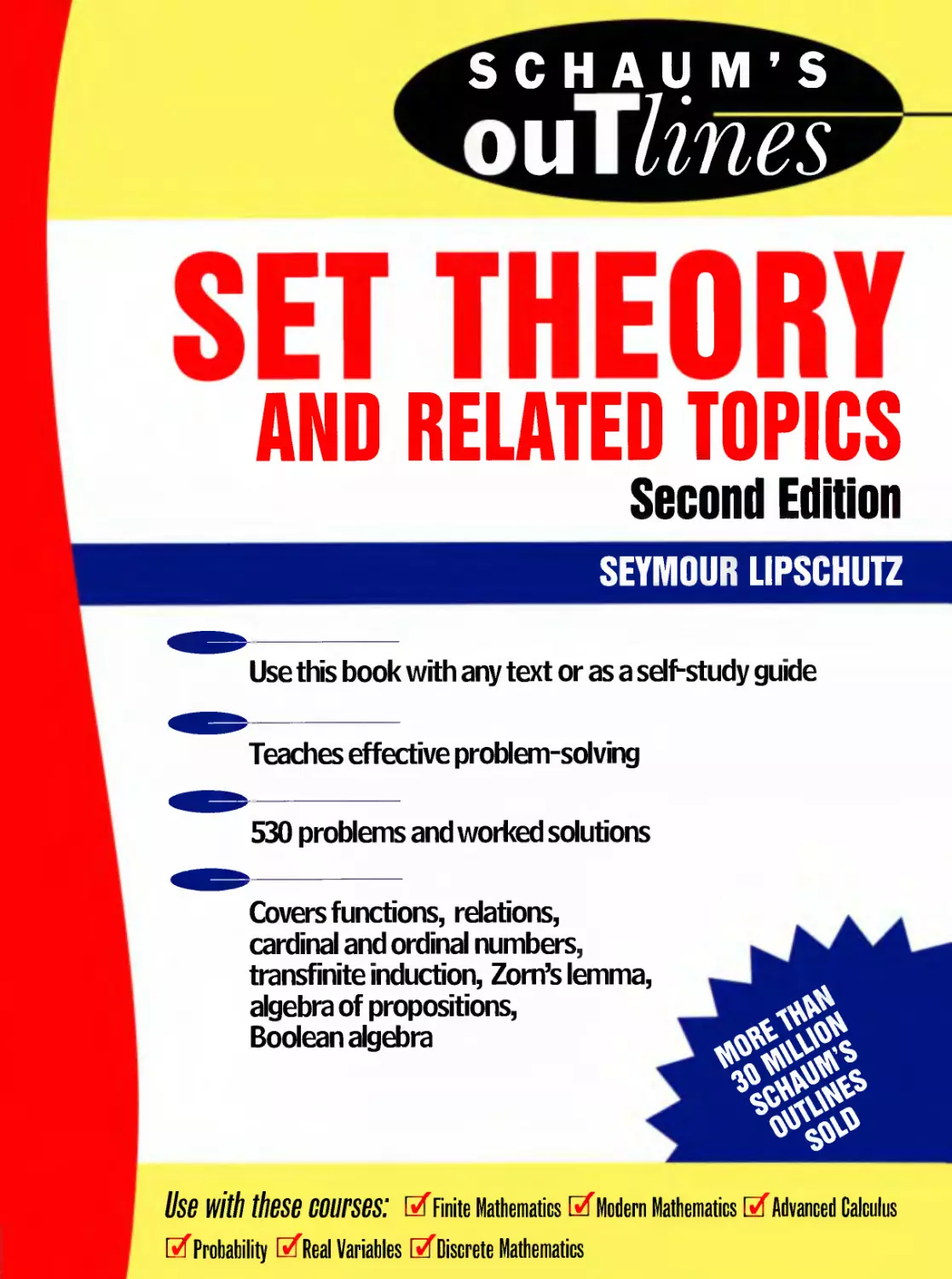
SET THEORY
AND RELATED TOPICS
Second Edition
SEYMOUR LIPSCHUTZ
Use this book with any text or as a self-study guide
Teaches effective problem-solving
530 problems and worked solutions
Covers functions, relations,
cardinal and ordinal numbers,
transfinite induction, Zorn's lemma,
algebra of propositions,
Boolean algebra
Use With these Courses: Finite Mathematics Modern Mathematics Advanced Calculus
Probability Real Variables Discrete Mathematics
SCHAUM'S OUTLINE OF
THEORY AND PROBLEMS
OF
SET THEORY
and Related Topics
Second Edition
.
SEYMOUR LIPSCHUTZ, Ph.D.
Professor of Mathematics
Temple University
.
SCHAUM'S OUTLINE SERIES
McGRAW-HILL
New York San Francisco Washington, D.C. Auckland Bogota Caracas Lisbon
London Madrid Mexico City Milan Momreal New Delhi
San Juan Singapore Sydney Tokyo Toronto
SEYMOUR LIPSCHUTZ, who is presently on the mathematics faculty of
Temple University, formerly taught at the Polytechnic Institute of Brooklyn
and was visiting professor in the Computer Science Department of Brooklyn
College. He received his Ph.D. in 1960 at the Courant Institute of Mathe-
matical Sciences of New York University. Some of his other books in the
Schaum's Outline Series are Beginning Linear Algebra; Discrete Mathe-
matics, 2nd d.; Probability; and Linear Algebra, 2nd ed.
Schaum's Outline of Theory and Problems of
SET THEORY
Copyright @1998, 1964 by The McGraw-Hili Companies, Inc. All rights reserved. Printed in
the United States of America. Except as permitted under the Copyright Act of 1976, no part of
this publication may be reproduced or distributed in any forms or by any means, or stored in a
data base or retrieval system, without the prior written permission of the publisher.
1 2 3 4 5 6 7 8 9 10 11 12 13 14 15 16 17 18 19 20 PRS PRS 9 0 2 1 0 9 8
ISBN 0-07-038159-3
Sponsoring Editor: Barbara Gilson
Production Supervisor: Clara Stanley
Editing Supervisor: Maureen B. Walker
Project Supervision: Keyword Publishing Services Ltd
Ubnry of Congress Cataloging-in-Publication Data
McGraw-Hill zz
A Division of The1dt:Gtaw-Hill Companies
Preface
The theory of sets lies at the foundations of mathematics. Concepts in set theory,
such as functions and relations, appear explicitly or implicitly in every branch of
mathematics. These concepts also appear in many related fields such as computer
science, the physical sciences, and engineering. This text is an informal, nonaxio-
matic treatment of the theory of sets.
The material is divided into three Parts, since the logical development is thereby
not disturbed while the usefulness as a text and reference book on any of several
levels is increased. Part I contains an introduction to the elementary operations of
sets and a detailed discussion of the concepts of relation and function. Part II
develops the theory of cardinal and ordinal numbers in the classical approach of
Cantor. It also considers partially ordered sets, and the Axiom of Choice and its
equivalents including Zorn's lemma. Part III treats those topics which are usually
associated with the elementary theory of sets, that is, logic and Boolean algebra.
This second edition of Set Theory covers more material than the first edition. In
particular, it includes a deeper discussion of the real numbers R and a more complete
discussion of the integers Z. Furthermore, it includes a discussion of algorithms and
their complexity in the chapter on functions, and it includes new material, including
Karnaugh maps, in the chapter on Boolean algebra.
Each chapter begins with clear statements of pertinent definitions, principles,
and theorems together with illustrative and other descriptive material. This is fol-
lowed by graded sets of solved and supplementary problems. The solved problems
serve to illustrate and amplify the theory, bring into sharp focus those fine points
without which the student continually feels himself on unsafe ground, and provide
the repetition of basic principles so vital to effective learning. Numerous proofs of
theorems and derivations of basic results are included among the solved problems.
The supplementary problems serve as a complete review of each chapter.
Finally, the author wishes to thank the staff of the McGraw-Hill Schaum's
Outline Series, especially Barbara Gilson, Mary Loebig Giles, and Maureen Walker,
for their excellent cooperation.
SEYMOUR LIPSCHUTZ
Temple University
111
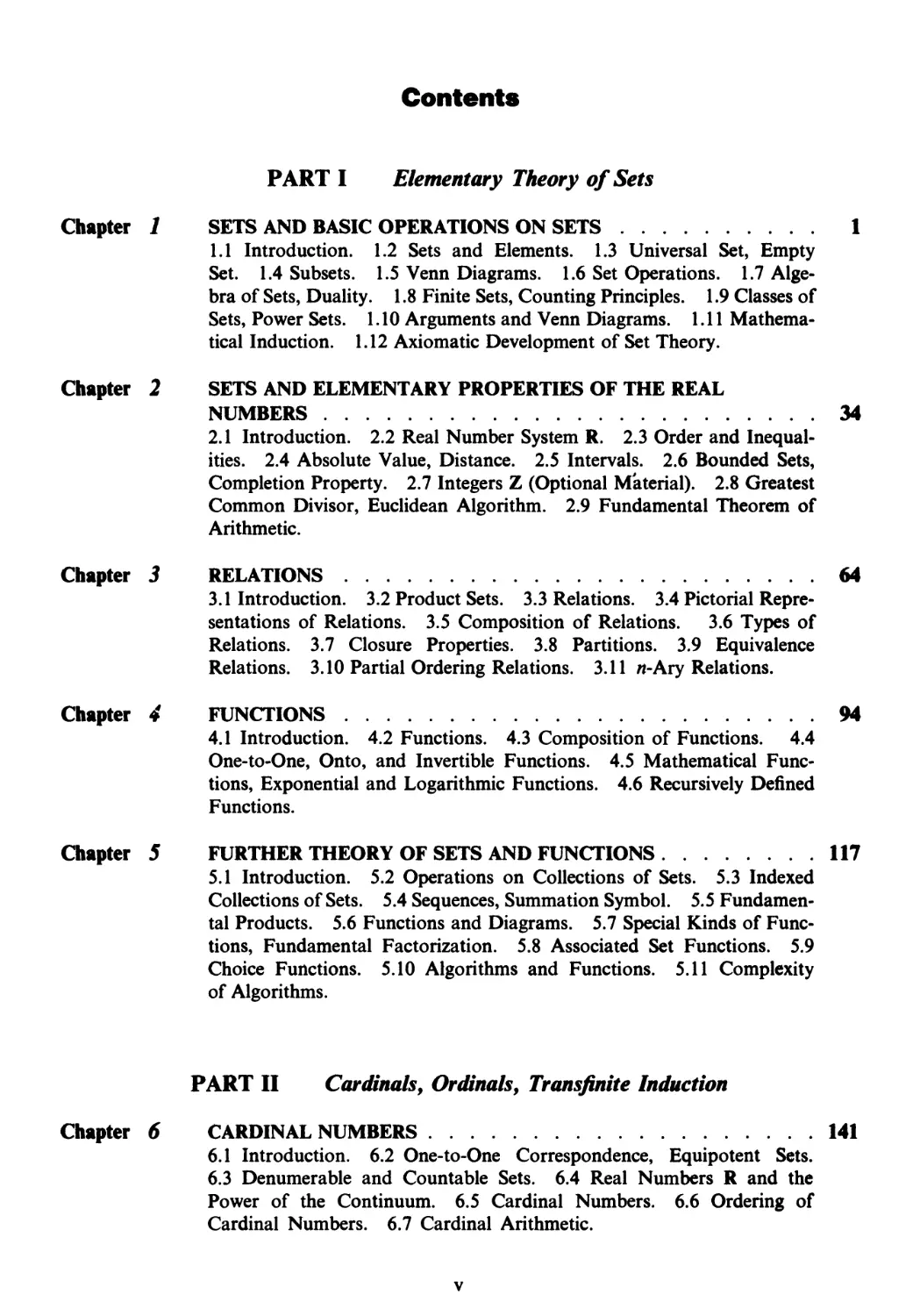
Contents
PART I Elementary Theory of Sets
Chapter 1 SETS AND BASIC OPERATIONS ON SETS 1
1.1 Introduction. 1.2 Sets and Elements. 1.3 Universal Set, Empty
Set. 1.4 Subsets. 1.5 Venn Diagrams. 1.6 Set Operations. 1.7
Algebra of Sets, Duality. 1.8 Finite Sets, Counting Principles. 1.9 Classes of
Sets, Power Sets. 1.10 Arguments and Venn Diagrams. 1.11
Mathematical Induction. 1.12 Axiomatic Development of Set Theory.
Chapter 2 SETS AND ELEMENTARY PROPERTIES OF THE REAL
NUMBERS 34
2.1 Introduction. 2.2 Real Number System R. 2.3 Order and
Inequalities. 2.4 Absolute Value, Distance. 2.5 Intervals. 2.6 Bounded Sets,
Completion Property. 2.7 Integers Z (Optional Material). 2.8 Greatest
Common Divisor, Euclidean Algorithm. 2.9 Fundamental Theorem of
Arithmetic.
Chapter 3 RELATIONS 64
3.1 Introduction. 3.2 Product Sets. 3.3 Relations. 3.4 Pictorial
Representations of Relations. 3.5 Composition of Relations. 3.6 Types of
Relations. 3.7 Closure Properties. 3.8 Partitions. 3.9 Equivalence
Relations. 3.10 Partial Ordering Relations. 3.11 /i-Ary Relations.
Chapter 4 FUNCTIONS 94
4.1 Introduction. 4.2 Functions. 4.3 Composition of Functions. 4.4
One-to-One, Onto, and Invertible Functions. 4.5 Mathematical
Functions, Exponential and Logarithmic Functions. 4.6 Recursively Defined
Functions.
Chapter 5 FURTHER THEORY OF SETS AND FUNCTIONS 117
5.1 Introduction. 5.2 Operations on Collections of Sets. 5.3 Indexed
Collections of Sets. 5.4 Sequences, Summation Symbol. 5.5
Fundamental Products. 5.6 Functions and Diagrams. 5.7 Special Kinds of
Functions, Fundamental Factorization. 5.8 Associated Set Functions. 5.9
Choice Functions. 5.10 Algorithms and Functions. 5.11 Complexity
of Algorithms.
PART II Cardinals, Ordinals, Transfinite Induction
Chapter 6 CARDINAL NUMBERS 141
6.1 Introduction. 6.2 One-to-One Correspondence, Equipotent Sets.
6.3 Denumerable and Countable Sets. 6.4 Real Numbers R and the
Power of the Continuum. 6.5 Cardinal Numbers. 6.6 Ordering of
Cardinal Numbers. 6.7 Cardinal Arithmetic.
v
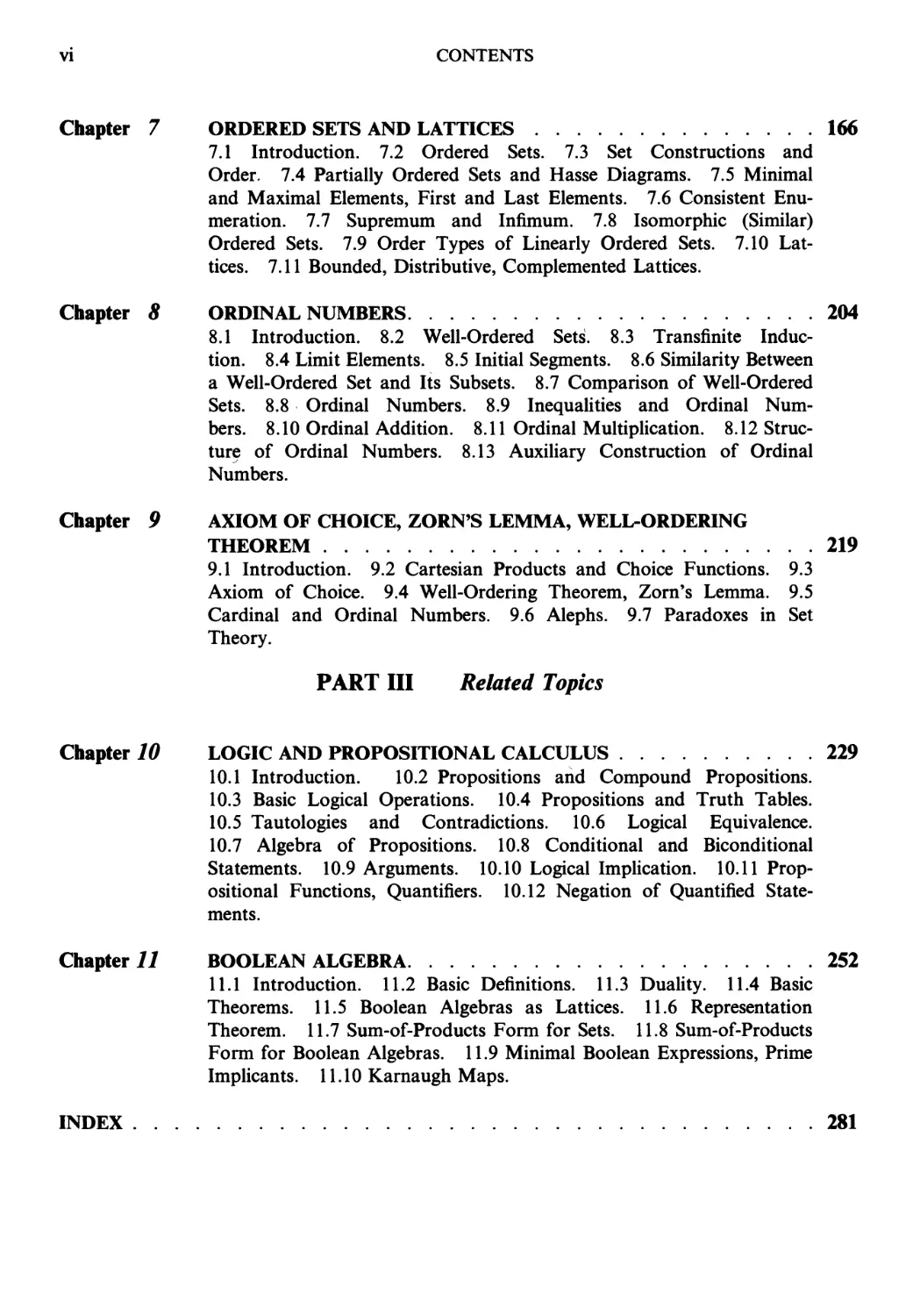
vi
CONTENTS
Chapter 7 ORDERED SETS AND LATTICES 166
7.1 Introduction. 7.2 Ordered Sets. 7.3 Set Constructions and
Order, 7.4 Partially Ordered Sets and Hasse Diagrams. 7.5 Minimal
and Maximal Elements, First and Last Elements. 7.6 Consistent
Enumeration. 7.7 Supremum and Infimum. 7.8 Isomorphic (Similar)
Ordered Sets. 7.9 Order Types of Linearly Ordered Sets. 7.10
Lattices. 7.11 Bounded, Distributive, Complemented Lattices.
Chapter 8 ORDINAL NUMBERS 204
8.1 Introduction. 8.2 Well-Ordered Sets. 8.3 Transfinite
Induction. 8.4 Limit Elements. 8.5 Initial Segments. 8.6 Similarity Between
a Well-Ordered Set and Its Subsets. 8.7 Comparison of Weil-Ordered
Sets. 8.8 Ordinal Numbers. 8.9 Inequalities and Ordinal
Numbers. 8.10 Ordinal Addition. 8.11 Ordinal Multiplication. 8.12
Structure of Ordinal Numbers. 8.13 Auxiliary Construction of Ordinal
Numbers.
Chapter 9 AXIOM OF CHOICE, ZORN'S LEMMA, WELL-ORDERING
THEOREM 219
9.1 Introduction. 9.2 Cartesian Products and Choice Functions. 9.3
Axiom of Choice. 9.4 Well-Ordering Theorem, Zorn's Lemma. 9.5
Cardinal and Ordinal Numbers. 9.6 Alephs. 9.7 Paradoxes in Set
Theory.
PART III Related Topics
Chapter 10 LOGIC AND PROPOSITIONAL CALCULUS 229
10.1 Introduction. 10.2 Propositions and Compound Propositions.
10.3 Basic Logical Operations. 10.4 Propositions and Truth Tables.
10.5 Tautologies and Contradictions. 10.6 Logical Equivalence.
10.7 Algebra of Propositions. 10.8 Conditional and Biconditional
Statements. 10.9 Arguments. 10.10 Logical Implication. 10.11 Prop-
ositional Functions, Quantifiers. 10.12 Negation of Quantified
Statements.
Chapter// BOOLEAN ALGEBRA 252
11.1 Introduction. 11.2 Basic Definitions. 11.3 Duality. 11.4 Basic
Theorems. 11.5 Boolean Algebras as Lattices. 11.6 Representation
Theorem. 11.7 Sum-of-Products Form for Sets. 11.8 Sum-of-Products
Form for Boolean Algebras. 11.9 Minimal Boolean Expressions, Prime
Implicants. 11.10 Karnaugh Maps.
INDEX 281
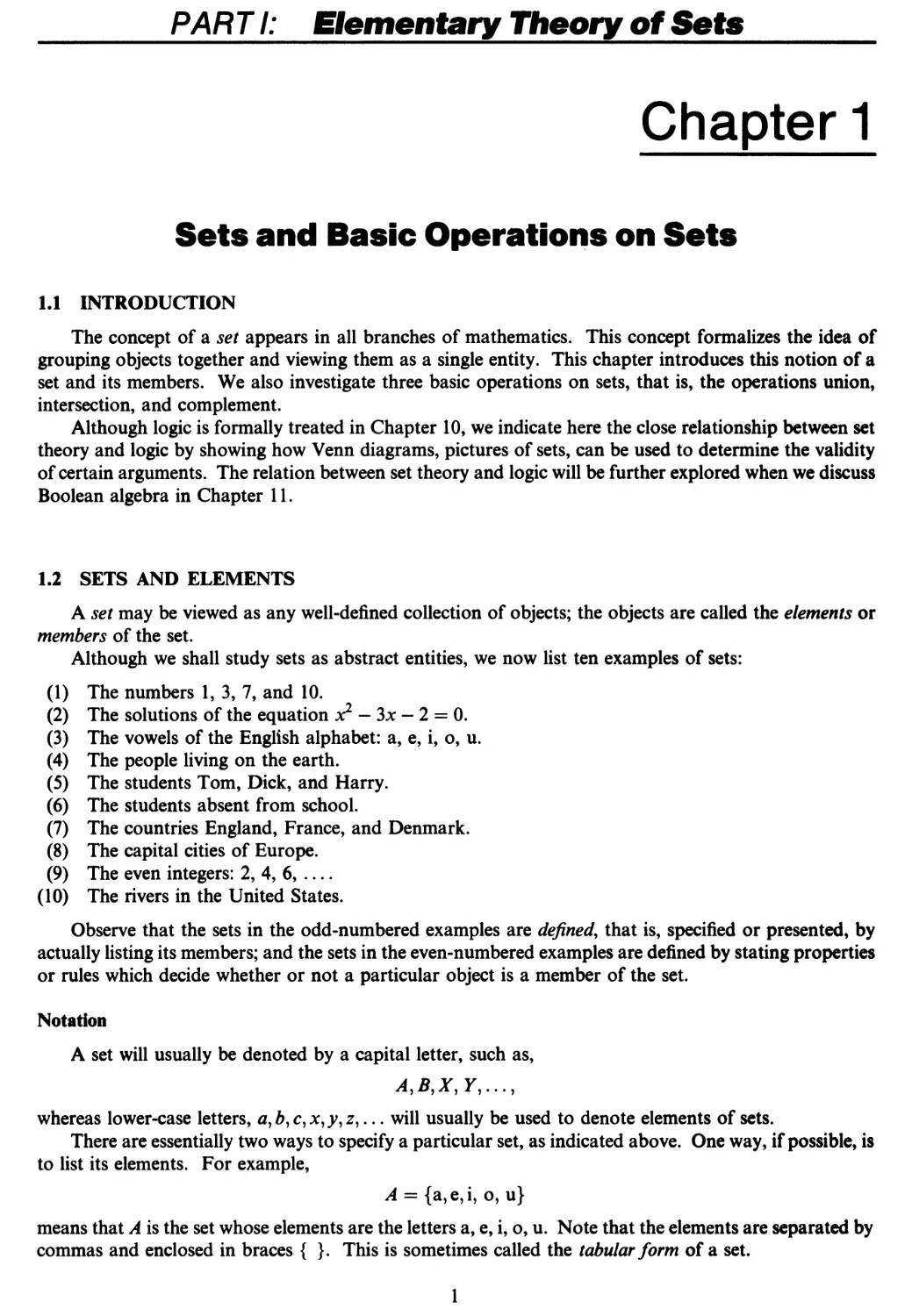
PART I:
Elementary Theory of Set.
Chapter 1
Sets and Basic Operations on Sets
1.1 INTRODUCTION
The concept of a set appears in all branches of mathematics. This concept formalizes the idea of
grouping objects together and viewing them as a single entity. This chapter introduces this notion of a
set and its members. We also investigate three basic operations on sets, that is, the operations union,
intersection, and complement.
Although logic is formally treated in Chapter 10, we indicate here the close relationship between set
theory and logic by showing how Venn diagrams, pictures of sets, can be used to determine the validity
of certain arguments. The relation between set theory and logic will be further explored when we discuss
Boolean algebra in Chapter 11.
1.2 SETS AND ELEMENTS
A set may be viewed as any well-defined collection of objects; the objects are called the elements or
members of the set.
Although we shall study sets as abstract entities, we now list ten examples of sets:
(1) The numbers 1, 3, 7, and 10.
(2) The solutions of the equation - 3x - 2 = o.
(3) The vowels of the English alphabet: a, e, i, 0, u.
(4) The people living on the earth.
(5) The students Tom, Dick, and Harry.
(6) The students absent from school.
(7) The countries England, France, and Denmark.
(8) The capital cities of Europe.
(9) The even integers: 2, 4, 6, . . . .
(10) The rivers in the United States.
Observe that the sets in the odd-numbered examples are defined, that is, specified or presented, by
actually listing its members; and the sets in the even-numbered examples are defined by stating properties
or rules which decide whether or not a particular object is a member of the set.
Notation
A set will usually be denoted by a capital letter, such as,
A,B,X, Y,...,
whereas lower-case letters, a, b, c, x,y, Z,. . . will usually be used to denote elements of sets.
There are essentially two ways to specify a particular set, as indicated above. One way, if possible, is
to list its elements. F or example,
A = {a, e, i, 0, u}
means that A is the set whose elements are the letters a, e, i, 0, u. Note that the elements are separated by
commas and enclosed in braces { }. This is sometimes called the tabular form of a set.
1
2
SETS AND BASIC OPERATIONS ON SETS
[CHAP. 1
The second way is to state those properties which characterize the elements in the set, that is,
properties held by the members of the set but not by nonmembers. Consider, for example, the expression
B = {x : x is an even integer, x > O}
which reads:
"B is the set of x such that x is an even integer and x > 0"
It denotes the set B whose elements are the positive even integers. A letter, usually x, is used to denote a
typical member of the set; the colon is read as "such that" and the comma as "and". This is sometimes
called the set-builder form or property method of specifying a set.
Two sets A and B are equal, written A = B, if they both have the same elements, that is, if every
element which belongs to A also belongs to B, and vice versa. The negation of A = B is written A =1= B.
The statement "p is an element of A" or, equivalently, the statement "p belongs to A" is written
pEA
We also write
a, b E A
to state that both a and b belong to A. The statement that p is not an element of A, that is, the negation
of pEA, is written
p A
Remark: It is common practice in mathematics to put a vertical line "I" or slanted line "I" through
a symbol to indicate the opposite or negative meaning of the symbol.
EXAMPLE 1.1
(a) The set A above can also be written as
A = {x : x is a letter in the English alphabet, x is a vowel}
Observe that b f/. A, e E A, and p f/. A.
(b) We cannot list all the elements of the above set B, although we frequently specify the set by writing
B = {2, 4,6, .. .}
where we assume everyone knows what we mean. Observe that 8 E B, but 9 f/. B.
(c) Let E = {x : x 2 - 3x + 2 = O}. In other words, E consists of those numbers which are solutions of the equation
x 2 - 3x + 2 = 0, sometimes called the solution set of the given equation. Since the solutions are 1 and 2, we
could also write E = {I, 2}.
(d) Let E = {x: x 2 - 3x + 2 = O}, F = {2, I}, and G = {I, 2, 2, I, 6/3}. Then E = F = G since each consists
precisely of the elements 1 and 2. Observe that a set does not depend on the way in which its elements are
displayed. A set remains the same even if its elements are repeated or rearranged.
Some sets of numbers will occur very often in the text, and so we use special symbols for them.
Unless otherwise specified, we will let:
N = the set of nonnegative integers: 0, 1, 2, . . .
P = the set of positive integers: 1,2,3,...
Z = the set of integers: ..., - 2, -1, 0, 1, 2, . . .
Q = the set of rational numbers
R = the set of real numbers
C = the set of complex numbers
CHAP. I]
SETS AND BASIC OPERATIONS ON SETS
3
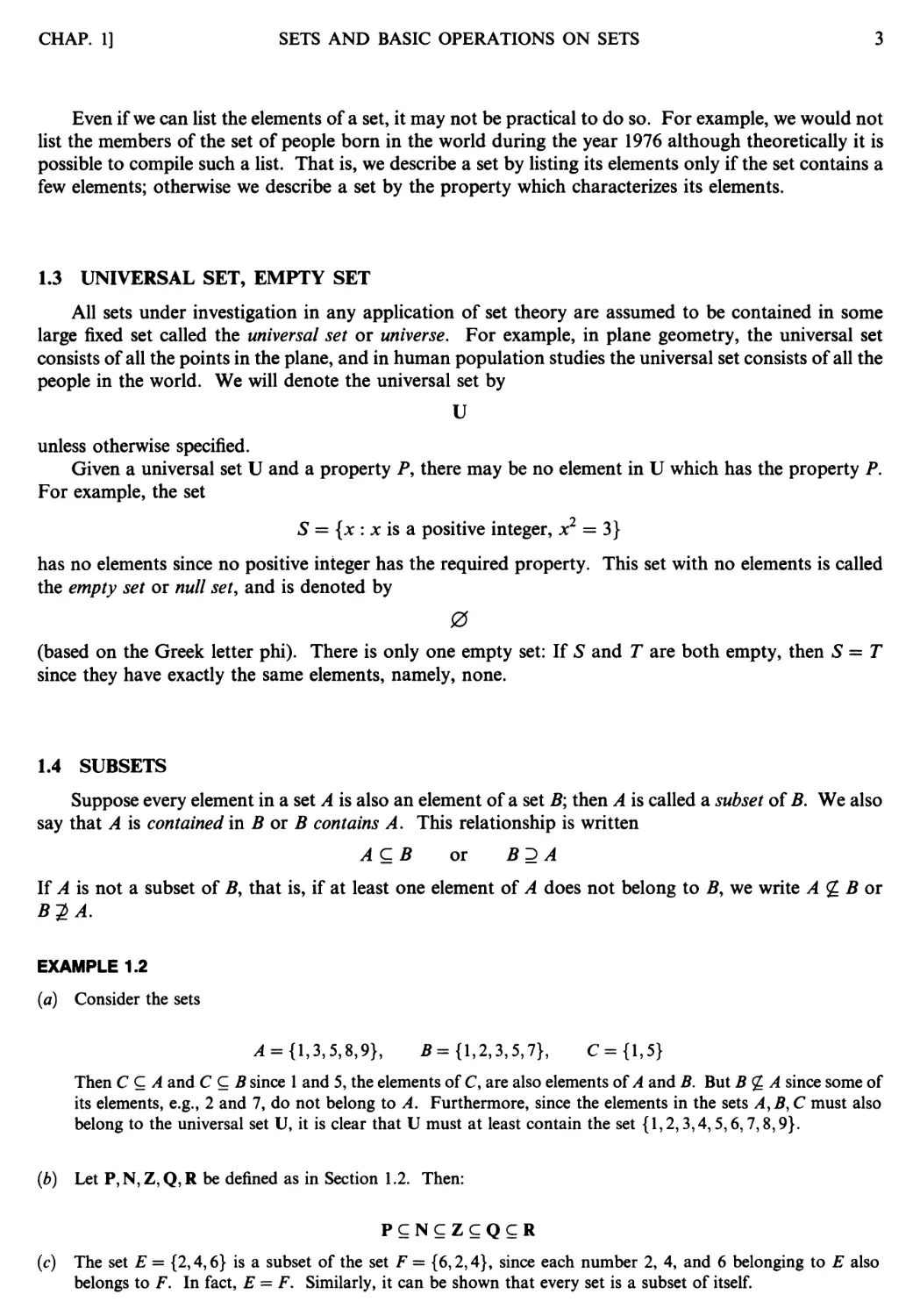
Even if we can list the elements of a set, it may not be practical to do so. For example, we would not
list the members of the set of people born in the world during the year 1976 although theoretically it is
possible to compile such a list. That is, we describe a set by listing its elements only if the set contains a
few elements; otherwise we describe a set by the property which characterizes its elements.
1.3 UNIVERSAL SET, EMPTY SET
All sets under investigation in any application of set theory are assumed to be contained in some
large fixed set called the universal set or universe. For example, in plane geometry, the universal set
consists of all the points in the plane, and in human population studies the universal set consists of all the
people in the world. We will denote the universal set by
U
unless otherwise specified.
Given a universal set U and a property P, there may be no element in U which has the property P.
For example, the set
s = {x : x is a positive integer, x 2 = 3}
has no elements since no positive integer has the required property. This set with no elements is called
the empty set or null set, and is denoted by
o
(based on the Greek letter phi). There is only one empty set: If Sand T are both empty, then S = T
since they have exactly the same elements, namely, none.
1.4 SUBSETS
Suppose every element in a set A is also an element of a set B; then A is called a subset of B. We also
say that A is contained in B or B contains A. This relationship is written
A C B
or
B :) A
If A is not a subset of B, that is, if at least one element of A does not belong to B, we write A B or
B A.
EXAMPLE 1.2
(a) Consider the sets
A={1,3,5,8,9}, B={1,2,3,5,7}, C={1,5}
Then C C A and C C B since 1 and 5, the elements of C, are also elements of A and B. But B A since some of
its elements, e.g., 2 and 7, do not belong to A. Furthermore, since the elements in the sets A, B, C must also
belong to the universal set U, it is clear that U must at least contain the set {1,2,3,4,5,6, 7,8,9}.
(b) Let P, N, Z, Q, R be defined as in Section 1.2. Then:
P C N C Z C Q C R
(c) The set E = {2, 4, 6} is a subset of the set F = {6, 2, 4}, since each number 2, 4, and 6 belonging to E also
belongs to F. In fact, E = F. Similarly, it can be shown that every set is a subset of itself.
4
SETS AND BASIC OPERATIONS ON SETS
[CHAP. 1
The following properties of sets should be noted:
(i) Every set A is a subset of the universal set U since, by definition, all the elements of A belong to U.
Also the empty set 0 is a subset of A.
(ii) Every set A is a subset of itself since, trivially, the elements of A belong to A.
(iii) If every element of A belongs to a set B, and every element of B belongs to a set C, then clearly
every element of A belongs to C. In other words, if A C Band B C C, then A C C.
(iv) If A C Band B C A, then A and B have the same elements, Le., A = B. Conversely, if A = B then
A C Band B C A since every set is a subset of itself.
We state these results formally.
Theorem 1.1: (i) For any set A, we have 0 C A C U.
(ii) For any set A, we have A C A.
(Hi) If A C Band B C C, then A C C.
(iv) A = B if and only if A C Band B C A.
Proper Subset
If A C B, then it is still possible that A = B. When A C B but A =1= B, we say that A is a proper subset
of B. We will write A C B when A is a proper subset of B. For example, suppose
A = {1,3},
B = {1,2, 3},
C = {I, 3,2}
Then A and B are both subsets of C; but A is a proper subset of C, whereas B is not a proper subset of C.
DIsjoint Sets
Two sets A and B are disjoint if they have no elements in common. For example, suppose
A={1,2},
B = {2, 4, 6},
C = {4, 5, 6, 7}
Note that A and B are not disjoint since they both contain the element 2. Similarly, Band C are not
disjoint since they both contain the element 4, among others. On the other hand, A and C are disjoint
since they have no element in common. We note that if two sets A and B are disjoint sets then neither is a
subset of the other (unless one is the empty set).
1.5 VENN DIAGRAMS
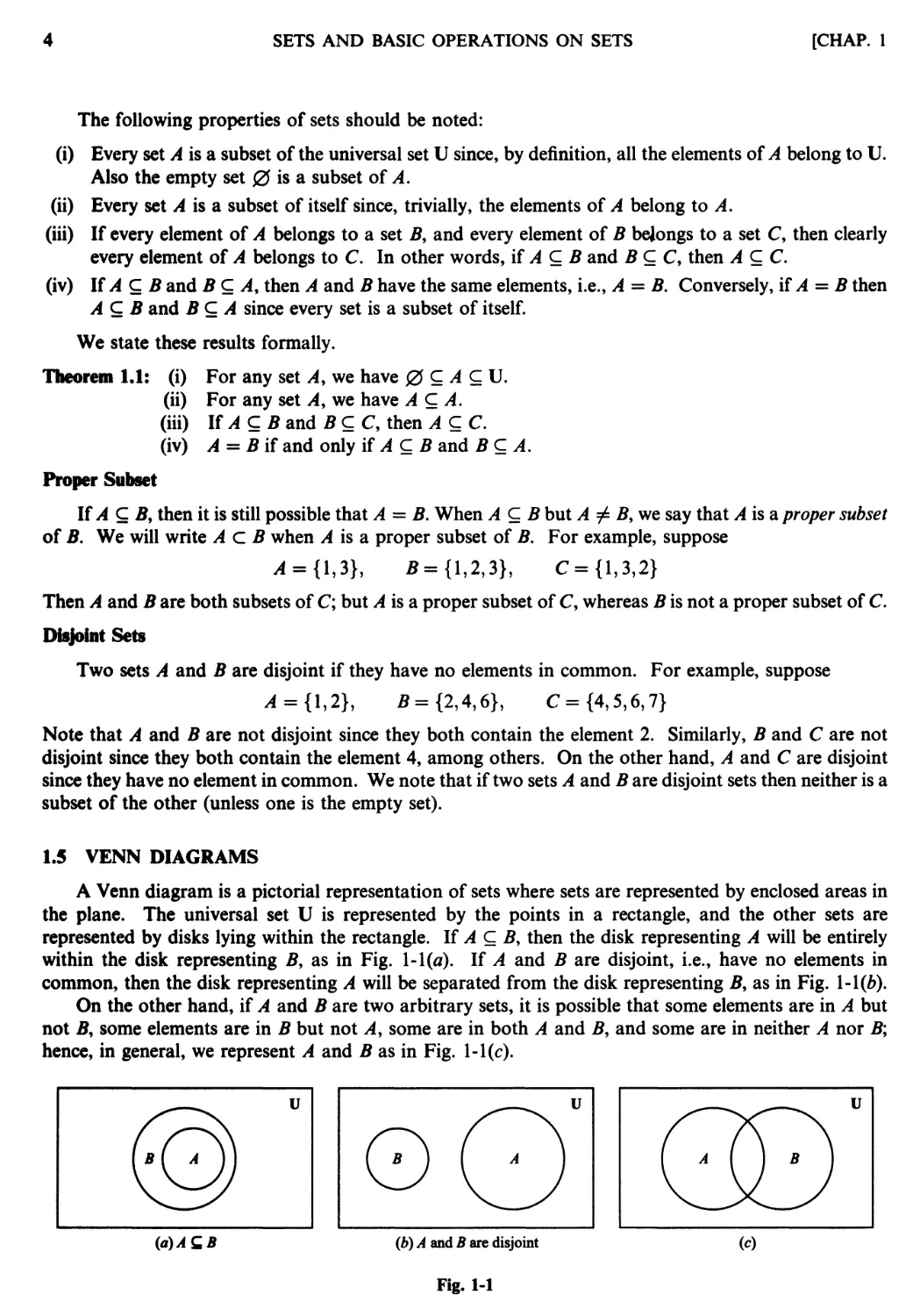
A Venn diagram is a pictorial representation of sets where sets are represented by enclosed areas in
the plane. The universal set U is represented by the points in a rectangle, and the other sets are
represented by disks lying within the rectangle. If A C B, then the disk representing A will be entirely
within the disk representing B, as in Fig. 1-1 (a). If A and B are disjoint, Le., have no elements in
common, then the disk representing A will be separated from the disk representing B, as in Fig. 1-I(b).
On the other hand, if A and B are two arbitrary sets, it is possible that some elements are in A but
not B, some elements are in B but not A, some are in both A and B, and some are in neither A nor B;
hence, in general, we represent A and B as in Fig. 1-I(c).
o
u
u
u
(a) A B
(b) A and B are disjoint
(c)
Fig. 1-1
CHAP. I]
SETS AND BASIC OPERATIONS ON SETS
5
1.6 SET OPERATIONS
The reader has learned to add, subtract, and multiply in the ordinary arithmetic of numbers; that is,
to each pair of numbers a and b, we assign a number a + b called the sum of a and b, a number a - b
called the difference of a and b, and a number ab called the product of a and b. These assignments are
called the operations of addition, subtraction, and multiplication of numbers. This section defines a
number of set operations, including the basic operations of union, intersection, and difference of sets,
where new sets will be assigned to pairs of sets A and B. We will see that set operations have many
properties similar to the above operations on numbers.
Union and Intersection
The union of two sets A and B, denoted by A U B, is the set of all elements which belong to A or B;
that is,
AU B = {x: x E A or x E B}
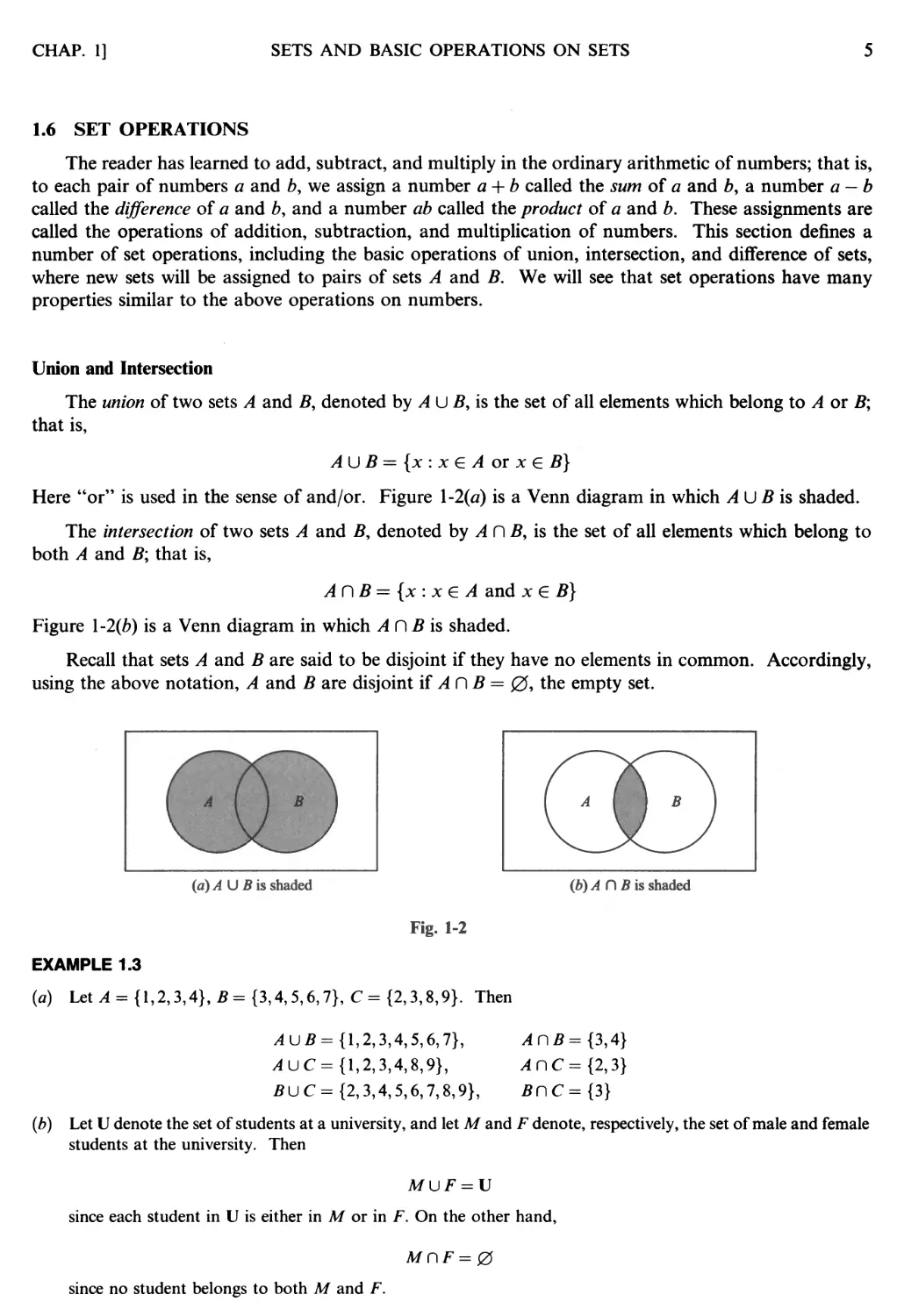
Here "or" is used in the sense of and/or. Figure 1-2(a) is a Venn diagram in which A U B is shaded.
The intersection of two sets A and B, denoted by A n B, is the set of all elements which belong to
both A and B; that is,
A n B = {x: x E A and x E B}
Figure 1-2(b) is a Venn diagram in which A n B is shaded.
Recall that sets A and B are said to be disjoint if they have no elements in common. Accordingly,
using the above notation, A and B are disjoint if A n B = 0, the empty set.
(a) A U B is shaded
(b) A n B is shaded
Fig. 1-2
EXAMPLE 1.3
(a) Let A = {1,2,3,4}, B = {3,4,5,6, 7}, C = {2,3,8,9}. Then
A U B = {I, 2, 3,4,5,6, 7},
AuC= {1,2,3,4,8,9},
BUC= {2,3,4,5,6,7,8,9},
AnB={3,4}
AnC= {2,3}
BnC= {3}
(b) Let U denote the set of students at a university, and let M and F denote, respectively, the set of male and female
students at the university. Then
MUF=U
since each student in U is either in M or in F. On the other hand,
MnF=0
since no student belongs to both M and F.
6
SETS AND BASIC OPERATIONS ON SETS
[CHAP. I
The following properties of the union and intersection of sets should be noted:
(i) Every element x in A n B belongs to both A and B; hence x belongs to A and x belongs to B. Thus
A n B is a subset of A and of B, that is,
AnB C A
and
AnB C B
(ii) An element x belongs to the union A U B if x belongs to A or x belongs to B; hence every element
in A belongs to A U B, and also every element in B belongs to A U B. That is,
A C A U Band
B C AUB
We state the above results formally.
Theorem 1.2: For any sets A and B, we have
A n B C A C A u Band
AnB C B C AuB
The operation of set inclusion is also closely related to the operations of union and intersection, as
shown by the following theorem, proved in Problem 1.13.
Deorem 1.3: The following are equivalent:
A C B, A n B = A, A U B = B
Other conditions equivalent to A C B are given in Problem 1.51.
Complement
Recall that all sets under consideration at a particular time are subsets of a fixed universal set U.
The absolute complement, or, simply, complement of a set A, denoted by A C , is the set of elements which
belong to U but which do not belong to A; that is,
A C = {x: x E U,X A}
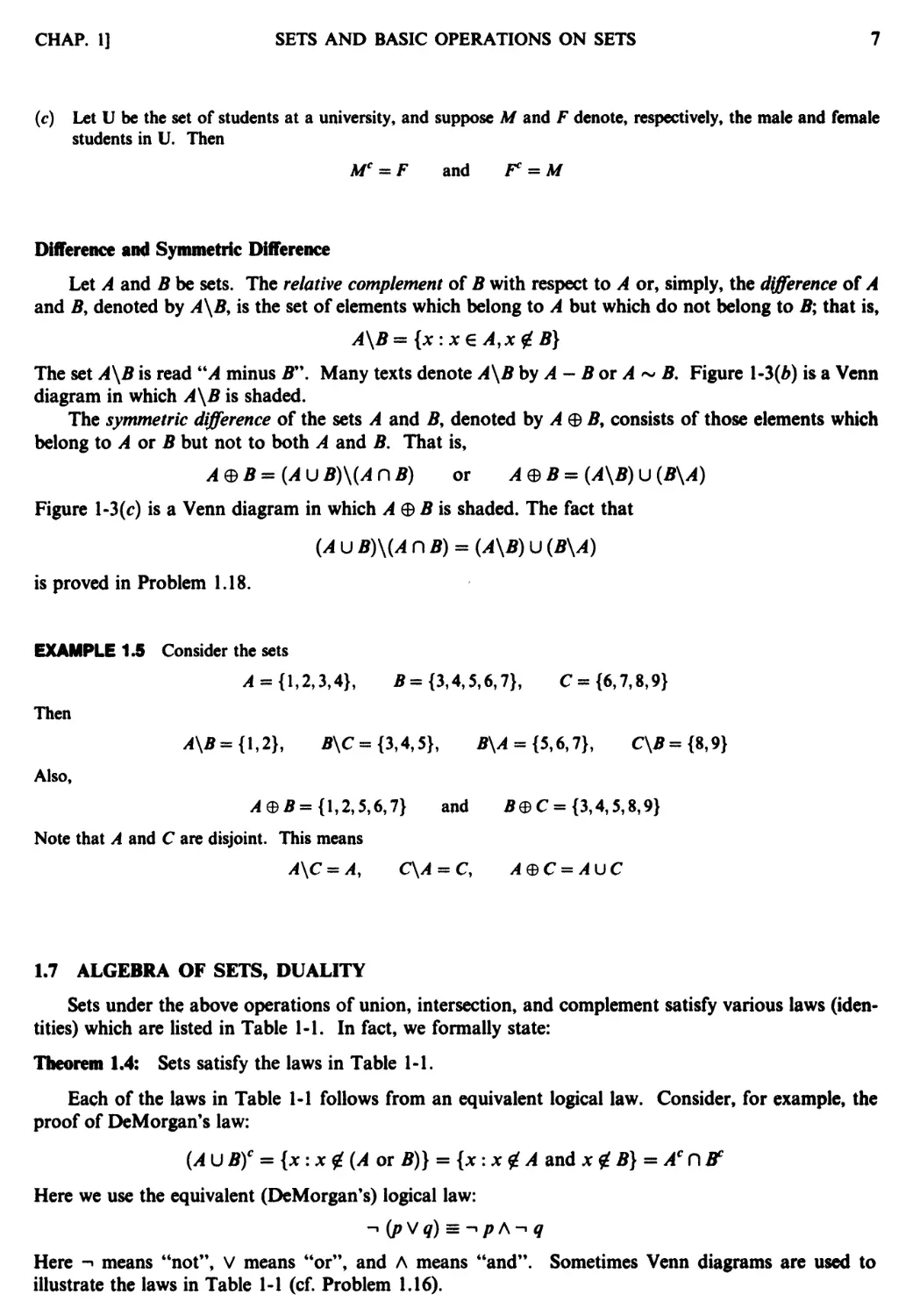
Some texts denote the complement of A by A' or A. Figure 1-3(a) is a Venn diagram in which A C is
shaded.
::.:
A
B
A
(a) A C is shaded
(b) A\B is shaded
(b)A$B is shaded
Fig. 1-3
EXAMPLE 1.4
(a) Let U = {a,h,c,... ,y,z}, the English alphabet, be the universal set, and let
A = {a, b,c,d,e}, B = {e,f,g}, V = {a,e,i,o, u}
Then
A C = {f, g, h, . . . , y, z} and If = {a, b, c, d, h, i, . . . , y, z}
Since V consists of the vowels in U, V C consists of the nonvowels, called consonants.
(h) Suppose the set R of real numbers is the universal set. Recall that Q denotes the set of rational numbers.
Hence QC will denote the set of irrational numbers.
CHAP. 1]
SETS AND BASIC OPERATIONS ON SETS
7
(c) Let U be the set of students at a university, and suppose M and F denote, respectively, the male and female
students in U. Then
MC=F and r=M
Dift'erence and Symmetric Difference
Let A and B be sets. The relative complement of B with respect to A or, simply, the difference of A
and B, denoted by A\B, is the set of elements which belong to A but which do not belong to B; that is,
A\B={x:xEA,x B}
The set A\B is read "A minus B". Many texts denote A\B by A - B or A B. Figure 1-3(b) is a Venn
diagram in which A\B is shaded.
The symmetric difference of the sets A and B, denoted by A EB B, consists of those elements which
belong to A or B but not to both A and B. That is,
A EB B = (A U B)\(A n B) or A EB B = (A\B) U (B\A)
Figure 1-3(c) is a Venn diagram in which A E9 B is shaded. The fact that
(A U B)\(A n B) = (A\B) U (B\A)
is proved in Problem 1.18.
EXAMPLE 1.5 Consider the sets
A={1,2,3,4},
B= {3,4,S,6, 7},
C = {6, 7, 8, 9}
Then
A\B = {I, 2},
B\C = {3,4, S},
B\A = {S, 6, 7},
C\B = {8,9}
Also,
A EB B = {I, 2, S, 6, 7} and B EB C = {3, 4, S, 8, 9}
Note that A and C are disjoint. This means
A\C = A,
C\A = C,
AEBC=AUC
1.7 ALGEBRA OF SETS, DUALITY
Sets under the above operations of union, intersection, and complement satisfy various laws (iden-
tities) which are listed in Table 1-1. In fact, we formally state:
Theorem 1.4: Sets satisfy the laws in Table 1-1.
Each of the laws in Table 1-1 follows from an equivalent logical law. Consider, for example, the
proof of DeMorgan's law:
(A U B)C = {x: x (A or B)} = {x: x A and x B} = A C n K
Here we use the equivalent (DeMorgan's) logical law:
..., (p V q) =. ..., p 1\ ..., q
Here..., means "not", V means "or", and 1\ means "and". Sometimes Venn diagrams are used to
illustrate the laws in Table 1-1 (cf. Problem 1.16).
8
SETS AND BASIC OPERATIONS ON SETS
[CHAP. 1
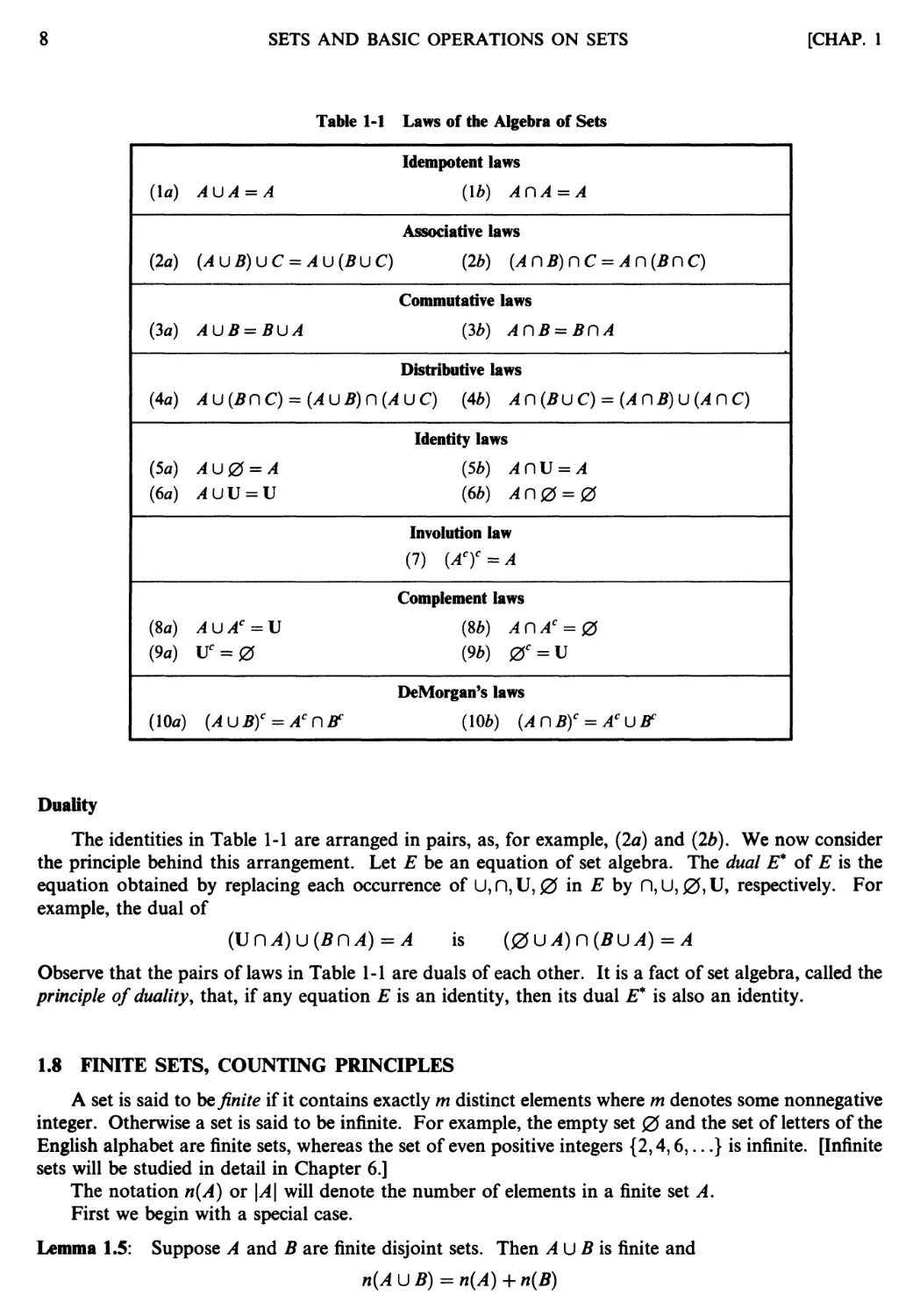
Table 1-1 Laws of the Algebra of Sets
Idempotent laws
(la) AUA=A (lb) AnA=A
Associative laws
(2a) (A UB) U C = A U (BU C) (2b) (A nB) n C = A n (Bn C)
Commutative laws
(3a) AUB=BUA (3b) AnB=BnA
Distributive laws
(4a) AU (Bn C) = (A U B) n (A U C) (4b) An (BU C) = (A nB) U (A n C)
Identity laws
(Sa) AU0=A (Sb) AnU=A
(6a) AUU=U (6b) An0=0
Involution law
(7) (AC)C = A
Complement laws
(8a) A U A C = U (8b) A n A C = 0
(9a) U C =0 (9b) 0 c =U
DeMorgan's laws
( lOa) (AUB)c=AcnK ( lOb) (A n B)C = A C U K
Duality
The identities in Table 1-1 are arranged in pairs, as, for example, (2a) and (2b). We now consider
the principle behind this arrangement. Let E be an equation of set algebra. The dual E* of E is the
equation obtained by replacing each occurrence of U, n, U, 0 in E by n, U, 0, U, respectively. For
example, the dual of
(U n A) U (B n A) = A
IS
(0UA)n(BUA) =A
Observe that the pairs of laws in Table 1-1 are duals of each other. It is a fact of set algebra, called the
principle of duality, that, if any equation E is an identity, then its dual E* is also an identity.
1.8 FINITE SETS, COUNTING PRINCIPLES
A set is said to be finite if it contains exactly m distinct elements where m denotes some nonnegative
integer. Otherwise a set is said to be infinite. For example, the empty set 0 and the set of letters of the
English alphabet are finite sets, whereas the set of even positive integers {2, 4, 6, . . .} is infinite. [Infinite
sets will be studied in detail in Chapter 6.]
The notation n(A) or IAI will denote the number of elements in a finite set A.
First we begin with a special case.
Lemma 1.5: Suppose A and B are finite disjoint sets. Then A U B is finite and
n(A U B) = n(A) + n(B)
CHAP. 1]
SETS AND BASIC OPERATIONS ON SETS
9
Proof. In counting the elements of A U B, first count those that are in A. There are n(A) of these.
The only other elements of A U B are those that are in B but not in A. Since A and B are disjoint,
no element of B is in A, so there are n(B) elements that are in B but not in A. Therefore,
n(A U B) = n(A) + n(B), as claimed.
Remark: A set C is called the disjoint union of A and B if
C = A U B and A n B = 0
Lemma 1.5 tells us that, in such a case, n(C) = n(A) + n(B).
Special Cases of Disjoint Unions
There are two special cases of disjoint unions which occur frequently.
(I) Given any set A, then the universal set U is the disjoint union of A and its complement A C .
Thus, by Lemma 1.5,
n( U) = n(A) + n(A C )
Accordingly, bringing n(A) to the other side, we obtain the following useful result.
Theorem 1.6: Let A be any set in a fin ite universal set U. The n
I n(A C ) = n(U) - n(A) I
For example, if there are 20 male students in a class of 35 students, then there are 35 - 20 = 15
female students.
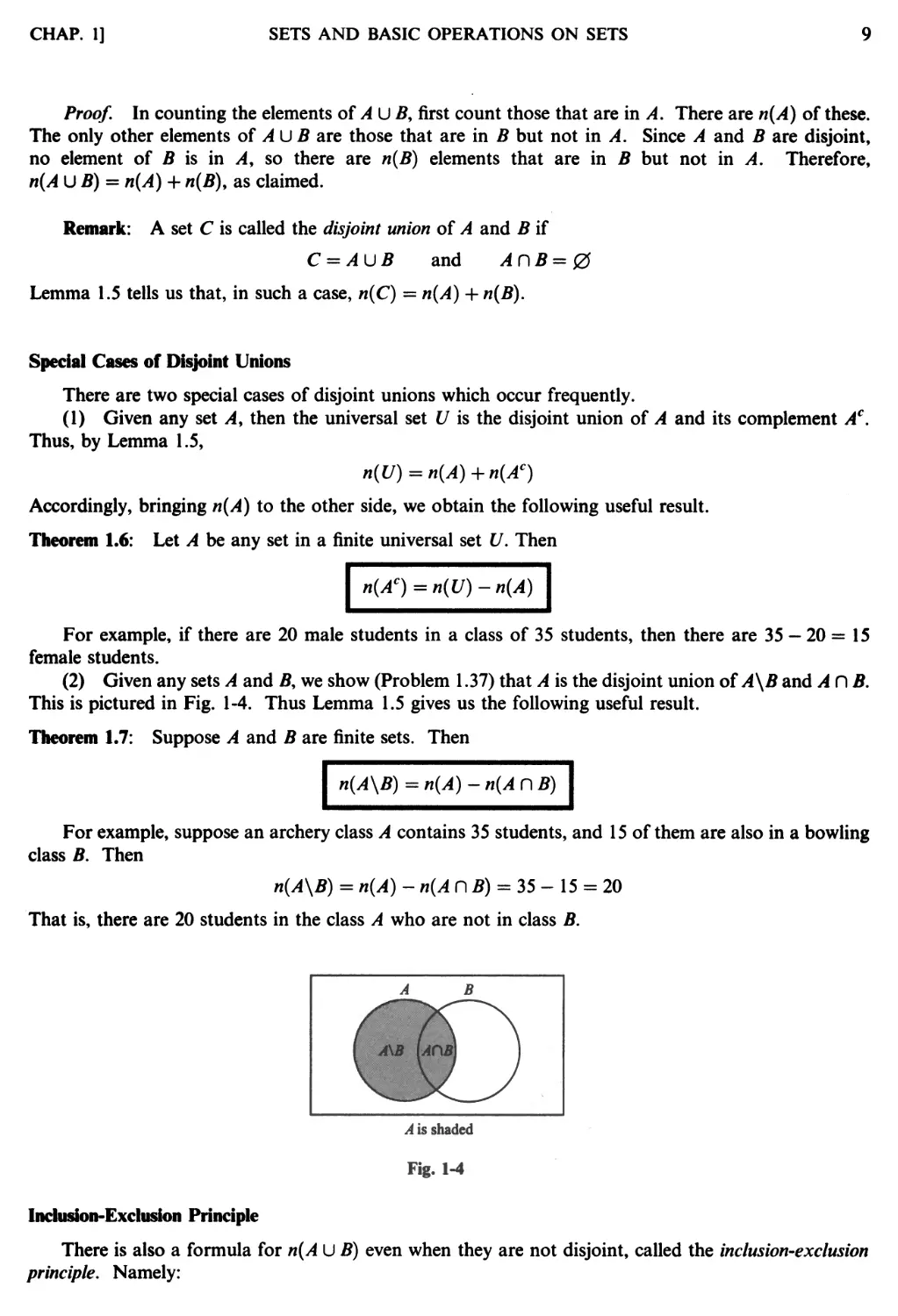
(2) Given any sets A and B, we show (Problem 1.37) that A is the disjoint union of A\B and A n B.
This is pictured in Fig. 1-4. Thus Lemma 1.5 gives us the following useful result.
Theorem 1.7: Suppose A and Bare finite sets. Then
I n(A\B) = n(A) - n(A n B) I
For example, suppose an archery class A contains 35 students, and 15 of them are also in a bowling
class B. Then
n(A\B) = n(A) - n(A n B) = 35 - 15 = 20
That is, there are 20 students in the class A who are not in class B.
A B
A is shaded
Fig. 1-4
Inclusion-Exclusion Principle
There is also a formula for n(A U B) even when they are not disjoint, called the inclusion-exclusion
principle. Namely:
10
SETS AND BASIC OPERATIONS ON SETS
[CHAP. 1
Theorem 1.8: Suppose A and B are finite sets. Then A n B and A U B are finite, and
I n(A U B) = n(A) + neB) - n(A n B) I
That is, we find the number of elements in A or B (or both) by first adding n(A) and n(B) (inclusion)
and then subtracting n(A n B) (exclusion) since the elements in A n B were counted twice.
We can apply this result to get a similar result for three sets.
Corollary 1.9: Suppose A, B, C are finite sets. Then A U B U C is finite and
n(A U BU C) = n(A) + n(B) + n(C) - n(A n B) - n(A n C) - n(Bn C) + n(A n Bn C)
Mathematical induction (Section 1.11) may be used to further generalize this result to any finite
number of finite sets.
EXAMPLE 1.6 Consider the following data among 110 students in a college dormitory:
30 students are on a list A (taking Accounting),
35 students are on a list B (taking Biology),
20 students are on both lists.
Find the number of students: (a) on list or B, (b) on exactly one of the two lists, (c) on neither list.
c!
(a) We seek n(A U B). By Theorem 1.8,
n(A U B) = n(A) + neB) - n(A n B) = 30 + 35 - 20 = 45
In other words, we combine the two lists and then cross out the 20 student names which appear twice.
(b) List A contains 30 names and 20 of them are on list B; hence 30 - 20 = 10 names are only on list A. That is,
n(A\B) = n(A) - n(A U B) = 30 - 20 = 10
Similarly, list B contains 35 names and 20 of them are on list A; hence 35 - 20 = 15 names are only on list B.
That is,
n(B\A) = neB) - n(A U B) = 35 - 20 = 15
Thus there are 10 + 15 = 25 students on exactly one of the two lists.
(c) The students on neither the A list nor the B list form the set A C n If. By DeMorgan's law, A C n K = (A U B)c.
Hence
n(A C n If) = n((A U B)C) = n(U) - n(A U B) = 110 - 45 = 65
EXAMPLE 1.7 Consider the following data for 120 mathematics students:
65 study French, 20 study French and German,
45 study German, 25 study French and Russian,
42 study Russian, 15 study German and Russian,
8 study all three languages
Let F,' G, and R denote the sets of students studying French, German, and Russian, respectively.
(a) Find the number of students studying at least one of the three languages, Le. find n(F U G U R).
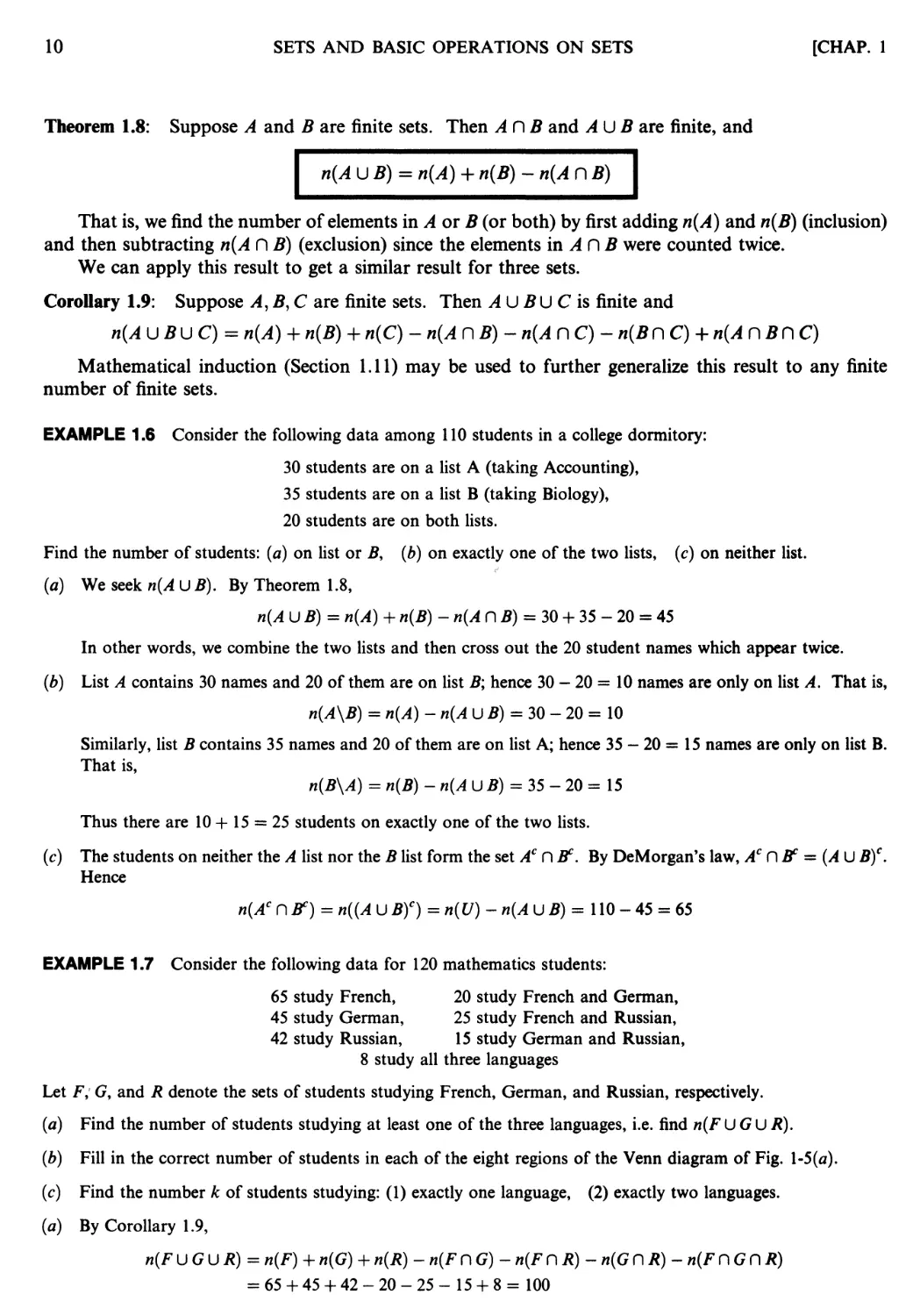
(b) Fill in the correct number of students in each of the eight regions of the Venn diagram of Fig. 1-5(a).
(c) Find the number k of students studying: (1) exactly one language, (2) exactly two languages.
(a) By Corollary 1.9,
n(FU G U R) = n(F) + n(G) + n(R) - n(Fn G) - n(Fn R) - n(Gn R) - n(Fn Gn R)
= 65 + 45 + 42 - 20 - 25 - 15 + 8 = 100
CHAP. I]
SETS AND BASIC OPERATIONS ON SETS
11
(a)
(b)
Fig. 1-5
(b) Using 8 study all three languages and 100 study at least one language, the remaining seven regions of the
required Venn diagram Fig. 1-5(b) are obtained as follows:
15 - 8 = 7 study German and Russian but not French,
25 - 8 = 17 study French and Russian but not German,
20 - 8 = 12 study French and German but not Russian,
42 - 17 - 8 - 7 = 10 study only Russian,
45 - 12 - 8 - 7 = 18 study only German,
65 - 12 - 8 - 17 = 28 study only French,
120 - 100 = 20 do not study any of the languages.
(c) Use the Venn diagram of Fig. 1-5(b) to obtain:
(1) k=28+18+10=56, (2) k=12+17+7=36
1.9 CLASSES OF SETS, POWER SETS
Given a set S, we may wish to talk about some of its subsets. Thus we would be considering a "set of
sets". Whenever such a situation arises, to avoid confusion, we will speak of a class of sets or a collection
of sets. If we wish to consider some of the sets in a given class of sets, then we will use the term subclass
or subcollection.
EXAMPLE 1.8 Suppose S = {I, 2, 3,4}. Let d be the class of subsets of S which contain exactly three elements of
S. Then
d = [{1,2,3},{1,2,4},{1,3,4},{2,3,4}]
The elements of d are the sets {1,2,3}, {1,2,4}, {1,3,4}, and {2,3,4}.
Let fJI be the class of subsets of S which contain 2 and two other elements of S. Then
fJI = [{I, 2, 3}, {I, 2,4}, {2, 3,4}]
The elements of fJI are {1,2,3}, {1,2,4}, and {2,3,4}. Thus fJI is a subclass of d. (To avoid confusion, we will
usually enclose the sets of a class in brackets instead of braces.)
Power Sets
For a given set S, we may speak about the class of all subsets of S. This class is called the power set
of S, and it will be denoted by 9(S). If S is finite, then so is 9(S). In fact, the number of elements in
9(S) is 2 raised to the power of n(S); that is,
n(9(S)) = 2 n (S)
(This is the reason 9(S) is called the power set of S; it is also sometimes denoted by 2 s .)
12
SETS AND BASIC OPERATIONS ON SETS
[CHAP. 1
EXAMPLE 1.1 Suppose S = {I, 2, 3}. Then
9'(S) = [0, {I}, {2}, {3}, {I, 2}, {I, 3}, {2, 3}, S]
Note that the empty set 0 belongs to 9'(S) since 0 is a subset of S. Similarly S belongs to 9'(5). As expected from
the above remark, 9'( S) has 2 3 = 8 elements.
1.10 ARGUMENTS AND VENN DIAGRAMS
Many verbal statements are essentially statements about sets and they can therefore be described by
Venn diagrams. Hence Venn diagrams can sometimes be used to determine whether or not an argument
is valid. This is illustrated in the following example.
EXAM PLE 1.10 Show that the following argument (adapted from a book on logic by Lewis Carroll, the author of
A/ice in Wonder/and) is valid:
S.: My saucepans are the only things I have that are made of tin.
S2: I find all your presents very useful.
S3: None of my saucepans is of the slightest use.
S: Your presents to me are not made of tin.
(The statements S., 52, and S3 above the horizontal line denote the assumptions, and the statement 5 below the line
denotes the conclusion. The argument is valid if the conclusion S follows logically from the assumptions 5., 52, and
S3.)
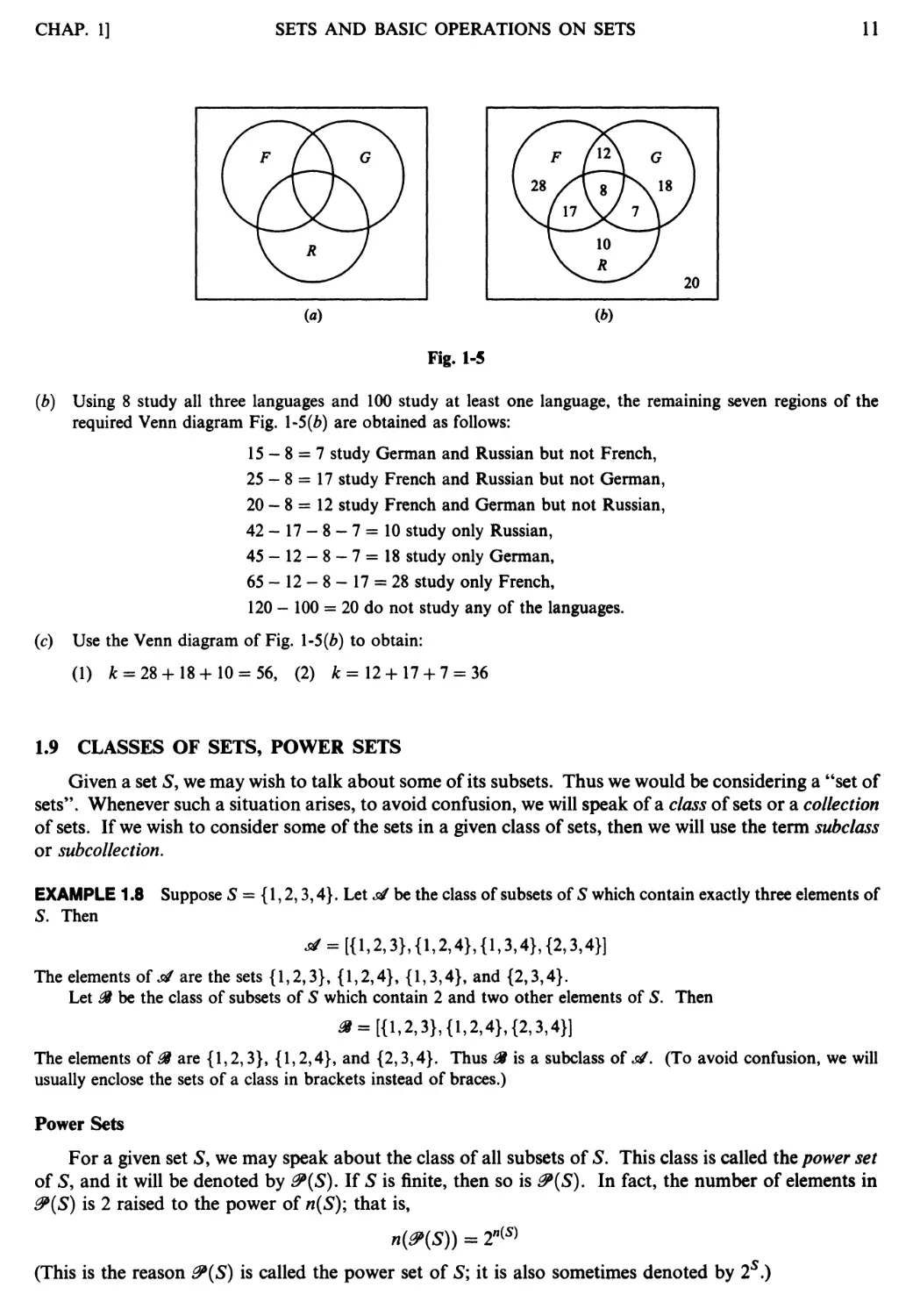
By S. the tin objects are contained in the set of saucepans and by S3 the set of saucepans and the set of useful
things are disjoint: hence draw the Venn diagram of Fig. 1-6.
Fig. 1-6
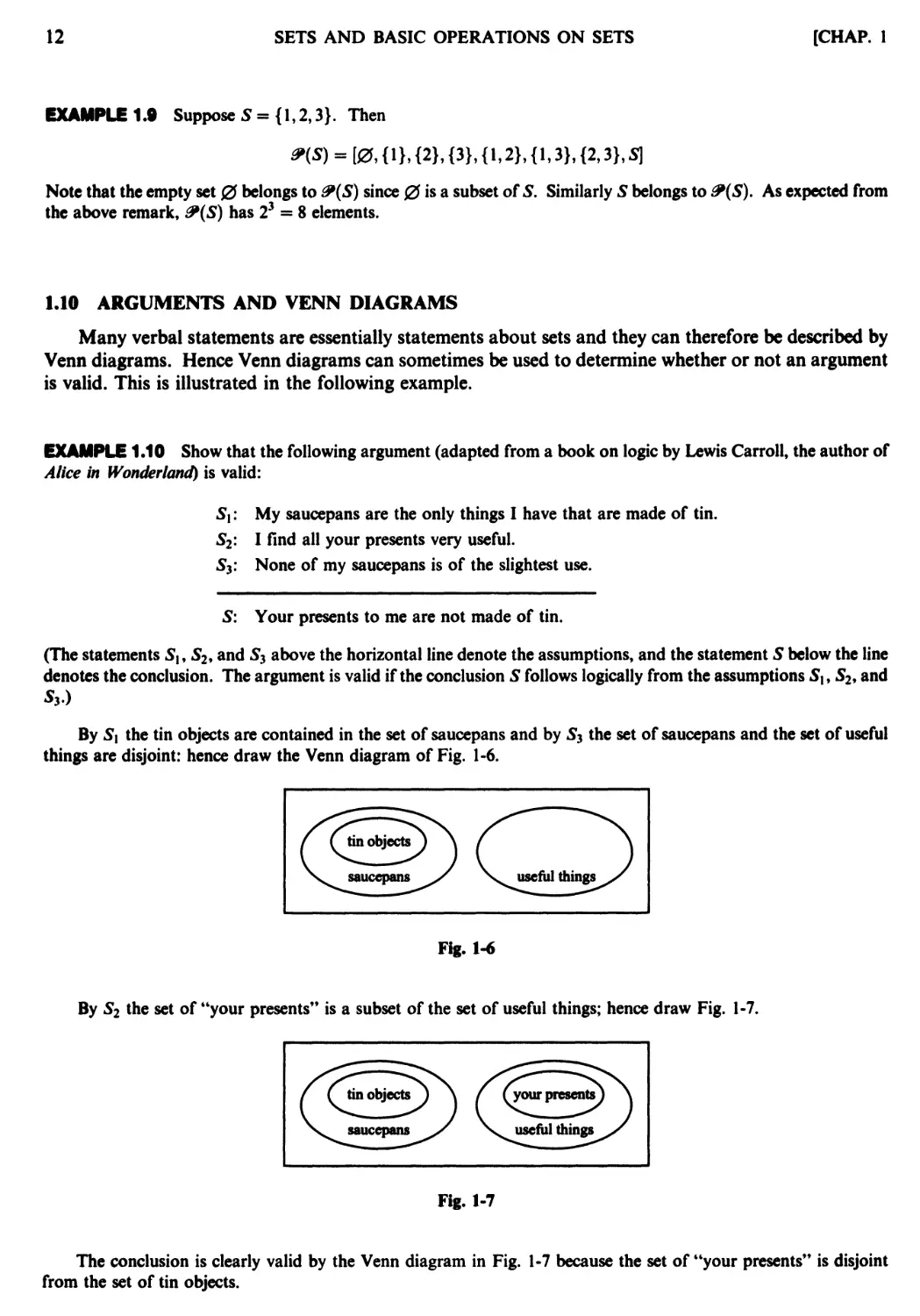
By S2 the set of "your presents" is a subset of the set of useful things; hence draw Fig. 1-7.
Fig. 1-'
The conclusion is clearly valid by the Venn diagram in Fig. 1-7 because the set of "your presents" is disjoint
from the set of tin objects.
CHAP. 1]
SETS AND BASIC OPERATIONS ON SETS
13
1.11 MATHEMATICAL INDUCTION
Consider the set P = {I, 2,...} of positive integers (or counting numbers). We say that an assertion
A(n) is defined on P if A(n) is true or false for each n E P. An essential property of P, which is used in
many proofs, follows.
Principle of Mathematical Induction I: Let A(n) be an assertion defined on P, that is, A(n) is true or
false for each integer n > 1. Suppose A(n) has the following two properties:
(1) A(I) is true.
(2) A(n + 1) is true whenever A(n) is true.
Then A(n) is true for every n > 1.
We shall not prove this principle. In fact, this principle is usually given as one of the axioms when P
is developed axiomatically.
EXAMPLE 1.11 Let A(n) be the assertion that the sum of the first n odd integers is n 2 ; that is,
A (n): 1 + 3 + 5 + .. . + (2n - 1) = n 2
[The nth odd integer is 2n - 1 and the next odd integer is 2n + 1.] Observe that A(n) is true for n = 1, that is,
A( 1): 1 = 1 2
Assuming A(n) is true, we add 2n + 1 to both sides of A(n), obtaining:
1 + 3 + 5 + .. . + (2n - 1) + (2n + 1) = n 2 + (2n + 1) = (n + 1)2
However, this is A(n + 1). That is, A(n + 1) is true whenever A(n) is true. By the principle of mathematical
induction, A(n) is true for all n > 1.
There is another form of the principle of mathematical induction which is sometimes more con-
venient to use. Although it appears different, it is really equivalent to the above principle of induction.
Principle of Mathematical Induction II: Let A(n) be an assertion defined on the set P of positive integers
which satisfies the following two conditions:
(1) A( 1) is true.
(2) A(n) is true whenever A(k) is true for 1 < k < n.
Then A(n) is true for every n > 1.
The above two principles may also be stated in terms of subsets of P rather than in terms of
assertions defined on P. (See Problem 1.40.) Although the languages are different, they are logically
equivalent.
Remark: Sometimes one wants to prove that an assertion A is true for a set of integers of the form
{a, a + 1, a + 2, . . .}
where a is any integer, possibly O. This can be done by simply replacing 1 by the integer a in either of the
above principles of mathematical induction.
1.12 AXIOMATIC DEVELOPMENT OF SET THEORY
Any axiomatic development of a branch of mathematics begins with the following:
(1) undefined terms,
(2) undefined relations,
(3) axioms relating the undefined terms and undefined relations.
14
SETS AND BASIC OPERATIONS ON SETS
[CHAP. I
Then, one develops theorems based upon the axioms and definitions.
Consider, for example, the axiomatic development of plane Euclidean geometry. It begins with the
following:
(1) "poin ts" and "lines" are undefined terms;
(2) "point on a line" or, equivalently, "line contains a point" is an undefined relation.
Two of the many axioms of Euclidean geometry follow:
Axiom 1: Two distinct points are on one and only one line.
Axiom 2: Two distinct lines cannot contain more than one point in common.
The axiomatic development of set theory begins with the following:
(1) "element" and "set" are undefined terms;
(2) "element belongs to a set" is the undefined relation.
Two of the axioms (called principles) of set theory follow:
Principle of Extension: Two sets A and B are equal if and only if they have the same elements, that is, if
every element in A belongs to B and every element in B belongs to A.
Principle of Abstraction: Given any set U and any property P, there is a set A such that the elements of
A are exactly those elements in U which have the property P; that is,
A = {x: x E U,P(x) is true}
There are other axioms which are not listed. As our treatment of set theory is mainly intuitive,
especially Part I, we will refrain from any further discussion of the axiomatic development of set theory.
Solved Problems
SETS AND SUBSETS
1.1. Which of these sets are equal: {r, t, s}, {s, t, r, s}, {t, s, t, r}, {s, r, s, t}?
They are all equal. Order and repetition do not change a set.
1.2. List the elements of the following sets where P = {I, 2, 3, . . .}.
(a) A = {x : x E P, 3 < x < 12}
(b) B = {x : x E P, x is even, x < IS}
(c) C = {x : x E P, 4 + x = 3}
(d) D = {x : x E P, x is a multiple of 5}.
(a) A consists of the positive integers between 3 and 12; hence
A = {4,5,6,7,8,9, 10,11}
(b) B consists of the even positive integers less than 15; hence
B= {2,4,6,8, 10, 12, 14}
(c) There are no positive integers which satisfy the condition 4 + x = 3; hence C contains no elements. In
other words, C = 0, the empty set.
CHAP. I]
SETS AND BASIC OPERA TIONS ON SETS
15
(d) D is infinite, so we cannot list all its elements. However, sometimes we write
D = {5, 10, 15, . .. , 5n, .. .}
or simply
D = {5, 10, 15,...}
where we assume everyone understands that we mean the multiples of 5.
1.3. Consider the following sets:
0, A = {I},
E = {I, 3, 5, 7, 9},
B={1,3}, C={1,5,9},
U = {I, 2, . . . , 8, 9}
D = {1,2,3,4,5},
Insert the correct symbol C or between each pair of sets:
(0) 0, A
(b) A,B
(c) B, C
(d) B, E
(e) C, D
(f) C, E
(g) D, E
(h) D, U
(0) 0 C A because 0 is a subset of every set.
(b) A C B because 1 is the only element of A and it belongs to B.
(c) B C because 3 E B but 3 (j C.
(d) B C E because the elements of B also belong to E.
(e) C D because 9 E C but 9 (j D.
(f) C C E because the elements of C also belong to E.
(g) D fl: E because 2 E D but 2 f/. E.
(h) D C U because the elements of D also belong to U.
1.4. Show that A = {2, 3,4, 5} is not a subset of B = {x : x E P, x is even}.
It is necessary to show that at least one element in A does not belong to B. Now 3 E A and, since B
consists of even numbers, 3 (j B; hence A is not a subset of B.
1.5. Show that A = {2, 3,4, 5} is a proper subset of C = {I, 2,3, .. . ,8, 9}.
Each element of A belongs to C so A C C. On the other hand, 1 E C but 1 E A. Hence A :/: C.
Therefore A is a proper subset of C.
1.6. Determine whether or not each set is the null set:
(a) X = {x : x 2 = 9, 2x = 4}, (b) Y = {x : x ;l: x}, (c) Z = {x : x + 8 = 8}.
(0) No number satisfies both x 2 :; 9 and 2x = 4; hence X is the empty set; Le., X = 0.
(b) We interpret "=" to mean "is identical with" and so Y is empty. In fact, some texts define the empty
set as follows:
0 = {x:x:/:x}
(c) The number zero satisfies x + 8 = 8 and zero is the only solution; hence Z = {OJ. Thus Z is not the
empty set since it contains o. That is, Z :/: 0.
16
SETS AND BASIC OPERATIONS ON SETS
[CHAP. 1
SET OPERATIONS
Problems 1-7 to 1-10 refer to the universal set U = {I, 2, . . . , 9} and the sets:
A = {1,'2, 3,4, 5}
B = {4, 5,6, 7}
1.7. Find:
(a) AU B and A n B,
(b) BUD and BnD,
c = {5, 6, 7, 8, 9}
D={1,3,5,7,9}
E= {2,4,6,8}
F = {I, 5, 9}
(c) A U C and A n C,
(d) DUE and D n E,
(e) EuE and EnE
(f) D U F and D n F
Recall that the union X U Y consists of those elements in either X or Y (or both), and that the
intersection X n Y consists of those elements in both X and Y.
(a) A UB= {I,2,3,4,5,6, 7},
(b) BUD={I,3,4,5,6,7,9},
(c) AUc;= {I,2,3,4,5,6,7,8,9} =U,
(d) DuE = {I, 2, 3, 4, 5, 6, 7, 8, 9} = U,
(e) EUE={2,4,6,8}=E,
(f) D U F = {I, 3, 5, 7, 9} = D,
A n B = {4, 5}
BnD = {5, 7}
Anc=0
DnE=0
EnE = {2, 4,6, 8} = E
DnF={I,5,9}=F
Observe that F C D; so by Theorem 1.3 we must have D U F = D and D n F = F.
1.8. Find: (a) A C , K, DC, E C ; (b) UC, 0 c .
(a) The complement Xc consists of those elements in the universal set U which do not belong to X. Thus:
A C = {6, 7, 8, 9}, K = {I, 2, 3, 8, 9}, DC = {2, 4, 6, 8} = E, E C = {I, 3, 5, 7, 9} = D
(Note: Since DC = E, we must have = D.)
(b) Here U C = 0, and 0 c = U, and this is always true.
1.9. Find: (a) A\B, B\A, D\E, F\D; (b) A EBB, CEBD, EEBF.
(a) The difference X\ Y consist of the elements in X which do not belong to Y. Thus:
A\B = {I, 2, 3}, B\A = {6,7}, D\E = {I, 3, 5, 7, 9} = D, F\D = 0.
(Note: Since D and E are disjoint, we must have D\E = D; and since F C D, we must have F\D = 0.)
(b) The symmetric difference X EB Y consists of the elements in X or in Y but not in both X and Y. Thus:
A EB B = {I, 2, 3, 6, 7},
CEBD = {I,3,8,9},
E EB F = {2, 4, 6, 8,1,5, 9} = E U F
(Note: Since E and F are disjoint, we must have E EB F = E U F.)
1.10. Find: (a) An(BUE), (b) (A\B)C, (c) (AnD)\B, (d) (BnF)U(CnE).
(a) First compute B U E = {2, 4,5,6,7, 8}. Then An (B U E) = {2, 4, 5}.
(b) A\E = {I, 3, 5}. Then (A\E)C = {2, 4,6, 7, 8, 9).
(c) AnD = {I, 3, 5}. Now (A n D)\B = {I, 3}.
(d) BnF={5}andCnE={6,8). So (BnF)U(CnE)={5,6,8).
CHAP. I]
SETS AND BASIC OPERATIONS ON SETS
17
1.11. Show that we can have A n B = An C without B = C.
Let A = {1,2}, B = {2,3}, and C = {2,4}. Then A nB = (2} and An C = {2). Thus A nB = An c
but B # C.
1.12. Prove: B\A = B n A. Thus the set operation of difference can be written in terms of the opera-
tions of intersection and complementation.
B\A = {x : x E B, x f/. A) = {x : x E B, x E A C ) = B n A C
1.13. Prove Theorem 1.3: The following are equivalent: A C B, A n B = A, and A U B = B.
Suppose A C B. Let x E A. Then x E B, hence x E A n B and so A C An B. By Theorem 1.2,
(A n B) C A. Therefore An B = A. On the other hand, suppose A n B = A. Let x E A. Then
x E A n B, hence x E B. Therefore, A C B. Both results show that A C B is equivalent to A n B = A.
Suppose again that A C B. Let x E A U B. Then x E A or x E B. If x E A, then x E B because A C B.
In either case, x E B. Therefore A U B C B. By Theorem 1.2, B C A U B. Therefore A U B = B. Now
suppose A U B = B. Let x E A. Then x E A U B by definition of union of sets. Hence x E B = A U B.
Therefore A C B. Both results show that A C B is equivalent to A U B = B.
Thus A C B, A n B = A and A U B = B are equivalent.
VENN DIAGRAMS, ALGEBRA OF SETS, DUALITY
1.14. Illustrate DeMorgan's law (A U B)C = A C n If (proved in Section 1.7) using Venn diagrams.
Shade the area outside A U B in a Venn diagram of sets A and B. This is shown in Fig. 1-8 (a); hence the
shaded area represents (A U B)c. Now shade the area outside A in a Venn diagram of A and B with strokes
in one direction (/ / I), and then shade the area outside B with strokes in another direction (\ \ \). This is
shown in Fig. 1-8(b). Thus the cross-hatched area (area where both lines are present) represents the
intersection of A C and U, that is, A C n If. Both (A U B)C and A C n If are represented by the same area;
hence the Venn diagrams indicate (A U B)C = A C n If. (We emphasize that a Venn diagram is not a formal
proof but it can indicate relationships between sets.)
JeXXXXXxxxxxxxX
xxx XXIX XXXXX
\x
XXX"%"XXXXXX"%"XXXX
XXXXXXXXXXXXXXX
XXXXXXXJeXXXXXXX
(a) Shaded area: (A U Bt
(b) Cross-hatched area: A C n B C
Fig. 1-8
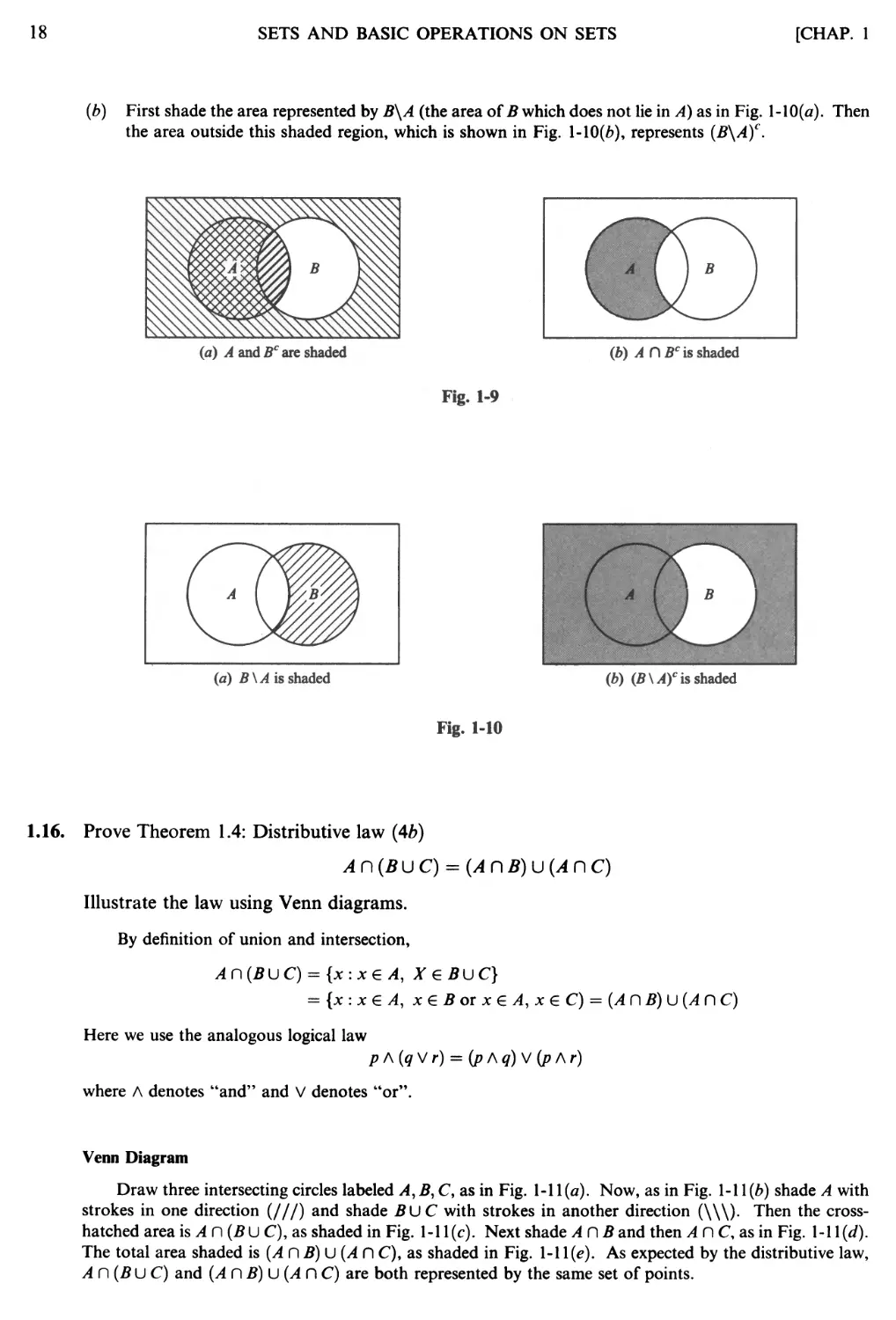
1.15. Consider the Venn diagram of two arbitrary sets A and B as pictured in Fig. I-I(c). Shade the
sets: (a) A n If, (b) (B\A)c.
(0) First shade the area represented by A with strokes in one direction (/ j j), and then shade the area
represented by If (the area outside B), with strokes in another direction (\ \ \). This is shown in Fig.
1-9(0). The cross-hatched area is the intersection of these two sets and represents A n If; and this is
shown in Fig. 1-9(b). Observe that A n If = A\B. In fact, A\B is sometimes defined to be An B'.
18
SETS AND BASIC OPERATIONS ON SETS
[CHAP. I
(b) First shade the area represented by B\A (the area of B which does not lie in A) as in Fig. I-IO(a). Then
the area outside this shaded region, which is shown in Fig. 1-10(b), represents (B\A)c.
(a) A and B C are shaded
(b) A n B C is shaded
Fig. 1-9
A B
(a) B \A is shaded
(b) (B \ A)C is shaded
Fig. 1-10
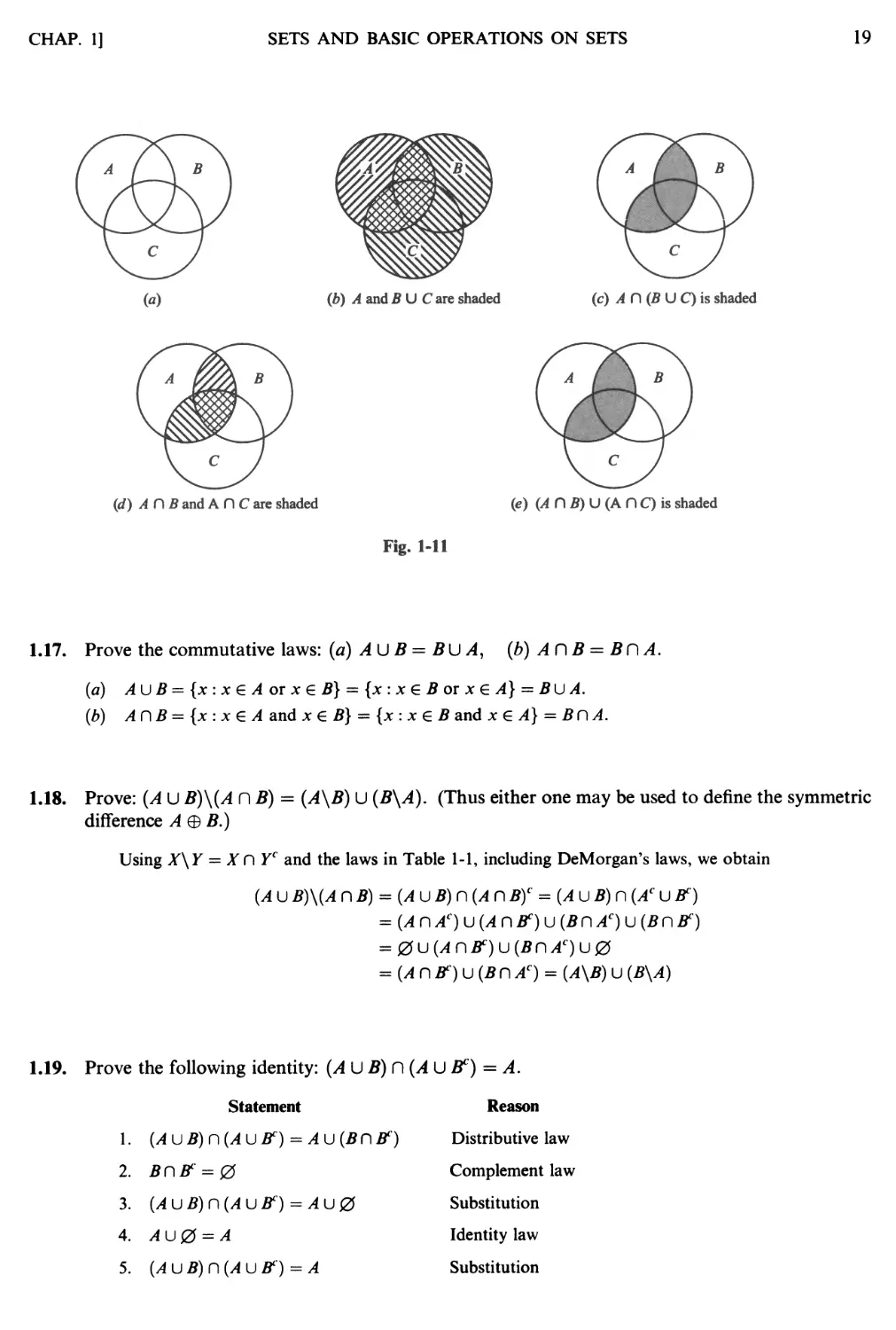
1.16. Prove Theorem 1.4: Distributive law (4b)
An(BUC) = (AnB)U(AnC)
Illustrate the law using Venn diagrams.
By definition of union and intersection,
An (BU C) = {x: x E A, X E Bu C}
= {x : x E A, x E B or x E A, x E C) = (A n B) U (A n C)
Here we use the analogous logical law
p /\ (q V r) = (p /\ q) V (p /\ r)
where /\ denotes "and" and V denotes "or".
Venn Diagram
Draw three intersecting circles labeled A, B, C, as in Fig. I-II (a). Now, as in Fig. I-II (b) shade A with
strokes in one direction (/ / /) and shade B U C with strokes in another direction (\ \ \). Then the cross-
hatched area is A n (B U C), as shaded in Fig. 1-II(c). Next shade A n B and then An C, as in Fig. 1-11(d).
The total area shaded is (A n B) U (A n C), as shaded in Fig. l-ll(e). As expected by the distributive law,
A n (B U C) and (A n B) U (A n C) are both represented by the same set of points.
CHAP. 1]
SETS AND BASIC OPERATIONS ON SETS
19
(a)
(b) A andB U Care shaded
(c) A n (B U C) is shaded
(d) A n B and A n C are shaded
(e) (A n B) U (A n C) is shaded
Fig. 1-11
1.17. Prove the commutative laws: (a) A U B = B U A, (b) A n B = B n A.
(a) Au B = {x: x E A or x E B} = {x: x E B or x E A} = BU A.
(b) A n B = {x : x E A and x E B} = {x : x E B and x E A} = B n A.
1.18. Prove: (A U B)\(A n B) = (A\B) U (B\A). (Thus either one may be used to define the symmetric
difference A EB B.)
Using X\Y = xn y c and the laws in Table 1-1, including DeMorgan's laws, we obtain
(A U B)\(A n B) = (A U B) n (A n B)C = (A U B) n (A C U U')
= (A nA C ) U (A nIf) U (BnA C ) U (BnIf)
= 0 U (A n If) U (B n A C ) U 0
= (A n U') U (B n A C ) = (A\B) U (B\A)
1.19. Prove the following identity: (A U B) n (A U If) = A.
Statement Reason
1. (AuB)n(AuK) =AU(BnK) Distributive law
2. Bnlf'=0 Complement law
3. (A U B) n (A uK) = A U 0 Substitution
4. Au0=A Identity law
5. (A U B) n (A uS') = A Substitution
20
SETS AND BASIC OPERATIONS ON SETS
[CHAP. 1
1.20. Write the dual of each set equation:
(a) (UnA)U(BnA)=A
(b) (A U B U C)C = (A U C)C n (A U B)C
(c) (A n U) n (0 U A C ) = 0
(d) (A n U)C n A = 0
Interchange U and n and also U and 0 in each set equation:
(a) (0 U A) n (B U A) = A
(b) (AnBnC)c=(AnC)CU(AnB)C
(c) (A U 0) U (UnA C ) = U
(d) (AU0)C U A =U
FINITE SETS AND THE COUNTING PRINCIPLE
1.21. Determine which of the following sets are finite.
(a) A = {seasons in the year},
(b) B = {states in the United States of America},
(c) C = {positive integers less than I},
(d) D = {odd integers},
(e) E = {positive integral divisors of 12},
(f) F = {cats living in the United States}.
(a) A is finite since there are four seasons in the year, Le., n(A) = 4.
(b) B is finite because there are 50 states in the United States, i.e., n(B) = 50.
(c) There are no positive integers less than 1; hence C is empty. Thus C is finite and n(C) = 0.
( d) D is infinite.
(e) The positive integer divisors of 12 are 1, 2, 3, 4, 6, 12. Hence E is finite and n(E) = 6.
if) Although it may be difficult to find the number of cats living in the United States, there is still a finite
number of them at any point in time. Hence F is finite.
1.22. Suppose 50 science students are polled to see whether or not they have studied French (F) or
German (G) yielding the following data:
25 studied French, 20 studied German, 5 studied both.
Find the number of the students who: (a) studied only French, (b) did not study German,
( c) studied French or German, (d) studied neither language.
(a) Here 25 studied French, and 5 of them also studied German; hence 25 - 5 = 20 students only studied
French. That is, by Theorem 1.7,
n(F\G) = n(F) - N(F n G) = 25 - 5 = 20.
(b) There are 50 students of whom 20 studied German; hence 50 - 20 = 30 did not study German. That is,
by Theorem 1.6,
n(ac) = n(U) - n(G) = 50 - 20 = 30
( c) By the inclusion-exclusion principle, Theorem 1.8,
n(FU G) = n(F) +n(G) - n(Fn G) = 25 + 20 - 5 = 40
That is, 40 students studied French or German.
(d) The set r n C;C consists of the students who studied neither language. By DeMorgan's law,
pre n G C = (F U G)c. By (c), 40 studied at least one of the languages; hence
n(r n G C ) = n(U) - n(F U G) = 50 - 40 = 10
That is, 10 students studied neither language.
CHAP. I]
SETS AND BASIC OPERATIONS ON SETS
21
1.23. Suppose n(U) = 70, n(A) = 30, n(B) = 45, n(A n B) = 10. Find:
(a) n(A U B), (b) n(A C ) and n(K), (c) n(A C n K), (d) n(A E9 B).
(a) By Theorem 1.9, n(A U B) = n(A) + n(B) - n(A n B) = 30 + 45 - 10 = 65.
(b) Here
n(A C ) = n(U) - n(A) = 70 - 30 = 40 and n(OC) = n(U) - n(B) = 70 - 45 = 25
(c) Using DeMorgan's law,
n(A C n OC) = n((A U B)C) = n(U) - n(A U B) = 70 - 65 = 5
( d) First find
n(A\B) = n(A) - n(A n B) = 30 - 10 = 20
n(B\A) = n(B) - n(A n B) = 45 - 10 = 25
Then
n(A EB B) = n(A\B) + n(B\A) = 20 + 25 = 45
1.24. A small college requires its students to take at least one mathematics course and at least one
science course. A survey of 140 of its sophomore students shows that:
60 completed their mathematics requirement (M),
45 completed their science requirement (S),
20 completed both requirements (M and S).
Use a Venn diagram to find the number of the students who had completed:
(a) exactly one of the two requirements,
(b) at least one of the requirements,
(c) neither requirement.
Translating the above data into set notation yields:
n(M) = 60,
n(S) = 45,
n(M n S) = 20,
and
n(U) = 140
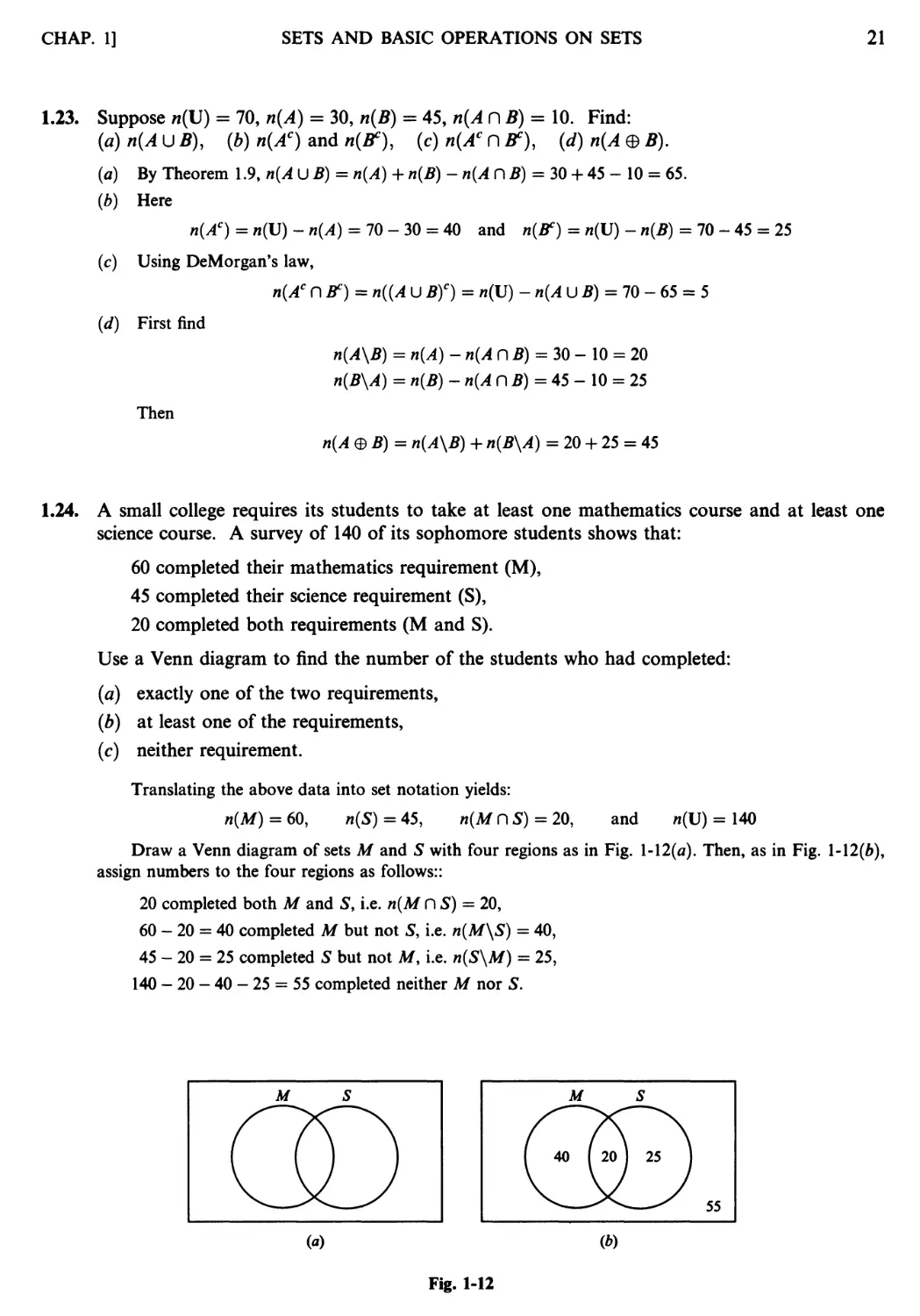
Draw a Venn diagram of sets M and S with four regions as in Fig. 1-12(a). Then, as in Fig. 1-12(b),
assign numbers to the four regions as follows::
20 completed both M and S, Le. n(M n S) = 20,
60 - 20 = 40 completed M but not S, Le. n(M\S) = 40,
45 - 20 = 25 completed S but not M, Le. n(S\M) = 25,
140 - 20 - 40 - 25 = 55 completed neither M nor S.
M
s
M
s
ss
(a)
(b)
Fig. 1-12
22
SETS AND BASIC OPERATIONS ON SETS
[CHAP. 1
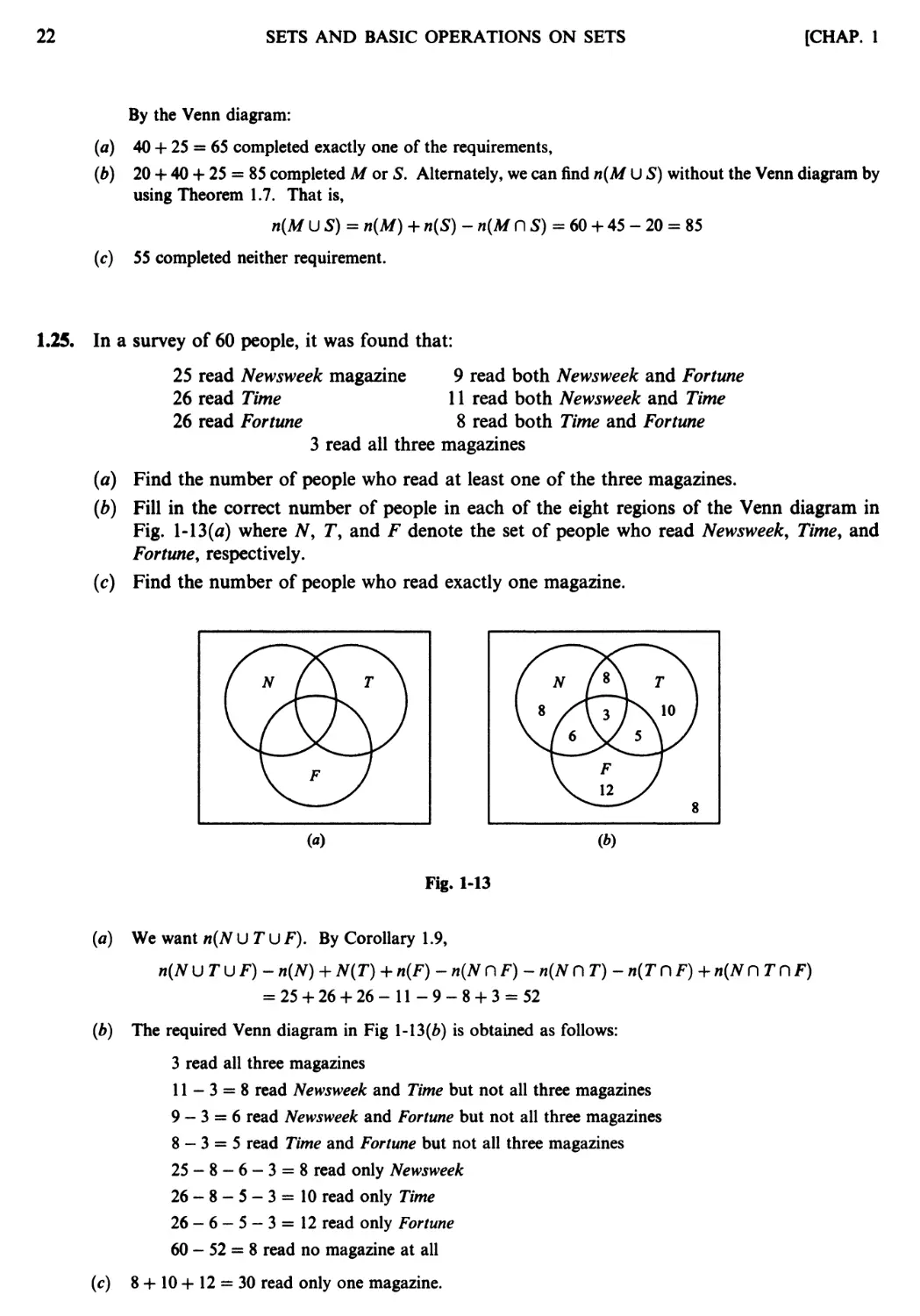
By the Venn diagram:
(a) 40 + 25 = 65 completed exactly one of the requirements,
(b) 20 + 40 + 2S = 8S completed M or S. Alternately, we can find n(M US) without the Venn diagram by
using Theorem 1.7. That is,
n(M U S) = n(M) + n(S) - n(M n S) = 60 + 45 - 20 = 85
(c) SS completed neither requirement.
1.2S. In a survey of 60 people, it was found that:
25 read Newsweek magazine 9 read both Newsweek and Fortune
26 read Time 11 read both Newsweek and Time
26 read Fortune 8 read both Time and Fortune
3 read aU three magazines
(a) Find the number of people who read at least one of the three magazines.
(b) Fill in the correct number of people in each of the eight regions of the Venn diagram in
Fig. 1-13(a) where N, T, and F denote the set of people who read Newsweek, Time, and
Fortune, respectively.
(c) Find the number of people who read exactly one magazine.
(a)
(b)
Fig. 1-13
(a) We want n(N U T U F). By Corollary 1.9,
n(NU TUF) - n(N) + N(T) +n(F) - n(NnF) - n(Nn T) - n(TnF) +n(Nn Tn F)
= 25 + 26 + 26 - 11 - 9 - 8 + 3 = 52
(b) The required Venn diagram in Fig l-13(b) is obtained as follows:
3 read all three magazines
11 - 3 = 8 read Newsweek and Time but not all three magazines
9 - 3 = 6 read Newsweek and Fortune but not all three magazines
8 - 3 = 5 read Time and Fortune but not all three magazines
25 - 8 - 6 - 3 = 8 read only Newsweek
26 - 8 - 5 - 3 = 10 read only Time
26 - 6 - 5 - 3 = 12 read only Fortune
60 - 52 = 8 read no magazine at all
(c) 8 + 10 + 12 = 30 read only one magazine.
CHAP. I]
SETS AND BASIC OPERA TIONS ON SETS
23
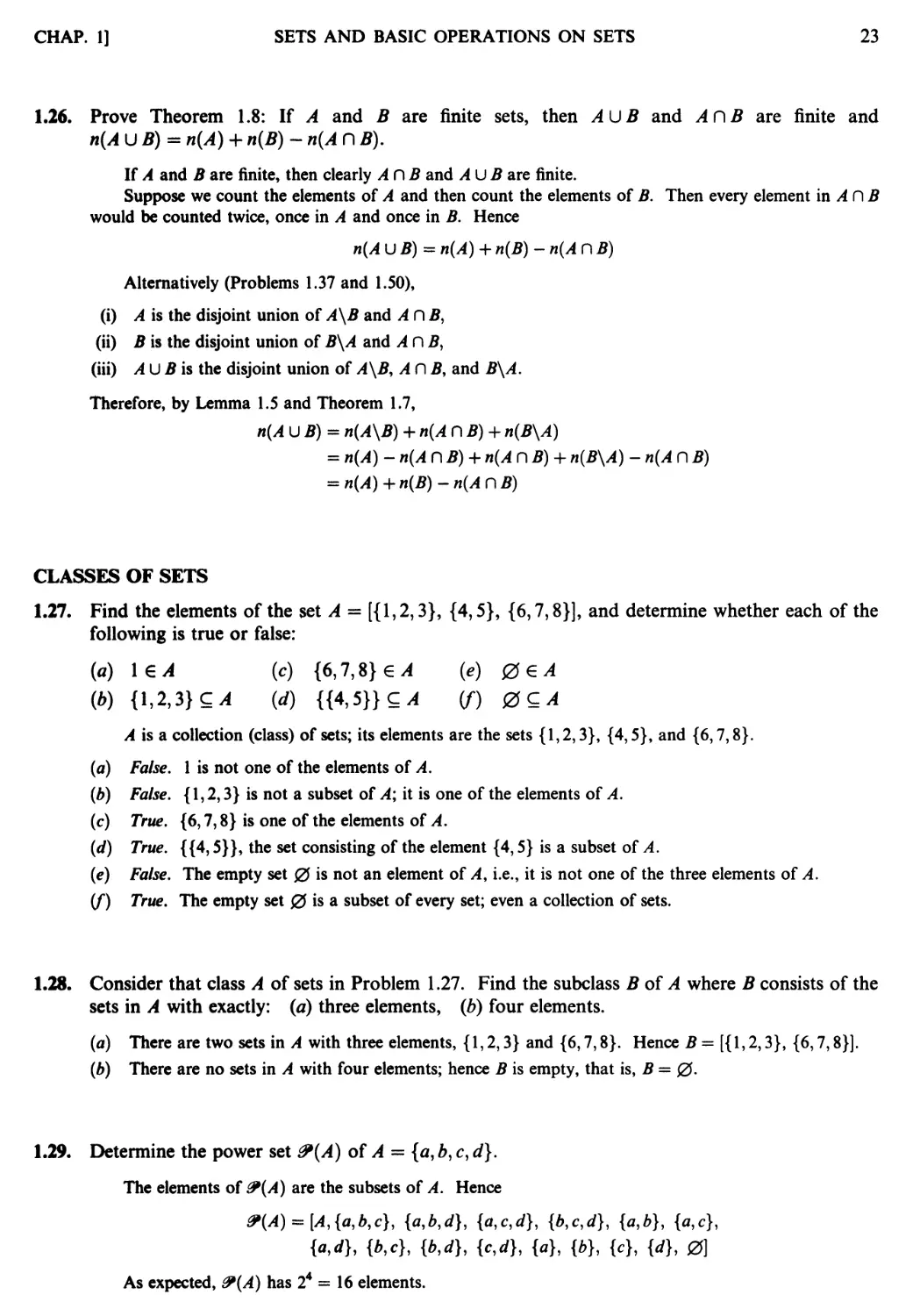
1.26. Prove Theorem 1.8: If A and B are finite sets, then A U B and A n B are finite and
n(A U B) = n(A) + n(B) - n(A n B).
If .A and B are finite, then clearly An B and AU B are finite.
Suppose we count the elements of A and then count the elements of B. Then every element in A n B
would be counted twice, once in A and once in B. Hence
n(A U B) = n(A) + n(B) - n(A n B)
Alternatively (Problems 1.37 and 1.50),
(i) A is the disjoint union of A \B and A n B,
(ii) B is the disjoint union of B\A and A n B,
(Hi) AU B is the disjoint union of A\B, An B, and B\A.
Therefore, by Lemma 1.5 and Theorem 1.7,
n(A U B) = n(A\B) + n(A n B) + n(B\A)
= n(A) - n(A n B) + n(A n B) + n(B\A) - n(A n B)
= n(A) + n(B) - n(A n B)
CLASSES OF SETS
1.27. Find the elements of the set A = [{ 1,2, 3}, {4, 5}, {6, 7, 8}], and determine whether each of the
following is true or false:
(a) 1 E A
(b) { 1 , 2, 3} C A
(c) {6, 7, 8} E A
(d) {{4,5}} C A
(e) 0 E A
(f) 0 C A
.A is a collection (class) of sets; its elements are the sets {I, 2, 3}, {4, 5}, and {6, 7, 8}.
(a) False. 1 is not one of the elements of A.
(b) False. {I, 2, 3} is not a subset of A; it is one of the elements of A.
(c) True. {6, 7, 8} is one of the elements of A.
(d) True. {{ 4, S}}, the set consisting of the element {4, 5} is a subset of A.
(e) False. The empty set 0 is not an element of A, Le., it is not one of the three elements of A.
(f) True. The empty set 0 is a subset of every set; even a collection of sets.
1.28. Consider that class A of sets in Problem 1.27. Find the subclass B of A where B consists of the
sets in A with exactly: (a) three elements, (b) four elements.
(a) There are two sets in A with three elements, {I, 2, 3} and {6, 7, 8}. Hence B = [{I, 2, 3}, {6, 7, 8}].
(b) There are no sets in A with four elements; hence B is empty, that is, B = 0.
1.29. Determine the power set (A) of A = {a,b,c,d}.
The elements of 9'(A) are the subsets of A. Hence
9'(A) = [A, {a,b,c}, {a,b,d}, {a,c,d}, {b,c,d}, {a,b}, {a,c},
{a,d}, {b,c}, {b,d}, {c,d}, {a}, {b}, {c}, {d}, 0]
As expected, 9'(A) has 2 4 = 16 elements.
24
SETS AND BASIC OPERATIONS ON SETS
[CHAP. 1
1.30. Find the number of elements in the power set of each of the following sets:
(a) {days of the week},
(b) {positive divisors of 12},
( c) {seasons of the year},
(d) {letters in the word "yes"}.
Recall that 9'(A) contains 21AI elements. Hence:
(a) 2' = 128.
(b) 2 6 = 64 since there are six divisors, 1, 2, 3, 4,6, 12, of 12.
(c) 2 4 = 16 since there are four seasons.
(d) 2 3 = 8.
ARGUMENTS AND VENN DIAGRAMS
1.31. Determine the validity of the following argument:
SI: All my friends are musicians
S2: John is my friend.
S3: None of my neighbors are musicians.
S: John is not my neighbor.
The premises 8 1 and 8 3 lead to the Venn diagram in Fig. 1-14. By 8 2 , John belongs to the set of friends
which is disjoint from the set of neighbors. Thus 8 is a valid conclusion and so the argument is valid.
Egh3
Fig. 1-14
1.32. Consider the following assumptions:
SI: Poets are happy people.
S2: Every doctor is wealthy.
S3: No happy person is wealthy.
Determine the validity of each of the following conclusions:
(a) No poet is wealthy. (b) Doctors are happy people.
(c) No person can be both a poet and a doctor.
The three premises lead to the Venn diagram in Fig. 1-15. From the diagram it follows that (a) and (c)
are valid conclusions whereas (b) is not valid.
CHAP. 1]
SETS AND BASIC OPERATIONS ON SETS
25
Fig. 1-15
1.33. Determine the validity of the following argument:
S 1 : Babies are illogical.
S2: Nobody is despised who can manage a crocodile.
S3: Illogical people are despised.
S: Babies cannot manage crocodiles.
(The above argument is adapted from Lewis Carroll, Symbolic Logic; he is the author of Alice in
Wonderland. )
The three premises lead to the Venn diagram in Fig. 1-16. Since the set of babies and the set of people
who can manage crocodiles are disjoint, "Babies cannot manage crocodiles" is a valid conclusion.
Fig. 1-16
MATHEMATICAL INDUCfION
1.34. Prove the assertion A(n) that the sum of the first n positive integers is !n(n + 1); that is,
A(n): 1+2+3+...+n=!n(n+l)
The assertion holds for n = 1 since
A ( 1 ): 1 ::;:: !( 1 ) (1 + 1)
Assuming A(n) is true, we add n + 1 to both sides of A(n), obtaining
1 + 2 + 3 + ... + n + (n + 1) = !n(n + 1) + (n + 1)
= ![n(n + 1) + 2(n + 1)]
=![(n+ 1)(n+2)]
which is A(n + 1). That is, A(n + 1) is true whenever A(n) is true. By the principle of induction, A(n) is true
for all n > 1.
26
SETS AND BASIC OPERATIONS ON SETS
[CHAP. 1
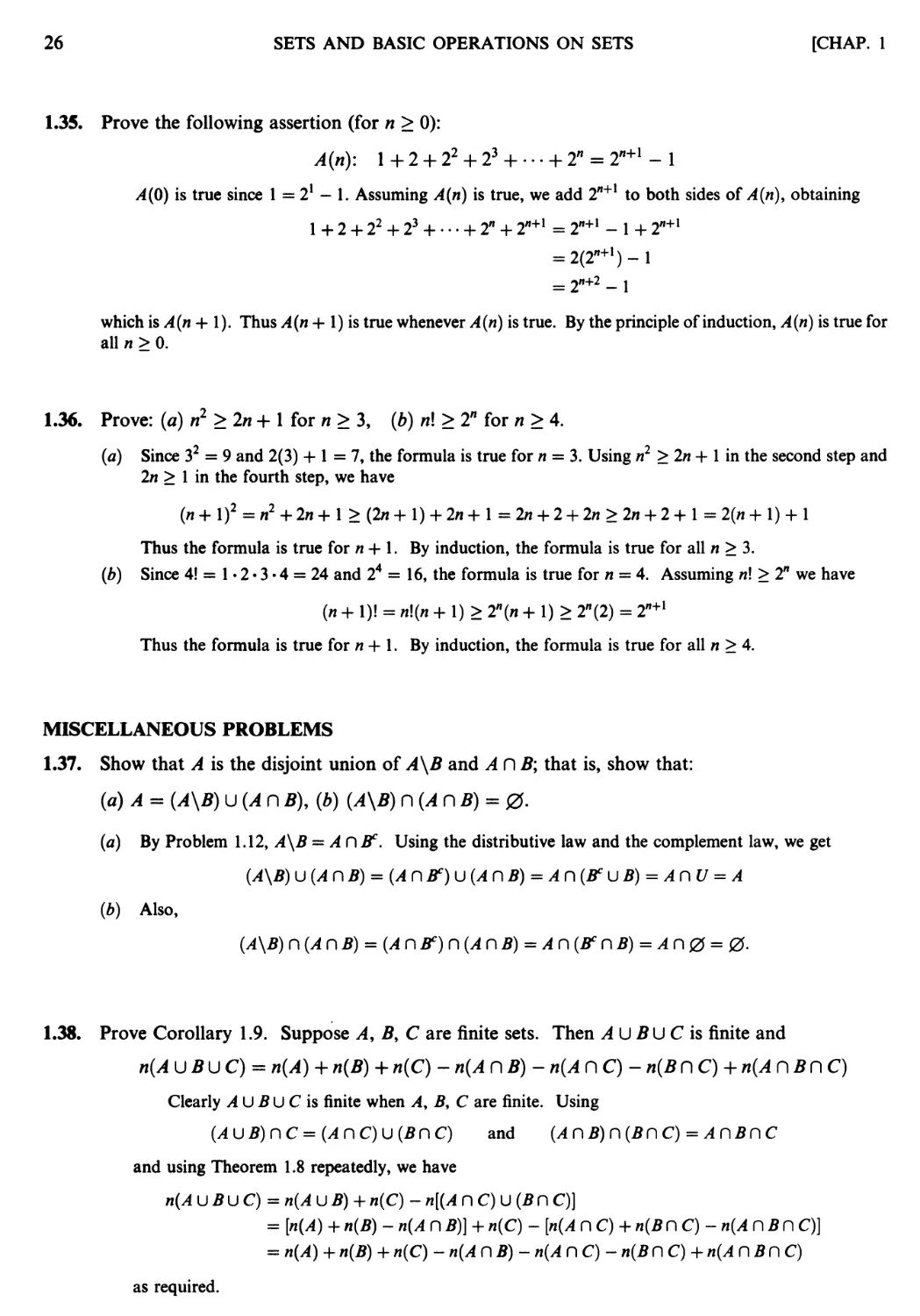
1.35. Prove the following assertion (for n > 0):
A(n): 1 + 2 + 2 2 + 23 + . . . + 2 n = 2n+l - 1
A(O) is true since 1 = 2 1 - 1. Assuming A(n) is true, we add 2n+1 to both sides of A(n), obtaining
1 + 2 + 2 2 + 2 3 + . . . + 2 n + 2 n + 1 = 2 n + 1 _ 1 + 2 n + 1
= 2(2 n + l ) - 1
= 2 n + 2 - 1
which is A(n + 1). Thus A(n + 1) is true whenever A(n) is true. By the principle of induction, A(n) is true for
all n > o.
1.36. Prove: (a) n 2 > 2n + 1 for n > 3, (b) n! > 2 n for n > 4.
(a) Since 3 2 = 9 and 2(3) + 1 = 7, the formula is true for n = 3. Using n 2 > 2n + 1 in the second step and
2n > 1 in the fourth step, we have
(n+ 1)2 = n 2 +2n+ 1 > (2n+ 1) +2n+ 1 = 2n+2+2n > 2n+2+ 1 = 2(n+ 1) + 1
Thus the formula is true for n + 1. By induction, the formula is true for all n > 3.
(b) Since 4! = 1.2. 3. 4 = 24 and 2 4 = 16, the formula is true for n = 4. Assuming n! > 2 n we have
(n + I)! = n!(n + 1) > 2 n (n + 1) > 2 n (2) = 2n+1
Thus the formula is true for n + 1. By induction, the formula is true for all n > 4.
MISCELLANEOUS PROBLEMS
1.37. Show that A is the disjoint union of A\B and A n B; that is, show that:
(a) A = (A\B) U (A n B), (b) (A\B) n (A n B) = 0.
(a) By Problem 1.12, A\B = A nK. Using the distributive law and the complement law, we get
(A\B) U (A n B) = (A n K) U (A n B) = An (K U B) = An u = A
(b) Also,
(A\B) n (A n B) = (A n K) n (A n B) = A n (K n B) = A n 0 = 0.
1.38. Prove Corollary 1.9. Suppose A, B, C are finite sets. Then A U B U C is finite and
n(A U BU C) = n(A) + n(B) + n(C) - n(A n B) - n(A n C) - n(Bn C) + n(A n Bn C)
Clearly A U B U C is finite when A, B, C are finite. Using
(A UB) n C = (A n C) U (Bn C)
and
(A n B) n (B n C) = A n B n C
and using Theorem 1.8 repeatedly, we have
n(A U B U C) = n(A U B) + n( C) - n[(A n C) U (B n C)]
= [n(A) +n(B) - n(A nB)] +n(C) - [n(A n C) +n(Bn C) - n(A nBn C)]
= n(A) + n(B) + n(C) - n(A n B) - n(A n C) - n(Bn C) + n(A nBn C)
as required.
CHAP. 1]
SETS AND BASIC OPERATIONS ON SETS
27
1.39. A set A of real numbers is said to be bounded from above if there exists a number M such that
x < M for every x in A. (Such a number M is called an upper bound of M.)
(a) Suppose A and B are sets which are bounded from above with respective upper bounds M 1
and M 2 . What can be said about the union and intersection of A and B?
(b) Suppose C and D are sets of real numbers which are unbounded. What can be said about
the union and intersection of C and D?
(a) Both the union and intersection are bounded from above. In fact, the larger of M 1 and M 2 is always an
upper bound for A U B, and the smaller of M 1 and M 2 is always an upper bound for A n B.
(b) The union of C and D must be unbounded, but the intersection could be either bounded or unbounded.
1.40. Restate the Principle of Mathematical Induction I and II in terms of sets, rather than assertions.
(a) Principle of Mathematical Induction I: Let S be a subset of P == {I, 2, . . .} with two properties:
(1) 1 E S.
(2) If n E S, then n + 1 E S.
Then S = P.
(b) Principle of Mathematical Induction II: Let S be a subset of P == {I, 2, . . .} with two properties:
(1) 1 E S.
(2) If {I, 2, . . . , n - I} S, then n E S.
Then S = P.
Supplementary Problems
SETS AND SUBSETS
1.41. Which of the following sets are equal?
A = {x : x 2 - 4x + 3 == O}
B = {x : x 2 - 3x + 2 = O}
C == {x : x E P, x < 3}
D == {x : x E P, x is odd, x < 5}
E=={1,2}
F == {I, 2, I}
G=={3,1}
H=={1,1,3}
1.42. List the elements of the following sets if the universal set is U == {a, b, c, . . . , y, z}. Furthermore, identify
which of the sets, if any, are equal.
A = {x : x is a vowel}
B = {x : x is a letter in the word "little"}
c == {x : x precedes f in the alpha bet}
D == {x : x is a letter in the word "title"}
1.43. Let
A = {I, 2, . . . , 8, 9},
B = {2, 4,6, 8},
C == {I, 3, 5, 7, 9},
D == {3, 4, 5},
E == {3, 5}
Which of the above sets can equal a set X under each of the following conditions?
(a) X and B are disjoint.
(b) X C D but X g; B.
(c) X C A but X g C.
(d) X C but X g; A.
28
SETS AND BASIC OPERATIONS ON SETS
[CHAP. 1
1.44. Consider the following sets:
0,
A=={a},
B == {c, d},
C == {a, b, c, d},
D == {a, b},
E == {a, b, c, d, e}.
Insert the correct symbol, or g, between each pair of sets:
(a) 0, A ( c) A, B ( e) B, C (g) C, D
(b) D, E (d) D, A if) D, C (h) B, D
SET OPERATIONS
1.45. Let U == {I, 2, 3, . . . ,8, 9} be the universal set and let:
A == {I, 2,5, 6}, B == {2, 5, 7}, C == {I, 3, 5,7, 9}
Find: (a) An Band AnC, (b) AU Band AUC, (c) A C and CC.
1.46. For the sets in Problem 1.45, find: (a) A\B and A\C, (b) A ffi B and A ffi C.
1.47. For the sets in Problem 1.45, find: (a) (A U C)\B, (b) (A U Br, (c) (B ffi C)\A.
1.48. Let A == {a,b,c,d,e}, B == {a,b,d,j,g}, C == {b,c,e,g,h}, D == {d,e,j,g,h}. Find:
( a) A U B ( c) B n C ( e) C\ D (g) A ffi B
(b) C n D (d) AnD if) D\A (h) A ffi C
1.49. For the sets in Problem 1.48, find:
(a) A n (B U D)
(b) B\ ( CUD)
(c) (A U D)\C
(d) B n C n D
( e) (C\ A) \ D
(1') (A ffi D) \B
(g) (A n D)\(B U C)
(h) (A\C) n (B n D)
1.50. Let A and B be any sets. Prove A U B is the disjoint union of A \B, A n B, and B\A.
1.51. Prove the following:
(a) A B if and only if A n If == 0
(b) A C B if and only if A C U B == U
(Compare with TheoreIl} 1.3.)
(c) A B if and only if If A C
(d) A B if and only if A\B == 0
1.52. Prove the absorption laws: (a) A U (A n B) == A, (b) A n (A U B) == A.
1.53. The formula A\B == A n B C defines the difference operation in terms of the operations of intersection and
complement. Find a formula that defines the union A U B in terms of the operations of intersection and
complement.
1.54. (a) Prove: A n (B\C) == (A n B)\(A n C).
(b) Give an example to show that AU (B\C) i= (A U B)\(A U C).
1.55. Prove the following properties of the symmetric difference:
(a) A ffi (B ffi C) == (A ffi B) ffi C (Associative law)
(b) A ffi B == B ffi A (Commutative law)
(c) If A ffi B == A ffi C, then B == C (Cancellation law)
(d) A n (B ffi C) == (A n B) ffi (A n C) (Distributive law)
CHAP. 1]
SETS AND BASIC OPERATIONS ON SETS
29
VENN DIAGRAMS, ALGEBRA OF SETS, DUALITY
1.56. The Venn diagram in Fig. 1-17 shows sets A, B, C. Shade the following sets:
(a) A\(B U C),
(b) A C n (B n C),
( c) (A U C) n (B U C).
Fig. 1-17
1.57. Write the dual of each equation:
(a) A = (if n A) U (A n B),
(b) (A n B) U (A n if) U (A C n B) U (A C n if) = U
1.58. Use the laws in Table 1-1 to prove:
(a) (A n B) U (A n if) = A,
(b) A U B = (A n if) U (A C n B) U (A n B)
FINITE SETS AND THE COUNTING PRINCIPLE
1.59. Determine which of the following sets are finite:
( a) lines parallel to the x axis,
(b) letters in the English alphabet,
(c) months in the year,
(d) animals living on the earth,
(e) circles through the origin (0,0),
if) positive multiple of 5.
1.60. Given n( U) = 20, n(A) = 12, n(B) = 9, n(A n B) = 4. Find:
(a) n(A U B), (b) n(A C ), (c) n(if), (d) n(A\B), (e) n(0).
1.61. Among the 90 students in a dormitory, 35 own an automobile, 40 own a bicycle, and 10 have both an
automobile and a bicycle. Find the number of the students who:
(a) do not have an automobile.
(b) have an automobile or a bicycle;
(c) have neither an automobile nor a bicycle;
(d) have an automobile or a bicycle, but not both.
1.62. Among 120 Freshmen at a college, 40 take mathematics, 50 take English, and 15 take both mathematics and
English. Find the number of the Freshmen who:
(a) do not take mathematics;
(b) take mathematics or English;
(c) take mathematics, but not English;
(d) take English, but not mathematics;
(e) take exactly one of the two subjects;
if) take neither mathematics nor English.
30
SETS AND BASIC OPERATIONS ON SETS
[CHAP. I
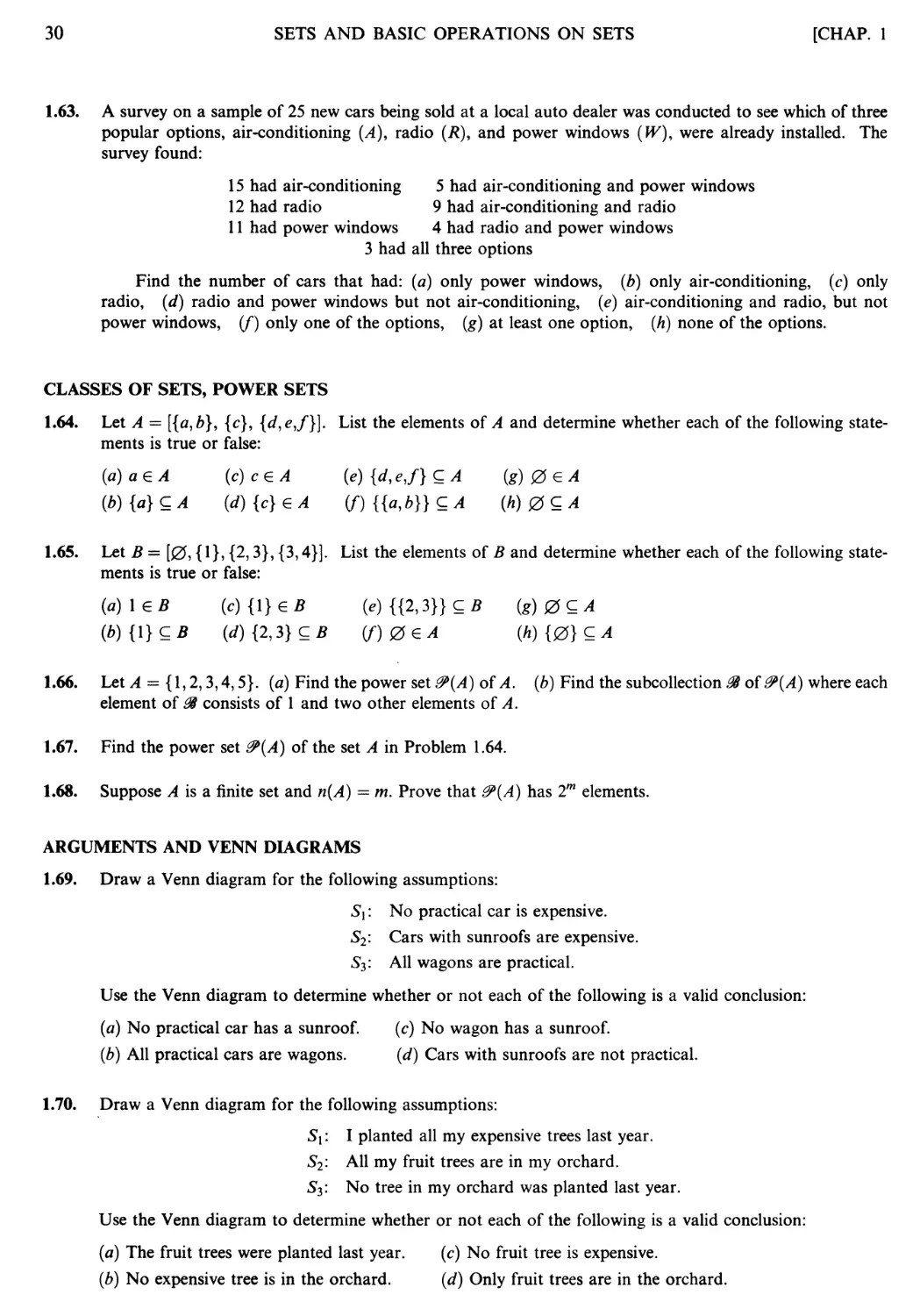
1.63. A survey on a sample of 25 new cars being sold at a local auto dealer was conducted to see which of three
popular options, air-conditioning (A), radio (R), and power windows (W), were already installed. The
survey found:
15 had air-conditioning 5 had air-conditioning and power windows
12 had radio 9 had air-conditioning and radio
II had power windows 4 had radio and power windows
3 had all three options
Find the number of cars that had: (a) only power windows, (b) only air-conditioning, (c) only
radio, (d) radio and power windows but not air-conditioning, (e) air-conditioning and radio, but not
power windows, if) only one of the options, (g) at least one option, (h) none of the options.
CLASSES OF SETS, POWER SETS
1.64. Let A = [{a,b}, {c}, {d,e,f}]. List the elements of A and determine whether each of the following state-
ments is true or false:
(a) a E A
(b) {a} C A
(c) c E A
(d) {c} E A
(e) {d, e,f} C A
if) {{ a, b }} C A
(g) 0 E A
(h) 0 C A
1.65. Let B = [0, {I}, {2, 3}, {3, 4}]. List the elements of B and determine whether each of the following state-
ments is true or false:
(a) 1 E B
(b) {I} C B
(c) {I} E B
(d) {2,3} C B
(e) {{2,3}} C B
if) 0 E A
(g) 0 C A
(h) {0} C A
1.66. Let A = {I, 2,3,4, 5}. (a) Find the power set &'(A) of A. (b) Find the subcollection of 9(A) where each
element of fJl consists of 1 and two other elements of A.
1.67. Find the power set 9(A) of the set A in Problem 1.64.
1.68. Suppose A is a finite set and n(A) = m. Prove that 9(A) has 2 m elements.
ARGUMENTS AND VENN DIAGRAMS
1.69. Draw a Venn diagram for the following assumptions:
SI: No practical car is expensive.
S2: Cars with sunroofs are expensive.
S3: All wagons are practical.
Use the Venn diagram to determine whether or not each of the following is a valid conclusion:
(a) No practical car has a sunroof.
(b) All practical cars are wagons.
(c) No wagon has a sunroof.
(d) Cars with sunroofs are not practical.
1.70. Draw a Venn diagram for the following assumptions:
SI: I planted all my expensive trees last year.
S2: All my fruit trees are in my orchard.
S3: No tree in my orchard was planted last year.
Use the Venn diagram to determine whether or not each of the following is a valid conclusion:
(a) The fruit trees were planted last year.
(b) No expensive tree is in the orchard.
(c) No fruit tree is expensive.
(d) Only fruit trees are in the orchard.
CHAP. 1]
SETS AND BASIC OPERATIONS ON SETS
31
1.71. Draw a Venn diagram for the following assumptions:
SI: All poets are poor.
S2: In order to be a teacher, one must graduate from college.
S3: No college graduate is poor.
Use the Venn diagram to determine whether or not each of the following is a valid conclusion:
(a) Teachers are not poor.
(b) Poets are not teachers.
(c) College graduates do not become poets.
(d) Every poor person becomes a poet.
1.72. Draw a Venn diagram for the following assumptions:
SI: All mathematicians are interesting people.
S2: Only uninteresting people become insurance salespersons.
S3: Every genius is a mathematician.
Use the Venn diagram to determine whether or not each of the following is a valid conclusion:
(a) No genius is an insurance salesperson.
(b) Insurance salespersons are not mathematicians.
(c) Every interesting person is a genius.
MATHEMATICAL INDUCTION
1.73. Prove: 2 + 4 + 6 + . . . + 2n == n (n + I).
1.74. Prove: 1 + 4 + 7 + . . . + (3n - 2) == 2n(3n - 1).
1 I 1 1
Prove: t:3 + 3.5 + 5. 7 + ... + (2n - 1)(2n + 1)
1
2n + I'
1.75.
1. 76. Prove: 1 2 + 2 2 + 3 2 + . . . + n 2 = n( n + 1) 2n + 1) .
1.77. Prove: Given aD == I and an == a n - l a for n > O. Prove: (a) am an == a m + n , (b) (am)n == a mn .
Answers to Supplementary Problems
1.41. B == C == E == F; A == D == G == H
1.42. A == {a, e, i, 0, u}; B == D == {I, i, t, e}; C == {a, b, c, d, e}
1.43. (a) C and E; (b) D and E; (c) A, B, D; (d) none
1.44. (a) c ; (b) c ; (c) ; (d) ; (e) c ; if) c ; (g) ; (h)
1.45. (a) A nB == {2,5}, An C == {I,5}; (b) A UB == {I,2,5,6, 7}, AU C == {I,2,3,5,6, 7,9};
( c) A C == {3, 4, 7, 8, 9}, CC == {2, 4, 6, 8}
1.46. (a) A\B == {I, 6}, A\C == {2,6}; (b) A EB B == {I, 6, 7}, A EB C == {2, 3, 6, 7, 9}
32
SETS AND BASIC OPERATIONS ON SETS
[CHAP. 1
1.47. (a) {I,3,6,7,9}, (b) {3,4,8,9}, (c) {3,9}
1.48. (a) {a, b, c, d, e,l, g} ; ( b) {e, g, h }; ( c) {b, g} ; (d) {d, e } ; ( e) {b, c } ; (f) if, g, h };
(g) {c,e,f,g}; (h) {a,d,g,h}
1.49. (a) {a,b,d,e}; (b) {a}; (c) {a,d,/}; (d) {g}; (e) 0; (f) {c,h}; (g) 0; (h) {a,d}
1.53. A u B = (A C n U')c
1.54. (b) A = {a}; B = {b}; C = {c}, AU (B\C) = {a}, (A U B)\(A U C) = {b}
1.56. See Fig. 1-18.
(a)
(b)
(c)
Fig. 1-18
1.57. (a) A = (U' U A) n (A U B)
(b) (A U B) n (A U B C ) n (A C U B) n (A C U $') = 0
1.59. (b), (c), and (d)
1.60. (0) 17; (b) 8; (c) 11; (d) 8; (e) 0
1.61. (0) 55; (b) 75; (c) 15, (d) 55
1.62. (a) 80; (b) 75; (c) 25; (d) 35; ( e) 60; (f) 45
1.63. Use the data to first fill in the Venn diagram of A (air-conditioning), R (radio), W (power windows) in
Fig. 1-19. Then: (a) 5; (b) 4; (c) 2; (d) 4; (e) 6; (f) 11; (g) 23; (h) 2.
Fig. 1-19
CHAP. 1]
SETS AND BASIC OPERATIONS ON SETS
33
1.64. Three elements: {a,b}, {c}, and {d,e,/}. (a) F; (b) F; (c) F; (d) T; (e) F; (f) T; (g) F; (h) T
1.65. Four elements: 0, {I}, {2, 3}, and {3,4}. (a) F; (b) F; (c) T; (d) F; (e) T; if) T; (g) T; (h) T
1.66. (a) (A) has 2 5 == 32 elements as follows (where 135 == {I, 3, 5}):
[0,1,2,3,4,5,12,13,14,15,23,24,25,34,35,45,123, 124,125,134,135,145,234,235,245,345,1234,1235,
1245, 1345, 2345, A]
(b) P4 has 6 elements: [123, 124, 125, 134, 135, 145].
1.67. A has 3 elements, so (A) has 2 3 == 8 elements as follows (where [ab,c] == [{ab}, {c}]):
{0, [ab], [c], [del], [ab, c], [ab, del], [c, del], A}
Note that (A) is a collection of collections of sets.
1.68. Let X be an arbitrary element of (A). For each a E A, there are two possibilities, a E X or a g X. Since
there are m elements in A, there are 2. 2. . . . · 2 (m factors) == 2 m different sets X. That is, (A) has 2 m
elements.
1.69. See Fig. 1-20. (a) Yes; (b) no; (c) yes; (d) yes
1.70. See Fig. 1-21. (a) No; (b) yes; (c) yes; (d) no
Fig. 1-20
Fig. 1-21
1.71. See Fig. 1-22. (a) Yes; (b) yes; (c) yes; (d) no
1.72. See Fig. 1-23. (a) Yes; (b) yes; (c) no
Fig. 1-22
Fig. 1-23
Chapter 2
Sets and Elementary Properties of the Real
Numbers
2.1 INTRODUCTION
This chapter investigates some sets and basic properties of the real numbers R and the integers
Z == {. . . , - 2, -1, 0, 1, 2, . . .}
(The letter Z comes from the word Zahlen which means number in German.)
The following simple rules concerning the addition and multiplication of these numbers are
assumed:
(a) Associative law for multiplication and addition:
(a+b)+c==a+(b+c)
and
(ab)c == a(bc)
(b) Commutative law for multiplication and addition:
a+b==b+a
and
ab == ba
(c) Distributive law:
a(b+c) ==ab+ac
(d) Additive identity and multiplicative identity: There exists a zero element 0 and a unity element 1
such that, for any number a,
a+O==O+a==a
and
a.1==1.a==a
(e) Additive inverse (negative): For any number a, there exists its negative -a such that
a + (-a) == (-a) + a == 0
(f) Multiplicative inverse: For any number a -=I 0, there exists an inverse a-I such that
-I -I 1
a.a ==a .a==
Subtraction and division (except by 0) are defined in R by
a-b a+(-b)
and
b - I
a.
Observe that subtraction uses property (e) of negatives, and division uses property (f) of inverses.
Warning. The last property (f) holds for the real numbers R and the rational numbers Q, but does
not hold for the integers Z. That is, one can add, subtract, multiply, and divide (except by 0) in Rand Q,
but only add, subtract, and multiply in Z.
2.2 REAL NUMBER SYSTEM R
The notation R will be used to denote the real numbers. These are the numbers one uses in basic
arithmetic and algebra. R together with its properties is called the real number system.
34
CHAP. 2]
SETS AND ELEMENTARY PROPERTIES OF THE REAL NUMBERS
35
The set R of real numbers includes the following sets of numbers:
Z = {. . . , -2, -1,0,1,2, . . .} = set of integers (signed whole numbers)
p = {I, 2,3, . . .} = set of positive integers (counting numbers)
N = {O, 1,2, . . .} = set of nonnegative integers (natural numbers)
Q = set of rational numbers, i.e. numbers which are ratios of integers
Examples of rational numbers are 2/3 and -3/4. Those real numbers that are not rational, such as 7r and
J2, i.e., real numbers which cannot be represented as the ratio of integers, are called irrational numbers.
The integer 0 is also a real number. Furthermore, for each positive real number, there is a corresponding
negative real number.
Real Line R, Decimal Expansion
One of the most important properties of the real numbers is that they can be represented graphically
by points on a straight line. Specifically, as pictured in Fig. 2-1, a point, called the origin, is chosen to
represent 0, and another point, usually to the right of 0, is chosen to represent 1. The direction from 0 to
1 is the positive direction and is sometimes indicated by an arrowhead at the end of the line. The distance
between 0 and 1 is the unit length. Now there is a natural way to pair off the points on the line and the
real numbers, that is, where each point on the line corresponds to a unique real number and vice versa.
The positive real numbers are those to the right of 0 (on the same side as 1) and the negative numbers
are those to the left of o. The points representing the rational numbers 5/4 and -3/2 are indicated in
Fig. 2-1. We refer to such a line as the real line or the real line R.
I
-5
I
-4
I
-3
_J
2
I .
-2
5
4
25
1 . I
2 3
I
4
475
.1
5
.
I 1 I.
-1 0 1
Real line R
Fig. 2-1
Real numbers can also be represented by decimals. The decimal expansion of a rational number will
either stop as in i = 0.75 or will have a pattern that repeats indefinitely, such as {i = 1.545454.... Even
when the decimal expansion stops, it can be rewritten using repeated 9's, for example, i = 0.74999 . . . .
The decimal expansion of an irrational number never stops nor does it have a repeating pattern. The
points representing the decimal 2.5 and 4.75 are indicated in Fig. 2-1.
2.3 ORDER AND INEQUALITIES
Let a and b be real numbers. We say a is less than b, written
a<b
if the difference b - a is positive. Geometrically, a < b if and only if the point a lies to the left of the
poin t b on the real line R.
Observe that we define order in R in terms of the positive real numbers denoted by R+. All the usual
properties of this order relation are a consequence of the following two properties of the positive real
numbers R+:
[Pd If a and b are positive, then a + band ab are positive.
[P 2 ] For any real number a, either a is positive, a = 0, or -a is positive.
The following additional notation and terminology are used:
a > b, means b < a;
a < b, means a < b or a = b;
a > b, means b < a;
read: a is greater than b
read: a is less than or equal to b
read: a is greater than or equal to b
36
SETS AND ELEMENTARY PROPERTIES OF THE REAL NUMBERS
[CHAP. 2
Any statement of the form a < b, a < b, a > b, or a > b is called an inequality; and any statement of the
form a < b or a > b is sometimes called a strict inequality.
EXAMPLE 2.1
(a) 2 < 5; -6 < -3; 4 < 4; 5 > -8; 6 > 0; -7 < o.
(b) Sorting the numbers 4, -7,9, -2,6,0, -11,13, -1, -5 in increasing order we obtain:
-11,-7,-5,-2,-1,0,3,4,6,9,13
( c) A real number a is positive iff a > 0, and a is negative iff a < O. (Recall that "iff" is short for "if and only if.")
(d) The statement 2 < x < 7 means 2 < x and x < 7; hence x will lie between 2 and 7 on the real line R.
Basic properties of the inequality relations follow.
Proposition 2.1: Let a, b, c be real numbers. Then:
(i) a < a.
(ii) If a < band b < a, then a = b.
(iii) If a < band b < c, then a < c.
Proposition 2.2 (Law of Trichotomy): F or any real numbers a and b, exactly one of the following holds:
a < b, a = b, or a > b
Proposition 2.3: Let a, b, c be real numbers such that a < b. Then:
(i) a + e < b + e.
(ii) ae < be when e > 0; but ac > be when e < o.
Remark: Observe that the above two properties [Pd and [P 2 ] of the positive real numbers R+ are
also true for the positive rational numbers Q+ viewed as a subset of the rational numbers Q, and the
positive integers P = Z+ viewed as a subset of the integers Z. Accordingly, Propositions 2.1, 2.2, and 2.3
also hold for the rational numbers Q and the integers Z.
2.4 ABSOLUTE VALUE, DISTANCE
The absolute value of a real number a, denoted by lal, may be viewed as the distance between a and
the origin 0 on the real line R. Formally, lal = a or -a according as a is positive or negative, and 101 = o.
That is:
lal = { a, f a > 0
-a, If a < 0
Accordingly, lal is always positive when a =I O. Intuitively, lal may be viewed as the magnitude of a
without regard to sign.
The distance d between two points (real numbers) a and b is denoted by d(a, b) and is obtained from
the formula
d == d(a, b) == la - bl == Ib - al
Al terna ti vel y:
d _ { lal + Ibl, if a and b have different signs
- lal - Ibl, if a and b have the same sign and lal > Ibl
CHAP. 2]
SETS AND ELEMENTARY PROPERTIES OF THE REAL NUMBERS
37
These two cases are pictured in Fig. 2-2.
III( d .. .-d---.
III( lal .. III( lal ..
.-Ibl---. III( Ibl ..
. . . .- . . . .
a 0 b a b 0
(i) d= lal + Ibl (ii) d = lal- Ibl
Fig. 2-2
EXAMPLE 2.2
(a) 1- 31:;::: 3, 171:;::: 7, 1- 131 :;::: 13, 14.251:;::: 4.25, 1- 0.751:;::: 0.75.
(b) /2 - 71 :;::: I - 51 :;::: 5, 17 - 21 :;::: 151 :;::: 5, I - 3 - 81 :;::: I - III :;::: 11.
(c) Using Fig. 2-2,
d(-2,9):;::: 2+9:;::: 11,
d(5,8) :;::: 8 - 5 :;::: 3,
d( -4, -11) :;::: 11 - 4 :;::: 7
The following proposition gives some properties of the absolute value function. [Problems 2.14 and
2.15 prove (iii) and (iv).]
Proposition 2.4: Let a and b be any real numbers.
(i) lal > 0, and lal == 0 iff a == o.
(ii) -Ial < a < lal.
(iii) labl == lal Ibl.
(iv) la ::i: bl < lal + Ibl.
(v) Iial-Ibil < la::i:bl.
2.5 INTERV ALS
Let a and b be distinct real numbers with, say, a < b. The intervals with endpoints a to b are denoted
and defined as follows:
(a, b) == {x: a < x < b},
[a, b] == {x : a < x < b},
(a, b] == {x : a < x < b},
[a, b) == {x : a < x < b},
open interval from a to b
closed interval from a to b
open-closed interval from a to b
closed-open interval from a to b
Observe that an interval is open if it does not include" its endpoints and is closed if it does include
its endpoints. Also, a parenthesis "(" or ")" is used to indicate that an endpoint does not belong
to the interval, and a bracket "[" or "]" is used to indicate that an endpoint does belong to the
in terval.
Figure 2-3 shows how we picture each of the above four intervals on the real line R. Notice that in
each case the endpoints a and b are circled, the line segment between a and b is thickened, and the circle
about the endpoint is filled if the endpoint belongs to the interval.
38
SETS AND ELEMENTARY PROPERTIES OF THE REAL NUMBERS
[CHAP. 2
o
a
o
b
.
a
.
b
open interval: a < x < b
closed interval: a x b
o
a
.
b
.
a
o
b
open-closed interval: a < x b
closed-open interval: a x < b
Fig. 2-3
EXAMPLE 2.3
(a) Find the interval satisfying each inequality, i.e., rewrite the inequality in terms of x alone:
(1) 2 < x - 5 < 8, (2) -1 < x + 3 < 4, (3) - 6 < 3x < 12, ( 4) - 6 < - 2x < 4
(1) Add 5 to each side to obtain 7 < x < 13.
(2) Add - 3 to each side to obtain -4 < x < 1.
(3) Divide each side by 3 (or: multiply by t) to obtain -2 < x < 4.
(4) Divide each side by -2 (or: multiply by -!) and reverse inequalities to obtain -6 < x < 3.
(b) The inequality Ixl < 5 may be interpreted to mean that the distance between x and the origin 0 is less than 5;
hence x must lie between -5 and 5 on the real line R. In other words,
Ixl < 5
and
- 5 < x < 5,
have the same meaning and, similarly,
Ixl < 5
and
-5 < x < 5
have the same meaning.
Definition: A set A of real numbers is said to be dense in R if every open interval contains a point of A
or, equivalently, if there is a point of A between any two points in R.
The following theorem applies.
Theorem 2.5: The rational numbers Q are dense in R.
The proof of the above theorem lies beyond the scope of this text. It is closely related to the fact that
every real number may be expressed as an infinite decimal or, equivalently, that every real number is the
limit of a sequence of rational numbers.
Infinite Intervals
,
Let a be any real number. Then the set of real numbers x satisfying x < a, x < a, x > a, or x > a, is
called an infinite interval with endpoint a. The interval is said to be closed or open according as the
endpoint a does or does not belong to the interval. The four infinite intervals may also be denoted and
defined as follows:
(-00, a) = {x: x < a}
(-00, a] = {x: x < a}
(a, (0) = {x: x > a}
[a,oo)={x:x > a}
Note that the infinity symbol 00 means all the numbers in the positive direction of a, whereas the minus
infinity symbol -00 means all the numbers in the negative direction of a. A parenthesis is used with
00 and -00 since they do not represent numbers in the interval. These infinite intervals are pictured in
Fig. 2-4.
CHAP. 2]
SETS AND ELEMENTARY PROPERTIES OF THE REAL NUMBERS
39
.. 0 .. . 0 )I . )I
a a a a
x<a x a x>a x a
Fig. 2-4
2.6 BOUNDED SETS, COMPLETION PROPERTY
Let A be a set of real numbers. Then A is said to be:
(i) bounded, (ii) bounded from above, (iii) bounded from below
according as there exists a real number M such that, for every x E A:
(i) Ix I < M, (ii) x < M,
(iii) M < x
The number M is called a bound in (i), an upper bound in (ii), and a lower bound in (iii). Note that A is
bounded if and only if A is a subset of some finite interval. Specifically, M is a bound of A if and only if
A is a subset of [-M, M].
If A is finite then A is necessarily bounded. If A is infinite, then A may be bounded, bounded from
above (below), or unbounded.
EXAMPLE 2.4
(a) A = {I, 1/2, 1/3,..., I/n,...} is bounded since A is certainly a subset of the closed unit interval 1= [0,1].
(b) B = {2, 4, 6,...} is unbounded, but it is bounded from below.
(c) C = {..., -5, -3, -I} is unbounded, but it is bounded from above.
(d) Z = {. . . , - 2, -1,0, I, 2, . . .} is unbounded. It has neither an upper bound nor a lower bound.
Definition: Let A be a set of real numbers. A number M is called the least upper bound or supremum of
A, written
M = sup(A)
if M is an upper bound of A but any number less than M is not an upper bound of A, that
is, for any positive number €, there exist a E A such that, M - € < a.
The following statement applies.
Completion Property of R: If a set A of real numbers is bounded from above, then sup(A) exists.
The real numbers R are said to be complete since it satisfies the above property. We note that the
rational numbers Q is not complete as seen by the following example.
EXAMPLE 2.5 Let A be the following subset of the rational numbers Q:
A = {x E Q: x > 0,x 2 < 3}
Observe that A is bounded. However sup(A) does not exist. We cannot let sup(A) = J3 since J3 is not a rational
number.
The next two theorems (see Problems 6.17 and 6.49) follow from the completion property of R.
40
SETS AND ELEMENTARY PROPERTIES OF THE REAL NUMBERS
[CHAP. 2
Nested Interval Theorem: The intersection S = nnIn of a nested sequence of closed intervals is not
empty. [A sequence {In} of intervals is nested if II :) 1 2 ,....]
Heine-Borel Theorem: Let CC be a collection of open intervals which contain a closed interval A = [a, b].
Then a finite subcollection of CC contains A.
2.7 INTEGERS Z (OPTIONAL MATERIAL)
The notation Z is used to denote the integers, the "signed whole numbers"; that is,
Z = {...,-3,-2,-1, 1,2,3,...}
As noted above, Z satisfies all the properties in Section 2.1 except (f). Accordingly, one can always add,
subtract, and multiply integers obtaining integers. However, the quotient of two integers need not be an
integer, hence the question of divisibility plays an important role in Z.
One fundamental property of the integers Z is mathematical induction, which was discussed in
Section 1.11. We give an equivalent statement below.
Well-Ordering Principle
A property of the positive integers P which is equivalent to the principle of induction, although
apparently very dissimilar, is the well-ordering principle (proved in Problem 2.32). Namely:
Theorem 2.6 (Well-Ordering Principle): Let S be a nonempty set of positive integers. Then S contains a
least element; that is, S contains an element a such that a < s for every s in S.
Generally speaking, an ordered set S is said to be well-ordered if every subset of S contains a first
element. Thus Theorem 2.6 states that P is well-ordered.
A set S of integers is said to be bounded from below if every element of S is greater than some integer
m (which may be negative). (The number m is called a lower bound of S.) A simple corollary of the
above theorem follows:
Corollary 2.7: Let S be a nonempty set of integers which is bounded from below. Then S contains a
least element.
Division Algorithm
The following fundamental property of arithmetic (proved in Problems 2.36 and 2.37) is essentially a
restatement of the result of long division.
Theorem 2.8 (Division Algorithm): Let a and b be integers with b =1= O. Then there exists integers q and r
such that
a = bq + r
and
o < r < Ibl
Also, the integers q and r are unique.
The number q in the above theorem is called the quotient, and r is called the remainder. We stress the
fact that r must be nonnegative. The theorem also states that
a - bq = r
This equation will be used subsequently.
EXAMPLE 2.6
(a) Let a == 4461 and b == 16. Dividing a == 4461 by b == 16 yields a quotitfnt q == 278 and remainder r == 13. As
expected, a == bq + r, that is,
4461 == 16 (278) + 13
(b) Let a == -262 and b == 3. Here a is negative. First divide lal == 262 by b == 3 to obtain a quotient q' == 87 and a
remainder r' == 1; hence
262 == 3(87) + 1
CHAP. 2]
SETS AND ELEMENTARY PROPERTIES OF THE REAL NUMBERS
41
We need a == -262, so we multiply by -1 obtaining
-262 == 3( -87) - 1
However, -1 is negative and hence cannot be r. We correct this by adding and subtracting b == 3 as follows:
-262 == 3( -87) - 3 + 3 - 1 == 3( -88) + 2
Therefore, q == -(q' + 1) == -88 and r == b - r' == 2.
Remark: The result in Example 2.6( b) is true in general. That is, suppose a is negative and suppose
we want to find the quotient q and remainder r when a is divided by b. First divide lal by b to obtain a
positive quotient q' and remainder r'. If r' =1= 0, then set
q==-(q'+l)
but if r' == 0, then set q == -q' and r == r' == o.
and
r == b - r'
Divisibility
Let a and b be integers with a =1= o. Suppose ac == b for some integer e. We then say that a divides b
or b is divisible by a and write
alb
We may also say that b is a multiple of a or that a is afaetor or divisor of b. If a does not divide b we will
write aAb.
EXAMPLE 2.7
(a) 316 since 3. 2 == 6; and -4128 since (-4)( -7) == 28.
(b) The divisors:
(i) of 1 are :1: 1
(ii) of 2 are :1: I, ::i::2
(iii) of 4 are :1: 1, :1:2, :1:4
(iv) of 5 are :1: 1, ::i::5
(v) of 7 are ::i:: 1, :1:7,
(vi) of 9 are :1: 1, :1:3, :1:9
(c) If a #- 0, then alO since a. 0 == O.
(d) Every integer a is divisible by ::i:: 1 and ::i::a. These are sometimes called the trivial divisors of a.
Simple properties of divisibility follow.
(i) If alb and ble, then alc.
(ii) If alb then, for any integer x, albx.
(iii) If alb and alc, then al(b + c) and al(b - c).
(iv) If alb and b =1= 0, then a == T-b or lal < Ibl.
(v) If alb and bla, then lal == Ibl, i.e., a == T-b.
(vi) Ifall,thena==::i:l.
Putting (ii) and (iii) together, we obtain the following important result.
Proposition 2.9: Suppose alb and alc. Then, for any integers x and y, al(bx + cy).
The expression bx + cy will be called a linear combination of band c.
Primes
A positive integer p > 1 is called a prime number or a prime if its only divisors are T-I and T-P, that is,
if p only has trivial divisors. If n > 1 is not prime, then n is said to be composite. We note (Problem 2.31)
that if n > 1 is composite then n == ab where 1 < a, b < n.
42
SETS AND ELEMENTARY PROPERTIES OF THE REAL NUMBERS
[CHAP. 2
EXAMPLE 2.8
(a) The integers 2 and 7 are primes, whereas 6 = 2.3 and 15 = 3.5 are composite.
(b) The primes less than 50 follow:
2,3,5,7,11,13,17,19,23,29,31,37,41,43,47
(c) Although 21, 24, and 1729 are not primes, each can be written as a product of primes:
21 = 3. 7
,
24 = 2 · 2 · 2 · 3 = 2 3 · 3
,
1 729 = 7 · 13 · 19
The Fundamental Theorem of Arithmetic states that every integer n > 1 can be written as a product
of primes in essentially one way; it is a deep and somewhat difficult theorem to prove. However, using
induction, it is easy at this point to prove that such a product exists. Namely:
Theorem 2.10: Every integer n > 1 can be written as a product of primes.
Note that a product may consist of a single factor so that a prime P is itself a product of primes.
We prove Theorem 2.10 here, since its proof is relatively simple.
Proof The proof is by induction. Let n = 2. Since 2 is prime, n is a product of primes. Suppose
n > 2, and the theorem holds for positive integers less than n. If n is prime, then n is a product of primes.
If n is composite, then n = ab where a, b < n. By induction, a and b are products of primes; hence n = ab
is also a product of primes.
Euclid, who proved the Fundamental Theorem of Arithmetic, also asked whether or not there was a
largest prime. He answered the question thus:
Theorem 2.11: There is no largest prime, that is, there exists an infinite number of primes.
Proof Suppose there is a finite number of primes, say PI ,P2, . . . ,Pm. Consider the integer
n = PIP2 . . . Pm + 1
Since n is a product of primes (Theorem 2.10), it is divisible by one of the primes, say Pk. Note that Pk
also divides the product PIP2 . . . Pm. Therefore Pk divides
n - PIP2 . . . Pm = 1
This is impossible, and so n is divisible by some other prime. This contradicts the assumption that
PI, P2, . . . , Pm are the only primes. Thus the number of primes is infinite, and the theorem is proved.
2.8 GREATEST COMMON DIVISOR, EUCLIDEAN ALGORITHM
Suppose a and b are integers, not both o. An integer d is called a common divisor of a and h if d
divides both a and b, that is, if dla and dlb. Note that 1 is always a positive common divisor of a and h,
and that any common divisor of a and b cannot be greater than lal or Ihl. Thus there exists a largest
common divisor of a and b; it is denoted by
gcd (a, b)
and it is called the greatest common divisor of a and b.
EXAMPLE 2.9
(a) The common divisors of 12 and 18 are ::i::l, ::i::2, ::i::3, ::i::6. Thus gcd (12,18) = 6. Similarly,
gcd (12, -18) = 6, gcd (12, -16) = 4, gcd (29,15) = 1, gcd (14,49) = 7
CHAP. 2]
SETS AND ELEMENTARY PROPERTIES OF THE REAL NUMBERS
43
(b) For any integer a, we have gcd (1, a) == 1.
(c) For any prime p, we have gcd (p, a) == p or gcd (p, a) == 1 according as pia or PAa.
(d) Suppose a is positive. Then alb if and only if gcd (a, b) == a.
The following theorem (proved in Problem 2.43) gives an alternative characterization of the greatest
common divisor.
Theorem 2.12: Let d be the smallest positive integer of the form ax + by. Then d = gcd (a, b).
Corollary 2.13: Suppose d = gcd (a, b). Then there exists integers x and y such that d = ax + by.
Another way to characterize the greatest common divisor, without using the inequality relation,
follows:
Theorem 2.14: A positive integer d = gcd (a, b) if and only if d has the following properties:
(1) d divides both a and b;
(2) if c divides both a and b, then cld.
Simple properties of the greatest common divisor follow.
(a) gcd (a, b) = gcd (b, a).
(b) If x > 0, then gcd (ax, bx) = x. gcd (a, b).
( c) If d = gcd (a, b ), then gcd (a / d, b / d) = 1.
(d) For any integer x, gcd (a, b) = gcd (a, b + ax).
Euclidean Algorithm
Let a and b be integers, and let d = gcd (a, b). One can always find d by listing all the divisors of a
and then all the divisors of b and then choosing the largest common divisor. This procedure does not
find the integers x and y such that
d = ax + by
This subsection gives a very efficient algorithm for finding both d = gcd (a, b) and the above integers x
and y.
This algorithm, called the Euclidean algorithm, consists of repeatedly applying the division algo-
rithm (long division). We illustrate the algorithm with an example.
EXAMPLE 2.10 Let a == 540 and b == 168. We find d == gcd (a, b) by dividing a by b and then repeatedly dividing
each remainder into the divisor until obtaining a zero remainder. These steps are pictured in Fig. 2-5. The last
nonzero remainder is 12. Thus
12 == gcd (540,168)
This follows from the fact that
gcd (540,168) == gcd (168,36) == gcd (36,24) == gcd (24,12) == 12
3 4 1 2
168 )540 36 )168 24J36 12 )24
\lO4 144 (24 24
36 24 12 0
Fig. 2-5
44
SETS AND ELEMENTARY PROPERTIES OF THE REAL NUMBERS
[CHAP. 2
Next we find x and y such that
12 = 540x + 168y
The first three quotients in Fig. 2-5 yield the equations:
(1) 540 = 3(168) + 36
(2) 168 = 4(36) + 24
(3) 36 = 1 (24) + 12
or
or
or
36 = 540 - 3(168)
24 = 168 - 4(36)
12 = 36 - 1 (24)
Equation (3) tells us that 12 is a linear combination of 36 and 24. We use (2) to replace 24 in (3) so we can write 12 as
a linear combination of 168 and 36 as follows:
(4) 12 = 36 - 1 [168 - 4(36)] = 36 - (168) + 4(36)
= 5(36) - 1(168)
We now use (1) in (4) so we can write 12 as a linear combination of 168 and 540 as follows:
12 = 5[540 - 3(168)] - 1(168)
= 5(540) - 15( 168) - 1 (168)
= 5(540) - 16(168)
This is our desired linear combination. Thus x = 5 and y = -16.
Least Common Multiple
Suppose a and b are nonzero integers. Note that labl is a positive common multiple of a and b. Thus
there exists a smallest positive common multiple of a and b; it is denoted by
lcm (a, b )
and it is called the least common multiple of a and b.
EXAMPLE 2.11
(a) lcm (2,3) = 6, lcm (4,6) = 12, lcm (9,10) = 90.
(b) For any positive integer a, we have lcm (1, a) = a.
(c) For any prime p and any positive integer a, lcm (p, a) = a or lcm (p, a) = ap according as pia or pfa.
(d) Suppose a and b are positive integers. Then alb if and only if lcm (a, b) = b.
The next theorem gives an important relationship between the greatest common divisor and the least
common multiple.
Theorem 2.15: Suppose a and b are nonzero integers. Then
labl
km (a, b) = gcd (a, b)
2.9 FUNDAMENTAL THEOREM OF ARITHMETIC
This section discusses the Fundamental Theorem of Arithmetic. First we need the notion of rela-
tively prime integers.
Two integers a and b are said to be relatively prime, or coprime, if
gcd (a, b) = 1
Accordingly, if a and b are relatively prime, then there exist integers x and y such that
ax + by = 1
Conversely, if ax + by = 1, then a and b are relatively prime.
CHAP. 2]
SETS AND ELEMENTARY PROPERTIES OF THE REAL NUMBERS
45
EXAMPLE 2.12
(a) Observe that gcd (12,35) == 1, gcd (49,18) == 1, gcd (21,64) == 1, gcd (-28,45) == 1
(b) If P and q are distinct primes, then gcd (p, q) == 1.
(c) For any integer a, we have gcd (a, a + 1) == 1. This follows from the fact that any common divisor of a and
a + 1 must divide their difference (a + 1) - a == 1.
The relation of being relatively prime is particularly important because of the following results. We
will prove the second theorem here.
Theorem 2.16: Suppose gcd (a, b) = 1, and a and b both divide c. Then ab divides c.
Theorem 2.17: Suppose albc, and gcd (a, b) = 1. Then alc.
Proof Since gcd (a, b) = 1, there exist x and y such that ax + by = 1. Multiplying by c yields
acx + bcy = c
We have alaex. Also, albcy since, by hypothesis, albc. Hence a divides the sum acx + bey = c.
Corollary 2.18: Suppose a prime P divides a product ab. Then
pia or plb
This corollary dates back to Euclid. In fact, it is the basis of his proof of the fundamental theorem
of arithmetic.
Fundamental Theorem of Arithmetic
Theorem 2.10 asserts that every positive integer is a product of primes. Can different products of
primes yield the same number? Clearly, we can rearrange the order of the prime factors, e.g.
30 = 2 · 3 · 5 = 5 · 2 · 3 = 3 · 2 · 5
The fundamental theorem of arithmetic (proved in Problem 2.49) says that this is the only way that two
"different" products can give the same number. Namely:
Theorem 2.19 (Fundamental Theorem of Arithmetic): Every integer n > I can be expressed uniquely
(except for order) as a product of primes.
The primes in the factorization of n need not be distinct. Frequently, it is useful to collect together
all equal primes. Then n can be expressed uniquely in the form
n = p lp 2 . . . p';'
where the mi are positive and PI < P2 < . . . < Pro This is called the canonical factorization of n.
EXAMPLE 2.13 Let a == 2 4 .3 3 .7.11.13 and b == 2 3 .3 2 .5 2 .11.17. Find d == gcd (a, b) and m == lcm (a, b).
(a) First we find d == gcd (a, b). Those primes Pi which appear in both a and b, i.e., 2, 3, and 11, will also appear in
d, and the exponent of Pi in d will be the smaller of its exponents in a and b. Thus
d == gcd ( a, b) == 2 3 · 3 2 · 11 == 792
(b) Next we find m == lcm (a, b). Those primes Pi which appear in either a and b, i.e., 2, 3, 5, 7, 11, 13 and 17 will
also appear in m, and the exponent of Pi in m will be the larger of its exponents in a and b. Thus
m == lcm ( a, b) == 2 4 · 3 3 · 52 · 11 · 13 · 17
46
SETS AND ELEMENTARY PROPERTIES OF THE REAL NUMBERS
[CHAP. 2
Solved Problems
REAL NUMBER SYSTEM R, SETS OF NUMBERS
2.1. Assuming R, Q, Q', Z, and P denote respectively, the real numbers, rational numbers, irrational
numbers, integers, and positive integers, state whether each of the following is true or false:
(a) -7 E P
(b) V2 E Q'
(c) 4 E Z
(d) 37r E Q
(e) E P
(f) - 2 E Z
(g) Jr2 E R
(h) J974 E Q'
(i) 1/2 E Z
U) -6 E Q
(k) R E R
(I) 6 E R
(a) False. P only contains positive integers, -7 is negative.
(b) True. y'2 cannot be expressed as the ratio of two integers; hence y'2 is irrational.
(c) True. The integers Z contain all the "whole" numbers, so 4 is an integer.
(d) False. 7r is not rational and neither is 37r.
(e) True. {IS = 2 is a positive integer.
if) True. Z contains both the positive and negative "whole" numbers.
(g) True. 7r is real and so is 7r 2 .
(h) False. V9f4 = 3/2 is rational, not irrational.
(i) False. 1/2 is not an integer.
(j) True. The rational numbers include the integers.
(k) False. R == 2i is not a real number.
(I) True. The real numbers include the integers.
2.2. Plot the numbers , 3.8, -4.5, and -3.3 on the real line R.
The points corresponding to the numbers are shown in Fig. 2-6.
-
-33 5
1.1 I. 1
-4 -3 -2 -1 0
5
2 3.8
I . I .1 .
234
Fig. 2-6
2.3. Express each real number as an infinite decimal (that is, without ending in zeros):
(a) 2/3, (b) 4/7, (c) 3/8.
(a) Dividing 2 by 3 yields 2/3 = 0.6666.. ..
(b) Dividing 4 by 7 yields the following where 571428 repeats:
4/7 = 0.571428571428. . .
(c) Dividing 3 by 8 yields 3/8 = 0.375, which is not an infinite decimal. However, for any nonzero digit d,
one can show that d == d'.999. . . where d' == d - 1. Thus replace 5000... by 4999. .. to obtain the
req uired infinite decimal
3/8 = 0.3749999 .. .
CHAP. 2]
SETS AND ELEMENTARY PROPERTIES OF THE REAL NUMBERS
47
2.4. Consider (a) the rational numbers Q and (b) the irrational numbers Q'. Determine whether or
not each is closed under the operations of addition and multiplication.
A set S of real numbers is closed under addition and multiplication according as the sum and product of
any numbers in S still belongs to S.
(a) The sum and product of rational numbers are rational; hence Q is closed under addition and multi-
plication.
(b) The sum and product of irrational numbers, need not be irrational. For example, y1 + (-y1) == 0 is
not irrational, and y1y1 == 2 is not irrational. Thus Q' is not closed under addition and not closed
under multiplication.
2.5. Let (a) E = {2, 4,6, . . .} and (b) F == {I, 3,5, . . .}. Determine whether or not each is closed under
the operations of addition and multiplication.
(a) The sum and product of positive even integers are positive and even; hence E is closed under addition
and multiplication.
(b) The sum of two odd numbers is not odd, hence F is not closed under addition. However, the product
of two positive odd integers is positive and odd; hence F is closed under multiplication.
ORDER AND INEQUALITIES, ABSOLUTE VALUE
2.6. Insert the correct symbol, <, >, or =, between each pair of real numbers:
(a) 4 _ -7
(b) -2 _ -9
(c) 3 2 _ 9
(d) -8 _ 7r
(e) 3 2 _ 5.5
(f) 6.25 _ 8
For each pair of real numbers, say a and b, determine their relative positions on the number line R; or,
alternately, compute b - a, and write
a < b,
a> b,
or
a==b
according as b - a is positive, negative, or zero. Hence:
(a) 4 > -7, (c) 3 2 == 9, (e) 3 2 > 5.5,
(b) -2 > -9, (d) -8 < 7r, if) 6.25 < 8.
2.7. Rewrite the following geometric relationships between the given real numbers using the inequality
notation: (a) x lies to the right of 8; (b) y lies to the left of -2; (c) z lies between -3 and
7; (d) t lies between 5 and 1.
Recall that a < b means that a lies to the left of b on the real line R. Thus: (a) x > 8 or 8 < x;
(b) y < -2; (c) -3 < z and z < 7 or, simply, -3 < z < 7; (d) 1 < t < 5.
2.8. Sort the following numbers in increasing order (where e = 2.7814. . .):
5, -8, 2, -3, 1r, -2.8, 0, 9, e, -1.5, 3
The negative numbers will be on the left of 0, decreasing in magnitude (absolute value) from left to
right, and the positive numbers will be on the right of 0 increasing in magnitude from left to right:
-8, -3, -2.8, -1.5, 0, 2, e, 3, 7r, 5, 9
48
SETS AND ELEMENTARY PROPERTIES OF THE REAL NUMBERS
[CHAP. 2
2.9. Evaluate: (a) I - 41, 16.21, 101, I - 1.251
(b) 12-51, 1-2+51, 1-2-51
(c) 15 - 81 + 12 - 41, 14 - 31 - 13 - 91
(a) The absolute value is the magnitude of the number without regard to sign. Hence:
I - 41 == 4,
16.21 == 6.2,
101 == 0,
I - 1.251 == 1.25
(b) Evaluate inside the absolute value sign first:
12 - 51 == I - 31 = 3,
I - 2 + 51 = 131 = 3,
1 - 2 - 51 = I - 71 = 7
(c) Evaluate ins\de the absolute value sign first:
15 - 81 + 12 - 41 = I - 31 + I - 21 = 3 + 2 = 5
14 - 31 - 13 - 91 = III - I - 61 = 1 - 6 = -5
2.10. Find the distance d between each pair of integers:
(a) 3 and-7
(b) -4 and 2
( c) 1 and 9
(d) -8 and -3
(e) 4 and -4
(f) -5 and -8
The distance d between a and b is given by d = la - bl = I b - al. Alternatively, as shown in Fig. 2-2,
d = lal + Ibl when a and b have different signs, and d = lal - Ibl when a and b have the same sign and
lal > Ibl. Thus:
(a) d == 3 + 7 == 10
(b)d=4+2==6
(c) d = 9 - 1 == 8
(d) d == 8 - 3 == 5
(e) d == 4 + 4 == 8
if) d == 8 - 5 == 3
2.11. Find all integers n such that: (a) 1 < 2n - 6 < 14, (b) 2 < 8 - 3n < 18.
(a) Add 6 to the "three sides" to get 7 < 2n < 20. Then divide all sides by 2 (or multiply by 1/2) to get
3.5 < n < 10. Hence
n ==4,5,6,7,8,9
(b) Add -8 to the three sides to get -6 < -3n < 10. Divide by -3 (or multiply by -1/3) and, since -3 is
negative, change the direction of the inequality to get
2 > n > -3.3
or
- 3.3 < n < 2
Hence n == -3, -2, -1,0,1.
2.12. Prove Proposition 2.1 (iii): If a < band b < c, then a < c.
The proposition is clearly true when a == b or b == c. Thus we need only consider the case that a < band
b < c. Hence b - a and c - b are positive. Therefore, by property [P.] of the positive real numbers R+, the
sum is also positive. That is,
(b-a)+(c-b)=c-a
is positive. Thus a < c and hence a < c.
CHAP. 2]
SETS AND ELEMENTARY PROPERTIES OF THE REAL NUMBERS
49
2.13. Prove Proposition 2.3: Let a, b, c be real numbers such that a < b. Then:
(i) a + c < b + e, (ii) ae < be when e > 0; but ae > be when e < o.
The proposition is certainly true when a == b. Hence we need only consider the case when a < b, that is,
when b - a is positive.
(i) The following difference is positive:
(b + e) - (a + e) == b - a
Hence a + e < b + e.
(ii) Suppose e is positive. By property [Pd of the positive real numbers R+, the following product is also
positive:
e(b - a) == be - ae
Thus ae < be. Now suppose e is negative. Then -e is positive. Thus the following product is also
positive:
(-e)(b - a) == ae - be
Accordingly, be < ac, whence ae > be.
2.14. Prove Proposition 2.4(iii): labl = lallbl.
The proof consists of a case-by-case analysis.
(a) Suppose a == 0 or b == O.
Then lal == 0 or Ibl == 0, and so lallbl == O. Also ab == O. Hence
labl == 0 == lallbl
(b) Suppose a > 0 and b > O.
Then lal == a and Ibl == b. Hence
labl == ab == lallbl
(c) Suppose a > 0 and b < o.
Then lal == a and Ibl == -b. Also ab < O. Hence
labl == -(ab) == a( -b) == lallbl
(d) Suppose a < 0 and b > o.
Then lal == -a and Ibl == b. Also ab < o. Hence
labl == -(ab) == (-a)b == lallbl
(e) Suppose a -< 0 and b < o.
Then lal == -a and Ibl == -b. Also ab > O. Hence
labl == ab == (-a)( -b) == lallbl
2.15. Prove Proposition 2.4(iv): la ::i: bl < lal + Ibl.
Now ab < labl == lallbl, and so 2ab < 2lallbl. Hence
(a + b)2 == a 2 + 2ab + b 2 < lal 2 + 21allbl + Ibl 2 == (Ial + Ibl)2
But v (a + b)2 = la + bl. Thus the square root of the above yields la + bl < lal + Ibl.
Also,
la - bl == la + ( -b) I < lal + I - bl == lal + Ibl
50
SETS AND ELEMENTARY PROPERTIES OF THE REAL NUMBERS
[CHAP. 2
2.16. Plot and describe the absolute value functionf(x) = Ixl.
For nonnegative values of x we have f(x) == x and hence we obtain points of the form (a, a), e.g.,
(0,0), (1,1), (2,2),...
For negative values of x we have f(x) == -x and hence we obtain points of the form (-a, a), e.g.,
(-1,1), (-2,2), (-3,3),...
This yields the graph in Fig. 2-7. Observe that the graph of f(x) == Ixllies entirely in the upper half-
plane since f(x) > 0 for every x E R. Also, the graph consists of the line y == x in the right half-plane
and the line y == -x in the left half-plane.
-4
-2
2
4
Graph off(x) = Ixl
Fig. 2-7
INTERV ALS
2.17. Rewrite each interval in set-builder form:
(a) A = [-3,5), (b) B = (3,8), (c) C = [0,4], (d) D = (-7, -2].
Recall that a parenthesis means the endpoint does not belong to the interval, and that a bracket means
that the endpoint does belong to the interval. Thus:
(a) A == {x : -3 < x < 5}
(b)B=={x:3<x<8}
(c) C == {x : 0 < x < 4}
(d) D == {x: -7 < x < -2}
2.18. Describe and plot each interval:
(a) A = (2,4), (b) B = [-1,2], (c) C = (-3,1].
(a) A consists of all numbers between 2 and 4 without the endpoints 2 and 4. See Fig. 2-8(a).
(b) B consists of all points between -1 and 2 including both endpoints -1 and 2. See Fig. 2-8(b).
(c) C consists of all points between -3 and 1 including only the endpoint 1. See Fig. 2-8(c).
Note that a circle about an endpoint is filled or unfilled according as the endpoint does or does not
belong to the interval.
0 c>- . . 0 .
-2 0 2 4 -2 0 2 -2 0 2
(a) (b) (c)
Fig. 2-8
CHAP. 2]
SETS AND ELEMENTARY PROPERTIES OF THE REAL NUMBERS
51
2.19. Find the interval satisfying each inequality, i.e., rewrite the inequality in terms of x alone:
(a) 3 < x - 4 < 9, (b) -2 < x + 5 < 3, (c) -8 < 2x < 2, (d) -9 < -3x < 15.
(a) Add 4 to each side to obtain 7 < x < 13.
(b) Add -5 to each side to obtain -7 < x < -2.
(c) Divide each side 2 (or multiply by 1/2) to obtain -4 < x < 1.
(d) Divide each side -3 and reverse inequalities to obtain 3 > x > -5 or, in the usual form, -5 < x < 3.
2.20. Rewrite without the absolute value sign: (a) Ixl < 3, (b) Ix - 21 < 5.
(a) Here x lies between -3 and 3; hence -3 < x < x.
(b) Here -5 < x - 2 < 5 or -3 < x < 7.
2.21. Write each open interval in the form Ix - al < r: (a) 2 < x < 10, (b) -7 < x < 3.
Here a will be the "center" and r will be the "radius" of the interval, i.e., a is the midpoint and r is half
the length of the interval. Thus find the sum s of the endpoints and divide by 2 to obtain a, and find the
distance d between the end poin ts and divide by 2 to obtain r.
(a) s == 12 so a == 6; d == 8 so r == 4; hence Ix - 61 < 4.
(b) s == -4 so a == -2; d == 10 so r == 5; hence Ix + 21 < 5.
2.22. Under what condition will the intersection of two intervals be an interval?
The intersection of two intervals will always be an interval or a singleton set {a} or the empty set 0. In
other words, if we view
[a, a] == {x : a < x < a} == {a}
and
(a, a) == {x : a < x < a} == 0
as intervals, then the intersection of any two intervals is always an interval.
2.23. Describe, plot, and write in interval notation each set: (a) x > -1, (b) x < 2.
(a) All numbers greater than -1, and hence all numbers to the right of -1 as pictured in Fig. 2-9(a). The
interval notation is (-1, (0) where the infinity symbol 00 means all the numbers in the positive direc-
tion of -1.
(b) All numbers less than or equal to 2, and hence 2 and all numbers to the left of 2 as pictured in
Fig. 2-9(b). The interval notation is (-00,2]) where the minus infinity symbol -00 means all the
numbers in the negative direction of 2.
o
-2 0
I.
1(1
2
-2
o
.
2
(a)
(b)
Fig. 2-9
2.24. Are the integers Z dense in R?
A set A is dense in R if every open interval contains an element of A. Thus Z is not dense in R since, for
example, the open interval (1/3, 1/2) does not contain an integer.
52
SETS AND ELEMENTARY PROPERTIES OF THE REAL NUMBERS
[CHAP. 2
BOUNDED AND UNBOUNDED SETS
2.25. State whether each set of real numbers is bounded or unbounded:
(a) A = {x: x < 5} (d) D = {2,4,8,...,2 n ,...}
(b) B = {. . . - 10, - 5, 0, 5, 10, . . . } (e) E = {!, i ' k ' . . . , (!)n, . . .}
( c) C = {2 18 , 3 -7, 7, 0, 8 35 } (f) F = {I, -I,! , - ! ' t ' - t ' . . .}
(a) A is unbounded. There are negative numbers whose absolute values are arbitrarily large.
(b) B is unbounded.
(c) Although C contains very large numbers, C is still bounded since C is finite.
(d) D is the set of powers of 2 and they are arbitrarily large. Thus D is unbounded.
(e) E is the set of positive powers of 1/2. Although E is infinite, it is still bounded. In fact, E is contained
in the unit interval I == [0, 1].
if) Although F is infinite it is still bounded. In fact, F is contained in the interval [-1, 1].
2.26. Which of the unbounded sets A, B, D in Problem 2.25 are bounded from: (a) below,
(b) above?
A is bounded from above, D is bounded from below, but B has neither an upper nor a lower bound.
2.27. If two sets are bounded, what can be said about their union and intersection?
Both the union and intersection of bounded sets are bounded.
2.28. If two sets are unbounded, what can be said about their union and intersection?
The union of the sets must be unbounded, but the intersection could be either unbounded or bounded.
For example, A == (-00,1] and I B == [-1, (0) are unbounded, but A n B == [-1,1] is bounded. On the other
hand, C == [3,(0) and Z are unbounded, and en Z == {3, 4,5, . . .} is also unbounded.
INTEGERS Z, MATHEMATICAL INDUCTION, WELL-ORDERING PRINCIPLE
The reader is referred to Section 1.11 where the principle of mathematical induction is stated and
discussed.
2.29. Suppose a =1= 1. Let A be the assertion on the integers n > 1 defined by
a n + 1 1
A(n): 1 + a + a 2 + a 3 + . . . + an = -
a-I
Show that A is true for all n.
A ( 1) is true since
a 2 - 1
l+a==
a-I
CHAP. 2]
SETS AND ELEMENTARY PROPERTIES OF THE REAL NUMBERS
53
Assuming A(n) is true, we add a n + 1 to both sides of A(n), obtaining
a n + 1 1
1 + a + a 2 + a 3 + . . . + an + a n + 1 = - + a n + 1
a-I
a n + 1 - 1 + (a - l)a n + 1
a-I
a n + 2 - 1
a-I
which is A(n + 1). Thus A(n + 1) is true whenever A(n) is true. By the principle of induction, A is true for
all n E P.
2.30. Prove: If n E Z and n is a positive integer, then n > 1. (This is not true for the rational numbers
Q.) In other words, if A(n) is the statement that n > 1, then A(n) is true for every n E P.
Method 1: (Mathematical Induction)
A (n) holds for n = 1 since 1 > 1. Assuming A (n) is true, that is, n > 1, add 1 to both sides to
obtain
Method 2:
n+l > 2>1
which is A(n + 1). That is, A(n + 1) is true whenever A(n) is true. By the principle of
mathematical induction, A is true for every n E P.
(W ell-Ordering Principle)
Suppose there does exist a positive integer less than 1. By the well-ordering principle, there
exists a least positive integer a such that
O<a<1
Multiplying the inequality by the positive integer a we obtain
0<a 2 <a
Therefore, a 2 is a positive integer less than a which is also less than 1. This contradicts a's
property of being the least positive integer less than 1. Thus there exists no positive integer
less than 1.
2.31. Suppose a and b are positive integers. Prove: (a) If b =1= 1, then a < ab. (b) If ab = 1, then
a = 1 and b = 1. (c) If n is composite, then n = ab where 1 < a,b < n.
(a) By Problem 2.30, b > 1. Hence b - 1 > 0, that is, b - 1 is positive. By the property [PI] of the positive
integers P, the following product is also positive:
a(b-l)=ab-a
Thus a < ab, as required.
(b) Suppose b i= 1. By (a), a < ab = 1. This contradicts Problem 2.30; hence b = 1. It then follows that
a = 1.
(c) If n is not prime, then n has a positive divisor a such that a i= 1 and a i= n. Then n = ab where b f; 1
and b i= n. Thus, by Problem 2.30 and by part (a), 1 < a, b < ab = n.
2.32. Prove Theorem 2.6 (Well-Ordering Principle): Let S be a nonempty set of positive integers.
Then S contains a least element.
Suppose S has no least element. Let M consist of those positive integers which are less than every
element of S. Then 1 E M; otherwise, 1 E Sand 1 would be a least element of S. Suppose k E M. Then k is
less than every element of S. Therefore k + 1 E M; otherwise k + 1 would be a least element of S.
54
SETS AND ELEMENTARY PROPERTIES OF THE REAL NUMBERS
[CHAP. 2
By the principle of mathematical induction, M contains every positive integer. Thus S is empty. This
contradicts the hypothesis that S is nonempty. Accordingly, the original assumption that S has no least
element cannot be true. Thus the theorem is true.
2.33. Prove the Principle of Mathematical Induction II: Let A (n) be an assertion defined on the
integers n > 1 such that:
(i) A ( 1) is true.
(ii) A(n) is true whenever P(k) is true for all 1 < k < n.
Then A is true for all n > 1.
Let S be the set of integers n > 1 for which A is not true. Suppose S is not empty. By the well-ordering
principle, S contains a least element So. By (i), So i= 1.
Since So is the least element of S, A is true for every integer k where 1 < k < So. By (ii), A is true for So.
This contradicts the fact that So E S. Hence S is empty, and so A is true for every integer n > 1.
DIVISION ALGORITHM
2.34. For each pair of integers a and b, find integers q and r such that a == bq + rand 0 < r < Ibl:
(a) a == 258 and b == 12 (c) a = -381 and b == 14
(b) a = 573 and b == -16 (d) a = -433 and b == -17
(a) Here a and b are positive. Simply divide a by b, that is, 258 by 12, to obtain the quotient q = 21 and the
remainder r = 6.
(b) Here a is positive, but b is negative. Divide a by Ibl, that is, 573 by 16, to obtain a quotient q' = 35 and
remainder r' = 13. Then
573 = (16)(35) + 13 = 573 = (-16)( -35) + 13
That is, q = -q' = -35 and r = r' = 13.
(c) Here a is negative and b is positive. Thus we have to make some adjustments to be sure that
o < r < Ibl. Divide lal = 381 by b = 14 to obtain the quotient q' = 27 and remainder r' = 14. There-
fore,
381 = (14)(27) + 3
We add and subtract b = 14 as follows:
and so
- 381 = (14)( -27) - 3
-381 = (14)( -27) - 14 + 14 - 3 = (14)( -28) + 11
Thus q = -28 and r = 11. Alternatively, q = -(q' + 1) = -28 and r = b - r' = 11.
(d) Divide lal = 433 by Ibl = 17 to obtain a quotient q' = 25 and r' = 8. Then
433 = (17)(25) + 8
We add and subtract Ibl = 17 as follows:
-433 = (-17) (25) - 17 + 17 - 8 = (-17) (26) + 9
and so
- 433 = (-17) (25) - 8
Thus q = 26 and r = 9. Thus q = q' + 1 and r = b - r'.
2.35. Prove v'2 is not rational, that is, v'2 =1= aj b where a and b are integers.
Suppose V2 is rational and V2 = aj b where a and b are integers reduced to lowest terms, l.e.
gcd (a, b) = 1. Squaring both sides yields
a 2
2 = - or a 2 = 2b 2
b 2
CHAP. 2]
SETS AND ELEMENTARY PROPERTIES OF THE REAL NUMBERS
55
Then 2 divides a 2 . Since 2 is a prime, 21a. Say a == 2c. Then
2b 2 == a 2 == 4c 2 or b 2 == 2c 2
Then 2 divides b 2 . Since 2 is a prime, 21b. Thus 2 divides both a and b. This contradicts the assumption
that gcd ( a, b) == 1. Therefore, y'2 is not rational.
2.36. Prove Theorem 2.8 (Division Algorithm) for the case of positive integers. That is, assuming a and
b are positive integers, prove that there exist nonnegative integers q and r suc-h that
a = bq + r
and
O < r<b
(*)
If a < b, choose q == 0 and r == a; and if a == b, choose q == 1 and r == O. In either case, q and r satisfy (*).
The proof is now by induction on a. If a == 1 then a < b or a == b; hence the theorem holds when a == 1.
Suppose a > b. Then a - b is positive and a - b < a. By induction, the theorem holds for a-b. Thus there
exist q' and r ' such that
a - b == bq' + r '
and
o < r ' < b
Then
a == bq' + b + r ' == b(q' + 1) + r '
Choose q == q' + 1 and r == r ' . Then q and r are nonnegative integers and satisfy (*).
2.37. Prove Theorem 2.8 (Division Algorithm): Let a and b be integers with b =1= O. Then there exists
integers q and r such that
a = bq + r
Also, the integers q and r are unique.
Let M be the set of nonnegative integers of the form a - xb for some integer x. If x == -Ialb, then
a - xb is nonnegative (Problem 2.63); hence M is nonempty. By the well-ordering principle, M has a least
element, say r. Since rEM, we have
and
o < r < Ibl
r > O
and
r == a - qb
for some integer q. We need only show that r < Ibl.
Suppose r > Ibl. Let r ' == r - Ibl. Then r ' > 0 and also r ' < r because b =1= O. Furthermore,
r 1 == r _ I b I == a _ b _ I b I == { a - (q + 1) b, f b < 0
q a - (q - 1 )b, If b > 0
In either case, r ' belongs to M. This contradicts the fact that r is the least element of M. Accordingly,
r < Ibl. Thus the existence of q and r is proved.
We now show that q and r are unique. Suppose there exist integers q and rand q' and r ' such that
a == bq + r
Then bq + r == bq' + r ' ; hence
and
b 1 1
a== q +r
and
o < r, r ' < Ibl
b( q - q') == r ' - r
Thus b divides r ' - r. But Ir ' - rl < Ibl since 0 < r, r ' < Ibl. Accordingly, r ' - r == o. This implies q - q' == 0
since b f. o. Consequently, r ' == rand q' == q; that is, q and r are uniquely determined by a and b.
DIVISIBILITY, PRIMES, GREATEST COMMON DIVISOR
2.38. Find all positive divisors of: (a) 18, (b) 256 = 2 8 , ( c) 392 = 2 3 . 7 2 .
(a) Since 18 is relatively small, we simply write down all positive integers « 18) which divide 18. These are
1,2,3,6,9,18
56
SETS AND ELEMENTARY PROPERTIES OF THE REAL NUMBERS
[CHAP. 2
(b) Since 2 is a prime, the positive divisors of 256 = 2 8 are simply the lower powers of 2, that is,
20 2 1 2 2 2 3 2 4 2 5 2 6 2 7 2 8
""", ,
In other words, the positive divisors of 256 are
1,2,4,8,16,32,64,128,256
(c) Since 2 and 7 are prime, the positive divisors of 392 = 2 3 · 7 2 are the products of lower powers of 2
times lower powers of 7, that is:
2°.7°2 1 .7° 22.70 2 3 .7° 2°.7121.7122.7123.712°.7221.7222.7223.72
, , , , , , , , , , ,
In other words, the positiye powers of 392 are:
1,2,4,8,7,14,28,56,49,98,196,392
(We have used the usual convention that nO = 1 for any nonzero number n.)
2.39. List all primes between 50 and 100.
Simply list all numbers p between 50 and 100 which cannot be written as a product of two positive
integers, excluding 1 and p. This yields:
51,53,57,59,61,67,71,73,79,83,87,89,91,93,97
2.40. Let a = 8316 and b = 10920.
(a) Find d = gcd (a, b), the greatest common divisor of a and b.
(b) Find integers m and n such that d = ma + nb.
(c) Find lcm (a, b), the least common multiple of a and b.
(a) Divide the smaller number a = 8316 into the larger number b = 10920, and then repeatedly divide each
remainder into the divisor until obtaining a zero remainder. These steps are pictured in Fig. 2-10. The
last nonzero remainder is 84. Thus
84 = gcd (8316,10920)
1
8316 ) 10920
8316
2604
3
2604 ) 8316
7812
504
5
504 )2604
20
84
6
84 )504
504
o
Fig. 2-10
(b) Now we find m and n such that
84 = 8316m + 10920n
The first three quotients in Fig. 2-10 yield the equations:
(1) 10920 = 1(8316) + 2604;
(2) 8316 = 3(2604) + 504;
(3) 2064 = 5(504) + 84;
or
2604 = 10920 - 1 (8316)
504 = 8316- 3(2604)
84 = 2604- 5(504)
or
or
Equation (3) tells us that 84 is a linear combination of 2604 and 504. We use (2) to replace 504 in (3) so
we can write 84 as a linear combination of 2604 and 8316 as follows:
(4) 84 = 2604 - 5[8316 - 3(2604)] = 2604 - 5(8316) + 15(2604)
= 16(2604) - 5(8316)
CHAP. 2]
SETS AND ELEMENTARY PROPERTIES OF THE REAL NUMBERS
57
We now use (1) to replace 2604 in (4) so we can write 84 as a linear combination of 8316 and 10920 as
follows:
84 = 16[10920 - 1(8316)] - 5(8316)
= 16(10920) - 16(8316) - 5(8316)
= -21(8316) + 16(10920)
This is our desired linear combination. Thus m = - 21 and n = 16.
(e) By Theorem 2.15,
1cm (a, b) = gC a , b) = (8316) 0920) = 1 081 080
2.41. Suppose a, b, e are integers. Prove:
(i) If alb and ble, then ale.
(ii) If alb then, for any integer x, albx.
(iii) If alb and ale, then al(b + c) and al(b - e).
(iv) If alb and b 1= 0, then a == T-b or lal < Ibl.
(v) If alb and bla, then lal == Ibl, i.e., a == T-b.
(vi) If a 11, then a == T-l.
(i) If alb and ble, then there exist integers x and y such that ax = b and by = e. Replacing b by ax, we
obtain axy = e. Hence a Ie.
(ii) If alb, then there exists an integer e such that ae = b. Multiplying the equation by x, we obtain
aex = bx. Hence albx.
(iii) If alb and ale, then there exist integers x and y such that ax = band ay = e. Adding the equalities, we
obtain
ax + ay = b + e
and so
a(x + y) = b + e
Hence al(b + e). Subtracting the equalities, we obtain
ax-ay=b-e and so a(x-y)=b-e
Hence al(b - e).
(iv) If alb, then there exists e such that ae = b. Then
Ibl = lael = lallel
By Problem 2.3I(b), either lei = 1 or lal < lallel = Ibl. If lei = 1, then e = ::i::l; whence a = ::i::b, as
req uired.
(v) If alb, then a = ::i::b or lal < Ibl. If lal < Ibl, b X a. Hence a = ::i::b.
(vi) If all, then a = ::i:: 1 or lal < III = 1. By Problem 2.30, lal > 1. Therefore, a = ::i:: 1.
2.42. A nonempty subset J of Z is called an ideal if J has the following two properties:
(1) If a, b E J, then a + b E J.
(2) If a E J and nEZ, then na E J.
Let d be the least positive integer in an ideal J 1= {O}. Prove that d divides every element of J.
Since J =1= {O}, there exists a E J with a =1= O. Then -a = (-I)a E J. Thus J contains positive elements.
By the well-ordering principle, J contains a least positive integer, so d exists. Now let b E J. Dividing b by
d, the division algorithm tells us there exist q and r such that
b = qd + r and 0 < r < d
Now b, d E J, and J is an ideal; hence b + (-q)d = r also belongs to J. By the minimality of d, we must
have r = O. Hence dlb, as required.
58
SETS AND ELEMENTARY PROPERTIES OF THE REAL NUMBERS
[CHAP. 2
2.43. Prove Theorem 2.12: Let d be the smallest positive integer of the form ax + by. Then
d = gcd (a,b).
Consider the set J == {ax + yb : x, y E Z}. Then
a == 1 (a) + O( b) E J and
b == O(a) + 1 (b) E J
Also, suppose s, t E J, say s == Xl a + YI band t == X2a + Y2b. Then, for any nEZ,
s + t == (Xl + x2)a + (YI + Y2)b and ns == (nx.)a + (nYI)b
also belong to J. Thus J is an ideal. Let d be the least positive element in J. We claim d == gcd (a, b).
By the preceding Problem 2.42, d divides every element of J. Thus, in particular, d divides a and b.
Now suppose h divides both a and b. Then h divides xa + yb for any X and Y; that is, h divides every element
of J. Thus h divides d, and so h < d. Accordingly, d == gcd (a, b).
FUNDAMENTAL THEOREM OF ARITHMETIC
2.44. Find the unique factorization of each number:
(a) 135, (b) 1330, (c) 3105, (d) 211.
(a) 135 == 5.27 == 5.3.3.3 or 135 == 3 3 .5.
(b) 1330 == 2.665 == 2.5.133 == 2.5.7.19.
(c) 3105 == 5.621 == 5.3.207 == 5.3.3.69 == 5.3.3.3.23 or 3105 == 3 3 .5.23.
(d) None of the primes 2, 3, 5, 7, 11 and 13 divides 211; hence 211 cannot be factored, that is, 211 is a
pnme.
Remark: We need only test those primes less than J2IT.
2.45. Leta=23.35.54.116.173 andb=2 5 .5 3 .7 2 .114.13 2 . Findgcd (a, b) andlcm (a, b).
Those primes Pi which appear in both a and b will also appear in gcd (a, b). Furthermore, the exponent
of Pi in gcd (a, b) will be the smaller of its exponents in a and b. Hence
gcd (a , b) == 2 3 · 5 3 · 11 4
Those primes Pi which appear in either a or b will also appear in lcm (a, b). Also, the exponent of Pi in
lcm (a, b) will be the larger of its exponents in a and b. Hence
lcm (a, b) == 2 5 · 3 5 · 54 . 7 2 · 11 6 · 13 2 . 17 3
2.46. Prove Theorem 2.16: Suppose gcd (a, b) = 1, and a and b divide c. Then ab divides c.
Since gcd (a, b) == 1, there exist X and Y such that ax + by == 1. Since ale and ble, there exist m and n
such that e == ma and e == nb. Multiplying ax + by == 1 by e yields
aex + bey == e
Thus ab divides e.
or
a(nb)x + b(ma)y == e
or
ab(nx + my) == e
2.47. Prove Corollary 2.18: Suppose a prime p divides a product ab. Then pia or plb.
Suppose P does not divide a. Then gcd (p, a) == 1 since the only divisors of pare :i: 1 and :i:p. Thus there
exist integers m and n such that 1 == mp + nq. Multiplying by b yields b == mpb + nab. By hypothesis, plab,
say ab == ep. Then
b == mpb + nab == mpb + nep == p(mb + ne)
Hence plb, as required.
CHAP. 2]
SETS AND ELEMENTARY PROPERTIES OF THE REAL NUMBERS
59
2.48. Prove: (a) Suppose plq where p and q are primes. Then p = q.
(b) Suppose plqlq2 ... qr where p and the q's are primes. Thenp is equal to one of the q's.
(a) The only divisors of q are ::i:l and ::i:q. Since P > 1, P = q.
(b) If r = 1, then P = ql by (a). Suppose r > 1. By Problem 2.47 (Corollary 2.18), plql or pl(q2 . . . q,). If
plq., then P = ql by (a). If not, then pl(q2 . . . q,). We repeat the argument. That is, we get P = q2 or
pl(q3 ... q,). Finally (or by induction) P must equal one of the q's.
2.49. Prove the Fundamental Theorem of Arithmetic (Theorem 2.19): Every integer n > 1 can be
expressed uniquely (except for order) as a product of primes.
We already proved Theorem 2.10 that such a product of primes exists. Hence we need only show that
such a product is unique (except for order). Suppose
n = P IP2 . . . P k = q I q2 . . . q,
where the p's and q's are primes. Note that PII(ql . .. q,). By the preceding Problem 2.48, PI equals one of
the q's. We arrange the q's so that PI = ql. Then
PIP2 . . . Pk = PI q2 . . . q,
and so
P2 . . . Pk = q2 . . . q,
By the same argument, we can rearrange the remaining qs so that P2 = q2. And so on. Thus n can be
expressed uniquely as a product of primes (except for order).
Supplementary Problems
REAL NUMBER SYSTEM R, SETS OF NUMBERS
2.50. Assuming R, Q, Q', Z, and P denote respectively, the real numbers, rational numbers, irrational numbers,
integers, and positive integers, state whether each of the following is true or false.
(a) 7r E Q
(b) v'9 E Q
(c) -3 E P
(d) V"5 E Q
(e) 7 E P
if) R E R
(g) - 6 E Q'
(h) J2 E R
(i) 7 E Q
U) E Q'
2.51. State whether each is: (a) always true, (b) sometimes true, (c) never true. Here a =I 0, b =I O.
(1) a E Z, b E Q, and a - b E P.
(2) a E Q, b E Q', and ab E Q'.
(3) a E Q', b E Q', and ab E Q'.
(4) a E P, b E Q, and ab E P.
(5) a E Z, b E Q, and a/b E P.
(6) a E Z, b E Q' and a/b E Q.
(7) a E P, b E R, and a + b E P.
(8) a E Z, b E Q, and ab E Q'.
2.52. Express each real number as an infinite decimal (without ending in zeros): (a) 5/6, (b) 3/11, (c) 3/5.
2.53. Consider the sets
A = {2,4,8,...,2 n ,...},
B= {3,6,9,...,3n,...},
c = {. . . , -6, -3,0,3,6, . . .}
Which of these sets are closed under the operations of:
(a) addition, (b) subtraction, (c) multiplication?
60
SETS AND ELEMENTARY PROPERTIES OF THE REAL NUMBERS
[CHAP. 2
ORDER AND INEQUALITIES, ABSOLUTE VALUE
2.54. Insert the correct symbol, <, >, or =, between each pair of integers:
(a) 2 _ -6
(b) -3 _ -5
(e) -7 _ 3
(d) -8_-1
(e) 2 3 _ 11
if) 2 3 _-9
(g) -2 _ -7
(h) 4 -9
2.55. Evaluate: (a) 1- 61, 151, 101, (b) 13 - 71, 1- 3 + 71, 1- 3 - 71.
2.56. Evaluate: (a) 12 - 51 + 13 + 71, 11 - 41 -12 - 91;
(b) 1- 41 + 12 - 31, I - 6 - 21- 12 - 61.
2.57. Find the distance d between each pair of real numbers:
(a) 2 and -5, (b) -6 and 3, (e) 2 and 8, (d) -7 and -1, (e) 3 and -3, if) -7 and -9.
2.58. Find all integers n such that: (a) 3 < 2n - 4 < 10, (b) 1 < 6 - 3n < 13.
2.59. Prove Proposition 2.1: (i), a < a, for any real number a.
(ii) If a < band b < a, then a = b
2.60. Prove Proposition 2.2: For any real numbers a and b, exactly one of the following holds:
a < b, a = b, or a > b.
2.61. Prove: (a) 2ab < a 2 + b 2 , (b) ab + ae + be < a 2 + b 2 + e 2 .
2.62. Prove Proposition 2.4: (i) lal > 0, and lal = 0 iff a = o.
(ii) -Ial < a < lal.
(v) Iial-Ibil < la:f: bl.
2.63. Show that a - xb > 0 if b #- 0, and x = -Ialb.
INTERV ALS
2.64. Rewrite each interval in set-builder form:
(a) A = [- 1 , 6), ( b) B = (2, 5), ( e) C = [- 3, 0], (d) D = (1, 4].
2.65. Which of the sets in Problem 2.64 is: (a) an open interval, (b) a clos d interval?
2.66. Find the interval satisfying each inequality, i.e., rewrite the inequality in terms of x alone:
(a) 1 < x - 2 < 4, (b) -3 < x + 4 < 7, (e) -6 < 3x < 12, (d) -4 < -2x < 6.
2.67. Find the interval satisfying each inequality:
(a) 3 < 2x - 5 < 7, (b) - 8 < 4 - 3x < 7.
CHAP. 2]
SETS AND ELEMENTARY PROPERTIES OF THE REAL NUMBERS
61
2.68. Rewrite without the absolute value sign:
(a) Ixl < 2, (b) Ix - 31 < 5, (c) 12x - 51 < 9.
2.69. Write each open interval in the form Ix - al < r:
(a) 3 < x < 9, (b) -5 < x < 1.
2.70. Rewrite each set using an infinite interval notation:
(a) x > -4, (b) x < 5, (c) x > 2, (d) x < -3.
2.71. Let A = [-4,2), B = (-1,6), C = (-00,1]. Find, and write in interval notation:
(a) A U B,
(b) A n B,
(c) A\B,
(d) B\A,
(e) AUC,
if) A n C,
(g) A\C,
(h) C\A,
(i) B U C,
(j) B n C,
(k) B\ C,
(l) C\B.
BOUNDED AND UNBOUNDED SETS
2.72. State whether each set is bounded, bounded below, bounded above, unbounded:
(a) A = {x : x = , n E P},
(b) B={x:x=3 n ,nEP},
(c) C = {x : x = in , n E Z},
(d) D = {x : x E P, x < 2567},
( e) E = {x : x = 2 n , n E Z},
if) F = {x : Ix I < 6}.
2.73. Are the following statements: (1) always true, (2) sometimes true, (3) never true?
(a) If A is finite, then A is bounded.
(b) If A is infinite, then A is bounded.
(c) If A is a subset of [-23,79], then A is finite.
(d) If A is a subset of [-23, 79], then A is unbounded.
INTEGERS Z, MATHEMATICAL INDUCTION, WELL-ORDERING PRINCIPLE
2.74. Prove the assertion A that the sum of the first n even positive integers is n(n + 1); that is,
A (n ): 2 + 4 + 6 + . . . + 2n = n (n + 1)
2.75. Prove: (a) ana m = a n + m , (b) (an)m = a nm , (c) (ab)n = anb n
1 1 1 1 n
Prove: -+-+-+...+ =-.
1.2 2.3 3.4 n(n+l) n+l
Prove: I&'(A)I = 2 n where IAI = n. [Here &'(A) is the power set of the finite set A with n elements.]
2.76.
2.77.
DIVISION ALGORITHM
2.78. For each pair of integers a and b, find integers q and r such that a = bq + rand 0 < r < Ibl :
(a) a = 395 and b = 14
(b) a = 608 and b = -1 7
(c) a = -278 and b = 12
(d) a = -41 7 and b = - 8
2.79. Prove each of the following statements:
(a) The product of any three consecutive integers is divisible by 6.
(b) The product of any four consecutive integers is divisible by 24.
2.80. Show that each of the following numbers is not rational: (a) 0, (b) ifi.
2.81. Show that yIP is not rational, where p is any prime number.
62
SETS AND ELEMENTARY PROPERTIES OF THE REAL NUMBERS
[CHAP. 2
DIVISIBILITY, GREATEST COMMON DIVISORS, PRIMES
2.82. Find all possible divisors of: (a) 24, (b) 19 683 == 3 9 , (e) 432 == 2 4 · 3 3 .
2.83. List all prime numbers between 100 and 150.
2.84. For each pair of integers a and b, find d == gcd (a, b) and express d as a linear combination of a and b:
(a) a == 48, b == 356
(b) a == 165, b == 1287
(e) a == 2310, b == 168
(d) a == 195, b == 968
2.85. Prove: (a) If alb, then al - b, -alb, and -al - b.
(b) If aelbe, then ble.
2.86. Prove: (a) If am + bn == 1, then gcd (a, b) == 1
(b) If a == bq + r, then gcd (a, b) == gcd (b, r).
2.87. Prove: (a) gcd (a, a + k) divides k.
(b) gcd (a, a + 2) equals 1 or 2.
2.88. Prove: If n > 1 is composite, then n has a positive divisor d such that d < ..;n.
FUNDAMENTAL THEOREM OF ARITHMETIC
2.89. Express as a product of prime numbers:
(a) 2940, (b) 1485, (e) 8712, (d) 319410.
2.90. Suppose a == 5880 and b == 8316.
(a) Express a and b as products of primes.
(b) Find gcd (a, b) and 1cm (a, b).
(c) Verify that 1cm (a, b) == (Iabl)/gcd (a, b).
2.91. Prove: If adn and a2In,.. ., akin, then mln where m == 1cm (at,. . . ak)'
2.92. Let n be a positive integer. Prove:
(a) 3 divides n if and only if 3 divides the sum of the digits of n.
(b) 9 divides n if and only if 9 divides the sum of the digits of n.
(c) 8 divides n if and only if 8 divides the integer formed by the last three digits of n.
Answers to Supplementary Problems
2.50. Only (b), (e), (h), (i) are true.
2.51. (1) b; (2) a; (3) b; (4) b; (5) b; (6) e; (7) b; (8) e
2.52. (a) 5/6 == 0.8333..., (b) 3/11 == 0.2727 .. " (e) 3/5 == 0.5999...
2.53. (a) Band C; (b) C; (e) A, B, C
CHAP. 2]
SETS AND ELEMENTARY PROPERTIES OF THE REAL NUMBERS
63
2.54. (a) 2 > -6; (b) -3 > -5; (c) -7 < 3; (d) -8 < -1; (e) 2 3 < 11; if) 2 3 > -9;
(g) - 2 > - 7; (h) 4 > - 9
2.55. (a) 6, 5,0; (b) 4, 4, 10
2.56. (a) 3 + 10 == 13, 3 - 7 == -4; (b) 4 + 1 == 5, 8 - 4 == 4
2.57. ( a) 7; (b) 9; ( c) 6; (d) 6; ( e) 6; if) 3
2.58. (a) 4, 5, 6; (b) -2,-1,0,1
2.64. ( a) A == {x : - 1 < x < 6}
(b) B == {x : 2 < x < 5}
(c) C == {x : -3 < x < O}
(d) D == {x : 1 < x < 4}
2.65. B is open and C is closed.
2.66. (a) 3 < x < 6; (b) -7 < x < 3; (c) -2 < x < 4; (d) -3 < x < 2
2.67. (a) 4 < x < 6; (b) -1 < x < 4
2.68. (a) -2 < x < 2; (b) -2 < x < 8; (c) -2 < x < 7
2.69. (a) Ix - 61 < 3; (b) Ix + 21 < 3
2.70. (a) (-4,00); (b) (-00,5]; (c) [2,00); (d) (-00,-3)
2.71. (a) [-4,6),
(b) (-1,2),
(c) [-4, -1],
(d) [2,6),
(e) (-00,2),
if) [-4, -1],
(g) (1, 2),
(h) (-00, -4),
(i) (-00,6),
(j) (- 1, 1],
(k) (1,6),
(I) (-00, -1].
2.72. (a) bounded; (b) only bounded below; (c) bounded; (d) bounded; (e) unbounded; if) bounded
2.73. (a) I; (b) 2; (c) 1; (d) 3
2.74-2.77. Hint: Use mathematical induction or well-ordering principle.
2.78. (a) q == 28, r == 3 (b) q == -15, r == 13 (c) q == -24, r == 10 (d) q == 53, r == 7
2.79. (a) One is divisible by 2 and one is divisible by 3.
(b) One is divisible by 4, another is divisible by 2, and one is divisible by 3.
2.82. (a) I, 2, 3,4, 6, 12, 24; (b) 3 n for n == 0 to 9; (c) 2'3 5 for r == 0 to 4 and s == 0 to 3.
2.83. 101, 103, 107, 109, 113, 127, 131, 137, 139, 149
2.84. (a) d == 4 == 5(356) - 37(48)
(b) d == 33 == 8(165) - 1(1287)
(c) d == 42 == 14(168) - 1(2310)
(d) d == 1 == 139(195) - 28(968)
2.89. (a) 2940 == 2 2 . 3. 5. 7 2 ; (b) 1485 == 3 3 . 5.11; (c) 8712 == 2 3 . 3 2 .112; (d) 319410 == 2. 3 3 . 5. 7 .13 2
2.90. (a) a==24.3.5.7 2 , b==22.3 3 .7.11; (b) gcd (a, b) ==22.3.7, lem (a, b) ==24.3 3 .5.7 2 .11 == 1164240
Chapter 3
Relations
3.1 INTRODUCTION
The reader is familiar with many relations which are used in mathematics and computer science, e.g.,
"less than", "is parallel to", "is a subset of", and so on. In a certain sense, these relations consider the
existence or nonexistence of certain connections between pairs of objects taken in a definite order.
Formally, we define a relation in terms of these "ordered pairs".
There are three kinds of relations which playa major role in our theory: (i) equivalence relations,
(ii) order relations, (iii) functions. Equivalence relations are mainly covered in this chapter. Order
relations are introduced here, but will also be discussed in Chapter 7. Functions are covered in the next
chapter.
The connection between relations on finite sets and matrices are also included here for completeness.
These sections, however, can be ignored at a first reading by those with no previous knowledge of matrix
theory.
Ordered Pairs
Relations, as noted above, will be defined in terms of ordered pairs (a, b) of elements, where a is
designated as the first element and b as the second element. Specifically:
(a, b) == (c,d) if and only if a == c and b == d
In particular, (a, b) =1= (b, a) unless a == b. This contrasts with sets studied in Chapter 1 where the order
of elements is irrelevant, for example, {3, 5} == {5, 3}.
3.2 PRODUCT SETS
Let A and B be two sets. The product set or cartesian product of A and B, written A x B and read "A
cross B", is the set of all ordered pairs (a, b) such that a E A and b E B. Namely:
A x B == {(a, b) : a E A, bE B}
One usually writes A 2 instead of Ax A.
EXAMPLE 3.1 Recall that R denotes the set of real numbers, so R 2 == R x R is the set of ordered pairs of real
numbers. The reader may be familiar with the geometrical representation of R 2 as points in the plane as in Fig. 3-1.
Here each point P represents an ordered pair (a, b) of real numbers and vice versa; the vertical line through P meets
the (horizontal) x-axis at a, and the horizontal line through P meets the (vertical) y-axis at b. R 2 is frequently called
the cartesian plane. ;
3 f-
b p
2
I I I I I I
-3 -2 -} 0 } a 2 3
-}
-2
-3
Fig. 3-1
64
CHAP. 3]
RELATIONS
65
EXAMPLE 3.2 Let A = {1,2} and B= {a,b,c}. Then
A x B = {(I,a), (l,b), (l,c), (2,a), (2,b), (2,c)}
B x A = {(a, 1), (a, 2), (b, 1), (b, 2), (c, 1), (c, 2)}
Also,
A x A = {(I, 1)(1,2), (2,1), (2, 2)}
There are two things worth noting in Example 3.2. First of all, A x B =1= B x A. The cartesian
product deals with ordered pairs, so naturally the order in which the sets are considered is important.
Secondly,
n(A x B) = 6 = 2. 3 = n(A) · n(B)
[where n(A) = number of elements in A]. In fact:
I nCA x B) = nCA) .nCB) I
for any finite sets A and B. This follows from the observation that, for any ordered pair (a, b) in A x B,
there are n(A) possibilities for a, and for each of these there are n(B) possibilities for b.
Product of Three or More Sets
The idea of a product of sets can be extended to any finite number of sets. Specifically, for any sets
A I ,A 2 ,... ,Am' the set of all m-element lists (al,a2,... ,am)' where each ai E Ai, is called the (cartesian)
product of the sets AI, A 2 , . . . , Am; it is denoted by
Al X A 2 X . . . x Am or equivalently n:I Ai
Just as we write A 2 instead of A x A, so we write An for A x A x . . . x A where there are n factors. For
example, R 3 = R x R x R denotes the usual three-dimensional space.
3.3 RELATIONS
We begin with a definition.
Definition: Let A and B be sets. A binary relation or, simply, a relation from A to B is a subset of A x B.
Suppose R is a relation from A to B. Then R is a set of ordered pairs where each first element comes
from A and each second element comes from B. That is, for each pair a E A and b E B, exactly one of
the following is true:
(i) (a, b) E R; we then say "a is R-related to b", written aRb.
(ii) (a, b) R; we then say" a is not R-related to b", written a b.
The domain of a relation R from A to B is the set of all first elements of the ordered pairs which
belong to R, and so it is a subset of A; and the range of R is the set of all second elements, and so it is a
subset of B.
66
RELA TIONS
[CHAP. 3
Sometimes R is a relation from a set A to itself, that is, R is a subset of A 2 = A x A. In such a case,
we say that R is a relation on A.
Although n-ary relations, which involve ordered n-tuples, are introduced in Section 3.11, the term
relation shall mean binary relation unless otherwise stated or implied.
EXAMPLE 3.3
(a) Let A == {1,2,3} andB== {x,y,z},andletR== {(l,y), (l,z), (3,y)}. Then Risa relation from A to BsinceR
is a subset of Ax B. With respect to this relation,
lRy, lRz, 3Ry,
but
L x, 21-x, 21-y, 21-z, 31-x, 31-z
The domain of R is {I, 3} and the range is {y, z}.
(b) Suppose we say that two countries are adjacent if they have some part of their boundaries in common. Then "is
adjacent to" is a relation R on the countries of the earth. Thus:
(Italy, Switzerland) E R
but
(Canada, Mexico) R
(c) Set inclusion C is a relation on any collection of sets. For, given any pair of sets A and B, either A B or
A CZ B.
(d) A familiar relation on the set Z of integers is "m divides n". A common notation for this relation is to write mln
when m divides n. Thus 6130 but 7 A 25.
(e) Consider the set L of lines in the plane. Perpendicularity, written 1-, is a relation on L. That is, given any pair
of lines a and b, either a -1 b or a I- b. Similarly, "is parallel to", written II, is a relation on L since either a II b
or a -H' b.
Universal, Empty, Equality Relations
Let A be any set. Then A x A and 0 are subsets of A x A and hence are relations on A called the
universal relation and empty relation, respectively. Thus, for any relation R on A, we have
0 C R C AxA
An important relation on the set A is that of equality, that is, the relation
{(a, a) : a E A}
which is usually denoted by "=". This relation is also called the identity or diagonal relation on A, and it
may sometimes be denoted by A or simply .
Inverse Relation
Let R be any relation from a set A to a set B. The inverse of R, denoted by R- 1 , is the relation from
B to A which consists of those ordered pairs which, when reversed, belong to R; that is,
R- 1 = {(b, a) : (a, b) E R}
For example:
If R = {( 1 , y) , (1, z) , ( 3, y) } ,
then
R - 1 = {(y, 1), (z, 1), (y, 3) } .
[Here R is the relation from A = {I, 2, 3} to B = {x,y, z} in Example 3.3(a).]
Clearly, if R is any relation, then (R- 1 )-1 = R. Also, the domain of R- 1 is the range of R, and vice
versa. Moreover, if R is a relation on A, i.e., R is a subset of Ax A, then R- 1 is also a relation on A.
CHAP. 3]
RELA TIONS
67
3.4 PICTORIAL REPRESENTATIONS OF RELATIONS
This section discusses a number of ways of picturing and representing binary relations.
Relations on R
Let S be a relation on the set R of real numbers; that is, let S be a subset of R 2 = R x R. Since R 2
can be represented by the set of points in the plane, we can picture S by emphasizing those points in the
plane which belong to S. This pictorial representation of S is sometimes called the graph of S.
Frequently, the relation S consists of all ordered pairs of real numbers which satisfy some given
equation
E(x,y) = 0
We usually identify the relation with the equation, i.e., we speak of the relation E(x,y) = O.
EXAMPLE 3.4 Consider the relation S defined by the equation
x 2 + y2 == 25
or equivalently
x 2 + y2 - 25 == 0
That is, S consists of all ordered pairs (xo, Yo) which satisfy the given equation. The graph of the equation is a circle
having its center at the origin and radius 5, as shown in Fig. 3-2.
y
5
-5
5 x
-5
x 2 + y2= 25
Fig. 3-2
Representation of Relations on Finite Sets
Suppose A and B are finite sets. The following are two ways of picturing a relation R from A to B.
(i) Form a rectangular array whose rows are labeled by the elements of A and whose columns are
labeled by the elements of B. Put a 1 or 0 in each position of the array according as a E A is or is
not related to b E B. This array is called the matrix of the relation.
(ii) Write down the elements of A and the elements of B in two disjoint disks, and then draw an arrow
from a E A to b E B whenever a is related to b. This picture will be called the arrow diagram of the
relation.
Consider, for example, the following relation R from A = {I, 2, 3} to B = {x,y, z}:
R = {(I,y), (I,z), (3,y)}
Figure 3-3 pictures this relation R by the above two ways.
68
RELATIONS
[CHAP. 3
B
x y z
1 0 1 1
A 2 0 0 0
3 0 1 0
A
(i)
R= {(l,y), (l,z), (3,y)}
Fig. 3-3
B
(ii)
Directed Graphs of Relations on Sets
There is another way of picturing a relation R when R is a relation from a finite set A to itself. First
we write down the elements of the set A, and then we draw an arrow from each element x to each element
y whenever x is related to y. This diagram is called the directed graph of the relation R. Figure 3-4, for
example, shows the directed graph of the following relation R on the set A = {1,2,3,4}:
R = {(1,2), (2,2), (2,4), (3,2), (3,4), (4,1), (4,3)}
Observe that there is an arrow from 2 to itself, since 2 is related to 2 under R.
Fig. 3-4
3.5 COMPOSITION OF RELATIONS
Let A, B, C be sets, and let R be a relation from A to B and let S be a relation from B to C. Then R
and S give rise to a relation from A to C denoted by R 0 S and defined as follows:
Ro S = {(a, c) : there exists bE B for which (a, b) E Rand (b,c) E S}
That is,
a(R 0 S)c whenever there exists b E B such that aRb and b S c
This relation R 0 S is called the composition of Rand S; it is sometimes denoted by RS.
Our first theorem (proved in Problem 3.10) tells us that the composition of relations is associative.
Namely:
Theorem 3.1: Let A, B, C, D be sets. Suppose R is a relation from A to B, S is a relation from B to C,
and T is a relation from C to D. Then
(R 0 S) 0 T = R 0 (S 0 T)
CHAP. 3]
RELA TIONS
69
The arrow diagrams of relations give us a geometrical interpretation of the composition R 0 S as
seen in the following example.
EXAMPLE 3.5 Let A == {1,2,3,4}, B == {a,b,c,d}, C == {x,y,z) and let
R == {( 1 , a) , (2, d) , (3, a), (3, b), (3, d) }
and
S == {(b,x), (b,z), (c,y), (d,z)}
Consider the arrow diagrams of Rand S as in Fig. 3-5. Observe there is an arrow from 2 to d which is followed by
an arrow from d to x. We can view these two arrows as a "path" which "connects" the element 2 E A to the element
z E C. Thus
2(R 0 S)z
sInce
2Rd and dSz
Similarly there are paths from 3 to x and from 3 to z. Hence
3(R 0 S)x
and
3(R 0 S)z
R
s
Fig. 3-5
No other element of A is connected to an element of C. Accordingly,
R 0 S == {(2,z), (3,x), (3,z)}
Suppose R is a relation on a set A, that is, R is a relation from a set A to itself. Then R 0 R, the
composition of R with itself, is always defined, and R 0 R is sometimes denoted by R 2 . Similarly,
R 3 = R 2 0 R = R 0 R 0 R, and so on. Thus R n is defined for all positive n.
Warning: Many texts denote the composition of relations Rand S by S 0 R rather than R 0 S. This
is done in order to conform with the usual use of g 0 f to denote the composition off and g where f and
g are functions. Thus the reader may have to adjust his notation when using this text as a supplement
with another text. However, when a relation R is composed with itself, then the meaning of R 0 R is
unambiguous.
Composition of Relations and Matrices
There is a way of finding the composition R 0 S of relations using matrices. Specifically, let M Rand
Ms denote respectively the matrices of the relations Rand S in Example 3.5. Then:
a b c d x y z
1 1 0 0 0 a 0 0 0
M - 2 0 0 0 1 and M - b 1 0 1
R- s-
3 1 1 0 1 c 0 1 0
4 0 0 0 0 d 0 0 1
70
RELA TIONS
[CHAP. 3
Multiplying M R and Ms we obtain the matrix
x y z
1 0 0 0
M=MR M S=2 0 0 1
3 1 0 2
4 0 0 0
The nonzero entries in this matrix tell us which elements are related by R 0 S. Thus M = MRMS and
M RoS have the same nonzero entries.
3.6 TYPES OF RELATIONS
Consider a given set A. This section discusses a number of important types of relations which are
defined on A.
(1) Reflexive Relations: A relation R on a set A is reflexive if a R a for every a E A, that is, if (a, a) E R
for every a E A. Thus R is not reflexive if there exists an a E A such that (a, a) tt. R.
(2) Symmetric Relations: A relation R on a set A is symmetric if whenever aRb then bRa, that is, if
whenever (a, b) E R, then (b, a) E R. Thus R is not symmetric if there exists a, b E A such that
(a, b) E R but (b, a) tt. R.
(3) Antisymmetric Relations: A relation R on a set A is antisymmetric if whenever aRb and bRa then
a = b, that is, if whenever (a, b) and (b,a) belong to R then a = b. Thus R is not anti symmetric if
there exist a, b E A such that (a, b) and (b, a) belong to R, but a i= b.
(4) Transitive Relations: A relation R on a set A is transitive if whenever aRb and b R c then aRc,
that is, if whenever (a, b), (b, c) E R then (a, c) E R. Thus R is not transitive if there exist a, b, c E A
such that (a, b), (b, c) E R, but (a, c) tt. R.
EXAMPLE 3.6 Consider the following five relations on the set A == {I, 2, 3,4}:
RI == {(I, 1), (1,2), (2,3), (1,3), (4,4)}
R 2 =={(1,1), (1,2), (2,1)(2,2), (3,3), (4,4)}
R3 == {(I, 3), (2, I)}
R4 == 0, the empty relation
Rs == A x A, the universal relation
Determine which of the relations are: (a) reflexive, (b) symmetric, (c) anti symmetric, (d) transitive.
(a) Since A contains the four elements 1,2,3,4, a relation R on A is reflexive if it contains the four pairs (1,1),
(2,2), (3,3), and (4,4). Thus only R 2 and the universal relation Rs == A x A are reflexive. Note that Rh R 3 ,
and R4 are not reflexive since, for example, (2, 2) does not belong to any of them.
(b) RI is not symmetric since (1,2) E RI but (2, 1) (j. RI. R3 is not symmetric since (1,3) E R3 but (3, 1) (j. R3. The
other relations are symmetric.
(c) R 2 is not antisymmetric since (1, 2) and (2, 1) belong to R 2 , but 1 =I 2. Similarly, the universal relation Rs is not
anti symmetric. All the other relations are antisymmetric.
(d) The relation R3 is not transitive since (2, 1), (1,3) E R3 but (2,3) (j. R3. All the other relations are transitive.
CHAP. 3]
RELA TIONS
71
EXAMPLE 3.7 Consider the following five relations:
(I) Relation < (less than or equal) on the set Z of integers.
(2) Set inclusion C on a collection of sets.
(3) Relation..l (perpendicular) on the set L of lines in the plane.
(4) Relation II (parallel) on the set L of lines in the plane.
(5) Relation I of divisibility on the set P of positive integers. (Recall that xly if there exists z such that xz = y.)
Determine which of the relations are: (a) reflexive, (b) symmetric, (c) anti symmetric, (d) transitive.
(a) The relation (3) is not reflexive since no line is perpendicular to itself. Also, (4) is not reflexive since no line is
parallel to itself. The other relations are reflexive; that is, x < x for every integer x in Z, A C A for any set A in
, and nln for every positive integer n in P.
(b) The relation ..1 is symmetric since if line a is perpendicular to line b then b is perpendicular to a. Also, II is
symmetric since if line a is parallel to line b then b is parallel to a. The other relations are not symmetric. For
example, 3 < 4 but 4 < 3; {I, 2} C {I, 2, 3} but {I, 2, 3} Cl:. {I, 2}; and 216 but 612.
(c) The relation < is antisymmetric since whenever a < band b < a then a = b. Set inclusion C is anti symmetric
since whenever A C Band B C A then A = B. Also, divisibility on P is antisymmetri since whenever mln and
nlm then m = n. (Note that divisibility on Z is not antisymmetric since 31- 3 and -313 but 3 i= -3.) The
relation ..1 is not anti symmetric since we can have distinct lines a and b such that a..l band b..l a. Similarly, II is
not antisymmetric.
(d) The relations < , and I are transitive. That is:
(i) If a < band b < c, then a < c.
(ii) If A C Band B C C, then A C C.
(iii) If alb and blc, then ale.
On the other hand, the relation ..1 is not transitive. If a ..1 band b..l c, then it is not true that a..l c. Since no line
is parallel to itself, we can have a II band b II a, but a -H' a. Thus II is not transitive. (We note that the relation "is
parallel or equal to" is a transitive relation on the set L of lines in the plane.)
Remark 1: The properties of being symmetric and anti symmetric are not negatives of each other.
For example, the relation R = {(I, 3), (3,1), (2,3)} is neither symmetric nor antisymmetric. On the
other hand, the relation R' = {( 1, 1), (2,2)} is both symmetric and antisymmetric.
Remark 2: The property of transitivity can also be expressed in terms of the composition of
relations. Recall that, for a relation R on a set A, we defined
R 2 =RoR
and, more generally,
R n = Rn-l 0 R
Then one can show (Problem 3.66) that a relation R is transitive if and only if R n C R for every n > 1.
3.7 CLOSURE PROPERTIES
Let pjJ denote a property of relations on a set A such as being symmetric or transitive. A relation on
A with property pjJ will be called a pjJ-re/ation.
Now let R be a given relation on A with or without property pjJ. The pjJ-c/osure of R, written pjJ(R), is
a relation on A containing R such that
R C pjJ(R) C S
for any other pjJ-relation S containing R. Clearly R = pjJ(R) if R itself has property pjJ.
The reflexive, symmetric, and transitive closures of a relation R will be denoted respectively by:
reflexive ( R) ,
symmetric(R),
transitive( R)
72
RELATIONS
[CHAP. 3
Reflexive and Symmetric Closures
The next theorem tells us how to easily obtain the reflexive and symmetric closures of a relation.
Here A = {(a, a): a E A} is the diagonal or equality relation on A.
Theorem 3.2: Let R be a relation on a set A. Then:
(i) R U A is the reflexive closure of R.
(ii) R U R- 1 is the symmetric closure of R.
In other words, reflexive(R) is obtained by simply adding to R those elements (a, a) in the diagonal
which do not already belong to R, and symmetric(R) is obtained by adding to R all pairs (b, a) whenever
(a, b) belongs to R.
EXAMPLE 3.8 Consider the following relation R on the set A = {I, 2, 3,4}:
R = {(I, 1), (1,3), (2,4), (3,1), (3,3), (4,3)}
Then
reflexive(R) == R U {(2, 2), (4,4)}
= {(I, 1), (1,3), (2,4), (3,1), (3,3), (4,3), (2,2), (4,4)}
and
symmetric(R) == R U {(4, 2), (3,4)}
== {(I, 1), (1,3); (2,4), (3,1), (3,3), (4,3), (4,2), (3,4)}
Transitive Closure
Let R be a relation on a set A. Recall that R 2 = R 0 Rand R n = R n - 1 0 R. We define
00 .
R* = U R '
;=1
The following theorem applies.
Theorem 3.3: R* is the transitive closure of a relation R.
Suppose A is a finite set with n elements. Using graph theory, one can easily show that
R* = R U R 2 U . . . U R n
This gives us the following result.
Theorem 3.4: Let R be a relation on a set A with n elements. Then
transitive(R) = R U R 2 U . . . U R n
Finding transitive( R) can take a lot of time when A has a large number of elements. Here we give a
simple example where A has only three elements.
EXAMPLE 3.9 Consider the following relation R on A == {I, 2, 3}:
R = {(1,2), (2,3), (3,3)}
Then
R 2 == R 0 R == {( 1 , 3), ( 2, 3), ( 3, 3) }
and
R 3 == R 2 0 R == {( 1 , 3), (2, 3), ( 3, 3) }
Accordingly,
transitive(R) == R U R 2 U R 3 = {(I, 2), (2,3), (3,3), (1,3)}
CHAP. 3]
RELATIONS
73
3.8 PARTITIONS
Let S be a nonempty set. A partition of S is a subdivision of S into nonoverlapping, nonempty
subsets. Precisely, a partition of S is a collection P = {Ai} of nonempty subsets of S such that
(i) Each a E S belongs to one of the Ai.
(ii) The sets {Ai} are mutually disjoint; that is,
I If Ai =f. Aj, then Ai n Aj = 0 I
The subsets in a partition are called cells. Thus each a E S belongs to exactly one of the cells. Figure 3-6
is a Venn diagram of a partition of the rectangular set S of points into five cells: Ab A2' A 3 , A 4 , As.
Fig. 3-6
EXAMPLE 3.10 Consider the following collections of subsets of S = {I, 2,...,8, 9}:
(i) PI = [{I,3,5}, {2,6}, {4,8,9}]
(ii) P2 = [{ I, 3, 5}, {2, 4, 6, 8}, {5, 7, 9}]
(iii) P 3 = [{ I , 3, 5}, { 2, 4, 6, 8}, { 7, 9}]
Then PI is not a partition of S since 7 E S does not belong to any of the subsets. P 2 is not a partition of S since
{ 1, 3, 5} and {5, 7, 9} are not disjoint. On the other hand, P 3 is a partition of S.
Remark: Given a partition P = {Ai} of a set S, any element b E Ai is called a representative of the
cell Ai, and a subset B of S is called a system of representatives if B contains exactly one element of each
of the cells of P. Note B = {I, 2, 7} is a system of representatives of the partition P 3 in Example 3.10.
3.9 EQUIVALENCE RELATIONS
Consider a nonempty set S. A relation R on S is ani equivalence relation if R is reflexive, symmetric,
and transitive. That is, R is an equivalence relation on S if it has the following three properties:
(1) For every a E S, aRa.
(2) If aRb, then bRa.
(3) If aRb and bRc, then aRc.
The general idea behind an equivalence relation is that it is a classification of objects which are in some
way "alike". In fact, the relation = of equality on any set S is an equivalence relation; that is,
(1) a=aforeveryaES.
(2) If a = b, then b = a.
(3) If a = band b = c, then a = c.
For this reason, one frequently uses rv or = to denote an equivalence relation.
74
RELATIONS
[CHAP. 3
Examples of equivalence relations other than equality follow.
EXAMPLE 3.11
(a) Consider the set L of lines and the set T of triangles in the Euclidean plane. The relation "is parallel to or
identical to" is an equivalence relation on L, and congruence and similarity are equivalence relations on T.
(b) The classification of animals by species, that is, the relation "is of the same species as," is an equivalence
relation on the set of animals.
(c) The relation C of set inclusion is not an equivalence relation. It is reflexive and transitive, but it is not
symmetric since A C B does not imply B C A.
(d) Let m be a fixed positive integer. Two integers a and b are said to be congruent modulo m, written
a = b (mod m)
if m divides a-b. For example, for m == 4 we have 11 - 3 (mod 4) since 4 divides 11 - 3, and 22 = 6 (mod 4)
since 4 divides 22 - 6. This relation of congruence modulo m is an equivalence relation.
Equivalence Relations and Partitions
Suppose R is an equivalence relation on a set S. For each a in S, let [a] denote the set of elements of
S to which a is related under R; that is,
[a] = {x: (a, x) E R}
We call [a] the equivalence class of a in Sunder R. The collection of all such equivalence classes is
denoted by S / R, that is,
S/ R = {[a] : a E S}
It is called the quotient set of S by R.
The fundamental property of an equivalence relation and its quotient set is contained in the follow-
ing theorem (which is proved in Problem 3.28).
Theorem 3.5: Let R be an equivalence relation on a set S. Then the quotient set S / R is a partition of S.
Specifically:
(i) For each a in S, we have a E [a].
(ii) [a] = [b] if and only if (a, b) E R.
(iii) If [a] 1= [b], then [a] and [b] are disjoint.
The converse of the above theorem (proved in Problem 3.29) is also true. That is,
Theorem 3.6: Suppose P = {Ai} is a partition of a set S. Then there is an equivalence relation", on S
such that the set S/'" of equivalence classes is the same as the partition P= {Ai}.
Specifically, for a, b E S, the equivalence", in Theorem 3.6 is defined by a '" b if a and b belong to
the same cell in P.
Thus we see there is a one-to-one correspondence between the equivalence relations on a set Sand
the partitions of S. Accordingly, for a given equivalence relation R on a set S, we can talk about a system
B of representatives of the quotient set S / R which would contain exactly one representative from each
equivalence class.
CHAP. 3]
RELA TIONS
75
EXAMPLE 3.12
(a) Consider the following relation R on S == {I, 2, 3,4}:
R == {(I, 1), (2,2), (1,3), (3,1), (3,3), (4,4)}
One can show that R is reflexive, symmetric and transitive, that is, that R is an equivalence relation. Under the
relation R,
[1] == {1,3},
[2] == {2},
[3] == {I, 3},
[4] == {4}
Observe that [1] == [3] and that SIR == {[I], [2], [4]} is a partition of S. One can choose either {I,2,4} or
{2, 3,4} as a system of representatives of the equivalence classes.
(b) Let Rs be the relation on the set Z of integers defined by
x = y (mod 5)
which reads "x is congruent to y modulo 5" and which means that the difference x - y is divisible by 5. Then
Rs is an equivalence relation on Z. There are exactly five equivalence classes in the quotient set Z/ Rs as
follows:
Ao == {..., -10, -5,0,5,IO,...}
A I == {. . . , -9, -4, 1, 6, 11, . . .}
A 2 == {...,-8,-3,2,7,12,...}
A3 == {...,-7,-2,3,8, I3,...}
A4 == {. . . , -6, -1,4, 9, 14, . . . }
Observe that any integer x, which can be uniquely expressed in the form x == 5q + r where 0 < r < 5, is a
member of the equivalence class A, where r is the remainder. As expected, the equivalence classes are disjoint
and
Z == Ao U Al U A 2 U A3 U A4
This quotient set Z/ Rs is usually denoted by
Z/5Z or simply Zs
Usually one chooses {O, 1,2, 3,4} or { - 2, -1,0, 1,2} as a system of representatives of the equivalence classes.
3.10 PARTIAL ORDERING RELATIONS
This section defines another important class of relations. A relation R on a set S is called a partial
ordering of S or a partial order on S if it has the following three properties:
(1) For every a E S, we have a R a.
(2) If aRb and bRa, then a = b.
(3) If aRb and bRc, then aRc.
That is, R is a partial ordering of S if R is reflexive, antisymmetric, and transitive.
A set S together with a partial ordering R is called a partially ordered set or poset. Partially ordered
sets will be studied in more detail in Chapter 7, so here we simply give some examples.
EXAMPLE 3.13
(a) The relation C of set inclusion is a partial ordering of any collection of sets since set inclusion has the three
desired properties. That is,
(1) A A for any set A.
(2) If A C Band B C A, then A == B.
(3) If A C Band B C C, then A C C.
76
RELATIONS
[CHAP. 3
(b) The relation < on the set R of real numbers is reflexive, anti symmetric, and transitive. Thus < is a partial
ordering.
(c) The relation U a divides b" is a partial ordering of the setp of positive integers. However, "a divides b" is not a
partial ordering of the set Z of integers since alb and bla does not imply a = b. For example, 31- 3 and -313
but 3 :I -3.
3.11 n-ARY RELATIONS
All the relations discussed above were binary relations. By an n-ary relation, we mean a set of
ordered n-tuples. For any set S, a subset of the product set Sn is called an n-ary relation on S. In
particular, a subset of S3 is called a ternary relation on S.
EXAMPLE 3.14
(a) Let L be a line in the plane. Then "betweenness" is a ternary relation R on the points of L; that is, (a, b, c) E R
if b lies between a and c on L.
(b) The equation x 2 + y2 + z2 = 1 determines a ternary relation T on the set R of real numbers. That is, a triple
(x,y,z) belongs to T if (x,y,z) satisfies the equation which means that (x,y,z) is the coordinates ofa point in
R 3 on the sphere S with radius 1 and center at the origin 0 = (0,0,0).
Solved Problems
ORDERED PAIRS AND PRODUCT SETS
3.1. Let A = {1,2}, B = {x,y,z}, C = {3,4}. Find A x B x C.
A x B x C consists of all ordered triplets (a, b, c) where a E A, b E B, c E C. These elements of
A x B x C can be systematically obtained by a so-called tree diagram (Fig. 3-7). The elements of
A x B x C are precisely the 12 ordered triplets to the right of the tree diagram.
Observe that n(A) = 2, n(B) = 3, and n( C) = 2 and, as expected,
n(A x B x C) = 12 = n(A) -n(B) -n(C)
x c:::::::::: 3 (1, x, 3)
4 (1, x, 4)
1 y c:::::::::: (1, y, 3)
(l,y,4)
z c:::::::::: 3 (1, z, 3)
4 (1, z, 4)
x c:::::::::: 3 (2, x, 3)
4 (2, x, 4)
2 y c:::::::::: (2, y, 3)
(2, y, 4)
z c:::::::::: 3 (2, z, 3)
4 (2, z, 4)
Fig_ 3-7
CHAP. 3]
RELA TIONS
77
3.2. Find x and y given (2x, x + y) = (6,2).
Two ordered pairs are equal if and only if the corresponding components are equal. Hence we obtain
the equations
2x= 6
and
x+y=2
from which we derive the answer x = 3 and y = -1.
3.3. Let A = {1,2}, B = {a,b,c}, C = {c,d}. Find (A x B) n (A x C) and A x (Bn C).
We have
A x B = {(I, a), (1, b), (1, c), (2,a), (2,b), (2,c)}
A x C = {( 1 , c), (1, d), (2, c), (2, d) }
Hence
(AxB)n(AxC)={(l,c), (2,c)}
I
Since Bn C = {c},
A x (B n C) = {( 1 , c), (2, c)}
Observe that (A x B) n (A x C) = A x (B n C). This is true for any sets A, B, and C (see Problem 3.4).
3.4. Prove (A x B) n (A x C) = A x (Bn C).
(A x B) n (A x C) = {(x,y): (x,y) E A x Band (x,y) E A x C}
= {(x,y): x E A,y E B and x E A,y E C}
= {(x, y): x E A, Y E B n C} = A x (B n C)
RELATIONS AND THEIR GRAPHS
3.5. Find the number of relations from A = {a, b, c} to B = {I, 2}.
There are 3. 2 = 6 elements in A x B, and hence there are m = 2 6 = 64 subsets of A x B. Thus there are
m = 64 relations from A to B.
3.6. Given A = {1,2,3,4} and B = {x,y,z}. Let R be the following relation from A to B:
R = {(l,y), (l,z), (3,y), (4,x), (4,z)}
(a) Determine the matrix of the relation. (c) Find the inverse relation R- 1 of R.
(b) Draw the arrow diagram of R. (d) Determine the domain and range of R.
(a) See Fig. 3-8(a). Observe that the rows of the matrix are labeled by the elements of A and the columns
by the elements of B. Also observe that the entry in the matrix corresponding to a E A and b E B is 1 if
a is related to band 0 otherwise.
(b) See Fig. 3-8(b). Observe that there is an arrow from a E A to b E B iff a is related to b, Le., iff
(a,b)ER.
(c) Reverse the ordered pairs of R to obtain R- 1 :
R- 1 = {(y, 1), (z, 1), (y', 3), (x, 4), (z, 4) }
Observe that by reversing the arrows in Fig. 3-8(b) we obtain the arrow diagram of R- 1 .
78
RELATIONS
[CHAP. 3
(d) The domain of R, Dom(R), consists of the first elements of the ordered pairs of R, and the range of R,
Ran(R), consists of the second elements. Thus,
Dom(R) = {I, 3,4}
and
Ran(R) = {x,y, z}
1 0 1 1
2 0 0 0
3 0 1 0
4 1 0 1
x y x
(a)
(b)
Fig. 3-8
3.7. Let A = {I, 2, 3,4, 6}, and let R be the relation on A defined by "x divides y", written xly.
(a) Write R as a set of ordered pairs.
(b) Draw its directed graph.
(c) Find the inverse relation R- 1 of R. Can R- 1 be described in words?
(a) Find those numbers in A divisible by 1, 2, 3, 4, and then 6. These are:
111, 112, 113, 114, 116, 212, 214, 216, 313, 316, 414, 616
Hence
R = {(I, 1), (1,2), (1,3), (1,4), (1,6), (2,2), (2,4), (2,6), (3,3), (3,6), (4,4), (6,6)}
(b) See Fig. 3-9.
(c) Reverse the ordered pairs of R to obtain R- 1 :
R- 1 = {(I, 1), (2,1), (3,1), (4, I), (6,1), (2,2), (4,2), (6,2), (3,3), (6,3), (4,4), (6,6)}
R- 1 can be described by the statement "x is a multiple of y".
Fig. 3-9
CHAP. 3]
RELA TIONS
79
3.8. Let A == {1,2,3}, B == {a,b,c}, C == {x,y,z}. Consider the following relation R from A to Band
relation S from B to C:
R == {(l,b), (2,a), (2,c)}
and
S == {(a,y), (b,x), (c,y), (c,z)}
(a) Find the composition relation R 0 S.
(b) Find the matrices M R , Ms, and MRoS of the respective relations R, S, and R 0 S; and
compare MRoS to the product MRMS.
(a) Draw the arrow diagram of the relations Rand S as in Fig. 3-10. Observe that 1 in A is "connected" to
x in C by the path 1 b x; hence (I, x) belongs to R 0 S. Similarly, (2,y) and (2, z) belong to R 0 S.
We have (as in Example 3.5)
RoS=={(I,x), (2,y), (2,z)}
Fig. 3-10
(b) The matrices of M R , Ms, and M ReS follow:
a b c
1 ( 0 1 0 )
M R == 2 1 0 1
3 0 0 0
x y z
Ms = (! )
x y z
M RoS = i ( ! ! )
Multiplying M R and Ms we obtain
MRMS=( !)
Observe that M ReS and M RM s have the same zero entries.
3.9. Let Rand S be the following relations on A == {I, 2, 3}:
R == {(I, 1), (1,2), (2,3), (3, I), (3, )}, S == {(I, 2), (1,3), (2, I), (3,3)}
Find: (a) RnS, RUS, R C ; (b) RoS; (c) S2 == SOS.
(a) Treat Rand S simply as sets, and take the usual intersection and union. For R C , use the fact that A x A
is the universal relation on A.
R n S == {(I, 2), (3, 3)}, R U S == {(I, 1), (1,2), (1,3), (2, I), (2,3), (3,1), (3, 3)}
R C == {(1,3),(2, 1),(2,2),(3,2)}
(b) For each pair (a, b) E R, find all pairs (b,c) E S. Then (a, c) ERoS. For example, (I, I) E Rand
(1,2), (1,3) E S; hence (1,2) and (1,3) belong to R 0 S. Thus,
RoS== {(1,2),(1,3),(1,1),(2,3),(3,2),(3,3)}
(c) Following the algorithm in (b), we get S2 == So S == {(I, I), (1,3), (2,2), (2,3), (3, 3)}.
80
RELA TIONS
[CHAP. 3
3.10. Prove Theorem 3.1: Let A, B, C, D be sets. Suppose R is a relation from A to B, S is a relation
from B to C, and T is a relation from C to D. Then (R 0 S) 0 T == R 0 (8 0 T).
We need to show that each ordered pair in (R 0 S) 0 T belongs to R 0 (S 0 T), l.e., that
(R 0 S) 0 T C R 0 (S 0 T), and vice versa.
Suppose (a, d) belongs to (R 0 S) 0 T. Then there exists a c in C such that (a, c) E R 0 Sand (c, d) E T.
Since (a, c) E R 0 S, there exists a b in B such that (a, b) E Rand (b, c) E S. Since (b, c) E Sand (c, d) E T,
we have (b, d) E SoT; and since (a, b) E Rand (b, d) E SoT, we have (a, d) E R 0 (S 0 T). Thus
(R 0 S) 0 T c R 0 (S 0 T)
Similarly, R 0 (S 0 T) C (R 0 S) 0 T. Both inclusion relations prove (R 0 S) 0 T == R 0 (S 0 T)
TYPES OF RELATIONS AND CLOSURE PROPERTIES
3.11. Determine when a relation R on a set A is:
(a) not reflexive, (b) not symmetric, (c) not transitive, (d) not antisymmetric.
(a) There exists a E A such that (a, a) does not belong to R.
(b) There exists (a, b) in R such that (b, a) does not belong to R.
(c) There exists (a, b) and (b, c) in R such that (a, c) does not belong to R.
(d) There exists distinct elements a,b E A such that (a, b) and (b,a) belong to R.
3.12. Let A == {I, 2, 3, 4}. Consider the following relation R on A:
R == {(I, 1),(2,2),(2,3),(3,2),(4,2),(4,4)}
(a) Draw its directed graph.
(b) Is R (i) reflexive? (ii) symmetric? (iii) transitive? (iv) antisymmetric?
(c) Find R 2 == R 0 R.
(a) See Fig. 3-11.
(b) (i) R is not reflexive because 3 E A but 3 3, i.e., (3, 3) (j. R.
(ii) R is not symmetric because 4R2 but 2 4, i.e., (4,2) E R but (2, 4) R.
(iii) R is not transitive because 4R2 and 2R3 but 4 3, i.e., (4,2) E Rand (2,3) E R but (4, 3) R.
(iv) R is not antisymmetric because 2R3 and 3R2 but 2 =I 3.
(c) For each pair (a, b) E R, find all (b, c) E R. Since (a, c) E R 2 ,
R 2 == {(I, 1),(2,2),(2,3),(3,2),(3,3), (4,2), (4,3), (4,4)}
Fig. 3-11
CHAP. 3]
RELA TIONS
81
3.13. Give examples of relations R on A = {I, 2, 3} having the stated property.
(a) R is both symmetric and antisymmetric.
(b) R is neither symmetric nor antisymmetric.
( c) R is transitive but R U R- 1 is not transitive.
There are several possible examples for each answer. One possible set of examples follows:
(a) R={(1,1),(2,2)}
(b) R = {(I, 2), (2,1), (2, 3)}
(c) R = {(1,2)}
3.14. Suppose CC is a collection of relations S on a set A and let T be the intersection of the relations S,
that is, T = n( S : S E CC). Prove:
(a) If every S is symmetric, then T is symmetric.
(b) If every S is transitive, then T is transitive.
(a) Suppose (a, b) E T. Then (a, b) E S for every S. Since each S is symmetric, (b, a) E S for every S.
Hence (b, a) E T and T is symmetric.
(b) Suppose (a, b) and (b, c) belong to T. Then (a, b) and (b, c) belong to S for every S. Since each S is
transitive, (a, c) belongs to S for every S. Hence, (a, c) E T and T is transitive.
3.15. Let A = {a, b, c} and let R be defined by
R = {(a, a), (a, b), (b,c), (c,c)}
Find: (a) reftexive(R), (b) symmetric(R), (c) transitive(R).
(a) The reflexive closure of R is obtained by adding all diagonal pairs of Ax A to R which are not
currently in R. Hence
reflexi ve ( R) = R U {( b, b)} = {( a, a), ( a, b), ( b, c) , ( c, c) , ( b, b ) }
(b) The symmetric closure of R is obtained by adding all pairs in R- 1 which are not currently in R. Hence
symmetric(R) = RU {(b,a), (c,b)}
= {(a, a), (a, b), (b,a), (b,c), (c,b), (c,c)}
(c) Since A has three elements, the transitive closure of R is obtained by taking the union of R with
R 2 = R 0 Rand R 3 = R 0 R 0 R. We have:
R 2 = R 0 R = {(a, a), ( a, b), (a, c) , ( b, c), ( c, c) }
R 3 = R 2 0 R = {( a, a) , ( a, b) , ( a, c), ( b, c), (c, c) }
Hence transitive(R) = RUR 2 UR 3 = {(a, a), (a, b), (a, c), (b,c), (c,c)}.
PARTITIONS
3.16. Let S = {I, 2, 3,4, 5, 6}. Determine which of the following are partitions of S:
(a) PI = [{1,2,3}, {1,4,5,6}] (c) P 3 = [{1,3,5}, {2,4}, {6}]
( b) P 2 = [{ 1 , 2} , {3, 5, 6}] (d) P 4 = [{ 1 , 3, 5}, { 2, 4, 6, 7}]
(a) No, since 1 E S belongs to two cells.
(b) No, since 4 E S does not belong to any cell.
(c) P3 is a partition of S.
(d) No, since {2, 4, 6, 7} is not a subset of S.
82
RELA TIONS
[CHAP. 3
3.17. Find all partitions of S == {a,b,c,d}.
Note first that each partition of S contains either 1, 2, 3, or 4 distinct cells. The partitions are as follows:
( 1 ) [ S] ;
(2) [{a}, {b,c,d}], [{b}, {a,c,d}], [{c}, {a,b,d}], [{d}, {a,b,c}], [{a,b}, {c,d}], [{a,c}, {b,d}],
[{a,d}, {b,c}];
(3) [{a}, {b}, {c,d}], [{a}, {c}, {b,d}], [{a}, {d}, {b,c}], [{b}, {c}, {a,d}], [{b}, {d}, {a,c}],
[{c}, {d}, {a,b}];
(4) [{a}, {b}, {c}, {d}].
There are 15 different partitions of S.
3.18. Let [A I, A 2 , . . . , Am] and [B I , B 2 , . . . , Bn] be partitions of X. Show that the collection of sets
P == [{Ai n B j }]\0
is also a partition (called the cross partition) of X. (Observe that we have deleted the empty set
0.)
Let x E X. Then x belongs to A, for some r, and to Bs for some s; hence x belongs to A, n Bs. Thus the
union of the Ai n Bj is equal to X. Now suppose A, n Bs and A" n Bs' are not disjoint, say y belongs to both
sets. Then y belongs to A, and A,,; hence A, = A". Similarly y belongs to Bs and B s '; hence Bs = Bs'.
Accordingly, A, n Bs = A" n Bs'. Thus the cells are mutually disjoint or equal. Accordingly, P is a partition
of X.
3.19. Let X == {I, 2,3, . . . ,8, 9}. Find the cross partition P of the following partitions of X:
PI == [{1,3,5, 7,9}, {2,4,6,8}]
and
P 2 == [{1,2,3,4}, {5,7}, {6,8,9}]
Intersect each cell in PI with each cell in P 2 (omitting empty intersections) to obtain
P = [{I, 3}, {5,7}, {9}, {2,4}, is}]
3.20. Let f(n, k) represent the number of partitions of a set S with n elements into k cells (for
k == 1,2,..., n). Find a recursion formula for f(n, k).
Note first thatf(n, 1) = 1 andf(n, n) = 1 since there is only one way to partition S with n elements into
either one cell or n cells. Now suppose n > 1 and 1 < k < n. Let b be some distinguished element of S. If
{b} constitutes a cell, then S\ {b} can be partitioned into k - 1 cells in f(n - 1, k - 1) ways. On the other
hand, each partition of S\ {b} into k cells allows b to be admitted into a cell in k ways. We have thus shown
that
f(n,k) =f(n - 1, k - 1) + kf(n - 1, k)
which is the desired recursion formula.
3.21. Consider the recursion formula in Problem 3.20. (a) Find the solution for n == 1, 2, . . . , 6 in a
form similar to Pascal's triangle. (b) Find the number m of partitions of a set with m == 6
elements.
CHAP. 3]
RELA TIONS
83
(a) Use the recursion formula to obtain the triangle in Fig. 3-12, for example:
f(6,4) == f(5, 3) + 4f(5, 4) == 25 + 4(10) == 65
(b) Use row 6 in Fig. 3-12 to obtain m == 1 + 31 + 90 + 65 + 15 + 1 == 203.
1
1 1
1 3 1
1 7 6 1
1 15 25 10 1
1 31 90 65 15 1
Fig. 3-12
EQUIV ALENCE RELATIONS AND PARTITIONS
3.22. Consider the set Z of integers and any integer m > 1. We say that x is congruent to y modulo m,
written
x = y (mod m)
if x - y is divisible by m. Show that this defines an equivalence relation on Z.
We must show that the relation is reflexive, symmetric, and transitive.
(i) For any x in Z we have x = x (mod m) because x - x == 0 is divisible by m. Hence the relation is
reflexive.
(ii) Suppose x = y (mod m), so x - y is divisible by m. Then -(x - y) == y - x is also divisible by m, so
y - x (mod m). Thus the relation is symmetric.
(iii) Now suppose x = y (mod m) and y = z (mod m), so x - y and y - z are each divisible by m. Then the
sum
(x - y) + (y - z) == x - z
is also divisible by m; hence x = z (mod m). Thus the relation is transitive.
Accordingly, the relation of congruence modulo m on Z is an equivalence relation.
3.23. Let R be the following equivalence relation on the set A = {I, 2, 3,4,5, 6}:
R = {(I, 1), (1,5), (2,2), (2,3), (2,6), (3,2), (3,3), (3,6), (4,4), (5,1),
(5,5), (6,2), (6,3), (6,6)}
Find the partition of A induced by R, i.e., find the equivalence classes of R.
Those elements related to 1 are 1 and 5, hence
[1] == {I, 5}
We pick an element which does not belong to [1], say 2. Those elements related to 2 are 2, 3, and 6, hence
[2] == {2, 3, 6}
The only element which does not belong to [1] or [2] is 4. The only element related to 4 is 4. Thus
[4] == {4}
Accordingly,
[{I,5}, {2, 3, 6}, {4}]
is the partition of A induced by R.
84
RELATIONS
[CHAP. 3
3.24. Let A = {I, 2, 3, . . . , 14, 15}. Let R be the equivalence relation on A defined by congruence
modulo 4.
(a) Find the equivalence classes determined by R.
(b) Find a system B of equivalence class representatives which are multiples of 3.
(a) Recall (Problem 3.22) that a = b (mod 4) if 4 divides a - b or, equivalently, if a = b + 4k for some
integer k. Accordingly:
(1) Add multiples of 4 to 1 to obtain [I] = {I, 5,9, I3}.
(2) Add multiples of 4 to 2 to obtain [2] = {2, 6,10, I4}.
(3) Add multiples of 4 to 3 to obtain [3] = {3, 7, 11, IS}.
(4) Add multiples of 4 to 4 to obtain [4] = {4, 8, I2}.
Then [1], [2], [3], [4] are all the equivalence classes since they include all the elements of A.
(b) Choose an element in each equivalence class which is a multiple of 3. Thus B = {9, 6, 3, 12} or
B = {9, 6,15, 12}.
3.25. Consider the set of words W = {sheet, last, sky, wash, wind, sit}. Find W / R where R is the
equivalence relation defined by:
(a) "has the same number of letters", (b) "begins with the same letter".
(a) Those words with the same number of letters belong to the same cell; hence
W / R = [{ sheet}, {last, wash, wind}, { sky, sit}]
(b) Those words beginning with the same letter belong to the same cell; hence
W / R = [{sheet, sky, sit}, {last}, {wash, wind}]
3.26. Let A be a set of nonzero integers and let be the relation on A x A defined as follows:
(a, b) (c, d)
whenever
ad = be
Prove that is an equivalence relation.
We must show that is reflexive, symmetric, and transitive.
(i) Reflexivity: We have (a, b) (a, b) since a b = b a. Hence is reflexive.
(ii) Symmetry: Suppose (a, b) (e,d). Then ad = be. Accordingly, eb = da and hence (e,d) = (a, b).
Thus, is symmetric.
(iii) Transitivity: Suppose (a, b) (e, d) and (e, d) (e,f). Then ad = be and ef = de. Multiplying
corresponding terms of the equations gives (a d) (ef) = (be)(de). Canceling ei=O and di=O from
both sides of the equation yields af = be, and hence (a, b) (e,f). Thus is transitive.
Accordingly, is an equivalence relation.
3.27. Let A = {I, 2,3,...,14, 15}. Let be the equivalence relation on A x A defined by (a, b) (e, d)
if ad = be. (See Problem 3.26.) Find the equivalence clas of (3,2).
We seek all (m, n) such that (3, 2) (m, n), that is, such that 3n = 2m or 3/2 = m/n. [In other words, if
(3,2) is written as the fraction 3/2, then we seek all fractions m/n which are equal to 3/2.] Thus:
[(3,2)] = {(3,2), (6,4), (9,6), (12,8), (15,10)}
CHAP. 3]
RELA TIONS
85
3.28. Prove Theorem 3.5: Let R be an equivalence relation on a set S. Then the quotient set S / R is a
partition of S. Specifically:
(i) For each a E S, we have a E [a].
(ii) [a] = [b] if and only if (a, b) E R.
(iii) If [a] =1= [b], then [a] and [b] are disjoint.
Proof of (i): Since R is reflexive, (a, a) E R for every a E S and therefore a E [a].
Proof of (ii): Suppose (a, b) E R. We want to show that [a] = [b]. Let x E [b]; then (b, x) E R. But by
hypothesis (a, b) E R and so, by transitivity, (a, x) E R. Accordingly x E [a]. Thus [b] C [a]. To prove that
[a] C [b], we observe that (a, b) E R implies, by symmetry, that (b, a) E R. Then, by a similar argument, we
obtain [a] [b]. Consequently, [a] = [b].
On the other hand, if [a] = [b], then, by (i), b E [b] = [a]; hence (a, b) E R.
Proof of (iii): We prove the equivalent contrapositive statement:
If [a] n [b] # 0
then
[a] = [b]
If [a] n [b] # 0, then there exists an element x E A with x E [a] n [b]. Hence (a, x) E Rand (b, x) E R. By
symmetry, (x, b) E R and by transitivity, (a, b) E R. Consequently by (ii), [a] = [b].
3.29. Prove Theorem 3.6: Suppose P = {Ai} is a partition of a set S. Then there is an equivalence
relation rv on S such that S / rv is the same as the partition P = {Ai}.
For a, b E S, define a f'..J b if a and b belong to the same cell Ak in P. We need to show that f'..J is reflexive,
symmetric, and transitive.
(i) Let a E S. Since P is a partition, there exists some Ak in P such that a E Ak. Hence a f'..J a. Thus f'..J is
reflexive.
(ii) Symmetry follows from the fact that if a, bEAk, then b, a E Ak.
(iii) Suppose a f'..J band b f'..J c. Then a, b E Ai and b, c E Aj. Therefore b E Ai n Bj. Since P is a partition,
Ai = Aj. Thus a, c E Ai and so a f'..J c. Thus f'..J is transitive.
Accordingly, f'..J is an equivalence relation on S.
Furthermore,
[a] = {x : a f'..J x} = {x : x is in the same cell Ak as a}
Thus the equivalence classes under f'..J are the same as the cells in the partition P.
MISCELLANEOUS PROBLEMS
3.30. Consider the set Z of integers. Define a rv b if b = a' for some positive integer r. Show that rv is a
partial ordering of Z; that is, show that: (i) (Reflexive) a rv a for every a E Z. (ii) (Antisym-
metric) If a rv band b rv a, then a = b. (iii) (Transitive) If a rv band b rv c, then a rv c.
(i) Since a = a l , we have a f'..J a. Thus f'..J is reflexive.
(ii) Suppose a f'..J band b f'..J a, say b = a' and a = b S . Then a = (a'Y = a's. There are four possibilities:
(1) rs = 1. Then r = 1 and s = 1 and so a = b.
)(2) a = 1. Then b = l' = 1 = a.
(3) b = 1. Then a = 1 S = 1 = b.
(4) a = -1. Then b = 1 or b = -1. By (3), b # 1. Hence b = -1 = a.
In all cases a = b. Thus f'..J is antisymmetric.
(iii) Suppose a f'..J band b f'..J c, say b = a' and c = b S . Then c = (a'Y = a's, and hence a f'..J c. Thus f'..J is
transitive.
Accordingly, f'..J is a partial ordering of Z.
86
RELA TIONS
[CHAP. 3.
3.31. Let A == {I, 2, 3,...,14, I5}.
(a) Let R be the ternary relation on A defined by the equation x 2 + 5y == z. Write R as a set of
ordered triples.
(h) Let S be the 4-ary relation on A defined by
s == {( x , y, z, t) : 4 x + 3 y + z2 == t}
Write S as a set of 4-tuples.
(a) Since x 2 > 15 for x > 3, we need only find solutions for y and z when x == 1,2,3. This yields:
R=={(I,I,6), (1,2,1), (2,1,9), (2,2,14), (3,1,14)}
(h) Note we can only have x == 1,2,3. This yields:
S=={(I,I,I,8), (1,1,2,11), (1,2,1,11), (1,2,2,14),
(1,3,1,14), (2,1,1,12), (2,1,2,15), (2,2,1,15)}
3.32. Each of the following expressions defines a relation on R:
( a) y < x 2 , ( b) y < 3 - x, ( c) y > x 3 .
Sketch (by shading the appropriate area) each relation in the plane R 2 .
In order to sketch a relation on R defined by an expression of the form:
(I)Y>.l(x),
(2) Y > j'(x),
(3) Y < j'(x),
(4) Y < f(x)
first plot the equation Y == .l(x) in the usual manner. Then the relation, i.e., the desired set, will consist,
respectively, of the points:
(I) above, (2) above and on, (3) below, (4) below and on.
the equation y == j'(x).
Figure 3-13 shows the sketches of the three relations. The equations Y ==.l(x) in Fig. 3-13(b) and (c) are
drawn with dashes to indicate that the points on the curve do not belong to the given relation.
5
,
,
,
,
,
,
I
I
I
I
/
/
.,
-5
, 5
,
,
.,
/
/
I
I
I
I
-5
(a)y x2
(b)y<3-x
(c)y>x 3
Fig. 3-13
3.33. Each of the following expressions defines a relation on R:
(a) x 2 + y2 < 16, (b) x 2 - 4J,2 > 9, (c) x 2 + 4y2 < 16.
Sketch (by shading the appropriate area) each relation in the plane R 2 .
CHAP. 3]
RELA TIONS
87
In order to sketch a relation on R defined by an expression of the form E(x,y) < k (respectively: < , ,
or » , first plot the equation E(x,y) == k. The curve E(x,y) == k will, in simple situations, partition the plane
into various regions. The relation will consist of all the points in one or more of the regions. Thus test at
least one point in each region to determine whether or not all the points in that region belong to the relation.
Also, use a dotted curve to indicate the points on the curve that do not belong to the relation.
Figure 3-14 shows each of the relations.
,
-4
\
\.
'"
....
4
- .....
'"
\
\
I 4
/
-3
3
-4
4
2
-4
-2
(a) x 2 + y2< 16
(b)X2_4y2 9
(c)x2+4y2 16
Fig. 3-14
Supplementary Problems
ORDERED PAIRS AND PRODUCT SETS
3.34. Let S == {a, b, c}, T == {b, c, d}, W == {a, d}. Find S x T x W by constructing the tree diagram of
S x T x W.
3.35. Let C == {H, T}, the set of possible outcomes if a coin is tossed. Find: (a) C 2 == C X C; (b) C 3 .
3.36. Find xandy if: (a) (x+2,4)==(5,2x+y); (b) (y-2, 2x+I)==(x-l,y+2).
3.37. Suppose n(A) == 3 and n(B) == 5. Find the number of elements in:
(a) A x B, B x A, A 2 , If2; (b) A x B x A, A 3 , B 3 .
3.38. Sketch each of the following product sets in the plane R 2 by shading the appropriate area:
(a) [-3,3] x [-1,2]; (b) [-3, I) x (-2,2]; (c) (-2,3] x [-3,00).
[Here [-3,00) is the infinite interval {x: x > -3}.]
3.39. Prove: A x (B U C) == (A x B) U (A x C).
3.40. Suppose A == Bn C. Show that: (a) A x A == (B x B) n (C x C); (b) A x A == (B x C) n (C x B).
RELATIONS
3.41. Consider the relation R == {(I, a), (I, b), (3,b), (3,d), (4,b)} from X == {1,2,3,4} to Y == {a,b,c,d}.
(a) Find E == {x: x Rb} and F == {x: x Rd}. (c) Find the domain and range of R.
(b) Find G == {y: 1 Ry} and H == {y: 2Ry}. (d) Find R- 1 .
88
RELATIONS
[CHAP. 3
3.42. Let Rand S be relations from A = {I, 2, 3} to B = {a, b} defined by
R = {(I, a), (3,a), (2,b), (3,b)}
and
S = {(I, b), (2, b)}
Find: (a) R n S; (b) R US; (c) R C , (d) composition R 0 S.
3.43. Find the number of relations from A = {a, b, c, d} to B = {x, y}.
3.44. Let R be the relation on P defined by the equation x + 3y = 12.
(a) Write R as a set of ordered pairs.
(b) Find: (i) domain of R, (ii) range of R, (iii) R- 1 .
(c) Find the composition relation R 0 R.
3.45. Consider the relation R = {(1,3), (1,4), (3,2), (3,3), (3,4)} on A = {1,2,3,4}.
(a) Find the matrix representation M R of R.
(b) Find the domain and range of R.
(c) Find R- 1 .
(d) Draw the directed graph of R.
(e) Find the composition relation R 0 R.
3.46. Let S be the following relation on A = {I, 2, 3,4, 5}:
S = {(1,2), (2,2), (2,4), (3,3), (3,5), (4, I), (5,2)}
(a) Find the following subsets of A:
E = {x : xS2},
F = {x : xS3},
G = {x : 2Sx},
H={x:3Sx}
(b) Find the matrix representation Ms of S.
(c) Draw the directed graph of S.
(d) Find the composition relation S 0 S.
3.47. Let R be the relation on X = {a, b, c, d, e,f} defined by
R = {(a, b), (b,b), (b,c), (c,f), (d,b), (e,a), (e,b), (e,f)}
(a) Find each of the following subsets of X:
E={x:bRx},
F={x:xRb},
G={x:xRe},
H={x:eRx}
(b) Find domain and range of R.
(c) Find the composition R 0 R.
TYPES OF RELATIONS
3.48. Each of the following defines a relation on P = {I, 2, 3, . . . }:
(1) x > y,
(2) xy is a square,
(3) x + y = 10,
(4)x+4y=10
Determine which relations are: (a) reflexive, ( b) symmetric, ( c) an tisymmetric, (d) transi ti ve.
3.49. Consider the relation R = {(I, I), (2,2), (2,3), (3,2), (4,2), (4,4)} on A = {1,2,3,4}. Show that R is
not: (a) reflexive, (b) symmetric, (c) transitive, (d) antisymmetric.
3.50. Let R, S, T be the relations on A = {I, 2, 3} defined by:
R={(I,I), (2,2), (3,3)}= A'
S={(1,2), (2,1), (3,3)}
T={(1,2), (2,3), (1,3)}
Determine which of R, S, Tare: (a) reflexive, (b) symmetric, (c) antisymmetric, (d) transitive.
CHAP. 3]
RELATIONS
89
3.51. Let R be a relation on a set A where n(A) > 3. State whether each of the following is true or false. If it is
false, give a counterexample on the set A = {I, 2, 3}:
(a) If R is symmetric, then R C is symmetric.
(b) If R is reflexive, then R C is reflexive.
(c) If R is transitive, then R C is transitive.
(d) If R is reflexive, then R n R- I is not empty.
( e ) If R is symmetric, then R n R- I is not empty.
if) If R is antisymmetric, then R- I is antisymmetric.
CLOSURE PROPERTIES
3.52. Consider the relation R = {(I, I), (2,2), (2,3), (4,2)} on A = {1,2,3,4}. Find:
(a) reflexive closure of R; (b) symmetric closure of R; (c) transitive closure of R.
3.53. Find the transitive closure R* of the relation R on A = {I, 2, 3,4} defined by the directed graph in:
(a) Fig. 3-15 (a) ; (b) Fig. 3-15 (b).
(a)
(b)
Fig. 3-15
3.54. Suppose A has n elements, say A = {I, 2, . . . , n}.
(a) Suppose R is a relation on A with r pairs. Find an upper bound for the number of pairs in:
(i) reflexive closure of R; (ii) symmetric closure of R.
(b) Find a relation R on A with n pairs such that the transitive closure R* of R is the universal relation
A x A (containing n 2 pairs).
PARTITIONS
3.55. Let S = {I, 2,3,4,5, 6}. Determine whether each of the following is a partition of S:
(a) [{I, 3, 5}, {2,4}, {3,6}], (c) [{I}, {3,6}, {2, 4, 5}, {3,6}],
( b) [{ 1 , 5}, {2 }, { 3, 6} ] , (d) [{ 1 }, {2}, { 3 }, {4}, {5}, {6}].
3.56. Find all partitions of S = {1,2,3}.
3.57. Let PI and P 2 be partitions of a set S, and let P be the cross partition.
(a) Find bounds on the number n of elements in P if PI has r elements and P 2 has s elements.
(b) When will P = PI?
(c) Find Pwhen S= {1,2,3,...,8,9} and
PI = [{I,2,3,4,5},{6, 7,8,9}] and P 2 = [{I,3,5},{2,6, 7,9},{4,8}]
90
RELATIONS
[CHAP. 3
EQUIVALENCE RELATIONS AND PARTITIONS
3.58. Let S == {I, 2,3,...,19, 20}. Let = be the equivalence relation on S defined by congruence modulo 7.
(a) Find the quotient set S/ = . (b) Find a system of equivalence class representatives consisting of even
integers.
3.59. Let A be a set of integers, and let f'..J be the relation on A x A defined by
( a, b) f'..J (c, d)
if
a+d==b+c
(a) Prove that f'..J is an equivalence relation.
(b) Suppose A == {I, 2, 3,...,8, 9}. Find [(2,5)], the equivalence class of (2,5).
3.60. Let = be the relation on the set R of real numbers defined by a - b if b - a E Z, that is, if b - a is an integer.
(a) Show that = is an equivalence relation.
(b) Show that the half-open interval A == [0, I) == {x: 0 < x < I} is a system of equivalence class repre-
sentatives.
MISCELLANEOUS PROBLEMS
3.61. Suppose R is a partial order on a set A. Show that R- 1 is also a partial order on A.
3.62. Suppose RI is a partial ordering of a set A and R 2 is a partial ordering of a set B. Let R be the relation on
A x B defined by
(a, b)R(a', b')
Show that R is a partial ordering of Ax B.
if
aRa' and bR 2 b'
3.63. Let A == {I, 2, 3,...,14, I5}.
(a) Let R be the ternary relation on A defined by the equation x 3 + y == 5z. Write R as a set of ordered
triples.
(b) Let S be the 4-ary relation on A defined by the equation xI + 4X2 + 5X3 == X4. Write S as a set of
4-tuples.
3.64. Sketch in the plane R 2 (by shading the appropriate area) each of the following relations on R:
(a)y<x 2 -4x+2; (b)Y > +2.
3.65. For each of the following pairs of relations Sand S' on R, sketch S n S' in the plane R 2 and find its domain
and range:
( a ) S == {(x, y) : x 2 + y2 < 25,
( b ) S == {(x, y) : x 2 + y2 < 25,
S' == {(x, y) : y > 4x 2 /9}
S' == {(x,y) : y < 3x/4}
3.66. Show that a relation R is transitive if and only if R n C R for every n > 1.
CHAP. 3]
RELA TIONS
91
Answers to Supplementary Problems
3.34. See Fig. 3-16. Using the notation: aba == (a, b, a),
Sx Tx == {aba,abd,aca,acd,ada,add,bba,bbd,bca,bcd,bda,bdd,cba,cbd,cca,ccd,cda,cdd}
a b c
bed bed bed
1\ 1\ 1\ 1\ 1\ 1\ 1\ 1\ 1\
a dad a dad a dad a dad a d
Fig. 3-16
3.35. (a) C 2 == {HH, HT, TH, TT};
(b) C 3 == {HHH, HHT, HTH, HTT, THH, THT, TTH, TTT}
3.36. (a) x == 3, y == -2; (b) x == 2, y == 3
3.37. (a) 15, 15,9; (b) 45, 27, 125
3.38. See Fig. 3-17.
4
2
I I I I t I
-4 -2 0 2 4
-2
-
-4
4
4
2
(a)
-2 -2
-4 -4
(b) (c)
Fig. 3-17
3.41. (a) E == {1,3,4}, F == {3}; (b) G == {a,b}, H == 0
(c) Dom(R) == {1,3,4}, Ran(R) == {a,b,d}
(d) R- 1 == {(a, I), (b, I), (b,3), (d,3), (b,4)}
3.42. (a) {(2,b)}; (b) {(I, a), (3,a), (2,b), (3,b), (1, b)}; (c) {(2,a), (1, b)}; (d) Not defined
3.43. 2 8 == 256
3.44. (a) R == {(3, 3), (6,2), (9, I)}
(b) (i) {3,6,9}, (ii) {1,2,3}, (iii) R- 1 == {(3,3), (2,6), (1,9)}
(c) {3,3}
92
RELATIONS
[CHAP. 3
0 0 1 1
3.45. (a) M R = 0 0 0 0
0 1 1 1
0 0 0 0
(b) Domain = {I, 3}, range = {2, 3, 4 }
(c) R- 1 = {(3, 1), (4,1), (2,3), (3,3), (4,3)}
(d) See Fig. 3-18(a)
(e) RoR={(1,2), (1,3), (1,4), (3,2), (3,3), (3,4)}
3.46. (a) E={1,2,5}, F={3}, G={2,4}, H={3,5}
0 1 0 0 0
0 1 0 1 0
(b) Ms= 0 0 1 0 1
1 0 0 0 0
0 1 0 0 0
(c) See Fig. 3-18(b)
( d) S 0 S = {( 1 , 2) , (1, 4) , ( 2, 1), ( 2, 2), ( 2, 4), ( 3, 2), ( 3, 3), ( 3, 5), ( 4, 2), ( 5, 2), (5, 4) }
(b)
Fig. 3-18
3.47. (a) E = {b, c}, F = {a, b, d, e}, G = 0, H = {a, b,f}
3.48. (a) None; (b) (2) and (3); (c) (1) and (4); (d) (1), (2), (4)
3.49. (a) (3,3) f/. R; (b) (4,2) E R but (2,4) f/. R; (c) (2,3) E R, (3,2) E R, but 2 =1= 3;
(d) (3,2) E R, (2,3) E R, but (3,3) (j. R
3.50. (a) R; (b) Rand S; (c) Rand T; (d) Rand T
3.51. All true except: (b) R = {(I, 1), (2,2), (3, 3)}, so (1,1) f/. R C ; (c) and (f) R = {(2, 2)}, so
(2,1), (1,2) E R C , but (2,2) (j. R C
3.52. (a) reflexive(R) = {(I, 1), (2,2), (2,3), (4,2), (3,3), (4,4)}
(b) symmetric(R) = {(I, 1), (2,2), (2,3), (4,2), (3,2), (2,4)}
(c) transitive(R) = {(I, 1), (2,2), (2,3), (4,2), (4,3)}
3.53. (a) A x A; (b) {( 1 , 2), ( 1 , 3), (1, 4) , (3, 3), (3, 2), (3, 4) }
CHAP. 3]
RELA TIONS
93
3.54. (a) (i) r + n, (ii) 2r
(b) {(1,2), (2,3),...,(n-l,n), (n,I)}
3.55. (a) No; (b) no; (c) yes; (d) yes
3.56. There are five: [S], [{ 1 }, {2, 3 }], [{ 2}, {I, 3}], [{ 3}, {I, 2}], [{ 1 }, {2}, {3}].
3.57. (a) Max(r,s) < n < rs. (b) Every cell in PI is a subset of a cell in P 2 .
(c) [{1,3,5}, {2}, {4}, {6,7,9}, {8}]
3.58. ( a ) [ { 1 , 8, 15}, { 2, 9, 16}, { 3, 10, 1 7} , {4, 11, 18}, {5, 12, 19}, {6, 13, 20} , { 7, 14}]
(b) {8,2, 10,4, 12,6,14}
3.59. (b) [(2,5)] = {(1,4), (2,5), (3,6), (4,7), (5,8), (6,9)}
3.60. (b) If a, b E A, then b - a A. If x E R, then x = n + a where n E Z and a E A.
3.63. (a) {(1,4,1), (1,9,2), (1,14,3), (2,2,2), (2,13,3)};
(b) {(I, 1,1,10), (1,1,2,15), (1,2,1,14), (2,1,1, 13)}
3.64. See Fig. 3-19.
\
,
\
\
\
,
,
I
I
I
,
I
2
\ I
\
'e"
2,-2
(a)y <x2- 4x + 2
-4
x
(b)y 2 +2
Fig. 3-19
3.65. (a) See Fig. 3-20(a); domain = [-3,3], range = [0,5]
(b) See Fig. 3-20(b); domain = (-4,5), range = (-5,3).
-5
5
-5
(a)
(b)
Fig. 3-20
Chapter 4
Functions
4.1 INTRODUCTION
One of the most important concepts in mathematics is that of a function. The terms "map",
"mapping", "transformation", and many others mean the same thing; the choice of which word to
use in a given situation is usually determined by tradition and the mathematical background of the
person using the term.
4.2 FUNCTIONS
Suppose that to each element of a set A we assign a unique element of a set B; the collection of such
assignments is called a function from A into B. The set A is called the domain of the function, and the set
B is called the target set.
Functions are ordinarily denoted by symbols. For example, letf denote a function from A into B.
Then we write
f: A --+ B
which is read: ''/ is a function from A into B", or ''/ takes A into B", or ''/ maps A into B".
Supposef: A --+ B and a E A. Thenf(a) [read: ''/ of a"] will denote the unique element of B whichf
assigns to a. This elementf(a) in B is called the image of a under f or the value off at a. We also say
thatf sends or maps a intof(a). The set of all such image values is called the range or image off, and it
is denoted by Ran(f), Im(f) or f(A). That is,
Im(f) = {b E B : there exists a E A for which f(a) = b}
We emphasize that Im(f) is a subset of the target set B.
Frequently, a function can be expressed -by means of a mathematical formula. For example,
consider the function which sends each real number into its square. We may describe this function
by writing
f(x) = x 2
or
x x 2
or
y =x 2
In the first notation, x is called a variable and the letter f denotes the function. In the second notation,
the barred arrow is read "goes into". In the last notation, x is called the independent variable and y is
called the dependent variable since the value of y will depend on the value of x.
Furthermore, suppose a function is given by a formula in terms of a variable x. Then we assume,
unless otherwise stated, that the domain of the function is R or the largest subset of R for which the
formula has meaning, and that the target set is R.
Remark: Suppose f: A --+ B. If A' is a subset of A, thenf(A') denotes the set of images of elements
in A'; and if B' is a subset of B, then f-l (B') denotes the set of elements of A each whose image belongs
to B'. That is,
f(A') = {f(a) : a E A'} and f- 1 (B') = {a E A :f(a) E B'}
We callf(A') the image of A', and we callf-l(B') the inverse image or preimage of B'.
EXAMPLE 4.1
(a) Consider the functionf(x) = x 3 , i.e.,f assigns to each real number its cube. Then the image of 2 is 8, and so we
may write f(2) = 8. Similarly, f( -3) = -27, and f(O) = o.
94
CHAP. 4]
FUNCTIONS
95
(b) Let g assign to each country in the world its capital city. Here the domain of g is the set of all the countries
in the world, and the target set is the list of cities in the world. The image of France under g is Paris; that is
g(France) ::::: Paris. Similarly, g(Denmark) == Copenhagen and g(England) ::::: London.
'\
(c) Figure 4-1 defines a functionf from A::::: {a,b,c,d} into B= {r,s,t,u} in the obvious way; that is,
f(a) = s,
f(b) = u,
f(c) = r,
f(d) = s
The image off is the set {r, s, u}. Note that t does not belong to the image off because t is not the image of any
element of A under f.
A
B
Fig. 4-1
Identity Function
Consider any set A. Then there is a function from A into A which sends each element into itself. It is
called the identity function on A and it is usually denoted by 1 A or simply 1. In other words, the identity
function I A : A -+ A is defined by
l A (a) = a
for every element a E A.
Functions as Relations
There is another point of view from which functions may be considered. First of all, every function
f: A -+ B gvies rise to a relation from A to B called the graph of f and defined by
Graph of f = {(a, b) : a E A,b =f(a)}
Two functions f: A -+ Band g: A -+ B are defined to be equal, written f = g, if f( a) = g( a) for every
a E A; that is, if they have the same graph. Accordingly, we do not distinguish between a function and
its graph. Now, such a graph relation has the property that each a in A belongs to a unique ordered pair
(a, b) in the relation. On the other hand, any relationf from A to B that has this property gives rise to a
functionf: A -+ B, wheref(a) = b for each (a, b) info Consequently, one may equivalently define a
function as follows:
Definition: A functionf: A -+ B is a relation from A to B (i.e., a subset of A x B) such that each a E A
belongs to a unique ordered pair (a, b) in f.
Although we do not distinguish between a function and its graph, we will still use the terminology
"graph off" when referring to f as a set of ordered pairs. Moreover, since the graph off is a relation,
we can draw its picture as was done for relations in general, and this pictorial representation is itself
sometimes called the graph off. Also, the defining condition of a function, that each a E A belongs to a
unique pair ( a, b) in f, is equivalent to the geometrical condition of each vertical line intersecting the
graph in exactly one point.
96
FUNCTIONS
[CHAP. 4
EXAMPLE 4.2
(a) Let f: A B be the function in Example 4.1 (c). Then the graph of f is the following set of ordered pairs:
f == {(a,s), (b,u), (c,r), (d,s)}
(b) Consider the following relations on the set A == {( 1,2, 3)}
f == {(I, 3), (2,3), (3, I)},
g=={(1,2), (3,1)},
h == {(1,3), (2, I), (1,2), (3, I)}
f is a function from A into A since each member of A appears as the first coordinate in exactly one ordered pair
in f; here f( I) == 3, f(2) == 3 and f(3) == 1. g is not a function from A into A since 2 E A is not the first
coordinate of any pair in g and so g does not assign any image to 2. Also h is not a function from A into A since
1 E A appears as the first coordinate of two distinct ordered pairs in h, (1,3) and (1,2). If h is to be a function it
cannot assign both 3 and 2 to the element 1 E A.
(c) By a real polynomial function, we mean a function f : R R of the form
f( ) n n- f
x ==anx +an-lx +...+alx+aO
where the ai are real numbers. Since R is an infinite set, it would be impossible to plot each point of the graph.
However, the graph of such a function can be approximated by first plotting some of its points and then
drawing a smooth curve through these points. The points are usually obtained from a table where various
values are assigned to x and the corresponding values of f(x) computed.
Figure 4-2 illustrates this technique using the function f(x) == x 2 - 2x - 3.
y
x f(x)
-2 5
-1 0
o -3
1 -4
2 -3
3 0
4 5
x
Graph off(x) = x 2_ 2x - 3
Fig. 4-2
4.3 COMPOSITION OF FUNCTIONS
Consider functionsf: A Band g: B C, that is, where the target set B off is'the domain of g.
This relationship can be pictured by the following diagram:
A
f
- B
g
- c
Let a E A; then its imagef(a) under f is in B which is the domain of g. Accordingly, we can find the
image off (a) under the function g, that is, we can find g(f(a)). Thus we have a rule which assigns to
each element a in A an element g(f(a)) in C or, in other words,f and g give rise to a well defined function
CHAP. 4]
FUNCTIONS
97
from A to C. This new function is called the composition of f and g, and it is denoted by
gof
More briefly, iff: A Band g: B C, then we define a new function g 0 f: A C by
(g 0 f) (a) = g(f(a))
Here = is used to mean equal by definition.
Note that we can now add the function g 0 f to the above diagram off and g as follows:
A f - B g . c
gof
We emphasize that the composition off and g is written g 0 f, and not fog; that is, the composition of
functions is read from right to left, and not from left to right.
EXAMPLE 4.3
(a) Let/: A Band g: B C be the functions defined by Fig. 4-3. We compute go 1 : A C by its definition:
(go/)(a) = g(f(a)) =g(y) = t, (go/)(b) = g(f(b)) =g(z) = r, (go/)(c) = g(f(c)) =g(y) = t
Observe that the composition go 1 is equivalent to "following the arrows" from A to C in the diagrams of the
functions 1 and g.
A
f
B
g
c
Fig. 4-3
(b) Let I: R Rand g: R R be defined by I(x) = x 2 and g(x) = x + 3. Then
(go/)(2) _ g(f(2)) =g(4) = 7; (fog)(2) = /(g(2)) =/(5) = 25
Thus the composition functions g oland log are not the same function. We compute a general formula for
these functions:
(g o/)(x) = g(f(x)) = g(x 2 ) = x 2 + 3
(f 0 g)(x) = /(g(x)) = I(x + 3) = (x + 3)2 = x 2 + 6x + 9
(c) Consider any function 1 : A B. Then one can easily show that
1 0 1 A = 1 and 1 B 01 = 1
where lA and IB are the identity functions on A and B, respectively. In ot er words, the composition of any
function with the appropriate identity function is the function itself.
Associativity of Composition of Functions
Consider functionsf: A B, g: B C, and h: C D. Then, as pictured in Fig. 4-4(a), we can
form the composition go f: A C, and then the composition h 0 (g 0 f) : A D. Similarly, as
pictured in Fig. 4-4(b), we can form the composition hog: B D, and then the composition
98
FUNCTIONS
[CHAP. 4
(h 0 g) 0 f: A ---+ D. Both h 0 (g 0 f) and (h 0 g) 0 f are functions with domain A and target set D. The
next theorem on functions (proved in Problem 4.15) states that these two functions are equal. That is:
Theorem 4.1: Let f: A ---+ B, g: B ---+ C, and h: C ---+ D. Then
h 0 (g 0 f) = (h 0 g) 0 f
Theorem 4.1 tells us that we can write hog 0 f: A ---+ D without any parentheses.
g.@
- - hog
(hog)of
(a)
Cf}
g
h 0 (g of)
(b)
Fig. 4-4
Remark: The above definition of the composition of functions and Theorem 4.1 are not really new.
Specifically, viewing the functions f and g as relations, then the composition function g 0 f is the same as
the composition off and g as relations (Section 3.5) and Theorem 4.1 is the same as Theorem 3.1. One
main difference is that here we use the functional notation g 0 f for the composition off and g instead of
the notation fog which was used for relations.
4.4 ONE-TO-ONE, ONTO, AND INVERTIBLE FUNCTIONS
A functionf: A ---+ B is said to be one-to-one (written 1-1) if different elements in the domain A have
distinct images. Another way of saying the same thing follows:
f is one-to-one if f(a) = f(a') implies a = a'
A functionf: A ---+ B is said to be an onto function if every element of B is the image of some element
in A or, in other words, if the image of f is the entire target set B. In such a case we say that f is a
function of A onto B or that f maps A onto B. That is:
f maps A onto B if Vb E B, a E A such thatf(a) = b
Here
V means "for every", and 3 means "there exist"
(These quantifiers are discussed in Chapter 10.)
CHAP. 4]
FUNCTIONS
99
A function I: A B is said to be invertible if its inverse relation 1-1 is a function from B to A.
Equivalently,/: A B is invertible if there exists a function 1-1 : B A, called the inverse of I, such that
1- 10 1 == lA
and
I 0 1-1 == 1 B
In general, an inverse function 1-1 need not exist or, equivalently, the inverse relation 1-1 may not be a
function. The following theorem (proved in Problem 4.23) gives simple criteria which tell us when it is.
Theorem 4.2: A function I: A B is invertible if and only if I is both one-to-one and onto.
If/: A B is both one-to-one and onto, thenl is called a one-to-one correspondence between A and
B. This terminology comes from the fact that each element of A will correspond to a unique element of B
and vice versa.
Some texts use the term injective for a one-to-one function, surjective for an onto function, and
bijective for a one-to-one correspondence.
EXAMPLE 4.4 Consider functions II : A B, 12: B C, 13: C D, and 14: D E defined by Fig. 4-5. Now II
is one-to-one since no element of B is the image of more than one element of A. Similarly, 12 is one-to-one.
However, neither 13 nor 14 is one-to-one since 13(r) == 13(u) and/ 4 (v) == 14(w).
A
B
c
D
E
Fig. 4-5
As far as being onto is concerned,/2 and 13 are both onto functions since every element of C is the image under
12 of some element of B and every element of D is the image under 13 of some element of C, i.e., 12 (B) == C and
13( C) == D. On the other hand,11 is not onto since 3 E B but 3 is not the image under II of any element of A, andf4 is
not onto since, for example, x E E but x is not the image under 14 of any element of D.
Thus II is one-to-one but not onto, 13 is onto but not one-to-one, and 14 is neither one-to-one nor onto.
However, 12 is both one-to-one and onto, i.e., 12 is a one-to-one correspondence between A and B. Hence 12 is
invertible and 12- 1 is a function from C to B.
Geometrical Characterization of One-to-One and Onto Functions
Consider now a real-valued function I: R R. Since I may be identified with its graph and the
graph may be plotted in the cartesian plane R 2 , we might wonder whether the concepts of being one-to-
one and onto have some geometrical meaning. The answer is yes. Specifically:
(a) The function/: R R is one-to-one means that there are no two distinct pairs (aI, b) and (a2,b) in
the graph of I; hence each vertical line in R 2 can intersect the graph of I in at most one point.
(b) The function I: R R is onto means that for every b E R there is at least one point a E R such that
(a, b) belongs to the graph of I; hence each vertical line in R 2 must intersect the graph of I at least
once.
(c) Accordingly, the function I: R R is one-to-one and onto, i.e., I is invertible, if and only if each
horizontal line in R 2 will intersect the graph of I in exactly one point.
We illustrate the above properties in the next example.
100
FUNCTIONS
[CHAP. 4
EXAMPLE 4.5 Consider the following four functions from R into R whose graphs appear in Fig. 4-6:
11 (x) = x 2 , 12(X) = 2 x , 13(X) = x 3 - 2x 2 - 5x + 6, 14(X) = x3
Observe that there are horizontal lines which intersect the graph of 11 twice and there are horizontal lines which do
not intersect the graph offi at all; hence 11 is neither one-to-one nor onto. Similarly,}2 is one-to-one but not onto,/3
is onto but not one-to-one, and/ 4 is both one-to-one and onto. The inverse of 14 is the cube root function, that is,
14- 1 (x) = .(jX
fi (x) = x 2
12 (x) = 2 X
13 (x) = x 3 - - 5x + 6
14 (x) =x 3
Fig. 4-6
Remark: Sometimes we restrict the domain and/or target set of a function I in order to obtain an
inverse function 1-1. For example, suppose we restrict the domain and target set of the function
11 (x) = x 2 to be the set D of nonnegative real numbers. Then II is one-to-one and onto and its inverse
is the square root function, that is,
11- 1 (x) = VX
Similarly, suppose we restrict the target set of the exponential function 12(X) = 2 x to be the set R+ of
positive real numbers. Then/l is one-to-one and onto and its inverse is the logarithmic function (to the
base 2), that is,
12- 1 (x) = 10g2 x
(Exponential and logarithmic functions are investigated in Section 4.5.)
4.5 MATHEMATICAL FUNCTIONS, EXPONENTIAL AND LOGARITHMIC FUNCTIONS
This section presents various mathematical functions which appear often in mathematics and com-
puter science, together with their notation. We also discuss the exponential and logarithmic functions,
and their relationship.
Integer and Absolute Value Functions
Let x be any real number. The integer value of x, written INT(x), converts x into an integer by
deleting (truncating) the fractional part of the number. Thus
INT(3.14) = 3,
INT( vIS) = 2,
INT( -8.5) = -8,
INT(7) = 7
The absolute value of the real number x, written ABS(x) or lxi, is defined as the greater of x or -x.
Hence ABS(O) = 0, and, for x i= 0, ABS(x) = x or ABS(x) = -x, depending on whether x is positive or
negative. Thus
1- 151 = 15, 171 = 7, 1- 3.331 = 3.33,
We note that Ixl = 1- xl and, for x i= 0, Ixl is positive.
14.441 = 4.44,
1- 0.9751 = 0.075
CHAP. 4]
FUNCTIONS
101
Remainder Function; Modular Arithmetic
Let k be any integer and let M be a positive integer. Then
k (mod M)
(read k modulo M) will denote the integer remainder when k is divided by M. More exactly, k (mod M) is
the unique integer r such that
k = Mq + r
where
O < r<M
When k is positive, simply divide k by M to obtain the remainder r. Thus
25 (mod 7) = 4,
25 (mod 5) = 0,
35 (mod 11) =2,
3 (mod 8) = 3
Problem 4.25 shows a method to obtain k (mod M) when k is negative.
The term "mod" is also used for the mathematical congruence relation, which is denoted and defined
as follows:
a b (mod M)
if and only if
M divides b - a
M is called the modulus, and a b (mod M) is read "a is congruent to b modulo M". The following
aspects of the congruence relation are frequently useful:
o _ M (mod M)
and
a ::i: M _ a (mod M)
Arithmetic modulo M refers to the arithmetic operations of addition, multiplication, and subtraction
where the arithmetic value is replaced by its equivalent value in the set
{O, 1,2,...,M - I}
or in the set
{ 1, 2, 3, . . . , M}
For example, in arithmetic modulo 12, sometimes called "clock" arithmetic,
6 + 9 - 3,
7 x 5 11,
1 - 5 8,
2 + 10 0 12
(The use of 0 or M depends on the application.)
Exponential Functions
Recall the following definitions for integer exponents (where m is a positive integer):
am = a · a . . . a (m times),
aO = 1
,
-m 1
a =-
am
Exponents are extended to include all rational numbers by defining, for any rational number m/n,
a m / n = yram = (y'Q)m
For example,
2 4 = 16
,
-4 1 1
2 = 24 = 16 '
1252/3 = 52 = 25
In fact, exponents are extended to include all real numbers by defining, for any real number x,
aX = lim a r
r-----+x
where r is a rational number
Accordingly, the exponential function f(x) = aX is defined for all real numbers.
102
FUNCTIONS
[CHAP. 4
Logarithmic Functions
Logarithms are related to exponents as follows. Let b be a positive number. The logarithm of any
positive number x to the base b, written
,
10gb x
represents the exponent to which b must be raised to obtain x. That is,
y = 10gb x and lY = x
are equivalent statements. Accordingly,
log2 8 = 3 SInce
log2 64 = 6 SInce
2 3 = 8.
,
2 6 = 64;
10gIO 100 = 2 SInce
IOgIO 0.001 = -3 SInce
10 2 = 100
10- 3 = 0.001
Furthermore, for any base b,
10gb 1 = 0
10gb b = 1
SInce
b O = 1
b I = b
SInce
The logarithm of a negative number and the logarithm of 0 are not defined.
Frequently, logarithms are expressed using approximate values. For example, using tables or
calculators, one obtains
logIO 300 = 2.4771
and
loge 40 = 3.6889
as approximate answers. (Here e = 2.718 281 . . . .)
Three classes of logarithms are of special importance: logarithms to base 10, called common loga-
rithms; logarithms to base e, called natural logarithms; and logarithms to base 2, called binary logarithms.
Some texts write:
In x for loge x and Ig x or log x for log2 x
The term log x, by itself, usually means logIO x; but it is also used for loge x in advanced mathematical
texts and for log2 x in computer science texts.
Relationship between the Exponential and Logarithmic Functions
The basic relationship between the exponential and the logarithmic functions
f(x) = b X
and
g(x) = 10gb X
is that they are inverses of each other; hence the graphs of these functions are related geometrically. This
relationship is illustrated in Fig. 4-7 where the graphs of the exponential function f(x) = 2 x , the loga-
rithmic function g(x) = log2 x, and the linear function h(x) = x appear on the same coordinate axis.
Since f(x) = 2 x and g(x) = log2 x are inverse functions, they are symmetric with respect to the linear
function h(x) = x or, in other words, the line y = x.
Figure 4-7 also indicates another important property of the exponential and logarithmic functions.
Specifically, for any positive c, we have
g(c) < h(c) <f(c)
In fact, as c increases in value, the vertical distances h( c) - g( c) and f( c) - g( c) increase in value.
Moreover, the logarithmic function g(x) grows very slowly compared with the linear function h(x),
and the exponential functionf(x) grows very quickly compared with h(x).
CHAP. 4]
FUNCTIONS
103
f(x) = 2 x
h(x)=x
g(x) = log2 X
x
Fig. 4-7
4.6 RECURSIVELY DEFINED FUNCTIONS
A function is said to be recursively defined if the function definition refers to itself. In order for the
definition not to be circular, the function definition must have the following two properties:
(1) There must be certain arguments, called base values, for which the function does not
refer to itself.
(2) Each time the function does refer to itself, the argument of the function must be closer to
a base value.
A recursive function with these two properties is said to be well-defined.
The following examples should help clarify these ideas.
Factorial Function
The product of the positive integers from 1 to n, inclusive, is called "n factorial" and is usually
denoted by n!:
n! == 1.2.3...(n-2)(n-l)n
It is also convenient to define O! = 1, so that the function is defined for all nonnegative integers. Thus we
have
O! = 1,
1!=1, 2!==1.2=2,
5! == 1 · 2 · 3 · 4 · 5 == 120,
3! == 1 · 2 · 3 == 6, 4! == 1 · 2 · 3 · 4 == 24,
6! == 1 · 2 · 3 · 4 · 5 · 6 == 720
and so on. Observe that
5! == 5 · 4! == 5 · 24 == 120
and
6! == 6. 5! == 6. 120 == 720
This is true for every positive integer n; that is,
n!==n.(-I)!
Accordingly, the factorial function may also be defined as follows:
\ Definition 4.1: (Factorial Function)
(a) If n == 0, then n! == 1.
(b) Ifn > 0, then n! == n.(n -I)!
104
FUNCTIONS
[CHAP. 4
Observe that the above definition of n! is recursive, since it refers to itself when it uses (n - I)!
However:
(1) The value of n! is explicitly given when n = 0 (thus 0 is a base value).
(2) The value of n! for arbitrary n is defined in terms of a smaller value of n which is closer to
the base value o.
Accordingly, the definition is not circular, or, in other words, the function is well-defined.
Fibonacci Sequence
The celebrated Fibonacci sequence (usually denoted by Fo, F 1 , F 2 , . . .) is as follows:
0, 1, 1, 2, 3, 5, 8, 13, 21 , 34, 55, . . .
That is, Fo = 0 and Fl = 1 and each succeeding term is the sum of the two preceding terms. For
example, the next two terms of the sequence are
34 + 55 = 89 and 55 + 89 = 144
A formal definition of this function follows:
Definition 4.2: (Fibonacci Sequence)
(a) If n = 0 or n = 1, then Fn = n.
(b) If n > 1, then Fn = Fn-2 + Fn-l.
This is another example of a recursive definition, since the definition refers to itself when it uses Fn-2
and Fn-l. However:
(1) The base values are 0 and 1.
(2) The value of Fn is defined in terms of smaller values of n which are closer to the base
values.
Accordingly, this function is well-defined.
Solved Problems
FUNCTIONS
4.1. State whether or not each diagram In Fig. 4-8 defines a function from A = {a, b, c} into
B= {x,y,z}.
(a)
(b)
(c)
Fig. 4-8
(a) No. There is nothing assigned to the element b E A.
(b) No. Two elements, x and z, are assigned to c E A.
(c ) Yes. Every element in the domain A = {a, b, c} is assigned a unique element in the target set B.
CHAP. 4]
FUNCTIONS
105
4.2. Let X = {I, 2, 3, 4}. Determine whether or not each relation below is a function from X into X.
(a) f = {(2, 3), (1,4), (2,1), (3,2), (4,4)}
(b) g = {(3, 1), (4,2), (1, I)}
(c) h = {(2, 1), (3,4), (1,4), (2,1), (4,4)}
Recall that a subset f of X x X is a function f: X X if and only if each a E X appears as the first
coordinate in exactly one ordered pair info
(a) No. Two different ordered pairs (2,3) and (2,1) inf have the same number 2 as their first coordinate.
(b) No. The element 2 E X does not appear as the first coordinate in any ordered pair in g.
(c ) Yes. Although 2 E X appears as the first coordinate in two ordered pairs in h, these two ordered pairs
are equal.
4.3. Let A be the set of students in a school. Determine which of the following assignments defines a
function on A:
(a) To each student assign his age.
(b) To each student assign his teacher.
( c) To each student assign his sex.
(d) To each student assign his spouse.
A collection of assignments is a function on A if and only if each element a in A is assigned exactly one
element. Thus:
(a) Yes, because each student has one and only one age.
(b) Yes, if each student has only one teacher; no, if any student has more than one teacher.
(c) Yes.
(d) No, unless every student is married.
4.4. Sketch the graph of: (a) f(x) = x 2 + x - 6; (b) g(x) = x 3 - 3x 2 - x + 3.
Set up a table of values for x and then find the corresponding values of the function. Since the functions
are polynomials, plot the points in a coordinate diagram and then draw a smooth continuous curve through
the points. See Fig. 4-9.
15
12
X f(x) x g(x) 9
-4 6 -2 -15
-3 0 -1 0
-2 -4 0 3
-1 -6 1 0
0 -6 2 -3
1 -4 3 0
2 0 4 15
3 6
Graph off
Graph of g
Fig. 4-9
106
FUNCTIONS
[CHAP. 4
4.5. Determine which of the graphs in Fig. 4-10 are functions from R into R.
Geometrically speaking, a set of points in the plane R 2 is a function if and only if every vertical line
contains exactly one point of the set. Thus: (a) Yes. (b) No. (c) No; however the graph does define a
function from D into R where D == [-2,2] == {x : -2 < x < 2}.
-1
2
-2
2
-2
(a)
(b)
(c)
Fig. 4-10
4.6. Let the function f : R R be defined as follows:
{ 3x - 1 if x > 3
f (x) == x 2 - 2 if - 2 < x < 3
2x + 3 if x < - 2
Find: (a)f(2), (b)f(4), (c)f(-I), (d)f(-3)
Note that there are three formulas used to define the single functionf. (The reader should
not confuse formulas and functions.)
(a) Since 2 belongs to the closed interval [-2,3], we use the formul f(x) == x 2 - 2. Hence
f (2) == 2 2 - 2 == 4 - 2 == 2
(b) Since 4 belongs to (3, (0), we use the formulaf(x) == 3x - 1. Thusf(4) == 3(4) - 1 == 12 - 1 == 11.
(c) Since -1 is in the interval [-2,3], we use the formulaf(x) == x 2 - 2. Computing,
f( -1) == (_1)2 - 2 == 1 - 2 == -1
(d) Since -3 is less than -2, i.e., -3 belongs to (-00, -2), we use the formula f(x) == 2x + 3. Thus
f( -3) == 2( -3) + 3 == -6 + 3 == -3
4.7. Find the domain D of each of the following real-valued func tions:
( a) f (x) == 1 / (x - 2); ( b) g( x) == x 2 - 3x - 4; ( c) h (x) == V 25 - x 2 .
(a) f is not defined for x - 2 == 0 or x == 2; hence D == R\ {2}.
(b) g is defined for every real number; hence D == R.
(c) h is not defined when 25 - x 2 is negative; hence D == [-5,5] == {x : -5 < x < 5}.
4.8. Let A == {I, 2, 3,4, 5} and let f : A A be defined by the diagram in Fig. 4-11.
(a) Find the graph off, i.e., write f as a set of ordered pairs.
(b) Findf(A), the image off.
(c) Findf(S) where S == {I, 3, 5}.
(d) Findf-l(T) where T == {2,3}.
CHAP. 4]
FUNCTIONS
107
(a) The graph of I consists of all pairs (a,f(a)) where a E A. Hence
f=={(1,3), (2,5), (3,5), (4,2), (5,3)}
(b) f(A) consists of all image points. Since only 2, 3, 5 appear as image points,/(A) == {2, 3, 5}.
(c) I(S) ==1({1,3,5}) == (f(1),/(3),/(5)} == {3,5,3} == {3,5}.
(d) The element 4 has image 2, and the elements 1 and 5 have image 3; hence
f-l (T) == 1-1 ( {2, 3}) == {I, 4, 5}.
Fig. 4-11
4.9. Suppose A = {a, b} and B = {I, 2, 3}. Find the number m of functions:
(a) from A into B, (b) from B into A.
(a) There are three choices, I, 2, or 3 for the image of a, and three choices for the image of b. Hence there
are m == 3. 3 == 9 functions from A into B.
(b) There are two choices, a or b, for each of the three elements of B. Hence there are m = 2 · 2 · 2 = 2 3 = 8
functions from B into A.
4.10.
SUfl?ose A and B are finite sets with IAI elements and IBI elements, respectively. Show there are
IB\ I functions from A into B. (For this reason, one sometimes writes for the collection of all
functions from A into B.)
There are IBI choices for each of the IAI elements of A; hence there are IBIIAI possible functions from A
into B.
COMPOSITION OF FUNCTIONS
4.11. Let the functionsf: A Band g: B C be defined by Fig. 4-12. Find the composition function
g 0 f: A c.
A
f
B
g
c
Fig. 4-12
Use the definition of the composition function to compute:
(g of)(a) = g(f(a)) == g(y) = t, (g of)(b) = g(f(b)) == g(x) == s
(g 0 I) ( c) = g(f ( c)) = g(y) = t
108
FUNCTIONS
[CHAP. 4
Note that we arrive at the same answer if we "follow the arrows" in the diagram:
a y t,
b x s,
c y t
4.12. Let the functions f and g be defined by f(x) = 2x + 1 and g(x) = x 2 - 2. Find the formula
defining the composition functions: (a) g of, (b) fog.
(a) Compute g of as follows:
(g of)(x) = g(f(x)) = g(2x + 1) = (2x + 1)2 - 2 = 4x 2 + 4x - 1.
Observe that the same answer can be found by writing
y = f(x) = 2x + 1 and z = g(y) = y2 - 2
and then eliminating y from both equations:
z = y2 - 2 = (2x + 1)2 - 2 = 4x 2 + 4x - 1
(b) Compute fog as follows:
(f 0 g)(x) = f(g(x)) = f(x 2 - 2) = 2(x 2 - 2) + 1 = 2x 2 - 3
4.13. Letf: A B. When isf of defined?
The composition f 0 f is defined when the domain off is the same as the target set off; that is, when
A = B.
4.14. Let/: R R be defined by f(x) = x 2 + 2x.
(a) Find (fof) (2) and (fof) (3). (b) Find a formula forfof.
(a) (f of) (2) = f(f(2)) = f(8) = (8)2 + 16 = 80
(f 0 f) (3) = f(f(3)) = f(15) = (15)2 + 30 = 255
(b) (f of) (x) = f (f (x)) = f (x 2 + 2x) = (x 2 + 2x) 2 + 2 (x 2 + 2x)
= x 4 + 4x 3 + 4x 2 + 2x2 + 4x
= x 4 + 4x 3 + 6x 2 + 4x
4.15. Prove Theorem 4.1: Letf: A B, g: B C, and h: C D. Then (f 0 g) 0 h = f 0 (g 0 h).
Consider any element a E A. Then:
(h 0 (g of))(a) = h((g of)(a)) = h(g(f(a))) and ((h 0 g) of)(a) = (h 0 g) (f(a)) = h(g(f(a)))
Thus (h 0 (g of))(a) = ((h 0 g) of)(a) for every a E A, and so h 0 (g of) = (h 0 g) of.
ONE-TO-ONE, ONTO, AND INVERTIBLE FUNCTIONS
4.16. Suppose f: A B. Determine conditions under which:
(a) f is not one-to-one (injective); (b) f is not onto (surjective).
(a) f is not one-to-one if there exist a, a' E A for whichf(a) = f(a') but a 1= a'.
(b) f is not onto if there exists b E B such that f(x) 1= b for every x E A.
CHAP. 4]
FUNCTIONS
109
4.17. Determine if each function is one-to-one.
(a) To each person on the earth assign the number which corresponds to his age.
(b) To each country in the world assign the latitude and longitude of its capital.
(c) To each book written by only one author assign the author.
(d) To each country in the world which has a prime minister assign its prime minister.
(a) No. Many people in the world have the same age.
(b) Yes.
(c) No. There are different books with the same author.
(d) Yes. Different countries in the world have different prime ministers.
4.18. Let the functionsf: A B, g: B C, and h: C D be defined by Fig. 4-13.
( a ) Determine if each functi on is one-to-one.
(b) Determine if each function is onto.
(c) Determine if each function is invertible.
(d) Find the composition hog 0 f.
A
B
c
D
Fig. 4-13
(a) f is not one-to-one since f(a) = f(c) but a i= c. h is not one-to-one since h(x) = h(z) but x i= z. g IS
one-to-one, the elements 1,2, 3 E B have distinct images.
(b) f: A -+ B is not onto since 3 E B is not the image of any element in A.
g: B -+ C is not onto since z E C is not the image of any element in B.
h: C -+ D is onto since each element in D is the image of some element of C.
(c) None of the functions are both one-to-one and onto; hence none of the functions are invertible.
(d) Nowa-+2-+x-+4, b-+l-+y-+6, c-+2-+x-+4. Hencehogof={(a,4), (b,6), (c,4)}.
4.19. Letf: R R be defined by f(x) = 2x - 3. Now f is one-to-one and onto; hencef has an inverse
function/-I. Find a formula for f-l.
Let y be the image of x under the function f; that is, set
y =f(x) = 2x - 3
Consequently, x will be the image of y under the inverse function f-l .
(1)
110
FUNCTIONS
[CHAP. 4
Method 1:
Solve for x in terms of y in equation (1) obtaining
x == (y + 3) /2
Then f-l (y) == (y + 3)/2. Replace y by x to obtain
f-l (x) == (x + 3)/2
which is the formula for f-l using the usual independent variable x.
Method 2:
First interchange x and y in (1) obtaining
x == 2y - 3
Then solve for y in terms of x to obtain
y==(x+3)/2
and so
f-l (x) == (x + 3)/2
4.20.
Find a formula for the inverse of g(x) = x - 3 .
x-7
Set y == g(x) and then interchange x and y as follows:
2x- 3
y == 5x - 7
and then
2y- 3
x==
5y-7
Now solve for y in terms of x:
5xy - 7x == 2y - 3
or
5xy - 2y == 7x - 3
or
(5x-2)y==7x-3
Thus
7x- 3
y == 5x - 2
(Here the domain of g-1 excludes x == 2/5.)
and so
-1 ( ) _ 7x - 3
g x - 5x - 2
4.21. Consider functions f: A -+ Band g: B -+ C. Prove the following:
(a) Iff and g are one-to-one, then the composition function go f is one-to-one.
(b) If f and g are onto functions, then g 0 f is an onto function.
(a) Suppose (gof)(x) == (gof)(y); then g(J(x)) == g(J(y)). Hencef(x) ==f(y) because g is one-to-one.
Furthermore, x == y since f is one-to-one. Accordingly, go f is one-to-one.
(b) Let c be any arbitrary element of C. Since g is onto, there exists a b E B such that g(b) == c. Sincef is
onto, there exists an a E A such thatf(a) == b. But then
(g of)(a) == g(J(a)) == g(b) == c
Hence each c E C is the image of some element a E A. Accordingly, go f is an onto function.
4.22. Consider functions f: A ---+ Band g: B ---+ C. Prove the following:
(a) If go f is one-to-one, then f is one-to-one.
(b) If go f is onto, then g is onto.
(a) Supposef is not one-to-one. Then there exist distinct elements x,y E A for whichf(x) ==f(y). Thus
(g of)(x) == g(J(x)) == g(J(y)) == (g of)(y); hence g of is not one-to-one. Therefore, if g of is one-to-
one, then f must be one-to-one.
(b) If a E A, then (g 0 f)(a) == g(f(a)) E g(B); hence (g 0 f)(A) C g(B). Suppose g is not onto. Then g(B)
is properly contained in C and so (g 0 f)(A) is properly contained in C; thus go f is not onto.
Accordingly, if go f is onto, then g must be onto.
CHAP. 4]
FUNCTIONS
111
4.23. Prove Theorem 4.2: A function!: A -t B is invertible if and only if! is bijective (one-to-one and
onto ).
Suppose I has an inverse, i.e., there exists a function 1-1: B A for which 1-1 01 == 1 A and
I 01- 1 == 1 B. Since 1 A is one-to-one, I is one-to-one by Problem 4.22; and since 1 B is onto, I is onto by
Problem 4.22. That is, I is both one-to-one and onto.
Now supposel is both one-to-one and onto. Then each b E B is the image of a unique element in A, say
b. Thus if I(a) == b, then a == b; hence I(b) == b. Now let g denote the mapping from B to A defined by
g(b) == b. We have:
(i) (g o/)(a) == g(f(a)) == g(b) == b == a, for every a E A; hence g 01 == l A .
(ii) (fog)(b) ==/(g(b)) ==/(b) == b, for every b E B; hence/og == lB.
Accordingly, I has an inverse. Its inverse is the mapping g.
SPECIAL MATHEMATICAL FUNCTIONS, RECURSIVELY DEFINED FUNCTIONS
4.24. Find: (a) l7.5 J, l- 7.5 J, l-18 J, where l x J, called the floor of x, denotes the greatest integer that
does not exceed x; (b) f7.51, f -7.51, f - 18 1, where fx1, called the ceiling of x, denotes the least
integer that does not exceed x.
(a) L7.5j == 7, L -7.5j == -8, L -18j == -18.
(b) r7.51 == 8, r -7.51 == -7, r -181 == -18.
4.25. Find: (a) 26 (mod 7), 25 (mod 5), 35 (mod 11);
(b) -26 (mod 7), -371 (mod 8), -2345 (mod 6).
(a) When k is positive, divide k by the modulus M to obtain the remainder r. Then k (mod M) == r. Thus:
26 (mod 7) == 5,
25 (mod 5) == 0,
35 (mod 11) == 2
(b) When k is negative, divide Ikl by the modulus M to obtain the remainder r'. Then, when r' =1= 0,
k (mod M) == M - r'. Thus:
-26 (mod 7) == 7 - 5 == 2,
-371 (mod 8) == 8 - 3 == 5,
-2345 (mod 6) == 6 - 5 == 1
4.26. Using arithmetic modulo M == 15, evaluate: (a) 9 + 13, (b) 7 + 11, (c) 4 - 9, (d) 2 - 10.
Use a::i: M = a (mod M):
( a) 9 + 13 == 22 - 22 - 15 == 7
(b) 7 + 11 == 18 = 18 - 15 == 3
(c) 4 - 9 == -5 - -5 + 15 == 10
(d) 2 - 10 == -8 = -8 + 15 == 7
4.27. Evaluate: (a) log28; (b) log264; (c) log l0 100; (d) loglO 0.001.
(a) log28 == 3 since 2 3 == 8 (c) loglO 100 == 2 since 10 2 == 100
(b) log264 == 6 since 2 6 == 64 (d) loglO 0.001 == -3 since 10- 3 == 0.001
4.28. Show that: (a) 10gb AB == 10gb A + 10g b B; (b) 10g b An == n 10g b A.
Let 10gb A == x and 10gb B == y. Then A == b X and B == /Y.
(a) We have AB == bX/Y == b X + Y . Hence
10gb AB == x + Y == 10gb A + 10gb B
(b) We have An == (bx)n == b nx . Hence
10gb An == nx == n 10gb A
112
FUNCTIONS
[CHAP. 4
4.29. Evaluate: (a) 2 5 , (b) 3- 4 , (c) 8 2 / 3 , (d) 25- 3 / 2 .
(a) 2 5 == 2.2.2.2.2 == 32
(b) 3- 4 == ==
3 4 81
(c) 8 2 / 3 == ( )2 == 2 2 == 4
(d) 25- 3 / 2 == == 1 _ _
25 3 / 2 (J25)3 53 125
4.30. Let n denote a positive integer. Suppose a function L is defined recursively as follows:
L(n) = { (Ln/2J) + 1
if n == 1
if n > 1
Find L(25) and describe what this function does. (The floor function l x J is defined in the above
Problem 4.24.)
Find L(25) recursively as follows:
L(25) == L(12) + 1
== [L(6) + 1] + 1 == L(6) + 2
== [L(3) + 1] + 2 == L(3) + 3
== [L( 1) + 1] + 3 == L( 1) + 4
==0+4==4
Each time n is divided by 2, the value of L is increased by 1. Hence L is the greatest integer such that
2 L < n
Accordingly, L(n) == llog2 nJ
Supplementary Problems
FUNCTIONS
4.31. Define each of the following functions from R into R by a formula:
(a) To each number let f assign its square plus 3.
(b) To each number let g assign its cube plus twice the number.
(c) To each number greater than or equal to 3 let h assign the number squared; and to each number less
than 3 let h assign the number -2.
4.32. Letf: R R be defined by
f(x) == { x2 - 3x if x > 2
x + 2 if x < 2
Find 1(5), 1(0), and I( -2).
CHAP. 4]
FUNCTIONS
113
4.33. Let W = {a, b, c, d}. Determine whether each set of ordered pairs is a function from W into W:
( a) {( b, a), ( c, d), ( d, a) , (c, d), (a, d) } ,
( b) {( d, d) , ( c, a), ( a, b ), (d, b) } ,
(c) {(a, b), (b,b), (c,b), (d,b)},
(d) {(a, a), (b, a), (a, b) , ( c, d) }.
4.34. Let the function assign to each name in the following set S the number of different letters needed to spell
the name:
S = {Britt, Martin, Alan, Audrey, Julianna}
Find the graph of g, i.e., write g as a set of ordered pairs.
4.35. Let A = {1,2,3,4,5} and letf: A A be defined by Fig. 4-14. (a) Writef as a set of ordered pairs. (b)
Find the image off. (c) Find f(S) where S = {I, 2, 4}. (d) Find f-l (T) where T = {I, 2, 3}.
Fig. 4-14
4.36. Let A = {a, b, c} and B = {I, 2, 3, 4}. Find the number of functions from: (a) A into B; (b) B into A.
4.37. Consider any functionf: A B. Show f-l [f[A]] = A.
4.38. A function with domain A is called a constant function if every a E A is assigned the same element. Find the
number of constant functions from A into B.
COMPOSITION FUNCTION
4.39. Figure 4-15 defines functions f, g, h from A = {I, 2, 3,4} into itself.
(a) Find the images off, g, h.
(b) Find the composition functionsf 0 g, h of, g2 = g 0 g.
(c) Find the composition functions hog 0 f and fog 0 h.
f
g
h
Fig. 4-15
4.40. Consider the functions f(x) = x 2 + 3x + 1 and g(x) = 2x - 3. Find a formula defining the composition
function: (a) fog; (b) go f.
114
FUNCTIONS
[CHAP. 4
4.41. Let V == {I, 2, 3,4} and let
I == {(I, 3), (2,1), (3,4), (4,3)}
Find: (a) log; (b) g 01; (c) I 01.
and
g == {(I, 2), (2,3), (3, I), (4, I)}
4.42. Suppose I: A Band g: B c. Show that g 0 I is a constant function (Problem 4.38) if either I or g is a
constant function.
ONE-TO-ONE, ONTO AND INVERTIBLE FUNCTIONS
4.43. Which of the functions in Fig. 4-15 are: (a) one-to-one, (b) onto, (c) invertible?
4.44. Consider the formula I(x) == x 2 .
(a) Find the largest interval D such that/: D R is a one-to-one function.
(b) Find the smallest target set T such that I: R T is an onto function.
4.45. Find the domain D and a formula defining the inverse 1-1 of each function:
3 x-2
(a) I(x) == x + 5; (b) I(x) == x _ 3 .
4.46. Suppose I: A B is a constant function (Problem 4.38). When willi be: (a) one-to-one, (b) onto?
4.47. Suppose I: A Band g: B C are invertible functions. Show that g 0 I: A C is invertible, and
(g 0/)-1 == g-1 01- 1 .
4.48. Let W == [0, (0) == {x : x > O}. Let I: W -+ W, g: W -+ W, h: W -+ W be defined as follows:
I(x) == x 4 , g(x) == x 3 + 1, h(x) == x + 2
Which of the functions are (a) one-to-one, (b) onto, (c) invertible?
SPECIAL MATHEMATICAL FUNCTIONS, RECURSIVELY DEFINED FUNCTIONS
4.49. Find: (a) lI3.2J, l-0.17J, l34J; (b) fI3.21, f-0.171, f341. (See Problem 4.24.)
4.50. Find: (a) 10 (mod 3), 200 (mod 20), 29 (mod 6); (b) -10 (mod 3), -29 (mod 6), - 345 (mod 11).
4.51. Find: (a) 3! + 4!; (b) 3!(3! + 2!); (c) 6!/5!; (d) 30!/28!.
4.52. Evaluate: (a) log2 16; (b) log327; (c) IOglO 0.01.
4.53. Find: (a) 63; (b) 7- 2 ; (c) 45/2; (d) 27- 4 / 3 .
4.54. Let a and b be positive integers. Suppose a function Q is defined recursively as follows:
{ 0 if a < b
Q(a,b) == Q(a - b,b) + 1 if a > b
(a) Find Q(2,3) and Q(14, 3). (b) What does the function do? Find Q(586I, 7).
MISCELLANEOUS PROBLEMS
4.55. Find the domain D of each of the following functions:
(a) I(x) == I/(x + 3),
(b) I(x) == I/(x - 3) where x > 0,
(c) I (x) == vl I6 - x 2 ,
(d) I(x) == log (x + 3).
CHAP. 4]
FUNCTIONS
115
4.56. Sketch the graph of each function:
(a) I(x) ==!x - 1
(b) g(x) == x 3 - 3x+2
{ 0 if x == 0
( c) h (x) == 1 j x if x =I 0
Answers to Supplementary Problems
4.31. (a) I(x) == x 2 + 3 (b) g(x) == x 3 + 2x;
( c) h ( x) == { x2 . if x > 3
- 2 If x < 3
4.32. 1(5) == 10; 1(0) == 2; I( -2) == 0
4.33. (a) Yes; (b) no; (c) yes; (d) no
4.34. g == {(Britt, 4), (Martin, 6), (Alan, 3), (Audrey, 6), (Julianna, 6)}
4.35. (a) I == {(1,2), (2,4), (3, I), (4,4), (5,2)}; (b) Im(f) == {1,2,4}; (c)/(S) == {2,4};
(d) I-I (T) == {I, 3, 5}
4.36. (a) 4 3 == 64; (b) 3 4 == 81
4.37. I-I (f(A)) == A
4.38. Number of elements in B.
4.39. ( a ) 1m (f) == {I, 2, 4} , 1m (g) == {I, 2, 3, 4} , 1m ( h) == {I, 3}
(b) log == {(I, I), (2,4), (3,2), (4, I)}
h o l=={(1,3), (2,1), (3,1), (4,3)}
g2 ==gog== {(1,4), (2,3), (3,2), (4,1)}
(c) hogol=={(1,3), (2,3), (3,3), (4, I)}
logoh == {(I, I), (2,2), (3, I), (4,2)}
4.40. (a) (f 0 g)(x) == 4x 2 - 6x + I; (b) (g o/)(x) == 2x2 + 6x - 1
4.41. (a) log == {(I, I), (2,4), (3,3), (4,3)}
(b) gol=={(I,I), (2,2), (3,1), (4, I)}
(c) 1 2 ==1 0 1 == {(1,4), (2,3), (3,3), (4,4)}
4.43. (a) Only g; (b) only g; (c) only g
4.44. (a) D == [0,00) or D == (-00, 0]; (b) T == [0,00)
4.45. (a) I-I (x) == V' x - 5, D == R; (b) I-I (x) == (2 - 3x)j(1 - x), D == R\{I}
4.46. (a) A has one element; (b) B has one element
116
FUNCTIONS
[CHAP. 4
4.48. (a) J, g, h; (b) J; (c) J
4.49. (a) 13, -1,34; (b) 14,0, 34
4.50. (a) 1,0, 5; (b) 2, 1, 7
4.51. (a) 30; (b) 48; (c) 6; (d) 870
4.52. (a) 4; (b) 3; (c) -2
4.53. (a) 216; (b) 1/49; (c) 32; ( d) 1/81
4.54. (a) Q(2,3) == 0, Q(14,3) == 2; (b) Q(a,b) is the remainder when a is divided by b, so Q(5861, 7) = 2.
4.55. (a) R\{-3}; (b) D == [0,00)\{-3}; (c) D = [-4,4]; (d) D = (-3,00)
4.56. See Fig. 4-16.
4
-4
4
2
-4
(a)
(b)
(c)
Fig. 4-16
Chapter 5
Further Theory of Sets and Functions
5.1 INTRODUCTION
This chapter investigates some additional properties of sets and functions including set operations
on collections of sets and indexed sets. We also discuss the notion of a diagram of functions.
5.2 OPERATIONS ON COLLECTIONS OF SETS
Let d be a collection of sets. The union of d, denoted by
U{A : A E d}
or
UA
AEd
or simply
Ud
consists of all elements x such that x belongs to at least one set in d; that is,
U{A : A E d} == {x : x E A for some A in d}
Analogously, the intersection of d, denoted by
n{ A : A E d}
or
nA
AEd
or simply
nd
consists of all elements x such that x belongs to all the sets in d; that is,
n{A : A E d} == {x : x E A for every A in d}
If d is empty, then we do not define the intersection of d. In case d is nonempty and finite, then the
above are just the same as our previous definitions of union and intersection.
EXAMPLE 5.1
(a) Let d == [{1,2,3}, {2,3,4}, {2,3,5}]. Then
U d == {I, 2, 3,4, 5}
and
nd=={2,3}
(b) Let A be any set and let (!jJ == (!jJ( A) be the power set of A. Then:
U (!jJ == A and n (!jJ == 0
(c) Let d == {[-I, 1], [-2,2], [-3,3], ..., [-n,n], ...}. Then
Ud == Rand nd == [-I, I]
5.3 INDEXED COLLECTIONS OF SETS
Algebraic properties of unions and intersections are usually presented in the context of one of the
main ways of designating collections of sets, that is, as indexed collections of sets. Such collections of
sets and the set operations on them are discussed in this section.
117
118
FURTHER THEORY OF SETS AND FUNCTIONS
[CHAP. 5
Indexed Collections of Sets
Let I be any nonempty set, and let 2 be a collection of sets. An indexing function from I to 2 is a
function f: I --+ 2. For any i E I, we denote the image f(i) by Ai. Thus the indexing function f is
usually denoted by
{Ai: i E I}
or
{Ai}iE/
or simply
{Ai}
The set I is called the indexing set, and the elements of I are called indices. Iff is bijective, that is, one-to-
one and onto, then we say that 2 is indexed by I.
Remark: Any nonempty collection d of distinct sets may be viewed as an indexed collection of sets
by letting d be indexed by itself. Thus a collection of sets is usually given in the form {Ai: i E I}, that is,
as an indexed collection of sets.
Operations on Indexed Collections of Sets
Consider any indexed collection { Ai: i E I} of sets. The union of the collection { Ai: i E I}, denoted by
U{A i : i E I} or U Ai or simply UiAi
iE/
consists of those elements which belong to at least one of the Ai. Namely,
U{ Ai : i E I} == {x : x E Ai for some i E I}
Analogously, the intersection of a collection set {Ai: i E I}, denoted by
n{ Ai : i E I} or n iE/Ai or, simply
consists of those elements which belong to every Ai. Namely,
n{ Ai : i E I} == {x : x E Ai for every i E I}
n .A.
I I
In the case that I is a finite set, this is just the same as our previous definitions of union and intersection.
Suppose the indexing set I is the set P of positive integers. Then {Ai} is called a sequence of sets,
usually denoted by AI, A 2 , A3,. . ., and the union and intersection of the sets may be denoted by
A I UA 2 U... and A I nA 2 n...
respectively.
Suppose J C I. Then the union and intersection of only those sets Ai where i E J is denoted,
respectively, by
U{A i : i E J} and n{A i : i E J} or UiEJA i and niE/Ai
We emphasize that Ui Ai and ni Ai can only be used when the entire indexing set I is us d in the union
and intersection.
EXAMPLE 5.2
(a) Let I be the set Z of integers. To each integer n we assign the following subset of R:
An == {x: x < n}
In other words, An is the infinite interval (-00, n]. For any real number a, there exist integers nl and n2 such
that nl < a < n2. Hence
a E U nAn
but
a (j. n nAn
Accordingly,
UnAn==R
but
nnAn == 0
CHAP. 5]
FURTHER THEORY OF SETS AND FUNCTIONS
119
(b) Let 1= {1,2,3,4,5} and J = {2,3,5}, and let
Al = {I, 9}, A 2 = {2, 4,6, 9}, A3 = {3, 6,7, 9},
A4 = {4,8},
As = {5,6,9}
Then
niAi = 0
and
U iAi = {I, 2, . . . , 9}
However,
niEJ Ai = {6,9}
and
UiEJAi = {2,3,4,5,6, 7,9}
The following theorem tells us, in particular, that the distributive laws and DeMorgan's law in
Table 1-1 can be generalized to apply to indexed collections of sets.
Theorem 5.1: Let B and {Ai} with i E I be subsets of a universal set U. Then:
(i) Bn (U{A i }) = U{BnA i } and BU (n{A i }) = n{BUA i }.
(ii) (U{Ai})C = n{Af} and (n{Ai})C = u{Af}.
(iii) If J is a subset of I, then
U A.C U A.
I - I
iEJ iEI
and
n A.=> n A.
I - I
iEJ iEI
Since the empty set 0 is a subset of any set, Theorem 5.1 (iii) should imply that the empty inter-
section contains any set Ai. Accordingly, one sometimes defines
n 0 Ai = U
This may seem strange, but it is similar to defining O! = 1 and aO = 1 in order for general properties to be
true.
We also note that Theorem 5.1(i) and (ii) apply to any collection d of sets.
5.4 SEQUENCES, SUMMATION SYMBOL
A sequence is a function from the set P of positive integers into a set A. The notation an is used to
denote the image of the integer k. Thus a sequence is usually denoted by
aI, a2, a3, . . .
or
{an: n E P}
or simply
{an}
Sometimes the domain ofa sequence is the set N = {O, 1,2,...} of nonnegative integers rather than P. In
such a case we say that n begins with 0 rather than 1.
A finite sequence over a set A is a function from {I, 2, . . . , m} into A, and it is usually denoted by
aI, a2, . . . , am
Such a finite sequence is sometimes called a list or an m-tuple.
EXAMPLE 5.3
(a) The familiar sequences
1,1/2,1/3,1/4,.. .
may be formally defined, respectively, by
an = 1/ n
and
1,1/2,1/4,1/8,.. .
and
b n = 2- n
where the first sequence begins with n = 1 and the second sequence begins with n = o.
(b) The important sequence 1, -1,1, -1,... may be formally defined by
an = (-1 )n+I or, equivalently, by b n = (_I)n
where the first sequence begins with n = 1 and the second sequence begins with n = o.
120
FURTHER THEORY OF SETS AND FUNCTIONS
[CHAP. 5
(c) (Strings): Suppose a set A is finite and A is viewed as a character set or an alphabet. Then a finite sequence
over A is called a string or word, and it is usually written in the form al a2 . . . am, that is, without parentheses.
The number m of characters in the string is called its length. One also views the set with zero characters as a
string; it is called the empty string or null string.
Summation Symbol, Sums
Consider a sequence aI, a2, a3, . . .. Frequently we want to form sums of elements from the sequence.
Such sums may sometimes be conveniently represented using the summation symbol (the Greek letter
sigma). Specifically, the sums
al + a2 + a3 + . . . + an
will be denoted, respectively, by
and
am + am+l + a m +2 + . . . + an
n
Laj
j=l
and
n
Laj
j=m
The letter j in the above expression is called a dummy index or dummy variable. Other letters frequently
used as dummy variables are i, k, s, and t.
EXAMPLE 5.4
n
L aibi = al b l + a2 b 2 + . . . + anb n
i=1
5
LJ 2 = 2 2 + 3 2 + 4 2 + 52 = 4 + 9 + 16 + 25 == 54
j=2
n
LJ == 1 + 2 + . .. + n
j=1
The last sum in Example 5.4 appears often. It has the value n(n + 1)/2. Namely,
1 + 2 + 3 + . . . + n = n(n + 1)
2
Thus, for example,
50( 51)
1 + 2 + 3 + . . . + 50 = 2 = 1275
The formula may be proved using mathematical induction.
s.s FUNDAMENTAL PRODUCTS
Consider a list AI, A 2 , . . . , An of n sets. A fundamental product of the sets is a set of the form
Ai n A; n . . . n A:Z
where A; is either Ai or Ai. We note that there are 2 n such fundamental products since there is a choice
of two sets for each A;. One can also show (Problem 5.54) that such fundamental products are disjoint
and their union is the universal set U.
There is a geometrical description of these fundamental products which is illustrated below.
CHAP. 5]
FURTHER THEORY OF SETS AND FUNCTIONS
121
EXAMPLE 5.5 Consider three sets A, B, C. The following lists the eight fundamental products of the three sets:
PI = A n B n C P 3 = Anne n C Ps = An n B n C P7 = A C n 1f n C
P 2 = A n B n CC P 4 = A n 1f n CC P 6 = A C n B n C C Ps = A C n 1f n CC
These eight products correspond precisely to the eight disjoint regions in the Venn diagram of sets A, B, C in Fig. 5-1
as indicated by the labeling of the regions.
Fig. 5-1
A Boolean expression in the sets A 1 ,A 2 ,... ,An is an expression E = E(A 1 ,A 2 ,... ,An) which is built
up from the sets using the operations of union, intersection, and complement. For example,
E 1 = (A U ff)C n (A C n C)C n (B C U C)
and
E 2 = [(A n ff) u (ff n C)]C
are Boolean expressions in the sets A, B, C.
The following theorem applies.
Theorem 5.2: Any Boolean expression E = E(A 1, A 2 , . . . , An) is equal to the empty set 0 or the unique
union of a finite number of fundamental products.
This theorem is a special case of Theorem 11.8 on Boolean algebras. So its proof appears there. We
indicate a geometrical interpretation here.
Consider sets A, B, C. Then any Boolean expression E = E(A, B, C) will be uniquely represented by
a finite number of regions in the Venn diagram in Fig. 5-1. Thus E = E(A, B, C) is either the empty set
or the union of one or more of the eight fundamental products in Fig. 5-1.
5.6 FUNCTIONS AND DIAGRAMS
Recall that we used the following diagram to represent functions f: A Band g: B C :
A f B g - c
Similarly, the following diagram represents functions f: A B, g: B C, and h: A C :
A h C
B
Note that the diagram defines two functions from A to C, the function h represented by a single arrow,
and the composition function g 0 f represented by a sequence of two connected arrows. Each arrow or
sequence of arrows connecting A to C is called a path from A to C.
122
FURTHER THEORY OF SETS AND FUNCTIONS
[CHAP. 5
Definition: A diagram of functions is said to be commutative if, for any pair of sets X and Y in the
diagram, any two paths from X to Yare equal.
EXAMPLE 5.6
(a) Suppose the diagram of functions in Fig. 5-2( a) is commutative. Then:
ioh=f, goi=j, gof=joh=goioh
(b) The functionsf: A -+ Band g : B -+ A are inverses if and only if the diagrams in Fig. 5-2(b) are commutative,
that is, if and only if
gof=IA
Here 1 A and 1 B are the identity functions.
and fog = I B
/! 1 1
A A / A B B / B
A · B · C B A
f g
(a) (b)
Fig. 5-2
5.7 SPECIAL KINDS OF FUNCTIONS, FUNDAMENTAL FACTORIZATION
This section discusses a number of special kinds of functions which frequently occur in mathematics.
We also define and discuss the fundamental factorization of a function.
Restriction
Consider a functionf: A s. Let B be a subset of A. Thenf induces a functionf' on B defined by
f'(b) =f(b)
for every b E B. This function f' is called the restriction off to B. It is sometimes denoted by
fiB
EXAMPLE 5.7
(a) Let f: R -+ R be defined by f(x) = x 2 . Recall that f is not one-to-one, e.g., f(2) = f( -2) = 4. Consider the
restriction of f to the nonnegative real numbers D = [0, 00 ). Then flD is one-to-one. [In fact, f: D -+ D is
invertible and its inverse is the square root functionf- 1 (x) = yX.]
(b) Consider the functions
g = {(I, 3), (2,6), (3,11), (4,18), (5,27)}
and
g'={(I,3), (3,11), (5,27)}
Observe that g' is a subset of g. Thus g' is the restriction of g to B = {I, 3, 5}, the set of first elements of g'.
Note that B is a subset of A = {I, 2, 3,4, 5}, the set of first elements of g.
Extension
Consider a function f: A S. Suppose B to be a superset of A, that is, suppose A C B. Let
F: B S be a function on B such that, for every a E A,
F(a) = f(a)
This function F is called an extension off to B. We note that such an extension is rarely unique.
CHAP. 5]
FURTHER THEORY OF SETS AND FUNCTIONS
123
EXAMPLE 5.8
(a) Letf be the function on the nonnegative real numbers D = [0,(0) defined by f(x) = x. Then the absolute value
function
Ixl = { x f x > 0
-x If x < 0
is an extension of f to the set R of all real numbers. Clearly, the identity function 1 R : R -+ R is also an
extension of f to R.
(
(b) Consider the functions
f={(1,5), (3,11), (5, 17)}
and
F = {(I, 5), (2,8), (3,11), (4,14), (5, 17)}
Observe that F is a superset of f. Thus the function F is an extension of f from domCf) = {I, 3, 5} to
dom(F) = {I, 2,3,4, 5}.
Inclusion Map
Let A be a subset of a set S, that is, A C S. Let t' be the function from A to S defined by
t.(a) = a
for every a E A. Then t' is called the inclusion map. This map is frequently denoted by writing
t' : A S
For example, the functionf: Z R defined by f(n) = n is the inclusion map from the integers Z into the
real numbers R.
Characteristic Function
Consider a universal set U. For any subset A ofU, let XA be the function from U to {O, I} defined by
{ I if x E A
XA(X) = 0 if x A
Then XA is called the characteristic function of A.
EXAMPLE 5.9 Let U = {a,b,c,d,e} and A = {a,d,e}. Then the function
{(a, 1), (b,O), (c,O), (d,I), (e, I)}
is the characteristic function XA.
On the other hand, any function f: U -+ {O, I} defines a subset AI of U as follows:
Aj = {x : x E U, f(x) = I}
Furthermore, the characteristic function XA r of AI is the original function f. Thus there is a one-to-one correspon-
dence between the power set &'(U) of U and the set of all functions from U into {O, I}.
Equivalence Relation and Canonical Map
Let = be an equivalence relation on a set S. Recall that = induces a partition of S into equivalence
classes, called the quotient set of S by - , and denoted and defined by
s/ = = {[a] : a E S}
Let 'T/ : S S/ = be the function defined by
'T/(a) = [a]
that is, 'T/ sends each element of S into its equivalence class. Then TJ is called the canonical or natural map
from S into S / = .
124
FURTHER THEORY OF SETS AND FUNCTIONS
[CHAP. 5
EXAMPLE 5.10 Consider the relation = of congruence modulo 5 on the set Z of integers; that is,
a = b (mod 5)
if 5 divides a-b. Then = is an equivalence relation on Z. There are five equivalence classes:
[0] = {..., -10, -5,0, 5,10,...}
[1] = {.. . , -9, -4, 1, 6, 11, . . o}
[2] = {...,-8,-3,2,7,12,...}
[3] = {...,-7,-2,3,8,13,...}
[4] = {...,-6,-I,4,9, I4,...}
Let 1] : Z --+ Z/ = be the canonical map. Then
1](7) = [7] = [2],
1](19) = [19] = [4],
1]( -12) = [-12] = [3]
Fundamental Factorization of a Function
Consider any function f: A B. Consider the relation rv on A defined by
,
arva
if f(a) = f(a')
We show (Problem 5.20) that rv is an equivalence relation on A. We will let A/f denote the quotient set
under this relation. Recall that Im(f) = f(A) denotes the image off and it is a subset of the target set B.
The following lemma and theorem (proved in Problems 5.21 and 5.22) apply.
Lemma 5.3: The functionf*: A/f f(A) defined by
f*([a]) = f(a)
is well-defined and bijective.
Theorem 5.4: Let f: A B. Then the diagram in Fig. 5-3 is commutative; that is,
f = to 0 f* 0 'TJ
We note that, in Fig. 5-3, 'TJ is the canonical mapping from A into A/f, f* is the bijective function
defined above, and i is the inclusion map fromf(A) into B.
A
qJ
f
B
J
· f{A}
A/f
f*
Fig. 5-3
5.8 ASSOCIATED SET FUNCTIONS
Consider a function f: S -+ T. Recall that the image f[A] of any subset A of S consists of the
elements in T which are images of elements in A, that is,
f[A] = {b E T: there exists a E A such thatf(a) = b}
Also recall that the preimage or inverse image f-l [B] of any subset B of T consists of all elements in S
whose images belong to B, that is,
f-l [B] = {a E S :f(a) E T}
Thus f[A] is a subset of T and f-l [B] is a subset of S.
CHAP. 5]
FURTHER THEORY OF SETS AND FUNCTIONS
125
EXAMPLE 5.11 Letf: R -+ R be defined by f(x) = x 2 . Then
f[{1,2,3,4}] = {1,4,9, 16} and f[(1,5)] = (1,25)
Also,
f- I [{ 4, 9}] = { - 3, - 2, 2, 3}
and f-I[(1,4)] = (1,2) U (-2, -I)
Accordingly, a functionf: 8 T induces a function, also denoted by f, from the power set &'(8) of
8 into the power set &'(T) of T, and a functionf- 1 from &'(T) back to &'(8). These functionsf andf-l
are called set functions since they map sets into sets, i.e., their domains and target sets are collections of
sets.
Observe that brackets [. .] rather than parentheses (. .) are used to distinguish between a function
and its associated set functions, i.e., f(a) denotes a value of the original function, whereas f[A] and
f-l [B] denote values of the associated set functions.
We note that the associated set function f-l is not in general the inverse of the associated set
functionf. For example, for the above functionf(x) = x 2 , we have
f-l 0 f [ ( 1 , 2)] = f-l [( 1 , 4)] = (1, 2) U ( - 2, -1 )
However, we do have the following theorem.
Theorem 5.5: Let f: 8 T, and let A C 8 and B C T. Then:
(i) A C f-l 0 f [A] .
(ii) B = f 0 f-l [B].
As noted above, the inclusion in (i) cannot in general be replaced by equality.
5.9 CHOICE FUNCTIONS
Consider a collection {Ai : i E I} of subsets of a set B. A function
f: {Ai} B
is called a choice function if, for every i E I,
f(A i ) E Ai
that is, if the image of each set is an element in the set.
EXAMPLE 5.12 Consider the following subsets of B = {I, 2, 3,4, 5}:
Al = {1,2,3}, A 2 = {1,3,4}, A3 = {2,5}
Figure 5-4 shows functionsf and g from {AI, A 2 , A 3 } into B. The functionf is not a choice function sincef(A 2 ) = 2
does not belong to A 2 , that is f(A2) t/. A 2 . On the other hand, g is a choice function. Namely, .g(A.) = 2 belongs
to AI, g(A 2 ) = 4 belongs to A 2 , and g(A3) = 2 belongs to A3' that is, g(A i ) E Ai, for i = 1,2,3.
f
g
Fig. 5-4
126
FURTHER THEORY OF SETS AND FUNCTIONS
[CHAP. 5
Remark: Essentially, a choice function, for any collection of sets, "chooses" an element from each
set in the collection. The question of whether or not a choice function exists for any collection of sets lies
at the foundation of set theory. Chapter 9 will be devoted to this question.
5.10 ALGORITHMS AND FUNCTIONS
An algorithm M is a finite step-by-step list of well-defined instructions for solving a particular
problem, say, to find the outputf(X) for a given functionf with-input X. (Here X may be a list or
set of values.) Frequently, there may be more than one way to obtain f(X) as illustrated by the
following examples. The particular choice of the algorithm M to obtain f(X) may depend on the
"efficiency" or "complexity" of the algorithm; this question of the complexity of an algorithm M is
discussed in the next section.
EXAMPLE 5.13 (Polynomial Evaluation) Suppose, for a given polynomialf(x) and value x == a, we want to find
f(a), say,
f(x) == 2x 3 - 7x 2 + 4x - 15
and
a==5
This can be done in the following two ways.
(a) (Direct Method): Here we substitute a == 5 directly in the polynomial to obtain
f(5) == 2(125) -7(25) +4(5) -7 == 250 -175 +20 -15 == 80
Observe that there are 4 + 3 + 1 == 8 multiplications and 3 additions. In general, evaluating a polynomial of
degree n directly would require approximately
n + (n - 1) + . . . + 1 = n(n; 1) multiplications and n additions.
(b) (Horner's Method or Synthetic Division): Here we rewrite the polynomial by successively factoring out x (on
the right) as follows:
f(x) == (2x 2 - 7x + 4)x - 15 == [(2x - 7)x + 4]x - 15
Then
f(5) == [(3)5 + 4]5 - 15 == (19)5 - 15 == 95 - 15 == 80
For those familiar with synthetic division, the above arithmetic is equivalent to the following synthetic division:
5 2-7+ 4-15
10+15+95
2 + 3 + 19 + 80
Observe that here there are 3 multiplications and 3 additions. In general, evaluating a polynomial of degree n
by Horner's method would require approximately
n multiplications and n additions
Clearly Horner's method (b) is more efficient than the direct method (a).
EXAMPLE 5.14 (Greatest Common Divisor) Let a and b be positive integers with, say, b < a; and suppose we
want to find d = gcd (a, b), the greatest common divisor of a and b. This can be done in the following two ways.
CHAP. 5]
FURTHER THEORY OF SETS AND FUNCTIONS
127
(a) (Direct Method): Here we find all the divisors of a and all the divisors of b; say, by testing all the numbers
from 2 to aj2 and from 2 to bj2. Then we pick the largest common divisor. For example, suppose a = 258 and
b = 60. The divisors of a and b follow:
a = 258.
,
b = 60.
,
divisors: 1,2,3,6,86,129,258
divisors: 1,2,3,4,5,6,10,12,15,20,30,60
Accordingly, d = gcd (258,60) = 6.
(b) (Euclidean Algorithm): Here we divide a by b to obtain a remainder'l (where'l < b). Then we divide b by the
remainder 'I to obtain a second remainder '2 (where '2 < '1). Next we divide 'I by '2 to obtain a third
remainder '3 (where '3 < '2). And so on. Since
a > b > 'I > '2 > '3 > . . .
(*)
eventually we obtain a remainder 'm = O. Then 'm-I = gcd (a, b). For example, suppose a = 258 and b = 60.
Then:
(1) Dividing a = 258 by b = 60 yields the remainder 'I = 18.
(2) Dividing b = 60 by 'I = 18 yields the remainder '2 = 6.
(3) Dividing'l == 18 by '2 == 6 yields the remainder '3 = O.
Thus '2 == 6 = gcd (258,60).
Remark: The Euclidean algorithm is a very efficient way to find the greatest common divisor of
two positive integers a and b. The fact that the algorithm ends follows from (*). The fact that the
algorithm yields d = gcd (a, b) follows from properties of the integers.
5.11 COMPLEXITY OF ALGORITHMS
The analysis of algorithms is a major task in mathematics and computer science. In order to
compare algorithms, we must have some criteria to measure the efficiency of our algorithms. This
section discusses this important topic.
Suppose M is an algorithm, and suppose n is the size of the input data. The time and space used by
the algorithm are the two main measures for the efficiency of M. The time is measured by counting the
number of "key operations"; for example:
(a) In sorting and searching, one counts the number of comparisons.
(b) In arithmetic, one counts multiplications and neglects additions.
Key operations are so defined when the time for the other operations is much less than or at most
proportional to the time for the key operations. The space is measured by counting the maximum of
memory needed by the algorithm.
The complexity of an algorithm M is the functionf(n) which gives the running time and/or storage
space requirement of the algorithm in terms of the size n of the input data. Frequently, the storage space
required by an algorithm is simply a multiple of the data size. Accordingly, unless otherwise stated or
implied, the term "complexity" shall refer to the running time of the algorithm.
The complexity function f(n), which we assume gives the running time of an algorithm, usually
depends not only on the size n of the input data but also on the particular data.
EXAMPLE 5.15 Suppose we want to search through an English short story TEXT for the first occurrence of a
given 3-letter word W. Clearly, if W is the 3-letter word "the", then W likely occurs near the beginning of TEXT, so
f(n) will be small. On the other hand, if W is the 3-letter word "zoo", then W may not appear in TEXT at all, so
f(n) will be large.
128
FURTHER THEORY OF SETS AND FUNCTIONS
[CHAP. 5
The above discussion leads us to the question of finding the complexity function f(n) for certain
cases. The two cases one usually investigates in complexity theory follow:
(1) Worst case: The maximum value off(n) for any possible input.
(2) Average case: The expected value of f(n).
The analysis of the average case assumes a certain probabilistic distribution for the input data. The
average case also uses the following concept in probability theory. Suppose the numbers nI, n2, . . . , nk
occur with respective probabilities PI ,P2, . . . ,Pk. Then the expectation or average value E is given by
E == niPI + n2P2 + . . . + nkPk
Remark: The complexity of the average case of an algorithm is usually much more complicated to
analyze than that of the worst case. Moreover, the probabilistic distribution that one assumes for the
average case may not actually apply to real situations. Accordingly, unless otherwise stated or implied,
the complexity of an algorithm shall mean the function which gives the running time of the worst case in
terms of the input size. This is not too strong an assumption, since the complexity of the average case for
many algorithms is proportional to the worst case.
Rate of Growth; Big 0 Notation
Suppose M is an algorithm, and suppose n is the size of the input data. Clearly the complexity f(n)
of M increases as n increases. It is usually the rate of increase of f(n) that we want to examine. This is
usually done by comparing f(n) with some standard function, such as
2
n,
log2 n,
n,
n log2 n,
n 3
,
2 n
The rates of growth for these standard functions are indicated in Fig. 5-5, which gives their approximate
values for certain values of n. Observe that the functions are listed in the order of their rates of growth:
the logarithmic function log2 n grows most slowly, the exponential function 2 n grows most rapidly, and
the polynomial functions n C grows according to the exponent c.
log n n n log n n 2 n 3 2 n
5 3 5 15 25 125 32
10 4 10 40 100 10 3 10 3
100 7 100 700 10 4 10 6 10 30
1000 10 10 3 10 4 10 6 10 9 1 0 300
Fig. 5-5 Rate of growth of standard functions.
The way we compare our complexity functionf(n) with one of the standard functions is to use the
functional "big 0" notation which we formally define below.
Definition: Letf(x) and g(x) be arbitrary functions defined on R or a subset of R. We say "f(x) is of
order g(x)", written
f(x) == O(g(x))
if there exists a real number k and a positive constant C such that, for all x > k, we have
If(x) I < Clg(x)1
Assumingf(n) and g(n) are functions defined on the positive integers, then
f(n) == O(g(n))
means that f(n) is bounded by a constant multiple of g(n) for almost all n.
CHAP. 5]
FURTHER THEORY OF SETS AND FUNCTIONS
129
Remark: The above is called the "big 0" notation since f(x) = o(g(x)) has an entirely different
meaning. We also write
f(x) = h(x) + O(g(x))
when
f(x) - h(x) = O(g(x)).
EXAMPLE 5.16
(a) Let P(x) be a polynomial of degree m. We show (Problem 5.24) that P(x) = O(?). Thus,
7x 2 - 9x + 4 = O(x 2 ) and 8x 3 - 576x 2 + 832x - 248 = O(x 3 )
(b) The following gives the complexity of certain well-known searching and sorting algorithms in computer science:
(I) Linear search: O(n) (3) Bubble sort: O(n 2 )
(2) Binary search: O(logn) (4) Merge-sort: O(nlogn)
Solved Problems
GENERALIZED OPERATIONS, INDEXED SETS
5.1. Let d = [{ 1 , 2, 3, 4 } , { 2, 3, 4, 5}, { 3, 4, 5, 6}, { 3, 4, 7, 8, 9}].
Find: (a) Ud, (b) nd.
(a) U d consists of all elements which belong to at least one of the sets in d; hence
Ud = {1,2,3,...,8,9}
(b) n d consists of those elements which belong to every set in .91; hence
nd = {3,4}
5.2. Let Am = {m, 2m, 3m, . . .} where m E P; that is, Am consists of the positive multiples of m.
Find: (a) A3 n As; (b) A4 n A 6 ; (c) As U A 1S ; (d) U(A m : m E S) where S is the set of
prime numbers.
(a) The numbers which are divisible by 3 and divisible by 5 are the multiples of 15. Thus A3 n As = Als.
(b) The multiples of 12 and no other numbers are contained in A4 and A 6 ; hence A4 n A6 = AI2.
(c) The multiples of 21 are contained in the multiples of 7, that is, A 21 C A7. Hence A7 U A 21 = A7.
(d) Every positive integer except 1 is a multiple of a prime number. Thus
U(A m : m E S) = {2, 3,4,...} = P\{l}
5.3. Let Bn = [n, n + 1] where nEZ, the integers. Find:
(a) Bl U B 2 ; (b) B3 n B 4 ; (c) U: 7 B; = U(B j : i E {7, 8,..., I8}); (d) U(B j : i E Z).
(a) BI UB 2 consists of all points in the intervals [1,2] and [2,3]; hence BI UB 2 = [1,3].
(b) B3 nB 4 consists of the points which lie in both [3,4] and [4,5]; hence B3 nB 4 = {4}.
(c) U: 7 B i means the union of the sets [7,8], [8,9],.. . , [18, 19]. Hence
18
U B j = [7,19]
i=7
(d) Since every real number belongs to at least one interval [i, i + 1], we have U(B j : i E Z) = R..
130
FURTHER THEORY OF SETS AND FUNCTIONS
[CHAP. 5
5.4. Prove Theorem 5.1(i) (Distributive Law):
(a) B n (UiA i ) == Ui(B n Ai); (b) B U (niA i ) == ni(B U Ai).
(a) Bn (UiA i ) == {x: x E B, x E UiA i }
== {x : x E B, 3 io s. t. x E A io }
== {x : 3 io s. t. x E B n A io }
== Ui(B n Ai)
(b) BU (niA i ) == {x: x E B or Vi, x E Ai}
== {x : Vi, x E B or x E Ai}
== {x : Vi, x E (B U E Ai)}
== ni(B U Ai)
Here ::I means "there exists" and V means "for every"; these quantifiers are discussed in Chapter 10.
5.5. Prove: Let {Ai: i E I} be an indexed collection of sets and let io E I. Then ni Ai C Aio C Ui Ai.
Let x E ni Ai; then x E Ai for every i E I. In particular, x E Aio. Therefore, ni Ai Aio.
Now let y E Aio. Since io E I, Y E Ui Ai. Hence Aio Ui Ai.
5.6. Prove Theorem 5.1(ii) (DeMorgan's law): (Ui Ai)C == ni Af
(Ui Ait == {x : x (Ui Ai)}
== {x : Vi, x Ai}
== {x : Vi, x E Af}
== ni Af
SEQUENCES, SUMMATION SYMBOL
5.7. W ri te out the first six terms of each sequence:
(a) an == (_I)n+In2 (b) b n == n l
( ) == { 3n if n is odd
C C n 5 . f .
1 n IS even
Assuming the sequence begins with n == 1, simply substitute n == 1, 2, . . . ,6.
(a) 1, -4, 9, -16, 25, -36
(b) 1/2, 2/3, 3/4, 4/5, 5/6, 6/7
(c) 3, 5, 6, 5, 9, 5
5.8. Write out the first six terms of each sequence:
(a) al == 1, an == n+an-l for n > 1.
(b) b i == 1, b 2 == 2, b n == 3b n - 2 + 2b n - I for n > 2.
The sequences are defined recursively in terms of preceding terms of the sequence:
(a) 1, 2, 4, 7, 11, 16
(b) 1, 2, 7, 20, 61, 221
CHAP. 5]
FURTHER THEORY OF SETS AND FUNCTIONS
131
4 5 3
5.9. Find: (a) Lk 3 ; (b) LX;; (c) L(j4 _ j2).
4 k=1 ;=1 j=1
(a) L k 3 == 1 3 + 2 3 + 3 3 + 4 3 == 1 + 8 + 27 + 64 == 100
k=1
s
(b) LXi == XI +X2 +X3 +X4 +Xs
i=1
3
(c) E (14 - j2) == (1 - 1) + (16 - 4) + (81 - 9) == 0 + 12 + 72 == 84
)=1
n n n
5.10. Prove: L[((k) + g(k)] == Lf(k) + Lg(k).
k=1 k=l k=l
The proof is by induction on n. For n == 1,
I I 1
L[((k) +g(k)] ==J(I) +g(l) == EJ(k) + Eg(k)
k=1 k=1 k=1
Suppose n > 1, and the theorem holds for n - 1, that is, suppose
n-I n-I n-I
L[((k) +g(k)] == LJ(k) + Lg(k)
k=1 k=1 k=1
Then
n n-I
L[((k) + g(k)] == L[((k) + g(k)] + [J(n) + g(n)]
k-I k=1
n-I n-l
== EJ(k) + Eg(k) + [J(n)] + [g(n)]
k= I k= I
n-I n-I
== LJ(k) + J(n) + Lg(k) + g(n)
k= I k= I
n n
== LJ(k) + Lg(k)
k= I k= I
Thus the theorem is proved.
DIAGRAMS AND FUNCTIONS
5.11. Consider the diagram in Fig. 5-6(a). (a) Find the number of paths from A to E; what are
they? (b) How many of the paths represent the same function?
(a) There are six paths from A to E as follows:
A--*B--*E
A--*B--*C--*E
A--*B C--*D--*E A--*C--*D--*E
A--*C--*E A--*D--*E
That is,
r of,
So i 0 f,
[ojoiof,
soh,
[ 0 j 0 h,
[0 g
As noted previously, the functions are written from right to left.
(b) If the diagram is commutative, then all six paths (functions) are equal. Otherwise, one
cannot say anything about them.
132
FURTHER THEORY OF SETS AND FUNCTIONS
[CHAP. 5
/i
A h II C S II E
lj/
D
1
A A / A
B
(a)
(b)
(c)
Fig. 5-6
5.12. Suppose the diagram in Fig. 5-6( b) is commutative. (Recall that 1 A denotes the identity function
on A.) State all information that is inferred by the diagram.
First, since the diagram is commutative, g 0 f = 1 A.
Furthermore, since go f is one-to-one, f must be one-to-one; and since go f is onto, g must also be
onto. It need not be true that g = f- I , since we do not know that fog = 1 B.
ASSOCIATED SET FUNCTIONS
5.13. Let A = {I, 2,3,4, 5}, and let I: A A be defined by Fig. 5-6( c). Find:
( a) f [ { 1 , 2, 5}] ; (b) 1-1 [{ 2, 3, 4 } ] ; (c) 1-1 [ { 3, 5}].
(a) f[{l, 3, 5}] = (f(l), f(2), f(5)} = {4, 1,4} = {1,4}.
(b) f-I[{2,3,4}] consists of each element whose image is 2,3 or 4. Hencef- I [{2,3,4} = {4, 1,3,5}].
(c) f- I [{3, 5}] = 0 since no element has 3 or 5 as an image.
5.14. Consider the function I: R R defined by I(x) = x 2 . Find:
(a) 1-1 [{25}]; (b) 1-1 [{ -9}]; (c) 1-1 [{x: x < O}]; (d) 1-1 [[4, 25]] = 1-1 [{x: 4 < x < 25}].
(a) f-I[{25}] = {5,-5} sincef(5) = 25 andf(-5) = 25 and since the square of no other number is 25.
(b) f- I [{ -9}] = 0 since the square of no real number is 9.
(c) f- I [{x: x < O}] = {O} since f(O) = 0 < 0 and since the square of every other real number is greater
than o.
(d) f- I [{x: 4 < x < 25}] consists of those real numbers x such that 4 < x 2 < 25. Accordingly,
f- I [{x: 4 < x < 25}] = [2,5] U [-5, -2]
5.15. Suppose f: S T is one-to-one. Prove that the associated set function I: f!lJ( S) ---+ f!lJ( T) is also
one-to-one.
Suppose 8 = 0. Then &'(8) = {0} has only one element. Hence f: 9(8) &'(T) is one-to-one.
Suppose 8 i= 0. Then 9(8) has at least two elements. Let A, B E &'(8), but A #- B. Then there exists
pEA such that p fj. B (or p E B such that p fj. A). Thenf(p) Ef[A] and, sincef is one-to-one,f(p) fj.f[B].
Thus f[A] i= f(B] , and so the associated set function is one-to-one.
CHAP. 5]
FURTHER THEORY OF SETS AND FUNCTIONS
133
5.16. Let I: S T and let A and B be subsets of S. Prove I[A U B] = I[A] U I[B].
We first show thatf[A U B] C f[A] Uf[B]. Let Y Ef[A U B]. Then there exists xES such thatf(x) == Y
and x E AU B. Then x E A or x E B. Hencef(x) Ef[A] or f(x) Ey[B]. In either case, Y == f(x) belongs to
f[A] U f[B].
Next we prove the reverse inclusion, i.e.,f[A] Uf[B] C f[A U B]. Let Y Ef[A] Uf[B]. Then Y Ef[A] or
Y Ej[B]. If Y Ef[A], then there exists x E A such thatf(x) == Y, and if Y Ef[B], then there exists x E B such
thatf(x) == y. In either case, y == f(x) with x E AU B; hence y Ef[A U B].
SPECIAL FUNCTIONS: EXTENSION, CHOICE, CHARACTERISTIC
5.17. Consider the function I(x) = x where x > 0, that is, where D = [0,(0) is the domain. State
whether or not each of the following functions is an extension of I:
(a) gi (x) = x where x > -2; (b) g2(X) = (x + Ixl)/2; (c) g3(X) = x where x E [-1,1].
A function g is an extension off if the domain D' of g is an extension of the domain D == [0,00) off,
and if g(x) == x for every x E [0,00).
(a) Since gl satisfies both of the above conditions, gl is an extension off.
(b) Note
{ (x + x)/2 == x if x > 0
g2(X) == (x - x)/2 == 0 if x < 0
Hence g2 is an extension off.
(c) The domain of g3 is not a superset of the domain off; hence g3 is not an extension off.
5.18. Consider the following subsets of B = {I, 2,3,4, 5}:
A I ={1,2,3}, A 2 ={1,5}, A 3 ={2,4,5},
A4 = {3,4}
State whether or not each of the following functions from {AI,A2,A3,A4} into B is a choice
function:
(a) 11 = {(AI, 1), (A 2 ,2), (A 3 ,3), (A 4 ,4)}
(b) h = {(AI, 1), (A 2 ,1), (A3,4), (A 4 ,4)}
(c) 13 = {(A I ,2), (A 2 ,1), (A 3 ,4), (A 4 ,3)}
( d) 14 = {( A I , 3), (A 2, 5), ( A 3, 1), (A 4, 3) }
(a) Since fl (A 2 ) == 2 is not an element in A 2 , fi is not a choice function.
(b) Here f2(A i ) belongs to Ai, for each i; hence.12 is a choice function.
(c) Also, .13 (Ai) belongs to Ai, for each i, hence.13 is a choice function.
(d) Note thatf4(A 3 ) == 1 does not belong to A 3 , hence./4 is not a choice function.
5.19. Let A and B be subsets of a universal set U. Prove XAnB = XAXB. [Here XAXB is the product of
the functions, not the composition, that is, (XAXB)(X) = XA(X)XB(X).]
Let x E A n B. Then x E A and x E B. Hence
XAnB (x) == 1 and (XA XB) (x) == XA (x) XB (x) == (1) ( 1) == 1
Suppose y t/. A n B. Then XAnB(Y) == O. Also, Y E (A n B)C == A C U If, and so Y E A C or y E If. This means
XA (y) == 0 or XB(Y) == 0, and therefore
(XAXB)(Y) == XA(Y)XB(Y) == 0 == XAnB(Y)
Accordingly, XAnB and XAXB assign the same number to each element in U. Therefore, XAnB == XAXB.
134
FURTHER THEORY OF SETS AND FUNCTIONS
[CHAP. 5
FUNDAMENTAL FACTORIZATION
5.20. Let f: A -+ B. Define a f'.J a' if f(a) = f(a'). Show that f'.J is an equivalence relation on A.
We must show that r-...J is: (a) reflexive, (b) symmetric, and (c) transitive.
(a) For any a E A, we have f(a) == f(a). Hence a r-...J a, and so r-...J is reflexive.
(b) Suppose a r-...J a'. Thenf(a) == f(a'), and hence f(a') == f(a). Thus a' r-...J a, and so r-...J is symmetric.
(c) Suppose a r-...J a' and a' r-...J a". Thenf(a) ==f(a') andf(a') ==f(a"); hencef(a) ==f(a"). Thus a r-...J a",
and so r-...J is transitive.
5.21. Prove Lemma 5.3: Letf: A -+ B. Letf*: A/f -+ f(A) be defined by f*([aD = f(a). Thenf* is
well-defined and bijective.
Suppose [a] == [a']. Then a r-...J a'. Hence f(a) == f(a'), and so f* is well-defined.
First we show thatf* is one-to-one. Supposef*([a]) == f*([a'D. Thenf(a) == f(a'). Hence a r-...J a', and
so [a] == [a']. Thus f* is one-to-one.
Next we show that f* is onto. Suppose b E f(A). Then there exists a E A such that f(a) == b. Then
f* ([aD == f( a) == b. Thus f* is onto. Therefore, f* is bijective (one-to-one and onto).
5.22. Prove Theorem 5.4: Let f: A -+ B. Then diagram In Fig. 5-3 IS commutative, that IS,
f = t. 0 f* 0 'TJ.
Let a E A. Then
( . 0 f* 0 1]) ( a) == ( . 0 f* ) ( 1]( a )) == ( . 0 f* ) ( [a])
== . (f* ( [ a])) == . (f ( a)) == f ( a)
Hence f == i 0 f* 0 1].
5.23. Let A = {I, 2, 3,4, 5} and let f be the function in Fig. 5-6( c).
(a) Find A/f andf(A). (b) Find the factorizationf = t' of* 0 'TJ.
(a) The elements with the same images are put in the same equivalence class. Hence
A/f == [{1,3,5}, {2}, {4}]. Also,f(A) == {1,2,4}. [Note IA/fl == If(A)I.]
(b) We have:
1] f*
1 . {1,3,5} . 4 . 4
1] f*
2 . {2} . 1 . 1
1] {1,3,5} f* . 4
3 . . 4
1] f*
4 . {4} . 2 . 2
5 TJ . {I, 3, 5} f* . 4
. 4
On the other hand:
f(l) ==4, f(2)==I, f(3) == 4, f(4) == 2, f(5) == 5
Th us f == . 0 f* 0 1].
CHAP. 5]
FURTHER THEORY OF SETS AND FUNCTIONS
135
ALGORITHMS AND COMPLEXITY
5.24. Suppose P(x) = ao + alx + a2x2 + .. . + amx m has degree m. Prove P(x) = O(x m ).
Let b o == laol, b I == laII,. . ., b m == laml. Then, for x > 1, we have
IP(x)1 < b o + blx + b 2 x 2 + . . . + bmx m
[ bo b I m ] m
== -+-+...+b x
xn xn- I
< (b o + b I + b 2 + . .. + bm)x m == Mxm
where M == laol + laII + . . . + laml. Thus P(x) == O(x m ).
5.25. Compare the factorial function f(n) = n! to the functions in Fig. 5-5.
The factorial functionf(n) == n! grows faster than the exponential function 2 n . Clearly, for n > 4,
2 n == 2 · 2. ... · 2 > 1 · 2 · 3. ... · (n - l)n
Thus f(n) == n! grows faster than every function in Fig. 5-5. In fact, f(n) == n! grows faster than the
exponential function g(n) == c n for any constant c.
5.26. Findf(3) wheref(x) = 2x 4 - 5x 3 + 2x2 - 6x -7.
Use synthetic division to obtain:
3 1 2 -5 2 -6 -7
6 3 15 27
2 1 5 9 20
Thus f(3) == 20.
5.27. Suppose a list DATA contains n elements" and suppose a specific NAME which appears in
DATA is given. We want to find the location of NAME in the list using a linear search; that
is, we compare NAME with DATA[l], DATA[2], and so on. Let C(n) denote the number of
comparisons. Find C(n) for: (a) the worse case, (b) the average case.
(a) Clearly the worst case occurs when NAME is the last element in the list. Hence C(n) == n is the
worst-case complexity.
(b) Here we assume that it is equally likely for NAME to occur in any position in the list. Accordingly, the
numbers of comparisons are 1,2,..., n and each number occurs with probability p == I/n. (We do
make the last comparison just to make sure that NAME is in the list.) Then:
111
C(n) == 1 · - + 2. - + . . . + n. -
n n n
1
== (1 +2+...+n).-
n
n(n + 1) 1 n + 1
e-=_
2 n 2
This agrees with our intuitive feeling that the average number of comparisons needed to find NAME is
approximately half the number of elements in the list.
136
FURTHER THEORY OF SETS AND FUNCTIONS
[CHAP. 5
Supplementary Problems
GENERALIZED OPERATIONS, INDEXED SETS
5.28. Let d = [{1,2,3,4}, {1,3,5,7,9}, {1,2,3,6,8}, {1,3,7,8,9}]. Find: (a) Ud; (h) nd.
5.29. For each m E P, let Am be the following subset of P:
Am = {m, 2m, 3m,...} = {multiples of m}
(a) Find: (1) A 2 n A 7 ; (2) A6 n As; (3) A3 U A l2 ; (4) A3 n Al2.
(h) Prove n(A i : i E J) = 0, when J is an infinite subset of P.
5.30. For each nEZ, let Bn = (n, n + 1], a half-open interval. Find:
(a) B4 U B 5 ; (h) Bb n B 7 ; (e) U 4 B i ; (d) Bs U BS+I U B s + 2 ; (e) U: o B s + i ; if) U(B s + i : i E Z).
5.31. For each n E P, let Dn = [0, I/n], Sn = (0, Iln], Tn = [0, Iln). Find: (a) nn Dn; (h) nn Sn; (e) nn Tn.
5.32. Prove Theorem 5.1 (iii): Suppose J is a subset of I. Then
UiEJ Ai C UiEI Ai
and
niEJ Ai => niEI Ai
SEQUENCES, SUMMATION SYMBOL
5.33. Write out the first six terms of each sequence:
(a) an = (-1 )n+ I n 3
n 2
(h) h n = 2n + 1
(e) en = { n2
n+4
if n is odd
if n is even
5.34. Write out the first six terms of each sequence:
(a) al = 1, an = n 2 + 2a n _1 for n > 1.
(h) hI = 1, h 2 = 2, h n = 2hn-2 + 3h n - 1 for n > 2.
5 4 3 15
5.35. Find: (a) L k 4 ; (h) L ak xk ; (e) LV 3 + j2 - j); (d) L 1.
k=3 k=O j=1 j=1
5.36. Rewrite using the summation symbol:
(a) x = xJi + x2f2 + . . . + xJn
fl+f2+...+fn
( h ) e" = a ' I h I ' + a ' 2 h 2 ' + . . . + a. h '
l} I } I ':I In nJ
CHAP. 5]
FURTHER THEORY OF SETS AND FUNCTIONS
137
DIAGRAMS AND FUNCTIONS
5.37. Consider the diagram in Fig. 5-7(a). Find the number of paths from A to D and state what they are.
A
II
g
i
r
· r If i
- D A t - B w - c
(b)
B
(a)
Fig. 5-7
5.38. Suppose the diagram in Fig. 5-7(b) is commutative. Which functions are equal?
ASSOCIATED SET FUNCTIONS
5.39. Let A = {I, 2, 3,4, 5}, and let I: A -+ A be defined by
1={(1,3), (2,2), (3,5), (4,3), (5,2)}
Find: (a)/[{1,2,5}]; (b)/-I[{3,4,5}]; (c)/-I[{1,4}].
5.40. Consider the function f: R -+ R defined by f(x) = Ixl. Find:
(a) f- I [{7}]; (b) I-I [{ -5}]; (c) I-I [{x: x < O}]; (d) I-I [[2, 3]] = I-I [{x: 2 < x < 3}].
5.41. Suppose f: S -+ T is onto. Prove that the associated set function I: &'( S) -+ &'( T) is also onto.
5.42. Letf: S -+ T and let A and B be subsets of S. Prove: (a) I[A n B] C /[A] n/[B]; (b) I[A\B] ::::> I[A]V[B].
5.43. Let f: S -+ T and let A and B be subsets of T. Prove:
(a) I-I [A n B] = I-I [A] n/- I [B]; (b) I-I [A\B] = I-I [A]V- I [B]. (Compare with Problem 5.42.)
EXTENSIONS, RESTRICTIONS, CHOICE FUNCTIONS
5.44. Let I be the following function with domain D = {I, 3, 5, 7}:
1= {(1,6), (3,4), (5,2), (7,4)}
For what values of x and y will the following functions be extensions of I:
(a) gl = {(1,6), (2,2), (3,x), (4,1), (5,y), (6,2), (7,4)}
(b) g2 = {(I,x), (2,4), (3,4), (4,2), (5,2), (6,2), (7,y)}
(c) g3 = {(1,6), (2,x), (3,4), (4,7), (5,y), (6,3), (7,4)}
( d) g 4 = {( 1 , 6), (2, 5), ( 3, 1), (4, 3), (5, x) , (6, 8), (7, y) }
5.45. Consider the following subsets of B = {I, 2, 3,4, 5}:
A I ={1,2,3}, A 2 ={2,4}, A 3 ={5}, A 4 ={1,3,4,5}
State whether or not each of the following functions from {A I, A 2 , A 3 , A 4 } into B is a choice function:
( a ) fi = {( A I, 1), ( A 2, 2) , ( A 3, 3), ( A 4 , 4) }
( b ) 12 = {( A I , 2), ( A 2, 2) , ( A 3, 5), ( A 4 , 5) }
( c) 13 = {( A ., 3), ( A 2, I), ( A 3, 5), ( A 4 , 3) }
(d) 14 = {(A., 3), (A 2 ,4), (A 3 ,5), (A 4 , I)}
138
FURTHER THEORY OF SETS AND FUNCTIONS
[CHAP. 5
5.46. Let f be the following function with domain D = {I, 2, 3,4,5, 6}:
f={(1,4), (2,5), (3,6), (4,5), (5,4), (6,3)}
Find the restriction off to: (a) {1,3,5}, (b) {2,3,4,5}, (c) {1,2,5,6}.
CHARACTERISTIC FUNCTIONS
5.47. Let U = {a,b,c,d,e}, and let A = {a,b,c}, B = {c,d}, and C = {a,d,e}. Find: (a) XA; (b) XB; (c) Xc.
5.48. Let U = {a, b, c, d}. Each of the following functions from U into {O, I} is the characteristic function of a
subset of U. Find each subset.
(a) {(a, 1), (b,O), (c,O), (d, I)},
(b) {(a,O), (b,I), (c,O), (d,O)},
(c) {(a,O), (b,O), (c,O), (d,O)},
(d) {( a, 1), ( b, 1), ( c, 0), ( d, I)}.
5.49. Let A and B be subsets of a universal set U. Prove: (a) XAUB = XA + XB - XAnB; (b) XA\B = XA - XAnB.
FUNDAMENTAL FACTORIZATION
5.50. Let A = {Marc, Erik, Audrey, Britt, Emily}. Find Alf andf(A) wheref: A P is defined by:
(a) f(a) = number of letters in a; (b) f(a) = number of distinct letters in a
5.51. Suppose f: R R is defined by f(x) = Ixll x when x i- 0 and f(O) = o. Find Rlf and f(R).
MISCELLANEOUS PROBLEMS
5.52. Letf: D Rand g : D R for some domain D. Define (f + g) : D Rand (fg) : D R by
(f + g)(x) = f(x) + g(x) and (fg)(x) = f(x)g(x)
(Note fg is not the composition off and g.)
(a) Let OD : D -7 R be the zero function, i.e., for every xED, OD(X) = O. Prove that, for any function
f: D R,
f +OD = OD +f =f
and
g=f.OD=OD.f=OD
(b) Consider the following functions on D = {I, 2, 3}:
f={(1,3), (2,5), (3,8)}
Find f + g and fg.
and
g={(1,5), (2,-3), (3,4)}
5.53. Find f(a) where: (a) a = 4 and f(x) = 2x 4 - 5x 3 - 9x 2 + 7;
(b) a = 7 andf(x) = x 5 - 8x 4 +6x 3 + 9x 2 -7x - 27.
5.54. Consider n distinct sets AI, A 2, . . . , An in a universal set U. Prove:
(a) There are 2 n fundamental products of the n sets.
(b) Any two such fundamental products are disjoint.
(c) U is the union of all the fundamental products.
CHAP. 5]
5.28.
5.29.
5.30.
5.31.
5.33.
5.34.
5.35.
5.36.
5.37.
5.38.
5.39.
5.40.
5.44.
5.45.
5.46.
5.47.
5.48.
FURTHER THEORY OF SETS AND FUNCTIONS
139
Answers to Supplementary Problems
(a) Ud == {1,2,3,...,89}; (b) nd == {1,3}
(a) (1) A 14 ; (2) A 24 ; (3) A 3 ; (4) A 12
(a) (4,6]; (b) (6,8]; (c) (4,21]; (d) (s,s+3]; (e) (s,s+ 16]; if) R
(a) {O}; (b) 0; (c) {O}
( a) 1, - 8, 27, - 64, 125, - 216 ; (b) I /3, 4/51, 9/7, 16/9, 25/ 11, 36/13 ; (c) 1, 6, 9, 8, 25, I 0
( a) 1, 6, 21, 58, 141, 318 ; (b) 1, 2, 8, 28, 100, 356
(a) 962; (b) ao + alx + a2x2 + a3x3 + a4x4; (c) 44; (d) 15
xJi
(0) x = 'Lfi ' ; (b) cij = 'LZ=1 o;kb kj
Three: i a I, jag, and j a h 01
t == s a I, r == u as, r a 1 == u a S a 1 == u a t, W == va U, was == va r == va U a s,
wat== wosal= vouat= vauosal== varal
(a) {2,3}; (b) {1,4,3}; (c) 0
(a) {7, -7}; (b) 0; (c) {O}; (d) [-3, -2] U [2,3]
(a) x = 4, y = 2; (b) x == 6, y = 4; (c) x any value, y == 2; (d) (3,1) means no extension.
(a) No; (b) yes; (c) no; (d) yes
(a) {(1,4), (3,6), (5,4)}; (b) {(2,5), (3,6), (4,5), (5,4)}; (c) {(1,4), (2,5), (5,4), (6,3)}
(a) XA == {(a, 1), (b,I), (c,I), (d,O), (e,O)}
(b) XB = {(a,O), (b,O), (c,I), (d,I), (e,O)}
(c) Xc = {(a, 1), (b,O), (c,O), (d,I), (e, I)}
(a) {a,d}; (b) {b}; (c) 0; (d) {a,b,d}
5.50. (a) A/I== [{Marc, Erik}, {Britt, Emily}, {Audrey}]'/(a) == {4,5,6}
(b) A/f = [{Marc, Erik, Britt}, {Emily }, {Audrey}], I(A) = {4, 5, 6}
5.51. R/I = {( -00,0), {O}, (O,oo)}; I(R) = {-I, 0,1}
5.52. (b)/+g=={(1,8), (2,2), (3,12)}; fg=={(1,15), (2,-15), (3,32)}
5.53. (a) 1(4) = 19; (b) 1(7) = 22
PART II:
Cardina's, Ordina's, Transfinite 'nduction
Chapter 6
Cardinal Numbers
6.1 INTRODUCTION
It is natural to ask whether or not two sets have the same number of elements. For finite sets the
answer can be found by simply counting the number of elements. For example, each of the sets
{a,b,c,d}, {2,3,5,7}, {x,y,z,t}
has four elements. Thus these sets have the same number of elements. However, it is not always
necessary to know the number of elements in two finite sets before we know that they have the same
number of elements. For example, if each chair in a room is occupied by exactly one person and there is
no one standing, then clearly there are "just as many" people as there are chairs in the room.
The above simple notion, that two sets have "the same number of elements" if their elements can be
"paired-off", can also apply to infinite sets. In fact, it has the following startling results:
(a) Infinite sets need not have the "same number of elements"; some are "more infinite" than others.
(b) There are "just as many" even integers as there are integers, and "just as many" rational numbers Q
as posi ti ve integers P.
( c) There are "more" points on the real line R than there are positive integers P; and there are "more"
curves in the plane R 2 than there are points in the plane.
This chapter will investigate and prove the above results. First we will formally define when two
sets, finite or infinite, have the same number of elements or, in other words, the same cardinality. Lastly,
we define addition and multiplication for these "cardinal numbers", and show that many of their
properties reflect corresponding properties of sets.
We remark that, at one time, all infinite sets were considered to have the same number of elements.
The German mathematician Georg Cantor (1845-1918) gave the above alternative definition which
revolutionized the entire theory of sets.
6.2 ONE-TO-ONE CORRESPONDENCE, EQUIPOTENT SETS
Recall that a one-to-one correspondence between sets A and B -is a function f: A B which is
bijective, that is, which is one-to-one and onto. In such a case, each element a E A is paired with a
unique element b E B given by b == f(a). We sometimes write
af--tb
to denote such a pairing.
Remark: Frequently, a child counts the objects of a set by forming a one-to-one correspondence
between the objects and his fingers. An adult counts the objects of a set by forming a one-to-one
correspondence between the objects and the set
{1,2,3,...,n}
In fact, if one is asked the question:
"How many days are there until next Saturday?"
the response is often to actually pair the remaining days with one's fingers.
141
142
CARDINAL NUMBERS
[CHAP. 6
The following definition applies.
Definition 6.1: Sets A and B are said to have the same cardinality or the same number of elements, or to
be equipotent, written
A B
if there is a function f: A B which is bijective, that is, both one-to-one and onto.
Recall that such a function f is said to define a one-to-one correspondence between A and B.
Since the identity function is bijective, and the composition and inverse of bijective functions are
bijective, we immediately obtain the following theorem:
Theorem 6.1: The relation of being equipotent is an equivalence relation in any collection of sets.
That is:
(i) A A for any set A.
(ii) If A B, then B A.
(iii) If A Band B C, then A C.
EXAMPLE 6.1
(a) Let A and B be sets with exactly three elements, say,
A == {2, 3, 5}, and B == {Marc, Erik, Audrey}
Then clearly we can find a one-to-one correspondence between A and B. For example, we can label the
elements of A as the first element, the second element, and the third element, and label B similarly. Then
the rule which pairs the first elements of A and B, pairs the second elements of A and B, and pairs the third
elements of A and B, that is, the function f: A -t B defined by
f(2) == Marc,
f(3) == Erik,
f(5) == Audrey
is one-to-one and onto. Thus A and B are equipotent.
The same idea may be used to show that any two finite sets with the same number of elements are
equipotent.
(b) Let A == {a,b,c,d} and B == {1,2,3}. Then A and B are not equipotent. For suppose there were a rule for
pairing the elements of A and B. If there were four or more pairs, then an element of B would be used twice,
and if there were three or fewer pairs then some element of A would not be used. In other words, since A has
more elements than B, any function f: A -t B must assign at least two elements of A to the same element of B,
and hence f would not be one-to-one.
In a similar way, we can see that any two finite sets with different numbers of elements are not equipotent.
(c) Let I == [0, 1], the closed unit interval, and let S be any other closed interval, say S == [a, b] where a < b. The
function f: I -t S defined by
f(x) == (b-a)x+a
is one-to-one and onto. Thus I and S have the same cardinality. Therefore, by Theorem 6.1, any two closed
intervals have the same cardinality.
(d) Consider the set P == {I, 2, 3, . . .} of positive integers and the set E == {2, 4,6, . . .} of even positive integers. The
following defines a one-to-one correspondence between P and E:
P == {I, 2, 3, 4,
1 1 1 1
E == {2, 4, 6, 8,
5, .}
1 1 1 1
10, . }
In other words, the functionf: P -t E defined by f(n) == 2n is one-to-one and onto. Thus P and E have the
same cardinality.
More generally, if K == {O, k, 2k, 3k, . . .} is the set of multiples of a positive integer k, then f: P -t K
defined by f(n) == kn is a one-to-one correspondence between P and K. Therefore P and K have the same
cardinality.
CHAP. 6]
CARDINAL NUMBERS
143
Parts (a) and (b) of the above Example 6.1 show that finite sets are equipotent if and only if they
contain the same number of elements. Thus, for finite sets, Definition 6.1 corresponds to the usual
meaning of two sets containing the same number of elements.
On the other hand, Example 6.1 (d) shows that the infinite set P has the same cardinality as a proper
subset of itself. This property is characteristic of infinite sets. In fact, we state this observation formally.
Definition 6.2: A set S is infinite if it has the same cardinality as a proper subset of itself. Otherwise S is
finite.
Familiar examples of infinite sets are the counting numbers (positive integers) P, the natural num-
bers (nonnegative integers) N, the integers Z, the rational numbers Q, and the real numbers R.
There might be a temptation to think that all infinite sets have the same cardinality; but we will show
later that this is definitely not true.
We conclude this section with the following example, which tells us that any two sets have the same
cardinality, respectively, to two disjoint sets.
EXAMPLE 6.2 Consider any two sets A and B. Let A' == A x {l} and B ' == B x {2}. Then
A A' and B B '
For example, the functions
f(a) == (a, 1), a E A
and
g(b) == (b,2), b E B
are each bijective. Although A and B need not be disjoint, the sets A I and B ' are disjoint, i.e.,
A I n B ' == 0
Specifically, each ordered pair in A I has 1 as a second component, whereas each ordered pair in B ' has 2 as a second
component.
6.3 DENUMERABLE AND COUNT ABLE SETS
The reader is familiar with the set P = {I, 2,3, . . .} of counting numbers or positive integers. The
following definitions apply.
Definition 6.3: A set D is said to be denumerable or countably infinite if D has the same cardinality as P.
Definition 6.4: A set is countable if it is finite or denumerable, and a set is nondenumerable if it is not
countable.
Thus a set S is nondenumerable if S is infinite and S does not have the same cardinality as P.
EXAMPLE 6.3
(a) Any infinite sequence
al,a2,a3,...
of distinct elements is countably infinite, for a sequence is essentially a functionf(n) == an whose domain is P.
So if the an are distinct, the function is one-to-one and onto. Thus each of the following sets is countably
infinite:
{I, 1/2, 1/3,..., I/n,...}
{I, - 2, 3, -4, . . . ( -1 )n-l n, . . .}
{ ( 1, 1), (4, 8), (9, 27), . . . , (n 2 , n 3 ), . . . }
144
CARDINAL NUMBERS
[CHAP. 6
(b) I Consider the product set P x P as exhibited in Fig. 6-1. The set P x P can be written as an infinite sequence as
follows:
{(I, 1), (2,1), (1,2), (1,3), (2,2),...}
This sequence is determined by "following the arrows" in Fig. 6-1. Thus P x P is countably infinite for the
reasons stated in (a).
(1, 1) (1, 2) -. (1, 3) (1,4) -. ·
/ / / /
(2, 1) (2, 2) (2, 3) (2, 4)
////
(3, 1) (3, 2) (3, 3) (3, 4)
/ / / /
(4, 1) (4,2) (4, 3) (4,4)
///
Fig. 6-1
(c) Recall that N = {O, 1,2, . . .} = P U {O} is the set of natural numbers or nonnegative integers. Now each
positive integer a E P can be written uniquely in the form
a = 2' (2s + 1)
where r, s EN. Consider the function f: P -+ N x N defined by
f(a) = (r, s)
where rand s are as above. Thenf is one-to-one and onto. Thus N x N is denumerable (countably infinite) or,
in other words, N x N has the same cardinality as P. Note that P x P is a subset of N x N.
The following theorems apply.
Theorem 6.2: Every infinite set contains a subset which is denumerable.
Theorem 6.3: A subset of a denumerable set is finite or denumerable.
Corollary 6.4: A subset of a countable set is countable.
Theorem 6.5: Let AI, A 2 , A3,... be a sequence of pairwise disjoint denumerable sets. Then the union
Al U A 2 U A3 U . . . = U(A; : i E P}
is denumerable.
Corollary 6.6: A countable union of countable sets is countable.
Observe that Corollary 6.6 tells us that if each of the sets AI,A2,A3,... is countable then the union
A I U A 2 U A3 U . . .
is also countable.
The next theorem gives a very important, and not entirely obvious, example of a denumerable
(countably infinite) set.
CHAP. 6]
CARDINAL NUMB RS
145
Theorem 6.7: The set Q of rational numbers is denumerable.
Proof Note that Q = Q+ U {O} U Q- where Q+ and Q- denote, respectively, the sets of positive
and negative rational numbers. Let f: Q+ -+ P X P be defined by
f(P/q) = (p, q)
where p / q is any element of Q+ expressed as the ratio of two relatively prime positive integers. Then f is
one-to-one and so Q+ has the same cardinality as a subset of P x P. By Example 6.3(b), P x P is
denumerable; hence, by Theorem 6.3, the infinite set Q+ is denumerable. Similarly Q- is denumerable.
Thus the set Q of rational numbers, the union of Q+, {O}, and Q-, is also denumerable.
Remark: Theorem 6.7 tells us that there are just as many rational numbers as there are positive
integers, that is, that Q has the same cardinality as P.
6.4 REAL NUMBERS R AND THE POWER OF THE CONTINUUM
Not every infinite set is countable. The next theorem (proved in Problem 6.15) gives a specific and
extremely important example of such a set.
Theorem 6.8: The unit interval I = [0, 1] is nondenumerable.
Observe that this theorem also tells us that infinite sets need not have the same cardinality.
The following definition applies.
Definition 6.5: A set A is said to have the power of the c.ontinuum if A has the same cardinality as the
unit interval I = [0, 1].
Besides the unit interval I, all the other intervals also have the power of the continuum. There are
several such kinds of intervals. Specifically, if a and b are real numbers with a < b, then we define:
closed interval: [a, b] = {x E R : a < x < b}
open interval: (a, b) = {x E R: a < x < b}
half-open intervals: [a, b) = {x E R : a < x < b}
(a,b]={xER:a<x < b}
Example 6.1(c) shows that any closed interval [a,b] has the power of the continuum. Problem 6.3 shows
that any open or half-open interval also has the power of the continuum.
Real Numbers R
Lastly, we note that the set R of real numbers also has the power of the continuum. Specifically,
consider the function f: R -+ D where D = (-1, 1) and f is defined by
x
f(x) = 1 + Ixl
Figure 6-2 is the graph of this function. Clearly the values off belong to (-1, 1) since Ixl < 1 + Ixl. It is
not difficult to show that f is both one-to-one and onto. Thus the set R of real numbers has the same
cardinality as the open interval D = (-1, 1), and hence R has the power of the continuum.
Remark: Some texts define a set A to have the power of the continuum if it has the same cardinality
as R rather than the unit interval I. By the above remark, both definitions are equivalent. The use here
of I rather than R is motivated by Theorem 6.8.
146
CARDINAL NUMBERS
[CHAP. 6
1
------------------------ ---------------------------
-1
x
f(x) = 1 + Ixl
Fig. 6-2
6.5 CARDINAL NUMBERS
Frequently, we want to know the "size" of a given set without necessarily comparing it to another
set. For finite sets, there is no difficulty. For example, the set A = {a, b, c} has 3 elements. Any other set
with 3 elements is equipotent to A. On the other hand, for infinite sets it is not sufficient to just say that
the set has infinitely many elements since not all infinite sets are equipotent. To solve this problem, we
introduce the concept of a cardinal number.
Each set A is assigned a symbol in such a way that two sets A and B are assigned the same symbol if
and only if they are equipotent. This symbol is called the cardinality or cardinal number of A, and it is
denoted by
IAI,
n(A),
or
card(A)
We will use IAI. Thus:
IIAI = IBI
if and only if
A B I
One may also view a cardinal number as the equivalence class of all sets which are equipotent.
Finite Cardinal Numbers
The obvious symbols are used for the cardinal numbers of finite sets. That is, 0 is assigned to the
empty set 0, and n is assigned to the set {I, 2, . . . , n}. Thus:
IIAI =n
if and only if
A {I, 2, . . . , n} I
Alternatively, the symbols 0, 1,2, 3, . . . are assigned, respectively, to the sets
0, {0}, [0, {0}], [0, {0}, [0, {0}]],...
Although the natural number n and the cardinal number n are technically different things, there is no
conflict using the same symbol in these two roles. The cardinal numbers of finite sets are called finite
cardinal numbers.
CHAP. 6]
CARDINAL NUMBERS
147
Transfinite Cardinal Numbers, No and c
Cardinal numbers of infinite sets are called infinite or transfinite cardinal numbers.
The cardinal number of the infinite set P of positive integers is
No
which is read aleph-nought. This notation was introduced by Cantor. (The symbol N is the first letter
aleph of the Hebrew alphabet.) Thus:
I IAI = No
if and only if
A p I
In particular, we have IZI = No and IQI = No. (The significance of 0 in No is discussed in Chapter 8.)
The cardinal number of the unit interval I = [0, 1] is denoted by:
c
and it is called the power of the continuum. Thus:
IIAI = c
if and only if
A I I
In particular, we have IRI = c, and the cardinal number of any interval is c.
The following statements follow directly from the above definitions:
(a) A is denumerable or countably infinite means IAI = No.
(b) A is countable means IAI is finite or IAI = No.
(c) A has the power of the continuum means IAI = c.
6.6 ORDERING OF CARDINAL NUMBERS
One frequently wants to compare the size of two sets. This is done by means of an inequality
relation which is defined for cardinal numbers as follows.
Definition 6.6: Let A and B be sets. We say that
IAI < IBI
if A has the same cardinality as a subset of B or, equivalently, if there exists a one-to-
one (injective) function f: A -+ B.
As expected, IAI < IBI is read:
"The cardinal number of A is less than or equal to the cardinal number of B."
As usual with the symbol < , we have the following addition notation:
IAI < IBI
IAI > IBI
IAI > IBI
means
means
means
IAI < IBI
IBI < IAI
IBI < IAI
but IAI =1= IBI
Again, as usual, the symbols <, > , > are read "less than", "greater than or equal to", and "greater
than", respectively.
We emphasize that the above relations between cardinal numbers are well defined, that is, the
relations are independent of the particular sets involved. Namely, if A A' and B B', then
IAI < IBI if and only if IA'I < IB'I and IAI < IBI if and only if IA'I < IB'I
148
CARDINAL NUMBERS
[CHAP. 6
EXAMPLE 6.4
(a) Let A be a proper subset of a finite set B. Clearly, IAI < IBI. Since A is a proper subset of B, where A and Bare
finite, we know that IAI =1= IBI. Thus IAI < IRI. In other words, for finite cardinals m and n, we have m < n as
cardinal numbers if and only if m < n as nonnegative integers. Accordingly, the inequality relation < for
cardinal numbers is an extension of the inequality relation < for nonnegative integers.
(b) Let n be a finite cardinal. Then n < No since any finite set A is equipotent to a subset of P and IAI i= IPI. Thus
we may write
0<1<2<...<No
(c) Consider the set P of positive integers and the unit interval I, that is, consider the sets
P = {1, 2, 3, . . .} and I = {x E R : 0 < x < 1}
The function f: P I defined by f(n) = 1/n is one-to-one. Therefore, IPI < III. On the other hand, by
Theorem 6.7, IPI i= III. Therefore, No = IPI < III = c. Accordingly, we may now write
0< 1 <2<oo.<No<c
(d) Let A be any infinite set. By Theorem 6.2, A contains a subset which is denumerable. Accordingly, for any
infinite set A, we always have No < IAI.
Cantor's Theorem
The only transfinite cardinal numbers we have seen are No and c. It is natural to ask if there are any
others. The answer is yes. In fact, Cantor's theorem, which follows, tells us that the cardinal number of
the power set &>(A) of any set A is larger than the cardinal number of the set A itself; namely:
Theorem 6.9 (Cantor): For any set A, we have IAI < I&>(A)I.
This important theorem is proved in Problem 6.18.
Notation: If a = IAI, then we let 2 a = I&>(A)I. This no doubt comes from the fact that if a finite set
A has n elements then &>(A) has 2 n elements.
Accordingly, Cantor's theorem may be restated as follows.
Theorem 6.9 (Cantor): For any cardinal number a, we have a < 2 a .
Schroeder-Bernstein Theorem, Law of Trichotomy
Note first that the relation < for cardinal numbers is reflexive and transitive. That is:
(i) For any set A, we have IAI = IAI.
(ii) If IAI < IBI and IBI < lei, then IAI < lei.
The second property (transitivity) comes from the fact that iff: A -+ Band g: B -+ C are both one-to-
one, then the composition g 0 f: A -+ e is also one-to-one.
Since we have used the familiar < notation, we would hope that the relation < for cardinal numbers
possesses other commonly used properties of the relation < for the real numbers R and the integers Z.
One such property follows:
If a and b are real numbers such
that a < band b < a, then a = b.
CHAP. 6]
CARDINAL NUMBERS
149
This property certainly holds for finite cardinal numbers. If A is a proper subset of a finite set .B, then
IAI < IBI. Therefore, for finite sets A and B, the only way that we can have IAI < IBI and IB < IAI is that
A and B have the saine number of elements, that is, that IAI = lEI.
On the other hand, it is possible for a proper subset of an infinite set to have as many elements as the
entire set. For example, consider the infinite sets
E = {2,4,6,...}
and
P={1,2,3,...}
As illustrated in Example 6.1 (d), the subset E does have the same cardinality as P. Accordingly, the
above property for infinite cardinal numbers is not obvious. But it is still indeed true in view of the
celebrated Schroeder-Bernstein theorem which follows.
Theorem 6.10 (Schroeder-Bernstein): If IAI < IBI and IBI < IAI, then IAI = IBI.
In other words, if a and {3 are cardinal numbers such that a < {3 and {3 < a, then a = {3. This
important theorem, proved in Problem 6.19, can be stated in the following equivalent form.
Theorem 6.11: Let X, Y, Xl be sets such that X Y Xl and X Xl. Then X Y.
Another familiar property of the relation < for the real numbers R, called the law of trichotomy, is
the following: -
If a and b are real numbers, then exactly one of the following is true:
a < b, a = b, a > b
It is clear that the above property holds for finite cardinal numbers. Again, it is not obvious that it holds
for infinite cardinal numbers. The fact that it does is the content of the next theorem.
Theorem 6.12 (Law of Trichotomy): For any two sets A and B, exactly one of the following is true:
IAI < IBI,
IAI = IBI,
IAI > IBI
In other words, if a and {3 are cardinal numbers, then either a < {3, a = {3, or a > {3. The proof of
this theorem uses transfinite induction which is discussed in Chapter 9; hence the proof will be postponed
until then.
Continuum Hypothesis
By Cantor's theorem, No < 2 No and, as noted previously, No < c. The next theorem (proved in
Problem 6.20) tells us the relationship between 2 No and c.
Theorem 6.13: 2 No = c.
It is natural to ask if there exists a cardinal number {3 which lies "between" No and c. Originally,
Cantor supported the conjecture, which is known as the continuum hypothesis, that the answer to the
above question is in the negative. Specifically:
Continuum Hypothesis: There exists no cardinal number {3 such that
No<{3<c
In 1963 it was shown by Paul Cohen that the continuum hypothesis is independent of our axioms of
set theory in somewhat the same sense that Euclid's fifth postulate on parallel lines is independent of the
other axioms of geometry.
150
CARDINAL NUMBERS
[CHAP. 6
6.7 CARDINAL ARITHMETIC
The collection of all cardinal numbers can be considered to be a superset of the finite cardinal
numbers (nonnegative integers)
0,1,2,3,...
This section shows how certain arithmetic operations on the finite cardinals can be extended to all the
cardinal numbers.
Cardinal Addition and Multiplication
Addition and multiplication of the counting numbers N are sometimes treated from the point of
view of set theory. The interpretation of 2 + 3 == 5, for example, is given by the picture in Fig. 6-3.
Namely, the union of two disjoint sets, one having two elements and the other having three elements, is a
set with five elements. This idea leads to a completely general definition of addition of cardinal numbers.
o + = (x x x x x)
Fig. 6-3
Definition 6.7: Let a and {3 be cardinal numbers and let A and B be disjoint sets with a == IAI and
{3 == IBI. Then the sum of a and {3 is denoted and defined by
a+{3== I(AUB)I
Two comments are appropriate with this definition. First of all, the addition of cardinal numbers is
well-defined. That is, if A' and B' are also disjoint sets with cardinality a and {3 respectively, then
I(A' U B')I == I(A U B)I
Second, if A and B are any two sets, then A x (1) and B x {2} are disjoint. Accordingly, there is no
difficulty in finding disjoint sets with given cardinalities.
EXAMPLE 6.5
(a) Let m and n be finite cardinal numbers. Then m + n corresponds to the usual addition in N.
(b) Let n be a finite cardinal number. Then n + No == No since
n + No == I {I, 2, . . . , n} U {n + 1, n + 2, . . .} I == No
(c) No + No == No since
No+No == 1{2,4,6,...}U{1,3,5,...}1 ==No
( d) c + c == c since
c + c == I [O,!] U (!, 1] I == c
The definition of cardinal multiplication follows.
Definition 6.8: Let a and {3 be cardinal numbers and let A and B be sets with a -- IAI and {3 == IBI. Then
the product of a and {3 is denoted and defined by
a{3 == IA x BI
As with addition, multiplication of cardinal numbers is well-defined. (Observe that, in the definition
of cardinal multiplication, A and B need not be disjoint.)
CHAP. 6]
CARDINAL NUMBERS
151
EXAMPLE 6.6
(a) Let m and n be finite cardinal numbers. Then mn corresponds to the usual multiplication in N.
( b) Since N x N is countably infinite, No No == No.
(c) Theorem 6.15 below tells us that the cartesian plane R 2 has the same cardinality as R. That is, cc == c.
Table 6-1 lists properties of the addition and multiplication of cardinal numbers and gives the
corresponding properties of sets under union and cartesian product. We state this result formally.
Theorem 6.14: The addition and multiplication of cardinal numbers satisfy the properties in Table 6-1.
Table 6-1
Cardinal n urn bers Sets
(1) (a + {3) + 1 == a + ({3 + 1) (1) (A U B) U C == A U (B U C)
(2) a+{3=={3+a (2) AUB==BUA
(3) (a{3)1 == a(/31) (3) (A x B) x C A x (B x C)
(4) a{3 == {3a (4) AxB BxA
(5) a({3 + 1) == a{3 + a1 (5) A x (B U C) == (A x B) U (A x C)
(6) If a < {3, then Q + 1 < {3 + 1 (6) If A C B, then (A U C) C (B U C)
(7) If Q < {3, then Q1 < /31 (7) If A C B, then (A x C) C (B x C)
We emphasize that not every property of addition and multiplication of finite cardinals holds for
cardinal numbers in general. For example, cancellation holds for finite cardinal numbers, that is,
(i) If a + b = a + c, then b = c.
(ii) If ab = ac and a =1= 0, then b = c.
On the other hand, using Example 6.5 and Example 6.6, we have
(i) No + No = No = No + 1, but No =1= 1.
(ii) No No = No = No 1 , but No =1= 1.
Accordingly, the cancellation law is not true for the operations of addition and multiplication of infinite
cardinal numbers.
On the other hand, the addition and multiplication of infinite cardinal numbers turn out to be very
simple. We state the following theorem whose proof lies beyond the scope of this text.
Theorem 6.15: Let a and {3 be nonzero cardinal numbers such that {3 is infinite and a < {3. Then
a + {3 = a{3 = {3
That is, given two nonzero cardinal numbers, at least one of which is infinite, their sum or product is
simply the larger of the two. Examples 6.5 and 6.6 verify some instances of the theorem.
Exponents and Cardinal Numbers
First we note that if A and B are sets, then
A B
denotes the set of all functions from B (the exponent) into A. This notation comes from the fact that if A
and B are finite sets, say, IAI = m and IBI = n, then there are m n functions from B into A. This is
illustrated in the next example, where IAI = 2 and IBI = 3.
152
CARDINAL NUMBERS
[CHAP. 6
EXAMPLE 6.7 Let A == {I, 2} and B == {x,y,z}. Then A B consists of exactly eight functions, which follow:
{(x, I), (y, I), (z, I)},
{(x,2),(y, I),(z, I)},
{(x, I),(y, I),(z,2)},
{(x,2),(y,I),(z,2)},
{(x, 1), (y, 2), (z, I)},
{(x,2),(y,2),(z, I)},
{(x,I),(y,2),(z,2)},
{ ( x, 2), (y, 2), (z, 2) }
That is, there are 2 choices for x, 2 choices for y, and 2 choices for z, and hence there are 2 3 == 8 functions altogether.
Exponents are introduced into the arithmetic of cardinal numbers in the next definitiori and, as
illustrated above, this definition agrees with the case when A and B are finite sets.
Definition 6.9: Let a and {3 be cardinal numbers and let A and B be sets with a = IAI and {3 = IBI. Then
a to the power {3 is denoted and defined by
a!3 = IABI
Remark: Previously, if a = IAI, then we used the exponent notation 2 a = I&>(A)I where &>(A) is the
power set (collection of all subsets) of a set A. We note that there is a one-to-one correspondence
between the subsets X of A and functions f: A {O, I} as follows:
f( ) = { I if a E X
a 0 if a fj X
Thus there is no contradiction between the two notations.
The following familiar rules for working with exponents continue to hold.
Theorem 6.16: Let a, (3" be cardinal numbers. Then:
(1) (a{3)' = a'jJY.
(2) a!3 a' = a!3+,.
(3) (a!3), = a f3r .
( 4) If a < (3, then a' < jJY.
EXAMPLE 6.8 Using the rules for exponentiation we can make the following calculations:
(a) c No == (2 No ) No == 2 NoNo == 2 No == c.
(b) C C == (2 No )C == 2 Noc == 2 c .
Solved Problems
EQUIPOTENT SETS, DENUMERABLE SETS, CONTINUUM
6.1. Consider the following concentric circles:
C 1 = {(x, y) : x 2 + y2 = a 2 },
C 2 = {(x,y) : x 2 + y2 = b 2 }
where, say, 0 < a < b. Establish, geometrically, a one-to-one correspondence Qetween C 1 and C 2 .
Let x E C 2 . Consider the functionf: C 2 C 1 wheref(x) is the point of intersection of the radius from
the center of C 2 , (and C 1 ) to x and C 1 , as shown in Fig. 6-4. Note thatf is both one-to-one and onto. Thus
f defines a one-to-one correspondence between C 1 and C 2 .
CHAP. 6]
CARDINAL NUMBERS
153
b
Fig. 6-4
Fig. 6-5
6.2. Prove: (a) [0, 1] (0,1); (b) [0, 1] [0,1); (c) [0, 1] (0,1].
(a) Note that
[0,1] = {O, 1, 1/2, 1/3,...} U A
(0, 1) = {I /2, 1/3, 1/4, . . .} U A
where
A = [0,1] \ {O, 1, 1/2, I/3,...} = (0,1) \ {I/2, 1/3,...}
Consider the function f: [0,1] (0,1) defined by the diagram in Fig. 6-5. That is,
{ 1/2 if x = 0
f (x) = 1/ (n + 2) if x = 1/ n, n E P
x if x#-O, 1/ n, n E P
The functionf is one-to-one and onto. Consequently, [0, 1] (0,1).
(b) The function f: [0, 1] [0, 1) defined by
f(x) = { X l/(n + 1) if x = l/n,n E P
if x #- 1/ n, n E P
is one-to-one and onto. [It is similar to the function in part (a).] Hence [0, 1] [0,1).
(c) Let f: [0, 1) (0,1] be the function defined by f(x) = 1 - x. Then f is one-to-one and onto and,
therefore, [0, 1) (0,1]. By part (b) and Theorem 6.1, we have [0, 1] (0,1].
6.3. Prove that each of the following intervals (where a < b) has the power of the continuum, Le., has
cardinality c:
(1) [a,b],
(2) (a, b),
(3) [a, b),
(4) (a,b]
The formula f(x) = a + (b - a)x defines a bijective mapping between each pair of sets:
(1) [0, 1) and [a, b]
(2) (0,1) and (a,b)
(3) [0,1) and [a, b)
( 4 ) ( 0, 1] and (a, b]
Thus, by Theorem 6.1 and Problem 6.2, every interval has the same cardinality as the unit interval I = [0, 1],
that is, has the power of the continuum.
154
CARDINAL NUMBERS
[CHAP. 6
6.4. Prove Theorem 6.1: The relation A B in sets is an equivalence relation. Specifically:
(1) A A for any set A.
(2) If A B, then B A.
(3) If A Band B C, then A C.
(1) The identity function l A : A -+ A is bijective (one-to-one and onto); hence A A.
(2) Suppose A B. Then there exists a bijective function f: A -+ B. Hence f has an inverse function
f-I: B -+ A which is also bijective. Hence B A. Therefore, if A B then B A.
(3) Suppose A Band B C. Then there exist bijective functions f: A -+ Band g: B -+ C. Then the
composition function g 0 f: A -+ C is also bijective. Hence A B. Therefore, if A Band B C,
then A c.
6.5. Prove Theorem 6.2: Every infinite set A contains a subset D which is denumerable.
Let f: &>( A) -+ A be a choice function. Consider the following sequence:
al == f(A)
a2 ==f(A\{al})
a3 ==f(A\{al,a2})
an == f (A \ { a I , a2, . . . , an-I} )
Since A is infinite, A\ {aI, a2, . . . , an-I} is not empty for every n E P. Furthermore, since f is a choice
function,
an '*' aj
for
i<n
Thus the an are distinct and, therefore, D == {aI, a2, . . .} is a denumerable subset of A.
Essentially, the choice function f "chooses" an element al E A, then chooses an element a2 from the
elements which "remain" in A, and so on. Since A is infinite, the set of elements which "remain" in A is
nonempty.
6.6. Prove: (a) For any sets A and B, A x B B x A.
(b) For any sets A, B, C,
(A x B) x C A x B x C A x (B x C)
(c) If A C and B D, then A x B C x D.
(a) Letf: A x B -+ B x A be defined by
f((a, b)) == (b, a)
Clearly f is bijective. Hence A x B B x A.
(b) Letf: (A x B) x C -+ A x B x C be defined by
f((a, b), c) == (a, b, c)
Thenf is bijective. Hence (A x B) x C A x B x C. Similarly, A x (B x C) A x B x C. Thus
(A x B) x C A x B x C A x (B x C)
CHAP. 6]
CARDINAL NUMBERS
155
(c) Let f: A --+ C and g: B --+ D be one-to-one correspondences. Define h: A x B --+ C x D by
h(a,b) == (f(a),g(b))
One can easily check that h is one-to-one and onto. Hence A x B C x D.
6.7. Prove: Let X be any set and let C(X) be the family of characteristic functions of X, that is, the
family offunctionsf: X {O, I}. Then &'(X) C(X) where &>(X) is the power set of X, i.e., the
collection of subsets of X.
Let A be any subset of X, i.e., let A E &'(X). Let f: &'(X) --+ C(X) be defined by
f(A) == XA
that is, f maps each subset A of X into the characteristic function XA of A (relative to X). [Recall
XA : X --+ {O, I} is defined by f(x) == 1 if and only if x E A.] Then f is both one-to-one and onto. Hence
9(X) C(X).
6.8. Suppose A is an infinite set and F is a finite subset of A. Show that A\F A. In other words,
removing a finite number of elements from an infinite set does not change its cardinality.
Suppose F = {aI, a2, . . . , an}. Choose a denumerable subset D == {aI, a2, . . . , an, an+I, . . .} of A so that
the first n elements of D are the elements of F. Let g: A --+ A \F be defined by
g(a) == a if a fj. D
and
g(ak) == ak+n if a E D
Then g is one-to-one correspondence between A and A\F. Thus A A\F.
6.9. Prove Theorem 6.3: A subset of a denumerable set is either finite or denumerable.
Consider any denumerable set, say,
A == {aI, a2, a3, . . .}
(1)
Let B be a subset of A. If B = 0, then B is finite. Suppose B #- O. Let b I be the first element in the sequence
in (1) such that b I E B; let b 2 be the first element which follows b I in the sequence in (1) such that b 2 E B; and
so on. Then B = {b., b 2 , . . .}. If the sequence b I , b 2 , . . . ends, then B is finite. Otherwise B is denumerable.
6.10. Prove: A countable union of finite sets is countable.
Let rc = {Sj : i E P} be a countable collection of finite sets, and let C == UjS j . If C is empty, then C is
countable. Suppose C #- 0. Define Al == S., A 2 == S2 \S., A3 == S3 \S2, and so on. Then the sets Ai are
finite and pairwise disjoint. Say,
Al == {all,a12,...,aIn\},
A 2 == {a2I, a22, . . . a2n2 }, . . .
Then the union B == UjA j can be written as a sequence as follows:
B = {all, aI2, . . . , aIn\ ' a21 , a22, . . . , a2n2 ' . . .}
That is, first we write down the elements of A., then the elements of A 2 , and so on. Formally, define
f: D --+ .p as follows:
f(aij) == nI + n2 + . . . + nj-I+J
Then f is bijective. Hence B is countable. However, B is also the union of the sets in CC; that is, B == C.
Therefore, C is countable, as claimed.
156
CARDINAL NUMBERS
[CHAP. 6
6.11. Prove Theorem 6.5: Let AI, A 2 , A3,... be a sequence of pairwise disjoint denumerable sets.
Then the union S = UiA i is denumerable.
Suppose
A I = {all, a12, a13, . . .},
A 2 = {a21, a22, a23, . . . } , ...
Define Dn = {aij : i + j = n, n > I}. For example,
D 2 ={all}' D 3 ={aI2"a21}, D 4 ={a13,a22,a31}, ...
Note that each Dn is finite. In fact, Dn has n - 1 elements. By Problem 6.10, T = U(D j : j > 1) is countable.
On the other hand, the union of the finite D's is the same as the union of the A's, that is, T = S. Thus S is
countable.
6.12. Show that R R+. (The sets of positive and negative real numbers are denoted, respectively, by
R+ and R-.)
The function f(x) = x/(l + Ixl) is a one-to-one correspondence between R- and the open interval
( -1, 0) . Hence the function h defined by
h(x) = { 1 :Ixl + 1 if x < 0
x+1 ifx > O
is a one-to-one correspondence between Rand R+. Hence R R+ .
6.13. Suppose A is any uncountable set and B is a denumerable subset of A. Show that A\B A. In
other words, removing a denumerable set from an uncountable set does not change its cardin-
ali ty .
Suppose B = {bI' b 2 , b 3 ,.. .}. The set A\B is infinite (indeed uncountable) and contains a denumerable
subset, say, D = {d l , d 2 , d 3 , . . .}. Let A* = A\(B U D). Then A and A\B are the following disjoint unions,
A = A* U DUB = A* U {d l , d 2 , d 3 , . . .} U {b l , b 2 , b 3 , . . .}
A\B = A* U D = A* U {d l , d 2 , d 3 , . . .}
Define f: A -+ A \B as in Fig. 6-6, that is,
f(a) = a
f(d n ) = d 2n - 1
f(b n ) = d 2n
if a E A *
nEP
nEP
Thenf is one-to-one and onto; hence A\B A.
A\B=
Fig. 6-6
6.14. Prove: The plane R 2 is not the union of a countable number of lines.
Let .P be any countable collection of lines. Since there are c vertical lines and .P is countable, there is a
vertical line T such that T t/..P. Now each line in .P can intersect T in at most one point. Thus there are
only a countable number of points in T which lie on lines in.P. Hence there is a point pET C R 2 which
does not line on any line in .P.
CHAP. 6]
CARDINAL NUMBERS
157
6.15. Prove Theorem 6.8: The unit interval I = [0, 1] is not denumerable.
Method 1:
Assume I is denumerable. Then
I == {Xl, X2, X3, . . .}
that is, the elements of I can be written in a sequence.
Now each element in I can be written in the form of an infinite decimal as follows:
Xl == O.all a12 a 13 . . . al n . . .
X2 == 0.a21 a22 a 23 . . . a2n . . .
X n == O.anl a n 2 a n3 . . . ann. . .
where aij E {O, 1, ..., 9} and where each decimal contains an infinite number of nonzero elements. Thus we
write 1 as 0.999... and, for those numbers which can be written in the form of a decimal in two ways, for
example,
1/2 == 0.5000 . . . == 0.4999 . . .
(in one of them there is an infinite number of nines and in the other all except a finite set of digits are zeros),
we write the infinite decimal in which an infinite number of nines appear.
Now construct the real number
y == O.b l b 2 b 3 . . . b n . . .
which will belong to I, in the following way:
Choose b l so b l i= all and b l i= o. Choose b 2 so b 2 i= a22 and b 2 i= o. And so on.
Note y i= Xl since b l i= all (and b l i= 0); y i= X2 since b 2 i= a22 (and b 2 i= 0), and so on. That is, y i= X n for all
n E P. Thus y t/. I, which contradicts the fact that y E I. Thus the assumption that I is denumerable has led
to a contradiction. Consequently, I is nondenumerable.
Method 2: [This second proof of Theorem 6.8 uses Problem 6.17(b).]
Assume I is denumerable. Then, as above,
1== {XI,X2,X3,...}
that is, the elements of I can be written in a sequence.
Now construct a sequence of closed intervals 1 1 ,1 2 , . . . as follows. Consider the following three closed
subintervals of [0, I]:
[0, 1/3],
[1/3,2/3],
[2/3,1]
(1)
where each has length 1/3. Now XI cannot belong to all three intervals. (If XI is one of the endpoints, then it
could belong to two of the intervals, but not all three.) Let II == [aI, b.], be one of the intervals in (1) such
that XI t/. II. Now consider the following three closed subintervals of II == [aI, b.]:
[aI, al + 1/9],
[al + 1/9, al + 2/9],
[al + 2/9, b.]
(2)
where each has length 1/9. Similarly, let 1 2 be one of the intervals in (2) with the property that X2 does not
belong to 1 2 . Continue in this manner. Thus we obtain a sequence of closed intervals,
II :) 1 2 :) 13 :) . . .
(3)
such that X n t/. In for all n E P.
By the above property of real numbers, there exists a real number y E I == [0, 1] such that y belongs to
every interval in (3). But since
Y E 1== {XI,X2,X3,...}
we must have y == X m for some m E P. By our construction y == X m t/. 1m' which contradicts the fact that y
belongs to every interval in (3). Thus our assumption that I is denumerable has led to a contradiction.
Accordingly, I is nondenumerable.
158
CARDINAL NUMBERS
[CHAP. 6
6.16. Prove that R 2 R and, more generally, that R n R.
Since R S = (0, 1), it suffices to show that the open unit square
S2 = {(x, y) : 0 < x < 1, 0 < y < 1) = (0, 1) x (0, 1)
has the same cardinality as S = (0,1). Any point (x,y) E S can be written in the decimal form
(x,y) = (0.d l d 2 d 3 ,... ,0.ele2e3.")
where each decimal expansion contains an infinite number of nonzero digits (e.g., for 1/2 write 0.4999. . .
instead of 0.5000 . . . o. The function
f(x, y) = O.d l el d 2 e 2 d 3 e 3 . . .
is one-to-one by the uniqueness of decimal expansions. Furthermore, the function g: S S2 defined by
g(x) = (x, 1/2) is one-to-one. Accordingly, by the Schroeder-Bernstein Theorem 6.10, S2 S. Thus
R 2 R.
Therefore, R 3 R 2 X R R x R R. Similarly, by induction, R n R.
6.17. A sequence Ib 1 2 , . . . of intervals is said to be "nested" if II :) 1 2 :) . . ..
(a) Give an example of a nested sequence of open intervals Ik whose intersection is empty.
(b) Prove the Nested Interval Property of the real numbers R: A nested sequence II = [al,bd,
1 2 = [a2, b 2 ], . . . of closed intervals is not empty.
(a) Let Ik = (0, Ilk). Then n(I k : k E P) = 0. [This follows from the fact that, for any c > 0 there exists
a k such that Ilk < c.]
(b) Let A = {a I , a2, . . . }. Since the intervals are nested, A is bounded and every b k is an upper bound of A.
By the completion property of R, y = sup(A) exists. Thus, for every k, ak < y < b k . Thus y belongs to
every interval, and hence nk Ik i= 0.
CARDINAL NUMBERS AND THE INEQUALITY OF CARDINAL NUMBERS
6.18. Prove Cantor's Theorem 6.9: For any set A, we have IAI < I&>(A)I.
The function g: A 9(A) which sends each element a E A into the set consisting of a alone, i.e., which
is defined by g(a) = {a}, is one-to-one. Thus IAI < I&,(A)I.
If we now show that IAI i= 19(A)I, then the theorem will follow. Suppose the contrary, that is, suppose
IAI = 19(A)1 and thatf: A &>(A) is one-to-one and onto. Let a E A be called a "bad" element if a is not a
member of the set which is its image, i.e., if a (j. f(a). Now -let B be the set of "bad" elements. That is,
B = {x: x E A,x (j.f(x)}
Now B is a subset of A, that is, B E &>(A). Since f: A 9(A) is onto, there exists an element b E A
such that f(b) = B. Is b a "bad" element or a "good" element? If b E B then, by definition of B,
b ttf(b) = B, which is impossible. Likewise, if b tt B, then b Ef(b) = B, which is also impossible. Thus
the original assumption, that IAl = I&>(A)I, has led to a contradiction. Hence the assumption is false, and so
the theorem is true.
CHAP. 6]
CARDINAL NUMBERS
159
6.19. Prove Theorem 6.11 (which is an equivalent formulation of the Schroeder-Bernstein theorem
6.10): Let X, Y,X 1 be sets such that X :J Y :J Xl and X Xl. Then X Y.
Since X X., there exists a one-to-one correspondence (bijection) f: X Xl. Since X :J Y, the
restriction off to Y, which we also denote by f, is also one-to-one. Let f( Y) = Y I . Then Yand Y I are
equipotent,
X :J Y :) Xl :) Y I
andf: Y Y I is bijective. But now Y :) Xl :) Y I and Y Y I . For similar reasons, Xl andf(X I ) = X 2 are
equipotent,
X :) Y :J Xl :) Y I :) X 2
and f: Xl X 2 is bijective. Accordingly, there exist equipotent sets X, Xl, X 2 , . .. and equipotent sets
Y, Y I , Y 2 , . . . such that
X :J Y :) Xl :) Y I :J X 2 :J Y 2 :) X 3 :) Y 3 :) . . .
andf: X k Xk+l andf: Y k Y k + l are bijective.
Let
B = X n Y n Xl n Y I n X 2 n Y 2 n . . .
Then
X = (X\ Y) U (Y\X I ) U (Xl \ Y I ) U . . . U B
Y = (Y\X.) U (Xl \ Y I ) U (Y I \X 2 ) U . . . U B
Furthermore, X\ Y, Xl \ Y I , X 2 \ Y 2 , . . . are equipotent. In fact, the function
f: (X k \ Y k ) (Xk+l \ Y k + l )
is one-to-one and onto.
Consider the function g: X Y defined by the diagram in Fig. 6-7. That is,
( x ) = { f(X) if x E Xk\Y k or x E X\Y
g x if x E Y k \X k or x E B
Then g is one-to-one and onto. Therefore X Y.
x=
u
... U
y =
u
u
Fig. 6-7
6.20. Prove Theorem 6.13: c = 2 No .
Let R be the set of real numbers and let &'(Q) be the power set of the set Q of rational numbers, i.e., the
family of subsets of Q. Furthermore, let the function f: R &'(Q) be defined by
f(a)={x:xEQ,x<a}
That is,f maps each real number a into the set of rational numbers less than a. We shall show thatf is one-
to-one. Let a, b E R, a =I b and, say, a < b. Bya property of the real numbers, there exists a rational number
r such that
a<r<b
Then r Ef(b) and r ftf(a); hencef(b) =I f(a). Therefore,f is one-to-one. Thus IRI < I&'(Q)I. Since IRI = c
and IQI = No, we have
c < 2 No
Now let C(P) be the family of characteristic functions f: P {O, I} which, as proven in Problem 6.8, is
160
CARDINAL NUMBERS
[CHAP. 6
equivalent to (!jJ(P). Here P == {I, 2, . . .}. Let I == [0, 1], the closed unit interval, and let the function
F : C(P) -t I be defined by
F(f) == Of( 1 )f(2)f(3) . . .
an infinite decimal consisting of zeros or ones. Supposef,g E C(P) andf #- g. Then the decimals would be
different, and so F(f) i- F(g). Accordingly, F is one-to-one. Therefore,
1(!jJ(Q) I == IC(P)I < III
Since IQI == No and III == c, we have
2 No < c
Both inequalities give us
c==2 No
6.21. Let S = (0,1), the open unit interval, and let T be the set of real numbers in S which have an
infinite number of threes in their decimal expansion. Show that I TI = I SI.
Let XES and suppose x == O.d l d 2 d 3 . . . d n . . .. Let the function f: S -t T be defined by
f(x) == 0.d 1 3d 2 3d 3 3 . . . 3d n 3 . . .
Thenf is one-to-one and hence ISI < ITI. Since T is a subset of S, we have ITI < ISI. By the Schroeder-
Bernstein theorem, I TI == I SI.
6.22. Let S denote the open unit interval (0, 1), and let SW denote the set of all denumerable sequences
(Xl, X2, X3,...) where Xi E S. (a) Prove ISwl ISI. (b) Prove the set R W of all denumerable
sequences of real numbers has cardinality c.
(a) Let (XI,X2,X3,...) E SW. Consider the decimal expansions:
Xl == 0.d 11 dl2d13dl4 . . .
X2 == 0.d 21 d22d23d24 . . .
X3 == 0.d 31 d32d33d34 . . .
And so on
Associate the sequence (Xl' X2, X3,. . .) with the decimal number
O.d ll : d 21 d l2 : d13d22d31 : . . .
where the subscripts in the successive blocks of digits d ll , d 22 d 12 , d13d22d31, . . . are obtained by "follow-
ing the arrows" in Fig. 6-1. (This procedure was used to show that P x P is countable.) This
association defines a one-to-one function from into S. The function g : S -t defined by
f(x) == (x, X, x,...) is also one-to-one. By the Schroeder-Bernstein theorem ISwl ISI.
(b) Since R S, it follows that IRwl == ISwl == ISI == c.
CARDINAL ARITHMETIC
6.23. Let AI, A 2 , A 3 , A4 be any sets. Define sets B I , B 2 , B 3 , B4 such that
IAII + IA 2 1 + IA 3 1 + IA 4 1 = IBI U B 2 U B3 U B 4 1
Let BI == Al X {I}, B 2 == A 2 x {2}, B3 == A3 x {3}, B4 == A4 x {4}. Then Bk Ak for k == 1,2,3,4.
Also, the Bk are disjoint, that is, B i n Bj == 0 if i =I j. Consequently, the above will be true.
CHAP. 6]
CARDINAL NUMBERS
161
6.24. Let {Ai : i E I} be any family of sets. Define a family of sets {B i : i E I} such that B i Ai' for
i E I, and B i n Bj = 0 for i =1= j.
Let B i = Ai X {i}. Then the family {B i : i E I} has the required properties.
6.25. Prove Theorem 6.14: The addition and multiplication of cardinal numbers satisfy the properties
in Table 6-1. That is, for cardinal numbers a, {3, I:
(1) (a + (3) + 1 = a + ({3 + I)
(2) a + {3 = {3 + a
(3) (a{3)1 = a(f3T)
(4) a{3 = {3a
Let A, B, C be pairwise disjoint sets such that a = IAI, {3 = IBI, , = ICI.
(5) a({3 + I) = a{3 + a l
(6) If a < {3, then a + 1 < {3 + 1
(7) If a < {3, then a l < f3T
(1) We have:
(a + {3) +, = IA uBI + ICI = I(A U B) U CI
a+ ({3+,) = IAI + IBU CI = IA U (BU C) I
However, the union of sets is associative, Le., (A U B) U C = A U (B U C). Hence
(a + {3) +, = a + ({3 +,)
(2) Since A U B = B U A, we have
a+{3= IAUBI = IBUAI ={3+a
(3) We have:
(a{3), = IA x BIICI = I(A x B) x CI
a(f3T) = IAIIB x CI = IA x (B x C)I
However, by Problem 6.6(b), (A x B) x C A x (B x C). Hence
(a{3), = a(f3T)
(4) By Problem 6.6(a), A x B B x A; hence
a{3 = IA x BI = IB x AI = {3a
(5) Note first that B n C = 0 implies (A x B) n (A x C) = 0. Then:
a({3 +,) = IAIIBU CI = IA x (BU C) I
a{3 + a, = IA x BI + IA x CI = I(A x B) U (A x C)
However, A x (B U C) = (A x B) U (A x C). Therefore,
a({3 + ,) = a{3 + a,
(6) Suppose a < {3. Then there exists a one-to-one mapping/: A -+ B, Let g : AU C -+ B U C be defined
by
g(x) = { f(X) f x E A
x IfxEC
Then g is one-to-one. Accordingly, IA U CI < IB U CI and so
a+, < {3+,
(7) Suppose a < {3. Then there exists a one-to-one mapping/: A -+ B. Let g : A x C -+ B x C be defined
by
g(a, c) = (f(a) , c)
Then g is one-to-one. Accordingly, IA x CI < IB x CI and so
a, < f3T
162
CARDINAL NUMBERS
[CHAP. 6
6.26. Prove: Noc = c.
Consider the integers Z == {. . . , - 2, -1, 0, 1, 2, . . .} and the half-open interval A == [0, 1). Furthermore,
let J: Z x A -+ R be defined by
J(n,a)==n+a
In other words, J( {n} x [0, 1)) is mapped onto [n, n + 1). Then J is a one-to-one correspondence between
Z x A and R. Since IZI == No and IAI == IRI == c, we have
Noc == IZ x AI == IRI == c
6.27. Prove: Let Q be any infinite cardinal number. Then No + Q = Q.
We have shown that No + No == No. Suppose Q is uncountable, and Q == IAI. By Problem 6.13, A\B A
where B is a denumerable subset of A. Recall A == (A \B) U B and the union is disjoint. Hence
Q == IAI == I(A\B) UBI == IA\B\ + IBI == Q + No == No + Q
MISCELLANEOUS PROBLEMS
6.28. Prove: The set f!lJ of all polynomials
p(x) = ao + alx + a2x2 + amx m
with integral coefficients, that is, where ao, al, . . . , am are integers, is denumerable.
For each pair of nonnegative integers (n, m), let P(n, m) be the set of polynomials in (1) of degree m in
which
(1)
I ao I + I a II + . . . + I am I == n
Note that P(n, m) is finite. Therefore
r!J> == U(P(n, m) : (n, m) E N x N)
is countable since it is a countable family of countable sets. But r!J> is not finite; hence r!J> is denumerable.
6.29. A real number r is called an algebraic number if r is a solution to a polynomial equation
p(x) = ao + alx + a2x2 + amx m = 0
with integral coefficients. Prove the set A of algebraic numbers is denumerable.
By the preceding Problem 6.28, that the set E of polynomial equations is denumerable:
E == {PI (x) == 0, P2(X) == 0, P3(X) == O,...}
Define
Ak == {x : x is a solution of Pk(X) == O}
Since a polynomial of degree n can have at most n roots, each Ak is finite. Therefore
A == U{ Ak : k E P}
is a countable family of countable sets. Accordingly, A is countable and, since A is not finite, A IS
denumerable.
6.30. Explicitly exhibit No pairwise-disjoint denumerable subsets of P = {I, 2,3, . . .}.
Let p and q be distinct prime numbers. The sets
S P == {p, p2 , p 3 , . . .}
and
S q == {q, q2 , q3 , . . .}
are pairwise disjoint. One can show that the set {PI ,P2,P3, . . .} of prime numbers is an infinite subset of P
and hence has cardinality No. Thus the 'family {Spl' SP2' SP3' . . .} has the desired properties.
CHAP. 6]
CARDINAL NUMBERS
163
Supplementary Problems
EQUIPOTENT SETS, COUNTABLE SETS, CONTINUUM
6.31. The set Z of integers can be put into a one-to-one correspondence with P == {I, 2, 3, . . .} as follows:
1
1
o
2 3
1 1
1 -1
4 5
1 1
2 -2
6 7
1 1
3 -3
Find a formula for the function f: P Z which gives the above correspondence between P and Z.
6.32. P x P was written as a sequence by considering the diagram in Fig. 6-1. This is not the only way to write
P x P as a sequence. Write P x P as a sequence in two other ways by drawing appropriate diagrams.
6.33. Prove that the set S of rational points in the plane R 2 is denumerable. [A point p == (x, y) in R 2 is rational if
x and yare rational.]
6.34. Let S be the set of rational points in the plane R 2 . Show that S can be partitioned into two sets V and H
such that the intersection of V with any vertical line is finite and the intersection of H with any horizontal
li e is finite.
6.35. Let d == {Ai : i E I} be a set of pairwise disjoint intervals in the line R. Show that d is countable.
6.36. Let PA == {B i : i E I} be a set of pairwise disjoint circles in the plane R 2 . Show that PA is countable.
6.37. A functionf: P P is said to have finite support iff(n) == 0 for all but a finite number of n. Show that the
set of all such functions is denumerable.
6.38. A real number x is called transcendental if x is not algebraic, i.e., if x is not a solution to a polynomial
equation
p(x) == ao + alx + a2x2 + . . . + anx n == 0
with integral coefficients. (See Problem 6.29.) For example, 7r and e are transcendental numbers. Prove that
the set T of transcendental numbers has the power of the continuum.
6.39. Recall that a permutation of P == {I, 2, 3, . . .} is a bijective function a : P P. Show that the set PERM(P)
of all permutations of P has the power of the continuum.
CARDINAL NUMBERS, CARDINAL ARITHMETIC
6.40. Suppose a and {3 are cardinal numbers such that a < {3. Show that there exists a set S with a subset A such
that a == IAI and {3 == ISI.
6.41. Show that Theorems 6.10 and 6.11 are equivalent. (Hence each proves the Schroeder-Bernstein theorem.)
6.42. Prove c No == c.
6.43. Show that there are only c continuous functions from R into R. (Assume that iff and g are such continuous
functions and f(q) == g(q) for all rational numbers q in R, then f == g, that is, f(x) == g(x) for all x in R.)
6.44. Prove Theorem 6.16(2): Let a, {3, "Y be cardinal numbers. Then a(3 a' == a(3+,.
6.45. Let a,{3" be cardinal numbers such that a < (3. Prove: (a) a' < (3', (b) "YO: < "Y(3.
164
CARDINAL NUMBERS
[CHAP. 6
6.46. Show that the cardinal inequality relations are well defined; that is, if A A' and B B', show that:
(a) IAI < IBI if and only if IA'I < IB'I. (b) IAI < IBI if and only if IA'I < IB'I.
6.47. Show that cardinal addition and multiplication are well defined, that is:
(a) Cardinal Addition: If A A' and B B', where A and B are disjoint and A' and B' are disjoint, show
that IA UBI = lA' U B'I.
(b) Cardinal Multiplication: If A A' and B B', show that IA x BI = lA' x B'I.
6.48. Let rc be the collection of all circles in the plane R 2 . Show that rc has cardinality c.
MISCELLANEOUS PROBLEMS
6.49. (Heine-Borel Property of the real numbers R.) Let rc = {Ik : k E K} be a collection of open intervals which
covers a closed interval A = [a, b]. Show that qj contains a finite subcover of A, that is, a finite subcollection
of rc is a cover of A. [A collection {Ik : k E K} of intervals is called a "cover" of a set A if A c Uk I k .]
Answers to Supplementary Problems
6.31. The following function f: P -+ P has the required property:
f(n) = { -n/2 + 1/2 f n s odd
n/2 If n IS even
6.32. Each diagram in Fig. 6-8 shows that P x P can be written as an infinite sequence of distinct elements as
follows:
(a) PxP={(I,l), (2,1), (2,2), (1,2), (1,3), (2,3),...}
(b) PxP={(I,I), (1,2), (2,1), (1,3), (2,2), (3,1), (1,4),...}
(1, 2) -+ (1, 3)
(2, 3)
(3, 1).- (3, 2).- (3, 3)
t
(4,1) -+ (4, 2) -+ (4,3) -+ (4,4)
(1, 1)
t
(2, 1) -+ (2, 2)
(1,4) -+ · · ·
t
(2, 4)
t
(3, 4)
(1, 1) -+ (1,2) ..(1,3) #:(1,4)
/"'//,7
(2, 1)" " (2, 2) ,," (2, 3) (2, 4)
b'// /
(3, 1)"" (3, 2) (3, 3) (3, 4)
///
(4, 1) (4, 2) (4, 3) (4,4)
............................... .
(a)
(b)
Fig. 6-8
6.33. IQ x QI = IP x PI = IPI = No
6.35. Hint: Each interval contains a distinct rational number.
6.36. Hint: Each circle contains a distinct rational point in R 2 .
CHAP. 6]
CARDINAL NUMBERS
165
6.38. Hint: R is the union of the algebraic and transcendental numbers.
6.42. Hint: Use Problem 6.22
6.43. Hint: Use Problem 6.22 or 6.42.
6.44. Hint: Let Q = IAI, {3 = IBI,1 = lei where Band e are disjoint. Let D == B U e. Then (3 + 1 == IB u el = IDI.
Associate with each functionf: D A the pairfI: B A andf2: e A wherefl == fiB andf2 ==fl c . Show
that the map F(f) == (fI,f2) is bijective.
6.45. Hint: Let Q = IAI, {3 == IBI,1 == lei where we can assume A C B since Q < (3.
(a) For each functionf: e A associate the functionf': e B defined by f'(x) == f(x). Show that the
map F(f) == g is one-to-one.
(b) For each function f: A e associate a function f': B e which extends f, i.e., for each a E A,
f' (a) = f(a). Show that the map F(f) = f' is one-to-one.
6.48. Since each circle in qj is determined by its center (x, y) and radius r, qj R x R X R+ R.
6.49. Suppose no finite subcollection of qj is a cover of A. Let PI be the midpoint of the interval A == A I == [aI, bd.
At least one of [al ,pd and [PI, bd cannot be covered by a finite subcollection of CC or else the whole interval
A I will be, and let A 2 = [a2, b 2 ] be that subinterval. Similarly, let P2 be the midpoint of the interval
A 2 = [a2, b 2 ], and let A3 == [a3, b 3 ] be one of the two intervals [a2,P2] and [P2, b 2 ] which cannot be covered
by a finite subcollection of CC, and so on. Thus we have a sequence A I, A 2 , . . . of nested closed intervals, and
each cannot be covered by a finite subcollection of CC. Furthermore, lim d n == 0 where d n == b n - an is the
length of An. By Problem 6.17(b), there exists a real number y in every A-; Since qj is a cover of A, y belongs
to some element ofqj, say y E where == (c, d). Let e be the distance from y to the closest endpoint of .
Then there exists such that < e. This means Aj C . This contradicts the fact that Aj cannot be covered
by a finite subcollection of CC. Thus the original assumption that no finite subcollection of qj covers A leads
to a contradiction, and so a finite subcollection of qj covers A.
Chapter 7
Ordered Sets and Lattices
7.1 INTRODUCTION
Order and precedence relationships appear in many different places in mathematics and computer
science. This chapter makes these notions precise. We also define a lattice, which is a special kind of an
ordered set.
7.2 ORDERED SETS
Suppose R is a relation on a set S satisfying the following three properties:
[Od (Reflexive): For any a E S, we have a R a.
[0 2 ] (Antisymmetric): If aRb and bRa, then a = b.
[0 3 ] (Transitive): If aRb and b R c, then aRc.
Then R is called a partial order or, simply an order relation, and R is said to define a partial ordering of S.
The set S with the partial ordering R is called a partially ordered set or, simply, an ordered set. (Some-
times the term poset is used for partially ordered set.)
The most familiar order relation, called the usual order, is the relation < (read "less than or equal")
on the positive integers P or, more generally, on any subset of the real numbers R. For this reason, a
partial ordering relation is frequently denoted by
-<
roo..;
With this notation, the above three properties of a partial order appear in the following usual form:
[Od (Reflexive): For any a E S, we have a ::$ a.
[0 2 ] (Antisymmetric): If a ::$ band b ::$ a, then a = b.
[0 3 ] (Transitive): If a ::$ band b ::$ c, then a ::$ c.
Although an ordered set consists of two things, a set S and the partial ordering ::$, one usually simply
writes S to denote the ordered sets as long as the partial ordering is fixed in the context of the discussion;
otherwise the ordered set is denoted by the pair (S, ::$).
Suppose S is an ordered set. Then the statement
a-<b
roo..;
is read "a precedes b"
In this context we also write:
a -< b means a ::$ b and a =1= b;
b a means a ::$ b;
b >- a means a -< b;
, , ;t and ';f are self-explanatory.
When there is no ambiguity, the symbols < , <, >, > are frequently used instead of ::$ , -< , >-, and ,
respectively.
read "a strictly precedes b".
read "b succeeds a".
read "b strictly succeeds a".
EXAMPLE 7.1
(a) Let Y be any collection of sets. The relation C of set inclusion is a partial ordering of Y. Specifically, A C A
for any set A; if A C Band B C A then A == B; and if A C Band B C C then A C C.
166
CHAP. 7]
ORDERED SETS AND LATTICES
167
(b) Consider the set P of positive integers. We say "a divides b", written alb, if there exists an integer c such that
ac = b. For example, 214, 3112, 7121, and so on. This relation of divisibility is a partial ordering of P.
(c) The relation "I" of divisibility is not an ordering of the set Z of integers. Specifically, the relation is not
antisymmetric. For instance, 21-2 and -212, but 2 =1= -2.
(d) Consider the set Z of integers. Define aRb if there is a positive integer r such that b = aT. For instance, 2 R 8
since 8 = 2 3 . One can show (Problem 7.8) that R is a partial ordering of Z.
Dual Order
Let :::$ be any partial ordering of a set S. The relation , that is, a succeeds b, is also a partial
ordering of S; it is called the dual order. Observe that a ::$ b if and only if b a; hence the dual order
is the inverse of the relation ::$, that is = ::$ -1 .
Ordered Subsets
Let A be a subset of an ordered set S, and suppose a, b E A. Then the order in S induces an order in
A in the following natural way:
a :::$ b as elements of A whenever a ::$ b as elements of S
More precisely, if R is a partial ordering of S, then the relation
R A = R n (A x A)
is a partial ordering of A called the induced order on A or the restriction of R to A. The subset A with the
induced order is called an ordered subset of S. Unless otherwise stated or implied, any subset of an
ordered set S will be treated as an ordered subset of S.
Quasi-order
Suppose -< is a relation on a set S satisfying the following two properties:
[Qd
[Q2]
(lrreflexive ):
(Transitive ):
For any a E A, we have a f:.. a.
If a -< b, and b -< c, then a -< c.
Then -< is called a quasi-order on S.
There is a close relationship between partial orders and quasi-orders. Specifically, if ::$ is a partial
order on a set S and we define a -< b to mean a ::$ b but a =1= b, then -< is a quasi-order on S. Conversely,
if -< is a quasi-order on a set S and we define a ::$ b to mean a -< b or a = b, then :::$ is a partial order on
S. This allows us to switch back and forth between a partial order and its corresponding quasi-order
using whichever is more convenient.
Comparability
Suppose a and b are distinct elements in a partially ordered set S. We say a and b are comparable if
a -< b or b -< a
that is, if one of them precedes the other. Thus a and bare noncomparable, written
allb
if a f:.. band b f:.. a.
168
ORDERED SETS AND LATTICES
[CHAP. 7
Linearly Ordered Sets
The word "partial" is used in defining a partially ordered set 8 since some of the elements of 8 need
not be comparable. Suppose, on the other hand, every pair of elements of 8 are comparable. Then 8 is
said to be linearly or totally ordered. Although an ordered set 8 may not be linearly ordered, it is still
possible for a subset A of 8 to be linearly ordered. Such a linearly ordered subset A of an ordered set 8 is
called a chain in 8. Clearly, every subset of a linearly ordered set 8 must also be linearly ordered.
EXAMPLE 7.2
(a) Consider the set P of positive integers ordered by divisibility. Then 21 and 7 are comparable since 7121. On the
other hand, 3 and 5 are noncomparable since neither 315 nor 513. Thus P is not linearly ordered by divisibility.
Observe that A = {2, 6, 12, 36} is a chain (linearly ordered subset) in P since 216, 6112, and 12136.
(b) The set P of positive integers with the usual order < (less than or equal) is linearly ordered and hence every
ordered subset of P is also linearly ordered.
(c) The power set &>(A) of a set A with 2 or more elements is not linearly ordered by set inclusion. For instance,
suppose a and b belong to A. Then {a} and {b} are noncomparable. Observe that the empty set 0, {a}, and A
do form a chain in &>(A) since 0 C {a} C A. Similarly, 0, {b}, and A form a chain in &>(A).
7.3 SET CONSTRUCTIONS AND ORDER
This section discusses different ways of defining an order on a set which is constructed from ordered
sets.
Product Sets and Order
There are a number of ways to define an order relation on the cartesian product of given ordered
sets. Two of these ways follow:
(a) Product Order: Suppose 8 and T are ordered sets. Then th-e following, is an order relation on the
product set 8 x T, called the product order:
(a, b) (a', b ' )
if a < a I and b < b I
Problem 7.15 shows that this relationship does satisfy the necessary axioms of an order.
(b) Lexicographical Order: Suppose Sand T are linearly ordered sets. Then the following is an order
relation on the product set S x T, called the lexicographical or dictionary order:
( a, b) -< (a I , b ') { if < a', , I
or If a = a and b < b
This order can be extended to SIX 8 2 X . . . X 8n as follows:
( aI, a2, . . . , an) -< (a {, a , . . . , a )
. f I I I b I
I al = aI, a2 = a2, . . . , ak-l = ak-l, ut ak < ak
Note that the lexicographical order is also linear.
CHAP. 7]
ORDERED SETS AND LATTICES
169
Concatenation or Sum Order
Suppose {Ai: i E I} is a linearly ordered collection of disjoint linearly ordered sets; that is, the index
set I is linearly ordered, each set Ai is linearly ordered, and Ai n Aj = 0 when i =1= j. Then we assume,
unless otherwise specified, the following linear order on the union S = Ui Ai' which we call the con-
catenation order or usual order or sum order:
-< { if x E Ai, y E Aj, and i < j
x Y or if x,y E Ai and x < y as elements of Ai
This order can sometimes be pictured by listing the elements of Ai before the elements Aj when i < j and
separating the sets by semicolons. F or example, consider the sets
A = {1,3,5, 7,...},
B = {a, b, c},
C= {2,4,6,...}
where position in each set determines the linear order. Then the concatenation order on S = A U B U C
(where we assume the sets are ordered by the position in the union, Le., A < B < C) may be pictured by
wri ting
S= {1,3,5,...; a,b,c; 2,4,6,...}
Note that the order on S' = B U A U C may be pictured by
S' = {a,b,c; 1,3,5,...; 2,4,6,...}
and this is not the same as the order on S.
Kleene Closure and Order
Let A be a nonempty linearly ordered set (sometimes called an alphabet). A word w over A is a finite
sequence I
w = a 1 a2, . . . , an
of elements of A. We will let Iwl denote the length n of w. (The empty sequence, denoted by A, is also a
word and IAI = 0.) The Kleene closure of A, denoted by A*, is defined to be the collection of all such
words over A*. The following are two order relations on A*.
(a) Alphabetical (Lexicographical) Order: The reader is no doubt familiar with the usual alphabetical
ordering of A'. That is:
(i) A < w, where A is the empty word and w is any nonempty word.
(ii) Suppose u = au' and v = bv' are distinct nonempty words where a, b E A and u', v' E A*.
Then:
-/ { if a < b
u "' v. "
or If a = b but u -< v
(b) Short-lex Order: Here A* is ordered first by length, and then alphabetically. That is, for any
distinct words u, v in A *:
-< { iflu l < Ivl
u v or if lul = Ivl but u precedes v alphabetically
170
ORDERED SETS AND LATTICES
[CHAP. 7
For example, "to" precedes "and" since l"to"l = 2 but l"and"l = 3. However, "an" precedes "to"
since they have the same length, but "an" precedes "to" alphabetically. This order is also called the
free semigroup order.
7.4 PARTIALLY ORDERED SETS AND HASSE DIAGRAMS
Let S be a partially ordered set, and suppose a, b E S. We say that a is an immediate predecessor of
b, or that b is an immediate successor of a, or that b is a cover of a, written
a« b
if a < b but no element in S lies between a and b, that is, there exists no element c in S such that
a < c < b.
Suppose S is a finite partially ordered set. Then the order on S is completely known once we know
all pairs a, b in S such that a < < b, that is, once we know the relation < < on S. This follows from the
fact that x < y if and only if x < < y or there exist elements a}, a2, . . . , am in S such that
x < < a} < < a2 < < . . . < < am < < y
Hasse Diagrams
The Hasse diagram of a finite partially ordered set S is a graphical representation of S as follows.
The elements of S are represented by points in the plane (called vertices), and there is a directed line
segment (arrow) drawn from a to b (called an edge) whenever a < < b in S. Instead of drawing an arrow
from a to b, we sometimes place b higher than a and draw a line between them. It is then understood that
movement upwards indicates succession. In the diagram thus created, x < y if and only if there is a
directed path (sequence of edges) from vertex x to vertex y. Also, there can be no (directed) cycles in the
diagram of S since the order relation is antisymmetric.
The Hasse diagram of an ordered set S is a picture of S; hence it is very useful in describing types of
elements in S. Sometimes we define a partially ordered set by simply presenting its Hasse diagram.
EXAMPLE 7.3
(a) Let A == {I, 2, 3,4,6,8, 9, 12, 18,24} be ordered by the relation "x divides y". The Hasse diagram of A appears
in Fig. 7-1(a).
(b) Let B == {a, b, c, d, e}. The diagram in Fig. 7-1(b) defines a partial ordering on B in a natural way. That is,
d < b, d < a, e < c, and so on. Note that band care noncomparable.
(c) The diagram of a finite linearly ordered set consists of simply one path. For example, Fig. 7-1 (c) is the diagram
of such a set with five elements.
24
/\
i/y/r
469
\/\/
2 3
\/
1
a
/\
b c
\/\
d e
v
I
u
I
z
I
1
x
(a)
(b)
(c)
Fig. 7-1
CHAP. 7]
ORDERED SETS AND LATTICES
171
EXAMPLE 7.4 A partition of a positive integer m is a set of positive integers whose sum is m. For instance, there
are 7 partitions of m = 5 as follows:
5, 3-2,
2-2-1
,
1-1-1-1-1
,
4-1
,
3-1-1
,
2-1-1-1
We order the partitions of an integer m as follows. A partition PI precedes a partition P 2 if the integers in PI can be
added to obtain the integers in P 2 or, equivalently, if the integers in P 2 can be further subdivided to obtain the
integers in PI. For example,
2-2-1 precedes 3-2 and 4-1
since 2 + 1 = 3 and 2 + 2 = 4. On the other hand, 3-1-1 and 2-2-1 are noncomparable.
Figure 7-2 gives the Hasse diagram of the partitions of m = 5.
5
4-1 3-2
I><=: 1
3-1-1 2-2-1
2-1-1-1
I
1-1-1-1-1
Fig. 7-2
7.5 MINIMAL AND MAXIMAL ELEMENTS, FIRST AND LAST ELEMENTS
Let S be a partially ordered set. An element a E S is called a minimal element of S if no element of S
strictly precedes (is less than) a; that is, if
x < a implies x = a
Similarly, an element b E S is called a maximal element of S if no element of S strictly succeeds (is
greater than) b; that is, if
x > b implies x = b
Geometrically speaking, a is a minimal element of S if no edge enters a (from below), and b is a maximal
element of S if no edge leaves b (in an upward direction). We note that S can have more than one
minimal and more than one maximal element.
If S is infinite, then S may have no minimal and no maximal element. For instance, the set Z of
integers with the usual order < has no minimal and no maximal element. On the other hand, if S is
finite, then S has at least one minimal element and one maximal element.
An element a E S is called a first element of S if
a < x
for every XES, that is, if a precedes every other element in S. Similarly, an element b E S is called a last
element of S if
y < b
for every YES, that is, if b succeeds every other element in S. We note that S can have at most one first
element which must be a minimal element of S, and S can have at most one last element which must be a
maximal element of S. Generally speaking, S may have neither a first nor a last element, even when S is
fini te.
Now suppose that S is a linearly ordered set. If S has a minimal element, then it must also be a first
element; and if S has a maximal element, then it must also be a last element. In particular, if S is a finite
linearly ordered set, then S has both a first element and a last element.
172
ORDERED SETS AND LATTICES
[CHAP. 7
EXAMPLE 7.5 Consider the three partially ordered sets in Example 7.3 whose Hasse diagrams appear in Fig. 7-1.
(a) A has two maximal elements, 18 and 24, and neither is a last element. A has only one minimal element, 1,
which is also a first element.
(b) B has two minimal elements, d and e, and neither is a first element. B has only one maximal element a, which is
also a last element.
(c) The linearly ordered set {x, y, z, u, v} has one minimal element, x, which is a first element, and one maximal
element, v, which is a last element.
EXAMPLE 7.6
(0) Consider the set P = {I, 2, 3,...} with the usual order < . Then I is a first and only minimal element. P has no
last and no maximal element.
(b) Let A be any nonempty set and let 9( A) be the power set of A ordered by set inclusion. Then the empty set 0
is a first element of 9(A) since 0 C X for any set X. Moreover, A is a last element of 9(A) since every set Y in
9(A) is a subset of A, that is, Y C A.
(c) Let S = {aI, 02, . . . , am} be a finite linearly ordered set. Then S contains precisely one minimal element and
precisely one maximal element, denoted respectively by
min(al' a2, . . . , am) and max(al, a2, . . . , am)
7.6 CONSISTENT ENUMERATION
Suppose S is a finite partially ordered set. Frequently we want to assign a positive integer to each
element of S in such a way that the order is preserved. That is, we seek a function f: S -+ P so that if
a < b thenf(a) <f(b). Such a functionf is called a consistent enumeration of S. The fact that this can
be done is the content of the following theorem.
Theorem 7.1: There exists a consistent enumeration for any finite partially ordered set S.
We prove this theorem in Problem 7.17. In fact, we prove that if S has n elements then there exists a
consistent enumeration f: S -+ {I, 2, . . . , n}.
We emphasize that such an enumeration need not be unique. For example, the following are two
such enumerations for the ordered set in Fig. 7-1 (b):
(i) f(d) = 1, f(e) = 2, f(b) = 3, f(c) = 4, f(a) = 5
(ii) g(e) = 1, g(d) = 2, g(c) = 3, g(b) = 4, g(a) = 5
On the other hand, the linearly ordered set in Fig. 7-1(c) admits only one consistent enumeration if we
map the set into {I, 2,3,4, 5}. Specifically, we must assign:
h(x) = 1,
h(y) = 2,
h(z) = 3,
h(u) = 4,
h( v) = 5
7.7 SUPREMUM AND INFIMUM
Let S be a partially ordered set, and let A be a subset of S. An element M in S is called an upper
bound of A if M succeeds every element of A, that is, for every x E A, we have
x < M
If an upper bound of A precedes every other upper bound of A, then it is called the supremum of A and it
is denoted by
sup(A)
We also write sup(al, . . . , an) instead of sup(A) when A consists of the elements al, . . . , an. We emphao;
size that there can be at most one sup(A); however, sup(A) may not exist.
CHAP. 7]
ORDERED SETS AND LATTICES
173
Analogously, an element m in S is called a lower bound of a subset A if m precedes every element of
A, that is, for every YEA, we have
m < y
If a lower bound of A succeeds every other lower bound of A, then it is called the infimum of A and it is
denoted by
inf (A)
We also write inf(al, . . . , an) instead of inf(A) when A consists of the elements a}, . . . , an. Similarly,
there can be at most one inf(A) lthough inf(A) may not exist.
Some texts use the term least upper bound instead of supremum and then write lub(A) instead of
sup(A), and use the term greatest lower bound instead of infimum and then write glb(A) instead of
inf(A).
If A has an upper bound we say A is bounded above, and if A has a lower bound we say A is bounded
below. In particular, A is bounded if A has an upper and lower bound.
EXAMPLE 7.7
(a) Let S = {a, b, c, d, e,f} be ordered as pictured in Fig. 7-3(a), and let A == {b, c, d}. The upper bounds of A are e
and f since only e and f succeed every element in A. The lower bounds of A are a and b since only a and b
precede every element of A. Note e andf are noncomparable; hence sup(A) does not exist. However, b also
succeeds a, hence inf(A) == b. Observe that inf(A) = b does belong to A.
(b) Let S = {I, 2,3, . . . , 8} be ordered as pictured in Fig. 7-3(b), and let A = {4, 5, 7}. The upper bounds of A are
1, 2, and 3, and the only lower bound is 8. Note that 7 is not a lower bound since 7 does not precede 4. Here
sup(A) = 3 since 3 precedes the other upper bounds 1 and 2, and inf(A) = 8 since 8 is the only lower bound.
Observe that neither inf(A) = 8 nor sup(A) = 3 belongs to A.
a
1" 2
3/
/--/--'---"
{ 4 5 ",
',-- --/-' '- "......,
6 ", "'7 I
" /,-;/
8
e f
/ /t
/ ,
( c" /' d }
" b /
" t ,,/
- -;
-- -
(a)
(b)
Fig. 7-3
(c) Consider the set Q of rational numbers, and its subset
B == {x E Q : x > 0 and 2 < x 2 < 3}
that is, B consists of those rational numbers which lie between J2 and J3 on the real line R. Then B has an
infinite number of upper and lower bounds, but inf(B) and sup(B) do not exist. In other words, B has no least
upper bound and no greatest lower bound. Note that y'2 and J3 do not belong to Q and cannot be considered
as upper or lower bounds of B.
174
ORDERED SETS AND LATTICES
[CHAP. 7
The above Example 7.7(c) points out one of the main differences between the real numbers Rand
the rational numbers Q. That is:
Completeness Axiom of the Real Numbers R:
Let A be a nonempty subset of R and suppose A has an upper
bound. Then A has a least upper bound, that is, sup(A) exists.
Existence of sup(a, b) and inf(a, b)
Let S be an ordered set and let a, b E S. If S is linearly ordered, then sup( a, b) and inf( a, b) clearly
exist. Specifically, if a < b, then sup( a, b) == band inf( a, b) == a. On the other hand, if S is an arbitrary
ordered set, then sup(a, b) and inf(a, b) need not exist. However, there are important examples of
nonlinearly ordered sets where sup(a, b) and inf(a, b) do exist for every a, b in the set.
EXAMPLE 7.8
(a) Consider the set P = {I, 2, 3, . . .}. The greatest common divisor of a and b in P, denoted by
gcd(a,b)
is the largest integer which divides a and b. The least common multiple of a and b, denoted by
lcm(a,b)
is the smallest integer divisible by both a and b.
An important theorem in number theory says that every common divisor of a and b divides gcd(a, b).
Also, one can prove that lcm( a, b) divides every multiple of a and b.
Suppose P is ordered by divisibility. Then
gcd(a, b) = inf(a, b)
and
lcm(a, b) = sup(a, b)
In other words, inf(a, b) and sup(a, b) do exist for any pair a, b of elements of P ordered by divisibility.
(b) For any positive integer m, we will let Dm denote the set of divisors of m ordered by divisibility. The Hasse
diagram of
D36 = {1,2,3,4,6,9, 12, 18,36}
appears in Fig. 7-4. Again, inf(a,b) = gcd(a,b) and sup(a,b) = lcm(a,b) exist for any pair a,b E Dm.
36
/
12 18
/ /
4 /6 9
2 3/
/
1
Fig. 7-4
(c) Let S be a nonempty set with at least two elements, and let &'(S) be the power set of S ordered by set inclusion.
Let A and B be any two elements of &'(A), that is, let A and B be subsets of S. Then sup(A, B) and inf(A, B) do
exist. Specifically, sup(A, B) = A U Band inf(A, B) = A n B.
CHAP. 7]
ORDERED SETS AND LATTICES
175
7.8 ISOMORPHIC (SIMILAR) ORDERED SETS
Suppose X and Yare partially ordered sets. A one-to-one (injective) functionf: X -+ Y is called a
similarity mapping from X into Y iff preserves the order relation, that is, if the following condition holds
for any pair a, b E X:
a < b in X if and only iff(a) < f(b) in Y
The above condition is equivalent to the following two conditions:
(1) If a < b thenf(a) < f(b).
(2) If allb (noncomparable), then f(a) Ilf(b).
Accordingly, if the underlying sets X and Yare both linearly ordered, then only (1) is needed forf to be
a similarity mapping.
Two ordered sets X and Yare said to be order-isomorphic or isomorphic or similar, written
X Y
if there exists a one-to-one correspondence (bijective mapping) f: X -+ Y which preserves the order
relations, i.e., which is a similarity mapping. Such a function f is then called an order-isomorphism or
isomorphism from X onto Y or an order-isomorphism between X and Y.
EXAMPLE 7.9
(a) Suppose S == {a, b, c, d} is ordered by the diagram in Fig. 7-5(a) and suppose T == {I, 2, 6, 8} is ordered by
divisibility. Figure 7-5(b) is the Hasse diagram of the ordered set T. Then S T. In particular, the following
function f: S T is an isomorphism between Sand T:
f(a) == 6,
f(b) == 8,
f(c) == 2,
f(d) == 1
We note that the following function g: S T is another isomorphism between Sand T:
g(a) == 8,
g(b) == 6,
g(c) == 2,
g(d) == I
a b
/
c
6 8
/
2
d
(a)
1
(b)
Fig. 7-5
( b) The set of positive integers P == {I, 2, 3, . . .} is order-isomorphic to the set of even posItIve integers
E == {2, 4, 6, . . .} since the function f: P E defined by f (x) == 2x is an isomorphism between P and E.
(c) Consider the usual ordering < of the positive integers P == {I, 2, 3, . . .} and the negative integers
A == {-I, -2, -3, . . .}. Then P is not order-isomorphic to A. For if f: P A is an isomorphism then, for
every n E P,
1 < n should imply f(l) < f(n)
for every f(n) E A. Since A has no first element, f cannot exist.
176
ORDERED SETS AND LATTICES
[CHAP. 7
The following theorems follow directly from the definition of order-isomorphic sets.
Theorem 7.2: Suppose 8 is linearly ordered and T 8. Then T is linearly ordered.
Theorem 7.3: Supposef: 8 T is an order-isomorphism between ordered sets 8 and T. Then a E 8 is
a first, last, minimal, or maximal element of 8 if and only if f(a) is, respectively, a first,
last, minimal, or maximal element of T.
Theorem 7.4: If 8 is order-isomorphic to T, then 8 is equipotent to T; that is, if 8 T then 181 = I TI.
Example 7.9(c) shows that the converse of the above theorem is not true. That is, equipotent
ordered sets need not be order-isomorphic.
Theorem 7.5: The relation of order-isomorphism between ordered sets is an equivalence relation.
That is:
(i) 8 rv 8, for any ordered set 8.
(ii) If 8 T, then T 8.
(iii) If 8 T and T U, then 8 u.
7.9 ORDER TYPES OF LINEARLY ORDERED SETS
Consider a collection !/ of linearly ordered sets. Each set A in !/ is assigned a symbol in such a way
that two linearly ordered sets A and B in !/ are assigned the same symbol if and only if the sets are order-
isomorphic. This symbol is called the order type of the sets. (One may view the order type as the
equivalence class of all order-isomorphic sets in !/.) We emphasize that order type is only defined for
linearly ordered sets, not ordered sets in general.
The order types of the following familiar sets (with the usual order) follow:
w = order type of the set P of positive integers
7r = order type of the set Z of integers
TJ = order type of the set Q of rational numbers
Moreover, if ( is the order type of a linearly ordered set 8, then (* will denote the order type of 8 with
the inverse order.
EXAMPLE 7-10
(a) Consider the following sets:
p == {I, 2, 3, . . .} of positive integers,
E == {2, 4,6, . . .} of even positive integers,
A == {. . . , - 3, - 2, -I} of negative integers.
The order type of set E is w since E is order-isomorphic to P, but the order type of the set A is not w since A is
not order-isomorphic to P. However, the order type of A is w* since A is order-isomorphic to P with the inverse
order.
(b) P == {I, 2, 3, . . .} with the usual order is not order-isomorphic to P with the inverse order; hence w #- w*. On the
other hand,
z == {. . . , - 2, -1, 0, 1, 2, . . .}
with the usual order is order-isomorphic to Z with the inverse order; hence 7r == 7r*.
CHAP. 7]
ORDERED SETS AND LATTICES
177
7.10 LATTICES
Let L be a nonempty set closed under two binary operations called meet and join, denoted respec-
tively by /\ and V. Then L is called a lattice if the following axioms hold where a, b, c are any elements
in L:
[L}] Commutative law:
(la) a /\ b = b /\ a
[L 2 ] Associative law:
(2a) (a /\ b) /\ c = a /\ (b /\ c)
[L3] Absorption law:
(3a) a /\ (a V b) = a
(lb) aVb=bVa
(2b) (a Vb) V c = a V (b V c)
(3b) a V (a /\ b) = a
We will sometimes denote the lattice by (L, /\, V) when we want to show which operations are involved.
Duality and the Idempotent Law
The dual of any statement in a lattice (L, /\, V) is defined to be the statement that is obtained by
interchanging /\ and V. For example, the dual of
a 1\ (b V a) = a V a IS a V (b /\ a) = a 1\ a
Notice that the dual of each axiom of a lattice is also an axiom. Accordingly, the principle of duality
holds; that is:
Theorem 7.6 (Principle of Duality): The dual of any theorem in a lattice is also a theorem.
This follows from the fact that the dual theorem can be proven by using the dual of each step of the
proof of the original theorem.
An important property of lattices follows directly from the absorption laws.
Theorem 7.7 (Idempotent Law): (i) a /\ a = a, (ii) a V a = a.
The proof of (i) requires only two lines:
=a
(using (3b))
(using (3a))
a /\ a = a /\ (a V (a 1\ b))
The proof of (ii) follows from the above principle of duality (or can be proved in a similar manner).
Lattices and Order
Given a lattice L, we can define a partial order on L as follows:
a < b if a /\ b == a
Analogously, we could define
a < b
if
avb==b
We state these results in a theorem.
Theorem 7.8: Let L be a lattice. Then:
(i) a /\ b == a if and only if a V b == b.
(ii) The relation a < b (defined by a /\ b == a or a V b = b) is a partial order on L.
178
ORDERED SETS AND LATTICES
[CHAP. 7
Now that we have a partial order on any lattice L, we can picture L by a diagram as was done for
partially ordered sets in general.
EXAMPLE 7.11 Let C be a collection of sets closed under intersection and union. Then (C, n, U) is a lattice. In
this lattice, the partial order relation is the same as the set inclusion relation. Figure 7-6 shows the diagram of the
lattice L of all subsets of {a, b, c}.
{a,b,c}
I
{a, b} { a C } {b, c}
1 >< ' I
{a} {b}><{C}
I
o
Fig. 7-6
We have shown how to define a partial order on a lattice L. The next theorem tells us when we can
define a lattice on a partially ordered set P such that the lattice will give back the original order on P.
Theorem 7.9: Let P be a partially ordered set such that the inf( a, b) and sup( a, b) exist for any a, b in P.
Letting
a 1\ b = inf (a, b)
and
aVb=sup(a,b)
we have that (P, 1\, V) is a lattice. Furthermore, the partial order on P induced by the
lattice is the same as the original partial order on P.
The converse of the above theorem is also true. That is, let L be a lattice and let < be the induced
partial order on L. Then inf(a,b) and sup(a,b) exist for any pair a,b in L and the lattice obtained from
the ordered set (L, < ) is the original lattice. Accordingly, we have the following:
Alternate Definition: A lattice is a partially ordered set in which
a 1\ b = inf(a, b) and a V b = sup(a, b)
exist for any pair of elements a and b.
We note first that any linearly ordered set is a lattice since inf( a, b) = a and sup( a, b) = b whenever
a < b. By Example 7.8, the positive integers P and the set Dm of divisors of m are lattices under the
relation of divisibility.
Sublattices, Isomorphic Lattices
Suppose M is a nonempty subset of a lattice L. We say M is a sub/attice of L if M itself is a lattice
(with respect to the operations of L). We note that M is a sublattice of L if and only if M is closed under
the operations of 1\ and V of L. For example, the set Dm of divisors of m is a sublattice of the positive
integers N under divisibility.
Two lattices Land L' are said to be isomorphic if there is a one-to-one correspondence f: L ---t L'
such that
f(a 1\ b) = f(a) I\f(b)
and
f(a V b) = f(a) V f(b)
for any elements a, b in L.
7.11 BOUNDED, DISTRIBUTIVE, COMPLEMENTED LATTICES
This section discusses a number of different kinds of lattices, bounded, distributive, and comple-
mented lattices. We also discuss a number of special kinds of elements in a lattice, join irreducible
elements, atoms, and complements.
CHAP. 7]
ORDERED SETS AND LATTICES
179
Bounded Lattices
A lattice L is said to have a lower bound 0 if for any element x in L we have 0 x. Analogously, Lis
said to have an upper bound I if for any x in L we have x I . We say L is bounded if L has both a lower
bound 0 and an upper bound I. In such a lattice we have the identities
a V I == I, a 1\ I == a, a V 0 == a, a 1\ 0 == 0
for any element a in L.
The nonnegative integers with the usual ordering,
0<1<2<3<4<...
have 0 as a lower bound but have no upper bound. On the other hand, the lattice P(U) of all subsets of
any universal set U is a bounded lattice with U as an upper bound and the empty set 0 as a lower bound.
Suppose L == {aI, a2, . . . , an} is a finite lattice. Then
a 1 V a2 V . . . V an and a 1 1\ a2 1\ . . . 1\ an
are upper and lower bounds for L, respectively. Thus we have
Theorem 7.10: Every finite lattice L is bounded.
Distributive Lattices
A lattice L is said to be distributive if for any elements a, b, c in L we have the following:
[L4] Distributive law:
( 4a) a 1\ (b V c) == (a 1\ b) V (a 1\ c)
( 4b) a V (b 1\ c) == (a vb) 1\ (a V c)
Otherwise, L is said to be nondistributive. We note that by the principle of duality the condition (4a)
holds if and only if (4b) holds
Figure 7-7(a) is a nondistributive lattice since
a V (b 1\ c) == a V 0 == a
(a V b) 1\ (a V c) == I 1\ c == c
but
Figure 7-7 (b) is also a nondistributive lattice. In fact, we have the following characterization of such
lattices.
Theorem 7.11: A lattice L is nondistributive if and only if it contains a sublattice isomorphic to
Fig. 7-7(a) or (b).
The proof of this theorem lies beyond the scope of this text.
I I
r/ b /b C
a / /
o 0
(a) (b)
Fig. 7-7
Join-Irreducible Elements, Atoms
Let L be a lattice with a lower bound o. An element a in L is said to be join irreducible if a == x V y
implies a == x or a == y. (Prime numbers under multiplication have this property, i.e., if p == ab then p == a
180
ORDERED SETS AND LATTICES
[CHAP. 7
or p = b where p is prime.) Clearly 0 is join irreducible. If a has at least two immediate predecessors, say
b i and b 2 as in Fig. 7-8(a), then a = b i V b 2 , and so a is not join irreducible. On the other hand, i( a has a
unique immediate predecessor c, then a =1= sup(b I , b 2 ) = b i V b 2 for any other elements b i and b 2 because
c would lie between the b's and a as in Fig. 7-8(b). In other words, a =1= 0 is join irreducible if and only if
a has a unique immediate predecessor. Those elements which immediately succeed 0, called atoms, are
join irreducible. However, lattices can have other join-irreducible elements. For example, the element c
in Fig. 7-8(a) is not an atom but is join irreducible since a is its only immediate predecessor.
a
/
hI h 2
a
(a)
/c
hI h 2
(h)
Fig. 7-8
If an element a in a finite lattice L is not join irreducible, then we can write a = b i V b 2 . Then we can
write b i and b 2 as the join of other elements if they are not join irreducible; and so on. Since L is finite we
finally have
a = d l V d 2 V . . . V d n
where the d's are join irreducible. If d i precedes then d i V = ; so we can delete the d i from the
expression. In other words, we can assume that the d's are irredundant, i.e., no d precedes any other d.
We emphasize that such an expression need not be unique, e.g., I = a V b and I = b V c in both lattices in
Fig. 7-7(b). We now state the main theorem of this section (proved in Problem 7.39).
Theorem 7.12: Let L be a finite distributive lattice. Then every a in L can be written uniquely (except
for order) as the join of irredundant join-irreducible elements.
Actually this theorem can be generalized to lattices withfinite length, i.e., where all linearly ordered
subsets are finite. (Problem 7.34 gives an infinite lattice with finite length.)
Complements
Let L be a bounded lattice with lower bound 0 and upper bound I. Let a be an element of L. An
element x in L is called a complement of a if
a V x = I and a 1\ x = 0
Complements need not exist and need not be unique. For example, the elements a and c are both
complements of b in Fig. 7-7(a). Also, the elements y, z, and u in the chain in Fig. 7-1 have no
complements. We have the following result.
Theorem 7.13: Let L be a bounded distributive lattice. Then complements are unique if they exist.
Proof Suppose x and yare complements of any element a in L. Then
a V x = I, a V y = I, a /\ x = 0, a 1\ y = 0
Using distributivity,
x = x V 0 = x V (a /\ y) = (x V a) /\ (x V y) = I /\ (x V y) = x V y
Similarly,
y = y V 0 = y V (a /\ x) = (y V a) 1\ (y V x) = I 1\ (y V x) = y V x
Thus x = x V y = y V x = y and the theorem is proved.
CHAP. 7]
ORDERED SETS AND LATTICES
181
Complemente Lattices
A lattice L is said to be complemented if L is bounded and every element in L has a complement.
Figure 7-7 (b) shows a complemented lattice where complements are not unique. On the other hand, the
lattice P(U) of all subsets of a universal set U is complemented, and each subset A of U has the unique
complement A C = U\A.
Theorem 7.14: Let L be a complemented lattice with unique complements. Then the join-irreducible
elements of L, other than 0, are its atoms.
Combining this theorem and Theorems 7.12 and 7.13 we get an important result.
Theorem 7.15: Let L be a finite complemented distributive lattice. Then every element a in L is the join
of a unique set of atoms.
Remark: Some texts define a lattice L to be complemented if each a in L has a unique complement.
Theorem 7.14 is then stated differently.
Solved Problems
ORDERED SETS AND SUBSETS
7.1. Suppose the set P = {I, 2,3, . . .} of positive integers is ordered by divisibility. Insert the correct
symbol, <, >, or II (not comparable), between each pair of numbers:
(a) 2 _ 8, (b) 18 _ 24, (c) 9 _ 3, (d) 5 _ 15.
(a) Since 2 divides 8, 2 precedes 8; hence 2 < 8.
(b) 18 does not divide 24, and 24 does not divide 18; hence 181124.
( c) Since 9 is divisible by 3, 9 > 3.
(d) Since 5 divides 15, 5 < 15.
7.2. Let P = {I, 2,3, . . .} be ordered by divisibility. State whether each of the following is a chain
(linearly ordered subset) in P.
(a) A = {24, 2, 6}
(b) B = {3, 15, 5}
(c) C = {2, 8, 32, 4}
(d) D = {7}
(e) E = {15, 5, 30}
(f) P = {I, 2, 3, . . .}
(a) Since 2 divides 6 which divides 24, A is a chain in P.
(b) Since 3 and 5 are noncomparable, B is not a chain in P.
(c) C is a chain in P since 2 < 4 < 8 < 32, that is, 21418132 where I means divides.
(d) Any set consisting of one element is linearly ordered; hence D is a chain in P.
(e) Here 5 < 15 < 30; hence E is a chain in P.
(f) P is not linearly ordered, e.g., 2 and 3 are noncomparable; hence P itself is not a chain in P.
182
ORDERED SETS AND LATTICES
[CHAP. 7
7.3. Let A = {I, 2,3,4, 5} be ordered by the Hasse diagram in Fig. 7-9. Insert the correct symbol,
<, >, or II (not comparable), between each pair of elements:
(a) 1 _ 5, (b) 2 _ 3, (c) 4 _ 1, (d) 3 _ 4
(a) Since there is a "path" (edges slanting upward) from 5 to 3 to 1, 5 precedes 1; hence 1 > 5.
(b) There is no path from 2 to 3, or vice versa; hence 2113.
(c) There is a path from 4 to 2 to 1; hence 4 < 1.
(d) Neither 3 < 4 nor 4 < 3; hence 3114.
7.4. Consider the ordered set A in Fig. 7-9.
(a) Find all minimal and maximal elements of A.
(b) Does A have a first element or a last element?
(a) No element strictly precedes 4 or 5, so 4 and 5 are minimal elements of A. No element strictly succeeds
I, so 1 is a maximal element of A.
(b) A has no first element. Although 4 and 5 are minimal elements of A, neither precedes the other.
However, 1 is a last element of A since 1 succeeds every element of A.
1
/
/2 3
4 5/
Fig. 7-9
7.5. Consider the ordered set A in Fig. 7-9. For each a E A, let p(a) denote the set of predecessors of
a, that is,
p(a) = {x : x < a}
Let p(A) denote the collection of all predecessor sets of A, and let p(A) be ordered by set inclusion.
Draw the Hasse diagram of p(A).
The elements of p(A) follow:
p(l) == {1,2,3,4,5},
p(2) == {2, 4, 5},
p(3) == {3, 5},
p(4) == {4},
p(5) == {5}
Figure 7-10 gives the Hasse diagram of p(A) ordered by set inclusion. [Observe that the diagrams of A and
p(A) are identical except for the labeling of the vertices.]
{I, 2, 3,4, 5}
/
{2,4,5} {3,5}
/ /
{4} {5}
Fig. 7-10
CHAP. 7]
ORDERED SETS AND LATTICES
183
7.6. Consider the ordered set A in Fig. 7-9. Let L(A) denote the collection of all chains (linearly
ordered subsets) in A with 2 or more elements, and let L(A) be ordered by set inclusion. Draw the
Hasse diagram of L(A).
The elements of L( A) are as follows:
{1,2,4},{1,2,5},{1,3,5},{1,2},{1,4},{1,3},{1,5},{2,4},{2,5},{3,5}
(Note {2, 5} and {3,4} are not linearly ordered, and there are no chains with four or more elements.) The
diagram of L( A) appears in Fig. 7-11.
{1,2,4,} {1,2,5,} {1,3,5,}
/ / /
{1,4} {2,4} {1,2} {2,5} {1,5} {1,3} {3,5}
Fig. 7-11
7.7. Prerequisites in college is a familiar partial ordering of available classes. Define A < B if class A is
a prerequisite for class B. Let C be the set of mathematics classes and their prerequisites given in
Fig. 7-12(a).
(a) Draw the Hasse diagram for the partial ordering of these classes.
(b) Find all minimal and maximal elements of C.
(c) Does C have a first element or a last element?
(a) Math 101 must be on the bottom of the diagram since it is the only course with no prerequisites. Since
Math 201 and Math 250 only require Math 101, we have Math 101 « Math 201 and we have
Math 101 « Math 250; hence draw a line slanting upward from Math 101 to Math 201 and one
from Math 101 to Math 250. Continuing this process, we obtain the Hasse diagram in Fig. 7-12(b).
Class
Math 101
Math 201
Math 250
Math 251
Math 340
Math 341
Math 450
Math 500
Prerequisites
None
Math 101
Math 101
Math 250
Math 201
Math 340
Math 201, Math 250
Math 450, Math 251
341 500
/
340 450 251
/ /
201 250
/
101
(a)
(b)
Fig. 7-12
(b) No element strictly precedes Math 101 so Math 101 is a minimal element of C. No element strictly
succeeds Math 341 or Math 500, so each is a maximal element of C.
(c) Math 101 is a first element of C since it precedes every other element of C. However, C has no last
element. Although Math 341 and Math 500 are maximal elements, neither is a last element since
neither precedes the other.
184
ORDERED SETS AND LATTICES
[CHAP. 7
7.8. Consider the set Z of integers. Define aRb by b = a' for some positive integer r. Show that R is a
partial order on Z, that is, show that R is (a) reflexive, (b) antisymmetric, and (c) transitive.
(a) R is reflexive since a = at.
(b)
Suppose aRb and bRa, say b = a' and a = b S . Then a = (a'Y = a's. There are three possibilities: (i)
rs = 1" (ii) a = 1, and (iii) a = -1. If rs = 1, then r = 1 and s = 1 and so a = b. If a = 1, then
b = l' = 1 = a, and, similarly, if b = 1, then a = 1. Lastly, if a = -1, then b = -1 (since b #- 1) and
so a = b. In all three cases, a = b. Thus R is antisymmetric.
Suppose aRb and bRc, say b = a' and c = b S . Then c = (a'Y = a's and hence aRc. Hence R is
transitive.
(c)
7.9. Consider the set P = {I, 2, 3, . . .} of positive integers. Every number in P can be written uniquely
as a product o(a nonnegative power of 2 times an odd number. Suppose a and a' are positive
integers such that
a=2'(2s+1)
and
a' = 2" (2s' + 1)
where rand s are nonnegative integers. We define:
a < a' { if r < r'
or if r = r' but s < s'
Insert the correct symbol, < or >, between each of the following pairs of numbers:
(a) 5 _ 14, (b) 6 _ 9, (c) 26 _ 12, (d) 20 _ 30
The elements of P can be listed as in Fig. 7-13. The first row consists of the odd numbers, the second
row of 2 times the odd numbers, the third row of 2 2 = 4 times the odd numbers, and so on. Then a < a' if a
is in a higher row than a', or if a and a' are in the same row but a comes before a' in the row. Thus:
(a) 5 < 14, (b) 6 > 9, (c) 26 < 12, (d) 20 > 30.
o
o
1
2 3 4 5
6 7
o
8
1 3 5 7 9 11 13 15 . . .
2 6 10 14 18 22 26 30 . . .
4 12 20 28 36 44 52 60 . . .
Fig. 7-13
7.10. Suppose < is a quasi-order on a set S. Define:
a < b
if
a<b
or
a=b
Show that a < b is a partial order on S.
We want to show that < is (a) reflexive, (b) antisymmetric, and (c) transitive.
(a) Since a = a, we have a < a. Hence < is reflexive.
(b) Suppose a < band b < a. Then either a = b or else a < band b < a. Suppose a < band b < a. By
transitivity of <, we have a < a. This contradicts the fact that < is irreflexive. Thus a = band < is
anti symmetric.
CHAP. 7]
ORDERED SETS AND LATTICES
185
( c) Suppose a < band b < c. There are four cases.
(1) Suppose a = band b = c. Then a = c and a < c.
(2) Suppose a = band b < c. Then a < c and so a < c.
(3) Suppose a < band b = c. Then a < c and so a < c.
(4) Suppose a < band b < c. Since < is transitive, a < c. Hence a < c.
In each case, a < c; hence < is transitive.
SET CONSTRUCTIONS AND ORDER
7.11. Suppose P has the usual order < . Consider the following pairs of elements of p2 = P x P:
(a) (5, 7) _ (7, 1)
(b) (4, 6) _ (4, 2)
(c) (5, 5) _ (4, 8)
(d) (1, 3) _ (1, 7)
(e) (7, 9) _ (4, 1)
if) (7, 9) _ (8, 2)
Insert the correct symbol, <, >, or II (not comparable), between each of the above pairs of
elements of P x P when p2 is given (1) product order, (2) lexicographical order.
(1) Here (a, b) < (a',b') provided a < a' and b < b'. Hence (a, b) < (a',b') if a < a' and b < b' or if
a < a' and b < b'. Thus:
(a) II since 5 < 7 but 7 > 1
(b) > since 4 > 4 and 6 > 2
( c) II since 5 > 4 and 5 < 8
(d) < since 1 < 1 and 3 < 7
(e) > since 7 > 4 and 9 > 1
if) II since 7 < 8 and 9 > 2
(2) Here (a, b) < (a',b') if a < a' or if a = a' but b < b'. Thus:
(a) < since 5 < 7. (c) > since 5 > 4
(b) > since 4 = 4 and 6 > 2 (d) < since 1 = 1 but 3 < 7
(e) > since 7 > 4
if) < since 7 < 8
7.12. Suppose the English alphabet A = {a, b, c, . . . , y, z} is given the usual (alphabetical) order.
Consider the following two-letter words (viewed as elements of Ax A):
(a) cx _ at
(b) cx _ by
(c) cx_cz
(d) cx _ rs
(e) cx _ dx
if) cx _ cs
Insert the correct symbol, <, >, or II (not comparable), between each of the above two-letter
words when A 2 = A x A is given (1) the product order, (2) the lexicographical order.
(1) (a) > since c > a and x > t
(b) II since c > b but x < y
( c) < since c < c and x < z
(d) II since c < r but x > s
( e) < since c < d and x < x
if) > since c > c and x > s
(2) (a) > since c > a
(b) < since c > b
( c) < since c = c and x < z
(d) < since c < r
(e) < since c < d
if) > since c = c and x > s
7.13. Consider the set P = {I, 2,3,...} with the usual order, and the English alphabet
A={a,b,c,...,y,z} with the usual alphabetical order. Suppose S=PUA and T=AUP
are each given the concatenation order:
S = {I, 2, 3, . . . ; a, b, . . . , z}, T = {a, b, . . . , z; 1, 2, 3, . . . }
(Here P < A in S but A < P in T.) (a) Insert the correct symbol, < or >, between the pair
"7 _ y". (b) Which subsets of S and of T are chains? (c) Which elements in S and which
elements in T have no immediate predecessors?
(a) We have 7 < y when 7,y E S, but 7 > y when 7,y E T.
( b) Since Sand T are linearly ordered, every subset of S and of T are chains.
(c) In S, both 1 and a have no immediate predecessor. However, in T only a has no immediate pre-
decessor.
186
ORDERED SETS AND LATTICES
[CHAP. 7
7.14. Consider the English alphabet A = {a, b, c, . . . , y, z} with the usual (alphabetical) order. Recall
that the Kleene closure A* of A consists of all words in A. Let L be the following subset of A*:
L = {went, forget, to, medicine, me, toast, melt, for, we, arm}
Sort (arrange in order) L where A* is given (a) the short-lex (free semi group) order, (b) the
lexicographical order.
(a) First order the elements by length and then order them alphabetically to obtain:
me, to, we, arm, for, melt, went, toast, forget, medicine
(b) Use the usual alphabetical ordering to obtain:
arm, for, forget, me, medicine, melt, to, toast, we, went
7.15. Suppose A and B are ordered sets. Show that the product order on A x B, defined by
(a, b) (c, d) if a < c and b < d
is a partial ordering of Ax B.
We want to show that ;:$ is (a) reflexive, (b) anti symmetric, and (c) transitive.
(a) Since a = a and b = b, we have a < a and b < b. Hence (a, b) ;:$ (a, b) and ;:$ is reflexive.
(b) Suppose (a, b) ;:$ (c, d) and (c, d) ;:$ (a, b). Then
a < c and b < d
and
c < a and d < b
Thus a = c and b = d. Hence (a, b) = (c, d) and is anti symmetric.
(c) Suppose (a, b) ;:$ (c, d) and (c, d) ;:$ (e,f). Then
a < c and b < d
and
c < e and d < f
By transitivity of < , we have a < e and b < f. Thus (a, b) ;:$ (e,f), and ;:$ is transitive.
CONSISTENT ENUMERATIONS
7.16. Let S = {a, b, c, d, e} be ordered as In Fig. 7-14. Find all possible consistent enumerations
f: S {I, 2, 3, 4, 5}.
Since a is the only minimal elementf(a) = 1, and since e is the only maximal elementf(e) = 5. Also
f(b) = 2 since b is the only successor of a. The choices for c and d aref(c) = 3 andf(d) = 4 or vice versa.
Thus there are two possible enumerations which follow:
f(a) = 1,
f(a) = 1,
f(b) = 2,
f(b) = 2,
f(c) = 3,
f(c) = 4,
f(d) = 4,
f(d) = 3,
f(e) = 5
f(e) = 5
We emphasize that we usually cannot recreate the original partial order from a given consistent enu-
meration.
/e
d /C
b
a
Fig. 7-14
CHAP. 7]
ORDERED SETS AND LATTICES
187
7.17. Prove Theorem 7.1: Suppose S is a finite partially ordered set with n elements. Then there exists
a consistent enumeration f: S {I, 2, . . . , n}.
The proof is by induction on the number n of elements in S. Suppose n == 1, say S == is}. Thenf(s) == 1
is a consistent enumeration of S. Now suppose n > 1 and the theorem holds for ordered sets with less than n
elements. Let a in S be a minimal element. [Such an element exists since S is finite.] Let T == S\ {a}. Then T
is a finite poset with n - 1 elements and hence, by induction, T admits a consistent enumeration; say
g: T --+ {I, 2, . . . , n - I}. Define f: S --+ {I, 2, . . . , n} by
{ I if x == a
f(x) == g(x) + 1 if x # a
Then f is the required consistent enumeration.
7.18. Suppose a student Ann wants to take all eight mathematics courses in Problem 7.7, but only one
per semester.
(a) Which choice or choices does she have for her first and for her last (eighth) semester?
(b) Suppose she wants to take Math 250 in her first year (first or second semester) and Math 340
in her senior year (seventh or eighth semester). Find all possible ways that she can take the
eight courses.
(a) By Fig. 7-12, Math 101 is the only minimal element and hence must be taken in the first semester, and
Math 341 and 500 are the maximal elements and hence one of them must be taken in the last semester.
(b) Math 250 is not a minimal element and hence must be taken in the second semester, and Math 340 is
not a maximal element so it must be taken in the seventh semester and Math 341 in the eighth semester.
Also Math 500 must be taken in the sixth semester. The following give the three possible ways to take
the eight courses:
[101,250,251,201,450,500,340,341]
[101,250,201,251,450,500,340,341]
[101,250,201,450,251,500,340,341]
7.19. Suppose P = {I, 2, 3, . . .} is ordered by divisibility "I". Find a consistent enumeration of (P, I)
into (P, < ).
The function f: P --+ P defined by f(x) == x is a consistent enumeration since alb implies a < b.
7.20. Find a consistent enumeration of the real numbers R into P.
Since IRI > IPI, there exists no one-to-one function from R into P. Thus no consistent enumeration
exists.
UPPER AND LOWER BOUNDS, SUPREMUM AND INFIMUM
7.21. Let S = {a, b, c, d, e,f, g} be ordered as in Fig. 7-15, and let X = {c, d, e}.
(a) Find the upper and lower bounds of X.
(b) Identify sup(X), the supremum of X, and inf(X), the infimum of X, if either exists.
(a) The elements e, f and g succeed every element of X; hence e,f, and g are the upper bounds of X. The
element a precedes every element of X; hence it is the lower bound of X. Note that b is not a lower
bound since b does not precede c; in fact, band c are not comparable.
188
ORDERED SETS AND LATTICES
[CHAP. 7
-7':
,1/ /e" '\
\'f,,- f X
a/--- b
Fig. 7-15
(b) Since e precedes both! and g, we have e = sup(X). Likewise, since a precedes (trivially) every lower
bound of X, we have a = inf(X). Note that sup(X) belongs to X but inf(X) does not belong to X.
7.22. Let S = {I, 2,3,..., 8} be ordered as in Fig. 7-16, and let A = {2, 3, 6}.
-------p-----? --, A
,; .... ' \
I 1 ........ 2 ' I
I, ........ / /.... :,;1
,____ ___ ...1
, ....... I
(3 ' }.... I
/ "7<: I
/ ( '
4 "l y_5_
I 6 I 7
\_- /
8
Fig. 7-16
(a) Find the upper and lower bounds of A.
(b) Identify sup(A) and inf(A) if either exists.
(a) The upper bound is 2, and the lower bounds are 6 and 8.
(b) Here sup(A) = 2 and inf(A) = 6.
7.23. Repeat Problem 7.22 for the subset B = {I, 2, 5} of S.
(a) There is no upper bound for B since no element succeeds both 1 and 2. The lower bounds are 6, 7, 8.
(b) Trivially, sup(A) does not exist since there are no upper bounds. Although A has three lower bounds,
inf (A) does not exist since no lower bound succeeds both 6 and 7.
7.24. Consider the set Q of rational numbers with the usual order < , and consider the subset D of Q
defined by
D = {x E Q : 8 < x 3 < IS}
(a) Is D bounded above or below? (b) Do sup(D) and inf(D) exist?
(a) The subset D is bounded both above and below. For example, 1 is a lower bound and 100 an upper
bound.
(b) sup(D) does not exist. Suppose, on the contrary, sup(D) = x. Since 05 is irrational, x > 05.
However, there exists a rational number y such that 05 < y < x. Thus y is also an upper bound
for D. This contradicts the assumption that x = sup(D). On the other hand, inf(D) does exist.
Specifically, inf(D) = 2.
CHAP. 7]
ORDERED SETS AND LATTICES
189
7.25. Let f/ be a collection of sets ordered by set inclusion. Let d = {A; : i E I} be a subcollection
of f/. Let B = U;Ai. (a) Suppose D is an upper bound of d. Show that B C D. (b) Is Ban
upper bound of d?
(a) Let x E B. Then there exists) E I such that x E Aj. Since D is an upper bound for d, Aj C D. Hence
XED. We have shown that x E B implies XED; hence B C D.
(b) Although d = {Ai : i E I} is a subcollection of f/, it need not be true that B = Ui Ai belongs to f/.
Therefore, B is an upper bound if and only if B belongs to f/.
7.26. Given an example of a collection f/ of sets ordered by set inclusion, and a subcollection
d = {Ai: i E I} of f/ such that B = Ui Ai is not an upper bound of d.
Let f/ be the collection of all finite subsets of P = {I, 2, 3, . . .} and let d = {Ai} be the subcollection of
f/ consisting of sets with exactly two elements. Let B = Ui Ai. Then B has an infinite number of elements
and hence B does not belong to f/. Thus B is not an upper bound of d (in f/).
ORDER-ISOMORPHIC SETS, SIMILARITY MAPPINGS
7.27. Suppose an ordered set A is order-isomorphic to an ordered set Band f: A B is a similarity
mapping. Are the following statements true or false?
(a) An element a E A immediately precedes an element a' E A, that is, a -< a', if and only if
f(a) «f(a') in B.
(b) An element a E A has r immediate successors in A if and only if f(a) has r immediate
successors in B.
(c) An element a E A has r immediate predecessors in A if and only if f(a) has r immediate
predecessors in B.
All the statements are true; the order structure of A is the same as the order structure of B.
7.28. Let S be the ordered set in Fig. 7-14. Suppose A = {I, 2, 3,4, 5} is order-isomorphic to Sand
suppose the following is a similarity mapping from S onto A:
f = {(a, 1), (b, 3), (c, 5), (d,2), (e,4)}
Draw the Hasse diagram of A.
The similarity mapping f preserves the order structure of Sand heI).ce f may be viewed simply as a
relabeling of the vertices in the diagram of S. Thus Fig. 7-17 shows the Hasse diagram of A.
4
/
2 /5
3
1
Fig. 7-17
190
ORDERED SETS AND LATTICES
[CHAP. 7
7.29. Let S = {I, 2,3,4,5, 6} be ordered as in Fig. 7-18(a).
(a) Find the number n of similarity mappings f: S S.
(b) Is S order-isomorphic to S with the inverse ordering?
(a) Since 1 and 2 are the minimal elements, there are only two possibilities for f( 1) and f(2); that is,
f(l) = 1 andf(2) = 2, or f(l) = 2 andf(2) = 1. Similarly, we must havef(5) = 5 andf(6) = 6, or
f(5) = 6 andf(6) = 5. Furthermore, 3 precedes 4 and they both must succeed 1 and 2 and they both
must precede 5 and 6. Thus we must have f(3) = 3 and f(4) = 4. In other words, n = 4. The four
similarity mappings are listed in Fig. 7-18(b).
(b) S with the inverse order is pictured in Fig. 7-18(c), which may be obtained by inverting the original
diagram which reverses the direction of the arrows. Clearly the diagrams are order-isomorphic. One
such order-isomorphism between the sets follows:
f(l) = 5,
f(2) = 6,
f(3) = 4,
f(4) = 3,
f(5) = 1,
f(6) = 2
5 6
4/
I
3
/
1 2
(a)
(b)
1 2
3/
I
4
/
5 6
(c)
1(1} 1(2} 1(3} 1(4} 1(5} 1(6}
12345 6
2 1 345 6
1 2 346 5
1 2 3 456
Fig. 7-18
7.30. Consider P = {I, 2, 3, . . .} and A = {a, b, c, . . . , x, y} with the usual orders, and suppose
S = P U A and T = A u P are each given the concatenation order
S = {I, 2, 3, . . . ; a, b, . . . , z} and T = {a, b, . . . , z; 1, 2, 3, . . .}
Show that Sand T are not order-isomorphic.
There are two elements, 1 and a, which have no predecessors in S, but there is only one element, a,
which has no predecessor in T. Any order-isomorphism between sets must preserve the number of such
elements. Thus S is not order-isomorphic to T.
7.31. Let A be an ordered set and, for each a E A, let p(a) denote the set of predecessors of a:
p(a) = {x : x < a}
(called the predecessor set of a). Let p(A) denote the collection of all predecessor sets of the
elements in A ordered by set inclusion. Show that A and p(A) are isomorphic by showing that the
map f: A p(A), defined by f(a) = p(a), is a similarity mapping of A onto p(A).
First we show thatf preserves the order relation of A. Suppose a < b. Let x E p(a). Then x < a, and
hence x < b; so x E p(b). Thus p(a) C p(b). Suppose allb (noncomparable). Then a E p(a) but a (j. p(b);
hence p( a) CZ p( b). Similarly, b E p( b) but b (j. p( a); hence p( b) CZ p( a). Therefore, p( a) IIp( b). Thus f
preserves order.
We now need only show that f is a one-to-one and onto. First we show that f is an onto function.
Suppose Y E p(A). Then y = p(a) for some a E A. Thus f(a) = p(a) = y so.f is a function from A onto
p(A).
CHAP. 7]
ORDERED SETS AND LATTICES
191
Next we show I is one-to-one. Suppose a #- b. Then a < b, b > a or allb. In the first and third cases,
b E p(b) but b t/. p(a), and in the second case a E p(a) but a t/. p(b). Accordingly, in all three cases, we have
p(a) #- p(b). Therefore lis one-to-one.
Consequently, I is a similarity mapping of A onto p(A) and so A p(A).
7.32. Consider the ordered set A = {a, b, c, d, e} in Fig. 7-19(a). Find the Hasse diagram of the
collection p(A) of predecessor sets of the elements of A ordered by set inclusion.
The elements of p(A) follow:
p(a) = {a,e,d,e},
p(b) = {b,e,d,e},
p(e) = {e, d, e},
p(d) = {d},
p( e) = {e}
Figure 7-19(b) gives the diagram of p(A) ordered by set inclusion. Observe that the two diagrams in
Fig. 7-19 are identical except for the labeling of the vertices.
a b
\/
c
/\
d e
{a, c,d, e} {b,c,d,e}
/
{c,d,e}
/
{d} {e}
(a)
(b)
Fig. 7-19
LATTICES
7.33. Write the dual of each statement:
(a) (a/\b)Vc= (bVc)/\(cVa); (b) (a/\b)Va=a/\(bVa)
Replace V by 1\ and 1\ by V in each statement to obtain the dual statement:
(a) (avb)l\e=(bl\e)V(el\a)
( b ) (a vb) 1\ a = a V (b 1\ a)
7.34. Give an example of an infinite lattice L with finite length.
Let L = {O, 1,al,a2,a3,...} and let L be ordered as in Fig. 7-20; that is, for each n E P we have
o < an < 1
Then L has finite length since L has no infinite linearly ordered subset.
a 1
Fig. 7-20
192
ORDERED SETS AND LATTICES
[CHAP. 7
7.35. Prove Theorem 7.8: Let L be a lattice. Then: (i) a 1\ b = a if and only if a V b = b.
(ii) The relation a < b (defined by a 1\ b = a or a V b = b) is a partial order on L.
(a) Suppose a 1\ b == a. Using the absorption law in the first step we have:
b == b V (b 1\ a) == b V (a 1\ b) == b V a == a V b
Now suppose a V b == b. Again using the absorption law in the first step we have:
a==al\(aVb) ==al\b
Thus a 1\ b == a if and only if a V b == b.
(b) For any a in L, we have a 1\ a == a by idempotency. Hence a < a, and so < is reflexive.
Suppose a < band b < a. Then a 1\ b == a and b 1\ a == b. Therefore, a == a 1\ b == b 1\ a == b, and
so < is an tisymmetric.
Lastly, suppose a < band b < c. Then a 1\ b == a and b 1\ c == b. Thus
a 1\ c == (a 1\ b) 1\ c == a 1\ (b 1\ c) == a 1\ b == a
Therefore a < c, and so < is transitive. Accordingly, < is a partial order on L.
7.36. Which of the partially ordered sets in Fig. 7-21 are lattices?
A partially ordered set is a lattice if and only if sup(x,y) and inf(x,y) exist for each pair x,y in the set.
Only (c) is not a lattice since {a, b} has three upper bounds, c, d, and I, and no one of them precedes the
other two, i.e., sup(a, b) does not exist.
I /I /I
/
c d CXd
d e a/ b/
/c 1 a b
a /b o/ o/
0
(a) (b) (c)
Fig. 7-21
7.37. Consider the lattice L in Fig. 7-21 (a).
(a) Which nonzero elements are join irreducible?
(b) Which elements are atoms?
(c) Which of the following are sublattices of L:
LI == {O, a, b, I}
L 2 == {O, a, e, I}
L3 == {a,c,d,I}
L4 == {O, c, d, I}
(d) Is L distributive?
(e) Find complements, if they exist, for the elements a, b, and c.
(f) Is L a complemented lattice?
(a) Those nonzero elements with a unique immediate predecessor are join irreducible. Hence a, b, d, and e
are join irreducible.
(b) Those elements which immediately succeed 0 are atoms, hence a and b are the atoms.
CHAP. 7]
ORDERED SETS AND LATTICES
193
(C) A subset L I is a sublattice if it is closed under 1\ and V. L I is not a sublattice since a V b = c, which does
not belong to L I . The set L4 is not a sublattice since C 1\ d = a does not belong to L4. The other two
sets, L 2 and L 3 , are sublattices.
(d) L is not distributive since M = {O, a, d, e, I} is a sublattice which is isomorphic to the nondistributive
lattice in Fig. 7-7(a).
(e) We have a 1\ e = 0 and a V e = I, so a and e are complements. Also band d are complements.
However, C has no complement.
if) L is not a complemented lattice since C has no complement.
7.38. Consider the lattice M in Fig. 7-21(b).
(a) Find the nonzero join-irreducible elements and atoms of M.
(b) Is M distributive?
(c) Is M complemented?
(a) The nonzero elements with a unique predecessor are a, b, and d, and of these three only a and bare
atoms since their unique predecessor is o.
(b) M is distributive since M does not have a sublattice which is isomorphic to one of the lattices in
Fig. 7-7.
(c) M is not complemented since b has no complement. Note a is the only solution to b 1\ x = 0 but
b V a = c #- I.
7.39. Prove Theorem 7.12: Let L be a finite distributive lattice. Then 'every a in L can be written
uniquely (except for order) as the join of irredundant join-irreducible elements.
Since L is infinite we can write a as the join of irredundant join-irreducible elements as discussed in
Section 7.11. Thus we need only prove uniqueness. Suppose
a = b I V b 2 V . . . V b, = CI V C2 V . . . V C s
where the b's are irredundant and join irreducible and the c's are irredundant and irreducible. For any given
i we have
b i < (b I Vb 2 v...vb,) = (CI VC2V...VCs)
Hence
b i = b i 1\ (CI V C2 V ... V c s ) = (b i 1\ C.) V (b I 1\ C2) V ... V (b i 1\ c s )
Since b i is join irreducible, there exists aj such that b i = b i 1\ Cj, and so b i < Cj. By a similar argument, for Cj
there exists a b k such that Cj < bie. Therefore
b. < c. < b k
1- J-
which gives b i = Cj = b k since the b's are irredundant. Accordingly, the b's and c's may be paired off. Thus
the representation for a is unique except for order.
7.40. Prove Theorem 7.14: Let L be a complemented lattice with unique complements. Then the join-
irreducible elements of L, other than 0, are its atoms.
Suppose a is join irreducible and is not an atom. Then a has a unique immediate predecessor b =1= O. Let
b ' be the complement of b. Since b #- 0 we have b ' #- I. If a precedes b ' , then b < a < b ' , and so
b 1\ b ' = b ' , which is impossible since b 1\ b ' = I. Thus a does not precede b ' , and so a 1\ b ' must strictly
precede a. Since b is the unique immediate predecessor of a, we also have that a 1\ b ' precedes b as in
Fig. 7-22. But a 1\ b ' precedes b ' . Hence
a 1\ b I < inf ( b, b ') = b 1\ b' = 0
Thus a 1\ b ' = o. Since a V b = a, we also have that
a V b ' = (a V b) V b ' = a V (b V b ' ) = a V I = I
194
ORDERED SETS AND LATTICES
[CHAP. 7
Therefore b ' is a complement of a. Since complements are unique, a == b. This contradicts the assumption
that b is an immediate predecessor of a. Thus the only join-irreducible elements of L are its atoms.
a
b b'
/
a 1\ b'
Fig. 7-22
Supplementary Problems
ORDERED SETS AND SUBSETS
7.41. Let A == {I, 2, 3,4,5, 6} be ordered as in Fig. 7-23(a).
(a) Find all minimal and maximal elements of A.
(b) Does A have a first or last element?
(c) Find all linearly ordered subsets of A, each of which contains at least three elements.
1 /2
3
4/ 5
6/
/a
b c
d/ e
f
1 2
/
3
4
(a)
(b)
(c)
Fig. 7-23
7.42. Let B == {a,b,c,d,e,j} be ordered as in Fig. 7-23(b).
(a) Find all minimal and maximal elements of B.
(b) Does B have a first or last element?
(c) List two and find the number of consistent enumerations of B into the set {I, 2, 3,4, 5, 6}.
7.43. Let C == {I, 2, 3, 4} be ordered as in Fig. 7-23(c). Let L( C) denote the collection of all nonempty chains in C
ordered by set inclusion. Draw a diagram of L( C).
7.44. Draw the diagrams of the partitions of m (see Example 7.4) where: (a) m == 4; (b) m == 6.
7.45. Let Dm denote the positive divisors of m ordered by divisibility. Draw the Hasse diagrams of:
( a) D 12 ; ( b) D 15; ( c) D 16 ; (d) D 17 .
CHAP. 7]
ORDERED SETS AND LATTICES
195
7.46. Let S == {a, b, c, d, e,f} be an ordered set. Suppose, under the relation < < (immediately precedes), there are
exactly six pairs of elements as follows:
f«a, f«d, e«b, c«f, e«c, b«f
(a) Find all minimal and maximal elements of S.
(b) Does S have any first or last element?
(c) Find all pairs of elements, if any, which are noncomparable.
7.47. State whether each of the following is true or false and, if it is false, give a counterexample.
(a) If an ordered set S has only one maximal element a, then a is a last element.
(b) If a finite ordered set S has only one maximal element a, then a is a last element.
(c) If a linearly ordered set S has only one maximal element a, then a is a last element.
7.48. Let S == {a,b,c,d,e} be ordered as in Fig. 7-24(a).
(a) Find all minimal and maximal elements of S.
(b) Does S have any first or last element?
(c) Find all subsets of S in which c is a minimal element.
(d) Find all subsets of S in which c is a first element.
(e) List all linearly ordered subsets with three or more elements.
/d /e
b c
/
a
e /f
c d
a/ /
(a)
(b)
Fig. 7-24
7.49. Let S == {a,b,c,d,e,f} be ordered as in Fig. 7-24(b)
(a) Find all minimal and maximal elements of S.
(b) Does S have any first or last element?
(c) List all chains (linearly ordered subsets) with three or more elements.
7.50. Let S == {a,b,c,d,e,f,g} be ordered as in Fig. 7-15. Find the number n of chains in S with:
(a) four elements; (b) five elements.
7.51. Let S == {I, 2,...,7, 8} be ordered as in Fig. 7-16. Find the number n of chains in S with:
(a) five elements; (b) six elements.
7.52. Give an example of an ordered set with one minimal element but no first element.
CONSISTENT ENUMERATIONS
7.53. Let S == {a,b,c,d,e} be ordered as in Fig. 7.24(a). List all consistent enumerations of S into {1,2,3,4,5}.
7.54. Let S == {a, b, c, d, e,f} be ordered as in Fig. 7-24(b). Find the number n of consistent enumerations of S
into {1,2,3,4,5,6}.
196
ORDERED SETS AND LATTICES
[CHAP. 7
7.55. Suppose the following are three consistent enumerations of an ordered set A = {a, b, e, d}:
[(a, 1), (b, 2), (e, 3), (d, 4)],
[(a, 1), (b, 3), (e, 2), (d,4)],
[(a, 1), (b, 4), (e, 2), (d, 3)]
Assuming the Hasse diagram D of A is connected (any two points are connected by a path), draw D.
SET CONSTRUCTIONS AND ORDER
7.56. Let M = {2, 3,4,...} and let M 2 = M x M be ordered as follows:
(a, b) < (e,d) if ale and b < d
Find all minimal and maximal elements of M x M.
7.57. Consider the English alphabet A = {a, b, c, . . . , y, z} with the usual (alphabetical) order. Recall that the
Kleene closure A * consists of all words in A. Let L consist of the following elements in A *:
gone, or, arm, go, an, about, gate, one, at, occur
(a) Sort L according to the short-lex order, i.e., first by length and then alphabetically.
(b) Sort L alphabetically.
7.58. Consider the ordered sets A and B appearing in Fig. 7-23(a) and (b), respectively. Suppose S = A x B is
given the product order, Le.,
(a, b) < (a', b ' )
if a < a I and b < b I
Insert the correct symbol, <, >, or II, between each pair of elements of S:
(a) (4, b) _ (2, e) (e) (5, d) _ (1, a)
(b) (3, a) _ (6,f) (d) (6, e) _ (2, b)
7.59. Suppose P = {I, 2, 3, . . .} and A = {a, b, c, . . . , y, z} are given the usual orders, and S = P x A is ordered
lexicographically. Sort the following elements of S:
(2,z),(1,e),(2,e),(I,y),(4,b) (4,z),(3,b),(2,a)
7.60. Consider the set P of positive integers, the English alphabet A, and the set B of negative integers with the
usual orders:
P = {I, 2, 3, . . . },
A = {a, b, c, . . . , y, z},
B = {. . . , -3, -2, -I}
Suppose S = P U A U B, T = PUB U A, U = B U A UP, V = B uP U A are each given the concatena-
tion order. (Here the sets P, A, B in S, T, U, V are ordered as shown in the union.)
(a) Which of the sets S, T, U, V has a minimal element?
(b) Which of the sets S, T, U, V has a maximal element?
(e) Which element or elements in the sets S, T, U, V have no immediate predecessor?
(d) Which element or elements in the sets S, T, U, V have no immediate successor?
UPPER AND LOWER BOUNDS, SUPREMUM AND INFIMUM
7.61. Let S = {a,b,e,d,e,f,g} be ordered as in Fig. 7-15. Consider the subset A = {a,e,d} of S.
(a) Find the set of upper bounds of A.
(b) Find the set of lower bounds of A.
(e) Does sup(A) exist?
(d) Does inf (A) exist?
7.62. Repeat Problem 7.61 for subset B = {b,e,e} of S.
CHAP. 7]
ORDERED SETS AND LATTICES
197
7.63. Let S = {1,2,..., 7,8} be ordered as in Fig. 7-16. Consider the subset A = {3,6, 7} of S.
(a) Find the set of upper bounds of A. (c) Does sup(A) exist?
(b) Find the set of lower bounds of A. (d) Does inf(A) exist?
7.64. Repeat Problem 7.63 for the subset B = {I, 2,4, 7} of S.
7.65. Consider the set Q of rational numbers with the usual order < . Let A = {x E Q : 5 < x 3 < 27}.
(a) Is A bounded above or below? (b) Do sup(A) and inf(A) exist?
7.66. Consider the set R of real numbers with the usual order < . Let B = {x E R : x E Q and 5 < x 3 < 27}.
(a) Is B bounded above or below? (b) Do sup(B) and inf(B) exist?
ORDER-ISOMORPHIC SETS, SIMILARITY MAPPINGS
7.67. Let S be the ordered set in Fig. 7-24(a). Suppose A = {I, 2, 3,4, 5} is order-isomorphic to S and the
following is a similarity mapping from S onto A:
f= {(a, 1),(b,4),(c,5),(d,2),(e,3)}
Draw the Hasse diagram of A.
7.68. Find the number of nonisomorphic ordered sets with three elements a, b, c, and draw their diagrams.
7.69. Find the number of connected nonisomorphic ordered sets with four elements a, b, c, d, and draw their
diagrams.
7.70. Find the number of similarity mappings f: S S if S is the ordered set in:
(a) Fig. 7-23(a); (b) Fig. 7-23(b); (c) Fig. 7-23(c).
7.71. Suppose P = {I, 2,3, . . .} and A = {a, b, c, . . . , z} are given the usual orders, and each of S = P U A and
T = AU P is given the concatenation order. Which of the sets P, A, S, T are order-isomorphic?
7.72. Which of the sets S, T, U, V in Problem 7.60 are order-isomorphic?
7.73. Determine whether or not ( = (* where ( is the order type of each of the following sets (with the usual
order):
(a) R; (b) A = {..., -3, -2, -I}; (c) B = {..., -4, -2,0,2,4,.. .}.
7.74. Determine which of the sets in Problem 7.73 have the same order type as: (a) P; (b) Z, (c) Q.
7.75. Let C be the ordered set in Fig. 7-23(c). (a) Draw the Hasse diagram of the collectionp(C) of predecessor
sets ordered by set inclusion. (b) Is C order-isomorphic to p( C)?
198
ORDERED SETS AND LATTICES
[CHAP. 7
LA TrICES
7.76. Consider the lattice L in Fig. 7-25(a). (a) Find all sublattices with five elements. (b) Find all join-
irreducible elements, and atoms. (c) Find complements of a and b, if they exist. (d) Is L distributive?
Complemented?
I
f b i
a l c
o
I
f g
I I
d e
I b I
a l c
o
(a)
(b)
Fig. 7-25
7.77. Consider the lattice M in Fig. 7-25(b). (a) Find join-irreducible elements. (b) Find the atoms. (c) Find
complements of a and b, if they exist. (d) Express each x in M as the join of irredundant join-irreducible
elements. (e) Is M distributive? Complemented?
7.78. Consider the bounded lattice L in Fig. 7-26(a).
(a) Find the complements, if they exist, of e and f.
(b) Express I in an irredundant join-irreducible decomposition in as many ways as possible.
( c) Is L distributive?
(d) Describe the isomorphisms of L with itself.
7.79. Consider the bounded lattice L in Fig. 7-26(b).
(a) Find the complements, if they exist, of a and c.
(b) Express I in an irredundant join-irreducible decomposition in as many ways as possible.
(c) Is L distributive?
(d) Describe the isomorphisms of L with itself.
7.80. Redo Problem 7.79 for the bounded lattice L in Fig. 7-26(c).
I
/
e f
/I /
bed
/
o
(a)
(b)
I
C/d e
""-a/""-b/
""-/
o
(c)
I
d/
/""
a b /C
o
Fig. 7-26
CHAP. 7]
ORDERED SETS AND LATTICES
199
7.81. Let 0 60 == {I, 2,3,4,5,6,10,12,15,20,30, 60}, the divisors of 60, be ordered by divisibility.
(a) Draw the Hasse diagram of 0 60 .
(b) Which elements are join-irreducible? Atoms?
(c) Find the complements of 2 and 10, if they exist.
(d) Express each number x as the join of a minimum number of irredundant join-irreducible elements.
7.82. Consider the lattice P of positive integers ordered by divisibility. (a) Which elements are join-irreduci-
ble? (b) Which elements are atoms?
7.83. Show that the following "weak" distributive laws hold for any lattice:
(a) a V (b 1\ c) < (a V b) 1\ (a 1\ c)
(b) a 1\ (b V c) < (a 1\ b) V (a 1\ c)
7.84. Let S == {I, 2,3,4}. Three partitions of S follow:
PI == [12,3,4], P 2 == [12,34], P 3 == [13,2,4]
(Here [12, 3,4] is short for [{I, 2}, {3}, {4, }].)
(a) Find the other nine partitions of S.
(b) Let L be the collection of the twelve partitions of S ordered by refinement, that is, Pi < Pj if each cell of
Pi is a subset of a cell of Pj. For example, PI < P 2 , but P 2 and P 3 are noncomparable. Show that L is
a bounded lattice and draw its Hasse diagram.
7.85. An element a in a lattice L is said to be meet-irreducible if a == x 1\ y implies a == x or a == y. Find all meet..
irreducible elements in: (a) Fig. 7-25(a); (b) Fig. 7-25(b); (c) 0 60 (see Problem 7.81).
7.86. A lattice M is said to be modular if whenever a < c we have the law
av(bl\c) == (aVb)l\c
(a) Prove that every distributive lattice is modular.
(b) Verify that the nondistributive lattice in Fig. 7-7(b) is modular; hence the converse of (a) is not true.
(c) Show that the nondistributive lattice in Fig. 7-7(a) is nonmodular. [In fact, one can prove that every
nonmodular lattice contains a sublattice isomorphic to Fig. 7-7(a).]
Answers to Supplementary Problems
7.41. (a) Minimal: 4 and 6; Maximal: 1 and 2. (b) First: none; Last: none. (c) {I,3,4}, {I,3,6}, {2,3,4},
{2,3,6}, {2,5,6}.
7.42. (a) Minimal: d andf; Maximal: a. (b) First: none; Last: a. (c) There are eleven: dfebca, dfecba, dfceba,
fdebca,fdecba,fdceba,fedbca,fedcba,fcdeba,fecdba,fcedba.
200
ORDERED SETS AND LATTICES
[CHAP. 7
7.43. See Fig. 7-27.
{I, 3, 4} {2, 3, 4}
/ /
{1,3} {1,4} {3,4} {2,3} {2,4}
7
{I} {3} {4} {2}
Fig. 7-27
7.44. See Fig. 7-28.
4
/
3-1 2-2
/
2-1-1
I
1-1-1-1
______f
5il 4i2 3-3
4-1-1 3-2-1 /2-2-2
3-1-1-1 2-2-1-1
'" /'
2-1-1-1-1
I
1-1-1-1-1-1
(a)
(b)
Fig. 7-28
7.45. See Fig. 7-29.
12
/ 16
I
4 6 15 8
/ / I
4
2 3 5 3 I
/ / 2
I
1 1 1
(a) (b) (c)
Fig. 7-29
17
1
(d)
7.46. Hint: Draw diagram of S. (a) Minimal: e; Maximal: a, d. (b) First: e; Last: none. (c) {a, d}, {b, c}.
7.47. (a) False. Example: P U {a} where I « a, and P ordered by < . (b) True. (c) True.
7.48. (a) Minimal: a; Maximal: d and e. (b) First: a; Last: none. (c) Any subset which contains c and omits a;
that is, c, cb, cd, ce, cbd, cbe, cde, cbde. (d) c, cd, ce, cde. (e) abd, acd, ace.
7.49. (a) Minimal: a and b; Maximal: e andf. (b) First: none; Last: none. (c) ace, acf, bce, bcf, bdf.
7.50. (a) Four; (b) none
7.51. (a) Six; (b) none
CHAP. 7]
ORDERED SETS AND LATTICES
201
7.52. S = {a} U A where A = {. .. , -3, -2, -1, O} has the usual order and where a « O.
7.53. abcde, abced, acbde, acbed, acebd
7.54. Eleven
7.55. a«b, a«c, c«d
7.56. Minimal: (P,2) where p is a prime. Maximal: none.
7.57. (a) an, at, go, or, arm, one, gate, gone, about, occur
( b) an, about, arm, at, gate, go, gone, occur, one, or
7.58. (a) II; (b) >; (c) II; (d) <
7.59. lc,ly,2a,2c,2z,3b,4b,4z
7.60. (a) Sand T; (b) Tand V; (c) l,aES, 1 E T,aE V; (d) -I,ZES,ZE T,zE V
7.61. (a) e,f,g; (b) a; (c) sup(A) = e; (d) inf(A) = a
7.62. (a) e,f,g; (b) none; (c) sup(B) = e; (d) none
7.63. (a) I, 2, 3; (b) 8; (c) sup(A) = 3; (d) inf(A) = 8
7.64. (a) None; (b) 8; (c) none; (d) inf(B) = 8
7.65. (a) Both; (b) sup(A) = 3, inf(A) does not exist.
7.66. (a) Both; (b) sup(A) = 3, inf(A) = VS.
7.67. See Fig. 7-30.
/2 /3
4 5
/
1
Fig. 7-30
7.68. Four: (I) a,b,c; (2) a,b« c; (3) a« b, a« c; (4) a« b« c.
202
ORDERED SETS AND LATTICES
[CHAP. 7
7.69. Four: See Fig. 7-31.
bed
/
a
c d
\/
b
d
I
c
I
b
d
I
b c
/
a
a
a
(I)
(2)
(3)
(4)
Fig. 7-31
7.70. (a) One: identity mapping; (b) one; (c) two
7.71. P and T
7.72. None
7.73. (a) Yes; (b) no; (c) yes
7.74. (a) None; (b) B; (c) none
7.75. (a) See Fig. 7-32; (b) yes (always)
{1,3,4} {2,3,4}
\/
{3, 4}
{4}
Fig. 7-32
7.76. (a) Six: OabdI,OacdI,OadeI,ObceI,OaceI,OcdeI
( b ) (i) a, b, e, 0; (iii) a, b, c
(c) c and e are complements of a; b has no complement.
(d) No; no
7.77. (a) a, b, c,g, 0; (b) a, b, c; (c) g is the complement of a; b has no complement.
(d) I == a V g,! == a V b == a V c, e == b V c, d == a V c; other elements are join irreducible. (e) No; no
7.78. (a) e has none;! has band c.
(b) I==cvdv!==bvcv!==bvdv!
(c) No, since decompositions are not unique.
(d) Two: 0, d, e, !, I must be mapped into themselves. Then F == lL' identity map on L, or
F == {(b, c), (c, b)}.
7.79. (a) a has c; c has a and b. (b) 1== aV c == bvc.
(c) No. (d) Two: 0, c, d, I must be mapped into themselves. Then! == lL or! = {(a, b), (b,a)}.
CHAP. 7]
ORDERED SETS AND LATTICES
203
7.80. (a) a has e, c has band e. ( b) I = a V e = b V c = c V e. ( c) No.
(d) Two: 0, d, I are mapped into themselves. Thenf= lL orf= {(a,b),(b,a),(c,d),(d,c)}.
7.81. (a) See Fig. 7-33. (b) 1,2, 3,4, 5; the atoms are 2, 3, and 5. (c) 2 has none, 10 has 3.
(d)
60 = 4 V 3 V 5 30 = 2 V 3 V 5 20 = 4 V 5
15=3v5 12=3v4 10=2v5 6=2v3
60""
20"" /30""
4 1><1,°><1 1 5
2 1 5
1
Fig. 7-33
7.82. ( a) Powers of primes and 1; ( b) primes
7.84. (a) [1,2,3,4], [14,2,3], [13,24], [14,23], [123,4], [124,3], [134,2], [234, 1], [1234]
(b) See Fig. 7-34.
[12, 3,4]
[234, 1]
\
[34, 1, 2]
Fig. 7-34
7.85. Geometrically, an element a #- I is meet-irreducible if and only if a has only one immediate successor:
(a) a, c, d, e, I; (b) a, b, d,f,g, I; (c) 4, 6, 10, 12, 15, 60.
7.86. (a) If a < c then a V c = c. Hence
a V (b 1\ c) = (a V b) 1\ (a V c) = (a V b) 1\ c
( c) Here a < c. But a V (b 1\ c) = a V 0 = a and (a Vb) 1\ c = I 1\ c = c; hence
aV(bl\c) #- (aVb)l\c
Chapter 8
Ordinal Numbers
8.1 INTRODUCTION
Numbers are usually used for two different things. One is to measure quantity, such as the number
of students in a class, and the other is to indicate order, such as the first student, the second student, and
so on. Cardinal numbers, covered in Chapter 6, essentially measure quantity, whereas ordinal numbers,
covered in this chapter, indicate order. First, however, it is necessary to discuss a special kind of an
ordered set, called a well-ordered set.
8.2 WELL-ORDERED SETS
Not every ordered set, even if it is linearly ordered, need have a first element. For example, Z is
linearly ordered but it does not have a first element. On the other hand, one of the fundamental
properties of the set
P={1,2,3,...}
of counting numbers (positive integers) is that P and every subset of P has a first element. Such an
ordered set is said to be well-ordered. Namely:
Definition 8.1: Let A be an ordered set. Then A is said to be well-ordered if every subset of A contains a
first element.
Note that any well-ordered set A is linearly ordered. For if a, b E A, then the subset {a, b} of A has a
first element which, therefore, must precede the other; hence any two elements of A are comparable.
The following theorem follows directly from the above definition.
Theorem 8.1: Let A be a well-ordered set. Then:
(i) Every subset of A is well-ordered.
(ii) If B is similar to A, then B is well-ordered.
EXAMPLE 8.1 Consider the following two subsets of the well-ordered set P:
A I ={1,3,5,...} and A 2 ={2,4,6,...}
Then A I and A 2 are also well-ordered. Suppose the union
S = A I U A 2 = {I, 3, 5, . . . ; 2,4,6, . . .}
is ordered from left to right, as shown. Then S is also well-ordered. This shows that a set, such as P = Al U A 2 , can
be well-ordered in more than one way.
Suppose {A; : i E I} is a linearly ordered collection of disjoint linearly ordered sets, that is, I is
linearly ordered and each Ai is linearly ordered. Then the union S = U; A; will be linearly ordered as
follows:
a < b if { a E Ai, b E Aj, < j
a, b E Ai, a < b In A;
This ordering will b called the usual ordering on the union S. (It is also called the concatenation or sum
ordering on S.) The ordering is somewhat analogous to a lexicographical ordering in the sense that the
index ordering has the first priority. This ordering is sometimes pictured by listing the elements of A;
before the elements of Aj when i < j. Example 8.1 is an instance of such an ordering and its picture.
204
CHAP. 8]
ORDINAL NUMBERS
205
The following theorem applies.
Theorem 8.2: Suppose {Ai: i E I} is a well-ordered family of disjoint well-ordered sets, that is, I is well-
ordered and each Ai is well-ordered. Then the union S == Ui Ai' with the usual ordering,
is well-ordered.
EXAMPLE 8.2 Let V == {a., a2,' . . , an} be any finite linearly ordered set. Then V may be written in the form
V == {ai) , ai 2 , . . . , ai n }
where the elements are ordered as shown. Notice that V is well-ordered. Furthermore, notice that any other linearly
ordered set W with n elements, say
W == {b i ), b i2 ' . . . , bin}
is similar to V.
We formally state the comment in Example 8.3.
Theorem 8.3: All finite linearly ordered sets with the same number n of elements are well-ordered and
are similar to each other.
8.3 TRANSFINITE INDUCTION
The reader is familiar with the principle of mathematical induction. Namely:
Princ ple of Mathematical Induction: Let S be a subset of the set P of counting numbers with the
following two properties:
(1) 1 E S.
(2) If n E S, then n + 1 E S.
Then S is the set of all counting numbers, that is, S == P.
The above principle is one of Peano's axioms for the counting numbers P. The principle can be
shown to be a consequence of the fact that P is well-ordered. In fact, there is a somewhat similar
statement which is true for any well-ordered set (proved in Problem 8.1).
Theorem 8.4 (Principle of Transfinite Induction): Let S be a subset of a well-ordered set A with the
following two properties:
( 1 ) ao E S.
(2) If s(a) C S, then a E S.
Then S is the entire set A, that is, S == A.
Here ao is the first element of A and s( a), called the initial segment of a, is defined to be the set of all
elements in A which strictly precedes a.
Initial segments will be discussed below, and Chapter 9 will discuss transfinite induction in much
more detail.
8.4 LIMIT ELEMENTS
Let A be an ordered set, and let a, b belong to A. Recall that a is called an immediate predecessor of
b, and that b is called an immediate successor of a, written
a« b
if a < b but no element in A lies between a and b, that is, there does not exist an element c in A such that
a < c < b.
206
ORDINAL NUMBERS
[CHAP. 8
EXAMPLE 8.3
(a) Let A == {a, b, c, d, e} be ordered as in Fig. 8-1. Then e is an immediate predecessor of band c, and b is an
immediate successor of d and e.
(b) Consider the set Q of rational numbers with the usual order. Even though Q is linearly ordered, no element in
Q has an immediate predecessor or an immediate successor. For if a, b E Q, say a < b, then (a + b)j2 belongs
to Q and
a«a+b)j2<b
a
/
b c
/ /
d
e
Fig. 8-1
Example 8.3 shows that linearly ordered sets need not have any immediate predecessors or any
immediate successors. This is not true in the case of well-ordered sets. That is:
Theorem 8.5: Every element in a well-ordered set A has a unique immediate successor except the last
element.
Proof Let a E A, and let M(a) denote the set of elements of A which strictly succeeds a. If a is not
the last element, then M(a) =1= O. Since A is well-ordered, M(a) has a first element, say b. We claim b is
an immediate successor of a. Otherwise, there is an element c E A such that a < c < b. Then c E M(a)
and this contradicts the fact that b is the first element of M(a). We claim b is the only immediate
successor of d. Otherwise, there is another immediate successor of a, say d. Then d E M(a) and, since b
is a first element of M(a), we have a < b < d. This contradicts the assumption that d is an immediate
successor of a. Thus the first element b of M(a) is the unique immediate successor of a.
There is no analogous statement to Theorem 8.4 about immediate predecessors, that is, there do
exist elements in well-ordered sets, besides the first element, which do not have immediate predecessors.
For example, the set
S = Al U A 2 = {I, 3, 5, . . . ; 2,4, 6, . . .}
in Example 8.1 is well-ordered, and both 1 and 2 do not have immediate predecessors.
In view of the above comment and example, we introduce the following definition.
Definition 8.2: An element a in a well-ordered set A is called a limit element if it does not have an
immediate predecessor and if it is not the first element.
According to this definition, the element 2 in the above set S = Al U A 2 is a limit element.
8.5 INITIAL SEGMENTS
Let A be a well-ordered set. The initial segment s(a) of an element a E A consists of all elements in A
which strictly precede a. In other words,
s(a) = {x: x E A,x < a}
Notice that s(a) is a subset of A.
CHAP. 8]
ORDINAL NUMBERS
207
EXAMPLE 8.4 Consider again the well-ordered S in Example 8.1, that is,
S == Al U A 2 == {I, 3, 5, . . . ; 2,4,6, . . .}
Then s(l) == 0, s(5) == {1,3}, s(2) == {1,3,5,...}, and s(8) == {1,3,5,...;2,4,6}.
One basic property of initial segments is contained in the next theorem (proved in Problem 8.2).
Theorem 8.6: Let S(A) denote the collection of all initial segments of elements in a well-ordered set A,
and let S(A) be ordered by set inclusion. Then A is similar (order-isomorphic) to S(A)
and, in particular, the functionf: A S(A) defined by f(x) = s(x) is a similarity map-
ping between A and S(A).
8.6 SIMILARITY BETWEEN A WELL-ORDERED SET AND ITS SUBSETS
Consider the set P of counting numbers, and the subset E = {2, 4,6,...} of P. The function
f: P -+ E defined by f(x) = 2x is a similarity mapping of P onto its subset E. Notice that, for every
x E P,
x < f(x)
This property, which is true in general, is the content of the next theorem (proved in Problem 8.3).
Namely:
Theorem 8.7: Let A be a well-ordered set, let B be a subset of A, and let the function f: A B be a
similarity mapping of A onto B. Then, for every a E A,
a < f(a)
The following important properties of well-ordered sets (proved in Problems 8.4 and 8.5) are con-
sequences of the preceding theorem.
Theorem 8.8: Let A and B be similar well-ordered sets. Then there exists only one similarity mapping
of A onto B.
Theorem 8.9: A well-ordered set cannot be similar to one of its initial segments.
8.7 COMPARISON OF WELL-ORDERED SETS
The next theorem (proved in Problem 8.12) gives an important relationship between any two well-
ordered sets.
Theorem 8.10: Let A and B be well-ordered sets. Then A and B are similar, or one of them is similar to
an initial segment of the other.
Suppose A and B are well-ordered sets, and suppose A is similar to an initial segment of B. Then A is
said to be shorter than B, and B is said to be longer than A. With these definitions, Theorem 8.10 can be
restated as follows:
Theorem 8.10': Let A and B be well-ordered sets. Then A is shorter than B, A is similar to B, or A is
longer than B.
The preceding theorem can be strengthened as follows:
Theorem 8.11: Let d be a collection of pairwise nonsimilar well-ordered sets. Then there exists a set A
in d such that A is shorter than every other set in d.
208
ORDINAL NUMBERS
[CHAP. 8
EXAMPLE 8.5
(a) Consider two finite well-ordered sets
A = {a I , a2, . . . , am}
and
B= {b l ,b 2 ,...,b n }
Suppose m < n. Then A is similar to the initial segment {b l , b 2 , . . . , b m } of B, and hence A would be shorter
than B. Similarly, if m > n then A would be longer than B.
(b) The set P = {I, 2,3,...} is shorter than the well-ordered set
S = {I, 3, 5, . . . ; 2, 4, 6, . . . }
since P is similar to the initial segment {I, 3, 5, . . .} of S.
8.8 ORDINAL NUMBERS
Consider a collection !/ of well-ordered sets. Each well-ordered set A in f/ is assigned a symbol in
such a way that any two well-ordered sets A and B are assigned the same symbol if and only if A and B
are similar (order-isomorphic). This symbol is called the ordinal number of A. We will write
A = ord(A)
to indicate that A is the ordinal number of A.
Recall (Theorem 7.5) that the relation of similarity (order-isomorphism), denoted by
A B
is an equivalence relation in any collection of ordered sets. Thus by the fundamental theorem on
equivalence relations, all ordered sets, and in particular all well-ordered sets, are partitioned into disjoint
classes of similar sets. One may view an ordinal number as the equivalence class of all similar well-
ordered sets.
Recall (Section 7.9) that every linearly ordered set S is assigned an order type. Thus an ordinal
number may also be viewed as the order type of a well-ordered set.
Definition 8.3: The ordinal number of each of the well-ordered sets
,{1},{1,2},{1,2,3},...
is denoted by 0, 1,2, 3, . . . respectively, and is called a finite ordinal number. All other
ordinals are called transfinite numbers.
Definition 8.4: The ordinal number of the set P of counting numbers is denoted by
w= ord(P)
Although the symbols 0, 1,2, 3, . .. are used to denote natural numbers (nonnegative integers),
cardinal numbers and, now, ordinal numbers, the context in which the symbols appear determines
their particular meaning. Furthermore, since any two finite well-ordered sets with the same number
of elements are similar, 0, 1,2, 3, . . . are the only finite ordinal numbers.
8.9 INEQUALITIES AND ORDINAL NUMBERS
An inequality relation is defined for the ordinal numbers as follows:
Definition 8.5: Let A and /-l be ordinal numbers and let A and B be two well-ordered sets such that
A = ord(A) and /-l = ord(B). Then
A</-l
if A is similar to an initial segment of B.
CHAP. 8]
ORDINAL NUMBERS
209
Accordingly, for A = ord(A) and J-l = ord(B), we have the following:
A < J-l if A is shorter than B,
A = J-l if A is similar to B,
A > J-l if A is longer than B,
A < J-l if A < J-l or A = J-l,
A > J-l if A > J-l or A = J-l.
EXAMPLE 8.6
(a) Consider two finite well-ordered sets A and B, say
A = {a I , a2, . . . , am} and
B= {b l ,b 2 ,...,b n }
Say m < n. Then A is similar to the initial segment {b l , b 2 , . . . , b m } of B. Hence ord(A) < ord(B).
In other words, m < n as ordinal numbers if and only if m < n as nonnegative integers. Thus the inequal-
ity relation for ordinal numbers is an extension of the inequality relation in the set N of natural numbers.
(b) Let'\ = ord(S) = ord( {I, 3, 5, . . . ; 2,4,6, . . .}). Since the set P = {I, 2, 3, . . .} is similar to the initial segment
{I, 3, 5,...} of S, we have
w<,\
Properties of the Inequality Relation on Ordinal Numbers
Theorem 8.10 tells us that any two well-ordered sets A and B are similar or one of them is similar to
an initial segment of the other. Accordingly, the next theorem is a direct consequence of Theorem 8.10
and the above definition.
Theorem 8.12: Any set of ordinal numbers is linearly ordered by the relation A < J-l
In view of Theorem 8.10, the preceding theorem can be strengthened as follows:
Theorem 8.13: Any set of ordinal numbers is well-ordered by the relation A < J-l.
Now let A be any ordinal number and let S(A) denote the set of ordinal numbers less than A. By the
preceding theorem, S(A) is a well-ordered set and, therefore, ord(s(A)) exists.
Question: What is the relationship between A and ord(s(A))?
The answer is given in the next theorem (proved in Problem 8.16).
Theorem 8.14: Let S(A) be the set of ordinals less than the ordinal A. Then A = ord(s(A)).
Since the ordinal numbers are themselves well-ordered, every ordinal has an immediate successor.
Some nonzero ordinals, for example w, do not have immediate predecessors; these are called limit ordinal
numbers or, simply, limit numbers.
8.10 ORDINAL ADDITION
An operation of addition is defined for ordinal numbers as follows:
Definition 8.6: Let A and J-l be ordinal numbers, and let A and B be disjoint sets such that A = ord(A)
and J-l = ord(B). Then
A + J-l = ord({A;B})
Recall that {A; B} is given the usual order where every element of A precedes every element of B.
210
ORDINAL NUMBERS
[CHAP. 8
EXAMPLE 8.7 Recall w = ord(P) = ord( {I, 2, . . .}) and n = ord( {at, a2, . . . , an}). Then
n + w = ord( {at, a2, . . . , an; 1,2, . . .}) = w
But
w + n = ord( { 1 , 2, . . . ; at, a2, . . . , an}) > w
since P is similar to s(at), the initial segment of at.
Example 8.7 tells us that the operation of addition of ordinal numbers is not commutative. How-
ever, the following conditions do hold.
Theorem 8.15: (1) Addition of ordinal numbers satisfies the associative law, i.e.,
(A + JL) + 17 = A + (JL + 17)
(2) The ordinal O/is an additive identity element, i.e.,
O+A=A+O=A
EXAMPLE 8.8 (Addition of Finite Ordinals) Here we will denote the finite ordinals by
0*, 1 * , 2* , . . .
Consider, now, two finite well-ordered disjoint sets
A = {at, a2, . . . , am}
and
B= {b t ,b 2 ,...,b n }
Then m* = ord(A) and n* = ord(B). Therefore,
m* + n* = ord(A) + ord(B) = ord( {A; B}) = (m + n)*
Thus the operation of addition for finite ordinal numbers corresponds to the operation of addition for the set N of
natural numbers (nonnegative integers).
Note once again that the set of ordinal numbers is itself a well-ordered set; hence every ordinal has
an immediate successor. For the finite ordinals, i.e., the natural numbers, it is easily seen that n + 1 is the
immediate successor to n. The next theorem (proved in Problem 8.17) states that this property is true in
general.
Theorem 8.16: Let A be any ordinal number. Then A + 1 is the immediate successor of A.
General Addition of Ordinal Numbers
Addition of real numbers, which include the natural numbers, is a binary operation and can be
extended by induction to any finite sum
al + a2 + . . . + an
The sum of an infinite number of real numbers, such as
I II
+-+-+...
2 4
has no meaning (unless one introduces the concepts of limits). On the other hand, it is possible to define
the sum of an infinite number of ordinal numbers as follows.
1+2+3+4+...
or
Let {Ai: i E I} be any well-ordered collection, finite or infinite, of ordinal numbers. In other words,
I is a well-ordered set and to each i E I there corresponds an ordinal number Ai. For each i E I, let Ai be
a set such that
Ai = ord{A i )
Then the collection of sets {Ai X {i} : i E I} is a well-ordered collection of pairwise disjoint well-ordered
sets. By Theorem 8.2,
s = U{ Ai x {i} : i E I}
is a well-ordered set. Thus the following definition is meaningful.
CHAP. 8]
ORDINAL NUMBERS
211
Definition 8.7: Let {Ai: i E I} be a well-ordered collection of ordinal numbers such that A; = ord(A;).
Then
LA; = ord(U{A j x {i}: i E I})
iEI
According to the above definition, we have
1+1+1+...=w
In fact, if each Ai is finite (and not 0), then
Al + A2 + A3 + . .. = L Ai = W
iEP
8.11 ORDINAL MULTIPLICATION
An operation of multiplication is defined for ordinal numbers as follows:
Definition 8.8: Let A and Jl be ordinal numbers and let A and B be well-ordered sets such that
A = ord(A) and Jl = ord(B). Then
AJl = ord(A x B)
where A x B is ordered reverse lexicographically.
The product set A x B is ordered reverse lexicographically means that
. { a' < b'
If "
or a = b but a < b
Unless otherwise stated, the product set A x B of two well-ordered sets A and B is to be ordered reverse
lexicographically.
(a, a') < (b, b')
EXAMPLE 8.9 Note first that 2 = ord( {a, b}) and w = ord( {I, 2,3, . . .}). Then
2w = ord( {(a, 1), (b, 1), (a, 2), (b, 2),...}) = w
But
w 2 = 0 rd ( { ( 1 , a), (2, a), . . . ; (1, b), (2, b ), . . .}) > w
since P = {I, 2, 3,...} is similar to the initial segment {(I, a), (2, a),.. .}.
The above Example 8.9 tells us that the operation of multiplication of ordinal numbers is not
commutative. However, the following conditions do hold.
Theorem 8.17: (1) The associative law for multiplication holds, i.e.,
(AJl)'fJ = A (Jl'fJ)
(2) The left distributive law of multiplicatio over addition holds; i.e.,
A(Jl + 'fJ) = AJl + A'fJ
(3) The ordinal 1 is a multiplicative identity element, i.e.,
lA = Al = A
212
ORDINAL NUMBERS
[CHAP. 8
8.12 STRUCTURE OF ORDINAL NUMBERS
We now write down many of the ordinal numbers according to their order. First come the finite
ordinals
0,1,2,3, ...
and then comes the first limit ordinal wand its successors:
w, w + 1, w + 2, ...
By Example 8.9, ord( {O, 1,2, . . .; w, w + 1, w + 2, . . .}) = w2. Hence next comes the second limit ordi-
nal w2 and its successors:
w2 , w2 + 1, w2 + 2, w2 + 3,
The next limit number is w3. We proceed as follows:
w3, w3+ 1, ..., w4, ..., w5,
. . . ,
2
..., ww=w
Here ww = w 2 is the limit number following the limit numbers wn where n E P. We continue:
2 2 1 2 2 1 2 2 2 3 2 2 2 2
w , w + , ..., w + w, w + w + , ..., w + w , ..., w + w , ..., ... , w + w = w
Then
w 2 2, ..., w 2 3, ..., w 2 4, ..., w 2 W = w 3
Then we have the powers of w:
3 3 1
w , w + ,
. . . ,
4
w,
. . . ,
5
w,
. . ., ..., WW
Here W W is the limit number after the limit numbers w n where n E P. We proceed:
W W , ..., ( WW ) w, ..., (( W W ) W ) w, ...,
After all these ordinals we have the ordinal EO. We can continue:
EO , EO + 1, ...
We note that each of the ordinal numbers we have enumerated is still the ordinal number of a
countable set.
8.13 AUXILIARY CONSTRUCTION OF ORDINAL NUMBERS
Recall again the following theorem.
Theorem 8.14: Let S(A) be the set of ordinal numbers which precede A. Then
A = ord(s(A))
Some authors use the above property of ordinal numbers to actually define the ordinal numbers.
Roughly speaking, an ordinal number is defined to be the set of ordinal numbers which precede it.
Specifically: \
CHAP. 8]
ORDINAL NUMBERS
213
Definition:
0 = 0
1 = {O}
2 = {0,1}
3 = {0,1,2}
w + 2 = {O, 1,2, . . . , W, W + I}
w2 = {O, 1, . . . , W, W + 1, . . .}
w2 + 1 = {O, 1, . . . , W, W + 1, . . . , w2}
w = {0,1,2,...}
w + 1 = {O, 1,2, . . . , w}
One main reason the ordinal numbers are developed as above is in order to avoid certain inherent
contradictions which appear in the preceding development of the ordinal numbers (which are discussed
in Chapter 9).
Solved Problems
WELL-ORDERED SETS
8.1. Prove Theorem 8.4 (Principle of Transfinite Induction): Let S be a subset of a well-ordered set A
with the following properties: (1) ao E S, (2) s(a) C S implies a E S. Then S = A.
Suppose S =1= A, i.e., suppose A\S = T is not empty. Since A is well-ordered, T has a first element to.
Each element x E s(to) precedes to and, therefore, cannot belong to T, i.e., belongs to S; hence s(to) C s.
By (2), to E S. This contradicts the fact that to E A\S. Hence the original assumption that S #- A is not true;
in other words, S = A. (Note that (1) is in fact a consequence of (2) since 0 = s(ao) is a subset of Sand,
therefore, implies ao E S.)
8.2. Prove Theorem 8.6: Let S(A) denote the collection of all initial segments of elements in a well-
ordered set A, and let S (A) be ordered by set inclusion. Then A is similar to S (A) and, in
particular, the function f: A S(A) defined by f(x) = s(x) is a similarity mapping between A
and S(A).
By definition! is onto. We show that! is one-to-one. Suppose x #- y. Then one of them, say x, strictly
precedes the other; hence x E s(y). But, by definition of initial segment, x t/. s(x). Thus s(x) #- s(y), and
hence f is one-to-one.
We show that! preserves order, that is,
x < y
if and only if
s(x) C s(y)
Let x < y. Suppose a E s(x). Then a < x and hence a < y; thus a E s(y). I Since a E s(x) implies a E s(y),
s(x) is a subset of s(y). Now suppose x 1:- y, that is, x > y. Then y E s(x). But, by definition of initial
segment, y t/. s(y); hence s(x) CZ s(y). In other words, x < y if and only if s(x) C s(y).
214
ORDINAL NUMBERS
[CHAP. 8
8.3. Prove Theorem 8.7: Let A be a well-ordered set, let B be a subset of A, and letf: A B be a
similarity mapping of A onto B. Then, for every a E A, a < f(a).
Let D = {x : f(x) < x}. If D is empty the theorem is true. Suppose D i= 0. Then, since A is well-
ordered, D has a first element do. Note do E D means.f(d o ) < do. Sincef is a similarity mapping,
f(d o ) < do
implies
f(j(d o )) <f(d o )
Consequently,f(d o ) also belongs to D. Butf(d o ) < do andf(d o ) E D contradicts the fact that do is the first
element of D. Hence the original assumption that D i= 0 leads to a contradiction. Therefore D is empty
and the theorem is true.
8.4. Prove Theorem 8.8: Let A and B be similar well-ordered sets. Then there exists only one
similarity mapping of A into B.
Letf: A Band g: A B be similarity mappings. Supposef i= g. Then there exists an element x E A
such thatf(x) i= g(x). Consequently, either f(x) < g(x) or g(x) < f(x). Say f(x) < g(x). Since g: A B is
a similarity mapping, g-l: B A is also a similarity mapping. Furthermore, g-l of: A A, the composi-
tion of two similarity mappings, is also a similarity mapping. But
f(x) < g(x) implies (g-l 0 f)(x) < (g-l 0 g)(x) = x
We have g-l of is a similarity mapping and (g-l 0 f)(x) < x. This contradicts Theorem 8.7. Hence the
assumption that f i= g leads to a contradiction. Accordingly, there can be only one similarity mapping of A
into B.
8.5. Prove Theorem 8.9: A well-ordered set cannot be similar to one of its initial segments.
Let A be a well-ordered set and let f: A s(a) be a similarity mapping of A onto one of its initial
segments. Then f(a) E s(a). Therefore
f(a) < a
This last fact contradicts Theorem 8.7. Therefore A cannot be similar to one of its initial segments.
8.6. Prove: Let A be a well-ordered set and let S be a subset of A with the following property:
If a < band b E S, then a E S.
Then S = A or S is an initial segment of A.
Suppose S i= A. Then A\S has a first element ao where ao (j. S. We show that S = s(ao). Suppose
x E s(a). Then x < ao and hence x (j. A\S. Therefore XES. Thus s(a) C S.
Now suppose y t/. s(ao), that is, suppose ao < y. But yES and ao < y implies ao E S, which contradicts
the fact that ao t/. S. Hence y t/. S. We have shown that y t/. s(ao) implies y t/. S, which means that S s(ao).
Both inclusions imply S = s( ao).
8.7. Prove: Two different initial segments of a well-ordered set cannot be similar.
Let s(a) and s(b) be two different initial segments, that is, a i= b. Either a < b or b < a; say a < b. Then
s(a) is an initial segment of the well-ordered set s(b). Hence, by Theorem 8.9, s(b) is not similar to s(a).
8.8. Prove: Let A and B be well-ordered sets, and let an initial segment s(a) of A be similar to an
initial segment of B. Then s( a) is similar to a unique initial segment s( b) of B.
Let s(a) s(b) and s(a) s(b') where b, b' E B. Then s(b) s(b'). By Problem 8.7, s(b) = s(b').
Therefore, b = b'.
CHAP. 8]
ORDINAL NUMBERS
215
8.9. Prove: Let A and B be well-ordered sets such that an initial segment s( a) of A is similar to an
initial segment s(b) of B. Then each initial segment of s(a) is similar to an initial segment of s(b),
that is,
,
a < a
implies
s(a') s(b')
where
b' < b
Furthermore, iff: s(a) s(b) is the similarity mapping of s(a) onto s(b), thenf restricted to s(a')
is the similarity mapping of s(a') onto s(b') == f(s(a')).
Letf(a') = h'. Note thatf restricted to s(a') is one-to-one and preserves order; hence s(a') '::::!.f(s(a')).
Furthermore, since f is a similarity mapping,
* < '
a a
if and only if f(a*) < h'
Thenf(s(a')) = s(b'), and therefore s(a') '::::!. s(b').
8.10. Prove: Let A and B be well-ordered sets and let
s == {x : x E A, s(x) s(y) where y E B}
(In other words, each element xES has the property that its initial segment s(x) is similar to an
initial segment s(y) of B.) Then S == A or S is an initial segment of A.
Let XES and y < x. By Problem, 8.9, s(y) is similar to an initial segment of B; hence yES. In other
words,
y < x and x E 'S
implies
yES
By Problem 8.6, S = A or S is an initial segment of A.
8.11. Prove: Let A and B be well-ordered sets and let
S == {x: x E A, s(x) s(y) where y E B}
T == {y : y E B, s(y) s(x) where x E A}
Then S is similar to T.
Let XES. Then, by Problem 8.8, s(x) is similar to a unique segment s(y) of B. Thus to each XES there
corresponds a unique y E Y such that s(x) '::::!. s(y), and vice versa. Hence the functionf: S T defined by
f(x) = y
if
s(x) '::::!. s(y)
is one-to-one and onto.
Now let x', XES, f(x) = y, f(x') = y' and x' < x. The theorelTI is proven if we can show that y' < y,
that is, that f preserves order.
Let g: s(x) s(y) be the similarity mapping of s(x) into s(j(x)) = s(y). By Problem 8.9, g restricted to
s(x') is a similarity mapping of s(x') into the initial segment s(g(x')) of B. But, by Problem 8.8, there exists
only one similarity mapping of s(x') into B. Consequently, g(x') = f(x') = y'. Since g(x') E s(y),
g(x') = y' < y
Since we have shown that y' < y, f preserves order. Therefore, S is similar to T.
216
ORDINAL NUMBERS
[CHAP. 8
8.12. Prove Theorem 8.10: Let A and B be well-ordered sets. Then A is shorter than B, A is similar to
B, or A is longer than B.
Let Sand T be defined as in the preceding problem. Note S c::: T. By Problem 8.10, there are four
possibilities:
S == A and T == B. Then A is similar to B.
S == A and T == s(b), an initial segment of B. Then A is shorter than B.
T == Band S == s(a), an initial segment of A. Then A is longer than B.
S == s(a) and T == s(b). Then a E S since its initial segment s(a) is similar to an initial segment
s(b) of B. But a cannot belong to its own initial segment; hence this case is impossible.
Thus the theorem is true.
Case I:
Case II:
Case III:
Case IV:
8.13. Prove: Let d be a collection of initial segments of a well-ordered set A. Then there is an initial
segment s(a) E d such that s(a) C s(x) for any other initial segment s( ) in d; that is, there is an
initial segment s(a) E d which is shorter than every other initial segment in d.
By Theorem 8.6, A is similar to S(A), the family of all initial segments of elements in A, ordered by set
inclusion. Since A is well-ordered, S(A) is also well-ordered. Since .91 is a subset of S(A), it has a first
element s(a). Therefore s(a) C s(x) for any other initial segment s(x) E d.
8.14. Prove Theorem 8.11: Let d be a collection of pairwise nonsimilar well-ordered sets. Then there
exists a set Ao in d such that Ao is shorter than every other set in d.
Let B be any set in d. Define
&I == {X : XEd, X is shorter than B}
If &I is empty, then B satisfies the requirements of the theorem. Suppose &I =I 0. If we show that P4 has a
shortest set Ao then, considering the way &I was defined, Ao will also be the shortest set in d.
Now, by Theorem 8.10, every set A E P4 is similar to an initial segment s(a) of B. Let &I' be the
collection of those initial segments of Beach of which is similar to a set in &I. By Problem 8.13, &I' contains
an initial segment s(ao) which is shorter than every other initial segment in &I'. Consequently, the set
Ao E &I, which is similar to s( ao), is shorter than every other set in &I.
Therefore, Ao satisfies the requirements of the theorem.
ORDINAL NUMBERS
8.15. Prove: Let A == ord(A) and let J.L < A. Then there is a unique initial segment s(a) of A such that
J.L == ord(s(a)).
Let J.-l == ord(B). Since J.-l < A, B is shorter than A, that is, B is similar to an initial segment s(a) of A.
Therefore, J.-l == ord(s(a)). Furthermore, s(a) is the only initial segment whose ordinal number is J.-l since, by
Problem 8.7, two different initial segments of A cannot be similar.
8.16. Prove Theorem 8.14: Let S(A) be the set of ordinals less than the ordinal A. Then A == ord(s(A)).
Let A == ord(A), and let S(A) denote the collection of a.11 initial segments of A ordered by set inclusion.
By Theorem 8.5, A c::: S(A); hence A == ord(S(A)). If we show that S(A) is similar to S(A), the theorem will
follow.
Let J.-l E S(A); then J.-l < A. By Problem 8.15, there is a unique initial segment s(a) of A such that
J.-l == ord(s(a)). Hence the functionf: S(A) S(A) defined by
f(J.-l) == s(a) if J.-l == ord(s(a))
is one-to-one. Furthermore, we show thatf is onto. Suppose s(b) E S(A). Then s(b) is shorter than A and
therefore ord(s(b)) == v < ord(A) == A. This means v E S(A). Hence f(v) == s(b), and so f is onto.
CHAP. 8]
ORDINAL NUMBERS
217
To complete the proof of the theorem, it is only necessary to show that f preserves order; then f is a
similarity mapping and S(A) S(A). Let J-l < v, where J-l, v E S(A). Then J-l = ord(s(a)) and v = ord(s(b)),
that is,f(J-l) = s(a) andf(v) = s(b). Since J-l < v, s(a) is an initial segment of s(b); hence s(a) is a proper
subset of s(b). In other words, under the ordering of S(A), s(a) < s(b). Thusf preserves order.
8.17. Prove Theorem 8.16: Let A be any ordinal number. Then A + 1 is the immediate successor of A.
Let J-l be the immediate successor of A. Then, by definition of s(J-l),
s(J-l) = S(A) U {A}
Hence
ord(s(J-l)) = ord(s(A)) + ord( {A})
That is, J-l = A + 1.
8.18. Prove, by giving a counterexample, that the right distributive law of multiplication over addition
(for the ordinal numbers) is not true in general. In other words, exhibit three ordinal numbers A,
J-L, 1I such that
(A + J-L) 1I # All + J-L1I
By Example 8.9, (1 + l)w = 2w = w. On the other hand, using the left distributive law,
lw + lw = w + w = wI + wI = w(1 + 1) = w2 > w
Therefore, (1 + l)w i- Iw + lw.
8.19. Let {Ai: i E I} be a well-ordered collection of pairwise disjoint well-ordered sets. Suppose
ord(I) = wand ord(A;) = w for every i E I. Find ord(Ui Ai).
ord(UiAi) =ww+w+... =w(I + 1 + 1 +...) =ww=w 2
8.20. Prove: w + w = w2.
Method 1:
Using the left distributive law we get
w + w = wI + wI = w(1 + 1) = w2
Method 2:
Consider the well-ordered sets
A = {a 1, a2, . . .},
B = {b 1 , b 2 , . . . } ,
C = {CI, C2, . . . },
D={r,s}
Note that
w = ord(A) = ord(B) = ord( C)
and
2 = ord(D)
Then
w + w = ord( {A; B}) = ord( {a., a2, . . . ; b., b 2 , . . .})
w2 = ord(C x D) = ord({(cl,r), (c2,r),...;(CI,s), (C2,S),...})
But the functionf: {A; B} -+ {C x D} defined by
f (x) = { (c i, r) if x = a i
( C i, s) if x = b i
is a similarity mapping of {A; B} onto C x D. Hence
w+w = ord({A;B}) = ord({C x D}) = w2
218
ORDINAL NUMBERS
[CHAP. 8
Supplementary Problems
8.21. Prove Theorem 8.1: Let A be a well-ordered set. Then: (i) Every subset of A is well-ordered. (ii) If B is
similar to A, then B is well-ordered
8.22. Prove Theorem 8.2: Let {Ai: i E I} be a well-ordered family of pairwise disjoint well-ordered sets. Then
the union S = Ui Ai (with the usual ordering) is well-ordered.
8.23. Assume that the set P of counting numbers with the usual order is well-ordered. Prove the Principle of
Mathematical Induction: Let S be a subset of P with the properties:
(1) 1 E Sand (2) n E S implies n + 1 E S;
then S==P.
8.24. Prove that 0 is the identity element for addition of ordinal numbers, that is, for any ordinal A, we have
o + A == A + 0 == A.
8.25. Prove that 1 is the identity element for multiplication of ordinal numbers, that is, for any ordinal A, we have
1 A == Al == A.
8.26. Prove: If each Ai, i E P, is a finite ordinal, then Al + A2 + . . . == L:i Ai == w.
8.27. Prove: Let A be any infinite ordinal number. Then A == J.-l + n, where J.-l is a limit number and n is a finite
ordinal.
8.28. State whether each of the following statements about ordinals is true or false; if it is true prove it, and if it is
false give a counterexample: (a) If A i= 0, then J.-l < A + J.-l. (b) If A i= 0, then J.-l < J.-l + A.
8.29. State whether each of the following statements concerning ordinals is true or false; if it is true prove it, and if
it is false give a counterexample:
(a) If A i= 0 and J.-l < v, then A + J.-l < A + v.
(b) If A i= 0 and J.-l < v, then J.-l + A < v + A.
8.30. Prove: The left distributive law of multiplication over addition holds for ordinal numbers, that is,
A(J.-l + v) == AJ.-l + AV
Answers to Supplementary Problems
8.27. Hint: Note that a well-ordered set cannot contain an ordered subset A == {. . . < a3 < a2 < al}, since A is not
well-ordered.
8.28. (a) False. (b) True
8.29. (a) True. (b) False
Chapter 9
Axiom of Choice, Zorn's Lemma, Well-Ordering
Theorem
9.1 INTRODUCTION
Many properties of well-ordered sets were investigated in the preceding Chapter 8. We have not said
much about the existence of such sets. Central to the theory of set theory is the fact that any set can be
well-ordered! This was proved by E. Zermelo in 1904. Specifically, this "well-ordering theorem" can be
shown to be equivalent to the axiom of choice and Zorn's lemma. This equivalence and some of its
consequences will be treated in this chapter. We will end the chapter with some paradoxes in set theory.
-
9.2 CARTESIAN PRODUCTS AND CHOICE FUNCTIONS
The following theorem applies.
Definition 9.1: Let {Ai: i E I} be a nonempty family of nonempty sets. Then the cartesian product of
{Ai: i E I}, denoted by
Il{Ai : i E I} or II Ai
i
is the set of all choice functions defined on {Ai : i E I}.
Recall that a function/: {Ai: i E I} X, where each Ai is a subset of X, is called a choice function
if f(A i ) = ai belongs to Ai, for every i E I. In other words, f "chooses" a point ai E Ai for each set Ai.
EXAMPLE 9.1 Let {A., A2'...' An} be a finite family of sets. Recall (Chapter 2) that the cartesian product of the n
sets,
n
A 1 X A 2 X . . . x An == II Ai
i=1
is defined to be the set of n-tuples
( a., a2, . . . , an)
where ai E Ai for i == 1, 2, . . . , n. On the other hand, each choice function f defined on {A 1, A 2, . . . , An} corresponds
to the unique n-tuple
(((A 1 ),f(A 2 ),... ,f(An))
and vice versa. Accordingly, in the finite case, Definition 9.1 agrees with the previous definition of the cartesian
product.
The main reason for introducing Definition 9.1 is that it applies to any family of sets: finite,
denumerable, or even nondenumerable. The previous definition, which used the concept of n-tuples,
applied only to a finite family of sets.
Remark: Although a choice function is defined for a family of subsets, any family of sets
{Ai: i E I} can be considered to be a family of subsets of their union Ui Ai.
219
220
AXIOM OF CHOICE, ZORN'S LEMMA, WELL-ORDERING THEOREM
[CHAP. 9
9.3 AXIOM OF CHOICE
The axiom of choice lies at the foundations of mathematics and, in particular, the theory of sets.
This "innocent looking" axiom, which follows, has as a consequence some of the most powerful and
important results in mathematics.
Axiom of Choice: The cartesian product of a nonempty family of nonempty sets is nonempty.
Using Definition 9.1, the axiom of choice can be stated as follows:
Axiom of Choice: There exists a choice function for any nonempty family of nonempty sets.
The axiom of choice is equivalent to the following postulate:
Zermelo's Postulate: Let {Ai: i E I} be any nonempty family of disjoint nonempty sets. Then there
exists a subset B of the union Ui Ai such that the intersection of B and each set Ai consists of exactly
one element.
Observe that in Zermelo's postulate the sets are disjoint whereas in the axiom of choice they may not
be disjoint.
9.4 WELL-ORDERING THEOREM, ZORN'S LEMMA
The following theorem is attributed to Zermelo, who proved the theorem directly from the axiom of
choice.
Well-Ordering Theorem: Every set can be well-ordered.
Zorn's lemma, which follows, is one of the most important tools in mathematics; it establishes the
existence of certain types of elements although no constructive process is given to find these elements.
Zorn's Lemma: Let X be a nonempty partially ordered set in which every chain (linearly ordered
subset) has an upper bound in X. Then X contains at least one maximal element.
We formally state and prove (Problem 9.4) the following basic result of set theory:
Theorem 9.1: The following are equivalent:
(i) Axiom of choice;
(ii) Well-ordering theorem;
(iii) Zorn's lemma.
9.5 CARDINAL AND ORDINAL NUMBERS
Let A = ord(A) be an ordinal number. Then we can associate with A the unique cardinal number
a = IAI. We call a the cardinal number of A and denote it by
a=A
This function from the ordinal numbers to the cardinal numbers is not one-to-one, that is, there are
different ordinal numbers with the same cardinal number. For example,
w= ord({1,2,3,...}) and w2 = ord({al,a2,...;b 1 ,b 2 ,...})
are both ordinal numbers of denumerable sets with the same cardinal number No. In other words,
w = No = w2
The well-ordering theorem implies that the above function from the ordinal numbers to the cardinal
CHAP. 9]
AXIOM OF CHOICE, ZORN'S LEMMA, WELL-ORDERING THEOREM
221
numbers is onto. For, suppose a = IAI is any cardinal number. By the well-ordering theorem, A can be
well-ordered; say A = ord(A). Then a = A . Hence a is the cardinal number of at least one ordinal
number A. (Here, A is used both as the original set and then as the well-ordered set.)
Correspondence between Ordinal and Cardinal Numbers
The following correspondence between the ordinal and cardinal numbers is easily established.
Theorem 9.2: Let a = A and {3 = Jl be cardinal numbers. Then:
(1) If a < {3, then A < Jl.
(2) If A < Jl, then a < {3.
The next result, mentioned previously, is a direct consequence of the well-ordering theorem.
Theorem 6.12 (Law of Trichotomy): Let a and {3 be any cardinal numbers. Then one of the following
holds:
a < {3,
a = {3,
a>{3
That is, the cardinal numbers are linearly ordered by the inequality relation defined for the cardinal
numbers. Since the ordinal numbers are themselves well-ordered, we can make an even stronger state-
ment.
Theorem 9.3: Any set of cardinal numbers is well-ordered by the relation a < {3.
9.6 ALEPHS
Recall that the cardinal number of denumerable sets is denoted by
No
(Here aleph, N, is the first letter of the Hebrew alphabet.) Since the cardinal numbers are well-ordered,
the following system of notation is used to denote cardinal numbers. The immediate suecessor of No is
denoted by N l , and its immediate successor by N 2 , and so on. The cardinal number which succeeds all
the N n is denoted by N w . In fact every infinite cardinal can be uniquely denoted by an N with an ordinal
number as a subscript as follows:
Notation: Let a be any infinite cardinal number. Let s(a) be the set of infinite cardinal numbers
less than a. Note that s(a) is well-ordered; say A = ord(s(a)). Then
N A
denotes the cardinal number a.
The continuum hypothesis can now be reformulated as follows:
Continuum Hypothesis: N} = c.
9.7 PARADOXES IN SET THEORY
The theory of sets was first studied as a mathematical discipline by Cantor (1845-1918) in the latter
part of the nineteenth century. Today, the theory of sets lies at the foundations of mathematics and has
revolutionized almost every branch of mathematics. At about the same time that set theory began to
influence other branches of mathematics, various contradictions, called paradoxes, were discovered, the
first by Burali-Forti in 1897. In this section, some of these paradoxes are presented. Although it is
possible to eliminate these known contradictions by a strict axiomatic development of set theory, there
are still many questions which are unanswered.
222
AXIOM OF CHOICE, ZORN'S LEMMA, WELL-ORDERING THEOREM
[CHAP. 9
Set of All Sets (Cantor's Paradox)
Let <:C be the set of all sets. Then every subset of <:C is also a member of <:C; hence the power set &>(<:C)
of <:C is a subset of <:C, that is,
&>(<:C) c <:C
But 9(<:C) C <:C implies that
I&>(<:C) I < I<:CI
However, according to Cantor's theorem,
I<:CI < I&>( <:C) I
Thus the concept of the set of all sets leads to a contradiction.
Russell's Paradox
Let Z be the collection of all sets which do not contain themselves as members, that is,
Z = {X : X rt. X}
Question: Does Z belong to itself or not?
If Z does not belong to Z then, by definition of Z, the set Z does belong to itself. On the other hand, if Z
does belong to Z then, by definition of Z, the set Z does not belong to itself. In either case we are led to a
contradiction.
The above paradox is somewhat analogous to the following popular paradox: In a certain town,
there is a barber who shaves only and all those men who do not shave themselves. Question: Who shaves
the barber?
Set of All Ordinal Numbers (Burali-Forti Paradox)
Let be the set of all ordinal numbers. By a previous theorem is a well-ordered set, say
a = ord( ). Now consider s(a), the set of all ordinal numbers less than a. Note:
(1) Since s(a) consists of all elements in which precede a, s(a) is an initial segment of .
(2) By a previous theorem a = ord(s(a)); hence ord(s(a)) = a = ord( ).
Therefore is similar to one of its initial segments, which is not possible. Thus the concept of the set of
all ordinal numbers leads to a contradiction of Theorem 8.9.
Set of All Cardinal Numbers
Let d be the set of all cardinal numbers. Then for each cardinal a E d there is a set Aa such that
a = IAal. Let
A = U(A a : a E d)
Consider the power set &>(A) of A. Note &>(A) A1#(A)I' which is a subset of A. Hence
I&>(A)I < IAI
But by Cantor's theorem,
IAI < I&>(A)I
Thus the concept of the set of all cardinal numbers leads to a contradiction.
CHAP. 9]
AXIOM OF CHOICE, ZORN'S LEMMA, WELL-ORDERING THEOREM
223
Class of All Sets Equipotent to a Set
Let A = {a, b, . . .} be any set (not necessarily countable) and let d = {i,j, . . .} be any other set.
Consider the sets
Ai == {( a, i), (b, i), . . .}
Aj == {(a,j)(b,j),...}
that is, the class of sets {Ai: i Ed}. Note that
I{Ai : i E d}1 == Idl
and Ai A for every i E d.
Now let a be the class of all sets equipotent to A. Consider the power set &>(a) of a, and define the
class of sets {Ai: i E &>( a)} as above. Since each Ai A, we have
{Ai: i E &>( a)} C a
Hence
1&>(a)1 = I{Ai : i E &>(a)}1 < I a I
But by Cantor's theorem, lal < I&>( a) I. Thus the concept of the class of all sets equipotent to a set leads
to a contradiction.
Class of All Sets Similar to a Well-Ordered Set
Let A be any well-ordered set. Then the set Ai, defined as above and ordered by
(a, i) < (b, i)
if
a < b
is well-ordered and is similar to A, that is, Ai A.
Now let A be the class of all sets similar to the well-ordered set A. Consider the power set &'(A) of A
and define the class of sets {Ai: i E &>(A)} as above. Since each set Ai is similar to A, we have
{Ai: i E &>(A)} C A
Hence
I&>(A)I = I{Ai : i E &>(A)}I < IAI
But by Cantor's theorem, IAI < I&>(A)I. Thus the concept of the class of all sets similar to a well-ordered
set leads to a contradiction.
224
AXIOM OF CHOICE, ZORN'S LEMMA, WELL-ORDERING THEOREM
[CHAP. 9
Solved Problems
AXIOM OF CHOICE
9.1. Show that the axiom of choice is equivalent to Zermelo's postulate.
Let {Ai : i E I} be a nonempty family of disjoint nonempty sets and let! be a choice function on
{Ai: i E I}. Set B == {{(Ai) : i E I}. Then
Ai n B == {((Ai)}
consists of exactly one element since the Ai are disjoint and! is a choice function. Accordingly, the axiom of
choice implies Zermelo's postulate.
Now let {Ai: i E I} be any nonempty family of nonempty sets which mayor may not be disjoint. Set
AT == {Ai} X {i}
for every i E I
Then certainly {A7} is a disjoint family of sets since i #- j implies Ai x {i} #- Aj x {j}, even if Ai == Aj. By
Zermelo's postulate, there exists a subset B of U(AT : i E I} such that
B n AT == {(ai, i)}
consists of exactly one element. Then ai E Ai, and so the function! on {Ai: i E I} defined by!(A i ) == ai is a
choice function. Accordingly, Zermelo's postulate implies the axiom of choice.
9.2. Prove the well-ordering theorem (Zermelo): Every nonempty set X can be well-ordered.
Let f be a choice function on the collection &'(X) of all subsets of X, that is,
f: &'(X) -+ X
with
f(A) E A,
for
every A C X
A subset A of X will be called normal if it has a well-ordering with the additional property that, for every
a E A,
f(X - SA (a)) == a
where
sA(a)=={xEA:x<a}
i.e., SA (a) is the initial segment of a in the ordering of A. We show that normal sets exist. Set
Xo == f(X),
Xl ==f(X\{xo}),
X2 ==f(X\{xo, Xl})
Then A == {Xo, Xl, X2} is normal. We claim that if A and B are normal subsets of X, then either A == B or
one is an initial segment of the other. Since A and B are well-ordered, one of them, say A, is similar to B or
to an initial segment of B (Theorem 8.10). Thus there exists a similarity mapping a : A -+ B. Set
,
A*=={xEA:a(x)#-x}
If A* is empty, then A == B or A is an initial segment of B. Suppose A* #- 0, and let ao be the first element of
A*. Then SA (ao) == sB(Q(aO)). But A and B are normal, and so
ao == f (X) \ SA ( ao)) == f (X\ S B ( a ( ao) )) == a ( ao)
But this contradicts the definition of A*, and so A == B or A is an initial segment of B. In particular, if a E A
and b E B then either a, b E A or a, b E B. Furthermore, if a, b E A and a, b E B then a < b as elements of A
if and only if a < b as elements of B.
Now let Y consist of all those elements in X which belong to at least one normal set. If a, bEY, then
a E A and b E B where A and B are normal and so, as noted above, a, b E A or a, b E B. We define an order
in Y as follows: a < b as elements of Y iff a < b as elements of A or as elements of B. This order is well-
defined, i.e., independent of the particular choice of A and B, and, furthermore, it is a linear order. Now let
Z be any nonempty subset of Y and let a be any arbitrary element in Z. Then a belongs to a normal set A.
Hence A n Z is a nonempty subset of the well-ordered set A and so contains a first element ao. Furthermore,
ao is a first element of Z (Problem 9.13); thus Y is, in fact, well-ordered.
CHAP. 9]
AXIOM OF CHOICE, ZORN'S LEMMA, WELL-ORDERING THEOREM
225
We next show that Y is normal. If a E Y, then a belongs to a normal set A. Furthermore,
SA (a) = sy(a) (Problem 9.13), and so
f(X\sy(a)) = f(X\sA(a)) = a
that is, Y is normal. Lastly, we claim that Y = X. Suppose not, i.e., suppose X\ Y =/:. 0 and, say,
a = f(X\Y). Set y* = Y U {a} and let y* be ordered by the order in Y together with a dominating
every element in Y. Thenf(X\sy(a)) = f(X\Y) = a and so y* is normal. Thus a E Y. But this contra-
dicts the fact thatf is a choice function, i.e.,f(X\ Y) = a E X\ Y which is disjoint from Y. Hence Y = X,
and so X is well-ordered.
9.3. Prove (using the well-ordering theorem): Let X be a partially ordered set. Then X contains a
maximal chain (linearly ordered subset), i.e., a chain which is not a proper subset of any other
chain.
The result clearly holds if X is empty (or even finite); hence we can assume that X is not empty and that
X can be well-ordered with, say, first element Xo. (Observe that X now has both a partial ordering and a
well-ordering; the terms initial segment of X and first element of a subset of X will only be used with respect
to the well-ordering, and the term comparable will only be used with respect to the partial ordering.)
Let A be an initial segment of X (where we allow A = X). A functionf: A -+ A will be called special if
f(x) = { X, if x is c?mparable to every element of f[s(x)]
Xo, otherwise.
Here s(x) denotes the initial segment of x. We claim that if a special function exists then it is unique. If not,
then there exist special functionsf andf' on A and a first element ao for whichf(ao) =/:. f'(ao); hencef and
f' agree on s(ao), which impliesf(ao) =f'(ao), a contradiction.
Remark: If A and A' are initial segments with special functions f and f' respectively and if A C A',
then the uniqueness off on A implies that f' restricted to A equals f, Le., f' (a) = f(a) for every a E A.
Now let B be the union of those Ai which admit a special functionfi. Since the Ai are initial segments,
so is B. Furthermore, B admits the special function g : B -+ B defined by g(b) = fi(b) where b E Ai. By the
above remark, g is well-defined. We next show that B = X. Let y E X be the first element for which y B.
Then C = B U {y} is an initial segment. Moreover, C admits the special function h : C -+ C defined as
follows: h(c) = g(c) if c E B, and h(y) = y or Xo according as y is or is not comparable to every element in
h[B]. It now follows that y E B, a contradiction. Thus no such y exists and so B = X.
Lastly, we claim that g[B], i.e., g[X], IS a maximal chain (linearly ordered subset) of X. Ifnot, then there
exists an element z E X such that z t/. g[X] but z is comparable to every element of g[X]. Thus, in particular,
z is comparable to every element of g[s(z)]. By definition of a special function, g(z) = z which implies
z E g[X], a contradiction. Thus g[X] is a maximal chain of X, and the theorem is proved.
9.4. Prove Theorem 9.1: The following are equivalent: (i) axiom of choice, (ii) well-ordering theo-
rem, (iii) Zorn's lemma.
By Problem 9.2, (i) implies (ii). We use Problem 9.3 to prove that (ii) implies (iii). Let X be a partially
ordered set in which every chain (linearly ordered subset) has an upper bound. We need to show that X has
a maximal element. By Problem 9.3, X has a maximal chain, say Y. By hypothesis, Y has an upper bound m
in X. We claim that m is a maximal element of X. If not, then there exists z E X such that z dominates m. It
follows that z t/. Y since m is an upper bound for Y, and that Y U {z} is linearly ordered. This contradicts
the maximality of Y. Thus m is a maximal element of X and, consequently, (ii) implies (iii).
It remains to show that (iii) implies (1). By Problem 9.1, it suffices to prove that (iii) implies Zermelo's
postulate. Let {Ai} be a nonempty family of disjoint nonempty sets. Let be the class of all subsets of
Ui Ai which intersect each Ai in at most one element. We partially order by set inclusion. Let fI = {Bj} be
a chain of . We claim that B = U j Bj belongs to fJI. If not, then B intersects some A io in more than one
element; say a, b E B n A io where a i= b. Since a, b E B, there exist Bjt and Bh such that a E Bjt and b E Bh.
But rc = {Bj} is linearly ordered by set inclusion; hence a and b belong to either Bjt or Bh. This implies that
Bjt or Bh intersects A io in more than one element, a contradiction. Accordingly, B belongs to ai, and so B is
an upper bound for the chain ct.
226
AXIOM OF CHOICE, ZORN'S LEMMA, WELL-ORDERING THEOREM
[CHAP. 9
We have shown that every chain in (!J has an upper bound. By Zorn's lemma, (!J has a maximal element
M. If M does not intersect each Ai in exactly one point, then M and some Ai k are disjoint. Say C E Ai k .
Then M U {c} belongs to (!J, which contradicts the maximality of M. Thus M intersects each Ai in exactly
one point, and therefore (iii) implies Zermelo's postulate.
Thus the theorem is proved.
APPLICATIONS OF ZORN'S LEMMA
9.5. Let R be a relation from A to B, that is, let R be a subset of A x B. Suppose the domain of R is A.
Prove that there exists a subset f* of R such that f* is a function from A into B.
Let d be the family of subsets of R in which each fEd is a function from a subset of A into B.
Partially order d by set inclusion. Note that iff: Al -+ B is a subset of g: A 2 -+ B then Al C A 2 .
Now suppose == Ui: Ai -+ B} is a chain (linearly ordered subset) of d. Then (Problem 9.14)1 == Uifi
is a function from Ui Ai into Band, therefore,f is an upper bound of . By Zorn's lemma, d has a maximal
elementf*: A* -+ B. If we show that A* == A, then the theorem is proved.
Suppose A* i= A. Then there exists an element a E A such that a (j. A*. Furthermore, since the domain
of R is A, t ere exists an ordered pair (a, b) E R. Then f* U { (a, b)} is a function from A * U {a} into B. But
this contradicts the fact that f*, which would be a proper subset of f* U {(a, b) }, is a maximal element of d.
Therefore A* == A, and the theorem is proved.
9.6. (Application to Linear Algebra.) Prove that every vector space V has a basis.
If V consists of the zero vector alone then, by definition, the empty set is a basis for V; hence we assume
V contains a nonzero vector a. Let (!J be the family of independent sets of vectors in V. In other words, each
element B E (!J is an independent set of vectors. Note that (!J is nonempty since, e.g., {a} belongs to (!J.
Partial order (!J by set inclusion.
Now suppose == {B i } is a chain of (!J. If we show that A == Ui B i belongs to (!J, i.e., A is an
independent set of vectors, then A would be an upper bound of . Assume that A is dependent. Then
there exist vectors aI, a2, . . . , an in A and scalars CI, C2, . . . , Cn, not all zero, such that
Cl al + C2 a 2 + . . . + cna n == 0
(1)
Since each aj E A, there exists Bj' in CC such that aj E Bj'. Since CC == {B i } is linearly ordered, one of the sets
B I " B 2 " . . . Bn" say B I " is a superset of the others; hence aI, a2, . . . , an all belong to B I ,. In view of (1), B I ,
would be dependent, which is a contradiction. Thus A is independent, A belongs to (!J, and A is an upper
bound of .
By Zorn's lemma, (!J has an upper bound B*. B* can then be shown to be a basis for V.
Remark: The main part of the proof consists in showing that A == Ui B i does belong to (!J. This is a
typical example of how Zorn's lemma is used.
9.7. (Application to Algebra.) Let R be a ring with unity 1. Prove that every proper ideal J of R is
contained in a maximal ideal.
Recall that an ideal J is proper if J i= R, and an ideal M is maximal if no ideal K properly lies between
M and R, that is, if M C K C R, then M == K or K == R. Also, when R has a unity element 1, an ideal J is
proper if and only if 1 t/. J.
Let J be any proper ideal of R. Let d be the collection of all proper ideals of R which contain J. d is
not empty since J Ed. Partially order d by set inclusion. Suppose CC is a chain in d. Let M be the union
of the ideals in . Now M is an ideal since the union of an ascending chain of ideals is an ideal. Since 1 is
not in any ideal ofCC, 1 t/. M and hence M is a proper ideal. Thus M E d. Clearly, M is an upper bound for
CC. By Zorn's lemma, d has a maximal element J*. Then J* is a maximal ideal containing J.
CHAP. 9]
AXIOM OF CHOICE, ZORN'S LEMMA, WELL-ORDERING THEOREM
227
Supplementary Problems
9.8. State whether each of the following statements about cardinal numbers is true or false and give reasons for
your answer:
(a) No + N-\ == N-\;
(b) N-\ + NJL == N-\+JL'
9.9. Prove Theorem 9.2: Let Q == A and {3 == J.-l be cardinal numbers. Then:
(i) Q < {3 implies A < J.-l; (ii) A < J.-l implies Q < {3.
9.10. Prove Theorem 6.12 (Law of Trichotomy). For any cardinal numbers Q and {3, exactly one of the following
holds:
Q < {3, Q == {3, Q > {3.
9.11. Prove Theorem 9.3: Any set of cardinal numbers is well-ordered by the relation Q < (3.
9.12. Consider the proof of the following statement:
There exists a finite set of natural numbers which is not a proper subset of another finite set of natural
numbers.
Proof Let 81 be the family of all finite sets of natural numbers. Partially order,PA by set inclusion.
Now let CC == {B i } be a chain of 81. Let A == Ui B i . Note that each B i C A. Hence A is an upper bound of
CC == {B i }. Thus every chain of 81 has an upper bound. By Zorn's lemma, 81 has a maximal element, a finite
set which is not a proper subset of another finite set.
Question: Since the statement is obviously false, which step in the proof is incorrect?
9.13. Prove the following two statements which were assumed in the proof in Problem 9.2:
(i) The first element ao of the set A n Z is a first element of the set Z.
(ii) SA ( a) == S y ( a) .
9.14. Prove the following statement which was assumed in the proof in Problem 9.5: Let {fj: Ai -+ B} be a
collection of functions which is linearly ordered by set inclusion. Then Uifi is a function from Ui Ai into B.
Answers to Supplementary Problems
9.8. (a) True. For No is the cardinal number of a denumerable set and, as proven previously, the union of a
denumerable set and an infinite set does not change the cardinality of the infinite set.
(b) False. If not, since the addition of cardinals is commutative, we would have
N-\+JL == N-\ + NJL == NJL + N-\ == N JL +-\
This would imply that the addition of ordinal numbers is commutative, which is not true.
9.12. A does not belong to CC == {B i }.
PART III:
Related Topics
Chapter 1 0
Logic and Propositional Calculus
10.1 INTRODUCTION
Many proofs in mathematics and many algorithms in computer science use logical expressions such
as
"IF p THEN q"
or
"IF PI AND P2, THEN qI OR q2"
It is therefore necessary to know the cases in which these expressions are either TRUE or FALSE: what
we refer to as the truth values of such expressions. We discuss these issues in this chapter.
We also investigate the truth value of quantified statements, which are statements which use the
logical quantifiers "for every" and "there exists".
10.2 PROPOSITIONS AND COMPOUND PROPOSITIONS
A proposition (or statement) is a declarative sentence which is true or false, but not both. Consider,
for example, the following eight sentences:
(i) Paris is in France.
(ii) 1 + 1 = 2.
(iii) 2 + 2 = 3.
(iv) London is in Denmark.
(v) 9 < 6.
(vi) x = 2 is a solution of x 2 = 4.
(vii) Where are you going?
(viii) Do your homework.
All of them are propositions except (vii) and (viii). Moreover, (i), (ii), and (vi) are true, whereas, (iii),
(iv), and (v) are false.
Compound Propositions
Many propositions are composite, that is, composed of subpropositions and various connectives
discussed subsequently. Such composite propositions are called compound propositions. A proposition
is said to be primitive if it cannot be broken down into simpler propositions, that is, if it is not composite.
EXAMPLE 10.1
(a) "Roses are red and violets are blue" is a compound proposition with subpropositions "Roses are red" and
"Violets are blue".
(b) "John is intelligent or studies every night" is a compound proposition with subpropositions "John is intelli-
gent" and "John studies every night".
(c) The above propositions (i) through (vi) are all primitive propositions; they cannot be broken down into simpler
proposi tions.
229
230
LOGIC AND PROPOSITIONAL CALCULUS
[CHAP. 10
The fundamental property of a compound proposition is that its truth value is completely
determined by the truth values of its subpropositions together with the way in which they are
connected to form the compound propositions.
The next section studies some of these connectives.
10.3 BASIC LOGICAL OPERATIONS
This section discusses the three basic logical operations of conjunction, disjunction, and negation
which correspond, respectively, to the English words "and", "or", and "not".
Conjunction p 1\ q
Any two propositions can be combined by the word "and" to form a compound proposition called
the conjunction of the original propositions. Symbolically,
pl\q
read "p and q", denotes the conjunction of p and q. Since p 1\ q is a proposition it has a truth value, and
this truth value depends only on the truth values of p and q. Specifically:
Definition 10.1: If p and q are true, then p 1\ q is true; otherwise p 1\ q is false.
The truth value of p 1\ q may be defined equivalently by the table in Fig. 10-1 (a). Here, the first line
is a short way of saying that if p is true and q is true, then p 1\ q is true. The second line says that if p is
true and q is false, then p 1\ q is false. And so on. Observe that there are four lines corresponding to the
four possible combinations of T and F for the two subpropositions p and q. Note that q 1\ q is true only
when both p and q are true.
p q pl\q P q pVq
T T T T T T
T F F T F T
F T F F T T
F F F F F F
(a) "p and q" (b) "p or q"
ttf """""'P
T F
F T
(c) "not p"
Fig. 10-1
EXAMPLE 10.2 Consider the following four statements:
(i) Paris is in France and 2 + 2 == 4.
(ii) Paris is in France and 2 + 2 == 5.
(iii) Paris is in England and 2 + 2 == 4.
(iv) Paris is in England and 2 + 2 == 5.
Only the first statement is true. Each of the other statements is false since at least one of its substatements is false.
Disjunction, p V q
Any two propositions can be combined by the word "or" to form a compound proposition called
the disjunction of the original propositions. Symbolically,
pVq
read "p or q", denotes the disjunction of p and q. The truth value of p V q depends only on the truth
values of p and q as follows.
CHAP. 10]
LOGIC AND PROPOSITIONAL CALCULUS
231
Definition 10.2: If p and q are false, then p V q is false; otherwise p V q is true.
The truth value of p V q may be defined equivalently by the table in Fig. 10-1 (b). Observe that p V q
is false only in the fourth case when both p and q are false.
EXAMPLE 10.3 Consider the following four statements:
(i) Paris is in France or 2 + 2 = 4.
(ii) Paris is in France or 2 + 2 = 5.
(iii) Paris is in England or 2 + 2 = 4.
(iv) Paris is in England or 2 + 2 = 5.
Only the last statement (iv) is false. Each of the other statements is true since at least one of its sub statements is true.
Remark: The English word "or" is commonly used in two distinct ways. Sometimes it is used in
the sense of "p or q or both", i.e., at least one of the two alternatives occurs, as above, and sometimes it
is used in the sense of "p or q but not both", i.e., exactly one of the two alternatives occurs. For example,
the sentence "He will go to Harvard or to Yale" uses "or" in the latter sense, called the exclusive
disjunction. Unless otherwise stated, "or" shall be used in the former sense. This discussion points
out the precision we gain from our symbolic language: p V q is defined by its truth table and always
means "p and/or q".
Negation, -, p
Given any proposition p, another proposition, called the negation of p, can be formed by writing "It
is not the case that. . ." or "It is false that. . ." before p or, if possible, by inserting in p the word "not".
Symbolically,
-,p
read "not p", denotes the negation of p. The truth value of -, p depends on the truth value of p as
follows.
Definition 10.3: If p is true, then -, p is false; and if p is false, then -, p is true.
The truth value of -, p may be defined equivalently by the table in Fig. 10-3(c). Thus the truth value
of the negation of p is always the opposite of the truth value of p.
EXAMPLE 10.4 Consider the following six statements.
(aI) Paris is in France.
(a2) It is not the case that Paris is in France.
(a3) Paris is not in France.
(h.) 2 + 2 = 5.
(b 2 ) It is not the case that 2 + 2 = 5.
(b 3 ) 2 + 2 # 5.
Then (a2) and (a3) are each the negation of (a.); and (b 2 ) and (b 3 ) are each the negation of (b I ). Since (a.) is true,
(a2) and (a3) are false; and since (b.) is false, (b 2 ) and (b 3 ) are true.
Remark: The logical notation for the connectives "and", "or", and "not" are not completely
standard. F or example, some texts use:
p & q, p. q or pq
p+q
,
P , P or f'..J p
for p /\ q
for p V q
for -, p
232
LOGIC AND PROPOSITIONAL CALCULUS
[CHAP. 10
10.4 PROPOSITIONS AND TRUTH TABLES
Let P(p, q, . . .) denote an expression constructed from logical variables p, q, . . ., which take on the
value TRUE (T) or FALSE (F), and the logical connectives /\, V, and ....., (and others discussed
subsequently). Such an expression P(p, q, . . .) will be called a proposition.
The main property of a proposition P(p, q, . . .) is that its truth value depends exclusively upon the
truth values of its variables, that is, the truth value of a proposition is known once the truth value of each
of its variables is known. A simple concise way to show this relationship is through a truth table. We
describe a way to obtain such a truth table below.
Consider, for example, the proposition .....,(p /\ .....,q). Figure 10-2(a) indicates how the truth table of
.....,(p /\ .....,q) is constructed. Observe that the first columns of the table are for the variables p, q, . . . and
and that there are enough rows in the table to allow for all possible combinations of T and F for these
variables. (For 2 variables, 4 rows are necessary; for 3 variables, 8 rows are necessary; and, in general,
for n variables 2 n rows are required.) There is then a column for each "elementary" stage of the
construction of the proposition, the truth table at each step being determined from the previous stages
by the definitions of the connectives /\, V,.....,. Finally we obtain the truth value of the proposition, which
appears in the last column.
The actual truth table of the proposition .....,(p /\ .....,q) is shown in Fig. 10-2(b). It consists precisely of
the columns in Fig. 10-2(a) which appear under the variables and under the proposition; the other
columns were merely used in the construction of the truth table.
p q -'q pl\-'q -, (p 1\ -, q)
T T F F T
T F T T F
F T F F T
F F T F T
p q -, (p 1\ -, q)
T T T
T F F
F T T
F F T
(b)
(a)
Fig. 10-2
Remark: In order to avoid an excessive number of parentheses, we sometimes adopt an order of
precedence for the logical connectives. Specifically:
....., has precedence over /\ which has precedence over V.
F or example, .....,p /\ q means ("""p) /\ q and not ....., (p /\ q).
lternative Method for Constructing a Truth Table
Another way to construct the truth table for .....,(p /\ .....,q) follows:
(a) First we construct the truth table shown in Fig. 10-3. That is, first we list all the variables and the
combinations of their truth values. Then the proposition is written on the top row to the right of its
variables with sufficient space so that there is a column under each variable and each connective in
the proposition. Also there is a final row labeled "Step".
p q -, (p 1\ -, q)
T T
T F
F T
F F
Ste
p
Fig. 10-3
CHAP. 10]
LOGIC AND PROPOSITIONAL CALCULUS
233
(b) Next, additional truth values are entered into the truth table in various steps as shown in Fig. 10-4.
That is, first the truth values of the variables are entered under the variables in the proposition, and
then there is a column of truth values entered under each logcial operation. We also indicate the
step in which each column of truth values is entered in the table.
The truth table of the proposition then consists of the original columns under the variables and
the last step, that is, the last column entered into the table.
p q ..., (p " ..., q)
T T T T
T F T F
F T F T
F F F F
Step 1 1
p q ..., (p " ..., q)
T T T F T
T F T T F
F T F F T
F F F T F
Step 1 2 1
(a)
(b)
p q ..., (p " ..., q)
T T T F F T
T F T T T F
F T F F F T
F F F F T F
Step 1 3 2 1
p q ..., (p " ..., q)
T T T T F F T
F T F T T T F
F F T F F F T
F F T F F T F
Step 4 1 3 2 1
(c)
(d)
Fig. 10-4
10.5 TAUTOLOGIES AND CONTRADICTIONS
Some propositions P(p, q, . . .) contain only T in the last column of their truth tables or, in other
words, they are true for any truth values of their variables. Such propositions are called tautologies.
Analogously, a proposition P(p, q, . . .) is called a contradiction if it contains only F in the last column of
its truth table or, in other words, if it is false for any truth values of its variables. For example, the
proposition "p or not p", that is, p V ....., p, is a tautology, and the proposition "p and not p", that is,
p 1\ -'p, is a contradiction. This is verified by looking at their truth tables in Fig. 10-5. (The truth tables
have only two rows since each proposition has only the one variable p.)
p ""p pV""p
T F T
F T T
P
T
F
""p p" ""p
F F
T F
(a) p V ..., P
(b) p " ""p
Fig. 10-5
Note that the negation of a tautology is a contradiction since it is always false, and the negation of a
contradiction is a tautology since it is always true.
234
LOGIC AND PROPOSITIONAL CALCULUS
[CHAP. 10
Now let P(p, q, . . .) be a tautology, and let PI (p, q, . . .), P 2 (p, q, . . .) . .. be any propositions. Since
P(p, q, . . .) does not depend upon the particular truth values of its variables p, q, . . ., we can substitute PI
for p, P 2 for q, . . . in the tautology P(p, q, . . .) and still have a tautology. We state this result formally.
Theorem 10.1 (Principle of Substitution): If P(p, q, . . .) is a tautology, then P(PI' P 2 , . . .) is a tautology
for any propositions Ph P 2 , . . . .
10.6 LOGICAL EQUIVALENCE
Two propositions P(p, q, . . .) and Q(P, q, . . .) are said to be logically equivalent, or simply equivalent
or equal, denoted by
P(p, q, . . .) - Q(P, q, . . .)
if they have identical truth tables. Consider, for example, the truth tables of -,(p 1\ q) and -,p V -, q
appearing in Fig. 10-6. Observe that both truth tables are the same, that is, both propositions are false in
the first case and true in the other three cases. Accordingly, we can write
-,(p 1\ q) - -,p V-,q
In other words, the propositions are logically equivalent.
p q
T T
T F
F T
F F
P A q -, (p A q)
T F
F T
F T
F T
p q -'p -'q -'pV-'q
T T F F F
T F F T T
F T T F T
F F T T T
(a) -, (p A q)
(b) -'pV-'q
Fig. 10-6
Remark: Consider the statement
"It is not the case that roses are red and violets are blue"
This statement can be written in the form -,(p 1\ q), where
p is "roses are red" and q is "violets are blue"
However, as noted above, -,(p 1\ q) - -,p V -'q. Thus the statement
"Roses are not red, or violets are not blue"
has the same meaning as the given statement.
10.7 ALGEBRA OF PROPOSITIONS
Propositions satisfy various laws which are listed in Table 10-1. (In this table, T and F are restricted
to the truth values "true" and "false" respectively.) We state this result formally.
Theorem 10.2: Propositions satisfy the laws of Table 10-1.
CHAP. 10]
LOGIC AND PROPOSITIONAL CALCULUS
235
Table 10-1 Laws of the Algebra of Propositions
(1 a) pVp = p
Idempotent laws
(1 b) pl\p = p
Associative laws
(2a) (p V q) V r = p V (q V r)
( 2b ) (p 1\ q) 1\ r - p 1\ (q 1\ r)
Commutative laws
(3a) p V q = q V P
(3b) p 1\ q - q 1\ P
Distributive laws
( 4a ) p V (q 1\ r) - (p V q) 1\ (p V r) ( 4b ) p 1\ (q V r) = (p 1\ q) V (p 1\ r)
(5a) p V T = P
(6a) p V T = T
Identity laws
( 5b ) p 1\ F = p
( 6b ) p 1\ F = F
(7a) p V 'P = T
(7b) pl\,p = F
Complement laws
(8a) IT = F
(8b) IF = T
Involution law
(9) lIP = p
DeMorgan's laws
(lOa) -,(p V q) = -, P 1\ -, q
(lOb) 1(P 1\ q) = -,p V I q
10.8 CONDITIONAL AND BICONDITIONAL STATEMENTS
Many statements, particularly in mathematics, are of the form "If p then q". Such statements are
called conditional statements, and are denoted by
p q
The conditional p q is frequently read "p implies q" or "p only if q".
Another common statement is of the form "p if and only if q". Such statements are called bicondi-
tional statements, and are denoted by
p q
The truth values of p q and p q are defined by the tables in Fig. 10-7. Observe that:
(a) The conditional p q is false only when the first part p is true and the second part q is false.
Accordingly, when p is false, the conditional p q is true regardless of the truth value of q.
(b) The biconditional p q is true whenever p and q have the same truth values and false otherwise.
p q p q p q p q
T T T T T T
T F F T F F
F T T F T F
F F T F F T
(a) p q (b) p q
Fig. 10-7
236
LOGIC AND PROPOSITIONAL CALCULUS
[CHAP. 10
The truth table of the proposition -, p V q appears in Fig. 10-8. Observe that the truth tables of
-, p V q and p -+ q are identical, that is, they are both false only in the second case. Accordingly, p -+ q is
logically equivalent to -, p V q; that is,
p -+ q = -,p V q
In other words, the conditional statement "If p then q" is logically equivalent to the statement "Not p or
q" which only involves the connectives V and -, and thus was already a part of our language. We may
regard p -+ q as an abbreviation for an oft-recurring statement.
p q ""'p ""'p v q
T T F T
T F F F
F T T T
F F T T
""'pVq
Fig. 10-8
10.9 ARGUMENTS
An argument is an assertion that a given set of propositions PI, P 2 , . . . , Pn, called premises, yields
(has as a consequence) another proposition Q, called the conclusion. Such an argument is denoted by
PI,P2,...,Pn Q
The notion of a "logical argument" or "valid argument" is formalized as follows.
Definition 10.4: An argument PI, P 2 , . . . , Pn Q is said to be valid if Q is true whenever all the premises
PI, P 2 , . . . , Pn are true. An argument which is not valid is called a fallacy.
EXAMPLE 10.5
(a) The following argument is valid:
p,p -+ q q (Law of Detachment)
The proof of this rule follows from the truth table in Fig. 10-9. Specifically, p and p -+ q are true simul-
taneously only in Case (row) 1, and in this case q is true.
p q p-'q
T T T
T F F
F T T
F F T
Fig. 10-9
(b) The following argument is a fallacy:
p -+ q, q p
For p -+ q and q are both true in Case (row) 3 in the truth table in Fig. 10-9, but in this case p is false.
CHAP. 10]
LOGIC AND PROPOSITIONAL CALCULUS
237
Now the proposItIons PI, P 2 , . . . , Pn are true simultaneously if and only if the proposItIon
PI 1\ P 2 1\ . . .1\ Pn is true. Thus the argument PI, P 2 , . . . , Pn f- Q is valid if and only if Q is true whenever
PI 1\ P 2 1\ . . . 1\ Pn is true or, equivalently, if the proposition (PI 1\ P 2 1\ . . .1\ Pn) Q is a tautology. We
state this result formally.
Theorem 10.3: The argument PI, P 2 , . . . , Pn f- Q is valid if and only if the proposition
(PI 1\ P 2 1\ . . .1\ Pn) Q is a tautology.
We apply this theorem in the next example.
EXAMPLE 10.6 A fundamental principle of logical reasoning states:
"If p implies q and q implies r, then p implies r"
That is, the following argument is valid:
p q, q r r- p r (Law of Syllogism)
This fact is verified by the truth table in Fig. 10-10, which shows that the following proposition is a tautology:
[(P q) /\ (q r)] (p r)
Equivalently, the argument is valid since the premises p q and q r are true simultaneously only in Cases (rows)
1, 5, 7, 8 and in these cases the conclusion p r is also true. (Observe that the truth table required 2 3 = 8 lines since
there are three variables, p, q, r.)
p q r ([p .... q) " (q .... r)] .... (p .... r)
T T T T T T T T T T T T T T
T T F T T T F T F F T T F F
T F T T F F F F T T T T T T
T F F T F F F F T F T T F F
F T T F T T T T T T T F T T
F T F F T T F T F F T F T F
F F T F T F T F T T T F T T
F F F F T F T F TI F T F T F
Ste 1 2 1 3 1 2 1 4 1 2 1
p
Fig. 10-10
We now apply the above theory to arguments involving specific statements. We emphasize that the
validity of an argument does not depend upon the truth values nor the content of the statements
appearing in the argument, but upon the particular form of the argument. This is illustrated in the
following example.
EXAMPLE 10.7 Consider the following argument:
S.: If a man is a bachelor, he is unhappy.
S2: If a man is unhappy, he dies young.
S: Bachelors die young.
Here the statement S below the line denotes the conclusion of the argument, and the statements 8. and S2 above the
line denote the premises. We claim that the argument S., S2 r- S is valid. For the argument is of the form
p q, q r r- p r
where p is "He is a bachelor", q is "He is unhappy" and r is "He dies young"; and by Example 10.6 this argument
(law of syllogism) is valid.
238
LOGIC AND PROPOSITIONAL CALCULUS
[CHAP. 10
10.10 LOGICAL IMPLICATION
A proposition P(p, q, . . .) is said to logically imply a proposition Q(P, q, . . .), written
P(p, q, . . .) => Q (p, q, . . .)
if Q(P, q, . . .) is true whenever P(p, q, . . .) is true.
EXAMPLE 10.8 We claim that p logically implies p V q. For consider the truth table in Fig. 10-11. Observe that p
is true in Cases (rows) 1 and 2, and in these cases p V q is also true. Thus p =} p V q.
p q pVq
T T T
T F T
F T T
F F F
Fig. 10-11
Now if Q(P, q, . . .) is true whenever P(p, q, . . .) is true, then the argument
P(P,q,...) Q(P,q,...)
is valid; and conversely. Furthermore, the argument P Q is valid if and only if the conditional
statement P Q is always true, i.e., a tautology. We state this result formally.
Theorem 10.4: For any propositions P(p, q, . . .) and Q(P, q, . . .) the following three statements are
equivalent:
(i) P(p, q, . . .) logically implies Q(P, q, . . .).
(ii) The argument P(p, q, . . .) Q(P, q, . . .) is valid.
(iii) The proposition P(p, q, . . .) Q(P, q, . . .) is a tautology.
We note that some logicians and many texts use the word "implies" in the same sense as we use
"logically implies", and so they distinguish between "implies" and "if. . . then". These two distinct
concepts are, of course, intimately related as seen in the above theorem.
10.11 PROPOSITIONAL FUNCTIONS, QUANTIFIERS
Let A be a given set. A propositional function (or an open sentence or condition) defined on A is an
expreSSIon
p(x)
which has the property that p(a) is true or false for each a E A. That is, p(x) becomes a statement (with a
truth value) whenever any element a E A is substituted for the variable x. The set A is called the domain
of p(x), and the set Tp of all elements of A for which p(a) is true is called the truth set of p(x). In other
words,
Tp == {x: x E A, p(x) is true}
or
Tp == {x: p( x) }
Frequently, when A is some set of numbers, the condition p(x) has the form of an equation or inequality
involving the variable x.
CHAP. 10]
LOGIC AND PROPOSITIONAL CALCULUS
239
EXAMPLE 10.9 Find the truth set Tp of each propositional function p(x) defined on the set P = {I, 2, 3,.. .}.
(a) Let p(x) be "x + 2 > 7". Then
Tp == {x: x E P, x+2 > 7} == {6,7,8,...}
consisting of all integers greater than 5.
(b) Let p(x) be "x + 5 < 3". Then
Tp == {x: x E P, x + 5 < 3} == 0
the empty set. In other words, p(x) is not true for any positive integer in P.
(c) Let p(x) be "x + 5 > 1". Then
Tp == {x: x E P, x + 5 > I} == P
Thus p(x) is true for every element in P.
Remark: The above example shows that if p(x) is a propositional function defined on a set A then
p(x) could be true for all x E A, for some x E A, or for no x E A. The next two subsections discusses
quantifiers related to such propositional functions.
Universal Quantifier
Let p(x) be a propositional function defined on a set A. Consider the expression
('Ix E A)p(x)
or
'Ix p(x)
(10.1)
which reads "For every x in A, p(x) is a true statement" or, simply, "For all x, p(x)". The symbol
V
which reads "for all" or "for every" is called the universal quantifier. The statement (10.1) is equivalent
to the statement
Tp = {x : x E A, p(x)} = A
(10.2)
that is, that the truth set of p(x) is the entire set A.
The expression p(x) by itself is an open sentence or condition and therefore has no truth value.
However, 'Ix, p(x) that is, p(x) preceded by the quantifier V, does have a truth value which follows from
the equivalence of (10.1) and (10.2). Specifically:
QI: If {x : x E A, p(x)} = A then 'Ix, p(x) is true; otherwise, 'Ix, p(x) is false.
EXAMPLE 10.10
(a) The proposition ("In E P) (n + 4 > 3) is true since
{n: n+4 > 3} == {1,2,3,...} == P
(b) The proposition ("In E P) (n + 2 > 8) is false since
{n : n + 2 > 8} == {7, 8,...} # P
(c) The symbol V can be used to define the intersection of an indexed collection {Ai: i E I} of sets Ai as follows:
n(A i : i E I) == {x : Vi E I, x E Ai}
240
LOGIC AND PROPOSITIONAL CALCULUS
[CHAP. 10
Existential Quantifier
Let p(x) be a propositional fun tion defined on a set A. Consider the expression
(3x E A)p(x) or 3x, p(x)
(10.3)
which reads "There exists an x in A such that p(x) is a true statement" or, simply, "For some x, p(x)".
The symbol
3
which reads "there exists" or "for some" or "for at least one" is called the existential quantifier.
Statement (10.3) is equivalent to the statement
Tp = {x: x E A, p(x)} =1= 0 (10.4)
i.e., that the truth set of p(x) is not empty. Accordingly, 3x,p(x), that is, p(x) preceded by the existential
quantifier 3 does have a truth value. Specifically,
Q2: If {x: p(x)} =1= 0 then 3x,p(x) is true; otherwise, 3x,p(x) is false.
EXAMPLE 10.11
(a) The proposition (3n E P) (n + 4 < 7) is true since
{n: n + 4 < 7} == {I, 2} # 0
(b) The proposition (3n E P) (n + 6 < 4) is false since
{n:n+6<4}==0
(c) The symbol 3 can be used to define the union of an indexed collection {Ai: i E I} of sets Ai as follows:
U(A i :iEI)=={x:3iEI, XEA i }
Notation
Let A = {2, 3, 5} and let p(x) be the sentence "x is a prime number" or, simply "x is prime". Then
the proposition
"Two is prime and three is prime and five is prime"
(*)
can be denoted by
p(2) /\p(3) I\p(5)
which is equivalent to the statement
"Every number in A is prime"
or
/\ (a E A, p(a))
or
Va E A, p(a)
(** )
Similarly, the proposition
"Two is prime or three is prime or five is prime"
can be denoted by
p(2) V p(3) V p(5)
which is equivalent to the statement
"At least one number in A is prime"
or
V (a E A, p(a))
or
3a E A, p(a)
Alternatively, we can write
/\(a E A, p(a)) = Va E A, p(a)
and
V (a E A, p(a)) = 3a E a, p(a)
where the symbols 1\ and V are used instead of V and 3.
CHAP. 10]
LOGIC AND PROPOSITIONAL CALCULUS
241
Remark: If A were an infinite set, then a statement of the form (*) could be made since the sentence
would not end; but a statement of the form (**) can always be made, even when A is infinite.
10.12 NEGATION OF QUANTIFIED STATEMENTS
Consider the statement: "All math majors are male". Its negation is either of the following equiva-
lent statements:
"It is not the case that all math majors are male"
"There exists at least one math major who is a female (not male)"
Symbolically, using M to denoted the set of math majors, the above can be written as
-, (Vx E M) (x is male) = (3x E M) (x is not male)
or, whenp(x) denotes "x is male",
-,(Vx E M)p(x) = (3x E M)-,p(x)
or
-,Vx,p(x) = 3x-,p(x)
The above is true for any proposition p(x). That is:
Theorem 10.5 (DeMorgan): -,(Vx E A)p(x) = (3x E A)-,p(x).
In other words, the following two statements are equivalent:
(1) It is not true that, for all a E A, p(a) is true.
(2) There exists an a E A such that p(a) is false.
There is an analogous theorem for the negation of a proposition which contains the existential
q uan tifier.
Theorem 10.6 (DeMorgan): -, (3x E A)p(x) = (Vx E A)-,p(x).
That is, the following two statements are equivalent:
(1) It is not true that for some a E A, p(a) is true.
(2) For all a E A, p(a) is false.
EXAMPLE 10.12
(a) The following statements are negatives of each other:
"For all positive integers n we have n + 2 > 8"
"There exists a positive integer n such that n + 2 'f 8"
(b) The following statements are also negatives of each other:
"There exists a college student who is 60 years old"
"Every college student is not 60 years old"
Remark: The expression -,p(x) has the obvious meaning; that is:
"The statement -,p(a) is true when p(a) is false, and vice versa"
Previously, -, was used as an operation on statements; here -, is used as an operation on propositional
functions. Similarly, p(x) 1\ q(x), read "p(x) and q(x)", is defined by:
"The statement p(a) 1\ q(a) is true when p(a) and q(a) are true"
Similarly, p(x) V q(x), read "p(x) or q(x)", is defined by:
"The statement p(a) V q(a) is true when p(a) or q(a) is true"
242
LOGIC AND PROPOSITIONAL CALCULUS
[CHAP. 10
Thus in terms of truth sets:
(i) .p(x) is the complement of p(x).
(ii) p(x) 1\ q(x) is the intersection of p(x) and q(x).
(iii) p(x) V q(x) is the union of p(x) and q(x).
One can also show that the laws for propositions also hold for propositional functions. For example, we
have DeMorgan's laws:
. (P(x) 1\ q(x)) = .p(x) v.q(x)
and
· (P(x) V q(x)) = .p(x) 1\ . q(x)
Counterexample
Theorem 10.6 tells us that to show that a statement 'fix, p(x) is false, it is equivalent to show
that 3x.p(x) is true or, in other words, that there is an element Xo with the property that p(xo) is
false. Such an element Xo is called a counterexample to the statement 'fix, p(x).
EXAMPLE 10.13
(a) Consider the statement Vx E R, Ixl #- o. The statement is false since 0 is a counterexample, that is, 101 #- 0 is
not true.
(b) Consider the statement Vx E R, x 2 > x. The statement is not true since, for example, 1/2 is a counterexample.
Specifically, (1/2)2 > 1/2 is not true, that is, (1/2)2 < 1/2.
(c) Consider the statement Vx E P, x 2 > x. This statement is true where P is the set of positive integers. In other
words, there does not exist a positive integer n for which n 2 < n.
Propositional Functions with More than One Variable
A propositional function (of n variables) defined over a product set A = A 1 X . . . x An IS an
expressIon
P(Xl, X2,..., x n )
which has the property that p(al, a2, . . . , an) is true or false for any n-tuple (al,..., an) in A. For
example,
x + 2y + 3z < 18
is a propositional function on p3 = P X P X P. Such a propositional function has no truth value.
However, we do have the following:
Basic Principle: A propositional function preceded by a quantifier for each variable, for example,
'fix 3y, p(x, y) or 3x 'fly 3z, p(x, y, z)
denotes a statement and has a truth value.
EXAMPLE 10.14 Let B = {I, 2,3,..., 9} and let p(x,y) denote "x + y = 10". Then p(x,y) is a propositional
function on A = Ji2 = B x B.
(a) The following is a statement since there is a quantifier for each variable:
Vx 3y, p(x,y) that is, "For every x, there exists a y such that x + y = 10"
This statement is true. For example, if x = 1, let y = 9; if x = 2, let y = 8, and so on.
CHAP. 10]
LOGIC AND PROPOSITIONAL CALCULUS
243
(b) The following is also a statement:
3yVx, p(x,y), that is, "There exists a y such that, for every x, we have x + y = 10"
No such y exists; hence this statement is false.
Warning! Observe that the only difference between (a) and (b) in the above Example 10.14
is the order of the quantifiers. Thus a different ordering of the quantifiers may yield a different
statement.
We note that, when translating quantified statements into English, the expression "such that"
frequently follows "there exists".
Negating Quantified Statements with More than One Variable
Quantified statements with more than one variable may be negated by successively applying
Theorems 10.5 and 10.6. Thus each V is changed to 3, and each 3 is changed to V as the negation
symbol -, passes through the statement from left to right. For example
-, [Vx3y3z, p(x,y,z)] 3x-, [3y3z, p(x,y,z)] = 3xVy[-,3z, p(x,y,z)
= 3xVyVz, -,p(x,y,z)
Naturally, we do not put in all the steps when negating such quantified statements.
EXAMPLE 10.15
(a) Consider the quantified statement:
"Every student has at least one course where the lecturer is a teaching assistant"
Its negation is the statement:
"There is a student such that in every course the lecturer is not a teaching assistant"
(b) The formal definition that L is the limit of a sequence at, a2, . . . follows:
"IE > 0, 3noEP, "In > no, Ian - L\ < E
Thus L is not the limit of the sequence at, a2,'.. when
3E > 0, Vno E P, 3n > no, Ian - LI > E
Solved Problems
PROPOSITIONS AND LOGICAL OPERATIONS
10.1. Let p be "It is cold" and let q be "It is raining". Give a simple verbal sentence which describes
each of the following statements: (a) -, p; (b) p 1\ q; (c) p V q; (d) q V -, p.
In each case, translate /\, V and f'..J to read "and", "or", and "It is false that" or "not", respectively, and
then simplify the English sentence.
(a) It is not cold.
(b) It is cold and raining.
(c) It is cold or it is raining.
(d) It is raining or it is not cold.
244
LOGIC AND PROPOSITIONAL CALCULUS
[CHAP. 10
10.2. Let p be "Erik reads Newsweek", let q be "Erik reads The New Yorker", and let r be "Erik reads
Time". Write each of the following in symbolic form:
(a) Erik reads Newsweek or The New Yorker, but not Time.
(b) Erik reads Newsweek and The New Yorker, or he does not read Newsweek and Time.
(c) It is not true that Erik reads Newsweek but not Time.
(d) It is not true that Erik reads Time or The New Yorker but not Newsweek.
Use V for "or", 1\ for "and" (or, its logical equivalent, "but"), and --, for "not" (negation).
( a) (p V q) 1\ -, r; ( b) (p 1\ q) V -, (p 1\ r); ( c) -, (p 1\ -, r); (d) -, [( r V q) 1\ -, p] .
TRUTH VALUES AND TRUTH TABLES
10.3. Determine the truth value of each of the following statements:
(a) 4 + 2 = 5 and 6 + 3 = 9.
(b) 3 + 2 = 5 and 6 + 1 = 7.
(c) 4+5=9and1+2=4.
(d) 3 + 2 = 5 and 4 + 7 = 11.
The statement "p and q" is true only when both substatements are true. Thus:
(a) false, (b) true; (c) false; (d) true.
10.4. Find the truth table of --, p 1\ q.
See Fig. 10.12, which gives both methods for constructing the truth table.
p q -, P I\. q
T T F T F T
T F F T F F
F T T F T T
F F T F F F
Ste 2 1 3 1
P
(b) Method 2
p q """p """pl\.q
T T F F
T F F F
F T T T
F F T F
(a) Method 1
Fig. 10-12
10.5. Verify that the proposition p V --, (p 1\ q) is a tautology.
Construct the truth table of p V -, (p 1\ q) as shown in Fig. 10.13. Since the truth value of p V -, (p 1\ q) is
T for all values of p and q, the proposition is a tautology.
p q pl\.q ....., (p I\. q) P v ....., (p I\. q)
T T T F T
T F F T T
F T F T T
F F F T T
Fig. 10-13
CHAP. 10]
LOGIC AND PROPOSITIONAL CALCULUS
245
10.6. Show that the propositions -, (p 1\ q) and -, p V -, q are logically equivalent.
Construct the truth tables for -, (p 1\ q) and -,p V -, q as in Fig. 10.14. Since the truth tables are the same
(both propositions are false in the first case and true in the other three cases), the propositions -, (p 1\ q) and
-, p V -, q are logically equivalent and we can write
-, (p 1\ q) = -,p V -, q
p q p"q -, (p " q)
T T T F
T F F T
F T F T
F F F T
(a) -, (p" q)
p q -'p -'q -'pV -'q
T T F F F
T F F T T
F T T F T
F F T T T
(b) -, p V -, q
Fig. 10-14
10.7. Using the laws in Table 10-1 to show that -, (p V q) V (-'p 1\ q) = -, p.
Statement
Reason
(I) -, (p V q) V (-,p 1\ q) _ (-'p 1\ -,q) V (-,p 1\ q)
(2) = -, p 1\ (-, q V q)
(3) = -, p 1\ t
(4) = -,p
DeMorgan's law
Distributive law
Complement law
Identity law
CONDITIONAL STATEMENTS
10.8. Rewrite the following statements without using the conditional:
(a) If it is cold, he wears a hat.
(b) If productivity increases, then wages rise.
Recall that "If p then q" is equivalent to "Not p or q"; that is, p -+ q - -, p V q. Hence,
(a) It is not cold or he wears a hat.
(b) Productivity does not increase or wages rise.
10.9. Determine the contrapositive of each statement:
(a) If John is a poet, then he is poor.
(b) Only if Marc studies will he pass the test.
(a) The contrapositive of p -+ q is -, q -+ -, p. Hence the contrapositive of the given statement is
"If John is not poor, then he is not a poet"
(b) The given statement is equivalent to "If Marc passes the test, then he studied". Hence its contra-
posi ti ve is
"If Marc does not study, then he will not pass the test"
246
LOGIC AND PROPOSITIONAL CALCULUS
[CHAP. 10
10.10. Write the negation of each statement as simply as possible.
(a) If she works, she will earn money.
(b) He swims if and only if the water is warm.
(c) If it snows, then they do not drive the car.
(a) Note that -, (p q) - P 1\ -, q; hence the negation of the statement follows:
"She works or she will not earn money"
(b) Note that -, (p q) = p -, q - -, p q; hence the negation of the statement is either of the follow-
Ing:
"He swims if and only if the water is not warm"
"He does not swim if and only if the water is warm"
(c) Note that -, (p -, q) = P 1\ -, -, q = P 1\ q. Hence the negation of the statement follows:
"It snows and they drive the car"
ARGUMENTS
10.11. Show that the following argument is a fallacy: p q, -'p -, q.
Construct the truth table for [(p q) 1\ -, p] -, q as in Fig. 10.15. Since the proposItIon
[(p q)(I\-,p] -, q is not a tautology, the argument is a fallacy. Equivalently, the argument is a fallacy
since in third line of the truth table p q and -, p are true but -, q is false.
p q p-+q -'p (p -+ q) A -, P -'q [(p -+ q) A -, p] -+ -, q
T T T F F F T
T F F F F T T
F T T T T F F
F F T T T T T
Fig. 10-15
10.12. Determine the validity of the following argument: p q, -, q -, p.
Construct the truth table for [(p q) 1\ -, q] -,p as in Fig. 10.16. Since the proposition
[(p q) V -, q] -, p is a tautology, the argument is valid.
p q [(p -+ q) A -, q] -+ -, p
T T T T T F F T T F T
T F T F F F T F T F T
F T F T T F F T T T F
F F F T F T T F T T F
Step 1 2 1 3 2 1 4 2 1
Fig. 10-16
CHAP. 10]
LOGIC AND PROPOSITIONAL CALCULUS
247
10.13. Prove that the following argument is valid: p -, q, r q, r r- -, p.
Construct the truth tables of the premises and conclusion as in Fig. 10.17. Now, p -, q, r q, and r
are true simultaneously only in the fifth line of the table, where -, p is also true. Hence, the argument is valid.
p q r p-+-'q r-+q -'q
1 T T T F T F
2 T T F F T F
3 T F T T F F
4 T F F T T F
5 F T T T T T
6 F T F T T T
7 F F T T F T
8 F F F T T T
Fig. 10-17
10.14. Test the validity of the following argument:
If two sides of a triangle are equal, then the opposite angles are equal.
Two sides of a triangle are not equal.
The opposite angles are not equal.
First translate the argument into the symbolic form p q, -, p -, q, where p is "Two sides of a triangle
are equal" and q is "The opposite angles are equal". By problem 10.11, this argument is a fallacy.
Remark: Although the conclusion does follow from the second premise and axioms of Euclidean
geometry, the above argument does not constitute such a proof since the argument is a
fallacy.
10.15. Determine the validity of the following argument:
If 7 is less than 4, then 7 is not a prime number.
7 is not less than 4.
7 is a prime number.
First translate the argument into symbolic form. Let p be "7 is less than 4" and q be "7 is a prime
number". Then the argument is of the form
p -'q,-'p q
Now, we construct a truth table as shown in Fig. 10.18. The above argument is shown to be a fallacy
since, in the fourth line of the truth table, the premises p -, q and -, p are true, but the conclusion q is false.
Remark: The fact that the conclusion of the argument happens to be a true statement is irrelevant
to the fact that the argument presented is a fallacy
p q -'q p -'q -'p
T T F F F
T F T T F
F T F T T
F F T T T
Fig. 10-18
248
LOGIC AND PROPOSITIONAL CALCULUS
[CHAP. 10
10.16. Show that p 1\ q logically implies p q.
Consider the truth tables of P 1\ q and P q shown in Fig. 10.19. Now P 1\ q is true only in the first line
of the table and, in this case, the proposition p q is also true. Thus p 1\ q logically implies p q.
p q pAq p q
T T T T
T F F F
F T F F
F F F T
Fig. 10-19
QUANTIFIERS AND PROPOSITIONAL FUNCTIONS
10.17. Let A = {I, 2,3,4, 5}. Determine the truth value of each of the following statements:
(a)
(b)
(a)
(b)
(c)
(d)
(3x E A)(x + 3 = 10)
(V x E A) (x + 3 < 10)
(c) (3XEA)(x+3<5)
(d) (VXEA)(x+3 < 7)
False. For no number in A is a solution to x + 3 == 10.
True. For every number in A satisfies x + 3 < 10.
True. For if Xo == 1, then Xo + 3 < 5, i.e., 1 is a solution.
False. For if Xo == 5, then Xo + 3 is not less than or equal 7.
given condition.
In other words, 5 is not a solution to the
10.18. Determine the truth value of each of the following statements where U = {I, 2, 3} is the universal
set:
(a) 3xVy, x 2 < y+ 1;
(a)
(b)
(c)
(b) 3xVy,x 2 +y2< 12;
(c) VxVy, x 2 + y2 < 12.
True. For if x == 1, then 1, 2, and 3 are all solutions to 1 < Y + 1.
True. For each Xo, let y == 1; then x6 + 1 < 12 is a true statement.
False. For if Xo == 2 and Yo == 3, then x6 + Y6 < 12 is not a true statement.
10.19. Negate each of the following statements:
(a) 3xVy, p(x,y); (b) VxVy, p(x,y); (c) 3y 3xVz, p(x,y,z).
Use -, Vxp(x) = 3x-,p(x) and -,3xp(x) Vx-'p(x):
(a) -, (3xVy, p(x,y)) = 'Ix 3y-'p(x,y).
(b) -, (VxVy, p(x,y)) = 3x 3y-'p(x,y).
(c) -, (3y 3xVz, p(x,y,z)) = VyVx 3z-,p(x,y,z).
10.20. Let p(x) denote the sentence "x + 2 > 5". State whether or not p(x) is a propositional function
on each of the following sets: (a) P, the set of positive integers; (b) M == {-I, -2, -3, . . .};
(c) C, the set of complex numbers.
(a) Yes.
(b) Although p(x) is false for every element in M, p(x) is still a propositional function on M.
(c) No. Note that 2i + 2 > 5 does not have any meaning. In other words, inequalities are not defined for
complex numbers.
CHAP. 10]
LOGIC AND PROPOSITIONAL CALCULUS
249
10.21. Negate each of the following statements: (a) All students live in the dormitories. (b) All
mathematics majors are males. (c) Some students are 25 (years) or older.
Use Theorem 4.5 to negate the quantifiers.
(a) At least one student does not live in the dormitories. (Some students do not live in the dormitories.)
(b) At least one mathematics major is female. (Some mathematics majors are female.)
(c) None of the students is 25 or older. (All the students are under 25.)
Supplementary Problems
PROPOSITION AND LOGICAL OPERATIONS
10.22. Let p be "Audrey speaks French" and let q be "Audrey speaks Danish". Give a simple verbal sentence
which describes each of the following:
(a) p V q; ( b) p /\ q; (c) P /\ -, q; (d) -, p V -, q; (e) -, -, p; (f) -, ( -, P /\ -, q).
10.23. Let p denote "He is rich" and let q denote "He is happy". Write each statement in symbolic form using p
and q. Note that "He is poor" and "He is unhappy" are equivalent to -,p and -, q, respectively.
(a) If he is rich, then he is unhappy.
(b) He is neither rich nor happy.
(c) It is necessary to be poor in order to be happy.
(d) To be poor is to be unhappy.
10.24. Find the truth table for: (a) p V -, q; (b) -,p 1\ -, q.
10.25. Verify that the proposition (p 1\ q) 1\ -, (p V q) is a contradiction.
ARGUMENTS
10.26. Test the validity of each argument:
(a) If it rains, Erik will be sick.
It did not rain.
(b) If it rains, Erik will be sick.
Erik was not sick.
Erik was not sick.
It did not rain.
10.27. Test the validity of the following argument:
If I study, then I will not fail mathematics.
If I do not play basketball, then I will study.
But I failed mathematics.
Therefore I must have played basketball.
10.28. Show that p +-+ -, q does not logically imply p -+ q.
250
LOGIC AND PROPOSITIONAL CALCULUS
[CHAP. 10
QUANTIFIERS
10.29. Let A = {I, 2, . . . ,9, 10}. Consider each of the following sentences. If it is a statement, then determine its
truth value. If it is a propositional function, determine its truth set.
(a) (Vx E A)(3y E A)(x+ y < 14)
(b) (Vy E A)(x + Y < 14)
(c) (Vx E A)(Vy E A)(x + Y < 14)
(d) (3yEA)(x+y<14)
10.30. Negate each of the following statements:
(a) If the teacher is absent, then some students do not complete their homework.
(b) All the students completed their homework and the teacher is present.
(c) Some of the students did not complete their homework or the teacher is absent.
10.31. Negate each of the statements in Problem 10.17.
10.32. Find a counterexample for each statement where U = {3, 5, 7, 9} is the universal set:
(a) "Ix, x + 3 > 7; (b) "Ix, x is odd; (c) "Ix, x is prime; (d) "Ix, Ixl = x.
Answers to Supplementary Problems
10.22. In each case, translate /\, V, and......, to read "and", "or", and "It is false that" or "not", respectively; and then
simplify the English sentence.
10.23. (a) p -t ......, q; (b)......,p /\ ......, q; (c) q -t """'p; (d)......,p ......, q
10.24. The truth tables appear in Fig. 10-20.
p q -'q pV -'q
T T F T
T F T T
F T F F
F F T T
(a)
p q -'p -'q -, p " -, q
T T F F F
T F F T F
F T T F F
F F T T T
(b)
Fig. 10-20
10.25. It is a contradiction since its truth table in Fig. 10-21 is false for all values of p and q.
p q p"q pVq -, (p v q) (p" q) " -, (p v q)
T T T T F F
T F F T F F
F T F T F F
F F F F T F
Fig. 10-21
10.26. First translate the arguments into symbolic form: (a) p -t q, ......,p I- ......, q, (b) p -t q, ......, q I- ......,p.
By Problem 10.11, argument (a) is a fallacy. By Problem 10.12, argument (b) is valid.
CHAP. 10]
LOGIC AND PROPOSITIONAL CALCULUS
251
10.27. Translate the argument into the following symbolic form where p is "I study", q is "I fail mathematics", and
r is "I play basketball":
p "q, "r p, q'r-r
Construct the truth tables as in Fig. 10.22 where the premises p ., q, ., r p, and q are true simul-
taneously only in the fifth row of the table, and in that case the conclusion r is also true. Hence the
argument is valid.
p q r -'q p -'q -'r -, r p
T T T F F F T
T T F F F T T
T F T T T F T
T F F T T T T
F T T F T F T
F T F F T T F
F F T T T F T
F F F T T T F
p q -'q p -'q p q
T T F F T
T F T T F
F T F T T
F F T F T
Fig. 10-22
Fig. 10-23
10.28. Method 1. Construct the truth tables of p ., q and p q as in Fig. 10.23. Note that p ., q is true in
line 2 of the truth table whereas p q is false.
Method 2. Construct the truth table of the proposition (p ., q) (p q). It will not be a tautology;
hence, by Theorem 10.4, p ., q does not logically imply p q.
10.29. (a) The open sentence in two variables is preceded by two quantifiers; hence it is a statement. Moreover,
the statement is true.
(b) The open sentence is preceded by one quantifier; hence it is a propositional function of the other
variable. Note that for every yEA, Xo + Y < 14 if and only if Xo = 1,2, or 3. Hence the truth set
is {I, 2, 3}.
(c) It is a statement and it is false: if Xo = 8 and Yo = 9, then Xo + Yo < 14 is not true.
(d) It is an open sentence in x. The truth set is A itself.
10.30. (a)
(b)
(c)
The teacher is absent and all the students completed their homework.
Some of the students did not complete their homework or the teacher is absent.
All the students completed their homework and the teacher is present.
10.31. (a)
(b)
('Ix E A)(x + 3 i= 10)
(3xEA)(x+3 > 10)
(c) ('Ix E A)(x + 3 > 5)
(d) (3x E A)(x+3 > 7)
10.32. (a) Here 5, 7, and 9 are counterexamples.
(b) The statement is true; hence no counterexample exists.
(c) Here 9 is the only counterexample.
(d) The statement is true; hence there is no counterexample.
Chapter 11
Boolean Algebra
11.1 INTRODUCTION
Both sets and propositions satisfy similar laws which are listed in Tables 1-1 and 10-1 (appearing in
Chapters 1 and 10, respectively). These laws are used to define an abstract mathematical structure called
a Boolean algebra, which is named after the mathematician George Boole (1813-1864).
11.2 BASIC DEFINITIONS
Let B be a nonempty set with two binary operations + and *, a unary operation I, and two distinct
elements 0 and 1. Then B is called a Boolean algebra if the following axioms hold where a, b, c are any
elements in B:
[Bd Commutative laws:
(la) a+b=b+a (lb) a*b=b*a
[B 2 ] Distributive laws:
(2a) a+ (b*c) = (a+b) * (a+c) (2b) a * (b + c) = (a * b) + (a * c)
[B 3 ] Identity laws:
(3a) a + 0 = a (3b) a*l=a
[8 4 ] Complement laws:
(4a) a+a' = 1 (4b) a * a' = 0
We will sometimes designate a Boolean algebra by (B, +, *,' ,0, 1) when we want to emphasize its six
parts. We say 0 is the zero element, 1 is the unit element and a' is the complement of a. We will usually
drop the symbol * and use juxtaposition instead. Then (2b) is written a(b + c) = ab + ac which is the
familiar algebraic identity of rings and fields. However, (2a) becomes a + bc = (a + b) (a + c), which is
certainly not a usual identity in algebra.
The operations +, * and ' are called sum, product, and complement respectively. We adopt
the usual convention that, unless we are guided by parentheses, , has precedence over *, and * has
precedence over +. For example,
a + b * c means a + (b * c) and not (a + b) * c
a * b' means a * (b ' ) and not (a * b)'
Of course when a + b * c is written a + bc then the meaning is clear.
EXAMPLE 11.1
(a) Let B = {O, I}, the set of bits (binary digits), with the binary operations of + and * and the unary operation'
defined by Fig. 11-1. Then B is a Boolean algebra. (Note' simply changes the bit, Le., l' = 0 and 0' = 1.)
+ 1 0 * 1 0 1 0
1 1 1 1 1 0 0 1
0 1 0 0 0 0
Fig. 11-1
252
CHAP. 11]
BOOLEAN ALGEBRA
253
(b) Let B n = B x B x . . . x B (n factors) where the operations of +, * and I are defined componentwise using
Fig. 11-1. For notational convenience, we write the elements of B n as n-bit sequences without commas, e.g.,
x = 110011 and y = 111000 belong to B 6 . Hence
x+y= 111011,
x * y = 110000,
x' = 001100
Then B n is a Boolean algebra. Here 0 = 000. . .0 is the zero element, and 1 = 111 . . .1 is the unit element. We
note that B n has 2 n elements.
(c) Let D 70 = {I, 2,5,7,10,14,35, 79}, the divisors of 70. Define +, * and I by
I 70
a=-
a
a + b = lcm(a, b),
a * b = gcd(a, b),
Then D 70 is a Boolean algebra with 1 the zero element and 70 the unit element.
(d) Let qj be a collection of sets closed under the set operations of union, intersection, and complement. Then ft is
a Boolean algebra with the empty set 0 as the zero element and the universal set U as the unit element.
Subalgebras, Isomorphic Boolean Algebras
Suppose C is a nonempty subset of a Boolean algebra B. We say C is a subalgebra of B if C itself is a
Boolean algebra (with respect to the operations of B). We note that C is a subalgebra of B if and only if
C is closed under the three operations of B, i.e., +, *, and I. For example, {I, 2,35, 70} is a subalgebra of
D 70 in Example 11.I(c).
Two Boolean algebras Band B ' are said to be isomorphic if there is a one-to-one correspondence
f: B B ' which preserves the three operations, i.e., such that
f(a + b) = f(a) + f(b),
f(a*b) =f(a) *f(b)
and
f(a ' ) = f(a) I
for any elements a, b in B.
11.3 DUALITY
The dual of any statement in a Boolean algebra B is the statement obtained by interchanging the
operations + and *, and interchanging their identity elements 0 and 1 in the original statement. For
example, the dual 'of
(I + a) * (b + 0) = b
IS
(O*a)+(b*I)=b
Observe the symmetry in the axioms of a Boolean algebra B. That is, the dual of the set of axioms of B is
the same as the original set of axioms. Accordingly, the important principle of duality holds in B.
Namely,
Theorem 11.1 (Principle of Duality): The dual of any theorem in a Boolean algebra is also a theorem.
In other words, if any statement is a consequence of the axioms of a Boolean algebra, then the dual
is also a consequence of those axioms since the dual statement can be proven by using the dual of each'
step of the proof of the original statement.
254
BOOLEAN ALGEBRA
[CHAP. 11
11.4 BASIC THEOREMS
Using the axioms [Bd through [B 4 ], we prove (Problem 11.5) the following theorem.
Theorem 11.2: Let a, b, c be any elements in a Boolean algebra B.
(i)
Idempotent laws:
(5a) a+a=a (5b) a*a=a
Boundedness laws:
(6a) a+l=1 (6b) a*O=O
Absorption laws:
(7a) a+(a*b)=a (7b) a*(a+b)=a
Associative laws:
(8a) (a + b) + c = a + (b + c) (8b) (a*b)*c=a*(b*c)
(ii)
(iii)
(iv)
Theorem 11.2 and our axioms still do not contain all the properties of sets listed in Table 1-1. The
next two theorems (proved in Problems 11.6 and 11.7) give us the remaining properties.
Theorem 11.3: Let a be any element of a Boolean algebra B.
(i) (Uniqueness of Complement)
If a + x = 1 and a * x = 0, then x = a'.
(ii) (Involution law) (a')' = a
(iii) (9a) 0' = 1, (9b) l' = 0
Theorem 11.4 (DeMorgan's laws): (lOa) (a + b)' = a' * b'. (lOb) (a * b)' = a' + b'.
11.5 BOOLEAN ALGEBRAS AS LATTICES
By Theorem 11.2 and axiom [B}], every Boolean algebra B satisfies the associative, commutative,
and absorption laws and hence is a lattice where + and * are the join and meet operations, respectively.
With respect to this lattice, a + 1 = 1 implies a < 1 and a * 0 = 0 implies 0 < a, for any element a E B.
Thus B is a bounded lattice. Furthermore, axioms [B 2 ] and [B 4 ] show that B is also distributive and
complemented. Conversely, every bounded, distributive, and complemented lattice L satisfies the
axioms [BtJ through [B 4 ]. Accordingly, we have the following
Alternate Definition: A Boolean algebra B is a bounded, distributive, and complemented lattice.
Since a Boolean algebra B is a lattice, it has a natural partial ordering (and so its diagram can be
drawn). Recall (Chapter 7) that we define a < b when the equivalent conditions a + b = b and a * b = a
hold. Since we are in a Boolean algebra, we can actually say much more. Specifically, the following
theorem (proved in Problem 11.8) applies.
Theorem 11.5: The following are equivalent in a Boolean algebra:
(1) a + b = b,
(2) a * b = a,
(3) a' +b= 1,
(4) a*b' = O.
Thus in a Boolean algebra we can write a < b whenever any of the above four conditions is known
to be true.
EXAMPLE 11.2
(a) Consider a Boolean algebra of sets. Then set A precedes set B if A is a subset of B. Theorem 11.4 states that if
A C B, as illustrated in the Venn diagram in Fig. 11-2, then the following conditions hold:
(1) AUB=B,
(2) A n B = A,
(3) A C U B = U,
(4) A n If = 0.
CHAP. 11]
BOOLEAN ALGEBRA
255
A is a subset of B
Fig. 11-2
(b) Consider the Boolean algebra of the proposition calculus. Then the proposition P precedes the proposition Q if
P logically implies Q, i.e., if P ::::} Q.
11.6 REPRESENTATION THEOREM
Let B be a finite Boolean algebra. Recall (Section 7.9) that an element a in B is an atom if a
immediately succeeds 0, that is if 0 < < a. Let A be the set of atoms of B and let P(A) be the Boolean
algebra of all subsets of the set A of atoms. By Theorem 7.15, each x =1= 0 in B can be expressed uniquely
(except for order) as the sum (join) of atoms, i.e. elements of A Say,
x == a 1 + a2 + . . . + a r
is such a representation. Consider the function f: B -+ P( A) defined by
f(x) = {aI, a2, . . . , a r }
The mapping is well-defined since the representation is unique.
Theorem 11.6: The above mapping f: B -+ &(A) is an isomorphism.
Thus we see the intimate relationship between set theory and abstract Boolean algebras in the sense
that every finite Boolean algebra is structurally the same as a Boolean algebra of sets.
If a set A has n elements, then its power set &>(A) has 2 n elements. Thus the above theorem gives us
our next result.
Corollary 11.7: A finite Boolean algebra has 2 n elements for some positive integer n.
EXAMPLE 11.3 Consider the Boolean algebra D 70 = {I,2,5,...,70} whose diagram is given in Fig. 11-3(a).
Note that A = {2, 5, 7} is the set of atoms of D70. The following is the unique representation of each non-atom
by atoms:
10 = 2 V 5,
14 = 2 V 7,
35=5V7,
70 = 2 V 5 V 7
Figure 11-3(b) gives the diagram of the Boolean algebra of the power set &(A) of the set A of atoms. Observe that
the two diagrams are structurally the same.
IO
10 14 35
1><5><
I
1
(a) D 70
1
{2, 5} {2,7} {5,7}
{t {5}'><{ }
I
(2)
(b) f1'(A)
Fig. 11-3
256
BOOLEAN ALGEBRA
[CHAP. 11
11.7 SUM-OF-PRODUCTS FORM FOR SETS
This section motivates the concept of the sum-of-products form in Boolean algebra by an example of
set theory. Consider the Venn diagram in Fig. 11-4 of three sets A, B, C. Observe that these sets
partition the rectangle (universal set) into eight numbered sets which can be represented as follows:
(1) AnBnC (3) An nC (5) An nCc (7) ACn nC
(2) AnBnC c (4) ACnBnC (6) ACnBnC c (8) ACn nCc
Each of these eight sets is of the form A* n B* n C*, where
A* = A or A C ,
B* = B or ,
C* = C or CC
Consider any nonempty set expression E involving the sets A, B, and C, say,
E = [(A n )C U (A C n CC)] n [ U C)C n (A U CC)]
Then E will represent some area in Fig. 11-4 and hence will uniquely equal the union of one or more of
the eight sets.
Fig. 11-4
Suppose we now interpret a union as a sum and an intersection as a product. Then the above eight
sets are products, and the unique representation of E will be a sum (union) of products. This unique
representation of E is the same as the complete sum-of-products expansion in Boolean algebras which
we discuss below.
11.8 SUM-OF-PRODUCTS FORM FOR BOOLEAN ALGEBRAS
Consider a set of variables (or letters or symbols), say, x}, X2, . . . , X n . A Boolean expression E in
these variables, sometimes written E(x},..., x n ), is any variable or any expression built up from the
variables using the Boolean operations +, * and'. (Naturally, the expression E must be well-formed,
that is, where + and * are used as binary operations, and' is used as a unary operation.) For example,
E} = (x + y'z)' + (xyz' + x'y)'
and
E 2 = ((xy'z' + y)' + x'z)'
are Boolean expressions in x,y, and z.
A literal is a variable or complemented variable, such as x, x', y, y', and so on. A fundamental
product is a literal or a product of two or more literals in which no two literals involve the same variable.
Thus
xz'
,
,
xy z,
x,
,
y,
x'yz
are fundamental products, but xyx' z and xyzy are not. Note that any product of literals can be reduced
to either 0 or a fundamental product, e.g., xyx' z = 0 since xx' = 0 (complement law), and xyzy = xyz
since yy = y (idempotent law).
CHAP. 11]
BODLEAN ALGEBRA
257
A fundamental product PI is said to be contained in (or included in) another fundamental product P 2
if the literals of PI are also literals of P 2 . For example, x' z is contained in x'yz, but x' z is not contained
in xy' z since x' is not a literal of xy' z. Observe that if PI is contained in P 2 , say P 2 = PI * Q, then, by the
absorption law,
PI + P 2 = PI + PI * Q = PI
Th c . I I I
us, lor Instance, x z + x yz = x z.
Definition: A Boolean expression E is called a sum-of-products expression if E is a fundamental product
or the sum of two or more fundamental products none of which is contained in another.
Definition: Let E be any Boolean expression. A sum-of-products form of E is an equivalent Boolean
sum-of-products expression.
EXAMPLE 11.4 Consider the expressions
E} = xz' + y'z + xyz'
and
E 2 = xz' +x'yz' +xy'z
Although the first expression E 1 is a sum of products, it is not a sum-of-products expression. Specifically, the
product xz' is contained in the product xyz'. However, by the absorption law, E 1 can be expressed as
E} = xz' + y'z + xyz' = xz' + xyz' + y'z = xz' + y'z
This yields a sum-of-products form for E}. The second expression E 2 is already a sum-of-products expression.
Algorithm for Finding Sum-of.Products Forms
The following four-step algorithm uses the Boolean algebra laws to transform any Boolean expres-
sion E into an equivalent sum-of-products expression:
Algorithm II.SA: The input is a Boolean expression E. The output is a sum-of-products expres-
sion equivalent to E.
Step 1. Use DeMorgan's laws and involution to move the complement operation into any
parenthesis until finally the complement operation only applies to variables. Then E
will consist only of sums and products of literals.
Step 2. Use the distributive operation to next transform E into a sum of products.
Step 3. Use the commutative, idempotent, and complement laws to transform each product in E
into 0 or a fundamental product.
Step 4. Use the absorption and identity laws to finally transform E into a sum-of-products
expressIon.
EXAMPLE 11.5 Suppose Algorithm II.8A is applied to the following Boolean expression:
E = ((xy)'Z)'((X' + z)(y' + z'))'
Step 1. Using DeMorgan's laws and involution, we obtain
E = ((xy) " + z')((x' + z)' + (y' + z')') = (xy + z')(xz' + yz)
E now consists only of sums and products of literals.
Step 2. Using the distributive laws, we obtain
E ' , , I
= xyxz + xyyz + xz z + yzz
E now is a sum of products.
258
BOOLEAN ALGEBRA
[CHAP. 11
Step 3. Using the commutative, idempotent, and complement laws, we obtain
E = xyz' + xyz + xz' + 0
Each term in E is a fundamental product or o.
Step 4. The product ac' is contained in abc'; hence, by the absorption law,
xz' + (xz' * y) = xz'
Thus we may delete abc' from the sum. Also, by the identity law for 0, we may delete 0 from the sum.
Accordingly,
E = xyz + xz'
E is now represented by a sum-of-products expression.
Complete Sum-of-Products Forms
A Boolean expression E = E(XI' X2, . . . , x n ) is said to be a complete sum-of-products expression if E
is a sum-of-products expression where each product P involves all the n variables. Such a fundamental
product P which involves all the variables is called a minterm, and there is a maximum of 2 n such
products for n variables. The following theorem applies.
Theorem 11.8: Every nonzero Boolean expression E = E(XI' X2, . . . , x n ) is equivalent to a complete
sum-of-products expression and such a representation is unique.
The above unique representation of E is called the complete sum-of-products form of E. Recall that
Algorithm II.8A tells us how to transform E into a sum-of-products form. The following algorithm
shows how to transform a sum-of-products form into a complete sum-of-products form.
Algorithm 11.8B: The input is a Boolean sum-of-products expression E = E(XI, X2, . . . , x n ). The
output is a complete sum-of-products expression equivalent to E.
Step 1. Find a product P in E which does not involve the variable Xi' and then multiply P by
Xi + xl, deleting any repeated products. (This is possible since Xi + xl = I, and
p + P = P.)
Step 2. Repeat Step I until every product P in E is a minterm, Le., every product P involves all
the variables.
EXAMPLE 11.6 Express E(x, y, z) = x(y' z)' in its complete sum-of-products form.
(a) Apply Algorithm II.SA to E to obtain
E = x(y'z)' = x(y + z') = xy + xz'
Now E is represented by a sum-of-products expression.
(b) Apply Algorithm 11.8B to obtain
E = xy(z + z') + xz' (y + y') = xyz + xyz' + xyz' + xy' z'
, , ,
= xyz + xyz + xy z
Now E is represented by its complete sum-of-products form.
Warning: The terminology in this section has not been standardized. The sum-of-products form
for a Boolean expression E is also called the disjunctive normal form or DNF of E. The complete sum-of-
products form for E is also called the full disjunctive normal form, or the disjunctive canonical form, or the
minterm canonical form of E.
CHAP. 11]
BOOLEAN ALGEBRA
259
11.9 MINIMAL BOOLEAN EXPRESSIONS, PRIME IMPLICANTS
There are many ways of representing the same Boolean expression E. Here we define and investigate
a minimal sum-of-products form for E. We must also define and investigate prime implicants of E since
the minimal sum-of-products involves such prime implicants. Other minimal forms exist, but their
investigation lies beyond the scope of this text.
Minimal Sum-of-Products
Consider a Boolean sum-of-products expression E. Let E L denote the number of literals in E
(counted according to multiplicity), and let Es denote the number of summands in E. For instance,
suppose
E = xyz' + x'y't + xy'z't + x'yzt
Then E L = 3 + 3 + 4 + 4 = 14 and Es = 4.
Suppose E and F are equivalent Boolean sum-of-products expressions. We say E is simpler than F if
(i) E L < F L and Es < F L ,
or
(ii) E L < F L and Es < F L
We say E is minimal if there is no equivalent sum-of-products expression which is simpler than E. We
note that there can be more than one equivalent minimal sum-of-products expression.
Prime Implicants
A fundamental product P is called a prime implicant of a Boolean expression E if
P+E=E
but no other fundamental product contained in P has this property. For instance, suppose
E = xy' + xyz' + x'yz'
One can show (Problem 11.15) that
xz' + E = E
Thus xz' is a prime implicant of E.
The following theorem applies.
but
x+E=I=E
and
z' + E =1= E
Theorem 11.9: A minimal sum-of-products form for a Boolean expressIon E is a sum of prime
implicants of E.
The following subsections give a method for finding the prime implicants of E based on the notion
of the consensus of fundamental products. This method can then be used to find a minimal sum-of-
products form for E. Section 11.10 gives a geometric method for finding such prime implicants.
Consensus of Fundamental Products
Let Pi and P 2 be fundamental products such that exactly one variable, say Xk, appears uncom-
plemented in one of PI and P 2 and complemented in the other. Then the consensus of Pi and P2 is
the product (without repetitions) of the literals of Pi and the literals of P 2 after Xk and x deleted. (We
do not define the consensus of Pi = x and P 2 = x'.)
The following lemma (proved in Problem 11.19) applies.
Lemma 11.10: Suppose Q is the consensus of Pi and P 2 . Then Pi + P 2 + Q = Pi + P 2 .
260
BOOLEAN ALGEBRA
[CHAP. 11
EXAMPLE 11.7 Find the consensus Q of PI and P 2 where:
(a) PI = xyz's and P 2 = xy't.
Delete y and y' and then multiply the literals of PI and P 2 (without repetition) to obtain Q = xz'st.
(b) PI = xy' and P 2 = y.
Deleting y and y' yields Q = x.
(c) PI = x'yz and P 2 = x'yt
No variable appears uncomplemented in one of the products and complemented in the other. Hence PI
and P 2 have no consensus.
(d) PI = x'yz and P 2 = xyz'.
Each of x and z appear complemented in one of the products and uncomplemented in the other. Hence PI
and P 2 have no consensus.
Consensus Method for Finding Prime Implicants
The following algorithm, called the consensus method, is used to find the prime implicants of a
Boolean expression.
Algorithm 11.9A (Consensus Method): The input is a Boolean expression
E=Pl P2+...+Pm
where the p's are fundamental products. The output expresses E as a sum of its
prime implicants (Theorem 11.11).
Step 1. Delete any fundamental product Pi which includes any other fundamental product Pj.
(Permissible by the absorption law.)
Step 2. Add the consensus of any Pi and Pj providing Q does not include any of the P's.
(Permissible by Lemma 11.10.)
Step 3. Repeat Step 1 and/or Step 2 until neither can be applied.
The following theorem gives the basic property of the above algorithm.
Deorem 11.11: The consensus method will eventually stop, and then E will be the sum of its prime
implicants.
EXAMPLE 11.8
Le E " I II I I
t = xyz + x z + xyz + x Y z + x yz .
E = xyz + x'z ' + xyz' + X'y'Z
I I I I I
= xyz + x y + xyz + x Y z + xy
= x'z ' + X'y'Z + xy
I I I I I I
= X Z + x Y z + xy + x Y
I I I I
= X Z + xy + x Y
, I I I I
= X Z + xy + x y + yz
Then:
Now neither step in the consensus method will change E.
, I d I
xy, X Y ,an yz.
(X'yz' includes x' Z')
(Consensus of xyz and xyz')
(xyz and xyz I include xy)
(Consensus of x' z' and x'y' z)
( I I . I d I , )
X Y Zinc u es x y
(Consensus of x' z I and xy)
Thus E is the sum of its prime implicants, which are x' z',
Finding a Minimal Sum-of-Products Form
The consensus method (Algorithm 11.9A) can be used to express a Boolean expression E as a sum of
all its prime implicants. Using such a sum, one may find a minimal sum-of-products form for E as
follows.
CHAP. 11]
BOOLEAN ALGEBRA
261
Algorithm 11.98: The input is a Boolean expression E = PI + P 2 + . . · + Pm where the p's are
all the prime implicants of E. The output expresses E as a minimal sum-of-
products.
Step 1. Express each prime implicant P as a complete sum-of-products.
Step 2. Delete one by one those prime implicants whose summands appear among the sum-
mands of the remaining prime implicants.
EXAMPLE 11.9 We apply Algorithm 11.9B to
E = x'z' + xy + x'y' + yz'
(By Example 11.8, E is now expressed as the sum of all its prime implicants.)
Step 1. Express each prime implicant of E as a complete sum-of-products to obtain:
" , ' ( ' ) " ",
x z = x z y + y = x yz + x Y z
xy = xy(z + z') = xyz + xyz'
" , ' ( ' ) " , , ,
xy =xy z+z =xyz+xyz
yz' = yz' (x + x') = xyz' + x' yz'
Step 2. The summands of x'z' are x'yz and x'y'z' which appear among the other summands. Thus delete x'z' to
obtain
E ",
= xy + x y + yz
The summands of no other prime implicant appear among the summands of the remaining prime implicants, and
hence this is a minimal sum-of-products form for E. In other words, none of the remaining prime implicants is
superfluous, that is, none can be deleted without changing E.
11.10 KARNAUGH MAPS
Karnaugh maps, where minterms involving the same variables are represented by squares, are
pictorial devices for finding prime implicants and minimal forms for Boolean expressions involving at
most six variables. We will only treat the cases of two, three, and four variables. In the context of
Kamaugh maps, we will sometimes use the terms "squares" and "minterm" interchangeably. Recall
that a minterm is a fundamental product which involves all the variables, and that a complete sum-of-
products expression is a sum of minterms.
First we need to define the notion of adjacent products. Two fundamental products PI and P 2 are
said to be adjacent if PI and P 2 have the same variables and if they differ in exactly one literal. Thus
there must be an uncomplemented variable in one product and complemented in the other. I In parti-
cular, the sum of two such adjacent products will be a fundamental product with one less literal
(Problem 11.51).
EXAMPLE 11.10 Find the sum of the following adjacent products PI and P2:
(0) PI = xyz' and P 2 = xy' z'.
PI + P 2 = xyz' + xy'z' = xz'(y + y') = xz'(l) = xz'
(b) PI = x'yzt and P 2 = x'yz't.
PI + P 2 = x'yzt + x'yz't = x'yt(z + z') = x'yt(l) = x'yt
262
BOOLEAN ALGEBRA
[CHAP. 11
(c) PI == x'yzt and P 2 == xyz't.
Here PI and P 2 are not adjacent since they differ in two literals. In particular,
PI + P 2 == x'yzt + xyz't == (x' + x)y(z + z')t == (1 )y( l)t == yt
(d) PI == xyz' and P 2 == xyzt.
Here PI and P 2 are not adjacent since they have different variables. Thus, in particular, they will not
appear as squares in the same Karnaugh map.
Case of Two Variables
The Karnaugh map corresponding to Boolean expressions E == E(x,y) with two variables x and y is
shown in Fig. 11-5(a). The Karnaugh map may be viewed as a Venn diagram where x is represented by
the points in the upper half of the map, shaded in Fig. 11-5(b), and y is represented by the points in the
left half of the map, shaded in Fig. 11-5(c). Thus x' is represented by the points in the lower half of the
map, and y' is represented by the points in the right half of the map. Accordingly, the four possible
minterms with two literals,
, , , ,
xy, xy, x y, x y
are represented by the four squares in the map, as labeled in Fig. 11-5(d). Note that two such squares
are adjacent, as defined above, if and only if the squares are geometrically adjacent (have a side in
common).
y
y'
y
y'
y
y'
y y'
x xy xy'
x' x'y x'y'
(d)
x
x
x
x'
x'
x'
(a)
(b) x shaded
(c) y shaded
Fig. 11-5
Any complete sum-of-products Boolean expression E(x, y) is a sum of minterms and hence can be
represented in the Karnaugh map by placing checks in the appropriate squares. A prime implicant of
E(x,y) will be either a pair of adjacent squares in E or an isolated square, i.e., a square which is not
adjacent to any other square of E(x,y). A minimal sum-of-products form for E(x,y) will consist of a
minimal number of prime implicants which cover all the squares of E(x,y) as illustrated in the next
example.
EXAMPLE 11.11 Find the prime implicants and a minimal sum-of-products form for each of the following
complete sum-of-products Boolean expressions:
(a) £1 == xy + xy'; (b) £1 == xy + x'y + x'y'; (c) EI == xy + x'y'.
This can be solved by using Karnaugh maps as follows:
(a) Check the squares corresponding to xy and xy' as in Fig. 11-6(a). Note that EI consists of one prime
implicant, the two adjacent squares designated by the loop in Fig. 11-6(a). This pair of adjacent squares
represents the variable x, so x is a (the only) prime implicant of EI. Consequently, EI == x is its minimal sum.
(b) Check the squares corresponding to xy, x'y, and x'y' as in Fig. 11-6(b). Note that E 2 contains two pairs of
adjacent squares (designated by the two loops) which include all the squares of E 2 . The vertical pair represents
y and the horizontal pair represents x'; hence y and x' are the prime implicants of E 2 . Thus E 2 == x' + Y is its
minimal sum.
CHAP. II]
BOOLEAN ALGEBRA
263
y y' y y' y y'
x x x I
x' x' x' I
(a) E 1 (b) E 2 (c) E3
Fig. 11-6
(c) Check the squares corresponding to xy and x'y' as in Fig. 11-6(c). Note that E3 consists of two isolated
squares which represent xy and x'y'; hence xy and x'y' are the prime implicants of E3 and E3 = xy + x'y' is its
minimal sum.
Case of Three Variables
The Karnaugh map corresponding to Boolean expressions E = E(x,y,z) with three variables x,y,z
is shown in Fig. 11-7(a). Recall that there are exactly eight minterms with three variables:
I II I I I I III II
xyz, xyz, xy z, xy z, x yz, x yz, x y z, x y z
These minterms are listed so that they correspond to the eight squares in the Karnaugh map in the
obvious way.
Furthermore, in order that every pair of adjacent products in Fig. 11-7(a) are geometrically adja-
c'ent, the right and left edges of the map must be identified. This is equivalent to cutting out, bending,
and gluing the map along the identified edges to obtain the cylinder pictured in Fig. 11-7(b), where
adjacent products are now represented by squares with one edge in common.
yz yz' y'z' I
yz
X
X
x'
x'
(a) (b)
Fig. 11-7
Viewing the Karnaugh map in Fig. 11-7 (a) as a Venn diagram, the areas represented by the variables
x,y, and z are shown in Fig. 11-8. Specifically, the variable x is still represented by the points in the
upper half of the map, as shaded in Fig. 11-8(a), and the variable y is still represented by the points in the
left half of the map, as shaded in Fig. 11-8 (b). The new variable z is represented by the points in the left
and right quarters of the map, as shaded in Fig. 11-8 ( c). Thus x I, Y I, and z I are represented, respectively,
by points in the lower half, right half, and middle two quarters of the map.
yz
I
yz
y'z'
y'z
yz
yz'
y'z'
y'z
yz
I
yz
y'z'
yz'
x
x
x
x'
x'
x'
(a) x shaded
(b)y shaded
(c) z shaded
Fig. 11-8
264
BOOLEAN ALGEBRA
[CHAP. 11
By a basic rectangle in the Karnaugh map with three variables, we mean a square, two adjacent
squares, or four squares which form a one-by-four or a two-by-two rectangle. These basic rectangles
correspond to fundamental products of three, two, and one literal, respectively. Moreover, the funda-
mental product represented by a basic rectangle is the product of just those literals that appear in every
square of the rectangle.
Suppose a complete sum-of-products Boolean expression E = E(x,y,z) is represented in the
Kamaugh map by placing checks in the appropriate squares. A prime implicant of E will be a maximal
basic rectangle of E, i.e., a basic rectangle contained in E which is not contained in any larger basic
rectangle in E. A minimal sum-of-products form for E will consist of a minimal cover of E, that is, a
minimal number of maximal basic rectangles of E which together include all the squares of E.
EXAMPLE 11.12 Find the prime implicants and a minimal sum-of-products form for each of the following
complete sum-of-products Boolean expressions:
(a) E 1 = xyz + xyz' + X'yz' + X'y'Z
(b) £2 = xyz + xyz' + xy'Z + x'yz + X'y'Z
() E ll I II II
C 3 = xyz + xyz + x yz + x Y z + x y z
This can be solved by using Karnaugh maps as follows:
(a) Check the squares corresponding to the four summands as in Fig. II-9(a). Observe that E 1 has three prime
implicants (maximal basic rectangles), which are circled; these are xy, yz', and x'y'Z. All three are needed to
cover E 1 ; hence the minimal sum for E 1 is
E ll I
1 = xy + yz + x Y z
(b) Check the squares corresponding to the five summands as in Fig. II-9(b). Note that E 2 has two prime
implicants, which are circled. One is the two adjacent squares which represents xy, and the other is the
I two-by-two square (spanning the identified edges) which represents z. Both are needed to cover E 2 , so the
minimal sum for E 2 is
E 2 = xy + z
(c) Check the squares corresponding to the five summands as in Fig. II-9(e). As indicated by the loops, E3 has
four prime implicants, xy, yz', X'Z ' , and x'y'. However, only one of the two dashed ones, i.e., one of yz' or
x I z I, is needed in a minimal cover of E3. Thus E3 has two minimal sums:
E I II II II
3 = xy + yz + x Y = xy + x z + x Y
yz y'z' y'z yz
x x x
x' 0 x' x'
(a) E 1 (b) E 2 (c) E3
Fig. 11-9
CHAP. 11]
BOOLEAN ALGEBRA
265
Case of Four Variables
The Karnaugh map corresponding to Boolean expressions E = E(x,y, z, t) with' four variables
x,y,z,t is shown in Fig. 11-10. Each of the 16 squares corresponds to one of the 16 minterms with
four variables,
xyz t , I xyz' t ' , I x' yZ' t
xyzt , xyz t, . . . ,
zt zt' z't' z't
xy
xy'
x'y'
x'y
Fig. 11-10
This is indicated by the labels of the row and column of the square. Observe that the top line and the left
side are labeled so that adjacent products differ in precisely one literal. Again, we must identify the left
edge with the right edge (as we did with three varia,bles) but we must also identify the top edge with the
bottom edge. (These identifications give rise to a donut-shaped surface called a torus, and we may view
our map as really being a torus.)
A basic rectangle in a four-variable Kamaugh map is a square, two adjacent squares, four squares
which form a one-by-four or two-by-two rectangle, or eight squares which form a two-by-four rectangle.
These basic rectangles correspond to fundamental products of four, three, two, and one literal,
respectively. Again, maximal basic rectangl s are the prime implicants. The minimizing technique
for a Boolean expression E(x,y,z,t) is the same as before.
EXAMPLE 11.13 Find the fundamental product P represented by the basic rectangle in the Karnaugh maps
shown in Fig. 11-11.
In each case, find the literals which appear in all the squares of the basic rectangle; P is the product of such
literals.
(a) x,y, and z' appear in both squares; hence P = xy' z'.
(b) Only y and z appear in all four squares; hence P = yz.
(c) Only t appears in all eight squares; hence P = t.
zt zt' z't' z't zt zt' z't' z't zt zt' z't' z't
xy xy xy .; .;
xy' xy' xy' .; .;
x'y' x'y' x'y' .; .;
x'y x'y x'y .; .;
(a) (b) (c)
Fig. 11-11
266
BOOLEAN ALGEBRA
[CHAP. 11
EXAMPLE 11.14 Find a minimal sum-of-products form for E = xy' + xyz + x'y'z' + x'yzt'.
Check all the squares representing each fundamental product. That is, check all four squares representing xy',
the two squares representing xyz, the two squares representing x'y' z' and the one square representing x'yzt', as in
Fig. 11-12. A minimal cover of the map consists of the thrOee designated basic rectangles. The two-by-two squares
represent the fundamental products xz and y'z', and the two adjacent squares (on top and bottom) represents yzt'.
Hence the following is a minimal sum for E:
E ' , ,
= xz + Y z + yzt
zt zt' z't' z't
xy
xy'
x'y'
x'y
Fig. 11-12
Solved Problems
BOOLEAN ALGEBRAS
11.1. Write the dual of each Boolean equation: (a) (a * 1) * (0 + a') = 0; (b) a + a'b = a + b.
(a) To obtain the dual equation, interchange + and *, and interchange 0 and 1. This yields
(a+O) + (1 *a') = 1
(b) First write the equation using *: a + (a' * b) = a + b. Then the dual is a * (a' + b) = a * b, which can
we written as
a (a' + b) = ab
11.2. Recall (Chapter 7) that the set Om of divisors of m is a bounded, distributive lattice with
a + b = a vb = lcm(a, b) and a * b = a 1\ b = gcd(a, b). (a) Show that Om is a Boolean algebra
if m is square free, i.e., if m is a product of distinct primes. (b) Find the atoms of Om.
(a) We need only show that Om is complemented. Let x be in Om and let x' = mix. Since m is a product of
distinct primes, x and x' have different divisors. Hence x * x' = gcd(x, x') = 1 and
x + x' = lcm(x, x') = m. Recall that 1 is the zero element (lower bound) of Om' and that m is the
identity element (upper bound) of Om. Thus x' is a complement of x, and so Om is a Boolean algebra.
(b) The atoms of Om are the prime divisors of m.
11.3. Consider the Boolean algebra 0 210 .
(a) List its elements and draw its diagram.
(b) Find the set A of atoms.
(c) Find two subalgebras with eight elements.
(d) Is X = {I, 2, 6,210} a sublattice of 0 210 ? A subalgebra?
(e) Is Y = {I, 2,3, 6} a sublattice of 0 210 ? A subalgebra?
CHAP. II]
BOOLEAN ALGEBRA
267
(a) The divisors of210 are 1,2,3,5,6,7,10,14,15,21,30,35,42,70,105 and 210. The diagram ofD 21O
appears in Fig. 11-13.
(b) A = {2, 3, 5, 7}, the set of prime divisors is 210.
(c) B = {I, 2, 3, 35,6,70,105, 210} and C = {I, 5,6,7,30,35,42, 210} are subalgebras of 0 210 .
(d) X is a sublattice since it is linearly ordered. However, X is not a subalgebra since 35 is the complement
of 2 in 0 210 but 35 does not belong to X. (In fact, no Boolean algebra with more than two elements is
linearly ordered.)
(e) Y is a sublattice of 0 210 since it is closed under + and *. However, Y is not a subalgebra of 0 210 since it
is not closed under complements in 0 210 , e.g., 35 = 2 I does not belong to Y. (We note that Y itself is a
Boolean algebra, in fact, Y = 0 6 .)
Fig. 11-13
11.4. Find the number of subalgebras of D 210 .
A subalgebra of 0 210 must contain two, four, eight or sixteen elements.
(i) There can be only one two-element subalgebra which consists of the upper and lower bounds, i.e.,
{I ,21 O}.
(ii) Since 0 210 contains sixteen elements, the only sixteen-element subalgebra is 0 210 itself.
(iii) Any four-element subalgebra is of the form {I, x, x', 210}, Le., consists of the upper and lower bounds
and a nonbound element and its complement. There are fourteen non bound elements in D 210 and so
there are 14/2 = 7 pairs {x, x'}. Thus 0 210 has seven 4-element subalgebras.
(iv) Any eight-element subalgebra S will itself contain three atoms 81, S2, S3. We can choose 81 and S2 to be
any two of the four atoms of 0 210 and then S3 must be the product of the other two atoms, e.g., we can
let 81 = 2, S2 = 3, S3 = 5 · 7 = 35 (which determines the subalgebra B above), or we can let SI = 5,
82 = 7,83 = 2. 3 = 6 (which determines the subalgebra C above). There are ( ) = 6 ways to choose
SI and 82 from the four atoms of 0 210 and so 0 210 has six 8-element subalgebras.
Accordingly, 0 210 has I + I + 7 + 6 = 15 subalgebras.
11.5. Prove Theorem 11.2: Let a, b, c be any elements in a Boolean algebra B.
(i) Idempotent laws:
(5a) a+a=a (5b) a*a=a
(ii) Boundedness laws:
(6a) a+l=1 (6b) a*O=O
(iii) Absorption laws:
(7a) a+(a*b)=a (7b) a*(a+b)=a
(iv) Associa tive laws:
(8a) (a + b) + c = a + (b + c) (8b) (a * b) * c = a * (b * c)
268
BOOLEAN ALGEBRA
[CHAP. 11
The proofs follow:
(Sb) a = a * 1 = a * (a + a') = (a * a) + (a * a') = (a * a) + 0 = a * a
(Sa) Follows from (5b) and duality.
(6b) a * 0 = (a * 0) + 0 = (0 * 0) + (a * a') = a * (0 + a') = a * (a' + 0) = a * a' = 0
(6a) Follows from (6b) and duality.
(7b) a * (a + b) = (a + 0) * (a + b) = a + (0 * b) = a + (b * 0) = a + 0 = a
(7a) Follows from (7b) and duality.
(8b) Let L = (a * b) * c and R = a * (b * c). We need to prove that L = R. We first prove that
a + L = a + R. Using the absorption laws in the last two steps,
a + L = a + «a * b) * c) = (a + (a * b» * (a + c) = a * (a + c) = a
Also, using the absorption law in the last step,
a + R = a + (a * (b * c» = (a + a) * (a + (b * c» = a * (a + (b * c» = a
Thus a + L = a + R. Next we show that a' + L = a' + R. We have
a' + L = a' + «a * b) * c) = (a' + (a * b» * (a' + c)
= «a' +a) * (a' +b» * (a' +c) = (1 * (a' +b» * (a' +c)
= (a' + b) * (a' + c) = a' + (b * c)
Also,
a' + R = a' + (a * (b * c» = (a' + a) * (a' + (b * c»
= 1 * (a' + (b * c» = a' + (b * c)
Thus a' + L = a' + R. Consequently
L = 0 + L = (a * a') + L = (a + L) * (a' + L) = (a + R) * (a' + R)
= (a * a') + R = 0 + R = R
(8a) Follows from (8b) and duality.
11.6. Prove Theorem 11.3: Let a be any element of a Boolean Algebra B.
(i) (Uniqueness of complement) If a + x = 1 and a * x = 0, then x = a'.
(ii) (Involution law) (a')' = a
(iii) (9a) 0' = 1. (9b) l' = o.
(i) We have
a' = a' + 0 = a' + (a * x) = (a' + a) * (a' + x) = 1 * (a' + x) = a' + x
Also,
x = x + 0 = x + (a * 0') = (x + a) * (x + a') = 1 * (x + a') = x + a'
Hence x = x+a' = a' +x = a'.
(H) By definition of complement, a + a' = 1 and a * a' = O. By commutativity, a' + a = 1 and a' * a = O.
By uniqueness of complement, a is the complement of a', that is, a = (a')'.
(Hi) By boundedness law (60), 0 + 1 = 1, and by identity axiom (3b), 0 * 1 = O. By uniqueness of comple-
ment, 1 is the complement of 0, that is, 1 = 0'. By duality, 0 = 1'.
CHAP. 11]
BOOLEAN ALGEBRA
269
11.7. Prove Theorem 11.4 (DeMorgan's laws):
( lOa) (a + b)' = a' * b'. ( lOb) (a * b)' = a' + b'
(lOa) We need to show that (a + b) + (a' * b') = 1 and (a + b) * (a' * b') = 0; then by uniqueness of
complement, a' *b' = (a+b)'. We have
(a + b) + (a' * b') = b + a + (a' * b') = b + (a + a') * (a + b')
= b + 1 * (a + b') = b + a + b' = b + b' + a = 1 + a = 1
Also,
(a+b) * (a' *b') = ((a+b) *a') *b'
= ((a * a') + (b * a')) * b' = (0 + (b * a')) * b'
= (b * a') * b' = (b * b') * a' = 0 * a' = 0
Thus a' * b' = (a + b)'.
(lOb) Principle of duality (Theorem 11.1).
11.8. Prove Theorem 11.5: The following are equivalent in a Boolean algebra:
(1) a + b = b, (2) a * b = a, (3) a' + b = 1, (4) a * b' = O.
By Theorem 7.8, (1) and (2) are equivalent. We show that (1) and (3) are equivalent. Suppose (1) holds.
Then
a' + b = a' + (a + b) = (a' + a) + b = 1 + b = 1
Now suppose (3) holds. Then
a + b = 1 * (a + b) = (a' + b) * (a + b) = (a' * a) + b = 0 + b = b
Thus (1) and (3) are equivalent.
We next show that (3) and (4) are equivalent. Suppose (3) holds. By DeMorgan's law and involution,
0= I' - (a' +b)' = a" *b' = a*b'
Conversely, if (4) holds then
1 = 0' = (a*b')' = a' +b" = a' +b
Thus (3) and (4) are equivalent. Accordingly, all four are equivalent.
11.9. Prove Theorem 11.6: The mapping f: B -+ &'(A) is an isomorphism where B is a Boolean
algebra, &'(A) is the power set of the set A of atoms, and
f(x) = {a}, a2, . . · , an}
where x = at + . . · + an is the unique representation of a as a sum of atoms.
Recall (Chapter 7) that if the a's are atoms then aT = aj but ajaj = 0 for aj =1= aj. Suppose x, yare in B
and suppose
x = al + . . . + a, + b l + . . . + b s
y = hI + . . . + hs + CI + . . . + C t
where
A = {aI, . . . , aT' b l , . . . , b s , CI, . . . , C t , d l , . . . , d k }
is the set of atoms of B. Then
x + y = al + . . . + a, + b l + . . . + b s + CI + . . . + Ct
xy = b l + . . . + b s
270
BOOLEAN ALGEBRA
[CHAP. 11
Hence
f(x + y) == {aI, . . . , a" hI, . . . , hs, cI, . . . , C t }
== {aI, . . . , a" hI, . . . , hs} U {hI, . . . , hs, CI, . . . , C t }
== f(x) Uf(y)
f(xy) == {hI,..., hs}
== {aI, . . . , a" hI, . . . , hs} n {hI, . . . , hs, cI, . . . , C t }
== f(x) nf(y)
Let y == CI + . . . + C t + d l + . . . + d k . Then x + y == 1 and xy == 0, and so y == x'. Thus
f ( x ') == {c I , . . . , C t, d I , . . . , d k} == {a h . . . , a" hI, . . . , h 2 } C == if ( x ) ) C
Since the representation is unique, f is one-to-one and onto. Hence f is a Boolean algebra isomorphism.
BOOLEAN EXPRESSIONS
11.10. Reduce the following Boolean prod cts to either 0 or a fundamental product:
(a) xyx'z; (b) xyzy; (c) xyz'yx; (d) xyz'yx'z'.
Use the commutative law x * y == y * x, the complement law x * x' == 0, and the idempotent law
x * x == x:
(a)
(b)
(c)
(d)
zyx'z == xx'yz == Oyz == 0
xyzy == xyyz == xyz
, "
xyz yx == xxyyz == xyz
'" '" 0 ' 0
xyz yx z == xx yyz z == yz ==
11.11. Express each Boolean expression E(x, y, z) as a sum-of-products and then in its complete sum-of-
products form:
(a) E == x(xy' + x'y + y'z); (b) E == z(x' + y) + y'.
First use Algorithm 11.8A to express E as a sum-of-products, and then use Algorithm 11.8B to express
E as a complete sum-of-products.
(a) First we have E == xxy' + xx'y + xy' z == xy' + xy' z. Then
E ' ( ' ) , , , , , , , ,
== xy z + z + xy z == xy z + xy z + xy z == xy z + xy z
(b) First we have
E ( ' ) " ,
== z x + y + y == x z + yz + Y
Then
E == x'z + yz + y' == x'z(y + y') + yz(x + x') + y'(x + x')(z + z')
'" """ '"
== x yz + x Y z + xyz + x yz + xy z + xy z + x y z + x Y z
, " , " '"
== xyz + xy z + xy z + x yz + x y z + x y z
11.12. Express E(x, y, z) == (x' + y)' + x'y in its complete sum-of-products form.
We have E == (x' + y)' + x'y == +xy' + x'y, which would be the complete sum-of-products form of E if
E were a Boolean expression in x and y. However, it is specified that E is a Boolean expression in the three
variables x, y, and z. Hence,
E == xy' + x'y == xy' (z + z') + x'y(z + z') == xy' z + xy' z' + x'yz + x'yz'
is the complete sum-of-products form of E.
CHAP. 11]
BOOLEAN ALGEBRA
271
11.13. Express each Boolean expression E(x,y,z) as a sum-of-products and then in its complete sum-of-
products form:
(a) E==y(x+yz)'; (b) E==x(xy+y'+x'y).
(a) E == y(x'(yz)') == yx'(y' + z') == yx'y' + x'yz' == x'yz'
which already is in its complete sum-of-products form.
(b) First we have E == xxy + xy' + xx'y == xy + xy'. Then
E == xy(z + z') + xy' (z + z') = xyz + xyz' + xy' z + xy' z'
11.14. Express each set expression E(A, B, C) involving sets A, B, C as a union of intersections:
(a) E == (A U B)C n (CC U B); (b) E == (B n C)C n (A C U C)C
Use Boolean notation, , for complement, + for union and * (or juxtaposition) for intersection, and then
express E as a sum of products (union of intersections).
(a) E== (A+B)'(C'+B)==A'B'(C'+B) ==A'B'C'+A'B'B==A'B'C' or E==Acnffnc c
(b) E == (BC)'(A' + C)' == (B' + C')(AC') == AB'C' + AC' or E == (A n If n CC) U (A n C C )
11.15. Let E == xy' + xyz' + x'yz'. Prove that (a) xz' + E == E; (b) x + E =1= E, (c) z' + E =1= E.
Since the complete sum-of-products form is unique, A + E == E, where A i- 0, if and only if the sum-
mands in the complete sum-of-products form for A are among the summands in the complete sum-of-
products form for E. Hence, first find the complete sum-of-products form for E:
E ' ( ' ) , " , , , ",
== xy z + z + xyz + x yz == xy z + xy z + xyz + x yz
(a) Express xz' in complete sum-of-products form:
xz' == xz' (y + y') == xyz' + xy' z'
Since the summands of xz' are among those of E, we have xz' + E == E.
(b) Express x in complete sum-of-products form:
x == x(y + y')(z + z') == xyz + xyz' + xy' z + xy' z'
The summand xyz of x is not a summand of E; hence x + E i- E.
(c) Express z' in complete sum-of-products form:
z' == z'(x + x')(y + y') == xyz' + xy'z' + x'yz' + x'y'z'
The summand x'y'z' of z' is not a summand of E; hence z' + E i- E.
MINIMAL BOOLEAN EXPRESSIONS, PRIME IMPLICANTS
11.16. For any Boolean sum-of-products expression E, we let E L denote the number of literals in E
(counting multiplicity) and Es denote the number of summands in E. Find E L and Es for each of
the following:
()E ' " ,
a == xy z + x z + yz + x
(b) E == x'y'z + xyz + y + yz' + x'z
()E ", ,
c == xyt + x Y zt + xz t
(d) E == (xy' +z)' +xy'
Simply add up the number of literals and the number of summands in each expression:
(a) E L == 3 + 2 + 2 + 1 == 8, Es == 4.
(b) E L == 3 + 3 + 1 + 2 + 2 == 11, Es == 5.
(c) E L == 3 + 4 + 3 == 10, Es == 3.
(d) Because E is not written as a sum of products, E L and Es are not defined.
272
BOOLEAN ALGEBRA
[CHAP. 11
11.17. Given E and F are equivalent Boolean sum-of-products, define:
(a) E is simpler than F; (b) E is minimal.
(a) E is simpler than F if E L < F L and Es < Fs, or if E L < F L and Es < Fs.
(b) E is minimal if there is no equivalent sum-of-products expression which is simpler than E.
11.18. Find the consensus Q of the fundamental products PI and P 2 where:
(a) PI = xy'z', P 2 = xyt (c) PI = xy'z', P 2 = x'y'zt
(b) PI = xyz't, P 2 = xzt (d) PI = xyz', P 2 = xz't
The consensus Q of PI and P 2 exists if there is exactly one variable, say Xk, which is complemented in
one of PI and P 2 and uncomplemented in the other. Then Q is the product (without repetition) of the literals
in PI and P 2 after Xk and x have been deleted.
(a) Delete y' and y and then multiply the literals of PI and P 2 (without repetition) to obtain Q = xz't.
(b) Deleting z' and z yields Q = xyt.
(c) They have no consensus since both x and z appear complemented in one of the products and un-
complemented in the other.
(d) They have no consensus since no variable appears complemented in one of the products and un-
complemented in the other.
11.19. Suppose Q is the consensus of PI and P 2 . Prove that PI + P 2 + Q = PI + P 2 .
Since the literals commute, we can assume without loss of generality that
PI = al a2 . . . art, P 2 = b l b 2 . . . bst', Q = al a2 . . . arb l b 2 . . . b s
Now, Q = Q(t + t') = Qt + Qt'. Because Qt contains PI, PI + Qt = PI; and because Qt' contains P 2 ,
P 2 + Qt' = P 2 . Hence
PI + P 2 + Q = PI + P 2 + Qt + Qt' = (PI + Qt) + (P 2 + Qt') = PI + P 2
11.20. Let E = xy' + xyz' + x'yz'. Find: (a) the prime implicants of E; (b) a minimal sum for E.
(a) Apply Algorithm 11.9A (consensus method) as follows:
E = xy' + xyz' + x'yz' + xz' (Consensus of xy' and xyz')
= xy' + x'yz' + xz' (xyz' includes xz')
= xy' + x'yz' + xz' + yz' (Consensus of x'yz' and xz')
= xy' + xz' + yz' (x'yz' includes yz')
Neither step in the consensus method can now be applied. Hence xy', xz', and yz' are the prime
implicants of E.
(b) Apply Algorithm 11.9B. Write each prime implicant of E in complete sum-of-products form obtain-
Ing:
xy' = xy'(z + z') = xy'z + xy'z'
xz' = xz' (y + y') = xyz' + xy'z'
yz' = yz' (x + x') = xyz' + x'yz'
Only the summands xyz' and xy'z' of xz' appear among the other summands and hence xz' can be
eliminated as superfluous. Thus E = xy' + yz' is a minimal sum for E.
CHAP. 11]
BOOLEAN ALGEBRA
273
11.21. LetE = xy + y't + x'yz' + xy'zt'. Find: (a) theprimeimplicantsofE; (b) a minimal sum for E.
(a) Apply Algorithm 11.9A (consensus method) as follows:
E """
= xy + Y t + x yz + xy zt + xzt
, " ,
= xy + Y t + x yz + xzt
, " , ,
= xy + Y t + x yz + xzt + yz
, , ,
= xy + Y t + xzt + yz
, , ,
= xy + Y t + xzt + yz + xt
, , ,
= xy + y t + xzt + yz + xt + xz
= xy + y' t + yz' + xt + xz
= xy + y't + yz' + xt + xz + z't
(Consensus of xy and xy' zt')
(xy' zt' includes xzt')
(Consensus of xy and x'yz')
(x' yz' includes yz')
(Consensus of xy and y't)
(Consensus of xzt' and xt)
(xzt' includes xz)
(Consensus of y't and yz')
Neither step in the consensus method can now be applied. Hence the prime implicants of E are xy, y' t,
, d '
yz , xt, xz, an z t.
(b) Apply Algorithm 11.9B. Write each prime implicant in complete sum of-products form and then delete
one by one those which are superfluous, i.e. those whose summands appear among the other
summands. This finally yields
E ' ,
= Y t + xz + yz
as a minimal sum for E.
KARNAUGH MAPS
11.22. Find the fundamental product P represented by each basic rectangle in the Karnaugh map in
Fig. 11-14.
yz yz' y'z' y'z yz yz' y'z' y'z yz yz' y'z' y'z
x x x
x' x' x'
(a)
(b)
Fig. 11-14
(c)
In each case find those literals which appear in all the squares of the basic rectangle; then P is the
product of such literals.
(a) x' and z' appear in both squares; hence P = x' z'.
(b) x and z appear in both squares; hence P = xz.
(c) Only z appears in all four squares; hence P = z.
11.23. Let R be a basic rectangle in a Karnaugh map for four variables x, y, z, t. State the number of
literals in the fundamental product P corresponding to R in terms of the number of squares in R.
P will have I, 2, 3, or 4 literals according as R has 8, 4, 2, or 1 squares.
274
BOOLEAN ALGEBRA
[CHAP. 11
11.24. Find the fundamental product P represented by each basic rectangle R in the Karnaugh map in
Fig. 11-15.
zt zt' z't' z't zt zt' z't' z't zt zt' z't' z't
xy xy xy ./ ./ ./ ./
xy' xy' xy'
x'y' x'y' x'y'
x'y x'y x'y ./ ./ ./ ./
(a) (b) (c)
Fig. 11-15
In each case find those literals which appear in all the squares of the basic rectangle; then P is the
product of such literals. (Problem 11.23 indicates the number of such literals in P.)
(a) There are two squares in R, so P has three literals. Specifically, x',y', t' appear in both squares; hence
P=x'y't'.
(b) There are four squares in R, so P has two literals. Specifically, only y' and t appear in all four squares;
hence P = y't.
(c) There are eight squares in R, so P has only one literal. Specifically, only y appears in all eight squares;
hence P = y.
11.25. Let E be the Boolean expression given in the Karnaugh map in Fig. 11-16.
(a) Write E in its complete sum-of-products form. (b) Find a minimal form for E.
zt zt' z't' z't
xy
xy'
x'y'
x'y
Fig. 11-16
(a) List the seven fundamental products checked to obtain
E = xyz't' + xyz't + xy'zt + xy'zt' + x'y'zt + x'y'zt' + x'yz't'
(b) The two-by-two maximal basic rectangle represents y' z since only y' and z appear in all four squares.
The horizontal pair of adjacent squares represents xyz', and the adjacent squares overlapping the top
and bottom edges represent yz't'. As all three rectangles are needed for a minimal cover,
E ' , , ,
= y z + xyz + yz t
is the minimal sum for E.
CHAP. 11]
BOOLEAN ALGEBRA
275
11.26. Consider the Boolean expressions £} and £2 in variables x,y, z, t which are gIven by the
Karnaugh maps in Fig. 11-17. Find a minimal sum for (a) £1; (b) £2.
zt zt' z't' z't zt zt' z't' z't
xy xy
xy' xy'
x'y' x'y' .;
x'y x'y
(a) E 1 (b) E 2
Fig. 11-17
(a) Only y' appears in all eight squares of the two-by-four maximal basic rectangle, and the designated pair
of adjacent squares represents xzt ' . As both rectangles are needed for a minimal cover, thus the
following is the minimal sum for E 1 :
E ll
1 = Y + xzt
(b) The four corner squares form a two-by-two maximal basic rectangle which represents yt, since only y
and t appear in all the four squares. The four-by-one maximal basic rectangle represents x' y', and the
two adjacent squares represent y' zt ' . As all three rectangles are needed for a minimal cover, hence the
following is the minimal sum for E 2 :
E ll I I
2 = yt + x y + Y zt
11.27. Consider the Boolean expressions £} and £2 in variables x, y, z, t which are gIven by the
Karnaugh maps in Fig. 11..18. Find a minimal sum for: (a) £}; (b) £2.
zt
zt' z't' z't
zt
zt' z't' z't
xy
xy
xy'
xy'
x'y'
x'y'
x'y
x'y
(a) E 1
(b) E 2
Fig. 11-18
(a) There are five prime implicants, designated by the four loops and the dashed circle. However, the
dashed circle is not needed to cover all the squares, whereas the four loops are required. Thus the four
loops give the minimal sum for E 1 ; that is,
E 1 = xz t I + xy I z I + x I Y I Z + x' z't I
276
BOOLEAN ALGEBRA
[CHAP. 11
(b) There are five prime implicants, designated by the five loops of which two are dashed. Only one of the
two dashed loops is needed to cover the square x'y'z't'. Thus there are two minimal sums for E 2 as
follows:
E 2 = x'y + yt + xy't' + y'z't' = x'y + yt + xy't' + x'z't'
11.28. Use a Karnaugh map to find a minimal sum for:
() E '" " , ,
a 1 == X Y z + x yz + xy z + xyz .
(b) E 2 == x'yz' +x'yz+xy'z+xyz' +xyz.
Each term in E 1 and E 2 contains the three variables x,y, z, and hence it corresponds to a square in the
Karnaugh map (with three variables).
(a) Checking the appropriate squares gives the Karnaugh map in Fig. 11-19(a). There are three prime
implicants, as indicated by the three loops, which form a minimal cover of E.. Thus a minimal form
for EI follows:
E ' " ,
1 = yz + x z + xy z
(b) The Karnaugh map appears in Fig. 11-19(b). There are two prime implicants, as indicated by the two
loops, which form a minimal cover of E 2 . Thus a minimal form for £2 follows:
£2 = xz + y
yz yz' y'z' y'z
x
x
x'
x'
(a)
(b)
Fig. 11-19
11.29. Use a Karnaugh map to find a minimal sum for:
() E ' " " , '"
a 1 == X yz + x yz t + Y zt + xyzt + xy z t .
(b) E ' , " " ,
2 == Y t + Y z t + x Y zt + yzt .
(a) Check the two squares corresponding to each of x'yz and y'zt', and check the square corresponding to
each of x'yz't, xyzt', and xy'z't', This gives the Karnaugh map in Fig. 11-20(a). A minimal cover
consists of the three designated loops. Thus a minimal sum for E 1 follows:
E 1 = zt' + xy't' + x'yt
(b) Check the four squares corresponding to zt', check the two squares corresponding to each ofy'z't and
yzt', and check the square corresponding to x'y'zt. This gives the Karnaugh map in Fig. 11-20(b). A
minimal cover consists of the three designated maximal basic rectangles. Thus a minimal sum for £2
follows:
E ' , , ,
2 = zt + xy t + x yt
CHAP. 11]
BOOLEAN ALGEBRA
277
zt zt' z't' z't
(a) E 1
zt zt' z't' z't
xy
xy'
x'y' ./
x'y
(b) E 2
xy
xy'
x'y'
x'y
Fig. 11-20
Supplementary Problems
BOOLEAN ALGEBRAS
11.30. Write the dual of each Boolean expression:
(a) a(a' + b) = ab; (b) (a + I)(a + 0) = a; (c) (a + b)(b + c) = ac + b.
11.31. Consider the lattices Dm of divisors of m (where m > 1).
(a) Show that Dm is a Boolean algebra if and only if m is square-free, that is, m is a product of distinct
prImes.
(b) If Dm is a Boolean algebra, show that the atoms are the distinct prime divisors of m.
11.32. Consider the following lattices: (a) D 20 ; (b) D 55 ; (c) D 99 ; (d) D130. Which of them are Boolean
algebras, and what are their atoms?
11.33. Consider the Boolean algebra D 110 .
(a) List its elements and draw its diagram. (b) Find all its subalgebras.
(c) Find the number of sublattices with four elements. (d) Find the set A of atoms of D 11O .
(e) Give the isomorphic mapping/: D 110 -+ &'(A) as defined in Theorem 11.6.
11.34. Let B be a Boolean algebra. Show that: (a) For any x in B, 0 < x < 1. (b) a < b if and only if h' < a'.
11.35. An element x in a Boolean algebra is called a maxterm if the identity 1 is its only successor. Find the
maxterms in the Boolean algebra D 210 pictured in Fig. 11-13.
11.36. Let B be a Boolean algebra. (a) Show that complements of the atoms of B are the maxterms. (b) Show
that any element x in B can be expressed uniquely as a product of maxterms.
11.37. Let B be a 16-element Boolean algebra and let S be an 8-element sub algebra of B. Show that two of the
atoms of S must be atoms of B.
11.38. Let B = (B, +, *,' ,0,1) be a Boolean algebra. Define an operation 6. on B (called the symmetric difference)
by
x6.y = (x * y') + (x' * y)
Prove that R = (B, 6., *) is a commutative Boolean ring.
278
BOOLEAN ALGEBRA
[CHAP. 11
11.39. Let R == (R, +, · ) be a Boolean ring with identity 1 i= O. Define
x'==I+x, x+y==x+y+x.y, x*y==x.y
Prove that B == (R, +, *,' ,0, 1) is a Boolean algebra.
BOOLEAN EXPRESSIONS, PRIME IMPLICANTS
11.40. Reduce the following Boolean products to either 0 or a fundamental product:
(a) xy'zxy'; (b) xyz'sy'ts; (c) xy'xz'ty'; (d) xyz'ty't
11.41. Express each Boolean expression E(x,y, z) as a sum-of-products and then in its complete sum-of-products
form:
( a) E == x (xy' + x' y + y' z) . ( b) E == (x + y' z) (y + z'). ( c) E == (x' + y)' + y' z.
11.42. Express each Boolean expression E(x,y, z) as a sum-of-products and then in its complete sum-of-products
form:
(a) E == (x'y)'(x' + xyz'). (b) (x + y)'(xy')'. (c) E == y(x + yz)'.
11.43. Find the consensus Q of the fundamental products PI and P 2 where:
(a) PI == xy'z, P 2 == xyt (c) PI == xy'zt, P 2 == xyz'
(b) PI == xyz't', P 2 == xzt' (d) PI == xy't, P2 == xzt
11.44. For any Boolean sum-of-products expression E, we let E L denote the number of literals in E (counting
multiplicity) and Es denote the number of summands in E. Find E L and Es for each of the following:
(a) E == xyz't + x'yt + xy'zt. (b) E == xyzt + xt' + x'y't + yt
11.45. Apply the consensus method (Algorithm 11.9A) to find the prime implicants of each Boolean expression:
(a) EI == xy' z' + x'y + x'y' z' + x'yz.
(b) E ' " " , ,
2 == xy + x z t + xyzt + x y zt .
() E "" ", "
C 3 == xyzt+xyz t +xz t +x Y z +x yz t.
11.46. Find a minimal sum-of-produc.ts form for each of the Boolean expressions in Problem 11.45.
KARNAUGH MAPS
11.47. Find all possible minimal sums for each Boolean expression E given by the Karnaugh maps in Fig. 11-21.
yz
yz' y'z' y'z
yz
yz' y'z' y'z
yz
yz' y'z' y'z
x
I I I
I I
x
I I I
I I I
x
I I
I I I I
x'
x'
x'
(a)
(b)
(c)
Fig. 11-21
CHAP. 11]
BOOLEAN ALGEBRA
279
11.48. Find all possible minimal sums for each Boolean expression E given by the Karnaugh maps in Fig. 11-22.
zt
zt' z't' z't
zt
zt' z't' z't
zt
zt' z't' z't
xy
.; .;
.; .; .;
.;
.; .; .; .;
xy
.; .; .;
.; .; .;
.;
.; .; .;
xy
.; .;
.; .;
.;
.; .; .; .;
xy'
xy'
xy'
x'y'
x'y'
x'y'
x'y
x'y
x'y
(a)
(b)
(c)
Fig. 11-22
11.49. Use a Karnaugh map to find a minimal sum for each Boolean expression:
(a) E=xy+x'y+x'y'. (b) E=x+x'yz+xy'z'.
11.50. Use a Karnaugh map to find a minimal sum for each Boolean expression:
(a) E = y'z + y'z't' + z't. (b) E = y'zt + xzt' + xy'z'.
11.51. Show that the sum of two adjacent products will be a fundamental product with one fewer literal.
Answers to Supplementary Problems
11.30. (a) a+a'b=a+b; (b) a.O+a.1 =a; (c) ab+bc= (a+c)b
11.32. (b) 0 55 ; atoms 5 and 11; (d) 0 130 ; atoms 2, 5 and 13
11.33. (a) There are eight elements 1,2,5,10, 11,22,55, liD. See Fig. 11-23(a).
(b) There are five subalgebras: -{I, liD}, {1,2,55, liD}, {1,5,22, liD}, {I, 10, 11, liD}, 0 110 .
(c) There are fifteen sublattices which include the above four three subalgebras.
(d) A = {2,5,II}
(e) See Fig. 1I-23(b).
T
10 22 55
l><S><JI
I
1
1 2 5 11 10 22 55 110
1111 1 1 1 1
0, {2}, {5}, {II}, {2,5}, {2, II}, {5, 11},A
(a) D 110
(b)f: D 110
P(A)
Fig. 11-23
280
BOOLEAN ALGEBRA
[CHAP. 11
11.35. Maxterms: 30, 42, 70, 105
11.36. (b) Hint: Use duality.
11.40. (a) xy' z; (b) 0; ( c) xy' z' t; (d) 0
11.41. (a)
(b)
(c)
11.42. (a)
(b)
(c)
E ' , , , ,
= xy + xy z = xy z + xy z
E ' " ,
= xy + xz = xyz + xyz + xy z
E " , ""
= xy + Y z = xy z + xy z + x Y z
E '" '" '"
= xyz + x Y = xyz + x Y z + x Y z
E = x'y' = x'y'z + x'y'z'
E "
=x yz
11.43. (a) Q = xzt; (b) Q = xyt'; (c) and (d) Does not exist.
11.44. (a) E L = 11, Es = 3; (b) E L = 11, E s = 4
11 4 ( ) ' " " . (b) , "'" " .
.;;1. a x y, x z , y z , xy , xzt , Y zt , x z t, Y z t,
() "'" '" "
c xyzt, xz t , Y z t , x Y z , x z t
11.46. (a)
(b)
(c)
11.47. (a)
(b)
(c)
11.48. (a)
(b)
(c)
E ' , ,
=xy+xz
E = xy' + xzt' + x'z't + y'z't
E = xyzt + xz't' + x'y'z' + x'z't
E " '"
= xy + x y + yz = xy + x y + xz
E ' ,
= xy + x y + z
E = x' + z
E ' , , , , , , ,
= x y + zt + xz t + xy z = x y + zt + xz t + xy t
E = yz + yt' + zt' + xy' z'
E ' "" '"
= x y + yt + xy t + x zt = x y + yt + xy t + Y zt
11.49. (a) E = x' + y; (b) E = xz' + yz
11.50. (a) E = y' + z't; (b) E = xy' + zt' + y' zt
Index
Absolute value , 36 , 100
Abstraction , Principle of , 14
Addition :
of cardinal numbers , 150
of ordinal numbers , 209
Adjacent fundamental products , 261
Aleph-naught , 147
Alephs , 221
Algebra :
of propositions , 234
of sets , 7
Algorithms , 126
complexity of , 127
Alphabetical order , 169
And , 230
And/or , 231
Antisymmetric relation , 70
Argument , 12 , 236
Arithmetic , modular , 101
Associated set functions , 124
Atoms , 180
Axiom of Choice , 220
Axiomatic set theory , 13
Basic rectangle , 264 , 265
Belonging , 2
Biconditional statement , 235
Big O notation , 128
Bijective function , 99
Binary relation , 65
Bits , 252
Boolean :
algebra , 252
as lattices , 254
expression , 121 , 256
minimal , 259
Bounded :
lattice , 179
sets , 39
Burali-Forti paradox , 221
C , complex numbers , 2
Canonical map , 123
Cantor's :
paradox , 222
Theorem , 148
Cardinal numbers , 141 , 146
arithmetic , 150
Carroll , Lewis , 12
Cartesian :
plane , 64
product , 64 , 219
Ceiling function , 111
Cells , 73
Chain , 168
Characteristic function , 123
Choice :
Axiom of , 220
function , 125 , 219
Classes of sets , 11
Closure of a relation , 71
Collection of sets , 11
Common logarithms , 102
Commutative diagram , 121
Comparable elements , 167
Comparison of well-ordered sets , 207
Complement , 6 , 7 , 252
in a lattice , 180
Complemented lattice , 181
Complete sum-of-products , 258
Completeness :
axiom of R , 174
property , 39
Complexity of algorithms , 127
Composition :
of functions , 96
of relations , 68
Compound proposition , 229
Concatenation order , 169
Conclusion of an argument , 236
Conditional statement , 235
Congruence modulo m , 74
Conjunction , 230
Consensus , 259
method , 260
Continuum , 145
hypothesis , 149 , 221
Contradiction , 233
Coprime , 44
Countable set , 143
Counterexample , 242
Cross partition , 82
Dw , divisors of m , 178
Decimal expansion , 35
DeMorgan's laws , 7 , 119 , 235 , 241 , 254
Dense , 38
Denumerable , 143
Detachment , Law of , 236
Diagram :
of functions , 121
Hasse , 170
Difference of sets , 7
Directed graph of a relation , 68
Disjoint :
sets , 4
union , 9
Disjunction , 230
exclusive , 231
Disjunctive normal form , 258
Distance , 36
Distributive lattice , 179
Divides , 41
Divisibility , 41
Division algorithm , 40
Domain :
of a function , 94
of a relation , 65
Dual order , 167
Duality , 8
in a Boolean algebra , 253
in a lattice , 177
Element , 1
Empty set , 3 , 15
Enumeration , consistent , 172
Equality :
of functions , 94
of ordered pairs , 64
of sets , 2
Equality relation , 66
Equipment sets , 142
Equivalence :
class , 74
relation , 73
canonical map , 123
Euclidean algorithm , 43 , 127
Existential quantifier , 240
Exponential function , 101
Exponents and cardinals , 151
Extension :
function , 122
Principle of , 14
Factorial function , 103
Fallacy , 236
Fibonacci sequence , 104
Finite :
cardinal numbers , 146
ordinal numbers , 209
sets , 8 , 143
First element , 171
Floor function , 111
Free semigroup order , 170
Function , 94
algorithm , 126
characteristic , 123
choice , 125
diagram of , 121
fundamental factorization , 124
invertible , 99
one-to-one , 98
onto , 98
propositional , 238
Fundamental product , 120 , 256
Fundamental Theorem of Arithmetic , 45
Graph of a function , 95
Greatest common divisor , gcd(<z , b) , 42 ,
127 , 174
calculating , 127
Greatest lower bound , 173
Hasse diagram , 170
Horner's method , 126
I , closed unit interval , 142
Idempotent law , 177
Identity :
function , 95
relation , 66
Image of a function , 94
Immediate predecessor , 170
Implication , logical , 238
Inclusion map , 123
Inclusion-exclusion , 9
Indexed sets , 117
Induction , 13
transfinite , 205
Inequality of ordinal numbers , 209
Infimum (inf) , 173
Infinite :
cardinal numbers , 146
intervals , 38
sets , 143
Initial segment , 206
Injective function , 99
Integer value function , 100
Integers , 2 , 35
Intersection , 5
generalized , 117 , 118
Intervals , 37
infinite , 38
Inverse :
image , 94 , 124
relation , 66
Invertible function , 99
281
282
INDEX
Irredundant , 180
Isomorphic :
Boolean algebras , 253
lattices , 178
ordered sets , 175
Join , 176
Join-irreducible , 180
Karnaugh map , 261
Kleene closure , 169
Last element , 171
Lattice , 177
of finite length , 180
order , 177
Least common multiple (1cm) , 44 , 174
Least upper bound , 39 , 173
Lexicographical order , 168
Limit element , 206
Linear combination , 41
Linearly ordered sets , 168
List , 119
Literal , 256
Logarithmic function , 102
Logic , 229
Logical :
equivalence , 234
implication , 238
Lower bound , 173 , 179
Map , 94
Mapping , similarity , 175
Mathematical induction , 13
Matrix of a relation , 67
Maximal element , 171
Meet , 176
Member , 2
Minimal :
Boolean expressions , 259
cover , 264
element , 171
sum-of-products , 259 , 261
Minterm , 258
Modular arithmetic , 101
Multiplication :
of cardinal numbers , 150
of ordinal numbers , 211
N , nonnegative integers , 2
n(A) , number of elements in A , 8
Natural logarithms , 102
Negation , 231
of qualified statements , 241
Noncomparable elements , 167
Nondenumerable set , 143
Nonnegative integers , 2 , 35
Not , 231
Null set , 3
Number of elements , 142
One-to-one :
correspondence , 99 , 141
function , 98
Onto function , 98
Order , 35
free semigroup , 170
in a lattice , 177
lexicographical , 168
Order (Contd . ) :
product , 168
short-lex , 169
types , 176
Order-isomorphic , 175
Ordered :
pair , 64
sets , 166
Ordering of cardinal numbers , 147
Ordinal numbers , 204 , 208 , 212
addition , 209
multiplication , 211
P , positive integers , 2
&{A) , power set of A , 11
Paradoxes in set theory , 221
Partial order , 75
Partially ordered sets , 166
Partition , 73
of an integer , 171
Plane R2 , 64
Polynomial :
evaluation , 126
function , 96
Poset , 75 , 166
Positive :
integers , 2 , 35
real numbers , R+ , 35
Power of the continuum , 145
Power set , ^(S) , 11
Precedes , 166
Preimage , 94 , 124
Premises of an argument , 236
Prime :
implicant , 259
number , 41
Primitive proposition , 229
Product :
order , 168
set , 64
Proper subset , 4
Proposition , 229 , 232
Propositional :
calculus , 229
functions , 238
Q , rational numbers , 2
Quantifiers , 239
Quasi-order , 167
Quotient set , 74
R , real numbers , 2
R+ , positive real numbers , 35
Range :
of a function , 94
of a relation , 65
Rate of growth , 128
Rational numbers , 2 , 35
Real line , 35
Real numbers , 34 , 145
Recursively defined functions , 103
Reflexive relation , 70
closure , 72
Relation , 65 , 70
equivalence , 73
w-ary , 76
on R , 67
Relatively prime , 44
Remainder function , 101
Representative system of , 73
Restriction function , 122
Russell's paradox , 222
Schroeder-Bernstein Theorem , 149
Sequences , 119
Set function , 124
Sets , 1
Short-lex order , 169
Similar ordered sets , 175
Similarity mapping , 175
Strings , 120
Subset , 3
Substitution , Principle of , 234
Succeeds , 166
Sum-of-products form , 256
complete , 258
minimal , 259
Summation symbol , 120
Supremum (sup) , 39 , 172
Surjective function , 99
Syllogism , Law of , 237
Symmetric :
difference , 7
relation , 70
closure , 72
Synthetic division , 126
Tabular form , 1
Target set , 94
Tautology , 233
Torus , 265
Transfinite :
cardinal numbers , 146
induction , 205
ordinal numbers , 209
Transitive relation , 70
closure , 72
Trichotomy , Law of , 36 , 149
Truth :
set , 238
table , 232
value , 232
Type , order , 176
U , universal set , 3
Union , 5
generalized , 117 , 118
Unit element , 252
Universal :
quantifier , 239
relation , 66
set , 3
Upper bound , 39 , 172 , 179
Valid argument , 236
Venn diagrams , 4 , 12
Well-formed expressions , 256
Well-ordered set , 40 , 204
Well-ordering Theorem , 220
Word , 120 , 169
Z , integers , 2
Zw , integers modulo m , 75
Zermelo's postulate , 220
Zero element , 252
Zorn's lemma , 220
Master set theory with Schaum's—
the high-performance study guide.
It will help you cut study time, hone
problem-solving skills, and achieve
your personal best on exams!
SCHAUM'S
ouTlines
OVER 3© MXIUDN S®ID>
Students love Schaum's Outlines because they produce results. Each
year, hundreds of thousands of students improve their test scores and
final grades with these indispensable study guides.
Get the edge on your classmates. Use Schaum's!
If you don't have a lot of time but want to excel in class, this book
helps you:
• Brush up before tests
• Find answers fast
• Study quickly and more effectively
• Get the big picture without spending hours poring over lengthy
textbooks
Schaum's Outlines give you the information teachers expect you to know
in a handy and succinct format—without overwhelming you with
unnecessary details. You get a complete overview of the subject. Plus, you get
plenty of practice exercises to test your skill. Compatible with any
classroom text, Schaum's lets you study at your own pace and reminds you of
all the important facts you need to remember—fast! And Schaum's are
so complete, they're perfect for preparing for graduate or professional
exams.
Inside, you will find:
• 530 detailed problems with step-by-step solutions
• Clear, concise explanations of set theory, relations and functions,
cardinal and ordinal numbers, and more
• Help with partially and totally ordered sets and the axiom of choice
• Answered exercises for improving your problem-solving skills
If you want top grades and a thorough understanding of set theory, this
powerful study tool is the best tutor you can have!
Chapters include: Part I: Elementary Theory of Sets: Sets and Basic
Operations on Sets • Sets and Elementary Properties of Real Numbers
• Relations • Functions • Further Theory of Sets and Functions • Part II:
Cardinals, Ordinals, Transfinite Induction: Cardinal Numbers • Ordered
Sets and Lattices • Ordinal Numbers • Axiom of Choice • Zorn's Lemma
• Well-Ordering Theorem • Part III: Related Topics: Logic and
Propositional Calculus • Boolean Algebra
McGraw-Hill
A I)ii'ision ofl'licMcGraw-Hill(hmfhmics
%
Related Titles in
Schaum's Outlines
Mathematics & Statistics
Advanced Calculus
Advanced Mathematics
Analytic Geometry
Basic Mathematics, 2nd Ed.
Beginning Calculus, 2nd Ed.
Beginning Linear Algebra
Calculus. 3rd Ed.
Calculus for Business, Economics, and
the Social Sciences
» College Algebra, 2nd Ed.
College Mathematics, 2nd Ed.
Combinatorics
Complex Variables
Differential Equations, 2nd Ed.
Differential Geometry
Discrete Mathematics, 2nd Ed.
Elementary Algebra, 2nd Ed.
Elementary Mathematics, Review of
(including Arithmetic), 2nd Ed.
Finite Differences & Difference
Equations
Finite Mathematics, 2nd Ed.
Fourier Analysis
General Topology
Geometry, 2nd Ed.
Graph Theory
Group Theory
Laplace Transforms
Linear Algebra, 2nd Ed.
Mathematical Handbook of
Formulas and Tables
Mathematical Methods for
Business and Economics
Matrix Operations
Modern Abstract Algebra
Numerical Analysis, 2nd Ed.
Partial Differential Equations
Probability
Probability, Random
Variables, & Random
Process
Real Variables
Review of Elementary
Mathematics, 2nd Ed.
Set Theory and Related
Topics, 2nd Ed.
A bullet (•) next to a title
indicates that a Schaum's
Electronic Tutor is also
available.