/




















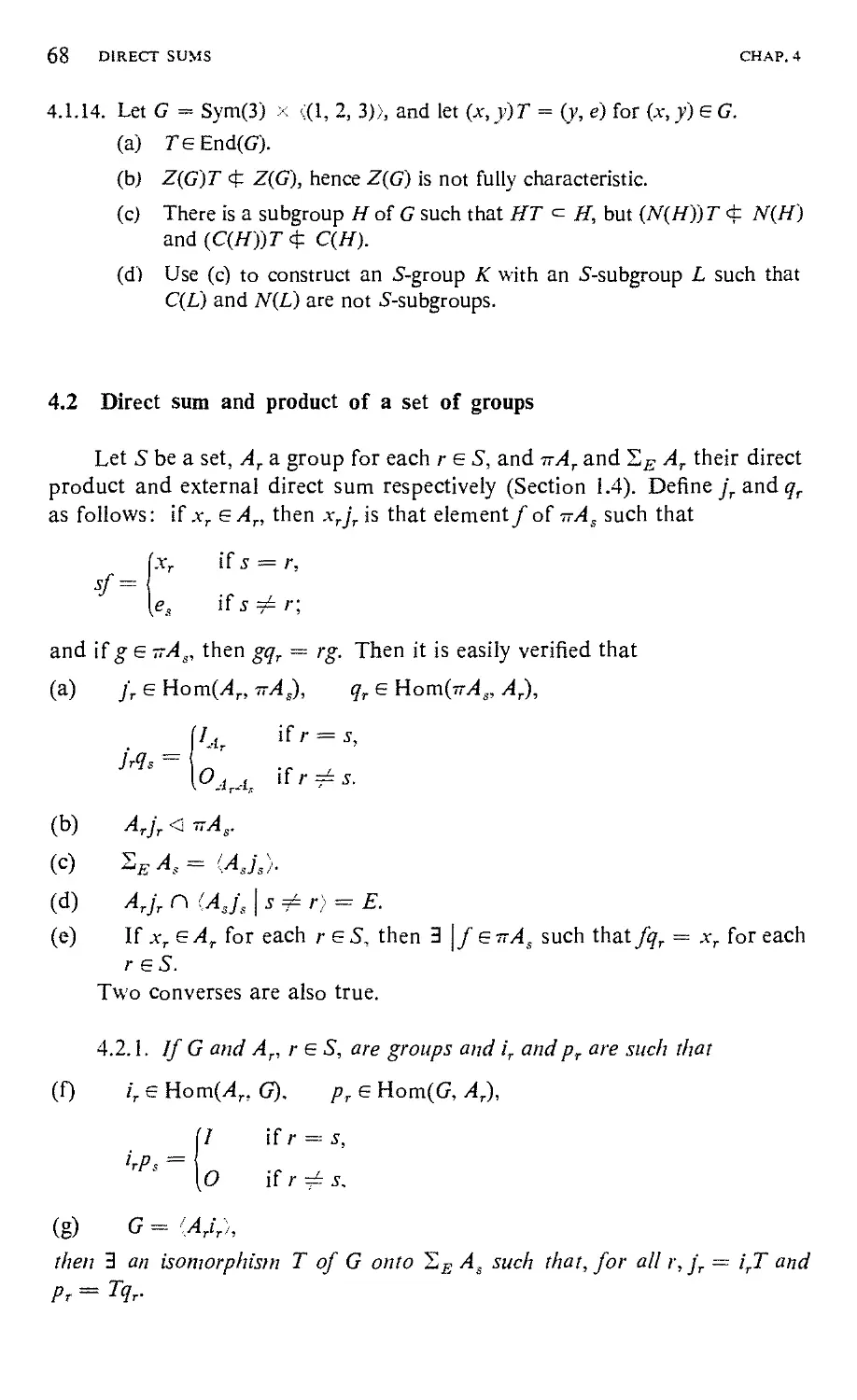
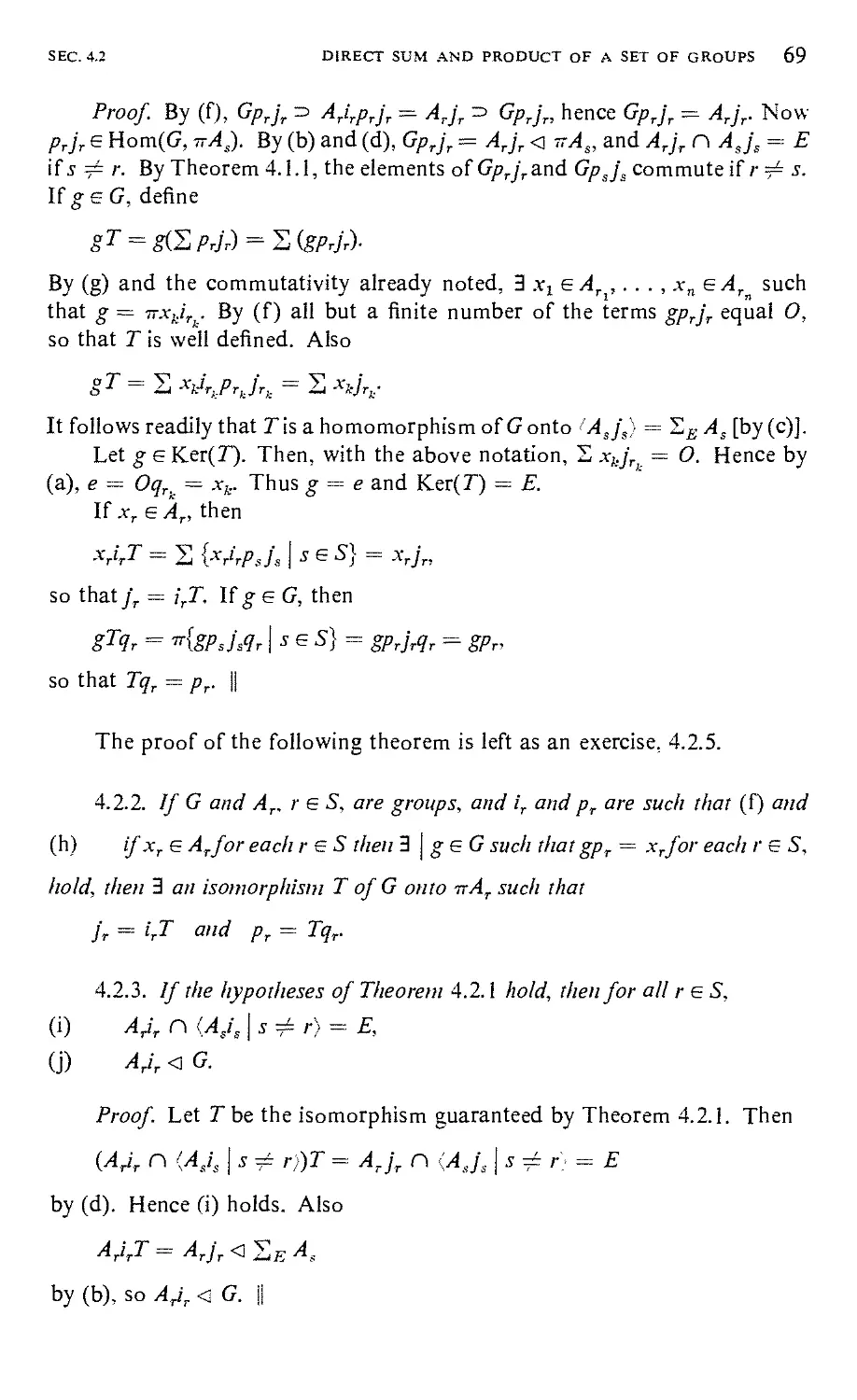
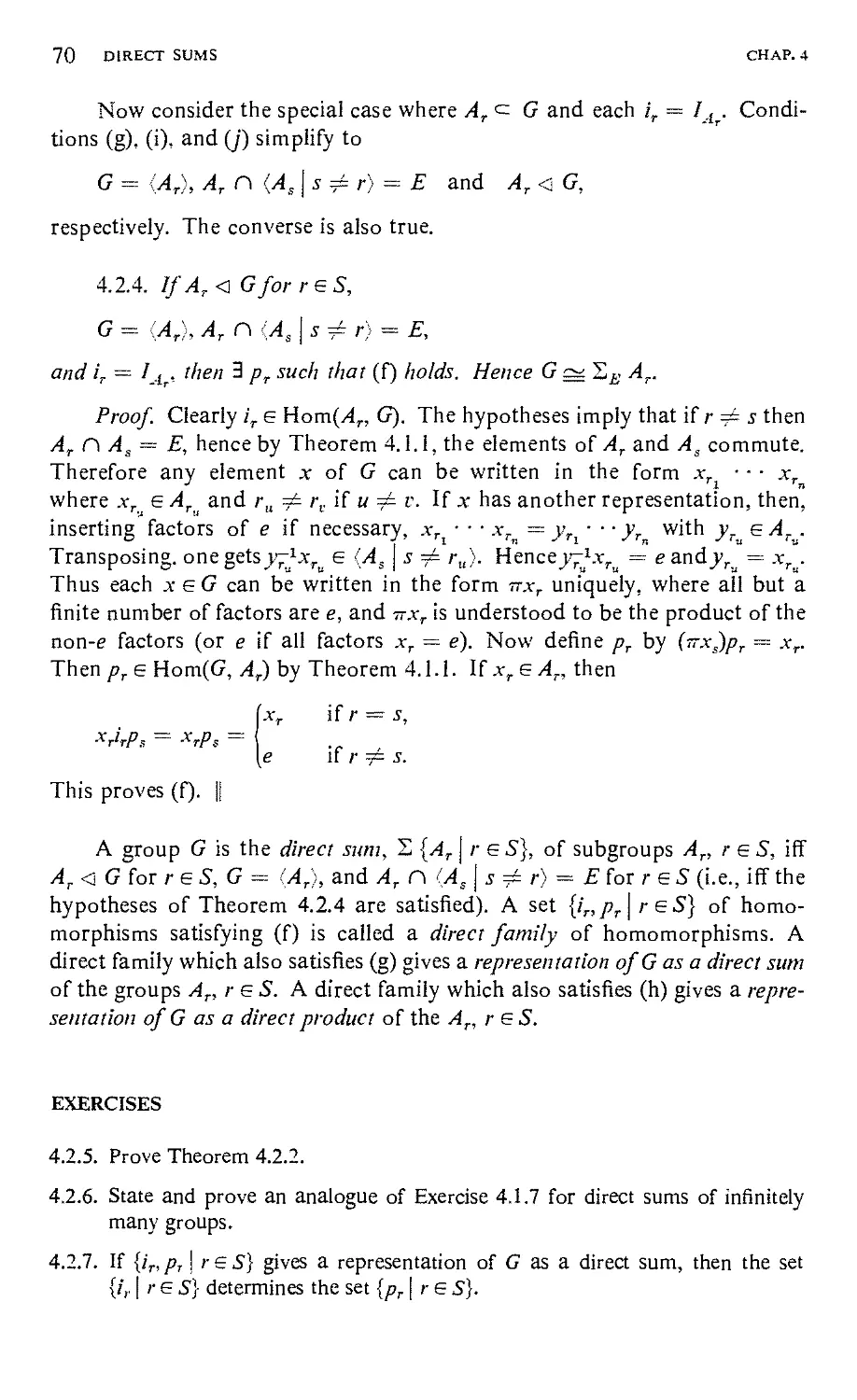


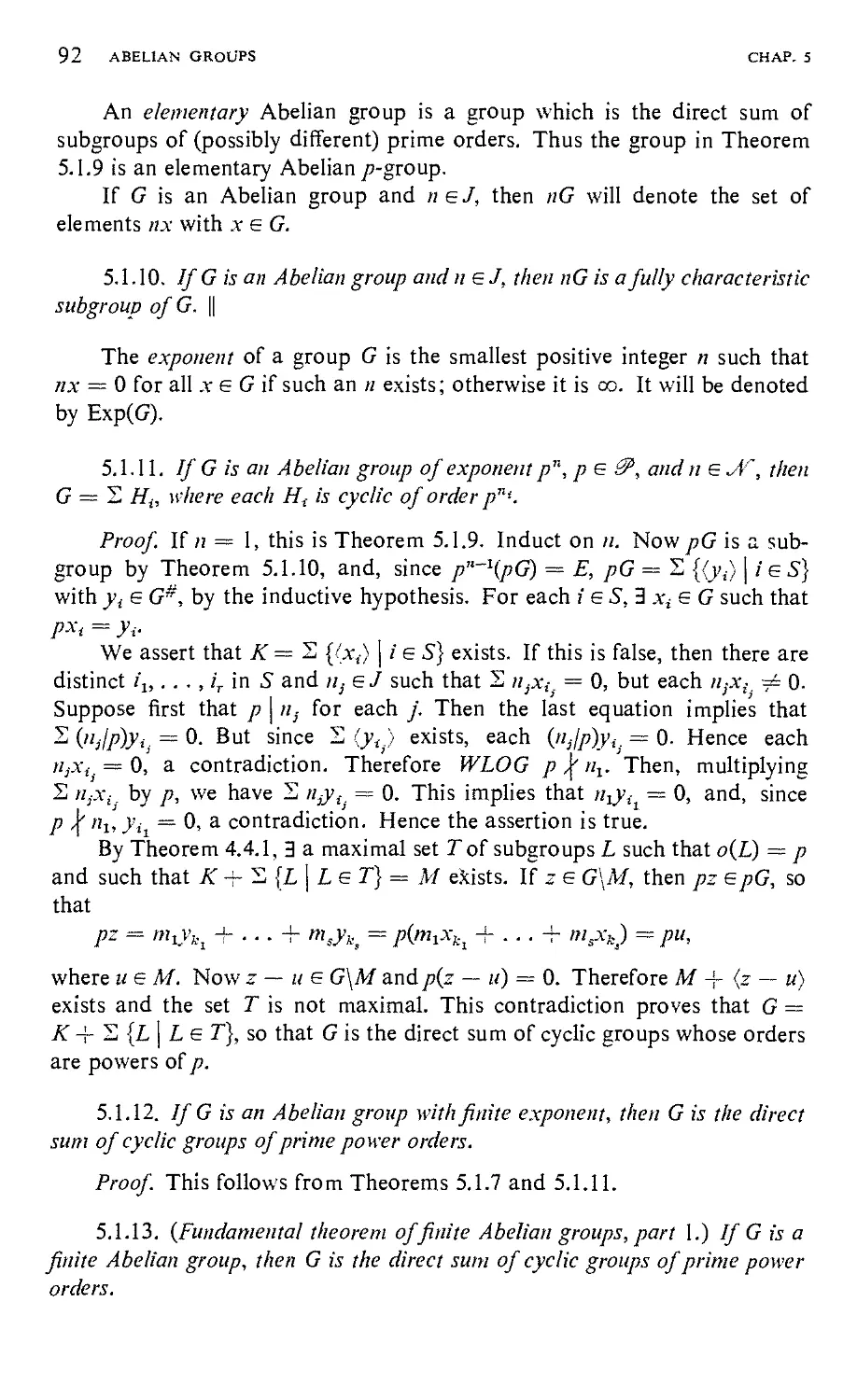












































































Text
                    -*■=.--■■-*- ,---..:.-^ .„„ _ ..„,,. _, -v.... -,... ^
W. R. SCOTT
Professor of Mathematics
The University of Utah
DOVER PUBLICATIONS, INC.
NEW YORK

To Bobbie
Copyright © 1964, 1987 by W. R. Scott.
All rights reserved under Pan American and International
Copyright Conventions.
Published in Canada by General Publishing Company, Ltd., 30
Lesmill Road. Don Mills, Toronto, Ontario.
Published in the United Kingdom by Constable and Company,
Ltd., 10 Orange Street, London WC2H 7EG.
This Dover edition, first published in 1987. is an unabridged,
corrected republication of the work first published by Prentice-Hall,
Englewood Cliffs, N.J., 1964.
Manufactured in the United States of America
Dover Publications, Inc., 31 East 2nd Street, Mineola, N.Y. 11501
Library of Congress Cataloging-in-Publication Data
Scott, William R. (William Raymond), 1919-
Group theory.
Reprint. Originally published: Englewood Cliffs. N.J. : Prentice-
Hall, 1964.
Bibliography: p.
Includes indexes.
1. Groups, Theory of. I. Title.
QA171.S42 1987 512'.22 87-562
ISBN 0-486-65377-3 (pbk.)

PREFACE
This book contains most of the standard basic theorems in group theory,
as well as some topics which have not heretofore appeared in book form. The
organization is as follows. Chapters are numbered 1 through 15; sections in
Chapter 5, for example, are numbered 5.1, 5.2, etc., and theorems within
sections, 5.2.1, 5.2.2, etc. Exercises follow nearly all of the sections and are
numbered like theorems. Material other than theorems is not numbered
(occasionally, Equations (1), (2), etc., or Examples 1, 2, etc., appear within a
section). In addition to an index and bibliography, there is an index of
notation. Chapters 4 through 15 are closed by a brief list of references.
The exercises are of a quite varied nature and are not graded in difficulty.
Some are mere remarks of the "of course" variety. A number are
counterexamples to various possible modifications of theorems in the next. A
further type asks the reader to supply details omitted in proofs of theorems
in the text. Many are provided with hints (in a few cases, simplifying
published proofs). The reader should at least read the exercises since frequent
reference is made to them in the body of the text.
An attempt has been made to keep the book as self-contained as possible.
For example, in Chapter 13, in order to avoid the use of Dirichlet's theorem
about the infinitude of primes in an arithmetic progression, a special case
sufficient for the problem at hand is proved. A few theorems from elementary
number theory are presupposed. Of a less elementary nature, the following
background is needed at various places: (a) The easier properties of cardinal
and ordinal numbers, though lack of this background will not hamper the
reader very much; (b) Some facts about vector spaces and matrices are
assumed, although others are proved; (c) The theorem that the algebraic
integers form an integral domain is used in Chapter 12; (d) Various facts
about polynomials are required; (e) In Chapter 14, some facts from Galois
theory and the theory of division rings are assumed; (f) In Section 15.4, the
solvability of groups of odd order (Feit and Thompson [1]) is assumed.
I wish to thank the following organizations and people: The University
of Kansas for granting me sabbatical leave and Cornell University for

providing office space during 1962-63. W. Feit for several conversations, a
seminar, several theorems in Chapter 12, and for bringing to my attention a
number of items, including the theorem in Section 15.4. R. Bercov for
conversations about S-rings, including unpublished material of his (these
results do not appear in the book because of space requirements). L.
Sonneborn for reading a portion of the manuscript and for a number of
suggestions. T. Head for calling my attention to a theorem. P. Hall, E.
Gaughan, and C. Stuth for permission to include unpublished results of
theirs. A number of former students for suggestions which have had an
influence on the book. A. Kruse for a point of view, even though it has not
always been adhered to rigidly. Finally, the members of my family, Roberta,
Dorothy, Martha, and Janet Scott, for help in the preparation of the
manuscript.
W. R. Scott

TABLE OF CONTENTS
Introduction 1
1.1 Preliminaries, 1
1.2 Definitions and first properties, 6
1.3 Permutation groups, 8
1.4 Examples of groups, 13
1.5 Operations with subsets, 15
1.6 Subgroups, 16
1.7 Cosets and index, 19
► 1.8 Partially ordered sets, 22
Isomorphism Theorems 24
*■ 2.1
2.2
» 2.3
2.4
2.5
2.6
2.7
2.8
2.9
2.10
2.11
Homomorphisms, 24
Factor groups, 30
Isomorphism theorems, 32
Cyclic groups, 34
Composition series, 35
Solvable groups, 38
Operator groups. Homomorphisms, 39
Operator groups. Factor groups, 41
Operator groups. Isomorphism theorems, 41
Operator groups. Composition series, 43
Operator groups. Examples, 44
Transformations and Subgroups 48
3.1 Transformations, 48
**3.2 Normalizer, centralizer, and center, 49
3.3 Conjugate classes, 52
-^3.4 Commutators, 56
3.5 The transfer, 60

4
Direct Sums 64
4.1 Direct sum of two subgroups, 64
4.2 Direct sum and product of a set of groups, 68
4.3 Subdirect products, 71
4.4 Direct sums of simple groups, 72
4.5 Endomorphism algebra, 77
4.6 Remak-Krull-Schmidt theorem, 81
4.7 Generalizations, 85
5
Abelian Groups 89
5.1 Direct decompositions, 89
5.2 Divisible groups, 95
5.3 Free Abelian groups, 102
5.4 Finitely generated Abelian groups, 106
5.5 Direct sums of cyclic groups, 108
5.6 Vector spaces, 114
5.7 Automorphism groups of cyclic groups, 117
5.8 Hom(A, B), 126
6
/^-Groups and /^-Subgroups 131
-'* 6.1 Sylow theorems, 131
6.2 Normalizers of Sylow subgroups, 136
—* 6.3 /^-Groups, 139
6.4 Nilpotent groups, 141
6.5 Applications, 146

7
Supersolvable Groups 150
7.1 M-groups, 150
7.2 Supersolvable groups, 154
7.3 Frattini subgroup, 159
7.4 Fitting subgroup, 166
7.5 Regulars-groups, 171
8
Free Groups and Free Products 174
8.1 Definitions and existence, 174
8.2 Presentations, 187
8.3 Some examples, 194
8.4 Subgroups of free groups, 197
9
Extensions 209
9.1 Definitions, 209
-> 9.2 Semi-direct products, 212
9.3 Hall subgroups, 222
9.4 Extensions: General case, 230
9.5 Split extensions, 240
9.6 Extensions of Abelian groups, 243
9.7 Cyclic extensions, 250

10
Permutation Groups 255
10.1 Intransitive groups, 255
10.2 Transitive groups and representations, 259
10.3 Regular permutation groups, 264
10.4 Multiply transitive groups, 266
10.5 Primitive and imprimitive groups, 268
10.6 Some multiply transitive groups, 275
10.7 Numerical applications, 289
10.8 Some simple groups, 292
11
Symmetric and Alternating Groups 298
11.1 Conjugate classes, 298
11.2 Infinite groups of finite permutations, 300
11.3 Normal subgroups of symmetric and alternating groups, 305
11.4 Automorphism groups, 309
11.5 Imbedding and splitting theorems, 315
12
Representations 319
12.1 Linear groups, 319
12.2 Representations and characters, 322
12.3 The p*q> theorem, 333
12.4 Representations of direct sums, 338
12.5 Induced representations, 341
12.6 Frobenius groups, 348
12.7 Representations of transitive groups, 359
12.8 Monomial representations, 363
12.9 Transitive groups of prime degree, 367

13
Products of Subgroups 372
13.1 Factorizable groups, 372
13.2 Nilpotent times nilpotent, 376
13.3 Special cases of nilpotent times nilpotent, 383
13.4 Nilpotent maximal subgroups, 387
13.5 Transfer theorems, 392
13.6 Generalized dihedral times odd-order nilpotent, 400
13.7 S-rings, 403
13.8 Primitive S-rings over groups of small order, 407
13.9 S-rings over Abelian groups, 412
13.10 Nilpotent times dihedral or dicyclic 413
13.11 Primitive S-rings over dihedral and dicyclic groups, 416
13.12 Dihedral or dicyclic times dihedral or dicyclic, 423
14
The Multiplicative Group of a Division Ring 426
14.1 Wedderburn and Cartan-Brauer-Hua theorems, 426
14.2 Conjugates, 429
14.3 Subnormal subgroups, 431
14.4 Subgroups of division rings, 439
15
Topics in Infinite Groups 441
15.1 FC groups, 441
15.2 Composition subgroups and subnormal subgroups, 447
15.3 Complete groups, 450
15.4 Existence of infinite Abelian subgroups, 452
15.5 Miscellaneous exercises, 454
15.6 A final word, 456
Bibliography 459
Index of Notation 471
Index 475

GROUP
THEORY

ONE
INTRODUCTION
1.1 Preliminaries
We shall begin by reviewing some notions from intuitive set theory.
Throughout the book, equality will mean identity. A set is determined
by its members; that is, if S and T are sets, then S = T iff (*) x e S iff x e T.
The notation {1, 2, 3}, for example, means the set whose members are 1, 2,
and 3. The notation {x | P] means the set of x such that P is true. Various
corruptions of this latter notation will be used. A few sets occur frequently
enough to deserve a permanent symbol. Among these are the empty set 0,
the set Jf of natural numbers, the set SP of primes, the set 3"° = (pn | p e S1,
n e Jf} of powers of primes, the set (later group or ring) J of integers, and
the set (or group or field) St of rationals. Other permanent notation will be
introduced from time to time (see the index of notation).
The number of elements of a set S will be called the order of S and
denoted by o(S). A set S is a singleton iff o(S) = 1, and an n-ton iff o(S) =
nejV. A set S is a subset of a set T, written S <= T* iff (*) if x e S, then
xeT. If S is a set and Tt is a set for each i e S, then
u {Tt | i 6 5} = {x 11 i 6 5 such that x e Tt},
n {T{ \ieS}={x\iiieS then x 6 T{}.
* Beginning with Section 1.6, the notation c will be used to mean "is a subgroup of,"
while the phrase "is a subset of" will be written out.

2 INTRODUCTION
CHAP. 1
If S = {1, 2}, then rx U T2 is usually used instead of U {Tt | /65} and
rx n T2 instead of n {7; | i e S}, although there is a conceptual difference.
The notation 0 {T, | i e S] will be used for u {Tt \ieS} if Tt n T, = 0
whenever /' #_/, and will be called the disjoint union of the family {Tt | / 6 5}.
If each element of S is a set, then u {/1; 6 S} will sometimes be written
simply U S. The notations 0 S and n 5 have similar meanings. If S and T
are sets, then S\T will denote the set {x \x e S and x ¢ T}.
Two ordered pairs (a, b) and (c, d) are equal iff a = c and b = d. A
relation R is a set* of ordered pairs. Its inverse
R'1 = {(6, a) | (a, b) 6 A}.
The relation R is symmetric iff R = R"1. The domain of i? is the set
Dom(tf) = {a 11 b with (a, b) e R]
(that is, the domain of R is the set of first coordinates of elements of R). The
range of R is given by Rng(i?) = Dom(i?'1) (that is, the range of R is the set
of second coordinates of elements of R). A relation R is said to be from A
into B iff Dom(tf) = A and Rng(tf) <= B, and o«/o B iff B = Rng(tf). If
5 <= Dom(i?), then the restriction of R to S is the set
tf|S = {(a, 6) | (a,b)eR and oeS}.
If 5 <= Dom(^), then we set SR = Rng(.K | 5). If R and tf' are relations,
then their product is the relation
RR' = {(a, c)\3b such that (a, 6) 6 R and (6, c) 6 R'}.
A relation R is transitive iff i?i? <= R. The product of relations is associative,
that is
1.1.1. IfRuRs, and R3 are relations, then R^R^) = (R1Ri)R3.
Proof. Let (a, d) e R^R^). Then 1 b such that (a, b) e R1 and (b, d) e
R2R3. Hence 1 c such that (A, c) e R2 and (c, d) e R3. Therefore (a, c) e RtR^
(because of the properties of b). But then (a, d) e {RjR^R3 (because of the
properties of c). Hence R^R^R^ <= {R^R2)R3. Similarly, one shows that
(RiRJRs <= R,(R„R3), and the equality follows. ||
The Cartesian product of two sets S and T is the set
S X T = {(a, b) | a 6 S and b e T}.
A relation R is on S iff R <= S X S. A relation R on S is reflexive iff
{(a, a) | a e 5} <= .K. An equivalence relation on S is a relation on 5 which is
reflexive, symmetric, and transitive. If R is an equivalence relation on S,
* Or class. The same remark applies to functions.

SEC. 1.1
PRELIMINARIES 3
then a subset B of S is an equivalence class with respect to R iff 3 a e S such
that B= {b\(a,b)e R). It turns out (Exercise 1.1.6) that S is then the
disjoint union of its equivalence classes.
While the preceding concepts are useful, the notion which will be used most
frequently is that of function. A function is a relation/such that if (a, b) ef
and (a, c) ef then b = c. If/is a function and (a, b) ef then we shall often
write af=b or f(a) = b (usually the former). It is clear that two functions
/ and g are equal iff Dom(f) = Dom(g), and af = ag for all a eDom(/).
A function/is 1-1 iff the relation/-1 is a function. If S is a set, the identity
function on S is /s = {(s, s) | s e S}. Is will often be denoted by I. It is 1-1
from S onto S, and such that sls = s for all ie5.
1.1.2. The product of functions is a function.
Proof. Let / and g be functions. Let (o, d) efg and (a, e) efg. Then
3 A such that (a, b) e/and (A, d) eg, and 3 c such that (a, c) e/and (c, e) e g.
Since/is a function, b = c. Therefore, since g is a function, d—e. Hence
fg is a function, jj
A binary operation on S is a function = from S x 5 into S. The fact that
(o, b) " = c will be written a ° b = c. A binary operation = on S is «j/m-
mutative iff
(i) if o 6 5 and A 6 S, then a ° b = b = a.
A binary operation = on 5 is associative iff
(ii) if o 6 5, A 6 5, and c 6 5, then (o = b) ° c = a ° (A = c).
If ° is a binary operation on S, T <= 5, and L' <= 5, then T = t/ is defined to be
the set {x °y\xeT and v e U}.
It will now be shown that associativity implies general associativity.
Toward this end, let = be a binary operation on a set S. Let/j be the function
with domain 5 such that/^Oj) = [a^ for all ax e S. Recursively for n e .A",
define/, to be the function whose domain is the set of n-tuples (ax,..., an)
with at e S, such that
fn{fli , O = u \fMi ,ar) "fnJ,aT^ , an) | 0 < r < «}.*
It is inductively evident that /,(^, • • , an) is not empty. Moreover, the
operation ° is associative iff/3(0^ a„, as) is a singleton for all a1 e S, a„ e S,
and as e S.
1.1.3. (General associative law.) If" is an associative binary operation on
S and a1 e S, . . . , an e S, thenfTj<a1, ..., ar) is a singleton for all n e A '.
* The notation f„(aL,.. ., a„) is used instead of f„((aL, ..., a„)).

4 INTRODUCTION
CHAP. 1
Proof. This is obvious for n = 1 and n = 2. Now use induction, and
let n > 2. Let z e_/"n(°i> .... a„) and z' efn(au ..., a„). Then g x, y, x', y',
and natural numbers r and t such that
z = x=yt 2' = x' =/, x efr(au ..., ar),
J efn-Xar+i> • • • > "«). *' 6/,(^1, at),
}•' ef*-t(flt+l> • • • > «*)•
If r = f, then by the induction hypothesis, x = x' and j = j', so z = x = y =
x' o/ = z'. If r < f, say, then by the induction hypothesis,_/"(_r(0r+i>. . . ,a,)
is a singleton {r}. Hence, again by the induction hypothesis, x' = x ° v and
y = v ° y'. Therefore, by associativity,
Z = X ° y = X c (f o/) = (x = r) = / = x' o / = z'.
Hence, by induction,/,,^, . . . , an) is a singleton. ||
The sole element of f„(a17 . . ., a„) is denoted by ar ° . . . ° an or by
it {o, | 1 S / S ;;}. It is intuitively clear that Theorem 1.1.3 states that all
legal insertions of parentheses into the product a1 = a2. . . ° an which make
the result computable lead to the same result (see Exercise 1.1.19).
In a similar manner, it may be shown that if = is a commutative and
associative binary operation on S, then the product of any n elements of S is
defined and is independent of the order of factors and positions of
parentheses. The proof of this fact will be omitted.
EXERCISES
1.1.4. Show that U and C\ are commutative and associative (as binary operations).
1.1.5. If A and B are sets, then A = B iff A <= B and B <= A.
1.1.6. Let R be an equivalence relation on a set S. Prove that S is the disjoint
union of its equivalence classes with respect to R.
1.1.7. If J? is a symmetric and transitive relation on S, then R U {(a, a)\ ae S)
is an equivalence relation on S.
1.1.8. Show how a plane may be considered as the Cartesian product of the set of
real numbers with itself.
1.1.9. In the sense of Exercise 1.1.8, find the geometric condition under which a
relation in the plane is symmetric; under which it is reflexive; under which
it is transitive.

SEC. 1.1
PRELIMINARIES 5
1.1.10. If o(5) = n is finite, then
(a) o{S x 5) = n\
(b) there are 2"2 relations on 5,
(c) there are 2"2~~" reflexive relations on 5,
(d) there are 2("2^",/2 symmetric relations on 5,
(e) there are 2("2-")/2 reflexive and symmetric relations on 5.
1.1.11. Let R be a relation on 5, and let
R* = {(a, b) | 3 n e J' and *0 = a, xr,. . ., xn = b
such that all (xt, *i+1) 6 J?}. Prove that
(a) R* is the smallest transitive relation on 5 which contains R;
(b) If R is symmetric, so is R*;
(c) If J? is reflexive and symmetric, then R* is an equivalence relation.
1.1.12. Let S be a set, Tthe set of relations on S, and let
A ' B = ABU A 6 Tand Be r.
Then ° is an associative binary operation on T. Hence the product of
relations satisfies the general associative law.
1.1.13. Let S be a set and let F be the set of relations on S which are functions.
Prove that if = is the product as in Exercise 1.1.12, then ° | F is an
(associative binary) operation on F.
1.1.14. Prove that if Rr and R* are relations, then
(RrR*)-1 = R^R-h
1.1.15. Which of the four processes of arithmetic—addition, subtraction,
multiplication, and division—are binary operations on J? Which of those that
are operations are commutative? Which are associative?
1.1.16. If 5 and Tare sets, then o(S) = o(r)iff3 a 1-1 function from S onto T.
Prove that if R is a relation, then o(R) = 0(^1).
1.1.17. If o(5) = n is finite, then
(a) there are nn~ binary operations on 5;
(b) there are n<n"+n)/2 commutative binary operations on 5,
1.1.18. Define unary operation, ternary operation, and «-ary operation on 5. How
many of each are there if o(S) = m 1
1.1.19. (a) Show that the general associative law implies that if - is associative,
then
((a - b) = c) °d = (a ° (b ° c))» d = (a ° 6) = (c = d)
= a°((b*c)~-d) = a°(b°(c° d)).
(b) Give a similar interpretation of Theorem 1.1.3 for the case of a product
of five elements.

6 INTRODUCTION
CHAP. 1
1.1.20. (a) Show that if ° is a binary operation on a set S, then, in the notation of
1.1.3,/„(0!,..., an) is a set containing at most ^0) elements, where
g(\) •= 1,^(2) = 1, and recursively,
g(n) = y,{g(r)g(n - r) | 0 < /• < «}.
(b) Compute ^(4) and compare with Exercise 1.1.19. (a).
1.1.21. Show that the bound given in Exercise 1.1.20.(a) is the best possible, i.e.,
that for each natural number n there are a set S, a binary operation ° on S,
and are S,. .. ,ane S such that f„{av ..., an) is a^-(«)-ton.
1.1.22. Prove that if/ and g are functions, *eDom(/), and .t/eDom^), then
■<fg) = (*/!?■
1.1.23. If/is a function, then
/~y= {(*,*) |.veRng(/)}.
1.1.24. Prove that if S x T = U :< V, then 5 = t/ and r = K In particular, if
s > s = r x r, then 5 = r.
1.1.25. Prove that if/is a binary operation on S and also a binary operation on T,
then S = T.
1.2 Definitions and first properties
A group is an ordered pair (G, ■=) such that G is a set, = is an associative
binary operation on G, and 3 e. 6 G such that
(i) if a e G, then a = e = a,
(ii) if o 6 G, then jr'eG such that a = o_1 = e.
When there is no danger of misunderstanding, the group (G, °) will be
denoted by G, and the element a° bby ab (see Exercises 1.2.11 and 1.2.16).
Sometimes the operation ° will be denoted by + and called addition. Since
general associativity holds (Theorem 1.1.3). parentheses will usually be
omitted from products of several factors. The element e is called the identity
of G. (See Theorem 1.2.5 for justification of the article "the".) The symbol
e will always denote the identity of whatever group G is under consideration
(eG will be used if necessary for the sake of clarity). The element a~l is called
the inverse of a (see Theorem 1.2.6).
1.2.1. a-i-a = e.
Proof. Compute a~1aa~\a~1)~1. (This means that one expands
a^aa-^a-1)'1

SEC. 1.2
DEFINITIONS AND FIRST PROPERTIES 7
in two directions to obtain the proof:
a~xa = a~xae — a~1a(a~1(a~1)~1)
= o^eO"1)-1 = cr\crv)-x = e.)
1.2.2. ea = a.
Proof. Compute aa~xa.
1.2.3. Ifa e G and b e G, then 3 | x e G such that ax = b.
Proof. If ax = b, then x = ex = a~lax = a~xb by 1.2.2 and 1.2.1.
Conversely, if x = a'xb, then ox == aa~lb = eb = b.
1.2.4. IfaeG andb e G, then 3 | x e G such that xa = b.
1.2.5. The element e is unique.
Proof. In Theorem 1.2.3 let b = a.
1.2.6. If ab = e, /fen b = o-1.
iVoq/". In Theorem 1.2.3 let b = e.
1.2.7. (fll.. . aB)_1 = «« x • • • «i_1-
1.2.8. (0-^ = 0.
Proo/. By 1.2.1. ||
If a 6 G, define o° = e. If « 6^'', define a" to be-the product of n o's,
and a-" as (a'1)".
1.2.9. (Exponents.) IfaeG and r and s are integers, then (i) ara* = ar+s,
and (ii) (or)s = a"-
Outline of Proof. If either r or j is 0, the theorem is obvious. If r and J
are positive, then (i) follows from the definition of the sum of finite cardinals
(and the general associative law) and (ii) from the definition of product of
finite cardinals. If one of r and j is negative and the other positive, then (i)
follows from successive cancellations. In particular, it follows that a~T =
(ar)~l. As to (ii), letting both r > 0 and s > 0,
(a-y = ((o-1)--)8 = (a-1)™ = o"(rs) = o(-r)s.
Again
{a7)-' = ((oT1)8 = (a~rY = o(-r)s = aH~s)

8 INTRODUCTION CHAP. I
by an earlier remark and the last sentence. Finally, if r > 0 and j > 0, then
cr'cr' = (OV1)" = (a_1)r+t = o"<r+s) = o(-r>+(-s>,
and
by an earlier remark and earlier cases.
EXERCISES
1.2.10. State the theorems of this section in the additive notation.
1.2.11. Let G = {a, b}. Prove that there are exactly two binary operations ° on G
such that (G,c) is a group. (This proves that the convention of denoting a
group (G, °) by G is actually incorrect. However, we shall continue to use
this abbreviation.)
1.2.12. State (ii) in the definition of group in terms of a unary operation on G.
1.2.13. If (G, °) is a group, then G is not empty.
1.2.14. Let S = {a, b}.
(a) Define a binary operation on S which is commutative but not
associative.
(b) Define a binary operation on S which is associative but not
commutative.
1.2.15. Generalize Exercise 1.2.14 to any set S with more than one element.
1.2.16. Prove that if (G, ») and (H, °) are groups, then G = H. This means that the
set G of a group is determined by the operation ° of the group. This fact
permits one to define a group as an operation = with certain properties.
Make this definition.*
1.3 Permutation groups
Examples of groups will be given in the next section. In this section, a
special type of group, permutation groups, will be introduced, both to
facilitate the construction of examples and for its own sake.
A permutation of a set M is a 1-1 function from M onto M.
* If one defines a group as an operation ° with certain properties, one gains precision
of language at the cost of simplicity, although the loss is not as great as one would imagine.
However, the terminology would be nonstandard in any case, and we prefer to use the
incorrect but standard method of referring to the group G.

SEC. 1.3
PERMUTATION GROUPS 9
1.3.1. If M is a set and Sym(Af) is the set of permutations of M, then
Sym(M) is a group.
Proof. If/eSym(M) and g e Sym(M), then by Theorem 1.1.2, fg is
a function from M into M. If x e M, then, since g is onto M, 1 y e M such
that_yg = x. Since/is onto M, 1 z e M such that z/ = y. Hencez(fg) = x.
Therefore/* is onto M. By Exercise 1.1.14, (/g)""1 = g~f~x- Since/ andg
are 1-1,/-1 and g-1 are functions. By Theorem 1.1.2, (fg)~~x is a function.
Hence fg is 1-1. This proves that/* is a permutation of M, that is that
fg 6 Sym(M).
By Exercise 1.1.13, the associative law is satisfied in Sym(M). Clearly,
/ 6 Sym(M). If x e M and g e Sym(M), then x(gl) = (xg)I = xg. It follows
that gl = g.
If/eSym(AO, then/-1 is a function since/is 1-1. Since/is onto M,
f'1 is from M onto M. To prove that/"1 is 1-1, suppose that x eM and
y e M are such that xf'1 = v/--1. Then g o 6 M such that (x, a) ef~x and
(y, o) ef"1, hence (o, x) e/and (a,y) e F. Since/is a function, x — y. This
proves that/-1 is 1-1 and therefore that/""1 6 Sym(M). It remains to be shown
that the inverse function/-1 is an inverse with respect to the operation. If
xeM and/eSym(M), then (x, xf)ef so (xf x) ef~\ and x(ff~l) =
(xf)f'x = x = xl. Hence jf-1 = /. Therefore Sym(M) is a group. ||
Definition. The group Sym(M) is called the symmetric group on the
set M.
Definition. A permutation group is an ordered pair (M, G), where M is a
set and G is a group of permutations of M (and where the operation in G is
the usual multiplication of functions described earlier). The degree of (M, G)
is o(M). The elements of M are called letters.
If K and U are subsets of M and G, respectively, then
VU = {pm | l> 6 V, U 6 £/}.
If V or t/ is a singleton, say t/ = {«}, the notation is simplified to Vu (instead
of V{u}).
If O; 6 M for i = 1, .. . , n and at =£ o> if z =£/, then (ol5 .. ., an) means
the permutation geSym(M) such that a,g = ai+1 for /=1,...,//-1,
°ng = ai. and bg = b for all other b eM. Such a permutation is called an
n-cycle. Similarly, (. . ., a_v a0, av, . ..) means the g 6 Sym(M) such that
atg = at+l for all integers /, and bg = b for all other b e M. This latter
permutation is called an ad-cycle. Any 1-cycle equals e, of course. Two
cycles with no letters in common are called disjoint.
Note that
(1, 2, . . ., //) = (2,. . ., //, 1) = .. . = (//, 1, . . ., n - 1).

10 INTRODUCTION
CHAP. I
Let {M, G) be a permutation group of finite degree, and let g e G.
There are two standard ways of writing g, a single example of which will
suffice for purposes of illustration. If M = {1, 2, 3, 4, 5, 6}, Ig = 3, 2g = 5,
3g = 4, 4g = 1, 5g = 2, and 6g = 6, then g may be written in the forms:
/1 2 3 4 5 6\
g = \3 5 4 1 2 6/ = (1, 3' 4X2' 5)(6) = (1' 3' 4)(2' 5)*
The first form will be called a two-row form of g. Either the second or the
third form is called a cyclic decomposition of g (or a one-row form).
1.3.2. //" (M, G) is a permutation group of finite degree and g e G, then
g is the product ofpairwise disjoint cycles. This cyclic decomposition is unique
except for order of the cycles and inclusion or omission of l-cycles.
Proof The theorem is obvious if o(M) = 1. Induct on o(M). Let
g 6 G and xx e M. Then 3 i e Jf and distinct letters x1;.. ., xt of M such
that
Xlg = xs, X„g = x3,..., x^ = x0 xtg = xu
by finiteness of the set M and the fact thatg is 1-1. Nowg | M\{xu ..., x{}
is a permutation (if A/\{jc1, ..., xj is nonempty), hence by the induction
hypothesis g | M\{xu ..., x,} is the product c2 .. . cm of pairwise disjoint
cycles, and g = (x1;..., xt)c2 ... cm. Therefore a cyclic decomposition
always exists. In any cyclic decomposition of g, the cycle containing Xj must
be (xlt. .., xt) so that the uniqueness follows readily. ||
If M is infinite and g eSym(Af), then g need not be the product of a
finite number of cycles. Nevertheless, Theorem 1.3.2 is still true in a certain
sense.
If S <= Sym(Af) and for each a e M, there is at most oney e S such that
ay # a, then we define a function -rr {y\y e S} by, for a e M,
a(rrlv\yeS}) = l
[a iiay = a for all y e S.
We call it {y | _y 6 5} the formal product of the members of S, and will
abbreviate it try when no confusion is possible.
1.3.3. If M is a set and rr {y | y 6 S] is a formal product of elements of
Sym(M), then rr {y\y eS} eSym(M).
Proof. It is clear from the definition of formal product and a(rry) that
rr {y | y e S} is a function from M into M.

SEC. 1.3
PERMUTATION GROUPS 1 1
Suppose that a(-y) = b(ny) with a = b. If b(rry) = b, then 3xe5 such
that ax = b, while by = b for all y eS. Therefore ax = b = Ax and x is
not 1-1, a contradiction. Hence WLOG,* a(ny) = b(iTy) = c, c == o, c == b.
Thus g x 6 S and v 6 5 such that ox = c = Ay. Since o -= A, x == _>>. But then
ex == c and cv == c, contradicting the definition of formal product. It follows
that if a -= b, then a(-y) == b(-y), so that ity is 1-1.
Let b e M. If Aj = 6 for all y e 5, then b{~y) = A. Suppose 3 x 6 5
such that bx == b. Since x 6 Sym(M), 3 a e M such that ox = b. Then
o == 6, so that 0(777) = *• Therefore -j maps M onto M, so that ttj e Sym(Af).
1.3.4. If g d e is a permutation, then g is a formal product of pairmse
disjoint cycles, g = - {c\c s S}, with no c e S a l-cycle. If g = 77 {c | c e 5'}
/j 0 second such product, then S = 5'.
Proof. Let g 6 Sym(Af), a e M, and og == 0. Let
[(o, og, . . . , og"^1) if ag" = a, n > 1, /7 minimal. (1)
c =
{(..., ag~~l, a, ag, . . .) if ag" == a for all n e J>r.
It is obvious that c defined in (1) is a cycle and ag = ac. It follows that if
g = 77 {c I c 6 S) is a formal product of cycles of length at least 2, then S
is the set of cycles of the form (1).
Conversely, let S be the set of cycles of the form (1). Suppose b e M,
cx 6 S, c2 6 S, bcx == b, and bc« == A. Then, if
C\ = (#, og, . . . , ag' = A, ag'+1, ..., ag"~"1),
then
Ci = (b, bg,..., bg"-*),
while if
Ci = (■ ■-, ag-\ a,ag,. . ., ag{ = b, . . .),
then
q = (. . ., ££-\ 6, Ag, . . .).
In either case, it follows that
cx = c„.
Therefore rr {c | c e S] is a formal product. Moreover, from (1), ag = o(ttc)
in all cases. Hence g = 77c. In a formal product of a set S of cycles of length
at least 2, the cycles are automatically disjoint. ||
If a e M, x 6 Sym(Af), and v 6 Sym(M), then a(x(x~1yx)) = a(yx).
From this simple fact, there results the following useful rule.
* Without loss of generality.

12 INTRODUCTION
CHAP. 1
1.3.5. If x and y are permutations of M, then a cyclic decomposition of
x~lyx is formed from one of y by replacing each letter by the letter standing
below it in a two-row form of x.
Proof. In a cyclic decomposition of/, the letter a is followed (cyclically)
by the letter ay. The letters standing under a and ay in a two-row form of x
are ax and ayx, respectively. By the remark preceding the theorem, ayx is
the letter following ax in a cyclic decomposition of x~lyx. ||
Example. Let
/1 2 3 4 5 6\
Hl4362J' >' = (1'3'4)(2'5)(6)-
Then x~lyx = (5, 4, 3)(1, 6)(2).
1.3.6. If x andy are permutations of M, then y and x~lyx have the same
number of cycles of each length in their cyclic decompositions.
Proof. By Theorem 1.3.5.
EXERCISES
1.3.7. (1,2,...,«) =(1, 2X1, 3)...(1,«).
1.3.8. Itg is a permutation of a finite set, then g is a finite product of (not
necessarily disjoint) 2-cyc)es.
1.3.9. The character dig e Sym(M) is the number CH.g) of letters in Affixed by^.
Thus, if M = {1, 2, 3, 4} and g = (1, 2, 3), then Chf^) = 1. Prove the
following statements:
(a) Ch(e) = o(M);
(b) Ch(x-» = Ch(j).
1.3.10. Compute the following products:
(a) (1,2,3X2,3,5)(1,4,5);
/12 3 45\
(b) x~lyx\fx = \ and y = (1, 3, 5)(2,4):
\2 1 4 3 5/
(c) x~h'X if x = (1, 2, 3) and y = (1, 3).
1.3.11. Prove the following converse of Theorem 1.3.6. If y and z are permutations
of M such that if 1 < ne X or n = =o then y and 2 have the same number
of /i-cycles and Ch(j) = Ch(z), then 3x6 Sym(M) such that z = x~xyx.
(M may be infinite.)

SEC. 1.4
EXAMPLES OF GROUPS 13
1.3.12. Show that (1, 2)(1, 3) = (1, 2, 3), whereas (1, 3)(1, 2) = (1, 3, 2). Hence if
o{M) i 3, then Sym(Af) has n on commutative operation. .' ;
/--
1.4 Examples of groups \ . —.- .
Although little machinery of group theory has been set up, it seems worfri
while to give some examples of groups at this stage.
Definition. A group G is Abelian iff (*) if a e G and b e G, then ab = ba.
Example 1. If M is a set, then G = Sym(Af) is a group (Theorem 1.3.1).
If o{M) < 3, then G is Abelian; if o(M) ^ 3, then G is non-Abelian (see
Exercise 1.3.12). If M is finite, then o(Sym(M)) = (o(M))l If M is infinite,
then o(Sym(M)) = 2°m.
Example 2. Let M = {1, 2, 3, 4} and let
G = {(1), (1, 2)(3, 4), (1, 3)(2, 4), (1, 4)(2, 3)}.
It is readily verified that (M, G) is a permutation group with identity element
(1). Each element is its own inverse, and the product of any two of the three
nonidentity elements is the third one. This group is often called the four-
group. It is Abelian.
Example 3. The integers J form an Abelian group under the operation
of addition.
Example 4. The rationals 0t form an Abelian group under addition.
The following permanent notation will be used occasionally. If G is a
group with identity e, let G# = G\{e}.
Example 5. Si" is an Abelian group under multiplication.
Example 6. Let P be a plane and Q e P. Let G be the set of rotations of
P about Q. Then (P, G) is an Abelian permutation group.
Example 7. Let n 6 JT, and let G be the set of rotations of a plane P
about a point Q eP through 2-n-kjn radians, k = 0,1, . . . , /z-1. Then (P, G)
is an Abelian permutation group, and o(G) = n.
Definition. An isometry of Euclidean n-space En is a function T from
En into En such that if x eEn and y eEn, then d(x,y) = d{xT,yT), where
^(x,^) is the distance from a- to y.

14 INTRODUCTION
CHAP. 1
Example 8. If G is the set of all isometries of En, then (En, G) is a
permutation group.
Proof. It is clear that the product of two isometries is an isometry and
that IE is an isometry. Associativity follows from the fact that the operation
of multiplying functions is associative. If TeG and x and y are distinct
points of En, then xT ^ yT. Hence Tis 1-1. If T is onto M, then T~l is a
function from En onto En which preserves distance, and is therefore an
isometry. Hence, it only remains to be shown that an isometry T from En
into En is onto. A proof of this fact will now be sketched.
If x, y, and z are points such that
d(x,z) = d(x,y)-d(y,z),
then
d(xT, zT) = d(xT, yT) + d(yT, zT).
It follows readily that if L is a line in En, then LT is also a line. An affine
subspace of En is a nonempty subset S such that if a and b are distinct points
of 5 then the line through a and b is in 5. It follows from the preceding
remarks that, if S is an affine subspace, so is ST. If S0, Su ..., S„ = En is a
strictly increasing sequence of affine subspaces (which clearly exists), so is
S0T, StT,..., S~T. Therefore, Dim(5i+1T) > Dim(5tT) (where Dim denotes
dimension). Hence Dim(SnT) ^ n. Therefore, SnT = E„, and T is onto
E„- II
Example 9. Let 5 be a nonempty subset of En. The set G of isometries
ToCE,, such that ST = S is a group.
Example 10. In Example 9, let « = 2, and let S be a regular polygon
with k sides. The resulting group G of isometries is called a dihedral group.
If k ^ 3, then G is non-Abelian. It has 2k elements: k rotations about the
center of S, and k products of a rotation and a fixed reflection about a line
through the center and one vertex. ||
Let {Ms \s eS} be a family of sets. Then the Cartesian product
x {Ms | j 6 5} is the set of functions f from S such that i/eM, for all
s eS. (In case o(S) = 2, this differs slightly from the previous definition in
that the present product is unordered, while the previous one was ordered.)
Example 11. Let {(Gs, °s)\s e S} be a family of groups. Then the
direct product - {(Gs,°s)\s e S} has x {Gs|je5} as set, and addition
defined by the rule

SEC. 1.5
OPERATIONS WITH SUBSETS 15
(that is, addition is made componentwise). The direct product of groups is
again a group. If S is finite, say S = {1,..., «}, it is more customary to call
Gx x ... x G„ = {(x1? ...,x,)\x,e GJ,
the direct product. However, there is a formal distinction between the two
concepts in this case (see Exercise 2.1.32 and earlier remarks). The latter
notation will also be used.
Example 12. The external direct sum T,E {Gs \s eS} of a family
{Gs | J 6 5} of groups is the set of/ 6 rr {Gs \ s e S} such that sf is the identity
of Gs for all but a finite number (perhaps 0) of J e S. The external direct
sum is a group under the operation given in Example 11.
Example 13. As a special case of Example 11, let 5 be a set and G a
group. Then the sum of two functions/ and g from S into G is given by
s(f+g) = (sf)(sg),seS.
The set of these functions forms a group rr{G\seS} under addition. The
identity elements of this group will be denoted by 0SG or O, even in situations
where the group itself is not under consideration. Thus
sO = e for all s e S.
The inverse of T e rr {G \ s e S} will be denoted by —T. Thus
s(-T)=(sT)~K
EXERCISES
1.4.1 Prove that the external direct sum and direct product of Abelian groups is
Abelian.
1.4.2. In Example 9, let n = 3 and let S be a cube. Show that o{G) = 48.
1.4.3. In Example 9, if S is an «-dimensional cube, what is o(C7)? Describe the
elements of G in case S is the unit cube.
1.5 Operations with subsets
Definition. If Ax,.. ., An are subsets of a group G, then the product
AtA2 ... An is the set of elements of G of the form axa% ... an, where at 6 As.
The following convention will be used: if a factor A of a product is a singleton

16 INTRODUCTION CHAP. 1
{x}, then x will be used instead of {x}. For example, if x e G, then SxT
means S{x}T.
1.5.1. S(TU) = (ST)U = STUfor all subsets S, T, and U ofG.
1.5.2. IfGis Abelian, then AB = BAfor all subsets A andBofG.
1.5.3. A{ u {5; | / 6 5» = u {AB, | / 6 5},
(U {Bt | ; 6 £})/( = U {5£/f I i 6 5}.
1.5.4. /f(n {j?i | ; 6 S}) <= n {/15,. | i 6 5}.
EXERCISES
1.5.5. If "<=" is replaced by "=" in Theorem 1.5.4, the resulting statement is
false.
1.5.6. What is a product of subsets if one of the subsets is empty?
1.5.7. If A is a subset of a group G, then Ae = eA = A.
1.5.8. If x eG, then xC• = Gx = G.
1.6 Subgroups
A subgroup of a group G is a subset which is a group under the operation
in G. More precisely, a subgroup of a group (G, °) is a group (//, *) such that
H is a subset of G and * is the restriction of ° to H X //. This means that
multiplication in H is the same as in G.
The fact that (//, *) is a subgroup of (G, °) will usually be written
H <=■ G. If G is a group, then G <=■ G and {e} <=■ G. The subgroup {e} will
henceforth be denoted by E. A subgroup H of G is proper iff // # G, and is
nontrivial iff // # G and // # £. The fact that // is a proper subgroup of G
will be written H < G.
1.6.1. If H <=■ G, /fen (i) e^ = eG, and (ii) if ae H, then the inverse of
a in H is the inverse of a in G.
Proof. H ^= 0 (by the definition of group). Let ae H. Then aeG =
a = aeH. By Theorem 1.2.3, eG = eH. If b is the inverse of a in H and c
the inverse of a in G, then ab = eH = eG = ac, so that b = c by Theorem
1.2.3.

SEC. 1.6
SUBGROUPS 17
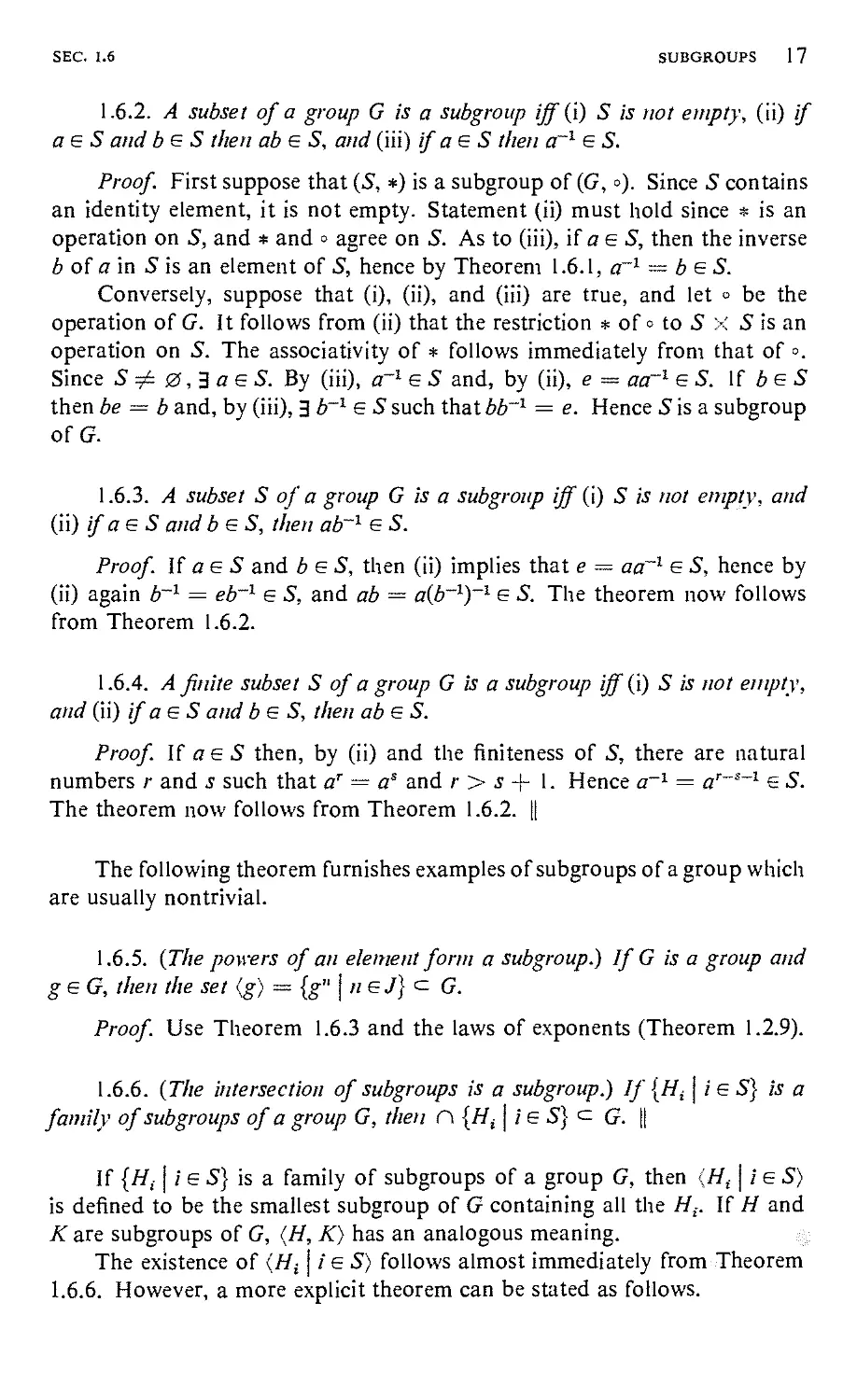
1.6.2. A subset of a group G is a subgroup iff (i) S is not empty, (ii) if
a e S and be S then ab e S, and (iii) if a e S then a"1 e S.
Proof. First suppose that (S, *) is a subgroup of (G, °). Since S contains
an identity element, it is not empty. Statement (ii) must hold since * is an
operation on S, and * and ° agree on S. As to (iii), if a e S, then the inverse
b of a in S is an element of S, hence by Theorem 1.6.1, a"1 = b e S.
Conversely, suppose that (i), (ii), and (iii) are true, and let ° be the
operation of G. It follows from (ii) that the restriction * of ° to S X S is an
operation on S. The associativity of * follows immediately from that of °.
Since S ^ 0,1 a e S. By (iii), a"1 6 S and, by (ii), e = aa-1 e S. If b e S
then be = b and, by (iii), 1 b"1 e S such that bb"1 = e. Hence S is a subgroup
ofG.
1.6.3. A subset S of a group G is a subgroup iff (i) S is not empty, and
(ii) ifaeS and b e S, then ab~~r e S.
Proof. If a 6 S and b e S, then (ii) implies that e = aa"1 e S, hence by
(ii) again b"1 = eb"1 e S, and ab = a{b"1)"1 e S. The theorem now follows
from Theorem 1.6.2.
1.6.4. A finite subset S of a group G is a subgroup iff (i) S is not empty,
and (ii) ifaeS and b e S, then ab e S.
Proof. If aeS then, by (ii) and the finiteness of S, there are natural
numbers r and J such that ar = a$ and r > s -\- 1. Hence a~r = a'"""1 e S.
The theorem now follows from Theorem 1.6.2. ||
The following theorem furnishes examples of subgroups of a group which
are usually nontrivial.
1.6.5. (The powers of an element form a subgroup.) If G is a group and
geG, then the set (g) = {g" | n ej) <= G.
Proof. Use Theorem 1.6.3 and the laws of exponents (Theorem 1.2.9).
1.6.6. (The intersection of subgroups is a subgroup.) If{H( \ i e S} is a
family of subgroups of a group G, then n {Ht \ieS}<=- G. ||
If {//,■ | i 6 S} is a family of subgroups of a group G, then {//,. | i e S)
is defined to be the smallest subgroup of G containing all the //,-. If H and
K are subgroups of G, {//, K) has an analogous meaning.
The existence of {//; | i e S) follows almost immediately from Theorem
1.6.6. However, a more explicit theorem can be stated as follows.

18 INTRODUCTION
CHAP. 1
1.6.7. If {Hi I i 6 S} is a family of subgroups of a group G, then {Ht | i e S)
is the set of all finite products xx. . . xn such that each xs e H{Jor some i, e S.
Proof. This follows readily from Theorems 1.6.3 and 1.2.7. ||
Remark. It has been implicitly assumed in the above discussion that the
set S was nonempty in each case. If S is empty, then n {H{ | i e S} is defined
to be G, while (H, | i e S) = E (from the definition already given). However,
Theorem 1.6.7 is false if S is empty.
1.6.8. If H and K are subgroups of a group G, then HK is a subgroup
ijfHK=KH.
Proof. Suppose that HK <= G. Let h e H and ke K Then kh =
(h-ik*1)-1 is the inverse of an element of HK and is, therefore, itself in HK.
Thus KH is a subset of HK. If x e HK, then x~l e HK and 1 h' e H and
k' eK such that x"1 = h'k'. Therefore x = k'-lh'-1 eKH. Hence HK is a
subset of KH. Therefore HK = KH.
Conversely, suppose that HK = KH. Clearly HK # 0. Let h e H,
hre H, keK, and kr e K Then
(hkX^kjT1 = Hkk-^h-1).
Since
(kk^lij1 eKH = HK,
1 h2 6 H and fc> 6 K such that (kk-1)!^1 = Mr2. Therefore
(hkXl^k,)-1 = hhjcz 6 HK.
By Theorem 1.6.3, HK is a subgroup of G.
EXERCISES
1.6.9. If K <= H and H <= G, then isT <= G.
1.6.10. If G is a group then E = {e} is a subgroup of G.
1.6.11. Use Theorem 1.6.5 to find four nontrivial subgroups of Sym({l, 2, 3}).
1.6.12. Find all subgroups of the group J of integers.
1.6.13. (Hard) Find all subgroups of @. Hint: It is slightly easier to find those
_ subgroups H such that 1 6 H.
1.6.14. True or false? Sym({l, 2, 3}) <= Sym({l, 2, 3, 4}). If true, prove it; if
false, fix the statement up so that a true statement results.

SEC. 1.7
COSETS AND INDEX 19
1.6.15. If G is a group, H is a subset oft <= G. and/Cis a subset of G. then
(a) L n (HK) = H{L n /Q.
(b) If G = //if, then i = H{L <~\ K).
1.6.16. If H and K are proper subgroups of G, then there is an element x in G
which is not in H or if.
1.7 Cosets and index
Definition. If // is a subgroup of a group G, then a r/g/// care/ of // is a
subset S of G such that 3 .v 6 G for which 5 = //.v. Left coset is defined
similarly. If K is also a subgroup of G, then a double coset of // and K is a
subset 5 of G such that 3 a e G for which S = HxK.
1.7.1. (Disjoititness of double cosets.) If H <= G, /£ <= G, a- £ G, a«rf
V 6 G, //;e« Z/.Y-/T flW HyK are equal or disjoint.
Proof. If HxK n tfy/s: # 0, then 3 lh e H, /¾ 6 H, kr e /f, and k, e K
such that hlxkl = /i2yk2. It follows (Exercise 1.5.8) that
HxK = Hl^x^K = HhtfkJC = HyK.
1.7.2. (Disjointness of cosets.) If H <= G, a e G, c/k/j e G, then Hx and
Hy are equal or disjoint, and xH and yH are equal or disjoint.
Proof. In Theorem 1.7.1, let K = E or H = E.
1.7.3. Hx = Hy iff'xyr1 e H. xH = yH iffy~lx e H.
1.7.4. -v 6 HxK, a 6 Hx, and x e xH. \\
Let us make the following temporary definition. If // is a subgroup of a
group G, then the right index of H in G is the number of right cosets of //.
1.7.5. {Right index = left index.) If H is a subgroup of a group G, then
the right index of H in G equals the left index of H in G.
Proof. Consider the relation T = {(Hx, x~xH) \ x e G). Now Hx = Hy
iff xy^1 6 H (Theorem 1.7.3), which is true iff (a-j-1)-1 6 //, i.e., iff yx"1 e H,
i.e., iff (y-iy-ix-i 6 //; which by Theorem 1.7.3 is true iff x-1// = y^H. It
follows that T is a 1-1 function from the set of right cosets of H onto the set
of left cosets of //. The theorem follows. II

20 INTRODUCTION
CHAP. 1
Because of Theorem 1.7.5 there is no distinction between right and left
index. We therefore define the index [G:H] of H in G to be the number of
right cosets of H.
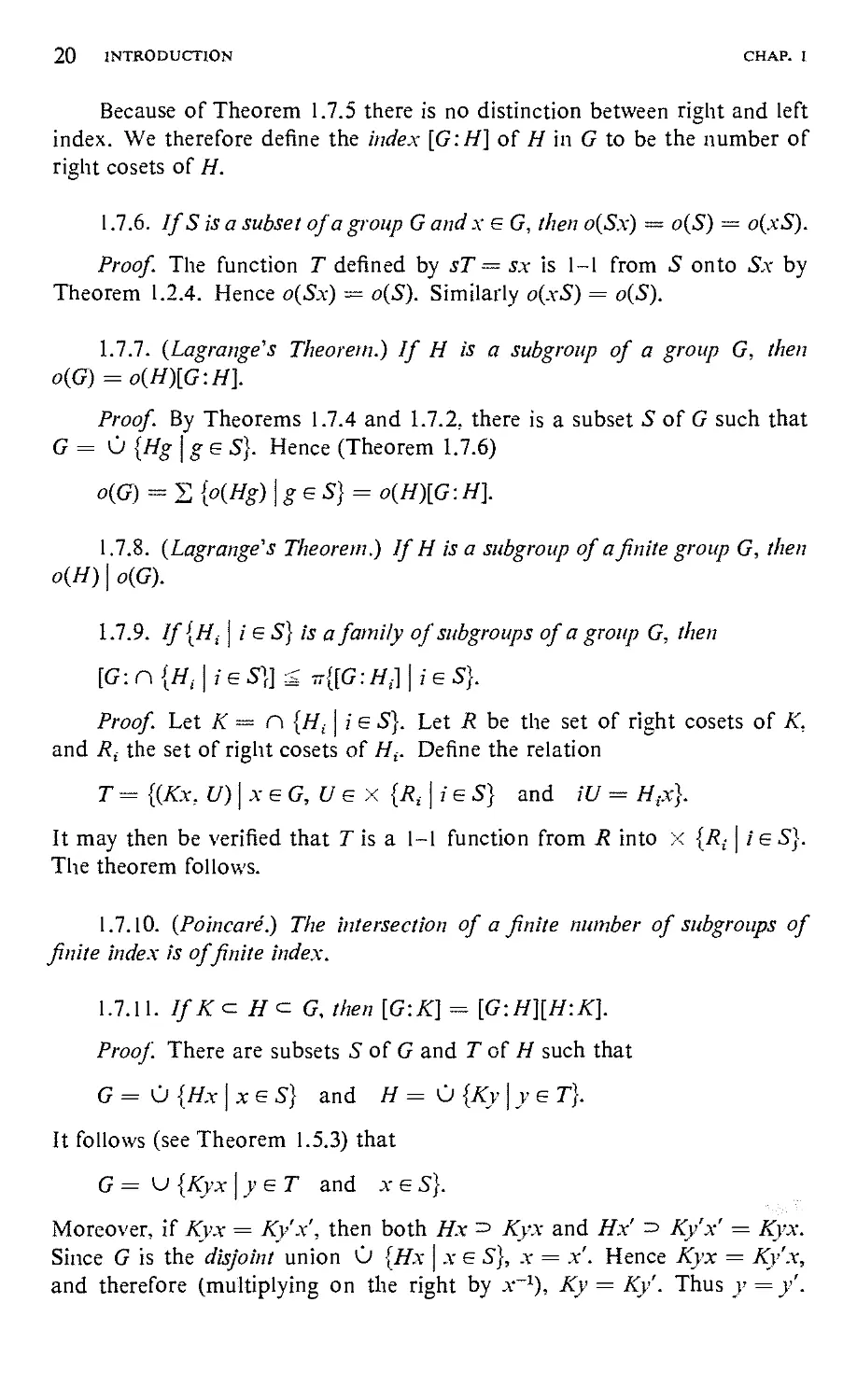
1.7.6. IfS is a subset of a group G and x e G, then o(Sx) = o(S) = o(xS).
Proof. The function T defined by sT = sx is 1-1 from S onto Sx by
Theorem 1.2.4. Hence o(Sx) = o(S). Similarly o(xS) = o(S).
1.7.7. {Lagrange's Theorem.) If H is a subgroup of a group G, then
o(G) = o(H)[G:H].
Proof. By Theorems 1.7.4 and 1.7.2, there is a subset S of G such that
G = O {Hg \geS). Hence (Theorem 1.7.6)
o(G) = E {o(Hg) \geS} = o(H)[G://].
1.7.8. (Lagrange's Theorem.) If H is a subgroup of a finite group G, then
o(H) | o(G).
1.7.9. If {Ht | i 6 S) is a family of subgroups of a group G, then
[G: n {H, | i 6 S}] £ W{[G: Ht] | i e S}.
Proof. Let K = n {Ht | i e S}. Let R be the set of right cosets of K,
and Rj the set of right cosets of //,-. Define the relation
T = {(/&, £/) | a- 6 G, U 6 x {/?,-1 / 6 5} and z£/ = H{x}.
It may then be verified that J is a 1-1 function from R into X {R{ | / 6 S}.
The theorem follows.
1.7.10. (Poincare.) The intersection of a finite number of subgroups of
finite index is of finite index.
1.7.11. IfKci //c= G,then[G:K} = [G:H][H:K].
Proof. There are subsets 5 of G and T of H such that
G = O {Hx | x 6 S) and //=0 {AT_y | y e T}.
It follows (see Theorem 1.5.3) that
G = U {Ay* I _y 6 r and « S}.
Moreover, if Kyx = Ky'x', then both Hx =5 Kyx and //.y' => Ay'x' = Kyx.
Since G is the disjoint union O (/¾ | .v 6 S), x = x. Hence Kyx = Ky'x,
and therefore (multiplying on the right by a--1), Ky = Ky'. Thus y =}''.

SEC. 1.7 COSETS AND INDEX 21
But this shows that
G = O {Kyx \yeT and x e S}.
The theorem follows.
EXERCISES
1.7.12. o(G) = [G:E\.
1.7.13. If [G://] = m and [G:.K] = n are finite, then [G:i/nfl is at least as
large as the least common multiple of m and n.
1.7.14. If H <= G and K <= G, then [G: K] S [//:// n /C].
1.7.15. If [G://] = m and [G:K] = n are finite and relatively prime, then
[G:HC\K] = ;«n.
1.7.16. Let Af = {1,...,/?}. Let
H = {.v 6 SymOW) | nx = n}.
(a) Prove that H <= Sym(M).
(b) Find [Sym(M)://].
(c) Find a set r such that Sym(M) = 0 {//.y \xeT).
1.7.17. Let // be the subgroup of J consisting of all multiples of 4.
(a) Find the cosets of H.
(b) Find [./://].
1.7.18. Let G = Sym(.W) where M = {1, 2, 3}, and let H = {(1), (1, 2)}.
(a) List the right cosets of H in G.
(b) List the left cosets of //.
(c) Are the lists the same?
(d) Is the product of two right cosets of H again a right coset of //?
(e) Answer parts (a) through (d) for
// = ((1),(1,2,3),(1,3,2)}.
1.7.19. (a) If H0 = G, //,,^ <= Hn <= G for « e.-C, and // = n //„, then
[C:«]SH«,:«KJ).
(b) Unsolved problem. Does (a) hold for well-ordered descending
sequences of subgroups ?
1.7.20. A subset S of group G cannot be a right coset of two distinct subgroups
ofG.

22 INTRODUCTION
CHAP. I
1.8 Partially ordered sets
We now append a few definitions and facts about partially ordered sets.
This material could have been included in the first section, but was delayed
in order that group theory itself could be started sooner.
A partially ordered set is an ordered pair (S, R) where 5 is a set and R is a
transitive and reflexive relation on 5 such that if (a, b) e R and (b, a) e R,
then a = b. One usually refers to 5 itself rather than to (S, R) as a partially
ordered set. An ordered set or chain is a partially ordered set such that if
as S and be S then (a, b) e R or (b, a) e R.
Example. Let 5 be the set of nonnegative integers and let R be the
relation on 5 such that (a, b) e R iff a | b. Then (S, R) is a partially ordered
set but not an ordered set.
Example. Let M be a set, 5 the set of subsets of M, and R the relation on
5 such that (a. b) e R iff a is a subset of b. Then (S, R) is a partially ordered,
but (provided M has at least two elements) not an ordered, set. 5 is said to be
partially ordered by inclusion.
Example. Let G be a group, 5 the set of subgroups of G, partially ordered
by inclusion. Then 5 is partially ordered.
Example. Let 5 be any subset of the reals ordered by sj. Then 5 is a
chain.
If (S. R) is a partially ordered set and a e S, then a is maxima/ iff (a, b) e R
implies a = b. There may be infinitely many maximal elements of 5. In fact,
if R = {(a. a)\a e S}. then (S, R) is a partially ordered set and every element
of 5 is maximal. An element a e S is maximum iff (*) if b e 5 then (b, a) e R.
There is at most one maximum element in a partially ordered set. For if a
and b are maximum elements, then (a, b) e R (since b is maximum) and (b, a) e
R (since a is maximum), and therefore a = b (from the definition of partially
ordered set). Minimal and minimum are defined similarly. A finite chain has
a minimum element and a maximum element. A maximal element of an
ordered set is a maximum element. Note that an ordered set need not have a
maximal (or maximum) element. For example. J under the ordering S has
no maximal element.
Example. If 5 is the set of subgroups of a group G, partially ordered by
inclusion, then 5 has a maximum element, namely G. and a minimum element,
namely E.

SEC. 1.8
PARTIALLY ORDERED SETS 23
If (S, R) is a partially ordered set and 7"is a nonempty subset of S, then
an upper bound of T is an x e S such that if a e T, then (a, x) e R. A least
upper bound of 7"is an upper bound x of Tsuch that ify is an upper bound of
T, then (x,y)eR. It follows easily that there is at most one least upper
bound of T. However, there may not be any (Exercise 1.8.5). If T = {a,b}
and the least upper bound of Texists, then it is denoted by a U b. In general
it will be denoted by U {x | x e 7} or simply U T. Greatest lower bound is
defined similarly, and is denoted by n when it exists.
A lattice is a partially ordered set S such that for any doubleton T, the
greatest lower bound and least upper bound of Texist. (That is, for all a e S
and b e S, a U b and a (~\ b exist.)
A lattice L is complete iff for every nonempty subset 7"of L the greatest
lower bound and least upper bound of T exist. This implies that a complete
lattice has a maximum element and a minimum element.
1.8.1. If G is a group, then the set Lat(G) of subgroups of G, partially
ordered by inclusion, is a complete lattice.
Proof This is the content of Theorems 1.6.6 and 1.6.7.
EXERCISES
1.8.2. The definition of partially ordered set (5, R) could have been given in terms
of R alone.
1.8.3. Let M be an infinite set, S the set of finite subsets of M, and R the inclusion
relation on S. Prove that S is a lattice with a minimum element but no
maximum element.
1.8.4. Prove that the partially ordered set S of all subsets of a set M is a complete
lattice.
1.8.5. Prove that if (5, R) is a partially ordered set and T is a nonempty subset of S,
then there is at most one least upper bound of T. Give an example where
there is no least upper bound of T.
1.8.6. If G is a group, H <= G, and Lat(//, G) the set of subgroups of G containing
H, then Lat(//, G) is a complete lattice under inclusion.
1.8.7. Let (5, R) be a nonempty ordered set of groups such that if A e S, Be S,
and (/4, B)e R then /4 <= S. Prove that an operation can be defined in
G = U {A | /4 6 S} in one and only one way so that G is a group containing
all A 6 S as subgroups.
1.8.8. A lattice which has a maximum element and which is such that every
nonempty subset has a greatest lower bound is complete.

TWO
ISOMORPHISM THEOREMS
2.1 Homomorphisms
Two groups may be essentially alike even though they are not equal.
For example, consider the groups Eng = {..., one, two, three,.. .} and
Ger ={..., eins. zwei, drei, .. .} under addition. There is an obvious 1-1
function T from Eng onto Ger (one might call T the translation function).
Furthermore, if, for example, one adds one and two and translates the result
into German the result is the same as when one first translates and then adds
(in German). The above facts will be expressed by saying that Eng is
isomorphic to Ger and that the translation function T is an isomorphism of
Eng onto Ger (these terms are defined below). A more general type of
function, a homomorphism, is of still greater importance. This chapter is
devoted to the study of these functions.
A homomorphism of a group (G, =) into a group (H, *) is a function T
of G into H such that if xeG and yeG, then (x°y)T = (xT)*{yT).
(Compare with the example above.) An endomorphism of G is a
homomorphism of G into G. An isomorphism is a 1-1 homomorphism. An
automorphism of G is an isomorphism of G onto G. A group G is isomorphic
to a group H, written G ^ H, iff there is an isomorphism of G onto H.
Examples. The function T such that xT = 2X is an isomorphism of the

SEC. 2.1
HOMOMORPHISMS 25
additive group of real numbers onto the multiplicative group of positive real
numbers. The function U such that xU = —x is an automorphism of J. The
function V such that zV = z2 is an endomorphism (but not an automorphism)
of the multiplicative group of nonzero complex numbers.
If G and H are groups, let Hom(G, //), End(G), and Aut(G) denote the
set of homomorphisms of G into //, the set of endomorphisms of G, and the
set of automorphisms of G, respectively. Later, Aut(G) and, in some cases,
Hom(G, //) and End(G) will be given an algebraic structure. Let Iso(G) and
Hom(G) be the class of isomorphisms and homomorphisms of G, respectively.
2.1.1. IfG and H are groups and T e Hom(G. //), then (i) eGT = eu and
(ii) (g-i)T = (gT)-\
Proof, (i) Compute (eae(;)T. (ii) Compute (g~xg)T. ||
Definition. A word fin the letters xu ..., x„ is an expression of the form
Xfl . . . x\k, where all r,- 6 J. If gx, . . . , gn are elements of a group G, then for
the above word ff(gu ..., gn) will mean grtl . . . g\*.
2.1.2. If G is a group, Te Hom(G),fis a word in xu ..., xn, and gt e G
for 1 < i Jj n, then
(f(gi,...,gJ)T=f(g1T,...,gnT).
Proof. This follows from the definition of homomorphism, Theorem
2.1.1, and induction.
2.1.3. (Product of homomorphisms is a homomorphism.) IfG, H, and K
are groups. Te Hom(G, //), and U e Hom(//, K), then TU e Hom(G, K).
2.1.4. If Te Hom(G, //), then GT <= H.
Proof. Use Theorems 1.6.2 and 2.1.1 (or 1.6.3 and 2.1.2).
2A.5.IfTe Hom(G, //) and K <= G, then (T | K) e Uom{K, H). \\
The homomorphism T\ AT will often be denoted simply by T. If G and
H are groups and Te Hom(G, //), then the kernel of T is the set Ker(7") =
{x e G | xT = en}.
2.1.6. If G is a group and Te Hom(G), then (i) Ker(T) <= G, and (ii) if
xeG then .x-1(Ker(D)x <= Ker(r). ||
A subgroup H of G is normal in G, written // o C, iff x~lHx <= // for
all x 6 G.

26 ISOMORPHISM THEOREMS
CHAP. 2
Theorem 2.1.6 may be restated as follows.
2.1.7. A kernel of a homomorphism is a normal subgroup.
2.1.8. If G is a group and H <= G, then H < G iff x~lHx = H for all
x e G, hence iff Hx = xH for all x e G.
Proof. The last equivalence is obvious, as is the fact that if x~lHx = H
for all x then H < G. Conversely, suppose H <g G and let x e G. l(x~xHx ^
H, then 3ye H\x~xHx, so xyx~x $ Hand
xyx-1 6 xHx-1 = (x-1)-1//(x-1),
contradicting the normality of H.
2.1.9. IfG is a group and Te Hom(G), then Telso(G) iffKer(T)= E.
Proof. If T is an isomorphism, then xeKer(7") implies xT = e = eT
by Theorem 2.1.1, hence x = e since 7" is 1-1. Since e 6 Ker(T) in any case,
it is true that Ker(T) = E. Conversely, suppose that Ker(T) = E. Then if
xT = yT, we have
{yxx)T= (yT)-\xT) = e (by Theorem 2.1.2),
so thatj"1* = e and v = x. Hence 7" is 1-1 and therefore an isomorphism.
2.1.10. IfG and Hare groups, TeHom(G,H),andK<= G,thenKT^ H
If furthermore, K < G, then KT < GT. ||
If Te Hom(G, H) and 5 is a subset of H, then T"^1 is a relation, so that
(see Section 1.1)
ST-1 = {xeG\xTeS}.
2.1.11. If G and H are groups, T e Hom(G, /0, andy e GT, then {y}T~l
is a coset ofKer(T).
Proof. Since y e GT, 3 x e G such that xT = y. If g e G, then gT = y
ifT (xTT^r) = e, which holds ifT (^-^)7 = e, i.e., ifT x~lg e Ker(r), which
is equivalent to g e x(Ker(T)).
2.1.12. If G and H are groups, K <= H, and TeHom(G,H), then
KT-1 <= G;ifK<H, then KT^1 < G. ||
An isomorphism of a lattice (S, R) onto a lattice (5", J?') is a 1-1 function
T from 5 onto S' such that (x, y) e i? iff (xT", jT) 6 R' (see Exercise 2.1.38).

SEC. 2.1
HOMOMORPHISMS 27
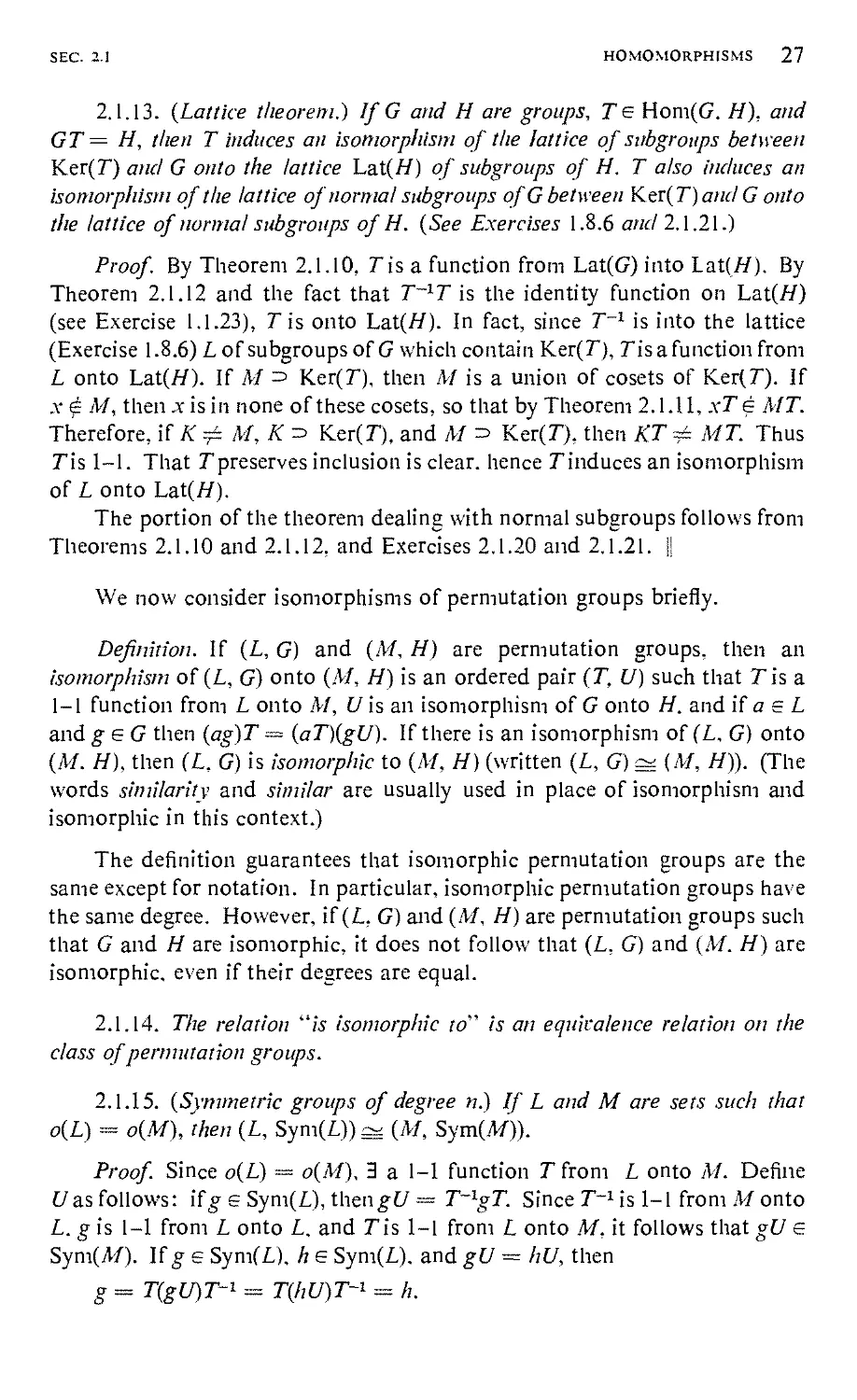
2.1.13. (Lattice theorem.) If G and H are groups, Te Hom(G. //), and
GT= H, then T induces an isomorphism of the lattice of subgroups between
Ker(T) and G onto the lattice Lat(//) of subgroups of H. T also induces an
isomorphism of the lattice of norma/ subgroups ofG between Ker(T) and G onto
the lattice of norma/ subgroups of H. (See Exercises 1.8.6 and 2.1.21.)
Proof. By Theorem 2.1.10, Tis a function from Lat(G) into Lat(//). By
Theorem 2.1.12 and the fact that T~XT is the identity function on Lat(//)
(see Exercise 1.1.23), T is onto Lat(//). In fact, since T"1 is into the lattice
(Exercise 1.8.6) L of subgroups of G which contain Ker(T), Tis a function from
L onto Lat(//). If M => Ker(T), then A/ is a union of cosets of Ker(T). If
x$ M, then x is in none of these cosets, so that by Theorem 2.1.11, xT e KIT.
Therefore, if K ^ M, K => Ker(r), and M => Ker(7), then KT # MT. Thus
7"is 1-1. That rpreserves inclusion is clear, hence /"induces an isomorphism
of L onto Lat(//).
The portion of the theorem dealing with normal subgroups follows from
Theorems 2.1.10 and 2.1.12, and Exercises 2.1.20 and 2.1.21. 1
We now consider isomorphisms of permutation groups briefly.
Definition. If (L, G) and (A/, //) are permutation groups, then an
isomorphism of (L, G) onto (A/, //) is an ordered pair (T, U) such that Tis a
1-1 function from L onto A/, t/ is an isomorphism of G onto //. and if a e L
and g eG then (ag)T = (aT)(gU). If there is an isomorphism of (L, G) onto
(M. //), then (L, G) is isomorphic to (A/, H) (written (L, G) =¾ (A/, //)). (The
words similarity and similar are usually used in place of isomorphism and
isomorphic in this context.)
The definition guarantees that isomorphic permutation groups are the
same except for notation. In particular, isomorphic permutation groups have
the same degree. However, if (L, G) and (A/, //) are permutation groups such
that G and H are isomorphic, it does not follow that (L, G) and (Af. //) are
isomorphic, even if their degrees are equal.
2.1.14. The relation "is isomorphic to" is an equivalence relation on the
class of permutation groups.
2.1.15. (Symmetric groups of degree «.) If L and M are sets such that
o(L) = o(M), then (L, Sym(L)) ^ (A/, Sym(A/)).
Proof Since o(L) = o(M), 3 a 1-1 function Tfrom L onto A/. Define
t/as follows: if jf e Sym(L), thengt/ = T~lgT. Since T~r is 1-1 from M onto
L. g is 1-1 from L onto L. and Tis 1-1 from L onto M. it follows that gU e
Sym(M). If g e Sym(L). h e Sym(L). and gU = hU, then
g = T(gU)T^ = T(hU)T~* = h.

28 ISOMORPHISM THEOREMS
CHAP. 2
Hence U is 1-1. If k e Sym(M), then TkT~l e Sym(L) as above, and
(TkT-l)U = T~\TkT-*)T= k,
so U is onto Sym(M). It is easy to verify that ifg e Sym(L) and h e Syni(L),
then (gA) £/ = (gU)(hU). Hence £/is an isomorphism of Sym(L) onto Sym(A/).
Finally, if a e L and g e Sym(L), then
(aT)(gU) = aTT~*gT= (ag)T,
so (T, U) is an isomorphism of (L, Sym(L)) onto (A/, Sym(M)). ||
For each positive cardinal number n, let M„ be the set consisting of the
first n nonzero ordinals. Let Sym(n) = Sym(Mn). Then if M is a nonempty
set, the permutation group (M, Sym(Af)) is isomorphic to one and only one
(M„, Sym(A/„)). In fact, Sym(M) is isomorphic to exactly one Sym(n). This
is obvious for finite sets M; for infinite sets it will be proved later (Theorem
11.3.7).
The following theorem will be useful on several occasions.
2.1.16. If S is a set, G a group, and T a 1-1 function from S into G, then
there is a group H containing S as a subset, and an isomorphism U of H onto
G such that U | S = T.
Proof. There is an infinite set M such that o(M) > o(G) (if G is finite, let
M = J; if G is infinite, let M be the set of subsets of G). Since o(S) a' o(G),
o(M\S)> o(G). Hence there is a 1-1 function Kfrom G\(ST) into M\S. Let
H = S O (G\{ST))V,
(hT KheS,
hU = l
[hV-1 if he HIS.
Then £/ is a 1-1 function from the set H onto the set
(G\ST) O (ST) =G and U \ S = T.
Define multiplication in #as follows:
h * h» = {(ktUXhiUyW-K (1)
Then * is an operation on H. We have
(A, * As) * /¾ = (((((/h £/)(/½ £/)) £/-1) £/)(/¾ £0)^1
= (((^£/)(/^))(/¾^))^1 = ((/hU)((h,U)(h3U)))U~l
= ((/hU)((((h2U)(h3U))U~")U))V-1 = /h * (A, * /¾).

SEC. 2.1
HOMOMORPHISMS 29
Hence * is associative. Again,
h * (eU-1) = ((/i £/)((6^-1) £/)) £/-1
= (hU)U-1 = h,
and eU"1 is a right identity. Moreover
h * ((/it/)-1 £/-1) = ((/;£/)(((/<£/)-1 £/-1)£/))£/-1
= ((hUXhUr^U-1 = eU-\
Hence H is a group. Operating on (1) by £/, one has
(A, */i2)£/=(/^ £/)(/¾ £/)
so that £/ is a homomorphism. Since £/ was 1-1 from // onto G, U is an
isomorphism of H onto G.
EXERCISES
2.1.17. If G is an Abelian group, H a group, and G =½ H, then H is Abelian.
2.1.18. Generalize Exercise 2.1.17 to a similar statement about homomorphisms.
2.1.19. If G is a group, ffc g, and relso(G), then [GT:HT] = [G://]. If
reHom(G), then [GT-.HT] i [G:.ff].
2.1.20. If{#i| /eSjisa family ofnormalsubgroups of a group G, then n {Ht\ ieS}
and (Hi | i'eS) are normal subgroups of G.
2.1.21. If G is a group and Hcz G, then the set of A such that i/<= ^ <j c is a
complete lattice (under inclusion).
2.1.22. If G is a group and xT = jr1 for all x e G, then
(a) Tis 1-1 from G onto G,
(b) T 6 Aut(G) iff G is Abelian.
2.1.23. If G is an Abelian group, n e J, and xT = .*" for all xeG, then TeEnd(G).
2.1.24. (a) G <G.
(b) £ < G.
(c) If H < G and H <= /C <= G, then // < /C
2.1.25. If G is the set of complex numbers and (a -r bi)T = a — bi for all real a
and b, then
(a) T is an automorphism of (G, -),
(b) 7" is an automorphism of (G#, ■)■
2.1.26. If x e G and ^ = jr1;* for all j 6 G, then Tx e Aut(G).
2.1.27. A subgroup H of an Abelian group G is normal in G.

30 ISOMORPHISM THEOREMS
CHAP. 2
2.1.28. If H <i G, it does not follow that x'lhx = h for all x e G and ft e H (see
Exercise 1.7.18).
2.1.29. Show that if a group H is obtainable from a group G by a finite number of
applications of the processes
(a) taking a subgroup, and
(b) taking a homomorphic image,
then H is a homomorphic image of a subgroup of G (i.e., only two
applications are necessary).
2.1.30. (a) The identity function IG is an automorphism of the group G (the
identity automorphism).
(b) If G and H are groups then OaB is a homomorphism (the zero
homomorphism) from G into H.
2.1.31. Show that there are two permutation groups {L, G) and {M, H) of degree 4
such that G s= H but (/., G) 0 (M, H).
2.1.32. Let S = {1,..., «} and let G,- be a group for i e S.
(a) ^G.-lieSjsG! x .... >: Gn.
(b) If Te Sym(n), then Gr x . . . x Gn ss GlT x . ■. x G„r.
2.1.33. (a) (Associativity of the direct product.) If S is a set of groups and
S = 0 {5,-1 i 6 T}, then
ff{G|G65}s»{w{G|G65f}|/6r}.
(b) Formulate and prove the corresponding property for external direct
sums.
2.1.34. Show that Sym(3) has nonnormal subgroups.
2.1.35. Isomorphism is an equivalence relation.
2.1.36. If G and H are groups and 7" is an isomorphism of G into H, then there is a
group K =3 G, and an isomorphism U of K onto H such that U\G — T.
2.1.37. If T is a homomorphism of a group G,xeG, and neJ, then .v"7" = (xT)n.
2.1.38. If 7" is an isomorphism of a lattice (S, R) onto a lattice (5", ft'), x e S and
_>• 6 5, then
(x\Jy)T = xT\JyT and (.v n y)T = xT C\ yT.
2.2 Factor groups
2.2.1. If H < G. then the set of cosets of H in G forms a group under
multiplication (see Section 1.5). j|
The group in Theorem 2.2.1 is called the factor group GjH. (It is also
called the quotient group, or sometimes, if the operation is addition, the

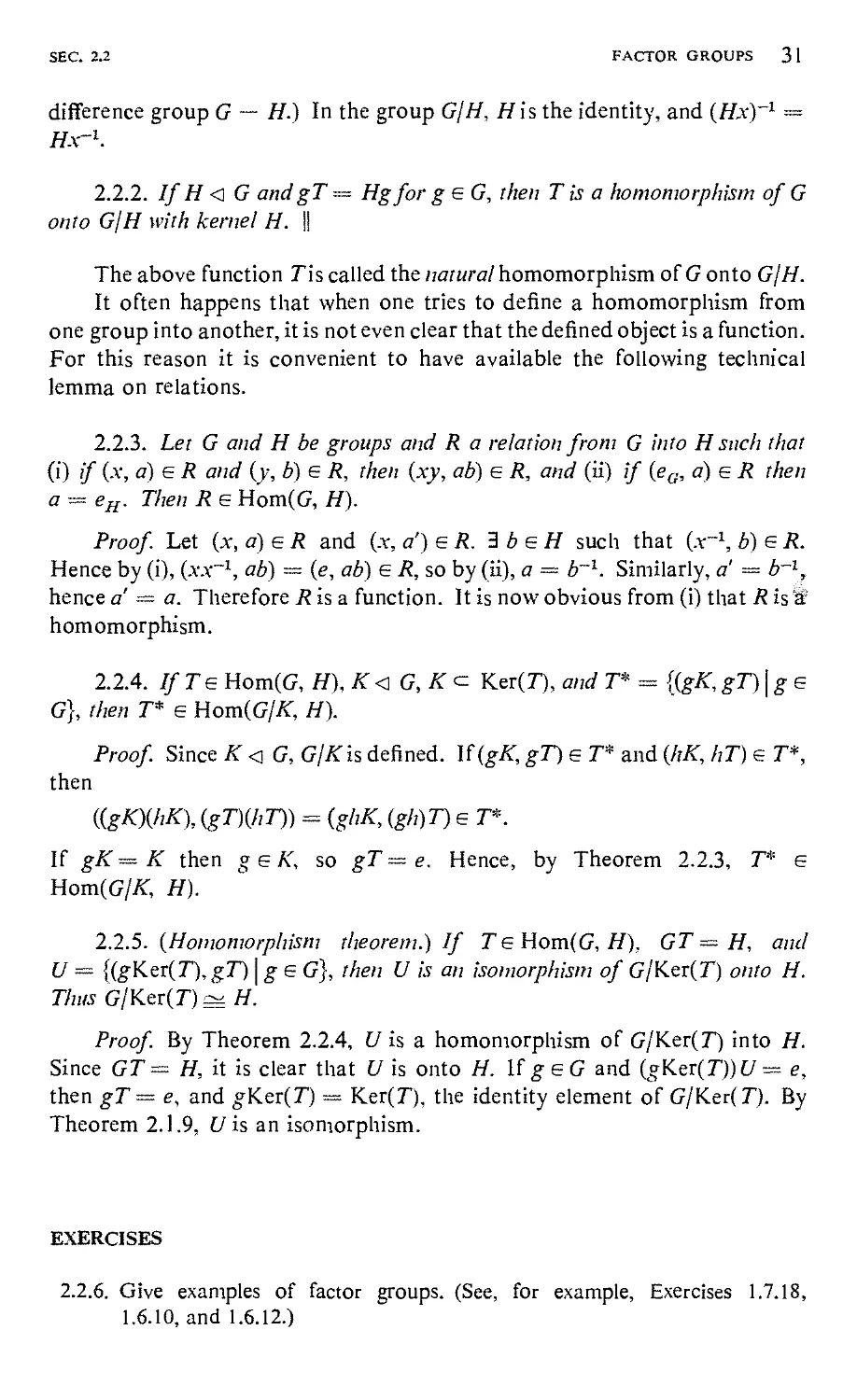
SEC. 2.2
FACTOR GROUPS 31
difference group G — H.) In the group GjH, His the identity, and (Hv)'1 =
Hxr1.
2.2.2. IfH < G andgT = Hgfor g e G, then T is a homomorphism of G
onto GjH with kernel H. ||
The above function Tis called the natural homomorphism of G onto GjH.
It often happens that when one tries to define a homomorphism from
one group into another, it is not even clear that the defined object is a function.
For this reason it is convenient to have available the following technical
lemma on relations.
2.2.3. Let G and H be groups and R a relation from G into H such that
(i) if (x, a) e R and (y, b) e R, then (xy, ab) e R, and (ii) if (ea, a) e R then
a = eH. Then R e Hom(G, H).
Proof. Let (x, a) e R and (x, a') e R. 3beH such that (x~l, b) e R.
Hence by (i), (.v.v-1, ab) = (e, ab) e R, so by (ii), a = b~l. Similarly, a' = b~l,
hence a' = a. Therefore R is a function. It is now obvious from (i) that R is a:
homomorphism.
2.2.4. IfTe Hom(G, H), K< G, K <= Ker(r), and T* = {{gK,gT)\ge
G}, then T* 6 Hom(G/.fir, H).
Proof. Since K < G, G/Kis defined. If (gK, gT) e T* and (hK, hT) e T*,
then
((gK)(hK), (gT)(hT)) = (ghK, (gh)T)e T*.
If gK=K then g e K, so gT=e. Hence, by Theorem 2.2.3, T* 6
Hom(G/^T, H).
2.2.5. (Homomorphism theorem.) If TeHom(G,H), GT = H, and
U = {(#Ker(T),gT) | g e G], then U is an isomorphism of G/Ker(F) onto H.
Thus G/Ker(D ^ H.
Proof. By Theorem 2.2.4, U is a homomorphism of G/Ker(7") into H.
Since GT = H, it is clear that U is onto H. If geG and (gKer(T))U= e,
then gT= e, and ^Ker(T) = Ker(7"), the identity element of G/Ker(7"). By
Theorem 2.1.9, U is an isomorphism.
EXERCISES
2.2.6. Give examples of factor groups. (See, for example, Exercises 1.7.18,
1.6.10, and 1.6.12.)

32 ISOMORPHISM THEOREMS
CHAP. 2
2.2.7. Let H be a nonnormal subgroup of G. Prove that the set of right cosets of
H do not form a group under multiplication.
2.2.8. Show that the homomorphism theorem 2.2.5 may be stated more fully as
follows. If V is a homomorphism of a group G onto a group H, then
V = TU where T is the natural homomorphism of G onto G/Ker(F)
(Theorem 2.2.2), and U is the isomorphism of G/Ker(F) onto H given in
Theorem 2.2.5.
2.2.9. If H; <j G, for all i e S, then
■nGt Gt
(a) ^*«Wt
rw\ ^g G; -. v Gi
(b) ___^Sfi:_
2.2.10. If /i, 5, G, and // are (possibly infinite) groups such that AjB =s G///, then
o(A)o(H) = o(B)o(G).
2.3 Isomomorphism theorems
2.3.1. IfG is a group, H <= G, and K < G, then H nK<H.
2.3.2. If G is a group, H <= G, and K < G, then HK = KH = (H, K).
2.3.3. {Isomorphism theorem.) If G is a group, H <= G, K <\ G, and
T-~ {(hK,h{H n K))\he H}, then Tis an isomorphism of HKjK onto
HjH n A'. Thus
HK _ //
it = // n A '
/Voo/". The factor group HKjK is defined since A" <] //AT, and ///// n AT
is defined by Theorem 2.3.1. Let
(htK, h;(H n K))eT, /=1,2.
Then
((//,A')(/;,A), /^(// n A')A.,(// n A)) = .(//AAT, V/2(// n AT)) e r.
If /;A = A' and A 6 //, then heH n K and /;(// n K) = H C\ K. Hence, by
Theorem 2.2.3. r is a homomorphism of HKjK into ///// n AT. It is clear
that 7" is onto HjH n A'. If hK e Ker(7), then heH nK, so hK = K, and T
is an isomorphism by Theorem 2.1.9.

SEC. 2.3
ISOMORPHISM THEOREMS 33
2.3.4. If G is a group, H <\ G, and K < G, then
HK _ H a HK _ K
K ~ H r\K "" H ~ H n K
2.3.5. If Te Hom(G, H), GT = H, K < //, A/ = AT"1, aw/
t/=feA/,(^riA)|^6G},
ffe» t/ w on isomorphism of GjM onto HjK. Thus GjM ^. HjK.
Proof. Let V be the natural homomorphism of H onto HjK. Then TV
is a homomorphism of G onto HjK with kernel A/. The theorem now follows
from the homomorphism theorem 2.2.5.
2.3.6. {Freshman theorem.)* If K <\ H <\ G, K <\ G, and
U^{(gH,(gK)(HjK))\geG},
then U is an isomorphism of GjH onto (GjK)j(HjK). Thus
G _ GjK
H ~ HjK '
Proof. Let T be the natural homomorphism of G onto GjK Then
(H/K)T-i = H and H/K< GjK by Theorem 2.1.10. Now apply Theorem
2.3.5.
EXERCISES
2.3.7. (a) If //<= G, Kcz G, and //*<= G, then [HK:H] = [tffn/q.
(b) If H <= G and A' < G, then [//AT: H] = [K:H C\ K].
2.3.8. If // c G, A < G, and // Pi A = £, then //A/A ss //.
2.3.9. Let G = Sym(4) and let H be the four-group
H - {<?, (1, 2)(3, 4) (1, 3)(2, 4), (1, 4)(2, 3)}.
(a) Prove that H is an Abelian normal subgroup of G.
(b) Use Exercise 2.3.8 to show that GjH sa Sym(3) (see Exercise 1.7.16).
(c) Find a normal subgroup K of H which is not normal in G.
(d) Conclude that normality is not transitive.
2.3.10. Show that if H and K are subgroups of G, then it does not follow that HK
is a subgroup of G. (Compare with Theorem 2.3.2.)
2.3.11. In G = Sym(4), let H be the 4-subgroup in Exercise 2.3.9, A = <(1, 2, 3)>.
(a) HK <= G. Henceforth this group HK will be denoted by Alt(4).
(b) Normality is not transitive in Alt(4).
* So-called because the isomorphism follows by "cancellation" of K.

34 ISOMORPHISM THEOREMS
CHAP. 2
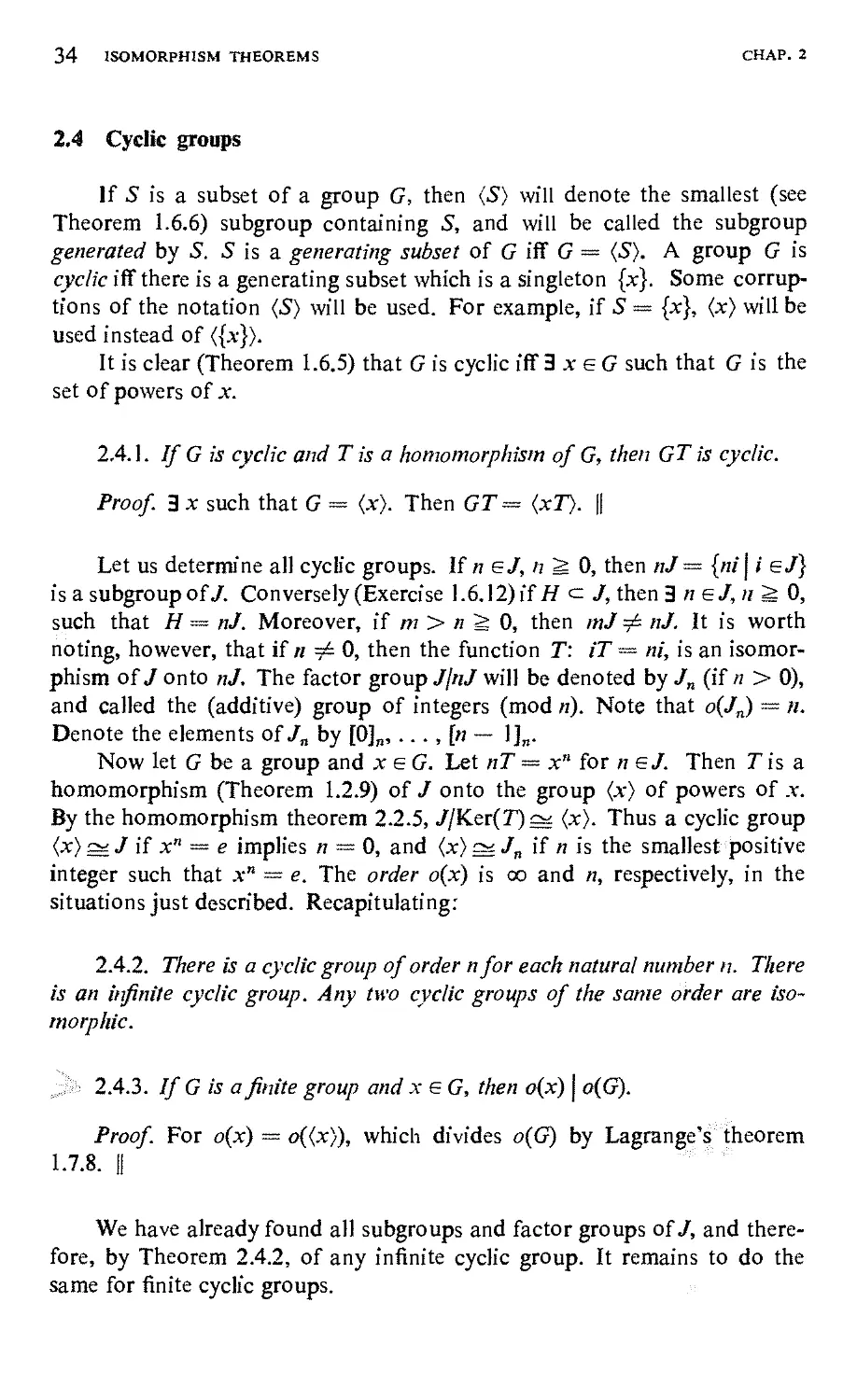
2.4 Cyclic groups
If S is a subset of a group G, then (S) will denote the smallest (see
Theorem 1.6.6) subgroup containing S, and will be called the subgroup
generated by S. S is a generating subset of G iff G = (S). A group G is
cj/c//c iff there is a generating subset which is a singleton {x}. Some
corruptions of the notation (S) will be used. For example, if S = {x}, (x> will be
used instead of ({x}>.
It is clear (Theorem 1.6.5) that G is cyclic iff 3 x e G such that G is the
set of powers of x.
2.4.1. If G is cyclic and T is a homomorphism of G, then GT is cyclic.
Proof 3 x such that G = (x). Then GT = (xT). ||
Let us determine all cyclic groups. If n e/, n i£ 0, then nJ = {ni\ i e/}
is a subgroupof/. Conversely (Exercise 1.6.12)ff H <=■ J, then 3 n e/, n S 0,
such that H = nJ. Moreover, if m > n S 0, then mJ # nX It is worth
noting, however, that if n # 0, then the function T: iT = m, is an
isomorphism of/ onto nJ. The factor group JjnJ will be denoted by /„ (if n > 0),
and called the (additive) group of integers (mod n). Note that o(Jn) = n.
Denote the elements of/„ by [0]„,..., [w — 1]„.
Now let G be a group and x 6 G. Let «r = x" for « e/. Then T is a
homomorphism (Theorem 1.2.9) of J onto the group (x) of powers of x.
By the homomorphism theorem 2.2.5, //Ker(T)^ (x). Thus a cyclic group
(x) 3=; / if x" = e implies n = 0, and (x) s= ^„ if " is the smallest positive
integer such that x" = e. The order o(x) is oo and n, respectively, in the
situations just described. Recapitulating:
2.4.2. There is a cyclic group of order nfor each natural number n. There
is an infinite cyclic group. Any two cyclic groups of the same order are
isomorphic.
2.4.3. If G is a finite group and x e G, then o(x) | o(G).
Proof. For o(x) = o«x», which divides o(G) by Lagrange's theorem
1.7.8. ||
We have already found all subgroups and factor groups of/, and
therefore, by Theorem 2.4.2, of any infinite cyclic group. It remains to do the
same for finite cyclic groups.

SEC. 2.5
COMPOSITION SERIES 35
2.4.4. (Subgroups of cyclic groups are cyclic.) If G is cyclic of finite order
ii, then G has exactly one cyclic subgroup of order mfor each positive divisor m of
n, and no other subgroups.
Proof. Since G ^/,,, it suffices to consider /„. By the lattice theorem
2.1.13, since /„ = JjnJ, Lat(/„) is isomorphic to the lattice of subgroups of/
containing nj. Hence Lat(/„) is isomorphic to the lattice of subgroups mJ
of / such that m | n. This isomorphism is induced by the natural homomor-
phism T of / onto JjnJ. Since mJ is cyclic, (mJ)Tls cyclic (Theorem 2.4.1).
By Theorem 2.3.5, [/„ : (mJ)T] = [J : mJ] = m, so o((mJ)T) = n\m.
2.4.5. If o(G) is prime, then G is cyclic and has no nontrivial subgroups.
Proof. G has no nontrivial subgroups by Lagrange. 3 x e G#. Since
<.y) =t E, (x) = G, and G is cyclic.
EXERCISES
2.4.6. (Factor groups of cyclic groups are cyclic.) Prove that if G is cyclic of
finite order «, then G has exactly one cyclic factor group of order in if
m | n, m > 0, and has no other factor groups.
2.4.7. Find all automorphisms of Jn.
2.4.8. Find all automorphisms of Jn.
2.4.9. Find all homomorphisms of J12 into J6.
2.4.10. (a) If S is a nonempty subset of a group G, then (S) is the set of words in
the letters of S.
(b) Let G = (S), and let U be a function from S into a group H. Prove
that there is at most one homomorphism T of G into H such that
T\S=U.
2.4.11. If G = <5> and reHom(G), then GT = {ST).
2.4.12. If reHom(G) and x is an element of finite order in G, then o{xT)\ o{x).t
2.4.13. If every element of a group has order 1 or 2, then the group is Abelian.
2.4.14. If H is a finite subgroup of G, Kiss, normal subgroup of G of finite index,
and (o(//), [G:K]) = \, then //<= K.
2.5 Composition series
A group is simple iff it has no nontrivial normal subgroups.
2.5.1. The only simple A belian groups are the cyclic groups of order 1 or a
prime.

36 ISOMORPHISM THEOREMS
CHAP. 2
Proof. It is trivial (Theorem 2.4.5) that the groups mentioned are simple.
Conversely, let G be a simple Abelian group, o(G) > 1. Then 3 xsG".
Since any subgroup of an Abelian group is normal, G = <-v). It follows
from Theorem 2.4.4 and the comments after Theorem 2.4.1 that if G is not
of prime order, then it has nontrivial subgroups. Hence G has prime order.
2.5.2. If G is a group, H < G, and H < G, then GjH if simple iff H is a
maximal proper normal subgroup of G.*
Proof. This follows immediately from the lattice theorem 2.1.13.
2.5.3. If A and B are distinct maximal proper normal subgroups of G,
then A n B is a maximal proper norma! subgroup of A and of B.
Proof. AB < G by Theorems 2.3.2 and 2.1.20. Since AB => A, AB = A
or AB = G by the maximality of A. But if AB = A, then B <= A, hence
B < A (since A =£ B), contradicting the maximality of B. Thus AB = G.
Therefore GjB^ A/A C\ B by the isomorphism theorem 2.3.3. Application
of Theorem 2.5.2 shows that G/B is simple, hence (see Exercise 2.5.11) that
A n B is a maximal, proper, normal subgroup of A. Since the hypotheses are
unchanged by interchange of A and B, the same conclusion follows for B. ||
A norma! series of G is a finite sequence (A0,..., Ar) of subgroups
such that E = A0 < Ax < . . . <a AT = G. An invariant series is a normal
series such that each At <3 G. The factors of a normal series are the factor
groups A^jAf, OsJiSr— 1. Two normal series (A0,...,Ar) and
(B0, . .. . Bs) of G are equivalent (denoted by ~) iff s = r and 3 T e Sym(r)
such that,
Ai Bif .. ,-.,
—!_ ^ _Ji_ for 1 S I S r,
2.5.4. ~ is an equivalence relation on the set of normal series of a
group G. ||
A composition series of G is a normal series without repetition whose
factors are all simple. Thus a composition series is a normal series (A0,,.., Ar)
in which each At is a maximal, proper, normal subgroup ofA^. The factors,
of a composition series are called composition factors. E has just one
composition series, (E), and the series has no factors.
2.5.5. A finite group has a composition series.
Proof. This follows easily by induction. ||
* This statement is an abbreviation of the statement "H is a maximal element in the
set of proper normal subgroups of G partially ordered by inclusion.*' A similar
interpretation is to be given later uses of maximal, minimal, maximum, and minimum.

SEC. 2.5
COMPOSITION SERIES 37
In fact, a generalization of this theorem is true. A normal series (B0, ...,
Bs) is a refinement of a normal series (A0,..., AT) iff 3 a 1-1 function Tfrom
{0,. . . , /■} into {0, . . . , s) such that Ai = BiT for all i. If the series (A0, ...,
AT) is without repetitions, this is simply the requirement that each At be some
Bj. The generalization of Theorem 2.5.5 then reads as follows.
2.5.6. IfG is a finite group and S is a normal series ofG without repetitions,
then there is a composition series of G which is a refinement of S. \\
It should be remarked that Theorems 2.5.5 and 2.5.6 are not true for
groups in general (see Exercise 2.5.12).
2.5.7. IfH < G and(A0,.. . , H = B0, Blt . . . , Bs = G) is a composition
series of G, then (BJH, BjH, ..., BJH) is a composition series of G\H.
Proof. By the freshman theorem 2.3.6, for each i,
B„JH _Jw
BJH Bt '
which is simple. Hence (BJH, ..., BJH) is a composition series of G\H. ||
Easily the most important fact about composition series is the Jordan-
Holder theorem which follows.
2.5.8. (Jordan-Holder theorem.) IfG is a finite group, then arty two
composition series of G are equivalent.
Proof. Induct on o(G).* Let (A0,. . . , Ar) and (B0,.. . , Bs) be
composition series of G. If Ar_1 = Bs_r, then the theorem follows from the
inductive hypothesis. If Ar_l # B^_x, let (C0,..., Ar_l n B^ be a
composition series of Ar_1 n Bs__r (Theorem 2.5.5). Then the four composition
series (see Theorem 2.5.3) of G:
Si = (A0, ..., Ar_u G),
S2 = (C0,. . . , Ar_i n *_!, Ar^, G),
Ss = (C0,. . . , Ar^ n *_!, B^, G),
S, = (B0, ..., Bs^, G),
are such that Sr ~ S2 and Ss ~ S.s by induction, while S2 ~ Ss by Theorem
2.3.4. Hence (Theorem 2.5.4), St ~ S4.
* Groups of order 1 are so trivial that here and elsewhere the verification that the
theorem is true if o(G) =-- 1 will usually be omitted.

38 ISOMORPHISM THEOREMS
CHAP. 2
2.5.9. If(A0, ..., AT) is a norma/series ofG, H <= G, and //, = H O At,
then Hi+iJHi is isomorphic to a subgroup of At+1lAt.
Proof. //J4_x <= Am, A{ < Ai+l, and HiJrl 0/4,-= //,-. Therefore, by
the isomorphism theorem (Theorem 2.3.3),
Ht+1 HH1At^ Ai+l
Hi A{ At
EXERCISES
2.5.10. If G is a simple group and T e Hom(G), then either T e Iso(G) or o(GT) = 1
and T = O.
2.5.11. If G is a simple group and Te Iso(G), then GT is simple.
2.5.12. The group J of integers has no composition series.
2.5.13. Find all composition series of Jm and verify the Jordan-Holder theorem.
2.5.14. Use Exercise 2.3.9. to find a composition series of Sym(4).
2.5.15. Prove the following generalization of the Jordan-Holder theorem. If G
has a composition series, then any two composition series are equivalent.
(This can be proved by nearly the same argument as for Theorem 2.5.8.
For a different proof, see Theorem 2.10.2.)
2.6 Solvable groups
A group is solvable iff it has a normal series whose factors are
all Abelian.*
2.6.1. If G is a solvable group and H < G, then GjH is solvable.
Proof. There is a normal series (A0,..., AT) of G whose factors are
Abelian. Then H = HA0 < HA1 < . . . < HAr = G (Exercise 2.6.7), and
HAi+l = (HA^Aj^i. By the isomorphism theorem and the freshman theorem
HAt+l_ AM _ Ai+jAt
HAt ~ HAt O At+l~ (HAt O A^jA,'
which, being a factor group of an Abelian group, is Abelian. Hence (HAJHA 0,
..., HAjHA0) is a normal series of GjH with Abelian factors. Thus GjH is
solvable.
* There are several inequivalent definitions of solvable groups in the literature. All
are equivalent for finite groups.

SEC. 2.7
OPERATOR GROUPS. HOMOMORPH1SMS 39
2.6.2. If G is a solvable group and H <= G, then H is solvable.
Proof. There is a normal series (A0,..., Ar) of G whose factors are
Abelian. By Theorem 2.5.9, (A0 n H,..., AT n H) is a normal series of H
whose factors are Abelian. Hence H is solvable.
2.6.3. If H and G\H are solvable groups, then G is a solvable group.
Proof. Let T be the natural homomorphism of G onto G\H, A be a
normal series of H with Abelian factors, and B be a normal series of G/H
with Abelian factors. Then the normal series of G formed by following A by
BT~l has Abelian factors.
2.6.4. A finite solvable group G has a composition series whose factors are
(cyclic) of prime order.
Proof. If o(G) = I or a prime, the result is trivial (if o{G) = I, then (G) is
a composition series of G without factors). Now induct, and suppose that
o(G) is not I or a prime. G has a normal series with Abelian factors. Hence, if
G is non-Abelian, then G has a nontrivial, normal subgroup H. If Gis Abelian,
the same is true by Theorem 2.5.1. By the induction assumption, H and GjH
have composition series with factors of prime order. One then obtains a
composition series of G as in the proof of Theorem 2.6.3 (after removing the
second occurrence of H).
EXERCISES
2.6.5. If C„ ..., G„ are solvable groups (n finite), then their direct product is
solvable.
2.6.6. A simple group G =f E is solvable iff it is of prime order.
2.6.7. If H < G and A < B = G, then HA < HB.
2.6.8. Exercise 2.6.7 is false if the hypothesis H < G is omitted, even if both HA
and HB are subgroups of G.
2.6.9. If A and B are normal solvable subgroups of G, so is AB.
2.7 Operator groups. Homomorphisms.
Let S be a set, fixed throughout the next four sections. An S-group is an
ordered pair (G, *) such that G is a group and * is a function from G x S

40 ISOMORPHISM THEOREMS
CHAP. 2
into G such that if a e G, b e G, and s e S, then (ab) * s = (a * .y)(A * j). An
operator group is an .S-group for some S.
From now on, o * s will be denoted by as, and the S-group (G, *) by G.
Note that each s e S induces an endomorphism of G. However, S cannot be
considered as a set of endoniorphisms of G, since distinct elements s and s' of
5 may induce the same endomorphism. Examples of operator groups will be
given in Section 2.11.
An S-subgroup of an .S-group G is a subgroup H of G such that Hs <= H
for all s e S. An .S-subgroup is made into an 5-group in the natural way.
An S-homomorphism of an S-group G into an .S-group //(same set 5) is a
homomorphism T of the group G into the group H such that if g e G and
seS, then (gs)T = (gT)s. 5-endomorphisms, 5-isomorphisms, and 5-auto-
morphisms of .S-groups are defined similarly.
The development of the theory of 5-groups will be largely parallel to the
earlier one beginning with Section 2.1. Many details of proofs are purely
routine and will be omitted.
2.7.1. If G, H, and K are S-groups, T an S-homomorphism of G into H,
and U an S-homomorphism of H into K, then TU is an S-homomorphism of G
into K.
2.7.2. If T is an S-homomorphism of an S-group G into an S-group H,
then GT is an S-subgroup of H,
2.7.3. IfTis an S-homomorphism of an S-group G into an S-group H and
K is an S-subgroup of G, then T \ K is an S-homomorphism of K into H.
2.7.4. The kernel of an S-homomorphism of an S-group is a normal
S-subgroup.
2.7.5. If G and H are S-groups, T is an S-homomorphism of G onto H,
and K an S-subgroup of G, then KT is an S-subgroup of H. If K is normal, then
KT is normal.
2.7.6. If G and H are S-groups, T is an S-homomorphism of G onto H,
and M is an S-subgroup ofH, then MT'1 is an S-subgroup ofG. If M is normal,
so is MT~X.
2.7.7. IfG and H are S-groups and T is an S-homomorphism ofG onto H,
then T maps the lattice of S-subgroups between fCer(7) andG isomorphically
onto the lattice of S-subgroups of H. T maps the lattice of normal S-subgroups
between fCer(T) and G isomorphically onto the lattice of normal S-subgroups
of H.

SEC. 2.9
OPERATOR GROUPS. ISOMORPHISM THEOREMS 41
EXERCISES
2.7.8. The relation "is S-isomorphic to" is an equivalence relation on the class of
S-groups.
2.7.9. Prove the theorems of this section.
2.7.10. The intersection or union of a set of S'-subgroups of an S-group is again an
S-subgroup.
2.7.11. If G is an S-group and M t- 0 a subset, what elements of G are in the
smallest S-subgroup which contains Ml
2.8 Operator groups. Factor groups.
If G is an .S'-group, H a normal .S-subgroup, g eG, g' eG, gH = g'H,
and s eS, then g-xg' e H so that (g~~lg')s e H, (gs)~\g's) e H, and (gs)H =
(g's)H. This fact permits the following definition: If g eG and s eS, then
(gH)s = (gs)H.
2.8.1. If G is an S-group and H a normal S-subgroup, then GjH is an
S-group.
2.8.2. If G is an S-group and H a normal S-subgroup, then the natural
homomorphism of the group G onto the group GjH is also an S-homomorphism.
2.8.3. If T is an S-homomorphism of an S-group G onto an S-group H,
then the relation
U={(g^r{TlgT)\geG}
is an S-isomorphism of G/fCer(7") onto H.
EXERCISE
2.8.4. Supply proofs for the theorems of this section.
2.9 Operator groups. Isomorphism theorems.
2.9.1. If {Ht\ ieM} is a family of S-subgroups of an S-group, then
n {Ht | ieM] and (Ht \ ieM) are also S-subgroups.

42 ISOMORPHISM THEOREMS
CHAP. 2
2.9.2. If G is an S-group, H an S-subgroup, and K a normal S-subgroup,
then the relation
T= {(hK,lt(H n K))\heH}
is an S-isomorphism of HKjK onto H\{H n K).
2.9.3. If H and K are normal S-subgroups of an S-group G, then
HK~ H d HK ~ K
as S-groups.
2.9A. If G and H are S-groups, T an S-homomorphism of G onto H, K a
normal S~subgroup of H, and M = KT~l, then the relation
U={(gM,(gT)K)\geG}
is an S-isomorphism of G\M onto HjK.
2.9.5. If G is an S-group, H a normal S-subgroup, and K an S-subgroup of
H which is normal in G, then the relation
U={(gH,(gK)(HlK))\geG}
is an S-isomorphism of G/H onto (GlK)l(H/K). ||
In addition to the analogues of earlier theorems, another isomorphism
theorem will be given and proved. This theorem could, of course, have been
stated for (nonoperator) groups first, but wasn't needed in the proof of the
Jordan-H6Ider theorem.
2.9.6. (Zassenhaus'' lemma.) If G is an S-group, A, B, C, and D are
S-subgroups ofG,A<\ B, and C < D, then the relation
T = {(x(A(B n C)),x(C(D nA)))\xeB n D)
is an S-isomorphism of A(B n D)jA(B n C) onto C(D n B)jC(D n A).
Proof. The fact that A(B n £)), A(B n C), C(D n B), and C(£> n A)
are S-subgroups of G follows from Theorems 2.9.1 and 2.3.2. Normality of
A(B n C) in A(B n D) is left as an exercise, 2.9.7. Normality of C(D n A)
in C(D n B) follows by symmetry.
Any element of A(B n D)jA(B n C) is of the form axA(B n C) where
as A and xsB C\ D. But since A < B, ax = x(x~lax) = xa with a' £ A, so
axA(B nC) = xa'A(B n C) = xA(B n C)

SEC. 2.10
OPERATOR GROUPS. COMPOSITION SERIES 43
Similarly, any element of C(D n B)lC(D n A) is of the form x'C(D n A)
with x 6 B n D.
If «6^ nC) n B n D = A(B nC) n D, then w = ac with o e/1
and c e B r\ C, so that j< = cd e D where o' 6 A. Hence a e A n D and
w 6 C(D r\A) nB n D. By symmetry, u e A(B n C) n B n D iff we
C(D r\ A) r\ B r\ D, It follows that if x eB n £) andjeinD, then
xA(B n C) = yA(B n C) iff .vC(D n /1) = .)^(0 n /1)- Therefore T is a
1-1 function from A(B n -0)//1(.8 n C) onto C(D n B)jC{D n /!)■ It is
routine to prove that T is an isomorphism (Exercise 2.9.7). IT s e S and
x eB n D, then
(*/((£ n C»r = ((xs)A(B n C))r= (x^)C(D n /1)
= (xC(D n /f)> = ((xA(B n C))7>.
Hence 7" is an 5-isomorphism.
EXERCISE
2.9.7. In the notation of Zassenhaus' lemma, prove
(a) B n C <1 B n D,
(b) (see Exercise 2.6.7) A(B n C) <l A(B n O),
(c) the function T preserves multiplication.
2.10 Operator groups. Composition series.
Use of the notion of 5-group and Zassenhaus' lemma permits a two-
way generalization of the Jordan-Holder theorem. The terms "normal
■S-series of an 5-group G, " "equivalent", and "refinement" may be considered
self-defining (see Section 2.5).
2.10.1. Any two normal S-series of an S-group G have equivalent
refinements.
Proof. Let (A0, . .. , Ar) and (B0,. . . , Bs) be normal S-series of G. Let
A„ = At(AM n B}), BH = B£B,+l n A,).
Then At0 = At and Bj0 = Bs. It follows from Exercise 2.9.7 that
^oo> ^oi> ■ ■ ■ > ^0s — ^io> ^ii> ■ - ■ > ^ls = ^20' • • • > ^r-l.s

44 ISOMORPHISM THEOREMS
CHAP. 2
is a normal .S-series refining (A0, . . . , AT) and (B00, B0i, ..., Bs_lr) is a
normal .S-series refining (B0, ..., Bs). By Zassenhaus' lemma (Theorem
2.9.6), Atj+l]Au is 5-isomorphic to
^ii±l OSJSr-1, O^jSs-1.
Hence the constructed refinements are equivalent. ||
A composition S-series of an .S-group G is a series (A0 = E, . . . , Ar= G)
in which each At is a maximal proper normal 5-subgroup of Ai+r.
2.10.2. If an S-group has a contposition S-series, then
(i) any normal S-series without repetitions can be refined to a composition
S-series, and
(ii) any two composition S-series are equivalent.
Proof A normal .S-series equivalent to a composition .S-series is a
composition .S-series by the lattice theorem, 2.7.7. By Theorem 2.10.1, a normal
.S-series R without repetitions and a composition .S-series T have equivalent
refinements R' and 7". After removal of repetitions, one obtains a refinement
R" of R and T, with R" equivalent to T. This proves (i) and, in fact, (ii) also,
since if R is a composition .S-series, then R" = R.
EXERCISE
2.10.3. Verify Theorem 2.10.1 in the case where G = J, S = 0, and the normal
.S-series are «0>, <12>, <3>, <1» and «0), <30>, <5>, <1».
2.11 Operator groups. Examples.
Example 1. Let G be any group and let 5 be the empty set. Then G is an
.S-group in a trivial way. Moreover, an 5-subgroup of G is just a subgroup,
an 5-homomorphism is just a homomorphism, and so on. Note that, even
in this case, Theorems 2.10.1 and 2.10.2 are generalizations of the Jordan-
Holder theorem, 2.5.8. For, in the first place, an infinite group may have a
composition series, in which case, by Theorem 2.10.2, the conclusion of the
Jordan-Holder theorem holds, and, in the second place, even if there is no
composition series, the more general Theorem 2.10.1 holds.
2.11.1. If G is a group, then the set Aut(G) of automorphisms of G is a
group (under the product of functions defined earlier). ||

SEC. 2.11
OPERATOR GROUPS. EXAMPLES 45
A subgroup H of a group G is characteristic in G ifT HT <=■ H for all
reAut(G). Let Char(G) denote the lattice (2.11.16) of characteristic
subgroups of G.
2.11.2. If H is a subgroup of a group G, then the following statements
are equivalent:
(i) HeChar(G);
(ii) IfTe Aut(G), then HT <= H;
(iii) IfTe Aut(G), then HT is a subset of H;
(iv) IfTe Aut(G), then HT = H ||
Example 2. Let G be any group and let 5 = Aut(G). Then G is an
5-group. A subgroup H of G is an S-subgroup ifT //eChar(G). A normal
■S-series of the S-group G will be called a characteristic series of the group G.
Theorem 2.10.2 then says that any two maximal characteristic series without
repetition of a group G are equivalent.
2.11.3. If G is a group, x e G, and Tx is the function from G into G defined
by yTx = x^yx, then Tx 6 Aut(G). ||
The function Tx given above is called the inner automorphism of G
induced by x. The set of inner automorphisms of G will be denoted by Inn(G).
2.11.4. IfG is a group, then Inn(G) < Aut(G).
Proof. A computation shows that if a eG and b e G, then TaTh = Tab.
Therefore, if F is the function on G such that aF = Ta, then F is a homo-
morphism of G into Aut(G), and GF = Inn(G). Hence (Theorem 2.1.4),
Inn(G) is a subgroup of Aut(G). Let U e Aut(G), x eG, and y eG. Then
y(U^TxU) = (yU-*)TxU = {x-l[yU^)x)U
= {XUyly{xU)=yTxV.
Therefore, U~lTxU = TxV elnn(G). Hence Inn(G) < Aut(G). ||
Example 3. Let G be any group, and let 5 = Inn(G). Then G is an
5-group. A subgroup H of G is an 5-subgroup ifT it is normal. A normal S-
series of G is therefore an invariant series of the group G. A composition
.S-series of the 5-group G is called a principal series of the group G. Thus a
series (A0 = E, . . . , Ar = G) is a principal series of G ifT each At is a maximal
proper subgroup of A,^ which is norma! in G. Theorem 2.10.2 then says
that any two principal series of a group are equivalent.

46 ISOMORPHISM THEOREMS
CHAP. 2
Example 4. Let G be any group and let 5 = End(G), the set of endo-
morphisms of G. Then G is an S-group. A subgroup H of G is called fully
characteristic* iff//is an S-subgroup [for 5 = End(G)]. Theorem 2.10.2 says
that any two maximal fully characteristic series (without repetitions) of a group
are equivalent.
Example 5. Let G be an Abelian group, written additively. Let S be the
set of integers. Then (writing operators on the left, as is customary in this
case), G is an 5-group where, for example, 3.v = x + x + x. In this case,
5 has an algebraic structure of its own since addition and multiplication
are both defined. This situation will be investigated a little further in Section
5.6. Note that any subgroup of G is an 5-subgroup of G.
EXERCISES
2.11.5. If//< Gand reAut(G), then HT< G.
2.11.6. If H is the only subgroup of its order in G, then H is characteristic in G.
2.11.7. If H is the only normal subgroup of its order in G, then /ZeChar(G).
2.11.8. If H is the only subgroup of its index in G, then He Char(G).
2.11.9. Every subgroup of J is fully characteristic.
2.11.10. Every subgroup of a cyclic group is fully characteristic.
2.11.11. If a subgroup is characteristic, then it is normal.
2.11.12. If HeChar(/C) and /CeChar(G), then /ZeChar(G) (characteristicity is
transitive).
2.11.13. If//eChar(/C)and/C< G, then H < G.
2.11.14. A fully characteristic subgroup is characteristic.
2.11.15. If // is a fully characteristic subgroup of K and K is a fully characteristic
subgroup of G, then // is a fully characteristic subgroup of G.
2.11.16. Char(G) is a complete lattice.
2.11.17. If G is the four-group (Section 1.4), then Aut(G) =* Sym(3).
2.11.18. The four-group has subgroups which are normal but not characteristic.
2.11.19. There is only one principal series of Sym(4). It is also a characteristic
series.
2.11.20. Show that Sym(2) x Sym(3) has a subgroup which is characteristic but not
fully characteristic.
* The term fully invariant is more common.

SEC. 2.11
OPERATOR GROUPS. EXAMPLES 47
2.11.21. If t/6End(G) and xeG, then TJJ = t/rxt7. It follows that the set
Inn(G) • V is contained in the set V ■ Inn(G). Show that these sets are not
always equal.
2.11.22. If A 6 Char(G) and B\A e Char(C//4), then B e Char(G).
2.11.23. If A\K 6 Chax(HIK), K < G, and H <a C, then /4 <a C.
2.11.24. If G is an infinite group, then o(Aut(G)) S 2°<G>.
2.11.25. Any left coset of a subgroup H of a group C is a right coset of some
subgroup of G.

THREE
TRANSFORMATIONS AND SUBGROUPS
3.1 Transformations
The following theorem of Cayley says that any group is isomorphic to
a group of permutations.
3.1.1. (Cayley.) Let G be a group, and, for each x e G, let Rx be the
function from G into G such that yRx = yx for all y e G. If T is defined by
xT = Rxfor x 6 G, then T is an isomorphism of G into Sym(G).
Proof By Theorem 1.2.4, Rx is 1-1 from G onto G, hence Rx e Sym(G).
If x 6 G, y 6 G, and x =£ y, then eRx = x ^= y = eRy, so Rx =^ Ry. Hence
Tis 1-1. Finally, if x, y, and z are in G, then
z(RxR,) = (zx)Rv = zxy = zRxy,
so RXRU = R„. Hence
(xy)T = *,„ = /yj, = (xT)(yT).
Therefore T is an isomorphism. ||
The isomorphism T in Cayley's theorem is called the regular
representation of G.

SEC, 3,2
NORMAUZER, CENTRALIZER, AND CENTER 49
Let G and H be groups. The sum of two elements of Hom(G, H) was
defined in Example 13 of Section 1.4.
3.1.2. If G is a group and H an Abelian group, then Hom(G, H) is an
Abelian group under addition. ||
A rag is an ordered triple (R, -j-, ■) such that (R, +)isan Abelian group,
■ is an associative operation on R, and the distributive laws hold:
a ■ (b + c) = a • b + a ■ c,
(b + c)-a = b-a + c-a
for all a, b, c in R. If 3/^ 0 in R such that a -f=f- a = a for all a e R,
then/is called the identity of R (there is at most one identity in a ring). The
product a • b is normally written ab.
3.1.3. If H is an Abelian subgroup ofagroup G, then Hom(G, H) is a
ring. If G is an Abelian group, then End(G) is a ring with identity.
EXERCISES
3.1.4. Using the notations of Cayley's theorem and Exercise 1.3,9, show that if
x 6 G#, then Ch(Rx) = 0.
3.1.5. If G is a group and x e G, define a function Lx from G into G by the rule:
yLx = xy, if ye G. State and prove some analogue of Cayley's theorem
involving L instead of R.
3.1.6. (Distributive laws for homomorphisnis.) If G is a group, H and K are
Abelian groups, Te Hom(G, H), and Ve Hom(//, K), then
(a) if Ue Hom(H, K), then T(U + K) = TV + TK;
(b) if C/e Hom(G, //), then (r + f/)K = 7V + UV.
3.1.7. If G, //, K, and L are Abelian groups, TeHom(H, G), VeHom(K,L),
and for each C/eHom(G, /C), Us = 7W, then 5 6 Hom(Hom(G,/C),
Hom(//, L)), (all Hom(/l, 5) being considered as groups).
3.1.8. If, in Exercise 3,1.7, Tand Kare isomorphisms onto, so is s.
3.1.9. Compute Hom(J, J).
3.2 Normalize!-, centralizer, and center
If 5 is a subset of a group G, then the centralizer CG(S) of 5 in G is
defined by
C0.(S) = {x 6 G j if s 6 5 then xs = sx}.

50 TRANSFORMATIONS AND SUBGROUPS
CHAP, 3
When there is no ambiguity, C(S) will be used instead of CG(S). If 5 = {y},
C(y) will be written instead of C({y}). The centralizer of G in G is called the
center of G and is denoted by Z(G) or Z. The normalizer Na(S) of 5 in G is
defined by
NG(S) = {x 6 G | xS = Sx}.
Again, N(S) will be used usually instead of NG(S). Note that if x e G, then
N(x) = C(x).
3.2.1. If S is a subset of a group G, then C(S), N(S), and Z(G) are
subgroups of G.
3.2.2. If G is a group and H <= G, then H <= N(H), and N(H) is the
largest subgroup of G in which H is normal. ||
The following almost trivial theorem is of great importance in the theory
of groups.
3.2.3. (NIC theorem.) If G is a group and H <= G, then N(H)lC(H) is
isomorphic to a subgroup ofAut(H) (written N(H)jC(H) £ Aut(#)).
Proof. For x e N(H), let Tx be the automorphism of G induced by x
(see Theorem 2.11,3), The function U, defined by xU = Tx \ H for x e N(H),
is a homomorphism of N(H) into Aut(//) with kernel C(H). The conclusion
follows from the homomorphism theorem, 2.2.5.
3.2.4. Inn((7)^ G/Z.
Proof. Set H = G in the proof of Theorem 3.2.3,
3.2.5. IfT is a homomorphism of a group G onto a group H, then Z(G)T c
Z(H). Hence Z(G) is characteristic in G.
3.2.6. If G is a group and H an Abelian subgroup, then HZ(G) is also an
Abelian subgroup of G.
Proof. Since Z eChar(G), Z <i G, hence HZ <= G (Theorem 2.3.2). If
x 6 HZ andy e HZ, then 3 h, e H and zt e Z such that x = /^2¾ and_y = /;2z2.
A simple computation shows that xy = _yx. Hence HZ is Abelian.
3.2.7. //"x 6 G\Z, then (Z, x) is Abelian.
Proof. By the preceding theorem with H replaced by (.v).
3.2.8. If G is a non-Abelian group, then G/Z is not cyclic.

SEC. 3.2
NORMAUZER. CENTRAL1ZER, AND CENTER 51
Proof. Deny. Then 3 x e G such that GjZ = (xZ). Therefore G = <Z, x),
which is Abelian by 3.2,7. ||
Some generalizations of the last theorem will now be given.
3.2.9. IfG is a non-Abelian group, then GjZ is not the union of an increasing
sequence of cyclic groups.
Proof. Deny. Then 3{Hn\neJ'} such that HjZ(G) is cyclic,
Z(G) <= H1 <= H2 t= . . . , and U Hn = G. Thus 3 *,, s G such that //„ =
'Z(G), xn). Hence //„ is Abelian. Let a e G and b e G. Since G is clearly
the point set union of the Hn, 3 m such that o 6 Hm and A 6 Hm. Therefore
ab = ba. Hence G is Abelian, contrary to assumption.
3.2.10. {Miller [1].) IfG is a group, x e G*, and S is a generating subset
of G such that if y e 5 then x e ij), then 3 a group H such that HjZ(H) ^ G.
Proof. Deny. WLOG G = HjZ{H). The elements of G are now cosets
of Z(H). Let ax e x, and for each y eS,a,j ey. Then H = !Z(H), {av | y 6 S}}.
IfyeS then 3 » 6/ and z 6Z(//) such that ax = a^z. Now o^"1 commutes
with ay as does z. Since Cn(a^ is a group, ox £ CH(atJ). Therefore atJ 6 CH(ax)
for all j 6 5, and since Z(#) <= CH(ax\ Cn(ax) = H. Thus axeZ(H),
contradicting the fact that x # e. [j
The groups G prohibited by Theorem 3.2.10 form a fairly large class of
groups. Some of these are indicated in the exercises below and others will
be given later.
EXERCISES
3.2.11. (a) Z(G) = n {C(x) | x e G).
(b) If H <= G, then C(H) = n {C(x) | x e H).
3.2.12. Z(LE {Gi | i 6 5}) = EE {Z(G{) | / e 5}.
3.2.13. Z(-{G,| i'6S}) = rr{Z(G,) | ieS}.
3.2.14. Find formulas for C(x) where x is an element of an external direct sum or
direct product of groups.
3.2.15. If G is a group, then any subgroup of Z(G) is normal in G.
3.2.16. (a) A subgroup H of G is strictly characteristic in G iff HT <= H for all
endomorphisms 7"of G onto G. Prove that Z{G) is strictly characteristic
in G.

52 TRANSFORMATIONS AND SUBGROUPS
CHAP. 3
(b) If A is a strictly characteristic subgroup of G and BjA is a strictly
characteristic subgroup of GjA, then B is a strictly characteristic
subgroup of G.
3.2.17. (a) If Te Iso(G) and 5 is a subset of G, then
NaT(ST) - (N^SfiT and Cc;r(5r) = (CG(5))r.
(b) Investigate the situation for homomorphisms T.
3.2.18. (a) If H < G, then C(//) < G.
(b) If // 6 Char(G), then C(//) e Char(G).
3.2.19. Let pe&, he/, // a group such that As// implies o{h) = prm with
r < n and /) ^ m, and G =JP» x //. Use Theorem 3.2.10 to prove that/A:
such that KjZ(K) ss G.
3.2.20. Prove that there is no group H such that H\Z{H) is isomorphic to any
subgroup or factor group of & (other than E). (Use Theorem 3.2.9.)
3.2.21. If 5 is a subset of a subgroup H of a group G, then
/V.h(5) = // n /V0(5) and 0//(5) = H n CG(5).
3.2.22. Let 5 be a subset of rand 7" a subset of a group G. Prove
(a) C(5) = C(T\
(b) aC(5)) contains 5.
(c) C(C(C{S))) = C(S).
3.2.23. (See Scorza [1, Chapter 4].) Let x and y be elements of a group G. Then
(a) x 6 C(jr),
(b) C(C(x)) = Z(C(x)),
(c) CM <= C(y) iff j 6 Z(C(at)),
(d) C(x) <= C(>) iff Z(C(x)) = Z{C(y)\
(e) The relation R = {(C(.y), Z(0»)) | x e G} is a 1-1 function from a
certain set of subgroups (so-called fundamental subgroups) onto a
second set of subgroups {normo-cetiters).
1.2.14. (Baer [9].) If // is a finite maximal Abelian normal subgroup of G and K is a
normal Abelian subgroup of G, then K is finite. (Use /V/C.) (Compare
with Theorem 9.2.17.)
3.3 Conjugate classes
If 5 and S' are subsets of a group G, then 5 is conjugate to S' iff 3 x e G
such that S' = x~~lSx. The notation 51 = x^Sx will often be used. We have
(Sxy = Sx" for all x and y in G, and Sx = 5 (#'.v 6 iV(5). If # <= G, then
5H will denote the subgroup of G generated by all 5A, /; e H.

SEC. 3.3
CONJUGATE CLASSES 53
3.3.1. Conjugacy is an equivalence relation. ||
The conjugate class of a subset 5 of a group G is the set G(S) of subsets
S' of G which are conjugate to 5. Frequent use is made of the next two
theorems.
3.3.2. If S is a subset of a group G, then [G:N(S)] = o(Cl(5)).
Proof. If x e G andy e G, then S* = Sv iffxy1 e N(S), hence iff N(S)x =
N(S)y. The assertion follows.
3.3.3. If G is a group and x s G, then [G:C(x)] = o(Cl(x)).
Proof. This follows from Theorem 3.3.2 when 5 = {x}. ||
If H <= G, then the core of H is the subgroup
Core(//) = r\{K\Ke Cl(//)}.
If 5 is a subset of a group G, then the normal closure of S is 5''.
3.3.4. //"G is a group, H <=■ G, and S is a subset ofG, then Core(tf) is the
maximum normal subgroup ofG contained in H. and S" is the minimum normal
subgroup ofG containing S.
Proof. Let 7*6 Inn(G). It follows easily from the fact that conjugacy is
an equivalence relation that T induces permutations of C\(H) and C\(S).
Hence both Core(H) and SG are invariant under T. Therefore both are
normal subgroups of G. If A <= H and A < G, then for all Telnn(G), A =
AT cl HT, so that
A <= n {HUI U e Inn(G)} = Core(tf).
Hence Core(H) is the maximum normal subgroup of G contained in H. The
assertion about SG is proved similarly.
3.3.5. IfG is a group and H a subgroup off-nit" index, then Cote(H) < G,
Core(tf) <= H, and G/Core(#) is finite.
Proof. Since H <= JV(//), [G:N(H)] is finite (Theorem 1.7.11). Hence
Cl(tf) is finite (Theorem 3.3.2). If KeC\(H), then [G:K] = [G:H] by
Exercise 2.1.19. By Poincare's theorem, 1.7.10, and the preceding theorem,
Core(H) is a normal subgroup of finite index in G contained in H.
3.3.6. IfG is an infinite group, x e G", and Cl(x) is finite, then G is not
simple.

54 TRANSFORMATIONS AND SUBGROUPS
CHAP. 3
Proof. If o(Cl(x)) > 1, then, by Theorem 3.3.3, C(x) is a proper
subgroup of finite index in G, and by the preceding theorem, G is not simple.
Now suppose o(Cl(x)) = 1. Then x e Z, so that (x) <\ G. Therefore, either
G is not simple or it is cyclic. But in the latter case, G has nontrivial normal
subgroups, hence is not simple. ||
We next prove an interesting theorem, 3.3.8, about finite groups due to
Landau [1]. A lemma is needed first.
3.3.7. If r e J'" and 0 < x e i%, then there are (at most) a finite number
of r-tuples (/lt . . . , ir) of natural numbers such that 2 (1//,) = x.
Proof. The statement is obvious if r = 1. Induct on r. Since r\ is finite,
it need only be shown that the number of such /--tuples with >i ^ i'z ^ . . . ^ iT
is finite. For such an /--tuple satisfying the equation (suitable /--tuple),
x S /-//j, so /j sj rfx. But for each natural number k s: rjx there are only a
finite number of suitable /--tuples (k, i2, ..., ir) by the inductive hypothesis.
Hence there are only a finite number of suitable /--tuples altogether.
3.3.8. If re A", then there are (at most) a finite number of isomorphism
classes of finite groups G with exactly r conjugate classes of elements.
Proof. It is sufficient to prove that there is a number M such that, if G
is a finite group with exactly r conjugate classes of elements, then o(G) < M
(see Exercise 3.3.17). Let G have r conjugate classes G, ■ ■ ■, Cr, and let
o(G) = n, o(Cj) = Cj. By Theorem 3.3.2, is = n\ct is a natural number.
WLOG Cr = {e}, so that ir = nj\ = n. Since the classes are disjoint, c1 -j-
. . . — cT = n. Division by n yields 2 (1//,-) = 1. By the lemma, there are
only a finite number of/--tuples (i2, ..., iT) satisfying this equation, and, in
particular, only a finite number of choices of ir = n. This proves the initial
assertion, hence the theorem. ||
The following theorem is due to Higman, Neumann, and Neumann [1].
3.3.9. If G is a group, then there is a group H => G such that any two
elements of H of the same order are conjugate.
Proof. First note that G is contained in an uncountable group. In fact,
the direct product of G and an uncountable number of copies of /is
uncountable and contains an isomorphic copy of G. The assertion then follows from
Exercise 2.1.36. Hence WLOG, G is uncountable, say of order A.
Let T:G—<-G* be the regular representation of G (Theorem 3.1.1). If
two elements of G* have the same order n, each is the formal product of A
//-cycles (n may be infinite). Hence (Exercise 1.3.11), they are conjugate in

SEC. 3.3
CONJUGATE CLASSES 55
Sym(G). By Cayley and Exercise 2.1.36, 3 G1 => G0 = G such that G1^
Sym(G). Thus any two elements of G0 of the same order are conjugate in G1.
Inductively, ifG„ is defined, then 3 Gn+1 => Gn such that any two elements
of the same order in Gn are conjugate in Gn^. Let H = u G„ (see Exercise
1.8.7). Any two elements of H of the same order are contained in some Gn,
hence are conjugate in Gn+1, and therefore are conjugate in H. ||
Note that H has at most K0 conjugate classes of elements.
Finally, a theorem about double cosets will be proved. If H <= G,
K ^ G, and .v 6 G, then the double coset //x/f is a union of right cosets of H
and a union of left cosets of K. Let [HxK:H] denote the number of right
cosets of H in HxK and [HxK:K] the number of left cosets of K. (In case
H = K, this leads to an ambiguity which is of no consequence if H is finite.
If H is infinite, these numbers may be different (see Exercise 9.2.12), and
care must be taken to explain which index is meant.)
3.3.10. If H and K are subgroups of G and x e G, then
(i) [HxK:H]^[K:H* n K],
(ii) [HxK:K]^[H:H n K*~1].
Proof, (ii) Any left coset of K in HxK has the form hxK, h e H. Now
h^xK= hoxK iftx-i/i^htxeK, which is true iff Wf-hx e // n xto.-1. The
assertion follows.
Statement (i) is proved similarly.
EXERCISES
3.3.11. Determine the conjugate classes of elements in Sym(4). (See Theorem
1.3.6 and Exercise 1.3.11.)
3.3.12. If a group G has an element of infinite order, then it has o(G) elements of
infinite order.
3.3.13. If H is a proper subgroup of a finite group G, then 3 x £ G such that x is
not in any conjugate of H.
3.3.14. Define the terms characteristic closure and characteristic core and
(a) prove the analogue of Theorem 3.3.4,
(b) show that the analogue of Theorem 3.3.5 is false.
3.3.15. If A is an infinite cardinal and [G:H] = A, then Core(//) is a normal
subgroup of G of index at most 2A. Hence if 2A < o(G), then G is not simple.
3.3.16. Let G be an infinite group containing no proper subgroup of order o{G).
(a) The normal subgroups of G are G itself and subgroups of Z{G).
(b) If G is non-Abelian, then GlZ(G) is simple, o(G/Z(G)) = o(G), and GjZ
has no proper subgroup of its own order.

56 TRANSFORMATIONS AND SUBGROUPS
CHAP. 3
[The only Abelian groups G satisfying these hypotheses are thepw-groups
(see Exercise 5.2.28), all of which are countable. The existence of non-
Abelian infinite groups with all proper subgroups of smaller order is an
open question.]
3.3.17. If nsJf, then there are only a finite number of isomorphism classes of
groups of order n.
3.3.18. If Gisafinite group and// isasubgroup of prime order such that N(H) = H,
then Ha = G.
3.3.19. If G is a group, S a subset, and Ta homomorphism of G onto a group K,
then S°T = (ST)K.
3.3.20. If G is a group and S a nonempty subset, then S° = {x e G | if Te Hom(G)
and ST = E, then xT = e).
3.3.21. (a) An infinite group has an infinite number of subgroups.
(b) In fact, if o(G) = A, then o(Lat(G)) a A.
3.3.22. (a) If T is a homomorphism of G onto Zf, and S is a subset of G, then
(Cl(S))r=Cl(ST).
(b) If H < G, Zf <= K <= G, and /f <= L <= G, then K and L are conjugate
in G iff /C/Zf and LjH are conjugate in G//f.
3.3.23. If H <= G and if x2 6 /f for all x 6 G, then Zf <a G and G//f is Abelian.
(See Exercise 2.4.13).
3.4 Commutators
The commutator [a, b] of two elements a and b of a group G is given by
the equation [a, b] — ar^t^ab. Let [a, b, c] = [[a, b], c]. The following
facts may be verified directly.
3.4.1. If a, b, and c are elements of a group G, then
(i) [a, b] = e iff ab = ba , ■ =:
(ii) fer = [i,4
(iii) a" — a[a, b],
(iv) [a, be] - [a, c][a, by,
(v) [ab, c] - [a, c]"[b, c],
(vi) [a, b-\ cf[b, c~~\ a]'[c, cr\ bf = e.
3.4.2. Let Xj,. . ., xm, ylt. .. , yn be elements of a group G, and let H be
the subgroup generated by these elements. Then
[*v xm, yi-..y„] = -rr[Xi, yj]hii, htj e H,

SEC. 3.4
COMMUTATORS 57
where the order of the factors on the right is arbitrary but the hi} depend on this
order.
Proof If there is one such product, then any desired order of the factors
can be obtained by repeated use of the equation ab = bab. We shall prove the
existence of one such product by induction.
First let m — 1. The statement is true for m — 1. Induct on n. Then,
using the inductive hypothesis and Theorem 3.4.1, we get
[xi,yi ■ • • A+iJ = [xi,yn+i][xi,yi ■ - .yj"™ -
= ^1,^ hteH.
Hence the result holds for all n if m = 1.
Now fix n, let y = y1 . . . yn, and induct on m. Then
[*!•■• xm^,y] = [:^ . . . xm,yf"^[xm^,y]
^■n[xt,yf', h-eH,
by the inductive hypothesis. Therefore the assertion is true in general.
3.4.3. If a, b, and c are elements of G and c e C([a. b]), then [a, be] —
[a, c][a, b] and [ac, b] = [a, b][c, b).
Proof This follows from Theorem 3.4.1 (iv) and (v).
3.4.4. Ifx EG, ye G, [x, y] e C(x) n C(y), re J, and seJ, then
(i) [x*,y°] = [x,y]",
(ii) (xyY = xryr[y, xpe-1"'2.
Proof (i) Let H = (x,y). Then [x,y] eZ(H). If r > 0 and s > 0,
then (i) is true by Theorem 3.4.2. If r = 0 or ^ = 0, it clearly holds. By
Theorem 3.4.3.
[x, y][x~\ y] = [e, y] = e and [x, jr^x, y] = [x, e] = e,
so [x-\y] = [x,}']-1 eZ(H) and [x ,_>■-!] == [x,}']-1 eZ(H). Applying this
result to [x"1,}'] in place of [x,y], one obtains
[x-l,rl] = [x-Ky]-1 = [x,v] eZ(H).
Now let r > 0 and ,y > 0. By the first part of the proof,
[*-r,y] = [(x-r.y] = [x-\yrs = ax^r1)"
= [x,_>']«-r»s,
[xr, ys] = [xr, (j"1)5] = [x,^-1]" == ([x,^]-1)"
= [x,yY(~'K
[x-r,y-s] = [x-1,}'-1]" = [x,y]" = [x, j]<-rt<-«».

58 TRANSFORMATIONS AND SUBGROUPS
CHAP. 3
Hence (i) holds in general
(ii) The statement is obvious for r = 0 or 1. Induct. Using (i) and the
fact that powers of [y, x] = [x,y]~l are in Z(H), we obtain
(xv)r+1 = (xy)(xy)r = xyxy\y, x]Tlr-»'2
= xxr[xr,y-1]yr^1[y, xY<r-1)/2
= x^lx^j-y^ly, x]r<r-1)/2
= x^y^ly, x]r[y, xfw*
= A-r+y+i|>, A-](r+1)r''2.
Hence (ii) holds for all r > 0. Again, with r > 0,
(xy)-* = {y-^x-1)* = y-Tx-T[x-^, y-^T~vli
= x-ryrr\y-T, x-T][x,yY{r-im
= x-ry-r\y, x]r"'\y, a-]-"""-"'8
= JC-r),-r|^.)A.J(-r)(-r-l)/2- ||
Now let H and A be subgroups of a group G. Then [//, K] will denote
the subgroup generated by the set of all commutators [/;, k] with h e H and
k 6 K. (The set of commutators [h, k] with h e H and k e K is not always a
subgroup. See Exercise 3.4.17.) By Theorem 3.4.1 (ii), [K, H] = [H, K\.
3.4.5. Let H and K be subgroups of G. Then
(i) [//, K] <= HG n KG,
(ii) i/H<G, then [H, K] <= //; if K < G, then [H, K] c #.
(iii) IfH<jGandK<3G, then [H, K] < G.
Proo/. If a 6 // and 6 6 K, then [a, 6] = a-1 a" e H°. Hence [//, A'] <= Ha.
Similarly [//, K] c A"-', and (i) is true. Result (ii) follows from (i). Now let
aeH,beK, and g e G. Then [a, b]9 = [a9, bg], and (iii) follows readily.
3.4.6. If H and Kare subgroups of G such that G = (H, K), then [H, K] < G.
Proof. LetaeH,beH,ceK,deK. By Theorem 3.4.1 (iv) and (v),
[a, cf = [ab, c][b, c]-1 6 [H, K\,
[a, cf = [a, d]-l[a, cd] e [H, K\.
If u 6 [//, K], then ;/ = A"!. . . xn where xf = [yt, zj or \y{, zt]~x with yt e H
and zt 6 K. The above equations then show that uv e [H, K] if v e H or
v e K. Since G = (H, K), it follows that ;/" 6 [//, K] for all g e G. Hence
[//, K] < G. ||
As for elements, if //, K, and L are subgroups of G, then [//, AT, L] will
mean [[//, A], L). Note that [//, A, L] = [A, //, L].

SEC. 3.4
COMMUTATORS 59
3.4.7. {Three subgroups theorem.) If H, K, and L are subgroups of G,
M < G, [K, L, H] <= M, and [L, H, K] <= M, then [H, K, L] <= M.
Proof. Let x e H, y e K, and z e L. By hypothesis [y, z-1. x]: e M and
[- x-\y}x e M. By Theorem 3.4.1 (vi), [x.y\ zf e M, hence [x,y-\ z] e M.
Therefore, for all a e H, b e K, and c 6 L, [a, b, c] e M. Since [K, L, H] =
[L, K, H] and [L, //, K] = [H. L, K], it is also true that [[a, bY1, c] =
[b, a, c] e M. It follows from 3.4.2 that [//, K, L] = [[//, K], L] c M.
3.4.8. (i) If H, K, and L are subgroups of G such that [K, L, H] = E and
[L, H, K] = E, then [H, K, L] = E.
(ii) If H, K. and L are normal subgroups of G, then
[H, K, L] <=. [K, L, H][L, H, K].
Proof. Statement (i) follows from the preceding theorem with M = E.
If //, K, and L are normal, then by Theorem 3.4.5 (iii), [K, L, H][L. H, K]
is normal, so that (ii) follows from the three subgroups theorem also. ||
The commutator subgroup G1 of G is the subgroup [G, G]. The derived
series of G is the sequence (G° = G, G1, G2, . . .) where, inductively, G"+1 =
(G-)1.
3.4.9. If G is a group, then G1 is a fully characteristic subgroup of G. In
fact, more generally, if H is a group and T e Hom(G, //), then GXT <= //1.
Proof. The second statement follows from the fact that a homomorphism
preserves words and therefore sends a commutator into a commutator, and
a product of commutators [see Theorem 3.4.1 (ii)] into a product of
commutators.
3.4.10. If G is a group, then GjG1 is Abelian, and if G\H is Abelian, then
G1 <= //.
Proof. Let x e G and y e G. Then, in the group GjG1,
[xG1,yG1] = x^y^xyG1 = G1.
By Theorem 3.4.1 (i), GjG1 is Abelian. In the group G///, H = [xH.yH] =
[x,y]H. Hence H contains all commutators, and therefore H => G1.
3.4.11. If G is a group and G1 <= H <= G, then H < G.
Proof. HjG1 is a subgroup of the Abelian group GjG1, hence a normal
subgroup thereof. By the lattice theorem, H < G.

60 TRANSFORMATIONS AND SUBGROUPS
CHAP. 3
3.4.12. A group G is solvable iff G" = Efor some n.
Proof. If G" = E, then each G'jG^1 is Abelian, so G is solvable.
Suppose, conversely, that G is solvable. Then there is a normal series
(E = An < An_x <a . . . <a A0 = G) such that Ai\AiJ_x is Abelian for all /.
Now G° <= a0. If G' <= /i., then G''^1 c^ic /}.^ by Theorem 3.4.10.
Hence, by induction, G" <= An = £ and G" = E.
EXERCISES
3.4.13. (¾ {Gf j / 6 5})1 = SE {GJ | / 6 S}.
3.4.14. If a, b, and c are elements of a group G, then
[ab, c] = [a, c][a, c, b][b, c],
[a, be] = [a, c][a, b][a, b, c].
3.4.15. (P. Hall.) If A and B are subgroups of G such that [A, B, B] = E, then
[A, B] is Abelian. (Use Theorems 3.4.6 and 3.4.5.)
3.4.16. If H and K are both charaaeristic (strictly charaaeristic) (fully characteristic)
subgroups of G, then [//, K] is characteristic (strictly characteristic) (fully
charaaeristic).
3.4.17. Let H and K be distinct subgroups of order 2 in Sym(3). Prove that [//, K]
is larger than the set of commutators [/;, k] with he H and k e K. (It is
also true, but requires a more complex example, that G1 is not necessarily
the set of commutators. See Exercise 15.5.11.)
3.4.18. (a) [a"1, b] = ([a, b]-1)"'1.
(b) [a, b-1] = {[a, br1)"'1.
(c) If G is a group generated by S, then G1 is the normal closure of the
subset {[a, b]\a<=S,be S}.' [Use (a), (b) and Theorem 3.4.2.]
3.4.19. If H is Abelian, then Hom(G, H) ^ Hom(G/G1, //).
3.4.20. If G = G1// and H n G1 = E, then [G, G1] = G1.
3.5 The transfer
The purpose of this section is to define a type of homomorphism of a
group and to establish some of its properties. Applications will be deferred
to later sections.
Let G be a group and H a subgroup of finite index n. Let xr, . . ., x„ be
such that G = U {XiH \ 1 ^ / ^ n).

SEC. 3.5 THE TRANSFER 61
3.5.1. If G = 0 {xtH | 1 ^ i ^ n) and y e G, then for each /1 | h eH
and j 6 J such that yxt = Xjh.
Proof. This follows from elementary facts about cosets. ||
Let y be a fixed element of G. Because of Theorem 3.5.1,
G = O XtH, yxi = xiAhi (1)
where /;; 6 H and A is a function from {1,. . . , «} into itself.
3.5.2. //(1) holds, then A eSym(n).
Proo/. If i and/ are such that iA =jA, then
xf'xj = (yxirl(yx}) = (x^hD-^Xuhj) = hr%eH,
so xtH = xfl and / = j.
3.5.3. If (l) holds and also
G = O z,//, j2( = zJBa,-, ate H, B e Sym(n),
?/ie« (-/^)//1 = (naJH1.
Proof. 1 ct- 6 H and D 6 Sym(») such that z{ = xiDCi for all i. Hence
}'Zi = yxioCi = xWAhiDCi
= ziDAD-l(ciDAD-1)" 'JWcf
Therefore, by Theorem 3.5.1,
ai = (.CiDAD-O'^iDCi-
Since /////1 is Abelian, D e Sym(n), and DAD"1 e Symfw), it follows that
(7^)//1 = -{{ciDAD-^hwcxW
= (7^)(7^,.)(^)//1 = {irht)H\ ||
Theorem 3.5.3 allows the following definition. The transfer T of G into
H is defined by the equation:
yT=(77h,)H\
where h( is given by (1).
Evidently Tis a function from G into /////1. In case H is Abelian, it is
customary to omit //1 and thus make T a function from G into H.

62 TRANSFORMATIONS AND SUBGROUPS
CHAP. 3
3.5.4. The transfer is a homomorphism.
Proof Let yeG, z e G, equations (1) hold, and zx( = xiBcu where
c( 6 H and B e Sym(n). Then
yzx( = yxiBct = xiBAhiBct.
Hence
(yz)T = (~hiBcx)W = frhdHHircdH1 = (yT)(zT). ||
Since the image GT of G is Abelian, Ker(T) => G1 (Theorem 3.4.10).
Hence (Theorem 2.2.4) there is induced a homomorphism T* of GjG1 into
/////1. where [yGl)T* = yT. The transfer is then transitive in the following
sense.
3.5.5. {Transitivity of transfer.) If G is a group, K <= H <= G, [G:/T] w
finite, T is the transfer of G into H, U the transfer of H into K, and V the
transfer of G into K, then V* = T*U*.
Proof. Let G = O X(H and //=0 z,K, so that G = O x.^X Let
j 6 G and _pt-j = .yw//;, hi e H, A e Sym([G: //]). Then for each / and /
3 A{ 6 Sym([//:/q) and &M 6 K such that /;t-Zj = zfAkuj. Thus
V^t-^j = xiAzjAki}.
It follows that
{yGxYT*U* = (yT)U* = ((II h()Hx)U* = (Tl ht)U = U (h-U)
= u(nki)Kl =^0^,
where commutativity of KjK1 has been used. Therefore V* = T*U*. \\
In practice, the transfer is often difficult to compute. The following
theorem will be of help in some cases (see, for example, Exercise 3.5.8).
3.5.6. If G = 0 {xH | x 6 S}, S finite, yeG, and T is the transfer of G
into H, then there is a subset S' = {xr xr} of S and nt 6 Jf such that
yT= 77(¾ 1.v"'.vt.)H1, £ «,- = [G: H], and
n( is minimal such that xjlyn'Xi s H.
Proof. We recall that 3 A e Sym(5) such that for all x s S, yx = (xA)hx,
hx 6 H. Let (x,■ ,.. . , ,v,- ) be any cycle of A. Then
yxh = xji^,. .. ,yxim_t = x,J\im_x,yxim = xthim;
xj}ymxh = h,m .. . hh e H.

SEC. 3.5
THE TRANSFER 63
Moreover, if r < m, then
so that m is minimal. By the definition of the transfer, yT is Hx times the
product, taken over all cycles of A, of elements of the above form, and the
theorem follows.
EXERCISES
3.5.7. Give an example to show that if Equation (1) is replaced by the equations
G = <j XiH, x,y = xiVhu ht e H, (1 *)
then t/ is not necessarily 1-1.
3.5.8. Let [G:H] = n and let T be the transfer of G into H.
(a) If G = HK, K <= G, and H n K = E, then K <= Ker(r).
(b) If G = HK,K^ G,H <= C{K), and yeG, then yT = ynH\
(c) If H <= Z{G) and j 6 G, then jf = j".
(d) If (n, o(/0) = 1 and // <= Z(G), then G = // • Ker(T) and H n Ker(D =
£. (See Exercise 4.1.5 for a more precise result.)

FOUR
DIRECT SUMS
4.1 Direct sum of two subgroups
Direct sums and products will be studied in general in the next section.
The simpler case of the direct sum of two subgroups is taken up in this
section by way of introduction to the more complex general case.
A lemma is needed.
4.1.1. If G is a group, A and B are normal subgroups, A n B = E,
x £ A, andy e B, then xy = yx.
Proof, x~1{y~lxy) e A since A <a G, and (x^1y-1x)y e B since B < G.
Hence x~1y~1xy = e, and xy = yx. ||
Let Ax and A, be groups. Then the Cartesian product Ax x Az is a
group under the operation: (a, b)(c, d) = (ac, bd). If x\ e Ax and x% e A2,
define
xiji = (*i> e), x2j2 = (e, x2), (a-j, x^ = xx, (xx, a-,)?2 = x2.
Then it is easily verified (Exercise 4.1.6) that
(a) jT 6 Wom{Ar, Ax X /1,), qT e Hom^, x A2, Ar),
UAr i(r = s,
/A = |0^ if,*,.

SEC. 4.1
DIRECT SUM OF TWO SUBGROUPS 65
(b) ATjr <A1X A2.
(c) A, X Az = (Aj^A^).
(d) (A/!) n W = E.
(e) If xx 6 ^! and x% e A2, then 3 | x e Ax x A„ such that x^ = xr and
*?2 = *2-
A converse is also true.
4.1.2. //" G, Alt and A% are groups, and ir, iit px, and/¾ are such that
(f) i*r 6 Hom(^r> G), /?r 6 Hom(G, Ar),
1 ifr = s,
O if r ^ s,
(g) G = (/½)½½).
f/;en 3 on isomorphism T of G onto Ax X Ao such that
jr = iTT and pT = TqT.
Proof. If g 6 G, define gT = g(p1j1 + p2js). By (f),
hence G/>r/r = ^r/r. Now prjr e Hom(G, Ax x A2). By (b) and (d), Gprjr =
Arjr < At x A„ and ^^ n ^2/2 = £■ Hence by Theorem 4.1.1, the elements
of Gp^ and Gp2j2 commute. It follows (Exercise 4.1.11) that T = pxjx + p2j2
is a homomorphism.
If g 6 Ker(T), then (gPijJigpnj*) = e, so
JPiA 6 ^1./1 n A»-h = £•
Therefore,gPlj\ = e andgp2/2 = e. Hence, by (a), e = gprjrqr = gpr,r = 1,2.
Now by (2), 3 .Yj 6 At and x2 6 A.2 such that (xji\)(xj2) = g- Then by (f),
e = gPi = (-Vj V1X-W1) = -¾.
and similarly x2 = e. Hence g = (ei^ei^ = e. Therefore Ker(T) = E, and
T is an isomorphism of G into Ax X y42.
If xT e Ar, then
Xr/rT = xAirPljl + irP-lj°) = Xrjr,
and irT =jr. It follows from (c) that GT = Ax x A2.
lf^eG, then by (a),
gTclr = giPljtfr + PiMr) = gPr,
so that Tqr = pT. ||
W.

66 DIRECT SUMS
CHAP. 4
The conclusion of Theorem 4.1.2 may be expressed in diagram language
as follows. The diagrams
■> G
A1 X A2
are commutative.
A-, X A2
4.1.3. If the hypotheses of Theorem 4.1.2 hold, then
(h) Axix n A2i2 = E,
(i) Arir <i G, r = 1,2.
Proo/. Let T be the isomorphism guaranteed by Theorem 4.1.2. Then
OVi n A2i2)T = ^/j n /J2/2 = £
by (d). Hence Axh n ^2¾ = £■ Also, by (b),
ArirT = ArjT < Ax x ^2>
so by the lattice theorem, AriT < G. ||
Now consider the special case of Theorems 4.1.2 and 4.1.3 where Ar <= G
and 4 = 1A . Then ^x < G, A2<j G, G = ArA2, and Ax n A2 = E. The
converse is also true.
4.1.4. If A1<G, A2<\G, G = /1^2, /ij n /i2 = £, «/rf /r = IAr,
then
3 />r such that (f) /w/cfc. /fence G^ Ax X A%.
Proof. If Xj^2 =^1^2 with xr and_yr in y4r, then
/¾ = ^2-¾1 eA1r\A2 = E, xt = ylt x2 = y2.
Hence, if x e G, then 3 | *r e AT such that * = xrx2. Now define />r by the
equation xpr = (xxx2)pr = xr. By Theorem 4.1.1, pT e Hom(G, y4r). If .^ eAx,
then
-Vi/>i = *i/>i = (x1e)pl = a-15
AVl/>2 = Xxp2 = (xxe)p2 = e.
Hence ixpx = IA and ixp2 = O. Similarly, i2p2 = I_u and 72/?i = O.
Therefore (f) is true. By Theorem 4.1.2, C^^X /12. II "
Since the situation considered in Theorem 4.1.4 arises rather frequently,
we make the following definition. A group G is the direct sum* of its
subgroups Ax and A2 iff each Ar <\ G, G = ^4^2, and Ax C\ A2 = E. This fact
* In the literature, the term "direct product" is usually used for what we have called
Ihe direct sum.

SEC. 4.1
DIRECT SUM OF TWO SUBGROUPS 67
will be written G = A1 + A2. A group G is decomposable iff G = A — B
with A =- E and B = E, and is indecomposable otherwise. A subgroup A of
G is a direct summand of G iff 3 5 <= G such that G = ,4 + B. There are
other equivalent ways of defining the direct sum of two subgroups (see
Exercise 4.1.7).
EXERCISES
4.1.5. Exercise 3.5.8 (d) can be reworded as follows: if [G:H] = n, (n, o(H)~) = 1,
H <= Z(G), and T is the transfer of G into //, then G = // -~ Ker(T).
4.1.6. Verify Equations (a), (b), (c), (d), and (e).
4.1.7. Show that if A and B are subgroups of G, then G = A - B iff (a) if ge G,
then 3 | o 6 y4 and 6 6 5 such that ^ = ab, and (6) if a e A and 6 6 B, then
afe = ba.
4.1.8. Show that /6 is decomposable, but Sym(3) is not.
4.1.9. Show that the four-group is decomposable and is the direct sum of two
cyclic groups of order 2.
4.1.10. (A - B)IA si.
4.1.11. If reHom(G, //), C/6Hom(G, //), GT <= C(GU), and, as in Section
3.1, £-(r - (7) = {gTXgU), then T ~ C/eHom(G, //).
4.1.12. An antihomomorphism of a group G into a group H is a function r from
G into // such that if a e G and b e G, then (ab)T = (bTXaT). Antiauto-
morphism is defined similarly. Prove
(a) If G or // is Abelian, then an antihomomorphism from G into // is a
homomorphism.
(b) If T{ is a homomorphism or antihomomorphism from Gt into G^,
then Tr- ■ ■ Tn is a homomorphism (antihomomorphism) if an even
(odd) number of the Tt are antihomomorphisms.
(c) What sort of distributive laws hold for antihomomorphisms ?
(d) The set Anti(G) of automorphisms and antiautomorphisms of G is a
group.
(e) The function T_r : xT_r = a--1 is in Anti(G) and is of order 2 or 1.
(f) If G is Abelian, then Anti(G) = Aut(G). If G is non-Abelian, then
Anti(G) = Aut(G) ~ <r_!>.
4.1.13. If G = A - B and A <= H <= G, then H = A ~ (B n H).

68 DIRECT SUMS
CHAP. 4
4.1.14. Let G = Sym(3) x <:(!, 2, 3)), and let (x,y)T = (y, e) for (x,y) EG.
(a) reEnd(G).
(b) Z(G)T ct Z(G), hence Z(G) is not fully characteristic.
(c) There is a subgroup // of G such that HT <= H, but (N{H)) T ct N(H)
and (C(//))r 4: C(H).
(d) Use (c) to construct an 5-group K with an 5-subgroup L such that
C{L) and N{L) are not 5-subgroups.
4.2 Direct sum and product of a set of groups
Let 5 be a set, Ar a group for each r e S, and ttA,. and S£ j4r their direct
product and external direct sum respectively (Section 1.4). Define jr and qr
as follows: if xr e An then xrjr is that element/of 7tv4s such that
xr if s = r,
e, if s =i r;
and if g 6 -y4s, then gqr = /-g. Then it is easily verified that
(a) /r 6 Hom(/fr, tt/1 s), qr e Hom(-/f,,, Ar),
Oj ^ if r # 5.
(b) Arjr < -As.
(c) 2EA,= (A.j.).
(d) /fr;r n 04,/, \s=£r) = E.
(e) If jrr6y4r for each re S, then 3 |/6 7Ty4s such that fqr = xr for each
re S.
Two converses are also true.
4.2.1. If G and Ar, r e S, are groups and iT andpr are such that
(f) ir e Hom(/fr, G). pr e Hom(G, AT),
I if r = s,
O if r ■£ s.
(g) G = {AjT\
then 3 an isomorphism T of G onto ~ZE As such that, for all r, jr = iTT and
Pr = T1r-
sf =
/A =
'rPs ;

SEC. 4.2
DIRECT SUM AND PRODUCT OF A SET OF GROUPS 69
Proof By (f), Gprjr => Arirprjr = ATf => Gprjr, hence Gprjr = Arjr. Now
prjr 6 Hom(G, ttAs). By (b) and (d), Gprjr = /fr;r < ~/fs, and Arjr n /fs/s = E
if j = r. By Theorem 4.1.1, the elements of Gprjra.nd Gpsjs commute if r =^ s.
If ,§■ e G, define
By (g) and the commutativity already noted, 3 xre Ar ,. . . , xne Ar such
that g = nxkir . By (f) all but a finite number of the terms gprjr equal O,
so that T is well defined. Also
gT = 2 X4rkPrJrk = 2 **./v
It follows readily that Tisahomomorphismof Gonto ^4,/,) = 2B j4, [by(c)].
Let g 6 Ker(T). Then, with the above notation, S xkjr = O. Hence by
(a), e = Oqr. = xk. Thus g = e and Ker(T) = £.
If jrr 6,4,., then
xrirT = 2 (W, | J 6 5} = A-r_/r,
so that/,. = /rT. If g 6 G, then
#-¾ = ir{gpjsqr \seS} = gPrjrqr = gpr,
so that T^r = pr. ||
The proof of the following theorem is left as an exercise, 4.2.5.
4.2.2. If G and Ar. r e S, are groups, and ir and pr are such that (f) and
(h) if xr 6 ATfor each r e S then 3 | g e G such that gpr = xrfor each r e S,
hold, then 3 an isomorphism T of G onto ttAt such that
jr = lrT and pr = Tqr.
4.2.3. If the hypotheses of Theorem 4.2.1 hold, then for all r e S,
(i) Ajr n (AJS \s=±r) = E,
(j) Arir < G.
Proof. Let T be the isomorphism guaranteed by Theorem 4.2.1. Then
(Arir n (AJS | s == r))T = ATjr n (,4S/S | s == r) = E
by (d). Hence (i) holds. Also
ArirT = y4r_/'r < 2e ^.,
by (b), so AriT < G. ||

70 DIRECT SUMS
CHAP. 4
Now consider the special case where Ar c G and each ir = /A .
Conditions (g), (i), and (J) simplify to
G = {Ar), Ar n (As\s # r) = E and Ar < G,
respectively. The converse is also true.
4.2.4. IfAr< GforreS,
G = (Ar), Ar n (A, | s -= r) = E,
and ir = IA . then 3 pr such that (f) holds. Hence G c^. S£ AT.
Proof. Clearly ir e Hom(y4„ G). The hypotheses imply that if r # s then
Ar n As = E, hence by Theorem 4.1.1, the elements of Ar and As commute.
Therefore any element x of G can be written in the form xr ■ ■ ■ xr
where xr e Ar and r„ == rv if u # v. If x has another representation, then,
inserting factors of e if necessary, xr • • • xr = yr • ■ ■ yr with yT e AT .
Transposing, one getsyjxxr 6 (A$ | s =£ r„). Hencej^1.^ =eand_>'r = xr .
Thus each a- 6 G can be written in the form irxr uniquely, where all but a
finite number of factors are e, and ttxt is understood to be the product of the
non-e factors (or e if all factors xr = e). Now define pr by (rrxs)pr = xr.
Then />r 6 Hom(G, Ar) by Theorem 4.1.1. If xr e Ar, then
This proves (f). ||
A group G is the rf/recf sum, S {/4r | /■ 6 S}, of subgroups y4r, r e S, iff
^r < C7 for r 6 S, G = 64,.), and Ar n (As\ s =½ r) = E for r e S (i.e., iff the
hypotheses of Theorem 4.2.4 are satisfied). A set {ir,pr\reS} of homo-
morphisms satisfying (f) is called a direct family of homomorphisms. A
direct family which also satisfies (g) gives a representation ofG as a direct sum
of the groups Ar, r e S. A direct family which also satisfies (h) gives a
representation of G as a direct product of the Ar, r e S.
EXERCISES
4.2.5. Prove Theorem 4.2.2.
4.2.6. State and prove an analogue of Exercise 4.1.7 for direct sums of infinitely
many groups.
4.2.7. If {ir, p, | r e S) gives a representation of G as a direct sum, then the set
{/,, | reS} determines the set {pr\ re S}.

SEC. 4.3
SUBDIRECT PRODUCTS 71
4.2.8. (Associativity of direct sums.) If G =1^ {A;\ i e S} and each At =
S {b,j |/6 r,), then
C=SR;h'6 5,/6 7-,}.
4.2.9. If G = S {Ar | r 6 5}. s 6 5, and // < A„ then // < G.
4.3 Subdirect products
Let {Ht | i 65} be a family of groups, G a group, and Tan isomorphism
of G into the direct product 7rHt. Let qt be the canonical homomorphism of
ttHj onto Hj (see Equation 4.2(a)). Then J is a representation of G as a sub-
direct product of {//,-1 i e S} iff each homomorphism Tqt is onto Hs. If
G <= tt//;, J = /G, and 2¾ is onto H} for all/, then G is a subdirect product of
{//; | i" 6 5}. If K = 2 {//, | ( 6 5}, G <= K, T = /GljPj. is the canonical
homomorphism of K onto Hj, and Tp} is onto //; for all /, then G is called a
subdirect sum of {//; | / 6 5}. Loosely speaking, G is a subdirect product or
subdirect sum iff every element of every //,- is used as the /th coordinate of
some element of G.
There may be nonisomorphic subdirect products of the same family
{Ht | i 6 S} of groups. A given group may be represented as a subdirect
product in an infinite number of ways.
There is a rather simple description of all subdirect sums of two groups
H and K.
4.3.1. //Gc H + K, then G is a subdirect sum of H and Kiffl L< H,
M < K. and an isomorphism U of HjL onto KjM such that if a e H and b e K,
then abeG iff {aL)U = bM.
Proof. First suppose that G is a subdirect sum of H and K. Let L =
G n //, M = G n K,h e H, and .v 6 L. Since G is a subdirect sum of H and
K,3keK such that /zit 6 G. Also
/r1^/; = (hk)-^x(hk) e G n // = L,
hence L < //. Similarly, M < K. Let
t/ = {(aL, bM)\asH,bsK,abs G}.
If (ajL,biM)eU, /=1,2, and a1L = a„L, then a-Jj^eG, a2b2eG,
cr^ajy^bz 6 G, o-1o2 6 L c G, so frf^, 6 A/ and ^A/ = A2M. Hence t/ is
a function. A similar argument shows that U is 1-1. It is then immediate
that U is an isomorphism from HjL onto KjM (from and onto, since G is a
subdirect sum of H and K). It follows from the definition of U that ab e G
iff (aL)£/ = AM.

72 DIRECT SUMS
CHAP. 4
Next suppose that L, M, and U exist with the stated properties. Let
aeH. Since Dom(£/) = H/L, 3beK such that (aL)U = bM. By the
assumptions on U, ab e G. Hence, in the notation of this section, (ab)TpH =
a, and TpH is onto H. Similarly TpK is onto K. Therefore G is a subdirect
sum of H and K. \
There appears to be no such simple description of subdirect sums of
more than two groups (for the case of three groups, the brave reader may
wish to consult Remak [1]).
EXERCISES
4.3.2. If G <= 7i {Ht | ieS}, then G is a subdirect product of a certain family
{Ki\ieS},Kt^Ht.
4.3.3. A subdirect sum or product of Abelian groups is Abelian.
4.3.4. A subdirect sum of a finite number of solvable groups is solvable.
4.3.5. In the notation of Theorem 4.3.1,
(a) o(G) = o(H)o(M) = o(K)o(L).
(b) If L = E, then G g* K; if M = E, then G as H.
(c) G< H + Kiff H/L (and K/M) are Abelian.
(d) (Gilbert [1]) If G < H -f AT, then
// - A' G //
G — I + A/ — I '
4.3.6. (a) Find all subdirect products of J2 and J4, up to isomorphism.
(b) Find all subdirect products of two cyclic groups of order 4, up to
isomorphism.
4.3.7. (a) If G is a subdirect product of {//,-1 i e S}, then Z(G) <= 7tZ(//,-).
(b) In the above situation, Z(G) need not be a subdirect product of
{Z(Ht) | i 6 S}. (Using the notation of Theorem 4.3.1, let H = J2, K =
Sym(3), L = E, and use Exercise 4.3.5).
4.4 Direct sums of simple groups
We assume
Zorn*s lemma. If P is a nonempty, partially ordered set such that each
chain C contained in P has an upper bound u eP, then P has a maximal
element.

SEC. 4.4
DIRECT SUMS OF SIMPLE GROUPS 73
4.4.1. If U is a set of subgroups ofG and H <= G, then there isasubset V
of U which is maximal with respect to the existence of H -f- (2 [K\ K e V}).
Proof Denote the direct sum in the theorem by X(V). Let P be the set
of subsets V of U for which X(V) exists. Since X(0) = //,0 eP, and P is
not empty. Partially order P by inclusion. Let C be a chain in P. Let W =
U {V\ V e C}. Then W is a subset of U, and is an upper bound of C. In
order to apply Zorn's lemma, it remains to show that WeP, i.e. that X{W)
exists. l(KeW,K'e W, and K # K', then there is a V e C such that .K 6 V
and /T 6 K, since C is a chain. Since X(V) exists, the elements of any two of
the three subgroups H, K, and K' commute. It follows easily that H
and K are normal in (H, {L\ Le W}). In order to show that X(W) exists,
it remains to prove that H n (K \ K e W) = £ and if LeW, then
Ln <//, {/5:1^6^,/:^/.))=^.
For simplicity, only the first statement will be proved, the other one
being similar. If the first statement is false, then there is a finite subset
{Kj, .. . ,Kn}o(W such that H n (Kt) # E. But then 3 Y e C such that all
^ 6 Y. Since l"(y) exists, it follows that H C\ (K\ Ke Y) = E, and
therefore H n {/Q = E, a contradiction. Therefore X(W0 exists. Thus WeP,
and W is an upper bound of C in /3. By Zorn, P has a maximal element V.
But this is just the conclusion of the theorem. ||
Note that H may equal E in the above theorem. In this case the theorem
states that there is a maximal subset V of U such that 2 {K \ K e V} exists.
Let S be a set and G an 5-group. An S-subgroup H of G is S-character-
istic iff //T t= //forall 5-automorphisms To(G. Since the 5-automorphisms
of G form a group, it follows that HT = // if // is S-characteristic and Tan
5-automorphism of G. An S-group G is S-simple iff it has no nontrivial,
normal S-subgroups. An 5-group G is characteristically S-simple iff it has no
nontrivial S-characteristic subgroups.
4.4.2. If an S-group G is characteristically S-simple and H is a minimal,
normal non-E S-group of G, then H is S-simple and G = S //,-, where each //,-
is S-isomorphic to H.
Proof. If Tis an 5-automorphism of G, then HT is S-isomorphic to //,
and HT is a minimal, normal non-£ 5-subgroup of G (Theorem 2.7.7). It is
easily verified that
(HT\ Tis an 5-automorphism of G)
is an 5-characteristic 5-subgroup of G, hence it equals G.
By Theorem 4.4.1, there is a maximal set R of 5-automorphisms of G
such that the identity automorphism is in R and K = S {HT\ Te R} exists.

74 DIRECT SUMS
CHAP. 4
If K # G, then 3 an S-automorphism U of G such that //£/ <fc /:. Since HU
is a minimal normal non-£ S-subgroup, while K is a normal S-subgroup,
(Exercises 2.1.20 and 2.7.10), it follows (Exercises 2.1.20 and 2.7.10 again)
that HU C\K = E. Hence HU-j- Sexists, and R is not maximal (see Exercise
4.2.8). This contradiction shows that G = 2 [HT\ T e R] and each HT is
S-isomorphic to H.
If H is not S-simpie, then 3 an 5-subgroup M < H such that M # £
and M < H. Since // is one of the summands in the decomposition G =
2 {//r| J 6 R}, M < G. (Exercise 4.2.9.). This contradicts the minimality
of H. Hence H is S-simpie. ||
In particular, of course, Theorem 4.4.2 is valid for ordinary groups.
4.4.3. If H is a minimal, normal non-E subgroup ofG andK is a minimal,
normal non-E subgroup of H, then K is simple, and H = S Kt where each Kt is
conjugate to K in G.
Proof. If H has a nontrivial characteristic subgroup L, then (Exercise
2.11.13) L <> G a contradiction. Hence H is characteristically simple and,
by Theorem 4.4.2, K is simple and H = S Kt, where each KL ^ K. The fact
that the K{ may be chosen as conjugates of K is proved in a manner similar
to the proof of Theorem 4.4.2.
4.4.4. If G is a finite group and H is a minimal, normal non-E subgroup of
G, then H is the direct sum of isomorphic simple groups.
Proof. In this case, a minimal, normal non-E subgroup K of H exists,
and the theorem follows from Theorem 4.4.3.
4.4.5. If G is a finite solvable group and H is a minimal, normal non-E
subgroup ofG, then H is the direct sum of cyclic groups of the same prime order.
Proof. By Theorem 4.4.4, H = S Kt, where the Kt are simple and all
isomorphic. Since Kx is a subgroup of a solvable group, it is solvable (Theorem
2.6.2). Since /^ is a simple solvable group, it is cyclic of prime order (Exercise
2.6.6).
4.4.6. Let G = S {// | H 6 5} where each H # E. Then the following
conditions are equivalent.
(1) IfM<G, then 3 a subset T of S such that M = S {H | H e T}.
(2) (a) IfHeS then H is simple.
(b) If H 6 S, K 6 S, H # K, and H g* K, then H is non-Abelian.

SEC. 4.4
DIRECT SUMS OF SIMPLE GROUPS 75
Proof. (1) implies (2). (a) If H eS and A < H, then A < G (Exercise
4.2.9). By definition of the direct sum,
H n (L I L 6 S, L # H) = E.
Hence
/i n (L\LeS,L = H) = E.
By (1), /4 is a direct sum of some of the elements of S, hence A = H or
,4 = E. Therefore H is simple.
(b) Let Tbe an isomorphism of H onto K. Then the set L = {*(.\T) | x e
//} is a subgroup of G. If H is Abelian, then yV(L) => // and Ar(L) = K.
Hence, by the fact that the elements of the terms in a direct sum commute,
L < G. It is clear, however, that L is not the direct sum of some of the
elements of S, contradicting (1). Hence H is non-Abelian.
(2) implies (1). Let T = {// 6 S | H <= M}. Then A = £ {// | H e T) c
A/. Suppose that (1) is false. Then ^ = A/and3 xe A/\,4. Now.v = x1 ■ • • xn
where x£ eH.eS, xt # e, and //< # //, if / =/ WLOG, //, q: A/ for all i.
Case 1. One of the //, is non-Abelian. Then, WLOG, H1 is non-Abelian.
Since Z{H^) <t H1 and //j is simple by (a), Z{H^) = E. Hence 3 j2 6 H1 such
that jj.Vj = x$\. By normality of M, \}\, x] e M. But
[>'i> -v] = L>'i, *i] 6 //2 n A/.
Hence //2 n A/ # £. Since H1 n M < G, H2 c M (by the simplicity of Ht),
contradicting an earlier statement.
Case 2. All of the //, are Abelian. By (b), there are distinct primes
plr. . . ,pn such that H, ^ Jp . Then if k = /¾ • ■ • pn,
xk = (.Vj • • • xnf = .x* = e
since /¾ ^ k. Hence xk e H1 n M, so that //j n A/ = £. Therefore, as in
Case 1, //j <=■ A/, a contradiction. ||
A group G is completely reducible iff every normal subgroup of G is a
direct summand of G. Completely reducible groups are characterized in the
following theorem.
4.4.7. A group is completely reducible iff it is the direct sum of simple
groups.
Proof, (a) Let G = 2 {// | H e S) where each // 6 5 is simple, and let
M < G. By Theorem 4.4.1, there is a maximal subset T of S such that
X{T) = A/ - (2 {// | // 6 J}) exists. If Z(T) < G, then there is an H e S
such that X(T) n H < H. Therefore, by the simplicity of H, X{T) n H = £.
But then Z(T') exists, where T = T 0 {//}, a contradiction. Therefore
AX 2") = G. Hence G is completely reducible.

76 DIRECT SUMS
CHAP. 4
(b) Let G be completely reducible. By Zorn, there is a maximal subset S
(possibly 0) of simple normal subgroups of G such that X(S)— 2{//| HeS}
exists. By complete reducibility, G = X{S) -4- K. If K = £, we are done.
Suppose that K = E. A normal subgroup M of JsT is normal in G, so G =
A/ -r P, K = A/ -I- (P n AT) (Exercise 4.1.13). Hence K is completely
reducible and has no simple normal subgroups (by maximality of S).
Let xeK* and M = xK. Then K= M + P, M is without simple
normal subgroups, M is completely reducible, and M = xM. Since M is not
simple, M ■= A1-\- Blt and by induction and the absence of simple normal
subgroups of M,
M = A, - B, = . . . = A, - .. . + An + Bn = .. . ,
A, + E,Bt = E.
Then S At exists and is normal in M, so A/ = S At -h D. Therefore, letting
D = A0, M = S /4,-. Now ,v = o0 • ■ ■ ar, a,- 6,4,-. Hence xM <=■ A0 — . .. +
AT < M, a contradiction.
EXERCISES
4.4.8. If Mt < //,. and G = S //t-, then S M; < G.
4.4.9. Let G be a finite group. Then each factor group /4,-+1//4( of a principal
series (A0, ..., AT) of G is the direct sum of isomorphic simple groups.
4.4.10. If G is a finite group, and
E = A0 < A1 < .. . < Ar = G,
where each At is a maximal proper characteristic subgroup of AtJ_^, then
^i-ilAj is the direct sum of isomorphic simple groups.
4.4.11. If G is a finite group, and
E = Ag < A-i < .. . < Ar = G
where each At is a maximal proper subgroup of AM which is characteristic
in G, then A^JAj is the direct sum of isomorphic simple groups.
4.4.12. (a) Define strictly 5'-characteristic5'-subgroup, and strictly characteristically
i'-simple.
(b) Improve Theorem 4,4.2 by replacing "characteristically" by "strictly
characteristically."
4.4.13. Let G = Sym(3), 7" the inner automorphism induced by (1, 2), and S = {T},
so that G is an 5-group.
(a) The only S-automorphisms of G are T and the identity I.
(b) The subgroup H = {e, (1, 2)} is ^-characteristic.

SEC. 4.5
ENDOMORPHISM ALGEBRA 77
(c) H is an .^-characteristic 5-subgroup which is not normal.
(d) An .^-characteristic S-subgroup X of a normal S-subgroup Y of an
S-group A need not be normal in A (compare with Exercise 2.11.13).
4.4.14. A group contains a maximal Abelian subgroup and a maximal normal
Abelian subgroup.
4.4.15. An Abelian group is completely reducible iff it is the direct sum of (cyclic)
groups of prime orders.
4.4.16. If G is a group, then the following two properties are equivalent:
(a) If A < G, then 3 | B such that G = A + B.
(b) G —2{H\ He S}, where each H is simple and two different Abelian
H's are not isomorphic.
4.4.17. If G is the direct sum of isomorphic simple subgroups, then G is
characteristically simple.
4.5 Endomorphism algebra
Some elementary facts about endomorphisms required in the next
section, as well as a few other theorems, will be derived or listed in this
section.
Let G be a group and, for this section only, let H be the set of functions
from G into G. Then
X(TU) = {xT)U, x(T -f U) = (xT)(xU), xeG,TeH,UeH.
4.5.1. (1) H is a group with respect to addition with zero element 0G = O.
(2) Multiplication is associative.
(3) TO = OforallTeH.
(4) TI=IT= Tfor all T e H.
(5) If T, U, and V are in H, then T(U + V) = TU -f TV.
Note that it is not true that OT= O, or that the other distributive law
is valid. For endomorphisms, somewhat more can be said.
4.5.2. (6) End(G) is closed under multiplication.
(7) / 6 Aut(G), which is contained in End(G).
(8) O eEnd(G)andOU=OifUeEnd(G).
(9) IfVe End(G), TeH, and U e H, then (T -f U)V = TV + UV.

78 DIRECT SUMS
CHAP. 4
Proof. Let us prove (9). If x e G, then
x((T + U)V) = {{xT){xU))V = ((xT)V)((xU)V) = (j<2T))W£/F))
= x{TV + £/K). ||
Let G be a group, // as before, and 5 the subset of H generated by
End(G). Thus S is the intersection of all subsets of H which are closed under
addition and multiplication and contain End(G). It should be noted that
End(G) is not always closed under addition (see Exercise 4.5.11).
4.5.3. 5 = {r2 - . . . + Tn | T, 6 End(G)}.
Proof. Let
S' = {J, + . . . -f Tn | J4 6 End(G)}.
Then End(G) is contained in S', and since 5 is closed under addition, S' is
contained in S. Moreover, S' is closed under addition. Let T( e End(G)
and £/, 6 End(G). Then by (5) and (9)
(r, + ... + rjct/, + ... + £/„)
= (r, + ... + rjt/, + ... + (r, + ... + rj£/„
= 7-,1/, + ... + rm£/, + ... + r,t/B -f ... + rmt/B,
and T(Uj e End(G). Hence S' is closed under multiplication, so S is contained
in S'. Therefore S' = S. ||
An element T of // is nilpotent iff J™ = 0 for some // e^f", and /V/em-
potent iff r2 = J. Trivial examples are furnished by 0 which is both nilpotent
and idempotent, and / which is idempotent. Less trivially, if K is a group,
G = K x K, and (.v, y)U = (e, ,v), then U is a nilpotent endomorphism of G,
in fact U-= 0. If G = /£, — . . . + Kn and £/,. is the canonical homo-
morphism of G onto /Q, then Ut is idempotent.
4.5.4. If T and U are nilpotent endomorphisms of a group G such that
TU = UT, then T -f U is nilpotent.
Proof. For some n eA>~, T" = £/" = 0. By Exercise 4.5.10 (T — U)2'-1
is a sum of terms of the form V{ .. . V%n_^ where each Vt = T or U. Since
TU = UT, V1 .. . K2„_, = VUj, where either /' S « ory g //. By (3) and (8),
VW = O, hence (T -f LO2'-1 = O also. ||
Let G be a finite group and T e End(G). Then
E <= Ker(T) c KerCr2) c ...,

SEC. 4.5
ENDOMORPHISM ALGEBRA 79
and for some smallest n, K.ev(Tn) = K.ev(T"^). If x e Ker(P'+2), then
xT 6 Ker(rn+1) = Ker(rn),
so that xT"*1 = e, and .v 6 Ker(rn+1). Hence
Ker(rn+2) = Ker(rn).
By induction
Ker(rn) = Ker(r"+0
for all r eAr. Call KerfT") the final kernel of T. It is a normal subgroup
of G. Similarly,
G => GT => ... => GTm = ¢77^+1
(actually m = «). If m is minimal such that GTm = C7r'"«, then T\ GT" is
an automorphism, hence GTm = GTm+r for all re J". Call GT'" the final
image of T.
The final image of T need not be a normal subgroup. For example, let
G = Sym(3) and let T be the (unique) endomorphism of G with GT —
{e, (1, 2)}. Then Tis idempotent, and GTis the nonnormal final image of T.
4.5.5. IfG is a finite group, T e End(G), and A and B are the final kernel
and final image of T, respectively, then G = AB and A n B — E.
Proof. For some k, GT" = B and Ker(T';) = A. Then BTk = B, so that
Ker(7*) n B = E, and therefore A n B = E. ItgeG, thengTk eB = BTk,
hence ly e B such that jl* = gTk. But j 6 5 = GT*, hence 3^r 6 G such that
xTk = j, so that (xT*)Tk = ^J*. Therefore
{g{x'lTk))Tk = e, ^U-1 r1') eA,ge A(xTk), g e AB.
Hence G = /15. ||
Let M be the normalizer of Inn(G) in End(G), i.e., let M be the set of
endomorphisms T of G such that T- Inn(G) = Inn(G) • T. [It was pointed
out in Exercise 2.11.21 that, for all endomorphisms T, T- Inn(G) contains
Inn(G) ■ T.] The set M is closed under multiplication. If TeM and
U e Inn(G), then 3 V e Inn(G) such that TU = VT. Hence
(GT)U = G(TU) = G(KT) = (GV)T = GT,
so that GT < G. If T e M, then T" e M and GT" < G for all « 6 J\
4.5.6. (Fitting's lemma.) If G is a finite group, M = ArEn(i(f;)(Inn(G)),
TeM, and A and B are the final kernel and final image, respectively, of T,
then G = A + B.

80 DIRECT SUMS
CHAP. 4
Proof. The theorem follows from Theorem 4.5.5, the above remarks,
and the definition of the direct sum.
4.5.7. IfG is a finite indecomposable group and T e M = NEnd{0)(Inn(G)),
then either T e Aut(G) or T is nilpotent.
Proof. By Theorem 4.5.6, either A = E or B = E. If A = E, then T is
an automorphism; if B = E, then 7" is nilpotent.
4.5.8. If G is a finite indecomposable group, TeM = NEnd{G)(Inn{G)),
U 6 M, and T 4- U e Aut(G), then T or U is an automorphism of G.
Proof. Let T 4- U = V. Then TV'1 + UV'1 = I. Moreover, Aut(G) c A/
since Inn(G) < Aut(G) (Theorem 2.11.4). Hence TV'1 e M and t/K^1 6 M.
Finally, if 2T-1 6 Aut(G), say, then J6 Aut(G). Hence, WLOG, T+U=l.
If the theorem is false, then by Theorem 4.5.7, T and t/ are nilpotent.
Moreover,
T2 4- TU = T(T -f £/) = 77 = r = IT
= (7 4- £/)7" = 7^ + t/r.
Hence by Theorem 4.5.1 (1), TU = UT By Theorem 4.5.4, I = T + U is
nilpotent. This implies that o{G) = 1, hence T is an automorphism of G, a
contradiction.
4.5.9. If G is a finite indecomposable group, and T{,. .. , Tn are endo-
morphisms in M = NEnd(G)(Inn(G)) suc^' '^at eacn ?i 4- .. . 4- 7"r e A/ and
J, -f . . . -f Tn 6 Aut(G), f/ze/; some J,- 6 Aut(G).
Proo/ This follows from Theorem 4.5.8 by induction.
EXERCISES
4.5.10. If 7"j,. . . , Tn are endomorphisms of G and re/, then
(T J- TTV = sr. 7"-
where the terms in the sum occur in the following order:
Tti . . . Tir precedes TSi . .. Tlr iff iT =/„ ...,
is-i =/*+i. 'k <Jk (k may equal r).
4.5.11. Referring to Theorem 4.5.4, give an example of a group G and nilpotent
endomorphisms T and U such that TU = UT, but T -f U is not an endo-
morphism.
4.5.12. An endomorphism Tof G is normal iff re CEnd(r;)(Inn(G)).
(a) If Tis normal, then reyVEml(f;)(Inn(G)).
(b) Restate Theorems 4.5.6 through 4.5.9 for normal endomorphisms.

SEC. 4.6
REMAK-KRULL-SCHMIDT THEOREM 81
(c) The product of normal endomorphisms is a normal endomorphism.
(d) If the sum of normal endomorphisms is an endomorphism, then it is
normal.
(e) If T, U, and T + U are in End(G) with T + V and one of T and V
normal, then the other is also normal.
(f) If Te End(G), then T is normal iff g(I -T)e C(GT) for all gsG.
(g) If T is a normal endomorphism of G, then I — T is a normal
endomorphism of G [use (f)L
(h) If G = /4t + . . . + An and pt is the canonical endomorphism:
(E ay)^ = a(, then
(i) fi is a normal endomorphism of G,
(ii) the sum of any (nonempty) set of distinct p/s is a normal
endomorphism of G.
4.5.13. An endomorphism 7"of G is central iffg(I - 7") eZ(G) for all,5- 6 G.
(a) A central endomorphism is normal, but a normal endomorphism need
not be central. [See Exercise 4.5.12 (h).]
(b) Any endomorphism of an Abelian group is central.
(c) If T is a central endomorphism of G and Ue Aut(G), then U~lTU is
central.
(d) An automorphism 7*of G is normal iff it is central.
4.5.14. (Compare with Theorem 4.5.4.) Give an example of a group G ^ E and
central nilpotent endomorphisms T and V such that T 4- U is an
automorphism of G.
4.5.15. If T is a normal (central) endomorphism of G, /C <= G, and KT <= /C, then
7" I K is a normal (central) endomorphism of K.
4.5.16. If K = /4, -f ... + An and Tt e Hom(G, /1;). 'hen
7\ -5- . . . + T„ 6 Hom(G, /C).
4.5.17. If G is a group and Tan idempotent endomorphism of G, then
G = (G7-)(Ker(7-)),(G7-) n (Ker(7^) = E.
(See the proof of Theorem 4.5.5.)
4.6 Remak-Krull-Schmidt theorem
The analogue of the Jordan-Holder theorem for direct decompositions
would read: if
G = E {A( I i e S} = 2 {53. |; 6 7},

82 DIRECT SUMS
CHAP. 4
where the Ai and Bt are indecomposable and not E and where S and Tare
finite, then there is a 1-1 function U from S onto T such that A^ Bw.
This theorem is false, even in the case where S and T both have order 2.
(See Fuchs [1, p. 154].) It is true if G is finite, and a theorem implying this
fact will be proved in this section.
In order to make the proof less unwieldy, a portion of it will be
separated out in the form of a lemma.
4.6.1. If a finite group G = Ax + . . . + Am = ^ + ...+ Bm A{ and
Bj indecomposable and not E, px, . . . ,pm, qx, . . . ,qn the associated homo-
morphisms of G onto the A i and Bp then 3 i such that px induces an isomorphism
of Bi onto Ax and q( an isomorphism of A! onto Bt, and such that
G = Bt + Az+ ... + Am.
Proof. We have q1 + . .. + qn = /, and any sum of distinct ^-'s is a
normal endomorphism of G [Exercise 4.5.12 (A)]. Since p1 is normal, qjp1
is normal [Exercise 4.5.12 (c)], and any sum of terms q]p1 with distinct y"s
is a normal endomorphism [Exercise 4.5.12 (c) and Theorem 4.5.2 (9)]. Now
^IjPi = Pi> So tha* ^liPi = ^ on ^i- Since each q}px | Ax and
(q1p1 + ...+ qrPl) | Ax
is normal (Exercise 4.5.15), it follows from Theorem 4.5.9 that 3 /such that
qtpx | Ax 6 Aut(y4j). Hence qt induces an isomorphism of Ax into B{ &ndpx a
homomorphism of Bt onto Ax. Nov/ pxqt is a normal endomorphism of B{.
If it is not an automorphism of Bt, then (Theorem 4.5.7) it is nilpotent.
Hence, for some /;,
(qiPi)'1'1 = qiiptfiTpi = qfipr = o,
contradicting the fact that qtpx e Aut(^j) and Ax # E. Hence pxq{ is an
automorphism of Bt. Therefore px is an isomorphism of Bt into Ax. Since
it was already known to be onto Ax, px is an isomorphism of Bt onto Ax.
Similarly, qt is an isomorphism of Ax onto Bt.
If x 6 B: n (/42 + ... + Am), then a-/)! = e, hence (since px | 5,- is an
isomorphism) * = e. Therefore
Bin(Az + ... + Am) = E.
Let ae^j. Since />! maps Bi onto ^, 3 b e Bt such that b = ac with
c 6 ^2 + . . . + ^m. Hence o = Ac""1 6 {Bt, A„ + . . . + /4m)'. Thus
Ax c (flf, ^2 + . . . + ^m).
Therefore
G = /^ + (A2 + ... + Am) <= (fitt A2 + ...+ /fm>,
so that G = Bt + ^2 + . . . + Am.

SEC. 4.6
REMAK-KRULL-SCHMIDT THEOREM 83
4.6.2. (Remak-Krull-Schmidt.) If a finite group G has decompositions
G = A1 + ...^Am = B1-^...-rBn,
where the A (and B} are indecomposable and not E, and ifpx />,„,?i q„
are the associated endoniorphisms of G onto the At and B}, then m = n and
3 T 6 Sym(/H) such that
(1) PiIit + • ■ • ~r- PmlmT 's a central automorphism of G which maps At
onto BiT for all i,
(2) G = B1T + ...+ BtT + Ar^ — . .. — Am for IgrS in-
Proof. Assume inductively that Tis a 1-1 function from {1, . . . , r} into
{1,..., n] such that
Vr-l = PtflT + ■■■ -T Pr-rfw-DT + Pr + ■ ■ ■ + Pm
is an automorphism of G inducing an isomorphism of At onto BiT for
i ti r — 1. This assumption is certainly valid for r = 1. Under £/,^, the
decomposition G = 2 At yields
G = B1T + ... + B(T_1)T + AT + ... + Am.
Let Q = B1T + ...+ Bw_l)T. Then
G = Q + Ar + . .. + Am = Q + Bh + ... + Bh.
Let V be the natural homomorphism of G onto G\Q. Then
G\0 = ATV + . . . + AmV = BhV + . . . + BhV.
Let p*, . . . ,/>*, qf,.. . , qf be the associated endomorphisms of G\Q. By
Theorem 4.6.1, 3/, which will be denoted by rT, such that p* is an
isomorphism of BrTV onto ATV, q*T is an isomorphism of ArV onto 5rrK,
rT^i iT for / < r, and
GfQ = BTTV + A^V + ... + A,nV.
We have
(B1T + ...+ BrT, Ar^ + . . . + A J ■=> Q,
(B1T + .. . + BTT, Ar^ + . . . + Am)V= GjQ,
hence
(B1T + ...+ BrT, Ar+1 + ... + Am) = G.
If
x e (5ir + ... + BrT) n (/L+1 + ... + Am),

84 DIRECT SUMS
CHAP. 4
then
xV eBrTV n (AT+1V ± ... + AmV),
so xV = 0, x 6 Q, hence x = e since
Qn(Ar + ... + AJ = E.
Therefore
(3) G = B1T + . .. + 5rr + ^, + ... + ^m.
Hence (Exercise 4.5.16)
ur = />i?ir + ■ • ■ + jPr?rr +pr+i + • ■■ -PmS End(G).
One verifies that Vq*T = qrTV. Now K| /4r is an isomorphism since G =
O -f- AT + . . . + Am, q*T is an isomorphism of ATV onto BTTV, and K | BrT
is an isomorphism. Hence qrT is an isomorphism of AT onto .5rr. Therefore,
it follows from the induction assumption and (3) that UT has range G. Since
p$iT is an isomorphism of At onto BiT, i = 1, . . . , r, the decompositions
(3) and G = S At show that t/r is an automorphism of G.
It follows by induction that there is a sequence Tu . . ., Tm with TT a 1-1
function from {I,...,/-} into {1,...,//} such that
(a) if/ > /', then Ts is an extension of Tt,
(b) t/r = ptq1Tr + ...+ prqrTr + jPrJ_i + ...+/>,„
is an automorphism of G mapping At onto i?,r for ;' S r.
Letting T = Tm and applying Tto G = S /4,-, we get
G = -^ir + • • • + BmT = Br ~— . . . + i?n, Bj = £.
Hence m = n and Te Sym(/n). Equation (2) now follows from (a) and (b
above. Since each PtqiT is a normal endomorphism of G, so is Um. B;
Exercise 4.5.13 (d), Um is central, so that (1) is satisfied. ||
As an immediate corollary, we have
4.6.3. If G is a finite group, Z(G) = E, and
G = y,Ai = yl Bj,
where the At and Bt are indecomposable and not E, then each Bs is equal to
some A{, i.e., G has only one decomposition into indecomposable groups
up to order of factors.
Proof The only central automorphism of G is /. Hence, using the
notation of Theorem 4.6.2, At = BiT.

SEC. 4.7
GENERALIZATIONS 85
EXERCISES
4.6.4. Show that the four-group has three indecomposable decompositions.
4.6.5. Show that Sym(3) x Sym(2) has two indecomposable decompositions.
Find the central automorphism of G connecting these decompositions.
4.6.6. In the notation of the proof of the Remak-Krull-Schmidt theorem,
PiUm = VmliT = pfliT, ^ptUm = qiT.
4.7 Generalizations
For the generalization of the Remak theorem, which will be sketched
later in this section, we will introduce some new concepts here.
A partially ordered set Q satisfies the maximal condition iff every
nonempty subset R of Q has a maximal element. This is equivalent to requiring
that every ascending chain in Q be finite. Minimal condition is defined in
an analogous manner. This terminology can be carried over to various
classes of subgroups of a group in an almost self-explanatory fashion. For
example, a group G satisfies the maximal condition for subgroups iff every
nonempty set R of subgroups of G contains a subgroup maximal (in R).
The group J of integers satisfies the maximal condition for subgroups,
but not the minimal condition for subgroups. In Section 5.2, we shall see a
group, the />x-group, which satisfies the minimal condition for subgroups,
but not the maximal condition for subgroups.
It has already (Exercises 2.3.9 and 2.3.11) been pointed out that
normality is not transitive. Nonetheless, the notion "normal subgroup of
normal subgroup of. .. normal subgroup of G" is an important one and will
be formalized. A subgroup H of G is subnormal in G, written H < < G,
iff 3 subgroups A0 = H, Ax, . . . , An = G such that At < /4i+1 for all i. Thus
H is subnormal iff it is a member of some normal series of G.
Let 5 be a set and G an S-group (see Section 2.7). G satisfies the
descending chain condition iff every descending normal 5-series without
repetitions, G t> A0 t> Ax t> . .., is finite. G satisfies the ascending chain
condition iff every subnormal 5-subgroup H satisfies the maximal condition
for normal 5-subgroups.
4.7.1. If a group G =^ E satisfies the descending chain condition, then G
contains a minimal normal non-E subgroup H, and every such subgroup
H = £ Kt, where the subgroups Ki are simple and all conjugate in G.
Proof. If G contained no minimal normal non-£ subgroup, then any
normal subgroup A =£ E would contain a subgroup B < A with E = B < G.

86 DIRECT SUMS
CHAP. 4
An infinite descending chain of normal subgroups would then exist. (For
this part of the theorem, one need only assume that G satisfies the minimal
condition for normal subgroups.)
H also has a minimal normal subgroup K by the same argument. The
result now follows from Theorem 4.4.3.
4.7.2. An S-group G has an S-composition series iff it satisfies the ascending
and descending chain conditions.
Proof. Let G satisfy both chain conditions. By the ascending chain
condition and induction, there is a chain C = (G = A0, Au . ..) such that
each At is a maximal proper normal 5-subgroup of At-1. By the descending
chain condition, C is finite. It must terminate with E. By definition, C is an
■S-composition series (written in reverse order).
Now suppose that G has a composition S-series of length n, say. Then,
by Theorem 2.10.2 any normal S-series of G can be refined to a composition
5-series of length n. Hence no chain occurring in the definition of the chain
conditions can have length greater than n. ||
A decomposition G = 2 At of an .S-group G is an S-de composition iff
each At is an S-subgroup.
4.7.3. IfZAi is an S-decomposition of the S-group G, then each canonical
homomorphism pi of G onto At is an S-homomorphisrn.
Proof. If x = ircij 6 G, at 6 Aj, and s e S, then
xp,s = a,s, xspt = (rtajs^pt = ats
since each ass e As. Hence pts = spt for all s eS, and pt is an S-homo-
morphism.
4.7.4. If a sum of S-endomorphisms is an endomorphism, it is an S-
endomorphism.
Proof. Let Tx,. . . , Tn be .S-endomorphisms of the .S-group G such that
J-! -r .. . -f Tn is an endomorphism. If s e S, then since s is essentially an
endomorphism of G,
5(7^ -r . . . — Tn) = sTx -f...-|- sTn = Txs -j- . . . + Tns
= (r, + ... + Tn)s. ||
Now let 5 be a set of endomorphisms of G containing Inn(G), and let
G be an .S-group. If T is an 5-endomorphism of G, then GT < G. If, in
addition, G satisfies both chain conditions, then the final kernel and final

SEC. 4.7
GENERALIZATIONS 87
image of T exist and are normal in G. One may then write the analogues
of Theorems 4.5.6, 4.5.7, and 4.5.9.
4.7.5. If G is an S-group, S contains Inn(G), G satisfies both chain
conditions, and T is an S-endomorphism with final kernel A and final image B,
then G = A -j- B.
4.7.6. If G is an S-indecomposable S-group, S contains Inn(G), G satisfies
both chain conditions, and T is an S-endomorphism of G, then T is an S-auto-
morphisrn of G or T is nilpotent.
A.l.l. If G is an S-indecomposable S-group, S contains Inn(G), G
satisfies both chain conditions, Tu . . . , Tn are S-endornorphisrns of G, each
T1 + . . . -j- Tr is an endomorphism, and Tx -j- . . . 4- Tn is an automorphism
of G, then some T{ is an S-automorphism of G. ||
With these remarks, the proof of the Remak-Krull-Schmidt theorem can
be carried over, almost word for word, to the case of operator groups
satisfying both chain conditions. The statement of the theorem follows.
4.7.8. If G is an S-group, S contains Inn(G), G satisfies both chain
conditions, and
G = A, + ... + A„ = B1 + ... + Bn,
where the At and Bj are S-indecomposable and not E, and pt and qt are the
associated S-endomorphisms of G onto the At and Bj, respectively, then tn = n,
and 3 T e Sym(m) such that
(1) PiqiT -r • • • + PmlmT 's an S-automorphism of G which maps At onto
BiTfor all i,
(2) G = B1T + . . . -r BrT -r Ar+i -f- . . . -f An for 1 SJ r < in.
4.7.9. If S contains lnn(G), G is an S-group, G satisfies both chain
conditions, and no non-E subgroup ofZ(G) is an S-subgroup of G, then G has
just one S-indecomposable S-decomposition.
Proof. If there are two such decompositions, then by Theorem 4.7.8,
there is an .S-automorphism T of G connecting them. Since 5 contains
Inn(G), an .S-automorphism is normal. By Exercise 4.5.13, T is central.
Since T is central, it is easy to verify that I — T is an endomorphism. If
x e G and s e S, then
x(I - T)s = OO^r))* = (xsXx-'Ts) = (xsXx-hT)
= (xs)((xsr'T) = (xs)(I - T).

88 DIRECT SUMS
CHAP. 4
Hence s(l — T) = (/ — T)s for all s€ S, and / — T is an S-endomorphism.
By Theorem 2.7.2, Rng(/ — T) is an S-subgroup of G. Since T is central,
Rng(/ — T) t= Z(C7). Since J ^ /, this contradicts the hypotheses of the
theorem.
The fact that G has at least one 5-indecomposable ^-decomposition is
left as the first exercise below.
EXERCISES
4.7.10. If G is an S-group and satisfies both chain conditions, then G has an S-
indecomposable S-decomposition
G = Ax + ... + An.
4.7.11. Carry out the proof of Theorem 4.7.8.
REFERENCES FOR CHAPTER 4
For Sections 4.1 and 4.2, Cartan and Eilenberg [1]; for 4.3, Remak [1];
Theorem 4.3.5, Gilbert [1]; Zorn's lemma, Zorn [1]; Theorem 4.4.7, B. Neumann
in Wiegold [1]; Sections 4.5 to 4.7, Jacobson [1],

FIVE
ABELIAN GROUPS
5.1 Direct decompositions
The structure of all finite Abelian groups will be determined in this
section. Additive notation will be used throughout this chapter. The group
operation will be +, the identity 0, the inverse of a will be —a, ho will be used
instead of a", and a + H instead of aH for cosets. However, factor groups
will be denoted by GjH as before.
A group G is periodic iff every element of G is of finite order. G is
torsion-free iff every element except 0 is of infinite order.
5.1.1. Let G be a group and T the set of elements of finite order in G.
If T is a subgroup of G, then T is fully characteristic and GjT is torsion-free.
Proof. Let x e T and U e End(G). Then 3«ei" such that nx = 0.
Hence
n(xU) = (nx)U = 0U = 0,
and xU e T. Therefore T is fully characteristic. Hence T <\ G and GjT
exists. If y e G is such that o(y + T) = in is finite, then my e T, so 3 r 6 Jf
such that (rm)y = r(my) = 0. Hencey e T. Therefore GjT is torsion-free.
5.1.2. If G is an Abelian group and Tls defined as in Theorem 5.1.1, then
T is a fully characteristic subgroup of G and GjT is torsion-free.

90 ABEL1AN GROUPS
CHAP. 5
Proof. It need only be proved that J is a subgroup (by Theorem 5.1.1),
and this is straightforward. ||
The subgroup T is called the torsion subgroup of G.
If G is Abelian and p e 5P, let
Gp — {x 6 G | o(x) = p" for some n).
5.1.3. If G is Abelian and p e3P, then Gv is a fully characteristic
subgroup of G.
Proof. Let x e Gv and y e Gv. Then 3 m S 0 and n^O such that
pmx = 0 = /)"j. Therefore pm^"(x -f y) = 0, and o(x -f y) \ pm+n. Hence
x -r y e Gp. Since 0 6 Gv and o(—a-) = o(x), it follows that G„ is a subgroup
of G. It is easy to check that Gp is fully characteristic in G.
5.1.4. If G is a group, x an element of finite order in G, and n eJ, then
o{nx) = o{x)j{n, o{x)).
Proof. Let (n, o(x)) = d, n = dn , and o(x) = dm. Then o{x)\(n, o(x)) =
/n. Now &(/«) = 0 iff dm | fcn, hence iff in | fc«'. Since (m, n') = 1, this is
true iff m | k. Therefore o{nx) = m.
5.1.5. If G is a group, x e G, o(x) = hx • • • n„ n, e JT, and («,-, «,-) = 1
if i # ], then 3 unique a1 e G,.. ., aT e G such that
o(a{) = iii for i = 1, . . . , r, (1)
x = at + . . . + ar, (2)
at -f ^ = Oj + ai for all i and j. (3)
Proof. Let ^,- = rr [ns | / ^ /}. Since the greatest common divisor of
qlt. .., qr is I, 3 ct eJ such that 2 c,-^ = 1.
Uniqueness. Assume that av . . ., ar are such that (1), (2), and (3)
hold. Then
(ciqi)x = (ci?l.)(E a,) = E {{cfldaj | 1 ^ ;' £ r}
= (C(?iK- = (1 ~ S fofc |/ ^ 0)°.- = ai-
Existence. Let at — {ctq^)x. By Theorem 5.1.4,
, ttiij nt
o(a{) = '-— = -— = ;;;,
(mip Cjqt) («,-, c()

SEC. 5.1
DIRECT DECOMPOSITIONS 9 1
for if a prime/; | nt and p | ct, then/; | 2 c^,- so that/; | 1, which is impossible.
Therefore (1) is true. Again
S «< = S W = (S C?,)* = .v,
and (2) is true. (3) is obvious.
5.1.6. If G is an Abelian group and T is its torsion subgroup, then T =
Proof It is obvious that Gp <= T for each/), hence (G„) <= 7". If x e T,
then there are distinct primes px, .. ., p„ and integers /jSO such that
o(x) = rrpi'. By the preceding theorem, 3 o,- 6 G such that o(o,) = pi* and
x = 2 a,. Hence x e (Gp). Therefore T = {G„). If y e Gv n (Ga \q =p),
then 3 primespv . . . ,pn, different from/;, andj,- 6 Gp such thatj = Ej'(.
If r = iro(y,), then r)> = 0. Since /)^/-,^ = 0. Hence Gp n (G„ | q == p)
= E. Therefore T = S G„. ||
The group GB is called the p-component of G. The /^-components of G
for p e 0* are called primary components.
5.1.7. (Decomposition of Abelian periodic group into primary components.)
If G is an Abelian periodic group, then G = H Gp. ||
A p-group (p 6 0s) is a group all of whose elements have orders a power
of/;. A group is primary iff it is a/)-group for some/; 6 8P.
The decomposition given in Theorem 5.1.7 is unique in a strong sense.
5.1.8. If G is an Abelian group, G = 2 (H(p) \p e 3?}, and each H{p)
is a p-group, then each H(p) = Gp.
Proof. By its definition, Gv is the maximum /^-subgroup of G. Hence
each H(p) <= Gp. If 3 p e 0> and x e Gp\H(p), then it is clear (see Exercise
5.1.19) that G = 2 H(p) < S C, = C, a contradiction. Hence #(/>) = G„
for all primes/;.
5.1.9. //" G w oh Abelian p-group (p e 0s) such that px = Ofor all x e G,
then G = 2 H{ where each o(Ht) = p.
Proof. By Theorem 4.4.1 (with H = E), there is a maximal set 5 of
subgroups of G such that M = L{K\KeS} exists and such that if Ke S
then o{K) = p. If x e G\M, then (x) + M exists, contradicting the
maximally of S. Hence G = M = T, {K \ K e S}. (We are using the convention
that E is the direct sum of the empty set of subgroups.) ||

92 ABEUAN GROUPS
CHAP. 5
An elementary Abeiian group is a group which is the direct sum of
subgroups of (possibly different) prime orders. Thus the group in Theorem
5.1.9 is an elementary Abeiian />-group.
If G is an Abeiian group and neJ, then nG will denote the set of
elements nx with x e G.
5.1.10. IfG is an Abeiian group and n eJ, then nG is a fully characteristic
subgroup ofG. ||
The exponent of a group G is the smallest positive integer n such that
nx = 0 for all x e G if such an ;; exists; otherwise it is oo. It will be denoted
by Exp(G).
5.1.11. If G is an Abeiian group of exponent pn, p e 01, and n e Jf, then
G = £ H{, where each H, is cyclic of order pn<.
Proof. If n = 1, this is Theorem 5.1.9. Induct on ;;. Now pG is a
subgroup by Theorem 5.1.10, and, since p'^ipG) = E, pG = £ {{_>',) | i e S]
with y{ 6 G#, by the inductive hypothesis. For each i 6 S, 3 x{ e G such that
pxt = y{.
We assert that K = £ (6c() | / 6 S] exists. If this is false, then there are
distinct i\,. . . , iT in S and n} eJ such that £ n}x{. = 0, but each nsx{ = 0.
Suppose first that p | //., for each j. Then the last equation implies that
Z{nilp)yi. = 0. But since £ (yi) exists, each {njjp)yi, = Q. Hence each
HjA",-. = 0, a contradiction. Therefore WLOG p Jf nx. Then, multiplying
2 iij-Xi. by p, we have £ niy{ = 0. This implies that riyy, = 0, and, since
P \ "i. J'i = 0, a contradiction. Hence the assertion is true.
By Theorem 4.4.1, 3 a maximal set Tof subgroups L such that o(L) = p
and such that K + S {Z. | L e 7} = M exists. If 2 6 G\/W, then /72 epG, so
that
/>Z = /HjV^ + ... + /nsJs> = /^1¾ + ... + OT^) = jPM,
where ue M. Now z — u e G\M and />(z — !<) = 0. Therefore A/ + <z — u)
exists and the set T is not maximal. This contradiction proves that G =
K + £ {Z. I L 6 7}, so that G is the direct sum of cyclic groups whose orders
are powers of/).
5.1.12. If G is an Abeiian group with finite exponent, then G is the direct
sum of cyclic groups of prime power orders.
Proof. This follows from Theorems 5.1.7 and 5.1.11.
5.1.13. {Fundamental theorem of finite Abeiian groups, part I.) If G is a
finite Abeiian group, then G is the direct sum of cyclic groups of prime power
orders.

SEC. 5.1
DIRECT DECOMPOSITIONS 93
5.1.14. If p 6 3?, G is an elementary Abelian p-group, and
G=y,{H\HeS} = y,{K\KeT},
where all summands are of order p, then o(S) = o(T). In fact, o(G) = /»0<S)
if S is finite, and o(G) = o(S) if S is infinite.
Proof. If o(S) = n is finite, then o(G) = p". This settles the finite case.
Now suppose that o(S) = A is infinite. Then there are at most (pA)m = A
elements of G with exactly m nonzero components relative to the first
decomposition. Hence there are at most AX0 = A elements of G. But there are at
least A elements of G (one in each H e S). Hence o(G) = A. Thus o(S) =
A = o(T), and the theorem is valid in the infinite case also. ||
It is easy to verify that there is no strong uniqueness theorem for the
direct decomposition in Theorem 5.1.11 (or 5.1.12 or 5.1.13) as there was in
the case of the decomposition of a periodic Abelian group into primary
components. In fact, if G is the direct sum of two cyclic groups of order 2,
G = H + K, then there is a third subgroup L of order 2, and also G =
H + L = K + L. However, the number of direct summands of a given
prime power order is independent of the decomposition. This can actually
be proved for a more general setting than that of Theorem 5.1.11.
5.1.15. Ifpe&and
G = V,{V,{H\HeSi}\ieA/'}
= 2(2(^1^6^.)1 ieJ'},
where each H e St and each Ke Ti is cyclic of order p\ then o{S^) = o{T^)for
all i.
Proof. Let P = {x e G \ px = 0} and Lt = P n p'G. Then P and L{ are
subgroups of G. Now
L„ = E (2 {p'^H I H 6 St) | i > n},
^=i^S{p"_1H|H6Sn}.
Similarly,
^^^{p"-'K\KeTn}.
Now oip'^H) = p if H 6 Sn. Hence by Theorem 5.1.14, o(SJ = o(Tn).

94 ABELIAN GROUPS
CHAP. 5
5.1.16. If a group G is expressed as the direct sum of cyclic groups of
prime power orders in two ways, then there are the same number of summands of
order pn in the one decomposition as in the other for each prime p and each n.
Proof. This follows from Theorems 5.1.8, and 5.1.15.
5.1.17. {Fundamental theorem of finite A belian groups, part 2). If G is a
finite Abelian group and G = 2 //, = £ K}, where //,- and Kt are cyclic of
prime power order {not 1), then there are the same number of summands in each
decomposition, and after rearrangement, 0(//,-) = o{K^).
Proof. This is a corollary of Theorem 5.1.16 (or of the Remak theorem,
4.6.2). ||
The fundamental theorem of finite Abelian groups enables one to
determine the number of isomorphism classes of Abelian groups of order n for each
natural number n. A partition of k e^V~ is an /--tuple {ku . . . , kr) of natural
numbers such that k = V, kt and each kt 2 ki+1.
5.1.18. If P{i) is the number of partitions of i, n = trpf, p, e 3P, and
pt # Pj if i = /, then the number of isomorphism classes of Abelian groups of
order n is TrP{k}).
Proof. This follows from the fundamental theorem of finite Abelian
groups (Theorems 5.1.13 and 5.1.17). ||
Example. Let ;; = 1440 = 2¾¾1. Now P{\) = 1, P{2) = 2, and
P{5) = 7. Hence there are fourteen isomorphism classes of Abelian groups of
order 1440. Representatives of these fourteen classes are:
J2i X
Jnh X
Joi x<
J2> X
/,3 X
/2' X
/,3 X
/,3 X
Jr, Y
/,. X
Jo- X
/,2 X
/2i Y.
/,i X
J*
/3i
/,1
/,1
JnJ
■/»»
^21
J%1
/,=
/,»
/,1
/,1
/,1
Xji
X
X
X
X
X
X
X
X
X
X
X'
X
X
■/5,
/31
-½
J31
Jr-
/31
/21
/01
/,.
/,1
/,1
•A*1
/21
/,1
X /5.
X /5;
X/31
x/5,
X /3i
X /3=
X /3i
X/,s
X /3i
X /,1
X /2i
X /,1
X /2i
x/5,
x/5,
x/5,
X /3i
x /s,
X /3i
x/,=
X /3i
X /,1
X /2,
x /5,
X /5.
x-4,
X /3i
X/3S
X /3i
x -^
>: -4>
X /31
X/3.

SEC. 5.2
DIVISIBLE GROUPS 95
EXERCISES
5.1.19. Prove that if G = 2 {H\ HeS] and KH <= H for each HeS with strict
inclusion for at least One H, then S {KH | HeS] < G.
5.1.20. How many isomorphism classes Of Abelian groups of Order 1024 are there?
5.1.21. A direct sum of two cyclic groups of orders m and n is cyclic iff (m, n) = 1.
5.1.22. Let/; e& and let G be the direct sum of n groups of order/). How many
subgroups of Order/) does G have?
5.1.23. A direct sum of/)-grOups is a/)-grOup.
5.1.24. (a) Show that a direct product Of/)-grOups need not be a/)-grOup.
(b) Under what conditions is a direct product of/)-grOups again a/)-grOup ?
(c) Under what conditions is a direct product of finite cyclic groups a
direct sum of finite cyclic groups?
5.1.25. It is false that if G is finite Abelian and H <= G, then 3 cyclic subgroups A{
and Bt such that
G = Ax -f . . . -f- An, H = Br -H- . .. -f B,„ B, <=■ At.
(Let G = /2 x /8.)
5.1.26. If G is an Abelian /)-grOup, p 69y nej,pjfn, and xT = /a- for xSG
then reAut(G).
5.1.27. Let G be an Abelian group.
(a) G is completely reducible iff every subgroup is a direct summand.
(b) G is completely reducible iff G is elementary.
5.1.28. If G is an elementary Abelian group, H <= G, and K <= G, then there is a
subset Bof # such that <//, K) = H-■ £{<b) \beB},
5.1.29. Show that there are nonisOmOrphic Abelian groups G and //such that each
is a homomorphic image of the other. [Let G be the external direct sum of
X0 cyclic groups of Order 4 and H = G -f- K, o(K) = 2.]
5.2 Divisible groups
A group G is divisible iff x e G and n e J,'' imply that HjeG such that
ny = x. The group M of rationals under addition is divisible. A finite
group with more than one element is not divisible.
Let p e 3P and let G be the group of rationals r such that 0 s: r < 1 and
such that r = ///7" for some nonnegative integers / and ;;, under addition

96 ABELIAN GROUPS
CHAP. 5
mod 1. (Another way of describing G is to write G = {MjJ)p.) The group G
is a divisible Abelian /i-group. Any group isomorphic to G will be called a
p™-group.
5.2.1. If G is an Abelian group, then there is a maximum divisible
subgroup D of G.
Proof. £ is a divisible subgroup of G. Let D be the subgroup generated
by all divisible subgroups of G. If x e D, then 1 divisible subgroups Hx,...,
HT of G and xt e Ht such that x = S x,-. If n e Jf, then 1 yt e Hi such that
nyi = x(. But then Sj,- 6 -D and n(E ye) = x. Thus D is divisible. It is obvious
that D is the maximum divisible subgroup of G.
5.2.2. If G is an Abelian group and D is a divisible subgroup of G, then D
is a direct summand of G.
Proof An easy application of Zorn's lemma shows (Exercise 5.2.17)
that there is a maximal subgroup M of G such that M n D = E. Then
M 4- D exists. Suppose M + D < G.
Case 1. M = E. Now Ixe G\D. Since D n <x) ^ £ by assumption,
some multiple of x is in Z>. WLOG, px £ D for some p e &. Since -D is
divisible, IjeH such that py = px. Then p(x — y) = 0 and x — y $ D.
Thus Z> n (x — _y) = £ although <x — y) # E, a contradiction.
Case 2. M > E. Then (Z> + M)jM is a proper divisible subgroup of
G/M since (Z> + M)jM ^ Z>. Since Case 1 was impossible, 1 AT > M such
that ((£> -j- M)jM) n OK/AO = E. Hence (D + M)nJfc£ Therefore
D n K^ M, and this implies that DC\K<^Dr\M=E. This
contradicts the maximality of M.
Hence G = M + D. ||
A reduced Abelian group is one which contains no divisible subgroup
except E.
5.2.3. If G is an Abelian group, then G = D + R, where D is divisible
and R is reduced.
Proof. By Theorem 5.2.1, there is a maximum divisible subgroup D of G.
By Theorem 5.2.2, G = D -f- R for some subgroup R of G. Since D contains
all divisible subgroups of G, R is reduced. ||
The divisible summand in the divisible-reduced decomposition Theorem
5.2.3 is unique, but the reduced summand is not (see Exercise 5.2.18).
5.2.4. IfG is an Abelian group and G = D 4- R where D is divisible and R
is reduced, then D is the maximum divisible subgroup of G.

SEC. 5.2
DIVISIBLE GROUPS 97
Proof. Let D* be the maximum divisible subgroup of G. By Exercise
4.1.13, D* = D + (D* n R). By Exercise 5.2.20, D* r\ R is divisible.
Since R is reduced, this implies that D* C\ R = E. Hence D* = D.
5.2.5. If G is an Abelian torsion-free group, n a nonzero integer, x e G,
y 6 G, and nx = ny, then x = y.
Proof. Fornix —y) = 0, and, since G is torsion-free, x — y = 0, x = y.
5.2.6. If G is a torsion-free, divisible Abelian group and xeG*, then
there is a unique isomorphism T of Si into G such that 1T = x.
Proof. Let me J and neJ#. By Theorem 5.2.5, B\yeG such that
ny = mx. If, now, the required isomorphism T exists and (mjn)T= u, then
ny = mx = m{\T)= mT = (n(in/n))T = n((m/n)T) = nu,
so (mjn)T = u = y. Hence there is at most one isomorphism of the required
type.
Suppose that m'jn' = mjn. Then inn' = m'n. Therefore mn'y = m'ny =
m'mx, so that, if m ^ 0, ny = m'x. If, on the other hand, m = 0, then
ny = Ox = 0, y = 0, and m' = 0, so that ny = m'x again. Thus a function
T may be defined from 0t, into G as follows:
if ny = mx, then (m/n)T = y.
Now suppose that ny = mx and sz = rx. Then
ns(y -j- z) = j/mjc + n/'x = (w« + nr)x.
Since (w/n) -f (r/.s) = (ms -}- nr)jns. this shows that
((/n/n) + (>1s))T= (mln)T+ (r/s)T.
Hence J is a homomorphism. If (mjn)T = 0. then «0 = mx, hence m = 0
(G is torsion-free). Therefore T is an isomorphism of sM into G. Setting
in = n = 1, we see that 1T = x.
5.2.7. /4 torsion-free divisible Abelian group is the direct sum of groups
each isomorphic to the rationals.
Proof. Let G be a torsion-free divisible Abelian group. By Theorem
4.4.1, 1 a maximal subset 5 of subgroups of G each isomorphic to a? such
that M = 2 {H | H e S} exists. If 1 x e G\M, then, by Theorem 5.2.6, there
is an isomorphism T of 01 into G such that IT = x. If m ej, n eJ*, and
(mjn)T e M, then mT = n((ml>i)T) e M. Since M is divisible (Exercise 5.2.20)
it follows that mx = m{\T) = mT = my, w'ith y e M. By Theorem 5.2.5,
m = 0. Thus (JT) n Af = £, so M + ,^T exists, contradicting the maxi-
mality of 5. Therefore M = G, proving the theorem.

98 ABELIAN GROUPS
CHAP. 5
5.2.8. If G is an Abelian p-group and H a cyclic subgroup of maximum
order, then H is a direct summand of G.
Proof. (Note the similarity of this proof to that of Theorem 5.2.2.) By
Zorn, 1 a maximal subgroup A such that H n A = E. Suppose that
G^H+ K.
Case 1. K = E. Now lxeG\H such that pxeH. Let o(H) = pk.
Since o(x) S p':, o(px) < pk, so 1 y e H such that/ix = py. Then p(x — y) =
0 and x — y $ H. Hence (x — y) n H = E and (x — y) ^ E, a
contradiction.
Case 2. K>E. Then (// + K)jK^H, so (//-f A')/A' is a cyclic
subgroup of maximum order in G/A, and (// -f A)/A < G/A. By the
impossibility of Case 1, 1 L > A such that (// + A)/A n Z./A = £ Hence
L n // <= (l n (// 4- A)) n // <= a n H = £.
This contradicts the maximality of A.
Hence G = H + K.
5.2.9. If G is a nonzero Abelian p-group such that pG = G, then there is a
p "-subgroup of G.
Proof. 1 xx 6 G# such that /¾ = 0. Inductively, 1 xt such that />x,- =
xt_x. Then (inductively), o(xt) =/>'. There is a function Tsuch that(o//i')^ =
ox,-; for if a//?* = bjpiJrT, then A = o/ir and fo,Vr = apTxiJrr = ox,-. Let 5 be
the group of all rationals which, in reduced form, have denominator a power
of/?. Then J is a function from 5 into G. Any two elements of 5 may be
represented by fractions with equal denominators, and
frfr- (^)r- (. + *>-•* + *
Hence J is a homomorphism. Now (o//>*)r = 0 iff ox, = 0, hence iff/?' | o,
i.e., iff a/p' e/. Thus T induces an isomorphism of 5// into G. But 5// is a
/^-group.
5.2.10. (Kulikov [1].) //"G « on Abelian group which is not torsion-free,
then G has a direct summand which is either cyclic of prime power order or a
p"-group for some p e 0*. Hence G is indecomposable iff it is cyclic of prime
power order or a p "-group.
Proof. If G is cyclic of prime power order, then G is indecomposable by
the uniqueness half of the fundamental theorem of finite Abelian groups

SEC. 5.2
DIVISIBLE GROUPS 99
(Theorem 5.1.17). If G is a/>x-group, then it has only one subgroup of order
p. whereas if G = H — K with H = E and K~=E, then both //and K would
have a subgroup of order p, and G would have at least two. Hence G is
indecomposable in this case also. (For hints of other possible arguments in the
px case, see Exercises 5.2.22 and 5.2.23.)
Now suppose that G is neither a cyclic group of prime power order nor
a /'"'-group for some p. Since G is not torsion-free, the torsion subgroup
7V E. Hence lpe& such that Tp # E. \t pTp = Tp, then by Theorem
5.2.9 there is a/>K-subgroup H of Tp, hence of G. Since H is divisible, it is a
proper direct summand of G (Theorem 5.2.2). Therefore WLOG, pTp < Tp.
Let x be an element of smallest order in Tp\pTp. Leto(.x-) = pk. If 3y eG
such that pk~lx = pky, then pk~\x — py) = 0, and x — py e Tp\pTp. This
contradicts the minimality of o(x). Hence pk~lx fpkG, so (x) n pkG = E.
Therefore GjpkG is an Abelian /i-group with (x — pkG) as cyclic subgroup of
maximum orderpk. By Theorem 5.2.8, 1 HjpkG such that
GjpkG = i.x -f /G) + (////G).
Hence <*, //) = G, and
<.v) n H <= (a-) n («x) -f /7¾) n //) c a-) n^'G = E.
Therefore G = (x) + //.
5.2.11. If G is a divisible Abelian p-groap, then G is the direct sum of
pa-groups.
Proof. Let 5 be the set of ^"-subgroups of G. By Theorem 4.4.1, there
is a maximal subset T of 5 such that M = £ {// | H e T) exists. Since M is
divisible (5.2.20), 1 K such that G = M J- K. If K = £, then K = L + Q,
where L is a />K-group or a finite cyclic group, by Theorem 5.2.10. But L
cannot be a p "-group by the maximality of T. If Lis a finite cyclic group, then
the group G = M — L + Ois divisible while L is not divisible, contradicting
Exercise 5.2.20. Hence K = E, and G is the direct sum of/i^-groups. ||
It is now possible to characterize divisible Abelian groups.
5.2.12. (Decomposition of divisible Abelian groups.) If G is a divisible
Abelian group, then G = 2 {// | H 6 S], where each summand is apa'-group for
some prime p or is isomorphic to 2%.
Proof. The torsion subgroup T of G is divisible. Hence, by Theorems
5.2.2 and 5.1.2. and Exercise 5.2.20, G = T — U, where U is torsion-free and
divisible. By Theorem 5.2.7, U is the direct sum of groups each isomorphic to
Si. By Theorem 5.1.6, T = S Gp, and each G„ is divisible by Exercise 5.2.20.
By Theorem 5.2.11, each Gp is the direct sum of/>x-groups. ||

100 ABELIAN GROUPS
CHAP. 5
The question of uniqueness of this decomposition arises. The direct
summands themselves are not unique, but the number of summands of various
types is determined by G. The proof of this fact occupies the remainder of this
section.
5.2.13. Let p e 0> and let
G = 2 {H | H 6 S) = 2 {K | K 6 t],
where each H e S and each KeT is a p*-group. Then o(S) = o(T).
Proof. Let P = {x e G \ px = 0}. Then P n H is of order p for each
H e S, and
P = V, {P r\ H \ H e S} = V, {P r\ K\ K e T}.
By Theorem 5.1.14, o(S) = o(T).
5.2.14. Let
G = y,{H\HeS} = j:{K\KeT},
where each H e S and each K e T is isomorphic to 0t,. Then o(S) = o{T).
Proof. If o(S) = 1, then G contains no nontrivial divisible subgroup,
hence o(T) = 1 also. Now suppose that o(S) is finite and use induction. Let
Hr 6 5 and let S* = 5\{//J. By Theorem 4.4.1, there is a maximal subset T*
of T such that .^=^12(^1^6 T*} exists. Since (Exercise 5.2.24) the
intersection M n K is divisible for each K e T, M n K= AT if Ke T\T* (for
otherwise (see Exercise 5.2.16) T* is not maximal). Hence
M^^{K\KeT}=G,
so M = G. Thus
G/H1^-Z{K\ HeS*}^V,{K\KeT*}.
Therefore, by induction, o(S*) = o(T*). Now
Hi ^ g/S {k | k e r*} ^ s {A' I k 6 r\r*}.
By the first case discussed, o{T\T*) = 1. Hence
o(S) = o(S*) -f 1 = 0(T*) -f 1 = o(T).
Finally, suppose that o(S) is infinite. Then by symmetry and the last
paragraph, o(T) is infinite also. A computation similar to that in the proof of
Theorem 5.1.14 shows that o(S) = o(G) = o(T).

SEC- 5-2
DIVISIBLE GROUPS 101
5.2.15. If
G = S {M | H 6 S) = 2 {K | K 6 T],
where each H e S and each K e T is either a px-group for some prime p or is
isomorphic to 3$, then
(i) for each p e 0>, the number of p™-groups in S equals the number in T,
(ii) the number of H e S is isomorphic to 8ft equals the number of Ke T
isomorphic to 0t.
Proof. We have
GP = 2 {H | H 6 5 and H is a p°°-group}
= v [k | K 6 T and if is a p"-group}.
By Theorem 5.2.13, statement (i) follows. If M is the torsion subgroup of G,
then M = E Gp, hence
— ^ S {# I H 6 5 and H ^ 01,} ^ E {X I K e T and K ^ if}.
M
By Theorem 5.2.14, statement (ii) follows.
EXERCISES
5.2.16. Prove that 3 has no nontrivial divisible subgroups.
5.2.17. Show that if G is any group and H a subgroup, then 3 a maximal si^bgroup
K of G such that H n K = £
5.2.18. Let G = ^ + B, where v4 is a^m-group and B cyclic of order pip £'&).
Prove that there is a subgroup // # B such that G = A + H. (This proves
the nonuniqueness of the reduced summand in a divisible-reduced
decomposition of G.)
5.2.19. A homomorphic image of a divisible group is divisible.
5.2.20. A direct sum of groups is divisible iff each summand is divisible.
5.2.21. Prove that a/i^-group is divisible.
5.2.22. The lattice of subgroups of a/>m-group is a chain.
5.2.23. Every proper subgroup of a^-group is finite cyclic.
5.2.24. If G is a torsion-free Abelian group and // is a divisible subgroup for each
HeS, then n{H\HeS} is divisible.
5.2.25. tt{H I // 6 5} is divisible iff each He Sis divisible.

102 .ABELIAN GROUPS
CHAP. 5
5.2.26. (a) Improve Theorem 5.2.2 to read: if G is Abelian, D a divisible subgroup,
H <= G, and D n H = E, then G = D + M where H <=■ M.
(b) The following theorem is false. If G is Abelian and H <= G, then
G = D + R and H = D' + R', where £> and D' are divisible, J? and
R' reduced, D' <= D, and R' <=■ R.
5.2.27. fa) If G is an Abelian group which is not divisible, then G has a subgroup
of prime index.
(b) If G is an infinite divisible Abelian group, then there is no subgroup of
finite index, but there is a subgroup of index X0.
5.2.28. If G is an infinite Abelian group such that all proper subgroups have
smaller order, then G is a p "-group, and conversely. (See also Exercise
3.3.16.)
5.3 Free Abelian groups
Afree Abelian group is a group which is the direct sum of infinite cyclic
groups. A basis of a free Abelian group F is a subset B of F# such that
F = 2 {(x) | x 6 B}.
Let 5 be a subset of an Abelian group G. A formal sum S [nxx \ x e S},
where nx eJ and all but a finite number of nx are equal to 0, has an obvious
meaning as an element of G (if 5 is empty, the sum is interpreted to be 0).
Formal sums add and are acted on by homomorphisms in the same way that
finite sums are.
5.3.1. If Bis a basis of a free Abelian group F, G an Abelian group, and T
a function from B into G, then 1 | U e Hom(F, G) such that (U | B) = T.
Proof Any v 6 Fcan be written uniquely as a formal sum S {n^x | x 6 B],
where nx e J and all but a finite number are 0. If U exists, it must be given by
the rule:
(E V)£/ = E nx(xT).
Conversely, let U be defined by this rule. Then U is a function from F into G
such that (U\B)= T. If y e F and z e F, then with y = S nxx and z =
S m^x,
(y + z)U = (S K + >nx)x)U = 2 K + m&cT)
= E nx(xT) + E mx(xT) = jt/ + z£/.
Hence U is a homomorphism from F into G. ||
The converse of Theorem 5.3.1 is also true.

SEC. 5.3
FREE ABELIAN GROUPS 103
5.3.2. Let F be an Abelian group and B a subset of F such that if"G is an
Abelian group and T is a function from B into G, then 1 | U e Hom(F, G) such
that U\ B = T. Then F is free Abelian with basis B.
Proof First suppose that B does not generate F, i.e., that (B) = H < F.
By assumption, 1 U e Hom(F, H) such that U\ B = IB. Hence IB has two
distinct extensions to homomorphisms from Finto F, namely t/and IF. This
contradicts the hypotheses of the theorem. Therefore (B) = F.
Let G be the group of finitely nonzero functions from B into J. If b e B
and b' e B, let
(1 if b = b\
Then it is readily verified that G is free Abelian with basis BT. By assumption,
1 U 6 Hom(F, G) such that u\B= T. If Fis not free, then, since (B) = F,
1 distinct elements bx,.. . , bn in B and nonzero integers ix,..., in such that
SfA = 0. But
= E <X6i(6,r)) = h * o.
Hence Ot/ = (S (^)t/ # 0, a contradiction. Hence Fis free with basis B.
5.3.3. Any Abelian group is a homomorphic image of a free Abelian group.
Proof. Let G be an Abelian group. Let F be a free Abelian group with
basis B such that o(B) = o(G). (It is clear from the proof of Theorem 5.3.2
that there is such a free Abelian group F.) Then 1 a 1-1 function T from B
onto G. By Theorem 5.3.1, 1 a homomorphism U of F onto G. \\
A set 5 is well ordered iff it is ordered and every nonempty subset T of 5
has a smallest element. Although it will not be proved here, Zorn's lemma is
equivalent to the statement "any set 5 can be well-ordered." This fact will be
used in the proof of the following theorem.
5.3.4. A subgroup of a free Abelian group is a free Abelian group.
Proof Let B be a basis of the free Abelian group G, and let H <= G.
Since £ is a free Abelian group with empty basis, it may be assumed that
H = E. Well-order B. If /; 6 H", let /(/<) be the largest element of B which
has a nonzero coefficient in the canonical expression for h. For each b e B
such that 1 k 6 H with/(A) = b, let hb be an element of H with/(/<s) = b and

104 ABEL1AN GROUPS
CHAP. 5
having the smallest possible positive coefficient of b in its canonical
decomposition. Note that iff(h) = b, but h has negative coefficient of b, then
f(—h) = b, and —k has positive coefficient of b. Let 5 be the set of all hb
thus defined. We assert that 5 is a basis for H.
(a) If hb ,. .., /;,, are distinct elements of S, cx,. . ., cn are nonzero
integers, and br > bz > . . . > bn, then when h = clhbi -{-...-{- cnhb is
expressed in terms of B, its br coefficient is not 0, so h # 0. Therefore, the
direct sum K = 2 (¾) exists.
(b) Suppose that K^ H. Then the set T of 6 e.8 such that 1 heH\K
with/(/() = Ms not empty. Since B is well-ordered, Thas a first element b',
But then, /;6. 6 K is defined, and 1 A e H\K with/(/;) = b'. We then have
h = <?!*' + ..., hv = c2b' + ...,
where the omitted terms involve elements of B preceding b'. Now 1 integers
q and r such that cx = qcz + /•, 0 <J r < c2- Then A — qhv is in //, involves no
terms beyond b', and has r as coefficient of b'. By the definition of hv, r = 0.
Therefore, /(/< — ^/¾.) < A', so, by the definition of S, h — qhv e K. But
this implies that h e K, a contradiction. Hence K = H. Therefore // is a
free Abelian group.
5.3.5. If G is a free Abelian group, H <= G, and B and D are bases of G
and H respectively, then o(B) S: o(D).
Proof. First suppose that B is finite, say B = [xlt..., x„}. If
o(D) > o(B),
then 1 distinct elements y\, ..., yn+1 in D. Since H <= G, 1 oy 6/ such that
Ji = 2 ««*;. In the group 2£ {J> | 1 g j <, «}, let zf = (aa,..., ain), ; =
1,. . . , n + 1. If /• 6 01, then rzt has an obvious meaning. If the z,- are
^-independent, i.e., if 2 rizi = 0, /v 6 M, implies all rt = 0, then the theorem
5.2.14, asserting the invariance of the number of rational summands of a
divisible group would be violated. Hence there are rationals ri not all 0 such
that 2 rtzt = 0. Clearing fractions, 1 ct eJ such that 2 ctz{ = 0, and not all
cf are 0. But then
2 W = 2 (ct 2 aijX)j = 2 (2 cfi^x, = 0,
contradicting the fact that D is a basis of H. Hence o(D) s: 0(.8) in case
o(B) is finite.
Next suppose that B is infinite and o(D) > o(B). Then
o(G) = 2 X>(£)" = o(B) < o(D) = o(H),
a contradiction. Hence o(D) s: o(B) in this case also.

SEC. 5.3
FREE ABELIAN GROUPS 105
5.3.6. (Invariance of rank.) If G is a free Abelian group with bases B
and B', then o(B) = o(B').
Proof. Use 5.3.5 with H = G, and symmetry. ||
This theorem permits the following definition. The rank of a free
Abelian group G is o(B) where B is any basis of G.
Theorem 5.3.3 has the following dual.
5.3.7. Any Abelian group is a subgroup of a divisible Abelian group.
Proof. Let G be an Abelian group. By Theorem 5.3.3, there is a free
Abelian group F such that G ^ FjH for some H. If B is a basis of F, then
F^ S£ {/ | b 6 B). Hence G ^ I,E {J | b e B}\K for some K. Since/ <= m,
V,E{j\beB} t= V,E{M\ beB),
which is divisible and equals D, say. Hence G c DjK, which is divisible by
Exercise 5.2.19. By Exercise 2.1.36, Gisa subgroup of some divisible group.
EXERCISES
5.3.8. Let F = J x J x J, let xuyu and z{ be integers, i = 1, 2, 3, and let
5 = {(*l, Ji, m), (-v2, j>2, z2), (x3,j3, z3)}.
State a necessary and sufficient condition that B be a basis of F in terms of
*!,..., r3. Generalize.
5.3.9. (See Fuchs [1, p. 45].) A more conceptual proof of Theorem 5.3.4 will be
sketched.
(a) If S is a well-ordered set, xeS, and x is not the last element, then
3 y > x such that if z > x, then y < z. Call y the successor of x.
(b) A well-ordered ascending normal series of a group G is a set S of
subgroups, well-ordered by inclusion, starting with E, ending with G,
such that A <a B if 5 is the successor of ^4, and such that
A = kj{H\ HeS,H <A}
if A =; E and .4 is not the successor of any element of S (A is a ftm"?
element of 5). A factor of Sis a group 5/^4 where B is the successor of A.
(c) An Abelian group G is free iff it has a well-ordered, ascending (normal)
series with all factors infinite cyclic.
(d) A subgroup H of a free Abelian group G is free Abelian. [Use (c) and
Theorem 2.5.9.]

106 ABEL1AN GROUPS
CHAP. 5
5.4 Finitely generated Abelian groups
In this section it will be shown that any finitely generated Abelian group
is the direct sum of a finite number of cyclic groups, and the appropriate
uniqueness theorem will be proved.
5.4.1. If G is a torsion-free Abelian group, [G.H] is finite, and H is free
Abelian, then G is free Abelian, and rank(G) = rank(//).
Proof. Let [G.H] = n and xT= nx for x eG. Then T is an
isomorphism of G into H, and GT is free Abelian, since it is a subgroup of a free
Abelian group (Theorem 5.3.4). Hence G is free Abelian also. Moreover,
by Theorem 5.3.5,
rank(G) = rank(GT) S rank(tf) ^ rank(G),
hence rank(G) = rank(//). ||
A group G isfinitefygeneratediR3 a finite generating subset S: G = (S).
The structure of finitely generated (even 2-generated) non-Abelian groups
can be very complicated. For Abelian groups, the structure is completely
determined by the following theorem.
5.4.2. An Abelian group is finitely generated iff it is the direct sum of a
finite number of cyclic groups.
Proof. It is trivial that a direct sum of a finite number of cyclic groups is
finitely generated.
Conversely, let G be Abelian and G = (S) where 5 is finite. If o(S) = 1,
then G itself is cyclic and the theorem is true. Induct on o(S). Let 5 =
S* 0 {y}. By the inductive hypothesis H = (S*) is the direct sum of a finite
number of cyclic groups. If y e H, then H = G, and we are done. If
(y) n H = E, then G = H + (y) is of the desired type. If (y) n H # E,
then it is sufficient to consider the case where py e H with p e 0* (because
one can induct). Hence [G.H] = p. Now the decomposition of H gives
H = T-t F, where Fis torsion-free, and Tis the torsion subgroup of//and
is the direct sum of the finite cyclic subgroups in the given decomposition of
//, hence is finite. Let U be the torsion subgroup of G. If U > T, then
U r\F= E, U + F> T+ F, so G = U + F. Moreover [U:T] = p, so U
is finite; hence, by the fundamental theorem of finite Abelian groups, U is
the direct sum of cyclic groups, so G has the desired form. Finally suppose
that U= T. Then [G/T:///r] = p and H\T ^ F is free Abelian of finite
rank. By Theorem 5.4.1, GjT is free Abelian of finite rank. Let (.^+ T, .. . ,
x„ + T) be a basis of GjT, xx e G. Then K = (xlt..., xn) is free Abelian,
and G = T + K is a. direct sum of a finite number of cyclic groups. ||

SEC. 5.4
FINITELY GENERATED ABELIAN GROUPS 107
Such uniqueness as there is about the decomposition of a finitely
generated Abeiian group will follow from the next theorem.
5.4.3. Let
G = 2 (2 {H I H 6 Sn) | n 6 ^50 or n = 00}
= 2 {2 {K \K 6 T„} I n 6 ^=° or « = 00}
K'Aere each H e Sn and each K e Tn is cyclic of order n, then o(Sn) = o(Tn)
for all n.
Proof. Let Tbe the torsion subgroup of G, and, for each p e gP, Tv the
^-component of G. Then
^ = 2(2(^6^)1^(-}
= Tl{Tl{K\KeTvl}\ieJ~}.
By Theorem 5.1.15, o(SBt) = o(7» for all i e A" and all p e 0>. Factoring
out Tyields
G/T ^V, {H \ H e SJ ^V,{K\ K e Jx},
i.e., GjT'is free Abelian of rank o(5x) and of rank o(rx). By the invariance
of rank (Theorem 5.3.6), o(SK) = o(Tx).
5.4.4. If G is a finitely generated Abelian group, then G = Hx + . . . + #„,
M'Aere eoc/z Ht is cyclic of prime power or infinite order. If also G = Kx -f-
. . . -r ^,,,, where each Kj is cyclic of prime power or infinite order, then in = n
and, after rearrangement, o{H^) = o(Kt).
EXERCISES
5.4.5. There are only a countable number of isomorphism classes of finitely
generated Abelian groups.
5.4.6. Let G = J„ x J. Show that there is more than one direct decomposition of
G into cyclic subgroups. (This proves the nonuniqueness of the torsion-free
summand in the decomposition theorems of this section.) Find an element
x of infinite order such that x = 2y = 2r whhy == z.
5.4.7. If G is a finitely generated Abelian group, then
(a) Aut(G) is finite iff there is at most one summand isomorphic to / in a
cyclic decomposition of G;
(b) Aut(G) is countable in any case.
5.4.8. If G is a finitely generated Abelian group, then its torsion subgroup is a
direct summand.

108 ABELIAN GROUPS
CHAP. 5
5.5 Direct sums of cyclic groups
The principal theorem in this section states that a subgroup of a direct
sum of cyclic groups is again a direct sum of cyclic groups. This theorem is
due to Kulikov [2], and requires a somewhat more complicated proof than
the other decomposition theorems of this chapter.
Let G be an Abelian /i-group, p e 3P. Let x e G and define the height of
x to be
in if xepnG\pn^G,
Ht(x) =
(oo if ^6 r\p"G.
If H <= G, let Ht0(H) = ma.x{HtG(x) | x e H% or oo if there is no finite
maximum.
5.5.1. An Abelian p-group G is a direct sum of cyclic groups iff 3 a
sequence {Hn | n e „-('} of subgroups such that (i) Hn <=■ Hn+1 for all n, (ii)
G = U Hn, and (iii) HtG(Hn) < oo for all n.
Proof. If G = E {A | A 6 S} where each A is cyclic, let
Hn = E {A e S | 0(,4) SS pn}.
Then (i) and (ii) are obvious, while Hta(Hn) <; n — I is nearly so (see
Exercise 5.5.13).
Now suppose that G satisfies (i), (ii), and (iii). Let in = HtG(Hn),
P = {xeG\ px = 0}, and Rnj = P n Hn n pjG, 0^;^ /n. Order the set
of subscripts (n,y) by the rule
(in < n, or
{m,j)<{n,k) iff
(m = n and j > A.
Let Sni = (Rm}! | (m, k) ^ («,;)>. Since Sn0 = tf,l0 = P n H,„ (Snj) = P by
(ii). Since P is elementary Abelian, by Exercise 5.1.28 for each (n.j) there
is a subset 5„3- of Rnj such that
S„, = 2 (2 {<*) I A e Bmk} | (/„, A-) s£ (»,;)}■
Consequently, if 5 = O 5,,,-, then P = T) {(6) | 6 6 5}. If * 6 5, then 3 j e G
such that/>rj = -x where r = Ht(x). Let 5* be the set of y so obtained (one
for each x e B). If jj, . . ., j„ are distinct elements of B*, aheJ,'L ahyh = 0,
and all ahyh =£ 0, then, multiplying by a suitable power of/>, one has
ahxx + ...+ o;,xs = 0, xt 6 5,
with some ahx{ =£ 0 and with distinct x,, a contradiction. Hence K =
X {(y) \yeB*} exists.

SEC. 5.5
DIRECT SUMS OF CYCLIC GROUPS 109
If K = G, then the theorem is true. Suppose K =½ G. For any h 6 G\K,
p'h 6 P for some t, hence p'h e Snj for some (»,/). Let g e G\K be such that
p'g s Suj for some t and minimum (n,j). Now
Plg = "A -r • • • -f "A. "a 6-A *s 6 ^-
Further assume that g is such that r is a minimum (with (n.j) unchanged).
By the decomposition of Snj and the minimality of («, j), all bh e Bmk
with (m, k) < (n,j), and some bh, say bx, is in 5,,,-. Since p'geP r\p'G and
p'geSn0 = Hn HP, we have
P'gePnptGnHn = Rnt <= Sn(.
Therefore / iS /. Since At 6 5nj-, ^ is in .#,„- but not in any Rnk with A > j.
Hence br = p'y with y e 5*. Therefore br = p'z, where z e K. But then,
/>'(£ - "is) = »2*2 -f • • • -f "A 6 Snj,
and g — uxz 6 Cr\/sf, contradicting the minimality of either («,/) or r.
5.5.2. /1 subgroup of a direct sum of cyclic groups is a direct sum of cyclic
groups.
Proof. Let G be a direct sum of cyclic groups. Each finite summand is a
direct sum of cyclic groups of prime power order by the fundamental theorem
of finite Abelian groups. Hence (associativity of direct sums), G is the direct
sum of cyclic groups of prime power or infinite order.
Let H <= G, and let G and H have torsion subgroups T and U,
respectively. Then, for each p e 2P. U„ <= T„, and T„ is the direct sum of cyclic
groups, namely the direct sum of the summands of G whose orders are powers
of p. Fix p for the moment. By Theorem 5.5.1, 3 {Gn | n e Jr} such that
(i) Gn <= Gn+1,
(ii) J, = U Gnt
and
(iii) HtT(Gn) < co.
Let Hn = Gnr\ H. Then
(i) Hn <= tf„+1,
(ii) vH„ = {vGJr\H=T,r\H= u„
and
(iii) #/L-/tf„) £ tf/r.W.) £ #'tp«?J < «>.
By Theorem 5.5.1 again, £/, is a direct sum of cyclic groups for all p. Hence
(Theorem 5.1.6) U is a direct sum of cyclic groups.

110 ABELIAN GROUPS
CHAP. 5
From the direct decomposition of G we see that G = T ~j- F, where F
is a direct sum of infinite cyclic groups; i.e., F is free Abelian. Also, by the
isomorphism theorem,
H_ H HT^Gp
U ~ Tr\H~ T T~ '
so that, by Theorem 5.3.4, HjU is free Abelian. Hence there is a subset B of
H such that
- = 2{<o i- U)\ beB}.
Then W = £ {(b) \ b e B} exists, U n W = E, and H = (U, W). Therefore,
H = U -j- W, and H is a direct sum of cyclic groups. ||
Let G be a direct sum of cyclic groups and H ^ G. We wish to study the
relation between the cyclic decomposition of G and that of H. Instead of
deriving one complicated over-all theorem, let us note that the last paragraph
of the proof of the preceding theorem shows that the torsion-free part of H
is isomorphic to a subgroup of the torsion-free part of G. Therefore, Theorem
5.3.5 yields the following theorem.
5.5.3. If G is a direct sum of cyclic groups and H <= G, then the number
of infinite summands in a cyclic decomposition of H is less than or equal to
the corresponding number for G. \\
This theorem plus the standard technique reduces the problem to one
for/)-groups. Here the result is as follows.
5.5.4. Ifp e &,
G = 2 {2 {A I A e Sn} | n £ J'"},
H <= G, and
H=Z,[L{B\BeTn}\ne„y},
where each A £ Sn and B £ Tn is cyclic of order p", then for each i S 0,
2 {o(Tn) | n > /} <: 2 HSn) I /i > /}.
Proof Let P = {x £ G \ px = 0}. Then for each /,
P n p'G = 2 E [p"~'A | A e S„} | n > /},
P n p'H = 2 (2 [pn-'B I B s Tu] | /7 > /},
and P n p'G ~=> P r\ p'H. Since P n /;'G is an elementary Abelian />-group,
it follows from Theorem 5.1.14 that
2 {o(Tn) | n > /} <; 2 {0(¾ 177 > /}. ||

SEC. 5.5
DIRECT SUMS OF CYCLIC GROUPS 111
The converse of this theorem is also true, as we shall prove. The main
part of the proof is contained in the following set-theoretical lemma.
5.5.5. IfU= O {£/„ | /7 e A"}, S = O {Sn | n e Jr}, and
S {o(Un) | // > /} £ 2 {o(Sn) \n>i}
for all i Jg 0, then 3 a 1-1 function f from U into S such that if it e Un and
f(u) 6 Sm, then m ^ n.
Proof. Case 1. S is finite. Then U is finite, and
S = {xt | 1 ■£ i £ r}, xt e Sn., ih> n2> . ..> nT,
U = {yt\\ ■£ i^ s}, yi 6 Um,, /«! ^ /«a ^ . . . ^ ms.
Since
o(U) = 2 o(t/,) sS 2 0(¾ = o(S),
j sj r. Hence the function/such that/(jt) = a-; is 1-1 from U into S, and
we need only verify that mt sJ ;z,- for all i. Suppose, on the contrary, that
some ///,- > nt. Then
2 {o(^) |; > //J 2? i, 2 {o(S» | / > //J < i,
a contradiction.
Case 2. Sis infinite, and each o(Sn) <o(S). Then o(Un) <; o(£/) g o(S)
for all //. There is a subsequence {S„ } such that if {S„ \j e./(-'} is a
subsequence of {Sn), then o(0 {S„t \je^V}) = o(S). In fact, if o(S) = X0, one
may let {Sn} be the set of those Sn which are nonempty, and if o(S) > X0,
one may take the set of S„ such that o(Sn) > o(Sm) if // > /n. Since //( Jg /,
there is no loss of generality in assuming that {Sn} itself has the property
required of {Sn}.
Let J•'" = O {.ftj | i 6 ./F} be any partition of Ar into X0 disjoint infinite
subsets. Let
Vt = 0{Sn\ne Ri and n S /}.
Then o{Vt) = o{S). Hence 3 a 1-1 function/ from Ui into V{ and clearly
/(//) eS„ with // ^ /. The function /= O {/41 i e Jr} therefore has the
desired properties.
Case 3. S is infinite and o(Sn) = o(S) for some //. Then o(Ut) ^ o(Sn)
for all i. There is a partition S„ = O {T, | 1 S / g //} with o(F,-) = o(Sn).
There is a 1-1 function/ from Ut into F(. hence g = 0 {/ | 1 g, i <: //} is
a 1-1 function from O {Ui | I S! / 3a h} into S„ such that if « 6 U{, then
£(») 6 S„, i :£ //.

112 ABELIAN GROUPS
CHAP. 5
Now consider the sets £/' = O {U} \j > n} and S' = 0 {S, \j > ;;}.
Except for a minor matter of notation, U' and S' satisfy the hypotheses of
the theorem, and we can proceed as before. One of two things occurs. It
may happen that after k steps in each of which we are faced with Case 3,
we arrive at a Case 1 or Case 2 situation. If gx, .. ., gk, and h are the partial
functions arising from the separate steps, then f = gx O .. . O gk O h has
the desired properties. If we always have a Case 3 situation, then/= O gn
works (with a little care, this last possibility can be avoided, but it doesn't
matter).
5.5.6. Ifp 6 0>,
G = E {2 {A I A e Sn} | n e Jr)
where each A e Sn is cyclic of order p", {c„ | n e Ar] is a sequence of cardinal
numbers, and
E K I n > /} £ S {o(Sn) | n > /}
for all i > 0, then 3 // <= G such that
H=y,{Z{B\BeTn}\ne .A'},
where each B 6 Tn is cyclic of order p", and o(Tn) = cnfor all n.
Proof. Let {£/„} be a sequence of disjoint sets such that o(U„) = cn, and
let U = O Un. By the lemma, 3 a 1-1 function / from t/ into S = O Sn
such "that if u e Un and f(u) e Sm, then n ^ /n. For all n and all ;< 6 Un, let
5„ be the unique subgroup of/(i/) of order/)". Let Tn = {Bu | i/ 6 t/„}. Then
^ = E {2 {£ | B 6 7,,} I w 6 .A''}
exists and has the desired properties. ||
As an example of what the last theorem says, let G = £ An where An
is cyclic of order/)". Then G has a subgroup H = T, Bn where each 5„ is the
direct sum of X0 cyclic groups of order/)".
5.5.7. If G is a finite Abelian group, H <= G,
G = Y1{At\l^i< m}, H=V,{Bi\l^j^ n},
At and Bt cyclic of prime power order, then m ^ n, and after rearrangement,
o(Bt) | o{A^)for 1 S- / S> w.
Proof. Since G = 2(?„ff=2 Hv, and Hp <= (?,,, it follows
immediately from Theorem 5.5.4 that the number of summands Bs of order a power
of/) is at most the number of summands At of order a power of/). Hence
m i£ n. The remainder of the theorem follows from Theorems 5.5.4 and
5.5.5.

SEC. 5.5
DIRECT SUMS OF CYCLIC GROUPS 1 13
(■
5.5.8. If G is a finitely generated Abelian group and H <= G, then H is
finitely generated.
Proof. Since G is finitely generated Abelian, it is a direct sum of a finite
number of cyclic groups by Theorem 5.4.2. By Theorem 5.5.2, H is a direct
sum of cyclic groups. By Theorems 5.5.3 and 5.5.4 the number of summands
(in a standard prime-power or infinite decomposition) of H is at most that
for G. Hence H is finitely generated.
EXERCISES
5.5.9. If G is a finitely generated Abelian group, then G has only a finite number of
isomorphism classes of subgroups.
5.5.10. If G is a finite Abelian group, then G = 2 Aj where At is cyclic and 1 =
o(Ai) | o(Ai+1) for all i. The At are not (necessarily) unique, but their
orders are.
5.5.11. A factor group of a direct sum of cyclic groups is not necessarily a direct
sum of cyclic groups.
5.5.12. If G is an Abelian /)-group, then for x e G, y e G,
(a) ///(0) = oo,
(b) Ht(x + y)> min(Ht(x\ ///(j)),
(c) Ht(x + y) = min(///(;t), Ht(y)) if Ht(x) ¥= Ht(y). \
5.5.13. Let G be an Abelian />-group and G = S {/i | A 6 5}.
(a) If x 6 /i 6 5, then Htjx) = ///G(x).
(b) If xt eA£eS for distinct /^,..., An, then ///(¾ + ...+ -v„) =
min(Ht(Xj)).
5.5.14. Let /; 6 0> and G = S {^n | n eJ'}, where each ^n is cyclic of order pn.
Find the structure of all subgroups of G, and show that there are 2s"-
different isomorphism classes of subgroups.
5.5.15. (a) A group G satisfies the maximal condition for subgroups iff every
subgroup of G is finitely generated.
(b) An Abelian group G satisfies the maximal condition for subgnups
iff G is finitely generated.
5.5.16. (a) If G satisfies the maximal condition for normal subgroups, then any
endomorphism of G onto G is an automorphism (in different language:
G is not isomorphic to any proper homomorphic image).
(b) If G is a finitely generated Abelian group, then any endomorphism of
G onto G is an automorphism.
(c) Give an example of an Abelian group G and an endomorphism of G
onto G which is not an automorphism.

1 14 ABELlAN GROUPS
CHAP. 5
5.6 Vector spaces
In this section, vector spaces will be discussed up to and including the
idea of dimension. It will not, however, be possible to make the book self-
contained in this respect, and some facts will have to be assumed without
proof later.
Let R be a ring with identity 1. A left R-module is an ordered pair
(G, *) such that G is an Abelian group, and * is a function from R x G into
G such that if a e R, b e R, x e G, and y e G, then
(a * (x + y) = a * x -j- a * y,
(distributive laws)
(a -r b) * x = a * x ~r b * x,
(ab) * x = a * (b * x), (associative law)
1 * x = x.
Both the ring addition and the group operation have been denoted by -j-. We
shall drop the * immediately, and write ax instead of a * x. A right R-module
is defined similarly. A module is a group with a ring of operators satisfying
certain additional natural conditions. In particular, the theory of operator
groups (Sections 2.7 to 2.11) applies to modules.
Example. Any Abelian group G is a (left) /-module in a natural way. In
fact, if x 6 G and n ej, then nx has a meaning, and one can readily verify the
four requirements. Thus the theory of Abelian groups is a special case of the
theory of modules. (See Kaplansky [1].)
A division ring (also called a skew field, sfield, and field) is a ring D such
that D* is a group under multiplication. A field is a commutative division
ring.
A (left) lector space over a division ring D is a left Z>-module. Right
vector space is defined similarly, but we shall seldom need the concept, and
a vector space will mean a left vector space. A subspace is a -D-subgroup
(in the operator sense), i.e., a subgroup H of the vector space V such that if
/; 6 //and d e D, then dh e H. The terminology of operator groups can now
be adopted, but we shall normally drop the prefix D. Thus, a vector space
is simple iff it has no nontrivial subspace. Let us also agree that the zero
space E is not simple.
5.6.1. If V is a vector space over a division ring D, then the simple sub-
spaces of V are precisely the Dx = {dx | d 6 D} with x =£ 0, x 6 V.
Proof. Let x 6 F#. Then Dx is a subgroup by one of the distributive
laws, a subspace by the associative law, and is not E since x = \x e Dx. If

SEC. 5.6
VECTOR SPACES 1 15
W = E is a subspace of V and W <= Dx, then 3 y e W#. Hence j = dx,
JeA and d ^0 (Exercise 5.6.6). Therefore x = lx = d~\dx) = d~ly e W._
so Dx <= W and W = Dx. Hence Dx is a simple subspace.
Next, let U be a simple subspace of V. By agreement, 3 a- s U". Hence
Dx is a subspace of £/, and by the simplicity of U, U = Dx.
5.6.2. If V is a vector space over a division ring D and W <= V (this now
means: "W is a subspace of V"), then W is a direct summand of V.
Proof. By Zorn, 3 a maximal subspace X such that W C\ X = E. If
ysV\(W+X), then, by Theorem 5.6.1, Dy n (W ~ X) = E. Hence
(WJrX)-rDy exists. Hence IV + (X + Dy) exists, contradicting the
maximality of X. Therefore V = W ~ X.
5.6.3. A vector space V over a division ring D is characteristically simple.
Proof. Deny, and let W be a nontrivial characteristic subspace of V.
Then 3x6 W#, ye V\W. Now Dx n Dy = E, so that Dx ~ Dy exists and
is a subspace. By Theorem 5.6.2, 3 Z <= F such that F = Dx + Z>j + Z.
Any v e V has a unique expression of the form: v = ax + by -j- z, a e D,
be D,zeZ. Let
(ax + by + z)T = ay + bx -j- z.
Then, with obvious notation,
[(ox -f Ay + 2) + (o'x + 6> + z')]T
= [(a + a')x ^(b + b')y -f (z + z')]T
= (a + o> + (6 + 6> + (z + z')
= (oj + bx + z) + (o'j + A'x + z')
= (ox + by + z)T + (a'x + b'y + z')T;
[c(ox + by 4- z)]T = (cox + cAj + cz)T = cay -j- cbx + cz
= c(ay + Ax + z) = c(ox + 6j + z)T.
Hence Tis an endomorphism of V. If (ox + by 4- z)T = 0, then oj + bx 4-
z = 0. Since we are dealing with a direct sum Dx + Z>j + Z, oj = 0,
Ax = 0 and z = 0. Since j ~ 0, o = 0; since x ^ 0, 6 = 0. Hence ox +
by + z = 0, and T is an isomorphism. It is clear that T maps V onto F.
Now T is an automorphism of V and xT = y, x e W, y i W. Therefore
W is not characteristic, a contradiction.
5.6.4. If V is a vector space over a division ring D, then there is a subset
B of V* such that V = I, {Dx \ x e B}.

1 1 6 ABELIAN GROUPS
CHAP. 5
Proof. V has a minimal subspace, namely any Dx, x === 0. Also V is
characteristically simple by Theorem 5.6.3. By Theorem 4.4.2, V = £ IV{,
where the W{ are simple subspaces. By Theorem 5.6.1, each Wt = Dxt
for some x( =/=; 0. ||
A subset 5 of V" such that F = 2 [Dx \ x e B} is called a basis of F.
If some basis B of F is finite, then V = Dxx + ... + Dxn, xt e B. Let
V0 = E, Vt = Dxx + ... + Dx^ \ ^ i S n. Then the sequence (V0,
Vx, . .., Vn) is a composition series of V. By Theorem 4.7.2, V satisfies the
ascending and descending chain conditions. If B' is a second basis of V,
then B' is finite (or there would be an infinite ascending chain formed as
above). The Jordan-Holder theorem, 2.10.2, or the Remak-Schmidt theorem,
4.7.8, says that o(B) = o(B').
5.6.5. If a vector space V has a finite basis, then any two bases have the
same order. ||
The same theorem is true in general (Exercise 5.6.8). The order of a
basis of a vector space V is called the dimension of V and written Dim(F).
EXERCISES
5.6.6. If V is a vector space over a division ring D, ae D, and x e V, then
(a) aO = 0,
(b) Ox = 0,
(c) ax = 0 iff a = 0 or x = 0,
(d) (—ape = —(ax) = a(—x).
5.6.7. If J? is a ring with identity and G a left J?-module, then (a), (b), and (d)
of Exercise 5.6.6 are true. Give an example where (c) is false.
5.6.8. Let V be a vector space over a division ring D without finite basis, and let
B and B' be two bases of V. Prove that o(B) = o(B'). By symmetry, it is
sufficient to prove that o(B) S- o(B'). If x e B', let f(x) be the set of all
elements of B appearing in the expansion of x via B. Every element of V is
expressible by B', hence by u {f(x) | x e B'}, so u {/(x) | x e B'} = B.
Now count 5.
5.6.9. If K is a subdivision ring of a division ring D, then £> is both a right and a
left vector space over K in a natural way.
5.6.10. (a) If K is a subdivision ring of a divison ring D and Kis a left vector space
over £>, then V is a left vector space over K.
(b) In the above situation, treating all spaces as left spaces and using
obvious notation, DimirfK) = DmiK(D) • Dim£>(K).

SEC. 5.7
AUTOMORPHISM GROUPS OF CYCLIC GROUPS 1 1 7
5.7 Automorphism groups of cyclic groups
The automorphism group of a cyclic group will be determined in this
section. In addition, some information will be obtained about the
automorphism group of an elementary Abelian group.
5.7.1. IfG=T,{H\HeS} and each H e S is characteristic in G, then
Aut(G) g* rr{Aut(H) \ H e S}.
Proof. Let/be the function from Aut(G) into tt {Aut(H) \ HeS} defined
by H(Tf) = (J| H), reAut(G), HeS. Since each HeS is characteristic
in G,(T\H)eAut(H). If TeAut(G), U s Aut(G), and H e S, then
H((TU)f) = (TU) \H=(T\ H)(U \ H) = (H(Tf))(H(Uf)).
Because of the definition of addition in the direct product, (TU)f= (7/) +
(Uf), and/is a homomorphism.
If 3/ = /, then each T\H = IH. But if g e G, then g = £ h(, h, e H, e S,
and
gT = yl(/hT) = ylhi = g,
so T = IG. Therefore,/is an isomorphism.
Finally, it must be shown that Rng(/) = rr Aut(H). Let s e it Aut(H).
Then, for all HeS, Hs e Aut(H). Each g e G is a unique formal sum
g = £ {gB I H e S}, where gH e H and only finitely many gB ^p 0. Define
U by the rule
gU = H{gH(Hs)\HeS}.
If gH = 0, then gH(Hs) = 0, so again only a finite number of terms are not
0. Hence gU e G. One verifies readily that U e Aut(G). Moreover, H(Uf) =
(U\H)= Hs for all H, so that Uf=s. \\
This theorem is false if the HeS are not characteristic, as one sees by
looking at the case G = J2 x J2, for example. For Abelian groups, the
theorem yields two immediate corollaries.
5.7.2. If G is a periodic Abelian group, then
Aut(G) ^ * {Aut(Gs) | p £ &}.
5.7.3. If G is a finite Abelian group of order p1^ • • • p1*, where pu . . . ,pn
are distinct primes, then
Aut(G) ^ Aut(Gp) x ... x Aut(GpJ.

1 1 8 ABEL1AN GROUPS
CHAP. 5
5.7.4. J has exactly two automorphisms, the identity I and ~I: n(—/) =
— w. Hence Aut(/) ^ J.2.
Proof. If Je AutC/), then {\T) = J. Hence IT = 1 or -I. The first
case gives T = I, the second T = —I. Since o(Aut(/)) = 2, Aut(/) ^/,■ II
Before tackling the finite case, we need some preliminary remarks and
lemmas. If R is a ring with identity I, a unit is an element x of R which has
both a right inverse y and a left inverse z. These are then equal, since
2 = 21= zxy = 1 y = y.
Any two right inverses of a unit x are equal since both are equal to a left
inverse z. Similarly, any two left inverses of a unit are equal. One may
therefore speak of the inverse of a unit x, and denote it by x~l as usual.
5.7.5. If R is a ring with identity 1, then the set U of units of R is a group
under multiplication.
Proof. Let x e U and y e U. Then
OyOCr1*-1) = xlx~l = xx-1 = 1,
0-1^1)(^)=^= 1.
Hence xy e U. Therefore multiplication is an associative operation on U.
Since 1-1 = 1, let/. Moreover, 1 is an identity for U. If xe U, then
xx~r = x~rx = 1, so a—1 e U. Also, x"1 is an inverse for x. Hence U is a
group. ||
Remark. No use has been made of addition in the above proof.
Therefore, the theorem is actually valid for associative multiplicative systems.
5.7.6. If G is a finite group, such that if n e .•<'* then there are at most n
elements x e G such that x" = e, then G is cyclic.
Proof. Let A be a cyclic group with o(A) = o(G). Let n e A". If 3 g e G
with o(g) = n, then (g) furnishes n solutions of x" = e, hence, by hypothesis,
all solutions. Since « | o(G) = o(A) and A is cyclic, 3 a e A with o(a) = n.
Therefore (g) ^. (a), so that A has at least as many elements of order « as G
has. Since G and A have the same total number of elements, G must have
the same number of elements of order mas A, for all m. But A has an element
of order o(A) = o(G), and therefore C? does also. Hence G is cyclic.
5.7.7. If F is a field, and c0, . . . , cn are in F with cn =^ 0, then there are
at most n elements x of F such that S ctx* = 0.

SEC. 5.7
AUTOMORPHISM GROUPS OF CYCLIC GROUPS 1 1 9
Proof. This is true for n = 0. Induct on n. Suppose that x, yu . . ., yn
are distinct elements of F such that 2 c{x' = 0, S c{y) = 0. Subtraction
yields
(x - y&c^x"-1 + *-V, + xn~3y- + ...+ y-r1) + ... + ct) = 0,
or £ {6j>j | 0 s: i ^ « — 1} = 0 with bn_x = cn == 0. This contradicts the
inductive hypothesis. Hence the theorem holds.
5.7.8. The multiplicative group of a finite field is cyclic.
Proof. If F is a field and n ej\'\ then, by Theorem 5.7.7, there are at
most n elements of F such that xn = 1. Therefore, by Theorem 5.7.6, the
multiplicative group F* of F is cyclic. ||
In Section 2.4 on cyclic groups,
'»={[0],[1],...,[«-1]}
was given the structure of an additive group. It is, in fact, a commutative
ring with identity [1], in a natural way. If n = 12, for example, then
[4][5] = [8]. By Theorem 5.7.5, the set J* of units of this ring forms a
multiplicative group.
Example. If n = 12, then J* = {[1], [5], [7], [11]}, and is isomorphic to
the 4-group.
5.7.9. Ifniil, then
K = {[m] | 0 < m < n, (m, n) = 1}, (1)
Jt = {[m]\o{[m})=n in (/,„+)}. (2)
Proof. Clearly, [0] fJ*. Let 0 < m < n.
If [m] eJ*, then 3 r such that [m][r] = [1]. Therefore, 3 seJ such that
mr + sn = 1. Hence (w, n) = 1,
If (m, n) = 1, then 3 r eJ and s eJ such that mr -f ns = 1. Hence
mr = 1 (mod n). If o([m]) = t in /„, then t[m] = [0], so tin = 0 (mod n).
Therefore,
t = / • 1 = /(wr) = {tm)r = 0 (mod «)•
Hence / S n, so t = n.
Finally, if o([m]) = « in /„, then the n elements [m], 2[m], ..., n[m] are
all distinct. Hence 3 t such that t[m] = [1], so that [t][m] = [1]. Therefore
Ms/*.
5.7.10. Jvisafield.pe0>,
Proof. If 0 <m<p, then (m,/>) = 1. Therefore/* consists of all non-0
elements of J„, by Theorem 5.7.9. Hence JP is a field.

120 ABEL1AN GROUPS
CHAP. 5
5,7.11. Aut(/„)^/*, if/1½ 2.
Proof For all TeAut{Jn), let 3/= [l]T. Now o([l]T) = o([l]) = n.
Therefore, by Theorem 5.7.9, /is a function from Aut(/„) into J*. If also
t/eAut(/„)and [1]T= [\}U, then [;]r= [;]£/forall i, so that T = t/. This
means that/is 1-1. If [i] eJ*, then the function Tgiven by [j]T = [if] is an
automorphism of/„ (see Exercise 5.7.23), and 7/ = [l]T = [/"]. Therefore/
is onto J*. Finally, if [l]T = [i] and [l]U = [k] with T and t/ in Aut(/„),
then
[l]TU = [i]U = {i[\])U = i([l]U) = i[k] = [/][*].
Hence (TU)f = (Tf)(Uf). Therefore / is an isomorphism of Aut(/J
onto J*.
pr are distinct odd primes,
(1)
(2)
Proof. By Theorem 5.1.7, /„ is the direct sum of its ^-components,
themselves cyclic by Theorem 2.4.4. By Theorem 5.7.3, the problem is
reduced to that of determining Aut(Jpt), pet?.
By Theorem 5.7.10, JB is a field, hence by Theorem 5.7.8, /* is cyclic.
Therefore 3 a e.A~ whose multiplicative order (modp) isp — 1. Now
o(Aut(Jv,)) = p'^ip - 1)
by Theorems 5.7.9 and 5.7.11, and an easy counting argument. If a' =. 1
(mod/)'), then a' = 1 (mod/)) and p — \\i. Therefore o(a) in Jp is a
multiple of/) — 1. Hence a suitable power of a, say b, has order p — 1
in Jp.
If c = 1 -f kpm and m S 1, then
c* = 1 -j- /cp"'+1 + P(P ~ ^ /c2p2'"(mod p'"+2), (3)
since 3m S m t 2, and the binomial coefficients are integers. By (3), if
c = 1 (mod/)"1), then cp = 1 (mod/)ra+1). Also, except in the case/) = 2 and
m = 1, if c = 1 (mod/)'") but c =s I (mod/)^+1). then cp f£ 1 (mod/)^+2).
If, now, /) > 2, then c == 1 -f- /) has multiplicative order p'~l (mod/)')
by the above remarks and induction. Since Jp is Abelian and (o(b), o(c)) = 1,
5.7.12.
then
If n = 2
Aut(/„) ss- Hz X
/fa =
// p = .
'h
J3i-i
KJ2 X /,1-
tp'-Hp-i)
p'^ . . . pj,r, where px, .
HPlx...x H„r,
(/i = 0,
if i = 1 or 2,
i/i^3,
/or p=Pi>2,j
' " »
= /.-

SEC. 5.7
AUTOMORPHISM GROUPS OF CYCLIC GROUPS 121
o{bc) = o(b)o(c) = pl~l{p — 1). Therefore J*t is cyclic, hence Aut(Jpi) is
cyclic.
Now let/; = 2. By the remarks after (3), 5 is of order 2'~2 in /2* if t s> 2.
But —1 ¢(5), since 5 = 1 == —1 (mod 4). Since o(— 1) = 2 in /2* and
o(/21) = 2'-1, this proves (1) for i S 3. The rest of (1) is trivial. ||
Actually, slightly more was proved than was stated in the theorem, since
in the case p = 2, generators of Aut(/,i) were found. Let us record this
fact.
5.7.13. If t £: 3, then Aut(/2.) ^H + K where H is cyclic of order 2>-°-
and is generated by 51, K is cyclic of order 2 and is generated by —/,x(57) = 5x,
and x(—I) = —x. ||
The remainder of the section is concerned primarily with various groups
associated with a vector space.
If D is a division ring with identity element e, the characteristic of D is
0 if o(e) = oo, and is o(e) otherwise. It is clear that if K is a subdivision ring
of D, then their characteristics are equal.
5.7.14. If D is a division ring, then
(i) if the characteristic of D is 0, then (D, -f) is the direct sum of groups
isomorphic to 8$,
(ii) if the characteristic of D is not 0, then it is a prime p and (D, -j-) is the
direct sum of groups of order p.
Proof, (i) Let x e D, ne Jf. Then ne e D", so (ne)~lx e D. Thus
n((ne)_1x) = (rte)((rte)_1x) = x. Hence (D, +) is a divisible Abelian group.
If x ,£ 0 and n e,/(■'", then nx = (ne)x # 0, Therefore D is torsion-free. By
Theorem 5.2.7, D is a direct sum of groups isomorphic to Si.
(ii) Let o(e) = p. Up = ij, then (ie)(je) = (ij)e = 0, so ie = 0 ory'e = 0
since D is a division ring. Thereforep is prime. If x e D", then/?x == p(ex) =
(pe)x = 0, so that o(x) = p also. Thus (D, +) is an Abelian group with
px = 0 for all x 6 D. By Theorem 5.1.9, (D, +) is the direct sum of groups
of order p.
5.7.15. Let D be a division ring with identity element e. Then
(i) If the characteristic of D is p e ^ and
P = {0, e,2e,...,(p- l)e},
then P is a subfield of every subdivision ring of D and P ^Jp (as a field),

122 ABEL1AN GROUPS
CHAP. 5
(ii) if the characteristic of D is 0 and P = {(mjn)e}, then again P is a subfieid
of every subdivision ring of D and P ^. 3$ (as afield).
Proof Let K be any subdivision ring of D. Then K" is a subgroup of
D", hence e 6 K". Therefore ne e K for ail n eJ. If D has characteristic 0,
so does K, and (K, +) is divisible by Theorem 5.7.14. In this case, by Theorem
5.2.6, there is a unique isomorphism of (0t., +) into D sending 1 into e. This
justifies the notation (m/n)e in the statement of the theorem. Moreover P is
contained in K for all subdivision rings Km the case of either characteristic.
It is clear that (me)(ne) = (mn)e for all integers m and n. In Jp a similar
rule holds: [m][n] = [mi], and [n] = 0 iff ne = 0. It follows that if the
characteristic of D isp, then P ^ /j, as a field. The corresponding verification
for the characteristic 0 case is routine and will be omitted. ||
The subfieid P in Theorem 5.7.15 is called the prime subfieid of D.
5.7.16. If V is a vector space over a division ring D, then
(i) if the characteristic of D is 0, then (as a group) V is the direct sum of
groups isomorphic to sM,
(ii) if the characteristic of D is p == 0, then V is the direct sum of groups of
order p.
Proof By Theorem 5.6.10, V is a vector space over the prime subfieid
P of D. By Theorem 5.6.4, there is a basis B of V such that
V = S {Pa- I x 6 B).
The function/: rf = rx is an isomorphism of (P, +) onto the group (Px, -4-).
The theorem now follows from Theorem 5.7.15. ||
Let F be a field, V a vector space over F, End(F) the ring of .F-endo-
morphisms of V, and Aut(F) the group of /"-automorphisms of V. We first
remark that Aut( V) is just the group of units of End(F). Next, we note that
End( V) is even a vector space over Fin a natural way. Let c e F,Te End( V),
x 6 V, and define x(cT) = c(xT). Then
(x + y)(cT) = c((x +y)T) = c(xT + yT) = c(xT) + c(yT)
= x(cT) + y(cT),
and if d e F also, then
(dx)(cT) = c((dx)T) = c(d(xT)) = (cd)(xT) = d(c(xT)) = d(x(cT)).
Hence cTeEnd(V). The verification that End(F) thus becomes a vector
space is left for Exercise 5.7.25.

SEC. 5.7
AUTOMORPHISM GROUPS OF CYCLIC GROUPS 123
Actually, End(F) has a somewhat stronger structure. An algebra A over
a field F is a set with operations of addition, multiplication, and left
multiplication by elements of F such that
(a) A is a ring,
(b) A is a vector space over F,
(c) if c eF, x e A, and y e A, then c(xy) = (cx)y = x(cy).
One can then verify that End(F) is an algebra with identity over F.
There is another way of looking at End(F), at least up to isomorphism.
For the sake of simplicity, let Dim(F) be finite. Then there is a finite basis B
of V. A matrix (over F with respect to B) is a function/from B x B into F.
The set of matrices with respect to B will be denoted by M(B) (F being fixed).
Addition, multiplication, and scalar multiplication in M(B) are defined as
follows. Let/6 M(B), g e M{B), x e B, y e B, and c eF, and define
(/-r g)(x,y) =f(x,y) t g(x,y),
(fg)(x, y) = S {fix, z)g(z, y) | - 6 B},
(cf)(x,y) = c(f(x,y)).
One can then verify that M(B) is also an algebra over F (Exercise 5.7.26).
If T 6 End(F) and B is a finite basis of V, then there is a natural way of
associating a matrix with T. For, if * e B, then
*r=Z {/•(*, .yJH.V 6*}, /eM(i?).
Let u be the function, 7» =/ defined in this way.
5.7.17. If V is a finite-dimensional vector space over a field F with basis
B, then u (defined above) is an isomorphism of the algebra End( V) onto M(B).
Proof If reEnd(F), £/eEnd(F). c e F, x eB, Tu =/ and Uu = g,
then
x(T + U) = xT + xU = E/(a",y)y -f 2 £(.v, j)><
= E (/(.v. J) + £(x, y))y = E (/+ £)(*, J)V,
so(r+ U)u=f+ g= Tu+ Uu;
x{TU) = (1,f{x,y)y)U = S/(x, j)(j>£/)
= S {fix, y) E feC, =)z \zeB}\yeB}
= S {S {/(a% j)s(y, z)\ysB\\zs B)
= Y,{(fg){x,z)\zeB},
so {TU)u = fg = (Tu){Uu);
x(cT) = c(xT) = c Zfix,y)y = S </(.y, j)j = E (</)(*, /)>',

124 ABEL1AN GROUPS
CHAP. 5
so (cT)u = cf— c(Tu). Hence u is a homomorphism of End(F) into M(B).
If Tu = Uu = f then for e e V, v = E (¾¾ \ x e B}, and
vT = S {aJLxT) | x 6 B} = S {ax S {/(*, y)y \ y e B} \ x e B}
= I,{aJLxU)\xeB} = oU.
Therefore T = U, and u is 1-1.
Finally, if/6 M(B), define 7" by the rule:
(S v)r = 2 {«,/(*, j)j I x 6 5, j 6 B}.
Then
(S <yc + 2 *^)r = (S (a. + *»r
= S {(¾ + W(A-, J)J | X 6 5, J 6 B}
= E fc/(*, j)j | X 6 5, J 6 B}
+ i:{bxf{x,y)y\xeB,yeB}
= (S^A-)r+(S 6^)7-.
Again,
Hence TeEnd(V). Moreover, if xeB, then
xT = (S fej | y e £})r = e {^/0% * IJ 6 5, r 6 5}
so that 7w =/. Therefore u is onto M(i?). II
The isomorphism it clearly depends on the choice of B.
If Dim(F) = n, then the group Aut(P') is called the general linear group,
and is denoted by GL(F)or GL(n, F). If Fis a finite field of order q, it is also
denoted by GL(n, q). By the above discussion, GL(n, F) is isomorphic to the
group of nonsinguiar n by n matrices over F. We shall next determine the
order of GL(n, q).
5.7.18. If V is a vector space over a finite field F, o(F) = q, and Dim( V) =
n, then o(V) = q".
Proof. There is a basis B of V over F with o(B) = n. Each element
.v 6 V has a unique expression x = E {c„y \y e B} (hence is determined by a
function from B into F). There are clearly just o{Ff{B) = q" such expressions
(the number of functions from B into F).

SEC. 5.7
AUTOMORPHISM GROUPS OF CYCLIC GROUPS 125
5.7.19. If F is a finite field of order q and characteristic p, then q = p"
for some n.
Proof. The prime subfieldP of F has order/;. The theorem now follows
from Exercise 5.6.9 and Theorem 5.7.18. ||
We assume without proof the converse: there is a field F of order p",
unique up to isomorphism.
5.7.20. o(GL(n, q)) = ir{qn - q< | 0 S i < n - 1}.
Proof. Let V be a vector space of dimension n over a finite field with q
elements. Let {xx, ■ ■ ■, xn) be an ordered basis of V. If T e GL(n, q), then
{x-iT, ..., x„T) is again an ordered basis of V (Exercise 5.7.27). Conversely
(Exercise 5.7.30) if (ylt . . . , yn) is any ordered basis of V then 3 | T e GL(n, q)
such that x{T = yt for all /'. Thus o(GL(n, q)) equals the number of ordered
bases of V. In constructing an ordered basis, if elements ylt. . . ,}'r-i have
been chosen, then yr may be chosen as any element in V outside the r — 1
dimensional subspace W generated by y\, .. ., yr_x. By Theorem 5.7.18,
o( W) = qr~l, and the theorem follows. ||
The special linear group SL(n, F) is the group of all n by n matrices of
determinant 1 with elements in F.
5.7.21. (i) GL{n, F)jSL{n, F) ^ F#.
(ii) o(SL(n, q)) = (tt{?» - q* \ 0 S i £ n - l})/(? - 1).
Proof. Consider GL(n, F) as the group of all nonsingular n by n matrices
A. Since Det(/i5) = Det(^) • Det(5), Det is a homomorphism of GL(n, F)
into F". If x eF# and A is a diagonal matrix with all diagonal entries but
one equal to 1 and that entry equal to .v, then Det(,4) = x. Therefore Det
is onto F", and clearly has kernel SL(n, F). Part (i) follows, and (ii) follows
from (i) and Theorem 5.7.20. ||
Let G be the direct sum of groups, each of order the same prime p.
Then G is an Abelian group, and consequently, is a /-module. If [;'] ejp and
x 6 G, define [i]x = ix. This definition is a valid one, since if [i] = [J], then
i =j (mod/;), hence ix = jx [since o(x) = 1 or p]. It follows rather easily
that G is thereby a/j,-moduIe, i.e., a vector space over/,,. An automorphism
of G as group is also an automorphism of G as vector space. The converse is
obvious. For the finite case, we therefore have
5.7.22. If a group G is the direct sum of n cyclic groups of order p e ^,
then Aut(G) ^ GL(n, p).

126 ABELIAN GROUPS
CHAP. 5
EXERCISES
5.7.23. End(y,„ -f) is isomorphic to the ring J„.
5.7.24. If G is an Abelian group, then Aut(G) is the group of units of the ring
End(G).
5.7.25. Verify that if V is a vector space over a field F, then End(K) is an algebra
with identity over F.
5.7.26. (a) Verify that if B is a finite set and F is a field, then the set M{B) of
matrices is an algebra over F.
(b) How much of this remains true if the field F is replaced by a division
ring D1
5.7.27. If S is a generating subset of a vector space Kover a field F, then S contains
a basis B of V.
5.7.28. If G = S {H | H e S}, then tt {Aut(//) | H e S} £ Aut(G).
5.7.29. (a) If F\s a free Abelian group of finite rank /-and F = (S), then o(S) 5 r.
(Imbed F in a vector space of dimension r over Si and use Exercise
5.7.27 and Theorem 5.6.5.)
(b) Part (a) is also true in case r is infinite.
5.7.30. If Kis a vector space over a division ring D and (xv ... ,xn) and (yr,... yn)
are ordered bases of V, then 3 | TeGL{V) such that xtT = yt for all /'.
5.7.31. Let A be an infinite cardinal. Show that there is a group of order A with an
Abelian group of automorphisms (not the full automorphism group) of
order 2A as follows. Let S be a set of order A and Gt a group of order 3 for
ieS
(a) o(Ze{Gt\i£S}) = A.
(b) AutCSjs Gt) 3 «• Aut(G,).
(c) - Aut(G() is an Abelian group of order 2A.
5.8 Hom(^, B)
In this section. Hom(,4, B) will be determined in case both A and B are
finitely generated Abelian groups, and in some other cases.
5.8.1. If B and E {H | H e 5} ore Abelian groups, then
Hom(2 {// | // e 5}. 5) =s 77- {Hom(//. 5) | H e 5}.
Afore fully, the function f defined by the rule: H(Tf) = (T\ //), is an
isomorphism of Hom(i) H, B) onto - Hom(//, B),

SEC. 5.8 HOMCA, B) 127
Proof. Let H e S and 7 e Hom(2 {K\Ke S}, B). Then
(T\H)eHom(H, B).
Hence, Tfev {Hom(H, B)\He S}. If also T e Hom(S K, B), then
H((T+ T')f) = (7 4- 7') | H = (7| H) + {V \ H)
= H{Tf) + H{T'f) = H{Tf+ T'f)
because of the rules of operation in the direct product. Hence (7 + T')f =
Tf+ T'f and / is a homomorphism. If 3/= O, then each (T\H)= 0.
Therefore Ker(7) contains all H e S, hence also 2 H. Thus T = 0, so that
f is an isomorphism. Finally, if U e ir {Hom(/7, B) | H e S}, define 7 by the
rule:
(S xH)T = E {xn(HU) \HeS}, xu e H.
The formal sum on the left has all but a finite number of terms equal to 0,
and, since HU e Hom(/f, B), the same is true on the right. We have
(S xB + Sya)T = (S (¾ + Jh))^ = S (¾ + j/f)(//£/)
= S (*«(#£/) + j//(# £/))
= S *„(# to + E yn{HU) = (E *„)r + (S yB)T.
Hence 7 e Hom(S H. B). Moreover, if h e H, then
/((//(7/)) = h{T\ H) = hT=h{HU)
by the definition of 7. Thus //(7/) = //£/ for all H e S. Therefore 7/= U,
so that/is an isomorphism of Hom(S H, B) onto rt (Hom(//, 5)).
5.8.2. If A and n {// | H e S] are Abelian groups, then
Hom{A, 77 {// | H 6 5}) ss 7T {Hom(/i, //) | // 6 5}.
More fully, the function fdefined by the rule
o(//(7/)) = //(a7), asA,HeS,Te Hom{A, ttH).
is an isomorphism of Hom(A, ~H) onto tt (Hom(A, H)).
Proof First note that a(H(Tf)) = H{aT) e H. If also a' e A, then
(a -f o')(//(7/)) = H{{a -f a')T) = H(aT -f aT) = //(o7) + %T)
= 0(//(7/)) .- a\H(Tf)).
Hence, //(7/) eHom(,4,//), so that 7/677 {Hom(A H) | // 65}.
If also 7" 6 Hom(/i, jt//). then
o(//((7 -1- 7")/)) = H(a(T ~r 7')) = //(o7 + aT) = /7o7 + HaT
= o(//(7/)) + o(//(7/)) = 0(//(7/) + //(7/)).

128 ABEL1AN GROUPS
CHAP. 5
Since this is true for all aeA, H((T + T')f) = //(3/) + H(T'f) for
all HeS. Hence (T + T')f = 3/+ T'f and/ is a homomorphism of
Hom(A,irH) into -n Hom(/f, //).
If Tf= O, then //(2/) = O for all HeS, and //(oT) = a{H{Tf)) = 0
for all aeA. Hence aT = O for all oE/1, so T = O. Therefore / is an
isomorphism.
If Ue-{Uom{A,H)}, define 7 by the rule H{aT) = a{HU). Then
HUeHom(A,H),so H(aT)eH for a\\ aeA. Hence o76 7j- {// | H e S}. If
a' e A also,, then
//((/7 + a')T) = {a + a'){HU) = a(HU) + a'(HU)
= H{aT) + H(a'T) = H(aT+a'T).
Therefore, (a + a')T = aT -f a'T, and TeHom(A, ttH). Also a{H{Tf)) =
H(aT) = a(HU) for all aeA, so that //(7/) = //£/ for all //6 5, hence
7/= (7. Thus/is onto 77 {Hom(A, //)}. ||
Theorems 5.8.1 and 5.8.2 evidently reduce the question of finding
Hom(A, B) for finitely generated Abelian A and B to the corresponding
question for cyclic groups. We have (somewhat more generally than needed):
5.8.3. If A is an Abelian group, then Hom(/, A)^. A.
Proof. Since J is free Abelian on {1}, if a e A then 3 | 7" 6 Hom(J, A)
such that 17= a (Theorem 5.3.1). If 7 and U are homomorphisms, then
1(7+ U)= 17 + \U. Hence Hom(/, A)^ A. \\
This takes care of the case where J is the first component of the pair
(A. B) in Hom(^, B).
5.8.4. If A is periodic Abelian and B is torsion-free Abelian, then
H om(,4. B) --= E.
Proof. This is obvious.
5.8.5. Let p 6 --y. q e &. Then
(i) Hom(J„„„J„„) = Eifp^q,
(ii) Hom(/,:„ J„a) ^ 7 mini-..-.).
Proof. There is a honiomorpliisni T of a finite cyclic group (a) onto a
cyclic group \b, such that aT = /3 iffo(A) | 0(0), and if this condition is met,
then the homomorphism is unique and is given by (ia)T — ib. Statement (i)
follows immediately. If n r; m, then statement (ii) follows. If n < m, then
any homomorphism of J,,., into J,,,,, has image in the unique cyclic subgroup
of order p". and the statement (ii) follows from the case n = in. ||

SEC. 5.S
HOMCA. B) 129
It is clear that if A and B are finitely generated Abelian groups, then
Hom(y4, B) can be calculated from the preceding theorems. A precise
statement is left as an exercise.
The preceding theory can be used to prove the following theorem:
"the lattice of subgroups Lat(G) of a finite Abelian group G looks the same
upside down as right side up." If A and B are lattices, a duality of A onto B
is a 1-1 function/ from A onto B such that for all x and y in A, x < y iff
yf< xf.
5.8.6. If G is a finite Abelian group, then Lat(G) is self-dual.
Proof. Let H be a cyclic group of order n = Exp(G), and K = Hom(G,
H). By Theorems 5.8.1, 5.8.2, and 5.8.5, Kg*G. Therefore, Lat(tf)^
Lat(G). Define a function/by the rule:
Af={TeK\AT=E}, A <= G.
One verifies that Af <= K. It is clear that if A <= B <= G, then 5/ <= ,4/ It
remains only to prove that/is 1-1.
Suppose that Af = Bf with /1 ^ B. If T e ^/ then </i, B)T = £. Hence
(,4, B)f => y4/ and therefore (A, B)f— Af. A brief examination of cases then
shows that WLOG it may be assumed that A < B and Af — Bf. The group
GjA = S Df with D£ cyclic. Now 3 6 e B\A, so that b + A = dx + ... + ds,
dt 6 -D£, where, say, dx # 0. There is then a homomorphism U of G/,4 into
//which maps D2,..., Ds onto £and -Dj isomorphicaiiy. If Tis the natural
homomorphism of G onto GjA, then 777 e/JT, and TU has kernel containing
y4 but not B. Hence Bf < Af a contradiction. Therefore / is 1-1. Hence
/is a duality of Lat(G) onto Lat(X). If/' is an isomorphism of Lat(7T) onto
Lat(G), then/'is a self-duality of Lat(G). ||
The next result is not directly connected with this line of thought.
5.8.7. If D is a divisible Abelian group, G is Abelian, H c G, and
Te Hom(#, D), then 3 t/ 6 Hom(G, £>) such that U\H = T.
Proof. Let 5 be the set of pairs (K, V) such that H c ^ ¢= G, V e Hom(^T,
D), and V\ H = T. Since (H, T) e S, S # 0. Partially order 5 by the rule
(#, V) < (K\ V) ifflcf and V \ K = V. It is readily verified (Exercise
5.8.9) that the hypotheses of Zorn's lemma are satisfied. Hence there is a
maximal element (K, V) of 5. If K = G, we are done. If 3 x e G\K such that
K + (x) = L exists, it is clear how to extend the homomorphism V to L
(map .v onto 0), hence a contradiction is reached. If there is no such x, then
3 y 6 G\K such that py 6 K for some p e £?. Then (/?j)K6 Z>, so by the
divisibility of D, 3 z 6 D such that />z = {py) V. Define W on the group
L = (K,y) to be the relation
W = {(it + rj, kV + rz) \ k e K, r ej}.

130 ABEL1AN GROUPS
CHAP. 5
If kx + /y = k2 -f ty, then kx — k„ = (r2 — rjy e K, so that r2 — rx=jp
for some/ e/. Hence
^i - *2 =/(/y),
fa - fc,)F =/((/^) V) =j{pz) = (/»* = V - V,
kxV + rxz = k%V + r.z.
Hence W is a function. It is now easy to check that W is a homomorphism.
Moreover
/cff = (A: + 0y)W = A:F + Oz = kV,
so W\K=V. Hence W\H=V\H=T. Therefore (A', V) < (L, W) and
K^= L. This contradicts the maximality of (K, V). Therefore the theorem is
true.
EXERCISES
5.8.8. State a theorem which describes Hom04, B) completely for finitely generated
Abelian groups A and B.
5.8.9. Verify that the hypotheses of Zorn's lemma are satisfied by the partially
ordered set S constructed in the proof of Theorem 5.8.7.
5.8.10. Horn (/„, B) = B„ = {x E B \ nx = 0}.
5.8.11. (a) Describe Horn (A, B) for A a direct sum of cyclic groups and B Abelian.
(b) Do the same more explicitly for B a direct sum of cyclic groups.
REFERENCES FOR CHAPTER 5
For the entire chapter, Fuchs [1] and Kaplansky [1]; for Theorem 5.1.17,
Frobenius and Stickelberger [1]; Section 5.7, Zassenhaus [4].

S IX
/7-GROUPS AND /i-SUBGROUPS
6.1 Sylow theorems
6.1.1. A subgroup or factor group of a p-group is a p-group.
Proof. For a subgroup this is obvious. For a factor group, it follows
from Exercise 2A.M.
6.1.2. If H < G, then G is a p-group iff H and GjH are p-groups.
Proof. If G is a /i-group, then H and GjH are /i-groups by Theorem
6.1.1. Conversely, if H and G/// are /i-groups and g e G, then g"" e H for
some n. Hence, for some r, gp" ' = e, so o(g-) = />s, and G is a/i-group.
6.1.3. If G is a group, then 3 a subset S of G such that
G = Z 0(0{CI(x)|xeS}),
o(G) = o(Z) + 2 {o(Cl(x) | x 6 S}.
Proof. Since conjugacy is an equivalence relation, G is the disjoint
union of conjugate classes of elements. If x e G, then {x} is a conjugate
class iff x 6 Z. The theorem follows. ||
The last equation in Theorem 6.1.3 is the class equation of G.

132 j>GROUPS AND j>SUBGROUPS
CHAP. 6
6.1.4. IfG is a finite group, o(G) = prm, and{p, m) — 1, then there is an
H <= G such that o(H) = pr.
Proof. Induct on o(G). If 3 K < G such that pr\ o{K), then the conclusion
is true by the inductive hypothesis. In the contrary case, if o(Cl(x)) > 1,
then pr \ o(C(x)), hence p [G:C(x)], so that p | o(Cl(x)) by Theorem 3.3.3.
From the class equation p o(Z). Since Z is a finite Abelian group, 3 A <= Z
with o(/0 =p (Theorem 5.1.13). Clearly ,4 < G. By the induction assumption,
3 L <= G\A with o(L) = pr-K The inverse image H of L under the natural
homomorphism of G onto GjA is then of order pr.
6.1.5. //"G w a finite group and p e 5P, then G is a p-group iffo(G) = pr
for some r.
Proof If o(G) = pr, then G is a/7-group by Theorem 2.4.3. Conversely,
if G is a /i-group but q | o(G) for some prime q =£ /?, then by Theorem 6.1.4,
3 // <= (? with 0(//) = 2s, j > 0. By the first part of the proof, H is not a
/i-group, contradicting Theorem 6.1.1.
6.1.6. If G is a p-group and H a subgroup of finite index, then 3 r such that
[G:H]=p\
Proof By Theorem 3.3.5, 3 K <= H such that /iTo G and G/tf is finite.
By Theorems 6.1.1 and 6.1.5, [G:iT| = ps for some s. By Theorem 1.7.11,
[G.H] = pr for some r.
6.1.7. If p E 0* and H is a p-subgroup of a group G, then there is a
maximalp-subgroup of G containing H.
Proof. By Zorn. ||
A Sylow p-subgroup of G is a maximal /i-subgroup of G, p e 3P. For
each p 6 0>, the set of Sylow /i-subgroups of G will be denoted by Sylp(G).
The set of all Sylow /7-subgroups of G for all/?, i.e., U {Syi„(G) \p 6 0s),
will be denoted by Syl(G). It is clear that any conjugate of a Sylow/7-subgroup
is again a Sylow /i-subgroup. Gp will denote the Sylow /i-subgroup in case
there is just one.
6.1.8. If G is a group, o(G) = pTm, p e 0>, (p,m) = 1, H cz G, and
o(H) =pr, then HeSylp(G).
Proof This follows from Theorem 6.1.5.
6.1.9. If G is a group,pe&, He Syl„(C7), x e G\H, ando(x) = p", then
x f N(H).

SEC. 6.1
SYLOW THEOREMS 133
Proof Deny the theorem. By Theorem 6.1.2, {H, x)jH is not a/i-group.
It is, however, cyclic, being generated by xH. Since (Exercise 2.4.12.)
o(xH) | o(x), this is a contradiction.
6.1.10. If K is a Sylow p-subgroup of G with a finite number np of
conjugates, then all Sylow p-subgroups of G are conjugate, and their number
w„3e l(mod/>).
Proof. Let H be a Sylow/i-subgroup (perhaps /T). Partition Cl(^T) into
equivalence classes Cl'(L) as follows: M e C\'(L) iff M = Lh for some h e H.
Then if L ^ //, 0(C1'(£)) = [H:H n JV(L)] (see proof of Theorem 3.3.2) is
finite and not 1 (Theorem 6.1.9). By Theorem 6.1.6, p | 0(C1'(£)) if L ^ //,
and clearly o(Cl'(H)) = 1 if // 6 CI(/T). Thus
fO(modo) if H ¢0(/0,
0(CI(/T)) =
tl(mod^) if//eCl(tf).
The case H = /iT shows that o(Cl(/0) = \(modp). Hence the possibility that
H$C\(K) cannot arise, and therefore HeO(K) for all Sylow/7-subgroups
H. ||
Let us gather the foregoing results together for the case where G is finite.
6.1.11. (Sylow's theorem.) If G is a group of order prm, p e 0s, and
(p, m) = 1, then
(a) the number np of Sylow p-subgroups is such that np =e I(mod/>),
(b) n„ | m,
(c) o// Sylow p-subgroups are conjugate,
(d) ;///<= (?; ?/fgw // if a Sylow p-subgroup iff o{H) = /?r.
Proo/. Conclusions (a) and (c) follow from Theorem 6.1.10. By (c) and
Theorem 3.3.2, n„ \ o(G), hence by (a), nv | m. If o(H) = pr then // 6 Syl/G)
by Theorem 6.1.8. By Theorem 6.1.4, there is a Sylow/7-subgroup of order
pT, hence by (c) all of them are of orderpr.
6.1.12. If o(G) =prm, pE0>,{p,m)=\, // <= G, and o(H)=p\ then
H is contained in some (Sylow') subgroup of order pr.
Proof. H is contained in a maximal/i-subgroup K. By definition Kis a
Sylow /i-subgroup of G. By Theorem 6.1.11, o(K) = pr.
6.1.13. If H is a subgroup of G, p e5P, P and 0 are distinct Sylow
p-subgroups of H, P* => P, O* =3 Q, and P* and Q* are Sylow p-subgroups
of G, then P* # Q*.

1 34 J>GROUPS AND j>SUBGROUPS
CHAP. 6
Proof. If P* = g*, then (P, 0) is a /7-subgroup of H such that
(P, 0) > P, a contradiction.
6.1.14. //"// <= G awrf/> 6 ^, then nv{H) ^ np(G).
Proof. If P 6 Syl,,(//), then, by Theorem 6.1.7, 3 P* e Sylp(G) such that
P* => P. Now use Theorem 6.1.13.
6.1.15. // G is a group, p e 0>, np{G) is finite, A < G, and H e Sylp(G),
then A n H eSylp(A).
Proof. Deny the theorem. Then 3 P 6 Sylp(A) and g 6 SyI„(G) such that
A n // < P c g. By Theorem 6.1.10, 3 x 6 G such that Qx = //. Then
Px a (A n Q)1 = Ax n Qx = A n H < P.
Since P* 6 Sylp(y4), this is a contradiction.
6.1.16. If G is a finite group, p e 0>, H < G, and L <= G\H, then
L 6 Syl^G///) ;J3 P 6 Sylp(G) jmcA //w/ L = P/////.
P/w/". If 3 P 6 Sylp(CT) such that L = P/////, then by the isomorphism
theorem and Theorem 6.1.1, L is a/i-subgroup of GjH. By Theorem 6.1.11,
p \ [G:P]. By Theorem 1.7.11, p \ [G:PH] = [G///:P/////]. Hence
P///// 6 Sylp(G/H)
(Theorem 6.1.11 again).
Conversely, let L e SyXJfijH), let Tbe the natural homomorphism of G
onto G/Z/, and let ^= LT~l. Then [G:tf] = [G/H:L] is not divisible by p.
Therefore, if O e Sylp(K), then O e Sylp(G). Now QH/H = gr <= KT = L.
Since QH/He Sylp(G///) by the first half of the proof, we must have L =
g/////.
6.1.17. //Cis a finite group, pe0>, and H < G, /Ae« np{GjH) < n„(G).
Proof By Theorem 6.1.16.
6.1.18. If G is a group, p e 0>, np(G) is finite, P e Syl P(G), and H <\ < G,
/fen // n P 6 Sylp(//).
Proo/. Since // is subnormal, there is a normal series //<a /^ < ...
< Ar = G. If /• = 1, then // < G, and the theorem follows from Theorem
6.1.15. Induct on r. By the inductive hypothesis, Ax C\ P e Syl^J. By
Theorem 6.1.14, '^(^j) is finite. Since H <\ Ar, it follows from Theorem
6.1.15 that//OP = H n(Ax n P) e SyI „(//).

SEC. 6.1
SYLOW THEOREMS 135
6.1.19. (Brodkey [1].) If nP(G) is finite, p s 8?, a Sylow p-subgroup of
G is Abelian, and the intersection of all Sylow p-subgroups of G is E, then there
are two Sylow p-subgroups whose intersection is E.
Proof. Deny, and let G be a counterexample with smallest np. There
are distinct Sylow/i-subgroups Plt..., P„ such that n Pt = £and E ^ A =
n {P; | i > 1}. If Pj t= C(A), then Px + A exists and is a /^-subgroup of G
properly containing Plt a contradiction. Hence Px <fc Q/4). However,
P,- <= C(y4) for / > 1 since P,- is Abelian. Since np(C(A)) is finite (Theorem
6.1.14), all Sylow/i-subgroups of C{A) are conjugate (Theorem 6.1.10), hence
all Sylow /i-subgroups of C(A) are also Sylow /i-subgroups of G (since P2 is,
for example). Since Pr <fc C{A), nP(C(A)) < np(G). Now the Sylow subgroups
of C(A)jA are precisely those SjA such that S e Sylj,(C(^)). Hence
nP(C(A)/A) < np(G).
Since the intersection of the Sylow /i-subgroups of C(A)/A is E, it follows
from the minimality of np(G) that the intersection of some two Sylow p-
subgroups of C(A)jA is E. Hence the intersection of some two Sylow p-
subgroups of C(A) is A. Now Pr n C(A) c Q e Syl^q/f)) for some Q.
By conjugation (Theorem 6.1.10), Q nR = A for some ReSylp(C(A)).
Since also R e Syls(G).
E<P1nRap1nRnP1n C(A) ^P1nRnQ = P1nA = E,
a contradiction. ||
From time to time, application will be made of various theorems to the
determination of properties of groups of small orders. In particular, the
nonexistence of simple groups of various orders will be used for examples or
exercises. Sylow's theorem is frequently useful in this respect (see Exercises
6.1.22 and 6.1.23).
Counterexamples to various possible generalizations of the theorems of
this section are given in Section 8.3, Exercises 9.2.20, 9.2.21, and 10.2.16,
and the exercises below.
EXERCISES
6.1.20. If G has a finite number of Sylow/i-subgroups including H and K, and if
Z(H) < K, then Z(H) = Z(K).
6.1.21. If H is a normal Sylow subgroup of G, then H is fully characteristic in G.
6.1.22. There are no simple groups of order 28 or 312. (Use Sylow.)
6.1.23. There are no simple groups of order 12 or 56. (Use Sylow and count
elements.)
6.1.24. Any group of order 15 is cyclic. (Use Sylow.)

136 J>GR0UPS AND i>SUBGROUPS
CHAP. 6
6.1.25. Give an example of a finite group G, A <= G, psSf, HeSylp(G), but
A n H ¢ Sylp(A). (Hence normality of A is needed in Theorem 6.1.15.)
6.1.26. Theorem 6.1.16 is false for infinite groups G even if »„(G) = 1. (Let G =
J and G/H = Jp.)
6.1.27. Sym(3) has 3 Sylow 2-subgroups, but has a factor group with only one
Sylow 2-subgroup (hence Theorem 6.1.17 cannot be improved to equality).
6.1.28. In the group Sym(3) x Sym(3), there are distinct Abelian Sylow
2-subgroups H, K, and L such that H n K = E but H nL^E. (Compare
with Theorem 6.1.19.)
6.2 Normalizers of Sylow subgroups
Let p e 3? throughout this section.
6.2.1. If H is a p-subgroup of G which is contained in exactly one Sylow
p-subgroup P of G, then N(H) c N(P).
Proof. Let x e N(H). Then PxeSylp(G), and H = Hx <= p\ Hence
Px = P and x 6 JV(P).
6.2.2. Ifn„(G) is finite, P e Sylp(G), and H => N(P), then N(H) = H.
Proof. Let xeN{H). By Theorem 6.1.14, H has a finite number of
Sylow/i-subgroups, among them P andP1. By Theorem 6.1.10, 3 y e Hsuch
that PIS = (P*y = P. Hence xy e N(P) <= //, So that x e H. ||
6.2.3. // n„(G) ir finite, PeSyI„(G), and H => N(P), then [G:H] = 1
(modp).
Proof By Theorem 6.1.14, np(H) is finite, and by Theorem 6.1.10,
np{G) = ,/,(//)=1 (mod/7).
By 3.3.2,
[G:JV(P)] = [//:JV(P)] = l(mod^).
Since [G:N(P)] = [G:H][H:N(P)], it follows that [G://] m I (mod//).
6.2.4. If G is a group, H < G, «„(//) « _/?/n7e, onrf P 6 Syl„(//), //;en
G = //7V(P).

SEC. 6.2
N0RMAL1ZERS OF SYLOW SUBGROUPS 137
Proof. Let g e G. Then P" <= H° = H. Since «„(//) is finite, 3 xeH
such that P3X = P. Therefore g-x 6 N(P), so g e N(P)H = HN(P). Hence
G = #JV(P). ||
A subset S of a group G will be called normal iff 51 is a subset of 5 for
all x 6 G. (It follows that Sx ~ S for all x e G.)
6.2.5. If np(G) is finite, P e Syij,(G), o«rf L and M are normal subsets of
P which are conjugate in G, then they are conjugate in N(P).
Proof. 3 x 6 G such that M = L1. Then M = Z/ is a normal subset of
P*. Hence P and P* are Sylow /i-subgroups of N{M). Therefore 3 z e N{M)
such that Pxz = P. Since LK = M: = A/, we are done. ||
The following two corollaries are immediate.
6.2.6. If np(G) is finite, P e Syl^G), and L and M are normal subgroups
of P which are conjugate in G, then they are conjugate in N(P).
6.2.7. If nP(G) is finite, PeSyi„(G), and x and y are elements of Z(P)
which are conjugate in G, then they are conjugate in N(P). ||
The following generalization of Theorem 6.2.7 has a similar proof.
6.2.8. If np(G) is finite, PeSyi„(G), and x and y are elements of C(P)
which are conjugate in G, then they are conjugate in N(P).
Proof. 3 ;/ 6 G such that y = x". Since x e C(P), y e C(PU). Then P and
P" are Sylow/7-subgroups of C(y). By Theorem 6.1.14, n„(C(y)) is finite,
hence by Sylow (Theorem 6.1.10), 3 z e C(y) such that Pu= = P. Thus
uz 6 N(P), and x"= = y- = y. \\
A subgroup K of G is a complement of a subgroup H of G iff G = HK
and H n K = E. If K is a complement of H, then // is a complement of K.
6.2.9. (Burnside''s theorem.) If G is a finite group, P e Syl;,(G), and
N(P) = C(P), then P has a normal complement in G.
Proof. Since C(P) = 7V(P) => P, P is Abelian. Let T be the transfer of
G into P. Let G = 0 {.vP \xe S} and j 6P#. By Theorem 3.5.6, there is a
subset S' of 5 such that
yT = •tt{x-1_>'"--.v I .v 6 S'}
where 2 nx = [G:P] and xr^-y-'x e P. By Theorem 6.2.7, 3 z 6 iV(P) such

1 38 p-GROUPS AND j>SUBGROUPS
CHAP. 6
that z-ly"*z = x-lyn*x. Since N(P) = C(P), x-^'x = y"*. Therefore, since
([G:P],p)=l,
Hence Ker(r) n P = £. Therefore PT = P, G/Ker(r)^ P, and o(G) =
o(P)o(Ker(T)). It follows that G == Ker(T)P, and Ker(T) is a normal
complement of P.
6.2.10. If G is a finite group, PeSyl^G), and N(P) = C(P), then
P \ oi(P).
Proof. By Burnside's theorem, P has a normal complement H: P t~\ H =
E and G = PH. Hence G/H^P is Abelian, so # => G1. Since/> ^ o(//),
/^0((71). II
Some applications of Burnside's theorem will now be given.
6.2.11. If G is a finite group, p is the smallest prime dividing o(G), and a
Sylow p-subgroup P of G is cyclic, then P has a normal p-complement.
Proof By the NjC theorem, 3.2.3, N{P)jC(P) £ Aut(P). By Theorem
5.7.12, o(Aut(P)) =pn-l(p - 1) where o(P) = pn. Since C(P) => P, /7^
o(N(P)IC(P)). Therefore, o(N(P)lC(P))\p - 1. Since/? is the smallest prime
divisor of o(G), N(P) = C(P). By Burnside, P has a normal complement.
6.2.12. If G is a simple group of order pm > p, p \ rn, and P e Sylp(G),
then C(P) < N(P) < G, and [N(P): C(P)] \ p - 1.
Proof. Since G is simple, N(P) < G. By Burnside's theorem, C(P) <
N(P). By the JV/C theorem, 3.2.3, N(P)/C(P) £ Aut(P). By Theorem 5.7.12,
Aut(P) is (cyclic) of order p — 1. The theorem follows. ||
Example. There is no simple group of order 396. In fact, suppose that
G is a simple group of order 396 = 223211. By Sylow, nu(G) = 12, so that
if P 6 Sylu(G), then o(N(P)) = 3-11. By Theorem 6.2.12, o(C(P)) = 11 and
3 I 10, a contradiction.
EXERCISES
6.2.13. If G is a finite group, H < G, and PeSylp(//), then a QeSy\p(G) such
that Q <= N(P).
6.2.14. There are no simple groups of order 616.
6.2.15. There are no simple groups of order 23 • 3 • 7- 23.
6.2.16. There are no simple groups of order 33 ■ 5 ■ 7.

SEC. 6.3
i>GROUPS 139
6.2.17. If n„(G) is finite, P 6 Sylp(G), and H => N(P), then HG = G. (Use Theorem
6.2.2.)
6.2.18. If G =£ E is a finite solvable group, then there is at most one prime p such
that if P 6 Syl„(G), then iV(P) = P. (Use Theorem 6.2.4.)
6.2.19. If a Sylow^-subgroup of a finite group G has a normals-complement //,
then // is fully characteristic in G.
6.3 /7-Groups
The principal theorems for finite/i-groups will be proved in this section.
Several of the theorems will be generalized in later sections. Let p e 3?
throughout this section.
6.3.1. IfG isap-group, E < H < G, and His finite, thenZ{G) n H =± E.
Proof. There is a subset S of H such that
o(H) = o(Z n H) + 2 {o(C1(a-)) I x 6 S}.
If x 6 5, then Cl(x) is finite, so that, by Theorem 6.1.6,
o(Cl(x)) = [G: C(.v)] = p% r> 0.
Since H is a. p-gmup, p \ o(H). Hence p \ o(Z n H).
6.3.2. If G ^ E is a finite p-group, then Z =*= E.
Proof Set H = G in Theorem 6.3.1. ||
This theorem is false for infinite/i-groups (Section 9.2, Example 5).
6.3.3. If G is a p-group, H <\ G, and o{H) = p, then H <= Z.
Proof. By Theorem 6.3.1.
6.3.4. If o(G) =pn, then o(Z) ^p"~l.
Proof. Otherwise GjZ is cyclic and G is non-Abelian, contradicting
Theorem 3.2.8.
6.3.5. If o{G) =p-, then (a) G is Abelian, and (b) G^JP- or J„ x Jv.
Proof. By Lagrange, Theorems 6.3.2 and 6.3.4, o(Z) = p", so that G is
Abelian. Statement (b) now follows from the fundamental theorem of finite
Abelian groups. ||

140 i>GROUPS AND SUBGROUPS
CHAP. 6
The upper central series of a group G is the sequence (E = Z0, Z1;.. .),
where
Z„+1 = {x 6 G1 [x, y] e Z„ for all y e G}.
6.3.6. If (ZgyZi, . . .) w the upper central series of a group G, then
ZnJZn = Z(G!Zn)foralln.
Proof. Inductively assume that Z„ < G. Then x eZ„+I iff [xZn, yZn] =
Z„ for all yZn e GjZn. But this means that Zn+1jZn = Z(C7/Z„). Therefore,
zn+i/z« < G/Z„, hence Zn+1 < G. ||
A group is nilpotent iff G = Z„ for some n. Nilpotent groups will be
studied more fully in the next section. Returning to /i-groups, we have the
result:
6.3.7. If G is a finite p-group, then G is nilpotent.
Proof. If Z„ < G, then GjZn is a />-group with nontrivial center
(Theorem 6.3.2), hence (Theorem 6.3.6), Z„_j.j > Z„. Therefore some Z£ = G,
and G is nilpotent.
6.3.8. If G is a finite p-group, then G is solvable.
Proof. The upper central series of G has Abelian factors.
6.3.9. If G is a finite p-group and H < G, then N{H) > H.
Proof. Let n be maximal such that Z„ <=■ H. Then 3x6 Zn+1\H. If
heH, then If = /z[A, x] 6 HZn = //. Hence Hx= H, xe N(H), and // <
N(H).
6.3.10. If G is a finite p-group and H <=■ G, then H is a member of some
composition series of G.
Proof. By Theorem 6.3.9 and induction, there is a normal series S =
(E, H, N(H), N(N(H)),..., G) of G. By Theorem 2.5.6, there is a
composition series of G which is a refinement of S.
6.3.11. If G is a finite p-group, then a principal series of G has factors of
order p.
Proof. The upper central series of G has Abelian factors Z{+JZ{. Now
Zi_hJZi has a composition series whose factors are of order p by Theorem
2.6.4. Hence, by the lattice theorem, there is a normal series {E = //0,...,

SEC. 6.4
NILPOTENT GROUPS 141
Hr = G) of G whose factors are of order p, and which refines the upper
central series. For each H(, 3/ such that Z, <= H( <= Zm. Then
z, z, \zj
Hence HJZj <g GjZp so that Ht < ff. Therefore the normal series which has
been constructed is actually a principal series whose factors are of order p.
EXERCISES
6.3.12. If o(G) =/>", w S 2, then o(C?) sS/)"-2.
6.3.13. If o(G) = 3"6, then G has a normal Sylow subgroup. {Hint: a Sylow 3-
subgroup P is Abelian, and if it is not normal, then Burnside applies).
6.3.14. If o(G) =p\pe 0>, then
pip — 1) if G is cyclic,
(p -r i)p(p — 1)2 if G is not cyclic.
6.3.15. If G is finite,/? is the smallest prime dividing o(G), P eSylj,(G), and o(P) =
/)2, then either
(a) P has a normal /^-complement, or
(b) p = 2, P is not cyclic, and o(N(P)/C(P)) = 3 (hence 12 | o(G)).
6.3.16. A simple non-Abelian group of odd order has order divisible by the cube of
its smallest prime divisor.
6.3.17. If o(G) = p", Te Aut(G), and o(T) = pm, then m < n. (T is a permutation
of G. Examine its cycle structure.)
6.4 Nilpotent groups
An ascending central series of a group G is an invariant series (A0 = E,
Au . ..) (not necessarily reaching G) in which each AiJrljAt <=■ Z{GjA^).
Equivalently it could be required that [Ai+1, G] c A(. Descending central
series is defined similarly. It is clear that the upper central series is actually
an ascending central series. Next, it will be shown that it is really "upper."
6.4.1. If (A0, Ax, .. .) is an ascending central series for G, then An <= Zn
for all n.
Proof. Induct on n. By the induction hypothesis, [An+1, G] <= An <= Z„,
so that, by definition of Z„+1, An+l <= Z„+1.
o(Aut(G)) =

1 42 i>GROUPS AND j>SUBGROUPS
CHAP. 6
6.4.2. Each term Zn of the upper central series is characteristic in G.
Proof. Induct on n. Then ZnJrljZn e Char(G/Z„) (Theorem 3.2.5), and
by the inductive hypothesis, Z„ e Char(G). Therefore (Exercise 2.11.22)
Z„+1eChar(G). ||
The lower central series of a group G is the sequence
(Z° = G, Z\ . ..), Z"+1 = [G, Zn] for n ^ 0.
The lower central series is a descending central series. Moreover, it is
actually "lower" because of the following theorem.
6.4.3. If (A0 = G, Ar, . . .) is a descending central series of G, then each
Z» <= An.
Proof If, inductively, An => Z", then
An+i=> [G,An}=> [G,Z"] = Z™. ||
If G is nilpotent, its class is the smallest integer n such that Z„ = G.
Thus the class is the length (one less than the number of terms) of the upper
central series. The next theorem shows that the class is also the length of
the lower central series.
6.4.4. If G is a nilpotent group of class n, then Z" is the first term of the
lower central series which equals E.
Proof. (Z„, Z„_ls..., Z0) is a descending central series of G. By
Theorem 6.4.3, Z" <= Z0 = E, so Z" = E. If Z"-i = E, then (Z"-\ ..., Z°)
is an ascending central series of G, so by Theorem 6.4.1, G = Z° <= Z„_t, a
contradiction. Therefore Z"-1 ^= E. ||
The inheritance properties of the class of nilpotent groups will be
considered next.
6.4.5. A subgroup of a nilpotent group (of class n) is nilpotent (of class
Proof. Let G be nilpotent of class n, and H c G. Then Z°(/f) =
H <= G = Z°(C7). If, inductively, Z'(/f) <= zf(G), then
Z*\H) = [//, Z'(//)] <= [G, Z\G)\ = Z'«(G).
Hence, Z"(H) c Z"(G), so Z"(#) = £.
6.4.6. y4 homomorphic image of a nilpotent group (of class n) is nilpotent
(of class < n). In fact, if reHom(G), then GT has lower central series
{Zn(G)T}.

SEC. 6.4
NILPOTENT GROUPS 143
Proof. Inductively,
Z"^T = [G, Zn]T = [GT, Z"T] = [GT, Z"(GT)] = Z"+l(GT).
Both statements now follow. ||
The next two theorems can be proved by copying the proofs of the
corresponding theorems for p-groups (Theorems 6.3.8 and 6.3.9).
6.4.7. If G is a nilpotent group, then G is solvable.
6.4.8. If G is a nilpotent group and H < G, then N(H) > H.
6.4.9. If G is a nilpotent group and H is a maximal proper subgroup, then
H<G.
Proof. This follows from Theorem 6.4.8.
6.4.10. If G is a nilpotent group and H <= G, then H is subnormal in G.
Proof. We assert that, in fact,
H = HZ0 <s HZr <s . .. < HZn = G,
where n is the nilpotence class of G. To prove this, note that if h e H and
zeZm, then /r = h[h, z] e HZb so that ZM <= N{HZ{). Clearly, H <=
N(HZX and therefore HZS <\ HZi+l as asserted.
6.4.11. If G is a periodic group such that, for each p 6 3P, a Sylow
p-subgroup G„ is normal in G, then G = 2 Gv.
Proof. By Theorem 6.1.10, there is only one Sylow /i-subgroup Gv for
each prime p. By Theorem 6.1.7, if g eG and o(g) = p\ then g eGP. If
x 6 G, then by Theorem 5.1.5, x e (Gp), so that G = (G„). Since G„ n GQ =
E if p i^q, Theorem 4.1.1 implies that G„ c C(GQ). Hence if x e (G, | q ^ p),
then p \ o(x). Therefore G„ n (Gq \ q ^ p) = E. But this means that G =
2G„.
6.4.12. If G is a group such that H < G implies H < 7V(/f), ///e«
(i) erery ■Syfovv subgroup of G is normal,
(ii) ?/;e set T of elements of finite order in G is a (fully characteristic)
subgroup,
(iii) T=-L{Gv\pe0>}.
Proof. Let p e 0> and G„ e Syl^CG). If Gp is not normal, then G„ <
N{GP) < N(N(G„)). Since G„ is the only Sylow ^-subgroup of N(GP)
(Theorem 6.1.10), G„ is characteristic in N(GP), hence normal in N(N(GP)),

144 J>GR0UPS AND j>SUBGROUPS
CHAP. 6
a contradiction. Therefore Gp < G Hence np(G) = 1 and G„ contains all
elements of order a power of p.
If x 6 T, then x = x1 ■ ■ ■ xn, where o(xt) = p{< by Theorem 5.1.5. Thus
each xteGp., and therefore fc (G„). Since G„ <= r for all /7, T=(GP).
By Theorem 6.4.11, T = 2 G„. T is fully characteristic by 5.1.1. ||
The hypothesis of Theorem 6.4.12 is satisfied if G is nilpotent (Theorem
6.4.8). Therefore, we have the following theorem.
6.4.13. If G is a nilpotent group, then every Sylow subgroup Gv of G is
normal, and 2 Gv exists and equals the subgroup of all elements of finite order
in G. ||
There are several ways of characterizing finite nilpotent groups, three
of which will now be given.
6.4.14. If G is a finite group, then the following conditions are equivalent:
(i) G is nilpotent,
(ii) H < G implies H < N(H),
(iii) if M is a maximal proper subgroup of G, then M < G,
(iv) G = Z{Gp|GpeSyIp(G),/>e^}.
Proof, (i) implies (ii) by Theorem 6.4.8. Obviously, (ii) implies (iii).
Assume (iii) holds, and let G„ eSylp(G). If N(GP) < G, then 3 a maximal
proper subgroup M of G containing N(GV). By assumption, N(M) = G,
but by Theorem 6.2.2, N(M) = M, a contradiction. Hence all Sylow
subgroups are normal, and (iv) follows. Finally, assume (iv). An easy induction
gives
Z„(G) = S {Zn(G„) \p e ^and/> | o(G)}.
Since each G„ is nilpotent (Theorem 6.3.7) and there are only a finite number
of relevant primes, some Zn(G) = G and G is nilpotent.
EXERCISES
6.4.15. Each term of the upper central series of G is strictly characteristic in G.
6.4.16. Each term of the lower central series is fully characteristic.
6.4.17. It is false that if //and GjH are nilpotent, then G is nilpotent [try Sym(3)].
6.4.18. The fact that Z(G) = E does not imply that the first term G1 of the lower
central series is G. (It is even true that there is a group G whose center is E,
but n Zn = E. See Theorem 8.4.16.)
6.4.19. If Alt..., An are nilpotent, so is SB At.

SEC. 6.4
NILPOTENT GROUPS 145
6.4.20. (Transfinite nilpotence.) One can continue the upper central series of a
group G so as to obtain a well-ordered sequence {Zt \ i e S}, where S is a
set of ordinal numbers, such that Z.+i/Z; = Z(GjZ{) for all i e S and Zt =
u {Zj | j < i} for limit ordinals i. Making additional definitions where
necessary, prove the analogues of Theorems 6.4.1, 6.4.2, 6.4.5, 6.4.6 (first
part), 6.4.7. 6.4.8, 6.4.9, 6.4.10, and 6.4.13.
6.4.21. Define a transfinite version of the lower central series and prove the analogues
of Theorems 6.4.3, 6.4.5, and 6.4.7.
6.4.22. (a) If Z*(G) <Z1(G)(=Gfl), then GjG1 is not cyclic. {Hint: G/Z2 is nil-
potent of class 2. Now use Theorem 3.2.8.)
(b) If G is a nilpotent non-Abeiian group, then GjG1 is not cyclic.
6.4.23. If G is a finite group, then there is a nilpotent subgroup H such that HG = G.
[Use Theorem 6.4.14 (iii) and induct.]
6.4.24. If G is nilpotent and E < H < G, then H n Z(G) ^ E. Consider first Z,
intersecting H, and compute [G, H r\ Z,].
6.4.25. If G is nilpotent and A is a maximal normal Abelian subgroup, then A is a
maximal Abelian subgroup. [C(A)jA < G/A. Now use Exercise 6.4.24.]
6.4.26. Let G be a group.
(a) Let xeZ2\Zu and define T by the rulejT = [y, jc] fory e G. Then T
is a homomorphism of G into Zx.
(b) [G\Z2] =£. [Use (a).]
(c) If G/Z1 is periodic, then ZJZ-l has no elements of infinite height in
itself (except e).
(d) If ZjZx is not torsion-free, then G has a subgroup of finite index,
(a x eZ2\Z], with xneZ1. Now examine GT.)
(e) If Zj is torsion-free, then all ZnJrljZn are torsion-free (even the
transfinite terms).
(f) IfZj <Z2, then G1 < G.
6.4.27. Let F be a field, G = G£(£, F) with k > 1, £) the set of diagonal matrices
in G, S the set of scalar matrices in G, Tthe set of upper triangular matrices
in G (all entries below main diagonal are 0),
H = {/ -r A I A is strictly upper triangular}, and
Hn = {I + A \ A is strictly triangular, and the first n — 1 diagonals of A
above the main diagonal are zero}.
Then
(a) S <= d <= T <= G and Hn <= # <= T.
(b) If / + /i 6 H, then (/ + A'r1 ^f-A + A^-A3-^
(c) [//r, //J = #r+s.

146 j>GROUPS AND p-SUBGROUPS
CHAP. 6
(d) Z„(//) = //,_„.
(e) H is nilpotent of class k — \.
(f) C(H) = Z(H) + 5 = //s_! -f S.
(g) S = Z(G).
(h) JV(//) = T = HD,H nD = E.
(i) [r, //„] = //„ if o(F) # 2. (What happens if o(F) = 2?)
(j) CsS{F#|lS/^ /fc}.
(k) HJHn+1 s S{F+1 1 < i £ k - «}.
(1) T1 = // if o(F) = 2.
(m) r is solvable of length the least integer which is as large as 1 + logs k.
(n) If F is infinite, then o(Cl(//)) = o(F) = o(G).
(o) If o(F) =pn,pe <?, then // 6 Sy 1,,((¾.
(p) If o{F) = /)" = q, p e S3, then
o(Cl(//)) = (tt{?' - 1 | 1 <, i =S k})Kq - 1)*.
(q) If the characteristic of F is 0, then H is torsion-free.
6.5 Applications
In this section, some applications of the preceding sections (mainly
Burnside's theorem) will be given.
6.5.1. If o(G) = pn, pe&, n ~S, 4, then there is an Abelian normal
subgroup H of G with o{H) = ps.
Proof By 6.3.11, 3 K< G with o{K) = p2. By Exercise 6.3.14, p-)(
o{A\it{K)). By the N/C theorem,
[G:C(K)] = [N(K):C(K)] | o(Aut(A)).
Hence ps | o(C(K)). The invariant series (E, K, C{K), G) has a refinement
(E, A, K, H, . . . , C(/Q, . . . , G) which is a principal series. Thus o(H) = p3
and // < G. Now 3x6 //\.K such that H = {K, x). Since x 6 C{K) and K is
Abelian, // is Abelian. ||
For a generalization of Theorem 6.5.1 see Exercise 7.3.27.
6.5.2. If G is a group of order p2qz with p and q distinct primes, then G
has a normal Sylow subgroup.
Proof WLOGp < q. If n, = 1, then G„ < G. If n„ > 1, then by Sylow,
n„ = p". Therefore, if P e Syla(G), then N(P) = C(P) = P. By Burnside,
G„<G.

SEC. 6.5
APPLICATIONS 147
6.5.3. If G is a finite group, p e (?, i eJr, and n^—. i(mod/>'), then
there are distinct Sylow p-sabgroups H and K such that [H: H n K] < p{.
Proof. Let H e SyIp(G). As in the proof of Theorem 6.1.10, SyI„(G)
breaks up into equivalence classes with L ~ M iff M = Lh for some h e H.
The size of each equivalence class CY(L) is [H: H n N(L)], which equals
[H:H n L] by Theorem 6.1.9. If the theorem were false, then all Cl'(L)
except Cl'{H) would have pi,j Jg i members. Hence we would have
/2,, = 1 -f p>i -t . , . + p'' = I (mod/)*'),
a contradiction. The theorem follows. ||
In particular, for i = 2, the theorem reads:
6.5.4. If G is a finite group and np= l(modp2), then there are Sylow
subgroups H and K such that o(HjH n K) = p.
6.5.5. If o{G) = p-(f, p 6 0*, q e 0*, and p < q, then G has a normal
Sylow subgroup.
Proof. Deny. As in Theorem 6.5.2, nq = p"~, q \p2 — 1, p = 2, q = 3,
and «3 = 4. Let O e Syl3(G). If O were Abelian, Burnside would give a
contradiction. Hence o(Z(Q)) = 3, by Theorems 6.3.2 and 6.3.4. By Theorem
6.5.4, 3 0*6 Syl3(G) such that if H = O n 0*, then o(H) = 9. By Theorem
6.3.9, H< 0 and H< Q*, so that N(H) has more than one Sylow 3-
subgroup. Therefore ns(N(H)) = 4, 2233 | o(N(H)), and H <a G. By Theorem
6.3.1, Z(Q) c H.
If 3 K <= G with o{K) = 54, then K would contain a Sylow 3-subgroup
Q' of G. By Sylow 0' < K, and «3(G) ^ 4, a contradiction. Hence there is
no subgroup of order 54.
Suppose that N(Z(0)) = G. By the NjC theorem, either C(Z(g)) = G
or o(C(Z(Q)J) = 54, which we have just shown to be impossible. Hence
Z(Q) <= Z(G). By Theorem 6.5.2, G/Z(Q) has a normal subgroup of order
4 or 9. The second possibility would yield a normal subgroup of G of order
33, a contradiction. The first gives a normal subgroup L of G of order 12
such that L => Z(g). LetM eSyi,(L). Then M<=G = C(Z(g)), hence M 6 Char(L)
(since M is the only Sylow 2-subgroup). Since/. < G, it follows thatM <1 G, and
we are done.
Suppose that N(Z(Q)) < G. Since there is no subgroup of order 54, it
follows that N(Z(0)) = Q. Therefore Z(Q) has four conjugates, all in H
since Z(Q) <= H <a G. This means that every element of H different from e is
in exactly one of the conjugates of Z(0. Therefore, if o(x) = 2 andv 6 H #, then
y* £ <>'>. But y1 = 6, say, and/>r = y, hence (yb)x = by = yb, a contradiction.
This proves the theorem.

148 i>GROUPS AND j>SUBGROUPS
CHAP. 6
6.5.6. Let G be a finite group such that if A is an Abelian subgroup of G,
then N(A) = C(A). Then G is Abelian.
Proof. Let P e Syl((7), and let A be a maximal Abelian subgroup of P.
If A <P, then (Theorem 6.3.9) NP(A) > A. Hence by assumption, 3.x eP n
C(A) with x f* A. Then (A, x) is an Abelian subgroup of P which is larger
than A, a contradiction. Therefore A = P; i.e., every Sylow subgroup is
Abelian. Moreover, N(P) = C(P) by assumption. It follows from corollary
6.2.10 to Burnside's theorem that/) Jf o{G1) for all primes/;. Hence G1 = E,
so that G is Abelian.
6.5.7. If G is a finite nonnilpotent group all of whose proper subgroups are
nilpotent, then 3 P e Syip(G) and Q e Syl(l(G)for some distinct primes p and q
such that (i) G = PQ, (ii) O <a G, (iii) P is cyclic, and (iv) G is solvable.
Proof. Induct on o(G). First suppose that G is simple. If there is just
one maximal proper subgroup H, then H is normal, hence H = E and G is
cyclic. Therefore there are at least two maximal proper subgroups. Let H
and K be such with a maximal intersection. If H r\K= E, then N(H n K) <
G by the simplicity of G. Therefore there is a maximal proper subgroup
L => N(H n K). Since H is nilpotent JV(.tf r\K)r\H>Hr\K (Theorem
6.4.8), so that L n H > H n K. Therefore L = H, and similarly, L = K,
a contradiction. Hence any two distinct maximal subgroups intersect in E.
Let H be a maximal proper subgroup of G. Then N(H) = H and
H (~\ Hx = E tor x e H. Therefore the number of elements in conjugates of
(o(H) - \)[G:H] = o(G) - [G:H] S o(G)j2.
Since [G:H] Jg 2, there is at least one element .v # e outside all conjugates
of H, and therefore a maximal subgroup K containing x not in Cl(H). By
the intersection property of maximal subgroups, the elements in conjugates
of K™ are disjoint from those in conjugates of H^. Thus, counting e, at
least 2(o(G)/2) + 1 elements of G have been located, an impossibility.
Therefore G is not simple. Thus 3 K < G with E < K < G. Now all
subgroups of GjK are nilpotent, hence by the induction hypothesis, GjK is
solvable. Since K is nilpotent, G is solvable. If all Sylow subgroups are
normal, then G is nilpotent. Hence 3 PeSyIp(G), say, such that P is not
normal in G. Since G is solvable, 3 H <\ G such that [G:H] is prime. Since
H is nilpotent, any Sylow subgroup of H is characteristic in H, hence normal
in G. Therefore P £ H, so that [G:#] = p. Thus all g E Syi„(G) with q # p
are normal in G. Now 3 0 e Syi„(G), q # p, such that Q <fc C(P) (otherwise
P < G). Then PQ ^ G and Pg is not nilpotent. Therefore G = Pg, so that
(i) and (ii) hold. If (x) < P, then Qix) is nilpotent, soO<= C(x). If P is not
cyclic, then C(P) => g, a contradiction. Hence P is cyclic and (iii) holds, ||
Further information on such groups is contained in Exercise 7.3,28.

SEC. 6.5
APPLICATIONS 149
6.5.8. If G is a finite non-Abelian group all of whose proper subgroups are
Abelian, then either (i) G is a p-group for some prime p, or (ii) the conclusions
of Theorem 6.5.7 hold and, in addition, 0 is elementary Abelian.
Proof If G is nilpotent but not a />-group, then G is the direct sum of
its Sylow subgroups. Since the latter are Abelian, so is G, a contradiction.
Hence if G is nilpotent it is a/>-group for some prime/;.
If G is not nilpotent, then Theorem 6.5.7 applies. Also Q is Abelian by
assumption. Suppose that O is not elementary, let P = {x), and let T be the
automorphism of 0 induced by x. Any proper characteristic subgroup L of
Q is normal in G, so PL is Abelian, hence J fixes all elements of L. Two such
characteristic subgroups are Qv the subgroup of qth powers of elements of
Q, and Q2, the subgroup of all elements of order q or 1. Since Q <£ C(P),
O <fc C(x). Let y e Q\C(x). Now y" e Qx, so fT = f. Hence {yTf = f.
Buty = z* iffy = z« where u e 2,. Hence Tpermutes the elements of yQ2.
But o(yQz) = o(02) = ?' for some i > 0. Since Q(x") is Abelian, o(T) = p,
and J must fix some element z ofjga (for J is a product of/>-cycies and 1-
cycles). Since T fixes all elements of Q2, if y = zm with a 6 Q2, then jT = y,
a contradiction. Hence, O is elementary.
EXERCISES
6.5.9. \ipe& and /)21 o(G), then p \ o(Aut(G)). (Use Theorem 3.2.4, Burnside,
the structure of Abelian groups, Theorems 5.7.12 and 5.7.20.)
6.5.10. The hypothesis/; < q cannot be omitted in Theorem 6.5.5. [Try Sym(4) x
6.5.11. If G is a group whose order is odd and less than 1000, then G is solvable.
REFERENCES FOR CHAPTER 6
For the entire chapter, Zassenhaus [4] and M. Hall [1]; for Section 6.1, Sylow
[1] and Baer [5]; Theorem 6.1.19, Brodkey [1] and Ito [5]; Exercise 6.3.17, Baer [8];
Exercise 6.4.23, Szep and Ito [1]; Theorem 6.5.6, Zassenhaus [3]; Theorem 6.5.7,
Iwasawa [2]; Theorem 6.5.8, Miller and Moreno [1]; Exercise 6.5.9, Herstein and
Adney [1] (for generalizations, see Ledermann and Neumann [1], Green [1], and
Howarth [1]).

SEVEN
SUPERSOLVABLE GROUPS
7.1 A/-groups
A normal M-sertes of a group G is a finite normal series (Ag = E, Au . ..,
An = G) whose factors are infinite cyclic or finite. An M-group is a group G
which has a normal A/-series. Thus all finite groups are A/-groups.
7.1.1. Subgroups and factor groups of M-groups are M-groups.
Proof Let (A0,..., A„) be a normal A/-series of an A/-group G. If
H <= G, then (/40 n //,. . . , A„ n //) is a normal Af-series of H since
(/4 i+1 n //)/(/4( n //) c /4^//4, by Theorem 2.5.9. Therefore, H is an Af-
group.
If //< G, then the normal series (E, //, G) and (A0, ..., z4„) have
equivalent refinements
R = (£, . . . , H = /?0, ,8,, . . . , /?m = G)
and S. A refinement of an A/-series is clearly an A/-series, so that S, and
therefore R, are Af-series. Therefore, GjH has the normal A/-series (BJH,
BJH, ..., GIH).
7.1.2. If H and GjH are M-groups, so is G.

SEC. 7.1
Af-GROUPS 151
Proof. Let S1 be a normal M-series of H, S„ a normal M-series of GjH,
and Tthe natural homomorphism of G onto GjH. Then the series formed by
following S1 by S2r_1 is a normal M-series of G.
7.1.3. If H and GjH are groups satisfying the maximal condition for
subgroups, so is G.
Proof. Let S be a nonempty set of subgroups of G. The set SH =
[K n H J Ke S] has a maximal element A. The set
S* = {KHjH\ Ke S and K n H = A}
has a maximal element 5. Then 3 K e S such that K r\ H = A and KHjH =
5. If .K is not maximal in S, then 3 K'e S such that K' > K, K' n H = A,
and /ftf/tf = 5. Let x e JT^. Then xH eB,so3ye /Tsuch that x# = yH.
Thus x = yh with /* 6 //, and yKx e H f\ K' = A = H n K. Therefore
x 6 K, a contradiction,
7.1.4. /1« M-group G satisfies the maximal condition for subgroups.
Proof. G has a normal M-series (A0, ..., /!„). Since J satisfies the
maximal condition for subgroups, each Ai+JA{ does also. By Theorem 7.1.3
and induction, G satisfies the maximal condition.
7.1.5. If G is an M-group, then any two normal M-series of G have the
same number of infinite factors.
Proof. The two series have isomorphic refinements. Now if Ai+1/A{^J
and
(. . . , A{ = B0,. . ., Bm = AM, . . .)
is a normal series of G with all BMjBt nontrivial, then BJB0 is infinite cyclic
while BmjB1 is finite, since any nontrivial subgroup of/ is of finite index. It
follows that a normal M-series and its refinement have the same number of
infinite factors. Hence the original series have the same number of infinite
factors.
7.1.6. If G is a finitely generated group and n e./("", then there are only a
finite number of subgroups of G of index n.
Proof. If [G:H] = n, then H has at most n conjugates, so
[G:Core(#)]S n".
By Cayley's theorem, 3.1.1, applied to GjCore(H), there is a homomorphism
TB of G into Sym(«") with Ker^) = Core(tf). If G = <xl5..., xm), then
TB is determined by x{TH,.... xmTH. Hence there are only a finite number

152 SUPERSOLVABLE GROUPS
CHAP. 7
of homomorphisms from G into Sym(«"), therefore only a finite number of
subgroups which can act as Core(//*) for some subgroup H* of index n.
If K = Core(//). then HjK is a subgroup of the finite group GjK. Hence
K serves as the core of only a finite number of subgroups. Therefore there
are only a finite number of subgroups of index n.
7.1.7. If G is a finitely generated group and [G:H] is finite, then 3 Ke
Char(G) such that K <= H and [G:K] is finite.
Proof. Let K = n {L <= G \ [G:L] = [G:H]}. Clearly, K <= H and
/TeChar(G). By Theorem 7.1.6 (and Poincare's theorem), GjK is finite.
7.1.8. 7/" G is an M-group, then G has a characteristic series whose factors
are finite or free Abelian of finite rank.
Proof. Let (A0,..., A,) be a shortest normal M-series of G, and induct
on n. By Theorem 7.1.4 and Exercise 5.5.15, G is finitely generated. If /1 njAn_i
is finite, then by Theorem 7.1.7, there is a characteristic subgroup H of finite
index in G such that H <= /4n_!.
If AnjAn_x is infinite cyclic, let H be the characteristic core of A„_1:
H= n{An_1T\ reAut(G)}. Since GjAn_x is Abelian, An_xT=> G1.
Therefore H => G1 and G//f is Abelian. Since GjH is finitely generated, it is the
direct sum of a finite number of cyclic groups. Let x e G\H. Then x f±/i^T
for some T 6 Aut(ff), and since GjA^T^ G/An_1 ^/, xr £ /4n_xr for all
r 6 •/F. Hence xr $ H and G/// is torsion-free. Therefore G/W is a free
Abelian group of finite rank.
Thus, in any case, there is a characteristic subgroup H of G such that
// <= /!„_! and GjH is finite or free Abelian of finite rank. Now (A0 n H,...,
/!„_! n //) is a normal Af-series of //. Hence, by induction, //has a
characteristic series S of the required type. By Exercise 2.11.12, the series S*
obtained by adding G at the end of S is of the desired kind. ||
We wish to show that if G is an M-group, then it has a normal M-series
in which all of the infinite factors occur before any of the finite factors. The
proof uses a "rearrangement" lemma of some interest in itself.
7.1.9. If H is a finite normal subgroup of a group G and GjH is free Abelian
of finite rank r, then there is a free Abelian rank r subgroup KofG such that
K is characteristic and GjK is finite.
Proof. By Exercise 5.5.15, GjH satisfies the maximal condition.
Therefore, by Theorem 7.1.3, G satisfies the maximal condition. It is sufficient to
prove that there is a free Abelian subgroup of finite index in G. For if L is
such, then by Theorem 7.1.7, there is a characteristic subgroup K such that

SEC. 7.1
Af-GROUPS 153
GjK is finite. As a subgroup of a free Abeiian group, K is free Abeiian
(Theorem 5.3.4). Hence K^ HKjH, which is of finite index in GjH. By
Theorem 5.4.1, K is of rank r.
By the NjC theorem, G/C(H) is finite. Now C(H) has a finite central
subgroup C(H) n H, and
C(H) _ H(C(H))
C(H) n H ~~ // '
which is a subgroup of finite index in Gj H. Hence, as above, C(//)/(C(//) O //)
is free Abeiian of rank r. Therefore by the first paragraph, WLOG G = C(H).
Let o(//) = n, xe G, and y e G. Since G1 <= //, jr-1^1*}' = h e H,
y-^xy = xh, {y"1xy)n = x", so je C(xn). Therefore the subgroup L =
<z" | z 6 G) is Abeiian. Since G satisfies the maximal condition for subgroups,
L is finitely generated. Therefore L is the direct sum of a finite group and a
free Abeiian group K. Hence [L:/q is finite. Again, G/LH^ (G///)/(L/////)
is an Abeiian, periodic, finitely generated group, hence is finite. Since
LHjL ^ ///(// n L), LHjL also is finite. Therefore K is a free Abeiian
subgroup of finite index in G.
7.1.10. If G is an M-group, then G has a characteristic series (A 0, . .. , A n)
such that An\An_i is finite and all other factors are free Abeiian of finite rank.
Proof. By Theorem 7.1.8, G has a characteristic series whose factors are
finite or free Abeiian of finite rank. Let (B0, ..., Bm) be such a series such
that the number k of infinite factors occurring after the first finite factor
Bi+ilBj is a minimum. If A: = 0, we are done. Suppose k > 0. Then WLOG,
B^jBjn is free Abeiian of finite rank. By Theorem 7.1.9, B^B, has a
characteristic free Abeiian subgroup B'^.yjBj of finite rank such that 5J+2/5j+1
is finite. Then Bj_^l eChar(G). Thus the characteristic series
(B0, . . ., Bj, B'j+1, £i+2, ■ ■ ■ . Bm)
of G, whose factors are finite or free Abeiian of finite rank, has k — 1 infinite
factors after the first finite factor, a contradiction. ||
The next theorem is an immediate corollary.
7.1.11. If G is an M-group, then G has a characteristic torsion-free
subgroup H of finite index.
7.1.12. If an M-group G is not nilpotent, then it has a finite, nonnilpotent,
homomorphic image.
Proof. Deny the theorem. By Theorem 7.1.10, there is an invariant
series (A0,... , An) of G with An\An_^ finite and all other factors free Abeiian
of finite rank. Passing to a factor group if necessary, it may be assumed that
G/A1 is nilpotent. Then Z'(G) <= A1 for some/. Let r = rank^J.

154 SUPERSOLVABLE GROUPS
CHAP. 7
If/) 6 0>, then the subgroup A\ = (x* \ x e Ax) is characteristic in Au
hence normal in G. If G\A\ is nilpotent and Z\G) * A<{, then Zfc((7)/4? >
Zk+\G)A\. Since o(AjA^) = pr, a chain of subgroups from At to /4f has
length at most r. Therefore Z^'(G) <= ^f. If G//if is nilpotent for all/) 6 iP,
then
ZJ>r(C7) <= n {A\\pe&} = E,
and G is nilpotent, contrary to assumption. Hence 3 p such that G\A\ is not
nilpotent. Thus WLOG there is an invariant series E < B < G with 5 finite
and G/5 nilpotent, hence infinite. By Theorem 7.1.11, there is a normal
torsion-free subgroup D of finite index in G. By assumption, GjD is nilpotent.
Therefore 3 k such that Z\G) <= B O D. But 5 is finite and D is torsion-free,
so that B r\ D = E. Therefore G is nilpotent, contrary to assumption.
EXERCISES
7.1.13. (Hirsch [1], [2], and [3].) A cyclic normal series of a group G is a normal
series whose factors are cyclic. A group is polycyclic iff it has a cyclic
normal series.
(a) A polycyclic group is an M-group.
(b) Subgroups and factor groups of polycyclic groups are polycyclic.
(c) If H and GjH are polycyclic, so is G.
(d) A group is polycyclic iff it is solvable and satisfies the maximal
condition for subgroups.
(e) If G is polycyclic, then any two cyclic normal series of G have the same
number of infinite factors.
(f) If G is polycyclic, then G has a characteristic series whose factors are
free Abelian of finite rank or finite, elementary, primary Abelian
groups, and such that the infinite factors occur first.
7.1 • 14. If an infinite M-group G has a normal M-series without repetition of length
n, then it has a normal M-series without repetition of length m for all in > n.
7.1.15. Improve Theorem 7.1.8 by requiring that all finite factors be the direct sum
of isomorphic simple groups (see Exercise 4.4.11). Make a similar
improvement in Theorem 7.1.10.
7.2 Supersolvable groups
A cyclic invariant series of a group G is an invariant series of G whose
factors are cyclic. A group G is siipersolvable iff it has a cyclic invariant
series.

SEC. 7.2
SUPERSOLVABLE GROUPS 155
7.2.1. A group G is supersolvable iff it has an invariant series whose factors
are cyclic of prime or infinite order.
Proof. Suppose that G is supersolvable and that (A0,..., An) is a cyclic
invariant series of G. If Ai^1jAi is finite, then there is a chain (A{ = B0,
Bu . .. , Bm = AM) with factors of prime order (Theorem 2.6.4). Each
BJA f 6 Char(/i i+1/At) (Exercise 2.11.10), hence Bt\A,<\ G\A^ so B$<\ G.
Making simultaneous refinements of this type, one obtains an invariant
series of G whose factors are cyclic of prime or infinite order. The converse is
clear.
7.2.2. A supersolvable group is solvable.
7.2.3. A supersolvable group is an M-group.
12 A. Subgroups and factor groups of supersolvable groups are super-
solvable.
Proof. The proof is the same as for M-groups (Theorem 7.1.1) with
minor changes. ||
Itis not true that if//and GjH are supersolvable, then G is supersolvable
(see Exercise 7.2.18).
7.2.5. The direct product of a finite number of supersolvable groups is
supersolvable.
Proof. By induction, it is sufficient to consider the case of two factors.
Let (A0, . . . , Am) and (B0. ..., Bn) be cyclic invariant series of G and H,
respectively. Then
(A0 x B0, A-, x B0, . . . , Am X B0, Am x Bu . . . , Am x Bn)
is a cyclic invariant series of G x H.
7.2.6. A finite nilpotent group is supersolvable.
Proof If G is a finite nilpotent group, then G is the direct sum of its
Sylow subgroups (Theorem 6.4.14). The Sylow subgroups are supersolvable
(Theorem 6.3.11), hence G is supersolvable (Theorem 7.2.5). ||
With slightly more work, one can prove a generalization.
7.2.7. A nilpotent group G is supersolvable iff it satisfies the maximal
condition for subgroups.

156 SUPERSOLVABLE GROUPS
CHAP. 7
Proof. If G is supersolvable, it satisfies the maximal condition by
Theorems 7.1.4 and 7.2.3. Conversely, suppose that G satisfies the maximal
condition. Since G is nilpotent, Zn = G for some n. Each Z^j/Z,- satisfies
the maximal condition, hence is a finitely generated Abeiian group. Hence,
Z(+1jZi has a cyclic (invariant) series
/¾ Bi B,» _ Zi+1 \
\zi'zi""'zi zj'
Since .&,/Z; <= Z(G/Zi), BjZt <3 GjZt, and B} < G. Therefore G has a cyclic
invariant series, hence is supersolvable. ||
Any supersolvable group is countable, hence there are certainly Abeiian
groups which are not supersolvable. However, for finite groups, we have the
following hierarchy of classes of groups:
Cyclic <= Abeiian <= Nilpotent <= Supersolvable <= Solvable *= Group.
It will be shown eventually that all inclusions are proper.
7.2.8. If G is a supersolvable group and H is a maximal proper subgroup,
then [G:H] is a prime.
Proof. If H < G, then this is obvious. Suppose that H is not normal,
and let K = Core(H). Since HjK is a maximal proper subgroup of the super-
solvable group GjK, WLOG K = E. Since G is supersolvable, 3 A <i G with
A cyclic of prime or infinite order. Now A n H = E because every subgroup
of A is normalin G and Core(/F) = E. If A is infinite, it has a proper subgroup
B, and H < BH < AH, contradicting the maximality of H. Hence o(A) e 3P.
Since H < AH, G = AH. Therefore by Exercise 2.3.7,
[G:H] = [AH:H] =[A:A n H] = o(A) e &.
1.2.9. If G is a supersolvable group, then any two cyclic invariant series of
G have the same number of infinite factors.
Proof. This follows from Theorems 7.1.5 and 7.2.3.
7.2.10. If E < H < K < G is an invariant series of a group G, H is
finite, and KjH is infinite cyclic, then there is an invariant series E < R < K <
G with R infinite cyclic and K/R finite.
Proof. This follows directly from the rearrangement lemma (Theorem
7.1.9).
7.2.11. If G is a supersolvable group, then it has a cyclic invariant series
with all the infinite factors appearing first.

SEC. 7.2 SUPERSOLVABLE GROUPS 157
Proof. Deny, and let (B0,.... Bn) be a cyclic invariant series of G such
that Bi+JBj is infinite for i < r, where r is a maximum. One then has Bt^.1/B{
finite for / = r, . . . , J — 1, while Bs_1jBs is infinite. Going over to GjBT, one
has the conditions of the lemma (Theorem 7.2.10) with E = Br\BT, H = BJBT
and K = BSJrljBT. Therefore the subgroup R of the lemma exists. Since
{GjBr)jR is supersolvable, one readily constructs a cyclic invariant series
(B0, . . . , Br, Br+1, ..., Bm)
of G with r -j- 1 infinite factors at the beginning, contradicting the maximality
of r.
7.2.12. If G is a finite supersolvable group, then it has a cyclic invariant
series (A0, . . . , An) such that each factor has prime order, and
°(£)*0^) forallL
Proof By Theorem 7.2.1, a finite supersolvable group has a cyclic
invariant series with factors of prime orders. As in the preceding proof, it is
sufficient to show that if E < H < K < L is an invariant series of L, o{H) =
p £ 3P, o(KjH) = q 6 0>, and/; < q, then there is an invariant series E < R <
K < L with o{R) = q. But the assumed conditions imply that o{K) = pq, so
that, if Re Syl,(AT), then R < K, by Sylow. Hence R e Char(/Q, so that
R <i L and we are done. ||
Theorems 7.2.11 and 7.2.12 can, of course, be combined into a single
theorem, but this will be left for the exercises.
7.2.13. If G is a supersolvable group, then G1 is nilpotent.
Proof. Let (A0, . . . , An) be a cyclic invariant series of G, and B{ =
At n Gl. Then (B0,..., Bn) is a cyclic invariant series of Gl. Each g eG
induces an automorphism of B^JB^ so
^£Autf&
M \ £,.
where
M „ (B,
i = C'
G/B{
'i+1
By Theorems 5.7.4 and 5.7.12, the automorphism group of a cyclic group is
Abelian. Hence GjM is Abelian. Therefore M =3 G1, so that BiJrljBt <=
Z{G1jB^). But this means that (B0,..., Bn) is an ascending central series for
G1, and G1 is nilpotent.

158 SUPERSOLVABLE GROUPS
CHAP. 7
7.2.14. If GjH is supersolvable and H is cyclic, then G is supersolvable.
Proof. If T is the natural homomorphism of G onto GjH and 5 is a
cyclic invariant series of GjH, then E followed by ST"1 is a cyclic invariant
series of G. \\
The section will be closed with a semi-numerical theorem (not best
possible).
7.2.15. if o(G) = 2p",p 6 8P, then G is supersolvable.
Proof. Induct on n. The statement is obvious if n = 0 orp = 2 (Theorem
7.2.6). Let p be odd, PeSy\v(G), O e SyL(G), and H a minimal non-£
normal subgroup of G. If o(H) = 2 orp, the theorem follows from Theorem
7.2.14. Now P < G by Sylow, and P is solvable, hence G is solvable.
Therefore, by Theorem 4.4.5, H is an elementary Abelian/>-group of order/)', r > 1.
Since Z(P) is characteristic in P, Z(P) < G. By Theorem 6.3.1, H n Z(P) # E.
By the minimality of H, H <= Z(P). Also HO <= G.
If HQ < G, then //0 is supersolvable by the inductive hypothesis. Any
two principle series of HO are equivalent by the (generalized) Jordan-
Holder theorem, one principal series has factors of prime order by super-
solvability, and one principal series contains H. Thus there is a normal
subgroup R of HQ of order p. Since R < H <= Z(P), N(R) => PQ= G,
in contradiction to the minimality of H.
Hence HO = G, i.e., H = P. Let e =± ,x 6 g, j ei\ If / 6 <_y>, then
(y) < G, contradicting the minimality of H. If j1 f (y), then ^ eP, j*j # e,
and
(jOO1 = f'}'x = yf = fy-
Hence {fy) < G, and a contradiction is again reached.
EXERCISES
7.2.16. State and prove a single theorem containing both Theorems 7.2.11 and
7.2.12.
7.2.17. There is a finite supersolvable group which is not nilpotent.
7.2.18. (a) Sym(4l is solvable but not supersolvable.
(b) Show that Sym(4)' is not nilpotent (see Theorem 7.2.13).
(c) Show that Sym(4) has a normal supersolvable subgroup H such that
Sym(4)/// is supersolvable.
7.2.19. (Sylow tower theorem.) Let G be a supersolvable group of order ~{p1< |
l^i'^ r}, with pi 6 9 and/),- > pi+1 for all i, and let Pt e Sy\v{G). Prove

SEC. 7.3
FRATT1NI SUBGROUP 159
that, for each k, P^ ■ ■ ■ Pk is a normal subgroup of G. [Use Theorem
7.2.12. The converse is false (see Exercise 9.2.13).]
7.2.20. If G is a supersolvable group and A is a maximal normal Abelian subgroup,
then A is a maximal Abelian subgroup. (If not, refine (E, A, C(A), G) to a
cyclic invariant series, and reach a contradiction.)
7.2.21. Improve Theorem 7.2.13 to read: If G is supersolvable, then 3 H <= G such
that H => G1, GjH is finite, and H is nilpotent. (Use the proof of Theorem
7.2.13 and Aut(y) =s J.z.)
7.2.22. If GjH and GjK are supersolvable, then Gj(H n A:) is supersolvable.
7.2.23. If H is a normal, nilpotent, supersolvable subgroup of G and AT is a normal,
supersolvable subgroup of G, then HK is a normal, supersolvable subgroup
of G. (One cannot omit "nilpotent" in this theorem. See Exercise 9.2.19.)
7.2.24. Give an example of a finite, nonsupersolvable group, all of whose proper
subgroups are nilpotent. (Compare with Theorem 6.5.7.)
7.3 Frattini subgroup
The Frattini subgroup, Fr(G), of a group G is the intersection of all
maximal proper subgroups of G (and Fr(G) = G if there are no maximal
proper subgroups of G).
7.3.1. Fr(G) e Char(G). ||
An element x of G is a nongenerator iff
(*) if 5 is a subset of G such that (S, x) = G, then (S) = G.
7.3.2. If G is a group, then Fr(G) is the set of nongenerator s of G.
Proof. First let .v be a nongenerator and M a maximal proper subgroup.
If .v <~ M, then (M, x) = G, hence M = (M) = G, a contradiction. Therefore
x 6 M, so that x 6 Fr(G).
Next, let x e Fr(G), and let 5 be a subset of G such that (S, x) = G.
Suppose that (S) == G. By Zorn, 3 a subgroup M maximal with respect to
(i) M => i.S) and (ii) xfM. If M < # <= G, then xeH,so that H => <5, x) =
G. Hence Af is a maximal proper subgroup of G. Since x $ M, x <~ Fr(G),
a contradiction. Therefore (5) = G, (*) is satisfied, and x is a nongenerator.
7.3.3. If G is a group, then Fr(G) => Gl iff all maximal proper subgroups of
G are normal.
Proof. If all maximal proper subgroups of G are normal and M is a
maximal proper subgroup, then GjM is of prime order, hence Abelian,

160 SUPERSOLVABLE GROUPS
CHAP. 7
M => G1, and Fr(G) => G1. If, conversely, Fr(G) => G1 and Af is a maximal
proper subgroup of G, then M => G1, hence M is a normal subgroup of G
(Theorem 3.4.11).
7.3.4. If G is a nilpotent group, then Fr(G) => G1.
Proof. By Theorem 6.4.9, all maximal proper subgroups of G are normal.
Therefore by Theorem 7.3.3, Fr(G) => G1. ||
The next theorem should be compared with Theorem 6.4.14.
7.3.5. If G is an M-group, then the following conditions are equivalent:
(1) G is nilpotent,
(2) ifH<G, then H < N(H),
(3) if M is a maximal proper subgroup of G, then M < G,
(4) Fr(G) => G1.
Proof. By Theorem 6.4.8, (1) implies (2). It is obvious that (2) implies (3).
Suppose that (3) holds, but (1) is false. Then by Theorem 7.1.12, some finite
factor group GjH is not nilpotent. By Theorem 6.4.14, 3 a nonnormal
maximal proper subgroup KjHotGjH. But then, Kis a nonnormal, maximal,
proper subgroup of G, contrary to hypothesis. Therefore (3) implies (1).
Finally, (3) and (4) are equivalent by Theorem 7.3.3.
7.3.6. If G is an elementary Abelian p-group {p e 3P), then Fr(G) = E.
Proof G=T,{H\HeS}, o(H) = p for all H eS. The subgroup
KH = V,{H*\H*e S, H* ^ H}
is a maximal proper subgroup of G for all H e S since G = Kn + H and
oiGjKu) = o(H) = p. Therefore,
Fr(G) <= n{KH\HeS}= E.
7.3.7. IfGis a finite p-group and H <= G, then Fr(G) <= H iff H < G and
GjH is elementary Abelian.
Proof. If GjH is elementary Abelian, then Fr(G) c H by Theorem 7.3.6
and the lattice theorem. Now suppose that Fr(G) <= H. Since G is nilpotent,
Fr(G) => G1 by Theorem 7.3.4, hence GjH is Abelian. Let x eG and let M be
a maximal proper subgroup of G. Then o(GjM) = p, so that xp e M.
Therefore, x" 6 Fr(G) <= H. Hence GjH is elementary Abelian.
7.3.8. IfG is a group, H <= G, Fr(G) is finitely generated, and G = Fr(G)H,
then H= G.

SEC. 7.3
FRATTINI SUBGROUP 161
Proof. Let Fr(G) = {xx,..., xn). Then G = (H, xu ..., xn), so that,
by Theorem 7.3.2 applied n times, G = (H) = H.
7.3.9. If G is a group, F= Fr((?) is finitely generated, and GjF =
(Fx | x e 5), then G = (S).
Proof Let H = (5). Since HF contains F and an element from each
coset of F, HF= G. By Theorem 7.3.8, (S) = H = G. \\
If G is a finite />-group, then G/Fr(G) is an elementary Abelian group
(Theorem 7.3.7) of order/)", say. Hence, G/Fr(G) is generated by some set of
n elements but by no set with fewer than n elements. Moreover, a standard
argument (see Exercise 5.7.27) shows that any generating set contains a
generating set with exactly n elements.
7.3.10. {Burnside basis theorem.) If G is a finite p-group, p e 3P,
F= Fr(G), o{GjF) = p'\ GjF = {Fx\, ..., Fx„), and G = (_><„ .. . ,yT), then
(i) G = (xu .. ., xj,
(ii) GjF = (Fy'i ,..., Fyt)for some i\,..., /„.
Proof. Statement (i) follows from Theorem 7.3.9. It is clear that GjF =
{Fyx,..., Fyr). Statement (ii) then follows from the discussion preceding
the statement of the theorem.
7.3.11. //o(G) = p", pe0>, and o(Fr(G)) = pn-\ then
o(Aut(G)) | pnn-r) Tr{pr - />'" | 0 g / S r - I}.
Proof. Any automorphism of G induces an automorphism of GjF,
F= Fr(G). There results a natural homomorphism T from Aut(G) into
Aut(G/F). By Theorem 7.3.7, GjF is elementary Abelian of order/)1", and by
Theorems 5.7.20 and 5.7.22,
o(Aut(G/F)) = -it {pr - p'' | 0 S i <. r - 1} = m.
Therefore, o(Aut(G)) | o(KeT(T))m. and it now remains to show that
o(Ker(r))|/)r<"-r).
By the Burnside basis theorem, there is an ordered generating set
(x\, .... ,vr) of G. Let
5=(^....,^)1^6^}.
By the Burnside basis theorem, any element of 5 is an ordered generating set
of G. If Ue Ker(7). then U induces a permutation U* of 5, and if U # e,
then Ch(C/*) = 0. so that, in particular, * is an isomorphism. Now U* is the
product of disjoint cycles of the same length (or Ch(6'*') > 0 for some

162 SUPERSOLVABLE GROUPS
CHAP. 7
£/*' =£ e). Hence o(U*) | o(S). Since o(5) = o(F)r = /?r<"-r>, o(U*) = p< for
some/. Therefore Ker(r) is a />-group. If a e 5, £/* 6 Ker(r),andot/f =
am, then aUfU^1 = a', Ufuf"1 = e, U* = US, and Ur = t/a. Hence
o(Ker(r» =£ o(S). Therefore o(K.er(T)) \pr<"-*K \\ '
A glance at the last half of the proof shows that the following theorem
has been proved.
7.3.12. If G is a finite p-group, p e t?, and U an automorphism of G
inducing the identity automorphism on G/Fr(G), then o(U) = p' for some i.
7.3.13. If F = Fr(G) is an M-group, then Fr(G) is nilpotent.
Proof. Deny the theorem. By Theorem 7.1.12, 3 H such that FjH is
finite and not nilpotent. By Theorem 7.1.7, 3 A^eChar(F) such that FjK is
finite and not nilpotent. Now K < G and Fr(G//Q = FjK is finite and not
nilpotent. Since GjKis again an M-group, WLOG Fis finite and not nilpotent.
Let P 6 Syl(F). By Theorem 6.2.4, G = N(P)F. By Theorem 7.3.8,
N(P) = G. Since all Sylow subgroups of F are normal, F is nilpotent, a
contradiction. ||
In particular, we have
7.3.14. IfG, or even Fr(G), is a finite group, then Fr(G) is nilpotent.
7.3.15. If G, or eten Fr(G), is supersolvable, then Fr(G) is nilpotent. \\
It is not true that i( H ^ G, then Fr(tf) <= Fr(G) (see Exercise 7.3.32).
This statement is true if G is finite and H < G, as we shall prove.
7.3.16. If G is a group, H < G, AT <= G, // <= Fr(/Q, and Fr(/Q is finitely
generated, then H <= Fr(G).
Proof. Deny the theorem. There is a maximal proper subgroup M of G
such that H <t M. Hence ^<t: M and In ¥<^. Now G = /fM, since
A/ is maximal proper. By Exercise 1.6.15, K = H{K n M). Since // <=
Fr(/T) <= /:, also K = Fr(K)(K n A/). By Theorem 7.3.8, K r\ M = K, a
contradiction.
7.3.17. If H is a normal subgroup of G and Fr(//) is finitely generated,
then Fr(//) <= Fr(G).
Proof. Since Fr(//) 6 Char(//), Fr(//) < G. The theorem now follows
from Theorem 7.3.16 if, in that theorem, H is replaced by Fr(//) and K
by H.

SEC. 7.3
FRATTINI SUBGROUP 163
7.3.18. If H is a normal subgroup of a finite group G contained in Fr(G),
then Inn(H) <= Fr(Aut(/f)).
Proof Each element g of G induces an automorphism gT of H. Thus T
is a homomorphism from G into Aut(//). Now
HT=lnn(H) <= (Fr(G))r <= Fr(Gr),
the last inclusion being Exercise 7.3.30. Since Inn(H) < Aut(H) (Theorem
2.11.4), it follows from Theorem 7.3.16 that Inn(H) <= Fr(Aut(#)).
7.3.19. If H= Fv(G) and G is finite, then lnn(H) <= Fr(Aut(#)).
Proof. In Theorem 7.3.18, let H= Fr(G). ||
This theorem gives a criterion which enables one to show that certain
nilpotent groups are not the Frattini subgroup of any finite group (see
Exercise 8.2.17).
The remainder of the section is concerned with the question whether
Fr(S {H\He S}) = £ (Fr(tf) \ H e S}.
7.3.20. Fr(S {H \ H e S}) <= E {Ft(H) \ H e S}.
Proof. If G = A + B and M is a maximal proper subgroup of A. then
M ~~ B is a maximal proper subgroup of G (Exercise 4.1.13). Hence
M^-B-=> Fr(G). Therefore, Fr(/f) -f B = Fr(G). It follows that Fr(S H) c
S Fr(tf).
7.3.21. If G = S {H\HeS}and Fr(G)-H AT < Fv(K)for some KeS,
then 3 M <i K such that KjM is an infinite simple group and Fv(KjM) = KjM.
Proof. Let L = E {H \ H e S, H = K}. Then G = K + L. By
assumption, one of the maximal proper subgroups .ft of G is such that .ft n /^45
Fr(K). Hence R n Kls neither K nor a maximal proper subgroup of K.
First suppose that R is not a subdirect sum of K and L. Then there are
subgroups Ki of K and Lj of L such that R <^ Kx -t L± < K + L. By the
maximality of .ft, .ft = K± + Z.x. From this fact and earlier remarks, R n K =
Ki_< U < K for some subgroup U of K. But then
R = Kx - Li < t/ -r Z-i < tf - i,
contradicting the maximality of i?.
Hence R is a subdirect sum of K and L. By Theorem 4.3.1, there are
subgroups M < K and P < L and an isomorphism t/ of KjM onto Z./P such
that R = {ab\(aM)U = bP}. Clearly M < K. Suppose that K\M has a
nontrivial normal subgroup VjM. Let WjP = (VjM)U. Then the function
t/"*: (oK)t/* = ((aM)U)Wis an isomorphism of A'/K onto L/Wsuch that

164 SUPERSOLVABLE GROUPS
CHAP. 7
if (aM)U = bP, then (a V)U* = b W. It follows that the associated subdirect
sum R* = {ab\(aV)U* = bW} is such that R < R* < K + L. Hence
KjM is a simple group. If Fr(KjM) # KjM, then by the simplicity of
KjM, Fr{KjM) = E, and Fr(K) <= M = R n K, a contradiction. Hence
Fv(KlM) = KjM. Therefore KjM is infinite.
7.3.22. The statement
Fr(2 {// | H 6 5}) = E {Fr(tf) | // 6 S}
is universally true iff there is no simple infinite group B such that Fr(B) = B.
Proof. If, for some S,
Fr(S {H | H 6 S}) = 2 {Fr(//) | /f 6 5},
then by Theorem 7.3.20, for some KeS, Fr(S H) n K < Ft(K). Hence by
Theorem 7.3.21, there is an infinite simple group which coincides with its
Frattini subgroup.
Conversely, suppose that B is an infinite simple group such that Fr(i?) =
B. Let G = B x B, and let D — {(b, b) \ b e B) be the diagonal subgroup.
If D < H <= G, then // contains an element (o, 6) with a =z b, hence an
element (c, e) with c # e. Since // is a subdirect product of B x 5, it follows
from Theorem 4.3.1 that H = B x 5. Hence, /) is a maximal proper
subgroup of G. Since Fr(G) is a normal subgroup of G contained in D, and
since the only normal subgroups of G are G, B x E, E X B, and E (Theorem
4.4.6), Fr(G) = E. Thus
Ft(B x B) # Fr{B) x Fr{B).
A change to the direct sum notation now gives the other half of the
theorem.
7.3.23. IfG = T,{H\HeS} and for all H e S either (i) H is solvable,
(ii) H is finitely generated, or (iii) Fr(//) is finitely generated, then Fr(G) ==
S {Fr(//) | H 6 S}.
Proof. By Theorem 7.3.20, it suffices to show that if G = A ~- B and A
satisfies (i), (ii), or (iii), then Fr(G) n A => Ft(A). Suppose this is not the
case. By Theorem 7.3.21, some factor group AjM of A is an infinite simple
group such that Fr(A/M) = AjM. It follows immediately that A is not
solvable. Suppose that AjM = (xu ..., xn). Then there is a subgroup L
of AjM maximal with respect to the property of omitting at least one xt. Any
larger subgroup would contain all the ,v,-. hence would equal AjM. Therefore
L is a maximal proper subgroup of AjM and Fr(AjM) < AjM, a
contradiction. Hence the third possibility must hold: Fr(A) is finitely generated.
Since Fr(A) <£ Fr(G), there is a subgroup P of G not containing Fr(A) such
that P is a maximal proper subgroup of G. Since Ft(A) < G, G = Ft(A)P.

SEC. 7.3
FRATTIN'I SUBGROUP 165
Hence A = (A r\P)Fr(A). By Theorem 7.3.8, A np = A, so that P =>
A => Fr(A), a contradiction. ||
It is an unsolved problem whether there exists an infinite simple group
without maximal proper subgroups. If there is an uncountable group G
containing no proper subgroups of order o(G), then Exercise 3.3.16 shows
that there is a simple group H of the same order with the same property. Such
an H could have no maximal proper subgroup. For if K were such and
X e H\K, then o({K, x» = max(o(K), N0) < o{G).
EXERCISES
7.3.24. (a) If G is an additive Abelian group, then
Fr(G) = n {pG | p s &}.
(b) Determine the Frattini subgroup for all finite Abelian groups.
(c) In m, let G = (\\p \ p e &}. Prove that Fr(G) = J.
(d) Show that if G is an Abelian group, then there is an Abelian group H
such that Fr(#) = G. [Use Theorem 5.3.3, (c), and Theorem 7.3.23.]
7.3.25. Give an example of a finite group G, normal subgroup H, and maximal,
proper subgroup M of G such that H n M is neither H nor a maximal,
proper subgroup of H.
7.3.26. If G is a group, then Fr(G) => Z(G) n G1.
7.3.27. If o{G) = pm, pe3>, and ,4 is a maximal normal Abelian subgroup of
order/)", say, then n{n — 1) Hm. (This generalizes Theorem 6.5.1. Use
Exercise 6.4.25 and Theorem 7.3.11.)
7.3.28. Let G be a finite nonnilpotent group, all of whose proper subgroups are
nilpotent. Then in the notation of 6.5.7, GjQ1 is non-Abelian, but has all
proper subgroups Abelian. (Use Theorems 6.5.7, 7.3.4, and 7.3.12 for the
first part.)
7.3.29. (a) If G is finite, then G is cyclic iff G/Fr(G) is cyclic. (Use Theorem 7.3.9.)
(b) If G is finite, then G is solvable iff G/Fr(G) is solvable. (Theorem
7.3.14.)
(The corresponding questions for Abelian, nilpotent, and supersolvable
groups are answered in Theorem 7.4.10 and Exercises 8.2.14 and 9.3.18.)
7.3.30. If reHom(G), then Fr(Gr) => (Fr(G))T.
7.3.31. Fr(/) = E and Fr(-/4) # E, hence equality need not hold in the previous
exercise. (See also Exercise 9.2.23.)

166 SUPERSOLVABLE GROUPS
CHAP. 7
7.3.32. (a) Fr(Sym(4)) = £.
(b) Sym(4) has a cyclic subgroup of order 4.
(c) It is not true that if H <= G, then Fr(£T) <= Fr(G).
7.3.33. (See Theorem 7.3.4.) Give an example of a finite supersolvable group G
such that FrCG) i> G1.
7-4 Fitting subgroup
The subgroup generated by two nilpotent subgroups of a group need not
be nilpotent, even if one of the subgroups is normal. For example, if G =
Sym(3), A 6 SyL(G), and B e Syl3(G), then A and B are nilpotent, B is normal,
but AB = G is not nilpotent. However, if one sticks to normal nilpotent
subgroups, the product is nilpotent.
7.4.1. If A and B are normal, nilpotent subgroups of a group G, then AB
is also a normal, nilpotent subgroup of G.
Proof. Certainly AB < G. If H < G, let f(H) = [H,. . . , H], where
there are i terms H. Assume inductively that
f(AB) = <[#! ,Ki]\ each Ks = A or B).
By Theorem 3.4.2 and the normality of all subgroups involved (Theorem
3.4.5), this equation holds if/is replaced by / + 1, and therefore for all /. Let
A and B be of class m and n, respectively. Then fm+n+t(AB) is the product of
subgroups [Kt,... ,Km+n+,], where either at least m + 1 of the Kt equal A or at least
« + 1 of the Kt equal B. If the expression [K!,..-,Km+n + s] contains m+ 1 A's, for
example, then by the normality of A and B, the other terms may be dropped
(Theorem 3.4.5). Therefore,
[^,.-^ + n+|]«=/m+|W) =E.
Hence /mJ.nJ., (AB) = £, and AB is nilpotent. ||
The union of a chain of normal nilpotent subgroups is normal, but need
not be nilpotent (see Exercise 9.2.32). Therefore a group need not have a
maximal normal nilpotent subgroup. If infinite ascending chains of this type
cannot occur, then the preceding theorem shows that there is a maximum
normal nilpotent subgroup.
7.4.2. If a group satisfies the maximal condition for normal subgroups,
then it has a maximum normal nilpotent subgroup. \\

SEC. 7.4
FITTING SUBGROUP 167
This maximum normal nilpotent subgroup is called the Fitting subgroup,
and will be denoted by Fit(G). It is clear that Fit(G) is characteristic in G.
Note that a finite group always has a Fitting subgroup. In this case, Fit(G)
has a nice characterization.
7.4.3. If G is a finite group and Kp= n {G„ | G„ 6 Sy\ P(G)} for each
pe0> such that p | o(G), then Fit(G) = 2 Kp.
Proof. Since each Syl^G) is a conjugate class of subgroups, K„ is just
the core of each Gp e Sylj,(G), and is normal in G. Hence Kv <= Fit(G), so
that 2 K„ <= Fit(G). Conversely, a Sylow/>-subgroupP of Fit(G) is contained
in some O e Sylc(G), hence, as a normal subgroup of G, P <=■ Core(g) = JsTP.
Therefore Fit(G) = £ ^.
7.4.4. If G is a finite group, then Fit(G) => Fr(G).
Proof. By Theorem 7.3.14, Fr(G) is a (normal) nilpotent subgroup
of G.
7.4.5. If a group G has a Fitting subgroup {in particular, if' G is finite) and
M is a minimal normal non-E subgroup of G, then Fit(G) <= C(M).
Proof. Let F= Fit(G). lfMnF=£, then M X F exists, and F <=
C{M). U M nF= E, then by the minimality of M, M <= f. Now M n
Z(F) < G. By Exercise 6.4.24, M n Z(F) ^= £. Therefore, M <= Z(F), so that
F <= C(M).
7.4.6. If G is a solvable group having a maximum characteristic nil-
potent subgroup H, then H => C{H).
Proof. The theorem is obvious if G is Abelian. Induct on the solvable
length of G. For some /, G'" = E, while A = G'-1 =± E. A is an Abelian
characteristic subgroup of G, and C(A) is a characteristic subgroup. If KjA
is a characteristic nilpotent subgroup of C{A)jA, then Kis characteristic in G,
and, since /4 c Z(K), Kis nilpotent. Therefore K <= H. This implies that the
union of a chain of characteristic nilpotent subgroups of C(A)/A is again a
characteristic nilpotent subgroup of C(A)/A. By Zorn and Theorem 7.4.1,
C(A)/A has a maximum characteristic nilpotent subgroup LjA. Moreover
L <= H. Now C{L) <= C04) since ,4 <= /,. Since (7(.4)/.4 has solvable length
less than /, it follows from the induction assumption that CC{A)]A{L!A) <=
LjA. Therefore C(L) <= L. Hence, finally, H => L => C(L) => C(//). ||
The hypotheses of this theorem are satisfied if G is a solvable group
having a Fitting subgroup F, for F is then the maximum characteristic nil-
potent subgroup of G. In particular, we have
7.4.7. If G is a finite solvable group, then Fit(G) => C(Fit(G)). ||

168 SUPERSOLVABLE GROUPS
CHAP. 7
There is a relation which we shall now develop between the Fitting and
Frattini subgroups of a finite group. This relation, and in fact the results in
the rest of this section, are due to Gaschiitz [2].
7.4.8. If G is a finite group, A < G, B < G, B c Fr(G), and A/B is
nilpotent, then A is nilpotent.
Proof. Let P eSyl^A). Then BPjB e Sy\,lAjB) (Theorem 6.1.16).
Since A/B is nilpotent, BPjB e Chax{AjB), hence BP < G. Also P e Sy\v{Bp).
By Theorem 6.2.4, G = N(P)B <= N(P)Fv(G). By Theorem 7.3.8, G = N(P).
Since all Sylow subgroups of A are normal, A is nilpotent.
7.4.9. If G is a finite group, then
Fit(G/Fr(G)) = Fit(G)/Fr(G).
Proof By 7.4.8, with B = Fr(G) and A/B = Fit(G/Fr(G)), A is nil-
potent. Hence Fit(G/Fr(G)) <= Fit(G)/Fr(G). But since Fit(G) is nilpotent,
Fit(G)/Fr(G) is a nilpotent normal subgroup of G/Fr(G). Hence
Fit(G)/Fr(G) <= Fit(G/Fr(G)),
and the conclusion follows.
7.4.10. If G is a finite group and G/Fr(G) is nilpotent, then G is nilpotent.
Proof. This follows from Theorem 7.4.9 (or 7.4.8). ||
It is clear that Fr(G/Fr(G)) = E. We will obtain (Theorem 7.4.15) more
precise information about the structure of Fitting subgroups of finite groups
H such, that Fv(H) = E. In turn, Theorem 7.4.9 will then give more
information about Fit(G). In order to do all this, some new concepts will be
introduced and studied briefly.
The socket* Soc(G), of a group G is the union of its minimal normal
non-£ subgroups. It is a characteristic subgroup of G.
7.4.11. Soc(G) is a direct sum of some minima! norma! non-E subgroups
ofG.
Proof. We proceed as in Theorem 4.4.2. There is a maximal set 5 of
minimal normal non-£ subgroups such that S {H | H e S} exists. If Soc(G) >
U = £ {H | H 6 S}, then there is a minimal normal non-£ subgroup K of G
such that K ¢. U. Since U n K <\ G, U r\ K = E and K -f U exists,
contradicting the maximality of S. Hence Soc(G) = U.
* This German word is customarily not translated.

SEC. 7.4
FITTING SUBGROUP 169
7.4.12. If G is a finite group, then Soc(G) is a direct sum of simple groups
and is completely reducible.
Proof. This follows from Theorems 7.4.11, 4.4.4, and 4.4.7. ||
There are various ways of decomposing the sockel. We will describe the
most important one of these. The Abelian sockel of G, call it A, is the
subgroup generated by the Abelian, minimal normal non-£ subgroups of G. One
proves, just as in Theorem 7.4.11, that A is the direct sum of some Abelian,
minimal normal non-£ subgroups. It is an Abelian characteristic subgroup
of G. Similarly one defines the non-Abelian sockel B of G. It is the direct sum
of some (see Exercise 7.4.17) non-Abelian, minimal normal non-£ subgroups
of G, and is also characteristic in G. By the definitions just made, AB =
Soc(G).
7.4.13. If G is a group, then its sockel is the direct sum of its Abelian
sockel and its non-Abelian sockel.
Proof There is a maximal set S* of non-Abelian, minimal normal non-£
subgroups of G such that A + 2 {H | H e S*} = U exists (Theorem 4.4.1).
If U < Soc(G), one reaches a contradiction as usual, since all Abelian,
minimal normal non-£ subgroups are contained in A. Hence
Soc(G) = A-\-Ji{H\Hs S*}, (1)
and 2 {H \ H e S*} <= B. If A n B =£ E, then there is a non-Abelian,
minimal normal non-£ subgroup H of G such that its projection T on A,
with respect to the decomposition (1), is not 0. Hence ///Ker(7") is an Abelian
non-£ group. Therefore E < H1 < H. But Hl is characteristic in H, hence
normal in G, contradicting the minimality of H. Therefore A n B = E, so
that Soc G = A + B.
7.4.14. If A is an Abelian, normal subgroup of a finite group G and
Fr(G) = E, then A has a complement in G.
Proof. Induct on o(A). If A = E, then G is a complement of A. Suppose
A =i E. Since Fr(G) = E, 3 M such that G = AM and M is a maximal
proper subgroup of G. Now A n M <] A (since A is Abelian), and A t~\ M <\
M. Hence A n M <\ AM = G. Since A n M < A, the induction hypothesis
implies that 3 K <= G such that
G=(A n M)K and (A n M) n K = E.
UH=MnK, it follows that
M=(A n M)H and {A n M) n H = E.

170 SUPERSOLVABLE GROUPS
CHAP. 7
Therefore
G = AM = A(A n M)H = AH,
A r\H=A n(M r\K) = E.
This proves the result.
7.4.15. If G is a finite group such that Fr(G) = E, then Fit(G) is the
Abelian socket of G.
Proof. The Abelian sockel A of G is certainly a nilpotent normal
subgroup, hence A <= F = Fit(G). Since F is nilpotent, F = 2 {F„ | Fp e Syl^F)}.
Hence by Theorems 7.3.17 and 7.3.23,
E = Fr(F) = 2 Fr(/y, Fr(FP) = £.
By Theorem 7.3.7, Fj, is elementary Abelian, hence Fis Abelian. By Theorem
7.4.14, 3 H <= G such that G = ,477 and A n H = E. By Exercise 1.6.15,
F == ,4(77 n F) and ,4 !~\{H C\F)= E. Now H r\ F < H since F< G, and
JV(77 n F) => ^1 since F is Abelian. Hence iV(77 r\F)=> AH= G, H n F
< G. Therefore if /7 n F ==£ F, then H r\ F contains an Abelian, minimal
normal non-F subgroup .ST of G, contrary to A r\ (H r\ F) = E. Hence,
77nF= FandF=X
7.4.16. If G is a finite group, then Fit(G)/Fr(G) is the Abelian sockel of
G/Fr(G).
Proof This follows from Theorem 7.4.15, since Fr(G/Fr(G)) == F and
Fit(G/Fr(G)) = Fit(G)/Fr(G) by Theorem 7.4.9.
EXERCISES
7.4.17. The non-Abelian sockel of a group G is the direct sum of ail non-Abelian,
minimal normal non-£ subgroups of G.
7.4.18. If Fit(G) exists, then Fit(G) <= C(Soc(G)).
7.4.19. If G is apolycyclic group (see Exercise7.1.13), then G has aFitting subgroup
FandF=> C(F).
7.4.20. If H is a maximal nilpotent subgroup of a group G, then N(N(H)) = #(#).
7.4.21. (a) If GjA and G/S are nilpotent, so is Gj(A n B).
(b) If G satisfies the minimal condition for normal subgroups, then there is
a minimum normal subgroup M of G such that GjM is nilpotent.

SEC. 7.5 REGULAR j>GROUPS 171
7.4.22. Let G be a group satisfying the maximal and minimal conditions for normal
subgroups.
(a) Define ascending, descending, upper, and lower (invariant) nilpotent
series.
(b) Prove the analogues of Theorems 6.4.1 through 6.4.6.
7.5 Regular /^-groups
A />-group G is regular Iff a e G, b e G, and n e A" imply that
(1) (abf = ap"bp"xf ■ ■ ■ xf
for some xt e (a, b')1.
7.5.1. If G is a regular p-group and H <= G, then H is regular.
7.5.2. If G is a regular p-group and H < G, then GjH is regular.
Proof. A homomorphism T of G applied to Equation (1) and the
condition xt 6 (a, b)1 yields a similar equation and the condition
xtT e ((a, by)T = {{a,b)iy= (aT,bT)K
7.5.3. An Abelian p-group is regular.
7.5.4. If G is a finite 2-group, then G is regular iff' G is Abelian.
Proof. If G is Abelian, then it is regular. Now suppose that G is a regular
non-Abelian 2-group of least order. If o(G!) > 2, then G1 contains a
subgroup H <=■ Z(G) of order 2 (Theorem 6.3.1), so that GjH is non-Abelian and
regular (Theorem 7.5.2), contradicting the minimality of G. Hence o(G') = 2.
Therefore by Equation (1), for all a 6 G and b 6 G,
(ab)' = a-bVt ■ ■ ■ xt = o262, x,- 6 G\
whence ba = aA and G is Abelian, a contradiction. Hence the theorem is
true. ||
If H is a group and n e/, let nH = {xn \ x 6 H}.
7.5.5. Le? G Ae a finite p-group. Of the conditions:
(2) G As regular,
(3) For all a 6 G W6 6 G, 3 c 6 (a, A)1 .wcA that (ab)p = avbvcv,
(4) If H <= G W « 6 ./J"", //left />"# <= G oftrf (/?n#)! <= n"H\
either (2) or (3) implies the other two.

172 SUPERSOLVABLE GROUPS
CHAP. 7
Proof. Deny, and let G be a smallest counterexample. Then (2) or (3)
holds for G, and (2), (3), and (4) for all proper subgroups of G.
(3) implies (4). Let us first show that/)//is a subgroup. Only closure need
be checked. Let a e H and b e H. WLOG H = (a, b). If H is cyclic, then
pH <= G. If H is not cyclic, then
a'b* = (abyc*, c e H1 <= Fr(//),
hence c is a nongenerator of H (Theorem 7.3.2). Therefore {ab, c) < H (for
H is not cyclic), and by induction,
apb" = (ab)pcp = dp, de (ab, c) <= H.
Therefore pH <=■ G.
Again let a 6 //and b e H. By (3) (with some terms transposed) and the
fact that/;//1 <= G,
a'*b^"apbp = dp{a'lb"'Ly{abycp, cEH\dE H1,
= d"(a-1b-1ab)1'gpc1', g e (a^b-1, ab)1 <= H\
=/», feHK
Now (pH)1 is generated by commutators of the form [ap, Ap] and [ap,bp] EpH1
by the preceding argument. It follows that (pH)1 <= pH1.
Now induct on n. Since /)"// is a subgroup of G,
p"^H = p(p"H) <= p»H <= G,
(p"+lHy = (p(p"H)y <= /)(/7--//)1 <= ^»#1 = /,«+i//i.
(3) implies (2). WLOG, G = (a, b). Equation (1) holds for n = 1 by
assumption. Induct on n. Then, by (2) inductively, (3), and both statements
in (4),
(ab)""'1 = (ap'bp"xf ■ ■ ■ xf)B, xt E G1
= K»>, ceG1
= a"^\bpncp"f d", d e (pnGf
= op"" V'Vy d", g e (pnGf
= a^b^c^x^1}'"^1, x, j.6C'= [a, bf.
Hence (1) holds for all n, and G is regular.
(2) implies (3). Again, WLOG G = (a, b). By (1), and (4) inductively,
(ab)" = apbpxp ■ • ■ xp, Xj e G1
= avbpc" c e G1. II

SEC. 7.5
REGULAR ^-GROUPS 173
In particular:
7.5.6. {Kemhadze [1].) A finite p-group G is regular iff for all a e G and
b e G, 3 c 6 (a, by such that (ab)" = avbvcv. ||
An example of an irregular />-group (p arbitrary) is given in Exercise
9.2.30.
EXERCISE
7.5.7. If p is an odd prime, then a group of order/;3 is regular.
REFERENCES FOR CHAPTER 7
For Section 7.1, Hirsch [1], [2], [3]; Theorems 7.1.6 and 7.1.7, Baer [8];
Section 7.2, M. Hall [1]; Exercise 7.2.21, P. Hall [5]; Exercise 7.2.22, Huppert [2];
Section 7.3, GaschQtz [2] (see also P. Hall [7] and Hobby [1]); Theorem 7.3.13,
Hirsch [4]; Theorems 7.3.20 to 7.3.23, Dlab and Kofinek [1]; Exercise 7.3.24,
Dlab [1]; Exercise 7.3.27, Zassenhaus [4]; Exercise 7.3.28, Iwasawa [2]; Section 7.4,
Fitting [1] and GaschQtz [2]; Theorem 7.4.1, Hirsch [3]; Section 7.5, Kemhadze [1]
and [2] and M.Hall [1].

EIGHT
FREE GROUPS AND FREE PRODUCTS
8.1 Definitions and existence
If G is a group, then a subset S of G* freely generates G iff every g e G#
can be written in exactly one way in the form
— xt
■ Xnk\ Xt 6 S, x, ^ Xi+1, 0 ^ «, 6 /• (1)
A group G is free iff G is freely generated by some subset S. One also says
that G is free on 5.
It should be noted that in (1), a'j may equal xs, for example. The group J
is free, being freely generated by {1} and also by { — I}. It will be shown later
(Theorem 8.1.10) that, given a set S, there is a group G which is free on 5.
The group E is free on the empty set 0.
8.1.1. If G is freely generated by S, H "is a group, and T is a function from
S into H, then 3\Ue Hom(G, H) such that U\S=T.
Proof. Suppose that such a U exists, and let g e G be given by (1). Then
eU = eH, and
gU = rr(xt £/)»■= *&&*'. (2)
Hence there is at most one U with the required properties.

SEC. 8.1
DEFINITIONS AND EXISTENCE 175
Now let U be defined by (2) and eU = eH, where g is given uniquely
by (1). Then certainly U \ S = T. It is clear that
(eg)U = gU = (eU)(gU), (ge)U = (gU)(eU), (ee)U = (eU)(eU).
Let h = ym, y e S, m = 0. If y ^ xk, then
gh = x^---xpym,
(gh)U = (x,rr " ■ ■ (xkT)»HyT)» = (gU)(hU).
If y = Xj. and m + nk ^ 0, then
gh = *»« ■ ■ • xrn\
(#)£/ = {xjy- ■ ■ ■ (x^Tr^i^T)™^
If y = xf. and m -\- nk = 0, then
g/< = x,"1 ■ • ■ x^1 (or e if fc = 1),
(£/«)£/ = (x,r)»» • • ■ (JHI1"'-' = (i,I)"' ■ ■ ■ (xkT)"--(jD^
= {gU)(hU)
Therefore (gh)U = (gU)(hU) if h = ym,y e S, and m =£ 0. Now suppose that
* = >'f' ■ ■ ■ yT, yt ^,¾^ jvh, o * 1«, e /,
and induct on r. Then h = /i,/z2 where /;2 = _yj"r. By the inductive hypothesis,
(gh)u - ^,A.2)t/ = UghjuWtU) = (gU){)hu){ihU)
= (gU){{hMU) = (gU){hU).
Hence, by induction, U e Hom(G, H). \\
A converse of Theorem 8.1.1 is true (see Exercise 8.1.18). If 5 is a set,
then there is essentially just one group freely generated by S. The uniqueness
part of this statement will now be formulated and proved.
8.1.2. If G and H are groups both freely generated by S, then G ^ H. In
fact, there is an isomorphism of G onto Hfixing all elements of S.
Proof. By Theorem 8.1.1, 3 U e Hom(G, H) such that U\S = Is. If *
and ° are the operations in G and H, respectively, then
(x^1 * . . . * xl*)U = X,"1 o • ■ • o xl",
so that (by definition of "freely generates") U is 1-1 from G onto H, i.e.,
GszH. ||
If 5 is a nonempty set of subgroups of a group G, then G is the free
product rr{H | H e S} of the set 5 of subgroups iff each g e G# can be written
in exactly one way in the form
g = *i ■ • ■ xk, e i=. x{ 6 Hi 6 S, Ht ^ Hi+1. (3)

176 FREE GROUPS AND FREE PRODUCTS
CHAP. 8
One assigns a similar meaning to G = Ax * .. . * An, where At <= G. It is
clear that a free group is a free product of a set of infinite cyclic subgroups.
Hence the concept of free product is a generalization of the concept of free
group. Theorem 8.1.1 has an analogue:
8.1.3. If G = #{// | H 6 S}, K is a group, and TH e Hom(//, K) for all
HeS, then 3 | T e Hom(G, K) such that T\H = TH.
Proof. Suppose that T exists, and let g e G have the form (3). Then
eT = eK, and
gT = rr(XiT) = rr(XiTH). (4)
Hence there is at most one T with the required properties.
Now let Tbe defined by (4) (and eT = e), where g is given by (3). Then
T | H = TH for all HeS. Also (gh)T = (gT)QiT) if at least one of the two
factors is e. Let g be given by (3) and let e =£ h e H e S. Then
pc, • • • xji if /4 # #,
£/,= (^-.. xs_,(Xj/0 if /4 = // and x^ ^ e,
\Xj • • • Xj^j if /¾ = // and x^A = e
is in standard form. One readily checks that (gh)T = (gT)(hT) in all three
cases, using the fact that TH is a homomorphism. Finally, if h = _>»,. .. yT
and e ^= ytE H[ e S, then an induction on r shows, just as in Theorem 8.1.1,
that (gh)T^(gT)(hT).
8.1.4. If G and K are both free products of the same set S of subgroups,
then Gs*K.
Proof By Theorem 8.1.3,3 T e Hom(G, K) such that T | H = /H for all
HeS. If * and 0 are the operations in G and /JT, respectively, then
(x, * ... * xt)T=x1"..." xk, xtE Hf, Ht # Ht+1.
By the definition of free product, 7" is 1-1 from G onto K, so that Gs±K. \\
A generalization of the concept of free product will now be introduced.
A preliminary lemma is needed to clear up various uniqueness questions.
8.1.5. Let G be a group, A <= G, S a nonempty set of subgroups of G,
and, for each HeS,
H= A 0(0 {AxH.t I / 6 SH}),
Axk.i = AyH.t for i e SH.

SEC. 8.1
DEFINITIONS AND EXISTENCE 177
Then
(0 tf S e G> ,nen S can be written in the form
^,.(, • * ■ *«..*„. « e A, Hk ^ //^,, » = 0, 1, 2,. .., (5)
iffgE(H\Hs S).
(ii) if'g = /<i • • • /(r vw'//(/i^ 6 //*\/4 and Hk ^ Hj. +,, /AengAmo« expression
(5) >«'//; n = r, Hk = H'kfor all k, and so Ahr = Axfj j ■
(iii) Every element of G can be written in exactly one way in the form (5)
iff every element of G can be written in exactly one way in the form
byKl.h ■ ■ ■ >X,;„> bsA,Kk^ Kk+1, KK 65,ma0, (6)
In this case, if g has the representations (5) and (6), then m = n, Hk — Kk
for all k, and in = jn.
Proof, (i) and (ii). If g can be written in the form (5), then xI{ i e HkE S
and a 6 //, (or a 6 H 6 5 if n = 0), so that g 6 {// | H 6 S).
Conversely, assume that g = ht- ■ ■ hr with hkE Hke S and r minimal.
If some hk e A, then it can be combined with a neighboring factor to
contradict the minimality of r if r ^ 1, while if r = 1, then g has the form (5)
already. Hence we need only prove (ii). For r = I, this follows from the
given coset decomposition of //, with respect to A. Induct on r. Now hr =
cxH j , c e A, Hence
£ = /<!••• l'^(hr^c)xUrJr, hr^c e Hr^\A, Ahr = AxHr<if.
The conclusion (ii) now follows from the inductive hypothesis,
(iii) It follows from the hypotheses that, for each H e S,
H^A 0(0{AyHU\ieSH}).
Conclusion (ii) implies that if g has a decomposition (5) (not necessarily
unique), then it has a decomposition (6) with m = n, Hk = Kk for all k, and
>n =Jn (this is also trivially true iff/ = 0). This proves the assertion in the
final sentence of the theorem. By symmetry, if g has a decomposition (6),
then it has a decomposition (5) with m = n.
Now assume that every element of G has a unique representation (5).
It follows from the preceding paragraph that all representations (5) or (6)
of g e G have the same length n, and that all representations (6) have the
same final term. If the theorem is false, then there is a shortest g which has
two distinct representations (6). These representations have the same final
term ym so that 57,71 is shorter than g and has two distinct representations
(6). 1

178 FREE GROUPS AND FREE PRODUCTS
CHAP. 8
Let G be a group, A <= G, S a nonempty set of subgroups of G, and,
for each HeS,
H = A 0(0{AxHA | 16¾}).
Then G is the free product of 5 with amalgamated subgroup A, denoted
G — 0{H | H 6 S})A, iff each g 6 G can be represented in exactly one way
in the form (5). Theorem 8.1.5 shows that this definition is independent of
the choice of xlIA within the coset AxHJ. It, moreover, justifies defining the
length Len(g) to be n if g has the representation (5) or, equivalently, if
g = A,. .. hn with hk 6 Hk\A, Hk 6 5.
Finally, it should be remarked that if G = (#{// | H e S})a, H e S, and
H # K e S, then H n K = A.
8.1.6. G = #{// | // e 5} iffG = (#{// | // 6 S})E. ||
Thus the free product with amalgamated subgroup is a generalization
of the free product.
8.1.7. If G = (#{// | HeS})a, K is a group, TH e Hom(//, K) for all
HeS, Ta e Hom(,4, K), and TH\A = TAfor all H e S, then
3 | U e Hom(G, K)
such that U\H = THfor all HeS.
Proof. Suppose that U e Hom(G, K) and U \ H = TH for all H. If g
has the form (5), then
gU = {a{rrxHtA))U - (8¾¾¾ (7)
Hence there is at most one U with the required properties.
Conversely, let U be defined by (7). Then U is a function from G into K,
and t/1 // = TH for all HeS. Also [Theorem 8.1.5 (i)], G = {// | H e 5).
We assert that if g = A, ■ • • hn with hi e HtE S (Ht may equal //,-.^), then
g£/ = Tr{hJJ). This is obvious if n = 1. Induct on n. Now /;„ = bxn where
6 6 A and x„ is e or one of the coset representatives xH ,- . Then [Theorem
8.1.5 (ii)],
ht • • ■ //,-2(/1,-^) = axt • • • xr, r S b - 1,
in the standard form (5). If xr and xn are not in the same HeS, then, with
obvious notation,
(A,... /ln)U = (aTJix^) ■ ■ ■ (xrTr)(xnTn)
= ((aXl ■ ■ ■ xr)U)(xnU) = ((A, • ■ • h^t{h^b))UKx,U)
= (/hU) ■ ■ ■ (hn^U)((K-ib)U)(xnU)
= (AIt/)---(All_1t/)(6t/)(x„t/)
= ChU) ■ ■ ■ (A„-itf)((K)tf) = (A^) • • • (hnU).

SEC. 8.1
DEFINITIONS AND EXISTENCE 179
If ,vr and .v„ are in the same H e S. then
/it ■ ■ ■ A„ = (axt) ■ ■ ■ av_,(.v,jc„),
(A, •" • hn)U = ((axJU) ■ ■ ■ (x^UXiXr-xJU)
= ((axi)U)---(xrU)(xnU)
^((ax1)U)---((xrb~i)U)((bxn)U)
= ((a*, • • ■ Xrb-WMbxJU) = ((A, ■ • • hn^)U)(h„U)
= (/hU)---(hn^U)(hnU).
Hence, (A, ■ • • h„)U = (A,CO ■ • ■ QinU) for all «. It follows that
((*!•■ •*»)(*»+!• ' - kJ)U = irQifU)
= ((A, • ■ ■ A„)£/)((A^, • ■ • hJU),
so that t/ is a homomorphism. [|
The generalization of Theorem 8.1.4 to free products with amalgamated
subgroup is true and is left as an Exercise, 8.1.16.
Let us consider the question of existence of free groups, free products,
and free products with amalgamated subgroup. Since the last concept is the
most general, considering it will suffice.
Let 5 be a set of groups. There does not always exist a group G
containing all // 6 5 as subgroups; for example two of the groups might have
the same set of elements but different operations. For this reason, a somewhat
more complex setup is required,
8.1.8. Let A be a group, S a set of groups, and UH an isomorphism of A
into H for all H e S. Then there is a group G containing A as a subgroup, and
isomorphisms TI{ of H into G for H e S such that
(i) UHTH = IA,
(ii) G == {%{HTH\ H e S})A.
Proof. By Exercise 2.1.36 and a little extra argument, it may be assumed
that A <= //, UH = IA for all H e S, and H n K = A for distinct H and K
in 5. By Theorem 2.1.16, it is sufficient to construct a group G and
isomorphisms TH of// into G and TA of A into G such that
(iii) TH\A= TA for all H e S,
(iv) G = a{HTH | H e S})ATi.
Since A <= //,3 SH and xI{i such that
H = A 0(0 {AxHJ | /6 Sa})
for each H e S. Let
R= lxH.i\ H E S,iE Sn},

180 FREE GROUPS AND FREE PRODUCTS
CHAP. 8
and let M be the set of objects
(a, Xj,..., xj, a e A, n S 0, xt e R,
xt and xi+1 not in the same H e S.
Let m = (a, x„ .. ., x„") 6 M, and let h e H e S. If xn e //, then
xji *=bnEA, (8)
or
x„h = 6„x;» 0« e A> x'n e R n //). (9)
lfxn£H, then
/; = fcc, Q)eA,xeR r\H,xn£ //), (10)
and
x„6 = k„x'„, 0« EA,x'nE R). (11)
In any case,
x„-ibn = bn-ix'n-i, • • • • *ib2 = bX, 6; 6 A, x[ e R. (12)
Also x'{ is in the same H as x,. Now define
'(ah!, x[,. . . , x;_,) if (8) and (12),
(abi, x[, . . . , x'n) if(9)and(12),
m(hf)={(ab1,x'1,...,x'n,x) if (10), (11), and (12), (13)
(ab) if m = (a) and h = b e A,
\(ab, x) if m = (a) and h = bx, b e A, xe R.
Thus, hf is a function from A/ into Af.
Let k e H also. We wish to show that
m(hf)(kf) = #«((**)/). (14)
The case n = 0, and the case n = 1 and .vx e // are left as Exercise 8.1.17.
Assume, therefore, that n > 1 or n = 1 and x, £ //.
Case 1. x„ e //. Then
x„K" = £)'„ 6 A
or
x„/i/c = 6;x;, (b'n e A, x"n e R),
and
x„-ib'n = i»„_i<_i, • . • , x,&2 = bjx;', (¾ 6 A, x" e R).
Therefore
Uab[, xl . . . , x'U) if(8)'and(12)',
kab'u x'i, .. . , xl) if(9)'and(12)'.
(8)'
(9)'
(12)'

SEC. 8.1
DEFINITIONS AND EXISTENCE 181
Suppose that (9) holds. Then
(b-Vn if (8)',
xnk = bn xjik =
U^X if (9)';
and
= fe^-l*?-!, (2 s: 1½ /I).
Hence
((06,67¾ ^, • • • , <-») if (8)',
1(^,67¾ x';,... , <) if (9)',
so that (14) is satisfied if (9) holds.
Next, suppose that (8) is true. If (8)' holds, then k e A, and
xn_xk = bn_1xn_1bnk = bn_ixn_1xnkk = bn_1xn_1bn
= bn_1bn_ixn_i,
and (15) holds for 2 g i <L n — 1. Hence
m(hf)(kf) = (afej, x'i, ..., .<_,) = «((«:)/).
If (9)' is satisfied, then k f A, and
k = (xn/j)"!6X, (x^rX e /1;
xn-i\xJl> bn = xn_jOn bn = on_1xn_1on = on_1on_1xn_1.
Moreover (15) holds for 2 g / gj n — 1. Hence
«(*/)(*/") = («&{, x\,..., x^) = m((Afc)/).
Case 2. x„ £ #. Then (10), (11), and (12) hold, and
m{hf) = (abt, x{, . . ., x;, x).
First, suppose that hk e A. Then bxk e A, so x/: 6 A. Hence
x'n(xk) = b'nx"n, {b'n 6 A, x"n 6 R),
x'n-ib'n = i»i_i^_i, •-., x[b'2 = 6X (£>/ 6 A, x" e R).
Then
m(hf)(kf) = (ab^, .<, ..., x^).
Also
xjik = xnbxk = bnx'nxk = bnb'nx"n,
xn-lbnbn — ^71-1-^(1-1^11 — "n-l^n-l-^Ti-l; • • • >
Xxbzb'z = biX'tb'z = bjb'^.
Therefore,
m((M:)/) = (afexfej, x'[, ...,<) = m(hf)(kf).
(15)

182 FREE GROUPS AND FREE PRODUCTS
CHAP. 8
Finally, suppose that hk t A. Then xk £ A. Hence,
xk = b'^x'^, b'v+1 e A, x"„+! e R,
KK+i = KK, • • • . x'iK = b[x'i (bl 6 A, x" 6 R).
Therefore,
m(hf)(kf) = (oM;, *i', • ••,**> x"n-fi)-
Again,
/ifc = bxfc = bb'nJrlx"nJrl,
x„bb'n^ = bnx',K+i = M«*m • • • -
Xjbnb^ = b-ix'jb'i = bibjxi,
/«((/«fc)/) = (abM, x'i, ..., <+1) = m(hf)(kf).
It follows that (M)/ = (hf)(kf) for all hsH,ksH. Now set A = e.
Equations (9) and (12) imply that
bn = e = bn_i = . . . = blt x'{ = xt.
By (13), e/is the identity function on M. Since
c/= (/,/,-^)/= (/,/)(/,-/) = (/«-/)(/,/)
for all /, 6//, /,/is both 1-1 and onto M, hence hfeSym(M) for all //6//.
Therefore / is a homomorphism from // into Sym(Af). If A =£ e, then
(e)(/,/) = (/,) or (6, x) according as /, 6,4 or h ~ bx $ A. In any case, hf is
not the identity, so that/is an isomorphism. Let G = (Hf\ H e S). Then
(iii) is satisfied if TH = (f\ H). Any element g of G has the form
(#,/)-(.1,/),^^^¾
where consecutive x/s are in different ZTs. Moreover
(e)((afXx1f) ■ ■ ■ (xnf)) = (a, x„ ..., xj,
so that g cannot have two different representations of this form. It follows
that
G = (#{///| H 6 <>}).,, = &{HT„ | // 6 S})AT/
8.1.9. //"5 is a set of groups, then 3 a group G and isomorphisms THfrom
H into G such that G = VKHTH \HsS\
Proof. Let A be a group of order 1 and UH the unique isomorphism of
A into H for all H e S. By Theorem 8.1.8, there are a group G => ,4 and
isomorphisms r7/ of// into G such that G = (%-{HTH | // e 5})^. But /1 is the
identity subgroup E of G, so that by Theorem 8.1.6, G = %{HTH \HeS).
8.1.10. If S is a set, then there is a group G freely generated by S,

SEC. 8.1
DEFINITIONS AND EXISTENCE 183
Proof. If x 6 S, then there is an infinite cyclic group Hx generated by x
(Theorem 2.1.16). With a little care, Hx == Hv if x = y. By Theorem 8.1.9,
there are a group G and isomorphisms Tx from Hx into G such that G =
fr{HxTx | x 6 S}. By Theorem 2.1.16 again, there are a group K containing
S and an isomorphism U of K onto G such that xU = xTx. It follows
readily that K = %r{(x) | xeS}. An examination of the definitions involved
then shows that K is a free group, freely generated by 5. ||
Converses of Theorems 8.1.1, 8.1.3, and 8.1.7 are true. Only the converse
of Theorem 8.1.7 will be proved, the others being left as exercises.
8.1.11. If G is a group, A <= G, S is a set of subgroups of G each
containing A, and if
(*) if K is a group, TA e Hom(/f, K), TH e Hom(#, K) and TH\A = TA
for ail HeS, then 3 | U e Hom(G, K) such that U\H = TH for all
HeS,
then G = (#'{// | H e S})A.
Proof. Let L = (H \ H e S). By assumption, 3 U e Hom(G, L) such that
U\ H = IH for all HeS. Also Ia | H = IH. Since both U and lG are
homomorphisms from G into G, by (*), U = Ia. Hence L = G, i.e.,
(H | H e S) = G.
By Theorem 8.1.8, 3 iv => y4 and isomorphisms rH from // into /T such
that each TH \ A = IA and K = (&{///"„ | //6 S})A. By (*), 3 £/e Hom(G, K)
such that U\ H — fH. If e == g e Ker(U), then, writing g in the form (5)
(Theorem 8.1.5), we have
e=gU- a^xHvtTH), Hk == Hk+1.
Since K = (jr{HTH \ H e S})4, this is a contradiction. Hence U is an
isomorphism. Since K = (HTH) = <//£/1 // 6 5), t/ is an isomorphism of G
onto /ST. It follows readily from the definition that G = (#{// | // 6 S})A.
8.1.12. //" G = (#{// | H e S}\,„ KH <= H, and KH n A = £ /or o//
// 6 5, /Aen
<KH | // 6 S) = £{KH | H 6 5}.
ZVoo/". Since Ku n A = E and .¾ <= //, Ax == ,4}' if a- and y are
distinct elements of Kn. Hence there is a subset SH of //# such that
(i) K§ is a subset of 5/f,
(ii) H - A O (O {/l.v | x 6 .¾}).
Any 2 e 'KH'f has a representation in the form
z = .Vj • • • xn, xk e Kjfk, Hk == Hk^.

184 FREE GROUPS AND FREE PRODUCTS
CHAP. 8
Since xkeSH by (i), and since G = (#{//| H e S})A, it follows that the
representation of r is unique. Hence {KH) = %KH. ||
It will be useful to define still another product, analogous to, but simpler
than, the free product with amalgamated subgroup. A group G is the direct
product of H and K with amalgamated subgroup A, denoted by (// x K)A, iff
H <= G, /: <= G,G = HK,H nK= A and H <= C(K).
8.1.13. If G = (// X K)A, then A <= Z(G) and GjA == (////1) -f (/JT//!).
Proo/. If a 6 /1, then o 6 AT, hence // <= C(a). Thus, C(/l) => H and,
similarly, C(/f) => K. Since G = HK, A a Z(G). Since elements of // and /iT
commute, so do those of HjA undK/A. Hence HjA < GjA &n&KjA < C7/y4.
Since G = ///:, G//1 = (H/A^K/A). Since H r\ K = A, (H/A) n (/://1) =
£. Therefore, G//1 = (////f) + (/:/^).
8.1.14. If G = (// X K)A and L = (// x /T)..,, /fen /fere « an
isomorphism T of G onto L such that T\ H = IH and T \ K = IK.
Proof. One readily (Exercise 8.1.19) verifies that if G and L have
operations * and °, respectively, then the relation
T^{(h*k,h°k)\heH,keK)
does the job.
8.1.15. Let A, H, and K be groups, UH an isomorphism of A into Z(H),
and UK an isomorphism of A into Z(K). Then there are a group G containing
A as a subgroup, and isomorphisms TH of H into G and TK of K into G such
that
(0 UHTH = /j = UKTK,
(ii) G = (HTH x KTK)A.
Proof. By Exercise 2.1.36 and a little extra argument, it may be assumed
that A <= Z(H), A <= Z(K'), H n K = A, and UH = IA = UK. By Theorem
2.1.16, it is sufficient to construct a group G and isomorphisms TH and TK
of H and /:, respectively, into G, such that
(Hi) rH IA = rK | A,
(iv) G = (//rH x ktk)ATh.
To this end, let D = {(a, o-1) | a e A}. Since A <= Z(//) and /1 <= Z(K),
D c Z(// x /:). Let G = (H x /:)//). Let r/f and 7^ be defined by the
equations:
hTH = (/i, e)D, kTK = (e, it)D, /i eH,ke K.

SEC. 8.1
DEFINITIONS AND EXISTENCE 185
It is then clear that TH and TK are isomorphisms into G. If a e A, then
(a, a'1) 6 D, hence (a, e)D = (e, a)D. Therefore TH \ A = TK \ A. It is
readily seen that
H x A A x K ._ A x A
D D D
G = (HTnXKTK), (HTH) n (KTK) = ATH,
HTH <= (^¾.
Hence (iv) is satisfied, and the theorem is proved.
EXERCISES
8.1.16. Prove the analogue of Theorem 8.1.4 for free products with amalgamated
subgroup.
8.1.17. Prove that (14) is valid in the case n = 0, and in the casen = 1 andxxeH.
8.1.18. State and prove the analogues of Theorem 8.1.11 for free groups and free
products.
8.1.19. Complete the proof of Theorem 8.1.14.
8.1.20. If G = (*{H\ HeS})A and ris a subset of S, then
{H\ HET) =(*{//1 HeT))A.
8.1.21. (Internal associativity of free products with amalgamated subgroup.)
If G =(#{//1 H 6 S}) A,
5-=0 (5,-1 i6 T), and Kt = (//1 He5,),
then
G =(¾|/er}),(.
8.1.22. (External associativity of free products with amalgamated subgroup.) Let
5 be a set of groups, A a group, UH an isomorphism of A into H for all
H 6 5, and 5 = O {S, | ; 6 jW}. Call a group G an external free product of
5 with amalgamated subgroup A iff there are isomorphisms TH of H into G
such that {UhTh) | ,4 = (UKTK) | /1 for all // and K in 5, and such that
G=(#{//r/jr|//6 5}).4D-A.
Prove that if G is an external free product of 5 with amalgamated subgroup
A, and if G,- is an external free product of St with amalgamated subgroup A
for all i 6 M, then G is an external free product of {G,-1 isM) with
amalgamated subgroup A.

186 FREE GROUPS AND FREE PRODUCTS CHAP. 8
8.1.23. (a) If Sis a set of groups each containing/las a subgroup, andif H n K =
A for H 6 S, K 6 5, // = K, then there is a group G such that
G =(?{//1 //6 5-}).,.
(b) If 5 is a set of groups such that H n K = En for all HeS, KeS,
H = K, then there is a group G such that
G = #{//| //65}.
(c) If A, H, and A: are groups such that H n K == A, A <= Z(H), and
/1 c Z(/Q, then there is a group G such that G = (// x /C)j.
8.1.24. (a) If S is a set of groups, G and AT are groups, 7¾ and 6¾ are
isomorphisms of Hinto G and /C, respectively, for all HeS,
G = ${HTH\ HeS},
and K = £{//(½ | H e S}, then G s= /C
(b) State and prove an analogous theorem for free products with
amalgamated subgroup.
8.1.25. (a) If G = (*{H\ HeS})A and A < H for all HeS, then A < G and
G\Asz%{H\A\ HeS}.
(b) If G = (*{//| //6% and each HeS is Abelian, then /1 < G and
G\A^*{H\A\ HeS}.
8.1.26. (a) Let G = (// x K)A, TeAm(H), U e Aut(K), and T\A = U\Ae
Aut(A). Then 3 | Ke Aut(G) such that V\ H = T and K| A" = (7.
In fact, if A 6 // and /fc e AT, then (A/fc) V = (hT)(kU).
(b) If G = (!{//1 //65})A, TH e Aut(//) for HeS, and
Tn\A = TK I /4 6 Aut(/4)
for //6 5 and KeS, then 3 | V e Aut(G) such that V \ H = TH
for all HeS.
(c) If G = !{//1 //6S} and rH 6 Aut(//) for HeS, then 3 | Ve Aut(G)
such that V\ H = rH for all HeS.
8.1.27. If G = l{//| HeS}, then there is a homomorphism T of G onto H such
that r | H = /// and r| K = O for // ^ /Ce5. Construct T explicitly.
8.1.28. If G = //* A", H # £, and /C # £, then //G < G. (Use Exercise 8.1.27.)
8.1.29. If G = (// x AT) j and /1 = Z(H) = Z(K), then A = Z(G).
8.1.30. If F is a free group and GjH a* F, then // has a complement in G (use
Theorem 8.1.1).
8.1.31. Generalize Theorem 8.1.12 to read: if G = (l{//| HeS})A, B ^ A, and
KH ^ Hand KH nA = B for all //65, then
{KH\HeS) = (Hkh\ HeS})B.

SEC. 8.2
PRESENTATIONS 187
8.2 Presentations
8.2.1. A ny group is isomorphic to a factor group of a free group.
Proof Let G be a group and 5 a generating subset. There is a free group
H freely generated by 5 (Theorem 8.1.10). By 8.1.1, 3 U e Hom(//, G) such
that U\S~ Is. Since G = (S, = (SU), U is a homomorphism from H
onto G. By the homomorphism theorem, G _< HjR where R = Ker(£/).
8.2.2. .4 finitely generated group is isomorphic to a factor group of a
finitely generated free group, ij
Let 5 be a set and 7a set of words in the elements of S. If (F, *) is free
on 5 and
t = sp ■ ■ ■ s'/.k e T, steS, (1)
let tF = s"1 * . . . * sp. If (H, °) is also free on S, then there is a unique
(and obvious) isomorphism U of F onto W such that U\S = /<,. Moreover,
for each t e 7, /,.-£/ = tn. If 7> = {tF \ t e 7} and Tn = {/7/ | t e 7}, then
it follows that (7¾ £/= 7//, so that 7/7/^///7//. We shall usually
identify / with /F and 7 with TF, and write 7F for 7£.
A group G has presentation (S; T) (or, equivalently, has generators S
and relations T) iff 5 is a set, 7 a set of words in the elements of 5, and
G =¾ F/7F, where Fis free on S\ It follows from the above remarks that this
definition is independent of the choice of F. It follows from Theorem 8.2.1
that any group has a presentation, actually many presentations. It follows
from the definition that any pair (S; 7), where 5 is a set and 7 is a set of
relations in S, is a presentation of some group. If two groups have
presentation (S: 7), then they are isomorphic.
Let us use the abbreviation G = (S; 7; F; u) to mean that F is freely
generated by 5 and u is a homomorphism of F onto G with kernel TF. If
G = (S; 7; F; u), then G has presentation (S; 7), and if G has presentation
(S; 7), then 3 Fand u such that G = (S; 7; F; u). KG = (S; 7; F; h), then
G = (&;, and if / has the form (1), then
tu = (Silt)"1 ■ ■ ■ (sku)"k = e.
It is in this sense that G has generators 5 and relations 7 However, G is
generated by Su. not 5, and u need not be 1-1.
Let 5 be a set and 7 a set of words in 5. If AT is a group such that there
is a function f from 5 into K for which (i) K = (5/), and (ii) if m?> 6 7,
^,- 6 5, then 7T{stf)ni = e, then /f will be said to satisfy the relations 7 (with
respect to/).

188 FREE GROUPS AND FREE PRODUCTS
CHAP. 8
8.2.3. If G = (5; T; F; u) and K is a group satisfying the relations T
with respect to f: 5 -> AT, then there is a homomorphism v of G onto K such
that(uv)\S=f
Proof. By 8.1.1, 3/'e Hom(F, K) such that/'| 5=/ By (i), //'= AT.
By (ii), if t e T, then ?/'= e. Hence T is contained in Ker(/'). Therefore
TF <= Ker(/"). Let v = {(„vw, xf) \ x e F\. Since Ker(w) = rF <= Ker(/'), v
is a function. Since w is a homomorphism onto G and/' a homomorphism
onto A", v is a homomorphi sm from G onto AT. If s £ 5, then jwi? = sf = ./.
Hence (in) | 5 =/.
8.2.4. If a finite group G has presentation (5; 7"), AT « o groi//» satisfying
the relations T, and o(K) Jg o(G), ///en AT^ G.
Proof. By Theorem 8.2.3, there is a homomorphism t from G onto K.
Since o(AT) S o(G) is finite, r is an isomorphism. ||
One now has a device for defining as many groups as desired—simply
write down presentations at random. The trouble is that the properties of a
group are not always evident from its presentation. Even such a simple
matter as whether the group is finite may be difficult to decide. Some
examples where the structure can be determined will now be given.
Example 1. Dihedral group. Let G be a group with presentation
({x, y}; {xn, y-, (yx)2}), where .v y= y, n 6 A'~, n > 1. Then 3 a and b in G
(not necessarily distinct) such that G = {a, b) and
a" = e,bi = e,{baf = e*
It follows that b = b~r, b"laba = e, b~~lab = a~l. Thus (a) = M < G, since
iV(M) contains both o and 6. Now GjM = (6A/) and 62 = e. Moreover
o(Af) = o{a) | n. Therefore o(G) ^ 2«. One now suspects that o(G) = 2«,
but it should be emphasized that this has not yet been proved. To prove that
o{G) = In, it suffices, by Theorem 8.2.4, to exhibit a group K of order at
least In generated by two elements satisfying the above relations. To this
end, let K = (c, d), where
c = (1. 2,...,«)(«+ 1,.. ., In),
rf =(1, 2//)(2, 2m- 1). . .(n,n+ 1)
= 71-((/, 2n - / - 1) | 1 < i £, //}.
* The more usual procedure is to presume that G = (x, y), etc. However, it appears
to the author that in this instance one cannot have his cake and eat it too. Let S = {x, y),
x = y. Then, if T = {xn, y-, {yx)2}, a group G with presentation (S; T) could indeed be
generated by x and y if desired, but if T' = {x, y), then a group G' with presentation
(5; T') has only one element, so could not be generated by .v and y.

SEC. 8.2
PRESENTATIONS 189
Then c" = e, d- = e, and
dcd = rf-W = (lit, In- 1, . . . , « + 1)(//, ...,1) = t-1,
so that (a"c)2 = e. Thus AT satisfies the given relations. Since o(c) = //, n | o(K).
Since lrf = 2«==lc' for all /, rf£(c>, so o(K) == //. Hence o(K)>2n.
Therefore o(G) (and o(/Q) is 2//.
Example 2. Elementary Abelian //-group. Let p e ^3. let 5 be a set, and
let G be a group with presentation
(S;x^[x,y},(xeS,yeS)).
Let ' denote the resulting homomorphism of a free group F on 5 onto G.
Then G = (S') and x'" = e, [x',_y'] = e for all x and_y in S. It follows first
that G is Abelian,- then that G is an elementary Abelian //-group.
There is an elementary Abelian //-group L which is the direct sum of
o(S) cyclic groups of order p. By Theorem 2.1.16, there is even a group
K = 2 {(x) I -v 6 5} where each o((x)) = //. The group K satisfies the given
relations. By Theorem 8.2.3, there is a homomorphism U of G onto K such
that if xeS then x'U = x. Let e == j 6 Ker(t/). Since G is Abelian and
generated by 5",
>' = Xj'"1 . . . Xr"'r, X, 6 5, x| === X'j if < == j, 0 < W; < p.
Hence x,- == xs if / == y, andjt/ = nxf<. The structure of K now shows that
jt/ == eJi:, a contradiction. Hence G ^. K, i.e., G is the direct sum of o{S)
cyclic groups of order p.
Example 3. Dicyclic group. Let G be a group with presentation
(x, y; x2", x''^-'2. y~lxyx), where x == y, n e. I', n > 1. Then there are a e G,
6 6 G such that G = <a, 6), a2" = a"&-2 = ^afo = e. Thus ir^i = a'1
and 62 = a". Hence M = (a) <j G, G/M = (6A/>, and (bMf = M.
Therefore o(G) S 4//.
Now let
c = (l ,2n)(2/i -f 1,.. .,4//)
«■ = 7:((,-, 4// — (( — 1), /i -r /, 3// - ((" — 1)) | 1 S <' ;S //}■
One can then check that AT = (c, d) satisfies the given relations, and has
order at least An. Therefore o(G) = o(K) = An.
Example 4. Quaternion group. In Example 3, let n = 2. Thus G =
(a, b), a4 = e, a2 = b", and 6-1a£ = a-1. In different notation,
G = (1, (,y, k,-\, -i, -j, -A-},
where r =y'2 = A2 = —1, ij = A-,yA- = /, ki =j,ji = —A', etc. (The second
interpretation accounts for the name of this group.)

190 FREE GROUPS AND FREE PRODUCTS CHAP 8
Example 5. Let G be a group with presentation
{x,y;x3,f,{xyf).x^y-
Then there are elements a and b in G such that G = (a, b) and
a3 = b4 = («6)2 = e.
This time the discussion is more complicated since there is no normal
subgroup in plain sight. Let H = (jb). H has the right cosets
H. Ha, Ha\ Ha"-b, HaW; HaWa.
Multiplication by a or b yields no new right cosets, since
abab =
(Ha)b =
(Ha-b-)b =
{Ha"-b)a =
(HaWa)b =
(Ha2b2a)a =
= e,ba = o263, 06 = 6V,
= //6¾2 = Ha2,
= //0¾3 = Hba = //0,
= //0¾¾3 = Hab3 = Habb2 = Ha-b-,
= Ha-bWd1 = //<72fo2 = {Ha*-ba)a = //a2620,
= (Ha2b2)b(b3a2) = (Ha)ab = //0¾.
Hence there are at most six right cosets of //, and o(G) g 24.
Let K= (c,d), c = (1, 2, 3), ^/ = (1,3,2, 4). Then
c' = </■> = (^)2 = e.
Also
«t = (1, 3, 2, 4)(1, 3, 2)(1. 2)(3, 4)(1, 2, 3) = (1,2) = z,
2-^ = (2.3, 1.4)=^/-1.
Hence (</, 1} is a Sylow 2-subgroup of K of order 8. Since o(c) = 3,o(K) = 24,
and K = Sym(4). Hence G ^ Sym(4). ||
A systematic method (which we omit) for handling computations of
the above type is given in Coxeter and Moser [1, pp. 12-18].
Example 6. If G is a free group freely generated by 5. then G has
presentation (S; 0). For Ker(/,;) = E = 0".
The following theorem is a special case of Exercise 8.1.21.
8.2.5. If H is freely generated by S. S = (j \S,\ie M}. and H, = 5,:,
then each H, is freely generated by S, and H = -frftf, | i e M).
Proof. If g £ Hf, then g = irx'j' with x, e S,. ns = 0. and .v,- = .vm.
But g cannot have two such representations since H is free on S. Hence H(

SEC. 8.2
PRESENTATIONS 191
is freely generated by 5,, Also, H = (H{). If A 6 Hn has two different
standard representations:
A = /h ■ ■ ■ A„, A,- 6 Hf, //, # HM,
h = hi---h'm, /^ e//^,//:^//^,
then each A,- and A; may be replaced by its representation in terms of the
elements of 5((5{) to obtain two distinct standard representations of A in
terms of 5. This contradicts the freeness of H, Hence A has only one
representation, and H = #//,-,
8.2.6. If G = #{G,- | i e A/}, Gt has presentation (5,/ 7V) for each i e M,
and 5 = 0 {5,- | i e M), then G has presentation (5; O 7",).
Remark. Given {G,- | / 6 A/}, there are presentations (5,.; TJ of G, such
that the union 5 = U S( is disjoint. Moreover, the free product of some
isomorphic copies of the Gt always exists. Hence all of the assumptions are
essentially notational.
Proof, It is clear that the 7,- are disjoint. There is a free group H freely
generated by S. By Theorem 8,2.5. its subgroups //,. = (¾ are freely
generated by 5,-, and H = #//,. By assumption, there is a homomorphism
£/,. of //,- onto G,- with Ker(£/,) = 7f •. By Theorem 8.1.3, 3 £/eHom(//, G)
such that £/' | //,- = £/,-, Since G = (G,-), £/ is a homomorphism of H onto G.
The kernel R of £/ contains all T"-7', hence all Tf, hence T = 0 7",. Therefore
R => 77/. If /? = 77/, then G has presentation (5; T) and we are done.
Suppose T,! < R, and let y be an element of R\TH with shortest
standard representation:
.v = *!••• a-„, a-,- e tff, //,- = W,-+1.
If some .v,- 6 rf', then
J' = (Xi ■ ■ ■ Xt_yXiXjlx ■ ■ ■ xl1)^! ■ ■ ■ x^i-v,-,! ■ ■ ■ A'„)
and the first factor is in T", so the second is in R\T" and is shorter than y,
a contradiction. Hence ,v, e Tf' for all i. But then
yU = (.XiU) ■ ■ ■ (a-„U). a-,-U = r,-£/,- e Gf, G, =± GM1.
Since G = #G„ this implies that yU # e. a contradiction.
8.2.7. IfG = <5; = (7, o«rf 5 is finite, then there is a finite subset U of
T such that G = 'V).
Proof If s e 5. then there is a finite subset £/, of 7 such that s e <£/,)•
If (/ = u {£/, | j e 5}, then 0' is finite and
G= (S}cz (Us\seS}= (£/;.

192 FREE GROUPS AND FREE PRODUCTS
CHAP. 8
8.2.8. IfG = (S; T; F; u), S' n F= 0, wy e Ffor alls' e S', and T =
{s'nj-11 s' 6 S'}, then
G = (S 0 S'; T 0 7"; ; u")
where u" \ S = u and s'u" = uyu, .s' 6 5".
Proof. There is a group F" which is free on 5 O S' and which contains
Fas a subgroup (Theorems 2.1.16 and 8.1.10). Then F' = (5") is free on 5"
and F" = F * F' (Theorem 8.2.5). By Theorem 8.1.1, 3 w' e Hom(F', G) such
that j'«' = «yzj for j' e S'. By Theorem 8,1.3, 3 «" 6 Hom(F", G) such that
n" | F= u and «" | F' = u'. Since w is onto G, so is u". If / e 7", then /w" =
tu = e. If j' 6 5', then
(s'uy1);/' = (sV)(Hyi/)-1 = e.
Hence
Ker(»")=> (ruT')F" = J!,
say.
Suppose Ker(w") = /?. Let y = xt ■ ■ ■ x„, x,- 6 F or F', x,- and x<+1 not
both in F or both in F', be a shortest element of Kst(u")\R. If n = 1 and
a-! e F, then x\u = e, so that x\ e TF, hencey e R, a contradiction. Therefore
some Xj 6 F', i = 1 or 2. Thus
Xj- ^= J| * ' ' Sr , Sj- 6 u ,
Xf = TTfsjuyV,^)'0 = za, a e R, z e F,
by normality of R. If « = 1, then z e F\R is a shortest element of Ker(w")\.ft;
but this has been shown to be impossible. If n > 1 and i = 2 (the case
i = 1 is similar), then
y = KxtZXz) ■ ■ ■ ,y„, be R,
and v' = (.^¾)' ' ' -v„ is a shorter element of Ker(«")\/? than y. This
contradiction shows that Ker(z/") = R. The theorem follows. ||
The converse of Theorem 8.2.8 is true and will be needed.
8.2.9. If F is free on S, T is a subset of F, 5" n F = 0, nyeF/br
s' e S'. 7" = {s'\s\.' | s 6 5"}, o»rf G has presentation (S O S'; T O 7"), /fen
G has presentation (S\ 7").
Proof In any case, some group // has presentation (5; 7"). By Theorem
8.2.8, H also has presentation {S O S'; T 0 7"). Hence //^ G. Therefore
G has presentation (5; 7").
8.2.10. //'G has presentations (S; T) and (S'; 7") u7<e/-e 5, 7", o/k/ 5" ore
finite, then there is a finite subset T" of T such that G has presentation (S', T").

SEC. 8.2 PRESENTATIONS 193
Proof. G = (S; T; F; u) for some Fand u. WLOG, S' n F = 0. Then
G = (S';T';F'; it') with F n F' = E. There are h\, 6 F' and n> 6 F such
that
su = wst/, s'u' = H>a, s e S, s' e S'.
Let U = {sw;1 \seS} and U' = {s'w-,1 \ s' e S'}. By Theorem 8.2.8,
G = (S O S'; T 0 U';F";v)
= (S O S';T' <J U;F";v'),
where, for s e S and s' e S',
sv = su, s'v = wru, sv' = »!',«' = su, s'v' = s'u' = ws-u.
Hence v = v'. Therefore (T 0 U'f" = (T' 0 U)F". Now T 0 U' is finite.
By Exercise 8,2.24, there is a finite subset T" of T' such that G has presentation
(S 0 5; r* 0 U). By Theorem 8.2.9, G has presentation (5"; 7"")-
EXERCISES
8.2.11. What is the group G with presentation (for pes') ({x„ \ ne.>r}; jr^,
{x8.,^-1! (16.11)?
8.2.12. If G = (S; T), x e S, and x does not appear in the S-expansion of any t 6 T,
then G is infinite. (Find an infinite group K satisfying the relations T and
apply Theorem 8.2.3.)
8.2.13. The dihedral group of order 16 contains a nonnormal maximal Abelian
subgroup of order 4. (Compare with Exercise 6.4.25.)
8.2.14. The quaternion group is a finite non-Abelian group G such that G/Fr(G)
is Abelian. (See Exercise 7.3.29.)
8.2.15. (a) If G = (5; T; F; «), u \ S = Is,f is a function from S into G, and G
satisfies the relations T with respect to f, then / can be extended
uniquely to a homomorphism of G onto G.
(b) If, in addition, G is finite, then/can be extended uniquely to an
automorphism of G.
8.2.16. (a) Show that the quaternion group Q has an automorphism of order 3.
[Use Exercise 8.2.15(b).]
(b) If Te Aut(Q) and o(T) = 3, then T fixes exactly two elements, e and
the element of order 2.
8.2.17. Let G be dihedral of order 8.
(a) Aut(G) ss G (obtain generators and relations for Aut(G)).
(b) o(Fr(G)) = 2, o(Inn(G)) = 4.
(c) Gis not the Frattini subgroup of a finite group //(use Theorem 7.3.19).

194 FREE GROUPS AND FREE PRODUCTS CHAP. 8
8.2.18. In the dihedral group of Example 1, all elements outside (x) have order 2.
8.2.19. In the dicyclic group of Example 3, all elements outside (x) have order 4,
and have square xn.
8.2.20. Discuss the infinite dihedral group with presentation (x, y; y2, (xy)2).
8.2.21. The quaternion group is not the Frattini subgroup of a finite group H
(use Theorem 7.3.19).
8.2.22. There is no group H such that H/Z(H) is isomorphic to a dicyclic group
(use Theorem 3.2.10 and Exercise 8.2.19).
8.2.23. (a) (Group table presentation) Let (G, *) be a group, and let T =
{xyz~l | x * y = z}. Then G has presentation (G; 7").
(b) A finite group G has a finite presentation (S; T) (i.e., one with S and T
finite).
8.2.24. If S and Tare subsets of a group G with S finite and T6 = S°, then there is
a finite subset V of 7" such that UG = S°.
8.3 Some examples
in this section, the free product will be used to construct some examples
showing that the Sylovv theorems are not true in general.
8.3.1. If G = (#{// | H e S})A, g = axl ■ ■ ■ x„ and It = by\ ■ ■ ■ ym are
elements of G in standard form, and xu and yx are not in the same H e S, then
Len(gh) = m + n.
Proof. This follows from Theorem 8.1.5(ii).
8.3.2. If G = (#{// | H 6 S})A and g e G, then o{g) is finite iff g is
conjugate to an element of finite order in some H £ S.
Proof. Ifg = y~lhy, h e He S,y e G, and o(h) is finite, then o(g) = o(h),
so o{g) is finite.
Conversely, assume that gr = e, re Jf, and let g = axr ■ ■ ■ xn in
standard form. It may be assumed that g has minimum length among the
elements of G(g). If n = 1, we are done. Suppose n > 1. If x\ and xn
belong to the same H e S, then
xHgx',1 = xnaxx ■ ■ ■ xn^ = 6.yJ.y2 • • • AVi
has length less than n, a contradiction. Hence x1 and xn belong to distinct
H's. It follows from Theorem 8.3.1 that the length of gT is rn. Hence gT # e,
a contradiction. ||
In particular, this theorem applies if G is a free product of a set 5 of
subgroups.

SEC. 8.3
SOME EXAMPLES 195
8.3.3. If G = H * K and H (== E) is periodic, then H is a maximal
periodic subgroup oj'G.
Proof. Suppose that there is a periodic subgroup L of G such that
L > H. Let y e L\H and a- 6 H". By Theorem 8.3.2, y is conjugate to an
element of H or K. Hence, in standard form,
y = Xi. .. Xjix'1. . . Xi1, 2 e //# or K#. (1)
But xy 6 L\H also, and, if/ == 0, then the standard form of xy ends with a-,-1
but does not begin with x\, a contradiction. If/ = 0, then y = z e K, and
xy = xz is again not in the form (1), This contradiction proves the theorem. ||
Example 1. Letp e 0> and G = H * K, where H and K are cyclic groups
of order/) and/)2, respectively (see Theorem 8.1.9 for the existence of such a
group G). By Theorem 8.3.3, H and K are Sylow /^-subgroups of G. But
H d+K, hence certainly H and K are not conj'ugate.
Example 2. Let p e 0s and G = H * K where H and A" are each of order
p. Again H and K are Sylow /^-subgroups of G. If z e H and y is a conj'ugate
of z, then the standard form of v is given by (1) (using the fact that H is
Abelian, so that conjugation by an element of H does nothing to z). Hence
y £ K, and H and K are not conjugate. By Theorem 8.3.2, there are just two
conjugate classes of Sylow /^-subgroups, Cl(//) and C\{K). Hence all Sylow
/^-subgroups are isomorphic, but not all are conjugate.
Example 3. Let p e 3P and G = H * K where H is of order p and K is
infinite cyclic. This time, all Sylow /^-subgroups are conjugate to H. There
are an infinite number of Sylow /^-subgroups, since, if x e //*, y 6 K"', and
z2i = y and z„i+1 = x for all i, then
-1--- 22iXZ7l . . . Z^1
is in standard form and is of order/) (more generally, see Exercises 8.3.6 and
8.3.7). Hence it is possible for all Sylow /^-subgroups to be conjugate even
though their number is infinite. ||
The concept of free product with amalgamated subgroup has been
quite useful in the construction of examples of groups with various properties
(see, for example, B. Neumann [3]). A simple illustration is contained in the
next two theorems, due to Neumann [I].
8.3.4. If G is a group, x s G, and n e ,A'\ then 3 H =5 G andy e H such
that y" = .v.

196 FREE GROUPS AND FREE PRODUCTS
CHAP. 8
Proof. If o(x) = oo, then there is an isomorphism of (.v/ = A onto J
carrying x onto 1. In 3£, «(l/«) = I, so by Exercise 2.1.36, there is a cyclic
group K == (y) containing A such thatj" = x and such that K n G = A. If
o{x) = r, one works in JT„ instead of 3%, and reaches the same conclusion.
By Exercise 8.1.23, there is a group H such that H = (G * K)A. Then
G <= H,ye Kc H, and y = .v. ||
This theorem can be generalized.
8.3.5. If G Is a group, then 3 // = G .swc/; fto/ if h e H and n e J'", then
3 y e H such that yn = h.
Proof Well-order the pairs (x, n) with x e G and n £ --<''. By Theorem
8.3.4 and the usual transfinite induction argument, one can adjoin an «th
root of x at stage (x, n). After all of this is done, one has a group Gr
containing an nth root of x for all x e G = G0 and all n &jV. Construct G2
from G1 in the same manner, etc. Let // = U G„. If h e H and n e A'~, then
h 6 G,- for some /, hence 3 J e G,-+1 such that _>>" = «. Thus // has the desired
property.
EXERCISES
8.3.6. (a) If G = *{//| He S) and A'6 5, then N{K) = K. In fact, if x e G\K,
then Kx n K = E.
(b) If G = *{//| //6 5}, /CS5, and A == /.65, then £ and £ are not
conjugate.
8.3.7. (a) If G = H* K, and o(H) = o(X) = 2, then there are non-e elements
which have just two conjugates.
(b) If G = // * K, o(//) > 2, and o(/q > 1, then anyg 6 G# has an infinite
number of conjugates.
8.3.8. (a) If G = A * B where A = £ and 5 = E, then Z(G) = £.
(b) What is the center of a free product with amalgamated subgroup A ?
8.3.9. (Compare with Theorem 6.1.15.) There is a group G, H <3 G, P 6 Syl(G),
but H r\P f Syl(//). (Let G be the free product of two groups of order
pe3", and apply Exercise 8.1.28.)
8.3.10. Let G = P*J where o(P) = pe3>. Then all Sylow ^-subgroups are
conjugate to P (Example 3). Let H = P'\
(a) (Compare with Theorem 6.2.2.) H => N(P) but N(H) > H.
(b) (Compare with Theorem 6.2.4.) H < G but G = //(F)//.

SEC. 8.4
SUBGROUPS OF FREE GROUPS 197
8.4 Subgroups of free groups
Of the several theorems in this section, the most striking are (i) any two
freely generating subsets of a free group Fhave the same order (called the
rank of F), and (ii) any subgroup H of a free group Fis free. In addition, in
(ii), a formula for rank (//) is given in the case where both rank(F) and
[F.H] are finite. The theorems (i) and (ii) and formula are due to Schreier
[2]. We shall follow an exposition by Weir [1] (Theorems 8.4.6 through
8.4.14).
8.4.1. If G = (S; T; F; u) and U is a subset of F, then GjiUu)" has
presentation (S; T U U).
Proof For some K and f K=(S;TVJ U;F;f). By Theorem 8.2.3,
there is a homomorphism v of G onto K such that (uv) | 5 = f Since u, v,
and/are homomorphisms and F — (S), uv = f Now Ker(/") = (7/ U U)F,
Hence (Exercise 3.3.19),
(Ker(/))i/ = ((7/ U U)uf = ({e} U (Uti)f = (Uuf.
Since uv =f (Uuf = Ker(i-). Therefore Gj(Uu)G^K.
8.4.2. If a group G has presentation (S; T), then GIG1 has presentation
(S; T U {[a, b] \ a e S, b e S}).
Proof There are F and u such that G = (S; T; F; u). Then G = (Su),
so
G1 = {[a, b]u\aeS, b e S}a
(see Exercise 3.4.18). The result now follows from Theorem 8.4.1.
8.4.3. If G has presentation (S; {[a, b]\a e S,b e S}), then G is free
Abelian of rank o(S).
Proof There is a free Abelian group F with basis 5. Let G =
(S; {[a,b]}; H; u). Since /"satisfies the given relations, by Theorem 8.2.3, there
is a homomorphism v of G onto Fsuch that (uv) \ S = Is. Now G is Abelian
(Theorem 8.4.2 with T = 0), so by Theorem 5.3.1, 3 w e Hom(F, G) such
that h' | 5 = i/1 5. Then (wv) \ S = Is, hence wv = IF. Since
(wv) | 5 = (ul) \ S — Is,
v is 1-1 from Su onto 5 and \v is 1-1 from 5 onto Su. Hence (vw) | Su = ISu,
and since G = (Su), vw = IG. Therefore, vv is an isomorphism of the free
Abelian group F of rank o(S) onto G.

198 FREE GROUPS AND FREE PRODUCTS CHAP. 8
8.4.4. If a free group G is freely generated by both S and 5', then o(S) =
o(5').
Proof. G has presentation (5; 0) (see Example 6 of Section 8.2). By
Theorem 8.4.2, G\Gl has presentation (5; {[a, b] \ a e 5, b e 5}). By 8.4.3,
GjG1 is free Abelian of rank o(S). Similarly. GjG1 is free Abelian of rank
o(5'). Hence (Theorem 5.3.6), o(S) = o(S'). ||
This theorem justifies the following definition. The rank of a free group
F is o(S), where 5 freely generates F. Note that we have proved
8.4.5. If G is a free group of rank A, then GjG1 is free Abelian of rank A.
The next several lemmas are all of a technical nature.
8.4.6. If F is free on 5, H c fB is the set of right cosets of H in F,G a
group, andybtS e G for b e B and s e 5, then there is a unique set {b* | b e B)
of functions from F into G such that, for all b e B, s e 5, u e F, and v e F,
sb* = y„.„ (1)
(uv)b* = (ub*)(v(bu)*), (2)
eb* = e, (3)
u~lb* = (uibw1)*)-1. (4)
Proof Suppose that [b* | b e B) is a set of functions such that (1) and
(2) hold. Then by (2),
eb* =-• (ee)b* = (eb*)(e(be)*) = (eb*)(eb%
so (3) holds. Hence
e = {irhi)b* = (irlb*)(i<(bu-1)*), trxb* = (tt(birl)*)~\
and (4) holds. Each element u of F has a unique expression
u = s{1. . . s'n", Sj 6 5, ij = ±1, and if x,- = x^r then i, = ij+l.
(5)
Call « the length Len(w) of u. Equations (3), (1), and (4) determine ub* in case
Len(i/) = 0 or 1. Suppose that uniqueness of vb* has been shown in
case Len(r) < n. Then, if Len(w) = n. u = vs' where Len(i') = « — 1, .s e 5,
i = ±1, and by (2),
ub* = (vs^b* = (vb*Xs'(bu)*)
which is determined, by the inductive hypothesis. Hence there is at most
one such family of functions.

SEC. 8.4
SUBGROUPS OF FREE GROUPS 199
Existence of such a family must now be shown. Accordingly, define
{b* | b sB) by (3),(1),
s-lb* = {sibsr1)*)-1, (seS), (4)'
and, inductively, if Len(w) = /(-1, Len(i«!) = «, se S, and i = ^1, then
(;«'>* = (ub*)(si(bu)*). (2)'
Since (1) is part of the definition, and since it has been shown that (3) and (4)
follow from (1) and (2), it remains only to prove (2). By (3), (2) holds for
u = e or v = e.
Next, suppose that v = s\ and let u have the form (5). If s'n« ~ s~\ then
(2) is satisfied by (2)'. If sj? = s~{, then, since u = (ttt)ti~x and Len(wy) =
/< — I, it follows by induction that
ub* = ((uv)b*)(s-'(btw)*), (uv)b* = {ub*){s-\buv)*)-1.
If i = 1, then by (4)',
Qr'ibuv)*)-1 = s(buvs-1)* = s'(bu)*
and (2) holds. If I = -I, then, by (4)',
(srtyuv)*)-1 = (sibus-1)*)"1 = s~\bu)* = e(bu)*,
and (2) again holds.
Now induct on Len(r), and let v = vrs\ Len(rj) < Len(y). Then
(uv)b* = (uv^b* = ((uvJb^isXbiwJ*)
= (ub^Qj^buyXs'ibuVi)*) = 0/6*)((tv0(*«)*)
= (ub*)(v(bu)*).
Hence (2) holds in general. This proves the lemma.
8.4.7. If S, F, H, and B are as in Theorem 8.4.6, G is free on B x S,
{b*\beB} is the family of functions guaranteed by Theorem 8.4.6 with
(b, s) = jM, b' 6 bfor all b e B, and H' = e, then there is a homomorphism T
of G onto H such that for all b e B and u e F,
(ub*)T = (b'uXbu)'~l, (6)
{H*T)\H = IH. (7)
Proof. If b 6 B and seS, then b's e bs, b's = h(bs)' where h e H, and
(b'sXbs)'-1 6 H. Hence (Theorem 8.1.1) 3 | T e Hom(G, H) such that
(b, s)T= (b's)(bs)'-\ (8)
If u = e, then by (3),
(ub*)T= eT=eH = (b'u)(bu)'-~K

200 FREE GROUPS AND FREE PRODUCTS
CHAP. 8
If u = s 6 S, then by (1) and (8),
{ub*)T = (b, s)T = (b'sXbs)'"1 = (b'u)(bu)'-\
and (6) again holds. If u = s~\ then by (4), (I), and (8),
{ub*)T = (slbs-1)*)'^ = ((bs-1, -Or)"1
= (b^sYdbs^ys)-1 = b'dbs-^'sy1 = (b's-^bs"1)'"1,
and (6) is true. Finally, assume that (6) holds for u and v. Then by (2),
{{uv)b*)T = {{ub*){v{bu)*))T = {{ub*)T)iiv{bu)*)T)
= (b'u)(bu)'-~l(bu)'v(buv)'-1 = (b'uv)(buv)'-~K
Hence, by induction on Len(w), (6) holds for all u e F.
Let U = //* | //. By (2), U e Hom(//, G). If A 6 //, then by (6) and
hypothesis,
(hU)T=(H'h)(Hh)'"1 = (e/Oe-1 = h.
Hence UT = IH, so (7) is true. Therefore T is a homomorphism of G onto
//, and the theorem is proved.
8.4.8. If T is an idempotent endomorphism of G,G =■ (S), and L =
{s{srlT) | s 6 Sf, then Ker(r) = L.
Proof. Since
(s(s-lT))T = {sT)(s-lT*) = (sTXsr'T) = e,
Ker(D=> L. Let k = irsf e Ker(r), jf6 5. If (7 e Hom(G) is such that
(s{srlT))U = e for all seS, then jf/ = sTU for all jeS, and
kU = M.SiU)ni = TriSiTU)"' = {ttsT)TU = kTU = e.
Hence keL (Exercise 3.3.20), so Ker(r) <= L. Therefore Ker(r) = L.
8.4.9. If S, F, H, ,B, G, T, ', and * are as in Theorem 8.4.7, then
H = (Bx S; {(b, s)((b, s)~lTH*) \b e B, s e S}; G; T),
H = {By, S;{b'H*\beB};G;T).
Proof Again let U= H*\H. By (7), UT = I„. Therefore U is an
isomorphism of H into G. Hence Ker(TU) = Ker(T) = K, say. Also,
(TUf = T(UT)U = TU. By Theorem 8.4.8,
K = {(b, s)((b, s)~lTU) \beB,s eS}G.
By Theorem 8.4.7, T has range H. Therefore H has the first form listed in the
theorem.

SEC. 8.4
SUBGROUPS OF FREE GROUPS 20 1
Let beB. Then by (6),
b'H*T = (H'b'XHb')'-1 = b'b''1 = e,
and b'H* e K. Hence K => {b'H* \ b e Bf. By (1), (6), (2), and (4),
(b, s)TU = ((b'sXbsy-^U = {b'H*){s{bs)'-l){Hb')*
= {b'H*){s{Hb')*){{bs)''\Hb's)*)
= (b'H*)(Hb', sXibsYiHb'sibs)'-1)*)'1
= (b'H*)(b, s)((bs)'H*rl.
Therefore any homomorphism of G sending b'H* into e for all b e B sends
all (b, s)((b, s^TU) into e, and therefore sends K into E. Hence (Exercise
3.3.20), {b'H* | b e Bf => K. Thus K = {b'H* \ b e Bf, and H has the
second form also.
8.4.10. lfL = (S; X; F; d), M <=. L, H = Md'1, and B is the set of right
cosets of H in F, then M has a presentation
(B x S; {b'H* | b e B} U {xb* | x e X, b e B})
where b' e b for all b e B and H' = e, and * satisfies (1) (with yb s = (b, s)),
(2),(3),^(4).
Proof Since XF = Ker(rf) <= //,
XF = {b'xb''1 \beB,xe X}H
(Exercise 8.4.21). If x e .Y and A 6 B, then, since x e H and XF < F, we have
(bx)' = ((bxb'l)b)' = (hb)' = 6' (A 6 H).
Now introduce G and Tas in Theorem 8.4.7. Hence by (6),
b'xb''1 = b'xibx)''1 = (xb*)T.
By Theorem 8.4.9,
H = {Bx S; {b'H* \beB};G; T),
Therefore by Theorem 8.4.1, HjXF has presentation
(B x S; {b'H* | b 6 B) U {xb* \ x e X, b e B}).
Since M^ HjXF, we are done.
8.4.11. If L is a group which has a finite presentation and [L:M] is finite,
then M has a finite presentation.
Proof. In Theorem 8.4.10, S, B, and .Y are all finite in the present
situation. Hence the presentation of M given there is finite. ||

202 FREE GROUPS AND FREE PRODUCTS
CHAP. 8
Example. Let L = Sym(4), 5 = {x,y} with x ^y, and A' = {a-3,/4,
(xy)2). Then L has presentation (5; X) (see Example 5 of Section 8.2). Let
Fbe a free group on S, and let the corresponding homomorphism take x onto
(1,2, 3) and y onto (i, 3, 2, 4) (see Example 5 of Section 8.2 again). Let
M = Alt(4) (see Exercise 2.3.11). Then using earlier notation, F = H U Hy,
and we may let B' = {e,y}- The relations in the presentation of M given in
Theorem 8.4.10 may now be computed from Equations (1) through (4), and
the facts that x e H and_y2 6 H. These relations are:
eH* = e,yH* = (H,y), x*H* = (H, x)\
fH* = (fH*)2 = ((yH*)(y(Hy)*)f = ((H,y)(Hy,y))2,
(xyfH* = (H, x)(H, y){Hy, x)(Hy, y),
x^iHy)* = {Hy, xf
y\Hy)* = {Hy,y){H,y){Hy,y){H,y),
(xyT-(Hy)* = (Hy, x)(Hy,y)(H, x)(H,y).
To simplify the notation, let a = (H, x), b = (H,y), c = (Hy, x), and d =
(Hy,y). Then by Theorem 8.4.10, M has presentation
(a, b, c, d; b, as, (bd)\ abed, cs, (dbf, cdab). (9)
There is a simpler presentation which can be obtained directly from this one.
Intuitively, one would say that the relation b = e simplifies the relation
(bd)2 = e to d2 = e, etc. More formally, the homomorphism i of the free
group G onto M associated with (9) can be factored i = jk, where j is the
canonical homomorphism of G onto its free subgroup generated by {a, c, d]
with kernel ba. In any case, one obtains the presentation
(a, c, d; a3, d2, acd, cs, cda).
However, cda = a~l(acd)a, so the normal closure of the set of relations is
unaltered if cda is omitted. Thus, finally, Alt(4) has presentation
(a, c, d; a3, d2, acd, c3).
(Exercise 8.4.23 shows that none of the relations may be omitted.) ||
Let Fbe freely generated by 5. A Schreier system is a nonempty subset
O of F such that if a = bs' e O, s e S, i = ± 1, and Len(A) < Len(o), then
beO.
8.4.12. If F is freely generated by S and H c F, then there is a Schreier
system O such that F = O {Ha | a e Q).

SEC. 8.4
SUBGROUPS OF FREE GROUPS 203
Proof. Let B be the set of right cosets of H in F. For b e B, let Len(b) be
the length of a shortest element of b. Define H' = e. Inductively suppose that
b' 6 b is defined for all b e B for which Len(A) < n in such a way that
(i) Len(6') = Len(6), and
(ii) if b' = as\ se S, /= ±1, and Len(o) < Len(6') < n, then a = a",
where a" = (Ha)'.
Now let Len(A) = n. Then 3 c e b such that c = ds\ i = ± 1 and Len(rf) =
w — I. If Len(fiT) < Len(d), then d"s{ e Hds{ = b and Len(rf'V) £/i-i,
a contradiction. Hence Len(rf" ) = Len(cf). Define b' = d"s'. Then b' s
Hds' = A, and Len(A') = it = Len(b), so that (i) is valid. By its very
definition, b' = d"s' where Len(fiT) < Len(A') and, of course, (d")" = d". so that
(ii) holds when n is replaced by « — 1. Therefore there is a function ' such
that (i) and (ii) hold universally. The theorem follows if we let Q = B'.
8.4.13. If H is a subgroup of a free group F, then H is free. If [F:H] is
finite, then
rank(//)= 1 + (rank(F)- \)[F:H].
Proof. Using the same notation as before, H has the two presentations
given in Theorem 8.4.9. By Theorem 8.4.12, ' may be chosen in such a way
that B' is a Schreier system. Let K = Ker(T). Now (b, s) e K iff
e = (b,s)T= b's(bs)'-\
i.e., iff (bs)' = b's. This occurs iff one of the two elements b' and (bs)' is
obtainable from the other by deletion of the last letter [if b' ends in j-1, then
b' is the longer of the two elements; otherwise, (bs)' = b's is the longer]. It
is now clear that there is a 1-1 function from K n (B x S) into B' which
maps (b, s) onto the longer of b' and b's. Since B' is a Schreier system,
each b' e B' except e is the longer of two elements of B', where the shorter
element is obtained by deleting the last letter of b'. Therefore
o(K n (B x S)) = o(B') -\ = [F:H]- 1.
Let us look at the second presentation of H. Now eH* = e by (3).
Inductively assume that if a e B' and Len(o) < n, then aH* e (K n (B x S)) = P.
Let c = as' 6 B' and Len(o) < Len(c) = n. Since B' is a Schreier system,
a 6 B', Therefore by (2),
cH* = (aH*)(s'(Ha)*).
By the inductive assumption, aH* eP. By (6),
(s\Ha)*)T = (Hays^Has')'-1 = as'c'1 = e.

204 FREE GROUPS AND FREE PRODUCTS
CHAP. 8
Hence (s'(Ha)*) e K. Moreover, if / = 1, then by (1), s\Ha)* = (Ha, s) e
B x S, and if i = - 1, then by (4),
s\Ha)* = (s(Has'l)*)~l = (Has-1, s)'1 eP.
Hence, cH* eP.
It follows from Theorem 8.4.9, and the above paragraph that H has a
presentation (B x S; V), where V is a subset of B x 5 of order [F:H] — 1.
Now o(B x S) = [F:H] rank(.F). By Exercise 8.4.24, H is free and its rank
satisfies the equation
rank(//) + [F:H] - 1 = [F:H] rank(F).
If [F: H] is finite, then
rank(//) = 1 + [F:H] (rank(F) - 1). ||
If we recall that the presentation (B x S; V) of H given above has
associated homomorphism T, and use (6), we obtain a useful rewording of the
facts proved above.
8.4.14. If F is free on S, H c F, Q is a Schreier system, and F =
0 {Ha | a 6 Q], then H is freely generated by
{as(as)"'1 =£ e | a e O, s e S},
where Hx = Hx" and x" E Q. ||
Theorem 8.4.13 contains, as an incidental result, the fact that a subgroup
of finite index in an infinite cyclic group is again infinite cyclic.
Remark. It is obvious* that the equation given in Theorem 8.4.13 is not
valid in general if [F: H] is infinite. For let Fbe freely generated by [x, y}, and
let H = (x). Then rank(//) = I. rank(F) = 2, and [F:H] = X0. However,
1 ?i 1 + (2 - I) X0.
8.4.15. If Fr is a free group, Fn =3 F„+1 for n e ,A", and
(*) ;/ Sn freely generates Fn, then Sn t~\ Fn+1 = 0,
then n Fn= E.
Proof. Suppose that e ^ ye n Fn. Let r be the minimum of all lengths
ofj with respect to all freely generating subsets Sn of Fn for all n e Jf'. Since
each F„ is free (Theorem 8.4.13), WLOG 3 5 freely generating Fr such that
y = si1 ■ ■ ■ s'/, Sj e S, ij = i 1.
* Or should be. See Specht [1, p. 155].

SEC. 8.4
SUBGROUPS OF FREE GROUPS 205
By (*) and a minor generalization of Theorem 8.4.12, there is a Schreier
system O such that F, = O {F2a | a e Q], and such that s[i e Q. By Theorem
8.4.14, F, is freely generated by
S2 = [as(as)"~l =^ e | a e O, s e S).
Let y0 = e, y„ = s[>- ■ ■ ■ s'n°, n S r. Then y"0 = e and y"r = y" = e since
y 6 F.,. Therefore,
y = -{y'Us'ny'T1 | 1 5S « S r}.
If 4 = 1, then
■ = y'!,-lSn(y'n-lSn)"~l>
which is in S„ or equals e. If /„ = — 1, then
= (y'XiynSnT'Y1 = (y^Msn)'"1)'1.
Hence y = c\l ■ ■ ■ c'/, where cs e S„ or cs = e. But
>051 /1 — e Sl \S1 ) —- e>
since s\l e O, so that cx = e. Hence the length of y with respect to S2 is less
than r, a contradiction. ||
One could now quickly prove from Theorem 8.4.5 that if Fis free, then
n F" = E. However, it requires only a little more effort to prove that
n Zn(F) = E.
8.4.16. The intersection of the terms of the lower central series of a free
group is E.
Proof. Let F be free on 5. Let F1 ■= F and, inductively, let Fn&l be the
subgroup generated by all squares of elements of Fn. Let Sn freely generate
F„ and let x e Sn. Now any product of squares of elements of Fn has even
length (it has even length in raw form, and cancellation always involves a pair
of factors). Hence x e F„^v By the preceding theorem, n F„ = E. Moreover,
F„+1 6 Char(F„), hence all F„ <a F.
Case 1. 5 is finite. Inductively suppose that F\Fn is a finite 2-group.
Then F„ is of finite rank (Theorem 8.4.13), and every element of Fn/F„+1 has
order 1 or 2. By Exercise 2.4.13, FJFn+1 is Abelian. Since it is finitely
generated, it is a finite 2-group. Therefore F/F„+1 is also a finite 2-group.
Hence by induction, F\Fr is a finite 2-group, and therefore nilpotent, for all r.
Thus for each r, 3 k such that Z\F) <= FT. Hence n Z"(F) <= <~\Fn= E.

206 FREE GROUPS AND FREE PRODUCTS
CHAP, 8
Case2. 5 is infinite. Let x e n Z"(F), and let S' be the set of letters of 5
appearing in the S-expansion of .v. Then F = G * H, where G is free on S'
and H is free on S\S'. The function /; which is the identity on S' and maps
S\S' onto e has a unique extension to a homomorphism Tof Fonto G. Also,
if g e G, then gT = g. Now (see Theorem 6.4.6),
Z"(F) r\G = (Z"(F) n G)T <= (Z"(F))T n Gr
= Z"(G) n C7 = Z"(C7).
Therefore by Case 1,
.v e n (Z"(F) n G) <= n Z"(G) = £.
Hence n Z"(F) = £.
8.4.17. If F is free, then n Fn = E.
Proof. For all n, F" <= Z"(F).
8.4.18. 77;e intersection of the subgroups of finite index in a free group is E.
Proof. Let 5 freely generate F. Let .v e F*. Just as in the proof of Case 2
of Theorem 8.4.16, there is a free subgroup G of finite rank such that F =
G * H, x 6 G, and there is a homomorphism T of F onto G such that xT = .v.
As in Case 1 of Theorem 8.4.16, 3 K <= G such that [G: K] is finite and x e if.
Let L = .RT^1. Then [F:L] = [G :iT| is finite, and x f L since xT = x f K.
The theorem follows.
8.4.19. IfG is a finitely generated group, then Z"(G)IZ"+1(G) is finitely
generated for all n.
Proof. GjZ1 is finitely generated. Suppose inductively that Z"^ljZ" is
generated by \y^Z'\ . ■ ■ ,}'1Z"}- and let G = (xx,.... xs). Now Z" is
generated by all elements of the form
z = [*{• ••• x'-. >-,'••• • y'<f], /6 Z".
By Theorem 3.4.2, - is a product of conjugates of elements of the forms
[*f'^j-^and [xfA,f]eZ"^. Since
Z"(G)
<= Z
Z"-"!(G) "" \Zn^\G),i
any conjugate of an element u of Z" lies in the same coset of Z"^1 as u does.
Therefore Z"/Z"+i is generated by the finite set {[.vf',yJ-x]Zn^}. |]
If F is free of finite rank, then Z"(F)IZ"~l(F) is a free Abelian group of
known rank. For details, see M. Hall [1, Chapter 11].

SEC. 8.4
SUBGROUPS OF FREE GROUPS 207
8.4.20. If F is free of finite rank and F ^½ FjH, then H = E. Equivalently,
any endomorphism T of F onto F is an automorphism.
Proof. Let us prove the second version of the theorem. By Theorem
6.4.6, Z"T — Zn. Hence T induces an endomorphism T„ of Z"/Zn^! onto
itself given by (xZn^)Tn = (xT)Z'^K By Theorem 8.4.19, Z"jZ"^ is a
finitely generated Abelian group. By Exercise 5.5.16, Tn is an automorphism.
If e # x 6 Ker(r), then by Theorem 8.4.16, 3 m such that:\-e Z"\Zn+h Then
(xZn^)Tn = (xT)Zn^ = ZK+\
contradicting the fact that T„ is an automorphism.
EXERCISES
8.4.21. Show that if G is a group, H <= G, X is a subset of G, X" <= H, and G =
<j{Hb\be B}, then
Xn = {bxb^1 \beB,xe X}H.
8.4.22. Verify that (a, c, d; as, <?, d~, acd) is actually a presentation of Alt(4) (see
the example following Theorem 8.4.11).
8.4.23. Show that none of the relations in the presentation of Exercise 8.4.22 can be
omitted as follows:
(a) JS*J%* Js has presentation (a, c, d; a3, d-, c3). (Use Theorem 8.2.6.)
(b) J3 * J2 has presentation {a, c, d; a3, d2, acd). (Use 8.2.8.)
(c) Etc.
8.4.24. If G has presentation (S; T) where 7" is a subset of S, then G is isomorphic to
a free group on 5\ T.
8.4.25. Show that a free group of infinite rank has an endomorphism onto itself
which is not an automorphism. (Compare with Theorem 8.4.20.)
8.4.26. Let F be a free group.
(a) Two elements of F commute iff they are contained in a cyclic subgroup.
((x,y) is free and also Abelian, hence has rank 1.)
(b) tfxe F". then o(C(x)) = X0 and, if rank(F) > 1, o(ClU)) = o{F).
(c) If F has rank at least two, then Z(F) = E.
8.4.27. Two free groups are isomorphic iff they have the same rank.
8.4.28. If F is free of rank r (possibly infinite) and F = <5>, then o(S) £ r. (Use
Theorem 8.4.5 and Exercise 5.7.29.)
8.4.29. Find an example of two elements a and b in a free group of rank 2 such that
[a, b] = e, but Len([o, b]) < Len(o).

208 FREE GROUPS AND FREE PRODUCTS CHAP. 8
8.4.30. (a) A free Abelian group =t E contains a subgroup of index n for all
n 6 jr.
(b) A free group # E contains a normal subgroup of index n for all
n e J' (look at GIG1).
8.4.31. (a) If F is free on {x,y} and 5 = {y^"xyn ] be/}, then <5> is freely
generated by S.
(b) A free group of rank 2 has subgroups of rank 0, 1,... ; X0.
8.4.32. If F is free, F = F, > F2 > ..., and each Fn+1 e Char(F„), then n Fn = E
(use Theorem 8.4.15).
8.4.33. (a) If G is a finitely generated group, H = g, and [G:H] is finite, then H
is finitely generated (use Theorem 8.4.13).
(bl Give an example of a finitely generated group G with a subgroup H
which is not finitely generated (see Exercise 8.4.31). (Compare with the
situation for Abelian groups.)
8.4.34. If G = <5>, G is nilpotent of class n, and Fis free on S, then G is a homo-
morphic image of FjZ"{F).
8.4.35. If G is a finitely generated nilpotent group, then G satisfies the maximal
condition for subgroups. (Use Exercise 8.4.34, Theorems 8.4.19 and 7.1.3,
and Exercise 5.5.15.)
8.4.36. If G is a finitely generated periodic solvable group, then G is finite. (Gn = E.
Induct on n and use Exercise 8.4.33.)
8.4.37. What is wrong with the following argument? Let G be a finite group.
There is a free group Fand a homomorphism T of F onto G.
(Z"(F))T = Z"(G). n Z"(F) = E. n Z"(G) = E.
Since G is finite, some Z"(G) = E. Therefore G is nilpotent.
REFERENCES FOR CHAPTER 8
For the entire chapter, M. Hall [1], Kurosh [1], and Specht [1]; Section 8.2,
see also Fox [1].

NINE
EXTENSIONS
Let H and F be groups. The main problem to be considered in this
chapter is that of finding all groups G (up to isomorphism) such that H < G
and G\H'^ F. Because the solution is rather complex and difficult to apply,
several special cases will also be considered.
9.1 Definitions
A sequence is a finite or infinite sequence {An} of groups and homo-
morphisms Tn from An into An+1. Such a sequence is exact iff Ker(r;1+I) =
AnTn whenever both T„ and Tn+1 are defined. Sequences are usually written
If either of the symbols E—> A or A—>E occurs, the homomorphism
is the only one possible. Unless otherwise specified, in A —> A, the
homomorphism is IA.
9.1.1. A homomorphism A —> B is an isomorphism iff E —> A —> B
is exact.

2 1 0 EXTENSIONS
CHAP. 9
9.1.2. A homomorphism A -
9.1.3. A homomorphism A
—> A —> B —> E is exact.
B is onto B iff A —> B —> E is exact.
> B is an isomorphism of A onto B iff
An extension of H by F is an exact sequence
E—>H—>G—> F—> E.
T
H—+G-
9.1.4. If E —> H —> G —> F —> E is an extension of H by F. then
F^ GjHT and T is an isomorphism of H onto HT. \\
One often speaks of G itself as being an extension of H by F. It should
perhaps be remarked that this definition of extension gives more flexibility
than would the more rigid one requiring that H be a subgroup of G.
A diagram
is commutative iff TU = VW. Similar definitions are made for other diagrams.
9.1.5. {Five lemma.) If the diagram
b
■+B-
->c-
->D-
->F
■+H-
-+K-
■+M-
-+P
is commutative, has exact rows, and r, s, u, and v are isomorphisms onto, then
t is an isomorphism onto.
Proof. We prove only that t is onto. The proof that Ker(/) = E is
similar and is left as an exercise. Let x e K. Then 3 y e D such that yu = xk.
Since x(km) = eP (exactness), y(um) = eP. Hence y{dv) = eP (commuta-
tivity). Therefore, yd = eF (v is an isomorphism). Thus y e Ker(rf) and
3 z 6 C such that zc = y (exactness at D). Then
(zt)k = zcu = yu = xk.
Therefore x~\zt) e Ker(£). Hence (exactness at K) 3 we H such that
wh = x~\zt). Since s is onto, 3jeB such that/s = w. Then
(jb)t = jsh = wh
Hence t is onto. II
x-Hzt),
WOT1*.

SEC. 9.1
DEFINITIONS 2 1 1
An extension E—> H—> G—> F—> E is equivalent to the extension
E—> H—> G* —> F—> £ iff there is a homomorphism G—> G* such
that the diagram
H >G >F
G*
is commutative.
9.1.6. If the homomorphism G—> G* makes the extension E—> H—>
G —> F—> Eequivalent to E —> H —> G* —> F—> E, then G —> G*
is an isomorphism onto.
Proof. The diagram
E >H >G >F >E
-*H-
is commutative by assumption and trivialities. By the five lemma, G —> G*
is an isomorphism onto.
9.1.7. Equivalence of extensions is an equivalence relation.
Proof. This follows readily from Theorem 9.1.6. [[
The direct product H X F is an extension of H by F. More precisely
9.1.8. If H —> H x F is the function h —> (h, e) and H X F —> F is
the function (h,f) —>f then
E—> H—> H X F—> F—> E
is an extension of H by F.
EXERCISES
9.1.9. Prove the other half of the five lemma.
9.1.10. If E—> H—> G —> F—> E is an extension of H by F, then there is
an equivalent extension
E—> H—?+ G* —> F—> E.

212 EXTENSIONS
CHAP. 9
9.1.11. Let S be a class of groups closed under the taking of subgroups, homo-
morphic images, and extensions (if H and GjH are in S, so is G). Let
be a commutative diagram with bottom row exact, all images normal
subgroups, and a, i, and c onto (mod S) (this means, for example, that
D/Bi 6 S). Then b is onto G (mod S).
9.1.12. Let
A —
■+B-
-y D
t
F-
y
y
-> H
be commutative with second row almost exact ([Ker(£-): KerQ*) n Ff]
finite), and ;', a, and c almost onto (for example, [D: Bi\ is finite). Then b is
almost onto G.
9.1.13. (Example of inequivalent but isomorphic extensions.) Let G = <a> be
cyclic of order 9, and H = F the subgroup of order 3. Let X = IH. Let
a'Y = aSi, a'Y* = a6'".
(a) E—yH-^G—>F—>£and
x r*
E —> H —> G —> F—> E are extensions of H by F.
(b) The extensions are not equivalent.
9.1.14. Let A si A' and BsiB'. Exhibit a 1^1 function f from the class of all
extensions of A by B onto the class of all extensions of A' by B' such that
the extensions Kx and /C2 are equivalent iff/(/Cj) and/(/C2) are equivalent.
9.2 Semi-direct products
We shall now construct a general class of groups which will furnish
many examples heretofore lacking.
A group G is a semi-direct product of its subgroups H and F iff H < G,
G = FH, and F n H = E (hence F is a complement of H). One also says
that G splits over // in this case. For such a group, every element has a
unique expression/^ with/6 F and /; 6 H. Multiplication is given by

SEC. 9.1
SEMI-DIRECT PRODUCTS 2 1 3
This equation can be put in another form. If Tf denotes the inner
automorphism of G induced by f then the function T defined by the rule:
fT = Tf | H is a homomorphism from F into Aut(H). Multiplication in G
now becomes
(ZAX/iW = (JJ*WlfiT))hz). (l)
The group G will be called a semi-direct product of H by F with
homomorphism T.
Now consider the converse question. Given H, F, and T, is there a
semi-direct product of H by F with homomorphism J? The answer is,
technically, no (for example, F n H might be empty), but, essentially, yes.
First note that if Te Hom(F, Aut(//)), U is an isomorphism of H onto //„
and W is an isomorphism of F onto Ft, then the element Tx e Hom(F[,
Aut(//,)) corresponding to T in a natural way is defined by the equation
(At/X/WTi) = WD)tf. * 6 //,/6 F (2)
9.2.1. / // and F are groups, T e Hom(F, Aut(//)), G= Fx Has set,
but with multiplication
C/i. W» W = C/i/* (WtWtJ,
and U, V, and W are functions defined by the rules:
hU={e,h),(fh)V=f f .-
f\V=(J,e),fsF,heH, ■ ■
then
u v
(i) E —> H —> G —> F —> E is an extension of H by F.
(ii) U is an isomorphism of H onto a subgroup Hi of G.
(iii) W is an isomorphism of F onto a subgroup Fr of G.
(iv) G is a semi-direct product of Hx by Fx whose homomorphism Tx satisfies
(2).
(v) WV = IF.
Proof. The given multiplication is an operation on G. We have
= (fJJz. Vii(fMJ))(h,(JsT))hs),
(/i, AiXC/i, h)(U >h)) = C/i, AJVk/,, (lh(JsT))hs)
= (fj2fsAlhU,T)(fsT))(h2(JsT))hs),
so that the multiplication is associative. Also
(/, h)(eF, eH) = (f, (h(eFT)eH) = {J, Ii),
and {eF, eH) is a right identity for G. Again
CA ^)(/^1. (KfTTtr1) = it, W^T)Xh(J^T)Yl) = (e, e),
so that (f, hy1 = (f~l, (htfT)-^1). Hence G is a group.

214 EXTENSIONS
CHAP. 9
It is obvious that U is an isomorphism of H onto a subgroup Hr of G,
and that V is a homomorphism of G onto F. Moreover, Ker(F) = {(e, /0} =
HU. Therefore the sequence
£—►//-£> G-^F—^E
is exact.
Statements (iii) and (v) are obvious. Since Hr = HU = Ker(F), Hr <\ G.
Since (J, li) = (J, e)(e, h), G = /^//,. Clearly, Flr\Hl = E. It remains to
verify (2). We have
{hUKfWTJ = (JWT\hU)(JW) = (J, e)-\e, h)(J, e)
= {f~\ e)(f, h(JT)) = (e, h(JT)) = (h(JT))U.
9.2.2. If H and F are groups and Te Hom(F, Aut(H)), then there is a
semi-direct product K of H by a group F2 with homomorphism 7"2, and an
isomorphism X of F onto F2 such that
h(fXT2) = h{JT), HeHJeF. (2)'
Proof By Theorem 9,2.1, there is a semi-direct product G of Hr by Fr
with Tlt U, and f^as described there. By Exercise 2.1.36, there are a group
K=> H and an isomorphism R of G onto K such that UR = IH. It follows
readily that if F2 = FrR, then K is a semi-direct product of H and F2 with
homomorphism T„, say. Let X = WR. Then X is an isomorphism of F onto
F2. Applying (2) twice,
h(JXT2) = (hUR)(flVRT2) = ((huyjlVT^R
= (h(fT))UR = hijT). ||
If G is a semi-direct product of H by F with homomorphism O, then
q = F + H,
If K <= Aut(/f), then a re/oftVe holomorph, Hol(H, K), of // by ^T is a
semi-direct product G of // by a group F with associated homomorphism
T actually an isomorphism of F onto K. All such groups G are isomorphic
(for fixed H and /Q. If /iT = Aut(//), one has the holomorph Hol(//).
9.2.3. If H is a group, then
(i) erery automorphism of H is induced by an inner automorphism ofHol(H),
and
(ii) ifK^H, then K e Char(//) iff K < Hol(//).
Example 1. Let G = Hol(/„). Then GjJn ^ Aut(/n), which is Abelian
(Theorem 5,7.12). Hence G is solvable. For example, Hol(/5) has order 20,
and is an extension of a cyclic group of order 5 by one of order 4.

SEC. 9.2
SEMI-DIRECT PRODUCTS 215
Example 2. Let H be Abeiian and not an elementary 2-group (or E),
and let F = {—IH). Wo\{H, F) is called a generalized dihedral group, and
will be denoted by Dih(//). Thus Dih(/f) contains H as a normal subgroup
of index 2, and has an element x such that xrtyx = y~l for all y e H. Its
order is 2 ■ o(/f).
Example 3. Wreath product. Let 5 be a nonempty set, A a group,
G = HE {A | s 6 5}, and/ 6 Sym(5). Define/* by the rule
•*(£/*) = (J/"1)?. £6 G (3)
(in words, /* permutes the coordinates of g according to /). Then each
s(gj*) 6 A, and for all but a finite number of s e S, s(gj*) = e. Hence gj* e G.
Also
*«g+s')]*) = cr lte + g') = «r lteX(r lte')
= (^;'*))(^7*)) = •*(£/'* + £/*),
so that (g + #')/* = g/* + i'j*> and /* is an endomorphism of G. Now
s((gj*)k*) = (sk^)(gj*) = {sk^)g = (s(jkrl)g = s(g(jk)*).
Hence g(j*k*) = g(jk)* for all g e G, so that (jk)* = /*fe* for all j and fc in
Sym(5). Since
*(ge*) = (se~l)g = sg,
e* = IG. It follows that all endomorphisms/* have inverses, so that * is a
homomorphism of Sym(5) into Aut(G). If / ^= e, then 3 je5 such that
sj~l ,£ ^. Next, 3 g 6 G such that ^- =£ (s^^g. Hence .sg 9= s{gj*), so that
g/* ^£ g. Therefore /* ^ /G. Hence * is an isomorphism of Sym(S') into
Aut(G).
With this background, we can introduce two versions of the wreath
product. If (S, H) is a permutation group, then the wreath product A ( (S, H)
is Hol(Sg {A I s 6 S}, H*), where * is defined by (3). If H is simply a group,
let {H, RH) be the permutation group given by its Cayley representation
(Theorem 3.1.1). Then define the wreath product A } H to be A \ (H, RH).
9.2.4. If A and B are finite groups, then
o(A I B) = o{A)°'B)o{B).
Proof. A I B has a normal subgroup G = 2A. {A J b e B], with factor
group {A I B)]g as A
9.2.5. 7/~y4 and 5 ore solvable, then A I B is solvable.
Proof. If A" = E, then G" = £ (Exercise 3.4.13). Since G and
{A I B)IG^B
are solvable, so is A } B.

2 1 6 EXTENSIONS
CHAP, 9
9.2.6. If A and B are p-groups, p e 0>, then A \ B is a p-group.
Proof. G and {A \ B)jG are /^-groups. ||
Example 4. Let H = /2 } /. The normal subgroup G = 2E {/2 | n e/}
contains the subgroup K=T,E{J^\n s ^V). To the element 1 of/ there
correspond T, in the Cayley representation of/, an automorphism T* of G,
and an element t of H. Then for s e / and k e K,
s(Tlkt) = s(kT*) = 077!)fc = (s - l)it.
Hence if s £ 1, then s(t^kt) = 0. Therefore,
rttr 6¾ {/21 « > 1} < K, r'Kt < K.
This example furnishes an affirmative answer to the question: "Can
conjugation shrink a subgroup?" Note that H2 = E.
Example 5. There is an infinite />-group with center E. Let o(A) = p,
and let B be a />m-group. Then H = A I B is a />-group (Theorem 9.2.6).
Let * 6 H". If xe G = HE{A\b e B], then x has only a finite number n of
coordinates different from e. Now 3 j 6 B such that o(j>) = m > n. Then
the permutation_y* moves all letters of B and is a (formal) product of w-cycles.
If z is the element of//corresponding to_y*, then conjugation of x by z must
move some non-e component of x onto an e component, since x has too few
non-e components to make up an /n-cycie. Hence x fZ(H). If x e G, then
* = jz where y e G and z corresponds to some element z* ^ I. But there is
an element u e G with which z does not commute. Then uvz = uz ^= u. Hence
Z(H) = E.
Example 6. Let H be Abelianfand not an elementary 2-group. Let
F = (/"} be infinite cyclic with H r\ F = E, and let T be the (unique) homo-
morphismof Fonto (— IH). Sinceo{—IH) = 2, 7"isaproperhomomorphism.
There is then a semi-direct product G of H by F with homomorphism 7".
G is infinite, and/2 6 Z{G). \\
Nilpotent groups share some properties of Abelian groups. For example,
a periodic nilpotent group is the direct sum of its Sylow subgroups (Theorem
6.4.13). For finitely generated Abelian groups G, the torsion subgroup P is
a direct summand (Exercise 5.4.8). One might ask whether the same
statement is true for nilpotent groups. The following example shows that it is not.
Example 7. Let H — L — M where L and M are of order 2, and let t
be the automorphism of H interchanging L and M. Let F — (/) be infinite
cyclic, and let T be the homomorphism of F into Aut(//) mapping/ onto t.
Let G be a semi-direct product of H by F with homomorphism T. Then
f- 6 Z(G). Now G/(/2) has order 8 since it is generated (mod (/2)) by a normal
subgroup H of order 4 and an element/ of order 2. Hence G/(/2> is nilpotent,

SEC. 9.2
SEMI-DIRECT PRODUCTS 217
and since {/-) <= Z(G), G is nilpotent. (Actually, GjZ has order 4.) Now
H < G, o(H) = 4, and G\H is torsion-free (in fact, infinite cyclic). Hence H
is the torsion subgroup of G. If G = H — X for some X <= G, then X ^
GJHq+F, so .X" is Abelian. Therefore G is Abelian, a contradiction since
/¢Z((7). The group G is generated by {a,b,f} with relations
02 = ^ = e! ab = ba, f~laf=b, f^bf = a.
ExampleS. Let p be prime and H = JV x/,. By Exercise 6.3.14,
3 t 6 Aut(#) with o(t) = p. Hol(/f,.(f» is of order />3, and is nilpotent but
not Abelian. ||
We now have enough information to solve the following problems: for
what n 6 Jf are all groups of order n cyclic (Abelian) (nilpotent)?
9.2.7. Let \ < n = tt {p'j \\^i ^s},pte 0>, Pi # p} if i =£/, et > 0,
and Ietf(pk) = tt {pT - 1 | 1 ^ r £ k}. Then
(i) all groups of order n are cyclic iff all et = 1 and
p,- \ Pi~ 1, 1S/'Sj,1S/Sj,
(ii) all groups of order n are Abelian iff all e,- = 1 or 2, and
(iii) all groups of order n are nilpotent iff
PjJffiPi'), UiSU^JSs.
Proof If some/)j 1/(/)(0, then the direct product H of e,- groups of order
p; has an automorphism t of order />; by Theorems 5.7.20 and 5.7.22. Hence
Hol(//, {/)) is a nonnilpotent group of order «. This establishes the necessity
of the condition pt )(f{pf) in all three parts of the theorem. In (i), if some
e,- > 1, then there is a noncyclic group of order p% hence one of order n. In
(ii), if some e,- > 2, then by Example 8, there is a non-Abelian group of order
p\, hence one of order n. It therefore remains only to establish the sufficiency
of the conditions.
(i) and (ii). Suppose that all et = 1 or 2. no ps \f{p';'), and that G is a
group of order n. Let P{ e SylP(G). By the NjC theorem and Theorem
7.3.11, N(P^) = C(Pi). By Burnside, each Pt has a normal complement gf.
Since C7/04^P; is Abelian, g; => G1. Hence £= n O,- 3 G1, and G is
Abelian. In case all ef = 1, G is the direct sum of its cyclic Sylow subgroups,
hence is cyclic.
(iii). Suppose that pt J('f{p\') for all i and /, o(G) = n, and that the
theorem is true for all integers less than n. Then all proper subgroups of G
are nilpotent. By Theorem 6.5.7, either G is nilpotent or G = PQ, 0 < G,
0 eSyl(G),andPeSyl(G). By Theorem 7.3.11, every element of Pcentralizes
O. Hence G = P + 2, so that G is nilpotent.

2 1 8 EXTENSIONS
CHAP. 9
EXERCISES
9.2.8. Let G = Dih(H), H Abelian, and let x e G\H. Then o(x) = 2.
9.2.9. Show that Dih(y4) has a subnormal subgroup which is not normal.
9.2.10. (a) If D is a division ring and
G = {{a, b) | 0 # a 6 A 6 6 D)
with product
(o, fe)(c, d) = (ac, be + d),
then G is a group,
(b) Relate this example to the relative holomorph.
9.2.11. Let G = Dih(y3 x J3) and P e Syl2(G). Then N(P) = P and N(P) is neither
G nor a maximal proper subgroup of G.
9.2.12. Let H be the group, K the subgroup, and t the element of Example 4.
Prove (see Theorem 3.3.10) that the number of right cosets of K in KtK is
greater than 1 while the number of left cosets of K in KtK equals 1.
9.2.13. Prove that the converse of the Sylow tower theorem, 7.2.19, is false as
follows. Let H = {a) + (b), with o(a) = o(b) = 3.
(a) There is an automorphism t of H of order 4 such that at = b,bt = a"1.
(b) G = Hol(//, {t)) is of order 36, has a normal Sylow subgroup of
order 9, but no normal subgroup of order 3.
(c) G is not supersolvable.
9.2.14. Let G be a group of Order 84 = 22 • 3 • 7 with n3 = 28. Determine G as
follows.
(a) Let Q be a Sylow 3-subgroup. Then N(Q) = C(Q) = Q.
(b) There is a normal subgroup H of order 28. (Burnside.)
(c) There is a normal Sylow 7-subgroup K (Sylow.)
(d) o(C(K)) = 14 or 28. [(a) and NjC]
(e) C(K) = H. (Otherwise, 3i6 Char(//), o(D =2, KG, C(L) => 2,
contradicting (a).)
(f) A Sylow 2-subgroup P is normal in G.
(g) P is a 4-group. [(f) and (a).]
(h) H=J2yJ2x Jr [(c), (f), (g).]
(i) G is the relative holomorph of H by an automorphism of order 3 which
acts as an automorphism of order 3 on P and on K.
(j) G has generators {x, y, 2, u} and relations
x- = y- = z~ = m3 = e, xy = yx, xz = zx,
yz = zy, irlxu = _>', U~lyu = xy, U~lzu = z2.

SEC 9.2
SEMI-DIRECT PRODUCTS 2 1 9
9.2.15. (Baer [4].) Example of a group G whose transfinite upper central series
reaches G, but whose lower central series does not reach E.
(a) Let A be a. /^-group. Then there is an automorphism 7" of A such
that xT = xl+v for x 6 A.
(b) Let G = Hol(/i, (7-)).
(c) If An is the subgroup of A of order p", then
[G,An]=An_lfoinH.
(d) Zn{G) = An for n 6 ^r, Z„(G) = A where to is the first infinite Ordinal,
and Z(0+1(G) = G.
(e) G1 = A, [G, A] = A.
(f) The lower central series terminates at A.
9.2.16. (a) Let G be a non-Abelian group of order/)3 (for existence, see Example 8).
Then Z(G) = G1 has Order p.
(b) If G is a finite p-group, G s //, and
G n H = A = Z(G) = G1 = Z(//),
then
K = (G x //)_,, has Z(/C) = /C1 = -4.
(c) For all n 6 -f, there is a finite />-grOUp G of order />m, m > «, with
Z(G) = G1 of Order /).
9.2.17. (See Exercise 3.2.24.) (a) If H is an infinite maximal Abelian normal
subgroup of G and K is a normal Abelian subgroup of G, then o{K) S! 20(H).
(b) [Part (a) is best possible.] Let A be an infinite cardinal, S a set of
Order A, Ht a 4-group for /5 5, x, 6 Aut(//,) with o(.V;) = 2, and
H = "ZE //,-. Z, = 51(.1-,) may be considered as a subgroup of Aut(//).
Let G = Hol(//, L). Each //f has an element _>>,- =± e fixed by x,-. Let
M = SE (y,-) and let /C = /,'M, where /,' <= G and /,' corresponds to
/.. Verify that the hypotheses of (a) are satisfied and that o(K) = 20<H>.
9.2.18. Give an example of a finite non-Abelian group G which is the product AB
of two normal Abelian subgroups.
9.2.19. (Huppert [2]) Let
2 0 0 1
.° 3J' } ~ L-1 0.
be matrices over Jb.
(a) Show that K = (x,y) is the quaternion group. Let H = Jb x /5 and
let G = Hol(//, K) (where K is interpreted as a group of
automorphisms of H). (See end of Section 5.7.) Let A = (//, x) and B =
(//,>').
(b) A and B are supersolvable normal subgroups of G.
(c) G = AB.

220 EXTENSIONS CHAP. 9
(d) G has a normal subgroup of Order 52 but none of Order 5.
(e) The product of normal supersolvable subgroups is not necessarily
supersolvable.
(Compare with Theorem 7.4.1 and Exercises 2.6.9, 7.2.23, and 9.2.18.)
9.2.20. Let/; be an odd prime and G = (U* V) ~ (W * A"), where U, V, W, and X
are of Order p.
(a) There is an automorphism T of G of order 4 such that UT = W,
WT = V, VT = X, XT = U. Let H = Hol(G, (T>).
(b) All Sylow /,-subgroups of H are conjugate.
(c) U^WeSy\„(H).
(d) N(U + W) = U + W.
(e) (Compare with Theorems 6.2.5, 6.2.6, and 6.2.7.) U and W are
normal subgroups of U -r W, conjugate in H, but not conjugate in
N(U ^- W).
(f) G <a H, G contains all Sylow /^-subgroups of H, but they are not all
conjugate in G.
9.2.21. Let H be free Abelian with basis {x, y). Let k be the automorphism of Hoi
order 2 such that xk = y and yk = x. Let (C/> be infinite cyclic, and let T
be the homomorphism of <C/> onto (k) such that UT ~ k. Let G be a semi-
direct product of H by <[/} with homomorphism T
(a) G is torsion-free and n2(G) = 1.
Let K = (x3, j3, (72).
(b) A'OG, o(G/K)= 18.
(c) n2(GjK) = 3 > /iy(G). (Compare with Theorem 6.1.17.)
9.2.22. Let G = Hol(y„) for /7 6 5». Then
(a) 0(0=/,(/,-1),
(b) if?|/, - \,qe^, then h„ =/,.
(c) Let G = //F, o(H) = /,, o(F) =/,-1. ThenN(F) = Fand F n Fx =
Eifxe G\F.
9.2.23. (See Exercise 7.3.31.) Let G = Hol(./5).
(a) Fr(G) = E. [Use Exercise 9.2.22 (c).]
(b) Fr(G/y5) = E.
9.2.24. The holomorph of the four-group is isomorphic to Sym(4).
9.2.25. (See Exercise 7.4.22.) Define the nilpotent length of a finite solvable group
G to be n provided
E = A0<Al< . .. <An = G and Ai+JA( = Fit(G/^,).
Prove that if n e.*", then there is a group of nilpotent length n as follows,
(a) There is a group of nilpotent length 1.
Let H be solvable of nilpotent length n, and let G = J„\ H, where pel?,
p )( o(H). Let K = T,E{JP | It e H}.

SEC. 9.2
SEMI-DIRECT PRODUCTS 221
(b) C^K)=K.
(c) Fit(G) = K.
(d) G has nilpotent length n -i- 1.
9.2.26. (Compare with Theorem 6.1.19.) Let A = SB{y3| ne./f"}. Then B =
r {Aut(y3) | n 6. ('} can be considered as a subgroup of Aut(/0 (Exercise
5.7.31). Let G = Uo\(A, B), and let B* be the image of B in G.
(a) 5* 6 Syl2(G), and B* is Abelian.
(b) Any two (in fact, any finite number of) conjugates of B* have a non-
trivial intersection.
(c) The intersection of all conjugates of B* is E.
9.2.27. (P. Hall -[7].) (Compare with Theorem 7.3.13.) There is a group G with
nonnilpotent Frattini subgroup. Let // be a 5 =°-group. Let //„ be the
subgroup of H of order 5".
(a) Hj has an automorphism 7\ of order 4.
(b) If, inductively, //„ has an automorphism Tn of order 4, then a 7"n+1 6
Aut(//„_!) with o(Tn+1) = 4 and rn+1| //„ = T„.
(c) // has an automorphism T of order 4.
Now let G = Hol(//, <D).
(d) If M <= G and M n // = //„, then M < A///n+1 < G.
(e) Fr(G) => //.
(f) Fr(G) = <//, T2>.
(g) Fr(G) is not nilpotent.
9.2.28. An automorphism of a normal subgroup H of G is not always
extendible to an automorphism of G. Let G = A - B, A s= y4, 5 3=; 72, and H =
2/1 + 5.
(a) There is an automorphism T of H exchanging 2A and 5.
(b) T cannot be extended to an automorphism of G (or even to an endo-
morphism of G).
9.2.29. (Compare with (// x K)L in Section 8.1.) The following theorem is false.
If L is a normal subgroup of both H and K, and H n K = L, then there is
a group G containing //and /Cas subgroups and Z, as normal subgroup such
that GjL = HjL + KjL. Let H = A -4^/(,5s /,, and i = 2/4 4-
B. Let 7" be the automorphism of L exchanging 2A and B, and let /C =
Hol(Z., (7";). Assume G exists.
(a) The element T* of K corresponding to T induces an automorphism of
H whose restriction to L is T.
(b) This is impossible (see Exercise 9.2.28).

222 EXTENSIONS
CHAP. 9
9.2.30. There is an irregulars-group. Let G = A I B,
o(A) = o(B) = peJ>,A = (a), B = (b).
(a) G1 is an elementary Abelian p-group.
(b) (ab)" i=. e.
(c) G is an irregulars-group.
9.2.31. Let G - Dih(//) where H is Abelian.
(a) If T is the transfer of G into H, then T = O.
(b) If [//:/C] is finite, and U is the transfer of G into /T, then (7 = O.
9.2.32. (a) If //„ is a nilpotent group of class n, then G — Se//„ is not (finitely)
nilpotent.
(b) The union of a chain of normal nilpotent subgroups need not be
nilpotent. [Use (a) and Exercise 6.4.27.]
9.2.33. (Compare with Exercise 3.2.24.) There is a finite group G containing
maximal normal Abelian subgroups H and K of different orders. Let H be
elementary Abelian of order 24 with basis (w, x,y, z).
(a) There is an automorphism T of H of Order 2 such that wT = wy,
xT = xz, yT = y, and zT = z.
Let G = Hol(//, (7¾ with v corresponding to T.
(b) // is a maximal normal Abelian subgroup of G.
(c) [w, v] = _y, [,v, y] = z.
(d) If /C = <p, y, z), then ^ is a maximal normal Abelian subgroup of G.
(e) 0(//) #o(/Q.
9.3 Hall subgroups
If P is a set of primes, a P-number is an « 6 ^f" such that every prime
divisor of n is in P. The notation P' will be used for the complement ^*\Pof
P. A group G is a P-group iff G is periodic and g 6 G implies that o(g) is a
P-number. Thus a finite group G is a P-group iff o{G) is a P-number. If
P = {p}, the terms /^-number and p-group will be used, and the latter term is
consistent with our previous usage. A subgroup H of a finite group G is a
HallP-subgroup {H e HallfJ(G)) iff H is a P-group and [G: //] is aP'-number.
H is a Hall subgroup iff // is a Hall P-subgroup for some P. hence iff
(o(H), [G ://])= 1.
9.3.1. Subgroups and factor groups of P-groups are P-groups (P a set of
primes).
9.3.2. If H and GjH are P-groups, so is G.
9.3.3. If He Hall(G) and A < G, then A n H e Hall(/J).

SEC. 9.3
HALL SUBGROUPS 223
Proof. Let P be the set of primes dividing o(H). Then H is a Hall
P-subgroup of G. By Exercise 2.3.7, [A:H r\A]= [HA:H], which is a
P'-number. Also, H n A is a P-group, so H r\ Aisa. Hall P-subgroup of A.
9.3.4. //-//6 Hall(G) and A << G, then A n H e Ha\\(A).
Proof. 3 A0, . . . , An such that
A = Ag < Ar < ... < A„ = G.
If n = 0, the statement is obvious. Induct on n. By the inductive hypothesis,
ArnHe Hall^O. By Theorem 9.3.3, A0 n H = A0 n {Ax n //) is a Hall
subgroup of A0 = A.
9.3.5. If G is a finite group, A is an Abelian normal subgroup of G,
A c H <= G, ([G:H], o(A)) = 1, and A has a complement B in H, then A has
a complement in G.
Proof. There is a subset 5 of G\A such that e e S and
G\A = 0 {{HjA)s \seS}.
Then
G --= 0 {{Ab)s | b 6 B, s 6 S}.
For each i e S, let xt e i with xc = e. For i = Ab e HI A with be B, let
x,- = b. Finally, for / = Ab, j e S, let xis = xtXj. It then follows that xt s i
for all /6 GjA, and
XfXj = xi} if i e H/A, j e G/A.
We have for all ;' and/ in G/A,
XfXf e ij, x(Xj = XfjCfj with ctj s A,
while
cu=e \UeH\A,jeG\A.
Let Tk be the automorphism of A induced by xk. Then
xi(xixk) ~ xixil:ci.k = xijkci.ikci.ki
(xixj)xl: = xi)ci.ixk = xijxk(ci.j'k) = xijkcij,k(cij'k)i
CiJ.k(Ci,)TJ = CiJkCj.k- (1)
In (1), let /6 H/A. Since cul = e then,
cil,k=ciJ: Vis Hf A. (2)

224 EXTENSIONS
CHAP. 9
Let s1 e S,s2e S, j e GjA. Then sj = r,ut, rt e HjA, uteS,i= 1,2. If
;<! = w2, then
s^1 = {sJ)(s!J)~l = (riUjir&iT1
= r^1 6 HI A,
and sx = s2. Hence if j e GjA is fixed, and for all s e S, sj = rsus, r, e HjA,
us 6 S, then the function s —*■ us is a permutation of 5. But by (2), csUk =
<V,u,.ft = <■«..*• Hence
■" {ca.k | /' 6 5} = rr {c0 | / 6 5}. (3)
Let/(j)= -rr {cis\ ieS). Then, taking products on both sides of (1)
over all i e S, letting [G:H] = n, and applying (3), we get
f(k)(f(j)Tk) = f(jk)clk. (4)
Since (n, o(A)) = 1, 3 r e J such that m = — 1 (mod o(A)). Taking rth
powers in (4), we get
/(W(j) WW~rO.* = e. (5)
Let j,- = Xjf(j)r. Then j,- e/ and y, also induces 7"y. Moreover
y#, = xJ(Q%f(jY = WA'T W0)r = *,,cu(/(0 WOT
= yuAvT'Ci.idmyfUY
by (5) and the commutativity of /4. Hence the set AT = (j,-1 is G//4} is a
subgroup of G. Since j, 6 / for each i e GjA, K contains exactly one element
from each coset of A. Therefore, K is a complement of A in G. ||
The following theorem was credited to Schur by Zassenhaus [4].
9.3.6. (Schur's splitting theorem.) If H is a norma! Hall subgroup of a
finite group G, then H has a complement.
Proof. Induct on o(G). Let E=£ O e Syl(//). By Theorem 6.2.4, G =
N(0)H. Suppose N(O) < G. Then
GjHs±N{Q)j(N(Q)r\H),
hence N(Q) n // is a normal Hall subgroup of N(Q). By induction, there is
a complement K of N(0) n // in N(Q), and, since o(K) = o(GjH), K is a
complement of // in G.
Next, suppose that O < G. Then /4 = Z(g) is an Abelian normal non-£
subgroup of G contained in //. By induction ////4 has a complement /£//4 in
G//J. Now GjHs^{GjA)j{HjA)g=iKjA, hence /f is a normal Hall subgroup

SEC. 9.3
HALL SUBGROUPS 225
of K, and o(KjA) = o{GjH). Since A has complement E in A, by Theorem
9.3.5, A has a complement L in K. Since o(L) = o(K\A) = o(G\H), H O L =
E, and L is a complement of H in G.
9.3.7. (Gaschiitz [1].) //"/4 «an Abelian normal subgroup of a finite group
G, then the following properties are equivalent:
(i) A has a complement in G,
(ii) If P 6 Syl(G), then A r\ P has a complement in P.
Proof (i) implies (ii). By Theorem 6.1.15, P O A eSy\(A). Since A is
Abelian, 3 B c A such that /1 = (P O /f) + 5. By assumption, 3 D c G
such that G = /ID, /! n D = E. Then
G = AD = {P O /J)5D.
Since 5 is a Hall subgroup of /4 it is normal in G. Hence 51) <=■ G. Since
/f n (BD) = B (see Exercise 1.6.15),
P r\A o (5D) = p o /J r\B= E.
Therefore,
P=(Pn /f)(P n (5/))),
^0,1)0(^0^) = ^0^ (5D) = E.
(ii) implies (i). If/> | o(A), ps0>, then /f„ < G, and /(,, <= pp 6 Sylp(G).
By assumption, Av has a complement in Pv. By Theorem 9.3.5, ^j, has a
complement 53, in G. Let 5= n£„. By Exercise 1.7.15 and induction,
[G:B] = it o(Ap) = o(/f). Lete^xeA O 5. Then
^ = .^---^, XtEAfsPi^pj if /^/
Raising to a suitable power, one gets
x' = x1eA„inBcz APi O BVi = E,
a contradiction. Hence ^ O B = £. Therefore,
o(/J5) = o(/0o(5) = o(G),
so that G = /(5. ||
Example. Gaschiitz's theorem becomes false if it is not assumed that A
is Abelian, as the following example of Baer shows. (The first such example
was due to Zassenhaus.)
Let Q be the quaternion group, and Ha. cyclic group of order 4 such that
Q O H = A has order 2. Let L = (Q X H)A. There is an automorphism
7"of g of order 3 (Exercise 8.2.16), and T fixes all elements of A. Extend T

226 EXTENSIONS
CHAP. 9
to an automorphism 7" of L such that AT" = A for all he H (see Exercise
8.1.26). Let G = Hol(L, <7"». Then o(G) = 48, o(L) = 16, and L and O
are normal subgroups of G.
It will first be shown that g has a complement in L. Let H = (h) and
x 6 Q\A. Then Ax 6 L\Q, and
(Ax)2 = A2x2 = a- = e where A = (a).
Hence (A.v) is a complement of g in the Sylow 2-subgroup L of G.
Next, it will be shown that O has no complement in G. Suppose that K
is a complement of O in G. Conjugating, if necessary, it may be assumed
(by Sylow) that K => {/), where / induces 7" in L. Since any element of H
commutes with /, G/g is Abelian, hence K is Abelian (therefore cyclic) of
order 6. Let us K, o(u) = 2. Then ueL since L is a normal Sylow 2-
subgroup of G. Hence u = xy, x e Q, y e H. If u 6 //, then since o(w) = 2,
W6/4 t= g, and O (~\ K =^ E, a contradiction. Hence w ¢//, so xfH.
Therefore
M< = Mr = (xjOr = (aT)0>7") = (xT)y.
Since xfH, x$A, so that (Exercise 8.2.16) xl#x. Therefore u'^= u,
whereas K is Abelian, a contradiction. ||
As an application of Gaschiitz's theorem, we shall prove the converse
of Theorem 7.2.8 for finite groups.
9.3.8. {Huppert [4].) //' G is a finite group all of whose maximal proper
subgroups are of prime index, then G is supersolvable.
Proof. Deny and induct. Then all proper factor groups of G are super-
solvable, so that there is no normal subgroup of prime order (Theorem
7.2.14). Let p be the largest prime dividing o{G), and Pe Syl„(G). If P ^ G,
then (Theorem 6.2.3) a maximal proper subgroup X containing N(P) is of
prime index q = 1 (mod/;), an impossibility. Hence P < G.
Suppose that P is not Abelian. Now Z(P) < G, so (by the supersolva-
bility of G/Z(P)), 3 H < G with [//:Z(P)] = /), and // = (Z(P), a), say. Again
C(H) n P < G and C(//) n P < P. Hence 3A'oG such that
[/:: C(//) n P] = /) and K= (C(H) n P, b),
say. Since ///Z(P) is a normal subgroup of order p of P/Z(P), // <= Z2(P)
(Theorem 6.3.3). By Theorem 3.4.4, if z e Z(P) and u e C(H) n P, then
[a% b>'u] = [a\ b1} = [a, b]i!, [a, b]p = [a", b] = e.
Therefore o([H, K]) = p, and, by Theorem 3.4.5, [//, K]<\ G, a contradiction.

SEC. 9.3
HALL SUBGROUPS 227
Hence P is Abelian, Let M be a minimal normal non-£ subgroup of G
contained in P. By Theorem 4.4.4, M is an elementary Abelian p-gvoup.
First suppose that P is not elementary. Then there is a subgroup H of G
which is minimal with respect to being normal, nonelementary, containing
M, and being contained in P. The supersolvability of GjM implies that
HszJpiJrJv-T...-r J».
The subgroup K of pth powers of elements of H is characteristic in H, hence
normal in G, and of order p, a contradiction. Therefore P is elementary.
Hence P = M 4~ O. By Gaschutz (Theorem 9.3.7), 3 R <= G such that
G = MR and M n R = E. Now [G:/?] = o(M) > /), hence /? is not
maximal. Thus 3 L t= G such that R < L< G. Now Mn L O M since M is Abelian,
and M n L O L. Therefore Mr\L<\G, and, since L = R (M r\ L), E < M r\ L
< M, a contradiction.
9.3.9. (Zassenliaus.) If H is a normal Hall subgroup of a finite group G.
and H or GjH is solvable, then any two complements of H are conjugate.
Proof Induct on o(G). Let K and L be complements of H,
Case 1. // is Abelian. For ie GjH, 3 \xte K r\ i &ndyt e L n i. Then
*i*> = x^yjj = _>>„, j; = a^i, at 6 //.
Therefore, if 7",- is the automorphism of H induced by xt,
aixiajxj = airvip ai{ajT~l)xixj = atixu,
a.iajTT1) = at, (6)
Taking the product over all ye GjH in (6), and setting b = ira,, we get
a'l{bT-l)^b, n = \G:Hl
If r is such that nr = 1 (mod 0(//)) and Ar = c, then
o/cTT1) = c, alx^xj1) = c, iJi = cxtc~l.
Hence L = c/fr—1.
Case 2. // is solvable but not Abelian. Now KHl\Hl and LHljHx are
complements of the normal Hall subgroup /////1 of GjH1. By the inductive
hypothesis they are conjugate, and therefore KHl and LH1 are conjugate in
G, say /://1 = (LH1)' = LXHK Since /://1 < G and //1 is a normal Hall
subgroup of KH1, by the inductive hypothesis K and L1 are conjugate, and
therefore K and L are conjugate.
Case 3. GjH is solvable. Now Kg+GjH s+ L and there is an
isomorphism T of K onto L such that for k s K, kT = hk with he H. Let M be
a minimal normal non-£ subgroup of K, By Theorem 4.4.5, M is a/>-group

228 EXTENSIONS
CHAP. 9
for some prime/). If M = K, then K e Syl(G), L = ATe Syl(G), and K and
L are conjugate.
Suppose M < K. Then HM = H(MT), so by the inductive hypothesis
3 x such that MT = M'"\ Since Af7"<i L, M = (Mr)' < L\ so A' and Lx
are contained in iV(Af). Therefore (Exercise 1.6.15), N(M) = K(H n iV(A/))
and // n iV(ilf) < /V(A/). Thus H n /V(A/) is a normal Hall subgroup of
N(M). Therefore (// n N(M))M/M is a normal Hall subgroup of N(M)/M
with complements AT/A/ and LT\M. By the inductive hypothesis, AT/A/ and
///A/ are conjugate, and therefore K and Lx are conjugate. Thus K and L are
conjugate. ||
It has recently been proved by Feit and Thompson [1] that a group of
odd order is solvable. Since one of H and G\H is of odd order, it follows that
Theorem 9.3.9 can be improved to read: If H is a normal Hall subgroup of a
finite group G, then any two complements of H are conjugate.
9.3.10. (P. Hall [I].) If G is a finite solvable group, P a set of primes,
and A a P-subgroup of G, then
(i) there is a Hall P-subgroup of G containing A,
(ii) any two Hall P-subgroups of G are conjugate.
Proof. Induct on o(G). Since G is solvable, there is a normals-subgroup
H = E, p 6 3P. Now A HjH is a P-subgroup of G\H. By the inductive
hypothesis, 3 K\H 6 HallP(G///)such thatK = AH. If/7 eP, then /s:6HaIIp(G)
and (i) holds. Any other Hall P-subgroup L of G must contain // (for //L
is a P-group), so L/// 6 HallP(GjH). By the inductive hypothesis, KjH is
conjugate to LjH, hence AT is conjugate to L.
Suppose that p fP and K < G. By induction, 3 L 6 Hallp(A') such that
L ■=> A. Since [G:K] is a P'-number, L e HallP(G), and (i) holds. If also
M 6 Hallp(G), then MH\H e HallP(G///), so by induction K\H is conjugate
to M/////. Hence AT is conjugate to M//, and M is conjugate to a Hall P-
subgroup O of K. By induction, since K < G, L and 0 are conjugate.
Therefore L and M are conjugate.
Finally, suppose that p iP and K = G. By Schur's theorem, there is a
complement L of //. But a complement of // is just a Hall P-subgroup in the
present case, hence by Zassenhaus's theorem, 9.3.9, any two Hall P-subgroups
of G are conjugate. Thus (ii) holds. If A is a Hall P-subgroup of G, we are
done. If not, then AH < G = LH. Hence AH = H(L O AH), so that A
and L n AH are Hall P-subgroups of AH. By induction, 3 x such that
A =(L n /J//)J. Therefore /J <= //, and Lx e HallP(G). |
Remark. Since £ is a P-subgroup of G, (i) guarantees that a solvable
group has a Hall P-subgroup.

SEC. 9.3
HALL SUBGROUPS 229
A Sylow basis of a finite group G is a set 5 of Sylow subgroups, one for
each prime divisor p of o(G), such that PO <= G for P e S, 0 e S. It follows
(Theorem 1.6.8) that the product Pr ■ ■ ■ PT of distinct members of a Sylow
basis is a Hall subgroup of G.
9.3.11. (Hall [3].) If G is a finite solvable group, then G has a Sylow basis.
Proof. Let p\o(G), pe&. By Theorem 9.3.10, there is a Hall p-
subgroup Oj,. Then
S,= r\{0Q\qe&,q+p,q\o(G)}
is a Sylow/^-subgroup of G (Exercise 1.7.15). Up and r are distinct primes
dividing o(G), then SpSr is a subset of QQ for all q # p or r, and has the same
order as n {Oq \q ^£ />, ? =£ /•}. Hence 5,5, is a subgroup of G. Therefore
{SQ\q\ o(G)} is a Sylow basis of G. \\
Two Sylow bases 5 and S' of G are conjugate iff 3 x 6 G such that if
Q e S, then O1 6 S'. Expressions such as the conjugate class of 5 and N(S)
have obvious meanings.
9.3.12. If G is a finite solvable group, then any two Sylow bases are
conjugate.
Proof Let S* and S' be two Sylow bases of G. Let
gj = {S*\q^p, S*eS*\
and similarly for S'. Let 5 be a conjugate of S* such that the number of
primes/) dividing o(G) for which 0^ = Q'p is a maximum.
Suppose some O =f Q'p. Then by Theorem 9.3.10, G = QpSp and
Qp — Q'v f°r some x e G. But x = yz with jeO, and z e 5„, hence
Since ze^,c 0^ for q^p, Q\ = 0?, Hence 5= has one more prime r
(namely p) such that 0; = Q'r than there are primes r such that Or = Q'T,
This contradicts the choice of S.
Therefore all Qv = Q'p. But then
S„ = n {&, |q ^ p} = n {ei| q ^ p} = s;
for all /). Hence 5 == 5", and S* is conjugate to S'.
9.3.13. If G is a finite solvable group and S is a Sylow basis, then N(S) is
nilpotent.
Proof. Let p e &, Sp e S, x e N(S), and o(x) = pT. Then S% = Sp, so
(Theorem 6.1.9), x e Sv. Hence any Sylow/^-subgroup 0 of N(S) is contained
in Sv. Suppose h e N(S). Then Oh c SP, so (O, Oh) is a /^-subgroup of
N(S). Hence Qh = g, and 0 < N(S). Therefore N(S) is nilpotent.

230 EXTENSIONS
CHAP. 9
9.3.14. (Wielandt [4].) If G is a finite group. P a set of primes, H a
nilpotent Hail P-subgroup of G, and K a P-subgroup of G, then 3 x e G such
that K <= Hx.
Proof. Deny, and induct on o(K). Every proper subgroup of K is then
in some conjugate of H, hence is nilpotent. By Theorem 6.5.7, Khas a normal
Sylow /^-subgroup Q 7= E for some prime p. By Sylow, some conjugate of
Q is contained in H, hence WLOG, Q <= H. Since H is nilpotent, Q is
centralized by the/>-complement L of H. Hence N(Q) => (K, L). Now LQIQ
is a Hall (P\{/>})-subgroup of N(0)/Q, and K\0 is a (P\{j(?})-subgroup of
N(Q)IQ. By the inductive hypothesis, some conjugate of KjO is contained
in LQIQ, so that a conjugate of K is contained in LQ, hence in H.
EXERCISES
9.3.15. Let P be a set of primes and G a group (not necessarily finite). A Sylow
P-subgroup of G is a maximal P-subgroup.
(a) Tf H is a P-subgroup of G, then there is a Sylow P-subgroup of G
containing H. In particular there is a Sylow P-subgroup of G.
(b) If np{G) denotes the number of Sylow P-subgroups of G and H <= G,
then «p(//) S »p(G).
(c) If Q 6 Sylp(G), then /V(/V(2)) = /V(2).
(d) A subnormal Sylow P-subgroup of G is normal,
9.3.16. Let G be a finite solvable group, H < G, Pa set of primes, and QeHallp(7/).
Then G = ftV(Q).
9.3.17. If G # £ is a finite solvable group, then 3 ps3f such that if P is a set of
primes not containing/) and He Hallp(G), then N(H) > H.
9.3.18. A finite group Gissupersolvableiff G/Fr(G) is supersolvable. (UseTheorems
7.2.8 and 9.3.8. Compare with Theorem 7.4.10 and Exercises 7.3.29
and 8.2.14.)
9.3.19. lip\ o(G), p60>, thenp | o(G/Fr(G)). (Deny, and use Theorems 7.3.14 and
9.3.6.)
9.3.20. If G is finite, P a set of primes, and H and K are supersolvable Hall P-
subgroups of G, then H and K are conjugate. (Use Exercise 7.2.19,
induction, and Sylow.)
9.4 Extensions: General case
The solution to the main problem of this chapter will now be given. It is
due to Schreier [1], while the main ideas were already given by Holder [1].
Notation will be cumulative in the section.

SEC, 9.4
EXTENSIONS: GENERAL CASE 231
9.4.1. If G—> B—> E is exact, then there is a function T: B—> G
such that the diagram
B y G
xx
B
is commutative.
Proof. This follows trivially from the fact that the homomorphism
G—> B is onto.
9.4.2. If E—> A -—*■ G—> B is exact, and S is the natural
homomorphism of G into Aut(AX): gS — Tg | AX, where Tg is the inner
automorphism of G induced by g, then the map P: G—> Aut(y4) given by the rule
gP — X(gS)X~1 is a homomorphism. Moreover, if U is the natural
homomorphism of A into Aut(y4), then the diagram
A -—> G
xx
Aut(/f)
is commutative.
9.4.3. If Q: G—> G* is an equivalence of the extension
E—^A^X G—+B—+E
x*
with the extension E—> A -—> G* —> B—> E, then the diagram
G — > G*
XX
Aut(A)
is commutative.
Proof. Let g e G, a e A. Then
a(gQP*) = a(X*(gQS*)X*-i) - {{gQ)-\aX*){gQ))QrlQX*-^
= (g-i(aX)g)QX*-^ = {g-\aX)g)X-i
= {{aX)(gS))X-i = a(gP).
Therefore gQP* = gP for all g e G. Hence QP* = P. ||

232 EXTENSIONS
CHAP. 9
A factor system of A by B is a pair (V, IV) of functions V: B —> Aut(y4)
and IV: B x B—> A, such that, letting
/K=/', (i,jW^cu, (1)
we have
i'f = (ij)'(cuU), (2)
ci,ikc!.k ~ cii.k(ci.i'c )• (3)
Let I — IB. A factor system (K, W7) belongs to an extension
and a function T: 5—> G such that TY = /, iff K = TP and
(/T)(/T) = ((//-)r)(Cl,,Z) (4)
is satisfied for all i and/ in B.
9.4.4. //■£—> A -^- G-U- B—> E is exact and the map T: B—> G
w swc/; /to/ TY = I, then there is a unique factor system belonging to this
extension and T.
Proof. Since the function T: B—>G and the homomorphism P:
G—> Aut(A) are given, we may define V = TP. Then Kis a function from
B into Aut{A) as required. Let i e B,j e B. Then
((iT)(jT)) Y = (iTY)(jTY) = tj = (((/■) r) 7.
Hence
{{ij)T)-\iT){jT)eKzr{Y)=AX
by the exactness of the sequence. Therefore 3 | ctJ e /4 such that (4) holds.
Define IV by (1). Then W is a function from B x B into /4.
For the convenience of the reader, we list the functions so far defined,
together with the commutativity conditions.
Iso X:
Horn onto Y:
Horn P:
Horn S:
Function T:
Horn U:
Function V:
Function W:
A —
G —
G —
G —
5 —
/4 —
B —
B x
->• G,
-+B,
-+ Aut(/4),
->• Aut(^X),
->• G,
->• Aut(/4),
->• AutOO,
B—> A.
TY = IB,
TP = K,
XP = U,
gP = X{gS)X
iV = /',
{l,f)W-cu

SEC. 9.4
EXTENSIONS: GENERAL CASE 233
Since P is a homomorphism and V = TP,
i'j' = (iV)(JV) = (iTP)(jTP) = [(iT)(jT)]P
= Wj)T){cuX)]P = ((iJ)TP)(cuXP)
^{{W){CuV) = {ij)'{cuU\
and (2) holds.
By (4),
(ijk)T=(iT)((jk)T)(c7,%X)
= (;T)OT)(fcT)(Cr|X)(c-),X);
(yfc)T=((y)T)(fcT)(c7^)
= (;T)0T)(C-)X)(fcT)(c7,^)
= (/T)OT)(fcr)((fcT)-1(crjX)(fcT))(C-^X).
Hence
(cfjXXcT^X) = (fcrr1(c-i1X)(fcT)(cS^Y)
= [(^)(¾^)¾¾^).
Now take inverses:
(c{JkX)(c1:kX) = (cii:kX)[(cuX)(kTS)].
Applying X~l, one gets
Ct.nC,.H = caifc[(cuAO(feTS)Ar-i] = ctf.,.(c,XfcrP))
= c«,t(c.-.i(fc^)) = C./,«(CiJfc')-
This proves (3) and the theorem.
9,4.5, Let A and B be groups and (V, W) a factor system of A by B. Let
G be the set B x A with multiplication
(i, m)(j, n) = (if, Cijimj^n), (5)
and let X: A —> G, Y: G —> B, and T: B —> G be the maps
nX = (e, c'ln), (6)
(i,n)Y=i, (7)
/T=(/,e). (8)
Then G is a group, E—> A -—*■ G—> B—> E is an extension, TY = I,
and the factor system (V, W) belongs to the extension and T.

234 EXTENSIONS
CHAP. 9
Proof. G is closed under multiplication. For three elements of G, we
have by (5), (3), and (2),
[(', m){], n)]{k,p) = (ijk, ciLk(cuk')(mj'k'){nk')p)
= iijk, ciJkcLk[m(jk)\cj%kU)]{nk')p)
= Wk, cUk(m(jk)')cLk(nk')p)
= (i, m)(jk, cjk(nk')p)
= (i,m)[(j,n)(k,p)].
Therefore the multiplication is associative.
In (2), let i =j = eto get
e' = ce,eU. (9)
In (3), let/ = k = e to get
Ci.£e.e = c>.e(e>./)>
or, using (9),
C = C C- c
Therefore, for all i e B,
(10)
In (3), let i = j = e to get
Ce,XCe.k = CeAC,.J<')-
Hence
Ce.ek' = Ce.k- (11)
We now have
(;', m)(e, c~i) = (;', cic(me')c^)
Therefore (e, cj\) is a right identity for G.
Also
(i, m)(i~\ (/nr1')-1^1-^-!)
= (e, c^imr^imi^r'cti-^ = («. c«).
which is the right identity. Thus G is a group.
By (6),
(mX)(nX) = (e, c~Jm)(c, cj\n)
= (e, cj*mn) = (mn)X,

SEC. 9.4
EXTENSIONS: GENERAL CASE 235
so that X is a homomorphism. Moreover, if nX is the identity of G, then n = e.
Hence the sequence E —>■ A —>• G is exact, and AX = {(e, n) | n e A}.
By (7) and (5), Y is a homomorphism, and it is clear that Y maps G
onto B.
Ker(7) = {(e, «) | n e A} = AX,
so that the sequence E —> A -^->• G —> B —> E is exact.
By (8) and (7), TY = I. Let n e A and / e B. Then
«((/T)P) = nX((iT)S)X-1 = (e, cZln)((iT)S)X-1
= [(f, erV, C-J«)(/, e)]X-\
Therefore the following statements are equivalent:
n(in = »((/T)P),
(i,e)-\e,c-}nKi,-e) = (e,c-Xnin
(e, c~ln)(i, e) = (i, e)(e, c~l(t'>')),
(i, cc>([(c-;n)/']) = (i, c(.,c-J(n/')),
(Ce.e'")(c^'")("'") = «'".
where (10) and (11) have been used. Since the final equation is true, so is the
first. Therefore TP = V.
Finally, if / e B and/ e B, then by (8), (6), (5), and (10),
(Qj)T)(cUJX) = (ij, e)(e, cj\cu) = (ij, ciUec~lcui)
= (ij, cfJ = (,\ <?)(/, e) = (iT)QT).
Hence (4) is satisfied and the theorem is true. ||
Theorems 9.4.4 and 9.4.5 show that there is a correspondence between
extensions and factor systems. The nature of this correspondence is obscured
somewhat by the presence of T in both theorems. This defect will now be
remedied.
The factor system (V, W) of A by B is equivalent to the factor system
(V*, W*) of A by B iff there is a function R: B —> A such that if / e B and
J e B, then
i*=i'(iRU), (12)
c*j = ((imr'cUimnijR)- (m
The function R is an equivalence (of V, W) with (V*, W*), Note that (12)
states that /* is the product of/" and an inner automorphism of A.

236 EXTENSIONS
CHAP. 9
9.4.6. If the factor system (V, W) belongs to the extension E—> A —>
G -^U- B —>■ E and the map T: B —> G, and the factor system {V*, W*)
belongs to the extension E —> A —> G* —> B —>■ E and the map T*:
B —> G*. then the extensions are equivalent iff the factor systems are
equivalent.
Proof, (i) Assume that the extensions are equivalent. Then by Theorem
9.1.6, there is an isomorphism O of G onto G* such that XQ = X* and
Q Y* = Y. Let / e B. Then
/r*g-i Y = /T* Y* = i= iTY.
Hence 3 | «,- e A such that
iT*Q-i = (JT){niX). (14)
Define R: B —>■ A by the rule
iR = tii (15)
for all i e B.
IfneA and / e B, then by (15), (14), and Theorem 9.4.3,
(ni')(iRU) = (_iRT\ni')(iR)
= n-Xniyii = njXniiTP))^
= riT 1{«K('T*e-1)(«1.X)-1)P]}?!i
= n-1{n[(iT*Q-1P)(nJ1XP)]}ni
= nr1{n[(«T*G_1f)(n71t/)]}«,-
= «(iT*e-1P) = n(i(T*P*))
= n(iV*) = ni*.
Thus (12) holds.
Next, let / e B and j 6 B. Then by (4) and (14)
c*;X* = ((ij)T*)-\iT*)(jT*y,
cftx = ((!7)T*e-iri(!T*o-i)0T*a"1)
= {ntiX)-1((ij)T)-\iTX.»iX)(jT}{niX)
= (?!l.,Xr1((y)Tr1(iT)OT)[(iT)-1(niX)OT)](?!,X)
= (n;?X)(c,.,X)[(/i4X)C/rS)](n,X-).
Therefore
c*j = r,-jiciJ[(niX)(jTS)X-1]ni
Hence (13) also holds. Therefore the factor systems are equivalent.

SEC. 9.4
EXTENSIONS: GENERAL CASE 237
(ii) Assume that the factor systems are equivalent. Let R be the
equivalence and geG. Now 3 | / e B and ne A such that g = (iT)(nX). Define the
function Q: G—> G* by the rule:
((iT)(nX))0 = (iT*)[((iR)-hi)X*]. (16)
Now by (4), the definition of P, (13), (12), and (16),
{iT){mX){jT){nX) = (iT)(jT)[(mXK(jT)S)](uX)
= ((ij)T){[ciJ(m{JTP))n]X}:
[(iT)(mX)OT)(«X)]a = ((y)T*){[((y)«r1c,..,(m/)«]X*}
= mT*){[c*iURr1(.«R)-1J'Kmj')n]X*}
= ((y)r*){[Cf.,(((«r1»oy*)(y«r1«]x*}
= ((y)T*){[c*,(((^)-1m)OT*P*))a«r1n]X*}
= (iT*)(jT*){[((iR)-1m)(jT*P*)]X*}
• {[UK)"1/!]**}
= OT*){KiR)-1m]X^UT*){[{jR)-hi]X*}
= (WT)(mX)]QKKjT)(nX)]Q).
Hence Q is a homomorphism.
Aglin, [(iT)(nX)] Y = {QT)Y){nXY) = i. Also, by (16),
((iT)(nX))QY* = {(/T*)^/^)-1//)^*]} K*
= /r* y* = /.
Hence O Y* = Y.
Finally, by (4) with /=_/'= e, (16), (13), and (9),
(nX)O = [(eT)(eT)-\nX)]0
= {(eT)l(c-^X)(nX)]}0
= (eT^iKeRr'c-^X*}
= [clXeRr'cZlnW*
= l(eR)-1ce^(eR)e')(eR)(eRr1c-^n]X*
= [(eRTXeR^^XeRKeR^c^MX* = nX*.
Hence XO = X*. Therefore O is an equivalence of the two extensions.
9.4.7. If E —> A —> G -^U- B —> E is exact, T: B —> G and T*:
B—> G are such that TY= T* Y = /, the factor system (V, W) belongs
to the extension and T, and the factor system ( V*, W*) belongs to the extension
and T*, then (V. W) is equivalent to (F*, W*).
Proof. Since E—> A —> G—> B—> E is equivalent to itself, this
follows from Theorem 9.4.6.

238 EXTENSIONS
CHAP. 9
9.4.8. Equivalence of factor systems is an equivalence relation.
Proof. Let A and B be groups. By Theorem 9.4.5, there is a function/
from the set of factor systems (V, W) of A by B into the class of extensions of
A by B such that (V, W) belongs to (f(V, W), T) for some T. By Theorem
9.4.6, (V, W) is equivalent to (V*, W*)ifff(V, W) is equivalent tof(V*, W*).
Since equivalence of extensions is an equivalence relation (Theorem 9.1.7), it
follows easily that equivalence of factor systems is an equivalence relation. ||
Let (V, W) be a factor system. If (V*. W*) is an equivalent factor
system, there may be more than one equivalence of (V, W) with (V*. W*). It is
true, however, that any function R: B—> A is an equivalence of (V, WOwith
some factor system.
9.4.9. If( V, W) is a factor system of A by B and R is a function from B into
A, then there is a unique factor system (V*, W*) such that R is an equivalence
of(V, W)with(V*, W*).
Proof. If such a factor system (V*, W*) exists, then Equations (12) and
(13) hold, and determine (V*, W*).
Now let V* and W* be defined by (12) and (13). It is clear that V* is a
function from B into Aut(v4) and W* is a function from B x B into A. We
have by (12), (2), and (13),
/*/* = i'(jR U)j\jR U),
ni*j* = [(iR)~\ni')QR)]j'(jRU)
= (^)-^((/^)-^3(^0((^)/)(^)
= URr1i{mr1y']iWjY)(ctJu)WR))')(jR)
= (itfrTO/KrVK^M^.^wx;^
= c*-\(ij)Rr\n(ijY)((ij)R)c^
= ln{ij)'{{lj)RU)](ct,U) = n{ij)\ctsU).
Hence /*_/'* = (if) *(cf,.(7), and (2)* holds.
Again, by (13), (12), (2), and (3),
c*M^) = ((■'Jk)R)-1cii,MU)R)k'](kR)(cfJk'(kRU))
= ((i]k)R)-1cuM'J)R)k'](c*jk')(kR)
= ((yfc)«r1c(,.*[((j/)«)ki[((y)«r1fc'](c(./fc')
• KiR)(j'k')][(jR)k'](kR)
= (Ojk)R)-1cii,k{ciJk')c-X((iR)(jkY)ci^(jR)k'KkR)
= ((ijk)R)-1ci,ik(ORKjk)')ci,k((jR)k')(kR)
= ((ijk)R)-1ci.iR((iR)Uk)'KUk)RKUW)-1ci,k(UR)k'KkR)
* *
— ci.ikcj,k-

SEC. 9.4
EXTENSIONS: GENERAL CASE 239
Hence (3)* holds and (V*, W*) is a factor system. Also, clearly, R is an
equivalence of (V, l¥)mth(V*, W*). \\
Theorem 9.4.9 permits a slight simplification in factor systems as follows.
9.4.10. If(V, W) is a factor system of A by B, then there is an equivalent
factor system (V*, W*) such that, for all i andj in B,
* if rf:
c = c- = c - = e
Proof Since e e Aut(^), 3 ae A such that ae' = c~\. Let R be any
function from B into A such that eR = a. By Theorem 9.4.9, R is an
equivalence of (V, W) with a factor system (V*. W*). By (13),
c* . = {eR)-\.e{(eRY){eR)
_—1„ r~ (1 = P
u l-e,el-c.eu c"
By (10), cte = e. By (11), c*, = c*J* = ej* = e. ||
A factor system (V, W) such that cee = e is called a normalized factor
system. By (4), if a normalized factor system (V, W) belongs to an extension
and T, then eT = e. Certain other simplifications occur in the theory, but the
discussion will be left to the exercises.
EXERCISES
9.4.11. What changes occur in this section if only normalized factor systems are
used?
9.4.12. Discuss the dihedral group of order 8 as an extension of a cyclic group of
order 4 by one of order 2, finding a factor set, etc.
9.4.13. Let (V, W) be a factor system.
(a) V is a homomorphism iff W maps B r. B into Z(A).
(b) If A is Abelian, then V is a homomorphism.
(c) If Z(A) = E, then V is a homomorphism iff all ci4 = e.
9.4.14. Let (V, W) be a factor system of A by B. Let u be the natural homomorphisni
from Aut(A) onto Aut(/l)/Inn(/0.
(a) Vu e Hom(B, Aut(/f)/InnC4))-
(b) If (V*, W*) is equivalent to (V, W), then V*u --= Fi/.
9.4.15. If (K, W7) is a factor system of A by B, then there is an extension E—>
J,
A —+ C —> B —> E and a map T: B —>■ G such that (V, W) belongs
to the extension and T.

240 EXTENSIONS
CHAP. 9
9.5 Split extensions
If certain extra conditions are placed on the extension E—> A—>
G —> B —>■ E, two things occur. First, there are simplifications in the
Schreier theory. Second, there is more structure to""the class of extensions.
Several special types of extensions will be considered in this and succeeding
sections.
X T
An extension E —> A —> G —> B —> E is
(i) Abelian iff G is Abelian (therefore, A and B are Abelian),
(ii) central iff AX <= Z{G) (hence A is Abelian),
(iii) cyclic iff B is cyclic, and
(iv) split iff there is an isomorphism T: B —> G such that TY = I.
It is obvious that an extension equivalent to an Abelian (central)(cyclic)
extension is also Abelian (central)(cyclic). The corresponding statement for
split extensions is also true (Theorem 9.5.2).
In terms of the notation of the preceding section, the following
simplifications occur in the theory.
A B
Cyclic Abelian Abelian
O
V O 0 Horn Horn
W Comm O Comm
Here W is commutative iff citj = c!%i for all i andy in B, and the entries in the
split and cyclic extension columns are correct for some equivalent extension
and factor system.
x r
9.5.1. Let E —> A —*■ G —*■ B —> E be an extension. Then the
following statements are equivalent:
(i) the extension splits,
(ii) 3 H c G such that G = {AX)H, AX r\ H = E,
(iii) there is an equivalent extension
E—> A -±> G* -^> B—>E and K <^ G* such that G* = AK,
A C\K= E.
Map
P
S
T
U
Abelian
0
0
0
Central
0
0
0
Extension
Split
Iso

SEC. 9.5
SPLIT EXTENSIONS 241
Proof, (i) => (ii). By assumption, there is an isomorphism T: B —> G
such that TY = I. Let H = BT. Then H <= G. If geAXnH, then
gYe AXY = E (exactness at G). Since g = iT for some i e B, e = gY =
iTY = /'. Hence g = eT = e. Therefore AX n H = E.
Let geG. Then gY=ieB and (g(i^T))Y = (gY)r1 = e. Hence
£(/-1 D e ^*, £ e (^Z)(/T), and £ e (/^)//. Thus G = {AX)H.
(ii) => (iii). By Exercise 9.1.10, there is an extension E—*■ A -^>
G —*■ B —> E and an equivalence Q: G —>■ G* of the two extensions. Let
K = HQ. Then
G* = GQ = {{AX)H)Q = (AXQ)(HQ) = {AIA)K = AK,
A nK= AIA nK= AXQ n HQ = (AX n H)Q = EQ = E*.
(iii)=> (i). Let Q: G—> G* be an equivalence of the two extensions.
Then
B=G*Y* = (AK) 7* = ((AIA)K) 7* = (AIA Y*)(KY*) = KY*.
Hence Y* | K is a homomorphism of K onto B. If u e Ker( Y* | K), then
u e AIA = A, so u e A n K = E. Thus Y* \K\s an isomorphism of K onto
5. Hence T= (Y* \ K^Q"1 is an isomorphism of B into G, and
rr= (7^/0^2^7= (K*| iq-^Y* = i.
9.5.2. 7/" an extension splits, so does any equivalent extension.
Proof. Let Q be an equivalence of a split extension E—> A —> G—>
Y*
B —> E and E —> A —> G* —> B —> E. There is an isomorphism T
of B into G such that TY = I. Let T* = TO. Then T* is an isomorphism of
B into G*, and T* Y* = TQY* = TY = I~ \\
Because of Theorems 9.4.6 and 9.5.2, it is legitimate to say that a factor
system splits iff a corresponding extension splits. Hence by Theorem 9.5.2, a
factor system equivalent to one which splits also splits.
9.5.3. Let (V, W) be a factor system of A by B. Then the following
statements are equivalent:
(i) (V, W) splits,
(ii) (V, W) is equivalent to some factor system (V*, W*) such that V* e
Wom(B, Aut(A)) and cfj = e for all i andj in B,
(iii) there is a function R: B—>■ A such that
ctJ = ((ij)R)(jRy\(iR)j'TK

242 EXTENSIONS
CHAP. 9
Proof, (i) => (ii). (V, W) belongs to some split extension £—> A -^-
G —> B —> E and T-. B —> G. Since the extension splits, there is an
isomorphism T*: B —> G such that T*Y = I. By Theorem 9.4.4, there is a
factor system (V*, W*) belonging to the extension and T*. By Theorem 9.4.7,
(V, W) is equivalent to (V*, W*). Since T* is an isomorphism, (ij)T* =
(/T*)(yT*). By (4) of Section 9.4, cfj = e. By (2) of Section 9.4, i*j* = (//')*,
and V* is a homomorphism.
(ii)=>(iii). Let R: B—> A be an equivalence of (V, H/)with(F*, W*).
Then, for all i andy in B, by (13) of Section 9.4,
^^, = (07^)^,.((^)/)0¾
and (iii) follows.
(iii) => (i). By Theorem 9.4.9, R is an equivalence of (V, W) with some
factor system (V*, W*). By (13) of Section 9.4, cfj = e. Let {V*, W*)
belong to
E—>A—>G*^B—>E and T*:B—> G*.
Then by (4) of Section 9.4, (iT*)(yT*) = (ij)T*. Since T* is 1-1 (for T* Y* =
I), T* is an isomorphism and the extension splits. Hence {V*, W*) splits, and
therefore the equivalent factor system (V, W) splits. ||
We have met split extensions before in Section 9.2. In fact,
9.5.4. Every split extension of A by B is equivalent to a semi-direct product
{possibly to several).
Proof. By Theorem 9.5.3, if K is a split extension, then there is an
equivalent extension K*, map T*, and factor system (V*, W*) belonging
thereto, such that V* e Hom(B, Au\.(A)) and cfj = e for all i and j. By
Theorem 9.4.5. there is an extension K', and map T', such that (V*, W*)
belongs to {K', T') and K' is the semi-direct product of A by B
with homomorphism V* (see Theorem 9.2.1). By Theorem 9.4.6, A^and K'
are equivalent. Hence every split extension of A by B is equivalent to at least
one semi-direct product of A by B. ||
Example. Let A = B = Sym(3), and let
E—> A -i> A x A-^A—>E
be the direct product extension. This is a semi-direct product in an obvious
way, with the associated homomorphism O. There are, however, other
complements to the subgroup {(a, e)} than the subgroup {(e, a)}, for example,
the diagonal {(a, a) | a e A}. The corresponding functions are as follows:
aT = (a, a),aV= Ta (the inner automorphism of A induced by a), ci%i = e.

SEC. 9.6
EXTENSIONS OF ABELIAN GROUPS 243
One then obtains a semi-direct product equivalent to the direct product
extension, but with associated homomorphism the natural isomorphism of A
onto lnn(A).
9.5.5. IfB is a free group, then any extension E—> A —> G —> B —> E
is a split extension.
Proof. This is a rewording of Exercise 8.1.30.
EXERCISES
9.5.6. If (V, W) is a factor system for an extension £ -* A -+G — B ->- E, where
o(A) = 2, G is the quaternion group, and B is a 4-group, then W is not
commutative. (Thus the table at the beginning of this section cannot be
improved by putting Comm at the intersection of row W and column "B
Abelian.")
9.5.7. Let A <3 G. Zassenhaus [4] defined a splitting group of G over A to be a
group H => G which contains a normal subgroup B and a subgroup £ such
that
H = GB, G n B = A, H = BE, B n £ = £.
Let T be a homomorphism of G onto some group £ with Ker(T) = A.
Let H = G x £, d = {(<?,/■) | #^ =/'}, /fj = /1 x £, 5 = G x £, and
£i = £ x £.
(a) There is an isomorphism of G onto Gj sending A onto /^.
(b) B< ff, ff = GXB, Gj n 5 = Ax, H = B£j, B n £x = £
(c) # is a splitting group of Gj over /^.
(d) There is a splitting group H' of G over A which is isomorphic to H.
(e) If G is finite, so is the splitting group H' defined in (a)-(d).
9.6 Extensions of Abelian groups
Let A be an Abelian group, B a group, and (V, W) a factor system of A
by B. As was noted in Section 9.5 and Exercise 9.4.13, V\s then a
homomorphism from B into Aut(A). Moreover, if (V*. W*) is equivalent to(V, If0,then
V* = F by (12) of Section 9.4. It turns out that the set of equivalence classes
of factor systems with fixed V forms a group Ext(5, A; V) in a natural way.
9.6.1. If A is an Abelian group, B a group, and V e Hom(.B, Aut{A)), then
(i) the set Fact(5, A; V) of functions W: B x B —> A such that{V, W) is a
factor system is an Abelian group (under the usual addition of functions).

244 EXTENSIONS
CHAP. 9
(ii) the set Trans(5, A ; V) of W such that {V, W) is a split factor system is a
subgroup of Fact(5. A: V),
(iii) Two factor systems (V, IV) and (V, W*) are equivalent iff W and W* are
in the same coset of Trans(5, A ; V),
(iv) the group Ext(B, A;V) = Fact(5, A ; F)/Trans(5, A ; V) is in 1-1
correspondence with the set of equivalence classes of extensions to which the
homomorphism V belongs.
Proof A semi-direct product of A by B with homomorphism V (see
Theorem 9.2.1) has factor system (V, W0), where (i,j)W0 = e for all i and/
Hence Trans(5, A ; V) and Fact(5, A; V) are not empty.
(i) Let W and W* be in Fact(5, A; V). Then (Section 9.4 (3))
ci.jKci.k = cii.K\ci.1'<- )> ci,ilfi.k = cii,k\ci.i'i )•
Since /1 is Abelian and fe' e Aut(/1), it follows that
fo.fttfftXc/.*^1) = (c«.*ci*:*)(fe.ic*71)fe').
Hence W7 — W7* e Fact(5, /1; V). Therefore Fact(5, A; F) is a group. Since
/1 is Abelian, Fact(.B, A; F) is also Abelian.
(ii) Let H/and W7* be inTrans(5,.4; V). By Theorem 9.5.3,3 fl:.B—>A
and #*: 5—> A such that
c*} = mR^U^TXOR*)]')-1-
Let R' = R— R*. Then
^,^ = (OJ)R)mR*-1)URr\JR*){l(.iRr1OR*)]J'}
= mR'KjRTKOR'T1]') = mR'KjRTXOR'VT1-
Hence Trans(5, A ; F) is a subgroup of Fact(5, A; V).
(iii) (V, W) is equivalent to (V, W*) iff 3 R: B—> A such that
ch = cUMRrWWXJR).
By Theorem 9.5.3, this is true iff W* = W — W7', where
(F, W7') 6 Trans(.B, A; F).
(iv) This follows immediately from (iii) and Theorem 9.4.6. ||
Thus, in case A is Abelian, the equivalence classes of extensions with
fixed V may be considered as a group. Since extensions equivalent to central
extensions are central, we may refer to equivalence classes of central extensions
and to central factor systems.

SEC. 9.6
EXTENSIONS OF ABELIAN GROUPS 245
9.6.2. If A is an Abelian group, B a group, and (V, W) a factor system of A
by B, then (V, W) is central iffV=0.
Proof By Theorem 9.4.5, (V, W) belongs to an extension E—> A —>
G —> B —> E, where G has the multiplication (5). The extension is central
iff for all i, m, and n,
(/, m)(e, n) = (e, n)(i, m).
Using (5), (9), (10), and (11), this condition is equivalent to
cie{me')n = cei(ni')m,
ce.e" = (Cejl)i'
for all tie A and / e B. This is true iff i" = IA for all i e B, i.e., iff V = O.
9.6.3. The classes of central extensions of an Abelian group A by a group
B form a group Cext(i?, A).
Proof. By Theorems 9.6.1 and 9.6.2, they form a group Ext(5, A; O). In
the theorem, the notation Cext(5, A) has been introduced for this group. ||
By Example 8 of Section 9.2, there is a non-Abelian group G of order p3.
Then A = Z(G) is Abelian of order p, and B = GjA is Abelian of order /j2.
Thus G is a central extension of A by B which is non-Abelian.
A factor system is commutative iff c(ij = cti for all i and/
9.6.4. Let A and B be Abelian groups and {V, W)a central factor system of
A by B. Then (V, W) belongs to an Abelian extension iff it is commutative.
Proof. Let(K, H7) be a factor system of an Abelian extension E—> A -^-
G-^+B—> E. By Theorem 9.6.2, V = O. Now (V, W) belongs to the
extension and T for some T. By (4) of Section 9,4 and the fact that G and B
are Abelian,
cuX = (iTXflWflT)-1
= wnvTKwn-1 = cux.
Since X is 1-1, cu = ciA, so that (V, W) is commutative.
Let (V, W) be a commutative central factor system. Then V = O. By
Theorem 9.4.5, the extension is equivalent to one in which
(/', m)(j,n) = (ij, Cijinn) = {ji,chinm) = (;', «)(/', m).
Hence the extension is Abelian.

246 EXTENSIONS
CHAP. 9
9.6.5. If A and B are Abelian groups, then the classes of Abelian extensions
form a subgroup Ext(B, A) ofCex\.(B, A).
Proof. By Theorem 9.5.3 and the fact that A and B are Abelian, if
W e Trans(.B, A ; O), then 3 R: B —> A such that
cu = (liMKM-KiR)-1
= (UwwrvR)-1 = cu-
By Theorem 9.6.4, such a factor system (O, W) belongs to an Abelian
extension. Hence Trans(B, A; O) is a subgroup of the set of Abelian extensions.
If W and W* are commutative factor systems (with V = O) of A by B, then
= 0', 0(w - w*).
Hence the set of Abelian extensions forms a group H, say. The group
En(B, A) = H/Trans(B, A;0)is then a subgroup of Cext(5, A).
9.6.6. If A is Abelian, B a group, and V e Hom(B, A.ut(A)), then
(i) ifExp(A) is finite, then Exp(Fact(5, A; V)) | Exp(/i), ltence Exp(Ext(5,
A, V)) | Exp(/i),
(ii) if A is a P-group for some set of P primes, then any W e Fact(5, /1; F)
of finite order is a P-element,
(iii) ifB is finite, then Exp(Ext(5, A;V))\ o(B).
Proof Let We Fact(5, A ; F). Then (i,j)(nW) = cnu for h e JV.
(i) Let n = Exp(/i). Then all c?_,- = e, so nW = O. Hence o(W) | n for
all W, and (i) follows.
(ii) Let o(W) = n. Clearly n is the least common multiple of all o(ci:j).
Hence n is a P-number since it is finite.
(iii) Let n = o(B). Define the function R: B—>■ A by the rule
jR = n{cu\leB}-K
Multiplying the equation cukciik = cu_k(cujk') over all i e B, we obtain
(uwr'ci, = (kRTXuRwr1.
By Theorem 9.5.3, nW e Trans(5, A ; V), This proves (iii). ||
In particular, this theorem says that if A or B is a finite /j-group for some
prime p, then Ext(5, A; V) is a /j-group, finite if both /* and B are finite.
Moreover,

SEC. 9.6
EXTENSIONS OF ABELIAN GROUPS 247
9.6.7. If A is a finite Abelian group, B a finite group, (o(A), o(B)) = 1,
and VeHom(B, Aut(A)), then any extension of A by B with corresponding
homomorphism V is equivalent to the semi-direct product of A by B with homo-
morphism V.
Proof By Theorem 9.6.6, E.\t(B, A; V) has order 1. By Theorem 9.6.1
(iv), there is just one equivalence class of extensions with homomorphism V.
By Theorem 9.5.4, this class is just the class of a semi-direct product of A by B
with homomorphism V (see Theorem 9.2.1). ||
In case V = O, let us write Fact(5, A) instead of Fact(B, A ; V), etc, and
denote the Abelian group of commutative factor systems by Comm(5, A).
A partial reduction of the problem of determining Cext(i?, A) is accomplished
by the following theorem.
9.6.8. Let B be a group, tt {// | H e S} an Abelian group, and pH the
canonical projection of tt {K | K e S] onto // (// e S). Then the function f
defined by the rule: H{ Wf) = Wpn is such that
(i) f is an isomorphism of Fact(B, tt H) onto tt Fact(B, //),
(ii) fis an isomorphism o/"Trans(5, tt H) onto tt Trans(5, //),
(iii) f induces an isomorphism ofCext(B, tt H) onto tt Cext(.B, H).
If, in addition, B is Abelian, then
(iv) f is an isomorphism of Comm(B, tt H) onto tt Comm(.B, //),
(v) f induces an isomorphism ofExt(B, tt H) onto tt Ext(5, H).
Proof. Let W e Fact(5, tt H). Since pn is a homomorphism, it follows
that Wpn e Fact(5, H) [see Section 9.4 (3)]. Hence f is a function from
Fact(5, rr H) into tt Fact(5, H).
(i) Let ieB, jeB, HeS, and let H^and W be in Fact(5, tt H). Then
(i,j)(H(W 4- W')f)) = (i,jK(W -r W')pH)
= KiijW) -i- {{Lj)W')]Pn
= KhjWPjI][(i-jW'PlI]
= 0,j)WPa) + W'pjj)]
= (L/)[(H(Wf)) + (H(W'f))]
= (i,j){H[(Wf)) + (Wf)]}.
Hence //((W + W')f) = H(Wf + Wf) for all HeS. Therefore,
(W+ W')f=(Wf) + (W'f),
and/is a homomorphism.

248 EXTENSIONS
CHAP. 9
lfWf=0, then WpH = O for all H. It follows that W = O. Therefore
/is an isomorphism.
Let U e77 Fact(.B, H). Forall //, HU e¥act(B, H). Define H/bytherule
//((/,/) w) = (/,/)(//1/), HeS,ieB,je B. (1)
Then (/,/) W eir H. Hence W is a function from B x B into 77 //. Moreover,
[//((/, 7¾ W)][ff((/,*)W)] = Ki,MffU)]UkXHU)]
= [(/>■, fc)(//i/)][(/,/)(//i/)]
= [//toy, ^woH^ayw
Therefore (i,]k) W + {j,k)W = (if, k)W + (/,/) W, and H^ is a factor system.
Also,
(iJXH(Wf)) = (i,j){WpH) = «i,j)W)pH = #((/,;) wo
= (/,/)(//[/).
Hence //(H/") = //I/for all // e 5, so that Wf=U. Thus (i) is established,
(ii) Let W e Trans(5, 77 H). Then 3 R: B ->■ 77 // such that
(/\/)^= ((//)/?)-//?-//?.
Thus
(/,/) wPH = (<jj)RpH){jRpHr\iRpHr\
Therefore 0£H e Trans(5, //), and, since H(Wf) = W/>H(
H/"e77Trans(5,//).
Let U e rr Trans(5, //), and let W be defined by (1). By the proof of
(i), Wf=U.We must show that W e Trans(5,77//). For all H e S, HU e
Trans(.B, //). Hence 3 RH: B —>- // such that
(/,/)(//17) = ((//)^,,)(/^//)-^^//)-1.
Let R: B —> tt H be defined by the equation H(iR) = //?7/. Then
H((i,j)W) = (/,/)(//1/)
= ((//)^//)(/^//)-^/^//)-1
= [//((//^[//(/R)]"1!//^)]-1
= //[((//)/?)-//?-//?].
Hence (/,/) W = (//)/? - /7? - iR, and W e Trans(B, 77 H).
(iii) This part follows from the definition of Cext, (i), (ii), and elementary
properties of the direct product (Exercise 2.2.9).
(iv) Let W e Comm(5, tt H). Then, for all / e B and/ e B,
(/,/) W = (/, /) W, (/,/) WpH = (/, /) W^.

SEC. 9.6
EXTENSIONS OF ABELIAN GROUPS 249
Since H(Wf) = WpH, it follows from (i) that WpH is a factor system, and
therefore that WpH e CommCB, //). Hence Wf e it Comm(B, H).
Let U e n Comm(B, H) and define H/by(l). Then we already know that
Wf = U, and that W e Fact(5,77//). But HU e Comm(5, //) for each HeS,
hence for all H, /, and/,
ff((/,y) «0 = (f,MHu) = (y. WW = //((;, /) w).
Therefore (/,/) W = (/, /) H7 for all / and 7, so that W e Comm(5,77 //).
(v) This follows from (ii) and (iv). ||
This theorem reduces the problem of determining Cext(i?, A) and
Ext(5, A) (for Abelian B) for finitely generated Abelian groups A to the case
where A is cyclic of prime power or infinite order.
9.6.9. If A is an Abelian group and V e Hom(J, Aut(A)), then
Ext(J, A;V)=0, Cext(J, A) = O, and Ext(J, A) = O.
Proof. This follows from 9.5.5, 9.6.1, and 9.6.5.
9.6.10. If B is a free Abelian group, and A is Abelian, then any Abelian
extension of A by B is equivalent to the direct product extension. Hence
Ext(5, A) = 0.
Proof. Let G be an Abelian group containing A, and let Y be a homo-
morphism of G onto B with kernel A. Let D be a basis of B, and let T* be a
1-1 function of D into G such that T* Y = /B. By Theorem 5.3.1, T* has an
extension T which is a homomorphism of 5 into G. Let tt *"' e B, x,- e Z),
x,- 9= x, if / ^/. Then
{77 xf)TY= 77(ziTT)n<
= 7r(a;ir*y)"'' = tt z7".
Hence T7 = /, and T is an isomorphism. It follows that G splits over A, i.e.,
G = /1(.87-). A n BT= E. Since G is Abelian, G=.A + BT, so that G is
equivalent to the direct product extension. Since there is only one class of
Abelian extensions, Ext(5, A) = O.
EXERCISE
9.6.11. It is false that if B is free Abelian and G is a central extension of A by B,
then G is Abelian. (Let G be the set of 3 by 3 matrices over the ring/ of the

250 EXTENSIONS
CHAP. 9
form I + X, where X is strictly upper triangular. Then C is nilpotent of
class 2, and is a central extension of a free Abelian group of rank 1 by a
free Abelian group "of rank 2.)
9.7 Cyclic extensions
Consider the problem of determining all extensions of A by B in case B
is cyclic. If B is infinite, then any such extension is splitting (Theorem 9.5.5),
hence is equivalent to a semi-direct product (Theorem 9.5.4). The semi-
direct products were determined in Section 9.2.
The finite case is treated in the next theorem.
9.7.1. Let A be a group and B a cyclic group of order n.
(i) If A <3 G and G/A ^ B, then G = {A, x), x" = yeA, yTx= y, and
(Tx)" \A = TV\A.
(ii) If t 6 Aut(A), y e A, yt = y, and t" = Ty, then there are G and x such
that A < G, G = (A, x), G/A ^ B, xn = y, and Tx\ A = t.
Proof, (i) Since G/A is cyclic, 3 x e G such that G/A = (Ax). Then
G=(A,x) and xneA, say xn = y. Thus x e C(y), so yTx=y. Also
(TXT \A = Tx.\A = Tt\A.
(ii) Let B = (b), and define V: B —> Aut{A) and W: B x B —> A
by the rules
b'V= /', 0:£ i<n,
Se if /-f-/ < n,
(&', b')W = Q^i<n,Q^j< n,
[y if / + y 2; n.
Then, using the notation of Section 9.4.
(6^)(6^) = /^
MbW) V)I = [(&'&') V][(b\ V) WU] if / -f- / < n,
" (((6'60 nr, = [(&''&') ^[(6% 6') W[7] if i+j> n.
so that (2) of Section 9.4 holds. To verify (3) of Section 9.4, note first that
et' — e and yt* = y, hence the automorphism k' in (3) may be omitted. Of
the factors
(b\ b*k) W, {V, bk) W, (bi+i, bk) W, (b\ V) W,
all are e if i + j + k < n, all are y if / + j -J- k ^ 2«, while if
n^ / +]' + k <2n,

SEC. 9.7
CYCLIC EXTENSIONS 251
then one of the first two factors is e and the other y, and one of the last two
factors is e and the othery. Hence, in any case, (3) of Section 9.4 is satisfied,
and (V, W) is a factor system.
By Theorem 9.4.5, there is an extension E —>■ A -—>■ H —*■ B —*■ E
with multiplication in H given by (for m e A and n e A)
(b\ m)(b'\ n) = (b*1, ((6-, b'WXmtOn),
and with nX = (e, n), {b\ n) Y = b\ Now
(&>', £)(&'', e) = (b*1, (b\ b'W),
so that
(b, e)""1 = (6"-1, e), {b, e)" = (e, y) = jZ.
By Exercise 2.1.36, there are a group G containing A and an isomorphism k
of G onto //such that k \ A = X. It follows that /1 <a G, and if x is such that
xk = (6, e), then xn = _y and G = 04, x). Moreover, in //,
(6, c)-i(c, n)(b, e) = (ft""1, j"1)^, «)(&, e)
= (6"-\ /-^0(6, e) = (e, ydy-b^Oe)
= (e, yy-\nt)) = (e, «)■
Hence
(x-^lxOA: = (.■cfe)-1^)^) = (6, e)~\e, n)(b, e)
= (e, nt),
x~lnx = n/,
and Tx \ A = /. Finally, it is clear that G/A ^H/AX^ B.
9.7.2. //"/4 is a group, y e Z{A), and n e t(', //;e« there is a group G such
that A < G, G = (/4, x), G/,4 w cyclic of order n, x e C(A), and x" = y.
Proof. In Theorem 9.7.1 (ii), let t = 14. Then j/ = y and /" = f,L =
r„. Since Tx\A = t = IA, x e C{A). \\
Two remarks are worth making at this point. The first is that it is quite
simple to compute in the group G of Theorem 9.7.1 (ii). The elements of G
have the form x'a with 0 S i < n, and a e A. Multiplication is given by
(x'aXxV) = x^'(at>)a'
where x" = y is used in case i + j |£ n.
The second remark is that Theorem 9.7.1 permits the construction of all
finite solvable groups, in theory. For if S is finite and solvable, then there is
a normal series
E < Ax <] A2 < . . . < An = S

252 EXTENSIONS
CHAP. 9
whose factors are cyclic. Thus each Ai+1 is a cyclic extension of At, and is
therefore given in terms of At and Aut(^,-) by Theorem 9.7.1 (there being,
in general, several cyclic extensions of At by the same cyclic group). As a
practical matter, however, this program cannot be carried out.
Example. Let A be Abelian, ye A. o(y) = 2, n = 2, and t = —I.
Thenyt = y1 = y, and t2 = IA = Ttl. Therefore there is a group G = (A, x)
with [G:/l] = 2. x2 = y, and .x-^ax = a-1 for a e A. The group G is called
a generalized dicyclic group and will be denoted by Dic(A,y). If there is
exactly one element of order 2 in A, then we will write G = Dic(/1). If A is
cyclic (of even order), then Dic(/0 is called a dicyclic group. If A is cyclic of
order 2", then G is a generalized quaternion group. If A is cyclic of order 4
(and o(G) = 8), then G is a quaternion group.
9.7.3. IfG is a finite p-group with just one subgroup H oforder p, then G
is cyclic or generalized quaternion.
Proof. Deny, and let G be a minimal counterexample. A noncyclic
Abelian subgroup would have more than one subgroup of order p (Theorem
5.1.13), hence all Abelian subgroups are cyclic. In particular, G is non-
Abelian, and Z(G) = la) is cyclic. Now 3 b eZ2{G)\Z{G) such that b" eZ.
Since Z, b/ is Abelian it is cyclic, so (Z, b) = (b), and WLOG, bp = a.
Since beZ, 3 c such that (c) n (b) = Z. Hence WLOG, c" = a'1. By
Theorem 3.4.4, [b, c]p = [b. cp] = e. If/; is odd, then (Theorem 3.4.4)
(cb)" = c"6"[6, c]^-1^ = 0-½ = e.
Since c6 6 6; =1 Z, one has two subgroups of order p, a contradiction.
Hence p = 2. Again by Theorem 3.4.4,
(cbY = f464[6, c]6 == a~-a~ = e.
Hence there is an element x of order 4 not in Z. By earlier remarks, o{Z) = 2.
There is a normal subgroup K = {&) of order 4. Since AT has just two
automorphisms, by the NjC theorem [G:C(K)] = 2. Since o{Z{C{K))) g; 4,
C(/v) cannot be generalized quaternion (Exercise 9.7,6). Hence by induction,
C(K) is cyclic, say C(K) = {d/, o(d) = 2". Now 3 y f C(K) with o(j) = 4
(for otherwise o(Z(G)) 3; 4), Thus, j induces an automorphism T of order 2
of C(/0 which moves k. By Theorem 5.7.12, there are just three
automorphisms of C(K) of order 2, call them Tx, T2, T3, if n ;> 3, and one if
« = 2. If Tx and r2 move k, then
Arr3 =^kTxT2 = k~n2 = (/t-1)"1 = /c,
so that only Tx and T; need be considered. It may be verified that Tt = — I
and T2 given by dT2 = d'-"'1'1 have the stated properties. But if d'J = dT%,
then
(>tf)*- = y(dy)d = >'W2¥ = jV2""1 = <?,

SEC. 9.7
CYCLIC EXTENSIONS 253
since both y- and d-' ' equal the unique element of order 2. Hence T = —/,
and d'J = rf_1. Therefore G is generalized quaternion. ||
A Hamiltonian group is a non-Abelian group in which every subgroup
is normal. Such groups are characterized in the following theorem.
9.7.4. (Baer [1].) A group G is Hamiltonian iff G = A 4- B + D, where
A is a quaternion group, B is an elementary Abelian 2-group, and D is a periodic
Abelian group with all elements of odd order.
Proof. First assume that G = A -f B — D where A, B. and D are as
described. If g e G, then g = abd, a e A, b e B. and de D. If o{a) = 1 or 2,
then geZ(G). Suppose o(a) = 4. Then g has two conjugates, itself and
ar^bd. Since o(d) is odd, 2o(d) J- 1 = 3(mod 4), and
(abd)20^1 = ar^bd.
Hence, in any case, (g) <t G. Since this is true for all g e G, every subgroup
of G is normal in G. Since G is not Abelian, G is Hamiltonian.
Now let G be Hamiltonian. Let xeZ(G), y$C(x). Then (Theorem
3.4.5), [x,y] e (x) n (y). Hence [x.y] = x" e -',}•) for some n. Therefore, by
Theorem 3.4.4,
x"2 = [x,y]" = [x",y] = e.
Thus all elements outside Z(G) are of finite order. If a e Z{G) and b fZ(G),
then ab £Z{G), so that for some m and n, b" = e, (aft)'" = e, and e =
(ab)"'" = a'"", hence o(a) is finite. Therefore, G is periodic. Since all Sylow
subgroups are normal, G is their direct sum, G = X Gp.
Let /; be odd and suppose that Gp is non-Abelian. If x and j are non-
commuting elements of G„, then (x, y) = (x)(y) because all subgroups are
normal. Hence WLOG, Gp is a Hamiltonian /j-group of finite minimum
order. If M is a subgroup of order/;, then GJM is a non-Hamiltonian group
all of whose subgroups are normal, hence GJM is Abelian. Therefore,
M = Gxp. Hence there is only one subgroup of order p. By Theorem 9.7.3,
Gp is cyclic, a contradiction.
Therefore, G„ is Abelian for all odd primes p. Hence G = D + P,
where .D is a periodic Abelian group, all of whose elements are of odd order,
and P is a Hamiltonian 2-group.
First, suppose that there is a quaternion subgroup A. Since A = (.v,_y)
where x and y each have two conjugates, S = CP(x) n CP{y) is of index 4
in P. If z e S and o{z) = 4, then zx is conjugate to rx_1. But o(zx) = 4 or 2,
rx== 2X_1 and (zx)3 = z_1x_1 == zx'1. so that <zx) is not normal. Hence all
elements of S are of order 2. Therefore, S is elementary Abelian (Exercise
2.4.13), so S = B + ?x2) (Theorems 4.4.7 and 5.1.9). Hence P = B ~b A,
and we are done.

254 EXTENSIONS
CHAP. 9
Next, suppose that there is no quaternion subgroup. Then P has a
finite Hamiltonian subgroup, also without quaternion subgroup. Hence
WLOG, P is of smallest order of this type. P is not a generalized quaternion
group by Exercise 9.7.6. Hence, P contains at least two subgroups, L and M,
of order 2. One of these, say M, is not P1, hence PjM is Hamiltonian. By
the minimality of P and the preceding paragraph, PjM contains a quaternion
subgroup Q/M. Therefore O is a Hamiltonian group containing no
quaternion subgroup. Hence P = O and o(P) = 16. Since L and M are central in
P, Z(P) = L-t M. Therefore Z{P)jM is the unique subgroup of order 2 in
PjM. It follows that Z{P) contains all elements of order 2 in P, and that all
elements in P\Z(P) are of order 4. Since P is non-Abelian, there are elements
x and y of order 4 which do not commute. Therefore y_1xy = x"1. If
y- =~ x2, then xyx'1 = yx~2 £ (y), a contradiction. Hence j2 = x2, and <x, j)
is a quaternion group, a contradiction.
EXERCISES
9.7.5. If A is Abelian, y£/l, o(j>) = 2, and G = Dic(/1, j), then there is no group
H such that HjZ(H) s G.
9.7.6. Let G be a generalized quaternion group with o(G) ife 8.
(a) o(Z(G)) = 2.
(b) If o(G) g 16, then G has a nonnormal subgroup of order 4.
REFERENCES FOR CHAPTER 9
For the entire chapter, M. Hall [1]. Kurosh [1], and Zassenhaus [1]; Theorem 9.2.7.
part (ii), Dickson [1], part (iii), Gol'fand, Mat. Sb.. 27 (1950) 229-248, the supersolvable
case, Pazderski [I]; Section 9.3. P. Hall [1] and [2]: Exercise 9.3.18, Huppert [4]: Exercise
9.3.19, Suzuki [1]: Exercise 9.3.20, P. Hall [4]; Section 9.4, Schreier [1]; Section 9.6,
Fuchs [1] (for further results, see Lyndon [1], Nagao [1]), and Zuravskii [1].

TEN
PERMUTATION GROUPS
10.1 Intransitive groups
Let (M, G) be a permutation group. An orbit of (M, G) is a subset T of
M such that 1 a e M for which T = aG.
10.1.1. If(M, G) is a permutation group, a e M, and b e M, then
(i) b e aG iffbG = aG,
(ii) M is the disjoint union of the orbits of {M, G).
Proof, (i) If b e aG, then b = ag for some jeff, and bG = og-G = aG.
If 6G = aG, then 3 g e G such that b = be = ag, so b e aG.
(ii) If c e aG n 6G, then by (i), aG = cG = 6G. Hence unequal orbits
are disjoint. Since a = ae e aG, M is the disjoint union of the orbits. ||
A permutation group (M, G) is transitive iff it has only one orbit (namely
M). Otherwise (M, G) is intransitive. If S is a subset of M, the symbol Gs
will mean the set
Gs = {.r e G | sx = 5 for all s e S}.
If S = {a}, then the symbol Ga will be used.

256 PERMUTATION GROUPS
CHAP. 10
10.1.2. If(M, G) is a permutation group, S is a subset of M, a e M, and
x e G, then
(i) Gs <= G and Ga <= G,
(ii) Gsx = {g e G | sg = 5A-/o/- all s e S},
GaX = {g e G | ag = ax},
(iii) G| = GSx, 0^ = 0,,,.
(iv) JV(GS) = {g 6 G | % = 5}.
Proof, (i) Clearly, e e Gs. If g e Gs, /; e Gs, and seS, then sglr1 =
sir1 = j, hence glr1 e Gs. Thus Gs <= G. It follows that Ga <= G.
(ii) The following statements are equivalent: sg = sx for all s e S,
•Kg-v-1) = 5 for all s e S, gx'1 e Gs, g e Gsx. Statement (ii) follows.
(iii) Let s e S. Then sx(x~1Gsx) = sGsx = sx. Hence G| = Gsx. Since
GSx = n{Gsz\se S}, G% c GSl. Therefore Gs c (¾1. Hence
Gs, = Gfx^ = G|.
Thus GJ = GSx. The second statement is a corollary,
(iv) If Sg = 5, 5 e S, and /i e Gs, then
sg-1 = s' e S, sfjr-iftg) = s'hg = s'g = s.
Hence g~lhg e G&., so that g^Ggg <= Gs. Similarly gGgg'1 <= Gs, and
g e N(GN). The proof that {g e G | Sg = S] is a subgroup of G is similar to
the proof of (i).
10.1.3. If (M, G) is a transitive permutation group and aeM, then
Cl(Ga) = {G, \beM}.
Proof. This follows from (iii) in the preceding theorem since ax takes
on all values of M by the transitivity of G.
10.1.4. If(M, G) is a permutation group, T is an orbit of G, and a e T, then
(i) o{G) = o(Ga)o(T),
(ii) If G is transitive, then o(G) = o(G„)Deg(G).
Proof. Statement (i) follows from Theorem 10.1.2 (ii). Statement (ii)
follows from (i).
10.1.5. If a permutation group (M, G) has n orbits, then
£ (ChC?) \geG} = n- o{G).
IfG is finite, then G is transitive iff"E Ch(g) = o{G).

SEC. 10.1
INTRANSITIVE GROUPS 257
Proof. Let T be an orbit of G and a e T. Then Gza = Gax (Theorem
10.1.2), hence o[Gb) = o(Ga) for all b e T. Therefore
S {o(Gb) | b e T} = 0(G,>(7-) = o(G)
by Theorem 10.1.4. Let
S = {(a, g)\aeM,ag = a}.
Then
XCh(g)^o(S) = X{o(Ga)\aeM}
= S {S {o(Ga) | a e T} | r is an orbit}
= n ■ o(G).
Since G is transitive iff « = 1, if G is finite then G is transitive iff S Ch(g-) =
o(G).
10.1.6. If (M, G) is a transitive permutation group, a e M, and Ga has n
orbits, then E (Ch^))2 = n - o[G).
Proof. Let
S = {{b, c, g)\bg = b,cg = c, b e M, c e M,g e G}.
ByTheorem 10.1.3, each Gb has?! orbits. Then by Theorems 10.1.4and 10.1.5,
S (Ch(^))2 = o(5) = S {S {Ch(£) | f e Gj | 6 e M}
= Deg(G)» ■ o(G„) = n ■ o(G). ||
If (A/, G) is a permutation group and S is a subset of G, let Ch(5)
denote the number ofaeM such that aS = a.
10.1.7. //(A/, G) w transitive and E < H < G, then Ch(H) = 0.
Proof. If the theorem is false, then H <= Ga for some a e M. ByTheorem
10.1.3, H <=■ Gb for all b e M. Hence H = E contrary to assumption. ||
Let S be a nonempty subset of M such that SG = S (hence S is a union of
orbits). Then each g eG effects a permutation g | S of S. The function Us:
gUs = g \ S, is a homomorphism of G onto a group of permutations of S.
The permutation group (5, Gl/S) is the S-constituent of (A/, G). In case S is
an orbit of (M, G), the S-constituent is transitive and is called a transitive
constituent of (A/, G).
Intransitive groups can be described in terms of their transitive
constituents.

258 PERMUTATION GROUPS
CHAP. 10
10.1.8. If(M,G) is a permutation group, R the set of orbits, UT the
homomorphism of G onto its T-constituent for T e R, and U the function from
G into 77 GUT given by T(gU) = gUT, then U is a representation of G as a
subdirect product of its transitive constituents-
Proof
T(lgh)U) = (gh)UT = igUTXhUT) = (T(gU))(T(hU))
= T(gU + hU).
Hence, (^h)U = gU + hU, and U is a homomorphism. If qT is the canonical
projection of t? GUt onto GUT, then UqT = UT, so UqT maps G onto GUT.
The theorem follows. ||
The converse of Theorem 10.1.8 is also true.
10.1.9. Let (T,HT), TeR, be transitive permutation groups, M =
O {T | T e R}, G a group, and U a representation of G as a subdirect product
of the HT. Let gV be the formal product ^{gUpT | T e R}, where pT is the
canonical projection of uHt onto HT. Then V is an isomorphism of G onto a
group K of permutations of M. The transitive constituents of(M, K) are the
T, HT).
Proof. The fact that V is a homomorphism follows from the facts that
U and pT are homomorphisms, and the multiplication rule for formal
products. If g e Ker(F), then gUpT = e for all TeR, Hence gU = e, and
since U is an isomorphism, g = e. Clearly, the range K of V is a group of
permutations of M. Now (gV)\ T = gUpT, and since G is a subdirect
product of the HT, GUpT = HT. Since the HT are transitive, the transitive
constituents of {M, K) are the (T, HT). \\
An informal version of this theorem reads as follows.
10.1.10. Any subdirect product of transitive permutation groups is a
permutation group having for transitive constituents the given transitive
permutation groups. ||
Example 1. Let M = {1, 2, 3, 4, 5}, and let G consist of the six elements:
e, (1,2, 3), (1, 3, 2), (1, 2)(4, 5), (1, 3)(4, 5), and (2, 3)(4, 5). Then the orbits
of G are T1 = {1, 2, 3} and T2 = {4, 5}. The homomorphism Ux of G onto
the 7\-constituent is an isomorphism, and the image is Sym(3). The
homomorphism Ua of G onto its 7"2-constituent is not an isomorphism, but has a
subgroup of order 3 as kernel.
Example 2. Let M = {1, 2, 3, 4} and G = {e, (1, 2), (3, 4), (1, 2)(3, 4)}.
There are again two orbits, but neither Ux nor U2 is an isomorphism.

SEC. 10.2 TRANSITIVE GROUPS AND REPRESENTATIONS 259
EXERCISES
10.1.11. (a) Find all transitive groups on {1, 2, 3} (there are two, not isomorphic),
(b) Find all transitive groups on {1, 2, 3, 4} [one of order 24, one of
order 12, three of order 8 all isomorphic (as permutation groups),
three cyclic groups of order 4 all isomorphic, and one noncyclic of
order 4].
10.1.12. (a) If (M, G) and (AT, G') are isomorphic permutation groups, then there
is a 1-1 function f from the set of transitive constituents of (M, G)
onto the set of transitive constituents of (M', G') such that
corresponding constituents are isomorphic,
(b) The converse is false.
10.1.13. Find all intransitive subgroups of Sym(6) with two orbits Tx = {1, 2, 3}
and T2 = {4, 5, 6}. (There are 13, but only six non-isomorphic ones).
10.1.14. Kg e Sym(M\ then o(g) is the least common multiple of the lengths of the
cycles in its cyclic decomposition (with an obvious convention about cc),
10.1.15. If (M, G) is a permutation group containing an element of order 7, (12),
(14), (30), then Deg(G) > 7, (7), (9), (10). State a general theorem in this
connection.
10.1.16. (a) (1, 2,.. ,, /,) = (1, 2)(1, 3)--- (1, /i).
(b) If M is finite, o(M) > 1, and .veSym(M), then x is a product of
2-cycles.
10.1.17. (a) (1,..., Iri) = [(/i, /i - 1)(« -1,//-2)--- (1, 2«)]
- [(/i, n - 2)(/1 -1,/1-3)---(2, 2n)]
(b) (1,. . ., In - 1) = [(«, n - 1)(« -l,«-2)--- (1, 2«)]
- [(», /i -i- 2)(« -1,/1-3)--- (1, In -.- 1)].
(c) (,.., -1, 0, 1,...) = [(0, 1)(-1, 2)--- ][(0, 2)(-1, 3) - - - ].
(d) Any permutation (finite or infinite) is the product of two permutations
of order 2.
10.1.18. (a) If (M,G) is a permutation group (perhaps infinite), aeM, and
aG = Tis an orbit, then [G:Ga] = o(T),
(b) If G is transitive, then [G:Ga] = Deg(G),
10.1.19. If G # E is a finite transitive group, then 3g£G such that Ch(g) = 0
(use Theorem 10.1,5).
10.2 Transitive groups and representations
A permutation representation of a group G is a homomorphism T of G
onto a group // of permutations of some set M. The representation is faithful
iff r is an isomorphism. The representation is transitive, intransitive, etc.,
iff (M, H) is transitive, intransitive, etc.

260 PERMUTATION GROUPS
CHAP. 10
A homomorphism of an intransitive permutation group onto a
constituent is an example of a permutation representation. The regular
representation (Theorem 3.1.1) is a second example. A generalization of the Cayley
procedure is given in the following theorem, which gives another important
class of permutation representations.
10.2.1. If H c G, M is the set of right cosets ofH, and U is the function:
m(g(J) = rng, m e M, g e G,
then U is a transit ire representation of G of degree [G:H],
Proof If m e M, then m = Hx for some .v e G, hence m(gU) = mg =
Hxg e M. If migll) = m'(gU), then mg = m'g, so that m = rri. Also,
(Hxg^igU) = Hx = m. Hence gU e Sym(M). Moreover,
m{gU){g'U) = mgig'V) = mgg' = m((gg')U),
so that (gU)(g'U) = (gg')U, and U is a homomorphism. Since H(gU) = Hg
is an arbitrary element of M, the image group is transitive. Its degree is
o{M) = [G:H}. ||
The above representation will be called the representation of G on H.
The regular representation is (essentially) the representation of G on E.
10.2.2. In the representation U of G on H, HU is the subgroup of all
elements fixing the letter H in GU, and Ker((7) = Core(//).
Proof. The following statements are equivalent: g e H, Hg = H,
H(gU) = H. This establishes the first statement. Ifg e Ker((7), then gU = e,
hence H(gU) = H, and by the first statement, g e H. Hence Ker((7) <= H,
so Ker((7) <= Core(H). Now let y e Core(H) and x e G. Then
(Hx)(yU) = Hxy = Hxyx^Kx = Hy'x = Hx, y e Core(//).
Hence, yll fixes all letters, so that y e Ker((7). Therefore.
Ker((7) = Core(#). ||
Next, we will see that all transitive groups are obtainable from a
representation of a group G on a subgroup H.
10.2.3. If (M, G) is a transitive permutation group, a e M, U is the
representation of G on Ga with image group (S, H), then (M, G) ^ (S, H).
Proof. By Theorem 10.2.2, Ker((7) <= G,„ hence Ch(Ker(t/)) > 0. By
Theorem 10.1.7. Ker((7) = E, so that U is an isomorphism of G onto H.
If m e M, let mV = {g e G | ag = m). By Theorem 10.1.2 (ii), V is a 1-1
function from M onto the set S of right cosets of Ga in G.

SEC. 10.2
TRANSITIVE GROUPS AND REPRESENTATIONS 261
Now let me M and g £ G. Then (mg)V = {x e G \ ax = mg}. Again
by Theorem 10.1.2 (ii),
m V = {y e G \ ay = m} = Gaz, az = m.
By the definition of U, (mV)(gU) = Gazg. Since azg = mg, by Theorem
10.1.2 (ii) again, {mg)V = (mV)(g(J). Therefore, (M, G) ^ (5, //). ||
There is a second way in which a transitive representation of G may be
obtained.
10.2.4. //"//<= G andK{gU) = K'J,KeC\{H),geG, then U is a transitive
representation ofG of degree o(Cl(//)).
Proof. For each g, gU is a function from C\(H) into Cl(//). Since
conjugation by g is an automorphism of G, gU is onto Cl(//). If A^ = ATJ,
then, conjugating by g-1, we have .£, = .&,. Hence, gt/ 6 Sym(Cl(//)).
Moreover,
KigUXg'U) = JC'(f'£/) = (KT' = A'"' = K((gg')U)
so that (7 is a homomorphism. If Ke C\(H), then 3 g e G such that K =
H° = //(§•[/). Thus GU is transitive. ||
The representation in Theorem 10.2.4 is essentially the same as the
representation of G on N(H) in a sense that will be made precise. Let U and
Vbe permutation representations of a group G with images (S, K) and (T, L),
respectively. Then U and V are similar iff there is an isomorphism {A, B)
of (5, A0 onto (r, L) such that UB = V.
10.2.5. If H <= G, (7 w the permutation representation of G on N{H). and
V is the representation of G on C\(H) given in Theorem 10.2.4, then U and V
are similar.
Proof. Let S be the set of right cosets of N(H) in G, and T = C\(H).
Defined by the rule: (N(H)x)A = Hx. Then A is 1-1 from S onto T. Let
B be the relation {(gU, gV) \g eG}. The following statements are equivalent
gU = g'U,
(N(H)x)(gU) = (N(H)x)(g' U) for all x e G,
N(H)xg = N(H)xg' for all x e G,
xgg'-Kx-1 e N(H) for all x e G,
Hxg9'-lx-l = H fo[. all _x g Q
HxS = Hxa' fo[. aU _Y 6 ¢^
(^(g-F) = (^(g-' F) for all x e G,

262 PERMUTATION GROUPS
CHAP. 10
Hence B is 1-1 from GU onto GV. Since U and Fare homomorphisms, B
is an isomorphism of GU onto GV. Also, UB = F by definition. Finally, it
must be shown that (A, B) is an isomorphism of (5, GU) onto (T, GV). We
have
{{N{H)x)(gU))A = {N{H)xg)A = H" =- (H*)(gV)
= ((N(H)x)A)((gU)B)
which is the required relation (following Theorem 2.1.13). ||
The same sort of considerations apply to the representation of G on the
conjugates of an element, or on the conjugates of a subset.
10.2.6. If [G:H] is finite and U is the representation of G on H, then
[G:Ker((7)]| [G:H]\. Hence [G:Core(#)] | [G:H]\.
Proof. The first conclusion follows from Theorem 10.2.1, the second
from Theorem 10.2.2. ||
This theorem could have been used to improve a crude estimate made
in the proof of Theorem 7.1.6. A numerical illustration of its use will now
be given.
10.2.7. Ifo(G) = 144, then G is not simple.
Proof. Deny. Then n3 = 4 or 16. If «3 = 16, then by Burnside (Theorem
6.2.9), there is a normal Sylow 2-subgroup. Hence n3 = 4, so [G:N(P)] = 4,
where P e Syl3(G). Since G is simple, Core(P) = E. Hence by Theorem
10.2.6, o(G) | 4!, a contradiction.
10.2.8. Ifo(G) = 432, then G is not simple.
Proof. Deny. By Theorem 10.2.6, n3 ^4. Hence nz = 16. By Theorem
6.5.4, since 16 == l(mod 9), there are Sylow 3-subgroups H and K such that
o(H n K) = 9. Then N(H n K) contains H and K, hence (Sylow) at least
four Sylow 3-subgroups. Since G is simple, 7V(# n K) # G. Therefore
1 < [G:N(H n K)} S 4. contradicting Theorem 10.2.6 again.*
10.2.9. If G is a finite group and P e Syl„(G), then in the representation
of G on N{P), Ch(P) = 1.
* This example has some historical interest. In the 1890's, when surveys of simple
groups of small orders were begun, Cole [1] was at first unable to handle the case 432.
Later [2] he proved Theorem 10.2.8, though not in the above manner.

SEC 10.2
TRANSITIVE GROUPS AND REPRESENTATIONS 263
Proof. By Theorem 10.2.5, we may look at the representation of G on
C1(P) instead. If x eP, then Px = P, hence Ch(P) ^ 1. If Ps ^= P, then, by
Theorem 6.1.9, P cfc N(P'J), hence 3 xeP such that pox^P". Therefore
Ch(P)= 1. ||
A special case is worth noting.
10.2.10. If G is a finite group, P e Syl„(G), and o(P) = p, then in the
representation of G on N(P) any element of order p is represented by a product
of one 1-cycle and some p-cycles.
10.2.11. IfG is finite, P e Sy\B(G), o(P) = p, x e N(P) \C(P), and P has
k orbits in the representation ofG on N(P), then Ch(.x) g: k in this representation-
Proof Deny. Then there are distinct letters a and b in the same orbit
of P such that ax = a and bx = b. There is ay eP such that ay = b. Then
a(yxy~1x~v) = a, andyxy"lx~~l eP since x e N(P). Since Ch(P) = 1 (Theorem
10.2.9), Chtyxy-Kx-1) ^.2, hence, by Theorem 10.2.10, yxy^x^1 = e. But
then .v e C(j>) = C{P), a contradiction.
EXERCISES
10.2.12. There are no simple groups of orders 36, 72, 108, 216, 300, 324, 540, 600,
648, 728, 900, or 1176.
10.2.13. There are no simple groups of orders 480, 960, or 1200 (see proof of
Theorem 10.2.8).
10.2.14. There is no simple group of order 288 (use techniques of this section plus
Theorem 6.5.2).
10.2.15. Give an example of a transitive permutation group (M,G) for which
Ga = Gb for distinct letters a and b.
10.2.16. It is false that if any two Sylow /)-subgroups intersect, then all intersect.
(Compare with Theorem 6.1.19.) Let A be elementary Abelian of order 26.
(a) 3 5 = Aut(/0 such that o(B) = 34.
Let G = Ho\(A, B).
(b) If P and Q are Sylow 3-subgroups of G, then P r\ Q = E (otherwise
o(PQ) > 0(G)).
(c) G has no normal 3-subgroup H except E (otherwise, A + H exists,
and H induces the identity automorphism, only, on A).
(d) The intersection of all Sylow 3-subgroups of G is E.

264 PERMUTATION GROUPS
CHAP. 10
10.2.17. (Compare with Theorem 10.1.7.) Let G = Sym(4), H = <(1, 2, 3, 4)), K
the normal subgroup of G of order 4, and * the representation of G on H.
(a) The representation * is faithful and transitive.
(b) K* < G*, but if x e K*, then Ch(jc) > 0.
10.2.18. Let G and H be finite groups containing A as a subgroup. Prove that
there is a finite group K containing isomorphic copies G*, H*, and A*
of G, H, and A as subgroups such that G* (~\ H* = A*, as follows. Let
G = O ^, H = 0 hjA, and M = {(gu hu a)\aeA). Let K be the group
generated by the following permutations of M:
(gi, h» a)x* = (gr, h}, a')
if x e G and gtax — gi-a',
(gi, K a)y* = (gu hr, a")
if y e H and htay = hya". (This construction should be compared with
the free product with amalgamated subgroup.)
10.3 Regular permutation groups
A permutation group (M, G) is regular iff it is transitive and if x e G#,
then Ch(x) = 0.
10.3.1. Any group G is isomorphic to a regular permutation group on the
elements of G.
Proof. The isomorphism T given by x(gT) = xg and used in the proof
of Cayley's theorem has a regular permutation group as image group,
10.3.2. If(M, G) is a regular permutation group and (S, H) is its regular
representation, then (M, G) .^ (S, H).
Proof. The regular representation of G is essentially its representation
on E. The theorem now follows from Theorem 10.2.3, since £= Ga if G is
regular and a e M.
10.3.3. If (M, G) is a regular permutation group, then o(G) = Deg(G).
Proof. By Theorem 10.1.4. ||
Example. The regular representation of J2 x J2 yields a permutation
group isomorphic to the 4-group
G = {<?, (1, 2)(3, 4), (1, 3)(2, 4), (1, 4)(2, 3)}.

SEC. 10.3
REGULAR PERMUTATION GROUPS 265
10.3.4. A transitive Abelian group is regular.
Proof. Suppose that (M, G) is an irregular transitive Abelian group.
Then 3 x e G#, a eM, and b eM such that ax = a and bx =6 b. Since G is
transitive, 3 y e G such that op = 6. Thus axy = ay = b and ay* = bx ^ b.
Hence xy ^= yx, contradicting the fact that G is Abelian.
10.3.5. A regular Abelian permutation group (M, G) is its own centralizer
in Sym(M).
Proof. Suppose that 3 x e C(G)\G. Then <G, x) is a transitive Abelian
group, hence is regular by Theorem 10.3.4. Now 3 a e M such that ax =£ a.
Since G is transitive, 3 y e G such that ay = ax. Then e ^ jcp-1 e <G, jc),
and axyr^ = a, contradicting the regularity of (G, jc). ||
A partial generalization of this theorem is true in the non-Abelian case.
10.3.6. If(M, G) is regular, then (M, Cgyln(i/)(G)) is regular and isomorphic
to (M, G).
Proof. By Theorem 10.3.2, we may consider the Cayley representation
(G, H) of G instead of(M, G). If g e G, x e G, andy e G, \etgLx = jr^gand
gRv = gy- Then
gLxRv = (x-'g)Ry = x-^gy = gRv Lx,
so that LXRV = RyLx, and Lx e C{H). Conversely, if T e C(H), then for all
geG,
gT=eR,T=eTR, = (eT)g,
hence T = L^eT)~i. Therefore C(H) = {Lx | x e G}. Now
gLtLv = y^x-ig = (xy)-^ = gLxy.
Hence, if U is given by RXU = Lx, then
(RXR„)U = ^£/ = Lxv = LXLV = (/?,£/)(/?„£/).
Thus, [/ is a homomorphism. But if x ^= e, then cL^ = x"1 =£ e.
Hence (7 is an isomorphism of H onto C(#). The function —I is 1-1 from
G onto G. Finally,
te/y(-/) = (gxr> = jr>ri
= &(-/))£,, = (gi-I)){RxU).
Hence (—/, (7) is an isomorphism of (G, #) onto (G, C(H)).
10.3.7. If H is a regular normal subgroup of{M, G), a e M, and G* is the
group of automorphisms of H induced bv elements of Ga, then (H", G*) ^.
{M\{a}, Ga).

266 PERMUTATION GROUPS
CHAP. 10
Proof. Let Tx be the automorphism of H induced by x. The function U
defined by hU = ah is 1-1 from H" onto M\{a} because of the regularity of H.
If x e Ga and Tx = I, then for all h e H#, ah = ax"Hix = ahx, hence bx = b
for all b e Af, and x = e. Therefore the function V: TXV = x is an
isomorphism of G* onto Ga. Finally, if/; e #* and * e Ga, then
(/,^)(7 = (*-!/«) £/ = a(x-Vu-) = (a//)* = (hU)(TxV).
Hence, (£/, V) is the required isomorphism.
EXERCISE
10.3.8. If G is a cyclic permutation group of degree n whose generator is an n-cycle,
then G is regular.
10.3.9. A transitive Hamiltonian group is regular.
10.4 Multiply transitive groups
A permutation group (Af, G) is k-transitive {k g: Deg(G), k e JT) iff
whenever T and U are subsets of Af with o(T) = k and/is a 1-1 function
from Tonto U, then 3 g e G such that,g-1 T — f. This means that if alf ...,¾
are distinct letters and 6j, . . . , bk are distinct letters, then 3 g e G such that
ai£ = 6,-, / = 1,...,/:.
(Af, G) is 1-transitive iff G is transitive. A fc-transitive group with k > 1
is called multiply transitive.
If (M, G) is multiply transitive and a e M, then (A/, GJ has two orbits,
{a} and Af \{a}. The (Af \{a})-constituent of Ga is isomorphic to Ga (as group).
Denoting this constituent by {M\{a}, Ga), we have
10.4.1. If (A/, G) is k-transitive, k > 1, awo' a e Af, //»cn (Af\{a}, Ga) is
(k — \)-transitive and of degree one less than (Af, G).
P/-oo/". This follows from the definition of A:-transitivity.
10.4.2. If (Af, G) w transitive, a e M, and {M\{a}, Ga) is (k - 1)-
transitive (k > 1), then G is k-transitive.
Proof. Let T and (7 be subsets of Af such that o(T) = A- = o(£/) and
a e T, and let f be a 1-1 function from T onto (7. Since G is transitive,
3 g e G such that ag = a/". Since Ga is (k — l)-transitive, 3 /; e G„ such that
6/; = 6/ip1 for all b e T\{a} (since q/Jp1 = a.) Then c//g- = cf for all c e T.

SEC. 10.4
MULTIPLY TRANSITIVE GROUPS 267
If V is a subset of Mand/' is a 1-1 function from t/onto V, thenjf' is a
1-1 function from 7" onto V. By earlier remarks, 3 x e G and y e G such that
ox = c/"and cy — cff' for all c e T. Then if ^ e (7,
<T = df-\ff') = (.//-¾. = dx-iy.
Hence G is ^-transitive.
10.4.3. If(M, G) is k-transitive and of finite degree n, T is a subset of M,
ando(T) = k, then [G:GT] = «!/(« - k)\
Proof. This follows by induction on k, Theorems 10.1,4, and 10.4.1.
10.4.4. If n is finite, then Sym(«) is n-transitive. \\
There is a second class of highly transitive finite permutation groups which
will be defined shortly.
Since
(1,...,/1) = (1,2)(1,3)...(1,/1),
a cycle c is the product of (o(c) — 1) 2-cycles. Hence, if g is a finite
permutation with cyclic decomposition g = cx , , . cn, then g is the product of/(g-) =
^ (°(ci) — 1) 2-cycles. We assert that if g = (au b,) ■ ■ ■ {am, bm), then
m =/(§•) (mod 2). To prove this, note that
(a, ;'i, /2, ..., ir, /3,/,, . . ,/)(a, b) = (a, /j, ..., ir)(b,jlt ■ ■ ■,/),
and therefore (since {a, b)2 = e), also
(a, ;'i, ..., ir)(b,j\, . . . ,js)(a, b) = (a, ;'i, ..., iT, b,j\, , . . ,/).
Hence if a and b occur in the same cycle in the cyclic decomposition of /;,
\henf(Ji(ab)) =/(/0 — 1, while if they occur in different cycles, then/i/(a/3)) =
/(/0 -f- 1. Therefore, in any case,
f{h(ab)) =/(/0 + 1 (mod 2).
Since/(e) = 0, it follows that/(g-) == m (mod 2), as asserted.
This justifies the following definition. A finite permutation g is even or
odd according as g is the product of an even or an odd number of 2-cycles.
10.4.5. If M is a finite set, then the set of even permutations of M is a
normal subgroup of index 2 {provided o(M) > 1) ofSym(M).
Proof. The function T which sends even permutations into [0] and odd
permutations into [1] is a homomorphism of Sym(M) onto /2- The kernel of
T is just the set of even permutations, and has the desired properties. ||
The group of even permutations of a finite set M is called the alternating
group on M, and is denoted by Alt(M). Alt(«) has an obvious meaning.

268 PERMUTATION GROUPS
CHAP. 10
10.4.6, o(Alt(n)) = w!/2. A\t(n) is (n — 2)-transitive, but not (n — 1)-
//wmV/te.
Pz-oo/. Since o(Sym(n)) = «! and [Sym(«): Alt(«)] = 2, o(Alt(n)) = n\j2.
If Alt(«) is (n — l)-transitive, then, by Theorem 10.4.3, o(Alt(n)) = n\, a
contradiction. Let 5 and 7" be subsets of {1, . . . , n} of order n — 2, and/a
1-1 function from S onto 7". Let;' andy be the letters omitted from T. Now
3 x e Sym(n) such that x \ S =/. Also (x(i,j)) \ S = f. One of the
permutations x and x(i,J) is even, hence in Alt(n)- Therefore Alt(«) is (n — 2)-
transitive. ||
Other than the symmetric and alternating groups, no finite 6-transitive
group is known. There are two known 5-transitive groups, the Mathieu
groups Mi2 and M24 of degrees 12 and 24, respectively. There are two known
4-transitive groups, the Mathieu groups Mu and M23, which are the subgroups
fixing one letter in M12 and M24, respectively. These four groups, together
with the 3-transitive group M22 are all simple. The Mathieu groups will be
discussed in Sections 10.6 and 10.8. An infinite class of 3-transitive groups
will be discussed in Section 10.6.
The following theorem is quite useful, although trivial.
10.4.7. If a permutation group (M, G) of finite degree contains an odd
permutation, then there exists a normal subgroup H of index 2.
Proof. In fact, H = G n Alt(M) is such a group.
EXERCISES
10.4.8. An fl-cycle is an even (odd) permutation iff n is odd (even),
10.4.9. A finite permutation is even iff in its cyclic decomposition there occur an
even number of cycles of even length.
10.5 Primitive and imprimitive groups
Let (M, G) be a transitive permutation group. A block B of G is a proper
subset of M such that (i) 1 < o(B), and (//) if g e G, then either B = Bg or
B n Bg = 0.
It is clear that (ii) is satisfied by the set M itself and by any singleton.
This is the reason for the restrictions 1 < o(B) and B < M.
Condition (ii) is equivalent to the weaker condition B n Bg = B or 0.
For if B < Bg, then B n Bg^1 < B and B n Bg-1 = B or 0, so that B
does not satisfy the weaker condition.

SEC, 10.5
PRIMITIVE AND IMPRIMITIVE GROUPS 269
A primitive permutation group is a transitive permutation group without
blocks. An imprimitive permutation group is a transitive permutation group
with blocks.
10.5.1. If B is a block and g e G, then Bg is a block.
Proof. Bg < Mand 1 < o(Bg) trivially. Let/; e G. If Bghg-1 = B, then
(Bg)h = Bg; IfBg/ig-"1 n B = 0, then (Bg)h n Bg = 0g = 0. Hence Bg
is a block.
10.5.2. If M is finite and B is a block for the transitive permutation group
(M, G), then o{B) \ o(M).
Proof This follows from Theorem 10.5.1 and the transitivity of G.
10.5.3. If(M, G) is a transitive group of prime degree, then G is primitive. ||
A block system of an imprimitive group (M, G) is a set S of blocks such
that M = O {B\BeS} and such that if B e S and g e G, then Bg e S.
10.5.4. Let (M, G) be an imprimitive permutation group. If B is a block,
then the set of distinct Bg, g e G, is a block system. Conversely, any block
system is of this type.
Proof. Let B be a block, and let S = {Bg | g e G}. Since G is imprimitive,
it is transitive, and therefore each a e M is in some Bg. If Bg n Bh ■?= 0,
then Bgh^1 n B =£ 0, and, since B is a block, Bglr1 = B, Bg = Bh. Hence
M = 0 {5' | 5' e 5}. Moreover, if Bg e S and h e G, then (Bg)h = B(gh) e S.
Hence S is a block system.
Conversely, let S be a block system, and let B e S. Then, by definition,
Bg e S for all geG. Since the set of Bg, g e G, is already a block system by
the first half of the proof, and since M = U {5' | B' e S}, it follows that
S = {Bg\ge G}. ||
The structure of imprimitive permutation groups is, to some extent,
determined by the following theorem.
10.5.5. If M is a set, o(S) > 1, M = 0 {B | B e S}, and 1 < o{B) =
o(B')for all B and B' in S, then
(i) there is an imprimitive permutation group (M, G) with S as a block
system, which contains every other such permutation group as subgroup;
(ii) G = {ge Sym(M) \ if B e S then BgeS};
(iii) ifo(M) = n and o(B) = k are finite for BeS, then o{G) = (k \)nlk{njk)!

270 PERMUTATION GROUPS
CHAP. 10
Proof The set G defined by (ii) is a group. G is transitive since the B e S
all have the same order. It is clear that G has S as a block system and is
maximum with this property. Each geG induces a permutation gTof S.
T is a homomorphism of G onto Sym(5). Ker(7") = 7r{Sym(5) | B e S}.
Statement (iii) follows from these facts. ||
The group G in Theorem 10.5.5 is isomorphic to Sym(5) I Sym(5) for
BeS.
10.5.6. If(M, G) is transitive, a e M, and HT = aH for all H such that
Ga <= H <= G, then
(1) GaT=a,GT= M.
(2) T is \-\ from the set of H with Ga < H < G onto the set of blocks of G
containing a.
(3) (H r\K)T = {HT) n (AT).
Proof. (1) GaT — aGa = a. GT — aG — M since G is transitive.
(2) LetGa < H < G. His the set union of more than one, but not every,
right coset of Ga. Hence, by Theorem 10.1.2 (ii), HT = aH has more than
one element, but is not M. If g e H, then (aH)g = aH. If g e G\H, then
Hg is a set union of right cosets of Ga and Hg n H = 0. Hence by Theorem
10.1.2 (ii) again, a(Hg) n aH = 0. Therefore HT = aH is a block. If
H =± K, then there is a right coset of Ga in H\K or in K\H, hence aH # aK,
by Theorem 10.1.2. Thus 7" is 1-1. Let B be a block such that a e B, and let
H = [h | ah e B}. Then e e H. If h e Hand h' e H, then ah' eB,ae Bh'-1 n
B, so .BA'-1 = B, since 5 is a block. Therefore ahh'"1 s J}/;'-1 = 5, and
hh'~l e H. Hence, H is a group. By the transitivity of G, Ga < H < G and
HT = a// = 5. Therefore (2) is true.
(3) (H nK)T= a{H n AT) which is a subset of aH r\aK= (HT) n
(AT). If b s a// n aAT, then //and AT each contain Gax where ax = 6. Hence
xeH r\K and 6 = ax e a(H n AT).
Therefore,
(//nA0r= (//r) n (AT).
10.5.7. If (M, G) is transitive and a e M, then G is primitive iff Ga is a
maximal proper subgroup of G.
Proof. It follows from Theorem 10.5.1 (or 10.5.4) that G is primitive iff
there is no block containing a. The theorem now follows from Theorem
10.5.6. (2).

SEC. 10.5
PRIMITIVE AND IMPRIMITIVE GROUPS 271
10.5.8. lf(M, G) is a 2-transitive group, then G is primitive.
Proof. Let B < M, 1 < o(B). Then 3 a e B, b e B, and c e M\B such
that a == b. By 2-transitivity, 3 g e G such that ag = a and 6g- = c. Thus
a e Bg n B, so that Bg n B = 0. Since c e 5^\5, .Bg- # 5. Therefore, B is
not a block. Hence G is primitive.
10.5.9. If(M, G) is an imprimitive group with block system S, and
H=-{heG\BIi = B for all B e S},
then H is a normal intransitive subgroup of G.
Proof. If geG, he H, and BeS, then Bg-1 e S, so that Bg~lhg =
Bg~lg = B, and g~lhg e H. Thus H < G. UbeBeS, then B =£ A/, and the
orbit bH of // is a subset of B, hence a proper subset of M. Therefore H is
intransitive. [[
A partial converse is true.
10.5.10. If (M, G) is transitive, E ^== H < G, a/irf // is intransitive, then
the set S of orbits of H is a block system for G.
Proof. Since E # H, 3 B e S such that o(B) = 1. Since // is intransitive,
B = M. Now IbeB such that 5 = bH. Hence if g e G, then (&#)// =
b{Hg) = Bg, so that Bg e S for all geG. Since 5 is a partition of M, 5 is a
block system for G. [[
As a corollary, we have the important
10.5.11. A normal non-E subgroup of a primitive group is transitive. \\
A permutation group (M, G) is k-primitive iff it is /.--transitive, and, if S
is a subset of M of order k — \, then (M\S, G5) is primitive. Thus 1-primi-
tivity is the same as primitivity.
10.5.12- A (k. — \)-transitivegroup (M, G) is k-primitive.
Proof It is certainly ^-transitive. If S is a subset of M of order k — 1,
then Gs is 2-transitive (Theorem 10.4.1 and induction), hence is primitive
(Theorem 10.5.8). Therefore G is fc-primitive.
10.5.13. Let G be a group and A <= Aut(G).
(1) If A is transitive on G", then all elements ofG" have the same order, prime
or infinite.
(2) If G is finite and A is transitive on G", then G is an elementary Abelian
p-group for some p e -^3.

272 PERMUTATION GROUPS
CHAP. 10
(3) If A is primitive on G" then either G^±Jzor G is an elementary Abelian
2-group.
(4) If A is 2-primitive on G#, then G ^Jzor G is a 4-group.
(5) If A is 3-transitive on G#, then G is a 4-group.
Proof. (1) If x e G# and y e G* then 3 T e A such that xT = y. Hence
o{y) = o{xT) = o(x). If o(x) is composite, then some power of x has prime
order, and not all elements of G# have the same order, a contradiction.
(2) By (1), G is a finite /J-group. Since Z(G) is characteristic, Z(G)"
contains an orbit of A, hence Z(G) = G. Therefore, G is elementary Abelian.
(3) Suppose that G is not an elementary Abelian 2-group. By Exercise
2.4.13, 3 x e G with o(x) > 2. Let B = {x, a-1}. Then 1 < o(B). If B = G-,
then G^J3. If B dk G* and re/i, then either BT = B or BT n B = 3,
and 5 is a block, contrary to assumption.
(4) Let o(G) > 3. By (3), G is an elementary Abelian 2-group. There is
a subgroup // = {e, x,y, xy} of G. The subgroup Ax of /1 is primitive on
G\{e, a-}. If re4 then HT = H or HT r\ H = {e, x}. Hence, if // < G,
then {j, xy} is a block of Ax, contrary to the primitivity of Ax. Hence H = G,
and G is a 4-group.
(5) This is immediate from (4), since J* has only two elements. [[
It should be noted that in (1), the case where all elements of G# have
infinite order can actually occur, since Aut(^) is transitive on -s?#.
The preceding theorem has a partial converse as follows.
10.5.14. (1) If G is an elementary Abelianp-group, then Aut(G) is transitive
on G*.
(2) IfG is an elementary Abelian 2-group, then Aut(G) is 2-transitive (hence
primitive) on G#.
(3) IfG^J2, then Aut(G) is 2-primitive (hence 2-transitive) on G*.
(4) If G is a 4-group, then Aut(G) is 3-transitive (hence 2-primitive) on G*.
Proof. (1) If a- e G" and y e G~, then
G = <a-> -f H=(y) + K
where //-^ K. Then 3 Te Aut(G) such that xT = y and HT = K. Hence
Aut(G) is transitive on G*.
(2) If A'i, a.,, y\, and yt are elements of G" such that xt # x2 andy\ # y2,
then
G = (AV - /a-2) + // = /^) + <_>>,} + K

SEC. 10.5
PRIMITIVE AND IMPRIMITIVE GROUPS 273
where//^^- Then 3!Fe Aut(G) such that ^7 = yx,xJT = y2,and HT = K.
Hence Aut(G) is 2-transitive on G#.
(3) There is an automorphism (—/) of J3 permuting the two elements of
J3#, hence Aut(J3) is 2-transitive. The subgroup fixing one element of Jf is
primitive in a rather trivial fashion.
(4) Aut(G)^ Sym(3), hence Aut(G) is 3-transitive on G#.
10.5.15. If (M, G) is a permutation group and H is a regular normal
subgroup, then
(1) If G is 2-transitive, then all elements of H" have the same order, prime or
infinite.
(2) If G is 2-transitive and Deg(G) is finite, then H is an elementary Abelian
p-group, p e 8P, and Deg(G) = p", n e sV.
(3) lfG is 2-primitive, then either {M, G) ^ Sym(3), or H is an elementary
Abelian 2-group. If, moreover, Deg(G) is finite, then Deg(G) = 2" or 3,
neJf.
(4) IfG is 3-primitive, then (M, G) ^ Sym(4) or Sym(3).
Proof. HA is the group of automorphisms of H induced by Ga, then, by
Theorem 10.3.7, (//*, A) ==; (M\{a}, Ga). Therefore, if G is (k + l)-transitive
((k + l)-primitive), then A is fc-transitive (lc-primitive) on H". Nearly all of
the statements of the theorem now follow from Theorem 10.5.13 and the fact
that Deg(G) = o(H). In (3), if Deg(G) = 3, then since G is 2-transitive,
o(G) = 6 and (M, G) ^ Sym(3). Similarly in (4), Deg(G) = o{H) = 3 or 4,
and G is 3-transitive, hence {M, G) ^ Sym(3) or Sym(4).
10.5.16. If (M, G) is k-primitive, G ^= Sym(M), and H (=£ E) is a non-
regular normal subgroup of G, then H is k-transitive.
Proof. Since G is primitive, H is transitive. For a e M, since H is not
regular, Ha # E. Moreover Ha = H n Ga < Ga. Now deny the theorem,
and take a counterexample with minimum k. If Ga = Sym(M\{a}), then by
Theorem 10.4.2 and Exercise 10.5.27, G = Sym(M), contrary to hypothesis.
If Ha is not regular, then it is (k — l)-transitive on M\{a) by the minimality
of k. Hence H is fc-transitive by Theorem 10.4.2. Therefore Ha is regular, so
that H is 2-transitive and k > 2. If k = 3, then Ga is 2-primitive, hence by
Theorem 10.5.15 (3), Ha has an element x of order 2. Let
x = (a)(b, c)(d,f) ■■■.
Since G is 3-transitive, 3 g e G such that ag = d, bg = b, and eg = c. Then
xS~XxS *s 'n H> fixes ^ anc* c, but maps/onto d. Since the subgroup of H
fixing two letters is £(by the regularity of Ha), this is a contradiction. Hence
k > 3, Ga is 3-primitive, and by Theorem 10.5.15 (4), Ga = Sym(M\{a}), a
contradiction.

274 PERMUTATION GROUPS
CHAP. 10
10.5.17. If G is k-transitive but not symmetric, k > 3, and E == H < G,
then H is (k — \)-transitive.
Proof. By Theorem 10.5.15 (4), //is not regular. By Theorem 10.5.16, H
is {k — Intransitive.
10.5.18. If{M, G) is k-transitive, G == Sym(4), k > 3, and £ # H <G,
then H is (k — 2)-transitke.
Proof. Deny, and let G be a counterexample with minimum k. Since G
is primitive, H is transitive. By Theorem 10.5.15 (4), H is not regular, hence
£== Ha < Ga. If fe - 1 > 3, then by the minimality of A;, Ha is (it - 3)-
transitive on M\a, hence // is (k — 2)-transitive on M by Theorem 10.4.2.
Therefore k = 4. But Ga is primitive on M\a, so that Ha is transitive on M\a,
hence (Theorem 10.4.2) // is 2-transitive on M.
10.5.19. If(M, G) w k-transitive for all k e A'\ and E =£ // < G, //icn //
w k-transitite for all k.
Proof. Since G is 5-transitive, G =t Sym(4). The theorem now follows
from Theorem 10.5.18. [[
It has been noted (Theorem 10.2.15) that there are transitive groups
(M, G) in which Ga = Gb with a = b. In fact, this is true for any regular
group. Since a regular group of prime order is primitive, there are primitive
groups with Ga = Gb and a == b. However, according to the next theorem,
this is the only type of primitive group with this property.
10.5.20. If (M, G) is primitive, but not regular of prime degree, a e M,
b e M, and a =£ b, then Ga == Gb.
Proof. Deny the theorem. Since G is transitive. 3 x e G such that
ax = b. By Theorem 10.1.2,
Gt = Gax = Gb = Ga-
Hence _v e N(Ga)\Ga. By Theorem 10.5.7, Ga is a maximal proper subgroup of
G. Hence N(Ga) = G. Therefore, by the transitivity of G and Theorem 10.1.2
again, Ga = Gc for all c e M. This means that Gf = E for all c e M, and G
is regular. Since E is a maximal proper subgroup of G, G is of prime order.
Since G is regular, G is of prime degree.
10.5.21. If(M, G) is a finite primitive solvable group, then Deg(G) = p",
p e 8P, n e .•<•'", anrf there is a unique minimal, normal non-E subgroup H of G.
H is a regular, elementary Abelian group of order p".

SEC. 10.6
SOME MULTIPLY TRANSITIVE GROUPS 275
Proof There is a minimal normal non-£ subgroup H of G. Since G is
solvable, H is an elementary Abelian group of order p" for some prime p.
Since G is primitive, H is transitive (Theorem 10.5.11). Since H is Abelian
and transitive, it is regular (Theorem 10.3.4). Hence Deg(G) = p". If M is a
second minimal, normal non-£ subgroup of G, then H n A/ = E, hence
M <= C(H), contrary to the fact (Theorem 10.3.5) that a regular Abelian
group is its own centralizer.
EXERCISES
10.5.22. Let G be the maximum imprimitive group with block system 5 = {{1, 2, 3},
{4,5,6}}. Show that G has two normal subgroups with 5 as set of orbits.
10.5.23. An imprimitive group may have blocks of different lengths ({(1,2,3,4,
5, 6))).
10.5.24. An imprimitive group may have two different block systems with blocks of
the same length (the 4-group).
10.5.25. Compare the order of the maximum imprimitive group of degree 6 with
blocks of length 2, with that of the maximum imprimitive group of degree
6 with blocks of length 3.
10.5.26. What is the largest possible order of an imprimitive group of degree 12?
10.5.27. If (M, G) is transitive, Ga = Sym(M\a), and M is infinite, then G = Sym(Af).
10.5.28. The subgroup /fin Theorem 10.5.9 may equal i: (let (A/, G) be the regular
representation of Sym(3)).
10.5.29. (a) A maximal proper subgroup of a finite solvable group has prime
power index,
(b) If 2" — 1 is prime, then there is a finite solvable group with a maximal
proper subgroup of index 2".
10.6 Some multiply transitive groups
In this section, several examples of multiply transitive groups will be
given.
A permutation group (A/, G) is exactly k-transitive iff it is A>transitive,
and, if S is a subset of M of order k, then Gs = E. Thus a permutation
group is exactly 1-transitive iff it is regular.
10.6.1. If a finite permutation group (A/, G) is exactly 2-transitive, then
Deg(G) = p>, p e #,y'e A'", and a Sylow p-subgronp P of G is an elementary
Abelian, regular, normal subgroup of G consisting of e and all x e G such that
Ch(x) = 0.

276 PERMUTATION GROUPS
CHAP. 10
Proof. Since G is transitive and finite, it has finite degree n (Theorem
10.1.4). Let p\n,pB0>, and let S,- = {x e G | Ch(x) = /} for / = 0 and 1.
Now o(G#) = n — 2 for a e M. Since Ga n Gb = E if a = 6, o(5j) = (n — 2)//.
Since o(G) = /i(« — 1), o(Sg) = n — 1. There is an x e G such that o(x) = o.
Since ,v is a product of/^-cycles and at most one 1-cycle, and since p I n, it
follows that a- e S0. Since Ga n GJ = Ga n G« = E, C(.v) nff1 = £,
Therefore, o(Cl(x)) ^ o(Ga) = /i — 1. Hence S0 = C\(x). Since this is true for all
primes dividing n, n is divisible by just one prime, so that n = p' for some/.
From this it follows that if P e SyljXG), then o(P) = p'. Since any element
y of P# is a product of /j'-cycles and at most one 1-cycle, y e Sg. Therefore
P* = S0. Hence P < G since P is the set union of two conjugate classes.
Now P is a minimal, normal non-£ subgroup of G since all elements of P" are
conjugate. By Theorem 4.4.4, P is elementary Abelian. [j
A nearfieldh an algebraic system {F, -f, ■) such that 4- and ■ are
associative binary operations on F, (F, +) is a group with identity 0 (say), (P\0, •) is
a group, and
{aJrb)'C = a-c-rb'c
for all a, b, and c in F. As usual a ■ c will be written ac, and the multiplicative
identity denoted by 1.
10.6.2. If F is a near field and G the set of all functions TaJ>, a s P#,
b e F, where xTaJ> = xa -f b for all x e F, then G is an exactly 2-transitive
group of permutations of F.
Proof
xTaibTct! = (xa + b)Tc4 = x(ac) + (be + d).
Hence TaJ,TcJ = Tac^^tl. The function T10 is the identity IF, and Ta-it_ba-i
is an inverse of Tab. Thus G is a group of permutations of F. One checks that
the set {Tlb | b e F} is a (normal, regular) transitive subgroup isomorphic to
(P, -f). The subgroup G0 = {7"o-0 | a e F") (Exercise 10.6.23) is transitive on
P#, since if a e F# and b e P#, then aTa-ibQ = b and 0Fa~,M = 0. Hence G
is 2-transitive. Now let U = 7^ b fix 0 and 1. Then
0 = 0(7 = 0a + 6 = 6,
1 = 1(7= la -f 0 = a,
Therefore, G is exactly 2-transitive. [[
For every prime power/)", there is a field of order/)", hence by Theorem
10.6.2 an exactly 2-transitive group of degree/)".

SEC. 10.6
SOME MULTIPLY TRANSITIVE GROUPS 277
The finite near fields were determined by Zassenhaus [2]. Although this
determination will not be included here, certain properties of finite near fields
are given in the next corollary, since they follow immediately from Theorem
10.6J.
10.6.3. If F is a finite near field, then o(F) e 8?^ and (F, +) is an
elementary Abelian group.
Proof. The group G of Theorem 10.6.2 is exactly 2-transitive of degree
o(F). By Theorem 10.6.1, o(F) = /j;', p e 3P, jeJ". Now the subgroup
[Ti b I b e F} ^ [F, 4-) has the right order to be a Sylow /J-subgroup of G.
By Theorem 10.6.1, it is elementary Abelian. [[
The converse of Theorem 10.6.2 is true in the finite case.
10.6.4. If(M, H) is a finite exactly 2-transitive group, then there is a near
field (M, 4-, •) such that H = {Tab \ a e M"', b e M}, where xTai = xa + b
for x e M.
Proof. Name two of the elements of M0 and 1. Define multiplication in
M as follows. Let a0 = 0 for all a e M. For b =£ 0, b e M, 3 | u e H0 such
that \u = b since H is exactly 2-transitive. Then let ab = au for ae M. Thus
06 = 0. If 1« = b and li> = c for u and v in H0, then l(uv) = bv, and
{ab)c = (au)c = (au)v = a(uv) = a(bv) = a(bc).
Also le = 1 and Oe = 0, so a\ = ae = a, and 1 is a multiplicative identity of
M. If \u = a and \u~~l = d for u e HQ, then
ad = air1 = \uu~l = le = \, d = a"1.
Hence A/\0 is a group under multiplication.
Next, define addition in M as follows. Let (see Theorem 10.6.1) P be the
(regular, elementary, primary Abelian) normal subgroup of H such that
x eP" iff Ch(x) = 0. By the regularity, if a eM then 3 | xa eP such that
0xa = a. Define a + b = axb. Since 0xaxb = a + b = 0Ara+b,x^r,, = .v^and
the mappings—>■ a is an isomorphism of Ponto (A/, 4-). Hence (A/, 4-) is
a group. Since 0x0 = 0 and Pis regular, x0 = e. Therefore a 4- 0 = ax0 = a,
and 0 is the identity of (A/, 4-).
Let a, b, and c be in M. If c = 0, then (a 4- b)c = 0 = ac + 6c. Now
assume that c = 0. Then 3 | u e G0 such that \u — c. Now
0w—ixbu = 0xbu = 6«,
and zr^Ay/ e P by the normality of P. Therefore, ir'jc,^ = xbu and xb« =
Mxbir Therefore,
(a 4> 6)c = (o+ b)u = axbH = (a«)xbll = (ac)xbc = ac 4- 6c.
It follows that (A/, +, •) is a near field.

278 PERMUTATION GROUPS
CHAP. 10
Let G = {Tab}. Since (A/, H) is exactly 2-transitive by assumption, and
(A/, G) is exactly 2-transitive by Theorem 10.6.2, o(G) = o(H), and it is
sufficient to show that H <= G. Let « eP. Then « = A-b for some b eM.
Therefore, if a e M,
au = axb = a-r6 = a-l-i-6 = aTlb.
Hence u = r,_b e G, and P <= G. Next let y e #0. Then lt> = 6eA/#.
Therefore,
at- = ab = a& -f 0 = a 7^,,
for all aeM. Hence t,- = rb>0 e G, and //„ <= G. Since // = //^, H <= G. [[
For a discussion of the infinite case, see M. Hall [1, p. 382],
If V is a vector space over a division ring D, an a$W transformation on
F is a function [/ from V into F such that 3 Te GL{V) and ae F for which
x£/ = x7"4- a for all ieK A translation is such a function U for which
x£/ = x -f a for all -v e K
10.6.5. If V is a vector space over a division ring D, then
(1) the set G ofaffine transformations forms a group,
(2) the translations form a normal subgroup H of G,
(3) G = H ■ GL(V), H n GL(V) = £.
Proof Let [/,• e G, /= 1,2, with associated T(eGL(V) and a, e K
Then for x e V,
xU,U2 = (.rri - aJU., = .v^r, -f (aiT2 + a2),
and r,r2e GL{V), atT2 ~ a, e V. If F^ denotes the additive group of
V, then (see Section 9.2) there is an obvious isomorphism of G onto
Hol(F"% GL(V)). The theorem now follows from Section 9.2. [[
The group of affine transformations of V will be denoted by AfF(F).
Notations such as AfF(«, F) are self-explanatory. It follows from Theorem
10.6.2 that if F is a field, then AfF(l, F) is exactly 2-transitive.
If V is a vector space over a division ring D, a scalar transformation is
an element 7" of GL{V) such that 3ceU# for which xT = ex for all x e V.
Note that for such a c, c e Z(D). The set of scalar transformations forms a
normal subgroup S of GL(V) (in fact, 5 = Z{GL(V))). The projective general
linear group, PGL(V), is the factor group GL(V)jS. In case Z) is a field, the
projective special linear group PSL( V) is the factor group SL( V)j(S n SX( V)).
10.6.6. If V is a 2-dimensional vector space over a division ring D, then
PGL(V) is faithfully represented as a 3-transitive permutation group by its
action on the 1 -dimensional subspaces of V.

SEC. 10.6
SOME MULTIPLY TRANSITIVE GROUPS 279
Proof Let G = GL(V), P = PGL{V), and let M be the set of 1-dimen-
sional subspaces of V. Each TeG effects a permutation TU of M. The
function U is a permutation representation of G. It is clear that any scalar
transformation is in Ker(i/). Conversely, let Te Ker((7), and suppose that
7"is not a scalar. Let x e V#. Then xT =■ ex, c e Z>#. First suppose that for
all y e V\Dx, yT = cy. Then if a 6 Z>* and j e K\.Dx, also ax — _y 6 F\.Dx,
hence
(ax)T = (ax — y)T + yT = c(ax — _y) -j- cj = cax.
Therefore zT = cz for all zeK, and T is a scalar transformation. Next,
suppose that 3 j e F\Z»x such that j>7"# cy. Then, since Te Kst(U),yT =
dy with c == a". Then
cj: + ^C = (x + _y) r = b(x -t y) = bx + by, b e D,
so that c = 6 = d by the independence of x and j, a contradiction. Hence
Ker((7) is the group of scalar transformations. Therefore GU^P, so that
P is, in this sense, faithfully represented by its action on M.
Let {x, y} be a basis of V. The subspaces Dx, Dy, and .D(x + }') are
distinct. If w and v are independent elements of V, then 3 7"6 G such that
x7"= u and yT = r. Therefore P is at least 2-transitive. Let Gu be the
subgroup of G consisting of those r which fix both Dx and Dy. If D(ax -r by)
is a subspace distinct from both Dx and .Dy, then a == 0, b =^ 0, and 1 Te G
such that xT=ax and yT=by. Then TeG12 and (Z»(x-f j))(T(7) =
Z>(ax + A)')- Therefore, P is 3-transitive.
10.6.7. If V is a 2-dimensional vector space over a field F, then PGL(V) is
faithfully represented as an exactly 3-transitive permutation group by its action
on the 1 -dimensional subspaces of V.
Proof. By Theorem 10.6.6, it remains only to prove that the subgroup
fixing three letters is E. Let P, G, x, and y, be as in the proof of Theorem
10.6.6, and let TeG fix Fx, Fy, and F(x -f y). Then for some a, b, c in F,
xT = ax, yT = by, (x + y)T = c(x + y) = ex 4- cy.
Therefore, a = b = c, and
(rx + sy) T = rax -|- soy = a(/\v -j- .?}')
for all r and 5 in P. Hence,
\F(rx — 5y)] r = F(rx -j- Jy)
for all /■ and 5 in F, so that T induces the identity permutation on the set
of 1-dimensional subspaces. Therefore, the subgroup P123 of P which fixes
3 letters is the identity. Hence P is exactly 3-transitive.

280 PERMUTATION GROUPS
CHAP. 10
10.6.8. PGLil, q) has a faithful representation as an exactly 3-transitive
group of degree q + 1 and order (q + 1 )17(17 — 1).
Proof. If V is a 2-dimensional vector space over a field F with q elements,
then o(V^) — q2 — 1, while each 1-dimensional subspace has q — 1 nonzero
elements. Therefore, there are q -f 1 1-dimensional subspaces. The theorem
now follows from Theorem 10.6.7. ||
A semi-linear transformation of a vector space V over a division ring D
is a 1-1 function T from V onto V such that 3 t e Aut(Z>) such that for all
X 6 V, y 6 V, and c e D,
(x + j)r = xr + yT, (cx)T = (ct)(xT). (1)
10.6.9. If V is a vector space over a division ring D, then the set G of
semi-linear transformations of V is a group, and G/GL(V)^ Aut(D).
Proof The fact that G is a group is left as Exercise 10.6.21. If rand t
are as in (1), then define TU — t. If TtU — tt, i — 1, 2, then for c 6 D and
xe V,
{cx)TxTt = {{ch){xTx))T, = {ctlh){xTxT2).
Hence (rtr2)t/==/,/2, and U is a homomorphism. Now reKer(£/) iff
t= TU = I, i.e., iff (cx)T^c(xT) for all c and x, hence iff re GL(F). Thus
Ker((7) = GL(F). Finally, let t e Aut(Z>) and let B be a basis of V. Define
r by the rule
(S{c;rr|x6JS})r=2:(cx/)x.
Then if a e Z),
(S ^ + S ^-)r = (s (cx + </»7- = s ((¾ + dx)t)x
(a £ V)r = (2 (acx)x)r = 2 {{acx)t)x
= S (<")(<V)*
= (^)S(^)x = (a/)((2^)7")-
Therefore, TeG. Since (0/)7= (a/)(yF) by the above equations, TU — t.
Hence GjGL{V) c* Aut(£>). ||
The group of semi-linear transformations of F will be denoted by
TL{V).

SEC. 10.6
SOME MULTIPLY TRANSITIVE GROUPS 281
10.6.10. If V is a vector space of dimension at least 2 over a division ring
D, then TL(V) induces a group of permutations of the set M of l-dimensional
subspaces of V, and the kernel of the resulting representation U is the set H of
all functions of the form Ta, where a e /)* and xTa — ax for all x e V.
Proof It follows from (1) that a semi-linear transformation sends sub-
spaces onto subspaces, hence induces a permutation of M. Thus there is a
permutation representation U of VL(V) on M. Let TetLer(U), and let
x 6 V*. Then xT = ax, a e D. If yT = ay for all y e V\Dx, then
{bx)T = {{bx -y)+y)T={bx-y)T + yT
— a(bx — y) + ay — a(bx).
Hence T — Tae H. Next, suppose that 3 y e V\Dx such that yT 5= ay. Then
yT — by, b ^ a, and
ax ~\- by = {x + y)T = c(x + y) = ex + cy, c 6 Z).
Hence a = c = 6, a contradiction. Therefore Ker((7) c H.
Conversely, if a 6 D#, then Ta is semi-linear, for
(cx)7; = acx = (aco-^Xax) = (ct)(xTa)
where t is the inner automorphism of D induced by a-1. Also, Ta induces the
identity permutation on M. Hence H <= Ker((7), so that H = Ker([7). ||
The factor group TL{V)jH is denoted by PYL(V) and called the
projective semi-linear group.
10.6.11. If V is a vector space of dimension 2 over a division ring, then
PTLil, D) has a faithful representation as a 3-transitive permutation group
on the set M of {-dimensional subspaces of V, in which the subgroup fixing
three letters is isomorphic to Aut(Z)).
Proof. Let {x,y} be a basis of V, and for t 6 Aut(Z>), let Ut be the
function
{rx + sy)Ut — (rt)x -f (st)y, r 6 D, s 6 D.
Then Ut is semi-linear and fixes Dx, Dy, and D(x + y). However, if / ^ /,
then 3 /■ 6 /)# such that /■/ =£ /■. Then
(D(/-x + j))[/( = D((rt)x -f jO # /)(« + j),
so that Ut does not induce the identity permutation. Also, the set of Ut forms
a group isomorphic to Aut(Z)).

282 PERMUTATION GROUPS
CHAP. 10
Now let TsTL{V) fix Dx, Dy, and D(x -j- y). Then by a linearity
argument already used twice,
xT = ax, yT = ay, a e D".
Hence (rx -7- sy)T = (/■/)(«*■) + (^)(aj) w'th / 6 Aut(7J>). Therefore,
(rx -r sy)TTa-i = a~'(rt)ax -j- a-I(j/)ay
= (rttjx + (j/Oj = (/-x -i- sy)UUa,
where /0 is the inner automorphism of D induced by a. Thus 7T0-i = £/(( ,
so that (Theorem 10.6.10) T and £/,, induce the same permutation of M.
Putting these facts together, we have that the subgroup of PTL(V) fixing
three letters is isomorphic to Aut(D). Since the subgroup GL(V) of TL(V)
induces a 3-transitive group (Theorem 10.6.6) on M, PTL(V)\s 3-transitive. ||
In order to determine the size of PTL{V) in the finite case, a lemma from
field theory is needed.
10.6.12. If F is a field of order p", p e £P, then Aut(F) is cyclic of order
n and is generated by T: yT = y" for y e F.
(P\
Proof. Since the binomial coefficient is an integer divisible by p if
Q<n<p, W
(y -i- z)7-= (>■ + z)" = S {(P)y"zv-nI 0 S n £ pj
= f +- z" = rr-f- zT.
Moreover.
0c)7-= (y-Y =y*-> = Or)(zD.
If xeKer(F), then x" = 0, hence x = 0. Therefore T<=Aut(F). Now
F* = <x) for some x e F of multiplicative order /j" — 1 (Theorem 5.7.8).
If r < n, then xTr = x"r ^ x. Hence o(r) S= n. If y e F*, then
yT* = f = yT-ly = y
by Lagrange's theorem. Hence T" = 7, and o(7") = n.
Suppose that o(Aut(F)) = m > n. Let P be the prime subfield of F and
5 a basis of F over P. By the theory of linear equations over fields, there are
av 6 F, U 6 Aut(P), such that not all av are 0, and such that
^{av(bU)\ U 6 Aut(P)} = 0 for all 6 6 5.

SEC. 10.6
SOME MULTIPLY TRANSITIVE GROUPS 283
By linearity. E ar(yU) = 0 for all y e F. Hence Y,avU = 0. Let c,, . . ., cr
be elements of F" such that E ciXJi = 0 for distinct [/,, .. . , Ur in Aut(F),
and /■ minimal. Clearly r > 1. Then for any j e Fff,
0 = S ^.jW = S c&Ud(yUd,
0 = S cteUMyU,),
0 = S ^{.vt/,. - xU^Ui).
In the last equation, the coefficient of j[/, is 0. and that of j>t/2 is not 0 since,
if xl7, = „*[/,, then £/, = U2 (for „v generates /7). Thus the minimality of/- is
contradicted. Therefore o(Aut(/7)) -¾ n. Hence Aut(F) = (T).
10.6.13. IfF is afield of order p", p e SP: then PTL{2, F) has a faithful
Z-transitive representation of degree p" + 1 and order (p" + l)p"(p" — l)fl-
Proof. This follows from Theorems 10.6.11 and 10.6.12. ||
There is a second class of exactly 3-transitive finite groups described in
the next theorem.
10.6.14. Let F be a field of order pz":, p e £?, p odd, H the subgroup of
index 2 in F*, t the automorphism ct = cp" of F, V a vector space over F with
basis {x, y], and G the subset of TL(2, F) such that either
(i) T 6 GL{ V) and Det(7") 6 H, or
(ii) T is semi-linear with associated automorphism t and xT = ax -r by,
yT = ex + dy with ad — be e H.
Then G induces an exactly 3-transitive group P of permutations on the set M
of \-dimensional subspaces of V, andP ^. PGL{2, F) (as groups).
Proof First note that t e Aut(F) and o(t) = 2 by Theorem 10.6.12. Also,
since F" is cyclic of even order, there is a unique subgroup H of index 2 in F#.
For T as in (ii), let Det(7") = ad — be. Now let R e G and S e G with
associated automorphisms r and s, respectively. One then verifies that
Det(KS) = (Det(/?)j)(Det(S)), (2)
and rs is the automorphism associated with RS. Since H e Char(F^), it
follows from (2) that Det(KS) = Det(K)Det(S) (mod (//)). One then checks
that in each of the four possible cases. RS e G. Hence G is a group.
Since SL(V) = G and SL(V) is 2-transitive (Exercise 10.6.20), so is G.
Let F(ax -f by) be distinct from Fx, Fy, and F(x — v). If ab e H. let
Te GL(V) be such that xT = ax and yT = by. Then T fixes /¾ and Fy,
(F(x + >'))?"= F(ax -h 6j), and Det(r) = a& 6 //. Hence, TeG. If ab £ //,
let r be given by
(c.x+ ^/)7-= («)(**)+ (<//)(6y).

284 PERMUTATION GROUPS
CHAP. 10
Then 7"is semi-linear with associated automorphism t, fixes Fx and Fy, maps
F{x -f y) onto Fiax + by), and Det(7") = ab$H. Hence, T e G. Thus, G
is 3-transitive.
The product of elements 7" and 7" of G both satisfying (ii) is in GLiV)
by (2). Hence G and GLiV) both have a subgroup of index 2 consisting of
those T satisfying (i). Therefore, o(G) = o(GL(V)). A scalar transformation
Te GLiV),xT = ax,yT = ay, has determinant a2 6 //, hence G contains all
scalar transformations. It follows that the group P of permutations of M
induced by G is 3-transitive and has the same order as the exactly 3-transitive
group of permutations induced by GLiV) (Theorem 10.6.8). Therefore
(Theorem 10.4.3), P is also exactly 3-transitive.
Let Q be the subgroup of GL(V) consisting of all T whose matrix with
respect to the basis (x. y) has the form
"1 b~
0 1_
Then Q is a Sylow /j-subgroup of both GLiV) and G, and since Q contains no
scalar transformations except I, it is faithfully represented in the respective
permutation groups by Q*, say. Now Q* fixes one letter (namely Fy), hence
no element of TLiV) moving all letters can normalize Q. By Theorem 10.6.1,
Q* is a regular normal subgroup of the subgroup P1 of P which fixes the
appropriate letter. Hence, in P, iV(2*)/Q*= PJ2, the subgroup fixing both
Fx and Fy. Similar remarks apply to the permutation group induced by
GLiV). In GLiV), the group of permutations fixing both Fx and Fy is cyclic,
being generated by (the image of)
"1 0"
0 b_
where F" = (b). In G, the corresponding group is non-Abelian. For let
icx -I- dy)T= (ct)x -f (dt)by,
icx 4- dy) U = ex + b* dy.
Then Det(7") = b $ H and T has associated automorphism t, hence Te G;
U 6 GLiV) and Det((7) = 62 6 H, hence U e G. We have
xTT/ = x = xt/r, j7T/ = (£>>')[/ = b3y,
yUT = ib2y)T= ib2t)by = 61+2"'>.
But 3 < 1 + 2p" <ptn - 1, hence yTU ^ yUT and 777 # t/7". Since
xTU = xUT = x, TU =^ UT modulo the scalar transformations. Hence,
in P, N(Q*)/Q* is non-Abelian. Therefore the two permutation groups are
not isomorphic. ||

SEC. 10.6
SOME MULTIPLY TRANSITIVE GROUPS 285
It was proved by Zassenhaus [1] that the only finite exactly 3-transitive
groups are those given in Theorems 10.6.8 and 10.6.14 (see also Huppert [5]).
After some preliminary lemmas, the 5-transitive Mathieu groups will be
constructed (see Witt [1]).
10.6.15. If (Af, G) is 2-transitive, a e Af, x e G, and ax ^= a, then G =
Ga 0 GaxGa.
Proof. Since x $ Ga, by Theorem 1.7.1, Ga n GaxGa = 0. Let ax = b,
c 6 Af, c =£ a. Then 3 y e Ga such that by = c since G is 2-transitive. Thus
exy eGaxGa and a{exy) = c. By Theorem 10.1.2, GaxGa contains the right
coset of Ga which sends a into c. Since c was arbitrary, G = Ga 0 GaxGa. \\
If (Af, G) is a permutation group and S is a set such that S n Af = 0,
then there is a natural way of considering G as a group of permutations on
Af 0 S by defining sg = s for all s e S and g 6 G. It will be convenient to
denote the new group obtained in this manner by G also.
10.6.16. If (M,G) is k-transitke, k> 1, yeG, beM, by ^ b, xe
Sym(Af 0 {a}), ax # a, H = (G, x), x- = y- = (xy)3 = e, and xGbx — Gb,
then H is (k -j- \)-transitive and Ha = G.
Proof. Let K = G U GxG. Then K~= 0 and K is closed under the
taking of inverses (since x" = e). Now xyxyxy = e, hence xyx = yxy.
Therefore by Theorem 10.6.15
xGx = x(Gb U GtyGJx = xGbx U xG^G^x
= Gb U xG^xxyxxG^
= GbU GbxyxGb = Gb U GbyxyGb
which is a subset of G U GxG = K. It follows readily that K is closed under
multiplication. Hence K is a group. But K = H = K, so that H = K. Since
an orbit of AT containing a contains a letter of Af, and since G is transitive
on A/, Af is transitive. It follows from the form of K that Ka = G. By
Theorem 10.4.2, K is (A- -j- l)-transitive.
10.6.17. If (Af, G) is 2-transitive, yeG, as M, ay =^ a, xx, x2, and x3
are in Sym(Af O {1,2, 3}),
-v, = (1, a)(2)(3) • ■ • , x2 = (1, 2)(3)(a) • • • ,
a-3 = (2, 3)(l)(fl) • • • .
>'2 = x? = Xj = *H = e,
Oij)3 = (x-zXif = fe^3 = e,
(yx2)- = (yx3)- = (-¾.¾)2 = e,
XiGaxt = x2Gax<, = x3Gax3 = Ga,
then H = (G, xt, x2, x3) is 5-transitive on Af O {1, 2. 3} and H123 = G.

286 PERMUTATION GROUPS
CHAP. 10
Proof. By Theorem 10.6.16, K= <G, .¾) is 3-transitive, and Kx = G.
To apply Theorem 10.6.16 again, note that since (jx2)2 = e, y- = e, and
xj = e, y1- = y. Therefore,
XaKxxt = G*» = <G„, yy = <Ga, y) = G = Kv
Hence, by Theorem 10.6.16, if L = (K, x,), then L is 4-transitive and L, = K.
Again,
x3L»x3 = Kx° = (G, Xi)x3 = (Ga,y,Xif* = (Ga,y,x{) = L2.
Hence, by Theorem 10.6.16 again, H— (L, x3) is 5-transitive, and H3 = L.
Therefore, //,23 = L12 = Kx = G.
10.6.18. If A = (s, t, it, v, w, x\, x2, x3), where
s
t
u
V
IV :
Xi :
X2 '
x3 ■
= (4,
= (4,
= (5,
= (5,
= (5,
= (U
= (1,
5, 6)(7, 8, 5
7, 10)(5, 8,
7,6, 10)(8,
8, 6, 12)(7,
11,6,9)(7,
4)(7, 8)(9,
2)(7, 10)(8,
= (2, 3)(7, 12)(8,
5)(10, 1
11)(6,
9, 12,
11, 10
12, 10
11)(10,
11)(9,
10)(9,
1, 12),
9, 12),
11),
,9),
,8),
12),
12),
11),
then A is an exactly 5-transitive group of degree 12.
Proof. H = ,s, t) is a regular elementary Abelian group of degree 9.
Q = ht, v. if) = ''«, v) is a regular group of degree 8 which is a quaternion
group. Moreover u and v each induce an automorphism of H fixing only the
identity, as does u- = c- = w2. Hence if G = is, t, u, v. w), then G = HQ,
H < G, H n Q = E. G is an exactly 2-transitive group of degree 9, and
G4 = 0. Let
F = (4, 6)(7, 12)(8, 11)(9, 10).
Then y = srlu-s e G. Now let a = 4 and refer to Theorem 10.6.17. Then
X,, x2, and x3 have the proper form, and the equations
y"- = _VJ = X2 = ^ = g^
(x,>-)3 = (*g*,)3 = (a"3x2)3 = e
(yx2f = (yx3f = (x.Jta)" = e
are satisfied. Further,
if1 = i; rx> = », if- = w1,
i-*- = If, if3 = v~l. v13 = u~',

SEC. 10.6
SOME MULTIPLY TRANSITIVE GROUPS 287
so that GJi = GJ2 = GJ> = Ga. By Theorem 10.6.17, A is 5-transitive of
degree 12, and the subgroup fixing 1, 2, and 3 is G. Since G is exactly 2-
transitive, A is exactly 5-transitive. ||
The group A is the Mathieu group M12 of degree 12 and order 12!/7! =
95,040. The subgroup Mu fixing one letter is the Mathieu group of degree
11 and order 7920. It is exactly 4-transitive.
In the case of the Mathieu group of degree 24, the situation is a little
more complex. If V is a vector space of dimension 3 over F with basis
{/■, s, t), let (for the next proof only) (a, b, c) = F(ar -j- bs -j- ct) for {a, b, c) 7=
(0, 0, 0). Thus (a, b, c) = {ia, ib, ic) for i e F".
10.6.19. Let F = {0, \,d, d'2) be a field, V a 3-dimensional vector space
over F, M the set of \-dimensional subspaces of V, (M, G) the permutation
group induced by PSL(V), I, II, and III distinct letters not in M, and
Xl =(1(1,0,0))-/1,,
x2 = (I, II) - lh_,
x3 = (II, III) • h3,
where
(a, b, c)h1 = (a2 -j- be, b", c2).
(a, b, c)/;2 = (a2, b2, c2d),
{a, b, c)h3 = (a2, b2, c2).
Then the group H = (G, xu x2, x3) is 5-transitive of degree 24 on M O {I, II,
III}, and of order
24 • 23 • 22 • 21 • 20 • 48 = 244,823,040.
Proof. Note first that each /;,- fixes (1,0,0). Since the polynomials
appearing in the definitions of the ht are homogeneous of degree 2, each hi is a
function from M into M. Since the function x —> x2 is an automorphism of
F, each /;,- maps M onto M, hence is a permutation of M. Also,
o(M) = (43- 1)/(4- 1)=21.
By Exercise 10.6.20, PSL(V) is 2-transitive on A/.
Let y be the function given by the equation
(a, b, c)y = (b, a, c).
Then y is a permutation of M induced by an element of GL{V) whose
determinant is — 1 = 1 (since F has characteristic 2). Let us now verify the
hypotheses of Theorem 10.6.17. The elements xx, xz. and a-3 are of the right form.

288 PERMUTATION GROUPS
CHAP. 10
The first ten of the thirteen equations in Theorem 10.6.17 can be verified
directly, or in the following way. Number the elements of AT:
1 =(1,0,0), 2 = (1,0,1), 3 = (1,0,0,
4 = (1,0, rf2), 5 = (1,1,0), 6 = (1,1,1),
7 = (1,1,^), 8 = (1, \,d*), 9 = (1,4 0),
10 = (1,^1), U=(\,d,d), \2 = (\,d,d%
13=(1,^,0), 14 = (1,^,1), 15 = (1,0^,0.
16 = (1,^,^), 17 = (0,0,1), 18 = (0,1,0),
19 = (0, 1, 1), 20 = (0, 1, d), 21 = (0, 1, rf2).
Then
y = (1, 18)(2, 19)(3,20)(4,21)(9, 13)(10, 16)(11, 14)(12, 15),
xx = (1,1)(3, 4)(6, 19)(7, 10)(8, 14)(9, 13)(12, 21)(15, 20),
x2 = (1,11)(2, 3)(6, 7)(9, 13)(10, 15)(11, 14)(12, 16)(19, 20),
xa = (II, 111)(3, 4)(7, 8)(9, 13)(10, 14)(11, 16)(12, 15)(20, 21).
The equations
y- = x\ = x\ = x\ = e,
(yxxf = (a-!*.,)3 = (x2,y3)3 = e,
0¾)2 = iyx^f = (xix3y = e,
may now be verified.
Finally, it must be checked that xfi1xs = Gy for s= 1,2,3. Let
Te G,. Then there are elements/, g, h, /, y, and k of F such that
(a, b, c)T = (a + fb ^r gc, lib + ic,jb + kc), hk + //=1.
Each xsTx, fixes I, II, III, and (1, 0, 0). Hence x,Tx, = /is77;s. We have
(a, b, c)h3Ths=(a\b\c-)T/h
= (a2 +/62 + gc2, lib" + ic-,jb- + kc*)h3
= (a + f-b + g-c, Irb + i-c,j2b + k-c).
Since
liW - /2y2 = h2k2 + /2y2
= (hk + //)2 = 1,
h.Jh2 6 Gv
Similarly,
(a, 6, c^TIi,, = (a-, b\ c"-d)Th,
= (a2 +/62 + gc-d, lib'- + kAd,jb- + kc2d)lu
= (a+/26 + g-d-c, h"b + /V2c,y2 db + /c2c),

SEC. 10.7
NUMERICAL APPLICATIONS 289
and h2k2 + i2d'2j2d = {hk -f ijf = 1. Hence h2Th.2 e Gv Finally,
(a, b, c)hxThi = (a~ + be, b2, c2)Thy
= (a2 + be +fb2 + gc2, lib2 + ic2,jb2 + kc2)Itl
= (a + b2c2 -j- _/'26 + g2c + fty'& + hkb2c2 -f ;y2>2c2 + /fcc,
/;26 -f ;2c,y2& + A:2c)
= (a -f (/2 -f /;y)6 -f (^2 + ;fe)c, h2b + i2c,y26 + A:2c),
and h2k2 + /2y'2 = 1, as before. Hence hiT/iy 6 Gx. Thus all A",-GlA-f = Gt.
By Theorem 10.6.17, // is 5-transitive of degree 24, and has G as the
subgroup fixing I, II, and III. Since
63 • 60 • 48
o(G) = o{PSL(V)) = 33 =21-20-48
by Theorem 5.7.21 and the fact that all three scalar transformations are in
SL(V), the assertion about o{H) follows. ||
The group H in Theorem 10.6.19 is the Mathieu group M2l of degree 24.
The subgroup fixing one letter is the 4-transitive Mathieu group M23, and the
subgroup fixing two letters is the 3-transitive Mathieu group Af22. The
simplicity of Mn, Ml2, M22, /V/23, and Mu will be shown in Theorem 10.8.9.
EXERCISES
10.6.20. Let F be a field and V a A'-dimensional vector space over F, 1 < k < oc.
Then SL( V) induces a 2-transitive group P of permutations of the set of
1-dimensional subspaces of V, and P 3; PSL(V).
10.6.21. If V is a vector space over a division ring D, then F£(K) is a group.
10.6.22. Let A be an infinite cardinal number. Use Theorem 10.6.15 to construct
a group G, subgroup H, xSG, such that G = (H, x) and [G:H] > A.
10.6.23. Let F be a near field and a 6 F.
(a) Qa = 0.
(b) If o{F) > 2, then aO = 0.
10.6.24. There is a near field of order 2in whichl • 0 = 1. (An additional assumption
is usually made in the definition of near field which rules out this example.)
10.7 Numerical applications
Some further examples showing application of some of the theorems in
this chapter will be given in this section.

290 PERMUTATION GROUPS
CHAP. 10
10.7.1. Ifo(G) = 420, then G is not simple.
Proof. Deny. By Sylow, n- = 15, hence if P e Syl7(G), then o(N(P)) =
28. By the N/C theorem and Burnside, o{C(P)) = 14. Thus 3 x 6 G such
that o(x) = 14. In the representation of degree 15 on N(P). by 10.2.10, x'2 has
cyclic decomposition 72-l (i.e., is the product of two 7-cycles and one 1-cycle).
Hence x has cyclic decomposition 14-1. By Exercise 10,4.9, x is an odd
permutation. Therefore (Theorem 10.4.7), G has a normal subgroup of
index 2. ||
In the preceding example, use was made of an element in C(P), P e
Sy\ J<J). Sometimes one may make use of the permutation representation of
an element in N(P),
10.7.2. There are no simple groups of order 264.
Proof. Suppose that G is such a group. By Sylow, nn = 12. If P e
Sylu(G), then o(N(P)) = 22 and o(C(p]) = 11. Let x e N(P)\C(P). In the
representation of degree 12 on N(P), since x e N(P), Ch(x) > 0. By Theorem
10.2.11, Ch(x) = 2. Hence x is the product of five 2-cycles, and is therefore
an odd permutation. By Theorem 10,4.7, G has a normal subgroup of index 2.
10.7.3. If G is a finite group, P and Q are distinct Sylow p-subgroups
whose intersection is maximal, then N(P n Q) has more than one Sylow
p-subgroup {of itself), and if R e Sy\p(N(P n Q)), then o{R) > o(P n Q).
Proof. By Theorem 6.3.9, N(P n Q) has subgroups Px and Qx such that
P n Q < P1 = P and P n Q < Qx = Q. This proves the second assertion
in the theorem. If N{P n Q) has a single Sylow /j-subgroup R, then Pj c R
and a = R. Now 3 5 6 Syl„(G) such that R = S. Then S n P => Px>
P n Q, hence S = P. Similarly S = Q, a contradiction. The theorem
follows. ||
There is a counting technique sometimes useful in connection with
permutation representations.
10.7.4. Ifx sH<G, G is finite, and f(x) = o{C\{x) n H), then in the
representation of G on H,
0(ci(^[^!f).
Ch(x)
Proof. H is the subgroup of elements of G whose images in the
permutation representation fix one letter, hence, somewhat incorrectly, H = Ga. By a
slight extension of Theorem 10.1.2, each Gb is y^Gay for some/ 6 G. Hence
f{x) = o(Cl(.v) n Gb) for each letter b. Therefore the number of ordered

SEC. 10.7
NUMERICAL APPLICATION'S 291
pairs (b,y) with y e Gb n Cl(x) is [G:H]f(x). But if y e Cl(x), then Ch(y) =
Ch(x), so that there are Ch(x) letters b for whichy e Gb. Hence the number of
pairs (b, y) fulfilling the condition is Ch(.v) ■ o(Cl(x)). Therefore
Ch(x)-o(a(x))=[G:H}f(x),
and the theorem follows.
10.7.5. Ifo[G) = 1008, then G is not simple.
Proof. Deny, and note that 1008 = 24 ■ 32 • 7. If «7 = 8, then o(N(P)) =
2 ■ 32 • 7, P e Syl7(G), and by the NjC theorem, 3 | o(C(P)). Hence there is an
element of order 21. This is impossible in a permutation group of degree 8
(all nontrivial representations of G are faithful, since G is simple). Therefore,
by Sylow, h7 = 36, o(N(P)) = 28, and o(C(P)) = 14. Hence 3 x e C(P) with
o(x) = 14. By Theorem 10.2.10, in the representation of degree 36 of G on
N(P), x- has decomposition 75-l, so that x has decomposition 142—7— 1
(otherwise x is odd). Thus Ch(x7) = 8. On the other hand, if/ e N(P)\C(P),
then, by Theorem 10.2.11, Ch(y) S 6. Hence x7 is not conjugate to y.
Since C(P) is cyclic, there is only one element of order 2 in C(P), Using the
notation of Theorem 10.7.4, fix1) = 1, hence by that theorem, o(Cl(x7)) =
36 ■ \, which is not an integer. Therefore the theorem holds.
10.7.6. Ifo(G) = 1080, then G is not simple.
Proof. Deny, and note that 1080 = 23 • 33 • 5. Now n5 = 6 by Theorem
10.2.6, and ns # 216 by Burnside. Hence «5 = 36, o(N(P)) = 30 for Pe
Syl5(G), and by the usual procedure, o(C(P)) = 15. The subgroup H of
C(P) of order 3 is characteristic in C(P) since C(P) is cyclic. Hence H <
N{P). But 32 | o(N{H)), hence 2 • 32 ■ 5 | o{N{H)) and N(H) > N(P). By
Sylow's theorem applied to N(H), ns(N(H)) = 6 and o(N(H)) = 22 ■ 32 • 5.
Thus, G has a permutation representation of degree 6 on N(H), an
impossibility by Theorem 10.2.6.
EXERCISES
10.7.7. There are no simple groups of order 180, 240, 528, 560, 672, 792, 840, or
1056. (Proof like that of Theorem 10.7.1.)
10.7.8. There are no simple groups of order 760 or 1104. (Proof like Theorem
10.7.2.)
10.7.9. There are no simple groups of order 120 or 336.
10.7.10. If G is a simple noncyclic group of order 5 200, then o(G) = 60 or 168.

292 PERMUTATION GROUPS
CHAP. 10
10.7.11. If o(G) = p"q, p and q primes, then G is solvable. (Use Theorem 10.7.3.)
10.7.12. There is no simple group of order 612. (Use Theorem 10.7.4.)
10.7.13. There is no simple group of order 2016 or 1440. (Proof similar to that for
1008, but harder.)
10.7.14. (See Theorem 10.7.4.) If K <=■ H < G, G is finite, and f(K) is the number
of conjugates of K (by elements of G) contained in H, then in the
representation of G on H, o(Cl(K)) = [G:H]f(K)ICh(K).
10.8 Some simple groups
The simplicity of the Mathieu groups, the alternating groups of degree
greater than 4, and PSL(n, F) (with two exceptions) will be proved in this
section.
Let F be a field, it e .A'", and V a vector space of dimension n over F.
Recall that GL{n, F)c=l GL{V) = Aut(F), SLQt, F) ==; SL(V) which is the
subgroup of GL(V) consisting of all linear transformations of determinant 1;
and PSL{n, F) g* PSL(V), the factor group of SL(V) by the group of scalar
transformations.
A transvection is a g e SL(V) such that there is a subspace W of Fand an
x e V such that V =■ W' -f Fx and wg = tt; for all ir e W. It follows that
xg = x -j- \\\, tv'j e W.
10.8.1. Ifn s 3, then all transvections (= e) are conjugate in SL(V).
Proof. Let g and g' be non-e transvections such that V = W + Fx,
ng = w for all it- e W, xg = x + wlf w\ e W, V = W 4- Fa-', w'g' = \v' for
all iv' e W, x'g = x' -j- w[, \v{ e W'. There are bases (\\\,,.., h'^j) of W
and (ti'i, ..., w'n-i) of W7'. There is an element t of 5/.(^) such that
xt = x\ w{t = iv; for 1 ^ / < « — 1,
h-„_i' = c<-i, c e F".
It is readily verified that /_1g/ = g'. ||
For information on the case n = 2, see Exercises 10.8.10 and 10.8.11.
10.8.2. Let F be afield, G = SL(n, F), n > 1, and o(F) > 3 if n = 2.
Then 0 = 01.
Proof. Let F be as before, and let B = (xlt ..., xn) be a basis of V.
First suppose that n i 3. There are a and 6 in G such that
XjO = a'j — a'2, A',a = a,- for / > 1,
A'26 = x2 — a3, a',-6 = xt for / ==. 2.

SEC. 10.8
SOME SIMPLE GROUPS 293
Then
Xl[a, b] = (¾ + x2)(&-%6) = (Xl -j- xs + x3){ab)
= (¾ + X3)b = Xj + ,Y3 == xu
xi[«, 6] = xft-^ab = xjb^b = x,- for / == 1.
Hence [a, b] is a transvection different from e. By the preceding theorem, G1
contains all transvections. Hence (Exercise 10.8.12), G1 = G.
Next let n = 2. Since o(F) > 3, 3 c e F such that c # 0, 1, or -1. Let
a e G, 6 e G, and rfeFbe such that
XjO = c_1x1, x2a = cx2, xxb = xx + rfx2, x26 = x2.
Then
x^a, b] = cx^b^ab) = (cxj — cdx2)ab = (xt — c2dx2)b
= Xj -r rf(l — c2)x2,
x2[a, 6] = (c-Kx^Xb-^ab) = (¢--^)(06) = x26 = x2.
Since 1 — c2 == 0, G1 contains all transvections / of the type
Ay = a-! 4- kx2, x2t = x2, k e F.
It follows (see Exercise 10.8.11) that G1 contains all transvections, hence
equals G (Exercise 10.8.12).
10.8.3. IfFis afield, G = SL{n, F) where »22 and o(F) > 3 ifn = 2,
H <i G, and H is not contained in the group ofscalars, then H = G
Proof. Let V be an n-dimensional vector space over F. WLOG, G =
SL(V). By Exercise 10.6.20, there is a natural homomorphism 7" of G onto a
2-transitive permutation group P on the set M of 1-dimensional subspaces of
V. Ker(T) is the group of scalar transformations in G. Hence HT is a normal
subgroup of P different from E, so (Theorems 10.5.8 and 10.5.11) HT is
transitive. Let V = W — Ft, x e K Let ^4 be the subgroup of all ,g- e G such
that gTfixes Fx. Since #ris transitive, GT = (HT)(AT). Since /1 =5 Ker(7"),
G = A4. Each ae^ induces an automorphism at of W such that, for all
we W,
wa = w(at) + ex, c s F
(c depends on w). One verifies that t is a homomorphism from ^4 into Aut(W/)
with kernel 5, say. If h e H and a e A, then
(#.B)A0 = (ttB)8 = HaBa = HB,
so that HB < G. Let (j1; ..., j,,.^) be a basis of W. Any transvection u such
that xh = x, j;« = ^ if / 5= 1, and yxu = y^-r ex for some c e F, is in 5.

294 PERMUTATION GROUPS
CHAP. 10
By Theorem 10.8.1, Exercises 10.8.11 and 10.8.12, HB = G. Hence
GjH g=i B\B n H. Now if bt e B for I = 1,2 and n> e W, then
and:
„■6,6,
, since
**A
= 0v +
= w-f
= »v6,6j
Det(6J
= x = .
C^Aj,
Cj.V +
1>
= 1,
xbj)v
= If — C2A'
CX
Hence 5 is Abelian. Therefore H => G1 = G (Theorem 10.8.2). Hence
H=G.
10.8.4. If F is afield, n 2= 2, ana' o(F) > 3 if n = 2, /Acn PSX(n, F) «
5/'m/)/e.
P/-oo/". This follows immediately from the preceding theorem and the
isomorphism theorem. ||
Dieudonne [1] has defined determinants of matrices whose elements are
in a division ring, and has proved the theorems corresponding to Theorems
10.8.3 and 10.8.4 in this case. For an exposition of this more general case,
see Artin [2]. Rosenberg [1] determined all normal subgroups of GL{V) for
an infinite dimensional vector space V over a division ring.
10.8.5
(q - 1)(<7 - 1, n)
Proof. The number of scalar matrices in SL(n, q) equals the number of
«th roots of 1 in F, which equals the number of nth roots of e in a cyclic
group of order q — 1, which is {q — 1, n). The result now follows from
Theorem 5.7.21. ||
The exceptional cases in Theorem 10.8.4 are actually not simple groups.
Thus,
GL(2, 2) = SL(2, 2) =± PSX(2, 2) s=t Sym(3),
since PSL(2, 2) is (at least) 2-transitive on the three 1-dimensional subspaces
of the corresponding vector space V, and is of order 6. Again, PSL(2, 3) is
2-transitive of degree 4 and of order 12, hence is isomorphic to Alt(4), and is
therefore, not simple.
The orders of the smaller groups PSL(2, q) are listed below:
q 4 5 7 9 8 11 13
o(PSL(2,q)) 60 60 168 360 504 660 1092

SEC. 10.8
SOME SIMPLE GROUPS 295
In view of the fact (proved later in this section) that Alt(«) is simple for n > 4,
it is of some interest what isomorphisms, if any, hold between groups of the
systems {PSL(n, qj) and (Alt(n)}. It has been shown (Artin [1]) that the only
isomorphisms are
PSL{2, 4) g* PSL{2, 5) g± Alt(5),
PSLQ., 7) g± PSL(3, 2),
PSL(2, 9) ^ Alt(6),
PSL(4, 2) g* Alt(8).
Example. (P. Hall [4]) Theorem 9.3.14 cannot be improved to say that a
supersolvable Hall P-subgroup of a finite group contains conjugates of every
P-subgroup. In fact, the example will be of a finite group containing a super-
solvable Hall P-subgroup and a nonsupersolvable Hall P-subgroup.
Let G = PSL(2, 11). All we need to know about G is that it is simple
(Theorem 10.8.4) and of order 660 = 22 ■ 3 • 5 • 11 (10.8.5). It follows that
nu = 12, and, if P e Syln(G), then o(N(P)) = 5 • 11 and o(C(P)) = 11. Let
O e Syl5(iV(P)). By Exercise 10.7.14 and Theorem 10.2.11, in the
representation of G on iV(P), o(Cl(0) = 12- 11/2 = 66, o{N{Q)) = 2 • 5, and o(C(Q)) =
5 (this last by Burnside). Let R e Syl2(G) and S e Syl3(G). It follows from
what has been shown that neither 5 nor 11 divides o(C(R)) or o(C(S)).
Therefore, by Burnside and Sylow, «2 = «3 = 55, o(N(R)) = 12, o(C(R)) = 4,
o(N(S)) = 12, o(C(S)) = 6. Since N(S) has normal subgroups of orders 6
and 3, it is supersolvable. However, N(R) has a normal subgroup of order 4
but none of order 2 (an element of order 3 in N(R) must move all three
elements of R). Hence N(R) is not supersolvable (in fact N(R) ^ Alt(4)).
However, N(R) and N(S) are Hall subgroups of the same order.
10.8.6. I/G is a primitive permutation group containing no regular normal
subgroup, and if Ga is simple, then G is simple.
Proof. Let E < H < G. Since H is not regular, H n Gb > E for some
letter b. By Theorem 10.1.3, Gb is conjugate to Ga, hence is simple. Since
H n Gb < Gb, H n Gb= Gb, i.e., Gb = H. Since G is primitive, Gb is a
maximal proper subgroup of G (Theorem 10.5.7), and His transitive (Theorem
10.5.11). Hence, H = G. Therefore, G is simple.
10.8.7. If A < n < oo, then Alt(«) is simple.
Proof. First let n = 5 and E < H < G = Alt(5). Since G is 3-transitive,
it is primitive. Hence H is transitive, so 5 | o{H). If a Sylow 5-subgroup A^
were normal in G, then by the NjC theorem, 3 | o(C(K)), and there is an
element of order 15 which is impossible in a group of degree 5. Hence

296 PERMUTATION GROUPS
CHAP. 10
«5(G) = 6, and, since H => K, n5(H) = 6, 30 | o(H). If H ^ G, then o{H) =
30, so, by Burnside (applied with p = 2), H has a normal subgroup L of
index 2. L must contain all six conjugates of K in H, which it cannot do.
Therefore, H = G, so that Alt(5) is simple.
Now assume inductively that Alt(« — 1) is simple, «S6. Alt(«) is
4-transitive, hence has no regular normal subgroup by Theorem 10.5.15. The
subgroup fixing n is just Alt(« — 1), hence is simple. By Theorem 10.8.6,
Alt(n) is simple.
10.8.8. If 4 < n < oo, then the only nontrivial, normal subgroup of
Sym(«) is Alt(«).
Proof Let ff be a nontrivial, normal subgroup of Sym(«). Then
H n Alt(n) < Alt(n). By the simplicity of Alt(«), this intersection is E or
Alt(«). If it is E, then o(H) = 2, whereas His transitive (as a normal subgroup
of a primitive group), hence of order at least n. Hence H => Alt(«). Since
[Sym(«):Alt(«)] = 2, H = Alt(«).
10.8.9. The Mathieu groups Mn, M12, Mi%, M23, and M^ are simple.
Proof. Suppose that H is a nontrivial, normal subgroup of Mn. Since
Mu is 4-transitive, it is primitive, and H is transitive. Therefore, there is a
Sylow 11-subgroup P of Mn contained in H. By Theorem 10.3.5, C(P) = P.
If 2 | o(N(P)), then a element x of order 2 in N(P) is the product of five
2-cycles (Theorem 10.2.11), hence is an odd permutation. But by Theorem
10.6.18, Mnc Alt(ll). Hence 2 Jf o(N(P)). By Theorem 6.2.4, Mu =
N(P)H. Hence o(N(P)) = 5 • 11 and N(P) n H = P. By Burnside (see also
Exercise 6.2.19), there is a characteristic subgroup K of H such that [H:K] =
11. Then K < Mn, E # K, and 11 Jf o(K), contradicting an earlier
statement. Hence Mu is simple.
By Theorem 10.6.19, the subgroup Mn fixing one letter in M22 is
isomorphic to PSL(3, 4), which is simple (Theorem 10.8.4). Suppose inductively
that Mn_x is simple (n = 12, 22, 23, 24). Now Mn is primitive, being 3-transi-
tive. Since Mn is 3-transitive, it is 2-primitive, hence by Theorem 10.5.15 (3),
Mn contains no regular normal subgroup. By Theorem 10.8.6, Mn is simple,
n = 12, 22, 23, or 24.
EXERCISES
10.8.10. If V is a vector space of dimension 2 over a field F, then all transvections
are conjugate in GL(V).
10.8.11. If V is a vector space of dimension 2 over a field F, u is a transvection of V,
and (x, y) is a basis of V, then 3 c e F and a transvection ? such that u is
conjugate in SL(V) to ?, where x? = x + cj, j? = y.

EXERCISES 297
10.8.12. The subgroup of SL(V) generated by the transvections is SL(V). (This is
essentially a statement to the effect that a nonsingular matrix can be
reduced to the identity by certain row and column transformations.)
10.8.13. (a) Any normal subgroup of Sym(«) is characteristic.
(b) Any normal subgroup of Alt(«) is characteristic in both Alt(«) and
Sym(n).
(c) If n > 3, then Z(Alt(«)) = E. If n > 2, then Z(Sym(«)) = E.
10.8.14. Let V be a vector space over a field, S the group of scalar transformations,
and 2 S Dim(F) < oo.
(a) If Te GUV)centralizes PSL(V) (this means that M UeSL{V), then
[T, U]eS), then TeS.
(b) Z(GL(V)) = S.
(c) C{SL(V)) = S.
10.8.15. PSL(2, 13) has no subgroup H of prime index. (If there is, then the index
is 13, and a Sylow 7-subgroup of H is normal in H, hence in G.)
REFERENCES FOR CHAPTER 10
For the entire chapter, Wielandt [6]; Section 10.5, Wielandt and Huppert [1]
(see also It& [4]); Section 10.6, Baer [6]; Theorem 10.8.4, Iwasawa [1]; Theorem
10.8.9, Witt [1]; Exercise 10.8.15, Parker [1].

ELEVEN
SYMMETRIC AND ALTERNATING GROUPS
This chapter is concerned principally with the infinite symmetric and
alternating groups, and certain of their subgroups. Smaller portions deal
with some questions about finite symmetric and alternating groups, and with
infinite permutation groups.
11.1 Conjugate classes
This section deals with finite groups only. Let ne/, and let/be a
function such that/(/) is a nonnegative integer for 1 s: / sj n. Let [f] or
[/(1), . . . ,/(«)] denote the set of x e Sym(«) such that the cyclic
decomposition of x contains/(/) /-cycles for lii'^n.
11.1.1. Iffis a function with values nonnegative integers andU {/(/)/1 1 S=
i £a n} = n, then [/] is a conjugate class in Sym(«). Conversely, ifx e Sym(n),
then there is a function f such that Cl(x) = [f].
Proof This is just a restatement of Theorems 1.3.6 and Exercise 1.3.11.

SEC. 11.1 CONJUGATE CLASSES 299
11.1.2. A conjugate class [f] ofSym(n) consists of even permutations iff
E/(2/) is even, and otherwise consists of odd permutations.
Proof. This is a restatement of Exercise 10.4.9.
11.1.3. The number of conjugate classes of Sym(n) equals the number of
partitions ofn.
11.1.4. If [f] is a conjugate class in Sym(n), then
o(l/]) = «!/(^(0)('K/(0!).
Proof. There are n\ ways of writing n letters as the product of/(1)
1-cycles, followed by/(2) 2-cycles,..., followed by fin) «-cycles. Many of
these yield the same permutation. In fact, any /-cycle may be started in any
of/ places (e.g., (I, 2, 3) = (2, 3, 1) = (3, 1, 2)), so that there are im ways of
writing the/(/) /-cycles of a given permutation, keeping the cycles in the same
order. In addition, fhe /-cycles may be permuted in/(/)! ways. As these are
the only changes permitted, the theorem follows. ||
Example. Determination of the orders of the conjugate classes in Sym(5).
There are seven conjugate classes in Sym(5): [5,0,0,0,0], [3, 1,0,0,0],
[2,0,1,0,0], [1,0,0,1,0], [1,2,0,0,0], [0,0,0,0, 1], and [0,1, 1,0,0].
By the preceding theorem, these classes have 1, 10, 20, 30, 15, 24, and 20
elements, respectively. The class [3, 1, 0, 0, 0], for example, has 5 !/l3 ■ 21 • 3! =
10 elements. By Theorem 11.1.2, the classes [3, 1, 0, 0, 0], [1, 0, 0, 1, 0] and
[0, 1, 1,0, 0] are odd, while the others are even. The fact that the sum of the
orders of the even (or odd) classes is 60 furnishes a check on the work.
Next, the conjugate classes in AIt(«) will be found.
11.1.5. If[f]is an even class in Sym(«), then
(i) //(2/) > 0 0/-/(2/ -f 1) > I for some i, then [/] is a class in Alt(n);
(ii) otherwise, [f] is the union of two equal sized classes in Alt(«).
Proof. Let x e [f]. Then
o(Cl(x) in Alt(n)) = [Alt(«):Alt(n) n C(x)].
If C(x) <£ Alt(«), then the second number equals
[Alt(n)C(x):C(x)] = [Sym(n):C(x)] = o(Cl(x) in Sym(n)).
If, on the other hand, C(x) <= Alt(n), then
[AIt(n):AIt(n) n C(x)] = [Sym(«): C(x)]/2,
o(Cl(x) in AIt(«)) = o(Cl(.v) in Sym(«))/2.

300 SYMMETRIC AND ALTERNATING GROUPS
CHAP. 11
Hence it suffices to show that C(x) <= AIt(n) iff all /(2/) = 0 and all
/(2/+ 1) = 0 or 1.
If/(2/) > 0, then x — cy, where c is a 2/-cycle and y fixes the letters
moved by c. Therefore, cy = yc, so that ex = xc, and c is an odd permutation
in C(x), hence C(x) <± AIt(n). If/(2/ + 1) > 1, then
x = (1, . . . , 2/ -i- !)(!', . . . , (2/ + l)')y = cc'y,
where y fixes the letters moved by c or c'. Then
(lsl')(2,2')...(2/+ 1,(2/+ 1)')
is an odd permutation in C(x). If, finally, all/(2/) = 0 and all/(2/ -f 1) = 0
or 1, then, by Theorem 11.1.4, o(Cl(x)) = n !/_/', where/ is odd, so that o(C(x))
is odd. Therefore every element of C(x) is of odd order. Since every odd
permutation is of even order, C(x) <= Alt(«). ||
Note that a conjugate class of Sym(n) splits in Alt(«) iff each of its
elements is the product of odd-length cycles of different lengths.
Example. The conjugate classes of Alt(5). By the preceding example,
there are four even classes in Sym(5): [2, 0, 1,0, 0], [1, 2, 0, 0, 0], [5, 0, 0, 0, 0],
and [0, 0, 0, 0, 1], By the preceding theorem, only the last of these splits in
Alt(5). Hence there are five classes in Alt(5): [2,0, 1,0,0], [1,2,0,0,0],
[5,0,0,0,0], [0,0,0,0, 1L and [0,0,0,0, 1],, with 20, 15, 1, 12, and 12
elements respectively.
EXERCISES
11.1.6. Determine the conjugate classes and their orders for Sym(«), n S 10.
11.1.7. Determine the conjugate classes and their orders for Alt(«), n S 10.
11.1.8. Prove that Alt(5) is simple as follows. Let E < H < G.
(a) H is the set union of conjugate classes, one of which is {<?}.
(b) H = Alt(5). [Use (a) and Lagrange.]
11.2 Infinite groups of finite permutations
For any infinite cardinal number A, let A^ denote the next larger cardinal
number. Let M be an infinite set and A an infinite cardinal such that A S
o(M)~. If x e Sym(M), let S(x) = {m e M | mx =£ m} be the set of letters
moved by x. Let
Sym(/V/, A) = {x 6 Sym(M) | o{S{x)) < A}.
Thus Sym(Af, o{M)-) = Sym(Af).

SEC. !!.2
INFINITE GROUPS OF FINITE PERMUTATIONS 301
11.2.1. Sym(iV/, A) is a normal subgroup of Sym(M).
Proof. If x and j are in Sym(M, A), then 5(/-1) = S(y), hence S(xy~1) is
a subset of 5(a) U S(j). Therefore,
o(S(xy~i)) t£ o(5(a)) + 0(%)) < A.
Since e e Sym(M, A), Sym(M, A) <= G. Normality follows from Theorem
1.3.6. ||
A permutation moving only a finite number of letters will be called a
finite permutation. If a- is a finite permutation, then x \ 5(a) is either even or
odd. The set of finite even permutations on M is the alternating group Alt(Af).
11.2.2. Alt(Af) is a normal subgroup ofSym(M).
Proof. If a- and y are in Alt(M), then there is a finite subset T of M
containing 5(a) U S(y). Then A|reAlt(7") and y\TeAlt(T), hence
xy-1 | Te Alt(r). Therefore a/"1 e Alt(Af). Since e e Alt(M), Alt(M) <=
Sym(Af). Normality follows from Theorems 1.3.6 and Exercise 10.4.9. ||
Up to isomorphism, Sym(M, A) and Alt(Af) do not depend on M, but
merely on o(M). Therefore, if A and B are infinite cardinals with B <, A+, we
may legitimately introduce the notation Sym(A, B) for the subgroup of all
x e Sym(^) with o(5(.v)) < B, and Alt(^) for the subgroup of all finite even
permutations in Sym(A). Thus, Alt(A) and Sym(A, B) are normal subgroups
of Sym{A). It is the principal result of the next section that these are the only
normal subgroups of Sym(A).
11.2.3. Alt(/f) is simple.
Proof. Let M be the set of letters, and E # H < Alt(^). Let x e H#,
y e Alt(A), and let T be any finite subset of M containing 5(a) U S(y) with
o(7") > 4. Then
E < H n Alt(2") < Alt(T).
By the simplicity of Alt(7"), H => Alt(7"). Hence y e H for all y e Alt04).
Therefore, H = A\t(A). Thus Alt(^) is simple. ||
Next, a theorem of G. Higman [1] about subgroups of Alt(^4) will be
proved. First a lemma, stated more generally than needed for the theorem.
11.2.4. If(M, G) is a transitive subgroup of Sym(Af, A), A <I o(M), and
H is an intransitive subgroup ofG, then [G: H] S o(M).

302 SYMMETRIC AND ALTERNATING GROUPS
CHAP. II
Proof. Suppose first that there is an orbit 7" of H with o(T) < o(M). Let
aeT. Then o(a(Hg)) = o(Tg) = o(T) for g e G, yet every letter is in a(Hg)
for some g e G. Hence if [G:H] = B, then o{M) S Bo(T), so o(M) S 5.
Now assume that all orbits of H have order o(M). There is a partition
M = T O U with 0(7") = (o)£/ = o(M), and (7 an orbit. Let aeT. Since G
is transitive, 3 g e G such that ag- e (7. Since (7 is an orbit of H, agH = U.
Hence U is covered by the sets a(Hgh) n U with h e H. We have
o{aHgh n U) = o(aHg n Wr1)
:£ 0(¾ n U) = D < o(M),
since g moves fewer than o(M) elements and Fn U = 0 ■ Since o(U) = M,
there are at least o(M) right cosets of H of the form Hgh. Thus [G:#] :a
o(M).
11.2.5. y^ is infinite and H < G = Mi(A), then [G:H] = A.
Proof. Since o{G) = A,[G:H] ^ A. Suppose that [G:H] < A. By
Theorem 11.2.4, H is transitive. Suppose that H is not ^-transitive with n
minimal. Let 7" be a set of letters, o{T) = n — 1. Then
[GT:GT n H] =g [G:#] < /1.
Since GT is the alternating group on A letters again, by what has been proved,
GT r\ H = HT is transitive, contrary to the supposition. Therefore H is
^-transitive for all je« V.
Let g eG,h e H, and 7" = 5(A). Then T is finite. Since H is o(7)-transi-
tive, 3 x e H such that ag = ax for all aeT. Hence g~xhg = xrxhx e H.
Therefore H < G. Since G is simple (Theorem 11.2.3), this is a contradiction.
Hence [G:#] = /1.
11.2.6. If G is an infinite subgroup of Sym(M, X0) and a e M, then
o(Ga) = o(G).
Proof Let A = o(G), let T be the orbit of G containing a, and deny the
theorem. By Theorem 10.1.4, A = o(Ga)o(T), hence by the denial, o(T) = A.
Now 3 g e G such that ag = a. If 6 e 7", then 3 A 6 G such that a/i = b. Thus
6 e SQr'Lgh). Therefore, T is contained in U SQi^gh). Since each Sih^gh)
has the same finite order n and o(T) = A, g has /1 conjugates. Also, if b e 7",
then Gb is conjugate to Ga (Theorem 10.1.2), hence o(Gb) < A. There are
distinct letters al5 . . . , anH_1 of 7". Each conjugate of g moves only n letters,
hence is in some Ga_. Thus
^S o(Ga) = („ + l)0(Ga) < /(,
a contradiction. |
This theorem can be generalized as follows.

SEC. 11.2
INFINITE GROUPS OF FINITE PERMUTATIONS 303
11.2.7. If G is an infinite subgroup of Sym{M, X0), 0 a subset of M, and
o(Q) < o(G), then o{GQ) = o(G).
Proof. If x e G, then S (x) n g is finite. Let o{G) = A and let A~ be the
immediate predecessor of A if it exists.
Case 1. A~ exists. There are at most A~ finite subsets of O. Since A~
exists, there is a subset U of G and a finite subset g' of 0 such that S(x) n
g = Q'for all* e (7,ando((7) = A. IfL = {(7), then S(x) n gis contained
in g' for all x e L, and o(L) = ^4. By Theorem 11.2.6 and induction, o(LQ.) =
A. Then Lq, <=■ GQ, and we are done.
Case 2. A~ does not exist. If A = X0, then g is finite, so that Theorem
11.2.6 and induction imply the result. Suppose that A > X0. If o(g) g
B < A, then there is an infinite cardinal D such that D~ exists and B < D < A.
There is a subgroup H of G of order .D. By Case 1, o(HQ) = D. Since
GQ ^ #¢, 0(GQ) > 5 for all B < A. Therefore, o(GQ) = A.
11.2.8. IfG is an infinite subgroup of Sym(AT, X0), (7 is a subset of G, and
o(U) < o(G), then o(C(U)) = o{G).
Proof Let g = U {S(x) \xeU}. Then either O is finite or o(g) S
o(U). In either case o(g) < o{G). Hence by Theorem 11.2.7, o(GQ) = o(G).
Since GQ = C((7), o(C((7)) = o(G).
11.2.9. 7/"G /5 a« infinite subgroup of Sym(Af, X0), then 1 H < G such
that o(H) = o(G).
Proof Some letter a is moved by G. Then G„ < G, and, by Theorem
11.2.6, o(Ga) = o(G).
11.2.10. If G is an infinite subgroup of Sym(M, X0) and H an Abelian
subgroup ofG, then there is an Abelian subgroup K of G such that H <= K and
o(K) = o(G).
Proof. By Zorn, there is a maximal Abelian subgroup K == G containing
H. If o(K)<o(G), then, by Theorem 11.2.8, o(C(K)) = o(G). Hence
3 x e C(K)\K, and (K, x) is Abelian, a contradiction. Therefore, o(K) =
o(G). ||
This theorem has a much deeper generalization given in Theorem 15.4.3.
The final theorem of the section requires a lemma about Abelian groups,
of some interest in itself.
11.2.11. IfGis an uncountable Abelian group, then G has a well-ordered
descending chain of subgroups of length o(G).

304 SYMMETRIC AND ALTERNATING GROUPS
CHAP. II
Proof. Let T be the torsion subgroup of G, and first suppose that
o{T) < o(G). Then G/T is torsion-free, and o(G/r) = o(G), by Lagrange's
theorem. Hence (by the lattice theorem) WLOG, G is torsion-free, By Zorn,
there is a maximal set S of infinite cyclic subgroups of G such that H =
2 {B | B e S} exists. Ifo(S) = 0(G), then # is free Abelian of rank o(G), and H
has such a well-ordered descending chain of subgroups (drop out one sum-
mand at a time). If o(S) < o(G), then for each g EG, ng e H for some n,
and ng = ng' implies g = g' since G is torsion-free. Therefore o(G) s£
X0 ■ o(5) < o(G), a contradiction.
Next suppose that G is a /j-group, p e £?. Let P„ be the subgroup of G
consisting of all x such that p"x = 0. By Theorem 5.1.1l,Pn = £ {C,-1 ie R},
where each C, is cyclic. Then Pi = 2 (-°. |' e #}> where D{ = Q and
o(.Dz-) = p. Therefore,
o{Pn) £ K„ ' o(K) = ^o ' o{P,),
o{G) £ X0 ■ o(P1),
and since G is uncountable, o(G) = o(P-^. But P1 is the direct sum of o{G)
cyclic groups, hence has a well-ordered descending sequence of length o(G).
Finally, suppose that o(T) = o(G). Then G = 2 G> and by the
preceding paragraph, WLOG o(Gp) < o(G) for all/;. The order ofG is unchanged
if all countable summands G„ are omitted, so it may be supposed that each
Gv (not zero) is uncountable. By the preceding paragraph (or induction),
each G„ has a well-ordered descending chain of subgroups of length o(Gv).
Since
G = TJGt>>^{Gv\p^p1)>^{G,\p^p1ov p,}> ..., (1)
one can use the series for the G„ to interpolate in (1) and get a well-ordered
descending chain of subgroups of G of length 2 o{Gp) = o(G).
11.2.12. If G is an infinite subgroup of SymfM, X0), then G has a well-
ordered descending chain of subgroups of length o(G).
Proof. By Theorem 11.2.10 with H = E. there is an Abelian subgroup
K of G of order o(G). If G is uncountable, then the theorem follows from
Theorem 11.2.11. If o(G) = X0, it follows from Theorem 11.2.9.
EXERCISES
11.2.13. If G is a subgroup of Sym(/(, X0) satisfying the minimal condition for
subgroups, then G is finite.
11.2.14. If G is an Abelian group, then G ss H <=■ Sym(^, Xx) for some A. (Use
Theorems 5.3.7 and 5.2.12.)

SEC. 11.3 NORMAL SUBGROUPS OF SYMMETRIC AND ALTERNATING GROUPS 305
11.2.15. (Compare with Theorem 11.2.4.) Let M be an infinite set, and let M =
M1 O M2 with oiM,) = o(M2).
(a) H = SymtMj) 4- Sym(M2) is an intransitive group (when considered
as a group of permutations of M).
(b) There is a transitive group (M, G) such that [G:H] = 2.
11.2.16. The only subgroup of Sym(A, X0) of index < A is Alt(A).
11.2.17. Give an example of a descending sequence of simple groups whose
intersection is not simple.
11.2.18. The union of an increasing chain of simple groups is simple.
11.3 Normal subgroups of symmetric and alternating groups
The normal subgroups of Sym(«) and Alt(«) for n finite were determined
in the last chapter. If A, B, and D are infinite cardinals and D < B g A+,
then it was shown in Section 11.2 that Sym(A, D) and A\t{A) are normal
subgroups of Sym(,4, B), and that Alt(^) is simple. In this section it will be
shown that, conversely, these are the only normal subgroups of Sym(A, B).
The above groups will be called the infinite symmetric and alternating groups.
Slight improvements of two earlier lemmas are needed. If x e Sym(Af),
let f„(x) be the cardinal number of n-cycles in the (formal) cyclic
decomposition of x for n = 1, 2, . . . ; oo [hence/^x) = Ch(x)].
11.3.1. If G is an infinite symmetric or alternating group, then two elements
x andy of G are conjugate within G ifff„{x) =f,ij')for M n.
Proof. If s^xs = y with s eG, then, by Theorem \.3.6,fn(x) =fn(y) for
all /i.
Conversely, suppose that/„(A') =fn{y) for all n. This implies that there is
a 1-1 function from the set of cycles of x onto the set of cycles of y which
preserves length. This function may be used to construct a 1-1 function s of
the set M of letters onto itself such that y = s^xs by Theorem 1.3.5. If
G = Sym04, A+), this completes the proof. Suppose that G = Sym(^4, B)
with B ;£ A. Then
o{S(x)) =o{S(y))<Bsi A.
Hence there is a subset P of M such that (i) P contains S(x) U S(y),
(ii) o{P\S(x)) = o{P\S(y)\ and (iii) o(P) < B. Now define a function t from
M into M by requiring that t agree with s on S(x), that it mapP\5(x) 1-1
onto P\S(y), and that it be the identity on the remainder of M. Then rlxt =y,
and, since S(t) is contained in P, t e Sym(A, B). If G = Mt{A), then x and y

306 SYMMETRIC AND ALTERNATING GROUPS
CHAP. II
are in Sym(^, X0), so t e Sym(^, X„). If t $ Alt(^), then there are i' and
j e M\S{t), t(i,J) = /' e A\t(A), and t'-xxt' = y.
11.3.2. If G is an infinite symmetric or alternating group and z e G, then
there are x andy in G such that z = xy and x% = y- = e.
Proof. Decompose z into cycles, z = TTCt. By the formulas of Exercise
10.1.17, Cj = aibi where a? = e = b), and ai and bt move no letters unmoved
by ct (if ci is a 1-cycle, let a{ = 6,- = e). Let x = ttO; and y = irbt. Then
z = xy and x2 = e = y1. Moreover, x and y are in G except possibly in
the case G = Alt(^). In this case, if x ¢ Alt(^), theny f Alt(^), and, since
x and j are finite permutations, 3 i andy in M\(S(x) U S(j)). Let x' = x(i,j),
y' =y(i,j). Then z = x1/, x' and y are in G, and x'2 = y'2 = e.
11.3.3. The only nontrivial normal subgroup of Sym(A, X0) is A\t(A).
Proof. A\t(A) is of index 2 in Sym(A, X0), hence is a proper normal
subgroup. Let E # # < SymU, X0), H # Alt(/i). Then K = H C\ A\t{A) <
Alt(^) and £ ^ Alt(^). By the simplicity of Alt(/i), A: = £. By the
isomorphism theorem, o{H) = 2. But since Sym(A, X0) is 2-transitive it is primitive,
hence H is transitive and therefore infinite, a contradiction.
11.3.4. The nontrivial normal subgroups of G = Sym(/i, B) are thegroups
Sym{A, D) with D < B and A\t{A).
Proof The fact that Sym(^4, D) and A\t{A) are proper normal subgroups
follows from their definitions and Theorems 11.2.1 and 11.2.2.
Conversely, let H be a nontrivial normal subgroup of G. If H contains
only finite permutations, then, by Theorem 11.3.3, H = Sym{A, X0) or
A\t{A). In particular, it may be assumed that B > X0. We assert that if
3 Si e H such that 0(5(¾)) = D, then H => Sym(A, Z>+). This assertion is
evidently equivalent to the unproved portion of the theorem. The proof of this
assertion will be broken up into four steps.
(i) 3 s e H such that
(Ms) = D
[fn(s) = 0ifn =£ 1 or 3.
If
S WniSl) | 2 < n < 00} + Ko/oafe) = A
then form an element s2 conjugate to ^ in G as follows: If ^ contains a
1-cycle or a 2-cycle, let s, also contain the cycle. Well-order the finite cycles
of length greater than 2. For every other such cycle (ilt ..., in) in su let s2

SEC. 11.3 NORMAL SUBGROUPS OF SYMMETRIC AND ALTERNATING GROUPS 307
contain the «-cycle (/„_!, in, /„_2, !*n^3, ..., ix). For the remaining finite
cycles of Si, let 52 contain their inverses. For all oo-cycles (. . . ,/_i,/0,/1, ■ • •)
in slt let s2 contain the co-cycle
(• • • ,/4./3./1./2./0.7-1,/-3./-2, • ■ •)•
Then s = .¾¾ e H, and the following 3-cycles occur in the cyclic
decomposition of s:
(4-2, in, 4-1); • ■ •, (/2,/1,/0), (/-2,/-3,/-4), —
Furthermore, there are no other n-cycles for n > 1. Therefore,/3(5) = D,
and, since enough 1-cycles have been saved in case D = A, f^s) = A.
Finally,/„(5) = 0 if n =£ 1 or 3.
If S {/..(¾) I 2 < n < 00} -j- VUfri) < D,
then/,(¾) = Z). For every three 2-cycles (1,2), (3, 4), and (5, 6) in su let s%
contain the 2-cycles (1,3), (2,5), and (4,6). Then s = sxs.2 contains the
3-cycles (1, 5, 4) and (2, 3, 6). Hence/3(5) = D, and since %. clearly can be
chosen conjugate to s1 consistent with the above requirements, the first case
applies. Hence, in any case, the assertion in (i) is true.
(ii) 3 j e H such that
(Ms) = A
\Ms) = A,
\f„(s) = 0 if n -£- 1 or 2.
By (i) 3j,efl and s,e H such that the cyclic decomposition of each
element consists of D sets of one 3-cycle and one 1-cycle, together with A
additional 1-cycles common to sx and s2. It may further be required
(conjugating if necessary) that if a typical combination of one 3-cycle and one 1-cycle
in 5j is (1, 2, 3) and (4), then s2 contains the combination (1, 2, 4) and (3).
Then s = ^¾ contains D combinations of the type (1, 4)(2, 3), and A
additional 1-cycles. Therefore, s has the required properties.
(iii) H contains every element of order 2 in Sym(^4, D+).
Let F be a cardinal such that F < D (F may be finite or 0). Let s1 be of
the type described in (ii), and let s2 contain all but F of the 2-cycles in su and
no other H-cycles for n > 1. Then s.2 e H, and if s = ^% then f£(s) = F,
/1(5) = A, and fn(s) = 0 otherwise. Unless A = D, we are done by (ii)
and Theorem 11.3.1.
Now suppose that A = D, and again let F < D. Let ^ be of the type
described in (ii), and let s, also be of that type, and such that S(sr) n 5(¾) =
0, while o(M\(S{Sl) U S(s,)) = F. Then if s = ^., f,(s) = D, f^s) = F,

308 SYMMETRIC AND ALTERNATING GROUPS
CHAP. 11
and/"n0) = 0 otherwise. This shows that all elements of order 2 in Sym(^, D+)
are contained in H,
(iv) H => Sym(A, Z)+).
This follows from (iii) and Theorem 11.3.2.
11.3.5. If Sym(A, B) c G <= Sym(A), B > X0, awrf E < # < G, //i«i
# = Alt(^), # = Sym(A, D) for some D ;£ B, or H > Sym(A, B).
Proof Deny the theorem. Since K = H n Sym{A, B) < Sym(^, 5), it
follows from the preceding theorem that K = Sym(A, D) for some D < B,
Alt(^), or £. Hence, in any case, K <=■ Sym(^, D) for some D < B. By the
denial, 3 /i e #\/C Hence o{S(h)) S 5. In the cyclic decomposition of h, let
Tbt a set of £> cycles. Construct an element/ e Sym(^, B) as follows. Let
y fix all letters not in any cycle of T, Further,
/1,.. ., n\
(i) if (1, . . . , n) e T and n > 2, let be part of y;
\n,...,\j
(ii) if (... , -1,0,1, .. . )er,let(-l, 1),(-2,2),..., be cycles of y;
(iii) split the 2-cycles in T into disjoint pairs (discarding the odd 2-cycle,
if any), and for a pair (1, 2), (3, 4) in T, let (1, 3) be a cycle of y.
Now [h,y] e [H,Sym(A, B)] c K. In case (i), all letters 1,.. ., n are moved by
[Kyi In(ii),
ih^y^hy = (i — \)y~yiy
= (1- i)hy = (2 - ,> = /-2,
so, once again, all letters are moved. In case (iii),
((1, 2)(3, 4)Y\\, 3)-U 2)(3, 4)(1, 3) = (1, 3)(2, 4),
so all letters (except the two in the discarded 2-cycle, if any) are moved. Hence
o{S([h,y])) = D, and [h,y] ¢Sym(A, D), whereas [h,y]eK, a contradiction. ||
It will now be shown that the only homomorphisms of one infinite
symmetric or alternating group onto another are isomorphisms with obviously
favorable cardinality conditions. The customary lemma is needed first.
11.3.6. Sym(A, B+)/Sym(A, B) is not periodic.
Proof There is an element x e Sym(^, £+) such that /x(x) = B and
fn(x) = 0 for 1 < n < oo. Then s* f Sym(^, B) for i e J'".
11.3.7. Let G be Sym(A, B) or A\t(A), H = Sym(A'', B') or Alt(/T), and
T a hoinomorphism of G onto H. Then T is an isomorphism, and either
(i) G = Alt(/i) = H,
or
(ii) G = Sym(A, B) = H.

SEC. 11.4
AUTOMORPHISM GROUPS 309
Proof. If T is not an isomorphism then ET*1 => Alt(^) by Theorems
11.2.3, 11.3.3, and 11.3.4. By the latter two theorems, Alt(^')7"_1 =5
Sym{A, X0). Hence (same references),
Sym^Xg) ^ Sym(^, IT)
A\t{A) Sym(A, D)
for some D. But A\t{A') is an infinite periodic group, while Sym(A, X0)/
Alt(^) has order 2, and Sym(^, D^)/Sym(A, D) is not periodic by Theorem
11.3.6. Hence T is an isomorphism.
Since A\t{A) is simple, A\t(A)T = A\t(A'). But o{A\t(A)) = A,
o(Alt04')) = A',
hence A = A'. If the theorem is false, then WLOG, G = Sym(^, B) and
H = Sym(,4, B7) with B > B'. Choose the smallest B for which this is
possible. Then T maps the subgroup Sym(^4, B') of G onto a subgroup
Sym04, B") of H with B' > B", contradicting the minimality of B. ||
A subgroup H of a group G is completely characteristic iff every endo-
morphism T of G onto G maps H onto #. A completely characteristic
subgroup is strictly characteristic, hence characteristic.
11.3.8. All normal subgroups ofSym(A, B) are completely characteristic.
Proof. Let T be an endomorphism of G = Sym{A, B) onto itself. Then
T maps every normal subgroup of G onto a normal subgroup of G. The only
normal subgroups of G are alternating and symmetric groups. Hence T
induces a homomorphism of one alternating or symmetric group onto
another. The theorem now follows from Theorem 11.3.7.
EXERCISES
11.3.9. (11.3.5 isfalsefor^ = X0.) Let A be an infinite cardinal, S = Sym(A, X0),
and T = Ah(A).
(a) There is a nontrivial subgroup K of Sym(A) such that K n S = E.
Let G = SK and H = TK.
(b) Hi, S.
(c) H < G.
11.3.10. If Ak(A) <= G <= Sym(A), and E ^ h < G, then // = Alt(/Q.
11.4 Automorphism groups
In this section the automorphism group of all (finite and infinite)
symmetric and alternating groups will be determined. In fact, if A\t{A) <=■
G <=■ Sym{A), then Aut(G) will be found (in a sense).

310 SYMMETRIC AND ALTERNATING GROUPS
CHAP. 11
11.4.1. If n > 3 is a cardinal number, Alt(«) = G = Sym(«), and TU =
T | Alt(/i), then U is an isomorphism of Aut(G) into Aut(Alt(«)).
Proof By Theorems 10.8.8, 11.3.4, and Exercise 11.3.10, Alt(n) is the
minimum normal non-£ subgroup of G in case n > 4. Hence Alt(«) is
characteristic in G if n > 4; the same is true if n = 4, as it is then the only
subgroup of order 12 in G. Therefore TV e Aut(Alt(/;)). It is clear that U is
a homomorphism. Let TeKer(U), x e Alt(«), y e G, and yT — yu with
u e G. Then
j.«.v = (yT)(xT) = 0*)7-
= ((jay-1)/) 7" = yxy-iyu = jxw,
since T\ Alt(n) = / and Alt(n) < G. Hence w e C(Alt(n)) = E (Exercise
11.4.10). Therefore, yT = y for all y e G, and T = I. Hence (7 is an
isomorphism. ||
The set of 3-cycles in Alt(/i) will be denoted by X in the rest of this
section. If n > 4, Zis a conjugate class in Alt(n) by Theorem 11.1.5.
11.4.2. IfTe Aut(Alt(«)), n > 3, and n # 6, /Acn AT = X.
Proof. If « = 4 or 5, then Xis the set of elements of order 3, so XT = X.
Let « > 6. Then X is a conjugate class in Alt(/i) such that
(i) If xeX, theno(x) = 3,
(ii) max{o{xy)\x eX,y e X} = 5.
Suppose that Y is a class in Alt(«) satisfying (i) and (ii). By Theorems 11.1.5
and 11.3.1, Y is a class in Sym(«) also. If Y = X, then each element of Y is
the product of/3(y) 3-cycles and/^K) 1-cycles. ltf{Y) > 0, then
x =(1, 2, 3)(4, 5, 6)(7)--- er,
j = (1,2,4)(3,5,7)(6)-- -eY,
xy = (1,4, 7, 3,2, 5, 6)---,
which contradicts (ii). Iff^Y) = 0, then n£9 and
x = (1, 2, 3)(4, 5, 6)(7, 8, 9)--- e Y,
/ = (1,2,4)(3, 5, 7)(6, 8, 9)--- e Y,
xy = (1,4,7,9,3,2,5,8,6)---,
which again contradicts (ii). Therefore Y = X. Now 7" maps X onto a
conjugate class with properties (i) and (ii). Therefore, XT = X, as the
theorem asserts.
11.4.3. There is a T e Aut(Sym(6)) skc/i that XT is the conjugate class
of products of two 3-cycles.

SEC. 11.4
AUTOMORPHISM GROUPS 3 1 1
Proof. Let H = Sym(5) and P e Syl5(#). By the example after Theorem
11.1.4, P-A H. By Sylow, [H:N(P)] = 6. The representation U of H on
N{P) is transitive, of degree 6, and faithful by Theorem 10.8.8. Hence Sym(6)
has a transitive subgroup HU = .K of order 120. Therefore [Sym(6):AT] = 6.
Any element of order 3 in .K is of the form hU, h e H, o(h) = 3. Since
3 J( 20 = o(NH(P)), Ch(hU) = 0, hence hU is the product of two 3-cycles.
The representation V of Sym(6) on K is faithful by Theorem 10.8.8, and of
degree 6. Let G be the image group. Then KV = Ga for some letter a.
Any 1-1 function from the letters of G onto the letters of Sym(6) induces an
isomorphism WotG onto Sym(6). Let GaW = L. Then VWe Aut(Sym(6)),
and VW maps the transitive subgroup K onto a subgroup L fixing one letter.
By an earlier remark, {VW)"1 maps a 3-cycle in L onto a product of two
3-cycles in K, and the set X of all 3-cycles in Sym(6) onto the set Y of all
products of two 3-cycles.
11.4.4. If H = {Te Aut(Alt(6)) | XT = X}, then [Aut(Alt(6)): H] = 2.
Proof. There are just two conjugate classes of elements of order 3 in
Alt(6), X and the class Y of products of two 3-cycles (Theorem 11.1.5).
There is a natural homomorphism U from Aut(Alt(6)) into the group of
permutations of {X, Y}. U has kernel H, and is onto Sym({Z, Y}) by
Theorems 11.4.1 and 11.4.3. Therefore, [Aut(Alt(6))://] = 2.
11.4.5. If n ^5, Te Aut(Alt(«)), and XT = X, then 3 Ue Inn(Sym(«))
such that T ={U\ Alt(«)).
Proof. First note that
o((l, 2, 3)(4, 5, 6)) = 3, o((l, 2, 3)(1, 4, 5)) = 5,
o((l, 2, 4)(1, 2, 3)) = 2, o((l, 2, 3)(1, 4, 2)) = 3,
0((1,2,3)(1,3,2))=1.
Let M be the set of letters. For all distinct i and/ in M, let
XiS = {(/,/, k)\keM,k^=i or/}.
It follows from the equations above that Xu is a maximal subset of X such
that
(i) if x and j are distinct elements of Xu, then o(xy) = 2.
Conversely, any subset Y of X which is maximal with respect to having
property (i) (with Xu replaced by Y) is an Xt,j.. It follows that each XUT =
Xi.j, for some /* and/* in M.
Next let
Yt = {(;,/, k) | / e M,keM, /,/, k distinct}.

312 SYMMETRIC AND ALTERNATING GROUPS
CHAP. 11
Then we assert that
(ii) Y( is a union of at least eight Xjk,
(iii) if Xjk and Xs,k, are disjoint subsets of Y{, then 3 x e Xlk such that
In fact, Y, = u {Xik u A",.,1 A: =^ i}, and, since «S5, (ii) is satisfied. As
to (iii), note that
(a) Xikn Xk,t^ 0 ifk^k*,
(b)
(c)
(d)
X
v-1
X
X"1
X
r-1
= (».
= 0',
= (»•,
-(».
= o;
= (»,
M e *i*
j, k) e Xki,
k, k*) e Xik,
k , k) e Xik„
k*, k) e Xki,
k, k*) e Xk.,.
,k
,k
#£*,
^k*.
Conversely, let Y be a subset of X such that (ii) and (iii) are satisfied
when Y, is replaced by Y. Then any two Xik contained in F must have one
or two subscripts in common by (iii). If not all have a subscript in common,
then, say, Y contains Xl2 or X2i, X13 or X3l, and X23 or X3i. But no Xjk
other than these six has a subscript in common with each of the three known
to be contained in Y. This contradicts (ii). Therefore all Xlk contained in Y
have a common subscript, so that Y <= Yt for some ;'. Hence the maximal
sets of 3-cycles satisfying (ii) and (iii) are precisely the Yt.
Now since each X!kT is some Xf,k., it follows that each YtT = Ye.
The function ;'—*-i' thus induced is 1-1 and onto M (since T"1 is also an
automorphism), hence is an element x of Sym(«). Now
(ij, k)Te (Yt n y, n Yk)T= Y, n Yr n Yv,
hence, for all i,j, k, (i,j, k)T = (i',j", k') or (;", k',j'). If 0',/, &)F = 0", k',j')
for some i, j, and /c, then
xuT^ Yjn Y,T= Yv n y,. = x,.3.. u xiT.
It follows readily that A^T = Xfl.. Hence A^r = Xrr and
[(/, fc,y)(/,y, /h)(i,/, k)\T= (i',j', k')(V, m',j')(i', k',j'),
(j, k, m)T = (;', k', m'),
a contradiction. Therefore, (i,j, k)T = (i',j", k') for all ;', j, and k. Since
Alt(«) is generated by X (any conjugate class generates a normal subgroup,
and Alt(«) is simple), T = (Tx | Alt(«)), where fx = f for all ;' e M, and
x e Sym(«).

SEC. 11.4
AUTOMORPHISM GROUPS 313
11.4.6. If n > 3 is a cardinal number, n =£ 6, Alt(«) c G <= Sym(«), and
T e Aut(G), then 3 | x e Sym(«) such that Tx\ G = T.
Proof. If such an x exists it is unique, since CSym(n)(Alt(«)) = E for
n>3.
By Theorem 11.4.1, T induces an automorphism of Alt(«). By Theorem
11.4.2, XT = X. By Theorem 11.4.5, if n > 4 then 3x eSym(«) such that
Tx | Alt(n) = T\ Alt(«). Suppose that n = 4. If u and r are elements of
Alt(4) of orders 2 and 3, respectively, then Alt(4) = (u, v) since there is no
subgroup of order 6. Hence an automorphism of Alt(4) is determined by
its action on u and v. Since Alt(4) has eight elements of order 3 and three of
order 2, there are at most 24 automorphisms of Alt(4). But there are at
least 24 such automorphisms induced by inner automorphisms of Sym(4).
Hence, again 3 x e Sym(n) such that Tx | Alt(n) = T\ Alt(n).
If n is finite, then G = Alt(«) or Sym(«). If G = Alt(«), the last equation
says that Tx\ G = T, and the theorem holds. If G = Sym(«), then, by
Theorem 11.4.1, Tx = T, and the theorem again holds.
Now let n be infinite. Then U = TT^1 is an isomorphism of G onto a
subgroup H of Sym(n), and U | Alt(n) = I. If U = IG, then T = Tx\ G.
Suppose that U =½ Ia. Then 3y e G such that yll==y. Since (yu)U =
(yU)u =/£ yu for u e Alt(«), 3 z e G such that zU ^z and z fixes at least four
letters, a, b, c, and d.
Case 1. There is a letter / such that is = i and /(z(7) —j # /'. Then,
say, a, 6, f, and/ are distinct. We have ,—
(/, a, b)z = z(/, a, b),
(/, a, 6)(z(7) = ((/, a, 6)z)(7 = (z(/, a, 6))(7
= (-[/)(/, a, b), '."-.-;__ -
/[(zt/)(/, a, 6)1 =/= 1(:^ # a(z£/) = i[0\ a, b)(zU)\, '' ] ;_
a contradiction.
Case 2. zU fixes all letters fixed by z. Since z(7 =£ z, there are letters
/,/, /: such that /z =/=^ /, /(z(7) = fc #y*. For m # /,/, fc, a, 6, c, or rf,
t'(z(/, /, m)) = /,
/[(z(y, /, m)){7] = &(/', /, m) =& /,
and z(y, /, m) fixes at least five letters (/, a, 6, c, and rf). Hence Case 2 reduces
to Case 1.
11.4.7. Ifn>3,n=£6, and Alt(n) <= G = Sym(«), //;e«
Aut(G)^iVsym(n)(G).
Proof This follows directly from Theorem 11.4.6.

3 14 SYMMETRIC AND ALTERNATING GROUPS
CHAP. II
11.4.8. (1) Ifn — 1 or 2, then Aut(Sym(n)) and Aut(Alt(n)) have order 1.
(2) Aut(Sym(3)) ^ Sym(3) and Aut(Alt(3)) g* J2.
(3) Aut(Sym(6)) s^ Aut(Alt(6)), Inn(Sym(6)) =* Sym(6), and
[Aut(Sym(6)):Inn(Sym(6))] = 2.
(4) If n > 3 and n # 6 (« may 6e infinite), then
Aut(Sym(n)) ^ Aut(Alt(n)) ^ Sym(n).
(5) If n is infinite, then Aut(Sym(«, B))^ Sym(«).
Proof. (1) is obvious.
(2). Alt(3)^ J3, hence Theorem 5.7.12 gives the structure of its
automorphism group. If x and y are elements of Sym(3) of orders 2 and 3,
respectively, then an automorphism T is determined by xT and yT. Since
there are three elements of order 2 and two elements of order 3, there are
at most six automorphisms of Sym(3). But there are six inner automorphisms,
so that (2) follows.
(3). Since Z(Sym(6)) = E, Inn(Sym(6)) r^ Sym(6). By Theorem 11.4.3,
o(Aut(Sym(6))) ^ 1440. By Theorems 11.4.4 and 11.4.5, o(Aut(Alt(6))) S
1440. By Theorem 11.4.1, Aut(Sym(6)) ^ Aut(Alt(6)), and both groups have
order 1440. Statement (3) follows.
(4) and (5). These follow from Theorems 10.4.5, 11.2.1, 11.2.2, and
11.4.7. ||
As a corollary of one of the theorems of this section, the existence of
two finite nonisomorphic simple groups of the same order may be proved.
11.4.9. There are nonisomorphic simple groups of order 20,160.
Proof This is the order of both Alt(8) and PSL(3, 4). By Theorem
11.4.8, o(Aut(Alt(8))) = 40,320. Since SL{3, 4) < GL(3, 4), there is a natural
homomorphism U from GL(3, 4) into Aut(PSX(3, 4)). By Exercise 10.8.14,
Ker({7) = S, the group of scalar transformations. Thus
Aut(PSX(3, 4)) 3 GL(3, 4)/5 = PGL(3, 4),
which has order 60,480. Hence Aut(PSX(3,4)) a£ Aut(Alt(8)), so that
PSL{3, 4) 3=: Alt(8). ^
EXERCISES
11.4.10. If// > 3, then CS}.m(,t)(Alt(/!)) = E.
11.4.11. Let 2 < n < X0, // # 6. A shorter proof of the theorem Aut(Sym(/z)) a*
Sym(/z) will be sketched.

SEC. 11.5
IMBEDDING AND SPLITTING THEOREMS 3 1 5
(a) x e Sym(/i) is a 2-cycle iff o(x) = 2 and max(o(;ey-1;cy)) = 3.
(b) Let Y be a set of 2-cycles maximal with respect to the properties (1)
no two elements of Y commute, and (2) ifx and/are distinct elements
of Y, then a--1jx 6 Y. Then Y = Yf for some letter /, where Y( =
{(',/) |/ = /}, and conversely.
(c) If re Aut(Sym(«)), then YtT = 7,,.
(d) The function ;' —> i' in (c) is an element x of Sym(«).
(e) T in (c) equals Tx.
(f) The theorem is true.
11.5 Imbedding and splitting theorems
11.5.1. Alt(^) 5 Sym(A, X0).
Proof. Let Mx and M2 be disjoint sets of order A. and let M = A/x 0 Mt.
Let Tx and T2 be 1-1 functions from M onto M1 and M.2, respectively, and
let U, be the induced isomorphism of Sym(M, X0) onto Sym(M;, X0), i = 1,2.
Let 5(7 = (sUJisUv) for 5 e Sym(A/, X0). Then t/ is an isomorphism of
Sym(M, X0) into Alt(M). The theorem follows.
11.5.2. If B > X0 and H is a proper normal subgroup ofSym(A, B), then
SymU, B) ^
— :—- =5 Sym(A, B).
H
Proof. By Theorem 11.3.4, there is an infinite cardinal D < B such that
H <=■ Sym(,4, D). Let M be the union of D disjoint sets Mt, each of order A.
Let 7"; be a 1-1 function from M onto A/,- and let Ut be the induced
isomorphism of Sym(M, B) onto Sym(Mt. B). Define U by the rule: sU =
nisUi) for s e Sym(A/, B). Then o{S{sU)) = Z> ■ o(S(s)). It follows that (7 is
an isomorphism of Sym(A/, B) onto a subgroup L of Sym(A/, B). Since
0(5(5(7)) S Z> if 5 # e, we have L n H = E. Hence,
— ^ L =* Sym(,i, S),
// ~ ~
and
Lff Sym(/1, B)
H H
11.5.3. If B > X0 a/irf i/ !5 a proper normal subgroup of Sym(A, 5+),
//;e« Sym(/1, B^)JH contains isomorphic copies of all groups of order ^ B.

316 SYMMETRIC AND ALTERNATING GROUPS
CHAP. II
Proof. Let G be a group of order :g B. The Cayley representation of G
is of degree o(G) ^ B ^ A. Hence by Theorem 11.5.2,
^ ~ c , „ „^ ~ SymU, 5")
H
11.5.4. Any group can be imbedded in a simple group.
Proof. If o(G) •$> B, where B is infinite, then, by Theorem 11.5.3,
G £ Sym(.B, 5+)/Sym(5, B), which is simple by Theorem 11.3.4.
11.5.5. If #,,½ B<A and pe@, then all elements of Sym(A, 5+)/
Sym(A, 5) of order p are conjugate. This is false if B — A.
Proof. Let x e Sym(^, 5+) be such that o(x ■ Sym(^, 5)) = p. Then x =
uv, where S(u) n S(t) — 0, u is a product of/J-cycles, and no cycle of v has
length/;. Then x" = i;" e Sym(^, 5), and S(t") = S(v). Hence i> e Sym(A, 5).
Therefore, x • Sym(A, B) = u ■ Sym(A, 5), and u is the product of fewer
than 5+ /j-cycles. Since « f Sym(A, 5),/"„(») = B. Now let y e Sym(A, 5+)
be such that o(y ■ Sym(A, 5)) = p. Then 3 u< such that _y • Sym(/1, 5) =
w ■ Sym(A, 5) and u- is the product of 5 /j-cycles. By Theorem 11.3.1 and
the fact that 5 < A, 3 / e Sym(/1, 5"") such that /_1«/ = w. It follows that
« • Sym(^, 5) and «• ■ Sym(A, B) are conjugate in Sym(A, 5+)/ Sym(/4, 5).
Now let B — A. There are xeSym(A) and _yeSym04) such that
o(x) = o(y) = />, o(%)) = ^, Ch(x) = 0, and Ch(y) = /i. Then the cosets
A" ■ Sym{A, A) and y • Sym(A, A) have order p. If they are conjugate, then
3 u e Sym(A) such that u~xxu = vr with v e Sym(^, /1). But ChGrbru) =
Ch(x) = 0, while
Ch(yv) 2 Ch()') - o(S(v)) = /(,
since o(.S(i')) < A. Hence, x(Sym(A, A)) and y(Sym(A, A)) are not
conjugate.
11.5.6. //"X„ SJ<^ a/a/ X0 g Z>, /Acn the (simple) groupsSym(D, D~)/
Sym{D, D) and Sym(A, B+)jSym(A, B) are not isomorphic.
Proof. This follows from Theorem 11.5.5.
11.5.7. IfX0<D^B, then
SymjA, Xt) ^ Sym(5, £>+)
Sym(A, Xo)^ Sym(5, D) '
Proof. If j £ Sym(/i, Xt) and z e Sym(A, X0), then/^yV) is either 0 or
at least 2 (Exercise 11.5.11). Hence if x is an oo-cycle, then the coset
x ■ Sym(A, X0) is not a square of any element of Sym(A, X^/SymO^, X0).

SEC. 11.5
IMBEDDING AND SPLITTING THEOREMS 317
On the other hand, let u e Sym(B, D^). In a cyclic decomposition of u, any
pair of cycles of the same length is a square of a single cycle on the same
letters. Hence 3re Sym(B, D~) such that c°- differs from u by at most one
H-cycle for each n, 2 SJ n jj oo, i.e... by an element of Sym(5, D). This means
that
(v Sym(B, D)f = u Sym(5, Z>).
It follows that the groups are not isomorphic. ||
It seems to be an unsolved problem whether
SymQ4, B~) _ Sym(X, Y+)
Sym(A, B) ~ Sym(X, Y)
implies A = Zand 5=7.
11.5.8. If B > X„, then Sym(A, X0) AaJ «o complement in Sym(A, B).
Proof. There is an x e Sym(A, B) such that/2»(jr) = 2"_1, n e J\f(x) —
0, otherwise. For example, one may let
a- = (1, 2)(3, 4, 5, 6)(7,..., 10)(11,..., 18)(19, .. ., 26) ■ • •.
Then 3 xn e Sym(A, B) such that
.x^ m x (mod Sym{A, X0)).
For example, with the above .v, one could le'.
,^ = (3,7,4,8,5,9,6, 10)(11, 19, 12,20,..., 18,26)---.
Now suppose that H is a complement of Sym(A, X0) in Sym(.4, 5). Then
there are y and yn in H for all n e J'", such that
y 3= x(mod Sym(/1, X0)),
yn s x„(mod Sym(^, X0)).
Then jf," = j (since /Z n Sym(/1, X0) = £). Since j a= x,_y must contain a
cycle of length 2T for some /■ > 0. Since j|" = j, J contains 2" cycles of
length 2r. Since this is true for all n, y contains an infinite number of 2r-
cycles. This contradicts the fact that y = x(mod Sym(A, X0)). Therefore
there is no such complement H. ||
The question as to whether Sym(A, B) splits over Sym(A, D) if X0 <
D < B is unsolved.
The argument used to prove Theorem 11.5.2 also turns up in the proof
of the following generalization of Theorem 11.2.5 due to E. Gaughan.*
* The author wishes to thank Professor Gaughan for permission to use this result
before publication of his paper, "The Index Problem for Infinite Symmetric Groups,"
Proc. Amer. Math. Soc. (to appear).

318 SYMMETRIC AND ALTERNATING GROUPS
CHAP. II
11.5.9. 7fX0 < 5:£ A' and H < G = Sym[A, B), then [G:H]^ A.
Proof. Deny, and let X0 ^ D < B. Let a e G be the product of D
3-cycles ct and A 1-cycles. Then a fSym{A, D). If M is the set of letters,
then there is a partition M = O Mt such that o(Mt) = A and the three
letters appearing in c( are in Mt. There is an isomorphism Tt of Alt(Af) into
Sym(Mj) induced by a 1-1 function from M onto Af,-such that (1, 2, 3)7",- = c{.
Define the isomorphism U of Alt(Af) into G by the rule:
XU = -(xTJ, x e Alt(M).
If K= Alt(A/)£/, then since [G:H]<A, [K:K nH]<A. By Theorem
11.2.5, K c H. Hence, ae H. Since a was arbitrary, all conjugates of a by
elements of G are contained in H. Therefore H => a': = Sym(/L Z)+)
(Theorem 11.3.4), Since this is true for all D < B, H => Sym(A, B) = G.
This contradiction proves the theorem.
EXERCISES
11.5.10, (a) Alt(A) has a complement in Sym(A, X0).
(b) If B > X0, then Alt(/f) does not have a complement in Sym(A, B).
11.5.11. (a) Let a- e Sym(/0, y e Sym(/f, X„). Then/X(x) =/^),/^) =/,(^7)
for all but a finite number of n, and/„(x) —fn(xy) is finite for each n.
(b) If x £ Sym(/f) and y £ Sym(/f, 5), then
S { l/nW -/n(^y)l I 1 S n S =0} < 5.
Hence iff„(x) ^ 5, then/„(x) =fn(xy).
REFERENCES
For the entire chapter, Scott, Holmes, and Walker [1]; Exercise 11.2.14,
Kneser and Swierczkowski [1]; Theorem 11.3.4, Baer [2]; Theorem 11,3,7, Karrass
and Solitar [1]; Section 11.4, Schreierand Ulam [1] in part (see also Dinkines [1]);
Theorem 11.4.9, Schottenfels [1]; Section 11.5, Karrass and Solitar [1] (see also
Bruijn [1]).

TWELVE
REPRESENTATIONS
12.1 Linear groups
A linear group G over a field F (or on V) is a subgroup of GL(V), where
V is some finite dimensional vector space over F. A linear group is thus
isomorphic to a group of nonsingular matrices over F and will often be
considered as such. The degree of G is the dimension of V. A linear group
G on V is reducible iff there is a subspace W, {0} < H7 < K invariant under
G; otherwise G is irreducible. The linear group induced by G on such a
subspace W is a constituent of G. G is decomposable iff F = ff -j- X, W =£
{0}, v5f =£ {0}, where H^and A'are G-invariant; otherwise G is indecomposable.
A linear group G on V is completely reducible iff F is the direct sum of
irreducible G-invariant subspaces. Two subgroups of GL(V) are called
equivalent iff they are conjugate in GL{V).
12.1.1. If G and H are equivalent linear groups, then G is reducible,
irreducible, decomposable, indecomposable, or completely reducible iff H is.
Proof. Let G = GL(V) and H= T^GT where TeGL{V). If W is a
nontrivial G-invariant subspace of V, then WT is a nontrivial, if-invariant
subspace of V since
(WT)H={WT){J^GT)= WGT= WT.

320 REPRESENTATIONS
CHAP. 12
Hence if G is reducible, then H is, and conversely, since conjugacy is
symmetric. If V = W 4- X where Jfand Afare G-invariant, then V = WT + XT
where iVT and AT are //-invariant. Hence G is decomposable or
indecomposable depending on whether H is decomposable or indecomposable. The
same considerations apply to complete reducibility.
12.1.2. {Maschke.) If G is a finite, reducible linear group over a field F
and the characteristic of F does not divide o(G), then G is decomposable.
Proof. Let G = GL(V) where V is a vector space over F. Since G is
reducible, there is a G-invariant subspace W with {0} < W < V. By Theorem
5.6.2, there is a subspace Af such that V = W + X. Then
g\W = gleGL(W), g\x^g2+g3,
g, e Hom(A', W), g3 e GL{X).
We have, for x e-X, g e G, and /; e G,
xigh) = (xg2 -r xg3)h
= xgjh -f xg3h2 -r xg3h3,
(gh)« = ^2 + gJh,
igh)3 = ^/'3-
Let n = o(G) and define T by the equation
T=(lln)Z{g?ga\geG}.
Then re Hom(AT, W). Now
Th = S &W'i/« = (S ft'te'O* - S '«2)/«
= /is S teM'HghUln ~ h
= (/'a S (gh)l\gh)zln) - ft2
= h3T— /t2.
Hence, on AT,
(/ 4- T)h = A 4- h3 T - /ia = /¾ -f- A,7- = /i3(/ 4- D,
X(I4- r)/i = A7i3(/ 4- T) = Af(/ + 7").
Hence AT(/ 4- 7") is a G-invariant subspace. If x e Ker(/ 4- 7"), then x =
-xre f-F n AT= {0}. Therefore Dim(AT(/4- T)) = Dim(AT). If x e X, then
—xTe W, hence ,r e {W, X(I4- D). Therefore,
(W, X(I + T)) => (W, X) = V, V=W+ X(14- T).
12.1.3. {Maschke.) If G is a finite linear group over a field F whose
characteristic does not divide o(G), then G is completely reducible.

SEC. 12.1
LINEAR GROUPS 321
Proof. Induct on Dim(F). If V is irreducible, the theorem is valid, ff
not, then, by Theorem 12.1.2, V = X+ Y, where Zand Y are G-invariant
and not {0}. By the induction hypothesis, each of X and Y is completely
reducible, hence V is also. ||
If G is a finite linear group, then the set of matrices of the form 2 cag,
c„ e F, forms a ring (in fact, an algebra) R. One may define the terms
reducible, decomposable, etc., for rings of linear transformations just as for
groups. The following theorem is almost obvious.
12.1.4. IfGis a finite linear group and R the ring of linear transformations
it generates (in the above sense) in End(F), then G is reducible, irreducible,
decomposable, indecomposable, or completely reducible iff R is reducible, etc.\\
The following form of Schur's lemma is not very elegant, but is quite
useful.
12.1.5. (Schur's lemma.) If G and H are irreducible matrix groups of
degree m and n, respectively, over afield F, and A is an m by n matrix over F
such that GA = AH, then either (i) A = 0, or (ii) A is nonsingiilar and G and
H are equivalent.
Proof. Let V and W be vector spaces associated with G and H. Then
VA c W, and if heH then 3 g e G such that VAh = VgA <= VA. Hence
VA is an ^-invariant subspace of W. By the irreducibility of H, VA = 0
or W. If VA = 0, then A = 0. Suppose VA = W. Now Ker(/i) = V, and
iff e G, then gA = Ah for some /; e H, hence (Ker(A)g)A = (Ker(A))Ah = 0,
so Kert/^g = Ker(A). Therefore, Ker(A) is G-invariant, hence by the
irreducibility of G, Ker(A) = 0 or V. If Ker(/Q = V, then A = 0 again.
If Ker(y4) = 0, then A is an isomorphism. Hence A is a square, nonsingular
matrix, and A~XGA = H, so that (ii) is valid. ||
Any linear group G on a vector space V is contained in the algebra
End(F). By C(G) will be meant CKn(I(n(G). Let "Sf denote the field of
complex numbers.
12.1.6. If G is an irreducible linear group over *6', then C(G) is the ring of
scalar transformations.
Proof Certainly, any scalar transformation is in C(G). Conversely,
suppose that A e C(G). The characteristic equation Det(A — xl) = 0 has a
root c e <€ since £" is algebraically closed. Therefore Det(/1 — cl) = 0, so
that A — cl is singular. But G(A — cl) = (A — cI)G, so by Schur's lemma,
A — cl = 0. and A = cl is a scalar.

322 REPRESENTATIONS
EXERCISES
12.1.7. Maschke's theorem becomes false if the hypothesis that the characteristic
, "l f
of F does not divide o(G) is omitted. Let F = /2, G =/,
that G is a reducible group but is not decomposable.
0 1
. Prove
0 1
12.1.8. Maschke's theorem is false for infinite groups. Let F be any field of
"l f
characteristic 0, and G the group generated by . Prove that G is
reducible but not decomposable.
12.1.9. Theorem 12.1.6 is false over the field of reals.
i for
Let G be generated by
\ L-i o.
12.1.10. State and prove Schur's lemma for irreducible sets of matrices.
12.1.11. A finite linear group of degree 1 over any field is cyclic.
12.2 Representations and characters
A representation of a group G is a homomorphism T of G onto a linear
group H. In the rest of this chapter, unless explicit exception is made, the
group G will be finite and all representations and matrices will be over the
field *<f of complex numbers. A representation T of G is reducible, etc., iff
GT is reducible, etc. The character XT of a representation T is given by
XT(g) = Tv(gT),g e G,
where the trace Tv(A) of a matrix A is the sum of its diagonal entries. The
character is a function from G into *€. For functions/ and/ from G into *<f,
there is an inner product defined by the rule:
(fuf) = i:{fi(£)m'i)\geG}io(G). a)
12.2.1. The inner product is bilinear:
(A -r/*/:,) = (A,/a) + (/.,/3).
(f»fi +/3) = (A,/*) + (/1./3),
G/1,/2) = '(A./.) = (A. </»), 'e *.
and symmetric: (/i,/2) = (/2,/1)-

SEC. 12.2
REPRESENTATIONS AND CHARACTERS 323
Proof. Let us check symmetry.
*(gx/*/i) = s/Wifc-1) = zjMrVite)
= XfiW&r1) = o(G)(A./2)(
hence (/,,/i) = (_/;,/,,) for all/i and/2. ||
Two representations Tand U of G over £" are equivalent iff they have the
same degree and there is a matrix /1 such that for all g e G, A~'(gT)A = gU.
12.2.2. Equivalent representations have equal characters.
Proof. If T and U are equivalent representations, then there is a matrix
/1 such that A~i(gT)A = gU for all g e G. Since Tr^S/i) = Tr(B), it
follows that Xv(g) = XT(g).
12.2.3. If T is a representation of G and XT its character, then XT is
constant on each conjugate class of G.
Proof If a e G and b e G, then
Xria^ba) = Tr((a-J6a)r)
= 7v[{aT)-\bT){aT)] = Tr(67")
= XT(b).
12.2.4. If T and U are representations ofG of degrees in andn, respectively,
A is an m by n matrix, h e G, and B = E (gTfAigr1 U), then (hT)B = B(hU).
Proof. We have
(hT)B = S {(hTXgT)A(grW) \geG}
= S {((hg)T)A((hgrW)(hU) \geG}
= S {(h JlAik"1 U) I k e G}(hU) = BQiU).
12.2.5. If T and U are inequivalent, irreducible representations of G of
degrees in and n, respectively, and A is an m by n matrix, then
Z{(gT)A(g-W)\geG} = 0.
Proof. If B = 2 (g^Aig'W), then, by Theorem 12.2.4, (hT)B = B(hU)
for all h e G. By Schur's lemma (Theorem 12.1.5), 5 = 0. ||
If T is a representation of G by matrices, then denote the (i,j) entry in
T(g) by Tu{g). Thus Tti is a function from G into "if. Let (5 be the Kronecker
delta function.

324 REPRESENTATIONS
CHAP. 12
12.2.6. Let G be a finite group and T and U irreducible representations
ofG.
(i) If T is inequivalent to U, then (Tiit UTS) = Ofor all i,J, r, and s.
(ii) (Ju, TTS) = 6is djT/m, where m = Deg(r).
Proof Let IjT be the in by n matrix with (J, r) entry 1 and all other
entries 0, where n = Deg(£/).
(i) By Theorem 12.2.5,
o(G)
The (i, s) entry of the left member is
-^ S UgWrsig'1) = (7-,,, U„).
o(G)
(ii) Let
BiT^-^-i:{gT)Ijr{g^T).
o{G)
By Theorem 12.2.4, (hT)Bjr = BjT{hT) for all heG. By Theorem 12.1.6,
BjT = cJTI, cjT e *<?. Taking the (;', s) entry of the resulting equation, one has
o(G)
or
(Ti3, TTS) = cjT dis.
By symmetry (Theorem 12.2.1), (T{j, Trs) = (7"„, Tu) = djr csi. Hence ify" ^ r
or i j= s, then the conclusion (ii) holds. Moreover, (Tl}, Th) = cit = cH by
the above equations. Thus,
Cu = c22 = . . . = cm„, = f£f,
/«c = S (¾ | 1 £ i £ /«} = S (Tu, Ta)
= -^ S {S {71^)^(^-1) I g 6 G} I 1 ^ i g «}
o(G)
= -^7 S (S {71^)7^(^-1) | 1 '£ i S£ m} |g e G}
o(G)
= -^-2(7-^)1^0) = ^-1 = 1.
o(G) o(G)
Therefore c = 1/w. Thus (Tti, TH) = 1/m. and (ii) holds in all cases.
12.2.7. {Orthogonality of irreducible characters.) If T and U are irre-

SEC. 12.2
REPRESENTATIONS AND CHARACTERS 325
ducible representations of a finite group G with characters XT and XD,
respectively, then
(\ if T and U are equivalent,
(XT, Xv) =
[0 if T and U are mequivalent.
In particular, {XT, XT) = 1.
Proof Let F and U have degrees in and n, respectively.
Then
(XT,Xu)^-±rYXT(g)XD(g'1)
o{G)
= -^-S {(ZiUg) I 1 =£ i£m})
o(G)
o(G)
= s {0"„, t/„) 11 £ i £ «, isj^«}.
If F and (7 are 'mequivalent, then all of the terms in the last summation are
0 by Theorem 12.2.6, hence (XT, Xv) = 0. If Fand U are equivalent, then
by Theorems 12.2.2 and 12.2.6,
(XT, Xv) = (XT, XT) = S {(TH, T„) \\£i<*m,\Zj£m}
= Z{(7"«. 7"«)|1 £ igm} = «- = 1.
in
12.2.8. Two irreducible representations of a finite group are equivalent iff
they have the same character.
Proof. Let F and U be irreducible representations of a finite group G.
If Fand U are equivalent, then by Theorem 12.2.2, XT — Xv. Conversely,
if XT = Xv, then, by Theorem 12.2.7, (XT, Xv) = 1, hence, by Theorem
12.2.7 again, Fand [/are equivalent. ||
Let F be a representation of a finite group G on a vector space V. By
Maschke's theorem, V — W1-Sr . . . -t Wn, where GT is irreducible on Wt.
Thus, F induces an irreducible representation Tt of G on H7,-: w(g-F;) =
w(gT), w e Wt. Define T to be the direct sum of the T„ written
r= ^ + ... +f^zf,,
provided the above situation obtains.
12.2.9. Any representation T of a finite group G on a vector space V is
the direct sum of irreducible representations Tit F = S Tt. The characters

326 REPRESENTATIONS
CHAP. 12
satisfy the relation XT = S Xit where X{ = XT . The Tt are unique up to
equivalence.
Proof. It has already been noted that V = S Wt and T = S F„ where
7",- is irreducible and acts on Wt. If i?, is a basis of W^, then B = O 5,- is a
basis of F. Ifg e G, then gThas matrix
~Ai 0'
with respect to B, where At is the matrix of gT( with respect to 5(. Hence
XT(g) = Trfe71 = 2 Tr04,) = S Trfe7V) = S *ife).
Therefore Zr = S X(. Let 7" = S (7,- where the Us are irreducible, let U be
any irreducible representation of G, r the number of Tt equivalent to U,
and s the number of (7.,. equivalent to (7. Then, by Theorem 12.2.7 and
bilinearity of the inner product,
Theorem 12.2.8 can now be generalized to the case of any two
representations of G.
12.2.10. Two representations T and U of a finite group G are equivalent
iff they have equal characters.
Proof. If T is equivalent to (7, then XT = Xv by Theorem 12.2.2.
Conversely, suppose that XT = Xv. Then, adding dummy terms if necessary,
T= S rrijTi, (7~Sh1.7"j, where 7",- is irreducible, ~ denotes equivalence,
and mt and nt are nonnegative integers. Then S am.JT,- = "Z ntXt, hence
w, = (nijX,, X,) = (S «,-*„ Xj) = (S ^,-, ^) = nt.
Hence 7"~ (7. ||
Theorem 12.2.10 permits the introduction of terms such as irreducible
character, etc. (a character is irreducible iff a representation from which it
comes is irreducible).
12.2.11. The set of irreducible characters is linearly independent.
Proof Let X1,. . . , Xs be distinct irreducible characters of a finite group
G. If S c.A" = 0, ct e V, then, by Theorem 12.2.7, 0 = S (CiX\ Xs) = c, for
each/. Therefore the set of irreducible characters is linearly independent. ||
The next lemma is of a preliminary nature only.

SEC. 12.2
REPRESENTATIONS AND CHARACTERS 327
12.2.12. If G has r conjugate classes, then it has at most r irreducible
characters.
Proof. A character is constant on each conjugate class, hence is an
element of the /--dimensional vector space of functions from the set S of
conjugate classes of G into *<f. By the preceding theorem, there are at most r
irreducible characters of G. ||
Theorem 12.2.12 says that the number of irreducible characters of G is
finite. Let le be the (irreducible) representation (g)\a = 1, and let X1 be its
character: X1^) = 1 for all g eG. Let X1,. . . , Xs be the irreducible
characters of G. Let Clt . . ., Cr be the conjugate classes of G with Cx = {e},
and let /;,- = o(Q. Let X\ be the (constant) value of X! on C}.
12.2.13. (i)(X\ ^)=¾.
(ii) More generally, if X = S m(X' and Y = S rifX1 with mi and nt non-
negative integers, then (X, Y) = S /M/t,-.
Proof, (i) is just a restatement of Theorem 12.2.7, and (ii) follows by
bilinearity. ||
It should be noted that if m^ . . . , m, are nonnegative integers, not all 0,
then S mtXl is a character. For each X' is a character of some irreducible
representation Tt of G on a vector space Wt. There is then a vector space V
which is a direct sum V = S F,- where each V; is a direct sum of mi copies
of Wf. One can then define a representation T of G by requiring that each
(gT) restricted to one of the copies of Wt acts as it should. The result is
that 7" is the direct sum of /¾ representations equivalent to Tx, etc., and that
the character XT = S nifX'.
12.2.14. (i) S A^) = o{G), S {Z'fe) | g e G} = 0 //7 > 1.
(ii) Z{^Xj| Uy^ r} = <5li0(G).
.P/-00/. A^CgO = 1 for allgeG, hence S A^fe) = o(G). For / > 1,
o = (x', x1) = -J- s x'fejxXr1)
o(G)
o(G)
Hence S JST'(j-) = 0. Since characters are constant on classes, (ii) follows
from (i). ||
If (A/, G) is a permutation group of degree m, there is a natural way of
considering G as a linear group of degree m. Simply take a vector space V

328 REPRESENTATIONS
CHAP. 12
of degree m with basis M, and extend the permutation g linearly to get an
automorphism of V (uniquely). Similar remarks apply to permutation
representations of G. In particular, the regular (Cayley) representation of G
which, up to now, has been a permutation representation, can be made into
a representation.
12.2.15. (i) If R is the regular representation of G, then XR = ~L ntX*
where nt = Deg(A^) = X[.
(ii) £ {XiX] | 1 g / £ s} = 6U o(G).
Proof. In any case, XB = S HjA" for some nonnegative integers nt.
Now R(g), as permutation, moves all letters if g =£ e, and none if g = e.
Hence,
(0 if £ # e,
^-L **-*
Therefore,
(0 if ? ^ e,
S {««**fe) | 1 £/£*} = I ., (¾
MG) if £ = e.
Therefore, by orthogonality of the irreducible characters,
nto{G) = £ {?i,.(X1', X')o(G)| Ui^j}
= s s awv1)
3 i
= XJ(e)o(G).
Hence ns = X'(e), and A°(e) is just the degree of a representation from which
X' arises.
If, in (2), nt is replaced by X\e) = X{ and X'~(g) by X), (ii) is obtained.
12.2.16. If M is a square matrix over a field F, M* = I for some n e Jf,
and F contains n nth roots of 1, then M is similar to a diagonal matrix.
Proof. The minimum polynomial/of AT is a divisor of xn — 1 which
has distinct roots. Hence, f itself has distinct roots. The conclusion follows
from Birkhoffand MacLane [1, p. 327].
12.2.17. If T is a representation ofGandg e G, then there is an equivalent
representation U such that gU is a diagonal matrix.
Proof. Since gn = e for some n e JT, (gT)n = I. and the result follows
from Theorem 12.2.16. II

SEC, 12.2
REPRESENTATIONS AND CHARACTERS 329
An algebraic integer is a complex number c which is a root of a
polynomial with integral coefficients and leading coefficient 1:
C + an_1c"-1 + . . . + a0 = 0, at e J.
For unproved facts about algebraic integers, the reader is referred to Birkhoff
and MacLane [1].
12.2.18. If R is a representation of G with character X, and g eG, then
X(g) is an algebraic integer.
Proof. By Theorem 12.2.17, WLOG gR is a diagonal matrix. For some
n ejV, (gR)n = I- Therefore the diagonal entries of gR are «th roots of 1,
hence algebraic integers. Since the algebraic integers form a ring (Birkhoff
and MacLane [1, p. 420]), X{g) is an algebraic integer. ||
If G is any group and F any field, the group algebra of G over F is the
set A of formal sums S {cgg | g e G) such that c„ eF and c„ = 0 for all but a
finite number of g e G, with operations:
S^ + S d„g = r,(c„ + da)g,
«(S c,g) = 2 iaca)g for a e F,
(2 c^XS d.g) = S {2 c,A-,, I ft 6 Gfc I # 6 G}.
The definition of multiplication is the result of assuming linearity and the
multiplication in G. Under the above operations, the group algebra A is an
algebra over F. The element 1 • g of A will be denoted by g. Let
Ct=l,{g\geCt}
be the element of A corresponding to the conjugate class C,- of G.
12.2.19. If A is the group algebra of a finite group G over ^, then
Clf . . . , Crform a basis for Z{A).
Proof. If g e G, then C\ = Ct, hence Ctg = gCt. Therefore, by linearity,
each C,- eZ(A). Since conjugate classes are disjoint, the set {Cu ..., Cr} is
linearly independent over 'if.
Let 2/ = 2 cag £Z(A) and x eG. Then xu = ux, so that
c,xg = c^-iixgxr-^x, c„ = c„x-i.
Hence the coefficients of all conjugates of g are the same in u. Therefore u is
a linear combination of Cu .. . , Cr. Thus (Clf .. . , Cr) is a basis for Z(A)
over ^. ||
Any representation T of C? can be extended in just one way to a homo-
morphism of the group algebra A of G into the algebra of n by n matrices

330 REPRESENTATIONS
CHAP. 12
(k = Deg(r». The resulting homomorphism will also be denoted by Tand
called a representation.
12.2.20. If A is the group algebra of G over ^, T an irreducible
representation, and X' the character of T, then
(i) ^1=^/,^6¾1.
(ii) CsCk = 2 clkmCm, cikm a nonnegative integer.
m
(Hi) dtdk = 2 clkm dm.
m
(iv) d, = htxyxl where hs = o(Q.
Proof, (ii) By Theorem 12.2.19, Q Q. = 2 clkmC~m, c!km e V. It is clear,
however, that if this equation is written in terms of elements of G, then the
coefficients on the left side are nonnegative integers. Hence the clkm are
nonnegative integers.
(i). By Theorem 12.2.19, C~seZ(A), hence ~CjTeC(GT). Since J is
irreducible, it follows from Theorem 12.1.6 that CST = d,I for some dj e *<f.
(Hi). By (i) and (ii),
djdj = {C,T){CkT) = (C,CJT
= 2 cjltm(Cm*) = 2 CjHm
"mini m
Equation (iii) follows.
(iv). By (i),
hjX'j = Tr(Qr) = Tr(^./) = d,Tr{I) = d&[,
so that (iv) holds.
12.2.21. The dt in Theorem 12.2.20 are algebraic integers.
Proof. By Theorem 12.2.20, dsdk = S cjkmdm, where the cjkm are non-
negative integers. Fix k and let B be the square matrix (cskm) and D the
column matrix (dm). Then the equations become
(S - dkI) D=0. (3)
Since
d Mi = h ! ^ o
xi
by Theorem 12.2.20, D # 0. Hence
Det(S - dkJ) = 0.
(4)

SEC. 12.2
REPRESENTATIONS AND CHARACTERS 331
Since the cjkm are integers, expansion of (4) leads to an equation for dk with
integral coefficients and leading coefficient ±1. Hence dk is an algebraic
integer. ||
If Q is a conjugate class, then Cr = {xeG\ x_1 e C,} is also a conjugate
class.
12.2.22. For each j and k,
Proof. By Theorem 12.2.20, C,-Q. = S cft,nC^, Now e occurs in the
expansion of Q Q. iffy = k'. Hence cm = 0 if/ ~ k' and cjn = hs. By (iii)
and (iv) of Theorem 12.2.20, for each /,
{h.XiJX^XlJXi) = ZcskmhmXUXl
™
m
Hence, by Theorem 12.2.15,
= Cskih\o{G) = (5tt- //,-o(G).
Therefore,
2 XiXl = 6X o{G)jhk = 6n. 0(G)///,.
12.2.23. 77/e number of irreducible characters of G equals the number of
conjugate classes.
Proof. By Theorem 12.2.22, S ZjZ| = 0 if /fc #/ and is o(G)///y if
fc =y". If the j-tuples (Xj, .... Xf), j = 1,...,/- are linearly dependent,
then 3 c,- e *<f such that
Efa*J| l£j£ r}=0, /= 1,..., s.
Therefore, for each fc,
0 = 2^^ = ^,
hencecr = OforallA:. This means that the j-tuples (Xj,..., Xf),j = 1,. .. , r
are linearly independent. Since the set of s-tuples forms a vector space of
dimension s over 'if, r g s. By Theorem 12.2.12, s ^ r. Therefore, /• = s.
12.2.24. The sum of the squares of the degrees of the irreducible characters
of G is o{G).

332 REPRESENTATIONS
CHAP. 12
Proof. By Theorem 12.2.22,
S (¾)2 = 2 X[Xi = ^ = o(G). I!
If 7" is a representation, let T" be defined by the equation
where A° is the transpose of the matrix A {A°Vj = AH). The properties of T"
are left as Exercise 12.2.31. By this exercise, /" may be defined as follows
(1 S i < /■). Let T be a representation with character X' and let X"~ be the
character of T". Then Xr is irreducible, so that 1 s; /" g r.
12.2.25. Xf = X$..
iVoo/. Let T be a representation with character X1 and letg e C,. Then
Xf = Tv{gT") = Trig-'Tr
= Trig^T) = X)..
12.2.26. {Orthogonality.) %■ I^XJXf = 6{k, o(G).
Proof. By Theorems 12.2.13 and 12.2.25,
2 h,x\x* = s //, W = s x'^x^V1)
J J" s
= o(G)(X'', Xr)
= V o(G).
12.2.27. 77;e degree of an irreducible representation of G divides o(G).
Proof. By Theorem 12.2.21, for all /and/, hjXjjXl'is an algebraic integer.
By Theorem 12.2.18, each Xf is an algebraic integer. Therefore, V, lijX-Xjl
X\ is an algebraic integer. By Theorem 12.2.26, '3*
2 hjlx'sixl = 2 <W o(G)/X| = 0(G)/x;,
J.ft J:
which is rational. But an algebraic integer which is rational must be an
(ordinary) integer. Therefore X\ | o{G). Since X\ = Deg(Z"), this proves the
theorem.
EXERCISES
12.2.28. If X is a character of G and g e G, then X(g~x) is the complex conjugate
of X(g).
12.2.29. If T is a representation of G with character X, and g e C, then ^ e Ker(r)
iff ^(g-) = X(e). (Use Theorem 12.2.17.)

SEC. 12.3
THE p'q' THEOREM 333
12.2.30. If g e G, theng is conjugate to g^1 iff all X\g) are real.
12.2.31. Let T be a representation of G, and letgT" = (^-1^)°.
(a) T" is a representation of G.
(b) If T is irreducible, so is T".
(c) If 7" is similar to U, then T" is similar to £/".
12.2.32. (a) If Jf = 2 w,Z', where the nt are nonnegative integers, then {X, X) =
(b) A character Xis irreducible iff (X, X) = \.
12.2.33. If X is a character ofG, xeG, and o(x) = 2, then X(x) = Deg(Z) - 2« =
Z(e) — 2«, 0S»£ ^"(e), « e/. In particular, X(x) is an integer.
12.3 The plq> theorem
In this section the theorem of Burnside that all groups of order p'q'
(p e 8P, q e 05) are solvable will be proved.
12.3.1. If G is a finite irreducible linear group over <& with character X,
C, is a conjugate class ofG, and (Deg(G), otCj)) = 1, then either Xt = 0 or C,
is a (one-element) subset ofZ(G).
Proof Since A\ = Deg(G), there are integers a and b such that
a ■ o(Cj) + bXi = 1. By Theorem 12.2.18, Xt is an algebraic integer, and by
Theorem 12.2.21, oiCJXJXi is also an algebraic integer. Therefore,
a ■ o(Q)X,. ^ bx = X,
Xx ' X,
is an algebraic integer.
Let Me Ct. By Theorem 12.2.16, there is a nonsingular matrix A such
that A^MA is diagonal. If A~*MA is a scalar matrix, then M = A-1 MA is
also, and Af eZ(G), so that C( is a subset of Z(G). Hence WLOG, M is a
diagonal, but not a scalar, matrix. All diagonal entries of M are roots of 1,
but not all are equal. Therefore, it follows from the triangle inequality that
\Xt\ < Xu hence \Xi/X1\ < 1.
Now let/= x" -r . . . -r a0 be the minimum polynomial of Xt\X^ over
M. Let .Fbe a finite extension field of 8ft. containing all the roots of/and those
roots of 1 occurring as diagonal entries of M. There is an automorphism T
of Fsending X{\XX onto any given conjugate of Xt\Xx (Birkhoff and MacLane
[1, pp. 437-438]). Tsends roots of 1 onto roots of 1. It follows that 7"maps
Xi onto a sum of roots of 1 not all the same. Hence the absolute value of any
conjugate of XJXX is less than 1 also. But ±a0 equals the product of the

334 REPRESENTATIONS
CHAP. 12
conjugates of XJX^ Hence |a0| < 1. Since XJX1 is an algebraic integer, aQ
is an integer. Therefore, a0 = 0. Since/is irreducible,/= x, so that XijX1 =
0. Hence, Xt = 0.
12.3.2. (Burnside.) If G is a finite group, x e G, o(C\(x)) = /)", pe &,
and n > 0, then G is not simple.
Proof. Deny the theorem. Let x e Q. By the orthogonality relations of
Theorem 12.2.22.
E*i*J = o. (l)
i
Now X\X- = 1. If i == 1, then by the simplicity of G, the /th irreducible
representation 7",- of (7 is an isomorphism. Since the center is a normal
subgroup, it is E. Hence xTf ¢Z(G:^i). By Theorem 12.3.1, if i =£ 1, then either
X) = 0 or/; | X[. Since the algebraic integers form a ring, it follows from (1)
and Theorem 12.2.18 that there is an algebraic integer a such that 1 + pa = 0.
This is a contradiction since a = -1//) is not an algebraic integer.
12.3.3. (Burnside.) If o(G) = p'q>, p e 3?, q e 3?, then G is solvable.
Proof If p = q, then G is a /)-group, hence solvable. Now induct on
o(G). If there is a nontrivial normal subgroup H, then //and Gj H are solvable
by induction, hence G is solvable. Let P e Syl„(<J) and z e Z(P)#. If zeZ(G),
then <z) < G and we are through. If z £Z(G), then o(Cl(z)) = qk, k > 0. By
Theorem 12.3.2, G has a nontrivial normal subgroup H.
12.3.4. If G is a (perhaps infinite) group, H a nilpotent subgroup of index
/)", p e 3P, then G is solvable.
Proof. GICore(H) is finite, and Core(H) is nilpotent, therefore solvable.
Hence it suffices to prove that C?/Core(#) is solvable. But G/Core(//) has a
nilpotent subgroup HjCore(H) of index/)". Therefore WLOG, G is finite.
Now induct on o(G). Since H is nilpotent, 3 x eZ(H)#. Hence
o(C\(x)) =;',ss 0.
By Theorem 12.3.2, 3 K < G, E< K<G (the case 5 = 0 yields either
K = (x) or a triviality). Now HKjK^. HjH n /iT is a nilpotent subgroup of
(//A:, and
[GjK-.HKjK] = [G:ffAT| | [G:#],
Hence [£?//£: HKjK] = p', so, by induction, C7/AT is solvable. Also H n A' is a
nilpotent subgroup of AT and
[Mnjq= [ffA::ff]| [(7: ff].
Therefore, K is solvable by induction. Hence (7 is solvable. ||

SEC. 12.3
THE />V THEOREM 335
This generalizes thep'q' theorem. Another generalization will be given in
Theorem 13.2.9.
Theorem 12.3.2 gives a nonsimplicity criterion. A numerical illustration
of its use will be given here and others in the exercises.
12.3.5. There is no simple group of order 4400.
Proof. Suppose that G is simple of order 4400 = 24 • 52 ■ 11. Let
PeSyl5((7). If «5= 16, then 11 | o(N(P)), hence 11 \o(C(P)) by the NjC
theorem, so that N(P) = C{P), contradicting Burnside, Therefore «s = 11.
Since 11 = 1 (mod 52), 3 O e Syl5((7) such that o[P n Q) = 5 (Theorem
6.5.4). Now C(P n Q) contains at least two Sylow 5-subgroups, hence by
Sylow, either 16 or 11 divides o(C(P n Q)). If x e(P n g)# it follows that
o(Cl(x)) = 11 or 2*', so that, by Theorem 12.3.2, G is not simple, a
contradiction. ||
Recall the theorem of Hall, 9.3.11, which states that any finite solvable
group has a Sylow basis. It is now possible to prove the converse, also due
to P. Hall [2].
12.3.6. If a finite group G has a Sylow basis, then it is solvable.
Proof. Let {Pu...,Pn} be a Sylow basis of G, with P( a Sylow
/),-subgroup. The product g, of all Pjt j # i, is a Hall /Jt'-subgroup of G.
Now induct on o{G).
By thep'q' theorem, PyP^ is solvable, hence has a normal subgroup M of
prime power order. WLOG, M <=■ Px. Then M <=■ Ot also, and P2g, = G.
Hence Ma = MP*Q"- = MQs <= 02, so that H = Ma is a proper normal
subgroup of G. Since 02 has a Sylow basis, it is solvable by the inductive
hypothesis. Therefore, H is solvable, being a subgroup of Q2. Also PtHjH e
SyKG/H) by Theorem 6.1.16, and {PtHjHyiJ>sHjH) = P.PsHjH, so that
\PiH\H | 1 s; i S. n) is a Sylow basis of GjH. Therefore, by the inductive
hypothesis, GjH is solvable. Thus, G is solvable. ||
The next theorem is also due"to P. Hall (see M. Hall [1, p. 161]).
12.3.7. If every maximal proper subgroup of a finite group G is of prime
or prime squared index, then G is solvable.
Proof. Let p be the largest prime dividing o(G) and PeSy\fG). If
P < G, then GjP is solvable by induction, hence G is solvable. Suppose
P -4 G, and let M be a maximal proper subgroup of G containing N(P). Then
[G:M] = q or q1, q e ^3. By Theorem 6.2.3, [G:M] = 1 (mod p). Hence
[(7: A-/] = <72, and /) | {q — \){q -f 1). Therefore, p\(q + \), so p = q — \,
q = 2 and/; = 3. Thus o(G) = 2'3J', so (7 is solvable (Theorem 12.3.3). 1

336 REPRESENTATIONS
CHAP. 12
Example. Theorem 12.3.7 is best possible in the sense that there is a
nonsolvable (in fact simple) group, all of whose maximal proper subgroups H
have index p, p2, or p3 for some prime p (which depends on H). Let G =
PSL(2, 7). Then o(G) = 23 • 3 • 7 = 168, and G is simple. Hence, n7 = 8,
o(N[P)) = 21, and o{C{P)) = 7 for PeSyl7(G). Let O <= N{P), o(Q) = 3.
By the counting theorem, 10.7.14,
o(Cl(0)) = 8 • 7/2 = 28.
Thus
0(//(0) = 6 and o(C(0) = 3
(by Burnside). Counting elements, there are 48 of order 7, 56 of order 3, and
1 of order 1, leaving 63 of order 2', i > 0. Therefore «2 == 7 (this would yield
at most 49 elements of order 2'), so that n2 = 21. Since 21 =k 1 (mod 8),
there are Sylow 2-subgroups R and 5 such that o(# n 5) = 4 or 2, and the
intersection is a maximal one for Sylow 2-subgroups. Since 3 | o(N(R n 5)),
if o(R n 5) = 2, then there is an element of order 6, and 2 | o(C(Q)), a
contradiction. Hence, o(i? n 5) = 4 and o(N(K n 5)) = 24.
Now let H be a maximal proper subgroup of G. First suppose that
7 | o(#). H/LOG, P c //. tfPfHH, then 8 | o(#) and G has a subgroup of
index 3, an impossibility (Theorem 10.2.6). If P <j H, then by its maximality,
H = N(P), so [G:H] = 8 as asserted. Next suppose that lJfo(H). Since
there is a subgroup L of order 24, 3 | o{H). If o{H) = 24, we are done. If
o{H) = 12, then H has four Sylow 3-subgroups, hence (counting elements) a
normal subgroup if of order 4. But then 23 | o{N{K)), so that H is not maximal.
If o(#) = 3, then // < N{H), a contradiction. Therefore o(H) = 6, so that
WLOG, H = N(Q). Also WLOG, Q = L. Since n3(L) = 4, W(0 c L, and
// = iV(g) is not maximal, the final contradiction. ||
Baer [7] has given an interesting generalization of Theorem 12.3.2. This
generalization depends on a lemma of perhaps more interest than the
generalization itself.
12.3.8. If a finite group G has a nontrivial characteristic subgroup, then it
has a nontrivial, fully characteristic subgroup.
Proof. Deny. Let A # E be a homomorphic image of G of least order.
Let
H = n {Ker(r) | Te Hom(G, A)}.
If U e End(G), then UTe Hom(G, A) for all Te Hom(C7, ^). Hence,
(HU)T= H(UT) = £, Te Hom(G, ^).
Thus //(7 <= //, and ^f is fully characteristic in G. Since A =± E, H # (7.
Therefore, by the denial, H = E.

SEC. 12.3
THE p'q> THEOREM 337
Let M be a minimal normal non-£ subgroup of G. Since H = E,
3 TeHom(G,A) such that MT'# E. By the minimality of A, GT = A.
Again by the minimality of A, A is simple. Since MT< GT = A, MT= A.
Since M n Ker(J) < G and M is minimal normal, M n Ker(J) = E. It
follows that G = Ker(J)Af, hence G = Ker(70 + M. Moreover, Mg* A.
Let S = Soc(G), and let L be a maximal subgroup of S such that
G — L + R for some .R, If R =£ £, then there is a minimal normal non-£
subgroup M of R which is necessarily a minimal normal non-f subgroup of
G. By the preceding paragraph, G = M + T for some 7*. Since R=> M,
R = M + U for some [/ (Exercise 4.1.13). Hence
£? = A/ + (L + [/) = (L + Af) + U.
Since M is minimal normal, M c 5 and L + Af c s. This contradicts the
maximality of L. Therefore, R = E, and G = L = S.
Thus G is the direct sum of some of its minimal normal non-£ subgroups.
All such subgroups were proved isomorphic to A, so that
G = M, + ... + MnMt^A.
Therefore (Exercise 4.4.17), G has no nontrivial characteristic subgroups, a
contradiction.
12.3.9. IfG is a finite group, x e G, ando{C\{x)) = pn == I for some prime
p, then there is a nontrivial, fully characteristic subgroup of G.
Proof. Deny. By Theorem 12.3.8, G has no nontrivial, characteristic
subgroup. Therefore (Theorem 4.4.2), G = //, + . . . + Hr where the //,. are
isomorphic simple groups. Thus x = rrxt, xx e //,-, and
p" = o(Cl(x)) = vo{C\ai{x$.
Therefore, for some ;', 0((¾ (a^)) = p'' == 1. But then, by Theorem 12.3.2,
H( is not simple, a contradiction.
EXERCISES
12.3.10. There are no simple groups of order 1200, 2240, or 2800.
12.3.11. (Compare with Theorem 12.3.2.) It is false that if H is a cyclic subgroup
of a finite group G with 0(01(//)) = p", pe &, and n > 0, then G is not
simple. In fact, let G = PSU2, 7) and o(//) = 7.
12.3.12. If a finite group G contains a Hall //-subgroup for each prime p dividing
o(G), then G is solvable. (Use Theorem 12.3.6.)

338 REPRESENTATIONS
CHAP. 12
12.3.13. The converse of Theorem 12.3.7 is false. There is a solvable group with a
maximal proper subgroup of index 8. (See Exercise 10.5,29.)
12.4 Representations of direct sums
Let A and B be matrices of degrees m and n with (/, j) entries At, and Bir
Define a matrix A x B of degree inn by the rule
{A x B)(i,j; s, t) = AisBH, 1 g / g /n, lfiiSra,
1 i y ^ n, 1 S. t <, n.
12.4.1.
(Al + A2) x B = (A1 x B) + {A, x B),
A x (5i + B2) = (A x BJ -f (A x £2),
(/4 X 5)04' x 5') = (AA') x (BB').
Proof. Let us verify the last relation and leave the others as exercises.
[(A X B)(A' X B')](i,j; s,t) =V,(A X B)(i,j; u, v)(A' x B')(u, v; s, t)
— V ^ R A' R' — V J A' V R R'
It.V U V
= (^'),,(SB'), = (AA' X BB')(.j; 5, /)•
Hence, (A x 5)(^' x B') = (^^' x BB').
12.4.2. Tr(,4 X B) = Tr(A)Tr(B).
Proof. Tr(A x B) = Vl(A x B\(i,j; i,j)
i.l
= Z4SB« = Tr(#r(B). i!
If T and (7 are (matrix) representations of G, let J x U be defined by
g(T x U) = (gT) X (gU), geG.
12.4.3. If T and U are representations of G, then
(i) T x U is a representation of G,
(11) XTyV = XTXV.
Proof, (i) We have, for g e G and h e G,
(gh)(Tx U) = {gh)T X (gh)U
= (gT)(hT)x(gU)(hU)
= KsH x (gU)][(hT) x (hU)]
= (g(T x U))(h(T x U)).

SEC. 12.4
REPRESENTATIONS OF DIRECT SUMS 339
(ii) By Theorem 12.4.2,
XTxu(g) = Tr(g(T x U)) = TviigT) x (gU))
= Tr(gT)Tr(gU) = X^X^g). \\
Thus the product of two characters of a group is again a character (the
same is true of the sum of two characters by the discussion preceding Theorem
12.2.14).
Now let G = H -j- K. To every representation T of H there is a
representation T of G given by {hk)T' = hT for he H and te^, and similarly
for a:.
12.4.4. Let G= H + K.
(i) If H has i\ irreducible representations and K has r2, then G has i\r2
irreducible represen tat ions.
(ii) The irreducible representations of G are precisely the representations
7" x U', where Tis an irreducible representation of H and U an irreducible
representation of K.
Proof, (i) Let /; e H, h' e H,ke K, and k' e K. Then hk is conjugate to
h'k' ifF/; is conjugate to /;' and k is conjugate to k'. By Theorem 12.2.23, H
has i\ conjugate classes and K has r2. Hence G has i\r% conjugate classes.
Therefore, by Theorem 12.2.23 again, G has i\r2 irreducible representations.
(ii) If T and U are representations of H and /T respectively, then 7"
and [/' are representations of G, hence, by Theorem 12.4.3, T' X U' is a
representation of (7.
Let 7\ and 7"2 be irreducible representations of //, and 13X and £/2
irreducible representations of K. Then
0(G)
o(G-) *,»
= -^rS XT^hk)XoA.hk)XTAh-1k-1)Xa..(h-1kr1)
0(G) A,*
= -7^ -7^ S xTlQ')XTt(h-1)XVl(k)XUt(k-1)
o(H) o(K) h.h
.o(/C)
It follows that each 7" X U', with Tan irreducible representation of//and U
=
Lo(/f) J

340 REPRESENTATIONS
CHAP. 12
an irreducible representation of K, is an irreducible representation of G
(Exercise 12.2.32), and that no two of them are equivalent. By part (i),
therefore, they are all of the irreducible representations of G, up to
equivalence. ||
We have enough theory available to enable us to find all representations
of Abelian groups.
12.4.5. An irreducible representation T of G is of degree 1 ijfYjzx(T) => G1.
Proof. Ker(T) => G1 iff GT is Abelian, which occurs iff all elements of
GTare scalar matrices (Theorem 12,1.6), which, because of the irreducibility,
is true iff Deg(r)= 1.
12.4.6. All irreducible representations of an Abelian group are of degree 1.
Proof This follows from Theorem 12.4.5. ||
The irreducible representations of Abelian groups are just homomor-
phisms of G into the group of complex numbers of absolute value 1 and, as
such, have been more or less determined in Theorems 5,8.1 and 5,8,5. Thus
a representation of a cyclic group (g) of order n is determined by mapping the
generator g into some power of a primitive «th root of 1. Irreducible
representations of any finite Abelian group G can then be determined by repeated
application of Theorem 12.4.4, since G is the direct sum of cyclic groups. Note
that irreducible characters and irreducible representations of an Abelian
group are the same thing.
Example 1. Let G = (a) be cyclic of order 4. The character table for G
is given below.
e a a" a3
X1 1 1 1 1
X- 1 / -1 -i
X* 1 -1 1 -1
Xi 1 -i -1 i
Here, of course, the ordering of the last three characters has no significance.
Example 2. Let G = [e, a, b, c) be the 4-group. The character table is:
e a b c
X1 1 1 1 1
X1 I 1-1 -1
X3 1 -1 1 -1
X1 1 —1 —1 1

SEC. 12.5
INDUCED REPRESENTATIONS 341
EXERCISES
12.4.7. Verify that if A and B are square matrices of degree m, and D a square
matrix, then
(A + B) x D = (A x D) + (5 x D).
12.4.8. (a) If C/eEnd(G) and T is a representation of G, then 6T is a
representation of G.
(b)
(c)
(d)
If Ue Aut(G) and X is an irreducible character of the representation
T, then Xn = Xjyy is also an irreducible character. Xu(g) = X(gU).
If U e Aut(G), then the function X' —> (X!)u is a permutation
of the set of irreducible characters.
Illustrate (c) with the 4-group.
12.5 Induced representations
Let G be a finite group and let H <= G. If 7"is a representation of G, then
r | if is a representation of if. In this section the reverse process, going from
a representation of H to one of G, will be studied. The results are due to
Frobenius.
Let G = 0 Hxiy and let 7" be a representation of if. Define
gr* =
(*igx7l)T,
{xlgxnl)T
(xngxy l)T, ..., (xngxnl)T_
where the entries listed are square submatrices ofgT*, and where {xtgxfx)T =
0 if Xigxj1^ H.
12.5.1. If T is a representation of H and H <= G, then T* is a
representation ofG. Up to equivalence, T* is independent of the choice of coset
representatives xx, .. . , xn. IfU is a representation of Hequivalent to T, then U* is
equivalent to T*.
Proof. The (i,y)th block of (gT*)(hT*) is
S (xtgx-^TixJix^T. (1)
it
Now xtg e Hxk for a unique k0, hence 3 | k0 such that xgx^1 e H. Hence
there is at most one nonzero term in the summation (1). If xk hxj1 e H, then
xtghxjl e H, and the (;',/)th block in (gh)T* is
(XlghxJl)T= S {x&qx)T{xJiX?)T.

342 REPRESENTATIONS
CHAP. 12
If x^hxj1 f H, then Xtghxj1 £ H and the (/,y')th block of both (gh)T* and
(gT*){hT*) = 0. It follows that (gh)T* = (gT*){hT*).
If one xt is replaced by hxt with /; e if, for convenience say ;' = 1, then
the only entries ingT* that are affected are those in the first row and column.
Now
{hxlgx?)T^{hT\xlgx?)T,
(xtgxT'h-^T = (Xigx-^nh-'T),
whether or not x^xj1 e H (Xigx^1 e H). A calculation then shows that the
new matrix has the form
hT
0
(gT*)
hT
0
Hence, up to equivalence, T* is unaffected by change of one coset
representative. Change of a number of coset representatives can be made one at a time.
Finally, change in the order of cosets merely effects a simultaneous
permutation on the rows and columns which can also be effected by conjugation by a
permutation matrix.f
If U is equivalent to T, then hU = A~\hT)A. Hence, abbreviating
notation somewhat,
gU* = {{xigx?)U) = {A-\{xigx^)T)A)
A
0
{{xigxf)T)
Hence, U* is equivalent to T*. ||
The representation T* is called the representation of G induced by the
representation T of H.
12.5.2. If H c G,T is a representation of H with character X, and T*
an induced representation ofG with character X*, then X* is independent of the
choice of representatives of H in the definition ofT.
Proof. This follows from Theorem 12.5.1.
t Since a matrix is a function of a certain sort, the rows and columns need not be
ordered (for this portion of the theory), so that permutation of the Cosets actually has no
effect on the matrix.

SEC. 12.5
INDUCED REPRESENTATIONS 343
12.5.3. (Frobenius reciprocity theorem.) If H <=■ G, {Y1} is the set of
irreducible characters of H, and {X'} that for G, then
i 1
where the ctj are nonnegative integers.
Proof. By Theorems 12.5.1 and 12.5.2, the (P)* are characters of G,
hence (by complete reducibility) there are nonnegative integers cu such that
(P)* = TictiX*. Since X'\H is a character of H, there are nonnegative
integers du such that X'\H =~Z dtlY'. It must be shown that clt = dir
Let G = O Hxk. Then
c,, = (Xs, (F)*) = -^-2 xXgXYYig-1)
o(G) „
=-JT^ X\g)Y\X,:g-^).
0{G),..a
A term in the sum is 0 unless x^g"1^1 = If1 e H, in which case, since
Xkgxj1 = K it is X'ifyY'Qr1). But given he H and xk, there is exactly one
g e G such that x^^xj.1 = /r1. Hence, given ft e H, there are [G:if| pairs
(k, g) such that Xjg-1*^1 = /r1. Therefore,
ca = [^~ 2 {* Wtf"1) I /i 6 H}
o{G)
= -^2^(/0^(^) = ^-11
o{H) h
One can also obtain an explicit formula for the value of an induced
character on they'th conjugate class.
12.5.4. IfH <=■ G, X is a character of H, and X* the induced character of
G, then
X* = ([G :#]//!,) 2 {X(h) \heC,r\ H).
Proof. Let G = O Hxf. Then for g e Cs,
X* = S XiXigxJ1)
= -j- 2 2 {^(/ix^r'/r1) | /i 6 H}
o{H) i
=-^-^ {X{ygy-x)\yeG}.
o{H)

344 REPRESENTATIONS
CHAP. 12
There are just o(C(g)) = o{G)jhj elements y of G such that ygy"1 is a given
element of C}. Hence
Xl=-±-r,[*&X{u)\ueC,
o(H) I h,
ft/
The notion of induced character can be generalized to that of induced
class function in an obvious way. Let H <= G and G = O Hx{ as before. If
/ is a function from H to the complex numbers which is constant on all
classes of if, first define/(x) to be 0 if x e G\H, and then define/* on G by
/^00 = 2/(¾¾1).
Since, for /; e H, (hx^yQiXtY1 e H iff xyxj1 e H,
/(foytt^r1) = /(x.yxj1).
Therefore, (i) the definition of/* is independent of the choice of coset
representatives, and (ii)
o(H) h i
-^-^{figyg-^lgeG}.
o(H)
12.5.5. The operation * is linear: (/ -f/2)* =/* -f/*, (c/)* = c(f*)
for cetf.W
A generalized character of a group G is a function Af of the form X =
S /if A"*, «,■ e /, where each X' is an irreducible character as usual.
12.5.6. The generalized characters form a ring.
Proof. This follows from Theorem 12.4.3 and complete reducibility.
12.5.7. If X = S iiiX' is a generalized character, then {X, X) = S nf.
Proof. This follows from bilinearity of the inner product.
12.5.8. If Y is a generalized character of H <=■ G, then Y* is a generalized
character of G.
Proof. This follows from Theorems 12.5.1. and 12.5.6.

SEC. 12.5
INDUCED REPRESENTATIONS 345
12.5.9. LetH<= G, Hx n H= E for all x e G\H, and let f be a function
from H into ^f, constant on classes. Then
(0 f*(h)=Xh)forheH#,
(ii) if/(e) = 0, thenf"(e) = 0 and (/*,/*) = (/,/).
Proof, (i) If G = O Hx( and ft e if*, then just one of the conjugates
xfixj1 is in H, namely for that i for which xt e H, so that
/*(/i)= 2/(^x7') =/(«•
(ii) As above, if/(e) = 0, then f*(e) = S/foejq-1) = °- Therefore,
using (i) at one place, we have
(/*,/*) = -jpr 2 {/*(*)/*(*-•) | x 6 G}
o(G)
= — 2 {f*(x)f%x-1) I x e ##B for some j}
o(G)
= ^^ 2 {/*(*)/*(*-') | x 6 H#}
o(G)
o(H)
= (/,/)• II
By Exercise 12.2.29, if T is a representation of G with character A", then
Ker(jf) can be recovered from a knowledge of X alone. In fact,
KerCD = {g e G \ X(g) = X(e)}.
This justifies the notation:
Ker(Z) = {g e G \ X(g) = X(e)}.
12.5.10. If x e G', then there is an irreducible character X' of G such that
x £ Ker(Z').
Proof. Suppose the contrary. Then H = n Ker(Z') < G, and x e H.
Each representation Tof G yields a representation T, of G/if where (gH)Tl =
gT. It may then be verified that representations T and U of G are equivalent
iff Tj and (7, are equivalent, and Tis irreducible iff 7", is irreducible. Moreover
Deg(T) = Deg(T,). Since o(G) is the sum of the squares of the degrees of the
irreducible characters of G, this leads to the contradiction that the sum of the
squares of the degrees of the irreducible characters of GJH is greater than
o(GjH)-
12.5.11. (Frobenius.) If H <= G (Gfinite), Hx n H = E for all x e G\H,
and M is the set of elements of G not in any conjugate of H", then M is a
normal subgroup of G.

346 REPRESENTATIONS
CHAP. 12
Proof. Let {Yi} be the set of irreducible characters of if. Let
Then/ is a generalized character of if, and/(e) = 0. Now, by the linearity
of* (Theorem 12.5.5),
/* = Y\e)(Y1)* - (Y1)*.
which is a generalized character of G (Theorem 12.5.8). By the Frobenius
reciprocity theorem, 12.5.3,
((Yi)\X1) = (Yi,X^\H)
= (Y\ 71) = 6U.
Hence
(/*, X1) = YXeMY1)*, X1) - ((r)*, X1)
= r'(e), / > 1.
Therefore, since/f is a generalized character of £?,
/* = Y'Xe)X> + Zl, (Z\ X1) = 0,
where Z' is a generalized character of G. Now by Theorem 12.5.9,
(Y\e)Y +1 = a,/,) = (/:,ft)
= (7W + (z*. z%
Hence (Z', Z;) = 1, so (Theorem 12.5.7), Z' = ±^<'>. But
0=/*(e)=r(e) + ZXe),
hence Z\e) < 0, so that Zi = -j!?<''>. Thus,
/* = Y\e)Xl - Xj(i).
Since /*(e) = 0, ZJ'<«(e) = Y\e). IfxeH*, then (see Theorem 12.5.9)
y'oo-n*) =/,(*) =/«*(*)
= y'(c) - x3'(i)(x),
^'^(x) = y"(x).
Therefore Xiw(x) = 7''(x) for all x e H.
If j e M#, then/.*(j>) = 0 by the definition of/,*. Thus,
0=/,^)=^)-^00
= Xm(e) - X'U)0>),
so that X^iy) = Z'(,)(e), and j e Ker^'). Hence,
Men Ker(AW>).

SEC. 12.5
INDUCED REPRESENTATIONS 347
Now if yeH", then by Theorem 12.5.10, 3 i such that y ^Ker(7')-
Hence Y\y) = Y\e), so Xm{y) =£ Xi{i)(e), and j f n Ker(A°'(,'>). Since the
XHi) are functions, constant on classes, and a member of each class has been
examined, M = n Ker(A°(!)). Therefore, AT is a normal subgroup of G. ||
Another form of the theorem of Frobenius is the following theorem about
permutation groups.
12.5.12. If G is a finite transitive permutation group such that if x e G",
then Ch(x) = 0 or 1, then the set M = {x e G | Ch(x) = 0 or x = e) is a
regular, normal subgroup ofG.
Proof Let a be any letter and x e G\Ga. Then Gxa = Gax = Gb with
b 9= a, and Ga n Gz = Ga n Gb = E, since anyy eGa C\Gb fixes at least two
letters. Any element not in any conjugate of Ga must fix no letters, hence is in
M. Conversely, any element of M" fixes no letters, hence is not in any
conjugate of Ga. By Frobenius' theorem, 12.5.11, AT is a normal subgroup of
G. Now
o(G) = (o(Ga)-l)[G:GJ + o(M)
= o(G) - Deg(G) -I- o(M).
Hence o(M) = Deg(G). Since o(Ma) = 1, it follows (Theorem 10.1.4) that
M is transitive, hence regular.
EXERCISES
12.5.13. (Induction is transitive.) Let K ^ H ^ G, G = Ci Hxu H = O Kyh T a.
representation of K, Tr the induced representation of H (using the given
coset decomposition), Tf the representation of G induced by Tu and T*
the representation of G induced by T with respect to the decomposition
G = O Kypct. Prove that T* = T*.
12.5.14. Let G be finite, H ■= G, Hx r\ H = Efor all x e G\fl, Mthe set of elements
of G not in any conjugate of H#, and T the permutation representation of G
on #. Then T is an isomorphism, GT is transitive, if xe(GT)&, then
Ch(x) = 0 or 1, and Mr = {^Fe G | Ch(^r) = 0 or x = e}. (Compare
with Theorems 12.5.11 and 12.5.12.)
12.5.15. (Shaw [1].) Prove the following special case of the theorem of Frobenius
without the use of the theory of characters. Let H be a solvable subgroup
of a finite group G such that H n Hx = E\ixeG\H. Prove that H has a
normal complement in G. (See the proof of Theorem 6.2.9. If the exercise
gives difficulty, first try the case where H is Abelian.)

348 REPRESENTATIONS
CHAP. 12
12.5.16. The theorem of Frobenius, 12.5.11, is false for infinite groups G, even if
H is finite. (See Exercise 8.3.6.)
12.6 Frobenius groups
The type of group arising in Frobenius' theorem is of rather frequent
occurrence. The more elementary properties of such groups will be studied in
this section, but the deeper (and more important) theorems lie outside the
scope of this book.
A Frobenius group is a finite group G containing a nontrivial normal
subgroup M such that if x e M", then C(x) <= M. The subgroup M is called
a Frobenius kernel of G. It will be shown later (Theorem 12.6.12) that a
Frobenius group has just one Frobenius kernel.
12.6.1. If G is a Frobenius group with a Frobenius kernel M, then
Me Hall(G), and 3 He Hall(G) such that G = MH, M C\ H= E. For any
such H, H n Hx = Efor all x e G\H, and M is the set of elements ofG not in
any conjugate of' H"'.
Proof. If M is not a Hall subgroup, then 3 /; e 0>,P e Sylp(M), and
Q e Syl^G) such that E < P < Q. There is an element x of order p
in Z(g). If xeP, then C(x) => Q, so that C(x) <t M, a contradiction.
If x ¢P, then for y eP", x e C(y)\M, a contradiction. Hence Me Hall(G).
The Schur splitting theorem, 9.3.6, now guarantees the existence of a
subgroup H such that G = MH and M n H = E. Since M is a Hall
subgroup and o(G) = o(M)o(H),His a Hall subgroup. Letx e G\Hand suppose
that H n Hx = E. Since G = HM, x = hm with h e H and m e M. Hence
Hx = ffhn, = H„K Since ff n ffm _i Ej iyeff# SUch that m-ym e H
Therefore, y~lm~lym e H n M = E and y e C{m), a contradiction. Thus,
H n Hx = E if x e G\H. A count of elements proves the final statement
(with the details given in the next proof).
12.6.2. IfH^G,G is finite, and H n Hx = Efor all x e G\H, then G
is a Frobenius group with a Frobenius kernel M consisting of e and all elements
outside all conjugates of H. Moreover, M n H= E and G = MH.
Proof. By the theorem of Frobenius, the set M is a normal subgroup of
G, and clearly H n M = E. Let x e M" and suppose that C{x) <t M. Then
there is an element y ^ e in C(x) which is in some conjugate of if.
Conjugation leads to elements z e M" and h e H" such that h e C(z). But then,
H n H* # E, a contradiction. Hence C{x) <=■ M for all x e M", and G is a

SEC. 12.6
FROBENIUS GROUPS 349
Frobenius group with a Frobenius kernel M. Finally,
o(G) = (o(H) -\)[G:H] + o(M)
= o(G)-[G:H] + o(M),
so that o(M)=[G:H] and o(G) = o(M)o(H). Since H n M = E, G =
JW. ||
The next lemma (due to Brauer) will be used in proving that the
Frobenius kernel of a Frobenius group is unique.
12.6.3. If D is a nonsingular matrix on S x S, and G is a group of
permutations ofS x S such that ifg e G then 3 gR andgc in Sym(S) such that for all
i and J
D((U])g) = D(igR,j) = D(i,jgc), (1)
then
(') GR = {gii\ge G} « a group; Gc = {gc \ g e G} is a group.
(ii) The number of orbits of GR equals the number of orbits ofGc.
(iii) If G is cyclic, then Ch(GR) = Ch(Gc).
Proof, (i) and (ii). Because D is nonsingular, no two rows are identical.
Hence given g e Sym( S x S), there is at most one gR e Sym(5) such that
(1) holds, and similarly for,g-c.
Let A(g) be the permutation matrix corresponding to gR, so that Dg =
A(g)D. Then
A(gh)D = Dgh = (Dg)h = (A(g)D)h = A(h)A(g)D.
Since D is nonsingular, A(gh) = A(h)A(g). Since the function which maps a
permutation onto the corresponding (left) permutation matrix is 1-1 and
reverses products, GR is a group. Moreover the mapping g-—*-AT(g)
(T means transpose) is a representation of G with character X, say. Similarly
one finds that if Dg = DB(g), where B(g) is a permutation matrix, then
g —>- B(g) is a representation of G with character Y, say. Now by
assumption, A(g)D = DB(g). Hence,
A(g) = DB(g)D-\
Tv(AT(g)) = Tv(B(g)),
X(g) = Y(g),
for all geG. By Theorem 10.1.5 and the fact that X(g) = Ch(gR),
•Z{X(g)\geG}^o(G)t,
-L{Y(g)\geG} = o(G)u,

350 REPRESENTATIONS
CHAP. 12
where t and u are the number of orbits of GR and Gc, respectively. It follows
that t = u,
(iii) If G is cyclic, say G = (g), then
Ch(GR) = Ch(fe) = *fc) = 3¾) = Ch(Gc).
12.6.4. If G is a Frobenius group with Frobenius kernel M, Y is an
irreducible character of M other than the unit character and X is an irreducible
character of G, then
(1) Y* is an irreducible character of G.
(2) Either M <= Ker(.Z) or X = U* for some irreducible character U of M.
Proof. There is a complement H of M as in Theorem 12.6.1. If x e H,
let Tx be the induced automorphism of AT. Let {Q} be the set of classes of AT.
Let {Y1} be the set of irreducible characters of M, and D' an irreducible
representation with character Y(. If «,■ e Cf, then
(3) Tr(KfD') = TrK(7;D')).
By Exercise 12.4.8, there is a permutation xvl of {1,. . ., /■} such that Yi(-xA)
is the character of TXD'. Let xi? be the permutation of {1,. . ., r] such that
Qtem = c*- By (3). ^ = 2W Lett>'ng ('.y> = (hjXxB)), one sees
that the hypotheses of Theorem 12.6.3 are satisfied. Suppose x e H",
Cs =£ {e}, and Cf = C,. Then 3 j e C, and z e AT such that x^'jx = z~lyz,
so that xz_1 e C(j), hence xz~x e Af, a contradiction. Thus C? 7= Q for all
x e H" and Q # {e}. Therefore, Ch(xB) = 1 if x e H#. By Theorem
12.6.3, Ca(xA) = 1 for all x e if*. Changing notation slightly, this means that
Y{xA) =p Y(yA) if x and y are distinct elements of H.
Now G = O {Afx 1 x e H}. Hence,
Y*{z) = S {Yixr^-zx | x e if} = £ {(7(x^i))(z) | x e H}.
Therefore, Y* \ M = £ {7(x/4) | x e H}, and, of course, Y*(z) = 0 if
z e G\Af. We have
(Y*, y*) = -i- 2 {r*oor*(rl) I y 6 G}
o(G)
= -^r S {(^MCeXrMMO'"1) | J' e M, x e H, u e H)
o(G)
= ¾ {(^(-^), 7M» | x e if, « e if}
o(G)
_ o(M)o(H) _
o(G)

SEC. 12.6
FR0BEN1US GROUPS 351
by the orthogonality of the irreducible characters of M. This proves (1)
(Exercise 12.2.32).
Let X | M = 2 a(Y' with Y* irreducible. If some at =£ 0 for i =£ 1, then
by the reciprocity theorem, 12.5.3, (( P)*, Z) =£ 0, and by (1), (P)* = X If
all at = 0 for / == 1, then X\M=aY1, X(x) = a for all .x e M. Hence
M <= Ker(Z).
12.6.5. 7/"G w a Frobenius group with Frobenius kernel M, H is a
complement of M, X is an irreducible character of G such that Ker(Z) 4> M, and Y
is the character of the regular representation of H, then X\H = nYfor some
n eJ.
Proof By Theorem 12.6.4, there is an irreducible character U of M such
that X = U*. U*(y) = 0 for all y e H". Also
U*(e) = o(H)U(e) = U{e)Y{e).
Thus, X(y) = U*[y) = U{e)Y(y) for all yeH, so that X\H = nY where
n = U{e) is a positive integer.
12.6.6. Let G be a Frobenius group with Frobenius kernel M, and let H be
a complement of M.
(i) If E < Hy < H, then H1M is Frobenius with kernel M.
(ii) IfE<K<M and K < G, then G/K is Frobenius with kernel MjK.
(iii) IfE<K^M,E<H1^H, and Hx <= N(K), then HXK is Frobenius
with kernel K.
Proof. Clearly (iii) implies (i). As to (iii), certainly HXK <= G. If x e K#
then CH K{x) <=■ HXK r\ M = K. Hence HXK is Frobenius with kernel K.
(ii) Let xeH#,ye M\K, and xKe CGIK(yK). WLOG, o{x) =pe&>.
Now conjugation by .v induces a permutation of yK. By Theorem 12.6.1, the
number of elements inj/fis not divisible by p. Hence the permutation fixes an
element of M", contrary to the definition of a Frobenius group. Statement (ii)
follows.
12.6.7. IfG is a Frobenius group, then there is a Frobenius subgroup B with
an elementary Abelian p-group Kfor Frobenius kernel (p e 3P), and a
complement L of K of prime order.
Proof. WLOG, G has no proper Frobenius subgroup. Let M be a
Frobenius kernel of G and H a complement of AT. If E < A < H, then by
Theorem 12.6.6, MA is a proper Frobenius subgroup of G, a contradiction.
Hence H is of prime order. Let P e Syl(Af), P == E. By Theorem 6.2.4,
G = N(P)M. Since ifeSyl(G) (Theorem 12.6.1), o(H) \ o{N{P)) and some

352 REPRESENTATIONS
CHAP. 12
conjugate of H, say H, is contained in N{P). By Theorem 12.6.6, PH is
Frobenius. Hence P = M, and M is a /j-group for some prime p. If AT has
a nontrivial characteristic subgroup g, then Q < G and £?# is Frobenius.
Hence, AT is characteristically simple, therefore an elementary Abelian
/>-group.
12.6.8. 7/"G w a Frobenius group with Frobenius kernel M and A < G,
then either A <=■ M or M <= /1.
Proa/. Induct on o(G). Suppose that M £ /4, so that/4 n M<M. If/4n A/
= E, then /1M = /1 x A/ and ,4 <= C (Af). Hence A <= A/ in this case. If 4 n A/
= £, then G/(/l n M) is a Frobenius group (12.6.6) with Kernel M/(A (~\M)§.
AHA n M). By the induction hypothesis, A c A/.*
If D is a representation of a finite group G over a field i7, then Z) is also
a representation of G over any field AT containing F. A representation of G
over f is absolutely irreducible iff it is irreducible over every field K of finite
degree over F.
12.6.9. If D is a representation of a finite group G over a field F and the
characteristic of F does not divide o(G), then there is a field K of finite degree
over F such that D = S D, where each D{ is an absolutely irreducible
representation of G over K.
Proof. Induct on Deg(Z)). If D is absolutely irreducible, we are done. If
not, then there is a finite extension Fx of F over which D is reducible. By
Maschke, D = D' + D" over Fi with Deg(Z)') < Deg(Z)). By the inductive
hypothesis, there is a finite extension F2 of Ft such that D' = S Dt over Fz,
and the Dt are absolutely irreducible. By the inductive hypothesis again,
there is a finite extension KofFz such that D" = S Z)j' over K, and the Z)J are
absolutely irreducible. Thus, K is a finite extension of i7, and over/T, Z) is the
direct sum of absolutely irreducible representations.
12.6.10. If D is an absolutely irreducible representation of a finite Abelian
group G over a field F whose characteristic does not divide o(G), then
Deg(£>)=l.
Proof. Induct on o{G). G = A -f B where A = (x) is cyclic and x ^ e.
By inductive hypothesis, complete reducibility, and Theorem 12.6.9, there are
a finite extension F1 of .Fanda representation Dr of Cover Fi which is
equivalent to D such that the matrices BDX are diagonal. If all the matrices of BDt
are scalars, then a further extension of the field and a change to an equivalent
The author wishes to thank B. Wehrfritz for pointing out the error in the original proof and
furnishing this proof.

SEC. 12.6
FROBENIUS GROUPS 353
representation D2 makes xD2 diagonal (Theorem 12.2.16). Since a scalar
matrix is unchanged by conjugation, all matrices of GDZ are diagonal. Since
D was absolutely irreducible, D2 must be irreducible. Therefore, Deg(D^) =
Deg(£)=l.
Suppose that not all matrices of BDX are scalars, and let V be the vector
space being acted on. Then V= V1-{■...+ V„, where Dim(F,) = 1, and each
Vt is invariant under BD^. By combining several V„ one gets V= W1 + . . .
+ Wr, where B acts as a group of scalars on each W„ and Wt is maximal with
this property. If b e B and v e Wit then vb =f(b)v, and
vbx=f(b)vx, fmsF,,
vx = c1v1 + ... + cTvT, C, 6 Flt V, 6 Wt,
(vx)b = /1(6)(¾¾ + .. . -i-fr(b)crvr.
Thus, fi(b)Cj =f](b)ct for all /. Since /==_/' implies that 3 b <= B such that
fib) ^flb), c, = 0. Therefore vx = (¾ and Wtx = H/,, Thus M^ is a
G-subspace. Since F was irreducible this is a contradiction.
12.6.11. If G is a Frobenius group with Frobenius kernel M, and if H is a
complement of M, then H does not contain a Frobenius group.
Proof. Deny, and let G be a counterexample of least order. By Theorems
12.6.6 and 12.6.7, H is itself Frobenius with elementary Abelian kernel Q and
a complement Kot Q (in H) of prime order. Let E < P e Syl(M). By Theorem
6.2.4, o[H) I o(N(P)). Now N(P) n Mis a normal Hall subgroup of N(P). By
Schur's splitting theorem 9.3.6, N(P) = (N(P) n M)S where o(5) = o{H).
Hence, PS exists and MS = G. Therefore, 5^ GjM^ H. Moreover, PS
is a Frobenius group, since if xeP, then CPS(x)ePS C\ M — P. By the
minimality of A/ and the fact that S is a Frobenius group (being isomorphic
to H) which is a complement to P in PS, M = P. Hence AT is a/j-group for
some pe Sfi. By Theorem 12.6.6, M is characteristically simple. Therefore,
M is an elementary Abelian /j-group. Moreover, AT is a minimal normal
non-£ subgroup of G.
Now H has a faithful representation A as an irreducible group of linear
transformations on M considered as a vector space over Jp. By Theorem
12.6.9, there is a finite field F => J„ such that A is the direct sum of absolutely
irreducible representations of H over F. Let 5 be one of these absolutely
irreducible representations. By a further extension of the field, it may be
assumed that, if V is the vector space acted on, then V = Vx + .. . + Vn,
where each Vt is an absolutely irreducible O-space. By Theorem 12.6.10,
Dim(F,-) = 1, so that xB is a scalar on each Vt for x 6 O. As in the proof of
Theorem 12.6.10, V = Wt + . . . + WT, each Wt is a maximal subspace such
that xB is a scalar for all x e Q. If K = (j>>, r 6 Wt, and a* 6 g, then
vyx = vyxy~ly = cvy, c 6 F,

354 REPRESENTATIONS
CHAP. 12
where c is independent of v, sinceyxy1 e Q. It follows that each W,y <= Wj
for some j. If any Wfy < Wt, then Vy < V, an impossibility since all linear
transformations in a representation are nonsingular. Hence Wty= W}.
Since H= (Q,y) and V is irreducible, it follows that y permutes the Wt
cyclically. If w e W*\, then
v = w + wy -r ■.. -f vry-1
where o(j) = r, is invariant undery and not 0. Therefore,}<B has 1 as one of
its char<" :ieristic values. But characteristic values of matrices are unchanged
by conjugation, and B is (equivalent to) a direct summand of A. Hence, 1 is a
characteristic value ofy/L Therefore there is a characteristic vector z e Mfor
y for the value 1. Changing to multiplicative notation again, this means that
y~xzy = z, contrary to the definition of a Frobenius group.
12.6.12. A Frobenius group has a unique Frobenius kernel.
Proof. Let G be a Frobenius group with Frobenius kernels M and M1
and with H a complement of M. By Theorem 12.6.8, WLOG, M c Mv
Hence M^ = MK where K= H n Mr< H. If J6i[, then by Theorem
12.6.1, C(.v) <= H n Mr = K. Therefore, if AT < Af1( then # is a Frobenius
group with Frobenius kernel K. This contradicts Theorem 12.6.11. Hence,
12.6.13. If G is a Frobenius group with solvable Frobenius kernel M, then
M is nilpotent.
Proof. Deny, and let G be a counterexample of least order. By Theorem
12.6.6, a complement H of M is of prime order, so H = (x), say. Since M is
not nilpotent, its order is divisible by at least two distinct primes. Since M
and H are solvable, G is solvable.
Case 1. o(M) = p'q' with p and q distinct primes. Let Px be a minimal
normal non-E subgroup of G contained in M. WLOG, Pj is an elementary
Abelian /j-group. Since G/Pj is a Frobenius group with Frobenius kernel
M/P1 (Theorem 12.6.6), M\PX is nilpotent by assumption. Suppose that P1 <
PeSylp(C?) and Q e Syl„(G). Then QP1IP1sSy\q{MjP1); hence by the nil-
potence of MjPv QPX <i M. Any conjugate of Q by an element of H is in M,
hence in QPV Therefore gPj <i G. By Theorem 12.6.6, HiQPj) is Frobenius
with kernel QPV Therefore, by induction, QPX is nilpotent. Hence Q < OPj,
so O 6 Char(gPj) and Q -a M. Since MjPx is nilpotent, the Sylow^-subgroup
PjPx is normal, hence P o M. Therefore, M is nilpotent.
Now assume that Pj = P, so that P itself is an elementary Abelian
minimal normal non-£ subgroup of G. By Hall's theorem, 9.3.11, 3 Qe
SyL/AT) such that HQ c G. Since HQ r\ M = O, Q < //g. Hence

SEC. 12.6
FROBENIUS GROUPS 355
Q1 < HQ. If Q1 ¢- C{P), then H01P is Frobenius, with Frobenius kernel 0JP
which is not nilpotent, contradicting the minimality of G. Hence, Q1 <= C(P),
but Q <$. C(P). There is thereforean irreducible representation Tof HQ onP.
Here, HQ is a Frobenius group with kernel Q and complement H. Ker(T) <
HO, and Ker(T) * 0. By Theorem 12.6.8, Ker(T) = Q, and by an earlier
remark, O1 <= Ker(J). By Theorem 12.6.6, S = //0/Ker(T) is a Frobenius
group, with Abelian Frobenius kernel g/Ker(T) and complement H, and is
represented faithfully by T. By Theorem 12.6.5, TjH~nY for some n,
where 7 is the regular representation of H. By Theorem 12.2.15, TjH~
nlH -j- ■ ■ ■ . But this means that there are fixed vectors under H in P,
contrary to the definition of a Frobenius group.
Case 2. o{M) is divisible by three or more distinct primes. Let p and q
be two such primes. By Hall's theorem, 3 P e Syl^Af) and 0 e Syl^AT) such
that HP, HO, PQ, and //PO are subgroups of G. Then HPQ is a Frobenius
group (Theorem 12.6.2) with kernel PQ. By Case 1, PQ is nilpotent, so
Q <= N(P). Since^ is arbitrary, P < M. Since/; is arbitrary, M is nilpotent. ||
A much deeper theorem of Thompson [1] says that the Frobenius
kernel AT of a Frobenius group G is always nilpotent.
The complement H of a Frobenius kernel also has some interesting
properties.
12.6.14. If G is a Frobenius group with kernel M and complement H, and
p and q are primes, then any subgroup of H of order p2 or pq is cyclic.
Proof Let G be a smallest counterexample. Then o(H) = /j2 or pq, and
AT is a minimal normal subgroup of G. If o(H) = pq, then, since H is not
cyclic, it is Frobenius (Exercise 12.6.22), but this contradicts Theorem
12.6.11. Hence, H is an Abelian noncyclic group of order/)2. If E < P e
Sylr(M)> then o{H) | o(N(P)), so some conjugate of H is in N(P), say H itself.
But then PH is Frobenius, so that by the minimality of M, M = P. Since M
is minimal normal, M is an elementary Abelian primary group.
There is an irreducible representation A of H on M considered as a
vector space over a field Jr. By Theorems 12.6.9 and 12.6.10, there is a finite
extension field of Jr over which A is the direct sum of one-dimensional
representations. Hence, each/;/l, /; 6 H, is diagonal. The entries of hA on the
diagonal are/jth roots of 1 in F. Since there are (at most)/; such/jth roots and
o{H) = /j2, there are distinct elements x and y of // with the upper left entry
in xA and jvl the same. Then {xy^fA is a diagonal matrix with 1 in the upper
left corner, hence it has 1 as a characteristic value. Therefore, the matrix
(xy^A over Jr has characteristic value 1, i.e., some element of//* centralizes
an element of M", a contradiction.

356 REPRESENTATIONS
CHAP. 12
12.6.15. If G is a Frobenius group with kernel M and complement H, and
P 6 Sy\v{H), then
(i) ifp =* 2, then P is cyclic,
(ii) if p = 2, then P is cyclic or generalized quaternion.
Proof. By Theorem 12.6.14. P contains no noncyclic subgroup of order
p2. Now 3 K <= Z(P), with o(K) = p. If P contains another subgroup L of
order /), then KL = K -\- L is noncyclic, a contradiction. Hence, P has just
one subgroup of order/;. By Theorem 9.7.3, Pis cyclic or generalized
quaternion. ||
The finite groups all of whose Sylow subgroups are cyclic will now be
determined.
12.6.16. If G is a (possibly infinite) group and G'^jG1 and G'jGi+l are
cyclic for some i ^ 2, then G'lGi+1 = E.
Proof. Let H = G'^/G^1. Then H^H- and Hz are cyclic, and H3 = E.
By the NjC theorem, HjC{H2) £ Aut(H2) which is Abelian, hence C(H2) =>
Hl. Therefore, H2 c Z(^J), so H^ZiH1) is cyclic. Hence (Theorem 3.2.8) H1
is Abelian, so that E = #2 = C'7(?+1. ||
■The preceding theorem is false for i = 1, as the example C? = Sym(3)
shows.
A group G is metacyclic iff G/C and G1 are cyclic.
12.6.17. Let G be a finite group.
(1) The following conditions are equivalent.
(a) All Sylow subgroups of G are cyclic.
(b) G = HK, H n K= E, H is a cyclic normal Hall subgroup, K is a
cyclic Hall subgroup, and [H, K] = H.
(c) G has generators and relations:
G = (x, y), x'" = y" = e, y^xy = xr,
and {m, n) = 1 = (m, r — 1), r" = 1 (mod m).
(2) //"a// 5)>/ow subgroups of G are cyclic, then G is metacyclic.
Proof. (2) Any subgroup or factor group of G has all Sylow subgroups
cyclic, hence may be inductively assumed to be solvable. By Theorem 6.2.11,
if/; is the smallest prime dividing o(G) and P 6 Syl^G) then P has a normal
complement M. Thus GjM and, by induction, M are solvable, so that G is
solvable. The groups GjG1, G'-jG2,..., are Abelian with all Sylow subgroups
cyclic, hence are cyclic. By Theorem 12.6.16 and the solvability of G, Gz = E.
This proves (2).

SEC. 12.6
FR0BEN1US GROUPS 357
(a) implies (c). Let G1 = (x), and GjG1 = (yG1) with y e G. Also let
o(x) = m, and 0((7/(71) = «. Then xm = e,yn = xs for some s, and y~rxy =
xr for some r. It follows that x = y~B.xy" = xr", and r" =s 1 (mod m).
Since every element of G is of the form x'y', Theorem 3.4.2 implies that
G1 is normally generated by [x, y] = xr_1. Since all subgroups of G1 = (x)
are normal in (7, (xr_1) = (x), so that (r — 1, am) = 1. Also
xs = y-Vj = x", x(r-1)s = e.
But {x''""1) = (x), hence xs = e and j" = e. If a prime /; divides (m, n), then
there is a subgroup /1 of G1 of order p and a subgroup B of (j) of order
p. Since 5 = N(A), AB is a noncyclic subgroup of G of order p%, so that
a SyloWjP-subgroup of G is not cyclic. Hence (m, n) = 1.
Now let I, be a group with generators {x,y] and relations xm = y" = e
and J-1*/ = xT. Then (x) < i, and
o{L) S o(x)o(j>) g rnn.
Since o((7) = mn, it follows from Theorem 8.2.4 that G ^ L, i.e., that (c) is
true.
(c) implies (b). Let H= (x), and K= (y). The statements in (b) are
clearly true with the possible exception of the last one. We have
x--i= [x,y]e[H,K],
[H, K\ => (x'-i) = (x) = H,
since (r — 1, m) = 1.
(b) implies (a). Any Sylow subgroup of G is either in H or in a conjugate
of K, hence is cyclic. ||
The converse of (2) in Theorem 12.6.17 is false (see Exercises 12.6.24
and 12.6.25).
12.6.18. If a finite group G has an automorphism T of order 2 without
fixed points (except e), then gT = g"1 for all g 6 G, and G is an Abelian group
of odd order.
Proof Let gU = g~HgT) for all g e G. If gU = hU, then g~\gT) =
hr\hT), hg-1 — (hg-1)!, hg-1 = e, and h = g. Hence t/ is 1-1. Since G is
finite, U is a permutation of G. Now let x 6 G. Then x = ,§•£/ for some g e G.
Therefore,
xr = ^cor = fe-^r))r

358 REPRESENTATIONS
CHAP. 12
If also y 6 G, then
(xTXyT) = x-y-1 = 0-x)-1
^{yx)T^{yl\xT).
Therefore, G is Abelian. Since T, as a permutation, is a product of disjoint
2-cycles and one 1-cycle, G is of odd order.
12.6.19. If G is a Frobenius group, M its Frobenlus kernel, and H a
complement of M of even order, then M is Abelian.
Proof. H has an element x of order 2 which induces an automorphism
of order 2 in Af without fixed points. By the preceding theorem, M is
Abelian.
EXERCISES
12.6.20. Let H be a subgroup of a finite group G such that if x e H#, then C(x) <= H.
Prove that H is a Hall subgroup of G, (Compare with Theorem 12.6.1.)
12.6.21. Let G be a Frobenius group with kernel M and complement //,
(a) HE <K ■= H, then J\r(AT) <= //.
(b) If E < L <= G and o(£) | 0(//), then L <= //* for some x.
12.6.22. If G is a noncyclic group of order pq, p and q primes with p <q, then G is
Frobenius with kernel Me Syl0(G) and complement //6 Syl„(G).
12.6.23. There is a Frobenius group G with non-Abelian kernel M.
(a) There is a non-Abelian group Af = (x,y, z) of order 73, exponent 7,
such that Z(iW) = (x) and [j, z] = x.
(b) Af has an automorphism T such that xT = x4, jJ = xj2, and
zT = z2.
(c) 0(7)-3.
(d) J moves all elements of Af except e.
(e) G = Hol(Af, (T)) is Frobenius with non-Abelian Kernel Af.
12.6.24. (Compare with, and use the proof of, Theorem 12.6.17.) A finite group
is metacyclic iff it has generators x, y and relations xm = yn = e, y~^xy =
xT, where (m, r — 1) = 1 and r" 5= 1 (mod ot).
12.6.25. A metacyclic group need not have Abelian Sylow subgroups. Let G have
generators x, y and relations jr9 = ys = e, y~xxy = xfi.
(a) G is metacyclic of order 54 (see Exercise 12.6.24).
(b) A Sylow 3-subgroup of G is not Abelian.

SEC. 12.7
REPRESENTATIONS OF TRANSITIVE GROUPS 359
12.6.26. There is a Frobenius group G with kernel M and complement HoiMsuch
that all Sylow subgroups of H are cyclic but H is not Abelian. Over /6,
let
"3 0"
} 2.
>y =
"i -f
.1 o_
(a) H = (x,y) is dicyclic of order 12:
o(y) = 6, x~xyx — y~x, and x2 = y3.
(b) No element of H" has characteristic value 1. (Only the unique
element xz of order 2 and an element j2 of order 3 need be examined.)
(c) If M is elementary Abelian of order 25, then Hol(M, H) is Frobenius
with kernel M and complement H with the required properties.
12.6.27. The Frobenius kernel of a Frobenius group C is fully characteristic in C.
12.6.28. If C is a Frobenius group, M its kernel, and H a complement of M of odd
order, then H is metacyclic, hence solvable.
12.7 Representations of transitive groups
If G is a permutation group on M, then C? has a natural representation
as a linear group on a vector space with basis M.
12.7.1. Let G be a permutation group, X its character, and {X1, ..., Xr}
the irreducible characters of G with X1 the unit character.
(i) X = S tifX', where nx is the number of orbits of G.
(ii) G is transitive iff' nx = 1.
(iii) If G is transitive, Ga the subgroup fixing a, and m the number of orbits
of Ga, then S n'f = m.
(iv) G is 2-transitive iff X = X1 + X2 (with possible change of notation).
(v) IfG ^ E is transitive but not 2-transitive, then X = X1 + nJC2 + nJP +
..., where k, ^ 0 and n2 # 0 (w//ft possible change of notation).
Proof, (i) and (ii). By complete reducibility, X— 'ZniXi. If & is the
number of orbits of G, then, by Theorem 10.1.5,
rh = (X, X") = -^2 XigWig-1)
o(G)

360 REPRESENTATIONS
CHAP. 12
(iii) By Theorem 10.1.6, (i), and orthogonality (Theorem 12.2.13),
mo{G) = £ {X{g)f = 2 X^X^1)
= 222 ritXXg^XXg-1)
= 0(^)2^(^0
= o(G)2 4
Therefore, S nf = «.
(iv) C? is 2-transitive iff m = 2. By (ii) and (iii), this happens iff ^ and
exactly one other ns equal 1, all others 0.
(v) By assumption, m S 3. If (v) is false, then by (i) and (ii), X =
X1 + n2X*, where by (iii), «a > 1. By Exercise 10.1.19, 1 g e G such that
X(g) = 0. Thus
0 = X(g) = X%) + „zXHg),
Since A'2^) is an algebraic integer (Theorem 12.2.18) which is rational, this
is a contradiction. Hence (v) holds. ||
The usefulness of the preceding theorem in computing the character
table of some groups will now be illustrated.
Example I. Character table for Sym(3). Any finite symmetric group
Sym(fl) (/; > 1) has exactly two one-dimensional, irreducible characters
since its commutator subgroup is Alt(«), which is of index 2 (see Theorem
12.4.5). These characters are X1 and X2, where X\g)= 1 if g is an even
permutation and X^ig) = —1 ifg is odd. By Theorem 12.2.23, G = Sym(3)
has three irreducible characters. Since Sym(3) is 2-transitive, its natural
character X (of degree 3) is the sum of X1 and an irreducible character of
degree 2. This other character must be X3, so that X = X1 + Xs. Now
X(e) = 3, X((\, 2))=1, and X((\, 2,3)) = 0. Thus the entire table of
characters is determined to be as follows.
Character Table of Sym(3)
e (1,2) (1,2,3)
ft,- 1 3 2
X1 1 1 1
Xs 1 -1 1
X* 2 0 -1
The size hj of they'th conjugate class is not part of the character table proper
but is convenient for checking orthogonality. If x is a complex number, let

SEC. 12.7
REPRESENTATIONS OF TRANSITIVE GROUPS 361
x denote its complex conjugate. The orthogonality relations are as follows
(see Exercise 12.2.28).
Rows:
(x1, x1) = -i- s hjx)x) = 1 + 3+2 = 1,
o(G) 6
(X1, X") = l~3+2 = 0,
(X1, Xs) = ^+-2 ? = 0,
6
(X2, Xs) = I+3+2 = 1, etc.
Columns:
-k- s xV)xV) = 1 + 1 + 4 = l,
o(C) 6
2 X'(e)X'((l, 2)) = 1 - 1 + 0 = 0, etc.
Example 2. Character table for G = Alt(4). There are three
one-dimensional characters X1, X2, and X3, arising from the characters of GjH where
if is the 4-group. There is one remaining irreducible character X4 of degree
3. If Xis the natural character of G, then X= X1 + X4 by Theorem 12.7.1.
This gives the complete table of characters,
h,
X1
X'
X>
X'
Character Table for Alt(4)
e (1,2)(3,4)
1 3
1 1
1 1
1 1
3 -1
(1,2,3) (1,3,2)
4 4
1 1
u u'
u1 u
0 0
where u is a primitive cube root of 1. This table illustrates some other
results. There is an automorphism of *Jf which maps u onto u\ thereby
inducing a permutation of the characters which interchanges X2 and Xs
(and fixes X1 and X4). All of the entries in the table are algebraic integers,
and, if rational, are integers. The character X3 is the square of X2 (see Exercise
12.7.2). Since Deg(X4) = Xf = 3 is relatively prime to h3 = 4, X34 = 0 by
Theorem 12.3.1. Similarly X44 = 0.
Example 3. Character table for Alt(5). By the example after Theorem
11.1.5, there are five conjugate classes in G = Alt(5), hence five irreducible
characters. Representatives for the classes are e, (1,2,3), (1,2)(3,4),

362 REPRESENTATIONS
CHAP. 12
(1,2,3,4,5), and (1,2,3,5,4). Since G is simple, only the character X1
can be obtained from characters of factor groups as before. Ordering the
conjugate classes as above, X1 = (I, 1, 1, 1, 1). From the natural character
X = (5, 2, 1, 0, 0), one gets X2 = (4, 1, 0, -1, -1). In G, «5 = 6, hence G
has a transitive permutation representation of degree 6 on N(P), where
P e Syl5(G). In this representation, which is necessarily faithful, an element
of order 5 is represented by a 5-cycle, hence the representation is 2-transitive.
Since elements outside N{P) have character 0, its character Y is (6,0, 2, 1, 1)
(see Theorem 10.2.11). By Theorem 12.7.1,
X3= Y- X1 = (5, -1,1,0,0)
is an irreducible character.
Since every element of G is conjugate to its inverse, all characters are
real (Exercise 12.2.30). The last two entries in column 1 are 3 by Theorem
12.2.24. The last two entries in column 2 are 0, since (3, 20) = 1 (Theorem
12.3.1), or by the orthogonality relations. The last two entries in column 3
are integers (Exercise 12.2.33), hence are both —1 from the orthogonality
relations for columns 1 and 3. Let X\ = x and Xi = y. Then
0 = (JSf4, ^) = 12- 12(x+j), y=l-x.
Orthogonality of columns 4 and 3 gives X± = 1 — x. Similarly, X\ = x.
From 1 = (X*, X% one gets
x2 + (1 - x)2 = 3, jc = 1±^ .
1 +%/5
Thus WLOG, x = ' .
2
Character Table for Alt(5)
e (1,2,3) (1,2X3,4) (1,2,3,4,5) (1,2,3,5,4)
15 12 12
1 1 1
0 -1 -1
1 0 0
_j l + Vs i - VI
2 2
-1 l ~ ^ 1 + VI
2 2
There is a general method for computing the character tables of
symmetric and alternating groups (see Boerner [1]). There is even a general
method for obtaining the character table of any finite group, but it involves
hi 1 20
X' 1 1
X- 4 1
X3 5 -1
X* 3 0
X* 3 0

SEC. 12.8
MONOMIAL REPRESENTATIONS 363
factorization of polynomials in several variables and cannot always be
carried out. Both these methods will be omitted.
EXERCISES
12.7.2. If X and Y are irreducible characters of G with X of degree 1, then XY is
an irreducible character of G.
J2.7.3. Compute the character table of Sym(4). [There are five irreducible
characters. Find three of them as in the examples. A fourth comes from a
representation of a factor group of Sym(4), and the fifth from Exercise
12.7.2 (or orthogonality).]
12.8 Monomial representations
This section contains a brief discussion of a type of representation of a
finite group which is a generalization of permutation representations and a
specialization of linear representations.
A monomial matrix is a square matrix over ^ with just one nonzero
entry in each row and each column. A monomial matrix is automatically
nonsingular. A monomial group is a group of monomial matrices.
12.8.1. If M is the group of all monomial matrices, D the group of all
nonsingular diagonal matrices, and P the group of permutation matrices, then
M = DP, D n P = E, and D < M.
12.8.2. Using the notation of Theorem 12.8.1, let T be the function such
that if u = vw, u e M, v e D, and w e P, then uT = w. Then T is a homo-
morphism of M onto P with kernel D.
Proof. This follows immediately from Theorem 12.8.1. [[
Another way of describing T\s to say that it maps each monomial matrix
A onto the matrix B where all nonzero entries of A have been replaced by l's.
A monomial representation of G is a representation T of G such that
GT is a monomial group.
The terminology of permutation groups will sometimes be applied to
monomial groups. For example, a monomial group G is transitive iff the
corresponding permutation group (see Theorem 12.8.2) is transitive on the
relevant basis of the vector space being acted upon.

364 REPRESENTATIONS
CHAP. 12
12.8.3. A monomial representation is the direct sum of transitive monomial
representations.
Proof. If T is a monomial representation of G, then T gives a transitive
monomial representation on each orbit of GT, and T is the direct sum of
these transitive constituents. [[
Because of this theorem, it is enough to study transitive monomial
representations. They are described, up to equivalence, by the following
theorem.
12.8.4. A representation T of a finite group G is equivalent to some
transitive monomial representation iff T is equivalent to the induced
representation of a representation of degree 1 of a subgroup H of G.
Proof. Suppose that 7" = U*, where U is a representation of H <=■ G,
and Deg((7) = 1. Then (Section 12.5), with G = u Hxit
(gT)u = {XigxfW,
{xigx?)U = 0 if xigXJ^H.
For any i, xtg e Hx, for a unique/, hence (gT)^ = 0 for exactly one/. Hence
there is just one nonzero entry in each row of gT. If Xfgxf1 e H and
Xfgxf1 e H, then X/Xf1 e H and i = /'. Hence there is just one nonzero entry
in each column of gT. Therefore, T\s a monomial representation. Since
{{x~%)T)u = {xlX-\x?)U = 1,
T is transitive.
Conversely, let T be a transitive monomial representation of G. Let
H = {g e G | (gT)n # 0}. Then H <= G. Let hU = (hT)n. Then U is a
representation of degree 1 of H with character Y, say. Since T is transitive,
3 Xj 6 G such that (^7^,. ^ 0. One checks that G = u //xs. Let X be the
character of T and let g e G. Then
^) = 2(^,.= 2((.^-1)¾
= S (^xr1)^ = r*(*)-
Hence, X= y*. Since two representations are equivalent iff they have the
same character (Theorem 12.2.10), T is equivalent to U*. [[
Note that a representation U of // of degree 1 has kernel K such that
///AT is cyclic (Exercise 12.1.11). Hence its induced representation U* has

SEC. I2.S
MONOMIAL REPRESENTATIONS 365
all entries 0 or an [H:K]th root of 1. Any such representation U* will be
called a monomial representation of G on (H, K).
The following theorem of Huppert [2], itself a generalization of earlier
theorems of Zassenhaus and Ito, gives a wide class of groups whose
representations are all monomial.
12.8.5. If G is a finite group, S a solvable subgroup with all Sylow
subgroups Abelian, and GjS supersolvable, then all representations of G are
equivalent to monomial representations.
Proof. Induct on o{G), and note that G is solvable. If H < G, then
H n S is a normal solvable subgroup of H with all Sylow subgroups Abelian,
and H/(S n H)^ SHjS is supersolvable. If E < H < G, then SHjH^
Sj{S n H) is a normal solvable subgroup of GjH with all Sylow subgroups
Abelian, and
GjH _ G _ G/S
SHjH = SH = SHIS
is supersolvable. Hence, by the inductive hypothesis, all representations of
proper subgroups or factor groups of G are equivalent to monomial
representations.
By complete reducibility, it is sufficient to prove the theorem for
irreducible representations. Let T be an irreducible representation of G
acting on a vector space V. If Ker(T) =i E, then T is (essentially) an
irreducible representation of GJKbt{T), hence is equivalent to a monomial
representation. Therefore WLOG, T is faithful. Now Z{G)S is a normal
subgroup of G and G/Z(G)S is supersolvable. If p e 0>, Pe Sylp(Z(G)),
Q e Sylp(S), then PQ is an Abelian Sylow /j-subgroup of Z{G)S. Hence
WLOG S => Z(G).
First, suppose that there is a normal Abelian subgroup H of G such that
H > Z(G). Then as in the proof of Theorem 12.6.10, V=V1 + ...+ V„
where H acts as a group of scalars on each Vt, and Vt is maximal with this
property. If r = 1, then if is a group of scalars, hence H <=■ Z{G), a
contradiction. Hence r > 1. Ifg e G, v e Vt, and /; e H, then
{vg)h = vighg-^g = chvg,
where cn e t> depends on /; and g but not on v e Vt. It follows that V{g = V,
for some/. Since V = S Vt and Vg = V, eachg e G permutes the subspaces
Vt. Since V is irreducible, G acts transitively on the Vt. Let Q be the
subgroup fixing Vx. Then [G: Q] = r, so G = 0 Qu} where Vxu} = V}. Since
Q < G, the representation of Q on V1 is monomial. Let B1 be a monomial
g-basis of J-Y Then 5=0 B^ is a basis of V. If 6 e 5j and g e G, then
(*«j)g = *?"* = cb'uk
for some fc, q e Q, c e If, and b' e Bv Therefore, B is a monomial G-basis
of V, and the theorem is true in this case.

366 REPRESENTATIONS
CHAP. 12
Next suppose that Z{G) is a maximal Abelian normal subgroup of G.
Since Z(G) <= S, also Z(G) <= Z(S) <= Fit(S) = F. But F is a nilpotent group
with all Sylow subgroups Abelian, hence Abelian itself. Since .Fis
characteristic in S, it is normal in G. Therefore, by the maximality of Z(G), Z(G) =
Z(S) = F. By Theorem 7.4.7, F => CS(F) = S. Hence F = S = Z(G). If G
is Abelian, then T is of degree 1, hence monomial. If G is not Abelian, then
since G/S = GjZ{G) is supersolvable, 1 A < G such that [A:Z(G)] e ^. But
then A is an Abelian normal subgroup of G. contradicting the maximality
property of Z(G). \\
In particular, if G is supersolvable, then all representations of G are
equivalent to monomial ones.
In the other direction, one has the following theorem.
12.8.6. If G is a finite group all of whose representations are equivalent
to monomial representations, then G is solvable.
Proof. Suppose that G is not solvable. Then 3 H < G such that E < H
and H = //1. There is a representation (for example, the regular
representation) of G whose kernel does not contain H. Hence there is an
irreducible monomial representation T of G of smallest possible degree such
that H cj: Ker(T). If Deg(r) = 1, then GjKtv(T)g^GT is Abelian, so
///(// n Ker(J)) is Abelian and//1 < //, a contradiction. Hence Deg(J) > I.
Let U be the homomorphism mapping each gT onto the corresponding
permutation (Theorem 12.8.2). Since T is irreducible, it is a transitive
monomial representation, hence TUls a transitive permutation representation
of G. By Theorem 12.7.1, TU is reducible:
TU = Dx + Dt + . ..,
where Ds is irreducible. Thus Deg(/);) < Deg(7T/) = Deg(7*). Therefore, by
the minimality of Deg(T), Ker(Z),.) => //for all i, hence Ker(T"t/) => //. Now
Ker((7) is a group of diagonal matrices, hence is Abelian. This means that
Ker(T) ~
is Abelian. Hence
H = H1 <= (KeriTU))1 = Ker(r),
a contradiction. Therefore the theorem is true.
EXERCISES
12.8.7. An irreducible representation T of a group G on a vector space V is
imprimitive iff ^ = 2(^1 1 s; / s; /■} where the Vt are subspaces of V,
r > 1. and each V,- (g7) is some V,-. An irreducible representation is primitive iff
it is not imprimitive.

SEC. 12.9
TRANSITIVE GROUPS OF PRIME DEGREE 367
(a) If T is an irreducible representation of G on a vector space V over «"
and H < G, then either T | // is irreducible, or G is imprimitive,
V = 2 P,-, the P,- are irreducible //-modules all of the same dimension,
and each g£G permutes the V(.
(b) If T is a faithful, irreducible, primitive representation of G over '€ and
/4 is an Abelian normal subgroup of G, then A is a cyclic, central
subgroup of G.
12.8,8. There is a solvable group not all of whose representations are equivalent to
monomial representations (compare with Theorem 12.8,6). Let G be the
relative holomorph of the quaternion group by an automorphism of order 3.
(a) oiGjG1) = 3. G is solvable,
(b) G has exactly three irreducible characters of degree 1,
(c) 3 H < G such that GjH ss Alt(4).
(d) GjH has irreducible characters of degrees 1, 1, 1, and 3.
(e) G has irreducible characters of degrees 1, 1, 1, 3, 2, 2, and 2.
(f) G has no subgroup of index 2 [see (a)].
(g) An irreducible representation of degree 2 cannot be monomial (see
Theorem 12.8,4).
[Ito [1] has shown that there is an overgroup K of G all of whose
representations are equivalent to monomial ones, so that this property is not
inherited by subgroups.]
12.9 Transitive groups of prime degree
The object of this section is to present a useful theorem of Burnside to
the effect that a transitive permutation group of prime degree is either 2-
transitive or solvable of known type. It will be necessary to assume certain
facts about cyclotomic fields.
12.9.1. If S is a nonempty subset of a group G such that for x and y in G,
Sx n Sy = Sx or 0, then there is a subgroup II of G such that S = Hx for
some x.
Proof. Let* e Sand let H = Sx"1. Then e e //, and the same hypotheses
hold for //as for S. If a e //and b e H, then e e H n Hb~K hence Hb~l = H
by assumption. Therefore, ab~l e H, and H is a subgroup of G. Since S =
Hx, this proves the lemma.
12.9.2. If G is a transitive group of prime degree p, then G is 2-transitive
or solvable.

368 REPRESENTATIONS
CHAP. 12
Proof. Let {xlt ..., xP} be the set of letters. There is a natural
representation T of G on a vector space V with basis (x1?..., xp). Assume that
G is not 2-transitive. By Theorem 12.7.1,
7-=10+7-, + ...+ 7-,, IS2, (1)
where the representations T{ are irreducible and inequivalent to the one
representation 1G. Let V = V0 + Vx + . . . + Vt be the corresponding
decomposition of V, so that T{ acts irreducibly on V{ and 1G on V0.
Since C? is transitive, p | o(G), and there are elements of order p. Let
c e G have order p. Then c is a /j-cycle, say c = (xlt..., xp). Let r be a
primitive/)th root of 1. Then
ii — v -I~ r~iY -±- -±- r~{V— ^Kv f}\
fi — xl I ' -H I ■ • ■ i r Xp V-)
is a characteristic vector of cT with characteristic value r* for i = 1,...,/).
Therefore (ylt.. . ,yp) is a basis of V. Also, the subspaces c€yi are the only
one-dimensional subspaces invariant under cT. Since (Theorem 12.2.16)
each cTt is diagonal on V{ with suitable choice of the basis, a basis of V, may
be chosen to consist of some of the j,-. The set
Q = {/■' | 0 g i < p}
of characteristic roots of cT is partitioned
g= 0(2,. | os /g /},
where Q0 = {1} is the characteristic root of (c)lG and Q% the set of
characteristic roots of cTt, i>0. Thus, o(g.) = Dim(FI), and Tlt ..., T, are
inequivalent.
Let F be the field 8i{r). Since both (.vl5.... xv) and (j/j,... ,yp) are
bases of V, one can solve (2) over F for the x{ in terms of the yf. Thus if,g- e G,
then
ylgTn) = S atjx,{gTn) = S S "i,Vi
= SSS aiSbikckmym,
J k m
where all coefficients are in F, since the bjk are 0 or 1. Therefore the
representations Tn have entries in F.
If k eJf, then there is an automorphism Uh of .F such that rUk = rJ:
(van der Waerden [1, paragraph 53]). (7e induces a permutation of the
irreducible representations of G which are over F, but it fixes both T and 10
since they are integral valued. Hence, Uk permutes the T{, i > 0, and
therefore the set (2i,. • ■, 2J. Moreover, the group of all £/,. is transitive on
{Qi, ■■■, 6J- Now 2i = {r* \i e 5} where 5 is a subset of Jf. Therefore,

SEC. 12.9
TRANSITIVE GROUPS OF PRIME DEGREE 369
Since the Q{ are disjoint. Si n Sj = Si or 0 for all /'andy'in Jfr By Theorem
12.9.1, 1 H <=■ Jf such that the Si are the cosets of H. Since d:Tx has
{#•* \ieS}= QxUk
as its set of characteristic roots, WLOG
Q1 = {r* | / e H}.
Moreover, each c''Tl has some Qf as its set of characteristic roots. Now H
is the unique subgroup of J"p of order s = (p — 1)//. Since c was arbitrary
and / is independent of c, it follows that if o(g) = p, then gT3 has some Qk
as its set of characteristic roots. Now c'Tj and c':Tx have the same set of
characteristic roots iffy" e Hk. Therefore the number of elements g of (c'f
such that the set of characteristic roots of gTx is g, is the same as the number
such that this set is Qm for any i and m. Let N be the number of elements g
of order p such that the set of characteristic roots of gTx is Qv Since c is
arbitrary, N is also the number of elements g of order p such that the set of
characteristic roots of gTx is Qt for any (fixed) i > 1.
Let q e A'\ p\q. We assert that the only 9th roots of 1 in F are ±1.
If there are others, then q > 2, and F contains a primitive (/><7)th root of 1,
namely a product of a primitive />th root and a primitive c/th root. If tj>(m)
denotes the number of natural numbers i ■£ in which are relatively prime to
m, then (van der Waerden [1, par. 53])
[F:m S <Hpq) = <Kp)<Kl) > <HP) = [F:3tl
a contradiction. This proves the assertion.
Let Xbe the character of T and X' the character of Tt* Let g e G and
P X °Q>) = R- Since X'(g) e F and X'(g) is a sum of qth roots of 1, X'(g) is
an integer. Since the group of all Us permutes the X' transitively but fixes
all rationals,
X*(g)=... = X'(g), pJfo(g). (3)
Therefore, by (I),
X(g)=l+,X'(g), p)(o{g).
Hence 0^ X'(g) 'X s and X(g) -- l(mod t). In particular, X(g) # 0 if
P^o{g).
Let Nf be the number of g e G such that X(g) = 1 + it for 0 :£ i X s
(hence pjfo(g) and Xl(g) = i). Since Ft and 1,. are inequivalent, their
characters are orthogonal, and
0 = 2 {XHIi) \heG}
--= /V 2 {/•'' I 0 < / < /j} + Aft + 2/V„ + ... + sNa.
* X' is not ihe unit character.

370 REPRESENTATIONS
CHAP. 12
Since S {r* | 0 g i < p} = 0 (geometric progression), it follows that
N=Nx + 2Na + ...+ sNs. (4)
Let X'" denote the irreducible character given by X'"(g) = X'(g~l) (see
after Theorem 12.2.24), and let/" =^ 1. Now JP = JPt/,. for some £. By the
orthogonality of X1 and X'",
0 = 2 {XW'ig-1) \geG} (5)
= E{*W(*)UeG}
= NS (Sir1'"' | i 6 «})(S{/-*m \ieH}) + N, + 22IV, + ... + s*N„
meR
where J| = u {Hm | m e i?}. The next job is to evaluate the first term on the
right side of (5). First, suppose that v e Hand kv = —1 (in Jv). Let o(g)=p,
and let Qh be the set of characteristic roots of gTt. Then for some m,
Qh = QlUm = {rim\ieH),
Xi{g) = Xi(gh) = ^{r'm*\ieH}
= 2 {/■""*" | i e H)
= 2 {/■-"" \ieH} = Xl(g->)
Since X'(g) = ^1¾) for /> \ o(g) by (3), this implies that X!{g) = ^1¾) for
all g eG. Therefore j = I", a contradiction. Hence 1 + kv 9= 0 if u e if. We
have
2 (2 {/■"" I ' e # })(2 {'•"l'ra I A e ff})
= 2 2 {rmi(1+M ft) I i e H, h e H}
^ 1 jffzii-r'"** *•
msR
mii l-rkv)
= 2 2 2^
= 22{>-(1+Wmi| ieH.meR}
= 2{-l|l)eff} = -S,
since r1^*" is a primitive /Jth root of 1. Therefore, (5) becomes
Ns = Nl + 22iV2 + ... + s-Ns.
By (4),
Nt + 22iV2 + .. . + s2N, = sN, + 25iV2 +... + sWs. (6)
Since all terms in (6) are nonnegative and r < is for i < s, it follows that
Nt = .. . = iVs_! = 0. This means that all elements of C?# fix 0 or 1
letters. Hence (Theorem 12.5.12), G is a Frobenius group with a regular

REFERENCES 37 1
normal subgroup P of order/;. Since (Theorem 10.3.5) C(P) = P, it follows
that G/P ■= Aut(P), hence GjP is cyclic. Therefore, G is solvable. In fact,
12.9.3. If G is a transitive but not 2-transitite group of prime degree p and
p e Sy\p(G), then P <J G <= Hol(P). ||
Here is an example of a numerical application of the degree p theorem.
12.9.4. There are no simple groups of order 4960.
Proof. Let G be a simple group of order 4960 = 23 • 5 • 31, and let
P e Syl2(C7). If P is not a maximal proper subgroup, then there is a subgroup
H of index 31, hence a faithful, transitive permutation representation of G of
degree 31. Since G is simple, this representation is 2-transitive by Theorem
12.9.2, and therefore 30 | 4960, which it doesn't. Hence P is maximal and
«2 = 155. Since «2 = 1 (mod 4), it follows (Theorem 6.5.3) that 3 O e Syl2(G)
such that o(P n 0) = 24. But then N(P n O) > P, contradicting either the
maximality of P or the simplicity of G.
REFERENCES FOR CHAPTER 12
For the entire chapter, Curtis and Reiner [1], M. Hall [1], and Speiser [1];
Theorem 12.6.17, Zassenhaus [4]; Section 12.9, Burnside [1].

THIRTEEN
PRODUCTS OF SUBGROUPS
Suppose that a group G is the product AB of subgroups A and B. This
chapter is primarily concerned with the following question: What conclusions
can be made about G if A and B are suitably restricted? The most striking
result of this type known so far is that if A and B are finite nilpotent groups,
then G is solvable (Theorem 13.2.9).
13.1 Factorizable gronps
If A and B are subgroups of G, at least one of which is normal, then AB
is a subgroup of G. If neither is normal, then AB need not be a subgroup. For
example, if G = Sym(3) and A and B are different subgroups of order 2, then
AB contains four elements and cannot be a subgroup. On the other hand,
AB may be a subgroup even though neither A nor B is normal. Examples
illustrating this fact will be given after some preliminary lemmas.
13.1.1. If A and B (but possibly not AB) are subgroups of G, then
[AB:A] = [B:A n B], where [AB:A] is the number of right cosets of A in AB.
Proof. Let R = {((A n B)b, Ab) \ b e B}. If bx e B and bz e B, then
(A n B)by = (A n B)b2 iff b^1 eA n B iff Abx = Ab2. Hence the relation

SEC. 13.1
FACT0R1ZABLE GROUPS 373
R is actually a 1-1 function from the set S of right cosets of A n B in B onto
the set T of right cosets of A in ^5. The conclusion follows. ||
This lemma yields a useful corollary.
13.1.2. If A and B are finite subgroups ofa group, then
' o(A n B)
Proof For o{AB) = o(A)[AB:A] = o(A)o(B)/o(A n B).
13.1.3. If o(G) = to;, (m, n)= I, A <= G, B <= G, o{A) = m, and
o(B) = n, then G = AB.
Proof By the preceding corollary, o(AB) = o{A)o{B) = o{G), and surely
.45 is contained in G. Hence AB = G. \\
This remark shows that Sym(4) is the product of a Sylow 2-subgroup and
a Sylow 3-subgroup, and these subgroups are not normal. Similarly G =
Alt(5) is the product of a Hall subgroup A fixing one letter {A s^ Alt(4)) of
order 12 and a Sylow 5-subgroup B. Since Alt(5) is simple, neither A nor B is
normal.
It is obvious that if G = AB, A <= H <= G, and B <= K <= G, then
C? = iWT also. This remark could be applied to the above examples to give
further examples of products.
A group G is factorizable iff (7 = AB with A < G and B < G, and, in
tnis case, A and 5 furnish a. factorization of C The general problem of
determining which groups are factorizable has not yet been solved. The following
theorems will treat some of the cases which are easy to handle.
13.1.4. If GjH is factorizable, so is G.
Proof. Let GjH = A*B* with A* < GjH and B* < GjH. Then there
are subgroups A and B of G such that AjH'= A* and BjH'= 5*, hence
.4 < G and B < G. Since {AjH){BjH) = G/#, if £ e G, then 3 a e A and
6 e 5 such that gH = {aH){bH), so g = abh for some /z e #. But A e B, so
^ = a(bh) e AB. Hence C? = AB. (Similar arguments below will be much
abbreviated.)
13.1.5. A finite solvable group G is factorizable iff it is not a cyclic p-group,
peSP.
Proof. A group of order 1 is trivially not factorizable. If G is cyclic of
order p", p e 3?, n > 0, then there is a maximum proper subgroup M. If
A < G and B < G, then A <= M and B = M, so that AB ^ M and G =^ ^5.
Hence, C? is not factorizable.

374 PRODUCTS OF SUBGROUPS
CHAP. 13
Now, suppose that G is not a cyclic /j-group. If G is a /j-group, then by
the Burnside basis theorem, 7.3.10, there are distinct maximal proper
subgroups A and B. Each is normal by Theorem 6.3.9. Hence, A < AB = G.
If G is not a /j-group, then by Hall's theorem G = PH where P e Sylp(G) for
some prime/; dividing o(G), His a product of Sylow subgroups, and if < G.
13.1.6. An Abelian group G is factorizable iffG is neither a cyclicp-group
nor a px-group for some prime p.
Proof. Cyclic /j-groups are handled in the preceding theorem. If G is a
p"-group, then the product of any two proper subgroups is the larger of the
two and therefore not G.
Now let G be Abelian but not a cyclic /J-group or a p "-group. If G is
decomposable, it is factorizable. Assume that G is not decomposable.
By Theorem 5.2.10, G is torsion free. LttxeG". Then G/(6x) contains
an element of order 6 and is therefore factorizable by what has already been
said. By Theorem 13.1.4, G is factorizable.
13.1.7. If G is an uncountable, solvable group, then G is factorizable.
Proof. If G/G1 is factorizable, so is G. If G/G1 is not factorizable, then,
by the preceding theorem, it is countable. Let S be a set of representatives of
the cosets of G1. Then (5) is countable, and G = G1(S) is a factorization
of G. II
Before stating the next theorem, it should perhaps be remarked that
factorizability is invariant under isomorphism.
13.1.8. If G is a finite, insolvable group such that every non-Abelian
composition factor group of G is factorizable, then G is factorizable.
Proof. Let M be a maximal proper normal subgroup of G. If G/M is
non-Abelian, then it is factorizable by assumption, so G is also. If G/M is
Abelian, it is of prime order/). Let H e Sy\P(G). Then H 4= M, so G = MH
with H < G.
13.1.9. If G is a permutation group (perhaps infinite) and H <G is
transitive, then G is factorizable.
Proof Let Ga be the subgroup fixing a letter a. Then Ga < G since G is
transitive. If g eG, then 3 h e H such that ah = ag. Thus, ag/r1 = a,
gh~l e Ga, and g e GaH. Therefore, G = GaH.
13.1.10. If (A/, G) is a permutation group containing Alt(M), o(M) > 3,
then G is factorizable.

SEC. 13.1
FACTORIZABLE GROUPS 375
Proof. By the preceding theorem, it suffices to prove the existence of a
proper transitive subgroup H. If n = o(Nl) is odd, then there is an «-cycle
xeG, H= <.x) is transitive, and o(H) = n < n !/2 S o(G).
Let n be even or infinite. Then there is a partition M = (j At with
o(Af) = 2. Let H be the set of x e G such that each Atx is some A}. Let
At = {ait b,}. If i =£ /, then (a,., 6,.)(^, b,) e H, (a{, at)(b{, bs) e H, but
{at, b£, a,) e G\H. It follows that if is a transitive proper subgroup of G. ||
Other facts about factorizability are known. In particular, Ito [2] has
determined all factorizations of the simple groups PSL(2. q). Here it will
only be shown that there are nonfactorizable, finite, simple non-Abelian
groups.
13.1.11. G = PSL{2, 13) is not factorizable.
Proof. By Theorem 10.8.4, G is simple. Its order is 14 • 13 • 12/ 2 =
1092 = 22 • 3 • 7 • 13. Now suppose that G = AB with A < G and B < G.
Then 13 | o{A), say. If 7 | o(A), then there is a permutation representation of
Gof degree less than 13, an impossibility. Thus7 ^o(A),so 7 | o{B)(Theorem
13.1.2) and 13 Jfo(B). Let P e Sy\l3(A) and O e Sy\7(B). By Sylow, «ls(G) =
14, n13(A) =l,A<= N(P), o(N(P)) = 78, n7(G) = 78, n,(B) =1,K N{Q),
o{N(Q)) = 14. Since 14 • 78 = 1092, A = N(P), B = N(0), andA n B = E.
By Burnside, if R e Syl2(C7), then o(N(R)/C(R)) = 3, hence, by Sylow, all
elements of order 2 are conjugate. There are elements x in A and y in B of
order 2. Then 3 g = ab, a e A, b e B, such that y = xs = (xa)b. Hence
xa e A, y^1 e B, and xa = yb~\ a contradiction. ||
The following theorem of Huppert [4] is concerned with factorizations of
a special type. A class S of groups will be called hereditary iff
(a) If H c G e S, then H e S,
(b) If G e S and T e Hom(G), then GT e S.
13.1.12. Let S be a hereditary class of finite groups such that ifG is finite
and GjFr{G) e S, then G e S. IfG is a finite group, G/H e 5, and U is a minimal
subgroup such that G = HU, then U eS.
Proof. Let F = Fr(G). First suppose that H <= F. Then G/Fg* (G/H)/
(F/H) e S. By assumption, G e S. Therefore, U e S.
Now suppose that H <t F. Then H <t K for some maximal proper
subgroup K of G. Hence HK = G, so that U =^ G. Now (7/((7 n H)g*
HU/H = G/# e S. By induction. 3 Fe S such that U = (U n H)T. Then
G= HU= H(U r\H)T= HT, T c [/.
By the minimality of (7, T= (7. Therefore £/eS.

376 PRODUCTS OF SUBGROUPS
CHAP. 13
13.1.13. If G is a finite group, GjH is solvable (supersolvable) (nilpotent)
(cyclic), and U is a minimal subgroup such that G = HU, then U is solvable
(supersolvable) (nilpotent) (cyclic).
Proof. The class S of solvable (supersolvable) (nilpotent) (cyclic) finite
groups is hereditary. If G is a finite group and GjFx(G) e S, then G eS by
Theorem 7.4.10 and Exercises 7.3.29 and 9.3.18. The assertions now follow
from Theorem 13.1.12.
EXERCISES
13.1.14. If A and B are (possibly infinite) subgroups of G, then
o(AB)o(A nB) = o(A)o(B).
13.1.15. It is false that if A and B are subgroups of a finite primary group G, then
AB is also a subgroup.
13.1.16. If F is a field with at least three elements and n > 1, then GL(n,F) is
factorizable.
13.1.17. If G = AB and A n B = E, then in the permutation representation of G
on B, A is regularly represented.
13.2 Nilpotent times nilpotent
The principal theorem of this section is that the product of two nilpotent
groups is solvable if one of the factors is finite.
If H <=■ G the focal subgroup Foca(H) = Foc(H) is the subgroup
generated by all [h, g] e H, with h e H and g e G. Thus, Foc(H) => H1. The focal
series of H Is H = Ha, Hi,..., where H„+1 = Foc(H„) for all n. H is
hyperfocal (in G) iff its focal series reaches E.
13.2.1. A subgroup of a hyperfocal group is hyperfocal.
Proof. If K <= if <= G, then Foc(/Q c Foc(#) from the definition.
Hence if H is hyperfocal, so is K.
13.2.2. If H is a hyperfocal Hall subgroup of G, then H has a normal
complement in G.
Proof. Induct on o(G). Let P be the set of primes dividing o(H), and let
Q be the subgroup generated by all P'-elements of G. Then Q <5 G and G =
HQ. If O r\H= E, we are done. Suppose that Q n H # E. Then Q n H

SEC. 13.2
NILPOTENT TIMES NILPOTENT 377
is a Hall P-subgroup of Q (Theorem 9.3.3), which is hyperfocal by Theorem
13.2.1. If Q < G, then, by induction, Q n H has a normal complement R
in Q. Now R must be the subgroup generated by all P'-elements of Q, hence
is Q itself. Therefore, Q n H = E, a contradiction. It follows that Q = G.
Therefore ^ M <G such that G/M\s a P-group, for if so, any g e C?\A/would
have order divisible by some p eP, hence M => Q = G, a contradiction.
Let T be the transfer of G into #. By Theorem 3.5.6, if x e G then
3 /j e G and/j e „F such that
xT = HV/rV-7,., /-V'7,. e #, Z .£ = [G: #].
If * e H, then [*'<, /J e H, so [x/f, /J e Foc[H). Since # is hyperfocal,
Foc(#) < #. If a- e #\Foc(#), then for some a e Foc(#),
Therefore, G/Ker(T) is a nontrivial P-group, contradicting an earlier
statement.
13.2.3. If H is a subgroup but not a Sylow subgroup of G such that
N(P) = H for all P e Syl(#), then H has a normal complement in G.
Proof. The hypotheses imply that H is a niipotent Hall subgroup. Let
P e Sy\(H), xeP, yeP, and y = xz, with z e G. Since H is not a Sylow
subgroup, 3 O e Syl(#), Q # £, 0 # p, such that x e C(0 and j e C(O).
By Theorem 6.2.8, y = x" with u e iV(0 = #. Since #is niipotent, y = x",
with v e P.
If x e H,y e H, and j = xz, with z e G, then x = tj-.y,-, y = 77/,-, x,- and
yt in Pf e Syl(/Y), and P,- ^ P,- if i ^/. Now 3 k, e J such that xk< = x; for all
/(Theorem 5.1.5). Hence,
x\ = (xkiY = (x:)*' = /• e H.
Since o(y*') = o(x,) and /Y is niipotent, /*■ e P,. Thus,
ny. = j = xz = 77X= = 77/', y,- = /< = xj.
By the first paragraph, 3 «,. e P,- such that x"' = yt. If « = 77¾ then by the
nilpotence of H, x" = y, u e H.
If h e H, g e G, and [/;, g] e H, then, by the preceding remarks,
[h, g] = h-lhg = h-lhu = [ft, u]
for some ti e H. Therefore, if K <= H, then Foc(A") = [K, H]. If [A", #] =5 K
for some AT with E < K <=■ H, then inductively
Z"^(H) = [Z"(H), H] => [K, H] => K,
a contradiction since His niipotent. Therefore, [K, H] 4> AT, and Foc(AT) < K
for all A" such that E < A" = H. Thus, # is hyperfocal. By Theorem 13.2.2,
H has a normal complement.

378 PRODUCTS OF SUBGROUPS CHAP. 13
13.2.4. If G = HK, H is conjugate to A, and K is conjugate to B, then
G = AB and 3 g e G such that A = Hg and B = Kg.
Proof. By assumption, Kx = B, where x = kh, k e K, and h e H. Hence
K* = Kkh = KX=B. Thus G = (HK)h = HKh = HB. Again, 3 y = h'b
such that Hv = A, h' e H, and b e B. Then
Hhb = Hb = A, Khb = Bb = B, G= Ghb = {HK)hb = AB. ||
Because of Theorem 13.2.4, the factorizations G = HK and G = HgKg
are considered to be (essentially) the same.
13.2.5. If G= HK,p\ o{G), and p e 0>, then 3 PeSy\P(H) and O e
Syl„(K) such that PO e Sy\p(G).
Proof. Let P, e Sylp(H), Q1 e Sy\p(K), and R e Sy\p(G). By Sylow
(Theorem 6.1.12), there are x and y in G such that Pf <= R and 0\ <= R. By
Theorem 13.2.4, G = HXK» and 3 g e Gsuch that Hxg = H, K«g = K Thus,
P = PxgeSy\p(H),
Q = QT 6 Sy\p(K), R" e Sy\P(G), P <= R", O <= R>.
Let o(H) = p'm, o(K) = p'n, and o{H n K) = pkr, where m, n, and r are not
divisible by p. Then,
o(# n X)
Since
0(P0) = £(£Ma)s «-,=oW
o(P n g)
(Theorem 13.1.2), and PQ <= Rg, we have PO = Rg. Hence, Pg eSyl„(G).
13.2.6. If G = HK, A < H, and B <i K, then
(i) £i7/i«- /P.B" <= C7/o/- a// x anrfy in G, orji x andy in Gsuch that AXBV <= G.
(ii) If G is solvable and A and B are Hall subgroups of G, then AXBV <= Gfor
all x and y in G.
Proof, (i) If x and y are in G, then yx"1 = kh'1 for some h e H and
keK. Hence AXB* c c? iff /4.8^-1 c c? iff /45^1 c G iff /1*5* = G iff
AB <= G This implies (i).
(ii) By Hall's theorems, 9.3.10 and 9.3.11, there are conjugates Ax and 5"
such that AXBV <=■ G. The conclusion now follows from (i).
13.2.7. If G= HK is finite, A < H, B <J K, and L = N((A, B)), then
L={Lr\ H)(L n K).

SEC. 13.2
NILPOTENT TIMES NILPOTENT 379
Proof Let g e L. Then g = M-1 with heH and k e K. If R = (A, B),
R^'1 = R, so Rh = R*. Now
R» => Ah = /1, fl" = K* => B" = 5.
Hence Rh => (A, B) = R. Since G is finite, Rh = fl. Therefore, h e L r\ H,
k = g'1/! e L n K, and g e (L n H)(L n K). Thus, L = {Ln H){L n/Q. ||
The main theorem can now be proved. The most difficult case is when
the two subgroups have relatively prime orders. This case and proof are due
to Wielandt [5] and will be given first.
13.2.8. If a group G = AB, where A and B are finite nilpotent subgroups
of relatively prime orders, then (1) G is solvable, and (2) if PeSy\(A) and
O e SylCB), then PO <= G.
Proof By Theorem 13.2.6, it is sufficient to prove (1). Deny the theorem
and let G be a counterexample of smallest order,
(i) G is simple.
Let E < M <j G. GjM is solvable by the inductive hypothesis. Hence
M, and therefore AM, is insolvable. If AM < G, then AM = A(M n B) is
solvable by induction. Therefore, AM = G, and similarly, BM = G. From
AM = G it follows that o{B) | o{M); similarly o(A) | o(M). Hence, G = M
and G is simple,
(ii) A f Syl(G) and B £ Syl(G).
If, for example, ^4 6 Syl(G), then B is a nilpotent subgroup of G of prime
power index, hence G is solvable (Theorem 12.3.4).
(iii) If a eZ(Af and b eZ(B)#, then (a, b) = G.
Deny. There are P, O, R, and S with £iR<i?e Syl(y4), £ = 5 <j 0 e
Sy\(B), H = (R, S) < G, and as many of R and S in Syl(G) as possible. By
Theorem 13.2.7, M#) = (N(H) n A)(N(H) n 5), so JV(ff) satisfies (1) and
(2) by (i) and induction. If P is a/)-group, then N(H) n ^ contains a Sylow
^-subgroup of N(B), hence by the nilpotence of A, N(H) nPe Sy\p(N(H)).
By a similar argument on O and (2),
L = (N(H) n P)(N(H) n O) <z G.
Let A/ be a minimal normal non-£ subgroup of L. Since L is solvable, either
tfcPor M <= 0, say A/ = P. If i? = P, then by (ii), G > N(M) => (U, S)
where E~^Ue Syl04), U' =t P. This contradicts the assumptions on i? and 5.
Hence R = P, M < P, and
N(M) => (A, S)=> SA = SBA = Sa=G
by (i), and then contradicting (i).
(iv) If e # a eZ(A), then C{a) = A.

380 PRODUCTS OF SUBGROUPS
CHAP. 13
Deny. Then C{a) = AB1 with E^ Bt <= B. Hence 3 b e (C(a) n B)".
But then C(b) => (a, Z(5)) = G by (iii), and G is not simple.
(v) If A n Z(^3) > E, then g e N{A).
Let se^n Z(/4»), e = a e P e Sy\(A). By (ii), 3 g e Syl(^) with
g ^ P and 3 6 e Z(g)#. By (iv),
<g, A") <= C(a) = /^, 0 c A'.
By (iv) again, (/1, A9) <= C(6) = /1. Hence A" = A and g e N(A).
(vi) If Z(A) cffandPe Syl(/1), then P nHe Sy\(H).
Otherwise there is a Sylow subgroup g of H with Q > P t~\ H, hence two
distinct Sylow subgroups P and P* of G containing Z(P). This contradicts (v).
(vii) If Z(/l) c # < c? and iVH(# n P) <= /J for all P e Sy\(A), then ffc^
By (vi), H n A is a nilpotent Hall subgroup of H, and by assumption
and (vi), NH(Q) = H n A for all g e Syl(# n /1). Since Z(/l) ^ H r\ A,
H n ^ is not a Sylow subgroup of # by (ii). By Theorem 13.2.3, 3 A" < #
such that H = (H n /1)/:, tf n /i r\K= E. Thus, o(A) | o(5). By Theorem
9.3.14, 3 g e G such that K" c 5. Now g = ab with a e /1 and 6 e 5, so
/:° c 5. By (iii),
iV(A:°) => (Z(5), ff °) ^ (Z(5), Z(A)) = G.
Hence K = E, H = H n A, and H <= A.
(viii) If/j e ^, then A n iV(5) contains at most one subgroup of order/).
By (iv) applied to B, A n iV(5) is isomorphic to a regular automorphism
group of Z(B). Thus [A n N(B))Z(B) is a Frobenius group with kernel Z(5)
and complement ^4 n iV(5). By Theorem 12.6.15, A n iV(5) has at most one
subgroup of order p.
(ix) If A n jV(.B) n A" > E, then g e N(A).
Let Bcin iV(5) n /J3 with o(£) =pe0>. If aft"1 e iV(Z>) with
aeA,beB., then £° = /1, D" = Db <= iV(5), so D" <= A n iV(5). By (viii),
D"= D and ae iV(£) n /J. Hence, N(D) = (N(D) n A)(N(D) n 5). By
(ii), 3 g e Syl(/i) such that g 4> Z). Then g = iV(£), and, by induction, gP
is a solvable group if Pis a Sylow subgroup of N(D) n B(P ^ £ if possible).
Hence, 3 K <J OP, K # £such that A: = gor^cp. If A: <= P, P e Syl(P),
£ # Pv ± P, then iV(A") => (0, P) = G, by (iii). Hence, K <= g and 3 x e
A: n Z(g). Now <x)p c K c g c= ,4. By (v), P = JV(/1). Since this is true
for all P e Syl(iV(£) n B), N(D) njc #(/1). Therefore,
N(D) = (N(D) n A)(N(D) n P) <= N(A).
Since £ = A\ Z{A3) <= iV(D) = N{A). But /4 is a normal Hall subgroup of
N[A) and o(ZU5)) | o[A), so that Z(/43) = A. By (v), £ e N[A).
(x) (1) is true.

SEC. 13.2
NILPOTENT TIMES NILPOTENT 381
WLOG o(A) > o(B). Since G is simple, ^ g f N(A), geG.IfAnA° =
E, then o{AA«) = o(A)2 > o{G). Hence, A n A" > E. By (v), Z{A?) n A =
E, so that H = C{A n Ag) $■ A. Also, Z(A) <= H, hence by (vii), 3Pe
Syl(/4) such that NH(H n P) $ A. By (vi), // n/4 e Hall (//). Therefore
(since iVH(// n P) > // n A) 3 x e iVH(P n //) such that o(x) | o{B), x # e.
Now Z(P) ^ H np = {H r\Pf ^ Ax. By (v), x 6iV(^). By Theorem
9.3.14, 3 j 6 <7 such that x9 6 5. Since G = AB, WLOG, y s A. Therefore,
x" e N(A) n Hy n 5 or
£ < iV04) ninC(^n A°,J).
This last group equals (N(A) n B n C(A n A9V))a for all a s A n A9y.
Hence, E < B n N{A) n 5° for all a 6 A n .4™. By (ix), A n Agy ^ N{B),
so that E < A n Asv n N{B). By (ix) again, gy e N{A), hence g 6 iVU), a
contradiction. ||
The proof of the theorem in the general case is due to Kegel [1].
13.2.9. If a finite group is the product of two nilpotent subgroups, then it is
solvable.
Proof. Deny the theorem, and let G = AB, where A and B are nilpotent
subgroups, be a counterexample of minimum order. By the preceding
theorem, lp e 3P such that p \ o(A) and p | o(B). Let P 6 Syl„(^) and Q e
Syl„CB).
Let // = P°. If /4// < G, then /4// = /45, with B1 < B, so that AH,
and therefore //, is solvable by the minimality of G. Moreover, 07/// =
{AHjH){BHjH) is solvable, hence G is solvable, a contradiction. Therefore,
AH = G, and similarly BH = G. Thus C7/// = AH/H = BHjH is nilpotent
with Sylow /j-subgroup PHjH = QHjH. Since H => P, this implies that
H = PH= QH, and QG <= // = P'l By symmetry, P° c g<?, so that po =
0° = //.
By Theorem 13.2.5, PO <= G, hence, by Theorem 13.2.6, POx <= <7 for
all x 6 G. Let Pj be a maximal /j-subgroup of H containing P such that
P\QX c <7 for all x e 07. ThenPf = //. Moreover A^Pj) 4> //since otherwise
H is generated by /j-subgroups normal in H (namely conjugates of PJ, hence
is a/j-group, therefore solvable, and (7/// is solvable. Since 0G = H, 3 x and
jsuch'thatjeeV/CPi). NowPfg*' c <7 for all / 6 G, so that (P1,P![)QX' <=
G for all / 6 G. But // => (Plt P\) > Pu so that, by the defining property of
P1; (Pj, Pf) is not a /j-group. However,
(Pi, P\)QX = (Plt Qx) = PXQX
is a /j-group, a contradiction.

382 PRODUCTS OF SUBGROUPS
CHAP. 13
13.2.10. If a finite group G = AB, where A and B are nilpotent subgroups
at least one of which is proper, then there is a proper normal subgroup H of G
containing A or B.
Proof. Deny and induct. G is solvable by the preceding theorem. Let
M be a minimal normal non-£ subgroup of G. M is a /j-group for some
prime p. If AM < G, say, then since GjM = (AM/M)(BM/M), by the
inductive hypothesis there is a proper normal subgroup KjM of GjM
containing AM/M or BMjM. But then K is a proper normal subgroup of G
containing A or B, a contradiction. Hence AM = BM = G.
If G is a /j-group and A < G, then any maximal proper subgroup K => A
is normal. Hence lq e 0>, q == p, such that 9 | o(G). Let g 6 SyLjX) and
J? e Syl„(.B). Since AM = BM = G and 9^0(^), g e SyL/G) and Re
Syl,(G). By Theorem 13.2.5, gj? 6 SyL/G). Hence, g = R. Therefore,
iV(g) =5 AB = (7. By the first paragraph of the proof, applied to a minimal
normal subgroup of G contained in g, A = A 0 = G, B = BQ = G, a
contradiction.
13.2.11. Le/ s# be a hereditary class of solvable groups and 83 a hereditary
class of groups such that if L = AB is a finite group with A e j& and B e SB,
then L is solvable. If G = HK is a group, H e-stf, KeSB, and Kfinite, then G
is solvable.
Proof. [G:H] is finite. Hence GjM is finite with M = Core(if). Now
GjM = (H/M)(KM/M), H/M 6 jtf, and KM/M e @. By assumption, G/M
is solvable. Since M <= H, M 6 j/, so M is solvable. Therefore, C? is solvable.
13.2.12. If a group G is the product of two nilpotent subgroups, at least
one of which is finite, then G is solvable.
Proof. Let ..2/ = SB be the class of nilpotent groups. This is hereditary
(Theorems 6.4.5 and 6.4.6). By Kegel's theorem, 13.2.9, the hypotheses of
Theorem 13.2.11 are satisfied, hence G is solvable. ||
It is an unsolved problem as to whether a group which is the product of
two infinite nilpotent subgroups is always solvable.
EXERCISES
13.2.13. (Kegel [1].) If a finite group G contains subgroups A # E and B = E such
that ABX is a proper subgroup of G for all x 6 G, then there is a proper
normal subgroup of G containing A or B. (See the last part of the proof of
Theorem 13.2.9.)

SEC. 13.3
SPECIAL CASES OF NILPOTENT TIMES NILPOTENT 383
13.2.14. Give an example of a finite simple group G with nontrivial subgroups A
and B such that {A, B1) < G for all x e G. [Take G = Alt(5) and A = B
of order 2.] This shows that the statement obtained from Exercise 13.2.13
by replacing ABX by (A, Bx) is false.
13.2.15. Show that Sym(4) = HK where o(H) = 4, o(K) = 6, and neither H nor
K is contained in a proper normal subgroup of G. Compare with Theorem
13.2.10.
13.2.16. The product of two nilpotent groups is not necessarily supersolvable.
13.2.17. Theorem 13.2.4 becomes false for three factors. Let G = Alt(5), H be the
4-group on {1, 2, 3, 4}, K = <(1, 2, 3)), L = ((1, 2, 3, 4, 5)), //j = //,
/Cj = ((3, 4, 5)), and Lj = L.
(a) ///: = Alt(4), G = /TKI.
(b) //^ ni^^ffi //j/CiZ.!.
(c) //j ~ //, ZCj ~ /C, Z.j ~ Z. (~ denotes conjugacy).
(d) ^EG such that H1 = //', /^ = K\ and Lj = £".
13.2.18. Theorem 13.2.10 is valid for infinite groups provided B, say, is finite.
(Use Theorem 6.4.10.)
13.2.19. If G = AB, A is a finite nilpotent group, and B is a solvable/j-group, then
G is Solvable.
13.3 Special cases of nilpotent times nilpotent
Theorems relating to the product of two cyclic groups, two Abeliau
groups, or an Abelian group and a nilpotent group of class 2 are proved in
this section.
13.3.1. If G = AB where A and B are cyclic groups and B is finite, then
G is supersolvable.
Proof If A is infinite, then Core(^) is a normal cyclic subgroup and
GjCovz(A) is the product of two finite cyclic groups. By Theorem 7.2.14, it
suffices to consider the case where A is finite.
Let A = 'a), B = (b), and induct on o{G). WLOG, o{A) S o(B). If
Abr\A = E, then o{AAb) = o{Af g o(G), hence G = AA1'. By 13.2.4, G = A.
so that G is supersolvable. If A1' n A # E, then 3// c Ab n A with o(/f) =

384 PRODUCTS OF SUBGROUPS
CHAP. 13
p e 3. Hence, Hb~l<=-A, and since A as a cyclic group has only one subgroup of
order p, //"-> = H. Therefore, N(H) => {A,b~x) = G. By the inductive
hypothesis, GjH = (AjH)(BHlH) is supersolvable, hence (Theorem 7.2.14) G is also. ||
This theorem is also true if both A and B are infinite (see Redei [1] and
Cohn [1]).
13.3.2. (ltd [3].) If a group G = AB where A and B are (possibly infinite)
Abelian subgroups, then G- = E.
Proof. By Theorem 3.4.6, [A, B] <J G. Now Gl is generated by
commutators [«!&!, aJ}2] where a,- 6 A and bt e B, hence, by Theorem 3.4.2,
G1 c [A, B]. Therefore, G' •= [A, B].
Let a{ 6 A and bt e B for i = 1, 2, and let b%* = a3b3, cfy = b4at. Then,
by Theorem 3.4.1,
= [«„ ^A]* = [au b3f"-
= [012, 63] = [btat, 63]
= [a4, b3];
[ai, ^]'M-"2 = [V4, 6.]°* = [04. ^P
= [ait a3b3] = [a4, b3].
Hence,
K Aj-^^-V1 = [fli> 6l].
Therefore, [^,5] = G1 is commutative and <?" = E. ||
Both Sym(3) and Alt(4) are the product of two Abelian subgroups. The
first example shows that such a product is not always Abelian, and the second
that it need not be supersolvable.
13.3.3. IfG = AB =^ E is finite and A and B are Abelian subgroups, then
3H < G such that E # H and H c A or H <= B.
Proof. If A = G or B = G, the result is trivial. Hence WLOG, E <
A < G and E < B < G. Induct on o(G). We assert:
(*) 3 U <s G such that Z(U) ^ E and U => A or V => B.
IT A n C?1 .-^ E, then, since G1 is Abelian by Theorem 13.3.2,
C(A n G1) => AGK

SEC. 13.3
SPECIAL CASES OF NILPOTENT TIMES NILPOTENT 385
Since AG1 => G\ AG1 <j G, and ZiAG1) => A n G1 # E. Hence (*) is true
in this case. WLOG, therefore, A n Gl = B n Gl = E. By Theorem
13.2.10, there is a proper normal subgroup U of G containing A, say. Then
U = ABX with Bx < B. By the inductive hypothesis, 1L <j U such that
E =£ L and Lc^orLc^. Now
A n U1 = B n U1 = E, L n U1 = E.
But [t/, L] c L n t/» = £. Therefore, [t/, L] = E, that is L <= Z(£/). This
proves (*).
The subgroup U guaranteed by (*) contains A, say, so that U = AB2,
53 c B. If ab 6 Z(£/), asA,bsBz, and 6' 6 52, then
{b'a)b = a66' = (a6')*> b'a = ab',
hence, C(o) => AB% = t/ and a e Z(t/). Therefore, beZ(U) also, and Z(t/) =
^i + 53, where ^i = A and 53 c 5„. If B3 = E, then Z(U) = Ax<= A, and
since Z{U) is characteristic in U, Z{U) <J G, and the theorem is true. If
Bs j± E, then B3 = Z{U), so
C(5s) => UB => AB = G, B3<= Z(G),
so i?3 is the required normal subgroup. ||
The last theorem is trivially true if A is infinite and B is finite [let H =
Cors{A)]. However it appears to be an unsolved problem as to whether
Theorem 13.3.3 or 13.2.10 holds for the case of two infinite Abelian groups
A and B. The same doubt holds as to Theorem 13.3.3 for the case where A
and B are finite nilpotent subgroups, or even finite/)-groups.
In connection with Kegel's theorem, it has been conjectured that if
G = AB where A and B are finite nilpotent subgroups of classes m and n,
respectively, then Gm+n = E. By Ito's theorem, this is true if A and B are
both Abelian. No further case is known in which the conjecture is certainly
valid. The next theorem gives a rather poor estimate in case A is Abelian
and B is nilpotent of class 2.
13.3.4. If a finite group G = AB where A is an Abelian subgroup, B a
nilpotent subgroup of class 2, and oiB1) = irp'f, where the pt are distinct
primes, then G" = E where n = 2(1 + S is).
Proof. Let (51)" = Q. Then GjQ = (AQ/0)(BQ/Q), AQjQ is Abelian,
and BQjQ =½ B/(B n Q) is Abelian since B n Q => BK Therefore, by Ito's
theorem, 13.3.2, G2 = Q.
Let L be any subgroup of B1 such that LG n B1 = L (B1 is such a
subgroup). Since L = B1 = Z{B), L <J B. Hence, L" = LA. For a( e A and
ct 6 L, we have

386 PRODUCTS OF SUBGROUPS
CHAP. 13
by Theorem 3.4.2. By Theorem 3.4.1, if a e A, a e A, b e B, and c e L, then
[a, c]°" = [aa\ c][a', cT1 6 [A, L],
[a,c]"= [ab, c][b, c]~x = [b'a",c]
= [a", c] 6 [A, L],
where a" e A and b' e 5. Hence [.4, L]a = [,4, L]. Therefore, by earlier
remarks,
{IF)1 = (L-1)1 <= [.4, Lf = [A, L] <= L°.
By Kegel's theorem, G is solvable, hence La is solvable. Therefore,
{L°f c [^, L]1 < [/(, L] = L°. (1)
We assert that 3 M = B1 such that
[/4, L]1 = Ma, MG n 51 = M. (2)
Granting this for the moment, it follows from (1) that Ma < LG while
M = MG n B1 <= LG n B1 = L.
Therefore, M < L. Moreover, (LGf <= [A, L]1 = M°. Therefore, by an easy
induction, ((51)G)"-2 = E. Hence G" = E, as asserted. It remains only to
prove the existence of M <=■ Bl such that (2) holds. In fact, only the first
equation in (2) need be verified, for M may be replaced by MG n B1 if
necessary.
As in the proof of Ito's theorem, let a{ e A, bt e L, i = 1, 2, 6JS = azbz,
af! = 64a4, where a{ sA and bt sB for f = 3, 4. Then by Theorem 3.4.1,
k, ^]^. = [64a4, 6,]¾ = [a4, 6J«»
= [a4, fl363] = [a4, 63],
[«iA]"'6'= [«i, «3*3]*» = [«i, Aa]*«
Therefore, using ~ to denote conjugacy in G,
[[al3 bx], [6~\ a?]] ~ ([fll, bJ'T-Hai, 6J**
= [«4. ^3^4, ^D^, 63]
~ [64. *s]-1-
Therefore the group [A, L]1 is normally generated by a certain subset S of
51. Hence [A, L]1 = Afff for some subgroup M of i?1, and the theorem
follows. ||
Some corollaries of this theorem are indicated in the exercises.

SEC. 13.4
NILPOTENT MAXIMAL SUBGROUPS 387
EXERCISES
13.3.5. If G = AB is finite, A Abelian, and B Hamiltonian, then G4 = E.
133.6. Let A be elementary Abelian of order 9, B the (Hamiltonian) quaternion
group. Prove that there is a Frobenius group G = AB with G" ^ E and
G3 = E. (The gap between this exercise and the last represents an unsolved
problem.)
13.3.7. State the corollaries of Theorem 13.3.4 for the case where A is infinite and
B finite; for the case where A is finite and B infinite. (See Theorem 13.2.11.)
13.4 Nilpotent maximal subgroups
If a finite group G has a nilpotent, maximal proper subgroup whose
Sylow 2-subgroup is Abelian, then G is solvable. This theorem, due essentially
to Thompson [1] (see Janko [1]) is beyond the scope of this book. However,
a useful special case, due to Huppert [4], will be presented.
13.4.1. IfG is a transitive monomial group of degree p which is a regular
p-group, y eG is diagonal, and o(y) = p e 0>, then Det(j>) = 1.
Proof. Since G is transitive, 3 x 6 G, whose induced permutation is a
/j-cycle. Then H = (x, y) satisfies the hypotheses of the theorem. The
subgroup D of all diagonal matrices in His normal in H. The subgroup Dx of all
z 6 D such that zv = e is characteristic in D, hence normal in H. By Theorem
3.4.2, H1 is normally generated by [x, y]. Since y e Du [x,y] 6 Du so that
H1 c Dv Therefore, by Theorem 7.5.6, 3« <= H1 such that
{xy)p = xvyvuv = xp.
Now
a\
C\
y =
i
ap 0
so that (xy)" = ax.. . apcx. . .c„I= Det^)*". Hence Det(y) = 1.
13.4.2. IfG is a finite group, P is a regular Sylow p-subgroup, N(P) = P,
and P/Q is Abelian, then 1H<3G such that H n P = O and G/H^P/O.

388 PRODUCTS OF SUBGROUPS
CHAP. 13
Proof. Case 1. PjQ is cyclic. There is a monomial representation of G
on (P, Q) of degree [G: P] with all non-zero entries (o(P/0 )th roots of 1, and with
kernel contained in Q. Using induction, it may be assumed that the
representation is faithful, hence WLOG, G is itself the monomial group. Let
(xi,..., xn) be the basis of the vector space in use, and Xt the subspace
spanned by xt. By Theorem 10.2.9 and the definition of the monomial
representation on (P, O), P has just one orbit of length 1, say {ZJ.
Let K be a transitive constituent of P of degree greater than 1. The
subgroup R of P, consisting of all elements whose ^-constituent is diagonal,
is normal in P. Let uR be an element of order p in Z(P/R). As a normal
subgroup of a transitive group, (uR) moves all letters of .K (Theorem 10.1.7),
hence u does also. Therefore the ^-constituent of u acts on the corresponding
X/s as a product of /j-cycles. Let 5 be one of these cycles. If y eP fixes a
letter Xs of 5, then for all k,
X^y = Xsyif = xy,
since uR eZ(PjR). Hence, y fixes all letters of 5. Applying these remarks to
all transitive constituents of P, one obtains a partition
{X»,..., XJ = O S„ o(5,) = p,
such that if j 6 P fixes one letter of 5J; then it fixes all of them, and such that
each 5, is an orbit for some us 6 P.
Now let j 6 P. Then xxy = c^, ci 6 IS. To save time, the term "diagonal
entry" will mean "nonzero diagonal entry." -
(i) If all diagonal entries of y are pth. roots of 1, then the product of the
diagonal entries is cr.
For suppose that y fixes all X,- in 5,-. Then the corresponding constituent
of (y, m,-) is a transitive monomial group of degree p which is a regular
/>-group, hence Det(y [ 5,-) = 1, by Theorem 13.4.1. Taking the product over
all relevant 5;, one has (i).
(ii) If all diagonal entries of y are pth. roots of 1, then they are all equal.
Let xty = ctxt. By the transitivity of G, Ig e G such that x\g = dx(-
Hence
and by a similar argument, the diagonal entries of gyg~x are those of y
rearranged. Since gyg"1 fixes Xx, gyg"1 eP, so the product of the diagonal,
entries of gyg~x equals c,- by (i). Therefore, Cj = c,-, and (ii) holds.
(iii) If j has one diagonal entry 1, than all diagonal entries are 1.
For if not, then some power yv" of y has all diagonal entries pth roots
of 1 but not all equal to 1, contradicting (ii).

SEC. 13.4
NILPOTENT MAXIMAL SUBGROUPS 389
Let/0) be the product of the nonzero entries of y [thus/O) = ±Det(j>)].
(iv) Ifcf = 1, then/0-) = ^.
By (iii), all diagonal entries of y" equal 1. Hence all diagonal entries of
y are/Jth roots of 1. By (i), the product of the diagonal entries is cx. Let z be
any cycle of y,
xiz = CjXi+1, ..., Xi+vi^iZ = cii.p,_1xi, j > 0.
Then x,z"' = (nc^x,. Thus, yv has some diagonal entries nc,., but all
diagonal entries 1 by (iii). Therefore, irck = 1. Using this fact for all cycles
z of j, one gets/O) = Cj as asserted.
(V) /00= 1 Iff C-X : 1.
If Cj = 1, then/O) = ' ty C'v)- ^ ci ^ 1> then some jm satisfies (iv)
with cf = 1, so that/O"*) ^ 1, hence/(j) # 1.
Thus/ is a homomorphism of C? with kernel H, say, and C?/// <= PjQ
by the construction of the monomial representation. But P n H = Q since
f(y) = 1 iff Cl = 1. Therefore, GjH^PjQ.
Case 2. P/g is not cyclic.
In any case, PjQ is Abelian, hence the direct sum of cyclic /j-groups.
There are normal subgroups Qu .. ., 0T of P such that PjQ, is cyclic and
r>Qi= Q- By Case \,3H(<G such that HtnP= Qt and G/#, ^ P/gz,
Let H = n #t-. Then H < G and
p n H = P n (n Hi) = r\Ot= Q.
Since each G/#£ is a /)-group, so is G/#; hence # contains all Sylow q-
subgroups for q # p. Therefore, G = HP, and
G_tf£_ P P
H~ H = H nP~ O'
13.4.3. If G is a finite group, H is a nilpotent maximal proper subgroup
of G, and all Sylow subgroups of H are regular, then G is solvable.
Proof Induct on o{G). If 3P e Syl(#) such that P ^ E and N(P) > H,
then N(P) = G, G/P is solvable by inductive hypothesis, so £? is solvable.
Now suppose that N(P) = H for all P e Sy\(H). Therefore H is a Hall
subgroup of G. If H is not a Sylow subgroup of G, then, by Theorem 13.2.3,
there is a normal complement L of H in G.
Suppose that H e Syl(G). Let K be a minimal normal non-£ subgroup
of H such that 3M < G with M n H= K (note that H < H, G < G, and
G n H= H, hence Sexists). If tV(A:) = G, then G/£is solvable by Theorem
7.5.2 and the inductive hypothesis. If N(K) < G, then N(K) = H by the
maximality of #, hence NM(K) = AT. By Theorem 13.4.2, 3L < M such that

390 PRODUCTS OF SUBGROUPS
CHAP. 13
L n K= K1 and MjL ^ KjK}. Since L is the smallest normal subgroup of
M whose factor group MjL is an Abelian /)-group, L is characteristic in M,
hence normal in G, and L n H = K1. By the minimality of K, K1 = £.
Hence, again, # has a normal complement L.
Let 0 e Syl(L). By Theorem 6.2.4, G = N(Q)L, so that o(ff) | o[N[Q)).
Since jV(0 n L is a normal Hall subgroup of N(0) [all Sylow ^-subgroups
of N(Q) for 9 | o(L) are contained in L], by the Schur splitting theorem, there
is a complement R of N(Q) n L in N(0. Since o(R) = o(#), i? is a
conjugate of # (Theorem 9.3.14). Therefore, R is also a maximal proper
subgroup of G, and N(0 = G since it properly contains R. Since all Sylow
subgroups of L are normal, L is nilpotent. Since G/L ^ H, G is solvable. ||
The theorem becomes false if the hypothesis of regularity is omitted
entirely, as the following theorem shows.
13.4.4. Ifp = 2" — 1 is prime and n S 5, then a Sylow 2-subgroup P of
G = PSL(2,p) is a maximal proper subgroup of G.
Proof.
<G) = (P+1)P(P-1) = 2n{2n _ 1)(2„-1 _ 1}_
Hence o(P) = 2". Let F be a field of order p2 containing Jv as a subfield.
There is an automorphism Toff given by xT = j-p, and 7" fixes all elements
of Jp and no others (Theorem 10.6.12). Since F" is cyclic of order/)2 — 1,
3a e F# of multiplicative order /)+1 = 2". Since 4 f o(/|f), o $ Jp. Now
a + a" is fixed by F, so a -f a" = u e Jp. Hence
a2 — ua -f- 1 = a2 — o(a -f "") t 1
= 1 _ a»Ti = o.
Since afJ„, x2 — ux + \ is the minimum polynomial of a over Jp. Since
there are (p + 1)/2 squares in /„ and only (/) — 1)/2 nonsquares, 3 6 e Jv
such that «2 — 4 — 462 is a square. Then 3cey„ such that
c- — uc + (1 + 62) = 0.
\c b~\
Let d = u— c and j = . Then y has characteristic polynomial
6 d
x2 — (c + rf)j- -r erf — 62 = xs — ujc + cu — c2 — 62
= X2 — UX -r 1.
But there are just two roots a and ar^ of jc2 — ma: -f 1 = 0 in F. Hence the
characteristic roots of jB+1 are 1 and 1. Therefore, y"^1 = I. By Theorem

SEC. 13.4
NILPOTENT MAXIMAL SUBGROUPS 391
12.2.16, some conjugate z of y in GL{2,p^) is diagonal. Now z has the same
characteristic equation and characteristic roots as y. Hence, by a further
conjugation if necessary,
a 0
0 cr1
and o(j) = o(z) = 2".
If A e SL(2, p), let A' be the corresponding element of G.
y e SL(2,p), so / e G and o(y') = 2"-1 since z2"""1 = — I. Let
0 -1"
1 0
Now
Then xf e G, o(v') = 2, and since p^1/!) =
P is a dihedral group.
A direct computation shows that if
u'-i/t/ = y-i.
It follows that
c 0
0 c-1
±1,0,
ce/„
then C0(if) is the group Z>' where Z> is the group of all diagonal matrices in
SL(2,p). If q is a prime dividing 2"-1 — 1, then D' contains a Sylow q-
subgroup. Therefore there are no elements of order 2q.
Assume that P < H < G. If p \ o{H), then G has a permutation
representation of degree at most 2"-1 — 1 which must be faithful since G is
simple. This is impossible since G contains elements of the prime order
p = 2" — 1. If P < H, then since the cyclic subgroup {/) is characteristic
in P, it is normal in H. Since o(Aut«/))) is a power of 2 (Theorem 5.7.12),
by the N/C theorem, C«/)) is divisible by some prime q dividing 2"-1 — 1.
Hence there is an element of order 2q, a contradiction. Thus, in particular,
N(P) = P. Hence,
tta(ff)= [H:P]\2"~1- 1.
Now (since n > 3), no divisor of 2"-1 — 1 (except 1) is congruent to
l(mod 2"~2). Hence (Theorem 6.5.3) there is a conjugate P* of P in # with
P* =£ P and 8 | o(P n P*). WLOG, P n P* is a maximal such intersection.
It is then either cyclic or dihedral and, in either case, contains a characteristic
cyclic subgroup K of order at least 4. Then N(K) => A^(P n P*), which
contains more than one Sylow 2-subgroup. Therefore an odd prime divides
o(N(K)), a contradiction as before, since P = N(K). It follows that P is a
maximal proper subgroup of G.
13.4.5. If a non-Abelian group G has an Abelian maximal proper subgroup
A,xeG, and Ax ^ A, then A n A* = Z(G).

392 PRODUCTS OF SUBGROUPS
CHAP. 13
Proof. If Ax < A, then A < Ax~, so A" = G, an impossibility,
Therefore Ax <fc A. Now
C(A n Ax) => (A, Ax) = G, A nAx <= Z(G).
If j eZ(G), then (A, y) is Abelian, and {A, y) ^ G since C? is not Abelian.
so ye A. Thus Z(G) = A and Z(G) = Z{G)X <= /43-. Therefore, Z(G) = A n
/P, and finally, Z(C?) = /1 n Ax.
13.4.6. If a finite group G has an Abelian maximal proper subgroup A,
then G3 = £.
Proof. If A < G, then G//1 is of prime order, so G1 <= A and G3 = £.
Suppose that A <A G. Then N(A) = A. By Theorem 13.4.5, any two different
conjugates of A intersect in Z(G). Thus, H = GjZ(G) has an Abelian
maximal proper subgroup B = A\Z(G) such that N(E) = B and B r\ Bx = E
if A' e H\B. Therefore, H is a Frobenius group with Frobenius kernel M,
say: H = MB, M C\ B = E (Theorem 12.5.11). Since an Abelian /7-group
is regular, H is solvable by Theorem 13.4.3. Let K be a minimal normal
non-£ subgroup of H contained in M. Since H is solvable, K is Abelian.
Then BK> B, so BK= ff. Therefore H/K^B, H1 c tf, and #2 = £.
Hence, G2 c Z(C?), C?3 = £.
EXERCISES
13.4.7. (Yonaha [1].) If H is a nilpotent, maximal proper subgroup of a finite
solvable group G, then there are normal subgroups A and B such that
A <= S, B//1 is Abelian, and /1 and G/S are nilpotent. (Use Theorem
10.5.21.)
13.4.8. Theorem 13.4.6 is best possible. Let Q be the quaternion group, T an
automorphism of Q of order 3, and G = Hol(£>, <7")). Show that G has
an Abelian maximal proper subgroup of order 6, but C2 i= E.
13.4.9. There is no simple group of order 756. (Use Section 7.5 and Theorem
13.4.3.)
13.4.10. If a finite group G has a nilpotent, maximal subgroup H which is not a
Hall subgroup, then G has a normal/7-subgroup K # Efor some prime/).
13.5 Transfer theorems
In this section a theorem of Grun, similar to, but stronger than, Burn-
side's theorem 6.2.9 about the existence of normal complements, will be
proved.

SEC. 13.5
TRANSFER THEOREMS 393
13.5.1. If G is a finite group and p e 8P, then there is a subgroup H such
that G/H is a p-group and such that H is minimum with this property. There
is a minimum subgroup K such that GjK is an Abelian p-group.
Proof. If G/A and G/B are /(-groups and g e G, then 1 m such that
gv" e A. Then 1 n such that (g"")'" e B. Therefore the element g{A n B) of
£7/(4 n B) has order dividingpm+n. Thus, £7/(.4 n B) is also a/i-group. The
first statement now follows by induction. The second statement is proved
similarly. ||
The (characteristic) minimum subgroup K of £7 such that GjK is an
Abelian /(-group will be denoted by £7(/().
13.5.2. If£7 is finite, p e 0>, P eSylp(£7), Tis the transfer of£7 into P, and
L = <p n N(P)\ {P n (P1)* | x e £7}),
then P n Ker(7") = L = P n £71. Ker(r) = £7», a/irf
£77 G P
G\p) ~ P n £71
Proof We have
£7 = /^(p),
<7(p) P n <7(p) P n £71
where the fact has been used that [(7-(/():(71] is prime to/(.
Next, the equation (7(/)) = Ker(7") follows from the other equations;
for £7/Ker(F) is an Abelian /(-group, hence Ker(T) => (7(/(). Also,
£7/(7(/() ^ P/(P n £7) = P/(P n Ker(7"))
^ P Ker(D/Ker(7") c £7/Ker(r).
Hence o(Ker(7")) :£ 0((7(/()), so that Ker(7") = £7(/().
The other isomorphism now follows, since
GT^ £7/Ker(r) = £7/(7(/().
NowP n A^P)1 c p n £71. and by normality of <7,P n (P1)* c p n £71
for all x e £7. Hence L <= P n £71. Since £7/Ker(F) is an Abelian /i-group,
Ker(7") ^ £7, so
P nG1^ P n Ker(r).
It thus remains only to show that P n Ker(F) <= L. Deny this and let
y be of smallest order in (P n Ker(r))\L. We wish to calculate j7"(mod L),
so it should be noted that p1 = p n (P1)' c L, and L <J P.

394 PRODUCTS OF SUBGROUPS
CHAP. 13
Let G = O {x;P I xt e M}, and let U be the permutation representation
of P on M associated with the transfer T. Recall (Theorem 3.5.6 and its
proof) that the x{ can be so chosen that
yT^^xfY^P^x.eR},
where R contains just one x{ from each cycle of yU, and nt is the smallest
natural number such that xj~1yn<x( eP. Therefore, nt is a power of/). If
ni > 1, then x~ '>>"«■,. eP n Ker(jT) and has order less than that of y, hence is in L.
Let S be an orbit of P of length greater than 1, and therefore a power
of/). The number of 1-cycles of yU in 5 is a multiple of/). Let xP be one
such 1-cycle (assuming one exists), and zxP any other, with z eP. Then
feP,yzxeP,
(zxy-yizx) = x~r[z,y-ijxix^yx) eP.
Since x-1[z, jr^x eP n (P1)* = L, all of the factors yzx are = .x~1_>'x(mod L).
Hence the contribution of the orbit S to yT is (x~1yx)'"' = e(mod L) by the
minimality property of y again.
There remain the factors of yT arising from orbits of P of length 1.
But an orbit of P is of length 1 iff it is contained in N(P). Therefore, from
what has been said,
yT = ir{xY1yxi | xt e N(P) n M}.
But xjlyx( = y\y, xj, and [y, x{] eP n A^(P)J = L, so x^jx,- = y(mod L).
Therefore,
jr = yA'(P>:«(modL).
Since/)|[Af(P):P] and y $ L, yTfke(modL). But jr = P1 = L, so we
have reached a contradiction. ||
A finite group is p-normal iff P e Sylp(C7), P* e Syl,(G), and Z(P) = P*
imply that Z(P) = Z(P*). It follows that Z{P) = Z(P*) for such P and P*.
Any finite group with an Abelian Sylow /)-subgroup is /)-normal. Sym(4) is
an example of a group which is not 2-normal.
13-5.3. If P and P* are Sylow p-subgroups of a finite group G and
Z{P) <J P*, then Z{P) = Z(P*).
Proof. Both P and P* are Sylow /)-subgroups of N{Z(P)). Hence
1 x e N{Z{P)) such that P* = P*. Now,
Z(P) = (Z(P)f = Z(Pa:) = Z(P*).
13.5.4. (Grun.) If G is p-normal and PeSylv(G), then the maximum
Abelian factor p-group of G is isomorphic to that ofN(Z(P)).

SEC. 13.5 TRANSFER THEOREMS 395
Proof. By Theorem 13.5.2,
G/GXp) ^ P\{P n G1),
N(Z{P))jN{Z{P)f{p) g± Pj{P n N(Z(P)Y) = P/Pu
p1 = p n N(Z(P)y c p nGK
It remains only to show that P n C71 <= Px.
Let r and Tx be the transfers of G and N(Z(P)) into P. By Theorem
13.5.2,
p nGr = P n Ker(r) = L = (p n N(P)\ {p n (P1)1}),
P^=P r\ Ker^).
Now Z(P) is characteristic in P, hence normal in N(P), so N(Z(P)) => N(P),
N{Z{P)f => 7V(P)\ and
P n A^P)1 c px. (1)
Let x e G and O = P n (P1)*. Then Z(P) = tV(0 and Z(Pf = Z(P*) c
N{0). There are Sylow /(-subgroups R and 7?! of tV(0 such that Z(P) <= 7?
andZ(Pf c ijj. Then 1 y e N{0) such that R\ = 7?. Thus,
ZCP)1* cjjcse Syl„(G), Z(P) = 7? = 5.
By /(-normality, Z{P) = Z(5) = ZCP)**, hence xy e N(Z{P)). Then
g = Qv = P» n (P1)1*, g c (pi)« c= N{Z{P)f,
Q c p n N{Z(P)f = Px.
Thus,
p n (P1)* c Pj, .x e G. (2)
It follows from (1) and (2) that P n G1 = L <= Plt and we are done.
13.5.5. IfP is an Abelian Sylow p-subg roup of a finite group G, and T is
the transfer of G into P, then GT^P n Z{N{P)).
Proof. Let U be the transfer of N(P) into P, and let N(P) = u .xt-P.
If j e P, then j(7 = Tr-xf1/^. If also u e N(P), then N(P) = O .x;«P, and
Therefore, PU <= Z{N{P)) HP. If e # j eZ{N{P)) n P, then
Therefore, (7 is an isomorphism on Z(N(P)) np, PU = Z(N(P)) n P, and
P = (P n Z{N{P))) -f- (P n Ker((7)). (3)

396 PRODUCTS OF SUBGROUPS
CHAP. 13
Since P is Abelian, G is/)-normal. By Griin's theorem 13.5.4, Theorem
13.5.2, the fact that Z[P) = P, and (3),
GTg* GjG\p) ^ N(P)jN{Pf{p) ^ Pj(P n N{P)Hp))
= Pj(P n Ker((7))^ P n Z(N(P)). \\
There is a theorem of Burnside that gives information about the case
when G is not/j-normal (see Theorem 13.5.7), which will be given shortly.
Let H be a subgroup of G. The quasi-centralizer Qua(#) of H in G is
the set of all g e G such that K" = K for all subgroups AT of H. Qua(#) is a
subgroup of N(H), and, if G is finite, it is the set of all g e G such that if
he H, then If = hn for some integer n. Since the elements of N(H) induce
permutations of Lat(#), there is a natural permutation representation T of
N{H) on Lat(#). Then Qua(#) = Ker(7"), hence Qua(#) < N(H) and
N(H)/Qua(H) is isomorphic to this group of permutations.
13.5.6. If G is a finite group and H is a normal subgroup of one Sylow
p-subgroup P and a nonnormal subgroup of a second Sylow subgroup O, then
there is a p-subgroup K such that N(K)/Qua(K) is not a p-group.
Proof. WLOG, Q is such that K = NQ(H) is as large as possible. Then
H < K < O and K < NQ{K). Let L = H^&\ Since NQ(H) = K < NQ(K),
H < L. Also, L < N(K), so N(K) c N(L). Since H <L= HX<K\ N(K) ¢.
N(H). Therefore, N(L) <t N(H), and r = [N{L):N(H) n N(L)] ^ \. Since
L = HS(K) c A>v<*> = A:, L is a />-group.
We have
K c #(*) n tV(#) <= N{L) n tV(#) = N{L) <= C7.
Hence there are Sylow /j-subgroups /i, 5, T, and (7 of N(/Q n N(#),
N(L) n tV(#), N(L), and G, respectively, such that
KcR<=S<=T<=U.
N(H) contains a Sylow /)-subgroup P of C? by assumption, while K is a
/j-subgroup of jV(#) which is not Sylow. Hence there is a /^-subgroup of
N(H) larger than K in which K is normal, that is K < R. Again,
NV(H) = U n tV(#) ^ 7? n tV(#) = R> K.
By the maximality property of ^, # < U. Hence T <=■ U <=■ N(H), so
r <= tV(#) n jV(L). Therefore, T = S, that is, the same power of/) which
divides o(N(L)) also divides o(jV(L) n N(H)). Therefore, (/-,/>) == 1.
Now, certainly, Qua(L) = jV(#), since H <=■ L and the automorphisms
induced by Qua(L) fix all subgroups of L. Hence
Qua(L) c N(H) n N(L).
Therefore, r | o(N(L)/Qua(L)) and, as asserted, N(L)/Qua(L) is not a />-
group.

SEC. 13.5
TRANSFER THEOREMS 397
13.5.7. If a finite group G is not p-normal, then there is a p-subgroup
H # E such that N(H)/Qua(H) is not a p-group.
Proof. There are Sylow /)-subgroups P and Q such that Z(P) <= O but
Z(P)i=Z{Q). By Theorem 13.5.3, Z(P) £ O. Therefore, by Theorem 13.5.6,
there is a /j-subgroup H with the described property. ||
Some applications of the preceding theorems will now be given.
13.5.8. Ifo{G) = 1040, then G is not simple.
Proof. Deny. We have o(G) = 24 ■ 5 ■ 13. If there is a permutation
representation of G of degree 13, then by Theorem 12.9.2, it is 2-transitive,
hence 12 | o(G), a contradiction. Therefore a Sylow 2-subgroup P is a
maximal proper subgroup of G. Hence, N{Z(P)) = P. If G is 2-normal, then
by Griin's theorem 13.5.4, G/G'(2) ^ P/PH2) # E, a contradiction. Hence,
G is not 2-normal. By Theorem 13.5.7, there is a 2-subgroup H such that
N(H)/Q\m(H) is not a 2-group. WLOG, H <= P. If o(H) = 23 or 2\ then
N(H) > P, a contradiction. Now there is an element x e N(H) which induces
a permutation of prime order q = 5 or 13 on the set of subgroups of H.
Since Hx = H and Ex = E, H must have at least five nontrivial subgroups.
This is impossible if o(H) = 2 or 22.
13.5.9. (Huppert [4].) If G is a finite group, all of whose proper subgroups
are supersolvable, then G is solvable.
Proof. Let G be a counterexample of smallest order. If E < H < G
and H < G, then all proper subgroups of GjH are supersolvable (Theorem
7.2.4), hence GjH is solvable by assumption, H is supersolvable, and therefore
G is solvable, a contradiction. Hence G is simple.
Let p be the smallest prime divisor of o(G), and let P e Sylp(G). Then
N{Z{P)) <Gby the simplicity of G, hence N(Z(P)) is supersolvable. By the
Sylow tower theorem 7.2.19, N{Z{P)) has a normal subgroup of index/). If
G is /)-normal, then by Griin's theorem, G has a normal subgroup of index
p, a contradiction.
Therefore, G is not /)-normal. By Theorem 13.5.7, there is a/)-subgroup
H of G and an x e N(H)\C(H) with o(x) = q, where /) f q. Since tV(#) < £?,
N(H) is supersolvable. By the Sylow tower theorem again, there is a normal
/)-complement K in A^W). Therefore, H -\- K exists. Now x e K, since K
contains all elements of Af(#) of order prime to p, hence x e C(H), a
contradiction. ||
This theorem has a nice corollary. A chain of subgroups of G: H0 <
H1 < . . . < Hn is of length n, and is maximal iff no further terms can be
added, i.e., iff H0 = E, Hn = G, and each Ht is maximal proper in Hl+1.

398 PRODUCTS OF SUBGROUPS
CHAP. 13
13.5.10. (Iwasawa [3].) If G is a finite group, then all of its maximal
chains of subgroups have the same length iff G is supersolvable.
Proof. If G is supersolvable and (H0,..., Hn) is a maximal chain, then
each H{ is supersolvable and each index [Hi+1:H{] is a prime (Theorem 7.2.8).
Hence all such maximal chains have the same length (the largest possible
length).
Suppose that all maximal chains have the same length, and induct. If
H < G, then any maximal chain of H is an initial segment of one for G, hence
all maximal chains of H have the same length. By the inductive hypothesis,
all proper subgroups H of G are supersolvable. By Theorem 13.5.9, G is
solvable. Thus, G has a normal chain (H0,..., Hn), with all Ht+1IH, of
prime order. Therefore, by the assumption, all maximal chains (Kg,.... Kn)
have each index [A^+1: Aj] prime. In particular, all maximal subgroups of G
are of prime index, hence (Theorem 9.3.8) G is supersolvable.
13.5.11. If G is a Frobenius group with Frobenius kernel M and
complement H, and M is p-normal for all primes p dividing o(M), then M is
nilpotent.
Proof. Let G be a counterexample of smallest order. Then o(H) =
qe0> (Theorem 12.6.6), and H e Sy\Q(G) (Theorem 12.6.1). Let P e Syl^M).
Then (Theorem 6.2.4), N(P)M = G, so q \ o(N(P)) and WLOG, H <= N(P).
Suppose Z(P) < M. By the /)-normality of M, Z(P) is the common
center of all Sylow/)-subgroups of M, hence is characteristic in M and normal
in G. By Theorem 12.6.6, GjZ(P) is Frobenius with Frobenius kernel MjZ(P).
By induction, MjZ(P) is nilpotent, hence M is solvable. Therefore (Theorem
12.6.13), M is nilpotent, a contradiction.
Hence Z(P) -A M. Therefore,
G > N(Z(P)) = H(N(Z(P)) n M),
N(Z(P)) nM< N(Z(P)).
By Theorem 12.6.6, N(Z(P)) is a Frobenius group with kernel N(Z(P)) n M.
By induction, N(Z(P)) n M is nilpotent. Therefore, N(Z(P)) n M has a
nontrivial Abelian factor /)-group. By Griin's theorem, M > Mx{p). Now
M\p) is characteristic in M, hence normal in G, so that HMx(p) is Frobenius.
Therefore, by induction, M\p) is nilpotent, so that M is solvable. By
Theorem 12.6.13, M is nilpotent, a contradiction.
13.5.12. If G is a finite group, E^Pe Syl„(G), O eSyl„(G), H < P,
H c Q, and G has a normalp-complement K, then H < Q.

SEC. 13.5
TRANSFER THEOREMS 399
Proof. Deny. By Theorem 13.5.6, there is a /^-subgroup L of P such that
N(L)jC(L) is not a p-group. Hence 3 g e N(L)\C(L) such that p )( o(g).
Therefore, g e K. Thus [L, g] <=■ L d K = E, so g e C(L), a
contradiction.
13.5.13. If a finite group G has a normal p-complement (p e 3P), then G
is p-nortnal.
Proof. This follows from Theorems 13.5.3 and 13.5.12 and the definition
of/)-normality.
13.5.14. Ifo(G) = p"m,p e0>,p\ m, k = ir{(^ - 1) | 1 ;£ / S n}, and
(k, m) = 1, then G has a normal p-complement.
Proof. Induct. If any x e G induces an automorphism T of prime order
q^-p'm some /^-subgroup H, then, since T is a product of ^-cycles and 1-
cycles, it follows that q | (o(H) — o(CH(x))), hence q | k, a contradiction.
Therefore (Theorem 13.5.7), G is/)-normal.
LetP e Sylp(G). Suppose first thatZ(P) < G. Then by induction, G/Z(P)
has a normal /^-complement, RjZ(P). By the first part of the proof, Z(P) =
Z(R). By Schur's splitting theorem, there is a complement S of Z(P) in R.
But then. 7? = Z(P) -f S, so S is characteristic in R, hence normal in G.
S is then the desired normal /^-complement of G.
Now suppose that N(Z(P)) < G. By induction, N{Z{P)) has a normal
/^-complement, hence a nontrivial Abelian factor /7-group. By Griin's
theorem, G has a nontrivial factor/)-group, GjT. Then, by induction, 7" has
a normal /)-complement (7. By the usual argument, U < G, and t/ is a
normal /^-complement of G.
13.5.15. If G is a simple group of even order (not 2), then 12, 16, o/- 56
divides o(G).
Proof. Let o(G) = 2nm where /n is odd. Suppose 16 )( o(G). If n = 1,
then G has a normal 2-complement by Burnside's theorem. If n # 1, then in
the notation of the preceding theorem, either n = 2 and /c = 3, or n = 3
and /c = 21. Since G does not have a normal 2-complement, Theorem
13.5.14 implies that either 22 ■ 3 = 12 or 23 ■ 7 = 56 divides o(G). \\
By the theorem of Feit and Thompson mentioned earlier, this can be
improved to read: the order of a nonsolvable finite group is divisible by 12,
16, or 56. It was only in 1960 that the first simple (noncyclic) groups of order
not divisible by 12 were discovered by Suzuki [3]. In fact, he gave an infinite
set of such groups. Some of them have orders not divisible by 56.

400 PRODUCTS OF SUBGROUPS
CHAP. 13
EXERCISES
13.5.16. There is no simple group of order 2268. (Apply Griin's theorem, Theorem
13.5.7 for/) = 3, Exercise 10.7.14, and Theorem 6.5.5).
13.5.17. Show that Theorem 13.5.7 implies that if G is not/)-normal, then there are
a /)-subgroup H and an x e G such that p \ o{x), and x induces an
automorphism of H of prime order q # p.
13.5.18. (a) If H <= K <= G, then Qua(/0 <= Qua(//).
(b) If H is Abelian and G = Dih(//), then Qua(//) = G.
(c) If H is Abelian, jEfl has order 2, and G = Dic(//,x), then
Qua(//) = G.
(d) A Dedekindgroup is one which is Abelian or Hamiltonian. Show that
if H <= G and Qua(//) = //, then // is a Dedekind group.
13.5.19. Prove Burnside's theorem, 6.2.9, from Griln's theorem and Schur's
splitting theorem.
13.5.20. If G is/)-normal and P e Sylp(G), then
N{Z(P)) n G\p) = N{Z{PMp).
13.6 Generalized dihedral times odd-order nilpotent
In this section, two product theorems will be proved, the first of which
is (somewhat inaccurately) indicated by the title of the section.
13.6.1. IfG = AB, G is finite, A is a nilpotent subgroup of odd order, and
B has a subgroup H of index 2 such that B = Qua(#), then G is solvable.
Proof One verifies that any subgroup or factor group of B is either
Dedekind (hence nilpotent) or of the same type as B, Moreover, B is
solvable. Now let G be a smallest counterexample.
If E # M < G, then by induction and Theorem 13.2.9, GjM is solvable.
Therefore, G has no normal solvable subgroup except E.
Let D be a maximal proper subgroup of G containing A. If D n H =£ E,
then
(£> n Hf = (£> n H)BA = (£> n tf)-' <= £>.
Since Z) = A(D n B) is solvable by induction, this yields a normal solvable
subgroup, a contradiction. Hence D n # = E.
If K= D nB^ E, then B = KH, G = AB = AKH = Z>#, and
o(iT) = 2. Represent G on #. The representation is faithful, since otherwise

SEC. 13.6
GENERALIZED DIHEDRAL TIMES ODD-ORDER NILPOTENT 401
its kernel is a subgroup of H, hence is solvable. Since D n H = £ and
G = DH, D is regularly represented (Exercise 13.1.17). Since o{D) is twice
an odd number, an element x of order 2 in D is represented as a product of an
odd number of 2-cycles. Hence there is an odd permutation in the
representation. Therefore (Theorem 10.4.7), G has a normal subgroup M of
index 2. Now M = A(B n A/) is solvable by induction, a contradiction.
Therefore, D r\ B = £. Since /i c £> and G = /1.B, /i = .D and /Hs a
maximal proper subgroup of G. Moreover, A n B = E. If £ # P e Sy\P(A),
then -A/(P) = Aby the maximality of /1 and the absence of a normal solvable
subgroup. Therefore such a P is a Sylow subgroup of G. Since the product
of P and some Sylow /j-subgroup of B is a Sylow /j-subgroup of G (Theorem
13.2.5), it follows that (o(A), o[B)) = 1. Therefore, A and 5 are Hall
subgroups of G.
Let £ < M < G. If /iAf < G, then /iA/ = A(B n /iAf) is solvable
by induction, hence A/ is solvable. Therefore, AM = G, so o(B) | o(Af).
Similarly o(A) | o(A/), and A/ = G. Therefore, G is simple.
If A ¢ Syl(G), then by Theorem 13.2.3, there is a normal complement of
A in G, and G is not simple. Hence A eSyl„(G) for some p. If 2 Jf o{H),
then 2 | o(G) but 22 o(G). By | Theorem 6.2.11, 3 K < G with [G:/T] = 2,
so G is not simple. Therefore, 2 | o(H), and 3 x e #such thato(x-) = 2. By
the assumptions on H and B, (x) < 5, hence .* e Z(5). Therefore, o(C/(a-)) =
/j* for some ;'. By Theorem 12.3.2, G is not simple, a contradiction.
13.6.2. IfG = /15 w a finite group, A is a Dedekind group, [B:H] = 2,
oho' 5 <= Qua(#), /to; G w solvable.
Proof. Let G be a counterexample of least order. By induction, G has
no normal solvable subgroup. If B — D < G and D (~\ A ^ E, then D is
solvable by induction, and
(D n Af = (Z> n /1)B c A
since all subgroups of/1 are normal in A. Therefore, (D n A)G is a normal
solvable subgroup, a contradiction. Hence, 5 is a maximal proper subgroup,
and A r\B=E.
If A is a maximal proper subgroup, then N{A) = A. If x$A and
/1 n /lx ^= £, then tV(/1 n /lx) = G, since all subgroups of A and /I1 are
normal. Hence A n /I1 = £ for all a- ¢.4. By the theorem of Frobenius,
12.5.11, B < G (see Theorem 13.2.4), a contradiction. Hence, 3 Af with
/1 < A/ < G. If # n A/ # £, then (# n A/)(; = Af, M is solvable by
induction, hence (H n A/)f'' is a normal solvable subgroup. Therefore,
H n Af = £. Thus, A/ = AK, where o(tf) = 2 and K c 5. Also, G = Af #.
If also A < M1 < G, then by the above remarks, [MjM] = 2 also, so
N(A) =5 {Af, Afj) > Af, hence by the above remarks again, N(A) = G, a

402 PRODUCTS OF SUBGROUPS
CHAP. 13
contradiction. Therefore, M is the only subgroup properly containing A,
and M = N{A).
We assert
A r\Ax = EifxeM. (1)
In fact, since M= N(A), Ax # A. If (1) is false, then N(A n Ax) => (A,
Az) > A, so N{A n Ax) = M and Ax <= M. Since [M:AX] = 2, N(AX) =>
(M, Mx) which is greater than M since N(M) = M. Hence, N(AX) = G, a
contradiction.
H r\Hx= E\tx$B. (2)
If (2) is false, then N(H n Hx) = B by the maximality of 5 and the
assumptions on H and B. Hence Hx <= 5, and since [B:HX] = [B:H] = 2,
//1 < 5. Therefore, N(HX) => (5, i?x) = G, a contradiction.
Now let a = o(A) and /; = o(H), so that o(G) = 2ah. For some subset
5 of G\B,
G = B 0(0 {HxH\xeS}).
By Theorem 3.3.10, there are [H: Hx n if] = /; right cosets of // in /Zx/Z for
x e S, Hence, counting elements, we have
2ah = 2/; -f sh\ s e rf.
Similarly from (1), we get 2ah = 2a + ta-, t e Jf. Therefore,
4 + 2s , 4 + It
a = , h = ,
4 — st 4 — st
so that st < 4. If (s, t) = (1, 1) or (1, 2), then a = 2 or 3, hence [G:5] :£ 3,
so that, since Core(5) = E, G has a faithful permutation representation of
degree ■£ 3, hence is solvable. If (s, /) = (1, 3), then a = 6 and /; = 10. Since
H is a Dedekind group of order 10, it is cyclic. Thus, G has a faithful
permutation representation of degree 6, and an element of order 10, an
impossibility. The cases (s, t) = (2, 1) and (s, t) = (3, 1) are similar.
EXERCISES
13.6.3. If G = AB, E < M < A, and M <= A n B, then 1H<G such that
Af <= // <= B.
13.6.4. If G = AB is finite, /1 n B = E, and /1 is a Dedekind maximal proper
subgroup, then 3 // < G such that H =^ E and H <= A or H = B.

SEC. 13.7
5-RINGS 403
13.7 5-rings
The next few sections will be devoted to the study of Schur rings or
S-rings, first studied by Schur [1] and Wielandt [2]. Only finite groups will
be considered.
In the study of products of subgroups, the following situation sometimes
arises. A finite group G = AB, where A n B = E, Cok(A) = E, and A is
a maximal proper subgroup. The permutation representation of G on A
then has the following properties: the representation is faithful, primitive,
and B is regularly represented. Moreover, each coset of A is of the form
Ab, so the set of letters might as well be B itself. Thus, essentially, G is a
primitive group acting on the set B, and B is a subgroup of G acting on B
by the regular representation. The primary goal of the 5-ring theory is to
show that, with some additional hypotheses on B (but not on A or G), the
representation is 2-transitive. This, of course, gives information about the
order of G.
Let (A/, G) be a permutation group containing a regular subgroup
(A/, H). Then (Theorem 10.3.2), (A/, H)g± {H, H) where {H, H) means the
regular representation of H. By changing the names of the letters of M, we
then have a group isomorphic to G acting on H and containing (H, H)
as subgroup. Thus WLOG, (H, G) is a permutation group containing
the (regular) subgroup (H, H). It will be necessary to distinguish between the
product hg of elements h e H and g eG, and the result Iis of applying the
permutation g e G to the letter /;. (The notation xv for y"xxy will not be used
in the next few sections.) Note that if /; 6 H and x e H, then If = hx, since
we are dealing with the regular representation of H. The content of these
remarks is summarized in the next theorem.
13.7.1. If G is a primitive overgroup of a regular group H, then, with
change of notation, (H, G) is a primitive overgroup of the regular group (H, H),
where hx = hx for h e H and x e H. \\
If G is a finite group, let J(G) denote the group ring of G over the
integers, i.e., (see following Theorem 12.2.18) J(G) is the set of elements
S {cgg | g e G}, cg eJ, where addition, multiplication, and multiplication by
a scalar are defined as in the group algebra. If A is a nonempty subset of G,
then A is defined by the equation
A = Z {\x \xeA} = Z {x | x e A},
M(H, H) c (H, G), x e G, and S c„h eJ{H), then we define
(S cjif = S cjf.

404 PRODUCTS OF SUBGROUPS
CHAP. 13
13.7.2. If{H, G) => (H, H), h e H, and g e G, then If is the unique xeH
such that {in J(G)) Gex = GJig. Therefore, GJi" = GJig.
Proof. eG<k° = e>>' = /;' and e°'hs = e"g = h". Since (Theorem 10.1.2)
distinct right cosets of G(. have distinct effects on e, GJi" = GJig. Since
Gen H = £, /;3 is the unique element x of H such that Gex = GJig. The
statements in the conclusion of the theorem follow.
13.7.3. If (H, G) => (H, H), x eJ(H), and geG, then x" is the unique
y e J(H) such that Gey = Gexg. Hence, Gex" = Gexg.
Proof. Let x = S chh. By Theorem 13.7.2,
Gcx° = Ge 2 cjf = 2 chGJi° = 2 chGjig = Gexg.
The cosets GJi are distinct, so that the elements GJi of /((7) are linearly
independent. Let y = S a',,/;9 eJ(H) and Gfj = G,.xg. Then
2 dhGJf = Ge 2 ^ = Gfy = 2 cft(Gen
Hence ch = (¾ for all /; e #, and j = x". \\
If (#, H) c (G, #), then define J{H, Ge) to be the (free Abelian) additive
subgroup of./( #) generated by T0,..., Tn, where T0 = {e}, Tlr ..., T„ are the
orbits of Ge. It will soon be shown that J{H, Ge) is actually a subring of/(if).
13.7.4. If(H, H) c (G, #) andxeJ(H), then x eJ(H, Ge) iff x" = x for
allgeGe.
Proof. Let x = S chh. Now x eJ{H, Gc) iff, whenever /¾ and /;2 are in
the same orbit of Ge, they have the same coefficient in x. But this is true iff
x9 = x for all g e Gc.
13.7.5. If{H, H) <= (H, G) andxeJ(H), then the following statements are
equivalent:
(1) xeJ{H,Ge),
(2) ifueGe, then Gcxu = Grx,
(3) GexGe = o(Ge)Gex.
Proof. (l)o(2). By Theorem 13.7.4, xeJ{H, Ge) iff xu = x for all
« e G„. By Theorem 13.7.3, this is true iff Gexu = Gex.
(2) => (3). GexG£ = 2 {GU'« I « 6 Ge}
= 2 {<?«* I « 6 GJ
= o(Ge)Gex.
(3) => (2). If u e Ge, then
o(Ge)Gexu = GexGeu = C^aG,, = o(Ge)GeA-.
Statement (2) follows.

SEC. 13.7
5-RINGS 405
13.7.6. If(H, H) c (H, G) and x eJ{H), then xeJ(H, Gt) iffG£x = xGt.
Proof. Let x eJ(H, Ge). By linearity, it may be assumed that x = T,
where J is an orbit of Gt. By Theorem 13.7.5,
CeTGe = o(Ge)GeT.
Hence the set identity GeTGe = GeT holds, and TGe <= GCT. Since T is a
subset of H and H n Ge = E,
o(TGe) = o(T)o(Ge) = o{GeT), TGe = G,T.
Gex = GeT = TGe = xGe.
Now suppose that G,x = xGe. Then GexGe = G*x = o(Ge)Gex. By
Theorem 13.7.5, x eJ(H, Ge).
13.7.7. If (H, H) <= (H, G), xeJ(H,Ge), g e G, and ueJ(H), then
(xu)° = xu'J.
Proof. By Theorems 13.7.6 and 13.7.3,
Gexug = xGeua = xGeug = Gpcug.
Since xu" eJ{H), by Theorem 13.7.3 again, xu'J = (xu)a. ||
Let H be a finite group. An S-ring over H is a subring R of /(/7) such
that there is a partition H = 0 Tt, T{ ==0, for which
(0 r0 = w,
(ii) 77 = 7} for some/, where If = {*1 a-1 e JJ,
(iii) {7*0,..., ?*„} is a basis of the free Abelian group (R, +),
13.7.8. If{H, H) c (if, G), //;«; J(H, Ge) is an S-ring over H.
Proof. Let x and y be elements of /(#, Ge) and « e Gc. Then by Theorems
13.7.7 and 13.7.4, (xy)u = xyu = .vy. By Theorem \3 J A again, xy eJ(H, GJ.
Therefore, /(/7, G£) is a ring. Only (ii) remains to be verified. Let x e Tb
y e Tt, and x^1 e Tt. Then 1 g eGe such that x" = j. Therefore,
Therefore, y~x e T} also. By symmetry, T* = T}. \\
The decomposition H = 0 T,- occurring in the definition of S-ring is
determined by the S-ring R itself. An S-ring is primitive iff i > 0 implies
{X",) = /7. There is a trivial primitive S-ring 7? over any group H order >1,
namely the one with basis T0 = {e} and 7\ = /7*. In fact,
Tl = (77 - e)(77 - e) = o(7/)/7 - 277 + e
= (0(77) - l)r0 + (0(77) - 2)71,

406 PRODUCTS OF SUBGROUPS
CHAP. 13
so that R is a ring. The other requirements are immediately verified. This
ring will be called the //-/wa/primitive S-ring over H, and all others twntrivial.
The following theorem is clear.
13.7.9. If(H, H) c {H, G), then G is 2-transitive iffJ(H, Ge) is the trivial
primitive S-ring.
13.7.10. If{H, H) <= {H, G), then G is primitive iffJ(H, Ge) is a primitive
S-ring.
Proof. If G is not primitive, then 3 L such that Ge < L < G. Since
G = GeH and Ge n H = E, L = GeK = KGe with E < K < H and Ge n
K=E. Now GeK =_L = KG„. By Theorem 13.7.6, ReJ(H, Ge). Therefore
.£fs a sum of some 7,-, hence AT contains Jf for some / > 0. But then (Tt) c
K < H, and /(#, Gc) is not primitive.
Now suppose that./(#, Ge) is not primitive. In any case, it is an S-ring
(Theorem 13.7.8). There is a subgroup K with E < K < H and an orbit
r# {e} of Ge such that (J) = K. If K is not a union of orbits of Ge, then
there are an orbit U, an element a e U (~\ K, and b e U\K. Since J generates
K, some 7m contains a in its expansion, hence contains b also (since J(H, Ge)
is an S-ring), so b e K, a contradiction. Therefore, K is a set union of orbits,
and ReJ(H, Ge). By Theorem 13.7-6, GeR = KGe. It follows that GeK =
KGe, and therefore (Theorem 1.6.8) GeK is a subgroup with G,, < GeK < G.
Hence Ge is not a maximal proper subgroup, and therefore (Theorem 10.5.7)
G is not primitive. ||
A Burnside group, or B-group, is a finite group H such that any primitive
group (H, G) => (H, H) is 2-transitive.
13.7.11. If H is a finite group and there is no nontrivial primitive S-ring
over H, then H is a B-group.
Proof. Let (H, G) be a primitive overgroup of (H, H). By Theorem
13.7.10, J(H. Ge) is a primitive S-ring. By assumption, J{H, Ge) is the trivial
primitive S-ring. By Theorem 13.7.9, G is 2-transitive. Hence, H is a B-
group. ||
In connection with the last theorem there are two related open questions.
Question 1. Is it true that if H is a .B-group, then there are no nontrivial
primitive S-rings over HI
Question 2. Is it true that if R is a nontrivial primitive S-ring over a
group H, then R = J(H, Ge) for some (primitive) overgroup G of if?
If the answer to Question 2 is yes (which seems doubtful), then the answer
to Question 1 is also yes by Theorems 13.7.9 and 13.7.10. Wielandt [6] gives
an example of a nonprimitive S-ring R which is not a J{H, Ge).

SEC. 13.8
PRIMITIVE 5-RINGS OVER GROUPS OF SMALL ORDER 407
EXERCISES
13.7.12. If H is a finite simple group of order > 2, then there is a nontrivial primitive
S-ring over H whose basis consists of all conjugate classes of H.
13.7.13. Show that G = Alt(6) furnishes an example of a primitive group which
contains no regular subgroup.
13.7.14. The preceding exercise can be improved to read: there is a primitive but
not 2-transitive group G which contains no regular subgroup. Let H =
Alt(5), P e Syl3(//), and G the permutation group resulting from the
representation of H on N(P).
13.7.15. (Wielandt.) Let pe& be such that 2" - 1 ¢0, and qe^, q \ 2" - 1.
Let F be a field of order 2", and let K be the subgroup of F" of order q.
Let G be the group of affine transformations T of the form: xT = ax -r b,
aeK,beF,xe F.
(a) The subgroup H of translations, xT = x -r b, is regular and normal
in G.
(b) G is a Frobenius group with kernel H and complement (isomorphic
to) if.
(c) K~G0.
(d) In Jf, 0(2)= p.
(e) H is a minimal normal non-£ subgroup of G [use (d)].
(f) K is a maximal proper subgroup of G [use (e)].
(g) G is a primitive but not 2-transitive group.
(h) An elementary Abelian group of order 2P (where 2>' — 1 is composite)
is not a 5-group.
Note that 211 — 1 = 23 • 89, for example, so such primes/; exist.
13.8 Primitive S-rings over groups of small order
In this section the nonexistence of nontrivial primitive 5-rings over
groups of certain small orders will be proved. In fact, if/; is a prime such
that 2 < p §: 37 and o(H) = p -J- I, then there are no nontrivial primitive
5-rings over H. Techniques sufficient to prove this statement will be exhibited
(except for the case o{H) = 38, whose proof depends on facts given in later
sections). However, the proof itself will not be carried out completely (see
Exercise 13.8.12). The methods given here are too weak to handle groups of
much larger order than those actually treated.
If R is a primitive 5-ring over H, and 0 = x = S chh e R with ch S 0,
define the length of x to be L(x) = S ch, and S{x) to be the subgroup of H

408 PRODUCTS OF SUBGROUPS
CHAP. 13
generated by the set of /; e H such that ch > 0. It is true, of course, that
S{x) = H or E always, but many of the proofs are by contradiction, and it is
convenient to have the symbol available.
13.8.1. If R is a nontrivial primitive S-ring over a finite group H of
nonprime order, and t ^= e is a basis element of R, then L{t) 56 3.
Proof. Let o(H) = mn with in > 1 and n> 1. If L(t) = 1, then t =
x e H, and (x) = S(t) = H. Therefore, tm = xm # e, and S(tm) = (xm) #
H, contradicting the primitivity of R.
Suppose that L(t) = 2, so that t = x + y with x andy in H. If y ^= x~1,
then
tt* = 2e + (xy-1 + yx^1) = 2e + u,
where u = a -f a-1 is again a basis element. Hence YVLOG, y = x"1. It
follows that H = S(t) = (x). Assume inductively that xi + x~' is a basis
element of R for 1 s; / Sy S> »i — 1. Then
(xJ' + ^~0' = (^' T A"0(* + -t^1)
so that, by the inductive assumption and the fact that there are no basis
elements of length 1 (except e), xi+1 + x~u+1) is a basis element. Therefore,
xm + x~m is a basis element such that S(xm -f x~m) < H, which is
impossible, ji
If one knows one coefficient in the multiplication table of the basis
elements of R, then two others (in general) may be determined by use of the
next lemma.
13.8.2. Ift, u, and v are basis elements of a primitive S-ring Rover a group
H, with products
tu = iv 4- • ■ • , uv* =Jt* + ..., v*t = ku* + ...,
where i. y, and k are integers, then iL(v) = jL(t) = kL(u).
Proof. We have
(tu)v* = iL(v)e +..., t(uv*) =jUj)e +...,
hence, i'L(r) = jL(t). Similarly, the coefficient of e in v*tu is kL(u) = iL(p). \\
If two basis elements (not e) have relatively prime lengths, more can be
said. If s and t are elements of J(H), call sS t iff s — t = S chh with all
ch S 0, and s > t if s S t but s =£ /.

SEC. 13.8
PRIMITIVE 5-RINGS OVER GROUPS OF SMALL ORDER 409
13.8.3. If t =£ e and u == e are basis elements of a nontrivial primitive
S-ring R over a group H of nonprime order, and (L(t), L(u)) = 1, then
(1) tu = iv, i eJ, and v a basis element with L{v) > L(t) and L(v) > L(u).
(2) If w is a basis element, then t*w > u iff w = v, and t*v = L(t)u -f . .. .
(3) Ifw is a basis element, then wu* > t iff w = v, and vu* = L{u)t 4-.---
Proof. Let w be any basis element of T, and let
tu = iw 4- ... , t*w = ku 4- - - - , wu* = jt 4-..--
Then w*t = ku* 4- ..., and uw* = jt* + . .. . By the preceding lemma,
iL(w) = jL(t) = kL(u). If any one of i,j, k is 0, so are the other two. If all
are nonzero, then, since L{u) | j while j g L(u),j = L(u) and k = L(t). Let
v be a basis element whose coefficient in the expansion of tu is positive:
tu = iv 4- - . . - Then, letting w = v in the above equations,
L(iv) = iL(v) = kL{u) = L{t)L{u) = L{tu),
and tu = iv. The conclusions of the theorem are now evident except for the
inequalities in (1).
By (2), L(t)L(v) S L(t)L(u), so that L{v) g L{u). Similarly by (3),
L{v) S L(/). Suppose that L(t) < L(u) = L(v), for example. Then by (2),
t*v = L(t)u, so that tt*v = iL(t)v contrary to Exercise 13.8.14. Hence
L{v) > L{u) and L(j>) > L(t). ||
This theorem has several corollaries.
13.8.4. If u is the longest basis element and t =£ e is a basis element of a
nontrivial primitive S-ring over H, and o{H) $ 3?', then (L(/), L{u)) > 1.
Proof. If (L(0, i-0')) = U then by Theorem 13.8.3, tu = iv where v is
basis and longer then u, an impossibility.
13.8.5. Ifo(H) = p 4- 1, 2 < /; e #, awrf 7? w a nontrivial primitive S-ring
over G with longest basis element u, then L(u) is not a power of a prime.
Proof. Suppose that L{u) = q\ q e '3fi. If t (# e) is any basis element, then
by the preceding theorem, q | L(t). Hence q | o(H) — 1, so q = p, and R is
trivial.
13.8.6. If R is a nontrivial primitive S-ring over a group Hoforder p -\- 1,
2 < /) e (?, then there are basis elements (== e) of at least three different lengths.
Proof. If all basis elements have the same length r, then/; = o{H) — 1 =
kr and r ~ 1 by Theorem 13.8.1, so k = 1 and R is trivial. If there are just

410 PRODUCTS OF SUBGROUPS
CHAP. 13
two distinct lengths, m and n, then by Theorem 13.8.4, (m, n) = d> 1.
Hence d\ p, a contradiction. Therefore there are at least three distinct lengths.
13.8.7. If R is a nontrivial primitive S-ring over H with basis t0 = e,
tu . . ., tn, where L{tt) g L(ti+1) for all i, then L(t^L(tt) S L(ti+1)for all i.
Proof. Suppose that Ut^UJs) < L{tw) for some/ Then if 0 <= i S j,
/j/j is a linear combination of t0,. .. , tt. But then S(/j) < H, and R is not
primitive (see Exercise 13.8.14). ||
The nonexistence of nontrivial primitive S-rings over groups of order
p -j- 1> where/; is a small prime, will now be shown. If/) =2, then // is cyclic
of prime order, and has a nontrivial primitive S-ring (Exercise 13.7.12). In all
other cases, p -\- 1 is not a prime, so that by Theorems 13.8.1 and 13.8.6,
/)S3-M + 5= 12. Therefore:
13.8.8. If H is a group of order 4, 6, 8, or 12, then there are no nontrivial
primitives S-rings over H.
13.8.9. There are no nontrivial primitive S-rings over a group of order 14.
Proof. A primitive S-ring R over H must have a basis (e, t1; t2, t3) with
L{t-s) = 3, L(Q = 4, and L(t3) = 6 by the theorems of this section. This will
be described in the future by saying that R has length pattern 3-4-6. By
Theorem 13.8.3, /^ = 2/3. Since S(/j) = H, we cannot have t\ = 3e + 2tv
The only other possibility is t\ = 3e + '3- By Theorem 13.8.2 and the fact
that each tf == /; (or from the equation hH = 3/?), ^/3 = 2/j -f- 3½. Hence,
t\{e 4- '3) = ie + jtz, i and/ integers. This contradicts Exercise 13.8.14.
13.8.10. There are no nontrivial primitive S-rings over a group H of
order 18.
Proof. Suppose that R is such a ring over H. The only length pattern
permitted by the theorems of this section is 3 4 4 6. By Theorem 13.8.3,
t1t% = 2/4 and /^3 = 2/4, so that ttff > 4/4> a contradiction.
13.8.11. There are no nontrivial primitive S-rings over a group of order 20.
Proof. Suppose that R is such a ring over H. The permissible length
patterns are successively ruled out as follows.
3-4-12 t\ = 3e 4- 2tlt so that S(/x) < H.
4-5-10 S(/x) < ff.
3-3-3-4-6 /x/4 = /2/4 = /3/4 = 2/5, hence /¾ > 6/5.
3^)_6„6 IfP e Syl5(#), then P <\ H. Hence, 3 A: c /y, with [H:K\ = 2.

SEC. 13.8
PRIMITIVE 5-R1NGS OVER GROUPS OF SMALL ORDER 41 1
If the basis element / of R contains r elements of K and s elements of
H\K, then / will be said to be of type r-s. No basis element / is of type 0-s for
this would imply that 5(/2) c K. Nor is / # e of type /--0, for this implies
5(/) c K. Now WLOG, /f = 3e -f- ?3. Since /j is of type 1-2 or 2-1, /3 is of
type 2-4. Also,
/f = (/*)2 = 3e + t*,
hence /3 = /:f. Therefore, /4 = /*. By Theorem 13.8.3, t^ = 2/3 or 2/.,. One
checks that this forces /2 to be of type 2-2, /^ of type 6-6; hence t-J^ = 2/.,
and /4 is of type 3-3. Hence, counting elements in K, tx is of type 2-1. By
Theorem 13.8.2, txtz = 2t1 + u where u is of type 4-8. Therefore, txt3 =
2/j -f 2/3, and
'i(e + 'i + ?3) = ie + y'i + kt3
for some integers /, j, and Ar, contradicting Exercise 13.8.14. ||
The fact that there are no nontrivial primitive 5-rings over groups of
order 24, 30, 32, is left as an exercise (13.8.12). For order 24, the proof is not
much harder than for order 20, in spite of the fact that the technique used in
the final case above is not available since there is a group of order 24 which
has no subgroup of index 2 (the relative holomorph of the quaternion group
by an automorphism of order 3). The orders 30 and 32 are considerably
harder to handle and require a number of cases each. The fact that there are
no nontrivial primitive 5-rings over a group of order 38 follows from the fact
that any such group is cyclic or dihedral and later theorems, 13.9.1 and
13.11.7.
EXERCISES
13.8.12. There are no nontrivial primitive 5-rings over a group of order 24, 30, or
32.
13.8.13. If a primitive 5-ring has exactly four basis elements e, t, u, v, and if
(£(/), £0/)) = 1, then hi = iv with 1 > 1.
13.8.14. If R is a primitive 5-ring over H with basis
B ==(/„ *=e,h, ...,/„), yeR,y > 0,
U a subset of B which is neither B, {/0}, nor empty, and for each t,- e U,
yti is a /-linear combination of the elements of U, then v = ce for some
integer c, (Show that otherwise S(y) < H.)
13.8.15. If R is a nontrivial primitive S-ring over H and HjK is an elementary
Abelian /j-group of order pn, then any basis eiement / = e of R has
£(/) 2:,, -r- 1.

412 PRODUCTS OF SUBGROUPS
CHAP. U
13.9 S-rings over Abelian groups
The theorem in this section is due to Wielandt [6]. It is a generalization
of earlier theorems of Burnside and Schur, and a special case of a theorem
of Bercov [1].
13.9.1. If H is a finite Abelian group not of prime order, and P =^ E is a
cyclic Sylow p-subgroup, then there is no nontrivial, primitive S-ring R over H.
Hence, H is a B-group.
Proof. Let K be the unique subgroup of order p. Let T be a nontrivial,
primitive S-ring over H, and let t ^ e be a basis element of R. If t = S xt,
Xi e H, then, by the binomial theorem, /" =s ~L xf (mod p). If tv = je(mod p)
for some integer/, then the set O of elements of H whose coefficients in the
expansion of t" are not divisible by p generates a nontrivial subgroup of H
(at most the subgroup of all pth powers), yet Q e R, a. contradiction.
Therefore, tv =s S xf 5= je (mod p). Now each element h e H has either no /Jth
roots in H, or precisely an entire coset xK of them. Hence
t = a + bR, ae J{K), b eJ{H).
Since S{t) = H and H ^ K, 6 # 0.
We assert that there is a basis element of the form t = &.£. If not, then
there is one basis element tr = ar -j- &i£ with /.(^)//.^) a maximum, and
a basis element t2 = a2 + 6,^ t6 '* (possibly /2 = 'i)- Then
hh = aia2 + (ai^2 ~r ^1¾ + bib&{K))R.,
where e does not occur in the expansion of the right member, and
Ua^by + b^a — bjbsPJK)) L(Ma) _ Ljb^
U.a\az) i(oia2) £.(^)
This is a contradiction, since /x/2 is a linear combination of t} == e. Hence
t = 6.K actually occurs as basis element.
The set M of/t e H such that th = /is a proper subgroup of # containing
K. M is also the set of elements of H occurring with coefficient L(t) in /*/.
Hence M e R. This contradicts the primitivity of R.
EXERCISES
13.9.2. If R is a primitive S-ring over H, t e R, t = cR, h s H, and th = t, then
h = e. (Reduce to the case where all coefficients in t are 0 or 1, and apply
the argument at the end of Theorem 13.9.1.)

SEC. 13.10
NILPOTENT TIMES DIHEDRAL OR DICYCUC 413
13.10 Nilpotent times dihedral or dicyclic '- ■
The main theorem of this section, 13.10.1, makes use of a number of
earlier theorems, including the theorem of the preceding section. It is due to
Huppert and Ito [1].
13.10.1. If a finite group G = AB, A is nilpotent, [B:H] = 2, and H is
cyclic, then G is solvable.
Proof. Let G be a smallest counterexample. Since all subgroups of H
are normal in B, B <=■ Qua(#). By Theorem 13.6.1, o{A) is even, so that
P =£ E where P e Sy\2(A). Any subgroup or factor group of B is either cyclic
or of the same type as B. Therefore, by induction and Kegel's theorem
(13.2.9), G has no normal solvable subgroup except E. Note also that if
A ^ K < G or B <= K < G, then K is solvable by induction or Theorem
13.2.9.
Let A/ be a maximal proper subgroup of G such that M => A. If
A/ n H=£ E, then (M n Hf = (M n H)BA <= A/, so there is a normal
solvable subgroup. Hence M n H = E. If M = A, then A is maximal,
hence N(P) = A, and P e Syl(G). Since also PQ e Syl(G) for some 0 e Syl(B)
(Theorem 13.2.5), O <= p. Since M r\ H = E, o(A n 5) = 2. But then
o(/4H) = o(A)o(H) = °(/t)o(S) = o(/45) = o(G),
AH = G, and G is solvable (nilpotent times nilpotent). Therefore, A < M,
and there is a subgroup R of 5 such that
M = /li?, o(7?) = 2, A nR = E, Rn H = E,
R<= B, G = A/#, M n H = E.
Also Pi? e Syl2(M).
Suppose that 2 | o{H). Let g e Syl2(#). Then SQ e Syl2(G) for some
S e Syl2(M). Since the only Sylow 2-subgroup P of A is normal in M, it is
contained in S. There is a subgroup U of Sg such that [U:S] = 2. Since
N(P) = M, there are just two conjugates, P and P* of P by elements of U.
Then [(7:P n P*] = 8, and N(P n P*) => [/^ > a/, since M is maximal,
Pn?* = £and o(P) = 2. Since [SO: 0] is now 4, it follows as above that
Q has just one or two conjugates in SQ. Hence, g or Q n Oy (y e SO)
is a normal subgroup of SQ. But if 2 contains a normal subgroup (not E)
of SQ, it contains a central element .v, and N(P) => (M, x), a contradiction.
Therefore, O n Q" = E, and o(g) = 2. Thus SQ is non-Abelian of order
8. Since SQ has distinct subgroups of order 2, it is not the quaternion
group. It follows that SQ is dihedral.

414 PRODUCTS OF SUBGROUPS
CHAP. 13
In the representation of G on A/, the representation is faithful and H is
regularly represented. Since o(H) is twice an odd number, an element y of
order 2 in H is represented by the product of an odd number of 2-cycles,
hence by an odd permutation. Therefore there is a subgroup K of index 2 in
G. K cannot contain A or B (or it is solvable). Hence if P = ¢¢), then xfK
and y e K, so that xy e K. Since SQ is dihedral of order 8 while x and y
are distinct noncentral elements of SQ of order 2, o{xy) = 4. Thus, K has
a cyclic Sylow 2-subgroup. By a corollary of Burnside's theorem (6.2.11), K
has a normal (hence characteristic) 2-complement L. Then L < G, so L
contains the 2-complements /^ of /1 and i^ of B. By orders, L = A-Ji-L, hence
L is solvable, a contradiction.
Therefore 2 ^ o(H). The representation of G on M is faithful and
primitive, and H is regularly represented. If o(H) is a prime, then by Theorem
12.9.2, G is 2-transitive. If o{H) is not a prime, then by Theorem 13.9.1, G is
2-transitive. Thus G is 2-transitive in any case. Now M is the subgroup
fixing one letter, so M is transitive on the rest of the letters. If E < L < M,
then Ch(L) = 1 (Theorem 10.1.7). The representation of G on M = N(M) is
similar to its representation on the conjugate class of M (Theorem 10.2.5).
Hence
If E = L < M and x f A/, then L <+ M n A/1. (1)
Now PR e Syl2(G). If Z(PR) <= /i, then Z(PR) < A/. If „v e Z(P7?)\/4
and >■ eZ(P), then C{y) => (P, *) = PR, so j> e Z{PR). Hence,
Either Z(P7?) < M, or Z(P) < M and Z(P) c Z(P.K). (2)
By (1) and (2),
If Z(Pfl) <= M n A/1, then x e M. (3)
If N{Z{PR)) c ^. then Z(P7?) = /i, and Z(PP) <> A/, a contradiction. Thus,
by (3),
N(Z(PR)) c A/ but N{Z{PR)) <+ A. (4)
Suppose that G is not 2-normal. Then 3x6 N{Z(PR)) such that
Z(P7?) c (P7?f. By (3). .v e M. The 2-complement /^ of A is normal in A/,
so that A/=/^(WJ). Thus, x = ab with aePR and ie4 Therefore,
(PR)1 = (P.K)6 and b f§ N{Z{PR)). But if c e Z(P.R), then [c, 6] e /^ by the
normality of A1 in A/, and
[c, b] = c-1^1^ e (Z{PR))(PRf = (PR)b.
Since (0(/^), o(P7?)) = 1, it follows that [c, b] = e, hence b e N(Z(PR)), a
contradiction.
Therefore, G is 2-normal. By Griin's theorem,
G/G'(2) ^ LjL\2). L = N(Z(PR)).

SBC. 13.10
NILPOTENT TIMES DIHEDRAL OR DICYCLIC 415
By (4), [L:L n A] = 2, so L\2) c a and L\2) # L. It follows readily from
Griin's theorem and Theorem 13.5.2 that
L n G\2) = LH2) c ^
(this is Exercise 13.5.20). Since G\2) => Av
(?(2) n M = ^!(G'(2) n Pi?) c= /^(^(2) r\ L) <= A.
Also GJ(2) => # since H is of odd order. Therefore, since G = MH,
G\2) = ((?(2) n M)H, G'(2) n M c a.
Thus, GJ(2) is solvable by Kegel's theorem, and we have a normal solvable
subgroup again.
13.10.2. If a finite group G is the product of a nilpotent subgroup and a
dihedral or dicyclic subgroup, then G is solvable.
Proof. Since dihedral and dicyclic groups have a cyclic subgroup of
index 2, this follows from Theorem 13.10.1.
13.10.3. If a finite group G = AB, where A is cyclic, [B:H] = p e 8P,
p = 2" -r I, neJ, and B <= Qua(#), then G is solvable.
Proof. Let G be a counterexample of smallest order. It can be verified
that any subgroup or factor group of B is either of the same type or nilpotent
(in fact Dedekind). Therefore, G has no normal solvable subgroup except E.
Any subgroup S such that A ^ S < G or B <= S < G is solvable by induction
or the nilpotent times nilpotent theorem.
If B c S < G and A n S ^ E, then
(A n Sf = (A n S)AB = {A r\ S)B <= S,
so (/1 n S)G is a normal solvable subgroup. Therefore (i) B is a maximal
proper subgroup of G, and (ii) /1 n B = E.
If 2 | o(/l), 2 | o(5), and P e Syl2(5), then P <= H, so N(P) > B, a
contradiction. Hence either 2 ^ o(/l) or 2 j o{B). If 2 | o(/l), then a Sylow
2-subgroup of A is one for G also, hence G has a cyclic Sylow 2-subgroup.
By Theorem 6.2.11, G has a normal 2-complement S. But then, since B is of
odd order, fie 5, so 5 is solvable, a contradiction.
Therefore, A is of odd order. Suppose that A is a maximal proper
subgroup. Then N(A) = A. UA n A* == £ for some x e/1, then iV(/l n /lx) =
G. If /1 n /1J = E for all a- £ A, then G is a Frobenius group with kernel B,
hence 5 is a normal solvable subgroup. Therefore, A is not maximal.
Let A < M < G. If M n H =½ E, then
(A/ n #)'-' = (M n #),u = (M n H)A c m,
and (A/ n #)f; is a normal solvable subgroup. Therefore
M = AR, o(R) = /;, 7? c 5, A/# = G,AfnH=E.

416 PRODUCTS OF SUBGROUPS
CHAP. 13
By Theorem 12.9.3, Af/CoreM(A) is either a 2-transitive group of degree
p, or is between Jp and Hol(/j,). The first case is impossible since M is of
odd order. Since o(Hol(7„)) = p(p - 1) = 2"p, MjCovsM{A) ^Jv, i.e.,
A <i M.
The representation of G on B is faithful and primitive, and A is regularly
represented. By Theorems 12.9.2 and 13.9.1, G is 2-transitive. If the subgroup
V of B fixing 2 letters is E, then G is a Frobenius group with kernel A, a
contradiction. Hence V # E. By Theorem 10,1.7, V contains no normal
subgroups of the singly transitive group B (except E). Therefore o(V) = p.
Thus,
o(H) = [B: V] = Deg(G) - 1 = o(A) - 1. (5)
If all M n A/1 have order p* for some /SO when x f M, then each
[MxM:M] = [AFAF n M] = c(o(A))/p>
where c and y are nonnegative integers depending on x (Theorem 3.3.10).
Therefore by (5),
o(A) - 1 =o(H)= [G:M]
= 1 Jr^cio(A)jp\ c{eJ. (6)
Thus d(o(A)) = 2p': for some positive integers d and £. Hence, o(A) — pr for
some /■, so Af is a /j-group. Therefore, G = MH is the product of two
nilpotent subgroups, hence is solvable.
Hence some M n AF has order divisible by a prime q=£p. Then
9 | o(/l), and the unique subgroup L of order 9 of A is also the unique
subgroup of order q of M and A/-T, Therefore, N(0) => <M, AF) = G, a
contradiction. [[
It seems likely that the preceding theorem is true without any restriction
on the prime p. In fact, most of the proof goes through for this more general
case. However, one cannot prove that A <i M, so additional complications
arise.
13.11 Primitive S-rings over dihedral and dicyclic groups
It will be shown in this section that there are no nontrivial, primitive
5-rings over (ordinary) dihedral groups, or over a certain type of generalized
dicyclic group, The latter case, due to the author [4], will be considered first.
13.11.1. IfH is a finite Abelian group with just one element x of order 2,
and G = Dic(//, .v), then there is no nontrivial, primitive S-ring over G, and G
is a B-group,

SEC. 13,11
PRIMITIVE 5-RINGS OVER DIHEDRAL AND D1CYCL1C GROUPS 417
Proof. The second assertion follows from the first by Theorem 13,7.11,
Suppose that R is a nontrivial, primitive 5-ring over G, Recall that all
elements of G\H have square equal to x. Let / be the basis element of R
containing x, Then t = t*. If y e G\H occurs in /2 as a product zh with
z e G\H and h e H, then it also occurs as lrlz, and conversely. Therefore,
t- = L{t)e t2«-)-1!
where u eJ(G) and v eJ(H). Now the sum of the elements of G with odd
coefficient in /2 is an element w of R such that S(w) <= H < G. Since R is
primitive,
/2 = Ut)e -j- 2u, ueR. (1)
In the expansion of/2 there are four types of products in H". These are:
(i) /, y e G\tf,
00 >'i>'2> yi # y2> .h # yi"1. j'« e g\^,
(iii) hxhz, hx # /;2, //! == fcl, ht e H,
(iv) h\ h = x, h e H,
Those of type (i) occur in equal pairs, since y2 = (y^1)2 = -v. Again, yyyz =
yilyzl, so that the products of type (ii) occur in pairs. Since hji^ = hjix,
the products of type (iii) occur in equal pairs. Therefore, from (1), the products
of type (iv) occur in equal pairs also. But if h\ = /if, then (/i^r1)2 = e, so
that hji.71 = x, and h1 = h2x. Thus if h e H", h =i= x, and h occurs in t,
so does hx, hence also (/ix)^1 = h~lx. Therefore, x occurs L{t) — 1 times in
t- (as y- for y ¢ H, and as h(Irlx) for h e H and A # a-). Thus,
t- 25 L{t)e + (L(/) - 1)/.
But the right side has length
L{t) + (L(/) - 1)L(/) = (L(/))2 = £(/»).
Therefore,
/2 = L(/)e + (L(/) - 1)/,
Hence 5(/) < G, a contradiction, ||
It is an open question whether the preceding theorem is true if the
Sylow 2-subgroup of H is not cyclic.
The dihedral case is due to Wielandt [2]. As the proof is rather long, it
will be broken up into several pieces. The first lemma is an amusing special
case of Dirichlet's theorem about the infinitude of primes in an arithmetic
progression.

418 PRODUCTS OF SUBGROUPS
CHAP. 13
13.11.2. IfGis the multiplicative group of the ring Jn (n > 1) and H < G,
then there are an infinite number of primes whose residue class (mod n) is in G
but not in H.
Proof. Deny the theorem, and let/ju , . ., pT be the primes whose residue
classes lie in G\H (possibly r = 0). If r -=£ 0, then one of the integers/)!. . ,pT
and p\p«. . ■ pT has residue class outside H, Call that integer m. If r = 0, let
m be a positive integer whose residue class is in G\H. Now m + n is not
divisible by any pt or any prime dividing n. Therefore m -f n = it qs, where
each q,- is a prime whose residue class is in H. But then the residue class of
m + n lies in H, which is not the case.
13.11.3. If H is a finite Abelian group, G = Dih(#), R is a primitive
S-ring over G, t = t± -\- t^e R, and u = i/x + u2 e R, where tx and ux are the
parts oft and u in H and /2 and u„ the parts outside H, then R is commutative
and tyu2 = iijy.
Proof. All elements of G\H have order 2. If z e R, then either z = ce or
z2 9= 0, hence z = z*. Therefore,
tu = t*u* = (ut)* = ut,
and R is commutative. If h e H and g e G\H, then hg — gh~l. It follows that
13.11.4. If H = (h) is a finite cyclic group, G — Dih(#), o(G) = n, and
R is a nontrivial, primitive S-ring over G, then there is a nontrivial, primitive
S-ring T over G such that ifueT and u contains ah' (a e /), then u also contains
ahim for all m such that (rn, n) = 1.
Proof. Let A be the multiplicative group of /„. Let B be the set of
[m] e A for which there is an endomorphism u —>- uim) of R such that if
«! = S aji*, then («(m))i = £ aft™. Since no element o of R except 0 can
have i?! = 0, it follows that if such an endomorphism exists, it is unique. It
is clear that [1] e B, and that B is closed under multiplication, so that B c A.
Suppose that B < A. By Theorem 13.11.2, there are an infinite number
of primes whose residue classes lie in A\B. Hence 3 [m] e A\B with an
infinite number of primes p = m (mod «). Let
t = S a,.h' + /2 = /t -f t2eR.
Then 3/is« (mod «) such that/; > 2 |a,-| for all i. By Theorem 13.11.3 and
the commutativity of H,
'P = & + '2r = '11(^2 a,h" + t% (mod p),
and, since/; is odd,
0¾ = S aiA".

SEC. 13.11 PRIMITIVE 5-RINGS OVER DIHEDRAL AND D1CYCLIC GROUPS 419
Let /(m) be the element of R formed by replacing all coefficients of/" by their
absolutely smallest residues (mod/;). Then
/(m> =s /"(mod/;), (2)
and, since p > 2 \at\, (tlm))1 = S a,/;'" = S a,/!*"1. By an earlier argument,
the definition of /<ra) is independent of/). The map t—>-/(m) preserves
addition trivially. If t e R and ;/ e R, then for large p s= m (mod «), by (2)
and the commutativity of R (Theorem 13.11.3)
(/!/)""' = (/«)" = tpup s /("■>«("•) (mod/)). (3)
Since the coefficients in the extreme members of (3) are finite while p is
arbitrarily large, (tn)tm) = /<m>u<m>. Therefore, t—>■ /('"' is an endomorphism
of R. Hence [m] e A, a contradiction. Therefore, B = A. Now « —>■ «<u is
the identity automorphism. If [m] e A and [/■] e /1 are such that [m][r] = [1],
then it follows readily that u<mi<r> = un) = u. Therefore the map u —>- uim)
is an automorphism of R.
If t is a basis element, then (/('"))i has all coefficients 0 or 1. It follows
that (/<m,)i is the sum of first components of distinct basis elements and
therefore, since the first component determines the element of R, that t(m) is
the sum of distinct basis elements of R. Applying the inverse automorphism,
we see that /<m) is a single basis element of R. Again, t- = L(t)e -f- u, where
u e R and ;/ does not involve e. Hence
where n{m) does not involve e either. Since also
(/<"»)2 = L{tW)e + «(m),
L(/)= L(/(m))- From its very definition, L(/t) = L((/("")i)- Subtracting, we
get L(/2) = *.((/<"■>),).
Let r be the set of all elements of R fixed under all automorphisms
u —>- u<m). Then T is a subring of R. Also T has a basis such that each
basis element u of T is the sum of the distinct images of a basis element t of R
under these automorphisms. Since t = /*, also it = «*, and T is an S-ring.
Since T is a subring of R, T is primitive.
Suppose that T is trivial. Then it has a single basis element u other than
e. Then t/ is the sum of all basis elements (=^ e) oi R, say /■ of them, and by
earlier remarks, if t = e is a basis element of R, then
lifKLOO) + 1 = 0(#) = o(G\H)
= /■(<>(£(/*)).
But this implies that r = \, hence R is trivial, a contradiction. Hence T is
nontrivial. The final statement of the lemma follows from the definition
ofr. [[

420 PRODUCTS OF SUBGROUPS
CHAP. 13
An S-ring T over a dihedral group G of order n such that if u e T and
u contains ah', then u contains ahm when (m, n) = 1, will be called rational,
A simple element of an S-ring is one all of whose coefficients are 0 or 1.
13.11.5. IfG is a finite dihedral group over H, E < U < H, T is a non-
trivial, primitive, rational S-ring over G, t e T, and 0 | /2 (in J(G)), then t is of
the form ae 4- bG.
Proof. Any subgroup of U also divides /2, hence WLOG, o(U) = p e 0.
Since cosets are equal or disjoint, WLOG, t is simple.
Since £72 = /j£7 = 0(mod p),
/* == /* 4- /£ == /* 4- (Uyy
= t\ + Upyp= /f(modp),
where y e J(G), and Uy = yU since [/ < G. In the expansion of tv, the sum
of the terms whose coefficients are not divisible by p is in T but contains no
elements outside H. Hence /f == ce(mod p) for some integer c. It follows
that /t = m 4- r£7, where u is a sum of elements of U and y eJ(H). Let
xe U" occur in «, and let 1 < i < p. Let /jr | n = o(G) but pT+x)(n, Then
[/;] is an element of the multiplicative group of the ring Jn/pr, so 3 a" such that
[d][p] = [1]. Thus,
d(\ — i)p 4- i' = l(mod fl//>r)>
(d(l — i> + I*, n) = 1.
By the rationality of T, x' = xin~i)pJr' occurs in u also. Hence u = 0, e, £7,
or U — e. Therefore one of tu /t 4- e, and tx — e is divisible by £7. Since
[7 | U, one of /, / 4- e, and / — e is divisible by £7. If j e (7#, then ty = / (or
(/ 4; e)j = / ± e). By Exercise 13.9.2, one of /, / 4- e, and / — e equals bG.
In any case, the theorem holds. [[
13.11.6. If His a finite cyclic group, G = Dih(tf), E < U <= H, T is a
nontrivial, primitive, rational S-ring over G, t a simple element of G, /= G,
£7 | tu and L(/t) = c, then (i) o((7) = 2, (ii) # w not a 2-group, (iii) c > o(H)jl.
Proof. Let L(/2) = d. By Theorem 13.11.3, (/¾ = 2/^, hence £7 | (/2)2.
Therefore, by Theorem 13.11.5, t% = ae + bG. Since (/¾ = /f 4- /|, we have
(/* 4- /o = ae 4- bff,
-- (4)
U'^2 = b(G - H).
Equating lengths gives c2 4- d2 — a 4- bo(H), led = bo(H). Hence,
fa = (c - df
\b=2cl (5)
I o(H) '

SEC. 13.11
PRIMITIVE 5-RINGS OVER DIHEDRAL AND DICYCLIC GROUPS 421
Let x e U#. Since £7 | tu tt = xtv Hence, /f = xt\ = xtxt*, which
contains x exactly L(/J = c times. Equating the coefficients of x in the first
equation of (4), one obtains
lb — c = coefficient of x in /?, (x e £/*),
(6)
16 S c.
Now (5) and (6) yield d g o(H)j2. Since G — t is also a simple element of T
such that (G — /)i >s divisible by £7, it follows from what has just been proved
that o(H) -d^ o(H)j2. Therefore, by (5),
d = o(H)jl, b = c. (7)
If o(U) > 2., then since L(t2) = d = o(H)j2, there are distinct elements
x and y of U such that xt2 and j/2 have a g e G\H in common, so that x~lg
and ^'g are in /a. Then
(x-^)O-^) = (x~V)£2 = a-V
occurs in /|. However, by (6) and (7), no element of U" occurs in /|. Hence
(i) is true.
Computing the coefficient of e in the first equation of (4), one obtains
c + d = a + b. By (7), a = d. Hence by (5) and (7),
d = (c - df, o(H) = 2(c - df. (8)
Another application of (7) gives
c-d+ic-d)-d±yrd-!f±JM> (9)
Suppose that H is a 2-group. By (8), rf is an even power of 2:
d=2*T, c = 22r±2r. (10)
Replacing t by G — / if necessary, it may be assumed that e does not occur
in t. Since T is rational, tx is the sum of various sq, where sq is the sum of all
elements of order 2" in H. Since L(sq) = 23-1, c is the sum of numbers of the
form 23-1. Since by (10), 2r | c, summands less than 2r do not occur, hence
always q > r. Since all of the sq are divisible by Uu where £/t is the subgroup
of H of elements of order at most 2r, it must be that Ux | /t. Hence by (i),
0((7^ = 1 or 2, so /■ = 0 or 1. If /■ = 0, then d = \, o(H) = 2, o(G) = 4,
and the case cannot arise by Theorem 13.8.8. Therefore, /-=1, and by (10),
d=4, o(H) = 8, and c = 2 or 6. By (5) and (7). a = 4, b = c = 2 or 6.
Therefore by (4), all the coefficients of elements of G in tf -f- /§ are even.
Since £7 | /t, /t = ¢£7 where veJ(H). Hence, /f = y2£72 = 2i>2£7, so all the
coefficients of elements of H in tf are even. Hence all coefficients in t\ are
even. Also, by (6) and (i), /I does not contain the element/ of order 2 in (7.
Since d = 4, /2 is the sum of four elements of the form h'g, where g is a fixed

422 PRODUCTS OF SUBGROUPS
CHAP. 13
element of G\H, and H= (h). The rule for multiplication in a dihedral
group shows that the four numbers ;' are such that among their sixteen
differences (mod 8), each occurs an even number of times and 4 does not
occur.
We assert that such a set S = {i'u ;'2, i3, i'J of four numbers (mod 8)
does not exist. Since the set of differences is invariant under translation of S,
it may be assumed that ft = 0. If the other numbers are 2, 4, and 6. then the
forbidden difference of 4 occurs. Hence two of the fs differ by 1. By a
further translation, i't = 0 and i'2 = 1. Hence the difference of 1 must occur
again, but 4 and 5 are forbidden values of the fs. Thus, after another
translation, ft = 0, i°2 = 1, and ;"3 = 2, and therefore 4, 5, 6 are forbidden.
It follows that the four values are consecutive and that the difference of 1
occurs exactly three times. This contradiction proves (ii).
If o(H) > 18, then o(#)2/36 > o(H)/2, o(H)j6 > %/o(#)/2. Equation (9)
then gives c > o(H)j2 - o(H)j6 = o(#)/3. If o(H) S 18, then by (8), o(H)=
2, 8, or 18. Now suppose that (iii) is false. By (ii), o(H) = 18, and by (9),
c = 6. If the six elements in /t are all in the subgroup Ux of order 6, then
U1 | ty, contradicting (i). Hence, tx contains an element/ of order 9 or 18.
Since 7" is rational, tx consists either of all six elements of order 9 in H or of
all six elements of order 18 in H. Let u, a, and b be elements of H of orders
2, 9, and 18, respectively. Then o(au) = 18 and o(bu) = 9, so that U Jf tv
a contradiction. Therefore, (iii) is true. |
The main theorem can now be proved.
13.11.7. IfG is a finite dihedral group, then there is no nontrhial. primitive
S-ring over G, and G is a B-group.
Proof. Deny the theorem. By Theorem 13.11.4, there is a nontrivial,
primitive, rational S-ring T over G. Let H = (h) be the cyclic subgroup of
index 2 of G.
Suppose that o(H) = 2k. There is a basis element t of T which contains
neither e nor the element u of order 2 in H. By the rationality of T, if /;'
occurs in tx, so does h2 ~1+', so that tx is divisible by the subgroup U of H of
order 2. This contradicts the preceding theorem.
Hence H is not a 2-group. Let t be a basis element such that V =
5(^) ^= E is of minimum order. If V is a 2-group, then o(V) £1 o(H)/3,
Since T is rational, it follows as in the proof of Theorem 13.11.5 that either
/t or /t 4- e = (t 4- e\ is divisible by 0, where o(U) = 2, U = H, By the
preceding theorem, o(V) > o(H)/3, a contradiction.
Therefore, V is not a 2-group, and there is an odd prime divisor p of
o(V). By Theorem 13.11.3, tv = /f + /J (mod/?). Since /> is odd, (/»)i =
/f (mod/;). Therefore the sum of elements occurring in f with coefficient
not divisible by/) is an element u e T, and S(ux) ^ pV < V, By the minimality

SEC. 13.12
DIHEDRAL OR DICYCLIC TIMES DIHEDRAL OR DICYCLIC 423
of V, «, = ae, hence tf = ae (modp). Therefore, /, = t? + wUu where Ux is
the subgroup of H of order/;, v £./((7,), and w eJ(H). Since T is rational
/, or /, t « is divisible by t/,. By the preceding theorem, /, or /, + e equals
G, contrary to the primitivity of T.
13.12 Dihedral or dicyclic times dihedral or dicyclic
The principal theorem here is that a group of the type described in the
section title is solvable. Actually, a mild generalization is proved. The results
are due to Huppert [3] and Scott [4].
Call a group H a descendant of G if H is a homomorphic image of a
subgroup of G, Thus, H is a descendant of G iff H is a member of the
smallest hereditary class of groups containing G as a member.
13.12.1. If K is a descendant of H and H is a descendant of G, then K
is a descendant ofG.
Proof K^AjB where A <= H, and H^ UjV where (/cC. Hence
K= RjS where R <= (7/F. Therefore, there are subgroups X and 7 of (7
such that
~ YjV ~ Y'
Hence, K is a descendant of G.
13.12.2, If G = /15, H'fte/-e /1 a«rf 5 each contain a cyclic subgroup of
index 2 and are such that all noncyclic descendants of A and B are B-groups,
then G is solvable.
Proof. Let H and K be cyclic subgroups of index 2 in A and B,
respectively. Let G be a counterexample of least order.
If there is a normal solvable subgroup M # E, then
GjM=(_AMjM){BMjM)
is such that each factor is either cyclic or satisfies the hypotheses of the
theorem (using Theorem 13.12.1). Hence, by induction, the nilpotent by
nilpotent theorem, or Theorem 13.10.1 (briefly "by induction"), G is solvable.
Therefore, G has no normal solvable subgroups except E. Also, by induction,
any M such that A <=■ M < G or B = M < G is solvable.
Let Mbea maximal proper subgroup of G containing/4. IfM n K^z E,
then
(M n K)a = (M n K)BA = (M n K)A <= M,

424 PRODUCTS OF SUBGROUPS
CHAP. 13
and there is a normal solvable subgroup. Hence M n K — E. It follows
that either M = A or
M^AR, o(i?) = 2, Rr=Mr\B, MK^G, M n K = E.
The representation of G on M is faithful and primitive, and B or .K is
regularly represented (according as M n B = £ or not). By hypothesis,
Theorems 12.9.2 and 13.9.1, G is 2-transitive. The subgroup Fof Affixing
two letters contains no normal subgroup of M, since M is transitive of degree
Deg(G) — 1 (Theorem 10.1.7). Now all Sylow/j-subgroups of ifare
characteristic in A for odd/;. If P eSy\<,{A) is normal in A, then A is nilpotent, and
G is solvable (13.10.1). In the other case, a Sylow 2-subgroup O of H is the
intersection of all Sylow 2-subgroups of A, hence is characteristic in A.
Therefore, H eChar(/0> so H < Af. It follows that all subgroups of if are
normal in Af since H is cyclic. Thus, V (~\ H — E. Now,
[M: F] = [M:#r][#r: V] = [M:#y][jy:jy n F]
= [M:HV]o{H)
is divisible by o(H). But
[A/: K] = Deg(G) - 1 = o{K) - 1 or 2o{K) - 1.
Therefore, using symmetry,
i(o(K)) - 1 = r(o(H)), f = 1 or 2, /■ > 0,
j(o(H)) - 1 = 5(o(isT)), J = 1 or 2, s > 0.
Solving, one gets
!7 — rs i] — «
If f = 1, then j = 2, /■ = s = 1, o(#) = 2, o(AT) = 3, o(G) = 24, and G is
solvable. Hence, f = 2, and by symmetry, j = 2. If « = 1, then o(.ff) =
o(/0 = 1, o(G) = 4, and G is solvable. If rs = 2, then WLOG, s - \, and
o(jy) = 3/2, an impossibility. Since ij — rs > 0, it follows that « = 3 and
WLOG,
,-=1, 5=3, o(H)=5, o(/0=3, o(G) = 60.
Since G is not solvable, it follows easily that it has no normal 2-complement.
By Burnside's theorem, if S e Syl2((7), then N(S) =^ C(S), hence all the
elements of S of order 2 are conjugate. Therefore all elements of G of order
2 are conjugate. In particular, this means that 3 x e G such that A n Bx == £.
But G = ^451 (Theorem 13.2.4), hence A n Bx — E, a. contradiction.
13.12.3. If G = AB is finite, A is dihedral or dicyclic, and B is dihedral
or dicyclic, then G is solvable.

SEC. 13.12 DIHEDRAL OR DICYCLIC TIMES DIHEDRAL OR DICYCLIC 425
Proof. Any descendant of a dihedral or dicyclic group is dihedral,
dicyclic, or cyclic. By 13.11.1, and 13.11.7, any noncyclic descendant group
of A or B is a .B-group. The theorem is now a corollary of the preceding
theorem. ||
There is at least one group which fulfills the hypotheses on A in Theorem
13.12.2 without falling into any of the categories: cyclic, dihedral, dicyclic,
or nilpotent.
13.12.4. If G is the direct sum of Jt and Sym(3), then every descendant
noncyclic group of G is a B-group, and G is not nilpotent, dihedral, or dicyclic.
Proof. A noncyclic descendant H of G has order 24, 12, 8, 6, or 4. By
Theorem 13.8.8 and Exercise 13.8.12, H is a .B-group. G is not nilpotent since
it contains the nonnilpotent subgroup Sym(3). It is not dihedral or dicyclic
since its Sylow 2-subgroup (of order 8) is Abelian.
REFERENCES FOR CHAPTER 13
For Theorem 13.2.2, D. Higman [1]; Theorems 13.2.3 to 13.2.8, Wielandt [3]
and [5]; Theorems 13.2.9 and 13.2.10, Kegel [1]; Theorem 13.3.1, Huppert [1]
and Douglas [1]; Theorems 13.3.2 and 13.3.3, ltd [3]; Exercise 13.3.5, Scott [5];
Section 13.4, Wielandt [1]; Section 13.5, Zassenhaus [4]; Theorem 13.6.1, Scott [4];
Theorem 13.6.2, Ladner [1]; Section 13.7, Wielandt [6]; Section 13.8, Hanes [1],
in part.

FOURTEEN
THE MULTIPLICATIVE GROUP OF A DIVISION RING
14.1 Wedderburn and Cartan-Brauer-Hua theorems
In this section two celebrated theorems about division rings will be proved.
Let D be a division ring. D" will denote the multiplicative group of D.
If S # 0 is a subset of D, then the centralizer C{S), normallzer N(S), and
center Z{D) are defined as for groups, with the proviso that 0 e C(S),
0 e Z{D), but 0 ¢ N(S). Then C(S) is a subdivision ring and Z(D) a subfield
of D (some verifications, such as these, are left to the exercises). If A" is a
subdivision ring and a e D, then K(a) is the smallest subdivision ring of D
containing A" and a.
14.1.1. If D is a division ring, K a subdivision ring, x e N{K), x f K,
x f C(K), andy e C(K) n A* then x + y & N(K).
Proof Since x e N(K)\C(K), 3 ;/ e A"* and v e K" such that ux = xv,
u # v. If x + y e N(K), then 3 w e A"* such that ;/(v -f y) = (x -j- y)w.
Therefore, uy = yw -{- x(\v — v). If r ^ w, then
x = y(u — w')(h- — v)~l e K#,
a contradiction. Hence, v = w and uy = yw. Since y e C(A"), ;/ = w = y,
a contradiction.

SEC. 14.1
WEDDERBURN AND CARTAN-BRAUER-HUA THEOREMS 427
14.1.2. If H and K are subdivision rings of a division ring D, H <t K, and
H# c N{K), then H <= C{K).
Proof. Deny. Then 3 x e H\C(K) and 3 y e H\K. By Exercise 1.6.16,
3 u e H" <= N(K) such that u £ C(K) and u f K. By Theorem 14.1.1, i/ 4- 1 £
jV(AT). Since s-r leff and ;/ # — 1, we have « 4- 1 e/P" <= N(K), a
contradiction.
14.1.3. (Cartan-Brauer-Hua.) If K is a subdivision ring of a division ring
D, then K# < D# iff K = D or K c Z(P>).
Proo/. If K = D or K c Z(Z»), then it is clear that K* <\ D#. The
converse follows by letting H = D \n Theorem 14.1.2.
14.1.4. (Wedderhum.) A finite division ring is afield.
Proof. Deny, and let D be a minimal counterexample. If there is a
noncyclic subgroup H of D" of order/;2, /; e ^, then (Exercise 14.1.8) there
is a subfield i7 containing H. However i7* is not cyclic, a contradiction
(Theorem 5.7.8). Therefore every subgroup of order p- is cyclic. It follows
that every Sylow /j-subgroup has only one subgroup of order p. But then
(Theorem 9.7.3) the Sylow/j-subgroups for odd/; are cyclic, while the Sylow
2-subgroups are cyclic or generalized quaternion.
Suppose that a Sylow 2-subgroup of D" is cyclic. Then all Sylow
subgroups are cyclic. By Theorem 12.6.17, Ds = (x,y) where (x) < D" but
a- f Z(D). Let F be a maximal subfield containing x. Then x e F n F". If
F — F", then Fs < .£>*, contradicting the Cartan-Brauer-Hua theorem. If
F= F", then C(.v) => {i7, F"), so C(.v) = D and xeZ(D), a contradiction.
Suppose that a Sylow 2-subgroup of Z)* is generalized quaternion. Then
there are elements .v and j such that x2 = y2, o(x) = 4, and xy = yx~l.
Since C(x2) is a subdivision ring containing x and j, it is not a field, hence
C(x2) = D. Therefore, x2eZ(D). Since .v4 = 1, the characteristic of D is
an odd prime/;, and x2 = — 1. If P is the prime subfield, then the group ring
P(x,y) of the quaternion group (x.y) over P is closed under addition and
multiplication, hence is a subdivision ring since D is finite. Since P(x,y) is
not commutative, P(x,y) = D. Now P(x,y) is a vector space of dimension
4 overP (basis: \,x,y,xy). Therefore, o(D) = p*. Since 4jfp2 +- 1, there
is an odd prime q dividingp"~ + 1. Then q \ o(D #), so 3 z e .D # with o(^) = 9.
Let P be a maximal subfield of P> containing z. Since P> is a vector space
over P which is, in turn, a vector space over P, o(P) = /)2. By Lagrange's
theorem,q \p2 — 1. Since^ is odd and divides/;2 -f- 1, this is a contradiction. |
There are a number of generalizations of Wedderburn's theorem. Just one
of these (not best possible) will be given.

428 THE MULTIPLICATIVE GROUP OF A DIVISION RING
CHAP. 14
14.1.5. If D is a division ring of finite characteristic p, a e D\Z{D), and
o(a) is finite, then 3.veD such that x"lax = a' =f a.
Proof. Let P be the prime subfield. Then P{a) is a finite field of order
pm, say. If y eP(a), let yR e End(D, +) be given by xyR = xy, and yL by
xyL = yx. The subring of End(D) generated by theyR andyL is commutative.
The polynomials (over P(a)) t"m — t and n{t — y | y e P{a)} are equal since
they have the same roots and same leading coefficient. The map y —*-yR
is an isomorphism of P{a) into End(Z»). Again,
{aL-aRY=al-aR
since the characteristic of D is p. By induction, therefore,
iaL - aRYm = al — apR = aL — aR.
From all these remarks, it follows that
■"{"l. — aR - yR I y e P(a)} = (aL — aR)pm — (aL — OR) = 0.
Now a iZ(D), hence aL — Or # 0. Therefore 3 y eP(a)* such that
Ker(a£ - aR - yR) ^ 0.
Thus 1 x e D such that
x(aL - aR - yz) = 0, ax — xa - xj = 0,
X~lax = a i- y e P{a).
Since P(a) is a finite field, P(a)# is cyclic. Therefore, since o(x"1ax) = o(a),
x~lax = a1' + a for some i.
14.1.6. If D is a division ring and D# is periodic, then D is afield.
Proof If D is of characteristic 0, then 2=1 + 1 has infinite order,
a contradiction. Hence D is of prime characteristic/;. Suppose a e D\Z{D).
By the previous theorem, 3 x 6 D such that x_1ax = a' ^ a. Therefore,
(a, x) = H is a finite non-Abelian group. The group ring of H over the
prime subfield P is then a finite noncommutative subdivision ring of D,
contradicting Wedderburn's theorem. Therefore, Z(D) = D, and D is a
field.
EXERCISES
14.1.7. Let D be a division ring and S = 0 a subset of £>.
(a) CCS) is a subdivision ring of D.
(b) Z(D) is a subfield of D.

SEC. 14.2
CONJUGATES 429
14.1.8. (a) The intersection of a set of subdivision rings of a division ring is
again a subdivision ring.
(b) If S is a subset of a division ring D, then there is a minimum
subdivision ring of D containing S.
(c) If in (b) the elements of S commute, then there is a subfield F of D
containing S.
(d) If if is a subfield of Z(D) and aeD, then K(a) is a subfield of D.
14.1.9. A noncommutative division ring has an infinite subfield.
14.1.10. If AT is a division ring of prime characteristic/; and G is a finite subgroup of
A"#, then G is cyclic. (Amitsur [1] has determined all possible finite
subgroups of division rings.)
14.2 Conjugates
This section contains a rather miscellaneous collection of theorems
about the number of conjugates of elements and subdivision rings of a
division ring.
14.2.1. If K is a proper subdivision ring of an infinite division ring D. then
[D*:K*] = o{D).
Proof If o(K) < o(D), then by Lagrange's theorem,
o(D) = o{D») = {D#:K#\o(K#), [D*;KS\ = o(D),
Suppose that o(K) = o(D) and let x e D\K. Let
x -f a e K#{x + 6), ae K", b e K".
Then x + a = c(x + b) with c e K*1. By the linear independence of 1 and x
over K, c = 1 and a = b. Hence the cosets K"(x -j- a), a e K", are distinct.
Therefore, [D#:K#] 2; o(K#) = o(D). Hence again, [DS:K"] = o(D).
14.2.2. If D is a division ring and x e D\Z(D), then o(Cl(x)) = o(D).
Proof D is infinite by Wedderburn's theorem. C{x) is a proper
subdivision ring of D. Hence, by Theorem 14.2.1,
o(Cl(*))=[0#:C(*)#] = o(0). [[
Since the normalizer of a subdivision ring is not necessarily a
subdivision ring, the same reasoning cannot be used to show that if A" is a
noncentral proper subdivision ring of D, then o(C\(KJ) = o(U). In fact, it is
an unsolved problem whether this is true. The following theorem of Faith [1]
is a step in this direction.

430 THE MULTIPLICATIVE GROUP OF A DIVISION RING
CHAP. 14
14.2.3. If D is a division ring and K a proper uoncentral subdivision ring,
then o(Cl(AT)) is infinite.
Proof. First suppose that C(x) n K is finite for all x e K\Z(D). Then
o(.v) is finite for all x e K#\Z{D). If AT" is not periodic, then 3 y e K"r\ Z{D)
<= Z(K) and x e K"\Z{D) such that j has infinite order. But then, aj is an
element of K"\Z(p) of infinite order, contrary to an earlier remark. Therefore,
K" is periodic. By Theorem 14.1.6, AT is a field. Since C(x) n K= K for
x e AT, this implies that AT is finite. Hence, K" is cyclic, say AT* = (u). By
Wedderburn, .D is infinite. Hence, by Theorem 14.2.2, o(Cl(«)) = o(Z>). Since
A" is finite, it follows that o(Cl(AT*)) = o(Z>) also.
Now suppose that x e K\Z(D) is such that C(x) n K is infinite. Since
D^\K# generates D-,3 y e D\K such thatj£C(x). Suppose that the
theorem is false. Then there are distinct elements su s%, s3 of C(x) n A"
such that all y + s( are in the same right coset of N(K). We have
y + st = h(y + s%), heN{K),h^=\,
(1 - /,)_>, = fe2 _ 5l = (¾ - 5l) _(l- h)s2.
y = 0 - A)-l(* - *i) - % (1)
Similarly,
y = (1 - AJ-'fe - *a) - ** lh e N\K).
It follows that
(1 - /i)(l - A,)-' = (¾ - 5,)(¾ - 53)-1
= / e C(x) n AT,
1 — h = t — thu
h^- (/- 1) = //1,6^,
/i(/ - 1)-1 -f- 1 = thx(t - 1)-1 e jV(AQ,
where t # 1 since ^ =£ 53. By Theorem 14.1.1, h(t — 1)-1 e K or C(AT). If
/1(/- l)-1eAT, then h e K, and by (1), y e K, a contradiction. Hence
h{t - 1)-1 e C(K). It follows that h e C(x). By (1), y e C(x), a contradiction. ||
The next theorem will be improved in a later section, but it is included
since its proof is short and it is useful here.
14.2.4. If D is a noncommutative division ring, then Z2{D") = Z(D^).
Proof. Deny, and let x eZ2(D#)\Z(D#). Let y e D\Z(D). Then there
are u and v in Z(D*) such that
xy = uyx, x{\ -f v) = t'(l -f j)-Y.

SEC. 14.3
SUBNORMAL SUBGROUPS 43 1
Subtraction gives
a- = vx -j- (u — u)yx, 1 — r = (v — u)y.
If v =^ 1, then (t- — «)j ^ 0, so r-«f 0. Therefore, v e Z(.D), a
contradiction. Hence v — 1, and x(l ~rj) = (l -f >')i' so xy = yx. Thus x
commutes with all y¢Z(D), therefore with all yeD. Hence xeZ(D), a
contradiction. ||
Faith has generalized Theorem 14.2.3 to show that if K and L are
subdivision rings of D and N(L) n K < K". then, under various additional
assumptions, [K":N(L) n K] is infinite. This theorem will be omitted, but a
related theorem, due to Schenkman and Scott [1], is given below.
14.2.5. IfK and L are subdivision rings of a division ring D, and K is not a
field, then [K*:K n N(L)] ^ 2.
Proof. Deny. KnL and K n C(L) are proper subdivision rings of K.
Now NK{K n L) => Kn N(L), hence 0((¾^ n L)) is finite. By Theorem
14.2.3, K n L c= z(X). Similar remarks show that A: n C(L) = Z(iQ.
By Theorem 14.2.1, 3 * e (K n N(L))\Z(K). By Theorem 14.1.1, x + 1
and .v — 1 are not in N(L). But both are in K. Since [A"":A: n N{L)} = 2,
x2 - 1 = (x - l)(x + 1) e A: n N(L).
Also x2 e K n N(L). By Theorem 14.1.1 again, x2 e L or C(L), hence
x2 eZ(K). Thus 5 = (K n N{L))j{Z{K) n jV(L)) is an elementary Abelian
2-group. The group R = K"jZ{K) is either isomorphic to S or contains 5 as
a normal subgroup of index 2. But .R is centerless by Theorem 14.2.4. Hence
[«:5] = 2. Since fl is infinite, S = £• Let u e K\S. Since fl is not Abelian,
u induces an automorphism of order 2 on S. If v e 5* is moved by u, then
vvu e S- is not. Hence vv" eZ(R), a contradiction.
14.3 Subnormal subgroups
The main theorem (14.3.8) of this section, due to Stuth [1], contains as a
special case the following generalization of the Cartan-Brauer-Hua theorem:
If A" is a proper noncentral subdivision ring of a division ring D, then K"
is not subnormal in D-. The discussion is not quite self-contained, and some
outside references are required.
A subgroup if of a group G will be called transfinitely subnormal in G iff
there is a well-ordered sequence {At} of subgroups starting with if and ending
with G such that At < AM and, if/ is a limit ordinal, then At = U {At | /'</}.

432 THE MULTIPLICATIVE GROUP OF A DIVISION RING
CHAP. 14
14.3.1. If F is a subfield of a division ring D and F" is transfaiitely
subnormal in D", then F = D or F c Z{D).*
Proof. Deny the theorem. D is not commutative. There is a well-
ordered sequence {G,} of subgroups of D# with first term G0 = F", last term
G„ = D", Gt < Gi+1, and Gt = U {Gi | /' </} for limit ordinals/.
Let Ft be the division ring generated by all Fx, x e G{. Then Fn is a
normal subdivision ring of D containing F, hence not contained in Z(D). By
the Cartan-Brauer-Hua theorem, Fn = D, hence Fn is not commutative.
There is a smallest ordinal/such that Ft is not a field. Since F0 = Fis afield,
j =£ 0. If/ is a limit ordinal, then F} = U {i7,- | /' </} is a union of an
increasing sequence of fields, hence a field, a contradiction. Therefore, / — 1
exists, and i7,^ is a field. Let x e Gj.. Then CP)# <= G?_1 = Gj-_i- By the
definition of F,_x, G._x c #(/^), hence (.P)" c N{F^. If .P c Fj_lt then
i71 c qi7) since i7 and Fx are subfields of the field Fy_x. If i7* * i7,^, then
by Theorem 14.1.2, Fx <=■ C{FS_{). Hence i7* <= C(F) in any case. If also
y e Gjt then Fxv~* <= C(F), so that Fx <= CCF)" = CCF"). Since the elements of
the fields generating F3- all commute, Ft is commutative, a contradiction.
14.3.2. If D is a division ring with prime subfield P, 1 ^ b eZ{D)", and
n e Jf, then there is a nonzero polynomial g over P(b) such that if x e F>",
yeD",
[x,y] = b, *i = [1-f x,j], xM=[Xi,y], xn=\,
then g(x) = 0.
Proof. Suppose that [x, y] = b. It follows inductively that x'y = y(bx)r.
Hence if/; is any polynomial over Z{D), then h{x)y = ylibx). It then follows
that if/ is any rational function over Z{D) such that J[x) is defined, then
f{x)y = yf{bx). If also/(x) ^ 0, then
l/T-v), J] = /(^)-^/(% =f{x)-f{bx).
Hence, by the commutativity of Z{D)(x),
x1 = [\ + x,y]={\+x)-\\+bx),
*2 = [xi,y] = (1 + fo)_10 + *)0 + 6-v)_1(l + b\x)
= (1 + 62-v)(l + 6-v)-2(l + x).
In general (Exercise 14.3.9).
By hypothesis, x„ = 1, so (Exercise 14.3.10) 3 a,- eP(b) such that
(6 - 1)" + axx + . . . -f a^ = 0.
* Schenkman has a generalization of this theorem, unpublished at the time of writing.

SEC. 14.3
SUBNORMAL SUBGROUPS 433
Moreover, it is clear that the coefficients a, depend only on b and n, and not on
x or j.
14.3.3. If D is a division ring, G a non-Abelian subgroup of D&, and
G1 <= Z(D), then G is not subnormal in D"'.
Proof. Deny the theorem, and let G < G1 < . . . < G„ = D". By
hypothesis, 3 x e G and y eG such that [x, y] = b # 1, b e Z{D)n, Then,
using the notation of Theorem 14.3.2,
x1=[lT-v,j]e[G„ff]c G,_!.
By induction, xneG, hence xn+1 = [.v,„y] eZ(Z>)#, xB+2 = 1. For all
integers m such that m* == 0, [mx, y] = b also, and (tnx)n+z —I. If g is the
polynomial guaranteed by the preceding theorem, then g(mx) = 0. Since
mx e Z(D)(x) for all integers m, while g can have only a finite number of
roots in a field, the characteristic of D is finite, say p.
Let P be the prime subfield and/the minimal polynomial of x over
P(b). Then,
f{x) = a0 + . . . + arvr = 0, a, e P(6), a0 ^0,ar^ 0,
^/(% = a0 + • • • + a^x* = 0.
Hence,
^(6 - 1) -f • • • + aT{br - Ox1-1 = 0,
and all coefficients are in P(b). Since/ was minimal, bT = 1. Therefore,
P(b) is a finite field. Thus, .v and, by symmetry, y are algebraic over the
finite field P{b). One then verifies (Exercise 14.3.11) that the set K of all
finite sums E aux'y'\ au e P(b) is finite and is closed under both addition
and multiplication. Hence, A" is a finite division ring, therefore, by Wedder-
burn's theorem, a field. Since [x, y] =½ 1, this is a contradiction. ||
For any positive integer u. consider the following statement.
PnD: If AT is a division ring. Ha. subdivision ring,
G1 < G, < . . . < Gn = K", G1 c N{H),
and Gx * z(K), then H = Z(K) or H = K,
Let PnF denote the corresponding statement when if is a subfield (of course
in this case H # K, so the conclusion will read H c Z(K)). The statement
Pnn will be proved by induction by proving separately that Pn_1 D implies
PnF and that PnF implies PnD. The Cartan-Brauer-Hua theorem, 14.1.3, is

434 THE MULTIPLICATIVE GROUP OF A DIVISION RING
CHAP. 14
14.3.4. PnD implies P„^F.
Proof. Deny the theorem. Then there are K, H, Glt.. ., G„+1 such that
AT is a division ring, if a subfield invariant under G1;
G1 < .. . < Gn+1 = K",
G1 £ Z{K), and H £ Z(K).
If Gx <=■ C(H), then the subdivision ring Gf generated by G1 is also in
C(H). But G* is invariant under G2. By J>Bj3, G* = K. Hence, C(ff) = K
and if <= Z(AQ, a contradiction. Therefore, Gj £ C(H).
Case 1. 3 .v e H\Z(K) such that a- is algebraic overZ(AQ. Then/(,v) = 0
for some nonzero polynomial/over Z(K). Ify e Gx, then .v" is also a root of/
in the field H. Hence there is only a finite set xlt . . ., xm of such conjugates
of x in H. Then Z(AT)(x1,..., xm) is a field of finite dimension (^ 1) over
Z(K) which is invariant under Gt. Therefore, K, H, Gv . . ., GK may be
assumed to be such that if is of least possible finite dimension over Z(K) C\ H.
Suppose that 3 y e G^CiH) and a e H\Z{K) such that [y, a] = 1. Then
the minimality of Dim(if) is contradicted. For C(a) is a division ring, H a
subfield invariant under Gx n C(a), Gt n C(a) < G,-+1 n C(a), Gj n C(a) ¢:
Z(C(a)) since j is in the former group but not the latter, H <t Z(C(a)) since
y e C(a)\C(H), and the dimension of H over H n Z(C(#)) is less than the
dimension of H over if n Z(K) since ae(H C\ Z{C(a)))\Z(K).
It follows from the preceding paragraph that the natural homomorphism
from G1 into Aut(if) induces an isomorphism of G^tGx n C(if)) onto a
nontrivial group of automorphisms of if such that the field of elements fixed
by any automorphism (except I) is H n Z(AT). By Artin [3, pages 36 and 43],
G1/(G1 n CtHJ) is of prime order. Hence G\ <= C{H). But GJ < G2, so the
subdivision ring (GJ)* is invariant under G2. By P„B, either (Gj)* = K or
GJ c z(K). If (GJ)* = A:, then C{H) = K, which is impossible. Hence
G\ <= Z(AT). By Theorem 14.3.3, Gj is Abelian. Therefore, G* is a field
invariant under G2. Since Gf ^= AT, this contradicts PnD.
Case 2. If x e H\Z{K), then x is transcendental over Z(A}.
First suppose that H n Gx <= z(A> Since Gj £ C(if), there are j e Gj
and a- e if such that [x,y] = a ^ \. Using the notation of Theorem 14.3.2,
*i = [1 + x,y] e [Gn+1, GJ c [G„+1, GJ c G„.
Hence, ,vx e H n Gn. An easy induction gives x„ e i? n Gj c Z(Af), and
*n+i = 1- Therefore, 3 u e H (1 + x or an appropriate a-,) such that [u.y] =
b ^ 1, [b,y] = 1, and since u and 6 are in H, [u, b\ — \. Let D be the
subdivision ring generated by u and y. Thus 6 e Z(D). As above, one gets that
un+1 = 1. By Theorem 14.3.2, u is algebraic over Z{D). One checks that
H n D is invariant under Gj n A G4 n Z> < GJ+1 n A H n D <t Z{D)

SEC. 14.3
SUBNORMAL SUBGROUPS 435
(since [u, y] = b = 1), and Gj r\ D <t Z{D) (since ye{G1n D)\Z{D)). By
Case 1, H n D = D. Therefore, y e H, so that b — \u,y\— 1, a
contradiction.
Hence H n G1 ¢- Z{K). Now ((if n G^0*)* is invariant under G2, so
that it equals K by PnB. If (H n GJ0* = C(^, then C{H) = # and if <=
Z(K), a contradiction. Hence 3« e G2 such that {H n GJ" £ C(fl). Let
ye(Hn G1)u\C(fl). 3 c e if such that [e, j] # 1. Since y e G? = Gl5 it
follows as before that vne H n G1# Therefore,
since if" is invariant under GJ1 = Gx. Since if" is commutative, j>„+2 = 1- As
in the preceding paragraph, this leads to a contradiction. [[
Before proving the other half of the inductive step, two lemmas will be
proved.
14.3.5. If G is a group, Te Aut(G), h e G, hT = h, L0 = G, and L^x =
hL<, then LnT = Lnfor all n.
Proof. L0T = L0. Inductively suppose that !-„_{£ = Ln_x. Ln is
generated by {h9 | g e Ln_j}, so L„T is generated by
since Ln_{F = Ln_x by hypothesis. Hence LnT'— L„.
14.3.6. If K is a division ring, H a subdivision ring, and g e N(H)\H, then
H n H1^ = C(g) n H.
Proof If x e C(g) n H, then x e C(\ + g), hence
x = x^o e H1*" n H.
Conversely, let heHnH1+,J. Then 3 hx e H such that // = //^. Since
g e N(H), 3h3eH such that h = ^. Thus
gh = %, (1 + g)h = A,(l + g).
Subtraction gives h — hx = (h^ — /Qg. Since g f H, hx = h2 = h. Thus.
gh = hg and h e C(g). Hence h e C(g) n H. The theorem follows.
14.3.7. PnD implies Pn+liD.
Proof. Deny the theorem. Then 3 K, H, Gx...., G„_x such that AT is a
division ring, H a subdivision ring invariant under Gx.
Gj < G2 < .. . < Gn+1 = K#,
Gx * Z(iQ, if £ z(iT), and if ^ K.

436 THE MULTIPLICATIVE GROUP OF A DIVISION RING
CHAP. 14
We assert
If k e K\Z{K), then 3 g e G^Z(K) such that [g, k] £ Z{K). (1)
In fact, if (1) is false, then for all g e Gu ka = k[k, g] = kz, zeZ(K), so
C(k) = C{k"). In particular, k e C(k"). A further conjugation shows that if
g1 e G1 and gt e Gu then fc'i e C(k0i). Therefore the subdivision ring {k"1)*
is actually a subfield invariant under Gt. Since k<fZ(K), this contradicts
Theorem 14.3.4.
H C\GX<£ Z(K). (2)
Certainly H n Gn+1 <£ Z(K). Inductively suppose that
lhe(Hn Gf+1)\Z(K).
By (1), 3 g e G1 such that [g, h] £ Z(iQ. Now
[g, /,] e [Glf H] c if, fc, A] 6 [Glf G,.+1] c [G4, G#+1] == G,.
By finite induction, (2) is true.
If a e (H n G1)\Z(iT), then C(a) = H. (3)
Deny the statement, and lety e C(a)\H. Let Mn+1 = K"', and inductively,
let M,- = aM<^1. Since a e G1( an induction shows that Mt <= G{ for all /,
and in particular, Mx c G1# Let g e ATj. Then a" e H since g e G1( and
g9 e Mj by Theorem 14.3.5 with T the automorphism induced by y. Hence,
y-ia»y = (g-ya»g» = (g^ag* = h e H.
Thus, aPy=yh. Since 1 -^ y e C{a)\H also, a"(l -fj) = (1 +y)h', with
//' e H. Subtracting, we get
a' - h' =y{h' - h).
Since y f H, whereas all other terms in the preceding equation are in H,
h' - h = 0, a" = //' = h, a«y = yh = ya°, and y e C(a»). Hence (C(a)\H) <=
C(a°).
If / e C(a) n if, then both j and y + / are in (C(a)\if) <= c(a')-
Hence / e C(a5)- Thus, C(a) c C(a») for aD^e Mx. Therefore, C(aa~) c
C(a) for all g e Mx. It follows that C(a) = C{a") = C(a)" for all g e Ml5
i.e., that C(a) is invariant under Mx. Hence the field Z(C(a)) is invariant under
Mt. Now a e MX\Z{K) and a eZ{C{a))\Z{K). Since Mx < . . . < Mn+1,
Theorem 14.3.4 yields a contradiction. Thus (3) holds.
C(H) = Z(K) = Z(H). (4)
From (2) and (3), it follows that C(H) <= H. Hence, C(H) = Z(H). But
Z(K) <= C(H), and since Z(J7) is invariant under Gu it follows from Theorem
14.3.4 that Z(H) <= Z{K). Thus (4) holds.
If £ e M#)\#, then G1 n H n H1^ <= z(A> (5)

SEC. 14.3
SUBNORMAL SUBGROUPS 437
By Theorem 14.3.6, if (5) is false, then 3he(G1nHn C(g))\Z(K).
Hence, g e C(h) <= H by (3). This contradiction proves (5).
If Z(K) c g1 and g e N(H)\H, then G1 n H n H1^ = Z(K). (6)
By (4), H => Z{K), hence Gr n H n IP+a => Z(K). The statement now
follows from (5).
There is no element of (if n G^)\Z(K) which is algebraic over Z(K). (7)
Deny, and let h be such an element. If G1 <= H, then by PnD, Gf = K
and K= H, a. contradiction. Therefore, 3 g e G^if. Then g induces an
isomorphism of the subfields Z(K)(Ji) and Z(K)(h") of if. By Jacobson
[2, p. 162], 3aeff inducing the same isomorphism. Thus If = h9 and
ag"1 e C(h). By (3), C(/z) = H. Hence, ag-1 e if, so thatg e H, a contradiction.
If/z e (if n GJ\Z(K), then 3 £ e G^ff such that [g, A] e (if n GJ\Z(K).
(8)
Deny the statement. Then [g, A] e Z(AT) for all g e Gj\H. It was noted
earlier that G1 ^ H. If g e H n Gr and #' e G^ff, then gg' e G^H, and
Z(K) contains
[gg', h] = [g, liflg', h] = [g, h]''z, z e Z(K).
Hence, [g, h]eZ{K). Therefore, [Gu h] <= Z(K). This contradicts (1).
Ige Gt\Hand b e(H n GJ\Z(K) such that (9)
61+? e Gy\Z{K) and 6^-1 e GX\Z(A:).
By (2), 3 /; e (if n GJ\Z(K). By (8), 3 £ e G^if such that [g, h] e
{H n GJ\Z(K). Let
«2 = \g, hl+'\ aM = [g, at],
b* = fe, h], b^ = [£, 6J, I > 2.
Since a2 = [g, hf+9, a2 e if1+? n G„. Clearly, b^eHn Gv Also, a2 = ^.
"We assert that
at = b\+a e H1+" n G„_i+2, b,eH n Gt. (*)
Assume (*) for i — 1. Then 64 = [g, b,^] e H n Gt. Also,
o,- = [ft a(_i] £ [Gi, G„_i+3] = [G„_i+2, Gn^+3] c Gn_i+2,
"t = [ft ««-J = [ft 6¾] = [ft VJ1+'
= 6,1+s e H1^ n G„_i+2.
Hence, (*) is true by induction. In particular,

438 THE MULTIPLICATIVE GROUP OF A DIVISION RING
CHAP. 14
If bn^$Z{K), then an+l e (Hl+» n GJ\Z(K), i.e., geGx\H, bn+1e
(H n GX)\Z{K),
b^e{H^ nG,)\Z{K).
The same argument with 1 + g replaced by (1 + #)-1 will show that
and (9) is proved in this case.
Now assume that bn+\ eZ(K). Letting bx = A, 3 i', 1 < i £ n + 1, such
that Vi e(H n GX)\Z{K) and bt e Z(K). If 6, = 1, then l = b(=[g, 6,_J,
so that g e C(bt_j) ^ H by (3), whereas gfH. Hence 6,-9^ 1, and by (*),
at= bteZ{K). Let
Ci = [af-i -f 1, g], c} = [c^.g],
4 = ibi-i + 1, £], d, = [rf^, #], y > 1.
Then, by (*),
ex = [(6*-i + D1+", *] = <*i+" eif1+? n G„.
By induction, dt e H n Gn_m. It follows by another induction that c} —
dj+'eH1*" n G„_j+1. If some c, eZ(K), then c,+1 = 1, and, by Theorem
14.3.2, «,_! = b\±{ is algebraic over Z{K), hence so is &,-_!, contrary to (7).
Therefore, c, ¢ Z(K) for ally. Let b = dn+l. Then
61+» = d%\ = c„+1 6 (H1+" n G1)\Z(Jf).
Since 6,. e Z(/Q, 6i1+<7rI e Z(/Q. The argument above will then show
that
6<i+*rJ 6 (#(1+,7)-1 n G^ZiK).
This proves (9).
We now proceed to the proof of the theorem. Pw is just the Cartan-
Brauer-Hua theorem, 14.1.3. Let g and b be as in (9). Let x = I -r g. Then
b*-1 = ae GX\Z(K), and
c = [b, bx] = [a1, 61] = [a, bf e Hx,
since [a, b] e H. Also by (9),
c = [b, bx] e[Hn g1s GJcffn Gt.
Therefore, by (5), ceG.nH n Hx <= Z{K).
If c = 1, then [a, b] = 1 and by (3), a e C(b) <= H. Hence by (5),
b = cfeGlr\Hr\Hx^ Z(K),
a contradiction. Hence c == 1. Now,
^ = [bx -f 1, 6] = [6 4- 1, a]* 6 #* n G„.

SEC. 14.4
SUBGROUPS OF DIVISION RINGS 439
If d( = [dt_t, b], then, after an induction, dn e Hx n Glt hence,
rfn+1 eG.nH nHx^ Z(K),
so that </n+2 = 1. By Theorem 14.3.2, bx is algebraic over Z(K). Hence, b is
also algebraic over Z(K), contradicting (7).
Therefore, PnD implies Pn+ifD-
14.3.8. PnD is true for all n, that is, ifK is a division ring, H a subdivision
ring invariant under a subgroup G which is subnormal in K", G <f Z(K), and
H £ Z(K), then H = K.
Proof. This follows from Theorem 14.3.7 and the Cartan-Brauer-Hua
theorem, 14.1.3.
EXERCISES
14.3.9. Prove the formula for xk given in the proof of Theorem 14.3.2.
14.3.10. Prove the last equation asserted in the proof of Theorem 14.3.2.
14.3.11. Prove that if if is a division ring, F a finite subfield of Z(K), x and y
elements of K algebraic over Fand such that [x, y] e F, then the set R of
all finite sums 2 a^y', ai}- e F, t e J, J e J, is a finite ring.
14.4 Subgroups of division rings
The principal theorem of the last section has a number of corollaries
which will now be stated.
14.4.1. If D is a division ring, then D#jZ{D)" has no proper subnormal
Abelian subgroups.
Proof. Suppose that H is such a subgroup, and G its inverse image in
D". Then G is a subnormal subgroup of D# such that G1 <= Z(D). By
Theorem 14.3.3, G is Abelian. Therefore, G* is a subfield of D invariant
under a subgroup G which is subnormal in D" and G £ Z(B). This
contradicts Theorem 14.3.8.
14.4.2. If D is a division ring, G a subnormal subgroup of D", and
G * Z{D), then C{G) = Z{K).
Proof C(G) is a subdivision ring invariant under G, and C(G) =£ D.
The assertion now follows from Theorem 14.3.8.
14.4.3. If D is a division ring, G is a subnormal subgroup, G <? Z{D), and
x e D\Z(D), then D is generated by xa.

440 THE MULTIPLICATIVE GROUP OF A DIVISION RING
CHAP. 14
Proof. (xG)* is a subdivision ring of D invariant under G and not
contained in Z(D). The theorem follows from Theorem 14.3.8.
14.4.4. If D is a division ring, G a subnormal subgroup of D#, and
G <t Z(D), then G is not solvable.
Proof. By Theorem 14.4.2, G is not Abelian. If G" = E, then 3 r such
that Gr ¢: Z{D) and Gr+1 = Z{D). Since Gr is subnormal in D, this
contradicts either Theorem 14.3.3 or the first sentence of this proof. Hence, G is not
solvable.
14.4.5. If K and M are subnormal subgroups of a division ring D which are
not in Z{D), then K r\ M <t Z{D).
Proof. Deny, and let K <j Kt <j .. . <j Kr = D", M <J Mt <J. .. <J
Ms = D#, K<£ Z{D), M £ Z{D), K n M <= Z{D), with r + s a. minimum.
It is clear that r ^ 1 and s ^ 1. Thus 3 x e (Kt n M)\Z{D). Now (Exercise
15.2.9) K n Mv is subnormal in D# and is not in Z(D). Hence, by Exercise
14.4.7, 3 y e K n Mt such that [y, x] £ Z{D). But
[y, x] e [K, Kt] n [Ml M] <= K n M.
Hence AT n M <t Z(D), a contradiction.
14.4.6. i/D 15 a division ring, G a subnormal subgroup of D^, G <f Z{D),
Ha subgroup of D^ invariant under G, andH ¢- Z(D), then (i) H n G £ Z(D),
(ii) H* = A (iii) C{H) = Z(D).
Proof. Since if* is invariant under G, (ii) follows from Theorem 14.3.8.
Similarly C{H) is a subdivision ring invariant under G and is not D, hence
C{H) = Z(D) and (iii) holds.
Let G = G0 <j Gt <j . . . <J Gn = D#. Suppose inductively that 3xe
(H n Gt^\Z{D). By Exercise 14.4.7, 3jeG such that [x,j]£Z(D).
Then [x,y]e{H n Gt)\Z(£>). Therefore, (if n G,) * Z(D). By induction,
H nG$ Z{D).
EXERCISE
14.4.7. If K is a division ring, G a subnormal subgroup not in Z{K), and x e K\Z{K),
then 3 j e G such that [x, j] £ Z(iQ.
REFERENCES FOR CHAPTER 14
For Theorems 14.1.1 to 14.1.3, Schenkman [1]; Theorems 14.1.5 and 14.1.6,
Herstein [1]; Theorems 14.2.1 and 14.2.2, Scott [3]; Sections 14.3 and 14.4, Stuth
[1]; Theorem 14.3.3, Huzurbazar [1]; Theorem 14.3.4, Herstein and Scott [1]. See
also Suprunenko [1].

FIFTEEN
TOPICS IN INFINITE GROUPS
15.1 FC groups
A group is an FC group {finite conjugate group) iff each x eG has only a
finite number of conjugates. FC groups are similar to finite groups in many
ways, as we shall see.
15.1.1. A finite group is an FC group.
15.1.2. An Abelian group is an FC group.
More generally:
15.1.3. I/[G:Z{G)] is finite, then G is an FC group.
Proof. If x e G, then C{x) => Z{G). Hence
o{Cl{x))=[G:C{x)]^ [G:Z{G)].
15.1.4. A subgroup or factor group of an FC group is an FC group. ||
The converse of Theorem 15.1.3 is false (see Exercise 15.1.21), but a
partial converse is given in the following theorem.

442 TOPICS IN INFINITE GROUPS
CHAP. 15
15.1.5. If G is a finitely generated FC group, then [G:Z(G)] is finite.
Proof. Let S be a finite generating subset of G. Then
Z(G) = n {C(x) \xeS}.
Since G is FC, [G:C(x)] is finite for each x e S. By Poincare's theorem,
1.7.10.. [G:Z(G)] is finite.
15.1.6. If a group G = (5), //ie« G is an FC group iff o(Cl(x)) is finite
for each x e S.
Proof. If G is an FC group, then o(Cl(x)) is finite for each x e S by
definition of FC group. Conversely, suppose that o(Cl(x)) is finite for each
x e S. Then if x e S,
0(0(^-1)) = [G.-CXx"1)] = [G:C(x)] = o(Cl(x)),
which is finite. Let y e G. Then there are xt,. . ., xn in S U 5-1 such that
j = *!. .. x„. If ,§• e G, then
S"1^ = "(g^ig) 6 Cl(xt) ■ • • Cl(xn),
which is finite. Hence, o(ClO')) is finite. Therefore, G is an FC group.
15.1.7. If G is an FC group, then G1 is periodic.
Proof. Let x e G1. Then there are au ... , an, bu . . ., bn in G such that
x = ir[at, b,\. Let H= (fllt . .. an, bu .. ., bn). Then (Theorem 15.1.4) H
is a finitely generated FC group, and x e H1. By Theorem 15.1.5, [H:Z{H)] =
m is finite. Let Tbe the transfer of Hinto Z(H). NowKer(J)3 H1 since HT
is Abelian. By Exercise 3.5.8, e = xT = xm. Hence, G1 is periodic.
15.1.8. If G1 £j periodic and T is the set of elements of finite order in G,
then re G.
Proo/1 If x e 7", then, since oOr1) = o(x), also x-1 e T". Let seT and
b e T. Then 3ne/ such that an = 6n = e. Since G/G1 is Abelian,
{abfG1 = a^'-G1 = G1.
Hence 1 y e G1 such that (ab)" = y. Since G1 is periodic, 3 r e ^V such that
jr = e. Therefore, {ab)nr = e, and a6 e 7.
15.1.9. If G is an FC group, and T is as in Theorem 15.1.8, then T <= G.
Proof. By Theorems 15.1.7 and 15.1.8.
15.1.10. If G is a group, x e G, and o(x) and o(Cl(x)) are finite, then xe
is a finite normal subgroup of G containing x.

SEC. 15.1
FC GROUPS 443
Proof. Certainly .vG is a normal subgroup of G containing .v. Let
Cl(x) = {xt,..., x„}. Any y exG is of the form
y = xh . . . xir. (1)
We assert that y is also of the form
y = xh . .. xh, j\ ^ j\ g .. . g js. (2)
Assume that this is false, and choose a counterexample (1) with minimum r
which is earliest in the lexicographic ordering of the words (1). Thus,
y = xh... xir, i'i S i2 S . . . g /, > J'i+i
(possibly t = 1). Now,
Xf X - = X. Xt Xf Xf = Xr Xf
for some/. Replacement m (1) of x{ xl ^ by x{ x, thus leads to an earlier
word of length r which is not equal to any word of the form (2), a
contradiction. Hence every y e xG is of the form (2). Now o(Xf) = o(x) for all j.
It follows that if j e x°, then
y = x? . . . .C, 0 =S uk < o(x).
Hence o(xG) ^ o(x)n.
15.1.11. If S is a finite subset of a group G, and x e S implies that both
o(x) and o(Cl(x)) are finite, then there is a finite, normal subgroup MofG such
that S is contained in M.
Proof. By Theorem 15.1.10, if .v e S, then there is a finite normal
subgroup Mx of G containing x. By Theorem 2.3.2, (Mx\xeS) is a finite,
normal subgroup of G containing S. \\
A group G is locally normal iff every finite subset S of G is contained in a
finite, normal subgroup of G.
15.1.12. A periodic FC group is locally normal.
Proof. By Theorem 15.1.11.
15.1.13. If[G:Z(G)] is finite, then G1 is finite.
Proof. Let G = u {Z{G)x \ x e S}. If zt e Z(G) and xt e S for i = 1, 2,
then [ztxt, z2x2] = [xlt x„]. Hence, G1 is generated by the finite set U of all
[x,y] for xe S and y e S. By Theorem 15.1.3, G is an FC group, hence G1
is an FC group. By Theorem 15.1.7, G1 is periodic. By Theorem 15.1.12, G1
is locally normal. Since Gl is finitely generated, it is finite.

444 TOPICS IN INFINITE GROUPS
CHAP. 15
15.1.14. If G is a finitely generated FC group, then G1 is finite.
Proof. By Theorems 15.1.5 and 15.1.13.
15.1.15. If a group G is such that H <=■ G implies that o(C\(H)) is finite,
then H <= G implies that [HG:H] is finite (hence every subgroup is of finite
index in some normal subgroup of G).
Proof. Let x e G. Then o(Cl«x))) is finite by assumption. Since a
cyclic (perhaps infinite) group is generated by only a finite number of one
element sets, o(Cl(x)) is also finite. Thus, G is an FC group.
Let H <=■ G, and let Hx,. .. , Hn be the conjugates of H. 3 xs e G such
that H" = Ht for all /'. If h e H n C(xt), then h = lf< e H n Ht, hence
H n C(xJ c H n Ht. It follows that
[H:H n Ht] si [H:H r\ C(xJ] S [G:C(xt)],
which is finite. Therefore,
[H:Cort(H)] = [H: r\ (H n H,)]
is finite. Thus, if M = Core(if), then HjM is a finite subgroup of the FC
group G/M (Theorem 15.1.4). By Theorem 15.1.11, there is a finite normal
subgroup KjM of G/M containing HjM. Hence K <j G, if c K, and [A::F]
is finite. By the minimality property of if7, it follows that [HG:H] is finite.
15.1.16. If G is an FC group, then GjZ(G) is locally normal.
Proof Let x e G. Since G is an FC group, [G:C(x)] is finite. Therefore,
there is a finite subset S of G such that G = O {C(x)j | j e S}. Let
Af=C(.v)n(n{C(y)|jeS}).
Then [G:Af] is finite. Therefore, G/Core(M) is finite. Hence, 1 m> 0 such
that if g e G, then gm e Core(M) = M. In particular, xm e M. \$g e G, then
g = cy for some c e C(x) and y e S. Thus, xmg = gxm. Therefore xm e Z(G).
Hence, GjZ(G) is periodic. Since GjZ(G) is an FC group (Theorem 15.1.4), it
is locally normal (Theorem 15.1.12).
15.1.17. A group G is a finitely generated FC group iff it has a free Abelian
subgroup of finite rank and finite index (in G) in its center.
Proof. Suppose that A is a free Abelian subgroup of finite rank, [G:^4] is
finite, and A <= Z(G). Since A is finitely generated and GjA is finite, G is also
finitely generated. Since [G:Z(G)] is finite, G is an FC group (Theorem
15.1.3).
Conversely, suppose that G is a finitely generated FC group. By Theorem
15.1.5, [G:Z(G)] is finite. Therefore, Z(G) is finitely generated (Exercise
8.4.33). Since Z(G) is Abelian, Z(G) = A -f F where A is free Abelian of

SEC. 15.1
FC GROUPS 445
finite rank and F is finite (Theorem 5.4.2). Then A is a free Abelian central
subgroup of finite rank and index.
15.1.18. (Baer [10].) An infinite group G has an infinite number of endo-
morphisms.
Proof. If G\Z(G) s^ Inn(G) is infinite, we are done. Suppose \G:Z(G)\ =
n < co, and let The the transfer of G into Z{G). By Exercise 3.5.8, gT = gn
for g eG. Now, Ur: yUr = yT is an endomorphism of Z(G) for r e Jf. If
Exp(G) is not finite, then all of the endomorphisms TUr of G are distinct.
Now suppose that Exp(G) is finite. Since G1 is finite (Theorem 15.1.13),
there is a homomorphism of G onto the infinite Abelian group G/G1. Both
G/G1 and Z(G) are direct sums of an infinite number of cyclic groups of
bounded prime power orders (Theorem 5.1.12). Hence there is a prime/)
such that Z(G) has an infinite subset S of elements of order p. Since G1
is finite, 3 x e 5\GJ. Therefore one of the summands H of GjG1 has order/)"'.
There is a homomorphism V of G onto a cyclic group P of order p (map G
onto GJG1-, project onto H, then map H onto P). By following V with
isomorphisms of P onto cyclic groups of order/) in Z{G), one gets an infinite
number of endomorphisms of G. ||
A related theorem is due to Alperin [1] (who also gave another proof of
Theorem 15.1.18).
15.1.19. If G is finitely generated, then Aut(G) is finite iff G has a central
cyclic subgroup H of finite index.
Proof (i) Suppose that Aut(G) is finite. Then n= [G:Z(G)] is finite.
Therefore (Exercise 8.4.33), Z{G) is finitely generated. If G has no central
cyclic subgroup of finite index, then (Theorem 5.4.2) there is a free Abelian
subgroup F of rank 2 such that Z(G) = F -f K for some K. The transfer T
of G into Z{G) maps each x onto x". Let F= (x) + (y) = A -f 5. Then
following r by the projection onto A and the map x—> y, one obtains a
homomorphism U of G into F such that x(7 = y. More generally, for all
r e Jf, there is a homomorphism (7r of G into F such that xU = y"r. The
map I + UT is an endomorphism of G (since F <= Z(G)) which induces the
fl 01
identity on GjF. On F it is described by the matrix with determinant
\rn 1_
1, hence (/+ (7r) | F is an automorphism. Therefore, I + Ur is an
automorphism of G, and distinct r yield distinct automorphisms. Thus Aut(G) is
infinite.
(ii) Suppose that G has a central cyclic subgroup H of finite index n.
WLOG, H is infinite and n > 1. There is a characteristic subgroup K of G,

446 TOPICS IN INFINITE GROUPS
CHAP. 15
K<= H, with [G:K\ = m finite (Theorem 7.1.7). The subgroup B of Aut(G)
of all 7" fixing .Kand G/ATelementwise is of finite index in Aut(G). Letw e G\K,
TeB, and K= (x). Then uT = ux' with ieJ. If o(u) = r is finite, then
(ux'Y = x'r, hence o(uT) is infinite unless f = 0, so uT = u. Suppose o(u) =
co. Then us = a-' for some s > 0 and /. Then
a-' = (x')r= (us)T= (ux'y = «sx" = xis+\
so f = 0, and again uT = i<. Any y e K is (jm-1)*/, hence jT = j and T = I.
Therefore, B = E, so Aut(G) is finite.
15.1.20. {Fedorov [1].) 7/"a« infinite group G is such that all subgroups
H r E are of finite index, then G is cyclic.
Proof. Let x e G*. Then [G:(x)] is finite, hence G is finitely generated,
say G = (S) where 5 is finite. Now Z(G) = n {C(y) \yeS} is of finite
index by Poincare's theorem. By Theorem 15.1.13, G1 is finite. Since G1 is of
infinite index, G1 = E. Therefore, G is an infinite, finitely generated Abelian
group, hence G = S H{, where Ht is cyclic for each ;', and Hx is infinite. Since
Hi is of infinite index for ;' > 1, it is E. Therefore G = Hv is infinite
cyclic.
EXERCISES
15.1.21. (a) A direct sum of FC groups is an FC group.
(b) Give necessary and sufficient conditions for a direct product of FC
groups to be an FC group.
(c) Give an example of an FC group G such that [G:Z(G)] is infinite (or
even larger than a preassigned cardinal).
(d) Give an example of an FC group G with Gl larger than a given
cardinal A.
15.1.22. If H and Gj /fare FC groups, it does not follow that G is an FC group. Let
K be the regular representation of a p =°-group M. Let
H = E£ {C, | / e M}, o{Ct) = 2.
(a) K may be considered as a group of automorphisms of H.
(b) Let G = Hol(//, iO. Then H and G/# as K are Abelian, hence FC.
(c) G is not FC.
15.1.23. A torsion-free FC group is Abelian.
15.1.24. If A > X0 is a cardinal number and [G:Z{G)] < A, then o^G1) < A.
15.1.25. If G1 is finite, then G is FC.

SEC. 15.2
COMPOSITION SUBGROUPS AND SUBNORMAL SUBGROUPS 447
15.1.26. Improve Theorem 15.1.18 to read: an infinite group G has an infinite
number of endomorphisms if such that GU is infinite.
15.2 Composition subgroups and subnormal subgroups
A subgroup if of a group is a composition subgroup of type n iff there are
H0 = G, Hi, . . ., H„ = if such that HJHt+i is simple and not £ (and G is a
composition subgroup of type 0). Clearly a composition subgroup is always
subnormal, but the converse is false.
15.2.1. If H is a composition subgroup of G of type n, K <J <J G, and
H<K<G, then
(i) K is a composition subgroup of G of type m < n.
(ii) H is a composition subgroup of K of type less than n.
Proof. There are normal series
G = H0,..., Hn = H, (1)
and
G = K0,. . ., Kr = K
with E ^ HJHHi simple. Then
G = K0,...,Kr= K,HlnK,...,H„nK=H, (2)
is a normal series containing if and K. By the refinement theorem, 2.10.1,
there are equivalent refinements of (1) and (2). Both conclusions follow
immediately. ||
In particular, if K is a composition subgroup of G, then its type is less
than n.
15.2.2. If H and K are composition subgroups of G of types m and n, then
H n K is a composition subgroup of G of type S/« -f «•
Proof. The theorem is obvious if m = 0 or n = 0. Induct on the ordered
pair (min(/M, n), max(m, «)). Let G = H0, ..., Hm = H and G = K0, . ..,
Kn = K be such that HJHi+1 and KjKj+l are simple. If m = n = 1, then
either (G, H, H t~\ K) or (G, H t~\ K) has simple factors, hence if n if is a
composition subgroup of type 1 or 2. Therefore WLOG,m > 1. By induction,
H n K is a composition subgroup of G of type Si n 4- 1. By Theorem
15.2.1, if! n K is a composition subgroup of ifi of type Sifl. By induction,
H n K = H n (Ht n K)\sa composition subgroup of H of type g(m — 1)
+ n, hence a composition subgroup of G of type S/n + «.

448 TOPICS IN INFlNfTE GROUPS
CHAP. 15.
15.2.3. If A and B are composition subgroups ofG, then L = {A, B) is a
composition subgroup of G.
Proof Deny, and choose a counterexample (G, A, B) with the
composition types m and n of A and B such that the ordered pair (max(m, n), min(m,«))
is as small as possible (lexicographically). Let G = A0,. . ., Am = A be such
that At/Ai+1 is simple.
If A < AL, then 3 b e B such that Ab $- A. Now A and Ab are
composition subgroups of At of type in — 1, hence by induction, {A, Ab) <=■ L is a
composition subgroup of AL, hence of G, whose type in G is < m by Theorem
15.2.1. This contradicts the minimality properties of m and n since L = {A,
Ab, B). Hence A = AL and A <J L. Similarly, B <$ L. By induction, M =
(^m-i> -8) 's a composition subgroup of G. Hence, L is not a composition
subgroup of M. If M < G, then by Theorem 15.2.1, .4 and B are composition
subgroups of M of types (/»', «') with m! < in and n < n, a contradiction.
Thus, M = G, and
W4) 3 (Am^, L) => <^m_1; 5) = M = G.
Therefore, A <j G and, similarly, 5 <J G. Hence, L = ^5 <J G. By Theorem
15.2.1, L is a composition subgroup of G.
15.2.4. .//" /i and B are subnormal subgroups of a finite group G, then
A n B and (A, B) are subnormal subgroups of G.
Proof. In the finite case, a subgroup is a composition subgroup iff it is
subnormal. The theorem therefore follows from Theorems 15.2.2 and
15.2.3. !|
In order to avoid complex wording, we shall refer to isomorphic
composition factors of a group (or groups) as equal in the following discussion.
If a group G has a composition series, then its set of composition factors is
the set of factors arising from any one composition series (by the refinement
theorem). Note that the number of occurrences of a given factor in a
composition series is ignored, once it is known to occur.
15.2.5. If a group G has a composition series, then any subnormal subgroup
A is a composition subgroup.
Proof. For the composition series and a normal series through A have
equivalent refinements, making A a composition subgroup.
15.2.6. IfG has a composition series, and A andB are subnormal subgroups,
then the set of composition factors of L = {A, B) is the union of the sets for A
and for B.

SEC. 15.2 COMPOSITION SUBGROUPS AND SUBNORMAL SUBGROUPS 449
Proof. By Theorems 15.2.3 and 15.2.5, A, B, and L occur in composition
series, hence the sets of their composition factors exist. By taking refinements
of various series, it is clear that there is a composition series of G passing
through A and L. Therefore all composition factors of A are composition
factors of L, and, similarly, all composition factors of B are composition
factors of L.
Suppose that there is a composition factor of L which is not one for A
or for B. Choose this counterexample so that the type m of A is a minimum.
Since the type of A in L is less than m if L < G, L = G. If A <J G, then
G = AB _ B
A~ A = A HB'
so the composition factors of G are those of A and B. Hence A j*f G. Thus
3 D <J G such that A < D < G. Also 3 b e B such that Ab <t A. Now
(Theorem 15.2.3) S = (A, Ab) is a composition subgroup of G, 5 = D < G,
and v4 < 5. The type of ^4 in S is smaller than /n, hence the composition
factors of S are those of A and Ab, i.e., those of A. But G = (S, B), and the
type of S is less than /n, hence the composition factors of G are those of S and
B, hence those of A and B, a contradiction. ||
In G = J12 the composition factors (with multiplicity) /2, /2, /3 appear in
all possible orders as the composition factors of composition series. In fact,
the list of composition series of G and ordered composition factors is as
follows:
Composition Series Ordered Composition Factors
(/ls,/6,/2,/,) Ji,J*Jl,
(/,., Jt, J,, Jr) J3, /„ J2.
The question naturally arises, which groups have this property? This question
is answered in the next theorem.
15.2.7. (Berman and Lyubimov [1].) If a group G has a composition series,
then its composition factors {with multiplicity) occur in all possible orders in
composition series iff G = Hi -j- . . . 4- H„, where, for each i, all the
composition factors of Hi are the same.
Proof. If G = Hx + . . . -f Hn and all the composition factors of Ht
are the same, then it is clear that, given an ordering of the composition factors
of G (with multiplicity), then there is a composition series of G with the factors
occurring in this order.
Conversely, suppose that the composition factors of G occur in all
possible orders. Let Au .. . , A„ be the distinct composition factors, where
At occurs r, times as a factor in each composition series. For each i", there is a

450 TOPICS IN INFINITE GROUPS
CHAP. 15
composition series where all the factors A{ occur at the end. Hence there is a
composition subgroup Ht of G which has as composition factors A{ r, times
and no others. If H( is not normal in G, then 3 x e G such that Hf <t Ht.
By Theorems 15,2.3 and 15,2.6, L = (Ht, Hf) is a composition subgroup of
G, all of whose composition factors are At. Since L > H{, A{ occurs more
than rt times as a composition factor of L, a contradiction (to the refinement
theorem). Hence Ht <j G. Now if M = Hx + ... + Hh_x exists inductively,
then Mand ifshave no composition factors in common, hence M C\ Hk = E.
Therefore, /^ + ... + Hk exists. Thus, /¾ + ... + Hn exists and is a
composition subgroup of G. Since it has each At as a composition factor /■,-
times, G = ifj + . . . + ifn.
EXERCISES
15.2.8. It is false that if A is a composition subgroup of G and /1 < H < G, then
.ff is a composition subgroup of G.
15.2.9. If A and B are subnormal subgroups of G, so is /1 n B.
15.2.10. If /1 and B are subnormal in G, AB is not necessarily a subgroup of G.
15.2.11. The product AB of a normal subgroup A and a subnormal subgroup B
need not be normal.
15.2.12. Give an example of a group G and subnormal subgroup //such that N(H)
is not subnormal.
15.3 Complete groups
A group G is complete ifFZ(G) = £and Aut(G) = Inn(G). If Z(G) = £,
then G is naturally isomorphic to Inn(G), and if G is complete, then G is
naturally isomorphic to Aut(G).
15.3.1. ^"a complete group H is a normal subgroup of G, then H is a direct
summand of G, in fact, G = H + C{H).
Proof. Since H < G, C(H) <J G. Since Z(H) = E, H n C(#) = £. If
g e G and Ts is the induced automorphism, then Ts \ H = 7y | H for some
Aeff, since Aut(H) = Inn(#). Therefore, g/*-1 e C(#) and £ e C{H)H
Hence, G = C(H)Hand G = H+ C{H).
15.3.2. If H is a complete group and H1 < H, then there is no group G such
that G1 = H.

SEC. 15.3
COMPLETE GROUPS 451
Proof, Deny. By the preceding theorem, G = C(H) + H. Hence,
G1 = C{Hf -f H\ Since G1 = H, this implies that C(Hf = £and H1 = H,
contrary to assumption.
15.3.3. IfZ{G) = E, then CAut(G)(Inn(G)) = E.
Proof. Let r e CAut(G)(Inn(G)). Then for all xeG, TXT = TTX.
Therefore, if y e G, then
(xTTHyTXxT) = )'TXT = ;,77; = x^(yT)x.
Hence, xCx?")-1 e C(j>r) for all j> e G, so that xixT)-1 eZ(G) = E. Therefore
x = xT for all x e G, and F = /G. This proves the result.
15.3.4. IfZ{G) = E, then there is a natural isomorphism f of Aut(G) onto
Aut(Inn(G)) given by
7-.(37) =T^TxT=TxT, Tx e Inn(G), T e Aut(G).
Proof. The fact that T_1TXT = 7^ was noted in Theorem 2.11.4. The
proof may now be completed directly or by recalling or checking that (i) x —>
Tx is an isomorphism of G onto Inn(G), and (ii) if s is an isomorphism of
G onto H, then d is an isomorphism of Aut(G) onto Aut(/f), where
{xs){Td) = {xT)s, xeG,Te Aut(G).
In our case, the above equation is just TJTf) = TxT, so that/has the asserted
properties.
15.3.5. IfZ(G) = £ «u/ Inn(G) is characteristic in Aut(G), then Aut(G)
is complete.
Proof. Let A = Aut(G). By Theorem 15.3.3, Z(/i) = £. It remains only
to show that Aut(^) = Inn(^). Let U e Aut(A). Since Inn(G) e Char(^),
U* = U | Inn(G) is an automorphism of Inn(G). Using the notation and
result of Theorem 15.3.4, 1 T e A such that Tf = U*. The equation for Tf
shows that this means that 3 5s lnn(A) such that 5 | Inn(G) = U*. Hence
5(7-1 e Aut(A) and 5(7-11 Inn(G) = I. If 5(7-1 = /, then U = 5 e Inn(/i).
Suppose F = 5(7-1 =f /. Then 3 i? e /4 such that i?F ^ i?. Let x e G. Then,
since F | Inn(G) = I,
R+TJR = (Rr^TJQV = (tfK)-1?;^),
/{(/J^eCjCT-J.
Hence RiRV)-1 e C4(Inn(G)) = £ by Theorem 15.3.3. Hence, RV = R, a
contradiction.

452 TOPICS IN INFINITE GROUPS
CHAP. 15
15.3.6. If G is a simple non-Abelian group, then Inn(G) is strictly
characteristic in Aut(G).
Proof. Inn(G) <J A = Aut(G). Now deny the theorem. Then there is an
endomorphism Tof A onto A such that Inn(G)F £ Inn(G). Since Inn(G)^
G, Inn(G) is simple. Therefore, since Ker(7") 4> Inn(G), T | Inn(G) is an
isomorphism. Hence Inn(G)T is simple, so that Inn(G) <t Inn(G)T. Also
Inn(G)F <J A. By simplicity,
Inn(G) n Inn(G)r = E, Inn(G)T = CJInn(G)),
contradicting Theorem 15.3.3.
15.3.7. If G is a simple non-Abelian group, then Aut(G) is complete.
Proof. Z{G) = E. By Theorem 15.3.6, Inn(G) is characteristic in Aut(G).
By Theorem 15.3.5, Aut(G) is complete.
EXERCISE
15.3.8. (a) Sym(/i) is complete for 3 ■£ n, n =^ 6 (n may be infinite).
(b) If n £ 3 is finite and not 6, then there is no group G such that
G1 = Sym(«).
15.4 Existence of infinite Abelian subgroups
It has been conjectured that any infinite group G contains an infinite
Abelian subgroup. This is obviously the case if G is not periodic. It will be
proved here in the case where G is locally finite, where a group is locally
finite iff every finite subset is contained in a finite subgroup. The first two
results are due to Brauer and Fowler [1], and the main theorem to P. Hall.*
15.4.1. IfG is a finite centerless group, h = max o(C(u)) for u e G#, xeG,
o(x) = 2, K0 — 1 • e, Kx = Cl(x),. .., K, are such that K{ is the sum of the
elements of the i'th conjugate class ofG (in the group algebra), and K\ =
S a^, then at ^ h for all i =f= 0.
Proof. Let a{ > 0, and let u e G appear in K(. Then u = )\ v2, where
y\ e Cl(x). This implies thatj'f luyl = y«y\ = u~l. But the set of z e Gsuch
* As of this writing, Professor Hall's proof, which also depends on the Feit-Thompson
theorem, is not yet published. The author wishes to thank Professor Hall for permission
to include this theorem. Another proof of the theorem is given in Kargopolov [1].

SEC. 15.4
EXISTENCE OF INFINITE ABEL1AN SUBGROUPS 453
that z~~luz = irl is a right coset of C(u). Hence the number of y e Cl(x)
such that 3/e Cl(x) for whichyy' — u is at most h.
15.4.2. If L is a finite group, then there are only a finite number of
isomorphism classes S of finite simple groups such that 3 x eG e S with o(x) = 2
and C(x) 9½ L.
Proof. Suppose that x, G, and S are such. Let o(G) — g, and o(C(x)) =
o{L) = m. Using the notation of the previous lemma, m <; h, and the
coefficient of e in Kf is gjm < g. By the lemma, (gjm)2 < g + hg < 2hg, so that
gjh < 2m2. But gjh is the index of a subgroup C(ii), so that (Theorem 10.2.6),
o(G) < (2m2)! ||
In order to prove the main result, we assume
(i) (Feit and Thompson [1]) Any group of odd order is solvable.
15.4.3. If G is a locally finite, infinite group, then G has an infinite Abelian
subgroup.
Proof. Deny. There is a subgroup A which is maximal with respect to
the properties: (1) A is Abelian, (2) C(A) is infinite. WLOG, G = C(A).
Then A is finite, hence GjA is locally finite and infinite. If there is a non-
trivial, finite subgroup BjA of GjA with infinite normalizer, and x e B\A,
then {A, x) is Abelian and has an infinite centralizer, contradicting the
maximality of A. In particular, GjA has no infinite Abelian subgroup. Hence
WLOG,
(*) No finite, nontrivial subgroup of G has infinite normalizer.
By local finiteness, WLOG, G = U Hn where Hn is finite and Hn <
HnJrl for all n. Let Mn be a minimal normal non-£ subgroup of Hn. Taking
subsequences, it is easy to reduce the discussion to two cases.
Case 1. Mt n Ms = E if i #/
By (*), every element of G* has finite centralizer. Then WLOG, Ms C\
C(x) = E for all x e Hf and i <J. We assert that M1M2M3 is a Frobenius
group with kernel M3 and complement M^M^,. In fact, M2 <j H2 so MtM2 =
H2. Since M3 <J H3, MlMiM3 = H3. If y e M$, x e (MtM2f and y-lxy =
x' e MXM2, then yx'x~l = xyx~l e M3, so x'x-1 e M3 n Hs = E. Thus
x' = x and j e C(x), a contradiction. Therefore (Theorem 12.6.2), MtM2M3
is a Frobenius group with kernel M3 and complement M^M^.. In a similar but
easier manner, one sees that MtMs is a Frobenius group. This contradicts
Theorem 12.6.11.
Case 2. Mn = Afn+1 for all «.
Since there is no finite, normal subgroup of G, WLOG, Mn < Mn+1 for
all «. Now replace H„ by 7¾ = M„. The minimal normal non-£ subgroups

454 TOPICS IN INFINITE GROUPS
CHAP. 15
M* oTH* are all simple (Theorem 4.4.3). By taking subsequences, one either
reduces to Case 1 again, or to the case M* < M*^_v Hence WLOG, G =
U M* where, by the Feit-Thompson theorem, the simple groups M* are all
of even order. Let x e Mf, o(x) = 2. WLOG, C(x) = Mf. This contradicts
Theorem 15.4.2.
EXERCISES
15.4.4. Prove that if xandy are elements of order 2 in a finite group G, then (x,y)
is a 4-group or a dihedral group. What happens if G is infinite?
15.4.5. (Brauer and Fowler.) If G is a group of even order not 2, then there is a
proper subgroup of G of order n > ^'o{G)j2. (See the proof of Theorem
15.4.2.)
15.4.6. Justify the division into cases in the proof of Theorem 15.4.3.
15.4.7. (Brauer and Fowler.) Let G be a finite group having more than one
conjugate class of involutions (elements of order 2). Let x and y be involutions
in G. Prove
(a) If x is not conjugate to y, then 3 u = e such that u e C(x) andy e C(u).
(Use Exercise 15.4.4.)
(b) There is an involution z not conjugate to x such that z e C(x) [use
part (a)].
(c) In any case, 3»? s and v =f e such that u e C(x), p e C(u), and
y e C(v) (use parts (a) and (b)).
15.4.8. (Compare with Theorem 15.4.3.) It is false that if G is an infinite locally
finite group and x e G, then there is an infinite Abelian subgroup of G
containing x. Let H = 2 Hn where o(Hn) = 2. Show that there is an
automorphism x of H of order 3 whose only fixed point is e. Let G =
Hol(tf, x), and show that C{x) = (x).
15.5 Miscellaneous exercises
15.5.1. If a group G has a subgroup H of finite index such that Z(H) is non-
denumerable, then there is an infinite, descending, invariant series of
subgroups.
15.5.2. If Z(G) is torsion-free, then each factor Zi^iG^Z^G) of the transfinite
upper-central series of G is torsion-free.
15.5.3. (Unsolved problem.) (a) If G = AB and A and B satisfy the minimal
condition for subgroups, then G does also.
(b) Likewise for the maximal condition.

SEC. 15.5
MISCELLANEOUS EXERCISES 455
15.5.4. If H is finite and o(Lat(G///)) = A is infinite, then o(Lat(G)) = A.
15.5.5. If o(Lat(G)) = A is infinite and [H: G] is finite, then o(Lat(//)) = A.
15.5.6. If Lat(G) is dual to Lat(ff), then G is periodic.
15.5.7. If G is a finite 2-group and G/G1 a noncydic group of order 4, then G1 is
cyclic. (Hint; a minimal counterexample would have order 16.)
15.5.8. If //eHall(G), G is finite, and G1 is nilpotent, then H1 is characteristic
in G.
15.5.9. Let G be a finite group.
(a) There is a maximum normal, solvable subgroup RG of G (the radical
ofG).
(b) If /?G = E and // <j G, then i?H = £.
(c) The following four statements are equivalent:
(1) RG # £.
(2) G has an Abelian normal subgroup A # E.
(3) G has a solvable, subnormal subgroup S ^ E.
(4) G has an Abelian subnormal subgroup H ¥> E.
(d) GIRG has radical E.
15.5.10. (Automorphism tower of finite Abelian groups.)
(a) If G = A ■+- B where /1 and B are cyclic of orders p' and p' (/ > 0,
j >0,pe &), then Aut(G) is not Abelian.
(b) If G is finite Abelian but not cyclic, then Aut(G) is not Abelian.
(c) If n = 1, 2, 4, 5, 10, 11, 22, 23, 46, 47, 94, 3*', 2 • 3*', or, if 2 • 3*' + 1
is prime, 2 • 3»' + 1 or 4 • 3* + 2 (/ > 0), then all AutVJ are cyclic,
and some AutK(/„) = E. Determine the smallest such k.
(d) If n e Jf is not one of the numbers listed in (c), then some Auts(/„)
is not Abelian.
15.5.11. Example of a finite group G such that G1 is not the set of commutators.
Let S = {0, a, b, c, d,f,g, h, i, 1} with multiplication: ab = f, ac = g,
ad = //, be = f, \x = x\ = x for all x£S, and all other products 0.
(a) S is a semi-group (i.e., multiplication is associative).
Let R be the semi-group ring of S over the field /2. Let G be the set of
matrices over R of the form I + A, where
A =
"o
0
,0
x y
0 x
0 0.
(b) G is a finite group.

456 TOPICS IN INFINITE GROUPS
CHAP. 15
(C) If
"o
0
_0
u V
0 u
0 0_
B =
then [I + A, I + B] = I +
0 0
0 0
0 0
nx + xu
0
0
(d) A ring commutator is an element of the form yz — zy. Show that
h 4- / is a sum of two ring commutators, but is not a ring commutator
in R.
(c) Use (c) and (d) to show that there is an element of G1 which is the
product of two commutators but is not a commutator.
15.5.12. Give an example of increasing sequences {A„} and {Bn} of groups such
that A„ =s Bn for all n, but u An ^ u Bn.
15.6 A final word
Needless to say, we have merely scratched the surface of group theory.
It seems appropriate to mention some areas untouched or largely untouched
in the book.
The theory of representations is treated by several authors, Curtis and
Reiner [1], Robinson [1], and Boerner [1], in a largely nonoverlapping
fashion. Applications to physics are given in several recent books. Curtis
and Reiner give a brief guide to the application of character theory to the
theory of groups at the end of their book. Kurosh [1] and Specht [1] give
much fuller treatments of infinite groups. Specht also extends much of the
theory of groups to operator groups. The most important line of research in
groups today is probably that which is headed toward the classification of all
finite simple groups. The previously mentioned guide in Curtis and Reiner is
relevant here. In addition, there are a number of papers on simple groups
discovered in the last few years, for example, Suzuki [3], Ree [1], Chevalley [I],
and Steinberg [1]. The connection of groups with geometry is studied in
Dieudonne [2], Artin [2], and M. Hall [1, Chapter 20]. The important theory
of/)-solvable groups, as well as application of linear methods in group theory,
will be covered in a forthcoming book by Higman and Blackburn [1] (see also
M. Hall [1, Chapter 18]). The lattice of subgroups is studied in Suzuki [2].
Permutation groups are handled by Wielandt [6].

REFERENCES 457
In addition to general theories, there are a number of beautiful single
theorems which we have not mentioned. For example, the theorem of
Wielandt (see Zassenhaus [4, Appendix G]) that if G is finite and Z(G) = E,
then the sequence of automorphism groups comes to a standstill eventually.
In this connection, two problems seem to be open:
(1) Is it true that if G is a finite group, then the automorphism sequence is
eventually periodic (up to isomorphism)?
(2) If G is infinite and Z(G) = E, does the automorphism sequence come to a
standstill (perhaps transfinitely) ?
REFERENCES FOR CHAPTER 15
For Section 15.1, J. Erd6s [1] and Neumann [2]; Theorem 15.1.15, Neumann
[4] and Scott [2]; Section 15.2, M. Hall [1]; Section 15.3, Zassenhaus [4]; Exercise
15.5.6, Baer [3]; Exercise 15.5.7, Taussky [1]; Exercise 15.5.8, see Huppert [4];
Exercise 15.5.10, Dubisch [1].

BIBLIOGRAPHY
The bibliography includes only items referred to in the text.
Alperin, J.
[1] "Groups with Finitely Many Automorphisms," Pac.J. Math., 12 (1962) 1-5.
Amitsur, N.
[1] "Finite Subgroups of Division Rings," Trans. Amer. Math. Soc, 80 (1955)
361-386.
Artin, E.
[1] "The Orders of the Linear Groups," Commun. Pure Appl. Math., 8 (1955)
355-365.
[2] Geometric Algebra, New York: Interscience, 1957.
[3] Galois Theory, Notre Dame Mathematical Lectures, No. 2 (2nd ed.), 1946.
Baer, R.
[1] "Situation der Untergruppen und Struktur der Gruppe," S.-B. Heidelberg.
Akad. Math.-Nat. Klasse 2 (1933) 12-17.
[2] "Die Kompositionsreihe der Gruppe aller eineindeutigen Abbildungen
einer unendlichen Menge auf sich," Studia Math. 5 (1935) 15-17.

460 BIBLIOGRAPHY
[3] "Duality and Commutativity of Groups," Duke Math. J., 5 (1939) 824-838.
[4] "Nilpotent Groups and Their Generalizations," Trans. Amer. Math. Soc,
47 (1940) 393^*34.
[5] "Sylow Theorems for Infinite Groups," Duke Math. J., 6 (1940) 598-614.
[6] Linear Algebra and Projective Geometry, New York: Academic, 1952.
[7] "Group Elements of Prime Power Index," Trans. Amer.Math.Soc.,15 (1953)
20-47.
[8] "Das Hyperzentrum einer Gruppe III," Math. Zeit., 59 (1953) 299-338.
[9] "Auflosbare Gruppen mit Maximalbedingungen," Math. Ann., 129 (1955)
139-173.
[10] "Finite Extensions of Abelian Groups with Minimum Conditions," Trans.
Amer. Math. Soc, 79 (1955) 521-540.
Bercov, R.
[1] The Double Transitivity of a Class of Permutation Groups (unpublished).
Berman, S. and Lyubimov, V.
[1] "Groups Allowing Arbitrary Permutation of the Factors of their
Composition Series" (Russian), Uspekhi Mat. Nauk, 12 No. 5, (1957) 181-183.
Birkhoff, G. and MacLane, S.
[1] A Survey of Modern Algebra (rev. ed.), New York: Macmillan, 1953.
Boerner, H.
[1] Darstelhmgen von Cruppen, Grundlehren der Math. Wiss., LXXIV,
Berlin: Springer-Verlag, 1955.
Brauer, R. and Fowler, K.
[1] "On Groups of Even Order," Ann. Math., 62 (1955) 565-583.
Brodkey, J.
[1] "A Note on Finite Groups with an Abelian Sylow Group," Proc. Amer.
Math. Soc, 14 (1963) 132-133.
Bruijn, N. de
[1] "Embedding Theorems for Infinite Groups," Indag. Math., 19 (1957) 560-569.
Burnside, W.
[1] Theory of Groups (2nd ed.) 1911, New York: Dover, 1955.
Cartan, H. and Eilenberg, S.
[1] Homological Algebra, Princeton, N.J.: Princeton U. P., 1956.
Chevalley, C.
[1] "Sur Certains Groupes Simples," Tohoku Math. J., 7 (1955) 14-66.

BIBLIOGRAPHY 461
Cohn, P.
[1] "A Remark on the General Product of Two Infinite Cyclic Groups," Arch-
Math., 7 (1956) 94-99.
Cole, F.
[1] "Simple Groups from Order 201 to Order 500," Amer. J. Math., 14 (1892)
378-388.
[2] "Simple Groups as Far as Order 660," Amer. J. Math., 15 (1893) 303-315.
Coxeter, H. and Moser, W.
[1] Generators and Relations for Discrete Groups, Berlin: Springer-Verlag, 1957.
Curtis, C. and Reiner, I.
[1] Representation Theory of Finite Groups and Associative Algebras, Pure
and Applied Math., Vol. XI, New York: Interscience, 1962.
Dickson, L. E.
[1] "Definitions of a Group and a Field by Independent Postulates," Trans.
Amer. Math. Soc, 6 (1905) 198-204.
Dieudonne, J.
[1] "Les determinants sur un corps non commutatif," Bull. Soc. Math. France,
71 (1943) 27-45.
[2] La Geometrie des Groupes Classiques, Ergebnisse der Mathematik und
Hirer Grenzgebiete, Springer-Verlag, 1955.
Dinkines, F.
[1] "Semi-automorphisms of Symmetric and Alternating Groups," Proc. Amer.
Math. Soc, 2 (1951) 478^*86.
Dlab, V.
[1] "The Frattini Subgroups of Abelian Groups," Czech. Math. J., 10 (1960)
1-16.
Dlab, V. and Korinek, V.
[1] "The Frattini Subgroup of a Direct Product of Groups," Czech. Math. J.,
10 (1960) 350-358.
Douglas, J.
[1] "On the Supersolvability of Bicyclic Groups," Proc. Natl. Acad. Set. U.S.,
47 (1961) 1493-1495.
Dubisch, R.
[1] "A Chain of Cyclic Groups," Amer. Math. Monthly, 66 (1959) 384-386.
Erdos, J.
[1] "The Theory of Groups with Finite Classes of Conjugate Elements," Acta
Math. Acad. Sci. Hmgar., 5 (1954) 45-58.

462 BIBLIOGRAPHY
Faith, C.
[1] "On Conjugates in Division Rings," Canad. J. Math., 10 (1958) 374-380.
Fedorov, Yu.
[1] "On Infinite Groups of Which All Nontrivial Subgroups Have a Finite
Index" (Russian), Uspekht Mat. Nauk, 6 No. 1 (1951) 187-189.
Feit, W. and Thompson, J.
[1] "Solvability of Groups of Odd Order," Pac. J. Math., 13 (1963) 775-1029.
Fitting, H.
[1] "Beitrage zur Theorie der Gruppen endlicher Ordnung," Jahr. Dentsch.
Math. Ver., 48 (1938) 77-141.
Fox, R.
[1] "Discrete Groups and Their Presentations," Lecture notes, Princeton U.,
1955.
Frobenius, G. and Stickelberger, L.
[1] "tJber Gruppen von vertauschbaren Elementen," J. Reine Angew. Math.,
86(1878)217-262.
Fuchs, L.
[1] Abeliangroups, Budapest: Publishing house of Hung. Acad. Sci., 1958.
Gaschiitz, W.
[1] "Zur Erweiterungstheorie der endlichen Gruppen," J. Reine Angew. Math.,
190 (1952) 93-107.
[2] "t)ber die <I>-Untergruppe endlicher Gruppen," Math. Zeit., 58 (1953)
160-170.
Gilbert, J.
[1] "A Note on a Theorem of Fuchs," Proc. Amer. Math. Soc, 12 (1961) 433-435.
Green, J.
[1] "On the Number of Automorphisms of a Finite Group," Proc. Roy. Soc.
{London), Ser. A 237 (1956) 574-581.
Hall, M.
[1] The Theory of Croups, New York: Macmillan, 1959.
Hall, P.
[1] "A Note on Soluble Groups," J. London Math. Soc, 3 (1928) 98-105.
[2] "A Characteristic Property of Soluble Groups," J. London Math. Soc, 12
(1937) 198-200.
[3] "On the Sylow Systems for a Soluble Group," Proc. London Math. Soc, 43
(1937) 316-323.
[4] "Theorems Like Sylow's," Proc. London Math. Soc, 6 (1956) 286-304.

BIBLIOGRAPHY 463
[5] "Nilpotent Groups," Lecture notes, Fourth Canad. Math Cong., 1957.
[6] "Some Sufficient Conditions for a Group to be Nilpotent," Illinois J. Math.,
2(1958)787-801.
[7] "The Frattini Subgroups of Finitely Generated Groups," Proc. London Math.
Soc, 11 (1961)327-352.
Hanes, H.
[1] "Primitive 5-rings," Master's thesis, U. of Kansas (1959).
Herstein, I.
[1] "Wedderburn's Theorem and a Theorem of Jacobson," Amer. Math.
Monthly, 68 (1961) 249-251.
Herstein, I. and Adney, J.
[1] "A Note on the Automorphism Group of a Finite Group," Amer. Math.
Monthly, 59 (1952) 309-310.
Herstein, I. and Scott, W.
[1] "Subnormal Subgroups of Division Rings," Canad.J. Math., 15 (1963)80-83.
Higman, D.
[1] "Focal Series in Finite Groups," Canad. J. Math., 5 (1953) 477-497.
Higman, G.
[1] "On Infinite Simple Permutation Groups," Publ. Math. Debrecen, 3 (1954)
221-226.
Higman, G. and Blackburn, N.
[1] Linear Methods in Finite Groups, Englewood Cliffs, N.J.: Prentice-Hall (to
appear).
Higman, G., Neumann, B., and Neumann, H.
[1] "Embedding Theorems for Groups," J. London Math. Soc, 24 (1949)
247-254.
Hirsch, K.
[1] "On Infinite Soluble Groups I," Proc. London Math. Soc, 44 (1938) 53-60.
[2] "On Infinite Soluble Groups II," Proc. London Math. Soc, 44 (1938) 336-344.
[3] "On Infinite Soluble Groups III," Proc. Lond. Math. Soc, 49 (1946) 184-194.
[4] "On Infinite Soluble Groups V," J. London Math. Soc, 29 (1954) 250-251.
Hobby, C.
[1] "The Frattini Subgroup of a /j-group," Pac J. Math., 10 (1960) 209-212.
Holder, O.
[1] "Die Gruppen der Ordnungen/)3,/;^2,/)^,/)4," Math. Ann., 43 (1893) 301-412.

464 BIBLIOGRAPHY
Howarth, J.
[1] "On the Power of a Prime Dividing the Order of the Automorphism Group
of a Finite Group," Proc. Glasgow Math. Assoc, 4 (1960) 163-170.
Huppert, B.
[1] "Ober das Produkt von paarweise vertauschbaren zyklischen Gruppen,"
Math. Zeit., 58 (1953) 243-264.
[2] "Monomiale Darstellung endlicher Gruppen," Nagoya Math. J., 6 (1953)
93-94.
[3] "Ober die Auflosbarkeit faktorisierbarer Gruppen," Math. Zeit., 59 (1953)
1-7.
[4] "Normalteiler und maximale Untergruppen endlicher Gruppen," Math.
Zeit., 60 (1954) 409-434.
[5] "Scharf dreifach transitive Permutationsgruppen," Arch. Math., 13 (1962)
61-72.
Huppert, B. and Ito, N.
[1] "Ober die Auflosbarkeit faktorisierbarer Gruppen II," Math. Zeit., 61 (1954)
94-99.
Huzurbazar, M.
[1] "The Multiplicative Group of a Division Ring" (Russian), Dokl. Akad.
Nauk SSSR, 131 (1960) 1268-1271.
Ito, N.
[1] "Note on /1-groups," Nagoya Math. J., 4 (1952) 79-81.
[2] "On the Factorizations of the Linear Fractional Group LF(2,pn)" Acta
Sci. Math. Szeged, 15 (1953) 79-84.
[3] "Ober das Produkt von zwei abelschen Gruppen," Math. Zeit., 62 (1955)
400-401.
[4] "Normalteiler mehrfach transitiver Permutationsgruppen," Math. Zeit., 70
(1958) 165-173.
[5] "Ober den kleinsten /J-Durchschnitt auflosbarer Gruppen," Arch. Math., 9
(1958) 27-32.
Iwasawa, K.
[1] "Ober die Einfachheit der speziellen projektiven Gruppen," Proc. Imp. Acad.
Tokyo, 17 (1941) 57-59.
[2] "Ober die struktur der endlichen Gruppen deren echte Ontergruppen
samtlich nilpotent sind," Proc. Phys. Math. Soc. Japan, 23 (1941) 1-4.
[3] "Ober die endliche Gruppen und die Verbande ihrer Ontergruppen," J.
Fac. Sci. Tokyo, 4 (1941) 171-199.
Jacobson, N.
[1] Lectures in Abstract Algebra, Vol. I, Princeton, N.J.: Van Nostrand, 1951.

BIBLIOGRAPHY 465
[2] Structure of Rings, Colloquium Publications, Amer. Math. Soc, Vol.
XXXVII, 1956.
Janko, Z.
[1] "Verallgemeinerung eines Satzes von B. Huppert und J. G. Thompson,"
Arch. Math., 12 (1961) 280-281.
Kaplansky, I.
[1] Infinite Abelian Croups, Ann Arbor: U. of Mich. Press, 1954.
Kargopolov, M.
[1] "On a problem of O. Yu. Schmidt" (Russian), Sib. Mat. Zhiirnal, 4 (1963)
232-235.
Karrass, A. and Solitar, D.
[1] "Some Remarks on the Infinite Symmetric Groups," Math. Zeit., 66 (1956)
64-69.
Kegel, O.
[1] "Produkte nilpotenter Gruppen," Arch. Math., 12 (1961) 90-93.
Kemhadze, S.
[1] "On the Determination of Regulars-groups" (Russian), Uspekhi Mat. Nauk,
7 No. 6 (1952) 193-196.
[2] "On Regularity of/j-groups for/) == 2" (Russian), Soob. Akad. Nauk Cruzin.
SSR, 11 (1950)607-611.
Kneser, M. and Swierczkowski, S.
[1] "Embeddings in Groups of Countable Permutations," Colloq. Math., 7
(1959-1960) 177-179.
Kulikov, L.
[1] "On the Theory of Abelian Groups of Arbitrary Power" (Russian), Mat.
Sbornik, 9 (1941) 165-182.
[2] "On the Theory of Abelian Groups of Arbitrary Power" (Russian), Mat.
Sbornik, 16 (1945) 129-162.
Kurosh, A.
[1] Theory of Groups, two volumes, K. A. Hirsch, trans., New York: Chelsea,
1955.
Ladner, G.
[1] "On Solvability of Factorizable Groups," Ph.D. dissertation, U. of Kansas
(1957).
Landau, E.
[1] "t)ber die Klassenzahl der binaren quadratischen Formen von negativer
Discriminante," Math. Ann., 56 (1903) 671-676.

466 BIBLIOGRAPHY
Ledermann, W. and Neumann, B.
[1] "On the Order of the Automorphism Group of a Finite Group II," Proc.
Roy. Soc. {London), Ser. A 235 (1956) 235-246.
Lyndon, R.
[1] "The Cohomology Theory of Group Extensions," Duke Math. J., 15 (1948)
271-292.
Miller, G.
[1] "Note on a Group of Isomorphisms," Bull. Amer. Math. Soc, 6 (1900)
337-339.
Miller, G. and Moreno, H.
[1] "Non-Abelian Groups in Which Every Subgroup is Abelian," Trans. Amer.
Math. Soc, 4 (1903) 398-404.
Nagao, H.
[1] "A Note on Extensions of Groups," Proc. Jap. Acad., 25 No. 10 (1949) 11-14.
Neumann, B.
[1] "Adjunction of Elements to Groups," J. London Math. Soc, 18 (1943) 4-11.
[2] "Groups with Finite Classes of Subgroups," Proc. London Math. Soc, 1 (1951)
178-187.
[3] "Appendix" to Kurosh, A., Gruppentheorle, Berlin: Akademie-Verlag, 1953.
[4] "Groups with Finite Classes of Conjugate Subgroups," Math. Zeit., 63
(1955) 76-96.
Parker, E.
[1] "On z Question Raised by Garrett Birkhoff," Proc. Amer. Math. Soc, 2
(1951)901.
Pazderski, G.
[1] "Die Ordnungen zu denen nur Gruppen mit gegebener Eigenschaft gehoren,"
Arch. Math., 10 (1959) 331-343.
Redei, L.
[1] "Zur Theorie der faktorisierbaren Gruppen I, "Acta Math. Acad. Sci.
Hungar., 1 (1950) 74-98.
Ree, R.
[1] "A Family of Simple Groups Associated with the Simple Lie Algebra of
Type F^'Amer. J. Math., 83 (1961) 401-420.
Remak, R.
[1] "Ober Untergruppen direkter Produkte von drei Faktoren," J.f. Math., 166
(1931) 65-100.

BIBLIOGRAPHY 467
Robinson, G.
[1] Representation Theory of the Symmetric Croups, Toronto: U. of Toronto,
1961.
Rosenberg, A.
[1] "The Structure of the Infinite General Linear Group," Ann. of Math., 68
(1958) 278-294.
Schenkman, E.
[1] "Some Remarks on the Multiplicative Group of a Sfield," Proc. Amer. Math.
Soc, 9 (1958) 231-235.
Schenkman, E. and Scott, W.
[1] "A Generalization of the Cartan-Brauer-Hua Theorem," Proc. Amer. Math.
Soc, 11 (1960) 396-398.
Schottenfels, I.
[1] "Two Non-isomorphic Simple Groups of the Same Order 20160," Ann. of
Math., 1 (1900) 147-152.
Schreier, J. and Ulam, S.
[1] "Uber die Automorphismen der Permutationsgruppe der natiirlichen Zahlen-
folge," Fund. Math., 28 (1936) 258-260.
Schreier, O.
[1] "Uber die Erweiterung von Gruppen I," Monatsh. Math. Phys., 34 (1926)
165-180.
[2] "Die Untergruppen der freien Gruppen," Hamburg Abh., 5 (1927) 161-183.
Schur, I.
[1] "Zur Theorie der einfach transitiven Permutationsgruppen," Sitz. Preuss.
Akad. Wiss. Berlin, Phys-math. Kl. (1933) 598-623.
Scorza, G.
[1] Gruppi Astratti, Edizioni Cremonese, Perella, Rome, 1942.
Scott, W.
[1] "Groups and Cardinal Numbers," Amer. J. Math., 14 (1952) 187-197.
[2] "On a Result of B. H. Neumann," Math. Zeit., 66 (1956) 240.
[3] "On the Multiplicative Group of a Division Ring," Proc. Amer. Math. Soc,
8 (1957) 303-305.
[4] "Solvable Factorizable Groups," Illinois J. Math., 1 (1957) 389-394.
[5] "Solvable Factorizable Groups II," Illinois J. Math., 4 (1960) 652-655.
Scott, W., Holmes, C, and Walker, E.
[1] "Contributions to the Theory of Groups," Report No. 5 NSF-G 1126 U. of
Kansas, 1956.

468 BIBLIOGRAPHY
Shaw, R.
[1] "Remark on a Theorem of Frobenius," Proc. Amer. Math. Soc, 3 (1952)
970-972.
Specht, W.
[1] Gruppentheorie, Grundlehren der Math. Wiss., Band 82, Berlin: Springer-
Verlag, 1956.
Speiser, A.
[1] Die Theorie der Gruppen von endlicher Ordmmg, Dritte Auflage 1937, New
York: Dover, 1945.
Steinberg, R.
[1] "Variations on a Theme of Chevalley," Pac J. Math., 9 (1959) 875-891.
Stuth,C.
[1] "A Generalization of the Cartan-Brauer-Hua Theorem," Proc Amer. Math.
Soc, 15 (1964) 211-217.
Suprunenko, D.
[1] "On Solvable Subgroups of the Multiplicative Group of a Skew Field"
(Russian), Izv. Akad. Nauk SSSR Ser. Mat., 26 (1962) 631-638.
Suzuki, M.
[1] "On the Lattice of Subgroups of Finite Groups, Trans. Amer. Math. Soc, 70
(1951) 345-371.
[2] Structure of a Group and the Structure of Its Lattice of Subgroups, Ergebnisse
der Math, und ihrer Grenzgebiete, Heft 10, Berlin: Springer-Verlag, 1956.
[3] "A New Type of Simple Groups of Finite Order," Proc. Natl. Acad. Sci. U.S.,
46 (1960) 868-870.
Sylow, L.
[1] "Theoremes sur les groupes de substitutions," Math. Ann., 5 (1872) 584-594.
Szep, J. and Ito, N.
[1] "t)ber die Faktorisation von Gruppen," Acta Sci. Math. Szeged, 16 (1955)
229-231.
Taussky, O.
[1] "A Remark on the Class Field Tower," J. London Math. Soc, 12 (1937)
82-85.
Thompson, J.
[1] "Finite groups with fixed-point-free automorphisms of prime order," Proc
Natl. Acad. Sci. U.S. 45 (1959) 578-581.
Waerden, B. van der
[1] Modern Algebra, two volumes, New York: Ungar, 1949.

BIBLIOGRAPHY 469
Weir, A.
[1] "The Reidemeister-Schreier and Kurosh Subgroup Theorems," Mathematika,
3(1956)47-55.
Wiegold, J.
[1] "On Direct Factors in Groups," J. London Math. Soc, 35 (1960) 310-319.
Wielandt, H.
[1] "/J-Sylowgruppen und/J-Faktorgruppen," J. Reine Angew. Math., 182 (1940)
180-193.
[2] "Zur Theorie der einfach transitiven Permutationsgruppen II," Math. Zeit.,
52 (1949) 384-393.
[3] "Uber das Produkt paarweise vertauschbarer nilpotenter Gruppen," Math.
Zeit., 55 (1951) 1-7.
[4] "Zum Satz von Sylow," Math. Zeit., 60 (1954) 407-408.
[5] "Uber Produkte von nilpotenten Gruppen," Illinois J. Math., 2 (1958)
611-618.
[6] Permmaiion Groups, New York: Academic Press, 1964.
Wielandt, H. and Huppert, B.
[1] "Normalteiler mehrfach transitiver Permutationsgruppen," Arch. Math., 9
(1958) 18-26.
Witt, E.
[1] "Die 5-fach transitiven Gruppen von Mathieu," Hamburg Abh., 12 (1938)
256-264.
Yonaha, M.
[1] "Factorization of Metabelian Groups," Ph.D. dissertation, U. of Kansas,
1962.
Zassenhaus, H.
[1] "Kennzeichnung endlicher linearer Gruppen als Permutationsgruppen,"
Hamburg Abh., 11 (1936) 17-40.
[2] "Uber endliche Fastkorper," Hamburg Abh., 11 (1936) 187-220.
[3] "A Group Theoretic Proof of a Theorem of Maclagan-Wedderburn," Proc.
Glasgow Math. Assoc, 1 (1952) 53-63.
[4] The Theory of Groups (2nd ed.), New York: Chelsea, 1958.
Zorn, M.
[1] "A Remark on Method in Transfinite Algebra," Bull. Amer. Math. Soc,
41 (1935) 667-670.
Zuravskii, V.
[1] "On the Group of Abelian Extensions of Abelian Groups," Soviet Math.
Dokl, 1 (1961) 1007-1010.

INDEX OF NOTATION
NON-ALPHABETIC
Relations
<= Is a subgroup of (preferred), 16; is a subset of, 1
< Is a proper subgroup of, 16; also usual meaning
<J Is a normal subgroup of, 25
<3 <3 Is a subnormal subgroup of, 85
3^ Is isomorphic to, 24
£l Is isomorphic to a subgroup of, 50
e Is a member of
Finitary operations
5= jr'S-Y, 52
Sa Subgroup generated by all S", h e H, 52
G" nth derived subgroup of G, 59
G„ The Sylow/J-subgroup of G (when unique), 132
G# G \ {e), 13
G„ Subgroup of G fixing the letter a, 255
G1(p) Minimum sugbroup such that G/G^ip) is an Abelian /j-group,
393
S Sum, in J(G), of the elements of the subset S of G, 403
x Direct product of groups, 15 (Example II); Cartesian product
of sets, 2
(G x H)A Direct product with amalgamated subgroup, 184
+ Direct sum of subgroups, 67 ; also usual meaning
f\ S Function (or relation)/restricted to S, 2
\ Set difference, 2
GjH Factor group, 30
G * H Free product, 176
471

472 INDEX OF NOTATION
G I H Wreath product, 215
[G:H] Index of H in G, 20
[*, 7] x-y-'xy, 56
lx,y,zl llx,y],z],56
[H, K] Subgroup generated by all [h, k], h e H, k e K, 58
[i]„ Class of i modulo n, 34
(1,2,3,4) Cyclic permutation, 9
Military operations
{,...,} Set whose members are, I
{x I P) The set of all x such that P is true, I
S Direct sum, 70; also usual meaning
S£ External direct sum, 15 (Example 12)
tt Direct product, 14 (Example 11); also usual meaning
x Cartesian product, 14 (Example 10)
U Set union, I
U Disjoint set union, 2
< ) Subgroup generated by, 17
■a Free product, 175
(*)A Free product with amalgamated subgroup A, 178
Other
3
31
0
There is
There is a unique
Aleph null, the smallest infinite cardinal
Empty set, I
Alphabetic
Script
.r
0,
Field of complex numbers
Set of natural numbers
Set of primes
Set of prime powers (# I)
Rationals (set, group, or field)
Non-script
Aff(K) Group of affine transformations of a vector space V, 278
Alt(Af) Alternating group on set M, 267

INDEX OF NOTATION 473
Alt(n)
Aut(G)
C,Ca
Cext(B, A)
Ch
Comm
Core
Dic(/f)
T)\c(A,y)
Dih
Dim
Dom
e
E
End
Exp
Ext(B,/f; V)
Fact
Fit
Foe
Fr
GL(V)
GL(n, F)
GL(n,q)
Hall
Hallp
Hol(tf)
Hol(//, K)
Horn
Hom(G, H)
Hi
h,l
iff
Inn
Iso
J
J(G)
J„
Ker
L(x)
Lat
Lat(//, G)
Len
N.No
"»
Alternating group of degree n, 267
Automorphism group, 44
Centralizer of, 49
Group of central extensions of A by B, 245
Character of permutation, 12
Group of commutative factor systems, 247
Maximum normal subgroup contained in, 53
Dicyclic group (A cyclic of even order), 252 (Example)
Generalized dicyclic group (A Abelian,
ye A, o(y) = 2), 252 (Example)
Dihedral group of, 215 (Example 2)
Dimension, 116
Domain, 2
Identity of group under discussion, 6
Subgroup {e}, 16
Set (sometimes ring) of endomorphisms of, 25, 49
Exponent. Smallest n such that all x" — e, 92
Group of extensions of A by B relative to V, 244
Group of factor systems, 243
Fitting subgroup. Maximum normal nilpotent subgroup, 167
Focal subgroup of, 376
Frattini subgroup, 159
General linear group on V, 124
General linear group of degree n over field F, 124
Same, with o(F) = q, 124
Set of Hall subgroups of, 222
Set of Hall P-subgroups of, 222
Holomorph of H. Extension of H by Aut(//), 214
Extension of H by K <= Aut(tf), 214
Class of homomorphisms of, 25
Set (sometimes group) of homomorphisms of G into H, 25
Height, 108
Identity function on S, 3
If and only if
Group of inner automorphisms of, 45
Class of isomorphisms of, 25
Integers (set, group, or ring), 1
Group ring of G over integers, 403
Group or ring of integers (mod «), 34
Kernel, 25
Length of element of 5-ring, 407
Lattice of subgroups of, 23
Lattice of all subgroups of G containing H, 23
Length of elements of free product with amalgamated subgroup,
178; length of element of free group (different meaning), 198
Normalizer in G of, 50
Number of Sylow/j-subgroups of, 133

474 INDEX OF NOTATION
o(S) Number of elements in set S, I
o(x) Order of x (smallest positive n such that x" = e), 34
Osa Zero function from S into group G: sOsa = e, 15 (Example 13)
PGL Projective general linear group, 278
PSL Projective special linear group, 278
PVL Projective semi-linear group, 281
Qua(H) Subgroup of all elements of G normalizing all subgroups of H,
396
Rng Range, 2
SL(n, F) Group of n x n matrices of determinant I over field F, 125
Soc Sockel of. Subgroup generated by all minimal normal subgroups,
168
Syl Set of all Sylow subgroups of, 132
Syl„ Set of all Sylow/(-subgroups of, 132
Sy m(/f, B) Group of permutations of A letters moving < B of them (A and
B infinite), 301
Sym(Af) Symmetric group on set M, 9
Sym(«) Symmetric group of degree n, 28
Tr Trace, 322
Trans Group of factor systems which are translations, 244
WLOG Without loss of generality
XT Character of representation T, 322
X) Value of /th irreducible character ony'th conjugate class, 327
Z Center of, 50
Z„(G) «th term of upper central series of G, 140
Z\G) «th term of lower central series of G, 142
YL Group of semi-linear transformations of, 280

INDEX
Abelian group, 13, 35, 89-130, 217
direct decomposition theorems, 91-92,
96-99, 106, 109
uniqueness, 91, 93-94, 96, 100-101,
105, 107
divisible, 95-102, 105, 129
elementary, 92, 189, 272, 407
finitely generated, 106-107, 113, 126-
129
free, 102-105, 126, 197, 249
fundamental theorem of, 92, 94
p-component, 91
p«-group, 96
reduced, 96
Affine transformation, 278
Algebra, 123
Alternating group (see Permutation
group, alternating)
Automorphism. 24, 44, 117-121, 445.
455
and-, 67
central, 81
inner, 45, 50, 451-452
multiply transitive group of, 271-
272
of cyclic group, 118, 120
of field, 282
of order 2, 357
of p-group, 161, 162
of symmetric group. 309-3 15
Basis:
of free Abelian group, 102
of 5-ring, 405
of vector space. 116
Block, 268
system, 269
Burnside basis theorem, 161
Burnside's theorem, 137
Cartan-Brauer-Hua theorem, 427
Cartesian product, 2, 14
Cayley. theorem of, 48
Center, 50, 68, 194, 441-446
Centralizer, 49, 68, 303, 321, 454
Chain, 22, 303, 304
Chain conditions, 85
Character, 322
generalized, 344
induced, 342
irreducible, 322
orthogonality conditions, 324, 327,
333, 344
Class equation, 131
Commutator. 56
Complement, 137
existence, 169, 186, 223-225, 317-318
existence of normal, 137-138, 376-377,
398-399
Conjugate, 52, 137, 216
Conjugate class, 53, 333-334, 337
of symmetric group, 298-300, 305
order, 196, 207, 290, 292, 429-430
Core, 53, 260, 262
Coset, 19
double, 19, 55, 218
left, 19
right, 19
Cycle, 9
formal product, 10

476 INDEX
Descendant, 423
Direct product, 14, 68-70, 127
with amalgamated subgroup, 184
Direct sum, 64-77, 81-88, 338-339
external, 15
Direct summand, 67, 77
Division ring, 114, 121, 426-440
additive structure, 121
characteristic, 121
Endomorphism, 24, 77-83, 86-87, 145,
445, 447
central, 81
idempotent, 78, 200
nilpotent, 78
normal, 80-81
ring, 49, 126
Equivalence class, 3
Exponent, 92
Extension, 209-254
Abelian, 240. 246
central, 240, 245
cyclic, 240, 250-251
equivalence, 211
split, 240
Factor, 36
composition, 36, 448-449
Factor group, 30
Factor system, 232
belongs to extension. 232
commutative, 245
equivalence, 235
normalized, 239
split, 241
FC group, 441-446
Field, 114, 118-119, 122, 125, 282-283
Final image, 79, 87
Fitting's lemma, 79
Five lemma, 210
Free product, 175, 190, 195-196
with amalgamated subgroup, 178, 194
Frobenius, theorem of, 345, 347
Frobenius reciprocity theorem, 343
Gaschiitz, theorem of, 225
Generate, 34
freely, 174
Generators and relations, 187-194
Group, 6
Abelian (see Abelian group)
affine, 278
B-, 406
characteristically simple, 73
complete, 450-452
completely reducible, 75, 95
cyclic, 34, 118-121, 165, 217, 376, 446
decomposable, 67
Dedekind, 400
dicyclic, 189, 194
dihedral, 14, 188, 193-194, 418-425
divisible, 95-102, 105, 129
factorizable, 373-376
finitely generated, 106-107, 113, 187,
191, 208 (see Abelian group,
finitely generated)
automorphisms of, 445
central series, 206
subgroups of, 151-152,208
four-, 13, 46, 340
free, 174-208,243
Frobenius, 348-359
Frobenius kernel, 348, 398
general linear, 124-126, 297, 376
generalized dicyclic, 252, 400, 416
generalized dihedral, 215, 222, 400
generalized quaternion, 252
Hamiltonian, 253
linear (see Linear group)
locally finite, 452
M-, 150-155, 160
Mathieu, 287, 296
metacyclic, 356
monomial, 363, 387
nilpotent, 140-146, 155, 160, 208, 216
(see Subgroup, nilpotent)
class of, 142
operator (see Group, 5-)
p-, 91, 131-149, 161-162, 216, 219,
252, 455
regular, 171-173, 222, 387-389
P-, 222
p»-, 96
p-normal, 394
periodic, 89
polycylic, 154, 170
primary, 91
projective general linear, 278
projective semi-linear, 280

INDEX 477
Group (Cout.):
projective special linear, 278, 294, 297,
375
quaternion, 189. 193-194, 252
S-, 39-46, 86
simple, 35, 141, 292-297, 300-301,
314, 316, 399, 452-453, and
numerous exercises
solvable, 38. 143, 148, 165, 167, 228-
230, 274-275, 334-338, 367, 379-
392, 397, 400-401, 413, 415, 423-
424
minimal normal subgroup of, 74
representations of, 366, 367
special linear, 125, 292-294
splitting, 243
supersolvable, 154-159, 162, 218-219,
226, 230, 295, 376, 383, 397-398
representations of, 365
torsion-free, 89
Group algebra, 329
Griin, theorem of, 394
Hall, theorems of, 228-229
Height, 108
Hereditary class, 375, 382
Holomorph, 214
relative, 214
Homomorphism, 24-27, 31, 35, 95, 193
anti-, 67
group of, 49, 60, 126-130
natural, 31
operations on, 49, 67
5-, 40
Homomorphism theorem, 31
Index, 20. 33, 55. 259, 289, 301-302,
318, 429
Inner product, 322,.345
Isomorphism, 24
Isomorphism theorems, 32-33
Jordan-Holder theorem, 37, 44
Lagrange, theorem of, 20, 34
Lattice, 23
complete, 23
duality, 129
of subgroups, 23, 56, 101, 129, 455
Lattice theorem, 27, 40
Length:
in free group, 198
in free product, 178
in 5-ring, 407
nilpotent, 220
Linear group, 145, 319-322
completely reducible, 319
constituent, 319
decomposable, 319
degree, 319
indecomposable, 319
irreducible, 319
reducible, 319
Maschke, theorem of, 320
Matrix, 123, 321, 328
monomial, 363
scalar, 278
trace, 322
Maximal condition, 85, 113, 151, 166,
454
Minimal condition, 85, 304, 454
Module, 114
N/C theorem, 50
Near field, 276
Non-generator, 159
Normal closure, 53, 139, 145, 186, 442
Normalizer, 50, 68, 140, 143-144, 148,
170, 196,290,450
of Sylow subgroup, 136-139, 218
Order:
of element, 34, 55, 90, 259
of group, 1. 454
of set, 1
Ordered set (see Chain)
Kernel, 25
final, 79, 87
p> qi theorem, 334
Partially ordered set, 22

478 INDEX
Permutation, 8, 259
character, 12, 49, 256-257, 262, 264,
349
cyclic decomposition, 10
even, 267, 299
finite, 301
odd, 267, 299
two-row form, 10
Permutation group, 9, 27, 255-297
alternating group. 267, 295-301, SOS-
SIS
constituent, 257
degree, 9
exactly A-transitive, 275
imprimitive, 269
intransitive, 255, 271, 301, 305
A'-primitive, 271
it-transitive, 266, 271, 273-274
letter, 9
multiply transitive, 266-268
orbit, 255, 349
. primitive, 269-274, 295, 403
regular, 264-266, 273, 403
symmetric group, 9, 27, 267, 296-318,
452
transitive, 255-261, 301, 305, 347, 359,
367-371, 374
2-transitive, 266, 271. 273, 359, 367,
406
Poincare, theorem of, 20
Presentation, 187-194, 201
Prime subfield, 122
Product of subgroups, 18-19. 32-33, 219,
372-425, 454
Quasi-centralizer, 396
Radical, 455
Rank:
of free Abelian group, 105-106
of free group, 203
Refinement of series, 37, 43-44
Relation, 2
equivalence, 2
Remak-Krull-Schmidt theorem, 83, 87
Representation, 322
absolutely irreducible, 352
character (see Character)
Representation (Cont.):
degree, 327, 331-332
direct sum, 325
equivalence, 323
faithful, 259
imprimitive, 366
induced, 342, 364
irreducible, 322
monomial, 363-367
on a subgroup, 260
permutation, 259
similar, 261
primitive, 366
regular, 48, 264. 328. 403
Ring, 49
unit, 118
5-ring, 405-412, 416-422
primitive, 405
non-trivial, 406
rational, 420
Schreier system, 202
Schur's lemma, 321-322
Schur's splitting theorem, 224
Semi-direct product, 212-217, 242, 247
Semi-linear transformation, 280
Sequence, 209
exact, 209
Series:
central, 140-146, 219. 454
characteristic, 45
composition, 36, 44, 448-450
cyclic invariant, 154
cyclic normal, 154
derived, 59. 356. 392
focal, 376
invariant, 36, 156
nilpotent, 171, 220
normal, 36
equivalence of, 36
normal M-. 150
principal, 45, 76
Sockel, 168-170
Subdirect product, 71, 258
Subdirect sum, 71
Subgroup, 16
Abelian maximal. 392
characteristic, 45, 76, 214, 336
commutator, 59, 145, 442, 450, 455
completely characteristic, 309

Subgroup (Cont,):
composition, 447-450
Fitting, 167-170
focal, 376
Frattini, 159-170, 193-194, 220-221,
230, 375
fully characteristic, 46, 336-337
Hall, 222-230, 295, 358, 376
hyperfocal, 376
locally normal, 443
minimal normal, 73-74, 85
nilpotent, 145, 166-168, 230, 376-382
nilpotent maximal, 148, 165, 389, 392
non-trivial, 16
normal, 25, 33, 221
proper, 16
5-, 40, 68
strictly characteristic, 51, 76
subnormal, 85, 448
Sylow, 132-139, 143-144, 195-196,
220, 356
intersection of, 135, 221, 263, 290
torsion, 90, 107
transflnitely subnormal, 431
Subspace, 114
Sylow basis, 229, 335
index 479
Sylow tower theorem, 158, 218
Symmetric group (see Permutation
group, symmetric)
Three subgroups theorem, 59
Transfer, 61-63, 67, 222, 393-395
Transvection, 292
Union, 23
Vectorspace, 114, 122-126, 278-28'
dimension, 116
Wedderburn, 427
Well-ordered set, 103
Word, 25
Wreath product, 215, 270
Zassenhaus, lemma of, 42
Zorn's lemma, 72
W '-' d "i (/ ■;: