/








Author: Roth M. S.
Tags: philosophy history history of philosophy world history cornell university press history of france
ISBN: 0-8014-2136-5
Year: 1988


Text
                    KNOWING
cPHISTORY
Appropriations of Hegel in
Twentieth-Century France
Michael S. Roth
Knowing and History
Appropriations of Hegel in
Twentieth-Century France
Michael S. Roth
Cornell University Press
Ithaca and London
Copyright © 1988 by Cornell University
All rights reserved. Except for brief quotations in a review, this
book, or parts thereof, must not be reproduced in any form
without permission in writing from the publisher. For infor-
mation, address Cornell University Press, 124 Roberts Place,
Ithaca, New York 14850.
First published 1988 by Cornell University Press.
International Standard Book Number 0-8014-2136-5
Library of Congress Catalog Card Number 87-47870
Printed in the United States of America
Librarians: Library of Congress cataloging information ap-
pears on the last page of the book.
The paper in this book is acid-free and meets the guidelines
for permanence and durability of the Committee on Produc-
tion Guidelines for Book Longevity of the Council on Library
Resources.
For Laurence
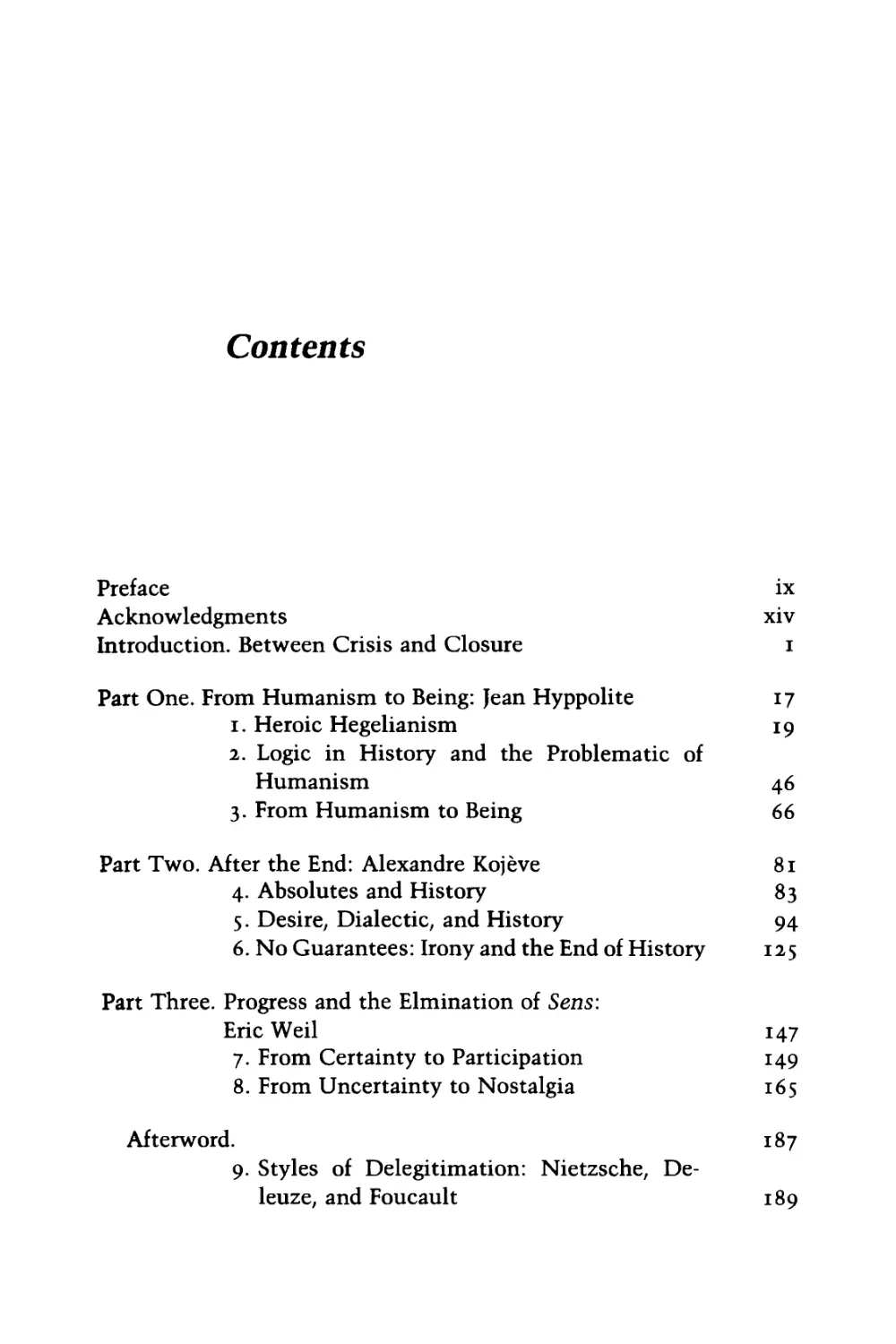
Contents
Preface	ix
Acknowledgments	xiv
Introduction. Between Crisis and Closure	i
Part One	. From Humanism to Being:	Jean Hyppolite	17
1.	Heroic Hegelianism	19
2.	Logic in History and the Problematic of
Humanism	46
3.	From Humanism to Being	66
Part Two	. After the End: Alexandre Kojeve	81
4.	Absolutes and History	83
5.	Desire, Dialectic, and History	94
6.	No Guarantees: Irony and the End of History 125
Part Three. Progress and the Elmination of Sens:
Eric Weil	147
7.	From Certainty to Participation	149
8.	From Uncertainty to Nostalgia	165
Afterword.	187
9.	Styles of Delegitimation: Nietzsche, De-
leuze, and Foucault	189
Contents
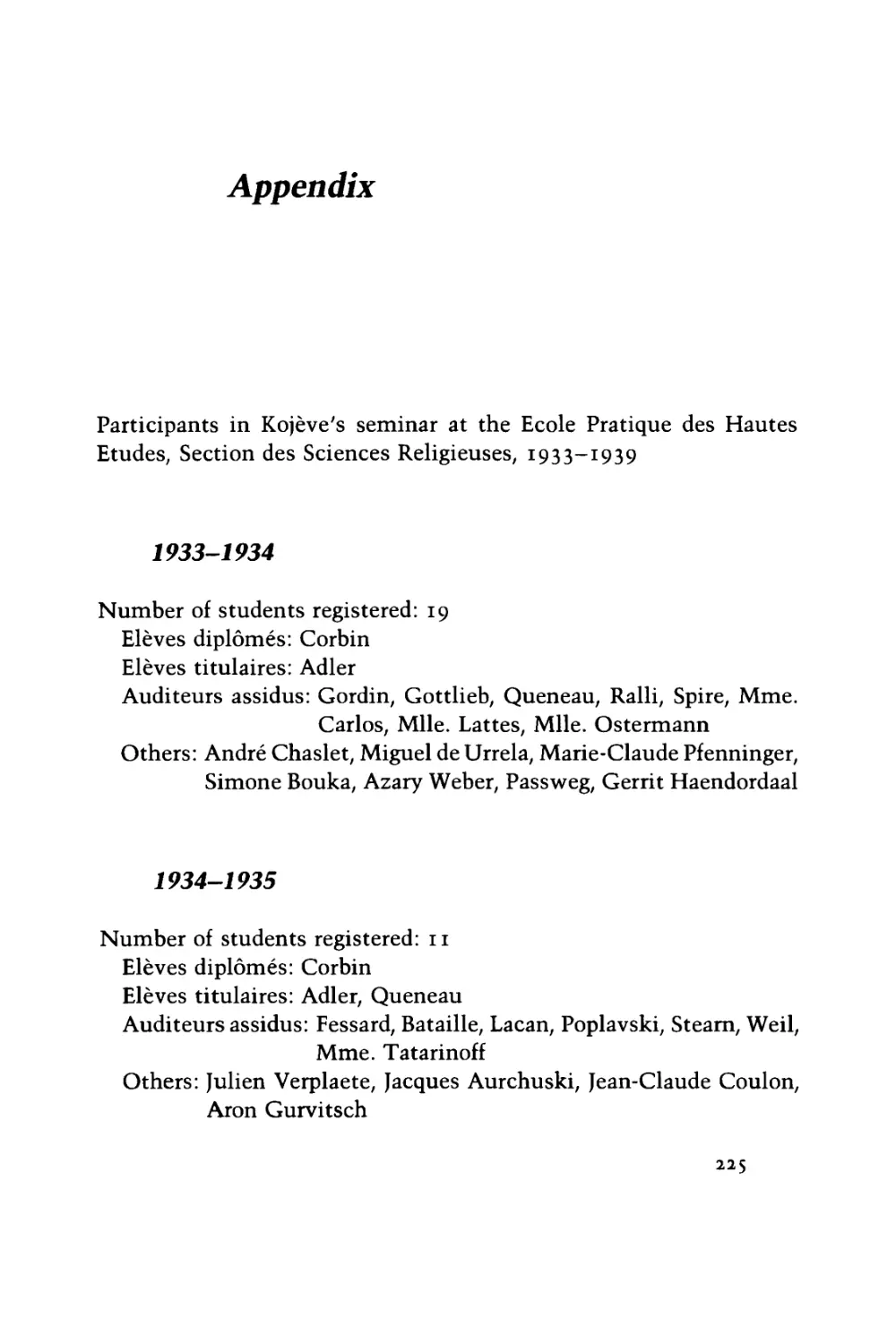
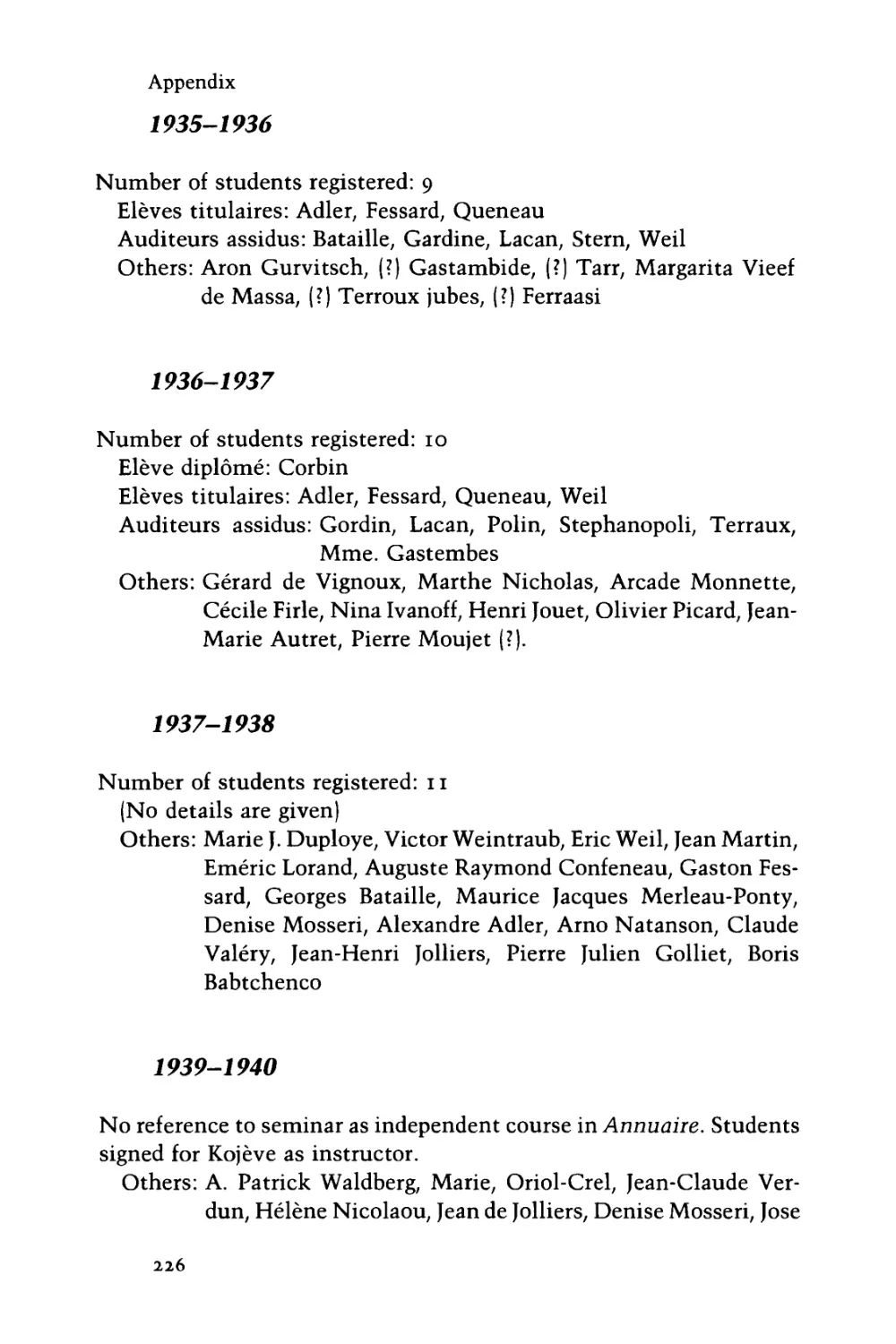
Appendix. Participants in Kojeve's
Seminar at the Ecole Pratique des
Hautes Etudes, 1933-1939
Bibliography
Index
225
228
251
Preface
From the 1930s through the postwar period in France, Hegelian phi-
losophers such as Jean Hyppolite, Alexandre Kojeve, and Eric Weil
turned to history as the source of truths and criteria of judgment.
They explored how a philosophy of history could serve as the foun-
dation for understanding the modern world and for providing insight
into how that world might be changed for the better. They forged
connections between history and knowing as a means of confronting
key theoretical problems and of engaging contemporary political con-
cerns. All three began publishing in the 1930s, and Hyppolite and
Weil taught philosophy in France after World War II. Kojeve, leader
of a famous seminar on Hegel in the 1930s, continued to write phi-
losophy after the war but spent much of his time working for the
French government on problems of economic development.
By the mid-1950s, however, all three thinkers had withdrawn from
the historical in search of a more secure, or more hopeful, subject for
reflection. Hegelian historicizing declined with the loss of faith in
the meaningfulness of history. Contemporary events seemed to un-
dermine even the thought of heroic or radical political change, and
the development of sophisticated methodologies of the synchronic in
linguistics, anthropology, and cybernetics legitimated a retreat from
the historical.
I have chosen to study the Hegelians because their work illuminates
the power and the limitation of the philosophic approach to history.
In the development of their philosophies, moreover, we can see one
of the crucial transformations in modern intellectual history: the shift
ix
Preface
from a concern with questions of significance to a concern with ques-
tions of use or function, from "What does our history mean?" or "How
can we make sense of our past?" to "How does our history work?"
or "How is our past put together?" This shift moves us away from
interpretations of our past which generate stories that can guide and
legitimate our actions, and toward analyses (or even deconstructions)
that show how particular versions of our past serve specific interests,
powers, or desires. The full implications of this transformation are
still not clear, as they form part of our cultural present. My study of
the French Hegelians is intended to clarify the significance of the
contemporary retreat from questions of significance (especially,
though not exclusively, in France), by providing some of the material
necessary for situating our cultural moment in relation to its intel-
lectual antecedents.
This book, then, is a re-collection of the Hegelian approach to his-
tory and of the transformation within the modern appropriation of
Hegel. It should not be read as an expression of nostalgia for a mode
of thought which has fallen by the wayside over the last twenty-five
years as structuralism and poststructuralism have challenged the phi-
losophy of history and even the usefulness of making meaning out
of historical change. The questions that Hyppolite, Kojeve, and Weil
posed to personal and political history are not our questions, and my
analysis of their work is not intended as an advertisement for their
style of philosophizing. Yet I trust that what follows will be read as
a history of the present insofar as an understanding of our connections
with and differences from this style contributes to our ability to make
sense of the questions we choose and refuse to pose in order to make
meaning out of change over time.
The intellectual historian who turns to the history of philosophy
is confronted immediately with difficult methodological and profes-
sional problems. Perhaps the most important of these are difficulties
inherent in any study of the development of culture, most of which
have to do with the relative autonomy of the object of study. One
must always try to steer a course between the parallel pitfalls of
isolation and reduction. If one treats the cultural object or field as
fully autonomous, then the wider cultural—and contemporary—sig-
nificance of the object or field can be lost. If one locates the signifi-
cance of the object or field solely in its sociocultural relations, then
x
Preface
its specific import or point dissolves as it is replaced by its role as an
expression of something, or someone, else.
In the historiography of intellectual history, the problem has usu-
ally been seen in terms of the text/context relationship. Whether this
relationship was never more than a mere presupposition of intellec-
tual history, as Hayden White has asserted,1 it seems clear that we
can no longer simply appeal to a "balance" between text and context.
Even the terms of such a compromise are now fully ambiguous: What
is a context if not a more or less arbitrarily selected group of texts
that refer to events or persons made relevant to the primary texts
under consideration? My point in raising this question is not that
"there is nothing outside the text," which has about the same claim
on us as "there is nothing outside the void." Instead, the question
points to the fact that in the study of history, the Real is always
presented to us as mediated by texts.i. 2 What we want to find is the
best way of reading these texts.
Much of the interesting theoretical writing on intellectual history
in recent years has focused on ways of reading.3 Hermeneutics and
semiotics—with varying degrees of psychoanalysis and Marxism
added to the mix—seem to be the techniques most favored in con-
temporary metahistorical discourse. Their respective foci on content
and form have been enhanced by the cross-fertilizations of anthro-
pology and linguistics, both of which have taught intellectual his-
torians to look for meaning in places where otherwise they might not
have strayed.
The form of the present work can best be characterized as "histor-
ical/internalist." This description does not mean that my analysis of
the philosophers' texts excludes all consideration of referents "out-
side" their work, only that I have concentrated on the temporal and
i. Hayden White, "Method and Ideology in Intellectual History: The Case of Henry
Adams," in Modern European Intellectual History: Reappraisals and New Perspec-
tives, ed. Dominick LaCapra and Steven L. Kaplan (Ithaca, N.Y., 1982), 281.
2. See, for example, Fredric Jameson, The Political Unconscious: Narrative as a
Socially Symbolic Act (Ithaca, N.Y., 1981), 82, 100-102.
3. See LaCapra and Kaplan, Modern European Intellectual History, and LaCapra,
Rethinking Intellectual History: Texts, Contexts, Language (Ithaca, N.Y., 1983), and
History and Criticism (Ithaca, N.Y., 1985); Robert Darnton, "Intellectual and Cultural
History," in The Past before Us, ed. Michael Kammen (Ithaca, N.Y., 1980); and Hayden
White, Tropics of Discourse (Baltimore, Md., 1978).
xi
Preface
thematic development of the texts. It would be fair to say that I have
aimed to explicate the 'life of the work" in contradistinction to the
"life of the philosopher." Intellectual historians have usually taken
individual biography as the mediation between particular ideas and
the culture in which they are produced. Although this approach has
occasionally produced a brilliant picture of a cultural moment, it has
often resulted in a trivialization of the problematics explored in the
texts, or else in their excessive personalization. In this book I have
tried to enter into a dialogue with the French Hegelians without the
mediation provided by biography and have adopted a discourse that
aims to speak with them at the same time as it addresses our own
concerns. In so doing, I have on occasion reflected their concerns
against the background of important changes in contemporary French
culture, but only in order to illuminate the work of the Hegelians. If
there is a "position" behind my own mode of discussion, it is that a
historical/internalist approach to culture need not be an oxymoron.
Anyone who writes on modem French intellectual history does so
in the shadow of the great wave of theoretical activity in the human
sciences in France over the last thirty years. Indeed, I first chose this
topic because the French Hegelian philosophers had developed a rad-
ical historicism that was in direct conflict with the succeeding gen-
eration's antihistoricist stance. Here, I thought, was the chance to
understand, perhaps obliquely, structuralism and what follows by
seeing what these movements were reacting against. Instead, I found
that the move away from historicism had already begun with Hyp-
polite, Kojeve, and Weil at the end of the 1940s. If there is a felt
absence in this book, it may be the lack of any detailed exploration
of the connection between Hegelianism and the development of struc-
turalism and poststructuralism. Although not a systematic study of
this connection, the last chapter attempts to explain how Nietzsche
replaced Hegel as the locus of philosophic authority in France in the
1960s, and how this replacement was in part effected by Gilles De-
leuze and informed the work of Michel Foucault. The use of Nietzsche
against a so-called metaphysical history was an eventually unsuc-
cessful attempt to avoid some of the crucial problems the Hegelians
confronted, problems that remain relevant to the projects of both
Foucault and Deleuze.
The retreat from—for some, the advance over—the humanist per-
xii
Preface
spective essential for the Hegelians in the 1940s was a crucial con-
dition for the evolution of structuralist modes of thought. Yet until
the itinerary of these anti- and nonhumanist approaches becomes
clearer, it seems to me unwise—except for programmatic purposes—
to attempt to delineate their historical interrelations. I might add also
that it seems to me unwise—except for the tactical purposes of certain
individuals—to assume that these anti- and nonhumanist approaches
have in any way been proved or legitimated by something called
philosophy or theory. Certainly, the trope of sophistication makes it
difficult to pretend otherwise, but a history of the academic impor-
tance of that trope lies beyond the bounds of this study.
That said, the reader may still find that the present work suffers
from a nostalgia for the humanism that ''deconstruction" has made
depasse. As far as I can tell, this book contains no implicit humanist
agenda that would entail a return to earlier notions of the subject.
Nevertheless, I trust it will become clear that I have re-collected the
historicist/humanist problematic of French Hegelianism because I
think it can speak to present concerns with how and why we make
meaning out of change over time. That is, I believe that a faithful
account of the development of the work of Hyppolite, Kojeve, and
Weil can enrich our historical understanding of the cultural present.
The other shadow thrown across my study of the French Hegelians
is that of Hegel himself. I make no attempt to determine if the French
"got Hegel right." I treat French Hegelianism as a mode of philoso-
phizing and do not evaluate its interpretations and translations in
relation to the German "original." For someone who retains the ver-
ificationist impulse that lies at the origins of professional historiog-
raphy, such a project would not be a complete waste of time, but it
is not mine. However, insofar as the Hegelian tradition has fed off
the negation of a rigid distinction between history and philosophy,
my work can be located within that tradition. In researching and
writing this book, I have tried to be mindful of developments in both
areas and of the exigencies of both disciplines. I hope that what follows
will speak to the concerns of historians and philosophers; indeed, to
all of us who have a stake in how we give meaning and direction to
change over time.
xiii
Acknowledgments
I gratefully acknowledge the financial support of the Council for
European Studies at Princeton University, the French Government
Fellowship Program, the Social Science Research Council, and the
Whiting Foundation, whose combined support enabled me to spend
two years in France. More recently, Scripps College research fellow-
ships have helped me return to France and have freed time for revi-
sions. The American Council of Learned Societies Post-Doctoral
Fellowship for the Study of Modem Society and Values supported the
research for the final chapter of the book and gave me the time to
put it in final form. Nancy Burson has shown remarkable patience,
kindness, and competence in typing the manuscript.
Before going to Paris in 1981 I benefited from the intellectual stim-
ulation and support of the history department at Princeton University.
The freedom of intellectual inquiry which it preserves against the
ever-rising tide of professional specialization is combined with a rig-
orous critical spirit to promote an openminded but fairly skeptical
community of ideas. I am grateful for having had the opportunity to
participate in it.
My work in France was made more fruitful and more enjoyable by
amiable contact with French scholars. I express my debt to Raymond
Aron and especially to Michel Foucault for reading drafts of this book
and discussing them with me. The personal generosity and warmth
of each man adds to the loss one feels in their deaths. I am most
grateful to Claude Lefort for his help throughout my stay in France
xiv
Acknowledgments
and for his criticisms and comments on all stages of this project.
Eugene Fleischmann shared with me his detailed knowledge of He-
gelian philosophy and opened new perspectives for me on philosophy
and history. I am grateful to him for his encouragement and shall
always value his friendship dearly.
The sections on Alexandre Kojeve and Eric Weil would not be what
they are without the help I received from Nina Ivanoff, the legatee
of Kojeve, and from Anne Weil and Catherine Mendelssohn, the wife
and sister-in-law of Weil. Anne Weil gave generously of herself at the
end of her life, and like so many others I keep a fond memory of her
strong, sensitive spirit. The openness, intelligence, and generosity of
these women have been equaled only by their kindness.
An earlier version of this book was read by Victor Gourevitch,
Jerrold Seigel, and Sheldon Wolin, who gave me detailed comments
on early drafts and talked with me at length and in depth about the
interrelationship of politics, philosophy, and history. Professor Gou-
revitch first introduced me to Hegel and Kojeve when I was an un-
dergraduate at Wesleyan University, and he has responded with pa-
tience to my questions about history and philosophy ever since. At
Princeton, Carl Schorske has also listened to these questions and
suffered through my repeated attempts to work out answers to them.
His criticism and support vastly improved my work, and his teaching
remains for me a model of pedagogy.
By continuing to reveal to me some of the meanings of destiny, my
wife, Laurence Roth, has contributed more than she realizes to my
understanding of knowing and of history. Although these meanings
are rarely very clear, they are never, I begin to see, unimportant.
Michael S. Roth
Claremont, California
XV
Knowing and History
Introduction:
Between Crisis and Closure
One of the truisms of the history of French philosophy is that it
was the importation of German philosophy, specifically of pheno-
menology, which loosened the rigid, academic orthodoxy of the neo-
Kantians. This truism, like so many other philosophical myths, comes
to us from existentialists, who early on began to think of themselves
as historical figures. Perhaps the best story we have in this regard is
about the young Sartre who, sitting in a cafe (where else?), listens to
Raymond Aron's story about how in Germany (where else?) they can
make philosophy out of a cocktail.1 The human element will come
back into French philosophy, so goes the moral of the story, when
existentialism becomes the guardian of a radical humanism and keeps
its philosophical lamp on everyday life.
When Sartre left for Germany in 1933, however, the French aca-
demic philosophical orthodoxy had already begun to change. Al-
though the stimulus for some of these changes provided by Husserl
and Heidegger was far from negligible, the impact of Hegelian phi-
losophy in France was a crucial component of the new ground (or
new groundlessness) of philosophy which emerged in the postwar
period. The normal discourse of academic philosophy was changing,
if not unraveling, by the 1930s, and the French reading of Hegel was
a major force in that decomposition.1 2 The protean character of He-
1. Given in Simone de Beauvoir, The Prime of Life, trans. P. Green (London, 1963),
112.
2. For useful summaries of Hegel interpretation in France from the nineteenth cen-
tury through the mid-twentieth, see king Fetscher, "Hegel in Frankreich," Antares 3
Introduction
gelianism added to the importance of the philosophy, because in
France Hegelianism was aligned with critical intellectual move-
ments, among them surrealism, Marxism, and existentialism. In most
of its forms French Hegelianism was a vehicle for confronting the
historical, for thinking about the connection between history and
knowing.
The first work I examine in detail in this book was published in
1929, a fine symbol for the resurgence of Hegelianism. Jean Wahl's
Le malheur de la conscience dans la philosophic de Hegel was in
many ways a book about crisis, a book about history, even though
the Great Depression would not reach France for some years after the
stock market crashed in New York. Instead of focusing on the con-
ditions of rationality or on the bases for the development of scientific
knowledge, Wahl examined the centrality of alienation and longing
to any form of historical progress. The crisis may be in one's personal
life or in one's community, Wahl asserted, but the experience of crises
is a necessary component of their progressive resolution.
The other forms of French Hegelianism I examine briefly in this
chapter—those of Alexandre Koyre, surrealism, and Marxism—also
stress crisis in one form or another. The surrealists, in many ways
like Wahl, make history the object of philosophical reflection in order
to show the irremediable element of alienation or diremption in psy-
chological and social life. In contrast, Koyre and the Marxists have a
different reason for focusing on these forms of crisis. Koyre is inter-
ested in the way in which Hegelianism passes from historical dis-
junction to philosophical closure as a system. The Marxists, of course,
are also keenly concerned with historical disjunction. For them, the
Hegelian notions of mediation and dialectical change are important
not because they resolve crisis in a system but because they point to
the closure that can occur through radical historical action.
Jean Wahl and Alexandre Koyre
Wahl's Le malheur de la conscience marked a beginning of the
Hegel renaissance in France. Wahl aimed consciously to introduce
Hegel to the French, and he did so from the perspective of the phi-
(19s3), 3-15; Jacques d'Hondt, Hegel et I’hegelianisme (Paris, 1982); and Lawrence
Pitkethly, "Hegel in Modern France" (Ph.D. diss., London School of Economics, 197 s)-
2
Between Crisis and Closure
losopher's early works, which had been published in Germany in 1905
and 1907.3 Because of this perspective, Wahl's book became a point
of departure in the French reading of Hegel. To the extent that Hegel
had been studied in France previously, he was read as the author of
the Logic and of the System and represented at once the two great
sins of philosophical pride and intellectual abstraction: "pride," be-
cause he rejected Kant's view that philosophy should follow the sci-
ences and instead thought of philosophy as the supreme science to
be followed by other disciplines,- "abstraction," because to construct
the grand machine of the System, Hegel seemed to omit all properly
human elements. Wahl's book took a wholly different tack toward
Hegel, for he wrote Le malheur de la conscience after having consid-
ered Kierkegaard's existentialist critique of the System.4 In Hegel's
early texts Wahl found a budding existentialist, a copain who would
have identified with Kierkegaard's fear and trembling, and with the
anxiety that many of Wahl's readers felt at the beginning of the 1930s.
Wahl's Hegel, then, is not the creator of a comprehensive philo-
sophical method that can account for all entities in this world. On
the contrary, the dialectic is first "an experience by which Hegel
passed from one idea to another."5 Wahl shows his reader the theo-
logian behind the scientific philosopher and the romantic behind the
rationalist.
Rather than summarize Wahl's book, I here point out only its major
themes, those which played a role in French Hegelianism generally
and in the work of Jean Hyppolite in particular. The first and most
important of these themes is the idea of the "unhappy consciousness."
Readers of the Phenomenology will recognize this concept as an im-
portant part of that work, but for Wahl the idea became emblematic
of the Hegelian project and of modern personal and historical exist-
ence as a whole. Simply put, the unhappy consciousness is the aware-
ness that all human development is a product of alienation; that is,
personal growth and historical progress take place by virtue of a rad-
3. By Dilthey, in "Jugendgeschichte Hegel/' Abhandlung der koniglichen preuss-
ichen Akademie der Wissenschaften (190$), and H. Nohl, Theologische Jugendschriften
(Berlin, 1907). Hegel's Jena Realphilosophie did not become available until 1931 and
1932-
4. As Wahl said in an interview with Pitkcthly, "Hegel in Modern France," 382.
S. Jean Wahl, Le malheur de la conscience dans la philosophic de Hegel (Paris,
1929), 9. All translations of quotations arc my own unless otherwise specified.
3
Introduction
ical separation of the subject from what it desires. Human develop-
ment bridges that separation, making the connection between the
subject and its other. For the unhappy consciousness, though, the
person is always divided and always longing for reconciliation.
Wahl thinks that the dialectic in all its forms can be understood
best from this existential/romantic base. The contradiction between
thesis and antithesis, and the mediation (or mediator) that brings
about a synthesis, he understands as abstractions from the funda-
mental experiential basis of human alienation, despair and hope. The
reconciliation or synthesis that does take place should produce nei-
ther a system nor a science; instead, it results in wisdom and amor
fati. Wahl claims not that Hegel's early philosophy ends only with a
romantic longing after a lost unity but that attempts at unification
always begin from the experience of this longing. He does not deny
the rationalist goal of Hegel's project, but he underlines the romantic
inspiration at the core of that project.6
This emphasis on the unhappy consciousness leads Wahl to con-
sider the role of a concept of history in Hegel's thought. History is
at least the field upon which the quest for reconciliation takes place
and at most the vehicle through which reconciliation is achieved. In
either case, if we are to know anything about this reconciliation and
how to achieve it, then we have to grasp change over time as triumph
over alienation and separation. History is the story of moral or spir-
itual progress, and Wahl sets the structure of that story by giving
prominence to the unhappy consciousness. Progress is therefore
achieved at severe cost, for alienation and separation are the necessary
conditions for history truly to continue—that is, for man not to sink
into the oblivion of repetition.
Consolation for the unhappy consciousness is the belief that history
will continue, the belief that the story of spiritual progress makes
sense in the end because in the End, reconciliation will come. Change
over time is configured as progress because reconciliation is figured
as the goal of history. This is the guarantee that the unhappiness of
separation will not be in vain, the Good News that the story of history
is written in the language of eternity. The Hegelian "cross of the
present" is only a sign of an ultimate homecoming in which the
subject and its objects will be one.
6.	For Wahl's interpretation of what he saw as the concept of a "sacred history" in
Hegel, see especially Le malheur, 147, 186, 199П, 231, 248.
4
Between Crisis and Closure
For Wahl's Hegel, then, history has a crucial role, though more a
heuristic than a determining one.7 As we come to understand the
coherence and continuity in change over time, we gain insight into
both the specific diremption of modern man and the necessary con-
nection between all human development and a fundamental unhap-
piness. Yet structures of personal and collective experience exist that
an understanding of history cannot account for and that make such
an understanding possible in the first place. To apprehend change
over time as progress, and to understand the price paid for our personal
and collective advancement, Wahl's Hegel tells us we must look be-
yond the merely temporal. There we will find a guarantee that change
over time has meaning and direction.
Wahl's writing on Hegel is part of what Wahl later referred to as
the movement toward the concrete? By viewing Hegel as a philos-
opher concerned deeply with history, not just with logic, Wahl was
taking steps toward a philosophy that would not only concern itself
with the conditions of possibility for a rational thinking based on
experience but also focus on making sense of the stuff of experience
as it changes. Wahl's Hegel helps the reader see that experience, when
properly viewed, constitutes historical progress.
Wahl turned to history at a time when the contemporary world
especially shook confidence in progress. France had emerged victo-
rious from the Great War, but even a relatively simple notion such
as "victory" seemed problematic by the end of the 1920s. The nation
was having enormous difficulty with the path of progress marked out
by modern industrial capitalism, and French thinkers were question-
ing how the nation could become fully modem without losing its
identity. Wahl's Hegel provides an account of history that emphasizes
conflict and alienation, elements familiar to Wahl's readers. He also
offers reasons to hope that these elements of crisis, although the stuff
of historical experience, are not definitive. The reasons Wahl provides
are independent of historical change and allow us to affirm our con-
fidence that history leads beyond crisis to a form of closure.
Like Wahl, Alexandre Koyre attempted to introduce Hegel to the
French in large part by translating and commenting on Hegel's early
texts.9 For Koyre, however, these texts did not reveal a romantic or
7.	Ibid., 173.
8.	Jean Wahl, Vers le concret (Paris, 1932).
9.	Koyre influenced Hegel studies in France largely through his courses on the Gcr-
5
Introduction
an existentialist thinker as opposed to the systematic philosopher of
the Logic and the Encyclopaedia, On the contrary, Koyre saw the
early texts as continuous with the mature work, as an indication of
what needed to be systematized. Without the System, Koyre believed,
Hegel's "experiences"—the term is Wahl's—would have no interest
for us at all.10 *
This is not to say that Koyre denies the importance of the unhappy
consciousness in Hegel's work. Koyre, too, emphasizes that philos-
ophy grows out of alienation and the painful experience of separation.
For him, philosophy enters a society when traditional avenues for
unifying diverse beliefs and practices are blocked, when the meaning
of the common language is becoming increasingly unclear. Philoso-
phy is born of disintegration, but as a result of this heritage it seeks
a totalization, a harmony in reason as a replacement for the lost
coherence of faith. Thus the impulse toward totalization is not simply
the effort to make the world conform to a principle that allows no
heterogeneity. On the contrary, the experience of crisis, the felt ab-
sence of wholeness, is what gives rise to philosophy, "that which
produces and realizes reason." The object of this production is closure
in a significant—but not, and not to be confused with, a homogene-
ous—whole, the coherence of a system.11
Whereas Wahl's Hegel ultimately seeks reconciliation in the prom-
ise of divine mediation between subject and object, Koyre's Hegel
looks to Reason for the coherence that is felt as a painful absence in
the life of the individual or of the community. When Koyre's Hegel
looks to Reason, he looks to humanity, to history. If Wahl's inter-
pretation is existential and theological, then Koyre's Hegel is histor-
ical and anthropological. For Wahl, that is, the story of progress is
written in the language of eternity, whereas for Koyre that story
makes sense only if it is told in human—temporal or historical—
man tradition of speculative thought at the Ecole des Hautes Etudes, and also by three
major articles published in the 1930s: "Rapport sur 1'ctat des etudes hegelienncs en
France" (1930),"Note sur la langue et la terminologie hegelienncs" (1931), and "Hegel
a lena" (1954)- All three articles arc reprinted in Koyre's Etudes d’histoire de la pensee
philosophique (Paris, 1961, 1971). Koyre is not a Hegelian philosopher but rather is
stimulated by Hegel's Jena texts, which became available in the early 1930s. Some of
the differences between his emphasis and Wahl's can be ascribed to the fact that these
texts were not available when Wahl wrote his study.
10. Koyre, "Hegel a lena," Etudes, 151 and n. 1.
11. Ibid., 155.
6
Between Crisis and Closure
discourse.12 13 Koyre's reading is based on a detailed consideration of
Hegel's conception of time. Hegel's great originality, Koyre tells us,
is in developing a concept of time which gives primacy to the future.
The meaning of a now is contained in its future and in the relation
of that future to the past of the now. Hegel gives us, first and foremost,
a conception of human time, because we humans are beings who
determine our present by our orientation—hope, expectation, work—
toward the future and by the connection we see between that future
and our past. Thus Koyre's reading of Hegel, although it does not
ignore the influence of religious thinkers on the philosopher's devel-
opment, focuses on the secular, historical, and humanistic thrust of
his work. Koyre concludes:
Hegelian time is, above all, a human time, the time of man, himself this
strange being who "is what he is not and is not what he is"; the being
who denies himself in what he is in favor of what he is not, or is not
yet; the being who, starting from the present, negates it, attempting to
accomplish himself in the future, who lives for the future, finding there,
or at least searching there, for his truth; the being who exists only in
this constant transformation of the future into the "now," and who stops
being the day when there is no longer a future ... everything has already
happened, when everything is already accomplished. And it is because
Hegelian time is human that it is also dialectical, since because it is one
and the other it is essentially a historical time.1*
For Koyre's Hegel, history has more than a heuristic value. Knowledge
of things human is a product of our ability to understand the con-
nection of a present to its future and to its past. Indeed, knowledge
of the human means understanding the place of the human in the
closure provided by the total development of history.
12. Wahl and Koyre, like Hyppolitc, Merlcau-Ponty, Kojeve, and Weil, at some point
identify history and progress and give primacy to the future in their analysis of historical
thinking. In my discussion of the Hegelians I follow them by using "history" to refer
to future- or goal-oriented change over time. I do not here consider whether an idea
of history independent of any notion of progress has been (or could be) coherently
established, although my final chapter displays the difficulties that two postmodern
writers encounter in leaving behind the problematic of progress.
13. Ibid., 177. Although Koyre was in no sense a Heidcggcrian philosopher, the
concept of time that he found in Hegel had significant similarities to the analysis of
time in Sein und Zeit. Heidegger himself saw in Hegel's philosophy a notion of tem-
porality very much opposed to his own: see Sein und Zeit, sec. 82.
7
Introduction
French Hegelianism attempted to steer a course between the po-
sitions that Wahl and Koyre developed. Hyppolite would pose to Wahl
questions about the real value of history and of human action as such,
given its dependence on an atemporal, nonhuman End. Although he
privileged "history" in his own reading of Hegel, Hyppolite never
fully accepted Koyre's anthropologism. The primacy of a future devoid
of any suprahistorical dimension was, for Hyppolite, the primacy of
uncertainty, a threatening uncertainty that history alone can neither
guard against nor dissolve.
Kojeve, on the other hand, would follow in the footsteps of Koyre,
embracing Koyre's anthropologism, as well as his analysis of Hegelian
time. For Kojeve, however, the absence of a suprahistorical guarantee
for a configuration of history as progress did not result in uncertainty.
On the contrary, history itself offered a guarantee of universal sig-
nificance once it became clear that nothing substantially new would
occur. By the late 1940s Kojeve was trying to articulate this clarity
within an ironic discourse.
Weil, too, started with the radical anthropolization of Hegelian
thought which is in accordance with Koyre's analysis of time. Unlike
Kojeve, however, Weil accepted the uncertainty that comes with giv-
ing primacy to the future. For Weil, this uncertainty was a crucial
component of a culture that had renounced violence in favor of dis-
course. By the 1950s, though, Weil was looking for a framework for
this uncertainty, a guarantee that the renunciation of violence was
not in vain. Here we see shades of Wahl, although Weil's turn was
specifically toward a neo-Kantian understanding of morality.
Although both Wahl and Koyre became important figures in French
intellectual life, their early studies were far from the work being done
in mainstream French academic philosophy. On the contrary, their
writings were among the first breakthroughs against a general hos-
tility toward Hegel that dated back to the philosopher's own time.14
After World War I academic philosophy in France was dominated by
a transcendental idealism, or neo-Kantianism, whose main proponent
was Leon Brunschvicg. For Brunschvicg, all of traditional metaphysics
worth saving could be reduced to a theory of knowledge, and history
14. d'Hondt, Hegel et I’hegelianisme, 49-54. The exceptions to the rule of hostility
are underlined by Michael Kelly, "Hegel in France to 1940: A Bibliographical Essay,"
Journal of European Studies II (1981), 29-52.
8
Between Crisis and Closure
was important for philosophy insofar as one could see scientific prog-
ress in it. Progress in science was the model for all forms of advance-
ment. The chief obstacles to scientific and spiritual development, for
Brunschvicg, were egocentric judgments or unfounded prejudices. By
the 1930s, however, such obstacles, important though they might
have been on an abstract level, hardly seemed the most threatening
elements on the historical horizon.15
Many students in the 1930s agreed with Koyre and Wahl that the
neo-Kantian approach to history through a study of the development
of scientific thought missed the crucial components in the world. In
the 1930s competing political forces were fighting to define progress,
but the crucial arena of this fight had little to do with epistemology.
Simone de Beauvoir complained that the neo-Kantian perspective ig-
nored the "adventure of humanity," while Sartre and Merleau-Ponty
agreed that the epistemological approach was a form of "high-altitude
thinking" that failed to confront the concrete world.16 It was in Ger-
many they found a philosophic movement which seemed to be bom
of the desire to make sense of that world. The phenomenology of
Husserl and its existentialist development by Heidegger attracted
many young philosophers from France, most notably Sartre, Merleau-
Ponty, and Aron. Koyre himself studied philosophy in Heidelberg
before coming to Paris, and the discussion in Heidegger's Sein und
Zeit of Hegel's understanding of temporality was a crucial aspect of
the background for Koyre's article on the same subject. By the 1930s
Koyre was coeditor of Recherches philosophiques, an annual journal
whose central aim was to introduce German philosophy to the French.
In Germany, and later in France, the development of phenomen-
ology and existentialism was a rebellion against the neo-Kantian re-
duction of philosophy to epistemology. Husserl's call to return to
"things themselves" and Heidegger's ontological investigations of
being-in-the-world were attempts to open philosophy to questions
that the problems of scientific knowledge did not traditionally raise.17
15. See Rene Boirel, Brunschvicg: Sa vie, son oeuvre (Paris, 1964), 31.
16. Simone de Beauvoir, Memoirs of a Dutiful Daughter, trans. J. Kirkup (New York,
1959), 243, and Jean-Paul Sartre, Situations, trans. Benita Eisler (Greenwich, Conn.,
1965), 158.
17. The debate between Cassirer and Heidegger at Davos in 1929 revealed the ex-
treme differences between the style and substance of neo-Kantianism and existential
phenomenology. I return in Chapter 2 to Heidegger's contribution at Davos.
9
Introduction
The resurgence of Hegelianism in France was a facet of this opening
of philosophy insofar as the French Hegelians saw scientific knowing
as only one aspect of the development of Spirit, one way in which
history was made by humanity. Whereas the neo-Kantians consigned
most of history to the domain of the irrational, the Hegelians saw
history as the development of Reason itself. Thus, for the Hegelians
in France, history became important not only as the temporal con-
tainer of scientific progress, but also as the fundamental dimension
of our effort to make the world our own.
The French revival of interest in Hegelian philosophy was not con-
fined to the academic world but had an important place in more
overtly political domains. Surrealists and Marxists both turned to
Hegel in order to redirect their political concerns.
Surrealism
The surrealist movement seems at first glance hardly a propitious
place to look for the Hegelian interest in history as a forgotten domain
of philosophy. The rejection of the historical in favor of the instinc-
tual, of history in favor of automaticity, were crucial facets of the
surrealist rebellion against the real in the 1920s. Breton's remark in
the Seconde manifeste du surrealisme (1930) is emblematic: "I have
more confidence in this moment, now, of my thought, than in every-
thing that one would have declared a completed work, a human life
having achieved its goal.... In matters of revolt, none of us should
need any ancestors."18 Despite this effort at a radical break from the
current of history, however, surrealists were led, by their desire to
alter the course of the entire river, to a study of Hegel.
The surrealists came to Hegel after having immersed themselves
in Freud. The study of Freud—or, perhaps more accurately, personal
experiences with certain psychoanalytic texts—gave these artists a
richer sense of the irrational and the daemonic, of what they took to
be the underside of repressive, bourgeois cultural life. In a word, they
thought they had discovered the reservoirs of desire untapped by mod-
18. Andre Breton, Manifestes du surrealisme, ed. Jean-Jacques Pauvert (Paris, 1972),
136.
10
Between Crisis and Closure
ern capitalist society.19 Freud and other depth psychologists must
have known about these wells of instinct also, but they were too
attached to the security of the surface or conscious life to permit any
seepage—let alone the floods demanded by the surrealists—of the
irrational into daily life. The surrealists did not have such attach-
ments and so were ready to open the gates to the sources of energy
and power.
By the late 1920s, however, surrealists were asking themselves how
they were going to channel the waters of desire so as to change the
forces that had managed to repress desire so well. Freud was content
to point out the opposition between desire and reality and to identify
the mechanism used to maintain that opposition, and he seemed less
than helpful. But how to change social reality so as to bring the
opposites together? How to break down what Freud seemed to think
was a necessary, if not a natural, conflict?
For answers to these questions Breton turned to Hegel, whose Logic
he read as an almost heroic attempt to think through the reconcili-
ation of opposites. The dialectic for Breton was a technique for bring-
ing together apparent irreconcilables.20 Hegel seemed to offer an
opportunity to escape the nihilism or narcissism that was the major
legacy of "life in the depths/' Breton hoped that the power of the
Hegelian dialectic to overcome Freudian dualisms would allow the
surrealists to reconnect to political life, to pump desire into a history-
yet-to-be-made.
The story of the failure of this reconnection is well-known and
need not be recounted here.21 I emphasize only that Hegel seemed to
offer the surrealists a bridge from the world of instinct to the world
of politics. Hegel's promise was to connect psychology with history,
to integrate the subjective realm of the individual with the objective
realm of social action. Breton, moreover, did not think that Hegel
himself had fulfilled his promise in his mature work. Like Wahl, and
unlike Koyre, Breton claimed that the experience of the dialectic had
19. See Anna Balakian, Surrealism: The Road to the Absolute (New York, 1959),
loo-ioi; Maurice Nadeau, Histoire du surrealisme (Paris, 1964), 20, 76, 157, 186; and
Breton, Manifestes, 28, 48, 146-147, 165.
20. See Balakian, Surrealism, 108, and Ferdinand Alquie, "Humanisme surrealiste
ct humanisme existentialistc," in L’homme, le monde, Thistoire (Paris, 1948), 153.
21. See Nadeau, Histoire du surrealisme, and Robert S. Short, "The Politics of Sur-
realism, 1920-1936," I опта I of Contemporary History 1, no. 2 (1966), 3-25.
11
Introduction
to be isolated from the avortement colossal of the System in order
to grasp Hegel's most important contributions.22 Breton, like young
French Marxists, saw the dialectic as a technique for thinking about
the possibilities of revolutionary change, while he condemned the
System as a reactionary attempt at totalization or closure. Such a
critique of totalization had begun shortly after Hegel's death, and it
has been repeated many times since 1945.23
Marxism
The surrealists were, of course, only a small group within the frag-
mented French political scene of the 1920s and 1930s. The deep dis-
appointment with the fruits of the victory of 1918, and the quest for
some form of national identity in the face of rapid international in-
dustrialization helped push French political life away from a consen-
sus of the center. On the one hand, the international socioeconomic
order built after the war and against the Russians was culturally
repulsive to both leftists and rightists, for whom it was a form of
modernization that meant Americanization. On the other hand, a
refusal to participate in this order could mean the further decline of
France on the world scene, so that the nation would lose not only its
power but its respectability. Political radicalism feeds on such times,
and there appeared a plethora of Marxist groups devoted at least as
much to theoretical speculation as to political action.
French Marxism was, of course, stimulated greatly by the revolu-
tion in Russia. For many intellectuals, the revolution represented a
great experiment, but it was not at all clear how the results of this
experiment were to be relevant to French politics. The Russian rev-
olution aroused at once hope and fear; hope, because it pointed to
the possibility of radical, even heroic, change; fear, because even a
revolutionary movement could become slavish in its repetition of
22. Breton, Manifestes, 148-149.
23. On the connection between surrealism, Marxism, and Hegelianism in France,
see Martin Jay, Marxism and Totality: The Adventures of a Concept from Lukacs to
Habermas (Berkeley, Calif., 1984), 276-299. Jay focuses on Henri Lefebvre. For a more
detailed account of Lefebvre and his context, see Fred Burkhard, “Priests and Jesters:
Henri Lefebvre, the 'Philosophies' Gang, and French Marxism between the Wars"
(Ph.D. diss., University of Wisconsin, Madison, 1986).
12
Between Crisis and Closure
formulas inappropriate to the particular conditions of French political
life.24
During the twenties and thirties, new translations of Marx's work,
as well as the discovery of some of his early manuscripts, further
stimulated theoretical work in French Marxism. Between 1925 and
1940 the complete works of Marx and Engels were published in French
in an inexpensive, popular form. More important for our purposes,
the 1844 manuscripts were published, piecemeal, between 1929 and
1937. These texts highlight the connection between Hegel and Marx,
showing both Marx's debt to Hegel and the struggle of the later thinker
to free himself from the burden of influence. One cannot, however,
describe these early works of Marx as well known, and there is some
truth to Mark Poster's assertion that "no real reading of Marx was
possible in France until after the Second World War."25 Here I merely
point out that the question of the relation between Marx and Hegel,
though even among communists it can hardly be described as a main-
stream concern, was indeed raised and discussed in France before
I939-26
The point is important, because in the Marxist treatment of Hegel
we can see some of the same themes as in the interpretations of Wahl,
Koyre, and Breton. The Revue marxiste, which was dedicated to in-
troducing Marx and Marxist themes into French intellectual life, pub-
lished a series of articles on Marx's "method" in which Hegel had a
prominent place. The author, Charles Rappoport, followed an ortho-
dox communist line in separating what he called Hegel's method—
the dialectic—from his System. The latter, he affirmed, is reactionary
insofar as it reifies a particular stage in the development of the Idea
and subordinates social reality to the supposedly universal rationality
of that stage. Thus the Idea was used to justify the status quo of the
society of the philosopher who produced the System. Nevertheless,
Rappoport emphasized, with the dialectic Hegel introduced a "rev-
24. This is one of the major themes of David Caute, Communism and the French
Intellectuals (New York, 1964).
25. Mark Poster, Existential Marxism in Post-War France (Princeton, N.J., 1975),
42. For Poster, a "real reading" is one that is compatible with existentialism. Compare
with Jay, Marxism and Totality, 276-299.
26. Indeed, Jay's Marxism and Totality shows that the relation between Marx and
Hegel has been an issue for Western Marxism across Europe at least since Georg
Lukacs's History and Class Consciousness was published in 1923.
И
Introduction
olutionary principle of change and transformation" into philosophy,
a principal that, when wed to materialism by Marx, has progressive
implications for social change. Hegel introduced the idea of move-
ment in the Logic, and this notion was the foundation of a scientific
socialism that would put the social world into movement.27 Marx,
the reader is told, subordinated the idea of any status quo to the
exigencies of social reality itself. If these demands were in contra-
diction with the status quo, then society would have to change, even-
tually becoming a fully developed, socialist reality.
A second noteworthy connection was made between Hegel and
Marx during the interwar period by means of the concept of alienation.
The publication of some of the 1844 manuscripts in 1933 and 1937
seemed to clarify the importance of the idea of alienation in Marx's
thinking. The scientificity of the dialectical materialism of Capital
was undercut by the straightforwardly humanist concerns of these
early texts. (It was the discovery of Hegel's early texts that had allowed
Wahl to highlight alienation in his Le malheur de la conscience, and
in Marx, too, the alienation discussed in early work seemed to make
the thinker more "concrete" and historical—even "relevant.") Marx-
ist commentators emphasized that Marx's idea of alienation was even
more historical—or less spiritual, less abstract—than Hegel's. The
emphasis was their way of, so to speak, keeping John the Baptist from
becoming more important than Jesus.
Rather than divide neatly along political lines, or even along a
theological versus secular axis, some of the major readings of Hegel
underlined particular aspects of his project to show their importance
for contemporary concerns. As with most readers of Hegel (and Marx)
during this period, Wahl, the surrealists, and the Marxists saw the
early texts as representing the good Hegel, whereas they viewed with
suspicion or condemnation his mature work, which was less easily
applied to the concerns of the 1930s. Koyre was the exception in this
regard, not because he denied the importance of the early works, but
because he—in good Hegelian fashion—attempted to integrate them
with the philosopher's project as a whole. This is not to say that
Koyre's reading was less "presentistic" than that of other commen-
tators. Alexandre Kojeve would bring out the contemporary thrust of
27. Charles Rappaport, "La methode marxistc," Revue marxiste 1 (1929), no. 1, $4-
63; no. 2, 154-163; no. 3, 317-324; no. s, 5 52--S6I; quotation from 156.
14
Between Crisis and Closure
Koyre's reading with originality and force. Indeed, one striking aspect
of all these interpretations of a German philosopher dead more than
a hundred years was their noisily presentistic character. They had
some real interest in Hegel's thought, of course, but it is hardly a
matter of these philosophers, artists, and militants suddenly becom-
ing passionately interested in the real connection between a philos-
ophy of history and a philosophy of life. Nor was their latent philologic
curiosity deeply stirred at this time by the difference between the
course Hegel had given one semester and the one he had presented
the following year. Instead, for a brief period—roughly from 1935 to
1955—French intellectuals adopted the language of Hegelianism in
order to engage in some of the crucial political, religious, and socio-
economic, as well as philosophical, battles of the day. These battles
stirred passions and sometimes even led to action, and Hegelian dis-
course offered one style of containing them, of making them the object
of reflection and discussion.
15
Part One
From Humanism to Being:
Jean Hyppolite
Chapter One
Heroic Hegelianism
One cannot deny here the revolutionary character, perceived
by Marx, of the Hegelian dialectic. If the consequences of the
system are conservative, the march of the dialectic is revolu-
tionary ....
It is human history... which confers on action its consist-
ency and its reality.
/еап Hyppolite, 1946
When Jean Hyppolite published his first article on Hegel in 1935,
the clearing in which French Hegelianism would grow had already
been made. Though philosophical orthodoxy was still strong—and
from the neo-Kantian perspective of this orthodoxy Hegel was at best
an aberration in the history of philosophy—the mighty Hegelian di-
alectic was not the one skeleton key necessary to open the gates of
the institutional love of wisdom to the flood of new ideas, fashions,
and movements, which we have seen in France since World War IL
By 1935, however, the normal discourse of academic philosophy was
breaking down, and the French reading of Hegel was already having
an impact on intellectual life. Jean Hyppolite contributed decisively
to this reading and, perhaps more important, to the ever greater ca-
pacity of Hegelianism to be aligned with diverse intellectual
movements.
Hyppolite's Hegelianism, however, did not function as simply a
vehicle for liberating the road to wisdom from neo-Kantianism. Hyp-
polite used Hegelianism to try to renormalize French philosophic
discourse after World War II. The key to this attempt was the phi-
losophy of historical development which can be taken from the Phe-
19
From Humanism to Being: Jean Hyppolite
nomenology, read back into Hegel's early writings, and projected into
his later work. The problems of philosophy and of politics could be
fully apprehended by emplotting them in a larger story of develop-
ment. The interrelatedness of the various issues confronting French
cultural life after 1945 could be demonstrated through a philosophic
approach to history. Given the logic of progress, perhaps the issues
could be resolved.
By the mid-1950s Hyppolite had abandoned this approach to his-
tory; indeed, he retreated from the humanist notion of the historical
as that field in which we make meaning out of, or give direction to,
our experience. He continued to work to show the interrelatedness
of apparently diverse problems; he made the connections no longer
through history, however, but through a conception of Being which
is logically prior to the temporal.
What was the road Hyppolite traveled from humanism to Being?
In the first part of this chapter I examine his discovery of the early
Hegel in the context of efforts to introduce Hegel into the French
philosophical scene. The second part deals with some of the major
themes of French Hegelianism, and especially with Hyppolite's am-
bivalent consideration of the historicist humanism of that philoso-
phy. In the third part I show how this historicism is qualified by a
conception of forgiveness which comes to terms with the past by
erasing it. In the next chapter, I examine Merleau-Ponty's radical
formulation of historicism in Humanisme et terreur and Hyppolite's
uneasy response to a philosophy that did not contain any suprahis-
torical dimension. I also consider Heidegger's radical challenge to both
humanism and historicism insofar as that challenge is relevant to
French Hegelianism. In chapter 3 we see how Hyppolite abandoned
exploration of the Hegelian approach to history in favor of a study of
philosophy as an expression of the poem of Being.
In Part 1 of this book, therefore, I do not concentrate exclusively
on Hyppolite's work but discuss some of the most important devel-
opments in European philosophy to which he responded. These dis-
cussions break the continuity of my presentation of the evolution of
Hyppolite's thought. That they do so is not an accident of style or of
organization but points to the reactive, discontinuous quality of his
intellectual evolution. The discussions are not intended as complete
historical or philosophical evaluations but as vehicles for understand-
ing the significance and transformation of Hyppolite's thought.
20
Heroic Hegelianism
Hyppolite's Early Studies
In his first published articles Hyppolite was concerned with many
of the themes that were important for Wahl, Koyre, the surrealists,
and the Marxists. He also concentrated on the interconnections be-
tween Hegel and other philosophers of his time and on the effect of
historical events on the development of Hegel's thought. Indeed, "his-
tory" became Hyppolite's chief focus in these essays, as he examined
Hegel's own attempt to carve out an independent field for philosoph-
ical reflection.
It is in the contrast between Hegel and Schelling that Hyppolite
sees most clearly the development of what will become the Hegelian
philosophy of history. Schelling, we are shown, strives to develop a
"philosophy of life," which will be part of a philosophy of nature as
a whole. Hegel, on the other hand, is preoccupied with the problems
of the human. Although the two projects are not incompatible, Hyp-
polite underlines Hegel's effort to find the structure of spiritual life
in contradistinction to Schelling's attempt to derive an ontological
Structure from his study of nature. Most important, he notes, Hegel
tries to show the evolution of this structure in the concrete, historical
world.1
The discovery of Hegel's early texts made the philosopher's con-
nection with Schelling a more pressing historical problem than it
otherwise would have been. The question, for Hyppolite, was when
the Hegelian Hegel made his first appearance, when he broke original
ground in the already overplanted soil of German idealistic
philosophy.
But what was at stake in this question? First, writing an article
on Hegel's early work might help one move from a lycee in the
provinces to one in Paris—as Hyppolite himself did in the 1930s.
The early texts were fashionable then, perhaps comparable to a
later philosopher's studying ordinary language with the latest
techniques, or to a historian's counting births and deaths in the
musty records of some obscure parish in southern France. Why,
though, did this particular topic have more than academic market-
ability in the mid-thirties? 1
1. Hyppolite, "Les travaux de jeunesse de Hegel d'apres des ouvrages recents," Revue
de metaphysique et de morale (hereafter RMM] 42, nos. 3-4 (1935), 550.
21
From Humanism to Being: Jean Hyppolite
After distinguishing between la vie spirituelle and nature, Hyp-
polite points out that Hegel always considers the former from an
anthropological perspective. Whereas Schelling is concerned with
something called "life itself," Hegel concentrates on the conscious-
ness of life. Abandoning the attempt to find the meaning of freedom,
development, or community in itself, the early Hegel instead thought
that the philosopher's task was to uncover the significance of such
ideas for us.
This distinction between for us and in itself leads Hyppolite to
perhaps the major theme of French Hegelianism; namely, that the
domain of the for us is the domain of history. One of Hegel's earliest
philosophic problems, according to Hyppolite, was how our experi-
ences became our history, how the status or quality of experience
changed as it became part of our past. Hegel, Hyppolite says, "does
not want to sacrifice historical existence to the exigencies of pure
reason. He respects empirical data too much to dissolve it in a uni-
versal concept. If 'positivity' implied a real presence in history, a lived
experience, it also implied a radical separation between thought and
its object. History brings about a transformation the necessity of
which Hegel will understand still more deeply,- it transforms that
which was living for consciousness into a dead residue, into an ob-
jective fact."2 In much of his work Hyppolite focuses on the nature
of this transformation. He is concerned to understand the ways in
which we keep a past alive—the ways in which we attach a signifi-
cance, a sens, to our past—as he also tries to grasp the way a past
preserves a form of life, giving it a sens,3
We can now begin to see why the question of when Hegel became
Hegelian has more than an academic importance. With this question
Hyppolite examined the moment when philosophy turned to history
as a distinctive field for understanding the human. With Hegel, to
understand the human means to apprehend the historical. The phi-
losopher should concentrate, then, on charting how the collective
experience of our culture becomes part of the world around us and
hence that which molds our future experience. Hegel becomes He-
gelian when he turns the light of philosophy on the process through
2. Ibid., 412.
3. I use the French word sens throughout this book because the English word "sense"
does not capture its connotations accurately.
22
Heroic Hegelianism
which we make sens out of personal and collective experience; French
Hegelianism acquires extraordinary cultural importance because it
focuses upon this process in a moment of crisis for the modern ca-
pacity to make sens out of historical development caught in a spiral
of intense violence.
Hyppolite, reading Hegel's early texts, sees the transition from
experience to consciousness as parallel to the transition from na-
ture to history. The Hegelian dialectic, we are told, was "invented
in order to understand history"—a Geisteswissenschaft, to use
Windelband's term, that Hyppolite surely meant to evoke here—
and understanding history is itself a primary task of human con-
sciousness. Consciousness is viewed by Hyppolite as the source
and the End of history in its largest sense; it is the "absolute sub-
ject" of history.4 Historical development is inseparable from the
development of consciousness, and the story of their mutual prog-
ress is what Hegel calls Spirit.
Here one can see themes that were dear to much of nineteenth-
century thought about history. "The story of history as the story of
liberty," Benedetto Croce's gloss on these themes, clearly had a strong
appeal to European intellectuals trying to come to terms with a past
becoming more distant because of accelerating change.5 The appeal
endured even the radical critique of the connection of progress and
history by Nietzsche and Burckhardt; as we shall see throughout this
book, the ideal of progress is not buried easily. Hyppolite, in returning
to the early works of Hegel, was not, however, merely trying to refloat
this buoy in the troubled waters of the 1930s. On the contrary, he
was trying to draw from Hegel a post-Nietzschean conception of
progress.
The motor of progress for Hyppolite's Hegel is the human effort at
self-conscious understanding. It is through the dynamic of conscious-
ness that the story of Spirit unfolds, and Hyppolite's reading empha-
sizes two crucial facets of this dynamic. First, the effort at
4. Hyppolite, "Vie ct prise de conscience de la vie dans la philosophic hegelienne
d'lena," RMM 45, no. 1 (1938), 61, 56.
5. Croce had an important impact on Hegel studies in France. Translations of his
work appeared regularly in the Revue de metaphysique et de morale. See, for example,
"Antihistoricisme," RMM 38, no. 1 (1931), 1-12; "Un cercle vicieux dans la critique
de la philosophic hegelienne," RMM 38, no. 3 (1931), 277-284; and "La naissance de
I'historisme" RMM 44, no. 3 (1937), 603-621.
23
From Humanism to Being: Jean Hyppolite
comprehension necessitates an acknowledgment of difference, of sep-
arateness. Consciousness, that is to say, has to recognize significant
others—those things and persons whose existence is linked with but
independent of its will—as separate, if not distant or threatening,
before it can begin the process of reconciliation through understand-
ing. Second, the act of understanding itself introduces a new modality
of separateness and otherness into history.6 The process of compre-
hension increases the desire for knowing as it deepens the awareness
of separation.
Here again is the theme that one discovers negativity, suffering,
and alienation in the heart of progress. The "story of liberty" is also
the "slaughterbench of history," and, if one cannot understand and
say "Yes!" to the latter, then the former is a fairy tale for those who
choose to be innocent by accepting blindness. Innocence was hard to
find in 1935, when Hyppolite began publishing his interpretations.
The promise of progress, however, was made across the entire political
spectrum, with energy and often with violence. It was no longer a
matter of the smooth and easy development offered by a Whiggish
liberalism. The Great War had destroyed the credibility of that of-
fering in international political relations, just as the Depression had
undermined its power on the economic level. In the political appeals
to history made in the 1930s, the key term was struggle: there were
battles to be fought, whether against fascism or against the decadence
of modernity, if the course of history was to be steered in the direction
one favored.
Hegel's theory of history recognized, and often even seemed to
celebrate, the importance of violent confrontation as a necessary com-
ponent of progress and as a preface to contemplation and understand-
ing. Lenin had invoked the importance of reading Hegel to understand
dialectical materialism fully as Hegel, according to Lenin, helped
make clear through his Logic that any new stage in world history
could be born only after the most terrible agony of labor. In claiming
the legacy of Hegel, Lenin's heirs joined ranks with some of their
most extreme enemies on the right, who also saw in this agony a
potential for renewal.
A philosophy of history is also a philosophy of power, a legitimation
6. Hyppolite, "Vie et prise," 58.
24
Heroic Hegelianism
of political action, and often a high-minded worshiping of success.7
A philosophy of history that does not address the problem of loss and
suffering, however, even for the successful, is merely a call for heroism
at the expense of thought. Hegelian philosophy of history is very much
concerned with the contributions of losers to the development of
history and with the ways in which even the winners have to ac-
knowledge the necessity of their losses (what Hegel calls the "problem
of negativity"). Hyppolite addresses this issue in the context of HegePs
discussion of the Christian redemption of suffering, a discussion that
prefigures the integration of "loss" into the later Hegelian philosophy
of history.
From the perspective of the young Hegel, as we have seen, suffering
is an integral part of historical development. The pre-Christian He-
braic tradition found consolation for this unhappiness in the Law.
The Law explained suffering as punishment, as the price paid for
failure to live in accordance with the Universal. The very existence
of the Law was a sign of human separation from the Universal. Chris-
tianity, according to Hegel, replaced the Law with love. The love
preached and given by Jesus was the promise of redemption, the prom-
ise that the sufferer would find relief from suffering.
With the replacement of Hebraic law by Christian love, a new
explanation for human pain had to be found. Hegel advances the
concept of destiny to do so. All people suffer, despite the love an-
nounced by Christ, but this love can help us live at peace with our
destiny by promising reconciliation through suffering. Jesus himself
is the emblem for this reconciliation, for the saving power of his love
as God is actualized through his crucifixion as a human.
Hyppolite sees HegePs consideration of the forgiveness of sin as a
particular example of his view of "the dialectical structure of all life."8
This structure points to the necessary existence of suffering and sep-
aration—of alienation in its widest sense—but it also provides some
final consolation for the pain of negativity. This final consolation is
connected with the historical world but is not part of it. Although in
HegePs Life of fesus the function of the promise of redemption is
7. This was pointed out early on by Georges Canguilhem, in "Hegel en France,"
Revue d’histoire et de philosophic religieuses 28-29, no. 4 (1948-1949), 282-297.
8. Hyppolite, "Les travaux de jeunesse," 563.
25
From Humanism to Being: Jean Hyppolite
fairly straightforward, in the Phenomenology and in the Hegelian
philosophy of history generally, as we shall see, this promise takes
diverse ethical and political forms. Hyppolite underlined the place of
this promise in the structure of Hegel's dialectic in his first articles,
and it remained one of his chief concerns after World War II, as he
wrestled with the function of this promise in the Hegelian conception
of history adopted by Marxism.
Hyppolite did turn to more obviously political questions of Hegel
interpretation in the preface he wrote for a French translation of the
Philosophy of Right (1940). In this preface he restated the two major
themes of his interpretation of the early texts, and, for us, his essay
serves to bridge the concerns of French Hegelianism before and after
World War II.
Hyppolite addressed the traditional reading of Hegel as an abso-
lute idealist, a thinker who swallowed up all of human history in
a "pan-logicism" that attained systematic coherence only by pay-
ing the important price of abstraction from the real. Hyppolite
emphasized, on the contrary, the pan-tragedism in the heart of the
pan-logicism. He insisted that the Hegelian Absolute contained
within it the all-too-human force of negativity. Even this total
reconciliation, the End of history as work and struggle, should not
be viewed as a final resting place, however, or as an annulment of
any trace of difference. Hyppolite insisted on the essential role of
negativity in every facet of the Hegelian system, and he under-
stood negativity as history. Thus one apprehends Absolute Spirit
only in its movement or development, in contradistinction to
one's understanding of nature in its sameness.9
Hyppolite showed how the Hegelian idea of freedom is always an
outgrowth of history, and he contrasted this Hegelian notion with
what he took to be the Cartesian attempt to ground freedom in an
individual's ahistorical, subjective certainty of self.10 In this regard
Hyppolite joined those who complained that the established neo-
Kantianism "refused history" insofar as it maintained the Cartesian
view that the goal of philosophy is the creation of a clean, internal
mirror which reflects the world as opposed to an understanding of
9. Hyppolite, "Preface aux Principes de la philosophic du droit" (1940), reprinted
in Figures de la pensee philosophique, 2 (Paris, 1971), 78-79, hereafter Figures.
10. Ibid., 80. Hyppolite refers specifically to Paul Valery's complaint against his-
torical thinking in the latter's Regards sur le monde actuel (Paris, 1931).
26
Heroic Hegelianism
our concepts and prejudices accumulated in the course of our attempts
to cope with the world.
The preface did not conclude, however, that for Hegel there was
nothing outside of history. The State that the philosopher celebrates
at the end of the Philosophy of Right, although a product of historical
development, somehow transcends this development. Its rationality
is not merely temporal. Like the promise of Jesus, given in history
but pointing beyond it, the State appears in—even dominates—the
historical scene but does so as the incarnation of something (Rea-
son/Spirit) that does not wholly belong within that temporal theater.
This form of divine reconciliation sublimated into a political re-
demption was to become increasingly important in the postwar debate
over the meaning of history for politics.
Clearly Hegel represented a turn to history for a French philoso-
phy that many thought was dominated by epistemological con-
cerns. Still, an epistemological question remains central for this
turn to history: How do we rank the importance of diverse histor-
ical events? Ranking is not a matter of pure speculation, for it
conditions how one will act in the future. If the realization of the
final stage of history is the goal of one's action (for Hegel, the
State; for Marx, the Realm of Freedom), then that stage clearly is
more important than other moments in historical development.
The eschatology is in some sense programmatic, and its final
chapter gives meaning to all the preceding chapters. But how can
one know that a chapter is the final one? How can one know this
is the messiah, or the revolution, not just a necessary (and regret-
table) stage? Is the crisis we are passing through in some sense
good, because though it involves mass killing of the most stagger-
ing proportions, it is setting the conditions for a fuller form of
progress? Or is it a dead end, a digression? How can one be sure?
At stake in Hegel's sublimation of divine reconciliation into polit-
ical redemption is whether the meaning and value of human action
are determined solely from the action's place within historical de-
velopment, or whether they are to be judged against criteria inde-
pendent of change over time. Hyppolite, as we have seen, emphasized
the historical dimension in his early writings on Hegel, but he re-
mained suspicious about a humanism that closed off the possibility
of any suprahistorical criterion. Hyppolite's work always expressed
an ambivalence about specific forms of political and personal tran-
27
From Humanism to Being: Jean Hyppolite
scendence, but it retained a space for the promise of redemption, and
in his late work Hyppolite turned to a Heideggerian understanding
of Being in order to find some content for that space.
Heroic Hegelianism
Hyppolite's philosophic career is a sign of the academic acceptance
of Hegelian philosophy by the beginning of World War IL He taught
at the prestigious lycees Henri IV and Louis-le-Grand during the Oc-
cupation and prepared his first thesis, what was regarded as a mag-
isterial translation of Hegel's Phenomenology of Spirit n His massive
academic commentary on the book earned him his doctorat es lettres
and was published in 1946. Three years later he was called back from
Strasbourg to teach at the Sorbonne. In 1954 Hyppolite returned to
the Ecole Normale Superieure, where he was a student in philosophy,
as director of that prestigious institution. He left the post only when
appointed to the College de France in 1962.
Many of the themes from his first articles appeared in sublimated
forms in Hyppolite's voluminous scholarly output after the war, as
the philosopher's concerns shifted in focus if not in substance. There
are three major periods in Hyppolite's postwar work, each correspond-
ing in important ways to trends on the French intellectual scene as
a whole. This is not to say that Hyppolite's work caused these wider
developments in French cultural life; rather, his writings help illu-
minate them and can contribute to our understanding of the dynamics
behind them. Similarly, these developments help us understand the
genesis of Hyppolite's thought.
From the years of the Occupation to the end of the 1940s Hyppol-
ite's philosophic labors evince what I call a "heroic Hegelianism."
Although Hyppolite retained his emphasis on tragic negativity, he
concentrated on showing how we work in and with this negativity
for freedom, and on how the Hegelian understanding of history can
help us see our goal and the price we pay for it more clearly. The
11. See, for example, Canguilhem, "Hegel en France," 285; Mikel Dufrenne, "A
propos de la these de Jean Hyppolite," Fontaine n. 61 (1947), 461-470; and Iring
Fetscher, "Hegel in Frankreich," Antares 3 (1953), 6.
28
Heroic Hegelianism
1940s were the heyday of Hegelianism in France, and Hyppolite was
a leader of this turn in philosophy. By 1949, however, doubts about
the strength of Hegelian philosophizing were appearing with more
urgency in Hyppolite's work. These doubts were typically expressed
as a reaction against historicism, and through 1952 Hyppolite became
more sharply critical of Hegel's philosophy of history, using the his-
tory of philosophy as a vehicle for this criticism. In reacting against
humanist historicism, Hyppolite was rejecting a philosophy that he
saw as offering no firm criterion allowing us to make rational choices
about change. In denying the possibility of the suprahistorical, the
humanist/historicist reading of Hegel apparently leaves us at the
mercy of forces not only beyond our control but beyond our capacity
for judgment. Hyppolite's criticisms of this reading expressed his
doubts as to whether history could fulfill the "promise of redemption"
and his belief that philosophy, and people, require some form of this
promise. After 1952 Hyppolite entered what I call a "hopeful Hei-
deggerian" perspective on the role of philosophy in modernity, in
which he replaced making sense of history with a reflection on (and
of) Being. In the rest of this section I trace the brightest markers on
this road from the Hegelian to the Heideggerian, from heroism to
hope.
The change in Hyppolite's work from a Hegelian to a Heideggerian
perspective parallels a more general transformation in French intel-
lectual life from a concern with questions of significance to a concern
with questions of use or function: from "what does my (our) history
mean?" to "how is the past (and language) put together?" The de-
velopment of Hegelianism in the context of this transformation is
the major link between Hyppolite's writings and those of Kojeve and
Weil.
The two most important intellectual influences on the interpre-
tation of Hegel which Hyppolite began formulating in the mid-1930s
were existentialism and Marxism. His own reading was neither ex-
istentialist nor Marxist, however. Rather than try to synthesize these
influences into a modernized neo-Hegelianism, Hyppolite strove to
create the grounds for a mutual dialogue. Both existentialism and
Marxism took on a new force in France after the war, in large part
because of the work of Sartre and Merleau-Ponty, on the one hand,
and because of the prominent place of communists in the struggle
29
From Humanism to Being: Jean Hyppolite
against the Nazis, on the other. Hyppolite was influenced by this
force, but he also felt compelled to use Hegel to define it, and its
dangers.
Hyppolite's early concern (1945-48) with existentialism centered
on the concept of historicity. As defined by Karl Jaspers, historicity
encompasses an individual's connection to his or her past as that
which enables—gives meaning and force to—him or her to choose a
future.12 The freedom to create or choose a future entails willing a
particular sens to a past, connecting project and history in a mean-
ingful present. It is this insistence that an individual's freedom is
always already connected to a past which Hyppolite underlined in
his presentation of Jaspers's work. The idea of historicity emphasizes
that the past is not an empirical field "out there," separate from us,
but that it is the temporal dimension of our existence which we make
our own when we confront the future as possibility. We give meaning
and direction to our past as we decide to act on specific possibilities.
Historicity is the connection we can remake with our past as we
attempt to make our future, giving a sens to our temporal continuity.13
We are not, as individuals, trapped by the burden of our pasts but find
our freedom in acknowledging our existence over time.
The concept of historicity clearly has important connections with
the Hegelian idea of history. Hyppolite, however, stressed a crucial
difference between the Hegelian and existentialist appropriations of
the past. Hegel's concept of the past is crucially linked with recon-
ciliation, with the promise that in the end the sens of history is
unequivocal. In Jaspers's existentialism, however, the individual has
a past that is necessarily bound to particular experiences and projects.
Historicity cannot be separated from this particularity, and it does
not anticipate the integration of the individual past into anything like
the universal march of Spirit. On the contrary, the reconciliation
promised by Hegelianism is, in existentialist terms, a flight from the
fact of our essential finitude. The idea that the dissonance of partic-
ularity will be transformed into the harmony of the Absolute is to
the existentialist a contradiction rather than the highest form of di-
12. Throughout this book I have avoided the use of masculine pronouns to stand
for men and women. None of the writers discussed in this book, however, had any
qualms about doing so.
13. Hyppolite, "Jaspers," Dieu vivant no. 3 (194s)/ and Figures, 570.
30
Heroic Hegelianism
alectical synthesis.14 The radical finitude at the core of the existen-
tialist view of the human condition precludes either a final redemp-
tion of the suffering of history or the totalization of this history in a
systematic philosophy.
Hyppolite did not fully embrace this view of a person as locked
into the particularity of a past and of purely personal projects for a
future. The freedom of an individual who can acknowledge particu-
larity and finitude, although a crucial moment in the human situa-
tion, remained for Hyppolite only one moment of that situation.
Indeed, the chief contribution of existentialism was for Hyppolite its
recognition of radical finitude and freedom within the limits of an
individual's experience, but this contribution led to what he saw as
the central problem of French philosophy in the 1940s: how to create
a freedom that neither degenerates into the solipsism of an isolated
existant nor collapses from the pressure of an anonymous and pow-
erful collectivity. In searching for a way to speak to this problematic,
Hyppolite came close to the language of Hegel: "The historicity of
each existence should be able to lead to the historicity of the human
drama as a whole,- to the history which is ours and which is common
to us. It would be necessary to pass from historicity to history...
without falling back into the banality of philosophic idealism or of
positivism; that is, while conserving that which is authentic in ex-
istentialism."15 This expression of philosophy's central problem in
the language of Hegel may obscure some of its basic importance.
Hyppolite here is focusing on a fundamental dilemma of political
thinking that takes freedom as an important value. How can one be
free if one is alone? How can one retain one's authentic freedom by
giving oneself to a community? Echoes of Rousseau's dilemma can
be heard here. Hegel built upon Rousseau by historicizing the con-
nection between the individual and the community; the connection
is achieved over time. Existentialism, however, provides a radical
14. Ibid., 579. Hyppolite did discuss Jaspers's concept of horizontal transcendence,
but this is not relevant to our concerns here.
15. Ibid., 585. The gap that Hyppolite sees between historicity and history is im-
portant for Judith Butler's interpretation of the philosopher's rejection of teleological
closure. See her "Geist ist Zeit: French Interpretations of Hegel's Absolute," Berkshire
Review 21 (1985), 66-80. In her forthcoming book on desire in contemporary French
philosophy, a draft of which the author kindly showed me, she expands on this inter-
pretation. Here I stress Hyppolite's ambivalence about closure if not teleology, which
is less than a rejection of it.
31
From Humanism to Being: Jean Hyppolite
version of the discontinuity between the realm of the individual and
the realm of the community.
Hyppolite, like so many other intellectuals of his generation, felt
the powerful impact of existentialism's analysis of our condition, and
it is not necessary to interpret this force as an expression of some
more fundamental European malaise or French decadence in order to
understand its appeal. Clearly existentialism was, among other
things, a response to particular historical conditions. The most im-
portant of these for our purposes was the historical failure of the ideas
of progress and community. One of the most important legacies of
Hegel's philosophy—although it is a legacy not only of his philoso-
phy—is a faith in history as progress. To the question of where we
find our freedom, Hegelian philosophy responds, "In history." And
history is identified with progress. The individual is always already
embedded in a narrative that is not only a particular story but also
the Story of humanity as a whole. Faith in the coherence of this tale
is both a comfort and an inspiration to us as individuals, for it connects
our own perhaps less than satisfying lives with the great tasks of
humanity and can motivate further efforts in the service of the whole.
Existentialism exposes the dynamic of this negation of the indi-
vidual by undermining faith in the coherence of the Story of human-
ity,- it emplots the tale of participation in this story not as a quest for
the true self but as its loss.16 The individual does not find freedom
in the idea of progress but flees from it. The Big Story is the Big Lie.
The lie may function quite well as comfort and inspiration—that is,
it may be a "noble lie"—but its nobility depends on one's evaluation
of the society whose stability depends on it and on the ability of that
society to keep hidden its own foundations.
Various events can serve as evidence of the historical failure of the
idea of progress. It is easy enough to find thinkers in the nineteenth
century (and earlier) who understood that the long march of the West
is maintained because the goal of that march is shrouded in darkness,
if not in mystery. Certainly, the senseless slaughter of World War I
deeply undermined confidence in the ability to determine which roads
16. See, for example, Sartre, L'etre et le neant (Paris, 1943), 280-291, and Heidegger,
Sein und Zeit (Tubingen, 1927), Division 2, sec. VI. Richard Rorty has recently pointed
out that Heidegger here repeats Nietzsche's criticism. See Rorty, "Heidegger against
the Pragmatists," in his Consequences of Pragmatism: Essays, 1972-1980 (Minneap-
olis, Minn., 1982].
32-
Heroic Hegelianism
were continuations of human self-improvement and which were per-
ilous detours if not outright regressions. The rejection of the historical
by diverse forms of modernism has been a symptom and an annun-
ciation that the Big Lie has been uncovered and, further, that its
abandonment can liberate artistic expression.17 The plunge into the
depths of the instinctual by psychoanalysis and surrealism explicates
the subplot of the story of progress and, for the latter, results in the
claim that this hidden tale is the real story. Existentialism grew out
of these cultural critiques of the idea of history as progress and also
out of the experience of the failure of this idea after the bloodletting
of Europe's twentieth-century Thirty Years' War.18
In our own time, when many claim to have put away the idea of
progress with the ease they put away other intellectual fashions, it
is worth recalling the felt difficulty of giving up the notion. In some
ways the existentialists' rejection of progress is only a projection to
the collective level of their emphasis on finitude. But not only is
history, too, finite, its End does not make the rest of the process
meaningful. In other terms, history has no narrative structure, and
so historical action does not take its significance from a future goal.
The difficulty in accepting this lack of structure arises, at least, for
anyone whose actions are not immediately successful. There is no
appeal, and so there seems to be no judgment. Rather than reveal
progress, history reveals only our irremediable alienation and the
futility of our projects in common.
If existentialism grew out of and extended the critique of history
as progress, it did not, at least in its most important French forms,
entirely abandon the idea of community. "Community" has been the
bad conscience of French existentialism, for though philosophers have
thought they have found the ground of freedom in our radical and
individual finitude, they have not been content to remain on this
ground. Hyppolite spoke to this conscience when he defined the con-
temporary intellectual task as finding the passage from historicity to
history, from individuality to community.
After the war the major influence on existentialism, and perhaps
on French intellectual life as a whole, was Marxism. Marxists gained
17.	See on this theme Carl E. Schorske, Fin-de-siecle Vienna: Politics and Culture
(New York, 1980).
18.	I borrow the phrase "Europe's twentieth-century Thirty Years' War" from Amo
Mayer.
33
From Humanism to Being: Jean Hyppolite
an increasingly prominent role in French cultural life because they
developed more eclectic theories in the 1930s—in and alongside the
Parti communiste fran^ais—and, more important, because of the part
played by communists in the Resistance. Like Hegel for the surre-
alists, Marx for the existentialists seems to offer a way to integrate
an understanding of the individual's life with a theory and practice
in which that life finds its place in a collectivity without giving up
its grasp of particularity and finitude.
Hyppolite, too, turned to Marxism as a possible bridge between
historicity and history, a way to escape the failures of idealist He-
gelianism through a hard-headed materialism. In 1946 he published
an account of Marx's critique of Hegel which showed both Marx's
debt and the progress Marx made through intelligent use of what he
borrowed. Hegel might have been the last philosopher, but Marx
teaches us that philosophy is not enough and must itself be negated.19
Hyppolite was not, however, fully satisfied with the advance that
Marx made over Hegel, nor with Marxism's ability to solve the his-
toricity/history dilemma only indicated by existentialism. In a second
article, on Marx's critique of Hegel's idea of the State, Hyppolite stated
clearly what he thought was lost in the Marxist solution. The problem
of historicity versus history was parallel to that of liberalism versus
socialism, of how the freedom of the individual was to be merged
into the unity of the general will.20 Hyppolite recognized that Marx
and Hegel themselves saw this as the problem of modern political
life and that both saw integration of the individual into the whole as
necessary and good.
According to Hyppolite, Marx's conception of the effective reali-
zation of this integration—in contradistinction to Hegel's so-called
philosophical or spiritual realization—fails to underline the loss that
coincides with progress. That Hegel left this merger at the philo-
sophical level, Hyppolite tells us, pointed to the ongoing necessity of
realizing it, to the necessity of continually reintegrating the individual
into the general, and to the costs that this process always exacted.
Here again, we see Hyppolite's strong sympathy with a Hegelian con-
ception of history which takes seriously the necessity of suffering.
Marx meant to remove that necessity, but he meant to do so neither
19.	Hyppolite, "Marxisme et philosophic," Revue socialise no. 5 (1946), 543.
20.	Hyppolite, "La conception hegeliennae de I'etat et sa critique par Karl Marx,"
Cahiers internationaux de sociologie 2 (1946), 146.
34
Heroic Hegelianism
by looking somewhere beyond time for consolation through tran-
scendence nor by simply understanding history itself more fully. For
Marx, rather, history has to be changed if the dynamic of suffering is
to be broken. Hyppolite states the contrast between the two thinkers:
The Hegelian dialectic always maintains the tension of opposition within
the heart of mediation, whereas the real dialectic of Marx works for the
complete suppression of this tension. The latter pretends to run its course
in the real itself. But if we considered the objection that Hegel would
make to this [Marx's] critique, we would see that he would reject the
possible disappearance of the "tragedy of the human situation."... In
other words, it is in the existential tragedy of history that Hegel appre-
hended the Idea, and, on the contrary, in the suppression of this historic
tragedy—in effective reconciliation, or effective synthesis—that Marx
discovered the real equivalent of the Hegelian idea.21
Hyppolite's doubts as to whether we can in fact change this tragic
deep structure of our history—doubts, that is, as to whether the prom-
ise of redemption can be fulfilled in (and by) history—preserved his
distance from Marxism, just as his continued concern with the dy-
namic of collective change within this history left him dissatisfied
with the existentialist vision of historicity.
The themes of history versus historicity, alienation, and pan-trage-
dism and the problem of individualism are all highlighted in Hyp-
polite's Genese et structure de la Phenomenologie de Pesprit de
Hegel. The commentary follows the original text closely, offering an
explication of each section, often paragraph by paragraph. Reviewers
generally praised the book for its thoroughness, attention to detail,
and prudence. At the same time they noted that the thesis was un-
ambitious insofar as Hyppolite subordinated his own perspective on
Hegel to the wealth of textual presentation and explored the problems
that arose from the Phenomenology as immutable dilemmas, making
no real attempt to propose solutions to them.22 The Phenomenology
was for Hyppolite an authoritative text, because it dealt with what
the French philosopher considered to be the most pressing theoretical
21. Ibid., 152-153.
22. See, for example, Rolland Caillois's review in Les temps modernes no. 31 (1948),
1898-1904; Mikel Dufrcnne, "A propos de la these de Jean Hyppolite," and Dufrenne,
"Actualite de Hegel," Esprit 17, no. 9 (1948), 396-408; and Henri Niel, "L'interpretation
de Hegel," Critique no. 18 (1947), 426-437.
35
From Humanism to Being: Jean Hyppolite
problems, and it dealt with them within a coherent narrative but with
no attempt at rigorous systematization.
In contradistinction to Kojeve, who, we shall see, appropriated He-
gel for specific purposes, Hyppolite made a conscientious effort to
find inside the Phenomenology a language with which to speak to
what he saw as the major problems facing French philosophy in the
forties. Hegel's texts did not contain solutions to these problems, but
they expanded one's ability to speak to them. Hyppolite's was the
ambition of any serious commentator: by creating dialogue with a
text he aimed to raise that text to a more general and richer level of
conversation. Hyppolite also wanted to enrich normal philosophic
discourse by confronting it with the language of Hegel. Hegel might
facilitate this discourse, as his work could bring together many of the
increasingly isolated language games within the contemporary con-
versation of philosophy.
The central problem of Hegelianism, Hyppolite tells us, is the prob-
lem of individuality. The Phenomenology can be read as a Bildungs-
тотап, as a tale of the individual's formation in the larger story of
the development of culture, and as the development of culture
through the progressive formation of individuals. The dynamic of this
development drives the "I" to become a "we," to carry, that is to say,
the isolated world of private experience into the historical commu-
nity. The Phenomenology, by Hyppolite's reading, re-collects the itin-
erary of this development; it describes how the isolated ego raises
itself to the level of the "absolute ego" through the stages of world
history immanent in individual development. The story of this de-
velopment explicates how the individual becomes conscious of im-
manence, and, finally, the Phenomenology serves to bring
consciousness to its highest form.23
What Hyppolite called the central problem of Hegelianism (what
he saw as the fundamental problem of the Phenomenology] was what
he saw as the legacy of existentialism and the same theme highlighted
by its confrontation with Marxism. The task he identified as most
pressing in his article on Jaspers—for example, to pass from historicity
to history—is for him the substance of the Phenomenology.
How, then, on Hyppolite's reading, does the individual raise herself
23. Hyppolite, Genese et structure de la Phenomenologie de 1’esprit de Hegel (Paris,
1946), ssn, 44,
36
Heroic Hegelianism
or himself out of private existence toward the universal level of His-
tory, of Spirit? The turning point in this regard, the point at which
consciousness turns away from its exclusive preoccupation with it-
self, is the unhappy consciousness. For Hyppolite, this turning point
marks the redirection of the individual toward the social and is a
figure for all further development of the individual within the social.24
With the unhappy consciousness the full strength of alienation—the
"pain of negativity"—is disclosed and its necessity acknowledged.
Hyppolite describes the turn: "Self-consciousness is subjectivity con-
stituted as truth, and this subjectivity must discover its own inade-
quacy and experience the pain of the Self that fails to reach unity
with itself.... Consciousness of life is a separation from life, an op-
posing reflection: to become conscious of life is to know that true
life is absent, and to find oneself thrown back into nothingness."25
The unhappy consciousness is the recognition that subjectivity is not
enough, the acknowledgment that one's own life cannot provide the
basis of freedom or reason because, as particularity, it remains lost
in a sea of contingency.
The unhappy consciousness section of the Phenomenology is im-
portant for Hyppolite because of its connection to what he terms
Hegel's pan-tragedism and pan-logicism. Pan-tragedism is manifested
in the description of of the pain of consciousness when faced with
its own inadequacy. Pan-logicism will be developed out of this pain
qua contradiction. The experience of contradiction leads to change
and specifically to work and struggle, which make up the heart of
Hegel's conception of the dialectic. Contradiction is the soul of de-
velopment, whether that development be personal, historical, or con-
ceptual. The goal of development is universality—the incorporation
of the personal into the historical and the historical into a systematic
understanding of the whole. The unhappy consciousness is the hinge
upon which development turns. For Hyppolite's Hegel, this turning
is the dialectical integration of subjectivity into objectivity.26
24. Although Jean Wahl also highlighted this section of the Phenomenology, as we
have seen, such emphasis was an interpretative choice and was by no means self-
evident. We shall see in Chapter 5 that Kojeve similarly privileged the master/slave
section and that this determined much of his reading of Hegel.
25. Hyppolite, Genese et structure, 184.1 have used, with small changes, the trans-
lation by Samuel Cherniak and John Heckman, Genesis and Structure of Hegel's Phe-
nomenology of Spirit (Evanston, Ill., 1974), 190-191.
26. Genese et structure, 187-188, 197.
37
From Humanism to Being: Jean Hyppolite
With the unhappy consciousness, then, we make the dialectical
transition from historicity to history or, to recall the language of
surrealism, we begin to integrate the depths and the surface. Hyppolite
uses the idea to show that the painful and necessary conflicts of
subjective life can lead to— perhaps even be worked through at—the
level of historical development. We have noted that this transition
from historicity to history is made through the painful contradiction
of alienation, but this is still to speak at a very general level. After
all, our experience, as individuals, of alienation need not force us a
priori out of the private realm; the antiheroes of existentialism are
supreme sufferers of alienation even as they wallow in the quicksand
of their own subjectivity. Why does Hyppolite's Hegel think that the
alienation of the unhappy consciousness presents us with a way out
of this threatening, but no doubt also seductive, embrace of narcis-
sistic repetition in a preoccupation with the conflicts of the self?
The dialectic of the unhappy consciousness tells of the progressive
loss of the self through the tormented descent into subjectivity. In
their turn inward, that is to say, individuals become conscious only
of their own nothingness,- the depths are empty. The model for Hegel
in this regard is what he takes to be the religious sensibility of me-
dieval Christianity: I am nothing and God is all. The Church mediates
between the individual and God, both as the connection between the
two and as the vehicle of God's consolation.27 The Church stands as
a figure of the Universal vis-a-vis the specificity of consciousness,
and it is through participation in the Church that individuals begin
to escape from the prison of subjectivity.
For Hegel, the universality of the Church prefigures the universality
of Reason. The unhappy consciousness begins to participate in the
collectivity (the Church) despairing of its own nothingness, but
through that participation it gains the recognition of the other mem-
bers and a connection to the whole, that is, to God. It is the desire
for recognition which impels individuals to participate, and through
the dialectic of that desire they grasp that dependence on the whole
is an interdependence. In other words, we grasp that as we depend on
the Whole for our existence as individuals, so the Whole depends on
our recognizing it as Universality: even as I am nothing and God all,
so God would not be all without my nothingness.
27. Ibid., 206-207.
3»
Heroic Hegelianism
Thus the unhappy consciousness is led from simple self-abnegation
to ever greater levels of participation and finally to history as the
development of Reason. The desire for recognition is the motor of
this history,- individuals seek through participation to bridge the gap
that connects but also stands between them and the Universal. Even-
tually the recognition that comes from participation itself—from the
community in the form of the State—creates the self-consciousness
that the individual is always within the Universal as a moment of
its history, of Spirit.
By seeing history through the lens of the unhappy consciousness,
Hyppolite structures change over time. He identifies progress as the
self-conscious integration of the individual into the community, and
he underlines the suffering that is an irremediable component of this
integration. The experience of loss is a permanent part of the expe-
rience of progress. The final, that is to say, total embodiment of
community is the modern state; by emphasizing the unhappy con-
sciousness as a crucial fact of historicity and history, however, Hyp-
polite expresses his doubts as to whether any community can dispense
with the painful reintegration and reconciliation of individuals. The
state will not be the cure for, let alone the redemption of, the painful
process of historical integration,- changes in social relations will sit-
uate the unhappy consciousness in different contexts, but they can
not remove the "existential tragedy of history." Thus Hyppolite uses
his understanding of the permanence of the unhappy consciousness
against Hegel's tendency to elevate the state beyond the dynamic of
history in much the same way as he uses it against the Marxist idea
that revolution can solve the problem of alienation. In both cases
Hyppolite underlines the "labor and suffering of the negative," dis-
couraging any attempt to break away fully from the dialectic of
history.
Hyppolite meant his emphasis on the unhappy consciousness to
keep the Hegelian dialectic open, to undermine the totalizing aspects
of Hegelian systematization. Hyppolite, like Wahl, was attracted to
Hegel's pan-tragedism, not to his effort to consider history as a totality
that could be fully apprehended. For Hyppolite, history could be raised
to the level of eternity by neither knowledge nor wisdom.
Insofar as Hyppolite seemed to figure the unhappy consciousness
as an eternal aspect of human existence, however, there is an im-
portant ambiguity here. He used the concept to undercut any projec-
39
From Humanism to Being: Jean Hyppolite
tion of a suprahistorical dimension on to the modem state or
postrevolutionary society, but in so doing he elevated the concept
itself to suprahistorical status. How, we must ask, is the existential
tragedy embodied in the unhappy consciousness connected with
change over time?
History and Forgiveness
The problem with which we are concerned is how to understand
the passage from historicity to history, from the individual to the
community. Hegel's solution seems to be simply to call that passage
itself "history." There is no larger story behind the story of individual
development. The big story is the account of individual discoveries
that people are not merely individuals, and that they are always al-
ready a part of the development of history as Reason. What kind of
history are we talking about here? What is included, and what left
out? How can this history be the development of Reason if it is also
the eternal unfolding of the unhappy consciousness, if everyone does
not escape from the prisons of subjectivity, to say nothing of other
prisons?
Hyppolite addressed these questions within a context provided by
the Phenomenology's discussion of forgiveness. The dialectic of the
remission of sins had had a substantial importance in Hyppolite's
analysis of Hegel's early texts, where the issue was the promise of
redemption in the love of Jesus. In the Phenomenology, forgiveness
is given not by God but by humanity. If in the early texts Hegel was
concerned with divine redemption, in the Phenomenology he ex-
amines historical redemption.28
Historical redemption is presented in the Phenomenology through
the dialectic of the judging consciousness. The poles of this dialectic—
or, if one prefers, the characters in this story—are the persons of action
and of morality. The actor is a hero, a historical individual whose
deeds, though they are successful, bring with them much pain and
misery. The moral individual views the hero with disdain, because
28. See Hegel, Phenomenology of Mind, trans. A. V. Miller (Oxford, 1977), 383-409
("The Beautiful Soul" and "Evil and Forgiveness"). Hyppolite's commentary is Genese
et structure, 475-510. Hyppolite cites the relevant texts from Hegel's early writings
on sin and forgiveness in Genese et structure, 506-510.
40
Heroic Hegelianism
heroic action, although it may in the long run create conditions for
obedience to the Universal Law, is not likely to have followed it.29
In Hegel's account the hero realizes his own failings in regard to the
Moral Law, realizes how his passion to be successful, to win, has
displaced his desire to act in accordance with duty. This realization
opens the historical actor to reconciliation with the moral. The moral
individual turns his back on this opening, however, and by so doing
reveals the moment of the isolation of the Universal, the moment of
the moral stance. By turning his back on the confession of the hero,
in other words, the moral person wants to disconnect the pure idea
of the Good from contamination by history. This separation cannot
be maintained, and finally the historical actor and the moral individ-
ual recognize themselves in each other. For Hegel, this ultimate rec-
onciliation of the moral and the historical marks the appearance of
Absolute Spirit in the world.30
This reconciliation is, however, of an order different from the pre-
vious coming together of opposites in the Hegelian schema. It is far
more than mutual acknowledgment and acceptance—as in the di-
alectic through which the unhappy consciousness comes to partici-
pate in the Church—because it introduces a concept of forgiveness
that cannot be reduced to recognition. Forgiveness comes in the form
of a confession, and in the act and acceptance of confession the past
is not integrated and preserved but transcended.31 It is the failure to
understand this power of forgiveness which first leads the moral in-
dividual to refuse the hero's offer of reconciliation—the moral person,
paradoxically, takes history too seriously, not realizing that the power
of forgiveness is the power to "wipe the slate clean." In this first
refusal the moral consciousness shows itself to be alien to the process
by which history as the development of Reason is reconstructed. It
shows itself to be alien, Hegel said, to the ways of Spirit: "It thereby
reveals itself as a consciousness which is forsaken by and which itself
29. Genese et structure, 504-505. I have retained Hegel's use of male characters
("he") in this story, although the dialectic of morality and action is clearly as relevant
to women as it is to men.
30. Ibid., 505-506; and Hegel, Phenomenology, 409.
31. In the following pages I emphasize an aspect of this reconciliation which Hyp-
polite did not stress. I do so not to provide an alternative reading of the Phenomenology
but to illuminate a facet of the problematic of suffering in history and its suprahistorical
redemption which preoccupied Hyppolite during most of his career.
41
From Humanism to Being: Jean Hyppolite
denies Spirit; for it does not know that Spirit, in the absolute certainty
of itself, is lord and master over every deed and actuality, and can
cast them off, and make them as if they had never happened/' Thus
the dialectic of forgiveness is a historical redemption in the sense
that another offers forgiveness in time and also in the sense that
through this forgiveness, history is denied. The human power to for-
give is thus inseparable from the power to forget. Hegel describes the
result of this process with one of the most powerful metaphors in
the Phenomenology: "The wounds of the Spirit heal, and leave no
scars behind. The deed is not imperishable; it is taken back by Spirit
into itself, and the aspect of individuality present in it, whether as
intention or as an existent negativity and limitation, straightway
vanishes."32 Whereas in the dialectic of the unhappy consciousness
we saw the integration of individuality into the whole that is Spirit,
here this aspect "straightway vanishes"; the wound leaves no scar,
no trace.33 In this crucial moment of the appearance of Absolute Spirit,
struggle becomes confession, recognition becomes forgiveness, and
history becomes an illusion that can be dispelled in the reconstruction
of History as Reason. We do awake from the nightmare, and we can
know we were only dreaming. Hyppolite quotes Hegel's succinct for-
mulation of this point from the Philosophy of Religion: "Spirit can
manage things so that what has happened has not happened."34
The great force of the Hegelian emplotment of history should now
be apparent. It is a configuration that takes conflict in history very
seriously. That is, a Hegelian writing during World War II, when
Hyppolite himself was writing his commentary, could preserve his
faith in the reasonableness of historical change by remembering that
all progress has come through painful conflict. For Hegel, indeed,
history is conflict, conflict whose results make for progress in the
consciousness of freedom. We can preserve our confidence in the
meaningful-ness of our action in the world despite the suffering that
action engenders. Suffering, for the philosopher who knows how to
look at history, is not senseless, it makes sense within a totality. With
the notion of forgiveness, however, we also come to see that even for
32. Hegel, Phenomenology, 406, 407.
33. Hyppolite emphasized here that Hegel was not reaching toward mysticism but
that he wanted to show the immanence of the Infinite in history.
34. Hegel, Philosophie der Religion, ed. Lasson, XIV, 172; the quotation is from
Hyppolite, Genese et structure, 509.
42
Heroic Hegelianism
Hegel the totality cannot include everything. Some wounds cut too
deeply, and we cannot point to scars and tell how we learned from
the injury. Some scars must simply vanish if we are to go on believing
in the meaning and direction of our action.35
Hyppolite's commentary on the "evil and forgiveness" section of
the Phenomenology led him to a consideration of the place of religion
in Hegel's philosophy—or, as he put it, whether Hegelianism was
finally a mysticism or a humanism. With this question he was able
to address the problem of whether a coherent historicism can have a
connection with a suprahistorical dimension. Characteristically, he
rejects an either/or response to this question, seeing greater value in
its opening to philosophical reflection.
The split between interpretations of the religious implications of
Hegel's philosophy is as old as that philosophy itself. Religion plays
a crucial role in Hegel's understanding of history in the early texts,
as we have seen, whereas in the Phenomenology the development of
Christianity and the steady advance of philosophy are the most im-
portant facets of historical change. In any interpretation of Hegel,
difficulties arise in regard to the possible inadequacy of religion vis-
a-vis the progressive, self-conscious integration of the individual and
the Universal. On the one hand are readings that view history as the
revelation of the Infinite and the confirmation of religion, thereby
giving importance to man's work over time but also emphasizing that
the truth, the sens, of this work is found only in the Divine.36 On
the other hand are secular readings that view Hegel's major accom-
plishment as having been to show that what had been called the
Divine is nothing more than history, that God is a product of man's
work.37
Hyppolite tried to split the difference between these two schools
35. On this theme in Hegel and the dialectical notion of freedom in Freud, see my
Psycho-Analysis as History: Negation and Freedom in Freud (Ithaca, N.Y., 1987), 125-
133.
36. Originally known as the interpretation of the Right or Old Hegelians, this per-
spective was shared in some form by the following authors in France: Jean Wahl, Gaston
Fessard, Henri Niel, Mikel Dufrenne, and Marcel Regnier.
37. Originally known as the interpretation of the Left or Young Hegelians, this
perspective was shared in some form by the following authors in France: Koyre, Kojeve,
and Rolland Caillois. On the varieties of Hegelianism in the nineteenth century see
John Edward Toews, Hegelianism: The Path toward Dialectical Humanism, 1805-
1841 (Cambridge, 1980).
43
From Humanism to Being: Jean Hyppolite
of interpretation. He emphasized that history in some sense replaces
God in the Hegelian schema, but he would not, as it were, collapse
Hegel into Feuerbach. Hegel, Hyppolite tells us, did lean toward the
humanism found later in Feuerbach and Marx, but he was not satisfied
with it. He looked for some form of transcendence (depassement)
which would escape a traditional God/human dualism.38 In this re-
gard, Hyppolite went on to say, Hegel turned to history: "That which
appears to us as essentially characteristic of Hegelian thought is its
effort to overcome the major Christian dualism, that of the beyond
[au-dela] and the here and now [еп-dega]. Is not... the aim of the
dialectic of religion to arrive at a complete reconciliation of spirit in
the world with absolute spirit? But then there is no longer any tran-
scendence aside from historical development. In this regard, Hegelian
thought... appears to us quite distant from religion."39 Can "histor-
ical development" bear the weight of the philosophical baggage that
Hyppolite, in his consideration of Hegel, loads onto it? How can
change over time replace the separation of the human and the divine,
and how can progress be the bridge that unifies them?
The answer from Hyppolite's Hegel is that history is not merely
change over time, it is the comprehension of the sens of that change.
History can bear the philosophic weight only when it has been under-
stood by us, only after we have acknowledged it, grasped it as Reason.
Religious consciousness is inadequate precisely because it rejects the
responsibility of this understanding in its "fervent longing" that sal-
vation will be given from the Beyond.40 With the replacement of
religious consciousness by philosophy, people give up this longing
and live with the knowledge that if we are to find salvation, it will
be the product of our own work. But we have to live also with the
knowledge that this work—this struggle—often has results that have
little relation to a potential salvation.
It may well seem that we have departed further from concrete
considerations of "what counts as history." Indeed, the explication
of Hegel's idea of the "wounds of Spirit," and the issue of the role of
religion in his philosophy, give hard-headed questions even more ur-
38. Hyppolite, Genese et structure, 509-510, 524.
39. Ibid., 525П.
40. Ibid., 548.
44
Heroic Hegelianism
gency: Why did philosophers care about this Hegelian understanding
of forgiveness in and of history in the 1940s? How was this under-
standing relevant to the question of what would be included, and
what left out, in the story of history as the development of Reason?
Most important for our purposes, what was at stake in the interpre-
tation of the Phenomenology?
Hyppolite came to the question of history because he was consid-
ering the possibility of making action in common meaningful. Once
we give up the expectation that freedom is something that a benev-
olent god, one who guarantees the meaningfulness of the universe,
will give to us, how can we act in such ways as to ensure the creation
of freedom? All action entails inevitable loss, but the pain of nega-
tivity may be enough to instigate action. This is understandable
enough. But how can one know that the chosen action will lead away
from the unhappy consciousness toward some form of meaningful
totality? To make the same point in the language of this chapter, how
can one be sure that any action will facilitate the connection of his-
toricity and history instead of merely connecting personal conflicts
with false, even more painful, personal pseudo-solutions? What
counts as history for the Hegelian will be all actions that do connect
historicity and history, the individual and the whole. Establishing the
connection for us, however, will be a task laden with great moral and
political risks for the philosopher writing in the 1940s.
45
Chapter Two
Logic in History and the
Problematic of Humanism
There is a progress of the dead and this is our history.
Being is the only concern of the German philosopher [Hei-
degger]. And in spite of a philosophy which they at times share,
Merleau's principal concern remained man.
/еап-Раи! Sartre, 1961
Hegelianism was introduced into France as a vehicle for thinking
about the connection between knowing and history and, most gen-
erally, for making sense of historical change. Questions of systemiza-
tion, redemption, religion, and politics were all raised by philosophers
and artists who turned to Hegel for keys to integrate the individual
and the general, the personal and the political. Jean Hyppolite found
in Hegel a language with which to consider what he thought of as
the most pressing philosophical problem of the day: how to connect
personal authenticity with collective freedom, how to differentiate
autonomy from narcissism and participation from subservience to
society.
The language of Hegel tends to a certain abstraction, however, and
at times leads to euphemism. In France just after World War II, the
question of forgiveness for those who acted "incorrectly" because they
misunderstood the direction of history was not simply academic. And
the issue of meaning and direction in history despite the "pain of
negativity" took on an especially powerful dimension if one substi-
tuted the name Auschwitz (as Theodor Adorno did) for the Hegelian
words. Within the Hegelian questioning of history and our relation
to it lay some of the crucial issues of the postwar world.
46
Logic in History
The significance of these questions becomes clearer as we examine
Merleau-Ponty's attempt to think through an answer to them in Hu-
manisme et terreur (1946-47). This work explores in detail the prob-
lem of evil or suffering as a necessary component of progressive
historical development, and it underlines the transhistorical (if not
suprahistorical) function of the idea of a goal of history. The impor-
tance of these issues for the creation of a Marxist theory of historical
change is made clear. Humanisme et terreur advances a radical his-
toricism that aims at the realization of humanism through revolu-
tionary political action. Political action is legitimated by its function
within a logic of history. The book reveals the general significance
of the issues raised in Hyppolite's interpretation of Hegel, as well as
some of the philosophical problems behind Hyppolite's unanswered
question as to whether Hegelianism was a humanism or a mysticism.
At the end of the 1940s Heidegger presented a strikingly different
account of the possibilities for the realization of our highest ends. He
portrays history no longer as the story of progress but as the repetition
of the essential. The important human task is the cultivation of that
which makes all things possible, Being. Perhaps even cultivation is
too strong a word for Heidegger, who sees the best people as those
who care for, are the shepherds of, the expressions of the truth of
Being in language. By the 1950s the Heideggerian version of human-
ism was playing an increasingly important role in French intellectual
life and, as we shall see in the next chapter, in Jean Hyppolite's later
work.
Logic in History
The ways in which persons make their own history, justify it, and
understand it were at the forefront of intellectual debate in France
after the war. Clearly, history weighed heavily on this period, both
as the burden of the world war and as the potential for giving a sens
to this past by creating a viable future out of the ruins. Hegel, who
addressed the dilemma of this double burden, spoke to many at-
tempting to think through their relation to the past and the relevance
of that relation to action in the future.
Merleau-Ponty was deeply influenced by his reading of Hegel. After
attending Kojeve's seminar on the Phenomenology, he continued to
47
From Humanism to Being: Jean Hyppolite
reflect on Hegelian philosophy and began a lasting dialogue with
Hyppolite that would end only with his death.1 As Merleau-Ponty
said in 1948: "Hegel is at the origin of everything great that has been
done in philosophy during the last century.... He initiated the at-
tempt to explicate the irrational and to integrate it into an enlarged
reason; this remains the task of our century.... One could say without
paradox that to give an interpretation of Hegel is to take a position
on all the philosophic, political and religious problems of our cen-
tury."1 2 For Merleau-Ponty, as for Hyppolite, Hegel seemed to offer
the possibility of escaping the narrow individualism of existentialism
and of moving to an understanding of history. In accepting that offer,
Merleau-Ponty sought first and foremost to understand political
history.
It is with understanding history and its connection with politics
that Humanisme et terreur is concerned.3 The book brings many of
the Hegelian themes we have discussed to bear on Marxist theories
of historical change and on the specific path that communism has
taken in the Soviet Union. In this text we see more clearly what is
at stake in the interpretation of Hegel's rather abstract (in the sense
of highfalutin) formulations and begin to understand why questions
about such things as the "appearance of absolute Spirit" or the "role
of negativity" could stir up passionate debate among people who
otherwise seem to have been quite reasonable.
1. Some doubt exists as to who actually attended Kojeve's seminar, in part because
of the rather informal structure of the Ecole Pratique des Hautes Etudes. Merleau-
Ponty's name does appear, however, in the official register of students for Kojeve's
class for 1937-1938 (see Appendix). I am grateful to the librarians at the Ecole Pratique
des Hautes Etudes for making this and other archival material available to me.
2. Maurice Merleau-Ponty, "L'existentialisme chez Hegel," in Sens et non-sens
(Paris, 1948), 125-126. This essay took as its starting point a public lecture given by
Hyppolite in 1947.
3. The following discussion of Merleau-Ponty's work is limited to Humanisme et
terreur. In his later writings, however, the philosopher, not satisfied with the mode of
analysis he employed in this work, explicitly rejected the political position it contained.
See Claude Lefort, "Introduction" to Maurice Merleau-Ponty, Humanisme et Terreur:
Essai sur le probleme communiste (Paris, 1980), 11-38. General accounts of Merleau-
Ponty's political thought can be found in Sonia Kruks, The Political Philosophy of
Merleau-Ponty (Atlantic Highlands, N.J., 1981); James Miller, History and Human
Existence: From Marx to Merleau-Ponty (Berkeley, Calif., 1979), 197-230; fames
Schmidt, Maurice Merleau-Ponty: Between Phenomenology and Structuralism (New
York, 1985); and Scott Warren, The Emergence of Dialectical Theory: Philosophy and
Political Inquiry (Chicago, 1984), 102-143.
48
Logic in History
Humanisme et terreur can be read as a detailed reflection on the
dialogue between the hero and the moral individual. The specific
problem with which Merleau-Ponty is concerned is the significance
of the purge trials—most important, Bukharin's—for the history of
communism. The more general problem that the text confronts is
that of violence in history. How can one make sense of a history so
full of pain and suffering? In 1946 this question was clear and
immediate.
One of the first points established in Humanisme et terreur is that
the choice offered between violence and nonviolence, between the
chaos of revolution and the orderly rule of law, is fundamentally
dishonest. It is, we can say, the choice offered by the moral person
to the hero: achievement through great deeds motivated by passion,
or obedience to the moral law. Merleau-Ponty asked, Who today can
offer this choice? The purity of the moral individual, the pristine life
of nonviolence, does not exist in our history. The liberal who con-
traposes the rule of law against the dangers of revolutionary retri-
bution is a hypocrite, we are told, because that rule is founded upon
and maintained by violence.4 Assuming the role of morality, the lib-
eral pretends to speak from outside history, from the suprahistorical
realm of principle untainted by the exigencies of successful action.
It is this pose, and not the violence of modem capitalist society as
such, which Merleau-Ponty attacks.
The historical development of liberalism in the West and its export
as colonialism and imperialism reveals liberalism's own use of viol-
ence. Once established, however, liberalism is legitimated as a nat-
ural, rather than a historical, fact, and its violent foundations are
repressed from discussion. The results of the struggle for liberal de-
mocracy have been reified as Raison impersonelle, which is then used
to condemn socialist revolutions.5 The true choice is not between
violence and nonviolence, however, but among the diverse implica-
tions of historical action.
How can such a choice be made if we cannot take as a standard
Raison impersonnelle or some form of natural right that is valid
transhistorically? Clearly, to say that politics is violent is not enough,
unless we are content to rest with the nihilistic relativism of the
4. Merleau-Ponty, Humanisme et terreur, 39, 213.
5. Ibid., 123П.
49
From Humanism to Being: Jean Hyppolite
ironic spectator or to recommend the unquenchable desire of the
would-be tyrant. Merleau-Ponty argues instead that we must situate
violence "in the logic of a situation, in the dynamic of a regime, in
the historic totality to which it pertains."6 For him, the question is
where a form of violence fits in the sens of history, and whether it
carries with it the promise of the negation of future violence.
History, then, will give us the final word as to the legitimacy of a
particular instance of violence. This does not mean that our task is
to watch the flow of events so as to discover their hidden secret. A
deification of History as the inevitable and esoteric process of change
is, according to Merleau-Ponty, a caricature of the Marxist position,
which holds that it is we who make our own history.7 History is not
the new god who will one day reveal the answer; it is the sum of our
efforts to create a world in which we can live in mutual recognition.8
For the Marxist, though, the question remains— indeed, it acquires
a new urgency—as to how we can know the sens of history. How can
we know if political violence is progressive or if it is merely gratuitous
suffering for a historical community that had learned to live with the
necessity of struggle?
Merleau-Ponty's response to this question, unsatisfactory to both
his communist and his noncommunist readers, is that we cannot
know the answer to this question unless history is over, in which
case it is not clear why we even want to pose it.9 The dynamic of
historical change contains an irreducible element of contingency. The
decision to be a revolutionary or, more accurately, the effect of living
within a revolutionary historical period implies a will to create a
radically new future on the basis of present action, but there is no
guarantee either of the success of this action or of its legitimacy.
6. Ibid., 84.
7. This is the position that Raymond Aron criticized as Merleau-Ponty's in L'opium
des intellectuels (Paris, 1955), 155-277. See also Aron, Memories: 50 ans de reflexion
politique (Paris, 1983), 312-316. For a general perspective on Merleau-Ponty's critique
of Aron's understanding of history, see Kerry Whiteside, "Perspectivism and Historical
Objectivity: Maurice Merleau-Ponty's Covert Debate with Raymnd Aron," History
and Theory 25, no. 2 (1986), 132-151.
8. Merleau-Ponty criticized Koestler for having his characters deify history and hence
separate it from human will: Humanisme et terreur, 102-104.
9. Merleau-Ponty, Humanisme et terreur, 191-192, 162. For reactions to his re-
sponse, see Jean-Paul Sartre, "Merleau-Ponty," in Situations, trans. Benita Eisler(New
York, 1965), 174. The idea of an End of history was taken as far as it probably can go
by Kojeve, and it is discussed in detail below in Chapters 4-6.
SO
Logic in History
Merleau-Ponty characterizes the justice of the purge trials as revo-
lutionary "because they deal with facts still open toward the future,
whose significance is still not clear, and which will assume criminal
characteristics only when seen from the perspective of future men
in power. In a word, these are political, not cognitive, acts. To say
the same thing differently: the Moscow trials have a revolutionary
form and style, because to be revolutionary is to judge what is in the
name of what is not, taking the latter as more real than the real."10 11
This attitude seems to leave us with no ability to evaluate actions
that are intended as revolutionary. Is to stamp an action or a context
"revolutionary" to stamp it "exempt from judgment"?
Merleau-Ponty turns to the theory of the proletariat in order to
avoid an affirmative response to this last question. He does so to
uncover within the Marxist reading of history its logic of development
and the function of revolutionary violence within that logic. This
logic separates Marxism from forms of "vulgar relativism" and simple
"authoritarian politics."11 It enables the Marxist reader of history to
have a sense of the end of the story—not knowledge about how it all
worked out in the end (for then there would be no reason to keep
reading), but at least an understanding of who the main character is
and what its major tasks will be. This character is the proletariat. It
is set apart from everyone else in the story by its potential univer-
sality, by the fact that all other figures in the story revolve around
it. The plot of this story— and it is a Bildungsroman we are reading—
is a familiar tale of progress from isolated individuality to integrated
universality. The story, then, is Hegel's, with the improvement that
in Marx's characterization one has a more miserable unhappy con-
sciousness and therefore a more impressive triumph of dialectical
negation in the climactic achievement of wholeness. Hegel's univer-
sality is not universal enough, if only because it is philosophical and
hence inaccessible to humanity as a whole. The values of liberalism
will not be destroyed by the triumph of the universal class, but they
will be depasses as values insofar as they become the lived experience
of the proletariat.12 The humanism that underlies the revolutionary
io. Merleau-Ponty, Humanisme et terreur, 114.
11. Ibid., 226, 210.
12. Ibid., 232. The influence of Lukacs on Merleau-Ponty's understanding of the role
of the proletariat is important. On the connection between the two thinkers see Martin
5i
From Humanism to Being: Jean Hyppolite
violence of communism is the justification the triumph of the pro-
letariat will provide by actualizing the ideals of liberalism. The viol-
ence that leads to this triumph will be vindicated by a way of life in
which violence will no longer be necessary.
The logic of history that grows out of the theory of the proletariat,
then, allows for the evaluation of a historical (even revolutionary)
action on the basis of whether that action contributes to the triumph
of the proletariat qua universal class. History is ordered, given a sens,
in this way. Even if the history of the communist movement is fraught
with mistakes and horrors, and even if many of its concrete analyses
of capitalist development prove to be false, this will to order history
remains decisive. Without it, the burden of the slaughterbench is too
much to bear. Merleau-Ponty sees this will to order history as the
crucial contribution of Marxism:
It is the simple expression of conditions without which there would be
no humanity in the sense of a reciprocal relation between men, nor any
rationality in history. In this sense, it is not a philosophy of history, it
is the philosophy of history, and to renounce it would be to give up
historical Reason. After that, there would be nothing more than dreams
or adventures....
History has a meaning and direction only if there is something like a
logic of human coexistence, which does not make adventure impossible
but which at least, as in natural selection, eliminates in the long run the
diversions in relation to man's permanent necessities.13
Marxism's claim on us, then, is its serious attempt to think history
as the evolution of Reason or, more important, to make history
reasonable.
In Merleau-Ponty's essay “sur le probleme communiste" we can
see the contemporary relevance, if not the urgency, of many Hegelian
themes in the forties. It was not only the question of the value of
communism which thrust these themes to center stage. The general
problem that Humanisme et terreur raised—the meaning of violence
in history—had implications for the entire spectrum of politics in
Jay, Marxism and Totality: The Adventures of a Concept from Lukacs to Habermas
(Berkeley, Calif., 1984), 367-373.
13. Merleau-Ponty, Humanisme et terreur, 266-267.
52
Logic in History
1947. The concept of a logic of history which Merleau-Ponty used,
for instance, was important for one of the major political questions
of postwar France: the status of collaborators. How did one determine
the responsibility of a collaborator after the defeat of the Germans?
Merleau-Ponty's answer should not surprise us: "Look at history." In
this regard he meant to meet an argument used to defend those who
collaborated: namely, that in 1940 it was reasonable to think Ger-
many would win the war, and so some accommodation with the Nazis
had to be made. The judgment of German victory was not, however,
based on a neutral assessment of the conditions of the time; more
important, action on the basis of this judgment helped determine
whether in fact it would be true. In the last analysis, Merleau-Ponty
argued, the victory of the Allied forces demonstrated that the judg-
ment was false, that collaboration was not necessary. Victory trans-
formed accommodation into treason, regardless, he emphasized, of
the intentions of those involved.14
Political and moral responsibility, then, is determined only through
a history that is ordered—that has meaning and direction. The power
of Marxism, for Merleau-Ponty, is its will to order history and thus
to make sense of our actions in the world. The logic of history that
Marxism provides enables us to understand, and to judge, collabo-
ration, revolution, and any action that significantly affects our lives
by locating them within the context of meaningful change over time.
The philosophical baggage that Hyppolite piled onto History is at
least equaled by the political weight Merleau-Ponty is prepared to
strap on. Not only is History to provide us with the metaphysical
consolation we once expected from religion or transcendental phi-
losophy, it is also to be our guide for making secular political judg-
ments and planning our tactics. Armed with the mighty weapon of
the "logic of history," the intellectual can "remind the Marxists of
their humanistic inspiration, and the democracies of their funda-
mental hypocrisy."15 With a firm grasp of the sens of history, nihilism
and totalitarianism can both be avoided.
Alas, confidence in this philosophical-political weapon cannot be
total or at least cannot stand up to sustained reflection. The great gap
14. Ibid., 138-139. For a recent account of this period in French history see Herbert
R. Lottman, The Purge (New York, 1986).
IS- Merleau-Ponty, Humanisme et terreur, 298. The reversibility of this proposition
did not seem to disturb Merleau-Ponty.
53
From Humanism to Being: Jean Hyppolite
in Humanisme et terreur, the unasked question whose absence is at
the center of the book, is where this logic of history is to be found
or derived. As a logic of history, is it historical or is it a structure
that enables us to understand any series of change over time, any
epoch? In order to "read history well," to use the metaphor repeated
throughout the book, does one simply approach the text and take a
stab at it? This seemed to be Merleau-Ponty's response, following
Trotsky, but it is not satisfactory.16 We want to know how we will
be able to choose between different readings, how we will know what
is a good reading, what a misreading. The stakes are high.
Humanisme et terreur is in many ways characteristic of the He-
gelian influence on existential Marxism. In it we see the extraordinary
faith in history used to justify extreme violence against potential
domestic enemies. The legitimacy of a political act can be judged only
by virtue of its contribution to historical progress. Revolutionary acts,
which by definition create the ground for surges of progress, can be
judged only long after they are completed. Merleau-Ponty is not, of
course, saying that intellectuals can do nothing in the meanwhile,
that they cannot judge because the time has not come for judgment.
On the contrary, he is emphasizing that one must judge, and that one
must act, before full knowledge is available.
It is difficult to read Humanisme et terreur today without thinking
that this is what all that historicism comes to: justifying Stalinism's
mass murders. One thinks immediately of recent warnings about
teleology and the violence inherent in a thinking that places itself
between an origin and an end. Merleau-Ponty's book seems to add
weight to complaints that a certain style of totalizing history leads
to a totalitarian political philosophy.
But the problematic in which Merleau-Ponty worked is not all that
different from that in which the antiteleological thinker Michel Fou-
cault finds himself at the end of his life. Both writers take history
seriously enough to recount what seem to them to be crucial moments
in our past in order to enhance a political stance in the present. If
Merleau-Ponty offers us a narrative of continuity where Foucault
emphasizes gaps between historical epochs, this difference should not
16. Ibid., 188. See also "La querelle de 1'existentialisme," in which Merleau-Ponty
compared Marx and Hegel on history. One of Marxism's chief tasks, he writes, is to
"make the logic of history prevail over its contingency, without any metaphysical
guarantee" et non-sens, 164).
54
Logic in History
obscure the fact that both thinkers look for elements within history
to help them make critical judgments about the present. Without the
option of suprahistorical values, they have nowhere else to look. Fou-
cault's own project is to hasten a shift in the structures of our ex-
perience, and his books are to be judged on their contribution to this
task.17 However, Foucault—and here he is quite different from his
predecessor at the College de France—could not say why the struc-
tures of experience yet to come should be in any way preferable to
our own. Both thinkers legitimated action in relation to their reading
of history, but only Merleau-Ponty's reading contained a criterion for
making sense of the whole story. As this criterion—which, as we
shall see, Kojeve called the End of history—was in the future, how
could it be known? Without such a standard of judgment, however,
how could a reading of history justify anything at all?
In a short book on Hegel's philosophy of history published in 1948,
Hyppolite addressed some of the same questions as Merleau-Ponty
did in Humanisme et terreur, though in a less overtly political form.
Hyppolite was concerned to situate Hegel in the history of philosophy
generally and in relation to the history of French philosophy specif-
ically. Hyppolite's Hegel embodies the eighteenth-century Enlight-
enment faith in Reason while at the same time plunging into the
nineteenth century's romantic turn to History; he is the "hinge of
two epochs."18 Hegel confidently charts the development of Reason,
but he emphasizes that this development is immanent in historical
progress itself and defines freedom as our acknowledgment and rec-
onciliation with this progress.
Hyppolite stressed that the Hegelian notion of freedom as a rec-
onciliation with history is foreign to the French philosophical tra-
dition. The reconciliation with history is also a reconciliation with
the state, and Hyppolite had reservations about this. According to
him, in modern terms Hegel's call for the complete development of
17. See Michael S. Roth, "Foucault's 'History of the Present/" History and Theory
20, no. I (19811, 32-46.
18. Hyppolite contrasted Hegel's idea of a historical freedom with French philosophy
as follows: "From Descartes to Bergson, our philosophy seems to resist history,- it is
more dualist and looks for freedom in a reflection of the subject on itself. It is not that
our philosophy lacks a wealth of rationalist or mystical conceptions, but that it resists
seeing in the State the realization of the divine on earth; it resists also this unity of
exterior and interior which is expressed in Schiller's famous phrase: "Weltgeschichte
ist Wcltgerichte."
55
From Humanism to Being: Jean Hyppolite
the individual within the state is an attempt to synthesize liberalism
and totalitarianism.19 For Hyppolite such a synthesis was the political
form of the attempt to negate the opposition between subjectivity
and objectivity. It seems that although the French philosopher did
not want to see these two spheres as separate from each other, he did
not think they could be fully integrated without loss.
Hyppolite ends his study by posing this problem: If the goal of
historical development for Hegel is the modem state, what is its status
in modern and contemporary history? If the state is the revelation of
Absolute Reason, how will we make sense of conflicts between the
state and religion, art, or philosophy, to say nothing of the apparently
irremediable conflict between the state and civil society and the
battles among states? If the logic of history is completed and mani-
fested in the state, he was asking, does the state have some
claim to a suprahistorical status in relation to action in the modern
world?
Hyppolite's short study echoes many of the problems raised by
Merleau-Ponty. If the goal of history, be it Hegel's state or the exis-
tential Marxist's idea of a triumphant universal class, has a trans-
historical status that enables it to legitimate, if not promise
redemption for, suffering in the past, then the meaning and direction
of change over time seems to be relegated to some suprahistorical
dimension (whence the Hegelian talk about the End of history and
the Marxist idea of prehistory ending with the revolution). If history
has no goal, on the other hand, then we seem to be left with a historical
relativism, which Merleau-Ponty identified with liberalism because
he thought it invariably served the status quo.
With this issue we approach what Hyppolite called "the entire
problem of Hegelianism," the connection between the Logic and the
Phenomenology. The last chapter of Genese et structure explicated
this dilemma without proposing an answer to it: the Logic presented
the structure of Being, what Hegel following Spinoza compared with
the "mind of God before the creation," whereas the Phenomenology
"re-collected" the ongoing development of the creation. Humanisme
et terreur clarifies the importance of the relative weight given to each
of these texts: if we are able to understand our past by virtue of a
19. Jean Hyppolite, Introduction a la philosophic de 1'histoire de Hegel (Paris, 1948),
94-
Logic in History
logic (some structure that this past necessarily fits into), our major
philosophical problems will be concerned not with the content of the
historical but with the form and the power of this structure.
Let us translate this Hegelian problem into a political issue in
France at the end of World War IL After the Liberation the Communist
party was at the apex of its political influence in the country. Since
1942 it had played a crucial role in the organization of the Resistance
and to a large extent had cooperated with other groups working to
defeat the Nazis. With the end of the war the Party was
faced with a dramatic choice: Should it cooperate with other political
forces, especially General Charles de Gaulle, in the reestablish-
ment of the state, or should it throw its power behind a revolutionary
movement?
In fact, the choice was made fairly easily. With the war continuing,
and the strong presence of American soldiers in the country, there
was little real chance for a communist revolution. The PCF therefore
adopted a short-term policy of rebuilding the country: republicanism
not bolshevism. But this policy should be seen not as an abandonment
of a revolutionary strategy, merely as its postponement. The post-
ponement was possible because the Party is armed with a logic of
history that enables it to see its tactical conservatism as serving the
long-term interests of the Revolution. This was not merely a rhetor-
ical ploy. The PCF confidently pursued alliances with its "class ene-
mies" because its actions were legitimated by a logic of history which
concluded in revolution. In France the power of that logic to convince
militants was certainly a comfort during times when the political
power to convert or destroy enemies was not yet available. Of course,
Humanisme et terreur shows us how that same logic could be ex-
traordinarily vicious when the power was available.
Problematic of Humanism
In an article published shortly after Genese et structure, Hyppolite
formulated what I call the "humanistic problematic" as follows: "For
him [Hegel], man is spirit, that is, history and collective becoming;
the truth which man can claim appears in and by this history. How
to found this history, and a possible truth, a reason in the becoming
57
From Humanism to Being: Jean Hyppolite
of this history? In our view, this is the problem Hegel has posed/'20
The reason upon which history is founded in the Phenomenology is
the human itself. Our truth will be our satisfaction, the product of
our efforts to mold the world to fit our needs and desires. Truth is
created in the course of history through the human struggle for rec-
ognition and final reconciliation. Hyppolite here gives us Hegel as a
radical humanist/historicist. Hyppolite's Hegel is not, however, con-
tent to terminate the story with the human. Instead, he raises ques-
tions that point beyond what he thought of as the "merely human."
Is an all-too-human truth firm enough to stand as a philosophical
foundation? Does not history lead us beyond its own contingency
toward some guarantee against the uncertainties of the temporal?21
These questions are further examples of Hyppolite's ambivalence
toward the humanist/historicist reading of Hegel, an ambivalence
that we have seen throughout his work. The poles of this ambivalence
will be fully developed in a seminal debate in postwar Continental
philosophy on the meaning and value of humanism. This debate en-
ables us to understand the context of Hyppolite's own final response
to the problematic of humanism.
In 1946 Sartre published a brief essay, "L'existentialisme est un
humanisme," which declared that the idea of a "human nature" is a
fiction and that individuals are what they do. In the language we have
been using, Sartre chose history and the Phenomenology as opposed
to an atemporal structure and the Logic. The choice of engagement
in history is the sign and the burden of human freedom, a freedom
that for Sartre was rooted in individual subjectivity and historicity.
Sartre's essay was, in large part, formed by and directed at the debates
surrounding French communism after the war. His piece triggered
angry responses from intellectuals who had made what they saw as
a total commitment to the PCF and who bitterly resented Sartre's
construction of a freedom so rooted in individual subjectivity as to
make collective, disciplined action impossible.22 The communist in-
20. Jean Hyppolite, "Situation de 1'homme dans la phenomenologie hegelienne,"
Les temps modernes no. 19 (1947), and Figures, 106.
21. Figures, 105-106, 121. See also Hyppolite, "Humanisme et hegclianisme," in
Umanesimo e scienza politico: Atti del congresso internazionale di studi umanisti
(Milan, 1951), 217-228. The congress took place in 1949.
22. See Mark Poster, Existential Marxism in Post-War France (Princeton, N.J., 1975),
chap. 4. See also Poster, Sartre's Marxism (Cambridge, 1982), and Ronald Aronson,
58
Logic in History
tellectual, we might say, chose the discipline of the Logic over the
adventure of the Phenomenology. Communists know their place in
the logic of history and regard Sartre's subjectively based freedom as
the petty individualism of the petite bourgeoisie.
Sartre's humanism, however—at least in the 1940s—could not be
assimilated to the Phenomenology or to Hegelianism generally, be-
cause it divorced itself from historicism. Even though Sartre stressed
the primacy of action over nature, of existence over essence, his "free-
dom" is founded on a Cartesian notion of subjectivity: freedom, while
being historical or "in-situation," was based on the idea of a self that
precedes historical development. Sartre, as Mark Poster has put it,
"was convinced of the primacy of acting in the world only with the
undertone that the world was still a Fall, albeit a necessary one, from
the purity of the Self."2'3 In the Phenomenology the purity of the Self
is achieved fully only at the end of the story, whereas for Sartre it is
the condition of a story that may not have any end.
The debate over the individual's place in the logic of history was
of primary importance in the politico-philosophical scene of postwar
France. A basic question for philosophy in the 1930s, to be or not to
be engage, was depasse into the question of the late 1940s: How are
you engage2. In essence, which side are you on? In the context of the
developing Cold War, Sartre's attacks on communist rigidity could
be dismissed or accepted because, qua critique of the PCF, they were
ostensibly ("objectively") pro-American. Once the concept of intel-
lectual detachment was given up, and after the militant role that
intellectuals had played (or seemed to play) during the Occupation,
one could ask for the "political implications" or "practical point" of
almost any intellectual position.23 24 The Hegelian historicism that was
creeping into various forms of intellectual discourse during these
years added to the politicization and polarization of cultural life.
Jean-Paul Sartre: Philosophy in the World (London, 1980), 164-175, 214-226. The
literature on Sartre is, of course, enormous, but these works offer helpful insights on
Sartre's relations with the French Communist party. For a recent general account of
the PCF's connection with intellectuals, see Jeannine Verdes-Leroux, Au service du
parti: Le parti communiste, les intellectuels et le culture (1944-1956) (Paris, 1983).
23. Poster, Existential Marxism, 127.
24. For a discussion of this feature of French intellectual life see Pierre Bordieu and
Jean-Claude Passeron, "Sociology and Philosophy in France since 1945: Death and
Resurrection of a Philosophy without Subject," Social Research 34, no. 1 (1967), 162-
212.
59
From Humanism to Being: Jean Hyppolite
It is against the deep structure of this debate that Heidegger ad-
dressed his Letter on Humanism (1947). He was not concerned with
whether the communists or Sartre attained the real humanism; he
was not about to become engage on behalf of any political group. He
had tried that path at least in 1933-34 and had seen that, for him, it
led nowhere. The failure of this attempt formed part of the background
to the Letter. Heidegger's essay was a critique of humanism as such,
and it is no exaggeration to say that it changed irrevocably the way
the issue would be discussed. Indeed, one can justifiably say that this
brief text marked the beginning of the end of Hegelianism in France.
Heidegger's influence on French philosophy can scarcely be over-
estimated. Sein und Zeit (1927) was a decisive, though not a final,
blow against both neo-Kantian orthodoxy and the scientific preten-
sions of Husserlian phenomenology. A text of critical power and rich
suggestion, it helped break down the stability of normal philosophic
discourse in the 1930s. Young French philosophers such as Aron and
Sartre returned from Germany with parts of the message Heidegger
seemed to be delivering, and establishment philosophers heard the
angry force of this message at an international congress of philosophy
at Davos in 1929. The congress had as its theme the question "What
is Man?" and was the occasion for an important debate between Ernst
Cassirer and Heidegger on the latter's book on Kant. This debate led
to the question of the role of philosophy vis-a-vis the human and of
whether Heidegger's existentialism could be reduced to a philosoph-
ical anthropology.
Heidegger took great pains to separate his own style of inquiry from
any kind of anthropological investigation. The latter assumed the
object of investigation, whereas Heidegger claimed to be exploring
the conditions of possibility for the very existence of the human. The
point, for Heidegger, was not to liberate a person so that he or she
can do more or better things. Instead one must learn to think what
it is in a person that is really human; that is, to know those moments
when we exist at the limits of our own possibilities. Heidegger defined
the task of philosophy vis-a-vis the human as follows:
It is both the task and idea of a philosophical anthropology to be con-
cerned with man, not as an empirically given entity, but rooted in the
basic problematic of philosophy itself, to turn him beyond himself and
back to being in its wholeness; thus revealing to him, despite his freedom,
60
Logic in History
the nothingness \Nichtigkeit\ of his existence. This ''nothingness" is no
cause for pessimism or sadness. It only helps to realize that there can be
real productivity only where there is resistance, and that it is up to
philosophy to turn man around, from the passive \ faulen] preoccupation
with the products of the spirit back to the hard severity of his destiny.25
Note how much hangs on the meaning given to the phrase "the hard
severity of his destiny." Heidegger here can be assimilated without
difficulty to the humanistic Hegelianism—even Marxism—we have
discussed in this chapter, if one reads "destiny" as "history" and
understands the possessive pronoun to connote that we are respon-
sible for this possession because we create it (it is our destiny). On
the other hand, one can also read this passage as calling us away from
the merely human and giving to philosophy the task of pointing to
the facets of Dasein too fundamental for any anthropological vision
to apprehend.
Heidegger's later work followed the line of thought traced by this
second interpretation, and his Letter took important steps in that
direction. The Letter is a response to a question of Jean Beaufret as
to how we can restore meaning to the word "humanism," and Hei-
degger devotes an important part of the essay to discussing the relation
of the human to words, meaning, and language generally. He is con-
cerned primarily to dissolve the idea that we use language as one uses
a tool. This "technical" understanding of the human and of language
covers over a much more fundamental truth. For Heidegger, we are
not primarily creators, we are revealers, and our thinking—in the
strongest sense—accomplishes this revelation in language.26 In the
following passage we can see clearly the difference between Heideg-
ger's understanding of "unfolding something into the fullness of its
essence" and the Hegelian understanding of historical action that we
have discussed:
Language is the house of Being. In its home man dwells. Those who think
and those who create with words are the guardians of this home. Their
guardianship accomplishes the manifestation of Being insofar as they
25. Carl H. Hamburg, "A Cassirer-Heidegger Seminar," Philosophy and Phenome-
nological Research 25 (1964), 218-219, 220.
26. Heidegger, "Letter on Humanism," in Basic Writings, ed. F. Kreil (New York,
1977], 193-
61
From Humanism to Being: Jean Hyppolite
bring the manifestation to language and maintain it in language through
speech. Thinking does not become action only because some effect issues
from it or because it is applied. Thinking acts insofar as it thinks. Such
action is presumably the simplest and at the same time the highest,
because it concerns the relation of Being to man. But all working or
effecting lies in Being and is directed toward beings. Thinking, in con-
trast, lets itself be claimed by Being so that it can say the truth of Being.
Thinking accomplishes this letting.27
We do not use language to achieve satisfaction, we live within it. We
are not the authors of our language; above all, we do not control it
or create it. To care for language is one of our highest tasks, because
in this caring we think the relation of all that can be (Being) to the
human and not just the relation of particular things (beings) to per-
sons. Thinking is not connected to action as theory is to practice but
is itself the highest form of accomplishment. When thinking, in other
words, we are existing at the limits of our own possibility.
Noteworthy is the specific nature of thinking as accomplishment.
As the highest and simplest form of action, thinking is passive: it
"lets itself be claimed" and "accomplishes this letting." The contrast
with the Hegelian understanding of historical action could not be
more pronounced.28 For the Hegelian, action is negative; that is, it
alters or manipulates something in the world so that this something
becomes what it is not yet. Action is a product of human desire; we
change the world—work on it—to achieve greater satisfaction. Hei-
degger, in contrast, proposes an understanding of action as a "letting
be" or "preserving something in its essence, to maintain it is its
element."29
What, then, does the Heideggerian understanding of action and
thinking have to do with humanism? For Heidegger, all humanisms
have been metaphysical, because they have "presupposed an inter-
pretation of being without asking about the truth of Being." In other
27. Ibid., 193-194.
28. As Heidegger conceived of thinking as the highest form of action, it is appropriate
to compare his concept with Hegel's understanding of action. Obviously, a comparison
of Heidegger and Hegel on thinking would highlight different aspects of the two phi-
losophers and would have to underline the ways in which Hegelian thinking—the owl
of Minerva, and the Logic—does not aim to change the world but to be reconciled with
it.
29. Heidegger, "Letter," 197, 202, 208, 209, 210, 221.
62
Logic in History
words, the Marxists, Sartre, and Christian thinkers all assume a def-
inition of what the human really or naturally is in relation to other
things in the world, but they do not ask what the relation is between
the human and the possible existence of everything. Sartre, in re-
versing an old metaphysical proposition, says existence precedes es-
sence, but to reverse a metaphysical proposition is not, Heidegger
points out, to cease being metaphysical. Heidegger left open the pos-
sibility that Sartre's existentialism, or the "preparatory" work of his
own Sein und Zeit, might lead to more thinking about the "truth of
Being," but Heidegger made it clear that such progress has little to
do with the Hegelian understanding of history which we have dis-
cussed. If one day we will live at the limits of human possibility and
think the truth of Being, we will discover that this accomplishment
(like all others) is not our own but that of Being. The goal of philo-
sophical thinking is not the vindication of our civilization and cul-
ture; for Heidegger this conception of philosophy (and history)
depends on a notion of the person as the "Subject of beings" or even
the "tyrant of Being." Heidegger meant to elevate our humanitas
beyond this notion, to shift it away from what he considers to be
merely the objective comprehension of beings. Rather than the "lord
of beings," Heidegger's person is the "shepherd of Being," and he or
she has to learn the "essential poverty of the shepherd."
Heidegger's understanding of "freeing the essence of man for his
destiny" is strongly opposed to Sartre's notion of grounding human
freedom in a Cartesian subjectivity. Indeed, one of the major effects
of Heidegger's work is to contribute to the dissolution of the notion
of the person as subject. The Heideggerian hero has learned not to be
engage and instead knows how to let be, to dwell within the light of
Being which shines through our language.
What effect did Heidegger's conception of our highest tasks or pos-
sibilities have on his understanding of history? Clearly, the Hegelian
schema of historical change is heavily dependent on the person as
subject. History is the progress (through action) toward the coinci-
dence of the in itself and the for us. In Heidegger's work, history is
important not as progress but as the series of attempts by the "es-
sential thinkers" constantly to "think the Same." Humanity does not
have a history; Being "gives itself and refuses itself simultaneously."30
50. Ibid., ns.
63
From Humanism to Being: Jean Hyppolite
When we turn to the past—that is, to the work of great thinkers—
we see Being revealing itself and hiding itself through language. The
language of the greatest thinkers is of particular importance because
in it is best revealed the "concealment and unconcealment of
Being."31 History has significance for us qua shepherds of Being be-
cause it contains expressions that we should always remember as part
of our flock—texts to be kept alive and cared for because, in their
creative language, a clearing is made in which the light of Being can
shine forth.
Legitimation and Letting Be
In the next chapter we shall see in what ways Hyppolite was at-
tracted to Heidegger's notion of Being, but in conclusion here I note
how this notion is related to the logic in history we explicated in the
context of Humanisme et terreur. Merleau-Ponty was concerned with
the elaboration of a philosophy of history which legitimated political
action. A political strategy is legitimate if it conforms to the logic of
development revealed by the philosophy of history. Violence is not
redeemed, but it can be justified if it aims at the creation of a world
in which violence will no longer be necessary.
For Heidegger, the whole notion of a person as a creator of a world
is faulty. People do not make their own history, they live within a
history that is the revelation of Being. The human task within this
history—the destiny that a person can assume—is to care for clearings
in which this revelation can take place. There is a special human
place in history, but for Heidegger it is not the place of action or of
politics but the place of watching over and letting be. Thinking from
this perspective is not tied to a praxis whose legitimacy will be judged
by the success of its effects. Thinking, rather, is yet another form of
the unveiling of the truth of Being which can be seen through our
language.
The philosophy of history of Humanisme et terreur is the conver-
sion of the Hegelian slaughterbench into the development of Reason
and Freedom through the legitimation of a particular form of political
action. The Heideggerian shepherd of Being does not want to sort out
31. Heidegger, "The Question Concerning Technology," in Basic Writings, 315.
64
Logic in History
the intricate relationship between the moral individual and the hero;
instead, he or she wants to preserve a place away from these conflicts,
a place where the light of Being can shine for those who know how
to let be.
65
Chapter Three
From Humanism to Being
It is not I who created this vocabulary, this lexicon whose terms
are all interrelated. I did not create those nuances which change
meaning, nor this syntax which determines the possible con-
nections. When I speak, I still must inquire and ask: Who
speaks in me?
lean Hyppolite, 1966
Heidegger claimed that in looking at either individual subjectivity
or the progress of world history one was missing the essential ques-
tion. Despite his admonition, the debates over humanism and his-
toricism continued throughout the 1940s. Hyppolite's participation
in these debates, and his studies in the history of philosophy, reveal
his growing doubts about a humanism, such as Hegelianism, that
relies heavily on history. These doubts can be seen plainly in the
context of the problematic he formulated toward the end of Genese
et structure: whether Hegelianism is a mysticism or a humanism.
The significance of this question is clear: if Hegelianism is a human-
ism, it sees all truths as the product of human action, or of history,-
if Hegelianism is a mysticism, it allows for a criterion or criteria that
are not dependent on our action and that can still be used to make
sense out of or to judge our actions.
By the early 1950s, however, Hyppolite's concerns shifted from
making sense of human change over time to conserving and repeating
the essential expressions of Being. This turn allowed him to deal more
explicitly with the suprahistorical dimension that had been left in
his studies of Hegelianism as the open possibility of mysticism. But
whereas in the Hegelian perspective he discussed this dimension in
terms of some final social/political organization, after his Heidegger-
ian turn Hyppolite addressed the ways in which this dimension is
66
From Humanism to Being
revealed in language. He replaced problems of power with problems
of poetry and logic, which was part of a larger replacement of questions
of meanings with questions of use or function. This may seem a
curious formulation, but the turn toward language is a partner with
a turn toward logic, a partner with syntax rather than semantics. The
implications of this turn I shall make clear in the final chapters of
this book.
Seeing Hyppolite's work as a turning toward Heidegger allows us
to understand Hyppolite in relation to an important intellectual de-
velopment in France. True, one can also understand his work as mov-
ing from one pole of Hegelianism (the Phenomenology) to another
(the Logic), or even, as Hyppolite said, as moving closer to Fichte's
perspective. In this chapter, however, I show how the Heideggerian
critique of humanism illuminates Hyppolite's abandonment of his-
toricism. The path of his retreat would become well traveled by the
1960s, and Heidegger was the guide.
In 1949 Hyppolite published an article on Alain which featured the
recent French philosopher as an antidote to the historicist Hegel.
Alain, we are told, refused to dissolve the necessary separation of
values and power and, in further contrast with Hegel, rejected the
integration of the individual into the grand process of a theodicy.1
The trouble with seeing values as only the product of history—the
trouble that is, with historicism—is that more often than not people
who struggle for power in the name of humanist values or ideas are
less than humane. Their struggles do not exemplify the ends that are
attached to them only post hoc. Alain did not leave a system that
allows us to solve this problem, nor even with a logic of history to
explain it away, but, according to Hyppolite, he left us with the hope
that individuals can retain their values in the face of historical forces
that seem to deny them. Hyppolite, however, offered no clues as to
what a suprahistorical legitimation of these values consists in.
The hope that Hyppolite found in Alain at the end of the 1940s
might not itself have been based on history, but it was certainly
illuminated in relation to history. Alain underlined that even when
history offered no basis for one's values (that is, when one did not
have the power to actualize one's values), still a person could rightly 1
1. Hyppolite, "L'existence, 1'imaginaire et la valeur chez Alain" (1949), in Figures
de la pensee philosophique (Paris, 1971), 2:530-532.
67
From Humanism to Being: Jean Hyppolite
retain those values. This position probably did not seem extraordi-
nary—even the Merleau-Ponty of Humanisme et terreur would agree,
though he would do so because the logic he found in history justified
struggling for values that for the moment could not be actualized.
For Alain, the imagination was the support of values in defiance
of history, and, as Hyppolite said, "this defiance in regard to history
and the great ideologies that dominate man is, and will al-
ways be, necessary."2
Defiance in regard to history and ideology comes from a loss of
faith in the ability of collective action to change the world for the
better. A decade earlier Hyppolite had seen the most important
problem in philosophy as the connection of historicity and history,
the matter of individual fulfillment within a reasonable community.
He had thought of this as a philosophical problem in part because it
was a political and historical problem. By the end of the 1940s things
had changed, or rather, the possibilities for change were greatly di-
minished. No longer was there talk of a Third Force growing out of
the spirit of the Resistance which would place the French polity on
a radically new basis. The defeat of fascism was not to inaugurate a
revolution, or a time of peace and freedom, but instead a time of
reconstruction and of international tension. History was not going in
any clear, hopeful direction, and Hyppolite saw in Alain a philosopher
who did not make values dependent on any form of progress. Indi-
vidual imagination, not social change, was the key for Hyppolite's
Alain.
In the same year as the article on Alain, Hyppolite also returned
explicitly to the problem of humanism and Hegelianism, showing
again that he had grown more suspicious than he had been of the
Hegelian schema of historical change and its connection to reason
and freedom. The supervaluation of the historical was dangerous for
the individual who had no appeal beyond the judgment of the victors.
Hyppolite was less than confident of the ultimate justice of history:
if history was the "court of world judgment," it might base its judg-
ments on the rights and needs of the State, perhaps ignoring the
requirements of the individual not fully integrated into the collec-
tivity.3 The judgment of history was the ruling of those with power;
2. Ibid., 2:532.
3. Hyppolite, "Humanisme et hegelianisme," in Figures, 1:224.
68
From Humanism to Being
to what, Hyppolite asked, can the individual without power appeal?
His question would be increasingly important in postwar France.
If Hegel did not, like Feuerbach and Marx, reduce God to the human,
Hyppolite worried that he might have reduced God to History. The
point was one for concern, it seems, because Hyppolite's own faith
in history as the finally happy result of our efforts to improve and
understand our existence had been undermined. Loss of power and,
more important, loss of the hope for power coincided with the retreat
from the philosophy of history. A philosophy of history can be a useful
tool in the critique of those in power only if the philosophy has a
logic that shows how the critique will be legitimated at some point
by the acquisition of power; that is, by success. When there is little
or no hope for success, a philosophy of history is useless as a form of
critique. But the modem period, when doubts are great about anything
with suprahistorical status, poses an extraordinary problem for the
legitimation of any positive or critical values that are divorced from
a philosophy of history. For Hyppolite, Weil, Deleuze, and Foucault,
the turn away from the Hegelian philosophy of history leaves a vac-
uum of legitimation. For Kojeve, who remained committed to the
Hegelian philosophy of history, legitimation became an ironic gesture
at the End of history.
It was probably not only these doubts about history as reason which
led Hyppolite to a more detailed study of Hegel's Logic in the 1950s.
Clearly, his study of Hegel would have been incomplete had he not
at some point turned from the philosophy of culture and history of
the Phenomenology to the structure of absolute knowledge developed
in the Logic. If the 1940s was the epoch for studying—indeed, pro-
fessing—the former, the first half of the 1950s provided the occasion
for Hyppolite to propose a reading of the latter. This reading borrowed
heavily from Heidegger, who provided the language that made a re-
treat from historicism legitimate if not downright fashionable.
Hyppolite's 1952 essay on the Logic makes clear the link between
the concern with the System of Hegel and the abandonment of the
radical humanism of the 1940s. Heidegger's understanding of the role
of philosophy vis-a-vis the human, of the person as vehicle of Being
and not as subject, provided the bridge over which this retreat could
be made. From this perspective, the Phenomenology now appeared
as merely historical, all too human because it did not describe (name,
69
From Humanism to Being: Jean Hyppolite
recite the poem of) Being and presented only a story of beings. Hu-
manism, Hyppolite now said unequivocally, was not enough:
While remaining with the Phenomenology, we study the development
of essences, goal of artists and philosophers, but we distinguish these
essences from Being itself. They remain human interpretations, more or
less subjective, more or less recognized, but we do not ground them
ontologically, we do not show their intrinsic necessity. The result of a
Phenomenology which refuses to become absolute knowledge, Hegelian
logic, is a sort of philosophy of culture. This philosophy certainly enum-
erates all the richness of experience, and the ways of expressing this
experience, but it does not overcome humanism—the interpretation of
Being by man. With that, the phantom of the thing-itself always arises
and returns humanism to a faith beyond all knowledge.4
Here are the new rules of the game: when Hyppolite says "inter-
pretation of Being by man," we are supposed to realize, following
Heidegger, that this is a bad, or at least an inadequate, form of think-
ing. To the now naive question "Who else should interpret Being?"
one receives the following reply: "It is not man who interprets Being,
it is Being which is spoken in man; and this unfolding of Being, this
absolute logic, substituted for a metaphysics... passes through
man."5 Humanity is no longer the hero of a story it is writing itself,
it is instead the voice of Being. We do not create the language we
speak but protect it through repetition. Our roles have changed from
heroes to prophets, from political actors to shepherds.
In 1953 Hyppolite wrote a brief introduction to a French translation
of Heidegger's What Is Called Thinking! Heidegger provided a way
out for a thinker who felt trapped by history, for a thinker like Hyp-
polite who had deep reservations about the creation of a transhistor-
ical standard of judgment through human work and struggle but who
continued to feel the need for a suprahistorical set of criteria or values.
The story in which humanity is hero and author had lost its plausi-
bility, even its power to charm. But where is one to look for conso-
lation and for legitimation? In the development of Hegelian
humanism the old gods had been killed off; recourse to transcendental
philosophy had become passe. What was needed was a new exit from
4. Hyppolite, "Essai sur la Logique de Hegel" (1952), in Figures, 164.
5. Hyppolite, "Ruse de la raison et histoire chcz Hegel" (1952), in Figures, 1:157.
70
From Humanism to Being
the temporal. For Hyppolite, Heidegger carried the conceptual keys
that would unlock the prison of the historical:
Heidegger has once again given us hope, that which all philosophers need
in order to believe in the validity of philosophy when confronted with
science and the world's technologies of domination. The first priority is
given to ontology, to the relation above all of being and sense; the sense
of all sense, we can say.... The minor philosophers who have been lost
while painfully searching for a way out of the forest are indebted more
than we can say to the appearance of a great philosopher. The air suddenly
becomes more pure; it is the air of the summits. The reading of the
philosophers of the past takes back all its contemporary relevance.6
It is with this new hope that Hyppolite wrote Logique et existence
and, indeed, with which he continued the rest of his work in the
history of philosophy, now legitimated as a re-collection of the poem
of Being. This re-collection would serve what Heidegger called the
repetition of the Same. The history of philosophy no longer needed
to be concerned with the problems of progress, nor even with change.
Perhaps more important, it no longer needed to be concerned with
what happens outside the realm of the philosophical.
It is not necessary to discuss Logique et existence in any detail.
The book had little impact on the philosophical scene when it was
published, and it has little of interest for contemporary philosophy.
For our purposes, the work is important only insofar as it completes
the circle of Hyppolite's studies on Hegel and as it points to the
Heideggerian turn taken by French philosophy in the 1950s.
Logique et existence is not a simple renunciation of Hyppolite's
earlier works on Hegel. The book is a turn within the problematic
we have seen throughout Hyppolite's work. Whereas in the thirties
and forties Hyppolite read forward to the Logic from Hegel's early
texts and the Phenomenology, in Logique et existence he was reading
back on those works from a Heideggerian approach to the Logic. Even
in his early works Hyppolite had been concerned that humanism/
historicism was not a sufficiently secure foundation upon which to
build a coherent philosophical project, concerned that there be more
than a human basis for a vision of history. In Logique et existence
6. Hyppolite, "Note en maniere d'introduction a ‘Que signifie penser?' " (1953), in
Figures, 2:610.
71
From Humanism to Being: Jean Hyppolite
he thought, following Heidegger, to have discovered that foundation
in Being and its language.7 8 One can read Hyppolite as changing within
the Hegelian tradition rather than as having been turned by Heidegger.
To do so, however, reduces the significance of his work and obscures
its place in French intellectual history. For the Hyppolite of the 1950s,
humanity stands now on firm, if not always visible, ground; we are
the carrier of the Logos, we do not have to construct it over time.
The philosopher has the all-important task of revealing this ground
and of repeating or recollecting the revelations made through the great
thinkers of the past. The task of legitimating action, of situating
struggle and work within a logic of history, fades away in favor of
(re)-expressing the poem of Being. The grand importance of this task
can scarcely be overestimated: Hyppolite went as far as to say that
man exists fully because he is a philosopher. Note his new confidence:
"The Logic is opposed to experience as ontology to anthropology. The
Hegelian ambition is not to do without experience, but to reduce ...
the anthropological, and to show that in the very heart of the onto-
logical 'philosophy must alienate itself.' Thus, philosophy alone is
the element of the truth and of every truth. "K It is, to be sure, Hegelian
confidence, not Heideggerian hope, that is being expressed in this
passage. Here I stress only that it is Heidegger that allowed Hyppolite
to understand Hegel with sympathy.
For Hyppolite, the connection between logic and existence is lan-
guage. His book is concerned not with how we use language but with
how language contains meaning and makes claims to truth internally.
His operating assumption is that language refers only to itself,9 and
it permits him to isolate the question "How does language work?"
His earlier concern with how we make sense of our past reappears
only in the form of his interest in the linguistic possibilities for or-
ganizing experience.
Many of Hyppolite's favorite themes do reappear in Logique et
existence, though they are modified to fit the antianthropological
perspective of the book. Hyppolite tries to integrate his understanding
of Hegelian pan-tragedism into his study of the Logic, but he no longer
talks about human suffering and sacrifice, nor about the forgiveness
7. I emphasize that Heidegger himself did not seem to think that he had discovered
a new foundation for philosophy.
8. Hyppolite, Logique et existence: Essai sur la logique de Hegel (Paris, 1953), 216.
9. Ibid., 38.
72
From Humanism to Being
of sins and the redemption of historical action. No longer is negativity
first and foremost a facet of humanity, a result of work and struggle;
it is now a moment of Being. There is still an important place for the
tragic in Hyppolite's interpretation of Hegel. The tragedy, however,
is no longer ours; it is Being's.10 11
Logique et existence says that Hegel has advanced beyond human-
ism in having progressed beyond the perspective of Kant. The Kantian,
we are told, is concerned with the categories of our thought/language
or with the possibilities of our experience. The Hegelian, in contrast,
is concerned with the categories of thought/language as the possibil-
ities of Being. Hegel's Logic details the structure of this eternal self-
consciousness, thus transcending every "moral and human vision of
the world" by revealing the ontological basis of the very possibility
of humanism.11
Change over time is discussed in Logique et existence, not as hu-
man history but as the "absolute genesis of Being in its total self-
comprehension." This genesis can be seen in the history of philoso-
phy, but the perspective of Hegel's Logic rigorously accounts for it
by tracing the progressive (systematic) development of language. He-
gel's perspective is crucial, Hyppolite says, because Hegel sees lan-
guage only in terms of its internal relations, its immanent
development, and does away with unfounded, extra-linguistic grounds
of explanation such as the subject as self or the object as thing-in-
itself. The systematic relations of logic are those of language, and,
because of Hyppolite's presupposition that language is the self-con-
sciousness of Being, these relations are the foundations of ontology.
In the perspective of Logique et existence, persons are still re-
garded as free, but the human relation to that freedom is completely
different from what we have seen thus far: "The freedom which per-
mits man to wander from determinations to determinations, or to be
dissolved into abstract nothingness, it is not man who possesses this
freedom, but this freedom which possesses man.... Man, then, exists
as the natural being-there [etre-la] in whom the universal self-con-
sciousness of Being appears. He is the trace of this self-consciousness,
but an indispensable trace without which it would not exist." We
have transcended, or retreated from, the dilemma of the hero and
io. Ibid., Part II, chap. 4.
11. Ibid., Part III, chap. 2, and pp. 244-245, 246.
73
From Humanism to Being: Jean Hyppolite
the moral individual and have arrived at humanity as the trace of
Being, essential not so much for what it does as for what is spoken
through it or even what it unconsciously signifies as an element in
the language of Being.12
It is tempting to search for arguments, or even a vague process of
reasoning, that led Hyppolite and many other philosophers in the
early 195os away from heroic Hegelianism toward this hopeful
Heideggerian perspective. The history of this development might
make more sense to us if we could see how the project of uncovering
a ''logic of history" was exposed as unreasonable, or how its as-
sumptions were somehow refuted. But although Heidegger's Letter
was certainly a decisive text, it did not attempt to join argument or
even dialogue with Sartre's brand of existentialism. Instead it offered
a competing way of making sense of the world. The same can be said
of the early texts of structuralism or of the "new social history,"
neither of which, in sharp contrast with what I have called heroic
Hegelianism, viewed persons as the subjects of the stories they
recount.
The question that we must address, then, is not how the Hegeli-
anism of the 1940s was discovered to be philosophically inadequate.
Rather, it is how the antianthropologism of the Heideggerian per-
spective changed the function of philosophic discourse for Hyppolite
and for other intellectuals who had invested much less than he had
in the humanist historicism of the mid-1940s.
Two global perspectives on this development in the French cultural
scene are offered by E. P. Thompson and Fredric Jameson. Thompson
asserts that the epoch of the thirties and forties was one of great
confidence in the power of historical action: the world seemed ripe
for change by political means, and people acting in concert could
determine their own future. The 1950s, in contrast, brought increased
pessimism and complacency as a hardening of the positions of the
superpowers left only the unappetizing terrain between them as the
field for limited political struggle. Thompson sees the development
of the new perspective on history, in which humanity is no longer
12. Ibid., 244-245. For some, however, Hyppolite's newly acquired anti-anthropol-
ogism did not go far enough, because his understanding of Hegelian contradiction and
tragedy might have left open a door through which man could reenter. See Gilles
Deleuze, "Analyse de 'Logique et existence,' " Revue philosophique de la France et
de I’etranger 144 (1934), 457-460, and below, Chapter 9.
74
From Humanism to Being
the subject, as a reaction to this static structure of contemporary
political life. The powerlessness of people confronted by the bureau-
cratic nightmare of the modern state and the world order maintained
by two empires was reflected in a social theory that saw people acting
out a role that was not of their own making but that was their nec-
essary function in the largest scheme of things.13
Jameson's perspective on the turn in French social theory in the
1950s differs from Thompson's in large part because Jameson is crit-
ical of but sympathetic to the theory following the turn, whereas
Thompson views it as a massive and dangerous series of mistakes.
For Jameson, the reaction against Hegelianism as historicism in
France masked the reaction against Stalinism.14 The Hegelian per-
spective on historical change, when combined with the Marxist the-
ory of the proletariat, had helped justify the purge trials and in
principle could be used to legitimate any form of state terror. The
power of states perhaps seemed more fluid to thinkers just after World
War II, more open to influence and to being shared. By the 1950s such
hopes seemed worse than naive, and many thinkers turned away from
a technique for legitimating a power that clearly they and their friends
would never possess. It was, during this time, certainly easier to
imagine power—and responsibility—coming from elsewhere, that is,
anywhere but from ourselves.
Useful as these interpretations are for understanding certain trends
within French historiography and psychoanalysis, and the origins of
modern structuralism, they do not offer us much help in our attempt
to understand Hyppolite's particular turn toward an antianthropo-
logical, or at least nonhumanist, position in the 1950s. Thompson
and Jameson are concerned with the connection between the devel-
opment of social theory and ideology, and Hyppolite neither devel-
oped nor embraced a coherent theory. Indeed, his new position in
many ways helped legitimate his own, nonsystematic approach to
the history of philosophy.
The Hegelian legacy that Hyppolite had seemed ready to acquire
in the mid-1940s is not an easy inheritance to make one's own. The
conception of Hegel as the last philosopher weighed heavily on nine-
13. See E. P. Thompson, The Poverty of Theory (London, 1978), 374-379.
14. Fredric Jameson, The Political Unconscious: Narrative as a Socially Symbolic
Act (Ithaca, N.Y., 1980), 37. Jameson's interpretation would be more persuasive if it
were not aimed at making Althusser a closet—or at least a "coded"—anti-Stalinist.
75
From Humanism to Being: Jean Hyppolite
teenth-century and twentieth-century Continental philosophy, es-
pecially in light of the Marxist perspective that portrayed the merely
philosophical interpretation of the world as an anachronism.15 French
Hegelianism assumed this weight in conceptualizing the validity of
philosophy as based on its ability to make sense of significant change
over time or to legitimate concrete historical action, even systematic
violence, by emplotting it in a larger story of development. This mode
of philosophy had its risks, as emerging details made contemporary
events ever more difficult to integrate in a larger narrative of history
as progress. The best example in this regard is Humanisme et terreur,
and the risks its author ran become more apparent as the extent of
Stalinist brutality emerged in the 1950s.16 In any case, in a Europe
frozen within the Cold War, claims for significant progress and his-
torical reason were all but impossible to make.
By the early 1950s France had almost fully returned to party-dom-
inated republican politics. Gone were the heady days when Liberation
meant not only throwing out the Germans but also the possibility of
creating a new kind of society. Instead, the Fourth Republic was
engaged in a generally defensive politics: its goals had something to
do with the attempt to reestablish French dignity and honor, but
concretely they had to do with establishing a modern capitalist econ-
omy that would allow the French state to maintain substantial po-
litical autonomy in a world dominated by superpowers. Most
important, France in the 1950s was entering a protracted period of
decolonization. Not only would it lose overseas territories, it would
be disconnected from them slowly and painfully.
Hyppolite's early work on Hegelianism emerged from the context
of the Popular Front and continued during the struggle against fas-
cism. This was a period of great crisis, to be sure, but it was also a
period of great hope that resolution of the crisis would mean a fun-
damentally better world. By the early 1950s dissatisfaction was tied
15. Recall Hyppolite's comparison of Marx and Hegel in which the latter figures as
the last philosopher: pp. 32-33 above. This idea was an important facet of French
Hegelianism generally and plays a crucial role in Kojeve's and Weil's work. For a more
recent example of the weight that the idea retains for French thought, see the references
to Hegel in the closing pages of Michel Foucault's "Le discours sur la langue" (1970),
in The Archaeology of Knowledge, trans. A. M. Sheridan Smith (New York, 1972).
16. See Sartre's account of Merleau-Ponty's withdrawal from politics: "Merleau-
Ponty," in Situations, trans. Benita Eisler (New York, 1965), 156-226.
76
From Humanism to Being
to a new sense of crisis, but it was a crisis without the hope of
closure—not a dramatic, agonistic conflict that, through the work of
the negative, would bring change and reconciliation, but pervasive,
systemic problems that admitted of no definitive solution. Radical
political change seemed to have no place in such a world.
When Hyppolite abandoned heroic Hegelianism to be a hopeful
Heideggerian, he abandoned a theory of history as progress in favor
of a perspective that valued history as a repetition of the Same. For
Hegel, as for Freud, repetition is a kind of death, and history made
sense only as the effort to advance. Not so, as we have seen, for
Heidegger; in his work history is important because in it one can
follow the diverse expressions of Being spoken by the greatest think-
ers. Those who think and create with words are, Heidegger says, the
guardians of language, the house of Being.17 The greatest thinkers, in
their creations of new paths for language, make a clearing in which
we can see Being shine forth. The historian of philosophy, in repeating
and rethinking their poesis preserves this clearing. Although no longer
taxed with showing progress from one thinker to the next, the his-
torian of philosophy still has a crucial task as guardian, repeater, and
preserver. If people are the shepherds of Being, the historian of phi-
losophy watches over the best of the flock. Heidegger tells us to learn
the poverty of the shepherd, but, among us shepherds, the historian
of philosophy has a special wealth to protect and draw upon. By
becoming the guardian of the language of Being, Hyppolite could
protect the suprahistorical dimension that Hegelian humanism, in
his eyes, failed to reach.
Hyppolite's published work after Logique et existence makes most
sense as an attempt to cultivate this dimension. Hyppolite continued
to explore issues in Hegelianism and humanism, but he also turned
to contemporary questions in psychoanalysis, Marxism, art, litera-
ture, French philosophy, and information theory. Indeed, it is difficult
to find rhyme or reason in Hyppolite's choice of topics, to say nothing
of his diverse styles of treating them. This difficulty should not sur-
prise us, insofar as Heideggerian hope allows the philosopher to think
that almost any text he or she happens upon is an expression of Being,
a lost stanza of its poem.18 Perhaps it is this confidence which dis-
17.	Heidegger, "Letter on Humanism/' in Basic Writings, ed. F. Kreil (New York,
1977), 193-
18.	This hope, wrapped in semiotic theory and the "interest of scientific responsi-
77
From Humanism to Being: Jean Hyppolite
placed in Hyppolite any effort at consistency.* 19 Hyppolite's late work
seems to welcome all efforts at philosophy as expressions of the Same;
apparent contradictions, or mere unrelatedness, can be dispelled by
a philosopher sufficiently open to the light of Being.20 With this hope,
the philosopher can show the interrelatedness of all things in our
increasingly specialized world without, however, claiming that these
things are the product of human work and struggle over time. Indeed,
the idea of bringing together, through philosophy, the increasingly
isolated branches of intellectual inquiry is the unifying theme in
Hyppolite's work after Logique et existence. The will to re-connect,
or re-collect, diverse cultural expressions is also dominant in Hegelian
historicism, but in Hyppolite's late studies the connections made are
not diachronic. Instead, Hyppolite saw philosophy as the field in
which the truths of one kind of discourse could be translated into
terms that were meaningful for another discourse.21 In this way, phi-
losophy could, to use the language of Richard Rorty, serve to keep
the conversation of culture from breaking down into increasingly
isolated language games.22
If there was a strategy in Hyppolite's late work, then, it was very
different from those we have seen within the Hegelian paradigm. The
bility," has been reiterated recently by Hayden White: "We must be prepared to grant
that the comic strip cannot be treated as qualitatively inferior to a Shakespeare play,
or any other classic text." See his "Method and Ideology in Intellectual History: The
Case of Henry Adams," in Modern European Intellectual History: Reappraisals and
New Perspectives, ed. Dominick LaCapra and Steven L. Kaplan (Ithaca, N.Y., 1982),
308.
19. Hyppolite's warm embrace of Althusser's reading of Marx was the most incre-
dible example of his trying to live his dictum from Logique et existence, 93: "To know
oneself is to contradict oneself." Sec Hyppolite, "Le 'scicntifique' et Tideologique'
dans une perspective marxiste," Diogene no. 64 (1968), in Figures, 370-371, and "Une
perspective nouvelle sur Marx et le marxisme," in La philosophic contemporaine
(Florence, 1971), 339—357-
20. Of course, in Heidegger's own rewriting of the history of philosophy as a Fall
some thinkers are more important than others. It would be difficult if not impossible,
however, to identify whatever criteria Heidegger used to distinguish those thinkers
whose texts deserved to be cared for from those whose works were best left exposed
to forgetting.
21. Hyppolite, "La situation de la philosophic dans le monde contemporaine" (1965),
in Figures 2:1036.
22. The comparison of Bachelard and Althusser in "Le 'scientifique' et Tideolo-
gique' " is a good example in this regard.
78
From Humanism to Being
Hegelian philosophy of history which Hyppolite had embraced—with
some ambivalence, to be sure—in the late 1930s and just after World
War II was a critical philosophy of legitimation. That is, Hegelianism
either legitimated or undermined practices, beliefs, and institutions
according to their place in a story of history as progress. Once one
knew the structure or logic of this story, one could act in such ways
as to foster the right kind of change,- that is, one learned the meaning
and direction of history so as to participate effectively in it. Of course,
Hegelianism could also criticize the status quo effectively for inhib-
iting the meaning and direction of history, but such criticism did not
undermine the notion that ultimately the real was rational and the
rational was real; it showed only that the real was becoming rational
and that we had a part to play in that becoming.
By the time Hyppolite wrote Logique et existence, the stakes had
changed. He was no longer concerned with a critical legitimation, nor
with the meaning and direction of historical change. Instead, he was
interested in how our language is put together—how, to use a word
that became fashionable shortly after Logique et existence was pub-
lished, the world is structured. We are no longer the authors of mean-
ingful actions, we are the vehicles of the absolute genesis of Being.
The "universal self-consciousness of Being appears" in us, we are not
the creators of self-consciousness. Indeed, we are its trace.
Obviously, Hyppolite's language here has resonance for us because
more recent structuralist and post-structuralist thinkers have adopted
similar stances. (In the final chapter of this book, I examine two such
stances.) Nonetheless, the abandonment of a humanistic historicism
is not the achievement only of structuralism. By the early 1950s
Hyppolite was already moving in this direction. In the fifties Hei-
degger offered a useful language for the retreat from humanism and
historicism, which is also a retreat from the idea of people as political
actors, as capable of giving meaning to their political participation.
Before this retreat Hegelianism provided people who believed in rad-
ical change with a philosophy of history which legitimated this belief.
After the retreat Heideggerian antihumanism provided a framework
of thinking for people who had abandoned the possibility of a politics
that we can make meaningful. Even without a meaningful politics,
however—that is, in a world, as Heidegger said, where only a god can
save us—the philosopher still has something to do. As language is
79
From Humanism to Being: Jean Hyppolite
the poem of Being, the philosopher now, as guardian of language,
retains an importance that is independent from the pain of negativity,
independent of history.
The hope that Hyppolite thinks he discovers in Heidegger is that
even in a world in which "there are no new territories to discover,"
philosophy has a claim to validity.2'3 The mission of philosophy is no
longer to make sense of, let alone legitimate, change over time but
to keep the conversation among diverse disciplines alive or to create
the possibility for such conversation if it does not already exist. The
only expressions of Being that have to be greeted with real suspicion
are those which lend themselves to dogmatic systemization,- that is,
those which lend themselves to monopolizing discourse, claiming
(thus needing legitimation for) an exclusive—historical or logical—
suprahistorical validity.23 24 It is the fear of such dogmatism which en-
ables Hyppolite to maintain his distance from the movements of
French cultural life over three decades. Perhaps, though, it is also this
fear which prevents him from rigorously articulating his approach to
the history of philosophy and the place of Hegelianism in that history
and in his approach. It is a fear that eventually leads him to give up
history, progress, and heroism to settle for Being, repetition, and hope.
23. Hyppolite, "La situation de la philosophic," 1036.
24. This is especially clear in the summaries of Hyppolite's seminars at the College
de France, 1964-1968, to be found in Annuaire du College de France (Paris, 1965-
1969).
80
Part Two
After the End:
Alexandre Kojeve
Chapter Four
Absolutes and History
For Comte, as for Hegel, man can be absolute only in taking
the place of God: for them, man is absolute, but he is absolute
only because there is no other absolute than him.
Alexandre Kojeve, 1935
Alexandre Kojeve's work in philosophy was molded, if not forced,
by the exigencies of history. The son of a well-to-do bourgeois family
in Russia, he left Moscow at the age of eighteen in 1920 and, after a
brief stay in a Polish prison, spent most of the decade in Berlin and
Heidelberg. By 1927 he had come to Paris, where he would stay until
his death in the spring of 1968. One could trace the impact of Kojeve's
personal experience of the violence of this epoch on his philosophy
of history and politics, but here I explicate how, despite this experi-
ence, which might be called intensely historical, he saw himself and
his contemporaries as living in a posthistorical world. In this world
nothing really new occurred; contemporary events were looked upon
as mere "realignments of the provinces" in an increasingly homo-
geneous and universal global system.1 The philosopher's task in this
world was to repeat in a pedagogically efficacious way the Science of
Hegel: the final, original philosophy that accounted for itself and the
last act of history of which it was a part.
The major idea of Kojeve's philosophy—that history, properly so-
called, is over—confronts the historian who takes it seriously with a
1. Kojeve, in an interview published in La quinzaine litteraire (June 1-15, 1968),
19: "Since this date (1806), what has happened? Nothing at all, the alignment of the
provinces. The Chinese revolution is only the introduction of the Napoleonic Code
into China."
83
After the End: Alexandre Kojeve
paradox. If Kojeve is right, then there is no history to be written about
him. If he is assumed to be wrong from the start, however, then why
should one want to write intellectual history about him?2 As one
develops a reading of his work, furthermore, it becomes more difficult
to know what it means to take him seriously, as the content of his
discourse seems to be at odds with the form and the point of his
pedagogy. That is, the ironic component of his writings becomes more
important over time, and the philosophic point of his writings less
clear. Yet the power of his version of Hegelianism, and the implicit
commentary on all historicism which it contains, has a claim on
anyone trying to find significance in or give significance to change
over time. Or so I shall try to show.
I shall explore the problematics with which Kojeve was concerned
in all his philosophic work and explicate the shift that occurred in
the form of his concern between the 1930s and the 1950s. I focus on
his reading of Hegel's Phenomenology, which he developed in a series
of seminars from 1933 to 1939 at the Ecole Pratique des Hautes
Etudes.3 Later these seminars became quite famous, as they appeared
to be a field for cross-fertilization among many of the most important
species of French intellectual life. This fame, however well-deserved,
does not concern us here; I shall not attempt to measure Ko-
jeve's influence on such diverse figures as Merleau-Ponty, Bataille,
Lacan, and Fessard. Instead, I try to determine how Kojeve devel-
ops his particular interpretation of Hegel, and what is at stake in it
for him and for us.
What were the concerns with which Kojeve came to Hegel in the
1930s? Kojeve's early writings show how questions about the con-
nections between philosophy and history—about philosophy's claims
to truth given historical change—led him to think through the ways
in which action can be meaningful both because of its orienta-
tion toward the future and because of the fact of human finitude.
It was a configuration of the relation among mysticism, histori-
2. There is no contradiction in a historian believing the end of history has been
reached, for the task of such a historian would be to recount how this had occurred.
The point of doing so would, of course, remain problematic.
3. Notes and texts of Kojeve's lectures were assembled by Raymond Queneau (who
attended the seminar) and published by Gallimard in 1947 as Introduction a la lecture
de Hegel. An abridged English version edited by Alan Bloom, is Introduction to the
Reading of Hegel, trans. J. Nichols (New York, 1969).
84
Absolutes and History
cism, and Heidegger's phenomenology which Kojeve brought to his
reading of Hegel.
Unlike Hyppolite, Kojeve adopted extreme philosophic positions
and was not content to write a commentary that explored "possible
readings" of Hegel's texts. These positions fit into his more general
philosophic project. In my treatment of his interpretation of Hegel,
in chapter 6, I adopt the categories of Kojeve's own central paradigm,
the master/slave dialectic. That is, I consider his reading through the
prism of the moments of this dialectic—Bloody Battle, Reign of the
Master, Triumph of the Slave—which determined his philosophy of
history. In chapter 7, I discuss how by the 1950s his concerns had
shifted from the question "What does our history mean?" to "How
does our discourse work?" Unlike Hyppolite and many other French
intellectuals of this period, Kojeve did not use a critique of Hegel as
a springboard for this shift. Instead, he adopted a rigid Hegelian dog-
matism. His introductions to the philosopher's System became the
occasion for abandoning the philosophy of history (and politics) in
favor of the study of discourse. The "discursive solipsism" of Kojeve's
late works, however, can be fully understood only through the phi-
losophy of history that led up to them.4 Thus I show the unity of his
philosophic project underlying the shift in his concerns.
The major philosophic interests and intellectual equipment that
Kojeve brought to his interpretation of the Phenomenology can best
be determined by studying his early published and unpublished writ-
ings.5 The important texts are his own summary of his dissertation
"Die Religionsphilosophie de Wladimir Solowjews" (1930)—origi-
nally written under Jaspers at Heidelberg University—published in
French in 1934 and a series of reviews published in the short-lived
but important Recherches philosophiques between 1933 and 1939.
Kojeve's two-part article "La metaphysique religieuse de Vladimir
Soloviev" presents what he took to be the philosophical underpin-
nings of the religious and mystical writings of Soloviev. Most of the
article simply summarizes Soloviev's views, but for our purposes,
4. I borrow the phrase "discursive solipsism" from Stanley Rosen's review of volume
one of Essai d’une histoire raisonnee de la philosophie paienne, in Man and World 3,
no. 1 (1970), 120—125.
5. Something that has not been done by commentators on various facets of Kojeve's
work or by Patrick Riley and Vincent Descombes in their treatment of his general
philosophic project.
85
After the End: Alexandre Kojeve
Kojeve's points of focus are crucial, as they remained at the center of
his work over the next two decades. Simply put, his chief interest is
in the way a religious thinker takes history into account despite an
ultimate concern with the Eternal and in the way that this concern
shapes a perspective on human development over time.
Kojeve emphasizes the dual perspective that Soloviev adopts toward
God, or the Absolute. On the one hand, the Absolute is always already
complete and fully self-contained; there is no development essential
to this Absolute, because any becoming (the "not yet") implies some
imperfection or absence that needs to be worked out or filled. On the
other hand, the Absolute is the "work of God," in which the creation,
the fall, and the redemption of humanity are necessary facets of the
Whole. To reconcile these two visions of God (Kojeve calls them
pantheist and dualist, respectively), Soloviev turns to the German
idealists, specifically to the dialectic of Schelling and the concept of
a Man-God.6
The concept Man-God allows Soloviev to account for history. His-
tory is important, has significance, as the order in which humanity
works its way toward the Divine. Only humanity is potentially divine,
and in the course of history that potentiality (essence) becomes a
reality (existence). Human potential divinity is understood by Solov-
iev as the immanence of the Absolute in history. The human effort
to perfect the world is itself the sign of a "becoming Absolute," which
is the temporal facet of the Divine.7 The sens of the becoming of
humanity can be determined by its relative nearness to the Absolute
which, at least according to one perspective of Soloviev's, is un-
touched by time, to say nothing of historical change.
This dual perspective on the Absolute or God is not, of course,
original to Soloviev, and Kojeve points out its debt to German mys-
ticism and romanticism. The force that Kojeve sees in Soloviev's
version stems from the extreme importance that Soloviev gives to
people and their action in the world. Although human freedom de-
pends ultimately on God, it is the freedom, not the dependence, that
6. I use the term "Man-God" from Soloviev, although I do not think there is anything
necessarily gender-specific about the combination of the human and the divine that
Soloviev has in mind.
7. A. Kojevnikoff (Kojeve), "La metaphysique religieuse de Vladimir Soloviev," Re-
vue d’histoire et de philosophie religieuses 14, no. 6 (1934), 534-544, and 15, nos. 1-
2 (1935), 110-152, quotation 115.
86
Absolutes and History
Soloviev stresses: "Man is, in a word, almost the equal of God, and
nevertheless he is the same being who revolted against God, while
appearing in his fall as the finite universe and, in this universe, as
historic humanity;... he and he alone, in giving himself freely to God,
can save this universe,-... he is, finally, the being who is in each of
us, the being in which each of us really and essentially participates—
this particular idea of Soloviev is not found with this force and power
in Boehme, nor even in Schelling." The importance that Soloviev
gives to an anthropological perspective, however, remains contained
by the categories of theology. Whereas for thinkers such as Comte
and Hegel humanity is absolute because it has replaced God, Ko-
jeve points out, for Soloviev human progress is a movement back
toward God.K The conception of God as the Absolute that knows no
becoming is precisely that which allows us to determine whether
there is progress.
The significance of Soloviev's dual perspective is clear: by seeing
the Absolute as incarnate in Time (Humanity), he places great im-
portance on human history. The structure of history's progress is
determined by its End, which is the continual unification of all people
in a universal reunification with God.8 9 A dual perspective is necessary
in Soloviev's metaphysics because without the suprahistorical version
of the Absolute, there are no stable criteria by which to judge human
actions in the world. The paradoxes that result from having the Ab-
solute exist both in and outside time as facets of a unified and unique
God troubled the mystical theologian less than the dilemmas that
might have ensued from regarding humanity as having no anchor
outside time.
Soloviev's Absolute, both temporal and atemporal, recalls Hyppol-
ite's ambivalence about Hegelian historicism. Hyppolite, too, looked
for a way of thinking which would take historical change seriously,
but he feared the consequences of making the truthfulness of all
values dependent on their realization in history. Both realized the
necessity of having a criterion (or goal) for judging whether an action
is progressive, and both feared making that goal (nothing more than)
the product of (only human) history. Whereas Kojeve's Soloviev
adopted a mystical solution to this perception of necessity and this
8. Ibid., 124-125.
9. Ibid., 142.
87
After the End: Alexandre Kojeve
fear, Hyppolite remained agnostic about any solution. Neither option
was satisfactory to Kojeve, who saw them as abandonments of
philosophy.
In Europe after World War I the problem of finding what makes
specific change meaningful was not confined to Russian mystics and
esoteric commentators on Hegel. On the contrary, for intellectuals
facing a world of increasingly rapid and increasingly obscure changes,
the search for some criterion of evaluation was an important political,
philosophical, and social scientific issue. The absence of such a cri-
terion might condemn one to relativism and political impotence vis-
a-vis the status quo. However, given the extraordinary dynamic of
modernism and modernization in culture and society, how could one
claim to know a criterion of change which was itself immune from
change? From the aesthetics of his uncle Kandinsky to the philosophy
of social science of his teacher Rickert, Kojeve was surrounded by
thinkers who were wrestling with this constellation of questions. In
a Europe already devastated by a war that had brought many changes
but seemed to have no meaning or direction, these questions were
neither mystical nor esoteric.
Although in his mystical concerns Soloviev claimed to have some-
thing to do with history, it may seem that he remained on such a
abstract level as to leave untouched all concrete aspects of human
change. Kojeve's interest in Soloviev, however, stemmed from the
mystical thinker's realization that "concrete change" becomes sig-
nificant change only when it is understood as part of a meaningful
whole. Both Soloviev and Kojeve tried to think that which gives mean-
ing to concrete, specific changes, that which makes them properly
historical. For the former it was the dual-natured Absolute, and for
the latter it would be the End of History.
It is no overstatement to say that all of Kojeve's work in philosophy
was an attempt to show that an atemporal Absolute—or some his-
torical criterion of judgment—is not necessary for making sense of
human actions over time. Kojeve tried to demonstrate the position
by standing on Hegel's shoulders, that is, by developing an interpre-
tation of the German philosopher in which anthropocentrism and
historicism had the highest priority.
In some short reviews written by Kojeve in the 1930s we can
see what he took to be the most important philosophical problems
of the time, and in what direction he thought solutions to these
88
Absolutes and History
problems were most likely to be found. Kojeve discovered in Hegel
a language with which to speak to these problems. His reading of the
philosopher makes sense—that is, seems not merely idiosyncratic or
a simple distortion10 11—only if these problems are first understood.
Kojeve wrote short reviews regularly for the annual Recherches
philosophiques. This journal appeared between 1933 and 1937 and
featured some of the most innovative philosophers in France. Pub-
lishing the work of Koyre, Sartre, Groethuysen, Aron, Weil, and Ko-
jeve, the journal was particularly important as a forum for discussing
developments in German existentialism, phenomenology, and Le-
bensphilosophie. Kojeve himself was most interested in the conflict
between these last two movements.
For Kojeve, the conflict between Lebensphilosophie and phenom-
enology—between Dilthey and Heidegger—is a battle over the very
existence of philosophy. Kojeve sees Dilthey and his followers sub-
stituting a "philosophy of philosophy" for philosophy itself. They
have given up the quest for metaphysical or ontological truth and are
content to study earlier struggles for wisdom. They leave unanswered
the questions of why these earlier attempts were worth making in
the first place and of how some are better (closer to the truth) than
others. The desire to replace philosophy with a metaphilosophical
cultural history is, for Kojeve, "to want to replace art by criticism,
the thing by its idea."11
Heidegger, on the other hand, remains a philosopher insofar as he
is concerned with Being, with finding universal and objective truths.
Indeed, Kojeve asserts that Heidegger is the only philosopher since
Hegel (with the "possible exception of Marx") to have made any
significant progress.12 He sees Heidegger as the heir to the anthro-
10. Patrick Riley shows in some detail how Kojeve's "readings" seriously distort
important texts: "Introduction to the Reading of Alexandre Kojeve/' Political Theory
9, no. 1 (19811, 5-48. It will become clear in this chapter that Kojeve willfully distorted
other philosophers—that is, used their texts to make his own points—and I concentrate
on the significance of his "distortions" rather than on his ability to remain faithful to
precious texts.
11. A. Kojevnikoff, review of Georg Misch, Lebensphilosophie und Phanomenologie,
Recherches philosophiques (1932.-1933), 475.
12. The phrase "with the possible exception of Marx" occurs in the longer manu-
script of a review of Alfred Delp's Tragische Existenz: Zur Philosophie Martin Hei-
deggers, an abridged version of which was published in Recherches philosophique
(1936—1937), 415-419. The progress that Marx made in philosophy was his conception
of work and of ideology, which Kojeve would make use of in his reading of the master/
89
After the End: Alexandre Kojeve
pocentric philosophy of the Phenomenology. The advance that Hei-
degger makes over Hegel is his development—still tentative in Sein
und Zeit—of a dualistic ontology. Whereas Hegel sketched all the
possibilities for monism, Heidegger opens the possibility of forging
distinct ontological bases for Nature (Vorhandensein] and Humanity
(Dasein). This dualism accounts for human freedom and action
without reducing them to some nonhuman denominator or atem-
poral Absolute.
What is at stake in this choice between monism and dualism? For
Kojeve the answer seems to have been the importance of the human
in philosophy. A rigorous dualism seems to him to leave open the
possibility of an anthropocentric philosophy in which human action
will have no basis outside itself and in which history can be fully
described in its own terms. For moderns, the impulse to monism
comes, for the most part, from those who want to integrate the human
into the natural, from those who see persons as having no attri-
butes that require an ontology distinct from what other entities in
the world need. A humanist or anthropocentric monism does not seem
workable to Kojeve, for he thinks it entails an anthropomorphic
view of nature which cannot properly account for the achievements
of modern science.13
The importance of the human in philosophy can be translated in
Kojeve's work as "the importance of history in philosophy." He main-
tains a critical distance from Heidegger because such a translation is
inappropriate to a coherent reading of Sein und Zeit and conflicts
with important themes in the essays that followed it. In a review
written in 1936 Kojeve criticized Heideggerian anthropology for un-
duly emphasizing the contemplative side of the human. Whereas He-
gel's "person" is engaged in destructive action that is ultimately
creative, Heidegger's "person" is most fully human when he or she
slave dialectic. I am deeply indebted to Nina Ivanoff for giving me access to all the
unpublished documents used in this section and permission to quote them.
13. See Kojeve, "La dialectique du reel et la methode phenomenologique chez Hegel"
(1934-1935), in Introduction a la lecture, especially 485-487П. It does not seem that
Kojeve considered in any detail the alternative provided by pragmatism as an anthro-
pological monism. He certainly had a pragmatist view in regard to politics and ethics
("history is the becoming of truth") but retained "circularity" and correspondence as
criteria for scientific truths.
90
Absolutes and History
has the opportunity to reflect. The reflective individual can be isolated
from history, whereas the Hegelian person has to make history.14
An idea common to both philosophers, though, is that humanity
is essentially finite. Hegel starts from freedom and historicity, even-
tually coming to the view that self-consciousness is impossible unless
humanity is finite. Heidegger, we are told, starts from the proposition
cogito ergo sum finitus and, for the most part, by-passes freedom and
history. Hegel and Heidegger both reject traditional notions of tran-
scendence in favor of a conception of human autotranscendence,
through historical action and reflection respectively. Kojeve does not,
however, think that this rejection, or for that matter the traditional
notions, can be justified by philosophical argument. The choice be-
tween atheism (humanity is finite) and theism (humanity is infinite)
is, for him, prephilosophical. Kojeve does identify autotranscendence
with freedom, but he emphasizes that one can reject this freedom and
seek instead grace through serving God: "The decision for or against
freedom is, therefore, to the extent that it is philosophic (that is, fully
conscious and thus truly free), a decision for or against an anthro-
pological philosophy (and ontology) which reveals the sense [sens]
(and essence) of my freedom to my empirical consciousness."15 In the
1930s Heidegger seemed to Kojeve to be heir to the tradition of an-
thropological philosophy developed by and bequeathed to the modem
world by Hegel.
We can see in Kojeve's work for Recherches philosophiques some
of the same themes that were predominant in his article on Soloviev
and that would remain crucial in his philosophy. The first of these
themes is dualism versus monism. Whereas Soloviev strives to retain
a monism in which the temporal (and human) will remain subordinate
to and encompassed by the eternal (and divine), Heidegger seeks an
independent ontological basis for human activity. Paradoxically, it is
Soloviev who attaches the greater importance to history. For him,
humanity has to work its way back to God; its action over time is
the key element in the salvation of the world. If Heidegger gives up
salvation as the product of work, he also abandons any simple notion
14. Kojeve, manuscript review of Delp, p. 7. Kojeve did not attach much importance
to Heidegger's category of Mitsein.
15. Ibid., 14.
91
After the End: Alexandre Kojeve
of human action as that which creates significant changes over time.
Instead, he sees reflection on that which remains the same through
time as the quintessential action.16
Kojeve never accepted this intellectualization of the human realm.
If he used Heidegger as a tool in his reading of Hegel, Hegel also served
as an implicit critique for the antihistorical tendencies of Heidegger.
The seeds for this critique were already planted in the perspective
that Kojeve adopted on Soloviev. According to Soloviev, as we saw
above, human action is not only creative but directional; that is,
action that counts is action in the service of progress, and progress
for Soloviev is the unification of all people in a Universal Church.
History makes sense as the account of this unification, as the devel-
opment from the particular to the universal. The problem for Kojeve
in Heidegger's idea of reflection is that the idea cannot be separated
from particularity. It is action that is possible (more likely, even) for
the isolated individual.17 Although Kojeve does not accept Soloviev's
understanding of an eternal Absolute or God as a final criterion for
judging the value of particular human actions, he does retain the
notion of a universal achieved over time which will serve as a standard
for judging the particular.
Kojeve elevates universality to the status of a criterion by which
to evaluate particular actions. The True is the Whole, Hegel says in
the Preface to the Phenomenology, and Kojeve adopts this proposition
without reservation. The Whole or Absolute is not necessarily a ho-
mogeneous End or tension-free resting place. On the contrary, it can
encompass a "passionate counterpoint";18 contradictions are con-
tained but not destroyed within it. Kojeve sees our greatest power in
the human ability to construct such a whole—whether it be Human-
16. See Heidegger's "Letter on Humanism," in his Basic Writings, ed. F. Kreil (New
York, 1977), esp. 193-195, 215, and above, Chapter 1.
17. We shall see in Chapter 6 that Kojeve's concern with particularity in Heidegger
mirrors his critique of sectarianism in Leo Strauss's understanding of political
philosophy.
18. Kojeve, "La personnalite de Kandinsky," manuscript (date is illegible). For Kojeve
the crucial aspect of Kandinsky's paintings—and in this regard he saw them as the
expression of his uncle's personality—was their creation of a concrete universality:
"The calm and serene equilibrium of a counterpointal and harmonious richness, which
remains concrete in its universality." For Kojeve on Kandinsky see "Les peintures
concretes de Kandinsky," Revue de metaphysique et de morale 90, no. 2 (1985), 149-
171.
92
Absolutes and History
ity in History, the philosopher in a System, or an artist in a work
that is fully harmonious. Without this power, he thinks, we would
be locked into isolated particularity and unable to make sense of and
evaluate change over time.
The task that Kojeve set for himself and for philosophy in the 1930s
can be described as follows: it is to understand the achievement
(realization) of universality without having recourse to any form of
theological (transcendent) explanations. We might stress "under-
standing" and "achievement," because the cognitive process of grasp-
ing the sens of action is no less important to Kojeve than the action
itself. Action is not truly human (and hence is mere activity) unless
it is understood. This understanding has to follow successful action
and cannot be divorced from historical achievement. History without
philosophy is blind; philosophy without history is empty.
Thus Kojeve brought to his interpretation of Hegel a set of concerns
about how one could make meaning out of historical change and how
that meaning could guide historical change. Clearly, the "possible
exception of Marx" was connected to Kojeve's philosophic endeavors.
What has come to be called Western Marxism had its birth in an
environment very similar to the one from which Kojeve emerged in
Germany, and parallels can be drawn between his path to Hegel and
Lukacs's Hegelian version of Marxism in History and Class Con-
sciousness. Rather than move in the well-traveled direction of West-
ern Marxism, however, our next chapter examines how Kojeve
articulated his specific concerns in his commentary on Hegel. That
commentary and the debates surrounding it provide great insight into
how history can be made meaningful and, perhaps, meaningfully.
93
Chapter Five
Desire, Dialectic, and History
The disappearance of Man at the end of History, therefore, is
not a cosmic catastrophe; the natural World remains what it
has been from all eternity.... In point of fact, the end of human
Time or History—that is, the definitive annihilation of Man
properly so-called, or of the free and historic Individual—means
quite simply the cessation of Action in the full sense of the
term.
Alexandre Kojeve, 1947
Insofar as Alexandre Kojeve is known outside the circle of scholars
of the Hegelian tradition, he is known as the leader of a seminar on
the Phenomenology which brought together an extraordinary group
of writers and philosophers in the late 1930s. Mark Poster sees Kojeve
as the founder of a "small but very distinguished Hegel cult," and
Vincent Descombes places his "humanization of nothingness" at the
sources of twentieth-century French philosophy.1 The one-time Sta-
linist Jean Desanti, the liberal Raymond Aron, and the new philos-
opher Andre Glucksmann all point to Kojeve's seminar as the secret
of contemporary French thinking about history.1 2 In this chapter, I do
not trace these various lines of influence but rather concentrate on
the interpretation of Hegel that Kojeve developed in the seminar,
an interpretation published in 1947 as Introduction a la lecture de
1. Mark Poster, Existential Marxism in Post-War France: From Sartre to Althusser
(Princeton, N.J., 1975), 8, and Vincent Descombes, Le meme et 1’autre: Quarante-cinq
ans de philosophie frangaise (1933-1978) (Paris, 1979), 21-63.
2. Jean Desanti, "Hegel, est-il le pere de 1'existentialisme?" La nouvelle critique no.
56 (1954), 91-109. As Kojeve noted on his copy of this article, Desanti's "critique" of
Kojeve's "subjective" reading of Hegel completely overlooked the connection of free-
dom and work in Kojeve's interpretation. See also Raymond Aron, Memoires: 50 ans
de reflexion politique (Paris, 1983), 94-100, and Andre Glucksmann, interview in Le
nouvel observateur no. 992 (11 November, 1983), 4.
94
Desire, Dialectic, and History
Hegel. By coming to terms with his idea of the End of History,
and the changing functions it has in his teaching, we shall under-
stand better the significance of the connections he made between
knowing and history.
Kojeve began his seminar on Hegel at the Ecole Pratique des Hautes
Etudes, Section des Sciences Religieuses, in 1933. He was asked to
give the course as a replacement for his friend Alexandre Koyre, whom
Kojeve had come to know at Heidelberg in the 1920s. Koyre had
become a professor at the Ecole Pratique after leaving Germany, and
Kojeve registered as a student there in 1926.3 Although housed within
the main building of the Sorbonne, the Ecole Pratique attracted an
array of students and professors rather different from that of the cen-
tral university. It was more hospitable to foreigners than the Sorbonne
and in the twenties and thirties was a meeting place for Russian
emigres and German Jews. The courses offered were, to all intents
and purposes, open to the public, and although each term began with
a registration period, there was no strict requirement that one register
in order to attend a class. Nevertheless, the Annuaire published by
the school and the Registre des Inscriptions do provide some idea of
who intended to take particular courses and are the best available
concrete evidence in regard to students at the Ecole Pratique during
the 1920s and 1930s.
Kojeve's name first appears in the Annuaire for the academic year
1926-27, when he attended Koyre's course on Hegel's religious phi-
losophy. This seminar was part of a series on speculative mysticism
in Germany. It concentrated on Hegel's early writings on the unhappy
consciousness and on the concept of mediation in the Phenomenol-
ogy.4 In 1932-33 Koyre again taught on Hegel's religious philosophy,
and Kojeve was in attendance. This was a comparatively large class,
and some of the other participants are notable. Georges Bataille, Henri
Corbin, Aron Gurvitsch, Raymond Queneau, Leo Strauss, and Eric
Weil all signed up for the course. With the exception of Strauss,
who left for England, all attended the continuation of the course
under Kojeve's guidance when Koyre began a leave to teach at the
University of Cairo.
3. Koyre was directeur d'ctudes when he left to teach in Cairo in January 1934.
Kojeve at that time had the status of eleve diplonw.
4. Ecole Pratique des Hautes Etudes: Sections des Sciences Religieuses, Annuaire
(1926-1927) (Paris, 1926), 51.
95
After the End: Alexandre Kojeve
What was the immediate context in which Kojeve developed his
interpretation of Hegel? It was no doubt easier for Kojeve to construct
his idiosyncratic reading within the open setting of the Ecole Pratique
than it would have been at a standard philosophy course at the Sor-
bonne. Even a partial class list (see Appendix) reveals the diverse
character of the seminar. There was a marked presence of surrealism—
or at least of thinkers influenced by surrealism—with the participa-
tion of Queneau, Lacan, Bataille, and Breton.5 Father Gaston Fessard,
a Jesuit of striking erudition and flaming anticommunism, partici-
pated frequently in the discussions, often in opposition to Ko-
jeve.6 Merleau-Ponty attended the seminar in 1937-38, and the Marx-
Hegel link that Kojeve emphasized was surely no surprise to him or
others in the class who were studying the much discussed early texts
of both thinkers.7
When Kojeve assumed responsibility for Koyre's seminar, he made
use of some of the key themes in the latter's interpretation of Hegel.8
Yet the way in which Kojeve presented them was wholly different.
Kojeve pushed these ideas to their limit and attempted to show their
plausibility as a correct reading of a classic philosopher. If Koyre's
reading of Hegel is original, Kojeve's is violent; if the former sheds
light on difficult texts, the latter explodes them. In this regard it is
a complete mistake to try to understand or evaluate Kojeve's work
on the basis of whether it gets Hegel right—whether the commentary
translates the original. On the contrary, Kojeve finds in Hegel a lan-
guage he can appropriate in order to speak to the philosophical issues
that most concern him. This appropriation is itself Hegelian insofar
as it results from a confrontation with Hegel's texts which aims to
realize their deepest meaning but also to point out difficulties in them
5. Breton's name does not appear in either the Annuaire or the registration list, but
Kojeve spoke of his attending the seminar in his 1968 interview in La quinzaine
litteraire 53 (1-15 July 1968), 19. Although technically students, these participants in
the seminar had already started publishing and making names for themselves in French
cultural life.
6. Private correspondence between Fessard and Kojeve, especially Kojeve to Fessard,
21 June 1936.
7. See above, Introduction, 13-15.
8. See, for example, Alexandre Kojeve, Introduction a la lecture de Hegel (Paris,
1947), 434П-435П, hereafter ILH. I use the translation of James H. Nichols, Jr., Intro-
duction to the Reading of Hegel, ed. A. Bloom (New York, 1969), 158П-159П, hereafter
IRH.
96
Desire, Dialectic, and History
that Hegel himself left unsolved. Kojeve himself is quite direct about
this. In a letter to a critic from Les temps modernes he describes his
interpretation as an "oeuvre de propagande destinee a frapper les
esprits." Unlike Koyre, Kojeve is not concerned whether his issues
were the same ones that Hegel thought crucial when he wrote the
Ph en от en ology9
As we saw in the Introduction, Koyre develops a historical anthro-
pological reading of Hegel based upon a consideration of the Hegelian
notion of time. This notion is a paradigm for historical thinking in-
sofar as it organizes future, present, and past as temporal dimensions
for us. Hegel's great originality, according to Koyre, is to give primacy
to the future. The significance of any "now" is to be found in its
future and in the connection of that future to the past of the now.
The future is that which is hoped for, worked for, or, most generally,
willed by people; the past is what people choose from time-gone-by
to make a present more meaningful. Hegelian time is history as ap-
prehended by persons; Hegelian knowing is the discursive form of
this apprehension.
Koyre shows that Hegelian time is history for humanity, but he
does not try to specify in any detail what is properly human. Kojeve
begins with the question "What is the Hegelian person?" and answers
it by explicating the structure of human desire, in contradistinction
to the needs or demands of the animal. Human desire is the desire
for recognition (reconnaissance), which, according to Kojeve's Hegel,
alone can lead to self-consciousness. Human desire, properly so-
called, has as its object another desire and not another thing.10 11 Thus
it is an animal desire that draws one to the body of another but a
human desire that is expressed as the wish to be desired, loved, or—
most generally for Kojeve—recognized by another.11
This distinction is not merely an attempt to call "properly human"
9. Kojeve to Tran-Duc-Thao, Paris, 7 October 1948. Kojeve's most significant overt
departure from Hegel was his rejection of Hegel's monism in favor of a nature/history
dualism. Thus Kojeve, in contrast to Hegel, tried to show the independence of the
historical from the natural. Important in this regard also is Kojeve's use of Marx and
Heidegger to understand Hegel.
10. Hegel's analysis of Desire, Phenomenology, trans. J. B. Baillie (New York, 1931),
225-227, did not have the dualist form that Kojeve stressed. This form was crucial for
Kojeve because it was one of the bases for his fundamental distinction of the natural
from the historical.
11. ILH, 13.
97
After the End: Alexandre Kojeve
those desires which are directed at nonmaterial or "higher" things.
Kojeve also discusses the human desire for objects, but in this case
he speaks of a desire that is mediated by another's desire: "Desire
directed toward a natural object is human only to the extent that it
is 'mediated' by the Desire of another directed toward the same object:
it is human to desire what others desire, because they desire it. Thus,
an object perfectly useless from the biological point of view (such as
a medal, or the enemy's flag) can be desired because it is the object
of other desires. Such a Desire can only be a human desire, and human
reality is created only by action that satisfies such Desires: human
history is the history of desired Desires."12 Natural objects, then, are
"humanized"—become part of history—as they acquire some func-
tion in the interplay of deflected desires.
How, then, is desire characterized as an object? What does it mean
for human desire to be satisfied? Kojeve's description of desire as "the
presence of an absence" seems to make matters more difficult rather
than to offer any firm ground upon which we can build. The essential
distinction of human desire is that it does not consume its object.
The satisfaction of a human desire is therefore creative, because its
object is empty (an absence). To make the same point somewhat
differently: the satisfaction of human desire requires some form of
mutuality (the loved one "returns" the love) or social recognition of
an object's value (the value of a medal is appreciated by another; the
enemy fights to keep its flag). When satisfaction occurs, something
new is introduced into the world (a useful object becomes beautiful;
two individuals become a couple). For satisfaction to endure, the
desire qua object has to be preserved, albeit in an altered state. The
simultaneity of preservation and change (negation) marks the dialec-
tic of human desire. The effort at satisfaction and conservation de-
mands that this dialectic be linked with the development of self-
consciousness.
Of course, a person—even a Hegelian person—does not have only
properly human desires. The desir de reconnaissance coexists with
purely animal needs. For Kojeve's Hegel, there is a crucial conflict
between les desirs humains and les desirs animaux. The latter are
always in the service of preserving the life of the individual, whereas
the former are not necessarily attached to objects that contribute to
12. Ibid. Translation, slightly modified, from IRH, 6.
98
Desire, Dialectic, and History
his or her continued existence. The "proof" of the predominance of
the human over the animal can be found in one's willingness to risk
one's life for the sake of some form of recognition, to decide self-
consciously that it is preferable to die than to live without the sat-
isfaction that comes from this recognition. The will to risk one's life
knowingly is the sign of a person's "humanness" for Kojeve. Clearly,
animals other than humans are often in situations where their lives
are at stake. Risk itself is not sufficient proof of humanness; the risk
has to be in the service of a desire for another desire. Kojeve concludes
as follows:
Therefore, to desire the Desire of another is in the final analysis to desire
that the value that I am or that I "represent" be the value desired by the
other. I want him to "recognize" my value as his value; to "recognize"
me as an autonomous value. In other words, all human, anthropogenetic
Desire—the Desire that generates Self-Consciousness, the human real-
ity—is, finally, a function of the desire for "recognition." And the risk
of life by which the human reality "comes to light" is a risk for the sake
of such a Desire. Therefore, to speak of the "origin" of Self-Consciousness
is necessarily to speak of a fight to the death for "recognition."
Without this fight to the death for pure prestige, there would never
have been human beings on the earth.13
Humans properly so-called, then, emerge from this bloody struggle
whose goal is not a final destruction of the other but acceptance by
the other.
This account of Kojeve's response to the question of what defines
the human has been abstract insofar as it has spoken generally of the
human versus the animal in terms of their respective desires. Kojeve
uses Hegel's story of the master/slave dialectic to structure his own
treatment of these terms and to make them more concrete. We saw
in Chapter i how Hyppolite used the section of the Phenomenology
on the unhappy consciousness as a figure for the book as a whole.
Similarly, for Kojeve the master/slave dialectic is the key to under-
standing the Phenomenology and Hegel's work generally. The section
concerned has an allegorical function for Kojeve insofar as he uses it
to speak to almost all of the philosophical problems that arise out of
Hegelian thinking.
13. Ibid. 14. Translation, slightly modified, from IRH, 7.
99
After the End: Alexandre Kojeve
The story of the master/slave dialectic is fairly straightforward;14
indeed, I have already touched on some of its crucial aspects in my
description of Hegelian desire. Hegel describes the confrontation of
two persons, two "consciousnesses," who have forged their identities
in isolation from other people. Upon meeting, each sees the other as
a threat to his or her individual existence, and, more important, each
seeks to dominate the other so as to be more certain of this existence.
(Hegel speaks here of "self-certainty.") The two struggle for domi-
nation, for the recognition of the strength of their respective individ-
ualities. The loser of the struggle is the one who decides that life is
more important than the recognition originally sought. This person
abandons the fight and is made a slave who recognizes the sovereignty
of the master. In other words, the loser allows the animal desire for
self-preservation to take precedence over the human desire for
recognition.
The slave is forced to work on behalf of the master, and the latter
enjoys the fruits of the former's work. The master's desires are acted
upon by the slave, and the master experiences satisfactions without
mediation. The slave, on the other hand, has to labor for the satis-
faction of his or her desires and those of the master. Here, then, is
the domination of the slave: being forced to work, to produce, for the
master while living with the fear that he or she will be put to death
if the efforts do not meet with approval.
The victory of the master, however, is only apparent. True, the
slave works to produce what is desired, but this is not what the master
risked his or her life for. The work of the slave satisfies only the
animal desires of the master. The recognition that the latter was
willing to die for now comes from merely a slave, and hence it is not
the recognition that can provide self-certainty. The slave's "self" is
not made of the same stuff as the master's, and hence, from the
master's perspective, the slave cannot really appreciate him or her.
Thus the hierarchy established by the struggle for recognition pro-
hibits the satisfaction of properly human desire. Kojeve describes the
inability of the master to be satisfied as follows: "But the Master
fights as a man (for recognition) and consumes as an animal (without
having worked). Such is his inhumanity. Through this he remains a
14. See Hegel, "Lordship and Bondage," in Phenomenology, 229-240; Kojeve's com-
mentary, "En guise d'introduction," ILH, 12-34.
IOO
Desire, Dialectic, and History
man-of-appetite [homme de la Begierde] (which he succeeds to sat-
isfy). He cannot transcend this level because he is idle. He can die as
a man, but he can only live as an animal."15
For Kojeve, the position of the master is an impasse existentiale,
whereas the slave's actions constitute the germ of historical devel-
opment. The slave has been shaken out of a naive sentiment de soi
by the threat of death with which he or she is forced to live and under
which he or she has to work. The complementary poles of fear and
labor are the crucial formative elements of the slave's consciousness.
The fear of the master is, Hegel says, the beginning of wisdom,16 and
it is through the transformation of the natural (given) world on behalf
of the master that the slave qua worker can find a form of satisfaction
which will be not an impasse but progressive. The master's satisfac-
tion, on the other hand, can be repeated but not deepened.
Meanwhile, as Hegel shows, the slave works: "By serving he cancels
in every particular aspect his dependence on and attachment to nat-
ural existence, and by his work removes this existence away.... La-
bour ... is desire restrained and checked, evanescence delayed and
postponed.... The consciousness that toils and serves accordingly at-
tains by this means the direct apprehension of that independent being
as its self."17 Kojeve's comment on this passage is worth quoting at
length:
Only the slave can transcend the given World (which is subjugated by
the Master) and not perish. Only the Slave can transform the World that
forms him and fixes him in slavery and create a world that he has formed
in which he will be free. And the slave achieves this only through forced
and terrified work carried out in the Master's service. To be sure, this
work by itself does not free him. But in transforming the World by this
work, the Slave transforms himself, too, and thus creates the new ob-
jective conditions that permit him to take up once again the liberating
Struggle for recognition that he refused in the beginning for fear of death.18
Through work, through the changes seen in the natural world as the
results of these efforts, the slave can begin to attain a degree of sat-
is. ILH, 55.
16. Hegel, Phenomenology, 237.
17. Ibid., 238.
18. ILH, 34. Translation, slightly modified, from IRH, 29.
101
After the End: Alexandre Kojeve
isfaction: the slave can see himself or herself in his or her creations.
This form of satisfaction is progressive or historical insofar as the
work that has been accomplished can be built upon.
For Kojeve, the dynamic of mastery and slavery is the motor of
history: domination sets history in motion and equality will end it.
As history arises out of this dialectic, so does self-consciousness and
finally truth. The field upon which the two battle for recognition,
Hegel says, "is that native land of truth... that kingdom where truth
is at home."19
The master/slave story functions for Kojeve as a fundamental code
that allows the philosopher to organize the field of human relations
historically: first there is the Bloody Battle; then comes the Reign of
the Master and the formation of the slave; and finally, the Triumph
of the Slave. The difference between the master/slave dialectic and
the dialectic of the unhappy consciousness points to the crucial dif-
ference between the perspectives of Kojeve and Hyppolite. The story
of the unhappy consciousness emphasizes the psychological pain of
individual development, in the search for community by the wounded
self. The story of the master and the slave—at least in Kojeve's
hands—asserts that there is no human self prior to social interaction.
The human is always a product of struggle or of work. Rather than
stress the personal suffering of growth through alienation, the master/
slave dialectic underlines physical battle, fear, recognition, and,
most important, work and death. In Kojeve's reading, the social and
political perspective always has priority. Alienation may be a fun-
damental psychological phenomenon, but only a person living in so-
ciety has a psyche.20
In Kojeve's strong emphasis on the master/slave dialectic we can
discern his view that Marx and Heidegger are the two philosophers
of note after Hegel.21 Kojeve's understanding of this dialectic as the
19.	Hegel, Phenomenology, 219.
20.	I do not address here the question of whether Hyppolite or Kojeve had more
textual support for their respective emphases on sections of the Phenomenology. In
any case, to answer this question fully one would have to develop a complete inter-
pretation of the Phenomenology (to determine what counts as textual support). The
question would then arise whether this interpretation had as much textual support as
either Hyppolite's or Kojeve's. I have already noted that Kojeve himself was not in-
terested in developing a "correct" reading of Hegel.
21.	See above, Chapter 4, 89 and note 12. Kojeve noted that Heidegger took up the
Hegelian theme of death but failed to account for History (struggle and work). Likewise,
Marx accounted for History, but neglected death: ILH, 57$n.
102
Desire, Dialectic, and History
motor of history allows him to assimilate the struggle for recognition
with class conflict. Furthermore, as we shall see, his discussions of
work and slave ideologies are a reading of Hegel's articulation of the
history of philosophy and of religion through the Marxist concepts
of labor and false consciousness.22 23 Likewise, Kojeve's emphasis on
the existential results of the experience of mortality in the strug-
gle for recognition borrows heavily from Heidegger's early work.
Kojeve's conception of Hegelian time adds to Koyre's ideas the
theme of a person's essential finitude, a theme that is so important
in Sein und Zeit.™
In what follows I explicate Kojeve's reading of Hegel through the
three moments of the master/slave dialectic: Bloody Battle, Reign of
the Master, Triumph of the Slave. The published account of Kojeve's
seminar follows the Phenomenology section by section, but the
schema used here is not foreign to his interpretation. Indeed, by or-
ganizing the material in this way I underline the connection Kojeve
made between philosophy and history, which he thought was the
decisive contribution of Hegel to the history of philosophy.
Bloody Battle
Kojeve's—even Hegel's—claim that the origin of the human is to
be found in bloody confrontation is hardly original. The most im-
portant predecessor is Hobbes, whose idea of the state of nature as a
war of all against all is surely a point of reference for Hegel's master/
slave dialectic.24 For Kojeve's Hegel, however, the struggle for rec-
ognition is not only at the origin of human community but at the
very foundation of the self—of humans, that is, in contradistinction
22. See below, 113-116. In two review articles published just after World War П,
Kojeve made clear the importance that the Hegel/Marx connection held for him. See
"Christianisme et communisme," and "Hegel, Marx et le christianisme," Critique 3-
4 (1946), 308-312 and 339-366.
23. See ILH, 53, 338П, 379-380, 388П, 487, and especially, "L'idee de la mort dans
la philosophie de Hegel," 529-575.
24. In Leo Strauss's The Political Philosophy of Hobbes (London, 1936), the author
notes that he and Kojeve "intend to undertake a detailed investigation of the connection
between Hegel and Hobbes" (58n|. Although the study never materialized, the two
authors did correspond at length on this subject.
ЮЗ
After the End: Alexandre Kojeve
to animals. The origin of community is coextensive with the origin
of the human, properly so-called. Persons do not exist outside com-
munities unless they are separated from them, and, Kojeve adds, that
means they do not exist outside history. The struggle for recognition
is the basic dynamic of society—as well as of self-consciousness—
and as long as this struggle continues, social relations are not static.
They become static only as the result of the struggle; only after the
struggle is complete is it possible to separate the social from the
historical.
The only properly human element that precedes the Bloody Battle
is the desire for recognition. As we saw above, for Kojeve the essential
facet of this human desire is that it has as its object another desire.
More generally, desire is always mediated, and the mediating term is
always another desire. This formulation is helpful because it leads to
the question "What makes an object desirable?" Kojeve's answer to
this question reveals the values according to which he thinks history
is made and judged.
Kojeve's response to the question is simple: an object is desirable
because "recognized" others desire it. The flag of the enemy is worth
fighting for, but only if the enemy cares about it enough to fight (and
if the enemy is sufficiently respected). Once the opponent is willing
simply to give it up, the flag becomes a mere piece of material. Why
does anybody fight over flags? Kojeve replies, "to attain recognition."
Is recognition, then, desirable in a more absolute way than everything
else? Does it play the role of some ahistorical Good that is desirable
in itself, not because anybody desires it?
Recognition cannot be made a transcendental concept, if only be-
cause it has no content outside the field of social relations. Instead,
it is bound up with Kojeve's conception of a person as always already
mediated by others. That is, because recognition is coextensive with
the human, one can not talk about persons qua human without sit-
uating them in a sociohistorical context. Even the individual ego,
according to Kojeve, can be discussed in its particularity only in terms
of its separation from the social. Without the mediation of others,
the human ego does not exist: "Real and true man is the result of
his interaction with others; his I and the idea he has of himself are
'mediated' by recognition obtained as a result of his action. And his
true autonomy is the autonomy that he maintains in the social reality
104
Desire, Dialectic, and History
by the effort of that action."25 There is no autonomous identity that
one fights to protect in the primordial struggle; instead, this identity
is constructed piecemeal from this Bloody Battle and the struggles
and work that follow it.
Clearly, the desire for recognition which becomes manifest in the
Bloody Battle is at the origin of both self-consciousness and history.
The two always go together, and there is no history (only the chaos
of events) without self-consciousness, as there is no self-conscious-
ness (only dreams and madness, or the chaos of consciousness) with-
out history. Here we can see the distance between Kojeve and
Hyppolite. The problem that Hyppolite saw as absolutely crucial for
modem philosophy—the connection between historicity and his-
tory—does not even arise for Kojeve. For the latter, the problem, in
the sense of a confusion, is to think one can talk separately about
either history or historicity.
Thus a wide range of issues that we have already seen as part of
the Hegelian revival in the 1930s does not appear in Kojeve's work.
The first manifestation of human desire is for him the beginning of
history, and so the surrealist attempt to use Hegel to bring the in-
stinctual depths up to the level of history should not be confused
with Kojeve's analysis of desire. Likewise, the attempt by certain
Marxists to see "the dialectical method" as Hegel's great contribution
to the history of philosophy finds no support in Kojeve.26 Nor does
Kojeve view the dialectic, like some existentialists, as first and fore-
most a reflection of personal experience. Instead, he sees it as the
framework for all historical change.
Kojeve emphasizes that the struggle for recognition is "bloody,"
and because the figure of the initial battle serves as the model for all
historical development, it is important to ask why the desire neces-
sarily manifests itself in violent confrontation rather than in some
less extreme form. One cannot answer simply that the Bloody Battle
serves as the basic myth in the Phenomenology and then point out
the connection of violence and the sacred in myths of founding. Al-
though the master/slave dialectic does indeed function to some extent
as a foundational myth, Kojeve emphasizes that the violence of the
25. ILH, 21. Translation from IRH, 15.
26. See, for example, ILH 460, 527.
105
After the End: Alexandre Kojeve
struggle is by necessity repeated throughout history. It does not have
only a symbolic or an allegorical function.
The importance of violence for Kojeve is that it evinces the will-
ingness to take radical risks. That is, violence in itself is glorified not
because of its cathartic or purifying function but because in some
situations the resort to violence shows the will to die rather than to
submit to a particular way of life. Self-conscious risk shows that a
person has triumphed over his or her natural (animal) tendency toward
self-preservation.
The importance of this valorization of risk becomes clear in its
implications for the understanding, of historical development gener-
ally. History is, in large part, "the story of bloody struggles for rec-
ognition (wars, revolutions)," and it is always written by the (ultimate)
winners of these struggles. At the start of a war or a revolution,
however—when there are at least two sides willing to fight—no one
side can be said to be in the right.27 The right is decided by the
historians, or, more simply, by the writers employed by the winners.
Kojeve, like Hegel, accepts Schiller's dictum Die Weltgeschichte ist
das Weltgericht, there is nothing independent of historical develop-
ment—or prior to the struggle for recognition—which can serve as a
criterion to evaluate particular actions.
Kojeve's valorization of risk is a double-edged sword. On the one
hand, he tends to respect political violence that accepts death as a
necessary result of failure, but, on the other, he dismisses the merely
verbal violence so typical of the French intellectual scene as so much
empty noise. Indeed, "intellectual" for Kojeve is a term of derision,
for insofar as everyone knows that the individual designated by this
word only speaks, his or her words have no force. The intellectual is
a "spiritual animal" because he or she neither triumphs as master
nor works as slave.28 The intellectual's attempt to be disinterested or
objective carries no weight for Kojeve, who underlines the role of
desire in all work and struggle. The intellectual's embrace of the
Good, the True, and the Beautiful as eternal values is ridiculed by
Kojeve as a dishonest attempt to hide from history.
27. See Kojeve, Esquisse d’une phenomenologie du droit (manuscript date Mar-
seilles, 1943, published Paris, 1981), 377-383. For a brief outline of this book in relation
to Kojeve's work see Michael S. Roth, "A Note on Kojeve's Phenomenology of Right,"
Political Theory 11, no. 3 (1983), 447-450.
28. See ILH, yy
106
Desire, Dialectic, and History
Kojeve's emphasis on risk and on the test of violence fell on re-
ceptive ears in France in the late 1930s. The generational conflict was
clear when Julien Benda's Trabison des clercs was answered by Paul
Nizan's Les chiens de gardes. Whereas the former defended a tradi-
tional view of the intellectual as the defender of universal values, the
latter put forward an angry call for committed thinkers and writers.
Although verbal calls for commitment should not be confused with
actual political commitment, it did seem increasingly difficult to
remain detached from political affairs during the heady days of the
Popular Front and the struggle with fascism. Of course, by the end
of 1940 detachment was a thing of the past: one had to choose sides
or be placed. In this context, the philosophy of engagement became
common currency, and when Kojeve's commentary appeared in 1947,
his readers were prepared for his denunciations of the merely
intellectual.
The pretension of disinterest has no merit at all for Kojeve's Hegel
because it is only through interest—passion—that people will risk
their lives to change the conditions of their existence. The ideal of
calm detachment is for him the image of death or at least the image
of a merely biological (natural, animal) existence. The struggle for
recognition, which is the origin of the human, remains as a criterion
for separating those willing to participate in historical life from those
content with the repetition of the natural. Kojeve describes Hegel's
view as follows: "Man will risk his biological life to satisfy his non-
biological Desire. And Hegel says the being that is incapable of put-
ting its life in danger in order to attain ends that are not immediately
vital—i.e. the being that cannot risk its life in a Struggle for Recog-
nition, in a fight for pure prestige—is not a truly human being."29 It
is through risk that one steps from the animal to the human, from
the natural to the historical.
The acceptance of violence and the valorization of risk seem to
lead us only to a muscle-bound philosophy of struggle meant to cel-
ebrate warriors who battle without fear. The fascistic resonances of
this philosophy are not unimportant, despite Kojeve's insistence that
he was presenting a Marxist reading of Hegel.30 Yet one must remem-
29. Ibid., 169. Modified translation from IRH, 41.
30. In this regard I note the influence of Carl Schmitt on Kojeve's understanding of
politics. Schmitt is cited in Kojeve's book on Right, and Kojeve delivered a lecture on
colonialism and capitalism at Schmitt's invitation. I am currently collecting their
107
After the End: Alexandre Kojeve
ber that the Bloody Battle is but a moment of the master/slave di-
alectic, and that the persons who will make history are those whose
fear of death leads them to give up the struggle and become slaves.
Kojeve insists that it is the confrontation with death which enables
the slave to make history self-consciously.
The fear of death which leads a person to give up the struggle reveals
the slave's own ties to the natural, but it reveals them to him or her
as well as to us. Slaves imagine themselves as being-no-longer and
thus experience the contingency of particular existence. Victorious
masters are never forced to expand their consciousnesses this way
and so are more tightly bound to the given world (the here and now)
than are the slaves. The slave's initial brush with death provokes a
deep intuition of human finitude. Kojeve goes so far as to say that
this situation gives the slave the capacity to act historically.31 Initial
weakness will be an ultimate strength as the slave is forced to live
with the realization of his or her own mortality.
It is in this moment of the master/slave dialectic that Heidegger's
influence on Kojeve is most apparent. Kojeve himself tells us that it
is possible to understand the Phenomenology only after Heidegger
writes Sein und Zeit-, more specifically, after the analysis of human
finitude that Sein und Zeit contains.32 Heidegger underlines the cru-
cial role that the consciousness of death plays in authentic being-in-
the-world, and Kojeve makes use of this perspective in his reading of
the master/slave story. Here also is a theme from Kojeve's early writ-
ings on Soloviev. For the Russian mystic, there are two facets of the
Absolute, the eternal and the temporal. The former guarantees the
sense of the latter,- the eternal is a firm criterion that allows one to
judge history from the outside. In his early writings Kojeve exposes
the problems that this dual perspective on God and history entails.
In his version of the master/slave story the slave learns to give up
any guarantees, any judgments from the outside, through the reali-
postwar correspondence. Poster describes the possibility that Kojeve "ontologizes vio-
lence" in Existential Marxism, 11; Descombes describes Kojeve as having a "terrorist
conception of history/' Le meme et 1’autre, 17.
31. See ILH, 175-176.
32. Ibid., 527П. Kojeve claimed not that Heidegger's analysis of mortality was orig-
inal but that his emphasis on the role of human finitude helped us to understand
Hegel's powerful but brief discussion of the role of death in the master/slave dialectic.
See Hegel, Phenomenology, 237.
108
Desire, Dialectic, and History
zation of essential human finitude. The slave's surrender in the Bloody
Battle saves the possibility of (self-conscious) historical development.
The slave's rude confrontation with finitude, of course, does not
itself enable him or her to assume freely the burdens of history. There
are other burdens to shoulder. First and foremost, slaves learn how
to serve. They give up struggle and begin to work. Meanwhile the
masters rule.
The Reign of the Master
To understand the dynamics of the Bloody Battle for recognition,
it was necessary to come to terms with the desire that led the com-
batants to risk their lives. Similarly, the first thing we must explicate
in order to comprehend the rule of the master is the satisfaction the
winner finds in having been victorious and in being served. Although
the loser of the battle is obviously not satisfied qua loser, it is also
important to note the possibilities for satisfaction that he or she
creates qua worker. The development of the consciousness of the
slave/worker is a central facet of Kojeve's approach to Hegel—and is
what can be correctly characterized as Marxian in this approach—
and the connection between work and ideology is an important part
of the master/slave story.
Masters are left in an "existential impasse" by victories in the
struggles for recognition. Acknowledgment received from slaves, be-
cause it comes from mere slaves, cannot satisfy. The work done for
the masters satisfies only the natural desires of the masters, that is,
it satisfies them qua animals. Because they do not work, they can-
not raise themselves above this level of satisfaction. They can only
repeat the Bloody Battle with others and never progress. As Kojeve
characterizes the master, "He can die as man, but he can live only
as animal."33
Kojeve explores the contradictions of the master's situation in more
detail in his Esquisse d’une phenomenologie du droit.34 His point is
that the code of the master is based on a notion of strict equality
(among those who count as human, that is, slaveholders) which limits
33. ILH, 55.
34. In para. 40, 274-281. See Roth, "A Note on Kojeve.”
109
After the End: Alexandre Kojeve
interaction to a minimum. For a master there are other people only
qua masters,- to be a master, however, is to be idle, to have others
work for you and satisfy your needs immediately. As a rule, exchanges
among masters do not take place, because their order is based on
equality not equivalence. Only with the division of labor inherent in
what Kojeve calls the bourgeois rule of equivalence would one want
to exchange and be capable of exchanging with another. Insofar as
there are interactions or exchanges, they reduce the master to playing
the role of a mediator among slaves. (My slaves have cut wood, yours
have grown oranges; we can exchange wood for oranges.) The ideal
of the master is self-sufficiency and, as a result, isolation.35 The mas-
ter's desires should be immediately satisfied by the slave. Insofar as
this ideal is realized, the master has no reason to change; more ac-
curately, he or she has no reason to initiate change.
The idle, uncreative master is for Kojeve the emblem of satisfaction.
He sees the independence of autarky as a kind of death, because for
him human life is essentially characterized by the will-to-change.
The master does not live in what Koyre described as Hegelian time,
in which the future has priority,- Hegelian time is the temporality of
desire, the master's time is the rhythm of satisfaction. Satisfaction
for the master requires the preservation of his or her "now," which
in the end amounts to the conversion of the human condition begun
by the Bloody Battle into a natural condition.
The single element in the master's way of life which is not assim-
ilated to the natural is the willingness to risk his or her life for rec-
ognition. Thus the master is human only qua warrior, and this quest
for more recognition is simply the quest for more slaves and perhaps
more land. The master lives between risk and idleness; the boundary
of each of these activities is death—death in bloody battle or death
in immediate satisfaction.
The loser of the Bloody Battle, as we have seen, is marked by the
confrontation with death. The realization of finitude is not abstract
knowledge recalled for philosophical conversation among fellow-
slaves. It is instead the yoke under which slaves live, the omnipresent
fear that keeps them working for the master. The satisfactions that
35. Kojeve thus completely anticipated the critique of his Hegel interpretation by
Dennis J. Goldford, "Kojeve's Reading of Hegel," International Philosophic Quarterly
22, no. 4 (1982), 275-294. It seems that Goldford had not read the recently published
Phenomenologie du droit before writing his article.
110
Desire, Dialectic, and History
the master experiences immediately are always delayed gratifications
for the slave. First, there is service to the master; to work, the slave
must learn to suspend desire.
Slaves are first and foremost workers.36 They act in the world to
satisfy not their own instinct but those of an other.37 To do so, the
slave has to expand particular, immediate consciousness so as to
comprehend the needs of those being served as well as to manipulate
the natural world successfully. Kojeve concludes that the faculty of
understanding—the cognitive base of technology—arises out of forced
labor: "What is a natural desire in the master (desire to eat, for ex-
ample) is only an 'abstract idea' in the slave, who acts to satisfy a
desire without feeling it himself. He works, therefore, as a result of
something unreal, of an idea which is a project to be accomplished.
And this is why his work essentially transforms the natural world.
Consequently, wherever there is work, properly so-called, there is
also necessarily Understanding [Verstand], that is, faculty of abstract
notions."38 Slaves are thereby educated [gebildet] by work and
achieve a mastery over nature as they acquire the technical ability
to make what masters are perceived to want. Slaves qua workers are
the emblem for historical progress in the Kojevian-Hegelian schema
of history.
With the introduction of the idea of "progress," however, the mas-
ter/slave story becomes more complex. We can see without difficulty
the difference between the master and the slave. Why is the work of
the latter progressive? What does it progress toward?
Slaves certainly live in Hegelian time: their lives are a series of
projects, and the dimension of the future always has priority for them.
Unlike masters, slaves live for (and by) change, and they create change
through work. But why does Kojeve call this change "progress?" How
can he justify seeing the humanized world created by the slave/work-
ers as better than the natural world they negated? Recall that for
Kojeve there is no nonhistorical Absolute that—like Soloviev's perfect
God—can serve as a criterion for evaluating historical change.
We can begin to answer these questions—which are the essential
36. Kojeve placed the following introduction from Marx before the introduction to
ILH’. "Hegel grasps work as the essence, as the proven essence of man." The quotation
is from the Economic and Philosophic Manuscripts of 1844.
y?. See ILH, 171.
38. Kojeve, "Hegel, Marx et le christianisme," 354-355.
111
After the End: Alexandre Kojeve
ones confronting the Hegelian (modern) conception of historical
change—by returning to Kojeve's conception of human desire. The
changes that slaves initiate in the natural world and in their own
consciousnesses by their work are sublimations of the desire for rec-
ognition,- the failure to satisfy this desire in the Bloody Battle forces
the desire into other avenues. Thus slaves/workers become masters
of nature rather than masters of other people; they recognize them-
selves in the fruits of their labor. Yet they remain slaves in the eyes
of the masters, and the fear of death remains omnipresent. Finally,
the workers have to gain the recognition of or kill the masters, not
so that they will in turn be slaveholders but to realize the satisfaction
of mutual recognition. This mutuality is the goal, then, of the his-
torical change initiated by work; satisfaction on a universal level of
the desir humain, which Kojeve will call freedom.
I underline here that the Hegelian conception of historical change
is inseparable from a theory of the subject. I do not say "grounded in
a theory of the subject," because it would be equally true to say that
the conception of the subject is grounded in a theory of history. Thus
the history of psychoanalysis in France, for example, must be under-
stood in light of the resurgence of Hegelianism: Lacan's understanding
of personal development owes much to Kojeve's vision of historical
change.39 The link between psychology and history is most evident
in Kojeve's emphasis on the master/slave dialectic as the origin of
self-consciousness as well as of historical development and on the
End of history as the satisfaction of desire.
Of course, recent critics of the Hegelian theory of historical change
have not neglected its ties to a theory of the subject. Instead, they
have emphasized that the wholeness which is the telos of both per-
sonal and historical development should be rejected. In the last chap-
ter of this book we shall see some of the problems that arise for
thinkers who want to abandon a telos of development but do not want
to renounce political judgment that can be made meaningful. Here,
we need recall only the function of this telos in Kojeve's reading of
the master/slave dialectic. Kojeve's emplotment of the story is based
39. See especially the dialectical account of development in the "Rome Discourse/'
translated in Anthony Wilden's The Language of the Self (Baltimore, Md., 1968), and
Wilden's discussion of Kojeve's influence on Lacan, 192-196, 218-219, 306, 308.
I 12
Desire, Dialectic, and History
on a retrospective judgment of the value of various kinds of action
and, ultimately, on a conceptualization of the freedom that is achieved
in history. Without a concept of the ultimate product of history, there
are no criteria for judging human action unless one is willing to put
one's faith in an suprahistorical Absolute. Having rejected this faith,
Kojeve looks to the satisfaction that is the product of history in order
to understand how that satisfaction has been constructed.
This concept of universal satisfaction, this goal of historical de-
velopment, is for us, not something that consciously animates the
work of the slave. Kojeve does not, though, neglect the question of
why slaves think they are working or of how the ideational realm is
connected to the realm of labor. Generally speaking, the histories of
Art and Religion are considered in the Phenomenology as parts of an
ideal universe that slaves construct because of the absence of the full
satisfaction of mutual recognition. More important, this ideal uni-
verse expresses the goals of slaves/workers—the direction of historical
progress—in disguised form.
Kojeve presents in detail Hegel's account of "slave ideologies," from
Greek stoicism to bourgeois liberalism.40 Perhaps the most important
of these is Christianity. All of these ideologies are attempts to rec-
oncile in thought the contradictions present in the life of the slaves.
A real reconciliation requires the reinitiation of the struggle for rec-
ognition. The slaves are not prepared for this risk (they are afraid), so
they create a fiction that makes sense of, justifies, the fact that they
desire recognition and freedom but continue to live in servitude.
The fiction of Christianity confronts this contradiction by em-
plotting it in a larger narrative that shows that living in contradiction
is necessary for everyone: all existence implies contradiction because
the world of existence is in tension with the Other World, the Be-
yond.41 Workers live in servitude despite their desire for freedom, but
they should not necessarily act to free themselves. All who live in
this world live in servitude; even the masters serve, when seen in
their real role, that is, in relation to the Beyond. There is no need to
struggle to change this world, because "in the Beyond, in the only
40. "Slave ideology" is quoted from Kojeve, who defined ideology as "something
which can become true by Struggle and Work, which will make the World conform
to the ideal. The test of Struggle and Work makes an ideology true or false." ILH, 117.
41. ILH, 182-184.
ИЗ
After the End: Alexandre Kojeve
world which really counts, one is already free and equal to the master
(in the Servitude of God)."42
For Kojeve's Hegel, Christianity is a crucial stage in the evolution
of the consciousness of the slave because it affirms the values of
freedom and equality. It is only a stage, because it displaces these
values from this world into the next. In the heavenly realm, these
values are already realized:
Without Struggle, without effort, therefore, the Christian realizes the
Slave's ideal: he obtains—in and through (and for) God—equality with
the Master: inequality is but a mirage, like everything in this World of
the senses in which Slavery and Mastery hold sway.
Certainly an ingenious solution, Hegel will say.4*
The solution to the contradiction of the slave's existence is too easy.
For Kojeve, the promised liberation is "metaphysically impossible,"
because it does not come through bloody struggle.
Christianity itself reveals this impossibility insofar as the liberation
it describes is not a freedom from servitude. It promises equality, but
equality before God the Absolute Master. The ideology of Christianity
does not negate the condition of slavery,- indeed, it facilitates the
internalization of the master and thus the universalization of servi-
tude. The equality of brotherhood offered by Christianity, Kojeve
emphasizes, presupposes subservience to the Father.44
The new and absolute master is recognized for the same reason as
the human master: fear of death. Absolute servitude is the price paid
for eternal life—the contingency and finitude of existence can be
dismissed as not real, whereas the Beyond (that is, the beyond time,
beyond death) preserves all. Human masters are defeated by trans-
ferring the recognition they received to God, who promises an escape
from finite existence. Only when the possibility of the human as a
synthesis of master and slave is realized, and salvation is seen as the
product of human work and not of God's grace, can the ideals of
Christianity be true for (and in) this world. As Kojeve says, the heav-
42. Ibid., 182.
43. Ibid. Modified translation from IRH, 55.
44. Kojeve, perhaps following Weber, saw the internalization of the master as an
essential facet of capitalist development. The bourgeois, he said, is his own slave. ILH,
194-
114
Desire, Dialectic, and History
enly realm can be realized only through history.45 Until such time,
Christianity provides an effective rationalization and consolation for
the slave; the contradictions, however, remain.
From this perspective, Soloviev's conception of a dual Absolute
appears in a new light. For Soloviev, a suprahistorical criterion (pure
perfection) is necessary to judge the relative progress of human action.
From the Kojevian perspective on Christianity, however, this neces-
sity appears to be a vestige of the fear of death. The Absolute as
suprahistorical criterion (as judge) is a substitute for the master. Only
when the fear is conquered, and the master deposed (or dissolved),
will people be free and know that they are their own judges.46
The Triumph of the Slave
The Triumph of the Slave is first and foremost the triumph of
equality over hierarchy, the idea of equality having been introduced
into history through the projections of slave ideologies. With Chris-
tianity, the concept of the individual is linked to equality: the indi-
vidual is a synthesis of the universal (divine) and the particular
(profane). The idea of the incarnation is the most powerful figure of
this synthesis, for then the Universal takes the corporal form of a
particular man: God is an individual. The supreme proof of his being
qua individual is his death on the cross.
The "truth" of Christianity for Kojeve's Hegel is contained in its
ideas of equality in a Universal Church and of the Incarnation. The
image of the God who becomes a man is converted by Hegel into the
image of heaven descending to earth. Christian love will be realized
through historical action:
For Hegel, Love is mutual recognition, in opposition to the Struggle for
prestige (the duel). In Love, conflicts are not essential; differences, while
being marked, do not become radical oppositions. Where there is no Love,
conflicts grow, the situation is untenable, everything must be destroyed.
But we cannot begin with Love; the Master/Slave conflict is essential
45. In a letter to Strauss written after Kojeve received Strauss's book on Hobbes
(published in 1936).
46. The step, according to Kojeve's Hegel, taken by the French Revolution and the
judgment of the Terror.
115
After the End: Alexandre Kojeve
and primitive. Love can only exist between equals. This situation of
absolute equality can occur only in the perfect (universal and homoge-
neous) State to which history leads.47
The State replaces the Church in this secular translation of Christian
categories. The dure parole of Christianity that God is dead itself
points to this secularization, to the Hegelian conclusion that judg-
ment comes not from some Beyond but from the History that is the
result of human struggle and work and the acceptance of death. For
Kojeve, the truth of Christianity is that it was "the becoming of
atheism."48
The becoming-of-atheism is the process of liberation from the Ab-
solute Master. It is the acknowledgment of the universal equality of
individuals; freedom is found in this equality. For Kojeve, Marxism
provides the schema for understanding history as a movement from
class conflict (the master/slave conflict at the level of collectivities)
to a society without classes. The freedom of a rigorous equality is
the freedom of citizens equal before a law they have made themselves.
In his Esquisse d’une phenomenologie du droit, Kojeve goes so far as
to describe the citizens of the ideal, fully developed socialist state as
having no relevant specificity. In the universal State or Empire—the
Endstate—there will be no further need for warriors, no distinction
between ruler and ruled. All humans will be citizens, with no relevant
political and social distinction among them.49 This rigorous equality/
equivalence enables Kojeve to describe the final State as
homogeneous.50
What is the content of the freedom of equality that Kojeve de-
scribes? Our initial freedom, our historical freedom, is our ability to
negate, to initiate change through struggle and work. At bottom, this
ability is a product of our desire for recognition,- the desire is subli-
mated into culture (ideology) and dominion over nature because the
47. ILH, 260.
48. Ibid., 256.
49. Kojeve, Esquisse d’une phenomenologie du droit, 578, 580. Hence the major
distinctions between the Greek state and the socialist state: 1) there were no slaves
or masters in the latter as there were in the former; 2) there were no barbarians outside
the socialist state, in opposition to whom the citizen was defined.
50. In a letter to Strauss (19 September 1950), Kojeve did distinguish between the
"sick"—those who need to be locked up—and the "healthy" members of the final
state.
116
Desire, Dialectic, and History
fear of death prohibits direct attempts at satisfaction. In the socialist
state described by Kojeve, this desire is satisfied, because equality
there means the universal satisfaction of the desire for recognition.
The reservoir of desire that had fed the sublimations is dried up; there
is no longer any reason for humans to negate. Our historical freedom,
then, after the achievement of equality is completely empty.
With the achievement of equality comes the long-delayed satisfac-
tion of the slave, and satisfaction is, for Kojeve, a kind of death. If
people are satisfied in the Endstate, they will no longer negate, be-
cause they will have no properly human desires to act on. The master/
slave dialectic is complete, and as this dialectic is the framework for
all historical change, History, too, is complete. This does not mean
that nothing happens in the world. Instead, it means that when per-
sons cease to act as humans—to risk their lives or to work for rec-
ognition—there is no reason for significant new creations. Kojeve
speaks of the End of history not for some metaphysical reason but
because in principle humanity is fully satisfied: "Certainly, the end
of history is not a limit imposed on man from the outside: history
is, if one wants, unlimited. Because man can negate as much as he
wants, and he ceases to negate and change only if he no longer wants
to do so. He only completes his development, then, if he is perfectly
satisfied... by what he is-, or, more exactly, by what he has done—
since he has created himself (by negating what did not satisfy him,
externally and internally)."51 The point is not that all people are now
happy or that complete freedom exists throughout the world. It is
rather that the idea of universal equality in a homogeneous state is
introduced during the epoch of the French Revolution, and all sub-
sequent battles of import are fought for this same goal. The principle
of universal recognition can no longer be coherently rejected; what
remains to be done is "merely" the implementation of this idea—a
technical but not a historical problem.
Kojeve's idea of the End of history draws on both Heidegger and
Marx, "the only significant figures in post-Hegelian philosophy." He
projects Heidegger's conception of the essential finitude of persons
onto the historical plane, arguing that history, because it is the project
of human action, is also finite. If this is not the case—and here Kojeve
accepts Heidegger's critique of a standard version of Hegelianism—
Si. Kojeve, "Hegel, Marx et le christianisme," 347.
117
After the End: Alexandre Kojeve
people can flee from the consciousness of their mortality by identi-
fying themselves as part of the story of the infinite progress of History.
The satisfaction that will come in the End is assimilated explicitly
to Marx's Reich der Freiheit, "where men (recognizing each other
mutually and without reserve) no longer struggle, and work as little
as possible (Nature being definitively tamed, that is to say, harmo-
nized with Man)."52
When Kojeve first wrote of the realization of the realm of freedom,
he was not pointing out that the final liberation had already taken
place. Rather, this realm had been fully described (by Hegel), and the
process of its realization mapped out (by Napoleon). We could now
know the End of history, but—as Kojeve wrote in 1946—the actual-
ization of this End, the ultimate proof of our knowledge, still depended
on our action: "In our day, as in the time of Marx, Hegelian philosophy
is not a truth in the proper sense of the term: it is less the discursive
revelation equivalent to a reality than an idea or an ideal, i.e., a
"project" to be realized and therefore proved by action."53 The inter-
pretation of the Hegelian ideal thus had the status of political prop-
aganda. And as this ideal pretended to account for all historical
possibilities, the stakes in the conflict among interpretations could
not be higher. As Kojeve emphasized: "We can say that, for the mo-
ment, every interpretation of Hegel, if it is not more than small talk,
is only a program of struggle and work (one of these 'programs' is
called Marxism). And that means a work of Hegel interpretation has
the significance of a work of political propaganda.... It is possible
that the future of the world, and therefore the meaning and direction
of the present and the significance of the past, depends in the final
analysis on the way in which we interpret Hegelian texts today."54
From Kojeve's perspective just after the war, then, the Triumph of
52. ILH, 380, 43 $n. Riley shows how Kojeve injected his own ideas of recognition
into Marx's conception of the "realm of freedom/' in "Introduction to the Reading of
Alexandre Kojeve/' Political Theory 9, no. 1(1981), 16-17. Following Marx's claim that
the shortening of the workday was the crucial step toward the realm of freedom, Kojeve
would later see Henry Ford as one of the great "prophets" of Marxism: "Marx est Dieu,
Ford est son prophet/' Commentaire 9 (1980).
53. Kojeve, "Hegel, Marx et le christianisme," 365.
54. Ibid., 366. Kojeve distinguished between a commentary and an interpretation.
The former starts from the text only to rediscover the thought of the author, whereas
the latter starts from the thought in order to discover the text: compte rendu of G. R. G.
Mure's A Study of Hegel’s Logic, in Critique S4 (19s 11, 1004.
118
Desire, Dialectic, and History
the Slave was not yet definitive. Struggle and work would continue,
but the End—mutual recognition among rigorously equal citizens—
was in sight.
The Kojevian version of heroic Hegelianism is based on the belief
that Hegel gives us a complete account of the meaning of history.
Kojeve's answer to the question "What is the human?" can now be
developed more fully. A human is that being who is what he or she
is not yet. He or she is history and lives qua human by giving priority
to the future. But how can we know a being who "is not yet"? This
is the problem that Kojeve addressed in his dissertation on Soloviev.
For the religious thinker, the problem is transformed by the existence
of a God outside history. According to Kojeve, Hegel rejects this al-
ternative in favor of a philosophy that grasps the realization of the
"not yet." We can know the human only through history, and, given
the priority of the future in historical time, we can know history only
if it is essentially complete. This is the dilemma that Koyre had
pointed out in 1934: "Thus, the dialectical character of time alone
makes possible a philosophy of history; but at the same time the
temporal character of the dialectic makes it impossible. Because
the philosophy of history, like it or not, is an immobilization.... The
philosophy of history... would be possible only if history was over;
only if there was no longer a future; only if time could be stopped."55
Kojeve accepted the force of this argument and—at least through the
mid-forties—was willing to assert that historical time was in the
process of stopping.
Perhaps one's first reaction is that the idea of the end of history is
not serious, that it is a transparent attempt to stop the realization of
certain historical possibilities and to reify the status quo into an
Absolute. This has been, of course, the classic criticism of Hegel's
political philosophy and its supposed glorification of the Prussian
state. The Kojevian response to such criticism is that Hegel may have
been wrong about Napoleon and Prussia, but he has been right about
the End of history becoming evident in a universal and homogeneous
state. In other words, we can accept Marx without disturbing the
fundamentals of Hegelianism.56
SS. Koyre, “Hegel a lena" (1934), in Etudes d’histoire de la pensee philosophique
(Paris, 1971), 189.
56. Kojeve's interpretation was not accepted by orthodox Marxists. Jean Desanti,
who in party publications often protected the pure from threatening ideologies (see
119
After the End: Alexandre Kojeve
Kojeve's insistence on the End of history is tied to his view that
Hegelianism is "understanding history as the becoming of truth."57
A key term in the Hegelian view of history is "the cunning of Reason."
This term points to the way in which the sens of history can remain
hidden beneath events, to the fact that a series of events can seem
to mean one thing but from a retrospective appreciation of the longue
duree have another signification. We can know the sens of history
only retrospectively, even anachronistically. If such a retrospective
view is in principle never definitive, if history has no End, then we
are left with the skeptical position that history, despite what we may
wish, makes no sense, that one can never know what is progressive.
Kojeve rejects this skepticism, but he refuses to make use of tran-
scendent categories to provide criteria for judging historical change
"from the outside." He regards the use of such categories as "theo-
logical" insofar as one has to believe in their value independently of
occurrences in the world and as their own development cannot be
accounted for. He thinks that the rejection of both skepticism and
theology leaves a single alternative, a historicism that accepts the
finitude of historical development, understanding history as the be-
coming and the realization of truth.
What, then, does truth mean in Kojeve's version of Hegelianism?
Clearly, it is something that results from history, but as one can say
the same thing about error, this tautological route does not take one
very far. Truth is differentiated from error by its success. Action, in
the strongest sense of the word, aims at changing the world. The
actions that succeed in changing it definitively form the basis of our
understanding and of our judgments. Action that is destructive is
judged as bad, but if this destructive action (negation) creates some-
thing new upon which to build, it is judged as good—or at least as a
success. To judge action knowingly, Kojeve concludes, one must do
so from the standpoint of la realite definitive: "Something which
note 2 above), bitterly attacked Kojeve's reading for giving too much importance to
man and not enough to his material context. He suggested Lenin's reading of Hegel's
Logic as an antidote to Kojeve's insidious influence: "Hegel, est-il le pere de 1'existen-
tialisme?" 91-109. The East German response was, as one might expect, more straight-
forward: "The great return to Hegel is only a desperate attack against Marx... a
revisionism of fascistic character/' in Deutsche Zeitschrift fur Philosophic 3, no. 1955,
357.I borrow this quotation from Iring Fetcher's introduction to the German translation
of ILH (Stuttgart, 1958).
57. ILH, 249.
120
Desire, Dialectic, and History
exists is good insofar as it exists. All action, being a negation of
existing reality, is therefore bad: a sin. But a sin can be pardoned.
How? By its success. Success absolves crime because success is a new
reality which exists. But how to judge success? For that it is necessary
that History be finished. Then one sees that which endures in exist-
ence: definitive reality/'58 One can see what endures in reality only
from the perspective of the End of history. If reality is never definitive,
then our knowledge of it will be always contingent, and we cannot
know the degree of contingency because there is no standard by which
to measure it.
The problem of establishing a criterion by which to judge historical
change has been fundamental in twentieth-century social thought.
Among Marxists, this dilemma has been much obscured by the
amount of attention given to the related issue of historical determin-
ism. From the middle of the nineteenth century onward, Marxists
and those concerned with Marxism have argued extensively about
the connections between various levels of historical change. The most
conventional form of this argument has to do with the extent to which
the base causes changes in the superstructure. Much ink, and more
than a little blood, has been spilled by partisans of a more or less
deterministic historical materialism.
With the development of Western Marxism the nature of this debate
changed. Lukacs's History and Class Consciousness was the decisive
text. Published in 1923, the book argues that history must be con-
sidered as a totality, and only then can the "antinomies of bourgeois
thought" be understood as expressions of a particular historical cul-
ture; only then can one see revolution by a class that embodies uni-
versal history as the answer to the questions of relativism plaguing
social science.
The development of Lukacs's thought and its relation to the tra-
dition of Western Marxism has been examined in detail elsewhere.59
58. Ibid., 95.
59. The literature on Lukacs is enormous. For connections with our subject see Jean
Hyppolite, "Alienation et objectivation: A propos du livre de Lukacs sur La jeunesse
de Hegel,” in Figures de la pensee philosophique (Paris, 1971), 1:122-145; Merleau-
Ponty, "Marxisme et philosophic," in Sens et nonsens (Paris, 1947), 253-277, and
Aventures de la dialectique (Paris, 1955); and Lucien Goldmann, Les sciences hu-
maines et la philosophic (Paris, 1952), Recherches dialectiques (Paris, 1959), and Lu-
kacs et Heidegger (Paris 1973). More generally, see Perry Anderson, Considerations on
Western Marxism (London, 1976), and In the Tracks of Historical Materialism (London,
121
After the End: Alexandre Kojeve
Here I note only that Kojeve's End of history can be understood in
light of the Western Marxist concentration on historical universality,
or totalization. Kojeve's concern with totality is also a concern with
time. For him, the final state that people produce in history is the
universal; as a product of history, the universal dialectically contains
the past, and, being final, it does not lack a future. Such a state—
which in the late thirties Kojeve thought was being realized—is the
standard for judging and inspiring historical action.
The problem of a definitive reality from which to judge historical
action recalls the discussion of a logic of history in Merleau-Ponty's
Humanisme et terreur. Merleau-Ponty wanted both logic and contin-
gency; that is, he invoked contingency in describing as "revolution-
ary" certain historical periods in which the political sphere was
contested while also invoking a logic of history to describe the long-
term progress toward humanization.60 From a Kojevian perspective,
this was merely an attempt to have the best of both worlds without
attending to the difficulty of the connection between logic and con-
tingency. Revolutionaries acted as if they knew the End of history,
and logicians of history wrote as if they knew that contingency did
not run too deep. In both cases, the "as if" evidenced more a wishful
than a serious thinking.
One need not turn to existential Marxism to find this kind of wish-
ful thinking. The assumption of historical progress is an essential
facet of modem political theory, both in liberalism and in the various
Marxist denominations. How was one to find the progressive route
in the late 1930s? Even if one was clear that fascism and Nazism
were the enemies of progress, one did not know immediately with
whom one should join in struggle. Were the fascists the last gasp of
capitalism who would reveal contradictions and create revolutionary
conditions before disappearing, or were they important historical fig-
ures in their own right who had to be defeated immediately with any
and all possible alliances? If one was a communist, did one join with
conservative capitalists in a popular front against fascism? If one was
1983); Andrew Arato and Paul Breines, The Young Lukacs and the Origins of Western
Marxism (New York, 1979); Martin Jay, Marxism and Totality: The Adventures of a
Concept from Lukacs to Habermas (Berkeley, 1984); Andrew Feenberg, Lukacs, Marx,
and the Sources of Critical Theory (Totowa, N.J., 1981); and James Miller, History and
Human Existence: From Marx to Merleau-Ponty (Berkeley, Calif., 1979).
60. See above, Chapter 1.
122
Desire, Dialectic, and History
a liberal, did one join with authoritarian communists in order to
smash an even greater threat? How could one know which threat was
the greater? There are countless formulations of these questions, and
all of them require some form of judgment about the direction of
history. All judgments about the progressive and the reactionary re-
quire either some notion of the End toward which history is (really)
going or a conception of the natural purpose or final cause of the
human. For Kojeve, the latter is discredited as a vestige of theological
thinking, whereas the former's implicit assumption of the End must
be converted into an explicit determination.
According to Kojeve, Hegel negates the style of "as if" philosophy
characterized by Kant and replaces it with a complete reading of
history.61 In its effort to accomplish this completion, Hegelianism is
a competitor to Christianity. The latter purports to offer knowledge
in the form of a revelation by an absolute Other, whereas Hegelianism
purports to present a connaissance-de-soi that is circular or reflexive
insofar as it accounts for its own origins. Both are absolute philoso-
phies in the sense that they give a total account of the world, and
Kojeve insists that there is no mid-point between knowledge through
an atemporal Absolute (Other) and knowledge through a re-collection
of history (Self). The choice between the two is radical: "The decision
is absolutely unique; and as simple as possible: it is a matter of
deciding for self (i.e., against God) or for God (i.e., against oneself).
And there is no 'reason' for this decision other than the decision
itself."62 The attempt to retain a suprahistorical Absolute alongside
a historicism (the problem of Soloviev thus appears again) is merely
the symptom of an inability to decide.
Why, though, does the decision for historicism imply a conception
of the End of history? Without such a definitive reality, Kojeve asserts,
historicism is simply a genre of relativism, and philosophy (including
the philosophy of historicism) loses its raison d'etre.63 Philosophy,
61. See Kojeve's Kant (Paris, 1973); also Riley, "Introduction to the Reading of
Kojeve," 31; Hans Vaihinger explicitly developes the "as-if-ness" of Kantianism: The
Philosophy of “As If" (London, 1935).
62. ILH, 293.
63. Kojeve, Essai d’une histoire, 1:51. Note the similarity of the argument here to
Strauss's critique of historicism in Natural Right and History (Chicago, 1950), 25ff. In
a long letter to Strauss (7 July 1957), Kojeve explained how circularity (completeness!
transformed the relativism of historicism into certain knowledge.
123
After the End: Alexandre Kojeve
that is, has to give up its claim to provide discursive truths and be
content—like the Diltheyans whom Kojeve attacked in his early re-
views—to explicate the various proposals made or questions posed
by people who called themselves philosophers.
Thus for Kojeve the End of history makes meaningful both histor-
ical action and philosophic reflection. Historical action is significant
(that is, really historical, really human) insofar as it contributes to
the actualization of the End of history. Likewise, philosophic reflec-
tion is meaningful insofar as it can still make claims to discursive
truth based on its comprehension of historical action in light of the
End of history.
Kojeve's seminar on the Phenomenology ended, fittingly, in 1939.
Not until 1947 did Queneau publish notes and texts from the course,
by which time the philosopher's influence had been felt and had
provoked important criticism. (I examine the most important critic,
Leo Strauss, in the next chapter.) Not long after the publication of
his commentary, moreover, Kojeve began to view the proximity of
the End of history not as an occasion for celebration but as the ironic
condition of his own discourse.
124
Chapter Six
No Guarantees:
Irony and the End of History
To believe in progress is not to believe that progress has already
taken place. That would be no belief.
—Walter Benjamin quoting Franz Kafka, 1934
Most critics of Kojeve have taken one of two approaches to the
interpretation of Hegel which culminates in the End of history. The
first argues Hegel never said that and then criticizes Kojeve for will-
fully distorting the ideas of a more reasonable philosopher.1 The sec-
ond claims the End of history is not necessary to save historicism
from relativism, or if we do need this concept to make judgments
about historical change, we certainly have not experienced the ending
of history.1 21 examine neither in any detail, because neither engages
Kojeve on his own terms.3 I emphasized, however, that Kojeve was
well aware of the personal or even violent nature of his reading of
1. This is Riley's approach in "Introduction to the Reading of Alexandre Kojeve,"
Political Theory 9, no. 1 (1981), $-48. Tran-Duc-Thao's Marxist critique was the most
important contemporary example in this regard: "La phenomenologie de 1'esprit et son
contenu reel," Les temps modernes 36 (1948), 493-519.
2. See, for example, Michel Darbon, "Hegelianisme, marxisme, existentialisme,"
Les etudes philosophiques 4, nos. 3-4 (1949), 346-370. Mikel Dufrenne thought that
God saved us from relativist historicism, whereas Jean Desanti settled for Marx (as
revealed by the Party): Dufrenne, "Actualite de Hegel," Esprit 17, no. 9 (1948), and
Desanti, "Hegel, est-il le pere de 1'existentialisme?" La nouvelle critique no. 56(1954),
91-109.
3. A new step in Kojeve interpretation is taken by Barry Cooper, The End of History:
An Essay on Modern Hegelianism (Toronto, 1984). Cooper accepts Kojeve's notion of
the Endstate and uses it in a very interesting way to "make sense of our modernity."
On the connection of this usage to Kojeve's work as a whole, see my review of Cooper
in Political Theory 13, no. 1 (1985), 148-152.
125
After the End: Alexandre Kojeve
Hegel.4 The Kojevian response to those who claim that we cannot
have knowledge of historical change but that we can still speak rea-
sonably about it echoes Hegel's response to Christianity: without
doubt an ingenious solution....
One response to Kojeve should be examined in detail, however, be-
cause through its intelligent and complete opposition to the Kojevian
perspective it clarifies the stakes involved in the interpretation of He-
gel. This is the response of Leo Strauss. Strauss and Kojeve knew each
other in Berlin in the 1930s, and after leaving Germany they main-
tained a correspondence over forty years.5 In 1950 Kojeve—in response
to Strauss's request—reviewed the latter's commentary on Xenophon,
On Tyranny. This review was published together with Strauss's re-
sponse in subsequent editions of the book. These texts and the surviv-
ing correspondence enable us to see the force of and the dilemmas in
Kojeve's perspective on history and the possibility of its closure.
Strauss's objections to Kojeve's reading of Hegel fall into two cat-
egories. The first is based on the view that without a teleological
philosophy of nature, history can be given no order, nor can we know
if it is "one and unique," a single process. The second criticizes the
fundamental value Kojeve attaches to the universal satisfaction of
the desire for recognition, asserting that it is the quality, and not the
universality of recognition which counts. Strauss does not attack the
idea of the End of history as such; rather, he tries to show that this
concept does not do the job Kojeve assigns to it. It will not allow the
philosopher to determine reasonably the value of specific historical
actions.6
Strauss points out the philosophy of nature implicit in Kojeve's
reading of Hegel. The primary distinction between the human and
the natural clearly presupposes a conception of nature, but, more
4. In addition to the letter to Tran-Duc-Thao (Paris, 7 October 1948), cited in Chapter
5, I note Kojeve's marginalia to an article by Aime Patri, "Dialectique du maitre et de
1'esclave," Le contrat social 5, no. 4 (1961), 231-235. Patri wrote: "Under the pseu-
donym of Hegel, the author [Kojeve] exposed a personal way of thinking"—Kojeve
added "bien vu!" In the preface to his (unpublished) history of philosophy and Hegelian
wisdom, Kojeve wrote: "Finally, the question of knowing if Hegel "truly said" what
I have him say would seem to be puerile" (8).
5. With Victor Gourevitch, I am currently assembling the complete correspondence
between Strauss and Kojeve for publication. I have translated the quotations from
Strauss' letter of 22 August 1948 from the original German.
6. Strauss to Kojeve, New York, 22 August 1948.
126
No Guarantees
important, this conception allows Kojeve's Hegel to organize the field
of historical events. In other words, the theory of a desire that begins
history and a satisfaction that closes it is a form of Naturphilosophie,
even though Kojeve conceives of this theory in contradistinction to
all species of philosophy of nature. If not for the naturalist base,
Strauss argues, there is no reason to assume that history does not
repeat itself indefinitely or that there are not many different histories
with no underlying unity: "How can one possibly show the necessary
uniqueness of the historical process? Moreover, why should it not
lead to a temporally final, earthly cataclysm... resulting in a repeat
of the historical process, in whole or in part? Only a teleological
concept of nature can be of help here. As long as nature does not order
or guide history, one arrives at a radical contingency, as in Kant." If
a hidden concept of nature gives direction to the master/slave di-
alectic, then "the underexposure of Naturphilosophie is exposed."7
In Strauss's criticism is a theme crucial to his philosophy as a
whole: historicism that divorces itself from a philosophy of nature
results in either incoherence or relativism. Kojeve hopes to meet
Strauss's objection without relinquishing his theory of history, by
using the End of history as a standard of judgment. Both agreed on
the necessity of such a standard. As Strauss wrote in Natural Right
and History, "To the extent to which the historical process is acci-
dental, it cannot supply man with a standard, and... if that process
has a hidden purpose, its purposefulness cannot be recognized except
if there are transhistorical standards. The historical process cannot
be recognized as progressive without previous knowledge of the end
or purpose of the process."8 Although both Strauss and Kojeve agree
on the need for some stable criterion of judgment, they are radically
opposed in regard to what that criterion will be. The knowledge of
the end or purpose of the historical process can be known, Kojeve
tells us, because the process is essentially complete. This knowledge
is itself a product of the historical process, not something transhis-
torical by virtue of its participation in eternity. Kojeve has to (and
does) accept the complaint that he is advocating the worship of suc-
cess (although he wants to substitute "honor" for "worship"), because
he endorses Schiller's dictum that die Weltgeschichte ist das
Weltgericht.
7. Ibid.
8. Strauss, Natural Right and History (Chicago, 1950), 274.
127
After the End: Alexandre Kojeve
Strauss does not confine himself to criticizing Kojeve's criterion of
judgment because it is the product of historical development. He also
questions the value of the End of history as Kojeve conceives of it.
The essential feature of this final state is that in it, the fundamental
human desire is satisfied because there is universal recognition.
Strauss points out an ambiguity: is Kojeve claiming that humanity
is satisfied in this Endstate, or that it should be satisfied therein?
Kojeve has to affirm the former, because he has no criterion other
than the satisfaction itself for establishing the "should." In the End-
state, that is, "is" and "ought" must coincide, and it is one of the
principal tasks of the philosopher to describe how they do so.
According to Strauss, the final coincidence of "is" and "ought" in
an Endstate of universal recognition omits the essential facet of the
human. "In the Endstate great deeds are impossible," he points out,
and the best among persons will never accept definitive mediocrity,
even if the Endstate created conditions in which all are equal. Strauss
summarizes his disagreement with Kojeve as follows: "In any case,
if not all men become wise, the final condition for all men will be
identical with the loss of their humanity/humaneness [Menschheit-
Menschlichkeit], and this cannot reasonably satisfy them. The fun-
damental difficulty is shown here: on the one hand, the Endstate is
characterized as the state of warrior-workers... on the other hand, it
is said that at this stage there are no wars and as little work as possible
(in the strict sense, indeed, there will be no work at all since Nature
is definitively subjugated)."9 According to Strauss, only if the fun-
damental (or the highest) human desire is for wisdom will an End-
state—ruled by the wise—satisfy what is best in humanity. Even if
history is going in the direction Kojeve claims, therefore, the satis-
faction it brings to people might not coincide with making them
wise—unless we are willing to equate wisdom with idleness. By fail-
ing to make wisdom a component of the end of history, Kojeve does
not provide an idea of universal satisfaction, because philosophers
will be satisfied by nothing less than wisdom.10 The mastery of nature
is the triumph of technology, but this victory does not show that
people have discovered the highest goal in the service of which to
9. Strauss to Kojeve, 22 August 1948.
10. I note that for Strauss the philosopher's dissatisfaction would be particularly
grave, as the philosopher was among the best of men.
128
No Guarantees
employ their techne. Indeed, the "progress" that Hegelianism ap-
plaudes may threaten the possibility of this discovery by destroying
the conditions in which philosophy can exist.
The debate between Strauss and Kojeve about the role of history
in philosophy is also a debate about the role of philosophy in history;
that is, about the value of philosophy for historical change and po-
litical action. This is the theme of their Auseinandersetzung in the
early 1950s in regard to Strauss's commentary on Xenophon's Hiero.
Their dialogue raises the essential questions about the desire and
responsibility of the philosopher vis-a-vis the political-historical
realm and introduces Kojeve's final claim that this realm has already
been completed in the definitive triumph of us slaves.
Hegel identifies the history of philosophy with the philosophy of
history because he believes that persons necessarily become (self-)
conscious of the changes created in them by their actions in the world.
Self-consciousness, although stimulated by philosophy, tends natu-
rally to grow. Kojeve here separates his own position from Hegel's;
Kojeve thought that philosophy, far from being an extension of human
nature, has always to struggle against a natural human tendency to
remain the same. If self-consciousness grows in history—and, in turn,
promotes historical development—it does so because of the "inces-
sant efforts" of philosophers.11 Thus Kojeve admits the possibility
that people will be satisfied with the "security of their well-being"
in an efficient State without worrying at all about the realization of
universal recognition; he also admits the possibility that some will
prefer the perfection of an "absolute silence" to the wisdom of a
complete and coherent discourse.11 12 These two historical possibilities
can be described as antiphilosophical, and if either is realized, the
End of history will look quite different from the conception of Kojeve's
Hegel.
Kojeve sees the philosopher's task in politico-pedagogic terms. Phi-
losophy depends on politics and can also serve to guide it. Dependency
derives from the fact that philosophers have to begin the process of
11. Kojeve, Introduction d la lecture de Hegel (Paris, 1947I, 398, hereafter ILH.
12. Ibid., 278. In this text he refers to the stasis described by Nietzsche and the
wisdom of silence described by Buddhism. Kojeve remained interested in the "wisdom
of silence," and this is the subject of his correspondence with Georges Bataille reprinted
in Textures 6 (1970), 61-71. See also Kojeve, "Preface a 1'oeuvre de Georges Bataille,"
L’arc 44 (1971), 36.
129
After the End: Alexandre Kojeve
reflection from a given historical reality created, in large part, by
politics. If philosophers are not to live in isolation, furthermore, they
must coexist peacefully with the polity, at least to the extent that it
will permit them to philosophize. Philosophers can serve as guides
for politics on the basis of what Kojeve sees as their three advantages
over other members of the polity: expertise in dialectic or discussion;
liberation from prejudices, which permits a greater appreciation of
historical reality; and ability to see the whole rather than to simplify
through abstraction.13
Will philosophers want to be political persons? It is in their response
to this question that the point of disagreement between Strauss and
Kojeve becomes clear. For Kojeve, philosophers, like all persons, desire
recognition. They attain it, however, not through bloody battle but
through dialectic or discussion. It is through discussion that wisdom
(or progress toward it) becomes manifest and is admired by those who
can understand what is being said. It is as pedagogues that philoso-
phers can most easily come into conflict with the state, which itself
is pedagogic to the extent that its authority is not exclusively based
on violence. Kojeve concluded:
Consequently, to want to influence the government to accept or establish
a philosophic pedagogy, is to want to influence the government in gen-
eral; it is to want to determine or со-determine its policy as such. But
philosophy cannot renounce pedagogy. Indeed, the "success" of the phil-
osophic pedagogy is the only "objective" criterion of the truth of the
"doctrine" of the Philosopher (at least of its anthropological part)....
If one does not want to be content only with the subjective criteria of
"evidence" or "revelation" (which do not do away with the problem of
madness), it is then impossible to be a Philosopher without wanting to
be at the same time a philosophic pedagogue.14
Philosophers must assume responsibility for their pedagogy, and that
responsibility is, in large part, political. The retreat from this respon-
sibility is for Kojeve the mark of intellectuals, who do not accept the
risk that comes with philosophizing and whose political responsibil-
ity has to be forced on them by others.15 Thus philosophers, in contrast
13. Kojeve, "L'action politique des philosophies," Critique 41 and 42 (1950), 139.
14. Ibid., 145. I have closed the parenthesis after "madness." There was no closure
in the text printed in Critique.
15. Ibid., 183: see also 48, 141.
130
No Guarantees
to intellectuals, want to be political persons to the extent that they
want to be philosophers.
Strauss's view of the philosopher vis-a-vis politics is diametrically
opposed to Kojeve's. If Kojeve belongs to the Hegelian tradition in
which the highest form of philosophy is the state philosophy, Strauss
belongs to the tradition that underlines the need to force the philos-
opher to return to the cave in order to rule. Not that Strauss thinks
philosophers are without the advantages that Kojeve attributes to
them—both agree on the capacity of philosophers to guide the polity.
For Strauss, however, philosophers who want to rule, who desire
recognition, cease for that reason to be philosophers.16 It is not that
philosophic inquiry needs to be conducted in solitude but that the
demands of the political are always in conflict with the requirements
of the philosophical. If philosophers are more adept at discussion,
political persons have to know when to stop talking and get back to
work; if the former are liberated from prejudices and thereby have a
view of the whole, the latter share in the prejudices (opinion) of the
community and know their own place. Perhaps the lesson of political
philosophy, for Strauss, is that the conflict between politics and phi-
losophy is irremediable,- to forget this conflict is to invite disaster in
both domains.
Strauss offers his own teaching not as a prophylactic against the
possibility of an apocalyptic marriage of philosophy and politics but
as a protest against the acceptance of their union as eternal. For him,
modern thought is founded upon this marriage, and its implications
form the fundamental assumptions of contemporary life. The "idea
of progress," the idea that by combining theory and practice we are
solving the most important problems, is born of this unholy union.
Modern thought is concerned with the triumph over Necessity (Na-
ture or Fortuna) as the crucial step toward the solution of these di-
lemmas. Strauss points out, though, that the modern tradition has
almost nothing to say about the world people will live in after this
step is taken. The realm of freedom provides satisfaction and protec-
tion, but it offers no clues for happiness or excellence. In a passage
16. See Strauss, "Restatement on Xenophon's Hiero," in On Tyranny, rev. and enl.
ed. (Glencoe, Ill., 1963), 218. My entire discussion of the Kojeve-Strauss dialogue in
this section owes much to Victor Gourevitch, "Philosophy and Politics," Review of
Metaphysics 22, nos. 1 and 2 (1968], 58—84, 281-328.
131
After the End: Alexandre Kojeve
in Strauss's Thoughts on Machiavelli—underlined in Kojeve's own
copy—the author summarizes his view of modem philosophy:
The new philosophy lives from the outset in the hope which approaches
or equals certainty, of future conquest or conquest of the future—in the
anticipation of an epoch in which the truth will reign, if not in the minds
of all men, at any rate in the institutions which mold them. Propoganda
can guarantee the coincidence of philosophy and political power. Phi-
losophy is to fulfill the function of both philosophy and religion.... The
domination of necessity remains the indispensible condition of every
great achievement and in particular his [Machiavelli's] own: the tran-
sition from the realm of necessity into the realm of freedom will be the
inglorious death of the very possibility of human excellence.17
If philosophers participate in the struggle against nature at the expense
of contemplation of the natural, they forget the basis of philosophy.
When the goal of all human effort is the triumph over nature, victory
removes the very ground of the human.
Strauss thus rejects Kojeve's political criterion for a successful phi-
losophy. Although he agrees that a standard of judgment is necessary,
he denies that history or modern self-consciousness can satisfy this
necessity. Instead, he affirms, an independent transhistorical standard
must be based on the supposition that there is an "eternal and un-
changeable order in which History occurs, and which is in no way
affected by History."18
Kojeve's review of On Tyranny asks how this supposition can be
legitimated. How can the philosopher's "subjective certainty" of a
natural order be differentiated from the paranoid's certainty that
everyone is out to get him or her? Given Strauss's insistence on the
self-sufficiency of the life of the philosopher19—the philosopher's in-
difference to the admiration, even the welfare, of other people—and
on the natural limits on the number of persons capable of being phi-
losophers, the possibilities of intersubjective certainty are practically
17. Strauss, Thoughts on Machiavelli (Chicago, 1958), 298. Kojeve underlined the
last sentence of this passage and noted in the margin: "cf: Kojeve."
18. Strauss, "Mise au point," De la tyrannic (Paris, 1954), 343. I translate from the
French edition because its final paragraph (approximately two pages) is not contained
in the English edition.
19. Strauss, "Restatement on Xenophon's Hiero," 214, 219. See Gourevitch's dis-
cussion, "Philosophy and Politics," 80-84.
132
No Guarantees
nonexistent. The shared beliefs within a sect (or school) of philoso-
phers—to say nothing of political scientists—are clearly not an ade-
quate form of legitimation, even if friendship and loyalty among the
sect's members alleviate some of the existential dilemmas resulting
from this inadequacy.20
For Kojeve, the appeal to an eternal and unchangeable order provides
a stable standard only as long as people agree about the significance
of the order. The order does not effectively command agreement, and
insofar as people do not agree, the appeal does not provide a solution
to Strauss's problem of relativism; it seems only to substitute ob-
scurantism for nihilism. To use a metaphor that Strauss had borrowed
from Schopenhauer via Weber: Naturphilosophie is not a cab that
one can stop at one's convenience. How can moral certainty or self-
satisfaction avoid the problem of criteria of judgment? Strauss's ap-
parent inability to respond to this question gives further weight to
Kojeve's view that a discursive appeal to a natural order is ineffective,
because even if such an order exists Kojeve does not see how we can
speak reasonably about it. One can choose silence—one can even call
this choice an openness to Being—but otherwise one either chatters
in a modem way, or one is a Hegelian.21
Strauss's critique of the modem tradition, though based on an ap-
proach to philosophy and history very different from Kojeve's, raises
problems that the latter confronted in his first articles on Soloviev.
Translated into the language of Soloviev, Strauss is asking if the End
of history has really come to coincide with the suprahistorical Ab-
solute that is the ultimate criterion of judgment. With this question,
indeed, Strauss is expressing his profound doubts about whether hu-
manity can ever create its own salvation through history.
Kojeve rejects the possibility of using a suprahistorical criterion for
judging historical development. He chooses what he calls philosophic
knowing through a re-collection of history and rejects what he calls
theological knowing through a suprahistorical Absolute.22 Strauss em-
20. Strauss, "Restatement on Xenophon's Hiero," 218.
21. Kojeve to Strauss, September 19, 1950.
22. The distinction between theological and historical knowing runs through all of
Kojeve's work, and he regarded the "choice" between the two modes as fundamental
and prephilosophical. See, for example, his review of Alfred Delp's Tragische Existenz,
in Recherches philosophiques 5 11936-1937), 415-419; ILH, 293; "Hegel, Marx et le
christianisme," 347, 363-364; De la tyrannic, 242 (On Tyranny, 161). See also Strauss,
133
After the End: Alexandre Kojeve
phasizes that this choice obliges Kojeve to recognize the End of history
as salvation, even if this result fails to reach humanity's highest as-
pirations. Kojeve accepts the obligation because he holds fast to the
view that salvation can come to us only from ourselves. Even as
Kojeve's view of the quality of the supposed salvation approaches
Strauss's, as we shall see, he does not try to escape from its source.
The dialogue between Strauss and Kojeve does not end in recon-
ciliation, which is to be expected, for both are philosophers willing
to accept the apparently unhappy implications of their respective
positions. In response to Kojeve's claim that through Hegelianism we
see the completion of history, Strauss asks whether it has been worth
the effort. Kojeve's only reply is that the End is the result of the effort,
so we have to recognize it as worth the effort or withdraw (preferably
in silence) from historical reality. In constructing his version of He-
gelianism, he makes such a withdrawal philosophically impossible,
for to go beyond history for Kojeve means learning to live with the
results of history. As Hegel writes in the preface to the Philosophy
of Right "there is less chill in the peace which knowledge brings."
By the end of the 1940s, when the end of history seems less a goal
one wants to achieve than a world one must learn to live within,
Kojeve shifts from a concern with historical recognition through
struggle and work to a concern with reconciliation—via philosophy—
with the "posthistorical world" of former slaves.
It is not at all clear that Strauss's critique of Kojeve's End of history
was instrumental in changing the function of that concept in the
latter's philosophy as a whole. It is clear, though, that the function
did change by the mid-1950s, as Kojeve reappraised the positive po-
tential of his historic present. During the seminar on Hegel and in
the Esquisse d’une phenomenologie du droit, Kojeve discusses the
End of history as both necessary and good. As Kojeve does not think
that the Endstate has been fully realized, he is self-consciously making
propaganda to persuade others to work for the Endstate. Although
never losing his conviction that the world is becoming "universalized
"Jerusalem and Athens: Some Introductory Reflections/' Commentary 43 (1967), 45-
57, and "On the Mutual Influence of Theology and Philosophy/' Independent Journal
of Philosophy 3 (1979), in-118. In Kojeve's copy of the typescript of Strauss's lecture
"What Is Political Philosophy," Kojeve wrote "Strauss = Theology," alongside Strauss's
discussion of political theology.
134
No Guarantees
and homogenized," he describes it in his late works in critically ironic
rather than in Utopian or prophetic terms. The realm of freedom turns
out to be the final example of the cunning of Reason.
The transition to this new approach to the End of history can be
seen in two book reviews published in 1952 and 1956. The first is a
compte rendu of three novels by his friend and editor at Gallimard,
Raymond Queneau. Kojeve wants to show that the heroes of these
books are posthistorical wisemen, Sages, insofar as they are fully
satisfied with their lives and self-conscious of this satisfaction. A
disinterested proletarian, a poet who does not publish, and a pacifist
soldier, these are the Sages displayed by Queneau. Each lives in what
Kojeve, following Hegel, calls the Shabbat de I’homme, humanity's
definitive repose following the completion of all struggle and work.
Queneau's heroes live in the self-conscious satisfaction that there is
no longer anything for which to fight or work.23 Indeed, in the post-
historical world there is nothing left to do except perhaps to know
that there is nothing left to do.
Playful resignation in the review of Queneau becomes more bitter
in a 1956 critique of two novels by Franchise Sagan.24 The subject is
again our posthistorical condition, but instead of talking about the
end of desire in satisfaction and resignation, Kojeve points to the
replacement of desire by impotence and boredom. The posthistorical
world is empty of challenge, let alone risk and struggle.
Kojeve's critical or playful resignation vis-a-vis the contemporary
world appears to be nothing more than the nihilism of the bourgeois
intellectual which he so strongly criticized in the commentary on
Hegel.25 However, his position cannot be described simply in these
terms, nor can it be fully assimilated to the more general phenomenon
in the mid-fifties of the retreat from heroic politics. Indeed, Kojeve's
vision of the posthistorical world must be understood in the context
of his own activity in this world. Shortly after the end of World War
II he became a civil servant, and for about twenty years worked for
23. Kojeve, "Les romans de la sagesse," Critique 60 (1952), 396.
24. Kojeve, "Le dernier monde nouveau: Fran^oise Sagan," Critique 111-112(1956),
702-708. It should be noted that Kojeve's ironic treatment did not assume that Sagan
intended her characters to be posthistorical.
25. See above, 106, and ILH, 93 andcsp. 132. The distinction between the intellectual
and the philosopher is also underlined in the debate with Strauss: see "L'action poli-
tique," 48.
TVS
After the End: Alexandre Kojeve
the Ministere des Finances et des Affaires Economiques. He began
working for the government not only because—as he wrote to
Strauss—"Suez and Hungary are more interesting than the Sorbonne"
but because through his work he was able to contribute to the ac-
tualization of his Hegelian theory of history.
Even if the march of World Spirit was essentially complete, all
nations did not yet participate equally in the Endstate. Kojeve con-
centrated his efforts on this technical—in contradistinction to his-
torical—problem, by working to develop a policy that replaced the
vestiges of European colonialism with a more equitable system of
trade between industrialized and developing nations. This system, or
at least Kojeve's contribution to it, took the form of proposals for
preferential tariff arrangements combined with a rigorous foreign aid
program.26 The conflict between North and South was more problem-
atic in his view than class conflict within industrialized countries,
for the latter was disappearing as an increasing percentage of surplus
value was being directed to the working majority (if only to create
conditions in which they could buy more products and hence promote
economic growth).27
Thus Kojeve attached himself to the tradition that put philosophy
at the service of the state. He sought no academic appointment, for
to him the idea of the Academy was a vestige of the Platonic view
that the highest form of knowledge depends on a separation of the
philosopher from history.28 His work during the day for the govern-
ment was of a piece with his philosophic labors at night and on the
weekends. Kojeve saw philosophy as a form of life, but this life, though
more comprehensive (universal) than others, should not be radically
distinct from them.
26. A summary of Kojeve's governmental work was prepared in 1977 by the Ministre
du Commerce Exterieur, and I have consulted this document. See also Kojeve, "Ko-
lonialismus in europaischer Sicht" (1957), a lecture delivered in Germany at the in-
vitation of Carl Schmitt, part of which was published in French in Commentaire 9
(1980), 135—137. An English translation appeared in the Collegian of St. John's College
(Annapolis, Md.) in 1964. Kojeve himself published a concise summary of his views
in this regard in "Necessite d'une revision systematique des principes fondamentaux
du commerce actuel," developement et civilisations 19 (1964), 44.
27. Kojeve was fond of saying that the only real capitalist nations were in the East,
because there more than anywhere else surplus value was extracted from workers for
the purpose of investment.
28. Kojeve, Essai d’une histoire raisonnee de la philosophic paienne (Paris, 1972),
2:143.
136
No Guarantees
Kojeve's work in philosophy (in a narrower sense) took the form of
studies in the history of philosophy aimed at beginning an "encyclo-
pedia of Hegelian wisdom." The history of philosophy he reads
through Hegelian glasses: the thinkers who count are the ones who
make significant progress toward the completion of philosophy in
Hegel's work. There are five: Parmenides, Heraclitus, Plato, Aristotle,
and Kant. After Hegel, we can organize their contributions into a
systemic, or reasoned, history of philosophy: "The System of Knowl-
edge is nothing less than an 'a priori construction'... of the history
of Philosophy.... But the "com-prehension" (Be-griefen) of a process
is possible only at its end, as it were, the process becomes 'compre-
hensible' (and can therefore be definitively 'comprehended') only at
the moment that it is complete."29 Kojeve's history of philosophy,
then, will be a re-connaissance of the steps of philosophical progress
from the standpoint of the last stage.
Kojeve's Essai d’une histoire raisonnee de la philosophie paienne
is an attempt to provide access to Hegelian wisdom by re-collecting
a history leading up to it. The history with which he is concerned is
no longer that of bloody battles and work but that of discourse which
speaks of others and itself speaking about others.30 He is concerned
with philosophy as a reflexive discourse that aims at universality.
His perspective is always a Hegelian one, accounting for the history
of the discourse in light of World History while also accounting for
itself in this light. Kojeve wants to show how the circle of philosophic
discourse can be (and has been) closed, how the love of wisdom is
finally requited and is not a senseless longing.31 He does so by defining
philosophy as a discourse and then by showing that its discursive
"possibilities" have been either actualized or shown to be impossible.
This history of philosophy organizes the field of total and reflexive
discourse according to the connection it can (and does) establish be-
tween eternity and time: The "Thesis" of Parmenides is that "the
Concept is Eternity," and the "Antithesis" of "Heraclitus" that "the
Concept is non-Eternity." The subsequent history of philosophy is
the attempt to reconcile these positions, which Hegel ultimately ac-
complishes in his "Synthesis" that "the Concept is Time."32 The
29. Ibid., 1:17. Kojeve plays here with the French verb "comprendre."
30. Ibid., 84.
31. Kojeve, Kant (Paris, 1973), 37-
32. Kojeve's schema went as follows: The "Socratics," which included all philos-
47
After the End: Alexandre Kojeve
Synthesis is definitive insofar as it enables us to situate all previous
philosophic responses as stages in the development of the Concept,
and in so far as it accounts for all chronologically posterior responses
as repetitions. Given the range of philosophic discourse that Kojeve
defines, nothing new can be said by a philosopher qua philosopher.
This effort to close the circle of philosophy has explicit parallels
with the arguments about the End of history. Indeed, Kojeve tells us
that the latter is a necessary condition for the former. Yet even if
history and philosophy have an End, how can we be sure that we
know what it is or that the story we tell about it retrospectively is
the only (or even the best) one that can be told? Kojeve responds that
if our story is universal—if it accounts for everything essential and
itself—then to ask if there is a better story to be told makes no sense.
The complaint that there can be more than one story ("that's only
your interpretation") is not effective against Kojeve insofar as his
(Hegel's) is a story that takes multiplicity into account. This Big
Story—Hegel's philosophy/wisdom—unifies the diversity of philo-
sophic discourse just as the Endstate unifies the diversity of human
action into a coherent Whole.
The point common to the Big Story and the Endstate is universality.
We saw in Strauss's critique and in Kojeve's two book reviews that
the universality which closes history is the death of excellence and
of action in the strong sense of the word. Similarly, the universal
System that closes philosophy (or transforms it into wisdom) marks
the death of human discourse. In the realm of freedom, or the post-
historical world, one sees the "re-animalization of man." As Kojeve
writes in a note to the second edition (1962) of the commentary on
Hegel:
If Man becomes an animal again, his arts, his loves, and his play must
also become purely "natural" again.... But one cannot then say that all
this "makes Man happy." One would have to say that post-historical
animals of the species Homo sapiens (which will live amidst abundance
ophers after ''Heraclitus" and until and including Kant, tried to put the Eternal in
relation with our world: Plato, the Eternal in relation with Eternity outside of Time;
Aristotle, the Eternal in relation with Eternity in Time; Kant, the Eternal in relation
with Time. Hegel completed the history of philosophy by saying the following: The
Concept is Time. The diagrams on pp. 139 and 1410! vol. 1 of the Essai d’une histoire
are helpful. Kojeve put the name of Heraclitus in quotation marks to indicate that one
need not think the name designates an individual.
138
No Guarantees
and complete security) will be satisfied [content] as a result of their
artistic, erotic and playful behavior, inasmuch as, by definition, they will
be satisfied [conten teront] with it. But there is "more." "The definitive
annihilation of Man properly so-called" also means the definitive dis-
appearance of human Discourse (Logos) in the strict sense.33
Thus in the definitively posthistorical era the Big Story and the He-
gelian wisdom it contains will eventually disappear; and, as Kojeve
adds to this same footnote, this era is the one we live in. The fin de
1’histoire has already arrived, but it appears as mere form without
content, rituals without faith, and the absence of action properly so-
called. The final stage of world history and the end of philosophy
which coincides with it make possible universal satisfaction, as they
signal the death of all properly human desire.
Thus Kojeve transforms his portrayal of the Endstate as the trium-
phant ascension of humanity into a portrayal of the End of history as
a final decadence in which humans are distinguished from other an-
imals only by their pretentiousness. Kojeve joins his early Marxist-
Hegelian vision to what we can call a Weberian perspective of the
rationalization of life: the closure of the End of history is an iron cage
in which functionaries without spirit and spiritualists without func-
tion can coexist peacefully. Kojeve would add that the noises they
make—even if called "social science"—should not be confused with
coherent discourse.
A crucial question arises for us in this shift in Kojeve's work from
a militant Hegelianism intent on promoting a theory of historical
change and political action to this final, bleak vision of the impos-
sibility of genuine change and the end of action: Why does Kojeve
continue to do philosophical work after the end? A psychological
answer to this question, interesting though it might be, does not
concern us here. Instead, our problem is how his philosophy of history
accounts for its own continuation after (by its own account) the pos-
33. Kojeve, ILH, 436П. Modified translation from Introduction to the Reading of
Hegel, trans. J. Nichols (New York, 1969), 159П-160П. The quotations within this
passage refer to a statement Kojeve made in the first edition, part of which I quote on
the first page of this chapter. Kojeve's discussion of the "definitive annihilation of
man" might be usefully compared with Foucault's declaration of the imminent "dis-
appearance of man" in Les mots et les choses (Paris, 1964). In this regard see Vincent
Descombes, Le meme et 1’autre (Paris, 1979), 131-139.
139
After the End: Alexandre Kojeve
sibilities for the extension of self-consciousness have already been
exhausted.
Kojeve does not, like Hyppolite, mediate his Hegelianism with an-
other philosophic system or vision that undercuts the connection
between knowing and history. On the contrary, if his Hegelianism as
such changes at all, it is to become even more dogmatic. Kojeve does
not waver in his commitment to understand history as the becoming
of truth, even if the truth that finally has become is painful and
frightening.
There are, however, important changes in the form and content of
Kojeve's philosophizing which result from his transition from a mil-
itant to a resigned perspective on historical change. His late work is
concerned with the limits and possibilities of philosophy as a dis-
course, as opposed to his earlier emphasis on the meaning of historical
change. This shift in subject matter coincides with a change in the
form in which he expresses these concerns.
Kojeve's vision of historical development, like that of Hegelianism
and Marxism generally, follows a "Comic" archetype or Romance
paradigm. Historical change is emplotted in this paradigm as aiming
ultimately at the reconciliation of contradictions and the resolution
of contradiction. Hayden White's description of the Comic conception
of history in Hegel and Marx fits Kojeve's early work perfectly:
Hegel's Comic conception of history was based ultimately on his belief
in the right of life over death; "life" guaranteed to Hegel the possibility
of an ever more adequate form of social life throughout the historical
future. Marx carried this Comic conception even further; he envisioned
nothing less than the dissolution of that "society" in which the contra-
diction between consciousness and being had to be entertained as a fa-
tality for all men in all times.... This conception did not envision
humanity's redemption as a deliverance from time itself. Rather, this
redemption took the form of a reconciliation of man with a nature de-
nuded of its fantastic and terrifying powers, submitted to the rule of
technics, and turned to the creation of a genuine community.34
34. Hayden White, Metahistory: The Historical Imagination in Nineteenth-Century
Europe (Baltimore, Md., 1973), 281-282, quoted by Fredric Jameson, The Political
Unconscious (Ithaca, N.Y., 1981), 103П.
140
No Guarantees
In Kojeve's early writings on Hegel the Endstate provides criteria for
determining how the forms of social life became "even more ade-
quate." The final form of social life is one of rigorous equality or, as
Kojeve puts it, where the citizens' being is equal to their function.35
Like the great utopian theorists before him Kojeve wanted to portray—
or, as he said, make propaganda for—a human condition in which
there was an absolute convergence of the particular and the general;
their convergence would be the triumph of Reason. Like Hegel and
Marx, however, Kojeve thought of himself as a realist apprehending
in thought a process being actualized in history. All three made sense
of change over time through the Comic mode.
This Comic mode remains intact despite Kojeve's change in per-
spective during the late 1940s. Although the "genuine community"
is for Kojeve translated into either the triumph of snobbism or the
omnipresence of the American way of life,36 he retains the structure
of emplotment characteristic of the Comic paradigm. It is the Comic
with a difference, however, and that difference is Irony.
It is not surprising that Kojeve adopts an Ironic mode, because the
trope of irony is the dialectical form par excellence.37 It is, moreover,
a mode of particular use to philosophers who write for (or to) a select
group of readers or who, as he put it, want to "play" with discourse.38
It is also a pedagogically useful mode insofar as it can be used to
awake an audience from its dogmatic slumbers. In a letter to Strauss,
Kojeve described how difficult this task had become; even when he
tried to be as "paradoxical and provocative as possible," the posthis-
torical auditors at his lecture remained passive and docile.39
35. Kojeve, Esquisse d’une phenomenologie du droit (Paris, 1981), 585.
36. ILH, 436.
37. See Kenneth Burke, "Four Master Tropes," A Grammar of Motives (New York,
1945) Appendix D. On the ironic resignation in Hegel's understanding of history and
absolute knowing, see Michael Allen Gillespie, Hegel, Heidegger and the Ground of
History (Chicago, 1984), 114-115.
38. See Kojeve, "L'empereur Julien et son art d'ecrire," manuscript (1958), i; a trans-
lation of this essay was published in a collection in honor of Leo Strauss, Ancients
and Moderns: Essays on the Tradition of Political Philosophy in Honor of Leo Strauss,
ed. J. Cropsey (New York, 1964). This essay deals in large part with the use of irony
in philosophy, a problem about which Kojeve often wrote to Strauss in the 1950s.
39. Kojeve made much of "play" in his 1968 interview, "Entretien avec Gilles La-
pouge," in La quinzaine litteraire 53 (1-15 July 1968), 18-19, but he had already
concluded that after the end of history, play, too, would disappear {ILH, 436П).
141
After the End: Alexandre Kojeve
But what is the point of being paradoxical and provocative after the
End? After it is all over, what good is pedagogy? Why prepare four
volumes on the history of philosophy, and hundreds of pages on "dis-
course, time and the concept," after the animalization of man?
Kojeve tells us all contemporary philosophy that attempts to re-
cover a wisdom or truths prior to Hegelianism is, consciously or
unconsciously, "tainted" by the last great philosopher. And those
wanting to go beyond Hegel have, until now, "succeeded only to
isolate certain aspects or fragments of Hegelianism, and in letting
them pass, wrongly, for a new 'whole/ "40 In other words, these at-
tempts have brought about no progress: "But these diverse, so-called
"philosophical" attempts at advance and retreat have had practically
no influence on the ('profane') mass of those who are content to be
where they are. But where they are (me and you included in this
situation) is in the midst of 'Hegelianism.' It certainly matters very
little whether this situation is called 'Marxist,' 'Leninist,' 'Stalinian
(?),' etc., or the legacies of Hegel. What matters is that each of
us today needs to know what Hegel said in order to achieve self-
consciousness in his own situation such as it is."41 Kojeve wrote,
then, to facilitate our understanding of Hegel and hence to promote
self-consciousness.
Kojeve's pedagogic efforts to establish a Hegelian self-consciousness
for our time must be read against his nihilistic description of the
animalization of man. The former project makes no sense if the latter
is definitive. On the contrary, "self-consciousness" has a specific
function in the Kojevian schema of historical change. To have pro-
gressed from one stage of history to the next, it is necessary to have
self-consciousness of the earlier epoch or, as Kojeve put it, "it was
necessary that at each dialectical turn there was a Philosopher ready
to take consciousness of the newly constituted reality."42 Without
the stimulus to self-consciousness provided by philosophy, humans
40. Kojeve to Strauss, 29 March 1962.
41. Kojeve, "Le concept, le temps et le discourse: Essai d'une mise a jour du Зу^ёте
du savoir hegelien," manuscript (dated "1952-19 "), 3. This manuscript, and that of
the second introduction to the system of knowledge, were recovered and put into
clearly legible form by Bernard Hesbois. See his thesis on Kojeve's System, "Le Livre
et la Mort: Essai sur Kojeve" (These, Universite Catholique de Louvain, 1985).
42. "Le concept, le temps et le discours," 3-4.
142
No Guarantees
tend naturally toward stasis, to withdraw into what they are already
sure of, and to reject even the possibility of the new. The self-con-
sciousness provided through philosophy has been a necessary con-
dition of historical progress, just as historical progress has nourished
self-consciousness.
Yet the self-consciousness that Kojeve was promoting in his final
philosophical labors was the knowledge that further historical prog-
ress after Hegel has necessarily not been possible. The "proof" of this
knowledge was twofold: the fact that no real or significant historical
progress has occurred since Hegel's time, and the necessary limitation
of self-consciousness and discourse to possibilities already system-
atically detailed by Hegelianism. After 1948 Kojeve did not address
himself to the former proof but concentrated his work on the latter.
Here again is the shift in questions, from "What does our history
mean?" to "How is our discourse put together?" Kojeve's late work
concentrated on showing how the system of philosophic knowledge—
the totality of the True—was completed with Hegel. In other words,
he detailed the way the System is put together. The difficulties in-
herent in this enterprise were formidable, if only because it is not
clear why we need Kojeve to show us, one hundred twenty-five years
after the fact, how the limits of philosophic knowledge had been
reached. Kojeve was acutely aware of this dilemma and went to great
lengths to submerge the point of view of "his own time," but his
response—to the effect that Hegel's vocabulary is difficult for twen-
tieth-century readers—was not adequate.
Kojeve does not explicitly address why it should matter if we, after
the End, know that Hegel succeeded in closing the circles of history
and philosophy. We can see that it matters to the philosophy of Ko-
jeve, however, because his philosophy has a profound commitment
to self-consciousness and its extension. This commitment makes
sense, according to the Kojevian reading of Hegel, only if self-con-
sciousness is tied to progress. The step taken by his friend Strauss—
the commitment to philosophy as a form of knowing divorced from
historical change and political commitment—Kojeve rejects as a ves-
tige of theological/Platonic reasoning. Thus Kojeve's effort to open
the path of self-consciousness to an understanding of our contem-
porary (Hegelian) situation itself counts against his claim that this
situation can lead nowhere. The effort to close the circle of Hegelian
143
After the End: Alexandre Kojeve
wisdom and to communicate that closure to others allows for an
opening as wide, or as narrow, as the self-consciousness to which this
effort is addressed.
Here is the irony found in the form of Kojeve's late works: the
"discursive solipsism" of his introduction to Hegelian wisdom is will-
fully disconnected from any discussion of historical development, but
it makes sense (according to a Kojevian analysis) only in light of its
connection to self-consciousness, and self-consciousness (again ac-
cording to Kojeve) is inseparable from historical development.43 With-
out the dialectical tension provided by history, self-consciousness
tends toward dissolution. Thus the commitment to the possibilities
of self-consciousness reveals a commitment to the possibilities of
history. It is not the task of philosophy to enumerate these possibil-
ities, but the effort of the owl of Minerva to take flight again points
to their existence in a night that will know another dawn.
This view of Kojeve's philosophy keeps alive the dialectical tension
in its development, showing how his work can be appropriated by
either a militant modernism or a playful postmodernism. The former
appropriation concentrates on Kojeve's early work, where we find the
philosopher of engagement, the thinker who connects human desire
to the totalizing project of politics. There may be a nothingness at
the core of our being, but this is an absence we can fill by work and
struggle. The story of that effort is a Comic resolution of heroic pro-
portions. Bloody Battle dominates the action, but the success of mu-
tual respect and equality redeems the violence of what some now
euphemistically call "the process." The philosopher is a militant be-
cause he or she brings others into the direction of the movement, the
movement of history itself.
The postmodern appropriation of Kojeve concentrates on his late
work. Barry Cooper seriously uses Kojeve's late, bleak vision as a
vehicle for coming to terms with the impossibility of politics—of
meaningful action and discourse—in the contemporary world. More
playful postmoderns can find in Kojeve's late work an ironic detach-
ment from questions about the significance of change over time which
makes depasse all efforts to find the meaning in history and thus give
history a meaning. Kojeve's view that history is dead fits in well with
43. I borrow "discursive solipsism" from Stanley Rosen's review of vol. 1 of Essai
d’une histoire raisonne, in Man and World 3 (1970), 120-125.
144
No Guarantees
the contemporary trope of the death of philosophy, the death of lit-
erature, and, of course, the death and disappearance of Man.
If the militant appropriation of Kojeve fails the test of sophistication
in our ironic age, the postmodern appropriation fails the test of He-
gelian reflexivity which was so important for Kojeve. The postmodern
perspective fails to account for itself speaking or writing, that is, and
—as we shall see in the final chapter of this book—it fails to account
for its own (lack of) critical capacities. The irony in Kojeve's late work
points to possibilities it cannot articulate more directly. Philosophy
for Kojeve can be only its time reflected in thought. As the times in
which Kojeve writes seem to change, the function of the End of history
in his philosophy also changes. The point of the reflection of philos-
ophy, however, is to provide a self-consciousness that can initiate
action which will further change the times. Kojeve does not, like
many other thinkers, adopt a stance of tragic resignation in the face
of a world that to him resembles a more and more comfortable prison.
Nor does he insist that a prison in which all are equal is no longer a
place of unfreedom. These are merely different versions of the End
of history added to the long list of suprahistorical Absolutes that
Kojeve unmasked as slave ideologies.
This discussion of the possibilities of history may seem merely an
attempt to avoid the dure parole of Kojeve's Hegel that history is
dead, or to appropriate the philosopher for a "progressivist" vision
that Kojeve himself finally rejects. The latter would be fully in keep-
ing with the spirit of Kojeve's own style of commentary, but it is not
exactly my purpose here. Instead, I emphasize that without this read-
ing of the ironic turn in his late works, the death of history in his
Hegelianism has the same function as the death of God in the slave
ideology of Christianity. In both cases, death brings the greatest
power, and that power is yet another form of the rule of the Master.
The death of God as a man on the cross creates the conditions for
universal equality in an ultimate servitude to the Absolute Master.
The End of history in the closed circle of Hegelianism substitutes
History, one and complete, for God as the Absolute.
The commitment to self-consciousness evinced by Kojeve's late
philosophy works against such a substitution. Its ironic form distin-
guishes it from other slave ideologies and recalls to the reader the
connections among philosophy, self-consciousness, and historical
change. Kojeve cannot provide an alternative program for historical
145
After the End: Alexandre Kojeve
development, nor can he escape the burden of history altogether by
tuning the ears of an elect to the call of an atemporal Being. Neither
option is possible for philosophy insofar as its discourse can no longer
be separated from Time and insofar as its knowledge is dependent on,
and posterior to, historical development. The theme that runs through
all of Kojeve's work is that without this development philosophy will
disappear, without the self-consciousness provided by philosophy the
dialectical turns of history will be stalled. Thus Kojeve remains a
philosopher long after he is a militant, and thus he is not satisfied
with being a technician of the Endstate. The dure parole of Kojeve
remains a parole—participation in the conversation of philosophy.
His work to continue that conversation is the sign of his struggle
against the last Master, History.
146
Part Three
Progress and the
Elimination of Sens:
Eric Weil
Chapter Seven
From Certainty
to Participation
The path of those who want to forget is not open to the man
who does not want to be an animal.
Eric Weil, 1950
The weight of Eric Weil's "cross of the present" was the product
of the pull of the past and the force of the future; his philosophy
labored under, but was also nourished by, the burden of history. Like
Hegel, Weil thought that philosophy's task was to find the rose in
this cross. For the earlier philosopher, however, the rose was the
consciousness of the completion of history in the triumph of Reason,
whereas for Weil it was the possibility of preserving the openness of
history to meaning and direction, to sens. Weil's task was a partic-
ularly modern one insofar as it was the result of the triumph of
progress, a victory that paradoxically left us exposed in new ways to
the terrible power of sophisticated violence.
In 1933, when Weil was twenty-nine years old, he left Germany to
settle in Paris. His philosophic formation had been guided by the neo-
Kantian perspective that dominated the German academic scene in
the twenties, and he wrote his dissertation under Ernst Cassirer on
Pietro Pompanazzi, an Aristotelian philosopher of the Italian Re-
naissance.1 Weil later wrote of the crisis in German intellectual life
between the wars as one of the major roots of French philosophy in
the 1940s. He described this crisis as a facet of the loss of faith in
i. Eric Weil, "Des Pietro Pomponazzi Lehre von dem Menschen und der Welt" (diss.
Hamburg 1932,. See also his "Die Philosophic des Pietro Pomponazzi," Archiv fur
Geschichte der Philosophic, 41, nos. 1-2 (1932), 127-176.
149
Progress and the Elimination of Sens: Eric Weil
science, as part of the general perception that Reason had led to vio-
lence or at least had proved incapable of preventing economic crisis
and social destruction.2 Throughout his life Weil was concerned with
the connections between Reason and Violence, between progress and
the destruction of sens. In much of his work through the mid-fifties
he spoke to these connections through the concepts of French (es-
pecially Kojeve's) Hegelianism but in his late work returned to a neo-
Kantian moral philosophy that tried to provide the individual with a
reasonable basis to hope that these connections would be transcended.
Like many philosophers who were deeply influenced by Hegel in
the 1930s, Weil attached great importance to history as the domain
in which truths are found. Not only was he concerned with the goal
of philosophy of history—drawing universal knowledge from the di-
versity of change over time—but he also focused on the historian's
effort to piece together particular stories while maintaining a fidelity
to the Real. Although he never abandoned his interest in history, he
substantially changed the perspective from which he confronted the
historical in the late 1950s. We can characterize this shift as the
transformation of a political into a moral concern with history, al-
though the full significance of these terms will become clear only in
the course of this chapter.
Weil's major work, the Logique de la philosophie (1950), and two
smaller books, Philosophie politique (1956) and Philosophie morale
(1961), are focal points of this chapter, but I also consider his volu-
minous collection of articles and the analyses of Hegel (1950) and
Kant (1963) where appropriate. Starting from the Kojevian idea of the
End of history, Weil struggled to make sense out of what was still
happening in the world—despite the fact that history was, so to speak,
over. This struggle to preserve the question of meaning eventually
led him to seek refuge in a Kantian moral philosophy that remained
connected to history but sought to preserve a sanctuary against the
ravages of time.
When Weil arrived in Paris, the Hegelian revival was already well
under way. Within a year he was publishing reviews in Recherches
2. Eric Weil, "The Strength and Weakness of Existentialism," The Listener 8 (1952),
743. See, on this same theme, Weil, "Wider den Okkultismus," Literarische Welt 7
(1931), reprinted in Zeitgemasses aus der Literarische Welt von 1925-1932 (Stuttgart,
1963), 348-352, and more generally, "Questions allemandes," Critique 1, no. 6 (1946),
526-539; 2, no. 12 (1947), 456-466; 3, no. 13-14 (1947), 65-80.
150
From Certainty to Participation
philosophiques, and he soon established lasting—if stormy— friend-
ships with Koyre and Kojeve. Enrolled as a student at the Ecole Pra-
tique des Hautes Etudes, he attended Kojeve's seminar on Hegel from
1934 to 1938? During this time Weil published his first full-length
article in French, "De I'interet que 1'on prend a 1'histoire."
The question with which Weil was concerned in this article re-
mained at the center of his philosophic project for the following forty
years: What leads a person to be concerned with his or her past? He
tried to determine in what measure a person is a historian,- that is,
whether our humanity requires us to turn to the past to fulfill our-
selves as persons.
It is the present that leads Weil's individual to turn to the past; as
individuals we do so to find ourselves and our "situation." We come
to see ourselves as connected to a past and begin to explore this
connection in order to orient our actions in the present. Of course,
it is not necessary for us to orient our actions in the present; it is
quite possible simply to go about our affairs. Once the question "Why
these affairs?" arises, though, people need a way to give meaning and
direction to their decisions and actions. Once they begin the attempt
to give meaning and direction, they feel the presentness of the past
to be a powerful source of and threat to the very identity of the person
making the attempt. As Weil says:
What am I? First of all, I am not me. The world where I live, the customs
that I am, the language in which I speak—I have not chosen them. They
are the products of human activity, but it is not I who produced them;
at my birth I am in these conditions, but I have not chosen this birth.
However, I cannot speak of these conditions without knowing others, I
cannot grasp my life without knowing that there are other forms of life,
I do not know that I speak a specific language before having learned that
there are many of them. Only by questioning the form and sens of other
lives can I look for a sens, a form, a unity in my own life.3 4
Thus it is our desire to give a sens to our existence after realizing the
contingency of our particular form of life which leads us to explore
3. Annuaire and Registre des Inscriptions, Ecole Pratique des Hautes Etudes—Sec-
tion des Sciences Religieuses, 1933-1939.
4. Weil, "De I'interet que 1'on prend a 1'histoire," Recherches philosophiques 4
(1935), reprinted in Essais et conferences, vol. 1 (Paris, 1970I, 220, hereafter E.C.
15 1
Progress and the Elimination of Sens: Eric Weil
our connection with the past. The past can help us as individuals
both to situate our particularity and to weave decisions that alter its
dimensions into a fabric of diverse but integrated meaning.
Although Weil has now answered his initial question, he goes on
to pose another that sets him apart from many Hegelians: How can
one justify—be satisfied with—the sens that one thinks one has found
in the past? If it is the desire to escape from isolated particularity
which leads us to the past, how can our point of view on the past
escape this same problem of particularity? How, in other words, do
we get a history out of all the histories that individuals find when
they turn to the past?5
In one sense this is a problem that concerned both Hyppolite and
Kojeve. The former saw Hegel's great contribution as his story about
how the isolated ego developed into the universal subject, the latter
was predominantly concerned with how the triumph over particu-
larity was realized in historical reality. Weil shared their suspicion
of particularity and saw the "interest" in history as a major facet of
the effort to overcome it.6 But he went further in asking how one can
come to terms with the fact that there is more than one way to escape
from individual isolation. The response that there is a story—Hegel's
Phenomenology—which integrates all these routes did not satisfy
Weil, because we still need to know why Hegel's is the story. How
did the philosopher knowingly choose between "competing
universals"?7
Weil's answer in "L'interet" is preliminary, as he is more concerned
to point out the problem of competing histories than to propose so-
lutions. How do we confront our particularity? Weil answers that it
is "reason," embodied in language, which saves us from isolation.
Indeed, for Weil it is a serious error to view the individual as separate
from others in particularity. Insofar as we can speak with those around
5. E.C., 222-228.
6. Ibid., 229-230.
7. In this early article Weil spoke of the problem of competing points of view, not
of "competing universals," and in this regard he cited Max Weber, not Hegel. However,
Weil's discussion of reason and history as a response to this problem was surely meant
to evoke Hegel. Weil's later comments on the philosophy of history deal with the
problem of competing universals (e.g., Philosophie politique [Paris, 1956), 226), and
this is the theme of his "Le particulier et 1'universel en politique," Christianisme
social 71, nos. 1-2 (1963), 13-28, reprinted in Philosophie et realite: Derniers essais
et conferences (Paris, 1982), 225-240.
152
From Certainty to Participation
us and come to grasp our own specificity, we are not truly isolated/
Thus, for Weil, reason permits the isolated individual to expand—
rise above, perhaps—the particularity of a point of view through dis-
cussion with others. Is ''reason," however, more than discussion it-
self? And is discussion more than a cleaned-up version of history,
which, as we saw in our analyses of Hyppolite and Kojeve, in a He-
gelian schema can simply be identified with reason?
This Hegelian schema is not appropriate for Weil because he is
asking why we are interested in history rather than what is history,
or even what is reason. The interest in history is an aspect of the
search for meaning and direction, a crucial facet of our desire to know
our identity and the possibilities for change. Weil's later work is
preoccupied with this quest for sens, for an orientation in or justifi-
cation of a form of life. History draws our interest because it can help
provide this orientation and lead to a reconciliation with the present.
The problem for philosophy is to make a coherent whole out of the
multiplicity of orientations and reconciliations; to do so would be to
reveal the reason in the quests for sens.
This quest for sens is not an abstract or metaphysical project of
interest only to philosophers. Weil's concern here intersects with an
important current in modern historiography and sociology (to refer
to just two disciplines), namely, the study of mentalities and values.
Simply put, the quest for sens is the effort people make to give reasons
for doing what they do, to give meaning—for themselves and others—
to their activity. Weil's interest in this process is self-consciously
construed as part of the process itself—the attempt to grasp the quest
for sens is the sens of philosophy.
Thus the quest for sens is a form of the search for legitimation.
Weil does not limit himself to an inquiry into the logic for validating
behavior but rather is concerned with the ways in which people see
their desires and identities in relation to the past. They can do so in
the form of causal statements or of attributions of responsibility: "I
am depressed because nobody can love me," or "It's the fault of my
oppressive conditions that I am so aggressive." But Weil tends to
concentrate on the use of narratives to convey legitimacy—legitimacy
8.	"De I'interet/' E.C., 229-230. Weil's emphasis on "discussion" may recall the
notion of the "ideal speech situation" that is so important for Jiirgen Habermas. Ha-
bermas's ambiguous connections to Hegel and Kant are reminiscent of Weil's own
relations to these philosophers.
i S3
Progress and the Elimination of Sens: Eric Weil
not as a validation but as meaningfulness: "Why did I become a
writer? It all started when my mother gave me this book...." The
kind of legitimacy conveyed by a narrative does not persuade another
person that he or she would have acted in the same way given the
same conditions, but it does allow other people to understand why
you act as you do given the diachronic context for your actions. For
Weil, we turn to history to provide stories in which our actions have
meaning. Insofar as these stories can be shared, we are not confined
to particularity. Insofar as the stories are not unique, however (that's
only your story), we do not escape conflict.
Weil never fully embraced, as Kojeve did, a Hegelian perspective
on change over time, nor was he content, as was Hyppolite, to explore
the rich possibilities within Hegel's oeuvre. In his question about the
legitimacy of an account of the meaning and direction of history, we
can see both the traces of his formation in the neo-Kantian atmo-
sphere of German philosophy in the 1920s and the roots of his later,
explicitly neo-Kantian turn. Weil's interest for us here is in the way
in which he poses this question (and others like it) to—even within—
the Hegelian philosophy of history as developed in France. His con-
tribution to that development, as well as his late turn away from it,
helps us understand more clearly the trajectory and legacies of He-
gelianism in France.
Earlier investigations of the human quest for meaning and direction
had an impact on Weil's development of the theme, and they are not
difficult to locate. Certainly traces of Doktorvater Cassirer's analysis
of our use of symbolic formations, and of Max Weber's discussion of
the social role of tradition and religion, can be found in Weil's phi-
losophy.9 Here, however, I discuss not the various influences on his
thinking but how his own "interest in history" develops in relation
to his concern with how we give meaning and direction to our lives.
9.	Cassirer's view that we give meaning and direction to our existence through our
spiritual activity can be seen in the structure of Weil's Logique as the possibility of
our giving sens to our lives through the diverse categories of philosophical expression.
Weil compared his own understanding of the human point of view vis-a-vis history
with Weber's idea of our "decision" to turn to history for specific reasons ("De 1'in-
teret,"' E.C., 213, 218), and he considered the philosophical bases of Weber's general
perspective in Logique de la philosophie (1950; Paris, 1974), 263-281—page references
in text are to this work. The implication of the fact/value distinction is a theme of
much of Weil's work, and its connection to the choice between reason and violence
is the subject of his "Science in Modern Culture, or the Meaning of Meaninglessness,"
Daedalus 94, no. 1 (1965), 171-189.
154
From Certainty to Participation
Weil's major work, Logique de la philosophie, charts the devel-
opment of the sens of philosophy. The map of the categories of philo-
sophical reflection it provides is organized "logically"; that is,
according to a necessary sequence based on hypothetical conditions
(e.g., if one progresses from Category A, then the progression must
be to Category B). Implicit in this organization is a Hegelian per-
spective on historical change which is now familiar: following Kojeve,
Weil accepts the idea that history has in principle been completed
because it has become comprehensible.10 For him, this notion means
that the meaning and direction of history have been apprehended by
Hegel. There is still much work to be done to realize fully the idea
of history as the ascent to freedom and universality, but—unless his-
tory is absurd—the End of the work is now in sight.11
Weil takes more seriously than either Hyppolite or Kojeve the fact
that this last sentence is hypothetical. He takes more seriously the
possibility that history has no meaning and direction, and he tries to
integrate this possibility as a problem for philosophical reflection. He
is concerned, in other words, with the willful rejection of the search
for wisdom, with the self-conscious rejection of the End of history in
absolute knowledge, freedom, and satisfaction: "I know that what I
am doing is wrong, I am not trying to set an example or create any-
thing, I am only trying to get what I can." The rejection of reason
has to be confronted by a philosophy that is not willing to reduce
history to the progress of scientific knowledge. The choice between
reason and the irrational is itself never "reasonable."12
The most extreme and important form of the choice against reason
is the choice for violence. All of Weil's postwar philosophical work
is marked by the shadow of violence, the Other of philosophy. Hegel
and his heirs are also concerned with violence, of course, but as a
tool in the service of history as reason.13 Although Weil attends to
io.	Logique, 54-55. We shall see that Weil went on to say that this principle—and
with it a meaningful history—can be rejected through violence {Logique, 83—85).
11.	Weil, Hegel et 1’etat (Paris, 1950), 36, 77-79, and Logique, 54-55.
12.	Logique, 56. Nor did the choice of reason, for Weil, fulfill a natural purpose, as
Kant thought it did in "Idea for a Universal History from a Cosmopolitan Point of
View."
13.	Kant also configured violence as being in the service of progress, not as reason's
self-unfolding but as a realization of man's natural ends. See, for example, the fourth
Thesis of the "Idea for a Universal History" and Yirmiahn Yovel's discussions of
violence and the "cunning of nature" (a phrase he borrows from Weil's late work) in
Kant and the Philosophy of History (Princeton, N.J., 1980), esp. 140-153.
155
Progress and the Elimination of Sens: Eric Weil
this facet of historical development, he underlines the possibility of
violence as an alternative to reason.
This alternative is the willful maintenance of isolated particularity.
Hegelianism in all its forms tells a story of the development of the
isolated ego to some form of integrated universality. This develop-
ment is the path of reason, and it provides criteria for judging the
"underdeveloped" or the "incomplete." Weil does not reject this
story, but he recognizes that it can be, and is, rejected. To call this
rejection "unreasonable" or "irrational" is to use terms that have
significance only within the story of reason's development or within
the context of a reasonable discussion that is itself being rejected.
Weil thus modifies the Kojevian-Hegelian conclusion that history,
properly so-called, is over. He agrees with this conclusion insofar as
it says that in principle it is now possible to know the direction, the
End, of historical progress. For Weil, however, this possibility means
only that history can be terminated.14 He emphasizes that one can
know in what direction the train of history is traveling and still choose
not to climb on board; one can try to slow the train, moreover, with
acts of violence, not even attempting to provide an alternative des-
tination. Weil is committed to finding the sens even in this rejection
of sens (77).
Our own century gives us no shortage of examples of what Weil
means by this rejection of sens. Although at least the structure of the
Logique was already conceived before Weil left to fight with the
French armies in World War II, the experience of this conflict and
especially of the Holocaust surely added a painful urgency to the
philosopher's concern with the rejection of meaning and direction in
favor of violence. In our own day we know forms of terrorism—terror
not in the name of virtue or even as a dirty means to a glorious end,
but terror that feeds on itself and does not even attempt to point to
a world where terror will no longer be necessary. This is the kind of
violence that Weil had in mind.
The Logique de la philosophic begins from a consideration of the
decision against violence in favor of discourse. It acknowledges this
decision as free or absurd, but as discourse, it figures itself in this
14. In Hegel et I’etat, Weil emphasizes that for Hegel the condition among states
is not yet rational and thus not yet definitive (77-79). Still, the goal of history—the
rational condition—is in sight (102).
156
From Certainty to Participation
option against violence. Weil takes the basic desire of the philosopher
qua philosopher to be the desire to eliminate violence (20), because
violence as the rejection of discourse eliminates the possibility of
philosophizing. The relation of philosophy and violence, however, is
not symmetrical: violence is a problem for philosophy, but philosophy
is not a problem for those who choose violence.
The link between violence and philosophy is history. Only by com-
ing to terms with the varieties of historical experience can philosophy
understand violence as a human expression and situate it in a coherent
whole. History and philosophy, for Weil, are thus inextricable:
It is only in his history that man is revealed to himself; it is only in his
discourse that he becomes conscious of this revelation.
We must, then... affirm not only the identity between philosophy and
the history of philosophy, but even that of history itself and philosophy.
Being understood beginning from violence and aiming toward coherence,
the man who has chosen discourse understands himself only in his ac-
complishments [realisations], in what he has made in the world, and in
what he has made of himself (69).
The person who has chosen discourse has begun the search for mean-
ing and direction, the self-conscious form of which is philosophy
striving to replace violence with coherence.
Weil's concern with violence relates to his earlier study of the
human "interest" in history. We turn to the past, he told us, to situate
ourselves in the present and find our way to the future. In the Logique
he underlines that to engage in this process is to renounce violence,
that the search for sens implies an openness to the other—to that
which questions the legitimacy of our own way of life—which the
threat of violence would negate. The choice for discourse in the face
of violent aggression, however, would simply be a choice for self-
sacrifice. The asymmetrical relation between violence and discourse
forces the philosopher to leave open the recourse to violence in order
to protect the possibility of later discussion. In the face of violent
action, discussion cannot be pursued.15 Ultimately, therefore, Weil
15. Weil noted that in the face of war, a liberal democracy can not exist as such:
"Le sens du mot 'Liberte/ " Critique 4 (1948), E.C., 109. In a similar vein he notes
that France's big mistake was to confuse the two Germanies—Culture and Power—
thereby speaking to the former when it should have been struggling against the latter:
"Le probleme des deux Allemagnes," Critique 4, no. 27 (1948), 718-722.
157
Progress and the Elimination of Sens: Eric Weil
figures a collective choice against violence as a necessary condition
for philosophy, that is, for the search for meaning and direction.
The choice for discourse in the Logique is a choice for coherence
and ultimately for universality. Universality is Weil's criterion of
truth: the power of a discourse is the extent to which it can coherently
integrate a range of phenomena and be persuasive to a community
that has rejected violence. History presents the great challenge to
universality as it continually produces new phenomena to be inte-
grated and is the field in which the process of persuasion takes place.
The quest for sens is the construction of a coherent story of the past
in the present, a construction undertaken with consciousness of the
possibility of a renewal of apparently senseless violence.
The Logique explicates the basic categories of philosophy, of the
self-conscious or reflexive search for meaning and direction. Each
category is developed out of an "attitude," a nonreflexive form
through which a person unconsciously makes sense of his or her
actions. Thus the book means to account for all of the possibilities
through which people have given (and can give) a sens to their lives.
For this reason it has been variously called a Phenomenology of Spirit
for our times and a "Prolegomenon to Any Future Chuzpa."16
What is the theory of history implicit in the book? Weil offers a
logic not a history of philosophy, but the development of the former
depends on the latter. The interest in history is tied to the desire for
meaning and direction. In the account presented in the Logique, his-
tory is initially experienced as the loss of meaning and direction, as
the loss of the certainty that one's way of life has a sens. Certainty
is the origin and end of historical development. The antehistorical
attitude of certainty discussed by Weil is the naive, unreflective belief
in the mores of a community. This form of belief can be preserved
only through isolation, through the refusal to recognize otherness.
History—either as the consciousness of different cultures or epochs,
or as the rude confrontation with another society—undermines cer-
tainty by forcing the question "Why do we live this way?" Why is
our form of life better than theirs?
16. Francois Chatelet compares Weil's Logique with Hegel's Phenomenology, and
Leo Strauss describes the book in the terms quoted in a letter to Kojeve (4 June 1956).
A more sober analysis of the book, and a useful introduction to Weil's philosophy as
a whole, is provided by Gilbert Kirscher, "Eric Weil: La philosophie comme logique
de la philosophie," Cahiers philosophiques 8 (1981), 25-69.
158
From Certainty to Participation
For Weil, the appearance of these questions marks the beginning
of history and philosophy. It marks, that is, the beginning of the quest
for sens. This conception of beginning is crucial for understanding
all Weil's work. Philosophy starts from certainty as a "lost object";
this means that philosophy starts not in some species of Cartesian
radical doubt but from the feeling in a community (probably, of an
individual in a community) that its form of life can no longer go
without saying. The effort to legitimate a form of life through dis-
cursive reasoning thus becomes the highest task of philosophy. Phi-
losophy should respond to the desire of people to live in certainty, to
find the path back to the lost object. Weil puts it this way:
Certainty must become the inheritance of all men. It is necessary to
make men content; not only to show them the truth; not only to show
them how a system of apprehending falsity is false in itself. Their opin-
ions must be understood not only insofar as they contain something
false, but insofar as they contain something true. The discourse of the
sage [sage] must not remain the pure negation of every position, it must
be filled with substance.... Man must be convinced in his life, he must
know what he can hold \s’en tenir] on to on every occasion. There is the
false, but there is also the true. Only he who can have the certainty of
being in the true is really at home in life, and he can lose this home, if
he is left to the uncertainty of opinion. It is in life and not only in
discourse that the true and the false must be separated.17
The inheritance of certainty—a heritage to be acquired, one that must
come to be—will coincide with contentment. It will not be the prod-
uct of an isolated philosopher's work but must be developed out of
the unreflective opinions of the community. Philosophy is not only
critical or negative, it must provide access to truths. "Truths" here
means ways of life that can be discursively legitimated. Philosophy
provides access to ways of life by giving accounts of how the way we
live (want to live) has meaning and direction. The wisdom of philos-
ophy, in other words, must be both communicable and capable of
integrating nonphilosophy, the beliefs and practices of the commu-
nity. The process of integration is discussion within the community
of its own sens.
17. Logique, 108. On the beginning of philosophy out of the loss of certainty, sec
the discussion of Koyre above, 6-7.
159
Progress and the Elimination of Sens: Eric Weil
The suspension of certainty, like the renunciation of violence, is a
necessary condition of discourse as the search for sens. In both cases,
Weil underlines, it is an openness to difference which permits the
possibility of finding, sharing, and legitimating meaning and direction
for one's existence. If the goal of this search is the rediscovery of a
life of certainty, violence remains an omnipresent threat that can cut
off the pursuit of reason through discussion in a senseless, mute
destruction. Whereas discourse is an expression of the need for legi-
timation, violence is the affirmation that no legitimation is possible
in a world where particular force rules.
The Logique shows how the various categories of philosophic re-
flection approach the lost object of certainty, and how they fail to re-
experience it or recreate it. The most important example in this regard
is the discussion of the category "the Absolute," which is dominant
in Hegelian philosophy. According to Weil, the limitation of this
category is its conception of reconciliation as a complete and total
discourse rather than as a development in the life of the community—
rather than as practical changes in the ways people live. When Weil
talks of the category of the Absolute, he has in mind a story of human
development which takes into account all possibilities and reveals
history as the becoming of truth. The category of the Absolute does
not end the development of philosophy, because even a total and
complete philosophy will be (and has been) rejected. In what Weil
calls the "scandal of reason," the Absolute, in its truly mighty co-
herence, is rejected because people remain unhappy,- reconciled in
thought, they remain estranged in their being in the world. Even peace
and freedom when fully articulated will be rejected, to say nothing
of equality and fraternity. The truth of a universal discourse makes
sense of the world for philosophy, but it does not change this world
for humanity. Home in community is not found, and even after the
universal values have been made clear, we remain violent, alone, and
empty: "On the one hand the accord is total with the absolutely
coherent discourse... which is recognized as Reason. On the other
hand, there is an emptiness, a feeling of abandonment and of unhap-
piness as absolute as is the absolute satisfaction of Reason in Reason.
This feeling is precisely the result of this satisfaction,- a mute despair
arising from the knowledge that as soon as man begins to speak, he
speaks necessarily in terms which imply satisfaction; that to speak
160
From Certainty to Participation
reasonably is to be satisfied."18 If the truth does not set us free and
fulfill us, how can it—and why should it—be spoken? The promised
land of Reason-at-home-with-itself provides the order of coherence,
but for humanity it remains alien soil, the ground of our alienation.
Weil does not consider revolts against the claims of the Absolute
as abandonments of philosophy but as further developments in its
logic, developments that—when they have any positive content—are
aimed at the reconnection of reasonable discourse and the life of the
community. The final category of philosophy proper, Action, re-
establishes this connection. The category of Action conceives the
actualization of reason in the world, and so it points to the Marxist
appropriation of Hegel. It ends philosophy in the effort to unify "life
and discourse," theory and practice. If the category of the Absolute
thinks the totality of the world coherently, Action will make this
world coherent; the former conceives of what the satisfied individual
must be, the latter thinks of the action necessary to create the con-
ditions of satisfaction. To paraphrase the sentence from Marx's Theses
on Feuerbach that Weil certainly had in mind here: freedom has been
interpreted, now freedom has to be realized. But whereas Marx saw
that realization as a post-philosophical task, Weil's category of Action
makes changing the world the completion of philosophy.
This self-conscious attempt to realize discursive knowledge by
changing the conditions of the community's life is the final stage of
the philosophy of history implicit in the Logique. Through the cat-
egory of Action, philosophy aims to grasp history in order to recreate
the conditions of certainty and contentment which were initially lost.
If there is an extra-historical category of philosophy, it is Sens, the
category through which the idea of history itself is thought and each
stage given meaning and direction. I emphasize that for Weil, history
is development from naive certainty in community life to self-con-
scious action that creates the conditions for knowing participation
in this life. More accurately still, history is a key facet of our being-
not-at-home but is also the way to a genuine homecoming. Philos-
ophy, as the "science of sens/' should help us find our way.
The theory of history implicit in Weil's Logique, though certainly
18. Ibid., 351. The word "reasonably” was added to the final sentence in the revised
edition.
161
Progress and the Elimination of Sens: Eric Weil
not completely foreign to the Hegelian schemas in the works of Hyp-
polite and Kojeve, has important differences from them. The theme
that runs through the work of all three is that history is the ascent
to universality and self-consciousness, although Weil's work empha-
sizes fully articulated particularities (in contradistinction to "ho-
mogenization") within a final universality. For Hyppolite, this process
is chiefly the result of alienation—human self-estrangement pushes
us toward some form of community. For Kojeve, the struggle for
recognition is the motor that drives us from the isolation of particular-
ity to a state both homogeneous and universal. Although "alienation"
and the "master/slave dialectic" play important roles in Weil's con-
ception of history, neither idea is primary. History is not only deter-
mined by its end in universality,- for Weil, it is irremediably marked
by its origin in loss.
The word "origin" has received so much adverse commentary re-
cently that it is worthwhile to pause and examine just how the lost
object of certainty conditions history and historical consciousness.
Weil's discussion of the naive certainty in the beliefs and practices
of a community does not allude to some golden age preceding the
corruption that we know too well. Instead, it points to a form of life
that is continually at work alongside historical consciousness. There
are always particular beliefs and practices that can "go without
saying," that are not subject to discursive legitimation or historical
confirmation. These practices and beliefs—we call them "tradi-
tions"—give meaning and direction to the members of a community.
Historical consciousness, the most developed form of which is phi-
losophy, strives to provide this same meaning and direction through
discursive reasoning or narrative. "Certainty" is logically anterior to
"discussion" in Weil's book, because discursive reasoning always ex-
ists in the context of unquestioned beliefs or traditions that are a
condition of communication. The point of historical development or
philosophical progress is not to undermine these traditions but to
achieve self-consciousness of one's participation in them. The task
of philosophy is to recreate through discourse the possibility of full
belonging-ness.
Thus in Weil's work the description of history as the ascent to
universality has the added significance that the ascent is the attempt
to re-discover a life informed by meaning and direction. This attempt
is not only a response to the loss of the immediacy of sens but also
162
From Certainty to Participation
an expression of the choice against violence, which Weil takes to be
the refusal of the possibility of sens. The story of historical devel-
opment is not, though, a progress from violence to sens-, the effort to
be at home in the world and the revolt against this reconciliation are
always present in change over time. Indeed, Weil emphasizes that as
human power to make the world our own increases, so too does our
capacity for destruction: "Thought must be quite advanced for some-
one to be able to declare that he draws his revolver the moment he
hears the word 'culture' " (60).
Violence and certainty, then, are two shadows of philosophy
throughout history. Philosophy preserves the questions of sens as an
alternative to violence and in search of a shared or communicable
certainty. It does not create the search for sens, for this search is the
product of the loss of a shared community, and it is taken up by
people who want—even need—to give meaning and direction to their
lives. There is no postulate of an ontological necessity for a constant
search for meaning and direction. The feeling of the loss of com-
munity—which may be, to paraphrase Freud, a refeeling—is always
a possibility when there is significant change. Weil emphasizes the
loss as well as the condition of relative certainty which is necessary
for measuring any feeling as a loss. Whenever we speak, we imply a
community of understanding, but we also imply the need to rearticu-
late that community, because it does not go without saying.
Let us note the difference between this conception of philosophy
and history and Kojeve's. The search for sens in Kojeve's philosophy
is over, and it is declared a success. For Weil, the existence of violence
in what should be the posthistorical world expresses the need for
history, the need for meaningful action to make us at home in the
world.19 The violent rejection of the modern world, which philosophy
declares unreasonable, is the refusal of the closure of history in the
coherence of a totalizing story, what Weil calls an Absolute. For Weil,
the "violent rejection of the modern world" is not a hypothetical or
abstract possibility but instead a human reaction to the rationaliza-
tion or systematization of the world. We have already confronted the
extreme forms of this rejection, which reveal more profoundly than
19. Kojeve was, of course, well aware of the existence of "posthistorical violence."
This was not for him an expression of the need for history but could simply be con-
sidered a sickness: "In the endstate, the healthy 'Automaton' is satisfied... and the
'sick' will be locked up" (Kojeve to Strauss, 19 September 1950).
163
Progress and the Elimination of Sens: Eric Weil
in earlier periods in history the importance of the choice of reason
against violence.20 Indeed, Weil writes that a logic of philosophy "was
possible only beginning from the moment where violence had been
seen in its purity," that is, only when the importance of the will
to meaningful coherence, and its opposition, have become fully
clear (83).
Weil's conception of the choice between reason and violence should
not be understood as a rejection of the Hegelian attempt to incorporate
violent action into the story of history as the realization of Reason.21
Like anybody who takes politics seriously, Weil recognized that vio-
lence can be defeated only on its own terms (408). Indeed, as we have
just seen, the last category of philosophy for him is Action, which
aims to reunite discourse and life—to realize the Absolute for us—
employing violence when necessary in the service of a reasonable
happiness. In contrast, the concept of violence in his idea of a pri-
mordial choice is not a variation on the Hegelian cunning of reason
but rather a rejection of reason itself, a rejection of the possibility of
giving to our lives a meaning and direction that can be shared in
discourse. Weil's political philosophy is preeminently concerned with
this rejection in its effort to think the reconciliation of philosophy
and action in the uncertainty of a historically viable community.
Weil's turn to political philosophy continues his reflection on the
problem of the completion of philosophy by finding the path of action
that can create a life of reasonable happiness out of the perfect co-
herence already promised in discourse by Hegelian philosophy.
20. The category of "Work" is that through which philosophy understands the re-
jection of coherence. Weil here clearly has in mind Nazism as a form of the violent
rejection of modernity {Logique, 355-357).
21. Hegel et I’etat, 31.
164
Chapter Eight
From Uncertainty
to Nostalgia
Outside of certainty, desire is fear.
—Eric Weil, 1950
In the previous chapter we saw how Weil's Logique contains within
it a philosophy of history which sees the search for meaning and
direction emerging from a community that has begun to question its
own legitimacy. Philosophy is sustained by the desire for sens while
its fundamental condition is the feeling of uncertainty, of the absence
of meaning and direction. This absence, coupled with the choice
against violence, makes philosophy possible.
In this chapter we see how the conditions out of which philosophy
emerges are also fundamental to politics as Weil conceives it. Politics
belongs to the realm of uncertainty, which is for Weil also the realm
of history. In his Philosophie politique—considered in the first part
of this chapter—he explores this realm and examines the possibilities
for posing the question of sens therein. In the second part of this
chapter we see how his Philosophie morale attempts to find a guar-
antee for the possibilities of politics and history. This attempt escapes
the condition of uncertainty which Weil himself had seen as funda-
mental to all philosophical reflection. The "nostalgia for certainty"
that animates Weil's moral philosophy expresses a weariness with
history and with the possibilities of finding meaning and direction
within it.
165
Progress and the Elimination of Sens: Eric Weil
Politics and the Possibility of Sens
Weil's conception of the political begins not with the individual
but with the community, the whole in which reflection finds people
always already embedded. The "priority" of politics is based on this
fundamental tie between the individual and the community. From
the political perspective, we exist qua individuals only when we are
separated—or separate ourselves—from the life of the community.1
The community is the vehicle for certainty, for the traditions that
give meaning and direction to the daily lives of its members. The
form of this certainty is revealed to the philosopher only after its
content has begun to slip away. That is, certainty becomes a problem
for philosophical reflection only after people feel troubled by doubt.
The Philosophie politique considers the loss of certainty in the con-
text of historical progress. More specifically, the loss is figured as one
of the results of society's fundamental achievements: mastery over
nature.i. 2
One of the chief characteristics of modern society is its effort to
protect its members from violence while it creates the conditions
through which "legitimate" desires can be satisfied. Society is orga-
nized to confront the dangers and enjoy the benefits of nature (that
which is outside of the social). The staggering sophistication of this
organization and its technological successes have rightly produced a
confidence in the power of society to solve the problems it considers
important. Here, though, arises the central political issue for Weil:
How does one decide which problems are really important? The in-
dividual, as a member of society, though benefiting greatly from the
increasingly efficient techniques of social organizatin, has no criterion
other than efficiency for judging their relative value. Weil thinks that
the result is one of the basic dilemmas of our life in common today:
"The result for the individual is that nature, meaningful in itself for
traditional thought, is transformed into matter and material. A society
is bom which knows no sacred in the traditional sense.... The mod-
ernity of our society, objectively the progressive stuggle with external
i. Weil, Philosophie politique (Paris, 1971), 21. See also "De I'interet que Pon prend
a 1'histoire," Essais et conferences (Paris, 1970), 1:215 (hereafter E.C.); "Le cas Hei-
degger," Les temps modernes 22 (1947), 137-
2. Weil used "society" in a technical sense, the sense that political philosophy
traditionally gives to "civil society."
166
From Uncertainty to Nostalgia
nature, is expressed on the plane of subjectivity as the painful division
of the individual between what he is for himself and what he does
and possesses,- between what he considers as his value, and what he
must exhibit as value to others, to society."3 The effort to organize
society undermines continuity in a community's beliefs and prac-
tices. The meaning and direction provided by these traditions cannot
be found in the ideology of technological progress even if this ideology
becomes a tradition.4 Humanity in modernity exists within the do-
main of uncertainty.
Weil does not, however, join the antiscientific chorus and claim
that the mistake has been to attempt to master nature in the first
place (Politique, ioi). The problem for him is that power over nature
is necessary but not sufficient: technological mastery provides the
member of society with “free time," but it does not educate the citizen
to be free.5 Indeed, the more free time made available to the social
individual, the greater alienation becomes, because society values the
achievements of work. Private life, Weil notes, becomes increasingly
divorced from social role in the modern world because individuals
abandon the attempt to give meaning and direction to their lives
through public, political action. They strive instead to preserve some
private haven in which the possibility of sens is not automatically
denied in favor of the reality of efficiency or success (Politique, 100-
ioi).
Thus, despite the achievements of society in protecting its members
from violence and in providing a sophisticated technology of satis-
faction, people feel forced to look for meaning and direction outside
the social sphere. Weil is thinking not of the happy marginality of
those who would abandon the advantages of society for a more "nat-
ural" or "meaningful" lifestyle but of those who are divided between
their appreciation of society's techniques and their need to justify or
make sense of them.
3. Politique, 97. See also ''Masses et individus historiques," in Encyclopedic fran-
$aise vol. 11 (1957), PP- II- 10-10 through II. 12-15; E-C. 2:266.
4. The role of a tradition of progress or of modernism has recently been discussed
in great detail. I have discussed some of the related issues in "Opening a Dialogue
between Cultural Conservatism and Modernism/' democracy 3, no. 4 (1983), 55—59,
and in a review essay in Telos 62 (1984—1985), 218-222. Weil addressed this same
theme in "Tradition and Traditionalism," Confluence 2, no. 4 (1953), 106-116.
5. The theme of Weil's "Education as a Problem for Our Time," Confluence 6, no.
1 (1957), 40-50.
167
Progress and the Elimination of Sens: Eric Weil
In the Politique, Weil tries to show how this need for meaning and
direction can be reincorporated into the public realm; that is, how
the need for sens becomes a political factor in the state. In this regard
he is tilling the same soil as Hegel in the Philosophy of Right. Hegel
also describes the tremendous power of civil society, "which draws
men into itself and claims that they work for it, owe everything to
it, and do everything by its means."6 The appearance of the state for
Hegel is the appearance of the Idea in history; the realization of the
sens that the members of society found wanting in their pursuit of
merely private ends.
If there is a parallel in the structure of Weil's and Hegel's political
philosophies, there is also a crucial difference in the content of their
concerns. Whereas for Hegel the problem is the development of a
reasonable/organic community out of a technically rational society,
for Weil the issue is the dissolution of community in the face of a
society that is dominant. This difference stems from their respective
historical positions, Hegel writing during (and for) the consolidation
of the modern Prussian state, Weil writing during the dissolution of
states and the growth of empires or of a global system. But more
fundamentally, the difference stems from their respective conceptions
of the role of philosophy vis-a-vis history.
Philosophy's task, Hegel tells us in the Preface to the Philosophy
of Right is to "find the rose in the cross of the present, and thereby
to enjoy the present."7 Weil expresses this as philosophy opening a
path to meaning and direction through reconciliation with a historical
community. Whereas Hegel's political philosophy would achieve this
reconciliation by finding the thread of Reason that ties history to-
gether, however, Weil's work underlines the problem that such a
reconciliation presents to the modem citizen and philosopher. Hegel's
philosophy closes the history that leads up to it in the effort to show
the completion of Reason (certainty in the concept) in the present,
whereas Weil's work shows how the question of sens opens up history,
preserving philosophy and politics, albeit in the precarious domain
of uncertainty.
We can situate Weil's emphasis on the question of sens in relation
to the Kojeve/Strauss dialogue discussed in Chapter 6. Like Strauss,
6. Hegel, Philosophy of Right, trans. T. M. Knox (Oxford, 1952), 276.
7. Ibid., 12.
168
From Uncertainty to Nostalgia
Weil thinks that a reasonable person need not—perhaps should not—
be satisfied in the Endstate. However, Weil's agreement with Strauss
does not extend as far as the latter's position in the debate between
Ancients and Modems. Weil, that is to say, wants to integrate his
philosophy into modem thought and practice, not revolt against
them.8 Weil accepts the principle of modern political equality and
the use of science the better to control nature. The achievements of
modem politics and science make possible his question of sens as a
demand not only of an elite of philosophers but of the members of a
community.9
Thus Weil participates in the Hegelian tradition to the extent that
he accepts the premise that what is actual is rational, and that phi-
losophy must take its bearings from historical progress (which means
that the philosopher must organize change over time as progress).
Like Kojeve, he sees philosophy as part of the process of universal
enlightenment, but he adds that philosophy has to continue to search
for the sens in this process. Kojeve sees no need for such a search,
because for him all sens is contained in the definition of Universal.
For Weil, however, even the achievement of an integrated global pol-
itics will not destroy the desire for meaning and direction and thus
not remove the basis for posing the question of sens.
We can also situate Weil's approach in the context of a more general
concern in the twentieth century with totalization and various forms
of totalitarianism as realizations of the ideology of historical progress.
Whether in the form of Frankfurt School anxiety about identity theory
and one-dimensionality or neo-Tocquevillean fears of social homog-
enization, modern social theory has been at least as concerned about
the fast pace of "progress" as it has about the lack of it. Weil's question
of sens is another attempt to refuse closure in a system of rationality
or in a completion of history. In the Politique he looks at the pos-
sibilities for finding a place for this question in modern political life.
Weil is not, however, offering a critique of historical progress. He
8. Toward further comparisons with Strauss see Weil's analysis of the link between
the appearance of the idea of natural right and the history of the idea of history in "Du
droit naturel," Nouveaux cahiers 15 (1968), 37-46; E.C., 1:175-198.
9. Politique, 127-128. See also "Christianisme et politique/' Critique 9 (1953b 748-
776, and "Science in Modern Culture," in which Weil emphasized that modern politics
and science provide the conditions for posing the question of sens but cannot provide
an answer to it.
169
Progress and the Elimination of Sens: Eric Weil
associates neither with the neoromantics in German sociology who
point toward the virtues of community against the vices of society
nor with more recent thinkers who want to show how what we call
Progress is really a more systematic form of domination. Weil accepts
progress as a Hegelian (and, eventually, everyone else) must accept
significant historical change. He also shows that this acceptance does
not fulfill a desire for meaning and direction which is itself an im-
portant ingredient in historical development. The presence of that
desire points to the absence of complete totalization, as it indicates
to the philosopher an important project for politics.
The Politique poses the question of sens at the level of the state,
the level at which a community makes self-conscious decisions. The
state is the integration of the technically organized ("rational") so-
ciety with the living traditions of the ("reasonable") community. The
principal task of the state—whether it knows it or not—is the edu-
cation of its citizens, because it is through a political education that
the integration of society and community develops. The government
of a state does not have to decide to play this pedagogic role; it is,
Weil says, educative by necessity: "Government will therefore nec-
essarily be educator, whether it wants or knows it. It cannot help but
influence the rationality of citizens, their morals, and the sens they
give to their existence. Government makes impossible or inevitable
certain moral decisions if only because of its influence on their way
of working. Government must search for the reconciliation among
the universal of reason... the universal (rational and technical) of
understanding, and the concrete and historic universal of the morals
of the community."10 Of course, Weil is well aware that the state's
officials do not think of themselves in these terms, but he maintains
that their specific action has the function of reconciling these three
demands. The "universal of reason" is the demand that justice be
done; the "universal of understanding" is the demand for efficiency
or progress; and the "universal of a community's moral" is the de-
io. Politique, 194. The pedagogic role of the state concerned Weil from the start:
In "Questions allemandes," he described the German tragedy in terms of the failure
of the state to politically educate the citizens and of its effort to keep politics in the
domain of experts and away from citizens {Critique 13-14 [1947], 71); see also "L'an-
thropologie d'Aristote," Revue de metaphysique et de morale 56 [1951], 283-315; E.C.,
i, especially 24-26; and "Guillaume II et la determination de 1'histoire," Critique 5,
no. 36 11949I, 551 )•
170
From Uncertainty to Nostalgia
mand of custom or of the evolving mores of a people. The actions of
a government must strive to satisfy the exigencies of all three while
preserving the polity.11
By what criterion, however, is a government to weigh the demands
of the three universals? Weil considers a baldly pragmatic criterion
but sees it as offering only the opportunity for eliminating certain
possibilities; within the range of potentially successful decisions, hard
choices still must be made.11 12 How can such decisions be justified?
How can we know that they lead to an education, in contradistinction
to a corruption, of the citizenry? How can the meaning and direction
of political action be ascertained when there is basic conflict among
the demands of reason, rationality, and the traditions of a people?
Weil turns to history in order to speak to these classical questions
of political philosophy. He reminds us of the decisions and attempts
at justification that have been made, the criteria that have been in-
voked. The principles of political action cannot be discovered in a
frozen frame of political life. They have to be grasped as they appear
when citizens or rulers discuss what is to be done. Those who par-
ticipate in discussion share a language,- they share a form of life. They
search for truths they can live with, and as citizens renounce violence
among themselves [Politique, 203). Access to political discussion is,
according to the principle of the modern state, the possibility of mak-
ing rational decisions in common.
Discussion, for Weil, is at the base of political life. It is the model
for the nonviolent reconciliation of community and society, reason
and rationality, in a vie sensee. The effort to solve common problems
through discussion is crucial in his political philosophy because it
implies both the recognition of difference and the refusal of violence.
Discussion requires the suspension of isolated certainty in the interest
of preserving the possibility of community; it requires the acceptance
of uncertainty and otherness in exchange for the security from vio-
lence that the polity provides.
11. The problem of doing so was the subject of "Machiavel aujourd'hui," Critique
7, no. 46 (1951), 233-253; E.C., 2:189-217; and "Politique et morale," Cahiers de
1’I.S.E.A. ser. M, no. 14 (1962), 3-15; Philosophie et realite: Derniers essais et confer-
ences (Paris, 1982), 241-254 (hereafter P.R.}.
12. The issue of success/failure vs. good intentions as criteria for judging action
concerned Weil greatly: See Politique, 177, 196; Philosophie morale (Paris, 1961), 124,
183—8s; and Hegel et Petat (Paris, 1950), 53.
171
Progress and the Elimination of Sens’. Eric Weil
The renunciation of violence, then, is contemporaneous with the
renunciation of certainty: politics and philosophy begin only after
both are given up or at least displaced.13 What some observers might
now call language in an intersubjective situation, Weil's "discussion,"
has the same bases as politics generally. The choice against certainty
and violence underlies all discussion and politics. This is not a naive
view of politics as pristine and separate from violence on the part of
the philosopher. On the contrary, the nonviolence of citizens is
viewed as neither natural nor necessary. It is, rather, their attempt—
always only partially successful—to make a clearing for discussion
within the context of an uncertain and violent world.14 The self-
education of citizens and government through participation as dis-
cussion is their progressive politicization, their path from natural,
individual violence to life in common—community.
Here we return to one of our initial considerations in the Politique.
The principle of discussion is an acceptance of uncertainty in ex-
change for nonviolence, but as we saw above, nonviolence is not
enough for the political person. At the level of society the individual
is protected from violence by the efficiency of technical organization,
but this protection has no positive content. The alienated individual
can look for meaning and direction only in private life. The state in
Weil's philosophy is supposed to be the political level proper for this
search, but we see now that discussion—the fundamental principle
of the modern state—is also drawn from the merely negative condition
of protection against violence (the violence not of nature but of the
aggressive certainty of other people). Weil reiterates, however, that
protection is not enough:
Neither violence nor nonviolence furnishes this sens according to which
men live, find their way, and are satisfied. This sens is present only in
the historic morals, these morals that violence wants to unify for the
benefit of one among them, and that nonviolence negates all together as
obstacles to rational and peaceful collaboration.
Henceforth the task is to create a world in which morality can live
13. One might speak of the displacement of violence from domestic to foreign policy.
Weil, however, does not do so, and his comments on the world organization, or in-
terstate relations, are the weakest discussions in the Philosophie politique.
14. On the political use of violence see "Machiavel aujourd'hui," and "Philosophie
politique, theorie politique," Revue fran^aise de science politique n (1961).
172
From Uncertainty to Nostalgia
with nonviolence, a world in which nonviolence is not simply an absence
of meaning and direction (Politique, 233, 234).
How, though, can positive sens be found in the morales historiques
when it is the commitment to positive sens that is given up in ex-
change for nonviolence? Is not the ground of sens removed when
discussion takes the place of both an automatic belief in tradition
and a firm criterion for decision making?
The ground of sens is removed if we consider ground as "founda-
tion." If, on the other hand, we consider ground as "condition of
possibility," then the ground remains, and it is history. The initial
choice of discourse instead of violence is made sensible in the con-
temporary world by historic conditions that make possible a coherent
universalization of the principle of discussion. The Hegelian concep-
tion of history as the simultaneous ascent to the universal and growth
of alienation points to the possibility that the search for sens will be
a shared quest—shared, Weil thinks, not only as a mutual victimi-
zation through bloody struggle but also as the response to a common
need for meaning and direction in conditions that can be understood
through discussion. It is the need and desire for sens that, according
to Weil, keeps history alive and hence prevents philosophy from being
closed in an Absolute system or a superior technique. The death of
history, properly so-called, would for him not have been an occasion
for Kojevian irony or postmodern playfulness, because its death rattle
would have been the resurrection of the agony of absolute violence.
Like Kojeve, Weil might have thought he saw in the 1940s the pos-
sibility of the end of history, but instead he rethought the possibilities
for its remaining open to the question of sens.
We have now come to the limit of Weil's political philosophy:
politics, through the principle of discussion in the state, can preserve
the question of sens within the context of nonviolence and uncer-
tainty. The classic questions of political philosophy are not answered
by Weil's philosophy. There is no guarantee that discussion will result
in the Good, only that as long as discussion continues, violence will
be suspended in favor of a common search for meaning and direction
(Politique, 257-260). Through its integration of the structures of com-
munity life and tradition with a technically proficient society, the
state can provide access to sens for its citizens. Weil views the state
as beginning not with a clean slate of individuals without a past but
173
Progress and the Elimination of Sens: Eric Weil
rather with the idea that the matter of politics in the state is the
evolving beliefs and practices that people bring to political life. Weil's
political philosophy is concerned with how politics has preserved and
modified these traditions and how the state has made a clearing in
which discussion and not violence can guide our lives, opening a space
in which the question of sens can be posed.
Weil's political philosophy, though it accepts some of the presup-
positions of French Hegelianism—especially in its Kojevian form—
differs from that mainstream in important respects. History is for
Weil, as it is for Kojeve, the becoming of truth, and the fully developed
(i.e., universal) state will be the highest historical expression of this
truth. Kojeve, however, says that this state is good because it is the
last;15 he rejects even the thought that the final stage of history can
be distinct from "the good." Weil does not differ from Kojeve on basic,
philosophical grounds; that is, he accepts the Hegelian model of prog-
ress. He recognizes, however, that in fact progress has not satisfied,
indeed, that it has created the conditions for a new and fundamental
despair which can lead to radical, senseless violence. To call that
violence posthistorical, and hence meaningless, is perverse, because
the twentieth-century forms of that violence have shaped our lives
as much as any creative negations could have done. Weil does not
simply present another End to the Big Story of Hegelianism but tries
instead to see within this emplotment of history how people might
recover the meaning and direction lost in the course of the march of
World Spirit. He does not, though, think of this recovery in supra-
historical terms. Redemption has nothing to do with the interventions
of a god, nor is there a guarantee for sens in the essential sameness
of Being. On the contrary, Weil tries to find in progress as realized in
the modern state an opportunity for people to continue their search
for their meaning and direction in history.
There is a reflexive, perhaps even allegorical, significance to Weil's
political philosophy which should not be overlooked. He writes of
the threat to, even the destruction of, the possibility of sens in a
modern society that values only efficiency and success. He wrote,
moreover, in an intellectual context that had little concern for finding
"meaning and direction." In 1956—the year in which Philosophie
15. Kojeve to Leo Strauss, 19 September 1950.
174
From Uncertainty to Nostalgia
politique was published—both Hyppolite and Kojeve had already
started to retreat from questions of historical significance in favor of
a conservation/repetition of the Same and of an analysis of how phil-
osophic discourse is put together, respectively. More generally, the
mid-1950s saw the development within the human sciences of a con-
ceptually well-tooled interest in the synchronic in contradistinction
to the diachronic. "Meaning and direction" or, more accurately, mak-
ing meaning out of historical directionality was quickly pushed to
the margins by the combined weight of advancing structuralism, re-
habilitated Heideggerian philosophy, and—perhaps most important—
the failure of contemporary historical events to follow the happy
direction that Hegelian Marxism had mapped out for them.16
Weil's vision of the task of politics and philosophy as the preser-
vation of the question of sens acquires for us a special force in this
context. He was no less concerned than his intellectual contempo-
raries that the possibility of historical unification would become the
organized death of human action; indeed, he devoted considerable
energy to showing that the "totalization of peace" could be a night-
mare of technological totalitarianism.17 18 Yet he refused to renounce
this techne and the idea of scientific progress that legitimated it. He
refused, in other words, to adopt the position of sociopolitical mar-
ginality that a veneer of intellectual radicalism often conceals and
instead struggled to find and preserve the opening in historical reality
through which meaning and direction could still be pursued. For Weil
the pursuit of sens presupposed the continuation of discussion and
of some forms of tradition and community, which also set him apart
from many of his intellectual contemporaries whose valorizations of
the other, of difference, of marginality, and of discourse (not com-
munication) betrayed at best an indifference to community.1K This
16. As noted above, the great—but by no means the only—exception to this trend
is Sartre, who from L’etre et le neant to La critique de la raison dialectique became
more concerned with change over time and historical thinking. An analysis of his
intellectual development, readily available elsewhere, lies beyond the scope chosen
for this work.
17. Weil, "Christianisme et politique," Critique 9, no. 75-76 11953), 748-776; E.C.,
2:45-79-
18. On this indifference sec Richard Rorty, "Le cosmopolitisme sans emancipation:
En reponse a Jcan-Franqois Lyotard," Critique 41, no. 456 (1985I, 467-480, and
"Method, Social Science and Social Hope," in Consequences of Pragmatism: Essays,
1972-1980 (Minneapolis, Minn., 1982).
175
Progress and the Elimination of Sens: Eric Weil
pursuit could fail—perhaps even as a result of intellectual margin-
ality—and philosophy itself could disappear. Even in such a case,
however, Weil had faith that the "science of sens" would not die. As
long as meaning and direction were absent, violence present, the
possibility existed of philosophy and of a history that could be made
meaningful [Politique, 121). Contemporary events and intellectual
fashions both seemed to testify that the human was not—or was no
longer—the subject of history, yet Weil's political philosophy main-
tained that people could find a way to make this history their own
by giving it meaning and direction.
Between Hope and Nostalgia
If Weil's political philosophy is an inquiry into the possibilities of
sens given the results of historical action, his moral philosophy is the
attempt to give a content to this sens, to provide a steady perspective
from which to judge the flux of historical change. We have noted
Weil's early concern with the diversity of histories which resulted
from our search for meaning and direction in our pasts. The Philo-
sophie morale articulated a way of discriminating among these his-
tories as it redeveloped the Kantian demand that the maxim of an
action be in principle universalizable.
Weil considers moral action's ties to self-consciousness. Only after
the members of a community become aware of the particularity of
their own beliefs and practices, only after they become aware that
viable traditions exist other than their own, does the moral, properly
so-called, exist. As Weil says, "In the beginning there is moral cer-
tainty: one knows what it is necessary to do and avoid, what is de-
sirable or not, good or bad. The conflict of morals (visible only after
such conflicts) leads to reflection on morality. More exactly, it is the
loss of certainty, or its refusal, which leads to it."19 Again we see
certainty as a lost object at the birth of self-consciousness. In the
Morale, however, Weil underlines another facet of the origin of re-
flection: the possibility of nihilism, the refusal of all meaningful ac-
tion, the withdrawal of the individual in silence or cynicism. Moral
19. Weil, Morale, 13.
176
From Uncertainty to Nostalgia
philosophy is therefore marked by the loss of certainty and by its
continual choice against nihilism.
In the Politique the loss of certainty led to an openness to history,
to the effort to reconcile reason and rationality within a historical
community. History does not offer in the Morale the same basis for
reflection. From the point of view of individuals who seek the pure
moral law to guide their lives, history offers only a "domain of vio-
lence" or a reservoir of excuses for failing to act in accordance with
the universal. The moral person looks at history as the domain of the
senseless, which in itself has no real interest. Only when organized
in relation to moral progress, individual or social, can the burnt
ground of history be transformed for the moral person into fertile
soil.20 To be useful for him or her, this ground has to be carefully
cultivated, the weeds removed that typically contaminate change over
time. If not properly prepared, the soil of history will prove a quick-
sand for the moral person looking for firm ground on which to stand.
If as moral individuals we do not take our bearings directly from
history, however, we do not want to be completely divorced from it.
In the search for the moral we choose a meaning for our individual
histories; we structure them as a progression toward the good.21 In
this way we separate the accidental from the essential, that which is
merely particular from that which can be integrated into the univer-
sal. Our "interest," as moral individual, in telling the story this way
is that it gives us reason to hope.22 It puts us into a story at the end
of which we can find reasonable happiness. The lack of such a story—
the loss of certainty which begins reflection on the moral—is not only
a cognitive problem,- reflection on the moral stems more importantly
from a sentiment of unhappiness, and it continues in order to find
meaningful, reasonable happiness.23
Happiness in reason should not be confused with satisfaction. Sat-
isfaction, for Weil, entails our dependence on things that are not really
our own, hence on things that can be taken away. The happiness of
the moral person, on the other hand, is essentially a self-contentment,
morally sensible insofar as it is in principle universalizable.
Here again a comparison with Kojeve is helpful. For Kojeve "sat-
20. Ibid., 55.
21. Ibid., 74. See also Problemes kantiens (Paris, 1963), 115.
22. Philosophie morale, 75. See also Problemes kantiens, 115, 139.
23. Philosophie morale, 101.
177
Progress and the Elimination of Sens: Eric Weil
isfaction" is a key term, and when people are essentially satisfied—
when recognition has become universal—there is nothing left to be
done. Weil's rejection of the primacy of satisfaction is a facet of his
revolt against Kojeve's idea of the End of history. Kojeve understands
satisfaction as the death of desire, for the structure of the desire for
recognition results in the progressive displacement of satisfaction,
thu'’ keeping desire alive. The final satisfaction of desire in the End-
state, however, leaves only emptiness, the acceptance of what Strauss
calls "definitive mediocrity." Satisfaction for Kojeve means the end
of action and therefore the end of humanity, properly so-called.
Weil recognizes the force in Kojeve's conception of history and its
end. His description of the human triumph over need fits well into
this conception:
The true content of life was material concern; more accurately, need hid
the emptiness of existence. It is natural that the problem of need has
been attacked first. The absence of a positive content in life is shown
after the triumph over need, however, and the sacred that replaced this
content is revealed as a consolation for a suffering one no longer accepts,
and, in principle, no longer has to accept. Men who lived in a condition
of need have become free; but since they do not know what to do with
their freedom, the new form of life is senseless in their eyes. A certain
universal is realized: its realization confronts us with emptiness.24
In his moral philosophy Weil tends to conceive of the problem re-
vealed by the triumph over need as postpolitical. Freedom from need,
he now seems to say, might mean the end of history, but neither
history nor politics is coextensive with the human. "It is not by
accident," he tells us, "that every political theory aims at the end of
politics."25 We are political—we try to act reasonably and make his-
tory—when we live in need in an immoral world. We try to change
this world not for the sake of action itself, and not simply to be
satisfied, but to live in meaningful peace. In his moral philosophy
"meaningful peace" is beyond politics, beyond uncertainty and
history.
Weil no longer privileged action as Kojeve had done. Action in the
Morale is symptomatic of a discontent that aims beyond the domain
24. "Le particulier et 1'universel en politique," P.R., 236.
25. "Philosophie politique, theorie politique," E.C., 2:418.
178
From Uncertainty to Nostalgia
of history and need, that has as its target a reasonable happiness and
peace.26 Weil thinks that moral philosophy can point to a content of
this peace or at least can show us which roads to avoid in our search
for a reasonable happiness, a happiness in reason.27 The object of this
quest is not satisfaction in an absence of desire and action but mean-
ingful contentment in the presence of shareable sens.
Weil devotes a large amount of the Morale to defending his views
against charges of idealism and of formalism. These charges, he says,
mistake moral philosophy for political philosophy and so are almost
always off the mark. That is, they mistake the vision of the moral
person for a program of political action and then show either how
"peace with oneself" is politically irresponsible or how it is a new
version of the old condescension toward material things in favor of
"higher values." Weil responds that moral philosophy is at the origin
and end of political philosophy but that it is not in any sense a re-
placement for political philosophy. He does not pretend to give a
"higher" value to those who are still struggling for the "lower" ones;
he is well aware that the self-repose of the moral person usually
requires the achievement of basic satisfactions. These fundamen-
tals—which are called the satisfactions of society in the Politique—
do not, however, provide us with a path to sens:
Survival has no sens in itself, and in order for it to become meaningful
there must be a non-arbitrary concept of the good life. What one con-
demns as "aristocratism" is, on the contrary, the need for equal chances
for all and for each. Indeed, all philosophic thought on politics is born
of this need, which becomes a problem for it to resolve. This solution,
however, is not the responsibility of the moral; it would forget its nature
and goal if it wanted to take up this task, and it would inevitably fall
into moral historicism. The concern of the moral is the possibility for
each individual to find dignity and sens in his finite existence.28
We must avoid confusing moral and political philosophy, but Weil
chooses the former as the goal and base of the latter. This choice was
26. Weil, "La fin de 1'histoire," Revue de metaphysique et de morale 75, no. 4 (1970);
P.R., 174-
27. Weil, "Souci pour la philosophie, souci de la philosophic/' Die Zukunft der
Philosophie (Olten and Freiburg, 1968], in P.R., 21.
28. Morale, 200. See also Weil, "Histoire et politique," in Problemes kantiens, 109-
142.
179
Progress and the Elimination of Sens: Eric Weil
part of Weil's option for the conscience kantienne against the pre-
tention hegelienne.29 Weil's "interest" in Kant—which became pro-
gressively stronger after the Politique—and in moral philosophy
generally expressed his effort to find "a reason to hope." A major facet
of the pretension of Hegelianism for Weil was the idea that such a
reason could be found in, or was identical with, history. This idea
came to seem pretentious as the confidence that persons brought to
history diminished, as the struggle to make meaning and direction
out of change over time came to appear a Sisyphean task. Weil's
pronounced Kantian turn was an attempt to uncover the point of this
labor or at least to find in the storm of history a shelter that was more
than a retreat to isolated particularity.
Weil's Kantian turn in the Morale relates to his early article on the
human interest in history. In that essay he had posed the question of
how one could justify the story one constructed out of a reading of
the past.30 Even if the story claimed universality, how, he asked, did
one judge between competing universals? Weil's answer, repeated in
various forms in the Logique and the Politique, was that as long as
the story was open to discussion, it was open to reason. The possibility
of agreement following discussion was the promise of a rediscovery
of certainty in the story. One could learn to live with a meaning and
direction to one's history through an openness to reason in the form
of discourse.
In the Morale, Weil sought to provide both a foundation for this
openness to reason and a form of protection against the possibility
that even the best of discussions could lead to false conclusions. He
wanted to show that the choice of and the effort at discussion were
good in principle but also that the individual could justifiably reject
its conclusions if they failed to meet positive moral standards.31 The
crucial subject in Weil's understanding of discussion was history, and
like Kojeve, Weil at one time accepted history as the court of judg-
ment. Whereas Kojeve finally adopted an ironic posture in the face
29. Weil, "Philosophic et realite," Bulletin de la Societe fran^aise de philosophie
57, no. 4 (1963); PR-, 52-
30. See above, 151-154.
31. Note the difference from Kojeve, for whom "justification" meant nothing more
than success. Weil's turn to a moral philosophy was a turn away from a philosophy
of Jiistory in which successfulness was a dominant criterion for evaluating action. He
emphasized that failure was not a moral error: Morale, 126.
180
From Uncertainty to Nostalgia
of what he saw as history's final verdict, however, Weil appeals to
moral philosophy for a guarantee that happiness in reason can be
attained despite history. If the Politique emphasized that discussion
can preserve the question of sens in the domain of history and un-
certainty, the Morale stressed that there is a happiness in reason
beyond the domain of the historical.
Thus in the Morale, Weil no longer underlined the historical as
that field in which the question of sens could be posed. He could not
do so, because he wanted to emphasize that it is the moral which
invested history with meaning and direction. In the Morale he
searched for something to guarantee this investment, to diminish the
threat of nihilism for the person who would be moral by legitimating
an escape from the realm of uncertainty.
It is beyond uncertainty and history that the person who would be
moral must look. The search is always conditioned by the history in
which one lives, but the will to be beyond the merely historical for
Weil defines the moral sphere. This "beyond," he tells us at the end
of the book, is the presence prehistorique, that which allows us to
make sense of history and our actions in it. As moral persons we aim
to discover this presence in our happiness: a fullness of sens that
directs our being in the world, an End to the question of and the
longing for definitive meaning and direction.
More accurately, Weil's moral person seeks to re-discover this foun-
dation in a happiness and self-repose that are universalizable. The
presence his moral philosophy points to is another form of the cer-
tainty that philosophy always experiences as lost. In the Politique
the absence of certainty is accepted in the recognition that history is
the field in which sens can be made. In the Morale, however, we see
what Weil calls a self-conscious "nostalgia for certainty,"32 a longing
for that wholeness or presence thought to lie just beyond the hyster-
ical misery of history.
Weil's notion of a presence beyond the temporal may recall Hyp-
polite's "hopeful Heideggerian" position discussed in Chapter i. De-
spite a parallel redirection vis-a-vis history, though, the two
philosophers differ in fundamental ways. Hyppolite's embrace of Hei-
degger was part of his divorce from philosophical humanism and
anthropocentrism. Weil's return to Kant and moral philosophy, on
32. Morale, 68.
181
Progress and the Elimination of Sens-. Eric Weil
the other hand, did not call for the displacement of the human from
the center of things. The attempt to find a moral rudder with which
to maintain a certain direction through the shifting tides of history
never conflicted with the basic humanist voyage. If there was a moral
order to be revealed by philosophy, its revelation was for us; more
accurately, the search for an order, for sens was essentially linked to
human action. For the individual living with the possibility of vio-
lence and the reality of a dominating society, the idea of a moral order
gave reason to hope or, as Weil might have put it, hope in reason.
Weil's turn to moral philosophy was not, then, an attempt to retreat
from anthropocentrism but instead an effort to preserve the human ca-
pacity to search for meaning and direction. Moral philosophy could do
so by preserving a firm notion of the End of the human, despite the ap-
parent senselessness of historical events.33 But this does not mean that
moral philosophy abandoned the historical. On the contrary, Weil ins-
isted, following Kant, that faith in a sens de 1’histoire was a necessity
for the individual who would be moral: "All his doubts about the em-
pirical value of humanity, as long as they are not transformed into sci-
entific certitude... do not authorize the individual to deny the reality,
morally necessary, of a progress, not only material and intellectual...
but moral: without this conviction, the finite being, falling into de-
spair, would cease to work for the realization of the reign of ends. Faith
in a sens of history, in moral progress, is a duty."34 This faith in a sens
of history should be a comfort and inspiration in times when historical
events do not lend themselves to a configuration of any meaning and
direction, and, we can add, when intellectual activity simply ignores
the question of historical significance.
Weil's understanding of discussion in his political philosophy
points toward nonviolent and nondogmatic forms of participation as
vehicles for posing the question of sens at the collective level. His-
torical change and uncertainty are the conditions in which the search
for meaning and direction occurs. Living with uncertainty and with
history demands much, at the least the presence of significant change
that can be configured as progress. When Weil talks about faith in
progress as a moral duty, he betrays his own lack of confidence in
history and, I think, in participation. He plays down the working out
33. Problemes kantiens, 85.
34. Ibid., 115.
182
From Uncertainty to Nostalgia
of meaning and direction as a political task only always tentatively
achieved and instead underlines it as an article of moral necessity.
Weil calls the search for sens a duty because it ceases to inspire
confidence as a project. It becomes an obligation in a historical context
that holds inadequate promise of a reasonable happiness.
In contrast to Kojeve, and in opposition to what is frequently called
postmodern thought in France, Weil rejected the shift away from ques-
tions of significance in favor of questions of use or function. His oppo-
sition to this shift was not confined to a conception of political action
but embraced a vision of how we make meaning out of change over
time. The contrast of this vision with that of postmodernism could not
be more extreme, as Gilles Deleuze and Felix Guattari make clear in
this passage from The Anti-Oedipus: "The unconscious poses no prob-
lem of meaning, solely problems of use. The question posed by desire
is not 'What does it mean?' but rather ‘How does it work!’... Desire
makes its entry with the general collapse of the question 'What does it
mean?' No one has been able to pose the problem of language except to
the extent that linguists and logicians have first eliminated meaning;
and the greatest force of language was only discovered once a work was
viewed as a machine, producing certain effects, amenable to a certain
use."35 The theoretical and critical climate in France during the 1960s
and 1970s thrived on suspending the questions of meaning and inter-
pretation. This suspension, and a new reading of Nietzsche that goes
along with it, creates new ways of understanding historical change.
Weil's entire philosophic project was to combat what Deleuze and
Guattari praised as the elimination of meaning. Weil, however, sought
to locate significance even in this repudiation of significance, in a final
effort to preserve the question of sens.
Apology for Meaningful History
The "Valeur et dignite du recit historiographique" was published
in 1977, the year of Weil's death. Like the early article on history,
3 5. Gilles Deleuze and Felix Guattari, The Anti-Oedipus, trans. Robert Hurley, Mark
Seem, and Helen R. Lane (New York, 1977), 109. The passage is quoted from Fredric
Jameson, The Political Unconscious (Ithaca, N.Y., 1981), 22. Jameson makes a handy
list—one that could easily be extended—of the major anti-interpretation texts in con-
temporary French criticism and philosophy, 2in.
l83
Progress and the Elimination of Sens: Eric Weil
this late work takes up the problem of conflicting historical narra-
tives. The problematic of the later essay is quite different, however,
insofar as it is concerned not so much with the proliferation of nar-
ratives as with their replacement by an apparently scientific or law-
bound historiography.36
Weil does not have arguments to show that scientific historiography
is doing something wrong. Instead, against the study by the social
sciences of people as objects in a field of interrelations, he raises the
question of the person as subject and object of history. He still thinks
of the interest in history as fundamentally linked to the desire to
piece together identity, although in the later essay he refers to a social
or shared identity rather than to a personal one.37 He emphasizes a
person as the subject of history and historiography not as an alter-
native to the objective study of the past but as the reason for turning
to the human sciences in the first place. In defending historical nar-
rative, Weil is once again trying to show the primacy of the question
of sens in relation to the discovery of laws that govern a field of facts.
In response to the mounting popularity of the analysis of structures,
Weil presses the claims of memory, the claims of history as that aspect
of our lives in which we make meaning out of shared experience.38
For him, it is a grave mistake to attempt to comprehend the past by
repressing the question of its significance for us. By decentering the
human and unsettling the subject, we may be only reiterating the
status quo minus the possibilities, the projects, it contains.
His apology for historical narrative is tied to a conception of the
person as subject, and thus again we find Weil embracing a much-
despised idea. He does not, however, have in mind here the notion
of a unified subject as an anchor beneath the multiplicity of events.
Weil is linking narrative to the open question of the subject, recog-
nizing that the conflict of narratives is a facet of the differences
among—even within—persons. A unified subject and an agreed upon
36. On the connection between contemporary French historiography and narrative
theory, see Paul Ricoeur, Temps et recit, vol. 1 (Paris, 1983), 138-158, 247-320. Ri-
coeur's own thinking shows important affinities with Weil's. See Ricoeur's review of
Philosophie politique in Esprit 25, no. 254 (1957), 412-429.
37. That is, in the early essay Weil saw the fundamental question that brought one
to history as "Who am I?" while in the late essay he spoke of the question "Who arc
we?"
38. Weil, "Valour et dignite du recit historiographique," Archives de la philosophie
40, no. 4 (1977); P.R., 187.
184
From Uncertainty to Nostalgia
narrative have become not an actual project but a regulative ideal for
Weil; they point to an unfinished task rather than to an origin. The
will to unify narratives is the will to share meaning, which for Weil
is prior to any development of scientific historiography.39 The latter
loses sight of its goal, and of the desire out of which it emerges, by
concentrating solely on techniques or methodologies that can con-
sider people as objects. The "value and dignity" of historical narrative
is its implicit recognition that history has to be made sensible for us.
It is through the conflict of histories that we piece together meaning
and direction, or—given the moral weight that Weil attaches to this
construction—that we should piece together a sens we can share if
we choose not to live in a world dominated by arbitrary violence.
Thus in this late article Weil returned to the interest we have in
history. In the later essay, however, he was forced to defend this
interest as part of our effort to give meaning and direction to our lives,
whereas earlier he had concentrated on how to maintain in discussion
the multiplicity of these efforts. He made discussion into a central
principle of his political philosophy because it provided for the pos-
sibility that people would find a shareable sens in and through history.
If the end of history was in sight, as Weil had maintained in his early
work, if indeed it had been revealed by Hegel, then one could show
that the search for sens was going in the right direction.40
By making the faith in a sens of history a duty, Weil's late moral
philosophy attempts to provide a transcendental ground for the search
for meaning and direction. This ground destroys—or at least renders
nugatory—our doubts as moral individuals about "the empirical value
of humanity," giving us the capacity to look beyond our immediate
history and toward the ultimate "realization of the reign of ends." In
other words, from the moral ground we can look beyond politics and
history. Weil did not seem to consider that to do so also might point
us "beyond discussion," thereby devaluing our participation in this
immoral world. Indeed, by helping us avoid nihilistic despair through
a faith in meaning and direction for human existence, Weil might
also be legitimating an avoidance of politics and history. Ironically,
the effort to guarantee that the quest for sens will not be in vain may
39. P.R., 191.
40. Hegel et I'etat (Paris, 1950), 101-102; Logique de la philosophie (Paris, 1950),
54-55-
185
Progress and the Elimination of Sens’. Eric Weil
undermine the collective form of this quest, politics, which always
takes place within conditions of uncertainty and of history.
The various criticisms of Hegelianism repeated by structuralism,
poststructuralism, and the nouveaux philosophes can be directed at
Weil without too much difficulty. To develop these criticisms sys-
tematically and in detail requires a full intellectual history of con-
temporary French culture. Instead, I have devoted the next chapter
to the major alternative to Hegelianism which develops by the early
1960s, that for which Nietzsche is the locus of philosophic authority.
Still, if Weil's work helps close a period of Hegelian philosophy in
France, it is at best premature to conclude that it evinces—along with
the work of Hyppolite and Kojeve—the failure of the Hegelian un-
derstanding of the connection between knowing and history. Such a
conclusion requires one to have grasped the Protean forms of the
major reactions against French Hegelianism, forms whose history still
remains open. In at least Deleuze's interpretation of Nietzsche, and
in the work of Michel Foucault, reactions against Hegelianism can
run aground on basic questions about the legitimation of positive
historical change and of criteria for political judgment.
The contemporary celebration of marginality and heterogeneity can
be, as Fredric Jameson has argued,41 an initial moment in the effort
to think through the interrelatedness of dispersed practices. Such an
effort can appropriate the struggle of Hegelians in France to work
through the connection between knowing and history in an effort to
think about how positive political change can legitimately be con-
nected to a sense of history. On the other hand, the apparently suc-
cessful criticisms of the Hegelian conception of history (usually
discussed as "historicism") can become simply an excuse for forget-
ting how to think at all about change over time. Incapacity to think
about historical change serves only those who already have the power
to control historical change. Such a forgetting satisfies only one's
sense of Kojevian irony, in being truly the end of history, properly
so-called.
41. Jameson, "On Interpretation," in The Political Unconscious, 17-102.
186
Afterword
Chapter Nine
Styles of Delegitimation:
Nietzsche, Deleuze, and Foucault
In the eternal return, precisely as the desire of potential, no
memory. The voyage is a passage without trace, a forgetting.
What can a politics without memory be, ahistorical, and
from this fact, non-representative.
—fean-Fran^ois Lyotard, 1972
French philosophy from the 1930s through the postwar period was
marked by confrontation with Hegel. Hegelian philosophers such as
Jean Hyppolite, Alexandre Kojeve, and Eric Weil turned to history as
the source of truths and criteria of judgment. In contrast to their neo-
Kantian predecessors, these thinkers and many of their students and
colleagues were concerned less with the "conditions of possibility"
(transcendental or epistemological) of science and ethics than with
coming to terms with, and having an influence on, the rapidly chang-
ing world around them. Hegel provided them with a vehicle for mak-
ing meaning out of, or finding knowledge in, this world. The
connection they made between history and knowing they forged as
a means of engaging their contemporary intellectual and political
concerns. At least through the mid-1940s their Hegel was not the
systematizer of the Logic but the narrator of the Phenomenology. He
was a thinker who had marked out a path from the personal to the
political and who could now be read as providing a link between
existentialism and Marxism. In showing how historical action could
be reasonable, Hegel also showed how certain political programs could
be legitimated by philosophers. Not only did he unveil the drama of
189
Afterword
the "unhappy consciousness," he also defined the progressive within
historical change.1
By the 1950s, however, history was not only that in which philos-
ophy found knowing, it was a burden from which many thinkers
sought an escape. By the middle of the decade they had withdrawn
from the historical in search of a more secure, or hopeful, subject for
philosophical reflection. Hyppolite made his own turn from a heroic
Hegelianism to a hopeful Heideggerianism. Kojeve left behind his
militant Hegel by the end of the 1940s, adopting an ironic attachment
to the idea of the End of history as a critical perspective on his own
present and the possibilities for change contained therein. Weil's work
from the 1950s until his death in 1977 is a re-turn to Kant and a
concern with the possibilities of a knowing not plagued by the ruses
of reason and the uncertainties of history. Weil turned to Kant to find
some ground for morals (and hence for politics) which would not
quake under the weight of events.
In this shift away from Hegelianism we witness one of the crucial
transformations in modern intellectual history: the change from a
concern with questions of significance to a concern with questions
of use or function. Hegelian historical narrative focused on the mean-
ing of History. In the retreat from Hegelian history is a shift from
"What does our history mean?" or "How can we make sense of our
past?" to "How does this history work?" or "How is this past put
together?" This shift was, as one might expect, overdetermined. Cer-
tainly the freezing of historical possibilities in the 1950s had much
to do with it. In addition, the apparent explanatory successes of an-
alytic non- or antihistorical social sciences—especially structuralist
anthropology—provided great support for a synchronic or systemic
approach to social phenomena. In this chapter, however, I concentrate
on the major philosophical alternative to Hegelian historicism avail-
able in France by the end of the 1950s: Nietzsche. I examine briefly
how Nietzsche, and it is often a Nietzsche mediated by Heidegger,
replaces Hegel as the locus of philosophical authority in France and
evaluate the significance of this shift for our understanding of how
1. Jean Hyppolite often focused on the figure of the unhappy consciousness in Hegel.
See, for example, Genese et structure dans la Phenomenologie de Hegel (Paris, 1946),
184-208. See also Jean Wahl, Le malheur de la conscience dans la philosophie de Hegel
(Paris, 1929), passim. On Hegel's legitimation of political action see Kojeve, "Hegel,
Marx et le christianisme," Critique 3-4 (1946), 339-366.
190
Styles of Delegitimation
we make meaning and direction out of change over time. The attempt
to avoid some of the problematics of Hegelianism by turning to
Nietzsche did remove the questions of progress and historical signif-
icance from the central place they had for Hyppolite, Kojeve, and
Weil, but it also resulted in a serious inability to connect philosoph-
ical reflection with political judgment.
To say that Nietzsche replaces Hegel is greatly to oversimplify.
Nietzsche had already attracted considerable attention in France be-
fore the 1950s, and thinkers like the surrealists and Bataille (to take
just two examples) had long thought about Hegel and Nietzsche to-
gether.2 That said, there seems to have been a shift in attention during
this decade, and by the 1960s, Hegelian historicism (often linked, of
course, with Marxism) was the object of a new sort of critique, one
waged under the banner of Nietzsche.3 The great exception to this
trend was Sartre, who in the 1960s was still working on political
problems within a paradigm of historicism. Indeed, for Foucault the
Critique of Dialectical Reason was "the last work of the 19th cen-
tury," a "magnificent and pathetic effort of a 19th century man to
think the 20th century."4 It is clear that for Foucault the Hegelian
(and Marxist) approach to contemporary problems was worse than
false, it was passe,
2. On Nietzsche in France see Pierre Boudot, Nietzsche et 1'au-dela de la liberte:
Nietzsche et les ecrivains fran^ais de 1930 a i960 (Paris, i960). On the ways in which
Nietzsche provides tools against Hegelian historicism, see Luc Ferry and Alain Renault,
La pensee 68: Essai sur Fanti-humanisme contemporaine (Paris, 1985), 30-37; Allan
Megill, Prophets of Extremity: Nietzsche, Heidegger, Foucault, Derrida (Berkeley,
Calif., 198$), 267-280, 294-298; and Pierre Klossowski, Nietzsche et le cercle vicieux
(Paris, 1969), 32. On Kojeve's appeal to the early French Nietzscheans see Vincent
Descombes, Le meme et 1’autre (Paris, 1979), 26-28, and a very interesting article by
Jean-Michel Besnier, "Bataille: Le systeme (de l')impossible," Esprit 38 (February 1980),
148-164.
3. In this book I will not discuss Jacques Derrida's complex use of Nietzsche, which,
I think, would have to be understood in connection with his treatment of Hegel in a
great number of texts. In this regard see the various versions of The Question of Style
(Venice, 1976) and Gias (Paris, 1981). John H. Smith has provided insight into Derrida's
reception of Hegel in his "U topian Hegel: Dialectic and Its Other in Poststructural-
ism," German Quarterly, Spring 1987. If this subject (still changing with Derrida's
shifts) deserves more extensive treatment—and I confess to uncertainty in this regard—
it requires more space than I can provide in this Afterword.
4. Remo Bodel, "Foucault: Pouvoir, politique et maitrise de soi," Critique, January
1976, in Foucault, Power/Knowledge: Selected Interviews and Other Writings, 1972-
1977, ed. Colin Gordon (New York, 1980), 78-92, and Foucault, "L'hommc cst-il mort?"
Arts et loisirs 38 (1966), 15-21.
191
Afterword
I focus here on Gilles Deleuze's interpretation of Nietzsche (who
has had an important impact on Deleuze's oeuvre as a whole) and on
the work of Michel Foucault.5 The criticisms of Deleuze contained
in this chapter apply to the rest of Deleuze's work only insofar as his
view of Nietzsche affects those writings. Deleuze's reading of
Nietzsche as a supremely antidialectical thinker attempts to make
the nineteenth-century philosopher's idea of the Eternal Return ac-
complish many of the tasks that Hegel had thought to be the goals
of human (historical) action. I then assess Foucault's general contri-
bution in light of his Nietzscheanism. His genealogy finds both rup-
tures and possibilities in the past, and his refusal of mediation led to
an uneasy connection between these findings and action in the
present.
Both Deleuze and Foucault adopt Nietzsche's legacy of the intel-
lectual as a delegitimator; however, they have enormous difficulty in
legitimating this adoption and more important, in validating the po-
litical style that animates their writings. This is a crucial difficulty
insofar as a political style, even if it extols marginality, must be a
public, shareable way of thinking and being. In the absence of a legiti-
mation of the critical tradition of which they are a part, it is hard to
see how personal commitments, important though they may have
been and, in the case of Deleuze, may still be, can be connected to a
political community.6 Of course, if—for bureaucratic or for postmod-
ern reasons—one wants to deny the value and possibility of con-
necting politics to any kind of community, the presentation in this
chapter will seem beside the point. Neither Deleuze nor Foucault,
however, would share in this denial.
Deleuze's Nietzsche et la philosophie (1962) is the most thoughtful
and interesting reading of Nietzsche as an anti-Hegelian. For Deleuze,
5. Although the literature on Deleuze is growing at a less rapid pace than material
on other French thinkers, it is already substantial. See, for example, Theodore Mills
Norton, "Line of Flight: Gilles Deleuze, or Political Science Fiction," New Political
Science 15 (Summer 1986), 77-93; and the special issues of Substance 13, nos. 3/4
(1984), of Semiotext(e) 2, no. 3(1977), and of L’arc 49, new ed. (1980). As an introduction,
see also his discussions with Claire Parnet in Dialogues (Paris, 1977), and the very
helpful remarks in chap. 5 of Descombes, Le meme et 1’autre.
6. In this regard see Richard Rorty, "Le cosmopolitisme sans emancipation: En
reponse a Jean-Francois Lyotard," Critique 41, no. 456 (1985), 467-480. See also his
"Method, Social Science and Social Hope," in Consequences of Pragmatism: Essays,
1972-1980 (Minneapolis, Minn., 1982).
192
Styles of Delegitimation
the opposition between Hegel and Nietzsche is total and radical:
"There is no possible compromise between Hegel and Nietzsche.
Nietzsche's philosophy has a great polemical range; it forms an ab-
solute anti-dialectics and sets out to denounce all mystifications that
find a last refuge in the dialectic."7 Deleuze's reading guides us to a
Nietzsche who is quintessentially anti-Hegelian. Deleuze constructs
the opposition (not as contradiction but as difference) between the
two thinkers and underlines the difference this opposition makes for
understanding the connection between our actions in the present and
our sense of the past.
Deleuze sets up what he himself thought of as a paradigm shift
between Hegel and Nietzsche. Michel Foucault illuminates both the
powers and the limitations involved in rejecting the dialectical em-
plotment of history in favor of the construction of a genealogical
history of the present. Foucault's work is a sustained attempt to find
a modern style in which a Nietzschean approach to the past can be
coherently and persuasively maintained. And this Nietzschean ap-
proach is in large part charged by anti-Hegelianism: "In order to lib-
erate difference, we need a thought without contradiction, without
dialectic, without negation: a thought which says yes to divergence;
an affirmative thought the instrument of which is disjunction,- a
thought of the multiple—of dispersed and nomadic multiplicity that
is not limited or confined by constraints of similarity;... We must
think problematically rather than question and answer dialecti-
cally."8 Foucault's Nietzscheanism altered as it was confronted with
7. Gilles Deleuze, Nietzsche et la philosophie (Paris, 1962), 223. I have used here
the translation by Hugh Tomlinson, Nietzsche and Philosophy (New York, 1983), 195,
hereafter NP. Mina Koenigson praised Deleuze's emphasis on Nietzsche as an anti-
dialectical thinker in the review in Les etudes philosophiques 21, no. 1 (1966), 61-77;
Jean Granier's review in Revue philosophique de la France et de 1'etranger 159, no. 1
(1969), 91-100, criticized this same emphasis. Jean Wahl rather timidly suggested that
Deleuze "donne libre cour a une certaine mauvaise humeur... centre hegelianisme,"
Revue de metaphysique et de morale 68, no. 3 (1963), 352-379. See also his remarks
following Henri Birault's Deleuzian reading of Nietzsche in Nietzsche (Paris, 1967),
39. Daniel Breazeale provides a more straightforward critique of Deleuze and argues
that Hegel and Nietzsche are allies in the struggle against metaphysics in "The Hegel-
Nietzsche Problem," in Nietzsche Studien 4 (1975), 146-164. Stephen Houlgate extends
and deepens this argument in his Hegel, Nietzsche and the Criticism of Metaphysics
(Cambridge, 1986).
8. Foucault, "Theatrum philosophicum," Critique 282 (1970), 899. Modified trans-
lation in Language, Counter-Memory, Practice, ed. Donald F. Bouchard (Ithaca, N.Y.,
1977), 185, 186.
193
Afterword
different methodological possibilities and changing political choices.
What Deleuze said of Nietzsche, however, he might also have said
of Foucault: "L'anti-hegelianisme traverse Poeuvre comme le fil de
Pagressivite.”9
Deleuze's Nietzsche and the Return of Progress
As early as 1954 Deleuze made clear the importance of the aban-
donment of Hegelianism. In a review of Hyppolite's Logique et ex-
istence, he applauded the author for breaking with a merely
anthropological philosophy (as in Hegel's Phenomenology} and choos-
ing instead an ontologie du sens.10 11 Hyppolite should leave behind not
only essences and foundations but also the human as the measure of
all things—leave behind, that is, the Hegelian approach to history
and knowing. In Logique et existence Deleuze rightly recognized Hyp-
polite's most important break with the Hegelian tradition that had
nourished a generation's philosophizing, but for the younger philos-
opher the coupure was not clean enough.
Deleuze pointed out that Hyppolite's choice for ontology still left
open the possibility of a return to anthropologism. The problem may
stem from Hyppolite's fidelity to a Hegelian conception of contra-
diction. Why not go all the way to embrace an ontology of pure
difference?11 "Can one make an ontology of difference which would
not have to go as far as contradiction, because contradiction would
be less than difference and not more? Is contradiction not only the
phenomenal and anthropological aspect of difference?"12 Nietzsche
was the thinker who provided Deleuze with a vehicle both for aban-
doning anthropologism—a code word for the Hegelian idea of creative
change through negation—and for thinking instead the primacy of
difference and the free play of affirmative possibilities.
Deleuze finds in Nietzsche the insurance against the return to an-
thropologism which he fears might be possible for Hyppolite. An-
9. Deleuze, Nietzsche et la philosophie, 9.
10. Deleuze, "Analyse de Logique et existence,” Revue philosophique de la France
et de I’etranger 94 (1954), 457-458.
11. Ibid., 460. This would become the theme of Deleuze's Difference et repetition
(Paris, 1968).
12. Deleuze, "Analyse de Logique,” 460.
194
Styles of Delegitimation
thropologism is identified with a Hegelian vision of History. In this
vision the past is seen in its multiplicity and diversity, but these
factors are subordinated to a guiding principle, or Reason. Thus His-
tory, in the Hegelian mode, tends to become One (or, in the case of
Kojeve's reading, "tended to become One") as its sens, meaning and
direction, becomes (or became) clearer. The history of the world is
the progress in the consciousness of freedom, Hegel says. The histories
of the world become a History through the totalizing, retrospective
vision of the philosopher.
Over the past twenty-five years we have tended to lose sight of the
reasons for the insistence of Hegelian philosophy on the potential or
final unity of history. Instead, criticisms of the totalizing thrust—
suggesting "totalitarian"—of Hegelian philosophy of history have
passed for both political and philosophical counterarguments. We
have seen how for the French Hegelians, history becomes that by
which one can legitimate judgments about politics, morality, and
aesthetics. The final unity and reasonableness of history was thought
to be necessary for using it as a source of criteria for legitimate judg-
ment. History provided protection from nihilism and relativism for
thinkers who had abandoned nature as a transhistorical standard and
God or religion as a suprahistorical guarantee, and who did not want
to identify political, moral, and aesthetic choices with capriciousness.
Although by the 1950s Hyppolite and Weil no longer saw in history
the values they had hoped it would legitimate, they still sought the
protection they at one time had thought such legitimation would
provide.
It is this protection which Deleuze wants to give up, but he does
not, of course, return to either the standard or the guarantee. Instead,
he invokes Nietzsche's essential pluralism: "The history of a thing,
in general, is the succession of forces which take possession of it and
the co-existence of forces which struggle for possession. The same
object, the same phenomenon changes meaning according to the force
which appropriates it. History is the variation of meaning....
Nietzsche's philosophy is not understood unless one takes account
of its essential pluralism."13 Pluralism is made to stand against unity,
13. Deleuze, Nietzsche et la philosophic, 4; modified translation, NP, 3-4. For a
discussion of Nietzsche's pluralism and fragmentary thinking connected with De-
leuze's interpretation, sec Maurice Blanchot, "Reflexions sur le nihilisme," in his
L'entretien infini (Paris, 1969I, 201-255.
195
Afterword
the genealogy that separates and compares discrete elements is op-
posed to the dialectic that ties these elements together in a coherent
whole.
Deleuze does not merely want to distinguish these two ways of
looking at the past. He wants, of course, to show the superiority of
the Nietzschean perspective. His mode of argument is instructive. A
Hegelian would typically show the primitiveness of a less-than-He-
gelian position. As Deleuze rightly notes, the Hegelian criticism of
pluralism takes this form: pluralism is one of the stages that one must
pass through (and leave behind) in order to get at the truth.14 The
Nietzschean or genealogical method is to ask who is served by an
idea: "What does he want, this person who says this, who thinks or
proves that?"15 And so Deleuze asks, what is the will that is willing
the dialectic? "A spent force which has not the strength to affirm its
difference, a force which no longer acts but reacts to forces which
dominate it: only such a force brings to the foreground the negative
element in its relation with the other. Such a force negates all that
it is not, and makes of this negation its own essence and the principle
of its existence."16 The dialectical point of view is the point of view
of the slave (in both the Nietzschean and the Hegelian sense), and
the will to negate is the expression of the slaves' fundamental re-
sentment against those who express their strength, their difference.17
Thus Deleuze makes dialectical thinking an expression of weakness
and, more important, weakness disguised within a specific form of
power. Within this form of power the Hegelian talks about the ne-
cessity of conflict and the creativity of bloody battles. Dialectical
thinking leads, according to Deleuze, to a thirst for vengeance dis-
guised as justice and finally not to freedom but to a philosophical
nihilism as an achievement of the search for truth.18 Nietzschean
pluralistic empiricism, on the other hand, rejects this whole paradigm
of progress through negation leading to the End of History. "That
14. Deleuze, Nietzsche et la philosophic, 4-5.
15. Ibid., 88. This focus on the "who" is left in quite general terms, so that a specific
person |"subject") is never at the origin of an idea. That is, genealogy will concentrate
not on the biography of an individual thinker but on the social or discursive position
that might be tied to an idea. My thanks to William Pietz for helping me to think
about this point.
16. Ibid., io-п. Translation, slightly modified, NP, 9.
17. On the dialectic as the ideology of resentment, ibid., 139.
18. Ibid., 186.
196
Styles of Delegitimation
dialectic is a job, and empiricism a jouissance," Deleuze says, "is to
characterize them sufficiently."19
It is curious to note the repetitiousness and vehemence of the dis-
missal of "contradiction" and "negation" in a book claiming that the
negation of a position does not successfully lead to a new position.
The reason for it becomes clear when we recall why these concepts
are important in Hegelian philosophy in the first place. The Nietz-
schean alternatives are seen to dissolve the problems to which they
are addressed.
Negation is the motor of Hegelian History. The process of contra-
diction and conflict configured the story of change as progress by
giving meaning and direction to suffering. There is a reason why
slavery existed and had to be abolished through a painful and costly
process: in this way we learn a lesson about human freedom. The
Reign of Terror becomes comprehensible for the Hegelian as a nec-
essary moment through which we can grasp the limits of absolute
freedom. History is not merely a slaughterbench, it is the birth of the
Truth through the labor of the negative.
Deleuze's attack on negativity goes to the heart of the Hegelian
notion of history. Without the idea of the "work of the negative,"
history for the Hegelian is a merely random series of occurrences.
The suffering of the past makes no sense, and the present holds no
reasonable hope. Human action, properly so-called, ceases to exist,
because nothing significant exists to differentiate action from motion.
Without the work of negativity the wounds of history will never heal,
and without this healing there will be nothing but sickly or cynical
nihilism.
We have already seen, however, that Deleuze's Nietzsche lays nihil-
ism at the door of the Hegelian view of history. But Deleuze also
rejects the affirmation of history tout court, that is, the mere ac-
ceptance of the Real as given: "Affirmation conceived as acceptance,
as affirmation of that which is, as veracity of the true or positivity
of the real, is a false affirmation. It is the yes of the ass."20 Dialectical
thinking underlines change, and Deleuze does not want the rejection
of this way of thinking to be taken for a form of resignation in the
face of the impossibility of change. On the contrary, he underlines
19. Ibid., 10.
20. Ibid., 211. Modified translation, NP, 184.
197
Afterword
that the jouissance de 1’affirmation is seeing the world as living, as
the will to power. And to will is to differentiate, to set apart, or, as
Deleuze stresses near the end of the book, "to live is to evaluate.
There is no truth of the world as thought, no reality of the sensible
world. All is evaluation, even and above all the sensible and the real.
... To affirm is still to evaluate, but to evaluate from the perspective
of a will which takes joy [/ouit] in its own difference in life, instead
of suffering the pains of opposition which itself it inspires in this life.
To affirm is not to take responsibility for, to accept that which is,
but to release, to set free what lives."11 The affirmation of the will
to power is, then, an evaluation that "knows how to say no" and
creates values rather than merely accepting them.21 22 In a continual
cycle of affirmation, Deleuze sees a multiplication of pleasures, a
superfluity of differences celebrating their distinctiveness without
negation. The will to power is creative rather than reactive,- instead
of fostering a mere acceptance of the given, it forces the world to
change by helping release that which is living—differentiating—
within it.23 The desire for recognition is satisfied through negation,-
the will to power is stimulated/satisfied by an affirmation of
difference.
How does this notion of a differential affirmation affect our un-
derstanding of the past? If the Hegelian notion of the work of nega-
tivity provided us with a meaningful narrative of History's progress,
what kind of story are we likely to get from Deleuze's Nietzsche?
First, for Deleuze the whole effort to come up with a unified, narrative
history is a symptom of dialectical, reactive thinking. It is a product
of the slave mentality that always seeks to justify itself. No grand
history can arise from a Nietzschean vision, because such an outlook
would always be splitting off into other perspectives, other stories.
The affirmation of difference leads not to an integrative narrative that
represents a "meaningful" Real but to a discontinuous series of inter-
pretations, of useful and partial acts of will.
Nietzsche's approach to the past is not confined to a critique of
integrative, narrative history. Deleuze's Nietzsche rejects the encap-
sulation of difference in totality and, through the idea of the will to
21. Ibid., 212. The emphasis is in the text.
22. Ibid., 212-213.
23. See especially ibid., 216-217.
198
Styles of Delegitimation
power, affirms plurality and diversity instead. But Nietzsche is not
only the thinker of the "will to power"; he is also the thinker of the
"eternal return." And, as Heidegger had already pointed out by the
time Deleuze wrote his Nietzsche et la philosophie, all interpretations
of the philosopher had to come to terms with the combination of
these two ideas.24
As one might expect, Deleuze puts less weight on the eternal return
than he does on the will to power's creation and affirmation of dif-
ference. After all, the eternal return might be (correctly) understood
as the return of the same, and, though surely appropriate for a phi-
losophy of radical affirmation and amorfati, such a notion poses many
problems for the thinker who delights in ever greater differentiation.
Nietzsche says the will's great gnashing of teeth is that it cannot will
backward, and, for Zarathustra, acceptance of the necessity of eternal
return is the most difficult of affirmations. To dance to the music of
the eternal return is the will's greatest accomplishment, because to
do so is to will one's destiny, again and again. In perhaps the greatest
departure from the Hegelian understanding of history as progress,
Nietzsche's will must celebrate its own inability to change the world.
We have departed from Deleuze's reading of Nietzsche which, de-
spite its rhetoric, is much closer to Hegel's goals for history than it
is to Nietzsche's nongoal. The negative for Hegel was the concept
through which change was thought. And change meant progress. De-
leuze understands the eternal return not as the will's great hurdle but
as the culmination of its progressive historical struggle. He refuses,
as we saw above, to think of affirmation as a form of complacency.
If he accepts the idea of amor fati, it is only because for Deleuze the
idea of fate already has built into it a happy (re)turn. The eternal
return is our fate, perhaps even our history, but it is only a partial
return. Just as the Hegelian story of change depends on the elimi-
nation of the unreasonable and of unfreedom, so the Deleu-
zean/Nietzschean story depends on the elimination of the negative.
The two stories may have different enemies, but both want to make
history something we can live with—want to make our fate lovable—
by cleaning it up. As Deleuze says: "Nietzsche's speculative teaching
24. See Vincent Pecora's incisive critique of Deleuze's reading of Nietzsche on the
"will," in "Deleuze's Nietzsche and Post-Structuralist Thought," Substance 48 (1986),
34-SO.
199
Afterword
is the following: becoming, multiplicity and chance contain no ne-
gation; difference is pure affirmation; return is the being of difference
excluding the whole of the negative."25 A return that excludes that
which is most detested is surely not so difficult to accept. The idea
of the eternal return, which Nietzsche announced with such ominous
effort and foreboding, becomes in Deleuze's account very Good News
indeed: "The lesson of the eternal return is that there is no return of
the negative."26
The Hegelian philosophy of history in France makes meaning and
direction out of the past in order to legitimate changes desired in the
present. Those changes cannot be grasped as necessary until they have
been integrated into the story of the past. The responsibility for in-
itiating changes, which take place through struggle or bloody battle,
falls on people as historical actors. Deleuze's Nietzschean philosophy,
although it rejects the building of significance through negation, also
makes meaning and direction out of the past in order to legitimate a
way of being in the present. But the responsibility for making history
meaningful no longer falls on people. Persons are no longer considered
subjects of their history—actions, that is, are no longer seen in relation
to the intentions of their "authors" and resistances to these intentions
or projects, actions no longer represent projects or people.27 Although
Deleuze gives up on persons qua historical actors, however, he does
not give up on the idea of a history given meaning by its directionality.
As long as work, pain, and negativity reign in history, the will is
denied; history cannot, then, be given a sense. But the "secret" of the
eternal return is that "being is selective."28 How is history to be made
meaningful? Being will do it for us!
The eternal return must be compared to a wheel; but the movement of
the wheel is gifted with a centrifugal power which eliminates all the
negative. Because Being affirms itself as becoming, it expels from itself
all which contradicts affirmation, all forms of nihilism and all forms of
reaction:29
25. Deleuze, Nietzsche et la philosophic, 218. Modified translation, NP, 190.
26. Ibid., 217. Cf. Klossowski's interpretation in Nietzsche et le cercle vicieux (Paris,
1969).
27. See especially Deleuze, Difference et repetition (Paris, 1968), 3—4, 18-19.
28. Ibid.
29. Deleuze, Nietzsche (Paris, 1965), 38.
200
Styles of Delegitimation
The eternal return is Repetition; but it is Repetition which selects,
Repetition which saves. Prodigious secret of a liberating and selective
repetition.30
The responsibility of struggle is replaced by the celebration of irre-
sponsibility.31 Under the guise of giving up on the idea of the sens de
1’histoire as a vestige of Hegelianism, our history, which also means
our future, is simply affirmed to have a meaning and direction. The
threat of nihilism which motivates political action—action that can
be legitimated discursively in a community—is replaced by a joyful
confidence in a clean, happy, exciting selectivity, which makes it
unnecessary to give action meaning and direction.
The point is not that Deleuze's Nietzsche fails a Hegelian test for
legitimating political action (he does, but the failure is trivial insofar
as Deleuze rejects the assumptions that make the Hegelian test sig-
nificant). Instead, within his reading of the power of Nietzsche's no-
tions of affirmation and differentiation lies a commitment to
evaluation and historical selection which returns a concept of progress
to the configuration of history. There is a political point to reintro-
ducing progress: the selectivity of the eternal return saves affirmation
from being mere resignation in the face of the status quo.
By making the directionality of history a virtue of the Eternal Re-
turn, however, Deleuze's Nietzsche makes it impossible to legitimate
any particular historical aims. The point is relevant to Deleuze's
reading because he does not abandon the notion of historical aims;
he does not abandon progress, although the problematic of progress
was supposedly left behind as a vestige of dialectical thinking. He
gives up instead the need for the difficult process of legitimating
particular historical aims. He does so in Nietzsche et la philosophie
insofar as the removal of "all the negative" is the result of neither
bloody battle nor joyful play; rather it is the "gift" of a centrifugal
power that is not our own, that we do not need to defend, and for
which we take no responsibility.
30. Ibid., 40. See also '"Conclusions: Sur la volonte de puissance et 1'Etemel Retour,"
in Nietzsche (Paris, 1967), 284; in Nietzsche et la philosophie he says that "'negativity
expires at the gates of Being" (190). ""Natural selection" takes on a new meaning in
the preface to the English edition, where Deleuze underlines the same point, saying
that only action and affirmation are "fit to return" (NP, xi).
31. Nietzsche et la philosophic, 2 s.
201
Afterword
Foucault: Genealogy and the Possibilities of Change
Michel Foucault's writings on the past and his other political in-
terventions display a sustained attempt to think and apply the lessons
of Nietzsche. Although Foucault's Nietzsche differs from Deleuze's,
they do share some crucial features. Perhaps the differences are due
to the fact that, as Foucault emphasized again at the end of his life,
he came to Nietzsche through Heidegger: "Heidegger was always for
me the essential philosopher. I began by reading Hegel then Marx and
I started to read Heidegger in 1951 or 1952; and in 1953 or 1952, I no
longer remember, I read Nietzsche.... All my philosophic becoming
was determined by my reading of Heidegger. But I recognize that it
is Nietzsche who took it over.... I tried to read Nietzsche in the 50s,
Nietzsche alone meant nothing to me! Whereas Nietzsche and Hei-
degger, that was le choc philosophique!"32 If Heidegger remains an
absent target of Foucault's writing, Nietzsche figures prominently
and directly in two important texts. Both deal with making sense of
the past and thus show the distance we have traveled (and that Fou-
cault had traveled) from French Hegelianism. By examining them in
some detail, we can assess how helpful it is to think of Foucault's
oeuvre as an example of a French Nietzscheanism and how that
oeuvre refigures the connection between history and knowing.
In the Royaumont Colloquium of the summer of 1964 Foucault
delivered a lecture on Nietzsche, Marx, and Freud. In this talk he
examines what he elsewhere calls a new episteme, a new way of
knowing and thinking about the world. This way is the path of inter-
pretation. Of course, interpretation existed well before the nineteenth
century, but then it aimed at the discovery of resemblances. In the
nineteenth century, and in particular in the work of Marx, Nietzsche,
and Freud, there arises again "the possibility of a hermeneutic."33
This possibility is based on an awareness of the reflexivity of inter-
pretation and an increased attention to the meanings of the surface
of signs (their interconnections) rather than a probe into their depths
(their references).
It is particularly the reflexivity of interpretation—the idea that an
32. Foucault, "Le retour de la morale," Les nouvelles, 28 June-5 July 1984, p. 40.
33. Foucault, "Nietzsche, Marx et Freud," in Cahiers de Royaumont (Paris, 1967),
185.
202
Styles of Delegitimation
interpretation can best be understood by turning interpretive strate-
gies back on the interpretation itself—which leads Foucault to the
second major characteristic of nineteenth-century hermeneutics:
'Interpretation finally became an infinite task."34 For these thinkers,
the task is infinite because no secure origin or goal acts as a standard
for judging meanings.
Foucault notes that for Nietzsche, there is no origin of meaning.
As interpretation tries to get beneath signs to something more fun-
damental, it discovers only more interpretations. Meaning comes
through the imposition of interpretations.35 Signs, then, are not prior
to interpretations; instead, signs are always already the product of
interpretations: "Beginning in the 19th century, beginning from
Freud, Marx and Nietzsche, it seems to me that the sign is going to
become malevolent; I mean that there is in the sign an ambiguous
and even suspect means of willing evil, and of 'malveiller.' That is
insofar as the sign is already an interpretation which does not present
itself as such. Signs are interpretations which try to justify them-
selves, and not the inverse."36 In a world without beginnings, without
a secure meaning to search out, the goal of interpretation becomes
mysterious also. Interpretation for Nietzsche—as for Freud and
Marx—is always incomplete, and a total hermeneutic is closer to
“experience de la folie” than it is to "absolute knowledge."37 Dia-
lectical thinking had erred in trying to attribute positive meaning and
direction to the play of meaning.38 In contrast to this appropriation
of interpretation for something more secure, and in contrast to the
semiologist's faith in the existence absolue des signes—and thus a
possible systematization of their relationships—Nietzsche, Marx, and
Freud leave us with an hermeneutique qui s’enveloppe sur elle-meme,
34. Ibid., 187.
35. Ibid., 190.
36. Ibid., 191.
37. Ibid., 188-189. In 1964 Foucault still held fast to the notion of a pure experience
de la folie. For a critical appraisal, see Jacques Derrida, "Cogito et histoire de la folie,"
in L'ecriture et la difference (Paris, 1967), coll. "Points," 51-97. Derrida's critique was
originally made in a lecture given in 1963. For a historical treatment of Foucault's
early views on madness, see Pierre Macherey, "Aux sources de i'Histoire de la folie:
Une rectification et scs limitcs," in Critique 42, nos. 471-472 (1986), 753-774.
38. Nietzsche, Marx et Freud, 191. See also Foucault's resistance to adding Hegel
to the trilogy in the discussion following the article, p. 194.
203
Afterword
an endless interpretation without foundation and without goal. For
Foucault, this legacy defines the current period and, of course, his
own interpretation of it:
The problem of the plurality of interpretations, of the war of interpre-
tations, is, I believe, made strictly possible by the very definition of the
interpretation, which goes on to infinity, without there being an absolute
point beginning from which it is judged and is decided upon. Thus, the
following: the fact that we are destined to be interpreted at the very
moment where we interpret; all interpreters must know it. This plethora
of interpretations is certainly a trait which profoundly characterizes
Western culture now."'9
Seven years after the lecture at Royaumont, Foucault returned to
Nietzsche in an essay that defined his historical practice for the rest
of his life. In "Nietzsche, la genealogie, 1'histoire," Foucault showed
what was at stake in adopting a Nietzschean perspective, if not
method, on the past instead of either the traditional historiographical
or the "metaphysical" mode of comprehending historical change.
Foucault begins his description of genealogy where his previous
discussion of interpretation left off. Genealogy is an examination of
the minutiae of history, not of great deeds. It rejects the "metahis-
torical deployment of ideal significance and of indefinite ideologies"
and instead concentrates on the play of interpretations, on primal
disparity and not bedrock essence.39 40 In fact, Foucault tries to steer
genealogy between two dangerous points: Hegelian philosophy of his-
tory and conventional historiography.
The Hegelian philosophy of history—"metaphysics" in Foucault's
essay—looks for an essence beneath historical events. Rather than
seek out the meaning that links all events in a coherent whole, the
genealogist recognizes irremediable diversity and discontinuity. Ge-
nealogy thus depends on a notion of hermeneutics, because it pre-
supposes the primacy of interpretation over the sign. That is, the
genealogist expects that the past will contain only more interpreta-
tions, and he or she does not seek out a basic truth or essence to serve
as a standard of transhistorical judgment: "If interpretation were the
39. Ibid., 195-196.
40. Foucault, "Nietzsche, genealogie et 1'histoire," in Hommage a Jean Hyppolite
(Paris, 1971), 146.
204
Styles of Delegitimation
bringing slowly to light of meaning buried in the origin, then only
metaphysics could intepret the becoming of humanity. But if inter-
pretation is the violent or surreptitious appropriation of a system of
rules (which in itself has no essential meaning) in order to impose a
direction, to bend it to a new will, to force its participation in a
different game, and to subject it to secondary rules, then the devel-
opment of humanity is a series of interpretations."41 Whereas the
metaphysical (Hegelian) historian searches for a sens de I’histoire, the
Nietzschean genealogist makes use of a sens historique. The division
between these two terms is the chasm that for Foucault separates
traditional historiography or philosophy and his own work.
The search for a sens de I’histoire has been animated by a desire
to give meaning and direction to the present by finding its develop-
ment in the past. In a crucial sense this practice is always one of
legitimation. To know the direction of history is to validate a certain
contemporary practice, to make it "realistic," or "reasonable," or
"progressive." The point becomes clear when those in power justify
the exercise of their power through an appeal to history, and Hegel
himself gave the best example in the Philosophy of Right. When the
State is the highest product of the final stage of history, the appearance
of the divine on earth, criticism of it becomes, quite literally, a form
of non-sense.
But the legitimating function of a sens de I’histoire is relevant not
only to those in power. The same function is operative for those who
use history to criticize those in power, of whom Marx is the most
obvious example. The theory of history does not so much predict
future historical change as justify a certain kind of political action
aimed at bringing about these changes. We examined this point in
detail in Chapter 2, with regard to Merleau-Ponty's justification of
the purge trials in Humanisme et terreur, and in Chapter 5, with
regard to Kojeve's use of the idea of the End of history as a form of
propaganda for Marxist political action.42
The effort to find a sens de I’histoire connects present to past in
order to ground judgments and actions. History becomes the place to
which one turns for continuity, stability, and the possibility of acting
41. Ibid., 158. Modified English translation from Language, Counter-Memory, Prac-
tice, 151-152, hereafter NGH.
42. See also Michael S. Roth, review of Barry Cooper's The End of History, in Po-
litical Theory 13, no. 1 (1985), 148-152.
205
Afterword
in a meaningful—that is, nonarbitrary—way. Without nature or a god
to guide us, a sens de 1’histoire can legitimate an identity as well as
a program for change.43
Foucault rejects legitimation through history as metaphysical. The
sens historique is counterhistorical when compared with the Hege-
lian approach to the past. Rather than providing stability or conti-
nuity, it disconnects the present and its pasts: "The search for descent
[provenance] is not the erecting of foundations: on the contrary, it
disturbs what was previously considered immobile; it fragments what
was thought unified; it shows the heterogeneity of what was imagined
consistent with itself."44 Nietzschean genealogy sees the "becoming
of humanity as a series of interpretations."45 Foucault uses genealogy
to uncover the appearance of these interpretations and their eclipse.
And the question "Interpretations of what?" is no longer admissible,
because of his view of language. Interpretations are primary; there is
nothing beneath or behind an interpretation except another interpre-
tation, and the same holds true for the work of the genealogist. The
reflexive dimension remains crucial for Foucault. Genealogy cannot
take itself for a science that regards the interpretations of the past
from some suprahistorical point of view. Genealogy affirms itself as
another in a series of interpretations. The sens historique is non-
metaphysical to the extent that it rejects all absolutes.46
In "Nietzsche, la genealogie, 1'histoire," Foucault follows Nietzsche
in calling history without absolutes "effective history." At least since
Ranke, historians have taken metaphysicians as easy targets for their
empirical wrath, but Foucault is not linking genealogy with tradi-
tional historiography:
"Effective" history differs from that of the historians in that it does not
stand on any constant; nothing in man—not even his body—is stable
enough for recognizing other men and being recognized by them.... It is
43. Thus Dewey can be rightly seen as legitimating hope and solidarity, even if he
was a critic of his time. The contrast with Foucault is powerfully drawn by Richard
Rorty in "Method, Social Science and Social Hope," 203-208.
44. Foucault, "Nietzsche, genealogie et 1'histoire," 153,- translation, NGH, 147.
45. "Nietzsche, genealogie et 1'histoire," 158.
46. Ibid., 159. The rejection of absolutes is clearly aimed at what Foucault calls the
Platonic tradition (nature as absolute) and the Hegelian tradition (end, or sens, of history
as absolute). It is also aimed at semiotics to the extent that it strives for a systematic,
that is, more than interpretive, understanding of past interpretations.
206
Styles of Delegitimation
necessary to destroy that which permits the consoling play of recogni-
tions. To know, even in the historical order, does not signify to "re-find,"
and above all not to "re-find ourselves." History will be "effective" to
the extent that it introduces discontinuity into our very being... Knowl-
edge is not made for comprehension, it is made for cutting.47
Effective history will be a "countermemory" that teaches us that we
live without foundations, that the events of our past do not contain
the anticipation of meanings fully realized in the present or the fu-
ture.48 Effective history knows itself to be a partial interpretation in
the service of particular interests in the present; its inquiry includes
a genealogy of itself.49 50
If effective history knows itself to be an interpretation of still other
interpretations that never lead to stable identity or to comprehension,
why should anyone do this kind of history? Foucault notes that its
reflexive dimension makes genealogy a carnaval concerted and that
its first function is to parody those elements in the present which
find their legitimation in a proud lineage. The second use of effective
history is the "systematic disassociation of our identity":51 "The pur-
pose of history, directed by genealogy, is not to discover the roots of
our identity, but to commit itself, on the contrary, to its dissipa-
tion."52 By dissolving the bases of our identity, effective history un-
dermines the very foundation of our attempts to know ourselves. The
genealogist not only asks about the difficulties of knowing a certain
object but also undercuts the subject who would know. This is the
third usage of effective history: to destroy the knowing subject by
uncovering the hidden vicissitudes of the will to truth. And it is here
that Foucault ends his essay, pointing out the way in which a ge-
nealogical, Nietzschean history can undermine the security of foun-
47. Ibid., 160. Translation, slightly modified, NGH, 153, 154. For a critique of "con-
tinuous history," see Foucault, The Archaeology of Knowledge, trans. A. M. Sheridan
Smith (New York, 1972], 216.
48. "Nietzsche, genealogie et 1'histoire," 167, 162. Hayden White has talked about
Foucault's project as a "disremembrance of things past," in "Foucault Decoded: Notes
from the Underground," History and Theory 12 (1973), 23-54, reprinted in Tropics of
Discourse: Essays in Cultural Criticism (Baltimore, Md., 1978), 233.
49. "Nietzsche, genealogie et 1'histoire," 163.
50. Ibid., 168.
51. Ibid.
52. Ibid., 169; NGH, 162.
207
Afterword
dations, continuity, and identity, and place our will to know within
the fabric of our desire to interpret.
Although "Nietzsche, la genealogie, 1'histoire" marks an important
step in Foucault's account of his own work, it is no less a description
of what he had already written than a program for what he intended
to do. In L'histoire de la folie and La naissance de la clinique, Foucault
had already privileged the discontinuous and the destabilizing. It has
been rightly pointed out that in the former he retained an essentialist
notion of the "experience of madness" which remained pure and
stable over time, but the work as a whole surely aims to undermine
our faith in categories of both mental illness and reason.53 In La
naissance de la clinique, Foucault describes his project as both his-
torical and critical insofar as it is concerned "with determining the
conditions of possibility of medical experience in modern times."54
But the entire point of determining these possibilities is to bring to
mind the opportunities for change. In all of his historical works Fou-
cault situates himself at the beginning of a contemporary shift in the
way we interact with the world (episterne, discourse formations, a
prioris, paradigms). His histories are effective insofar as they contrib-
ute to hasten this shift by exposing the limits of the present structures
of experience.55
Les mots et les choses can be situated in this nascent shift. The
book was written when structuralism's critique of historicism and
humanism was fashionable, and it contributed to this critique by
providing an account of how the notion of "man" became the center
of our thinking. Foucault not only contributed to the polemic against
the "anthropologization" of knowledge, he also pointed to signs of
the disappearance of "man" from our thinking and tried to show the
transitory nature of "man" so as to hasten that disappearance.56
53. See Derrida's critique of Foucault cited above, and Foucault's response, Histoire
de la folie (Paris, 1972), 583-603. See also the critical commentary on the "nondebate"
by Alain Renault and Luc Ferry in La pensee 68 (Paris, 1985), 120-129, and Macherey,
"Aux sources." Georges Canguilhem has underlined the centrality of Histoire de la
folie in Foucault's work as a whole in "Sur 1'Histoire de la folie en tant qu'evenement,"
debat 41 (1986), 37-40.
54. Foucault, The Birth of the Clinic: An Archaeology of Medical Perception, trans.
A. M. Sheridan Smith (New York, 1973), xix.
55. I draw here on the first part of my "Foucault's 'History of the Present,' " History
and Theory 20, no. 1 (1981), 32-46.
56. Foucault, The Order of Things: An Archaeology of the Human Sciences (New
York, 1970), 384.
208
Styles of Delegitimation
The book argues that a culture speaks and thinks through different
epistemes, and that these epistemes limit the possibilities of percep-
tion, cognition, and expression. These limitations are unconscious,
because they are the very conditions of our discourse. Although Fou-
cault says we are imprisoned within our own language and cannot
describe our own episteme, his project is centered on the belief that
a new beam of light is beginning to shine into our prison. As a per-
ceiver of this new dawn, as an archaeologist who can place this light
in relation to the past and present structures of experience, Foucault
appears to have one foot in the modern world and one in whatever
world will follow.57
The genealogist's act of interpretation is an act of will to foster
change. The notion of effective history becomes more concrete when
we see that the desired effect of interpretation is (at least in part) the
disintegration of our contemporary conditions of experience and
knowing. Foucault says nothing about the content of change, because
for him any future episteme is unknowable. It is perhaps the question
why one would choose to foster change about which one knows noth-
ing that leads him to examine in detail the mechanisms by which
change takes place. How are different forms of power exercised in
various movements for change and in various resistances to these
movements? This examination, although it does not directly answer
the question "why one should," does provide a "thicker" interpre-
tation, one that may make action in the present more open to dis-
cursive legitimation than it otherwise would be.
Foucault's work always had something to do with power, but only
with Discipline and Punish did this concern come to the fore.
Whereas previously he had examined the constellation of power/
knowledge beginning from the side of the possibilities of knowing,
with this book he began to examine it from the side of the exercise
of power.58 In a sentence that fits perfectly into his view of Nietzsche's
Genealogy of Morals, Foucault stresses the connection of knowledge
57. Ibid., 207. See Roth, “Foucault's 'History of the Present,'" 39.
58. Because I am interested here in Foucault as a Nietzschean thinker, I have stressed
the role genealogy has played throughout his work rather than divide his work into
archaeological and genealogical phases. For a subtle, nuanced discussion using this
division, see Hubert L. Dreyfus and Paul Rabinow, Michel Foucault: Beyond Struc-
turalism and Hermeneutics, ided. (Chicago, 1983), esp. 104-125. Dreyfus and Rabinow
see a clear shift away from discourse in Foucault's interests after May 1968.
209
Afterword
and power: "We must admit that power produces knowledge... that
power and knowledge directly imply one another; that there is no
power relation without the correlative constitution of a field of knowl-
edge, nor any knowledge that does not presuppose and constitute at
the same time power relations."59 Discipline and Punish not only
describes the birth of the prison, it explores the knowledge/power
constellation that makes systematic normalization possible.
Foucault's understanding of power has been discussed in great
detail elsewhere; here we need note only that he is attaching him-
self to an interpretation of Nietzsche which underlines the inter-
connection of the will to power and the will to truth. Most important,
power is viewed not as something that inhibits truth but as something
that produces truth. Thus power is not only repressive, it is creative.
And the ability of a strategy for the exercise of power to create truths,
or a regime of truth, is the secret to the self-legitimation of the
strategy.60
Foucault describes Discipline and Punish as a history of the present,
and here he means more than just "the history of a paradigm that is
about to become outmoded." In this work the development of pris-
ons—of penal "reform"—is linked to mechanisms of power which he
clearly thinks need to be resisted now. Resistance to normalization
means resistance to the network of power in which the prison has
existed. Practical political work for prisoners and against a specific
exercise of power has replaced more distant, if still vaguely apoca-
lyptic, references to shifts in the structures of discourse: "The mean-
ing which bears and determines us has the form of a war rather than
that of a language: relations of power, not relations of meaning. His-
tory has no 'meaning/ though this is not to say it is absurd or incoher-
ent. On the contrary it is intelligible and should be susceptible to
analysis down to the smallest detail—but this in accordance with the
intelligibility of struggles, of strategies and tactics."61 The contrast
between relations of power and relations of meaning recalls that be-
tween sens historique and sens de 1’histoire. The problem with the
59. Foucault, Surveiller et punir: Naissance de la prison (Paris, 1975), trans, by Alan
Sheridan as Discipline and Punish: The Birth of the Prison (New York, 1977), 27.
60. On Foucault's truth/power connection see, for example, Rabinow and Dreyfus,
Michel Foucault, 126-142, and Larry Shiner, "Reading Foucault: Anti-Method and the
Genealogy of Power-Knowledge," History and Theory 21 (1982), 382-398.
61. Foucault, "Truth and Power," in Power/Knowledge, 114.
210
Styles of Delegitimation
latter terms in each opposition is that they assume a generalizable or
transcendent function that allows for judgment among particulars. In
other words, considerations of meaning and considerations of the sens
de rhistoire are totalizable. This conclusion is problematic for Fou-
cault because genealogy assumes (and shows) the fragmentation and
discontinuity of the past. When Foucault criticizes the search for
meaning in History, he is criticizing the notion that there is a uniform
meaning or a uniform History, and he aims both at Hegelianism and
at semiology: "Neither the dialectic, as logic of contradictions, nor
semiotics, as the structure of communication, can account for the
intrinsic intelligibility of conflicts. 'Dialectic' is a way of evading the
always open and hazardous reality of conflict by reducing it to a
Hegelian skeleton, and 'semiology' is a way of avoiding its violent,
bloody and lethal character by reducing it to the calm Platonic form
of language and dialogue."62 Semiology is abandoned along with di-
alectics because both have a pretension to nonlocal knowledge. Fou-
cault sees this pretension as an evasion of the specific connections
of knowledge and power.63
That changes in the past have been fragmentary and discontin-
uous also shows us something about how our sens historique
should foster change in the present. Analysis of history, if it is to
be "effective" (that is, genealogical), must not only examine how
power and knowledge are related but also situate itself in the
present in accordance with specific strategies and tactics of resist-
ance, in accordance with another exercise of power. In the 1977
interview from which I have been quoting, Foucault makes clear
that the emphasis on specific struggles, strategies, and tactics is a
post-1968 phenomenon. One of the lessons of those evenements is
that the state is everywhere but that in order to combat it with-
out imitating its structure, one has to organize resistance at the
micro or local level.64 In this environment the role of the intellec-
62. Ibid., 114-115.
63. See Remo Bodel, "Foucault: Pouvoir, politique et maitrise de soi," Critique 41,
nos. 471-472 (1986), 908.
64. Note Deleuze's remark that "we have no need to totalize that which is invariably
totalized on the side of power"; "Intellectuals and Power," in Language, Counter-
Memory, Practice, 212. In an interview not long before his death, Foucault commented
on how the ties between the events of 1968 and Marxism broke the latter's grip on
political thinking in France, The Foucault Reader, ed. Paul Rabinow (New York, 1984),
385-386.
211
Afterword
tual also changes. Whereas intellectuals had once spoken in the
name of universal values and Truth, they now speak "within spe-
cific sectors, at the precise points where their own conditions of
life situate them."65 The valorization of the specific as opposed to
the universal intellectual is connected to the dismissal of all at-
tempts at universal history and to an antirepresentational politics
that underlines the "indignity of speaking for others."66
The problem with this view of the intellectual—and of everyone
who speaks—is that it effaces, or accepts the effacement of, public
life. According to this view, I cannot speak for you because I do not
share the "conditions of life that situate you." The inability to share
these conditions undermines one's ability to speak for or to anybody
at all. Foucault has not only dissolved the possibilities for represen-
tation, he has also dissolved the possibilities of communication as a
form of political participation. Such participation, certainly the heart
of any democratic politics, requires that some conditions—Weil called
them traditions, or parts of the community that go without saying—
be shared. However, the emphasis Foucault puts on discontinuity,
fragmentation, and division makes clear that our ability to share such
conditions with others is, at best, limited. Politics is thereby reduced
to the pursuit of small, special interests (although as all interests are
now "special," the word loses much of its force). There is no General
Will to which the intellectual can attach him or herself because there
is no longer a public sphere that transcends our specific situations,
struggles, and strategies; there is, in sum, no longer the possibility of
community. Even more strongly, there never has been such a possi-
bility,- there has been only the exercise of a specific kind of power in
whose interest the illusion of such a possibility functioned. Such at
least seems to be Foucault's view.67
Even in the 1977 interview, however, some doubts emerge. The
65. Foucault, "Truth and Power," 126.
66. Deleuze says that Foucault's fundamental lesson was the "indignity of speaking
for others," and "the theoretical fact that only those directly concerned can speak in
a practical way on their own behalf"; "Intellectuals and Power," 209. See in this regard
Mark Poster, Foucault, Marxism and History: Mode of Production vs. Mode of Infor-
mation (Cambridge, 1984), 153-157.
67. At the end of his life, Foucault spoke about the rights of persons being "immanent
in the discussion." It is important to note, though, that Foucault was talking about
discussion at least partly in contradistinction to politics, rather than linking discussion
and participation. Foucault Reader, 381-382.
212
Styles of Delegitimation
view of the specificity of intellectuals can become a form of skepti-
cism. We cannot speak for anybody because we can never know what
anybody really thinks or wants. Such a skepticism might be theoret-
ically amusing if joined to verbal and textual play, but in political
terms it is surely impotent. The specific intellectual has renounced
the universal, but what then can the basis be for his or her ability to
join with other people, or to teach, learn from, or persuade other
people, to work together for change? What, in other words, can serve
as the bases of commonality essential for politics? Or does this skep-
ticism entail an anemic view of politics as essentially the pursuit of
private interest? Foucault's answer seems to be that our commonality
is that we share in the regime of truth production. We are parts of
a technology of producing truth,- we are enmeshed in "the ensemble
of rules according to which the true and the false are separated
and specific effects of power attached to the true."68 The critical
intellectual's general task, then, is "that of ascertaining the pos-
sibility of constituting a new politics of truth." The point is not
to change what people think but to change the way the regime pro-
duces truth.69
Here we return to the equivalent of the references to the vague
shifts in our archive or episteme that animated Foucault's earlier
works. The specific intellectual is supposed to work within his or her
own situation for change. A university professor, for example, might
argue for a democratization of the university or for equality in hiring—
at least these seem to be the kinds of things for which Foucault hoped
the intellectual would argue. Of course, there are no transcendent or
even general criteria for evaluating arguments for change, and so an
intellectual with opposed arguments could be just as specific. "Fou-
cault," Paul Veyne tells us, "admits to being incapable of justifying
his own preferences,- he can appeal to neither a human nature, nor
an equivalence to an object.... Because knowledge is power: it is
imposed and one imposes it."70 Perhaps this is why Foucault was not
satisfied with specificity as a positive political value. In any case, the
intellectual is also on a more general level insofar as he or she supports
68. Foucault, "Truth and Power," 132.
69. Ibid., 133.
70. Veyne admires greatly his friend's "warrior ethic," which includes an under-
standing that the enemy has good reasons for fighting, too. "Le dernier Foucault et sa
morale," Critique 42, nos. 471-472 (1986), 937-938.
213
Afterword
or undermines the regime of truth. There is no way to "emancipate
truth from every system of power," just as there was no way to think
without language or without epistemes or archives. The political task
(for those who share Foucault's sympathies) is to "detach the power
of truth from the forms of hegemony... within which it operates at
the present time."71
Because we know that truth will always be attached to a system
of power, we want to know not only that we are detaching the power
of truth but to what new regime we are attaching it. This is the crucial
political dilemma of the specific intellectual, but Foucault has noth-
ing specific to say about it. The position recalls his earlier apocalyptic
rhetoric, where nothing can be said of the next archive because we
can think only within our own archive. The epistemology seems to
get in the way of the politics, although one might argue that the
failure in political thinking is justified through an epistemology. In
any case, it seems that in shifting from large-scale talk about discur-
sive possibilities to more specific local accounts of power, Foucault
better positions himself to provide an account of the mechanisms of
power and the possibilities for specific forms of desirable change. But
this is not the case. Instead, the gap separating the present and any
goals for change remains supreme. It is a gap of theoretical silence,
and it is the gap of politics.72
In Deleuze's Nietzsche, as we have seen, the affirmation of diversity
and change for its own sake is complemented, not to say vitiated, by
the idea that all difference eventually returns again without negativ-
ity. Thus for Deleuze, there was selection without pain, progress
without action made meaningful. Foucault's understanding of change
starts from some of the same Nietzschean premises used by Deleuze,
although Foucault does not display the same faith in the selectivity
of Being. Both thinkers embrace a Nietzsche who endorses the flux
71. Foucault, "Truth and Power," 133.
72. Ian Hacking points to this same "gap" but does not view it as a weakness in
Foucault's work. Hacking claims that Foucault, like Kant, disconnected freedom |and
politics) from knowledge precisely because there are no truths to know about the good
life. It is not clear, though, that the fact that there are no truths to know about the
good life requires that we undermine our capacity to discuss our projects to construct
a better life,- that is, that we undermine our capacity for political participation. "Self-
improvement," in Foucault: A Critical Reader, ed. David C. Hoy |New York, 1986),
235-240. I called attention to Foucault's Kant-like position in "Foucault's 'History of
the Present,' " 38.
214
Styles of Delegitimation
of things, who destroys the stable, continuous narrative that legiti-
mates an identity and instead celebrates the blooming, buzzing con-
fusion that might replace it. But Foucault knows that there is no
possibility of thinking or living in direct contact with this world of
raw Power, Being, or Truth. These forces are always already inter-
preted, always already within the context of a regime. When Foucault
talks of change, he is not talking of a liberation from certain con-
straints; he is talking about the creation of a new regime.
The problem is that there is no indication of what this regime will
look like, because of the epistemological point that one cannot de-
scribe future paradigms, only the present one and those of the past.
To call attention to this epistemological point is not enough, however,
because it also holds true for the Hegelian philosophy of history.
Recall the flight at dusk of Hegel's owl of Minerva, or Kojeve's notion
that we have only dialectical knowledge of the human past. But nei-
ther Hegel nor Kojeve left politics as simply a gap in theory.
They did not leave such a gap because within the Hegelian model,
all human change is mediated. Apprehending mediation within this
model is equivalent to comprehending the meaning and direction of
history. Thus for Kojeve an understanding of the master/slave di-
alectic is the key for configuring history in such a way as to understand
what kind of action is progressive. For Foucault, as we have seen,
history has no meaning, and it certainly has no direction. There is
no possibility of mediation in Foucault, and this is perhaps the most
important aspect of his Nietzscheanism qua reaction against Hege-
lianism. For Nietzsche, as for Foucault, there are events, but these
are great irruptions into history. Change is not what we desire, work
toward, and achieve only out of something that resists our purposeful
labor, it is that which happens between archives; however, we can
understand only that which occurs within an archive. Change is not
something we intend, it is at best something we can one day (ge-
nealogically) map.73 To borrow a phrase from Charles Taylor, Foucault
leaves us with "strategies without projects."74
Foucault was sensitive to this criticism of his work. He did not
merely mouth the evasion that the ideas of community and the pos-
73. See Deleuze, "Ecrivain non: Un nouveau cartographe," Critique 31, no. 343
(1975), 1207-1227, and Foucault (Paris, 1986), 31-51.
74. Charles Taylor, "Foucault on Freedom and Truth," Political Theory 12, no. 2
(1984), 168.
215
Afterword
sibility of nonarbitrary, nonprivate action had somehow been decon-
structed with the deferral of metanarratives. Instead, he pointed to
his political action as that which indicated the direction in which he
thought change should occur, and what he was willing to do to further
such change.75 His action was in principle nontotalizable, that is, one
could not derive from it the foundation for a theory of progress or
progressive action in general. The struggles he wrote about and sup-
ported were, in other words, "anarchistic."76 Perhaps the key issues
tying them together were: Who are we? How is it that a form of power
"categorizes the individual, marks him by his own individuality, at-
taches him to his own identity, imposes a law of truth on him which
he must recognize and which others have to recognize in him. It is
a form of power which makes individuals subjects."77 If Foucault's
work did not indicate the direction of desired change, perhaps it could
indicate how we have become subjects who desire to know this di-
rection. Perhaps it could indicate how the connections have been
formed between our ways of knowing and our ways of desiring. A
critical understanding of these connections might help us to construct
not a foundation but a framework for our action in the present. Fou-
cault turned to the history of sexuality for this understanding because
this history revealed how we are constituted as subjects.
The three volumes of the Histoire de la sexualite have more than
one agenda, but the project clearly aims at an understanding of the
75. Foucault, private communication, 1981. Rabinow and Dreyfus seem to accept
this defense; see “Habermas et Foucault: Qu'est-ce que 1'age d'homme?" Critique 42,
nos. 471-472 (1986), 857-872, in English as “What is Maturity? Habermas and Foucault
on 'What is Enlightenment?' " in Foucault: A Critical Reader, 109-122. The defense
is repeated in the interviews in The Foucault Reader, where Foucault goes so far as
to say that he “never tried to analyze anything whatsoever from the point of view of
politics," 385.
76. Foucault, “The Subject and Power," in Rabinow and Dreyfus, Michel Foucault,
211. Even if he refused to thematize his various political gestures, his appeal to them
is an appeal to what he thought was “progressive" at any particular moment. Foucault
has been taken to task for his inability to provide a ground for positive action or for
his own critique. See, for example, Michael Walzer, “The Politics of Michel Foucault,"
in Foucault: A Critical Reader, 51-68; Nancy Frazer, “Michel Foucault: A 'Young
Conservative'?" Ethics 96 (1985), 165-184; and Habermas, Derphilosophische Diskurs
der Moderne (Frankfurt am Main, 1985), chaps. 9-10. David Hoy puts these criticisms
into an intellectual context in the Introduction to Foucault: A Critical Reader, 1-25.
Foucault “responds" to some of those criticisms in the interviews in the Foucault
Reader by saying he belongs to no political group.
77. Foucault, “The Subject and Power," 212.
216
Styles of Delegitimation
history of how the subject has been constituted.78 That is, Foucault
wants to show how various '"technologies of the self" have created a
specific notion of the individual in relation to his or her conduct,
desires, and experience. These relations eventually situated sexuality
in a moral domain rather than in a "style of life."79 The configuration
placed sexuality within a network of power and truth which, in its
Christian form, made desire not only something to be managed or
molded but something to be condemned as inherently evil.
Foucault situates his work in relation to other histories. He does
not stress the difference between genealogy and history but instead
notes that his essay is a philosophic exercise. At stake, he says, is
"knowing to what extent the work of thinking one's own history can
liberate thought from what it thinks silently, and to permit it to think
otherwise."80 The idea of thinking in another way he had already
raised in the Introduction to volume 2: "There are moments in life
where the question of knowing if one can think otherwise than one
thinks and see otherwise than one sees is indispensable for continuing
to look and to reflect."81 How does a study of sexuality among the
Greeks and Romans constitute a philosophic exercise? How should
it help us to "think otherwise"?
The study of ancient sexuality can be seen as a part of a genealogy
of morals. That is, Foucault finds that morality has little to do with
with following a rule, everything to do with how the self is under-
stood. The difference between pagan and Christian morality is the
difference in their strategies for forming an independent and free self:
"The evolution... from paganism to Christianity does not consist in
a progressive interiorization of rule, of act and of responsibility,- in-
stead it produces a restructuration of forms of the relation to self and
a transformation of practices and techniques on which this relation
78. This part of the agenda becomes clear only in volumes 2 and 3. Volume 1 is
more concerned with showing how the idea of "repression" is inadequate for making
sense of sexuality, in part because power is creative and not just repressive. See, for
example, the interview with Foucault, "On the Genealogy of Ethics: An Overview of
Work in Progress," in Rabinow and Dreyfus, Michel Foucault, 229-252.
79. Hayden White has written provocatively on the importance of rhetoric and style
in Foucault's work before that work had an explicit concern with style. See "Foucault's
Discourse," in Structuralism and Since: From Levi-Strauss to Derrida, ed. John Stur-
rock (Oxford 1979), 81-115.
80. Foucault, Histoire de la sexualite, 2: L’usage des plaisirs (Paris, 1984), 15.
81. Ibid., 14.
217
Afterword
was based."82 Thus for Foucault, the study of ancient sexuality is a
philosophic exercise because it shows how we first constitute our-
selves as subjects who need rules by which to live. It helps us to think
otherwise by calling attention to a way of life not determined or even
conditioned by the attempt to follow a rule, one that instead can be
described as the cultivation of a style: "Among the Greeks, the same
themes of restlessness ... took form in a reflection which aims neither
at a codification of acts, nor at a constitution of an erotic art, but in
the establishment of a technique of living.... The physical rule [re-
gime] of pleasures and the economy it imposes are part of a whole
art of the self."83 If Foucault's historical studies offered no criteria for
evaluating change, they could explore possibilities in the past which
might allow us to begin to think, and live, otherwise. They uncover
neither models we are to imitate nor rules we are to try to follow,
but innovations that might allow us to create other ways of being.
These innovations provide not criteria for prediction—or even pro-
duction—but material for aesthetic inspiration. The possibilities are
not substitutes for lost foundations, nor are they only objects of nos-
talgia. Instead, they are meant as contradictions to the historical giv-
ens that we take as natural or necessary.
If Foucault's work in the 1970s is clearly connected to Nietzsche's
Genealogy of Morals, the last two volumes of the History of Sexuality
are more closely tied to Nietzsche's Birth of Tragedy. There Nietzsche
found in pre-Socratic Greece a time when life was justified as an
aesthetic phenomenon, when the cruel bite of scientific Socratic irony
had not yet corrupted an aesthetic balance between the Appolonian
and the Dionysian. Foucault likewise finds in the Greeks a moment
before the constitution of the subject as a moral problem. Here we
can perhaps see how Foucault's reading of Nietzsche was mediated
by Heidegger, the philosophe essentiel™ Heidegger's search for a point
before the fall is part of a long German fascination with the Greeks.
Foucault does not adhere to this tradition completely; he does not
search for a romantic origin that must be lamented, or recaptured, or
82.	Ibid., 74.
83.	Ibid., 155-156. See also, for example, 30, 106, 107, in, 133, 224, 248, 275-278;
vol. 2:49, 58, 85, 116, 117, 272-273.
84.	Deleuze points out that Foucault's "heraclitism" is more profound than Hei-
degger's, because he goes on to say—with a discretion that gives a content to his notion
of irresponsibility— "phenomenologie est trop pacifiante, elle a beni trop des choses."
Foucault (Paris, 1986), 120.
218
Styles of Delegitimation
reiterated.85 But he does find in the Greeks the notion of morality as
a style that might allow us to escape the exigencies involved in es-
tablishing universal values through the creation of philosophical cri-
teria legitimated by a notion of the subject. "A moral experience
essentially centered on the subject no longer appears to me to be
satisfactory.... The search for styles of existence as different as pos-
sible from one another appears to me one of the points on which
contemporary research within particular groups can start. The search
for a form of morality which would be acceptable to everyone—in
the sense that everyone must submit to it—appears catastrophic to
me."86
Foucault's failure to provide a criterion for judging change
should be understood as a refusal. As Habermas has pointed out,
Foucault's critique of power depends on criteria from the "analytic
of the true" (the Enlightenment tradition) that his criticism under-
mines.87 In the terms we have been using, not only does Foucault
offer his readers an alternative style, he provides them with a de-
tailed criticism of their values and their limitations. Yet the criti-
cism is attached only to a desire for change, not to an argument
for legitimate change.
Deleuze defends this style of criticism as a Nietzschean mode of
the history of the present. He sees Foucault as having written a series
of historical ontologies that examine the diverse conditions of power,
of truth, and of the self. But these conditions are never apodictic, they
are problematic:88 "No solution is transferable from one epoch to
another, but there can be encroachments where the penetration of
problematic fields which form the 'data' of an old problem are reac-
tivated in another."89 However, Deleuze recognizes here the same
problem that concerns Habermas: How is one to connect the various
85. As Deleuze nicely puts it, for Foucault there is no Greek miracle, as there is for
Heidegger. Foucault, 121.
86. Foucault, "Le retour de la morale," 41.
87. Habermas, "Une fleche dans le coeur du temps present," Critique 42, no. 471-
472 (1986), 799. See also the article by Dreyfus and Rabinow in the same issue, "Ha-
bermas et Foucault: Qu'est-ce que Page d'homme," 857-872. English versions of both
of these articles are in Hoy's collection. Foucault, with Habermas in mind, talks of a
"consensus model" as a critical principle, but not a "regulatory principle," in The
Foucault Reader, 379.
88. Deleuze, Foucault, 122.
89. Ibid.
219
Afterword
historical ontologies? How are concerns for change in the present to
be connected to historical ontologies? Finally, Deleuze writes, "it is
practice which constitutes the only continuity from past to present,
or inversely, the manner in which the present explicates the past."90
Once again the absence of a transhistorical criterion to connect the
various epochs (clearly what Habermas thinks he can provide) with
one another and with the present is filled by appeal to a practice. For
Foucault's Greeks, who did not feel the absent criterion because they
were not looking for it, "style" was the equivalent of "practice." For
Deleuze's Nietzsche, the connection was made by a happy reading of
the eternal return. The selectivity of the eternal return insured a form
of progress that was not dependent on negativity; real (nonreactive)
practice presumably gets selected. Present and past are linked by a
cycle that forces out those (reactive) elements most deserving of
criticism.
At the end of his recent essay Deleuze rightly brings together his
Nietzsche and his Foucault. With regard to the future they can "in-
dicate only germs [ebauches], in the embryological sense, not yet
functional."91 And in pages that will be either frightening or invig-
orating, depending on one's appreciation of science fiction, he speaks
of both the difficulty of knowing the future and the importance of
imagining a future in which new forces will be liberated. The liber-
ation of these new forces includes what Foucault called the "death
of man" and what Nietzsche named the "superman." In the final
sentence of the work, which may recall Heidegger's remark that only
a god can save us now, Deleuze adds: "As Foucault would say, the
death of man is much less then the disappearance of existing men,
and much more than the change of a concept; it is the advent of a
new form, neither God nor man, of which one can hope that it will
not be worse than its two predecessors."92 By now, of course, we
know there can be no foundation for this hope. Foucault might have
added that what is possible is a style of life in which it could be
manifest, but we must recall that his focus on style of life, or on the
construction of the subject, is apolitical—or at least a politics reduced
90. Ibid.
91. Ibid., 139.
92. Ibid., 141.
220
Styles of Delegitimation
to the private. Foucault's earlier work not only dismantled the notion
of progress but also undermined the notion of social hope upon which
his own cultural criticism fed.93 In his later turn toward the subject,
Foucault finds perhaps a personal hope, an ethos that provides a pos-
sibility of individual freedom. The distance between individual free-
dom through the construction of a style of life and political freedom
may, however, be as great as the distance between epistemes. In any
case, it is a distance, according to Foucault, about which we are re-
duced to silence.
Conclusion
The replacement of a Hegelian approach to the past with a Nietz-
schean one insures that politics will occur in a realm that cannot be
legitimated, because this realm either is that about which nothing
can be said or is itself pointed to as the practical connection between
ways of thinking and experiencing. A politics based on a Hegelian
approach to the past is legitimated by a reading of history. Foucault's
gloss on Nietzsche's idea that a "truth is an error that cannot be
refuted,"94 or his general point that truth is a product of power, is
easily accepted by the Hegelian. Weltgeschichte ist das Weltgericht
means precisely this.
My point here is not that the Hegelian approach to the past legit-
imates whereas the Nietzschean approach critiques. As we have seen
throughout this book, the Hegelian connection between history and
knowing is an important way of legitimating a critique or validating
a form of delegitimation. Perhaps we can conclude that the turn in
French thought represented by Deleuze and Foucault is a radicalized
strategy of delegitimation, because it makes no attempt to save itself
from those things which are undermined. But this would be a strange
use of the word radical, for the result of the practice can be a return,
dizzying but a return nonetheless, to the status quo. I do not question
the personal commitments of Deleuze and Foucault to certain styles
of politics. However, their inability or refusal to justify that politics
93. See Rorty, "Method, Social Science and Social Hope/' 206-208. Habermas's
criticism of Foucault, cited above, is also relevant here, although social hope need not
be founded on criteria acceptable to the Enlightenment tradition.
94. Foucault, "Nietzsche, genealogie et 1'histoire," 149-150.
221
Afterword
makes it a personal commitment rather than a commitment that is
in principle open to discussion, that is, a political one. As such, it is
an option, a style, perhaps, soon to be outmoded.
Perhaps it will be objected that what counts as political here is
foreign to the redefinition of the political for which Deleuze and
Foucault deserve partial credit. For Deleuze, however, progress re-
mains a problem to be avoided, not merely an irrelevant legacy of an
outmoded, nineteenth-century thinking. And Foucault's effort to
think through how we have become subjects who desire certain forms
of legitimation indicates that he took seriously the political problem
of legitimation even as he tried to historicize it.
Foucault runs into many of the same difficulties that troubled his
teacher, Hyppolite. In the latter's heroic Hegelian phase he saw the
great problem in philosophy as the connection between historicity
and history, between existentialism and Marxism. Foucault's late
work evinces this same problematic: How to connect the construction
of a style of life with an effort at political change? How are the mi-
crostruggles in which specific individuals are engaged interrelated?
The rejection of the Hegelian connection between history and know-
ing, and the detour through structuralism and archaeology, did little
to answer these questions.
Foucault's last books are an extraordinary attempt to escape these
questions. Genuinely bothered by them, and unable to speak to them
in a satisfactory way (even for himself), Foucault turned to genealogy
for an understanding of their perhaps limited significance. Maybe our
search for connections and criteria is as culture-specific as our sexual
practices and our diets. To imagine and reflect on a culture that did
not desire these connections and criteria might help us abandon our
own search for them.
The abandonment of the search for criteria leaves us with the con-
dition of uncertainty so important for Weil's understanding of politics.
Uncertainty and community were for Weil the conditions in which
one engaged in politics, that is, in the construction of meaning and
direction. Deleuze's rejection of this kind of engagement left him
with a simplistic, wishful reading of Nietzsche which guaranteed
"selection" as an alternative to action that could be given meaning.
Foucault's critique of any possibility of a sens de 1’histoire has en-
riched our thinking about history and challenged our assumptions
about continuities in our culture and in ourselves as subjects. How-
222
Styles of Delegitimation
ever, his critique also confined him to an aestheticized view of the
Greeks as an (impossible) alternative to our political culture. As he
surely realized, to imagine another culture may not alter the possi-
bilities for changing one's own.
Kojeve would surely have seen the French Nietzscheanism that
replaced Hegelianism as posthistorical. For him, historical action,
properly so-called, always was motivated by the desire for recognition
and attempted to change the world by negating it. Although both
Deleuze and Foucault have received much recognition, in most of
their writings neither seems to believe that mutual recognition is
possible or desirable. Rather than attempt to seize the direction of
history, they place any directionality beyond our grasp. For Kojeve,
they would certainly have been like Queneau's posthistorical ironic
heroes: radical political thinkers whose radicalism was impotent be-
cause for them, politics beyond the private was impossible. For Ko-
jeve, politics without the possibility of recognition was impossible,
thus confining his own stance, once he no longer saw this possibility,
to evocative irony.
But to criticize the radical delegitimation in the Nietzschean ap-
proach to history is not, of course, to defend the Hegelian approach.
In this book I have not argued for a return to Hegelianism. I have
aimed instead to explicate some of the most important texts and
issues of French Hegelianism and to claim that a reconsideration of
these texts and issues enriches our current thinking about historical
change.
The criticisms of Hegelian historicism by philosophers and by the
victims of those who claimed to believe in it are powerful and im-
portant, and I do not pretend to have dealt with them in this chapter.
Instead, I have shown how the emergence of a Nietzschean approach
to the past avoids the hard choices of a philosophy that takes seriously
the problematics of progress. "Progress" is not ignored by either De-
leuze or Foucault; it is relevant to their political/theoretical concerns.
But their Nietzschean approaches to the past do not enable them to
think through how to legitimate any particular historical actions as
progressive. Thus we may question whether the substitution of style
for criteria creates increasing difficulties not only for making sense
of change in the past but for struggling in common for change in the
present.
Such struggles will depend in some measure on how we think about
223
Afterword
our pasts and how we connect that thinking to our desires for the
future. The problematics of French Hegelianism are no longer our
own, but the reactions against it—or the efforts to displace it—are
not adequate for making sense out of the connection of our thinking
about the past and our desires for the future. The task still open is
to find, through action that can be made meaningful, a way of con-
necting knowing and history which will allow us to create a politics
that will not ignore our historicity—a politics that will make possible
a shared search for and construction of meaning and direction.
224
Appendix
Participants in Kojeve's seminar at the Ecole Pratique des Hautes
Etudes, Section des Sciences Religieuses, 1933-1939
1933-1934
Number of students registered: 19
Eleves diplomes: Corbin
Eleves titulaires: Adler
Auditeurs assidus: Gordin, Gottlieb, Queneau, Ralli, Spire, Mme.
Carlos, Mlle. Lattes, Mlle. Ostermann
Others: Andre Chaslet, Miguel de Urrela, Marie-Claude Pfenninger,
Simone Bouka, Azary Weber, Passweg, Gerrit Haendordaal
1934-1935
Number of students registered: n
Eleves diplomes: Corbin
Eleves titulaires: Adler, Queneau
Auditeurs assidus: Fessard, Bataille, Lacan, Poplavski, Steam, Weil,
Mme. Tatarinoff
Others: Julien Verplaete, Jacques Aurchuski, Jean-Claude Coulon,
Aron Gurvitsch
225
Appendix
1935-1936
Number of students registered: 9
Eleves titulaires: Adler, Fessard, Queneau
Auditeurs assidus: Bataille, Gardine, Lacan, Stern, Weil
Others: Aron Gurvitsch, (?) Gastambide, (?) Tarr, Margarita Vieef
de Massa, (?) Terroux jubes, (?) Ferraasi
1936-1937
Number of students registered: 10
Eleve diplome: Corbin
Eleves titulaires: Adler, Fessard, Queneau, Weil
Auditeurs assidus: Gordin, Lacan, Polin, Stephanopoli, Terraux,
Mme. Gastembes
Others: Gerard de Vignoux, Marthe Nicholas, Arcade Monnette,
Cecile Firle, Nina Ivanoff, Henri Jouet, Olivier Picard, Jean-
Marie Au tret, Pierre Moujet (?).
1937—1938
Number of students registered: 11
(No details are given)
Others: Marie J. Duploye, Victor Weintraub, Eric Weil, Jean Martin,
Emeric Lorand, Auguste Raymond Confeneau, Gaston Fes-
sard, Georges Bataille, Maurice Jacques Merleau-Ponty,
Denise Mosseri, Alexandre Adler, Arno Natanson, Claude
Valery, Jean-Henri Jolliers, Pierre Julien Golliet, Boris
Babtchenco
1939—1940
No reference to seminar as independent course in Annuaire. Students
signed for Kojeve as instructor.
Others: A. Patrick Waldberg, Marie, Oriol-Crel, Jean-Claude Ver-
dun, Helene Nicolaou, Jean de Jolliers, Denise Mosseri, Jose
226
Appendix
(?) Valerstinas, France Keim, Taoo Okamot, Gaston Fessard,
Andre Fernand Deblois, Pierre Kauffmann, Alexandre Ad-
ler, Pierre Julien Golbiet, Francois Cuzin, Jean Desanti.
Source. This Appendix has been compiled from the Annuaire and the
Registre des Inscriptions of the Ecole Pratique des Hautes Etudes.
227
Bibliography
As primary sources/ this bibliography lists only the texts of Hyppolite,
Kojeve; and Weil. Bibliographies of Foucault and Deleuze are readily available
elsewhere. The texts listed as interpretive material are those that proved
helpful in the completion of this book. Most of the literature on French
Hegelianism is listed therein/ but not all of it.
The following abbreviations are used:
R.M.M. Revue de metaphysique et de morale
R.P.F.E.	Revue philosophique de la France et de	I’etranger
B.S.F.P.	Bulletin de la societe fran^aise	de philosophie
R.P.	Recherches philosophiques
T.M.	Les temps modernes
I. Primary Texts
Jean Hyppolite
i.	"L'esthetique de Paul Claudel." Lecture (1931), in Figures (see no. 89).
2.	"Les travaux de jeunesse de Hegel d'apres des ouvrages recents." R.M.M.
42/ nos. 3 and 4 (July and October 1935), 399-426/ 547-577.
3.	"Vie et prise de conscience de la vie dans la philosophie Рк^ёИеппе
d'lena." R.M.M. 45/ no. 1 (January 1938), 45-61.
4.	"La signification de la revolution fran^aise dans la Phenomenologie de
Hegel." R.P.F.E. 9-12 (1939).
5.	Preface for Hegel's Principes de la philosophie du droit. Paris/ 1940.
6.	"L'alienation hegelienne et la critique" (1945). In Atti del Congresso
internazionale di filosofia, 53-55. Milan, 1947.
7.	"Jaspers." Dieu vivant 3 (1945I-
8.	"Note sur Paul Valery et la crise de la conscience." La vie intellectuelle
14, no. 3 (March 1946), 120-126.
229
Bibliography
9.	"L'existence dans la Phenomenologie de Hegel/' Revue des etudes ger-
maniques 2 (April-June 1946).
10.	"Marxisme et philosophie." La revue socialiste 5 (November 1946), 540-
549-
11.	Review of P. Burgelin, L’homme et le temps. Dieu vivant $ (1946), 137-
140.
12.	Review of H. Niel, De la mediation dans la philosophie de Hegel. Dieu
vivant 6 (1946).
13.	"La conception hegelienne de I'etat et sa critique par Karl Marx." Cahiers
internationaux de sociologie 2 (1946), 142-161.
14.	Genese et structure de la Phenomenologie de 1’esprit de Hegel. Paris,
1946.
15.	"Situation de 1'homme dans la 'Phenomenologie' hegelienne." T.M. 19
(March 1947).
16.	"Situation de Jaspers." Esprit 1 (January 1948).
17.	"De la structure du Capital et quelque presuppositions philosophiques
de 1'oeuvre de Marx." B.S.F.P. 6 (1948).
18.	Introduction to Hegel's L’esprit du christianisme et son destin. Paris,
1948.
19.	Introduction a la Philosophie de 1'histoire de Hegel. Paris, 1948.
20.	"Humanisme et hegelianisme" (1949). In Umanesimo e scienza politica:
Atti del congresso internazionale di studi umanisti, 217-228. Milan,
1951.
21.	Preface to Marcel Deschoux's La philosophie de Leon Brunschvicg. Paris,
1949.
22.	"Vie et philosophie de 1'histoire chez Bergson." Actes du premier inter-
national de philosophie. Mendoza, 1949.
23.	"Du bergsonisme a 1'existentialisme." Mercure de France 1031 (July
1949).
24.	"L'existence, 1'imaginaire, et la valeur chez Alain." Mercure de France
1034 (October 1949).
25.	"Aspects divers de la memoire chez Bergson." Revue internationale de
philosophie 3, no. 10 (October 1949).
26.	Review of H. J. Marrou, "Histoire de l'6ducation dans I'antiquite." Esprit
1 (1949), I47-I49-
27.	"Note sur Amos." Dieu vivant 13 (1949).
28.	Review of J. Danielou, Le mystere de 1’Avent. Dieu vivant 13 (1949),
139-141-
29.	"Le peintre et le philosophe." Mercure de France 1042 (1950).
30.	"Vie et existence d'apres Bergson (faiblesse et grandeur de 1'intelligence)"
(1950). In Figures.
31.	"Alienation et objectivation: A propos du livre de Lukacs sur 'La jeunesse
de Hegel.' " Etudes germaniques 6, no. 2 (April-June 1951).
32.	"Paul Valery et la conscience de la vie." Anhembi no. 2 (June 1951).
33.	"La liberte chez Jean-Paul Sartre." Mercure de France 1055 (July 1951).
230
Bibliography
34.	"Alain et les dieux." Mercure de France 1060 (December 1951).
35.	"Essai sur la Logique de Hegel." Revue internationale de philosophie 19
(1952b
36.	"Ruse de la raison et histoire chez Hegel." In Congresso internazionale
di studi umanistici. Rome, 1952.
37.	"Note en maniere d'introduction a Que signifie penserF' Mercure de
France 1075 (March 1953).
38.	Logique et existence: Essai sur la “Logique" de Hegel, Paris, 1953.
39.	"La critique hegelienne de la reflexion kantienne." Kant-Studien 45, nos.
1-4 (1953-1954)-
40.	"Gaston Bachelard ou le romantisme de I'intelligence." Revue philoso-
phique 144 (January-March 1954).
41.	"Ontologie et phcmomenologie chez Martin Heidegger." Etudes philo-
sophiques 3 (July-September 1954).
42.	Preface to Robert Lapoujade, Les mecanismes de la fascination. Paris,
1955-
43.	Etudes sur Marx et Hegel. Paris, 1955. Includes numbers 3, 4, 9, 10, 13,
15, 17, 31, and 35.
44.	"Pathologie mentale et organisation" (1955). In Figures.
45.	"Hegel et Kierkegaard dans la pensee fran^aise contemporaine" (1955).
In Figures.
46.	"Histoire et existence" (1955). In Figures.
47.	"Commentaire parle sur la 'Verneinung' de Freud" (1955). In Jacques
Lacan. Ecrits. Paris, 1966.
48.	"Psychanalyse et philosophie" (1955?). In Figures.
49.	"A Chronology of French Existentialism." Yale French Studies 16(1955—
1956), 100-102.
50.	"Dialectique et dialogue dans la 'Phenomenologie de I'esprit' " (1955 or
1956). In Figures.
51.	"Du sens de la geometric de Descartes dans son oeuvre." Cahiers de
Royaumont 2 (1957).
52.	"La 'Phenomenologie' de Hegel et la pens6e fran^aise contemporaine"
(1957). In Figures.
53.	" 'Phenomenologie' de Hegel et psychanalyse." Lapsychanalyse 2 (1957).
54.	"Le 'Coup de d6s' de Stephane Mallarme et le message." Etudes philo-
sophiques 4 (October-December 1958).
55.	"L'idee fichteenne de la doctrine de la science et le projet husserlien."
In Husserl et la pensee moderne. The Hague, 1959.
56.	"Philosophie et psychanalyse" (1959). In Figures.
57.	"L'existence humaine et la psychanalyse" (1959). In Figures.
58.	"Necessite et liberte dans 1'histoire et la connaissance historique" (i960).
In Figures.
59.	"La machine et la pensee" (1961). In Figures.
60.	"Existence et dialectique dans la philosophie de Merleau-Ponty." T.M.
184-185 (October 1961).
231
Bibliography
61.	"L'evohition de la pensee de Merleau-Ponty" (1961). In Figures.
62.	"L'epistemologie de Gaston Bachelard." Revue d’histoire des sciences 6
(December 1962).
63.	"Projet d'enseignement d'histoire de la pensee philosophique" (1962). In
Figures.
64.	"L'imaginaire et la science chez Gaston Bachelard" (1963). In Figures.
65.	Marxisme et existentialisme, controverse sur la dialectique. Paris, 1962.
66.	"Sens et existence dans la philosophie de Maurice Merleau-Ponty." The
Zaharoff Lecture. Oxford, 1963.
67.	"Le$on inaugurale" (19 December 1963). College de France: Lemons in-
augurales, 31-40. Paris, 1960-1964.
68.	"Sur Les mots de Jean-Paul Sartre" (1964?). In Figures.
6g. "L'idee de la doctrine de la science et le sens de son evolution chez
Fichte." In Etudes sur I’histoire de la philosophie. Paris, 1964.
70.	"La phenomene de la 'Reconnaissance Universelie' dans 1'experience hu-
maine" (1964). In Figures.
71.	"Le tragique et le rationnel dans la philosophie de Hegel." Hegel-fahr-
buch. Meinsenheim am Gian, 1964.
72.	"L'etat du droit (la condition juridique)" (1964). Hegel-Studien 3 (1966).
73.	"Discours d'introduction" at the "Hegel-Tage Royaumont" (1964). He-
gel-Studien 3 (1966).
74.	Summaries of seminars. Annuaire du College de France. Paris, 1966,
1967, 1968, 1969.
75.	"Le mythe et 1'origine. A propos d'un texte de Platon." Archivio di fl-
losofig. Padua, Italy, 1965.
76.	"La situation de la philosophie dans le monde contemporain" (1965). In
Figures.
77.	Preface to Fichte's La destination de I’homme. Paris, 1965.
78.	"Langage et etre, langage et pensee." Actes du XIHe congres des Societes
de philosophie de langue fran^aise. Geneva, 1966.
79.	"Essai d'interpretation de la preface de la Phenomenologie" (1966). In
Figures.
80.	"Hegel a 1'ouest" (1966). In Figures.
81.	"La premiere philosophie de 1'esprit de Hegel" (1967). In Figures.
82.	"Information et communication" (1967). In Figures.
83.	"Note sur la preface de la Phenomenologie de 1’esprit et le theme: L'ab-
solu est sujet" (1967?). In Figures.
84.	"Structure du langage philosophique d'apres la preface de la Phenome-
nologie de 1'esprit" (1967). In Figures.
85.	"Le 'scientifique' et Г 'ideologic' dans une perspective marxiste." Diogene
64 (October-December 1968).
86.	"Une perspective nouvelle sur Marx et le marxisme." La philosophie
contemporaine 4:339-357. Florence, 1971.
87.	"La psychanalyse existentielle chez Jean-Paul Sartre" (n.d.). In Figures.
88.	"L'intersubjectivite chez Husserl" (n.d.). In Figures.
89.	Figures de la pensee philosophique. 2 vols. Paris 1971. A collection of
232
Bibliography
previously	published and	unpublished texts,	numbers i,	5, 7, 9,	15,	16,
20, 22, 23,	24,	25,	29, 30,	13, 32, 33,	34,	35,	36,	37,	38,	39, 40,	41,	42,
43, 44, 45,	46,	47,	48, 49,	50, 51, 5^,	53,	54,	55,	56,	57,	58, 59,	60,	61,
62, 63, 64,	65,	66,	67, 68,	69, 70, 71,	72,	73,	74,	75,	76,	77, 78,	79,	80,
81, 82, 83,	84,	85,	86, 87,	and 88.
Alexandre Kojeve
I list Kojeve's published writings, as well as some of the longer, more
important manuscripts to which I have had access. The list is by no means
a complete inventory of his unpublished work but gives an idea of the im-
portant texts that exist among his personal papers. Until 1936 Kojeve's texts
appeared under the name of Koschewnikoff or Kojevnikoff.
a.	Published Writings
I.	"Religionsphilosophie Wladimir Solowjews." Philosophy diss. Heidel-
berg, 1920, 1921.
2.	Review of K. Ambrozaitis, "Die Staastslehre Wladimir Solowjews." Ar-
chive fur Sozialwissenschaft und Sozialpolitik 1, no. 1 (February 1929),
199.
3.	"Die Geschichtsphilosophie Wladimir Solowjews: Sonderabdruck." Der
russische Gedanke: Internationale Zeitschrift fur russische Philoso-
phie, Literaturwissenschaft und Kultur 1, no. 3. Bonn, 1930.
4.	Review of R. Grousset, "Les philosophies indiennes." Revue d’histoire
de la philosophie 5 (July-December 1931), 416-418.
5.	Review of H. Gouhier, "La vie d'Auguste Comte." Zeitschrift fur So-
cialforschung 1, nos. 1-2 (1932).
6.	Review of J. Kraft, "Von Husserl zu Heidegger." RP 2 (1932-1933), 475-
477-
7.	Review of N. Hartman, "Zum Problem der Realitatsgegebenheit." RP 2
(1932-1933).
8.	Review of G. Misch, "Lebensphilosophie und Phanomenologie." RP 2
(1932-19ЗЗ), 470-475.
9.	Review of R. Zocher, "Husserls Phanomenologie und Schuppes Logik."
RP 2 (1932-19ЗЗ), 477-480.
10.	Review of R. Ingarden, "Das literarische Kunstwerk." RP 2 (1932-1933),
480-486.
11.	Review of R. Poirier, "Essai sur quelques caracteres des notions d'espace
et de temps." Deutsche Literaturzeitung 1 (January 1933), 12-17.
12.	Review of R. Poirier, "Remarques sur la probabilite des inductions."
Deutsche Literaturzeitung 16 (April 1933), 726-729.
13.	Review of W. Illemann, "Husserls vor-phanomenologische Philosophic";
Fr. Weidauer, "Kritik der Transzcendental-Phanomenologie Husserls";
and "La phenomenologie: Joumees d'etudes de la societe thomiste."
RP 3 (1933-1934), 428-431.
14.	Review of A. Eddington, "The Expanding Universe"; J. Jeans, "The New
Background of Science"; and H. Weyl, "The Open World: Three Lee-
23З
Bibliography
tures on the Metaphysical Implications of Science/' RP 3 (1933-1934),
464-466.
15.	"Les philosophies des sciences de M. Bavink." Revue de synthese 8, no.
2 (October 1934), 17.
16.	Review of G. Kraenzlin, "Max Scheiers phanomenologische Systematik."
RP 4 (1934-1935)/ 398-400.
17.	Review of A. Stemberger, "Der verstandene Tod: Eine Untersuchung zu
Martin Heideggers Existentialontologie." RP 4 (1934-1935I, 400-402.
18.	Review of H. Dingier, "Philosophie der Logik und Arithmetik." RP 4
(1934-1935), 430-433.
19.	Review of M. Granet, "La pensee chinoise." RP 4 (1934-1935), 446-448.
20.	Review of W. Sesemann, "Die logischen Gesetze und das Sein." RP 4
(1934-1935)/ 402-403.
21.	Review of Fr. Weidauer, "Objectivitat, voraussetzungslose Wissenschaft
und wissenschaftliche Wahrheit." RP 5 (1935-1936), 419-420.
22.	"La metaphysique religieuse de Vladmir Soloviev." Revue d’histoire et
de philosophie religieuses 14, no. 6 (1934), 534-544, and 15, nos. 1-2
(1935), 110-152.
23.	Review of A. Delp, "Tragische Existenz. Zur Philosophie Martin Hei-
deggers." RP 5 (1935-1936), 415-419.1 consulted a more detailed man-
uscript that was the basis for this review.
24.	Review of Flitz Kluge, "Aloys Mullers Philosophie der Mathematik und
der Naturwissenschaft." RP 5 (1935-1936).
25.	Review of E. Tomomatsu, "Le bouddhisme." RP 5 (1935-1936), 400.
26.	Review of "Archives d'histoire des sciences et des techniques." Thales
2 (1936)/ 237-253.
27.	"Les peintures concretes de Kandinsky." Unpublished ms, Vanves, July
23-25, 1936. This was the basis for an article on Kandinsky in XXe
siecle (1966).
28.	Review of M. Gueroult, "Dynamique et metaphysique leibnizienne."
Archiv fur Sozialforschung (1936).
29.	Review of A. Fischer, "Die Existenzphilosophie Martins Heideggers." RP
6 (1936—1937), 396-397-
30.	Review of J. Hessing, "Das Selbstbewusstwerden des Geistes." RP 6
(1936-1937)/ 395-396.
31.	Review of D. Stremoonkhoff, "Vladimir Soloviev et son oeuvre messia-
nique." Revue de philosophie, n.s., 8 (1939).
32.	Co-author, Aussenpolitische Blatter, Neue Folge, 1 (October 1944).
33.	Esquisse d’une phenomenologie du droit. Written in Marseille, 1943.
Published Paris, 1981.
34.	"Hegel, Marx et le christianisme." Critique 3-4 (1946), 339-366.
35.	"Christianisme et communisme." Critique 3-4 (1946), 308-312.
36.	Introduction a la lecture de Hegel. Ed. Raymond Queneau. Paris, 1947.
37.	"Difficultes et espoirs de ГО.Е.С.Е.." France illustration 206 (September
24, 1949), 310. Published article is unsigned, but manuscript is among
Kojeve's personal papers.
234
Bibliography
38.	"Preface a 1'oeuvre de Georges Bataille." Manuscript dated May 1950.
Published in L’arc 44 (May 1971).
39.	"L'action politique des philosophes." Critique 41, 42 (1950), 46-55, 138-
155. Later published in Leo Strauss, On Tyranny. Glencoe, Ill., 1963.
40.	Review of G. R. G. Mure, "A Study of Hegel's Logic." Critique 54 (1951),
1003-1007.
41.	"Les romans de la sagesse." Critique 60 (1952), 387-397.
42.	Essai d’une histoire raisonnee de la philosophiepaienne. Written in 195 5.
3 vols. Paris, 1968, 1972, 1973-
43.	Kant. Written in the 1950s. Paris, 1973.
44.	"Le concept et le temps." Deucalion 5 (October 1955), 11-20.
45.	"Le dernier monde nouveau." Critique 111-112 (1956), 702-708.
46.	"L'empereur Julien et son art d'ecrire," 1958. Published in English in
Ancients and Moderns: Essays on the Tradition of Political Philosophy
in Honor of Leo Strauss, ed. J. Cropsey. New York, 1964.
47.	"Necessite d'une revision &у8Гётайдие des principes fondamentaux du
commerce actuel." Developpement et civilisations 19 (September
1964), 44.
48.	"L'origine chretienne de la science modeme." Melanges Alexandre
Koyre, 2. Paris, 1964. Also in Sciences 31 (May-June 1964).
49.	"Entretien avec Gilles Lapouge." La quinzaine litteraire 53 (1—15 July
1968), 18-19.
50.	"Lettres a Georges Bataille." Textures 6 (Brussels, 1970), 61-71.
51.	"La specificite et 1'autonomie du droit." Commentaire 9 (Spring, 1980),
122-130. An extract from number 33.
52.	"Preface a mise a jour du systeme hegelien du savoir." Commentaire 9
(Spring 1980), 135-137. Extract from unpublished number 12.
53.	"Marx est Dieu, Ford est son prophet." Commentaire 9 (Spring 1980),
135-137. Extract from unpublished number 12.
54.	"Una lettera di Kojeve su Platone." Quaderni di storia 12 (July-December
1980), 223-237.
55.	"Deux lettres inedites d'Alexandre Kojeve a Vassily Kandinsky." Kan-
dinsky: Album de 1’exposition, 64-74. Paris, 1984.
56.	"Les peintures concretes de Kandinsky." RMM 90, no. 2 (1985), 149-171.
See number 27.
57.	"Correspondence with Leo Strauss (1934-1962)." Forthcoming.
b.	Unpublished Writings
1.	Review of Leang k'l-tch' Ao, "La conception de la loi et les theories des
legistes a la veille des Ts'in." Peking, 1926. Written in Russian, 1927.
2.	Review of S. Radhanrishnan, "Indian Philosophy." Vol. 1. London, 1927.
Written in Russian, 1927.
3.	Review of M. Walleser, "Die Sekten des alten Budhismus." Heidelberg,
1927. Written in German and French, 1927.
4.	Review of J. Perrin et al., "L'orientation actuelle des sciences" (1931).
Written in French.
23 s
Bibliography
5.	"L'idee du determinisme dans la physique classique et dans la physique
moderne." Book-length manuscript, Vanves 1932.
6.	Review of K. Jaspers, "Die geistige Situation der Zeit," 1931. Written in
1932.
7.	Review of M. Granet, "La civilisation chinoise." Paris, 1929. Written in
German, 1932.
8.	Review of N. Sakurazawa, "Principe unique de la philosophie et de la
science d'Extreme-Orient." Paris, 1931. Written in French and Ger-
man, 1932.
9.	Review of G. Fessard, "Pax nostra: Examen de conscience international,"
and "La main tendue? Le dialogue communiste-catholique est-il pos-
sible?" Written at Vanves, June 1936-1937.
10.	Review of A. Gregoire, "Immanence et transcendance: Questions de
Theodicee." Written at Vanves, 1939.
11.	"Esquisse d'une doctrine de la politique fran^aise." Dated 27 August
1945-
12.	"Le concept, le temps et le discours: Essai d'une mise a jour du 'Systeme
du savoir hegelien.' " Vol. 1: "Introduction du Systeme du savoir."
unpublished manuscript of 182 pages, Vanves 1952-
13.	Deuxieme introduction du "Systeme du savoir"—Introduction lo-
gique du temps (d'apres Platon). Manuscript of 178 pages, Vanves
1952- .
14.	"Kolonialismus in europaischer Sicht." Lecture, 16 June 1957.
15.	"Qu'est-ce que la dialectique?" Lecture, 14 March 1962.
16.	"Note pour Monsieur Clappier: Essai d'une solution du probleme anglais
pour les dix annees a venir." Manuscript, Paris, 8 February 1963.
17.	"Structure et histoire de la philosophie." Lecture, 6 February 1965.
Eric Weil
A complete bibliography of Weil's published work is contained in a col-
lection of his articles, Philosophie et realite (Paris, 1982), and the Italian
translation of Problemes kantiens (Urbino, 1980) concludes with a bibliog-
raphy of Weil's work and articles on it. Here I list only his book-length
publications and collections of his articles.
1.	"Des Pietro Pomponazzi Lehre von dem Menschen und der Welt." Ber-
lin, 1932. Hamburg Philosophy diss. French translation in
preparation.
2.	Hegel et I’etat. Paris, 1950.
3.	Logique de la philosophie. Paris, 1950, 1967.
4.	Philosophie politique. Paris, 1956.
5.	Philosophie morale. Paris, 1961.
6.	Problemes kantiens. Paris, 1963, 1970.
7.	Essais et conferences. 2 vols. Paris, 1970, 1971.
8.	Philosophie et realite: Derniers essais et conferences. Paris, 1982.
9.	"Lettres a Georges Bataille." Bibliotheque Nationale, Nouvelles acquisi-
tions fran^aises, file no. 1584.
236
Bibliography
II. Secondary Texts
Evidential Material
Abensour, Miguel. "Les proces des maitres reveurs." Libre 4 (1978), 207-230.
Alquie, Ferdinand. "Humanisme surrealiste et humanisme existentialiste."
In L’homme, le monde et 1’histoire: Cahiers du College philosophique.
Paris, 1948.
----. "Une philosophie de I'ambiguite: L'existentialisme de Maurice Mer-
leau-Ponty." Fontaine n (1947), 47-70.
Andler, Charles. "Le fondement du savoir dans la "Phenomenologie de 1'es-
prit" de Hegel." RMM 38, no. 3 (1931), 317-340.
Aron, Raymond. "Entrevue." L’Express no. 1136 (16-22 April 1973), 152-
155-
----. Essai sur la theorie de 1’histoire dans 1’Allemagne contemporaine: La
philosophie critique de 1’histoire. Paris, 1938.
----. L’opium des intellectuels. Paris, 1955, 1968.
Asaad-Mikhail, Fawsia. "Heidegger interprete de Nietzsche." RMM 1
(1968), 16-55.
Bataille, Georges. "Hegel, 1'homme et 1'histoire." Monde Nouveau 11, nos.
96-97 (January-February 1956), 20-33, 1-14.
----. La haine de la poesie. Paris, 1947.
----. "Nietzsche et Jesus selon Gide et Jaspers." Critique 6 (1950), 42, 99-114.
Beauvoir, Simone de. Force of Circumstance. Trans. R. Howard. New York,
1964-
----. Memoirs of a Dutiful Daughter. Trans. J. Kirkup. New York, 1959.
----. The Prime of Life. Trans. P. Green. London, 1963.
Benoist, Jean-Marie. La revolution structurale. Paris, 1975.
Birault, Henri. "De la beatitude chez Nietzsche." In Nietzsche. Paris, 1967.
Blin, Georges. "La 'non-philosophie' de Jean Wahl." Fontaine 9, nos. 5г, 52
(April, May 1946), 632-648, 808-826.
Bonnel, Pierre. "Hegel et Marx a la lumiere de quelques travaux contempo-
rains." Critique 34 (March 1949), 221-232.
----. "Lukacs contre Sartre." Critique 27 (August 1948), 678-707.
Bourricaud, F. "Sociologie economique—philosophie de 1'histoire." Philo-
sophie (Chronique des annees d’apres guerre), Actualites scientifiques et
industrielles no. 1104, 225-230. Paris, 1950.
Brehier, Emile. "Compte rendu de Hegel et I’etat." RPFE 144 (1954).
----. "Compte rendu de ^Introduction a la philosophie de 1’histoire." RPFE
140 (1950).
----. Histoire de la philosophie, le XIXe siecle: Periode des systemes (1800-
1850). Vol. 2. Paris, 1932.
----. Les themes actuels de la philosophie. Paris, 1951, 1967.
----. Transformation de la philosophie fran^aise. Paris, 1950.
Breton, Andre. Manifestes du surrealisme. Paris, 1972.
Caillois, Roland. "Attitudes et categories selon Eric Weil." RMM 583 (1953),
273-291.
237
Bibliography
----. "Destin de 1'humanisme marxiste." Critique 22 (March 1948), 242-251.
----. "Etudes sur Marx." Critique 30 (November 1948), 1011-1016.
----. "Le monde vecu et 1'histoire." L’homme, le monde, I’histoire: Cahiers
du College philosophique. Paris, 1948.
----. "Note sur Genese et structure de la Phenomenologie de 1’esprit de
Hegel." TM 31 (1948), 1898-1904.
Calvez, Jean-Yves. "Marxisme, ideologie et philosophie." Critique 111-112
(1956), 777-796.
Canguilhem, Georges. "Hegel en France." Revue d’histoire et de philosophie
religieuses 28-29, no. 4 (1948-1949), 282-297.
Cassirer, Ernst. "Kant und das Problem der Metaphysik." Kant-Studien 36
(1931), 1-26.
Catesson, J. "A propos de la philosophie morale d'Eric Weil." RMM 67, 3
(1962), 362-375.
Chassard, Pierre. Nietzsche: Finalisme et histoire. Paris, 1977.
Commission de critique du cercle des philosophes communistes. "Le retour
a Hegel: Dernier mot du revisionisme universitaire." Nouvelle critique 2,
no. 20 (November 1950), 43-54.
Cranaki, Mimica. "Jean Hyppolite: Logique et existence." RMM 59 (1954),
202-205.
Croce, Benedetto. "Anti-historicisme." RMM 38 1 (1931), 1-12.
----. "Un cercle vicieux dans la critique de la philosophie hegelienne." RMM
38 3 (i93i), 277-284.
----. "La naissance de 1'historicisme." RMM 44, 3 (1937b 603-621.
Darbon, Michel. "Hegelianisme, marxisme, existentialisme." Les etudes phi-
losophiques 4, nos. 3-4 (July-December 1949), 346-370.
Deleuze, Gilles. "Analyses de Logique et existence." RPFE 144 (1954), 457-
460.
----. "Conclusions: Sur la volonte de puissance et 1'Eternel Retour." In
Nietzsche. Paris, 1967.
----. Difference et repetition. Paris, 1968.
----. "Ecrivain non: Un nouveau cartographe." Critique 31, no. 343 (1975),
1207-1227.
----. Foucault. Paris, 1986.
----. Nietzsche. Paris, 1965.
----. Nietzsche et la philosophie. Paris, 1962, 1973.
----, and Felix Guattari. The Anti-Oedipus. Trans. R. Hurley, M. Seem, and
H. Lane. New York, 1977.
----, and Claire Parnet. Dialogues. Paris, 1977.
Derrida, Jacques. Gias. Paris, 1981.
----. L’ecriture et la difference. Paris, 1967.
----. De la grammatologie. Paris, 1967.
----. Marges de la philosophie. Paris, 1972.
----. Positions. Paris, 1972.
----. "La question du style." In Nietzsche aujourd’hui, vol. 1: Intensites.
Paris, 1973.
238
Bibliography
----. Eperons: Les styles de Nietzsche. Venice, 1976.
Desanti, Jean. "Hegel, est-il le pere de 1'existentialisme?" La nouvelle critique
6, no. 56 (June 1954), 91-109.
"Deux documents sur Heidegger." TM 1, no. 4 (June 1945), 713-724.
Domenach, J. M. "Le parti communiste franqais et les intellectuels." Esprit
17, no. 155 (May 1949), 729-739-
Dufrenne, Mikel. "Actualite de Hegel." Esprit 17, no. 9 (September 1948),
396-408.
----. "A propos de la these de Jean Hyppolite." Fontaine n, no. 61 (1947),
461-470.
----. Entretiens sur les notions de Genese et structure. Paris and The Hague,
1968.
----. "Histoire et historicite: Un aspect de la sociologie de Marx." Cahiers
internationaux de sociologie 4, nos. 1-2 (1948), 92-118.
----. "Plaidoyer pour la liberte de 1'enseignement philosophique." Esprit 15,
no. 131 (1947), 414-427.
Erval, Francois. "Georges Lukacs et 1'autocritique." TM 52 (1949), 1109-1121.
Feraud, H. "Un commentaire de la Phenomenologie de Pesprit de Hegel." La
revue internationale no. 17 (1947).
Fessard, Gaston. "Attitude ambivalente de Hegel en face de 1'histoire." Ar-
chives de philosophie 24, no. 2 (1961), 207-241.
----. De Гactualite historique, vol. 1: A la recherche d’une methode. Paris,
i960.
----. "Image, symbole et historicite." Archivo di filosofia 1-2 (1962), 43-68.
Foucault, Michel, "Allocution a 1'Ecole Normale Superieure." RMM 2 (1969).
----. The Archaeology of Knowlege and the Discourse on Language. Trans.
A. M. Sheridan Smith. New York, 1972.
----. Birth of the Clinic: An Archaeology of Medical Perception. Trans. A. M.
Sheridan Smith. New York, 1973.
----. "Correspondance." In Pour un temps/Pierre Klossowski. Ed. Andreas
Pfersmann. Paris, 1985.
----. Discipline and Punish: The Birth of the Prison. Trans. Alan Sheridan.
New York, 1977.
----. The Foucault Reader. Ed. Paul Rabinow. New York, 1984.
----. Language, Counter-Memory, Practice. Ed. Donald Bouchard. Ithaca,
N.Y., 1977.
----. "L'homme est-il mort?" Arts et loisirs 38 (1966), 15-21.
----. "Nietzsche, Marx et Freud." In Cahiers de Royaumont. Paris, 1967.
----. The Order of Things. New York, 1970.
----. Power/Knowledge: Selected Interviews and Other Writings, 1972-1977.
Ed. Colin Gordon. New York, 1980.
----. "Le retour de la morale." Les nouvelles, 28 June-5 1и^У 1984, p. 40.
Gandillac, Maurice de. "Ambiguite hegelienne." Dieu vivant 11 (1948).
Goldmann, Lucien. "Materialisme dialectique et histoire de la philosophie."
RPFE 138 (1948), 160-179.
Granier, Jean. "Nietzsche et la philosophie." RPFE 159, no. 1 (1969J, 91-100.
239
Bibliography
Groethuysen, Bernard. Anthropologic philosophique. Paris, 1952.
----. Introduction a la pensee philosophique allemande depuis Nietzsche.
Paris, 1926.
Guibert, Bernard. "Hegelianism in France." Modern Schoolman 26, no. 2
(January 1949), 173-177.
Hartmann, Nicolai. "Hegel et le probleme de la dialectique du reel." RMM
38 3(1931L285-316.
Heidegger, Martin. Basic Writings. Ed. D. F. Kreil. New York, 1977.
----. Being and Time. Trans. J. Macquarrie and E. Robinson. New York, 1962.
----. "Hegels Begriff der Erfahrung." In Holzwege. Frankfurt am Main, 1950.
----, and Ernst Cassirer. Debat sur le kantisme et la philosophie (Davos,
mars 1929). Trans. P. Aubenque, J. M. Fataud, and P. Quillet. Paris, 1972.
Herr, Lucien. "Fragments manuscrits d'un ouvrage sur Hegel." In Choix d’fr-
onts de Lucien Herr. Paris, 1932.
----. "Hegel." In La grande encyclopfrdie, vol. 19. Paris, 1932.
Kanapa, Jean. "Chronique philosophique." La pensfre 17 (April 1948), 117-
121.
----. L’existentialisme n’est pas un humanisme. Paris, 1947.
----. "Les interpretes de Hegel." La pensfre 16 (February 1948), 117-121.
Klossowski, Pierre, Nietzsche et le cercle vicieux. Paris, 1969.
Konigson, M.-J. Mina. "Nietzsche et la philosophie." Les frtudes philoso-
phiques 51, no. 1 (1966), 61-77.
Koyre, Alexandre. "L'evohition philosophique de Martin Heidegger." Cri-
tique (1946); rpt. in Etudes d’histoire de la pensfre philosophique. Paris,
1961. Hereafter EHPP.
----. "Hegel a lena." Revue d’histoire et de philosophie religieuses (1934);
rpt. in EHPP, 247-289.
----. "Note sur la langue et la terminologie hegeliennes." Revue philoso-
phique (1931); rpt. in EHPP, 191-224.
----. "Rapport sur 1'etat des etudes hegeliennes en France." Verhandlungen
des ersten Hegel-Congresses, La Haye, 1930 (1931); rpt. in EHPP, 225-251.
----. "Compte rendu: Dilthey, Gesammelte Schriften, Vol. VIII." RPFE 113
(January-June, 1932), 487-491.
Lacan, Jacques, The Language of the Self. Trans. A. Wilden. Baltimore, Md.,
1968.
Lacroix, Jean. "Hegel et Marx." Le monde, October 27, 1947, p. 3.
Lefebvre, Henri. "Le marxisme et la pensee fran^aise." TM 137-138 (July-
August 1957), 104-137.
Levi-Strauss, Claude. "Histoire et dialectique." In La pensfre sauvage. Paris,
1962.
Madaule, Jacques. "De 1'histoire universelie a la promotion ouvriere." Esprit
15, no. 132 (April 1947), 681-689.
Marrou, Henri Irenee. "La philosophie de 1'histoire." In La philosophie au
milieu du vingtieme siecle: Chroniques, III. Florence, 1958.
Matteucci, Nicola. "La philosophie politique et sociale en France." La phi-
losophic au milieu du vingtieme siecle: Chroniques, III. Florence, 1958.
240
Bibliography
Merleau-Ponty, Maurice. Les aventures de la dialectique. Paris, 1955.
----. "Eloge de la philosophie: Le$on inaugurale faite au College de France,
15 Janvier, 1953." Paris, 1953.
----. "L'existentialisme chez Hegel." In Sens et non-sens. Paris, 1948.
----. Humanisme et terreur: Essai sur le probleme communiste. Paris, 1947.
----. "Les idees autour du marxisme." Fontaine nos. 48/49 (1946), 309-331.
----. "Machiavelisme et histoire." Umanesimo e scienza politica; Atti del
Congresso internationale di studi umanisti. Milan, 1951.
----. "Marxisme et philosophie." In Sens et non-sens. Paris, 1948.
----. "La querelle de 1'existentialisme." In Sens et non-sens. Paris, 1948.
----. Phenomenologie de la perception. Paris, 1945.
----. "Philosophie et non-philosophie depuis Hegel." Textures 8-9, 10-n
(1974), 83-129, 145-173-
Niel, Henri. "L'interpretation de Hegel." Critique 18 (November 1947), 426-
437-
----. "Jaspers et le probleme de la verite." Critique 31 (December 1948),
1080-1091.
----. "Le materialisme dialectique." Critique 29 (October 1948), 889-896.
----. De la mediation dans la philosophie de Hegel. Paris, 1946.
----. "Philosophie et histoire." Revue internationale de philosophie 8, no.
20 (1954), 283-294.
----. "Le temoignage posthume de Leon Brunschvicg." Critique 36 (May
1949), 412-421.
Patri, Aime. "Dialectique du maitre et de 1'esclave." Le contrat social 5, no.
4 (July-August 1961), 231-235.
----. "Compte rendu de Kojeve, Introduction a la lecture de Hegel." Paru
34 (September 1947), 98-99.
Picon, Pierre. "Compte rendu de Kojeve, Introduction a la lecture de Hegel."
Fontaine 10, no. 62 (October 1947).
Queneau, Raymond. "Premieres confrontations avec Hegel." Critique 195-
196 (August-September 1963), 694-700.
Rappaport, Charles. "La methode marxiste." La revue marxiste 1 (1929), no.
1, 54-63, no. 2, 154-163, no. 3, 317-324, no. 5, 552-561.
Riquet, Michel. Le Chretien face au pouvoir, 1: Le maitre et Pesclave. Paris,
1949.
Sartre, Jean-Paul. Critique de la raison dialectique. Paris, i960.
----. "Merleau-Ponty." In Situations. Trans. B. Eisler. Greenwich, Conn.,
1965.
----. L’etre et le neant. Paris, 1943.
----. L’existentialisme est un humanisme. Paris, 1946.
Stern, Alfred. "Le probleme de 1'absolutisme et du relativisme axiologique
et la philosophie allemande." Revue internationale de philosophie 1 (1938-
1939), 703-742.
Strauss, Leo. The City and the Man. Chicago, 1964.
----. "Comments on 'Der Begriff des Politischen' by Carl Schmitt." In Spi-
noza's Critique of Religion. New York, 1965.
241
Bibliography
----. Natural Right and History. Chicago, 1950.
----. "Political Philosophy and History." Journal of the History of Ideas 10,
no. 1 (January 1949), 30-50.
----. "Preface to the English Edition." In Spinoza's Critique of Religion. New
York, 1965.
----. "Restatement on Xenophon's Hiero." In On Tyranny. Rev. and enl. ed.
Glencoe, Ill., 1963.
----. Thoughts on Machiavelli. Chicago, 1958.
----. "What Is Political Philosophy?" In What Is Political Philosophy! Glen-
coe, Ill., 1959.
Taubes, Jacob. "On the Symbolic Order of Modem Democracy." Confluence
4, no. 1 (April 1955), 57-71.
----. "Review of Paul Tillich, Love, Power, and Justice." Journal of Religion
35, no. 2 (April 1955), 99-100.
----. "Theology and Political Theory." Social Research 22, no. 2 (Spring
1955), 57-68.
Tosel, Andre. "Eric Weil." Extrait des annales de la faculte des lettres et
sciences humaines de Nice 32 (1977), 9-12.
----. "The Meaning of Existence and History in the Thought of Eric Weil."
Dialectics and Humanism 4 (1980).
Vermeil, Edmund. "La pensee politique de Hegel." RMM 38, no. 3 (1931),
441-510.
von Aster, Ernst. "De la philosophie allemande contemporaine." RMM 38,
no. 2 (1931), 259-275.
Vuillemin, Jules. "La mort dans la philosophie de Hegel." RPFE 137 (1947),
194-202.
----. "Compte rendu de Kojeve, Introduction a la lecture de Hegel." RPFE
140 (1950), 198-200.
Waelhens, Alphonse de. "Conclusion." In Phenomenologie et verite. Paris,
1953-
----. "De la phenomenologie a 1'existentialisme." In Le choix, le monde et
l'existence: Cahiers du College philosophique. Paris, 1947.
Wahl, Jean. "A propos de L'introduction a la Phenomenologie de Hegel par
A. Kojeve." Deucalion 5, (October 1940I, 80-99.
----. "Le College philosophique." In Le choix, le monde et l'existence: Ca-
hiers du College philosophique. Paris, 1947.
----. "Gesammelte Abhandlungen." RMM 68, no. 3 (1963).
----. "Heidegger et Kierkegaard: Recherche des elements originaux de la
philosophie de Heidegger." Recherches philosophiques 2 (1932-1933), 347-
370.
----. "Une interpretation de la Logique de Hegel." Critique 79 (December
1953), 1050-1071.
----. "Karl Jaspers en France." Critique 4 (1948), 523-530.
----. "Lettre-Preface." In Karl Jaspers, Nietzsche. Paris, 1950.
----. Le malheur de la conscience dans la philosophie de Hegel. Paris, 1929.
242
Bibliography
----. '"Nietzsche et la mort de Dieu." Acephale, January 1937, pp. 22-23.
----. ""Nietzsche et la philosophic/" RMM 68, no. 3 (1963), 352-379.
----. ""Philosophic existentielle." In La philosophie au milieu du vingtieme
siecle, 2. Ed. R. Klibansky. Florence, 1958.
----. ""Le role de A. Koyre dans le developpement des etudes hegeliennes en
France.'" Hegel-Studien, Supplement 3 (1964).
----. Tableau de la philosophie frangaise. Paris, 1946.
----. ""Vers le concret." In Etudes d’histoire de philosophie contemporaine.
Paris, 1932.
Interpretative Material
Adorno, Theodor. Negative Dialectics. Trans. E. B. Ashton. New York, 1973.
Aillet, G. ""Histoire et politique." RMM 43, no. 4 (1936), 603-627.
Alexander, Ian W. ""The Phenomenological Philosophy in France. An Analysis
of Its Themes, Significance and Implications." In Sartre: A Collection of
Critical Essays. Ed. M. Warnock. Garden City, N.Y., 1971.
Althusser, Louis. For Marx. Trans. B. Brewster. New York, 1970.
----. Lenin and Philosophy and Other Essays. Trans. B. Brewster. London,
1971.
Arendt, Hannah. The Life of the Mind, vol. 2: Willing. New York, 1978.
----. ""Walter Benjamin: 1892-1940." Introduction to Benjamin, Illumina-
tions. New York, 1968.
Armengaud, Andre. "La demographic frangaise de XXе siecle." In Histoire
economique et sociale de la France, book 4, vol. 2. Paris, 1980.
Aronson, Ronald. Jean-Paul Sartre: Philosophy in the World. London, 1980.
Asveld, Paul. "Zum Referat von Walter Bimel uber die Phanomenologie des
Geistes und die Hegelrenaissance in Frankreich." Hegel-Studien, supple-
ment 2 (1974), 657-664.
Avineri, Schlomo. ""Hegel Revisited." In Hegel: A Collection of Critical Es-
says. New York, 1972.
----. Hegel’s Theory of the Modern State. Cambridge, 1972.
Axelos, Kostas. "Y a-t-il une philosophie marxiste?" In Vers la pensee pla-
netaire. Paris, 1964.
Balakian, Anna. Literary Origins of Surrealism: A New Mysticism in French
Poetry. New York, 1947.
----. Surrealism: The Road to the Absolute. New York, 1959.
Beaufret, Jean. ""Heidegger et la question de 1'histoire." In Dialogue avec
Heidegger, 3. Paris, 1974.
Besnier, Jean-Michel. "Bataille: Le systeme (de I'Jimpossible." Esprit 38
{1980), 148-164.
Bimel, Walter. ""Die Phanomenologie des Geistes und die Hegel-Renaissance
in Frankreich." Hegel-Studien, Supplement 2 (1974), 643-655.
Blanchot, Maurice. L’entretien infini. Paris, 1969.
Bodel, Remo. ""Foucault: Pouvoir, politique et maitrise de soi." Critique nos.
471-472 (1986}, 898-917.
24З
Bibliography
Boirel, Rene. Brunschvicg: Sa vie son oeuvre. Paris, 1964.
Boudot, Pierre. Nietzsche et 1’au-dela de la liberte: Nietzsche et les ecrivains
frangais de 1930 a i960. Paris, i960.
Bourdieu, Pierre. Homo academicus. Paris, 1984.
----. Le$on sur la le$on. Paris, 1982.
----, and Jean-Claude Passeron. "Sociology and Philosophy in France since
1945: Death and Resurrection of a Philosophy without Subject." Social
Research 34, no. 1 (Spring 1967), 162-212.
Breazeale, Daniel. "The Hegel-Nietzsche Problem." In Nietzsche Studien,
vol. 4 (1975), 146-164.
Burgelin, Pierre. "Existentialism and the Tradition of French Thought." Yale
French Studies 16 (1955-1956), 103-105.
Butler, Judith. "Geist est Zeit: French Interpretations of Hegel's Absolute."
Berkshire Review 21 (1985), 66-80.
Canguilhem, Georges. "Sur VHistoire de la folie en tant qu'evenement."
debat 41 (1986), 37-40.
Caron, Francois, and Jean Bouvier, "Guerre, crise, guerre." In Histoire econo-
mique et sociale de la France, book 4, vol. 2. Paris 1980.
Caute, David. Communism and the French Intellectuals. New York, 1964.
Chartier, Roger. "Intellectual History, or Sociocultural History? The French
Trajectories." In Modern European Intellectual History: Reappraisals and
New Perspectives. Ed. D. LaCapra and S. Kaplan. Ithaca, N.Y., 1982.
Chatelet, Francois. Chronique des idees perdues. Paris, 1977.
----. "La question de 1'histoire de la philosophie aujourd'hui." In Politiques
de la philosophie. Paris, 1976.
Clarke, Simon. The Foundations of Structuralism: A Critique of Levi- Strauss
and the Structuralist Movement. Totowa, N.J., 1981.
Clemens, Eric. "L'histoire (comme) inachevement." RMM 76, 2 (1971), 206-
225.
Dagognet, Francois. "Vie et theorie de la vie selon Jean Hyppolite." In Hom-
mage a Jean Hyppolite. Paris, 1971.
Daumard, Adeline. "La bourgeoisie franchise au temps des epreuves (1914-
1950)." In Histoire economique et sociale de la France, book 4, vol. 2. Paris,
1980.
Delacampagne, Christian. "De la generation existentialiste a la generation
structuraliste." Le monde, 4 May 1979, p. 22.
Descombes, Vincent. "Le besoin de philosophie." Debats 4 (1980), 22-24.
----. Le meme et 1’autre: Quarante-cinq ans de philosophie fran^aise (1933-
1978). Paris, 1979.
----. "Le mots de la tribu." Critique 41, no. 456 (May 1985), 418-444.
Donzelot, Jacques. "L'apprehension du temps." Critique 38, 417 (February
1982), 97-119.
Doumit, Elie. "Etat et societe moderne dans la Philosophie politique/' Ar-
chives de philosophie 33, no. 3 (1970), 511-526.
Dreyfus, Hubert L. "Holism and Hermeneutics." Review of Metaphysics 34,
no. 1 (September 1980), 3-23.
244
Bibliography
----, and Paul Rabinow. Michel Foucault: Beyond Structuralism and Her-
meneutics. id ed. Chicago, 1983.
Eskin, Jean-Claude. "Critique de 1'humanisme vertueux." Esprit 66 (1982),
7-19.
Ferry, Luc, and Alain Renault. La pensee 68: Essai sur 1’anti-humanisme
contemporain. Paris, 1985.
----. Systeme et critique: Essais sur la critique de la raison dans la philo-
sophie contemporaine. Brussels, 1984.
----, et al., "Y-at-il une pensee 68?" debats 39 (1986), 31-54.
Fetscher, Iring. "Hegel in Frankreich." Antares: Franzosische Hefte fur Kunst,
Literatur und Wissenschaft 3 (1953), 3-15.
----. "Individu et communaute dans la philosophie de Hegel." Actes du
X/emeCongres international de philosophie, vol. 13 (1953), 125-130.
----. "Vorwort des Herausgebers." In Alexandre Kojeve, Hegel: Eine Verge-
genwartigung seines Denkens. Stuttgart, 1958.
Fohlem, Claude. La France de 1’entre-deux-guerres. Paris, 1972.
Fraser, Nancy. "Foucault on Modem Power: Empirical Insights and Nor-
mative Confusions." Praxis International 1 (1981), 272-287.
----. "Michel Foucault: A 'Young Conservative'?" Ethics 96, no. 1 (1985),
165-184.
Gans, Eric. "Meditation kojevienne sur la critique litteraire." Critique no.
294 (November 1971), 1009-1017.
Gillespie, Michael Allen. Hegel, Heidegger and the Ground of History. Chi-
cago, 1984.
Goldmann, Lucien. Lukacs et Heidegger. Ed. M. Ishaghpour. Paris, 1973.
Goudsblom, Johan. Nihilism and Culture. Oxford, i960, 1980.
Gourevitch, Victor. "Philosophy and Politics." Review of Metaphysics 22,
nos. 1, 2 (September, December 1968), 58-84, 281-328.
Graham, Gordon. "Can There Be History of Philosophy?" History and Theory
21, no. 1 (1982), 37-52.
Greimas, A. J. "Structure et histoire." TM 22, no. 246 (November 1966), 815-
827.
Habermas, Jurgen. Der philosophische Diskurs der Moderne: Zwolfe Vorsles-
ungen. Frankfurt am Main, 1985.
Heckman, John. "Hyppolite and the Hegel Revival in France." Telos 16 (Sum-
mer 1973).
----. Introduction to English translation of Genese et structure de la Pheno-
menologie de I’esprit de Hegel. Evanston, Ill., 1974.
Hegel, G. W. F. Aesthetics: Lectures on Fine Art. Trans. T. M. Knox. Oxford,
1975-
----. Lectures on the History of Philosophy. Trans. E. S. Haldans. New York,
1965.
----. Lectures on the Philosophy of History. Trans. J. Sibree. New York, 1956.
----. Logic. Trans. W. Wallace. Oxford, 1975.
----. The Phenomenology of Spirit. Trans. A. V. Miller. Oxford, 1977. Trans,
into French Jean Hyppolite. Paris, 1939, 1941.
245
Bibliography
----. Philosophy of Right. Trans. T. M. Knox. Oxford, 1967.
Hondt, Jacques d'. '"Hegel en France, aujourd'hui." Unpublished manuscript,
1981.
----. Hegel et I'hegelianisme. Paris, 1982.
----. "Hegel et I'ideologie franqaise." Dialogue (Montreal, 1971), rpt. in the
author's De Hegel a Marx. Paris, 1972.
----. "In memoriam—Jean Hyppolite." Etudes philosophiques 1 (1969), 87-
92.
----. "Premiere vue franqaise sur Hegel et Schelling (1804)." Hegel-Studien,
supplement 20.
Houlgate, Stephen. Hegel, Nietzsche and the Criticism of Metaphysics. Cam-
bridge 1986.
Hoy, David C., ed. Foucault: A Critical Reader. New York, 1986.
Hughes, H. Stuart. The Obstructed Path: French Social Thought in the Years
of Depression, 1930-1960. New York, 1966.
Husserl, Edmund. Cartesian Meditations: Introduction to Phenomenology.
Trans. D. Cairns. The Hague, 1969.
----. The Crisis of the European Sciences and Transcendental Phenomenol-
ogy. Trans. D. Carr. Evanston, Ill., 1970.
Ilting, К. H. "The Structure of Hegel's Philosophy of Right.11 In Hegel's Po-
litical Philosophy. Ed. Z. A. Pelcyzunski. Cambridge, 1971.
Jameson, Fredric. Marxism and Form. Princeton, N.J., 1971.
----. The Political Unconscious: Narrative as a Socially Symbolic Act. Ith-
aca, N.Y., 1981.
Jay, Martin. Marxism and Totality: The Adventures of a Concept from Lukacs
to Habermas. Berkeley, Calif., 1984.
----. "Should Intellectual History Take a Linguistic Turn? Reflections on
the Habermas-Gademer Debate." In Modern European Intellectual His-
tory: Reappraisals and New Perspectives. Ed. D. LaCapra and S. Kaplan.
Ithaca, N.Y., 1982.
Kainz, Howard. Hegel's Phenomenology, Part I: Analysis and Commentary.
Montgomery, Ala., 1976.
Kelly, George Armstrong. Idealism, Politics and History: Sources of Hegelian
Thought. Cambridge, 1969.
Kirschner, Gilbert. "Absolu et sens dans la Logique de la philosophic." Ar-
chives de philosophie 33, no. 3 (1970), 373-400.
----. "Eric Weil: La philosophie comme logique de la philosophie." Cahiers
philosophiques 8 (September 1981), 25-69.
Kline, George L. "The Existentialist Rediscovery of Hegel and Marx." In Sartre:
A Collection of Critical Essays. Ed. M. Warnock. Garden City, N.Y., 1971.
Knox, T. M. "Hegel and Prussianism." Philosophy 15, no. 57 (January 1940).
Koestler, Arthur. Darkness at Noon. New York, 1941.
Kurzweil, Edith. The Age of Structuralism: Levi-Strauss to Foucault. New
York, 1980.
LaCapra, Dominick. "Rethinking Intellectual History and Reading Texts."
History and Theory 19 (1980), 245-276.
246
Bibliography
----. "Review of Fredric Jameson, The Political Unconscious.'' History and
Theory 21 (1982), 83-106.
Lacoue-Labarthe, Philippe, and Jean-Luc Nancy, eds. Retrait du politique.
Paris, 1981.
Lacroix, Jean. "Hyppolite et Hegel." Le monde, 21-22 May 1972, pp. 21-
22.
----. "La mort d'Eric Weil. Une philosophie de la raison." Le monde, 4
February 1977, p. 12.
Lefebvre, Henri. La fin de Гhistoire: Epilegomenes. Paris, 1970.
----. La somme et le reste. Paris, 1959.
----. Les temps des meprises. Paris, 1975.
Lefort, Claude. "Maurice Merleau-Ponty." Institut international de philo-
sophic, vol. 3. Florence, 1969.
Lichtheim, George. Marxism in Modern France. New York, 1966.
----. "Review of On Tyranny." Commentary, November 1963, pp. 412-416.
Lukacs, Georg. The Young Hegel: Studies in the Relations between Dialectics
and Economics. Trans. R. Livingstone. Cambridge, 1966.
Lyotard, Jean-Francois, La condition postmoderne: Rapport sur le savoir.
Paris, 1979.
----. Le differ end. Paris 1983.
----. "Reponse a la question: Qu'est-ce que le post-moderne?" Critique 419
(1982).
----. Tombeau de 1’intellectuel et autres papiers. Paris, 1984.
Macherey, Pierre. "Aux sources de VHistoire de la folie: Une rectification et
ses limites." Critique nos. 471-472 (1986), 753-774.
Megill, Allan. Prophets of Extremity: Nietzsche, Heidegger, Foucault, Der-
rida. Berkeley, Calif., 1985.
Nadeau, Maurice. Histoire du surrealisme. Paris, 1964.
Norton, Theodore Mills. "Line of Flight: Gilles Deleuze, or Political Science
Fiction." New Political Science 15 (1986), 77-93.
O'Brien, George Dennis. Hegel on Reason and History: A Contemporary
Interpretation. Chicago, 1975.
Pecora, Vincent. "Deleuze's Nietzsche and Post-Structuralist Thought."
Substance 48 (1986), 34-50.
Pelcyznski, Z. A. "The Hegelian Conception of the State." In Hegel’s Political
Philosophy: Problems and Perspectives. Cambridge. 1971.
Pitkethly, Laurence. "Hegel in Modern France (1900-1950)." Diss., Univer-
sity of London, 1978.
Poster, Mark. Existential Marxism in Postwar France: From Sartre to Althus-
ser. Princeton, NJ., 1975.
----. Foucault, Marxism and History: Mode of Production vs. Mode of In-
formation. New York, 1985.
"Qu'est-ce qu'une critique de la raison?" Table Ronde. Esprit 64 (1982), 89-
in.
Raynaud, Philippe. "Le destin de la philosophie kantienne." Commentaire
7, no. 26 (1984), 278-283.
247
Bibliography
Regnier, Marcel. “Hegelianism and Marxism." Social Research 34, no. 1
(Spring 1967), 31-46.
Rickert, Heinrich. Die Grenzen der naturwissenschaftlichen Begriftsbildung.
Tubingen, 1929.
Richir, Marc. “La fin de 1'histoire: Notes preliminaries sur la pensee politique
de Georges Bataille." Textures 6 (1970), 41-47.
Ricoeur, Paul. “La 'philosophic politique' d'Eric Weil." Esprit 25, no. 10
(October 1957), 412-428.
----. “Le paradoxe politique." Esprit 25, no. 5 (May 1957), 721-745.
----. Temps et recit, vol. 1 Paris, 1983.
Riley, Patrick. “Introduction to the Reading of Alexandre Kojeve." Political
Theory no. 1 (February 1981), 5-48.
Rorty, Richard. Consequences of Pragmatism: Essays, 1972-1980. Minne-
apolis, Minn., 1982.
----. “Le cosmopolitisme sans emancipation: En reponse a Jean-Francois
Lyotard." Critique no. 456 (1985), 567-480.
----. “Habermas, Lyotard et la postmodernite." Critique no. 442 (1984), 181-
197.
----. Philosophy and the Mirror of Nature. Princeton, N.J., 1980.
----. “A Reply to Dreyfus and Taylor." Review of Metaphysics 34, no. 1
(September 1980), 39-46.
Rosen, Stanley. Nihilism: A Philosophical Essay. New Haven, Conn., 1969.
----. “Review of Kojeve, Essai d’une histoire raisonnee de la philosophie
paienne, I, Les presocratiques." Man and World 3, no. 1 (1970), 120-12 5.
Roth, Michael S. “Foucault's 'History of the Present.' " History and Theory
20, no. 1 (1981), 32-46.
----. “Note on Kojeve's Phenomenologie du droit." Political Theory 11, no.
3 (August 1983).
----. “A Problem of Recognition: Alexandre Kojeve and the End of History."
History and Theory 24, no. 3 (1985), 293-306.
Rubin, William S. Dada, Surrealism and Their Heritage. New York, 1968.
Salvador!, Roberto. Hegel in Francia: Filosofia e politica nella cultura
francese del novecento. Paris, 1974.
Schact, Richard. “Hegel on Freedom." In Hegel: A Collection of Critical
Essays. Ed. A. MacIntyre. New York, 1972.
Schalk, David. The Spectrum of Political Engagement: Mournier, Benda,
Nizan, Brasillach, Sartre. Princeton, N.J., 1979.
----. “Hegel's Phenomenology: An Elegy for Hellas." In Hegel’s Political
Writings. Ed. Z. A. Pelcyznski. Cambridge, 1971.
Shiner, Larry. “Reading Foucault: Anti-Method and the Genealogy of Power-
Knowledge." History and Theory 21 (1982), 382-298.
Shklar, Judith. Freedom and Independence: A Study of the Political Ideas of
Hegel’s “Phenomenology of Mind.’’ Cambridge, 1976.
Short, Robert S. “The Politics of Surrealism, 1920-1936." Journal of Con-
temporary History 1, no. 2 (1966), 3-25.
248
Bibliography
Siegel, Martin. "Henri Berr's Revue de synthese historique." History and
Theory 9, no. 3 (1970), 322-334.
Smith, John H. "U-topian Hegel: Dialectic and Its Other in Poststructural-
ism." German Quarterly 60, no. 2 (Spring 1987), 237-261.
Stoianovich, Traian. French Historical Method: The Annales Paradigm. Ith-
aca, N.Y., 1976.
Taylor, Charles. "Foucault on Freedom and Truth." Political Theory 12, no.
2 (1984), 152-183.
----. Hegel. Cambridge, 1975.
Tran-Duc-Thao. "La Phenomenologie de I'esprit et son contenu reel." TM
36 (1948), 493-519-
Thompson, E. P. The Poverty of Theory. London, 1978.
Veyne, Paul. "Le dernier Foucault et sa morale." Critique nos. 471-472 (1986),
933-941-
Vogt, W. Paul. "Identifying Scholarly and Intellectual Communities: A Note
on French Philosophy, 1900-1939." History and Theory 21, no. 2 (Novem-
ber 1982), 266-278.
White, Hayden. Metahistory. Baltimore, Md., 1973.
----. "Method and Ideology in Intellectual History: The Case of Henry Ad-
ams." In Modern European Intellectual History: Reappraisals and New
Perspectives. Ed. D. LaCapra and S. Kaplan. Ithaca, N.Y., 1982.
----. Tropics of Discourse. Baltimore, Md., 1978.
----. "The Value of Narrativity in the Representation of Reality." In On
Narrative. Ed. W. J. T. Mitchell. Chicago, 1981.
Young, William. Hegel’s Dialectical Method. New York, 1972.
Zeldin, Theodore. France, 1848-1945: Intellect and Pride. Oxford, 1977,1980.
249
Index
Absolute, as category (Weil), 160, 161,
163. See also God
Action(s)
choice of (Merleau-Ponty), 49
destructive (Kojeve), 120
Hegelian vs. Heideggerian concepts,
62
judging: Kojeve and, 113, 120-121;
Marxist, 52, 54, 55. See also Crite-
ria for judging
political. See Political action
primacy of (Sartre), 59
reasonable (Hegel), 189
revolutionary. See Revolutionary po-
litical action
and thinking (Heidegger), 62, 62П, 63
Weil on: as category of philosophy,
161, 164; moral, 178-179
Adorno, Theodor, 46
Affirmation of difference (Deleuze/
Neitzsche), 197-198, 199, 200,
201
Alain {pseud, of Emile Auguste Char-
tier), 67-68
Alienation
existentialists and, 38
Hyppolite/Hegel on, 25, 38; and
Weil, 162
Kojeve and, 102
Koyre on, 6
Marx on, 14
Marxists and, 39
Wahl on, 160, 161, 167, 172
See also Isolation; Separation, as nec-
essary; Unhappy consciousness
Anthropocentrism
Hyppolite and, 181
Kojeve on, 90
Weil and, 182, 184
Anthropologism
Deleuze/Nietzsche and, 194-
195
Foucault and, 208
Heidegger and, 74
Hyppolite and, 22, 72, 74П, 75; De-
leuze on, 194-195
Kojeve and, 90
Koyre/Hegel and, 6; Hyppolite and
Kojeve and, 8
Soloviev and, 87
Weil and, 8
Anthropology, philosophical
Deleuze on Hyppolite and, 193
Heidegger on, 60-61; and Kojeve, 90,
9i
Aristotle, 137, 138П
Aron, Raymond, 1, 9, 50П, 94; and Hei-
degger, 60
Atheism (Kojeve), 91, 116
Bataille, Georges, 95, 96, 129П, 191
Beaufret, Jean, 61
Beauvoir, Simone de, 9
Being
Heidegger on, 47, 63, 64; Kojeve and,
89; shepherds of, 64-65, 77; and
thinking, 61-62
and history as meaningful (Deleuze/
Nietzsche), 200
251
Index
Being (cont.)
Hyppolite's emphasis on, 20, 66,
69-70, 72, 73, 79, 80
Benda, Julien: Trahison des clercs, 107
Bloody Battle stage of master/slave di-
alectic, 102, 103-109
Boehme, Jakob, 87
Breton, Andre, 10, 11-12,- and Kojeve's
Hegel seminar, 96
Brunschvicg, Leon, 8-9
Bukharin, Nikolai Ivanovich, 49
Burckhardt, Jakob, 23
Cartesian philosophy, and freedom
and Hegel (Hyppolite), 26
and Sartre, 59
Cassirer, Ernst, 9П, 60
Weil and, 149, 154, 154П
Certainty and its loss (Weil), 158-159,
159П, 160, 161, 162, 163, 165
community and, 166, 167, 171
nostalgia for certainty, 165, 181
uncertainty, 8; moral philosophy and,
181; and nihilism, 176-177; and
politics, 165, 222; and renuncia-
tion of violence, 172; and self-
consciousness, 176
Change, historical
criteria for evaluating. See Criteria
for judging
Foucault on, 209, 214-215, 216
Hegelian theory of, 112-113; De-
leuze/Nietzsche and, 197, 199,
214; Kojeve and, 117, 140, 142
new approaches to (1960S-1970S),
183, 186
Nietzsche on, 215
Weil on, 182.
See also Change over time
Change over time
central to French Hegelianism, 76
Hyppolite on, 39, 44, 73
Kojeve and, 84, 93
Marxism and (Merleau-Ponty), 53, 56
as progress (Wahl/Hegel), 4-5, 7П
Weil on, 150, 154, 163, 180, 183
Chartier, Emile Auguste (Alain, pseud.},
67-68
Christianity
vs. Hegelianism, 123
medieval, and subjectivity, 38
morality, vs. pagans' (Foucault), 217
in Phenomenology, 43
and problem of suffering, 25
252
as "slave ideology" (Kojeve/Hegel),
113—116
Class conflict (Kojeve), 103, 116, 136
Cold War, 76
Collaborators in France, 53
Comic mode, 140, 141
Communism and communists, French,
29-ЗО, 57-59
Communism and communists, Soviet
(Merleau-Ponty), 48
Community
as failure (existentialists), 32, 33-34
as impossible (Foucault), 212-213,
215-216
and individual. See Individual and
community
recognition derived from, 39
Weil on: alienation from, 160; its be-
liefs and practices, 162, 167, 175,
176; and certainty, 166; loss of,
163; and politics, 222; and self-
conscious action, 161; and society,
168, 171
See also Society; State(s)
Comte, Auguste, 83, 87
Conflict
Hyppolite/Hegel on: as necessary for
progress, 42; with state, 56
Weil on: of morals, 176; between par-
ticular histories, 154
Consciousness
and history (Hyppolite/Hegel), 23, 36
in slave/master dialectic (Kojeve),
109
and Spirit (Hyppolite/Hegel), 23-24
See also Self-consciousness
Consolation
Christianity as, 115
Hyppolite/Hegel on, 25, 70
metaphysical (Merleau-Ponty), 53
for unhappy consciousness (Wahl/
Hegel), 4
Weil on, 178
Contingency, 121-122
Contradiction(s)
Christianity and (Kojeve), 113, 115
Deleuze/Nietzsche and, 197
importance of (Hyppolite/Hegel), 37,
38
Corbin, Henri, 95
Crisis
Koyre on, 6
and progress (Hyppolite), 27
Wahl on, 2
Criteria for judging
abandonment of search for, 222
Index
Absolute and (Kojeve/Soloviev), 87,
108, in, 115
Hyppolite and, 87
Kojeve and, 88, 92, 108, 111, 113,
120-121; End of history as, 127,
133
Merleau-Ponty's, 55
reasonableness of history as, 195
suprahistorical: Hyppolite/Hegel on,
27, 29, 70; Kojeve on, 87, 108, in,
US, 133-134
transhistorical: Foucault and, 204-
205; Strauss vs. Kojeve on, 127; vs.
suprahistorical (Hyppolite/ Hegel),
70
universal, 92
Weil on, 166, i8on
Croce, Benedetto, 23
Cultural problems, French
events of 1968, 211
Hegelianism in attempts to resolve,
20, 46
of industrial capitalism, 5
international socioeconomic order, 12
post-World War II, 46, 53, 59, 74-76
Culture and individual (Hyppolite/He-
gel], 36
"Cunning of Reason" (Hegel|, 120, 135,
164
Davos, international congress (1929),
9n, 60
Death
fear of, 108, 112; in Christianity, 114,
115; and freedom of equality (Ko-
jeve), 117
in master/slave dialectic, 108, io8n,
110, 112; risking, 97
and work (Kojeve), 102
Death of God (Kojeve), 116, 145
Death of history, 173. See also End of
history
Death of man (Foucault), 220
Deconstruction, xiii, 216
Definitive reality (Kojeve), 120-121,
122
de Gaulle, Charles, 57
Deleuze, Gilles, 192П, 221-222
Anti-Oedipus, The, 183
his interpretation of Nietzsche, 186,
192-201, 222; critiques of, 193ПП;
and Foucault's interpretation, con-
trasted, 192, 194, 202, 219-220; on
genealogy, 196П; vs. Hegel, 192-
194; on pluralism, 195-196
Nietzsche et la philosophie, 192-201
See also Affirmation of difference;
Eternal return; Pluralism
Depression, Great, 24
Desanti, Jean, 94, 119-120П, 12 $n
Descombes, Vincent, 85П, 94
Desire(s)
and action (Hegelians), 62
as fear (Weil), 165
Kojeve/Hegel on, 97-99, 112; defini-
tion, 98; human vs. animal, 97, 98-
99/ IO9; Strauss on, 128; vs. surre-
alists, 105
surrealists and, 10-11
Desire for recognition. See Recognition,
desire and struggle for
Desire for wisdom (Strauss/Kojeve),
128
Despair
dialectic (Hegelian) and, 4
Weil on: avoiding, 185; leads to vio-
lence, 174; moral individual and,
182
Destiny (Heidegger), 61, 63
Detachment, ideal of, 107
Determinism, historical (Marxists), 121
Dialectic, Hegelian
Breton and, 11-12
Deleuze/Nietzsche and, 196-197
Hyppolite on, 23
Kojeve on, vs. Marxists and existen-
tialists, 105
vs. System (Rappoport), 13-14
Wahl's interpretation, 4
Dilthey, Wilhelm, 89, 124
Discourse
Hegelian language for, 36
limitation of (Kojeve), 143
Weil on: as reconciliation, i6o; vs.
violence, 156-158, 160, 164, 173
Discussion
Foucault on rights of persons in,
212П
Weil on, 152-153, 153П, 162, 175,
180, 182, 185; vs., violence, 171-
172-/ 173
Divine. See God
Ecole des Hautes Etudes, Paris
Kojeve's seminar on Phenomenology
(1933-1939I, 48n, 84, 94-96, 124,
134; participants (lists), 225-227
Koyre's courses on German philoso-
phy, 5-6n, 95, 96
Effective history (Foucault/Nietzsche),
206—207, 209
25З
Index
End of history
Deleuze/Nietzsche and, 196
Hyppolite/Hegel on: and change
overtime, 56; consciousness and, 23; as
work and struggle, 26
Kojeve/Hegel on, 5on, 5 5, 88, 94, 95,
117-118, 119-120, 124, 138-139,
205; changing concept of, 134-135,
145, 190; as criterion for judging,
127, 133; and historicism, 123-124,
125; Marxists and, 122; as salva-
tion, 134; as satisfaction of desire,
112, 117, 118, 139; Strauss and,
127, 128
Weil and, 150, 155, 156, 173, 178,
185
Endstate
Kojeve on, 116, 117, 136, 138; chang-
ing concept of, 141; as decadence,
139; satisfaction of desire in, 117,
178
Weil on, 169
Engels, Friedrich, 13
Enlightenment, 55
Equality (Kojeve)
Christianity and, 114, 115, 116
freedom in, 116
in socialist state, 117
universal (as goal), 117
Eternal return (Deleuze/Nietzsche),
192, 199-201, 220
Evaluating action. See Criteria for judg-
ing; Judging action
Existentialism and existentialists
and Hegelianism, 2, 189
Hyppolite and, 29-33
Kojeve and, 105
and Marxism, 189
Merleau-Ponty and, 48
and neo-Kantian orthodoxy, 1, 9
Fascism, 107, 122-123. See also Nazis
(National Socialists) and Nazism
Fear
of death, 108, 112; in Christianity,
114, 115; and freedom of equality
(Kojeve), 117
desire as (Weil), 165
in master/slave dialectic (Kojeve),
100, 101, 102, 108, 112
Fessard, Fr. Gaston, 96
Feuerbach, Ludwig Andreas, 44
Fichte, Johann Gottlieb, 67
Finitude, human
existentialists on, 30-31
Kojeve on, 84, 108, 109, no,- and He-
gelian time, 103; and Heidegger,
91, io8n, 117
Forgiveness
Hyppolite/Hegel on, 25, 40-45, 72-
73
as political issue in postwar France,
46
Foucault, Michel, 202-223
Deleuze on, 219-220
Discipline and Punish, 209-210
and Hegelianism, 186, 191
and Heidegger, 202, 218, 2i8n
his interpretation of Nietzsche, 193-
194, 202-208, 214-215, 218-219;
and Deleuze's reading, contrasted,
192, 194, 202, 219-220; on geneal-
ogy, 204-207; on intellectual, 192;
on interpretation(s), 202-204
Histoire de la folie, 208; Derrida on,
203П
Histoire de la sexualite, 216-219
Merleau-Ponty and, 54-55
Mots et les choses, Les, 208-209
Naissance de la clinique, La, 208
"Nietzsche, genealogie et 1'histoire,"
204-208
"Nietzsche, Marx et Freud," 202-204
See also Effective history; Genealogy;
Greeks, ancient; Interpreatation(s);
Power, political; Sexuality, history
of
Frankfurt School, 169
Freedom
Deleuze/Nietzsche and, 197
existentialism and, 32
Foucault on: individual, 221; and
knowledge, 214П
and historicity: Hegel on, 91; Jaspers
on, 30
Hyppolite/Hegel on, 26, 28, 31, 45,
55, 73
Kojeve on: Christianity and, 114; as
cunning of Reason, 135; in equal-
ity, 116-117; and Heidegger, 90,
91; in history, 113; Marx's "realm"
of, ii8n; in posthistorical world,
138; and satisfaction (Hegel), 112,
118; and Soloviev, 86-87; and work
(Hegel), 94П
Sartre on, 58-59, 63
Strauss on, 131, 132
Weil on, 160, 161, 167
French Revolution, 115П, 117, 197
Freud, Sigmund, 10-n, 77, 202, 203.
See also Psychoanalytic theory
Function vs. significance, x
254
Index
Future
importance of imagining (Deleuze),
220
primacy of, 8; Kojeve and, 8, ni;
Koyre and, 8, 97
Genealogy (Nietzsche), 196П, 204-207,
209, 211, 222
Glucksmann, Andre, 94
God
in/and history (Hyppolite/Hegel), 43,
43П, 44, 69
Kojeve on, 88, 91, 119, 123; as dead,
116, 145; as individual, incarnate,
115; in Soloviev, 86-87, 91
sens de 1’histoire as successor to
(Foucault), 206
Government, 170-171. See also State(s)
Greeks, ancient, n6n., 218-219, 220,
222
Guattari, Felix: Anti-Oedipus, The,
183
Gurvitsch, Aron, 95
Habermas, Jurgen, 153П, 219, 220
Happiness, reasonable (Weil), 164, 177,
178-179, 181, 183
and satisfaction, distinguished, 177
Hebraic tradition, and problem of suf-
fering, 25
Hegel, Georg Wilhelm Friedrich
as last philosopher, 75-76, 76П
and Marx: French perception of, 13,
14, 120П; Hyppolite on, 34-3S;
Merleau-Ponty on, 54П
his System. See System, Hegelian
Wahl's interpretation, 2-5
Hegel, Georg Wilhelm Friedrich, works
early: Hyppolite and, 21-22, 23, 26;
Коугё and, 5-6, 14-15; surrealists
and Marxists and, 14; Wahl and, 3,
14
Encyclopedia, 6
Life of fesus, 25-26
Logic. See Logic (Hegel)
Phenomenology. See Phenomenology
(Hegel)
Philosophy of Religion, 42
Philosophy of the Right, 26-27; pref-
ace, 134, 168, 205; Weil and, 168
System, 3
Hegelianism, French
decline of (1950s), 74-76, 190
and domain of for us in history, 22
Heidegger's impact on, 60
impact of (1930s, 1940s), 1-2, 10, 19,
46, 189
Nietzscheanism and, 221-223
Wahl's introduction of, 2-3
Weil and, 150, 154, 174, 180, 186
Heidegger, Martin, 1, 9, 9П, 60-65
Foucault and, 202, 218, 2i8n
and Hegelian time, 7П, 9
on history as repetition of the essen-
tial, 47
Hyppolite and, 29, 66-67, 69, 71, 72,
74, 181, 190
Hyppolite's introduction to his What
Is Called Thinking, 70-71
Kojeve and, 85, 89-92, 97П, 102-103,
108, io8n, 117
Letter on Humanism, 60-64, 74
and Merleau-Ponty, 64
Nietzsche and, 190,- Foucault on, 202
on repetition of the Same, 71; Hyp-
polite and, 77
Rorty on, 32П
and Sartre, 60, 63, 74
Sein und Zeit, 70, 9, 60, 63, 90, 103,
108
See also under Being; Thinking
Heraclitus, 137, 138П, 2i8n
Hero(es) and heroism
vs. moral individual, 40-41; Heideg-
ger and, 64-65,- Hyppolite and, 73-
74; Merleau-Ponty and, 49
as not engage (Heidegger), 63
Historical, the, 10, 22, 97П.
Historicism
criticism of, 186; structuralist, 208
Hyppolite and, 29, 66, 67
Kojeve and, 84-85, 123-124; and na-
ture (Strauss on), 127; and relativ-
ism, 123, 123П, 124, 125, 125П, 127
Sartre's humanism and, 59, 191
Historicity, concept of
existentialists on, 30
and freedom: Hegel on, 91; Jaspers
on, 30
Hyppolite/Hegel on, 30
Sartre and, 58-59
Historicity and history (Hyppolite/He-
gel), 31, 3in, 34, 35, 36, 40, 45, 68;
vs. Kojeve, 105
Historiography, 183-186, 204-205
History
deification of, 50, sonn
"effective"/ without absolutes (Fou-
cault/Nietzsche), 206-207, 209
interest in (Weil), 151-154, 157, 158,
180, 184, 185
2SS
Index
History (cont. |
legitimates instances of violence
(Merleau-Ponty), 50
master/slave dialectic as key to
(Kojeve), 102, 104, 215
rejected for automaticity (surrealists), 10
History, concept and goal of
as conflict, 42
as Divine, 43
Hegel, 173, 195. See also Historicism
Hegelians, 10, 22,- as development of
Reason, 10, 39, 40, 41-42, 44, 45,
195
Heidegger, 47, 63-64; as repetition of
the Same, 71
Hyppolite, 21, 22, 26-28
Kojeve. See End of history
Koyre/Hegel, 7
Merleau-Ponty, 47, 56
neo-Kantians, 10
Wahl/Hegel, 4-5
Weil, 161-163, 173, 177, 180, 184
History, end of. See End of history
History, logic of
individual in, as issue in postwar
France, 59
Merleau-Ponty and, 52, 53-54, 57,
122
History and progress
as distinct concepts, 7П
existentialists and, 32, 33
Heidegger and, 63
Hyppolite/Hegel on, 31-32, 79
Kojeve/Hegel and, 8, 111-112
Nietzsche on, 23
Hobbes, Thomas, 103
Hope and hopefulness
Deleuze/Nietzsche and, 197
Dewey vs. Foucault on, 2o6n
Foucault and, 221
Hyppolite finds in Alain, 67-68
Hyppolite finds in Heidegger, 71, 74,
78, 80; semiotics and, 77-78
Weil and, 177, 180
See also Despair
Human
finitude of: existentialists on, 30-31;
Kojeve on, 84, 91, 103, 108, io8n,
109, no, 117
Kojeve on, 97-99, 119; desires of, vs.
animal's, 97, 98-99, 109; and (the)
natural (Strauss on), 126-127
omitted from Hegel's system, 3
potential divinity of (Soloviev), 86
as subject (Weil defends), 184
task of, in history (Heidegger), 64
See Anthropocentrism
Humanism, 57-80
and communism, 51-52
Heidegger and, 47, 60-64, 66, 79
Hyppolite and, 20, 29, 66, 69-70; on
Hegel's, 43, 44, 57-58, 66, 68-70,
73/ 77
Sartre's, 58-59, 63
structuralist critique of (Foucault
and), 208
Husserl, Edmund, 1, 9. See also Phe-
nomenology, German
Hyppolite, Jean, 19-80
on Alain, 67-68
his doubts about Hegelianism, 29,
68-80 passim
"Essai sur la Logique de Hegel," 69-
73
and existentialism, 29-33
Genese et structure de la Phenome-
nologie de 1’esprit de Hegel, 35-40,
56, 66
and Heidegger, 29, 66-67, 69, 71, 72,
74, 181, 190
his "heroic Hegelian" stage (1940s),
28-40
Introduction a la philosophie de
I’histoire de Hegel, 55-56
and Kojeve, contrasted, 102, iO2n,
105
late work, 77-80
Logique et existence, 71-74; Deleuze
on, 194
and Marxism, 29-30, 33-35
and Merleau-Ponty, 48
his political Hegelianism, 26-28
"Preface aux Principes de la philoso-
phie du droit," 26-27
his seminars at the College de France
(1964-1968), 80
"Situation de 1'homme dans la phe-
nomenologie hegelienne," 57-58
and Soloviev, 87-88
and Wahl and Koyre, contrasted, 8
and Weil, contrasted, 152, 162, 181-
182
on when Hegel became Hegelian, 21-
23
See also under Anthropologism; Con-
sciousness; Forgiveness,- Freedom;
Historicity and history; Hope and
hopefulness; Humanism,- Unhappy
consciousness
Imagination (Alain), 68
Incarnation (Kojeve), 115
256
Index
Individual, 59, 115, 166-167
Individual and community
Foucault on, 212-213
Hegel and Rousseau on, 31-32
Hyppolite/Hegel on, 32, 39, 40; and
Marx, 34
personal authenticity vs. collective
freedom, 46
Sartre vs. communists on, 58
struggle for recognition in, 103-105
Weil on, 166; withdrawal of individ-
ual, 167, 172, 176
Individual and culture (Hyppolite/He-
gel), 36
Individual and state, 55-56, 68-69, 75
Individual and Universal, 39, 43, 45, 51
Individualism, in existentialism, 48, 59
Intellectual(s|
Kojeve denounces, 106, 107, 130-131,
135
Nietzsche on, 192
universal vs. specific (Foucault), 211-
212, 213-214
Interest in history (Weil), 151-154, 157,
158, 180, 184, 185
Interpretation,s) (Foucault/Nietzsche),
202-206, 209
Introduction a la lecture de Hegel (Ko-
jeve, ed. Queneau), 84П, 94-124
Isolation, 152-153, 156, 158. See also
Alienation; Separation, as
necessary
Jameson, Frederic, 74, 75, 75^, 183П,
186
Jaspers, Karl, 30, 85
Jesus of Nazareth, 25
Judaeo-Christian tradition, and problem
of suffering, 25
Judging action
criteria for. See Criteria for judging
Kojeve and, 113, 120-121
Marxist view of history and, 52, 54,
55
Judging consciousness, dialectic of
(Hyppolite/Hegel), 40-41
Kandinsky, Vasily, 88, 92П
Kant, Immanuel
Hyppolite/Hegel and, 73
Kojeve and, 123, 127, 137, 138П
on philosophy and science, 3
on violence, 155П
Weiland, 150, 155П, 176, 180, 181-
182, 190
Kierkegaard, Sorcn Aabye, 3
Kojeve, Alexandre, 83-146
his career, 83, 135-136, 136П
on dualism vs. monism, 90-91, 97П
early writings, 84-89; short reviews,
88-93
Esquisse d’une phenomenologie du
droit, 109-110, 134
Essai d’une histoire raisonne de la
philosophie paienne, 137-138
and Heidegger, 85, 89-92, 97П, 102-
юз, xo8, io8n, 117
and Hyppolite, contrasted, 102, 102П,
105
irony in, 141, 144, 145, 173, 180, 190
and Koyre, contrasted, 8, 96-97, 119
and Marx, 89, 89П, 93, 97П, 102-103,
117-118
and Nietzscheanism, 223
reviews of Queneau and Sagan, 135
his seminar on Phenomenology
(1933—1939), 48n, 84, 84П, 94-96,
124, 134; Merleau-Ponty and, 47,
96; participants (lists), 225-227;
Weil and, 151
on Soloviev, 85-88, 91, 108
Strauss and, 126-134
and Weil, contrasted, 152, 154, 156,
162, 163, 163П, 169, 174, 177-178,
180, i8on, 181, 183
See also under Criteria for judging;
Definitive reality; Desirejs); End of
history; Endstate; Equality; Fini-
tude, human; Freedom,- God; His-
toricism; Intellectual(s); Master/
slave dialectic; Posthistorical con-
dition,- Recognition, desire and
struggle for,- Relativism; Risk and
desire for recognition; Satisfaction
of desire; Self-consciousness; Vio-
lence: necessity of
Koyre, Alexandre, 2, 5-7
and Hegelianism, 5-6; on early Hegel
works, 14-15
and Heidegger, 9
Hyppolite and, 8
Kojeve and, 8, 95, 96-97, 119
and Wahl, 8, 9
Lacan, Jacques, 96, 112
Language
Foucault on limitation(s) of, 209
Hegel's: Hyppolite and, 46; Kojeve
and, 89, 96-97
Heidegger on, 61-62, 64, 77
Hyppolite and, 46, 66-67, 73, 79-80;
257
Index
Language (cont.)
as connection between logic and
existence, 72
Weil and, 151, 152, 172
Lenin, Nikolai, 24
Liberalism and liberals
and totalitarianism (Hyppolite/
Hegel), 55-56
and violence vs. nonviolence (Mer-
leau-Ponty), 51-52
Logic (Hegel)
Breton and, 11
Hyppolite on, 69-70, 71, 72-73
Koyre and, 6
Lenin and, 24, 120П
movement (concept) in, 14
and Phenomenology, 56-57, 58-59,
69-70, 189
Sartre and, 58-59
Wahl and, 3
Logic of history
individual in, as issue in postwar
France, 59
Merleau-Ponty on, 52, 53-54, 57, 122
Longing for reconciliation or salvation
Hyppolite/Hegel on, 44
Wahl on, 2, 4
See also Certainty and its loss (Weil):
nostalgia for certainty
Loss, problem of, 25, 45. See also Cer-
tainty and its loss (Weil)
Love, 25, 115-116
Lukacs, Georg, 121-122П
History and Class Consciousness,
121
Kojeve and, 93
and Merleau-Ponty, 51-52П
Lyotard, Jean-Francois, 189
Madness (Foucault), 203ПП, 208
Man-God, concept of, 86, 87, 115
Marx, Karl
Foucault on, 202, 203
in French translations, 13
and Hegel: French perception of, 13,
14, 120П; Hyppolite on, 34-35,-
Merleau-Ponty on, 54П
Kojeve and, 89, 89П, 93, 97П, 102-
юз, 108, io8n, 117
on suffering (necessity of), 34-35
Marxism
and history (Merleau-Ponty), 50-54
Kojeve and, 93, 102-103, 105, 116,
119-120П, 121-122
Marxism and Marxists, French
and alienation, 39
and events of 1968, 21 in
258
and existentialism, 189
and Hegelianism (French), 2, 10, 12-
14, 189
Hyppolite and, 29-30, 33-35
Kojeve and, 119-120П
prominence of (postwar), 33-34
Master/slave dialectic
basic dynamic of, 100-101
Bloody Battle stage, 102, 103-109
Deleuze/Nietzsche on, 196
dilemma of master, 100-101, 108,
109-110
Kojeve's treatment, 85, 99-119, 215
Reign of the Master stage, 102, 109-
115
Triumph of the Slave stage, 102,
115-119
Weil and, 162
Meaning and direction in history
Cassirer on, 154П
Deleuze/Nietzsche on, 200
diminished attention to (1950s-
1970s), 175, 183
Foucault on, 215
Hegelian negation and, 197
importance of problem (postwar
France), 46
necessity of forgiveness for belief in,
43
as suprahistorical (Merleau-Ponty), 56
Weil on, 149, 151-155, 158, 159, 163,
168, 169, 170, 180, 181, 182-183,
185; in society, 167
See also Sens
Meaning vs. function, x
Mediation, divine, 4, 6. See also Supra-
historical dimension
Merleau-Ponty, Maurice, 9, 29
and Foucault, 54-55
and Hegelianism, 47-48
and Heidegger, 64
Humanisme et terreur, 47, 48-55, 56,
57, 64, 76, 122, 205
and Hyppolite, 48
and Kojeve's Hegel seminar, 47, 96
on logic of history, 52, 53-54, 57
political stance of, 48, 48П
Monism, anthropocentric (Kojeve), 90
Moral individual
vs. hero, 40-41; Heidegger and, 64-
65; Hyppolite and, 73-74; Merleau-
Ponty on, 49
views history (Weil), 177, 181, 182
Mysticism
Hegel and, 42П; Hyppolite on, 43, 66
Kojeve and, 84, 86
Soloviev and, 86, 88
Narrative(s), historical (Weil), 154, 184-
185
Natural vs. historical (Kojeve/Hegel),
97П
Natural vs. human (Kojeve/Hegel),
Strauss on, 126-127
Nature
and history (Strauss on Kojeve/He-
gel), 126-127
Hobbes on, 103
mastery over: Kojeve on, 116-117,
128; Weil on, 166, 167, 169
ontological bases for (Heidegger, Ko-
jeve), 90
philosophers and (Strauss), 132
Sartre on (vs. action), 59
Schelling vs. Hegel on, 21
sens de I’histoire as successor to
(Foucault), 206
Nazis (National Socialists) and Nazism
communists (French) and, 29-30, 57
as enemy of progress, 122
French and, 53
Weil and, 164П
Need, triumph over (Weil), 178
Negation, capacity for, 117, 198
Negativity
Deleuze/Nietzsche on, 197, 199, 200,
214
Foucault/Nietzsche and, 220
Hyppolite/Hegel on: and freedom,
28, 45; as history, 26, 73
"problem of" (Hegel), 25
Neo-Kantian philosophy, French
affected by Hegelianism (1930s), 1-2,
9, 19, 189
dominates French philosophy (1920s),
8-9
Heidegger's impact on, 60
and history (Hyppolite), 26
Sartre and Merleau-Ponty on, 9
Weil and, 149, 150, 154
Nietzsche, Friedrich Wilhelm, 183,
190-208
as authority in France, xii, 191, 19m,
221
Deleuze's interpretation, 186, 192-
201, 222; critiques of, 193ПП; and
Foucault's interpretation, con-
trasted, 192, 194, 202, 219-220; on
genealogy, 196П; vs. Hegel, 192-
194; on pluralism, 195-196
Foucault's interpretation, 193-194,
202-208, 214-215, 218-219; and
Deleuze's reading, contrasted [See
above under Deleuze's interpreta-
tion); on genealogy, 204-207; on
Index
intellectuals, 192; on interpreta-
tion(s), 202-204
French Hegelianism and, 221-223
and Heidegger, 190; Foucault on, 202
Kojeve and, 129П
Nihilism
Deleuze/Nietzsche and, 197, 200,
201
dialectical thinking and (Deleuze),
196
history as protection from, 195
Kojeve and, 135
Merleau-Ponty and, 5 3
Weil and, 176-177, 181, 185
1968 protests, in France, 211, 21 in
Nizan, Paul: Chiens de gardes, Les, 107
Nonviolence. See Violence
Nouveaux philosophes, 186
Pan-logicism, 26, 37
Pan-tragedism, 35, 37, 39, 72
Parmenides, 137
Parti communiste fran^ais (PCF). See
Communism and communists,
French
Past
finding meaning and direction in: De-
leuze/Hegel on, 200; Foucault/
Nietzsche on, 205-206; Weil on,
151-154. See also Meaning and di-
rection in history
history as means of perceiving sens
in, 22-23, 195
Hyppolite/Hegel and Jaspers on, 30
interest in, reasons for (Weil), 151-
152, 157-158
interpretation of (Foucault/
Nietzsche), 202-204, 206
and reconciliation (Hegel), 30
transcended, in confession and for-
giveness, 41
Phenomenology (Hegel)
Hyppolite and, 19-20, 26, 35-37, 40-
45, 69-70, 99
Kojeve and, 84, 90, 94-96, 99; Hei-
degger and, 108
and Logic, 56-57, 58-59, 69-70, 189
Sartre and, 58-59
Wahl and, 3, 37П
Weil on, 152; and his Logique, 158П
Phenomenology, German, 9, 60, 85, 89
Philosopher(s)
as "best of men" (Strauss), 128П
Kojeve's schema of, 137, 137-138П
and politics: Kojeve on, 129-131;
Strauss on, 131-132
2-59
Index
Philosopher!s) (cont.)
and violence (Weil), 156-157
Philosopher's task
Hegel on, 22, 168
Heidegger on, 60-61
Hyppolite on, 80
Kojeve on, 83, 93, 129-131
neo-Kantians on, 26-27
Strauss on, 131-132
Weil on, 149, 159, 168, 175
Plato, 137, 138П
Pluralism (Deleuze/Nietzsche), 195—
196
Political action
detachment from, 107, 130-131, 167,
172, 176-177
Foucault on: and change, 216; shared
tradition and participation in, 212
Heidegger abstains from, 60
philosophers and: Kojeve on, 129-
131; Strauss on, 131-132
philosophy of history as legitimation
of, 24-25, 48, 64
revolutionary. See Revolutionary po-
litical action
violent. See Violence
Weil's philosophy of, 165-176
See also Power, political
Pompanazzi, Pietro, 149
Poster, Mark, 13, 59, 94
Posthistorical condition (Kojeve), 135,
138-139, 163П, 223
Postmodernism, 144-145, 183
Poststructuralism, x, xii, 79, 186
Power, political
Foucault on: its effect on individual
subjects, 216; Habermas on, 219,-
and impossibility of community,
2i2; and knowledge, 209-210, 211,
213; legitimation of, 205, 209-210;
and truth, 210, 2ion, 214
philosophy of history as legitimation
of, 24-25
of state vs. individuals', 75
and values, separated (Hyppolite/
Alain), 67
Power, will to, 198-199, 210
Prison (Foucault), 210
Progress
Deleuze/Nietzsche on, 196-197, 199,
201, 222, 223
as failure (existentialists), 32-33
fascism and Nazism as enemies of,
122-123
Hyppolite on, 23-24, 39, 44, 55, 77
Hyppolite/Heidegger and, 71, 77
Kafka on, 125
Kojeve/Soloviev on, 87, 92
and self-consciousness (Kojeve),
143
Strauss on, 131
and values (Hyppolite/Alain), 68
Wahl/Hegel on, 4-5, 6
Weil and, 169-170; faith in, 182; vs.
Kojeve, 174; vs. sens, 150
Progress and history
as distinct concepts, 7П
existentialists and, 32, 33
Heidegger and, 63
Hyppolite/Hegel on, 31-32, 79
Kojeve/Hegel and, 8, 111-112
Nietzsche on, 23
Proletariat, theory of, 51-52, 75
Propaganda, political (Kojeve), 118
Psychoanalytic theory, 10-n, 33, 77,
112
Purge trials (Moscow, 1930s), 49, 51,
75/ 205
Queneau, Raymond, 94-95, 96, 135,
223
Raison impersonelle, 49
Ranke, Leopold von, 206
Rappoport, Charles, 13-14
Reality, definitive (Kojeve), 120-121,
122
Reason
"cunning of" (Hegel), 120; Kojeve
and, 135; Weil and, 164
development of, as history (Hegeli-
ans), 10, 39, 40, 41-42, 44, 45, 195;
Marxism and, 52
and progress (Hyppolite/Hegel), 55
and reconciliation (Hegel), 168; Koyre
and, 6
Weil on: and competing histories,
152,- openness to, 153, i8o; satis-
faction of, 160-161; and violence,
150, 154П, 155-158
Recherches philosophiques (periodical),
9, 85, 89, 91-92, 150-151
Recognition, desire and struggle for
Deleuze/Nietzsche and, 198
Hyppolite/Hegel on, 38, 39, 58
Kojeve/Hegel on, 97, 99, 107, 113,
134; and class conflict, 103; in
master/slave dialectic, 100, 101,
102, 103-105; mutual, 112; philos-
ophers and, 130; in politics, 223;
risking life for, 99; Strauss and,
126, 128; sublimation of, 112, 113,
260
Index
116-117; universal, 117, 126, 128;
Weil and, 162
Reconciliation
as goal of history | Wahl/Hegel), 4,
6
Hegel on: past and, 30; thinking and,
62П
Hyppolite/Hegel on, 26, 27, 39, 41,
55
Jesus as emblem of, 25
and struggle for recognition (Kojeve),
113, 134
Weil on: and "Absolute," 160; dis-
cussion and, 171and meaning and
direction, 168; quest for sens and,
15 3; revolt against, 163
Redemption
existentialists reject, 31
Hyppolite/Hegel on, 25-26, 28, 29,
39, 40-41, 42, 73
Jesus and, 25
Weil and, 174
Reflection and reflective individual,
91-92, 129-130
Reflexivity of interpretation (Foucault/
Nietzsche), 202-203
Reign of the Master stage of master/
slave dialectic, 102, 109-115
Relativism
Kojeve and, 88; historicism and, 123,
123П, 124, 125, 125П, 127; Strauss
and, 127, 133
Merleau-Ponty and, 49-50, 51,
57
Repression (Foucault), 217П
Revolutionary political action
communists (French) and, 57
Merleau-Ponty supports, 47, 50-51,
S3, 54
as solution to problem of alienation
(Marxists), 39
Revue marxiste (periodical), 13
Rickert, Heinrich, 88
Risk, and desire for recognition (Ko-
jeve), 99, 107, no, 113
valorization of, 106, 107
Rorty, Richard, 32П, 78, 206П
Rousseau, Jean Jacques, 31
Royaumont Colloquium (1964),
202
Russian revolution (French Marxists
and), 12-13
Sagan, Franchise, 135
Sartre, Jean Paul, 1, 9, 29, 46, 191
and Heidegger, 60, 63, 74
on humanism, 58-59
Satisfaction of desire
Kojeve on, 98; End of history and,
112, 117, 118, 139; and freedom,
112, 113, 118; in master/slave di-
alectic, IOO, I0I-I02, 109, I IO;
Weil and, 177-178
Strauss and, 126, 128, 131, 178
Satisfaction of Reason (Weil), 160-161,
177
Schelling, Friedrich Wilhelm Joseph
von, 21, 22, 86, 87
Schiller, Johann Christoph Friedrich
von: "Die Weltgeschichte ist das
Weltgericht," 55П, 106, 127
Schopenhauer, Arthur, 133
Science
anthropocentric monism and (Ko-
jeve), 90, 90П
crisis of loss of faith in (Weil), 149-
150
philosophy should follow (Kant),
3
progress in, as concern of philoso-
phers, 9
Self-consciousness
Hegel on, 91
Hyppolite on, 73, 129
Kojeve on, 129, 142-144, 145-146;
and human desire, 98; in master/
slave dialectic, 102, 105, 112;
Strauss vs., 132
Weil on: history as ascent to, 162; in
moral philosophy, 176
Semiotics and semiology
Foucault, 203, 204, 2o6n, 211
and Hyppolite and hope, 77-78
Sens, 22, 22П
and change over time, 44
de I'histoire vs. historique (Foucault/
Nietzsche), 205-206, 210-211, 222
in Divine, 43, 43П
Kojeve on, 93, 120, 163, 169
in past experience: historicity and
(Jaspers), 30; history as means of
perceiving, 22-23, 19 5; as issue in
postwar France, 47
Weil on quest for, 149, 158, 159, 175,
182; as category of philosophy,
161; destruction of, vs. progress,
150; as duty, 183, 185; and explora-
tion of past, 151-154; and loss of
certainty, 159, 160, 165,- opensup
history, 168-169, 173; and society's
values, 174; and (the) state, 170,
173-174; and violence, 156, 157,
261
Index
Sens {cont.}
163, 172-173. See also Meaning
and direction in history
Separation, as necessary, 4, 6, 24, 25.
See also Alienation; Isolation
Sexuality, history of (Foucault), 216-
218
Sign(s), and interpretation (Foucault),
203, 204
Significance (as major concern), shift to
function/use, as concern, x
Hegelianism and, 190
Hyppolite and, 29, 67, 175
Kojeve and, 85, 140, 142, 175
Weil and, 183
Silence, 129, 133
Slave ideology (Kojeve), 113, 113П, 114-
116
Slave/master dialectic. See Master/
slave dialectic
Society, 166-168. See also Community;
State(s)
Soloviev, Vladimir, 85-88, 91,
108
Speaking for others (Foucault), 212,
213
Spirit (Hyppolite/Hegel)
and consciousness, 23-24
and moral/historical reconciliation,
41
and negativity as history, 26
and Reason, 41-42
Stalinism, 76
Standards for judging. See Criteria for
judging
State(s)
criticism of (Hegel), 205
Hyppolite/Hegel on: conflict with,
56; individual and, 55-56, 68-69,
7 5; in political redemption, 27,
55П; recognition derived from, 39;
reconciliation with, 5 5
Kojeve/Hegel on: Greek vs. socialist,
n6n; replaces Church, 116
resistance to (France, 1968),
211
Weil on, 173-174; his definition, 170;
its educative function, 170; rela-
tions among, 156П
See also Community; Endstate;
Society
Strauss, Leo, 95, 158П
commentary on Xenophon, Hiero,
129
commentary on Xenophon, On Tyr-
anny (Kojeve's review), 126, 132-
133
262
critique of historicism, 123П
and Kojeve, contrasted, 126-134; on
End of history, 127-128; on philos-
opher and politics, 129-132; on
philosophy and history, 129-130
Natural Right and History, 127
Thoughts on Machiavelli, 132
and Weil, contrasted, 168-169
Structuralism
ascent of (1950s), 175
Foucault and, 208
and Hegelianism, x, xii, 79
and Weil, 186
Struggle
contradiction leads to (Hyppolite/He-
gel), 37
Deleuze/Nietzsche and, 201
in master/slave dialectic (Kojeve),
100, 101, 102
philosophy of, 107
primacy of, in political history
(1930s), 24
for recognition. See Recognition, de-
sire and struggle for
Subjectivity
and freedom (Sartre), 58-59, 63
Heidegger on, 63, 66; vs. Hegel's con-
cept, 63
Hyppolite/Hegel on, 37, 38, 56
Suffering, necessity of
Hyppolite/Hegel and, 25, 34—35, 39,
56
Kojeve and, 102
Merleau-Ponty and, 47, 56
Weil and, 178
Suffering, problem of
Deleuze/Nietzsche on, 197
in Hegelian philosophy of history
(Hyppolite), 25, 39, 4m, 42, 72
Merleau-Ponty on, 49
Suprahistorical criterion for judging
Hyppolite/Hegel on, 27, 29; vs. trans-
historical criteria, 70
Kojeve on, 133-134
Kojeve/Soloviev on, 87, 108, 111,
115
Suprahistorical dimension
abandonment of, 195
Hyppolite on, 40, 4m, 43, 66,
77
Kojeve on, 123, 145
liberals and, 49
Weil and, 174
Surrealism and surrealists, 2, 10-12, 14,
105, 191
System, Hegelian
Breton on, 11-12
Index
vs. dialectic (Rappoport), 13-14
Hyppolite on, 69
Kojeve and, 85, 142
Koyre on, 6
Task of philosopher. See Philosopher's
task
Taylor, Charles, 215
Temporality. See Future,- Past; Time,
Hegelian
Thinking (Heidegger)
and action, 62, 63, 64
and Being, 62, 64
vs. Hegel on, 62П
Thompson, E. P., 74-75
Time, Hegelian
Heidegger and, 7П, 9
Kojeve and, 8, 137-138; in master/
slave dialectic, 103, no, in
Koyre on, 7, 7П, 9, 97, 119
Totalitarianism
Hyppolite/Hegel and, 56
Merleau-Ponty and, 53, 54
Weil and, 169
Totalization
Breton and, 12
Deleuze on, 21 in
existentialists reject, 31
Foucault on, 211, 21 in
Hegel on, 195
Kojeve and, 122
Koyre on, 6
Merleau-Ponty's, 54
Weil and, 169, 170
Transhistorical criteria for judging
Foucault and, 204-205
Strauss vs. Kojeve on, 127
vs. suprahistorical (Hyppolite/Hegel),
70
Trimuph of the Slave stage of master/
slave dialectic, 102, 115-119
Trotsky, Leon, 54
Uncertainty, 8. See also Certainty and
its loss (Weil)
Unhappy consciousness
Hyppolite/Hegel on, 37-40,
190П
Koyre and, 6
and master/slave dialectic, con-
trasted, 102
Merleau-Ponty/Marxism and,
5i
Wahl's explication, 3-4
Universal(s)
competing, 152П, 170-171, 180
and individual, 39, 43, 45, 51
Kojeve on, 92, 122, 169
Universality
of history, 8, 37
Kojeve on, 92, 93, 138
of Reason, vs. that of Church,
38
Weil on: choice for, vs. violence, 158;
history as ascent to, 161-163
Veyne, Paul, 213, 213П
Violence
Kant on, 155П
necessity of (Kojeve), 105-106, 107,
io8n, 163П
Weil and, 149, 155, 156, 164; vs. dis-
cussion, 171-172, 173; and Reason,
150, 154П, 15 5-156, 164; renounces
in favor of discourse, 8, 156-158,
160, 163, 165, 171; and sens, 156,
157, 163, 172-173; and uncer-
tainty, 172
Violence and nonviolence, choice of
(Merleau-Ponty), 49-52, 54, 64
Wahl, Jean
on Deleuze's Nietzsche, 193П
on early Hegel, 14
Malheur de la conscience dans la
philosophie de Hegel, Le, 2-5
and Phenomenology, 3, 37П
Weber, Max, 114П, 133, 139,- Weil and,
152П, 154, 154П
Weil, Eric, 149-186
and Cassirer, 149, 154, 154П
and contemporary philosophy,
186
"De I'interet que 1'on prend a 1'his-
toire," 151-154
and Hegel, contrasted, 168
Hegel et I'etat, 156П
and Hyppolite, contrasted, 102, 102П,
105
and Kojeve, contrasted, 152, 154, 156,
162, 163, 163П, 169, 174, 177-178,
180, i8on, 181, 183
at Kojeve's seminar on Hegel,
И i
at Koyre's course on Hegel, 95
Logique de la philosophie, 150, 154П,
155-161; and Hegel's Phenomeno-
logy, 158П
and Marx, contrasted, 161
his moral philosophy, 165, 176-
186
neo-Kantian perspective of, 150,
15 sn, 176, 180, 181-182, 190
263
Index
Weil, Eric (cont.)
Philosophie morale, 150, 165,
176-183
Philosophie politique, 150, 165, 166-
176
his political philosophy, 165-176;
and moral philosophy, 179-180
and Strauss, contrasted, 168-
169
his theory of history, 158-164
"Valeur et dignite du recit historio-
graphique," 18 3-186
See also under Certainty and its loss,-
Community; Discussion; End of
history; Happiness, reasonable,-
History, concept and goal of; Inter-
est in history; Isolation; Meaning
and direction of history; Progress;
Reason; Reconciliation; Satisfac-
tion of Reason; Sens-, State;
Violence
White, Hayden, xi, 78П, 140, 207П,
217П
Will to power, 198-199, 210
Windelband, Wilhelm, 23
Wisdom, desire for (Strauss/Kojeve),
128
Work
contradiction leads to (Hyppolite/He-
gel), 37
as "essence of man" (Hegel),
inn
Kojeve on: and death, 102,- and free-
dom, 94П; of slave, 100, 101, 102,
109, in, 113
Marx on, Kojeve's interpretation, 89-
90П
Weil on: as rejection of coherence,
164П; society values, 167
World War I, 24, 32
264
Library of Congress Cataloging-in-Publication Data
Roth, Michael S., 1957-
Knowing and history.
Bibliography: p.
Includes index.
1. History—Philosophy. 2. Hegel, Georg Wilhelm Friedrich, 1770-
1831—Influence. 3. Hyppolite, Jean. 4. Kojeve, Alexandre, 1902-
1968. 5. Weil, Eric. 6. Philosophy, French—20th century. I. Title.
D16.9.R68 1988	901	87-47870
ISBN 0-8014-2136-5 (alk. paper)
ISBN D-aD14-513b-5
lc itmued
KNOWING
e? HISTORY
Appropriations of Hegel in
Twentieth-Century France
Michael S. Roth
"This book is an important contribu-
tion to the intellectual history of France
and to current debates on the limits of
post-structuralist positions, especially
in regard to history."
—Mark Poster
University of California, Irvine
Kwwing and History charts the de-
velopment of Hegelian philosophy of
history in France from the 1930s
through the postwar period, and crit-
ically assesses its significance for an
understanding of our cultural present
and of the possibilities for making
meaning out of change over time.
Michael Roth provides detailed analy-
ses of the works of three of the most
important Hegelian thinkers: Jean
Hyppolite, Alexandre Kojeve, and Eric
Weil. These philosophers turned to
history as the source of truths and cri-
teria of judgment: they forged connec-
tions between history and knowing as
a means of confronting key modem
philosophical problems, and of engag-
ing their contemporary political con-
cerns. By the 1950s, however, they had
withdrawn from the historical in search
o# a more secure, hopeful subject for
retlection.
According to Roth, the French Hegel-
ians' work illuminates the power and
limitations of the philosophical ap-
proach to history. Further, he finds m
the development of their philosophies
one of the crucial transformations m
modern intellectual history: the shift
from a concern with questions of sig-
nificance to a concern with questions
of use or function. He seeks to expli-
cate the contemporary retreat from
questions of significance by situating
our cultural moment in relation to its
intellectual antecedents In an After-
word devoted to French post-structural-
ism, the author discusses Hegel's re-
placement by Nietzsche as the locus of
philosophical authority in France in
the 1960s, and examines how this shift
informs the work of Michel Foucault.
Roth argues that the use of Nietzsche
against a dialectical philosophy of his-
tory contributes to a serious disjunction
between philosophical reflection and
political judgment.
Relevant to a wide variety of dis-
ciplines, Knowing and History will
appeal to those specializing in intellec-
tual history and political theory as
well as philosophers of history, critical
theorists, and students of modem
French thought and culture.
Michael S. Roth is Associate Professor of His al
Scnpps College and The Claremont Graduate c tool
For information on books of related interest, or
for a catalog, please write: Promotion Depart-
ment, Cornell University Press, 124 Roberts
Place, Ithaca, NY 14850.