/


Tags: dictatorship
Year: 1953



Text
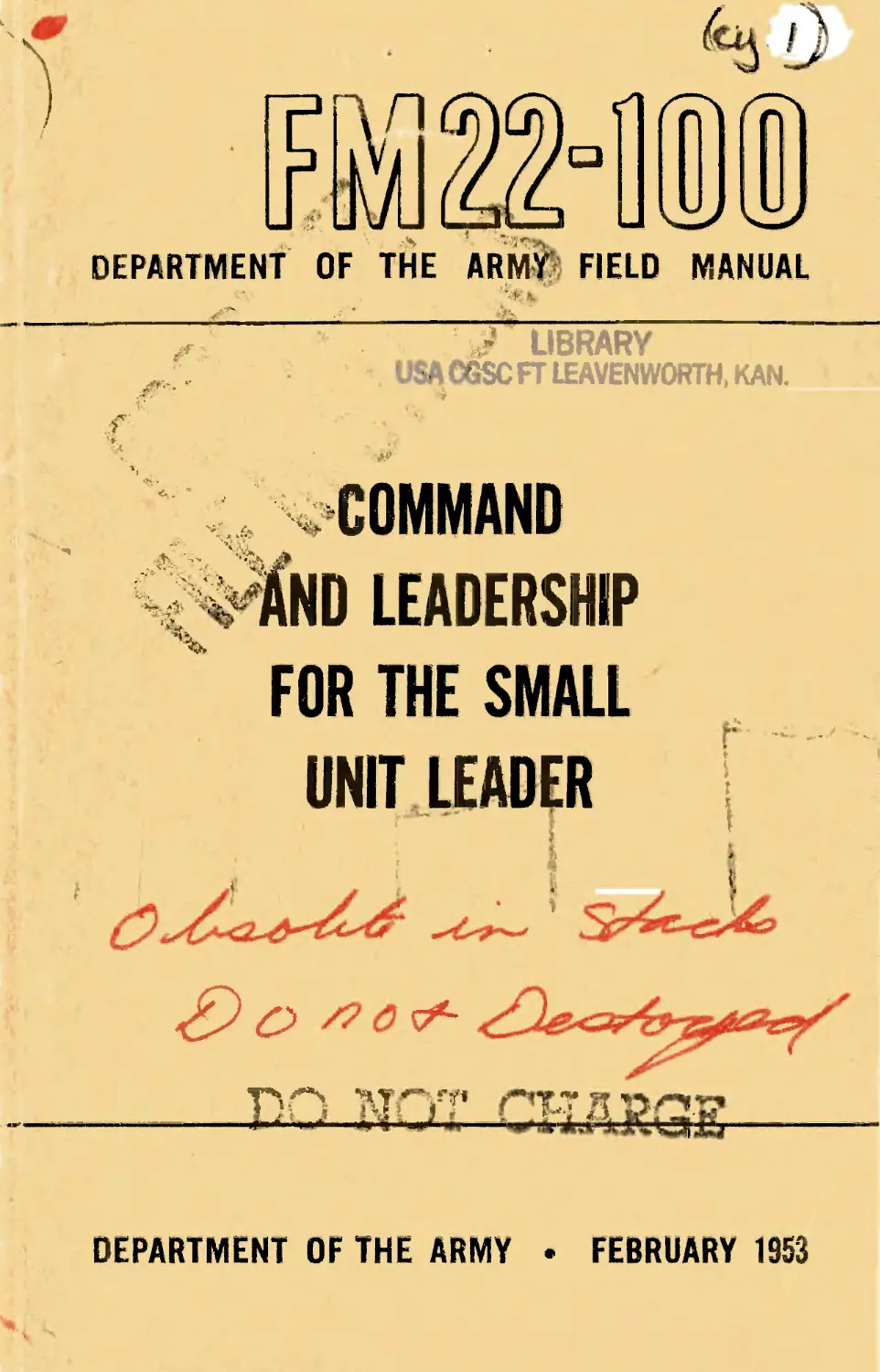
                    DEPARTMENT OF THE ARMY? FIELD MANUAL

? LIBRARY
USA CGSC FT LEAVENWORTH, KAN.

COMMAND
; . -Ш LEADERSHIP
FOR THE SMALL
UNIT LEADER

0
DEPARTMENT OF THE ARMY • FEBRUARY 1953
DEPARTMENT OF THE ARMY
Washington 25, D. C., 26 February 1953
FM 22-100 is published for the information and
guidance of all concerned.
[AG 353 (30 Dec. 53)]
By order of the Secretary of the Army :
Official :	J. LAWTON COLLINS
WM. E. BERGIN	Chief of Staff
Major General	United States Army
The Adjutant General
Distribution :
Active Army:
Tech Svc (2); Admin & Tech Svc Bd (2) ;
AFF (40); AA Comd (2); OS Maj
Comd (5) except AFFE (50); Base
Comd (2); MDW (2); A (2); CHQ (2);
Div (2); Brig (2); Regt (2) ; Bn (2) ;
Co (5); USMA (50) ; Sch (10); PMS &
T(2).
Army Reserve: Same as Active Army except
one copy to each unit.
NG: Same as Active Army except one copy to
each unit.
For explanation of distribution formula, see
SR 310-90-1.
DEPARTMENT OF THE ARMY FIELD MANUAL
FM 22-100
COMMAND
AND LEADERSHIP
FOR THE SMALL
UNIT LEADER
DEPARTMENT OF THE ARMY • FEBRUARY 1953
United States Government Printing Office
Washington : 1953
CONTENTS
Paragraphs Page
CHAPTER 1. INTRODUCTION TO COM-
MAND AND LEADERSHIP. 1-5	1
2.	THE EXERCISE OF COM-
MAND AND LEADER-
SHIP________________________ 6-10	3
3.	LEADERSHIP	TRAITS_______11-24	6
4.	LEADERSHIP	PRINCIPLES___ 25-36	23
5.	LEADERSHIP TECHNIQUES
Section I. General________________ 37, 38	28
II. Developing leadership tech-
niques_______________________ 39-49	29
CHAPTER 6. SOLVING LEADERSHIP
PROBLEMS_______________________________ 50-53	43
7. INDICATIONS OF MILITARY
LEADERSHIP_________________54-61	50
8. SPECIAL LEADERSHIP PROB-
LEMS AND TECHNIQUES
Section I. Adjustment problems and
techniques________________________ 62-66	55
II.	Employment of subordinate
commanders and their units, 67,68	60
III.	Utilization of personnel_69-71	63
IV.	Panics and rumors_______ 72-77	67
V.	Punishment_______________ 78-80	71
APPENDIX I.	REFERENCES____________________ 75
II. COMBAT EXAMPLES OF
SMALL UNIT	LEADERSHIP_____	77
INDEX__________________________________________ 93
CHAPTER 1
INTRODUCTION TO COMMAND AND
LEADERSHIP
1.	Purpose and Scope
This manual has two main purposes. It is a guide
for junior leaders faced with actual troop leading
problems and a text for leadership instruction.
2.	The Study of Leadership
a.	There is no cookbook recipe for making a
leader, and no two leaders ever get results in exactly
the same way. But the ability to lead can be learned
by breaking the subject down into convenient form
for study and practice, such as these three headings:
(1)	Leadership traits—those personal qualities
that help a commander in the exercise of
leadership.
(2)	Leadership principles—the guiding rules of
leadership.
(3)	Leadership techniques—the actions taken
by a leader to meet a leadership situation or
to solve a leadership problem. He uses the
leadership principles as a guide in selecting
the techniques to be used.
6.	None of those three factors stands alone. They
work together to help a commander develop his
leadership ability. The leadership traits can be de-
veloped by self-analysis and practice; the principles
can be learned through study; and the ability to
select techniques can be improved by observation and
experience.
1
c.	One of the greatest mistakes a young leader
often makes is in the desire to gain popularity with
members of his command. Successful command is
not a popularity contest. Good leadership is based
on many factors other than popularity with the men.
Popularity will be gained as the leader develops the
trust, confidence, and respect of his subordinates.
3.	Indications of Successful Leadership
Certain signs of successful leadership show how
well a commander has developed the traits and fol-
lowed the principles of leadership. These signs show
up in the state of morale, discipline, esprit de corps,
and proficiency of a unit. The goal of leadership is
to raise a unit to the highest state of combat effective-
ness.
4.	Military Leadership
The military leader must build a command rela-
tionship between himself and his men that will result
in immediate and effective action on their part to
carry out his will in any situation. In the process
of building such a command relationship, the suc-
cessful military leader will obtain the obedience, con-
fidence, respect, and loyalty of his subordinates.
5.	Combat Examples
Appendix II gives several examples of leadership
principles and techniques in action. After studying
this manual, turn to appendix II and carefully study
the combat examples. You will undoubtedly notice
that not one or two principles or techniques operate
alone, but that a combination of many is required.
2
CHAPTER 2
THE EXERCISE OF COMMAND AND
LEADERSHIP
6.	General
Military leadership, simply stated, is the proper
exercise of command by a good commander. As a
leader, you must have a thorough understanding of
command essentials, which are—
a.	Authority.
Ъ.	Responsibility.
c.	Chain of Command.
7.	Authority
Every military unit is organized to perform a mis-
sion. The commander of each unit is given sufficient
authority to insure accomplishment of that mission.
This authority is simply the right, given to the com-
mander by virtue of his rank and assignment, to issue
orders, and take all action necessary to accomplish
his mission.
8.	Responsibility
a.	General. Your command authority carries
with it the obligation to perform all assigned duties
in accordance with the orders received from your im-
mediate superior. This obligation is called com-
mand responsibility. Every commander bears com-
plete responsibility for all his unit does or fails to do.
He cannot shift this responsibility to his assistants
or subordinates.
3
b.	Fundamental Responsibilities of Command.
Every commander has two fundamental responsibil-
ities.
(1)	Accomplishment of the mission. This is
your primary duty as a commander. Get-
ting the job done which has been assigned
to you as a commander is your responsibil-
ity and yours alone. All other obligations
are secondary to the successful accomplish-
ment of your mission. This obligation in-
cludes responsibility to higher headquarters.
You must accept and discharge the author-
ity that accompanies your position, you
must comply strictly with and vigorously
execute all orders and policies received from
higher headquarters, and you must give un-
swerving loyalty to your superiors. If you
question an order, make known your objec-
tions to your superior so that they may be
considered prior to compliance with the
order. Once a decision is given, you are
bound to carry it out regardless of your
personal views.
(2)	Responsibility to your men. You are re-
sponsible for the physical and emotional
well-being of the individuals in your unit.
You must realize that you are dealing with
human beings, each of whom has human
emotions and dignity.
9.	Chain of Command
Each commander has authority to give orders and
take action to fulfill his responsibilities. However,
4
he cannot personally contact and direct the actions
of all the men in his unit. To assist him, subordi-
nate commanders are placed in the line of authority
running from the commander to the men of his1 unit.
For example, an order from a company commander
goes from him to his platoon leaders, to the section
leaders, to the squad leaders, and then to the corpo-
rals and privates of the squads. This is known as
the chain of command. Each subordinate com-
mander at any level in the chain of command has
only one immediate commander; thus the chain pro-
vides the unity of command that must exist if a unit
is to operate effectively.
10.	Decentralization of Authority
a. When the commander passes some of his duties
down the chain of command to his subordinates, he
holds each subordinate responsible for the perform-
ance of these duties. He must delegate sufficient
authority to these subordinates to enable them to
carry out their assignments. In this way, each level
in the chain of command is given authority equal to
its responsibilities, and each level performs its duties
under the direction and supervision of the next
higher level.
&. While a commander may delegate authority to
his subordinates, he cannot relieve himself of any of
his over-all responsibility. He must insure that he
does not delegate authority to the point where he
loses control. Also, he must delegate authority in
terms so specific that the subordinate will understand
exactly where his authority begins and ends.
5
CHAPTER 3
LEADERSHIP TRAITS
11.	General
Leadership traits are personal qualities which, if
shown by the commander in his daily activities, will
help him earn his men’s respect, confidence, obedience,
and loyal cooperation. By sizing up his own
strength and weak points, a commander can develop
leadership traits that he lacks and further strengthen
those in which he is strong. The attitudes of the
men toward a commander are determined by whether
or not their needs (par. 43&) are satisfied or frus-
trated by the leader’s personal traits. For this rea-
son the traits of a commander directly affect the
behavior of his men.
12.	Essential Traits
a. A study of the lives and careers of successful
commanders reveals that many of the following per-
sonal traits or qualities are common to all of them:
(1)	Integrity.
(2)	Knowledge.
(3)	Courage.
(4)	Decisiveness.
(5)	Dependability.
(6)	Initiative.
(7)	Tact.
(8)	Justice.
(9)	Enthusiasm.
(10)	Bearing.
6
(11)	Endurance.
(12)	Unselfishness.
&.	The following paragraphs describe each of these
traits and give suggestions that will help you develop
them.
13.	Integrity
a.	Integrity, the uprightness of character and
soundness of moral principle, the quality of absolute
truthfulness and honesty, is an indispensable trait in
a leader.
&. In civilian life, if you cannot trust a man, if you
feel that he lacks integrity, you avoid association
with him. You can have no respect for the man who
breaks his word or tries to lie out of a tight situation.
In the armed forces such a man cannot be tolerated,
because it is not practical to isolate any military
associate. Unless a man can be relied upon for ab-
solute truthfulness and honesty, he cannot be relied
upon at all. There is no possible compromise. The
nature of the military profession cannot allow for the
slightest deviation from the highest standards of
personal integrity. The Army cannot accept the
soldier who isjg^aZZ?/ honest or almost always truth-
ful. In a critical situation there must be no doubt
about your honesty or truthfulness. Would you be
willing to trust the report of a patrol member about
the strength of an enemy troop concentration if once
before he had lied to you ?
c.	In combat, critical decisions involving the lives
of many men often must be based upon the word of
one man. In the armed forces team the stakes are
too high to place the lives of its members in the hands
of a man with questionable integrity.
7
d.	To develop your personal integrity—
(1)	Practice absolute honesty and truthfulness
with yourself at all times.
(2)	Be accurate and truthful in all your state-
ments, both official and unofficial.
(3)	Stand for what you believe to be right in
the face of adverse comment.
(4)	Place honesty and duty above all else.
14.	Knowledge
a.	Nothing attracts confidence and respect more
quickly than demonstrated knowledge—knowledge
both of your job and your men. The man who
knows his job builds confidence in himself as well
as in others. Lack of knowledge cannot be con-
cealed; you cannot bluff your men. If you don’t
know the answer to a particular question, admit it,
then take steps to get the information.
Ъ.	Your knowledge should not be limited to mili-
tary subjects. A general fund of information, par-
ticularly on national and international events, will
make you a more rounded personality.
c.	Here are suggestions for increasing your
knowledge—
(1)	Keep a military file and a small library.
(2)	Study field manuals and other military
literature, such as regulations, training di-
rectives, battle operations, and past mili-
tary campaigns.
(3)	Read the service journal of your branch
and books in the Department of the Army
Reading List.
8
(4)	Read the daily newspapers and weekly
magazines; try to evaluate current news
impartially and correctly.
(5)	Take part in serious conversation with your
contemporaries on military subjects.
(6)	Make a point of discussing training and
combat situations with those of wider ex-
perience.
(7)	Be alert to gain information by observing
and listening.
(8)	Closely observe the actions of other leaders
who are successful.
15.	Courage
a.	Courage, the physical and moral control of fear,
is essential to leadership. It is a mental quality
that recognizes fear, yet enables a man to meet dan-
ger or opposition with calmness and firmness. It
is a quality of mind that gives a man control over
himself, enabling him to accept responsibility and
to act in a dangerous situation.
Ъ.	The leader must have moral as well as physical
courage. Moral courage means knowing and stand-
ing for what is right in the face of popular disfavor.
A leader who has moral courage will admit his er-
rors, but he will enforce his decisions when he is sure
he is correct.
c.	You can help yourself attain and demonstrate
courage if you will—
(1)	Place duty first over your personal desires
or inclinations.
(2)	Look for and readily accept responsibilities.
9
(3)	Speak in a calm tone; keep an orderliness in
your thought processes; don’t make physical
danger or hardship bigger than it really is.
(4)	Stand for what is right, even in the face of
popular disfavor.
(5)	Never blame others for your mistakes.
16.	Decisiveness
a.	The ability to reach sound decisions promptly
to announce them forcefully, concisely, and clearly
is the mark of a leader.
Ъ,	Every situation offers a variety of solutions.
The wise leader gets all the facts, weighs one against
the other, and calmly and quickly arrives at a sound
decision.
c.	Decisiveness is largely a matter of practice and
experience. The following are suggestions for de-
veloping decisiveness and judgment:
(1)	When a situation arises when some other
commander, such as your company or bat-
talion commander, must make a decision, use
the opportunity to come to a conclusion
of your own. If your plan or decision is
not in agreement with what was done, reason
it through and find out why.
(2)	Broaden your own point of view by studying
those of other men. Form the habit of con-
sidering several points of view on the little
social arguments that occur every day.
(3)	Develop mental calmness and self assurance
by increasing your store of knowledge.
(4)	Learn from your own mistakes and the mis-
takes of others.
io
(5)	Force your self to reach decisions. Practice
decisiveness with all your energy.
(6)	Check decisions you have made and deter-
mine if they are sound.
(7)	Take advantage of social and official con-
versations and discussions to develop logical
thinking and clear expressions of thought.
17.	Dependability
a.	The dependable leader is one who can be relied
upon to carry out actively, intelligently, and with
willing effort the intent of his commander to the
best of his ability. This willing and voluntary com-
pliance with the plans and will of the superior does
not mean blind and dog-like obedience. Few com-
manders will fail to listen to the suggestions of their
subordinates, but once the final decision has been
made, the subordinate must give it his complete and
energetic support.
b.	A military duty is an obligation to be per-
formed. Thus a high sense of duty results in a high
standard of performance, a constant and continuous
effort to give the best a leader has in him. Duty
demands the sacrifice of personal interests in favor
of military demands, rules and regulations, orders
and procedures, and the welfare of subordinates. In
practice this means that a leader pays careful atten-
tion to every detail of his job.
<?. Here are some ways you can develop dependa-
bility—
(1)	Practice honest thinking.
(2)	Avoid making excuses.
11
(3)	Do the job assigned to you regardless of
obstacles.
(4)	Be exact in details.
(5)	Form the habit of being on time.
(6)	Give attention to the general welfare of
your men.
(7)	Understand loyalty and develop within
yourself a keen sense of loyalty.
(8)	Follow orders to the letter.
18.	Initiative
a. Initiative, seeing what has to be done and doing
it, even in the absence of orders, is necessary in all
grades. You must encourage initiative among your
subordinates by giving them duties on a level with
their grade and then letting duties work out the
details and finish the job. This does not mean that
you can deal out the tasks and then do nothing else.
You must know the jobs well enough to check per-
formance, and you must make such checks. Further-
more, you must retain for yourself those functions
that are exclusively the commander’s. Soldiers unite
quickly behind a commander who meets a new and
unexpected situation with prompt action.
&. Closely allied with initiative is the quality of
resourcefulness, the ability to deal with a situation
in the absence of normal means or methods. Military
supply, organization, and training are designed to
meet all normal situations, but they sometimes fail,
particularly under combat conditions where the un-
expected is normal. Inactivity or passive acceptance
of an unsatisfactory situation because of lack of
12
normal means or ways of dealing with it are never
justified.
c. To develop initiative you can—
(1)	Check yourself for laziness—mental as well
as physical.
(2)	Develop the habit of staying mentally and
physically alert.
(3)	Continually look for what needs to be done
and do it without having to be told.
(4)	Always think ahead.
19.	Tact
a.	Tact is the ability to deal with men without
causing friction or giving offense. In the field of
human relations, tact is the ability to say and do the
proper thing at the proper time. It is an under-
standing of human nature and a consideration for
the feelings of others.
Ъ.	Tact is particularly called for in those contacts
with subordinates in which the personal element is
involved. Criticism has to be made in such a way
that what is meant will be clearly apparent, yet will
neither cause discouragement nor detract from the
drive and energy of the subordinate. Every com-
mander will also need tact in helping those men who
come to him with personal problems. These often
involve family relations and other personal matters
that are accompanied by embarrassment or shame.
The commander must avoid judging such situations;
his role is that of counselor only and it calls for
common sense in making suggestions. Sometimes
the highest degree of tact is simply to listen with
sympathetic attention and interest, finding out what
13
the soldier’s own solution is. His solution may be
confirmed or a different one suggested.
c.	An important part of tact is courtesy, which
you cannot afford to neglect in your relations with
subordinates. To demand it from them and fail to
return it in full measure indicates either arrogance
or a lack of interest. The inexperienced officer or
noncommissioned officer often feels that politeness in
a military command implies softness; or worse, that
from a subordinate it smacks of “bootlicking.”
Nothing is further from the truth. Courtesy is a
matter both of words and actions. One leader may
bark out his orders, impersonally and abruptly. An-
other may give his orders in a tone tinged with a
courtesy that implies the expectancy of obedience.
Good leaders who use either method may get obedi-
ence, but the second of the two will get more willing
obedience and cooperation. In times of emergency,
abrupt rapid-fire orders become desirable because
they save time and there is no need to imply expected
obedience, no need to do anything but make yourself
perfectly understood. There are times, too, when a
forced tone can well replace a courteous tone, but
even then there is no reason for outright discourtesy.
Usually, you will find that a calm, courteous, though
firm mode of address, will bring the readiest re-
sponse. Thus tact and courtesy are closely tied in
with manner, language, and bearing (par. 21).
d.	Use the following ideas to develop tact and
courtesy:
(1)	Be considerate and cheerful and have regard
for others.
14
(2)	Study the actions of successful commanders
who enjoy a reputation of being able to
handle men skillfully.
(3)	Develop the habit of cooperating in spirit
as well as in fact.
(4)	Check yourself for tolerance. If at fault,
correct your habit.
(5)	Apply the Golden Rule; it is vital to team-
work.
(6)	Let no man, superior or subordinate, exceed
you in courtesy and consideration for the
feelings of others.
20.	Justice
a.	Justice implies the rendering of reward and
the meting out of punishment in accordance with the
merits of the case. Justice must be impersonal and
absolutely impartial. Anger and other emotions
must not enter into a situation. Prejudice of race
or creed must be avoided. Few things will disrupt
the morale of an organization more quickly than un-
fairness or partiality of a leader toward a certain
man or group of men.
b.	As a company officer you are called upon to
render justice in such matters as promotions and
company punishment. Your decisions are a test of
your fairness. It takes a long time to build up a
reputation among your men for being fair. One
thoughtless error on your part, or one injustice can
destroy a good reputation that took months to
establish.
c.	To render justice, you must understand human
behavior. You should study people with the idea
244753’—53— -2	15
of learning why certain types behave the way they
do under certain conditions, and why others act
differently under the same conditions. You should
analyze cases that have been decided and determine
what you would have done had you been the one to
make the decision. This, of course-, is a private
process and should never be used as an occasion to
criticize the decision of another leader.
d.	To develop this trait of justice, use the follow-
ing methods:
(1)	Search your mental attitudes, determine
your prejudices and seek to rid your mind
of them.
(2)	Learn to be impersonal when imposing
punishment or rendering reward. Be abso-
lutely impartial when performing these
duties.
(3)	Search out the facts of each case.
(4)	Analyze cases that have been decided by
leaders who have the reputation for justice.
(5)	Study human behavior.
(6)	Be honest with yourself.
(7)	Recognize those subordinates worthy of
commendation or award. Don’t be known
as one who hands out only punishment.
21.	Enthusiasm
a.	Enthusiasm means that you show great interest
in the task at hand. It implies that you approach
your work with a cheerful and optimistic attitude,
determined to do a good job. This attitude is neces-
sary because your example will be copied by those
you lead.
16
Ъ.	An important part of enthusiasm is your per-
formance of tasks with vigor, because of willingness
and gratification in accomplishment, rather than
doing them half-heartedly merely because you must
do them. Enthusiasm is particularly important in
instructing and training, where, through example,
your interest and enthusiasm are reflected by your
men.
c.	To develop enthusiasm in yourself—
(1)	Understand, know, and believe in the worth
of your work.
(2)	Understand and believe in your mission,
whatever it may be.
(3)	Develop and apply a cheerful and optimistic
attitude to all your duties.
(4)	Capitalize on success. Enthusiasm is con-
tagious and nothing will develop it more
than success of the unit or individual.
(5)	Don’t get stale. Set aside a period of every
day when the mind can be freed from con-
cern about official matters.
22.	Bearing
a.	Your appearance and conduct have an impor-
tant influence on your men. Your carriage should
be upright, your general appearance and the condi-
tion of your clothing and equipment should estab-
lish the standard for the rest of your unit, and you
should show life and energy in your actions and
movements.
6.	Manner and language are a part of bearing.
By your appearance and manner, you must express
competence and confidence, often to a degree beyond
17
what you actually feel. By exercising control over
your voice and gestures, you can exert a firm and
steadying influence, especially in combat. All good
leaders know that their apparent confidence in them-
selves, in their troops, and in the situation is reflected
in their men. Few things can better maintain the
morale of troops than the realization that their
leader, with full knowledge of the difficulties of a
situation, neither looks nor acts worried as perhaps
he has a right to. Too much severity, austerity, and
strictness of manner balk the sympathy and confi-
dence you must have from your men. Frequent ir-
ritation, petulance, and uncontrolled displays of
temper indicate that you do not have even yourself
in hand.
c.	Language is another of the outward marks by
which you will be judged and through which you
have an ever present influence on your men. You
should speak plainly and simply. Make your sen-
tences short, simple, positive and direct; not un-
certain, inconclusive, or negative. If you must use
terms that may not be clearly understood, explain
their meaning. At the same time, avoid talking
down to your men.
d.	Immoderate language used toward subordinates
almost always produces unfavorable results both in
the individual and in the unit. For you to use pro-
fane or obscene language and to permit its use by
subordinate leaders, especially in giving orders, is to
risk friction, resentment, quarreling, and even insub-
ordination. Men resent being sworn at by their
superiors. They feel, and rightly so, that the supe-
rior has taken unfair advantage of his authority.
18
The same applies to any immoderate language. The
“bawling out” of a man or men is commonly resented
as a personal attack. It is, in fact, more often an
expression of anger than a proper correction. The
more or less impersonal point at issue is lost, and the
matter becomes a mental clash between individuals.
Likewise, the use of immoderate language, or of any
language, in wholesale criticism and condemnation
of a group should be particularly avoided. It is not
likely that you will ever have a unit that will deserve
a wholesale reprimand. Nothing creates resentment
so readily in a subordinate as to be included unfairly
with others who may deserve disciplinary action.
This is true not only of your language but of all
general punishments. If violent language ever has
any basis for use, you should reserve it for an ex-
treme emergency on the battlefield. A tongue-lash-
ing then may have a stimulating and steadying effect
that is lost if such speech is habitual.
e.	Sarcasm and irony seldom bring good results.
Sarcasm soon creates a general resentment because
men feel that their leader is taking advantage of
his position. Also, many men do not understand
sarcasm and irony and are never quite sure what
their leader means. Even a bantering tone should
not be used often. This does not mean that a joke
can never be used, but too much wisecracking by the
leader will inevitably result in wisecrack replies
from his troops. The American soldier is too used
to that kind of talk to resist cracking back if he
thinks he can get away with it. He will have reason
to think he can get away with it if he is always on
the receiving end of such remarks. At the same
19
time, any wise leader will know that in some cir-
cumstances a certain amount of joking is helpful.
When there is discouragement in the air, when ex-
hausted troops must be called upon for another
effort, a flash of humor helps greatly. It tends to
give confidence in time of stress, even in the midst
of the most confused and strenuous combat. In-
deed it is often the American way of implying
sympathy and understanding—even cooperation—
in the midst of difficulty.
f.	A leader should be dignified. Dignity implies
a state of being worthy or honorable. It is avoid-
ance of coarse behavior. It requires the control of
one’s actions and emotions. A leader who makes a
spectacle of himself through loudness, through drink,
or through lack of control of his emotions, quickly
loses the respect of his men.
g.	Here are some ways in which you can develop
the manner, language, and bearing of a leader—
(1)	Practical control over voice, facial expres-
sion, and gesture.
(2)	Cultivate calmness, sincerity, and under-
standing.
(3)	Master your emotions so that you control
them and they do not control you.
(4)	Speak simply and directly.
(5)	Never make wholesale condemnations.
(6)	Never reprimand your subordinates in the
presence of their men.
(7)	Observe and study leaders who enjoy a
reputation for good bearing.
(8)	Know and adhere to regulations concerning
dress and conduct.
20
(9)	Require the highest standard of yourself,
as an example to your men.
(10)	Avoid coarse behavior, profanity, and
vulgarity.
23.	Endurance
a.	Endurance is akin to courage in that it involves
withstanding physical and mental strain. A man
has endurance when he can stand pain, fatigue, dis-
tress, and hardship without giving in. It is one of
the most important qualities in determining leader-
ship ability. A leader must have it if he is to com-
mand the proper respect from his subordinates. A
lack of endurance may be confused with lack of
courage and brand the leader who is in poor physical
condition as a coward. Endurance implies the abil-
ity to stick to a job and see it through.
b.	To develop physical and mental stamina—
(1)	Avoid excesses that lower both physical and
mental stamina.
(2)	Keep physically fit by exercise and proper
diet.
(3)	Learn to stand punishment by undertaking
hard physical tasks.
(4)	Force yourself to study on occasions when
you are tired and your mind is sluggish.
(5)	Form the habit of thinking of battle or
training situations. Think them through,
solve them, and in each instance, make a
decision, form a plan, and formulate an
order for the execution of the plan.
(6)	Finish every job regardless of the obstacles.
21
24.	Unselfishness
a.	The unselfish leader is one who does not take
advantage of a situation for personal pleasure, gain,
or safety at the expense of the unit. Men want a
leader who will see that they have the best he can
get for them by honest means under any circum-
stances. He must put the comfort, pleasures, and
recreation of subordinates before his own. If the
unit is commended for some outstanding work, the
commander should pass along the credit for the
achievement to the subordinates who made it possible.
No subordinate can respect a superior who only takes
the credit for the good work and ideas, and who
makes sure that his subordinates get the blame for
the unsatisfactory work. To be a true leader, the
commander must share the danger, hardships, and
discomforts that his men are experiencing.
b.	To become an unselfish leader—
(1)	See that your men have the best that you
can get them under the circumstances.
(2)	Try to understand the problems, military
or personal, of your men.
(3)	Think of the comfort, pleasures, and rec-
reation of your men before your own.
(4)	Give credit to subordinates for work well
done, and don’t take credit for the efforts
of your subordinates when they have been
recognized by higher commanders.
22
CHAPTER 4
LEADERSHIP PRINCIPLES
25.	General
a. Chapter 3 pointed out that a study of successful
commanders reveals many personal traits common to
them all. Similarly, such a study shows that these
leaders applied certain fundamental principles to
control or guide their own actions and the actions of
their subordinates.
&. The following leadership principles are guides
for use in command at any level, from the squad up:
(1) Take responsibility for your actions.
(2) Know yourself and seek self-improvement.
ч -(3) Set the example.
Seek responsibility and develop a sense of
responsibility among subordinates.
(f>) Insure that the job is understood, super-
* vised, and accomplished.
(6) Know your men and look out for their
welfare.
(7) Keep your men informed.
(8х Train your men as a team.
Employ your command in accordance with
its capabilities.
I j(40) Make sound and timely decisions.
j (11) Know your job.
26.	Take Responsibility for Your Actions
a.	A willingness to accept responsibility is the
foundation of all leadership. Chapter 2 outlined the
23
nature of a commander’s responsibilities and ex-
plained the relationship between responsibility and
authority.
b.	As a commander, you automatically assume full
responsibility for your actions and for those of your
unit. You give the orders of your superiors in your
name and with the authority of your office. A com-
mander shows weakness when he implies that he is
giving orders because of pressure from above.
c.	The limits of responsibility and authority are
normally defined by the command position held.
However, in a crisis, you can unhesitatingly assume
sufficient authority to meet the situation. When you
thus assume responsibilities beyond your authority,
your actions and decisions are guided by your con-
sidered opinion as to what your superior would do if
present. You also report your action to your superior
as soon as possible.
^27. Know Yourself and Seek Self-Improvement
If you are to understand and control others, you
must first understand and control yourself. Evalu-
ate yourself in view of the leadership traits in
chapter 3. By frequent and systematic self evalua-
tion, you can determine your individual strengths
and weaknesses, your limitations and capabilities.
Once you know your own weaknesses, you can im-
prove by study and practice. Continued self evalu-
ation should be employed as a check on progress.
• 28. Set the Example
As a commander, you are in an ideal position to
demonstrate high standards by your performance
24
of duty, appearance, and conduct. A soldier in-
stinctively looks to his commander for a pattern of
conduct that he can emulate. No amount of instruc-
tion and no form of discipline has as great an effect
on the unit’s standards as your personal example.
29.	Seek Responsibility and Develop a Sense of Re-
sponsibility Among Subordinates
<7. You should so discharge the assigned responsi-
bilities for yourself and your unit that you can wel-
come an increase in responsibility. By so doing
you develop professionally, set an example for your
subordinates, and increase the value of your unit to
the parent organization.
b. You can build up the self-confidence and initi-
ative of your subordinates by holding them strictly
responsible for results but rarely for methods or
procedure.
30.	Insure That the Job Is Understood, Supervised,
and Completed
This principle is fundamental in the exercise of
command. Tell your subordinates what to do by
issuing clear and concise orders. Through super-
vision, insure that your orders are understood and
carried out. By inspection, make sure that the work
is complete and determine the standard of per-
formance.
31.	Know Your Men and Look Out for Their Welfare
a.	If you understand human behavior, make a
conscientious effort to become personally acquainted
25
with your men, and recognize their individual dif-
ferences, you will have a better understanding of
their capabilities and limitations. You will know
how they will react and function under various con-
ditions and will be able to employ them more
effectively.
b.	If you assure yourself that the members of
your command are comfortable, well-cared for, and
as contented as the situation permits, you will win
their confidence, respect, and cooperation. By know-
ing your men you can also assist them with their pri-
vate as well as military problems.
32.	Keep Your Men Informed
Make sure that your subordinates receive all the
information necessary to do their job intelligently.
In addition, inform them on matters having an in-
direct but vital effect on their initiative, enthusiasm,
loyalty, and convictions.
33.	Teamwork
The duty of every leader includes the development
of teamwork through the thorough training of his
command, whether it be a squad, or an army group.
This teamwork is the key to successful operation; it
starts in the squad and carries through to the largest
organization. Teamwork extends from person-to-
person communications to mutually supporting fire.
Every member of that team must understand where
he and the employment of his weapons fit into the
common effort of the unit. Failure to develop this
teamwork through training will result in failure
to reach the degree of combat effectiveness necessary
for battle success.
26
34.	Employ Your Command in Accordance With Its
Capabilities
Successful accomplishment of your unit’s mission
depends upon how well you know what it can and
cannot do. Any unit, regardless of size, has certain
capabilities and limitations. If you have a thorough
knowledge of the technical, tactical, and administra-
tive limitations and capabilities of your command,
you will be able to assign missions that can be ac-
complished. You will be able to evaluate properly
the time and space factors, make proper estimates,
and arrive at sound decisions. This knowledge en-
ables you to avoid asking the unit for more than it
can accomplish. When the situation demands it,
men must be pushed without hesitation to achieve
a quick or cheap victory or to avoid a costly defeat.
35.	Make Sound and Timely Decisions
If you cannot make up your mind, if you delay or
attempt to avoid making difficult decisions, you will
not be able to make good use of your command.
Lack of direction creates lack of confidence, hesi-
tancy, or indecision among the members of the unit.
36.	Know Your Job
The principle is, in effect, a summary of all the
principles noted before. Make sure you know the
tactical and technical details necessary to accomplish
your mission, and know and apply the principles of
leadership to obtain the utmost in effort from your
men.
27
CHAPTER 5
LEADERSHIP TECHNIQUES
Section I. GENERAL
37.	Definition
A leadership technique is simply the action that
you take, as an individual, to solve a leadership
problem. Different individuals use different tech-
niques. All leaders cannot use the same techniques.
Good techniques are developed by solving leader-
ship problems in your own way while using the lead-
ership principles as your guide. In great degree,
good techniques stem from good leadership traits.
38.	General
a.	A commander can, if necessary, force his sub-
ordinates to carry out his orders under threat of
punishment. But the commander who does so habit-
ually will never survive as a leader. You must
develop leadership techniques that will enable you to
direct and influence your subordinates. The key
word here is influence, not direct.
b.	You cannot acquire good leadership techniques
by following a few well defined rules because
qualities of leadership vary with each person: the
technique that a dynamic leader might use effectively
in a certain situation would seem absurd if used by
a man who has created a respect for the quiet sure-
ness of his methods. You must learn for yourself
how to impose your command in a way that will gain
28
respect, obedience, and loyal cooperation while
creating good morale, discipline, and proficiency
among your men.
c.	The following section reviews the eleven basic
principles of leadership and suggests ways that you
can make them into leadership techniques. These
suggestions are based on the experience and success-
ful practices of combat leaders.
Section II. DEVELOPING LEADERSHIP TECHNIQUES
39.	Principle I—Take Responsibility for Your Actions
You are responsible for all your unit does or fails
to do. Regardless of the actions of your subordi-
nates, the responsibility for decision and its applica-
tion falls on you. You issue all orders in your
name; stick by your convictions and to what you
think is right; but accept justified and constructive
criticism. Never remove or demote a subordinate
for a failure that is due to your own mistake.
40.	Principle II—Know Yourself and Seek Self-Im-
provement
a.	Analyze yourself and observe the effects of
your actions. These points will help—
(1)	Watch how others react to you and con-
sider the judgments that others make of you.
Learn your weaknesses and seek the friendly
criticism of someone with whom you have
a confidential personal and professional
relationship.
(2)	Remember that all leaders have moments
of not feeling sure of themselves, but learn
29
to overcome it. Don’t allow this feeling to
make you uncertain or abusive toward
others.
(3)	Make periodic use of self-evaluating de-
vices such as check lists. These devices
force you to take serious consideration of
the points they raise; they provide a means
for impartial self-inventory and systematic
self-study and help you develop insight.
See DA Pamphlet 22-2.
Ъ.	To improve yourself you can—
(1)	Look for the reason behind the successes
and failures of others. Profit from the ex-
perience of others and do not hesitate to
adopt their good points.
(2)	Develop the art of good writing and
speaking.
(3)	Increase the scope of your knowledge by
reading and making new friends.
41.	Principle III—Set the Example
If you expect to have and maintain a worthy unit
you must observe the highest standards of conduct,
setting a noticeable example in all aspects of mili-
tary behavior.
a. Courtesy will serve you most effectively
throughout all levels of your command. Use it in
your first contact with a new command by visiting all
subordinate units, so as to make yourself known to
your command.
(1)	A few courteous and sincere remarks to the
men can establish a feeling of mutual re-
30
spect; they show that your attitude is one
of interest in, not indifference toward, your
men, and that you consider yourself a part
of the command, not merely an attachment
to it.
(2)	Conduct yourself so that your personal
habits are above criticism. Coarse behavior
and vulgarity mark a weak and unstable
character; they have no place in the deport-
ment of a leader.
(3)	Don’t be over-familiar with your men. It is
a custom in the Army to address subordi-
nates by their rank and last name. When
an officer addresses an enlisted man by his
first name, the officer is taking unfair ad-
vantage of his rank since the enlisted man
cannot do the same in return.
(4)	Master your emotions. The man who al-
lows himself intemperate bursts of anger or
indulges in periods of depression cannot
gain and hold the respect of his subordinates.
Ъ. Set an example of cooperation at all levels and
of strict obedience to orders from your superiors.
(1) Cooperation must work in two directions.
A good leader is conspicuously loyal to his
subordinates as well as to his superiors. He
supports deserving subordinates without
partiality; he avoids the development of a
clique of favorites and carefully considers
the effect of rewarding subordinates who
have given loyal and superior service over a
period of time.
244754°—53---3
31
(2) A commander practices the obedience to his
superiors that he expects from his subordi-
nates. He accepts the decisions of his com-
manding officer and backs them up com-
pletely. He does not “go over the head” of
his superior and he does not bypass the
chain of command in dealing with subordi-
nates. He does not criticize his superiors
but carries out their policies as his own.
<?. Your moral and physical courage must be un-
questionable. Stand by your principles and do not
shift the responsibility for your mistakes. Demon-
strate your willingness to share danger and hard-
ships with your men.
42.	Principle IV—Seek Responsibility and Develop a
Sense of Responsibility Among Subordinates
a.	The foresighted leader seeks a variety of assign-
ments to broaden his experience and fit him for
greater responsibilities. That means you should
demonstrate readiness to accept extra responsibilities
and take advantage of all opportunities to increase
them. Learn the duties and responsibilities of your
immediate superior, but do so with discretion and
tact. Reserve this knowledge for occasions when
your superior requests assistance and for emergency
situations.
Ъ.	In organizing and carrying out a mission, assign
specific parts of the task to your subordinates. (For
the chain of command, see par. 8.) Each of these as-
signed tasks carries with it a portion of your respon-
sibility and must be accompanied with sufficient
32
authority to do the job. Give your assistants
responsibility and authority equal to their ability.
Be quick to recognize their accomplishment that
required initiative and resourcefulness, and be gener-
ous in giving merited praise publicly. Correct their
mistakes in a way that encourages them and reassures
their self-confidence. Never publicly criticize or
condemn a subordinate.
43.	Principle V—Insure That the Job Is Understood,
Supervised, and Completed
a.	Develop the ability to think clearly and logically
so that you can give clear, concise, and positive
orders.
(1)	Be sure there is a need for every order you
give. State it so that its details are clear
and complete enough to permit correct ac-
tion. Encourage subordinates to ask ques-
tions about any points they do not under-
stand. If time permits and you think it
advisable, discuss possible courses of action
for a mission with your subordinates before
you give an order. This insures better un-
derstanding of the order and promotes will-
ing cooperation.
(2)	After making sure a subordinate under-
stands a particular order, make available to
him every reasonable means to help him
carry it out. Leave the method of accom-
plishment, however, to his decision; advise
him only when necessary.
b.	You may supervise the accomplishment of an
order personally or through a subordinate. In either
33
case, follow up on the progress of the mission by
personal observation. In this way you can make
timely corrections or changes. Take action immedi-
ately to meet any situation that seems to hinder the
success of the mission. When the mission has been
completed, inspect the results. Adopt an impartial
attitude; point out errors and comment on them con-
structively. Note and remark favorably on those
things that merit praise. .
44.	Principle VI—Know Your Men and Look Out for
Their Welfare
a.	You may have the finest weapons and equipment,
and the most complete grasp of technical knowledge
and tactical skills, but may fail completely unless you
understand the men you have to direct. Man is still
the fundamental instrument of war. To know and
understand your men, you must have an understand-
ing of the basic principles of human behavior, you
must be approachable so your men will feel free to
talk over problems, and you must be flexible in your
judgment of individuals, recognizing individual
differences. Through studying individual records
of the members of your command, by using individ-
ual conferences, and by closely observing the work
performed by your men, you can establish a practical
basis for using your men in the most effective manner.
Ъ.	All men are different because of their back-
ground and experience. Yet, they are all similar in
one respect—their needs. These needs must be met
in each individual if he is to adjust to military life.
The most common ones are—
34
(1)	Physical needs: food, water, rest, activity,
and recreation.
(2)	Mental needs: social approval, security,
and recognition.
These are needs so important that the soldier may
do anything to satisfy them. He may steal, sleep on
duty, or go AWOL in his efforts to satisfy real or
imagined needs. He may even become the unit
“eight-ball” in his effort to gain recognition. On
the other hand, the need for social approval of other
men in his unit may cause a soldier to fight on when
he is tired, cold, hungry, or afraid. These needs
are basic to the behavior of all individuals and if
the soldier can satisfy them, he will develop and
have a sound and good attitude which is necessary if
he is to become an effective soldier. The commander
must recognize, then, that the behavior of all men
is affected by their efforts to satisfy these needs. If
the means by which the soldier can satisfy his needs,
or suitable recreational or educational substitutes
for them can be provided, the soldier will be moti-
vated to participate and contribute toward the suc-
cessful accomplishment of the mission of his unit.
If the soldier understands that his commanders are
interested and concerned for his welfare; that sub-
ject to the requirements of the Army and his unit
his needs will be met, he will develop a favorable
attitude toward his leaders and the Army and will
become an effective soldier.
c.	To promote the welfare of your men—
(1)	Provide the best possible mess facilities and
food.
35
(2)	Maintain good living quarters and check
constantly the sanitation conditions of the
unit.
(3)	Have adequate supplies of clothing and
equipment and efficient laundry service.
(4)	Provide sufficient athletic and recreational
facilities and approve the promotion of
dances, shows, and athletics. Grant a rea-
sonable amount of off-duty time in passes
and leaves, but avoid an indiscriminate pass
policy. Passes are a privilege, not a right,
and should be granted only to those who
deserve them.
(5)	Set up appropriate standards for conferring
awards and decorations; establish sound
assignment, transfer, and promotion poli-
cies.
(6)	Adopt a system of consistent and just disci-
plinary measures. Do not impose degrad-
ing punishment and never punish a group
for the fault of an individual.
(7)	Urge participation in the Troop Informa-
tion and Education Program.
(8)	Support religious activities.
45.	Principle VII—Keep Your Men Informed
Give your men interesting and complete instruc-
tion on regulations, orders, and policies that affect
them and their unit directly. Keep them informed
of all changes as they occur. In addition, most of
your men will want to know about matters of
broader significance, such as the progress of a cam-
paign and the actions of his own and foreign govern-
36
ments. Encourage this quest for information and,
when you encounter indifference or flagging con-
cern, find a way to stimulate renewed interest.
a. Here is a list of the kind of information your
men should always have—
(1)	Regulations on the soldier’s uniform and
equipment, his rights, responsibilities, and
privileges, promotions and reductions, pun-
ishments, pay and allowances, passes,
leaves, and standing operating procedures.
(2)	Duties of individual soldiers, including job
instruction, the level of performance re-
quired, and the degree of cooperation and
teamwork needed.
(3)	The status of an individual—his success or
failure in meeting standards of perform-
ance, the reason for his failure and sugges-
tions for improvement.
(4)	The status of the unit—its success or failure
in training tests and the reason for the fail-
ure with suggestions for improvement.
The rating of the unit according to
AWOL’s, VD’s, CM’s, company punish-
ments, and sick reports; a financial state-
ment of the company fund, and the results
of interunit competitions.
&. You can determine what information is needed
by attentive review of official publications and re-
ports, by questions brought up in unit meetings or
conversations with subordinates, and by inviting
questions and suggestions.
c.	You can get this information out to the men by
these means—
37
(1)	Verbally or in writing, through the chain
of command.
(2)	Announcements at unit meetings, regular
formations, and instructional periods.
(3)	By bulletin board notices and through in-
dividual interviews.
(4)	By distributing manuals and by providing
books, periodicals, maps, and pictures for
recreation rooms.
(5)	Through the Troop Information Program.
d.	In combat situations make certain that your
subordinate commanders and the members of your
command know the mission and the immediate goal
to be reached. Inform your principal subordinates
of plans for future operations, subject to security
restrictions. Assure yourself by frequent inspection
and visits that subordinates are giving necessary in-
formation to their men. Be alert to detect rumors
and halt their spread with truths. Build confidence
and esprit de corps by publicizing information on
successes of your command, including individual and
small unit accomplishments.
46.	Principle VIII—Train Your Men as a Team
a.	Provide the best means for team training and
make use of such devices as communication drills,
battle drills, and realistic field exercises. Train
your men according to the training programs and
doctrines prescribed by higher authority, making
sure that the training is purposeful and that the
necessity for the training has been impressed on his
men.
38
Ъ.	Apply the principles of organization and ef-
fective groupings of individuals to provide maxi-
mum teamwork of the unit. Convey to your men the
idea that they are doing important work as part of
an important team and set high standards of dis-
cipline in team training.
c.	Develop mutual trust and understanding by
teaching each part of your command what the other
parts of the team can and cannot do. Assure your-
self that each subordinate leader understands how
to control his own unit and that each officer and en-
listed man knows the functions of every other officer
and enlisted man with whom he habitually operates.
Finally, require each officer and enlisted man to be
trained within his capabilities to assume the duties
of the next higher grade.
47.	Principle IX—Employ Your Command in Accord-
ance With Its Capabilities
Your unit’s proficiency does not remain constant*:
it is influenced by changes of mission, by the type of
training the unit has had, by its strength and the
number of replacements, and by the unit’s current
degree of discipline, morale, and esprit de corps.
You should constantly examine your command to
find out its present effectiveness.
a.	The unit’s capacity for coping with any par-
ticular mission may be judged on the basis of its
experience. Consider the time spent in garrison
and the unit’s technical experience. Measure your
unit’s proficiency frequently against that of other
units and against its own previous standards.
39
Ъ.	The unit’s discipline and morale profoundly
affect its capabilities: high morale can compensate
for many deficiencies, but low morale breeds poor
discipline and blots out proficiency.
(1)	In long-standing situations where routine
becomes monotonous or where there is no
purposeful activity, laxness and indifference
are sure to develop. You can counter this
situation with worth-while training, more
recreational and athletic programs, and any
other activity that might help.
(2)	Morale is damaged when individuals or
elements of a unit are always given the same
tasks. When one man or element always
gets the dangerous job, the easy job, or the
distasteful job, hard feelings are bound
to develop. You must equalize assignments
and rotate the tasks.
c.	A unit cannot undertake a task with confidence
and keep up its morale while doing it when its equip-
ment is scarce or in poor condition. Look into every
task assigned to you and, if the means at your dis-
posal are insufficient, inform your immediate superior
and request specific additional means.
48.	Principle X—Make Sound and Timely Decisions
Military decisions are based on the evaluation and
interpretation of information. To initiate or to
carry out a successful mission, you have to be capable
of logical and orderly thinking based on available
information and actual experience. You must
thoroughly understand the mission and the part
your unit is to have in accomplishing it.
40
a.	To make a sound decision, you must analyze
the situation under which the mission is to be accom-
plished and determine the line of action open to you.
Consider what material and equipment are to be used
and what can be accomplished with them; what men
are needed to handle the equipment, and the mental,
physical, technical, and tactical status of the indi-
vidual and the team. Request and consider the sug-
gestions of your subordinates and encourage every
day estimates and planning at each level of your
command.
Ъ.	Timely decisions are as important as sound
decisions. You may make a decision to initiate a
mission on the spur of the moment or arrive at it
only after long study; sometimes you can begin a
mission on short notice; other times the mission
will require complicated preparation. Announce
your decisions in time to allow everyone involved to
make his plans and preparations.
49.	Principle XI—Know Your Job
The military leader today needs much more than
the basic professional knowledge required to accom-
plish his combat missions. The average American
soldier requires courageous and intelligent leadership
if he is to fight well and willingly. When led by
intelligent and resourceful leaders, he will fight as
effectively as any soldier in world’s history. Any
military man who hopes to become a great leader
must therefore constantly increase the scope of his
knowledge and his grasp of techniques. You must
know your men and your job.
41
a.	That means you must acquire the best possible
military education by attending service schools and
through independent reading, research, and study.
You must keep abreast of current military develop-
ments and must, yourself, contribute to these develop-
ments.
Ъ.	You need a comprehensive knowledge of global
geography and its influence on humanity as well as
on military operations. You need a working knowl-
edge of politics; an understanding of the present-
day social condition throughout the world; and you
should know the history and development of military
science.
c.	No matter how tirelessly you try to master your
job, you will never feel that you know everything
you should. You will always find that someone
among your subordinates or of your rank has a
knowledge of some particular subject that is greater
than your own. Your task is to find a way of using
this knowledge to the advantage of your unit and
yourself.
42
CHAPTER 6
SOLVING LEADERSHIP PROBLEMS
50.	General
a. Your knowledge of what makes a good leader is
important, but unless you can put this knowledge
into action that will get results, it serves no real
purpose. Your task is to apply this knowledge to
real situations, tackling each problem as it comes up,
and making prompt, reasonable, and workable
decisions.
51.	Recognition of Problems
a.	Among the essential qualities you need is an
ability to see and analyze a problem, plan a solution,
and have the decisiveness to put your plan into action.
In combat you must prevent a bottleneck in com-
munications from developing into a complete break-
down in communications and loss of unit control, or
a minor breakdown in transportation from causing a
shortage of critical items. In garrison or in training,
you must take care to detect and correct problems of
job dissastifaction, personal difficulties, group fric-
tion, or faulty subordinate leadership.
Ъ.	To see and analyze any problem, you have to
fall back on your professional knowledge and experi-
ence and your knowledge of human behavior. To
be able to recognize problems of human behavior,
you must know your men. By knowing them, you
can interpret their conduct, speech, appearance, and
performance.
43
52.	The Leadership Problem-Solving Process
a.	When a problem arises, its solution usually re-
quires a logical analysis, a decision, and a plan of
personal action. To arrive at a logical plan of ac-
tion, you make a careful analysis of the problem and
then choose the technique to be used.
b.	The following example illustrates the process
of solving a problem:
First step: See the problem clearly and the ob-
jective to be obtained by its
solution.
Second step: Consider all the pertinent facts
and check possible solutions
that could be used. Do not
jump to a conclusion and deci-
sion before this step has been
carried out.
Third step: Put your plan in action and check
results. The results will be de-
termined in terms of how com-
pletely your plan of action suc-
ceeds in solving the problem.
c.	After applying your plan of action, new facts
may come to light or the situation may change.
This may cause you to modify your plan.
d.	Perhaps you have a method of solving problems
that you have developed and used all your life. This
process may now be automatic with you. Use it.
Use the suggestions in this chapter to check, augment,
or correct faulty habits.
e.	The following sample problem shows how the
steps described in b above are applied. Though the
explanation is necessarily lengthy, the entire action
44
takes place during the morning training period. It
is a not unusual problem for a company commander
to face.
Sample Problem
SITUATION:
A new second lieutenant, recently assigned to a
training company, is placed in command of the 1st
platoon. The acting platoon leader of the 2d pla-
toon, an experienced master sergeant who has per-
formed his job well, is to be kept in his position be-
cause of a shortage of replacement officers. The
company commander is a capable and experienced
officer who is friendly and approachable, yet never
allows his men or officers to become over-familiar.
The lieutenant, while passing through the train-
ing area of the 2d platoon, sees a squad training in a
“sloppy” manner, without much enthusiasm, and
making obvious mistakes in front of the squad
leader. The lieutenant calls the squad leader aside
and reprimands him: “I can’t understand why your
platoon leader lets you get away with this sort of
thing. Get these men on the ball and personally
see that every man does it correctly.” He makes no
comment to the master sergeant who is in the im-
mediate vicinity and within hearing, but is observing
another squad.
The company commander sees the incident. He
also notices that the master sergeant confers with
the squad leader shortly after the lieutenant leaves.
He overhears the sergeant saying, “Well, I’m your
platoon leader, and if he butts in again, I’ll talk to
the company commander.” Afterward, the master
45
sergeant shows obvious resentment toward the lieu
tenant’s attitude and action in which the chain o:
command was disregarded.
First step: The problem of the company com-
mander is to correct the lieu-
tenant’s actions and to relieve th(
master sergeant’s justifiable feel-
ing of resentment toward an en-
thusiastic but inexperienced of-
ficer.
Second step: The following facts are pertinent
to the problem.
(1) The lieutenant is a recently commissioned
officer on his first tour of duty. He has al-
ready performed several tasks capably.
However, he is excitable and lacks confi-
dence in himself, principally because of his
inexperience. He exhibits this lack of con-
fidence in an over-bearing attitude toward
his men.
(2) The master sergeant is an “old timer” who
knows his rights and duties. He is sensitive
about his prerogatives, especially since he
is acting platoon leader of the 2d platoon.
He has performed his job competently since
his appointment.
The company commander considers the following
solutions before deciding upon a course of action.
(1)	The company commander thinks of calling
the lieutenant and the master sergeant to-
gether in an attempt to develop good rela-
tions between them. On further thought,
he decides against this course of action
because—
46
(a) The tension between the two men might
flare-up in the commander’s presence,
which would make the situation worse
rather than improving it.
(&) The sergeant, being subordinate to the
lieutenant and the company commander,
might feel that the discussion is not con-
ducted fairly and, as a result, might say
nothing and leave with increased resent-
ment.
(<?) The lieutenant might take offense at
criticism in the presence of the master
sergeant, if the commander instructs him
on the importance of using the chain of
command and the recognition of the
rights of other commanders.
(2)	The commander considers a plan of taking
no action, but has to consider the possibility
that the lieutenant might continue to bypass
responsible persons and to violate the chain
of command. This lack of action could
only increase difficulties of all concerned.
(3)	The commander next considers talking to
each man alone. There can be little cause
for tension, resentment, or embarrassment
if this is done. By discussing the incident
with each of the parties alone, the lieuten-
ant can be shown his error and the sergeant
can be relieved of his resentment.
Third step: Take action and check results. The
company commander takes the
following action:
244753°—53----4
47
a.	After recall, the two men are called in indi-
vidually for friendly discussion.
(1)	The company commander begins his dis-
cussion with the lieutenant by building up
the lieutenant’s confidence. He tells him
that he is well pleased with the way he i^
# taking hold and with the work he is doings
He then proceeds to instruct him in the
importance of going through the respon-
sible commanders who will be hurt if by-
passed; calling attention to the incident in
question. The company commander em-
phasizes the fact that all new officers make
mistakes because of lack of experience but
to consider it a lesson in proper procedures.
(2)	In his discussion with the sergeant the com-
pany commander compliments him on the
way he has been running the platoon, his
excellence of work, and his ability to handle
men. He expresses gratitude that he has
in his company a man of the sergeant’s long
experience. He then states that he regrets
the incident with the lieutenant. He points
out that inexperience alone was the cause of
the error and tells him of the blunders that
he, the commander, made on his own first
tour of duty. He tells the'sergeant that he
believes the lieutenant has excellent soldierly
qualities and leadership ability and that)
he will undoubtedly be an outstanding officer
as soon as he has gained experience.	j
48
b.	Check Results. ‘ The company commander ob-
serves the actions and conduct of the two men in the
future. He notices that—
(1)	The lieutenant seems to be very tactful in
handling his men and appears to have more
confidence in himself.
(2)	The sergeant appears to have no resentment
over the incident. On three different occa-
sions he has been seen giving advice, when
asked by the lieutenant, on problems con-
fronting the lieutenant. The instruction is
given in a willing and friendly manner.
c.	Lessons Learned in the Above Solution. In
arriving at the solution of the above problem, the
company commander demonstrates the approach to
the problem, a consideration of the possible courses,
and the final action and follow-through of a real
leader.
53.	Conclusion
a.	The trained leader will instinctively go through
these steps or similar steps in solving every problem
of leadership. Every problem is unique and requires
its own solution in the light of the facts.
b.	There are many solutions to leadership prob-
lems, but in all cases the fundamental problem can
be stated and a clear starting point established. Once
the process for solving a problem has started, so
many contributing factors come to light that no hard
and fast techniques can be set forth. However, once
the problem has been recognized, the solution best
suited to the personality of the leader himself, to the
subordinates affected by the problem, and to the situa-
tion, are the important things.
49
CHAPTER 7
INDICATIONS OF MILITARY LEADERSHIP
54.	General
The degree of morale, discipline, esprit de corps,
and proficiency in any unit indicate the commander’s
success or failure as a leader.
55.	Morale
Morale can be defined as the individual’s state of
mind—how he feels about himself, his fellow sol-
diers, army life in general, and all the other things
that seem important to him. It is closely related to
his needs. If the leader’s actions in the training,
operation, administration, and fighting of his unit
satisfy the basic needs of his men, he will produce
favorable attitudes in them. High morale gives
the soldiers a feeling of confidence and well-being
that enables him to face hardship with courage, en-
durance, and determination.
56.	Evaluation of Morale
a. Morale does not remain constant but is always
either increasing or decreasing. The state of morale
in your unit is an important index to the effective-
ness with which you are using the principles and
techniques of leadership.
&.	You can measure morale by close observation of
your men in their daily activities, by inspections, by
formal and informal interviews with the men, and
50
by the evaluation of administrative and operational
reports. Specific things to note are—
(1)	Job proficiency.
(2)	Appearance of troops.
(3)	Practice of military courtesy.
(4)	Personal hygiene.
(5)	Care of equipment.
(6)	Condition of mess and quarters.
(7)	Adequacy and suitability of rations.
(8)	Care of casualties.
(9)	Response to orders and directives.
(10)	Use of recreational facilities.
(11)	Attention during training.
(12)	Number of rumors.
(13)	Number of troop quarrels.
c. Administrative reports concerning the status of
personnel, when properly evaluated, aid in measur-
ing morale. Particularly valuable are reports
which deal with—
(1)	Men absent without leave and deserters.
(2)	Malingerers.
(3)	Arrests, military and civilian.
(4)	Requests for transfer.
(5)	Sick call rate.
(6)	Stragglers.
(7)	Self-inflicted wounds.
(8)	Damage to or loss of equipment through
carelessness.
57.	Discipline
Discipline is the prompt obedience to orders and,
in the absence of orders, obedience to what the man
believes the orders would have been. It results from
51
effective training and intelligent leadership. Before
a man can act resourcefully in the absence of orders
he must have an understanding of what is to be done
and be able to do it. That requires training. Be-
fore he can respond willingly and intelligently to
orders, he needs the same understanding and ability,
plus confidence in his superiors. That requires lead-
ership.
58.	Evaluating Discipline
As in the case of morale, you must observe your
unit constantly for evidences of poor discipline and
take corrective action at once. Things to watch for
are—
(1)	Inattention to details.
(2)	Quarrels and fights.
(3)	Malingering.
(4)	Absences without leave.
(5)	Insubordination.
(6)	Improper conduct of individuals while on
pass or leave.
(7)	Lack of attention to cleanliness, dress, and
saluting.
(8)	Unwarranted or habitual attendance at sick
call.
(9)	Indifferent response to commands, directives,
and other orders.
59.	Esprit de Corps
a.	Esprit de corps can be simply defined as the
good opinion that the members of a unit have of
themselves and their unit. It shows itself in the
individual’s loyalty to the unit and its members, his
52
pride in it, and his high regard for its honor. It is
a measure of the unit’s will to fight and win.
Esprit de corps depends on the satisfaction a man
gets out of belonging to a unit, on his confidence in
his leaders and on his attitude toward other mem-
bers of the unit.
Ъ.	Evidences of esprit are—
(1)	Expressions from the men showing enthu-
siasm and pride in their unit.
(2)	A good reputation among other units.
(3)	A strong competitive spirit.
(4)	Willing participation by the members in
unit activities.
(5)	Pride in the traditions and history of the
unit.
(6)	Readiness on the part of the men to help one
another.
(7)	The belief that theirs is the best unit in
the army.
60.	Proficiency
Proficiency is the measure of the individual’s and
the unit’s ability to perform their job or mission.
Unit proficiency is the sum of the skills of all the
individuals in the unit welded together by the leader
into a smooth running team. Individual proficiency
means that the soldier has the knowledge to oper-
ate his weapon and equipment and the tactical train-
ing and physical fitness to accomplish his mission.
61.	Measuring Proficiency
Proficiency results from training; therefore, super-
vision of training should occupy the major portion
53
of your time as a commander. This is the one sure
method you have of judging the proficiency of indi-
viduals and of the unit. You will get proficiency
when you demand the highest possible standard.
Some of the marks of proficiency you should watch
for are—
• a. Personal appearance and physical condition of
the men.
ft. Appearance and condition of weapons and
equipment.
<?. Willing acceptance and discharge of respon-
siblity by subordinates.
d. Businesslike operation of the unit.
e. Troop leading ability of junior leaders.
/. Promptness and accuracy in passing down
orders and instructions.
g. Promptness and accuracy in reporting and
dissemination of information.
54
CHAPTER 8
SPECIAL LEADERSHIP PROBLEMS AND
TECHNIQUES
Section I. ADJUSTMENT PROBLEMS AND
TECHNIQUES
62.	Adjustment and Maladjustment
a.	One of the problems that will greatly concern
you is the adjustment and maladjustment of your
men to Army life. People everywhere are con-
stantly adjusting to new situations, but the adjust-
ments that the soldier must make are often drastic.
b.	Good adjustment consists of dealing with a
problem in a manner that will not create a worse
problem. Maladjustments result from unsolved
conflicts, frustrations, or faulty mental reactions.
Few men respond properly to all situations. But
when the individual fails frequently to adjust, or re-
sists adjustment continuously and is unable to live
acceptably with others, he is maladjusted.
c.	More often than not, the commander, rather
than the medical officer or psychiatrist, can prevent
maladjustments by changing or modifying condi-
tions that adversely affect members of his unit.
When the commander’s efforts fail he should imme-
diately inform the medical officer or psychiatrist and
have maladjusted personnel treated at the earliest
practicable time. The four critical adjustment pe-
riods for the individual in army life are: induction
and selection, training, combat, and movement to a
combat zone as a replacement.
55
63.	Adjustment Problems in Induction and Selection
a.	The new soldier, finding himself almost en-
tirely separated from his friends and family, must
develop a feeling of being part of a group by form-
ing new friendships. In military life he finds that
he has much less freedom of choice than in private
life and he has little or no privacy. He feels unim-
portant. You can make his adjustment less difficult
by explaining the reasons for regimentation during
his first few days of service. He should be told that
the process of training men makes it impossible for
them to live, work, and play as they did in private
life, and that the army cannot provide the conven-
iences of civilian homes and communities.
Ъ.	On the other hand, the new soldier may find in
the military life a personal freedom greater than
he was allowed in his home town. The restrictions
formerly imposed by his parents, teachers, church,
and community are remote to him. This sudden re-
lease may lead to a great deal of thoughtless and
unbridled behavior. Personal counsel and unit re-
strictions sometimes help control this problem.
c.	It is particularly important that all command-
ers take special care in the adjustment of the new
men, especially in the first few months of service.
During this period, the seeds of future personality
disorders are usually sown. These disorders will not
develop if preventive measures are used.
64.	Adjustment in Training
Some of the causes of emotional stresses which
occur during training, and suggestions to prevent or
reduce them, are—
56
a.	Poor instructors and training methods. Select
your instructors carefully and make sure they are
prepared for their duties. Plan training programs
go that time will be utilized for a clearly defined pur-
pose which is explained to the trainees in advance.
Ъ.	Poor orientation. The soldier must be mentally
and physically trained for combat. In addition, he
should be convinced that he is needed and that his
job is so important that it must be done right. He
should believe in the cause for which he is fighting,
and must “know the score.”
c.	The loss of individuality. The new soldier
often feels that he is just an insignificant part of a
large unit. You can help him by—
(1)	Providing for the prompt and efficient proc-
essing of fillers and replacements in the unit.
(2)	Assigning jobs carefully apd by tactfully
supervising and guiding the work during
the early days of training.
(3)	Providing adequate orientation as to the
unit’s mission and what is to be expected of
the individual.
(4)	Insuring that the training program pro-
gresses logically under competent and en-
thusiastic instructors.
(5)	Setting up an off-duty recreational and
entertainment program.
(6)	Establishing a fair and equitable leave and
pass policy.
(7)	Giving advice and assistance to men who
‘ have difficulties, either personal or military,
and assisting them to obtain hearings with
personnel services and welfare agencies.
57
(8)	Encouraging comradeship and developing
a sense of personal and unit pride.
65.	Adjustment in Combat
a.	As a unit gets nearer to combat a soldier develops
new worries, and actual battle is likely to increase
them. His first fear is of injury or death. Fatigue
makes this fear more acute and it may eventually
cause a breakdown of even the most stable personal-
ity unless you do something to offset it. You can
meet this fear by explaining to the soldier that only
a very small number of men entering combat get
wounded and an even smaller number get killed.
Keep your men busy; establish a definite routine to
keep their minds off personal worries. Maintain a
businesslike conduct of operations. You should
also by word and action encourage your men in their
natural tendency to turn to religion, the belief in
immortality, and faith in the effectiveness of prayer.
These are strong supports for an individual while
he is making his adjustment to combat and they
help him continue in battle.
Ъ.	Most men have to adjust to the unaccustomed
sight and smell of death and blood. You can reduce
some of the soldier's reaction to the horrors of the
battlefield by paying particular attention to the
handling of the wounded and thoughtful care of
the dead.
c.	Some men feel guilty about killing the enemy
because they have been taught that to kill is wrong.
This principle is learned so early in childhood that it
becomes a basic attitude, a part of their conscience.
You must counteract this attitude by convincing your
58
men that, whatever the cause for the war, they are
using the only possible means to preserve the security
and independence of their loved ones and of protect-
ing their country. You can also point out that the
enemy must be killed as a matter of self-preservation.
d.	Another thing which the soldier must learn
early in combat is to be concerned only with the
present. Teach him to live a day at a time. If
waits between engagements are long, the individual
will become restless and uneasy. Try to keep your
soldiers gainfully occupied and provide them with
activities that distract their minds from private
uncertainties.
e.	The constant threat of danger causes men to
reach a breaking point. They experience extreme
physical fatigue and moderate fear, which causes
tension, irritability, loss of appetite, and insomnia.
When you observe these tell-tale indications, make
every effort to provide rest for the individual. If
rest doesn’t completely restore him, assist him
further by reassignment or transfer, or through
temporary rotation to less dangerous jobs.
/. Some soldiers adjust to combat at first, but,
after a period of time, begin to show abnormal re-
actions. These need medical treatment, and the
earlier the treatment the better chance to recondition
the soldier for further combat. Abnormal reactions
to watch for are—
(1)	Excessive nervousness and shaking.
(2)	Fainting under stress.
(3)	Extreme noise sensitivity.
(4)	Continued insomnia after combat.
(5)	Continued depression.
59
(6)	Disorganized thinking, temporary loss
of emotional control, or panic.
66.	Adjustment to Movements as Replacements
The replacement must receive individual consider-
ation while traveling to the combat zone and when
he reaches his combat unit. These efforts make him
feel a part of his new unit and accustom him to com-
bat surroundings. Consideration shown by the
company and platoon commander will lessen chances
for maladjustment. This conditioning should take
place when possible in a rest area or during time in
a reserve position. This will allow the new man to
absorb some of the unit esprit de corps and give him
an opportunity to become acquainted with his new
comrades and unit leaders. This period also gives
you an opportunity to orient the replacement on the
situation, the outlook, and some qf the simple com-
bat techniques that will give him confidence when
he enters battle. When possible, assign friends to
the same squad or platoon. In this way, each sol-
dier has at least one or two old friends until he can
form new attachments.
Section II. EMPLOYMENT OF SUBORDINATE
COMMANDERS AND THEIR UNITS
67.	General
a.	Know your subordinates well. Learn which of
them requires a tight supervisory rein, which one re-
quires urging, and which one you can trust to carry
out a mission independently. Some over-aggressive
subordinates, impelled by esprit and the desire for
60
prestige, may exceed orders and create undesirable
situations; others may fail to meet expectations.
Your job is to curb the more aggressive subordinates
and stimulate the less enterprising. Interpret all
information received from subordinates in the light
of their individual traits. The situation will not al-
ways be as good or as bad as information from them
will indicate. Their plans, orders, actions, and re-
ports will reflect their temperament. Recognizing
the differences in individuals, you can use suitable
techniques to gain the subordinate’s obedience, con-
fidence, respect, and loyal cooperation.
Ъ.	A commander who possesses all of the leader-
ship traits to a high degree is an extreme rarity.
Proved commanders possess certain leadership
traits in such proportion that they outweigh less de-
sirable ones. You, therefore, must determine and
exploit the outstanding traits of your subordinates
that will make up for their weaknesses. Don’t
penalize a subordinate for minor weaknesses when
he has strong compensating points. On the other
hand, don’t keep a man in a command position who
has permitted a basic weakness to overshadow his
entire personality.
68.	Techniques
The following techniques have proved successful
in dealing with subordinate leaders:
a.	Observe and study each subordinate to under-
stand what may be expected of him and what he can
do to improve himself.
Ъ.	Observe your subordinates under a variety of
situations to see how they meet their problems and
how their unit reacts to them.
61
c.	A unit is a reflection of its commander. An
aggressive commander will have an aggressive unit,
a cautious commander a cautious unit, and a reckless
commander a reckless unit.
d.	Do not try to change the personalities of sub-
ordinates. Make use of their strength, forsee situa-
tions’ that might result from their weaknesses, and
replace those who cannot be trusted.
e.	Keep close contact with your subordinates,
devoting more time to developing the less enter-
prising.
/. Build up the reputation of subordinates by
personally expressing confidence in them; pass on
commendations which may come from higher com-
manders.
g. Avoid any sign of depending more on one (or
several) subordinates than on the others. On the
other hand, if members of a unit with high esprit
believe their commander is the best, don’t destroy this
thought.
It. Train assistants, such as sergeants of mess and
supply, to be impartial in dealing with unit person-
nel. You must always maintain the position that
plans, recommendations, and decisions are based on
the mission, policies, and facts; not on personalities
or opinions.
г. Keep administrative support abreast of opera-
tions. Keep subordinate units going by getting them
the support and supplies needed. When personnel
of a unit realize that you habitually do everything
possible for their welfare, and operational and ad-
ministrative activities are closely coordinated, you
62
will receive the utmost effort from your troops in
return.
Section III. UTILIZATION OF PERSONNEL
69.	General
Personnel management is a responsibility of the
commander. It is one of the tools of a successful
commander. Many of the elements and practices of
personnel management are used in the exercise of
leadership and their use contributes greatly to
discipline, morale, and unit efficiency.
70.	Personnel Management in Small Units
a.	You must make a constant effort to provide the
individual with skilled leadership at every level to
capitalize on his aptitudes, interest, and skills. You
should also strive to stimulate his initiative and im-
press upon him the lessons of loyalty and patriotism.
b.	Personnel relations in an organization can be
satisfactory only when there is complete under-
standing and respect between individuals. Current
information, full and complete explanations, fre-
quent interviews, and full consideration of the indi-
vidual’s welfare are necessary acts of sound
command. The over-all aim of military personnel
management is to—
(1)	Perfect the potential abilities of all mem-
bers of a command through military
training.
(2)	Offer opportunity for spiritual and moral
development.
244753°—53---5
63
(3)	Promote physical well-being by providing
food service, medical care, clothing, equip-
ment, and shelter.
(4)	Provide readily available guidance on per-
sonal problems.
(5)	Provide opportunities for advancement with
encouragement and incentives to take ad-
vantage of them.
(6)	Provide information on citizenship, Ameri-
can ideals, and current events so that each
man realizes his personal responsibility for
the general welfare.
(7)	Afford a variety of opportunities to engage
in wholesome and interesting recreational
activities during off-duty time.
(8)	Provide adequate periods of relief (passes,
leaves) from military duty. However,
awarding passes to undeserving personnel
can harm the entire unit. As stated pre-
viously, avoid an indiscriminate pass policy.
<?. To be effective, personnel management must
operate at all echelons, especially in the squad, pla-
toon, and company. You should make every effort
to—
(1)	Place the right man in each job through
efficient classification and careful assign-
ment.
(2)	Make use of the individual’s intelligence,
aptitudes, and interests through suitable
training.
(3)	Stimulate with adequate incentives the indi-
vidual’s desire to excel in his assignment.
64
(4)	Fully use the individual’s ability on essential
tasks.
(5)	Insure the individual opportunities for all-
around development through planned and
progressive rotation of assignments.
71. Personnel Procedures in Leadership
A leader can assure or improve personnel produc-
tiveness by—
a.	Assignment
(1)	Assignment is placing an officer or enlisted
man in a specific military job within an or-
ganization after considering his qualifica-
tions and the needs of the unit. Only when
jobs are suited to an individual’s abilities
and aptitudes can assignment be used to
motivate individuals, develop morale, and
increase training proficiency. Probably no
one thing destroys morale more quickly than
the feeling of discouragement and futility
caused by assigning individuals to tasks
above or below their capabilities or
experience.
(2)	Military personnel specialists assist the
commander in determining assignments. To
implement the personnel policy fully, you
should have sufficient understanding of
army classification battery tests so that you
can utilize their scores as well as informa-
tion gained through interviews and obser-
vation of the individuals. By being so
equipped, you can handle specific personnel
problems wisely.
65
Ъ.	Promotion
(1)	Promotion is the advancing of military per-
sonnel in grade as they exhibit fitness and
acquire greater skill.
(a) Insure unit morale and efficiency and
stimulate individual initiative by promot-
ing the best-qualified in the command.
(&) Make maximum use of the individual
skills and abilities by placing qualified
personnel in positions of increased respon-
sibility.
(2)	No individual should be recommended for
promotion until he has exhibited his fitness
for the duties of the higher grade by out-
standing performance of duty for a suitable
period of time.
c.	Personnel services
(1)	The immediate objective of personnel serv-
ices is to assist the commander in caring for
the personal needs or welfare of his men.
(2)	The following personnel services are pro-
vided by the army and the small unit com-
mander must see that all men of his unit
understand how they must use them to pro-
vide the greatest benefits:
(a) Rest camps and leave policies.
(&) Decorations and awards.
(<?) The Army Postal Service.
(б?) The Army Exchange Service.
(e) Finance service.
(/) The Chaplain’s service.
(</) Special Services.
(A) Welfare service.
66
(г) Troop Information and Education.
(y) Public Information.
(3) See FM 100-10 for basic principles and poli-
cies regarding personnel services.
Section IV. PANICS AND RUMORS
72.	Nature and Cause of Panics
a.	A panic is an overpowering fear that causes
the victim to take unreasoned and uncontrolled ac-
tion to escape real or fancied danger. Panic may
affect a crowd faced with sudden catastrophe or a
single individual who is confronted with the threat
of destruction. The critical situation responsible for
the mass emotion of fear may be real, as in the case
of bombing raids, or imaginary, such as that created
by enemy propaganda, or malicious gossip. The
seeds of panic are always present in trobps as long
as they are in the midst of physical danger.
Ъ.	Nothing is more likely to collapse a line of
infantry in combat than the sight of a few of its
members in full and unexplained flight to the rear.
Sudden and unexplained movement in the wrong
direction in combat is an open invitation to disaster.
As panic spreads, a man will join a disorganized flee-
ing crowd ’without stopping to ask why they are
running.
c.	After the basic motive, fear, imitation is the
strongest cause of crowd panic. A soldier in panic
runs without reasoning, and his fear is increased by
other companions joining him in flight. The field of
attention of a soldier in panic is narrowed and he
is forgetful of honor and discipline.
67
73.	Prevention of Panic in Military Units
a. Troops in combat are under continual threat
of destruction. Under such stress, they are subject
to all of the anxieties and fears that lead to panic.
Troops who are properly trained, organized, disci-
plined, and led are seldom subject to panic because
they are confident of their ability to master any
situation. The unit’s capacity to resist fear and
panic varies continually according to the morale and
esprit and physical condition of the troops, its degree
of tactical success, and the physical conditions of the
battlefield. As a commander, you must sense the
development of situations which troops interpret as
critical and take action to eliminate the conditions
which could cause panic.
&. Here are several conditions leading to uncer-
tainty and panic that you can learn to recognize and
eliminate—
(1)	Hunger, thirst, fatigue, and exhaustion.
(2)	Danger (real or imaginary) anxiety, in-
security, isolation, ignorance of the military
situation, tension, expectant waiting, home-
sickness, boredom, rumor, defeatist attitude,
loss of confidence in leader and lack of belief
in the cause, and absence or loss of leaders.
(3)	Destruction of organization, heavy losses,
reverses, conflicting orders, poor communi-
cations, scarcity of arms and ammunition,
scarcity of supporting weapons, introduction
of new enemy weapons.
c. Panic is rarely caused by the strength of enemy
action. However, FM 100-5 warns of the danger
68
of panic in withdrawal. For this reason with-
drawals must be carefully controlled at all times.
Keep your troops fully informed in a rearward move-
ment as to why it is being made, how, and where the
new line of resistance will be established.
74.	Control of Panic
Although panic can often be prevented by good
leadership, you must also be able to control it if
it does occur. It must be stopped by restoring
reason or by providing physical restraint. Methods
useful in stopping panic are—
a. Take immediate and decisive action at the first
signs of panic. Purposeful behavior is often re-
stored by the prompt action of the leader or a few
volunteers who stand squarely in the path of flight,
command the men to turn back, and do not hesitate
to manhandle the men within reach and threaten the
others with weapons. Likewise, to the soldier who
is in terror and verging on panic, no influence can
be more steadying than to see some other soldier
near him, especially the leader, who is retaining self-
control and doing his duty.
&. Divert flight to some restricted area where con-
trol can be established.
c. Having stopped the men, gain their attention
and give them factual information quickly and
simply. Facts have a calming influence; repeat
them for effect.
75.	The Nature and Effect of Rumors
Kumors are unconfirmed reports that are easily
adaptable to a situation and easy to circulate because
69
they seem to be true. When people are uncertain
and insecure, rumors can create the impression that
a critical situation exists, where, in reality, none
exists. The hearers become excited and will accept
even the most illogical suggestions without bothering
to look for the element of truth.
76.	Reasons for Spread of Rumors
a. Here are several typical reasons why an indi-
vidual repeats rumors:
(1)	To increase his prestige; make others think
he is important because he is “in the know.”
(2)	To get someone to deny or disprove it. In
this case a man may be seeking sympathy
rather than denial.
(3)	To express fears or wishes that he may not
be consciously aware of in himself.
(4)	To purposely injure some person.
(5)	To curry favor.
77.	The Control of Rumors
Effective rumor control requires an attentive ear
to detect and identify rumors, specific action to dis-
credit them, and elimination at the source. Humors
originated by an enemy necessitate counterintelli-
gence measures to find their source. You can help
control rumors by these measures—
a.	Give your men as many facts as possible. Give
information on plans and operations as complete as
security requirements permit.
b.	Stop grievances and frustrations before they
pile up. Find out and get rid of the basic condi-
tions causing uncertainty. .
70
c.	Keep informed regarding rumors current in the
unit. Poke holes in rumors by publishing the real
facts.
d.	Emphasize democratic principles to eliminate
hatred, prejudices, or bad feeling.
e.	Develop confidence in leadership.
Section V. PUNISHMENT
78.	General
a.	Punishment is just penalty for a breach of dis-
cipline or law. It is imposed by someone in author-
ity after thorough investigation, careful weighing
of facts, and consideration of the graveness of the
offense.
b.	The hope of approval or reward and the fear
of punishment are two of the major factors that con-
trol an individual’s conduct. In most men the
thought of winning approval is stronger than the
fear of punishment.
c.	Punishment is a commander’s responsibility.
In army organizations, the authority to punish is
granted to commanding officers of companies, bat-
teries, and higher units. You cannot evade the re-
sponsibility for imposing punishment nor can you
delegate it without weakening your unit.
d.	Never use punishment as a measure to achieve
the ends of discipline. By the same token, never
hesitate to deal out punishment when an individual
deserves it. When you use punishment as a club,
you admit failure as a leader. If you dodge the
responsibility of administering punishment by ex-
71
cusing bad conduct to promote popularity, you are
guilty of false leadership.
e.	The junior officer in the company has very little
to do with awarding punishment. Punishments,
to be fair and impartial, must be inflicted by one cen-
tral agency and controlled by one individual. Offi-
cers, other than the commanding officer, are allowed
to confine men for safekeeping and to give repri-
mands. All violations that merit more than a
reprimand must be referred to the commanding
officer.
(1)	Commanding officers may never delegate the
authority to other officers to inflict punish-
ment within the organization. Such prac-
tice is morally wrong and contrary to law.
(2)	Junior officers should never inflict unofficial
punishment on a man. Punishment is the
responsibility of the commanding officer
alone.
(3)	Experienced officers will interpret strictly
the regulations covering punishments.
(4)	Punishment should be inflicted as soon as
possible after the offense has been com-
mitted. Delay may lessen the value of pun-
ishment as a corrective measure.
79.	Leadership and Punishment
a.	Offenses may be divided into two types—
(1)	Military offenses, such as absence without
leave, being out of uniform, neglect of duty,
and overstaying a pass.
(2)	Criminal or moral offenses, such as false-
hood, theft, fraud.
72
b.	In the first type, leadership will exert itself as
the agent of prevention. Proper leadership will cul-
tivate the desire to do right and well, a quality in-
herent in a normal person.
(1)	An excessive number of military offenses in
a unit indicates the failure of the leader.
He is not then the leader but the follower of
circumstances, and he is forced to resort to
punishment in an ever-increasing degree in
a vain attempt to catch up with his failure.
(2)	As the frequency of punishment increases,
its effectiveness decreases. Leadership as a
preventive medicine in the area of military
performance must be aggressive; it must
bolster the desire for good conduct and hold
hope of reward for sterling performance.
c.	In criminal or moral offenses, it is more difficult
to judge the character of the offender and apply
workable preventive measures. There is usually a
basic flaw in the character of the individual who com-
mits an offense of this nature. The role of correct
leadership is to seek out the flaw, expose it, and try
to correct the defect by counsel and good example.
In this type of man, fear of punishment may prove
more useful than hope of reward.
80.	Administering Company Punishment
The process of administering company punishment
does not require trial by court-martial. Neverthe-
less, it should be performed judiciously, fairly, and
considerately.
73
a.	When an offense is reported to the company
commander, he determines the facts of the offense by
careful investigation and decides whether company
punishment is necessary. In the investigation of the
offense, those directly affected by the act as well as
the offender should be interviewed. Before company
punishment is given, the offender should be informed
of his right to request a trial by court-martial.
Ъ.	The type and degree of punishment should be
based on the seriousness of the offense. Deliberate
and malicious offenses should be vigorously punished.
It is unwise to give the maximum punishment for
every offense or for every degree of an offense. For
example, if one man has been AWOL for three days
and is given the maximum punishment, another who
returns three hours late from pass should not be given
the same punishment. Sometimes a reprimand will
impress a god soldier more efficiently than a pen-
alty. On the other hand, a poor soldier will be made
worse by lenient treatment.
c.	Commanders should be thoroughly familiar
with Article 15 of the Uniform Code of Military Jus-
tice, which defines the normal forms of company
punishment—restriction, arrest, confinement, and the
denial of privileges.
74
APPENDIX I
REFERENCES
FM 22-10 LEADERSHIP.
FM 101-1 The G1 MANUAL.
FM 101-5 STAFF OFFICERS’ FIELD MAN-
UAL, STAFF ORGANIZATION AND PRO-
CEDURE.
TM 12-260 PERSONNEL CLASSIFICATION
TESTS.
ТВ MED 12 LECTURE OUTLINE FOR OFFI-
CERS ON PERSONNEL ADJUSTMENT
PROBLEMS.
SR 615-25-25 ENLISTED PERSONNEL CLAS-
SIFICATION PROCEDURES.
TC 6, 1950 NEUROPSYCHIATRIC CASUAL-
TIES.
DA PAM 22-2 COMMANDER'S HANDBOOK
AND CHECKLIST.
BATTLE STUDIES, A. Du Picq; The Military
Service Publishing Company, Harrisburg, Pa.,
1947.
COMBAT PSYCHIATRY, Bulletin of the U. S.
Army Medical Dept., Vol. IX, Supplemental Num-
bers; November 1949.
COMPANY DUTIES, Major Mark M. Boatner,
III; Combat Forces Press, Washington, D. C.,
1951.
FEAR IN BATTLE, John Dollard; Yale Univer-
sity Press. New Haven, Conn., 1944.
LEADERS GUIDE, United States Military Acad-
emy, West Point, N. Y., 1951.
75
MEN AGAINST FIRE, S. L. A. Marshall; The
Infantry Journal, Inc., Washington, D. C., 1947.
THE ARMED FORCES OFFICER, Department
of Defense, November 1950.
MILITARY MANAGEMENT, United States Mili-
tary Academy, West Point, N. Y., 1951.
NAVAL LEADERSHIP, U. S. Naval Institute;
Annapolis, Md., 1949.
ORDEAL BY FIRE, Fletcher Pratt; William Sloan
Associates, New York, 1948.
PSYCHOLOGY FOR THE FIGHTING MAN,
National Research Council; The Infantry Journal
Penguin Book, Washington, D. C., 1944.
THE CHAPLAIN AS PERSONAL COUNSE-
LOR; The Chaplain School, Carlisle Barracks,
Pa., 1949.
THE G1 MANUAL; Command and General Staff
College, Fort Leavenworth, Kans., 1 August 1949.
76
APPENDIX II
COMBAT EXAMPLES OF SMALL UNIT
LEADERSHIP
Combat Example No. 1
While the 8th Army was in a static position in
Korea, an officer took over a company that was low
in combat effectiveness. The battalion commander
warned the officer of this and told him that the
battalion would go into a limited attack in two weeks.
The new company commander decided to observe
his men for four days and try to get to know his
platoon leaders and NCO’s before making any radical
changes in the company routine. However, just to
let the company know that it could expect changes
in policy, he corrected at once a few minor deficiencies
as they came to his attention.
After four days he called his platoon leaders to
an orientation meeting. He told them that he had
been studying the company situation for the past
few days and had found nothing basically wrong,
but that he had found several things that had to
be done to get the men on their toes again.
For their health and comfort, he told the platoon
leaders to have their men construct squad shelters
and dig squad latrines; he added that he wanted
the platoon leaders to check with the squad leaders
every day to see that the men were massaging their
feet and changing their socks frequently enough to
ward off trench foot.
77
As a matter of self-discipline, he wanted the men
to shave daily and wear their helmets; and he told
his platoon leaders to check every man on his ability
to fire and adequately clean his weapon. He further
directed that they spend half an hour each day on
bayonet training.
To improve on patrolling, he gave talks on the
subject with open-forum discussion. He personally
took out a platoon patrol to demonstrate correct
patrol procedure.
When his company went in to the attack it secured
its objective in a minimum of time and with fewer
casualties than any other company in the battalion.
After the attack, the men of the company gave their
commander full credit for transforming them into
an efficient combat unit. Officers and men said “We
couldn’t let our CO down.”
ANALYSIS
It is doubtful whether the work of this company
commander could have been better performed by
anyone. He sized up the situation, worked through
and with his subordinates, and issued only those
orders that were needed to improve the training and
welfare of his men. Several leadership principles
stand out as the basis for this commander’s work,
the most prominent being—SET THE EXAMPLE,
KNOW YOUR MEN AND LOOK OUT FOR
THEIR WELFARE, and INSURE THAT THE
TASK IS UNDERSTOOD, SUPERVISED, AND
ACCOMPLISHED.
Combat Example No. 2
Lieutenant Jeopardy was in command of a combat
outpost in Korea. In order to assist the outpost,
78
Captain Smith, the company commander, assigned
a rifle squad and a tank section to guard a road
junction, located on the left flank of Jeopardy’s
platoon. Undoubtedly, Lieutenant Jeopardy would
have been pleased had he known that friendly forces
were being sent up to guard the dangerous road junc-
tion on his left flank. It is regrettable that Captain
Smith had told him nothing about what was going
to happen. Even more regrettable, the movement
was made during the night, and the approaching
tanks and riflemen had not been forewarned of the
presence of the outpost.
As the tank-infantry team neared the road junc-
tion, the men spotted the outpost. Not knowing that
the outpost was friendly, they opened fire on their
own troops. Lieutenant Jeopardy’s platoon returned
the fire. Several men were wounded.
Lieutenant Jeopardy decided that the attacking
tank-infantry team was a superior force and sent an
urgent message to Captain Smith, requesting permis-
sion to pull out and rejoin the company.
After both units had established communication
with the company and after they had obtained the
information that both units should have received
beforehand, the firing finally ceased.
ANALYSIS
This story emphasizes the important principle,
keep your men informed. A unit commander is
not only a source of information, but is also a channel
for distribution of information as well.
Pass on all information. Small unit commanders
cannot judge the degree of importance of informa-
tion.
244753°—53---6
79
Combat Example No. 3
After the Remagen bridgehead was secured and
during the breakout that followed, the commander
of one of the leading companies was assigned the
mission of attacking a fortified hill to his front. In
his orders for that operation, the battalion com-
mander specified the direction of attack for the
company.
The company commander, whom we shall call
Captain Jim Pollard, made his reconnaissance.
And during this reconnaissance Jim Pollard dis-
covered that the direction of attack as laid down
by his orders had vital disadvantages. Captain
Pollard was not a man who disobeyed orders. Nor
was he one who, without finding out the reasons
for a plan, would follow it blindly.
On the strength of his reconnaissance, Pollard
recommended to the battalion commander a different
direction of approach for the attack. At first the
battalion commander was reluctant to accept a
change in his plans. But after examining all the
information that the captain had discovered during
his reconnaissance and after listening to Pollard’s
reasons for selecting a different direction, he
consented.
The company launched its attack using the new
direction of attack recommended by the captain.
It secured its objective, suffering only a few casual-
ties. Moreover the company captured almost 75
prisoners and destroyed two tanks.
After this action was completed, a reconnaissance
disclosed some startling facts. Had the company
attacked by the original plans, it would have hit,
8Q
head-on, the enemy’s final protective lines as well
as his defensive wire; it would have been exposed to
direct fire from enemy tanks; it would have had a
distressing number of casualties; and it might not
have secured its objective.
ANALYSIS
The importance of persomil reconnaissance as well
as the use of skillful maneuver is clearly seen. By
stating and adhering to his own convictions, the
company commander exercised the leadership trait
of moral courage. He also displayed the trait of
knowledge• with this trait he was able to evaluate
his discoveries made during his reconnaissance and
was able to plan an effective maneuver for the attack.
Combat Example No. 4
The first night after the Chinese intervened in
the Korean hostilities was a tough one. “E” Com-
pany was engaged in a heavy fire fight as part of a
task force ordered to delay the enemy. The com-
pany repulsed two battalion-size assaults, inflicting
heavy casualties on the Chinese. Due to the frozen
ground and the time factor, “E” Company had not
been able to dig in, and its own casualties were ex-
cessively high. Also, communication with the com-
pany CP was knocked out and ammunition for the
mortars and recoilless rifles was desperately short.
The enemy withdrew at 0400 to regroup. During
the lull, the weapons platoon leader drew the last of
the 60-mm and 57-mm ammunition from the task
force ASP.
In the first few minutes of the next assault, the
weapons platoon fired its last round of ammunition.
81
The platoon sergeant then turned to his platoon
leader in hopeless frustration and asked, “What do
we do now, Lieutenant?”
“We’re going to disassemble the breechblocks from
the 57’s and hide them,” the lieutenant said. “Hide
the mortars, too. Then we’re going to turn our-
selves into a rifle platoon and join the fire fight on
the hill. Get the word to the mortar men over in the
draw.”
The men worked fast. They armed themselves
with whatever weapons they could lay their hands
on. Acting as a rifle platoon, they fought their way
up the hill and engaged the enemy hand-to-hand.
Thirty minutes later the enemy called it off for the
night. Company E had fifty-five men still on their
feet and twenty-six of these were from the weapons
platoon.
ANALYSIS
This platoon leader was outstanding in the leader-
ship traits of initiative, decisiveness, and courage.
He “Made a sound and timely decision” to have his
men operate as a rifle platoon. He “Took responsi-
bility for his actions.” If he had waited for an order
from his company commander he could not have
joined the fight on the hill where his assistance meant
victory for his company.
СопъЪв! Exwm/ple No. 5
Company L was understrength as a result of
months of hard, dirty fighting in Korea. To make
matters worse, it was held up on a hill by mortar
and machine gun fire. A Chinese machine gun on
the company’s left flank covered the draw to the
82
front, and a bunker up the road served as an enemy
OP, giving cover to a crew of Chinese who were
directing mortar and artillery fire.
Sergeant John Doe commanded a platoon that was
then little more than a squad—only twelve men.
With this band of twelve and one tank, Doe was as-
signed the task of taking the hill and the bunker.
The Sergeant studied his map and made a personal
reconnaissance. As he went over his plans, he re-
called that the battalion S2 had said there was a
long trench directly behind the bunker. He then
met with the tank commander and the two worked
out their plan of attack point by point. Next, he
brought the twelve men of his platoon together and
carefully oriented them on the attack.
The tank-infantry team moved out together. The
tank was to keep firing as long as possible without en-
dangering the advancing foot soldiers.
When they arrived within about 350 yards of the
bunker, enemy artillery, mortar, and machine gun
fire started coming in. Sergeant Doe called for his
own artillery support. He kept the platoon moving
toward the enemy as fast as they could walk. Every
man in the platoon could hear him yelling, “Keep
moving, you ! They can’t hit us!”
Just after his own artillery and tank fire was lifted
the platoon reached the bunker. The sergeant
dropped a couple of hand grenades inside. Leaving
two men to guard the bunker, the sergeant prodded
the rest of his platoon on until they reached the
trench—the one the S2 mentioned. There Doe found
31 stunned Chinese, all of whom were ready to
surrender.
83
After having all prisoners searched, he selected
one of them to go back with him to the bunker. By
having the prisoner enter the bunker ahead of him
and making him shift all suspicious equipment as
he moved through, Doe safeguarded himself against
possible booby traps.
After he searched the bunker, the sergeant sent
the prisoners back. Then he began setting up his
defense. Only nine of his men were left now, but
they dug in to defend their position throughout the
night. The next morning help arrived.
ANALYSIS
This leader was technically and tactically pro-
ficient because he planned his attack after a careful
reconnaissance and after conferring with his tank
commander. He set the example by leading the
attack. He had his troops advance close behind the
artillery fire even though he knew that a short round
might fall on his men; he took this chance because
he knew that without the support of artillery the
hazards of enemy fire were greater than the hazards
of short rounds. When he came under enemy
artillery and mortar fire he pressed his men on toward
the objective because he knew that the enemy seldom
shortens his range when his fire is already falling
close to his own position. His immediate reorgani-
zation and setting up of a defense on his captured
position clinched the success of the operation he had
so carefully planned.
Combat Example No. 6.
During the withdrawal of the UN forces in Korea
in November 1950, an infantry battalion was moving
84
south when it encountered an enemy road block,
the battalion suffered approximately 45 percent
casualties.
The 1st platoon leader, a lieutenant, got his baptism
of fire in this action. His platoon, together with the
3d platoon, was given the mission of securing a vital
hill mass.
The lieutenant personally led four assaults against
stubborn resistance. Each time he was repulsed with
heavy loss but, doggedly, he prepared for the fifth
try. His platoon was down to 18 men and there was
no available fire support; it was going to be a matter
of guts and fierce determination.
The lieutenant began “talking it up” to his men.
“OK, fellows,” he said. “This time we are going
all the way. Fix your bayonets—and if those
commies are still around when you get to the top of
the hill, give ’em the knife. Here’s the way we’ll
tackle it this time.
“I’m going to work my way up over there on the
left and throw a couple of grenades at that machine
gun that has been holding us up. I’ll be under cover
until I get past that big boulder. You can watch
me from here, and when I reach the boulder I want
you to start out. Spread out and keep up your fire
as you go. While you attract their attention I’ll
manage to get close to that machine gun and I guar-
antee to knock it out before you walk into its field
of fire.”
The lieutenant’s words started a chain of con-
versation among his men as he moved from group to
group to instruct them. Their wisecracks and ban-
tering had a relaxing influence and the act of fixing
85
bayonets produced a grim encouragement. By the
time they were ready for their fifth assault, they
were confident that they would succeed.
The lieutenant’s final effort worked. He knocked
the machine gun out as he had promised; and his
men, setting the example for the remaining frag-
ment of the 3d platoon, made their rush with bay-
onets flashing. As they neared the enemy position
they gave a concerted, tonsil-splitting yell that
seemed to frighten the enemy from their bunkers.
ANALYSIS
This officer’s accomplishment shows the value to
a leader of persistent aggressiveness and personal
courage, as well as the morale-boosting effect of
person-to-person communication in a crisis. Though
this officer in one sense violated a principle of com-
mand by relinquishing direct control of his platoon,
his action is presumed to be justified by the need for
courageous personal example.
Combat Example No. 7,
During his early training, the lieutenant had
learned well the devastating effects that contaminated
water could have on the human body. Now he was
in command of the third platoon of one of the first
companies to fight in the Korean War.
In the early days of the fighting in Korea, the
only watering points available were the nearest
streams, wells, or rice paddies—all of which were
contaminated. Usually, a detail of one or two men
collected the empty canteens from the other men of
the platoon, filled them at the nearest source of water,
and returned them to their owners. Each man was
86
supplied with halazone tablets and had been in-
structed to use them. However, on inspection, the
lieutenant found that few of his men had voluntarily
used the halazone.
To guard against the effects of contaminated water,
the lieutenant first issued an order that no soldier
could fill his own canteen—that all empty canteens
were to be turned in at his CP. When enough of these
were collected to warrant a trip to the watering point,
the lieutenant sent a couple of men to fill the canteens.
But they were ordered to return the full canteens to
the CP—not to their owners. Upon the return of
the full canteens, the lieutenant personally saw to
it that in each canteen the required number of hala-
zone tablets were dissolved. Then he waited thirty
minutes before issuing the canteens to their owners.
It takes that long for the tablets to have their full
effect on the deadly microorganisms in the water.
The men complained because they did not like the
taste of the halazoned water. A few tried to fill
their own canteens on the sly but the lieutenant put
a quick stop to that. Then he called his men to-
gether and patiently explained the dangers that
lurk in untreated contaminated water.
The results of the lieutenant’s careful supervision
over the treatment of each man’s drinking water are
evident in the records of his company. His was the
only platoon in the company that did not evacuate
one or more men with dysentery.
Because of actions like this—some of which at
first seemed to be needless—his men soon learned to
have a feeling of deep respect for this leader.
87
ANALYSIS
This platoon leader thoroughly understood and
fulfilled his obligations to his men by looking after
their welfare. He had the moral courage to do the
unpopular thing in order to maintain an efficient
fighting unit. He did not remain unpopular be-
cause his actions soon proved to his men that their
welfare was of great concern to him.
Some men take little care of themselves even
though the rules for maintaining good health under
fighting conditions are repeatedly explained to them.
Some will try every conceivable subterfuge to avoid
taking inoculations and internal preventive medi-
cines such as atabrine. It is the leader’s responsi-
bility to see that all health measures are carried out
by each of his men.
Combat Example No. 8
In the battalion sector in Korea. Company C was
ordered to attack a hill located about 2,000 yards to
the front of the main line of resistance and upon
completion of the attack it was to set up an outpost
on the hill. Charlie Company successfully attacked
and captured the hill in spite of casualties, and re-
organized it in a perimeter defense.
Then enemy counterattacks began, and for three
days Company C fought‘off attack after attack.
The enemy was well-entrenched on three sides of the
hill, and all routes back to friendly forces were
covered with enemy automatic weapons, artillery,
and mortar fire. Casualties mounted until only 45
men and 1 officer could fight.
88
Shortly before dusk on the fourth day the enemy
set up a terrific artillery barrage and at the same
time laid down smoke in rear of the position, further
isolating C Company. The artillery lifted finally,
and 200 screaming enemy stormed up the left side
and front of the hill.
At first, the men stuck to their foxholes and fired
at the enemy. Soon, the enemy’s overwhelming
numbers overran Company C’s two forward fox-
holes. Seeing this, many of the soldiers jumped
from their positions and began to flee in disorder
toward their own friendly lines.
The one remaining officer (we’ll call him Lieuten-
ant Jack Moore) saw with sickening clarity that a
complete route was beginning that could end only
with the annihilation or capture of all that was left
of his company. Without hesitating he took off on
a run and intercepted his fleeing men, ordering them
to halt. They obeyed. Then he cried, “Follow me,
men, let’s go.”
Just as the men turned to follow, a machine-gun
bullet ripped into Jack Moore’s shoulder. But that
did not stop him. Just after he was hit, he noticed
three enemy machine gunners putting their gun into
action in a position that would have been deadly to
Charlie Company’s returning forces. In spite of his
wounded shoulder, Jack Moore knelt and fired his
carbine, picking off all three of the enemy crew.
Then he led a charge to take possession of the gun.
The rest of the company, sobered and inspired by
the lieutenant’s actions, followed him back to repulse
the enemy who had penetrated the position. After
a furious but victorious hand-to-hand fight they
89
drove back the rest of the attacking enemy with
accurate small-arms fire.
ANALYSIS
This officer, through his aggressive and courageous
leadership, was able to save a vital position—and
probably the lives of most of the men in his com-
pany. Although wounded, he continued to fight and,
by his example of courage and enthusiasm, he
spurred his men into action. Because of his influence
his men were inspired to put forth a great effort that
drove the enemy back and saved the position.
Combat Example No. 9
The company was bivouacked in a muddy little
orchard with a narrow, slippery road leading out of
it. Enemy heavy mortar and artillery fire began
falling in the area and began creeping in on the
company. It was obvious that the enemy had spotted
the bivouac. The company commander told his car
commanders to bring their half-tracks out and move
about 500 yards to the reverse slope of a hill. Con-
siderable confusion ensued, and the car commanders
and drivers began to get panic stricken. The com-
pany commander realized the situation and deliber-
ately moved to the road where the vehicles came
to it from the orchard. He motioned each vehicle
into the road just as if he was directing traffic in his
home town. He knew that if one vehicle slipped
into the ditch, the others would be unable to get out
of the orchard. However, each driver seeing the
company commander calmly standing in the road,
drove out of the orchard as if he were driving out
of a motor park. One of the sergeants later said
90
that if the company commander had not been there,
he would have taken off in flight.
ANALYSIS
It is essential that a leader cultivate a calm, con-
trolled manner. Often an act is less important than
the manner in which it is done. A leader, particu-
larly, must control his physical reactions and facial
expressions. An outward appearance of calmness
on his part will do much to instill confidence in his
men. This demands self-control and self-discipline
by the leader.
Combat Example No. 10.
At this stage of fighting in Korea no reserves re-
mained to give relief. The platoon had suffered
many casualties within the past two weeks and the
platoon sergeant was now the acting platoon leader.
The men were dead-tired but the platoon was ordered
to attack a high ridge to the front.
Intelligence reports indicated that the ridge was
held by only a handful of enemy who might be
knocked off their positions with no great difficulty.
The platoon attacked, and advanced slowly to a
point within 50 yards of the top of the ridge. At
this point the enemy were evidently out of all
other ammunition and began throwing concussion
grenades.
The concussion grenade used by the communists in
Korea at the time of this attack was not much more
dangerous in the open than a giant firecracker. Un-
fortunately the men in this attacking platoon did
not understand this. The exploding grenades made
a terrific noise which caused the men to drop behind
91
what cover they could find and stop their advance.
By the time the platoon sergeant had evaluated the
situation, many of the men had already turned and
withdrawn to their original line of departure.
The sergeant tried to re-form these men to make
another attack, but his efforts were futile. The men
would not budge from the line of departure. The
sergeant did not give in but told his men, “I’ll show
you there is no danger.” He climbed the ridge alone
and proceeded to walk its entire length, outlining
himself against the skyline. Impressed by the
daring of their platoon sergeant and realizing that
the situation was not so dangerous as they had
thought, the men readily resumed the attack under
the command of the assistant platoon sergeant. The
objective was taken without casualties.
ANALYSIS
The sergeant realized that no threats of punish-
ment would cause his men to attack. By setting a
courageous example, himself, his men were enabled
to control their fear and to continue the attack.
When men become afraid on the battlefield, the
sight of their leader calmly going about his work with
no obvious fear will inspire his men to continue their
mission.
92
INDEX
Paragraph
Authority_____________________________________ 10
Chain of command______________________________  9
Combat examples__________________________ Арр.	II
Discipline________________________________ 57,	58
Esprit de corps___________________________ 55,	59
Integrity_____________________________________ 13
Leadership principles______________________ 25-36
Leadership problems_______________________ 50, 53
Leadership problems, special_______________ 62-66
Leaders, subordinate__________ 19, 24, 28-30, 67, 68
Leadership techniques_____________________ 37-49
Morale______.»__'_________________________ 55, 56
Offenses, types_____________________________ 79
Panics___________________________________ 72-74
Personnel management______________________ 69, 70
Personnel procedures________________________ 71
Proficiency___________________________ 55, 60, 61
Punishment________________________________ 78, 79
Punishment, company_______________________ 80
References_______________________________ Арр. I
Replacements______________________________ 66
Responsibility of leaders____ 26, 29, 31, 33, 35, 36
Rumors_____________________________________ 75-77
Services, personnel________________________ 71
Traits, leadership_____________________2, 3, 11-24
Page
5
4
77
51-52
50-52
7
23-27
43-49
55-61
13, 22,
24, 25,
60,61
28-41
50
72
67-69
63
65
43, 53
71,72
73
75
60
23, 25,
26, 27
69,70
65
1, 2,
6-22
о
93