/


Author: Holquist P.
Tags: history of russia civil war civil war in russia revolutionary movement military history of russia
ISBN: 0-674-00907-X
Year: 2002

Text
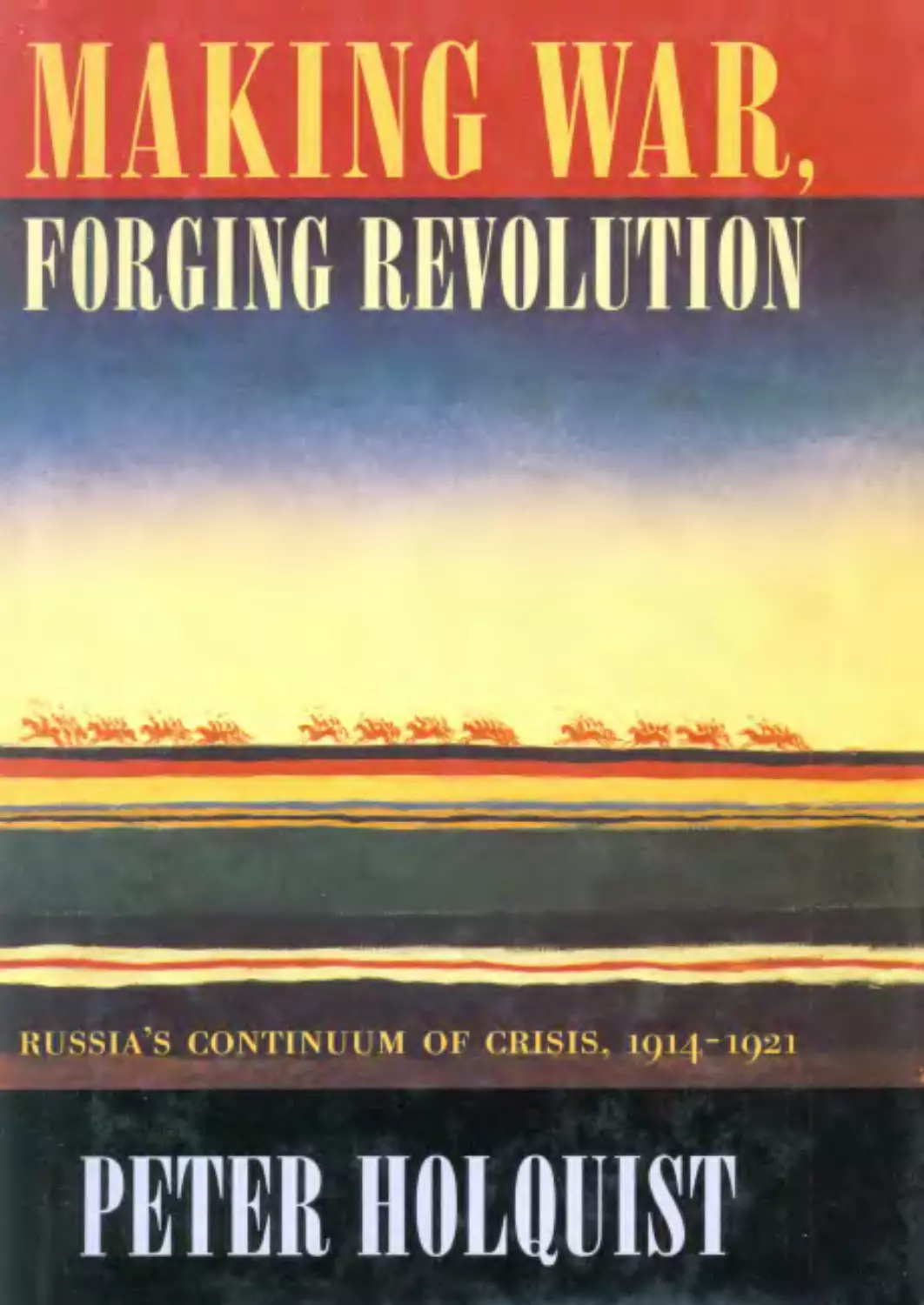
Making War; Forging Revolution
I
r-
BLANK PAGE
Making Wa1;
Forging Revolution
RUSSIA'S CONTINUUM OF CRISIS,
19 1 4- 1 9 21
PETER HOLQUIST
HARVARD UNIVERSITY PRESS
Cambridge, Massachusetts
London,England 2002
Copyright @ 2002 by the President and Fellows of Harvard College
All rights reserved
Printed in the United States of America
Library of Congress Cataloging-in-Publication Data
Holquist, Peter.
Making war, forging revolution: Russia's continuum of crisis, 1914-1921 /
Peter Holquist.
p. cm.
Includes bibliography and index.
ISBN 0-674-00907-X (alk. paper)
1. Don River Region (Russia)-History-Revolution, 1917-1921.
2. Don Cossacks-History-20th century. 3. Don River Region (Russia)-
Rural conditions. 1. Title.
DK265.8.D596 H65 2002
947' .49-dc21
2002075942
To Diana
BLANK PAGE
Acknowledgments
This book would never have come into being without the generosity of
a large number of individuals and institutions. Although I bear full re-
sponsibility for all errors and opinions in this book, its strengths build
upon the support, criticism, and collegiality of others.
This work began as a dissertation at Columbia University. There
Leopold Haimson taught me to see history as a system; Mark von
Hagen was and remains a wonderful supporter, and now friend; and
Richard Wortman helped me see the imperial period in all its depth,
preventing me from thinking of it only as an antechamber to Soviet
history. I benefited from a wonderful dissertation committee, consist-
ing of these three scholars as well as Alfred Rieber and Boris Gasparov.
Their criticisms of that dissertation have made this a better book. Ste-
phen Kotkin's seminar on Russia through the prism of European his-
tory was a cathartic intellectual experience. He has remained a wonder-
ful critic and source of ideas.
I had the good fortune to enter Columbia with a remarkable cohort
of graduate students. My discussions with them suffuse this entire
work. I cannot say where our collective approach ends and where my
own thinking begins. Seminars and endless discussions with Nathaniel
Knight, Fred Corney, Yanni Kotsonis, Laurie Manchester, Igal Halfin,
Amir Weiner, Jochen Hellbeck, and Charles Steinwedel shaped my ho-
rizons. I am especially grateful to Igal Halfin and J ochen Hellbeck for
Vll1
A cknowledg;m en ts
expanding these horizons far beyond where they began-and making
graduate school not only tolerable but enjoyable. Michael David-Fox
spent one semester at Columbia, which was only the beginning of
an ongoing friendship. David McDonald, Frank Wcislo, and David
Hoffmann served as avuncular guides to Columbia University and to
history. This group continues to sustain me. Igal Halfin and J ochen
Hellbeck inspire me, in life and in scholarship; Amir Weiner has main-
tained a faithful friendship and ongoing dialogue with me, even when I
exasperate him; Yanni Kotsonis and Charles Steinwedel have been gen-
erous with their friendship, time, and knowledge. My continuing dia-
logue with Michael David-Fox has shaped me and my work. I am
grateful also for his good humor.
Russian colleagues and friends supported me in Russia and helped
me see the joys and tragedies of Russian history: Aleksandr Kozlov and
Andrei Venkov in Rostov; Boris Kolonitskii; Vladimir Shishkin; and
Sveta Semenova and her family.
A new generation of scholars focusing on Russia during the First
World War graciously shared their work and tutored me in their own
specialties: I thank Eric Lohr, Joshua Sanborn, and Peter Gatrell.
Laura Engelstein, Daniel Orlovsky, Donald Raleigh, and William
Rosenberg shared their knowledge of late imperial and revolutionary
Russia and demonstrated a remarkable generosity of spirit. I am espe-
cially grateful to Donald Raleigh, who is the "godfather" of this book.
He shared his knowledge of provincial Russia and local archives; he
read the grotesquely long dissertation with patience; and he then read
the manuscript as well. Through it all, he showed unflagging support
for my work.
The anonymous reviewers for Harvard University Press later un-
masked themselves. Donald Raleigh and Daniel Orlovsky were re-
markably helpful and constructively critical. Their criticisms have
vastly improved the book. Michael David-Fox read and commented on
the entire manuscript. Those who read large portions, often at very
short notice, and who have contributed significantly to the book at var-
ious stages include Paul Bushkovich, Andrea Graziosi, David Hoff-
mann, Isabel Hull, Yanni Kotsonis, David McDonald, Benjamin
Nathans, Dan Orlovsky, William Rosenberg, Charles Steinwedel,
Frank Wcislo, and Amir Weiner. Participants at a variety of confer-
Acknowledgments
IX
ences have contributed invaluable comments and criticisms. I thank
Teresa Howley for preparing the map of the Don Territory.
Since 1997 the Cornell History Department has been my home. It
has provided an unparalleled intellectual environment. I am indebted
to the European History Colloquium and to the Department's encour-
agement of team-teaching. I particularly wish to thank Itsie Hull for
providing a warm example of what a colleague, teacher, and scholar
should be; and Sherm Cochran, for his warmth, patience, and overall
cosmopolitanism.
Much of the argument in Making War is built upon research and
reading in Russian archives. Several institutions made it possible for me
to read broadly and deeply. Initial research was supported by an IREX
dissertation grant; further research was made possible by an SSRC
Eurasia grant. The Kennan Institute for Advanced Russian Studies of
the Woodrow Wilson Center in Washington, D.C., and the National
Fellows' Program of the Hoover Institution on War, Revolution, and
Peace each supported long stretches of time to write. Without the
help of archivists at GARI\ RGVA, RGASPI, RGVIA, RGIA, GARO,
and TsDNIRO, I would have been lost. I particularly thank Nonna
Tarkhova at RGVA and the archivists of GARF and GARO. They and
their selfless efforts represent Russia at its very best.
My editor at Harvard University Press, Joyce Seltzer, saw promise in
an unwieldy manuscript. Her suggestions have made this book immea-
surably better. It has been a joy to work with her.
Most of all, I am indebted to my family. To my parents, for their un-
stinting support of me, through thick and thin. To Katerina Clark, for
always believing in me. To my brothers, for helping me keep every-
thing in perspective. To Albert and Deborah Kaplan, who have loved
and supported me as their own. My children, Hana and Isaiah, have lit-
erally lived with this project for all their young lives. My only regret
about this book is the time it has taken from them. I dedicate this book
to my wife, Diana. Her love has sustained me through all and has
shown me what is really important in life.
BLANK PAGE
Contents
Note on Usage Xlll
Introduction 1
1 Russia at War 12
2 "Radiant Days of Freedom" 47
3 Persuasion and Force 81
4 Toward Civil War 113
5 Forging a Social Movement 143
6 "We Will Have to Exterminate the Cossacks" 166
7 "Psychological Consolidation" 206
8 The Revolution as Orthodoxy 241
Conclusion: The Emergence of the Soviet State 282
Note on Sources 291
Abbreviations 297
Notes 299
Index 353
BLANK PAGE
Note on Usage
Through February 1918 Russia adhered to the Julian calendar, which
ran thirteen days behind the Gregorian, or Western, calendar. Dates
are given in the Julian style (Old Style) until January 31, 1918, when
Russia adopted the Gregorian calendar (New Style). Dates of anti-
Soviet publications, which followed the Julian calendar, have been con-
verted to New Style.
I have employed the Library of Congress system of transliteration,
except for names widely employed in English (for example, "Trotsky"
instead of "Trotskii").
A pood is approximately 36 pounds; a desiatin is 2.7 acres.
The following terms refer to specifically Cossack forms of adminis-
tration:
ataman: a Cossack headman, a post of administrative responsibility;
stanitsa: a Cossack community, both the stanitsa proper (often number-
ing up to 20,000 inhabitants) and the administrative unit encompassing
the stanitsa and smaller, outlying Cossack settlements;
khutor: a Cossack settlement within a stanitsa.
BLANK PAGE
Making War; Forging Revolution
Map of the Don Territory
ffl
9
Ql-
Q .
" Ce
Districts
I:
II:
III:
IV:
V:
VI:
VII:
VIII:
IX:
Donets
Second Don
First Don
Rostov
Sat'
Taganrog
Ust'-Medveditsa
Khoper
Cherkassk
Territory boundary -
. ,e
()'\)
(
o'\)
f(
11ft' Province
.1Jos
"f, 1t tt te f'J
Introduction
In our own century there has arisen. . . an altogether different type of
event in which it is as though even the fury of war was merely the
prelude, a preparatory stage to the violence unleashed by revolution.
r--J Hannah Arendt, On Revolution
has become customary to date the true beginning of the
twentieth century not from 1900 but rather from two events: the First
World War and the Russian Revolution. While scholars have long rec-
ognized the interrelationship between these two seminal episodes, few
studies have analyzed their interaction. This oversight resulted in part
from the revolution's own image of itself. For seventy years, the Com-
munist Party and the Soviet state insisted that the October Revolution
marked a radical break in the history of humankind. October's oppo-
nents inverted the Communist signifiers from positive to negative but
ironically retained the underlying structuring chronology.1 Commu-
nism's advocates and foes alike dated their narratives from 1917.
There were good reasons to do so. One of the essential features of
the revolutions in both February and October 1917 was the belief
among their participants that they were making-and experiencing-a
radical break with the past, that they were bringing about a new order.
In the course of 1917, people across the political spectrum shared a be-
lief that revolutionary politics could transform society and each indi-
vidual in it. This narrative of the revolution as a foundation event ele-
vated the Bolsheviks and their revolution above the historical context
that had produced both the revolution and the Soviet state. In this way,
the Russian Revolution became uncoupled from the wartime crisis out
of which it had emerged. Only in Russia did a self-proclaimed revo-
1
2
Introduction
lutionary, Marxist regime emerge at the other end of the crisis that
marked the end of the Great War throughout central and eastern Eu-
rope. This gulf in outcomes had the effect of drawing a line between
Russia and the rest of Europe.
Contemporaries and subsequent analysts telescoped Russia's path
through the common European deluge (1914-1921) into its period of
revolution. As a result, Russia has largely fallen out of the general story
of the Great War and twentieth-century European history. Yet rein-
serting the Russian experience is crucial for understanding the First
World War in general. Russia's 1917 revolutions exerted a reciprocal
impact upon the European wartime ecosystem. The Russian Revolu-
tion served as a major precipitant for the wartime "remobilization" af-
ter 1917 that took place across Europe. 2 It had an equally great impact
upon the politics of war aims and peace making.
Some contemporaries underscored this linkage between war and
revolution. In November 1919, in the middle of the Russian civil wars,
Peter Struve-one of Russia's preeminent political figures, who had
traveled the path from legal Marxism to opposing the Bolsheviks-
delivered a lecture in Rostov-on-Don, one capital of the anti-Bolshevik
struggle. Struve proclaimed that "the world war formally ended with
the conclusion of the armistice . . . In fact, however, everything from
that point onward that we have experienced, and continue to experi-
ence, is a continuation and transformation of the world war."3 Struve's
observation suggests that rather than distinguishing between a period
of war (1914-1917) and one of revolution and civil wars (1917-1921),
one might instead speak of a broader 1914-1921 cataclysm, with 1917
serving as its fulcrum. 4
Reinserting Russia's revolution within the war makes it a European,
rather than a solely Russian, story. The Soviet state crystallized at a
particular moment, amid the more generalized 1 914-1 921 European
crisis. Historical studies have not overlooked the linkage between the
First World War and the Russian Revolution. In its most common for-
mulation, however, the relationship between the two is reduced to a
question of whether the war served as a causal trigger, a catalyst, for
revolution. This approach focuses more on the viability of imperial
Russia before the war than on the ways in which Russia changed during
the course of the war. Studies devoted to Russia's participation in the
war demonstrate that profound changes were taking place during these
Introduction
3
years. These works convincingly show how the war caused the fall of
the old regime, but they are less interested in examining how the war
shaped the emergence of the new regime. Hence they rarely carry their
analyses from the war years into 1917 and beyond. 5 Similarly, there are
excellent studies of how the Soviet state consolidated its power, but
these commonly date developments from October 1917 and do not
seek the pre-October (and especially pre-1917) roots of many revolu-
tionary practices.
The war and revolution, as Struve suggests, were not two discrete
events but rather points along a common continuum. Analyzing the
revolutionary period as a process rather than as an event radically re-
casts its points of reference. As with the French Revolution, the years
immediately preceding the Russian Revolution shaped the conceptual
terrain and institutional framework in which the revolution unfolded. 6
Yet unlike Old Regime France, Russia in the years immediately preced-
ing the revolution experienced not only administrative reform but also
wartime mobilization. With the revolution occurring amid wartime
mobilization, there developed a reciprocal relationship between total
war and revolution. In particular, Russia's political class harnessed tools
of wartime mobilization for its political projects. 7 Whereas other Euro-
pean societies and governments incorporated wartime practices of total
mobilization, they could dispense with them or subordinate them to an
existing order. In revolutionary Russia, these institutions and practices
instead became the building blocks of the new state and socioeconomic
order.
In 1930 Ernst]iinger, whose worldview had been shaped by the war,
asserted that "these two phenomena, world war and world revolution,
are much more closely interrelated than a first glance would indicate.
They are two sides of an event of cosmic significance, whose outbreak
and origins are interdependent in numerous respects."8 Throughout
much of central and eastern Europe, the war wound down in an ex-
tended convulsion of revolutions and civil strife. In this light, the vio-
lence of the Russian civil wars appears not as something perversely
Russian or uniquely Bolshevik, but rather as the most advanced case of
a more extended European civil war, beginning with the Great War
and stretching several years after its formal conclusion. Rather than
viewing these civil wars, and the Russian civil wars in particular, as dis-
tinct episodes in their own right, we might instead think of them, as
4
Introduction
Struve suggested, as a "continuation and transformation" of the world
war. In the aftermath of this European "Time of Troubles," domestic
politics "could no longer be described as peacetime politics." Not just
in Russia but in other European states as well, "domestic politics after
1918 became an expression of a latent civil war."9
Yet the Soviet state and its opponents emerged not only from the
shared experience of European war but also from a common Russian
heritage of revolution. In tsarist Russia, educated society's political im-
potence and sense of social obligation had fused into a powerful com-
mitment to reforming the political order and society. Because of their
oppositionist stand toward the autocracy and sense of backwardness in
regard to their own ideals, members of Russia's educated society were
committed to a revolutionary transformation of society, although revo-
lutionary not necessarily in the terms advocated by political radicals. to
In the years before 1914 educated society's ability to act on its aspira-
tions had been blocked by the autocracy's opposition to public involve-
ment in policy. Wartime mobilization led to the emergence of struc-
tures in which the public could finally play a role in policy making.
Russia thus telescoped the stages of the establishment of many public
organizations, which existed in most other combatants before the war,
with their reorganization to the ends of war mobilization. Thus the re-
sulting network of semipublic, semistate structures was less a public
sphere autonomous of the state than a "parastatal complex" in which
society and state were tightly intertwined. ll The February Revolution
in 1917 brought to power the class that was staffing this complex and
provided it with the long-desired opportunity for realizing its aspira-
tions. The structure from which members of educated society would
operate, however, was now this parastatal complex that had developed
during the war; the tools for achieving their prewar dreams became, in-
creasingly, tools derived from wartime mobilization.
The Russian Revolution in 1917 marked a tectonic shift in the na-
ture and scope of politics in the Russian Empire, a shift encompassing
both the use of modern state practices and the crystallization of a revo-
lutionary political ecosystem. 12 The course of 1917 witnessed both a
quantitative increase in traditional politics and a qualitative transfor-
mation in its definition and scope. Whatever their party or ideologi-
cal affiliation, all political movements in the post-February period en-
gaged in a form of revolutionary politics, seeking to remake Russian
Introduction
5
society as much as its political order. In this sense, the Russian Revolu-
tion was a "social revolution" not only because various social groups
made it, or because the social order was changed, but because all politi-
cal actors sought to employ politics as a tool to transform society.13
This heritage of revolutionary aspirations informed the programs not
only of the Bolsheviks but also of their opponents. The anti-Soviet ac-
tivists were not simply reactionaries or restorationists; while opposing
the Bolshevik variant of revolution, they, too, aimed to reform-some
even to transform-Russian society.
The Provisional Government established in) February 1917 was a
revolutionary government, defining itself explicitly in contrast to the
"Old Regime" that preceded it. Total mobilization in Russia took place
against this background of a longstanding and powerful critique of the
existing order. As a result, revolutionary governments in Russia-in
February and October-implemented measures for total mobilization
common to other warring powers, but in a supercharged and concen-
trated form. The implementation of wartime policies overlapped with
the revolutionary reordering of the political system and society. Else-
where, governments relied upon a thick network of existing public in-
stitutions to mobilize society for war. The Provisional Government
promulgated many revolutionary programs, but because of the attenu-
ated development of public structures, it proved unable to realize them.
Confronting this situation, proponents of the Provisional Government
in particular came to view the state and the army as surrogates for the
structures of civil society missing in Russia. The Soviet state, which in
the absence of public structures relied on coercive means, implemented
many of these programs initially proposed by the Provisional Govern-
ment.
Seen from this perspective, the Russian Revolution did not exist in
hermetic isolation from the civil wars that followed. (What is termed
the "Russian Civil War" in fact was a series of overlapping civil wars
and national conflicts. To highlight the multiple vectors of this strug-
gle, throughout this book I employ the plural "civil wars" rather than
the homogenizing "Russian Civil War.")14 The traditional chronol-
ogy dividing the Revolution of 1917 from the civil wars implicitly sug-
gests that the latter were external to or separate from the revolutions
they followed. Yet political movements, including the anti-Soviet ones,
fought the civil wars precisely over the question of how to interpret and
6
Introduction
implement "the Revolution." State practices-many developed in the
wake of the First World War-were the means for realizing this funda-
mentally political project.
In examining the unfolding of revolutionary aspirations, this book
concentrates on political practices. It is less a social history of politics
than a political history of social movements. To be sure, political pro-
grams needed to find purchase in lived experience and existing collec-
tive aspirations. Yet social and economic preconditions alone do not
satisfactorily explain people's political behavior. Is Rather than examin-
ing the mobilization of social groups, well studied for 1917, I instead
focus on Russia's political class and how it shaped preexisting collective
aspirations into self-consciously identified "social movements"; that is,
I examine the mechanisms for instituting and reinforcing political pro-
jections, the methods for finding a political purchase in sociological
experIence.
Political practices are the measures that political movements employ
to achieve their ideological goals, along with the behaviors and as-
sumptions-conscious and unconscious-that underlie such practices.
Practices and the ideologies that envelop them exist in a mutually con-
stitutive and symbiotic relationship. Ideology shapes the means and
ends to which political practices are applied. Such practices, for their
part, determine the scope and form of political intervention. This study
concentrates on the emergence and transformation of three particular
state practices: state management of food supply; the employment of
official violence for political ends; and state surveillance of the popula-
tion for purposes of coercion and "enlightenment." These three vec-
tors of state activity were among the most intrusive and unavoidable
points of contact between citizens and various contenders for political
power.
All movements in the Russian Revolution employed a shared heri-
tage of political practices that were emerging out of Russia's total war
experience. As Alexis de Tocqueville noted for the French Revolution,
revolutionaries "took over from the old regime not only most of its
customs, conventions, and modes of thought. . . in fact, though noth-
ing was further from their intentions, they used the debris of the old
order for building up the new."16 Such political practices were not
the product of any particular ideology. They predated the new revolu-
tionary ecosystem, but after 1917 they could be deployed, massively
Introduction
7
and without constraint, to accomplish new ideological ends. Political
movements, in 1917 and afterward, incorporated, intentionally and un-
intentionally, certain working assumptions and categories that were
implicit in these wartime state practices. Thus ideology alone did not
make the Bolshevik regime. The tools of state it inherited to pursue its
ideological project were the tools of wartime coercion and mobili-
zation. An aim of this study is to identify particularities in how the
competing sides actually employed these practices for their very differ-
ent ideological projects. The specificity of Bolshevik policies, however,
can be appreciated only against the more generalized European back-
ground of total war.
A study of practices requires the kind of in-depth examination that
only a local study can provide. 17 The Don Territory, a region in Russia's
south, is the locus for this analysis. A regional focus permits an exami-
nation of the interplay between state policy and local implementation,
of how national policies unfolded and were transformed in a specific lo-
cal context. This level of analysis underscores the varying degrees of
slippage between official aspirations and the forms of their realization.
The Don Territory had its own particularities and specificities, as
does any region. It recommends itself for this analysis, however, for
several reasons. It was one of Russia's premier grain-growing regions.
Throughout the 1914-1921 period successive regimes assigned it an
important role in their increasingly frantic food-supply operations.
The region's repeated failure to meet these expectations provides an
opportunity to analyze the divergence between official expectations
and people's actual behavior.
The most significant distinguishing feature of the Don Territory,
however, was the fact that it was a Cossack region. Cossacks, Russia's
martial estate, occupied a special place in the Russian political imagina-
tion. Because actors across the political spectrum assumed that Cos-
sacks would be a major force in the revolution, the Don Territory
figured prominendy in the political calculations of all national move-
ments. For this reason, the Don Territory and its inhabitants came to
playa disproportionately large role in the course of 1917 and the ensu-
ing civil wars. IS
During the civil wars of 1917-1921, the front line repeatedly passed
over this region. As a consequence, the territory was variously con-
trolled for extended periods by the Reds and the Whites. Moreover,
8
Introduction
the documents generated by both sides, while widely dispersed, are
largely extant. Thus the region affords a unique opportunity to analyze
the ways that both the Soviets and their opponents actually practiced
politics. This comparative analysis demonstrates some striking and
hitherto under-appreciated similarities in the political practices of the
Soviets and their opponents. In doing so, it provides a perspective on
the development of Soviet political culture that is much different from
that found in the existing literature, both in Russia and in the West,
which has tended to focus on either the Soviets or their opponents in
isolation from each other.
The Don Territory was an administrative region, equivalent to a
province, in Russia's southwest. 19 By 1914, it numbered nearly four
million inhabitants. Cossacks gave the region its distinctive face, but
they composed only 39 percent of the population. Peasants native to
the Don made up 24 percent, and "outlanders"-non-natives who had
settled in the Don Territory-29 percent. 20 Although by the early
twentieth century Cossacks were no longer the majority of the popula-
tion, the Don Territory continued to be defined by the corporate struc-
ture for the Cossack estate, the Don Host [donskoe voisko]. (For rea-
sons of accessibility in English, I have employed "Cossack" rather than
"Host" throughout this work.) This link to the corporate Cossack ad-
ministrative structure accounted for several distinctive features. Rather
than the "districts" [uezdy] found in most other provinces, the Don
Territory was divided into "military districts" [okruga]. By 1917 there
were nine such districts: three known as "northern" (Ust'-Medveditsa;
Khoper; Second Don); one "middle" (Donets); three "southern"
(Cherkassk; First Don; Sa!'); and two overwhelmingly peasant districts,
located to the west (Rostov and Taganrog). In late 1917 a tenth dis-
trict-Upper-Don-was formed.
Below the district level, Cossacks and peasants inhabited segregated
administrative structures. Peasant regions had "counties" [volosti], as
existed in regular provinces, which were further subdivided into vil-
lages [derevnt] and settlements [slobody]. Cossacks, by contrast, had
"stanitsas" [stanitry] in place of "counties." A stanitsa was both the large
settlement proper as well as the administrative unit encompassing sev-
eral dozen smaller Cossack settlements [khutora]. The stanitsa proper
was usually quite large-in some cases numbering twenty thousand or
more inhabitants-and often was more akin to a small town than to a
villa ge.
Introduction
9
The Don Territory lacked the zemstv0, the local self-governing
structure that was established by the Great Reforms and existed in
most of the rest of European Russia. It had actually been introduced in
the Don Territory in 1875, only to be withdrawn in 1882 under pres-
sure from Cossacks, fearing that the zemstvo leveled their privileges to
those of the peasantry. From that date Cossacks remained under their
traditional atamans, paternalistic administrators appointed from above.
In place of Cossack atamans, peasants had district peasant boards and
county elders.
In addition, there were several large urban and industrial areas.
Rostov-on-Don (hereafter, Rostov) was one of the empire's largest and
most vibrant cities. An important city with a very heterogeneous popu-
lation, it had been appended to the Don Territory only in 1888. Along
with the largely Armenian settlement of Nakhichevan', it numbered
nearly 230,000 inhabitants in 1915. It was the region's leading indus-
trial and trade center and home of a vibrant regional press. The admin-
istrative capital, Novocherkassk, was home to the Cossack corporate
administrative organs, and the Cossack nobility and service elite domi-
nated it. There were several other urban centers, such as Taganrog, the
port of Azov, and several district capitals. There also were industrial ar-
eas located outside cities, primarily in the Donbass mining region. 21
Given the focus of previous studies on the workers, and this book's in-
tention to focus on the politicization o the rural population, I do not
concentrate on these urban and industrial centers.
The Cossack estate was a martial estate. Its distinguishing features
were universal male military service in specific Cossack formations and
the attendant privileges for such service, most notably exemption from
taxation. Between them, Cossack communities and the Cossack corpo-
rate administration held the majority of land in the Don Territory. The
"Host estate" [voiskovoe soslovieJ-the official title-was itself a micro-
cosm of Russia's estate structure, encompassing nobles, priests, mer-
chants, and "Cossacks," who were the vast majority. "Cossacks" were
those members of the "Host estate" living in stanitsas, working the
land, and serving in the territorially raised Cossack units. Such was the
official definition by estate criteria. Rank-and-file Cossacks, however,
increasingly defined themselves in terms of their lifestyle: living and
farming in a stanitsa and serving in a territorially raised Cossack regi-
ment. These experiences set them apart from the Cossack elite as much
as from neighboring peasants. During and after the 1905 Revolution,
10
Introduction
many Cossacks in fact contrasted this lived form of Cossack identity to
the purely ascriptive identity favored by the Cossack elite and the cor-
porate Cossack administration.
In the countryside there were effectively two groups of non-Cos-
sacks. "Native peasants" [korennye krest'iane] had lived on the Don prior
to the emancipation of the serfs in 1861. With emancipation, they had
received official land allotments, originally between three and four
desiatins (one desiatin is equivalent to 2.7 acres). Population growth
had reduced allotments to 1.4 desiatins per soul by 1906. Peasants sup-
plemented these meager collective holdings through both private and
collective purchase of land and through extensive rentaL In 1905 peas-
ants held 23 percent of all privately owned land, almost double the
amount of communal allotment land they held. 22 The dynamics of
agrarian unrest in 1917 would therefore be different in the Don Terri-
tory than in other parts of Russia: the prospect of seizing large amounts
of land from private estates did not exist. Although they resented the
vast amount of land held by Cossa ks, peasants themselves were among
the leading holders of private land, both as property and through
rentaL
The other group, the "outlanders" [inogorodnie], was more amor-
phous than native peasants. Officially, this term designated someone of
any estate (noble, merchant, or peasant) living on the Don but not
officially registered there. However, Cossacks sometimes used "out-
lander" to refer to all non-Cossacks, thus collapsing together both na-
tive peasants and true outlanders. Because they had no allotment land,
outlanders primarily rented land either from the Cossack host or from
private landowners. 23 Consequently, they often had the most strained
relations with Cossacks and were more closely identified with market
practices undermining the traditional estate system in landholding.
The land issue caused serious tensions between Cossacks and non-
Cossacks. But the issue was not simply Cossack land wealth and non-
Cossack "land envy." Indeed, the structure of landholding itself exac-
erbated tensions. Collectively, Cossacks possessed the lion's share of
the land in the Don Territory, holding on average nearly seventeen
desiatins per household, more than double that of native peasants and
vastly more than that of outlanders. Peasants, both native and out-
lander, engaged in large-scale rental of land. Thus, the amount of land
actually sown by Cossacks and non-Cossacks-and especially native
Introduction
11
peasants-was much more equivalent. 24 While holding less allotment
land, peasants engaged in more intensive forms of agriculture than did
Cossacks, employing more hired laborers and utilizing more advanced
agricultural technology.25 Tensions between Cossacks and non-Cos-
sacks therefore stemmed as much from the type of agricultural rela-
tions-traditional estate relations or those of the market-as from the
amount ofland. 26
Thus on the eve of war and revolution, there were several axes of
identification and tension. How the population of the Don Territory
negotiated claims to make sense of these collective experiences and as-
pirations in the maelstrom of war, revolution, and civil wars is the focus
of this study.
"-'1
Russia at War
I simply understand nothing about these questions of
food supply and provisioning.
.--. Nicholas II, letter to Empress Alexandra
(September 20, 1916)
V uring the First World War, food supply became one of
the most important areas of expanded state intervention and public de-
bate in Russia. Agriculture was central to the Russian economy (it was
by far the largest sector), to Russian society (more subjects were en-
gaged in agriculture than in any other pursuit), and to Russian political
life (the peasant and land questions were burning issues of the day).
During the period of war and revolution, state measures pertaining to
the food supply became, along with military recruitment, one of the
most intrusive and prevalent points of contact between individuals and
the state, especially in the countryside. Food supply therefore provides
a particularly useful lens for examining the political economy of impe-
rial Russia at war.
Imperial Russia entered the First World War amid an ongoing polit-
ical crisis. The autocracy had barely survived the 1905 Revolution,
when nearly the whole nation had aligned against it. In October 1905
Nicholas II granted the October Manifesto, promising a semiconstitu-
tional order, including an elected legislature, the State Duma. Peter
Stolypin, since 1906 the chairman of the newly reformed Council of
Ministers, oversaw a dual program of repression and reform. The re-
pression was violent but effective. As to reform, Stolypin in June 1907
restructured the State Duma's electoral laws in order to make it more
pliant but also a more effective partner in governing. His controversial
12
Russia at War
13
agricultural reforms sought to provide the autocracy with a new and
firmer sociopolitical foundation.
Beginning in 1912, however, the Russian Empire entered a new "cri-
sis of autocracy." This crisis would profoundly influence how the em-
pire would negotiate the war. Nicholas II, who had never made peace
with the 1905 reforms on his autocratic powers, turned against even
Stolypin's system.! He despised the State Duma and its parties, even
those loyalists who sought to reform the autocracy, such as the Oc-
tobrists. He had even less patience for the more oppositionist C nsti-
tutional Democrats, or Kadets (from the Russian initials of the party's
name), who viewed themselves as supraparty, supra class agents for
bringing a progressive, mighty Russian state into being. 2
Nicholas II was no more pleased with the form of his own govern-
ment, the Council of Ministers. In Nicholas's eyes, the council's claim
to administrative routine infringed upon his prerogatives, just as the
State Duma claimed to place limits on his powers by invoking the na-
tional good. The Romanov dynasty's tercentenary celebrations in 1913
reinvigorated Nicholas's belief that there existed an unshakeable bond
between tsar and people. Mter Stolypin's assassination in 1911, Nicho-
las made sure that chairmen of his government did not ever again exer-
cise such authority. With Nicholas's having intentionally weakened his
own government, court favorites and ministerial infighting became im-
portant features of political life in the years that followed. 3
Yet the opponents of autocracy were no more united. After 1905,
and especially after 1912, the Russian Empire experienced a crisis of
"polarization."4 The,gulf between Nicholas and his own government
was one axis of polarization. The rift between "society" and the politi-
cal parties born of the 1905 Revolution, on the one hand, and the au-
tocracy, on the other, was a second such axis. Because the autocracy so
jealously protected its own prerogatives, Russia lacked any institution-
alized network, such as France's national school system, that might
have served to stitch together the "common people" and "educated so-
ciety" into one sphere of "society." Public activists in Russia thus con-
fronted challenges on two fronts: from the autocracy's arbitrary au-
thority from above, and from the benightedness and backwardness of
the masses below. Although a vibrant public sphere arose in the cities,
Russia's autocratic system prevented the emergence of a true civil soci-
ety, institutionalized in the law and concrete political structures. 5 This
14
A1AKI G \VAR, FORGING REVOLUTION
context profoundly inflected the programs and ideals of Russian edu-
cated society. The absence of the institutions necessary to secure a true
civil society, compounded by the intelligentsia's own conceits and aspi-
rations, fostered attitudes antithetical to civil society among precisely
those groups who would have been candidates for constituting it. Edu-
cated society's political impotence and sense of social obligation fused
into a powerful sense of mission. Invoking its own "consciousness," the
public set itself the task of taming and channeling the Russian people's
"spontaneity. "6
Because Russian society telescoped phases of development that un-
folded sequentially in western Europe, there emerged a form of "com-
bined development," "an amalgam of archaic with more contemporary
forms."7 Many activists and bureaucrats held that Russia might by-
pass the pitfalls experienced by those societies that had already passed
through industrialization, what Trotsky later termed the "privilege of
historic backwardness."8 When Russia began to implement forms of
specialist intervention, especially after 1905, it did so as its preferred
models of progress were themselves developing critiques of the mod-
ern order. Harnessing these critical programs, Russian professionals
and reformers produced "an anticipatory critique of institutions not yet
endowed with the authority of an established order."9 Thus, Russia's
political class combined a desire to change the existing state of affairs
with a repudiation of the defects of a modern industrial, capitalist or-
der, which they found already existing in England or Germany, but
which had not yet become established in Russia. Public activists antici-
pated changing the established order and replacing it, not with modern
society as it already existed in western Europe, but with an idealized
projection of it. In the years immediately preceding the war, even Rus-
sian economic and legal thought, while critical of the autocracy proper,
championed a special role for the state rather than the commercial
structures prevalent elsewhere. lO Thus public activists in Russia were
committed to a revolutionary transformation of society, although revo-
lutionary not necessarily in the terms advocated by political radicals.
Opponents of autocracy came increasingly to view a powerful state
as both a political ideal and a concrete instrument, the antithesis of as
well as the remedy for Russia's backwardness. The polarization was less
a gulf between "state and society" than a struggle between autocracy
and educated society over how best to employ the state to transform
Russia at "War
15
Russian reality.ll This emphasis on state consciousness was a distinctive
feature of Russian political culture, and its leading proponents were
the Kadets. Although its members were drawn overwhelmingly from
the urban free professions, this party had always viewed itself as a
supraparty and supraclass organization. For Kadets, the state would be
the instrument for creating both a civilized nation and enlightened citi-
zens. This ethos predisposed Kadets to speak of collective sacrifice for
the commonwea1. 12
Mter 1912, as a result of the failure of the Duma system to forge a
common, reformist agenda between government and educated society,
those parties that had committed themselves to working through the
State Duma-the Octobrists, the Kadets, and the Progressists-were
confronted with a crisis of identity. Whereas such parties had previ-
ously been the predominant institutional form of political expression,
they seemed increasingly irrelevant. Over the course of 1914, all lead-
ing political parties in the State Duma were fracturing over whether it
was better to pursue further reform with a hostile government or to
court revolution again, as they had in 1904-1 905. 13 In place of parties,
some members of the educated elite proposed a new broad political al-
liance across party lines, capable of mobilizing the support of all sectors
of Russian society, including representatives of the revolutionary left.
Indeed, the State Duma's parliamentary activities over several years
had fostered a new form of sociability across party lines. 14 To many in
Russia's political and educated elite, the threat of war in July 1914 rep-
resented an opportunity to break out of this impasse. War held forth
the prospect of building an "all-nation struggle," just as in 1905, in the
course of which Russian society could overcome divisions both within
and between parties, as well as finally seal the rift between society and
the regime. IS
A third axis of polarization ran between this educated society and the
masses, in whose behalf educated society claimed to speak. The 1905
experience and its aftermath had increasingly estranged "the plebs"
[nizy] from progressive educated society. The State Duma and all par-
ties within it claimed to speak in the name of "the people." But
Stolypin's restrictive suffrage laws had in fact created a State Duma
with an artificial majority that was far more propertied, rightist, and
ethnically Russian than the empire's population as a whole. 16 Mter a lull
in the aftermath of the 1905 Revolution, social unrest intensified again
16
MAKING WAR, FORGING REVOLUTION
after 1912. The war would see an almost immediate drop in industrial
conflict, and this domestic peace would last for some time. Many con-
vinced themselves that the gulf between "society" and "people" would
disappear of its own accord once the autocracy was reformed or de-
stroyed. The course of the war and 1917 itself, however, would demon-
strate the tenaciousness of this third axis of polarization.
War and the Food Supply
In order to fund Russia's industrialization program, Ivan Vyshnegrad-
skii, the finance minister under Alexander III, had declared, "Let us
starve, but let us export grain." This the Russian Empire did. Eighty
percent of the empire's total exports, measured by value, were agricul-
tural. Owing both to its immense size and to this calculated govern-
ment policy, Russia was one of the world's largest grain exporters: it ac-
counted for 42 percent of the world export in wheat. More than half of
Russia's marketed grain was exported, with Germany, Holland, and
Great Britain the chief customers. Three-quarters of these agricultural
exports passed through the ports of the Black Sea. With the war's out-
break, that outlet closed.I 7
Agricultural production in Russia took place primarily on peasant
holdings, which had a lower productivity than either private farms or
large estates. Peasants produced more than three-quarters of both the
empire's grain harvest and its marketed grain. IS Yet the majority of
peasant farmers themselves had very low rates of consumption. 19 Russia
was simultaneously one of the world's leading grain exporters and a
country in which the consumption norms among those producing
these huge surpluses were quite low.
Given Russia's grain surplus and the widespread belief that the war
would not last for any extended period, the Russian government did
not worry much about its food supplies as war threatened. The 1914
harvest was average, but the previous two harvests had been excellent.
The vast amounts of grain that Russia traditionally exported abroad,
which would be choked off with the closing of the Black Sea, could
simply be shifted to meet the needs of the vastly expanded army.
Two weeks into the war, the Council of Ministers addressed the
question of grain supplies for the first time. The government's concern,
however, was not a shortage of grain but rather "speculation on grain
Russia at "War
17
and profit at the expense of the poor." A cessation of exports and the
anticipated grain abundance had caused a precipitous fall in grain
prices. Alexander Vasil'evich Krivoshein, the minister of agriculture
and a protege of Stolypin, offered the services of his ministry to address
the problem. 20 He urged the Council of Ministers to empower his
agency to coordinate the work of zemstvos [elective local government
assemblies] in overseeing the acquisition of grain supplies for the .army.
Krivoshein cast his agency in the role of "the rear guard for the army
quartermaster." The Council of Ministers accepted Krivoshein's offer
and assigned his ministry responsibility for acquiring grain for the
army, hoping that this measure would have a "moral impact" and that
the country would see it as a "new step" by the government. 21
This decision to assign the task of acquiring grain for the army to the
Ministry of Agriculture had a profound influence on Russia's wartime
food-supply network. The choice was not inevitable. Internal food sup-
ply before the war had traditionally fallen within the purview of the
Ministry of Internal Mfairs. In early 1915, Nicholas II briefly estab-
lished an abortive food-supply organ under the Ministry of Trade and
Industry.22 But there were strong reasons for preferring the Ministry of
Agriculture for this task. The army's head quartermaster noted that his
agency had only a skeletal organization. The Ministry of Agriculture,
in contrast, "had created over the course of the past several years a
large number of trained specialists in all branches of agricultural
life."23 The government also knew that the educated public considered
Krivoshein the most intelligent and reform-minded minister remain-
ing in government. In July 1913 Krivoshein had given a speech por-
traying his ministry as eager to cooperate with "society." Zemstvo spe-
cialists, such as agronomists, especially respected him. He was one of
the few ministers who could boast the confidence of both the emperor
and government circles, on the one hand, and the educated public on
the other. 24
But the Ministry of Agriculture did not abruptly inherit the task of
grain supply in August 1914. Since the turn of the century a new gener-
ation of agrarian experts had emerged within the government, a group
with more direct knowledge of rural life than their predecessors and
with greater aspirations to transform it. 25 After 1906, this genera-
tion would shape the agrarian reforms pressed by Prime Minister
Stolypin-reforms that sought to undermine the peasant commune
18
MAKING WAR, FORGING REVOLUTION
and to use property as an instrument for transforming the inert (and,
after 1905, the potentially revolutionary) muzhik into a responsible, pa-
triotic citizen. Krivoshein, who headed the Ministry of Agriculture
from 1908, had been responsible for implementing Stolypin's reformist
agenda in the countryside. These reforms went far beyond agronomic
improvement and land consolidation. While property was to be a
mechanism for turning peasants into citizens, the reformers simulta-
neously sought to combat the putatively corrosive forces of faceless
"commerce." Productive labor was the ideal. As part of the govern-
ment's reform program, credit and cooperative policies divided the ru-
ral population into categories of "laborers" and "nonproducers," with
the latter defined as an alien and undesirable element. Government-
sponsored cooperatives were meant to serve only "direct producers,"
marginalizing the grasping, capitalist middlemen. 26
Krivoshein, to be sure, was neither a reactionary nor a doctrinaire
opponent of capitalism. Even more than Stolypin, he favored the in-
volvement of large capital in opening up Siberia and Central Asia. He
also supported large private capital in industry, not least because he be-
lieved private investment in that sector would free up more state funds
for agriculture. For agriculture, however, he favored the individual
"strong peasant" and resourceful individual noble landowner, both of
whom he believed were threatened by large, faceless capita1. 27 During
ministerial debates over a new law for joint-stock companies in 1913-
1914, Krivoshein's ministry did not oppose their expansion in industry,
but it fought to limit their role in land purchases. Joint-stock compa-
nies, the ministry argued, would permit "Jewish capital" to circumvent
existing laws that limited Jewish landholding. While not opposing any
"ethnic" limitations for joint-stock companies in industry, the Ministry
of Agriculture demanded-and got-a ban on Jews' holding manage-
rial positions in stock companies involved in land purchases. 28
Although the Ministry of Agriculture fought the spread of com-
merce to the countryside, it was by no means "reactionary." Whereas
other ministries (notably the Ministry of Internal Mfairs) opposed any
form of public involvement in government, Stolypin and Krivoshein
had consistently advocated stronger links with local bodies. Both
proved eager to involve the new generation of agronomists, statisti-
cians, and economists that had emerged after the 1905 Revolution. 29
While they often opposed the form of Stolypin's reforms, these special-
Russia at "War
19
ists shared the antipathy of the new breed of bureaucrats to private
commerce. Cooperative activists wished "to protect grain, our coun-
try's main product, from any encroachments by any stock speculation."
Cooperative spokesmen aspired to drive out private traders and to take
commerce into their own hands. 30 Those who participated in the coop-
erative movement described their involvement as part of a campaign of
enlightenment and liberation. Respondents to one questionnaire eluci-
dated why they supported the cooperative movement: "to help the
peasantry"; "to protect society from the kulaks [wealthy peasants usu-
ally identified with commercial pursuits]"; "a desire to free [the peas-
antry] from the clutches of the kulak usurer (or kulak-trader) and raise
his well-being"; "to aid in the cause of freeing him from the clutches of
Israel."31 These specialists sought to implement their professional vi-
sion in league with, rather than in opposition to, the state, even as they
decried the autocracy heading it. 32
Nonetheless, after 1910 Stolypin's own political entanglements and
the government's financial limitations came to stymie the prime min-
ister's vision. 33 Moreover, after 1912 the growing disharmony in gov-
ernment policies complicated any attempts to fashion an overarching
reform agenda. For Krivoshein, then, the war represented an opportu-
nity to pursue the Stolypin agenda that had been obstructed in the
years preceding the war. His son later recalled that "for Krivoshein, the
war opened up perspectives for implementing the principles contained
in his [July 1913] Kiev speech," the speech in which he called for soci-
ety to aid in his reform efforts. 34 In war conditions, he could now cast
his ministry's reformist agenda in terms of national defense, claiming
that the ministry served as "the rear guard of the army quartermaster."
Funding would no longer be a problem. In this program explicitly in-
tended to support the cooperative and zemstvo institutions favored by
the Ministry of Agriculture, the War Ministry would provide the cred-
its for all expenses. The people heading this new wartime edifice would
be the new generation of agricultural bureaucrats.
The activist and anticommercial ethos animating the Ministry of
Agriculture's reform initiatives came to suffuse the entire wartime
food-supply network. Reacting to the specter not of shortage but of
"speculation," the Council of Ministers in early August 1914 approved
guidelines for the agriculture minister, Krivoshein, to appoint "com-
missioners for army grain purchases." The goal of such state grain ac-
20
MAKING WAR, FORGING REVOLUTION
quisition,s was "to get as close to the producer directly, bypassing the middle-
man. " To do SO, Krivoshein would rely on his ministry's officials in the
localities, working in collaboration with zemstvo and cooperative orga-
nizations. 35 With this goal in mind, the guidelines instructed commis-
sioners to purchase grain directly, either from peasants and landowners
or from cooperatives. Only as a last resort were they to turn to grain
traders-"middlemen" and "speculators." These officials often anthro-
pomorphized their distaste for commerce by identifying it specifically
with "Jewish middlemen. "36
This anticommercial disposition stands in stark contrast to that of
other combatants. In Germany, Secretary of the Interior Clemens von
Delbriick proclaimed several weeks before the outbreak of war that
food supply was not the government's problem: "Commerce and in-
dustry must take the matter in hand on their own." In Britain the presi-
dent of the Board of Trade, Walter Runciman, insisted at the beginning
of the war that food supplies could best be maintained through nor-
mal commercial channels. 37 In Russia, however, the government's food-
supply network extended its prewar tendency to work with cooperative
and zemstvo activists, all the while seeking to marginalize private com-
mercial networks.
Most of the commissioners appointed by Krivoshein were members
of the public rather than administrators or businessmen. 38 The war
provided both government officials and members of society with an
opportunity to pursue their joint project to transform Russia's political
and social order. In mid-August 1914 Viktor Anisimov, one of Russia's
foremost cooperative activists and a leading member of the Popular
Socialist Party, convened a meeting of the Committee of Cooperatives
to determine how Russia's cooperatives could aid the war effort. This
was not his only objective, however: Anisimov argued that the war
effort could also further the cause of cooperatives in their struggle
against private trade. He proposed that the government conduct all its
purchasing operations for the army solely through cooperative organi-
zations, thereby bypassing private trade structures. 39 Throughout the
war, economists and cooperative officials trumpeted the conflict as pro-
viding a welcome opportunity for the "revitalization" [vozrozhdenie] of
both the Russian economy and Russian society.40
This fusion of government structures and public efforts mirrored
developments in other countries. In the course of the First World War,
Russia at "War
21
all combatant societies saw the emergence of a "parastatal complex,"
a dense network of professional and civic organizations that became
closely intertwined with the state. 41 But in Russia, society's side of these
efforts had been stunted before the war owing to the autocracy's oppo-
sition to almost any public involvement in policy. In other countries
public organizations had developed before the war and then were re-
structured for wartime mobilization. In Russia, by contrast, wartime
mobilization telescoped the establishment stage of many such struc-
tures with their wartime reorganization under the state. Lacking a
preexisting civil society, Russia "amalgamated" the emergence of tech-
nologies of public intervention with statist wartime mobilization. A
parastatal complex developed under the aegis of the state, without the
prior development of a civil society autonomous from it. 42
At first, collaboration between state and society seemed to work.
With prices still low, commissioners initially succeeded in their pur-
chasing operations for the army. For all the Ministry of Agriculture's
desire to engage the producer directly, however, neither it nor the co-
operatives had the infrastructure necessary to replace the prewar trade
apparatus, especially its network of storage facilities. Such storage
points were all the more necessary as the war disrupted the regular
transportation system. Once the cooperative and state trade apparatus
managed to obtain grain "directly from the producer," its officials then
often watched it rot at rail sidings. 43 As a consequence, commissioners
in the 1914-1915 acquisition campaign were forced, against their own
wishes, to turn to intermediaries-"middlemen and speculators" -for
more than 60 percent of their grain. They managed to acquire only
28 percent directly from producers (15 percent from peasants and 13
percent from landowners) and 12 percent from cooperative organiza-
tions. 44
The commissioners' greatest complication was an administrative
one. In July 1914, with war looming, the military had hastily intro-
duced a document entitled "Regulations on the Field Administration of
the Armed Forces during Wartime." This document granted vast pow-
ers to the military authorities in the large swath of territory under their
command, thereby bifurcating administration between areas of civilian
and military control. In particular, military authorities profligately in-
voked their authority to ban exports from those regions under their
command. 45 As a result, grain prices were rising sharply by the end of
22
MAKIXG WAR, FORGING REVOLUTION:
1914 and commissioners increasingly failed to meet their targets. 46 The
imperial government responded in February 1915 by permitting its
purchasing commissioners to impose price limits on goods purchased
for the army. Implemented by a "historic" imperial decree on February
17, these policies in fact exacerbated supply and distribution problems
and were subject to much subsequent criticism. 47
The decree reflected the convergence of views, over the course of
1915, between government administrators and public activists staffing
the acquisition network regarding the need for state management and
centralization of the economy.48 The most progressive ministries, those
of agriculture and war, had been the first to propose the measures.
Krivoshein then convened a meeting of purchasing commissioners for
the army, men drawn from among zemstvo and cooperative activists.
The commissioners overwhelmingly agreed that they could not con-
duct their work any longer on a commercial basis, a view strongly en-
dorsed by the War Ministry. This meeting proposed that the Ministry
of Agriculture's civilian officials be granted the same powers as military
authorities to prohibit "speculative" private purchasing and to ban the
export of grain from areas suffering from "speculation." It requested
the right to requisition grain at discounted prices whenever grain hold-
ers refused to sell it at fixed prices. The February 17 decree imple-
mented all these proposals. The Kadet organ Rech' warmly endorsed
these policies, citing them as a model of government cooperation with
"the public. "49
At first, these measures produced a dramatic increase in grain acqui-
sitions, as commissioners overfulfilled their acquisition targets. 50 As
critics later noted, however, the decree had several unintended effects.
It introduced a two-tiered price system-fixed prices for army pur-
chases but market prices for all other grain transactions. Civilian of-
ficials invoked their new authority to ban grain shipments even more
broadly than the military had, leading to disruptions in the existing
trade network. In particular, such bans prevented milling centers from
receiving grain from traditional supply areas that happened to be lo-
cated outside their administrative boundaries. 51
The government could issue decrees from Petrograd, but official de-
crees gained purchase only in a local environment. To feed the army,
the government looked to Russia's traditional grain regions. For any
such food-supply operation, the Don Territory would be crucial. Lo-
Russia at "War
23
cated in "New Russia," Russia's rich agricultural southwest, the Don
Territory accounted for 8 percent of the empire's total wheat harvest.
Wheat, unlike rye or barley, was predominantly a market crop, and
more than three-quarters of the region's wheat harvest was marketed. 52
In the immediate prewar period, the Don Territory ranked second in
the empire in the amount of marketed wheat it produced, accounting
for 11 percent of the empire's total. Owing to its location, the vast ma-
jority of all marketed grain from the Don Territory-more than 70
percent-was bound for foreign rather than domestic markets. 53 Thus
the outbreak of war and the subsequent cessation of exports through
the Black Sea would profoundly disrupt the Don Territory's agricul-
tural system. 54
Because of the vast amount of land held on behalf of the Cossack es-
tate, however, this surplus was produced by peasant-type households
rather than by large private estates. One 1916 study found that "peas-
ant-type households" accounted for 94 percent of the overall wheat
harvest in the Don Territory.55 (Much of this peasant-type agriculture,
however, was not on allotment land, but rather on land purchased or
rented in addition to allotment land.) Agriculture in the Don Territory
thus had a particular profile: it was more linked to the market than the
empire-wide average, but with a disproportionately large involvement
of small peasant producers. 56
It was not only its agricultural profile that made the Don Territory
distinct. Although Cossacks numbered less than half the population (39
percent), the territory's identity as a Cossack region determined both a
special administrative status and special treatment. The area was subor-
dinated to the War Ministry rather than to the Ministry of Internal M-
fairs. As a Cossack region, it also lacked the zemstvo, the local self-gov-
erning structure set up in most of European Russia as part of the Great
Reforms of the 1860s and 1870s.
Official circles viewed the Cossack estate as a bulwark of order. Land
impoverishment did not spare even the Cossacks, however, and by
1905 many Cossacks were finding it increasingly difficult to meet their
equipping obligations for state service, a mount and saddle. Mter 1905,
the autocracy had other reasons for concern. Despite their reputation
as the autocracy's most faithful safeguard, Cossack units had proved no
less susceptible than other troops to revolutionary sentiments during
the crisis of 1905-1907. 57 Within the Don Territory itself, the call-up
24
MAKING WAR, FORGING REVOLUTION
of middle-aged Cossack reserves to suppress revolution after the end of
the Russo-Japanese War precipitated a "Cossack movement" directed
equally against the autocracy and the territory's Cossack administra-
tion. 58
In response, the autocracy attempted to shield the Cossacks from the
corrosive forces supposedly sapping their reliability. In 1880 it banned
Jews from settling in the Don Territory, and during the First World
War it barred Jewish refugees from even temporarily settling in Cos-
sack territories. Beginning in the 1890s the government attempted to
shelter traditional Cossack landholding from the threat of non-Cos-
sack rental and purchase through lavish distribution of loans and out-
right grants. 59
The 1905 Revolution, however, had also introduced electoral poli-
tics, which served both to give shape to popular expectations and to
magnify them. To the frustration and even consternation of the autoc-
racy, the oppositionist Kadet Party became a major force in Cossack
regions, beginning with elections to the First State Duma. 60 Among
those Cossack Kadets elected to the First State Duma from the Don
Territory was Vasilii A. Kharlamov, who would be elected to all four
State Dumas. Throughout the entire Duma period, Kharlamov and
other Cossack deputies criticized the War Ministry's paternalistic ad-
ministration of Cossack life. By 1915, the Ministry of Internal Mairs
predicted that if elections to the State Duma were held (the Fourth
Duma's term was set to expire in 1917), the Don Territory would likely
return "leftist" deputies. This predilection for Kadet deputies, the
Ministry of Internal Mairs noted with some bewilderment, "seems so
incompatible with the general spirit of the Cossacks."61
The autocracy, however, had made sure to appoint a staunch sup-
porter, General v: I. Pokotilo, as ataman for the Don Cossack adminis-
tration, in which post he acted as the territory's overall administrator.
The Ministry of Internal Mairs placed great hopes on Pokotilo's activ-
ism in support of the old order. 62 Thus a vital Kadet branch operated in
a region where the local administration was particularly committed
to buttressing the status quo. In early 1915, Pokotilo had petitioned
the government to curtail the activities of public organizations in the
Don Territory, charging that the Kadet Duma deputies Kharlamov and
Mitrofan Voronkov were using them for political ends. If not for their
immunity as Duma members, Pokotilo would have liked to threaten
them both with administrative exile to Siberia. 63
Russia at "War
25
Pokotilo and his Cossack administration, committed to sheltering
Cossacks from the vicissitudes of modern life, were therefore opposed
to many of the new parastatal structures decreed from Petrograd. In
the Don Territory, Krivoshein's appointee as purchasing commissioner
for the army-the "rear guard of the army quartermaster" -had to op-
erate alongside this highly traditionalist Cossack administrative struc-
ture. Since the Don Territory lacked zemstvo institutions, Krivoshein
appointed Aleksei Ivanovich Kirillov, the head of the credit branch of
the Southeast railroads, as commissioner for army grain purchases. 64
(The railroad had a network of elevators and had much experience in
grain acquisition and transport.) Kirillov would have a difficult task. Al-
though the Don Territory was rich in grain, the specifically Cossack
nature of its administration deprived him of an existing infrastructure
of zemstvos or a network of Ministry of Agriculture agents, both of
which existed in most other provinces. The lack of such institutions
would significantly complicate his assignment. 65
Cooperatives, here as elsewhere, were supposed to bridge the gap
between production and government acquisition. The Ministry of Ag-
riculture's chancellery in charge of army grain purchases telegraphed
Kirillov in no uncertain terms that he was to give cooperatives pref-
erential treatment. Kirillov bypassed offers from commercial grain
dealers and instead concluded deals with cooperatives, although their
prices were usually higher and they often were unable to meet their
contracted deliveries. 66 To Kirillov's frustration, the cooperatives mus-
tered the support of several Duma members-particularly Kadet dele-
gates. 67 Despite his misgivings, Kirillov dutifully continued to observe
the Ministry of Agriculture's guidelines. Following "instructions which
I am receiving from Petrograd," he declared, his goal for the second
grain campaign of 1915-1916 was "to avoid any intermediaries, except
where it is necessary, and deal only with sowers and cooperatives."68
Cooperatives, for their part, were eager to participate in Krivoshein's
new network. With the declaration of war, the massive Don-Kuban'-
Terek agricultural society and thirty-six other cooperatives immedi-
ately petitioned the Ministry of Agriculture to direct the quartermaster
to refrain from contracting with grain dealers "who might exploit the
peasant population." Rather, they argued, the ministry should rely ex-
clusively on "the public"-meaning the cooperatives. 69 Cooperatives
participated so eagerly because they saw this moment as an opportunity
to transform the existing economic structure. In early 1916 two coop-
26
MAKING WAR, FORGING REVOLUTION
eratives in the Don Territory, both of which had come into existence
only during the war, separately petitioned the Ministry of Agriculture's
army purchasing office to provide them each with huge, interest-free
loans to purchase their own river flotillas. The stated purpose for their
requests was "to liberate agriculturalists once and for all" from depen-
dence on the large private grain-trading firms, whose control of the
river trade guaranteed their dominance. Citing the need "to combat
large firms," both Commissioner Kirillov and a local Kadet Duma dep-
uty, Anrissarkh Savvateev, supported the petitions. The Ministry of Ag-
riculture was sympathetic to the request but was barred from spending
the War Ministry's credits on such expenses. 70 Many public organiza-
tions thus willingly collaborated in the state's war-mobilization plans
because they believed they provided an unparalleled opportunity to
transform society according to their own programs.
The Food-Supply Crisis
Summer 1915 brought significant changes in the state's involvement in
food supply. Owing to the administrative chaos, some cities had already
begun to experience food shortages. Yet the government's new mea-
sures resulted more from the overall political crisis than from any par-
ticular crisis in food supply. The "Great Retreat" in the spring and
summer of 1915, when the Russian army was driven out of Galicia
and Poland, led to charges that the government was mismanaging
the war effort. Reformers in the military and even within the govern-
ment joined the public in its criticisms of the government's conduct of
the war.
An "economic-military-political alliance of 'respectable' Russia"
emerged out of the web of public organizations that the government
had reluctantly sanctioned to channel public involvement in the war ef-
fort: war-industry committees, the union of zemstvos, and the union of
towns. 71 These institutions provided public activists with a forum, de-
nied them before the war, to discuss and implement their programs of
reform. This web of supraparty organizations came to supersede the
fractured prewar party organizations. The political networks of the
Duma parties atrophied as their members threw themselves into work
in parastatal organizations. 72 Yet these parastatal organizations, like the
Duma parties before them, did not so much represent the country as
Russia at "War
27
harbor pretensions to speak for it. Thus the war years reproduced the
axis of polarization between "society" and "the masses," but now in or-
gans fashioning themselves as supraparty and supraclass.
One of these new parastatal organizations consisted of "special coun-
cils," established in summer 1915. Based upon German and British
models for bringing together government ministries and public orga-
nizations, each special council-defense, transport, fuel, and food sup-
ply-was chaired by the minister from the most relevant government
ministry. Krivoshein, as the minister of agriculture, headed the "Spe-
cial Council for Discussing and Coordinating Measures for Food Sup-
ply."73 Hitherto, the minister of agriculture had overseen a network of
commissioners whose task was to purchase grain only for the army,
originally with the hope that such purchases would help grain produc-
ers. In 1915, the Special Council extended the state's responsibility
from covering just the army to feeding the entire civilian population.
At precisely the same time, also in response to the military defeats,
Nicholas II decided, against much advice to the contrary, to assume the
post of commander in chief. His ministers expressed their concern that
further defeats would tarnish the imperial reputation. Even more, they
feared that Nicholas's presence at Headquarters would increase the in-
fluence of court favorites, grouped around the Empress Alexandra and
Rasputin, on government policy. The Council of Ministers took the
entirely unprecedented step of petitioning the emperor to reconsider.
This collective ministerial protest occurred just as secret discussions
between certain reformist ministers (among them, Krivoshein and War
Minister Polivanov) and a broad spectrum of centrist Duma parties
culminated in the program for a Progressive Bloc, formed to press a
minimum agenda of longstanding demands against the autocracy.
Learning almost simultaneously of his ministers' protest and the for-
mation of the Progressive Bloc, Nicholas felt betrayed on all sides. He
prorogued the State Duma and curtly rejected his ministers' advice.
Nicholas came to rely even more on court favorites rather than on gov-
ernment officials. 74 As a result, there was little stability in the Council
of Ministers. Because of his progressive views and role in the "minis-
ters' rebellion," Krivoshein was dismissed less than three months later.
His replacement, the old zemstvo hand Aleksandr Naumov, continued
Krivoshein's policy of seeking to involve public organizations. 75 Mter
Krivoshein, however, there would be little stability: three different
28
MAKING WAR, FORGING REVOLUTION
people would occupy the post of minister of agriculture over the next
fifteen months. August 1915 marked a watershed. Mter this point, the
government and parastatal organizations did not so much work to-
gether as stand in opposition to one another.
Complaints of government inefficiency provided the backdrop for
the formation of the Special Council on Food Supply. Like all other
special councils, it was staffed by representatives of the government de-
partments concerned and, in a major departure for the autocracy, in-
cluded representatives from the legislature and public organizations. In
the Special Council for Food Supply such members outnumbered gov-
ernment officials. Peter Struve, a leading public figure and critic of the
autocracy, participated as the delegate from the Union of Zemstvos.
Krivoshein, a friend and admirer of Struve, had earlier recommended
him to head the committee charged with restricting the flow of enemy
trade. 76
On the ground in the Don Territory, Kirillov, the commissioner for
army grain purchases, confronted the task of meeting a grain assign-
ment for 1915-1916 that represented 10 percent of the empire's total
assessment for wheat and flour. 77 The grain-rich Don Territory did not
yet suffer from grain shortages, but there was concern over its rising
cost, especially in urban centers. In confronting this problem, Kirillov
and Ataman Pokotilo found common ground in their antipathy to
"speculation." City councils in Rostov, Taganrog, and Novocherkassk
protested rising prices on essential goods, excoriating "the purely spec-
ulative activities of local merchants and private banks." Pokotilo sup-
ported these charges, criticizing merchants for having "excessively
inflated" food prices in the cities. The Special Council for Food Supply
concurred with such findings. (Food supplies, except those intended
for the army, were not yet under any price controls, so the merchants'
actions were entirely legal.)78
Responding to an avalanche of such complaints from throughout the
empire, the Special Council in October 1915 established a "commis-
sioners of the chairman of the Special Council on Food Supply" for
each province. The commissioner was to work alongside the already
existing network of commissioners for army grain purchases. These
two networks were unified at the top in the same individual, the agri-
culture minister, in his dual role as agriculture minister and chairman
of the Special Council. The local commissioners were then to form
Russia at War
29
their own provincial special councils for food supply. Whereas the
army commissioners were to acquire grain for the army, the food-sup-
ply commissioners were to coordinate food supply for the civilian pop-
ulation. Ataman Pokotilo vetoed the original nominee for the post,
Vasilii Chernitskii, a member of the State Council from the Don Terri-
tory. Pokotilo denounced him as holding a hostile attitude to "Cossack
life." In his place, Pokotilo proposed Privy Councilor I. L Semenov,
who had served for many years in the Cossack administration. "Re-
cently," Pokotilo added, "he was my junior aide." The Special Council
promptly appointed Semenov. 79
Rather than seeking to involve "society" in affairs of governing,
Pokotilo attempted merely to extend traditional bureaucratic oversight
into new spheres. Krivoshein's instructions for local commissioners al-
lowed them to hand pick the individual participants for each particular
meeting. But they also directed the commissioners to include the new
public organizations in deliberations. Despite his distaste for members
of the new public structures, Semenov felt obligated to invite them to
participate in his gatherings. Kadets were very prominent in these or-
ganizations. Pokotilo's bete noire, Vasilii Kharlamov, the perennial Cos-
sack Kadet Duma deputy, was the local representative of the Union of
Zemstvos. (While the Don lacked zemstvos, Kharlamov represented
the union's empire-wide activities there.) Among other participants
were the heads of the Rostov and Novocherkassk war-industry com-
mittees, both of whom were also prominent local Kadets, as well as del-
egates from the Union of Towns, local cooperative societies (including
the prominent G. P. Urusov from the Don-Kuban'-Terek society), city
boards, and the Territory's War-Industry Committee. 80
Even under Semenov, then, the local special council fostered the
emergence of a professional apparatus, even if it lacked much power.
His council secretary, Pavel Ageev, had participated in the antiregime
unrest in 1906 and been arrested, along with Filipp Mironov, for com-
posing a petition of protest for northern Cossack communities. 81 He
and Mironov had delivered this petition to the leading Cossack Duma
deputy in St. Petersburg- Vasilii Kharlamov. In the intervening years,
Ageev had taken up his teaching duties and served without problem.
Kharlamov and Ageev met again in late 1915 over the table of the local
special council, headed by the traditionalist Semenov. There Ageev in-
creasingly pressed a program of state management of the food supply
30
MAKIXG ",TAR, FORGING REVOLUTION
and even the partial expropriation of privately held grain and flour
stocks. Semenov's council rejected Ageev's suggestions in mid-1916,
but only because there was insufficient data to carry them out effec-
tively.82
Semenov and his political opponents, then, agreed on a common foe.
For the next six months Semenov would repeatedly press the Special
Council to place limits on grain merchants and millers in order to
guarantee a "fair" price and "normal" profits. Regardless of how bad
the food-supply situation became, Semenov refused right down to the
collapse of the autocracy to turn to the long-established network of
private grain traders in Rostov. 83
Throughout 1915, the government's initial response to the food-
supply problem had been a series of measures to prevent "speculation."
For traditionalist bureaucrats, these were predictable responses to fears
about the specter of faceless commerce. Agricultural specialists, seeing
in these measures the potential for rational administration of the cha-
otic and unjust market, also endorsed them. Thus there emerged a
widespread consensus favoring centralized, technocratic state interven-
tion in the economy, symbolized by the Special Council's burgeoning
staff and secretariat. Despite the fervent desires of reformist ministers
like Krivoshein, however, the autocracy involved "society" only be-
grudgingly. In the Don Territory, Pokotilo and Semenov acquiesced
to the requirement to include public organizations, but they did not
welcome their participation. The government's intransigence and the
Kadets' own role in parastatal organs allowed Kadets to imagine they
spoke on behalf of society. As the food-supply situation continued to
deteriorate, the government's reluctance to involve "the public" be-
came the target of public criticism, much more than the government's
actual measures in food supply.
By the autumn of 1 916, Russian newspapers regularly carried banner
headlines on "the food-supply crisis." Even in the grain-rich Don Ter-
ritory, shortages led authorities to ban the making of sweets and cakes,
for which the region was renowned. Why were there such shortages in
the Russian Empire, previously one of the world's largest exporters of
grain, and, even more remarkably, in the grain-rich Don Territory?
Clearly, there were objective factors related to the war. The vast
numbers of men drafted into the army had produced a shortage of la-
bor in the countryside. 84 The labor shortage led to a contraction in
Russia at war
31
sown territory overall, but it particularly affected the large estates that
had depended upon hired agricultural labor. Before the war, these es-
tates had been the most efficient producers of grain. By 1915, the
amount of territory sown throughout the empire on large private es-
tates had dropped by half, and on the Don the decrease was even more
precipitous, to 75 percent of the prewar figure. 85
Even so, the harvests in 1915 and 1916 were generally considered
good. The Don Territory, however, suffered a localized drought in
1916. According to the Ministry of Agriculture's standardized catego-
ries, the wheat harvest there was judged to be "poor" and the rye har-
vest as "below average."86 By 1917 both the sown territory and harvests
throughout the Russian Empire had contracted. On the Don, the drop
was especially precipitous in 1916, with nearly a 25 percent falloff in
sown territory (the empire-wide average was 12 percent). Owing to the
'contraction in sowings and the drought, the region's wheat harvest was
only 40 percent that of the prewar average, compared with an empire-
wide average of 80 percent. 87
Despite all these problems, as late as 1917 the country had enough
stocks to cover its needs. 88 Indeed, contemporaries and subsequent
scholars can be so certain that these grain reserves existed because they
can rely on a mass of empirical studies generated by the Special Coun-
cil, such as the first empire-wide agricultural census in 1916. This cen-
sus had the unintended consequence, "impossible to exaggerate," ac-
cording to two former officials of the Special Council for Food Supply,
of leading "the Government in the first place to convince itself of the
inexhaustible productive resources of the nation."89 Russia, then, pro-
duced the necessary amount of grain. What was wrong?
Contemporaries blamed much of the deteriorating situation on the
transportation network. It was not just a question of Russian "back-
wardness." Prewar planners had been correct that, in aggregate terms,
the amounts of grain exported in peacetime should have covered war-
time demands. Such estimates, however, failed to take into account the
geography of the market. Much of European Russia's surplus market-
able grain was produced in the south for foreign export. In peacetime
these surpluses were generally transported away from Russia's indus-
trial centers, along an established river and rail network, toward ports
from whence they were shipped abroad. Thus, while vast amounts of
grain existed in Russia, they often were situated at points that had not
32
MAKING WAR, FORGING REVOLUTION
developed market and transport links to the internal market. In addi-
tion, those rail lines best suited to distribute grain internally now hap-
pened to be precisely the ones required by the military to support its
operations. Furthermore, demands of war led to a cumulative deterio-
ration of the rolling stock. 90
Although all these factors contributed to the food-supply crisis, the
transportation system became the convenient scapegoat, both at the
national level and within the Don Territory, for all pro lems related to
the breakdown in distribution. 91 The government could and should
have better coordinated its existing grain stocks. The transportation
problems were not inevitable. Rather, they resulted from the govern-
ment's failure to coordinate the activities of provincial-level bodies,
such as provincial commissioners for food supply, who had been
granted the power to ban exports and control local transportation. 92
Equally important, however, was the emergence of Russia's first
"scissors crisis." This was the term employed in the 1920s to describe
the diverging price curves between the industrial and the agricultural
sector, with rising prices on scarce manufactured goods and stagnant or
falling prices on agricultural goods. In such conditions, farmers held
their grain from the market and planted no more than was necessary
for the household's own consumption. Wartime mobilization dispro-
portionately affected the industrial sector, leading to a shortage of
manufactured consumer goods. At precisely the juncture at which the
government wished to coax grain from the countryside, it was unable
to offer any goods in return.
Moreover, peasants no longer needed to sell their grain to obtain
cash. The wartime prohibition on alcoholic beverages deprived the
government of its greatest revenue source, the tax on alcohol. This pa-
triotic gesture left this money-one-quarter of state revenues in prewar
years-in the hands of peasants. This, plus massive state outlays to
families of mobilized servicemen, provided peasant households with
more disposable cash than ever before to purchase fewer and fewer
goods. These conditions in an inflationary economy gave peasants little
incentive to sell grain for money that could purchase little and that was
declining in value. 93 Rather than sell grain at fixed prices in these con-
ditions, peasants instead increased consumption for themselves and
their cattle, or brewed their grain into moonshine. Economists at the
time estimated that peasant households increased consumption by 25
Russia at War
33
percent over the course of the \\.ar (admittedly from a very low base). In
Struve's formulation, "Here was not a case of anemia but rather a
pathological blood congestion of agriculture."94
Given the available models of \vartime mobilization, some imbalance
between the industrial and the agricultural sectors-a scissors crisis-
was probably unavoidable. The predominance of the agricultural sec-
tor in Russia made this problem more acute than in other countries,
but all combatants faced it in one fonn or another. All states that relied
upon domestic sources for food supply had difficulties in extracting
grain. In this sense, the British government's dependence on foreign
imports gave it a paradoxical advantage. While the British Food Con-
troller had to worry about ensuring imports from abroad, this same re-
liance on imports saved him from having to extract foodstuffs from
Britain's own producers, which was the primary axis of dissatisfaction
in the food-supply policies in both Russia and Germany.95 From March
1917 the German government employed military units for conducting
house-to-house searches of peasant households for hoarded grain, a
practice repeated in spring 1918. 96 Beginning in January 1918 the
Austro-Hungarian Empire likewise employed field units from the army
to assist with requisitions in Hungary. In March 1918 the Austro-Hun-
garian government even withdrew an additional 50,000 men from the
front to assist with food-supply requisitioning. 97 By 1918, Russia would
be employing similar measures to extract grain from the countryside.
Russia, however, was distinct among major powers in seeking to
eliminate its existing commercial and trade networks. As a matter of
policy, Russia used wartime measures to establish a new, "direct" rela-
tionship with its millions of agricultural producers. In the process, the
war revealed a vast gulf between the educated elite's aspirations for the
peasants and the peasants' actual goals and behavior. During the war
years, however, most politically minded Russians neglected this rift,
preferring instead to indict the regime rather than the peasant produc-
ers. In excoriating government incompetence, contemporary observers
overlooked the extent to which the distribution crisis in fact resulted
from the fulfillment of the Ministry of Agriculture's original goal: the
elimination of the middleman and the establishment of direct relations
between the government and the producer. Russia's educated elites
across a broad spectrum had shared this goal, seeking to shield peasant
producers from the corruption of commercial relations. Toward the
34
IAKI:SG "TAR, FORGING REVOLUTION
end of 1916, these government officials and public professionals had
driven out the middlemen and forced the grain back into the hands of
producers. They now faced a cruel irony. War conditions, which had
made it possible to implement anti commercial measures so energeti-
cally, also meant that the state, when confronting peasant producers di-
rectly, now had nothing to offer them but exhortations. The Russian
government had removed the market's "invisible hand" with the inten-
tion of replacing it with the state. But this role then made the state the
focus for all dissatisfaction. 98
In Russia, the hostility of both state officials and the public toward
private trade mechanisms from the earliest stage of food-supply orga-
nization exacerbated structural problems common to other combatant
societies. By 1916, most other combatants had moved toward state in-
tervention in the economy. These measures usually took the form of
some kind of corporatism, retaining private trade structures but sub-
suming them under a broader collectivist agenda. In constructing their
state food-supply apparatuses, for instance, the German and British
governments both drew upon the expertise and infrastructure of exist-
ing commercial networks. In January 1915 the German government
established an "Imperial Grain Corporation" (note even the commer-
cial title), which was "composed of the sector's leading capitalists, the
grain farmers and wholesalers." Wherever possible, the German food-
supply apparatus integrated existing corporations and cartels. 99 Despite
its goal of protecting the consumer, "merchants continued throughout
the war to work at the heart of Germany's food organization . . . The
government continued to rely on mercantile relationships throughout
the years of controlled food distribution. "100
Confronting an admittedly different set of problems, Britain shifted
toward the central organization of food supply only in 1916. When it
did, however, the British Ministry of Food retained the existing chan-
nels of trade even during "the heroic age of food control."lOl Some in
England thought private trade "too circuitous," as did many in Russia.
But the British Food Controller, Lord Rhondda, "insisted that it was
more important to preserve continuity of supply and distribution and
to let each trader work through the men whose ways he knew."102 The
two heads of the British Ministry of Food from 1916 to mid-1918, first
Lord Devonport and then Lord Rhondda, were both liberal business-
men and traders. In Britain, then, the "machinery of state food control
Russia at "War
35
was superimposed upon existing commercial patterns of production
and distribution, and Rhondda went to great lengths to accommodate
both large and small traders and to disrupt as little as possible the nor-
mal methods of supply."103 France and Austria-Hungary pursued simi-
lar corporatist policies.104
Russia was thus not alone in facing a scissors crisis or difficulties in
cajoling millions of small producers to surrender their grain. But unlike
nearly all other major combatants, the Russian government, with sig-
nificant support from civic activists, attempted to employ wartime
measures to supplant, rather than incorporate, existing market struc-
tures. Whereas in most other combatant countries the administrators
in charge of food supply were businessmen, in Russia they were not.
Nor did Russian trade organizations have any great influence over
food-supply measures. 105 Perhaps the only analogue to Krivoshein's at-
tempts to squeeze out the "middleman" and "to engage the producer
directly" was the effort of Kemal Bey in Turkey to use wartime food-
supply measures to "Turkify" economic life. By forming Turkish con-
sumer cooperatives, Bey sought to squeeze out the non-Turkish, and
especially Greek, merchants who dominated the grain trade. 106
By mid-1916, government officials recognized that they were facing
a serious distribution crisis. In the 1915-1916 grain-acquisitioning
campaign, commissioners for army grain purchases obtained 15 per-
cent of their grain directly from peasants, the same percentage as in
1914-1915. Cooperatives provided 17 percent (up from 12 percent in
1914-1 915) and landowners-18 percent (up from 13 percent the year
before). Although middlemen dropped from providing 60 percent in
1914-1915 to 50 percent the following year, they still remained by far
the largest supplier of grain. Confronted by these results, the Special
Council enjoined its agents to increase their reliance on the private
trade apparatus. 107
The public activists within the special council apparatus, however,
insisted upon a continuation of measures that the government now
wished to moderate. From late autumn 1915 into the winter of 1916,
the representative of the Union of Towns, the renowned economist
Vladimir Groman (a Menshevik), and that of the Union of Zemstvos,
( Peter Struve, formed a common front in agitating for more systematic
state intervention. It was government officials who opposed their sug-
gestions. Indeed, it fell to government officials to defend the necessity
36
MAKING WAR, FORGING REVOLUTION
of involving the private trade apparatus in food-supply operations at
all. 108 The cooperative activists whom the state itselfhad drawn into the
wartime food-supply network, however, violently opposed this shift,
despite the continuing deterioration in the food-supply situation.
Throughout 1917 local food-supply officials, especially cooperative ac-
tivists, continued to oppose government proposals to grant the private
trade apparatus any role at all in the failing food-supply effort.
The imperial state's failure to deal with food-supply demands ulti-
mately led to the regime's collapse in February 1917. Educated society
naturally criticized the autocracy's poor performance in food supply.
The focus of the intelligentsia's criticism, however, was not the govern-
ment's antimarket measures themselves, but the execution of those
measures. Nikolai Kondrat'ev, who was involved in food supply
throughout the period of war and revolution and published a seminal
study of the question in 1922, testified that over the course of 1916,
"public opinion proceeded from the view that the growing supply cri-
sis demanded consistent state regulation of supply. Moreover, civic
circles-representatives of towns, cooperatives, and even some
zemstvos-advanced in this regard an even more radical program, ex-
tending the principle of regulation to all significant branches of the
economy."109 By February 1917, reformist bureaucrats and their allies
in public organizations had achieved their long-cherished goal. They
had driven middlemen and private traders almost entirely from the
scene, and grain was now concentrated largely in the hands of its pro-
ducers. When they came to power after the February Revolution, these
specialists and reformers would confront the consequences of their
policy.
The Political Economy of Crisis
After long debate, in autumn 1916 the government implemented fixed
prices for all grain transactions. In doing so, it inadvertently opened a
major public discussion of the political economy of food supply. In
February 1915 the government had established a dual price policy for
purchasing grain: fixed prices for army purchases and market prices for
all other transactions. In early 1916 the Special Council had discussed
fixed prices for all grain purchases, but only Struve had supported the
measure. Only when Naumov, Krivoshein's replacement as the minis-
Russia at "War
37
ter of agriculture, proclaimed his support for fixed prices in May 1916
did the Special Council reverse itself and direct provincial special
councils to draw up "fair" fixed prices for their regions. IID Just as the
Special Council was preparing to introduce them, however, the old
zemstvo hand Naumov was removed as the minister of agriculture. He
was replaced by Count Aleksei Aleksandrovich Bobrinskii, a leader of
the arch-reactionary United Nobility and a noted advocate for the
"agrarians," the large landed interests. 11 I
One month after Bobrinskii's appointment, both the Special Coun-
cil's civilian commissioners for food supply and the Ministry of Agri-
culture's commissioners for army grain purchases gathered in Petro-
grad to determine the rates for fixed prices. This conference provided a
forum for the public activists who had been drawn into the govern-
ment's food-supply apparatus during the war to criticize the autocracy's
programs. These criticisms were covered extensively by the national
press. It was during these debates that Mitrofan Voronkov, the Kadet
Duma deputy from the Don Territory, came to national prominence.
Originally elected to the oppositionist Second State Duma (1906-
1907), he had devoted himself in the prewar years mainly to educa-
tional issues. During the war, however, Voronkov became involved in
food-supply issues through a variety of government and Duma com-
mittees. From the first days of the war he had strongly advocated gov-
ernment reliance on cooperative structures, arguing that they should
receive orders even if their prices for grain were higher than those of-
fered by private firms. 112 At the congress of commissioners in August
1916, Voronkov formed a common front with Vladimir Groman, the
Menshevik planning specialist based in the Union of Towns. Together
they championed low fixed prices and attacked Bobrinskii as a spokes-
man for the parochial interests of the wealthy "agrarians." When the
Special Council voted on the fixed prices proposed by the conference,
the Menshevik Groman and the Kadet Voronkov drafted the opposi-
tion resolution. The Special Council, led by Bobrinskii, narrowly voted
it down and passed higher fixed rates. 1l3
Reformers in other ministries refused to accept Bobrinskii's victory.
The Special Council for Defense-chaired by War Minister Shuvaev,
who had previously served as army quartermaster-had the power to
overturn Bobrinskii's decision. When Shuvaev summoned a special
joint meeting of his council, he invited Groman and Voronkov to
38
MAKING WAR, FORGING REVOLUTION
present their case. They were joined by Andrei Shingarev, the Kadet
Party's point man on food supply. Mter February 1917, all three would
play key roles in the Provisional Government's food-supply apparatus.
As a result of their lobbying, the government lowered the fixed prices
originally set by Bo brinskii. 114
This debate catapulted Voronkov onto the national scene, turning
him overnight into a nationally recognized "specialist" in food supply.
Leading newspapers interviewed him, national journals reprinted his
observations, and he began receiving telegrams from throughout the
country. us Voronkov and Groman, a Kadet and a Menshevik brought
together in the war's supraparty parastatal structures, continued their
advocacy of state intervention and their public criticism of Bobrinskii's
policies. 116 In early December 1916, Voronkov gave a major speech to
the State Duma on the food-supply issue, echoing Groman's criticism
of the government for failing to develop a systematic economic plan. Il7
In both the State Duma and the Special Council for Food Supply,
Voronkov continued to harry Bobrinskii's replacement as minister of
agriculture, Aleksandr Rittikh, as part of the Kadet Party's overall cam-
paign against the government. l1S It was at this time that Nicholas II
frankly confided to his wife in late September 1916, "I simply under-
stand nothing about these questions of food supply and provision-
ing. "119
By late 1916 a wide-ranging consensus had emerged across much of
the political spectrum, from the radical Duma parties to many reform-
ist members of the tsarist bureaucracy and military, that the autocracy
was conducting the war in an incompetent manner. Although parastatal
organizations provided an institutional forum for opposition, they did
not of their own accord generate any concrete program. Ironically,
it was Germany's war economy that provided a successful and tested
roadmap for economic mobilization and social reorganization. In look-
ing to Germany, Russian policy-makers, officials, and revolutionaries
drew upon that national economic model they had known best for dec-
ades. 120 And there were indeed good reasons for Russians to study Ger-
many's model of wartime mobilization. Blockaded Germany seemed to
be coping successfully with the most difficult situation of any combat-
ant. Additionally, the German intensive economic mobilization more
closely approximated Russia's situation than did the extensive economic
Russia at War
39
mobilization of France or Britain, which was predicated on their de-
pendence upon overseas colonial holdings and, ultimately, the United
States. 121
Russian specialists came to view German wartime measures as a
model of what the state could do if it harnessed the forces of "society."
Struve covered German measures in articles for the monthly journal
Russkaia mysl' and, in his capacity as the chairman of the Russian Com-
mittee for Restricting Enemy Trade, compiled regular reports on the
German war economy.122 From neutral Stockholm, "M. Lur'e" re-
ported in copious detail on German wartime economic policies for
both the liberal newspaper Russkie vedomosti and the popular monthly
vestnik evropy. "Lur'e" was in fact a pseudonym for the Menshevik Iurii
Larin. 123 Vladimir Groman, who from his post in the Union of Towns
was the leading Russian proponent of economic planning, also closely
followed German developments. Knowing no foreign languages,
Groman relied upon Larin's reportage for his understanding of Ger-
man measures. 124 Groman would become a prominent planning expert
for the Petrograd Soviet in 1917, and throughout the 1920s he would
continue this work for the Soviet state. Larin joined the Bolsheviks in
August 1917 and during the civil wars became the architect for the
Bolshevik policy of War Communism.
Yet however much Russians believed they should be emulating Ger-
man policy, Russian wartime measures were not simply carbon copies
of German measures. Until the collapse of the old regime, the German
form of war mobilization did not so much provide the model for actual
Russian measures as serve as the basis for a critique of existing policy, a
critique implemented only after the autocracy's collapse. The proposal
to introduce a "grain monopoly" in August 1916 was a case in point.
While Bobrinskii was pursuing his campaign against low fixed prices,
officials within his very own ministry floated a draft proposal "for the
monopolization of the grain trade." The proposal represented a con-
sensus that had emerged between the professional staff of the Special
Council's burgeoning secretariat, on the one hand, and the activists in
public organizations and legislative bodies, on the other. On the last
day of the congress debating fixed prices, the "draft" appeared in news-
papers. It invoked German measures as the blueprint for future eco-
nomic planning, both for the course of the war and afterward: 125
40
MAKING WAR, FORGING REVOLUTION
The war has advanced the social life of the state [sotsial'nuiu zhizn'
gosudarstva] as the dominant principle, in relation to which all
other manifestations of civic life must be subordinated . . . Ger-
many's military-economic practice, which is the most intensive in
the world conflict, shows how far this process of etatisation
[ogosudarstvlenie] can proceed. . . All these state measures related
to the war. . . represent a hitherto under-appreciated foundation
for the systematic construction of future domestic and foreign
trade. . . The state cannot allow grain to remain a circumstance of
free trade.
Members of the Special Council's secretariat pursued a veritable press
campaign on behalf of this measure. lakov Bukshpan, a former stu-
dent of Struve's serving as editor of the Special Council's official jour-
nal, published an article strongly advocating a state grain monopoly.
Echoing the draft proposal, Bukshpan argued for the establishment of
a state organ to oversee grain distribution, to be modeled explicitly on
the German Reichsgetreidestelle. 126 Andrei Shingarev, the Kadet spokes-
man on food-supply issues, also pressed the idea of a state grain
monopoly in meetings of the Special Council in early September
1916. 127 As the Provisional Government's first minister of agriculture,
Shingarev would implement the grain monopoly as one of his very first
measures.
These proposals demonstrated the emergence of a wide-ranging
consensus among officials in the new parastatal organs and the general
public for interventionist state measures. But under Bobrinskii such
measures had no chance of realization. Bukshpan's article was pub-
lished in the journal's "unofficial" section. The court and ministers ap-
pointed by the tsar refused to implement these policies favored by the
professional staff of the ministries and public activists. As a result, the
political contours of the food-supply debate in Russia differed from
those of its German ideal. In Germany, the political struggle over food
supply increasingly reflected the divide between rural producers and
urban consumers. 128 In Russia politicians and the public concentrated
their criticism not on this aspect of the problem but rather on govern-
ment incompetence and the iniquity of private trade. This myopic fo-
cus on the autocracy's bumbling allowed food-supply technocrats-
within and outside of government ministries-to overlook the looming
Russia at "War
41
gulf that had opened between themselves and the mass of agricultural
producers.
Criticism of the existing regime's policies on food supply became
even more urgent as autumn passed into winter, and the food-supply
situation only worsened. With nearly all factions in the State Duma,
including the right, arrayed against icholas's obstinate government,
the tsar jettisoned several of his ministers, including the arch-reaction-
ary Bobrinskii. He was replaced by Aleksandr Rittikh, who was a mem-
ber of the new generation of bureaucrats. Rittikh had served under
Krivoshein as head of the land-consolidation department during
Stolypin's reforms. 129 Immediately upon taking up his post, Rittikh re-
ceived a telegram from General Brusilov indicating that the army had
absolutely no reserves at hand and threatening to employ his units to
acquire grain for the army. Rittikh responded by sending all available
grain to the army, leaving him with no reserves. To address this situ-
ation Rittikh instituted a grain levy [razverstka].130 He intended the
levy less as an effective extraction mechanism than as a means to trans-
form the nature of the food-supply nexus. A protege of Stolypin and
Krivoshein, Rittikh hoped to eliminate the commercial aspect of food
supply altogether. In describing his policy, both to the State Duma and
to the Special Council for State Defense, he proclaimed that "the
idea of the levy was to transform the delivery of peasant grain from
the sphere of a simple commercial transaction [torgovaia sdelka] to the
sphere of fulfilling a civic duty [grazhdanskii dolg], obligatory for all
who hold grain."131
Although Rittikh's measures initially speeded up grain deliveries,
they disrupted the previous system, however inefficient it had been,
leading to even greater shortages by early 1917. The abrupt introduc-
tion of the new distribution plan also meant that the assessments al-
located to provinces often did not correspond to existing grain re-
serves. 132 Few doubted that Rittikh, as minister, represented an
improvement on Bobrinskii. Yet he was a minister in a government
now detested by nearly the entire political spectrum. 133
Under Krivoshein, a government food-supply system had been tried,
and it had failed. Rittikh attempted exhortation, and it too had failed.
Confronting a catastrophic shortage of grain amid evident plenty, sev-
eral food-supply officials by late 1916 broached the need for "compul-
sion." Under pressure from the war minister, Bobrinskii in early Octo-
42
NIAKI G \\T AR , FORGING REVOLUTION
ber 1916 had asked his commissioners to present their views "on the
possibility of registering the population's grain reserves and acquiring
them in a compulsory manner." Soon afterward two Duma deputies-
a Kadet and an Octobrist, characteristically now acting in new roles
within the wartime food-supply apparatus-proposed compulsory
alienation of peasant grain to supply the army.134 These suggestions
were in fact enacted less than three months later, by the Provisional
Government's grain monopoly.
Rittikh's levy had assigned the Don Territory the second-largest
grain assessment of all European provinces. But by autumn 1916
Kirillov was finding it impossible to meet the assigned shipments of
grain for the army.135 Most provinces with large assessments failed to
meet them. Even so, the shortfall in the Don Territory, where grain
was dispersed to an even greater extent among small peasant producers
rather than concentrated among large landowners, was dramatically
worse. Choosing to blame Kirillov rather than structural problems, the
chancellery for army grain purchases removed him and appointed M. P.
Krinitskii, who prior to the war had been involved in the Ministry of
Agriculture's land-consolidation program. 136 Krinitskii would be no
more successful than Kirillov. InJanuary 1917 the Don Territory failed
to dispatch even one of its assigned 4,040 railcars of grain, and the situa-
tion did not improve over the next two months. 137 In his 1915-1916
operations, Kirillov procured 53 percent of his assessment from land-
owners, a figure that included peasants farming on private and rented
land (the empire-wide average was 18 percent); 22 percent from coop-
eratives (17 percent empire-wide); 21 percent from middlemen (50
percent); but only 4 percent directly from "peasants" (15 percent).
While the cooperatives' success in procuring one-fifth of the totalled
some to consider the Don a model of cooperative activity, the figures
overall demonstrated a total collapse of the government program. 138 In
a region dominated precisely by the small producers whom the govern-
ment viewed as the pillar of its food-supply and civic programs, efforts
by the central authorities had failed spectacularly.
But the failure to ship grain out of the Don Territory did not mean
that the surplus found its way to the region's cities. The mills of Rostov
were some of the largest and most modern in Russia. Before the war
they had depended on grain shipments from the Black Sea, but now
they had to depend on irregular rail shipments. In October 1916 an as-
Russia at "War
43
sembly of state officials and food-supply organizations of the region's
six largest cities introduced flour rationing. 139 Owing to a shortage of
wheat and wheat flour-in a province that before the war had provided
11 percent of the Russian Empire's marketed wheat-Pokotilo's re-
placement as the Cossack ataman, Count Grabbe, banned the sale of
wheat bread in January 1917. The following month, on account of
shortages of sugar and flour, he banned the production of cakes and
sweets. 140
Local officials did not limit themselves to rationing. Newspapers re-
ported both official and popular actions against "speculators." Mer-
chants convicted of "speculation" (meaning either hoarding goods or
selling them at inflated prices) regularly received sentences of several
months in jail. 141 Concerned that "speculators" were descending upon
the Don from neighboring provinces to purchase foodstuffs and then
carting them out of the territory, Ataman Grabbe ordered district
authorities in September "to detain all small-scale purchasers of
goods."142 Conservative administrators as well as Kadet-dominated
municipal "inhabitant committees" conducted intermittent store-to-
store searches. 143
The tsarist government's resistance to the further development of
parastatal organs provided a convenient explanation for all shortcom-
ings. While Rittikh called for unity, the Ministry of Internal Mfairs
"was closing down food-supply congresses left and right. Aleksandr
Chaianov remarked a few months later, 'the government feared hun-
ger, but it feared public organizations even more."'l44 In the Don Terri-
tory organizers of a meeting of cooperatives, scheduled for mid-Janu-
ary 1917, had to cancel when they failed to receive the government's
permission to convene. One week later, the ataman's aide for civic af-
fairs declared that he would not permit food-supply committees to
hold any public meetings to discuss price policy.1 45 When Semenov
finally permitted a food-supply conference under his personal super-
vision, meeting from February 19 to February 21, he dutifully tele-
graphed the Special Council secretariat with the resolutions the con-
ference had passed. He failed to report, however, that his aide had
banned participants from discussing an increased role for civic organi-
zations, an act that led the vast majority of participants demonstratively
to walk out of the gathering. 146
Two weeks later these very same delegates met again. Summoned by
44
MAKING WAR, FORGING REVOLUTION
a new national government, they constituted themselves as the Don
Territorial Food-Supply Committee. In place of an appointed chair-
man, they elected one. He was Mitrofan Voronkov-Cossack, Duma
deputy, Kadet, food-supply specialist. As chairman, he would be pri-
marily responsible for implementing the Provisional Government's
grain monopoly. The monopoly epitomizes the tight nexus forged in
the wartime para statal structures. It was formulated in a committee
chaired by Voronkov's comrade in arms for fixed prices, the Menshevik
Groman; it was drafted by Struve's student, Bukshpan; and it was pro-
claimed by Voronkov's Duma and Kadet colleague Andrei Shingarev,
in his duty as the new government's minister of agriculture.
Food Supply as a Prism of Russia at War
Revolution brought down Russia's old regime in February 1917. The
immediate cause was worker demonstrations over food-supply short-
ages in the capital, Petrograd. The crisis shifted from rebellion to revo-
lution when soldiers sided with the strikers and members of the moder-
ate opposition abandoned the autocracy to form new organs of power.
A grain-rich country-the world's leading exporter of grain-had
found itself facing grain shortages by the third winter of the war. This
situation resulted not from any shortage of grain but from a sharp
decline in marketed grain. Particular policies of the imperial regime
exacerbated structural constraints facing all combatants. Krivoshein's
Ministry of Agriculture had entered the war with a sense of mission
inherited from its frustrated efforts to carry out the Stolypin reform.
Paradoxically, many of the Russian state's food-supply problems in
1916-1917 were the result of the success of the Ministry of Agricul-
ture's wartime program-to marginalize the middleman and deal di-
rectly with the producer. When the government reluctantly decided in
1915 that it was necessary to harness the private trade apparatus, its
own commissioners and broad sectors of the public opposed this con-
cession. Wartime food-supply operations thus fostered among those
who staffed them a shared antimarket, pro-planning, etatist consensus
across the political spectrum.
This antimarket outlook conditioned the behavior of political actors
throughout 1917 and into the civil wars. The events of 1917 would
demonstrate that this overarching antimarket consensus, further fos-
Russia at War
45
tered by war measures, was mapped onto a fractured political field. Yet
however great the differences over the extent of state intervention dur-
ing 1917, the planning ethos was not a product of 191 7 or Bolshevik
ideology alone. I47 Its roots were in a broader ecosystem in which both
the Bolsheviks and their political competitors were situated.
The food-supply shortage alone did not cause the collapse of the old
regime. Other countries, such as Germany, faced more dire food-sup-
ply problems. Indeed, one historian has convincingly argued that Rus-
sia's economic crisis in these years "was not of decline and relapse into
subsistence, but rather growth."148 Russia did not collapse as an econ-
omy. Rather, the autocracy failed in political terms, with the war serv-
ing to radicalize and extend existing political fissures. Peter Struve, in a
later analysis of events in which he had participated, wrote: "the stu-
dent of economic factors will not ascribe the political catastrophe that
overwhelmed Russia in 191 7 to the economic condition of the country
in general and its food situation in particular. For an explanation of the
Revolution, first and foremost, the political forces should be consid-
ered." He further observed that it was precisely the heavy accumulation
of food supplies in the fertile south that prefigured both the align-
ment-a grain-deficient, industrialized north versus a grain-rich south
and west-and the nature of "the civil war of 1917 and succeeding
years. "149
Struve's comments suggest that food supply was important beyond
its role in the collapse of the autocracy. Certainly, the intransigence of
the autocracy during the war alienated many people who formerly
sought its reform and thereby hastened its collapse. However, wartime
food supply was significant not only as one of the key precipitants for
revolution but also as a productive phenomenon. The parastatal orga-
nizations fostered the personal networks, institutional structures, and a
supraparty political sociability that served as the foundation for the
Provisional Government and the initial cooperation between it and the
Petrograd Soviet. .
A defining feature of the First World War was precisely this self-
mobilization of society for the ends of total war. ISO In Russia, as in other
European powers, the educated public and professional organizations
contributed to mobilizing society under the aegis of the total war state.
Only by such means did the wartime state in Europe manage to extend
its reach so radically and to produce a revolutionary reordering of soci-
46
MAKING WAR, FORGING REVOLUTION
ety. In Russia, this program coalesced with a widespread repudiation of
the existing sociopolitical order, making the critique especially radical.
The particular parastatal complex that emerged in Russia was arrayed
against the autocracy ostensibly heading that state. Rejecting the old
order, the organizations composing the public side of the complex si-
multaneously embraced many critiques of liberal society that had yet to
be established in Russia. Wartime mobilization came to be viewed not
as a necessary concession to circumstance but as an instrument for
achieving far-reaching and long-desired change. I5I
In the aftermath of the 1905 Revolution, many members of the pub-
lic had come to see the state as both a tool and an ideal for "conscious-
ness" to channel the masses' "spontaneity" toward progress and en-
lightenment. Before the war, the autocracy's opposition to any public
involvement in policy had stunted the public side of these efforts. War-
time mobilization in Russia thus telescoped both the developmental
stages of many public organizations, which already existed in most
other combatant countries before the war, and their reorganization to
the ends of war mobilization. As a result, Russia developed not a public
sphere existing autonomous of the state but rather a specific wartime
parastatal complex, one "amalgamating" public participation and state-
led mobilization. To a greater degree than in other combatant societies,
the state played a dominant role in this parastatal complex, which, to-
gether with its mobilizational techniques and the ethos fostered by it,
provided a common heritage for all political movements after 1917.
"-'2
"Radiant Days of Freedom"
Inspired by the event that has occurred for the renovation of our
Fatherland's state order, the Novocherkassk stanitsa at the election of
its representatives on March 4-5 enthusiastically and unanimously. . .
passed a resolution to subordinate ourselves to the central government
and by all means necessary defend it, for the good of the great Russian
people, from the dark forces of the fallen regime.
.--J signed by the stanitsa ataman, the chairman of the Novocherkassk
mining commission, and the chairman of the stanitsa economic council
7wo and a half years into the Great War, Russian society
welcomed the February Revolution as a definitive break with the old
order, a bright new beginning for Russia and its citizens. The men of
February-those specialists and public activists who had been staffing
wartime parastatal organizations-established the political matrix for
Russia's new order. Through the institutions established by these activ-
ists an ever-broadening circle of participants sought to transform their
own lives and the society around them. The true measure of the revo-
lutionary transformation in 191 7 was to be found in the massive partic-
ipation of citizens in this new political universe.
Political parties and radical movements mobilized various social
groups over the course of 1917. 1 These social groups did not exist,
however, outside of politics: politics and the social world functioned in
a symbiotic relationship. For centuries, the state had imposed legal
identities on social groups. By the turn of the twentieth century, edu-
cated society, seeking to mobilize these groups against the autocracy,
had formulated alternative models for social identity. Educated soci-
ety-what one may term Russia's "political class"-had "assumed the
collective representation of an 'intelligentsia' in their efforts to divine
47
48
MAKING WAR, FORGING REVOLUTION
as well as direct the shaping of the new society that they saw in the
making on Russian soil."2 In the aftermath of the February Revolution,
this political class attempted to establish a new political order.
The public activists who established the February order imposed the
new form of politics-typified by elections, the concept of popular
sovereignty, and the representation of "society"-on a deeply divided
country. The wartime experience had focused the public's widespread
dissatisfaction on the old regime and forged a consensus on immediate
measures. But while the war had helped forge a dense network among
professional and civic organizations, the wartime parastatal complex,
the autocracy had not created an analogous network linking this com-
plex to the vast majority of the population.
Given the attenuated development of public institutions prior to
the war, the government appointed and coopted people who claimed
to speak for society. Before 1917, members of educated society had
largely thought of "the regime" and "society" in purely binary terms.
This claim by public actors to represent society, however, remained
meaningful only insofar as "society" represented an antipode to the au-
tocracy's own claims. Even in the aftermath of the February Revolu-
tion, members of Russia's political class conceived "society" as those
bearing "consciousness" in opposition to the masses' "spontaneity."
Looking back after the civil wars, one member of Russia's political class
ruefully observed that the late imperial period had fostered a sense of
mission among Russian liberals, predisposing them to rely on force
rather than to build consensual social basis. 3
The educated public had seen state intervention for war as the pre-
cursor to an increased state role in restructuring the economy and soci-
ety more generally. This aspiration became the Provisional Govern-
ment's raison d'etre. "In the revolution's initial period," testified Sergei
Chakhotin, a leading public intellectual and Kadet, "the overwhelming
majority of the intelligentsia were on the side of the Provisional Gov-
ernment."4 For members of educated society, the state was necessary
because the autocracy had bequeathed so few institutions binding "so-
ciety" and the common people together. Such institutions were essen-
tial for cultivating benighted subjects into rational, responsible citi-
zens. In their absence, public activists turned to the state.
Educated society at first held out much hope that democratic prac-
tice and popular enlightenment would overcome the gulf between it-
"Radiant Days of Freedom"
49
self and the common people. Writing in the Kadet newspaper Rech'
in May 1917, Vladimir Vernadskii-one of Russia's most prominent
scientists and a leading member of the Kadet Central Committee-
observed that "at present we have democracy without the political or-
ganization of society."5 As 1917 progressed, however, the institutions
established by the technocratic elite to create that organization instead
magnified preexisting social and political rifts. The makers of the Feb-
ruary system saw the revolution as the crowning achievement of their
prewar and wartime campaign for an enlightened and technocratic or-
der. By contrast, new citizens who were not members of educated soci-
ety saw February as the opening of a revolutionary project to obtain
their rights in full by overthrowing superordinate authority-that of
Russia's educated society as well as that of the autocracy.
In November 1917, Vernadskii confided to his diary: "It is a tragic
situation. Forces and layers of the people are now playing a role in de-
termining our structure of life [zhizennyi stroz1, but they are in no con-
dition to understand [this structure's] interests. It is clear that unre-
strained democracy, the pursuit of which I set as the goal of my life,
requires corrections."6 The predisposition among public activists, fos-
tered during their apprenticeship to power during the war years, was to
reaffirm-with force, if necessary-their own tutelary role through re-
liance on the state. When political organization did not, as expected,
develop organically among the people, they increasingly saw their task
as imposing this political organization on the masses. This tendency to
view the state as the organizing principle of political life, as both an
ideal and an instrument, extended across the political spectrum. To the
dismay of the proponents of this ideal, their desires to exert such au-
thority waxed just as their ability to do so waned.
The Provisional Government embodied this ethos of "state con-
sciousness" and would do so until its demise. Members of the Duma's
provisional committee forged this new, revolutionary fulcrum oflegiti-
macy as Nicholas II was forced to abdicate. Kadets were particularly
prominent in its formation. 7 Although empowered only until the con-
vocation of the Constituent Assembly, the Provisional Government set
itself a very clear task: to secure a great and democratic Russia, while
avoiding the "anarchy" born of revolution. This program, however, left
unresolved the relationship between the stated principles of "democ-
racy" and "statehood." Over the course of 1917, supporters of the Pro-
50
MAKING WAR, FORGING REVOLUTION
visional Government-Kadets first and foremost, but also moderate
socialists-increasingly favored "statehood," upheld, if need be, by
force. 8
From the very first, of course, the Provisional Government had to
share power with the Petrograd Soviet and, later, with the national So-
viet structure, the All-Russian Central Executive Committee of Sovi-
ets. This system of "dual power" was in fact the institutional expression
of the polarization between "(educated) society" artd "democracy." At
first, each side collaborated with the other out of a sense of common
cause, to secure the revolution's achievements. 9 Leaders of "society"
feared anarchy, which they hoped the Soviet would control. Soviet
leaders feared counterrevolution, and to counterbalance it they relied
on the support of "progressive" bourgeois elements, meaning first and
foremost the Kadet Party. Thus the post-February political class ex-
tended beyond anyone party, encompassing both the constitutionalist
advocates who established the Provisional Government as well as those
moderate socialists for whom dual power would become a program
rather than simply a compromise. One branch among the moderate so-
cialists remained committed to this program of dual power throughout
1917.
Yet the principle of "dual power" challenged the pretensions of the
Provisional Government from its founding, for it suggested that the
government operated not out of all-state or supraparty principles but
out of class interests. The February Revolution would finally allow the
wartime specialists to implement measures that the autocracy had pre-
viously blocked, such as the grain monopoly. When implemented by
the Provisional Government, however, these policies could be cast as
"bourgeois" measures, not measures of state. The Kadets conceived of
themselves as advancing a supraclass, supraparty program of "state
consciousness." (During the electoral campaign for the Constituent
Assembly in autumn 1917, the Kadets refused on principle to form
electoral alliances with parties that defined themselves as representing
specifically bourgeois interests.) Yet outside their own ranks they were
perceived as the archetypal representatives of census society, the party
of professors and professionals. lO
The Don Territory became a particularly prominent arena for defin-
ing the new revolutionary order because nearly all national political
movements scripted its dominant social group, the Cossacks, to play
"Radiant Days ofPreedom"
51
a significant role in the unfolding of the revolution. Advocates of the
Provisional Government identified the Cossacks with the cause of
statehood. Forces of the left, by contrast, saw them as the paladins of
counterrevolution. In the Don Territory, the institutions and practices
of 1917 would compel all movements, Cossack and non-Cossack, to re-
cast what had previously been estate identities and corporate attributes
into a modern political form. Political movements at the local level
would show a marked tendency to express themselves preeminently as
"social movements."11
Revolution Comes to the Don Territory
The telegraph brought the Russian Revolution to the Don Territory.
On March 1, the State Duma's Provisional Committee in Petrograd
sent telegrams throughout the country informing local officials of the
disturbances in the capital and of the formation of a new national gov-
ernment. But in an act that would later seal his dismissal, Count
Grabbe, in charge of the Don Territory as ataman, withheld news of
the events in Petrograd from the press and public for more than a day.
The following day, March 2, Grabbe convened a special meeting of the
Cossack administration, which decided to submit to the Provisional
Government's demands and to inform district atamans and public insti-
tutions of the new government in Petrograd. Grabbe then summoned
leading civic and public figures to his residence and notified them of
the fall of the old order and the formation of the new government in
Petrograd. 12
The Don Territory, with its long history of Cossack rule and Cossack
institutions, underscored the problems of transforming an administra-
tive and social structure previously predicated on a system of estates
into a new civic order. The Don Territory's special identity as a Cos-
sack region in the late imperial period would profoundly shape the
course of politics there in 1917. It was subordinate directly to the War
Ministry rather than to the Ministry of Internal Mfairs. Instead of a
governor, the Don Territory had an appointed Cossack ataman who
united civil authority over both the entire territory and the Cossack
corporate administration specifically.13 The Cossack administration in
Novocherkassk then appointed the atamans who were in charge of
each district. Non-Cossack inhabitants in the Don Territory were of-
52
MAKING WAR, FORGING REVOLUTION
ficially subordinate to this Cossack-dominated territorial administra-
tion.
Non-Cossacks in the Don Territory did not have zemstvos, the local
self-governing structure that prevailed in most of European Russia. Be-
ginning in 1900, and especially after 1905, local officials-including
Cossacks-clamored to bring these administrative bodies to their terri-
tory. Three successive atamans in the early twentieth century, the terri-
tory's assembly of the nobility, and most Cossack stanitsas polled in a
1908 inquiry all expressed support for reintroducing the zemstvo. The
War Ministry in St. Petersburg, however, resolutely opposed this re-
form and managed to block its implementation. 14 The tsarist govern-
ment's intransigence prevented the emergence of any administrative
institutions that would encompass both Cossacks and non-Cossacks. In
1917, then, the dilemma would be not only to establish an edifice for
negotiating existing political claims, but first to create the civic institu-
tions necessary for expressing those claims. For the vast majority of
people who did not belong to educated society, the Don Territory in
1917 thus fully conformed to Vernadskii's description of "democracy
without political organization."
For educated society, however, the wartime parastatal organs served
as the framework for post-February institutions. Once informed of the
February Revolution in Petrograd, the Novocherkassk War-Industry
Committee immediately summoned a meeting of public organizations
in its offices late in the evening on March 2. This gathering established
a provisional Don Executive Committee, initially composed of repre-
sentatives from Novocherkassk's civic, educational, and industrial orga-
nizations. "Owing to the worsening food-supply situation," the dele-
gates proclaimed the need for closer ties with the countryside. They
therefore immediately sought to coopt representatives from those or-
gans that the delegates believed spoke on behalf of the rural popula-
tion: the Don-Kuban'-Terek cooperative society and the agricultural
society. IS
The city of Rostov had changed greatly during the war, which had
contributed to the development and concentration of industry. Al-
though the number of industrial enterprises in the Don Territory had
not increased substantially during the war, the number of workers had
nearly doubled, to 35,000. 16 In addition, the garrison in Rostov alone
numbered 30,000 soldiers. On the afternoon of March 2 Major Gen-
"Radiant Days ofPreedom"
53
eral Petr Meier, the city's appointed administrator, summoned four
men to his offices and suggested that they take power. The four were
the head of the city's war-industry committee, N. E. Paramonov; the
representative of the Don-Kuban' committee of the zemstvo union,
Vladimir Feofilovich Zeeler; as well as the editors of two newspapers,
the Kadet-Ieaning Priazovskii krai and the Kadet organ Rostovskaia
rech'. Both Paramonov and Zeeler were prominent Kadets, with Zeeler
serving as chairman of the city's Kadet organization. The four agreed
to form a civic committee. That evening a small group of public activ-
ists held a meeting in the offices of the Kadet-dominated war-industry
committee and drew up a program for the public organ that would run
the city. They then presented this program to a larger gathering of
public and cooperative activists, the local press, and the Menshevik-
dominated workers' organizations. I7
Kadets dominated the emerging revolutionary organs for both the
Don Territory and Rostov, its largest urban center. Kadets did not
dominate because they were the largest party, although they did have
significant support in the urban centers. (When City Duma elections
were held in July 1917, moderate socialists-Mensheviks and Socialist
Revolutionaries-outpolled Kadets and Bolsheviks in all major urban
centers.)18 The dominance of the Kadets in the February Revolution
resulted instead from the role they occupied in the political ecosystem
of the old regime. While at odds with each other, both Kadets and tsar-
ist bureaucrats thought of "state" and "society" in binary terms, with
the autocracy representing the state and Kadets speaking for society.
Kadets were held to represent society both by virtue of their promi-
nence in the wartime parastatal organs and by the nature of their cri-
tique of the autocracy.
The war years, however, had changed the texture of party political
life. First, the networks and local committees of almost all political par-
ties had withered during the war. For the Kadets and moderate social-
ists such as the Popular Socialists, the supraparty wartime parastatal or-
gans became the new focus of their energies. I9 The war had further
fostered the ethos of "state consciousness"-the ambition to incorpo-
rate under the aegis of the state all citizens through overcoming partic-
ular interests. This ethos extended far beyond particular party lines.
Nor was it limited to Russia. Like their counterparts throughout Eu-
rope during the First World War, many Russian public and civic lead-
54
MAKING WAR, FORGING REVOLUTION
ers did not merely accept the state's growing role in economic and so-
ciallife; they celebrated it. State intervention during wartime was seen
as the precursor of an increased role for the state in restructuring not
only the economy but social relations more generally along rational,
productivist lines. 20 In Russia this program coalesced with a widespread
repudiation of the existing sociopolitical order, making the critique
particularly radical.
The Provisional Government represented the age of "specialists in
power."21 During the war, these activists proposed measures for mobi-
lizing society, but the autocracy often stymied their efforts. The revo-
lution would permit their introduction. Moreover, the February Revo-
lution crystallized existing institutions and personal networks into new
structures. The Don Executive Committee, the new executive organ
for the region, emerged direcdy out of the Novocherkassk War-Indus-
try Committee and a local network of Kadets. The first chairman of the
committee, A. I. Petrovskii, was both chairman of the Novocherkassk
War-Industry Committee and head of the Novocherkassk branch of
the Kadet Party. He had been a Kadet deputy in the oppositionist
Second Duma (1906-1907). To secure recognition from the Provi-
sional Government, the Don Executive Committee promptly dis-
patched a deputation to Petrograd. The delegation was headed by K. P.
Kakliugin, also a former Kadet deputy to the Second Duma and an-
other member of the Novocherkassk War-Industry Committee. (In the
Second Duma, he served alongside Petrovskii, Mitrofan Voronkov, and
Vasilii Kharlamov, all also Kadets and Cossacks.) His instructions from
the Don Executive Committee excoriated Ataman Grabbe as a reac-
tionary and asked that the Don Executive Committee be sanctioned to
act as the new authority for the entire Don Territory.22
The Provisional Government, through its new minister of agricul-
ture, the Kadet Andrei Shingarev, dispatched an encouraging telegram
to Petrovskii in Novocherkassk on March 12. There was no institu-
tional reason for the minister of agriculture to respond, as the Don
Territory certainly was not subordinated to it. Shingarev's involvement
resulted, rather, from preexisting personal and party networks. It was
fairly predictable, then, that the Provisional Government on March 14
extended its temporary recognition to the Don Executive Committee
as its accredited authority throughout the Don Territory.23 This condi-
tional recognition was followed a month later, on April 15, by a decree
"Radiant Days ofPreedom"
55
from War Minister Guchkov, declaring the Don Executive Committee
to be the sole legitimate organ for the entire region until special laws
could be drafted. 24 On the day preceding formal recognition from the
Provisional Government, the Don Executive Committee-still a self-
appointed organ drawn almost exclusively from Novocherkassk's pub-
lic and professional circles-announced that it was summoning a terri-
torial congress for October, to which it would transfer its authority.
Until that time, the committee declared, its task was "defending the
people's interests and the achievements of the Revolution."25 The Don
Executive Committee had invoked a new form of legitimacy: popular
sovereignty and safeguarding the revolution.
But until then, how was the new authority to be constituted? On
March 5 the Provisional Government had issued a circular removing
all governors and appointing instead the chairmen of the provincial
zemstvo boards, now titled "provincial commissars of the Provisional
Government."26 As the Don Territory had neither zemstvos nor a gov-
ernor, this instruction did nothing to resolve the situation. \Vhen the
provisional Don Executive Committee dismissed Count Grabbe as a
holdover of the old order two days later, on March 7, it therefore re-
peated its request for a commissar from the Provisional Government to
serve as the region's civil administrator. Grabbe, however, had simulta-
neously served both as the region's administrator and as head of the
territory's Cossack administration. To fill the now-vacant post at the
head of the Cossack administration, the Don Executive Committee ap-
pointed Lieutenant Colonel E. A. Voloshinov as "acting ataman." The
provisional Don Executive Committee intended the new ataman to ad-
minister purely Cossack affiars. Voloshinov was a Cossack by estate
but, more to the point, he had headed the military department of the
Novocherkassk War-Industry Committee. He also was a Kadet, as
were Petrovskii, Kakliugin, and Voronkov. 27
But the Don Territory still required a "provincial commissar"
from the Provisional Government to head the civil administration.
(Voloshinovas ataman oversaw only Cossack affairs.) The Don Execu-
tive Committee had repeatedly petitioned for one. The Provisional
Government, while hoping local democratic structures would foster
unity and harness the vital forces of the nation, intended its commissars
to integrate the free-standing local structures that were emerging into
the central government's national and statist program. 28 The Provi-
56
MAKING WAR, FORGING REVOLUTION
sional Government appointed Mitrofan Voronkov, who had come to
prominence during debates over food-supply policy in 1916, to serve
this function for the Don Territory. The new government initially dis-
patched him to serve as its "emissary" to the Don Territory for coordi-
nating local food-supply efforts with the new state food-supply organs.
The Don Food-Supply Committee promptly elected him in abstentia to
serve as its chairman. Only the following day did the Provisional Gov-
ernment also empower Voronkov to serve as its provincial commissar. 29
Voronkov was thus not simply a spokesman for the Cossack elite or the
Kadet Party; indeed, he was equally a statist technocrat and food-sup-
ply specialist. 3D Throughout 1917 Voronkov believed he was acting, as
both a Cossack and a Kadet, from a statist point of view.
Popular Sovereignty
The Russian Revolution was a social revolution. This was so not simply
because social actors were the driving force behind events, but rather
because political actors self-consciously defined the object of their con-
cerns and activity to be society itself. 31 The new representative organs
in 1917 had a symbiotic relationship with the social groups in whose
name they spoke and in whose interest they acted. Social interests and
collective actors were "defined in the course of political practice, rather
than existing prior to it."32 This does not mean, of course, that a con-
ceptual realm of ideas and discourse triumphed over people's lived ex-
perience. Rather, political programs and institutions asserted a claim to
give meaning to people's experience. Thus the "strength and staying
power" of competing political claims and institutions would "ulti-
mately hinge on their degree of correspondence with these groups'
own collective experience."33 Political claims in 1917 collapsed when
they failed to resonate with these existing collective social aspirations.
Although entirely self-appointed, the provisional Don Executive
Committee claimed to act in the name of the revolution, protecting the
people's interests and expressing the people's will. This rhetoric had
concrete institutional consequences. Claiming popular sovereignty as
the fulcrum of legitimacy, the provisional committee on March 8-the
day following its dismissal of Count Grabbe-directed local communi-
v
ties throughout the Don Territory to form organs termed variously
"public committees" or "civic committees." The purpose of these or-
"Radiant Days of Freedom"
57
gans was "to establish calm an-d civil security among the population and
to provide the army and population with food supplies."34 Throughout
1917 such structures led to a qualitative expansion in the population's
political participation.
Through the autumn of 1917, civic committees were far more preva-
lent and embraced far more participants than did soviets or any politi-
cal party.35 By summer 1917, the Kadet Party numbered no more than
1,000 members. The socialist parties were larger, but they still num-
bered only in the tens of thousands in a region with a population of
nearly four million. The Socialist Revolutionary Party was the largest,
numbering perhaps 45,000 members, 8,000 of them in Rostov. Men-
sheviks followed, numbering 10,000, half of whom were concentrated
in the Mensheviks' stronghold of Rostov. The Bolshevik Party in the
summer of 1917 numbered a paltry 3,500. 36 The channel for political
activity was thus not so much political parties as the political institu-
tions of 1917. To the extent that people came to participate in the poli-
tics of revolution, they did so originally and, for much of 1917, pre-
dominantly through new political organs, such as civic committees,
rather than through political parties.
Yet while they became the gateways to the new political culture,
these civic organs did not spring forth spontaneously.37 A few larger
communities formed such committees almost immediately on their
own. Most committees, however, were summoned into being first by
the new Don Executive Committee and later by the Provisional Gov-
ernment. Through the network of district atamans, holdovers from the
tsarist system, the Don Executive Committee proclaimed its intent to
uphold order and to "unfailingly implement the intentions of the Peo-
ple's Government." Soon afterward, on March 8, it issued a call for lo-
cal assemblies to organize-but not yet elect-civic committees. 38 In
- direct response to the directive from Novocherkassk, a groundswell of
communities and the districts above them constituted "civic commit-
tees."39 While these telegrams praised the new order's democratic na-
ture, they equally expressed hope that the government would conduct
the war effort more effectively and foster national productivity.
Officials constituting the Don Executive Committee viewed the
public good as a transcendent entity beyond particular interests. 40 The
committee's agenda was much like that of the Provisional Government,
which "aimed to deny the reality not only of class conflict but of any
58
MAKING WAR, FORGING REVOLUTION
conflict between the multi-layered propertied and laboring groups in
the provinces."41 Tellingly, the Don Executive Committee's first direc-
tive did not specify that committees be elected, only that local gather-
ings "organize" them.
On March 14, one week after the Don Executive Committee's initial
directive, the Provisional Government issued its own instructions re-
garding "civic committees." It directed that the activities of such or-
gans be unified and standardized into a hierarchy of provincial, district,
and county committees. But the Provisional Government also explic-
itly decreed that these committees should represent "the interests of all
groups of the population of a given locality." Provincial commissars,
appointed directly by the Provisional Government, were to oversee
and coordinate this entire structure. 42 In the wake of these instructions,
this time from Petro grad rather than from Novocherkassk, communi-
ties that had not yet done so now established civic committees. 43
These organs invoked a new fulcrum of legitimacy: society. All
movements operating in the new revolutionary ecosystem of 1917 em-
braced the social theory of representation, resting "on the basic as-
sumption that the entity to be represented is society." Proponents of
this theory therefore "sought to summon society into active existence
and to endow it with representative institutions that would offer a
means of articulating its needs and interests."44 Yet, while it was now
clear that "society" was to be represented, neither the instructions from
the Don Executive Committee nor those from the Provisional Govern-
ment resolved the problem of how it was to be represented. In the two
weeks following its vague March 8 directive, the Don Executive Com-
mittee was deluged by telegrams from communities either complaining
about self-styled but improperly constituted civic committees or just
requesting clarification. Several days after the Don Executive Commit-
tee directive decreeing the "formation" of civic committees, but before
the Provisional Government's March 14 directive, the ataman of
Bogaevskaia stanitsa informed his superior, the Cherkassk District ata-
man, that the stanitsa had dutifully elected a civic committee. Reflect-
ing the ambiguity of the post-February period, the telegram fastidi-
ously noted that the civic committee was formed "in accordance with
directive no. 1275," yet at the same time asserted that the committee's
election took place "at the people's demand" and "for the good of
Russia. "45
"Radiant Days ofPreedom"
59
The Don Executive Committee had already learned of the civic
committee in Bogaevskaia, but not from its ataman. Three separate
telegrams from the stanitsa's merchants, employees, and local students
had complained that the ataman's "civic committee" included only del-
egates from the Cossack population. The telegrams, all written after
the Provisional Government's March 14 instruction calling for repre-
sentation of "all groups of the population in a given locality," com-
plained that other groups-students, the local cooperative, non-native
inhabitants, merchants, employees, craftsmen, and even war refugees
-had been barred from delegating representatives. Such a state of af-
fairs, one of the telegrams warned, "is leading to the cessation of trade
and the disruption of normal life, which at the present moment helps
only internal and external enemies." Order, it was stressed, would re-
turn only if the "executive committee is constituted from all layers of
the stanitsa's inhabitants." These telegrams, like those from the stanitsa
ataman they were protesting, pleaded for "precise directives" on civic
committees. 46
Directives from the Provisional Government and the Don Executive
Committee in the third week of March unambiguously established that
civic committees should represent "society" in its entirety. On March
20 the Provisional Government ordered its provincial commissars to
organize county committees that were to be entrusted temporarily with
the functions of county administration. 47 The following day, March 21,
the Don Executive Committee issued its own "temporary instruction
to all district, stanitsa, county, village and other executive committees
in the Don Territory," clarifying how "society" was to be represented:
"representatives from various groups in the population enter the com-
mittee with a deciding vote in a number proportionate to each of these
group's number and significance for locallife."48 Such committees were
to oversee the local administration and maintain contact with the Don
Executive Committee, carry out the directives of the national Provi-
sional Government, maintain order, and address food-supply needs. A
copy of the temporary instruction was sent to Bogaevskaia, where the
local ataman had constituted an entirely Cossack executive committee,
with instructions to include "representatives from all layers of the pop-
ulation."49 This reproof, it should be noted, came from an organ-the
Don Executive Committee-heavily dominated by Cossack Kadets.
Other executive committees, in submitting complaints and appeals, re-
60
MAKING WAR, FORGING REVOLUTION
ferred explicitly to the Don Executive Committee's instructions on
how executive committees were to represent "the population."50 In
place of the old regime's ordering of the political structure by estates,
the new authorities identified individual citizens as the fundamental
political actors. The new order was to be a democratic and egalitarian
one, in which the rights of non-Cossacks and Cossacks would be lev-
eled in the political sphere.
Although the Provisional Government and the Don Executive Com-
mittee could issue orders, it was local activists, often lawyers and teach-
ers, who summoned local civic committees into being. The driving
force behind the establishment of the district-level civic committee in
Nizhne-Chirskaia, the capital of the Second Don District, was Nikolai
M. Mel'nikov, a local inhabitant and justice of the peace. A Cossack, he
had graduated from the law faculty of Moscow University and then
completed his military service in a Cossack regiment, where he had or-
ganized reading circles for the rank-and-file. Mel'nikov then returned
to the Don in 1908 to work as a justice of the peace in Donets District.
He came home to his native Second Don District in 1912 when his
predecessor there, A. P. Savvateev, was elected as a Kadet deputy to
the Fourth Duma. 51 With the outbreak of the February Revolution,
Mel'nikov attended the founding assembly of the "Second Don Dis-
trict Executive Committee of Public Organizations" as a delegate from
several institutions, ranging from the local library to the committee for
aiding poor students. Mel'nikov described himself as a "nonparty left-
ist." Although opposed by more radical Cossack delegates representing
the local cooperative, he was elected chairman of the District Executive
Committee of Public Organizations. 52 In late April, Territorial Com-
missar Voronkov appointed Mel'nikov the Provisional Government
commissar for the Second Don District. 53 Civic proselytizers brought
the good news of revolution to those communities that had either not
heard of it yet or had failed to act on it. One week after the Provisional
Government and the Don Executive Committee directives on civic
committees, the principal of the local elementary school in Starocher-
kasskaia stanitsa took it upon himself to organize meetings in several
outlying communities, helping to establish civic committees in at least
five settlements in one day. 54 Duma members elected from the Don
Territory also toured local communities, informing citizens of the new
order and pressing them to form civic committees. 55
"Radiant Days of Freedom"
61
Both the Provisional Government and the Don Executive Commit-
tee had now clearly indicated their expectations for the new civic order.
It was to be founded on two principles: popular sovereignty and a
social, rather than corporate or honorific, theory of representation. 56
Communities now scrambled to form executive committees consti-
tuted along these lines. Kazanskaia stanitsa sent the following tele-
gram, ringing with enthusiasm for the revolution, to the Don Execu-
tive Committee:
The free citizens of Kazanskaia stanitsa, having welcomed with a
feeling of deep emotion and joy the happy news of the fall of the
old despotic order which had brought ruin to Russia and having
now gathered for the organization of our civic committee, unani-
mously send the Don Committee our warm and heartfelt wishes
that it work for the flourishing of our dear region in these new ra-
diant days of freedom.
Citizens and Ataman Dronov 57
For all its revolutionary rhetoric, this telegram was not composed in
the immediate flush of revolution; it was sent three weeks later, in di-
rect response to the Don Executive Committee's guidelines instructing
each community to form a civic committee. Despite its citizens' "deep
emotion and joy," Kazanskaia stanitsa had not established a civic com-
mittee before sending the telegram.
As a result of its guidelines, then, the civic ideals of the Don Exec-
utive Committee took on institutional form. Executive committees
mushroomed in local communities throughout late March and April.
By the beginning of May, a network of more than three hundred execu-
tive committees existed, with one in nearly every major community.58
Following the directives of the Provisional Government, by late March
the Don Executive Committee had organized them into a formal struc-
ture under its direction. 59 At that time the number of soviets totaled
several dozen, at best. One Soviet-era study identifies only twenty-five
soviets throughout the entire Don Territory by late April, and most
district-level soviet organs did not form until June-July.60 New forms
of political behavior fostered by such institutions-elections, public
gatherings, and the collective dispatch of telegrams on events of na-
tional significance-were as important as the institutions themselves. 61
62
MAKING WAR, FORGING REVOLUTION
These civic organs represented the emergence of a new political space,
with inhabitants now participating directly in national politics within
their own communities.
The new committees existed in an ambiguous relationship with the
Provisional Government's commissars. 62 The Provisional Government
repeatedly insisted that ultimate authority lay with its commissars. War
Minister Guchkov, under whose ministry the Don Territory remained,
reiterated this principle on April 6 when he issued his own guidelines
for civil administration in the Don Territory. Guchkov explained that
"the Provisional Government's organs in the localities are to be only
its provincial and district commissars," whereas civic committees "are
considered to be exponents of public opinion." The Provisional Gov-
ernment's agents, however, were to cooperate with the committees,
which were encouraged to propose candidates for the post of district
commissar. 63 Three weeks later Voronkov appointed as district com-
missars people who had been proposed by local public groups, includ-
ing three officers, two judges (including Mel'nikov for the Second Don
District), and an agronomist. 64 Through the summer both executive
committees and commissars proclaimed their goal to be the transcen-
dent public good, "the Great Russian Revolution."
Uses of the Social Theory of Representation
In this environment, however, a particularistic Cossack organ, the re-
constituted Don Cossack corporate administration, emerged to chal-
lenge and then triumph over the more universal civic organs. Soviet
accounts long portrayed the Don Cossack administration in 1917 as
merely a stalking horse for the Kadets and the bourgeoisie. Western
accounts have presented it as the unmediated political expression of
Cossack social interests. 65 Both presentations capture aspects of the
Don Cossack administration's appeal in 1917, but only in part. At the
local and national level it was indeed strongly linked, both in its agenda
and in its personnel, with the Kadet Party. The administration became
a formidable factor on the political scene because it, unlike the Kadet
Party itself, could mobilize a degree of popular support among many
Cossacks. Because of this support, it had at its disposal a rare commod-
ity in 1917: a relatively reliable military force, in the form of Cossack
detachments.
"Radiant Days of Freedom "
63
Despite longstanding myths of a uniformly loyal Cossackry, how-
ever, Cossacks never were one monolithic bloc. Owing to electoral
politics and less restrictive censorship, there emerged after 1905 com-
peting narratives of Cossack identity. Cossacks had long justified the
"liberties" they enjoyed by reference to "the blood of our ancestors and
our continued [military] service." But Cossack identity was reshaped in
the last decades of the nineteenth century and the first decade of the
twentieth. 66 An abortive attempt in the 1880s to introduce the zemstvo
to the Don had led to an orchestrated campaign against it. Opponents
of the zemstvo mobilized rank-and-file Cossacks through a petitioning
and press campaign, one that delineated Cossacks from non-Cossacks
in the postreform civic order. Debates over the land issue during the
1905 Revolution led to more vociferous political expression of the
peasant-Cossack division, with members of the Peasant Union advo-
cating the expulsion of all Cossacks. The "union for the peaceful reso-
lution of the land question" countered that Cossacks had the right to
"expel all peasants and other landholders who do not belong to the
Cossack estate."67
Cossack "liberties" had also meant special obligations, which Cos-
sacks were finding increasingly hard to meet. Rank-and-file Cossacks
came to distinguish the Cossack aristocracy from authentic Cossacks.
The latter, in this view, served in the territorially recruited Don Cos-
sack regiments and lived in Cossack communities, rather than in the
administrative centers. The 1905 Revolution gave political expression
to these incipient rifts, as a "Cossack movement" demonstrated against
both the autocracy and the Cossack territorial administration. 68 This
period increasingly saw Cossack demands expressed in new ways. Ordi-
nary Cossacks now participated in mass politics, such as Duma election
gatherings, and Cossacks now invoked the principle of popular sover-
eignty alongside traditional estate privilege.
The traditionalist narrative favored by the Cossack administration
posited the Cossackry as a corporate group. This program was not sim-
ply the spontaneous "expression" of a preexisting sociological group,
but rather the political projection of that group in the ideal. It scripted
corporate actors-most notably, Cossacks and peasants-as the funda-
mental performers in the revolutionary drama. This Cossack narrative
and its institutionalization in Cossack organs of governance helped
project a specific Cossack identity. Although this program of Cossack
64
MAKING WAR, FORGING REVOLUTION
ideals was not an unmediated representation of the views of rank-and-
file Cossacks, it overlapped to some degree with their inchoate de-
mands. Indeed, it played a cardinal role in drawing the boundaries
around the Cossackry as a political actor in the revolution, in dis nc-
tion to its previous role as a juridical estate.
The narrative, favored by the Cossack administration emerged
among local officials and Cossack intellectuals with much national ex-
perience, not least in the Kadet Party and State Duma. In 1917 the
leadership of the Cossack administration-and later of the "Cossack
government" that grew out of it-came primarily from among prewar
career military officers, members of the established Cossack intelligen-
tsia, and local political figures. Most had not served at the front during
the war. Many had not lived on the Don for many years. These men
propounded a vision of a patriotic Cossackry serving as a bulwark of
Russian order and statehood, the most faithful of Russia's sons. War-
time propaganda highlighted this image, lionizing Cossacks as the
archetypal embodiment of Russian patriotism. 69 The Cossack adminis-
tration welcomed the February Revolution for returning to the Cos-
sack estate "liberties" [vol'nostt] that had been usurped by the tsarist re-
gime. In the new order, however, the corporatist Cossack narrative
insisted on continued administrative separation and asserted that the
Cossack administration remained the corporate embodiment of all
Cossacks.
Against this idealized corporate image emerged a competing Cos-
sack republican narrative, lionizing Cossacks as a tribe of "free"
[svohodnyt] men, Russia's earliest citizens. Advocates of this oudook
tended to come from Cossack communities primarily in the northern
districts, rather than from Novocherkassk or places outside the Don
Territory. Whereas many of the proponents of the corporatist narrative
had been career officers before the war, Cossack republicans were
nearly all front-line soldiers. By the time of the February Revolution,
these men were officers of some rank, most having been swiftly pro-
moted in the course of the war. 70 They frequently bore conspicuous
military decorations for their bravery at the front. Indeed, many lead-
ing Cossack republicans were holders of the order of St. George, Rus-
sia's highest military decoration. Cossack republicans' conceptions of
the Cossackry were grounded in particular communities and their own
regiments, rather than in the Cossack administration as a corporate
"Radiant Days of Freedom"
65
structure. Their outlook took on political form first in Cossack execu-
tive and regimental committees and later in Cossack soviets and mili-
tary revolutionary committees. While retaining a strong sense of their
identity as Cossacks, these republicans argued for the civic inclusion of
Cossacks in a more universalistic political order.
The Provisional Government had abolished all restrictions predi-
cated on estate and religion, thereby putting an end to the estate struc-
ture upheld by the tsarist system. 71 Cossack traditionalists, especially
Cossack administrators and career military officers, now had to find a
new foundation for a continued corporatist definition of the Cossackry.
In the aftermath of February, they scrambled to construct specifically
"Cossack" representative organs, the new form of legitimization re-
quired to sanction continued Cossack separateness. Cossack tradition-
alists now presented their corporatist organs not as estate institutions
but as expressions of popular political will. If the Don Executive Com-
mittee emphasized the unity of popular sovereignty and the represen-
tation of all society, Cossack organs claimed to represent a specific so-
cial group, albeit one that allegedly transcended its own interests and
embodied Russian statism. Opponents of the new civic order-impe-
rial officials and career officers-sought to transpose a formerly unam-
biguous estate identity into the forms of modern mass politics.
But Cossack organs drew on support from beyond the defenders of
particularist Cossack corporatism. As the revolution unfolded through
the late spring of 1917, many advocates of the statist principle [gosu-
darstvennostj who originally had embraced republican organs became
disillusioned with the revolution's growing "anarchy." Because of the
Cossacks' mythic relationship to the Russian state, these people came
to view Cossack organs as an embodiment of the statist principle itself.
This statist principle led many Cossacks and non-Cossacks alike, in the
Don Territory and throughout Russia, to support the Don Cossack
government, as the Don Cossack administration came to term itself af-
ter mid-1917. Cossack Kadets (Voronkov, Kharlam ov, Kakliugin, and
Petrovskii), as well as some Cossack socialists (Ageev and Mel'nikov),
found a common platform in this ideal of organic, progressive statism.
The conviction that the Don Cossack government was a bulwark for
Russia's transcendent state interest attracted support at the national
level as well, extending from the far right through to moderate socialist
ministers in the Provisional Government.
66
MAKING WAR, FORGING REVOLUTION
The Provisional Government in all its changing manifestations,
whether with Kadet ministers or socialist ministers, not only tolerated
the Don Cossack government but seemed to welcome it, to the im-
mense frustration of the region's non-Cossack population. In stark
contrast to the hostile reaction of the Provisional Government to "na-
tionalist" demands in Finland or Ukraine, its ministries never treated
the Don Cossack government in 1917 as a "nationalist" or "separatist"
movement. 72 The Provisional Government embraced Cossack organs
not because they were any more representative or democratic than
"separatist" ones, but because its officials conceived of Cossacks as dis-
tinctively devoted to Russia's "state interest." Among its advocates were
not only those opposed to revolution but also those who originally had
welcomed it but who came to oppose what they viewed as its "anarchic"
and "antistatist" course. And it was "Cossack" only with the under-
standing that true Cossacks were paladins of Russian statehood, a prin-
ciple upheld irrespective of how many actual Cossacks endorsed this
ideal themselves.
To be sure, Cossack community assemblies passed resolutions recog-
nizing the Don Executive Committee but pointedly demanding the re-
tention of "Cossack administration" and "the rights of our forefathers."
Similarly, Cossacks at the front insisted that their new oath as citizen-
soldiers did not signify any renunciation of their "Cossack title."73 But
these assertions did not coalesce into an overarching political agenda.
Exclusive Cossack organs at first shaped rather than reflected a sense of
Cossacks as a political collectivity. In Novocherkassk, the administra-
tive capital of the Don Territory, several officers in the Don Cossack
military headquarters, a branch of the Don Cossack administration re-
sponsible for Cossack military affairs within the territory, formed an
initiative group. This group discussed the need to counteract the Don
Executive Committee's pretension to speak for the whole territory and
especially for all Cossacks. To counteract this claim it formed a "Cos-
sack Union" around the nucleus of the existing "Officers' Union" in
Novocherkassk, the first meeting of which was held on March 14. 74
The very first day that the Cossack Union met, it received support
from an entirely unexpected quarter. Responding to an appeal from the
Ural Cossacks-and completely unaware of the Cossack Union's plans
for the Don Territory-War Minister Guchkov in Petrograd issued an
order on March 14 for the reorganization of the civil administration of
"Radiant Days of Freedom"
67
all Cossack territories. His order called for congresses in each Cossack
territory to discuss current events and to debate the future form of
Cossack self-government. 75 Guchkov's telegram played an inadvertent
but important role in legitimizing Cossack organs. Here as elsewhere,
the Provisional Government initially seemed unaware of what type of
new organs might result from its sanction. Members of the Cossack
Union and Cossack administrators in the localities seized upon the war
minister's telegram to justify their own call for elections to a specifically
Cossack organ. 76 They summoned a Don Cossack congress in April, in
opposition to the Don Executive Committee's call for a universal, terri-
torial congress in October. One month later Guchkov, in a telegram
confirming the Don Executive Committee as the organ responsible for
the new order in the Don region, attempted to correct any misimpres-
sions about the breadth of the Cossack congress's mandate. While not-
ing that the ataman was a duly constituted agent of the Provisional
Government, Guchkov indicated that he was to coordinate his activi-
ties with the Don Executive Committee. He took pains to stress that
the Cossack congress, summoned "in accordance with my last instruc-
tion," was to consider "purely Cossack issues," and that all its actions
would require the approval of the War Ministry.77 Despite this at-
tempted clarification, Guchkov's earlier telegram of March 14 had un-
wittingly sanctioned the establishment of separate Cossack political
structures.
Cossack officials in Novocherkassk were not alone in their attempts
to create a specifically Cossack form of representation. One Cossack
recalled that in Cossack formations at the front demands for self-deter-
mination "originated, of all places, among the regular officers," who
"thought up the 'self-determination' principle-proclaimed by the
Russian Provisional Government-as an excuse for the creation of
purely Cossack soviets of front-line troops. The idea was to prevent the
disintegration of Cossack units and help preserve order in the Russian
state as a whole."78 Officers in Cossack units, who were often not Cos-
sacks themselves, drew up "Cossack programs" for their men in which
they advocated the creation of separate Cossack bodies. They then dis-
patched agitators back home with these programs. 79 Once there, these
delegates toured native stanitsas, touting the advantages of all-Cossack
organs and often benefiting from introductions by the stanitsa atamans.
In May one such Cossack noncommissioned officer toured Cossack
68
MAKING WAR, FORGING REVOLUTION
communities in Ust' -Medveditsa District, proselytizing for separate
Cossack organs. At a gathering in Eterevskaia stanitsa, he called upon
the Cossacks to expel the non-native peasants as well as all non-Cos-
sack intellectuals and professionals, even priests. His speech directly
contributed to a worsening in relations between Cossacks and non-
Cossacks in the community.80 In the following days, the local executive
committee sought to serve the stanitsa ataman with a resolution com-
pelling him to cooperate in local administration, but the ataman an-
grily refused, prompting the Eterevskaia committee to appeal to the
Don Executive Committee. 81 Tensions between Cossacks and non-
Cossacks, in Eterevskaia and throughout the Don Territory, had cer-
tainly existed before. But after February a new form of Cossack sepa-
rateness, one based on the social theory of representation rather than
on legal ascription by estate, had emerged.
At the national level, Prime Minister Lvov sanctioned a request from
Cossack delegates from the Fourth Duma to hold a national Cossack
congress. These Cossack Duma deputies then dispatched telegrams to
communities in their regions, calling on them to elect delegates. The
congress met in late March, with delegates elected from each stanitsa
of all eleven corporate Cossack communities throughout the empire. 82
The Cossack assembly in Kamenskaia stanitsa, prompted to act by a
telegram from one Cossack Duma deputy, elected as delegate the head
of the local high school, Metrofan Petrovich Bogaevskii. Bogaevskii
was a Cossack nobleman whose estate was surrounded by Ukrainian
peasant settlements, meaning he had little contact with stanitsa life.
His brother recalled that "as children we knew almost nothing about
Cossack life." After attending Petersburg University, he returned to
the Don, where he had served as principal of the local gymnasium.
Thus he had experienced neither life in a Cossack community nor war-
time service at the front. Yet in 1917, as the chairman of the First Cos-
sack Circle and deputy ataman, this prototypical intellectual became
the leading spokesman for the Cossack narrative on the Don. 83
Non-Cossacks living in Cossack communities noted that the elec-
tion of delegates and the ensuing press coverage drew rank-and-file
Cossacks into the new Cossack organs. Matvei Mokhov, a peasant liv-
ing in a Cossack community, wrote a letter to his nephew serving in the
army on the Caucasus front. "In Petrograd at the end of March," he
wrote, "there was a Cossack Union [sic], a congress of all eleven corpo-
"Radiant Days of Freedom"
69
rate Cossack communities, and at that congress they decided to defend
all their rights and privileges . . . Aleksandr Petrovich Bokov, the for-
mer ataman, went from our stanitsa. Then on Easter there was a
stanitsa gathering and at that gathering he preached on all topics . . .
He told them that 'we conquered this land and it belongs to us Cos-
sacks,' and they drew up resolutions and signed them."84
As a result of the politics of 1917, electoral gatherings were taking
place almost continually. Soon after elections to the Cossack congress
in Petrograd, Cossack communities participated in elections to the
Cossack congress for the Don Territory, which was to meet in April.
Invoking the ideals of the new order, non-Cossacks immediately pro-
tested their exclusion from this new representative organ. The Mik-
hailovka Executive Committee remonstrated Territorial Commissar
Voronkov-who as representative of the Provisional Government was
to safeguard the new order-that "the freedoms which have been pro-
claimed grant equality to all. Thus the convocation of only one portion
of the population is one-sided and violates the rights of the other part
of the population."85 Voronkov, a Cossack, did not reply. Other com-
munities wrote to the Provisional Government itself, protesting its ap-
parent acquiescence to the establishment of Cossack mastery in the
Don Territory. One peasant community complained that its sons in the
army were shedding blood for the new democratic Russia, only to be
rewarded with the introduction of a second serfdom in their native re-
gion. 86
When the Don Cossack congress met in mid-April, it defended
particularist Cossack structures. Yet it declared that these organs were
to exist alongside the new universal and egalitarian political order, in
which Cossacks would also participate. 87 Regarding Cossack gover-
nance, the congress declared that Cossack structures would be retained
but democratized, with the establishment of elected local councils.
Non-Cossacks were to be permitted to participate in Cossack assem-
blies on non-Cossack issues that concerned them directly. The con-
gress described local executive committees as "temporary public orga-
nizations," elected but with proportional representation for Cossacks
and non-Cossacks. The congress even declared itself in favor of a dem-
ocratically elected and unified zemstvo for Cossacks and non-Cossacks
alike, the proposal that had been met with such opposition in the
1880s. The Cossack congress then appointed delegates to the Don Ex-
70
MAKING WAR, FORGING REVOLUTION
ecutive Committee and recognized that body as the supreme adminis-
trative organ for all affairs not directly touching on Cossack life. 88 The
congress's measures suggested that Cossacks remained distinct, but
nevertheless partook of one common civic order alongside the Don
Territory's other inhabitants.
On the symbolically weighty land issue, the congress passed a resolu-
tion insisting that "all land located within the boundaries of the Don
Territory constitutes the historic property of the Don Cossackry, ac-
quired by the blood of its ancestors [and] paid for many times over by
the Cossacks' burden of service to the state." (Predictably, the congress
described Cossack sacrifice to be in the service of the state rather than
the nation.) These words would be repeated often throughout 1917.
Yet the congress also voted to seize all private land above a certain labor
norm in order to form a special land fund. This fund was intended to
meet the needs of land-hungry rural inhabitants, first and foremost na-
tive peasants. Only after their needs had been addressed would any re-
maining land pass to the Don Cossack administration's own land fund,
to Cossacks. 89
But the most significant decision of the April congress was its call for
the convocation of a Cossack Circle [voiskovoi krug], the traditional
elective assembly of the entire Cossack community from the times be-
fore Peter the Great. 90 The Cossack congress directed that elections to
the circle be conducted on the basis of free, secret, equal, and direct
suffrage by Don Cossacks over the age of twenty, women as well as
men. The congress explicitly indicated that the circle was to be com-
posed solely of Cossacks, elected from each Cossack community and
settlement. 91 By employing the term "circle," its advocates underlined
the idea that the February Revolution had returned to Cossacks their
age-old "liberties." An elective and representative circle, however, also
had a more recent provenance. In 1909 the imperial administration had
summoned a consultative Cossack assembly to discuss the Cossack land
shortage in the Don Territory.92 The War Ministry had prevented any
repeat of the 1909 consultative assembly, prompting Cossack Duma
deputies to excoriate the War Ministry's paternalistic administration of
Cossacks.
Elections to what would become known as the "First Cossack Cir-
cle" were held in the third week of May, 1917. By this point the Febru-
ary consensus was breaking down, on the Don and throughout Russia.
"Radiant Days ofPreedom"
71
The original Provisional Government was no more. War Minister
Guchkov's note to the Allies, indicating support for the previous re-
gime's annexationist war aims, precipitated the April Crisis. Street
demonstrations and opposition in the Petrograd Soviet forced Guch-
kov out and brought down the government. The Provisional Govern-
ment reconstituted itself as the first coalition government. Represen-
tatives of the moderate socialist parties, who continued to participate
in soviets, now also served in the Provisional Government alongside
Kadet ministers. 93
Despite the Cossack Circle's pretension to speak for all Cossacks,
rank-and-file participation in the initial May elections was less than
overwhelming. The elections demonstrated that the seemingly self-ev-
ident identification of Cossacks with organs claiming to speak for them
had yet to be fully established by May 1917. In Ust' -Medveditskaia
stanitsa and its outlying settlements, for which the most detailed results
are available, only 3,006 ballots were cast in a community of more than
12,000 Cossacks. In the stanitsa itself, only 393 of the more than 4,000
Cossacks eligible to vote did SO.94 Judging from election protocols from
other Cossack communities, it appears that only one-third to one-half
of eligible Cossack voters participated in elections to the First Circle. 95
Those who did vote demonstrated a high degree of solidarity with
the leading candidates, who often received significantly more than 90
percent of the vote. (In these elections, voters cast both negative and
positive ballots for each candidate.) Yet this solidarity testified less to
unanimity among all Cossacks than to the like-mindedness of those
who chose to participate. Young Cossack males, often identified as
more leftist than their elders, were concentrated in military units, and
thus voted separately from their home communities. While claiming to
speak for all Cossacks, the delegates from the stanitsas were drawn dis-
proportionately from among the Cossack intelligentsia, with a leaven-
ing of officers. 96 The delegates were therefore often the same people
responsible for disseminating the Cossack narrative in the first place. 97
The "First Large Circle" met from May 26 to June 18, 1917, with
444 delegates from Cossack settlements and a further 224 delegates
from Cossack military units. The circle was divided along a major
sociopolitical rift between Cossacks from the upper districts (Khoper,
Ust'-Medveditsa, and Second Don) and those from the lower districts
(Cherkassk, First Don, and Sa!'). This division would continue to be
72
MAKING WAR, FORGING REVOLUTION
significant throughout the civil war. 98 The Cossack administration was
concentrated in the lower districts (one-third of all hereditary nobles in
the Don Territory lived in Cherkassk District alone) and benefited
from better and more diverse natural resources. Consequently, Cos-
sacks from the northern districts tended to resent their brethren from
the lower districts and especially the Cossack administration, located in
Novocherkassk. 99 It is no accident that both Pavel Ageev, the secretary
of the wartime Special Council for Food Supply who became the lead-
ing spokesman for the leftist faction in the Don Cossack government
throughout the civil war, and Filipp Mironov, the most prominent
leader among pro-Soviet Cossacks, were both "northerners" from
U st' -Medveditsa District. Together they had been leaders of a 1906
demonstration against the autocracy and the Don Cossack administra-
tion.
Representation at the circle was by district rather than by head,
which further magnified the collective differences between Cossacks
from the "upper" and "lower" districts. This system of representation
replicated the practice of Cossack electors in Duma election assemblies
and at the 1909 "circle."lOo In order to prevent the formation of inter-
est-group constituencies, delegates from each district met in prelimi-
nary caucuses and nominated one representative to speak in the dis-
trict's name at the circle. Individual delegates could not address the
circle. lol By mid-June 1917, newspapers in the upper Don had taken
to characterizing their own delegates as "radical" and those from the
lower districts as "counterrevolutionary. "102
The circle passed resolutions on all burning issues of the day.103 Its
decisions indicated a watershed in attitudes among those Cossacks who
had hoped to unite a commitment to statist principles with support
for the post-February civic order. Men like Voronkov, Petrovskii,
Kharlamov, and Mel'nikov had opposed particularist and traditionalist
structures throughout much of 1916 and early 1 91 7 . Fearing the revo-
lution's further course, Cossack Kadets and moderate socialists now
joined Cossack traditionalists in abandoning the post-February order
and sided instead with particularist Cossack organs.
This shift took place somewhat earlier on the Don than at the na-
tionallevel. In the Don Territory there was more common ground be-
tween the statist and the traditionalist opponents of the revolution.
The Duma period had fostered longstanding ties between Cossacks
"Radiant Days ofPreedom"
73
and local Kadets, with the result that Kadets in 1917 could entertain
Cossacks as perhaps the only truly popular base that might support
them. Additionally, the Cossack government provided Kadets with an
instrument of power unavailable elsewhere. As their power waned at
the national level, the Kadets could look on the Don to an organ of real
power. For Kadets and other advocates of state consciousness, the Cos-
sack government represented an ideal type: a democratic institution
that acted responsibly in revolution.
Three of the First Circle's decisions deserve special attention. First,
the circle formed a "Cossack government" [voiskovoe pravitel tvo] and
elected Aleksei Maksimovich Kaledin to head it as "Cossack Ataman."
The circle proclaimed that Kaledin held his post "by right of ancient
custom of election, violated by the will of Peter I in 1709 and currently
restored."104 Kaledin was a general well known throughout Russia
for his successes as commander of the Eighth Army during the 1916
Brusilov offensive in Galicia against the Austrians. In his effort to de-
mocratize the army, Alexander Kerensky appointed Brusilov, Kaledin's
superior in 1916, as commander in chief. Brusilov then dismissed
Kaledin because he refused to embrace democratization of the army.105
Heading to the resort of Kislovodsk upon his dismissal, Kaledin liter-
ally passed through N ovocherkassk on his way. Members of the circle
convinced him to stand for the post of Don ataman.
By estate Kaledin was a Don Cossack, but his worldview was that of a
career officer of the imperial army. Having graduated from the General
Staff Academy, he had served as deputy chief of staff for the Don Cos-
sack administration from 1906 to 1910, the period of reaction immedi-
ately following the 1905 Revolution. His wife was a Frenchwoman, and
during the circle's deliberations he stayed in the house of General
Zerebkov, the last Cossack adjutant general to Nicholas 11. 106 Given his
national prominence, almost all other contenders withdrew when he
declared his candidacy. Delegates from the upper districts and from
units at the front were displeased over the candidacy of a former impe-
rial general and a member of the Cossack elite. Under great pressure
from other delegates, however, they dropped their electoral opposi-
tion. Kaledin was thus elected by a deceptively lopsided vote of 562 to
24, with 23 abstentions.1° 7 On its last day, the circle renamed the pre-
viously existing Cossack council [voiskovoi sovet] a Cossack "govern-
ment," although at this point the duties and functions of this new "gov-
74
MAKING WAR, FORGING REVOLUTION
ernment" were unclear even to the twenty-four people who composed
it. The Provisional Government endorsed all the circle's administrative
changes, but predictably insisted that its own commissar serve at the
head of the Cossack hierarchy. The Cossack government refused, reit-
erating that there could be no outside interference in Cossack affairs. 108
In practice the point was moot, as the Provisional Government's com-
missar, Voronkov, was both a Cossack and a Kadet and proved quite so-
licitous of the Cossack cause.
The circle's second significant decision concerned civic administra-
tion. The April Cossack congress had sought to establish a system by
which separate Cossack organs would exist alongside the newly emerg-
ing universalist political order. The host circle in June instead sought
to disentangle Cossack organs from the now ubiquitous executive com-
mittees, which had been founded upon the principle of universal and
equal representation. The June circle ordered that all Cossacks must
withdraw from non-Cossack institutions. Hitherto many Cossack dele-
gates had participated in both Cossack organs and supra-estate, repub-
lican civic committees. Cossacks now had to choose between Cossack
organs and more universal civic ones. Insisting on the need for firm au-
thority, Kadets-many of whom were also Cossacks-threw their sup-
port behind the Cossack government and withdrew from the Don Ex-
ecutive Committee. 109 The commitment to statehood thus led many
"Constitutional Democrats" (the name from which the acronym
"Kadet" in fact derived) to side with the particularist, estate-based Cos-
sack government.
As a direct result of this decree, Cossacks serving on executive com-
mittees, including the central Don Executive Committee itself, re-
signed en masse. Their action left such committees solely in the hands
of non-Cossacks. The circle's action directly repudiated the decisions
of the April Cossack congress, which had constituted the Don Execu-
tive Committee in its current form. Petrovskii, who had served as the
chairman of the Don Executive Committee since its formation in
March, was both a Cossack and a Kadet. After the circle's resolution, he
resigned his post as chairman. Other Cossacks on the committee joined
him. 110 Symbolically, the circle expelled the Don Executive Committee
from the ataman's palace in Novocherkassk and transferred control of
the region's ofricial newspaper from the Don Executive Committee to
the Cossack government, renaming it from Donskie oblastnye vedomosti
"Radiant Days of Freedom"
75
[The Don Territorial Gazette] to Vol'nyi Don [The Free Don]. In addition
to the change in title, the newspaper's previous editor, a moderate So-
cialist Revolutionary, was replaced by a Kadet. III
The circle's move to the right expressed the will of the delegates.
Despite its pretensions, however, it did not express the will of the ma-
jority of Cossacks. It was the circle's final decision of significance that
linked it more closely with those in whose name it spoke, rank-and-file
Cossacks in their communities. This was the debate over who was to
benefit from the alienation of private lands. The topic was largely sym-
bolic, since private land represented a paltry 17 percent of the tota1. lI2
At issue was not whether this private land should be alienated, which
was a foregone conclusion. Rather, the question was who should bene-
fit from this windfall: the relatively land poor native peasants, or Don
Cossacks. On the second ballot and by a slim margin, the circle passed
a resolution granting the land to needy native peasants, thus ratifying
the earlier decision of the April Cossack congress. But the issue was so
divisive that the vote was not considered definitive, and stanitsa assem-
blies were encouraged to express their own views on the issue. I13
The land issue was a sensitive point for both peasants and rank-and-
file Cossacks. Although peasants did have less land in aggregate than
Cossacks, the shorthand measure of landholding (land ownership, in-
cluding allotment land) corresponded poorly to actual land use. Statis-
tics on landholding overlooked extensive peasant land rentals. The
most detailed analysis of agriculture in the Don Territory, an overview
compiled on the basis of the 1917 agricultural census, found that the
territory of actual peasant sowings was six times greater than peasant
landholding. Peasant agriculture was also much more intensive than
Cossack agriculture. Harvest yields on peasant fields were significantly
higher than those on Cossack ones. Peasant households were even
much more likely than Cossack households to employ hired labor.
Cossacks, by contrast, were much more likely to lease their holdings, in
whole or in part. 114 Owing to the extensive purchase of private land,
peasants in fact held more land as private property than as communal
allotment land. Rather than being universally impoverished, peasants
on the Don occupied both ends of the economic spectrum. By far most
land seizures and violations in 1917 concerned not Cossack community
holdings but private landholding, which was much more likely to be
held by wealthy peasants than by Cossacks. lIS
76
MAKING WAR, FORGING REVOLUTION
To be sure, peasants in 1917 did stake a claim to "Cossack" lands. But
they rarely demanded the farmland in use by Cossack communities.
There were three main categories of "Cossack land": plots allotted to
individual Cossacks by their communities; the land belonging to the
Cossack communities themselves, from which the community appor-
tioned land to its members and met communal needs, while frequently
renting out the remainder; and the Cossack corporate administration's
own land reserve, primarily leased in large plots to middlemen who
then subleased the land to peasants at much higher rates. The Cossack
government conveniently collapsed all categories of Cossack corporate
landholding under the rubric of "Cossack land," thereby rhetorically
linking the Cossack administration's vast system of land rental with an
individual Cossack's own farming plot.
But peasants almost never laid claim to individual Cossack holdings.
Indeed, peasant demands usually concerned lowering rental fees or
tranferring outright land they were renting from the host administra-
tion or from Cossack communities. That is, peasants usually demanded
possession of land they were already farming. For example, peasants
in Sulinskii settlement seized hayfields belonging to the Sulinovsko-
Kundriuchevskii Cossack settlement. But their act was not directed
against the Cossacks. The Cossack community had leased its hayfields
to wealthy renters. Under the influence of soldiers returning from the
front, the peasants began mowing the hay for themselves. In order to
uphold its claim, the Cossack community then requested that the Cos-
sack Circle either take immediate action or permit it to deploy a Cos-
sack company quartered nearby against the peasants. What had begun
as a peasant action against wealthy, non-Cossack renters had become
instead a struggle between Cossacks and non-Cossacks.11 6
In this environment, delegates to the circle returned to their
stanitsas to report on the land resolution. Land stood at the center of
rank-and-file Cossacks' sense of their identity. Many stanitsa Cossacks
invoked their ties to the land to demonstrate their true Cossack nature,
as opposed to those Cossack spokesmen who were only nominally Cos-
sack, by virtue of juridical estate. By the early twentieth century, Cos-
sacks were particularly concerned about a perceived land shortage in
their communities and the encroachment of capitalist relations on their
traditional lifestyle. 117 Thus Cossack communities responded with a
veritable wave of resolutions condemning the circle's decision to ap-
"Radiant Days of Freedom"
77
portion land first to peasants and only then to Cossacks. Delegates to
the circle also returned to Cossack military formations at the front and
in distant garrisons, which scripted similar proclamations to the circle
on this issue. The resolution of Kazanskaia stanitsa is typical of many
others in asserting that Cossacks had a moral claim to noble and all
other land in the Don Territory. 'This claim was based on the assertion
that "all land located in the boundaries of the Don Territory composes
the historical possession of the Don Cossackry, acquired as it was
through the blood of our ancestors and paid for many times over by the
burden Cossacks have borne for the state."1l8 This and other resolu-
tions thus directly incorporated language from the circle's own formu-
laic proclamation on the land question. Such petitions, as well as the
community assemblies that drafted them, drew Cossacks into the
framework of the particularist Cossack institutions in ways they had
not been previously involved. To be sure, before 191 7 Cossacks had de-
sired more land. Significantly, however, these aspirations were now be-
ing formulated not as an appeal to a tsar but as a demand to a "repre-
sentative" political organ.
The land issue had long been a sensitive point for both peasants and
rank-and-file Cossacks. More important than any resolution, the cir-
cle's very existence and activity served as a blueprint for the new Cos-
sack political narrative and the new political practices required to sanc-
tion it. Participation in the May elections to the circle had been dismal
in Ust'-Medveditskaia stanitsa. Yet once the circle had begun to meet,
the local newspaper noted the groundswell of interest in its activities. 119
Elections to future circles would encompass ever more voters. Only
3,006 votes out of a possible 12,000 were cast for elections to the First
Circle in May; in elections to the Constituent Assembly in October,
more than 9,000 Cossacks voted for the slate of the Cossack govern-
ment. Although the figures are not entirely comparable, they give a
sense of proportion. Cossack participation in later circles during the
height of the civil wars averaged 50 percent of all eligible voters, a rela-
tively high proportion for such times. 120 The circle thus elaborated a
new political form of Cossack separateness. Participation in the institu-
tions and practices of the revolution's new-style politics had trans-
formed the Cossackry from an estate into a modern-style social move-
ment.
Both Cossacks and non-Cossacks increasingly employed new forms
78
MAKING WAR, FORGING REVOLUTION
of political mobilization, thereby expanding the circle of political par-
ticipation. As the emerging Cossack structures encompassed an ever-
broadening number of Cossacks, they in turn prompted non-Cossacks
to respond through their own political structures. In the face of claims
for Cossack "liberties" in the form of particularistic local and territorial
organs, non-Cossacks responded with calls for an egalitarian, civic or-
der.121 In principle the civic organs established in March and April re-
mained universal and egalitarian. But with the mass resignations by
Cossacks from executive committees, they became more and more
non-Cossack in composition and anti-Cossack in outlook. What were
originally intended as all-inclusive organs began to resemble estate
structures, as peasant-dominated executive committees now con-
fronted rejuvenated Cossack organs.
In the spring of 1917 the Don Executive Committee, along with
Cossack Kadets and nonparty socialists heading the new organs, had
championed a system in which Cossack organs dealing exclusively with
Cossack issues operated alongside more universalistic civic organs of
administration, encompassing Cossack and non-Cossack alike. The re-
pudiation of that policy in June 1917 by Cossacks and their Kadet
and moderate socialist supporters produced two entirely independent
structures for civic administration and political representation, one for
Cossacks and one for non-Cossacks.
The Cossack Circle's resolution to recall Cossacks from non-Cos-
sack organs thus helped shape the Cossack and non-Cossack popula-
tion into distinct and separate social movements, each requiring sepa-
rate political representation. And this disaggregation of the population
into distinct political structures extended from territorial organs, such
as the Don Executive Committee and the Cossack government, down
to individual communities throughout the Don Territory. By mid-May
civic committees had spread throughout the Don Territory. While
there was certainly friction between the two groups, almost everywhere
these organs encompassed Cossacks and non-Cossacks alike. The cir-
cle's resolution, however, provided a powerful new principle for fram-
ing political institutions. In Siniavskii settlement, the circle's resolution
splintered the local executive committee, which after its establishment
in February had encompassed both Cossacks and non-Cossacks. The
community also had a local cooperative society, which had existed from
1916 and included both Cossack and peasant members. It was only
"Radiant Days ofPreedom"
79
with the circle's political resolution in June that this cooperative also
split along estate lines. 122 In some communities Cossacks went beyond
recalling their delegates and instead advocated "destroying" universal-
istic executive committees outright, proposing in their place purely
corporate organs: Cossack committees for Cossacks, peasant commit-
tees for peasants. 123
A parallel process occurred in the army. Initially, Cossack sections
claimed to look after the special interests of Cossack units, but they en-
couraged Cossacks to participate in their general front organizations as
well. By June and July, at the time of the First Circle, Cossacks both at
the front and in garrisons began to withdraw from elected organs and
formed their own, specifically Cossack, institutions. 124
Cossacks who had at one time been the driving force behind certain
committees now abandoned them for specifically Cossack organs.
Nikolai Mel'nikov had played a major role in establishing the Second
Don District Executive Committee in Nizhne-Chirskaia stanitsa and
served as a district commissar for the Provisional Government. But like
Territorial Commissar Voronkov, Mel'nikov'was also a Cossack by es-
tate. In addition to his civic posts, he was elected to Cossack congresses
and circles. Mter the First Cossack Circle Mel'nikov returned to
Nizhne-Chirskaia and demanded the dispersal of the executive com-
mittee-which he had helped form-and the local soviet. While non-
Cossacks protested, most Cossack members joined Mel'nikov in
abandoning the executive committee. The remaining non-Cossack
members submitted a complaint to the Provisional Government
against Kaledin and the Cossack government. 125 The Provisional Gov-
ernment, however, did not act on their protest.
Mel'nikov, whose gateway to political activity had been a civic com-
mittee in March 1917, now participated only in Cossack organs. He
was elected to all circles held in 1917, rising to ever more prominent
posts. He served as deputy chairman of the April Cossack congress and
the first "large" circle in May, and was elected chairman of both the
August "small" circle and the second "large" circle in September. In
December 1917 he would be elected to the All-Russian Constituent
Assembly as a member of the Cossack slate. 126
Russians across the political spectrum had welcomed the February
Revolution as a decisive break with the old regime. But while nearly all
Russians welcomed the collapse of the autocracy, they entertained dif-
80
MAKING WAR, FORGING REVOLUTION
ferent visions for Russia's revolution. Wartime institutions had forged
something of a consensus on the immediate steps that needed to be
taken. The makers of February envisioned a responsible, democratic
order, one in which local elected institutions would mature organically
to support "state consciousness" and would unite all the vital forces of
the nation. It is easy in hindsight to see how misplaced these hopes
were. But the institutions constructed on these assumptions, such as
the ubiquitous executive committees and food-supply boards, had real
effects. It was largely through such institutions established by the Pro-
visional Government that citizens came to participate in a national
form of politics at the local level throughout much of 1917.
Russia's political class had imposed a democratic and elective politi-
cal structure on a highly fractured political field. The institutions it had
summoned into being thus became the vehicles for expressing and mo-
bilizing existing social divisions and new political ones, rather than
overcoming them. People became politically active and participated in
elective institutions, but Russia's new citizens failed to mature in the
ways the spokesmen of society had hoped or anticipated. The gulf be-
tween such anticipations and people's actual behavior had existed ear-
lier, but during the war the political class had been able to hold the au-
tocracy, rather than the people, responsible for this shortcoming. The
events of 1917 forced these people to confront their illusions head on.
Whereas the makers of February hoped new institutions would foster
the maturity posited by the "Great Russian Revolution," workers and
peasants sought to employ these same institutions as instruments to
pursue what they understood as their "rights" in the new order. By
summer, both on the Don and throughout Russia, it had become clear
that the post-February institutions were not fostering state conscious-
ness among the population. Defenders of the state principle, from the
right through to the moderate left, gave up on persuasion. What would
replace it?
"-'3
Persuasion and Force
We must cease our attempts at persuasion. . . a shift to compulsion is
now absolutely necessary. It is necessary, and without this shift
we will not be able to save either the cause of our homeland
or the cause of our revolution.
r--J Minister of Food Supply Sergei Prokopovich,
October 16, 1917
c5ummer 1917 represented a watershed in the development
of wartime societies throughout Europe. The Russian Revolution, to-
gether with America's entry into the war, had transformed the global
conflict. In Russia, the framers of the February order had hoped that
the revolution would radically improve the war effort. They found,
however, that continuing to mobilize for war only deepened existing
rifts, thereby hobbling the war effort even more.! By the summer of
1917, hopes that "the Great Russian Revolution" would unite Russia's
citizens had given way to divisions over the future course of the revolu-
tion. Under attack from both left and right, the Provisional Govern-
ment in these months confronted the collapse of its framers' illusions
about the people's capacity for democracy. As the masses failed to sub-
scribe to the type of citizenship its supporters had hoped for, the Provi-
sional Government increasingly turned to state force as the only alter-
native to persuasion.
The Collapse of the Post-February Order
As the Cossack government staked its claim to the Don Territory, the
Don Executive Committee did not sit idly by; indeed, it aspired to a
universal and egalitarian order, one in which it spoke for the entire
population. But after the Cossack Circle's resolution in June recalling
81
82
MAKING WAR, FORGING REVOLUTION
Cossacks from civic organs, most Cossacks had abandoned the com-
mittee. When the Don Executive Committee reconstituted itself in
late July, it relied heavily on soviets, organs that explicitly cast them-
selves as class institutions. The committee's new board drew two-thirds
of its members from the Soviet of Workers' Deputies, the Soviet of
Soldiers' Deputies, and the Soviet of Peasants' Deputies. G. L.
Kariakin from the Soviet of Peasants' Deputies assumed the position of
chairman of the committee after Petrovskii, a Cossack Kadet, resigned
the post. 2 In both public proclamations and complaints directed to the
Provisional Government, the Don Executive Committee asserted that
only it could unite the population, as it alone was committed to a re-
publican and democratic order. "Any attempt to subordinate the gen-
eral interests of the territory to the special interests of the Cossackry,"
it asserted, "is a crude violation of the rights of the remaining portion
of the population and contradicts the basic demands of the laboring
revolutionary people."3
'-fhe Don Executive Committee, however, was supposed to coordi-
nate its actions with the Provisional Government's commissar in the
region, Mitrofan Voronkov. The Provisional Government made the
Don Executive Committee even more dependent on Voronkov by de-
clining to fund it directly and insisting that it receive credits only
through him. 4 As a Cossack and a Kadet, however, Voronkov had come
to oppose what he imagined was the committee's antistatist program.
For its part, the committee repeatedly expressed its lack of confidence
in Voronkov to the Provisional Government. 5 District executive com-
mittees and soviets, as well as individual citizens, also criticized
Voronkov's pro-Cossack line and support for Kadet statist principles.
One letter excoriated the commissar as a "lackey of the Kadets" and de-
scribed how he catered to the needs oflandowners. 6 As a general prin-
ciple, the Provisional Government had decreed that commissars ought
to rely on local committees, which "unite all organized local demo-
cratic forces and which enjoy their trust." In cases of conflict, the gov-
ernment permitted executive committees to petition for another ap-
pointee who would enjoy authority among the local population. 7
The Provisional Government's own emissaries were highly critical of
Voronkov. One commissar dispatched by the Ministry of Internal M-
fairs reported that Voronkov had failed to win the support of the "orga-
nized democratic forces," meaning the soviets. Moreover, so vague was
Persuasion and Force
83
the delineation of authority between Voronkov and Ataman Kaledin,
the head of the Cossack government, that the two had taken to decid-
ing jointly all administrative questions for the entire territory. In con-
clusion, the Provisional Government's emissary decried "the absence of
a territorial organ that would unite the entire population." Although
the Ministry of Internal Affairs did query Voronkov directly about the
division of authority between his administration and that of the Cos-
sacks, the Provisional Government did not remove him. 8
Along with the withdrawal of all Kadets and Cossack delegates in
June, the Provisional Government's acquiescence to the Cossack gov-
ernment's activities sealed the fate of the Don Executive Committee.
The Provisional Government's tolerance for the Cossack gbVeF-nment
did not result from neglect or ignorance. Rather, it was conditioned
by the national government's own growing isolation. During the Ju ly
Days in Petrograd Guly 3-5) demonstrators had called for the reluctant
Bolsheviks to overthrow both the Provisional Government, with its co-
alition of moderate socialists and Kadets, and the moderate socialist
leaders heading the Soviet. At that time the sole armed force upon
which the government could call were two Don Cossack regiments
quartered in Petrograd. A third was soon rushed to their aid. 9 The July
Days led to the resignation of the Kadet ministers in the Provisional
Government's first coalition and brought Alexander Kerensky to the
post of prime minister.
With the collapse of the army after its failed June offensive and the
government's demonstrated lack of any reliable military force in the
July Days, proponents of "state consciousness" cast about for forces
upon whom they could rely. Cossacks, almost alone, had demonstrated
loyalty to the government. Provisional Government agencies tracking
attitudes to the government purportedly showed the Don Territory as
one of the few regions that consistently supported it. lO On July 8, the
day after he became prime minister, Kerensky sent a telegram to Ata-
man Kaledin directing him "to act decisively, without awaiting further
instructions" to suppress any disobedience or armed resistance to the
government's authority.ll Soon afterward, Kerensky confirmed Kaledin
as the ataman of the Don Cossacks and also appointed him commander
in chief of all forces in the Don Territory, encompassing both Cossack
units and army troops in rear garrisons. Kaledin was directed to secure
the mining regions and protect the raillines. 12 Voronkov continued to
84
MAKING WAR, FORGING REVOLUTION
occupy the post of commissar in part because Kaledin informed the
Provisional Government in no uncertain terms that the Cossack ad-
ministration would not accept any other appointee. 13
The Provisional Government was tolerant of the Cossack govern-
ment because it, unlike the Don Executive Committee, could exert a
modicum of military force. Despite protests of the Don Executive
Committee, the Cossack government claimed the right to resolve not
only Cossack issues but also more general issues such as agrarian unrest
and food-supply problems. 14 Whereas the executive committee could
do no more than issue protests and proclamations, the Cossack gov-
ernment could dispatch Cossack military units to deal with unrest. 15
Kaledin could thus exert some authority amid the growing anarchy of
1917. This attracted support from advocates of statehood and order,
Cossacks and non-Cossacks alike. 16 The Don Food-Supply Commit-
tee, chaired by Voronkov, relied exclusively on the Cossack govern-
ment rather than on the Don Executive Committee, even in non-Cos-
sack regions. 17 This program of state-consciousness and order led the
non-Cossack Rostov Union of Landowners as well as leading non-Cos-
sack Kadets, such as Zeeler in the Don Territory and Shingarev at the
national level, to support the Cossack government. IS
The summer of 1917 witnessed the rise of class-based soviets as
organs of representation in the territory as throughout the rest of
Russia. 19 For non-Cossacks, there were few other options, since the
Cossack government in August blocked the Provisional Government's
planned introduction of the zemstvo. 20 Soviets on the Don therefore
did not compete against "bourgeois" organs (executive committees,
zemstvos, dumas) but rather formed a common front ,vith them against
Cossack structures.
In the early months of 191 7, soviets existed only in a handful of large
urban and mining centers (Rostov, Taganrog, Aleksandrovsk-Grushev-
skii, and Makeevka). By the summer, soviets had coalesced into a semi-
unified structure. Soviet representatives met at a territorial level for
the first time in July, and a territorial congress of soviets elected an ex-
ecutive committee in early August. 21 By that time, soviets had become
the preeminent base of support for the Don Executive Committee.
Through the autumn, moderate socialists-Mensheviks and Socialist
Revolutionaries-dominated soviets as well as city dumas. 22
Soldiers at the front transmitted the soviet paradigm to their rela-
Persuasion and Force
85
tives back home in rural areas. In an explanatory cover letter to "the ex-
ecutive committee of the Novocherkassk soviet of soldiers' and work-
ers' deputies," the soldier Aleksandr Tarakanov wrote in May 1917:
In forwarding my uncle Matvei Nikolaevich Mokhov's letter, I ask
you to take measures (if you find it necessary) to stop Aleksandr
Petrovich Bokov from propagating monarchist ideas, which are
harmful to freedom. Mr. Bokov is an old Cossack officer who was
wounded in the present war and was released from service for this
reason. . . He is the enemy of any form of public interest and of all
society's undertakings for the common good; he was a loyal ser-
vant of the tsar and so he advocates ideas of monarchism.
As is evident from the letter, the stanitsa executive committee is
composed of bourgeois, which is entirely intolerable-it must be
reelected. Hear the call of the dark village! Tear the freedom-lov-
ing citizens from the iron grip of the bourgeoisie!
Soldier Aleksandr 'Trofimovich Tarakanov 23
The young soldier appealed to the Novocherkassk city soviet, in the
southern Cherkassk District, to intervene in the affairs ofVeshenskaia
stanitsa, located far away in the Upper Don District. He presumed that
the Novocherkassk soviet had both an interest in defending non-
Cossacks in a distant Cossack community and the power to do so.
Tarakanov was not alone in advising his non-Cossack relatives to
seek support from soviets against local Cossacks. In early August,
Ivan Perfil'ev, an outlander serving as a postman in Ust-Khoperskaia
stanitsa, received a letter from his son, who was serving in a Guard reg-
iment at the front: "Dear father, yesterday I received your letter. You
write that Cossacks don't give you any peace and curse you. What you
should 90 is get all the outlanders together and write to Petrograd, to
the Soviet of soldiers' and workers' deputies." For reading this letter
aloud, Perfil'ev, a father of six, was expelled from the stanitsa by the
Cossack community assembly and forced to return to his place of of-
ficial registration. 24 Elsewhere, non-Cossack soldiers returning from
the front pressed their communities to form soviets. 25
The ultimate triumph of the soviets imparts a sense of inevitability to
the rise of these new organs. Yet as late as autumn 1917 soviets had not
yet emerged as the definitive form of representation for the non-Cos-
86
MAKING WAR, FORGING REVOLUTION
sack population outside the large cities and mining regions. Even in au-
tumn 1917, the boundary between executive committees and soviets
remained indefinite and fluid. Because the Don Territory had lacked
zemstvos and the Cossack government had prevented their introduc-
tion throughout 1917, in this region they represented not so much the
old regime as the repudiation of the Cossack-dominated administrative
order. As late as October 1917, even district soviets demanded the in-
troduction of the zemstvo to serve as "the cornerstone of economic and
legal life in the territory. "26
The transformation of the Ust'-Medveditsa District Soviet of Peas-
ant Deputies into a civic executive committee, and then back again,
demonstrates the fluidity between these organs. 27 Voronkov's appointee
as the Provisional Government's commissar for Ust'-Medveditsa Dis-
trict, I. I. Popov, was a Cossack. In mid-September the Ust'-
Medveditsa District Soviet infonned the Don Executive Committee
that Cossacks had their own organs and no longer participated in uni-
versal civic bodies. Thus it petitioned to replace Popov, the "Cossack"
district commissar, with "citizen" F. I. Klimenko. The Don Executive
Committee replied that only Territorial Commissar Voronkov could
confirm district commissars and then proceeded to lecture its distant
pupils on how to constitute a proper civil organ. Such an organ should
represent all of society rather than particular segments, and thus must
be a universal executive committee rather than a particularistic soviet.
As a result, in November 1917 the district soviet dutifully went about
reconstituting itself as a "congress of soviets and executive committees
from all ofUst'-Medveditsa District." Now authorized to speak for all
of local society, the congress promptly elected as chairman of the new
district executive committee the same man who had earlier served as
chairman of the district soviet.
Despite such actions, all efforts to secure approval from the Don Ex-
ecutive Committee brought meager results. On December 10, a month
and a half after the Soviet seizure of power in Petrograd, the exasper-
ated executive committee remonstrated the Don Executive Committee
for its repeated failure to respond to the committee's inquiries. "We. . .
don't know how to explain this silence and find ourselves in an uncer-
tain position," the district committee wrote. "What should we do?
Please respond, since the inactivity of executive committees completely
discredits them in the eyes of the population." The Provisional Gov-
Persuasion and Force
87
ernment's acquiescence to the Cossack government and the Don Exec-
utive Committee's impotence led many non-Cossacks to see Soviet
power as the sole effective authority to challenge Cossack claims.
The Don Executive Committee, to be sure, continued to insist on its
authority throughout the autumn of 1917, proclaiming itself "the Pro-
visional Government's organ for administering the Don Territory."28
But the Provisional Government had little power and perhaps even
less interest in supporting the Don Executive Committee. In the last
week of October, just before the Provisional Government was itself
overthrown, the Don Executive Committee petitioned it to intervene
against Kaledin, whom the committee charged had destroyed the uni-
versal civic order and was now fomenting civil war. 29 Voronkov, mean-
while, told the Cossack government's newspaper that "the Don Execu-
tive Committee is an unburied corpse. The Cossackry has turned away
from it and the peasantry doesn't know it. There is not one social group
in the city or the [Don] Territory which would support it."30 Re-
sponding to the Provisional Government's query regarding the de-
marcation of authority between himself and Cossack organs, Voronkov
replied that "the only stable organization which shares a statist per-
spective is the Cossack government, with which I am in full contact."31
Voronkov, with his Kadet background, was not alone in speaking of a
"statist perspective." Many socialist officials in the Provisional Govern-
ment by this point had come to share his concern for the statist princi-
ple. In fact, in his response Voronkov employed the very same phrase
found in a Ministry of Internal Affairs circular from three days before,
which had directed commissars to utilize "all local forces with a statist
point of view, regardless of party affiliation" to fonn a militia to combat
anarchy and secure food supplies. 32
Dual power on the Don did not so much counterpose "census soci-
ety" and "the people," or organs of the Provisional Government and
soviets, as "democratic" models of representation-executive commit-
tees as well as soviets-and exclusive Cossack organs. The triumph of
soviets was not preordained. Soviets became the preeminent counter-
weight to the Cossack government because they were the only organs
not implicated in the Provisional Government's acquiescence to the
Cossack government. After October, the new revolutionary govern-
ment would provide support to local soviets in a way that the Provi-
sional Government had failed to do.
88
MAKING WAR, FORGING REVOLUTION
How Cossacks Became Counterrevolutionaries
"When the revolution began," noted Anton Denikin, "all political
groupings focused much attention on the Cossackry-some placing
inflated hopes on it, others regarding it with undisguised suspicion.
Rightist circles expected a restoration from the Cossacks; the liberal
bourgeoisie-an active buttress of order; and the left feared their coun-
terrevolutionary nature."33 During August and September 1917, politi-
cal activists across the ideological spectrum came to accept civil war as
inevitable. Nearly all assessments of the situation predicted that Cos-
sacks would playa prominent role in the forthcoming struggle. Al-
though Kaledin's Cossack government did not represent the views of
most Cossacks, its activity on the national political stage tended to con-
firm existing stereotypes of Cossacks as either paladins of order or tools
of counterrevolution, depending on one's point of view.
During the July Days, Don Cossack regiments quartered in Petro-
grad had saved the Provisional Government and its coalition with the
moderate socialists. Leading political figures hastened to read generic
Cossack attitudes into the actions of these three units. The military
commander in Petrograd telegraphed Ataman Kaledin, thanking the
Don Cossacks for the sacrifices of their sons during the demonstra-
tions. Leaders of the Kadet Party waxed lyrical about the Cossacks'
devotion to Russian statehood at the funeral of seven Cossacks killed
during the Petrograd disorders. Pallbearers for the fallen Cossacks
represented the leadership of parties from the right-the Octobrist
Mikhail Rodzianko and the Kadet Miliukov-to the moderate left, in
the person of Kerensky himself. 34
Over the course of 1917, the Kadet Party in particular looked to the
Cossacks as an island of commitment to the statist principle in a sea of
anarchy. Even before 1917, the Kadets had enjoyed a special relation-
ship with the Don Cossacks. In late May 1917 Shingarev traveled to
the Don Territory, as did many Kadet leaders in 1917. While there he
made speeches to several large public gatherings and conducted a
meeting of the local Kadet Party.35 Although the Kadet Party was gen-
erally loath to sanction any particularistic demands, Shingarev insisted
that the Kadets exempt Cossack lands from the party's land program,
which called for alienating all land above a certain norm. 36
When a national Kadet Party congress met in July to discuss elec-
Persuasion and Force
89
toral alliances for the Constituent Assembly elections, it voted for an
electoral bloc with the Cossack government. In some sense, the Cos-
sacks represented the one potential arena for popular electoral support
for the Kadets. Yet the Kadets were not simply chasing votes. Because
of their self-identification as a supraclass party, they declined to form
alliances with those parties that defined themselves explicitly as parties
of the bourgeoisie. 37 For the Kadets, Kaledin's Cossack government
represented not a particular interest but rather a pillar of state con-
SCIousness.
Immediately after this congress, a delegation of nationally promi-
nent Kadets traveled to the Don to attend the regional Kadet congress
in RostoV. 38 At the same time, the Cossack government summoned a
"Small Cossack Circle" to discuss the proposed electoral alliance and
other issues. (The circle was termed "small" because it did not include
delegates from Cossack units at the front-precisely the most revolu-
tionary constituency.) Kharlamov, the four-time Duma deputy from
the Don Territory and the senior Kadet in the region, addressed the
circle on the questions of the Constituent Assembly and the proposed
Cossack-Kadet bloc. The speaker summarizing the day's presentations
pointed to three dominant themes: the country is in mortal danger;
Cossacks will playa great role in saving the motherland; and the savior
of Russia will be the Kadet Party.39 As debate continued, some speakers
protested that it was inappropriate for the "free Cossackry" to ally itself
with "the party of the bourgeoisie." Delegates from the northern dis-
tricts, more democratically inclined than others in the territory, were
further displeased to learn that Kadets were to be granted places on the
electoral slate that had been previously reserved for their delegates. 4o In
the end the leadership managed to force through the electoral bloc. A
closed meeting of the circle nominated the candidates for the joint
slate. Among them were six former Duma deputies, five of whom were
Kadets (including Kharlamov, Voronkov, and Kakliugin), as well as the
nonparty Cossack socialists Mel'nikov and Ageev. 41 The Cossack lead-
ership would later judge this alliance one of its greatest errors.
The Cossack government's alliance with the Kadet Party testified to
the Cossack leadership's growing national prominence as one of the
putative bulwarks for order. Ataman Kaledin's appearance at the Mos-
cow State Conference, meeting less than one week after the Cossack-
Kadet alliance had been concluded, further identified the Don Cos-
90
MAKING WAR, FORGING REVOLUTION
sacks with the forces of law and order. Prime Minister Kerensky had
summoned the Moscow conference in an attempt to forge unity out of
the growing divisions in Russian society. He called upon all significant
forces in society, from officers to members of socialist parties, to unite
behind the revolutionary state. Before the conference opened Kaledin
met with General Kornilov, the commander of the Russian Army and
the darling of those, such as the Kadets, who opposed the "anarchic"
turn in the revolution. Kornilov was of Cossack background himself.
The two men decided to orchestrate their presentations, with Kaledin
giving an intentionally inflammatory speech in order to make Korni-
lov's speech appear more moderate. 42
Kaledin addressed the conference as speaker for all eleven corpo-
rate Cossack communities [voiska] throughout the empire. 43 Rejecting
charges that Cossacks were counterrevolutionaries, he presented them
instead as a force for order and freedom, the revolution's truest de-
fenders, representing "an all-national and statist point of view"
[obshchenatsional'naia i gosudarstvennaia tochka zreniia]. Having estab-
lished the Cossacks' impartial credentials to speak on Russia's current
condition, Kaledin proceeded with his proposals for restoring order to
the revolution. He unabashedly opposed the revolution's post-Febru-
ary course. He proposed to eliminate politics in the military by abolish-
ing army soviets, and called for strengthening discipline in both the
front and the rear "since the rear and front are an indivisible whole."
(Despite society's focus on revolution, Russia was still at war.) Miliukov,
the head of the Kadet Party, attested that this speech "caused more dis-
turbance in the hall than even Kornilov's speech . . . When Kaledin
stepped down from the tribune, the hall's agitation reached a cre-
scendo. The right and portions of the center clapped wildly and at
great length. . . The left protested and expressed its outrage."44
Kaledin's portrayal of a Cossackry united in defense of the Russian
state resonated widely among those on both the right and the left.
However, Cossack republicans, even at the State Conference, advanced
a countervailing historical narrative. They looked not to old-style Cos-
sack corporate institutions but to their own revolutionary organs, most
particularly Cossack regimental and military revolutionary commit-
tees. 45 By and large, Cossacks at the front and in Cossack communities
on the Don rejected the alliance with the Kadets, charging that Kaledin
had choreographed the agreement by summoning a small circle with
Persuasion and Force
91
restricted representation. 46 Cossack regimental and army committees
passed resolutions challenging Kaledin's claim to speak for all Cossacks
when he demanded an end to these "democratic organs."47
Kaledin clearly shared Kornilov's negative assessment of the "anar-
chic" course of the revolution. Kornilov, with backing from Kadet and
rightist circles, was planning to become dictator. In that capacity he in-
tended to suppress the Soviet and thereby, he believed, save the war ef-
fort, the nation, and the revolution. Kornilov hoped for the support of
Prime Minister Kerensky, but he was willing to take action against him
if necessary. In the last days of August he began his attempt to seize
power. Owing to a misunderstanding between Kerensky and Kornilov
'as to who would take charge after order was restored, Kerensky ended
up opposing Kornilov when the general finally dispatched troops to
Petrograd. 48 On August 27 Kornilov issued an appeal to the people of
Russia, referring both to his humble origins and to his Cossack back-
ground. He simultaneously issued an appeal specifically to Cossacks,
calling on them to come to his aid in saving Russia. 49 During the course
of the uprising, Kornilov sent telegrams and couriers to Kaledin, urg-
ing him, "with your Cossacks," to support the attempted seizure of
power. 50
Given preconceptions about Cossacks in general, and Kaledin's per-
formance at the Moscow Conference in particular, nearly everyone ex-
pected him to support Kornilov. 51 Kaledin was on a tour through dis-
tricts of the northern Don when news reached him of Kornilov's move,
- and therefore he was in no position to take concrete measures to sup-
port the general. Voronkov, as the territorial commissar, prevaricated. 52
Nonetheless, reports swirled throughout Russia that the Don Cossacks
supported the rebellion. Aleksandr Verkhovskii, the commander of the
Moscow military district, sent a telegram to Kaledin warning that any
move to aid the rebellion would be crushed. The following day, Keren-
sky declared Kaledin to be a rebel and telegraphed orders that he be ar-
rested. 53 On the final leg of his trip back to Novocherkassk, Kaledin
had to avoid worker detachments, executive committees, and even re-
publican Cossack troops seeking to arrest him. By the time Kaledin
had returned to Novocherkassk, the attempted coup had collapsed and
Kornilov himself was under arrest.
Although the extent of Kaledin's foreknowledge of Kornilov's plans
remains a matter of dispute, no one doubted that Kaledin sympathized
92
MAKING WAR, FORGING REVOLUTION
with Kornilov's goals. Miliukov, for instance, described the Don Terri-
tory and the army general staff as the two pillars of the Kornilov rebel-
lion. 54 Meanwhile, both the Provisional Government and revolutionary
organizations in areas surrounding the Don, similarly convinced of a
unified and reactionary Cossackry, took measures to crush the sup-
posed counterrevolution there, often speaking in blanket terms of Cos-
sacks as counterrevolutionaries. 55 The Provisional Government, erro-
neously believing that Kaledin had issued telegrams in support of
Kornilov, ordered his arrest. Thus, while a majority of Don Cossacks
opposed the Kornilov affair, Kaledin's actions and his claims to speak
for them nevertheless served to confirm widespread notions of Cos-
sacks as counterrevolutionaries.
The Kornilov affair crystallized rank-and-file Cossack opposition to
the Cossack leadership. Cossack garrisons throughout the Don passed
resolutions condemning Kornilov's actions. 56 At the front, one officer
in the Don Cossack Life Guard regiment recalled that the Kornilov af-
fair caused the first conflicts between officers and enlisted men, as of-
ficers refused to promote an "agitator" who had opposed Kornilov
while enlisted men passed motions of no-confidence in their officers. 57
In the northern part of the territory, Ust'-Medveditskaia gazeta con-
demned the Cossack government and its newspaper, Vol'nyi Don, for
their equivocating response to the attempted COUp.58 These events also
worsened relations between Cossacks and non-Cossacks "by a factor of
several times," in the words of a Provisional Government emissary to
the region. 59
In the immediate aftermath of the Kornilov fiasco, the Cossack lead-
ership hoped to utilize the "Second Large Circle," meeting in the sec-
ond week of September, to rehabilitate itself before Cossacks and the
Provisional Government. 60 The circle roundly condemned the Provi-
sional Government for its allegations that Kaledin was involved in the
Kornilov affair. It further insisted that the Provisional Government
had no authority to remove an official, in this case Kaledin, whom the
government had not appointed. (Kaledin, although nominally an of-
ficial of the Provisional Government, had been elected by the First
Circle in June.) It steadfastly refused repeated demands from the Pro-
visional Government that Kaledin present himself before an investiga-
tive commission, proudly invoking the slogan from the times when
serfs had sought freedom on the Don: "From the Don there is no ex-
Persuasion and Force
93
tradition" [s Dona vydachi net]. Taking upon itself the responsibility for
investigating Kaledin, the circle predictably exonerated his actions. 61
The Provisional Government, itself shaken by the whole adventure,
could only acquiesce. It was rumored that the Provisional Government
might remove Territorial Commissar Voronkov, who had refused to
condemn Kornilov's actions against the government he supposedly
represented. But Kaledin indicated his strong support for Voronkov,
insisting that he could be replaced only with the consent of the Cossack
government, and the Ministry oflntemal Affairs hastily concurred. 62
But the Cossack government also had to account for its actions be-
fore the Cossack delegates. Clearly responding to widespread disap-
proval over the proposed alliance with the Kadet Party, the circle voted
that the Cossack government should review its decision and, in doing
so, should "take into consideration the interests of the districts and the
front." In fact, most delegates were opposed to the bloc, and the Cos-
sack government belatedly annulled the agreement in October. 63 The
circle also took up the issue of Lieutenant Colonel Golubov. Golubov,
a Cossack, had participated in the formation of the Don Executive
Committee in March and had opposed Kaledin's election at the First
Circle in June. At the Moscow conference he had spoken against
Kaledin's speech; during the Kornilov rebellion, he had addressed
crowds in Rostov and even dispatched military detachments to arrest
Kaledin. The entire circle, with the exception of seventy delegates
from the front and from Ust'-Medveditsa District, voted to exclude
him from the Cossack estate for his "treason." The dissenting delegates
demonstratively walked out. In an attempt to prevent a schism, the cir-
cle voted only to reprimand Golubov, rather than to expel him outright
from the Cossack estate. But in case the message was lost on anyone,
the circle also voted itself the authority to expel individuals from the
Cossack estate in the future. 64 The circle thus declared itself to be the
arbiter for determining who was and who was not a Cossack, a consid-
eration based on one's political behavior as much as on one's back-
ground.
Following Kornilov's attempted coup, all sides began bracing for the
anticipated civil war. Within the Dan's borders, the Cossack govern-
ment had long ceased dealing with the Don Executive Committee and
took simply to issuing its own orders for the entire population. On Oc-
tober 12, the Cossack government informed both the Provisional Gov-
94
MAKI G \\T AR , FORGING REVOLUTION
ernment and the local population that henceforth, "considering the
current political and economic situation of Russia overall," it would en-
ter "onto a course of taking decisive, independent, and responsible
measures."65 Less than two weeks later, on October 25, the October
Revolution overthrew the Provisional Government and established a
Soviet government. The Cossack government would then attempt to
extend its "decisive, independent, and responsible measures" beyond
the boundaries of the Don Territory.
From Persuasion to Compulsion
The general shift of the post-February political class from a politics
of exhortation to one of compulsion was most clear in food supply.
The wartime policies of food supply had demonstrated, to those who
wished to see it, that there existed a gulf between the expectations of
Russia's political class and much of the rural population. From the very
first days of the war, the imperial government's food-supply network,
organized under the aegis of the reformist Ministry of Agriculture,
sought to involve cooperative and zemstvo activists while excluding
commercial channels. This wartime policy represented an extension of
the Ministry of Agriculture's prewar pro-producer reform program, for
which many public and professional activists had much sympathy. Gov-
ernment measures in food supply, and especially these measures' anti-
commercial bias, reflected not just the views of an isolated administra-
tion but the program of a broad spectrum of public professionals as
well. Until 1917, these public men and officials chose to believe that
their wartime food-supply efforts had failed because of the autocracy's
incompetence. 66
The February Revolution allowed the near-immediate implementa-
tion of mobilization programs that had been gestating since mid-1916,
but which until that point had been blocked by the autocracy. Wartime
food-supply specialists, such as Vladimir Groman, Andrei Shingarev,
and lakov Bukshpan, immediately formed a Joint Food-Supply Com-
mission, constituted from members of both the embryonic Provisional
Government and the Petrograd Soviet. 67 On March 2 this joint com-
mittee issued a telegram calling for the establishment of provincial
food-supply committees, to be formed "on democratic principles."
The following day the Kadet Shingarev was appointed the Provisional
Persuasion and Force
95
Government's first minister of agriculture. As minister, he issued a cir-
cular confirming the committee's earlier directive on provincial food-
supply committees. 68
Food-supply officials in the Don Territory did not act on the original
March 2 telegram from the Joint Food-Supply Commission, but upon
receiving Shingarev's confirmation of that directive they immediately
convened a "territorial food-supply committee" on March 7. This as-
sembly's composition resembled the gathering only three weeks earlier,
when Semenov's aide had caused most of the assembly to walk out
whe he had banned them from discussing a greater role for public or-
ganizations. Semenov, the conservative bureaucrat appointed in 1915
to oversee food-supply in the Don Territory, read Shingarev's telegram
to the gathering, and then ceded his chairman's seat. Once again, the
Provisional Government's guidelines directed zemstvos to take over for
the organs of the old regime. In their absence on the Don, delegates
decided to form a food-supply committee on the model of a zemstvo,
with an elected board. Elections were held immediately, with Mitrofan
Voronkov elected in absentia as chairman. 69 This choice was logical, for
Voronkov had served in several national food-supply organizations and
had come to national prominence in debates over food-supply policy in
late 1916.
Shingarev had appointed Voronkov, his Kadet and Duma colleague,
to the Don Territory as a government "emissary" for coordinating local
food-supply efforts with the new state food-supply organsJo The fol-
lowing day the Provisional Government also named Voronkov as its
commissar for the Don Territory.71 Throughout 1917 Voronkov would
combine the posts of Provisional Government commissar and chair-
man of the Don food-supply board. There was a good deal of continu-
ity in the food-supply organization itself. Voronkov's deputies had ear-
lier played roles in the wartime food-supply apparatus, and two of his
three deputies held posts in the Don-Kuban'-Terek cooperative soci-
ety. All the agents responsible for army grain purchases in the Don Ter-
ritory had held similar posts before February in the tsarist Ministry of
Agriculture's food-supply organization. 72
The situation these specialists faced was dire. Three years into the
world war, both the army and the civilian population were confronting
shortages of food, caused less by actual shortfalls in production than by
problems with distributIon. The immediate solution seemed to be to
96
MAKING WAR, FORGING REVOLUTION
implement those measures that the technocrats had earlier proposed
but which had been blocked by the autocracy. Without any discus-
sion, the All-State Commission on Food Supply, which superseded the
short-lived Joint Food-Supply Committee, proposed the introduction
of a grain monopoly, a measure that had caused much debate in late
1916. The commission members, from Mensheviks to the moderate
right, agreed across party lines on the necessity of this measure. 73 Iakov
Bukshpan, who as editor of the special council's official journal had ad-
vocated its introduction throughout the autumn of 1916, drafted the
law, employing existing German measures as his model. Indeed, one
reason the measure caused so little opposition was that people believed
that Germany's wartime economy had already tested it and proven
its worth. 74 The Provisional Government introduced this measure on
March 25.
This decree-"The Directive on Placing Grain at the Disposal of
the State"-encapsulated the wartime and post-February consensus
among specialists on food supply.75 All grain, but for a quota to be left
to grain producers for their own consumption and sowing, was to be
turned over to the state at prices the state itself dictated. The decree si-
multaneously established the fixed prices for grain and guidelines for
instituting local organs to carry out this monopoly. One contemporary
treatment described the decree's "grandiose task" to be "the destruc-
tion of the trade in grain and the transfer of its exchange to state au-
thority."76 The state had now staked its claim to all grain in the country,
marketed and unmarketed. In fact, the March 25 decree only indicated
the intended contours of government policy. During its eight months
in power, the Provisional Government never completed the detailed
inventory required to determine how much grain should be taken from
producers. Moreover, it proved unable to extract the grain from
them. 77 The grain monopoly would remain in force, however, longer
than the government that had instituted it. For the first several months
of their rule, the Bolsheviks retained the grain monopoly and followed
the same basic principles in food supply as had their predecessors. Al-
though the Bolsheviks attempted to implement the monopoly much
more aggressively, they had no great success, causing them to adopt
new policies over the course of 1918. 78
Although the measures introduced immediately after the February
Revolution had already been gestating for several months before Feb-
Persuasion and Force
97
mary, the revolution created an entirely new context for their imple-
mentation. When it introduced the grain monopoly, the government
decided not to implement a parallel monopoly and fixed prices on man-
ufactured goods, a program proposed by Groman since 1916. This de-
cision led many peasants to charge that they were being asked to sacri-
fice disproportionately. Socialists across the spectrum, Groman among
them, focused precisely on this disparity. Industrialists criticized and
increasingly attacked the Provisional Government from the opposite
direction. A series of conferences on food supply held throughout May
proved that the overall polarization in politics also affected the food-
supply issue. The Provisional Government defended its policies but
was attacked as too timid by socialists and as too interventionist by
trade and industrial circles. 79
The Provisional Government had appointed Voronkov as its com-
missar in part because of the Don Territory's importance to national
food-supply efforts. The reports at the first Don food-supply congress,
held on April 20-21, indicated that the new order was proving no more
successful than the old at exhorting small producers to surrender grain.
At that congress Voronkov read aloud telegrams from the army report-
ing the total lack of grain and fodder for military units at the front.
Still, the majority of delegates at the congress continued to favor privi-
leging cooperatives over the existing private trade and storage network,
effectively continuing the ban on the latter's involvement in food-sup-
ply operations. 80 Delegates from private trade organizations partici-
pated in the congress, but they were swamped by the delegates from
cooperative and public organizations. Even Shingarev as minister of
agriculture ordered a continuation of the wartime policy of preferential
treatment for cooperatives, although he did sanction the use of private
traders wherever necessary. Many local food-supply officials criticized
even this concession to private trade organizations, opposing any role
for them at all. 81
As Kadets, both Shingarev and Voronkov attempted to foster unity
out of this division. Shingarev favored a continued reliance on coopera-
tives, but he defended the need to take advantage of the trading class's
knowledge and expertise. 82 In mid-May he traveled to the Don to meet
with local Kadets and to campaign on behalf of the food-supply effort.
In several public speeches he summoned all groups to self-sacrifice, ex-
tending his hand even to grain merchants, who, he claimed, could con-
98
IAKI G "TAR, FORGING REVOLUTION
tribute to the cause with their kno\vledge and organization. At several
gatherings he concluded his speech with the same slogan: "Secure
grain for the country, and you secure it its freedom."83 While in Rostov
he participated in the second territorial congress on food supply. Hear-
ing of the poor levels of fulfillment, he declared the situation "tragic."
"If we previously were able to condemn the tsarist regime," he lec-
tured, "now the food-supply issue is entirely in your hands, and if it
does not meet its required level, then the fault lies entirely on the lo-
cal organizations." In the face of faltering food-supply deliveries,
Shingarev tried to convince the local food-supply congress, dominated
by cooperative activists brought into food-supply efforts by the tsarist
Ministry of Agriculture, that private grain traders ought to be har-
nessed to food-supply operations. His pleas had little effect. 84
At the state food-supply congress in early May, Shingarev explicitly
tied food-supply efforts to both self-sacrifice and "state consciousness."
"The State [sic]," he declared, "cannot allow economic decline due to
personal self-preservation."85 In several public speeches in Rostov and
Novocherkassk, Shingarev argued that the population was seeking "to
live as well as possible" [vo vsiu shirl at a time of national crisis, con-
ducting "a feast in time of famine." The desire for personal profit and
speculation, in his view, had poisoned the Russian state organism. 86
Throughout 1916 Shingarev had held the autocracy responsible for
the food-supply failures. By mid-I917 he was blaming the peasants-
behaving no differently than in 1916-for "feasting" themselves amid
the state's "famine."
In late April the All-State Food-Supply Committee, including both
moderate socialists and representatives of the Provisional Government,
established an "agitational commission," which sought to familiarize
the population with the new laws and to explain the necessity of their
fulfillment. Aleksandr Chaianov, Russia's leading agronomist, lectured
and wrote pamphlets to familiarize student "cultural-enlightenment
activists" with the food-supply situation, so the students in turn could
edify peasant-producers. Shingarev testified, "We sent everyone that
we possibly could to the localities in order to instill among the popula-
tion a sense of the terrible danger confronting the state's food-supply
effort."87 The Ministry of Food Supply, established in May, included its
own subdepartment for information and agitation. 88 Provincial organs
imitated this model. The Don Food-Supply Committee employed uni-
Persuasion and Force
99
versity students for its "propaganda in the localities" and depended
upon these Kulturtriiger for much of its information. 89
The Provisional Government, however, confronted the same prob-
lem that had undercut tsarist food-supply efforts: it had few industrial
goods to offer in exchange for peasant grain. By mid-summer spiraling
inflation meant that rural producers were being asked to surrender
their goods at state-dictated prices for near-worthless currency. Byau-
tumn 1917, the state price for grain often was less than half what it
could fetch on the market. 90 Large landholders generally adhered to
the grain monopoly, but grain was concentrated overwhelmingly in the
hands of small producers, especially in the Don Territory.91 Cajoling
them to hand over grain to meet state targets fell to district and county
food-supply boards established by the March 25 decree. Torn between
meeting their state obligations and carrying out the will of their con-
stituents, such boards fell far behind their assignments. By August, the
flow of grain had nearly ceased. Farmers were also refusing to turn over
their cattle. 92 Some farmers complained that, after three years of war,
they simply had nothing left to give. Others declared, "We aren't
against handing over cattle or produce for the army-but not for the
bourgeoisie." (This statement from a Cossack community.) Such farm-
ers expressed skepticism that their sacrifices were reaching the front.
Others demanded payment at market prices. 93 As 1917 progressed, the
Provisional Government increasingly blamed peasant producers them-
selves for failing to meet the national government's expectations. An
analysis of food-supply offenses compiled by the militia's Department
of Information in October 1917 blamed the worsening situation on
"the position taken by the peasantry in regard to providing grain to the
cities and the army. "94
Despite the conceptions of the Kadet Party and the Cossack leader-
ship, rank-and-file Cossacks were no more likely to adhere to statist
principles than were non-Cossacks. Throughout the spring and sum-
mer of 1917, some Cossack communities boarded passing barges to
seize the grain for themselves, while others declined to turn over grain
and cattle at fixed prices. To the consternation of stanitsa food-supply
committees, their own community assemblies passed resolutions that
defined state requisitions as merely "voluntary" and called for payment
at market prices. Outlying Cossack settlements then employed these
stanitsa resolutions as precedents for their own, similar resolutions. 95
100
MAKING WAR, FORGING REVOLUTION
The chairman of the Ust'-Medveditsa District Food-Supply Commit-
tee reported that he had to work alone, without any help. (Ust'-
Medveditsa was a northern, predominately Cossack district.) "No
one," he lamented, "wants to recognize the laws. The chairman often
hears, 'I'll give as much as I want to give.' One also frequently hears
threats, such as 'we'll slit your throat,' or 'we'll sit you on a pitch-
fork. '''96
Throughout the country, the Provisional Government's militia de-
partment noted, the population tended to view the food-supply com-
mittees themselves as the cause of all their problems, leading to de-
mands for their abolition and even to assaults on committee
members. 97 By summer, the Don Food-Supply Committee noted a
growing hostility both to its measures as well as toward the intelligen-
tsia upon whom it relied for its agitational efforts. Unable to believe
that Cossacks themselves would oppose state measures, the committee
charged that Cossack atamans opposed to the new order must be incit-
ing average Cossacks against it. 98
Cossack communities increasingly took to registering and distribut-
ing grain among themselves, while opposing all efforts by their food-
supply committees to remove grain from the community. In Krasnyi
khutor, a large number of Cossack soldiers home on leave in mid-June
appeared at the community's assembly. Here they learned that some in-
dividuals were hoarding grain and selling it on the free market to spec-
ulators and moonshiners. Such measures, the soldiers charged, were
harmful to the state and were unfair to families of Cossacks serving at
the front. The returning Cossacks insisted upon reelecting the food-
supply committee, and seated their own candidates. At the prompting
of the assembly, the new food-supply committee then drew up a precise
inventory of all grain holdings in the khutor. In the ensuing house-to-
house search, some Cossacks attempted to block the committee's entry
by force, but they were overcome. The Provisional Government was
hoping for precisely such determination and autonomous action. Yet
the grain obtained by the local committee was intended solely for in-
ternal redistribution, not for shipment to the state. 99
By mid-summer, state acquisition operations were faltering badly.
Army officials frantically bombarded the Provisional Government with
reports that they were receiving nowhere near the required amount of
supplies. lOo Moderate socialists now held many of the key posts in the
Persuasion and Force
101
Provisional Government. Among them was Aleksei Peshekhonov, a
leader of the Popular Socialist Party, who was serving as the minister of
food supply. In May Peshekhono\. had declared, "By means of state in-
tervention we will not only eliminate necessities and shortages, but also
demonstrate that our Motherland does not lag behind other states."101
But with government food-supply efforts flagging disastrously, socialist
ministers in the Provisional Government began to speak of using force
against the rural population. In mid-July 1917 both Kerensky and
Peshekhonov advised local committees to turn to force; in particular,
Peshekhonov directed the committees to employ "the most energetic
and firm measures" to secure the harvest, which he noted now "consti-
tutes state property. "102
Kerensky and Peshekhonov modeled their directives on an order is-
sued one week earlier, onJuly 8, by Lavr Kornilov, at the time the com-
mander of the Southwest Front. Noting that grain had been declared
state property, Kornilov threatened punishment for any actions pre-
venting the orderly gathering of the harvest in areas of the Southwest
Front. While the legal basis for the order derived from authority
granted to Kornilov by article 19 of the regulations for regions under
martial law, it was issued in consultation with the Provisional Govern-
ment's commissar for the front. When Kornilov was made commander
in chief, he reissued the order on July 31 to cover the entire front. 103
The Provisional Government, however, did not have to press local
officials to use force; indeed, they had come to accept the necessity of
force on their own. In early August Peshekhonov reported that the de-
crease in sowings on private estates meant that the state would have "to
place its hopes on peasant grain." Given the peasantry's reluctance to
surrender its grain, the state was having little success. He noted in the
ministry's official news summary, however, that in "several provinces
local organs have taken their own initiative to employ force to obtain
grain, and sometimes this has given favorable results."104
The Don Territory was one such region where a local. food-supply
committee had come to embrace the use of force. As the summer pro-
gressed, the Don Executive Committee sought to mediate between
landowners and peasants. Often it was reduced to pleading with viola-
tors to desist. Much like the Provisional Government itself, the Don
Executive Committee alienated landowners by failing to protect them,
and it exasperated peasants by lecturing them that "private property
102
MAKI G \,T AR , FORGING REVOLUTION
remains inviolable until the Constituent Assembly."lOs In contrast,
Kaledin's Cossack government ,\¥as both willing and able to dispatch
military force. At the request of landowners in Rostov District, Kaledin
sent Cossack units in late July to uphold order in two peasant commu-
nities, prompting vain protests from local peasants, the district peasant
soviet, and the Don Executive Committee. 106
Kaledin's actions, however, represented more than simply Cossack
oppression of peasants. The food-supply board of Rostov District, an
overwhelmingly peasant area, worked in conjunction with the Cossack
government "to induce inhabitants to fulfill their State [sic] obliga-
tions." To this end the committee in early August expressed its willing-
ness to employ "all measures of exhortation and influence, up to and
including armed force."107 The Cherkassk District food-supply board
similarly petitioned the Cossack government to provide it with armed
force to compel compliance from the population. 108
A Don territorial food-supply congress meeting in the third week
of August formalized this emerging consensus on the desirability of
force. 109 Although the congress was chaired by Voronkov, cooperative
activists and moderate socialists predominated among the delegates.
With no reserves and a drought looming in the northern districts, the
food-supply board decided to temporarily cease shipments of grain.
The board, headed by Voronkov, again raised the issue of employing
private trade organizations. The vast majority of delegates, opposed
only by Voronkov and the board, for the third time that year voted to
employ the private trade organizations for grain storage "only when
cooperatives proved incapable of handling it themselves." In light of
the dire state of affairs, it was clear that this was simply a formula for
excluding the private trade organizations under any conditions.
While foreclosing reliance on private trade organizations, the con-
gress that very same evening passed a resolution declaring that "the ex-
istence and integrity of the army and all the achievements of freedom
now depend on providing food supply." Therefore, it advocated em-
ploying "all measures," meaning "persuasion first and foremost," but
"the employment of armed force" in "cases of necessity." (Employing
"all measures" clearly did not extend to resorting to the private trade
organizations.) "We appeal to the Ministry of Food Supply," the reso-
lution continued, "to provide committees with the right to demand, in
cases of necessity, military units for fulfilling the law on the grain mo-
Persuasion and Force
103
nopoly." A member of the territorial Soviet of Peasants' Deputies pro-
tested this decision to use force. He was shouted down by virtually the
whole congress. S. M. Gurvich, a Menshevik and a member of the ter-
ritorial Soviet of Workers' Deputies, denounced the speaker as an "ir-
responsible demagogue." Grigorii Urusov, head of the Don-oKuban'-
Terek cooperative society and the deputy chairman of the food-supply
board, declared, "You are opposed to employing armed forced against
ill-willed elements. Then tell us what means we should employ to deal
with them." Vasilii Mazarenko, an organizer for the Peasant Union in
1905 and a food-supply official in 1917, corrected the cowed speaker.
The territorial Soviet of Peasants' Deputies had indeed condemned the
Cossack government's dispatch of Cossack units to peasant regions.
But the soviet had not voted to oppose the use of force, he lectured; it
had simply demanded that the soviet be informed of all cases where
force was employed.
The congress's appeal to the Ministry of Food Supply for the right
to employ force could not have been more timely. On August 20
Peshekhonov issued a circular directing local committees to employ
"coercive measures, up to and including armed force," should the pop-
ulation decline to turn over its grain. "Needs of state," he proclaimed,
"dictate these extreme measures." In particular, he proposed that local
committees, now obviously viewed as state executive organs rather
than as democratic structures, resort to military detachments to secure
grain. IID
Divisions within the Provisional Government soon cast doubt on the
firmness of this policy. In the third week of August the head of the Spe-
cial Council for Defense informed Kerensky that "the entire cause of
defense now depends on getting grain from the population." In his
opinion, the shortfalls resulted primarily from the low fixed prices on
grain. Kerensky therefore sanctioned a doubling of the fixed prices es-
tablished by the March 25 decree. I 11 Given their longstanding anti-
commercial ethos, most food-supply specialists, including the Don
Food-Supply Committee, predictably opposed this measure. They
charged that it encouraged producers to hoard their grain in anticipa-
tion of further price increases. 112 The increase in prices also undercut
confidence in the government, which only three weeks before had
declared that prices would not be raised under any circumstances.
Peshekhonov, who had just threatened to use force to uphold requisi-
104
MAKING WAR, FORGING REVOLUTION
tioning at these prices, resigned in protest. l13 Kerensky's gamble on
higher prices did not mean, however, that he eschewed the use of force.
In the telegram to local officials laying out the price increase, Kerensky
and N. Zel'geim, the lifelong cooperative activist now heading the
All-State Food-Supply Committee, directed local committees that if
producers still declined to turn over grain, the committees were to
"employ the most determined means of compulsion."114
These decisions were taking place as the Kornilov affair was unfold-
ing. In its immediate aftermath Kerensky, who took over the post of
commander in chief from Kornilov, issued an order on September 8
that substantially repeated Kornilov's July 31 order directing the use of
force to overcome any obstruction to state food-supply efforts. lIs Al-
though Kerensky issued the order, its origin lay elsewhere. Indeed, it
was prompted by the fervent appeals of Nikolai Aleksandrovich
Gavrilov, an official in the Ministry of Agriculture since 1899 who dur-
ing the war had served under Krivoshein as the head of the grain de-
partment in the Special Council for Food Supply. After the February
Revolution Gavrilov becam the Ministry of Food Supply's special
agent attached to the army's commander in chief. Concerned that
Kornilov's arrest would lead the population to doubt the validity of his
July 31 order, Gavrilov sent a telegram on September 4 to Kerensky,
pleading with the prime minister to reissue the order under his own
name. Gavrilov further proposed that the Provisional Government ex-
tend the authority for enforcing the decree from provincial commissars
to local food-supply committees. To give them the "real force" re-
quired to carry out this task, Gavrilov-a civilian with a long history in
the tsarist regime's reformist Ministry of Agriculture-proposed that
food-supply committees be required to appeal to the army's quarter-
master for armed detachments. Kerensky's order, issued four days later,
incorporated all of Gavrilov's suggestions. 116
While taking Kornilov's earlier orders as its foundation, Kerensky's
order went much further in conflating the military and civilian
spheres. 117 Kornilov's orders had been issued on the basis of powers
granted to him in regions under martial law, and they had covered only
areas of the front. Kerensky's order, issued by him in his capacity as su-
preme commander in chief but while he also occupied the post of
prime minister, did not invoke any legal foundation. In effect, it ex-
tended to the entire political space of Russia an order originally in-
Persuasion and Force
105
tended exclusively for the front and derived from martial law powers.
Whereas in his order Kornilov had invoked only "the interests of the
army," Kerensky expanded the justification to include preserving the
nation's economy and overcoming food shortages facing the country's
entire civilian population. Thus in 1917 the use of armed force was
conceptually extended from "requisitioning" for the armed forces to
the "state task" of feeding the entire population. Moreover, only gov-
ernmental commissars had been hitherto empowered to summon mili-
tary force. lIS Kerensky's decree extended this authority to a new civilian
organ, local food-supply committees, for addressing essentially civil
concerns. Indeed, the order obligated the committees to use such
force. The right of such committees to summon military force would
become a key feature of Soviet food-supply policy. The shift, however,
came before October and at the prodding of Gavrilov, a civilian and
longtime food-supply technocrat.
The public had lost faith that the common people were graduallyed-
ucating themselves in the ways of responsible citizenship. It had come
to place its hope on force instead. Sergei Chakhotin, a Kadet heading
the Provisional Government's "Central Committee for Sociopolitical
Enlightenment," recalled that the intelligentsia in early 1917 harbored
a near-mystical faith that "the people" would instinctually find their
way to state consciousness. Over the course of 1917, however, "these
unfounded expectations were replaced by disappointment, mixed often
with animosity toward that very same people in whom they had up
until then believed."119 This was precisely the trajectory of Viktor
Anisimov. A leading zemstvo statistician, agronomist, and cooperative
activist, as well as a prominent Popular Socialist, in 1914 he had advo-
cated increased participation by cooperatives in the war effort in order
to foster new cooperative structures. (He sat on the board of five coop-
erative organizations.) After the February Revolution he served the
Provisional Government's Ministry of Food Supply, headed by his
party colleague Peshekhonov. Addressing a gathering of food-supply
inspectors in late September, he described his disillusionment with de-
mocracy. "The initiators of the law on the grain monopoly," he de-
clared, "demonstrated too great a fascination with a democratic system
for organizing the cause of food supply." They had, he argued, placed
too much hope on the ability of the local population to understand the
tasks of state: "We ought to acknowledge that the wager on the autono-
106
MAKISG \\T AR , FORGING REVOLUTION
mous activity and statist outlook by broad sectors of democracy has
failed." Anisimov argued that food supply would have to rely instead on
"organs that are capable of taking a statist point of view." These con-
clusions prepared the ground for his future service as a cooperative
specialist for the Soviet state. I20
It had become clear that the doubling of prices in August had not
dramatically improved food-supply deliveries. Peshekhonov's replace-
ment as the minister of food supply, the nonparty socialist Sergei
Nikolaevich Prokopovich, came to share the views of Peshekhonov,
Gavrilov, and Anisimov on employing force. Soon after his appoint-
ment, Prokopovich toured several agricultural regions in late Septem-
ber, including the Don Territory. He consulted with Voronkov, who in-
formed him that the Don Territory had a surplus of eleven million
poods of grain. Voronkov explained that acquiring it, however, was
proving "complex."121 The revolutions of 1917 had changed nothing
about the nature of grain holding in the Don Territory. Food-supply
boards in both peasant and Cossack communities continued to resist
the removal of grain reserves from their villages. I22 As a result,
Voronkov managed to send off only thirty of the fifteen hundred rail-
cars he was supposed to dispatch in the first half of September. 123
Things were not much better elsewhere, and from early October the
Provisional Government, with the backing of many cooperative and
public activists, was preparing to use force to obtain grain from the
countryside. Prokopovich's speech to the Council of the Russian Re-
public on October 16 signaled this shift to the use of military force for
internal political ends. (The Council of the Republic was yet another
all-national gathering intended to shore up support for the govern-
ment.) Prokopovich declared that the government had not been able to
bring itself to use force in August, and so had doubled fixed prices in-
stead. Declaring that exhortation had failed owing to the Russian peo-
ple's own excesses and ignorance, Prokopovich concluded: "We must
cease our attempts at persuasion. . . a shift to compulsion is now abso-
lutely necessary. It is necessary, and without this shift we will not be
able to save either the cause of our homeland or the cause of our revo-
lution."124
The following week the ministries of war, internal affairs, and food
supply worked out measures for providing government food-supply of-
ficials with armed detachments to compel Russia's citizens to meet
their "State obligation."125 The socialist Prokopovich; the Menshevik
Persuasion and Force
107
minister of internal affairs, Aleksei Maksimovich Nikitin; and the leftist
minister of war, Alexander Ivanovich Verkhovskii, were all eager to dis-
patch cavalry units to large cities and the countryside to extract food
supplies. General Nikolai Dukhonin, the chief of staff for the acting
supreme commander in chief, was understandably less eager at the
prospect of having to remove these units from the front against the
Germans. He contended that military requirements and disorders at
the front made it impossible to dispatch cavalry units to "internal prov-
inces. "126
The idea of employing armed force to secure grain from reluctant
peasant producers did not derive solely from the circumstances of Rus-
sia's revolution. Indeed, by 1917 Germany, too, had resorted to em-
ploying armed force to secure its requisitions, and Austria-Hungary
would soon follow suit. In countries other than Russia, however, the
use of force operated within an established political and institutional
order and was directed toward the clear goal of the war effort. In revo-
lutionary Russia, by contrast, the Provisional Government's endorse-
ment of violence occurred in a society deeply divided over the goals
and even legitimacy of that government.
The Provisional Government sought to pursue an aggressive and
forceful policy in the sphere of food supply-in fact, a quasi-military
policy. That the Provisional Government lacked the means does not
imply that it lacked the will; that it lacked sufficient means does not im-
ply that it did not find some support for its measures. 127 In response
to the requests of local commissars and food committees, the civilian
chancellery attached to the supreme commander's headquarters issued
a flood of telegrams to the quartermaster departments of the various
fronts, ordering them to provide military units for securing grain for
the state. Kerensky's September 8 order, issued at Gavrilov's prod-
ding, provided the legal foundation. 128 Such units, particularly cavalry
detachments outfitted with machine guns, were indeed dispatched to
"impose order." These measures to deal with the post-summer crises
did not save the government. But they became the institutional legacy
directly inherited by the Bolsheviks. A neat line between governments
and policies thus can be drawn no more for October 1917 than it can
be for February. Contemporaries themselves understood the Soviet
state's revolutionary food-supply measures as an extension of preexist-
ing policies. 129
To pursue these coercive policies in the Don Territory, Voronkov
108
MAKING WAR, FORGING REVOLUTION
came to rely exclusively upon Cossack structures, issuing directives
jointly in his name as Provisional Government commissar and in the
name of the Cossack government. In early October, Kaledin estab-
lished military cordons around the territory's borders to prevent the
illegal private trade in grain. 130 Voronkov informed the Ministry of In-
ternal Affairs that he was relying upon the Cossack government be-
cause it was the sole viable organ operating from a statist point of
view. 131
Yet while Voronkov relied on Cossack structures to carry out these
measures, the measures themselves corresponded to the Provisional
Government's own policies. Prokopovich, in his speech to the Council
of the Republic, singled out Voronkov's measures for special praise. 132
Following directly upon Prokopovich's call to shift from persuasion to
compulsion in mid-October, Voronkov issued an order directing all in-
habitants to turn over their grain in accordance with the grain monop-
oly. The Cossack government cosigned the order. Those declining to
turn over grain voluntarily, it warned, "will face requisition conducted
with the aid of armed force." An accompanying appeal urged Cossacks
to cease their selfish behavior and sacrifice on behalf of the government
and their starving fellow citizens in the northern districts. 133 Instructors
from the Ministry of Food Supply, agents dispatched to the Don Terri-
tory over the summer to ensure proper fulfillment of central policy,
heartily endorsed Voronkov's measures. Neither Cossacks nor counter-
revolutionaries, they sourly declared that "there are now no hopes for
voluntary delivery." "While noting that Voronkov was relying on the
Cossack government to carry out this measure, Inspector P. A. Sebria-
kov defended this decision because only the Cossack government could
deploy any "real force."134 These reports arrived in Petro grad amid the
Bolshevik seizure of power.
The day after the Bolsheviks took control in Petrograd, the new
Council of People's Commissars officially formed a "People's Commis-
sariat of Food Supply" on the foundation of the previous government's
ministry. Nikolai Kondrat'ev, the preeminent economic specialist and
student of food supply and price regulation, pointed out that "under
Soviet power, the basic principle of food-supply policy-the monop-
oly-remained the same as it had been under the Provisional Govern-
ment." "But," he noted, "qualitatively, and in its relative significance, it
had changed radically. As much as the moment of freedom and persua-
Persuasion and Force
109
sion had been hypothesized under the Provisional Government, under
Soviet power the moment of compulsion increased by an unprece-
dented degree. "135
Kondrat'ev suggested that what distinguished the two was not so
much their policies as the ability of Soviet power to mobilize support
for coercive measures to carry out those policies. Even so, the linkage
between the Soviets' use of violence in acquiring food and their prede-
cessors' plans was genealogical, rather than coincidental. Before the
Soviet seizure of power, government commissars, emissaries from the
Ministry of Food Supply, and provincial food-supply committees-
invoking Kerensky's September 8 order-had been petitioning the
army for military units to secure grain. After October, many of these
same officials, remaining at their posts, continued to request armed
force to impose compliance with food-supply policies. Almost irrespec-
tive of the change in regime, through November and December the
army quartermaster continued to dispatch military detachments from
the front to be placed at the disposition of these committees. 136
In January 1918 the Soviet government dissolved the old army in or-
der to establish its own Red Army. "When it did so, it transferred the
functions of the military agency responsible since before October for
dispatching armed force for civilian requisitioning, "the interfront
commission for supplying military organizations," to the "Ministry [sic]
of Food Supply."137 Under the Soviets, the People's Commissariat of
Food Supply (its proper term) would rely not only on armed units
placed at its disposal by the military but also on its own "food-supply
army."138 In addition to the extensive loan of military force to civilian
ministries practiced under the Provisional Government, the Soviet
state would provide certain civilian ministries with their own military
formations.
The Don Territory, however, did not recognize the new govern-
ment, and Voronkov's Don Food-Supply Committee continued to
meet through December. In this period the committee's activities were
no more successful than they had been earlier. In addition to Voronkov,
Urusov-the food-supply committee's leading cooperative activist-
continued to participate in its meetings. Because local committees,
Cossack and non-Cossack alike, continued to cater to their constitu-
ents rather than carry out their state tasks, the food-supply committee
abolished elected food-supply boards and reassigned their responsibili-
110
MAKING WAR, FORGING REVOLUTION
ties to the local administrative bodies. While the Cossack government
prepared to crusade against Bolshevism in Russia, on the Don,
Voronkov removed elected Cossack food-supply officials for insubor-
dination and attempted to lecture Cossack communities that they
couldn't simply seize grain in storage elevators, since "the grain in the
Morozovskaia elevator belongs to the state."139 Ominously for the
cause of "state consciousness" and the Cossack government, his appeals
had no more success among Cossacks than among non-Cossacks.
The Provisional Government and the
Political Culture of 1917
The Russian Revolution had entered a new phase, that of civil war. The
roots of civil war, however, are to be found within the revolution itself.
"Educated society" had sought first to cultivate state consciousness
through exhortation and agitation, only to see its hopes disappointed.
The people who had established the post-February order did not sit by
passively as it eroded. Advocates of "state consciousness," extending
from the right through to moderate socialists, attempted to impose or-
der on the system they had created, thereby further polarizing the po-
liticallandscape.
Lacking a true civil society before 1914, Russia's educated society
had coalesced over the course of 1914-1917 into a wartime parastatal
complex under the aegis of the state. This was the first of two tele-
scoped phases of development for Russian educated society during the
period of war and revolution. This parastatal complex and its mobili-
zational techniques provided a common heritage for all political move-
ments after 1917. The February Revolution finally provided Russia's
political class with an opportunity to pursue its long-deferred dreams.
Members of educated society initially held out much hope for the or-
ganic and spontaneous development of consciousness among the
masses. But when the masses' behavior increasingly deviated from their
own expectations, members of the political class turned to the state as
the instrument necessary, in Vernadskii's words, to impose a "political
organization of society" upon a chaotic "democracy." Here was the sec-
ond telescoped stage of development: the growing willingness over the
course of 1917 among members of Russia's educated society to employ
wartime policies, not for warfare, but for reordering the political sys-
Persuasion and Force
111
tern and society. By autumn 1917 the Provisional Government had em-
braced a militarized and mobilizational form of politics. Although the
government's aspirations were far greater than its actual results, these
measures constituted the legacy directly inherited by the Soviet re-
gIme.
In this respect the Don Cossack government takes on particular sig-
nificance. Earlier treatments of the Don Cossack movement have por-
trayed it as the expression either of the Cossacks' particularistic will or
of some generic counterrevolutionary program. 140 Of course, both are
partly true. The Cossack government indeed originated among tradi-
tionalist officers and bureaucrats hoping to provide a new foundation
for a corporatist Cossack identity. Yet they now had to cast these claims
in terms of the new political universe, as representing a social move-
ment, and in so doing they radically widened the circle of participants.
But the Cossack government also drew support from another current.
As local and national advocates of state-consciousness became disillu-
sioned with the course of the revolution, they came increasingly to see
the Cossack government as a counterweight to irresponsible revolu-
tionary institutions.
In a sense, the dilemmas of the Don Cossack government were sim-
ply the local analogue to the dilemmas of the Provisional Government
at the national level. Rather than the expression of Cossack particu-
larism, the measures of the Cossack government, especially from late
summer, largely corresponded to those of the Provisional Govern-
ment. Indeed, in some ways the Don Cossack government was more
viable than its national counterpart. Cossacks provided a potential pop-
ular constituency that the Provisional Government could not claim af-
ter mid -1 91 7. Moreover, the ethos of Cossack patriotism managed to
unite moderates and antirevolutionary forces in a way the Provisional
Government never could. Voronkov's path, from calling for a demo-
cratic constitutionalist order in early 1917 to relying on Cossack de-
tachments and the particularistic Don Cossack government to instill
state consciousness among the population, demonstrates the difficult
path trod by many advocates of this ethos.
But the Cossack government was a self-proclaimed Cossack institu-
tion, one aspiring to represent the Cossacks as a distinct social move-
ment. As such, it all but drove non-Cossacks into opposition to it and
to its statist agenda. Its pro-statist, antirevolutionary program similarly
112
MAKING WAR, FORGING REVOLUTION
alienated those who saw the revolution as an ongoing project for social
justice. To the extent that Soviet power triumphed on the Don in early
1918, it did so in large part as the antipode to this Cossack agenda. Yet
the gulf between "society" and "democracy" on the Don did not run
neatly along the divide between Cossacks and non-Cossacks. Propo-
nents of a corporatist vision of the Cossackry projected their own im-
age of what it meant to be Cossack onto their putative constituency.
That many Cossacks did not share the Cossack movement's program
did not shake its proponents' belief in the Cossackry's corporate mis-
sion. The months to follow demonstrated how both the Cossack move-
ment and Soviet power at the national level sought to impart orthodox
meaning to their respective political movements-to provide some
form of "political organization" to 1917's chaotic "democracy."
"-'4
Toward Civil War
Citizens, it seems that we all understand who the Bolsheviks are and
who the Left Socialist Revolutionaries are. I believe that
they are the very same people.
.-, Comrade T uchniaev, April 1918
May 1917 the Kadet Vladimir Vemadskii exhorted his
fellow citizens to embrace politics as a way of liberating themselves and
saving the nation. He sought to tutor them in the ways of modern poli-
ti cs:
There are ominous epochs in the life of a country, when not a sin-
gle citizen should morally dare to remain outside of political par-
ties, since only by this means can he become a free citizen, can he
in a normal way express his will and his thought in political life. 1
Vernadskii, unlike the Bolsheviks, insisted on adherence to a party sys-
tem rather than loyalty to one party. But Vernadskii was not alone in
believing that parties constituted the sole legitimate form of modern
political representation. All party activists, regardless of their particular
affiliation, shared the belief that they alone were the legitimate chan-
nels for political expression. Throughout 1 91 7 they set themselves the
task of "partifying" Russia's political life. This would be a major chal-
lenge.
The experience of 1917 had unquestionably politicized people. But
party organizations-at least through early 1918-were not people's
primary form of political expression. 2 Political movements therefore
employed a variety of practices to secure some correlation between
their own political projection of social support and people's actual be-
113
114
MAKING WAR, FORGING REVOLUTION
havior. The Cossack government, for instance, had to exert much ef-
fort to align Cossacks behind "their" movement, as did the Bolsheviks
with workers. Whether these projects succeeded or failed depended on
the relative efficacy of the tools they used to communicate their visions,
as well as the degree to which their political projections mapped onto
people's lived experience.
The Collapse of the Cossack Government
Upon receiving telegraph reports of the Soviet seizure of power in
Petrograd, the Cossack government convened a joint meeting with
various Novocherkassk civic organizations, including delegates from
both the city duma and the city soviet. To the acclaim of these civic or-
ganizations, the Cossack government declared itself the supreme au-
thority for the Don Territory and imposed martial law in the western
mining regions. Participants at the joint gathering, Cossack and non-
Cossack alike, enthusiastically endorsed the government's decisive ac-
tion. Even the moderate socialist speaker of the Novocherkassk City
Soviet declared that his soviet had never shared the Bolsheviks' views
and welcomed the Cossack government's promise to maintain order. 3
But the Cossack government viewed itself not simply as the local
government for the Don Territory, but as a pillar of Russian state inter-
est. On October 27 the Cossack government offered the Provisional
Government refuge on the Don, "where it is possible to organize a
struggle against the Bolsheviks," as well as the support of the Don Cos-
sacks for that forthcoming struggle. 4 In deliberations of the Cos-
sack government, Voronkov, Arakantsev, and Petrovskii-Kadets all-
counseled that it was essential to constitute state authority temporarily
on the Don until the Constituent Assembly could meet. 5 Voronkov, in
his capacity as commissar of the Provisional Government, and Pavel
Ageev, speaking as a delegate to the Council of the Republic, urged the
Cossack government to take immediate measures to establish a firm
national authority.6 Tellingly, Ageev and Voronkov spoke not as Cos-
sacks but as representatives of the Provisional Government.
Meanwhile, Lieutenant General N. N. Dukhonin, the new com-
mander in chief of the Russian Army, asked Ataman Kaledin to dis-
patch Cossack units to Moscow to put down the Bolshevik uprising
there. Presuming they would accomplish that task, he asked Kaledin to
Toward Civil War
115
send these Cossack units north to support the drive of another general
of Don Cossack background, Peter Krasnov, against Petrograd itself.
This request was soon made moot by the victory of Soviet forces in
Moscow and Krasnov's defeat at Pulkovo Heights, the "Valmy of the
Russian Revolution."7 (Subsequently, Krasnov would become ataman
of the reconstituted Don Cossack government in April 1918.} The
/ Cossack government responded immediately to Dukhonin's request,
proclaiming, "The Cossack government has decided, in order to save
the dying Motherland, to move to an active struggle with the Bol-
sheviks outside the borders of the Don Territory, setting as our first
task the seizure ofVoronezh."8
As Dukhonin's requests make clear, Cossack politicians were not
alone in viewing themselves as the preeminent force for Russian state-
hood. As during the Kornilov affair, many national leaders and ordi-
nary Russians shared the Cossack leadership's image of the Don as a
natural bulwark of Russia's statist principle. Among those who flooded
to the Don were Paul Miliukov (national head of the Kadet Party),
Mikhail Alekseev (supreme commander in chief from March to May
1917 and subsequently Kerensky's chief of staff), and nearly all the gen-
erals jailed for involvement in the Kornilov affair.
Yet, as was also evident during the Kornilov affair, rank-and-file
Cossacks did not share the enthusiasm of their self-appointed leaders
for a national crusade against Bolshevism. In response to Kaledin's
sweeping orders to take Voronezh, the Cossack headquarters received a
stream of troubling reports from Cossack units. Although they were
prepared to defend their home region, these men balked at carrying the
struggle beyond the borders of the Don Territory.9
The Cossack government's assumption of power in the Don Terri-
tory placed non-Cossack civic institutions in a dilemma. They had to
respond simultaneously to the Bolshevik seizure of power in Petrograd
and to the Cossack government's own seizure of power in the Don Ter-
ritory. District peasant congresses, congresses of soviets and executive
committees, as well as the Don-Kuban'-Terek cooperative organiza-
tion, excoriated both actions, calling on all sides to observe the will of
the soon-to-be-elected Constituent Assembly.I° (The Cossack govern-
ment's seizure of power, however, did not prevent Grigorii Urusov,
head of the Don-Kuban'-Terek cooperative, from continuing to serve
in the Don Food-Supply Committee alongside Voronkov.) Two weeks
116
MAKING WAR, FORGING REVOLUTION
after the overthrow of the Provisional Government, a territorial con-
gress uniting the presidiums of executive committees, city dumas, and
other "democratic" civic organizations met. It condemned the Cossack
government's actions as "a simple seizure of power" and protested that
the Cossacks' initiatives threatened "the Revolution and the rest of the
Republic. "11
But the Cossack government had not only proclaimed power; it had
also ordered "decisive measures" within the Don Territory. On No-
vember 1, the government declared martial law in those districts where
"Bolshevism" was on the rise: Rostov, Taganrog, Cherkassk, as well as
most cities in the territory.12 Tellingly, the geography of regions placed
under martial law roughly corresponded to the distribution of the non-
Cossack, and especially the worker, population. "Bolshevism" for the
Cossack government meant first and foremost any opposition to its
own agenda. It dispatched punitive detachments to mining settlements
along the western border of the Don Territory, where they dissolved
local soviets without regard to their party affiliation. 13 This indiscrimi-
nate assault on all soviets eliminated any middle ground. Local soviets
that otherwise had reservations about the Bolshevik-led Soviet govern-
ment in Petrograd found in it the sole counterweight to the Cossack
units sent to punish those who opposed Cossack rule.
In this tense environment, elections to the Constituent Assembly
were held from November 12 to November 14. On the Don as
throughout Russia, the election was far from ideal, but neither was it a
farce. 14 Throughout the territory, the Cossack slate, headed by
Kaledin, received 45 percent of the vote; the Socialist Revolutionaries,
34 percent; and the Bolsheviks, 15 percent. The returns varied with the
social geography of the Don Territory. The Cossack slate won by a
landslide in Cossack districts (66 percent of the total vote in both
Khoper and Ust'-Medveditsa, 71 percent in the Second Don District,
and 76 percent in the First Don District). Socialist Revolutionaries ran
first in peasant districts and second in Cossack districts. They also per-
formed well in certain Cossack regiments. The Bolsheviks received 40
percent of the vote in the cities of Rostov and Taganrog and did even
better in industrial and mining settlements (77 percent in Aleks-
androvsk-Grushevskii, and 75 percent in Makeevka). They also ran a
strong second to the Socialist Revolutionaries in peasant districts. The
Kadets received a paltry 3 percent of the vote, but many leading Cos-
Toward Civil War
117
sack Kadet politicians ran on the Cossack slate. 15 Of the nine delegates
to the Constituent Assembly apportioned to the Don Territory, the
Cossack slate took seven, though it is important to note that this slate
provided an umbrella for a broad range of political beliefs. Indeed, the
seven delegates from the Cossack slate ranged from rightist members
of the Cossack government (Kaledin and Bogaevsky), to individuals
with long experience in the Kadet Party (Voronkov, Kharlamov, and
Arakantsev, all three of whom were also former Duma deputies), to
"nonparty socialists" (Mel'nikov and Ageev).
Events would prove, however, that voters ascribed different meaning
to their votes than did the parties for whom they voted. Most rural
dwellers had become politically active during the revolution, not
through the mobilization of any particular party, but rather through
the new political practices, such as regular electoral assemblies and vot-
ing. For many, especially in the countryside, voting in the Constituent
Assembly elections was their first experience with specific party pro-
grams. I6 The Provisional Government's own overview of reportage on
the election campaign, noting a general apathy, observed that the
"greatest activity in terms of party preparation" was displayed not by
any political party but rather by the "soviets of workers' and soldiers'
deputies. "17 Yet, as there was no slate for these soviets per se, the elec-
tions reduced political attitudes to a limited menu of party programs.
Only by the end of 1918 would affiliation with a particular party over-
lap with allegiance to specific forms of political representation. Move-
ments like the Don Cossack government viewed the outcome of the
elections to the Constituent Assembly as an endorsement from an en-
tire social group only at their own risk.
The Cossack government asserted its claim to sovereignty in the ter
ritory by ignoring non-Cossack executive committees and by dispatch-
ing punitive detachments to those regions where local soviets opposed
it. The true test, however, was Rostov, the largest industrial and urban
center in the Don Territory. There moderate socialists, whose base was
the municipal organizations, and local Bolsheviks, who dominated the
city soviet after reelections in mid-October, formed a joint "military
revolutionary committee of united democracy."18 This new organ re-
sponded to the Cossack government's declaration of power by pro-
claiming itself to be the supreme organ for the Don Territory instead.
After the Soviet government appointed Vladimir Antonov-Ovseenko
118
MAKI G \\"'AR, FORGING REVOLUTION
as its special commissar to combat counterrevolution in early Decem-
ber, Bolsheviks in Rostov requested aid from the revolutionary Black
Sea Fleet. But the arrival of several ships from the fleet as a revolution-
ary shock force divided the once unified military revolutionary com-
mittee. When the moderate socialists balked at employing the new ar-
rivals, the Rostov Soviet formed a new, hard-line military revolutionary
committee without them. But before it could take any action, local of-
ficer cadets attacked both the Rostov Soviet and the Bolshevik Party
headquarters. 19 This preemptive strike, however, only united workers
of all political stripes in defense of "their" soviet. It had the additional
effect of casting the Bolsheviks as the leading defenders of local soviets,
and not just "Soviet power" at the national level. In a fatal error, the lo-
cal Socialist Revolutionary and Menshevik committees called for "civil
reconciliation," a call that fell on deaf ears among their own followers
as well as among the officers. 2o Red Guards, aided by the Black Sea
I
Fleet's transport ship Kolkhida, drove the officer cadets back to the train
station. After two days of fighting, the Red Guards took control of the
Cl ty.
When Ataman Kaledin ordered Cossack units to take back Rostov,
he discovered that Cossacks in the'ranks, and even many Cossack of-
ficers, did not share his crusading, anti-Bolshevik program. When one
Cossack lieutenant colonel received orders to move on Rostov, he
asked his troops, "Well boys, do we go?" They answered, "Let's not."
The officer then responded, "I don't think it's worth it, either."21 Un-
able to rely on its own Cossack regiments to take Rostov, the Cossack
government was forced to depend on elite shock detachments, such as
Cossack Captain Vasilii Chernetsov's "partisan brigade." Such units
consisted almost exclusively of students, officer cadets, and volunteers
who had come to the Don expressly to fight Bolshevism. 22
Throughout Russia, however, people still believed in a monolithic,
counterrevolutionary Cossackry. "Fantastic rumors circulated about
Kaledin's forces approaching Moscow," Miliukov recalled, "and de-
fenders of order and the legitimate Provisional Government, who had
been routed in Moscow, began to flood to the Don."23 Diarists in Mos-
cow and Saratov awaited the arrival of Don Cossacks to put down So-
viet power in their cities. 24 The Don's image as a Russian Vendee at-
tracted to it all those who opposed the new Soviet government. Indeed,
it was these arrivals, rather than the Cossacks themselves, who trans-
Toward Civil War
119
formed the mirage of a "Russian Vendee" into a reality. Among the
most prominent was General Mikhail Alekseev, the former commander
in chief, who began establishing the core of what was to become the
anti-Soviet Volunteer Army. Alekseev chose the Don, in his own
words, because it "was a territory that was well-supplied in terms of
grain" and because he "assumed that, with the Cossackry's help, we
could calmly form the new, firm units necessary for restoring order in
Russia and for strengthening the front. I viewed the Don as a base of
operations against the Bolsheviks."25 Generals Anton Denikin (who
had served under Kaledin in 1916), A. S. Lukomskii, Sergei Markov,
and later Lavr Kornilov joined Alekseev, all with similar plans for the
Don.
Paul Miliukov and Boris Savinkov headed a long list of political ac-
tivists who also flooded to the territory.26 During the period after Octo-
ber and before the convocation of the Constituent Assembly in early
January, most members of the Kadet Central Committee spent time in
the Don Territory. Andrei Shingarev, the Provisional Government's
first minister of agriculture, also traveled to the Don. It was from there
that he returned to Petrograd as a delegate to the Constituent Assem-
bly in January, to meet his death at the hands of revolutionary sailors.
There was even talk of transferring the Kadet Central Committee to
the Don. 27
Not only the generals but also the foot soldiers of the future anti-
Bolshevik movement streamed ,south. Officer cadets who had fought
the Bolsheviks in Moscow in October 1917, rather than surrender after
their defeat, went "south, to the Cossacks," in order to gather "forces
for the further struggle."28 As one non-Cossack officer recalled, they
went because "Russia hoped to gather itself on the Cossack Don, under
Kaledin's leadership." There they sought "a milieu particularly favor-
able to the growth of nationalist sentiments. . . The Russian Cossackry,
and particularly the Don Cossack government . . . became the focus
and source of national energy."29 As a result of these visions, by the
beginning of 1918 ten thousand officers and officer cadets had flocked
to Rostov and another sixteen thousand to Novocherkassk. 30 Among
these officers were men who, though officially Don Cossacks by estate
criteria, had left the Don long ago. Some had never lived there. The
anti-Bolshevik struggle brought them back to their "native Don."31
Kaledin, who until this point had been ambivalent about working with
120
MAKING WAR, FORGING REVOLUTION
these arrivals, found that he required their military support. Units of
these anti-Bolshevik crusaders, rather than Don Cossacks, retook
Rostov in December.
Such measures, added to Kaledin's previous actions, only confirmed
preexisting views among Soviet supporters that Cossacks were coun-
terrevolutionary paladins. In early December the Soviet government
dispatched an expeditionary force to "wipe off the face of the earth the
counterrevolutionary rebellion of the Cossack generals and the Kadet
bourgeoisie."32 On December 8 the new government appointed Vladi-
mir Antonov-Ovseenko, who during the Bolshevik seizure of power
had organized the storming of the Winter Palace, as "main commander
in chief for the struggle against counterrevolution in the South of Rus-
sia," with specific instructions to act against Kaledin. 33 Red Guardsmen
in these detachments, some literally brought up on lurid tales of Cos-
sack violence against workers, thought of Cossacks as inveterate coun-
terrevolutionaries. 34
The Don Territory came to play an exaggerated role in the civil wars
more because of long-standing stereotypes about Cossacks than be-
cause of actual Cossack behavior. By and large, rank-and-file Cossacks
were willing to defend the Don Territory against Soviet expeditionary
forces, but Kaledin's aggressive anti-Bolshevik actions found little sup-
port among them. 35 The Cossack government summoned a Third
Large Circle to rally support for its actions, just as it had done earlier
with the Second Large Circle following the Kornilov affair. The elec-
tions, however, demonstrate the splintering of Cossack opinion, de-
spite the pretensions of traditionalist and republican Cossack leaders
alike to speak for a united Cossackry. Election protocols for several
communities show that by December Cossack voters, especially in
Cossack military units, no longer united behind their primary candi-
dates. Some delegates received less than half the possible positive
votes-meaning that more people opposed than supported them. But
they attended the circle because they had more support than any other
candidates. Other delegates brought with them petitions from their
constituents condemning the Cossack government's declaration of
martial law and its plans for a military crusade against Bolshevism.
These electors expressed fear that such actions would involve the Don
in a struggle against the rest of Russia. 36
The Cossack government managed to rally the delegates behind its
Toward Civil War
121
suppression of the Rostov uprising, aided no doubt by the fact that the
uprising had already been successfully put down. Yet so widespread was
the desire for an end to confrontation that the circle, pressed by dele-
gates from Cossack military units, voted to send a delegation to Mos-
cow for negotiations with the Soviet government. The delegation met
with Stalin in his capacity as commissar for nationalities in mid-
December. (The shift from defining Cossacks as an estate to seeing
them as an ethnic or national group was already occurring.)37 The Cos-
sack delegates asked why the Soviets were sending forces against the
Don and argued in vain that Kaledin represented the true will of the
Cossackry. Stalin countered that the Soviet government was for the la-
boring Cossackry but against counterrevolution, headed by Kaledin. If
laboring Cossacks were indeed so blind as to support Kaledin, Stalin
warned, the Soviet government would soon set this error right-even if
in the process laboring Cossacks might suffer from the "ricochet" of
Soviet actions. Delegates of the Eighth Cossack Division, which thus
far had refused to carry out Kaledin's orders, hastened to assure Stalin
that Cossacks themselves would set their own house in order. Invoking
the Soviet government's own declarations on the right of self-determi-
nation, they declared that they did not need the help of Soviet punitive
expeditions. Stalin concluded, "We prefer to work by peaceful means,
by means of propaganda and agitation, but we will act with force when
necessary." This exchange of views concluded without resolution. 38
The circle also made a belated attempt at reconciliation with its op-
ponents within the Don Territory. After having blocked the establish-
ment of the zemstvo institutions in the Don since August, the Cossack
government in late November finally approved their introduction in
peasant districts. 39 It also permitted peasant representatives to attend
the Third Circle, albeit with only a consultative vote. Yet even those
few non-Cossack communities that considered sending delegates
found the circle less than eager to have them. Just before the circle was
to meet, the Donets District Soviet inquired whether the Third Circle
would be held and, if so, whether it should send delegates. The soviet
sent a second telegram after the assembly had already met, scolding the
circle for failing to respond to its original request. 40 At the circle, how-
ever, Kaledin argued that the Cossack government could no longer rely
on the Cossack population alone. He then proposed to include all seg-
ments of the population through a system of "parity," under which the
122
MAKI G "TAR, FORGING REVOLUTION
government would be composed of seven Cossack delegates and seven
delegates from all other segments of the population, to be elected by a
special "congress of the non-Cossack population." Until then, three
non-Cossacks (a Menshevik and two Socialist Revolutionaries) would
enter the Cossack government as observers. To participate in the gov-
ernment, however, non-Cossack representatives would have to recog-
nize the Volunteer Army, the only force upon which the Cossack gov-
ernment could rely, and support continued military operations against
Soviet power.
Non-Cossack institutions did not respond with one voice. Most
were unenthusiastic about a bald choice between either the national
Soviet government or the territory's Cossack government. Mensheviks
and Socialist Revolutionaries faced a particularly difficult choice. By
October 1917, the Rostov Socialist Revolutionary organization was in
shambles. Although it numbered 8,000 members at the height of its
popularity, one Rostov activist reported to the party's national newspa-
per that by early November it could barely muster 150 members for
meetings. During the October reelections to the city soviet, most So-
cialist Revolutionaries had voted for Bolshevik candidates. 41 The Men-
shevik speaker of the N ovocherkassk Soviet had from the beginning
supported the Cossack government's claim to power in the region. 42
During the Rostov uprising, Menshevik and Right Socialist Revolu-
tionaries summoned a meeting of democratic organizations. This gath-
ering of moderate socialists demanded the temporary transfer of all
power in the territory to the Cossack government. Delegates from the
two parties attended the Third Circle and detailed their attempts to
mediate between the two sides during the fighting.43 With the Bolshe-
viks facing repression after the December events in Rostov, Menshe-
viks and Socialist Revolutionaries dominated most city dumas and sovi-
ets. Their ascendancy in this period further linked moderate socialists
with the Cossack government. Thus any backlash against the Cossack
government would also strike at them.
Local soviets faced similar dilemmas. The Cherkassk District Con-
gress of Peasant Deputies endorsed the formation of a joint govern-
ment founded on the principle of parity in representation. It did so
"despite the fact that Cossacks walked out of [the executive commit-
tees] over eight months ago. . . and although the [Cossack govern-
ment's appeal for parity] does not recognize the equality of all citizens
Toward Civil War
123
in government and self-government." Over much opposition, the con-
gress dispatched four electors to the non-Cossack congress summoned
by the Cossack government. But it also composed a petition to the
Constituent Assembly demanding the redistribution of all land, includ-
ing Cossack land. 44 For most people, however, the Cossack govern-
ment's concessions were too little, too late. The Territorial Congress of
Peasants (a different assembly from the Cossack government's pro-
posed "congress of non-Cossacks") met in Rostov on December 27 and
promptly voted to recognize the Soviet government. 45 Even the dele-
gates elected to attend the "congress of non-Cossacks," sponsored by
the Cossack leadership, were reluctant to endorse the Cossack govern-
ment's parity proposal. Mter heated debates, the congress voted 62 to
44 to endorse a united government of Cossacks and non-Cossacks.
Even then, the congress made participation conditional on the Cossack
government's lifting martial law and exerting strict control over the
volunteer detachments, acceptance of which the Cossack government
had made a precondition of participation in the united government. 46
The united government proved a dismal failure. Kaledin continued
his active anti-Soviet measures behind its back. He entered into a "tri-
umvirate" with Generals Alekseev and Kornilov and conducted negoti-
ations with Miliukov, Struve, Rodzianko, and Savinkov to coordinate
the national struggle against the Bolsheviks. 47 To achieve these goals,
however, Kaledin found himself relying more and more on anti-
Bolshevik "volunteer" detachments. All six detachments defending the
approaches to Rostov in January 1918 were either officer or student
formations. Of the forces directly subordinate to the Cossack govern-
ment, the most reliable were again those made up of officers and stu-
dents, such as Cossack Captain Chernetsov's partisan detachment. To
stiffen the resolve of Cossack units, the Cossack government dis-
patched units of officers and students. Other officer units exacerbated
the already poor relations between Cossacks and officers by breaking
cease-fires established between individual Cossack units and Soviet
forces. 48 By this point, a war mentality had enveloped the political
struggle. The new Soviet government dispatched expeditionary de-
tachments to crush "Counterevolution," while the Cossack govern-
ment relied more and more on its small, elite officer formations.
The evident disinclination of many Cossacks to fight Bolshevism
did not cause anti-Bolshevik leaders to reconsider their faith in the
124
MAKING WAR, FORGING REVOLUTION
Cossackry. One officer, assigned after his arrival on the Don to the
Cossack government's Department of Military Intelligence, noted the
inability of the Cossack leadership to part with its quixotic vision of
sixty full Cossack regiments ready to crusade against Bolshevism. 49 In
part, Cossacks played to these images. When their officers rejected an
appeal for a transfer from the overwhelmingly peasant Taganrog Dis-
trict, Cossacks in the Life Guard Regiment sent delegates directly to
Kaledin himself. There they requested a transfer to their native Donets
District, in order, they claimed, to protect their hearths from maraud-
ing Bolshevik hordes. Once they arrived in the district, they promptly
dispersed to their homes. 50
Cossack republicanism, which had been growing throughout 1 91 7,
and hostility to the Cossack government, which peaked in late 1917,
coalesced and took political form in early January 1918. 51 Cossack units
deployed in the Donets region to fend off Soviet expeditionary forces
convened a "congress of front-line Cossacks," which met in the Donets
District capital of Kamenskaia on January 10. 52 Twenty-one Cossack
regiments, five artillery batteries, and two reserve regiments sent dele-
gates. Kaledin sent a telegram to the congress while it was in session
threatening its organizers with arrest. The congress indignantly re-
sponded by forming a Cossack military revolutionary committee, with
a fifteen-member presidium headed by Fedor Grigorevich Podtelkov.
Opposing the Cossack government, however, was not the same as an
endorsement of Soviet power on the part of the Kamenskaia military
revolutionary committee. Although there were Soviet sympathizers at
the congress, the Cossack delegates believed they had their own politi-
cal program, one that they explicitly distinguished from the Soviet one.
In addressing the population of Kamenskaia, Podtelkov declared that
the military revolutionary committee "was composed not of some un-
known Bolsheviks, but of those Cossacks who decided to make peace
with the Bolsheviks and with Soviet power, in order to end the blood-
shed and finish off the counterrevolution with as few victims as possi-
ble."53 The fifteen-member Cossack military revolutionary committee
numbered only two Bolsheviks: Ippolit Doroshov, a party member
sinceJune 1917; and S. I. Kudinov, a Social Democrat-Internationalist.
As Podtelkov's declaration makes clear, the Cossack delegates were
willing to negotiate with Soviet forces but did not accept the Soviet
program for themselves. The Cossack military revolutionary commit-
Toward Civil War
125
tee sought a cease-fire with Soviet forces and offered to end the Don's
struggle against the rest of Russia by expelling all those officers who
were attempting to turn the Don into a staging area against Soviet Rus-
sia. The commissar for the revolutionary forces from Moscow, who
was in the territory attending the congress, telegraphed the Soviet gov-
ernment with his evaluation of the Cossacks. "Characteristic of the
whole movement," he wrote, "is the desire, on the one hand, to finish
off Kaledin and drive off the officers, officer cadets, and White Guards,
but, on the other hand, a reluctance to allow Bolshevik forces to do
this."54 The congress pointedly did not embrace Soviet power for the
Don Territory. It called instead for a "congress of the laboring Cos-
sackry, workers, and peasants," in order to organize the true "power of
the laborers" (trudovaia vlast'] on the Don. The phrasing was not an
oversight. Indeed, A. \Z Mandel'shtam, observing on behalf of Soviet
military forces, noted that the congress "could not bring itself to de-
clare itself a congress of soviets . . . It seemed to me that Podtelkov
had serious doubts about the establishment of soviet power."55 For
Mandel'shtam, the term "soviet" signified much more than a mecha-
nism of representation. The endorsement of "soviets" was meant to
seal adherence to the new revolutionary republic. In refraining from
using the word "soviet," Cossack delegates both indicated a specific
form of power for their region and abstained from endorsing central
Soviet control.
The Kamenskaia military revolutionary committee sent delegates si-
multaneously to both the Cossack government and the commander of
the Soviet expeditionary force, Antonov-Ovseenko. In a meeting with
members of the Kamenskaia committee, Antonov-Ovseenko made So-
viet support for the military revolutionary organ dependent upon three
conditions: the Cossacks would have to accept the Soviet government;
convene not just another circle but a congress of soviets representing
all segments of the population; and coordinate their military campaign
against Kaledin with the Soviet command. The delegation from the
military revolutionary committee equivocated, claiming it was autho-
rized to discuss only military issues, and so the meeting ended without
resolution. 56
Meanwhile, a larger delegation from the military revolutionary com-
mittee, including its leaders, traveled to Novocherkassk to meet with
the Cossack government. When the two sides met on January 15,
126
MAKING WAR, FORGING REVOLUTION
Podtelkov set out the military revolutionary committee's demands.
The Cossack government must transfer command of all units to the
military revolutionary committee; recall and disarm all volunteer de-
tachments operating against revolutionary forces; and disperse the cir-
cle and transfer power to the military revolutionary committee until
the "permanent power of the laborers can be established in the terri-
tory." In these discussions, the Cossack republicans' equivocal attitude
to Soviet power was again evident. Mikhail Krivoshlykov, who had
been elected secretary of the Kamenskaia Military-Revolutionary
Committee, declared that "the Cossacks will not accept any organ that
includes members of the Kadet Party. We are Cossacks and we ought
to have our own rule, Cossack rule." When pressed by members of the
Cossack government to state what they had in common with "Bron-
stein" (Trotsky's true name, and clearly invoked to emphasize his Jew-
ishness), Podtelkov answered: "We have nothing in common with
them. We are Cossacks and not Bolsheviks. We want to introduce Cos-
sack rule, and not party rule."57 In this response, Krivoshlykov and
Podtelkov rejected not the Kadets or Bolsheviks per se, but the entire
concept of party rule.
Kaledin's extensive interest in the views of the Cossack delegation
had another purpose. In contrast to Antonov-Ovseenko, who had
called off a planned offensive so as not to antagonize the rebellious
Cossacks, Kaledin had surreptitiously dispatched the Chernetsov de-
tachment to deal with the Cossack military revolutionary committee in
Kamenskaia. That evening, upon learning that Chernetsov had sur-
prised the unsuspecting Cossack units and driven them back, the Cos-
sack government presented its response to the military revolutionary
committee delegation in the form of a counterultimatum. Negotiations
broke down.
Chernetsov's surprise attack enjoyed temporary tactical success, but
this victory served only to drive the Cossack military revolutionary
committee into the arms of the Soviet command. Feeling betrayed, the
returning delegates rejected any further negotiations with the Cossack
government. The next day, Chernetsov seized Kamenskaia itself, forc-
ing the military revolutionary committee to relocate to Millerovo. Un-
der pressure from Chernetsov, the committee telegraphed Antonov-
Ovseenko: "the political question in principle is resolved. Absolutely
yes, yes, yes [to each of Antonov-Ovseenko's three conditions]. An of-
Toward Civil War
127
ficial yes. A declaration will follow shortly." To address fears that cen-
tral Soviet legislation on the land issue would be foisted upon the Don,
the subsequent official acceptance included an addendum indicating
that the territorial congress demanded by Antonov-Ovseenko should
also be the organ to determine the land question for the Don Terri-
tory.58 Antonov-Ovseenko then issued orders for his forces to come to
the aid of the Cossack military revolutionary committee. Within sev-
eral days, revolutionary Cossack units had routed Chernetsov's detach-
ment and killed Chernetsov himself. According to some accounts,
Podtelkov personally cut him down. 59 The military threat had passed.
But it had pushed Cossack republicans unambiguously into the camp of
Soviet power.
Although they had agreed to joint operations with Soviet forces,
the rebellious Cossack regiments retained their own commanders. At
the recommendation of the Twenty-fourth Don Cossack Regiment,
Antonov-Ovseenko appointed Mikhail Smirnov "commander of the
revolutionary Cossack headquarters." Smirnov was a member of the
Kamenskaia military revolutionary committee, but he was not a Bol-
shevik. He was a paragon of Cossack republicanism. During the First
World War he had advanced from third lieutenant to full lieutenant,
earning all four orders of the St. George's Cross along the way.60
Golubov, who had barely escaped being expelled from the Cossack es-
tate by the Cossack Circle in August 1917, also coveted the post of
commander of revolutionary Cossack forces. 61 Neither Smirnov nor
Golubov had any distinct party affiliation. Most Cossacks, however,
had no problem identifying their political program.
With the death of Chernetsov, the Cossack government lost the one
force upon which it could fully rely. The various non-Cossack volun-
teer detachments that had suppressed the Rostov uprising in Novem-
ber 1917 were now being formed into the Volunteer Army. The leaders
of this new army informed Kaledin that they were planning to abandon
the Don Territory, on account of both the deteriorating military situa-
tion and tensions with the Cossack government. By the end of]anuary
1918, only a few Cossack communities around N ovocherkassk itself re-
mained true to Kaledin's government. The Cossack government re-
sorted to what had worked before, summoning a Fourth Circle for
February 1918. Only Cossack communities in the southern districts
even bothered to hold elections this time, and in those that did the re-
128
MAKING WAR, FORGING REVOLUTION
suIts did not bode well for the Cossack government. The unanimity so
evident in elections to the First Circle in May 1917 had collapsed.
Some delegates garnered more negative votes than positive ones, yet
still attended as delegates because other candidates had even less sup-
port. In May 1917 Tsymlianskaia stanitsa, for instance, had sent three
delegates, receiving 96 percent, 67 percent, and 60 percent, respec-
tively, of the total vote, to the First Circle; in the January 1918 elec-
tions, the three delegates for the Fourth Circle could collect only 59
percent, 40 percent, and 39 percent, respectively, of the total vote. 62
Reeling from the defection of Cossack units, Chernetsov's rout, and
the imminent departure of the Volunteer Army, Kaledin's government
relinquished power on January 29. Kaledin then retired to his office
and shot himself. The Novocherkassk stanitsa assembly elected Gen-
eral A. M. Nazarov as his replacement until the Fourth Circle could
meet on February 4. In the circumstances, only some of those few dele-
gates elected actually arrived to attend the circle. The futility of at-
tempting to continue the "parity" government was demonstrated when
no delegates showed up for a "congress of non-native inhabitants."
The Fourth Circle ordered a full mobilization of Cossacks to defend
the Don "to the last drop of blood." But mobilization proved a dismal
failure. In any case, most draft-age Cossacks had been in regiments that
had already turned their backs on the Cossack government. Acting
Ataman Nazarov had to inform the Volunteer Army that the Cossacks
could offer it no help in its struggle, and the Volunteer Army then de-
camped to the Kuban' Territory.
The circle next dispatched a delegation to negotiate with the Soviet
command, asking in particular why Soviet Russia was waging war now
that Kaledin had killed himself. Speaking for the Soviet forces, Iurii
Vladimirovich Sablin, a Left Socialist Revolutionary leading one of the
two Soviet columns, responded that the Cossack government must rec-
ognize Soviet power and that all counterrevolutionaries and officers
must be expelled from the Don. 63 "While promising to allow Cossacks
to retain as much land as they needed, Sablin also added that all estates,
including the Cossacks, must be abolished, along with all their privi-
leges. 64 The two sides were clearly irreconcilable, and the Soviet com-
mand continued its offensive. Soviet forces occupied Rostov on Feb-
ruary 23, and revolutionary Cossack regiments marched into
Novocherkassk on February 25. General Popov led the few remaining
Toward Civil War
129
anti-Soviet volunteers and Cossack diehards out of the city, embarking
on the so-called Steppe March, the Don Army's analogue to the Volun-
teer Army's "Ice March." Nazarov, Kaledin's successor as ataman, re-
mained in the city. Golubov, leading the revolutionary units entering
the city, arrested him in the nearly deserted meeting hall of the Cossack
Circle. Upon arresting him, Golubov declared himself "revolutionary
ataman." Nazarov was executed six days later. The Cossack govern-
ment was no more.
Centralized "Soviet Power" versus Local
"Power of the Soviets"
The Soviet expeditionary forces, operating alongside Cossack republi-
can units taking orders from the Cossack military revolutionary com-
mittee, had achieved their joint objective: driving out the Don Cossack
government. Despite their cooperation, Soviet forces and local Cos-
sack formations continued to negotiate the nature of their relationship.
Responding to questions from Cossack inhabitants of Mitiakinskaia
stanitsa, members of the Cossack military revolutionary committee in-
sisted that their group remained a specifically Cossack organ. They
portrayed the Soviet expeditionary force as comrades-in-arms against
the officers and generals in the Volunteer Army, but added that Soviet
forces should leave the Don now that this task had been accomplished.
In order "to avoid agitating the Cossack population," the Cossack mili-
tary revolutionary committee insisted that it officially retain supreme
command over operations against the Cossack government, even if
Antonov-Ovseenko was in fact in charge of the overall campaign.65
Finally, in the third week of February 1918, the Cossack military revo-
lutionary committee merged with the rump Don military revolution-
ary committee, which had fled Rostov three months earlier. 66 This new
body in principle claimed to represent the entire population, thereby
fulfilling in part the Cossack military revolutionary committee's earlier
promise to Antonov-Ovseenko to convene a congress of soviets to rep-
resent the entire population, and not just Cossacks.
For their part, central Soviet officials remained suspicious of the
Cossacks. 67 Yet however much they might have distrusted Cossack sen-
timents, members of the new central Soviet government were in no
position to disregard them. To the extent that Soviet power was ad-
130
MAKING WAR, FORGING REVOLUTION
vancing into the Don Territory, it was doing so alongside Cossack re-
publican regiments. But Soviet officials had another concern. The So-
viet advance into the Don was taking place at the very same time that
Soviet delegates were negotiating the Brest-Litovsk Treaty with the
Central Powers. 68 In the course of those negotiations, from December
22 (new style), 1917, to February 10,1918, both sides loudly affirmed
the principle of national self-determination. In response to German
claims that the Ukrainian Rada in Kiev spoke for Ukraine, Soviet dele-
gates insisted that the Khar'kov-based Soviet Ukrainian government
held that privilege. Lenin was acutely aware of these disputes. In a tele-
gram that only in passing congratulated Antonov-Ovseenko on his vic-
tory over Kaledin, Lenin lectured him on the need to retain the good-
will of the Khar'kov Soviet: "For God's sake, make every effort to
overcome any and all disputes with the [Ukrainian] Central Executive
Committee (the Khar'kov one). This is of arch-importance for reasons of
state. For God's sake, make up with them, and grant them any sort of au-
tonomy."69
Negotiations at Brest-Litovsk had broken down in mid-February,
and the Central Powers advanced into Ukraine and toward the Don
Territory. At this point questions of autonomy became even more ur-
gent. At the Bad Homburg Crown Council, which met on February 13,
1918, Wilhelm II had decided to portray the advance as an attempt to
provide assistance to national movements in combating "bandits." The
council discussed orchestrating "appeals for help" from the areas slated
for German occupation, so that the military operation could be cast as
national liberation. 70 Five days later (February 18), German forces re-
sumed their advance, occupying vast tracts of Ukraine and pushing to
the borders of the Don Territory. At Lenin's frantic urging, Antonov-
Ovseenko finally seized Rostov on February 23, and Cossack republi-
can forces entered Novocherkassk the next day, thereby putting an end
both to the Don Cossack government and, presumably, to any possibil-
ity that the Germans could claim to be acting in support of its "self-
determination. "71
As German forces continued to advance in Ukraine, Antonov-
Ovseenko telegraphed Lenin on February 26 for guidance in his nego-
tiations with Cossack spokesmen on the issue of autonomy. Lenin re-
sponded within two days: "I have nothing against autonomy for the
Don Territory."72 Several days later, on March 3, the Soviet govern-
Toward Civil War
131
ment signed the Brest-Litovsk Treaty, recognizing Ukrainian indepen-
dence. The treaty, however, did not demarcate the boundary between
the German-supported Ukraine and Soviet Russia south of Brest-
Litovsk. Thus, as German forces advanced into Ukraine as permitted
by the treaty, there was no established territorial limit to their advance,
so long as they claimed that they were advancing through "Ukrainian"
territory. In fact, the German military command had decided at the
very least to secure control of the Donbass coal fields (portions of
which were in the Don Territory) and several Black Sea ports, includ-
ing Taganrog, Rostov, and even Novorossiisk, in the Kuban' Terri-
tory. 73
With the Soviet Republic lacking any real armed force, ethnoter-
ritorial republics became the sole barrier to the advancing German
Army in early and mid-1918. When the Germans threatened to ad-
vance beyond the newly established Ukraine, the Soviets on March 23
hurriedly proclaimed a "Don Soviet Republic." Sergei Syrtsov, the
leading figure among the Bolsheviks in Rostov and a member of the
new joint Don military revolutionary committee, justified this act to
the Rostov Soviet. He explained that "the Don Republic is necessary to
deny the Germans and Austrians . . . grounds for using their armed
forces to come to the aid of self-determination. We should say to them:
we have already practiced self-determination, and therefore you have
nothing to do here."74 The Don military revolutionary committee
acted so swiftly that it did not even wait for a congress of soviets to be
convened-one would meet two weeks afterward-before declaring a
"soviet" republic.
The central Soviet government struggled to present a unified front
in dealing with the Germans. But centralized "Soviet power" did not
speak for all local soviets. There remained a gulf between the "power of
[local] soviets" [vlast' sovetov] and the center's orthodox form of "Soviet
power" [sovetskaia vlast']. In Rostov" the city soviet repeatedly clashed
with Antonov-Ovseenko's appointee as military commissar for the Don
region, Voitsekhovskii. Repression under Kaledin had diminished the
Bolshevik presence in Rostov and led to a renascence of the historically
powerful Menshevik organization in that city. The Rostov Soviet and
city military revolutionary committee condemned Voitsekhovskii's
censorship of the local press (including the soviet's own organ) and
the numerous arrests made on his orders. 75 In response, Antonov-
132
MAKING WAR, FORGING REVOLUTION
Ovseenko announced his intention to disperse the soviet. While recog-
nizing that power belonged to the soviet in principle, Antonov-
Ovseenko declared that it belonged "only to a revolutionary soviet, and
your soviet is no good." Voitsekhovskii archly proclaimed that in order
to strengthen the power of soviets, he was willing to suppress soviets
standing in the way. A conciliatory speech by Evgenii Trifonov, a native
of the Don and a leading Bolshevik with Antonov-Ovseenko's forces,
called for revolutionary unity above parties. He brokered an agreement
according to which Voitsekhovskii would henceforth "coordinate" his
actions with the Rostov military revolutionary committee. 76 The
Rostov Soviet's difficulties with Voitsekhovskii ended when he ab-
sconded with a large sum of money. City elections then returned a so-
viet narrowly dominated by Mensheviks. Soviet military authorities
simply expelled the Menshevik and moderate Socialist Revolutionary
members. Power then passed from the Rostov military revolution-
ary committee to this rump soviet, now "revolutionary" enough for
Antonov-Ovseenko. 77
Both the Bolshevik and the Menshevik accounts of this struggle re-
duce it to a conflict between the two parties. But this party lens, be it
Bolshevik or Menshevik, fails to capture the political fluidity of the pe-
riod. While the supposedly "Bolshevik" rump of the Rostov City So-
viet indeed closed down the Menshevik newspapers, Left Socialist Rev-
olutionary and even Anarchist newspapers continued to be published
alongside the Bolshevik paper. During the "Bolshevik occupation" of
Rostov, Left Socialist Revolutionaries occupied many key posts, in-
cluding chairman of the Rostov Soviet and head of the Nakhichevan
Red Guard. 78 Rather than a divide between clearly delineated parties,
then, there was a ragged split between all those favoring a more radical
course for the revolution, who tended to gravitate toward the Bolshe-
viks and the Left Socialist Revolutionaries, and advocates of a more
moderate course, for whom the Mensheviks served as a compass. To be
sure, Antonov-Ovseenko's high-handed actions weakened support for
the Bolsheviks, but this did not necessarily benefit the parties opposed
to the Bolsheviks. Delegates to a congress of Menshevik organizations
reported that the decline of Bolshevik support in the industrial settle-
ment of Aleksandrovsk-Grushevskii benefited the even more radical
Anarchists. In the mining community of Makeevka, disillusionment
with the Bolsheviks yielded a generalized distrust of all political par-
ties.7 9
Toward Civil War
133
In the countryside, the fluidity of party identification was even
greater than in urban and mining areas. Most rural inhabitants had be-
come politically active over the course of 1917 through political insti-
tutions rather than through any specific party. 80 Just as in early 1917 the
Don Executive Committee had mandated the formation of civic execu-
tive committees, in early 1918 the new Don military revolutionary
committee issued guidelines describing how local soviets were to be es-
tablished. 81 But for most rural inhabitants, the establishment of a local
soviet did not signify adoption of" Soviet power" as understood by peo-
ple such as Antonov-Ovseenko. Although the spread of rural soviets
certainly represented the "power of the soviets," it was not necessarily
"Soviet power. "82
Soldiers returning to their home communities were the most com-
mon proselytizers of the concept of the "power of the soviets." This
phenomenon was true throughout Russia. But returning soldiers estab-
lished local soviets somewhat differently in the Don Territory than
elsewhere. Cossack regiments were territorially based, and hence they
often returned to their communities as entire units rather than as indi-
vidual soldiers. Many soviets in Cossack communities arose precisely
with the return of regiments from the front in early 1918. 83
Soldiers were not the only proselytizers of the new order. By late
1917, many non-Cossack communities viewed "Soviet power" first and
foremost as the only force willing and able to challenge local Cossack
hegemony. In late 1917 and early 1918 local communities therefore
dispatched delegates to investigate the new order. These delegates re-
turned with reports that the new government recognized only soviets
as legitimate organs of representation. In December 1918 delegates
from peasant counties in the Rostov and Sal' districts traveled to the
Third Congress of Soviets, meeting in Petrograd. Upon their return,
the delegates pressed their communities to transform their local civic
executive committees into soviets. These delegates had attended the
congress of soviets not as representatives of any actual soviet, which
came into existence only after their return, but out of interest in the
policies supported by the congress. 84
Even in places where citizens did not welcome the establishment of
a soviet, they recognized that it was now the only accepted form of
representation. Throughout December 1917 the Cossack settlement
of Usov petitioned the food-supply board and Cossack authorities in
Kepinskaia stanitsa, the Cossack community to which it belonged, to
134
MAKING WAR, FORGING REVOLUTION
supply it with much-needed provisions. The Usov Cossack assembly
met under the chairmanship of its Cossack ataman, who had been
elected in April 1917 and reelected in August. In desperation, by late
1917 the Usov community assembly appealed to the Frolov settlement
food-supply board to take it under its protection. Because it was lo-
cated on the railway line, Frolov was better supplied than Kepinskaia.
It had also recently established a soviet encompassing Cossacks, peas-
ants, soldiers, and workers. The Frolov Soviet agreed to absorb Usov
and look after its food-supply needs-but only ifUsov elected a soviet.
The community, supported by its ataman, unanimously voted to do SO.85
Many communities simply re-christened existing local boards and
executive committees as their "soviet." In Konovalov khutor (Migulin-
skaia stanitsa), news of the entry of Soviet forces into Novocherkassk
prompted discussion about establishing a soviet. Many were opposed
to the move, but Cossacks returning from the front were in favor of it.
Aleksei Tret'iakov, a Cossack officer-trainee just back from Novocher-
kassk and a member of an influential family in the community, advised
changing the name from a Cossack administration to a soviet. Al-
though several Cossacks who had returned from the front were elected
to the new "soviet," the community's former ataman became the so-
viet's chairman and Tret'iakov served as its secretary.86 In this uncertain
environment, other communities hedged their bets by both maintain-
ing the old community boards and electing a new soviet, with the two
cooperating to prevent outside intervention in the life of the commu-
nity.87
The soviet as an organ offered a new, universal form of representa-
tion and implied new principles of legitimacy. Soviets were meant to
represent all segments of the laboring population, especially when
those segments had earlier been administratively segregated. One of
the key demands of the Soviet expeditionary force to the Cossack mili-
tary revolutionary committee at Kamenskaia was that it convene a con-
gress of soviets representing the entire population. The Soviet com-
mand enforced this demand in late February, merging the previously
separate Cossack military revolutionary committee and the rump Don
military revolutionary committee, which had fled Rostov in December
1917, into a new, united "Don military revolutionary committee."88
Rural inhabitants, too, were aware that the soviet as an institution dic-
tated a universalistic syntax of representation. InJanuary 1918 the Cos-
sack settlement of Oblivskii elected a joint Cossack-peasant committee
Toward Civil War
135
that could double, if need be, as the community's soviet. 89 The commu-
nity was aware that even a semifictitious soviet must include both peas-
ants and Cossacks.
Throughout the Don Territory, Cossack military revolutionary
committees and regimental committees provided a means for Cossacks
to embrace "Soviet power" without entering into joint soviets. Al-
though a joint Cossack and non-Cossack "united Don revolutionary
committee" was formed at the territorial level, beneath it Cossack mili-
tary revolutionary committees, growing out of regimental organs of re-
turning units, continued to stand in for district soviets. In northern
Khoper District, the district peasant congress voted to recognize the
(Cossack) military revolutionary committee only on the condition that
it convene a joint peasant-Cossack congress, with proportional repre-
sentation. 90 A district congress of soviets did not meet until March 10.
Until that time the district military revolutionary committee imple-
mented only those measures of the Soviet government that "did not
contradict the conditions particular to the Don Territory." As late as
May, however, one Bolshevik correspondent noted that revolutionary
Cossacks still "consider a separate existence for Cossacks, and distinct
Cossack political structures, to be essential."91
As the date for the First Don Territorial Congress of Soviets ap-
proached in early April-elections were now taking place in what had
already been proclaimed an independent "Don Soviet Republic" -dis-
trict-level soviets finally met. These organs claimed to represent the
entire laboring population, but Cossacks were conspicuously under-
represented in them. This discrepancy reflected the disinclination even
among Cossacks who ostensibly endorsed the Soviet program to par-
ticipate in joint organs. The "First Donets District Joint Congress
of Soviets of Cossacks', Peasants', and Workers' Deputies" met from
March 5 to March 8, just after the Soviet government had signed the ,
Brest-Litovsk Treaty. As the number of Cossack delegates did not cor-
respond to their percentage of the general population, the congress ac-
tually debated whether it was competent to pass binding resolutions.
However, Smirnov, the commander of Cossack revolutionary forces,
intervened to defend the legitimacy of the district soviet. He pro-
claimed:
When we formed the [KamenskaiaJ Cossack military revolution-
ary committee, we distributed circulars to Cossacks and non-Cos-
136
MAKING WAR, FORGING REVOLUTION
sacks, we distributed them to [peasant] villages and to mines, and
everybody obeyed us and responded to our appeals. (Applause.)
Therefore I propose, brothers and comrades, that we consider
ourselves competent, and constitute a competent authority for the
district, one which operates with the faith of the entire laboring
people.
The Donets District Congress of Soviets approved Smirnov's proposal
and proceeded to form a district soviet. 92
The central Soviet government viewed Cossack officers as the class
foe. Many Cossacks, however, were uneasy with the wave of arrests and
executions of Cossack officers. Even those who considered themselves
pro-Soviet identified with Cossacks who had risen through the ranks in
the course of the First World War. They were markedly less concerned
for career officers of Cossack background and those officers who came
to the Don solely to fight Bolshevism. 93 As a consequence, Cossacks
serving in revolutionary organs often shielded fellow Cossacks from
possible persecution. The revolutionary Cossack units that had occu-
pied Novocherkassk protected former comrades-in-arms and complete
strangers. They did so with the approval of their commanders, Smir-
nov and Golubov, who became renowned for their generous interven-
tion on behalf of fellow Cossacks. 94 By April, when the Don military
revolutionary committee had moved from Cossack Novocherkassk to
proletarian Rostov, some revolutionary Cossack commanders were
coming to the conclusion that their vision of the revolution diverged
significantly from that of orthodox "Soviet power."
The "Two Soviet Parties" and the First Don Congress
of Soviets
The First Don Territorial Congress of Soviets met in late April and tri-
umphantly proclaimed itself the voice of the entire laboring popula-
tion. As at the earlier Donets District congresses of soviets, however,
Cossacks were seriously under-represented. The two peasant districts
(Rostov and Taganrog) accounted for as many delegates as the five pre-
dominantly Cossack districts put together. 95 Even when communities
dispatched a de egate to the congress, that delegate often did not speak
for the whole community. The delegate from the Cossack community
Toward Civil War
137
of Berezovskaia (Ust'-Medveditsa District) was V N. Salishchev, an ex-
perienced Soviet activist. He had earlier been a delegate to the Fourth
All-Russian Congress of Soviets and then had been elected to the Sec-
ond Ust' -Medveditsa District Congress of Soviets. He was, however,
an outlander peasant rather than a Cossack. His advocacy of the Soviet
government's land legislation led the community that he claimed to
represent to expel him. 96 Obviously, Salishchev represented at best the
outlanders and a few Cossacks in Berezovskaia. Nevertheless, the syn-
tax of representation required him to claim that he spoke for all labor-
ing people in the community.
Because the Don military revolutionary committee had proclaimed a
"Don Soviet Republic" on March 23, the First Don Congress of Sovi-
ets in late April was more than merely a provincial gathering. Under
German pressure, the central Soviet government had granted broader
autonomy for the Don than anything that the Cossack government had
ever considered in 1917. The Don Soviet Republic dutifully d clared
that it was "bound by blood" to the Russian Soviet Republic. For its
part, the Soviet Republic placed Sergo Ordzhonikidze, a leading Bol-
shevik who had been dispatched with Antonov-Ovseenko's forces to di-
rect food supplies north, in charge of an extraordinary commissariat for
the southern region. His task was to coordinate the struggle against the
Germans and oversee the actions of the new southern republics.
The continued German advance and the terms of the Brest Peace
were predictably the most important issues at the First Don Congress
of Soviets (April 22-27, 1918).97 The Soviet government's acceptance
of the peace terms had already led the Left Socialist Revolutionary
Party to withdraw from the national government. Anticipating a vote
on the Brest Peace at the Don Congress of Soviets, the Left Socialist
Revolutionary Party dispatched several members of its central commit-
tee and other nationally prominent representatives. 98 Ordzhonikidze
spoke on behalf of the Bolsheviks. The congress counted 713 full dele-
gates, 170 of whom identified themselves as Bolsheviks and 126 as Left
Socialist Revolutionaries. Despite extensive agitation by both parties
before and during the congress, the remaining 542 delegates did not
identify themselves as belonging to any political party.
The congress's first act was to elect a presidium. The congress voted
to elect only individuals belonging to specific parties, thereby magni-
fying the prominence of political parties beyond their actual weight
138
MAKING WAR, FORGING REVOLUTION
among the delegates. Before the vote for the presidium, both the Bol-
sheviks and the Left Socialist Revolutionaries sought to define them-
selves for the delegates. One Left Socialist Revolutionary formulated
the difference between his party and Bolsheviks in these terms:
Two parties brought Soviet power to us: the Bolsheviks and the
Left Socialist Revolutionaries. If anyone doesn't know the pro-
gram of these two parties, I'll explain them simply to you. The
party of Bolsheviks is that which promises many benefits to the
factory, plant, and mine workers-in a word, to the urban prole-
tariat. The Left Socialist Revolutionaries promise more good to
the laboring peasantry and Cossacks. 99
Students of the two parties might focus on Izvarin's portrayal of their
differences. Equally striking, however, is Izvarin's description of the
common terrain they shared: both Bolsheviks and Left Socialist Revo-
lutionaries had "brought Soviet power to us." Somewhat earlier, in an
appeal written in late January 1918, Filipp Mironov had felt the need to
explain to the inhabitants of his district the differences between the
various parties endorsing socialism. "Like those who believe in Christ,"
he instructed, "socialists are divided into many persuasions and par-
ties." He then listed the Popular Socialists, the Right and Left Socialist
Revolutionaries, and the Bolsheviks and Mensheviks. "While it is en-
tirely true that they worship one god, they believe in different ways.
But remember: the final goal of all these parties is to reorder society on the
type of foundations that socialism demands."loo Even in early 1918 the gulf
ran not so much between parties as between these broader political
groupIngs.
The first test of each party's support among the delegates came in
elections to the congress's presidium. The Bolsheviks garnered 308
votes to 285 votes for the Left Socialist Revolutionaries. As a result, the
twenty-person presidium numbered eleven Bolsheviks, led by Syrtsov,
and nine Left Socialist Revolutionaries, including the nationally prom-
inent Boris Katpkov and Isaak Shteinberg and the two most prominent
local Cossack advocates of Soviet power, Podtelkov and Krivoshlykov.
From the composition of the presidium, however, one would not know
that the majoricy of delegates belonged to neither party.
But even when delegates proclaimed a party affiliation, it was often
Toward Civil War
139
far from definitive. Non-aligned candidates for the presidium simply
picked one of the two parties prior to their nomination. For instance,
Podtelkov, in his negotiations with the Cossack government onJanuary
15, had proclaimed: "We are Cossacks, not Bolsheviks. We wish to in-
troduce Cossack rule, not rule of the parties."lOl Two months later,
when addressing a meeting of the Rostov Soviet, he had stated: "Com-
rades, I have never had anything to do with politics. But now I am a
Bolshevik, because Bolsheviks are those who defend the laboring peo-
ple and who stand for fraternity and equality."lo2 The following month,
Podtelkov and his colleague Krivoshlykov were elected to the presid-
ium of the First Don Congress of Soviets as Left Socialist Revolution-
aries. Filipp Mironov, in Ust'-Medveditsa District, declared his opposi-
tion to Bolshevism in September 1917. In October, he condemned the
Bolshevik seizure of power but began to study the program of social-
democracy. In November he balloted for the Constituent Assembly
as a Popular Socialist. By January 1918 he had come to endorse the
Bolsheviks as the party most committed to fighting for "popular rule"
against the old regime and for an immediate social revolution. 103 The
Menshevik observer Lokerman attributed the shifting party identity of
Podtelkov and Mironov to political immaturity or uncertainty. Such
shifts actually reflected the protean nature of party identity itself in this
period. In this sense, Lokerman's firm sense of his Menshevik identity
was much more anomalous than Podtelkov's or Mironov's firm com-
mitment to "popular power" or "Soviet power" but equally fluid atti-
tudes toward the particular parties advocating it.
After electing its presidium, the congress moved to debates over the
Brest peace. The question was far from academic, as German forces
were continuing their advance to the borders of the Don Territory.
Kamkov, speaking for the Left Socialist Revolutionaries, spearheaded
the opposition to the Brest tre ty. Replicating rifts in the Bolshevik
Party at the national level, many local Bolsheviks were also strongly set
against the peace. The Bolshevik Turlo, clearly a proponent of "perma-
nent revolution," argued that "there are no breathing spaces in revolu-
tions, otherwise they die." Syrtsov, the leading Bolshevik in the Don
Territory, also opposed the treaty. It was left to Ordzhonikidze, attend-
ing as the Soviet commissar to the southern regions, to defend it. All
the Left Socialist Revolutionary leaders and many Bolsheviks thus op-
posed the treaty. Non-aligned delegates argued that, however unjust
140
MAKI G WAR, FORGING REVOLUTION
the peace and however firm Left Socialist Revolutionary opposition to
it, the population in the line of the German advance simply did not
want to continue fighting. Others argued that the revolution was cur-
rently occupied with fighting internal enemies and could not simulta-
neously combat an external foe. On a more prosaic level, several dele-
gates anxiously pointed out that the fields had not yet been sown. 104
When it came time to vote, there were four draft resolutions before
the delegates: the orthodox Bolshevik proposal endorsing the treaty; a
Left Socialist Revolutionary proposal calling for a decisive repulse of
the imperialists and the unending war against both internal and foreign
capital; a Left Communist "declaration"; and a Menshevik proposal.
Only the first two received any significant support. The Left Commu-
nist "declaration" garnered only six votes, although several prominent
local Bolsheviks later added their signatures, while the Menshevik pro-
posal received all of two votes. The congress voted 348 to 106 in favor
of the Bolshevik proposal; the Left Socialist Revolutionary proposal
was defeated by a vote of 336 to 126. 105 Nonparty delegates thus over-
whelmingly sided with the Bolshevik proposal against that of the Left
Socialist Revolutionaries.
The congress next discussed how "Soviet power" should be consti-
tuted. Debate focused particularly on whether delegates to the Don
Soviet Republic's Central Executive Committee should be elected by
party or by district. The proposal to elect the executive committee by
district, entirely ignoring party affiliation, replicated the Cossack Cir-
cle's system of representation, expressly intended to be supraparty.
While acceding to "Soviet power," many Cossack delegates clearly
continued to think in terms of the Cossack Circle's structuring of the
body politic. 106 Comrade Tuchniaev, perhaps not incorrectly, charged
that it was only distrust in the population's ability to act without party
tutelage, whether Communist or Left Socialist Revolutionary, that mo-
tivated party delegates' opposition to elections by district. In opposing
election by party, this same delegate also questioned the depth of party
affinity even among self-proclaimed Bolsheviks and Left Socialist Rev-
olutionaries:
Citizens, it seems that we all understand who the Bolsheviks are,
and who the Left Socialist Revolutionaries are . . . The only thing
is, they are unable to work out for themselves, or in fact do not
Toward Civil War
141
even know, to which party they belong. [B]ut they are the same
leftists: Bolsheviks and Socialist Revolutionaries. 107
Tuchniaev was arguing that in most people's eyes, what bound Bol-
sheviks and Left Socialist Revolutionaries together as "leftists" was
much more meaningful, at this stage, than the still vague differences
that divided them. In the end, a compromise was reached: election
would be by district, but according to party slates within districts.
Thus, as late as April 1918, those who favored aligning political sup-
port by party were unable to carry the day at a congress of soviets,
which claimed to speak for an entire region that had declared itself an
independent soviet republic.
In the final election to the Central Executive Committee, to be the
new republic's governing body, the Bolshevik slate received a total of
284 votes while the Left Socialist Revolutionary slate won 271. The
two parties divided the positions nearly down the middle: the commit-
tee was composed of 26 Bolsheviks and 24 Left Socialist Revolutionar-
ies. For the short duration of its existence, the Don Soviet Republic
would be a joint Bolshevik and Left Socialist Revolutionary project.
The "Power of Soviets" as a Political Culture
Parties were not the primary forces animating political life in the Don
countryside even after October 1917. Insofar as rural dwellers identi-
fied with the new revolutionary order, it was with the "power of the so-
viets" in general, rather than with any particular party vision of it. Both
the Bolsheviks and the Left Socialist Revolutionaries colluded in pre-
senting themselves as "the two Soviet parties." The "power of soviets"
[vlast'sovetov] did not derive its legitimacy from these parties' endorse-
ment. Rather, these parties gained much of their legitimacy from iden-
tification with the larger program of "power to the soviets." Party
activists-Bolsheviks, Mensheviks, and Left Socialist Revolutionaries
alike-sought to inculcate a sense of party identification in the popula-
tion. But for much of the first half of 1918, popular allegiance to the
revolutionary order manifested itself in loyalty to soviets as institutions
rather than to any particular party.
To be sure, the population had demonstrated some degree of identi-
fication with political parties at the national level in the elections to the
142
MAKING WAR, FORGING REVOLUTION
Constituent Assembly. As drawn up by party activists on district and
provincial electoral boards, however, the electoral lists presented voters
with no other option than to express their political views through a
party prism. IDS Failure to support the Constituent Assembly derived
not from attenuated electoral identification, exhaustion, or political ap-
athy.109 (Indeed, many people actively supported soviets, to which they
had also elected delegates, in a way they were unwilling to support
the Constituent Assembly.) Rather, party leaders and activists ascribed
more significance to these votes for particular parties than did the vot-
ers themselves. At this point many people did not share party activists'
sense that political expression must necessarily be channeled through
political parties. lIO
Inconsistent support for political parties, however, did not mean that
rural inhabitants were unaware of the larger political universe. Support
for the "power of the soviets" encompassed a very definite sense of how
the political order should be structured. It meant a repudiation of the
Old Regime and an inversion of the preexisting social hierarchy, at
both the local and the national levels. The Provisional Government
had promised civic equality and participation, but it failed to deliver on
these promises, most concretely by its collusion with the Cossack gov-
ernment. For many, Soviet power must have seemed, if only briefly, to
be the consummation of the new dawn promised nearly a year before.
In marked contrast to the Cossack government, which had ordered po-
liticallife by estate criteria, Soviet power rromised a universalistic and
egalitarian political order for the "laboring folk." Or, as Filipp Mironov
expressed it, while socialists of various persuasions worshipped one god
in different ways, their final goal was the same: "to reorder society on
the type of foundations that socialism demands." As one aspect of a so-
cialist society, supporters of Soviet power called for power to finally
pass to all laboring people. Local soviets made such abstract ideals very
concrete. Soviets, as rural inhabitants clearly knew, had to include
members of all laboring groups-otherwise, that political entity was
not a soviet. At the most basic level, soviets promised to obliterate the
previous estate distinctions, upheld by the Cossack government and at
least tolerated by the Provisional Government. This all was the "power'
of soviets." Inhabitants of the Don Territory would soon learn from
both Reds and Whites, however, that the only acceptable variant of
"power of [local] soviets" would be that of (centralized) "Soviet power."
r--J5
Forging a Social Movement
A punitive detachment is being dispatched in order. . . to put an end to
the harmful propaganda and to force the deluded [Cossacks] to come
to the defense of their native region at this critical moment.
r--J Commander of the Don Army, General Poliakov,
April 26, 1918
What is termed the "Russian Civil War" in fact was a series
of overlapping civil wars and national conflicts. In these struggles, all
competing political movements turned practices that had been de-
ployed against external enemies during the First World War-punitive
detachments, occupation regimes, courts-martial-inward, for use in
domestic strife. There was nothing distinctively Russian about the
practices themselves; they were used by all combatants in the First
World War. "What was unique to Russia was the extent to which these
practices became incorporated into the country's domestic political
scene during the course of the civil wars.!
After 1917 political movements began to deploy these wartime tech-
niques in the service not of foreign war but of the new revolutionary
politics. One of the defining features of revolutionary politics was the
social theory of representation. By 1917, Russian educated and political
elites had come to describe politics through the analytical grid of social
groups. Russians across the political spectrum, from Bolsheviks to
monarchist officers, imagined politics as a play of social actors. This
way of thinking did not result just from observing actual political be-
havior. Indeed, political movements cast themselves as the embodi-
ment of particular social groups and imposed their own projects onto
people's often very messy political behavior. They did so by a variety of
143
144
MAKING WAR, FORGING REVOLUTION
mechanisms intended to summon these "social" constituencies into be-
ing and then to bring them into proper political alignment. Although
the success of such movements depended on their ability to gain trac-
tion on existing social demands, the "political" also shaped the "social"
demands; the latter were totally imbricated within political imaginer-
ies. Our own analytical language for the Russian Revolution often re-
produces these expectations about politics. 2
The coercive measures utilized to fashion political behavior into so-
cial movements drew freely upon military practices designed to combat
foreign foes, thereby importing violence into the very roots of the new
political order. To be sure, other European powers during the First
World War had incorporated institutions and practices of total mobili-
zation into their societies and governments. But in most societies these
wartime practices were appended to an existing political or social order,
which could dispense with them once the war was over. 3 In revolution-
ary Russia, by contrast, the institutions and practices of total mobiliza-
tion became the building blocks of both a new state and a new socio-
economic order.
Thus civil war practices derived not simply from the ruthlessness of
both sides but from the new revolutionary ecosystem in which they
operated. No one particular ideology alone accounted for them. Al-
though such practices predated the new revolutionary ecosystem, they
could now be deployed, massively and without constraint, to achieve
new revolutionary ends. Consciously and unconsciously, all political
movements in the revolutionary period incorporated categories and
working assumptions implicit in these wartime state practices into their
everyday conduct of politics.
A "Cossack" Insurgency?
In spring 1918 an insurgency made in the name of Cossacks overthrew
Soviet power in the Don Territory. Historical treatments have pre-
sented the insurgency as a "Cossack" uprising, made in defense of
Cossack privileges and in response to Bolshevik excesses. This narra-
tive essentially recapitulates the account of the uprising set forth by the
All-Great Don Host (AGDH), the reconstituted anti-Soviet Cossack
government that claimed legitimacy as the capstone of this selfsame
anti-Soviet movement. To cement its authority, the AGDH arrogated
Forging a Social Movement
145
for itself the primary role in this narrative. In place of a diffuse insur-
gent movement, arising in many areas without any knowledge of the
Cossack leadership's existence, the AGDH's literature portrayed the
insurgency as radiating out from Novocherkassk, the Cossack govern-
ment's capital. In this account, the Cossack leadership organized and
extended the insurrection. 4
The AGDH account not only provided a description of events but
also unavoidably encoded its own conception of who constituted the
narrative's social actors and simultaneously operated as the justification
for the AGDH's claim to power in the region. Pavel Kudinov, who
headed an important local insurgency against Soviet power one year
later, in 1919, bitterly charged that the official AGDH histories written
in emigration passed over local insurgencies in silence, precisely be-
cause they were headed by people independent of the AGDH and with
more egalitarian views. 5 Western historical literature largely followed
the AGDH's own account of the movement: Cossacks, seeking to pro-
tect their lifestyle, arrayed themselves behind the Cossack leadership
and against covetous peasants. 6
Rather than a single movement led by the Cossack leadership, how-
ever, the 1918 anti -Soviet insurgency on the Don was in fact several
spontaneous uprisings. Most erupted without any central coordination
and lacked any knowledge of the Cossack leadership's own struggle
around Novocherkassk. When Soviet forces had occupied the Don,
groups of officers had gone into hiding. By April 1918 these officers
were conducting a low-intensity guerrilla war against the new order. At
first Cossacks treated these officers with hostility, and even fired upon
them when they tried to attack local soviets. 7 This small-scale raiding
burst into full-scale rebellion in late April and early May 1918, when
officers managed to find a base of support in many Cossack communi-
ties. Still, it was almost exclusively officers and students rather than or-
dinary Cossacks who initiated the uprising. One participant later re-
called that the uprisings were originally led by "youthful officers who
had once been teachers and agronomists. . . we soldiers who had served
at the front extemporized for a long time. . . In a word, officers began
the thing, and the community elders fostered it. And then we began to
pull our share."8
The sea change in attitudes among ordinary Cossacks is usually at-
tributed to the arrival in Cossack communities of marauding Red
146
MAKING WAR, FORGING REVOLUTION
Guard detachments retreating in the face of the German advance. Yet
many of the insurgents' own accounts belie this description. While
there was undoubtedly some pillaging in the southern districts, one ob-
server commented that the Cherkassk stanitsas generally "did not ex-
perience the Red Guards; there were no seizures of property or requisi-
tions." In Sa!' District, another participant in the insurgency noted that
"the Bolsheviks who occupied [the district capital Velikokniazheskaia]
conducted themselves tolerably-they robbed and arrested a few peo-
ple, but they did not engage in any executions or terror."9 Similarly, in
the northern districts "there were no violent occurrences . . . There
were almost no cases of 'confiscations.' This all changed, of course, af-
ter the uprising." True, most insurgents had heard rumors of "Bolshe-
vik" atrocities, but they often had no first- or even second-hand knowl-
edge of them. 1O Cossack rebels, pressed by officers and hardliners in
their midst, ambushed passing Red Guard detachments that were, by
the insurgents' own account, behaving "properly" and seeking to ac-
commodate Cossack communities. 11
Why did these rebellions all break out so suddenly in late April
1918? German intervention played a critical role in the success of the
1918 "Cossack" insurgency. No one less than Ataman Krasnov, who
was brought to power by the insurgency, attested that "without the
Germans, the Don would not have been freed from the Bolsheviks."12
Involvement in the Don Territory was an extension of more general
German war aims for dismembering the former Russian Empire by es-
tablishing proxy states on the putative principle of national self-deter-
mination. 13
German forces helped the Cossack insurgents both indirectly, by
driving back routed Red Guard detachments, and directly, by aiding
Cossack insurgents in overthrowing Soviet power. Toward the end of
April, two weeks after the Don Congress of Soviets had voted to en-
dorse the Brest-Litovsk peace, German forces occupied the strategic
railway station at Chertkovo, cutting Soviet forces off from Voronezh.
On May 1 German units took Taganrog; on May 6, Rostov. At the
same time, anti-Soviet Cossack rebels seized Novocherkassk and im-
mediately dispatched a delegation to the German forces in Rostov. By
mid-May, German General Groener reported that "at the front Don
Cossacks and Germans have joined forces against the Bolsheviks," and
that the two had established an "extremely friendly relationship." The
Forging a Social Movement
147
German advance originally aimed at occupying the Black Sea ports and
coal fields of the Donets basin, but Krasnov's welcoming attitude soon
moved them to think of controlling the area politically as well as eco-
nomically. Although there were disagreements among German mili-
tary and diplomatic circles over the precise nature of German interven-
tion, Germany would play a role in the AGDH's politics until the
German defeat in November 1918. 14
Cooperation with the Germans was widespread, and it did not derive
solely from Ataman Krasnov's personal "pro-Greman" policy. IS Local
insurgents, with no knowledge of Krasnov's activities in Novocher-
kassk, began cooperating with German forces of their own accord.
This cooperation was indicative of the shift from traditional wars
between external enemies to the twentieth century's internationalized
civil wars. I6 The anti-Soviet movement sided with the German army,
which had been Russia's external enemy for more than three years, in
order to combat domestic leftists. As German units moved into Donets
District, they drove out Soviet detachments and engaged in joint oper-
ations with insurgent Cossack units. They provided the Cossacks with
logistical and intelligence support (including aerial reconnaissance), all
at the request of local Cossack commanders. While arming and aiding
insurgent Cossack units, German forces simultaneously disarmed peas-
ant communities. I7 Before they came into contact with the new author-
ities in Novocherkassk, district and stanitsa atamans first received their
sanction from local German military authorities. I8 On the very day the
Krasnov's Circle for the Salvation of the Don came into existence in
Novocherkassk, the ataman of Donets District-oblivious to the exis-
tence of a self-proclaimed Cossack leadership in Novocherkassk-
issued his own appeal to the neighboring First Don and Upper Don
Districts. In it, he asked them to send delegates to form a Cossack gov-
ernment in his district capital, Kamenskaia. The district ataman ex-
plained his reasons for constituting such a regional authority: "The
commander of the German division in Kamenskaia has indicated that
he can take upon himself the liberation of the entire Don region from
the Bolsheviks [sic], if a delegation from the districts, furnished with
definite instructions, requests this."19 Clearly, the Germans could offer
significant military support to the insurgents. The insurgents, for their
part, offered a fig leaf of popular sanction for the expansive German
war aims, conducted under the guise of "national liberation."
148
MAKING WAR, FORGING REVOLUTION
The German advance created the conditions under which the insur-
gency was possible. But what motivated the insurgents to raise their re-
bellion in April 1918, providing a convenient pretext for German inter-
vention? The disparate insurgencies were not primarily the product of
Bolshevik marauding; indeed, they more closely resembled the "Great
Fear" of the French Revolution. 2o In both cases the rural population
was animated by fears of politically motivated brigandage, fears testify-
ing as much to how rural inhabitants perceived a novel and volatile
political environment as to what was actually occurring. In the discon-
certing revolutionary situation of early 1918, new legislative organs-
the Fourth All-Russian Congresses of Soviets (March 14-16, 1918) and
the First Don Congress of Soviets (April 13-14)-propagated disturb-
ing visions of the revolutionary order. Discussion at these high-level
gatherings became terrifyingly concrete at the local level, for both con-
gresses debated implementing two earlier decrees on the important
land question: the December 13, 1917, guidelines on land committees
and the February 19, 1918, decree on socialization of the land. 21 The
new government directives on land issues fanned apprehensions among
the Cossacks that their distinctive lifestyle would be eliminated. One
insurgent leader testified that until April "it was a difficult task to in-
volve the Cossacks ofUst'-Medveditsa District in overthrowing Soviet
power, but the 'General Guidelines' [on land committees] made the
task much easier." The guidelines directed that elections to the land
committees be by "universal" suffrage (art. 5) and that they should re-
distribute the land fund so as to equalize holdings (art. 23, point g).
Cossacks were particularly unsettled by the paragraphs granting land
committees the authority to seize land on their own initiative. 22 The
land socialization decree similarly disturbed Cossacks. Berezovskaia
stanitsa expelled from the community its delegate to the First Don
Congress of Soviets, an outlander, when he advocated implementing
the decree. 23
Many Cossacks believed that they were in a mortal struggle not only
with peasants covetous of Cossack land, but also with the workers and
miners of the Donbass region. Indeed, the Don Territory's western
mining and industrial region was among the most pro-Bolshevik in the
entire Don Territory. Such sentiments, however, derived at least in part
from workers' and miners' previous experience with Cossack rule over
the course of 1917 and early 1918, when Cossack,authorities responded
Forging a Social Movement
149
to worker demonstrations and strikes with military force. Mter the
Bolshevik seizure of power, some Cossack detachments implemented a
spontaneous form of White Terror in worker regions. 24 To be sure,
fears also ran in the other direction. Soviet supporters and Bolsheviks
viewed all setbacks as the result of the nefarious plotting of kulaks,
bourgeois, and officers. 25 Both sides increasingly embraced a crude
form of social typology. Many workers assumed that Cossacks were
inveterate counterrevolutionaries who took pleasure in tormenting
workers; Cossacks came to believe that all workers were Bolsheviks out
to exterminate them.
The widespread rebellion against Soviet power was therefore not the
result of a homogeneous Cossackry reacting to Bolshevik outrages. In-
stead it derived from the coalescence of a number of political currents,
producing a "Great Fear," one that testified as much to popular suspi-
cions and concerns about the new political order as to actual outrages.
In an environment of menacingly vague legislative acts and misunder-:-
sto d intentions of passing armed detachments, mutual suspicion and
fear fed off each other.
French rural dwellers had seen the ubiquitous and malevolent aristo-
crat lurking behind every shadow in the French countryside. Cossack
insurgents projected all their fears about the new order onto real and
imagined "Bolsheviks." Although many pro-Soviet activists on the Don
were Left Socialist Revolutionaries, Cossack insurgents routinely de-
picted all their opponents as "Bolsheviks." By equating "Soviet power"
with "Bolshevik bands," they both delegitimized Soviet power and nar-
rowed it to mean the rule of one political party.
Although the Cossack insurgents declared their crusade against
"Bolshevism," the Don Soviet Republic through April 1918 remained a
joint Left Socialist Revolutionary and Bolshevik project. The fate of
an expedition of leading Cossack republicans, all of whom were Left
Socialist Revolutionaries, demonstrates the narrowing of the political
spectrum. Confronted by the German advance and the outbreak of re-
bellions all around them, members of the Don Soviet government de-
cided to dispatch a conscription commission to the northern districts,
home to many of the government's Cossack members. Fedor Podtel-
kov (chairman of the Don Soviet government and commissar for mili-
tary affairs), Mikhail Krivoshlykov (commissar for local adminstra-
tion), and Petr Alaev, another member of the expedition, were all
150
MAKING WAR, FORGING REVOLUTION
leading Left Socialist Revolutionaries and Cossacks native to the
northern districts. A Communist detachment accompanied them,
demonstrating the continued alliance between the "two soviet parties."
To the consternation of the expedition's leaders, Cossacks and peas-
ants failed to respond to their summons. In the first week of May the
detachment marched unawares into the middle of a rebellious region
and was surrounded by insurgent forces. Assured by fellow-Cossacks
that they would be spared if they turned over their weapons, the expe-
dition members surrendered. Nonetheless, a court-martial, composed
of officers, sentenced the entire expedition to death by firing squad,
with the exception ofPodtelkov and Krivoshlykov, who were hanged. 26
The divergent fates of the two delegates to the First Don Congress of
Soviets in mid-April, both elected from the Upper Don District as Left
Socialist Revolutionaries, demonstrates the fluidity of party identity in
this period. Three weeks after the congress, one of the delegates,
Mrykhin, perished with the expedition; the other, Rodin, participated
in his trial and execution. 27
In describing this expedition, the insurgents portrayed Podtelkov,
who had balloted for the Constituent Assembly as a Left Socialist
Revolutionary, as "conducting Bolshevik agitation."28 Anti-Soviet insur-
gents similarly depicted the Soviet land decrees that so disturbed Cos-
sacks as "Bolshevik," even though the decrees reflected Left Socialist
Revolutionary views at least as much as Bolshevik ones. 29 The Mani-
chean identification of all foes as "Bolsheviks" reduced all support for
either local soviets or Soviet power to one party, the Bolsheviks. Such a
narrowing of categories was a significant development, for many pro-
Soviet Cossacks on the Don had earlier identified themselves with the
revolution generally or somewhat loosely with the Left Socialist Revo-
lutionaries. The insurgents' equation of all support for local soviets
with "Bolshevism" unwittingly reinforced the Bolshevik Party's own at-
tempts to claim for itself the mantle of sole party for the Soviet state.
Making Bolshevik Peasants and Anti-Soviet Cossacks
If Cossack insurgents imagined their foes in political terms as "Bol-
sheviks," they imagined them even more so in sociological terms as
"peasants." (In mining districts, of course, they sawall workers as po-
tential "Bolsheviks.") Cossacks obsessed about the threat they imag-
Forging a Social Movement
151
ined neighboring peasant communities presented to their lifestyle.
One Cossack insurgent recalled:
The Cossacks feared the surrounding peasants, whose settlements
were located throughout the Upper Don District. . . The Cos-
sacks were extremely wary, fearing massive arms caches and ma-
chine-guns in the peasant settlements. However, upon searching
them, it transpired that nothing other than a few rifles was
found. 30
Animated by rumors of shadowy "Kadet" and "Cossack" bands, peas-
ants took to arming themselves as well. This move served only to jus-
tify the inchoate fears in the minds of many Cossacks. Who armed first
is of less significance than the prevalent rumors of universal mobiliza-
tion by all sides. In one instance, a peasant community formed a self-
defense detachment and dispatched it to confront a rumored "counter-
revolutionary band." When the peasant detachment came into contact
with this "band," the peasants found that it was only a Cossack detach-
ment from the neighboring community, itself mobilized to face a ru-
mored Red Guard detachment. Upon this welcome discovery, both
sides dispersed. 31
Violence was not always avoided, however. Under the pretext of
forestalling an assault by "Kadets," local peasants pillaged both
Gundorovskaia and Mechetinskaia stanitsas and arrested several com-
munity leaders. Predictably, these two stanitsas eagerly joined the Cos-
sack insurgency and received aid from German forces, thereby gaining
the upper hand. Equating all peasants with "Bolsheviks" and "Red
Guards," the Cossacks of Gundorovskaia expelled all peasants from the
neighboring community.32 One peasant recalled that "in April 1918 a
civil war of local proportions flared up, the so-called war of Cossacks
against peasants and peasants against Cossacks."33
Peter Krasnov, who as ataman of the AGDH had access to intelli-
gence reports with much evidence to the contrary, nevertheless defined
the conflict in purely estate terms:
At that time the Don divided into two camps, Cossacks and peas-
ants. The peasants, with few exceptions, were Bolsheviks. Where
there were peasant settlements, uprisings against Cossacks did not
152
MAKING WAR, FORGING REVOLUTION
cease . . . War with the Bolsheviks on the Don had already taken
on the character not of political or class struggle, not of a civil war,
but rather of a people's war, a national war. Cossacks defended
their Cossack rights from the Russians. 34
(Cossacks often used the term "Russians" for native peasants, most of
whom were indeed ethnically Russian, and the derogatory term "Ukes"
[khokhry] for non-native peasants.) Krasnov's portrayal of the conflict
as one between peasants and Cossacks is essentially the prevailing
historiographical view of the rebellion.
The economic profile of the Don Territory-with native peasants
engaged in market agriculture largely on rented and purchased land-
should have suggested that many peasants would not welcome Bolshe-
vism, even if they favored local soviets and civic equality with Cossacks.
Elsewhere in Russia, the seizure of private estates cemented peasant
support for Soviet power, or at least acquiescence to it. Given the small
amount of private landholding in the Don Territory, this was not a sa-
lient factor. (Indeed, peasants themselves held a significant portion of
what private land there was, especially in peasant districts.) Neverthe-
less, Cossack insurgents aligned political attitudes neatly, if errone-
ously, with sociological contours. Krasnov suggested that the rebellion
succeeded in the southern districts, the cradle of the AGDH itself, ow-
ing to the large "Cossack" presence there. In point of fact, a greater
percentage of the population was Cossack in the northern districts
than in the southern ones. More relevant was the fact that the south-
ern districts, where the insurgency indeed enjoyed its early success,
had by far the highest concentration of Cossack officers and bureau-
crats. 35
Of interest here is not so much the veracity of the Cossack leader-
ship's narrative as how the leadership came to interpret the conflict as
one between monolithically anti-Soviet Cossacks and uniformly pro-
Bolshevik peasants. From the very first, leaders of the insurgency re-
ported, even if they failed to register, the variegated response of the
peasantry. The Don government's own intelligence reports docu-
mented how peasants frequently shunned Bolshevik attempts to mobi-
lize them, a far cry from Krasnov's portrayal of virtually all peasants as
"Bolsheviks."36 Some native peasant communities in fact embraced the
anti-Soviet Cossack insurgency, often in an attempt to protect their
Forging a Social Movement
153
property from other neighboring peasants. 37 Outlanders, who included
large-scale farmers as well as impoverished renters, also did not re-
spond monolithically. AGDH intelligence summaries reported that
even outlanders, reputed to be the most uniformly Bolshevik, fought
"side-by-side" with the Cossacks against "the common foe," and that
"almost all outlanders are in the ranks of the Cossacks."38 Public re-
ports also testified to non-Cossack participation in the "Cossack" in-
surgency.39 Indeed, when a full Cossack Circle convened in August
1918, Cossack authorities delegated several seats to those outlanders
serving alongside Cossacks in certain insurgent regiments. 4o Catego-
rizing political support by estate criteria ("the Don divided into two
camps, Cossacks and peasants") did not so much synthesize "facts" as
impose its ordering upon them. Despite the demonstrably nonmono-
lithic response of "the peasants" and "the outlanders," one government
intelligence report noted that most people had come to believe that
'''outlander' and 'Bolshevik' are synonyms. "41
Without question, the vast majority of those participating in the in-
surgency belonged to the Cossack estate. The movement's social pro-
file was attributable, however, as much to the political ideology of the
uprising as to the sociology of its political support. Mass participation
by Cossacks demonstrated not so much freely given consent by a like-
minded collective social group, but rather the Cossack leadership's
drive to recruit Cossacks, forcibly if need be, to serve "the Cossack
cause." The movement's ideology prefigured as much as it described its
base of support, by forcibly enlisting Cossacks to participate in their
own "liberation."
The Cossack leadership affirmed that Cossacks unanimously rose up
during the rebellion. At the time of the rebellion this version reflected
how the Cossack leadership conceptualized the uprising; later it would
serve as a legitimizing myth for the new Cossack government. 42 The
link between rebellion and the Cossackry became entirely tautological.
To support the rebellion was "Cossack," and failure to do so marked
one as "non-Cossack." Officers who led the movement gained a foot-
hold in Cossack stanitsas when a segment of the community supported
their calls for mobilization against the terrifying prospect of "Bolshevik
bands." In Migulinskaia stanitsa, a hard-core faction attacked a Bolshe-
vik detachment despite the fact that "the Cossacks were equivocating
and several had begun to curse the officers." The officers in fact began
154
MAKING WAR, FORGING REVOLUTION
the assault despite an order from the ataman to parley with the Red de-
tachment, thereby undermining negotiations. 43 Among Cossacks, the
preference for "neutrality" was at least as widespread as total adherence
to the insurgency. Within Cossack communities, a hard-line faction
pressed all Cossacks to embrace the "Cossack cause," branding those
who refused to share their vision as "traitors." Under the prodding of
the hardli ers, Cossack communities then passed resolutions ordering
all members of the community to enter the ranks of insurgent detach-
ments or face courts-martial for "treason." Deserters from the "Cos-
sack cause" were to be executed. 44
The spread of the rebellion in Ust'-Medveditsa District demon-
strates how political opponents of Soviet power fashioned a "Cossack
movement." Throughout early spring 1918, Cossacks in this northern
district had offered little support to several officer detachments seeking
to overthrow Soviet power. 45 In April, however, inflammatory rumors
began to circulate that "the Russians" planned to confiscate Cossack
land and deport all Cossacks to Siberia, leading some Cossack commu-
nities to turn to the officers they had previously spurned. 46 Ust'-
Khoperskaia stanitsa emerged as the center of the insurgency. The
community convened a stanitsa-wide "congress of soviets" for May 8.
With Cossacks already uneasy about land legislation, the rebellion's
spark was news that armed peasants from the town of Chistiakovo had
attempted to free some captured Red Guard prisoners who had been
detained by a neighboring settlement. The stanitsa "congress of sovi-
ets" passed a resolution declaring that it no longer recognized "existing
Soviet power" and calling for resistance to the "Red Guards." Next it
decreed a "compulsory mobilization" of the community's entire male
Cossack population, from ages seventeen to fifty. Only officers were
permitted to hold positions of command, and overall control of the
insurgency's forces was entrusted to Lieutenant Colonel A. v:
Golubintsev. Anyone avoiding mobilization would be subject to mili-
tary law, up to and including execution. 47 The stanitsa's oudying Cos-
sack settlements then passed analogous resolutions, some signed by the
settlement ataman, others-by the settlement's "soviet. "48 Some Cos-
sack settlements, however, were reluctant. Bobrovskii khutor had to in-
tercede on behalf of four of its members-including a father and son,
both noncommissioned officers-who had been arrested at the stanitsa
Forging a Social Movement
155
assembly for their opposition to mobilization, offering a pledge of col-
lective assurance for their future behavior. 49
The rebellion's leadership then convened a "Soviet of Free Cossack
Settlements and Communities," encompassing neighboring stanitsas.
(The adjective "free" in the title derived from the term for Cossack lib-
erties [volia], rather than from the word for egalitarian, civic freedom
[svoboda].) The insurgent command, headed by Lieutenant Colonel
Golubintsev, intentionally selected a "soviet" to head the movement in
order to keep its appeal as broad as possible. Many Cossacks at this
stage proclaimed outright that while they opposed Red Guards, they
had no quarrel with local soviets. These views were common not only
among Cossacks who had served at the front but also among officers
who had advanced through the ranks during the war. The composition
of the five-person committee elected by the "soviet" reflected the re-
publican sympathies to which Golubintsev hoped to appeal. (Golubint-
sev made sure to retain de facto control as military commander of insur-
gent forces.) The soviet's chairman, Lieutenant Vedenin, had been a
teacher in the local secondary school before advancing to officer rank
during the First World War. He openly expressed doubts about
Golubintsev's program. Another member, Sergeant Alferov, confided
to Golubintsev that he considered himself "a Bolshevik, but one with
principles."50 The insurgents borrowed more than revolutionary rheto-
ric; they also employed organs born of the revolution. They established
a "political department" for the purposes of "informing distant Cos-
sack settlements about the movement and about the character of the
popular uprising."51
To advance its cause, the insurgent leadership extended "compulsory
mobilization" to the other participating stanitsas. 52 Far from all com-
munities voluntarily embraced this measure. One week after the de-
cree, Bukanovskaia stanitsa informed the insurgent leadership that it
had convened an assembly "to discuss" the mobilization order. Three
days later the stanitsa authorities reported that the stanitsa proper had
mobilized its menfolk, but that its outlying settlements still had not.
When most settlements still had not mobilized two weeks later, leaders
of the uprising tartly instructed the Bukanovskaia authorities that they
should confiscate the land allotments of any Cossack who failed to ad-
here to the insurgency immediately. (In July, six mounted militiamen
156
MAKING WAR, FORGING REVOLUTION
seeking draft-dodgers in one of Bukanovskaia's settlements were fired
on by relatives of one fugitive Cossack.)53 As its control spread, the SO-
viet of Free Settlements continued to issue menacing mobilization or-
ders, soon extending its claims to the entire Ust' -Medveditsa District. 54
By this time, Cossack settlements in areas not yet controlled by the
anti-Soviet insurgents had convened their own, pro-Soviet congress of
soviets, which in turn issued its own mobilization orders for the entire
district. 55 Both sides-Red and White-increasingly demanded exclu-
sive and unambiguous allegiance. Soviet authorities employed many of
the same measures as the insurgents to force communities to adhere to
their cause and abandon their "neutrality." In Khoper District, the
Cossacks of Akishevskaia stanitsa repelled the attacks of Dudakov's of-
ficer detachment. Despite being "well-disposed" to Soviet power, as
the Soviets themselves testified, the community proclaimed its neutral-
ity when Soviet district authorities sought to mobilize it. Such neutral-
ity, however, was no longer an option. Soviet detachments sought to
change the mood of the Cossacks in Lugovskaia stanitsa by training
machine guns on them, and they shelled both Pravotvorskaia and
Tishanskaia stanitsas in order to get the Cossacks to assemble. 56
Skurshinskaia stanitsa, inundated by mobilization orders from both
sides, informed its outlying settlements that it had joined with the in-
surgents, but simultaneously sought to assure them that the insurgents
would not seek to wage war against the whole of Russia. This assurance
did not sway several settlements, which begged their stanitsa leadership
to seek a negotiated settlement. 57 Outlying settlements in Arzhenov-
skaia stanitsa expressed similar sentiments. The stanitsa leadership
showed little patience for such views, though: "Those guilty of nonful-
fillment of the above-cited order, and of failure to appear at the muster-
point, will be subject to harsh punishment, up to and including trial by
court-martiaL Arzhenovskaia stanitsa is under martiallaw."58
The Cossack leadership raised its revolt in the name of the entire
Cossack estate, and it was fully prepared to compel Cossacks to partici-
pate in their own liberation. It expended a great deal of violence, in the
form of both overt force and judicial coercion, to bring Cossacks into
proper alignment with an imagined collective identity. During his in-
terrogation by the Red Army, the captured commander of the Twenty-
fourth Cossack Horse Regiment declared that Cossacks in his region
had originally armed to defend their homes with little thought to the
Forging a Social Movement
157
Cossack government. They soon found, however, that the Don gov-
ernment "began to demonstrate a desire to subordinate the Cossacks
to it. "59
Imposing a Counterrevolution Orthodoxy
The view of the Cossack leadership became a veritable orthodoxy by
subsuming the widespread but disparate opposition to "Bolsheviks"
under the exclusive rubric of the "All-Great Don Host." The leader-
ship's base was the area in Cherkassk District around the Don Terri-
tory's administrative capital of Novocherkassk, which was home to
many nobles as well as bureaucrats who had served in the Cossack ad-
ministrative structures. An insurgent detachment numbering around
350 men (mostly officers) briefly seized Novocherkassk in mid-April,
just as the First Don Congress of Soviets was meeting in Rostov. Upon
occupying the capital, the insurgents appointed I. A. Poliakov com-
mander and S. \Z Denisov as chief of staff of a not-yet-existent "Don
Army." Although the "army" was forced to retreat soon afterward, the
brief occupation of Novocherkassk allowed many officers trapped
there to escape with the insurgents to nearby Zaphivskaia stanitsa,
where they set up a defensive position. There they held out for nearly
two weeks, growing to a force of nearly 6,500 men. This force formed
the core of the Don Army.60
Most accounts describe Cossacks streaming to the insurgency's ban-
ner of their own accord. 61 Yet the increasing number of Cossacks in the
insurgent ranks did not testify to some spontaneous social support for a
Cossack agenda. The struggle to fit Cossacks within the insurgents'
template required much effort even in the more conservative and loyal
southern districts. In his memoir Poliakov, the commander of the Don
Army, observed that "Cossack communities rose of their own accord
against the Bolsheviks."62 Poliakov's claim must be contrasted with his
order from the time of the insurgency, in which he dispatched a puni-
tive detachment to Starocherkasskaia to coerce its Cossack inhabitants
"to defend the Don," threatening merciless punishment for any neu-
trali ty.
Almost from the beginning the leadership of the embryonic AGDH
employed punitive detachments as a tactical tool, and before long it ex-
tended their use to other regions. Punitive detachments, military units
158
MAKING WAR, FORGING REVOLUTION
authorized to act broadly against civilian populations, were an estab-
lished part of European military practice. European militaries em-
ployed them most commonly in colonial situations, but the Russian
imperial government used them against its own population at the
height of the 1905 Revolution. Dispatching such units to Siberia, the
Baltic, and the Caucasus, the imperial government granted them carte
blanche to operate against civilian populations, in order to intimidate
entire regions. 63 In 1918 the Cossack leadership relied on these same
measures to bring ordinary Cossacks into the ranks of its counterrevo-
lutionary insurgency. The Don Army's chief of staff at that time re-
called that "the command's firmness caused outbreaks of unrest, and
the campaign ataman was forced to dispatch detachments for pacifica-
tion and even to equip repeated punitive expeditions."64
In mid-April the Cossack leadership faced its own rebellion among
Cossacks pressed into service in its ranks. The insurgent command
took stern measures. In late April Poliakov, the commander of the Don
Army, issued the following public proclamation:
Today a punitive detachment is being dispatched by steamboat
from Razdory to Starocherkasskaia, in order, by force of arms, to
put an end to the harmful propaganda and to force the deluded
[Cossacks] to come to the defense of their native region at this
critical moment. Announcing this, the campaign ataman has or-
dered me to warn that any deviation or demonstration of neutral-
ity will be mercilessly punished by military force. 65
In this manner the Cossack leadership explained away those Cossacks
who did not share its ideas by reference to their "delusion," a condition
for which punitive detachments evidently were the best cure. Nor was
Starocherkasskaia stanitsa an isolated case. The following day the
command ordered a garrison to occupy the "politically unreliable"
Melikhovskaia stanitsa and soon afterward dispatched it up the Don
River to press recalcitrant Cossack communities to join the cause. 66
As German units moved into Rostov, Taganrog, and Donets Dis-
tricts and with local insurgencies elsewhere undermining Soviet power,
the Don Army in Zaplavskaia succeeded in seizing N ovocherkassk a
second time from the disorganized Soviet forces. With the Don Terri-
tory's capital city in their hands, they could now present themselves as
the authority representing the whole region. Two days after they seized
Forging a Social Movement
159
the city, the insurgents convened a "Circle for the Salvation of the
Don," which met from May 11 through May 18 and elected Peter
Krasnov the new ataman. Krasnov extolled the circle as the true voice
of Cossack sentiments, free of the "cowardly," meddling intelligentsia
who claimed to speak on the Cossackry's behalf. 67
The portrayal of the assembly as an authentic representative of the
humble Cossackry relies entirely on the insurgency's own tautological
definition of "Cossack." Representation was weighted toward those
serving in insurgent detachments, which sent two delegates, whereas
stanitsas under the insurgency's control sent only one. Consequently,
of the circle's 130 delegates, only 33 were elected from the stanitsas, a
further 48 came from insurgent Cossack units, and the remainder were
officers and officials from Novocherkassk. 68 In constituting itself, the
Circle for the Salvation of the Don proclaimed that it represented not
all Cossacks but "those military units and stanitsas that have taken part
in driving out Soviet forces."69 Those Cossacks who did not share this
goal were simply not represented, precisely because such behavior was
a priori not Cossack. Conversely, simply by fighting "the Bolsheviks,"
others became impeccably "Cossack." When v: v: Shapkin, who had
served in the Headquarters of the Russian Army and had then been ap-
pointed to represent Kaledin's Cossack government in Kiev, returned
to the Don in this period, Georgii lanov, as chairman, immediately
registered him as a member of the Circle for the Salvation of the
Don. 70 By virtue of his support for the insurgency alone, Shapkin-a
career officer-had come to represent the "gray" Cossackry.
Humble Cossacks, however, did not necessarily share Krasnov's
sense of what they supported. One AGDH intelligence report noted
that
among the officers, as well as among the Cossackry's rank-and-file,
a hostile attitude is evident toward the ataman and the Circle for
the Salvation of the Don, as well as toward those who elected it.
Among simple Cossacks the ataman has the reputation, earned
while he was commander [d ring the First World War], for being
too strict, and they see in his current measures a manifestation of
this excessive harshness. 71
Several months later, a commander in the Don Army noted that "a
feeling of duty before the entire Cossack community is poorly devel-
160
MAKING WAR, FORGING REVOLUTION
oped among Cossacks," who suffer at times from "selfish interests." By
"selfish interests" he meant that Cossacks stubbornly failed to recog-
nize the AGDH agenda as their own.7 2 Such evaluations would not
necessarily trouble members of the circle or Krasnov. In their view,
they represented the Cossackry as a corporate entity and, as such, were
responsible not to the plurality of individual Cossacks but to the good
of the estate as a whole.
The circle translated its estate-based conceptualization of political
affiliation into concrete legislation by passing a law granting Cossack
status to all those who sided with it and who fought against "the Bol-
sheviks." Conversely, the circle passed a law expelling from the Cossack
estate all Cossacks "participating in the Soviet forces and Bolshevik
organizations."73 The AGDH later officially confirmed this practice
with a law expelling all individuals who had opposed "the Cossackry"
(meaning the AGDH) and stripping them of their property. At the
same time, all those who fought for their "native Don," regardless of
origins, were admitted to the Cossack estate. 74
The numerous resolutions granting Cossack status to non-Cossack
participants of the insurgency, and those expelling Cossacks for their
failure to embrace it, demonstrate that political allegiance could deter-
mine "social" identity. On the strength of the circle's resolution, au-
thorities in Cossack communities purged those who did not share their
view of the Cossackry and its interests. Kumshatskaia stanitsa excluded
282 of its own members from the Cossack estate for serving in Soviet
forces, while Nagavskaia stanitsa expelled more than 200, one-quarter
of all Cossacks in the community. Newspapers regularly published
other stanitsa resolutions expelling hereditary Cossacks from the Cos-
sack estate for their political views. 75 In their petitions, communities
employed the insurgency's own categorization for Cossacks. The as-
sembly of Krylov khutor (Esaulovskaia stanitsa) twice requested that
the Novocherkassk authorities expel their co-villager Vasilii Samsonov
from the Don "as an individual harmful to the Don Cossackry."76
At the same time that these communities were depriving hereditary
members of the Cossack estate of their Cossack status, they were grant-
ing it to dozens and sometimes hundreds of non-Cossacks who had ac-
tively participated in the insurgency. Over a five-month period, the
AGDH officially registered as Cossacks 1,400 "outlanders," only 150
of them officers, for their "active participation in the Don's defense."77
Forging a Social Movement
161
The Cossack leadership's estate-based conceptualization of political
support transformed the category of "Cossack" from one of legal estate
into a political one describing acceptance of the Cossack leadership and
its cause.
Punitive detachments could secure Cossacks for the insurgency's
ranks. But to be effective, such violence required clearly enunciated
goals. The "Court for the Defense of the Don" and local courts-martial
delineated for the population the insurgency's expectations and, more
broadly, its worldview. 78 Cossacks who deviated from the leadership's
standard of "proper" Cossack behavior were likely to find themselves
facing either the court or its local analogue, a court-martial. The court
punished Cossack parliamentarians who, contrary to the leadership's
firmJline, sought to negotiate with Soviet forces. It imprisoned other
Cossacks for neutrality or for holding meetings in the ranks. 79 The
Cossack leadership employed its courts to redefine desertion or neu-
trality into acts of treason "to the entire Cossackry and to the native
Don."
Judicial coercion was effective not simply as an instrument of repres-
sion. Indeed, the courts not only punished the recalcitrant but also de-
scribed for them 'the nature of their violation. In this sense the courts-
martial were effective in communicating the insurgency's identification
of "Cossack" with support for the anti-Soviet insurgency. The courts
punished some individuals for such straightforward crimes as pillaging,
robbery, and murder while in the service of "Bolshevik bands." Others
it condemned for "agitation on behalf of Soviet power." However, the
courts-martial also handed down sentences against individuals charged
with participation, not in the Red Army or even in the "Bolshevik
bands," but in "organizations that pursue as their goal the destruction
of the Cossackry."80 The courts even prosecuted individuals under
the broad charge of holding "a hostile attitude toward the Don Cos-
sackry. "81
In addition to meting out punishments for those directly accused in
its courts, the leadership of the insurgency forced the populace to em-
ploy its rhetoric in formulating petitions for amnesty. Entire communi-
ties sought to assure the Novocherkassk authorities that any complicity
with "Bolshevism" on their part had been coerced, and they hastened
to swear their allegiance to the insurgency.82 A formulaic component of
requests for clemency or amnesty was a petition from the accused's
162
MAKING WAR, FORGING REVOLUTION
community, which required a community gathering to compose a reso-
lution requesting pardon. Pavel Kadykov, along with his community,
affirmed that the Bolsheviks had forcibly mobilized his son: "our whole
khutor, as represented by its best citizens, mourns for my son, a true
Cossack and defender of his native region."83 The power both to sen-
tence and to amnesty thus forced the populace to become conversant
in the Cossack leadership's language and to orient themselves in its
worldview.
With the western border secured by the German Army and with So-
viet forces in disarray, the Don Army pushed northward, linking up
with insurgent movements in other districts as it did so. As the AGDH
expanded, it absorbed all local authorities that had been established by
their own uprisings. The Donets District ataman placed all locally
raised insurgent units under the command of his appointee Popov, in-
structing him to execute "all officers and Cossacks who resist existing
authority and conduct agitation against the command."84 One week
later, he ordered that all locally raised units enter into General
Fitskhelaurov's expeditionary force, which was extending the Cossack
government's authority into the northern districts. As it moved north,
Fitskhelaurov's force also incorporated the units of Golubintsev's
Soviet of Free Cossack Communities and Settlements into the Don
Army. 85
But the disparate and diffuse unrest against "socialist measures" and
"Bolshevik bands" that had motivated many local insurgencies was not
synonymous with the program of the Novocherkassk authorities. At its
founding the AGDH declared that it possessed "complete authority"
throughout the Don Territory. In early May, as its forces radiated out-
ward, it issued the following order: "Since the Cossack Circle has en-
trusted complete political authority to the Don ataman, all local organs
that have emerged in the course of the civil war and that have appropri-
ated power for themselves are to be liquidated."86 Where insurgencies
had reinstated stanitsa atamans on their own and were prepared to rec-
ognize the legitimacy of Cossack organs, the AGDH had little prob-
lem. If the Novocherkassk authorities approved of the candidates, they
simply reappointed the district atamans originally elected by indepen-
dent insurgent congresses. In three of ten districts, however, the ata-
mans elevated by local insurgences were unacceptable. Krasnov then
simply appointed his own candidates. These new district atamans then
submitted the names of community atamans to Krasnov for approval.
Forging a Social Movement
163
When stanitsa atamans proved unwilling to pursue Novocherkassk's
program, military commanders were granted the authority to remove
them. Where entire communities proved uncooperative, such as in
Bukanovskaia stantisa (again), the Don command instituted direct mili-
tary rule. 87
Yet while all insurgents may have been "anti-Soviet" in the sense of
being opposed to the policies of the national Soviet government, many
remained committed to some form of elective authority at the local
level. In many places the local congresses of soviets had been the ones
to overthrow "Soviet power." Golubintsev was more calculating than
most, but even he recognized the appeal of local soviets. The AGDH
proved unwilling, however, to accept even those local soviets that had
raised insurgencies against Soviet power. It insisted that all Cossack
communities abandon soviets, regardless of their political views, and
return to a system of atamans. Golubintsev secretly corresponded with
the AGDH leadership, plotting how to choreograph recognition of the
Novocherkassk government. He informed the population that he was
postponing a congress of soviets summoned to discuss the best way to
constitute authority in order to focus all efforts on fighting the Red
Guards.
At the same time, however, Golubintsev was surreptitiously corre-
sponding with Krasnov, asking the N ovocherkassk government to dis-
patch delegates immediately so that when the congress did meet, it
would not "diverge from the program of the Cossack government."
Such government delegates, suggested Golubintsev, could "direct the
congress to follow the line of the Cossack government."88 When a con-
gress of insurgent communities finally met, it was chaired by Pavel
Ageev. Ageev, the leading "leftist" among those dedicated to the Cos-
sack corporate political program, had been a major figure in Kaledin's
1917 Cossack government. Elected to the Constituent Assembly on
Kaledin's Cossack slate, he had taken refuge in Ust' -Medveditsa Dis-
trict after the Soviet seizure of power. Under his chairmanship the con-
gress voted to recognize the N ovocherkassk government as the region's
authority and to pass local power to a district ataman. Declaring that
"the defense of one's native region from Red Guard bands is a holy
duty of all Cossacks of the Don Cossack community," the gathering
voted to exclude from the Cossack estate any Cossacks who refused to
serve in the insurgent ranks and to hand them over to a court-martial.
It then mobilized the entire male population aged eighteen to fifty for
164
MAKING WAR, FORGING REVOLUTION
compulsory public work. 89 So ended the Soviet of Free Cossack Com-
munities and Settlements.
Cossack insurgents of course did not blindly reinstate their "tradi-
tional" atamans and embrace the Cossack leadership's claim to repre-
sent their collective interest. Against those who did not share its ortho-
doxy, the Novocherkassk government employed the tools that had
proved so successful in the lower Don. The gunboats used so effec-
tively against the reluctant Cherkassk stanitsas moved up the Don
River to Romanovskaia and Kargal'skaia stanitsas. 90 Cossack Captain
Gavrilov's punitive detachment secured Khoper District, in the north,
for the Cossack leadership. Gavrilov did so by "pulling the population
out of its neutrality." He presented Cossack community assemblies
with a categorical choice: "for us, or for the Reds." When the populace
still expressed a desire to be neutral, Gavrilov threatened to open fire:
"either you are for the Cossacks, or against them."91 Gavrilov made this
ultimatum to a Cossack assembly. To be "for the Cossacks, or against
them" meant to be for or against the authorities behind Gavrilov. Simi-
larly, Lieutenant Lazarev's punitive detachment won Ust'-Medveditsa
District for the AGDH. The detachment "quickly arrived and re-
imposed order in the Cossacks' disorganized ranks." The AGDH
Department of Intelligence noted that "the mood of the Cossacks,
formerly unsteady, has improved with the arrival of Lieutenant Laza-
rev's punitive detachment. Incidents of disobedience and desertion
have ceased. "92
Regional courts-martial were established soon after the arrival of the
Don Army. Through these organs the Novocherkassk authorities tu-
tored the populace in its discourse and expectations. The central Court
for the Defense of the Don had been created in May 1918, and later
that same month local court-martial branches were operating in both
the Donets and the First Don Districts. By June one was operating in
Khoper District; by July-in Ust' -Medveditsa, home of the Soviet of
Free Cossack Communities. 93 In the period that Krasnov served as ata-
man, from May 1918 to February 1919, AGDH punitive organs sen-
tenced nearly 25,000 people to death. 94 While the number of actual ex-
ecutions was undoubtedly less, owing to amnesties and pardons, the
figure indicates the extent of official violence.
As the AGDH extended its control over other insurgent regions, pu-
nitive detachments and courts-martial were only the bluntest instru-
ments for shaping public discourse and ordering life. Such measures
Forging a Social Movement
165
were, by definition, extraordinary. To regularize its control, the AGDH
command ordered each Cossack community to form a thirty-man
"watch detachment" [karaul'nye komandy] and each Cossack settle-
ment-a ten-man one. They were to be staffed by Cossacks who were
"politically reliable," and their commanders were subject to approval
by district officials. 95 These watch commands demonstrate how even
counterrevolutionary movements came to employ institutions born of
the revolutionary maelstrom. Staffed by the criteria of political reliabil-
ity, they had little foundation in Old Regime institutions. Their prece-
dent was instead the militia detachments proposed in October 1917 by
the revolutionary Provisional Government, also to be staffed by "polit-
ically reliable" soldiers. 96
The N ovocherkassk government also consolidated control by shap-
ing the parameters of public discussion. Even before the convocation
of the Circle for the Salvation of the Don, the insurgent leadership es-
tablished an "information department" [osvedomitel'nyi otdelJ, responsi-
ble for informing the population about the government's activity, and
for reporting conditions throughout the territory to the government. 97
Having provided a source of "official" information, the government
outlawed any information that conflicted with the official version as
"rumors" and ordered the arrest of those spreading them. 98 Here, too,
the counterrevolutionary leadership was adopting measures that had
initially been fashioned for the First World War and then been re-
worked by the Provisional Government. 99
Ideology alone did not produce the violence of the Russian civil
wars. Fired by the hopes and fears of revolution, all sides operated ac-
cording to wartime methods. While the anti-Soviet movements used
political violence differently from their enemies, they too deployed it
instrumentally.lOo Both by its projection of an official interpretation of
reality (through the Information Department) and by its punishment
of public speech and behavior deviating from this representation, the
AGDH established the boundaries of public expression. Employing vi-
olence as a political technique, the AGDH leadership sought to make
Cossacks behave in accordance with its own normative expectations of
the Cossackry. The 1918 insurgency was "Cossack" less because Cos-
sacks made it than because they were cast as the social group intended
to realize it. It was this political pursuit of an idealized, imagined
Cossackry that made the insurgency a "Cossack movement."
6
"we Will Have to
Exterminate the Cossacks"
By means of [de-Cossackization] we hoped to render the Don healthy,
to make it, if not Soviet, then at least submissive and obedient to Soviet
power. . . Sooner or later we will have to exterminate, simply
physically destroy, the Cossacks, or at least the vast majority of them.
1. Reingol'd,July 6, 1919
e Bolshevik party-state, in contrast to the All-Great Don
Host, was committed to a revolutionary program. Whereas the Cos-
sack leadership essentially sought to firm up existing social categories,
the Bolshevik leadership explicitly embraced an ideological system in at
least two senses. First, it attempted to construct an idealized model of
society derived from a specific revolutionary plan. That is, the Bolshe-
viks' ideology described for them an end (communism) and the means
to achieve it (the party as instrument and class struggle as process); and
it provided a timeline (capitalism-socialism-communism) and a meth-
odology (dialectical materialism) for measuring the progress of that
project. Second, all measures of the party-state had to be deemed con-
sistent with that ideology. This proposition required the Bolshevik
Party to playa "guiding role" within the Soviet state. Acting behind
state organs, the party first determined official policy and then ensured
(or rather attempted to ensure) that state organs consistently and sys-
tematically implemented that policy.1
The ideology propounded by the Bolsheviks was explicitly antago-
nistic, envisioning constant class war until the achievement of com-
munism. Officials in the Provisional Government had contemplated
employing state violence against their own citizens to secure grain de-
166
"lIVe Will Have to Exterminate the Cossacks"
167
liveries. They had even drafted plans to do so. In addition to lacking
the means to implement such policies, these officials were constrained
in their efforts by a worldview that sought to bring together the various
sectors of society, to achieve an inclusive and universalistic state order.
The Leninist variant of Marxism, by contrast, insisted that world war
be transformed into an open-ended class war. Communism was to be
achieved through struggle against class enemies.
In his analysis of the French Revolution, Karl Marx had noted that
Napoleon ''peifected the Terror by substituting permanent war for perma-
nent revolution."2 Emerging out of the First World War, the Russian
Revolution inverted this equation. Instead of permanent war substitut-
ing for permanent revolution, in Russia total revolution came to substi-
tute for total war. The Bolshevik party-state, committed to the cause of
the revolution as an ongoing project, adopted the practices of total war
not only in its initial struggle against external enemies but also inter-
nally, in its efforts to forge a revolutionary society. The revolution thus
provided a new matrix for practices that were emerging out of the First
World War.
The Bolshevik Party dictated Terror. In the same text, however,
Marx also observed that "ideas carry out nothing at all. In order to
carry out ideas men are needed who can exert practical force."3 Al-
though Bolshevik ideology structured Soviet state violence, it was sus-
tained by hostilities and resentments fostered in the late imperial pe-
riod and exacerbated over the course of 1917. The ordeal of the Civil
War itself-chaos, devastation, hunger, and want-embedded this vio-
lence in Soviet society. 4
De-Cossackization: "Liquidating" the Cossackry
The Bolshevik Party made the October Revolution, but the Bolshevik
party-state leviathan did not emerge until mid-1918. Through early
1918 the population of the Don Territory had no strong associations
with political parties, including the Bolsheviks. All this would change
by late summer 1918, when the Bolshevik Party transformed itself
from one of "the two Soviet parties" into the sole party of the Soviet
state. With the polarization of political life into a Soviet state, on the
one hand, and an anti-revolutionary Cossack government, on the
other, the middle ground disappeared from underneath the moderate
168
MAKING WAR, FORGING REVOLUTION
socialists. Both the Menshevik and the Socialist Revolutionary parties
found their members abandoning them in droves over their more con-
ciliatory position toward the Cossack government throughout 1917
and early 1918. By mid-1918, their influence ceased to exist beyond the
small number of members in the party committees. S
The other "soviet" party, the Left Socialist Revolutionaries, re-
mained a vital force through the spring and summer of 1918. At the na-
tional level, there were growing conflicts between the Left Socialist
Revolutionaries and the Bolsheviks over land policy and especially over
the Brest-Litovsk peace, which surrendered huge swaths of territory to
"German imperialism." The Soviet government's ratification of this
peace caused the Left Socialist Revolutionaries to withdraw from the
Soviet government. The increasing friction at the national level drew
the lines more sharply for those serving in local governing organs, such
as the Don Soviet Republic, the government of which was divided al-
most equally between Left Socialist Revolutionaries and Bolsheviks.
German forces and the Cossack insurgency had driven the officials
of the Don Republic to neighboring Tsaritsyn, a revolutionary bastion.
There these officials reconstituted a governing presidium. But the cap-
ture and execution of the Podtelkov expedition had dealt a catastrophic
loss to the leading figures of the Left Socialist Revolutionary Party on
the Don. As a result, the reconstituted seven-man presidium for the
Don Soviet Republic now numbered only one Left Socialist Revolu-
tionary among its members. In protest of the Bolshevik majority's
domineering ways, even he soon resigned his position. 6 The now all-
Bolshevik presidium assigned Bolsheviks to all major governmental
posts. 7
At the local and district level, however, Left Socialist Revolutionaries
continued to be a potent force. In the localities, the distinction between
the two parties remained, in the words of one Bolshevik observer, "im-
perceptible."8 It was the Left Socialist Revolutionary uprising in Mos-
cow Guly 7-10, 1918) that led to their eclipse, both at the national level
and on the Don. 9 Hoping to scuttle the peace with Germany and fire a
revolutionary war, the Central Committee of the party sanctioned the
assassination of the German ambassador on the eve of the Fifth Con-
gress of Soviets and then half-heartedly moved to take over key posi-
tions in Moscov'/. Its goal was not to seize power but rather to force the
Soviet state to change its policy. The party's Central Committee took
"J11e Will Have to Exterminate the Cossacks"
169
this step without the foreknowledge of most party members. In Mos-
cow Bolshevik control hung in the balance briefly, but the Bolsheviks
brought in reliable troops and quickly put down the revolt.
The Bolsheviks gladly took advantage of the opportunity their com-
petitors had so conveniently provided them. Circumstances contrib-
uted to the establishment of the Bolshevik monopoly on power, but it
was a monopoly desired by the Bolsheviks themselves. They acted
quickly to expel the Left Socialist Revolutionaries from government
organs and elected soviets. lO Lenin dispatched a telegram to Joseph
Stalin in Tsaritsyn the evening following the attempted Moscow upris-
ing, instructing him to "mercilessly crush these pathetic and hysterical
adventurists, who have become a tool in the Gounterrevolutionaries'
hands. . . be merciless with the Left Socialist Revolutionaries." Stalin
assured Lenin that he would indeed be firm. I I .
In the Don Territory, however, there was little need for such firm-
ness. In areas engaged in armed struggle with the counterrevolution,
such as the Don, Left Socialist Revolutionaries rushed to proclaim
their allegiance to the Soviet worker-peasant state and to denounce the
actions of their own Central Committee. The Rhoper District execu-
tive committee had nominated M. Ia. Makarov, the sole Left Socialist
Revolutionary in the Soviet state's "Cossack section" in Moscow, as its
delegate to the fateful Fifth Congress of Soviets. The day after the up-
rising Makarov hastily explained his Left Socialist Revolutionary affili-
ation to the Cossack section. He stated that he belonged to the party
mainly "to acquaint the Cossack section with the direction and affairs
of the [Left Socialist Revolutionary] fraction," and assured his col-
leagues that he had remained in the hall when the Left Socialist Revo-
lutionary Central Committee demonstratively walked out. He con-
cluded his report by announcing that he was withdrawing from the
Left Socialist Revolutionary Party. The seven Left Socialist Revolu-
tionaries in the Rhoper District executive committee who had ap-
pointed him their delegate reacted similarly. Engaged in a struggle to
the death with "Kadets" and "counterrevolutionaries" in their own dis-
trict, they all condemned the Central Committee's Moscow acts as an
adventure that "threatened the cause of the revolution." One of them
applied immediately for transfer to the Bolshevik Party. 12
To be sure, the Bolsheviks also resorted to repression and manipula-
tion of the central apparatus to suppress the Left Socialist Revolution-
170
MAKING WAR, FORGING REVOLUTION
aries in the Don Territory and elsewhere. But repression was not the
primary reason for the collapse of support for the Left Socialist Revo-
lutionaries. In this period most citizens' party identification remained
amorphous. The Left Socialist Revolutionary Party found that its sup-
porters were more committed to the cause of revolution than to ques-
tions of the specifics of revolutionary policy. With the revolution now
threatened by counterrevolution, the Soviet state-and the sole party
now remaining in it-became the foremost advocate and defender of
that amorphous but nevertheless powerful ideal of "the revolution." By
its actions on the national stage, the Left Socialist Revolutionary Cen-
tral Committee unwittingly contributed to the claim of the Bolsheviks
to be the sole party of the revolution.
Having emasculated their Left Socialist Revolutionary opponents,
the Bolshevik leaders of the Don Soviet Republic now were confronted
by a threat from another quarter. The Bolshevik Party and the Soviet
state at this time were seeking to bring local bodies under stricter cen-
tral control, with varying degrees of success. 13 The Don Soviet Repub-
lic had been established largely to forestall German claims to intervene
on grounds of "national liberation." This gambit had proved unsuc-
cessful, as Germans now occupied large portions of the region. Driven
out of their base of operations, both party and state organs from the
Don Territory depended on central funding for their continued exis-
tence, and the Soviet state's might to support their claims. For all these
reasons, the central apparatus had fewer problems subordinating or-
gans from the Don Territory than elsewhere.
The "Don Soviet Republic" had evacuated to Tsaritsyn in Saratov
Province. As the linchpin for Soviet power in the south, Tsaritsyn
served as the seat for the multifarious central agencies dispatched to
conduct the struggle against counterrevolution. Stalin had arrived
there in June 1918 as "extraordinary commissar for grain transport
from the Northern Caucasus," and in July he was appointed to the mil-
itary council of the Northern Caucasus Military District (NCMD).
When the Tsaritsyn authorities, in a power struggle, arrested the Don
government and seized its assets and print shop, Stalin ordered the of-
ficials' release. But he also took the opportunity to proclaim that "the
Don Soviet Republic no longer exists, only some former members."
Holding out tl e possibility that it might be reconstituted after the re-
gion's total liberation, he insisted that all members of "the former Don
"lIVe Will Have to Exterminate the Cossacks"
171
Soviet Republic" now devote themselves fully to the Soviet state's
armed struggle against counterrevolution. He indicated that the best
way they could serve the cause was by transferring to the central appa-
ratus, especially to the Red Army or the central food-supply organs.
Acknowledging that its territorial base had ceased to exist, the Don So-
viet Republic voted to liquidate all government affairs by early Septem-
ber. Believing that "the centralization of operations in the struggle to
reestablish Soviet power on the Don is essential," it transferred the
conduct of all military operations to the NCMD.I 4 In September 1918
the Soviet government formally abolished the Don Soviet Republic. I5
The central authorities thus increasingly subordinated local soviets
to their control, at precisely the time Bolshevik control was extending
over these central structures themselves. With the evacuation of the
Don Soviet Republic to Tsaritsyn, the NCMD assumed power at the
local level. In addition to their military tasks, NCMD officials were re-
sponsible for vetting local soviets and their military commissariats. In
doing so, they aligned soviets that existed across a wide political spec-
trum with appropriately "Soviet" (if not yet entirely "Bolshevik") ones.
To this end, Peter Moshtakov, an NCMD "organizer," sanctioned
those elected military commissariats of which he approved. Whenever
they displeased him, he summoned regional soviets to "elect" new
ones, having first ensured that all candidates "stood for the Soviet plat-
form." Elsewhere NCMD agents dissolved elected soviets and replaced
them with all-Bolshevik military revolutionary committees. I6
After the Left Socialist Revolutionary uprising in mid-July, the So-
viet command appointed several leading Bolsheviks, including Stalin,
to a newly formed NCMD military council. I7 Henceforth, this organ
would seek to impart a party nature to all soviets, in addition to ensur-
ing loyalty to central institutions. Elections to the Khoper District
Congress of Soviets, meeting in mid-May 1918, returned 100 Left So-
cialist Revolutionary delegates and 85 Bolshevik ones. Despite the Left
Socialist Revolutionary predominance at the congress, the NCMD ap-
pointed as its military commander A. G. Selivanov, the head of the dis-
trict Bolshevik organization, along with a Bolshevik member of the
Cossack section, Fedor Chekunov, as his aide. I8 These two central ap-
pointees then applied their own Bolshevik standards to local soviets.
Chekunov penned caustic evaluations of local stanitsa soviets: "These
stanitsas are for the time being on the side of soviets, but in such cases
172
MAKING WAR, FORGING REVOLUTION
they are not Bolshevik soviets, but Menshevik and even Kadet ones,
which only confuse the dark Cossackry."19 Clearly, fighting against the
Cossack insurgency and having one's own soviets were no longer
enough to satisfy central authorities. A true soviet now also had to cor-
respond to the Bolshevik-led Soviet government's image of such an
organ.
Tellingly, the term "the Center" was employed increasingly to mean
the Soviet state apparatus. 20 On the Don, the Center now dealt with the
population through three of its own primary institutions-one civil,
one military, and one party. The civil institution, the Soviet state's
"Cossack Section of the Central Executive Committee," which acted as
a clearinghouse for information and appeals, had little actual authority.
The military institution was first the NCMD, established in May, and
then its successor, the Southern Front, established on September 11,
1918. For the next two years this was the most significant and pervasive
Soviet institution on the Don. The party organ, the Don Bureau of the
Communist Party, was established at the end of August or beginning of
September 1918. 21 Its members closely cooperated with the Southern
Front's Revolutionary Military Council, all of whose members were of
course Bolsheviks themselves.
The Don Bureau did not originate within the Don Territory, nor
even among those fighting on its borders. While in Moscow, a group of
Communists from the Don, primarily from industrial Rostov, peti-
tioned the Communist Central Committee for permission to take over
party work on the Don. They received the Central Committee's sanc-
tion and were dispatched to work alongside the Southern Front's polit-
ical organs. The two most important figures were Sergei Syrtsov and
Aron Frenkel', individuals who had already demonstrated an immunity
to Cossack particularism, even in its Soviet forms. This group retained
control of the Don Bureau even when it was broadened to include
party members who called for continued institutional recognition for
the Don, headed by the Cossack Viktor Kovalev. While divisions re-
mained throughout 1919 between Syrtsov's "Russian group" and the
"Cossack group" headed by Kovalev, the Center consistently backed
Syrtsov's faction, thereby allowing it to retain control throughout the
Civil War. 22
Central control was exerted just as much through the Southern
Front as through the Don Bureau. In autumn 1918 the Red Army took
"JIVe Will Have to Exterminate the Cossacks"
173
shape as an institution. 23 Previously independent military units re-
ceived standardized designations and were consolidated into regular
formations. At this time the Southern Front reformed the diverse units
fighting on the Don into the Eighth, Ninth, and Tenth armies. Consol-
idation of the Red Army coincided with the extension of specifically
Bolshevik control over the military. As early as July, in the wake of the
Left Socialist Revolutionary uprising, the Northern Caucasus Military
Commissariat had directed Communists to form party cells in their
units. Given the relatively small number of local Communists and the
Center's focus on the Eastern Front, this directive had little practical
effect. 24 The establishment of greater party control over units of the
Southern Front came only in November, when the Center shifted its
attention from the Eastern Front. In October and November Lenin
ordered party organizations in Moscow, Petrograd, and the central
provinces to mobilize one-fifth of their members for service on the
Southern Front. 25
Mobilized party members served mainly as military commissars in
units of the emerging Red Army. By mobilizing individuals through the
central apparatus, the Center staffed the Southern Front with individu-
als sharing its orthodox views of Soviet power. All commissars ap-
pointed to the Southern Front in late November were Communist
Party members. Left Socialist Revolutionaries were not accepted for
service at the front. However, most commissars entered their training
courses either prior to or simultaneous with entry into the Communist
Party.26 They did not become commissars because they were Commu-
nists; they became Communists because they enrolled as commissars.
For them, the Bolshevik Party was first and foremost the armed de-
fender of the Soviet state and its revolution.
By late 1918, then, the Bolshevik Party had come to dominate the
organs of Soviet power at the national and local levels. Precisely at this
time, Soviet power reconquered much of the Don Territory. The Ger-
man Army and Cossack insurgencies had driven out Soviet power in
the spring and summer of 1918, and the AGDH kept the Red Army at
bay for most of the autumn. By early 1919, however, revolution in Ger-
many and defeat in the west had removed the German Army. The Don
Army, composed of forcibly conscripted Cossacks serving under often
condescending and arbitrary officers, was in a state of near disintegra-
tion. 27 The combination of a reorganized Red Army and mutinies
174
MAKING WAR, FORGING REVOLUTION
within the Don Army brought much of the Don Territory back under
Soviet control. Particularly significant was the mutiny of several regi-
ments in the Don Army in early January 1919. These units abandoned
the front and returned to their communities in the Upper Don Dis-
trict. By allowing Soviet power to occupy large portions of the Don
Territory, these Cossack regiments ironically provided the Communist
Party with an opportunity to practice "de-Cossackization."
"De-Cossackization" was not a new term in 1919; indeed, it had
been employed before the revolution by both the national and the local
press to mean eliminating the Cossack estate as a judicial entity a,nd
leveling Cossack privileges to those enjoyed by other citizens. 28 Early
in 1917, the Provisional Government had abolished all social restric-
tions predicated on religion, nationality, and estate. Upon taking power,
the Soviet regime repeated this abolition and proclaimed that hence-
forth all were to be known simply as citizens of the Russian Repub-
lic. 29 From the beginning the Soviet state had decreed that Cossacks
ceased to exist as a judicial estate; if they were to be identified as sepa-
rate from other Russians, it must be as either an economic or a social
group. The fundamental departure in the 1919 policy was that it was
designed not to abolish a judicial estate or remove an economic class
but rather to eliminate the Cossacks as an entire social collectivity. 3D
Cossack collective behavior certainly reinforced Soviet attitudes, but
Bolshevik policies were not simply a response to some counterrevolu-
tionary Cossack monolith. While some reports noted Cossack hostility
to Soviet power, many others contain frequent mention of Cossacks
welcoming it. 31 Although more Cossacks served in the anti-Soviet Don
Army (more because they were forcibly conscripted than out of any
freely given social support) than in the Red Army, one-fifth of all Cos-
sacks under arms served with the latter. 32 Cossacks participated dispro-
portionately in the ranks of both sides. Well through April 1919, Soviet
officials continued to pass along news that "there are thirty thousand
Cossacks fighting like lions in the Red Army."B It was a mutiny of Cos-
sack regiments against the anti-Soviet Don command that had opened
the front and made possible the Red Army's advance into the Don in
early 1919.
In the face of such reports, several factors coalesced to cause the So-
viet state to view Cossacks in toto as a counterrevolutionary force. The
indisputable fact that many Cossacks were bearing arms against the
"we Will Have to Exterminate the Cossacks"
175
revolution, willingly or not, played into a set of mutually reinforcing
stereotypes. The Cossack leadership held a romanticized and paternal-
istic image of Cossacks as Russia's paladins of order and statehood,
loyal but in need of political tutelage. This image had led the leaders of
various anti-Soviet movements to seek out Cossack regions as their
base of operations. To realize this idealized image of a Cossack Vendee,
they then forcibly conscripted Cossacks to serve a cause presented to
them as their own.
This anti-Soviet image of Cossacks as instinctive counterrevolu-
tionaries reinforced existing Soviet views. Many in the revolutionary
movement had long been conditioned to think of Cossacks as lackeys
of the imperial regime. A crude form of Marxist class analysis but-
tressed this view with references to Cossacks' supposed land wealth. In
Soviet usage, "Cossacks" came to mean only those serving in the anti-
Soviet Don Army, while Cossacks serving the Soviet cause became ge-
neric "Red Army men."34 In June 1918 Stalin had already argued that it
was futile to look to the Cossacks for support, claiming, "our base in
the Don Territory is the outlanders."35
Both sides had come to see Cossacks as an undifferentiated group.
Ominously, Red and White tended to reify juridical categories and
economic attributes into entirely discrete "populations." The emer-
gence of this "population politics," as it was termed at the time, was an
essential precondition for de-Cossackization. In the imperial period, a
discipline termed "military statistics" had disaggregated the population
into "elements" according to their purported political reliability. It had
informed the tsarist regime's analyses of the country's population from
the mid-nineteenth century and served as the guidelines for anti-insur-
gency measures in the imperial borderlands. The First World War,
however, marked the watershed when the imperial state moved to the
massive translation of these projections of the population into actual
policies. From the very first days of the war, Russian imperial authori-
ties oversaw the compulsory deportation of up to one million of their
own subjects from the western provinces and Caucasian borderlands. 36
Implementing "population politics" in the form of deportations, and
drawing upon colonial precedents to do so, was no Russian anomaly
during the First World War. The imperial regime had employed such
measures in its colonial peripheries. During the war, other European
states used such tactics as deportations and concentration camps
176
MAKING WAR, FORGING REVOLUTION
against foreign foes and, to a degree, against their own national minori-
ties. In Russia total war and then civil conflict extended these measures
throughout the entire polity, where they were employed by Red and
"White alike. In 1918, the Don government passed a decree legally
sanctioning the deportation of individuals who opposed its political
agenda. The Kuban' Cossack Rada-the Kuban' equivalent of the Don
Cossack Circle-went so far as to debate measures to expel all non-
Cossacks; one delegate suggested instead that it would be better simply
to kill off all non-Cossacks. 37 Bolshevism's penchant for anchoring all
analyses in socioeconomic conditions inclined the party to such mod-
els; its Manicheism predisposed it to their ruthless implementation.
Both Red and "White envisioned the Don Territory as inhabited by
two distinct populations: the impoverished peasant khokhly (a deroga-
tory term for Ukrainians) and the well-off, ethnically Russian Cos-
sacks. 38 Here, too, imperial military statistics had led the way. The 1908
military-statistical overview of the Don Territory effectively conflated
ethnic and estate categories, counterpoising ethnically Russian Cos-
sacks to ethnically Ukrainian non-Cossacks, although the overlap was
less than precise in both cases. 39 Thus the category of "Cossack" was no
longer merely one of many administrative aggregations imposed upon
a group of people. Instead it described a "population" or "element"
that was irreducibly "Cossack." As Soviet forces advanced into the Don
in early February 1919, the commander in chief of all Soviet forces
penned an article entitled "The Struggle against the Don," in which he
described the entire region as the arch-foe of the Soviet Republic,
whose Cossack population had a psychology similar to "certain repre-
sentatives of the zoological world."40
Soviet officials constructed a socioeconomic typology of an impover-
ished peasant and outlander population, oppressed by a wealthy and
counterrevolutionary Cossackry. Such a paradigm resonated power-
fully but did not correspond to actual economic relations. Soviet of-
ficials (and subsequent historical studies) have myopically focused on
the aggregate amount of allotment land held by each group, to the ex-
clusion of private landholding and land renta1. 41 Cossacks undoubtedly
had far more allotment land. But peasants and many outlanders, in-
volved in market agriculture to a greater extent than Cossacks, tended
to engage in more intensive forms of agriculture, employing more
hired laborers and advanced agricultural equipment. 42 Among "impov-
"we Will Have to Exterminate the Cossacks"
177
erished" outlanders aligning themselves with Soviet power in early
1918 were men like lakov Skliarov, who held nearly 240 acres of
hayfields and 108 acres of sowings, eight horses, and a home valued
at 25,000 rubles. He and others like him served in the ranks of the
Red Army. 43 Red Army commanders themselves noted that while
many peasants volunteered, far from all were impoverished. I. M.
Mukhoperets, who raised peasant detachments in the dark days of
1918, later recalled:
The masses did not follow us because of our political line. Rather,
it was an elemental movement, a struggle based on the hostility
between the Cossackry and the peasantry, [and] we succeeded in
organizing the peasants without being too picky about their class
status. We had soldiers who had over 500 acres, but they fought
valiantly for us. 44
The estate stereotype favored by the AGDH leadership itself was pred-
icated on the preconception that all outlanders must inevitably be
"Bolsheviks," driving many peasants, regardless of economic status,
into the Red Army. In this way the Soviet and Don government stereo-
types converged, reinforcing each other.
The stereotypes of centrally appointed Soviet officials like Stalin re-
inforced the views of local peasants who had suffered at the hands of
Cossack insurgents. What had previously been social antagonism be-
tween peasants and Cossacks was now expressed as political conflict.
One local Soviet activist warned his superiors in late summer 1918 that
even those Cossacks "ostensibly dedicated to Soviet power" in fact
were counterrevolutionaries. "In a word," he claimed, "the Cossack el-
ement is unreliable. "45 According to this view, Cossacks were innately
counterrevolutionary. Acting on this view, non-Cossacks serving in the
Red Army sometimes rebuffed Cossacks seeking to cross the lines and
volunteer. Forced to return to their stanitsas, these Cossacks then had
little choice but to join "their" Don Army.46
Peasants, of course, had long wished to settle accounts with Cos-
sacks, but now they could paint their adversaries as "counterrevolu-
tionaries" to the new revolutionary regime. In June 1918 peasants
spoke of merely "cutting off the Cossacks' trouser stripes," that is,
abolishing all features distinguishing Cossacks from the rest of the
178
MAKING WAR, FORGING REVOLUTION
population. 47 (Cossacks all wore a distinguishing trouser stripe, with a
specific color for each Cossack administrative community; Don Cos-
sacks wore a red one.) By late September 1918, in conditions of civil
war, some had begun to speak instead of physical extermination. Soviet
officials reported that peasants had responded to Cossack calls for the
total "extermination" of non-natives living on the Don with their own
demand for "total extermination" of Cossacks. By December 1918,
Leon Trotsky proclaimed that Soviet power was issuing a "final warn-
ing to you, Cossacks! The crimes of Krasnov have hardened the hearts
of the workers and peasants. Hatred for Krasnov often extends to the
Cossacks in general. More and more often we hear the voices of the
workers and peasants, saying: 'we must exterminate all Cossacks, then
peace and calm will come to South Russia!'''48 By January 1919, when
de-Cossackization was officially declared, it had become a truism
among Soviet supporters at both the local and the national level that
"the Cossack population" was counterrevolutionary and ripe for some
form of elimination.
Views of Cossacks as inveterate counterrevolutionaries were an es-
sential precondition for de-Cossackization. The Soviet state's institu-
tional endorsement made de-Cossackization possible as policy. Subor-
dinate organs certainly had little compunction about using terror. But
it was the Center that created the environment for "excesses," both
through its official sanction of violence and through establishing a
command system responsible only for carrying out orders from above.
The role of central directives can be measured by contrasting Soviet
policy on the Don before and after the circular decreeing de-Cossack-
ization as official policy. On January 24, 1919, the Organizational Bu-
reau (Orgburo) of the Bolshevik Party Central Committee issued a cir-
cular setting forth a new central policy. Until late January 1919, the
Southern Front, with assistance from the Don Bureau, implemented
Soviet policy on the Don. As the Red Army advanced into the Don
Territory, the Southern Front had, on January 22, issued its own "In-
struction to political commissars on the organization of authority in
territories liberated from the Krasnovite yoke."49 This directive was
much more discriminating in its application of terror than the Central
Committee circular was to be. The "Instruction" directed that
mass terror in the occupied territories is entirely undesirable and
intolerable, playing into the hands of Krasnovite fear-mongering
"we Will Have to Exterminate the Cossacks"
179
and complicating our position. Terror is to be employed against
only the leading actors of the White guard camp, [while] suspi-
cious and unreliable elements are subject to arrest and dispatch to
Borisoglebsk or Balashov.
The Southern Front limited terror only to those who had demon-
strated their counterrevolutionary nature through the commission of
actual counterrevolutionary acts. This distinction was further elabo-
rated in the Southern Front's "Instructions to khutor and village com-
missars."so While requiring the arrest of all those who "took an active
part in the struggle against Soviet power" (officers, priests, and ata-
mans), it distinguished between such activists and mere conscripts. As
long as they were not guilty of any atrocities while in Krasnov's army,
Cossack conscripts who had returned to their homes were to be treated
like all other citizens.
The distinguishing feature of 1919 de-Cossackization was its use of
indiscriminate terror against all Cossacks, irrespective of how they had
acted previously, a policy resulting directly from a circular of January
24issued by the party's Orgburo. The measures contained in this circu-
lar constituted "high de-Cossackization," which was pursued from
early February through mid-March 1919. As the Red Army advanced
into Cossack regions, Sergei Syrtsov suggested to his party superiors
that they formulate a policy toward Cossack regions now coming under
Soviet contro1. S1 Syrtsov had grown up in Rostov and graduated from a
Rostov commercial school; he had then gone to St. Petersburg in 1912
to continue his studies. The following year, at the age of twenty, he
joined the Bolshevik Party and was soon exiled to Siberia. With the
February Revolution, he returned to the Don as the region's leading
Bolshevik at the ripe age of twenty-four. From late 1918 he served as
chairman of the Don Party Bureau, where he consistently pressed for
the most radical form of de-Cossackization. For much of 1919 the
Central Committee endorsed his views, over strong opposition from
other members of the Don Bureau (notably Frenkel'), as well as from
the Southern Front's Revolutionary Military Council (most promi-
nently, Georgii Sokol'nikov).
By early 1919, however, the members of the Central Committee did
not need Syrtsov to convince them that the Cossackry was congenitally
counterrevolutionary. Ironically, the reason for issuing the de-Cos-
sackization circular was the Red Army's rapid advance into Cossack re-
180
MAKING WAR, FORGING REVOLUTION
gions, an advance the Central Committee knew full well was the result
of Cossack units' opening the front to the Red Army. The Orgburo's
circular of January 24 reads: 52
Recent events on various fronts in the Cossack regions-our ad-
vance to the heart of Cossack settlements and demoralization
among the Cossack forces-compel us to give directions to party
officials on the nature of their work in establishing and consolidat-
ing Soviet power in the specified regions. Considering the experi-
ence of a year of civil war against the Cossackry, we must recog-
nize the only proper means to be a merciless struggle with the
entire Cossack elite by means of their total extermination [putem
pogolovnogo ikh istrebleniia]. No compromises, no halfway measures
are permissible. Therefore it is necessary:
(1) To conduct mass terror [emphasis in original] against wealthy
Cossacks, exterminating them totally; to conduct merciless mass
terror against all those Cossacks who participated, directly or indi-
rectly, in the struggle against Soviet power. Toward the middle
Cossackry it is necessary to take all steps that guarantee no further
attempts on its part to rise against Soviet power.
(2) To confiscate grain and compel storage of all surpluses at
designated points, in terms of both grain and all other agricultural
goods.
(3) To take all measures for helping the poor who are arriving to
settle [and] organizing resettlement where possible.
(4) To level the nonlocal outlanders with the Cossacks in land
and all other concerns.
(5) To conduct total disarmament, executing anyone who is
found with weapons after the date of [the weapons'] surrender.
(6) To issue weapons only to reliable elements from among the
outlanders.
(7) To leave armed detachments in Cossack stanitsas until the
establishment of total order.
(8) All commissars appointed to this or that Cossack settlement
are urged to demonstrate maximum firmness and implement the
present instructions without deviation.
The CC orders that the directive to the People's Commissariat
of Land work out, in short order, practical measures for the mas-
"we Will Have to Exterminate the Cossacks"
181
sive resettlement of the poor to Cossack lands through relevant
Soviet institutions.
-The Central Committee of the Russian Communist Party
This circular differed significantly from the Southern Front's earlier
"Instruction." First, it envisioned the area coming under the control of
the Red Army as "Cossack regions" rather than as "territories liberated
from the Krasnovite yoke." Correspondingly, it portrayed the struggle
as one against the entire Cossackry rather than against the activist core
of the Krasnovite army. Second, it ordered a policy of mass terror, a
policy that only two days before the Southern Front had described as
"undesirable and intolerable." Third, instead of trying to win over the
middle Cossackry, as the regime was trying to do at the time with the
middle peasants in the rest of Russia, the Orgburo commanded that
the middle Cossackry be restrained through the use of preventative ter-
ror. Finally, the circular significantly expanded the parameters of mass
terror. Since the entire Cossack elite was presumed to be irreparably
counterrevolutionary, it was slated for "total extermination." But while
the Southern Front's "Instruction" had spared those who had been
forcibly conscripted, the Orgburo circular called for "merciless, mass
terror" against those who took a "direct or indirect" part in the struggle
against Soviet power. Considering the Don Army's compulsory univer-
sal mobilizations, at times covering all males between the ages of eigh-
teen and fifty, the entire male Cossack population that had remained on
the Don could be said to have "indirectly" participated in counterrevo-
lution-and hence was to be subject to "merciless, mass terror."
Before receiving the circular, the Southern Front had initiated its
own policies. Then, on February 4, the Southern Front's Revolution-
ary Military Council (RMC) received the Orgburo circular, which it
dutifully distributed down the chain of command. In its own cover let-
ter accompanying the circular, the Southern Front RMC tried to frame
the new directive in more moderate terms. Whereas the circular itself
called for "maximum firmness" with "no deviations," the Southern
Front directed officials to operate with the "requisite tact and caution"
in the interests of furthering class differentiation among the Cos-
sackry.53
However much it might introduce various interpolations, the South-
ern Front nevertheless had to carry out the essential points of the
182
MAKING WAR, FORGING REVOLUTION
Orgburo directive. On February 5, only one day after it first received
the circular, the Southern Front's RMC issued Order no. 171 on the
formation of revolutionary tribunals, followed the next day by Order
no. 178 on district revolutionary committees. These two decrees were
the essential tools for implementing high de-Cossackization. Then, on
February 7, the RMC issued its own instructions on how the Orgburo's
circular was to be applied. 54 During a later policy review of de-
Cossackization's failure, some party officials sought to blame the
RMC's instructions, rather than the Orgburo's circular, for any and all
excesses. 55 Yet the instructions actually added nothing substantial to the
Orgburo circular. The RMC described the categories of the population
who were subject to "immediate execution": all AGDH officials; all of-
ficers of the Don Army; anyone who actively supported the counter-
revolution; and "all wealthy Cossacks without exception." But, relative
to the Orgburo circular, the instructions introduced a note of restraint.
"However, terror against these groups," it directed, "and especially
against the middle Cossackry, should not be the sole method in our
struggle for strengthening the Soviet regime." Contrary to the later ac-
cusations that it was the Southern Front's instructions that were overly
broad, rather than the Orgburo decree itself, the Southern Front still
limited the application of terror only to those who had actively op-
posed Soviet power. Khutor atamans were to be subject to terror only if
"they actively supported Krasnov's policies."
Terror was not some unstructured, indiscriminate slaughter; nor was
it a spontaneous, terrible retribution by peasants for past Cossack
abuses. Terror was policy-organized, sanctioned, and conducted by
officially established institutions. Acting on the Orgburo circular and
operating in close contact with the Central Committee, the Southern
Front quickly established an entire network of tribunals to carry out
the prescribed mass terror. Regimental tribunals, composed of the oc-
cupying unit's commissar and two other party members, were to be es-
tablished in every stanitsa occupied by Soviet forces. 56 These tribunals
were to operate along a unit's path of advance and at all points where it
happened to quarter. Their sentences were not subject to review.
Within two weeks, the Southern Front was receiving reports that its
regimental tribunals were "overloaded with work."57
Despite its subsequent protests to the contrary, the Center was fully
aware of the tribunals' activities. Through both the army and the party
"we Will Have to Exterminate the Cossacks"
183
chain of command, central authorities diligently supervised local tribu-
nals' actions. Indeed, central authorities regularly pressed these tribu-
nals to be even more "energetic." In the Khoper and Upper Don Dis-
tricts, military superiors became dissatisfied with the pace and severity
of "regular" divisional revolutionary tribunals, even though they were
showing no compunction about executing people. In their place army
commanders established "extraordinary revolutionary tribunals" to re-
view sentences already handed out and to handle all new cases. 58 Such
"extraordinary tribunals" indeed proved to be significantly firmer. For
the thirty-one individuals brought before it, the "regular" Khoper Dis-
trict revolutionary tribunal had handed down two death sentences. Its
successor, the "extraordinary" tribunal, reviewed the sentences already
handed out and upgraded the sentences of ten more people to execu-
tion. Over the next two weeks the "extraordinary tribunal" tried 142
defendants, sentencing 93 to death (90 for the rather elastic category
of "counterrevolution"). It acquitted a mere 17. Over a one-month pe-
riod in March 1919, the Khoper extraordinary revolutionary tribunal
handed down a total of 226 death sentences. 59 In Morozov and Ust'-
Medveditsa Districts, army-level revolutionary military councils
pressed local officials to be more "energetic." The Ninth Army RMC
reproacl1ed the Ust'-Medveditsa District Revolutionary Committee
for its unfamiliarity with the measure of employing hostages from the
civilian population "for purposes of expediency."6o Pressure for more
"energetic" prosecution, tellingly, came not from the military per se (it
was divisional revolutionary tribunals that had proven insufficiently
"energetic"), but directly from the RMCs of the Eighth, Ninth, and
Tenth armies-organs appointed by and answering to central party and
state organs in Moscow.
To be sure, local officials charged with carrying out de-Cossackiza-
tion interpreted the directive in the broadest possible terms. Subse-
quent official reviews of the policy excoriated the brutality and poor
quality of personnel staffing local organs. The commissar in Slashchev-
skaia stanitsa, one policy review reported, had declared that he in-
tended "to drive Cossacks to their grave," a sentiment shared by some
Khoper officials. 61 But central organs had insisted upon their preroga-
tive to appoint these individuals, and had insistently refused the possi-
bility of elected authority. Even more fundamentally, central authori-
ties set the boundaries of acceptable behavior. By explicit directives and
184
MAKING WAR, FORGING REVOLUTION
tacit sanction of local organs' policies, they signaled the limits of ac-
ceptable behavior. 62
It is difficult to determine the total number of victims of de-Cos-
sackization on the Don, as the insurgents and later the AGDH used the
executions for propagandistic purposes. In the Upper Don region, the
number of victims was between three and five hundred. The number
would certainly have been higher had the rebellion not broken out
when it did. 63 In some regions-Khoper District, Kotel'nikovo, Tsim-
lianskaia-revolutionary tribunals executed hundreds of people. 64 In
others-Millerovo, Berezovskaia, Mitiakinskaia, Semikarakovskaia,
Velikolmiazheskaia, Skurishevskaia-tribunals executed only a hand-
ful. 65 In all, this highly orchestrated Soviet policy of social engineering
by excision accounted for perhaps ten to twelve thousand victims
throughout the Don Territory.
While terror was the most conspicuous point of the Orgburo circu-
lar, high de-Cossackization encompassed an entire complex of other
measures to render Cossacks harmless to the Soviet Republic. Iden-
tifying the Don Territory with the particularistic and counterrevolu-
tionary Cossackry, the Soviet leadership refused to grant it any form of
administrative recognition analogous to that of other provinces. In-
stead, Soviet authorities tried to erase the Don Territory from the map
altogether. Throughout January the Don Party Bureau repeatedly re-
quested it be granted direct administration over the Don Territory, a
proposal supported by the Southern Front. 66 Neither the Southern
Front nor the Don Bureau yet knew of the Orgburo's January 24 circu-
lar on de-Cossackization, received by the Southern Front only on Feb-
ruary 4. Hence they were not expecting the Central Committee's curt
response to their petitions, which came on January 29 and insisted that
control be concentrated in the hands of the Southern Front's RMC,
with the added injunction that "there is to be no Don Executive Com-
mittee and no Don Government."67 When the Don Bureau pressed its
requests for a civilian administrative organ for the Don, the Orgburo
again reiterated that the Don was to be granted no independent admin-
istrative existence. 68
While local party officials continued to press for some civilian or
party organ, they simultaneously lobbied for the elimination of all
forms of distinct Cossack administration. When the Don Bureau peti-
tioned for a territorial executive committee, it argued that such an or-
"UTe Will Have to Exterminate the Cossacks"
185
gan was necessary "to plan for the dismemberment of the Don Terri-
tory and to prepare for the creation of new administrative entities that
correspond to the economic and political needs of the moment."69 A
program of population management drove this administrative reorga-
nization. For much of 1919, the Soviet state planned to append por-
tions ofTsaritsyn Province and the Donets basin, along with their pop-
ulations" to the Don Territory. The explicit goal was "to dilute" the
Don's Cossack presence through the introduction of a more reliable
"element," workers and poor peasants. Indeed, the policy was in-
tended, noted one proposal, "to tear the counterrevolution's flesh
apart," in the hope that the Cossackry would entirely "dissolve."70
The colonization program foreseen in the Orgburo's circular was yet
another prong in the Soviet state's program of social engineering. Col-
onization was expressly intended to "dilute" the Cossack "element" by
"the widespread removal of Cossacks" on the one hand, and by the in-
troduction of "peasant elements from Central Russia" on the other. 71
These settlers were not to be "sprinkled individually among the Cos-
sack population," but were to be setded in compact groups.72
The Soviet apparatus even envisioned obliterating the distinct titles
for Cossack administrative entities within the Don Territory. Cossacks
regarded such structures as markers distinguishing them from peas-
ants, and the Soviet regime clearly wished to remove this pillar of Cos-
sack identity. Later Lenin, in a disingenuous attempt to displace blame
for "high de-Cossackization" from the Center onto local authorities,
portrayed this measure as a case of local officials' excessive enthusiasm,
singling out the directives of the Kotel'nikovo Revolutionary Commit-
tee in particular. 73 Regional revolutionary committees, however, had
not taken this step on their own; they were merely implementing two
orders issued earlier by the Southern Front. These orders abolished
the use of the distinctive "Cossack military districts" [okruga] and
"stanitsas," replacing them with the generic "region" and "county," re-
spectively. It was these orders from the Southern Front that prompted
both the Kalach and the Kotel'nikovo revolutionary committees to
rename "stanitsas" into "counties," the act that drew Lenin's rebuke. 74
Lenin's telegram failed to note, however, that the Kotel'nikovo com-
mittee's order had explicitly stated that the committee was merely car-
rying out the Southern Front's most recent order.
The Don Bureau aggressively pursued the territory's dismember-
186
MAKING WAR, FORGING REVOLUTION
ment, even over the objections of the Southern Front. At the Eighth
Party Congress in March 1919, the Don Bureau argued for administra-
tive restructuring so as to dilute the Cossack presence. The Southern
Front's RMC, however, believed that the military situation made such
plans premature. 75 The Don Bureau remained insistent. In April, it
again petitioned the Center to oversee the dismemberment of the ter-
ritory. Again, the Southern Front's RMC protested the planned dis-
memberment, prompting the Don Bureau to dispatch Syrtsov, its most
fervent proponent of de-Cossackization, to Moscow to argue its case.
Syrtsov pressed the case for dismemberment in his letter to the Central
Committee on April 21 , laying out plans to dilute the Cossack presence
to 30 percent by detaching areas of the Don Territory to surrounding
provinces. 76 The Southern Front's RMC fired off yet another protest,
charging that the situation in general, and the Cossack uprising that
had been prompted by these policies in particular, did not permit the
break-up of existing administrative structures.?7 This opposition by the
Southern Front managed to delay the territory's dismemberment until
the Soviet retreat in mid-1919, making further discussion moot.
The Central Committee could forbid territorial-level organs, but it
required institutional structures at some level to carry out its measures.
At both the district and the stanitsa level, it sanctioned the formation
of revolutionary committees. The party, however, directed that these
posts be staffed only by appointment. Prior to the Orgburo's de-
Cossackization circular, the Southern Front's Political Section had is-
sued its own directive for the civil apparatus. The army would appoint
revolutionary committees or temporary executive committees of sovi-
ets. But if reliable supporters of Soviet power could be found among
the local population, it would allow elections under the strict supervi-
sion of the political commissar in charge. 78 Within two days, however,
the Orgburo's circular on de-Cossackization superseded the Southern
Front's guidelines. On February 6 the Southern Front issued Order no.
178, canceling all previous directives on administration. The Southern
Front would appoint all district revolutionary committees, and they
would remain subordinate both to it and to the Don Bureau. This di-
rective would remain in force longer than any other de-Cossackization
decree, outlasting both the repeal of the Orgburo's de-Cossackization
circular (March 16) and cancellation of Order no. 172 on revolutionary
tribunals (April 7).79
"UTe Vill Have to Exterminate the Cossacks"
187
Order no. 178 concerned only district revolutionary committees.
Among other issues, the Southern Front's February 7 "Instruction on
implementing the CC directive on policy for the Don" laid down
guidelines for revolutionary committees in stanitsas (for Cossack re-
gions) and counties (for peasant ones). It explicitly established different
guidelines for Cossack and peasant communities. There were to be no
elections to posts in Cossack regions. Stanitsa executive committees
were to be composed of three Communists from the regiment that oc-
cupied the area. If there were any trustworthy Communists or sympa-
thizers among the local population, they could be appointed to the ex-
ecutive committee, but under no conditions were Communists from
the occupying regiment to form less than a majority. In contrast, the
instruction counseled that
in peasant regions, considering the antagonism that has eternally
existed between [peasants] and Cossacks, as well as [peasants']
more revolutionary mood, one must pursue a different policy.
Elected authority is permissible, but it must be conducted in an
organized manner and with the proper preparation, nominating
the candidates beforehand and only then electing them at the
gatherings. In general bring them to the level of the peasantry of
all of Soviet Russia. 80
Although the Southern Front obviously had no great trust in even the
peasants' ability to select the correct candidate, it regarded peasants on
the Don as analogous to those in the rest of the country.
The Bolshevik state did not, however, pursue an open-ended pro-
gram of genocide against the Cossacks. 81 Over the spring and summer,
the Center staged a gradual retreat from its original policy of "high de-
Cossackization." In March a wide-scale uprising erupted in the Don's
northern districts. Holding their own until June, the instigators of this
rebellion-variously termed the Veshenskaia or Upper Don uprising-
then linked up with the resurgent Don Army to reoccupy most of the
Don. The rebellion's tenaciousness and its growing successes caused
the Soviet regime to reevaluate its policies toward the Cossacks. The
party abandoned de-Cossackization as physical extermination and re-
placed it with a pollcy of eliminating Cossacks as a socioeconomic class.
Revolutionary tribunals did not cease their activities, but their scope
188
MAKING WAR, FORGING REVOLUTION
was sharply circumscribed. While it continued to prescribe merciless
retribution for those who raised arms against the revolution, Soviet
power no longer called for the elimination of Cossacks as Cossacks.
The policy shifted from punishing Cossacks for who they were to pun-
ishing them for what they had done.
The Don Bureau had never made peace with the Center's total ban
on a territorial-level administrative organ. The Southern Front did not
favor the ban, either. It did, however, insist on retaining control over all
work in the territory, testifying not only to its reluctance to surrender
authority but also to its distrust of the Don Bureau, and specifically of
Syrtsov. As a result of their joint prodding, the Center finally relented
somewhat. It remained opposed to the formation of a regular, provin-
cial-level organ, either an executive or a revolutionary committee. In-
stead it established a "Civil Administration of the Southern Front's
Revolutionary Military Council," an organ with the same name and
functions as the imperial government's institution for administering
territories occupied during wartime. During the First World War such
organs had ruled portions of occupied Galicia and Armenia. 82 (Some
anti-Soviet armies in the civil wars also looked to this precedent for ad-
ministering regions under their control.)83 These imperial organs had
suffered from a lack of coordination between military and civilian
branches, crippling their effectiveness. For the Soviet "Civil Adminis-
tration," the Bolshevik Party conveniently, if unintentionally, served as
the coordinating link between the military and civilian authorities. The
Southern Front retained overall control of the region, but the new or-
gan directly oversaw civilian administration. The Don Bureau, while
disappointed at the continued dominance of the Southern Front, ac-
ceded to the Civil Administration's formation in the interests of mili-
tary expediency. 84
In the second week of March the Veshenskaia uprising broke out in
protest of Soviet power and soon encompassed most of the Upper Don
District. This was precisely the region that only a month and a half ear-
lier had thrown open the front to the Red Army, an act that had
prompted Soviet officials to review their policy on the Don and issue
their de-Cossackization circular. The Southern Front, which had long
opposed the Don Bureau's more extreme policies, invoked the uprising
as an argument for a more restrained approach to the region. As a
member of the Southern Front's RMC, Sokol'nikov presented a report
"Vfle Will Have to Exterminate the Cossacks"
189
to the Central Committee arguing that it was impossible to carry out
the Orgburo's de-Cossackization orders. He proposed instead to utilize
the different socioeconomic profiles of the Don Territory's northern
and southern districts to foster socioeconomic differentiation "without
our unnecessary interference." (Generally, the southern districts were
wealthier and thus perceived to be more conservative than the north-
ern districts). At a March 15 meeting the Orgburo decided to place the
issue of the circular's annulment before the entire Central Committee.
The following day the Central Committee endorsed Sokol'nikov's
analysis, passing a resolution that called for an end to "actions against
the Cossackry. "85
Syrtsov forwarded news of the Central Committee's change in policy
to local authorities on March 25:
Immediately inform all responsible party and Soviet leaders of
your region that the CC has reviewed its directive and directs
party workers to cease the implementation of mass terror. Take
absolutely no measures that might complicate relations and lead to
an uprising. Economic measures-especially requisitions-should
be pursued with the utmost caution and circumspection . . . Re-
moving individual counterrevolutionaries who are harmful is of
course necessary. The Veshenskaia uprising should of course be
suppressed with all decisiveness and mercilessness, but repressions
ought not to be extended indiscriminately to stanitsas that have
not rebelled. It is of course necessary to employ more severity to-
ward the southern Cossackry, but not to excess. 86
Although the document is no model of humanitarianism, it neverthe-
less represents a major shift from "high de-Cossackization." Terror was
still the order of the day-but now only for those who had engaged in
counterrevolutionary acts. The Cossackry in its entirety was no longer
the target. Nor was the Cossackry seen as some monolithic, counter-
revolutionary bloc. The putative economic differentiation between
Cossacks in the northern and southern districts was now invoked, and
would continue to be invoked in the future, to explain Cossacks' coun-
terrevolutionary tendencies. 87 Cossacks were no longer assumed simply
to be congenital counterrevolutionaries; now class reasons had to be
advanced to explain their behavior.
190
MAKING WAR, FORGING REVOLUTION
Two weeks later, another, more sweeping decree further dismantled
the legal structures underpinning "high de-Cossackization." On April
5, the Southern Front issued an order annulling almost all previous or-
ders directed specifically against Cossacks, particularly order no. 171
on revolutionary tribunals. At this time the Southern Front also cancel-
led its own February 7 "Instructions" to the Orgburo circular ofJanu-
ary 24, which itself had already been annulled three weeks before. The
order directed an overall change in Soviet policy on the Don:
In place of all previous instructions concerning general policy for
the Don Territory, the Southern Front's RMC orders the follow-
ing be observed: suppress attempts at uprising in the rear in the
most merciless manner, while simultaneously not resorting to
mass terror toward peaceful regions, persecuting only active coun-
terrevolutionaries. 88
The shift in views on the Cossackry, visible in Syrtsov's earlier direc-
tive, is evident here as well. Not the Cossackry in its entirety, but "only
active counterrevolutionaries" and those engaged in the Upper Don
insurgency were now to be subject to terror. (Subsequent accounts of
de-Cossackization erroneously conflate these later measures against in-
surgents together with the earlier and much broader de-Cossackization
measures.)
The case of the Morozovskaia Revolutionary Committee demon-
strates both how the Center pressed its policies and how it subse-
quently sought to distance itself from them. The atrocities in
Morozovskaia, while not as extensive as those in other regions, crop up
in almost every account of de-Cossackization. 89 We know so much
about the executions (the sixty-four corpses found in the Morozovskaia
barn figure in nearly every treatment) because Boguslavskii, the local
commissar, became the scapegoat for the entire policy of de-Cos-
sackization.
The Morozovskaia Revolutionary Committee, like all others, was
appointed, with Boguslavskii as its head. 90 Following overall policy,
Boguslavskii soon began to execute groups of people. The extent of
these executions worried even local military and party officials. When a
local party representative came to complain about the number of exe-
cutions, Boguslavskii described his predicament. Local officials accused
- "UTe Will Have to Exterminate the Cossacks"
191
him of being overzealous, but a delegate from the Tenth Army had rep-
rimanded him for being too "weak" and had instructed him to be more
"energetic." Bewildered, Boguslavskii asked the local party representa-
tive whom he should obey: the local party organization protesting his
"excesses," or his party and military superiors, pressing for an even
more energetic application of terror? In direct response to the call for
more "energetic" policies, Boguslavskii took out and executed all sixty-
four people held in the prison. These are the infamous corpses later
disinterred to indict Boguslavskii, and invoked in all subsequent ac-
counts of de-Cossackization.
The winds were changing, however. The Center repudiated high de-
Cossackization in late March. In April the Morozovskaia district party
organization arrested Boguslavskii, informing the Don Bureau of its
action. In order to appease public opinion, the Ninth Army's revolu-
tionary tribunal tried Boguslavskii and two colleagues publicly for
"their" crimes. The trial was closely orchestrated. The Don Bureau-
which had initiated the de-Cossackization policy and then pressed for
the most aggressive implementation of it-gave its approval to the in-
vestigation, dispatched a representative to supervise the case, and
closely monitored its course. Despite protestations by Boguslavskii and
his two codefendants that they were merely carrying out orders from
their superiors, all three were sentenced to death. Upon confirmation
by the CC, the sentence was carried out on May 8. 91
Boguslavskii was undoubtedly guilty of the violations with which he
had been charged. But he also had not been acting on his own.
Boguslavskii paid for the policies he had been pressured to carry out.
Holding him responsible for the "excesses" of de-Cossackization al-
lowed all subsequent critics of the policy to cite Morozovskaia as an ex-
ample of how the policy had been "misapplied" by over-zealous local
officials. The ubiquitous discussion of Morozovskaia in the subsequent
reviews by party officials (reviews that have served as historians' most
basic source for de-Cossackization) ensured that Morozovskaia entered
the historical literature as the paradigmatic example of the failed policy.
Yet, while forced to abjure the more extreme variant of de-Cossack-
ization, many party officials retained their belief in its fundamental cor-
rectness. Syrtsov, for instance, placed all responsibility for its failure
not on the policy itself but on the Southern Front's inability or unwill-
ingness to carry it out. (Indeed, the Don Bureau continued to protest
192
MAKING WAR, FORGING REVOLUTION
through the summer of 1919 against the Southern Front's attempts to
come to some "accommodation with the Cossacks.")92 The Don Bu-
reau's continued intransigence, spearheaded by Syrtsov, was evident in
its April 8 "Resolution on policy toward the Cossacks." Issued only
three days after the Southern Front had cancelled the essential decrees
of "high de-Cossackization," the Don Bureau's policy statement opens
with a proclamation that "the existence of the Don Cossackry stands
before proletarian power as a constant threat of counterrevolutionary
rebellion." The Cossack threat therefore
makes vital the question of the complete, immediate, and decisive
destruction of the Cossackry as a specific cultural [bytovot] and
economic group, the destruction of its economic foundations, the
physical elimination of the Cossack bureaucrats and officers (in-
deed, of the entire counterrevolutionary Cossack elite), the dis-
persal and neutralization of the rank-and-file Cossackry, and the
formal liquidation of the Cossackry.
While conceding that terror should be employed only as a "justified
retribution" for counterrevolutionary actions, the resolution argued
for the confiscation of land from Cossacks and the imposition of "con-
tributions" and special taxes. Its primary recommendation, however,
was for the Soviet state to pursue a policy of massive resettlement "of
peasant elements from Central Russia" to the Don, a program that had
already been proposed in the Orgburo circular and restated in the
Southern Front's "instructions" that accompanied it. 93
Clearly, Syrtsov's view of Cossacks and the measures necessary to
neutralize them had changed little. His hard-line approach caused a
split within even the Don Bureau. While four members led by Syrtsov
supported the resolution's firm line, two others (led by Frenkel') ac-
cused the majority of failing to adopt the Center's new, less extreme
policy.94 Syrtsov took his case to the Central Committee, traveling per-
sonally to Moscow and submitting a lengthy policy proposal there on
April 21. In his proposal he argued for the dismemberment of the Don
Territory and suggested that the regime rely only on the peasantry in
pursuing the elimination of the Cossackry.95
The Don Bureau's continued insistence on hard-line measures, to-
gether with its charge that the army was to blame for de-Cossacki-
"UTe Will Have to Exterminate the Cossacks"
193
zation's failure, brought the bureau into conflict with the Southern
Front's RMC. On behalf of the Southern Front, Sokol'nikov ex-
changed recriminations by telegraph with the Don Bureau. The
Southern Front, aware that Syrtsov was traveling to meet the Central
Committee, sent a telegram of its own. In it Sokol'nikov ridiculed the
Don Bureau's charge that de-Cossackization had failed because the
army had failed to implement it. As proof he cited figures confirming
the "broad implementation" of the directive in the area currently
seized by the Upper Don rebellion. He then went on to charge that the
Don Bureau had "not changed its policy at all, which entirely corre-
sponds to its view that the original directive had simply not been given
a chance to work."96 Syrtsov's trip to Moscow, however, paid dividends.
The Central Committee gave its approval to the Don Bureau's "Reso-
lution on the Cossackry." Over the continued objections of the South-
ern Front and a minority of the Don Bureau, the Orgburo endorsed
Syrtsov's plan for a coordinated colonization program and entertained
plans for the immediate dismemberment of the Don province. 97
Following Syrtsov's advice, on April 24 the Council of People's
Commissars decreed that "the starving urban and rural proletariat"
should be resettled in the Don Territory and ordered the Commissariat
of Agriculture to supervise the resettlement of peasants from six north-
ern provinces to "the former Don Territory." The following month, as
the first parties of settlers were about to arrive, the Southern Front
orde ed that military and civilian institutions should use all means at
their disposal to further the program. 98 By May the first parties of set-
tlers began arriving on the Don, where they were directed to the
Kotel'nikovo and Millerovo regions. At this very time, however, the
Red Army began a slow retreat from the Don Territory. Fearing retri-
bution, the settlers began refusing the land slated for them. Several
months later, a "White newspaper article did not so much condemn the
settlers as find them pathetic. Uninformed as to their final point of des-
tination, they had been scattered along the railway line. "When local
farmers, racing to harvest their fields, attempted to employ them, they
found the settlers entirely incompetent at the type of fieldwork re-
quired in southern regions. 99
Like the Southern Front's Civil Administration, the Soviet coloniza-
tion program for the Don extended preexisting state practices. The im-
perial state's Ministry of Agriculture had pursued its own resettlement
194
MAKING WAR, FORGING REVOLUTION
program. Sergei Chirkin, the leading official in the tsarist Ministry of
Agriculture's Resettlement Bureau, continued his duties under the So-
viets. lOO Tsarist military officials also had extensively theorized about
colonization programs. They implemented them too, largely in the
empire's colonial peripheries of the Caucasus and Central Asia. In the
course of 1914-191 7, the imperial regime had extended these measures
to wide swaths of the front, deporting populations deemed "unreli-
able." In the aftermath of the widespread 1916 uprising in Central
Asia, tsarist military authorities drafted a systematic colonization and
deportation program for the region. Only the February Revolution had
prevented its realization. Nor was Russia alone in pursuing such mea-
sures. German and Austro- Hungarian forces employed analogous tac-
tics, particularly in their operations in the East. lOl
With the civil wars, combatants now extended these techniques, per-
fected in colonial spaces and widely expanded during the First World
War, to the entire political space of the empire. The anti-Soviet
AGDH engaged in sporadic expulsions from individual communities,
and some officials dis.cussed expelling non-Cossacks altogether. Yet
Bolshevik ideology, emphasizing the endemic and ongoing nature of
class war, raised these measures from the realm of military practice to
one of permanent state policy. Bolshevik officials such as Syrtsov envi-
sioned de-Cossackization measures not as the outgrowth of military
operations but rather as a central and continuing goal of Soviet power,
to be pursued in war or peace. In early July I. I. Reingol'd, a member of
the Don Revolutionary Committee formed in early May to replace the
Civil Administration, wrote a report for the Central Committee enti-
tled "On the Issue of Our 'Cossack Policy' on the Don." Reingol'd
proposed the formation of a civilian Don Soviet government and criti-
cized the tactless behavior of revolutionary committees over the past
six months. Nevertheless, de-Cossackization itself had not been a mis-
take:
By means of [de-Cossackization] we hoped to make the Don
healthy, to make it, if not Soviet, then at least submissive and obe-
dient to Soviet power . . . Indisputably, our doctrinal view that
Cossacks are an element alien to communism and to the Soviet
idea was correct. Sooner or later we will have to exterminate, sim-
"U1e Will Have to Exterminate the Cossacks"
195
ply physically destroy the Cossacks, or at least the vast majority of
them, but for this we will need enormous tact and huge caution. . .
Only under the banner of a Soviet Don Government will we be
able to conduct Red Terror against the Cossack counterrevolu-
tion, by means of arms, propaganda, and an agrarian-resettlement
policy. 102
Reingol'd was no lone fanatic. In an analysis entitled "Why We Suf-
fered a Defeat on the Southern Front," written in early August 1919,
Iosif Khodorovskii, a member of the Southern Front's RMC, postu-
lated that "we must once and for all recognize that we are conducting a
struggle not for the Cossackry but against the Cossackry, [that] before
us stands the task of the Don's complete conquest and extinction
[zamiranie]." This analysis was circulated, among others, to Lenin and
Trotsky. 103
Even critics of de-Cossackization within the party were not opposed
to its violence and terror. They argued that the policy had simply failed
to target the appropriate group. While on the Don Bureau, Frenkel'
had vainly fought Syrtsov's excesses in de-Cossackization. During a re-
view of the failed policy in July 1919, he wrote to the Central Commit-
tee that "the struggle between estates, between the Cossackry and the
peasantry (outlanders), should, in my view, be conducted within the pa-
rameters of class struggle and not degenerate into an amorphous zoo-
logical struggle." Valentin Trifonov, a plenipotentiary dispatched from
Moscow, similarly condemned the policy not because it was violent but
because the violence had been deployed in a "non-Marxist" fashion. 104
Here the role of official state endorsement for particular policies be-
comes evident. The Bolshevik Party's culture of centralism created an
ethos in which official policy overrode the reservations of individual
party members or even entire structures, such as the Southern Front
RMC. Not a few officials in key positions (Frenkel', Trifonov, and es-
pecially Sokol'nikov) had opposed the portrayal of all Cossacks as in-
veterate counterrevolutionaries. The Southern Front had vigorously
protested the Don Bureau's continuing enthusiasm for de-Cossacki-
zation. Their views made little difference once the Orgburo issued
its de-Cossackization circular. Conversely, many (such as Syrtsov,
Khodorovskii, and Reingol'd) retained their distrust of each and every
196
MAKING WAR, FORGING REVOLUTION
Cossack even after the renunciation of high de-Cossackization. But
once the Center had introduced a more discriminating approach, they
were no longer able to translate their more extreme views into policy.
Normalizing the Cossacks
Through April the Center continued to act upon Syrtsov's recommen-
dations. As summer approached, the Red Army failed to bring the
Veshenskaia rebellion under control and was soon forced to begin a re-
treat from the Don. With Soviet forces in retreat, central agencies en-
gaged in an extensive review to determine why they had lost the Don.
On May 12, the Republic's Revolutionary Military Council again
granted Cossacks the right to bear arms in defense of the republic. lOs
The Council of People's Commissars on May 24 then ordered a study
of whether the rights of the Cossack population should be made equal
with those of the rest of the Soviet Republic's laboring population, and
if so, what steps should be taken. 106 Here was a major shift in percep-
tion: though separate, Cossacks now were considered equal to the rest
of the population.
The effects of this shift were felt almost immediately. At the end of
May Vitalii Larin, the chairman of the Khoper District Revolutionary
Committee, issued a broadsheet proclaiming that only provocateurs
could be spreading rumors about the Soviet state's alleged intention to
exterminate the Cossackry. (The Veshenskaia insurgents had been us-
ing captured Soviet de-Cossackization directives as agitational material
to great effect. Khoper District bordered on the rebellious Upper Don
District.) No, argued Larin: the Eighth Party Congress (March 18-23,
1919), at which the party had reversed its policy in the countryside and
had called for accommodation with "the middle peasant," also had de-
creed punishment for any Communist who harmed a middle Cossack
or middle peasant. Larin's May interpretation was entirely retrospec-
tive. The turn to the middle peasant was implemented after March in
the rest of Russia, but at that time it had not been extended to the
Don Territory. Larin now threatened punishment for any officials who
abused the "middle peasantry," meaning primarily Cossacks, who had
just been retroactively included under this category.107
This shift in strategy made evident the Center's role in sanctioning
the previous policy's pervasive violence. Local officials testified that
""We Will Have to Exterminate the Cossacks"
197
upon receipt of directives from above to moderate policy, the rate of
executions dropped precipitously. One Soviet official noted that, upon
receiving a directive to temper political and economic policy on the
Don, "the executions ceased \\'ithin a day or two, and now over a period
of three weeks such incidents hardly ever occur."108 Even where the
Center had not directly ordered executions, it had indicated its toler-
ance of them. As soon as it communicated its nonacceptance, "local ex-
cesses" ceased.
It was at precisely this time that Lenin sought to attribute responsi-
bility for the renaming of Cossack settlements to the excessive enthusi-
asm of local officials. Several days later, Elena Stasova, the Central
Committee's secretary, attempted to shift the blame for the entire pol-
icy of de-Cossackization from the Party Orgburo to the Soviet state's
Cossack section. Under the outraged protests of the Cossack section,
Stasova withdrew her accusation, but she pointedly failed to indicate
who in fact had been responsible for the policy.109 Lenin's and Stasova's
attempts to distance central authorities from their failed policies fore-
shadowed Stalin's analogous attempt, with his March 1930 "Dizzy with
Success" article, to blame local officials for the "excesses" in carrying
out the Center's own wildly unrealistic collectivization program.
The Center's review of overall policy generated a flood of reports
evaluating what was already recognized as a failed initiative.lIO The re-
ports' authors wrote with the knowledge that de-Cossackization had
been repudiated, a fact that inevitably shaped their presentation of it.
Facing Cossack rebellions and a reinvigorated Don Army, the Center
moved to "normalize" both the Cossacks and the Don Territory. Be-
cause it was viewed as especially malevolent-unlike other, "normal"
provinces-central authorities in early 1919 had refused to grant the
Don Territory a provincial-level civil organ. Even after the Center had
repudiated the Orgburo's "mass terror" circular in March, Moscow's
suspicion of the region remained so great that it permitted only the
Civil Administration, modeled upon organs intended for military rule
of occupied enemy regions. In late April, however, a review of policy
toward Cossack regions concluded that the administration of the Don
could not entirely be left in the hands of the military; it thus called for
administration of the territory to pass to Soviet civil organs of prov-
inces bordering the Don. lIl Soon afterward the Central Committee did
much more than that: in the first days of May it reorganized the Civil
198
NIAI\:I G \\T AR , FORGING REVOLUTION
Administration into a five-man Don Revolutionary Committee "along
the lines of a provincial executive committee" as existed in other prov-
inces. 112
Change at the territorial level also meant changes at the local level.
Gerasimov, one of the five members of the new Don Revolutionary
Committee, argued on May 21 that the time when all district revolu-
tionary committees were appointed had finally passed, and that "the
time had come to create democratic soviets-even artificially-in areas
liberated from the opponent."I13 The change from appointed revolu-
tionary committees to soviets, even artificially elected ones, testified to
a major shift in attitude to the Cossacks and toward the Don in general.
It was in this period that the Commissariat of Internal Mfairs discussed
"the question of equaling the rights of the Cossack population with the
rest of the laboring population," and the Khoper Revolutionary Com-
mittee issued its order threatening to punish Communists who harmed
"middle Cossacks or middle peasants."
With the Soviet retreat from the Don Territory, these issues became
academic. The legacy of de-Cossackization did not even end then. In
order to rally Cossacks to the Soviet cause, Soviet military and political
authorities sanctioned the formation of a separate "Don Corps," to be
commanded by Filipp Mironov, the leading pro-Soviet Cossack com-
mander. Mironov had kept much of the northern districts Soviet
through 1918. Owing to the tactlessness of his unit's political commis-
sars and lingering Cossack resentment, however, Mironov led the unit
into mutiny. Indicting Bolsheviks for imperiling the revolution and for
waging indiscriminate war against all Cossacks, Mironov attempted to
lead his mutinous units to the front-not against the Red Army but
against the counterrevolutionaries. Within a week the Red Army seized
him and his followers. 114
With the Upper Don uprising and the mutiny of Mironov, the So-
viet state now tried to win over Cossack support. On August 28, just as
the Mironov mutiny was unfolding, the Center dissolved the Civil Ad-
ministration and replaced it with the Don Revolutionary Committee.
On September 3 the Orgburo met to discuss what form civil authority
for the Don should take and, in stark contrast to its earlier January cir-
cular, approved the formation of appointed soviets, with the possibility
of partial elections in the foreseeable future. Later that same month the
Don Revolutionary Committee took the symbolically significant step
"U1e Will Have to Exterminate the Cossacks"
199
of renaming itself the "Provisional Don Executive Committee," with
the corresponding change in name of local organs from "district revo-
lutionary committees" into "provisional district executive committees."
Even stanitsa, village, and khutor revolutionary committees now were
to bear the title of "soviets." And while district executive committees
were still to be appointed, elections would be permitted for khutor and
stanitsa soviets. l1S To be sure, these changes were often nominal (the
change in title from "revolutionary committees" to "provisional execu-
tive committees" did not change their composition), and any elections
would be strictly controlled. But what is important here is that the
mechanism and degree of control in the Don Territory would now be
the same as for any other, "normal" province.
The complete rehabilitation of the Cossacks and the Don came in
September 1919. A September 4 article in the Ninth Army's newspaper
foretold the official shift. Written while Mironov's mutiny was still on-
going, the article provided the following instructions for soldiers:
While it is true that a certain portion of the Don Territory's popu-
lation is counterrevolutionary for reasons of an economic nature,
this is far from the majority. And this entire remaining section of
the population could become our ally. Why, then, haven't they?
One can't blame everything on ignorance and benightedness. We
must admit that we repeated the same story on the Don that we
had earlier in Siberia and Central Russia. Quite some time ago
we came to recognize our mistake in Siberia, and even earlier [at
the Eighth Party Congress in March] we recognized our mistake
toward the middle peasant in central Russia. Now it's the Don's
turn. It is entirely understandable that in the heat of battle, partic-
ularly after such a fierce one, one cannot expect special kindness
from warriors to their foes, but we are entitled to demand a strict
distinction between friend and foe . . . Be attentive, comrades, to the
Don middle Cossack. 116
The new line entirely contradicted the official policy of early 1919.
Vatsetis, in his January 1919 article "on the struggle with the Don,"
had argued that the Don Cossacks represented almost an entirely dif-
ferent species. Now in September a Red Army newspaper declared that
the Cossacks themselves were not solely to blame for their behavior;
200
MAKING WAR, FORGING REVOLUTION
Soviet "mistakes" had played no small role in shaping Cossacks' re-
sponse to Soviet power. Cossacks, it transpired, were not incorrigible
counterrevolutionaries. Given the proper policy, even they could be
won over to Soviet power. One week later, Trotsky issued an order with
new principles for civilian administration of the Don Territory. Soviet
power in the Don Territory was to establish "local soviet power
founded upon the principles of the Soviet Constitution."117
The new line received official formulation soon after. On Septem-
ber 16 Trotsky convened a conference in Balashov to discuss political
work among the Cossacks. On the basis of this gathering he composed
"Theses about Work on the Don," which, after receiving approval
from the Orgburo, appeared in Izvestiia on September 30. The article
argued that Soviet power should win Cossacks over through agitation
rather than through force. It postulated that political groupings within
the Cossackry corresponded to poor, middle, and well-off categories
present among the peasantry in general. 118 In early October, a special
military tribunal tried Mironov and his comrades in arms and sen-
tenced them to death for their mutiny. The Soviet state immediately
pardoned them, with the explicit goal of employing them as an "inter-
locutor" with the Cossack population. By the end of the month the So-
viet state had appointed Mironov to the newly established Don Execu-
tive Committee. 119 Soviet policy toward the Don Cossacks had come
full circle. In January 1919 Cossacks were presumed counterrevolu-
tionary by nature, despite acts on behalf of Soviet power. In September
they were considered potential allies, barring any outright opposition.
The Soviet state even strove to find extenuating circumstances for Cos-
sack rebellion.
Triumphantly pursuing the defeated anti-Soviet armies, which in au-
tumn had pushed toward Moscow, Soviet forces swept into the Don
Territory in late 1919 and early 1920. Retreating to the Black Sea ports,
the anti-Soviet armies embarked on ships and sailed off to make their
final stand in the Crimean peninsula. As they advanced through the
Don, the Red Army found many Cossack areas almost entirely bereft of
males. Sixty percent of Cossack males in Khoper District and 40 per-
cent of the entire Cossack population of Ust'-Medveditsa District
abandoned their homes before the advancing Red Army. Soldiers wrote
home that "in Cossack-land there are absolutely no Cossacks, they
have all left . . . on the streets you see only women and children."12o
"U1e Will Have to Exterminate the Cossacks"
201
By late 1919 the Soviet state had moderated its policy toward Cos-
sacks. It now defined Cossack behavior as the product of class relations.
Nevertheless, many Communists continued to view Cossacks as a par-
ticularly suspect segment of the population. Those Cossacks who re-
mained in their communities scrupulously avoided implicating them-
selves in politics of any kind. Soviet commentators unanimously noted
their passivity and apathy in the face of the Red triumph. It seemed that
only those Cossacks with relatives in the Red Army welcomed the ar-
rival of Soviet power. 121
Military developments brought Cossack males streaming back to the
Don in the spring of 1920. During the retreat of the anti-Soviet armies
in March 1920, General Denikin had ordered the Don Army to pro-
vide a screen for the Volunteer Army while ships evacuated the volun-
teers from the Black Sea ports to the Crimea. As a result, most of the
Don Army-23,000 of 38,000 troops-remained behind, watching the
ships sail away. This experience left its mark on the political sympathies
of the returning Cossacks, who understandably felt that the anti-Soviet
cause had simply abandoned them. The more recent the returnees, re-
ported Soviet officials, the more disillusioned they were with the
"White cause. 122
Soviet authorities allowed Cossacks who had served in the anti-
Soviet armies to return to their homes, but ordered that they be kept
under strict surveillance. Organs of the Cheka-the Soviet political
police-however, were to send all returning officers to "concentration
camps."123 Press reporting on British measures during the Boer War
had acquainted Russians with both the term and the concept of "con-
centration camps." Several combatant powers during the First World
War had employed such camps, especially for "enemy aliens."124 Thus
"concentration camps" already were a recognized means for dealing
with perceived threats from supposedly unreliable populations. Soviet
authorities shifted their axis of analysis from citizenship and ethnicity
to class, and vastly expanded the use of such camps. Military commis-
sariats in two districts interned not only officers but all Cossack return-
ees. Indeed, some Soviet authorities arrested even Cossacks who had
not retreated with the anti-Soviet forces simply because they were Cos-
sacks. 12s
Returning Cossacks therefore also tended to shun political activity.
One Cossack, who returned home after serving in the Don Army only
202
MAKING WAR, FORGING REVOLUTION
to be conscripted into the Red Army, expressed the general sense of
resignation. Punning on the Cossack expression "Put up with it, Cos-
sack, and you'll become an ataman," he wrote to his relatives: "What
can you do? Now the Cossack simply has to put up with it and become
Red."126 Pervasive Soviet suspicions about Cossacks, while officially re-
nounced, had a long-lasting effect on the degree to which Cossacks
participated in Soviet political life. Throughout the rest of the decade,
Cossacks would be conspicuously under-represented among delegates
to Soviet and party congresses and as members of Soviet administrative
organs.
Discriminated against and terrorized under Cossack rule, non-Cos-
sacks welcomed the advancing Red Army as liberators. 127 Both this re-
ception and longstanding preconceptions led Soviet officials to view
peasants as their natural pillar of support in the Don Territory. Three
years after a supposedly socialist revolution, Soviet officials continued
to speak in terms of estate. Semen Budennyi, the famed commander of
the Red Army's cavalry army and himself an outlander peasant from the
Don Territory, counseled that "the Cossack population is hostile to-
ward the peasant population and counterrevolutionary toward the Red
Army, and is anti-Soviet as well. I consider it necessary to pursue a
course based not upon the Cossacks but upon the peasantry."128 He
held this view despite the fact that the bulk of Red cavalry formations
were composed of Cossacks, with the possible exception of his own
corps, recruited from among Don peasants. 129 Wherever Soviet of-
ficials allowed local participation, peasants staffed local organs. Re-
gardless of their actual prerevolutionary economic status, peasants had
become the face of Soviet power throughout the Don Territory by
early 1920.
Political Violence as Political Culture
Adrian Lyttelton has noted that the First World War marked a water-
shed in Italian political life. "Before [the First World War]," he writes,
"political violence was either associated with 'protest,' or with repres-
sion by state organs; its deliberate, large-scale use by a party to further
political aims, was something which most prewar politicians, even rev-
olutionaries, d:d not seriously contemplate." Fascism exemplified this
transformation in Italian political culture. But, argues Lyttelton, the
"U1e Will Have to Exterminate the Cossacks"
203
emergence of fascism was "the most important but not the only mani-
festation" in the "general growth of violence in postwar Italy." Richard
Bessel similarly observes for Germany that "the violence in German
politics after 1918 was both qualitatively and quantitatively different."
Domestic politics after the war was not peacetime politics: it was in-
stead a form of "latent civil war. "130
In Russia, as in Italy and Germany, the war experience alone did not
cause this shift; revolution was a necessary component. Russia had been
at war since 1914, but only in the aftermath of 191 7 did violence be-
come a regular and constitutive feature of everyday political life. While
the Bolsheviks employed violence more instrumentally and more con-
sciously than did their competitors, it had become an enduring feature
of the post-1917 Russian political landscape. Bolshevik violence took
place within this broader tectonic shift in Russian-indeed Euro-
pean-political culture. If war and revolution were the crucial compo-
nents, the experience of civil war provided the necessary catalyst.
These policies did not result from the abstract unfolding of ideology or
from the exigencies of civil war; rather, the practices of the governing
and the governed crystallized in a concrete experience of civil war.
Utopian dreams fused with an experience of want, fear, devastation,
and brutalization. 131 It was not simply Bolshevik measures that sum-
moned forth violence from the Soviet state's opponents. Indeed, to see
the tactics of the Bolsheviks as the cause of their opponents' violence is
to miss this larger shift. 132 Red political violence did not cause White
violence, or vice versa. Rather, they were twin strands, inextricably in-
tertwined, emerging out of the 1914-1921 maelstrom of war, revolu-
tion, and civil wars.
Russia's prerevolutionary crisis and, even more so, people's lived ex-
perience in the 1914-1921 continuum of crisis made such Manichae-
ism plausible and even appealing. Contemporaries themselves noted
how the revolutions of 191 7 had woven together an ethos of violence
emerging out of the First World War with a belief in the revolution's
promise to remake the world. 133 Political actors turned wartime prac-
tices and institutions to political ends: deportation and colonization
programs; "watch detachments"; the control of public discourse
through state information organs; and military-controlled civil organs
such as the Southern Front's Civil Administration. Many of the tools
that have been identified as intrinsically "Bolshevik," then, in fact owed
204
MAKING WAR, FORGING REVOLUTION
their emergence to the nexus forged between practices of violence de-
veloped during the First World War and the hopes and fears generated
by revolution. The practices provided the means; the revolution's
hopes and fears-the ends.
The AGDH and the Soviet party-state both employed violence as a
technique for forging "social" movements posited by their respective
political worldviews. Those who experienced the repressive measures
of both testified that "the Volunteer Army and Bolsheviks resorted
to entirely identical measures: burning down villages, requisitioning
property, persecuting families, executions."134 Forged in the same civil
war context, these insurgent "green" movements, arraying themselves
against Red and White, also inhabited the common political culture of
their opponents. In pursuing their ends, greens employed many of the
same practices used by their opponents, including "people's courts,"
"special" punitive detachments, and mandatory labor conscription. 13s
Yet while all sides in the Russian civil wars engaged in violent prac-
tices and coercive measures, there were crucial differences in how they
employed such violence. Hannah Arendt argues that "violence is by na-
ture instrumental; like all means, it always stands in need of guidance
and justification through the end it pursues."136 Pursuing different
ends, Red violence and White violence were not homologous. 137 Bol-
shevism was distinct not so much because it employed practices of vio-
lence but rather because of the ends this violence was meant to serve.
Unlike the violence of its predecessors and competitors, Soviet vio-
lence was not a temporary and extraordinary tool intended for use only
during a circumscribed period of civil conflict. Rather, for the Bolshe-
vik party-state, political violence was a regular and calculated program.
Many of the features we presume to be Stalinist in fact were inscribed
into the Soviet system at precisely this period. 138
The foundation of all new political entities requires violence. Once
established, however, most polities shift from this violence of founda-
tion to a more mundane and routine violence-legitimized violence, or
force-for upholding the newly established order. 139 Revolution, for
the Bolsheviks, was not simply the foundation event but an ongoing
project. Rather than maintaining a particular political order, they pur-
sued the revolutionary transformation of society. Mter its political es-
tablishment the Bolshevik party-state therefore did not abandon the vi-
olence of foundation even as it built a system of more routinized and
"U1e Will Have to Exterminate the Cossocks"
205
legitimized force. Here Arendt's analytic distinction between violence
and terror is useful: "Terror is not the same as violence; it is, rather, the
form of government that comes into being when violence, having de-
stroyed all power, does not abdicate, but, on the contrary, remains in
full controL"140 Throughout the following decades-with varying in-
tensity, to be sure-the Soviet state ,,,QuId employ this more naked vio-
lence of foundation as part of its open-ended project to shape a revolu-
tionary, harmonious, and integrated socialist society.
De-Cossackization therefore was not simply a policy pursued during
civil war. In discussing de-Cossackization, party officials were quite
explicit about its goals: not just to conquer the region but to make the
region once and for all Soviet and socialist. The officials of the anti-
Soviet AGDH never articulated such an overarching plan for their vio-
lence; they never had an institution so total as the Bolshevik Party to
plan and carry it out. It was therefore not the use of specific practices-
deportations, executions, military courts-that distinguished the Bol-
shevik regime, but rather the ends that those practices were to serve.
What distinguished the Bolsheviks was the extent to which they turned
tools originally intended for total war to the new ends of revolutionary
politics, both during the civil wars and especially after their end. Dur-
ing the extended period of war, revolution, and civil wars the Bolshevik
regime's reliance on particular practices remained at the outer reaches
of comparison with other states. With the end of Europe's crisis period,
this quantitative difference in Bolshevik violence became a qualitative
difference. After 1921, the Bolshevik regime's continued use of war-
time measures to pursue its revolutionary project fundamentally set it
apart from most other European states.
"-'7
"Psychological Consolidation"
We must shift the center of attention in our understanding of the state
away from the external attributes of territory and the sum of the
population, and toward a psychology of the state's members.
Maks Lazerson, "The State without Territory," Russkaia mysl',
February 1915
e Bolsheviks and their foes in the civil wars did not rely
only on force; nor did they simply seek to coerce people into accepting
their rule. White generals and their Kadet advisors, just as much as
Bolshevik commissars, defined their task as forging committed and en-
lightened citizens out of obedient but passive subjects. A burgeoning
historical literature demonstrates the Soviet state's massive investment
in state surveillance.! These works, however, invariably ascribe the
emergence of state surveillance solely to Bolshevik ideology or the
Bolsheviks' hunger for power. Such an analysis leaves unexplained how
and why the Soviets' opponents constructed similar institutions to keep
track of the population's political attitudes.
The term "surveillance" can refer to the techniques for keeping sub-
jects under observation. For those who originated it, however, it was
more than a technology-it was a manifestation of a specific concept of
power. 2 Surveillance was the ethos that motivated state officials and
public activists to gather information for the purpose of observing and
then shaping the population's attitudes. In Russia and throughout Eu-
rope, policing was a concern of public order, whereas surveillance was
used to gather knowledge in order to foster the full potential of the citi-
zen and society. Policing in Russia involved "oversight" [nadzor] as car-
ried out by the tsarist "security police," whose very title denotes its
negative agenda of safeguarding an extant society from threats. 3 Rus-
206
"Psychological Consolidation"
207
sians employed a different term [osvedomlenieJ for surveillance, which
went far beyond the purely negative program of policing. Whereas po-
licing gathered data on delinquents, malcontents, and revolutionaries,
surveillance sought information on the whole population. Unlike
"oversight," surveillance almost invariably meant a two-way circuit of
information, its collection and dissemination. Surveillance, in Russia
and throughout Europe, sought to transform hierarchically ordered
and passive subjects into self-directed and autonomous agents. Before
the 1905 Revolution, the security police gave little thought to the atti-
tudes of citizens, provided they did not support the revolutionary
movement or threaten the proper ordering of society.4 Like the pre-
Reformation Catholic Church, the imperial state aggressively sup-
pressed heresy but otherwise demonstrated little concern for inculcat-
ing doctrinal orthodoxy within each individual. s
In its policing efforts the imperial state relied upon perlustration of
the mails. Perlustration-the surreptitious opening and reading of cer-
tain letters passing through the post-was a widespread practice among
continental European states. 6 The agencies charged with this task, de-
riving their title "black offices" from the French prototype, reported
their findings to the security police. Operating with a list of specific in-
dividuals and addresses to target, these officials concentrated their at-
tention only on suspected revolutionaries and opponents of the regime.
In 1904 the list of addresses subject to perlustration numbered one
thousand. After 1905, the security policy extended its focus beyond the
revolutionary movement and court opinion to include Duma deputies
and oppositionist parties and figures. It increasingly sought to probe
the "mood" of zemstvo and industrial circles through a network of se-
cret reporting. Still, the goal of these efforts was primarily policing and
intelligence. In 1913 the total number of officials employed in such
"black offices" throughout the entire Russian Empire was only fifty in-
dividuals. On average, they opened 380,000 letters a yearJ
The shift from security policing to surveillance occurred during the
course of the Great War. Surveillance was embedded within a broad
spectrum of public activities seeking to mobilize society, first for total
war and then for revolution. Both conducting the war and forging rev-
olution relied upon this seif=-mobilization of society, albeit under the
aegis of the state. That some segments of the population willingly mo-
bilized for war does not mean all segments did so equally. In Russia the
208
MAKING WAR, FORGING REVOLUTION
intelligentsia, a narrow but active sector seeking to bring Russian soci-
ety into being, played a particularly prominent role first in the wartime
and then in the revolutionary project of surveillance.
The Mobilization of Enthusiasm
The First World War radically expanded the institutional foundations
of surveillance and extended its scope. With the outbreak of war, the
imperial government enacted a "Temporary Statute on Military Cen-
sorship," covering both press and postal controls. 8 Such censorship was
introduced, as the statute itself proclaimed, as "an extraordinary mea-
sure," although the tactics it sanctioned were to become part of the
power structure for the next seventy-five years. The statute extended
postal censorship in varying degrees to the entire empire. Total imple-
mentation covered areas of the front and entailed the interception of all
correspondence. Partial implementation, covering the rest of the em-
pire, encompassed all letters from the armed forces, all letters directed
to newspapers and to nonpermanent addresses such as post office
boxes, as well as all outgoing letters of enemy POWs held in Russia and
incoming letters from Russian POWs in captivity. In addition, partial
censorship mandated the interception of correspondence of individual
suspects and, soon afterward, the correspondence of entire groups
deemed to be potentially unreliable, such as Jews, BaIts, Germans, and
Poles. 9
These measures marked both a quantitative and a qualitative in-
crease over the peacetime activity of the security police. Instead of fo-
cusing only on specific suspects who had been previously identified, the
state was now opening whole categories of mail. Military censorship
offices, attached to staffs of each front and to each military district
throughout the empire, reviewed tens of thousands of letters each
week. to Before 1914 the security police had processed 380,000 letters
per year; during the war, the military censorship commission for just
one military district processed more than that number in three days.l1
To meet staffing demands for these new organs, the military impressed
postal employees and Ministry of Internal Affairs officials. In April
1916 the demand for staff had become so great that the authorities re-
voked a previous ban on hiring women and allowed them to perform
this sensitive duty.12
"Psychological Consolidation"
209
As in all other combatant countries, military censors in Russia were
supposed to prevent the circulation of defeatist sentiments and possible
military secrets. Equally important, however, military censors were set
the task of describing and explaining popular attitudes. They compiled
weekly summaries of the mail's overall content. Here policing shifted
into surveillance. These summaries included representative passages
from particular letters and a statistical breakdown of the week's mail
into categories of patriotic, apathetic, and dissatisfied letters. 13 From
the end of 1915, in the aftermath of the Great Retreat, censors were in-
structed to focus not simply on issues of military security but also on
questions of a general political nature. 14
Soldiers, of course, became aware that authorities had a newfound
interest in their letters. Some tried to outwit the military censor by us-
ing the civilian post or complained in their correspondence about the
interception of their letters. Others addressed the censors directly in
addenda to their letters. IS Surveillance had begun to establish the limits
of permissible written expression, even for private correspondence. Be-
fore 1914 the state had been interested in a small circle of political ac-
tivists. With the war, its interest expanded to much of the rest of the
popula on. At the same time, this surveillance suggested to everyday
people that their views-whatever they might be-mattered to the au-
thorities.
During the course of the war the government also established a sys-
tem of routine reporting on the mood of the population. Beginning in
March 1915 the Police Department began to require its officials to
submit not only the usual reports on individual events but also regular
monthly reports on the activities of revolutionary parties and the oppo-
sition movement. 16 Still, surveillance was limited to the negative func-
tion of policing. But in October 1915, in the aftermath of the Great
Retreat and with the activization of oppositionist sentiment, the Minis-
try of Internal Mfairs ordered provincial and district police officials to
compile regular monthly reports on the population's "moods" and is-
sued a standardized set of questions to be addressed. 17 For nearly the
next eighty years, police agencies of the imperial, Provisional, and So-
viet governments would continue the standardized reporting begun at
this time.
In the summer of 1915, in the face of a military crisis and danger-
ously low morale, the Russian imperial state introduced surveillance.
210
iAKI G \\T AR , FORGING REVOLUTION
Most other states would not resort to similar measures until mid-1916,
in the second, more intensive phase of "remobilization" for total war. 18
Germany was the next to institute such measures. The political police
in Germany had sporadically collected aggregate information on polit-
ical attitudes from the 1850s, but here, as in Russia, the First World
War marked a qualitative shift. 19 In Germany, however, with the war's
outbreak this task passed directly to the military. Beginning in Novem-
ber 1915 the War Ministry directed the generals in charge of military
I
districts throughout the Reich to report on the general situation in
their districts. Four months later, in March 1916, the command or-
dered them to report explicitly on the morale of the population. The
first category in these standardized reports was to be "the mood of the
civilian population." The following month, the German military postal
censorship offices also began compiling standardized reports on popu-
lar moods. 20
Yet the organization of morale during the First World War de-
pended on more than government measures. Throughout Europe, to-
tal mobilization saw the emergence of a hybrid "parastatal complex"
that managed to elicit society's broad and willing participation in con-
ducting the war. 21 In Russia and other combatant countries, this self-
mobilization of society enabled the state to extend its reach deeper into
society. Without such self-mobilization, states would never have been
able to achieve the revolutionary reordering of society necessary in
wartime. But because the Russian autocracy had so limited the role of
public organizations in the prewar period, the formal organization of
many of the structures aspiring to the role of civil society was tele-
scoped into this brief war period. In Russia, wartime self-mobilization
provided the matrix for the formation of many public organizations,
and not simply their reorganization.
Before the war, zemstvos had counterposed themselves to the autoc-
racy, and the autocracy in turn had viewed their activities with much
suspicion. Not unlike Krivoshein and the Ministry of Agriculture,
zemstvo activists saw the war as an opportunity to realize their long-
standing aspirations to transform the countryside. On the eve of the
First World War, zemstvo activists in Ufa had struggled to establish a
program for peasant education and enlightenment in order to make
peasants into citizens. The war provided an opportunity to pursue
these programs. By 1 915 demand for reading material and lectures was
"Psychological Consolidation"
211
so great that the provincial zemstvo established a network of "reading
huts." The Ufa zemstvo also organized lectures and courses on the war
and its meaning. Central government funding augmented zemstvo al-
locations to pay for these measures. As one scholar has noted, the
zemstvo activists aspired to playa role analogous to that of French
schoolteachers in the years before and during the First World War. 22
Unlike Russian zemstvo activists, however, French instituteurs had been
accepted by the French state as participants in patriotic efforts long be-
fore the war. They could rely, in addition, upon a firmly established
network of republican institutions, well-integrated with existing state
structures. 23 Harassed by some government officials, short on funds,
and hampered by a fraying zemstvo network, the Russian adult-educa-
tion program was in crisis by the time the Old Regime collapsed.
Yet as the autocracy turned to public organizations to help with the
war effort, the previous barrier between the state and nonstate spheres
became increasingly permeable. 24 Public organizations embraced the
opportunity to aid the war effort within the narrow parameters permit-
ted to them. The semiofficial Skobelev Committee produced post-
cards, newsreels, and patriotic films. 25 In Petrograd, another commit-
tee placed receptacles throughout the city for used newspapers, which
were then shipped to the front to be read secondhand by the soldiers,
thereby assuring informed-and thus presumably self-motivated-citi-
zen-soldiers. 26 On the eve of the February Revolution one observer
noted that "a hitherto rare and most interesting form of poster has
emerged during the war, the purpose of which was not the personal
profit of the entrepreneur. . . but the interests of the state and society."
The poster's new function was to serve as "the agitator and organizer of
the masses. "27
"Sociopolitical Enlightenment"
The war radically expanded the previously limited scope of existing in-
stitutions and provided a matrix within which many new fused state-
public organizations had emerged. The 1917 Revolution created a new
focus for the activities of such organs and expanded them even more.
As public organizations that had grown up in wartime transferred their
focus to revolutionary politics, they inevitably conflated the once-dis-
tinct military and civilian realms. This conflation did not so much pro-
212
MAKING WAR, FORGING REVOLUTION
duce "militarization" -the colonization of the civilian realm by the
military-as transform the parameters and substance of both the civilian
and the military realms. In Russia a peculiar civilian-military hybrid
emerged, in which there was as much a "societalization" of the military
as a militarization of society.
The Provisional Government's "Bureau for Sociopolitical Enlight-
enment" exemplifies how public activists sought to appropriate the
military, first during the war and especially in 1917, as an instrument
for their own programs. During the war Russia's technical and engi-
neering societies had formed, on their own initiative, a "Committee for
Military-Technical Assistance" to aid the war effort. With the outbreak
of the February Revolution, this committee formed a "Bureau for Or-
ganizing Morale," which set itself the task of securing the revolution's
achievements by enlightening Russia's new citizens. It immediately be-
gan conducting large meetings and holding courses to train lecturers
on new political topics. Its earlier wartime work, in the bureau's own
eyes, prepared it for its work in 1917.
For the men staffing it, the bureau represented an opportunity to an-
chor their prewar agendas in the revolutionary state. The bureau was
meant to combat "the popular masses' sociopolitical illiteracy," which
derived, they charged, from "the tsarist regime's criminal refusal to
grant the people light and knowledge." Later, in petitioning the Provi-
sional Government for funds, the committee stated that "its task will be
achieved only if broad segments of the democratic intelligentsia will be
drawn to its work." It was to serve as a structure for "organizing the
Russian intelligentsia" in pursuing these tasks. 28
The Bureau for Organizing Morale was committed to dual power as
a program rather than simply as a compromise. Among its members
were luminaries of the moderate left and future stalwart defenders of
dual power and the Provisional Government: Lev Deich, Nikolai
Chaikovskii, E Pekarskii, and Peter Pal'chinskii. All had been in-
volved in the revolutionary movement for decades but had become
outspoken Defensists during the war, propounding the need to defeat
Germany before overthrowing the regime. The bureau's secretary was
Dr. Sergei Chakhotin, a Kadet and biophysicist. After his expulsion
from Moscow University for his role in the 1902 student unrest,
Chakhotin had studied under Wilhelm Conrad Rontgen in Germany.
He returned to Russia in 1912 at the insistence of I. P. Pavlov. 29 During
"Psychological Consolidation"
213
the war Chakhotin served as the general secretary of the Committee
for Military-Technical Assistance, the same post he held in 1917 for the
Bureau for Organizing Morale.
Born out of a wartime parastatal organization, the bureau recast its
main objective after the February Revolution in a fundamentally politi-
cal direction: to enlighten the population so that it would, of its own
accord, support the Provisional Government as guarantor of revolu-
tion. The democratic army, these public men argued, provided the best
surrogate for Russia's nonexistent civic institutions. Its members iden-
tified the greatest threat to "the motherland and the revolution" as
coming from "those dark elements of the popular masses who lack con-
sciousness and who are armed"-in other words, Russia's soldiers. But
if the army represented a threat, it also represented an unparalleled op-
portunity. The bureau argued that "the country's cultural forces" ought
to focus their efforts on the army because it represented "the fastest
way to implant knowledge in the country." The army, the bureau ar-
gued, concentrated Russia's new citizens in one establishment and pro-
vided the ideal tools for working with them, tools lacking elsewhere in
Russian society. Believing it did not have the "authority" and the neces-
sary institutional framework to act on its own, the bureau petitioned
the Provisional Government to incorporate it into the Political Direc-
torate of the War Ministry. With Alexander Kerensky as war minister,
the Provisional Government rechristened the bureau "the Committee
for Sociopolitical Enlightenment" and incorporated it into Kerensky's
new "Cabinet of the War Minister."3o From mid-summer the commit-
tee organized courses to train lecturers, sponsored lectures and perfor-
mances in army regiments, and compiled daily summary reports for the
War Ministry's Political Directorate. In this latter capacity it traced the
Provisional Government's declining popularity.31
The Russian Revolution occurred at a critical moment in the world
conflict, just as all combatants were "remobilizing" their societies for
total war, seeking new, more intensive techniques for conducting it.
In several respects, the origins and initial goals of the Provisional
Government's Committee for Sociopolitical Enlightenment mirrored
the French "Union des Grandes Associations contre la Propagande
Enemie" (UGACPE), which held a "national oath" at the Sorbonne in
early March 1917 as an act of rededication for war. The UGACPE de-
rived its greatest impetus from the Ligue de l'Enseignement. Like the
214
MAKING WAR, FORGING REVOLUTION
Committee for Military-Technical Assistance, the Ligue was a volun-
tary body. Unlike the Russian committee, however, the Ligue had ex-
isted for several decades. It was part of the republican establishment
that had crusaded for the secularized primary school system, the foun-
dation of the French republican political order. From November 1916,
the Ligue had established a network of local committees and issued
calls for "intellectual mobilization." While the Ligue was already
deeply embedded in the structure of French society, its Russian coun-
terpart was committed to summoning that structure into being. The
Ligue could rely on a thick network of preexisting republican institu-
tions, not least the republican school system; its English counterpart
turned to the structures of the political parties as its conduit. 32 In con-
trast, the Russian analogue was very much an organ of the post-Febru-
ary political elite, keenly aware of the lack of any such web of institu-
tions permeating society. Ominously for the proponents of the
Committee for Sociopolitical Enlightenment, by October it had estab-
lished local branches in only sixteen large cites outside of Petrograd.
(Among these was Novocherkassk, the capital of the Don Territory.)
Even the more active branches, such as that in Ivanovo- Voznesensk,
depended entirely on the Petrograd office for funding. By September
the central office was on the verge of collapse itself, and had to turn to
the Provisional Government-for an immediate infusion of 200,000
rubles. The Political Directorate of the War Ministry and the Special
Council for State Defense both interceded on the central committee's
behalf and highly praised its efforts. 33
This conflation of the military and civilian realms was not just a re-
sult of the committee's own aspirations. Indeed, the restructuring of in-
stitutions in the course of the revolution played a crucial role in this
process. Until February 1917, the war minister in Russia had always
been a career military man; under the Provisional Government, the
war minister was a civilian. From early May until the end of the Provi-
sional Government, the man in charge of the military was not just a ci-
vilian but a self-styled revolutionary democrat: Alexander Kerensky.
From mid-summer his ministerial posts blurred the boundaries be-
tween the military and the civilian realms. From the time he became
prime minister in the second coalition Guly 25-August 27) until the
collapse of the Provisional Government, he united supreme civilian au-
thority with leading military posts. In the second coalition Kerensky
"Psychological Consolidation"
215
served as both prime minister and war minister. In the aftermath of the
Kornilov affair he surrendered the post of war minister, but took over
the post of supreme commander in chief. He united this post with his
continued role as prime minister until the demise of the Provisional
Government.
As war minister and supreme commander in chief, Kerensky intro-
duced new, specifically political, organs into the army. Owing to the
occupation of enemy territories and the proclamation of vast swaths of
Russian territory under military rule, beginning in October 1914 the
Russian army had established a "Chancellery for Civilian Administra-
tion." This organization involved itself with ruling the population
rather than engaging it. Upon taking up the post of war minister in
May 1917, Kerensky established a new "Cabinet of the War Minister."
The "cabinet" bearing this nondescript title contained a political de-
partment, a surveillance department, and a department for liaison with
the troops. In early August the political department of this cabinet was
made into a separate "Political Directorate of the War Minister," exist-
ing alongside the Cabinet of the War Minister. After the Kornilov af-
fair, with Kerensky simultaneously occupying the post of prime minis-
ter and supreme commander in chief, the Provisional Government
reformed the Cabinet of the War Minister into a "Military Cabinet of
the Prime Minister and Commander in Chief." Kerensky thus carried
the War Ministry's cabinet with him when he left that post. The Politi-
cal Directorate of the War Minister was then made into an entirely in-
dependent entity within the War Ministry. Thus the prime minister
gained a military cabinet, and the war minister-a political directorate.
Both were dissolved after the October Revolution, but the Soviet state
reformed the directorate of civilian administration, which had contin-
ued to exist after 1914, into its own "Military-Political and Civilian Di-
rectorate under the Commander in Chief."34
These organs did not represent the military's expansion into politics
so much as the expansion of politics into the military. Kerensky did not
appoint career military men to head the War Ministry's new political
directorate. Instead he selected public men who had become officers
only in the course of the war, such as v: B. Stankevich (a lecturer in
criminal law and a political activist prior to 1914) and his replacement,
Fedor Stepun (a lecturer in idealist philosophy before the war). By late
summer 1917 the political directorate had become, in the words of its
216
MAKING WAR, FORGING REVOLUTION
directors, "one of the most significant posts in the system of military
administration," "a quite solid state institution." Among its primary
functions was to ensure the promotion of officers loyal to the Provi-
sional Government and to coordinate the government's military com-
missars, yet another extension of civilian political control over military
affairs. 35 In April 1918 the Bolshevik regime would follow this prece-
dent and establish an "All-Russian Bureau of Military Commissars,"
later subordinated to the Red Army's own "Political Directorate."36
Kerensky and the Provisional Government placed great hopes on
the army's June 1917 offensive. They anticipated that the offensive
would both help end the war and rally support for the government. In
the weeks leading up to it, Kerensky as minister of war renamed the
Bureau for Organizing Morale as the "Central Committee for Socio-
political Enlightenment" and incorporated it into his politicized Cabi-
net of the War Minister. In this function the committee prepared daily
information summaries for the Political Cabinet of the War Minister
and actively proselytized on behalf of both the offensive and the gov-
ernment. Emerging from a public organization seeking to aid the war
effort (the Committee for Military-Technical Assistance), the Commit-
tee for Sociopolitical Enlightenment had, at its own request, been ab-
sorbed into the military itself.
Kerensky did not have to force his vision of a politicized army on the
military. True, some officers opposed the politicization of the army,
symbolically represented by the Petrograd Soviet's "Order no. 1," es-
tablishing soldiers' committees thr<?ughout the army and giving the so-
viet oversight of military affairs. Many officers opposed to the commit-
tees and "Order no. 1," however, were not hostile to politicization per
se, but rather to the fact that it was the Petrograd Soviet rather than the
Provisional Government that was conducting it. Many officers wel-
comed the revolution as an opportunity to transform Russia's obedient
but passive troops into committed citizen-soldiers, something many
had been advocating since the army's defeat in the Russo-Japanese
War. 37 Such officers not only did not fear politics; they positively
sought to inject it into the army.
The establishment of "political departments" in the army demon-
strates how such military men sought to suffuse the military with polit-
ical efforts. As early as mid-March 1917 the Moscow military district
established its own "Political-Civic Department." Its founder, serving
"Psychological Consolidation"
217
in the directorate of the General Staff, argued in July 1917 for the ex-
tension of such "civic-political departments" to all military districts in
the rear. "The immensity of the unfolding events," he argued to his su-
periors, "has advanced the public element to prime significance in state
construction." Closely paralleling the attitudes of the nonmilitary pub-
lic activists, this officer argued from the military side that "the War
Ministry cannot and must not evade this development. The necessity
for the very closest ties between military and civilian life can no longer
be subject to any doubts and ought not to meet any opposition." In or-
der to manage this amalgamation of the civilian and military spheres,
he further insisted, "We must have the liveliest contact with active pub-
lic forces, on the one hand, and on the other hand _we must have pre-
cise and regular information on the internal life of our units, on their
moods, and on the currents of sociopolitical thought that are acting in
their milieu." He closed by suggesting the formation of a special politi-
cal organ under the War Ministry, a proposal realized less than one
month later with the creation of the War Ministry's separate political
directorate. 38
By September military-political departments had been established in
the Moscow and Petrograd military districts, and plans had been drawn
up for introducing them to other internal military districts. The Gen-
eral Staff argued that these departments were so important that they
should be created for the front regions as well. The explicit goal of
these organs was to identify and track popular sentiments in the army,
and then to direct them. They were to have two subsections: one for li-
aison with public organizations, and one for "surveillance (cultural en-
lightenment)."39 In September, while still at war, the War Ministry's
Political Directorate introduced universal compulsory adult education
throughout the army and established a department for distributing
popular literature and organizing libraries. 40 Similar to the civilians in
the Central Committee for Sociopolitical Enlightenment, the officers
had come to see the army as the surrogate for an educational infra-
structure that the autocracy stood accused of neglecting. After 1917,
the Red Army's own "political departments" would engage in a nearly
identical "cultural-enlightenment" endeavor. 41
From February onward, information and knowledge became the
coin of the new political realm, for the military as for everyone else. In
July the Provisional Government issued revised instructions on censor-
218
MAKING WAR, FORGING REVOLUTION
ship of the press and mails, on the basis of the 1914 temporary statute.
Throughout 1917 military postal-censorship departments continued
to operate, reporting on the mood of the troops and their civilian cor-
respondents. 42 In addition to this source, beginning in late summer
A. T. Kuz'min-Karaev, the head of the War Ministry's Commissariat,
directed Provisional Government military commissars attached to
army units to submit "detailed weekly summaries" on the troops' mood
and their attitudes to the government, and provided a standardized
form for these reports. (Like so many other military specialists,
Kuz'min-Karaev later entered service in the Red Army.) Two weeks
later, the political directorate ordered staffs to coordinate the submis-
sion of their summaries on soldiers' moods with the reports of the Pro-
visional Government's military commissars, and soon after provided
detailed instructions regarding when and how staffs were to submit
such reports. In October the army command clarified that the reports
should seek to identify the underlying "reasons causing events" in the
mili tary. 43
This practice of submitting regular reports on the troops' moods
continued without regard for the Bolshevik takeover in October. In
December 1917 the new revolutionary command complained that it
was receiving reports submitted according to forms composed prior to
the seizure of power. Bolshevik authorities continued to receive infor-
mation from commissars .of the now-deposed Provisional Government
and data on the number of cases tried by the now-abolished military-
revolutionary courts. The Soviet command therefore directed staffs to
continue to submit regular reports on moods, but not to constrain
themselves to the parameters of the previous questionnaire. In early
January 1918 the military-political department finally issued new, So-
viet guidelines, with standardized categories on the "removal of coun-
ter-re,:olutionary elements," "liquidation of the old and organization
of new local courts," and "democratization."44 The categories had
changed, but the practice of such regular reporting-and many of the
personnel responsible for carrying it out-carried over from the more
generalized 1917 revolutionary environment.
Civilian organs similarly expanded their interest in public moods.
Since October 1915 the security police had been compiling regular
monthly reports on the population's mood according to a standardized
form issued by the Ministry of Internal Affairs. With the collapse of the
"Psychological Consolidation"
219
Old Regime in February, the Provisional Government had abolished
the hated police network. In the place of the former police, the Provi-
sional Government's new Ministry of Internal Mfairs directed its pro-
vincial commissars to report by telegraph on any outstanding events in
their localities until new standardized directives could be issued. Three
days later, provincial commissars were charged to complete the infor-
mation circuit by informing the population of the government's de-
crees and acts. 45 By mid-April the Provisional Government issued its
own directives for routine reporting on life in the localities. The Min-
istry of Internal Affairs collated these reports into synthetic summaries,
arranged into sixteen thematic categories. These summaries then
served as the principal source on the dynamics of the "peasant move-
ment" first for the Provisional Government and then subsequently for
historians of 1917. 46 With the July days in Petrograd, the Ministry of
Internal Affairs directed commissars henceforth to submit reports not
to the Ministry of Internal Mfairs, but rather to the Information De-
partment of the Main Directorate of the Militia, the new government's
designation for the police. 47 Thus the Provisional Government resur-
rected its predecessor's practice of having the police, rather than the
Ministry of Internal Affairs in general, collect information on public
moods, an institutional practice that would carry over into the ensuing
seventy-five years of Soviet power.
The militia was interested in surveillance and not simply policing.
The Petrograd authorities attempted to inculcate this ideal in their
regular informants, the provincial commissars. In mid-August the head
of the militia directorate issued a circular to them. Noting that since
July they had been charged with submitting weekly reports on political
life and on the agrarian movement, he complained that "the majority of
reports do not touch upon sociopolitical life in the province." His tele-
gram then noted that "it is highly desirable that you indicate the causal
linkage between events and trends in sociopolitical life." Similarly, the
army's Political Directorate repeatedly lectured those compiling regu-
lar reports on the state of the troops to include not only facts but also
the underlying causes for these more general phenomena. 48 Under the
Provisional Government, both civilian and military authorities had
come to operate with the assumption that particular events were sig-
nificant not so much in their own right, but rather as manifestations of
larger sociopolitical processes.
220
MAKING WAR, FORGING REVOLUTION
Clearly, the Provisional Government's program, especially in light of
Kerensky's gamble on the failed June offensive to unite the cause of
revolution and that of the war effort, must be seen within the more
general "remobilization" of combatant societies for the war effort. The
strains of war in this same period led to attempts by other states to mo-
bilize their own homefronts as well. Beginning in late 1916 German
military authorities had been arguing for "enlightenment activities" to
inculcate willing and informed support, rather than just obedience, in
the troops and the civilian population. These proposals led to the de-
velopment of a program of "enlightenment activity," carried out by the
commands of military districts for their own troops as well as for the ci-
vilian population, and from late July 1917 to the establishment of "pa-
triotic instruction" in the Germany army.49 To coordinate film propa-
ganda more effectively, Erich Ludendorff advocated the consolidation
of the German film industry into the conglomerate UFA. The German
Army's "enlightenment officer" [Aufkliirungsoffizer], conducting both
indoctrination and more generalized adult education, might thus be
seen as the German analogue to the Provisional Government's com-
missars. However, in Germany, unlike Russia, the old-time military
oversaw the extension of surveillance and propaganda, leading to a
militarization of the sociopolitical realm, but without the correspond-
ing civilianization of the military realm.
But developments in Russia were not simply an epiphenomenon of
the Great War. From 1917 the relationship between war and revolu-
tion became reciprocal. Russia's revolution politicized the discussion of
the war's aims and conduct in all combatant societies. The Russian ex-
ample heightened concerns among all combatant powers about how
committed to and informed about the struggle their own populations
were, and this led authorities to increase surveillance and propaganda
efforts directed at their own citizens. Other combatants' wartime mo-
bilization efforts emerged not only from wartime exigencies but also as
a response to the political threat represented by the Russian Revolu-
tion. For much of the rest of Europe such fears in fact proved greater
than any reality. Yet this fear caused governments to initiate particular
policies to address the perceived threat of revolution.
Inspired partly by the German prototype, the Austro-Hungarian
military overcame its devotion to an entirely apolitical army and intro-
duced its own "patriotic instruction" in March 1918. This program was
"Psychological Consolidation"
221
to be conducted by the "Enemy Propaganda Defense Agency," whose
purpose was to counter domestic \\.ar-weariness, oppose enemy propa-
ganda, and combat the threat of Bolshevism. In arguing for its estab-
lishment, the minister of ""Tar cited the cautionary example of the
Russian Army, which (he argued) had disintegrated because its "educa-
tional organs" had proved unable to counteract the revolutionary agita-
tion. Austro-Hungarian authorities had reason for concern. In April
1917 the central censorship agency ordered censorship bureaus to
/compile special reports on the impact of Russia's February Revolution.
These reports indicated that the Russian Revolution was the first event
to have a broad political resonance throughout all of Austro-Hungar-
ian society. In the aftermath of the Bolshevik Revolution in November,
the Austro-Hungarian Army's censorship departments found that a
large proportion of letters express d the hope of receiving peace di-
rectly from Russia or from a revolution at home, or from some combi-
nation of the two. 50
In Britain, the bastion of liberalism, security organs by the beginning
of 1917 had progressed "from counter-espionage to political surveil-
lance," devoting special attention to industrial unrest. In 1918 they be-
came increasingly concerned about the spread of Bolshevik propa-
ganda. From the close of 1917 until the start of 1920, the British army
was responsible for monitoring unrest. Meanwhile, a new wartime
ministry, the "Ministry of Information," promoted Britain's cause
abroad, but increasingly also devoted its efforts to rallying the home-
front. 51 In France, "even before the Russian Revolution the vulnerabil-
ity of its citizen armies was the dominant preoccupation among com-
manding officers and their political masters; after the collapse of the
Russian Armies it became an obsession." French postal censorship had
first introduced systematic quantitative and comparative analyses be-
ginning in 1916, but the mutinies of spring 1917 and the cautionary ex-
ample of Russia had led both military and civilian authorities to give
heightened attention to identifying public moods. From mid-1917 the
French Army General Staff's central intelligence section took to com-
piling regular "confidential bulletins on internal morale," drawing pri-
marily upon materials generated by postal censorship boards at the
front and throughout the country. 52 The surveillance measures of Rus-
sia's Provisional Government thus must be seen as emerging out of the
more generalized 1917-1918 remobilization of wartime societies. But
222
MAKI G \''''AR, FORGING REVOLUTION
the Russian Revolution, both as a cautionary example and in terms of
the ideological challenge it self-consciously presented to all other com-
batants, itself contributed significantly to defining the nature and ex-
tent of this more generalized remobilization throughout Europe.
"Surveillance and Agitation" under the
Anti-Soviet Movements
All sides in the Russian civil wars elaborated upon a common heritage
of wartime and revolutionary practices of surveillance. To be sure,
there were important differences between Soviet and anti-Soviet prac-
tices. But both "represented e sentially a radical extension, rather than
revolutionary break, with the past."53
The Volunteer Army had abandoned the Don Territory in late Janu-
ary 1918 and departed on its storied "Ice March," finally finding safe
refuge in the Kuban' region by mid-summer. There it became the
core of the anti-Bolshevik "Armed Forces of South Russia" (AFSR),
headed by General Anton Denikin. This force is often portrayed as
an unalloyed reactionary institution. Yet it did not return to the prin-
ciples of the pre-February army. In early June 1918 the Volunteer
Army established its own "military-political department," an institu-
tion that had emerged out of the revolutionary reorganization of the
army in 1917. Beginning in August 1918, this political apparatus issued
appeals to the population in areas under its control and published
a two-page periodical for distribution among its own soldiers. 54 The
Volunteer Army therefore established its own military-political organs
at least as early as the Red Army, a fact that seems less surprising if
one views them both as emerging out of the revolutionary army of
1917.
By the autumn of 1918, Denikin had also established a civilian face
for his movement, termed "the Special Council." Kadets played a dom-
inant role in this organization. 55 In early September 1918, the Volun-
teer Army transferred the responsibilities of its military-political
department to the Special Council. The government's civilian surveil-
lance organization became known as "OSVAG," an acronym for the
"surveillance and agitation branch." However, all officials of OSVAG
continued to be rated as "officials in the ranks of the Volunteer Army."
Meanwhile, the Volunteer Army's military-political department was
made into a "special department" of the supreme commander in chief.
"Psychological Consolidation"
223
The AFSR General Staff continued to maintain its own political chan-
cellery.56
Originally, OSVAG was subordinated to the Special Council's For-
eign Affairs Department. This institutional arrangement, however, did
not mean that OSVAG concerned itself primarily with foreign powers.
The Foreign Mfairs Department oversaw relations with all former
Russian provinces. As soon as it ceased to serve this function, OSVAG
was placed under a separate Political Chancellery. OSVAG was
charged with completing the now standard information circuit: in-
forming the population of the government's plans and measures, and
reporting the population's attitude to the government. OSVAG was to
carry out this task of surveillance and agitation in all territories under
control of tl?e Volunteer Army, including the area of the All-Great Don
Host, which also had its own surveillance and agitation agency. 57 Over
the course of its existence, from September 1918 through March 1920,
OSVAG had four directors. But for the very last, all were prominent
Kadets: Sergei Chakhotin (September 1918-J anuary 1919); Nikolai
Paramonov 0 anuary 1919-late March 1919); and Konstantin Sokolov
(March-December 1919).
The "Whites are often accused of underrating agitation and propa-
ganda, and political affairs generally. 58 "While the content and execution
of their endeavors can certainly be criticized, there can be no doubt
that the anti-Soviet movement in South Russia recognized the impor-
tance of agitation. Chakhotin, OSVAG's first director, obviously did
not begin his surveillance and agitation efforts in 1918 under Denikin.
He had earlier helped establish the Provisional Government's Central
Committee for Sociopolitical Enlightenment. Many of OSVAG's mea-
sures, such as its "maps of political meteorology," grew directly out of
previous measures for the Provisional Government, as Chakhotin him-
self testified. 59 Recognizing the need to expand its activities, OSVAG in
December 1918 established a network of information points, expand-
ing upon local offices originally organized by the army's military-polit-
ical department. Their purpose was primarily "ideological." The direc-
tors of these points, vetted and funded by the local military centers,
were to submit regular reports on their activities and the state of their
regions. 60 "While the area under the control of the anti-Bolshevik AFSR
would expand and contract in dramatic fashion, this network continued
to function throughout.
Still not satisfied with these efforts, in January 1919 the Special
224
MAKING WAR, FORGING REVOLUTION
Council created a separate Department of Propaganda. Headed by
Nikolai Paramonov, it absorbed Chakhotin's OSVAG. For the first and
last time, the anti-Bolshevik Special Council deigned to summon a
civic activist from the Cossack territories. In part, the Special Council
was responding to the suggestions of Colonel Keyes, a British officer
serving with General Poole, the head of the British mission to the Cau-
casus. Keyes had argued that the struggle now was to win over peoples
rather than just their governments, and hence propaganda efforts had
to be pursued on the very broadest scale. 61 One year before, in Febru-
ary 1918, Britain had initiated its first broad-scale domestic "informa-
tion" campaign under Lord Beaverbrook. Paramonov, not unlike
Beaverbrook, was a leading industrialist and press magnate, as well as a
prominent Rostov Kadet. During the war he had served as head of the
important Rostov military-industrial committee and in February 1917
had been summoned by the city's head to constitute the new political
order in Rostov. Under Paramonov's direction, OSVAG moved from
Ekaterinodar to Rostov, which had greater technical and production
resources.
Anti-Soviet surveillance practices demonstrate that these move-
ments did not seek the restoration of the pre-February order, but
rather grew organically out of the post-February ecosystem. Paramo-
nov saw his task as winning over a broad spectrum of democratic and
progressive opinion to the cause of Russian state consciousness, the pil-
lar of the anti-Bolshevik movement's program. To this end, he advo-
cated incorporating socialists and other democratic activists who sup-
ported the program of Denikin's AFSR. He proposed that Denikin
issue a political declaration that would be broadly "democratic, without
demonstrating any fear of moving too far to the left." The movement's
main task, argued Paramonov, should be restoring order, a cause dear
to the hearts of Denikin's officer base. But the movement should also
repudiate any restoration of the monarchy and promise the introduc-
tion of "land and other social reforms, and also a review of worker leg-
isla ti on. "62
Paramonov's two assistants demonstrated that Russia's wartime self-
mobilization of the public had carried over into the civil war, and in fact
became even more extensive under the Whites. Fedor Kriukov was a
well-known Don Cossack author whose publications before the war
had appeared predominantly in the democratic publication Russkoe
"Psychological Consolidation"
225
bogatstvo, the editorial board of which was dominated by Popular So-
cialists. He had been elected to the First Duma as an oppositionist del-
egate. Kriukov, who in August 1918 had been elected secretary of the
Don Cossack Circle, was appointed as Paramonov's aide in part to sat-
isfy the demands of Don Ataman Peter Krasnov, who extracted the
promise of a Cossack appointee in return for allowing Denikin's De-
partment of Propaganda to work out of Rostov. Paramonov's other key
aide was Sergei Svatikov, a well-known Don civic activist and historian.
Svatikov was a longstanding critic of the autocracy, having collaborated
with Peter Struve in the 1903-1905 liberal oppositionist periodical
Osvobozhdenie. In 1917 the Provisional Government had dispatched
Svatikov to Europe to oversee the liquidation of the autocracy's secret
police operations abroad. In November 1917 Svatikov arrived on the
Don and lived through the Soviet occupation of Rostov. Paramonov
also convinced Vladimir Amfiteatrov-Kadashev, a budding author who
had been serving as the editor of the Don government's official organ,
Donskie vedomosti, to head the cinematography section of the new De-
partment of Propaganda. Ivan Bilibin, a well-known Art Nouveau
graphic artist and designer of opera sets, also worked for the OSVAG
propaganda effort. The OSVAG endeavor was, without doubt, a pro-
gram supported by and driven by the Russian intelligentsia. 63
In addition to surveillance agencies set up by governments, the
right-wing political activist and newspaper publisher Vasilii Shul'gin
established Azbuka, his own intelligence agency in the service of the
White cause. 64 By 1919, one OSVAG official noted that "now in
Rostov there is not one person who has not set up his own OSVAG
or his own counterintelligence agency." The multitude of agencies
, hindered the common cause. OSVAG officials in Rostov attempted,
without success, to prevent an unofficially organized anti-Bolshevik
"agitational theatrical performance."65 Surveillance during the civil
wars was not simply a state project, imposed from above; indeed, it re-
sulted at least as much from the self-mobilization of society, albeit
along a very narrow spectrum.
Within Paramonov's Department of Propaganda, Chakhotin contin-
ued to head the OSVAG section in Rostov. Having become a devotee
of Taylorism in the workplace while in Germany, he sought to intro-
duce the most up-to-date methods of personnel and time management
at the micro-level, in an agency itself dedicated to shaping the popula-
226
l\1AKI G \,T AR , FORGING REVOLUTION
tion's psyche at a macro-level. v\'ithin the Rostov OSVAG building,
employees wore color-coded badges signifying their degree of access to
supervisors, and semaphore flags hung over office doors to indicate
whether messengers could enter that office or not. 66 This system ac-
tually hindered rather than helped efficiency, and officials in the more
distant parts of the building tried to ignore it. Paramonov, meanwhile,
advocated running OSVAG "like a commercial enterprise rather than a
bureaucratic institution." Propaganda, in his view, should impercepti-
bly permeate all spheres of life, aiming to find a broad social basis. To
this end Amfiteatrov-Kadashev's cinematography section in the De-
partment of Propaganda sought to make three types of films: news-
reels; comedies playing on the idiocy of everyday life in the Soviet
zone; and "big, American-style films" with a strong anti-Bolshevik
thrust. Paramonov's commercial sensibilities, however, ran counter to
Denikin's own sense of the purity of his struggle. Even before
Paramonov's appointment, Denikin had "categorically" opposed the
enlistment of private film companies in the cause of propaganda. Com-
mercial pursuits, he declared, "do not correspond to the foundations of
the Volunteer Army."67
Paramonov's tenure as head of the Department of Propaganda high-
lights certain tensions within the anti-Bolshevik movement. While the
Russian officer corps as a whole was far from reactionary, those who
found their way into the anti-Bolshevik armies were, by process of self-
selection, the most unabashed antirevolutionaries. As head of his Spe-
cial Council, Denikin had appointed General A. M. Dragomirov, a fer-
vent monarchist. Paramonov's commercial program and "turn to the
left" brought him into conflict with these officers. Paramonov's ap-
pointment of Svatikov, a "socialist," outraged many of them, who re-
fused to carry out any directives signed by him. Within the depart-
ment, Konstantin Sokolov, a Kadet lawyer of far more conservative
views, conducted an outright campaign against Paramonov, accusing
him of employing Jews and socialists. Charging Paramonov with pur-
suing too independent and leftist a policy in Rostov, the authorities in
Ekaterinodar replaced him with the more conservative Sokolov.
Svatikov, Chakhotin, and Kriukov promptly resigned. Chakhotin and
Kriukov, however, simply transferred from OSVAG, under Denikin's
Special Council, to the Don government's Department of Surveil-
lance. 68
"Psychological Consolidation"
227
Even under Sokolov, OSVAG continued its enlightenment mission.
Throughout the civil wars, OSVAG's network of information points
submitted increasingly standardized regular summaries, invariably list-
ing the "mood of the population" as their first category of analysis. 69
The anti-Soviet surveillance project, like its Soviet counterpart, was
concerned as much with thought as with action. Describing the atti-
tudes of the population in one region recently liberated from Soviet
control in August 1919, Lieutenant Fedorov of the AFSR Intelligence
Department noted that the "broad masses" welcomed the arrival of the
anti-Soviet forces. "While grateful for their delivery from Bolshevik vi-
olence, the population had an entirely passive attitude to their "libera-
tors": "there was not that anticipated uplift in the national spirit of pa-
triotism." Such feelings were found only "among the intelligentsia and
bourgeois circles in liberated cities. "70 F edorov clearly felt the need to
shift from seeking subjects' obedient submission to generating citizens'
active support. Yet his report captured the dilemma found in the intelli-
gentsia's attempt to employ agitation and surveillance in the civil wars
to achieve its prewar aspirations. The Russian Revolution had not, as
anticipated, bridged the gulf between "people" and "society," but
rather had exacerbated it.
Precisely to implant a sense of state consciousness and patriotism,
the task of surveillance was not limited to gathering data about the
population. It equally encompassed attempts to engage the population
politically, to elevate citizens t9 the proper level of consciousness
through state-sponsored enlightenment measures. Invoking the latest
branch of the human sciences, anti-Soviet surveillance technocrats at-
tempted to probe the "psychological condition of the peasant masses"
and aspired to the "psychological consolidation of newly occupied
territory."71 OSVAG had a dual task. It sought to "pass information
'up' (to the authorities) and pass information 'down' (into the popula-
tion)."72 To proselytize their political message, de rigueur in the new-
style politics predicated on popular sovereignty and an enlightenment
project, the "Whites engaged in many of the same "cultural-enlighten-
ment measures" practiced by the Soviet side. Anti-Soviet "information
departments" employed a network of reading huts containing newspa-
pers and political pamphlets (published, of course, by the information
departments); agitational steamships and agitational trains (OSVAG
eventually had four at its disposal); official journals and newspapers;
228
MAKING WAR, FORGING REVOLUTION
and even the use of agitational plays and films. 73 These examples clearly
demonstrate that the common presentation of the "White movement as
hopelessly reactionary in contrast to the progressive Soviet state stands
in need of serious revision. OSVAG's reliance on agitational films ex-
tended the efforts of the Skobelev Committee during the First World
War and had obvious parallels with UFA, the German film conglomer-
ate formed by Ludendorff. Red and "White not only employed
agitational posters and placards extensively, but there were striking
similarities in their formal style and content. 74
The All-Great Don Host was first allied with and, from January
1919, subordinated to Denikin's "Armed Forces of South Russia."
Hence the Special Council's OSVAG operated throughout the Don
Territory. But OSVAG was not the only surveillance and agitation
agency operating there. "When Sokolov replaced Paramonov as head
of OSVAG, Paramonov's compatriots Chakhotin and Kriukov simply
left OSVAG and joined the AGDH's own surveillance and agitation
agency. One of the very first acts of the anti-Soviet Don government in
the spring of 1918 had been to establish this "Don Surveillance De-
partment." The government described the new agency as having a two-
fold task: it was to inform the population about the government's activ-
ity and the government-about the population's sentiments.7 5 Like the
1917 Russian Provisional Government, the 1918 Don Provisional
Government placed its hopes on Russia's intelligentsia as Kulturtriiger
to the benighted countryside. The new organ was to inform the popu-
lation and serve generally as "the center and focus of all cultural and
educational endeavors of the government in all spheres of activity."76
The Don Surveillance Department had two primary conduits for
maintaining contact with the population: its traveling agents and
branch offices established in the localities. Agents were drawn from
among members of Russia's educated society, individuals who saw their
task as dispelling the common people's ignorance. As the department's
own reports indicated, educated society responded warmly to the sur-
veillance department's enterprise, in contrast to much of the rest of
the population. 77 Once they had signed on, agents received a crash
"instructional-organizational course," similar to those offered a year
before by both the Committee for Sociopolitical Enlightenment and
the Don Food-Supply Committee to their student agitators. By mid-
June 1918, within a month of its establishment, the department had
graduated four classes of such agitators. By early summer, the surveil-
"Psychological Consolidation"
229
lance department was already reporting that "more thorough reports
are beginning to arrive from agents who have returned from mis-
sions and turned in reports."78 In larger population centers the surveil-
lance department established a regular presence through its network
of "offices," which carried agitational literature and official newspa-
pers.
In early 1919 Denikin's Special Council moved OSVAG from
Ekaterinodar to Rostov and appointed several leading figures from the
Don (Paramonov, Kriukov) to head it. In this period, during which
much of the territory was occupied by Soviet forces, OSVAG sup-
planted the activities of the Don Surveillance Department. In April
1919, with the removal of leading Don figures such as Paramonov from
OSVAG as well as the liberation of much of the Don Territory, the
Don government established a reinvigorated surveillance organ of its
own, the Don Department of Surveillance (DDS). The reorganized
DDS was structured hierarchically. A central administration in Novo-
cherkassk oversaw nine district departments, each of which in turn su-
pervised six to ten centers, around which six to ten sub centers were
grouped. By August 1919 the entire network encompassed the central
administration, nine district departments, sixty centers, and roughly
two hundred subcenters. The method of conducting surveillance re-
mained much the same as in 1918. Agents traveled undercover
throughout the territory in the guise of actors, refugees, students, rail-
way workers, teachers, and even obstetricians. Others traveled openly
as lecturers, communicating the government's activities to remote
communities. 79
These traveling agents and the officers in the field compiled regular
reports on the population, which then passed up the bureaucratic chain
to the central administration. The central administration then collated
these reports into daily summaries. 80 In contrast to the 1918 summa-
ries, which lacked any regular structure, the 1919 DDS summaries
were organized by topic, each of which was assigned a letter. Among
the routine topics of reporting were local administration, the land issue
and responses to the AGDH's land reform, and economic conditions.
But the first and most common category, assigned the letter "A," was
that on "the mood of the population."
Having identified societal moods, the DDS set itself the task of culti-
vating them in a more enlightened and state-conscious direction. To
this end, OSVAG and the DDS each published several of their own
230
MAKING WAR, FORGING REVOLUTION
newspapers and controlled the content of all other press reporting. 81
Both the central OSVAG.administration as well as its local Don branch
published separate daily newspapers in Rostov. The DDS did not con-
tent itself with informing the territory's population through central or-
gans alone. In order to bring news of government activity to an even
broader circle of readers, it also published three district newspa-
pers, two in the remote northern Upper Don and Ust' -Medveditsa
Districts.
By 1919 anti-Soviet surveillance agencies took an active role in
scripting the news. All newspapers drew their information from a cen-
tral press bureau. While the Volunteer Army was advancing, editors
were permitted to select themes for articles, although the articles were
then subject to censorship. But when the tide turned against the
Whites, the head of OSVAG's Information Department convened
daily meetings at which journalists were assigned topics for their arti-
cles. 82 In addition, almost every newspaper carried a section entitled
"Out and about the Territory," containing short reports on life in the
localities. Unbeknownst to most readers, this section drew almost ex-
clusively on information from the DDS, which distributed its daily
summaries in edited form to the newspapers for publication. Between
April and August 1919, the DDS had placed more than four hundred
such articles, representing the closure of the information circuit. 83 The
surveillance agency gathered information on the population's views,
edited it into edifying form, and then broadcast it back to the popu-
lation.
In many communities the DDS established a more permanent pres-
ence through its centers and subcenters. Termed "reading huts," these
offices served the same function as the wartime zemstvo organs.
Kamenskaia stanitsa had two separate "reading huts": one established
by the DDS and another by OSVAG.84 Even the small community of
Chuevka had its own reading hut. From it the inhabitants of Chuevka
learned that the AGDH had passed a decree upholding the fees that
non-native peasants were to pay for living in Cossack settlements. Out-
raged, they stormed the reading hut and tore it apart. 85 In an ironic
way, the Chuevka reading hut had achieved its purpose. While the in-
habitants disapproved of the government's measure, they had learned
of it. Even more significantly, in the public's eye the reading hut had
become the locus of central government authority.
"Psychological Consolidation"
231
That the anti-Soviet movements attempted to secure the "psycho-
logical consolidation" of the masses did not mean they succeeded in
their efforts. While "cultural forces" proved eager to aid the govern-
ment in this endeavor, other segments of the population, even in Cos-
sack communities, were hostile to it. As a result, people became in-
creasingly reluctant to express their views publicly. The surveillance
agencies dutifully noted that the population "fears to express its views
openly," "engages in political discussions only very reluctantly," and
"expresses itself with great reserve, unwillingly, and cautiously. "86 Peo-
ple had not stopped talking about politics, but they had come to realize
that the authorities were now listening to what they had to say. The
anti-Soviet movement failed spectacularly at winning widespread pop-
ular support. It had succeeded, however, in changing the parameters of
political life. Whether the population detested or welcomed surveil-
lance and agitation, there would now be no escaping it.
The surveillance efforts of the anti-Soviet movements cannot be
termed antirevolutionary. Many of their programs grew directly out of
post-February institutions and practices. Much like the Provisional
Government, these movements proceeded from the assumption that
Russia's existing educated elite-intelligentsia, quasi-intelligentsia, and
students-would staff such "progressive" efforts. 87 The sociological
profile of the anti-Bolshevik surveillance effort in fact undercut the
very goals it was seeking to achieve by giving it a class face. The surveil-
lance program of both the Provisional Government and the anti-
Bolshevik movements represented an extension and reworking of the
Russian intelligentsia's prewar, anti-autocratic agenda. With the col-
lapse of the monarchy, and with the tools provided to members of the
intelligentsia by wartime mobilization, they believed that at last they
had the opportunity to enlighten the benighted countryside. Opposi-
tion to the autocracy had inspired the breadth of their aspirations; but
the autocracy also bequeathed them few networks that penetrated into
the population they wished to uplift. When they finally had an oppor-
tunity to act on their visions, they found that the gulfbetween "society"
and "democracy" remained. Surveillance for the Provisional Govern-
ment and the anti-Bolshevik movements, paradoxically, proved much
more effective at mobilizing the intelligentsia to participate in its
dream of transforming the population than it ever did in actually win-
ning over the population to its views.
232
MAKING WAR, FORGING REVOLUTION
Soviet Surveillance
The prerevolutionary intelligentsia's enlightenment ethos also under-
lay the Bolshevik agenda, and the first Soviet surveillance structures
emerged directly out of Provisional Government organs. 88 Not surpris-
ingly, these were military structures. The Russian Army after October
1917 continued the surveillance programs it had been pursuing under
the Provisional Government, although the categories had to be
changed. When the Soviet state dissolved the old Russian Army in Jan-
uary 1918, it reinscribed (albeit with some delay) these practices into its
new Red Army, an institution unabashedly identified with the cause of
social revolution. Unlike its predecessors and competitors, the Soviet
state disentangled its revolutionary effort from the prerevolutionary
bearers of this ideal, the Russian intelligentsia.
After the October Revolution, the Russian Army continued collect-
ing information on soldiers. 89 In January 1918, however, the Soviet
state did away with the old army, and along with it the army's military
censorship departments, which had served as one of the main conduits
of information on the population. Through autumn 1918 the Soviet
government did not have any official organs for vetting the mail or
perlustration of anything but international correspondence. By the end
of 1918 the staff of the Petrograd Military-Censorship Bureau had
shrunk almost by a factor of ten, from 2,000 to 250 officials. (This de-
cline was relative: before 1914 the St. Petersburg Censorship Office
had a staff of 11 people. )90
As part of its overall effort in the autumn of 1918 to consolidate the
Red Army, the Soviet leadership in September established a "Revolu-
tionary-Military Council of the Republic," within which there was a
"field headquarters." In the headquarters' "registration secretariat" the
Soviet state formed a "military censorship department" in October
1918. 91 The task and structure of the Soviet military-censorship organs
did not differ fundamentally from those of their prerevolutionary pre-
decessors; in fact many of the personnel carried over. In mid -1918 both
the head of the Moscow Military Postal-Telegraph Control Bureau and
his aide had been serving there since 1916. Forty-eight percent of their
staff had been working in that office since before the Soviet seizure of
power. 92 Soviet military censors, like their predecessors, copied out ex-
cerpts from all letters typifying in any way the author's political atti-
"Psychological Consolidation"
233
tudes, whether they were positive, negative, or simply apathetic. These
excerpts were then collated and served as the source for regular bi-
monthly thematic and regional reports. The Red Army prepared regu-
lar desertion summaries, supply summaries, and summaries on abuse of
office. The most common, however, was the political summary, provid-
ing an overview of the "moods" of the troops and their civilian corre-
spondents. 93 Postal censorship departments included interpretative
analyses of the content of these summaries as an accompanying cover
letter. 94 In 1915 even the Russian Imperial Army became interested in
"political topics" in a rudimentary way. But Soviet interpretive catego-
ries were of course predicated on Marxist analysis. Owing to Marxism's
more expansive definition of the political sphere, Soviet surveillance
encompassed a much broader spectrum of issues than had the tsarist
regIme.
The Red Army did not rely solely on its military-censorship depart-
ments for information on public moods. It relied equally on its political
departments, which were expressly charged with conducting "political
(party) and cultural-enlightenment work."95 These organs were direct
descendants of the Provisional Government's own military-political
project to plumb the moods of the population. From June 1918 on-
ward, political departments in Red Army field formations compiled
regular summaries on the mood of the troops and the population of the
front, while military commissariats did the same throughout the rest of
the republic. Although Soviet military commissariats did not complete
the institutionalization of their system for collecting information until
mid-1920, henceforth they would refract popular moods through this
spectrum of analytical categories ("clearly counterrevolutionary"; "apa-
thetic"; "wavering"; "inclined toward the revolution"; "reliably revo-
lutionary").96 In addition, Red Army political commissars regularly
reported on moods to the "Political Directorate of the Revolutionary-
Military Council of the Republic" (PUR). PUR had been established in
February 1919 and became the key political organ of the Red Army for
the next several decades. Like its antecedents under the Provisional
Government-the War Ministry's Political Directorate and the gov-
ernment's military commissars-PUR pursued the dual task of surveil-
lance and "cultural-enlightenment."97
Such measures were not unique to Russia or the Bolshevik regime
during Europe's 1914-1921 "Time of Troubles." What distinguished
234
MAKING WAR, FORGING REVOLUTION
the Soviet regime was that it carried over such methods, forged during
..
a particular period of remobilization during the First World War, from
wartime into peacetime. In doing so, the regime also acted on the Rus-
sian tendency to "civilianize" these practices. As the civil wars wound
down, responsibility for military as well as civilian surveillance passed
from the army to the "Cheka," the "All-Russian Extraordinary Com-
mission for Combating Counterrevolution, Speculation, and Abuse of
Office."98 A state rather than a party institution, the Cheka was charged
with defending the revolution, albeit in the form defined by the Com-
munist Party. The Cheka's own information network also had begun to
emerge in the second half of 1918. This network built upon previous
practical experience of the People's Commissariats of Internal Affairs
and of Military Mfairs. Both continued the reporting methods of the
Provisional Government. 99 In August 1918 the Cheka began publish-
ing its own regular bulletins, and in the autumn it started issuing a
"weekly report," employing the terminology that would become char-
acteristic of later reports.
In June 1919, the Third All-Russian Conference of Chekas further
systematized this endeavor, placing the collection of all political infor-
mation in the hands of secret departments of local Cheka organs. Con-
gress delegates were issued an "Instruction to Provincial Chekas,"
which contained directions for compiling standardized summaries.
Like the Provincial Government's Militia Department before it, the
Cheka was interested not only in events but also in the underlying
sociopolitical reasons for behavior. It took some time for this network
to gain a purchase. In June 1919, only 10 percent of local Chekas sub-
mitted their required reports, although the figure rose to 40 percent
the next month. T e central agency, however, found many of these re-
ports to be overly superficial and evaluated only 38 percent of them as
"satisfactory." The central organs insisted on "satisfactory" informa-
tion "so that the Secret Section, by means of statistical analysis, might
clarify the actual causes of the current situation in the RSFSR." In or-
der to obtain the proper form of information, beginning in October
1920 the Don Cheka circulated critiques of incomplete reports, indi-
cating the specific shortcomings and what was expected in the future.
In its critique, circulated to all other district-level politbureaus, the
Don Cheka sternly admonished the local organs that it was insufficient
merely to identify attitudes. It demanded that local officials also "indi-
"Psychological Consolidation"
235
cate what explains this difference in views." As a national Cheka circu-
lar instructed, only on the basis of such material could the central orga-
nization "establish the regularity and consistency of events, and make
corresponding conclusions."Ioo As a result of these efforts, by the end of
1919 the Cheka's information-gathering system had taken on its sys-
tematic and secret nature, even in such recently conquered areas as the
Don Territory.lOi
Whereas the surveillance and agitation organs of the Provisional
Government and the anti-Soviet movements were staffed largely by
students and members of the intelligentsia, only 14 percent of those
staffing local Cheka departments had completed even secondary
school. Fully 64 percent had received no more than education at the el-
ementary school level. What they lacked in traditional education, how-
ever, they made up for in "consciousness": more than three-quarters
were members of the Communist Party.lOZ
By mid-1920 the Soviet state began to transfer information-gather-
ing from the military to the Cheka. Early in August 1920 the army's
agencies of postal-telegraph control were turned over to "special de-
partments," Cheka organs within the Red Army. With the end of the
civil wars one year later, the department of military censorship was not
abolished but rather passed to the Cheka as a subdepartment of the
Cheka's own preexisting Information Department. Io3 Thus in the after-
math of the civil wars responsibility for perlustration of letters passed
from military postal boards to purely "political" organs, first the Cheka
and then subsequently the information departments of the "State Po-
litical Directorate" (GPU) and its successor, the "Unified State Politi-
cal Directorate" (OGPU). This transfer of wartime-style surveillance
to a civilian agency had profound consequences. Rather than transient
wartime measures bracketed within military structures, these wartime
practices and institutions now became deeply embedded within the ev-
eryday and routine structure of the Soviet state.
The Communist Party of course had its own internal information
apparatus. 104 In March 1921, however, just as the Soviet state declared
its turn to the New Economic Policy (NEP), a joint circular from the
government and the Communist Party directed both local executive
committees and local party committees to inform the Soviet leadership
of the political situation through the organs of the Cheka, not the
party. One month later, the Cheka ordered the formation of state in-
236
MAKING WAR, FORGING REVOLUTION
formation troikas in the localities, and in May it issued directives on the
forms to be employed for such summaries. In September 1921 an "In-
struction for State Information Summaries" reiterated that informa-
tion reporting was the responsibility of the Cheka. This same instruc-
tion criticized summaries submitted by local troikas that recited facts
but failed to indicate their underlying causes. In early 1922, with the
civil wars now over, the Soviet state reformed the Cheka, the "Extraor-
dinary Commission," into the GPU. The Soviet state thus came to in-
corporate an "extraordinary" structure, born of revolution and em-
ploying instruments of war, as part of its regular structure. Now both
the Soviet state (with the GPO) and the Red Army (with PUR) each
had its own separate "political directorates." Surveillance had become
one of the essential modes of Soviet power. 105
The Culture of Revolutionary Enlightenment
Soviet surveillance institutions and their reports are not unique. 106
Rather, such practices and institutions emerged directly from wartime
mobilization practices common to other European states. In Russia,
however, such measures emerged within a political system that had
long denied "society" any role in policy formation. Even during the
war years, the autocracy remained ambivalent and half-hearted about
harnessing society to its war effort. For its part, educated society could
not commit itself unambiguously to a war effort headed by the au-
tocracy.
For men like Sergei Cp.akhotin and Fedor Stepun, the February
Revolution abolished the autocracy-and hence any ambivalence they
might have felt about mobilizing for the state-and provided them
with the opportunity finally to carry out their longstanding enlighten-
ment mission with regard to Russia's benighted masses. For them, the
revolution represented the triumph of their prewar ideals. With the
revolution occurring during the Great War, they could now harness
new state institutions and practices forged for the war to their long-
desired ends. Hence early in the February Revolution the civilian aca-
demic Chakhotin helped establish the Bureau for Organizing Morale, a
nons tate organization, and then agitated for it to be subsumed under
the War Ministry. Stepun, a popular lecturer on idealistic philosophy
before the war, eagerly served as the head of Kerensky's new Political
Directorate of the War Ministry.
"Psychological Consolidation"
237
The program of state surveillance closely corresponded to the anti-
autocratic prewar aspirations of Russia's educated classes. The surveil-
lance efforts of both the Provisional Government and the anti-
Bolshevik movements were staffed disproportionately by members of
the Russian intelligentsia: Stankevich, Stepun, Paramonov, Kriukov,
Svatikov, and Sokolov. All had opposed the autocracy before the war
and greeted its fall with enthusiasm. While antirevolutionary in the
sense of opposing the Bolsheviks' vision of revolution, they were hardly
reactionary. Writing in emigration in 1921, Chakhotin paid tribute to
the Soviet state, his erstwhile foe, precisely because it served as a vehi-
cle for his own progressive ideals. The Bolshevik victory "guaranteed
the impossibility of any return to the past," wrote the devotee of
Taylorism: "now there is the possibility of laying a new edifice of Rus-
sian statehood, on new rational principles." When he asked himself
how best to help Russia, Chakhotin responded characteristically: "The
first task is to aid, by all our efforts, the enlightenment of the popular
masses."107 The involvement of such men in "surveillance" institutions
therefore was not accidental. Surveillance, in Russia as in other war-
time states, was not simply the passive and surreptitious reporting on
public moods. Surveillance technocrats sought to know the collective
psyche in order to mold and uplift it. Although this activist side of sur-
veillance is often termed "propaganda," the actual term many states
employed was "enlightenment."lOs
In addition to its enlightenment agenda, surveillance equally exem-
plified the emergence of a technocratic ideal for governing. 109 The Pro-
visional Government's Militia Department and the War Ministry's Po-
litical Directorate both insisted that reports demonstrate "the causal
linkage between events and trends in sociopolitical life." This outlook
obviously continued to dictate the agenda of Soviet surveillance tech-
nocrats. The Cheka also demanded that officials indicate the underly-
ing "causes" of events. Surveillance had come to mean less the haphaz-
ard reporting of specific events than the analysis of such events as
markers pointing to underlying socioeconomic patterns and regulari-
ties. When OSVAG employed the term "psychology" for describing its
surveillance task, it only demonstrated the breadth of this technocratic
conceit to identify the true zakonnomernosti-structural regularities-
of sociopolitical life. Surveillance, in the minds of OSVAG operatives,
was a science analogous to psychology, and hence equally capable of di-
agnosing and treating the population's collective psyche.
238
MAKING WAR, FORGING REVOLUTION
Bolshevik ideology established the direction the Soviet state would
take; the state structure itself, however, crystallized out of a particular
moment of war and revolution. Seen from this perspective, Soviet mea-
sures were not a radical departure from previous Russian practices, nor
did they fundamentally set the Bolshevik regime off from the more
general European wartime ecosystem. Victory in the civil wars permit-
ted the Soviet state to pursue surveillance more fully and within its
explicitly Marxist framework. Yet the practices themselves had been
elaborated by the imperial state in its total-war manifestation and con-
stituted a common heritage for all movements in the civil wars. The
ten thousand people devoted to perlustration for the Soviet state in
1920 had their roots less in the fifty people pursuing that task in 1914
than in the massive expansion of the surveillance enterprise during the
war. lID The shift from policing to surveillance, and the foundations for
this burgeoning surveillance structure, can be found in the war as much
as in the revolutions of 1917. Indeed, this link between European mea-
sures for wartime mobilization and Bolshevik practices extended be-
yond the war proper. Soviet surveillance not only emerged out of the
Great War; the Soviets continued to refract their study of surveillance
efforts through the general European war experience. Soviet works in
the 1920s and early 1930s frequently invoked the writings of European
authors (especially Germans) on wartime propaganda to demonstrate
the efficacy of state measures for "working on public opinion."111
Yet the surveillance project underscores certain structural features
specific to Russia. The Russian Empire lacked any developed web of
institutions that penetrated into society, such as the French Republican
school system or the British party structure. The absence of such insti-
tutions not only dulled the effects of the Russian professional class's
surveillance program after February but also accounted for this class's
embrace of military and state institutions to serve as surrogates for
missing civil institutions. "State consciousness" in part derived pre-
cisely from this reliance on the state in the absence of other civic struc-
tures.
Russian political culture across the 1917 divide also tended to subor-
dinate the military to civilian control more generally. This tendency
was evident during the war in both food-supply issues and surveil-
lance. 112 Even in wartime Russia, reporting on popular moods-under
the imperial government, Provisional Government, "White regimes,
"Psychological Consolidation"
239
and Soviet state-was a civilian operation, usually conducted under the
aegis of the Ministry of Internal Affairs and by the political police (be it
the tsarist security section, the Provisional Government's militia, or the
Soviet Cheka). Thus it would be incorrect to speak simply of the
"militarization" of Russian political life. Rather, the years of war and
revolution produced a hybridized politico-military realm in military
and political institutions alike.
Yet while Soviet surveillance efforts emerged out of the general Eu-
ropean wartime context, they became refracted through the experience
and expectations of millenarian revolution. The Russian political class's
attempt to employ wartime surveillance as a proxy for its longstanding
mission as Kulturtriiger failed. This class understood "revolution" as a
structural opening for its preexisting dream to enlighten the masses.
This vision clashed with a more expansive vision of revolution as ongo-
ing project for social justice embraced precisely by those whom Russia's
political class wished to tutor as citizens. Russia's workers and peasants
viewed surveillance efforts, not incorrectly, as embodiments of the pre-
revolutionary intelligentsia's aspirations, which they had by now passed
beyond. Wartime and revolutionary state efforts at surveillance thus
benefited from the self-mobilization of the Russian intelligentsia. But
these efforts failed precisely because they found no purchase with the
aspirations and lived experience of those for whom they claimed to
speak.
Soviet surveillance thus differed in important ways from its competi-
tors. While equally motivated in the abstract by the Russian intelligen-
tsia's enlightenment mission, its sociological profile reflected less the
old intelligentsia than the new revolutionary enlightenment institu-
tion-the Communist Party. Soviet state surveillance, for better or
worse, was identified not with the prerevolutionary intelligentsia but
with the revolutionary regime's own institutions: the Cheka, the Red
Army, and the Communist Party.
Within a European context, what most distinguished Soviet surveil-
lance was not the actual practice of surveillance itself-it was nearly
ubiquitous during the war period-but the fact that the Soviet state so
completely carried it over into "peacetime." This continued institu-
tional mobilization based on a wartime model should come as no sur-
prise. Bolshevik ideology insisted that "the history of all hitherto exist-
ing societies is the history of class struggle." Lenin had called for the
240
MAKING WAR, FORGING REVOLUTION
transformation of the world war into ongoing class war. In this sense,
the Soviet Union never really demobilized from "total mobilization."
Soviet surveillance was not a set of practices limited to wartime, but
rather an institution that became embedded within the new state's per-
manent civilian structures. Russian society's "remobilization" for war
ended in 1917. The remobilization of society for revolution continued
for several decades longer.
c--J8
The Revolution as Orthodoxy
We must put an end to the kulak feast from the moment this
conference closes. The mobilization of Communists and trade unions
should bring the dictatorship of the proletariat there and force them to
surrender all that we need. We should shoot malicious kulaks and
confiscate from nonmalicious kulaks.
Comrade Miller, head of the Don Food-Supply Committee,
August 1920
e Red Army reconquered the Don Territory in early
1921. Victory now meant that the Soviet state could impose its version
of revolution. The revolution, however, remained an amorphous ideal.
Its vagueness in part accounted for its broad appeal. In the Don Terri-
tory, this testing of aspirations against actual policy coincided with the
receding of any real military threat from the counterrevolution. Citi-
zens could no longer rationalize Soviet measures as driven by the exi-
gencies of Civil War. Would supporters of "the revolution" recognize
Soviet orthodoxy as their own?
In mid-summer 1920 Soviet power had replaced its previous model
of political support based on estates with Marxist class analysis. The
First Don Party Conference, meeting in the first week of June 1920,
signaled the new turn. It debated at length the question of whether
Cossacks were a monolithic counterrevolutionary bloc, or whether
they too were divided by class differentiation. Syrtsov, who had pressed
so strongly for de-Cossackization throughout 1919, argued that the
line dividing Soviet supporters and foes continued to run between Cos-
sacks and peasants, rather than between rich and poor, as it did in the
rest of European Russia. In making this argument, Syrtsov committed
the heresy of suggesting that conditions on the Don differed from
241
242
MAKING WAR, FORGING REVOLUTION
those in European Russia. Semen Vasil'chenko presented the argument
for a class-based approach, extending arguments found in Trotsky's
"Theses about Work on the Don." Vasil'chenko did not so much re-
move suspicion from the Cossacks as extend it to the entire rural popu-
lation:
I will not contrast the peasant and Cossack population, for they
are both equally wealthy and kulak. Is this segment of the popula-
tion interested in good Soviet power? Of course not. . . On which
elements can the proletariat rely in the stanitsas? None. . . We
must have a different idea: the dictatorship of the proletariat must
be practically implemented by relying on Red Army and even
Communist units.!
Vasil'chenko argued that Soviet power could dependably rely on nei-
ther Cossacks nor peasants. The Second Don Congress of Soviets,
meeting two weeks later, publicly proclaimed the new line, albeit with a
more positive emphasis. It explained that while "not so long ago it
seemed to many that the Cossacks were a hopelessly anti-Soviet ele-
ment," now only the Cossack elite continued to harbor hostility to the
worker-peasant state. The laboring Cossacks "have manifestly and un-
doubtedly become Soviet."2
Attitudes did not change overnight. In]anuary 1921 the Don Execu-
tive Committee felt the need to lecture again on the question of
"whether Cossacks represent a monolithic, impermeable, petty bour-
geois mass, or whether they are characterized by the same groupings as
are found among the peasantry of the central provinces (poor peasants,
middle peasants, kulaks)." "The essence of class policies in the village,"
its circular to district executive committees proclaimed with doctrinal
certainty, "remains precisely the same as . . . in central provinces."3
Subsequent party and Soviet gatherings reiterated the class line. The
true enemy was the Cossack elite, together with the peasant kulaks and
village bourgeoisie. 4
Repudiating the view that all Cossacks were counterrevolutionary
necessarily entailed a reevaluation of their socioeconomic standing.
Party and Soviet functionaries continued to maintain that before the
revolution Cossacks had occupied a privileged economic position. In-
creasingly, however, they came to the conclusion that whatever their
The Revolution as Orthodoxy
243
prior wealth may have been, the civil wars had utterly devastated Cos-
sack economies. One speaker at the Second Don Party Conference, in
October 1920, expressed an emerging consensus. "The Cossackry as it
once existed has been destroyed," he asserted. Political allegiance now
ran "not between peasants and Cossacks, but between various group-
ings of the peasantry and Cossacks."5 Of course, Cossack economies
were devastated. The civil wars had transformed the Don from one of
the regions richest in livestock to one of the poorest. 6 Although gener-
alized impoverishment had been the case in 1919 and early 1920 as
well, in mid-1920 Cossack destitution provided a convenient explana-
tion for this shift from estate criteria to class criteria.
Extracting Grain "No Matter "What"
There were two immediate causes for this shift in perception: the end
of military operations and the emphasis on gathering much-needed
grain. As the military struggle receded, Soviet authorities no longer de-
pended on peasant recruits to combat the White armies and no longer
confronted Cossacks as an armed opponent. At the same time, the pro-
letarian dictatorship desperately needed grain from the grain-produc-
ing regions, among which the Don figured prominently. Indeed, one
observer saw the shift from an estate policy to a class policy solely as ,a
means for securing grain collections from the only segment of the pop-
ulation with any reserves left: "Where could [the assessment] be got-
ten? The Cossacks were ruined. . . All attention moved to the peasant
population. It had it!"7
The shift from an estate analysis to a class one indeed occurred im-
mediately prior to Soviet power's first major food-supply campaign on
the Don. But the decision was not the result of a cynical calculation. In
mid-1920, Soviet power confronted the rift between the putative eco-
nomic condition it had ascribed to various social groups-proletarian
peasants and wealthy Cossacks-and actual socioeconomic relations in
the Don countryside. In addition to finding that not all Cossacks were
wealthy, Soviet officials also learned that not all peasants were impov-
erished laborers. True, before the revolution the amount of peasant al-
lotment land paled next to Cossack holdings. But peasants had pur-
chased and rented vast amounts of land, and they engaged in much
more intensive forms of agriculture upon it than did the Cossacks.
244
MAKING WAR, FORGING REVOLUTION
They were, in fact, more likely than Cossacks both to employ hired la-
bor and to use modern agricultural implements. 8 If the Soviet state
wanted grain, it would have to squeeze it from peasants as well as from
Cossacks.
In order to "extract grain" Moscow relied upon a civilian apparatus
that was staffed largely by soldiers and, even more significantly, was it-
self subject to military discipline. When the Don was first occupied,
civil administration had officially passed to the Don Executive Com-
mittee, with the Don Party Committee operating behind it. Unof-
ficially, however, the army continued to exercise great control over ci-
vilian administration. Given the weakness of the nominal party and
state organs, passing army units were the primary agents for establish-
ing Soviet power. Passing divisions and regiments formed local soviets
and often assigned the officials to staff them. 9 Where the army found
soviets formed by the local population, it frequently reconstituted
them, replacing elected office-holders with its own political workers. 10
The Don Party Committee openly admitted to the Central Committee
that it relied on the army's political apparatus to staff the civilian ad-
ministration. By mid-1920, the Don party organization numbered
barely five thousand members, in a region with a population of one and
a half million people. ll Army political organs became a surrogate for
the Communist Party itself.
As the front moved further away from the Don, Soviet authorities
sought to replace temporary revolutionary organs with the more en-
during institutions of Soviet power. In a change of policy from the year
before, the Don Party Committee in mid-1920 permitted elections to
local soviets, albeit highly orchestrated elections. From the debates at
the First Don Party Conference, it was clear that party members had
little faith in either peasants or Cossacks. Owing to tight control over
the election process, such as vetting of candidates and controlling the
timing of elections, the composition of the "elected" soviets differed
little from that of the earlier, appointed ones. Most members of the
Soviet apparatus in fact continued to be drawn directly from army ser-
vice. 12
Nonetheless, Soviet officials felt it was necessary to hold elections.
Local soviets remained the essential building blocks of the new revolu-
tionary order, extending the reach of the Communist Party far beyond
its own narrow membership. They were meant to elicit greater popular
The Revolution as Orthodoxy
245
participation in the Soviet order. Elections were to be "celebratory and
demonstrative, with mass participation from the 10calities."13 As one
party representative put it, the goal was "to demonstrate . . . that Soviet
power is constructed by the population itself." Another expressed the
hope that elections would transform citizens from passive observers to
active participants in "Soviet construction."14 This meticulous orches-
tration of popular participation would become a constituent feature of
Soviet political culture. In this manner, Soviet power attempted to in-
stitutionally freeze the revolutionary ecosystem of 1917 in the form of
a new orthodoxy.
During 1920, just as it was establishing "Soviet power," the Soviet
state was also single-mindedly pursuing the "extraction" o(grain from
the Don countryside. It did so as the military struggle on most fronts
had ended. The Bolsheviks were not alone in retaining wartime food-
supply measures after military operations had ceased. Although studies
of the First World War end customarily with the Armistice in Novem-
ber 1918 or at the peace making at Versailles in the summer of 1919,
most of Europe did not return to any degree of normalcy until 1921
or even 1923. Britain maintained rationing and food-supply controls
through the end of 1920, France-until August 1921. 15 Germany, en-
tirely for its own reasons, pursued policies that most closely paralleled
those of the Soviet state. After 1918, the German government chose to
subordinate agriculture to industry, in order to reconquer former mar-
kets and to reabsorb returning soldiers. After the war, the wartime
measures of Zwangswirtschaft-control over grain production, price
controls, and prosecution of food-supply violations-continued in the
countryside. The "War Food Office," established in May 1916, became
after the war's end the "Reich Food Office." In 1921, the same year that
NEP was introduced in Russia, the German government instituted a
system of "levies," establishing target figures for each state government
to meet by dividing this centrally determined figure among producers.
These levies were met, but only with the aid of military force. Only in
the summer of 1923 did the German government abandon official con-
trols over agriculture. 16
For the Bolsheviks, food-supply campaigns were both a means to ex-
tract grain and a political instrument. As in postwar Germany, the So-
viets subordinated agriculture to industrial development. Food-supply
campaigns secured, by force if necessary, the surplus required for de-
246
MAKING WAR, FORGING REVOLUTION
velopment programs. But that was not all. Along with Russia's non-
Bolshevik modernizers and agrarian specialists, the Bolsheviks saw
their food-supply operations as an instrument for transfonning Russia's
backward peasant into a more enlightened citizen. 17 For Soviet of-
ficials, as for their predecessors in Krivoshein's Ministry of Agriculture
and the Provisional Government's Ministry of Food Supply, the Don
Territory loomed large in their plans.
The Soviet state's emphasis on food supply, and its reliance on force
to acquire it, built upon a preexisting legacy. Rittikh, the tsarist re-
gime's last minister of agriculture, had introduced a grain levy.
Shingarev, the Provisional Government's first minister of agriculture,
had introduced the grain monopoly, which remained in force from
March 1917 all the way through March 1921. Peshekhonov and
Prokopovich, ministers of food supply for the Provisional Govern-
ment, had issued directives for the use of force to secure grain. Im-
mediately after the Bolshevik seizure of power, local food-supply com-
mittees-often headed by holdovers appointed by the Provisional
Government-continued requesting armed force, both to compel
peasants to turn over grain and to combat the black-market trade in
grain. 1s The use of violence in this period, from November 1917
through January 1918, was not a Bolshevik innovation but rather a rad-
icalization along an existing continuum.
Such developments derived not only from the dynamics of revolu-
tion but also from a particular wartime conjuncture. During late 1917
and early 1918, both Germany and Austria-Hungary employed armed
force to secure food supplies from their own rural populations. The
Soviet state, by contrast, was unable to deploy any real armed force at
this point. In response to the flood of requests for military support
from civilian food-supply organs throughout the country, the army
command simply responded that it could offer none, as the army itself
was disintegrating. 19
The Soviet food-supply apparatus grew directly out of the Provi-
sional Government's Food-Supply Ministry, and it retained many of
the Provisional Government's guiding directives. Through June 1918
Lenin continued publicly to defend the grain monopoly introduced by
the Kadet Shingarev in March 191 7. 20 A decree from May 13, 1918, es-
tablished a "food-supply dictatorship," conferring extraordinary pow-
ers on the Commissariat of Food Supply.21 This decree reiterated the
The Revolution as Orthodoxy
247
grain monopoly and fixed prices, demanded that grain producers turn
over all surpluses to the state, and sanctioned the use of armed force to
fulfill the food-supply campaign. All these measures merely consoli-
dated earlier legislation from the Provisional Government.
In all this, Soviet policy remained a recognizable part of a broader
Russian political culture. Like their Kadet and moderate socialist pre-
decessors, Soviet officials held that the local population was incapable
of transcending its parochial views. The Soviets shared the suspicions
voiced by Viktor Anisimov in September 1 91 7: the common people
were simply not yet capable of recognizing raison d'etat. Local organs
were, he charged, "by their very nature too close to the interests of the
population." A circular of December 1918 from the People's Commis-
sariat of Food Supply instructed Soviet officials to see the world in
terms of a binary contrast between state necessity and parochial local
interests. "First," it directed, "the food-supply cause is of paramount
importance to the state; and second, in order to implement food-sup-
ply policies, local organs must distance themselves from local needs
and interests and take a point of view that considers the whole state."22
The statist planning ethos, fostered in the Great War, thus was en-
demic to nearly all movements in the Civil War. Anti-Soviet food-sup-
ply specialists denounced "speculation" and decried the market's anar-
chy just as much as their Bolshevik counterparts did. Following yet
another First World War precedent, the Don government passed a law
to fight inflation and speculation and established local committees for
combating these evils. 23 General Anton Denikin's anti-Soviet govern-
ment in the South of Russia implemented a tax-in-kind on grain and
introduced compulsory requisitioning. A member of Denikin's govern-
ment later observed that it "established on its territory an economic
policy of an essentially Soviet character, and in 1919 it was forced to in-
troduce the very same type of agricultural tax that the Bolsheviks . . .
introduced in 1922 [sic], under the very same resistance of the agricul-
tural population. . . Of course, it is to the 'White' government's credit
that its 'Instructions' were immeasurably more humane."24
Without doubt, the policies of the Soviet state were less humane
than those of its opponents. Whereas the Provisional Government had
believed that it was compelling benighted peasants to become good cit-
izens, Soviet power cast-its policies as an extension of the class struggle.
According to the decree establishing the "food dictatorship," peasants
248
MAKING WAR, FORGING REVOLUTION
were not hoarding grain; "kulaks" were. The goal was no longer to im-
plant state consciousness and tutor citizens but "to unite immediately
in a merciless struggle against the kulak." Since at least 1916 a gulf had
opened in Russia between producers and consumers, as it also had in
Germany and Austria-Hungary du ing the First World War. But under
the Soviet regime this conflict took an explicitly ideological form, as
"class struggle. "25
By refracting food supply through the lens of revolution, the Soviet
state rallied support for measures that the Provisional Government had
posited but proved unable to carry out. Rather than relying on the
army, the Soviet regime in May and August 1 918 authorized worker
detachments to carry out food-supply campaigns in the countryside.
The Commissariat of Food Supply had its own "food-supply army,"
which it deployed on the "food-supply front." Nikolai Kondrat'ev, a
Socialist Revolutionary and leading food-supply specialist, noted that
"Soviet power to a significant degree realized the reforms begun by the
Provisional Government's [food-supply] ministry." The Soviet state
had, however, "introduced its own original principle of 'political re-
liability' for food-supply workers." Even more significantly, by har-
nessing social dissatisfaction the Soviet state managed to provide the
coercive means to implement its programs. "Under Soviet power,"
continues Kondrat'ev, food-supply measures "had changed radically
both qualitatively and in their relative significance. As much as the Pro-
visional Government had envisioned the moment of freedom and per-
suasion, Soviet power extends the feature of compulsion by an unprec-
edented degree. "26
Soviet food-supply policy took its definitive form between August
1918 and January 1919. According to the grain monopoly (in force
since March 1917), all surplus grain was the property of the state. A
precondition for obtaining this "surplus" grain was an inventory of
each and every producer to determine the stocks needed for consump-
tion and sowing. This inventory required an infrastructure that simply
did not exist under either the Provisional or the Soviet governments.
Beginning in August 1 918 the Soviet state therefore abandoned the
goal of taking grain from each producer, and instead administratively
assigned each district a levy to meet. The district authorities were made
responsible for meeting this levy by distributing it among counties;
counties then distributed it among villages; and villages-among
The Revolution as Orthodoxy
249
households. Should local officials fail to obtain the levy, they would suf-
fer the consequences. To back up these demands, the state dispatched
armed detachments. 27
These were the policies that Soviet power would bring to the Don
Territory in 1920. In this case, however, Soviet officials would be de-
manding grain from a devastated region. Conscription by all sides and
heavy casualties had produced a serious labor shortage in the territory.
Heads of households begged their relatives serving in the Red Army to
desert and return home, since "there is absolutely no one to do the
work."28 The weather dealt a further blow: a drought in the summer
damaged the harvest. The northern districts that had suffered in
1917-Ust'-Medveditsa, Khoper, Upper Don, and Second Don-were
yet again the hardest hit in 1920. 29 The fighting and requisitions had
left a desperate shortage of draft animals. Then, as the Red Army
passed through, its requisitions further impoverished the region. This
constellation of factors led to a sharp decrease in sown territory. The
sowings for 1920 dropped precipitously even in comparison with the
preceding tumultuous years. They were half that of 1917, and below
the average even for the civil war years. 30
The Soviet Republic, which had relied upon the central provinces
for two and a half years, had virtually stripped them bare. In 1920 the
Red Army finally reacquired Russia's traditional grain-producing re-
gions: the Northern Caucasus, including the Don Territory; Ukraine;
and Siberia. Soviet planners eagerly anticipated siphoning off these re-
gions' supposedly vast reserves, rather than again trying to pump grain
from those producing regions that had prostrated themselves during
the civil wars. A 1920 handbook for training military and party cadres
mobilized for the "food-supply front" identified the grain-rich periph-
eries as the "source of life" for Soviet Russia. Iurii Larin, the leading
Soviet expert on German wartime food-supply measures and guiding
force behind War Communism, lectured that "around 125 million
people now live under Soviet power; of them almost 80 million are
found in Soviet Russia proper, in its essential core, that is, in European
Russia without Ukraine, the Don Territory, without the Caucasus and
Minsk province."31 The Don Territory, in this view, was not part of
"Soviet Russia proper, its essential core."
As a result of such views, Soviet planners reduced the levies for the
fall 1920 food-supply campaign on the central provinces by 80 million
250
MAKING WAR, FORGING REVOLUTION
poods of grain (2,880 million pounds). Newly conquered Siberia and
the Northern Caucasus (including the Don Territory) were slated to
provide more than half the country's entire grain assessment. Soviet of-
ficials thus viewed the Don Territory, impoverished or not, as abso-
lutely crucial to the success or failure of the 1920 campaign as a whole.
The Don Territory was assigned a levy of20 million poods (720 million
pounds) of grain and seed, larger than any other province outside of Si-
beria or the Northern Caucasus. This amount, in fact, was roughly the
same size as the levy that the imperial food-supply apparatus had as-
signed the Don Territory for the 1 916-1 91 7 campaign. 32 But the impe-
rial government had managed to collect only a tiny portion of that as-
signment, and by 1920 the situation in the countryside was much
worse. Sowings alone had dropped by half compared with 1917.
Throughout the autumn, winter, and spring of 1920-1921, central
authorities bombarded officials in the Don Territory with a blizzard of
orders directing them to fulfill the assigned food-supply levy at any
cost. 33 Receiving these instructions, local authorities laid down a firm
line: no retreat from the republic's needs in favor of petty local con-
cerns. 34 Reiterating the Soviet state's general levy system for food sup-
ply, officials in the Don Territory decreed the following in May 1920:
We will not proclaim the entire assessment by household. We
don't care about Ivan Ivanovich or Peter Petrovich; we don't care
about specific individuals. The entire responsibility will rest on
the food-supply commissars, it will rest on the district and county
chairmen of soviets. They ought to institute unflinchingly the pol-
icies in order to obtain grain for the Center. 35
Given this predilection for privileging central demands and dismissing
local concerns, the Soviet Center predictably blamed local organs
when the food-supply campaign began to fall drastically behind the ap-
pointed pace in late autumn 1920. A whole welter of decrees placed lo-
cal officials under military discipline and made them legally responsible
for meeting their assigned targets. 36 The Soviet Republic placed tre-
mendous pressures on local organs to extract centrally assigned assess-
ments at any cost. Such pressure, combined with the tendency of local
officials to see the population as either hopelessly self-interested or ma-
levolently disposed against the republic, resulted in a predisposition to
resort to overt force.
The Revolution as Orthodoxy
251
From May through September 1920, "food-supply agents" were the
officials responsible for attempting to get the population to surrender
the "surpluses" it was supposed to have. Entrusted with this all-impor-
tant task and answering only to superiors in the food-supply apparatus,
they cajoled, threatened, and bullied communities. Acting with a sense
of impunity, they engaged in all sorts of violations. When agents alone
failed to secure the assigned targets, the Don food-supply commissar
next dispatched "special agent-plenipotentiaries" to prod the apparatus
to greater exertions. These officials tended to get into even more con-
flicts with local officials than the agents had. 37
Producers actually were willing to hand over grain-so long as they
could receive essential goods such as oil and salt in return. One peasant
delegate at a June 1920 Congress of Soviets declared, "We don't even
need set prices, take all we have-only give us what we need to live."38
Yet the Soviet state in 1920 faced the same problem that had con-
fronted the tsarist state in 1 916 and the Provisional Government in
1917: it simply could not provide individual producers with "what they
needed to live." Following national policy, Don authorities sparingly
doled out the meager amount of goods they did have to those commu-
nities that had manage to meet their assessments. 39 But they did not
have enough manufactured goods to barter for all the grain they
needed.
This food-supply "campaign" soon began to take its toll on popular
sympathies. Throughout the summer of 1920, Cossacks and an in-
creasing number of peasants complained of the actions of food-supply
agents in letters to relatives serving in the Red Army.40 From such in-
tercepted letters one military censorship board in July 1920 drew the
disturbing conclusion that "what is remarkable is that not only Cos-
sacks but even peasants in such a revolutionary district as Sa!' . . . en-
gage in uprisings and express dissatisfaction with Communists."41
As a result of these practices, estate categories increasingly receded
and the Soviet class categorization of poor, middle, and rich peasants
took form in concrete policies. A barrage of directives from Moscow
and from the Don Food-Supply Committee instructed local officials to
implement class policies in the countryside. Kulaks were to bear the
overwhelming share of the region's grain assessment. Local officials
I
were instructed to prosecute kulaks for failure to meet their levy, but to
treat violations by poor and middle peasants leniently. Kulaks alone
were to be taken as hostages or subjected to confiscations. 42 By late
252
MAKING WAR, FORGING REVOLUTION
1920, the Soviet apparatus applied the same class prism to the Don as it
did to the rest of Russia.
Looking out on their impoverished charges, though, many local So-
viet officials came to the conclusion that their communities were "ho-
mogeneous-there are no kulaks or moneybags, but predominantly
middle and poor peasants."43 Others reported that poor peasants stub-
bornly refused to play their appointed political role, remaining "in
close contact with the middle and better-off peasants."44 Asserting or-
thodoxy in the face of such reports, the Don Executive Committee is-
sued a circular telegram declaring that such claims "were absolutely not
true." At the Third Don Congress of Soviets in May 1 921, one speaker
drove the point home: "There are individuals who affirm that in their
areas there is no division between the poor and kulaks. This is fiction
and phrase-mongering."45
Soviet class principles, however, clashed with the overriding state
imperative to extract grain at any cost. 46 Several speakers at the Second
Don Party Conference in October 1920 reported that peasants had be-
come even more anti-Soviet than Cossacks. Food-supply operations in
peasant counties, they reported, proceeded far worse than in Cossack
communities. 47 Military censors reading letters from the Don country-
side noted the shift: by winter "even peasants" were growing dissatis-
fied with Soviet power. 48 Meteorological conditions and the poor har-
vest soon introduced yet more grounds for popular unease over Soviet
food-supply policy. Farmers had begun to plead for relief as early as
June, citing the fear of drought and lack of surpluses, but such requests
became endemic in August as the extent of the harvest failure became
evident. 49 Yet central authorities directed all provincial and local orga-
nizations to maintain a firm line. Drought or not, there would be no
delays or concessions in meeting state obligations.
Already privileging imperatives of state over any and all local con-
cerns, Bolshevik planners tended to place greater faith in published tar-
get figures than in local reports. Kadets, moderate socialists, and Bol-
sheviks alike viewed rural Russia as backwards, and all placed their
hopes on the state as virtually the only tool for acting upon this back-
wardness. World War I, and especially Germany's Kriegswirtschaft, had
seemingly provided an empirical demonstration of the state's efficacy.
Having placed such faith in the rationality and power of the state, Rus-
sia's political class shrank from faulting its own planning mentality
The Revolution as Orthodoxy
253
when these initiatives failed. Rather, they displaced their frustrations
onto those who had somehow "failed" to carry out these plans. One
plenipotentiary mobilized for the grain campaign on the Don attrib-
uted the peasantry's tendency to hide grain to its lack of state con-
sciousness: "The peasant . . . is still far from accepting the statist idea
for socially engineering a new life . . . He schemes by any means neces-
sary to make himself secure for the future."5o Bolshevik authorities, un-
constrained by concerns of legality or any usual checks on executive
power, were particularly prone to resort to naked force as a means for
achieving these supposedly "rational" goals.
In the grips of this worldview, Soviet authorities asserted the exis-
tence of grain surpluses in the face of their evident absence. In Septem-
ber Moscow instructed local organs that even drought did not justify
any concessions or delays in fulfilling levies. 51 Meeting in October
1920, the Second Don Party Conference proclaimed that the Don Ter-
ritory would meet the state's twenty-million-pood levy "no matter
what," asserting that "its fulfillment will be the military task of the
day." "No matter what" was a common formulation of this period, ex-
pressing-in the definition of a contemporary study of revolutionary
language-"a categorical imperative in a military situation."52 The
head of the Don Food-Supply Committee was even blunter: "The con-
dition of the republic requires twenty million poods, and therefore we
can't worry about how much is left to the [local] population . . . We
should shoot malicious kulaks and confiscate from the nonmalicious
kulaks. "53 Local officials petitioned for delays and partial cancellations
in their regions' assignments owing to the drought. These requests
only confirmed suspicions within the Soviet apparatus that local au-
thorities were incapable of grasping the collective good. Therefore in
late October the Don Executive Committee, the Don Party Commit-
tee, and the Don Food-Supply Committee issued a joint decree estab-
lishing "food-supply councils of five" in each district and "food-supply
councils of three" in each stanitsa and county. In addition to the local
food-supply official, these boards included representatives from the lo-
cal executive committee, the local party committee, and the the local
military commissariat. 54 The food-supply apparatus would provide the
infrastructure; the party would give guidance and stiffen backbones;
and the military commissariat would supply the means to fulfill the
plan.
254
MAKING WAR, FORGING REVOLUTION
In the population's inability to meet its levies the Soviet apparatus
saw not its own inflated expectations but rather the self-interest of the
petty-bourgeois peasantry. If grain was not flowing out of the country-
side, it was not because there was none there; the grain, asserted Soviet
authorities, was there. The task, then, was to find means to extract it
forcibly. Military force had been an integral part of food-supply opera-
tions in other parts of Soviet Russia during War Communism. 55 For
the Don, however, the autumn of 1920 represented the first extensive
experience with Soviet food-supply methods, an experience exacer-
bated by the fact that it came during the first harvest in peacetime con-
ditions, after the Whites had been driven from the region.
The Soviet use of force differed from that of the Whites in both
quantitative and qualitative terms. With a military-command adminis-
trative hierarchy and no pretensions of "bourgeois" democracy or le-
gality, overt force became a constitutive feature of Soviet policies.
Kondrat'ev emphasized the particular nature of violence in Bolshevik
ini tia tives:
This compulsion manifested itself in the form of requisitions,
which became a real armed struggle for grain. But this was not
simply requisitions, nor was this simply compulsion. This was a
compulsion that penetrated the entire food-supply policy and that
tinged this policy. A particular ideological form enveloped it. 56
The role assigned to the Don'Territory in the national campaign and
the resulting pressure from Moscow predisposed local authorities
on the Don in particular to use violence for acquiring grain from the
countryside "no matter what." In late August 1920 the Council of La-
bor and Defense ordered the intensification of food-supply work in the
Northern Caucasus and dispatched food-supply detachments there.
The next month the commander of forces in the Don Territory, follow-
ing central instructions, ordered all local military commissariats to
work closely with district food-supply commissioners to secure the de-
livery of the assigned levies. 57 As it became clear in mid-November that
actual deliveries were still lagging far behind target figures, the Soviet
government placed the entire food-supply apparatus on a military foot-
ing and ordered that all levies were to be delivered by January 1921. 58
The central government thus provided local organs not only with
The Revolution as Orthodoxy
255
the authority to use force but also with the means to do so. Local publi-
cations lectured in bold letters that "the food-supply front is a continu-
ation of the military front."59 In August, the Council of Labor and De-
fense dispatched special internal defense units to the Don Territory,
and throughout the autumn the Soviet command shifted food-supply
detachments and units of the food-supply army from the central prov-
inces to the grain-rich peripheries. 60 District food-supply committees
had hundreds of armed men under their command. The Khoper Dis-
trict committee had at its disposal 567 men in two internal defense bat-
talions, while the Rostov committee had 570 men in a detachment that
arrived in September from the Soviet-Polish front. 61 Local military
forces were also released for food-supply work. Of the six food-supply
detachments active in Rostov District, food-supply agents made up
only two of them, while Red Army men from the Rostov District mili-
tary commissariat constituted the other four. 62
In mid-November the Don Food-Supply Conference laid down fur-
ther coercive measures. It established "shock groups" and ordered the
dispatch of roving circuit sessions of the Don Revolutionary Tribunal
to the localities. 63 "Shock groups" were an ad hoc tool of coercion made
up of Red Army men, trade unionists, and party and Komsomol mem-
bers. They were sent to areas that had not met their assessments, where
they conducted searches and closed down mills until the assessment
was met in full. Delinquent communities had to supply food and pro-
vide housing to "shock groups" for the duration of their stay. In the
face of flagging deliveries, the Khoper District food-supply council in-
tended to carry out its task by "physical coercion with the aid of mili-
tary force." This, however, was beyond the powers of the 95 Red
Army men transferred for the purpose from the military commissariat.
Consequently, the district plenipotentiary for procurement requested a
500-man force to requisition grain. The military department of the
Don Food-Supply Committee permitted Khoper authorities to form
four shock groups, to be composed of food-supply agents, Red Army
men, and mobilized party and Komsomol workers. Each shock group
numbered between 70 and 100 men. 64 By mid-December 19 shock
groups, numbering more than 2,000 bayonets, were operating
throughout the Don Territory. 65
Yet even this amount of force did not secure fulfillment of the Don
Territory's levy. The Don leadership, under great pressure from Mos-
256
MAKING WAR, FORGING REVOLUTION
COW, therefore declared December to be "Red Food-Supply Month."
Arguing that all efforts at "agitation" had failed to secure the necessary
grain, the Don leadership ordered the introduction of punitive mea-
sures. Even more infantry and cavalry detachments were dispatched to
areas that failed to meet their targets. Those who "refused" to turn
over grain were now subject to total confiscation. 66
On paper, such coercive measures brought impressive results. In sev-
eral districts grain deliveries jumped sharply during December. 67 These
figures, however, reflected a focus on results at all costs. Military units
were granted great latitude so long as they secured the grain. In
Kotel'nikovo, a region long identified with support for Soviet power,
shock group no. 26 beat women, insulted party members, and arrested
six local executive committees. It acted so imperiously that the commu-
nity's party cell issued a formal complaint against its commander. Don
authorities, however, exonerated the shock group. Local Communists
had not cooperated with the requisitions, and the shock group's meth-
ods had managed to extract more grain in three weeks than had been
delivered over the previous three months. 68
This insistent demand for results, together with the sanction to em-
ploy military force, predisposed local officials to use armed force as the
solution to any and all obstacles. Having gathered only 2 percent of the
district's assigned levy by December, the Upper Don District food-
supply commissar called for the introduction of what he termed "ma-
chine gun agitation." He assured his superiors that he could meet the
district's levy ifhe were given 100 bayonets and a cavalry detachment to
post in each stanitsa. (There were twelve stanitsas in the district). This
force was to be in addition to the 925 men in shock groups already un-
der his contro1. 69 Facing a similar situation, the Khoper District food-
supply council of five decided to employ "coercion with the aid of mili-
tary force." Shock groups, the district food-supply commissar noted,
"increased productivity, and it would have been expedient if they had
existed from the very beginning of the assessment campaign, since
agents alone cannot deal with our population."7o In point of fact, grain
deliveries in both districts actually dropped during December, "Red
Food-Supply Month."71 Local officials' faith in naked force was a flight
into the only option permitted them, rather than a result of any study
of its actual efficacy.
The Revolution as Orthodoxy
257
Judicial Coercion
But the Soviet apparatus relied on more than brute force. Rather than
simply bullying the population into compliance, the authorities at-
tempted to frame this compliance in terms of legitimacy. Judicial coer-
cion, operating in conjunction with naked force, communicated the of-
ficial interpretation of reality. Early in its existence, Soviet authorities
had legally defined failure to meet levy quotas as a serious criminal of-
fense. Whereas the Provisional Government had also established obli-
gations, its directives had not detailed punishments for failure to meet
them. The Provisional and anti-Soviet governments only punished
farmers for failing to turn over surpluses they actually had; Soviet pol-
icy punished farmers for failing to meet targets, regardless of whether
the grain was there or not. A Soviet decree of May 14, 1918, defined
those who failed to meet state obligations as "enemies of the people"
and ordered them "to be tried by a Revolutionary Court."72
Before the establishment of roving circuit sessions of the central
Don Revolutionary Tribunal in November 1920, district politburos
had tried cases of "malicious" noncompliance with requisitioning as-
sessments, together with cases of counterrevolutionary agitation and
abuse of office.7 3 In October, the Rostov District food-supply commis-
sar urged the creation of local revolutionary tribunals to prod local so-
viets into complying with their assignments. 74 He did not have to wait
long. On November 19 the Soviet government ordered that "the judi-
cial-executive apparatus be activated, achieving continuous functioning
of roving circuit sessions of the revolutionary tribunals."75 By early De-
cember the Don leadership had constituted and dispatched such circuit
sessions to the countryside. 76 In early January the Soviet state ordered
all food-supply operations on the Don to be completed by mid-Febru-
ary, again indicating that this should be done "in a military manner." In
order to accomplish this task, the plenipotentiaries assigned to the
Don by the Justice and Food Supply Commissariats in Moscow again
pressed local officials to rely extensively on such circuit sessions. 77
Clearly, the Soviet leadership assigned great significance to these or-
gans of revolutionary justice.
Roving circuit sessions of the revolutionary tribunal, acting in con-
junction with shock groups, were active in all but the two northern-
258
MAKING WAR, FORGING REVOLUTION
most districts of the Don, both of which had suffered total harvest fail-
ure. 78 Circuit sessions invariably accompanied shock groups, providing
judicial justification for the punishment visited upon citizens. 79 They
also prosecuted those members of local soviets who had failed to im-
plement directives issued as military orders. The members of the
Kagal'nitskaia stanitsa executive committee, which had failed to meet
its assessment, were put on trial as "an example" to others. 80 In addition
to confiscating goods, circuit sessions had the authority to order execu-
tions and to dispatch "delinquent" or "recalcitrant" citizens to concen-
tration camps. In one month, the First Don District Circuit Session
sentenced 91 people to a concentration camp for food-supply viola-
tions alone. 81
The impact of these circuit sessions, however, extended far beyond
the circle of those who were brought directly before them. They were
also intended to serve as a didactic tool. In December 1919, the Com-
missariat of Food Supply had sent out circular telegrams directing all
provincial food-supply committees to publicize their prosecutions. In
Tambov province, the telegram noted, this practice had "produced
wonderful results" in speeding up grain deliveries. (Tambov province
would be seized by a major rebellion in the autumn of 1920.) A second
telegram instructed provincial committees to "widely publiciz[ e] . . . re-
pressive actions against those who decline to turn over grain."82 When
it dispatched circuit sessions to the localities in December 1920, the
Don Food-Supply Conference issued instructions entitled "The Revo-
lutionary Tribunal as a Means of Agitation and Repression."83 The lo-
cal press, under firm control of the local party, broadcast far and wide
the cautionary tale of the circuit sessions' activity.
The Second Don District Circuit Session invested much effort to
communicate its activities. Upon arriving in the district, it had found
grain collection lagging far behind schedule. Members of the revolu-
tionary tribunal decided that it was necessary to provide a strong cau-
tionary reproof to "kulaks" and so ordered two people executed. After-
ward, "the results of the circuit session's activity became manifestly
evident": daily grain deliveries more than tripled. To ensure awareness
of its activity, the tribunal ordered its sentences to be read at village
gatherings. It even printed up several hundred broadsheets of its sen-
tences for wide public dissemination and ordered that they be read
aloud at public gatherings. 84
The Revolution as Orthodoxy
259
Soviet authorities, however, viewed revolutionary justice as more
than simply a blunt tool for securing compliance from the population.
They intended circuit sessions to impress upon the population the re-
gime's evaluation of justice and social relations. As their sentences
make clear, circuit sessions required citizens brought before them to
recognize and accept the Soviet state's categorization of their behavior.
Defendants frequently asserted that they had committed no wrong.
The tribunals would have none of this, and insisted when handing
down sentences that defendants recognize their wrongs and abjure
them. In commenting upon several sentences handed down by the cir-
cuit sessions, the Don Food-Supply Committee's official organ de-
clared that if individuals "fulfill the assessment and become honest citi-
zens, they avoid heavy penalties." This identical point was emphasized
in broadsheets circulated by roving revolutionary tribunals. 85
This declaration was not mere rhetoric; such was the policy in prac-
tice. Of seventeen citizens of Bogoiavlenskaia stanitsa brought before a
revolutionary tribunal for concealing grain, all but three had their sen-
tences commuted once they "confessed before the court" and revealed
their concealed grain. Of the three others who received sentences, one
got fifteen years hard labor for counterrevolutionary activity and an-
other received ten years for abuse of office in his post in the local so-
viet. Ivan Nazarov, however, was sentenced to death "for concealing
grain, for not revealing all of his concealed grain, for signing a declara-
tion that he had no more concealed grain-and yet he stubbornly re-
fused to admit to the circuit sessions of the Don Territorial Revolution-
ary Tribunal that he knew of the concealed grain."86 Nazarov's
"stubbornness" thus brought a harsher sentence than either counter-
revolutionary activity or abuse of office. Throughout the Don, revolu-
tionary tribunals regularly reduced or commuted sentences for those
who proffered "heartfelt admissions" and "sincere repentance."87 At
the same time, those who "stubbornly" and "maliciously" refused to ac-
knowledge their acts in the language of the revolutionary tribunals
routinely received the harshest sentences. 88
Prosecutions of food-supply violations revealed two clear lessons.
First, class proved to be a poor barometer for determining actual politi-
cal behavior. Second, class nevertheless remained the essential prism
through which the Soviet state perceived and prosecuted such acts. So-
viet tribunals faced the conundrum of somehow differentiating be-
260
MAKING WAR, FORGING REVOLUTION
tween the often identical behavior of poor peasants and kulaks. They
did so by formulating a distinction at the level of consciousness and in-
tent. If poor peasants happened to have committed crimes alongside
"kulaks," Soviet courts peremptorily decreed that the poor peasants
had acted "under the influence" of their "kulak exploiters."89 Reports
on the Aleksandrovskoe trial, the regional show trial on food -supply vi-
01ations, described the defendants as rich, middle, and even poor peas-
ants. The court, however, summarily dismissed the charges against the
poor peasants and aggressively prosecuted only "kulaks." Only kulaks,
the courts claimed, had committed their crimes in full consciousness
and out of maliciousness. 90 Revolutionary tribunals regularly pardoned
or commuted the sentences of "non-kulak" transgressors, while pun-
ishing to the full letter of the law kulaks convicted of the same crimes. 91
Prosecutions and the copious reportage on them served as primers on
how the authorities chose to read rural relations. "While Soviet power
ran roughshod over its proclaimed class principles in its desperate ef-
forts to "extract" grain, its methods of judicial coercion reintroduced
the primacy of class analysis.
"Policies Conducted on the Principles of a Dictatorship"
In the face of growing resistance and flagging deliveries in late 1920
and early 1921, the Soviet government issued order after order assert-
ing that "grain from the Caucasus is the primary, almost solitary, source
of grain for Central Russia."92 Popular desperation reached new
heights in December as local officials began transferring grain assem-
bled in local state barns to centralized grain-storage points. Farmers-
peasants as much as Cossacks-tried to prevent the transfer, blocking
the barns. 93 The wave of unrest first passed through the two northern
districts, Khoper and Ust'-Medveditsa, both of which had experienced
harvest failure. Several communities drove out food-supply workers. 94
Unrest then passed to the neighboring Upper Don and Donets Dis-
tricts, where citizens proved willing to take up arms against food-sup-
ply detachments. The Upper Don District was isolated from rail lines
and administrative centers, making it difficult for authorities to pre-
empt any incipient unrest. An uprising in Sukhoi Donets grew to more
than one thousand armed participants before it was put down in late
November 1920. 95
The Revolution as Orthodoxy
261
In late December 1920 Comrade Chebotarev, a party member who
had been dispatched on food-supply assignment, pointed to the failed
harvest and particularly the Soviet regime's intransigent response to it
as causes for the rebellions in Donets District. Even so, Chebotarev
managed in the end to fault the peasantry itself. Unable to view the sit-
uation from a statist perspective, he charged, peasants thought only
about their own grain reserves. The dispatch of shock groups to those
regions that had fallen behind in meeting their levies had led to upris-
ings in virtually every county where they had been sent. Even though
peasants recognized the hopelessness of their cause, the flames of un-
rest spread rapidly from community to community. These rebellions
staged in despair were not entirely one-sided affairs, as Chebotarev
himself could attest. Comrade Burovtsev, whom the Don Party Com-
mittee had dispatched on food-supply duties together with Chebotarev,
perished along with his entire detachment. Another comrade barely es-
caped with serious wounds when insurgent peasants annihilated the
food-supply detachment he commanded. Of the 170 Red Army men
sent to save that detachment, only 60 returned. 96 It was more than a So-
viet rhetorical flourish to describe the food-supply front as a "continua-
tion of the military front."
By January 1921 popular unrest was so widespread in the Don Terri-
tory that the regional leadership requested a change in official policy. A
joint plenum of the Don Party Committee, the district party commit-
tees, and the presidium of the Don Executive Committee met in early
January. The plenum discussed an order from the central authorities
for requisitioning to continue for another month past the previously
announced date of]anuary 15, until all assessments were met in full. In
place of this order, the plenum proposed that requisitioning cease by
January 20 in areas that had fulfilled 75 percent of their assessment, and
end altogether by February 10, even for those areas that had fulfilled
less than half of it. Rather than stripping the entire Don of grain until
the centrally established target figures were met, the plenum argued
that a minimum of the harvest should be reserved for local sowing
needs. Soon afterward, a joint gathering of the presidium of the Cauca-
sus Party Bureau, the Don Party Committee, and the presidium of the
Council of Trade Unions seconded the plenum's call for the cessation
of requisitioning within one month. The Don Executive Committee,
the region's top civil organ, immediately telegraphed Lenin and
262
MAKING WAR, FORGING REVOLUTION
Mikhail Kalinin, informing them of its decision but noting that it
would wait for a response before announcing the resolution. 97
The Don leadership received its answer five days later. Kalinin pe-
remptorily cancelled the plenum's resolution, thereby overruling the
region's leading civil and party organs and siding instead with the Don
food-supply commissar, Comrade Miller. The requisitions, Moscow
directed, would continue as long as it took to fulfill 100 percent of as-
sessments. In the face of assertions to the contrary from virtually the
entire regional apparatus up through the regional party leadership,
Moscow again dictated that the twenty million poods were indeed out
there. The Soviet government then publicly reprimanded the Don Ex-
ecutive Committee, together with the Samara Provincial Executive
Committee, for proposing measures that undercut the food-supply
campaign. 98
Soviet policy was clearly ruinous. Although ignorance, inefficiency,
and corruption were endemic throughout the hierarchy, Soviet food-
supply policy was not the product of individual failings. Rather, it de-
rived from the Soviet state's specific ethos and its form of administra-
tive hierarchy. Officials at the local and regional level operated within
an administrative system that both expected and enforced ruthless dis-
cipline-military discipline, in fact-in carrying out central directives.
As Communist Party members, they had elected to embrace this com-
mand structure and the worldview underpinning it. Even where they
saw its empirical failings, individuals staffing regional organs shared a
culture that privileged the transcendent demands of state and revolu-
tion over parochial local needs.
This military-command principle extended down through the entire
administrative edifice. From the very first, local food-supply commis-
sars answered directly to their district food-supply commissar, not to
their own elected local executive committees. The chairman of the
Don Executive Committee explained why: "The policies of the district
food-supply committees must be conducted on the principles of a dic-
tatorship."99 In early February 1921, Don Food-Supply Commissar
Miller issued order no. 42, directing the Upper Don District to ship
400,000 poods of seed grain to the needy northern provinces. The Up-
per Don, however, had only 135,000 poods of seed grain at hand and
faced its own shortage for the spring sowing. For these reasons, the dis-
trict party and soviet chairmen both refused to sign Miller's order. Dis-
The Revolution as Orthodoxy
263
trict Food-Supply Commissar Murzov printed it anyway.IOO The dis-
trict executive committee then passed a resolution to carry out this
order only after the Upper Don District's own seed reserves had been
set aside. The district party committee summoned a district-wide party
conference, and both the committee and the conference endorsed
the resolution opposing fulfillment. District Food-Supply Commissar
Murzov, however, continued to insist upon the full and immediate im-
plementation of the order. At the meeting of the district food-supply
conference several days later, Murzov raised the issue of order no. 42
yet again. He insisted that if greater pressure were brought to bear on
the population, the grain would appear. (It was Murzov who in Decem-
ber 1920 had called for "machine gun agitation" and requested 100
troops to station in each stanitsa.) One speaker argued that from a
purely administrative point of view, they ought to carry out the order.
He noted, however, that the Don Food-Supply Committee should be
informed that its figure of 400,000 poods was "an illusion." Another
speaker insisted that as party members they owed their loyalty to the
party and not to Miller, the territorial food-supply commissar. An
emergency session of the district food-supply council of five decided
not to transport the grain, again over the sole opposition of Murzov. IOI
Soon the Don Party Bureau and the Presidium of the Don Executive
Committee, which itself had just been censured for obstructing food-
supply work, dispatched a plenipotentiary to the district to resolve the
dispute. He found that there indeed was no possible way the Upper
Don District could ship 400,000 poods of seed grain to Rhoper and
Ust'-Medveditsa Districts, as this amount simply did not exist. Instead
he ordered the immediate shipment of all seed material at hand, nearly
200,000 poods. lo2 As a result, the Upper Don District was left with ab-
solutely no grain for sowing. Partly in response to this episode, the cav-
alry squadron stationed in Veshenskaia, the district capital, rebelled
two weeks later, joined by one-third of the local party cell. Party mem- '
bers, it transpired, did owe their loyalty more to the territorial food-
supply commissar than to any abstract party principles.
Despite petitions for moderation from much of its party and Soviet
apparatus on the Don, Moscow continued to press for full delivery of
its assigned target figure. Under insistent pressure from Moscow and
confronted with increasing popular opposition, local officials re-
sponded in the only way open to them: they resorted to ever more
264
MAKING WAR, FORGING REVOLUTION
force. The number of soldiers operating in shock groups jumped from
2,147 in December 1920 to more than 8,500 in January 1921. 103 In ad-
dition to these forces, field units of the Red Army also continued to
participate in the campaign. These forces were channeled to the areas
where the food-supply campaign was lagging behind its target figures.
In January regional officials declared both the entire Donets and the
Upper Don Districts to be "recalcitrant." To address this "recalci-
trance," the commander of forces in the Don Territory instructed units
there to move ahead with the "decisive extraction of grain." In Donets
District alone there were 6,500 soldiers involved exclusively in food-
supply operations. 104 In this myopic pursuit of the mythical target fig-
ure, circuit sessions of the Don Revolutionary Tribunal also intensified
their activity.105
Not until April 1921 did Soviet authorities declare an end to the
1920 food-supply campaign in the Don Territory. Despite all the vio-
lence, the region had secured only 45 percent of its target figure. 106 Yet
the results of meeting even less than half of this phantasmagoric target
figure were catastrophic. Many areas, especially in the northern dis-
tricts, were left with no seed grain for the spring sowing. Some were al-
ready facing famine by late winter. 107 "While several factors contributed
to the famine of 1921, the Soviet food-supply policy itself was a major
cause.
NEP in Theory and NEP in Practice
The end of the 1920 food-supply campaign in April 1921 coincided
with the introduction of the New Economic Policy, formally adopted
at the Tenth Party Congress in early March 1921 and officially pro-
claimed by the Soviet government in central newspapers on March 23,
1921. Studies of the Civil War usually point to NEP as the key event in
a Soviet shift toward accommodating the countryside. l08 The Bolshevik
Party itself viewed NEP as a "concession" to the peasantry. For many
rural dwellers, especially in the central provinces, NEP certainly was a
welcome relief.
But while the Soviet government immediately replaced the levy sys-
tem with a tax-in-kind throughout most of the country, it retained the
levy for the grain-rich peripheries: the Don, the Northern Caucasus,
Ukraine, and Siberia. l09 On the Don, in fact, the declaration of NEP
The Revolution as Orthodoxy
265
was immediately followed by the proclamation of a one-million-pood
"one-time, extraordinary grain consignment." This additional assign-
ment was meant to bridge the grain shortfall throughout the republic
that had resulted from the disappointing 1920 food-supply campaign
countrywide. 110
Rural dwellers in one of the Soviet Republic's premier grain regions
thus learned ofNEP but saw little evidence of it. In Sa!' District, many
citizens charged that NEP was nothing more than the old requisition-
ing "only under a different sauce." Given the evident gulf between of-
ficially proclaimed policy and local practice, one Don newspaper felt
the need to publish an editorial entitled "There Is No Deception."111
In fact, there was little difference between the collection methods
under the old requisitions and those under the new "one-time, extraor-
dinary consignment." NEP was declared in late March, but in April the
Commissariat of Food Supply plenipotentiary in the Northern Cauca-
sus, M. I. Frumkin, requested the dispatch of twenty-five battalions to
the region. 112 Circuit sessions of the revolutionary tribunal continued
to prosecute "malicious and recalcitrant" citizens for failing to meet the
one-time consignment, just as they had punished those who failed to
meet their levy assessments. Throughout June and July 1921-more
than three months after the announcement of NEP-circuit sessions
continued to rove throughout the districts, holding trials for "viola-
tions" of the grain consignment. l13 Looking back in December on the
failure of the 1921 campaign, the chairman of the Don Executive
Committee concluded that "the food-supply campaign bore all the
characteristics of requisitioning. . . It is abundantly clear that we ex-
tended this requisitioning to excess."114
On July 3, more than three months after the declaration ofNEP, the
Don Food-Supply Committee issued order no. 343, instructing district
officials to cease requisitioning on all products. In addition, it finally
recalled all agents working in food-supply detachments for preparatory
classes on the tax-in-kind, and instructed the heads of shock groups to
return their personnel to the various Soviet and party institutions from
which they had been mobilized. Implementation of even this order was
not immediate, however. The official newspaper of one northern dis-
trict published it only on July 31. 115
This extension of requisitioning long after the announcement of
NEP eroded faith in the tax-in-kind, intended to be the pillar of the
266
MAKING WAR, FORGING REVOLUTION
new policy.116 But even when it was finally introduced, the tax-in-kind
did not placate popular opinion as planned. NEP's tax structure had
been constructed with the paradigm of central European Russia in
mind, the Russia of three-field, communal agriculture with individual
allotments. A tax built with this agricultural world in mind poorly
matched conditions on the Don. Unable to rely on communal allot-
ments as their guideline for determining citizens' individual tax obliga-
tions, local officials instead took as their basis the amount of territory
assigned as "obligatory sowings." The Soviet state in December 1920
had taken upon itself the management of the 1921 spring sowing cam-
paign by establishing "sowing committees." Regardless of local condi-
tions, the Soviet government simply decreed that the sown territory in
1921 was to be no less than that of 1916. Under tremendous pressure
from above to secure a large harvest for the following year, these com-
mittees set impossibly high target figures for each community and as-
signed fantastic obligatory sowings to individuals. 117 While in the grips
of this planning mania, the Soviet state then proved incapable of re-
turning to communities the required amount of seed grain, which it
had forcibly extracted from them during the fall and winter of 1920-
21. Farmers in 1921 sowed even less territory on the Don than in 1920,
meaning that the sown territory was less than half of what it had been
as recently as 1917. 118 But the Soviet state was assessing communities as
if it were collecting a harvest from those previously "good" years. With
the decision to base NEP's tax-in-kind on the "obligatory sowing," in-
dividual farmers now owed the state a portion of an imaginary harvest
based on these wildly inflated figures. Sowing committees in Cherkassk
District assigned an obligatory sown area that was ten times the actual
sown territory. Thus, when it came time to deliver the tax-in-kind,
many farmers on the Don found that it exceeded the amount that had
been seized under previous requisitions. The situation was similar in
Siberia. 119
With fulfillment of "tax assessments" proceeding no better than the
levy targets a year earlier, the Don Food-Supply Committee in early
September 1921 began employing "coercive measures" once again, this
time against "delinquent taxpayers." When the available armed detach-
ments proved insufficient to secure an "immediate improvement," the
Don food-sup ly commissar ordered out Red Army units that had
been placed at his disposa1. 12o Indeed, regional authorities employed
The Revolution as Orthodoxy
267
certain repressive measures during the supposedly "conciliatory" 1921
food-supply campaign earlier than they had in the previous year.
Whereas in 1920 Soviet power had waited until November to dispatch
"shock groups" and until December to send out circuit sessions of the
revolutionary tribunal, in 1921 local officials introduced both in Sep-
tember. 121
True, the "shock groups" of 1920 no longer existed. For the 1921
campaign they were supplanted by "assistance detachments."122 This
change in names certainly testified to an attempt by the regime to por-
tray itself in a more conciliatory manner, but in practice the new organs
differed little from the ones they had replaced. A community in default
had to support the "assistance detachments" sent to prod it into com--
pliance. If the community remained "recalcitrant," the detachment de-
clared an "economic blockade," closing the local market, all mills, and
slaughterhouses, and banning all trade and transport of goods. If this
too failed, the unit then began arresting individual citizens. 123
Nor were the tools of judicial coercion altered much. The introduc-
tion of the tax-in-kind led to the reformation, not the elimination, of
the Don Revolutionary Tribunal. "Under NEP," declared the Don
Department of Justice, "judicial organs will take on new importance."
The revolutionary tribunal now added a tax department, which was
empowered, predictably, to dispatch roving circuit sessions. 124 As the
food-supply campaign again stalled in late 1921, roving circuit sessions
intensified their "repressive measures." Ten sessions operated in five
districts. As throughout the Soviet Republic, the overwhelming major-
ity of sentences concerned "tax evasion. "125
So the struggle began again. The Soviet apparatus mobilized party
members and trade unionists to form its detachments, and sent Red
Army men to fill them out. Six assistance detachments operated in the
First Don District, eight in Donets District, and five more in Morozov
District. 126 In all, thirty-five assistance detachments, numbering 2,092
armed men, were operating throughout the Don Territory by the
beginning of October 1921. Such decisive measures brought some re-
sults. As the collection predictably slowed again in mid-October, how-
ever, the authorities declared a "two-week shock period." Circuit ses-
sions worked "intensively," trying more citizens and handing down
harsher sentences. Again, collections spiked upward during this period,
only to drop precipitously immediately afterward. 127
268
MAKING WAR, FORGING REVOLUTION
By this point the food-supply apparatus was attempting to squeeze
blood from a stone. The drought, seed shortage, and poor harvest had
left the population with nothing left to give. Soviet officials frankly ad-
mitted that military force was necessary because citizens refused to be-
lieve the tax would be collected from them when they had nothing to
offer. One party member compared collecting the tax-in-kind to asking
the chairman of the Don Executive Committee "to give me 100,000
rubles by tomorrow when he only has 100 rubles on him. Of course he
won't be able to turn it over. "128
Because of the way NEP was introduced in the Soviet Republic's
grain-rich regions, it led to an increase, rather than a decline, in popu-
lar unrest. 129 Studies of the widespread unrest in this period have as-
cribed it to the visceral reaction of peasants who had accepted the
Bolshevik regime only so long as it was fighting against the landlords.
Having retreated into its "age-old shell," the peasantry is supposed to
have rejected the Communist regime as an urban and foreign inter-
loper into the rural world. The Bolshevik assault on the countryside, in
these analyses, produced a "peasant war."130 Despite differences in em-
phasis, these analyses all suggest that political action was largely the ex-
pression of underlying social structures. The political program of the
1921 insurgencies then becomes merely the extension of ingrained
peasant mentalities or the instinctive eruption of popular rage. Fur-
thermore, such analyses draw a sharp distinction between the peasants'
aspirations and the regime's illegitimate and intolerable political de-
mands.
The peasantry certainly withdrew into autarkic economic relations.
That peasants retreated into an economic shell does not mean, how-
ever, that they eschewed politics on a broader plane. By 1920-1921
people had incorporated the revolutionary schematic into their
worldview; they had come to order the world through it and situated
themselves within it. The political ideals of the revolution provided the
legitimating framework not only for Soviet authority but also for many
of its opponents. The crisis confronting Soviet power in 1920-1921
came less from those who had repudiated Soviet power than from those
who had embraced it. Anti-Soviet insurgents, leaders and participants
alike, more often than not had previously served the revolution at
length and with distinction. Such life histories were no anomaly, but
rather the very motivation for the actions of these individuals in 1921.
Soviet press accounts at the time routinely dismissed anti-Soviet in-
The Revolution as Orthodoxy
269
surgents as "kulaks" and "bandits." Yet the supposedly implacable and
congenital opponents of Soviet power were not the primary partici-
pants in anti-Soviet unrest. To be sure, some Cossacks were active in
banditry. But their participation had less to do with their Cossack back-
ground than with difficulties in readjusting to civilian life after seven
years of warfare. As throughout Europe, the extended war experience
had transformed the lives of those who had taken part in it. 131 Many
had come to see violence not as a means to some other end but rather
as a mode of being. A Cheka study of the organization's struggle against
banditry in Siberia from 1920 through 1922 noted that "the seven-year
experience of war [1914-1921] has had a marked impact upon the in-
surgent movement."132 On the Don, many Red and White Cossacks
alike felt out of place upon demobilization and returned to banditry be-
cause they had become accustomed to that lifestyle. One "bandit," a
Cossack, explained how he found his way to "banditry." Returning
home on leave from the Red Army, he had discovered that his parents
had died, his wife had left him, and his boyhood enemy had become
chairman of the khutor soviet. Unable to humble himself before his ad-
versary, he slipped away and joined a marauding band. 133 Cossacks like
this one, whose defining life experience had been warfare, represented
a war generation more than a monolithically hostile Cossack estate.
Most Cossacks simply bowed their heads to the new order. They be-
lieved that they had known what to expect from Soviet power, had
fought and lost, and now their expectations were largely being realized.
As Soviet power was consolidated, it was not those groups "known"
to be anti-Soviet (Cossacks and kulaks) but the putative pillars of the
new order who were most active in anti-Soviet revolts. Requisitioning
sorely tried the loyalty of those who had embraced Soviet power. Their
dissatisfaction with Soviet power derived not so much from its violat-
ing peasant notions of property and moral economy as from the re-
gime's failure to deliver on its promises. In their frantic efforts to meet
inflated targets, food-supply agents indiscriminately requisitioned sup-
plies, thereby failing to observe the class distinctions they were sup-
posed to uphold. Such actions harmed poor peasants much more than
wealthy ones, thereby undermining their faith in Soviet power's de-
clared backing of them. 134 Initial support for the Soviet regime among
poor peasants was further eroded by its inability to deliver on promises
to help them, leading some even to take up arms. 135
The winter and early spring of 1920-1921 marked a watershed in
270
MAKING WAR, FORGING REVOLUTION
popular attitudes to the new order. In both Rostov and Khoper Dis-
tricts, the methods of requisitioning eroded the relatively broad sup-
port for Soviet power that had initially existed there. 136 Peasants in pre-
viously pro-Soviet regions increasingly attacked and even murdered
food-supply agents. In Zhlobinskaia, one such county, some peasants
made a gory statement against official policies. Having murdered three
food-supply agents, they cut open their stomachs and stuffed them
with wheat. 137 Shock groups operating in Donets District were concen-
trated overwhelmingly in peasant counties, the very same counties that
had been bastions of Soviet power in 1918 and 1 91 9. 138 By the spring of
1921, the peasant about-face on Soviet power was complete. Soviet of-
ficials throughout the Don reported that peasants rather than Cossacks
were the primary pillar of support for numerous marauding bands
throughout the region. 139
The uprising in Efremevo-Stepanovskaia county was the most sig-
nificant anti-Soviet revolt in the Don Territory in 1920-1921. Ten
thousand native Don peasants inhabited this isolated county in the
middle of the Donets District. Like many other peasants in this region,
they suffered from land shortage, with most holding only a paltry allot-
ment of about three and a half desiatins. 140 From 1917 the community
endured the Cossack government's antipeasant policies. During the
1918 Cossack insurgency, German troops had occupied the county and
disarmed its inhabitants for the Cossacks. Throughout the civil wars,
anti-Soviet intelligence agencies consistently portrayed its population
as precociously "pro-Bolshevik."141
Support for Soviet power, however, did not spare Efremovo-
Stepanovka from the demands of the food-supply campaign. Food-
supply agents took control of the county's mill in September 1920,
prosecuting peasants who brought "unauthorized" grain for milling.
(Soviet officials allowed citizens to mill their grain only after the
county had delivered its state levy.) In late November a shock group,
with 130 bayonets and one machine-gun, stopped in the county seat.
The next sources in the archives are military dispatches reporting the
county seat's capture from insurgents and reports of Soviet investiga-
tive commissions. 14Z
The investigative commissions reconstructed the course of the re-
volt. A disorganized protest by roughly 500 peasants on December 12
had been the spark setting off the uprising. The region's isolation and
The Revolution as Orthodoxy
271
the disjointed response by Soviet authorities allowed the protest to
grow into a full-blown peasant rebellion. On December 15 the rebels
routed two separate Soviet detachments sent against them and two
days later drove back another unit. These initial successes led the insur-
gents to believe that they had recast the boundaries of the possible.
Soon the number of rebels grew to more than 2,000. By now the insur-
gent peasant army was organized into companies and platoons. Their
greatest victories came on December 20, when they clashed with the
Soviet Third Special Regiment, numbering 1,300 men. (Units desig-
nated as "special" were those considered particularly reliable and thus
entrusted with especially sensitive internal duties.) The insurgents
routed the special regiment, killing more than 500 men and capturing
both machine guns and artillery. That very same day they drove off an-
other unit consisting of 450 bayonets and 120 sabers. These setbacks
shocked the Soviet command into organizing a concerted operation
against the insurgents, including the dispatch of two armored trains.
On December 25 Soviet forces occupied the county seat. Three days
later they decisively crushed the insurgents, killing or wounding 500 of
them. The uprising had lasted sixteen days.
On December 31 an "extraordinary commission for consolidating
Soviet power and combating banditry" arrived in Efremevo-
Stepanovka. It found no constituted authority. All male peasants were
in hiding. Once it had assembled what citizens it could find, the com-
mission appointed a revolutionary committee. The occupying Soviet
regiment then conducted a house-to-house search and arrested those
peasants suspected of participating in the rebellion. Many of the rebel-
lion's major officials were seized, including the head of the insurgents'
"provisional government" and the military chief of staff. Soviet troops
also captured the peasant army's communications officer, who had been
the county organizer for Communist Party cells. Soviet investigators
were particularly interested in establishing the "social base" of the up-
rising. While they dutifully pilloried kulaks for creating the precondi-
tions of the rebellion, they nevertheless concluded that "what is charac-
teristic about the Stepanovka uprising is the fact that the poor peasants
participated in it."143
The participation of poor peasants in such unrest was indeed "char-
acteristic." In several communities of Sa!' District, which was reputed
to be the most "proletarian," crowds of peasants broke into state ware-
272
MAKING WAR, FORGING REVOLUTION
houses and distributed grain among the needy and poor. l44 Among the
defendants brought before the circuit session of the revolutionary tri-
bunal in Rostov District were poor peasants and former Red Army
men. They were accused not only of evading their taxes but also of ac-
tively opposing attempts to collect them. One defendant had urged
Red Army men engaged in food-supply operations to drop their weap-
ons, because he himself had served in the Red Army for three years and
"knew what bloodsuckers were in power." "While the court sentenced
five defendants to death in this case, it immediately commuted all their
sentences in recognition of their previous service in the Red Army and
in consideration of their sincere repentance and "lack of conscious-
ness."145
Popular unrest in this period, then, was not simply a peasant repudi-
ation of Soviet policies, a war between city and countryside. 146 The in-
transigence of Soviet policies was the critical catalyst. But the fault line
between those who rebelled and those who did not ran along more of a
political than a socioeconomic divide. Cossacks, who were "peasants"
by any socioeconomic measure, generally did not participate in upris-
ings during this period. Unrest was concentrated rather precisely
among those who had previously been the most ardent proponents of
Soviet power. Rebellion was essentially a political phenomenon of
dashed expectations and resulted from a feeling of betrayed loyalties.
The Red Army man, another supposed pillar of Soviet power in the
countryside, also proved to be highly volatile. 147 Most Soviet officials in
the countryside had served in the Red Army, but so too had many anti-
Soviet insurgents. Carrying over the political-enlightenment program
begun under the Provisional Government, the Red Army invested vast
amounts of time and energy inculcating the Soviet worldview in its re-
cruits. Soldiers and former soldiers contrasted the idealized portrait of
Soviet power that they had received in the Red Army with the actual
form it took in the countryside, and found it wanting. 148 The political
consciousness cultivated in the army established a yardstick of what So-
viet power was supposed to be. Owing to this indoctrination, former
soldiers proved to be more politically active, both for and against the
new order, than other segments of the population.
The food-supply campaign tested the expectations for Red Army
men as much as for everyone else. One brigade commander in the
Fourth Cavalry Division reported to his superiors that "in discussions
The Revolution as Orthodoxy
273
with Red Army men returning from home, and from reading their rela-
tives' letters to them, I have become convinced that all is not well on
the Don. . . In these letters they write that food-supply organs. . . very
often protect the bourgeoisie, kulaks, and veterans of Denikin's army,
while they seize nearly all food products, cattle, and even clothes from
the families of Red Army men." Demobilized Red Army men com-
plained, "There you go-we fought for Red power [sic], and then
Soviet power goes off and does the type of things that are entirely
unacceptable." Soviet officials dismissed this latter view as "a petty-
bourgeois deviation."149 But these soldiers found Soviet policy unac-
ceptable not by any "petty-bourgeois" criteria, or by those of some
rural moral economy, but rather by the regime's own standards as
taught to them in the Red Army.
The intensive food-supply campaigns in the Don Territory coin-
cided with the mass demobilization of the Red Army after the conclu-
sion of the Soviet-Polish War. The returning wave of demobilized Red
Army men further destabilized the situation. 150 Indeed, government re-
ports on political sentiments from late 1920 onward singled out demo-
bilized soldiers as the most politically volatile group, figuring much
more prominently as instigators of unrest than as pillars of support.
Such men were often those responsible for breaking into state barns to
distribute grain among the hard-pressed local population. 151
The 1920-1921 food-supply campaign even caused the Red Army to
fear for its own integrity. By January 1921, the commander of forces'in
the Don Territory reported that military units frequently interfered
with food-supply work and agitated against food-supply policies. Some
units went so far as to demand the execution of food-supply plenipo-
tentiaries who were operating in regions where they were quartered. 152
, Soldiers detached for food-supply duty increasingly turned against the
grain dictatorship and the methods used to implement its policy. In do-
ing so, they justified their opposition within the terms of Soviet politi-
cal culture, asserting that "it is not Soviet power but the Communists
who thought up this requisitioning."153 Such sentiments led the Red
Army command to become circumspect in employing military units for
food-supply duties. Red Army commanders warned against dispatching
units to politically volatile areas. By October 1921 the Northern Cau-
casus military district scolded the Don food-supply commissar for us-
ing soldiers as "bodyguards" for food-supply agents, as such tasks inev-
274
MAKING WAR, FORGING REVOLUTION
itably "led to demoralization of the units."154 As during the col-
lectivization campaign in 1929-1930, the army attempted to limit its
involvement and to curb the more extreme excesses of Soviet agrarian
policy out of fear that they would destabilize the armed forces. 155
Unrest in the winter of 1920-1921 had largely taken the form of
community-wide rebellions. Beginning in early 1921 this type of un-
rest was replaced by "banditry," with groups of mounted and heavily
armed men roving through the countryside. The most significant
"bands" emerged as a result of mutinies led by revolutionary com-
manders against food-supply policies. 156 The leaders of all major anti-
Soviet rebellions in the Don Territory throughout 1921-K. T.
Vakulin, G. S. Maslakov, I. P. Kolesov, and Ia. M. Fomin-were Red
commanders with impeccable revolutionary credentials. Vakulin,
Maslakov, and Kolesov had formed some of the earliest pro-Soviet de-
tachments on the Don, raising them before the Red Army even came
into existence. More often than not, active or demobilized Red Army
men filled the insurgent ranks. The Cheka itself declared that the
bands operating throughout the Don in the spring of 1921 were "con-
stituted mostly from among former Red Army men."157
Soviet food-supply policies on the Don led all four men- Vakulin,
Maslakov, Kolesov, and F omin-to raise mutinies between December
1920 and March 1921. All but Maslakov were serving at the time of
their mutinies as commanders of garrisons or squadrons in their home
regions. Maslakov led his regiment into mutiny while stationed in
Tauride province, and then led it back to the Don Territory. All fol-
lowed a political trajectory similar to that of Iakov Efimovich Fomin. A
native of Elanskaia stanitsa in the Upper Don District, he had led the
defection of Upper Don units from the anti-Soviet Don Army in Janu-
ary 1919. 158 He then served in the Red Army and advanced to the rank
of unit commander in Filipp Mironov's Don Corps, taking part in that
unit's August 1919 "mutiny" in Saransk. The man to whom Mironov
and F omin formally surrendered in Saransk was none other than
Maslakov. A revolutionary tribunal sentenced Mironov and Fomin to
death, but the Soviet government amnestied them, ostensibly for their
services to the revolution but in fact as part of a campaign to win over
Cossack support. Thereafter Fomin, like Mironov, returned to service
in the Red Army. By late 1920 he commanded the cavalry squadron
stationed in Veshenskaia stanitsa, the same site as his January 1919
exploits.
The Revolution as Orthodoxy
275
Fomin's mutiny took place against the backdrop of the general
intensification of Soviet requisitions. It also grew out of the fierce
struggle among Upper Don District officials over whether to obey or-
ders to ship the district's seed grain to other districts. The garrison it-
self was composed of local Cossacks who were directly affected by req-
uisitioning policies. In mid-March, two weeks after a plenipotentiary
had ordered all seed grain shipped out of the district, the garrison mu-
tinied under the slogans "Down with requisitioning! Down with
nonlocal Communists!" In Veshenskaia it met with near-universal sup-
port. The garrison's party cell sided with the revolt, as did one-third of
the Veshenskaia stanitsa party cel1. 159 In many of these uprisings, in
fact, local party members organized or sided with the revolt.
When Soviet forces drove Fomin and his followers out of Veshen-
skaia, the previously Soviet "garrison" became an anti-Soviet "band." It
changed locations daily. As he passed through peasant and Cossack
communities, Fomin summoned assemblies and proclaimed that he
was fighting against Communists but not against Soviet power. By late
spring, Soviet forces managed to push him and his followers into
Voronezh province with heavy losses. But Fomin returned to his old
haunts in autumn 1921, enjoying much sympathy among the local pop-
ulation. He gained new recruits and routed several Soviet detachments
sent against him. He continued issuing appeals to "citizen Cossacks
and peasants, Red Army men in the front-line units of our glorious Red
Army!" Condemning the bloodthirsty policies of the "Communist" re-
gime, he called for "citizens" to rise up and reestablish "the true power
of the whole laboring people!" Concerned that local recruits were
swelling Fomin's "band," the Soviet command in November and De-
cember 1921 dispatched a special unit of the Don Cheka, a regular
army regiment, and even "assistance detachments" against him. In
February 1922 they finally caught up with Fomin and his followers and
wiped them out. Fomin had been active for one year. 160
Fomin was no exception. The "bands" of all these former Red com-
manders cut down food-supply officials and party members, broke
open state grain-storage centers, and "requisitioned" goods and cash.
In communities through which they passed, the insurgent leaders ad-
dressed the population in the language of the revolution. Vakulin pro-
claimed to village assemblies that "just like you, I am an ordinary peas-
ant. I fought for the entire Civil War on the Red fronts against the
bourgeoisie-I cherish the achievements of our great Revolution." He
276
MAKING WAR, FORGING REVOLUTION
called for "liberti, egaliti, fraterniti" [svobodu, ravenstvo, bratstvo]. In his
wake Vakulin left behind not traditional village assemblies but rather
"Soviets of Five" and "Soviets ofThree."161
Before the First World War, Grigorii Maslakov had been a poor
peasant who had worked as a paid laborer on the horse estates in the
Sa!' steppes. Early in 1918 he raised a detachment to fight for Soviet
power, and later rose to command a cavalry brigade in the Red Army.
Outraged by letters reporting food-supply violations on the Don, he
led his brigade into mutiny and took it to the Don. As he passed
through communities in the territory, "Uncle Maslak" organized agi-
tational assemblies. There he proclaimed, "We march not against So-
viet power but for it . . . We march not against our comrade Commu-
nists who proceed along the proper path and help the workers, but
against the bourgeois Communists." Rather than doing away with sovi-
ets, he urged villagers "to purge the Soviet institutions of their ver-
min." A Soviet agent explained what Maslakov meant by "vermin": "all
those honest and conscientious functionaries of the republic who reli-
giously fulfill the decrees concerning requisitioning." His unit released
Red Army men it had captured, unless they were Communists or food-
supply workers. 162 These he had executed. Next he broke open the state
grain warehouses, distributed grain to the citizens, and appealed for
volunteers. Recently demobilized Red Army men proved especially
susceptible to his call. 163
Soviet policies had caused widespread dissatisfaction in the Don Ter-
ritory by early 1921, but unrest did not reflect a generic "peasant" re-
pudiation of Soviet power. The standards by which the regime fell
short in the i1).surgents' eyes cannot be separated out from the general
political ecosystem of the revolution. The insurgents communicated
with and appealed to their fellow citizens in this political language. Op-
erating within such a matrix, the insurgents in fact replicated many of
the underlying features of Soviet power even in their protest against it.
Their tropes of legitimacy, means of mobilization, and Manichean po-
litical universe remained recognizably part of this common revolution-
ary ecosystem.
IfNEP is taken to mean actual concessions to the rural population, it
did not arrive on the Don until the end of 1921. In late autumn Mos-
cow lowered the Don's original assessment, which in conditions ofhar-
vest failure was recognized as "utterly unrealizable."164 The introduc-
The Revolution as Orthodoxy
277
tion of more lenient policies coincided with a decline in "banditry." But
it was no NEP-instituted social contract that overcame popular unrest;
indeed, Soviet power used methods other than economic policies to
confront discontent, even after the introduction ofNEP.
In the course of the Civil War the Soviet state came increasingly to
use the term "banditry" as a catchall category to criminalize and
pathologize political action. By conflating political opposition and
criminal deviance, this concept suggested that resistance was merely
antisocial behavior from which society must be protected. To address
this challenge, the Soviet government in late January 1921 formed a
"Central Interdepartmental Commission for Combating Banditry."165
Several days later, the Don Executive Committee devoted an entire
meeting to the issue of banditry, and in late February it held a special
plenum to discuss banditry in the localities. 166 Local military officials
could do little to pursue these mobile bands without cavalry units, and
in the spring of 1921 these were concentrated against Makhno in
Ukraine and Antonov in Tambov. 167 But in May the Central Interde-
partmental Commission for Combating Banditry focused on eliminat-
ing the problem in the Ukraine, the Northern Caucasus, and Siberia,
and dispatched to these regions Cheka forces and special units com-
posed entirely of Communists. 168
But neither the dispatch of these forces nor the proclamation of
NEP led to a decrease in "banditry" by the summer of 1921. In July
1921 party officials established a "Don Territorial Military Assembly
for Combating Banditry" (DTMA), subordinate to the republic-wide
commission of the same name and identical to other such regional as-
semblies set up in Ukraine, Tambov, and later Central Asia. 169 The per-
sonnel heading this organ, all national-level party and military figures,
testified to its significance: Aleksandr Beloborodov, Andrei Bubnov, Se-
men Budennyi, and Kliment Voroshilov. At first the Don assembly
tried a policy of amnesties. "When this approach failed, and with ban-
dits reported to control 30 percent of the territory, the DTMA in Sep-
tember 1921 shifted to a "punitive policy," meaning executions and
hostage-taking. 170 These measures had earlier been tested with success
during the Antonov rebellion in Tambov province. The commission is-
sued an "Instruction on the Application of Punitive Measures" to local
officials. Among the suggested measures were collective punishment of
communities for the actions of bandits; the seizure of hostages from
278
MAKING WAR, FORGING REVOLUTION
among the civilian population; and the execution of bandits. I71
Voroshilov instructed members of the district military assemblies, "You
can execute any bandits you seize, but if you have arrested them, be so
kind as to conduct an investigation first." In other words, either shoot
them on the spot or arrest them and then try them-don't arrest them
and then simply shoot them. I72 Those who were not shot out of hand
were either dispatched to one of the three concentration camps operat-
ing in the Don Territory or exiled "to the north."173
The Soviet leadership defined "banditry" not so much as an act but
as an underlying social phenomenon. Rather than merely seeking to re-
impose order, Soviet authorities understood their struggle against
"banditry" to mean "removing and exterminating the bandit element."
Once the symptom of banditry revealed the presence of dangerous ele-
ments, "cleansing" was required whether the insurgency itself had con-
tinued or not. Therefore, military operations were conducted explicitly
"to remove and eliminate the bandit element" and "to cleanse those re-
gions infected with banditry."174 The chairman of the Don Military As-
sembly's northern sector described how he saw his duties:
To destroy totally banditry's manpower, as well as all forces that
aid and abet it . . . In order to accomplish this [task], we must use
all means at our disposal: 1) to capture all individuals who have
participated directly in bands, as well as all those who have offered
any aid to individual bands, and 2) then to eliminate a portion of
them without mercy, and to resettle the remainder beyond the
boundaries of the Don Territory.I75
From the beginning of 1921 Soviet authorities relied increasingly on
"special detachments," units composed entirely of party members,
rather than regular army units to combat "banditry." Not coinciden-
tally, the party had issued its "Instruction on Special Detachments"-
described as "an irregular army, the party's closest and most reliable
foundation"-in the immediate aftermath ofNEP.I76
Reports from the end of 1921 and early 1922 noted with satisfaction
that these measures had brought about a sharp decline in "banditry."
By May Day 1922 newspapers proclaimed that "political banditry" on
the Don had ceased to exist. What NEP and the amnesty campaign had
failed to do, repression and military force had accomplished. I77 In addi-
The Revolution as Orthodoxy
279
tion, the consolidation of Soviet power itself had eliminated other con-
ceivable political options, thereby undercutting the grounds for oppo-
sition. By the autumn of 1921 the Whites had been defeated and the
war with Poland had ended. Soviet reports noted the existence of con-
tinued widespread dissatisfaction but predicted that there would be no
uprisings so long as the population saw no viable alternative to Soviet
power. 178
One final factor put an end to widespread resistance to the new or-
der: the famine of 1921-1922. While Soviet authorities did not plan or
intend the famine, their actions certainly contributed to it. Coercion
had succeeded in extracting grain and keeping the regime in power; it
also shaped peasant strategies. Famine was the result of Soviet miscal-
culations and the state's repressive measures toward the rural popula-
tion. 179 By spring 1922, 85 percent of the entire population in the Don
Territory, once Russia's wheat basket, was facing starvation. Large
numbers of people abandoned their homes in search of food in neigh-
boring provinces. Contagious diseases further ravaged the population.
Over the course of 1922-1923, more than one-third of the population
in Khoper District was suffering from malaria. People were physically
incapable of offering any further resistance. In addition, Soviet pol-
icy-while less successful than it had hoped-had nevertheless suc-
ceeded in concentrating seed grain and grain reserves in the hands of
the state. Whatever their opinion of the new order, citizens could now
look only to the Soviet state for succor. 180
Revolutionary Orthodoxy
In early 1917, Vladimir Vernadskii had decried the fact that Russia
"now had democracy, but without the political organization of society."
Mter four years of civil war, the Soviet state had managed to impose a
"political organization" in the form of an orthodox interpretation of
the revolution. However, the other half of Vernasky's equation-"de-
mocracy"-remained a crucial component of official political culture,
albeit in domesticated form. The revolution had not simply provided a
new point of state legitimacy; it had sanctioned, indeed insisted upon,
popular political engagement. In 1921 former Soviet commanders who
raised rebellions against Soviet power convened agitational gatherings
and issued broadsides not just to win over recruits but because their
280
MAKING WAR, FORGING REVOLUTION
cause was to proselytize and institute the revolution. In their declara-
tions, these revolutionaries against the Soviet revolution invariably
drew a sharp contrast between their passive lives before 1917 and their
active political engagement after it. They stressed that the cathartic im-
pact of 1917 activated them as political subjects. 181 The widespread un-
rest of 1920-1921, then, was not just a "peasant" repudiation of Soviet
policies, as it is commonly portrayed. Rather, it testified to the deep
and abiding political impact of the revolutionary ideals of 1917, ideals
that extended widely beyond the boundaries of official Bolshevik inter-
pretation.
Yet by the end of 1921, the Soviet state and Communist Party had
managed to impose their vision of the revolution as an official ortho-
doxy. The Soviet state did not just proselytize its new orthodoxy; it
communicated it through a whole set of concrete policies. The Com-
munist party-state pursued its program in the face of massive popular
opposition and the loss of many onetime supporters. In pursuing this
orthodoxy, Soviet power often employed naked force. But it also at-
tempted to provide legitimate grounding for its use of force. Circuit
sessions served both as an instrument of repression and as a didactic
tool, a "means of agitation and repression." They provided a primer in
the meaning of Soviet power by framing certain behavior as illegal and
providing a justification for state violence. Through its selective appli-
cation of violence and its use of revolutionary justice, the Soviet state
conveyed to the population its form of Marxism as ideology.
The new regime succeeded in imposing this orthodoxy, at the cost of
alienating not only much of the population but also many of its erst-
while supporters. By 1921 the Bolshevik Party organization in the Don
Territory truly was a drop in the ocean, especially in the countryside.
True, it had grown from 5,000 members in mid-1920 to nearly 12,000
by the year's end. But the party continued to harbor suspicions of the
Don population's loyalties. In the party purges following the Civil War,
the Don organization lost 45 percent of its members, double the na-
tional average. By 1924 the Bolshevik Party organization in the Don
Territory numbered only 6,224 people, only slightly more than it had
in mid-1920. 182
The revolutionary conjuncture of 1917-1921 had been defined by
the lack of any authoritative definition of political authority. NEP and
the establishment of a definitive Soviet political order coincided with
The Revolution as Orthodoxy
281
the more generalized postwar consolidation throughout Europe. Yet
other European states were attempting to reconstitute some type of or-
der and normalcy, to "recast" a bourgeois political and social order. 183
The Soviet state, on the contrary, pursued a highly specific form of
"political organization." Soviet measures in 1920-1921 redefined revo-
lution from its original structural definition-the contestation for le-
gitimacy-into political orthodoxy. By 1921, revolution as event had
ended. For the Soviet state and its supporters, revolution as ongoing
state project, as a work-in-progress, was just beginning.
Conclusion: The Emergence
of the Soviet State
:7J y the end of 1921, the Bolsheviks were the indisputable
masters of the Don Territory, and of Russia. But Frederick Engels, in a
letter to Vera Zasulich, one of the founders of Russian Marxism, had
presciently warned that "people who boast that they have made a revo-
lution see . . . that a revolution made does not in the least resemble the
one they would have liked to make."l As the Bolsheviks raised their
heads and cast a glance around, they must have been sobered by what
they saw. The Don Party organization looked out on a scene of unre-
lieved ruin.
The population of the Don Territory had suffered grievous losses in
the seven-year stretch of war, revolution, and civil war. Five percent of
the countryside's population had perished in those years, and a further
2.5 percent had been made invalids. Among those aged twenty to
thirty-nine, there were nearly two women for every man; in several dis-
tricts-Sa!', Upper Don-the ratio was three to one. 2 The Civil War
was disproportionately responsible for these losses. Throughout the
Don countryside, deaths during the Civil War were three times greater
than during the First World War. Nagavskaia stanitsa (Second Don
District) puts these losses in some perspective. The community had six
dead and thirty wounded in the First World War; during the Civil War
it suffered 270 dead, and 80 percent of the surviving male population
was wounded. 3
282
The Emergence of the Soviet State
283
Given such grievous losses among the population, agriculture faced
daunting prospects. The Don Territory simply ceased to be one of the
granaries of the European continent. In 1917, three years into the First
World War, the average household sowing was 10.2 desiatins; by 1922
the average sowing had collapsed to less than one-third that size. And
the sown territory continued to contract each year after the fighting
had ended, testifying both to the ruinous nature of Bolshevik policies
and to emerging famine conditions. By 1921 the region's livestock,
decimated in ceaseless requisitions and driven off by retreating armies,
had contracted by a factor of four, transforming what had been one of
the Russian Empire's richest livestock regions into one of the Soviet
Union's poorest ones. Drought and famine then followed. In one typi-
cal region, the sown territory in 1924 was 74 percent less than it had
been in 1917, itself a year of war and revolution; the number of cows-
44 percent less; and draft animals-67 percent less. 4 The Bolsheviks
had won. But they ruled a ruined and devastated countryside, with ag-
riculture continuing to decline even after their "victory."
Yet among all the pretenders to power in the Civil War, the Bolshe-
viks alone emerged victorious out of this maelstrom. Two longstanding
explanations for the origin of the Soviet society emphasize either radi-
cal continuity or radical rupture. Proponents of the Russian Sonderweg
thesis have identified the Soviet experience as a more ruthless variant of
eternal and enduring traits of Russian life. 5 Advocates of a Marxist
Sonderweg argue, on the contrary, that the Bolshevik seizure of power
marked a fundamental and absolute rupture in Russian history.6 This
study has emphasized instead the 1 914-1921 period as a specific
conjuncture, a continuum of intensified but historically conditioned
change.
Bolshevik Russia was a product neither of pure ideology nor simply
of the circumstances of 1914-1921. Throughout this period, the state
had attempted to impose a definitive order on society. Such efforts
failed, but as a consequence "a successive series of social forms accumu-
lated, each constituting a layer that covered all or most of society with-
out altering the older forms lying under the surface."7 The structure of
imperial society, and the ambitions for change generated by it, formed
the framework within which both wartime change and revolutionary
restructuring emerged. Officials in the Russian state bureaucracy had
long held an almost mythic faith in the efficacy of the state. Educated
284
CONCLUSION
society also came to idolize the state as an ideal in its own right and an
instrument for achieving all its own fondest dreams. Opponents of the
autocracy often looked to the state not simply as a tool of repression
but also as the only available instrument for overcoming backwardness.
The struggle, therefore, was less between "state and society" than be-
tween autocracy and society over how best to employ the state to trans-
form Russian reality.8
The autocracy's jealous protection of its prerogatives had prevented
the emergence of a true civil society in imperial Russia. This situation
fostered attitudes within the Russian public that were at least as impor-
tant as the missing institutions themselves. Educated society's political
impotence and its sense of social obligation produced among the Rus-
sian political class an unusually strong commitment to reforming both
the political order and society. Many in educated society had come to
see the state as both a tool and an ideal for "consciousness" to channel
the masses' "spontaneity" toward progress and enlightenment. This
transformationist and tutelary ethos of etatisme was an enduring feature
of Russian political culture, within which wartime and revolutionary
agendas emerged. As Tocqueville observed for the French Revolution,
a "great many of the practices we associate with the Revolution had
precedents in the treatment of the people by the government in the last
two centuries of the monarchy. The old regime provided the Revolu-
tion with many of its methods; all the Revolution added was a savagery
peculiar to itself."9
The autocracy finally allowed institutional structures for realizing
the goals of the public, but only in a supercharged wartime context. To-
tal mobilization in Russia took place, then, against the background of a
longstanding and powerful critique of the existing order. This was the
first phase of telescoped development in the 1914-1921 period. Rather
than a civil society existing autonomous of the state, a specific wartime
parastatal complex emerged in Russia. This parastatal complex and its
mobilizational techniques provided a common heritage for all political
movements after 1917.
Wartime forged the tools of future political action and suggested
new horizons of possibility for state intervention in society. The Febru-
ary Revolution provided a new focus both for society's preexisting aspi-
rations and for the new instruments forged in war. Educated society
initially held out much hope for the organic development of conscious-
The Emergence of the Soviet State
285
ness and enlightenment among the masses. Its members turned to the
state as the necessary instrument, in Vladimir Vernadskii's words, to
"impose political order" upon a chaotic "democracy." But when the
masses failed to proceed along the lines scripted for them, the public
looked increasingly to the state, and its wartime practices, as the tool
necessary to impose consciousness on the population. Here was the
second telescoped stage of development. The implementation of war-
time policies overlapped with, and was harnessed to, the revolutIonary
reordering of the political system and society.
The events of 1917 caused Russia's political class to despair over the
people's capacity for self-development, predisposing many to side with
the tutelary program of the Soviet state, even when they did not sym-
pathize with Bolshevism as an ideology. Following the collapse of
their initial post-February hopes, non-Bolshevik technocrats such as
Kondrat' ev, Groman, Anisimov, and Chaianov all came to work for the
Soviet state. Vladimir Vernadskii, a member of the Kadet central com-
mittee, continued his scientific efforts under the Soviet regime well
into the Stalinist years. While Vernadskii was critical of some aspects of
the Stalinist system, his continued service "rested on an ethos of social
transformation and scientific utopianism which the scholar shared with
the political architects of the Soviet regime."l0 There existed a strong
current of statism within Russian society itself, an ethos conditioned by
the lack of prewar institutions, strengthened by the war experience, and
infused with new urgency by the collapse of tsarism. The entire politi-
cal class shared a common transformatory agenda to create a new soci-
ety through the power of the state. The Bolshevik program for
conflating state and society thus mapped onto an important preexisting
current in Russian political culture.
The war experience alone did not shape the Soviet state; revolution
was an equally crucial component. Russia had been at war since 1914,
but only in the aftermath of 1 91 7 did violence become a regular and
constitutive feature of everyday political life. What distinguished the
Soviet regime from other wartime societies was that it carried over
such wartime methods, forged during a particular period of remobili-
zation during the First World War, from wartime into peacetime. This
specificity was a result of the Soviet state's revolutionary project. To be
sure, other European powers during the First World War had incorpo-
rated institutions and practices of total mobilization into their societies
286
CONCLUSION
and governments. But in most societies these wartime practices were
appended to an existing political or social order, which could shed
them once the war was over. In revolutionary Russia, by contrast, the
institutions and practices of total mobilization became the building
blocks of both a new state and a new socioeconomic order. In 1917
public organizations that had grown up in wartime transferred their fo-
cus to revolutionary politics, thereby inevitably conflating the once-
distinct military and civilian realms. By autumn 1917 the Provisional
Government had embraced a mobilizational form of politics. Certainly,
its aspirations were far greater than its actual results. But this form of
politics constituted the legacy inherited by the Soviet regime and all its
competitors.
So the war had a profound impact on both the Russian state and
Russian society. But war did not so much "militarize" the Soviet state
and Russian society as tranform the parameters and substance of both
military and civilian realms. ll It produced a specific civilian-military
hybrid. This hybrid was not solely the product of Bolshevism, but re-
sulted at least as much from the particular historical conjuncture out of
which the Soviet state emerged. Unlike other combatants-Germany,
Hungary, or Italy-Russia's revolution came during war, not after it.
Consequently, Russia amalgamated the phases of war and domestic re-
structuring. In Russia, the revolution wove together an ethos of vio-
lence emerging out of the First World War with an insistent demand
for remaking Russian society. To emphasize only the impact of war on
the Soviet system overlooks the profound ways in which revolution
also shaped its emergence. Total war and total revol tion in Russia thus
acted upon each other in a reciprocal way.
The Bolshevik regime looked more similar to other mobilized Euro-
pean states than has often been appreciated. Yet by 1921 the Soviet
Union viewed itself, and was viewed by other societies, as radically dif-
ferent. This gulf was real. Unlike other European states, Soviet Russia
carried wartime practices over into "peacetime," absorbing them as
part of its regular state apparatus. The Soviet state, and Soviet society,
never really shifted away from "total mobilization," but rather trans-
ferred its axis from war to revolution. The different goal of mobiliza-
tion-a socialist society, rather than waging war-distinguished the
Soyiet Union from other regimes that mobilized during wartime.
Circumstances of origin can explain the shape and form of the Soviet
The Emergence of the Soviet State
287
state but cannot explain the further course of Soviet history. While
noting that many revolutionary practices originated within the Old Re-
gime, Tocqueville equally insists that the revolutionary regime then
transforms them, imbuing them with a "peculiar"-and ongoing-
"savagery." Bolshevism as ideology provided a particular explanation
for the slaughter, ruin, and devastation of war, revolution, and civil war.
This ideology-Marxism-Leninism-was explicitly antagonistic, envi-
sioning a constant and unremitting struggle of classes until the achieve-
ment of communism. Bolshevik ideology, sustained by resentments
fostered in the late imperial period and exacerbated by the events of
1917, came to structure Soviet state violence. The attitudes prevalent
in Russia's prerevolutionary society, and the manner in which they be-
came transformed in people's lived experience in war and civil wars,
made such Manicheism plausible, and even appealing. Violence, then,
was not simply the degradation of everyday life or an atavism inherent
in backward Russian behavior. As fantastic, utopian dreams fused with
an experience of devastation and brutality, those employing violence
invested it with a redemptive and purifying significance. 12 If war and'
revolution were the components necessary for forging a violent and
brutal Soviet society, the experience of civil war provided the crucial
catalyst. The ordeal of the Civil War-chaos, devastation, hunger,
want, and violence-embedded itself into the practices of the ruling as
well as the behaviors of the governed. In the concrete experience of
civil war, forms of future conduct crystallized for both the governing
and the govemed. 13
This mobilization and violence continued after "warfare" ostensibly
ended. The Bolshevik Party understood "revolution" not simply as a
historical foundation-event; indeed, it cast "revolution" as its own on-
going political project. 14 Rather than upholding a particular social or
political order, the Communists sought the revolutionary transforma-
tion of society. Mter its political foundation, the Bolshevik party-state
therefore did not abandon the violence of foundation even as it estab-
lished a system of more routinized and legitimized force. What distin-
guished the Bolsheviks was the extent to which they turned tools origi-
nally intended for total war to the new ends of revolutionary politics,
during the civil wars but especially after their end. Whereas other Eu-
ropean states employed many of these measures in conditions of total
war, they ceased to employ them extensively once the war and subse-
288
CONCLUSION
quent crises had passed. Similarly, White violence, while profligate,
was much less open-ended than Bolshevik violence. During the ex-
tended period of war, revolution, and civil wars the Bolshevik regime's
reliance on practices of mobilization and violence remained within the
outer reaches of comparison with other states. With the end of Eu-
rope's crisis period, this quantitative difference in Bolshevik violence
became a qualitative one. After 1921, the Bolshevik regime's continued
use of wartime measures to pursue its revolutionary project set it fun-
damentally apart from other European states.
Note on Sources
Abbreviations
Notes
Index
BLANK PAGE
Note on Sources
A full bibliography for this book can be found at http://www.arts.
cornell.eduihistory/faculty/holquistbibliography.htm. Citations for all
the published sources in this work are found in the endnotes. Much of
this account, however, is based on archival materials. As the abbrevia-
tions for the archives and collection numbers give the reader no sense
of the nature of the material cited, here I provide a description of the
archival holdings employed in this study.
This study is based on the archival holdings of the competing con-
tenders for political power from 1914 to 1921. For policy at the na-
tionallevel, I worked in four central archives in Moscow: the State Ar-
chive of the Russian Federation (GARF); the Russian State Military
Archive (RGVA), covering the post-1917 period; the Russian State
Military-Historical Archive (RGVIA), covering the period before Oc-
tober 1917; and the Russian State Archive of Sociopolitical History
(RGASPI), formerly the archive of the Communist Party. The collec-
tions of the imperial government are mostly found in the Russian State
Historical Archive (RGIA) in St. Petersburg.
The collections in these central archives illuminated the attempts of
succeeding regimes to impose a political order on the chaos of the
1914-1921 period. For the imperial period, I relied on the holdings of
RGIA, especially those of the Council of Ministers (RGIA, f. 1276), the
Agriculture Ministry's army food-supply chancellery (RGIA, f. 456),
and the Special Council for Food Supply (RGIA, f. 457); and the hold-
291
292
Note on Sources
ings of various military organs in RGVIA. Memoirs of administrators
and the national press were very useful.
Materials on the Provisional Government in 1917 were found pri-
marily in GARF and RGVIA. My account is based on materials found
among the holdings of the Provisional Government's Ministry of Food
Supply (GAR f. 1783), Ministry of Internal Affairs (GARI\ f. 1788),
and Main Administration for the Militia (GARF, f. 1791), as well as
holdings of the Central Committee for Sociopolitical Enlightenment
(GARI\ f. 9505). RGVIA, the pre-1918 military archive, were particu-
larly valuable for shedding light on how the Provisional Government
planned to secure its goals. I relied on the collections of the Military
Cabinet of the Prime Minister (RGVIA, f. 366), the Directorate of the
Chief Quartermaster (RGVIA, f. 499), the Supreme Commander's
Military-Political and Civil Directorate (RGVIA, f. 2005), and the Spe-
cial Delegate of the Ministry of Food Supply (RGVIA, f. 2009).
I consulted three separate types of archive in order to analyze Soviet
policy in the Civil War: the archive of the Soviet state; that of the Red
Army; and that of the party itself. In order to understand the Commu-
nist Party's role as "coordinator" of state policy, I utilized the holdings
of RGASPI, which contained records of the party's Central Committee
(RGASPI, f. 17) and its subordinate Don Bureau (RGASPI, f. 554).
Holdings of Soviet state institutions included those of the People's
Commissariat of Internal Affairs (GARI\ f. 393), the Cossack section of
the All-Russian Central Executive Committee (GARF, f. 1235), and the
personal collection of Vladimir Antonov-Ovseenko, detailing his role
as commissar for suppressing counterrevolution in the South in 1917-
1918 (GAR f. 8415). Since the Red Army for much of 1918-1920 was
the face of Soviet power in the Don Territory, the collections of the
Russian State Military Archive were especially important. For the Civil
War period, I relied on the holdings of the Southern Front (RGVA, f.
100); the three armies constituting that front which were active in the
Don Territory (the Eighth, Ninth, and Tenth Armies: RGVA, ff. 191,
192, 193); and Filipp Mironov's Twenty-third Rifle Division, recruited
from and active in the Don Territory (RGVA, f. 1304). For the 1920-
1921 period, the collections of the Headquarters for Forces in the Don
Territory (RGVA, f. 28087) and the Military Council of the Northern
Caucasus Military District (RGVA, f. 40435) were invaluable.
A crucial aspect of this study has been the analysis of how, and to
what degree, central policies gained traction in local contexts. Thus the
Note on Sources
293
holdings of local institutions were a critical aspect of this research. The
collections of many of these organs were found in the State Archive of
Rostov Territory (GARO) and the Center for Documentation for
Modem History of the Rostov Region (TsDNIRO, formerly the Party
Archive of the Rostov Region, PARO). In addition, the central archives
in Moscow house the holdings of many local agencies and organs. In
particular, materials of the anti-Soviet Don Cossack government-
evacuated abroad at the end of the Civil War-after 1945 were incor-
porated into Soviet central archives after the Red Army seized the Rus-
sian Foreign Historical Archive in Prague.
For examining the interplay of policy and practice in the 1914-191 7
period, I relied largely on the reports of the Don Territory's local pleni-
potentiary and the territorial special council on food supply (RGIA, ff.
456 and 457), as well as the local press. During 1917, the Provisional
Government's pretensions to dictate to the Don Territory were under-
cut by the fracturing of political authority. In tracing this process, I re-
lied on the holdings of the Don Territorial Executive Committee
(GARO f. 863) and the collections of the Cossack organs that rose to
challenge it: the Don Cossack government under Kaledin (GARF f.
1255, GARO f. 864) and the Don Cossack Circle (GARF f. 1258). The
personal collections of Nikolai Mel'nikov (Columbia University,
Bakhmeteff Archive) and I. \Z Denisoff (Cornell University Archives)
provided an individual perspective on developments during 1917.
My account for 1917 also relies extensively on the local and national
press.
To follow the further fracturing of authority during the Civil War,
one must piece together the collections of the myriad movements and
institutions. My account of the Soviet side of the story for 1918 is based
on holdings of the military council of the Northern Caucasus military
district (RGVA, f. 25896); the Don Territorial Military Revolutionary
Committee (GARO, f. 3440); and the Central Executive Committee of
the short-lived Don Soviet Government (GARO, f. R-4071).
For the policy and practices of the anti-Soviet Don Cossack govern-
ment during the Civil War, I relied upon the holdings of the Cossack
Circle (GARF f. 1258, GARO, f. 861); the Cossack "unified" parity
government of late 1917 (GARO, f. 864); and the Provisional Cossack
government and Circle for the Salvation of the Don of spring 1918
(GAR f. 1257). The Don Cossack government's various departments
contained an untapped wealth of information on the anti-Soviet zone
294
Note on Sources
in 1918-1919: the department of internal affairs (GARF: f. 1260); the
department of agriculture and land consolidation (GARF: f. 1262); rl:e
department of food supply (GARF, f. 1265); the chancellery of the ata-
man (GARO, f. 46); and the holdings of the Don government's various
surveillance organizations (GARF, f. 113; GARF, f. 452; GARO, f. 861;
the Wrangel Military Archive, Hoover Institution). Given the degree
of coercion in this period, the holdings of the Staff of the Don Army
and General Fitskhelaurov's expeditionary force were also invaluable
(RGVA, ff. 39456, 40116). The Wrangel Military Archive, Hoover In-
stitution, contains material on the other anti-Soviet movements in the
South. Yet the most useful source proved to be the voluminous hold-
ings of the district-level atamans (GARO, f. 856), which detail how
policy was actually applied and enforced.
Material on the consolidation of Soviet power at the local level in
1920-1921, as with that at the national level, is found in three types of
repositories. The Communist Party directed and coordinated policy in
the newly conquered Don Territory: its role may be traced in the hold-
ings of the Don Committee of the Communist Party (TsDNIRO, f. 4),
the party's district committees (TsNIRO, f. 6), the party archive's col-
lection of documents (TsDNIRO, f. 12), and the holdings of Istpart,
the party agency charged with documenting the party's achievements
(TsDNIRO, f. 910). Local administrative agencies were charged with
implementing policy: my account is based on the collections of the
Don Soviet Executive Committee (GARO, f. R-97), its department of
justice (GARO, f. R-1220), and the Don territorial food-supply com-
mittee (GARO, f. R-1891). The military was crucial to this consolida-
tion, both as coercive force and as staffing institution. For these ques-
tions I relied upon the holdings of military agencies based in the Don
Territory (RGVA 28087, 40435).
Archival Collections Cited in This Work
Gosudarstvennyi arkhiv rossiiskoi federatsii, Moscow (GARF)
f. 113 Surveillance [osvidomitel'noe] Bureau of the Cossack government
f.393 Commissariat of Internal Affairs, Soviet of People's Commissars
f. 452 Don Department of Surveillance for the All-Great Don Host
f. 1235 All-Russian Central Executive Committee
f. 1255 Cossack government of the Don Cossack Community [voiskoJ
f. 1257 Provisional Cossack government
f. 1258 Cossack Circle of the All-Great Don Host
Department of Internal Affairs, All-Great Don Host
Department of Agriculture and Land Improvement, All-Great
Don Host
Department of Food Supply, All-Great Don Host
Ministry of Food Supply, Russian Provisional Government
Ministry of Internal Affairs, Russian Provisional Government
Main Directorate for Militia Affairs, Russian Provisional
Government
f. 8415 Personal Collection of Vladimir Antonov-Ovseenko
f. 9505 Central Committee for Sociopolitical Enlightenment -
Rossiiskii gosudarstvennyi voennyi arkhiv, Moscow (RGVA)
f. 100 Directorate for the armies of the Southern Front (Soviet)
f. 191 Eighth Army (Soviet)
f. 192 Ninth Army (Soviet)
f. 193 Tenth Army (Soviet)
f. 1304 First Ust' -Medveditsa Rifle Division (later, the Twenty-third Rifle
Division) (Soviet)
Military Council of the Northern Caucasus Military District
(Soviet, 1 918)
Headquarters for Armed Forces for the Don Territory (Soviet,
1920-1921)
Headquarters for the All-Great Don Host
Headquarters for the Armed Forces of the northern detachment of
General Fitskhelaurov (Don Army)
Military Council of the Northern Caucasus Military District
(Soviet, 1920-1921)
Note on Sources
f. 1260
f. 1262
f. 1265
f. 1783
f. 1788
f. 1791
f.25896
f. 28087
f.39456
f.40116
f. 40435
295
f. 366
Rossiiskii gosudarstvennyi voenno-istoricheskii arkhiv, Moscow (RGVIA)
f. 499
f. 2003
f. 2005
f. 2009
f. 2048
f.13216
f. 13227
f. 13 841
Military Cabinet of the Prime Minister and Political Directorate of
the War Minister, Russian Provisional Government
Directorate of the Main Quartermaster
Headquarters of the Supreme Commander in Chief (STAVKA)
Military-Political and Civil Directorate for the Supreme
Commander in Chief
Special plenipotentiary of the Minister of Food Supply, Russian
Provisional Government
Western front (1914-1918)
Governor-General for the Territories of Austria-Hungary
occupied by right of war
Governor-General for the Territories of Turkish Armenia and
other areas of Turkey occupied by right of war
Tsaritsyn military-censorship point
Rossiiskii gosudarstvennyi arkhiv sotsial'no-politicheskoi istorii, Moscow
(RGASPI)
f. 17 Central Committee of the Russian Communist Party (Bolsheviks)
f. 554 Don Bureau of the Russian Communist Party (Bolsheviks)
Rossiiskii gosudarstvennyi istoricheskii arkhiv, St. Petersburg (RGIA)
f. 456 Chancellery of the main commissioner for army grain purchases
Special Council for discussing and coordinating measures for food
supply
f. 1276 Council of Ministers
f. 1278 State Duma
f. 1282 Chancellery for the Minister of Internal Affairs
Gosudarstvennyi arkhiv rostovskoi oblasti, Rostov (GARO)
f. 46 Chancellery of the Appointed Cossack Ataman for the Don
Territory
Territorial office for peasant affairs
Administrations of the district atamans
Cossack Circle of the Territory of the Don Cossacks/Cossack
Circle of the All-Great Don Host
Don Executive Committee/Don Territorial Executive Committee,
Russian Provisional Government (1917)
Cossack Government of the Don Cossack Territory/Provisional
United Cossack Government (1917-1918)
Don Territorial Military Commissariat (Soviet)
Don Executive Committee (Soviet, 1920-1922)
Department of Justice, Don Executive Committee (Soviet)
Don Territorial Food-Supply Committee (Soviet, 1920-1921)
Central Executive Committee of the Don Soviet Republic (1918)
296
f.457
f.213
f. 856
f. 861
f. 863
f. 864
f. 3441
f. R -97
f. R-1220
f. R-1891
f. R-4071
Note on Sources
Tsentr dokumentatsii noveishei istorii rostovskoi oblasti, Rostov (TsDNIRO)
f. 4 Don Committee of the All-Russian Communist Party (Bolsheviks)
f.6 District party committees
f. 12 Istpart (collection on history of the party)
f. 910 Collections of the archive
Hoover Archive on War, Revolution, and Peace (RIA), Stanford University,
Nikolai Akaemov, "Kaledinskie miatezhi" (unpublished manuscript)
1. Bykadorov Collection
Donskaia armiia (Don Army)
Golovin Collection
Litoshenko Collection
Shishkin Collection
Wrangel Military Archive (WMA)
Hoover Library on War, Revolution, and Peace, Stanford University
Osobye zhurnaly Soveta Ministrov, 1914-1916
Zhurnaly zasedanii Vremennogo Pravitel'stva, 1 91 7
Bakhmeteff Archive (BAR), Columbia University
N. M. Mel'nikov Collection
V V Shapkin memoir
M. A. Svechin memoir
Cornell University Archives
1. V Denisoff Collection
University of Cali ornia-Berkeley: Russian Emigre Oral History Collection
George Guins, "Professor and Government Official"
AFSR
AGDH
BAR
CC
DDS
DL
DTMA
Ek. Pol.
GARF
GARO
HIA
Abbreviations
HIA WMA
Izvestiia DOPK
NCMD
NEP
PUR
RGASPI
RGIA
RGVA
RGVIA
RMC
297
Armed Forces of South Russia
All-Great Don Host
Bakhmeteff Archive, Columbia University
Central Committee
Don Department of Surveillance
Donskaia Ie top is', 3 vols. (Vienna: Izd. donskoi istoricheskoi
komissii, 1923-1924)
Don Territorial Military Assembly for Combating Banditry
Ekonomicheskoe polozhenie Rossii nakanune velikoi oktiabr'skoi
revoliutsii, ed. A. L. Sidorov, 3 vols. (Moscow-Leningrad:
Izdatel'stvo Akademii nauk-"Nauka," 1957-1967)
Gosudarstvennyi arkhiv rossiiskoi federatsii, Moscow
Gosudarstvennyi arkhiv rostovskoi oblasti, Rostov
Hoover Institution Archive on War, Revolution, and Peace,
Stanford University
Hoover Institution Archive, Wrangel Military Archive
Izvestiia donskogo prodovol 'stvennogo komiteta (later, Izvestiia
donskogo oblastnogo prodovol'stvennogo komiteta)
Northern Caucasus Military District
New Economic Policy
Political Directorate of the Revolutionary-Military Council of
the Republic (politicheskoe upravlenie revvoensoveta Respubliki)
Rossiiskii gosudarstvennyi arkhiv sotsial' no- poli ticheskoi istorii,
Moscow
Rossiiskii gosudarstvennyi istoricheskii arkhiv, St. Petersburg
Rossiiskii gosudarstvennyi voennyi arkhiv, Moscow
Rossiiskii gosudarstvennyi voenno-istoricheskii arkhiv, Moscow
Revolutionary-Military Council [revvoensovetJ
298
RPG
SOGD
SOVDSK
TsDNIRO
TsGIA RB
Abbreviations
The Russian Provisional Government, 3 vols, eds. Robert Browder'
and Alexander Kerensky (Stanford: Stanford University Press,
1 961 )
Stenograficheskie otchety gosudarstvennoi dumy
Sbornik Oblasti voiska Donskogo statisticheskogo komiteta
Tsentr dokumentatsii noveishei istorii rostovskoi oblasti,
Rostov
Tsentral'nyi gosudarstvennyi istoricheskii arkhiv respubliki
Bashkortostan, Ufa
Notes
Introduction
1. Stephane Courtois et aI., The Black Book of Communism: Crimes, Terror, and
Repression, trans. Jonathan Murphy (Cambridge, Mass.: Harvard University Press,
1999). On the October Revolution as a narrative marker, see Frederick Corney,
"Rethinking a Great Event," Social Science History 22, no. 4 (1998): 12-28.
2. John Horne, "Remobilizing for 'Total War,'" in State, Society, andMobiliza-
tion in Europe during the First World Jlfar, ed. John Horne (Cambridge, England:
Cambridge University Press, 1997).
3. "Razmyshleniia 0 russkoi revoliutsii," Russkaia mysl', no. 1-2 (1921): 6-37,
here at p. 6.
4. There are several works that follow this chronology: George Yaney, The
Urge to Mobilize: Agrarian Reform in Russia, 1861-1930 (Urbana, Ill.: University of
Illinois Press, 1982); Lars Lih, Bread and Authority in Russia, 1914-1921 (Berkeley:
University of California Press, 1990); Alessandro Stanziani, L'economie en revolution:
Ie cas russe, 1870-1930 (Paris: A. Michel, 1998); Joshua Sanborn, "Drafting the Na-
tion: Military Conscription and the Formation of a Modern Polity in Tsarist and
Soviet Russia, 1905-1925" (Ph.D. dissertation, University of Chicago, 1998).
5. B. "- Anan'ich et aI., Krizis samoderzhaviia, 1895-1917 (Leningrad: Nauka,
1984); Norman Stone, The Eastern Front, 1914-1917 (New York: Penguin, 1998);
Raymond Pearson, The Russian Moderates and the Crisis ofTsarisrn, 1914-1917 (New
York: Barnes and Noble, 1977). There has been a renewed interest in Russia's
World War I experience: Peter Gatrell, A Whole Empire Jlfalking: Refugees in Russia
during World War I (Bloomington: Indiana University Press, 1999); Eric Lohr,
"Enemy Alien Politics in the Russian Empire during World War One" (Ph.D. dis-
sertation, Harvard University, 1999).
6. Alexis de Tocqueville, The Old Regime and the French Revolution (New York:
Doubleday, 1983).
299
300
Notes to Pages 3-9
7. I borrow the term "political class" in this context from Lih, Bread and Au-
thority, p. 5.
8. "Total Mobilization," in The Heidegger Controversy, ed. Richard Wolin
(New York: Columbia University Press, 1991), pp. 119-139, here at p. 123.
9. Richard Bessel, Germany after the First World War (New York: Clarendon
Press, 1993), p. 262.
10. Laura Engelstein, Keys to Happiness: Sex and the Search fOr Modernity in Fin-
de-Siecle Russia (Ithaca: Cornell University Press, 1992), pp. 129-130. The Russian
term obshchestvo in this period meant the "informed, civic-minded public." I have
used the terms "educated society" and "the public" interchangeably to capture the
meaning of obshchestvo, which sociologically was broader than the concept of the in-
telligentsia. It stood in contradistinction to Russian officialdom, on the one hand,
and to the people (narod) on the other. See William G. Wagner, "Ideology, Iden-
tity, and the Emergence of a Middle Class," in Edith W Clowes, Samuel D.
Kassow, and James L. West, eds., Between Tsar and People: Educated Society and the
Quest fOr Public Identity in Late Imperial Russia (Princeton: Princeton University
Press, 1991), pp. 149-150.
11. Michael Geyer, "The Stigma of Violence, Nationalism and War in Twenti-
eth Century Germany," German Studies Review, special issue (1992): 75-110, here
at p. 84.
12. On the ecosystem! ecology metaphor, see Michael David Fox, Revolution of
the Mind: Higher Learning among the Bolsheviks, 1918-1929 (Ithaca: Cornell Uni-
versity Press, 1997), pp. 190-191; Katerina Clark, Petersburg: Crucible of Cultural
Revolution (Cambridge, Mass.: Harvard University Press, 1995), pp. ix-28.
13. Keith Baker, Inventing the French Revolution (New York: Cambridge Uni-
versity Press, 1990), pp. 158, 238-243; William Sewell, "Ideologies and Social Rev-
olutions," Journal of Modern History 57, no. 1 (1985): 57-85, esp. p. 77.
14. On the Civil War and its impact, see Donald Raleigh, Experiencing Civil
War: Politics, Society, and Revolutionary Culture in Saratov, 1918-1922 (Princeton:
Princeton University Press, forthcoming).
15. John Bushnell, Mutiny amid Repression: Russia Soldiers in the Revolution of
1905-1906 (Bloomington: Indiana University Press, 1985), p. 225.
16. Tocqueville, The Old Regime, p. vii.
17. For other local studies, see Donald Raleigh, Revolution on the Volga: 1917 in
Saratov (Ithaca: Cornell University Press, 1986); Orlando Figes, Peasant Russia,
Civil War: The Volga Countryside in Revolution, 1917-1921 (Oxford: Clarendon
Press, 1989); Theodore Friedgut, Iuzovka in Revolution, 1869-1924, 2 vols. (Prince-
ton: Princeton University Press, 1989 and 1994).
18. Peter Kenez, Civil War in South Russia, 1918 and 1919-1920, 2 vols.
(Berkeley: University of California Press, 1971 and 1977).
19. See 1. P. Khlystov, Don v epokhu kapitalizma (Rostov: Izdatel'stvo rostov-
skogo universiteta, 1962); Robert McNeal, Tsar and Cossack, 1855-1914 (New York:
St. Martin's Press, 1987); Shane O'Rourke, Warriors and Peasants: The Don Cossacks
in Late Imperial Russia (New York: St. Martin's Press, 2000).
20. Aleksandr Kozlov, Na istoricheskom povorote (Rostov: Izdatel'stvo rostov-
skogo universiteta, 1977), p. 32.
21. Alfavetnyi spisok naselennykh mest Oblasti voiska donskogo (N ovocherkassk:
Oblastnaia tipografiia, 1915), table preceding p. 1.
Notes to Pages 10-14
301
22. A. M. Grekov, "K istorii zemel'nogo voprosa na Donu," SOVDSK, vol.
7 (1907): 71-97, here at pp. 95-97; Statistika zemlevladeniia 1905 g: Svod dannykh.
(St. Petersburg: M. Ia. Minkov, 1907), pp. iv-v, xi,i-xiii, xlii-xliii, 138, 144, 193-
194.
23. GAR f. 1258, op. 1, d. 81, 11. 138-149.
24. Donskoi statisticheskii ezhegodnik na 1924 (Rostov: 3-ia gosudarstvennaia
tipografiia, 1924), p. 90; also, GARE f. 1258, Ope 1, d. 81,11.140,143-146; M. A.
Kushnyrneko- Kushnyrev, Polozhenie sel'sko-khoziaistvennogo promysla v Oblasti voiska
Donskogo (Novocherkassk: Donskoi pechatnik, 1913), pp. 37-38; D. Iablokov,
"Rezul'taty vyborochnogo ucheta zemli v 1922 godu," Donskoi statisticheskii vestnik,
book 2, nos. 4-6 (1923): 30-39, here at p. 33.
25. GARF, f. 1258, op. 1, d. 81, 11. 143-146; Litso donskoi derevni k 1925: Po
material am obs/edovaniia DKK i DonoRKI (Rostov-on- Don, 1925), pp. 5-6.
26. E Kriukov, "0 kazakakh," Russko(? bogatstvo, no. 4 (1907): 25-47, here at
pp. 36, 38; Trudy mestnykh komitetov 0 nuzhdakh sel'sko-khoziaistvennoi promyshlen-
nosti (St. Petersburg: Tip. Kirshbauma, 1903), vol. 50, pp. 9,39,214,236,295,
304, 313, 343, 3 78.
1. Russia at War
1. Richard Wortman, Scenarios of Power: Myth and Ceremony in the Russian
Monarchy, 2 vals. (Princeton: Princeton University Press, 1995 and 1999), vol. 2;
David McDonald, Foreign Policy and United Government in Russia (Cambridge,
Mass.: Harvard University Press, 1992).
2. On the rise of these parties, see Terence Emmons, The Formation of Political
Parties and the First National Elections in Russia (Cambridge, Mass.: Harvard Univer-
sity Press, 1983); on the Kadets, see William Rosenberg, Liberals in the Russian Rev-
olution: The Constitutional-Democratic Party, 1917-1921 (Princeton: Princeton Uni-
versity Press, 1974), pp. 11-38.
3 . Wortman, Scenarios of Power, vol. 2; McDonald, United Government. For
the desacralization of the monarchy, see Orlando Figes and Boris Kolonitskii, In-
terpreting the Russian Revolution: The Language and Symbols of 1917 (New Haven:
Yale University Press, 1999), chap. 1.
4. Leopold Haimson, "The Problem of Social Stability in Urban Russia,
1905-1917," in Structure of Russian History, ed. Michael Cherniavsky (New York:
Random House, 1970), argued for "dual polarization"; Wortman, Scenarios of
Power, suggests the third axis, between Nicholas and his government.
5. Laura Engelstein, The Keys to Happiness: Sex and the Search for Modernity in
Fin-de-Siecle Russia (Ithaca: Cornell University Press, 1992), pp. 6-8.
6. Leopold Haimson, The Russian Marxists and the Origins of Bolshevism (Bos-
ton: Beacon Press, 1966), pp. 209-210; Engelstein, Keys, pp. 129-130.
7. Leon Trotsky, The Russian Revolution, 3 vols. (New York: Simon and
Schuster, 1932), 1: 4-6; Laura Engelstein, "Combined Underdevelopment: Disci-
pline and the Law in Imperial and Soviet Russia," American Historical Review 92,
no. 2 (1993): 338-353, here at p. 343.
8. Trotsky, The Russian Revolution, 1: 5.
9. Engelstein, "Combined Underdevelopment," p. 344; also Engelstein, Keys,
p. 6. For the widespread hostility toward the "bourgeoisie" across the political
302
Notes to Pages 14-17
spectrum, see Boris Kolonitskii, "Anti-Bourgeois Propaganda and Anti- 'Burzhui'
Consciousness in 1917," Russian Review 53, no. 2 (1994): 183-196.
10. B. Anan'ich, "Rossiiskaia burzhuaziia na puti k 'kul'turnomu kapi-
talizmu,'" in Rossiia i pervaia mirovaia voina, ed. N. N. Smirnov (St. Petersburg:
Dmitrii Bulanin, 1999), esp. p. 111.
11. John Hutchinson, Politics and Public Health in Revolutionary Russia, 1890-
1918 (Baltimore: Johns Hopkins University Press, 1990), pp. xix-xx; Yanni
Kotsonis, Making Peasants Backward: Agricultural Cooperatives and the Agrarian
Question in Russia, 1861-1914 (New York: St. Martin's Press, 1999), p. 94.
12. Rosenberg, Liberals, pp. 12-32.
13. Geoffrey Hosking, The Russian Constitutional Experiment: Government and
Duma, 1907-1914 (New York: Cambridge University Press, 1979), pp. 182-242;
Haimson, "Social Stability," p. 396.
14. Haimson, "Social Stability," p. 369; Bernard Pares, The Fall of the Russian
Monarchy (New York: Vintage, 1961), p. 118.
, 15. Raymond Pearson, Russian Moderates and the Crisis of Tsarism, 1914-1917
(New York: Barnes and Noble, 1977), pp. 10-21.
16. Hosking, Constitutional Experiment, pp. 243-246.
17. Alexis Antsiferov et aI., Russian Agriculture during the "War (New Haven:
Yale University Press, 1930), pp. 93, 100, 109-110; M. K. Bennett, Wheat and "War;
1914-1918 and Now (Stanford: Stanford University Press, 1939), charts 2, 8, 9 and
Table 3.
18. Peter Gatrell, The Tsarist Economy, 1850-1917 (London: Batsford, 1986),
pp. 98-140. The 1917 agricultural census determined that 99 percent of the
13,127,253 agricultural households in 39 provinces were "of a peasant type"
(Tsentral'nogo statisticheskogo upravleniia, [hereafter Trudy Ts. S. U.], 5, no. 1, p. 42).
19. Nikolai Kondrat' ev, Rynok khlebov i ego regulirovanie vo vremia voiny i
revoliutsii (Moscow: N auka, 1 991), pp. 94-95.
20. Krivoshein was the head of the Main Administration of Agriculture and
Land Improvement (GUZZ), which was reformed into the Ministry of Agriculture
on October 26, 1915. For reasons of brevity, however, I employ "Ministry of Agri-
culture" throughout.
21. RGIA, f. 1276, op. 10, d. 800, 11.2-3; Sovet ministrov rossiiskoi imperii v gody
pervoi mirovoi voiny: Bumagi A. N. Iakhontova, ed. B. D. Gal'perna (St. Petersburg:
Dmitrii Bulanin, 1999), pp. 26-27,30,367 n. 55.
22. Kirill A. Krivoshein, A. V J{yivoshein: Ego znachenie v istorii Rossii nachala
XX veka (Paris: PUIF: 1973), pp. 221-222; Osobyi zhurnal soveta ministrov, 1915, no.
155 (March 6,1915). .
23. Kimitaka Matsuzato, "Obshchestvennaia ssypka i voenno-prodovol'stven-
naia sistema," Acta Slavica Iaponica, no. 15 (1997): 17-47, here at p. 27.
24. 1. Gurko, Cherty i siluety proshlogo: Pravitel'stvo i obshchestvennost' v
tsarstvovanie Nikolaia II v izobrazhenii sovremennika (Moscow: Novoe literaturnoe
obozrenie, 2000), pp. 607-611; Krivoshein, Krivoshein, pp. 109, 148-150, 175,
222-224, 236; Peter Struve, ed., Food Supply in Russia during the War (New Haven:
Yale University Press, 1930), pp. 4-5.
25. David A. J. Macey, Government and Peasant in Russia, 1861-1906: The Pre-
history of the Stolypin Reforms (Dekalb, Ill.: Northern Illinois University Press,
1987), pp. 44-53.
Notes to Pages 18-21
303
26. Kotsonis, Peasants, pp. 48-52, 58, 116-119, 146.
27. Boris v: Anan'ich et aI., Krizis samoderzhaviia, 1895-1917 (Leningrad:
Nauka, 1984), pp. 421-428, 443-447. See also Krivoshein, Krivoshein, pp. 163-193.
28. Krivoshein, Krivoshein, pp. 290-292; also Anan'ich, Krizis samoderzhaviia,
pp.443-445.
29. Gurko, Cherty i siluety, p. 610; Macey, Government and Peasant, pp. 155,
246; Kotsonis, Peasants, p. 94.
30. S. Margolin, "Khlebnaia torgovlia, elevatory, i kooperativy," Vestnik
kooperatsii, no. 1 (1915): 11-20. See also Kotsonis, Peasants, pp. 57-93.
31. v: M., "Kooperatsiia i narodnyi uchitel'," Vestnik kooperatsii, no. 1 (1915):
20-38, here at pp. 21-22.
32. George Yaney, The Urge to Mobilize: Agrarian Reform in Russia, 1861-1930
(Urbana, Ill.: University of Illinois Press, 1982), p. 405; Lars Lih, Bread and Author-
ity in Russia, 1914-1921 (Berkeley: University of California Press, 1990), pp. 7-8.
33. Anan'ich, Krizis samoderzhaviia, pp. 421-422, 426, 428, 446; Kotsonis,
Peasants, pp. 62-68.
34. Krivoshein, Krivoshein, p. 208.
35. Kondrat'ev, Rynok, p. 187 (emphasis in original); RGIA, f. 1276, op. 10,
d. 800, 11. 2-20b.
36. Lih, Bread, p. 8; RGIA, f. 456, op. 1, d. 203, 1. 7; v: M., "Kooperatsiia i
narodnyi uchitel'," pp. 21-22; for such views in the immediate prewar period, see
Kotsonis, Peasants, p. 173.
37. George Yaney, The World of the Manager: Food Administration in Berlin dur-
ing World War I (New York: Peter Lang, 1994), p. 35; Niall Ferguson, The Pity of
War: Explaining World War I (New York: Basic Books, 1999), pp. 257-261; Jose
Harris, "Bureaucrats and Businessmen in British Food Control, 1916-1919," in
War and the State: The Transformation of British Government, 1914-1919, ed. Kath-
leen Burk (London: George Allen and Unwin, 1982), here at p. 137.
38. Struve, Food Supply, pp. 4-5; Lih, Bread, pp. 7-8.
39. A. v: Sypchenko, Narodno-sotsialisticheskaia partiia v 1907-1917 gg. (Mos-
cow: ROSSPEN, 1999), pp. 188-189.
40. A. Merkulov, "Kooperativnoe dvizhenie v 1914 godu," Vestnik kooperatsii,
no. 1 (1915): 59-80, citations at p. 59; Professor A. A. Isaev, "Kooperatsiia v dele
vozrozhdeniia russkogo narodnogo khoiaistva," Vestnik finansov, promyshlennosti, i
torgovli, no. 17 (1916): 163-164. See also Alessandro Stanziani, L'economie en revolu-
tion: Ie cas russe, 1870-1930 (Paris: A. Michel, 1998), pp. 71-72; and Yaney, Urge,
pp. 443, 454.
41. Michael Geyer, "The Stigma of Violence, Nationalism and War in Twenti-
eth Century Germany," German Studies Review, special issue (1992): 75-110, cita-
tion at p. 84.
42. For the argument that wartime mobilization did form the "underpinnings
of civil society," see Thomas Porter and William Gleason, "Democratization of the
Zemstvo during the First World War," in Emerging Democracy in Late Imperial Rus-
sia, ed. Mary Conroy (Boulder: University Press of Colorado, 1998), p. 239; contra,
Leopold Haimson, "The Problem of Social Identities in Early Twentieth Century
Russia," Slavic Review 47, no. 1 (1988): 1-20, here at p. 2.
43. Antsiferov, Russian Agriculture during the War; p. 213; Kondrat' ev, Rynok,
pp. 188-189.
304
Notes to Pages 21-25
44. Lih, Bread, pp. 12-13; Kondrat'ev, Rynok, pp. 188-192.
45. Kondrat'ev, Rynok, pp. 196, 198-199.
46. Kondrat'ev, Rynok, pp. 229-231, 163; for the Don Territory, see RGIA,
f. 456, op. 1, d. 203, 11. 6-7, 209.
47. Reguliruiushchie meropriiatiia pravitel'stvennoi i obshchestvennoi vlasti v
khoziaistvennoi zhizni za vremia voiny (Petrograd: Amerikanskaia skoropechatnaia,
1917), p. 7; for criticism, see Aleksandr Chaianov, Prodovol'stvennyi vopros (Moscow:
[n.p.], 1917), p. 8.
48. Stanziani, L'economie, pp. 154, 156, 157.
49. Osobye zhurnaly soveta ministrov, 1915, no. 72 (January 31 and February 3);
Birzhevye vedomosti, February 6, 1915; Struve, Food Supply, p. 7 (War Ministry's sup-
port); Rech', February 5 and 6, 1915.
50. Kondrat'ev, Rynok, p. 231; Obzor deiatel'nosti Osobogo Soveshchaniia dlia
obsuzhdeniia i ob"edineniia meropriatii po prodovol'stvennomu delu, 17 avg. 1915-17 fev.
1916 (Petrograd: Ekaterininskaia tipografiia, 1916), p. 2.
51. RGIA, f. 457, op. 1, d. 12,11. 36-36ob.; Kondrat'ev, Rynok, pp. 192, 197-
199.
52. Kondrat'ev, Rynok, pp. 95,313-314,328-331.
53. Kondrat'ev, Rynok, p. 106; P. Popov, Proizvodstvo khleba v R.S.F.S.R.
(khlebnaia produktsiia) (Moscow: Godusarstvennoe izdatel'stvo, 1921), p. 16.
54. Materialy po prodovol'stvennomu planu: Urozhai khlebov v Rossii v 1916 godu
(Petrograd: Ekaterininskaia tipografiia, 1916), p. xi; Kondrat' ev, Rynok, cartograms
2 and 3.
55. Urozhai khlebov v 1916 godu, pp. 76-77; Predvaritel'nye itogi vserossiiskoi
sel'sko-khoziaistvennoi perepisi 1916 goda, 3 vols. (Petrograd: [n.p.], 1916), 1:520-
525, 628-633; Trudy Ts. S. U. 5, no. 1, pp. 42, 48.
56. 1. P. Khlystov, Don v epokhu kapitalizma (Rostov: Izdatel'stvo rostovskogo
universiteta, 1962), pp. 16, 70-77, 110, 237; Kondrat'ev, Rynok, pp. 324-335.
57. John Bushnell, Mutiny amid Repression: Russia's Soldiers in the Revolution of
1905-1906 (Bloomington: Indiana University Press, 1985), pp. 109-111, 194-196.
58. F. Kriukov, "0 kazakakh," Russkoe bogatstvo, no. 4 (1907): 25-47; Shane
O'Rourke, "The Don Cossacks during the 1905 Revolution," Russian Review 57,
no. 4 (1998): 583-598.
59. Robert McNeal, Tsar and Cossack, 1855-1914 (New York: St. Martin's
Press, 1987), chap. 4; Prologue to Revolution: Notes of A. N Iakhontov on the Secret
Meetings of the Council of Ministers, 1915, ed. Michael Cherniavsky (New York:
Prentice Hall, 1967), pp. 63, 66, 71.
60. Emmons, The Formation of Political Parties, pp. 320-321; McNeal, Tsar and
Cossack, pp. 129-131.
61. "Proekt vyborov v V gos. dumu," in Monarkhiia pered krusheniem, 1914-
1917, ed. V P. Semennikov (Moscow-Leningrad: Gosizdat, 1927), p. 233.
62. "Proekt," p. 233.
63. SovetMinistrov, pp. 139-142.
64. RGIA, f. 456, op. 1, d. 202, 11. 1, 4.
65. RGIA, f. 456, op. 1, d. 206, 1. 36; d. 203, 1. 221.
66. RGIA, f. 456, op. 1, d. 202,11.28, 34,44, 51-53.
67. RGIA, f. 456, op. 1, d. 202,11. 98, 104, 109.
68. RGIA, f. 456, op. 1, d. 205, 11. 23-240b., 26.
Notes to Pages 25-31
305
69. RGIA, f. 456, op. 1, d. 202,11. 5, 7; similarly, Priazovskii krai, August 12,
1915.
70. RGIA, f. 456, op. 1, d. 205, 11.182,187,211,234,270.
71. Norman Stone, The Eastern Front, 1914-1917 (New York: Penguin, 1998),
p. 195; also Haimson, "Social Stability," pp. 372, 396. On these organs, see W
Gleason, "The All-Russian Union of Zemstvos in World War I," in The Zemstvo in
Russian History, eds. Terry Emmons and Wayne Vucinich (Cambridge, Mass.: Har-
vard University Press, 1982); Thomas Fallows, "Politics and the War Effort: The
Union ofZemstvos and the Organization of Food Supply," Slavic Review 37, no. 1
(1978): 70-91; Lewis Siegelbaum, The Politics of Industrial Mobilization, 1914-1917:
A Study of the War-Industries Committees (New York: St. Martin's, 1983); Peter
Gatrell, A Whole Empire Walking: Refugees in Russia during World War I (Bloom-
ington: Indiana University Press, 1999).
72. N. G. Dumova, Kadetskaia partiia v period pervoi mirovoi voiny i fevarl'skoi
revoliutsii (Moscow: Nauka, 1988), pp. 30-32, 34, 37, 51; v: v: Shelokhaev,
"Liberaly i massy v gody pervoi mirovoi voiny," in Politicheskie partii i obshchestvo v
Rossii, 1914-1917, ed. Iu. I. Kir'ianov (Moscow: INION RAN, 2000), pp. 77-78;
Sypchenko, Narodno-Sotsialisticheskaia partiia, pp. 188, 193, 196; Mark von Hagen,
"Discussion," in Rossiia i pervaia mirovaia voina, ed. N. N. Smirnov (St. Petersburg:
Dmitrii Bulanin, 1999), pp. 447-448.
73. Iakov Bukshpan, Voenno-khoziaistvennaia politika: Formy i organy regulir-
ovaniia khoziaistva za vremia mirovoi voiny, 1914-1918 (Moscow- Leningrad:
Gosizdat, 1929), pp. 377-378; Lih, Bread, pp. 16-19.
74. Cherniavsky, ed., Prologue to Revolution, pp. 77-84, 87-99, 109-111, esp.
pp. 112-117,143-145; Pearson, Moderates, chap. 3.
75. A. N. Naumov, Iz utselevshikh vospominanii, 1868-1917, 2 vols. (New York:
Russian Printing House, 1955), 2: 364,484-486.
76. Bukshpan, Voenno-khoziaistvennaia politika, pp. 377-378; Struve, Food Sup-
ply, pp. 10-13; Taisia Kitanina, Voina, khleb, i revoliutsiia (Leningrad: Nauka, 1985),
pp. 136-149; Richard Pipes, Struve: Liberal on the Right, 1905-1944 (Cambridge,
Mass.: Harvard University Press, 1980), pp. 219-221.
77. Kondrat'ev, Rynok, p. 357.
78. Struve, Food Supply, p. 375; RGIA, f. 457, op. 1, d. 683,11.22-23, 33, 38,
47-48.
79. RGIA, f. 457, op. 1, d. 683,11.44,52,57-59.
80. RGIA, f. 457, op. 1, d. 683,11.79,81.
81. Filipp Mironov: 'Tikhii Don' v 1917-1921, ed. Viktor Danilov (Moscow:
"Demokratiia," 1997), pp. 27-28.
82. RGIA, f. 457, op. 1, d. 683,11. 203-2030b., 206-207.
83. RGIA, f. 457, op. 1, d. 683,11. 790b.-800b.; also 11. 158, 166, 169; Protokoly
tsentral'nogo komiteta konstitutsionno-demokraticheskoi partii, vol. 3 (1915-1920)
(Moscow: ROSSPEN, 1998), p. 350.
84. Rossiia v mirovoi voine 1914-1918 goda (v tsifrakh) (Moscow: [n.p.], 1925),
p. 21; Stanislas Kohn and Alexander Meyendorff, The Cost of the War to Russia (New
Haven: Yale University Press, 1932), pp. 13-31.
85. Kondrat'ev, Rynok, p. 122; Russkoe slovo, July 23, 1916.
86. Urozhai khlebov v Rossii v 1916 godu, pp. xii-xiii; Russkoe slovo, October 20,
1916;Ek.PoL, 3: 151-156.
306
Notes to Pages 31-35
87. Pouezdnye itogi vserossiiskoi sel'skokhoziaistvennoi i pozemel'noi perepisi 1917 g.,
in Trudy Ts. S. u., t. 5, vyp. 2 (Moscow, 1923), p. 33; Ek. Pol. 3, doc. 71.
88. Kondrat'ev, Rynok, p. 127; Yaney, Urge, p. 409; Pavel Volobuev,
Ekonomicheskaia politika Vremennogo pravitel'stva (Moscow: Izdatel'stvo Akademii
Nauk, 1962),pp. 384-387.
89. Struve, Food Supply, p. 128.
90. Kondrat' ev, Rynok, pp. 136-137; Reguliruiushchie meropriiatiia, pp. 1-2.
91. Stone, Eastern Front, pp. 205, 297. For complaints about the rail system at
the imperial level, see RGIA, f. 457, op. 1, d. 12,11. 250b.-26; Obzor deiatel'nosti,
p. 32. For complaints regarding its functioning on the Don, see RGIA, f. 457,
op. 1, d. 684, 11. 46, 165-66, 181; Russkie vedomosti, October 9, 1916; Russkoe slovo,
October 9, 20, 24, 1916.
92. Kimitaka Matsuzato, "Interregional Conflicts and the Collapse of Tsar-
ism," in Emerging Democracy in Late Imperial Russia.
93. Reguliruiushchie meropriiatiia, p. 44; Lev N. Litoshenko, "Agrarian Policy
of Soviet Russia" (unpublished ms., Hoover Institution Archives, Litoshenko col-
lection, box 1), p. 111; Rossiia v mirovoi voine, Tables 40-42; Emily Pyle, "Village
Social Relations and the Reception of Soldier's Family Aid Policies in Russia,
1912-1921" (Ph.D. dissertation, University of Chicago, 1997).
94. Struve, Food Supply, p. XX; also Chaianov, Prodovol'stvennyi vopros, p. 18;
Reguliruiushchie meropriiatiia, pp. 1-2, 44-45; Litoshenko, "Agrarian Policy,"
pp. 114,117-119; Kondrat'ev, Rynok, p. 132.
95. E. M. H. Lloyd, Experiments in State Control at the War Office and Ministry
of Food (Oxford: Humphrey Milford, 1924), p. 331; Gerd Hardach, The First World
War; 1914-1918 (Berkeley: University of California Press, 1977), p. 131.
96. Robert Moeller, "Dimensions of Social Conflict in the Great War: The
View from the German Countryside," Central European History 14, no. 2 Gune
1981): 142-168, here at pp. 157-158.
97. Horst Haselsteiner, "The Habsburg Empire in World War I: The Mobili-
zation of Food Supplies," in East Central European Society in World War I, ed. Bela
Kiraly and Nandor Driwsziger (Boulder, Colo.: Social Science Monographs,
1985), pp. 96-97; Richard Plaschka, Horst Haselsteiner, and Arnold Suppan,
Innere Front: Militiirassistenz, Widerstand u. Umsturz in d. Donaumonarchie 1918 (Vi-
enna: Verlag fur Geschichte und Politik, 1974), pp. 209-233.
98. For a similar situation in Germany, see Moeller, "Social Conflict," p. 151.
99. Roger Chickering, Imperial Germany and the Great War; 1914-1918 (Cam-
bridge, England: Cambridge University Press, 1998), pp. 43-45, citation at p. 43.
Overall, see Gerald Feldman, Army, Industry, and Labor in Germany, 1914-1918
(Providence, R.I.: Berg, 1992), pp. 97-116; August Skalweit, Die deutsche
KriegserniihrungS'Wirtschaft (Stuttgart-Berlin: Deutsche Verlag, 1927), pp. 171-173.
100. Yaney, World of the Manager; pp. 24-25, 28.
101. Lloyd, Experiments in State Control, p. 365; similarly, p. 367.
102. William H. Beveridge, British Food Control (London: Oxford University
Press, 1928), pp. 73-74.
103. Harris, "Bureaucrats and Businessmen," p. 142.
104. Pierre Pirot, "Food Supply," in Michel Auge-Laribe and Pierre Pinot, Ag-
riculture and Food Supply in France during the War (New Haven: Yale University
Press, 1927), pp. 158, 169, 311; Joseph Redlich, Austrian war Government (New
Notes to Pages 35-39
307
Haven: Yale University Press, 1929), pp. 114, 117-118, 123; Hans Loewenfeld-
Russ, Die Regelung der Volksemiihrung im Kriege (Vienna: H61der- Pischler-
Temp sky, 1926), pp. 74-84.
105. On government regulation of milling, see Naum Iasnyi, Opyt regulirovki
snabzheniia khlebom (Petrograd: Anderson i Loitsianskii, 1917), pp. 106-109;
Struve, Food Supply, pp. 32-34, 83-88; Kitanina, Voina, 149-158.
106. Ahmed Emin, Turkey in the "World War (New Haven: Yale University Press,
1930), pp. 121-124; Feroz Ahmad, "War and Society under the Young Turks,
1908-1918," in The Modern Middle East: A Reader, eds. Albert Hourani, Philip
Khoury, and Mary Wilson (Berkeley: University of California Press, 1993),
pp.134-138.
107. Kondrat'ev, Rynok, pp. 191-192; Lih, Bread, pp. 12-13.
108. Lih, Bread, pp. 22-24; more generally, see Stanziani, L'economie, chap. 7.
109. Kondrat'ev, Rynok, p. 170; similarly, pp. 188-189; Struve, Food Supply,
pp. xv, 89.
110. Lih, Bread, p. 24; Kondrat'ev, Rynok, p. 250.
111. Anan'ich, Krizis samoderzhaviia, pp. 205-210, 468, 601-602; Bukshpan,
Voenno-khoziaistvennaia politika, p. 117.
112. RGIA, f. 456, op. 1, d. 202, 11. 49-50, 98, 125; d. 203, 1. 127; Priazovskii
krai, March 31, 1915.
113. Russkoe slovo, August 27, September, 1,2, 3,4, 7, 16, 17,20, 30, 1916;
Russkie vedomosti, October 2,28, November 29, 1916.
114. Ek. Pol., 3: 166-167; Kitanina, Voina, pp. 172-175; Lih, Bread, pp. 24-25.
115. Russkie vedomosti, August 27, October 5, 12, 1916; Vestnik Evropy 51, no. 8
(August 1916), pp. 328-329.
116. Russkoe slovo, September 16-17, 20, 30, 1916; Russkie vedomosti, October 2,
28, 1916; Izvestiia osobogo soveshchaniia po prodovol'stviiu, no. 29 (November 1916),
pp. 2-4.
117. SOGD, sozyv4, sessiia 5 (December 5,1916), columns 741-762.
118. SOGD (December 5,1916), columns 754-758; (February 14,1917), col-
umn 1281; "Zhurnal no. 144," in Zhurnaly osobogo soveshchaniia obsuzhdeniia i
ob"edineniia meropriiatii po oborone gosudarstva, 4 vols. in 12, ed. L. G. Beskrovnyi
(Moscow: Institut istorii AN SSSR, 1975-1980), 1917, vol. 2: 215-229; Protokoly
tsentral'nogo komiteta Konstitutsionno-demokraticheskoi partii, vol. 3 (1915-1920),
p.339.
119. As cited in Kitanina, Voina, p. 301.
120. Esther Kingston-Mann, In Search of the True TiVest: Culture, Economics, and
Problems of Russian Development (Princeton: Princeton University Press, 1999),
pp. 160-161; Anan'ich, "Rossiiskaia burzhuaziia."
121. Michael Geyer, "The Militarization of Europe," in Militarization of the
TiVestern "World, ed. John Gillis (New Brunswick: Rutgers University Press, 1989).
122. Struve's articles for this period are assembled in P. B. Struve": Collected "Works
in Fifteen Volumes, ed. Richard Pipes, vol. 11 (Ann Arbor: University Microfilms,
1970); Pipes, Struve: Liberal on the Right, pp. 219-230.
123. Many of Larin's articles from the war years are republished in Iurii Larin,
Gosudarstvennyi kapitalizm voennogo vremeni v Germanii (Moscow- Leningrad:
Gosudarstvennoe izdatel'stvo, 1928).
124. Naum Jasny, 10 Live Long Enough: The Memoirs of Naum Jasny, Scientific
308
Notes to Pages 39-43
Analyst (Lawrence, Kans.: University of Kansas Press, 1976), p. 30. Jasny [Iasnyi]
was Groman's aide at the time.
125. "Monopolizatsiia khlebnoi torgovli," Russkoe slovo, August 30, 1916. For a
modified project, not mentioning the grain monopoly but insisting that private
trade be subordinated "to the overall state interest," see "Vvedenie," Izvestiia
osobogo soveshchaniia po prodovol'stvennomu delu, no. 28 (October 10, 1916), pp. 1-4,
here at p. 2. On the gestation of this plan, see Bukshpan, VOenno-khoziaistvennaia
politika, pp. 391-392; Iasnyi, Opyt regulirovki, pp. 36-37.
126. Bukshpan, Voenno-khoziaistvennaia politika, pp. 391-392, n. 2; Pipes,
Struve: Liberal on the Right, p. 220.
127. Kitanina, Voina, p. 175; Lih, Bread, p. 29.
128. Robert Moeller, German Peasants and Agrarian Politics, 1914-1924: The
Rhineland and Westphalia (Chapel Hill: North Carolina University Press, 1986),
chap. 3.
129. Macey, Government and Peasant, pp. 62-68; Anan'ich, Krizis
samoderzhaviia, pp. 615-621.
130. Lih, Bread, pp. 48-56; Struve, Food Supply, pp. 89-96.
131. SOGD, February 14,1917, columns 1268-1269; similarly, Zhurnalyosobogo
soveshchaniia po oborone gosudarstva, 1917, vol. 2, p. 221 (no. 144, meeting of Febru-
ary 15, 1 91 7).
132. Kondrat'ev, Rynok, p. 203; also Iasnyi, Opyt regulirovki, chap. 8.
133. Anan'ich, Krizis samoderzhaviia, pp. 609-649; Orlando Figes, A People's
Tragedy: The Russian Revolution, 1891-1924 (New York: Penguin, 1997), chap. 7.
134. Kimitaka Matsuzato, "Prodrazverstka A. A. Rittikha," Acta Slavica Iaponica
13 (1995): 165-183, here at p. 173; A. S. Salazkin (Kadet Duma deputy from
Riazan', Duma plenipotentiary to the Nizhnii Novgorod conference on food sup-
ply) reported in Russkoe slovo, October 17, 1916; Karazin (Octobrist Duma deputy
from Khar'kov, serving as army grain purchasing commissioner for Khar'kov),
Russkoe slovo, February 16, 1917.
135. Kitanina, Voina, pp. 257-258; E. Iashnov, "Itogi," Izvestiia po
prodovol'stvennomu delu, no. 1 (32) (May 1917), p. 10; RGIA, f. 457, Ope 1, d. 684,
11. 165-166, 180.
136. RGIA, f. 456, op. 1, d. 206, 11.242, 258.
137. Kondrat' ev, Rynok, p. 419.
138. Matsuzato, "Obshchestvennaia ssypka," p. 36.
139. Russkoe slovo, July 23, 1916; Russkoe slovo, August 20, 1916; Russkoe slovo,
October 9, 1916.
140. Priazovksii Krai, January 11, 1917 , February 11, 1917.
141. Russkoe slovo, June 17, 1916, June 28, 1916, July 2, 1916, July 6, 1916, July
21, 1916, August 17, 1916; Russkie vedomosti, September 2, 1916, all reporting on
events in the Don Territory.
142. Russkoe slovo, September 23, 1916.
143. Russkoe slovo, June 28, 1916, July 24, 1916, September 23, 1916.
144. Lih, Bread, p. 53; the citation is to Chaianov, Prodovol'stvennyi vopros, p. 22.
See also Rosenberg, Liberals, pp. 44-45.
145. Priazovksii Krai, January 3, 18, 1917; Russkie vedomosti, January 19, 25,
1917.
146. RGIA, f. 457, op. 1, d. 684, 11. 197-198; Priazovskii krai, February 20, 21,
22, 1917; Russkoe slovo, February 28, 1917.
Notes to Pages 45-51
309
147. Jacques Sapir, "La guerre civile et l' economie de guerre: Origines du
systeme sovietique," Cahiers du monde russe 38, no. 1-2 (1997): 9-28.
148. Stone, Eastern Front, p. 284; also, pp. 9-11,15,208-209.
149. Struve, Food Supply, p. XX; similarly, Yaney, Urge, p. 424.
150. Geyer, "Militarization of Europe, 1914-1945," pp. 79-80, 75; John Horne,
"Mobilizing for Total War, 1914-1918," in State, Society and Mobilization in Europe
during the First WOrld Wa1; ed.John Horne (Cambridge, England: Cambridge Uni-
versity Press, 1997), pp. 2, 5.
151. Ahmad argues for a similar situation in Turkey ("War and Society,"
pp.139-140).
2. "Radiant Days of Freedom"
1. Rex Wade, The Russian Revolution, 1917 (New York: Cambridge University
Press, 2000), chaps. 2-3; Orlando Figes, A People's Tragedy: The Russian Revolution,
1891-1914 (New York: Penguin, 1998), chaps. 8-9.
2. Leopold Haimson, "The Problem of Social Identities in Early Twentieth
Century Russia," Slavic Review 47, no. 1 (1988): 1-20, here at pp. 3-4.
3. Sergei Sergeevich Luk'ianov, "Revoliutsiia i vlast'," in Smena vekh: Sbornik
statei, 2nd edition (Prague: Otto Elsn r, 1922; original, 1921), p. 72.
4. Sergei Chakhotin, "V Kanossu!" in Smena vekh, p. 150. For Chakhotin's
role in the wartime parastatal organs and then the Provisional Government, see
Chapter 7.
5. "Obiazannost' kazhdogo," Rech', May 3, 1917.
6. I. Vernadskii, Dnevniki, 1917-1921, 2 vols. (Kiev: Naukova dumka,
1994), 1: 88 (November 10, 1917).
7. Tsuyoshi Hasegawa, The February Revolution: Petrograd, 1917 (Seattle:
University of Washington Press, 1981), chaps. 26-27.
8. William Rosenberg, Liberals in the Russian Revolution: The Constitutional-
Democratic Party, 1917-1921 (Princeton: Princeton University Press, 1974),
pp. 52-59, 70-71, 134-136, 234-235; William Rosenberg, "Social Mediation and
State Construction(s) in Revolutionary Russia," Social History 19, no. 2 (1994):
168-188, here at pp. 174-175.
9. Rosenberg, "Social Mediation"; Ziva Galili, "Commercial-Industrial Cir-
cles in Revolution: The Failure of 'Industrial Progressivism, ", in Revolution in Rus-
sia: Reassessments of 1917, eds. Edith Rogovin, Jonathan Frankel, and Baruch Knei-
Paz (Cambridge, England: Cambridge University Press, 1992).
10. L. G. Protasov, Vserossiiskoe uchreditel'noe sobranie: Istoriia rozhdeniia i gibeli
(Moscow: ROSSPEN, 1997), pp. 42, 135; Rosenberg, Liberals, pp. 17-18,64-65.
11. On "social representation," see Keith Michael Baker, Inventing the French
Revolution (New York: Cambridge University Press, 1990), pp. 238-250.
12. Priazovskii krai, March 1, 2, 1917; GARF: f. 1788, op. 2, d. 95, 11. 3-4; G.
Ianov, "Revoliutsiia i donskie kazaki," and K. Kakliugin, "Organizatsiia vlasti na
Donu v nachale revoliutsii," in DL, 2: 20-32, 63-89.
13 . For reasons of clarity in English I have replaced the term "host" [voisko]
with "Cossack." Rather than "host" [voisko], "host administration" [voiskovoe
pravlenie], and "host government" [voiskovoe pravitel'stvo], I employ "corporate Cos-
sack community," "Cossack administration," and "Cossack government," respec-
tively.
310
Notes to Pages 52-57
14. Robert McNeal, Tsar and Cossack, 1855-1914 (New York: St. Martin's,
1987), pp. 143-153.
15. G f. 1783, Ope 6, d. 41, 11.10-14; Priazovskii krai, March 5,1917.
16. Aleksandr Kozlov, Na istoricheskom povorote (Rostov: Izdatel'stvo
rostovskogo universiteta, 1977), p. 201.
17. Priazovskii krai, March 4, 1917; Russkoe slovo, March 3, 1 91 7.
18. HIA "WMA, box 38, item 23, pp. 1-11; \Z N. Sergeev, Bankrotstvo
melkoburzhuaznykh partii na Donu (Rostov: Izdatel'stvo rostovskogo universiteta,
1979), p. 43.
19. See Chapter 1. On the war's impact on state structures, see Daniel
Orlovsky, "Professionalism in the Ministerial Bureaucracy," in Russia's Missing
Middle Class, ed. Harvey Balzer (Armonk, N.Y.: M. E. Sharpe, 1996).
20. Charles Maier, "Between Taylorism and Technocracy," Journal ofContem-
porary History 5, no. 2 (1970): 27-61. For Russia, see Alessandro Stanziani,
L'economie en revolution: Ie cas russe, 1870-1930 (Paris: A. Michel, 1998), chap. 7; and
Rosenberg, "Social Mediation."
21. Stanziani, L'economie, chap. 8.
22. GARF: f. 1788, op. 2, d. 95, 11. 4-5.
23. G f. 1788, op. 2, d. 95, 11. 4, 6; Ianov, "Revoliutsiia i donskie kazaki,"
DL, 2: 24; Kakliugin, "Organizatsiia," DL, 2: 82.
24. Kakliugin, "Organizatsiia," DL, 2: 82.
25. Kakliugin, "Organizatsiia," DL, 2: 80-82; G. P. Ianov, "Revoliutsiia i
donskie kazaki," DL, 2: 33.
26. RPG, 1: 243.
27. Sergeev, Bankrotstvo, p. 22.
28. Daniel Orlovsky, "Reform during Revolution: Governing the Provinces in
1917," in Reform in Russia and the USSR: Past and Prospects, ed. Robert Crummey
(Urbana, Ill.: University of Illinois Press, 1989).
29. "Organizatsiia prodovol'stvennogo dela," Rech', March 8, 1917; Izvestiia
donskogo prodovol'stvennogo komiteta, no. 1 (May 5, 1917), p. 10; Zhurnaly zasedanii
vremennogo pravitel'stva (Petrograd, 1917), no. 11 (March 8, 1917), point 12b.
30. For example, neither Sergeev, Bankrotstvo, nor Iu. K. Kirienko, Revoliutsiia
i donskoe kazachestvo (Rostov: Izdatel'stvo rostovskogo universiteta, 1988), discusses
Voronkov's activity in food supply.
31. William Sewell, "Ideologies and Social Revolutions," Journal of Modern
History 57, no. 1 (1985): 57-85, here at p. 77.
32. Keith Michael Baker, "Introduction," in Baker, ed., The Political Culture of
the Old Regime (New York: Pergamon Press, 1987), p. xiii.
33. Haimson, "Problem of Social Identities," p. 5.
34. GARO, f. 863, op. 1, d. 25,1. 28.
35. G. A. Gerasimenko, "Obshchestvennye ispolnitel'nye komitety v revo-
liutsii 1917 g.," in Pevralskaia revoliutsiia: ot novykh istochnikov k novomu osmysleniiu,
ed. P. \Z Volobuev (Moscow: RAN, 1997); Orlovsky, "Reform during Revolution";
\Z Buldakov, Krasnaia smuta: Priroda i posledstviia revoliutsionnogo nasiliia (Moscow:
ROSSPEN, 1997), pp. 178-181.
36. Sergeev, Bankrotstvo, pp. 15, 17,20, 23.
37. As asserted in Gerasimenko, "Obshchestvennye ispolnitel'nye komitety,"
and Buldakov, Krasnaia smuta, p. 178.
Notes to Pages 57-63
311
38. GARF, f. 1788, op. 2, d. 95,1. 33; GARO, f. 863, op. 1, d. 25,11.7,16,23,
28.
39. RGIA, f. 1278, op. 5, d. 1307,11.53,41,5; GARO, f. 863, op. 1, d. 25, I. 43;
GARO, f. 863, op. 1, d. 12, I. 92; GARO, f. 863, op. 1, d. 7,11. 110-111; GARO,
f. 863, op. 1, d. 4, I. 18.
40. Rosenberg, "Social Mediation," pp. 174-17 6. For this sentiment in the
Don Territory, see GARO, f. 863, op. 1, d. 28, 1. 9.
41. Orlovsky, "Reform during Revolution," p. 106.
42. "Instructions," RPG, 1: 243. See also the Provisional Government's March
25 directives for establishing local food-supply committees, which similarly sought
to legislate how "society" was to be represented (RPG, 2: 620).
43. RGIA, f. 1278, op. 5, d. 1307,11.2,88,16,64,56,59,65.
44. Baker, Inventing, pp. 240-243.
45. GARO, f. 863, op. 1, d. 12, I. 92.
46. GARO, f. 863, op. 1, d. 12, 11. 38-42.
47. "The Organization ofVolost Committees," RPG, 1: 244.
48. GARO, f. 863, op. 1, d. 4, 1. 40.
49. GARO, f. 863, op. 1, d. 12, I. 37.
50. For example, GARO, f. 863, op. 1, d. 144, I. 110.
51. Bakhmeteff archive (Columbia University), N. M. Mel'nikov collection,
box 3, M. Kuznetsov, "Biograficheskie svedeniia 0 . . . Nikolae Mel'nikove,"
pp.I-3.
52. RGIA, f. 1278, op. 5, d. 1307, 11. 11-12; N. M. Mel'nikov, "Chto
proiskhodilo v Nizhne-Chirskoi," Rodimyi Krai (Paris), no. 37 (1961): 11-16.
53. GAR f.1788,op.2,d.95,L 14.
54. RGIA, f. 1278, op. 5, d. 1307,11.18-19,35,37,39.49.
55. RGIA, f. 1278, op. 5, d. 1307,11.58,66; GARF, f. 1788, op. 2, d. 95,1. 16.
56. Orlovsky, "Reform during Revolution," describes similar sentiments
throughout the rest of Russia.
57. GARO, f. 863, op. 1, d. 25, I. 74.
58. Kakliugin, "Organizatsiia," DL, 2: 86.
59. GARO, f. 864, op. 1, d. 10, 1. 82; GARO, f. 863, op. 1, d. 4, I. 40.
60. N. Sergeev, Sovety Dona v 1917 godu (Rostov: Izdatel'stvo rostovskogo
universiteta, 1987), appendix.
61. See also Donald Raleigh, Revolution on the Volga: 1917 in Saratov (Ithaca:
Cornell University Press, 1986), p. 75.
62. Orlovsky, "Reform during Revolution," pp. 108-109; Sergeev, Sovety,
pp.127-128.
63. GARO, f. 864, Ope 1, d. 10, 1. 83.
64. GARF, f. 1788, op. 2, d. 95, I. 14.
65 . For example, Sergeev, Sovety and Bankrotstvo, and Kirienko, Revoliutsiia;
Peter Kenez, Civil "War in South Russia, 1918 (Berkeley: University of California
Press, 1971), pp. 37-44.
66. McNeal, Tsar and Cossack, pp. 127-153,219-223.
67. A. M. Grekov, "K istorii zemel'nogo voprosa na Donu," SOVDSK, vol. 7
(1907), pp. 88-89; F: Kriukov, "0 kazakakh," Russkoe bogatstvo, no. 4 (1907): 25-47,
here at pp. 36-38.
68. John Bushnell, Mutiny amid Repression: Russia's Soldiers in the Revolution of
312
Notes to Pages 64-70
1905-1906 (Bloomington: Indiana University Press, 1985), pp. 109-111, 194-196;
Shane O'Rourke, "The Don Cossacks during the 1905 Revolution," Russian Review
57, no. 4 (1998): 583-598; S. Ia. [Arefin], "Donskie kazaki," Russkoe bogatstvo, no.
12 (1906); F. Kriukov, "0 kazakakh," pp. 36-38.
69. Hubertus J ahn, Patriotic Culture in Russia during World war I (Ithaca: Cor-
nell University Press, 1995), pp. 23-24, 160.
70. On the promotion of rank-and-file Cossacks to officer positions during the
First World War, see Kozlov, Na istoricheskom povorote, p. 125, and Ivan M. Kalinin,
Pod znamenem Vrangelia (Rostov: Rostovskoe knizhnoe izdatel'stvo, 1991), p. 17.
71. "The Abolition of Estates and Ranks" (May 9, 1917), in RPG, 1: 210-211.
72. GARF, f. 1791, Ope 6, d. 401, 11.58-72, 117-130; GARF: f. 9505, op. 2,
d. 10. See also General Basil Gurko, Memories and Impressions of war and Revolution
in Russia, 1914-1917 (London: John Murray, 1918), p. 315.
73. GARO, f. 856, op. 1, d. 75, 1. 63; I. N. Oprits, Leib-gvardii kazachii ego
velichestva polk v gody revoliutsii i grazhdanskoi voiny (Paris: Izd. V Siial'skogo, 1939),
p. 16.
74. Ianov, "Revoliutsiia i donskie kazaki," DL, 2: 33-35.
75. "Reorganization of the Civil Administration of the Cossacks," RPG, 2:
868-869.
76. GARO f. 863, op. 1, d. 4, 1. 21; Kakliugin, "Organizatsiia," DL, 2: 82, 89.
77. Telegram reprinted in Kakliugin, "Organizatsiia," DL, 2: 82.
78. Gregory Tschebotarioff, Russia: My Native Land (New York: McGraw-
Hill, 1964), p. 98. On the emergence of national and ethnic units in the Russian
Army in 1917, see M. Frenkin, Russkaia armiia i revoliutsiia, 1917-1918 (Munich:
Logos, 1978), chap. 4.
79. Oprits, Leib-gvardii kazachii polk, pp. 22-23; also Kirienko, Revoliutsiia,
p. 24.
80. Ust'-Medveditskaia gazeta, June 8, 1917 (on an event of early May).
81. GARO, f. 863, op. 1, d. 4, 11.7, 10-11.
82. A. N. Grekov, "Soiuz kazach'ikh voiskv Petrograde," DL, 2: 229-283, here
at pp. 229-230; Iu. Kirienko, Revoliutsiia, pp. 27-34.
83. Bakhmeteff archive (Columbia University), N. M. Mel'nikov collection,
box 3, N. M. Mel'nikov, ed., "Mitrofan Bogaevskii," appendix; K. P. Kakliugin,
"M. P. Bogaevskii: kharakteristika," and A. P. Bogaevskii, "Detstvo i iunost'," in
DL, 1: 43-60 and 2: 200-205, quote at p. 201.
84. GARO, f. 863, op. 1, d. 144, 11. 73-4; similarly, GARO, f. 864, op. 1, d. 10,
1. 163.
85. GARO, f. 864, op. 1, d. 10, 1. 163.
86. GARO, f. 864, op. 1, d. 10,1. 137.
87. Postanovleniia voiskovogo kazach' ego s" ezda voiska Donskogo (N ovocherkassk:
Oblastnaia voiska donskogo tipografiia, 1917); GARO f. 861, op. 1, d. 3, 11. 43-50.
88. Postanovleniia kazach'ego s"ezda, pp. 4-6, 11-13; GARO, f. 863, op. 1, d. 31,
1. 8.
89. Postanovleniia kazach'ego s"ezda, pp. 2-4.
90. On the host circle as institution and ideal, see S. G. Svatikov, "Donskoi
voiskovoi krug," DL, 1: 169-265.
91. Postanovleniia kazach'ego s"ezda, pp. 5-6,14.
92. Voiskovoi krug na Donu, 8-20 dekabria 1909 goda: voiskovoe soveshchatel'noe
Notes to Pages 71-75
313
sobranie (Rostov-on-Don: Donskaia rech', 1910); McNeal, Tsar and Cossack,
pp. 141-143.
93. Wade, Russian Revolution, pp. 80-86.
94. Ust'-Medveditskaia gazeta, May 25, 1917.
95. GARO, f. 864, op. 1, d. 13,11.15, 37,65, 76, 91; GARO, f. 861, op. 1, d. 30,
11.8,10,24,29,31,40,42,45,53,64,69,74.
96. For example, the delegates from Veshenskaia: GARO, f. 864, op. 1, d. 13,
1. 76.
97. On a similar profile of Cossack electors in elections to the First Duma in
early 1906, see Terence Emmons, The Formation of Political Parties and the First
National Elections in Russia (Cambridge, Mass.: Harvard University Press, 1983),
p. 175.
98. Semen Nomikosov, Statisticheskoe opisanie oblasti voiska Donskogo (Novo-
cherkassk: Oblastnoe pravlenie Voiska Donskogo, 1884), pp. 15, 40-43, 298-300;
Ocherki geografii vsevelikogo voiska Donskogo (N ovocherkassk: Izdatel'stvo otdela
narodnogo prosveshcheniia, 1919), pp. 256-262.
99. On concentration of nobles in the lower districts, see \Z \Z Lobachevskii,
Voenno-statisticheskoe opisanie oblasti voiska Donskogo (Novocherkassk: Oblastnaia v.
D. tipografiia, 1908), p. 322; for complaints that Novocherkassk ignored the needs
of the northern districts, see Trudy mestnykh komitetov 0 nuzhdakh sel'sko-
khoziaistvennoi promyshlennosti (St. Petersburg: Tip. \Z Kirshbauma, 1903), vol. 50,
p. 313.
100. Emmons, Formation, p. 321.
101. Kakliugin, "Organizatsiia," DL, 2: 97-98.
102. Ust'-Medveditskaia gazeta, no. 25 Oune 23, 1917).
103. Postanovleniia donskogo voiskovogo kruga-pervyi sozyv (Novocherkassk:
Oblastnaia tipografiia, 1917); GARO, f. 861, op. 1, d. 3, 11. 28-42. Also, Kirienko,
Revoliutsiia, pp. 50-62; N. M. Mel'nikov, "A. M. Kaledin," and Kakliugin,
"Organizatsiia," DL, 1: 15-19,97-107.
104. N. M. Mel'nikov, "A. M. Kaledin," DL, 1: 18-19.
105. Anton Denikin, Ocherki russkoi smuty, 5 vols. (Moscow: N auka, 1991), vol.
1, part 2: 9.
106. Gurka, Memories and Impressions, pp. 315-316.
107. Mel'nikov, "Kaledin," DL, 1: 18; vote figures in Kirienko, Revoliutsiia,
p. 59.
108. Postanovleniia kruga-pervyi sozyv, p. 4; Kakliugin, "Organizatsiia," DL, 2:
112.
109. Priazovskii krai, June 14, 1 91 7; Sergeev, Bankrotstvo, pp. 36-3 7.
110. Sergeev, Sovety, p. 141; GARO, f. 863, op. 1, d. 144,1. 89.
111. Postanovleniia kruga-pervyi sozyv, pp. 4-5; Priazovskii krai, June 14, 1917;
Sergeev, Bankrotstvo, p. 36.
112. Statistika zemlevladeniia 1905 g.: Svod dannykh (St. Petersburg: M. Ia.
Minkov, 1907), p. 138.
113. Postanovleniia kruga-pervyi sozyv, pp. 24-25.
114. GARF, f. 1258, op. 1, d. 81,11.140,143-146; Litso donskoi derevni k 1925: Po
materialam obsledovaniia DKK i DonoRKI (Rostov-on-Don, 1925), pp. 5-6.
115. GARF, f. 1791, op. 2, d. 181,11. 11-12, 31-32, 34-34ob., 35; ibid., d. 153b,
11. 80-80ob; GARO, f. 863, op. 1, d. 16,11.33-35,43-45,155.
314
Notes to Pages 76-84
116. GARO, f. 864, op. 1, d. 10, 1. 236; similarly, GARO, f. 863, op. 1, d. 16,
ll.8a,57-58,63,68-69.
117 . McNeal, Tsar and Cossack, chap. 4; N. Borodin, "Zemel'nyi vopros na
Donu," Russkaia mysl', no. 7 (1907): 108-117.
118. GARO, f. 864, op. 1, d. 16, L 19; analogous and nearly identically worded
resolutions: ibid., 11.26, 27, 29, 31, 39; GARO, f. 861, op. 1, d. 19, 11. 8, 61; resolu-
tions from military units, GARO, f. 864, op. 1, d. 16, lL 26, 34, 37.
119. Ust'-Medveditskaia gazeta, June 1, 1917.
120. Iu. D. Grazhdanov, Vsevelikoe voisko donskoe v 1918 godu (Volgograd:
VAGS, 1997), p. 119; Kirienko, Revoliutsiia, p. 242. In Veshenskaia, votes for the
Cossack slate in October were three times the number of votes for delegates to the
First Circle.
121. GARO, f. 863, op. 1, d. 31, L 8; ibid., d. 5, ll. 5-7; GARO, f. 864, op. 1, d. 4,
L 163.
122. Novyi put' (Rostov), 1917, no. 9/10: 31.
12 3. GARF, f. 12 55, op. 1, d. 8, 1. 3 8.
124. Kirienko, Revoliutsiia, p. 26; Frenkin, Russkaia armiia, p. 408.
125. Sergeev, Sovety, pp. 141-142; Mel'nikov, "Chto proiskhodilo v Nizhne-
Chirskoi," pp. 15-16. For similar developments elsewhere, see Ust'-Medveditskaia
gazeta,June 25, 1917,July 2,1917; TsDNIRO, f. 12, op. 3, d. 1370,1. 3.
126. Mel'nikov, "Chto proiskhodilo v Nizhne-Chirskoi," pp. 15-16; Kuznetsov,
"Biograficheskie svedeniia," pp. 2-3.
3. Persuasion and Force
1. Rex Wade, The Russian Revolution, 1917 (New York: Cambridge University
Press, 2000), chap. 7.
2. Priazovskii krai, July 21, 1 91 7.
3. Priazovskii krai, June 24, 1917; similarly, GARO, f. 863, op. 1, d. 31, L 8.
4. GARF, f. 1788, op. 2, d. 95, 1. 77; K. P. Kakliugin, "Organizatsiia vlasti na
Donu v nachale revoliutsii," in DL, 2: 84. The government in fact generally failed
to fund civic organizations (GARF: f. 1788, op. 2, d. 178,11. 132-1330b.).
5. Priazovskii krai, June 24, July 21, September 20,1917.
6. GARF: f. 1788, op. 2, d. 95,11.27,28,29,35; GARF, f. 9505, op. 2, d. 4,
1. 209 (quote).
7. GARF f. 1788, op. 2, d. 184, L 24.
8. GARF, f. 1788, op. 2, d. 95, ll. 52-56, 73, 730b.
9. Alexander Rabinowitch, The Petrograd Bolsheviks and the July 1917 Uprising
(Bloomington, Ind.: Indiana University Press, 1967); Iu. K. Kirienko, Revoliutsiia i
donskoe kazachestvo (Rostov: Izdatel'stvo rostovskogo universiteta, 1988), pp. 83-96.
10. GARF, f. 9505, op. 2, d. 10, ll. 5, 10, 29, 56, 58-59, 62-63. While these
"maps of political meteorology," compiled on the basis of clippings from the cen-
trist press, give a good idea of the government's sense of its support, they poorly re-
flect its actual levels.
11. Priazovskii krai, July 8, 1 91 7.
12. v: N. Sergeev, Sovety Dona v 1917 godu (Rostov: Izdatel'stvo rostovskogo
universiteta, 1987), pp. 142-143.
13. GARF, f. 1788, op. 2, d. 95, ll. 87-88.
Notes to Pages 84-90
315
14. Priazovskii krai, August 5, 1917.
15. GARO, f. 863, op. 1, d. 16,11. 8a, 33, 35,43-44, 57-58, 63, 68-69, 122,
152,155.
16. GARO, f. 864, op. 1, d. 10,1. 236; GARO, f. 863, op. 1, d. 144,11.33-34.
17. GARF, f. 1255, op. 1, d. 92, 11. 27, 61; Priazovskii krai, August 4, 1917;
GARF, f. 1788, op. 2, d. 95,11. 52-56.
18. GARO, f. 863, op. 1, d. 144, 1. 34; William Rosenberg, Liberals in the Rus-
sian Revolution: The Constitutional Democratic Party, 1917-1921 (Princeton: Prince-
ton University Press, 1974), pp. 205-207.
19. Sergeev, Sovety, chap. 3.
20. Priazovskii krai, August 27, 1917; Kakliugin, "Organizatsiia vlasti," DL, 2:
102-103; RPG, 1: 311.
21. Ia. N. Raienko, Khronika istoricheskikh sobytii na Donu, Kubani i
Chernomor' e, vol. 1, March 1917 -March 1918 (Rostov, 1939), pp. 55, 62.
22. Bor'ba za vlast' sovetov na Donu, 1917-1920, ed. 1. M. Borokhova (Rostov:
Rostovskoe knizhnoe izdatel'stvo, 1957), pp. 67-69, 82-86; \Z N. Sergeev,
Bankrotstvo melkoburzhuaznykh partii na Donu (Rostov: Izdatel'stvo rostovskogo
universiteta, 1979), p. 43.
23. GARO, f. 863, op. 1, d. 144,11.73-75,76.
24. Ust'-Medveditskaia gazeta, August 27, 1917.
25. TsDNIRO, f. 12, op. 33, d. 118,1. 3; ibid., d. 1074,1. 2.
26. GARO, f. 861, op. 1, d. 13,1. 33.
27. GARO, f. 863, op. 1, d. 15,11.8-9,18; ibid., d. 40,11.21-22,29.
28. GARO, f. 863, op. 1, d. 31, 1. 8; Sergeev, Bankrotstvo, p. 53 (citation).
29. GARO, f. 863, op. 1, d. 194, 1. 1.
30. Cited in Sergeev, Sovety, p. 141.
31. GARF, f. 1788, op. 2, d. 95, 1. 8, responding to the September 23 query
from the Ministry of Internal Mfairs (GARF, f. 1788, op. 2, d. 95, 11.73, 730b.).
32. October 7, 1917, circular, reprinted in Krest'ianskoe dvizhenie v 1917 godu,
eds. K. G. Kotel'nikov and "\1. L. Meller (Moscow-Leningrad: Gosudarstvennoe
izdatel'stvo, 1927), pp. 422-423; translated in RPG, 3: 1649.
33. Anton Denikin, Ocherki russkoi smuty, 5 vols. (Moscow: N auka, 1991), vol.
1, part 2: 118-119.
34. Kirienko, Revoliutsiia, pp. 88-90.
35. Rech', May 24, 1917.
36. Protokoly tsentral'nogo komiteta k.-d. partii, 1915-1920, vol. 3, book 1 (1915-
1920), ed. O. N. Lezhneva (Moscow: ROSSPEN, 1998), pp. 394-395; S"ezdy i
konferentsii konstitutsionno-demokraticheskoi partii, 1915-1917, ed. O. N. Lezhneva
(Moscow: ROSSPEN, 2000), p. 748.
37. L. G. Protasov, Vserossiiskoe uchreditel'noe sobranie: Istoriia rozhdeniia i gibeli
(Moscow: ROSSPEN, 1997), pp. 133-135.
38. Rosenberg, Liberals, pp. 205-206, 214; Rech', August 4, 1917.
39. Priazovskii krai, August 5, 6, 1917.
40. Ust'-Medveditskaia gazeta, August 13-18, 1917.
41. Rech', August 5,8, 10, 1917; GARO, f. 861, op. 1, d. 5,11.6-13; Kirienko,
Revoliutsiia, pp. 114-119.
42. N. M. Mel'nikov, "A. M. Kaledin," DL, 1: 24-25.
43. Iakov Iakovlev, ed., Gosudarstvennoe soveshchanie (Moscow: Gosudarst-
316
Notes to Pages 90-95
vennoe izdatel'stvo, 1930), pp. 73-77; portions of Kale din's speech can be found in
RPG, 3: 1478-1480.
44. Pavel Miliukov, Istoriia vtoroi russkoi revoliutsii, 3 vols. (Sofia: Rossiisko-
bolgarskoe izdatel'stvo, 1921-1924), 2: 138, 140.
45. For example, the speech of Nagaev, Cossack delegate from the Caucasus
front (Gosudarstvennoe soveshchanie, pp. 288-291).
46. Ust'-Medveditskaia gazeta, August 13, 23, 1917; Ianov, "Revoliutsiia," DL,
2: 15; Kakliugin, "Voiskovoi Ataman Kaledin," DL, 2: 123.
47. Kirienko, Revoliutsiia, pp. 126-128.
48. Orlando Figes,A People's Tragedy: The Russian Revolution, 1891-1924 (New
York: Viking, 1997), pp. 438-455.
49. RPG, 3: 1573; DL, 2: 297-298.
5 o. Revoliutsionnoe dvizhenie v Rossii v avguste 1917, ed. D. A. Chugaev (Mos-
cow: Izdatel'stvo Akademii Nauk SSSR, 1959), pp. 447, 462, 469.
51. The degree of Kaledin's actual knowledge is a point of dispute: see Miliu-
kov, Istoriia vtoroi russkoi revoliutsii, 2: 272-273; Kirienko, Revoliutsiia, pp. 143-152;
RPG, 3: 1584-1585.
52. Kirienko, Revoliutsiia, pp. 143-145.
53. Kakliugin, "Voiskovoi Ataman Kaledin," DL, 2: 134.
54. Miliukov, Istoriia vtoroi russkoi revoliutsii, 2: 272.
55. Bor'ba za sovetskuiu vlast' v voronezhskoi gubernii, 1917-1918, ed. M. G.
Chechuro et a1. (Voronezh: Voronezhskoe knizhnoe izdatel'stvo, 1957), pp. 135,
138, 140-141; Revoliutsionnoe dvizhenie v Rossii v avguste 1917, pp. 462-464.
56. RGVIA, f. 366, op. 2, d. 28, 11. 365-366, 367, 369-371; Kirienko,
Revoliutsiia, p. 149.
57. 1. N. Oprits, Leib-gvardii kazachii ego velichestva polk v gody revoliutsii i
grazhdanskoi voiny (Paris: Izd. "\1. Siial'skogo, 1939), p. 43; similarly, M. Frenkin,
Russkaia armiia i revoliutsiia, 1917-1918 (Munich: Logos, 1978), p. 431;
Revoliutsionnoe dvizhenie v Rossii v avguste 1917, p. 535.
58. Ust'-Medveditskaia gazeta, September 6, 8, 1917.
59. GARF, f. 1788, op. 2, d. 95,1. 54.
60. Postanovleniia vtorogo bol'shogo voiskovogo kruga, 5-14 sentiabria 1917
(Novo cherkas sk: Oblastnaia tipografiia, 1917), in GARO, f. 861, op. 1, d. 5,11. 1-5;
also Kakliugin, "Voiskovoi Ataman Kaledin," DL, 2: 138-145.
61. Priazovskii krai, September 13, 1917.
62. GARF, f. 1788, op. 2, d. 95, 11. 87-88.
63. Postanovleniia vtorogo kruga, p. 12; Russkie vedomosti, September 17, 1917;
Kirienko, Revoliutsiia, p. 1 71.
64. Russkie vedomosti, September 17, 1917; Postanovleniia vtorogo kruga, p. 13.
65. GARF, f. 1255, op. 1, d. 92, 1. 58.
66. SOGD (December 5, 1916), columns 754-758 (Voronkov); Iakov
Bukshpan, editorial in Izvestiia po prodovol'stvennomu delu, May 27, 1917, p. 1;
Aleksandr Chaianov, Prodovol'stvennyi vopros (Moscow: [n.p.], 1917), pp. 15, 20.
67. Zhurnaly zasedanii Vremennogo pravitel'stva, no. 4 (March 4, 1917); no. 5
(March 5, 1917).
68. Russkoe slovo, May 4, 1917; Izvestiia po prodovol'stvennomu delu, no. 1 (32),
May 1917, p. 32.
69. "Iz protokola," Izvestiia DOPK, no. 1 (May 5, 1917), pp. 7-10; Novyi Put',
no. 3-4 (1917), p. 16; GARE f. 1783, op. 6, d. 41, 11. 4-5.
Notes to Pages 95-98
317
70. "Organizatsiia prodovol'stvennogo dela," Rech', March 8, 1917.
71. Zhurnaly zasedanii vremennogo pravitel'stva (Petrograd, 1917), no. 11
(March 8, 1917), point 12b. For those provinces with zemstvos, the chairmen of
provincial zemstvo boards became government commissars. At this meeting the
government appointed commissars to both Siberia and the Don, areas lacking
zemstvos.
72. GARF, f. 1783, op. 6, d. 42, 1. 14ob.
73. Iakov Bukshpan, Voenno-khoziaistvennaia politika: Formy i organy
regulirovaniia khoziaistva za vremia mirovoi voiny, 1914-1918 (Mo s cow- Leningrad:
Gosizdat, 1929), pp. 148, 509; Naum Jasny, To Live Long Enough: The Memoirs of
Naum Jasny, Scientific Analyst (Lawrence: University of Kansas Press, 1976), p. 29;
Otchet 0 vserossiiskom prodovol'stvennom s"ezde v Moskve, 20-26 maia 1917 goda, vol. 2
(Moscow: Mosk. gorodskoi prodovol'stvennyi komitet, 1617 [sic]), p. 19
(Peshekhonov's speech). Some members of the Provisional Government opposed
this measure (Pavel Volobuev, Ekonomicheskaia politika Vremennogo pravitel'stva
[Moscow: Izdatel'stvo Akademii Nauk, 1962], pp. 393-396), but all members of the
food-supply commission regarded it as a self-evident necessity.
74. Bukshpan, Voenno-khoziaistvennaia politika, pp. 148, 509. For a Provisional
Government study of German and Austrian food-supply measures, see GARE
f. 1783, op. 6, d. 166, 11. 1-6.
75. Decree found in Izvestiia po prodovol'stvennomu delu, no. 1 (32); for an edited
version in English, see RPG, 2: 618-621. On this measure, see Lars Lih, Bread and
Authority in Russia, 1914-1921 (Berkeley: University of California Press, 1990),
pp. 58-66.
76. Chaianov, Prodovol'stvennyi vopros, p. 34.
77. Peter Struve, ed., Food Supply in Russia during the War (New Haven: Yale
University Press, 1930), p. 106; Nikolai Kondrat'ev, Rynok khlebov i ego
regulirovanie vo vremia voiny i revoliutsii (Moscow: N auka, 1991), p. 59.
78. Kondrat'ev, Rynok, pp. 222, 186. For the Bolsheviks' later policies, see
Chapter 8.
79. Izvestiia po prodovol'stvennomu delu, 1 (32); Volobuev, Ekonomicheskaia
politika, pp. 393-394; Otchet 0 vserossiiskoom prodovol'stvennom s"ezde.
80. Izvestiia DOPK, 2 (1917): 12; Izvestiia DOPK, 1 (1917): 10-18.
81. "Enlistment of Cooperatives. . . in the Work of Purveying Grain and Fod-
der," RPG, 2: 626; also "Doklad '0 poriadke sbora . . .'" (ca. April 18-May 5), Ek.
Pol., 3: 191-195. For opposition to involving the private trade apparatus, see
Izvestiia po prodovol'stvennomu delu, no. 1 (32) (1917): 93-94; Volobuev,
Ekonomicheskaia politika, p. 425; Lih, Bread, pp. 58-66.
82. Russkoe slovo, April 11, 1917; Ek. Pol., 3: 191-195; Izvestiia po
prodovol'stvennomu delu, 1 (32), pp. 63-64; Priazovskii krai, May 18, 1917; vestnik
vremennogo pravitel'stva, May 20,21,1917.
83. Rech', May 24,1917; vestnik vremennogo pravitel'stva, May 19, 20, 21,1917;
Priazovskii krai, May 18, 1917.
84. Priazovskii krai, May 18, 1917.
85. "Rech' ministra zemledeliia," Izvestiia po prodovol'stvennomu delu, no. 1 (32)
(1 91 7), p. 65.
86. vestnik vremennogo pravitel'stva, May 19, 21, 1917; Priazovskii krai, May 18,
1917.
87. Izvestiia po prodovol'stvennomu delu, no. 1 (32) (May 1917), Official Section,
318
Notes to Pages 98-104
p. 54; Kondrat'ev, Rynok, pp. 213-214; G. G. Shvittau, Revoliutsiia i narodnoe
khoziaistvo v Rossii (1917-1921) (Leipzig: Tsentral'noe kooperativnoe izdatel'stvo,
1922), pp. 112-113. Chaianov's lectures were published as the pamphlet
Prodovol'stvennyi vopros.
88. Sistematicheskii sbornik dekretov i rasporiazhenii pravitel'stva po
prodovol'stvennomu delu, 4 vols. (Nizhnii N ovgorod-Moscow: N arkomprod, 1919-
1920), 1: 18-25; GARF: f. 1783, op. 6, d. 162,11. 1-5.
89. Izvestiia DOPK, 1: 12; Izvestiia DOPK, 2: 10.
90. Wade, Russian Revolution, pp. 131-133; for the gulf between state and mar-
ket prices, see Kondrat' ev, Rynok, pp. 401-402.
91. RGVIA, f. 499, op. 1, d. 1657,1. 6; 1. v: Denisoff collection, Cornell Uni-
versity, box 4, pp. 171-176.
92. GARF, f. 1783, op. 2, d. 420, n. 94-99.
93. GARF, f. 1255, op. 1, d. 16,11. 10-11; ibid., 1. 6; Ust'-Medveditskaia gazeta,
June 23, 1917, August 2, 1917.
94. GARF: f. 1791, op. 6, d. 401, 11. 152ob.-155; more generally, see Lih,
Bread, pp. 71-72.
95. GARO, f. 863, op. 1, d. 4, 1. 42; GARF, f. 1255, Ope 1, d. 16,11. 10-11.
96. Ust'-Medveditskaia gazeta, June 16, 1917.
97. GARF: f. 1791, op. 6, d. 401, 11. 168-170ob.
98. Russkie vedomosti, June 27, 1917.
99. Ust'-Medveditskaiagazeta,June 28,1917; see also ibid., June 23,1917. For
similar measures in Rostov, see Russkie vedomosti, June 27, 1917. Such actions were
typical of "food-supply excesses" throughout the country (GARF, f. 1791, op. 6,
d. 401, 11. 168-168ob.).
100. Ek. Pol., 2: 280-291.
101. Cited in Taisia Kitanina, T/Oina, khleb, i revoliutsiia (Leningrad: N auka,
1985), p. 328.
102. E. E. Pisarenko, "A. D. Tsiriupa v godyvoiny i revoliutsii," in Oktiabr'skaia
revoliutsiia: Ot novykh istochnikov k novomu osmysleniiu, eds. S. v: Titiutkin et a1.
(Moscow: RAN, 1998), p. 289; RPG, 2: 563-565.
103. RGVIA, f. 2005, op. 1, d. 88, 1. 106; reissued on July 31 (Ek. Pol., 3: 249-
250,489, n. 141).
104. RGVIA, f. 499, Ope 1, d. 1657, 1. 4.
105. GARO, f. 863, op. 1, d. 16,1. 33 Gune); similarly, ibid., 11. 43-45,63, 122
Gune), 11. 57, 58, 68-69 Guly), 11. 152, 155 (August).
106. GARO, f. 863, op. 1, d. 144,11.33-34; Priazovskii krai, August 8, 1917.
107. GARF, f. 1255, op. 1, d. 92,1. 27.
108. Priazovskii krai, August 4, 1917.
109. The following is based on the reportage in Priazovskii krai, August 23,
1917.
110. Priazovskii krai, August 25, 1917; Russkoe slovo, August 23, 1917; Russkie
vedomosti, August 23, 1917.
111. "Doubling of Fixed Prices," RPG, 2: 641-642; Volobuev, Ekonomicheskaia
politika, p. 433.
112. RGVIA, f. 499, op. 1, d. 1657, 1. 102.
113. "Guarantee of Government Not to Raise Fixed Prices" (August 4), RPG, 2:
641. On Peshekhonov's resignation, see his statement in RPG, 3: 1640-1641.
Notes to Pages 104-109
319
114. RGVIA,f. 499, op. I,d. 1657,1.66.
115. Ek. Pol., 3: 489, note to document 141.
116. RGVIA, f. 2005, op. 1, d. 88, 11. 120-124; ibid., d. 87, 1. 9. On Gavrilov,
see Naumov, Iz utselevskhikh vospominanii, 1868-1917, 2 vols. (New York: Russian
Printing House, 1955), 2: 388-390.
117. This conflation is examined more closely in Chapter 7.
118. GARF, f. 1791, op. i, d. 148,11.1-2,11,13.
119. Sergei Chakhotin, "V Kanossu!" Smena vekh, 2nd ed. (Prague: Otto
Elsner, 1922), pp. 151-152. Both Chakhotin and Anisimov term educated society's
embrace of democracy in February as a "wager" (stavka); see also Vladimir
Vernadskii's description of his disillusionment with his February ideals (chap. 2).
120. RGVIA, f. 499, op. 1, d. 1657, 11. 234-235. On Anisimov, see A. V
Sypchenko, Narodno-sotsialisticheskaia partiia v 1907-1917 gg. (Moscow:
ROSSPEN, 1999), pp. 190-191, 246; Politicheskie partii Rossii, konets XIX-pervaia
tret' XX veka: Entsiklopediia, eds. V V Shelokhaev et a1. (Moscow: ROSSPEN,
1996), s.v. Anisimov, V 1.
121. Russkie vedomosti, October 1, 1 91 7.
122. GARF, f. 1783, op. 6, d. 157,11.26-27.
123. RGVIA, f. 366, op. 1, d. 94,11.81-82.
124. "Rech' ministra prodovol'stviia Prokopovicha," Ek. Pol., 3: 353-369, cita-
tions at 357, 368. An edited version of this speech in English can be found in RPG,
2: 647-652.
125. For the exchanges of telegrams over October 19-21, 1917, see RPG, 2:
653; 3: 1651-1652; Revoliutsionnoe dvizhenie v Rossii nakanune oktiabr'skogo
vooruzhennogo vosstaniia, ed. G. E. Reikhberg (Moscow: Izdatel'stvo Akademii nauk,
1962), pp. 459-460.
126. RPG, 3: 1645; GARF, f. 1791, op. 2, d. 153b, 11.59-60.
127. Alan Wildman, The End of the Russian Imperial Army, 2 vols. (Princeton:
Princeton University Press, 1980 and 1987),2: 78,125-127,134-141,146; V B.
Stankevich, Vospominaniia, 1914-1919 (Berlin: Ladyzhnikov, 1920), pp. 165-166,
257; Fedor Stepun, Byvshee i nesbyvsheesia, 2nd ed. (St. Petersburg: Aleteiia, 2000;
original ed., New York, 1954), pp. 392-394, 401-402.
128. For example, RGVIA, f. 2005, op. 1, d. 88, 11. 40-41; RGVIA, f. 499,
op. 1, d. 1657,1. 250; RGVIA, f. 2003, op. 4, d. 26,1. 38; GARF: f. 1791, op. 2,
d. 153b, 11. 138, 193; GARF, f. 1791, op. 2, d. 181,1. 59; Russkoe slovo, September 13,
1917.
129. For example, N. A. Orlov, Prodovol'stvennoe delo v Rossii vo vremia voiny i
revoliutsii (Moscow: Izdatel'skii otdel narodnogo komissariata po prodovol'stviiu,
1919); Kondrat' ev, Rynok khlebov i ego regulirovanie vo vremia voiny i revoliutsii. Lih,
Bread, underscores this continuity.
130. Russkie vedomosti, October 3, 1917.
131. GARF, f. 1788, op. 2, d. 95, 1. 81 (see notes 31-32 above on this exchange).
132. Ek. Pol., 3: 361.
133. GARF: f. 1255, Ope 1, d. 92,1. 61; GARF, f. 1783, op. 6, d. 42, 1. 23.
134. GARF: f. 1783, op. 6, d. 42, 11. 22-22ob; similarly, GARF: f. 1783, op. 6,
d. 157,11.26-27.
135. Kondrat'ev, Rynok, p. 222; also p. 186.
136. RGVIA, f. 2009, op. 2, d. 20,11.95-98; RGVIA, f. 2009, op. 2, d. 105,11.6-
320
Notes to Pages 109-116
8, 12, 16-16ob., 96-97, 105-106, 129-130, 138-139, 157-158, 181, 183, 197;
RGVIA, f. 2009, op. 2, d. 107, 11. 13, 18.
137. RGVIA, f. 2009, op. 2, d. 105,1. 184. With the establishment of the Soviet
government, commissariats had replaced ministries. Tellingly, however, through-
out January 1918 telegrams from the "interfront commission" continued to use the
wartime and Provisional Government term, "ministry."
138. Alessandro Stanziani, "Le Narkomprod, l'armee, et les paysans, 1918-
1921," Cahiers du Monde russe 38, no. 1-2 (1997): 83-116. The Prodarmiia was es-
tablished in late May 1918; by November it numbered 42,000 troops.
139. Izvestiia DOPK, no. 18 (November 17, 1917); GARE f. 1255, op. 1, d. 92,
11.84,133-134.
140. For example, John Bradley, Civil War in Russia (London: B. T. Batsford,
1975), p. 40; Peter Kenez, Civil War in South Russia, 1918 (Berkeley: University of
California Press, 1971), pp. 37-44; Iu. K. Kirienko, Krakh Kaledinshchiny (Moscow:
"Mysl'," 1976), pp. 14-30.
4. Toward Civil war
1. "Obiazannost' kazhdogo," Rech', May 3, 1917.
2 . For the supraparty political culture in 1917, see Michael Melancon, "The
Syntax of Power: The Resolutions of Local Soviets and Other Institutions, March-
October 1917," Russian Review 52, no. 4 (1993): 486-505; Rex Wade, The Russian
Revolution, 1917 (New York: Cambridge University Press, 2000), pp. 53-86,209-
213 . For the continuation of this phenomenon in the post-1917 period, see Or-
lando Figes, Peasant Russia, Civil War: The Volga Countryside in Revolution, 1917-
1921 (Oxford: Clarendon, 1989), pp. 40-47, 61-83; Donald Raleigh, Experiencing
Civil War: Politics, Society, and Revolutionary Culture in Saratov, 1918-1922 (Prince-
ton: Princeton University Press, forthcoming), chap. 5.
3. GARE f. 1255, op. 1, d. 92,11. 71-74; James Bunyan and H. H. Fisher, eds.,
The Bolshevik Revolution, 1917-1918: Documents and Materials (Stanford: Stanford
University Press, 1934), p. 404.
4. RPG, 3: 1804-1805.
5. Iu. K. Kirienko, Revoliutsiia i donskoe kazachestvo (Rostov: Izdatel'stvo
rostovskogo universiteta, 1988), p. 205.
6. Filipp Mironov: 'Tikhii Don' v 1917-1921, ed. Viktor Danilov (Moscow:
"Demokratiia," 1997), p. 29.
7. GARO, f. 864, op. 1, d. 19,1. 26; Petr Krasnov, "Na vnutrennem fronte,"
Arkhiv russkoi revoliutsii, vol. 1 (1922), 97-190.
8. GARE f. 1255, op. 1, d. 92, 1. 78; GARO, f. 864, op. 1, d. 19,11. 14-15, 18.
9. GARO, f. 864, op. 1, d. 13, 1. 102; Proletarskaia revoliutsiia na Donu, 4 vols.
([Rostov-on - Don] : Donskaia komissiia po istorii revoliutsionnogo dvizheniia i
RKP(b), 1922-1924), 2: 120; 4: 91.
10. GARO, f. 863, op. 1, d. 15, 1. 24; Ibid., d. 40, L 22; Novyi put' (Rostov), no.
13-14.
11. GARO, f. 863, op. 1, d. 36, 11. 3-5.
12. GARF, f. 1255, op. 1, d. 92,1. 81.
13. Bor'ba za vlast' sovetov v Donbasse: Sbornik dokumentov i materialov, eds. E.
Vilisova et a1. (Stalino: Oblastnoe izdatel'stvo, 1957), pp. 170-171, 188, 209.
Notes to Pages 116-119
321
14. Oliver Radkey, Russia Goes to the Polls: The Elections to the All-Russian Con-
stituent Assembly, revised edition (Ithaca: Cornell University Press, 1990), pp. 52,
72-77,114.
15. Ibid., pp. 148-155; Kirienko, Revoliutsiia, pp. 208-218 and appendix
one.
16. Nikolai Akaemov, "Kaledinskie miatezhi" (unpublished manuscript, Hoo-
ver Institution Archives), p. 126; "V verkhov'iakh Dona," Donskaia volna, no. 47
(May 12, 1919). Generally, see L. G. Protasov, Vserossiiskoe uchreditel'noe sobranie:
Istoriia rozhdeniia i gibeli (Moscow: ROSSPEN, 1997), pp. 224-239.
17. GARE f. 1791, op. 6, d. 401, 11. 36-45, here at 1. 37; also GARF, f. 9505,
op. 2, d. 1,1. 51.
18. Until October, the Rostov Soviet was dominated by Mensheviks. The elec-
tions on October 19 produced 112 delegates who were Bolsheviks or Bolshevik
sympathizers; 63 Mensheviks; and 31 Socialist Revolutionaries. Bolsheviks con-
trolled the new executive committee: N. Sergeev, Sovety Dona v 1917 godu
(Rostov: Izdatel'stvo rostovskogo universiteta, 1987), pp. 189, 219.
19. D. Chernoiarov, "Ocherki revoliutsionnoi zhizni na Donu," DL, 2: 40-62;
Iu. K. Kirienko, Krakh kaledinshchiny (Moscow: Mysl', 1976), pp. 76-108.
20. Proletarskaia revoliutsiia na Donu, 2: 37-41, 43 -44, 53 - 58, 84; 4: 49-53.
21. GARO, f. 864, op. 1, d. 13,1. 102.
22. "Pokhod Kaledina na Rostov," Donskaia volna, no. 4 Guly 1, 1918); V
Dobrynin, "Vooruzhennaia bor'ba Dona s bol'shevikami," DL, 1: 96; A. Padalkin,
"Donskie partizanskie otriady," Rodimyi krai, no. 50 (1964), 2-21.
23. Pavel Miliukov, Istoriia vtoroi russkoi revoliutsii, 3 vols. (Sofia: Rossiisko-
bolgarskoe izdatel'stvo, 1921-1924),3: 306-307.
24. Vladimir Got'e, Time of Troubles: The Diary of Iurii Vladimirovich Got'e,
Moscow, July 8, 1917 to July 23, 1922, trans., ed., and intro. by Terence Emmons
(Princeton: Princeton University Press, 1988), pp. 77, 84, 90, 108; Alexis Babine, A
Russian Civil War Diary: Alexis Babine in Saratov, ed. Donald J. Raleigh (Durham:
Duke University Press, 1988), pp. 24, 29.
25. Letter in Bor'ba za vlast' sovetov na Donu, 1917-1920 [hereafter Bor'ba na
Donu], ed. 1. M. Borokhova (Rostov: Rostovskoe knizhnoe izdatel'stvo, 1957),
p. 236.
26. Peter Kenez, Civil War in South Russia, 1918: The First rear of the Volunteer
Army (Berkeley: University of California Press, 1971), pp. 54-58, 68-85; William
Rosenberg, Liberals in the Russian Revolution: The Constitutional-Democratic Party,
1917-1921 (Princeton: Princeton University Press, 1974), pp. 308-313.
27. 1. Vernadskii, Dnevniki, 1917-1921, 2 vols. (Kiev: Naukova dumka,
1994), 1: 33, 49; K. N. Sokolov, Pravlenie generala Denikina (Sofia: Rossiisko-
bolgarskoe knigoizdatel'stvo, 1921), pp. 3-4.
28. S. Efron, "Oktiabr'," Na chuzhoi storone 11 (1925): 137-162, here at 160-
170.
29. N. Belogorskii [pseud.], "V dni Kaledina," Beloe delo 4 (1928): 39-70. Al-
though Belogorskii was not a Cossack, he had served in Kaledin's Twelfth Cavalry
Division during the First World War.
30. Natalia Reshetova, Intelligentsiia Dona i Revoliutsiia (Moscow: ROSSPEN,
1998), p. 21.
31. K. G. Serezhnikov, "Vospominaniia donskogo ofitsera," Arkhiv russkoi
322
Notes to Pages 120-127
revoliutsii, vol. 18 (1926): 208-236, at 209-210; Gregory Tschebotarioff, Russia: My
Native Land (New York: McGraw-Hill, 1964), p. 141.
32. Bunyan and Fisher, eds., The Bolshevik Revolution, pp. 407-409.
33. Lenin 0 Done i severnom Kavkaze, ed. L. 1. Berz, V N. Perelygina, L. A.
Etenko (Rostov: Rostovskoe knizhnoe izdatel'stvo, 1967), pp. 144-145; Bor'ba na
Donu, p. 180.
34. Edward M. Dune, Notes of a Red Guard, trans. and ed. Diane Koenker and
S. A. Smith (Urbana: University oflllinois Press, 1993), pp. 17, 53, 69; also Bor'ba
na Donu, pp. 198,200-201; Rex Wade, Red Guards and Worker Militias in the Russian
Revolution (Stanford: Stanford University Press, 1984), pp. 227, 269.
35. Ia. Kirpichev, "Tretii voiskovoi krug," DL, 4: 17; Akaemov, "Kaledinskie
miatezhi," p. 152.
36. GARO, f. 864, op. 1, d. 13,11. 15,37,65; Bor'ba na Donu, pp. 187, 192;
Proletarskaia revoliutsiia na Donu 4: 101.
37. Peter Holquist, "From Estate to Ethnos: The Changing Nature of Cos-
sack Identity in the Twentieth Century," in Russia at a Crossroads: Historical Memory
and Political Practice, ed. Nurit Schleifmann (London: Cass, 1998), 89-123.
38. GAR f. 8415, op. 1, d. 4, 11.145-152; Priazovskii krai,January 5,1918.
39. GARO, f. 863, op. 1, d. 4, 1. 55.
40. GARO, f. 863, op. 1, d. 13, 1. 43.
41. GARE f. 9505, op. 2, d. 4, 1. 205.
42. GARF, f. 1255, op. 1, d. 92, 1. 73.
43. V N. Sergeev, Bankrotstvo melkoburzhuaznykh partii na Donu (Rostov:
Izdatel'stvo rostovskogo universiteta, 1979), p. 83; Proletarskaia revo/iutsiia na Donu,
2: 104-106.
44. GARO, f. 863, op. 1, d. 15, 11.29-35.
45. Izvestiia VISIK, December 29, 1917.
46. Priazovskii krai, January 6, 1918; Proletarskaia revoliutsiia na Donu, 4: 201-
203; G. Ianov, "Paritet," DL, 2: 170-199, here at 180-181.
47. Kakliugin, "Voiskovoi ataman Kaledin," DL, 2: 16-62; Anton Denikin,
Ocherki russkoi smuty, 5 vols. (Moscow: Nauka, 1991), 2: 187-194.
48. GARE f. 113, op. 1, d. 1, 11. 4, 12-13, 17; Dobrynin, "Vooruzhennaia
bor'ba," DL, 1: 96; Proletarskaia revoliutsiia na Donu, 2: 68-72, 78; 4: 91, 101-106.
49. Belogorskii, "V dni Kaledina," p. 54.
50. 1. N. Oprits, Leib-gvardii kazachii ego velichestva polk v gody revoliutsii i
grazhdanskoi voiny (Paris: Izd. V Siial'skogo, 1939), pp. 53-55.
51. Danilov, ed., Filipp Mironov, pp. 25-31,34-38.
52. Kirienko, Krakh kaledinshchiny, chap. 5.
53. S. Syrtsov, "Nakanune i vo vremia s"ezda," Proletarskaia revoliutsiia na
Donu, 4: 124.
54. Bor'ba na Donu, p. 220.
55. Mandel'shtam, "Obryvki," Proletarskaia revoliutsiia na Donu, 4: 157.
56. Antonov Ovseenko, Zapiski 0 grazhdanskoi voine, 3 vols. (Moscow: Vysshii
voennyi redaktsionnyi sovet, 1924), 1: 206-207.
57. GARF, f. 8415, op. 1, d. 22, 11. 1-4; variants of the protocols were
published in both Donskaia volna, no. 27 (December 16, 1918), and DL, 2: 306-
318.
58. Antonov-Ovseenko, Zapiski, 1: 211; GARE f. 8415, op. 1, d. 22,1. 49.
Notes to Pages 127-133
323
59. The portrayal in Mikhail Sholokhov, And Quiet Flows the Don (New York:
Vintage, 1940), is historically quite plausible.
60. Proletarskaia revoliutsiia na Donu, 4: 99, 107, 123; Oprits, Leib-gvardii
kazachii polk, pp. 78-81.
61. Proletarskaia revoliutsiia na Donu, 4: 108; Oprits, Leib-gvardii kazachii polk,
p. 75; A.I. Tret'iakov, "Iz bor'by," Rodimyi Krai, no. 70 (1967): 29.
62. GARO, f. 861, op. 1, d. 30,1. 31; Ibid., d. 15,11.7,9, 16, 17,35,37,89,91,
108,140, 144.
63. Documents in Donskaia volna, no. 4 Guly 1918); reprinted in DL, 2: 319-
322.
64. GARF: f. 8415, op. 1, d. 17,1. 73.
65. Bor'ba na Donu, p. 240; GARF, f. 8415, op. 1, d. 17,1. 17.
66. GARF: f. 393, op. 2, d. 30, 1. 26.
67. For example, GARF, f. 8415, op. 1, d. 17,1. 56.
68. John W Wheeler-Bennett, Brest-Litovsk: The Forgotten Peace, March 1918
(New York: Norton, 1971), pp. 149-204; E. H. Carr, The Bolshevik Revolution, 3
vols. (New York: Norton, 1980-1981),3: 3-58.
69. Vladimir Lenin, Polnoe sobranie soch in en ii, 5th ed., 55 vols. (Moscow:
Gosudarstvennoe izdatel'stvo politicheskoi literatury, 1958-1965), 50: 34-35; simi-
larly, 50: 44.
70. For German goals in this period, see Fritz Fischer, Germany's Aims in the
First WOrld War (New York: Norton, 1967), pp. 475-509, 534-582, here at 479-
480, 502-503; for the Don in particular, see Udo Gehrmann, "Germany and the
Cossack Community in the Russian Revolution," Revolutionary Russia 5, no. 2
(1992): 147-171.
71. Lenin, Polnoe sobranie soch in en ii, 35: 580; 50: 46.
72. Ibid., 50: 365-366.
73. 1. 1. Mints, ed., Imperialisticheskaia interventsiia na Donu i severnom kavkaze
(Moscow: Nauka, 1988), pp. 88-89; also Fischer, Germany's Aims, p. 536.
74. 1. Borisenko, Sovetskie respubliki na severnom kavkaze v 1918 godu, 2 vols.
(Rostov: "Severnyi Kavkaz," 1930), 1: 80-81; see also Bor'ba na Donu, pp. 285-287.
75. RGASPI, f. 17, op. 4, d. 36,11.4-5; Rabochee slovo, February 23, 25, 1918.
76. HIA, Nicolaevsky collection, box 6, folder 2, typescript of A. Lokerman,
74 dnia sovetskoi vlasti: iz istroii diktatury bol'shevikov v Rostove-na- Donu (Rostov:
Izdanie donskogo komiteta Rossiiskoi sotsial-demokraticheskoi rabochei partii,
1918), pp. 32-36.
77. Typescript of Lokerman, 74 dnia sovetskoi vlasti, pp. 43-44.
78. HIA WMA, box 38, item 23, pp. 5-6, 10; Typescript of Lokerman, 74 dnia
sovetskoi vlasti, pp. 46, 60, 101, which reports these facts but still terms the period
"the Bolshevik dictatorship."
79. GARO, f. 861, op. 1, d. 102,11.11-14.
80. J. L. H. Keep, The Russian Revolution: A Study in Mass Mobilization (New
York: Norton, 1976), pp. 436-463; Figes, Peasant Russia, pp. 40-47, 61-83.
81. Borisenko, Sovetskie respubliki, 1: 77-79.
82. For the Volga region, see Figes, Peasant Russia, pp. 66-67.
83. M. Ch., "Krasnaia stanitsa," Donskaia volna, no. 44 (April 1919), pp. 11-13;
Proletarskaia revoliutsiia na Donu, 4: 79-80; Priazovskii krai, May 25, 1918;
TsDNIRO, f. 12, op. 3, d. 1074, 11. 2-3.
324
Notes to Pages 133-140
84. Proletarskaia revoliutsiia na Donu, 4: 80, 83; similarly, 2: 74; 4: 76-77.
85. GARO, f. 856, op. 1, d. 75, 11.63,65-67, 82, 89-90, 93-95.
86. A. 1. Tret'iakov, "Iz bor'by donskikh kazakov s bol'shevikami," Rodimyi krai
(Paris), no. 69 (1967): 25-29; no. 70 (1967): 28-33; no. 71 (1967): 29-32; no. 72
(1967): 32-38; here at no. 70, p. 33, and no. 71, p. 29. For similar accounts, see "V
verkhov'iakh Dona," Donskaia volna, no. 47 (May 1919): 13-15; G. P. Ianov, "Don
pod bol'shevikami," DL, 3: 18; [So \Z] Denisov, Zapiski: grazhdanskaia voina na iuge
Rossii, 1918-1920 (Constantinople: Pressa, 1921), p. 45.
87. TsDNIRO, f. 12, op. 3, d. 13,11. 9-10; GARO, f. 46, op. 1, d. 4156, 1. 136.
88. GARF: f. 393, op. 2, d. 30, 1. 26.
89. TsDNIRO, f. 12, op. 3, d. 13,11.9-10.
90. Donskaia pravda (Uriupinskaia), February 24, 1918.
91. "Bol'shevistskie organizatsii nakanune VII s"ezda RKP(b)," Istoricheskii
arkhiv, no. 4 (1958): 25-37, here at 33; Perepiska sekretariata TsK RSDRP(b) s
mestnymi partiinymi organizatsiiami, 8 vols. (Moscow: Gosudarstvennoe izdatel'stvo
politicheskoi literatury, 1957-1974), 3: 233.
92. GARF: f. 8415, op. 1, d. 25,11.4-9; similarly, GARO, f. R-4071, op. 1, d. 9,
11. 1-2.
93. [Aleksei Vasilevich] Golubintsev, Russkaia vandeia (Munich: [n.p.], 1959),
p. 57; O. Vladimirov, "Nachalo skitanii," Kazach'i dumy, no. 16 (1923), pp. 2-7;
GARO, f. 46, op. 1, d. 4156, 11. 172-173.
94. The intervention of the well-disposed Red Cossacks in the Novocherkassk
garrison is a de rigueur feature of emigre Cossack memoirs: 1. A. Poliakov, Donskie
kazaki v bor'be s bol'shevikami (Munich: [n.p.], 1962), pp. 142-144; Tscherbotarioff,
Russia, p. 181; Ianov, "Don pod bol'shevikami," DL, 3: 21; A. 1. Tret'iakov, "Iz
bor'by," Rodimyi krai, no. 70 (1967): 30; Oprits, Leib-gvardii kazachii polk, pp. 78-
82; "Dva kazaka," Donskaia volna, no. 7 Guly 1918): p. 6.
95. Andrei Venkov, Donskoe kazachestvo v grazhdanskoi voine (Rostov:
Izdatel'stvo rostovskogo universiteta, 1992), p. 24.
96. GARF: f. 393, op. 2, d. 30, 1. 52.
97. GARO, f. 4071, op. 1, d. 10,11.21-31. See also "Trudovoe kazachestvo 0
brestskom mire i zashchite Sovetskoi strany," Krasnyi arkhiv 75 (1936): 185-188;
Bor'ba na Donu, pp. 310-315; Borisenko, Sovetskie respubliki, 1: 84-90.
98. Among the Left Socialist Revolutionaries in attendance were Boris Kam-
kov; \Z A. Karelin; 1. Shteinberg; S. D. Mstislavskii; Iurii Sablin; Iakov Moiseevich
Fishman; and A. \Z Severo-Odoetskii (Partiia levykh sotsialistov revoliutsionerov:
dokumenty i materialy, iiul' 1917-mai 1918, ed. Ia. "\1. Leont'ev [Moscow: Rosspen,
2000], pp. 22-23).
99. Cited in Borisenko, Sovetskie respubliki, 1: 85.
100. Danilov, ed., Filipp Mironov, pp. 34-37 (emphasis in original).
101. DL, 2: 308.
102. Bor'ba na Donu, p. 272; also Lokerman, Typescript of 74 dnia sovietskoi
vlasti, p. 39.
103. Danilov, ed., Filipp Mironov, pp. 25-44.
104. "Trudovoe kazachestvo 0 brestskom mire"; similarly, GARO, f. R-4071,
op. 1, d. 9, 1. 7.
105. "Trudovoe kazachestvo 0 brestkom mire"; Borisenko, Sovetskie respubliki,
1: 86-91.
Notes to Pages 140-146
325
106. Borisenko, Sovetskie respubliki, 1: 88.
107. GARO, f. 4071, op. 1, d. 10,1. 31.
108. Radkey, Russia Goes to the Polls, pp. 102-114.
109 . For example, Richard Pipes, The Russian Revolution (New York: Vintage,
1990), pp. 555-556.
110. For example, for the countryside see Protasov, Vserossiiskie uchreditel'noe
sobranie, pp. 224-239.
5. Forging a Social Movement
1. For the impact of the civil wars, see Donald J. Raleigh, Experiencing Civil
"War: Politics, Society, and Revolutionary Culture in Saratov, 1918-1922 (Princeton:
Princeton University Press, forthcoming), part 2.
2. Stephen Kotkin, "'One Hand Clapping': Russian Workers and 1917," La-
bor History 32, no. 4 (1991): 604-620; S. A. Smith, "The 'Social' and the 'Political'
in the Russian Revolution," The Historical Journal 38, no. 3 (1995): 733-743, here at
p. 734.
3. Charles Maier, Recasting Bourgeois Europe: Stabilization in Prance, Germany,
and Italy in the Decade after "World "War I (Princeton: Princeton University Press,
1975); Gerald Feldman, "Economic and Social Problems of German Demobiliza-
tion, 1918-1919," Journal of Modern History 47, no. 1 (March 1975): 1-47.
4. For the contemporary formulations of this narrative see Ocherk politicheskoi
istorii Vsevelikogo voiska Donskogo (Novocherkassk: Oblastnaia tipografiia VVD,
1919), pp. 71-73, and the newspaper-journal Donskaia volna (Rostov, 1918-1919).
This approach entered the historiography primarily through the memoirs of
emigre members of the AGDH: the three-volume DL; Petr Krasnov, "Vsevelikoe
voisko donskoe," Arkhiv russkoi revoliutsii, vol. 5 (1922): 191-321; [So \Z] Denisov,
Zapiski: Grazhdanskaia voina na luge Rossii, 1918-1920 (Constantinople: Pressa,
1921); [\Z] Dobrynin, Bor'ba bol'shevizmom na luge Rossii: Uchastie v bor'be donskogo
kazachestva (Prague: Slavianskoe izd-vo, 1921); I. A. Poliakov, Donskie kazaki v
bor'be s bol'shevikami (Munich: [n.p.], 1962).
5. Pavel Kudinov, "Vosstanie verkhne-dontsov," Vol'noe kazachestvo 101
(1932): 12-15. Gregor Melekhov expressed identical sentiments in Mikhail
Sholokhov's novel based on these events: The Don Plows Home to the Sea (New York:
Vintage, 1940), pp. 444 44 6.
6. William Chamberlin, The Russian Revolution, 2 vols. (Princeton: Princeton
University Press, 1987), 2: 134-135; Evan Mawdsley, The Russian Civil "War
(Boston: Unwin-Hyman, 1987), p. 86; Peter Kenez, Civil "War in South Russia, 1918
(Berkeley: University of California Press, 1971), pp. 122-125; Richard Pipes, Rus-
sia under the Bolshevik Regime (New York: Vintage, 1993), p. 19.
7. G. P. Ianov, "Don pod bol'shevikami vesnoi 1918 goda: vosstanie stanits na
Donu," D L, 3: 21, 34, 37; Donskie vedomosti, March 31, 1919; A. Kozhin, "Otets
khoperskogo vosstaniia," Donskaia volna, no. 40 (March 1919): 4-5; Kazach'i dumy,
no. 12 (October 1923): 6-12, and no. 16 (December 1923): 2-7.
8. Donskie vedomosti, January 26, 1919.
9. "Cherkasskoe vosstanie," Donskaia volna, no. 11 (August 1918), p. 9;
"Sovetskaia vlast' v Sal'skom okruge," Donskaia volna, no. 35 (February 1919), p. 6.
10. "Bol'sheviki v Ust'-Medveditse," Donskaia volna, no. 13 (September 1918),
326
Notes to Pages 146-150
p. 6; also "Na rodine Kaledina," Donskaia volna, no. 20 (October 1918), p. 7; A. V
Golubintsev, Russkaia vandeia (Munich: [n.p.], 1959), p. 20.
11. A. Kozhin, "V verkhov'iakh Dona," Donskaia volna, no. 47 (May 1918): 13-
15, and no. 49 (June 1919): 10-13; A. 1. Tret'iakov, "Iz bor'by donskikh kazakov,"
Rodimyi krai, no. 72 (1967): 32-38. See also Priazovskii krai, June 2, 1918.
12. Krasnov, "Vsevelikoe voisko donskoe," p. 206; also p. 191. See also V
Dobrynin, "Vooruzhennaia bor'ba Dona s bol'shevikami," DL, 1: 101; Ianov, "Don
pod bol'shevikami," DL, 3: 26; Poliakov, Donskie kazaki, p. 240; Golubintsev,
Russkaia vandeia, p. 62. Kenez provides a fine analysis of the German role (Civil
Wa1; 1918, pp. 126-127, 142-148).
13. See Chapter 4. Also see James Bunyan, ed., Intervention, Civil Wa1; and
Communism in Russia, April-December 1918: Documents and Materials (Baltimore:
Johns Hopkins University Press, 1936), pp. 32-50.
14. Udo Gehrmann, "Germany and the Cossack Community in the Russian
Revolution," Revolutionary Russia 5, no. 2 (1992): 147-171, Groener citation at
p. 155; Kenez, Civil Wa1; 1918, pp. 126-132.
15. Krasnov, "Vsevelikoe voisko donskoe," pp. 206-213, a defense of his pro-
German policy; Anton Denikin, Ocherki russkoi smuty, 5 vols. (Moscow: N auka,
1991-),2: 338-345, provides a critique of this policy. For an overview see Kenez,
Civil Wa1; 1918, pp. 142-148.
16. Hannah Arendt, The Origins of Totalitarianism, new ed. (New York: Har-
court Brace and Company, 1979), pp. 282, 294.
17. GARO, f. 856, op. 1, d. 3, 11. 69, 72; ibid., d. 4, 11. 1, 17, 25, 35, 55; HIA,
Golovin collection, box 14, "German Headquarters on Don, Correspondence,
1918," letters of May 22,23,24,1918.
18. Priazovskii krai, May 23, 1918; ibid., June 2, 1918.
19. GARO, f. 856, op. 1, d. 3,11.69,73.
20. Georges Lefebvre, The Great Fear of 1789: Rural Panic in Revolutionary
France (Princeton; Princeton University Press, 1973).
21. The land committee guidelines can be found in Sbornik dekretov i
postanovleniia po narodnomu khoziaistvu (Moscow: Sklad izd., 1918), pp. 465-470;
excerpts of the land socialization decree, in James Bunyan and H. H. Fisher, eds.,
The Bolshevik Revolution, 1917-1918 (Stanford: Stanford University Press, 1934),
pp. 673-678.
22. Markov, "Epopeia general a Golubintseva," Donskaia volna, no. 49 (June
1919), p. 15; also Golubintsev, Russkaia vandeia, p. 21.
23. GARE f. 393, op. 2, d. 30, 1. 52; also "Beseda s P. Ageevym," Priazovskii
krai, July 12, 1918.
24. Hiroaki Kuromiya, Freedom and Terror in the Donbass: A Ukrainian-Russian
Borderland, 1870s-1990s (New York: Cambridge University Press, 1998), pp. 97-
114; Theodore H. Friedgut, Iuzovka and Revolution, vol. 2, Politics and Revolution in
Russia's Donbass, 1869-1924 (Princeton: Princeton University Press, 1994), pp. 292,
312-314,318-319.
25. Raleigh, Experiencing, chap. 2.
26. Konstantin Khmelevskii, Krakh krasnovshchiny i nemetskoi interventsii na
Donu (Aprel' 1918-Mart 1919) (Rostov: Izdatel'stvo rostovskogo universiteta,
1965), pp. 42-45; see also the portrayal in Mikhail Sholokhov's novel And Quiet
Flows the Don (New York: Vintage, 1940), pp. 520-554.
27. I. Borisenko, Sovetskie respubliki na Severnom Kavkaze v 1918, 2 vols.
Notes to Pages 150-155
327
(Rostov: "Severnyi Kavkaz," 1930), 1: 84; Andrei v: Venkov, Donskoe kazachestvo v
grazhdanskoi voine (Rostov: Izdatel'stvo rostovskogo universiteta, 1992), p. 34.
28. GARO, f. 856, op. 1, d. 4, 1. 25 [emphasis added]; similarly, RGVA, f. 1304,
op. 1, d. 480,1. 3; "Bol'sheviki v Ust'-Medveditse," Donskaia volna 13 (September 2,
1918), pp. 6-7.
29. Bunyan and Fisher, eds., The Bolshevik Revolution, pp. 673-678; E. H. Carr,
The Bolshevik Revolution, 3 vols. (New York: Norton, 1980),2: 43-46.
30. A. Kozhin, "V verkhov'iakh Dona," Donskaia volna, no. 49 (June 1919),
p. 13.
31. GARF, f. 1235, op. 82, d. 6, 1. 74.
32. GARO, f. 213, op. 3, d. 1041,1. 4; GARO, f. 46, op. 1, d. 4159, 11. 4-5.
33. TsDNIRO, f. 12, op. 3, d. 1041,1. 1; see also ibid., d. 1355,11. 1-2.
34. "Vsevelikoe voisko donskoe," p. 221.
35. v: v: Lobachevskii, Voenno-statisticheskoe opisanie 0 VD (N ovocherkassk:
Oblastnaia v. D. tipografiia, 1908), p. 323.
36. GARO, f. 856, op. 1, d. 4, 11.25, 35; ibid., d. 3,1. 25; ibid., d. 15,11.90, 106;
RGVA, f. 39456, op. 1, d. 60,11.42,72,95.
37. GARO, f. 856, op. 1, d. 76,1. 63; ibid., d. 15,11.127,196.
38. RGVA, f. 39456, op. 1, d. 60,11.6,86,61,118.
39. Donskoi krai, May 14, 1918; Priazovskii krai, May 25, 1918;June 9, 1918.
40. Postanovleniia Bol'shogo voiskovogo kruga VVD 4-ogo sozyva, sessiia pervaia (15
avgusta-20sentiabria 1918) [n.p, n.d.], p. 17; GARO, f. 856, op. 1, d. 15,11.14,38.
41. RGVA, f. 39456, op. 1, d. 60,1. 104. See also P. Ratner, "Kaledinskie dni,"
Proletarskaia revoliutsiia na Donu, 4 vols. ([Rostov-on-Don]: Donskaia komissiia po
istorii revoliutsionnogo dvizheniia i RKP(b), 1922-1924), 4: 5; Eduard M. Dune,
Notes of a Red Guard, trans. and ed. Diane Koenker and S. A. Smith (Urbana, Ill.:
University of Illinois Press, 1993), p. 140; Belogorskii, "V dni Kaledina," Beloe Delo
4 (1928): 43-44.
42. Peter Kenez, "The Ideology of the Don Cossacks in the Civil War," in
Russian and East European History: Selected Papers from the Second World Congress for
Soviet and East European Studies, ed. Ralph Carter Elwood (Berkeley: University of
California Press, 1984), pp. 161-183; Carsten Goehrke, "Historische Selbst-
stilisierung des Kosakentums: standische Tradition als Integrationsideologie," in
Osteuropa in Geschichte und Gegenwart: Festschrift fUr Gunther Sto.kl zum 60 Geburts-
tag, ed. Hans Lemberg (Cologne: Bohlau, 1977), pp. 359-375 . Neither, however,
describes how this ideology operated in prefiguring descriptions of Cossack sup-
port for the insurgency.
43. A. Kozhin, "V verkhov'iakh Dona," Donskaia volna, no. 49 (June 1919),
p. 11; Tret'iakov, "Iz bor'by," Rodimyi krai, 72: 35. The same occurred in Ermakov-
skaia stanitsa: I. Fomin, "Nashe vosstanie," Rodimyi krai, no. 98 (1972), pp. 14-15.
44. GARO, f. 856, Ope 1, d. 76,11. 19,51-52; RGVA, f. 1304, op. 1, d. 480,
1. 19; ibid., d. 478, 1. 10.
45. M. N., "Ust-Medveditskie partizany," Donskaia volna, no. 54 (July 1919),
pp. 9-10; P. Vetov, "Alekseevskii partizanskii otriad," Rodimyi krai, no. 65 (1966),
pp. 17-18.
46. GARF, f. 1235, op. 81, d. 2, 1. 200.
47. Golubintsev, Russkaia vandeia, pp. 20-22; GARO, f. 856, op. 1, d. 76,1. 1.
48. GARO, f. 856, op. 1, d. 76,11.11,18,19,21,26,28,51-52.
49. GARO, f. 856, op. 1, d. 76,1. 25.
328
Notes to Pages 155-161
50. Golubintsev, Russkaia vandeia, pp. 40-42; TsDINRO, f. 910, Ope 3, d. 606,
1. 38.
51. GARO, f. 856, op. 1, d. 73,1. 3. See Chapter 7 for a discussion of such or-
gans.
52. GARO, f. 856, op. 1, d. 73,1. 1.
53. GARO, f. 856, op. 1, d. 76,11.55,61,90; ibid., d. 15,1. 296.
54. RGVA, f. 1304, op. 1, d. 480,11.14,29.
55. GARO, f. R-4071, op. 1, d. 5,1. 131.
56. GARF; f. 1235, op. 1, d. 2, 1. 197b; ibid., d. 3, 1. 17; ibid., d. 6, 11. 64-65.
57. RGVA, f. 1304, op. 1, d. 480, 11. 5-6, 13.
58. RGVA, f. 1304, op. 1, d. 480, 11. 18-19.
59. RGVA, f. 100, op. 3, d. 334,1. 8.
60. Kenez, Civil War; 1918, pp. 122-132; Ianov, "Don pod bol'shevikami," DL,
3: 23-25.
61. For example, Kenez, Civil War; 1918, p. 123, 141.
62. Poliakov, Donskie kazaki, p. 226.
63. L. S., "Karatel'nye ekspeditsii," in Politicheskaia entsiklopediia, ed. L. Z.
Slonimskii, vol. 2 (St. Petersburg: P. 1. Kalinkov, 1907-1908), pp. 799-800; Abra-
ham Ascher, The Revolution of 1905: Russia in Disarray (Stanford: Stanford Univer-
sity Press, 1988), pp. 330-336; William C. Fuller, Civil-Military Conflict in Imperial
Russia, 1881-1914 (Princeton: Princeton University Press, 1985), pp. 136-141,
144-146.
64. Denisov, Zapiski, p. 85; also pp. 81-82.
65. GARF; f. 1257, op. 1, d. 5,1. 2.
66. Donskoi krai, May 14, 1918.
67. "Vsevelikoe voisko Donskoe," chap. 1. Kenez follows Krasnov's typology
(Civil War; 1918, p. 139).
68. Khmelevskii, Krakh krasnovshchiny, p. 53.
69. GARF; f. 1257, op. 1, d. 2, 1. 5.
70. Shapkin, unpublished manuscript (BAR, Columbia University), sec-
tion two, p. 13.
71. TsDNIRO, f. 910, op. 3, d. 677, 1. 11.
72. RGVA, f. 40116, op. 1, d. 6, 1. 16.
73. Postanovlenie obshchego sobraniia chlenov Vremennogo voiskovogo pravitel'stva i
delegatov ot stanits i voiskovykh chastei (28 aprelia 1918); Postanovleniia "Kruga
spaseniia Dona," 28 aprelia po 5 maia 1918 (N ovocherkassk: Oblastnaia v. D.
tipografiia, 1918), p. 8.
74. Sbornik zakonov priniatykh Bol'shim voiskovym krugom Vseveilikogo voiska
Donskogo chetvertogo sozyva, v pervuiu sessiiu, 15-e avgusta po 20-e sentiabria 1918
(Novocherkassk: Donskoi pechatnik, 1918), pp. 51-52.
75. Donskoi krai, July 24, 1918; Donskie vedomosti, October 5, 10, 17, 18,22,
1918; January 23, 24, 25, 1919; February 2, 6, 1919; RGVA, f. 39456, op. 1, d. 60,
11. 6, 86.
76. GARO, f. 46, op. 1, d. 4154,1. 36.
77. Donskie vedomosti, January 29, 1919.
78. GARF: f. 1257, op. 1, d. 3,1. 2; also Ivan Kalinin, Russkaia vandeia (Mos-
cow-Leningrad: Gosudarstvennoe izdatel'stvo, 1926), chap. 17.
79. GARF: f. 1257, op. 1, d. 5, 1. 3; Priazovskii krai, May 21, 1918; Krasnov,
"V sevelikoe voisko donskoe," p. 232.
Notes to Pages 161-167
329
80. GARO, f. 46, op. 1, d. 4156, 11.89-90; GARO, f. 46, op. 1, d. 4154, 1. 6.
81. GARO, f. 861, op. 1, d. 84,1. 32; also GARO, f. 46, op. 1, d. 4156,1. 15.
82. GARO, f. 46, op. 1, d. 4156, 11. 4-6; GARF, f. 1257, op. 1, d. 5, 1. 36;
Donskoi krai, May 14, 1918; Postanovleniia Kruga spaseniia Dona, p. 2.
83. GARO, f. 46, op. 1, d. 4156, 1. 49; similarly, GARO, f. 46, op. 1, d. 4156,
1. 50; ibid., d. 4154, 11. 15, 17; ibid., d. 4156, 11. 10, 90, 129, 167.
84. GARO, f. 856, op. 1, d. 4, 1. 44.
85. Golubintsev, Russkaia vandeia, p. 67.
86. GARF, f. 1257, Ope 1, d. 2, 1. 22; ibid., d. 3, 1. 2; Iu. D. Grazhdanov,
Vsevelikoe voisko donskoe v 1918 godu (Volgograd: VAGS, 1997), p. 89.
87. GARO, f. 856, op. 1, d. 15,1. 42; GARO, f. 46, op. 1, d. 4139, 11. 2-4,11;
Donskie vedomosti, September 19,1918; GARO, f. 36, op. 1, d. 4136, 1. 2; GARO,
f. 856, op. 1, d. 3, 1. 36; Grazhdanov, Vsevelikoe voisko, p. 90.
88. GARO, f. 856, op. 1, d. 73,11.6,8; GARO, f. 861, op. 1, d. 65,1. 1 [empha-
sis in original].
89. GARO, f. 856, op. 1, d. 73,11. 27-28; GARF, f. 1260, op. 1, d. 15,1. 25;
Priazovskii krai, July 12, 1918; also Fillip Mironov: Tikhii Don v 1917-1921, ed.
Viktor Danilov (Moscow: ROSSPEN, 1997), pp. 55-56.
90. GARO, f. 856, op. 1, d. 15,11.203-204.
91. Khmelevskii, Krakh krasnovshchiny, p. 60; Ianov, "Don pod bol'shevikami,"
D L, 3: 30.
92. RGVA, f. 39456, op. 1, d. 60,11. 51, 65; Vladimir Amfiteatrov-Kadashev,
"Stranitsy iz dnevnika," Minuvshee 20 (1996): 435-637, here at p. 535.
93. GARO, f. 46, op. 1, dd. 4153, 4154, 4156, 4174.
94. Grazhdanov, Vsevelikoe voisko, p. 98.
95. GARO, f. 856, op. 1, d. 60,1. 3; ibid., d. 4, 1. 39.
96. RPG, 3: 1649-1651; GARF, f. 1791, op. 2, d. 153b, 1. 59; ibid., d. 19,11. lO-
ll.
97. Donskoi krai, May 14, 1918; on the 1917 origins of this institution, see
Chapter 7.
98. GAR f. 1257, op. 1, d. 3,1. 3; GARO, f. 856, op. 1, d. 76,1. 139; ibid.,
d. 15,11. 261, 264; GARO, f. 46, op. 1, d. 4153, 1. 17.
99. Osobyi zhurnal soveta ministrov, 1914, no. 54 (July 19,1914), point 20;
Zhurnaly zasedanii vremennogo pravitel'stva, no. 140 (July 26, 1917), point 22 of ap-
pended instructions; Donskoi krai, May 14,1918; GARO, f. 46, op. 1, d. 4153, 1. 17,
ibid., d. 4156, 1. 8 (individuals sentenced for "spreading rumors"). For analogous
Soviet instructions, see Irina Davidjan, "Voennaia tsenzura v Rossii, 1918-1920,"
Cahiers du Monde russe 38, nos. 1-2 (1997): 117-125.
100. Viktor Bortnevskii, "White Administration and White Terror," Russian Re-
view 52, no. 3 (1993): 354-366; A. L. Litvin, "Krasnyi i belyi terror v Rossii, 1917-
1922," Otechestvennaia istoriia, no. 6 (1993): 46-62; and esp. E. I. Dostovalov, "0
belykh i belom terrore," Rossiiskii arkhiv, vol. 6 (1995): 637-697.
6. "JIVe Will Have to Exterminate the Cossacks"
1. On the dualism of the Bolshevik party-state, see Stephen Kotkin, Magnetic
Mountain: Stalinism as Civilization (Berkeley: University of California Press, 1994),
chap. 7.
2. Karl Marx, The Holy Family (1845), in Karl Marx and Frederick Engels,
330
Notes to Pages 167-173
Collected "Works, vol. 4 (New York: International Publishers, 1975), p. 12 3 (emphasis
in original).
3. Ibid., p. 119.
4. Donald Raleigh, Experiencing Civil "War: Politics, Society, and Revolutionary
Culture in Saratov, 1918-1922 (Princeton: Princeton University Press, forthcom-
ing), chap. 4 and conclusion.
5. GARF, f. 9505, op. 2, d. 4, 1. 205; HIA WMA, box 38, item 23, pp. 7-10.
6. GARO, f. R-4071, op. 1, d. 2,11.32-35; ibid., d. 3,1. 22.
7. GARO, f. R-4071, op. 1, d. 5,1. 160; Bor'ba za vlast' sovetov na Donu, ed.
I. M. Borokhova (Rostov: Rostovskoe knizhnoe izdatel'stvo, 1957), pp. 353-354.
8. GARF: f. 1235, op. 82, d. 18,1. 1.
9. Lutz Hafner, "The Assassination of Count Mirbach and the 'July Uprising'
of the Left SR Party," Russian Review 50, no. 3 (1991): 324-344; Ettore Cinne11a,
"The Tragedy of the Russian Revolution: Promise and Default of the Left Socialist
Revolutionaries in 1918," Cahiers du monde russe 38, no. 1-2 (1997): 45-82; and esp.
the judicious conclusions in Partiia levykh sotsialistov-revoliutsionerov: dokumenty i
materialy, iiul' 1917-mai 1918, ed. Ia. v: Leont'ev (Moscow: ROSSPEN, 2000),
pp. 27-29, 37, 39. For how this event unfolded in Saratov in ways similar to the
Don Territory, see Donald Raleigh, "Cooptation amid Repression: The Revolu-
tionary Communists in Saratov Province," Cahiers du monde russe 40, no. 4 (1999):
625-656.
10. Cinne11a, "Tragedy," pp. 66-69.
11. Stalin, Sochin en iia, 13 vols. (Moscow: Gosudarstvennoe izdatel'stvo
politicheskoi literatury, 1946-1951),4: 118,420.
12. GARF, f. 1235, op. 81, d. 2,1. 252; ibid., d. 3,1. 51; RGVA, f. 40435, op. 1,
d. 16, 1. 76.
13. GARO, f. R-4071, op. 1, d. 2, 11.5,31,40; ibid., d. 12,1. 36; ibid., op. 2,
d. 15, 1. 20. On centralization and localism, see Robert Service, The Bolshevik Party
in Revolution: A Study in Organizational Change, 1917-1923 (New York: Barnes and
Noble, 1979), pp. 103-111; Raleigh, Experiencing, chap. 3.
14. GARO, f. R-4071, op. 1, d. 2,1. 13; ibid., d. 12,1. 1; ibid., d. 13,11. 1-3.
15. Bor'ba na Donu, p. 364; G f. 1235, op. 82, d. 5,1. 112.
16. RGVA, f. 40435, op. 1, d. 16, 11. 41-42,78; also ibid., d. 53, 1. 1.
17. Direktivy glavnogo komandovaniia krasnoi arm ii, 1917-1920: Sbornik
dokumentov, eds. N. M. V'iunova, N. 1. Deeva, and 1: F. Kariaeva (Moscow:
Voennoe izdate!'stvo, 1969), pp. 74-75.
18. GARF: f. 1235, op. 82, d. 18,1. 28; also ibid., d. 6, 11. 63-65.
19. GARF, f. 1235, op. 82, d. 3,1. 18.
20. Andre Mazon, Lexique de la guerre et de la revolution en Russie, 1914-1918
(Paris: E. Champion, 1920), p. 40.
21. RGASPI, f. 17, op. 4, d. 36, 11. 29-31, 48; Perepiska sekretariata TsK
RSDRP(b) s mestnymi partiinymi organizatsiiami, 8 vols., eds. G. D. Obichkin, A. A.,
Struchkov, and M. D. Stuchebnikova (Moscow: Gosudarstvennoe izdatel'stvo
politicheskoi literatury, 1957-1974),4: 240-241.
22. For discussion of the groupings [gruppa, grupporovka] within the Don Bu-
reau, see GARF: f. 1235, op. 82, d. 15,1. 320; RGASPI, f. 17, op. 65, d. 34,1. 138;
ibid., d. 35, 1. 122; RGASPI, f. 554, op. 1, d. 4, 1. 6.
23. Mark von Hagen, Soldiers in the Proletarian Dictatorship: The Red Army and
Notes to Pages 173-176
331
the Soviet Socialist State, 1917-1930 (Ithaca: Cornell University Press, 1990),
pp. 36-54.
24. Iuzhnyi front: mai 1918-mart 1919: Bor'ba sovetskogo naroda s interventami i
belolflJardeitsami na luge Rossii: Sbornik dokumentov, eds. L. 1. Bukhanova, N. M.
V'iunova, N. M. Korneva, and Ia. A. Perekhov (Rostov: Rostovskoe knizhnoe
izdatel'stvo, 1962), pp. 90-91, 226-241.
25. Partiino-politicheskaia rabota v krasnoi armii, aprel' 1918-fevral' 1919:
Dokumenty, eds. L. D. Znamenskaia, \T. P. Portnev, and L. M. Chizhova (Moscow:
Voennoe izdatel'stvo, 1961), pp. 36-37; Direktivy komandovaniia frontov Krasnoi
Armii, 4 vols., ed. T: F. Kariaeva (Moscow: Voenizdat, 1971-1978), 4: 252; Iuzhnyi
front, pp. 222-223, 365-366.
26. RGVA, f. 100, op. 2, d. 235, 11. 58-59; also Partiino-politicheskaia rabota v
Krasnoi Armii, 1918-1919, pp. 69-70, 137-138; von Hagen, Soldiers, pp. 80-89.
27. Nikolai Kakurin, Kak srazhalas' revoliutsiia, 2 vols. (Moscow: Izdatel'stvo
politicheskoi literatury, 1990; original, 1925-1926), 1: 151-154, cartogram no. 5.
28. Robert McNeal, Tsar and Cossack, 1855-1914 (New York: St. Martin's
Press, 1987), pp. 220, 256; Evgenii Saval'ev, Krest'ianskii vopros na Donu v sviazi s
kazach'im: Istroichesko-statisticheskii ocherk (Novocherkassk, 1917), p. 76.
29. RPG, 1: 210-211; The Bolshevik Revolution, eds. James Bunyan and H. H.
Fisher (Stanford: Stanford University Press, 1934), pp. 279-280.
30. Mikhail Bernshtam, "Storony v russkoi grazhdanskoi voine," vestnik
russkogo khristianskogo dvizheniia, no. 128 (1979): 252-357; Vladimir Brovkin, Be-
hind the Front Lines of the Civil "War: Political Parties and Social Movements in Russia,
1918-1922 (Princeton: Princeton University Press, 1994), pp. 101-106; \T. L.
Genis, "Razkazachivanie v Sovetskoi Rossii," Voprosy istorii, no. 1 (1994): 42-55.
31. GARF, f. 1235, op. 82, d. 15,1. 20; RGVA, f. 100, op. 2, d. 11,11. 144-145;
ibid., d. 78, 11. 78, 83; ibid., d. 106, 1. 9.
32. Andrei \T. Venkov, Donskoe kazachestvo v grazhdanskoi voine (Rostov:
Izdatel'stvo rostovskogo universiteta, 1992), pp. 62-63; Ivan 1. Dedov, V sabel'nykh
pokhodakh (Rostov: Izdatel'stvo rostovskogo universiteta, 1989), pp. 50-52, 106;
RGVA, f. 100, Ope 2, d. 165, 1. 42.
33. GARF: f. 1235, op. 82, d. 15,1. 123; similarly, RGVA, f. 100, op. 2, d. 106,
1. 119; RGVA, f. 193, op. 2, d. 144,11.1-2.
34. For example, RGVA, f. 100, op. 2, d. 20, 1. 1; ibid., d. 11, 1. 182.
35. Bol'shevistkoe rukovodstvo: perepiska 1912-1927, eds. A. \T. Kvashokin et a1.
(Moscow: ROSSPEN, 1996), p. 42; Joseph Stalin, Works (Moscow: Foreign Lan-
guage Publishing House, 1953), pp. 124-128.
36. Peter Holquist, "To Count, to Extract, and to Exterminate: Population
Statistics and Population Politics in Late Imperial and Soviet Russia," in A State of
Nations: Empire and Nation-Making in the Age of Lenin and Stalin, ed. Terry Martin
and Ron Suny (New York: Oxford University Press, 2001), pp. 111-144; Eric Lohr,
"Enemy Alien Politics in the Russian Empire during World War One" (Ph. D. dis-
sertation, Harvard University, 1999).
37. Orlando Figes, A People's Tragedy: The Russian Revolution (New York: Pen-
guin, 1998), p. 570; Sbornik zakonov priniatykh Bol'shim voiskovym krugom
Vseveilikogo voiska Donskogo chetvertogo sozyva, v pervuiu sessiiu, 15 -e avgusta po 20-e
sentiabria 1918 (Novocherkassk: Donskoi pechatnik, 1918), pp. 51-52.
38. Don government's usage: GARO, f. 856, op. 1, d. 15,1. 127; ibid., d. 76,
332
. Notes to Pages 176-183
1. 133; RGVA, f. 39456, op. 1, d. 60,1. 64. Red Army usage: RGVA, f. 100, op. 2,
d. 162,11.25,53; ibid., d. 106,1. 144; RGVA, f. 193, op. 2, d. 117,11.92-93.
39. \T. \T. Lobachevskii, Voenno-statisticheskoe opisanie oblasti voiska Donskogo
(Novocherkassk: Oblastnaia v. D. tipografiia, 1908), pp. 309-317.
40. "Bor'ba s Donom," Izvestiia narodnogo kommissariata po voennym i morskim
delam, February 2, 4, 6, 8, 1919. On this article, see Andrei Venkov, Pechat'suvorogo
iskhoda: K istorii sobytii 1919 g. na verkhnem Donu (Rostov: Rostovskoe knizhnoe
izdatel'stvo, 1988), pp. 67-68.
41. This schematic representation of social relations almost entirely dominates
the historiography: see William Chamberlin, The Russian Revolution, 1917-1921,2
vols. (Princeton: Princeton University Press, 1987), 1: 277; Peter Kenez, Civil "War
in South Russia, 1918 (Berkeley: University of California Press, 1971), pp. 38-39.
42. G f. 1258, op. 1, d. 81, 11. 139, 143; Trudy mestnykh komitetov po
nuzhdam sel'sko-khoziaistvennoi promyshlennosti (St. Petersburg: Tip. \T. Kirshbauma,
1903), vol. 50, p. 295; D. Iablokov, "Rezul'taty vyborochnogo ucheta zemli v 1922
godu," Donskoi statisticheskii vestnik, book 2 [1923], pp. 36-37; Otchet voiskovogo
nakaznogo ataman 0 sostoianii OVD za 1915 (Novocherkassk: Oblastnaia tipografiia,
1915),p.43.
43. GARO, f. 46, op. 1, d. 4154,1. 6; ibid., d. 4156, 1. 136; ibid., d. 4174, 11.1-2.
44. TsDNIRO, f. 4, op. 1, d. 65,1. 436.
45. GARF: f. 393, op. 2, d. 30,1. 52 (emphasis in original); also, RGVA, f. 1304,
op. 1, d. 489, 1. 171.
46. GARO, f. 856, op. 1, d. 15, 1. 106; A. A. Maslovskii, ed., Boevoi put'
blinovtsev: Istoriia boev i pokhodov 5 Stavropol'skoi im. tov. Blinova divizii, 1919-1929
([Rostov-on-Don]: "Severnyi Kavkaz," 1930), pp. 203-204.
47. GARF: f. 1235, op. 81, d. 2,1. 197b.
48. Lev Trotsky, How the Revolution Armed, 5 vols. (New York: New Park,
1979-1981), 1: 490; earlier usage cited in Venkov, Donskoe kazachestvo, p. 54.
49. RGVA, f. 100, op. 2, d. 94,1. 51.
50. Ibid., d. 51, 1. 250.
51. GARF, f. 1235, op. 82, d. 15,1. 320; RGASPI, f. 17, op. 65, d. 34,1. 85.
52. Izvestiia TsK KPSS, no. 6 (1989): 177-178.
53. RGVA, f. 100, op. 2, d. 235,1. 6; also RGASPI, f. 17, op. 65, d. 34,1. 47.
54. RGVA, f. 100, op. 2, d. 42, 1. 31; RGVA, f. 193, op. 2, d. 144, 1. 63. There
are two variants of the Southern Front's "Instructions": see RIA, Bykadorov Col-
lection, Folder "Prikazy," "Instruktsiia," which is more moderate; and Filipp Miro-
nov: 'Tikhii Don' v 1917-1921, ed. Viktor Danilov (Moscow: "Demokratiia," 1997),
pp. 145-146, which is less discriminating.
55. GARF: f. 1235, op. 82, d. 15,1. 320.
56. Perepiska TsK, 6: 482; formalized the following day in RMC Order no. 171
(RGVA, f. 100, op. 2, d. 42, 1. 31).
57. RGVA, f. 100, op. 2, d. 106,1. 20; ibid., d. 162,11.24-25.
58. Venkov, Pechat', pp. 78-80; Pavel N. Kudinov, "Vosstanie verkhne-
dontsov," Vol'noe kazachestvo, no. 79, pp. 8-9; no. 80, p. 8.
59. RGVA, f. 100, op. 2, d. 146,11. 16-19; also Donskie vedomosti, June 3 and 15,
1919.
60. RGASPI, f. 554, op. 1, d. 1,11.5-6, 18; also GARF: f. 1235, op. 82, d. 15,
11.172-173.
61. RGVA, f. 100, op. 2, d. 146,1. 30; G f. 1235, op. 82, d. 15,11.311-312.
Notes to Pages 184-188
333
62 . For this argument regarding the Wehrmacht's conduct in the East, see
Omer Bartov, The Eastern Front: German Troops and the Barbarization of Warfare
(New York: St. Martin's, 1986).
63. Kudinov, "Vosstanie," no. 80, p. 8; Venkov, Pechat', pp. 80-81. Lists of in-
dividual victims compiled by the insurgents immediately after the uprising (GARF,
f. 1258, Ope 2, d. 66, 11.2-4) provide much more modest figures (12 in Veshenskaia,
24 in Migulinskaia) than reports of hundreds mentioned in later agitational broad-
sheets.
64. "White intelligence estimated more than 1,000 executions in Kotel'nikovo
and 700 in Tsimlianskaia (GARF: f. 452, op. 1, d. 32, 11. 18-21; ibid., d. 19, 1. 4).
65. These figures from both Soviet and anti-Soviet sources: RGVA, f. 192,
Ope 2, d. 197,1. 13; RGASPI, f. 554, op. 1, d. 1,1. 67; Donskie vedomosti, June 24,
1919; Priazovskii krai, June 25, 1919; Sever Dona, July 17, 1919.
66. RGVA, f. 100, op. 2, d. 43, 11. 6-7; ibid., d. 51, 1. 57; Perepiska TsK, 6: 190-
195; RGASPI, f. 17, Ope 4, d. 36, 11. 52-53.
67. Perepiska TsK, 6: 34, 36.
68. Perepiska TsK, 6: 48, 77-78, 287-288, 481-482; Izvestiia TsK KPSS, no. 7
(1989), pp. 148, 155; RGASPI, f. 554, op. 1, d. 1, 11.71-76.
69. Perepiska TsK, 6: 77-78, 287-288; RGASPI, f. 17, Ope 65, d. 34,1. 66.
70. RGASPI, f. 17, Ope 4, d. 36,1. 53; similarly, RGASPI, f. 17, Ope 65, d. 35,
1. 56.
71. RGASPI, f. 17, op. 65, d. 34, 1. 164; similarly, RGVA, f. 192, op. 2, d. 197,
1. 53; Danilov, ed., Filipp Mironov, p. 146.
72. RGASPI, f. 17, op. 65, d. 35,1. 61; also GARF, f. 1235, op. 82, d. 15,1. 320.
73. Vladimir Lenin, Polnoe sobranie soch en en ii, 5th ed., 55 vols. (Moscow:
Izdatel'stvo politicheskoi literatury, 1958-1965), 50: 387.
74. RGVA, f. 192, op. 1, d. 66,11.14-15; GARE f. 1235, Ope 82, d. 15,1. 260;
GARF, f. 1235, op. 83, d. 6,1. 91.
75. RGASPI, f. 17, op. 4, d. 36,11. 53-54.
76. RGASPI, f. 554, Ope 1, d. 1,11.80, 83; portions ofSyrtsov's report are found
in Perepiska TsK, 7: 261-262.
77. RGASPI, f. 17, Ope 65, d. 35, 1. 15.
78. RGVA, f. 100, op. 2, d. 94, 1. 51.
79. RGVA, f. 193, Ope 2, d. 144,1. 63. Orders through April reiterated that Or-
der no. 178 remained in force: RGVA, f. 100, op. 2, d. 67, 1. 20; GARO, f. 3441,
op. 1, d. 66a, 1. 16; Perepiska TsK, 7: 508-509.
80. RIA, Bykadorov Collection, Folder "Prikazy," "Instruktsiia."
81. As is asserted by Bernshtam ("Storony," p. 318) and Evgenii Losev
(Mironov [Moscow: "Molodaia gvardiia," 1991], p. 317). Losev places responsibility
for the "Cossack genocide" on the J ews. For a scrupulous refutation of this canard,
see Aleksandr Kozlov, "Razkazachivanie," Rodina, no. 6 (1990): 64-71, and no. 7
(1990): 43-47, here at 6: 65-66.
82. Polozhenie 0 polevom upravlenii voisk v voennoe vremia (St. Petersburg:
Voennaia tipografiia, 1914), articles 11,647; RGIA, f. 1276, op. 10, d. 895,11.76-
80. For the military administration of Galicia see A. Iu. Bakhturina, Politika
rossiiskoi imperii v vostochnoi Galitsii v gody Pervoi mirovoi voiny (Moscow: AIRO,
2000); for Armenia, see RGVIA, f. 13227, op. 2, d. 149,11. 1-20.
83. A. \T. Smolin, Beloe dvizhenie na severo-zapade Rossii, 1918-1920 (St. Peters-
burg: Dmitrii Bulanin, 1999), pp. 129, 174, 177.
334
Notes to Pages 188-198
84. RGVA, f. 192, op. 1, d. 66,1. 13; GARO, f. 3441, op. 1, d. 66a, 1. 16;
RGASPI, f. 17, op. 4, d. 36, 1. 53.
85. Izvestiia TsKKPSS, no. 8 (1989): 161,163-164.
86. RGASPI, f. 17, op. 65, d. 35,1. 7.
87. Perepiska TsK, 7: 260; RGVA, f. 192, op. 2, d. 197,1. 55.
88. Perepiska TsK, 7: 508-509. There the order is erroneously dated April 7, its
date of receipt by the CC: see RGVA, f. 192, op. 1, d. 66, 1. 9.
89. Reviews of the failed policy began citing this case early on: GARE f. 1235,
op. 82, d. 15, 1. 298; RGASPI, f. 17, op. 65, d. 34, 1. 87. Almost every later account
of de-Cossackization invokes it; see Kozlov, "Razkazachivanie," no. 6, p. 64; Genis,
"Razkazachivanie," p. 46; Brovkin, Behind, p. 104.
90. GARE f. 1235, op. 82, d. 15,11. 172-173; Genis, "Razkazachivanie," p. 46.
91. RGASPI, f. 554, op. 1, d. 1,11.83,87-88; Venkov, Pechat', p. 135.
92. Danilov, ed., Filipp Mironov, pp. 221-222.
93. RGASPI, f. 17, op. 65, d. 34, 11. 163-164; Danilov, ed., Filipp Mironov, 145-
146.
94. RGASPI, f. 17, op. 65, d. 34,1. 115.
95. RGASPI, f. 17, op. 6, d. 83, 11. 1-10; edited version found in Perepiska TsK,
7: 259-271. The editors of the Perepiska TsK erroneously ascribe the report to the
Don Bureau, whereas it was actually titled "Syrtsov's report." Syrtsov simulta-
neously presented the Don Bureau's "Resolution": RGASPI, f. 17, op. 65, d. 34,
1. 170.
96. RGASPI, f. 17, op. 65, d. 35,1. 13; RGASPI, f. 554, Ope 1, d. 1,11.83,85,87.
97. Danilov, ed., Filipp Mironov, pp. 187-188.
98. RGVA, f. 192, op. 2, d. 197,1. 53; RGASPI, f. 17, op. 109, d. 77, 1. 158ob.;
ibid., op. 65, d. 35, 11. 60-61.
99. Donskie vedomosti, September 27, 1919; also, GARF, f. 1235, op. 82, d. 15,
1. 320.
100. Aleksandr Nikolaevich Naumov, Iz uselevshikh vospominanii, 1868-1917,2
vols. (New York: Russian Printing House, 1955), 2: 379-380.
101. Holquist, "To Count"; Eric Lohr, "The Russian Army and the Jews: Mass
Deportations, Hostages, and Violence during World War I," Russian Review 60, no.
3 (2001): 404-419.
102. Bol'shevistkoe rukovodstvo, pp. 107-110.
103. RGASPI, f. 17, op. 109, d. 44,11. 135-141ob., citations at 140ob.-141.
104. RGASPI, f. 17, op. 65, d. 34, 11. 115, 85-89.
105. RGVA, f. 192, op. 1, d. 66, 1. 44.
106. GARE f. 1235, op. 82, d. 4, 1. 50.
107. GARE f. 1235, op. 82, d. 15,1. 290.
108. GARE f. 1235, op. 82, d. 15,11.303-304; also 11. 175-177.
109. GARF, f. 1235, op. 83, d. 6,11.92-93; RGASPI, f. 17, op. 65, d. 35,11.20,
32.
110. Reports were solicited by the Party's Central Committee (RGASPI, f. 17,
op. 65, d. 34,11. 81-82, 85-89,97-100); by the Cossack Section (GARE f. 1235,
op. 82, d. 15,11.172-176,298-300,303-304,309,311-314,320-323); and by the
Republic's Military-Revolutionary Council (Kazaki Rossii: donskoe kazachestvo v
grazhdanskoi voine [Moscow: Institut etnologii i antropologii, 1993], pp. 288-301).
111. RGASPI, f. 17, op. 65, d. 116, 1. 99.
112. Perepiska TsK, 7: 539; also 97,105.
Notes to Pages 198-204
335
113. RGASPI, f. 17, op. 65, d. 35,1. 84; ibid., d. 153,1. 74.
114. Danilov, ed., Filipp Mironov, pp. 255-486.
115. RGVA, f. 100, op. 1, d. 6,1. 55; Izvestiia TsKKPSS, no. 2 (1990), p. 156;
RGASPI, f. 17, op. 65, d. 35, 1. 105.
116. Krasnoarmeets, September 4, 1919 (emphasis in original).
117. RGASPI, f. 17, op. 109, d. 44, 1. 177.
118. Kozlov, "Razkazachivanie," no. 7, p. 46; Izvestiia TsK KPSS, no. 2 (1990),
pp. 160-162, 169-172.
119. Danilov, ed., Filipp Mironov, pp. 427-430, 447, 453, 456-459.
120. RGASPI, f. 17, op. 6, d. 82, 1. 13; GARO, f. R-97, op. 1, d. 622, 1. 4; ibid.,
d. 613, 11.7-10; RGVA, f. 192, op. 2, d. 385,11. 27-28 (quote).
121. RGASPI, f. 17, op. 6, d. 82,1. 13; GARF: f. 393, op. 13, d. 523,11. 489-490;
TsDNIRO, f. 4, op. 1, d. 5,1. 11; ibid., d. 14,1. 15.
122. Kakurin, Kak srazhalas' revoliutsiia, 2: 329. 1. M. Kalinin, Pod znamenem
Vragelia: zapiski byvshego voennogo prokurora (Rostov-on-Don: Rostovskoe knizhnoe
izdatel'stvo, 1991), pp. 11-12, 335; GARO, f. R-97, op. 1, d. 616, 1. 1; TsDNIRO,
f. 4, op. 1, d. 35,1. 2.
123. Prikazy sovetskim voiskam 9 Armii [n.p., n.d.], p. 340; Rezoliutsii i
postanovleniia 2-ogo Donskogo oblastnogo s"ezda sovetov (Rostov: [n.p.], 1920), pp. 17-
18; GARO, f. R-97, op. 1, d. 516,1. 36.
124. Robert Armeson, Total Waifare and Compulsory Labor (The Hague: Martin
Nijhoff, 1964), pp. 39-40; Jean-Claude Farcy, Les Camps Concentration Franfais de la
Premiere Guerre Mondiale (Paris: Anthropos, 1995); Panikos Panayi, The Enemy in
Our Midst: Germans in Britain during World War One (Oxford: Oxford University
Press, 1991).
125. TsDNIRO, f. 4, op. 1, d. 35,1. 2; RGVA, f. 25896, op. 2, d. 11,1. 6.
126. RGVA, f. 25896, op. 2, d. 11,1. 1; also GARO, f. R-97, op. 1, d. 617, 1. 1;
ibid., d. 710, 1. 69; TsDNIRO, f. 4, op. 1, d. 5, 11. 30, 39.
127. GARO, f. 861, op. 1, d. 107, 11. 89, 93; RGVA, f. 191, op. 1, d. 70,11. 1-2;
RGVA, f. 192, op. 2, d. 385, 1. 28; RGVA, f. 192, op. 1, d. 136,1. 71.
128. RGVA, f. 25896, op. 1, d. 3, 1. 1.
129. Dedov, V sabel'nykh pokhodakh, p. 121.
130. Adrian Lyttelton, "Fascism and Violence in Post-War Italy," in Social Pro-
test, Violence, and Terror in Nineteenth and Twentieth Century Europe, ed. Wolfgang
Mommsen and Gerhard Hirschfeld (New York: St. Martin's, 1982), pp. 257-274,
here at pp. 259, 271; Richard Bessel, Germany after the First World War (Oxford:
Clarendon, 1993), pp. 254-284, here at p. 261.
131. Raleigh, Experiencing, chap. 4 and conclusion.
132. Pace Ernst Nolte, Das Vergehen der Vergangenheit (Berlin: Ullstein, 1987),
and Der europiiische Burgerkrieg, 1917-1945 (Berlin: PropyHien, 1987); Richard
Pipes, Russia under the Bolshevik Regime (New York: Vintage, 1993), pp. 240-281.
133. Maxim Gorky, Untimely Thoughts: Essays on Revolution, Culture and the
Bolsheviks, 1917-1918, trans. Herman Ermolaev (New Haven: Yale University
Press, 1995), pp. 9-12, 76-77, 128-130, 185, 195-199, and Isaac Babel's story cycle
Red Cavalry in Collected Stories (New York: Penguin, 1994). See also Roger Pethy-
bridge, The Social Prelude to Stalinism (New York: St. Martin's Press, 1974), chap. 3.
134. N. Voronovich, ed., Zelenaia kniga: istoriia krest'ianskogo dvizheniia v
chernomorskoi gubernii (Prague: Chernomorskaia krest'ianskaia delegatsiia, 1921),
pp. 27-28,152-154; also, Kudinov, "Vosstanie," no. 77, p. 7, and no. 101, p. 13.
,
336
Notes to Pages 204-208
135. RGVA, f. 100, op. 2, d. 235,11.219,266.
136. Hannah Arendt, "On Violence," in Crises of the Republic (New York: Har-
court, Brace, Jovanovich, 1972), p. 150.
137. Pace Arno Mayer, The Furies: Violence and Terror in the French and Russian
Revolutions (Princeton: Princeton University Press, 2000), p. 28; later he asserts
that it was "above all, force of circumstance" that drove Soviet leaders to violence
(p. 10).
138. See also Raleigh, Experiencing, conclusion.
139. Hannah Arendt, On Revolution (New York: Viking Press, 1963), pp. 10, 13-
14, 28.
140. Arendt, "On Violence," p. 154.
7. "Psychological Consolidation"
1. E. A. Sikorskii, "Sovetskaia sistema politicheskogo kontrolia nad
naseleniem v 1918-1920 godakh," Voprosy istorii, no. 5 (1998): 91-100; A. Berelo-
vitch, v: Danilov, Nicolas Werth, v: Vinogradov, and v: Dvoinikh, eds., Sovetskaia
derevnia glazami VChK-OGPU-GPU: Dokumenty i materialy, vol. 1: 1918-1922
(Moscow: Rosspen, 1998); N. Werth and Gael Mou11ec, eds., Rapports secrets
sovietiques: La societe russe dans les documents confidentiels, 1921-1991 (Paris: Galli-
mard, 1995); Vladlen Izmozik, Glaza i ushi rezhima: gosudarstvennyi politicheskii
kontrol' nad naseleniem Sovetskoi Rossii v 1918-1928 (St. Petersburg: Izdatel'stvo St.
Peterburgskogo universiteta ekonomiki i finansov, 1995); v: Danilov and A.
Berelowitch, "Les documents de la VCK-OGPU-NKVD sur la campagne
sovietique, 1918-1937," Cahiers du monde russe 35, no. 3 (1994): 633-682; N.
Werth, "Une source inedite: les svodki de la TCHEKA-OGPU," Revue des etudes
slaves 64, no. 1 (1994): 17-27.
2. Keith Baker, "A Foucauldian French Revolution?" in Foucault and the
Writing of History, ed.Jan Goldstein (Cambridge, Mass.: Harvard University Press,
1994), pp. 187-205.
3. Sidney Monas, The Third Section: Police and Society in Russia under Nicholas I
(Cambridge, Mass.: Harvard University Press, 1961), esp. pp. 22-23, 294; Jona-
than Daly, Autocracy under Siege: Security Police and Opposition in Russia, 1866-1905
(DeKalb: Northern Illinois University Press, 1998). For Germany, see Wolfram
Siemann, 'Deutschlands Ruhe, Sicherheit und Ordnung': Die Anfiinge tier politischen
Polizei, 1806-1866 (Tiibingen: M. Niemeyer, 1985).
4. Dominic Lieven, "The Security Police," in Civil Rights in Imperial Russia,
eds. Olga Crisp and Linda Edmondson (Oxford: Clarendon Press, 1989).
5. John Bossy, "The Counter-Reformation and the People of Catholic Eu-
rope," Past and Present, no. 47 (1970): 51-70, here at pp. 64-66.
6. Daly, Autocracy, pp. 5, 42.
7. Z. 1. Peregudova, Politicheskii sysk v Rossii (1880-1917 gg.) (Moscow:
ROSSPEN, 2000), pp. 275-288; S. Maiskii, "'Chernyi kabinet': iz vospominanii
byvshego tsenzora," Byloe, no. 13, book 7 Guly 1918): 185-197; R. Kantor, "K
istorii 'chernykh kabinetov,'" Katorga i ssylka, no. 37 (1927): 90-99.
8. Osobyi zhurnal soveta ministrov, no. 54 Guly 19, 1914); for the military
guidelines on staffing these organs, see Polozhenie 0 polevom upravlenii voisk v
voennoe vremia (St. Petersburg: Voennaia tipografiia, 1914), articles 118, 126, and
516.
Notes to Pages 208-211
337
9. Iu. P. Khranilov, "'Chto im delo do chuzhikh pisem, kogda briukho syto':
voennaia tsenzura Viatskoi gubernii v bor'be za pobedu nad germantsami," VOenno-
istoricheskii zhurnal, no. 2 (1997): 22-29.
10. For example, RGVIA, f. 13841; ibid., f. 2048, op. 1, dd. 1353-1358; ibid.,
f. 13216, op. 6.
1 L Peregudova, Politicheskii sysk, pp. 278-279; Tsarskaia armiia v period mirovoi
voiny i fevral'skoi revoliutsii, ed. A. Maksimov (Kazan': Tatizdat, 1932), p. 4;
Khranilov, "Chto im delo," p. 24; also Mikhail Lemke, 250 dnei v tsarskoi stavke (St.
Petersburg: Gosudarstvennoe izdatel'stvo, 1920), pp. 405-406.
12. Lemke, 250 dnei v tsarskoi stavke, pp. 405, 436-437, 442.
13. Tsarskaia armiia, , pp. 4, 96-103, 103-107; Khranilov, "Chto im delo,"
p. 24.
14. Irina Davidjan, "Voennaia tsenzura v Rossii, 1918-1920," Cahiers du Monde
russe 38, no. 1-2 (1997): 117-125, here at p. 118.
15. Revoliutsionnoe dvizhenie v armii i na flote v gody pervoi mirovoi voiny, ed.
A. L. Sidorov (Moscow: Nauka, 1966), p. 281; Tsarskaia armiia, p. 24; Khranilov,
"Chto im delo," pp. 28-29.
16.' A. Miroliubov, "Dokumenty po istorii departmenta politsii perioda pervoi
mirovoi voiny," Sovetskie arkhivy, no. 3 (1988): 80-83.
17. "Politicheskoe polozhenie Rossii nakanune fevral'skoi revoliutsii v
zhandarskom osveshchenii," Krasnyi arkhiv 17 (1926): 3-35; "Tsarskaia okhranka 0
politicheskom polozhenii v strane v kontse 1916 g.," Istoricheskii arkhiv 1 (1960):
203-209. For Ufa, see TsGIA RB, f. 87, op. 1, d. 551, 11. 12-13, 28, 90-91, 95, 99. I
am grateful to Professor Charles Steinwedel for generously sharing this material
with me.
18. John Horne, "Remobilizing for 'Total War': France and Britain, 1917-
1918," in Horne, ed., State, Society, and Mobilization in Europe during the First WOrld
War (Cambridge, England: Cambridge University Press, 1997).
19. Siemann, Deutschlands Ruhe, pp. 428-430.
20. Wilhelm Deist, ed., Militiir und Innenpolitik im weltkrieg 1914-1918, 2
vols. (Dusseldorf: Droste, 1970), 1: 378-379; Bernd Ulrich, "Feldpostbriefe im
Ersten Weltkrieg: Bedeutung und Zensur," in Kriegsalltag: Die Rekonstruktion des
Kriegsalltags als Aufgabe der historischen Forschung und der Friedenserziehung, ed. Pe-
ter Knoch (Stuttgart: J. B. Metzler, 1989), pp. 57-58.
21. John Horne, "Mobilizing for Total War, 1914-1918," in State, Society, and
Mobilization in Europe, pp. 2, 5; and Horne, "Remobilizing for 'Total War,'" p. 195;
Michael Geyer, "The Stigma of Violence, Nationalism and War in Twentieth Cen-
tury Germany," German Studies Review, special issue (1992): 75-110, here at p. 84.
22. Scott Seregney, "Zemstvos, Peasants, and Citizenship: The Russian Adult
Education Movement and World War I," Slavic Review 59, no. 2 (Summer 2000):
290- 315 . For measures in Kostroma Province, see VOina i kostromskaia guberniia (po
dannym ankety statisticheskogo otdeleniia) (Kostroma: Tipografiia Gelina, 1915),
pp.66-77,141-142.
23. Jean-Jacques Becker, The Great War and the French People (Dover, N.H.:
Berg, 1985); Eugen Weber, Peasants into Frenchmen: The Modernization of Rural
France, 1870-1914 (Stanford: Stanford University Press, 1976).
24. See especially Peter Gatrell, A Whole Empire Walking: Refugees in Russia
during WOrld War I (Bloomington: Indiana University Press, 1999), pp. 37-40,201,
208-209.
338
Notes to Pages 211-219
25. Hubertus J ahn, Patriotic Culture in Russia during World War I (Ithaca: Cor-
nell University Press, 1995), pp. 40, 42, 155-157, 164-166.
26. E. Krivtsov, "Kniga i gazeta na voine," VOennyi sbornik, no. 11 (1915): 85-
92. See also VOina i Kostromskaia derevnia, pp. 73-76.
27. Vera Slavenson, "Sovremennyi plakat," Russkaia mysl', no. 3-4 (1917): 81-
94.
28. GAR f. 9505, op. 1, d. 1,1. 1; ibid., d. 3, 11. 11, 13.
29. Hilde Hardeman, Coming to Terms with the Soviet Regime: The "Changing
Signposts" Movement among Russian Emigres in the Early 1920s (DeKalb: University
of Northern Illinois Press, 1994), pp. 78-79.
30. GAR f. 9505, op. 1, d. 1,11.3,8.
31. Ibid., d. 4, 11. 9-10; op. 2, d. 5, 11. 1-16. Daily maps, arranged by subject
("support for Provisional Government"; "Agrarian unrest"; "Food-supply crisis"),
can be found in op. 2, dd. 7-10, 13, 16.
32. Horne, "Remobilizing for 'Total War,'" pp. 198-200.
33. GAR f. 9505, op. 1, d. 3,11.1,3,7-8,9-11; ibid., op. 2, d. 1,1. 50.
34. RGVIA, opis' description to f. 2005; RGVIA, opis' description to f. 366;
RGIA, f. 1276, op. 10, d. 723,11.121-131.
35. \T. B. Stankevich, VOspominaniia, 1914-1919 (Berlin: Ladyzhnikov, 1920),
pp. 140-147, quote at p. 141 ; Fedor Stepun, Byvshee i nesbyvsheesia, 2nd ed. (St. Pe-
tersburg: Aleteiia, 2000), pp. 373-442, quotes at pp. 394, 396.
36. Partiino-politicheskaia rabota v Krasnoi Armii, aprel' 1918-fevral' 1919:
Dokumenty, eds. L. D. Znamenskaia, \T. P. Portnev, and L. M. Chizhova (Moscow:
Voennoe izdatel'stvo, 1961), pp. 77, 79-84.
37. William Fuller, Civil-Military Conflict in Imperial Russia, 1881-1914
(Princeton: Princeton University Press, 1985), pp. 192-218, 262-263; Joshua
Sanborn, "Drafting the Nation: Military Conscription and the Formation of a
Modern Polity in Tsarist and Soviet Russia, 1905-1925" (Ph.D. dissertation, Uni-
versity of Chicago, 1998), pp. 49-54.
38. RGVIA, f. 366, op. 2, d. 56, 11. 24-25 (emphasis in original).
39. RGVIA, f. 2003, op. 4, d. 3, 11. 23-24, 40-42ob.
40. Vestnik vremennogo pravitel'stva, September 30, 1917.
41. Kratkii ocherk kul'turno-prosvetitel'noi raboty v krasnoi armii za 1918 god
(Moscow: [n.p.], 1919); Markvon Hagen, Soldiers in the Proletarian Dictatorship: The
Red Army and the Soviet Socialist State, 1917-1930 (Ithaca: Cornell U niversi ty Press,
1990), pp. 89-114.
42. Zhurnaly zasedanii vremennogo pravitel'stva, no. 140 Ouly 26, 1917), points
11 g-d and appended instructions; also, Tsarskaia armiia, pp. 138-139.
43. RGVIA, f. 2003, Ope 4, d. 37,11.38-41,1,11. For officers of the old army
entering the Red Army, see A. G. Kavtaradze, VOennye spetsialisty na sluzhbe respub-
liki sovetov, 1917-1920 (Moscow: Nauka, 1988).
44. RGVIA, f. 2003, op. 4, d. 37,11.54-55, 64-65.
45. RGIA, f. 1282, op. 3, d. 120,1. 2; RPG, 1: 244.
46. Sbornik tsirkuliarov MVD za period Mart-liun' 1917 (Microfilm at Hoover
Library on War, Revolution, and Peace), pp. 63-64. Reports on the "peasant move-
ment" in GARF, f. 1791, op. 6, dd. 401, 420-421. Krest'ianskoe dvizhenie v 1917
godu, eds. K. G. Kotel'nikov and L. Meller (Moscow'-Leningrad: Gosudarst-
vennoe izdatel'stvo, 1927), reprints many of these reports.
47. GA.RE f. 1791, op. 6, d. 278, 1. 4; also found in Krest'ianskoe dvizhenie v
Notes to Pages 219-223
339
.1917 g., p. 413. On the Main Militia Directorate's Information Department, see
GARF, f. 1791, op. 6, d. 401, 1. 148.
48. G f. 1791, op. 6, d. 278, 11. 18-19, also found in Krest'ianskoe dvizhenie
v 1917 g., pp. 417-419; RGVIA, f. 2003, op. 4, d. 31,11. 44, 70-70ob.
49. Militiir und Innenpolitik, 1: 328-352, 2: 816-837, 841-846, 961-967; "Out-
line of a Scheme for the Patriotic Education for the Troops," July 29, 1917, in
General [Erich] Ludendorff, The General Staff and Its Problems: The History of the
Relations between the High Command and the German Imperial Government as Revealed
by Official Documents, 2 vols. (London: Hutchison and Co., 1920), 2: 385-400.
50. Mark Cornwall, "Morale and Patriotism in the Austro-Hungarian Army,"
in Horne, State, Society, and Mobilization, pp. 184-187; Richard Plaschka, Horst
Haselsteiner, and Arnold Suppan, Innere Front: Militiirassistenz, Widerstand u.
Umsturz in d. Donaumonarchie 1918 (Vienna: Verlag fur Geschichte und Politik,
1974), pp. 233-250; Peter Hanak, "Die Volksmeinung wahrend des letzten Kriegs-
jahres in Osterreich-Ungarn," in Die Aufliisung des Habsburgerreiches, eds. Richard
Plaschka and Karlheinz Mack (Vienna: Verlag fur Geschichte und Politik, 1970).
51. Nicholas Hiley, "Counter-Espionage and Security in Great Britain during
the First World War," The English Historical Review 101, no. 400 Ouly 1986): 635-
670; David Englander, "Military Intelligence and the Defense of the Realm," Bulle-
tin of the Society for the Study of Labor History 52, no. 1 (1987): 24-32.
52. David Englander, "The French Soldier, 1914-1918," French History 1, no.
1 (1987): 49-67, here at p. 49; Becker, The Great War; pp. 217-301; P. J. Flood,
France, 1914-1918: Public Opinion and the war Effort (New York: St. Martin's,
1990), pp. 147-157.
53. William Rosenberg, "Social Mediation and State Construction(s)," Social
History 19, no. 2 (1994): 169-188, here at p. 188.
54. RIA WMA, box 50, folder 3, "Order no. 7"; Christopher Lazarinski,
"White Propaganda Efforts in the South during the Russian Civil War, 1918-
1919," Slavonic and East European Review 70, no. 4 (October 1992): 688-707, here
p. 696, n. 36.
55. Peter Kenez, Civil War in South Russia, 1918 and 1919-1920, 2 vols.
(Berkeley: University of California Press, 1971 and 1977); William Rosenberg,
Liberals in the Russian Revolution: The Constitutional-Democratic Party, 1917-1921
(Princeton: Princeton University Press, 1974).
56. HIA WMA, box 47, files 8-12.
57. Lazarinski, "White Propaganda Efforts," p. 696; HIA WMA, box 50,
folder 3, "Order no. 7." For agitational and surveillance efforts in the anti-Soviet
movement in a different region, see A. v: Smolin, Beloe dvizhenie na severo-zapade
Rossii, 1918-1920 (St. Petersburg: Dmitrii Bulanin, 1999), pp. 198-199,225,286-
287.
58. For example, Kenez, Civil war; 1919; Lazarinski, "White Propaganda," re-
evaluates the extent and success of anti-Soviet measures.
59. HIA WMA, box 50, folder 3, "Order no. 7"; Serge Chakhotin, The Rape of
the Masses: The Psychology of Totalitarian Political Propaganda (New York: Alliance,
1940), p. 165. "Maps of political meteorology" prepared for the Provisional Gov-
ernment can be found in GARF, f. 9505, op. 2, dd. 7-10, 13, 16.
60. HIA WMA, box 50, folder 3, "Order no. 315"; Lazarinski, "White Propa-
ganda," p. 698. For samples of reports from these far-flung branches, see HIA
WMA, box 50, folder 35.
340
Notes to Pages 224-230
61. "'Bol'shevistskii karfagen' dolzhen byt' razrushen: Pis'mo S. G. Svatikova
V L. Burtsevu," Otechestvennaia istoriia, no. 2 (1993): 148-152; also K. N. Sokolov,
Pravlenie generala Denikina (Sofia: Rossiisko-Bulgarskoe knigo-izdatel'stvo, 1921),
p. 95; N. M. Mel'nikov, "Pochemu belye na luge ne pobedili krasnykh," BAR
Mel'nikov collection, box 4, p. 122.
62. RIA WMA, box 29, file 20, "Doklad" (January 17, 1919).
63. '''Bol'shevistskii karfagen'''; Vladimir Amfiteatrov- Kadashev, "Stranitsy iz
dnevnika," Minuvshee 20 (1996): 435-637, here at pp. 565-568; Aleksandr
Drozdov, "Intelligentsiia na Donu," Arkhiv russkoi revoliutsii 2 (1921): 45-58, esp.
p. 57.
64. Kenez, Civil War; 1919-1920, pp. 65-78; and "K istorii osvedomitel'noi
organizatsii 'Azbuka,'" Russkoe proshloe 4 (1993): 160-193.
65. GARO, f. 861, op. 1, d. 107, 1. 80; Amfiteatrov-Kadashev, "Stranitsy iz
dnevnika," pp. 597-598.
66. Amfiteatrov-Kadashev, "Stranitsy iz dnevnika," pp. 575-576; Sokolov,
Pravlenie, p. 95.
67. Amfiteatrov-Kadashev, "Stranitsy iz dnevnika," pp. 566-567; Mel'nikov,
"Pochemu belye na luge ne pobedili krasnykh," p. 120.
68. Amfiteatrov-Kadashev, "Stranitsy iz dnevnika," pp. 576-577; Mel'nikov,
"Pochemu belye na luge ne pobedili krasnykh," pp. 120-122; Sokolov, Pravlenie,
pp. 98-99; Kenez, Civil War; 1919, pp. 75-77.
69. RIA WMA, box 50, folder 35; ibid., box 47, folders 5-7; ibid., box 48, fold-
ers 6-10; ibid., box 55, folders 8, 13-14.
70. RIA WMA, box 38, folder 18; also G f. 452, op. 1, d. 14,1. 5.
71. "Dokumenty Guverskogo arkhiva 0 grazhdanskoi voine v SSSR,"
Otechestvennye arkhivy, no. 1 (1992): 63-66; RIA WMA, box 38, folder 18.
72. "Iz dokumentov belogvardeiskoi kontrrazvedki," Russkoe proshloe 2 (1991):
340-347, here at pp. 341-342; Sokolov, Pravlenie, p. 113.
73. Amfiteatrov-Kadashev, "Stranitsy iz dnevnika," pp. 565-566, 587, 595-
601; Mel'nikov, "Pochemu belye na luge ne pobedili krasnykh," p. 123.
74. Lev Anninskii, "Krov' obagrila-smert' pobedila," Rodina, no. 9 (1996):
10-14; F ranc;ois- Xavier Coquin, "U ne source meconnue: les affiches contre- revo-
lutionnaires (1918-1920)," in Russie-URSS, 1914-1991: Changements de regards,
eds. Wladimir Berelowitch and Laurent Gervereau (Paris: BDIC, 1991).
75. Donskoi krai, May 14,1918.
76. Kazaki Rossii: donskoe kazachestvo v grazhdanskoi voine (Moscow: Institut
etnologii i antropologii, 1993), pp. 244-245.
77. Kazaki Rossii, pp. 183-192, 243-244.
78. Ibid., p. 184; also RGVA, f. 39456, op. 1, d. 60, 11. 1-118.
79. GARF, f. 452, op. 1, d. 32,1. 10; ibid., d. 14,1. 11; G f. 113, op. 1,
d. 4b, 1. 1; Donskie vedomosti, October 22, 1919.
80. GARO, f. 861, op. 1, d. 102,11.52-62, 77, 80; these reports are divided be-
tween GARF, f. 452, op. 1, d. 14, and GARO, f. 861, op. 1, d. 107.
81. Drozdov, "Intelligentsiia na Donu"; Roz-v., "Belaia pechat' na luge
Rossii," Byloe 34 (1925): 206-221; also GARO, f. 861, op. 1, d. 107,1. 55. The anti-
Soviet Northwest Government did the same. The editor of its official newspaper
was none other than Peter Krasnov, the former ataman of the AGDH (Smolin,
Beloe dvizhenie, pp. 198-199).
82. Drozdov, "Intelligentsiia na Donu," pp. 52, 56-58.
Notes to Pages 230-236
341
83. GARO, f. 861, op. 1, d. 107,1. 54. For examples, cf. GA.RE f. 113, op. 1,
d. 4b, 1. 1, and Donskie vedomosti, December 31, 1919; GARO, f. 861, op. 1, d. 107,
1. 155, and Donskie vedomosti, January 3, 1920.
84. Vechernee vremia, August 8, 1919; Donetskaia zhizn " November 15, 1919.
85. GARO, f. 861, op. 1, d. 107,1. 101a.
86. RGVA, f. 39456, op. 1, d. 60,11. 7, 14; GARF, f. 452, Ope 1, d. 32,1. 18;
Donskie vedomosti, June 20, 1919; GARO, f. 861, op. 1, d. 107, 1. 115. For a similar
response among peasants in Russia's northwest, see Smolin, Beloe dvizhenif!, p. 191.
87 . For the "intellectuals in uniform" staffing the army committees in 1917,
see Alan Wildman, The End of the Russian Imperial Army, 2 vols. (Princeton: Prince-
ton University Press, 1980 and 1987), 2: 402-403.
88. Michael David-Fox, Revolution of the Mind: Higher Learning among the
Bolsheviks, 1918-1929 (Ithaca: Cornell University Press, 1997), pp. 1-23; Yuri
Slezkine, Arctic Mirrors: Russia and the Small Peoples of the North (Ithaca: Cornell
University Press, 1994).
89. See treatment above in text. See also Izmozik, Glaza, p. 37.
90. Izmozik, Glaza, p. 43; Daly, Autocracy, p. 42.
91. Vladlen Izmozik, "Pervye sovetskie instruktsii po perliustratsii," Minuvshee
21 (Moscow-St. Petersburg: Feniks, 1997): 155-174; Davidjan, "Voennaia
tsenzura," pp. 117-125.
92. Izmozik, Glaza, pp. 48,54,57.
93. For example, RGVA, f. 25896, op. 2, d. 11,11.1-11,41-43,47-48,94-95,
132-133,145,149; RGVA, f. 192, op. 2, d. 385,11.2,11,17,27-28,38; RGASPI,
f. 17, op. 109, d. 80,11.2, 3, 9, 15, 20-23.
94. For example, RGVA, f. 25896, op. 2, d. 11, 11. 46, 98.
95. Partiino-politicheskaia rabota, 1918-1919, pp. 92-93.
96. M. A. Molotsygin, Raboche-krest'ianskii soiuz (Moscow: Nauka, 1987),
pp. 36-37; Sikorskii, "Sovestkaia sistema," pp. 92-93; Izmozik, Glaza, pp. 37, 42;
examples found in RGVA, f. 100, op. 2, dd. 162, 165-166.
97. Partiino-politicheskaia rabota, 1918-1919, pp. 63-76; Yon Hagen, Soldiers;
Izmozik, Glaza, pp. 38-40.
98. Izmozik, Glaza, p. 75.
99. The following is based upon L. Borisova, Vinogradov, A. Ivnitskii, and
Kondrashin, "Informatsionnye materialy VChK-OGPU za 1918-1922 kak
istoricheskii istochnik," in Sovetskaia derevnia glazami VChK-OGPU, pp. 23-53;
also pp. 59-79.
100. Borisova et aI., "Informatsionnye materialy," pp. 28-30; GARO, f. R-97,
op. I,d. 772,11. 19-21.
101. For example, TsDNIRO, f. 12, op. 5, d. 153,11.25, 33-40, 55; GARO, f. R-
97,op. 1, d. 759,1. 25.
102. Borisova et aI., "Informatsionnye materialy," p. 54; Izmozik, Glaza, p. 55.
103. Izmozik, Glaza, p. 66.
104. Sikorskii, "Sovetskaia sistema"; Izmozik, Glaza, pp. 23-36; N. G.
Tsyganash, "Obshchestvenno-politicheskie nastroeniia sel'skogo naseleniia Dona i
severnogo Kavkaza v period perekhoda k NEPu," in Oktiabr'skaia revoliutsiia i
izmeneniia v oblike sel'skogo naseleniia Dona i severnogo Kavkaza (1917-1929), ed.
E. Shchetnev (Krasnodar: Kubanskii gosudarstvennyi universitet, 1984).
105. Borisova et aI., "Informatsionnye materialy," pp. 36-38. For the develop-
ment of Soviet surveillance in the following years, see Izmozik, Glaza, pp. 79-156;
342
Notes to Pages 236-244
Olga Velikanova, "Berichte zur Stimmungslage: zu den Quellen politischer
Beobachtung der Bevolkerung in der Sowjetunion," Jahrbucher fUr Geschichte
Osteuropas 47, no. 2 (1999): 227-243; Sovetskaia derevnia glazami OGPu, vol. 2,
1923-1929, eds. Borisova et al. (Moscow: ROSSPEN, 2000).
106. For example, Derevnia glazami, pp. 7, 8, 9,52.
107. Sergei Chakhotin, "V Kanossu!" Smena vekh, 2nd ed. (Prague: Otto
Elsner, 1922), pp. 160-164.
108. George Mosse, Nationalization of the Masses: Political Symbolism and Mass
Movements from the Napoleonic Wars through the Third Reich (Ithaca: Cornell Univer-
sity Press, 1975), pp. 10-11; Geyer, "Stigma," p. 92.
109. Charles Maier, "Between Taylorism and Technocracy: European Ideol-
ogies and the Vision of Industrial Productivity in the 1920s," Journal of Contempo-
rary History 5, no. 2 (1970): 27-61.
110. These figures from Peregudova, Politicheskii sysk, p. 277; Izmozik, Glaza,
p. 50.
111. For example, A. Verkhovskii, "Propaganda kak boevoe sredstvo," VOennyi
vestnik, 43 (1924); D. Zuev, "Gazeta vo vremia voiny," VOennaia mysl' i revoliutsiia
(1924), book 3: 11-25; E Blumental', Burzhuaznaia politrabota v mirovuiu voinu
1914-1919: Obrabotka obshchestvennogo mneniia (Moscow-Leningrad: Gosudarst-
vennoe izdatel'stvo, 1928); Sergei Denisov and Vul'f Rzheznikov, Politicheskaia
obrabotka soldat v burzhuznykh armiiakh: nashi zapadnye sosedi (Moscow-Leningrad:
Gosudarstvennoe izdatel'stvo. Otdel voennoi literatury, 1929); Iu. Aliaritskii and S.
Semeshevskii, Propaganda v armiiakh imperialistov (Moscow: Gosudarstvennoe
voennoe izdatel'stvo, 1931).
112 . For food supply, see Nikolai Kondrat' ev, Rynok khlebov i ego regulirovanie vo
vremia voiny i revoliutsii (Moscow: Nauka, 1991), pp. 192, 197-199.
8. The Revolution as Orthodoxy
1. TsDNIRO, f. 4, op. 1, d. 5, 11. 70-72, 58-59; for debates on this question,
see ibid., 11.21-22,25,30,38-39,88.
2. Rezoliutsii i postanovleniia 2-ogo Donskogo oblastnogo s"ezda sovetov (Rostov:
[n.p.], 1920), pp. 5-6; also pp. 19-20.
3. GARO, f. R-97, op. 1, d. 276, 11. 3-4.
4. Otchet 3-mu s"ezdu sovetov (Rostov: Donpoligrafotdel, 1920), p. 4; Otchet 4-
mu s"ezdu sovetov (Rostov: Gosudarstvennoe izdatel'stvo-Donskoe otdelenie, 1921),
pp.3-13.
5. TsDNIRO, f. 4, op. 1, d. 8, 11. 53a, 89-90; for similar statements, see ibid.,
d. 5,1. 102; ibid., d. 66,1. 106.
6. Otchet 3-mu s"ezdu, p. 29; Sbornik statisticheskikh svedenii po soiuzu SSR,
1918-1923 (Trudy TsSU, tom XVIII) (Moscow, 1924), pp. 107, 112.
7. M. Pokrovskii, "Na Donu," Revoliutsionnaia Rossiia, no. 90une 1921): 30-
32, here at p. 31.
8. GARF, f. 1258, op. 1, d. 81, 11. 140, 143-146; M. A. Kushnyrneko-
Kushnyrev, Polozhenie sel'sko-khoziaistvennogo promysla v Oblasti voiska Donskogo
(Novocherkassk: Donskoi pechatnik, 1913), pp. 37-38; A. N. Abramov, "K voprosu
o sostoianii kazach'ikh i krest'ianskikh khoziastv Donokruga," Severo-kavkazskii
Notes to Pages 244-248
343
krai, no. 6 (1925): 115-120, here at p. 119; Litso donskoi derevni k 1925: Po
materialam obsledovaniia DKK i DonoRKl (Rostov-on- Don, 1925), pp. 5-6.
9. Otchet 3-mu s"ezdu, p. 1; GARO, f. R-97, op. 1, d. 611, 1. 8.
10. RGVA, f. 1304, op. 1, d. 5,1. 42; RGVA, f. 192, op. 1, d. 136,11.70-71;
GARO, f. R-97, op. 1, d. 775, 1. 34.
11. RGASPI, f. 17, op. 6, d. 82, 1. 11; 1. Ustinovskii, Leninskaia agrarnaia
programma i ee osushchestvlenie na Severnom Kavkaze (Rostov: Izdatel'stvo
rostovskogo universiteta, 1989), p. 54; Donskoi statitisticheskii ezhegodnik, 1922: 41.
12. Rezoliutsii 2-ogo Donskogo s"ezda, p. 23; GARO, f. R-97, op. 1, d. 611, 11. 4,
19, 62.
13. TsDNIRO, f. 4, Ope 1, d. 11,1. 34a.
14. Ibid., d. 5,1. 11; GARO, f. R-97, op. 1, d. 626,1. 39; also Proletarii Dona,
December 5, 1921.
15. Iakov Bukshpan, Voenno-khoziaistvennaia politika: Formy i organy
regulirovaniia khoziaistva za vremia mirovoi voiny, 1914-1918 (Moscow-Leningrad:
Gosizdat, 1929), p. 104; Arthur Marwick, The Deluge: British Society and the First
World War (New York: Norton, 1970), p. 271.
16. Robert Moeller, "Winners as Losers in the German Inflation: Peasant
Protest over the Controlled Economy," in Die deutsche Inflation: Eine Zwischen-
balanz, ed. Gerald Feldman et a1. (New York: Walter de Guyter, 1982), pp. 276-
282; Richard Bessel, Germany after the First World War (Oxford: Clarendon Press,
1993), pp. 197, 213-219.
17. Yanni Kotsonis, Making Peasants Backward: Agricultural Cooperatives and
the Agrarian Question in Russia, 1861-1914 (New York: St. Martin's, 1999); for
collectivization in this light, see Lynne Viola, Peasant Rebels under Stalin: Collectiv-
ization and the Culture of Peasant Resistance (New York: Oxford University Press,
1997).
18. RGVIA, f. 2009, op. 2, d. 105,11.6-8, 12, 18a, 97, 105, 112-113, 129-131,
13 8-139, 157, 183.
19. Ibid., 11. 158, 160, 180, 184.
20. Polnoe sobranie so ch in en ii, 5th ed., 55 vols. (Moscow: Izdatel'stvo
politicheskoi literatury, 1958-1965), 36: 399, 401-402, 407, 430.
21. Sistematicheskii sbornik dekretov i rasporiazhenii po prodovol'stvennomu voprosu,
4 vols. (Nizhnii Novgorod-Moscow: Narkomprod, 1919-1920), 1: 33-34; transla-
tion found in Silvana Malle, The Economic Organization of War Communism, 1918-
1921 (New York: Cambridge University Press, 1985), pp. 359-361.
22. RGVIA, f. 499, op. 1, d. 1657,11.234-235; Sistematicheskii sbornik, 1: 32.
For similar formulations, see Prodovol'stvennaia politika v svete obshchego
khoziaistvennogo stroitel'stva sovetskoi vlasti: posobie dlia prodovol'stvenno-agitatsionnykh
kursov (Moscow: Gosudarstvennoe izdatel'stvo, 1920), pp. 192-193; Dekrety
sovetskoi vlasti, 15 vols. (Moscow: Gospolitizdat, 1957-), 9: 34; Otchet 3-mu s"ezdu
sovetov, p. 6.
23. Sbornik zakonov priniatykh bol'shim voiskovym krugom VVD, 15 aug.-20 sent.
1918 (Novocherkassk, 1918), pp. 24-27.
24. N. M. Mel'nikov, "Pochemu belye na luge ne pobedili krasnykh," BAR,
Mel'nikov collection, box 4, pp. 66-82, citation at p. 73.
25. Sistematicheskii sbornik, 1: 33-34; Malle, Economic Organization, pp. 329-
338.
344
Notes to Pages 248-252
26. Nikolai Kondrat'ev, Rynok khlebov i ego regulirovanie vo vremia voiny i
revoliutsii (Moscow: Nauka, 1991), p. 186.
27. Lars Lih, Bread and Authority in Russia, 1914-1921 (Berkeley: University of
California Press, 1990), pp. 167-198.
28. RGVA, f. 25896, op. 2, d. 11,11. 41, 47.
29. TsDNIRO, f. 4, op. 1, d. 5, 1. 35; RGVA, f. 25896, op. 2, d. 11, 11. 41-42,
94, 98; Zhurnal oblastnogo prodovol'stvennogo soveshchaniia (Rostov: [n.p.], 1920),
pp. 6-8.
30. Donskoi statisticheskii ezhegodnik, 1922: 107, 112. For the Civil War period,
see N. M. Mel'nikov, "Kratkaia zapiska 0 sostoianii sel'skogo khoziaistva Donskogo
voiska k 1922," BAR, Mel'nikov collection, box 5, p. 10; GARO, f. R-97, op. 1,
d. 607, 1. 6. On the general causes of the fall in marketed grains, see Malle, Economic
Organization, pp. 437-439.
31. Prodovol'stvennaia politika, pp. 42,61; analogous statements at pp. 12-13,
42,64-65,72,78,87,93,95,102,117,180, and 211. For other Soviet directives
distinguishing the periphery from the Soviet Republic's core, see Dekrety, 9: 408;
10: 73; 13: 369.
32. Prodovol'stvennaia politika, p. 262; P. Popov, Proizvodstvo khleba v RSFSR
(Moscow: Gosudarstvennoe izdatel'stvo, 1921), p. 53; Kondrat'ev, Rynok, p. 358;
RGIA, f. 456, op. 1, d. 206, 1. 220.
33. Dekrety sovetskoi vlasti, 9: 3, 348-349, 408-409; 10: 73-76, 78, 285, 351,
353-355; 12: 210-211; 13: 369, 387-388. This is only a partial listing: for similar
telegrams from Lenin to Don officials, see Khleb i revoliutsiia: Prodovol'stvennaia
politika Kommunisticheskoi partii i Sovetskogo pravitel'stva v 1917-1922, ed. A. S.
Iziumov (Moscow: "Sovetskaia Rossiia," 1972), pp. 240, 243, 246, 253, 257, 259,
274,285,289,295.
34. TsDNIRO, f. 4, op. 1, d. 5,11.113-115; ibid., d. 14,1. 8b; Zhurnaloblastnogo
prodovol'stvennogo soveshcheniia, p. 9.
35. TsDNIRO, f. 4, op. 1, d. 5,1. 115.
36. Ibid., d. 2,1. 9; Dekrety sovetskoi vlasti, 11: 385-386; published on the Don
in Biulleten' Donprodkoma, no. 2 (December 1, 1920), p. 16; Donskaia bednota, No-
vember 25, 1920; Khoperskaia pravda, December 16, 1920.
37. TsDNIRO, f. 4, op. 1, d. 5,11. 39,44; RGVA, f. 25896, op. 2, d. 8,1. 39;
Sovetskoe stroitel'stvo na Donu, no. 2 (September 1920), p. 58.
38. GARO, f. R-97, op. 1, d. 775, 11. 33-38; similarly, Zhurnal oblastnogo
prodovol'stvennogo soveshchaniia, p. 7; GARO, f. R-1891, op. 1, d. 76, 1. 91;
TsDNIRO, f. 4, op. 1, d. 37,1. 3a.
39. GARO, f. R-1891, op. 1, d. 88,1. 245; d. 388,1. 11; GARO, f. R-97, op. 1,
d. 616,11.4-5. This was a general policy: Lih, Bread and Authority, p. 170.
40. RGVA, f. 25896, op. 2, d. 11,11. 6, 95,133,145.
41. Ibid., 1. 98; similarly, 1. 46.
42. TsDNIRO, f. 4, op. 1, d. 2, 1. 9; ibid., d. 8, 1. 97; Donskaia bednota, Novem-
ber 25, 1920; Biulleten' Donprodkoma, no. 2 (December 1, 1920), p. 5.
43. GARO, f. R-97, op. 1, d. 690,1. 43; also ibid., d. 650,1. 521; TsDNIRO,
f. 12, op. 5, d. 153,1. 68.
44. TsDNIRO, f. 4, op. 1, d. 14,1. 48; GARO, f. R-97, op. 1, d. 644,1. 49.
45. GARO, f. R-97, op. 1, d. 276,11.3-4; Proletarii Dona, May 22,1921.
46. Malle, Economic Organization, pp. 402, 406.
Notes to Pages 252-257
345
47. TsDNIRO, f. 4, op. 1, d. 8,11. 52a, 81a, 89.
48. RGVA, f. 25896, op. 2, d. 11,11.6,42-43,95,98,132-133.
49. GARO, f. R-1891, op. 1, d. 373, 1. 46; ibid., d. 88,1. 369; TsDNIRO, f.4,
op. 1, d. 35, 1. 6a.
50. TsDNIRO, f. 4, op. 1, d. 37, 1. 2b; also Biulleten' Donprodkoma, no. 4/5: 24.
51. TsDNIRO, f. 4, op. 2, d. 2,1. 9.
52. TsDINRO, f. 4, op. 1, d. 8, 1. 94; Manasii Selishchev, Iazyk revoliutsionnoi
epokhi: Iz nabliudenii nad russkim iazykom poslednikh let (1917-1926) (Moscow:
Rabotnik prosveshcheniia, 1928), p. 131.
53. TsDNIRO, f. 4, op. 1, d. 35, 1. 4.
54. GARO, f. R-1891, op. 1, d. 76, 1. 94; verkhne-Donskaia pravda, November
7, 1920.
55. Lih, Bread and Authority, pp. 167-198.
56. Kondrat'ev, Rynok, p. 222.
57. Dekrety sovetskoi vlasti, 10: 78; Donskoi prodovol'stvennik i kooperator, no. 1
(November 15, 1920), p. 18.
58. Dekrety sovetskoi vlasti, 9: 385-386, printed on the Don in Biulleten'
Donprodkoma, no. 2 (December 1920), p. 16.
59. Biulleten'Donprodkoma, no. 2, p. 4.
60. Vnutrennie voiska Sovetskoi respubliki, 1917-1922: Dokumenty i materialy, ed.
Vasilii Dushen'kin (Moscow: "luridicheskaia literatura," 1972), p. 205; Dekrety
sovetskoi vlasti, 10: 78; lurii Konstantinovich Strizhkov, Prodovol'stvennye otriady v
gody grazhdanskoi voiny i inostrannoi interventsii (Moscow: Nauka, 1973), pp. 246-
247; GARO, f. R-1891, op. 1, d. 178, 1. 52.
61. TsDNIRO, f. 4, op. 1, d. 43, 1. 13; GARO, f. R-1891, op. 1, d. 171, 1. 18;
ibid., d. 211, 1. 16.
62. GARO, f. R-1891, op. 1, d. 543,1. 21.
63. Otchet 3-mu s"ezdu sovetov, p. 150.
64. GARO, f. R-1891, op. 1, d. 171,11. 18-20, 31-32, 81.
65. Ibid., d. 76, 1. 99. For territory-wide figures, see ibid., d. 166, 11. 208-271,
and Otchet 3-mu s"ezdu sovetov, p. 148.
66. Biulleten' Donprodkoma, no. 2 (December 1, 1920), pp. 4-5; Otchet 3-mu
s" ezdu sovetov, p. 150.
67. Otchet 3-mus"ezdusovetov, pp. 148,154-155; Biulleten' Donprodkoma, no. 4/
5 Oanuary 1921), p. 21.
68. GARO, f. R -1891, op. 1, d. 166, 1. 20; ibid., d. 178, 11. 77 a, 78.
69. TsDNIRO, f. 4, op. 1, d. 33,1. 60; GARO, f. R-1891, Ope 1, d. 76,1. 148;
Biulleten'Donprodkoma, no. 4/5 Oanuary 1921), p. 21.
70. GARO, f. R-1891, Ope 1, d. 171,11.32,81-82.
71. Biulleten' Donprodkoma, no. 4/5, p. 21.
72. Sistematicheskii sbornik, 1: 3 3-34 (quotation), 38, 106-107, 204-217; 3: 141,
148-149;4:237;and G,2:618-622,641-642,644.
73. For example, Proletarii Dona, November 18, 1920.
74. GARO, f. R-1891, op. 1, d. 543,1. 17.
75. Dekrety sovetskoi vlasti, 9: 386; Biulleten' Donprodkoma, no. 2 (December 1,
1920), p. 16.
76. Donskaia bednota, December 3, 1920; Otchet 3-mu s"ezdu sovetov, p. 147.
77. GARO, f. R-1220, Ope 1, d. 9,1. 543.
346
Notes to Pages 258-265
78. Otchet 3-mu s"ezdu sovetov, p. 148.
79. Biulleten' Donprodkoma, no. 4/5 Oanuary 1921), pp. 22-23; GARO, f. R-
1891,op. I,d. 76,ll. 119, 133, 136-137, 148, 167.
80. GARO, f. R-97, op. 1, d. 532, lL 28,31,33; Donskaia bednota, December
11, 1920; Biulleten' Donprodkoma, no. 6 (February 1921) [unpaginated; p. 11];
Krasnyi listok, October 2, 1921.
81. GARO, f. R-1220, op. 1, d. 41, ll. 6-8.
82. Sistematicheskii sbornik, 3: 148-149.
83. GARO, f. R-97, op. 1, d. 532,1. 21.
84. Ibid., ll. 18-19,21-22,26,28-29,31,33; broadsheets, ll. 36, 38-47.
85. Biulleten'Donprodkoma, no. 4/5, p. 22; GARO, f. R-97, op. 1, d. 532, L 48.
86. Proletarii Dona, January 16, 1921.
87. Trudovoi Don, October 6,1921; Krasnyi listok, October 2, 1921.
88. For example, GARO, f. R-97, op. 1, d. 532, L 31.,
89. Krasnyi Don, February 2, 1921.
90. Donskaia bednota, December 22 and 23, 1920; Biulleten' Donprodkoma, no.
4/5 Oanuary 1921), p. 23.
91. GARO, f. R-97, op. 1, d. 532,11.26,28,31,33.
92. Dekrety, 13: 387-388.
93. GARO, f. R-97, op. 1, d. 644,1. 64; GARO, f. R-1891, op. 1, d. 76, ll. 136,
148,264,266,268-269.
94. GARO, f. R-97, op. 1, d. 759, L 25; ibid., d. 772,11.41, 57-58, 62; Biulleten'
Donprodkoma, no. 2 (December 1920), p. 25; Donskaia bednota, November 25, 1920.
95. GARO, f. R-97, op. 1, d. 772, ll. 57, 66; GARO, f. R-1891, op. 1, d. 76,
ll. 112, 148.
96. TsDNIRO, f. 4, op. 1, d. 37, ll. 2-4b.
97. Ibid., d. 73, L 1; GARO, f. R-97, op. 1, d. 48, L 5; ibid., d. 276, ll. 1-2.
98. GARO, f. R-97, op. 1, d. 48, 1. 10; Dekrety sovetskoi vlasti, 12: 210-211.
99. Zhurnal oblastnogo prodovol'stvennogo soveshchaniia, p. 9.
100. TsDNIRO, f. 12, op. 5, d. 155, L 12.
101. GARO, f. R-1891, op. 1, d. 76,11.206,215-219,223,226-227.
102. Ibid.,L227.
103. Otchet 3-mu s"ezdu sovetov, p. 148.
104. RGVA, f. 28087, op. 1, d. 81, ll. 50,44,71.
105. TsDNIRO, f. 12, op. 5, d. 153,1. 36; GARO, f. R-1220, op. 1, d. 31,11.56-
59.
106. Biulleten'Donprodkoma, no. 6: [8]; Otchet 3-mu s"ezdu sovetov, pp. 154-155.
107. GARO, f. R-97, op. 1, d. 653, ll. 98-99; TsDNIRO, f. 12, op. 5, d. 155,
ll. 34-35; GARO, f. R-1891, op. 1, d. 76, ll. 227, 287.
108. Dekrety sovetskoi vlasti, 13: 245. On the impact of NEP's introduction, see
E. H. Carr, The Bolshevik Revolution, 3 vols. (New York: Norton, 1980),2: 269-297;
William H. Chamberlin, The Russian Revolution, 1917-1921, 2 vols. (Princeton:
Princeton University Press, 1987), 2: 445-449; Lih, Bread and Authority, pp. 228-
230; Orlando Figes, Peasant Russia, Civil "War: The Volga Countryside in Revolution,
1917-1921 (Oxford: Clarendon Press, 1989), pp. 321, 356.
109. Strizhkov, Prodovol'stvennye otriady, p. 288.
110. Otchet 4-mu s"ezdu sovetov, p. 49.
111. TsDNIRO, f. 12, op. 5, d. 155, ll. 34-35; Krasnyi Don, May 19,1921; also
Notes to Pages 265-268
347
June 25, 1921. There was a similar response in Tambov: S. A. Esikov and L. G.
Protasov, "Antonovshchina: novye podkhody," Voprosy istorii, no. 6/7 (1992): 47-
57, here at p. 51.
112. Strizhkov, Prodovol'stvennye otriady, p. 288.
113. GARO, f. R-1220, op. 1, d. 31, 1. 4; TsDNIRO, f. 4, op. 1, d. 96, 1. 11.
114. TsDNIRO, f. 4, op. 1, d. 67,11. 53-54.
115. Khoperskaia pravda, July 31, 1921.
116. TsDNIRO, f. 4, op. 1, d. 73, 1. 20; Sovetskaia derevnia glazami VChK-
OGPU-NKVD, vol. 1: 1918-1922, eds. A. Berelowitch, v: Danilov, Nicolas Werth,
v: Vinogradov, v: Dvoinikh (Moscow: ROSSPEN, 1998), pp. 436, 448, 496.
117. Lars Lih, The Bolshevik Sowing Committees of 1920: Apotheosis of War Com-
munism? Carl Beck Papers, no. 803 (Pittsburgh: University of Pittsburgh Center
for Russian and East European Studies, 1990); A. M. Terne, V tsarstve Lenina:
Ocherki sovremennoi zhizni v RSFSR (Moscow: Skify, 1991), pp. 179-180.
118. Donskoi statisticheskii ezhegodnik, 1922: 107-108, 112. For the shortfall in
seed grain, see Krasnyi listok, April 13, 1921, and May 12, 1921; GARO, f. R-97,
op. 1, d. 267, 1. 58; ibid., d. 691, 1. 30.
119. Otchet 4-mu s" ezdu sovetov, p. 4; Sovetskoe stroitel'stvo na Donu, no. 7 (August
1921), p. 52; TsDNIRO, f. 4, op. 1, d. 66,11. 148, 152; TsDNIRO, f. 12, op. 5,
d. 153, 11. 34, 77. On Siberia, see Vladimir Shishkin, "Krasnyi banditizm v
sovetskoi sibiri," in Sovetskaia istoriia: Problemy i uroki, ed. Vladimir Shishkin
(Novosibirsk: Nauka, sibirskoe otdelenie, 1992), p. 73.
120. GARO, f. R-1891, op. 1, d. 741,1. 39.
121. Otchet 4-mu s" ezdu sovetov, pp. 51, 47.
122. Krasnyi Don, September 22, 1921; Otchet 4-mu s"ezdu sovetov, p. 51;
GARO, f. R-97, op. 1, d. 691,1. 31; TsDNIRO, f. 4, op. 1, d. 98,1. 278.
123. Verkhne-donskaia pravda, October 22, 1921; TsDNIRO, f. 4, op. 1, d. 98,
11.275-278.
124. GARO, f. R-1220, op. 1, d. 46, 1. 9; ibid., d. 31, 11. 46-47; Otchet 4-mu
s"ezdu sovetov, pp. 190-194.
125. GARO, f. R-1220, op. 1, d. 31, 11. 36, 46-47, 49; Sovetskaia derevnia glazami
VChK-OGPU-NKVD, 1: 529; D. Rodin, "Revoliutsionnye tribunalyv 1920-1922
gg.," Vestnik statistiki, book 13, nos. 1-3 Oanuary-March 1923): 155-189.
126. GARO, f. R-97, op. 1, d. 691,1. 31; TsDNIRO, f. 12, op. 5, d. 153,11.34,
81.
127. Otchet 4-mu s" ezdu sovetov, pp. 51-54.
128. TsDNIRO, f. 4, op. 1, d. 67, 1. 65a; also GARO, f. R-97, op. 1, d. 691,
11. 29-31.
129. On Siberia, see Shishkin, "Krasyni banditizm," pp. 73-76; on Tambov, see
Esikov and Protasov, "Antonovshchina," p. 52.
130. Representative formulations of this view can be found in Chamberlin, Rus-
sian Revolution, 2: 436-439; Carr, Bolshevik Revolution, 2: 271-273; Vladimir
Brovkin, Behind the Front Lines of the Civil War: Political Parties and Social Movements
in Russia, 1918-1922 (Princeton: Princeton University Press, 1994), pp. 143-145,
404, 416; Richard Pipes, Russia under the Bolshevik Regime (New York: Vintage,
1993), pp. 137-138; Orlando Figes, A People's Tragedy: The Russian Revolution,
1891-1924 (New York: Penguin, 1997), pp. 729-730; Andrea Graziosi, The Great
Soviet Peasant "War: Bolsheviks and Peasants, 1917-1933 (Cambridge, Mass.: Ukrai-
348
Notes to Pages 269-272
nian Research Institute, 1996), pp. 16-37. "Age-old shell" is found in Moshe
Lewin, The Making of the Soviet System (New York: Pantheon, 1985), pp. 17-18,43,
50-51, 266, 296.
131. For Germany, see Vejas Liulevicius, War Land on the Eastern Front: Culture,
National Identity and German Occupation in World War I (New York: Cambridge
University Press, 2000), pp. 227-246; Richard Bessel, Germany after the First World
War (New York: Clarendon Press, 1993), pp. 261-262; on Italy, Adrian Lyttelton,
"Fascism and Violence in Post-War Italy: Political Strategy and Social Conflict," in
Social Protest, Violence, and Terror in Nineteenth and Twentieth Century Europe, eds.
Wolfgang Mommsen and Gerhard Hirschfeld (New York: St. Martin's, 1982),
pp. 257-274.
132. Obzor banditskogo dvizheniia v Sibiri s dekiabria 1920 po ianvar' 1922
(Novonikolaevsk: Tipografiia predstavitel'stva "\T.Ch.K. v Sibiri, 1922), p. 18.
133. Trudovoi Don, October 2,1921; similarly, TsDNIRO, f. 4, op. 1, d. 35,1. 6a.
This is also the trajectory of Gregor Melekhov in Mikhail Sholokhov, The Don
Flows Home to the Sea (New York: Vmtage, 1940), pp. 681-777.
134. GARO, f. R-1891, op. 1, d. 184, 1. 38; ibid., d. 178, 1. 78; TsDNIRO, f.4,
Ope 1, d. 8, 1. 100.
135. GARO, f. R-97, op. 1, d. 644,11. 50-51; TsDNIRO, f. 12, op. 5, d. 155,
1. 28; RGVA, f. 25896, op. 2, d. 11,11.43,133.
136. GAR f. 1235, op. 84, d. 9,11. 351-353; GARO, f. R-97, op. 1, d. 653,
11.98,101,105.
137. Pokrovskii, "N a Donu," p. 31.
138. RGVA, f. 28087, Ope 1, d. 81,11.44, 71, 211.
139. Otchet 3-mu s"ezdu sovetov, p. 4; Pokrovskii, "Na Donu," p. 32; GARO,
f. R-97, op. 1, d. 653,1. 106.
140. Ocherki geografii vsevelikogo voiska Donskogo (N ovocherkassk: Izdatel'stvo
otdela narodnogo prosveshcheniia, 1919), p. 493; "Spisok naselennykh mest," sup-
plement to Donskoi statisticheskii ezhegodnik za 1922, p. 10; GARF, f. 452, op. 1,
d. 14,1. 31.
141. GARO, f. 856, op. 1, d. 4,1. 25; RGVA, f. 39456, op. 1, d. 60,11.98,107;
GARF, f. 452, op. 1, d. 14,1. 37.
142. GARO, f. R-1891, op. 1, d. 389, 11. 6-7; ibid., d. 166, 1. 212; RGVA,
f. 28087, op. 1, d. 81,11.67-68; GARO, f. R-97, op. 1, d. 772,1. 203; ibid., d. 653,
11.88,99-101.
143. GARO, f. R-97, op. 1, d. 653,1. 100.
144. TsDNIRO, f. 12, op. 5, d. 153, 1. 26; ibid., d. 155, 11. 2, 25-26, 35.
145. Trudovoi Don, October 6, 1921.
146. As argued in Antonovshchina: dokumenty i materialy, ed. Viktor Danilov
(Tambov: Redaktsionno-izdatel'skii otdel, 1994); Oliver Radkey, The Unknown
Civil War in Soviet Russia: A Study of the Green Movement in the Tambov Region,
1920-1921 (Stanford: Hoover Institution Press, 1976); Graziosi, The Great Soviet
Peasant War:
147. On Red Army men as the backbone of Soviet power in the countryside, see
J. L. H. Keep, The Russian Revolution: A Study in Mass Mobilization (New York:
Norton, 1976), pp. 451-453; Sheila Fitzpatrick, "The Legacy of the Civil War," in
Party, State, and Society in the Russian Civil War; eds. Diane Koenker, William
Notes to Pages 272-277
349
Rosenberg, and Ronald Suny (Bloomington, Ind.: Indiana University Press, 1989),
pp. 390-395.
148. RGVA, f. 25896, op. 2, d. 11, 1. 46; TsDNIRO, f. 4, op. 1, d. 90, 1. 6;
GARO, f. R-97, Ope 1, d. 607, 11. 1, 18; generally, Mark von Hagen, Soldiers in the
Proletarian Dictatorship: The Red Army and the Soviet Socialist State, 1917-1930
(Ithaca: Cornell University Press, 1990).
149. GARF, f. 1235, Ope 84, d. 9, 1. 429; RGVA, f. 25896, Ope 1, d. 3, 1. 15;
GARO, f. R-97, Ope 1, d. 267, 1. 2.
150. Von Hagen, Soldiers, pp. 127-132; Terne, V tsarstve Lenina, p. 75.
151. GARO, f. R-97, op. 1, d. 759,1. 25; ibid., d. 644,1. 44; TsDNIRO, f. 12,
op. 5, d. 153,1. 75; ibid., d. 155,11.34-35.
152. Prikazy voiskam Donskoi oblast, 1921 (n.p., n.d.), p. 7; GARO, f. R-1891,
Ope 1, d. 166,1. 204; ibid., d. 543,1. 132; Sovetskaia derevnia glazami VChK-OGPU-
NKVD, 1: 407.
153. TsDNIRO, f. 12, op. 5, d. 153,1. 35.
154. GARO, f. R-1891, op. 1, d. 741,1. 45; RGVA, f. 28087, op.1, d. 81, 1. 117a;
Budennyi, "Proidennyi Put'," Don, no. 8 (1970), 66-107, here at p. 74.
155. Von Hagen, Soldiers, pp. 308-325; v: Mikhailova and N. Tarkhova,
"Medynskoe delo" v Krasnoi Armii (Toronto: University of Toronto Press, 2000),
pp.9-10.
156. This typology holds true for Siberia and Tambov as well: S. A. Esikov and
v: v: Kanishev, "Antonovskii NEP," Otechestvennaia istoriia, 1993, no. 4: 60-72,
here at p. 65; Shishkin, "Krasnyi banditizm."
157. Sovetskaiaderevniaglazami VChK-OGPU-NKVD, 1: 386.
158. In Quiet Plows the Don and The Don Plows Home to the Sea, Sholokhov gives
a portrayal of Fomin that is generally consistent with the historical record: see
S. N. Semanov, V mire "Tikhogo Dona" (Moscow: Sovremennik, 1987), pp. 140-
145; Andrei Venkov, Pechat' surovogo iskhoda: K istorii sobytii 1919 g. na verkhnem
Donu (Rostov: Rostovskoe lmizhnoe izdatel'stvo, 1988), pp. 41,51-53,55,60-61.
159. TsDNIRO, f. 12, op. 5, d. 155,11. 12,56; GARO, f. R-1891, op. 1, d. 76,
1. 287.
160. TsDNIRO, f. 12, op. 5, d. 155, 11. 27-28, 57, 69; ibid., d. 153, 1. 62;
TsDNIRO, f. 4, op. 1, d. 90, 11. 48-48v; RGVA, f. 25896, op. 1, d. 8, 1. 2; GARO,
f. R-1891, op. 1, d. 745, 1. 2; Sovetskaia derevnia glazami VChK-OGPU-NKVD, 1:
409-410,517,532,535,549,557,564,570,579,588.
161. 1917 god v Saratove ([Saratov]: Istpartotd. gubernskogo komiteta RKP(b),
1927), pp. 96-97; Danilov, ed., Pilipp Mironov, pp. 588-590, 593-595, 602-605,
607-614,618; Figes, Peasant Russia, pp. 343-345.
162. Sovetskaia derevnia glazami VChK-OGPU-NKVD, 1: 796; TsDNIRO, f. 12,
op. 5, d. 155,11.25-26; RGVA, f. 28087, op. 1, d. 44, 1. 110.
163. GARO, f. R-97, op. 1, d. 48, 1. 43.
164. Otchet4-mus"ezdusovetov, p. 57.
165. Ivan Trifonov, Klassy i klassovaia bor'ba v SSSR v nachale NEPa (1921-1925),
2 vols. (Leningrad: Izdatel'stvo leningradskogo universiteta, 1964, 1969), 1: 210-
213; Dekrety sovetskoi vlasti, 13: 514. On the Soviet category of "banditry," see
Figes, Peasant Russia, pp. 340-343.
166. TsDNIRO, f. 12, op. 5, d. 155,11.2,14; Otchet 3-mus"ezdusovetov, 8a-8b.
350
Notes to Pages 277-282
167. RGVA, f. 28087, op. 1, d. 81, 11. 77, 87; Vnutrennie voiska Sovetskoi
respubliki, pp. 596-599.
168. Trifonov, Klassy i klassovaia bor'ba, 1: 213.
169. TsDNIRO, f. 12, op. 5, d. 155,11.2,14; RGVA, f. 25896, op. 1, d. 8,11.31-
32.
170. TsDNIRO, f. 12, op. 5, d. 155,11.51,56,67; TsDNIRO, f. 4, op. 1, d. 66,
1. 151.
171. RGVA, f. 25896, op. 1, d. 8, 11. 9-11; DTMA Order no. 5, issued August
31, was widely publicized in the local press: Trudovoi Don, September 2, 1921;
Proletarii Dona, September 11, 1921; Krasnyi Don, September 20, 1921.
172. TsDNIRO, f. 12, Ope 5, d. 153, L 68.
173. RGVA, f. 25896, op. 1, d. 8, 11.7, 10-11.
174. Operational decrees, orders, and directives are found in Danilov, ed.,
Antonovshchina; see esp. documents 174-177, 179-181, 189,200,212,221,259,
272,275.
175. RGVA, f. 25896, op. 1, d. 8, L 15.
176. RGASPI, f. 17, op. 109, d. 148,11.2-3,11; RGVA, f. 25896, op. 6, d. 65,
11. 38-44.
177. Trudovoi Don, May 1, 1922; see also Figes, Peasant Russia, pp. 352-353.
178. GARO, f. R-97, Ope 1, d. 267, L 3; also, TsDNIRO, f. 4, op. 1, d. 66, L 106.
179. Donald Raleigh, Experiencing Civil War: Politics, Society, and Revolutionary
Culture in Saratov, 1918-22 (Princeton: Princeton University Press, forthcoming),
chaps. 9, 12.
180. Otchet Ust'-Medveditskogo okruzhnogo ispolnitel'nogo komiteta 8-mu
okruzhnomu s"ezdu sovetov (Mikhailovka: n.p., [1922]), pp. 26-27; Sovetskaia
derevnia glazami VChK-OGPU-NKVD, 1: 614; Otchetnyi doklad Prezidiuma
khoperskogo okruzhnogo ispolkoma za vremia s 24-go noiabria po 25-e noiabria 1923
(Uriupino: [n.p.], 1923), pp. 21,27.
181. On the enduring impact of this ideal, see J ochen Hellbeck, "Speaking Out:
Languages of Mfirmation and Dissent in Stalinist Russia," Kritika, 1, no. 1 (2000):
71-96.
182. Ustinovskii, Leninskaia agrarnaia programma, pp. 54, 76, 98.
183. Bessel, Germany after the First World War; Charles Maier, Recasting Bour-
geois Europe: Stabilization in France, Germany, and Italy in the Decade after World
War I (Princeton: Princeton University Press, 1975); Gerald Feldman, "Economic
and Social Problems of German Demobilization, 1918-1919," Journal of Modern
History 47 (1975): 1-47.
Conclusion
1. Karl Marx and Frederick Engels, Selected Correspondence (Moscow: Foreign
Languages Publishing House, 1956), p. 460.
2. A. Gozulov, "Opyty izhucheniia vliianiia moshchnosti khoziaistva na
sotsial'no-gigienicheskoe sostoianie derevni," vestnik statistiki, book 23, nos. 10-12
(October-December 1923): 181-213, here at pp. 185-186, 211; Donskii statis-
ticheskii ezhegodnik, 1922: 43-45.
3. Gozulov, "Opyty," p. 211; v: Dobrynin, "Vooruzhennaia bor'ba Dona s
Notes to Pages 283-287
351
bol'shevikami," Donskaia letopis', 3 vols. (Vienna: Izd. donskoi istoricheskoi
komissii, 1923-1924), 1: 93-130, here at p. 130.
4. Donskoi statisticheskii ezhegodnik, 1922: 107-108, 112, 116, 131-132, 140;
N. L. Ianchevskii, Kak zhivet i chem boleet derevnia: po material am komissii
obsledovaniia derevni na Iugo-vostoke (Rostov-Moscow: Priboi, 1924), pp. 22-24;
Litso donskoi derevni k 1925 godu (po material am obsledovaniia D KK i DonoRKI)
(Rostov, 1925), p. 21.
5. Richard Pipes, Russia under the Old Regime (New York: Scribner's, 1974);
Orlando Figes, A People's Tragedy: The Russian Revolution, 1891-1924 (New York:
Penguin, 1997).
6. Stephane Courtois et aI., eds., The Black Book of Communism: Crimes, Terror,
Repression (Cambridge, Mass.: Harvard University Press, 1999).
7. Alfred J. Rieber, "The Sedimentary Society," in Between Tsar and People:
Educated Society and the Quest for Public Identity in Late Imperial Russia, ed. Edith W
Clowes, Samuel D. Kassow, and James L. West (Princeton: Princeton University
Press, 1991), pp. 343-366, here at p. 362.
8. John Hutchinson, Politics and Public Health in Revolutionary Russia, 1890-
1918 (Baltimore: Johns Hopkins University Press, 1990), pp. xix-xx; Yanni
Kotsonis, Making Peasants Backward: Agricultural Cooperatives and the Agrarian
Question in Russia, 1861-1914 (New York: St. Martin's Press, 1999), p. 94.
9. Alexis de Tocqueville, The Old Regime and the French Revolution (New York:
Doubleday, 1983), p. 192.
10. Jochen Hellbeck, "Speaking Out: Languages of Mfirmation and Dissent in
Stalinist Russia," Kritika 1, no. 1 (Winter 2000),71-96, here at p. 86-87.
11. Mark von Hagen, Soldiers in the Proletarian Dictatorship: The Red Army and
the Soviet Socialist State (Ithaca: Cornell University Press, 1990), pp. 335-340.
12. Memoirs of the period portray this dynamic: Viktor Shklovsky, A Senti-
mental Journey: Memoirs, 1917-1922 (Ithaca: Cornell University Press, 1984); Vic-
tor Serge, Memoirs of a Revolutionary, 1901-1941 (Oxford: Oxford University Press,
1980); and Isaac Babel, Red Cavalry, in Collected Stories (New York: Penguin, 1994).
13. Donald Raleigh, Experiencing Civil War: Politics, Society, and Revolutionary
Culture in Saratov, 1918-1922 (Princeton: Princeton University Press, forthcom-
ing), chap. 4 and conclusion.
14. Stephen Kotkin, Magnetic Mountain: Stalinism as Civilization (Berkeley:
University of California Press, 1994); Igal Halfin, From Darkness to Light: Class,
Consciousness, and Salvation in Revolutionary Russia (Pittsburgh: University of Pitts-
burgh Press, 2000); Amir Weiner, Making Sense of War: The Second World War and
the Fate of the Bolshevik Revolution (Princeton: Princeton University Press, 2001).
BlANK PAGE
Index
Ageev, Pavel, 29-30, 65, 72, 89, 114, 117,
163
Agrarian specialists, 17-19, 30,40, 94, 96,
104-105,246-247. See also Cooperatives
and cooperative activists; Educated
society
Aleksandrovsk-Grushevskii, 84, 116, 132
Alekseev, Mikhail, 115, 119, 123
All Great Don Host (AGDH), 144-145,
160-165, 194, 223,228, 247; Don
Department of Surveillance (DDS), 223,
226,228-229
All-Russian Congress of Soviets: Third,
133; Fourth, 137, 148; Fifth, 168-169
Amfiteatrov-Kadashev, Vladimir, 225, 226
Anisimov, Viktor, 20, 105-106, 247, 285,
319n 119
Anticommercial sentiments, 18-19, 26, 33-
34,40,44,94,97-98, 102-103, 226. See
also Ministry of Agriculture (Imperial),
anticommercial disposition of;
Speculation
Antonov-Ovseenko, Vladimir, 117-118,
120, 123, 126-127, 130-132
Armed Forces of South Russia (AFSR), 222,
228; Special Council of, 222-224, 229,
247. See also OSVAG (civilian surveillance
organization); Volunteer Army
Army, Russian imperial, 67, 79, 83, 90-92,
216, 232; and role in food supply, 17, 21-
353
22, 102-104, 107, 109, 246. SeeahoRed
Army; Soldiers; War Ministry
Austria-Hungary: food supply in, 33, 35,
107,246, 248; propaganda and
surveillance in, 220-221
Banditry, 269, 274-279
Berezovskaia stanitsa, 137, 148, 184
Bilibin, Ivan, 225
Bobrinskii, Aleksei, 37, 39-41
Bogaevskaia stanitsa, 58-59
Bogaevskii, Metrofan Petrovich, 68, 117
Bogoiavlenskaia stanitsa, 259
Bolshevik Party, 83, 173, 194, 235-236; in
Don Territory, 53, 57, 116-118, 122, 124,
131-132,135-141,150,167-174,
321n18; ideology of, 166-167, 204-205,
239-240,254,262,280-281,287-288;
Central Committee of, 172, 178, 186,
188, 191-192, 195, 197; Orgburo of, 178-
182, 184, 186, 188, 197-198, 200; Eighth
Congress of, 186, 196, 199; Tenth
Congress of, 264; members' involvement
in anti-Soviet rebellions, 271, 274. See also
Centralism, and role of Center in policy;
Don Bureau; NEP
Brest-Litovsk Treaty, 130-131, 137
Britain: food supply in, 20, 33-35,245;
propaganda and surveillance in, 214, 220,
224
354
Brusilov, Alexei, 41, 73
Budennyi,Semen,202,277
Bukanovskaia stanitsa, 155-156, 163
Bukshpan, Iakov, 40, 44, 94, 96
Bureau for Organizing Morale. See Central
Committee for Sociopolitical
Enlightenment
Censorship, 208-209, 217-218, 229-230,
232. See also Surveillance
Central Committee for Sociopolitical
Enlightenment, 105,212-216,223
Centralism, and role of Center in policy,
171-172,178-184,195-197,250,262-
263
Chaianov, Aleksandr, 43, 98, 285
Chakhotin, Sergei, 48,105,212-213,223,
225-226,228,236-237, 319nl19
Cheka, 201, 234-236
Cherkassk District, 8, 71-72, 102, 116, 122,
146, 157
Chernetsov, Vasilii, 118, 123, 126-127
Circle for the Salvation of the Don (1918),
147, 159
Civic committees. See Executive committees
Civil society, 13-14,21,110,284, 303n42
Colonization and deportation, 154, 175,
185,193-194,203,278
Commissariat. See People's Commissariat of
Food Supply; People's Commissariat of
Internal Affairs; People's Commissariat of
Justice
Commissars. See Military commissars
Commissioners for Army Grain Purchases.
See Ministry of Agriculture (Imperial),
commissioners for army grain purchases
Communist Party. See Bolshevik Party
Compulsion. See Political violence
Concentration camps, 175-176, 201, 278
Constituent Assembly, 119, 123, 142;
elections to in Don Territory, 77, 79, 89,
116-117,139
Constitutional Democratic Party. See Kadet
Party
Cooperatives and cooperative activists, 18-
19,20-21,25-26,29,35,42,78-79,98,
102, 104-106
Cossacks. See Don Cossacks
Cossack Section of the Central Executive
Committee, 169, 172, 197
Council of Ministers, 12-13, 16-17, 19,
27
Index
Council of the Russian Republic, 106, 114
Courts-martial. See Judicial coercion
Denikin, Anton, 88, 119, 201, 222, 226
Denisov, S. V:, 157
Deportation. See Colonization and
deportation
Don Army, 129, 157, 173-174, 201, 274
Don Bureau (later, Don Committee) of the
Bolshevik Party, 172, 178-179, 184-186,
188,191-195,244,253,261,263,280;
First Party Conference of, 241, 244;
Second Party Conference of, 243, 253
Don Congress of Soviets: First (1918), 135-
141,148; Second (1920), 242; Third
(1921),252
Don Cossack administration, 8, 24-25, 51-
52, 55,62-66, 72,76, 309n13
Don Cossack Circle, 70-72; First (May-July
1917), 68, 70-79, 93, 128; small (August
1917), 79, 89; Second (September 1917),
79, 92-93; Third (December 1917), 120-
122; Fourth (February 1918), 127-128;
under AGDH, 153,225. See also Circle
for the Salvation of the Don (1918)
Don Cossack congress, 67, 69-70, 74-75
Don Cossack government, 65-66,73-76,
78,81,83-84,87-89,93-94,102,111,
309n13; collapse of, 114-129
Don Cossack republicans, 64-65, 90-91,
124, 129-130
Don Cossacks, 7-11, 60, 62-79, 88, 90-92,
99-100,143-165,251-252,260,269-
270, 309n13; conceptions of, 23-24,50-
51,63,65-66,83,88-91,115,118-120,
123-124,149, 174-179,242-243; and
decossackization, 166-202
Donets District, 8,121,135,147-148,260-
261,264,267,270-271
Don Executive Committee: (1917), 52, 54-
61,65-67,70,74,78,81-84,86-87,93,
101;(1919-),199-200,242,244,252-
253,261-263,265,277
Don Food-Supply Committee: (1917), 44,
56,84,95,100,103,109,115;(1920-),
251,253,255,259,262-263,265-266,
273
Don-Kuban'-Terek agricultural society, 25,
29,52,95,103,115
Don Military-Revolutionary Committee
(1918),129,131,133-137
Don Party Committee. See Don Bureau
Index
Don Revolutionary Committee (1919), 194,
198. See also Don Executive Committee
(1919-)
Don Revolutionary Tribunal. See Judicial
coerCIon
Don Soviet Republic, 131, 137, 149, 168-
171
Don Surveillance Department. See All Great
Don Host (AGDH)
Don Territorial Food-Supply Committee.
See Don Food-Supply Committee
Don Territorial Military Assembly for
Combating Banditry (DTMA), 277-278
Don Territory, 7-9, 22-26, 50-52, 63, 71-
72, 92, 282; landholding and agriculture
in, 10-11,23,70,75-77,152,176-177,
249, 283; food-supply operations in, 25-
26,28-31,42-44,56,94-110,137,243-
279; famine of 1921-1922 in, 279, 283.
See also Don Cossacks
Dukhonin, General Nikolai, 107, 114-115
Duma. See State Duma
Educated society, 4, 13-15, 20-21, 45-46,
47-49, 105, 110,284-285; and
involvement in food-supply policies, 20,
22,29-30,33-37,98-99,105-106,246-
247; and involvement in surveillance,
210-214,225,228-229,231,236-239;
definition of, 300n10. See also Agrarian
specialists
Efremevo-Stepanovka,270-271
England. See Britain
Executive committees, 56-62, 74, 78-79,
82,86-87,115-116,122
February Revolution, 4-5,36,44,47-51,
53,64,70-71,79-80,94,110,212,236,
284
First Don District, 8, 71, 116, 258, 267
Fomin, Iakov, 274-275, 349n158
Food-Supply Army, 109,248
Food supply: during First World War, 12,
16, 20-22,26-45; under Provisional
Government, 38,40,42,44, 94-110;
under Soviets, 96, 109, 243-279; under
anti-Soviet movements, 247. See also Don
Territory, food-supply operations in
Force. See Political violence
France: food supply in, 35; propaganda and
surveillance in, 213-214, 220; republican
school system in, 211
355
French Revolution, 3, 6, 284; "Great Fear"
in, 148-149
Frenkel', Aron, 172, 179, 192, 195
Gavrilov, Nikolai, 104-105, 319n 116
Germany: food supply in, 20, 33-34, 39-40,
96, 107, 245-246, 248; war aims in South
Russia, 130-131; advance into Don
Territory, 131, 137, 139-140, 146-147,
170; withdrawal from Don Territory, 173;
impact of First World War on, 203;
propaganda and surveillance in, 210, 220
Golubintsev, Aleksei, 154, 162-163
Golubov, Lieutenant Colonel, 93, 127, 129,
136
Grabbe, Count, 43,51,54-55
Grain monopoly, 39-40,42,44, 96, 246-
248. See also Food supply
Groman, Vladimir, 35, 37-39,44,94,97,
285
Guchkov, Alexander, 55, 62, 66-67, 71
Gundorovskaia stanitsa, 151
Ideology, 6-7, 166-167,204-205. See also
Bolshevik Party, ideology of
Intelligentsia. See Educated society
Italy: First World War's impact on political
culture, 202, 203
Jews: attitudes toward, 18-20, 24
Judicial coercion, 161-164, 182-183, 187-
188,257-260; Don Revolutionary
Tribunal, 255, 257, 259, 264-265, 267,
272,277-280
July Days (1917), 83, 88, 219
June offensive (1917), 83, 216, 220
Kadet Party, 13, 15,22,30,49-50, 73, 90,
222-223, 226; ties to Don Territory, 24,
62,88-89,93,97-98, 119; activities of
Don Kadets, 24-25, 29-30,37,53-57,
59-60,72-75,78,82,84,88-89,116-
117. See also State consciousness
Kakliugin, K. P., 54, 65, 89
Kaledin, General Aleksei, 73, 79, 83-84, 87-
93,108,114,117,119-121,123,126-128
Kamenskaia, 147, 230; Military
Revolutionary Committee, 124-129,
134-136
Kamkov, Boris, 138-139
Kargal'skaia stanitsa, 164, 258
Kazanskaia stanitsa, 61, 77
356
Kepinskaia stanitsa, 133-134
Kerensky, Alexander, 73, 83, 90-91, 101;
and food supply, 101, 103-105; and
reforming military-political structures,
213-216
Kharlamov, Vasilii A., 24, 29, 54, 65, 72, 89,
117
Khodorovskii, Iosif, 195
Khoper District, 8, 71,116,135,156,164,
169,171,183-184,196,198,200,249,
255-256,260,263,270,279
Kirillov, Aleksei Ivanovich, 25, 26, 28, 42
Kondrat'ev, Nikolai, 36, 108-109, 248, 254,
285
Kornilov, Lavr: and Kornilov affair, 90-93;
and food supply in 1917, 101, 104-105;
after 1 91 7, 119, 12 3
Kotel'nikovo, 184-185, 193, 256, 333n64
Kovalev, Viktor, 172
Krasnov, Peter, 115, 146,151-152,159,
162-163, 340n81
Kriukov, Fedor, 224-226, 228-229, 237
Krivoshein, Aleksandr, 17-20, 22, 25, 27,
28,41
Krivoshlykov, Mikhail, 126, 138-139, 149-
150
Kudinov, Pavel, 145
Kulaks, 19,241-242,248,251-252,258,
260,269,271
Larin, Iurii, 39, 249
Larin, Vitalii, 196
Left Socialist Revolutionary Party, 128, 132,
135-141, 149-150, 168-171, 173, 324n98
Lenin, Vladimir, 130, 169, 173, 185, 195,
197,246,261, 344n33
Lokerman, A., 139
Main Directorate of Militia Affairs. See
Ministry of Internal Affairs (Provisional
Government)
Makarov, M. Ia., 169
Makeevka,84, 116, 132
Maslakov, Grigorii, 274, 276
Mel'nikov, Nikolai M., 60, 62, 65, 72, 79,
89,117
Menshevik Party, 53, 57, 84,103,118,122,
132, 138, 140, 168, 321n18.Seeako
Moderate socialists
Migulinskaia stanitsa, 134, 153, 333n63
Mikhailovka,69
Military-civilian hybrid, 104-105, 211-212,
214,234-235,238-239,244,262,286.
Index
See also Military commissars; Political
departments within the military
Military commissars: under Bolsheviks, 173,
216; under Provisional Government, 216,
218
Miliukov, Pavel, 88, 90, 92, 115, 119, 123
Miller, Comrade (head of Don Food-Supply
Committee), 241, 262-263
Millerovo, 126, 184, 193
Ministry of Agriculture (Imperial), 17-22,
25,27,33-34,94-95,104, 194,302n20;
anticommercial disposition of, 18-20, 25,
26,33-34, 36,41,44; commissioners for
army grain purchases, 19-22, 25, 28, 35,
37
Ministry of Agriculture (Provisional
Government), 54, 95. See also Ministry of
Food Supply (Provisional Government)
Ministry of Food Supply (Provisional
Government), 98, 102-103, 106, 108-
109,246,248
Ministry of Internal Affairs (Imperial), 17-
18,24,43,208-209,218
Ministry of Internal Affairs (Provisional
Governmen ,82-83,87,93,99, 106-
107,108,219
Ministry of War. See War Ministry
Mironov, Filipp, 29, 72, 138-139, 198,200,
274
Moderate socialists, 50, 53, 72, 78, 83-84,
100-102,110,114,117,122
Mokhov, Matvei, 68-69, 85
Morozovskaia stanitsa, 190-191, 267
Moscow State Conference, 89-91, 93
Nagavskaia stanitsa, 160, 282
Native peasants, 8, 10,68-69, 75-76
Naumov, Aleksandr, 27,36-37
Nazarov, General A. M., 128-129
NEP (New Economic Policy), 235, 264-
268,276-279
Nicholas II, 12-13,27,38,41
Nikitin, Aleksei, 107
Nizhne-Chirskaia stanitsa, 60, 79
Northern Caucasus Military District
(NCMD, 1918), 170-172. See also
Southern Front
Novocherkassk, 9, 47,51-52,66,85,114,
12 8, 130, 13 6, 146, 157, 214, 229 ; city
soviet, 85, 114, 122
Officers, 119, 123, 128, 136, 145, 153-155,
216,224,226
Index
Ordzhonikidze,Sergo, 137, 139
OSVAG (civilian surveillance organization),
222-223,225-230
Outlanders, 8, 10, 153, 160, 175-176, 202.
See also Peasants
Paramanov, Nikolai, 53, 223-224, 226, 228-
229
Parastatal organizations, 4, 21, 26-27, 28,
30,38,40,44-46,48,52-53,110,210,
284. See also Special Council on Food
Supply; Union of Towns; Union of
Zemstvos; War Industry Committees
Peasants, 16-18, 32-33, 76-79, 101, 116,
121,150-153,177-178,187,202,242-
243,251-252,260; and land unrest in
1917,75-76; and unrest in 1920-1921,
268-272. See also Kulaks; Native peasants;
Outlanders
People's Commissariat of Food Supply,
108-109,246,247,248,257,258,265
People's Commissariat of Internal Affairs,
198,234
People's Commissariat of Justice, 257
Peshekhonov, Aleksei, 101, 103-104, 106,
246
Petrograd Soviet, 45, 50, 71, 94, 216
Petrovskii, A. 1., 54, 65, 72, 74, 82, 114
Podtelkov, Fedor, 124-127, 138-139, 149-
150
Pokotilo, v: 1., 24-25, 28-30
Polarization, 13-16, 27-28, 301n4
Poliakov, I. A., 157-158
Political departments within the military,
155, 216-218, 222-223, 233, 236. Seeako
Military-civilian hybrid
Political identification: and relation to
political parties, 53,113,117,126,132,
137-138, 150; and relation to political
institutions, 57, 61-62,113-114,117,
133, 141-142; with revolution, 170,268-
269. See also Social movements; Soviets,
power of, versus centralized Soviet
power
Political practices, 6, 56-57, 61-62, 77,
113-114. See also Political identification,
and relation to political institutions;
Wartime practices and revolutionary
order
Political violence: in food supply, 41-42,
94-110, 248, 250,253-256, 263-264; to
shape political behavior, 143-144, 157-
165, 202-205, 277-280. Seeaho
357
Colonization and deportation;
Concentration camps; Don Cossacks, and
decossackiza tion; Judicial coercion
Popular Socialist Party, 53, 101, 105, 138-
139
Popular sovereignty, 48, 55-63, 279-280
Population politics, 175-176. See also
Colonization and deportation
Prokopovich, Sergei, 81, 106, 108, 246
Propaganda. See Surveillance
Provisional Government,S, 45, 48-50, 54-
55,71,81,88,92-94,111,114,174,286;
directives on local government, 57-62;
and policy toward Don Territory, 65-67,
74, 79, 82-84, 86-87. See also Food
supply, under Provisional Government;
Kerensky, Alexander; Ministry of
Agriculture (Provisional Government);
Ministry of Food Supply (Provisional
Government); Ministry of Internal Affairs
(Provisional Government); Surveillance,
under Provisional Government
Public activists. See Educated society
Public sphere, 13, 46
Red Army, 109, 173-174, 177, 201-202,
217-218,232,243-244,249,270-271;
Political Directorate of (PUR), 216, 233,
236; surveillance in, 232-234;
involvement in food-supply operations,
253, 255, 261, 264-267; soldiers and
commanders involved in anti-Soviet
unrest, 272-279. See also Southern
Front
Red Guards, 120, 146
Regulations for the Field Administration of
the Armed Forces during Wartime
(1914),21, 333n82,336n8
Reingol'd,1. 1., 166, 194-195
Remobilization, 2, 210, 213-214, 220-221,
240
Revolutionary committees, 135, 186-187,
198-199
Revolutionary tribunals. See Judicial
coerCIon
Revolution of 1905, 10, 12-13; in Don
Territory, 23-24, 63
Rittikh, Aleksandr, 38, 41, 246
Rostov District, 8, 102, 116, 133, 136, 255,
257,270
Rostov-on-Don, 9, 42,52-53,57,84,93,
116,122,128,130,136,146,224-226,
229-230; City Soviet, 117, 122, 131-132,
358
Rostov-on- Don (continued)
321n18; and fighting during October
1917,117-121
Sablin,Iurii, 128, 324n98
Sal' District, 8, 71,133,146,251,265,271,
281
Savinkov, Boris, 119, 123
Scissors crisis, 32-33, 35
Second Don District, 8, 60, 62, 71, 79, 116,
249,258
Semenov,1. T., 29-30, 43, 95
Shingarev, Andrei, 38, 40, 44, 54, 84, 88, 94,
97-98,119,246
Shteinberg, Isaak, 138
Siberia, 249-250, 264, 277
Skobolev Committee, 211, 228
Smirnov, Mikhail, 127, 135-136
Socialist Revolutionary Party, 53, 57, 84,
116,118,122,132,138,168, 321n18. See
also Moderate socialists
Social movements, 6, 51, 56, 59, 63-65, 68,
77-78,112,143-165,272
Social theory of representation, 48, 58-59,
61, 68, 311n42
Society. See Educated society
Sokol'nikov, Georgii, 179, 188-189, 193,
195
Sokolov, Konstantin, 223,226-228,237
Soldiers, 76, 84-85, 100, 133, 209, 244, 269,
272-279
Southern Front, 172-173, 178-179, 181;
Eighth Army of, 173, 183; Ninth Army
of, 173, 183, 191, 199; Tenth Army of,
173, 183, 191; Revolutionary Military
Council of (RMC), 179, 181-182, 184-
188, 190, 192-195; Civil Administration
of, 188, 194, 197-198. See also Red Army
Soviet government, 121; grants autonomy
to Don, 137; land legislation of, 127, 137,
148. See also Bolshevik Party; Cheka;
Food supply, under Soviets; People's
Commissariat of Food Supply; People's
Commissariat of Internal Affairs; Red
Army
Soviets, 61, 79, 82-87,103,114,116-118,
122-123,133-134,198-199,244-245;
power of, versus centralized Soviet power,
118,125,129-136,141-142,163,171-
172,200
Special Council. See Armed Forces of South
Russia, Special Council of
Index
Special Council on Food Supply, 27-31, 36-
40, 43, 104; commissioners of the
chairman of, 28-29, 37
Speculation, 16-17, 19, 20, 22, 28, 30,
43, 247. See also Anticommercial
sentiments
Stalin,Joseph, 121, 169-171, 175; and
"Dizzy with Success" article, 197
Stankevich, v: B., 215, 237
Starocherkasskaia stanitsa, 60, 158
Stasova, Elena, 197
State consciousness, 14-15,44,49,53,65,
80,83,98,227,238,247,252-253,283-
285; as program of Provisional
Government, 49-50, 54,66,87,103,
106-107; as program of anti-Soviet
movements, 227. See also Centralism, and
role of Center in policy; Technocratic
ethos
State Duma, 12-13, 15,27,37-38,41-42;
Don deputies in, 24,37,60,68, 313n97;
political parties in, 15, 26-27
Stepun, Fedor, 215, 236-237
Stolypin, Peter, 12-13, 17, 19; and reform
program, 17-18,41,44
Struve, Peter, 2, 28, 33, 35-36, 39-40,45,
123,225
Surveillance, 206-207, 236-240; under anti-
Soviet movements, 165, 222-231; under
Russian Imperial government, 208-211;
under Provisional Government, 211-222;
under Soviet government, 232-236
Svatikov, Sergei, 225, 226, 237
Syrtsov, Sergei, 131, 138-139, 172, 179,
186,188-189,191-194,241
Taganrog,84, 116, 146
Taganrog District, 8, 116, 124, 136
Tambov Province, 258, 277, 347nl11
Technocratic ethos,S 3-54, 237, 252-253,
266. See also State consciousness
Tocqueville, Alexis de, 6, 284, 287
Trifonov, Evgenii, 132
Trifonov, Valentin, 195
Trotsky, Leon, 178, 195, 200; and model of
combined development, 14
Tsaritsyn, 168-170
Tsymlianskaia stanitsa, 128, 184, 333n64
Turkey: food supply in, 35, 309n151
Ukraine, 130-131, 249, 264, 277
Union of Towns, 26, 29, 35
Index
Union of Zemstvos, 26, 28, 29, 35
Upper Don District, 8, 85, 150-151, 174,
183-184,187-188,230,249,256,260,
262-264,274-275,282
Urusov, Grigorii P., 29, 103, 109, 115
Ust'-Khoperskaia stanitsa, 85, 154
Ust'-Medveditsa District, 8, 68, 71-72, 86,
93,100,116,137,139,148,183,200,
230, 249, 260, 263; insurgency against
Soviet power in, 154-156, 162-164
Vakulin, K. T., 274-276
Vatsetis, Ioakim, 176, 199, 33 2n40
Velikokniazheskaia, 146, 184
Verkhovskii, General Aleksandr, 91, 107
Vernadskii, Vladimir, 49, 110, 113,279,
285
Veshenskaia stanitsa, 85, 187-188, 196, 263,
274-275, 333n63
Violence. See Political violence
Volunteer Army, 119, 122, 127-128, 201,
222-223. See also Armed Forces of South
Russia
Voronkov, Mitrofan, 24,37-38,44,54,56,
65, 72, 89, 111; as Provisional
Government commissar, 60, 62, 69,74,
82-84, 86-87, 91, 93; as chairman of Don
Food-Supply Committee, 95, 97,102,
359
106-109; actions after October 1917,
109-110,114-115,117
Voroshilov, Kliment, 277-278
War Industry Committees, 26; in
Novocherkassk, 29, 52, 54-55; in Rostov,
29,53
War Ministry, 22, 23, 52, 70; under
Provisional Government,S 5, 62, 66-67,
106, 213-218. See also Army, Russian
imperial; Political departments within the
military
Wartime mobilization, 3-5, 21-22, 26, 38-
40,45-46,207-208,210,240,286;
German model of, 38-40. See also
Remobilization; Wartime practices and
revolutionary order
Wartime practices and revolutionary order,
6-7,143-144,167,176,188,193-194,
203-205,221-222,235-240,284-286
Workers, 9, 52,116,118,148-149
World War One. See Wartime mobilization;
Wartime practices and revolutionary
order
Zeeler, Vladimir, 53, 84
Zemstvos, 17, 19-20,22, 210-211; in Don
Territory, 9, 23, 52, 63, 69, 84, 86, 95, 121
BLANK PAGE