/











































































































































































Text
                    WORKERS OF ALL COUNTRIES, UNITE!

From Marx to Mao
© Digital Reprints
2006

Russian Edition
Published by Decision
OF THE Central Committee
OF THE Communist Party
OF THE Soviet Union
(Bolsheviks)

n pojiema puu ecex cm pan, coeduHHumecb!
HHCTHTYT MAPKCA-9HrE JIbCA-JIEHHHA npn I1;K BKn(6)
H.R CTA JI H H
COHHHEHHH
o r H 3
rOCy^APCTBEHHOE HSflATEJIbCTBO nOJIHTHHECKOH JIHTEPATYPbl
M c K e a • 19 4 7

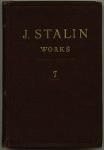
J. V STALIN
WORKS
VOLUME
. 4 .
NOVEMBER i9i7 '"{920
FOREIGN LANGUAGES PUBLISHING HOUSE
Moscow • 1953

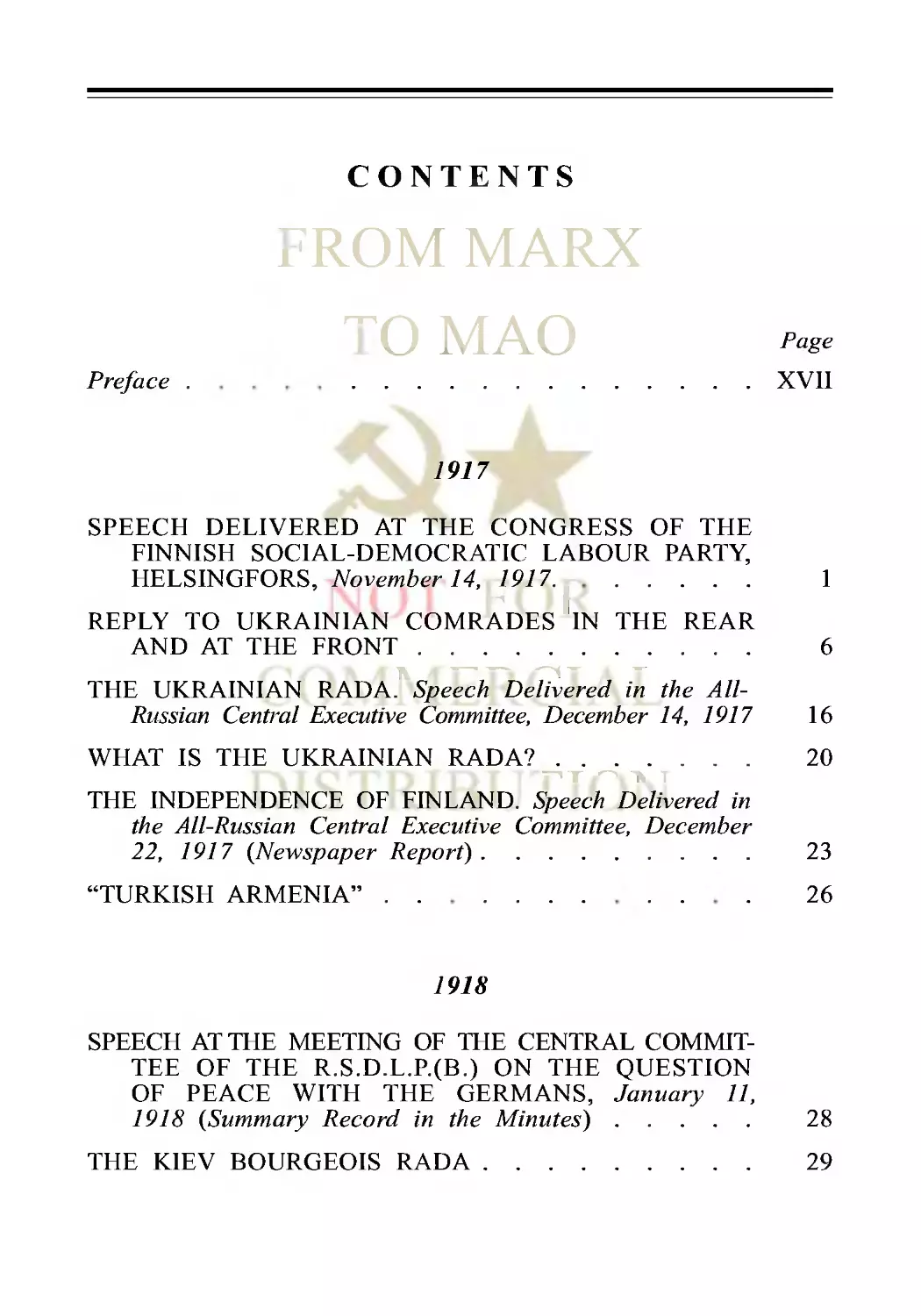
CONTENTS
J. _ ^
Preface XVII
1917
SPEECH DELIVERED AT THE CONGRESS OF THE
FINNISH SOCIAL-DEMOCRATIC LABOUR PARTY,
HELSINGFORS, November 14, 1917 1
REPLY TO UKRAINIAN COMRADES IN THE REAR
AND AT THE FRONT 6
THE UKRAINIAN RADA. Speech Delivered in the All-
Russian Central Executive Committee, December 14, 1917 16
WHAT IS THE UKRAINIAN RADA? 20
THE INDEPENDENCE OF FINLAND. Speech Delivered in
the All-Russian Central Executive Committee, December
22, 1917 {Newspaper Report) 23
"TURKISH ARMENIA" 26
1918
SPEECH AT THE MEETING OF THE CENTRAL COMMIT-
TEE OF THE R.S.D.L.R(B.) ON THE QUESTION
OF PEACE WITH THE GERMANS, January 11,
1918 {Summary Record in the Minutes) 28
THE KIEV BOURGEOIS RADA 29

VIII CONTENTS
SPEECHES DELIVERED AT THE THIRD ALL-RUS-
SIAN CONGRESS OF SOVIETS OF WORKERS',
SOLDIERS' AND PEASANTS' DEPUTIES, January
10-18, 1918 31
1. Report on the National Question, January 15
{Newspaper report) 31
2. Draft Resolution on the Federal Institutions of
the Russian Republic 33
3. Reply to the Discussion on the Report on the
National Question, January 15 {Newspaper Report) 34
TELEPHONE MESSAGE TO THE PETROGRAD COM-
MITTEE, R.S.D.L.R(B.), February 21, 1918 ... 39
TELEGRAM TO THE PEOPLE'S SECRETARIAT,
UKRAINIAN SOVIET REPUBLIC, February 21,
1918 40
NOTE SENT BY DIRECT WIRE TO THE PEOPLE'S
SECRETARIAT, UKRAINIAN SOVIET REPUBLIC,
February 24, 1918 42
THE UKRAINIAN KNOT 46
A TATAR-BASHKIR SOVIET REPUBLIC 50
TRANSCAUCASIAN COUNTER-REVOLUTIONARIES
UNDER A SOCIALIST MASK 52
ORGANIZATION OF A RUSSIAN FEDERAL REPUBLIC.
Pravda Interview 68
Bourgeois-Democratic Federations 68
How the Russian Federation Now in Process of For-
mation Differs From Them 69
Structural Principles of the Russian Federation . . 70
Composition of the Russian Federal Republic . . 71
Rights of Federating Regions. Rights of National
Minorities 72
Structure of the Central Authority 72
The Executive Organ of Power 73

CONTENTS IX
Transitional Function of Federalism 74
Shaping the Political Structure of the Russian
Federation. Federalism in Russia — a Transitional
Step to Socialist Unitarism 75
ONE IMMEDIATE TASK 76
GENERAL PROVISIONS OF THE CONSTITUTION OF
THE RUSSIAN SOCIALIST FEDERATIVE SOVIET
REPUBLIC. Draft Approved by the Commission Ap-
pointed by the All-Russian C.E.C. for Drafting the
Constitution of the Soviet Republic 81
TELEGRAM TO THE FIFTH CONGRESS OF SOVIETS
OF THE TURKESTAN REGION, April 22, 1918 . 83
THE PEACE NEGOTIATIONS WITH THE UKRAINE.
Izvestia Interview 84
Conclusion of an Armistice 84
Subsequent Negotiations 84
Effect of the Coup d'Etat in the Ukraine .... 85
Causes of the Coup d'Etat 86
SPEECHES DELIVERED AT A CONFERENCE ON THE
CONVENING OF A CONSTITUENT CONGRESS OF
SOVIETS OF THE TATAR-BASHKIR SOVIET RE-
PUBLIC, May 10-16, 1918 87
1. Speech at the Opening of the Conference, May 10 87
2. Speech at the Closing of the Conference, May 16 93
ANOTHER LIE 95
THE SITUATION IN THE CAUCASUS 96
I. Transcaucasia 96
II. The North Caucasus 98
CONCERNING THE SITUATION IN THE CAUCASUS
From the People 's Commissariat for the Affairs of Na-
tionalities ... 102

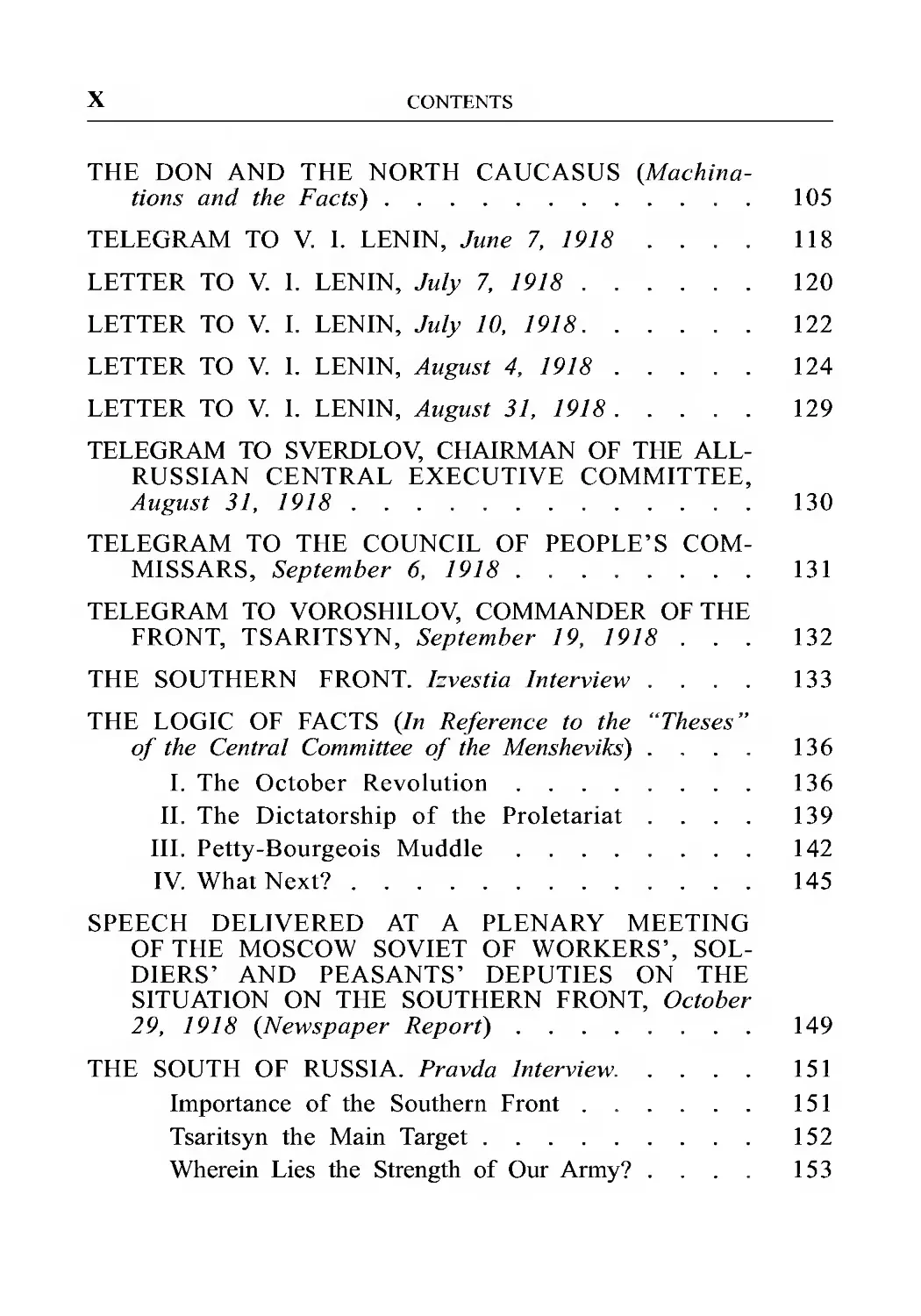
X CONTENTS
THE DON AND THE NORTH CAUCASUS {Machina-
tions and the Facts) 105
TELEGRAM TO V. L LENIN, June 7, 1918 .... 118
LETTER TO V. I. LENIN, July 7, 1918 120
LETTER TO V. I. LENIN, July 10, 1918 122
LETTER TO V. I. LENIN, August 4, 1918 124
LETTER TO V. I. LENIN, August 31, 1918 129
TELEGRAM TO SVERDLOV, CHAIRMAN OF THE ALL-
RUSSIAN CENTRAL EXECUTIVE COMMITTEE,
August 31, 1918 130
TELEGRAM TO THE COUNCIL OF PEOPLE'S COM-
MISSARS, September 6, 1918 131
TELEGRAM TO VOROSHILOV, COMMANDER OF THE
FRONT, TSARITSYN, September 19, 1918 ... 132
THE SOUTHERN FRONT. Izvestia Interview .... 133
THE LOGIC OF FACTS {In Reference to the "Theses"
of the Central Committee of the Mensheviks) . . . . 136
I. The October Revolution 136
II. The Dictatorship of the Proletariat .... 139
HI. Petty-Bourgeois Muddle 142
IV. What Next? 145
SPEECH DELIVERED AT A PLENARY MEETING
OF THE MOSCOW SOVIET OF WORKERS', SOL-
DIERS' AND PEASANTS' DEPUTIES ON THE
SITUATION ON THE SOUTHERN FRONT, October
29, 1918 {Newspaper Report) 149
THE SOUTH OF RUSSIA. Pravda Interview 151
Importance of the Southern Front 151
Tsaritsyn the Main Target 152
Wherein Lies the Strength of Our Army? . . . . 153

CONTENTS XI
THE OCTOBER REVOLUTION (October 24 and 25, 1917,
in Petrograd) 155
THE OCTOBER REVOLUTION AND THE NATIONAL
QUESTION 158
I. The February Revolution and the National Ques-
tion 158
11. The October Revolution and the National Ques-
tion 161
HI. The World-Wide Significance of the October
Revolution 167
PARTITION WALL 171
DON'T FORGET THE EAST 174
THE UKRAINE IS LIBERATING ITSELF 177
LIGHT FROM THE EAST 181
THINGS ARE MOVING 187
1919
LETTER TO V. I. LENIN FROM THE EASTERN
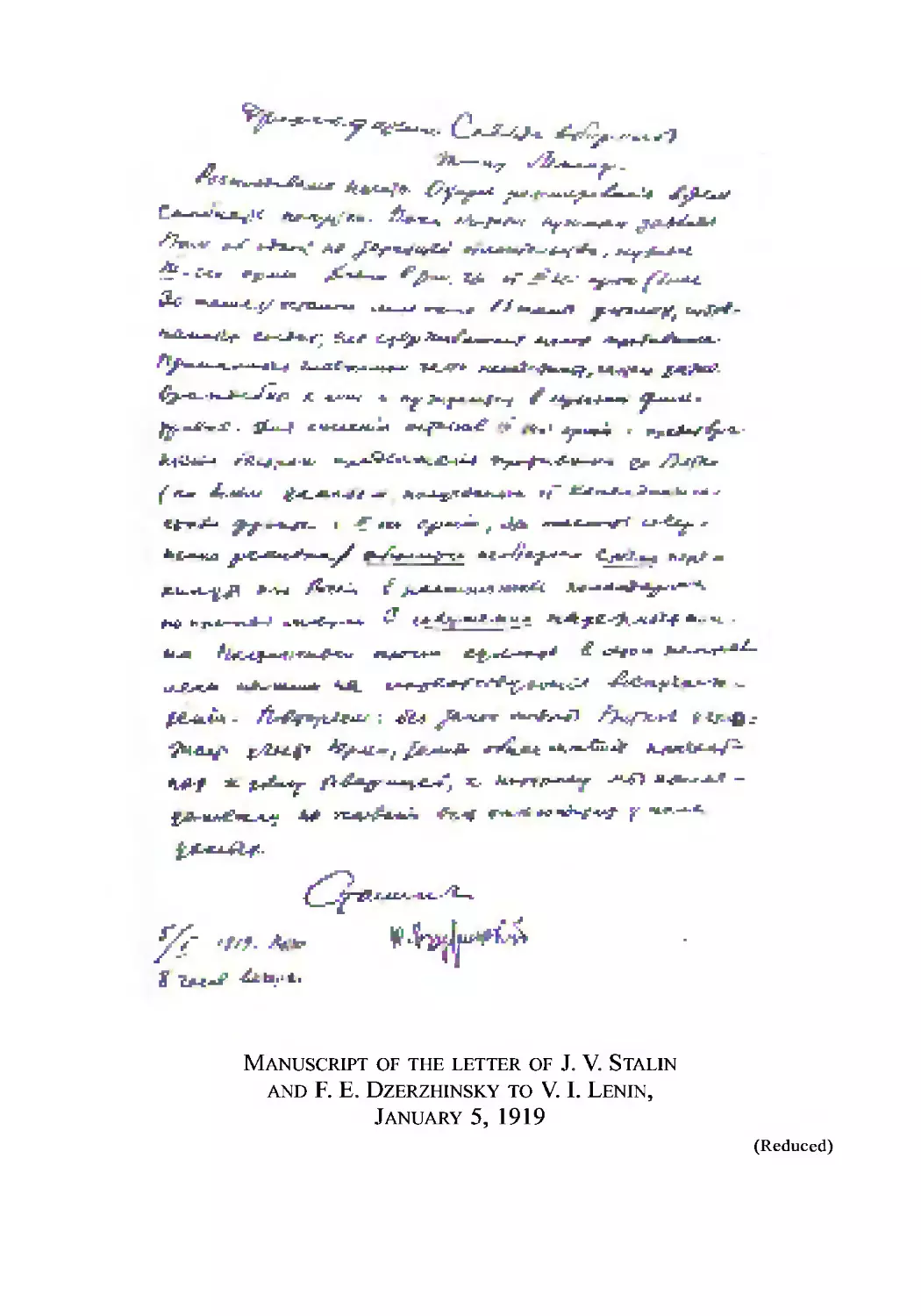
FRONT, January 5, 1919 190
REPORT TO V. I. LENIN 194
SPEECH DELIVERED AT A JOINT MEETING OF
PARTY AND SOVIET ORGANIZATIONS IN VYAT-
KA, January 19, 1919 {Record in the Minutes) . . 200
REPORT TO COMRADE LENIN BY THE COMMISSION
OF THE PARTY CENTRAL COMMITTEE AND
THE COUNCIL OF DEFENCE ON THE REASONS
FOR THE FALL OF PERM IN DECEMBER 1918 . 202
General Picture of the Disaster 202
The Third Army and the Reserves 209
Conclusions 214
Control System of the Army and Instructions of
the Centre 215
Conclusions 218

XII CONTENTS
Insecurity of the Rear and Work of the Party and
Soviet Institutions 219
Conclusions 223
Supply and Evacuation Agencies 224
Conclusions 227
Total Losses of Materiel and Men 229
Measures Taken to Strengthen the Front . . . . 230
THE GOVERNMENT'S POLICY ON THE NATIONAL QUES-
TION 233
TO THE SOVIETS AND THE PARTY ORGANIZATIONS
OF TURKESTAN 238
TWO CAMPS 240
OUR TASKS IN THE EAST 245
TWO YEARS 249
IMPERIALISM'S RESERVES 254
EXCERPT FROM A SPEECH ON THE MILITARY QUES-
TION DELIVERED AT THE EIGHTH CONGRESS
OF THE R.C.R(B.), March 21, 1919 258
THE RE-ORGANIZATION OF STATE CONTROL. Report
Delivered at a Meeting of the All-Russian Central Execu-
tive Committee, April 9, 1919 {Newspaper Report) . 260
THE SHOOTING OF THE TWENTY-SIX BAKU COM-
RADES BY AGENTS OF BRITISH IMPERIALISM 261
TELEGRAM TO THE INSPECTOR-EXTRAORDINARY
OF STATE CONTROL, SHCHIGRY, May 7, 1919 266
NOTE TO V. I. LENIN FROM PETROGRAD BY DI-
RECT WIRE, May 25, 1919 268
TELEGRAM TO V. I. LENIN, June 16, 1919 ... 271
NOTE TO V. I. LENIN FROM PETROGRAD BY DI-
RECT WIRE, June 18, 1919 272
THE PETROGRAD FRONT. Pravda Interview ... 275

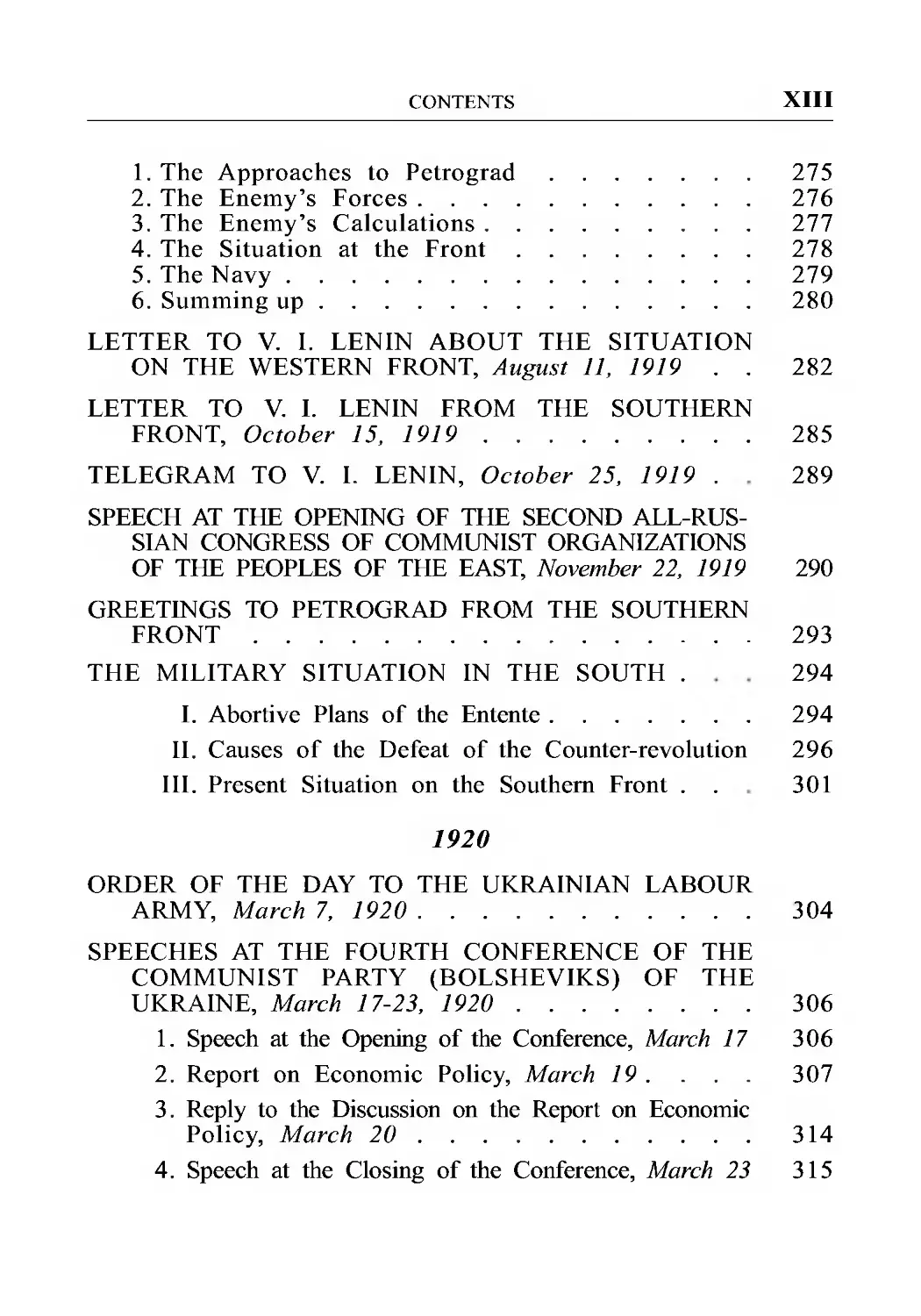
CONTENTS XIII
1. The Approaches to Petrograd 275
2. The Enemy's Forces 276
3. The Enemy's Calculations 277
4. The Situation at the Front 278
5. The Navy 279
6. Summing up 280
LETTER TO V. I. LENIN ABOUT THE SITUATION
ON THE WESTERN FRONT, August 11, 1919 . . 282
LETTER TO V. I. LENIN FROM THE SOUTHERN
FRONT, October 15, 1919 285
TELEGRAM TO V. I. LENIN, October 25, 1919 . . 289
SPEECH AT THE OPENING OF THE SECOND ALL-RUS-
SIAN CONGRESS OF COMMUNIST ORGANIZATIONS
OF THE PEOPLES OF THE EAST, November 22, 1919 290
GREETINGS TO PETROGRAD FROM THE SOUTHERN
FRONT 293
THE MILITARY SITUATION IN THE SOUTH ... 294
I. Abortive Plans of the Entente 294
II. Causes of the Defeat of the Counter-revolution 296
HI. Present Situation on the Southern Front . . . 301
1920
ORDER OF THE DAY TO THE UKRAINIAN LABOUR
ARMY, March 7, 1920 304
SPEECHES AT THE FOURTH CONFERENCE OF THE
COMMUNIST PARTY (BOLSHEVIKS) OF THE
UKRAINE, March 17-23, 1920 306
1. Speech at the Opening of the Conference, March 17 306
2. Report on Economic Policy, March 19 . . . . 307
3. Reply to the Discussion on the Report on Economic
Policy, March 20 314
4. Speech at the Closing of the Conference, March 23 315

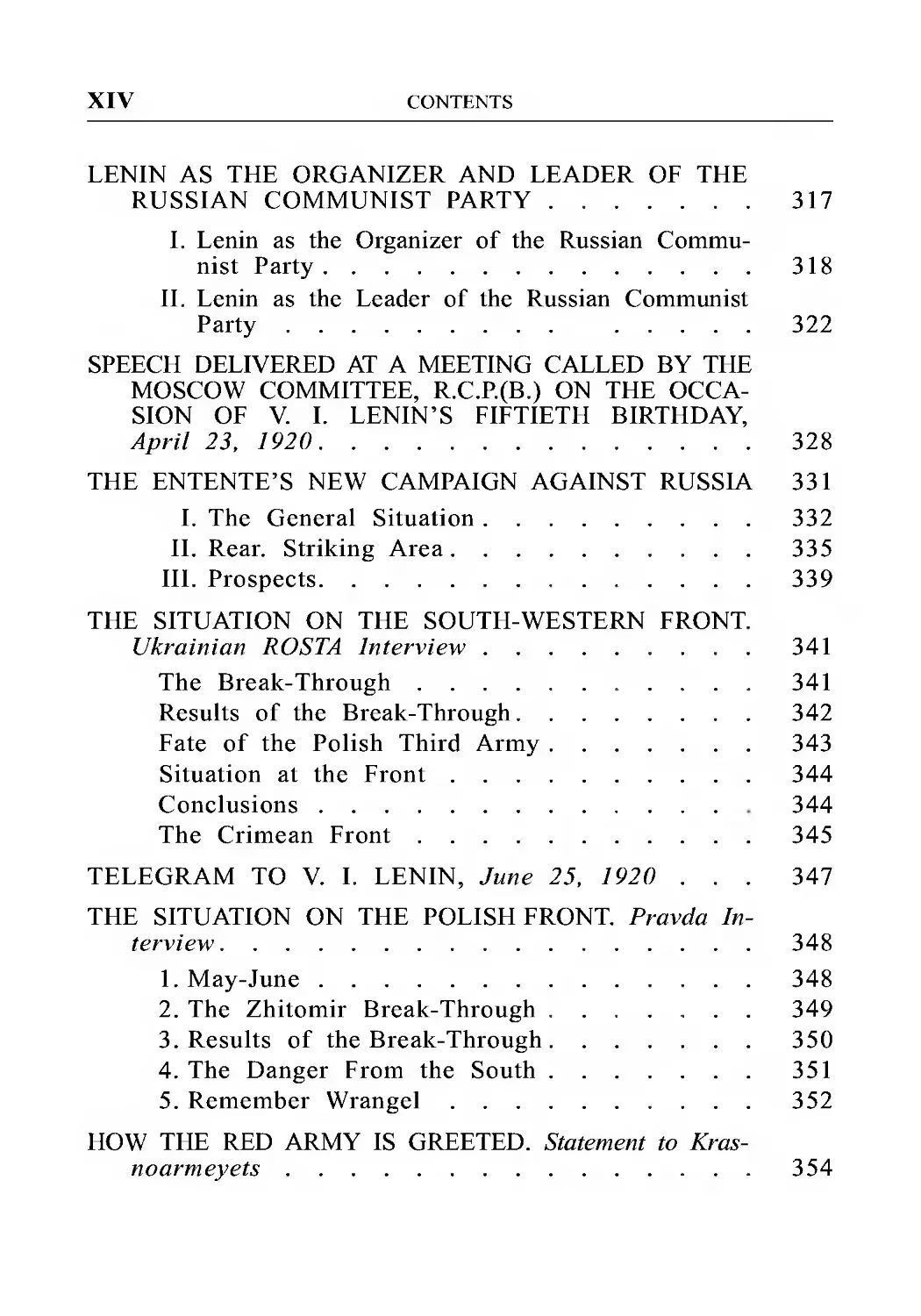
XIV CONTENTS
LENIN AS THE ORGANIZER AND LEADER OF THE
RUSSIAN COMMUNIST PARTY 317
I. Lenin as the Organizer of the Russian Commu-
nist Party 318
II. Lenin as the Leader of the Russian Communist
Party 322
SPEECH DELIVERED AT A MEETING CALLED BY THE
MOSCOW COMMITTEE, R.C.R(B.) ON THE OCCA-
SION OF V. I. LENIN'S FIFTIETH BIRTHDAY,
April 23, 1920 328
THE ENTENTE'S NEW CAMPAIGN AGAINST RUSSIA 331
I. The General Situation 332
II. Rear. Striking Area 335
III. Prospects 339
THE SITUATION ON THE SOUTH-WESTERN FRONT.
Ukrainian ROSTA Interview 341
The Break-Through 341
Results of the Break-Through 342
Fate of the Polish Third Army 343
Situation at the Front 344
Conclusions 344
The Crimean Front 345
TELEGRAM TO V. I. LENIN, June 25, 1920 ... 347
THE SITUATION ON THE POLISH FRONT. Pravda In-
terview 348
1. May- June 348
2. The Zhitomir Break-Through 349
3. Results of the Break-Through 350
4. The Danger From the South 351
5. Remember Wrangel 352
HOW THE RED ARMY IS GREETED. Statement to Kras-
noarmeyets 354

CONTENTS XV
TO ALL PARTY ORGANIZATIONS. Draft Letter of the
C.C, R.C.PfB.) 356
CREATION OF FIGHTING RESERVES OF THE REPUB-
LIC 358
1. Memorandum to the Political Bureau, C.C,
R.C.R(B.), August 25, 1920 358
2. Statement to the Political Bureau, C.C,
R.C.R(B.), August 30, 1920 360
THE POLICY OF THE SOVIET GOVERNMENT ON THE
NATIONAL QUESTION IN RUSSIA 363
SPEECH AT THE OPENING OF THE FIRST ALL-
RUSSIAN CONFERENCE OF RESPONSIBLE PER-
SONNEL OF THE WORKERS' AND PEASANTS'
INSPECTION, October 15, 1920 377
AUTHOR'S PREFACE. To a Collection of Articles on the
National Question, Published in 1920 383
THE POLITICAL SITUATION OF THE REPUBLIC.
Report Delivered at a Regional Conference of Communist
Organizations of the Don and the Caucasus, held in
Vladikavkaz, October 27, 1920 387
THREE YEARS OF PROLETARIAN DICTATORSHIP.
Report Delivered at a Celebration Meeting of the Baku
Soviet, November 6, 1920 395
The First Period 396
The Second Period 398
The Third Period 400
Prospects 402
CONGRESS OF THE PEOPLES OF DAGHESTAN,
November 13, 1920 407
1. Declaration on Soviet Autonomy for Daghestan . 407
2. Concluding Remarks 411

XVI CONTENTS
CONGRESS OF THE PEOPLES OF THE TEREK
REGION, November 17, 1920 412
1. Report on Soviet Autonomy for the Terek Region 412
2. Concluding Remarks 417
THE SITUATION IN THE CAUCASUS. Pravda Interview. 421
LONG LIVE SOVIET ARMENIA! 426
Notes 429
Biographical Chronicle (1879-1906) 455

PREFACE
The Fourth Volume of J. V. Stalin's Works contains
his writings and speeches belonging to the period im-
mediately following the October Revolution, from Novem-
ber 1917 to December 1920.
The works of this period deal with the consolidation of
the socialist state system, the policy of the Soviet Govern-
ment on the national question, the creation and strengthen-
ing of the Red Army, and military strategy and tactics in
the period of foreign armed intervention and civil war.
Questions of Soviet state structure and of Soviet
policy on the national question are dealt with in
J. V. Stalin's speeches at the Third AU-Russian Congress
of Soviets, in the interview "Organization of a Russian
Federal Republic," in the "General Provisions of the
Constitution of the Russian Socialist Federative Soviet
Republic," and in "The October Revolution and the Na-
tional Question," "The Policy of the Soviet Government
on the National Question in Russia," and other works.
A number of the writings ("The Ukrainian Knot,"
"The Don and the North Caucasus," "Light From the
East" and other articles) discuss the struggle of the peoples
of the Ukraine, the Caucasus and the Baltic Region against
foreign invasion and for the establishment of Soviet power.
Analyses of the situation on the civil war fronts are
contained in the "Report to Comrade Lenin by the Com-
mission of the Party Central Committee and the Council of

XVIII PREFACE
Defence on the Reasons for the Fall of Perm in December
1918," in the draft letter of the C.C, R.C.P.(B.) entitled
"To All Party Organizations," in the articles "The Military
Situation in the South" and "The Entente's New Cam-
paign Against Russia," in surveys of the military situation
on the Tsaritsyn, Petrograd and South-Western fronts,
and in a number of letters and telegrams to V. I. Lenin.
The struggle and victory of the Soviet people in the
civil war are summed up in "The Political Situation of the
Republic" and "Three Years of Proletarian Dictatorship."
Included in this volume are the article "Lenin as the
Organizer and Leader of the Russian Communist Party"
and the speech at the meeting called by the Moscow Com-
mittee of the R.C.P.(B.) on the occasion of Lenin's fiftieth
birthday, which paint a portrait of the great leader.
Published in this volume for the first time are: the
letter to V. L Lenin from Tsaritsyn (July 1918), the
letter on the situation on the Western Front (August 1919),
the memorandum and statement to the C.C, R.C.P.(B.)
on the creation of fighting reserves of the Republic (Au-
gust 1920), and other documents.
Numerous telegrams, letters, records of conversations
over the direct wire, orders of the day and other docu-
ments relating to military operations, and congratula-
tory messages to individual military formations, men and
commanders of the Red Army have not been included in
the volume.
Dates until the adoption of the New Style calendar
(up to February 14, 1918) are given in Old Style.
Marx-Engels-Lenin Institute
of the C.C, C.RS.U.(B.)

NOVEMBER iQi7 '^iQ 20

SPEECH DELIVERED AT THE CONGRESS
OF THE FINNISH SOCIAL-DEMOCRATIC
LABOUR PARTY, HELSINGFORS
November 14, 1917
Comrades, I have been delegated to greet you on
behalf of the workers' revolution in Russia, which is
shaking the capitalist system to its foundations. I have
come to you to greet your Congress on behalf of the Work-
ers' and Peasants' Government of Russia, the Council of
People's Commissars, which was born in the fire of this
revolution.
But I have not only come to bring you greetings. I
should like first of all to bring you the joyful news of
the victories of the Russian revolution, of the disorgani-
zation of its enemies, and to tell you that in the atmos-
phere of the expiring imperialist war the chances of the
revolution are improving day by day.
The bondage of landlordism has been broken, for
power in the countryside has passed into the hands of
the peasants. The power of the generals has been broken,
for power in the army is now concentrated in the
hands of the soldiers. A curb has been put on the capitalists,
for workers' control is rapidly being established over the
factories, mills and banks. The whole country, town and
countryside, rear and front, is studded with revolutionary
committees of workers, soldiers and peasants, which are
taking the reins of government into their own hands.

J. V. STALIN
They tried to scare us with the bogey of Kerensky and
the counter-revolutionary generals. But Kerensky has been
driven out, and the generals are besieged by the soldiers
and Cossacks, who also support the demands of the
workers and peasants.
They tried to scare us with the bogey of famine,
and prophesied that the Soviet regime would perish in
the grip of a disrupted food supply. But we had only to
curb the profiteers, we had only to appeal to the peas-
ants, and grain began to flow to the towns in hundreds
of thousands of poods.
They tried to scare us with the bogey of a break-
down of the machinery of state, sabotage by officials,
and so on. And we knew ourselves that the new, so-
cialist government would not be able simply to take over
the old, bourgeois state machine and make it its own.
But we had only to set about renovating the old machine,
purging it of anti-social elements, and the sabotage began
to melt away.
They tried to scare us with the bogey of war "sur-
prises," the possibility of the imperialist cliques creating
complications in connection with our proposal for a dem-
ocratic peace. And, indeed, there was a danger, a mor-
tal danger. But that danger arose after the capture of
Osel,' when the Kerensky Government was preparing to
flee to Moscow and surrender Petrograd, and when the
British and German imperialists were making a deal for
peace at the expense of Russia. On the basis of such a peace
the imperialists could indeed have wrecked the cause of
the Russian and, perhaps, of the international revolution.
But the October Revolution came in time. It took the
cause of peace into its own hands, it struck the most

SPEECH DELIVERED AT CONGRESS OF FINNISH S.D.L.R i
dangerous weapon from the hands of international im-
perialism and thus saved the revolution from mortal
peril. The old wolves of imperialism were left with one of
two alternatives: either to bow to the revolutionary move-
ment that is flaring up in all countries, by accepting
peace, or to carry on the struggle by continuing the war.
But to continue the war in its fourth year, when the
whole world is suffocating in its grip, when the "immi-
nent" winter campaign is arousing a storm of indignation
among the soldiers of all countries, and when the filthy
secret treaties have already been published — to continue
the war under such circumstances means to doom oneself
to obvious failure. This time the old wolves of imperialism
have miscalculated. And that is why the bogey of impe-
rialist "surprises" does not scare us.
Lastly, they tried to scare us with the bogey of the
disintegration of Russia, of its splitting up into nu-
merous independent states and hinted thereby that the
right of nations to self-determination proclaimed by the
Council of People's Commissars was a "fatal mistake."
But I must declare most categorically that we would not
be democrats (I say nothing of socialism!) if we did not
recognize the right of the peoples of Russia to free
self-determination. I declare that we would be betray-
ing socialism if we did not do everything to restore-fra-
ternal confidence between the workers of Finland and
Russia. But everyone knows that the restoration of this
confidence is inconceivable unless the right of the Finnish
people to free self-determination is firmly recognized. And
it is not merely the verbal, even if official, recognition of
this right that is important here. What is important is
that this verbal recognition will be confirmed by the act of

J. V. STALIN
the Council of People's Commissars, that it will be put
into effect without hesitation. For the time for words has
passed. The time has come when the old slogan "Work-
ers of all countries, unite!" must be put into effect.
Complete freedom for the Finnish people, and for the
other peoples of Russia, to arrange their own life! A volun-
tary and honest alliance of the Finnish people with the
Russian people! No tutelage, no supervision from above,
over the Finnish people! These are the guiding principles
of the policy of the Council of People's Commissars.
Only as the result of such a policy can mutual confidence
among the peoples of Russia be created. Only on the basis
of such confidence can the peoples of Russia be united
in one army. Only by thus uniting the peoples can the
gains of the October Revolution be consolidated and
the cause of the international socialist revolution ad-
vanced.
That is why we smile when we are told that Russia
will inevitably fall to pieces if the idea of the right of
nations to self-determination is put into practice.
These are the difficulties with which our enemies
have tried and are still trying to scare us, but which we
are overcoming as the revolution grows.
Comrades! Information has reached us that your
country is experiencing approximately the same crisis
of power as Russia experienced on the eve of the October
Revolution. Information has reached us that attempts
are being made to frighten you too with the bogey of
famine, sabotage, and so on. Permit me to tell you
on the basis of the practical experience of the revolu-
tionary movement in Russia that these dangers, even
if real, are by no means insuperable! These dangers

SPEECH DELIVERED AT CONGRESS OF FINNISH S.D.L.R 5
can be overcome if you act resolutely and without
faltering. In the midst of war and economic disruption,
in the midst of the revolutionary movement which is
flaring up in the West and of the increasing victories of
the workers' revolution in Russia, there are no dangers or
difficulties that could withstand your onslaught. In such
a situation only one power, socialist power, can main-
tain itself and conquer. In such a situation only one
kind of tactics can be effective, the tactics of Danton —
audacity, audacity and again audacity!
And if you should need our help, you will have it —
we shall extend you a fraternal hand.
Of this you may rest assured.
Pravda, No. 191,
November 16, 1917

REPLY TO UKRAINIAN COMRADES
IN THE REAR AND AT THE FRONT
Since our relations with the Ukrainian Rada^ be-
came strained I have been receiving numerous resolu-
tions and letters from Ukrainian comrades on the subject
of the conflict with the Rada. I consider it impossible and
superfluous to answer each resolution and each letter
separately, since the same things are repeated in almost
all of them. I have therefore decided to single out the ques-
tions most frequently to be found in them and to reply with
a clarity that will leave no room for doubt. These ques-
tions are generally known:
1) How did the conflict arise?
2) Over what issues did the conflict arise?
3) What measures are needed for a peaceful settle-
ment of the conflict?
4) Can it really be that the fraternal peoples will
shed each other's blood?
That is followed by a general assurance that the
conflict between the two kindred peoples will be set-
tled peacefully, without fratricidal bloodshed.
First of all, it should be observed that the Ukrainian
comrades are labouring under a certain confusion of
ideas. They sometimes represent the conflict with the
Rada as a conflict between the Ukrainian and Russian

REPLY TO UKRAINIAN COMRADES
peoples. But that is not true. There is no conflict and
there can be no conflict between the Ukrainian and
Russian peoples. The Ukrainian and Russian peoples,
like the other peoples of Russia, consist of workers and
peasants, of soldiers and sailors. Together, they all fought
against tsarism and Kerenskyism, against the landlords and
capitalists, against war and imperialism. Together, they all
shed their blood for land and peace, for liberty and social-
ism. In the struggle against the landlords and capitalists
they are all brothers and comrades. In the struggle for
their vital interests there is no conflict and there can be
no conflict between them. The enemies of the working
people find it advantageous, of course, to represent the
conflict with the Rada as a conflict between the Russian
and Ukrainian peoples, because that makes it easier for
them to incite the workers and peasants of the kindred
peoples against one another, to the glee of the oppres-
sors of the peoples. But is it so difficult for the enlight-
ened workers and peasants to understand that what is
advantageous to the oppressors of the peoples is harmful
for the peoples themselves?
It was not between the peoples of Russia and the
Ukraine that the conflict arose, but between the Council
of People's Commissars and the General Secretariat of
the Rada.
Over what questions did the conflict arise?
It is said that the conflict arose over the question
of centralism or self-determination, that the Council
of People's Commissars does not allow the Ukrainian
people to take power into their own hands and to
decide their destiny freely. Is this true? No, it is not.
The Council of People's Commissars is, in fact, striving

J. V. STALIN
to have all power in the Ukraine belong to the Ukrainian
people, that is, to the Ukrainian workers and soldiers,
peasants and sailors. Soviet power, that is, the power of
the workers and peasants, the soldiers and sailors, without
landlords or capitalists, is precisely that people's power
for which the Council of People's Commissars is fighting.
The General Secretariat does not want such a power,
because it does not desire to get rid of the landlords
and capitalists. That, and not centralism, is the crux
of the matter.
The Council of People's Commissars stands, and has
stood from the very first, for free self-determination.
It would not even object if the Ukrainian people were
to secede and form an independent state. It has dec-
lared this officially on several occasions. But when
self-determination of the people is identified with the
autocratic rule of Kaledin, when the General Secre-
tariat of the Rada attempts to represent the counter-
revolutionary revolts of Cossack generals as a manifesta-
tion of the self-determination of the people, the Council
of People's Commissars cannot refrain from observing
that the General Secretariat is making a pretence of self-
determination, and is using this pretence to conceal its
alliance with Kaledin and Rodzyanko. We stand for
the self-determination oi peoples, but we are opposed
to self-determination being used as a camouflage for
the surreptitious establishment of the autocratic rule of
Kaledin, who only yesterday was campaigning for the
strangulation of Finland.
It is said that the conflict arose over the question of
the Ukrainian Republic, that the Council of People's
Commissars does not recognize the Ukrainian Republic.

REPLY TO UKRAINIAN COMRADES
Is this true? No, it is not. The Council of People's
Commissars officially recognized the Ukrainian Republic
in the "Ultimatum" and in the "Reply" to the Petro-
grad Ukrainian Staff.^ It is prepared to recognize a re-
public in any of the national regions of Russia should
the working population of the given region desire it.
It is prepared to recognize a federal structure for our
country, should the working population of the regions
of Russia desire it. But when a people's republic is iden-
tified with the military dictatorship of Kaledin, when the
General Secretariat of the Rada endeavours to represent
the monarchists Kaledin and Rodzyanko as pillars of
the republic, the Council of People's Commissars cannot
refrain from pointing out that the General Secretariat
is making a pretence of a republic, and is using this pre-
tence to conceal its complete dependence on monarchist
plutocrats. We stand for a Ukrainian Republic, but we
are opposed to the republic being used as a camouflage
for sworn enemies of the people, the monarchists Kaledin
and Rodzyanko, who only yesterday were campaigning
for the restoration of the old regime and the death penal-
ty for the soldiers.
No, the questions of centralism and self-determination
have no bearing on the conflict with the Rada. It was not
over these questions that the dispute arose. Centralism and
self-determination have been dragged in by the General
Secretariat artificially, as a strategical ruse designed to
conceal from the Ukrainian masses the real reasons for
the conflict.
It was not over the question of centralism or self-
determination that the conflict arose, but over the three
following concrete questions:

10 J. V. S TALI N
First question. The conflict started with the orders
issued to the front by member of the General Secre-
tariat Petlura, orders which threatened to result in the
complete disorganization of the front. Disregarding Gene-
ral Headquarters and the interests of the front, disre-
garding the peace negotiations and the cause of peace
generally, Petlura began to issue orders for the return
of all Ukrainian army and navy units to the Ukraine.
It will be easily realized that if the Ukrainian
units had obeyed Petlura's orders the front would have
disintegrated instantaneously: the Ukrainian units in
the North would have moved southward, the non-Ukrain-
ian units in the South would have moved northward,
the other nationalities would also have "hit the home
trail," the railways would have been occupied exclusive-
ly with the transport of soldiers and equipment, food
would have ceased to arrive at the front because there
would have been no means of transporting it — and of the
front nothing but a memory would have remained. This
would have altogether wrecked the chances of an ar-
mistice and peace. No one denies that in ordinary times
the place of the Ukrainian soldier is primarily at home,
in the Ukraine. No one denies that "nationalization"
of the army is an acceptable and desirable thing. This
has been officially stated several times by the Council
of People's Commissars. But in time of war, when peace
has not yet been arranged, and the front is not construct-
ed on national lines, and when, owing to the weakness
of our transport system, immediate "nationalization" of
the army would be fraught with the danger of the sol-
diers leaving their positions and of the front disintegrat-
ing, thus wrecking the chances of a peace and armistice —

REPLY TO UKRAINIAN COMRADES 11
it need not be said that, in these conditions, there could
be no question of the national units leaving their posi-
tions immediately. I do not know whether Petlura was
aware that by his senseless orders he was breaking up
the front and wrecking the cause of peace. But the
Ukrainian soldiers and sailors realized it at once, because
all of them, with rare exceptions, refused to obey Pet-
lura and decided to remain at their posts until peace was
concluded. The Ukrainian soldiers have thereby saved
the cause of peace, and Petlura's ill-considered orders
have for the time being lost their extreme gravity.
Second question. The conflict started by Petlura's orders
was aggravated by the policy of the General Secretariat
of the Rada when it began to disarm the-Ukrainian- Soviets
of Deputies. In Kiev, armed detachments of the Gener-
al Secretariat fell upon the Soviet troops at night and
disarmed them. Similar attempts were made in Odessa
and Kharkov, but there they failed because they encoun-
tered resistance. But we have reliable information to the
effect that the General Secretariat is massing forces
against Odessa and Kharkov with the object of disarm-
ing the Soviet troops. We have reliable information to
the effect that in a number of other, smaller, towns the
Soviet troops have already been disarmed and "sent home."
The General Secretariat of the Rada has thus made it
its object to carry out Kornilov's and Kaledin's, Alexe-
yev's and Rodzyanko's programme of disarming the So-
viets. But the Soviets are the bulwark and hope of the rev-
olution. Whoever disarms the Soviets disarms the revolu-
tion, wrecks the cause of peace and liberty, betrays the
cause of the workers and peasants. It was the Soviets that
saved Russia from the yoke of Kornilovism. It was the

12 J. V. S TALI N
Soviets that saved Russia from the shame of Kerensky-
ism. It was the Soviets that won land and an armistice
for the peoples of Russia. The Soviets, and the Soviets
alone, are capable of leading the people's revolution
to complete victory. Therefore, whoever raises his hand
against the Soviets helps the landlords and capitalists
to strangle the workers and peasants of all Russia, helps
the Kaledins and Alexeyevs to strengthen their "iron"
rule over the soldiers and Cossacks.
Let no one try to tell us that the General Secretariat
contains Socialists, and that they therefore cannot be-
tray the cause of the people. Kerensky calls himself a
Socialist, nevertheless he sent troops against revolution-
ary Petrograd. Gotz calls himself a Socialist, never-
theless he raised the military cadets and officers against
the Petrograd soldiers and sailors. Savinkov and Avksen-
tyev call themselves Socialists, nevertheless they intro-
duced the death penalty for the soldiers at the front.
Socialists should be judged not by their words, but by
their deeds. The General Secretariat is disrupting and
disarming the Ukrainian Soviets, thereby helping Kale-
din to establish his bloody regime on the Don and in
the coal basin — and that is a fact that no socialist
flag can conceal. That is why the Council of People's
Commissars affirms that the General Secretariat's
policy is a counter-revolutionary policy. That is why
the Council of People's Commissars hopes that the
Ukrainian workers and soldiers, who in Russia were in
the van of the fight for revolutionary Soviet power, will
be able to call their General Secretariat to order, or elect
another in its place in the interest of peace among
nations.

REPLY TO UKRAINIAN COMRADES 13
It is said that there must be an "exchange" of mili-
tary units between the Ukraine and Russia, demarca-
tion and the like. The Council of People's Commissars fully
recognizes the necessity for demarcation. But demarca-
tion must be effected in fraternal, friendly fashion, by
agreement, and not forcibly, not on the "principle" of
"grab what you can," "disarm whomsoever you can," as the
General Secretariat is now doing, seizing food supplies,
appropriating freights, and condemning the army to
starve and freeze.
Third question. The conflict reached a climax when
the General Secretariat categorically refused to permit
the passage of the revolutionary troops of the Soviets
proceeding against Kaledin. Armed detachments of the Gen-
eral Secretariat hold up trains carrying revolutionary
troops, dismantle tracks, threaten to open fire, and de-
clare that they cannot permit the transit of "alien"
troops through their territory. It is Russian soldiers,
who only yesterday were fighting shoulder to shoulder
with the Ukrainians against the hangmen-generals who
were trying to crush the Ukraine, that now, it appears,
are "aliens"! And this at a time when this same General
Secretariat freely permits the transit to Rostov through
its territory of Kaledin's Cossack units and counter-rev-
olutionary officers who are flocking to Kaledin from all
parts!
Kornilovites and Kaledinites are putting Rostov Red
Guards to the sword, yet the General Secretariat of the
Rada is preventing the sending of aid to our Rostov com-
rades! Kaledin's officers are shooting our comrades in the
mines, yet the General Secretariat is preventing us from
extending assistance to our comrades the miners! Is it

14 J. V. S TALI N
any wonder that Kaledin, who yesterday was smashed,
is today advancing further and further northward,
seizing the Donets Basin and threatening Tsaritsyn?
Is it not obvious that the General Secretariat is in
alliance with Kaledin and Rodzyankol Is it not obvious
that the General Secretariat prefers an alliance with the
Kornilovites to an alliance with the Council of People' s
Commissars?
It is said that there must be agreement between the
Council of People's Commissars and the General Secretar-
iat of the Rada. But is it difficult to understand that agree-
ment with the present General Secretariat would be agree-
ment with Kaledin and Rodzyanko? Is it difficult to un-
derstand that the Council of People's Commissars cannot
agree to commit suicide? We did not begin the revolu-
tion against the landlords and capitalists in order to
end it with an alliance with hangmen like Kaledin. The
workers and soldiers did not shed their blood in order
to surrender to the mercy of the Alexeyevs and Rod-
zyankos.
One thing or the other:
Either the Rada breaks with Kaledin, extends a hand
to the Soviets and allows free passage to the revolution-
ary troops proceeding against the counter-revolutionary
hotbed on the Don — and then the workers and soldiers
of the Ukraine and Russia will cement their revolution-
ary alliance with a new surge of fraternization;
Or the Rada refuses to break with Kaledin and allow
passage to the revolutionary troops — and then the General
Secretariat of the Rada will achieve what the enemies of
the people tried in vain to achieve, namely, fratricidal
bloodshed of the peoples.

REPLY TO UKRAINIAN COMRADES 15
It depends upon the enlightenment and revolution-
ary consciousness of the Ukrainian workers and soldiers
to call their General Secretariat to order or to elect an-
other in its place in the interest of a peaceful settlement
of the dangerous conflict.
It depends upon the staunchness and determination
of the Ukrainian workers and soldiers to compel the Gen-
eral Secretariat to declare definitely which alliance it
now favours: an alliance with Kaledin and Rodzyanko
against the revolution, or an alliance with the Council
of People's Commissars against the counter-revolution
of the Cadets and generals.
It is upon the people of the Ukraine that a peaceful
settlement of the conflict depends.
People's Commissar
/. Stalin
December 12, 1917
Pravda, No. 213,
December 13, 1917

THE UKRAINIAN RADA
Speech Delivered in the All-Russian
Central Executive Committee
December 14, 1917
It may seem strange that the Council of People's
Commissars, which has always resolutely upheld the
principle of self-determination, should have entered into
a conflict with the Rada, which also takes its stand on
the principle of self-determination. To understand the
origin of the conflict, it is necessary to examine the po-
litical complexion of the Rada.
The Rada starts out from the principle of a division
of power between the bourgeoisie, on the one hand,
and the proletariat and peasantry, on the other. The
Soviets reject such a division, and want the whole power
to belong to the people, without the bourgeoisie. This
is why the Rada sets up in opposition to the slogan,
"All power to the Soviets" (i.e., the people) its own
slogan, "All power to the urban and rural local govern-
ment bodies" (i.e., the people and the bourgeoisie).
It is said that the conflict arose over the question of
self-determination. But that is not true. The Rada pro-
poses the establishment of a federal system in Russia.
The Council of People's Commissars, however, goes
farther than the Rada and recognizes the right to seces-
sion. Consequently, the divergence between the Council
of People's Commissars and the Rada is not over that

THE UKRAINIAN RADA 17
question. Absolutely incorrect likewise is the Rada's as-
sertion that centralism is the point of difference. Regional
centres formed on the model of the Council of People's
Commissars (Siberia, Byelorussia, Turkestan) applied to
the Council of People's Commissars for directives. The
Council of People's Commissars replied: you yourselves
are the authority in your localities, and you yourselves
therefore must draw up the directives. That, then, is
not the point at issue. Actually, the divergence between
the Council of People's Commissars and the Rada arose
over the following three points.
First question: concentration of the Ukrainian units
on the Southern Front. Unquestionably, national ar-
mies are the best fitted to protect their own territories.
But at present our front is not built on national lines.
In view of the dislocation of transport, reconstruction of
the front on national lines would result in its complete
disruption. This would wreck the chances of peace. The
Ukrainian soldiers proved to have more sense and honesty
than the General Secretariat, for the majority of the
Ukrainian units refused to obey the Rada's orders.
Second question: disarmament of the Soviet troops in
the Ukraine. By upholding the interests of the Ukrainian
landlords and bourgeoisie and disarming the Soviet troops,
the Ukrainian Rada is striking a blow at the revolution.
Substantially, the actions of the Rada in this respect in
no way differ from the actions of Kornilov and Kaledin.
Needless to say, the Council of People's Commissars will
oppose this counter-revolutionary policy of the Rada
might and main.
Lastly, the third question: refusal to permit the passage
of Soviet troops proceeding against Kaledin, around

18 J. V. S TALI N
whom all the counter-revolutionary forces of Russia
have rallied. The Rada justified its refusal to permit the
passage of the Soviet troops on the grounds of its "neu-
trality" vis-a-vis the "self-determining" Kaledin. But the
Rada substitutes the autocratic rule of Kaledin for
the self-determination of the labouring Cossacks.
By obstructing the passage of the Soviet troops, the
Rada is assisting Kaledin's advance northward. At
the same time the Rada freely permits the transit of
Kaledin Cossack units to the Don. At a time when
our comrades are being shot down in Rostov and the
Donets Basin, the Rada is preventing us from sending
them aid. Needless to say, this treacherous conduct of
the Rada cannot be tolerated.
The Council of People's Commissars cannot give up
the fight against Kaledin. Kaledin's counter-revolu-
tionary nest must be destroyed. That is inevitable.
If the Rada obstructs our advance against Kaledin
and tries to act as a shield for him, the blows aimed
at Kaledin will fall upon the Rada. The Council of
People's Commissars will not hesitate to wage a determined
fight against the Rada, because it is well aware that the
Rada is in secret alliance with Kaledin. The Council of
People's Commissars has intercepted a ciphered telegram
which makes it clear that the Rada is in direct con-
tact with the French Mission, with the aim of delaying
peace until the spring, and, through the French Mis-
sion, with Kaledin. This alliance is directed against
peace and the revolution. This alliance must and will
be smashed.
We are reproached for conducting a resolute policy
against the Rada. But it is precisely this resolute

THE UKRAINIAN RADA 19
policy that has opened the eyes of the Ukrainian workers
and peasants by revealing the bourgeois nature of the
Rada. This is evident, for example, from the telegram
reporting the formation in the Ukraine of a new Ukrain-
ian revolutionary power"* which recognizes the Soviet
Government and is acting against the bourgeois Rada.
(Applause.)
Izvestia, No. 254,
December 17, 1917

WHAT IS THE UKRAINIAN RADA?
The reader will find below a ciphered telegram inter-
cepted by the Soviet Government which exposes the real
nature of the Rada and the real designs of the Military
Missions of "our Allies" in the matter of peace. It will
be seen from the telegram that something in the nature
of an alliance has already been arranged between the
French Mission and the Rada, and that "officials of
the French Mission are working in direct contact with the
Rada." It will be seen from the telegram, further, that
the purpose of this alliance is to "maintain the semblance
of a Russian front until February or March and delay
the definite conclusion of an armistice until the spring."
It will be seen from the telegram, lastly, that the French
Mission has entered into "an agreement with the Cossack
Assembly" (i.e., the Kaledin "government") with the
object of "supplying coal and food to the Rumanian
and South- Western fronts" (which according to plan are
to be taken over by the Rada — /. St.).
In short, there exists, it appears, an alliance of the
Rada, Kaledin and the French Military Mission with
the purpose of torpedoing peace, of "delaying" it "until
the spring." Furthermore the French Military Mission
is not acting independently, but on "the urgent instruc-
tions of the French Government."

WHAT IS THE UKRAINIAN RAD A? 21
We have no desire to dwell here on the conduct of
the Military Missions of "our Allies." Their role has
been sufficiently elucidated: in August they helped Kor-
nilov, in November they helped the Rada and Kaledin,
in December they are supplying the rebels with ar-
moured cars. And all this for the sake of "a war to a finish."
We do not doubt that the coercive undertaking of the
"Allies" will be thwarted by the struggle of the peoples of
Russia for a democratic peace. The missions are behaving
as if they were in Central Africa. But the "Allies" will soon
have cause to learn that Russia is not Central Africa. . . .
What chiefly interests us here is the ugly role assumed
by the Rada.
Now we know why the Rada is concentrating the
Ukrainian units on the Rumanian-South-Western Front:
"nationalization" of the army is a camouflage with which
it is trying to conceal its compact with the French Mis-
sion to delay an armistice until the spring.
Now we know why the Rada is not permitting the
passage of Soviet troops proceeding against Kaledin:
"neutrality" vis-a-vis Kaledin is a camouflage with
which it is trying to conceal its alliance with Kaledin
against the Soviets.
Now we know why the Rada protests against the "in-
terference" of the Council of People's Commissars in
Ukrainian internal affairs: talk of non-interference is
only a camouflage with which it is trying to conceal the
actual interference of the French Government in the
affairs of the Ukraine and of all Russia, with the aim
of liquidating the gains-of the revolution.
Ukrainian comrades frequently ask me. What is the
Rada?

22 J. V. S TALI N
I reply:
The Rada, or rather its General Secretariat, is a
government of traitors to socialism who call themselves
Socialists in order to deceive the masses — ^just like the
Government of Kerensky and Savinkov, who also called
themselves Socialists.
The Rada, or rather its General Secretariat, is a
bourgeois government which, in alliance with Kaledin,
is fighting the Soviets. Formerly, the Kerensky Govern-
ment, in alliance with Kornilov, disarmed the Soviets
of Russia. Now the Rada Government, in alliance with
Kaledin, is disarming the Soviets of the Ukraine.
The Rada, or rather its General Secretariat, is a
bourgeois government which, in alliance with the Brit-
ish and French capitalists, is fighting to prevent peace.
Formerly, the Kerensky Government delayed peace and
condemned millions of soldiers to serve as cannon fodder.
Now the Rada Government is endeavouring to prevent
peace by "delaying an armistice until the spring."
For this, the Kerensky Government was overthrown
by the joint efforts of the workers and soldiers of Russia.
We do not doubt that the Rada Government will
likewise be overthrown by the efforts of the workers and
soldiers of the Ukraine.
Only a new Rada, a Rada of the Soviets of the work-
ers, soldiers and peasants of the Ukraine, can protect
the interests of the Ukrainian people from the Kaledins
and Kornilovs, the landlords and capitalists.
People's Commissar
/. Stalin
Pravda, No. 215,
December 15, 1917

THE INDEPENDENCE OF FINLAND
Speech Delivered in the All-Russian
Central Executive Committee
December 22, 1917
(Newspaper Report)
The other day representatives of Finland applied to
us with a demand for immediate recognition of Finland's
complete independence and endorsement of its secession
from Russia. The Council of People's Commissars re-
solved to give its consent and to issue a decree, which
has already been published in the newspapers, pro-
claiming Finland's complete independence.
Here is the text of the decision of the Council of
People's Commissars:
"In response to the application of the Finnish Gov-
ernment for recognition of the independence of the Fin-
nish Republic, the Council of People's Commissars,
in full conformity with the principle of the right of
nations to self-determination, resolves to recommend
to the Central Executive Committee: a) to recognize
the state independence of the Finnish Republic, and
b) to set up, in agreement with the Finnish Government,
a special commission (composed of representatives of
both sides) to elaborate the practical measures necessi-
tated by the secession of Finland from Russia."
Naturally, the Council of People's Commissars
could not act otherwise, for if a nation, through its repre-
sentatives, demands recognition of its independence, a

24 J. V. S TALI N
proletarian government, acting on the principle of
granting the peoples the right to self-determination, must
give its consent.
The bourgeois press asserts that we have brought
about the complete disintegration of the country, that
we have lost a whole number of countries, including
Finland. But, comrades, we could not lose Finland,
because actually it was never our property. If we forci-
bly retained Finland, that would not mean that we had
acquired it.
We know perfectly well how Wilhelm forcibly and
arbitrarily "acquires" entire states and what sort of a
basis this creates for mutual relations between the peo-
ples and their oppressors.
The principles of Social-Democracy, its slogans and
aspirations, consist in creating the long-awaited at-
mosphere of mutual confidence among nations, and only
on such a basis is the slogan, "Workers of all countries,
unite!" realizable. All this is old and well known.
If we closely examine the circumstances in which
Finland obtained independence, we shall see that the
Council of People's Commissars, actually and against
its own wishes, granted freedom not to the people, not
to the representatives of the Finnish proletariat, but to
the Finnish bourgeoisie, which, owing to a strange con-
juncture of circumstances, seized power and received
independence from the hands of the Russian Socialists.
The Finnish workers and Social-Democrats find them-
selves in the position of having to receive freedom not
from the Socialists of Russia directly, but through the
Finnish bourgeoisie. Regarding this as a tragedy for the
Finnish proletariat, we cannot help remarking that

THE INDEPENDENCE OF FINLAND 25
it was only because of their irresolution and unaccount-
able cowardice that the Finnish Social-Democrats did
not take vigorous measures to assume power themselves
and wrest their independence from the hands of the
Finnish bourgeoisie.
The Council of People's Commissars may be abused,
may be criticized, but no one can assert that it does not
carry out its promises; for there is no force on earth
that can compel the Council of People's Commissars to
break its promises. This we have demonstrated by the
absolute impartiality with which we accepted the demand
of the Finnish bourgeoisie that Finland be granted inde-
pendence, and by proceeding at once to issue a decree
proclaiming the independence of Finland.
May the independence of Finland help the eman-
cipation of the Finnish workers and peasants and create
a firm basis for friendship between our peoples.
Pravda, No. 222,
December 23, 1917

"TURKISH ARMENIA"
So-called "Turkish Armenia" is the only country, I
believe, that Russia occupied "by right of war." This
is that "bit of paradise" which for many years has been
(and still is) the object of the voracious diplomatic
appetites of the West and of the bloody administrative
exercises of the East. Pogroms and massacres of Armenians,
on the one hand, and the hypocritical "intercession" of
the diplomats of all countries as a screen for fresh mas-
sacres, on the other, and a blood-soaked, deceived
and enslaved Armenia as a result — who is not familiar
with these "commonplace" pictures of the diplomatic
"handiwork" of the "civilized" Powers?
The sons of Armenia — heroic defenders of their coun-
try, but by no means far-sighted politicians, who have
allowed themselves time and again to be deceived by
the sharks of imperialist diplomacy — cannot fail to see
now that the old path of diplomatic scheming is not
the path to the liberation of Armenia. It is becoming
clear that the path of liberation for the oppressed peo-
ples lies through the workers' revolution that was started
in Russia in October. It is now clear to all that the fate
of the peoples of Russia, and particularly of the Arme-
nian people, is closely bound up with the fate of the

"TURKISH ARMENIA" 27
October Revolution. The October Revolution has broken
the chains of national oppression. It has torn up the
tsarist secret treaties, which tied the peoples hand and
foot. It, and it alone, can complete the emancipation
of the peoples of Russia.
Acting on these considerations, the Council of Peo-
ple's Commissars has decided to issue a special decree
on the free self-determination of "Turkish Armenia."
This is particularly necessary today, when the German
and Turkish authorities, true to their imperialist nature,
make no secret of their desire forcibly to retain the
occupied regions under their sway. Let the peoples of
Russia know that the striving for conquest is alien to
the Russian revolution and its government. Let everyone
know that the Council of People's Commissars counters
the imperialist policy of national oppression by the
policy of complete liberation of the oppressed peoples.
People's Commissar
/. Stalin
Pravda, No. 227,
December 31, 1917

SPEECH AT THE MEETING OF THE CENTRAL
COMMITTEE OF THE R.S.D.L.P.(B.) ON THE
QUESTION OF PEACE WITH THE GERMANS
January 11, 1918
{Summary Record in the Minutes)
Comrade Stalin considers that if we accept the slo-
gan of a revolutionary war we shall be playing into the
hands of imperialism. Trotsky's position cannot be called
a position at all. There is no revolutionary movement
in the West, there is no evidence of a revolutionary
movement. It exists only in potential, and in our prac-
tical activities we cannot rely merely on potentials.
If the Germans begin to advance, it will strengthen the
hand of counter-revolution here at home. Germany can
advance, because she has her own Kornilov troops — her
"Guards." In October, we talked of a sacred war against
imperialism because we were told that the mere word
"peace" would be enough to start a revolution in the
West. But that has not proved correct. Our socialist
reforms are stirring up the West, but we need time to
carry them out. If we accept Trotsky's policy we shall
create the worst possible conditions for a revolutionary
movement in the West. Comrade Stalin therefore recom-
mends the adoption of Comrade Lenin's proposal for
the conclusion of peace with the Germans.
First published in
Minutes of the Central Committee,
R.S.D.L.P.',
August 1917-February 1918,
Moscow and Leningrad, 1929

THE KIEV BOURGEOIS RADA
The bourgeois newspapers are assiduously spreading
rumours that "negotiations have started between the
Rada and the Council of People's Commissars." Circles
closely connected with the counter-revolutionaries are
zealously spreading these rumours and stressing their
"special" importance. Things have gone so far that
many of our comrades are disposed to believe the
tale about negotiations with the Kiev Rada, and many
have already written to me inquiring whether it is
authentic.
I publicly declare:
1) The Council of People's Commissars is not conduct-
ing and has no intention of conducting any negotia-
tions with the Kiev Rada.
2) The Kiev Rada has definitely linked itself with
Kaledin and is conducting treasonable negotiations with
the Austro-German imperialists behind the back of the
peoples of Russia — and such a Rada the Council of Peo-
ple's Commissars can only implacably fight until the
Ukrainian Soviets are completely victorious.

30 J. V. S TALI N
3) Peace and tranquility can come to the Ukraine
only as a result of the complete liquidation of the Kiev
bourgeois Rada, as a result of its replacement by another,
a socialist Rada of Soviets, the nucleus of which has al-
ready been formed in Kharkov.
People's Commissar
/. Stalin
Pravda, No. 9,
January 13, 1918

SPEECH DELIVERED AT THE THIRD
ALL-RUSSIAN CONGRESS OF SOVIETS
OF WORKERS', SOLDIERS'
AND PEASANTS' DEPUTIES
January 10-18, 1918^
1. REPORT ON THE NATIONAL QUESTION
January 15
{Newspaper Report)
One of the questions that was particularly agitating
Russia just now, the speaker said, was the national ques-
tion. Its importance was enhanced by the fact that the
Great Russians did not constitute an absolute majority
of the population of Russia and were surrounded by
a ring of other, "non-sovereign" peoples, the inhabitants
of the border regions.
The tsarist government realized the importance of the
national question and tried to handle the affairs of
the nationalities with a rod of iron. It carried out a pol-
icy of forcible Russification of the border peoples, and its
method of action was the banning of native languages,
pogroms and other forms of persecution.
Kerensky's coalition government abolished these na-
tional disabilities, but, because of its class character,
it was incapable of a full solution of the national ques-
tion. The government of the early period of the revolu-
tion not only did not adopt the course of completely

32 J. V. S TALI N
emancipating the nations, but in many instances it did
not hesitate to resort to repressive measures to crush
the national movement, as was the case with the Ukraine
and Finland.
The Soviet Government alone publicly proclaimed
the right of all nations to self-determination, including
complete secession from Russia. The new government
proved to be more radical in this respect than even the
national groups within some of the nations.
Nevertheless, a series of conflicts arose between the
Council of People's Commissars and the border regions.
They arose, however, not over issues of a national
character, but over the question of power. The speaker
cited a number of examples of how the bourgeois nation-
alist governments, hastily formed in the border regions
and composed of representatives of the upper sections of the
propertied classes, endeavoured, under the guise of set-
tling their national problems, to carry on a definite strug-
gle against the Soviet and other revolutionary organi-
zations. All these conflicts between the border regions
and the central Soviet Government were rooted in the
question of power. And if the bourgeois elements of this
or that region sought to lend a national colouring to
these conflicts, it was only because it was advantageous
to them to do so, since it was convenient for them to con-
ceal behind a national cloak the fight against the power
of the labouring masses within their region.
As an illustration, the speaker dwelt in detail on the
Rada, convincingly showing how the principle of self-
determination was being exploited by the bourgeois
chauvinist elements in the Ukraine in their imperialist
class interests.

SPEECHES AT THIRD ALL-RUSSIAN CONGRESS OF SOVIETS 33
All this pointed to the necessity of interpreting the
principle of self-determination as the right to self-deter-
mination not of the bourgeoisie, but of the labouring
masses of the given nation. The principle of self-deter-
mination should be a means in the struggle for social-
ism and should be subordinated to the principles of
socialism.
On the question of a federal structure of the Russian
Republic, the speaker said that the supreme organ of
the Soviet Federation must be the Congress of Soviets.
In the intervals between congresses its functions should
be vested in the Central Executive Committee.
2. DRAFT RESOLUTION
ON THE FEDERAL INSTITUTIONS
OF THE RUSSIAN REPUBLIC
1) The Russian Socialist Soviet Republic is con-
stituted on the basis of a voluntary union of the
peoples of Russia, as a Federation of the Soviet Repub-
lics of these peoples.
2) The supreme organ of power in the Federation
is the AU-Russian Congress of Soviets of Workers',
Soldiers' and Peasants' Deputies, convened not less
frequently than once every three months.
3) The AU-Russian Congress of Soviets of Workers',
Soldiers' and Peasants' Deputies elects an AU-Russian
Central Executive Committee. In the intervals between
congresses the AU-Russian Central Executive Committee
is the supreme organ.
4) The Government of the Federation, the Council of
People's Commissars, is elected and replaceable in whole

34 J. V. S TALI N
or in part by the AU-Russian Congress of Soviets or the
All-Russian Central Executive Committee.
5) The way in which the Soviet Republics of re-
gions distinguished by a specific manner of life and
national composition will participate in the federal gov-
ernment, as well as the demarcation of the spheres
of activity of the federal and regional institutions of
the Russian Republic, will be determined, immediately
upon the formation of the regional Soviet Republics,
by the AU-Russian Central Executive Committee and
the Central Executive Committees of these republics.
3. REPLY TO THE DISCUSSION ON THE REPORT
ON THE NATIONAL QUESTION
January 15
{Newspaper Report)
Comrade Stalin wound up the discussion of the
proposed resolution on the federal institutions of the
Russian Republic.
He pointed out that the resolution was not intended
as a law, but only outlined the general principles of the
future Constitution of the Russian Federative Republic.
So long as the struggle between the two political
trends — nationalist counter-revolution, on the one hand,
and Soviet power, on the other — had not ended, there
could be no question of a clear-cut Constitution that
distinctly and precisely defined every detail of the state
structure of the Soviet Republics.
The resolution set forth only the general principles
of the Constitution. They would be submitted to the

SPEECHES AT THIRD ALL-RUSSIAN CONGRESS OF SOVIETS 35
Central Executive Committee for detailed elaboration,
and presented for final endorsement to the next Con-
gress of Soviets.
Replying to the reproach that the Soviet Govern-
ment was displaying excessive severity in its fight against
the bourgeois Rada, Comrade Stalin pointed out that
it was a fight against bourgeois counter-revolution
clothed in a national-democratic garb.
Comrade Stalin stressed that the democratic flag
employed by various political leaders of the Rada (such
as Vinnichenko) was by no means a guarantee of a really
democratic policy.
We judge the Rada not by its words, but by its
deeds.
In what way did the "Socialists" of the Rada display
their socialism?
They professed in their Universal'' to be in favour of
the transfer of all the land to the people, but, actually,
in their published explanation, they restricted the trans-
fer by proclaiming part of the landlords' land inviolable
and not transferable to the people.
They professed their loyalty to the Soviets, but, actu-
ally, they waged a desperate struggle against them,
disarming Soviet troops, arresting Soviet officials and
making the continued existence of the Soviets absolutely
impossible.
They professed their fidelity to the revolution, but,
actually, they had proved themselves to be bitter enemies
of the revolution.
They professed neutrality in the struggle with the
Don, but, actually, they were rendering direct and active
assistance to General Kaledin, helping him to shoot down

36 J. V. S TALI N
Soviet troops and preventing the passage of grain to
the North.
All these were generally known facts, and that the
Rada was essentially bourgeois and anti-revolutionary in
character was beyond all doubt.
That being so, what fight of the Soviets against de-
mocracy was Martov referring to here?
The speakers of the Right, especially Martov, evi-
dently praised and defended the Rada because they
saw in its policy a reflection of their own. In the Rada,
which represented that coalition of all classes so dear
to Messrs. the compromisers, they saw the prototype
of the Constituent Assembly. No doubt, on hearing the
speeches of the representatives of the Right, the Rada
would just as assiduously praise them. It was not for
nothing that the proverb said: Birds of a feather flock
together. {Laughter and applause.)
The speaker then dwelt on the question of self-deter-
mination of the Caucasus, and cited exact data showing
that the Caucasian Commissariat^ was pursuing a mani-
festly aggressive policy against the Caucasian Soviet
organizations and the army Soviet, and at the same
time was maintaining contact with the hero of the
counter-revolutionary movement in the Caucasus, Gen-
eral Przhevalsky.
From all this it followed that it was necessary to con-
tinue the so-called civil war, which was actually a struggle
between the trend which was striving to establish coalition,
compromising governments in the border regions, and the
other trend which was striving to establish socialist pow-
er, the power of the Soviets of the labouring masses
of the workers', soldiers' and peasants' deputies.

SPEECHES AT THIRD ALL-RUSSIAN CONGRESS OF SOVIETS 37
That was the nature and historical import of the
bitter conflicts which were arising between the Coun-
cil of People's Commissars and the bourgeois-nationalist
coalition governments in the border regions. The asser-
tion of these governments that they were fighting to
uphold national independence was nothing but a hypo-
critical cover for the campaign they were waging against
the working people. {Stormy applause.)
Replying to Martov's reproach that the Soviet Govern-
ment was guilty of a contradiction in demanding pro-
letarian power in the Russian border regions and con-
tenting itself with a referendum in Courland, Lithua-
nia, Poland, etc., as advocated by Trotsky in Brest-
Litovsk, Comrade Stalin remarked that it would be
utterly absurd to demand Soviet power in the Western
regions when they had not yet even Soviets, had not yet
had a socialist revolution.
"If we acted on Martov's prescription," the speaker
said, "we should have to invent Soviets where they do
not yet exist, and what is more, where the road to them
has not yet even been paved. To talk of self-determination
through Soviets under such conditions is the height of
absurdity."
In conclusion, the speaker dwelt again on the fun-
damental difference between the Right and Left wings
of the democracy. Whereas the Left wing was striving
to establish the dictatorship of the lower classes, the pow-
er of the majority over the minority, the Right wing
recommended turning back to an already past stage, the
stage of bourgeois parliamentarism. The experience of
parliamentarism in France and America convincingly
showed that the ostensibly democratic governments

38 J. V. S TALI N
resulting from universal suffrage were actually coalitions
with finance capital which were very remote from, and
hostile to, genuine democracy. In France, that land
of bourgeois democracy, the members of parliament
were elected by the whole people, but the ministers
were supplied by the Bank of Lyons. In America the
suffrage was universal, but it was representatives of the
billionaire Rockefeller who were in power.
"Is not that a fact?" the speaker asked. "Yes, we
have indeed buried bourgeois parliamentarism, and it
is in vain that the Martovs are trying to drag us back
to the martovsky* period of the revolution. {Laughter and
applause.) We, the representatives of the workers, want
the people not only to vote, but to govern as well. It is
not those who vote and elect that rule, but those who
govern." {Stormy applause.)
Pravda, Nos. 12 and 13,
January 17 and 18, 1918
* The Russian adjective martovsky is the adjectival form of
both "March" and "Martov." — Tr.

TELEPHONE MESSAGE TO THE PETROGRAD
COMMITTEE, R.S.D.L.P.(B.)
We advise the Executive Commission of the
Petrograd Committee and all district committees of the
Bolshevik Party to rouse all the workers without a mo-
ment's delay and, in accordance with the decision to be
adopted this evening by the Petrograd Soviet, to muster
tens of thousands of workers and to set to work all the
bourgeoisie without exception, under the control of the
workers, for digging trenches outside Petrograd. Now,
when the revolution is in danger, this is the only way
in which it can be saved. The line of trenches will be
indicated by the military. Get your weapons ready and, the
chief thing, organize and mobilize to a man.
Lenin
Stalin
February 21, 1918
Published for the first time

TELEGRAM
TO THE PEOPLE'S SECRETARL\T,
UKRAINM^N SOVIET REPUBLIC
Five days ago General Hoffmann announced that the
term of the armistice had expired,'' and two days later
he started hostilities. The Council of People's Commis-
sars intimated its willingness to resume peace negotia-
tions, but no reply has yet been received. The German
Government is evidently in no hurry to reply, its idea
being to pillage the country to the limit and only then
to open peace negotiations. The Germans have captured
Dvinsk, Rovno, Minsk, Volmar and Gapsal and are ad-
vancing on Petrograd and Kiev. Obviously, the object
of the campaign is not only conquest, but, chiefly, the
suppression of the revolution and its gains.
The Council of People's Commissars has decided to
organize resistance from Petrograd and to mobilize the en-
tire working population, and the bourgeoisie as well, and
if the latter should refuse to dig trenches, to take them
by force and compel them to do so under the control of
the workers.
It is the general opinion of the comrades that you,
in Kiev, should without a moment's delay organize
similar resistance from Kiev westward, muster every
able-bodied person, set up artillery, dig trenches, force
the bourgeoisie to do trench-digging under the control

TELEGRAM TO THE PEOPLE'S SECRETARIAT
41
of the workers, proclaim a state of siege and act with the
utmost severity. The general objective is to hold Petro-
grad and Kiev and check the German bands at all costs.
The situation is more serious than you might think.
We have not the slightest doubt that the German bandits
want to promenade from Petrograd to Kiev and to start
peace talks in these capitals, and in them alone. I believe
you have not yet annulled the treaty concluded by the
old Rada with the Germans.'" If so, we think you should
be in no hurry to do so.
Once again: do not lose a single moment, set to work
without wasting words, and demonstrate to all that the
Soviet regime is capable of defending itself.
All our hope is in the workers, for the so-called army
now being demobilized has proved capable only of panic
and flight.
I await an immediate reply.
On behalf of the Council of People's
Commissars
/. Stalin
Petrograd,
February 21, 1918
First published in
Documents on the Defeat of the German
Invaders in the Ukraine, 1918,
Gospolitizdat, 1942

NOTE SENT BY DIRECT WIRE
TO THE PEOPLE'S SECRETARIAT,
UKRAINIAN SOVIET REPUBLIC
From People's Commissar Stalin, on behalf of the
Council of People's Commissars.
The day before yesterday, February 22, we received
the German Government's peace terms. They are very
severe, one might say ferocious, and the Germans in-
sist on their acceptance within forty-eight hours. Mean-
while, German detachments are advancing on Revel and
Pskov, threatening Petrograd, and our troops defi-
nitely fail to offer resistance. I do not know whether
these terms are known to you. We broadcast them
by radio. Here are the major points.
"Clause four. Russia shall immediately conclude
peace with the Ukrainian People's Republic. Russian
troops and Red Guards shall be immediately withdrawn
from the Ukraine and Finland." "Russian warships in the
Black Sea, etc., shall be immediately withdrawn to Rus-
sian ports and remain there until the conclusion of gen-
eral peace, or be disarmed." "Commercial navigation in
the Black Sea and other seas shall be resumed, as was
envisaged in the armistice agreement. Mine-sweeping op-
erations shall be begun immediately."

NOTE TO THE PEOPLE'S SECRETARIAT 43
"Clause three. Russian troops and Red Guards shall
be immediately withdrawn from Livonia and Estland,
which shall be occupied by German police until
the state of affairs in the country guarantees public
security and order in these parts. All inhabitants ar-
rested for political reasons shall be immediately set at
liberty."
"Clause five. Russia shall do all in her power to en-
sure immediately the systematic restitution to Turkey
of her eastern Anatolian provinces, and shall recognize
the abolition of the Turkish capitulations."
Then follow clauses concerning a trade agreement,
patterned on the former Rada's treaty with Austria-
Hungary, with which you are familiar.
In general, it must be said that the terms are incred-
ibly ferocious. We believe that the clause on the Ukraine
implies not the restoration of the Vinnichenko Govern-
ment, which in itself is of no value to the Germans, but
the exertion of very definite pressure on us with a view
to compelling you and us to accept the treaty of the former
Rada with Austria-Hungary, since what the Germans
want is not Vinnichenko, but the exchange of manufac-
tures for grain and ores.
We assess the present state of affairs arising out of
the Germans' advance and the flight of our troops as
follows: after having overthrown our own imperialists,
we have, owing to the slowness of the revolutionary
movement in the West, the instability of our troops,
and the unparalleled voracity of the German imperial-
ists, temporarily fallen into the clutches of foreign
imperialism, against which we must now muster our
forces for waging a patriotic war with the hope of an

44 J. V. S T A L I N
unleashing of the revolutionary forces in the West, which
in our opinion is inevitable. In order to muster our forces
we need a certain minimum respite, and this even a fero-
cious peace could provide. We must under no circum-
stances cherish illusions. We must have the courage
to face the facts and admit that we have temporarily
fallen into the clutches of German imperialism. It was
by these considerations that the AU-Russian Central
Executive Committee of the Soviets was guided when
it decided today at three in the morning to conclude
peace on these ferocious terms and instructed the
Council of People's Commissars to send a delegation
to Brest, which was done today. The C.E.C. decided
that only in this way could the Soviet regime be preserved.
Meanwhile we must prepare, and thoroughly prepare, for
waging a sacred war against German imperialism.
We are all of the opinion that your People's Secreta-
riat should send its own delegation to Brest and there
declare that if Vinnichenko's adventure is not support-
ed by the Austrians and Germans, the People's Secretar-
iat will not object to the basic provisions of the treaty
concluded by the former Kiev Rada. Such a step on your
part would, firstly, stress the ideological and political
brotherhood of the Soviets of the South and the North,
and, secondly, preserve the Soviet regime in the Ukraine,
which is an immense asset to the international revolution
as a whole. We should like you to understand us and
agree with us concerning these cardinal issues of the
unhappy peace.
I await an immediate reply on two points: will you
send delegates today to Petrograd or, more simply,
straight to Brest for joint negotiations with the Ger-

NOTE TO THE PEOPLE'S SECRETARIAT 45
mans? — that is the first question. Secondly, do you share
our view regarding the acceptability of the Vinnichenko
treaty, but without Vinnichenko and his gang? I await
a reply to these questions, so that I may prepare the cre-
dentials and arrange for your journey to Brest.
People's Commissar
/. Stalin
Petrograd,
February 24, 1918
Published for the first time

THE UKRAINIAN KNOT
At the end of February, before the conclusion of
the peace with Germany, the People's Secretariat of the
Ukrainian Soviet Republic sent a delegation to Brest
with a declaration that it was prepared to sign the treaty
concluded by the former Kiev Rada with the German
coalition.
The notorious Hoffmann, representative of the Ger-
man command in Brest, refused to receive the delegation
of the People's Secretariat, declaring that he saw no
necessity for peace negotiations with the latter.
Simultaneously, German and Austro-Hungarian shock
troops, in conjunction with Petlura-Vinnichenko Hay-
damak detachments, began the invasion of the Soviet
Ukraine.
Not peace, but war with the Soviet Ukraine — that
was the meaning of Hoffmann's reply.
Under the treaty signed by the former Kiev Rada,
the Ukraine was to release 30 million poods of grain to
Germany by the end of April. We say nothing of the
"free export of ores" which Germany demanded.
The People's Secretariat of the Soviet Ukraine was
undoubtedly aware of this provision of the treaty and

THE UKRAINIAN KNOT 47
knew what it was doing when it officially consented to
sign the Vinnichenko peace.
Nevertheless, the German Government, represented
by Hoffmann, declined to enter into peace negotiations
with the People's Secretariat, which is recognized by all
the Soviets of the Ukraine, urban and rural. It preferred
an alliance with corpses, an alliance with the deposed
and expelled Kiev Rada, to a peace treaty with the Peo-
ple's Secretariat, which is recognized by the Ukrainian
people and is alone capable of providing the "necessary
quantity" of grain.
This means that the object of the Austro-German inva-
sion is not only the securing of grain, but, and chiefly,
the overthrow of Soviet power in the Ukraine and the
restoration of the old bourgeois regime.
It means that the Germans not only want to pump
millions of poods of grain out of the Ukraine, but are
also trying to rob the Ukrainian workers and peasants
of their rights by taking from them the power they have
won at the cost of their blood and turning it over to the
landlords and capitalists.
The Austrian and German imperialists are bringing
on their bayonets a new and shameful yoke which is
not a whit better than the old, Tatar yoke. Such is the
meaning of the invasion from the West.
This, apparently, is realized by the Ukrainian peo-
ple, and they are feverishly preparing to resist. Formation
of a peasant Red Army, mobilization of a workers' Red
Guard, a number of successful skirmishes with the "civ-
ilized" bandits after the first outbreaks of panic, recap-
ture of Bakhmach, Konotop, Nezhin and an approach
to Kiev, mounting enthusiasm of the masses, who

48 J. V. S T A L I N
are marching in their thousands to give battle to the
enslavers — that is how the people's Ukraine is retaliat-
ing to the bandit invasion.
To counter the foreign tyranny advancing from the
West, the Soviet Ukraine is raising a war of liberation,
a patriotic war — such is the meaning of the develop-
ments in the Ukraine.
This means that every pood of grain and scrap of
metal the Germans get they will have to take in battle,
in a desperate conflict with the Ukrainian people.
It means that the Germans will have to conquer the
Ukraine outright before they can secure grain and put
Petlura and Vinnichenko on the throne.
The "swift blow" with which the Germans reckoned
to kill two birds with one stone (secure grain and smash
the Soviet Ukraine) stands every chance of developing
into a protracted war of the foreign enslavers against the
Ukraine's twenty millions, whose bread and liberty they
want to take away.
Need it be added that the Ukrainian workers and
peasants will not spare their energies in their heroic
struggle against the "civilized" bandits?
Need it be demonstrated that the patriotic war be-
gun in the Ukraine has every reason to count on the ut-
most support of all Soviet Russia?
And what if the war in the Ukraine assumes a pro-
tracted character and turns in the end into a war of all
that is upright and noble in Russia against the new
tyranny from the West?
And what if the German workers and soldiers come to
realize at last in the course of this war that the rulers
of Germany are governed not by the aim of "defending

THE UKRAINIAN KNOT 49
the German Fatherland," but simply by the insatiable
appetite of a bloated imperialist beast, and, having real-
ized this, draw the appropriate practical conclusions?
Is it not clear from this that in the Ukraine the
major knot of the whole existing international situa-
tion is now being tied — the knot of the workers'
revolution begun in Russia, on the one hand, and the
imperialist counter-revolution advancing from the West
on the other?
The bloated imperialist beast meeting its doom in
Soviet Ukraine — will this not be the outcome of the
exorable logic of events? . . .
Izvestia, No. 47,
March 14, 1918
Signed: J. Stalin

A TATAR-BASHKIR SOVIET REPUBLIC
Two months have already elapsed since the Third
Congress of Soviets proclaimed a federal system for
the Russian Republic, but the border regions, still
occupied with establishing Soviet power in their areas,
have not yet expressed themselves clearly and definitely
on the concrete forms of federation. If we do not count
the Ukraine, which is now being brutally ravaged by
"civilized" bandits, and the Crimea and the Don re-
gion, which have already expressed themselves in fa-
vour of a federal tie with Russia, Tatar-Bashkiria seems
to be the only region whose revolutionary organizations
have definitely charted a plan of federation with Soviet
Russia. We are referring to that clear-cut general out-
line of the organization of a Tatar-Bashkir Soviet Re-
public about which everyone is now talking and which
was elaborated by the very influential Soviet organiza-
tions of the Tatars and Bashkirs.
In compliance with the wishes of the Tatar-Bashkir
revolutionary masses, and in accordance with the decision
of the Third Congress of Soviets proclaiming a Russian
Federation of Soviet Republics, the People's Commis-
sariat for the Affairs of Nationalities, in conformity
with the instructions of the Council of People's Commis-

A TATAR-BASHKIR SOVIET REPUBLIC 51
sars, has drafted the following statute for a Tatar-Bash-
kir Soviet Republic of the Russian Soviet Federation.
It is for the constituent congress of Soviets of Tatar-
Bashkiria, which will be convened very shortly, to elab-
orate the concrete forms and details of the statute.
The Central Executive Committee and the Council of
People's Commissars will, we have no reason to doubt,
endorse the results of the work of this congress.
People's Commissar
/. Stalin
Pravda, No. 53,
March 23, 1918

TRANSCAUCASIAN
COUNTER-REVOLUTIONARIES
UNDER A SOCIALIST MASK
Of all the border regions of the Russian Federation,
Transcaucasia is presumably the most distinguished for
the abundance and diversity of the nationalities it com-
prises. Georgians and Russians, Armenians and Azer-
baijan Tatars, Turks and Lesghians, Ossetians and
Abkhazians — this is a far from complete picture of the
national diversity of the seven-million population of
Transcaucasia.
Not one of these national groups has clearly de-
fined national boundaries, they all live intermingled
and interspersed, and not only in the towns but in
the countryside as well. That, in fact, explains why the
common struggle of the Transcaucasian national groups
against the centre in Russia is so frequently obscured by
the bitter struggle they wage among themselves. And that
creates a very "convenient" opportunity to camouflage
the class struggle with national flags and tinsel.
Another and no less characteristic feature of Trans-
caucasia is its economic backwardness. Leaving aside
Baku, that industrial oasis of the region, where foreign
capital provides the main impulse, Transcaucasia is an ag-
rarian country with more or less developed commercial
activity in its periphery, near the sea coast, and with

TRANSCAUCASIAN COUNTER-REVOLUTIONARIES 53
still strongly rooted survivals of a purely feudal order in
the centre. To this day the Tiflis, Yelizavetpol and Baku
gubernias swarm with Tatar feudal beys and Georgian
feudal princes, who own enormous latifundia, com-
mand special armed bands and are the arbiters of the
destiny of the Tatar, Armenian and Georgian peasants.
That, in fact, explains the bitter character of the agra-
rian "disorders" in which the discontent of the peasants
frequently finds expression. It is here, too, that we must
seek the reason for the weakness and uncrystallized state
of the working class movement in Transcaucasia (not
counting Baku), a movement which is often eclipsed by
the agrarian "disorders." All this creates a favourable soil
for a political coalition of the propertied classes and so-
called "socialist" intellectuals, the majority of whom are
of aristocratic origin, against the workers' and peasants'
revolution which is now flaring up in the country.
The February revolution did not substantially alter
the conditions of the labouring classes of the region.
The soldiers, the most revolutionary element in the
rural areas, were still away at the front. And the work-
ers, on the whole weak as a class, owing to the economic
backwardness of the region, and still not developed into
a strong, organized unit, were entranced with the polit-
ical liberties they had secured and apparently had no
intention of going any further. The entire power remained
in the hands of the propertied classes. They clung to it
tightly and bided their time, gladly leaving it to the
Socialist-Revolutionary and Menshevik strategists to lull
the workers and peasants with sage speeches about the
bourgeois character of the Russian revolution, the un-
feasibility of a socialist revolution, and so on.

54 J. V. S T A L I N
The October Revolution sharply changed the situa-
tion. It upset all relationships at one stroke and raised the
question of the transfer of power to the labouring
classes. The cry, "All power to the workers and peasants!"
reverberated like thunder through the land and roused
the oppressed masses. And when this cry, launched
in the North of Russia, began to be put into effect
there, the propertied classes of Transcaucasia clearly per-
ceived that the October Revolution and Soviet power
spelled their inevitable doom. It therefore became a
matter of life and death for them to fight the Soviet
power. And the "socialist" Menshevik and Socialist
Revolutionary intellectuals, having already tasted
of the tree of knowledge of power, now that they
were faced with the prospect of losing power, automati-
cally found themselves in alliance with the propertied
classes.
Such was the origin of the anti-Soviet coalition in
Transcaucasia.
The Transcaucasian Commissariat, with its Tatar beys
like Khan-Khoisky and Khasmamedov, on the one hand,
and Georgian aristocratic intellectuals like Jordania and
Gegechkori, on the other, is the living incarnation of
this anti-Soviet coalition.
For the purpose of a coalition of classes within the
national groups, "National Councils" — Georgian, Tatar,
Armenian — have been set up. Their moving spirit is the
Menshevik Jordania.
For the purpose of a coalition of the propertied
strata of all the principal Transcaucasian nationalities, a
Transcaucasian Commissariat has been set up. Its leader
is the Menshevik Gegechkori.

TRANSCAUCASIAN COUNTER-REVOLUTIONARIES 55
For the purpose of uniting the "whole population" of
the region in the struggle against the Soviet power, a
so-called "Transcaucasian Diet" has been set up, consist-
ing of Transcaucasian Socialist-Revolutionary, Menshe-
vik, Dashnak and khanite members of the Constituent
Assembly. Its ornament, otherwise president, is the
Menshevik Chkheidze.
Here you have both "socialism" and "national self-
determination," and in addition something more real
than this old tinsel, namely, a real alliance of the prop-
ertied strata against the workers' and peasants' power.
But tinsel cannot keep you going for long. An alli-
ance demands "action." And "action" was promptly
forthcoming at the first sign of real danger. We are refer-
ring to the return of the revolutionary soldiers from the
Turkish Front after the peace negotiations began. These
soldiers had to pass through Tiflis, the capital of the anti-
Soviet coalition. In the hands of the Bolsheviks, they
might have constituted a serious threat to the existence
of the Transcaucasian Commissariat. A danger of a very
real order. And in the face of this danger all the "social-
ist" tinsel was discarded. The counter-revolutionary char-
acter of the coalition became manifest. The Commissar-
iat and the "National Councils" treacherously opened
fire on and disarmed the units returning from the front,
and armed savage "national" hordes. In order to lend
greater firmness to the "action" and secure itself from
the North, the Transcaucasian Commissariat entered
into an agreement with Karaulov and Kaledin, sent
the latter whole wagon-loads of cartridges, helped him to
disarm those units which it had been unable to disarm
by itself, and is generally supporting his fight against

56 J. V. S TALI N
the Soviet power with every means at its disposal.
Safeguarding the propertied classes of Transcaucasia
from the revolutionary soldiers, and not shunning any
means in doing so — such is the essence of this vile "pol-
icy." Inciting armed detachments of unenlightened Mos-
lems against the Russian soldiers, luring the latter
into ambushes prepared in advance and shooting and
slaughtering them — such are the methods of this "poli-
cy." A consummate example of this shameful disarming
"policy" was the shooting down at Shamkhor, between
Yelizavetpol and Tiflis, of Russian soldiers proceeding
from the Turkish Front against Kaledin.
Here is what Bakinsky Rabochy^^ reports about it:
"In the first half of January 1918, on the railway line be-
tween Tiflis and Yelizavetpol, armed bands of Moslems many
thousand strong, headed by members of the Yelizavetpol Moslem
National Committee and with the support of an armoured train
sent by the Transcaucasian Commissariat, forcibly disarmed a
number of military units leaving for Russia. Thousands of Rus-
sian soldiers were killed or mutilated; the railway line was
strewn with their corpses. They were deprived of about 15,000
rifles, some 70 machine guns and a score of artillery pieces."
Such are the facts.
An alliance of the landlords and bourgeoisie against
the revolutionary soldiers of Transcaucasia, operating
under the official guise of Menshevism — such is the
meaning of these facts.
We consider it necessary to cite some excerpts from
articles in Bakinsky Rabochy dealing with the Yelizavet-
pol-Shamkhor events.
"The Mensheviks are trying to conceal the truth about the
Yelizavetpol events. Even Znamya Truda, the organ of their
allies of yesterday, the Tiflis Socialist-Revolutionaries, notes their

TRANSCAUCASIAN COUNTER-REVOLUTIONARIES 57
attempts to 'hush up the matter' and demands a public debate
on the question in the regional centre.
"We welcome this demand of the Socialist-Revolutionaries,
because the future fate of the revolution in Transcaucasia will
largely depend on whether or not the men responsible for the
Shamkhor tragedy are officially exposed and full light is shed on
the events of January 6-12.
"We declare that the man chiefly responsible for the Yeli-
zavetpol events is the one-time leader of the Caucasian Social-
Democrats and the now so-called 'father of the Georgian nation' —
Noah Nikolayevich Jordania. It was under his chairmanship that
the presidium of the regional centre resolved to disarm the troop
trains and arm national regiments with their weapons. It was
he who signed the telegram sent to the Yelizavetpol Moslem
National Committee ordering the disarmament of the troop trains
held up near Shamkhor. It was he, Noah Jordania, who sent dele-
gations from Tiflis with similar instructions to disarm the troop
trains. This was officially stated by the soldier Krupko, member of
a delegation, at a largely attended meeting of the Civilian Commit-
tee in Yelizavetpol. It was Noah Jordania and his always over-zeal-
ous assistant, N. Ramishvili, who sent the armoured train under
the command of Abkhazava, who distributed arms to the Mos-
lems and helped them in shooting thousands of soldiers and disarm-
ing the troop trains.
"Noah Jordania is trying to exculpate himself and affirms
that he did not sign the telegram. Dozens of people, Armenians
and Moslems, declare that the telegram was signed by him, and
this telegram exists. Jordania says that when he learned of the
complications he telephoned to Abkhazava and requested him to
refrain from forcibly disarming the troop trains and to let them
pass through. Abkhazava was killed, and this statement cannot
be verified, but we are prepared to grant that Jordania did talk
with him. . . .
"But apart from a dead man, on whom, as the saying goes,
all blame can be thrown, there are living witnesses who deny
Jordania's testimony and corroborate the address of the telegram,
Jordania's signature, the sending of a delegation with instructions
to disarm the soldiers, etc.

58 J. V. S T A L I N
"If they are not telling the truth why does Jordania not
take action against them? Why does he and his friends want to
'hush up the matter'?
"No, citizens Jordania, Ramishvili and Co., it is upon you
that lies the grim responsibility for the blood of the thousands
of soldiers killed on January 7-12.
"Can you exonerate yourselves of this heinous crime? But
we are not concerned with any personal exoneration.
"Jordania interests us in this case not as a person, but as the
leader of the party which decides the policy in Transcaucasia,
as the most authoritative and responsible representative of the
Transcaucasian government.
"He perpetrated his criminal act, firstly, by decision of the
presidium of the regional centre and the Inter-National Council,
and, secondly, with the undoubted knowledge of the Transcauca-
sian Commissariat. The charge we hurl at Jordania extends to
the whole Menshevik Party, to the regional centre and the Trans-
caucasian Commissariat, where Messrs. Chkhenkeli and Ge-
gechkori, acting in a close and open bloc with the Moslem beys
and khans, are doing everything to kill the revolution. We men-
tion Jordania and Ramishvili because their names are linked
with the telegrams and orders and the dispatch of the 'bandit'
armoured train. It is with them that the investigation for the
elucidation of the truth should begin.
"And there are other names which must be mentioned; there
is another criminal nest that must be wiped out. This is the Moslem
National Committee in Yelizavetpol, made up entirely of re-
actionary beys and khans, which on the evening of January 7,
on the basis of Jordania's telegram, resolved to disarm the troop
trains 'at all costs,' and with incredible shamelessness and blood-
thirstiness carried out its resolve on January 9-12.
"The Menshevik press is trying to represent the Yelizavetpol
events as nothing more than one of the 'bandit' raids on a railway
usual in Transcaucasia. That is a most shameless lie!
"It was not bandits, but thousands of Moslem civilians, offi-
cially directed by the Moslem National Committee, lured by the
prospect of rich booty and confident that they were acting
on the orders of the Transcaucasian authorities, who did the

TRANSCAUCASIAN COUNTER-REVOLUTIONARIES 59
criminal work at Sliamkhor and Dallyar. Tlie Moslem National
Committee openly massed thousands of Moslems in Yelizavetpol,
armed them, entrained them at Yelizavetpol station and sent
them to Shamkhor. And when the 'victory' was won, eye-wit-
nesses say, 'Socialist-Revolutionary' Safikyurdsky triumphantly
rode into the town sitting astride a gun captured from the
'enemy' and escorted by other heroes from the Moslem Com-
mittee.
"What talk then can there be of bandit raids?" {Bakinsky
Rabochy, Nos. 30 and 31.)
So much for the chief heroes of this criminal ad-
venture.
And here are documents exposing the men behind it:
Telegram to All Soviets from N. Jordania, Chairman of the
Regional Centre of the Soviets of Worker s\ Soldiers' and Peasants'
Deputies, on the Disarming of Troop Trains
"To all the Transcaucasian Soviets.
"From Tiflis. No. 505, a. Accepted: 6.1.1918, disp. No. 56363.
Received: Naumov. 59 words. Delivered: 5-28-24. Circular.
"In view of the fact that military units leaving for Russia
are taking their weapons with them and that in the event of the
armistice breaking down the national units may find themselves
without sufficient arms to defend the front, the regional centre
of the Soviets of Workers', Soldiers' and Peasants' Deputies has
resolved to request all Soviets to take measures to deprive the
departing units of their weapons and to report each such action
to the regional centre.
^'Jordania, Chairman of Regional Centre."
Telegram From Captain Abkhasava to Magalov, Commander,
Tatar Cavalry Regiment
"Yelizavetpol.
"To Commander Magalov, Tatar Cavalry Regiment, from
Dzegam. No. 42. Accepted: 7.1.1918 from Zhu No. 1857. Received:
Vata. 30 words. Delivered: 7th, 15.00 hours.

60 J. V. S T A L I N
"Five armed troop trains and a gun on the way. They have
seized representatives of the Soviet. Am proceeding by an ar-
moured train to give resistance. Request assistance with all arms.
"Captain Abkhazava
"Ds. Shatirashvili.
{Bakinsky Rabochy, No. 33.)
Such are the documents.
Thus, in the course of the events the "socialist"
tinsel dropped away and gave place to the counter-revo-
lutionary "actions" of the Transcaucasian Commissariat.
Chkheidze, Gegechkori and Jordania are only using
their party flag to cover up the abominations of the
Transcaucasian Commissariat. The logic of facts is strong-
er than all other logic.
In disarming the Russian soldiers arriving from the
front, and thus fighting the "external" revolutionaries,
the counter-revolutionary Transcaucasian Commissariat
hoped to kill two birds with one stone: on the one hand,
it was destroying a serious revolutionary force, a Russian
revolutionary army on which, chiefly, the Bolshevik
Committee of the region might rely; on the other, it
was obtaining in this way the "necessary" weapons for
arming the Georgian, Armenian and Moslem national
regiments, which constitute the chief support of the coun-
ter-revolutionary Menshevik Commissariat. War against
"external" revolutionaries was thus intended to ensure
"civil peace" in Transcaucasia. And Messrs. Gegech-
kori and Jordania carried out this treacherous policy
the more resolutely the more secure they felt their "rear, "
that is, from the direction of the North Caucasus, with
its Kaledins and Filimonovs.

TRANSCAUCASIAN COUNTER-REVOLUTIONARIES 61
But the course of events upset all the calculations
of the Transcaucasian counter-revolutionaries.
The fall of Rostov and Novocherkassk, which had
been the refuges of Kaledin and Kornilov, thoroughly
shattered the "northern rear." It was liquidated altogether
when the whole North Caucasian railway was cleared all the
way to Baku. The tide of Soviet revolution sweeping down
from the North unceremoniously invaded the kingdom of
the Transcaucasian coalition and menaced its existence.
Things developed just as "unfavourably" within
Transcaucasia itself.
The Transcaucasian soldiers returning from the front
spread the agrarian revolution through the countryside.
The mansions of Moslem and Georgian landlords began
to go up in flames. The pillars of the feudal survivals
were vigorously attacked by the "Bolshevized" soldier-
peasants. Evidently, the Transcaucasian Commissariat's
empty promises to turn over the land to the peasants
could no longer satisfy the peasants swept by the agrarian
tide. Action was demanded of it — and revolutionary, not
counter-revolutionary action.
Nor did the workers lag behind events; they could
not. Firstly, the revolution sweeping down from the
North and bringing new gains to the workers natu-
rally roused the Transcaucasian proletariat to a new
struggle. Even the workers of sleepy Tiflis, that
stronghold of Menshevik counter-revolution, began to
turn their backs on the Transcaucasian Commissariat
and declare in favour of Soviet power. Secondly, after
the triumph of the Soviets in the North Caucasus, which
under Kaledin and Filimonov had supplied Tiflis with
grain, the food shortage was bound to become more

62 J. V. S T A L I N
acute, and this naturally provoked a number of food
"riots" — revolutionary North Caucasus categorically re-
fuses to feed counter-revolutionary Tiflis. Thirdly, the
shortage of currency notes (coupons are no substitute!)
disrupted economic life, and primarily railway trans-
port, which undoubtedly added to the discontent of the
urban masses. Lastly, revolutionary proletarian Baku,
which recognized the Soviet power from the very first
days of the October Revolution and is waging an in-
defatigable struggle against the Transcaucasian Com-
missariat, kept the Transcaucasian proletariat active and
served as an infectious example, as a living beacon illu-
minating the path to socialism.
All this, taken together, could not but revolutionize
the whole political situation in Transcaucasia. So much
so, that in the end even the "most reliable" national
regiments began to be "disaffected" and to pass over to
the Bolsheviks.
The Transcaucasian Commissariat was faced with the
alternatives:
Either to side with the workers and peasants against
the landlords and capitalists, which would mean the
collapse of the coalition.
Or to wage a determined fight against the peasants
and the working class movement in order to preserve
the coalition with the landlords and capitalists.
Messrs. Jordania and Gegechkori chose the latter
course.
To begin with, the Transcaucasian Commissariat
branded the agrarian movement of the Georgian and
Tatar peasants as "banditry" and "hooliganism," and
began to arrest and shoot the "ringleaders."

TRANSCAUCASIAN COUNTER-REVOLUTIONARIES 63
For the landlords against the peasants!
Next, the Commissariat banned all the Bolshevik
newspapers in Tiflis, and began to arrest and shoot work-
ers who protested against this outrage.
For the capitalists against the workers!
Lastly, things have gone so far that Messrs. Jor-
dania and Gegechkori are encouraging Armenian-Tatar
massacres, evidently as a "lightning conductor" — a dis-
grace to which even the Cadets have not yet sunk!
The Transcaucasian Commissariat, the Transcau-
casian Diet and the "National Councils" against the
workers and peasants — that is the meaning of the "new"
course.
Thus, the Transcaucasian counter-revolutionaries are
furthering and supplementing their fight against the
"external" revolutionaries, the Russian soldiers, with
a fight against the internal revolutionaries, "their own"
workers and peasants.
A very interesting illustration of this "change of
front" in the policy of the Transcaucasian coalitionists
is to be found in a letter received the other day by the
Council of People's Commissars from a comrade in the
Caucasus, an eye-witness of the counter-revolutionary
excesses of Messrs. Gegechkori and Jordania. I shall
reproduce it in full and without alteration. Here it is:
"Further incidents have occurred here in the past few days,
and the situation is now very serious. On the morning of February 9
four of our comrades were arrested, among them a member of the
now Bolshevik Committee, F. Kalandadze. Warrants were issued
for the arrest of other comrades: Filipp Makharadze, Nazaretyan,
Shaverdov and other members of the regional committee. Only
Mikha Tskhakaya was spared, presumably because of his illness.
All have gone underground. This was accompanied by the banning

64 J. V. S T A L I N
of our newspapers, Kavkazsky Rabochy, Brdzola (Georgian),
and Banvori Kriv (Armenian), and the sealing up of our printing
plant.
"This aroused the indignation of the workers. That same day,
the 9th, a meeting was held in the railway shops, attended by
some three thousand workers. They decided unanimously, with
only four abstentions, to declare a strike in support of the demand
for the release of the comrades and the removal of the ban on the
newspapers. It was decided to stay out until the demands were
met. But the strike was only partial. The out-and-out Menshevik
gang, who did not raise objections at the meeting and did not vote
against, went on working. That same day there was a meeting
of compositors and printers, who decided by 226 votes to 190 to
hold a one-day protest strike in support of the same demands.
More unanimous were the strike decisions of the electricians,
leather workers, tailors, the arsenal shops, and the Tolle, Zarga-
ryants and other factories.
"The indignation was shared by the townsfolk. But the next
day, February 10, an incident occurred which caused the arrests
and the newspapers to be forgotten.
"The strike committee of the railway and other workers had
appointed a protest meeting for that day, on the 10th, in the
morning, to be held in the Alexander Gardens. Despite the meas-
ures taken to prevent the meeting, more than 3,000 workers and sol-
diers turned out (there were not many soldiers because the troop
trains are located 15 versts from the city). Kavtaradze, Makhara-
dze, Nazaretyan and other comrades who had gone into hiding also
appeared at the meeting. While the meeting was in progress
militiamen and 'Red Guards' (about two companies strong)
entered the gardens. Carrying red banners, and making reassur-
ing gestures, they stole up to the gathering.
"Part of the public who were already intending to disperse de-
cided to stay on, taking the newcomers for sympathizers, and even
greeted them with cheers. Chairman Kavtaradze was about to stop
the speaker on the platform in order to welcome the newcomers,
when the latter suddenly formed a cordon, surrounded the meeting
and opened fierce fire with rifles and machine guns. They aimed
chiefly at the presidium on the platform. Eight persons were killed

TRANSCAUCASIAN COUNTER-REVOLUTIONARIES 65
and more than twenty wounded. A comrade who resembled Kav-
taradze and was dressed like him received ten bullets and was
killed, and the 'Red Guards' shouted to one another that
Kavtaradze was killed. Part of the public dispersed, the rest dropped
to the ground. The firing continued about a quarter of an hour.
"At this very moment the first session of the enlarged Trans-
caucasian Diet had just opened, and Chkheidze was addressing
it to the accompaniment of the rifles and machine guns which
were blazing away right near the palace.
"This massacre, started so treacherously and without warning,
has aroused fresh indignation among the workers, and I think that
it has finally and definitely estranged them from the Men-
sheviks.
"Nazaretyan and Tsintsadze were overtaken after the meet-
ing and led away to be shot, but they were saved by Merkhalev,
a Socialist-Revolutionary. The Socialist-Revolutionaries are 'indig-
nant,' are protesting and so on. The Dashnaktsakans are indignant
too, and so is the whole town. But nothing can be done. They have
brought in from the country districts armed "Red Guards' and
a Moslem Savage Division and are running riot. They are pub-
licly threatening to shoot all our leading comrades. The day the
meeting was fired on, many officers appeared in the town
wearing white armlets. They were whiteguards who began to
scour the city looking for Bolsheviks. They took one man who
looked like Shaumyan off a tram car and shot him point blank.
They shouted out that it was Shaumyan, but they were disap-
pointed.
"Yesterday, the 11th, a meeting was held at the troop trains
at which some of our comrades were present. There are about
6,000 soldiers there, but without artillery. They decided to demand
the release of the arrested comrades, the removal of the ban on
our newspapers and an investigation of the incident of the 10th
(the firing on the meeting, at which, incidentally, one of the
soldiers from these troop trains was killed). Yesterday they
sent a delegation with an ultimatum, and gave 24 hours for
a reply.
"The time limit expires today. It is reported that the Com-
missariat is massing forces for resistance. I have no details yet.

66 J. V. S T A L I N
The responsible comrades are not returning from the troop trains
yet, because they fear that they may be arrested on the way; they
have been elected to the Revolutionary Military Committee of the
troop trains there. I am awaiting more detailed information.
"A meeting of the City Duma has been appointed for tomor-
row. The Socialist-Revolutionaries and Dashnaks will make a pro-
test; we shall have our representatives there too. The city is in
a state of deep alarm. Women demonstrated today outside the
Duma in connection with the food shortage which has begun to
make itself felt. Lightning meetings are being held everywhere
in the city. A peasant movement is breaking out all over Georgia
under the influence of the Georgian soldiers returning from Rus-
sia, who are all either Bolsheviks or pro-Bolsheviks. The Menshe-
viks say it is a movement of rioters and bandits, and are send-
ing 'Red Guards' to suppress it. Some of our comrades in Gori
have been arrested. It is reported today that our soldiers there
have been disarmed and that shootings have already begun. There
is information from Kutais that the town is in the hands of the
Bolsheviks, headed by Budu Mdivani. The Mensheviks have
massed forces there from all parts. I have had no reply yet from
the messengers we sent; I expect it any minute. Yesterday a
Bolshevik, the old Tsertsvadze, was arrested in Mukhrani; he had
gone there in connection with the peasant action which was
expected yesterday against the Mukhrani princes and the crown
estates.
"Nine men have been arrested and are at present imprisoned
in the Metekhi. Because of these arrests, the Socialist-Revolution-
ary Red Guards who guarded this prison have refused to do so
any longer and have offered us their services.
"Yesterday the strike committee of representatives from the
enterprises I enumerated at the beginning of this letter issued an
appeal for a general strike. Today it is being discussed everywhere.
We shall see what stuff the Tiflis proletariat is made of.
"At the opening of the Diet on February 10 only the Men-
sheviks (there are 37 of them) and one Moslem were present — and
nobody else. The Moslem deputy asked for the sitting to be
adjourned to the 13th, which was done. The Dashnaks and the
Socialist-Revolutionaries will probably also send their deputies."

TRANSCAUCASIAN COUNTER-REVOLUTIONARIES 67
That is the "picture."
It is hard to say whether this counter-revolutionary
Commissariat, on which history has already passed sen-
tence of death, can go on existing much longer. This,
at any rate, the very near future will show. One thing,
however, is certain: the recent events have definitely
torn the socialist mask from the faces of the Menshevik
social-counter-revolutionaries, and the whole revolu-
tionary world can now clearly see that in the Transcau-
casian Commissariat and its appendages, the "Diet" and
"National Councils," we are faced with a most vicious
counter-revolutionary bloc directed against the workers
and peasants of Transcaucasia.
Such are the facts.
Well, and everyone knows that talk and tinsel are
short-lived, but facts and deeds live on. . . .
Pravda, Nos. 55 and 56,
March 26 and 27, 1918
Signed: J. Stalin

ORGANISATION OF A RUSSIAN
FEDERAL REPUBLIC
Pravda Interview
In connection with the discussion that has developed in the
past few days in the Soviet press on the principles and methods
of constituting a Russian Federation, our correspondent requested
the opinion of Comrade Stalin, People's Commissar for the Affairs
of Nationalities.
The following is Comrade Stalin's reply to a series of questions
put by our correspondent.
BOURGEOIS-DEMOCRATIC FEDERATIONS
Of all the existing federal unions, the most charac-
teristic of the bourgeois-democratic system are the Amer-
ican and Swiss federations. Historically, they evolved
from independent states, through confederations, into
federations, but in fact they became unitary states, fed-
eralism being preserved only in form. This whole proc-
ess of development — from independence to unitarism —
proceeded to the accompaniment of violence, oppres-
sion and national wars. Suffice it to recall the war
between the Southern and Northern states of Ameri-
ca'^ and the war between the Sonderbund'^ and the
other cantons in Switzerland. Nor can one refrain from
observing that the Swiss cantons and the American

ORGANISATION OF A RUSSIAN FEDERAL REPUBLIC 69
states were built not on national, nor even on economic
lines, but quite by chance — by virtue of the chance
seizure of this or that territory by colonial immigrants
or village communities.
HOW THE RUSSIAN FEDERATION NOW IN PROCESS
OF FORMATION DIFFERS FROM THEM
The federation now being built in Russia presents,
and should present, an entirely different picture.
Firstly, the regions which have separated out in
Russia represent quite definite units as regards manner
of life and national composition. The Ukraine, the Cri-
mea, Poland, Transcaucasia, Turkestan, the Middle
Volga, and the Kirghiz territory are distinct from the
centre not only because of their geographical location
(border regions!), but also because they are integral
economic territories having a population with a specific
manner of life and national composition.
Secondly, these regions are not free and independent
territories, but units which were forcibly squeezed into
the all-Russian political organism, and which are now
striving to secure the necessary freedom of action in the
shape either of federal relations or complete independence.
The history of the "union" of these territories is one
long tale of violence and oppression on the part of the
former Russian governments. The establishment of a
federal system in Russia will mean the emancipation
of these territories and the peoples inhabiting them from
the old imperialist yoke. From unitarism to federalism!
Thirdly, in the Western federations the shaping of
the state is in the hands of the imperialist bourgeoisie.

70 J. V. S T A L I N
Small wonder, then, that "union" there could not be
effected without violence. Here, in Russia, on the contrary,
the shaping of the political structure is in the hands of the
proletariat, the sworn enemy of imperialism. In Russia,
therefore, the federal system can, and must, be built on
the basis of a free union of peoples.
That is the essential difference between the federa-
tion in Russia and the federations of the West.
STRUCTURAL PRINCIPLES
OF THE RUSSIAN FEDERATION
It is clear from this. Comrade Stalin continued,
that the Russian Federation is not a union of independent
cities (as caricaturists in the bourgeois press think), or of
regions generally (as some of our comrades believe), but
a union of definite historically evolved territories, each
distinguished by a specific manner of life and national
composition. The point is not the geographical location of
certain regions, or even that certain areas are separated
from the centre by stretches of water (Turkestan), or
mountain ranges (Siberia), or steppes (Turkestan again).
This geographical federalism, such as is preached by
Latsis, has nothing in common with the federalism
proclaimed by the Third Congress of Soviets. Poland and
the Ukraine are not separated from the centre by moun-
tain ranges or stretches of water. Nevertheless it would
not enter anyone's head to assert that the absence of these
geographical attributes precludes the right of these
regions to free self-determination.
On the other hand. Comrade Stalin said, it is un-
questionable that the peculiar form of federalism advo-

ORGANISATION OF A RUSSIAN FEDERAL REPUBLIC 71
cated by the Moscow regionalists, who would arti-
ficially unite fourteen gubernias around Moscow, has
likewise nothing in common with the resolution on fed-
eration of the Third Congress of Soviets. Undoubtedly,
the central textile area, which embraces only a few
gubernias, does in a way represent an integral eco-
nomic unit, and as such it will undoubtedly be adminis-
tered by a regional authority of its own, as an auton-
omous part of the Supreme Council of National Econ-
omy. But what can there be in common between back-
woods Kaluga and industrial Ivanovo-Voznesensk, and
on what principle they are "united" by the present re-
gional Council of People's Commissars is beyond com-
prehension.
COMPOSITION OF THE RUSSIAN
FEDERAL REPUBLIC
Obviously, not every area or unit, and not every
geographical territory can or should become a member of
the federation, but only definite regions which naturally
combine a specific manner of life, a specific national
composition, and a certain minimum integrality of
economic territory. Such are Poland, the Ukraine,
Finland, the Crimea, Transcaucasia (incidentally, the pos-
sibility is not excluded that Transcaucasia may break
up into a number of definite national-territorial units,
e.g., Georgia, Armenia, Azerbaijan-Tatar, etc.), Turkestan,
the Kirghiz territory, the Tatar-Bashkir territory,
Siberia and so on.

72 J. V. S T A L I N
RIGHTS OF FEDERATING REGIONS.
RIGHTS OF NATIONAL MINORITIES
The rights of these federating regions will be defi-
nitely delimited in the process of constituting the
Soviet Federation as a whole, but the general outline
of these rights can be indicated already. Military and
naval affairs, foreign affairs, railways, post and telegraph,
currency, trade agreements and general economic, finan-
cial and banking policy will probably all come within the
province of the central Council of People's Commissars.
All other affairs, and primarily the methods of implemen-
tation of general decrees, education, judicature, adminis-
tration, etc., will come within the province of the re-
gional Councils of People's Commissars. No compulsory
"state" language — either in the judicature or in the edu-
cational system! Each region will select the language
or languages which correspond to the composition of
its population, and there will be complete equality of
languages both of the minorities and the majorities in
all social and political institutions.
STRUCTURE OF THE CENTRAL AUTHORITY
The structure of the central authority, its manner
of constitution, is determined by the specific features
of the Russian Federation. In America and Switzerland,
federalism resulted in practice in a two-chamber system:
on the one hand, a parliament elected on the basis of
general elections, and, on the other, a federal coun-
cil constituted by the states or cantons. That is the

ORGANISATION OF A RUSSIAN FEDERAL REPUBLIC 73
two-chamber system which in practice leads to the
usual bourgeois legislative red tape. Needless to say,
the labouring masses of Russia would not reconcile
themselves to such a two-chamber system. And this
apart from the fact that such a system is wholly
incompatible with the elementary demands of social-
ism.
We think, Comrade Stalin continued, that the su-
preme organ of power of the Russian Federation should be
the Congress of Soviets elected by all the labouring masses
of Russia, or the Central Executive Committee, acting
as its deputy. Moreover, we shall have to discard the
bourgeois prejudice regarding the infallibility of the
"principle" of universal suffrage. The suffrage will proba-
bly be granted only to those sections of the population
which are exploited, or which at least do not exploit the
labour of others. That is a natural corollary of the fact
of the dictatorship of the proletariat and poor peas-
ants
THE EXECUTIVE ORGAN OF POWER
As to the organ of executive power of the Russian
Federation, i.e., the central Council of People's Commis-
sars, it will be elected at the Congresses of Soviets, pre-
sumably from candidates nominated by the centre and
the federating regions. Thus between the Central Execu-
tive Committee and the Council of People's Commissars
there will not be, and should not be, any so-called second
chamber. Without a doubt, practice may, and probably
will, evolve other and more expedient and flexible
forms of combining the interests of the regions and the

74 J. V. S T A L I N
centre in the structure of authority. But one thing is
certain: namely, that whatever forms may be evolved in
practice, they will not resurrect the obsolete two-cham-
ber system which has been buried by our revolution.
TRANSITIONAL FUNCTION OF FEDERALISM
These, in my opinion. Comrade Stalin continued,
are the general contours of the Russian Federation whose
process of constitution we are now witnessing. Many
are inclined to regard the federal system as the most
stable, and even as ideal, and America, Canada and
Switzerland are often cited as examples. But this
infatuation with federalism is not warranted by his-
tory. In the first place, America and Switzerland are
no longer federations: they were federations in the
1860's, but they have in fact become unitary states
since the end of the last century, when all authority
was transferred from the states or cantons to the central
federal government.
History has shown that federalism in America and
Switzerland was only a transitional step from the inde-
pendence of the states or cantons to their complete
union. Federalism proved quite expedient as a transi-
tional step from independence to imperialist unitarism,
but it became out of date and was discarded as soon as
the conditions matured for the union of the states or
cantons into a single integral state.

ORGANISATION OF A RUSSIAN FEDERAL REPUBLIC 75
SHAPING THE POLITICAL STRUCTURE
OF THE RUSSIAN FEDERATION. FEDERALISM
IN RUSSIA— A TRANSITIONAL STEP
TO SOCIALIST UNITARISM
In Russia, constitutional development is proceeding
in a reverse way. Compulsory tsarist unitarism is
being replaced by voluntary federalism, in order that,
in the course of time, federalism may be replaced by an
equally voluntary and fraternal union of the labouring
masses of all the nations and races of Russia. As in
America and Switzerland, Comrade Stalin concluded,
federalism in Russia is destined to serve as a means
of transition — transition to the socialist unitarism of
the future.
Pravda, Nos. 62 and 63,
April 3 and 4, 1918

ONE IMMEDIATE TASK
The past two months of development of the revolu-
tion in Russia, especially the period following the con-
clusion of peace with Germany and the suppression of
the bourgeois counter-revolution at home, may be de-
scribed as a period of consolidation of Soviet power
in Russia and the beginning of a systematic recon-
struction of the outlived social and economic system
on new, socialist lines. The growing scale of national-
ization of mills and factories, the increasing control
over the major branches of trade, the nationalization
of the banks, the daily developing, richly diverse
activities of the Supreme Council of National Econ-
omy — that organizational nucleus of the socialist so-
ciety which is already close at hand — all go to show how
deeply Soviet power is penetrating into the pores of so-
cial life. The power at the centre has become a real peo-
ple's power that has sprung from the depths of the labour-
ing masses. Therein lies the strength and might of Soviet
power. This, evidently, is being sensed even by those
former enemies of the Soviet regime, the bourgeois intel-
lectuals — the technicians, engineers, office workers and
people with specialized knowledge generally — who yester-
day were still sabotaging the regime, but are today pre-
pared to serve it.

ONE IMMEDIATE TASK 77
But Soviet power has not yet succeeded in becoming
a people's power to quite the same extent in the border
regions inhabited by culturally backward elements. The
revolution begun in the centre spread to the border
regions, especially the eastern, with a certain amount
of delay. Conditions as regards language and manner of life
in these regions, which are moreover economically back-
ward, have somewhat complicated the consolidation of
Soviet power there. In order that the power there might
become a people's power, and the labouring masses become
socialist, it is necessary, among other things, to devise
special methods of drawing the labouring and exploited
masses of these regions into the process of revolutionary
development. It is necessary to raise the masses to the
level of Soviet power, and to identify their finest repre-
sentatives with it. But this is impossible unless these
regions are autonomous, that is, have their own schools,
courts, administrations, organs of power and social,
political and cultural institutions, and unless the la-
bouring masses of these regions are fully guaranteed the
right to use their own language in all spheres of social
and political activity.
It was with this object in view that the Third Con-
gress of Soviets proclaimed a federal system for the
Russian Soviet Republic.
The bourgeois autonomous groups which arose last
November and December in the Volga-Tatar, the Bash-
kir and Kirghiz regions and the Turkestan region
are being gradually exposed by the course of the revo-
lution. In order completely to sever "their own masses"
from them and rally them around the Soviets, it is nec-
essary to "take" their autonomy from them, first cleanse

78 J. V. S T A L I N
it of its bourgeois contamination, and then convert it
from bourgeois into Soviet autonomy. The bourgeois
nationalist groups demand autonomy in order to make
it an instrument for enslaving "their own" masses.
That is why, while "recognizing the central Soviet
power," they refuse to recognize the local Soviets,
and demand that there shall be no interference in their
"internal affairs." In view of this some of the local Soviets
have decided to repudiate every form of autonomy
whatsoever, and prefer to "settle" the national question
by force of arms. But this course is absolutely unsuitable
for the Soviet power. It is a course that is capable only of
rallying the masses behind the bourgeois-national upper
sections, and of giving the latter the appearance of being
saviours of the "motherland," defenders of the "nation,"
which by no means fits in with the plans of the Soviet pow-
er. Not repudiation, but recognition of autonomy is the
immediate task of the Soviet power. But this autonomy
must be based on the local Soviets. Only in this way
can the power become a people's power, the masses' own
power. Consequently, autonomy must ensure power to
the lower, not the upper, sections of the given nation.
That is the whole point.
It is for this reason that the Soviet Government pre-
claims the autonomy of the Tatar-Bashkir territory. For
this reason, too, it is planned to proclaim the autonomy
of the Kirghiz territory, the Turkestan region, etc. All
this on the basis of the recognition of the local volost,
uyezd and urban Soviets of these border regions.
All the necessary material and data must be col-
lected for determining the character and form of auton-
omy of these territories. Commissions must be appointed

ONE IMMEDIATE TASK 79
for convening constituent congresses of the Soviets and
Soviet organs of the given peoples, at which the geo-
graphical boundaries of these autonomous units shall be
defined. These congresses must be convened. This essen-
tial preparatory work must be done immediately in order
that a future AU-Russian Congress of Soviets may be
in a position to frame a Constitution of the Russian
Soviet Federation.
The Soviets of the Tatar-Bashkir territory and their
Moslem Commissariats have already set to work. By
the 10th or 15th of April, a conference of representatives
of the Soviets and Moslem Commissariats of Kazan,
Ufa, Orenburg and Yekaterinburg will meet in Moscow
to appoint a commission for convening a constituent
congress of Soviets of Tatar-Bashkiria.
In the Kirghiz territory and Turkestan measures
in this direction are only just beginning to be taken.
The Soviets of these regions should set to work at once,
and enlist in it all the Soviet and revolutionary ele-
ments of the peoples concerned. No division into na-
tional curiae, with representation from national "minori-
ties" and "majorities," as certain bourgeois nationalist
groups are suggesting, should be allowed. Such division
only sharpens national animosities, reinforces the barriers
between the labouring masses of the nationalities, and
bars the backward peoples from the path to enlighten-
ment and culture. The elections to the constituent
congresses must be based, and autonomy founded, not
on splitting the labouring and democratic masses of
the nationalities into separate national detachments,
but on rallying them around the respective unions of
Soviets.

80 J. V. S T A L I N
Hence the task of the Soviets is to gather materials
on the autonomy of the border regions, to establish
socialist national commissariats of the Soviets, to ap-
point commissions for convening constituent congresses
of Soviets of the autonomous regions, to convene these
congresses, and to establish close ties between the labour-
ing sections of the peoples exercising self-determination
and the organs of Soviet power in the regions.
The People's Commissariat for the-Affairs of Na-
tionalities will do everything in its power to facilitate
this difficult and responsible work of the Soviets in the
localities.
People's Commissar
/. Stalin
Pravda, No. 67,
April 9, 1918

GENERAL PROVISIONS
OF THE CONSTITUTION OF THE RUSSIAN
SOCIALIST FEDERATIVE
SOVIET REPUBLIC
Draft Approved by the Commission Appointed
by the All-Russian C.E.C. for Drafting the Constitution
of the Soviet Republic^'^
The main objective of the Constitution of the Russian
Socialist Federative Soviet Republic adapted to the pres-
ent transitional period is to establish a dictatorship of
the urban and rural proletariat and the poor peasant-
ry, in the form of a strong all-Russian Soviet power, for
the purpose of completely suppressing the bourgeoisie,
abolishing the exploitation of man by man, and intro-
ducing socialism, under which there will be neither
division into classes nor a state power.
1. The Russian Republic is a free socialist society
of all the working people of Russia, united in urban
and rural Soviets of Deputies.
2. The Soviets of Deputies of regions distinguished
by a specific manner of life and national composition
are combined into autonomous regional unions, headed
by regional Congresses of Soviets and their executive
bodies.

82 J. V. S T A L I N
3. The Soviet regional unions are combined on a
federal basis into a Russian Socialist Republic, at the
head of which is the All-Russian Congress of Soviets
and, in the intervals between congresses, the All-Russian
Central Executive Committee.
Izvestia, No. 82,
April 25, 1918

TELEGRAM
TO THE FIFTH CONGRESS OF SOVIET
OF THE TURKESTAN REGION^
You may rest assured, comrades, that the Council of
People's Commissars will support the establishment of
autonomy in your region on a Soviet basis. We welcome
your initiative and are firmly convinced that you will
cover the whole region with a network of Soviets, and
will work in full contact with the already existing Soviets.
We request you to send the commission for convening
a constituent congress of Soviets, which you have under-
taken to appoint, to us in Moscow for the purpose of
jointly determining the relations between the organ of
authority of your region and the Council of People's
Commissars.
We hail your Congress and hope that it will accom-
plish with credit the tasks entrusted to it by history.
Lenin
Stalin
April 22, 1918
Izvestia, No. 83,
April 26, 1918

THE PEACE NEGOTIATIONS
WITH THE UKRAINE
Izvestia Interview
Interviewed by our correspondent, Comrade Stalin, Chairman
of the Soviet peace delegation, whom the Council of People's
Commissars has called from Kursk to Moscow to report, stated the
following:
CONCLUSION OF AN ARMISTICE
The first objective of the Soviet peace delegation
was to establish an armistice at the front, on the Ukrain-
ian border. It was on these lines that our peace delega-
tion began negotiations with the German-Ukrainian
command. We have succeeded in securing a truce on
the Kursk, Bryansk and Voronezh fronts. The next
question is to secure a truce on the Southern Front.
Thus, the conclusion of an armistice and the establish-
ment of a demarcation line constitute, in our opinion,
the first stage of the peace negotiations.
SUBSEQUENT NEGOTIATIONS
Our next objective — the opening of the peace negotia-
tions themselves — was complicated by the fact that we
had to wait a long time for the arrival of the delegation

THE PEACE NEGOTIATIONS WITH THE UKRAINE 85
from the Central Rada. When it did at last arrive in
Vorozhba, news was received of the coup d'etat and the
abolition of the Small and Grand Radas in the Ukraine,
which, of course, hampered the establishment of an armi-
stice and the preliminary arrangements for determining
the time and place for opening the negotiations.
For the latter purpose, we have sent a special parlia-
mentary to Konotop, the place proposed by the Ukrainian-
German command, and where its general headquarters
is located. Our delegate has been given wide powers
in the matter of arranging the place of negotiations.
EFFECT OF THE COUP D'ETAT IN THE UKRAINE
It is difficult to say definitely what effect the coup
d'etat in the Ukraine will have on the peace negotiations,
since we do not know the attitude of the new Ukrainian
Government towards the peace negotiations. Nothing was
said on this point in Hetman Skoropadsky's manifes-
to. Before the coup we had a definite peace programme
of the Ukrainian Rada. But what the territorial pro-
gramme of the new Ukrainian Government is, we do
not know.
In general, however, the Ukrainian coup has so far
had no adverse effect on the peace negotiations. On the
contrary, there is reason to believe that the coup does not
preclude the possibility of peace being arranged between
the Soviet Government and the Ukrainian Government.
It should be observed that since the coup the vacilla-
tions and delays of the Ukrainians in respect to the pre-
liminary arrangements for the peace negotiations have
ceased.

86 J. V. S T A L I N
CAUSES OF THE COUP D'ETAT
At the end of the interview Comrade Stalin touched on the
causes of the coup d'etat in the Ukraine.
In my opinion, the coup was inevitable. The reasons
for it lay in the self-contradictory position of the Central
Rada: on the one hand, it played with socialism; on the
other, it called in foreign troops to fight the Ukrainian
workers and peasants. The Central Rada made itself
dependent financially and militarily on Germany, and
at the same time it handed out a heap of promises to the
Ukrainian workers and peasants, with whom it was soon
waging determined warfare. By this last step the Ukrain-
ian Rada placed itself in a position in which, at the crit-
ical moment of the assault of the bourgeois and land-
lord elements, it had nobody to rely on.
And, in fact, the Central Rada could not have remained
in power long by virtue of the law of the class struggle,
since in the process of a revolutionary movement only
such elements can firmly establish themselves in power as
are supported by one class or another. Only two possible
outcomes were therefore conceivable in the Ukraine: either
a dictatorship of the workers and peasants, which the
Central Rada could not help to bring about owing to
its petty-bourgeois nature; or a dictatorship of the bour-
geois and landlord elements, to which also the Rada
could not consent. It preferred a half-way position, and
thereby signed its own death warrant.
Izvestia, No. 90,
May 9, 1918

SPEECHES DELIVERED
AT A CONFERENCE ON THE CONVENING
OF A CONSTITUENT CONGRESS
OF SOVIETS OF THE TATAR-BASHKIR
SOVIET REPUBLIC
May 10-16, 1918^^
1, SPEECH AT THE OPENING
OF THE CONFERENCE
May 10
Comrades, this conference has been called on the
initiative of the Commissariat for the Affairs of Nation-
alities and in agreement with the Council of People's
Commissars, in the person of its Chairman.
The purpose of the conference is to set up a commis-
sion for convening a constituent congress of Soviets
of your region. The purpose of the future congress will
be to determine the frontiers and character of Tatar-
Bashkir autonomy. The idea of autonomy springs from
the very nature of the October Revolution, which brought
liberty to the nationalities. The Declaration of Rights
of the Peoples of Russia issued by the Council of People's
Commissars in the October days, and the decision of the
Third Congress of Soviets proclaiming Russia a federation
of autonomous regions distinguished by a specific manner
of life and composition of the population, are only a for-
mal expression of the nature of the October Revolution.

88 J. V. S T A L I N
The Third Congress of Soviets laid down general
provisions of the Constitution of the Soviet Republic,
and called upon the labouring elements of the peoples
of Russia to say in what concrete political forms they
would like to constitute themselves in their regions,
and in what relations they would like to stand to the
centre. Of all the regions, Finland and the Ukraine, I
think, are the only ones that have declared themselves
definitely. They have declared in favour of independence.
And when the Council of People's Commissars became
convinced that not only the bourgeoisie, but also the
proletarian elements of these countries were striving for
independence, these countries received what they demand-
ed without any hindrance.
As to the other regions, their labouring elements
have proved to be rather inert in the matter of the national
movement. But the greater their inertia the greater was
the activity displayed by the bourgeoisie. Nearly every-
where, in all the regions, bourgeois autonomous groups
were formed which set up "National Councils," split their
regions into separate national curiae, with national regi-
ments, national budgets, etc., and thus turned their coun-
tries into arenas of national conflict and chauvinism.
These autonomous groups (I am referring to the Tatar,
Bashkir, Kirghiz, Georgian, Armenian and other "Nation-
al Councils") — all these "National Councils" were out
for one thing only, namely, to secure autonomy so that
the central government should not interfere in their affairs
and not control them. "Give us autonomy and we shall
recognize the central Soviet power, but we cannot recog-
nize the local Soviets and they must not interfere in our
affairs; we shall organize ourselves as we wish and can.

SPEECHES DELIVERED AT A CONFERENCE, MAY 10-16, 1918 89
and shall treat our national workers and peasants as
we please." That is the sort of autonomy — essentially
bourgeois in character — aimed at by the bourgeoisie who
demand full power over "their" working people within
the framework of autonomy.
It goes without saying that the Soviet power can-
not sanction autonomy of this kind. To grant auton-
omy in order that all power within the autonomous
unit may belong to the national bourgeoisie, who insist
upon non-interference on the part of the Soviets, to
surrender the Tatar, Bashkir, Georgian, Kirghiz, Ar-
menian and other workers to the tender mercies of
the Tatar, Georgian, Armenian and other bourgeois —
that is something to which the Soviet power cannot
consent.
Autonomy is a form. The whole question is what
class content is put into this form. The Soviet power is
not at all opposed to autonomy. It is in favour of autono-
my — but only such autonomy in which the entire power
belongs to the workers and peasants, and in which the
bourgeois of all nationalities are debarred not only from
power, but even from participation in the election of gov-
ernment bodies.
Such autonomy will be autonomy on a Soviet basis.
There are two types of autonomy. One is purely
nationalistic. It is built on the principle of extra-terri-
toriality, on the basis of nationalism. The outcome of
this type of autonomy is "National Councils," with
national regiments around these councils, division of
the population into national curiae, and the national
strife which is bound to follow from this. That type of
autonomy spells inevitable doom for the Soviets of

90 J. V. S T A L I N
Workers' and Peasants' Deputies. It is the type of auton-
omy which the bourgeois Rada was out for. In order to
grow and develop, the Rada had naturally to wage war
on the workers' and peasants' Soviets. That has also been
the outcome of the existence of the Armenian, Georgian
and Tatar National Councils in Transcaucasia. Gegech-
kori was right when he said to the Transcaucasian
Soviets and the Commissariat: "Do you know that the
Commissariat and the Soviets have become a fiction,
since all power has actually passed into the hands of the
National Councils, which possess their own national
regiments?"
That type of autonomy we reject in principle.
We propose another type of autonomy, autonomy
for regions where one or several nationalities predomi-
nate. No national curiae, no national barriers! Autonomy
must be Soviet autonomy, based on Soviets. This means
that the division of the population of the given region
must be on class, not national lines. Class Soviets as
the basis of autonomy, and autonomy as the form
of expression of the will of these Soviets — such is the
nature of the Soviet autonomy we propose.
The bourgeois world has elaborated one definite
form of relation between autonomous regions and the
central authority. I am referring to the United States
of America, Canada and Switzerland. In these countries
the central authority consists of a national parliament
of the whole country, elected by the entire population
of the states (or cantons), and, parallel with this, a fed-
eral council, chosen by the governments of the states
(or cantons). The result is a two-chamber system, with

SPEECHES DELIVERED AT A CONFERENCE, MAY 10-16, 1918 91
its legislative red tape and the stifling of all revolutionary
initiative.
We are opposed to such a constitution of authority
in our country. We are opposed to it not only because
socialism categorically repudiates such a two-chamber
system, but also because of the practical exigencies of
the period we are passing through. The fact is that in
the present transitional period, when the bourgeoisie
has been broken but not crushed, when the disruption
of economic life and of the food supply, aggravated by
the machinations of the bourgeoisie, has not yet been
eliminated, and when the old, capitalist world has been
shattered but the new, socialist world has not yet been
completely built — at such a moment the country
needs a strong all-Russian power capable of crushing
the enemies of socialism completely and organizing a
new, communist economy. In short, what we need is that
which has come to be called the dictatorship of the urban
and rural proletariat. To set up sovereign local and
regional authorities parallel with the central authority
at such a moment would in fact result in the collapse
of all authority and a reversion to capitalism. For this
reason, all functions of importance to the whole country
must be left in the hands of the central authority, and
the regional authorities must be vested chiefly with
administrative, political and cultural functions of a
purely regional nature. These are: education, justice,
administration, essential political measures, forms and
methods of application of the general decrees in adapta-
tion to the national conditions and manner of life — and
all this in the language native to and understood by
the population. Hence the generally recognized type of

92 J. V. S T A L I N
regional union, headed by a regional Central Execu-
tive Committee, is the most expedient form of such
autonomy.
That is the type of autonomy the necessity of which,
in the present transitional period, is dictated both by the
interests of consolidating the dictatorship of the pro-
letariat and by the common struggle of the proletarians
of all the nations of Russia against bourgeois nation-
alism, that last bulwark of imperialism.
All this clearly enough defines the tasks of our con-
ference. The conference will hear reports from the lo-
calities, so as to obtain a general idea of the demands
of the labouring masses of the nationalities of this
region. It will then trace a rough preliminary chart
of the territory, the labouring population of which
will be invited to take part in electing a regional
constituent congress of Soviets, the right to elect being
granted to the labouring masses organized in the Soviets
not only of the given autonomous territory, but also
of the adjacent districts. Lastly, the conference will
elect a commission, which will be entrusted with the con-
vening of the regional constituent congress of Soviets.
It will be left to this constituent congress to decide the
question of autonomy, to define the jurisdiction of the
autonomous government, and definitely to fix the fron-
tiers of the region.
Such are the tasks of this conference.
In opening the conference, I wish to express the assur-
ance that it will accomplish its task with credit.

SPEECHES DELIVERED AT A CONFERENCE, MAY 10-16, 1918 93
2. SPEECH AT THE CLOSING
OF THE CONFERENCE
May 16
Permit me to say on behalf of the central Soviet
power that the Council of People's Commissars has
always regarded it as its sacred duty to meet the
aspirations of the movement for emancipation of the
oppressed and exploited masses of the peoples of the
East, and especially of the Moslem East, the most
down-trodden of all. The whole character of our revo-
lution, the very nature of Soviet power, the entire inter-
national situation, and lastly even the geographical
position of Russia, situated as it is between imperialist
Europe and oppressed Asia, are all factors which undoubt-
edly dictate to the Soviet power a policy of rendering
fraternal support to the oppressed peoples of the East
in their struggle for emancipation.
Of all forms of oppression existing today, national
oppression is the most subtle and dangerous. Subtle,
because it serves so conveniently to mask the wolfish
countenance of the bourgeoisie. Dangerous, because it
so astutely diverts the lightning from the bourgeoisie
by stirring up national conflicts. If the European sharks
succeeded in hurling the workers against one another in
the world slaughter, and if they have succeeded until now
in keeping the slaughter going, one of the reasons is that
the power of the bourgeois nationalism which is befogging
the minds of the workers of Europe has not yet spent
itself. Nationalism is the last position from which the
bourgeoisie must be driven in order to vanquish it com-
pletely. But nationalism cannot be smashed by disregarding

94 J. V. S T A L I N
the national question, ignoring and denying its existence,
as some of our comrades do. Far from it! National nihil-
ism only injures the cause of socialism, because it plays
into the hands of the bourgeois nationalists. In order
to smash nationalism, it is necessary first of all to tackle
and solve the national question. But in order to solve
the national question openly and in a socialist way,
it must be tackled on Soviet lines and be fully and entire-
ly subordinated to the interests of the labouring masses
organized in Soviets. Thus, and only thus, can the last
intellectual weapon of the bourgeoisie be struck from its
hands. The Autonomous Tatar-Bashkir Republic now
in process of formation is the practical way of solving
this general problem which is of such importance for
our entire revolution. May this Autonomous Republic
serve as a living beacon to the Moslem peoples of the
East, lighting the path to their emancipation from op-
pression.
I hereby close the conference on the convening of a
constituent congress of Soviets of the Tatar-Bashkir
Republic, and wish you success in the building of your
autonomous republic.
Pravda, Nos. 96 and 101,
May 18 and 24, 1918

ANOTHER LIE
Nashe Vremya,^'' No. 97 (evening edition), prints
a dispatch from its own correspondent giving the text
of a German wireless message from Constantinople which
alleges that "the Bolsheviks, having received strong
reinforcements from Turkestan and Astrakhan, passed
to the offensive, and, notwithstanding the heroic resist-
ance of the Moslems, captured the city of Baku."
I publicly declare that this provocative message is
devoid of all truth.
Baku recognized the power of the Soviets from the
first days of the revolution, and recognizes it now. There
was no Bolshevik attack on Baku, nor could there have
been. There was merely an adventurist attack of a
handful of Tatar and Russian landlords and generals,
who suffered complete fiasco because of the detesta-
tion in which they are held by the Moslem and Russian
workers and peasants. There was no fight between Bol-
sheviks and Moslems, nor could there have been. The
Baku Soviet power was, and remains, the power of the
workers and peasants of all the nationalities of Baku
and the Baku area, and, above all, the power of the
Moslem people.
People's Commissar
J. Stalin
Pravda, Nos. 97,
May 19, 1918

THE SITUATION IN THE CAUCASUS
I
TRANSCAUCASIA
The situation in Transcaucasia is growing more and
more ominous. The declaration of the independence of
Transcaucasia by the Diet (April 22), which was to have
untied the hands of the Tiflis "government," actually
threw it into the toils of the international sharks. How
the so-called "peace negotiations" in Batum'** will end,
the immediate future will show. One thing is certain:
the independence of the Tiflis Mensheviks and their
government of the Russian revolution will inevitably
turn into their slavish dependence on the Turkish and
German "civilized" wolves. It will be an alliance of
the Menshevik rulers of Tiflis with the Turkish and
German imperialists against the Russian revolution.
Menshevik Chkhenkeli in the role of a future Caucasian
Golubovich — isn't that truly an edifying picture,
Messrs. the Martovs and Dans? . . .
Diet member Karchikyan reports from Tiflis:
"Tiflis is in a state of unrest; tlie Armenians have resigned
from tlie cabinet, and the workers and peasants are demon-
strating in the streets against the government for having pro-
claimed Transcaucasia independent. Demonstrations are being held
in Kutais, Honi, Lechhum, Gori and Dushet demanding a ref-
erendum on the question of independence."
All Armenia is protesting against the usurpers of
the Tiflis self-styled "government" and demanding the
resignation of its deputies from the Diet. And the Moslem

THE SITUATION IN THE CAUCASUS 97
centre, Baku, the citadel of Soviet power in Transcaucasia,
which has rallied around itself all Eastern Transcaucasia
from Lenkoran and Kuba to Yelizavetpol, is affirming
with arms in hand the rights of the Transcaucasian
peoples, who are striving might and main to preserve
their tie with Soviet Russia. We say nothing of heroic
Abkhazia, ''' on the Black Sea coast, which has unani-
mously risen against the blackguard bands of the Tiflis
"government" and is repelling their assault on Sukhum
arms in hand. "All Abkhazia, young and old, has risen
against the band of two thousand invaders from the South,
and already for eight days has been defending the ap-
proaches to Sukhum twenty versts south of the city," we
are informed by Chairman of the Revolutionary Military
Committee Eshba. Some reports say that the advance
of the Transcaucasian detachments is being supported
from the sea by a flotilla of armed transports and a group
of destroyers. Furthermore, it appears that under the
Brest-Litovsk Peace, and according to the Germans'
interpretation, not only must we not advance from the
sea to protect Sukhum, but we have not even the right
to defend ourselves. Such is the real support rendered
by the German "peacemakers" to the Transcaucasian
aggressors. This being so, it is not difficult to understand
that the fate of Sukhum is practically decided in advance.
The population of Transcaucasia is opposed to the Tiflis
"government." The population of Transcaucasia is opposed
to secession from Russia. The workers and peasants of
Transcaucasia are in favour of a referendum, notwith-
standing the handful of Diet members, because nobody,
positively nobody, has authorized the Diet to sever
Transcaucasia from Russia.

98 J. V. S T A L I N
Such is the picture.
No wonder the more shamefaced of the Mensheviks —
Jordania, Tsereteli and even (even!) Gegechkori — have
washed their hands of the matter and are leaving the
filthy work to the more unscrupulous of the Mensheviks.
We are informed from Tiflis that when Kars was
surrendered by the Armenians, the Turkish corps com-
mander at Kars declared that he considered the dispatch
of Turkish forces to occupy Baku and save the Moslems
in the Baku area inevitable, if the Transcaucasian gov-
ernment itself did not succeed soon in doing so. Parallel
with this, "it was given to be understood that this was
inevitable in a letter from Wehib Pasha to the Prime
Minister of the Transcaucasian government."
We have no documentary verification of these re-
ports, but one thing is certain, namely, that if the Turk-
ish "saviours" do advance on Baku, they will encoun-
ter strong resistance from the mass of the population,
and from the Moslem workers and peasants in the first
place.
Needless to say, the Soviet Government will exert
every effort to protect the inalienable rights of the la-
bouring masses of Transcaucasia against the encroach-
ments of the invader.
II
THE NORTH CAUCASUS
In 1917 a handful of retired North Caucasian gener-
als of the type of Filimonov, Karaulov, Chermoyev
and Bammatov proclaimed themselves a Federation of
Highlanders, named themselves the government of the

THE SITUATION IN THE CAUCASUS 99
North Caucasus from the Black Sea to the Caspian, and
surreptitiously prepared to take action in conjunction
with Kaledin. In November 1917, after the victory of
Soviet power in the centre of Russia, this pseudo-govern-
ment coquetted with the British and French Military
Missions, trying to undermine the truce on the Russo-
German Front. In the early part of 1918, after the collapse
of the Kaledin adventure, this mysterious "government"
disappeared from the political scene and confined itself
to organizing bandit attacks on trains and treacherous
assaults on civilian inhabitants of towns and villages.
By the spring of this year everyone had forgotten it,
because genuine Soviets of people's deputies had firmly
established themselves in the North Caucasus, in the
Kuban and Terek regions, and had rallied around them-
selves broad sections of all the North Caucasian races
and peoples without exception. Kabardinians and Cos-
sacks, Ossetians and Georgians, Russians and Ukrainians
rallied in a broad ring around the Terek Soviet; Chechens
and Ingushes, Cossacks and Ukrainians, workers and peas-
ants, filled the numerous Soviets of the Kuban re-
gion with their representatives. At their congresses, the
broad labouring sections of all these races and peoples
publicly proclaimed their indissoluble tie with Soviet
Russia. All this could not but compel the self-styled
"government" of the Chermoyevs and Bammatovs to
slink from the political stage. Everybody considered
this astonishing "government" dead and buried. True,
in March of this year a close friend of the Bammatovs,
the so-called Imam of Daghestan, made his existence
known by organizing bandit raids on the railway at
Petrovsk and Derbent. But already in mid-April the

100 J. V. STALIN
Imam's adventure was liquidated by Soviet detachments
of Baku workers and by the Daghestanians themselves,
who drove the Imam and his suite of Russian officers
into the Daghestanian mountains.
But imperialism would not be imperialism if it were
not able to call up the shades of the dead from the
"other world" in furtherance of its own purposes in this
world. Only a week ago we were handed an official
statement signed by Chermoyev and Bammatov, who
have risen from the dead, announcing the formation
of an independent (don't laugh!) North Caucasian state
stretching from the Black Sea to the Caspian (nothing
more, nor less!).
"The Federation of Caucasian Highlanders," the proclama-
tion of this self-styled government reads, "has resolved to:
secede from Russia and form an independent state."
"The boundaries of the new state will be: in the North —
the geographical borders which the Daghestan, Terek, Stavropol,
Kuban and Black Sea regions and provinces possessed in the
former Russian Empire; in the West — the Black Sea; in the
East — the Caspian Sea; in the South — a border, the details of
which will be determined in agreement with the government
of Transcaucasia."
Thus, the Transcaucasian "government" is estab-
lishing "relations" with the Turkish and German "liber-
ators," and the North Caucasian "government" with
the Transcaucasian. It is all perfectly clear. The North
Caucasian adventurers, having become disillusioned
with the British and French, are now reckoning on the
latter's enemies. And since there is no limit to the Turks'
and Germans' lust for conquest, it is to be presumed
that the possibility is not excluded of an "agreement"

THE SITUATION IN THE CAUCASUS 101
between the North Caucasian adventure-seekers and the
Turkish and German "liberators."
We have no doubt that the latter will give assurances
of their fidelity to the German treaty, of their readiness
to maintain friendly relations and so forth. But since
it is deeds, not words, that are believed nowadays, and
the deeds of these gentry are all too definite, the Soviet
Government will have to mobilize all its forces to pro-
tect the peoples of the North Caucasus from possible
attempts at conquest.
People's Commissar
/. Stalin
Pravda, No. 100,
May 23, 1918

CONCERNING THE SITUATION
IN THE CAUCASUS
From the People^s Commissariat
for the Affairs of Nationalities
A report appeared in the Sunday newspapers stating
that Baku and the Apsheron Peninsula had been captured
by the British. It reads:
"May 24. The Odessa newspapers report that persons arriving
from Baku say that three weeks ago motor-borne British troops
entered the city, having penetrated to the Caucasus from Meso-
potamia, via Persia. The detachment is a large one and evidently
constitutes a vanguard. Some say that the British are establishing
contact with Kornilov's detachments. Another newspaper reports
that the British have occupied the Apsheron Peninsula and Baku
and are advancing from there in the direction of Tiflis, Alexan-
dropol, Sarikamysh, Kars and Erzerum."
The People's Commissariat for the Affairs of Nation-
alities deems it necessary to state that this provocative
report, which moreover comes from the most mysterious
sources, has no basis in fact. No British detachments have
appeared, or could have appeared, in Baku, if only because
the entire Baku Gubernia and all Eastern Transcaucasia are
guarded by Soviet troops, who at the first signal are
prepared to give battle to any external force, no matter
in what guise it may appear. A report from Commissar
Extraordinary Shaumyan of May 25 states that "Baku and

THE SITUATION IN THE CAUCASUS 103
the Baku area are not menaced at present from any
quarter, if we do not count the Tatar landlords, who the
other day executed a raid on Ajikabul and were hurled
back far to the west by Soviet units"
As to the situation in South Transcaucasia, that area
really is menaced; not on the part of the British, however,
but on the part of the Turks, who are advancing along
the Alexandropol-Djulfa railway towards Tabriz, "in order
to repulse the British in North Persia."
Here is what Karchikyan, member of the Transcauca-
sian Diet, reports in this connection on May 20:
"On May 13, in Batum, Turkey presented a demand insisting
that Turkish troops be allowed to advance into Persia by the
Alexandropol-Djulfa railway, on the grounds that the British are
pressing from the direction of Mosul and the Turks are under the
necessity of occupying North Persia without delay. The Turks
are backing their demand with force. On the morning of the 15th
they began to bombard Alexandropol. Taken by surprise, our
troops were unable to check the advance, and surrendered Alexan-
dropol on the 16th. On the 17th, the Turks demanded free
passage for their troops to Djulfa, promising not to molest the
population. Otherwise, they threatened, they would force their
way through. In view of the fact that the Alexandropol retreat
had thrown our troops into complete disarray, and that in the
event of resistance being offered the whole population of the
Surmalinsky and Echmiadzinsky uyezds would be put to a terrible
ordeal, we were compelled to agree to the Turks' demand. The
inhabitants of the Alexandropol Uyezd have left to a man and
have assembled in the Bambak-Lori area. Similarly the inhabit-
ants of the Surmalinsky Uyezd. I have received news today that
the inhabitants of the Akhalkalaki Uyezd have also abandoned
their homes and are moving in the direction of Tsalka. The
delegation in Batum lodged a protest against the ultimatum,
but did not make it a casus belli and decided to continue the
negotiations."

104 J. V. STALIN
Reporting these facts, the People's Commissariat
for the Affairs of Nationalities feels obliged to state
that the purpose of the false reports from Odessa is
evidently to vindicate the Turkish incursion, undertaken
in defiance of all law with the object of seizing the
Persian railway.
Pravda, No. 104,
May 28, 1918

THE DON AND THE NORTH CAUCASUS
{Machinations and the Facts)
At the first meeting of the peace conference in Kiev,^°
the Ukrainian delegation announced that it had state-
ments from the Don, North Caucasian and other "govern-
ments," declaring that they had seceded from Russia
and had established friendly relations with the Ukrain-
ian-German Government. "We are not opposed to nego-
tiating with representatives of the Soviet Government,"
Mr. Shelukhin, the Chairman of the Ukrainian dele-
gation, said, "but we should like to know to what re-
gions the authority of the Russian Federation extends,
because I have statements from a number of governments
(Don, North Caucasian, etc.), declaring that they do
not wish to remain parts of Russia."
Far from remonstrating against this move of the
Ukrainians, the Turks and Germans, in a number of
official statements, support the claims of the above-
mentioned semi-legal "governments," and seize on them
as a formal pretext for the "self-determination" (i.e., sei-
zure) of new territories. . . .
But what are these mysterious "governments"? Where
do they come from?
It is strange, in the first place, that the patron of
these "governments" and the official sponsor of this

106 J. V. STALIN
whole campaign should be the Ukrainian Hetman Gov-
ernment, which came into being only yesterday by the
grace . . . not of the people at any rate. By what right
does the Ukrainian delegation venture to speak in this
way to the Soviet power, which was freely chosen by
tens of millions of inhabitants of the Russian Federation,
and which, moreover, has rallied around itself the
broad regional Soviets of the Don, Kuban, Black Sea
and Terek, which were elected by millions of inhabitants
of these regions? In face of this, what weight can the
present Ukrainian Government have, which was not only
not elected by the people, but is not even backed by a
stage-managed Diet elected on a limited suffrage, in
the nature, at least, of a Landtag representing the
upper classes? Furthermore, it may be taken for granted
that if the peace conference were taking place not in
Kiev, but somewhere in neutral territory, the recently
overthrown Ukrainian Rada would not fail to come forward
and declare that a treaty with the Hetman Government
cannot be binding on the Ukrainian people, who do not
recognize this government. Two questions would then
arise: 1) whose credentials in such a case should be
recognized as the more valid, those of the Hetman
Government, or those of the Ukrainian Rada? and 2) what
could the present Ukrainian delegation, which sets such
high value on "declarations" of every kind, say in its
own vindication? . . .
It is no less strange, in the second place, that Ger-
many, which supports the statement of the Ukrainian
delegation and is assiduously coquetting with the adventur-
ist "governments" of the Don and the North Caucasus
in the interests of "self-determination," has not a single

THE DON AND THE NORTH CAUCASUS 107
word to say about the self-determination of Polish
Poznan, Danish Schleswig-Holstein, or French Alsace-
Lorraine. Need it be shown that, in comparison with
the mass protests of the Danes, Poles and French in
those regions, the adventurist declarations of the hastily
concocted "governments" of South Russia whom nobody
recognizes lose all weight, all value, and all semblance
of decency? . . .
But all this is a "trifle." Let us pass to the main
thing.
Well, then, how did these mythical South Russian
"governments" originate?
"On October 21, 1917, in Vladikavkaz" — the Don "govern-
ment" says in its "Note" — "a treaty was signed establishing a new
federal state, the South-Eastern Federation, comprising the popu-
lation of the territories of the Don, Kuban and Astrakhan Cos-
sack troops, the highlanders of the North Caucasus and the Black
Sea coast, and the free peoples of South-East Russia."
We find almost the same thing said in a wireless
message from the representatives of the North Caucasian
"government," Chermoyev and Bammatov, delivered to
us on May 16:
"The peoples of the Caucasus lawfully elected a National
Assembly, which, meeting in May and September 1917, proclaimed
the establishment of a Federation of Caucasian Highlanders."
And further: "The Federation of Caucasian Highlanders has re-
solved to secede from Russia and form an independent state, whose
boundaries will be: in the North — the geographical borders which
the Daghestan, Terek, Stavropol, Kuban and Black Sea regions
and provinces possessed in the former Russian Empire; in the
West — the Black Sea; in the East — the Caspian Sea."
It thus appears that on the eve of the victory of
the October Revolution, which overthrew the Kerensky

108 J. V. STALIN
Government, groups of adventurers linked with that
Government gathered in Vladikavkaz and, without even
taking the trouble to ask the consent of the population,
proclaimed that they were "authorized" governments, and
that the South of Russia had seceded from Russia. Of
course, in a free country like Russia no one is debarred
from indulging in separatist dreams, and it will be
readily admitted that the Soviet power could not, and
was not obliged to, rush to follow the adventurist
declarations of dreamers who had no link whatever with
the peoples of South Russia. We have no doubt that if
Germany were to grant the citizens the same liberty as
that now enjoyed in Russia, then Poznan, Alsace-Lorraine,
Poland, Courland, Estland, etc., would be covered by
a network of national governments which would have
far weightier grounds for calling themselves governments
than the Bogayevskys, Krasnovs, Bammatovs and Cher-
moyevs who have been expelled by their own peoples
and are now in exile. . . .
Such is the story of the origin of the mythical "gov-
ernments" of South Russia.
The "Note" of the Don "government" and Cher-
moyev's wireless message refer to the past, to September
and October 1917, and to Vladikavkaz, as the refuge
of the retired generals. But nearly a year has passed
since then. In the interval Don, Kuban-Black Sea and
Terek Regional People's Soviets have been formed,
which unite around themselves millions of the population:
Cossacks and inogorodnie,* Abkhazians and Russians,
* The name given by the Cossacks to all those residing in
the Cossack regions but not belonging to the Cossack order. — Tr.

THE DON AND THE NORTH CAUCASUS 109
Chechens and Ingushes, Ossetians and Kabardinians,
Georgians and Armenians. The inhabitants of these
regions recognized the Soviet power long ago and
widely exercise the right to self-determination granted
them. As to Vladikavkaz, the former residence of the
Karaulovs, Bogayevskys, Chermoyevs and Bammatovs,
it has long ago proclaimed itself the seat of the Terek
People's Soviet. What value, then, can the fossil gener-
als and their adventurist declarations of the summer of
1917 have in face of these generally known facts? In
September and October the Kerensky Government still
existed in Russia and was fulminating against the
Bolshevik Party, which had then been driven under-
ground, but which is now in power. If September and
October 1917 are of such sacramental significance to
the Ukrainian delegation and the German Government,
why do they not invite to the peace conference the
remnants of the Kerensky Government, which was then
still extant, as they are now inviting the remnants
of the "government" of the Chermoyevs and Kara-
ulovs, who were also extant in September and October
1917?
Or again: in what way exactly is September 1917
preferable to April 1918, when the Ukrainian Rada,
which was about to send a delegation for negotiations
with the Soviet Government, was hurled in one instant
into political oblivion "on the basis" of the German
"interpretation" of the principle of self-determination
of nations? . . .
Or, lastly: why is the declaration of Cossack General
Krasnov, who has been expelled by the Cossacks, and
who towards the end of 1917 was taken prisoner by

110 J. V. STALIN
the Soviet troops at Gatchina and then released by the
Soviet Government on parole — why is his declaration
considered "a political act of major importance," while
the declaration, for example, of the Crimean Council
of People's Commissars, which had rallied around itself
hundreds of thousands of Russian and Tatar inhabitants,
and which thrice proclaimed by radio the indissolubility
of the tie between the Crimea and the Russian Federation,
is considered of no political importance?
Why does General Krasnov, who has been expelled
by the Cossacks, enjoy the special patronage of the
Ukrainian-German rulers, while the members of the
Crimean Council of People's Commissars, which was
freely elected by the population, have bean savagely
shot? . . .
Obviously, the point here is not whether the "decla-
rations" are genuine or not, nor whether these "decla-
rations" are supported by the masses. Nor, still less,
is it the interpretation of "self-determination," which
is being barbarously defiled and distorted by official
bandits. The point simply is that the "declarations" are
highly useful to the Ukrainian-German lovers of impe-
rialist machinations, because they are a convenient
camouflage for their efforts to seize and enslave new
territories.
It is significant that of a whole series of delegations
from the so-called Don government, delegations just as
"lawful" as General Krasnov's, the Ukrainian-Germans
selected the latter, because none of the others adhered to
the German "orientation." Moreover, the fictitiousness
and unreality of the Krasnov-Bogayevsky "government"
is so obvious, that a number of Ministers appointed by

THE DON AND THE NORTH CAUCASUS 111
Krasnov (Paramonov, Minister of Education, and Se-
myonov, Minister of Agriculture) offically declined on
the ground that they "had been appointed Ministers by
General Krasnov in their absence." But the Ukrainian-
German self-determinators are evidently not in the least
put out by this, because Krasnov is a very convenient
screen for them.
It is no less significant that the so-called South-
Eastern Federation, which went to its eternal rest in
January, suddenly returned to life in May somewhere in
the Ukraine, or even in Constantinople, and, what is
more, not all the peoples of the North Caucasus yet
know that the "governments" which they had buried
long ago continue to "exist" illegally, perhaps in Con-
stantinople, or maybe in Kiev, from where they intend
to enact laws for them. The Ukrainian-German self-
determinators are evidently not put out by this ingenuous
machination either, since they can make capital out of it.
Such are the "affairs" of the power-lusting South
Russian adventurers, on the one hand, and the political
machinators, on the other.
But what is the attitude towards independence of
the peoples of South Russia themselves, in whose name
Messrs. the self-determinators pretend to be acting?
Let us begin with the Don. Already since February
there exists an autonomous Don Soviet Republic, which
is uniting around itself the overwhelming majority of the
population of the region. It is no secret to anybody that
the regional congress held in April and attended by
more than 700 delegates, publicly confirmed the indis-
solubility of the tie with Russia, of which the Don Re-
public constitutes an autonomous part.

112 J. V. STALIN
Here is what the Central Executive Committee of
the Don Republic had to say of the claims of the new-
baked Krasnov-Bogayevsky "government" in its reso-
lution of May 28:
"The Central Executive Committee of the Don Soviet Re-
public desires to inform the Council of People's Commissars and
the peace conference in Kiev that there is no governmental author-
ity in the Don except the Central Executive Committee and its
Presidium. Any other persons who have proclaimed or may pro-
claim themselves the government are state criminals, who will be
committed to trial by a people's court for high treason. We have
been informed that a delegation has appeared at the peace
conference which professes to represent the Don government. We,
as the state power, apprise the Council of People's Commissars and
the peace conference in Kiev that no delegates who are not fur-
nished with credentials from the Soviet Government of the Don
Republic should be allowed to take part in the peace negotiations,
and if any such should have appeared, we declare that they are
usurpers and impostors, who will be committed to trial as state
criminals. The Central Executive Committee insists that this
bogus delegation from the 'Don government' be ejected from the
peace conference, since it is unlawful and must not be allowed
to take part in the peace negotiations.
"Chairman, Central Executive Committee, V. Kovalyov
"Secretary, V. Puzhilev
"(Adopted May 28) Tsaritsyn."
Let us pass now to the Kuban. Everyone knows that
there is a Kuban-Black Sea Autonomous Soviet Republic
which unites around itself 90 per cent of the population
of all the departments and districts of the region without
exception.
Everyone knows that in April of this year a largely
attended congress of the Kuban-Black Sea region, in

THE DON AND THE NORTH CAUCASUS 113
which Chechens and Ingushes took part, and at which
Y. Poluyan, a Cossack, presided, solemnly confirmed the
indissolubility of the region's tie with Russia, and just
as solemnly outlawed all adventure-seekers of the Fili-
monov and Krasnov type. Incidentally, the fact that
tens of thousands of Kubanians are now under arms and
staunchly defending Soviet Russia from Sukhum to
Bataisk is eloquent testimony enough of the sentiments
and sympathies of the Kuban and the Black Sea region.
We say nothing of the fleet, whose destruction the bene-
factors of the Krasnovs and Filimonovs are awaiting
so impatiently. . . .
Lastly, the Terek region. It is no secret to anyone
that there is a Terek Regional People's Soviet which
unites around itself all, or practically all (95 per cent),
of the auls, stanitsas, villages and hamlets, to say nothing
of the towns. At the first regional congress in January of
this year, all the delegates without exception declared
themselves in favour of the Soviet power and the in-
dissolubility of the tie with Russia. The second con-
gress, held in April, which was still broader and more
numerously attended than the first, solemnly confirmed
the tie with Russia and proclaimed the region an Auton-
omous Soviet Republic of the Russian Federation. The
third regional congress, now in progress, is going a step
further and passing from word to deed, calling upon the
citizens to take up arms in defence of the Terek, and
not only the Terek, against the encroachments of unin-
vited guests. The so-called Note of the so-called Don
government talks a great deal about the "free peoples
of the South-East," who, it alleges, are anxious to secede
from Russia. Believing that facts are the best refutation

114 J. V. STALIN
of "declarations," we shall let the facts speak for them-
selves.
Let us first hear the resolution of the Terek People's
Soviet:
"The Terek People's Soviet learns from telegraphic dis-
patches that alleged delegates from the North Caucasus now in
Constantinople have proclaimed the independence of the North
Caucasus and have notified this to the imperial Turkish Govern-
ment and other powers.
"The Terek People's Soviet, comprising the Chechen, Kabar-
dinian, Ossetian, Ingush, Cossack and inogorodnie groups, affirms
that the peoples of the Terek region have never delegated anyone
anywhere for the above-mentioned purpose, and that if any indi-
viduals now in Constantinople pretend to be delegates of the
peoples of the Terek region and act in the name of these peoples,
they are nothing but impostors and adventurers.
"The Terek People's Soviet expresses its astonishment at
the political shortsightedness and naivete of the Turkish Govern-
ment in allowing itself to be imposed upon by swindlers.
"The Terek People's Soviet, comprising the above-mentioned
groups, declares that the peoples of the Terek region constitute
an inalienable part of the Russian Federative Republic.
"The Terek People's Soviet protests against the action
of the Transcaucasian government in associating the North
Caucasus with the proclamation of independence of Transcau-
casia" (see Narodnaya Vlast, organ of the Terek People's
Soviet).
(Resolution adopted unanimously. May 9.)
And now let the Chechens and Ingushes, who are
being calumniated by the usurpers and their patrons,
have their say. Here is a resolution of their group, repre-
senting all, or nearly all, the Ingushes and Chechens:
"This special meeting of the Chechen-Ingush group of the
Terek People's Soviet, having considered the report that the
North Caucasus has been proclaimed independent, unanimously

THE DON AND THE NORTH CAUCASUS 115
adopts the following resolution: Declaration of the independence
of the North Caucasus is an act of extreme importance which can
be made only with the knowledge and consent of the entire popu-
lation concerned.
"The Chechen-Ingush group affirms that the Chechen-Ingush
people have not sent any delegates to conduct negotiations of any
kind with the Ottoman delegation in Trapezund or with the Otto-
man Government in Constantinople, and that the question of in-
dependence was never discussed in any body or assembly express-
ing the will of the Chechen-Ingush people.
"Consequently, the Chechen-Ingush group regards the per-
sons who have the impudence to speak in the name of the people,
who did not elect them, as impostors and enemies of the people.
"The Chechen-Ingush group declares that the only salvation
for all the North Caucasian highlanders and for the liberties won
by the revolution lies in close unity with the Russian revolution-
ary democracy.
"This is dictated not only by their innate love of liberty, but
also by those economic relations which in the last decades have
closely cemented the North Caucasus and Central Russia into
one inseparable whole."
(Adopted May 9. See Narodnaya Vlast, organ of the Terek
People's Soviet.)
And here is an excerpt from a fiery speech delivered
by Comrade Sheripov, a representative of the Ingushes
and Chechens, at the meeting of the Terek People's So-
viet, an excerpt explicit enough to put a stop to all in-
sinuations against the Daghestanians:
"Thanks to the great Russian revolution, we have received
that fair and lovely liberty for which our ancestors fought for
centuries and, vanquished, threw themselves on the bayonet's
point. Now that we have received a guarantee of the right to self-
determination, the people will never surrender this right to anyone.
Today we hear talk of the independence of the North Caucasus
coming from the lips of landlords, princes, provocateurs and spies
and all against whom Shamiel waged a mortal struggle for fifty

116 J. V. STALIN
years. Attempts are being made by these enemies of the people
to declare the independence of the Caucasus and proclaim it an
Imamate. But let me tell you that Shamiel cut off the heads of
the ancestors of these princes, and that is how he would act now.
Our group, which represents the Ingush and Chechen people,
expressed its opinion on the declaration of independence of the
North Caucasus in the resolution it adopted at its special sitting."
(See above. Reproduced from Narodnaya Vlast.)
Such are the facts.
Is all this known to the German-Ukrainian-Turkish
self-determinators? Of course! Because the regional
Soviets of South Russia act quite openly, in the eyes
of all, and the agents of these gentry read our news-
papers attentively enough not to miss generally known
facts.
What, then, is the purpose of the above-mentioned
statement of the Ukrainian delegation concerning the
mythical "governments," a statement which the Germans
and Turks are supporting by word and deed?
Only one, namely: to use these bogus "governments"
as a screen for the seizure and enslavement of new terri-
tories. The Germans used the Ukrainian Rada as a cam-
ouflage when they advanced "on the basis of the Brest
treaty" (oh, of course!) and occupied the Ukraine. But
now, apparently, the Ukraine can no longer serve
as a screen and camouflage, yet the Germans need to
make another advance. Hence the demand for a new
camouflage, a new screen. And since demand creates
supply, the Krasnovs and Bogayevskys, the Chermoyevs
and Bammatovs were not slow in coming forward and offer-
ing their services. And it is not at all improbable that
in the near future the Krasnovs and Bogayevskys, direct-
ed and supplied by the Germans, will advance against

THE DON AND THE NORTH CAUCASUS 117
Russia, for the "liberation" of the Don, while the Ger-
mans once again vow and swear their fidelity to the
Brest treaty. The same must be said of the Kuban,
Terek, etc.
That is the whole point!
The Soviet Government would be burying itself
alive if it did not muster every ounce of its strength to
resist the invaders and enslavers.
And that is what it will do.
People's Commissar
/. Stalin
Pravda, No. 108,
June 1, 1918

TELEGRAM TO V. I. LENIN
Arrived in Tsaritsyn on the 6th. ^' Despite the confu-
sion in every sphere of economic life, order can be estab-
lished.
In Tsaritsyn, Astrakhan and Saratov the grain mo-
nopoly and fixed prices were abolished by the Soviets,
and there is chaos and profiteering. Have secured the
introduction of rationing and fixed prices in Tsaritsyn.
The same must be done in Astrakhan and Saratov,
otherwise all grain will flow away through these profit-
eering channels. Let the Central Executive Committee
and the Council of People's Commissars also demand
that these Soviets put a stop to profiteering.
Rail transport is completely dislocated owing to
the efforts of the multiplicity of coUegiums and rev-
olutionary committees. I have been obliged to appoint
special commissars; they are already establishing order
despite the protests of the coUegiums. The commissars
are discovering heaps of locomotives in places where
the coUegiums did not suspect their existence. Investi-
gation has shown that eight or more through trains
a day can be sent by the Tsaritsyn-Povorino-Bala-
shov-Kozlov-Ryazan-Moscow line. Am now accumulating
trains in Tsaritsyn. Within a week we shall proclaim a

TELEGRAM TO V. I. LENIN 119
"Grain Week" and shall dispatch to Moscow right away
about one million poods with a special escort of rail-
waymen, of which I shall give you due notice.
The hold-up in river transport is due to the fact
that Nizhni-Novgorod has not been sending steamers,
presumably because of the Czechoslovaks. Give orders
that steamers be sent to Tsaritsyn immediately.
We have information that in the Kuban, in Stavropol,
there are fully reliable purchasing agents who are busy
getting out the grain from the South. A line is already
being laid from Kizlyar to the sea; the Hasav Yurt-
Petrovsk line has not yet been restored. Let us have
Shlyapnikov, civil engineers, intelligent workmen, also
locomotive crews.
Have sent a messenger to Baku, and shall be leaving
for the South myself in a day or two. Chief Trade Agent
Zaitsev will be arrested today for bag-trading and spec-
ulating in government goods. Tell Schmidt not to send
any more scoundrels. Let Kobozev see to it that the
five-man collegium in Voronezh^^ in its own interests
does not create difficulties for my agents.
It is reported that Bataisk has been captured by the
Germans.
People's Commissar
Stalin
Tsaritsyn,
June 7, 1918
First published in 1936,
in the magazine Proletarskaya
Revolutsia, No. 7

LETTER TO V. I. LENIN
To Comrade Lenin.
I am hurrying to the front, and writing only on
business.
1) The railway south of Tsaritsyn has not yet been
restored. I am firing or telling off all who deserve it,
and I hope we shall have it restored soon. You may
rest assured that we shall spare nobody, neither our-
selves nor others, and shall deliver the grain in spite
of everything. If our military "experts" (bunglers!) had
not been asleep or loafing about the line would not
have been cut, and if the line is restored it will not
be thanks to, but in spite of, the military.
2) Large quantities of grain have accumulated on
rail south of Tsaritsyn. As soon as the line is cleared
we shall be sending you grain by through trains.
3) I Have received your communication.^^ Everything
will be done to forestall possible surprises. You may
rest assured that our hand will not flinch. . . .
4) I have sent a letter by messenger to Baku.^"*
5) Things in Turkestan are bad; Britain is operat-
ing through Afghanistan. Give somebody (or me) special
authority (military) to take urgent measures in South
Russia before it is too late.

LETTER TO V. I. LENIN 121
Because of the bad communications between the
border regions and the centre someone with broad powers
is needed here on the spot so that urgent measures can
be taken promptly. If you appoint someone (whoever it is)
for this purpose, let us know by direct wire, and send
his credentials also by direct wire, otherwise we risk
having another Murmansk. ^^
I send you a telegraphic tape on Turkestan.
That is all for the present.
Yours,
Stalin
Tsaritsyn,
July 7, 1918
Published, in part,
in Pravda, No. 301,
December 21, 1929

LETTER TO V. I. LENIN
Comrade Lenin,
Just a few words.
1) If Trotsky is going to hand out credentials right
and left without thinking — to Trifonov (Don region),
to Avtonomov (Kuban region), to Koppe (Stavropol),
to members of the French Mission (who deserve to be
arrested), etc. — it may be safely said that within a month
everything here in the North Caucasus will go to
pieces, and we shall lose this region altogether. Trotsky is
behaving in the way Antonov did at one time. Knock it
into his head that he must make no appointments with-
out the knowledge of the local people, otherwise the
result will be to discredit the Soviet power.
2) If you don't let us have aeroplanes and airmen,
armoured cars and 6-inch guns, the Tsaritsyn Front can-
not hold out and the railway will be lost for a long
time.
3) There is plenty of grain in the South, but to get
it we need a smoothly-working machine which does
not meet with obstacles from troop trains, army com-
manders and so on. More, the military must assist the
food agents. The food question is naturally bound up

LETTER TO V. I. LENIN 123
with the military question. For the good of the work, I
need military powers. I have already written about this,
but have had no reply. Very well, in that case I shall
myself, without any formalities, dismiss army command-
ers and commissars who are ruining the work. The inter-
ests of the work dictate this, and, of course, not having
a paper from Trotsky is not going to deter me.
/. Stalin
Tsaritsyn,
July 10, 1918
Published for the first time

LETTER TO V. I. LENIN
The situation in the South is no easy one. The Mili-
tary Council inherited a state of utter disruption, caused
partly by the inertness of the former commander, and
partly by a conspiracy on the part of persons appoint-
ed by him to the various divisions of the Military
Area. Everything had to be started afresh: we got the
supply services properly organized, instituted an op-
erations division, established contact with all sectors of
the front, rescinded the old and, in my opinion, crim-
inal orders, and only after this launched an offensive
on Kalach and southward towards Tikhoretskaya. We
launched the offensive in the hope that Mironov's and
Kikvidze's sectors in the North, including the Povorino
sector, were securely guaranteed against defeat. But it
turned out that these sectors were the weakest and the
least secure. You know of the retreat of Mironov and
the others to the North-East, of the capture of the
whole railway line from Lipki to Alexikovo by the Cos-
sacks, and of the dispatch of Cossack guerilla groups to
the Volga and their attempts to cut communication along
the Volga between Kamyshin and Tsaritsyn.
Furthermore, the Rostov Front and Kalnin's groups
generally lost their stamina owing to lack of shells and
cartridges and have surrendered Tikhoretskaya and Tor-

LETTER TO V. I. LENIN 125
govaya, and are apparently in process of complete dis-
integration (I say "apparently," because we have still
been unable to receive accurate information about the
Kalnin group).
I say nothing about the critical position of Kiz-
lyar, Bryanskoye and Baku. The pro-British orientation
is definitely discredited, but the situation on that front
is anything but favourable. Kizlyar, Prokhladnaya,
Novo-Georgievskoye and Stavropol are in the hands of
Cossack insurgents. Only Bryanskoye, Petrovsk, Mineral-
niye Vody, Vladikavkaz, Pyatigorsk and, I believe,
Yekaterinodar are still holding out.
Thus, a situation has been created in which communi-
cations with the food areas of the South have been sev-
ered, and the Tsaritsyn area itself, which connects the
centre with the North Caucasus, has in its turn been
cut off, or practically cut off, from the centre.
It was in view of this that we decided to call off the
offensive in the direction of Tikhoretskaya, to take up
a defensive position, withdraw the combat units from
the Tsaritsyn Front and from them form a northern
striking force of about six thousand men, and direct
them along the left bank of the Don as far as the Khoper
River. The aim of this move is to clear the Tsaritsyn-
Povorino line, turn the enemy's flank, disorganize him
and hurl him back. We have every reason to believe
that we shall be able to execute this plan in the very
near future.
The unfavourable situation described above is to be
attributed:
1) To the fact that the front-line soldier, the "com-
petent muzhik," who in October fought for the Soviet

126 J. V. STALIN
power, has now turned against it (he heartily detests
the grain monopoly, the fixed prices, the requisitions
and the measures against bag-trading).
2) To the Cossack make-up of Mironov's troops (the
Cossack units which call themselves Soviet are unable
and unwilling to wage a resolute fight against the Cossack
counter-revolutionaries; the Cossacks came over in whole
regiments to Mironov in order to receive weapons, ac-
quaint themselves with the disposition of our forces on
the spot, and then desert to Krasnov, carrying whole
regiments along with them; the Cossacks surrounded
Mironov three times, because they knew every inch of
his sector, and, of course, utterly routed him).
3) To the fact that Kikvidze's units are built on
the detachment principle, which makes liaison and co-
ordinated action impossible.
4) To the isolation, because of all these reasons,
of Sievers' forces, which have lost their support on the
left flank.
One favourable factor on the Tsaritsyn-Gashun Front
is the complete elimination of the muddle due to the de-
tachment principle, and the timely removal of the so-
called experts (staunch supporters either of the Cossacks
or of the British and French), which has made it possible
to win the sympathy of the military units and establish
iron discipline in them.
Now that communications with the North Caucasus
have been cut, the position as regards food has become hope-
less. Over seven hundred wagon-loads are standing on rail
in the North Caucasus, and over a million and a half
poods are ready for dispatch, but it is quite impossible to
get the freight out because of the interruption of com-

LETTER TO V. I. LENIN 127
munications both by rail and by sea (Kizlyar and Bryan-
skoye are no longer in our hands). There is quite a lot
of grain in the Tsaritsyn, Kotelnikovo and Gashun dis-
tricts, but it has to be harvested, and Chokprod^*" is
not adapted for this work, and has been unable to adapt
itself to this day. The crop must be gathered and hay
must be pressed and accumulated in one spot, but Chok-
prod has no presses. The grain harvest must be organ-
ized on a large scale, but Chokprod's organizers are ut-
terly incompetent. The result is that food deliveries are
in a bad way.
With the capture of Kalach we secured several tens
of thousands of poods of grain. I have sent twelve lorries
to Kalach, and as soon as we can get it to the railway
I shall send it to Moscow. Good or bad, harvesting
is proceeding. I hope to secure several tens of thousands
of poods of grain in the next few days and send it
to you also. We have more cattle here than we need,
but there is very little hay, and without hay dispatch
of cattle in large quantities is impossible. It would
be well to organize at least one canning factory, establish
a slaughter-house, etc. But, unfortunately, so far I have
been unable to find men of knowledge and initiative.
I ordered the Kotelnikovo agent to arrange for the salt-
ing of meat on a large scale; the work has begun and there
are already results, and if the business develops there
will be enough meat for the winter (40,000 head of cattle
have accumulated in the Kotelnikovo district alone).
There is no less cattle in Astrakhan than in Kotelnikovo,
but the local food commissariat is doing nothing. The rep-
resentatives of the Perishable Foods Procurements Board
are fast asleep, and it may be confidently prophesied

128 J. V. STALIN
that they will procure no meat. I have sent an agent
named Zalmayev there to procure meat and fish, but
I have had no word from him yet.
The Saratov and Samara gubernias are far more
promising as far as food is concerned: there is plenty
of grain there, and I believe Yakubov's expedition will
be able to get out half a million poods or even more.
In general, it should be said that until communi-
cations with the North Caucasus are restored, we cannot
count (very much) on the Tsaritsyn area (as far as food
is concerned).
Yours,
/. Stalin
Tsaritsyn,
August 4, 1918
First published in 1931,
in Lenin Miscellany, XVIII

LETTER TO V. I. LENIN
27
Dear Comrade Lenin,
The fight is on for the South and the Caspian. In
order to keep all this area (and we can keep it!) we
need several light destroyers and a couple of submarines
(ask Artyom about the details). I implore you, break
down all obstacles and so facilitate the immediate de-
livery of what we request. Baku, Turkestan and the
North Caucasus will be ours (unquestionably!), if our
demands are immediately met.
Things at the front are going well. I have no doubt
that they will go even better (the Cossacks are becoming
completely demoralized).
Warmest greetings, my dear and beloved Ilyich.
Yours,
/. Stalin
August 31, 1918
First published in 1938,
in the magazine Bolshevik,
No. 2

TELEGRAM
TO SVERDLOV, CHAIRMAN
OF THE ALL-RUSSIAN
CENTRAL EXECUTIVE COMMITTEE
Having learned of the villainous attempt of the
hirelings of the bourgeoisie on the life of Comrade Lenin,
the world's greatest revolutionary and the tried and
tested leader and teacher of the proletariat, the Military
Council of the North Caucasian Military Area is answer-
ing this vile attempt at assassination by instituting open
and systematic mass terror against the bourgeoisie and
its agents.
Stalin
Voroshilov
Tsaritsyn,
August 31, 1918
Soldat Revolutsii (Tsaritsyn),
No. 21, September 1, 1918

TELEGRAM
TO THE COUNCIL OF PEOPLE'S
COMMISSARS
The offensive of the Soviet troops of the Tsaritsyn
area has been crowned with success: Ilovlya Station
has been captured in the North, Kalach, Lyapichev and
the Don bridge in the West, and Lashki, Nemkovsky
and Demkin in the South. The enemy has been utterly
routed and hurled back across the Don. Tsaritsyn is
secure. The offensive continues.
People's Commissar
Stalin
Tsaritsyn,
September 6, 1918
Published in 1939,
in the magazine Proletarskaya
Revolutsia, No. 1

TELEGRAM TO VOROSHILOV,
COMMANDER OF THE FRONT,
TSARITSYN
Convey our fraternal greetings to the heroic flotil-
la crews and all the revolutionary troops on the Tsaritsyn
Front, who are selflessly fighting to establish firmly the
power of the workers and peasants. Tell them that Soviet
Russia notes with admiration the heroic exploits of Khar-
chenko's and Kolpakov's communist and revolutionary
regiments, Bulatkin's cavalry, Alyabyev's armoured
trains and the Volga naval flotilla.
Hold high your Red banners, carry them forward
fearlessly, mercilessly root out the counter-revolution of
the landlords, generals and kulaks, and show the whole
world that Socialist Russia is invincible.
Chairman of the Council of People's Commissars
V. Ulyanov-Lenin
People's Commissar and Chairman of the Revolutionary
Military Council of the Southern Front
/. Stalin
Moscow,
September 19, 1918
Izvestia, No. 205,
September 21, 1918

THE SOUTHERN FRONT
Izvestia Interview
Before returning to the Southern Front, People's Commis-
sar for the Affairs of Nationalities Comrade Stalin gave our
correspondent his impressions of the situation on the Tsaritsyn
Front.
First of all, Comrade Stalin said, two gratifying
facts should be noted: one is the promotion to adminis-
trative posts in the rear area of working men with an
ability not only for agitating in favour of Soviet power,
but also for building the state on a new, communist
basis; the second is the appearance of a new corps of
commanders consisting of officers promoted from the
ranks who have had practical experience in the imperi-
alist war, and who enjoy the full confidence of the Red
Army men.
Mobilization is proceeding splendidly, thanks to the
radical change of sentiment among the population, who
have realized the necessity of taking up arms against the
counter-revolutionary bands.
Firm discipline prevails in all our units. Relations
between Red Army men and commanders leave nothing
to be desired.
What about the food problem in the army?

134 J. V. STALIN
Strictly speaking, we have no such problem in the
army. Thanks to a well-organized system of supply
bases, established by the battle sectors themselves, the
front is experiencing no shortage of food. The daily ra-
tion of a Red Army man today consists of two pounds
of bread, and meat, potatoes and cabbage.
The food supply at the front is entirely in the hands
of the Army Food Commission of the Supreme Revolu-
tionary Military Council of the Republic. It is this Com-
mission that has organized the proper supply of the
units at the front.
Agitation at the front. Comrade Stalin said, is car-
ried on through the newspapers Soldat Revoluztsif^ and
Borba,^"^ and through pamphlets, leaflets, etc. The troops
are cheerful and confident.
A big defect in the equipment of our army is the
lack of a standard uniform for the soldiers. It would be
desirable to design a new uniform as quickly as possible
and introduce it at the front at once.
The recent decree of the Central Executive Commit-
tee introducing incentives for heroic action on the part
of individual Red Army men and whole units, in the
shape of special insignia for the former and standards
for the latter, is a measure of great importance, said
Comrade Stalin.
Even before the issue of this decree, he said, units
which had been awarded revolutionary standards then
fought like lions.
As to the state of the enemy units opposing us, nine-
ty per cent of their effectives consist of so-called
inogorodnie, most of them Ukrainians, and volunteer
officers. The Cossacks constitute no more than ten per

THE SOUTHERN FRONT 135
cent. The enemy has the advantage of possessing a mo-
bile cavalry, which with us is still in embryo.
I want to remark in conclusion, Comrade Stalin
said, that whereas our combat units are being welded
and cemented, the enemy is undergoing complete disin-
tegration.
Izvestia, No. 205,
September 21, 1918

THE LOGIC OF FACTS
(In Reference to the "Theses"
of the Central Committee of the Mensheviks)
We have received a document entitled "Theses and
Resolution of the Central Committee" of the Menshevik
Party (October 17-21, 1918). This document sums up the
activities of the Soviet Government since October 1917
and formulates certain future prospects which are ap-
parently of great moment for the development of the
Menshevik Party. But the most valuable thing in the
document is the conclusions it draws, for they refute
the whole practical activity of the Mensheviks in the
year of revolution. We consider it necessary here and now
to give the reader certain of our impressions, postponing
an analysis of the "Theses and Resolution" to another
occasion.
I
THE OCTOBER REVOLUTION
Exactly a year ago, the country was languishing in
the throes of imperialist war and economic disruption.
The armies at the front, weary and exhausted by suf-
fering, were no longer capable of fighting. Meanwhile,
the British imperialists (Buchanan!) were more and more

THE LOGIC OF FACTS 137
getting the country into their toils and trying in every
way to keep it in the imperialist war. Riga had been sur-
rendered^" and preparations were being made to surrender
St. Petersburg too, merely in order to prove the necessity
of the war and of a military dictatorship. The bour-
geoisie realized all this, and were openly working for
a military dictatorship and the crushing of the revo-
lution.
What were the Bolsheviks doing at that time?
The Bolsheviks were preparing for revolution. They
considered that the only way out of the blind alley of war
and economic disruption was for the proletariat to take
power. They considered that without such a revolu-
tion, a break with imperialism and the deliverance of
Russia from its clutches was inconceivable. They con-
vened a Congress of Soviets, as the sole heir to power in
the country.
First revolution, then peace!
What were the Mensheviks doing at that time?
They stigmatized the Bolsheviks' "undertaking" as
"counter-revolutionary adventurism." They considered the
Congress of Soviets unnecessary and tried to prevent its
convocation, and dubbed the Soviets themselves "an-
tiquated huts" which were doomed to be broken up.
Instead of these Soviet "huts," they proposed a "per-
manent building" of the "European" type — the Pre-
parliament,^^ where they, in conjunction with Mi-
lyukov, elaborated plans for "radical agrarian and eco-
nomic reforms." Instead of a break with imperialism,
they proposed an Allied conference in Paris as a possible
way out of the war. To them, a "consistent peace policy"
meant the attendance of Menshevik Skobelev at this

138 J. V. STALIN
conference and the dubious efforts of Menshevik Axelrod
to convene a congress of the Scheidemanns, Renaudels
and Hyndmans.
Since then a year has passed. The "Bolshevik revo-
lution" has succeeded in sweeping away the crafty
machinery of the home and foreign imperialists. For
Russia, the old imperialist war has become a memory.
She has thrown off the yoke of imperialism. She is con-
ducting, and hopes to continue conducting, an independ-
ent foreign policy. It is now clear to all that, without
the October Revolution, Russia would not have extri-
cated herself from the blind alley of imperialist war, the
peasants would not have received land, and the workers
would not be managing the mills and factories.
What do the Mensheviks, their Central Committee,
say nowl Listen to them:
"The Bolshevik revolution of October 1917 was a historical
necessity, since, by breaking the links between the labouring
masses and the capitalist classes, it expressed the desire of the
labouring masses to subordinate the trend of the revolution
wholly to their own interests, without which the deliverance
of Russia from the clutches of Allied imperialism, the pur-
suance of a consistent peace policy, the introduction of radical
agrarian reform, and the regulation by the state of the entire
economic life in the interests of the masses would have been incon-
ceivable, and since this stage of the revolution has had the
tendency to enlarge also the scope of the influence which the
Russian revolution had on the course of world developments" (see
"Theses and Resolution").
That is what the Menshevik Central Committee
says now.
Incredible, but a fact. The "Bolshevik revolution
was," it appears, "a historical necessity," "without which

THE LOGIC OF FACTS 139
the deliverance of Russia from the clutches of Allied
imperialism," the "pursuance of a consistent peace pol-
icy," the "introduction of radical agrarian reform"
and the "regulation by the state of the entire economic
life in the interests of the masses" "would have been
inconceivable."
But that is just what the Bolsheviks affirmed a year
ago, and what the Menshevik Central Committee op-
posed so fiercely!
Yes, just that.
Life, you see, teaches and corrects the most incor-
rigible. It is all-powerful and gets its way in spite of
everything. . . .
II
THE DICTATORSHIP OF THE PROLETARIAT
Some ten months ago the Constituent Assembly was
about to meet, and the utterly routed bourgeois counter-
revolutionaries were again mustering their forces and
rubbing their hands in glee in anticipation of the "down-
fall" of Soviet power. The foreign imperialist (Allied)
press hailed the Constituent Assembly. The Mensheviks
and Socialist-Revolutionaries were arranging "private"
conferences and elaborating a plan for the transfer of
power from the Soviets to the Constituent Assembly, the
"master of the land of Russia." Regeneration of the
"honest coalition" and correction of the Bolsheviks'
"blunders" loomed in the offing.
What were the Bolsheviks doing at that time?
They were continuing the work already begun of
establishing the power of the proletariat. They considered

140 J. V. STALIN
that the "honest coalition" and its organ, the bour-
geois-democratic Constituent Assembly, were doomed by
history, because they were aware that a new force had
appeared on the scene — the power of the proletariat,
and a new form of government — the Republic of Soviets.
In the early part of 1917 the slogan of a Constituent
Assembly was a progressive one, and the Bolsheviks
supported it. At the end of 1917, after the October
Revolution, the slogan of a Constituent Assembly became
reactionary, because it ceased to correspond to the altered
relative strength of the contending political forces in
the country. The Bolsheviks considered that in the cir-
cumstances of the imperialist war in Europe and the victo-
rious proletarian revolution in Russia, only two kinds of
power were conceivable: either a dictatorship of the prole-
tariat, in the shape of a Republic of Soviets, or a dictator-
ship of the bourgeoisie, in the shape of a military dicta-
torship — and that any attempt to steer a middle course
and resurrect the Constituent Assembly would inevitably
lead to a return to the old, reactionary regime, the liqui-
dation of the October conquests. The Bolsheviks had
no doubt that bourgeois parliamentarism and a bour-
geois-democratic republic represented a past stage of
the revolution. . . .
Since then ten months have elapsed. The Constituent
Assembly, which attempted to put an end to Soviet power,
was dissolved. The peasants in the country did not even
notice its dissolution, while the workers acclaimed it
with jubilation. One section of supporters of the Con-
stituent Assembly went to the Ukraine and called in the
aid of the German imperialists against the Soviets. An-
other section of supporters of the Constituent Assembly

THE LOGIC OF FACTS 141
went to the Caucasus and found consolation in the arms
of the Turkish and German imperialists. Still another
section of supporters of the Constituent Assembly went
to Samara and, in conjunction with the British and
French imperialists, waged war on the workers and
peasants of Russia. The slogan of a Constituent Assembly
was thus turned into a bait for political simpletons and
a screen for the fight of the home and foreign counter-
revolutionaries against the Soviets.
How did the Mensheviks behave at that time?
They fought the Soviet power and consistently sup-
ported the now counter-revolutionary slogan of a Constit-
uent Assembly.
What do the Mensheviks, their Central Committee,
say nowl Listen to them:
It "rejects all political collaboration with classes hostile to
the democracy, and refuses to have any part in government com-
binations, even though hidden behind a democratic flag, that
are based upon 'countrywide' coalitions of the democracy and the
capitalist bourgeoisie or upon dependence on foreign imperial-
ism and militarism" (see the "Theses").
And further:
"All attempts by the revolutionary democracy, with the
backing of the urban non-proletarian masses and the labouring
masses of the countryside, to re-establish a democratic republic
by means of an armed struggle against the Soviet Government
and the masses which support it, have been and are being accom-
panied, owing to the character of the international situation
and the political immaturity of the Russian democratic petty
bourgeoisie, by such a re-grouping of social forces as tends to un-
dermine the very revolutionary significance itself of the struggle
for the re-establishment of a democratic system, and involves

142 J. V. STALIN
a direct threat to the fundamental socialist gains of the revo-
lution. The desire for agreement with the capitalist classes at
all costs and for the utilization of foreign weapons in the struggle
for power deprives the policy of the revolutionary democracy of
all independence and converts it into a tool of these classes and
imperialist coalitions" (see "Theses and Resolution").
In a word, coalition is "rejected" emphatically and
unreservedly, and the fight for a democratic republic
and a Constituent Assembly is recognized as counter-
revolutionary, since it "involves a direct threat to the
fundamental socialist gains of the revolution."
There can be only one conclusion: Soviet power, the
dictatorship of the proletariat, is the only conceivable
revolutionary power in Russia.
But that is just what the Bolsheviks have been of-
firming all along, and what the Mensheviks were only
yesterday opposing!
Yes, just that.
The logic of facts, you see, is stronger than all
other logic, the Menshevik not excluded. . . .
Ill
PETTY-BOURGEOIS MUDDLE
And so:
It is a fact that after a year of fighting against
Bolshevik "adventurism," the Menshevik Central Com-
mittee is forced to admit that the "Bolshevik revolu-
tion" of October 1917 was a "historical necessity."
It is a fact that after a long fight for a Constit-
uent Assembly and an "honest coalition," the Men-
shevik Central Committee, although unwillingly and

THE LOGIC OF FACTS 143
reluctantly, is forced to recognize as unsuitable a "coun-
trywide" coalition and as counter-revolutionary the
struggle for the "re-establishment of the democratic
system" and the Constituent Assembly.
True, this recognition comes a year late, after the
counter-revolutionary character of the Constituent As-
sembly slogan and the historical necessity of the Octo-
ber Revolution have become commonplace truths — a
tardiness utterly unbefitting the Menshevik Central Com-
mittee, which lays claim to a leading role in the revo-
lution. But such is the fate of the Mensheviks: this is
not the first time they are lagging behind events, and
not the last time, we presume, that they are parading
in old Bolshevik breeches. . . .
It might be thought that after such an admission on
the part of the Menshevik Central Committee, there
should be no more room for serious differences. Nor
would there be, if we were dealing not with the Menshe-
vik Central Committee, but with consistent revolution-
aries capable of thinking things out to their conclu-
sion and knowing what follows from what. But the whole
trouble is that we are dealing here with a party of petty-
bourgeois intellectuals who are for ever vacillating be-
tween the proletariat and the bourgeoisie, between
revolution and counter-revolution. Hence the inevitable
contradictions between the word and the deed, the
perpetual uncertainty and mental waverings.
Just listen to this! The Menshevik Central Com-
mittee, you see:
"Continues to regard popular rule, unlimited democracy,
as the political form in which alone the social emancipation of
the proletariat can be worked for and realized. It looks upon

144 J. V. STALIN
a democratic republic, organized by a freely-elected and sovereign
Constituent Assembly, and upon universal and equal suffrage,
etc., not only as a means of politically educating the masses and
uniting the proletariat as a class in support of its own interests,
a means for which no substitute has been found, but also as
the only soil on which a socialist proletariat can carry on its
work of social creation" (see "Theses and Resolution").
Incredible, but a fact. On the one hand, a "struggle
for the re-establishment of a democratic system," it
appears, "involves" a "direct threat to the fundamen-
tal socialist gains of the revolution," in view of which
it is proclaimed counter-revolutionary; on the other,
the Menshevik Central Committee "continues" to declare
itself for the already buried "sovereign Constituent As-
sembly"! Or perhaps the Menshevik Central Committee
thinks that a Constituent Assembly can be achieved
without an "armed struggle"? But in that case, what
about the "historical necessity of the Bolshevik revolu-
tion," which discarded the "sovereign Constituent As-
sembly"?
Or further. The Menshevik Central Committee demands
nothing more nor less than:
"The abolition of extraordinary agencies of police repression
and extraordinary tribunals" and "the cessation of political
and economic terror" (see "Theses and Resolution").
On the one hand, it recognizes the "historical neces-
sity" of the dictatorship of the proletariat, whose func-
tion it is to suppress the resistance of the bourgeoisie, and,
on the other, it demands the abolition of certain very
important instruments of power without which this sup-
pression is inconceivable! But in that case, what about the
gains of the October Revolution, which the bourgeoisie

THE LOGIC OF FACTS 145
is combating by every means, including the organiza-
tion of terrorist actions and criminal conspiracies? How
can one recognize the October Revolution as a "his-
torical necessity," without recognizing the results and
consequences that inevitably follow from it?!
Will the Menshevik Central Committee ever extri-
cate itself from this involved petty-bourgeois muddle?
IV
WHAT NEXT?
Incidentally, it does try to extricate itself from it.
Listen to this:
Standing for the re-establishment of a united and independ-
ent Russia on the basis of the gains of the revolution won
by the efforts of the democracy itself, and repudiating, there-
fore, all interference on the part of foreign capitalists in Russia's
domestic affairs," the Menshevik Party "is in political solidarity
with the Soviet Government, inasmuch as the latter stands for
the liberation of the territory of Russia from occupation, in particu-
lar foreign occupation, and opposes these attempts of the non-pro-
letarian democracy to extend or preserve the area of occupation.
But this political solidarity in the matter of imperialist inter-
vention could lead to direct support of the military actions of the
Soviet Government for the liberation of the occupied territories
of Russia only if this Government were to display a real readiness
to build its relations with the non-Bolshevik democracy in the
border regions on a basis of mutual agreement, and not of sup-
pression and terror" (see "Theses and Resolution").
Thus, instead of fighting the Soviet power — "agree-
ment" with it.
"Political solidarity with the Soviet Government." . . .
We do not know how complete this solidarity is, but

146 J. V. STALIN
need it be said that the Bolsheviks will not object to
the solidarity of the Menshevik Central Committee with
the Soviet power? We are fully alive to the difference
between solidarity with the Soviet Government and
solidarity, say, with the "Constituent Assembly" mem-
bers in Samara.
"Direct support of the military actions of the Soviet
Government." . . . We do not know how many troops
the Menshevik Central Committee could place at the
disposal of the Soviet power, what military forces it
could contribute to the Soviet army. But need it be
said that the Bolsheviks would only welcome military
support of the Soviet power? We are fully alive to the
profundity of the difference between military support
of the Soviet Government and participation of the Men-
sheviks, say, in the "Defence Conference"^^ during the
imperialist war under Kerensky.
All that is so. But experience has taught us not to
take people at their word; we are accustomed to judge
parties and groups not only by their resolutions, but,
and chiefly, by their deeds.
And what are the deeds of the Mensheviks?
The Mensheviks in the Ukraine have to this day not
broken with Skoropadsky's counter-revolutionary gov-
ernment and are fighting the Soviet elements in the
Ukraine with every means in their power, thus support-
ing the rule of the home and foreign imperialists in the
South.
The Mensheviks in the Caucasus long ago formed
an alliance with the landlords and capitalists, proclaimed
sacred war on the supporters of the October Revolution,
and called in the aid of the German imperialists.

THE LOGIC OF FACTS 147
The Mensheviks in the Urals and Siberia have made
common cause with the British and French imperialists
and have given, and are continuing to give, practi-
cal help in abolishing the gains of the October Revo-
lution.
The Mensheviks in Krasnovodsk have opened the
gate of the Transcaspian area to the British imperial-
ists, helping them to suppress Soviet power in Tur-
kestan.
Lastly, a section of the Mensheviks in European
Russia preaches the necessity of "active" "struggle"
against the Soviet power and organizes counter-rev-
olutionary strikes in the rear of our army, which is
shedding its blood in a war for the liberation of Russia,
thus making the "support of the military actions of
the Soviet Government" advocated by the Menshevik
Central Committee a practical impossibility.
All these anti-socialist and counter-revolutionary Men-
shevik elements in the centre and in the border regions of
Russia continue to this day to consider themselves mem-
bers of the Menshevik Party, whose Central Committee
now solemnly proclaims its "political solidarity" with
the Soviet power.
We ask:
1) What is the attitude of the Central Committee of
the Menshevik Party to the above-mentioned counter-
revolutionary Menshevik elements?
2) Does it intend to break with them emphatically
and irrevocably?
3) Has it taken even the first step in this direction?
All these are questions to which we do not find
answers either in the "resolution" of the Menshevik

148 J. V. STALIN
Central Committee or in the practical activities of the
Mensheviks.
Yet it is unquestionable that only by emphatically
breaking with the counter-revolutionary Menshevik ele-
ments could the Menshevik Central Committee further
that "mutual agreement" which it is now advocating.
Pravda, No. 234,
October 29, 1918
Signed: J. Stalin

SPEECH DELIVERED AT A PLENARY
MEETING OF THE MOSCOW SOVIET
OF WORKERS', SOLDIERS'
AND PEASANTS' DEPUTIES
ON THE SITUATION
ON THE SOUTHERN FRONT
October 29, 1918
{Newspaper Report)
There is no need to prove that the strength of Soviet
Russia is growing, Comrade Stalin said. Its successes are
sufficient proof of that. But never before have the enemies
of Soviet Russia tried so stubbornly to break us. The
plan of the enemies of Soviet Russia is to wrest her
richest grain regions from her and compel her to capit-
ulate without a fight. Five or six months ago, Samara
and Siberia were selected for the execution of this plan.
The past two months have made it clear to our enemies
that this plan is unfeasible. Now they are trying to repeat
the adventure in the South. The South exercises a great
attractive power. There are no less than 150 million
poods of available grain there. There are also hundreds
of thousands of poods of coal. South Russia is even more
important strategically. A new international knot is
being tied in this region. This can be seen from the
activity going on there. A new government has been
formed in Yekaterinodar, headed by Krasnov. Three ar-
mies have united there. In their effort to seize possession

150 J. V. STALIN
of the South, the counter-revolutionaries are aiming their
main blow at Tsaritsyn. In August, Krasnov issued an
order for the capture of Tsaritsyn. The order was not
carried out, and Krasnov's army had to seek safety in
flight. In October, Krasnov issued another order: to
capture Tsaritsyn by October 15 at any cost and link up
with the Czechoslovaks. No less than forty regiments
of the combined armies of a number of generals were
thrown into action. However, the generals had to seek
safety in flight — so that one of them even lost his boots.
{Laughter .)
Only then did the generals realize that our army
represents a real and growing force, too powerful for
them to cope with.
Wherein lies the strength of our army? Why is it
beating its enemies so effectively?
The strength of our army lies in its political con-
sciousness and discipline. Political consciousness and
proletarian discipline — these are among the reasons for
our success on the Southern Front.
Another reason is the appearance of a new corps of
Red officers. They are mostly former privates who received
their baptism of fire in a number of engagements
and well understand the job of fighting. They are leading
our troops to victory.
These are the chief factors determining the successes
of our army. That is why I think that the blackguard
bands will never succeed in vanquishing our army in the
South.
Izvestia, No, 237,
October 30, 1918

THE SOUTH OF RUSSIA
Pravda Interview
People's Commissar Stalin, who recently returned from his
mission in the South, gave our correspondent his impressions
of the situation on the Southern Front.
IMPORTANCE OF THE SOUTHERN FRONT
Its Strategical position alone, situated as it is between
the Don counter-revolutionaries and the Astrakhan-
Ural-Czechoslovak bands, shows how important the
Southern Front is. The proximity of the British sphere
of influence (Enzeli, Krasnovodsk) only adds to its
importance. South Russia's rich resources (grain, oil,
coal, cattle, fish) are in themselves enough to inflame
the voracious appetites of the imperialist wolves who
are striving to wrest this important area from Russia.
Furthermore, it is certain that with the approach of
autumn and the liquidation of the Samara adventure the
centre of military operations will shift to the South.
That, in fact, explains the "feverish" activity which
the southern counter-revolutionaries are now displaying
in hastily forming a new (brand new!) "all-Russian
government" composed of those tsarist menials Shipov,
Sazonov and Lukomsky, in uniting Krasnov's, Denikin's
and Skoropadsky's bands into one army, in appealing
for help to Britain, and so on.

152 J. V. STALIN
TSARITSYN THE MAIN TARGET
It is on Tsaritsyn that the enemy is concentrating
his heaviest fire. That is understandable, because the
capture of Tsaritsyn and the severance of our com-
munications with the South, would ensure the achieve-
ment of all the enemy's objectives: connection would
be established between the Don counter-revolutionaries
and the Cossack top sections of the Astrakhan and Ural
troops and a united counter-revolutionary front stretch-
ing from the Don to the Czechoslovaks would be
created; the counter-revolutionaries, domestic and foreign,
would secure a firm hold of the South and the Caspian;
the Soviet forces in the North Caucasus would be in a
helpless plight. . . .
That is the chief reason for the stubborn efforts of the
southern whiteguards to capture Tsaritsyn.
Krasnov issued an order for the capture of Tsaritsyn as
far back as August. His bands hurled themselves with fren-
zy against our front and tried to break it, but were beaten
off by our Red Army and thrown back beyond the Don.
A fresh order to capture Tsaritsyn was issued in the
early part of October, this time by the counter-revolu-
tionary Cossack Assembly in Rostov. The enemy massed
no less than forty regiments gathered from the Don,
Kiev (Skoropadsky's officer regiments!) and the Kuban
(Alexeyev's "volunteers"!). But this time, too, Krasnov's
bands were repulsed by the iron hand of our Red Army.
A number of the enemy's regiments were surrounded by
our troops and wiped out, leaving their guns, machine
guns and rifles in our hands. Generals Mamontov, Anto-
nov, Popov and Tolkushkin and a whole pack of colo-
nels were forced to seek safety in flight.

THE SOUTH OF RUSSIA 153
WHEREIN LIES THE STRENGTH OF OUR ARMY?
The successes of our army are due in the first place
to its political consciousness and discipline. Krasnov's
soldiers are amazingly obtuse and ignorant and are com-
pletely isolated from the outside world. They do not
know what they are fighting for. "We had to fight because
we were ordered to," they say on being interrogated
when taken prisoner.
Not so our Red Army man. He proudly calls himself
a soldier of the revolution; he knows that he is fighting
not to protect capitalist profits but for the emancipa-
tion of Russia, and knowing this he goes into battle
boldly and with his eyes open. The yearning for order and
discipline among our Red Army men is so strong that
not infrequently they themselves punish "disobedient"
and ill-disciplined comrades.
A no less important factor is the appearance of a reg-
ular corps of Red officers who have been promoted
from the ranks and who received their baptism of fire
in a number of engagements. These Red officers are the
chief cementing force of our army, welding it into a
single disciplined organism.
But the strength of the army is not due to its person-
al qualities alone. An army cannot exist for long
without a strong rear. For the front to be firm, it is
necessary that the army should regularly receive re-
plenishments, munitions and food from the rear. A great
role in this respect has been played by the appearance in
the rear of expert and competent administrators, chiefly
consisting of advanced workers, who conscientiously and
indefatigably attend to the duties of mobilization and

154 J. V. STALIN
supply. It may be safely said that without these admin-
istrators Tsaritsyn would not have been saved.
All this is converting our army into a formidable
force capable of smashing any resistance on the part of
the enemy.
Everything is tending towards the tying of a new
international knot in the South. The appearance in
Yekaterinodar of a "new" "all-Russian government" com-
posed of British proteges, the combining of the three
counter-revolutionary armies (Alexeyev's, Skoropad-
sky's and Krasnov's), which have once already been
beaten by our forces at Tsaritsyn, the rumours that Brit-
ain is contemplating intervention, the fact that Brit-
ain is supplying the Terek counter-revolutionaries from
Enzeli and Krasnovodsk — all these are not just chance
happenings. Their abortive adventure in Samara they are
now trying to resume in the South. But they will not
have — will certainly not have — that without which
victory is unthinkable, namely, an army which has its
heart in the foul work of counter-revolution and is capable
of fighting to the end. One powerful assault will be suf-
ficient, and the counter-revolutionary adventure will col-
lapse like a house of cards. The earnest of this is the
heroism of our army, the demoralization in the ranks of
the Krasnov-Alexeyev "armies," the growing unrest in
the Ukraine, the increasing might of Soviet Russia, and,
lastly, the steady spread of the revolutionary movement
in the West. The southern adventure will meet with the
same fate as the Samara adventure.
Pravda, No. 235,
October 30, 1918

THE OCTOBER REVOLUTION
(October 24 and 25, 1917, in Petrograd)
The most important of the events which hastened
the October uprising were: the intention of the Provi-
sional Government (after having surrendered Riga) to
surrender Petrograd, the Kerensky Government's prep-
arations to remove to Moscow, the decision of the
command of the old army to dispatch the entire Petro-
grad garrison to the front and leave the capital unde-
fended, and, lastly, the feverish activity of the Black
Congress" in Moscow, headed by Rodzyanko — activity
for organizing the counter-revolution. All this, coupled
with the growing economic disruption and the unwill-
ingness of the men at the front to continue the war,
made a swift and efficiently organized uprising inevitable
as the only way out of the existing situation.
The Central Committee of the Bolshevik Party had
already in the closing days of September decided to mo-
bilize all the forces of the Party for the organization of
a successful uprising. With that in view, the Central
Committee resolved to set up a Revolutionary Military
Committee in Petrograd, to secure the retention of the
Petrograd garrison in the capital, and to convene an
AU-Russian Congress of Soviets. Only such a congress
could succeed to power. The preliminary winning of

156 J. V. STALIN
the Moscow and Petrograd Soviets, the most influential
in the rear and at the front, was an indispensable
part of the general plan of organization of the uprising.
Acting on the instructions of the Central Committee,
Rabochy Put,^'^ the Central Organ of the Party, began
openly to call for an uprising, preparing the workers and
peasants for the decisive battle.
The first open clash with the Provisional Government
arose over the banning of the Bolshevik newspaper,
Rabochy Put. It was shut down by order of the Pro-
visional Government. It was re-opened in revolutionary
fashion, by order of the Revolutionary Military Com-
mittee. The seals were removed and the commissars of
the Provisional Government were sent off. That was on
October 24.
On October 24, commissars of the Revolutionary
Military Committee forcibly ejected the representatives
of the Provisional Government from a number of major
government institutions, which resulted in the latter
coming under the control of the Revolutionary Mili-
tary Committee and the disorganization of the whole
machinery of the Provisional Government. That same day
(October 24) the entire garrison, all the regiments in
Petrograd, decisively went over to the Revolutionary
Military Committee, with the sole exception of some of
the military cadet schools and an armoured car battalion.
The Provisional Government showed signs of irresolu-
tion. Only in the evening did it dispatch shock bat-
talions to occupy the bridges and succeeded in raising
some of them. The Revolutionary Military Committee
countered this by sending sailors and Vyborg Red Guards,
who removed and dispersed the shock battalions and

THE OCTOBER REVOLUTION 157
occupied the bridges themselves. With this, the open
uprising began. A number of our regiments were dis-
patched with orders to cordon off the whole area around
the Staff Headquarters and the Winter Palace. In the
Winter Palace the Provisional Government was in session.
The passing of the armoured car battalion to the side of
the Revolutionary Military Committee (late at night on
October 24) hastened the success of the uprising.
On October 25 the Congress of Soviets opened, and to
it the Revolutionary Military Committee turned over
the power it had won.
Early in the morning of October 26, after the bom-
bardment of the Winter Palace and the Staff Head-
quarters by the Aurora, and after skirmishes between
Soviet troops and military cadets in front of the Winter
Palace, the Provisional Government capitulated.
The moving spirit of the revolution from beginning
to end was the Central Committee of the Party, headed
by Comrade Lenin. Vladimir Ilyich was then living in
hiding in Petrograd, in the Vyborg District. On the
evening of October 24 he was called to the Smolny to
take charge of the movement.
An outstanding role in the October uprising was
played by the sailors of the Baltic Fleet and the Red
Guards from the Vyborg District. Owing to their extraor-
dinary courage, the role of the Petrograd garrison was
confined chiefly to rendering moral and to some extent
military support to the vanguard fighters.
Pravda, No. 241,
November 6, 1918
Signed: J. Stalin

THE OCTOBER REVOLUTION
AND THE NATIONAL QUESTION
The national question must not be regarded as some-
thing self-contained and fixed for all time. Being only
part of the general question of the transformation of
the existing order, the national question is wholly deter-
mined by the conditions of the social environment, by
the kind of power in the country and by the whole
course of social development in general. This is being
strikingly borne out in the period of revolution in Russia,
when the national question and the national movement
in the border regions of Russia are rapidly and obviously
changing their character in accordance with the course
and outcome of the revolution.
I
THE FEBRUARY REVOLUTION
AND THE NATIONAL QUESTION
In the period of the bourgeois revolution in Russia
(February 1917) the national movement in the bor-
der regions bore the character of a bourgeois libera-
tion movement. The nationalities of Russia, which
for ages had been oppressed and exploited by the "old

THE OCTOBER REVOLUTION AND THE NATIONAL QUESTION 159
regime," for the first time felt their strength and rushed
into the fight with their oppressors. "Abolish nation-
al oppression" — such was the slogan of the move-
ment. "All-national" institutions sprang up overnight
throughout the border regions of Russia. The move-
ment was headed by the national, bourgeois-democrat-
ic intelligentsia. "National Councils" in Latvia, the
Estonian region, Lithuania, Georgia, Armenia, Azer-
baijan, the North Caucasus, Kirghizia and the Middle
Volga region; the "Rada" in the Ukraine and in Bye-
lorussia; the "Sfatul Tsarii" in Bessarabia; the "Kurul-
tai" in the Crimea and in Bashkiria; the "Autonomous
Government" in Turkestan — such were the "all-nation-
al" institutions around which the national bourgeoisie
rallied its forces. It was a question of emancipation from
tsarism — the "fundamental cause" of national oppres-
sion — and of the formation of national bourgeois states.
The right of nations to self-determination was interpreted
as the right of the national bourgeoisies in the border
regions to take power into their own hands and to take
advantage of the February Revolution for forming "their
own" national states. The further development of the
revolution did not, and could not, come within the
calculations of the above-mentioned bourgeois institu-
tions. And the fact was overlooked that tsarism was
being replaced by naked and barefaced imperialism,
and that this imperialism was a stronger and more dan-
gerous foe of the nationalities and the basis of a new na-
tional oppression.
The abolition of tsarism and the accession to power
of the bourgeoisie did not, however, lead to the aboli-
tion of national oppression. The old, crude form of

160 J. V. STALIN
national oppression was replaced by a new, refined, but
all the more dangerous, form of oppression. Far from
abandoning the policy of national oppression, the Lvov-
Milyukov-Kerensky Government organized a new cam-
paign against Finland (dispersal of the Diet in the sum-
mer of 1917) and the Ukraine (suppression of Ukrainian
cultural institutions). What is more, that Government,
which was imperialist by its very nature, called upon
the population to continue the war in order to subjugate
new lands, new colonies and nationalities. It was com-
pelled to this not only because of the intrinsic nature
of imperialism, but also because of the existence of the old
imperialist states in the West, which were irresistibly
striving to subjugate new lands and nationalities and
threatening to narrow its sphere of influence. A struggle
of the imperialist states for the subjugation of small
nationalities as a condition for the existence of these
states — such was the picture which was revealed in the
course of the imperialist war. This unsightly picture was
in no way improved by the abolition of tsarism and
the appearance of the Milyukov-Kerensky Government
on the scene. Since the "all-national" institutions in the
border regions displayed a tendency to political inde-
pendence, naturally they encountered the insuperable
hostility of the imperialist government of Russia. Since,
on the other hand, while establishing the power of the
national bourgeoisie, they remained deaf to the vital
interests of "their own" workers and peasants, they
evoked grumbling and discontent among those. What were
known as the "national regiments" only added fuel
to the flames: they were impotent against the danger
from above and only intensified and aggravated the

THE OCTOBER REVOLUTION AND THE NATIONAL QUESTION 161
danger from below. The "all-national" institutions were
left defenceless against blows from without and ex-
plosions from within. The incipient bourgeois national
states began to fade before they could blossom.
Thus, the old bourgeois-democratic interpretation of
the principle of self-determination became a fiction and
lost its revolutionary significance. It was clear that
under such circumstances there could be no question of
the abolition of national oppression and establishing the
independence of the small national states. It became
obvious that the emancipation of the labouring masses of
the oppressed nationalities and the abolition of national
oppression were inconceivable without a break with im-
perialism, without the labouring masses overthrowing
"their own" national bourgeoisie and taking power them-
selves.
That was strikingly borne out after the October
Revolution.
II
THE OCTOBER REVOLUTION
AND THE NATIONAL QUESTION
The February Revolution harboured irreconcilable
inner contradictions. The revolution was accomplished
by the efforts of the workers and the peasants (soldiers),
but as a result of the revolution power passed not to the
workers and peasants, but to the bourgeoisie. In making
the revolution the workers and peasants wanted to put
an end to the war and to secure peace. But the bour-
geoisie, on coming to power, strove to use the revolution-
ary ardour of the masses for a continuation of the war

162 J. V. STALIN
and against peace. The economic disruption of the
country and the food crisis demanded the expropria-
tion of capital and industrial establishments for the
benefit of the workers, and the confiscation of the land-
lords' land for the benefit of the peasants, but the bour-
geois Milyukov-Kerensky Government stood guard over
the interests of the landlords and capitalists, resolutely
protecting them against all encroachments on the part
of the workers and peasants. It was a bourgeois revo-
lution, accomplished by the agency of the workers and
peasants for the benefit of the exploiters.
Meanwhile, the country continued to groan under
the burden of the imperialist war, economic disintegra-
tion and the breakdown of the food supply. The front
was falling to pieces and melting away. Factories and
mills were coming to a standstill. Famine was spread-
ing through the country. The February Revolution,
with its inner contradictions, was obviously not enough
for "the salvation of the country." The Milyukov-Be-
rensky Government was obviously incapable of solving
the basic problems of the revolution.
A new, socialist revolution was required to lead the
country out of the blind alley of imperialist war and
economic disintegration.
That revolution came as a result of the October
uprising.
By overthrowing the power of the landlords and the
bourgeoisie and replacing it by a government of workers
and peasants, the October Revolution resolved the con-
tradictions of the February Revolution at one stroke.
The abolition of the omnipotence of the landlords and
kulaks and the handing over of the land for the use of the

THE OCTOBER REVOLUTION AND THE NATIONAL QUESTION 163
labouring masses of the countryside; the expropriation of
the mills and factories and their transfer to control
by the workers; the break with imperialism and the
ending of the predatory war; the publication of the
secret treaties and the exposure of the policy of annexa-
tions; lastly, the proclamation of self-determination for
the labouring masses of the oppressed peoples and the
recognition of the independence of Finland — such were
he basic measures carried into effect by the Soviet power
in the early period of the Soviet revolution.
That was a genuinely socialist revolution.
The revolution, which started in the centre, could
not long be confined to that narrow territory. Once hav-
ing triumphed in the centre, it was bound to spread
to the border regions. And, indeed, from the very first
days of the revolution, the revolutionary tide spread
from the North all over Russia, sweeping one border
region after another. But here it encountered a dam
in the shape of the "National Councils" and regional
"governments" (Don, Kuban, Siberia) which had been
formed prior to the October Revolution. The point is
that these "national governments" would not hear of
a socialist revolution. Bourgeois by nature, they had
not the slightest wish to destroy the old, bourgeois order;
on the contrary, they considered it their duty to pre-
serve and consolidate it by every means in their power.
Essentially imperialist, they had not the slightest wish
to break with imperialism; on the contrary, they had
never been averse to seizing and subjugating bits and
morsels of the territory of "foreign" nationalities when-
ever opportunity offered. No wonder that the "nation-
al governments" in the border regions declared war on

164 J. V. STALIN
the socialist government in the centre. And, once they
had declared war, they naturally became hotbeds of reac-
tion, which attracted all that was counter-revolutionary
in Russia. Everyone knows that all the counter-revolution-
aries thrown out of Russia rushed to these hotbeds, and
there, around them, formed themselves into whiteguard
"national" regiments.
But, in addition to "national governments," there
are in the border regions national workers and peas-
ants. Organized even before the October Revolution in
their revolutionary Soviets patterned on the Soviets in
the centre of Russia, they had never severed connec-
tions with their brothers in the North. They too were
striving to defeat the bourgeoisie; they too were fight-
ing for the triumph of socialism. No wonder that their
conflict with "their own" national governments grew
daily more acute. The October Revolution only strength-
ened the alliance between the workers and peasants
of the border regions and the workers and peasants of
Russia, and inspired them with faith in the triumph
of socialism. And the war of the "national govern-
ments" against the Soviet power brought the conflict of
the national masses with these "governments" to the
point of a complete rupture, to open rebellion against
them.
Thus was formed a socialist alliance of the workers
and peasants of all Russia against the counter-revolu-
tionary alliance of the bourgeois national "governments"
of the border regions of Russia.
The fight of the border "governments" is depicted by
some as a fight for national emancipation against the
"soulless centralism" of the Soviet regime. But that is

THE OCTOBER REVOLUTION AND THE NATIONAL QUESTION 165
quite untrue. No regime in the world has permitted such
extensive decentralization, no government in the world
has ever granted to the peoples such complete national
freedom as the Soviet power in Russia. The fight of the
border "governments" was, and is, a fight of bourgeois
counter-revolution against socialism. The national flag
is tacked on to the cause only to deceive the masses, as
a popular flag which conveniently conceals the counter-
revolutionary designs of the national bourgeoisie.
But the fight of the "national" and regional "govern-
ments" proved an unequal one. Attacked from two sides
— from without by the Soviet power of Russia, and
from within by "their own" workers and peasants — the
"national governments" were obliged to retreat after
the very first engagements. The uprising of the Finnish
workers and torppari^^ and the flight of the bourgeois
"Senate"; the uprising of the Ukrainian workers and peas-
ants and the flight of the bourgeois "Rada"; the uprising
of the workers and peasants in the Don, Kuban, and
Siberia and the collapse of Kaledin, Kornilov and the
Siberian "government"; the uprising of the poor peasants
of Turkestan and the flight of the "autonomous govern-
ment"; the agrarian revolution in the Caucasus and the
utter impotence of the "National Councils" of Georgia,
Armenia and Azerbaijan — all these are generally known
facts which demonstrated the complete isolation of the
border "governments" from "their own" labouring masses.
Utterly defeated, the "national governments" were
"obliged" to appeal for aid against "their own" workers
and peasants to the imperialists of the West, to the age-
long oppressors and exploiters of the nationalities of
the world.

166 J. V. STALIN
Thus began the period of foreign intervention and
occupation of the border regions — a period which once
more revealed the counter-revolutionary character of the
"national" and regional "governments."
Only now did it become obvious to all that the
national bourgeoisie was striving not for the liberation of
"its own people" from national oppression, but for liberty
to squeeze profits out of them, for liberty to retain its
privileges and capital.
Only now did it become clear that the emancipation
of the oppressed nationalities was inconceivable without
a rupture with imperialism, without the overthrow of
the bourgeoisie of the oppressed nationalities, without
the transfer of power to the labouring masses of these
nationalities.
Thus, the old, bourgeois conception of the prin-
ciple of self-determination, with its slogan "All power
to the national bourgeoisie," was exposed and cast aside
by the very course of the revolution. The socialist con-
ception of the principle of self-determination, with its
slogan "All power to the labouring masses of the oppressed
nationalities," entered into its own and it became pos-
sible to apply it.
Thus, the October Revolution, having put an end to
the old, bourgeois movement for national emancipation,
inaugurated the era of a new, socialist movement of the
workers and peasants of the oppressed nationalities, direct-
ed against all oppression — including, therefore, national
oppression — against the power of the bourgeoisie, "their
own" and foreign, and against imperialism in general.

THE OCTOBER REVOLUTION AND THE NATIONAL QUESTION 167
III
THE WORLD-WIDE SIGNIFICANCE
OF THE OCTOBER REVOLUTION
Having triumphed in the centre of Russia and em-
braced a number of the border regions, the October Rev-
olution could not stop short at the territorial borders
of Russia. In the atmosphere of the imperialist world
war and the general discontent among the masses, it
could not but spread to neighbouring countries. Russia's
break with imperialism and its escape from the pred-
atory war; the publication of the secret treaties and
the solemn renunciation of the policy of annexations;
the proclamation of the national freedom and recog-
nition of the independence of Finland; the declaring
of Russia a "federation of Soviet national republics"
and the battle cry of a determined struggle against im-
perialism issued to the world by the Soviet Government
— all this could not but deeply affect the enslaved East
and the bleeding West.
And, indeed, the October Revolution is the first
revolution in world history to break the age-long sleep of
the labouring masses of the oppressed peoples of the East
and to draw them into the fight against world imperial-
ism. The formation of workers' and peasants' Soviets
in Persia, China and India, modelled on the Soviets in
Russia, is sufficiently convincing evidence of this.
The October Revolution is the first revolution in
world history to provide the workers and soldiers of the
West with a living, salvation-bringing example and
to impel them on to the path of real emancipation from

168 J. V. STALIN
the yoke of war and imperialism. The uprising of the work-
ers and soldiers in Austria-Hungary and Germany, the
formation of Soviets of Workers' and Soldiers' Deputies,
the revolutionary struggle of the subject peoples of
Austria-Hungary against national oppression is sufficient-
ly eloquent evidence of this.
The chief point is not at all that the struggle in the
East and even in the West has not yet succeeded in shed-
ding its bourgeois-nationalist features; the point is that
the struggle against imperialism has begun, that it is
continuing and is inevitably bound to arrive at its
logical goal.
Foreign intervention and the occupation policy of
the "external" imperialists merely sharpen the revolu-
tionary crisis, by drawing now peoples into the struggle
and extending the area of the revolutionary battles with,
imperialism.
Thus, the October Revolution, by establishing a tie
between the peoples of the backward East and of the
advanced West, is ranging them in a common camp
of struggle against imperialism.
Thus, from the particular question of combating
national oppression, the national question is evolving
into the general question of emancipating the nations,
colonies and semi-colonies from imperialism.
The mortal sin of the Second International and
its leader, Kautsky, consists, incidentally, in the fact
that they have always gone over to the bourgeois con-
ception of national self-determination, that they have
never understood the revolutionary meaning of the latter,
that they were unable or unwilling to put the national
question on the revolutionary footing of an open fight

THE OCTOBER REVOLUTION AND THE NATIONAL QUESTION 169
against imperialism, that they were unable or unwilling
to link the national question with the question of the
emancipation of the colonies.
The obtuseness of the Austrian Social-Democrats of
the type of Bauer and Renner consists in the fact that
they have not understood the inseparable connection
between the national question and the question of
power, that they tried to separate the national ques-
tion from politics and to confine it to cultural and
educational questions, forgetting the existence of such
"trifles" as imperialism and the colonies enslaved by
imperialism.
It is asserted that the principles of self-determina-
tion and "defence of the fatherland" have been abrogated
by the very course of events under the conditions of a
rising socialist revolution. Actually, it is not the prin-
ciples of self-determination and "defence of the father-
land" that have been abrogated, but the bourgeois inter-
pretation of these principles. One has only to glance at the
occupied regions, which are languishing under the yoke
of imperialism and are yearning for liberation; one has
only to glance at Russia, which is waging a revolutionary
war for the defence of the socialist fatherland from the
imperialist robbers; one has only to reflect on the pres-
ent events in Austria-Hungary; one has only to glance
at the enslaved colonies and semi-colonies, which have
already organized their own Soviets (India, Persia,
China) — one has only to glance at all this to realize the
whole revolutionary significance of the principle of self-
determination in its socialist interpretation.
The great world-wide significance of the October
Revolution chiefly consists in the fact that:

170 J. V. STALIN
1) It has widened the scope of the national question
and converted it from the particular question of combat-
ing national oppression in Europe into the general
question of emancipating the oppressed peoples, colo-
nies and semi-colonies from imperialism;
2) It has opened up wide possibilities for their eman-
cipation and the right paths towards it, has thereby
greatly facilitated the cause of the emancipation of the
oppressed peoples of the West and the East, and has
drawn them into the common current of the victorious
struggle against imperialism;
3) It has thereby erected a bridge between the socialist
West and the enslaved East, having created a new front of
revolutions against world imperialism, extending from
the proletarians of the West, through the Russian revo-
lution, to the oppressed peoples of the East.
This in fact explains the indescribable enthusiasm
which is now being displayed for the Russian proletar-
iat by the toiling and exploited masses of the East and
the West.
And this mainly explains the frenzy with which the
imperialist robbers of the whole world have now flung
themselves upon Soviet Russia.
Pravda, Nos. 241 and 250,
November 6 and 19, 1918
Signed: J. Stalin

PARTITION WALL
Between socialist Russia and the revolutionary West
a partition wall has been erected in the shape of the
occupied regions.
Whereas in Russia the Red flag has been waving for
over a year now, and in the West, in Germany and Aus-
tria-Hungary, outbreaks of proletarian uprisings are multi-
plying daily and hourly, in the occupied regions, in
Finland, Estland, Latvia, Lithuania, Byelorussia, Po-
land, Bessarabia, the Ukraine and the Crimea, bour-
geois nationalist "governments" continue to drag out
a wretched existence by the grace of the imperialists of
the West whose time is coming to an end.
Whereas in the East and in the West "great" mon-
archs and "sovereign" imperialists have already been
relegated to the nether regions, in the occupied areas
petty kinglets and puny robbers continue to rule, com-
mitting lawlessness and violence against the workers
and peasants, arresting and shooting them.
More, these out-of-date "governments" are feverishly
organizing their "national" whiteguard "regiments," are
preparing for "action," are conspiring with the not yet

172 J. V. STALIN
abolished imperialist governments and laying plans for
the "expansion" of "their" territories.
These shadows, rotting alive, of already overthrown
"great" monarchs, and these puny "national" "gov-
ernments" which have been placed by the will of fate
between the two tremendous conflagrations of revolution,
in the East and in the West, are now dreaming of extin-
guishing the general fire of revolution in Europe, of
perpetuating their ludicrous existence, of turning back
the wheel of history! . . .
That which the "sovereign" monarchs of "great"
Germany and Austria-Hungary failed to accomplish,
these petty "kinglets" dream of accomplishing "at one
stroke," with the help of a couple of disorganized white-
guard "regiments."
We do not doubt that the mighty waves of revolu-
tion in Russia and the West will ruthlessly sweep
away the counter-revolutionary dreamers in the occupied
regions. We do not doubt that the hour is near when
the "kinglets" of these regions will follow in the foot-
steps of their former "sovereign" patrons in Russia and
Germany.
We have no reason to doubt that the counter-
revolutionary partition wall between the revolution-
ary West and socialist Russia will in the end be swept
away.
The first signs of revolution in the occupied regions
have already appeared. The strikes in Estland, the demon-
strations in Latvia, the general strike in the Ukraine,
the universal revolutionary ferment in Finland, Poland
and Latvia — all these are the first signs. Needless to

PARTITION WALL 173
say, revolution and Soviet governments in these regions
are matters of the very near future.
Proletarian revolution, awe-inspiring and mighty,
is on the march through the world. The old "lords" of
the earth in the East and the West bend their heads
before it in fear and trembling, and their old crowns
are falling. The occupied regions and their petty "king-
lets" can be no exception.
Zhizn Natsionalnostei, No. 2,
November 17, 1918
Editorial
Signed: J. Stalin

DON'T FORGET THE EAST
At a time when the revolutionary movement is rising
in Europe, when old thrones and crowns are tumbling
and giving place to revolutionary Soviets of Workers and
Soldiers, and the occupied regions are ejecting the crea-
tures of imperialism from their territories, the eyes of
all are naturally turned to the West. It is there, in the
West, that the chains of imperialism, which were forged
in Europe and which are strangling the whole world,
must first of all be smashed. It is there, first of all in
the West, that the new, socialist life must vigorously
develop. At such a moment one "involuntarily" tends to
lose sight of, to forget the far-off East, with its hundreds
of millions of inhabitants enslaved by imperialism.
Yet the East should not be forgotten for a single
moment, if only because it represents the "inexhaust-
ible" reserve and "most reliable" rear of world imperi-
alism .
The imperialists have always looked upon the East
as the basis of their prosperity. Have not the inesti-
mable natural resources (cotton, oil, gold, coal, ores)
of the East been an "apple of discord" between the im-
perialists of all countries? That, in fact, explains why,
while fighting in Europe and prating about the West, the

DON'T FORGET THE EAST 175
imperialists have never ceased to think of China, India,
Persia, Egypt and Morocco, because the East was always
the real point at issue. It is this that chiefly explains
why they so zealously maintain "law and order" in the
countries of the East — without this, imperialism's far
rear would not be secure.
But it is not only the wealth of the East that the
imperialists need. They also need the "obedient" "man
power" which abounds in the colonies and semi-colonies
of the East. They need the "compliant" and cheap "labour
power" of the Eastern peoples. They need, furthermore,
the "obedient" "young lads" of the countries of the East
from whom they recruit the so-called "coloured" troops
which they will not hesitate to hurl against "their own"
revolutionary workers. That is why they call the Eastern
countries their "inexhaustible" reserve.
It is the task of communism to break the age-long
sleep of the oppressed peoples of the East, to infect
the workers and peasants of these countries with the
emancipatory spirit of revolution, to rouse them to
fight imperialism, and thus deprive world imperialism
of its "most reliable" rear and "inexhaustible" reserve.
Without this, the definite triumph of socialism,
complete victory over imperialism, is unthinkable.
The revolution in Russia was the first to rouse the
oppressed peoples of the East to fight imperialism. The
Soviets in Persia, India and China are a clear symptom
that the age-long sleep of the workers and peasants
of the East is becoming a thing of the past.
Revolution in the West will undoubtedly give a
new spur to the revolutionary movement in the East,
will infuse it with courage and faith in victory.

176 J. V. STALIN
And no little help in revolutionizing the East will
be rendered by the imperialists themselves, with their
new annexations, which are drawing new countries into
the fight against imperialism and extending the base of
world revolution.
It is the duty of the Communists to intervene in the
growing spontaneous movement in the East and to
develop it further, into a conscious struggle against
imperialism.
From that standpoint, the resolution of the recent
Conference of Moslem Communists,^'' calling for more
intense propaganda in the East — in Persia, India and
China — is undoubtedly of profound revolutionary signif-
icance.
Let us hope that our Moslem comrades will carry out-
their highly important decision.
For the truth must be grasped once and for all that
whoever desires the triumph of socialism must not forget
the East.
Zhizn Natsionalnostei, No. 3,
November 24, 1918
Editorial

THE UKRAINE IS LIBERATING ITSELF
37
The Ukraine with its natural wealth has long been
an object of imperialist exploitation.
Before the revolution the Ukraine was exploited by
the Western imperialists quietly, so to speak, without
"military operations." French, Belgian and British
imperialists organized huge enterprises in the Ukraine
(coal, metal, etc.), acquired the majority of the shares
and proceeded to suck the blood out of the Ukrainian
people in the usual, "lawful" and unobtrusive way.
After the October Revolution the picture changed.
The October Revolution snapped the threads of imperial-
ism and proclaimed the land and the factories the prop-
erty of the Ukrainian people, making it impossible for
the imperialists to exploit in the "ordinary," "unob-
trusive" way. Imperialism was thus expelled from the
Ukraine.
But imperialism had no desire to yield and positively
refused to reconcile itself to the new situation. Hence
the "necessity" for the forcible enslavement of the
Ukraine, the "necessity" for its occupation.

178 J. V. STALIN
The Austro-German imperialists were the first to
undertake the occupation of the Ukraine. The "Rada"
and the "Hetmanship," with their "independence,"
were only playthings and a convenient screen for this
occupation, giving outward "sanction" to the exploi-
tation of the Ukraine by the Austro-German impe-
rialists.
Who is not familiar with the endless humiliations
and tribulations undergone by the Ukraine during the
Austro-German occupation, the destruction of workers'
and peasants' organizations, the complete disruption
of industry and railway transport, the hangings and
shootings, which were such commonplace features of
Ukrainian "independence" under the aegis of the Austro-
German imperialists?
But the defeat of Austro-German imperialism and
the victory of the German revolution have fundamen-
tally changed the situation in the Ukraine. The road
is now open for the liberation of labouring Ukraine from
the imperialist yoke. The ruination and enslavement of
the Ukraine are coming to an end. The fires of revo-
lution now spreading in the Ukraine will consume the
last remnants of imperialism and its "national" hangers-
on. The "Provisional Workers' and Peasants' Govern-
ment"^* which has risen on the tide of revolution will
build a new life based on the rule of the Ukrainian
workers and peasants. The "Manifesto" of the Ukrain-
ian Soviet Government, which restores the landlords'
land to the peasants, the mills and factories to the
workers, and full liberty to the labouring and exploit-
ed — this historic "Manifesto" will reverberate like thun-
der through the Ukraine, striking fear into the hearts

THE UKRAINE IS LIBERATING ITSELF 179
of its enemies, and ring out like a joyful peal of
bells, gladdening and consoling the oppressed sons of
the Ukraine.
But the struggle is not yet over, the victory is not yet
secure. The real struggle in the Ukraine has only just
begun.
At a time when German imperialism is at its last
gasp and the "Hetmanship" in its death agony, British
and French imperialism is massing forces and prepar-
ing to land troops in the Crimea for the occupation of
the Ukraine. They, the Anglo-French imperialists, want
to fill the place left vacant by the German invad-
ers of the Ukraine. At the same time, a "Ukrainian
Directory"^' is appearing on the scene, headed by the
adventurer Petlura, with the slogan of the old "independ-
ence" in a "new" form — as a new screen, one more con-
venient than the "Hetmanship," for the new, Anglo-
French, occupation of the Ukraine!
The real struggle in the Ukraine is still to come.
We have no doubt that the Ukrainian Soviet Govern-
ment will be able to administer a fitting rebuff to the
new uninvited guests — the would-be enslavers from Brit-
ain and France.
We have no doubt that the Ukrainian Soviet Govern-
ment will be able to expose the reactionary role of the
adventure-seekers of the Vinnichenko-Petlura camp who,
willingly or unwillingly, are paving the way for the
incursion of the Anglo-French enslavers.
We have no doubt that the Ukrainian Soviet Govern-
ment will be able to rally around itself the workers
and peasants of the Ukraine and lead them with credit
to battle and victory.

180 J. V. STALIN
We call upon all loyal sons of the Soviet Ukraine to
come to the aid of the young Ukrainian Soviet Govern-
ment and help it in its glorious fight against the stranglers
of the Ukraine.
The Ukraine is liberating itself. Hasten to its aid!
Zhizn Natsionalnostei, No. 4
December 1, 1918
Editorial
Signed: Stalin

LIGHT FROM THE EAST
40
Slowly but surely, the tide of the liberation move-
ment is rolling from east to west, into the occupied
regions. Slowly but just as surely, the "new" bourgeois-
republican "governments" of Estland, Latvia, Lithua-
nia and Byelorussia are receding into oblivion and
making way for the power of the workers and peas-
ants. The partition wall between Russia and Ger-
many is crumbling and disappearing. The slogan of bour-
geois nationalism "All power to the national bour-
geoisie" is being superseded by the slogan of proletarian
socialism "All power to the labouring masses of the
oppressed nationalities."
A year ago, after the October Revolution, the libera-
tion movement advanced in the same direction and under
the same slogan. The bourgeois-national "governments"
that were formed at that time in the border regions sought
to hold back the tide of the socialist movement advanc-
ing from Russia and declared war on the Soviet power.
They wished to establish separate bourgeois states in
the border regions in order that the national bourgeoisie
might retain power and privileges in its hands. The reader
will recall that this counter-revolutionary scheme failed:
attacked from within by "their own" workers and peasants.

182 J. V. STALIN
these "governments" were forced to retreat. The occupa-
tion by German imperialism which followed interrupted
the process of emancipation of the border regions and
tipped the scales in favour of the bourgeois-national
"governments." Now, after the rout of German impe-
rialism and the expulsion of the forces of occupation from
the border regions, the process of the struggle for eman-
cipation has been resumed with fresh vigour and in new
and more salient forms.
The Estland workers were the first to raise the stand-
ard of revolt. The Estland Labour Commune"*' is victo-
riously advancing, shattering the foundations of the
Estland bourgeois-republican "government" and rous-
ing to struggle the labouring masses of the Estland
towns and villages. In reply to the request of the Est-
land Soviet Government, the Russian Soviet Govern-
ment has solemnly recognized the independence of the
Estland Socialist Republic. Need it be demonstrated
that this act was the duty and obligation of the Russian
Soviet Government? Soviet Russia has never looked
upon the Western regions as its possessions. It has al-
ways considered that these regions are the inalienable
possession of the labouring masses of the nationalities
inhabiting them, that these labouring masses have the
full right freely to determine their political destiny.
Naturally, this does not exclude, but rather presumes
the rendering of every assistance by Soviet Russia to
our Estland comrades in their struggle for the eman-
cipation of the working people of Estland from the bour-
geois yoke.
The workers of Latvia have likewise set to work
to liberate their martyred fatherland. The re-establish-

LIGHT FROM THE EAST 183
ment of Soviets in Verro, Valka, Riga, Libau and other
parts of Latvia, the attempts of the Riga workers to
secure the necessary political liberties by revolutionary
means, the swift advance of the Latvian Riflemen on Riga
— all this indicates that the same fate awaits the bour-
geois-republican "government" in Latvia as in Estland.
We have information that the establishment of a Pro-
visional Soviet Government is to be officially proclaimed
in Latvia within the next few days."^^ Needless to say,
this act, if it really occurs, will expedite and give con-
stitutional shape to the emancipation of Latvia from
imperialism.
The workers and peasants of Lithuania are following
in the footsteps of the Latvian workers. The formation
of Soviets — as yet only semi-legal, it is true — in Vilna,
Shauli, Kovno and other parts of Lithuania; the unpar-
alleled revolutionary activity displayed by the Lithua-
nian agricultural workers in preventing the big farms
from being pillaged by the landlords; the rapid advance
of the Lithuanian Riflemen into the heart of Lithuania;
and, lastly, the projected establishment, as we are in-
formed, of a Provisional Soviet Government of Lithua-
nia — all this indicates that the notorious Lithuanian
Tariba"^^ will not escape the fate of its counterparts in
Latvia and Estland.
The ephemeral nature of the national "governments"
in the occupied regions is due not only to the fact that
they are bourgeois in character and alien to the inter-
ests of the workers and peasants, but also, and chiefly,
to the fact that they are mere appendages of the occupa-
tion authorities, which could not but rob them of all
moral prestige in the eyes of the mass of the population.

184 J. V. STALIN
Looked at from this standpoint, the occupation pe-
riod undoubtedly played a beneficial part in the de-
velopment of the border regions, as it thoroughly ex-
posed the rottenness and treachery of the national bour-
geoisie.
The trend is obviously such that any day now the
Western regions and their labouring masses, which un-
til now were the victims of the fraudulent machinations
of the imperialists, will seize their freedom and at
long last stand on their own feet. . . .
In the North, in Finland, things are still "quiet."
But beneath this surface quietness deep internal work
is undoubtedly proceeding, on the part of the workers
and torppari, on the one hand, who are straining for
emancipation, and of the Svinhufvud Government, on
the other, which keeps changing its Ministers with
suspicious frequency and is continually conspiring with
British imperialist agents. The withdrawal of the oc-
cupation forces from Finland will undoubtedly hasten
the liquidation of Svinhufvud's band of criminals, who
have quite deservedly earned the profound contempt of
the broad mass of the population of Finland.
In the South, in the Ukraine, things are not so quiet
as in Finland. Far from it! The insurrectionary troops
are gathering strength and organizing as they advance
southward. After an exemplarily organized three days'
strike, "^"^ Kharkov has passed under the control of the
Soviet of Workers' and Peasants' Deputies. The Pet-
lurites, the German invaders and Skoropadsky's agents
are forced to reckon with the will of the workers. In Yeka-
terinoslav, a Soviet of Workers' and Peasants' Deputies
is functioning openly. The celebrated Manifesto of the

LIGHT FROM THE EAST 185
Ukrainian Provisional Workers' and Peasants' Govern-
ment was printed openly and posted up in the streets
of Yekaterinoslav. The "authorities" were powerless to
prevent this "audacious act." We say nothing of the pow-
erful insurrectionary movement of the Ukrainian peas-
ants, who look upon the Manifesto of the Ukrainian
Soviet Government as their gospel.
And in the far South, in the North Caucasus, even
the Ingushes, Chechens, Ossetians and Kabardinians are
passing over in whole groups to the Soviet power and,
arms in hand, are freeing their land from the hired
bands of British imperialism.
Need it be said that all this is bound to have its
effect on the oppressed peoples of the West, and above
all on the peoples of Austria-Hungary, who are still pass-
ing through the period of the bourgeois-national lib-
eration movement, but who have already, by virtue of
the logic of facts, entered the phase of struggle against
imperialism?
At the centre of all these stupendous developments
is the standard-bearer of world revolution, Soviet Russia,
inspiring the workers and peasants of the oppressed
peoples with faith in victory, and supporting their
liberation struggle for the benefit of world socialism.
Of course, the other camp — the camp of the impe-
rialists — is not dozing either. Its agents are prowling
through all countries, from Finland to the Caucasus
and from Siberia to Turkestan, supplying the coun-
ter-revolutionaries, hatching criminal conspiracies, or-
ganizing a crusade against Soviet Russia, and forg-
ing chains for the peoples of the West. But it is surely
obvious that the imperialist gang have already lost all

186 J. V. STALIN
moral prestige in the eyes of the oppressed peoples, that
they have lost forever their former halo of standard-
bearers of "civilization" and "humanitarianism," and
that they are prolonging their predatory existence with
the help of bribery and hired bands, and by keeping
the so-called "coloured" peoples of Africa in darkness
and slavery. . . .
Light is coming from the East!
The West, with its imperialist cannibals, has become
a breeding ground of darkness and slavery. The task
is to destroy this breeding ground, to the joy and com-
fort of the working people of all countries.
Zhizn Natsionalnostei, No. 6,
December 15, 1918
Editorial
Signed: J. Stalin

THINGS ARE MOVING
The process of liberation of the Western regions goes
forward. The tide of revolution is steadily mounting,
breaking down all obstacles in its path. The agents of the
old world and the arch-reactionaries of Estland, Latvia
and Lithuania are fleeing before it like the devil from
holy water.
The Estland Riflemen are already surrounding Taps,
an important junction. Acting on the orders of the
Council of People's Commissars, our navy is guarding
Soviet Estland against possible surprises from the sea.
The Red flag of socialism is waving over Estland. The
labouring masses of Estland are jubilant. The liberation
of Revel is not far off. Needless to say, if British forces
attempt to enter Estland and occupy it, they will en-
counter the solid resistance of the entire Estonian people.
In Lithuania, the revolutionary conflagration is
growing. Vilna is already in the hands of the Soviet of
Workers' and Landless Peasants' Deputies. The recent
impressive demonstrations in Vilna"*^ have thoroughly
demoralized the Tariba, that creature of the Kaiser.
The ardent greetings sent by the Vilna Soviet to the
Council of People's Commissars and the Red Army"**"
speak eloquently enough of the character of the liber-
ation movement in Lithuania. The fact that in Kovno,
Shauli and other towns, and in villages and rural areas, So-
viets are functioning under the very nose of the hangman

188 J. V. STALIN
General Hoffmann shows how strong the onslaught of
the Soviet revolution is. With its fiery manifesto, the
Lithuanian Workers' Governmenf^ formed in Vileika
will undoubtedly constitute a reliable rallying centre
for the revolutionary forces of Lithuania. The Lithua-
nian Red Riflemen will bring liberation to their country.
The recognition of the Lithuanian Workers' Govern-
ment by the Soviet Government of Russia"*** will strength-
en their faith in final victory.
The revolution is mounting swiftly and irresistibly
in Latvia. The glorious Latvian Red Riflemen have
already captured Valka and are victoriously surrounding
Riga. The recently formed Soviet Government of Latvia
is leading the Latvian workers and landless peasants to
victory with a sure hand. Exposing the equivocal policy
of the Berlin Government and the German occupation
authorities, it declares unreservedly in its Manifesto:
"We emphatically reject all intervention on behalf
of our feudal and bourgeois enemies, even if such inter-
vention is threatened by a government that calls itself
socialist."
The Latvian Soviet Government relies only on the
assistance of the revolutionary proletariat of all coun-
tries, and of Russia first and foremost. It says:
"We call for aid and expect it from the genuinely rev-
olutionary proletariat of the whole world, and especially
of the Russian Socialist Federative Soviet Republic."
Need it be said that the Soviet Government of Rus-
sia will render every possible assistance to Latvia now in
process of liberation and to its heroic Riflemen?
In the North, in Finland, all is still "quiet." But
beneath the surface of quiet and tranquility the counter-

THINGS ARE MOVING 189
revolutionaries are not slumbering and are preparing for
new battles. Svinhufvud's resignation and the appoint-
ment of Mannerheim imply the renunciation of internal
"reforms" and indicate that Britain is planning an
attack on Petrograd, through Finland. And that, of
course, is bound to intensify the revolutionary crisis which
is ripening in Finland.
In the Ukraine, the smoothly staged flight of Skoro-
padsky and the recognition of Vinnichenko's Directory by
the Entente reveal a new picture, a picture of the new
"work" of Entente diplomacy. Evidently, Mr. Petlura,
who only yesterday was brandishing the sword of "inde-
pendence," is today inclining in favour of the forces of the
Entente, that is, of Krasnov and Denikin, which are
"coming" to his aid. The insurrectionary troops and the
Soviets are proclaimed to be the chief enemy of the
Ukraine. And the chief friend is the "welcome guest" — the
Entente and its friends, the Krasnov and Denikin white-
guards, who have already occupied the Donets Basin.
Having sold the Ukraine once to the Germans, Mr. Petlura
is now selling it again to the British imperialists.
Needless to say, the Ukrainian workers and peasants will
take account of this new act of treachery on the part of
Vinnichenko and Petlura. The rapidly growing revolu-
tionary movement in the Ukraine and the process of dis-
integration which has already begun in the ranks of Pet-
lura's army are sufficiently convincing evidence of this.
Things are moving. . . .
Zhizn Natsionalnostei, No. 7,
December 22, 1918
Editorial

LETTER TO V. I. LENIN
FROM THE EASTERN FRONT^'
To Comrade Lenin,
Chairman of the Council of Defence.
The investigation has begun. We shall keep you
regularly informed of its progress. Meanwhile we con-
sider it necessary to bring one urgent need of the Third
Army to your attention. The fact is that of the Third
Army (more than 30,000 men), there remain only about
11,000 weary and battered soldiers who can scarcely
contain the enemy's onslaught. The units sent by the
Commander-in-Chief are unreliable, in part even hostile
and require thorough sifting. To save the remnants of
the Third Army and to prevent a swift enemy advance on
Vyatka (according to all reports from the command of the
front and the Third Army, this is a very real danger
it is absolutely essential urgently to transfer at least
three thoroughly reliable regiments from Russia and place
them at the disposal of the army commander. We ur-
gently request you to exert pressure on the appropriate

^^-^-^-y^^. c^^j^ jt^
■^ y^^
^J#- '■-^■L^'J
A; ->*^^.^ .^i,, ,^^^ ^_^, ^/ -..i.jj f..ir"^^if, ^-ri^^
fk# 4.,,..lr-.xjl-.l ii.«|.--«T'---^ ^^ <■*■ <>■-'■'■* ' ^-i ■^■*^e-^..^iil'-f ^-■M. ■
^Xa^ . /iJV^tv.pu^ ; .(B-d ^,a«*T -^.^fiW? .^^/rtjii f ^4 .-
■^i^ f^^ifF ^^-U.-l /it^-A- 'T^Ut .*.~--fil^ Ah*"**"^*/^
f ■!*tJ' -itl"^*.
Manuscript of the letter of J. V. Stalin
AND F. E. DZERZHINSKY TO V. I. LENIN,
January 5, 1919
(Reduced)

*" -*■.■! - J *t
-.1' * I.-V-J|f» %>--»I*- ^ ,^ mmXt^--^-^^ VJ_- -1
l«_r^l ^it-^-k^
m\r^t .- ^-iMti -^— i^*1-..V« .---t-^ -■-' 'T^ \^— ^-^>->^ !*--■»*
--• V»t* S i^"-l» .- -.1— -^^ ., ''. ^_^4.^. _*.^^^, ^
-^V-*»»™-i 1=^^ — ^ t»>n i.«j»\ .^j.^^*. ^i*Sl -|»A»=<i
'■ 1-^--»v» Ci-^ ^--i'--^i.r _» Vjk^.' ^^i^.'-^ -^^^"lil ^ ^\^
i^.'^r*4^l'» ^j, v%^ -^^
MlJATg .V .1 HO >13TT3J HHT 30 TqmOgUHAM
,ninaJ .1 .V OT Y>[gMiHS5iaxa .3 .3 qha
QIQI ,1 YllAUHAl
(baouba^I)

LETTER TO V. I. LENIN FROM THE EASTERN FRONT
193
military authorities to this end. We repeat, unless this
is done Vyatka runs the risk of suffering the same fate
as Perm. Such is the general opinion of the comrades
concerned, and all the facts at our disposal lead us to
endorse it.
Stalin
F. Dzerzhinsky
Vyatka,
January 5, 1919,
8 p. m.
First published
in Pravda, No. 301,
December 21, 1929

REPORT TO V. I. LENIN
To Comrade Lenin.
We have received your ciphered telegram. We have
already informed you of the reasons for the catastrophe
as revealed by the investigation:^" an army with fatigued
units and with no reserves nor a firm command, and,
moreover, occupying a flank position open to envelopment
from the North — such an army could not but collapse in
the face of a serious assault of superior and fresh enemy
forces. In our opinion, the trouble lay not only in
the weakness of the Third Army agencies and the imme-
diate rear, but also
1) In the General Staff and the Area Military
Commissariats, which formed and sent to the front units
which were patently unreliable;
2) In the All-Russian Commissars Bureau, which
supplied the units being formed in the rear with callow
youths, not commissars;
3) In the Revolutionary Military Council of the
Republic, whose so-called instructions and orders dis-
organized the control of the front and the armies. Un-
less the necessary changes are made at central head-
quarters, there can be no guarantee of success at the
fronts.
Here are our replies to the military.

REPORT TO V. I. LENIN 195
1. The two regiments. Two regiments surrendered:
the 1st Soviet and a regiment of sailors from Petro-
grad. They did not begin any hostile actions against
us. It was the 10th Cavalry Regiment of the 10th Division
stationed in the village of Ilyinskoye, which had been
formed by the Ural Area Military Commissariat, that
started hostile actions. Further, we managed to forestall
a mutiny of the 10th Regiment of Engineers, stationed at
Ochersky Zavod, which had also been formed by the Area
Military Commissariat. The reason for the desertions
to the enemy, as well as for the hostile actions, was
the counter-revolutionary spirit of the regiments, which
is to be attributed to the old methods of mobilization
and formation, under which no preliminary sifting was
made of the men called up for service, and also to the
absence of even a minimum of political educational
work in the regiments.
2. Motovilikha. The machinery of the plant and
the equipment of the electrical shop were dismantled
and inventorized in proper time and loaded on rail;
but they were not moved out, nor were they destroyed.
The responsibility lies with the Central Collegium,^'
the chief transportation officer and the Revolution-
ary Military Council of the army, which displayed
incredible mismanagement. Five-sixths of Motovilikha's
workers were left behind in Perm, as also were the entire
technical staff of the plant and its raw materials. Accord-
ing to available information, the plant can be restarted
in about a month and a half. Rumours of a revolt
of the Motovilikha workers on the eve of the fall of
Perm are not confirmed; there was only serious unrest
due to bad food supply.

196 J. V. STALIN
3. Demolition of the bridge and valuable installations.
The bridge, etc., were not blown up owing to misman-
agement on the part of the Revolutionary Military
Council of the army and lack of liaison between the
retreating units and army headquarters. It is asserted
that the comrade whose duty it was to blow up the bridge
could not accomplish his mission because he was killed by
whiteguards a few minutes before the charge was to be
fired. It has been impossible so far to verify this version
because of the flight of the bridge guards and the
departure of a whole number of "Soviet" officials "no
one knows whereto."
4. Reserves at Perm. The reserves consisted of one
still weak and unreliable "Soviet regiment," which upon
its arrival at the front immediately went over to the
enemy. There were no other reserves.
5. Losses of materiel and men. It is still impossible
to construct a full picture of the losses because of the
disappearance of a number of documents and the deser-
tion to the enemy of a number of the "Soviet" specialists
concerned.
According to the scanty data available, our losses
were: 297 locomotives (of which, 86 in disrepair),
about 3,000 railway wagons (probably more), 900,000 poods
of oil and paraffin, several hundred thousand poods of
caustic soda, two million poods of salt, five million
rubles' worth of medical supplies, the storehouses of the
Motovilikha plant and the Perm railwayshops with the
vast amount of materials they contained, the machinery
and parts of the Motovilikha plant, the machinery of the
steamers of the Kama flotilla, 65 wagon-loads of leather,
150 wagon-loads of food belonging to the army supply

REPORT TO V. I. LENIN 197
division, the huge warehouse of the District- Water
Transport Board containing cotton wool, textiles, min-
eral oil, etc., ten cars of wounded, the axle stores
of the railways which included large stocks of American
axles, 29 guns, 10,000 shells, 2,000 rifles, 8 million
cartridges; over 8,000 men killed, wounded or missing
in the period December 22 to 29. The railway special-
ists and practically all the supply specialists have re-
mained in Perm. The counting of losses continues.
6. Present fighting strength of the army. The Third
Army consists at present of two divisions (29th and
30th), with 14,000 bayonets and 3,000 sabres, 323
machine guns and 78 guns. Reserves: a brigade of the
7th Division sent from Russia which has not yet been
sent into action because of its unreliability and need
of thorough sifting. The three regiments promised by
Vatsetis have not yet arrived (and will not, because
yesterday, it appears, they were redirected to Narva)."
The units in action are battered and worn out and are
holding their positions with difficulty.
7. Control system of the Third Army. Outwardly,
the system of control seems the usual one and "accord-
ing to the manual." Actually, there is no system at
all — the administration is utterly incompetent, has no
liaison with the combat area, and the divisions are
virtually autonomous.
8. Have adequate measures been taken to halt the
retreat? Of the measures taken, the following may be con-
sidered of serious value: 1) advance of the Second Army
towards Kungur, which is undoubtedly of great support
to the Third Army, and 2) the dispatch to the front,
thanks to the efforts of Stalin and Dzerzhinsky, of 900

198 J. V. STALIN
fresh and fully reliable bayonets with the object of rais-
ing the fallen morale of the Third Army. Within a couple
of days we shall dispatch to the front two squadrons
of cavalry and the 62nd Regiment of the 3rd Brigade
(already sifted). Another regiment will be leaving in ten
days. The front of the Third Army knows this and sees
the solicitude of the rear, and its morale is stiffening.
Without a doubt, the situation is better than it was a
fortnight ago. In places the army is even assuming the
offensive, and not without success. If the enemy allows
us another couple of weeks' respite, that is, if he does
not bring up fresh forces to the front, there is hope that
a stable situation will be created in the Third Army's
area.
We are at present engaged in liquidating a northern
enveloping movement of several enemy detachments in
the direction of Vyatka, along the road that runs
through Kaigorod. One reason, incidentally, why we
have come to Vyatka is to send a ski detachment to
Kaigorod, which we shall do. As to other measures
(for strengthening the rear), we are mobilizing person-
nel, rank-and-file and otherwise, and appointing them
to the army units in the rear, and are purging the
Glazov and Vyatka Soviets. But, of course, the results of
this work will not make themselves felt for some time.
This exhausts the measures taken. They can by no
means be considered adequate, because the weary units
of the Third Army cannot hold on for long without at
least partial replacement. It is therefore necessary to
send us at least two regiments. Only then may the sta-
bility of the front be considered guaranteed. Apart from
this, it is necessary:

REPORT TO V. I. LENIN 199
1) To replace the army commander;
2) To send three efficient political workers;
3) To dissolve immediately the Regional Party
Committee, Regional Soviet, etc., with a view to the
speedy mobilization of the evacuated officials.
/. Stalin
F. Dzerzhinsky
Vyatka, January 19, 1919
P. S. We shall be returning to Glazov in a few days
to complete the investigation.
First published in 1942,
in Lenin Miscellany, XXXIV

SPEECH
DELIVERED AT A JOINT MEETEVG
OF PARTY AND SOVIET ORGANISATIONS
IN VYATKA
January 19, 1919
{Record in the Minutes)
As to the general situation, it should be said that
for the immediate future a certain stability at the
front is assured and it is just now that a Revolutionary
Military Committee of the Vyatka Gubernia must be
formed. If the enemy advances, he will have the aid of
counter-revolutionary revolts from within, which can
only be coped with by a small and mobile organiza-
tion such as the Revolutionary Military Committee
should be.
It is necessary at once to form a new centre, com-
prising representatives of:
1) The Gubernia Executive Committee;
2) The Regional Soviet;
3) The Gubernia Party Committee;
4) The Extraordinary Commission;
5) The Area Military Commissariat.
All forces and resources must be concentrated in the
hands of the Vyatka Revolutionary Military Committee.
However, the current work of the Soviet bodies should
not be suspended; on the contrary, it must be inten-
sified.

SPEECH AT A JOINT MEETING 201
Similar organs must be formed in the uyezds, on the
same pattern as the gubernia centre.
Given such a network of revolutionary committees,
contact with the localities will be assured.
And only then shall we be ready for a new offensive.
Comrade Stalin formulated his proposal as follows:
With the object of strengthening and securing the
rear and uniting the activities of all the Soviet and
Party organizations of the Vyatka Gubernia, a Vyatka
Revolutionary Military Committee shall be set up, the
decisions of which, as the highest organ of Soviet power
in the gubernia, shall be binding on the above-mentioned
institutions and organizations.
First published in the newspaper
Gorkovskaya Kommuna, No. 290,
December 18, 1934

REPORT TO COMRADE LENIN
BY THE COMMISSION
OF THE PARTY CENTRAL COMMITTEE
AND THE COUNCIL OF DEFENCE
ON THE REASONS FOR THE FALL
OF PERM IN DECEMBER 1918
GENERAL PICTURE OF THE DISASTER
That disaster was inevitable was already apparent
towards the end of November, when the enemy, after
having surrounded the Third Army in a semi-circle along a
line stretching from Nadezhdinsky, through Verkhoturye,
Baranchinsky, Kyn, Irginsky and Rozhdestvensky, to
the left bank of the Kama, and making strong demon-
strations on his right flank, launched a fierce attack on
Kushva.
The Third Army at that time consisted of the 30th
Division, the 5th Division, a Special Brigade, a Special
Detachment and the 29th Division, totalling about 35,000
bayonets and sabres, with 571 machine guns and 115
guns (see "Order of Battle").
The morale and efficiency of the army were deplorable,
owing to the weariness of the units, the result of six
months of continuous fighting without relief. There were
no reserves whatever. The rear was totally insecure (a
series of demolitions of the railway track in the rear of the
army). The food supply of the army was haphazard and
uncertain (at the most difficult moment, when a furious

REPORT TO LENIN BY COMMISSION OF C.C. 203
assault was launched against the 29th Division, its units
were in action for five days literally without bread or
other food).
Although it occupied a flank position, the Third
Army was not secured against envelopment from the
North (no measures were taken to post a special group
of units on the army's extreme left flank to guard it
against envelopment). As to the extreme right flank,
the neighbouring army, the Second, being immobi-
lized by a vague directive from the Commander-in-Chief
(not to involve the Second Army in action after the
capture of Izhevsk and Votkinsk, because it was to be
given another assignment), and compelled to remain
immobile for ten days, was not in a position to render
timely support to the Third Army by advancing at the
most crucial moment, before the surrender of Kushva
(close of November).
Thus, left to its own devices (in the South) and open
to enemy enveloping operations (in the North), weary
and battered, without reserves and without the rear
being at all secure, poorly fed (29th Division) and abomi-
nably shod (30th Division) at a time when the temper-
ature stood at 35 degrees below zero, drawn out along
a vast line stretching from Nadezhdinsky to the left
bank of the Kama south of Osa (over 400 versts), and
with a weak and inexperienced army headquarters, the
Third Army could not, of course, withstand the onslaught
of the enemy's superior and fresh forces (five divisions),
which, in addition, were led by experienced commanders.
On November 30 the enemy occupied Viya Station,
severing our left flank from the centre, and annihilated
practically the entire 3rd Brigade of the 29th Division

204 J. V. STALIN
(only the brigade commander, the chief of staff and the
commissar escaped; armoured train No. 9 fell into the
enemy's hands). On December 1 the enemy occupied
Krutoy Log Station in the Lysva sector and captured
our armoured train No. 2. On December 3 the enemy
occupied Kushvinsky Zavod (Verkhoturye and the whole
northern area, being cut off from the centre, were evac-
uated by our forces). On December 7 the enemy occupied
Biser. On December 9 — Lysva. Between December 12
and 15 — Chusovskaya, Kalino and Selyanka Stations,
the 1st Soviet Replacements Battalion going over to
the side of the enemy. On December 20 the enemy occu-
pied Valezhnaya Station. On December 21 — Gori and
Mostovaya, the 1st Soviet Rifle Regiment deserting
to the enemy. The enemy approached Motovilikha, with
our forces in general retreat. On the night of the 24th-25th
the enemy occupied Perm without a fight. The so-called
artillery defence of the city proved a farce, leaving 29
guns in the enemy's hands.
Thus, in twenty days, the army in its disorderly
retreat retired more than 300 versts, from Verkhoturye
to Perm, losing in this period 18,000 men, scores of guns
and hundreds of machine guns. (After the fall of Perm
the Third Army consisted only of two divisions, with a
total of 17,000 bayonets and sabres instead of 35,000,
with 323 machine guns instead of 571, and 78 guns instead
of 115. See "Order of Battle.")
Strictly speaking, it was not a retreat, still less
could it be called an organized withdrawal of units to
new positions; it was an absolutely disorderly flight of
an utterly routed and completely demoralized army, with
a staff which was neither capable of realizing what was

REPORT TO LENIN BY COMMISSION OF C.C. 205
happening nor of foreseeing the inevitable disaster,
incapable, too, of adopting timely measures to preserve
the army by withdrawing it to prepared positions, even
at the price of territory. The noisy laments of the Rev-
olutionary Military Council and Third Army headquarters
that the disaster was a "surprise" only prove that
these institutions were out of touch with the army,
had no inkling of the fatal significance of the events
at Kushva and Lysva, and were incapable of directing
the army's actions.
All these factors account for the unparalleled con-
fusion and inefficiency which characterized the abso-
lutely disorderly evacuation of a number of towns and
places in the area of the Third Army, the shameful
affair about the demolition of the bridge and destruction
of the abandoned property, and, lastly, the matter of the
guarding of the city and of its so-called artillery defence.
Although talk of evacuation had already begun in
August, nothing, or nearly nothing, was done for its
practical organization. Nobody, not a single organiza-
tion, attempted to call to order the Central Collegium,
which got in the way of the institutions, engaged in
endless debates on a plan of evacuation, but did nothing,
absolutely nothing, to arrange for the evacuation (it
did not even prepare a list of "its own freight").
Nobody, not a single institution, attempted to es-
tablish effective control over the Ural Railway Admin-
istration, which proved suspiciously incapable of com-
bating the skilfully organized sabotage of railway per-
sonnel.
The appointment of chief transportation officer
Stogov as chief of evacuation on December 12 did not

206 J. V. STALIN
advance the work of evacuation one iota, because, de-
spite his solemn pledge to evacuate Perm without delay
("I pledge my head that everything will be evacuated"),
Stogov had no plan of evacuation, no evacuation staff,
and no military force with which to curb the disorderly
and unauthorized attempts at "evacuation" on the part of
individual institutions and disorganized military units
(seizure of locomotives, wagons, etc.). The result was that
all sorts of rubbish — broken chairs and similar lumber —
were evacuated, while trains already loaded with machin-
ery and parts of the Motovilikha plant and the Kama
flotilla, trains carrying wounded soldiers or precious
American axles, and hundreds of sound locomotives
and other valuables remained unevacuated.
The Regional Party Committee, the Regional Soviet,
and the Revolutionary Military Council and army head-
quarters could not but know all this, but evidently they
"refrained from interfering," since the investigation
reveals that these institutions did not exercise systematic
control over the activities of the evacuation agencies.
Already in October army headquarters began to talk
of arranging an artillery defence of Perm. But it went no
farther than talk, because 26 guns (plus another 3 which
were not in proper working order), with all their horses and
harness were left to the enemy without a single shot hav-
ing been fired. The investigation shows that if headquar-
ters had taken the trouble to check what the brigade com-
mander was doing in regard to placing the guns, it would
have realized that, in view of the disorderly retreat of the
military units and the general state of disorganization
on the eve of the fall of Perm (December 23), and in view
of the fact that the brigade commander, in disobedience of

REPORT TO LENIN BY COMMISSION OF C.C. 207
orders, had postponed the emplacement of the guns until
the 24th (this brigade commander deserted to the enemy
on the 24th), the only thing to be done was to save the
guns themselves by removing them, or at least to put
them out of action, but that there certainly could be no
question of an artillery defence. That neither of these
things was done can only be attributed to the negligence
and inefficiency of headquarters.
Similar inefficiency and mismanagement is to be dis-
cerned in the matter of the demolition of the Kama
bridge and the destruction of the property left behind
in Perm. The bridge had been mined several months
before Perm fell, but the mining was not checked by
anybody (no one undertakes to affirm that the charge
was in full working order the day before the bridge was
to be blown up). The discharge of the mine was entrusted
to a "fully reliable" comrade (Medvedyev), but no one
undertakes to affirm that the bridge guards were fully
reliable, that they stood by Medvedyev up to the last
minute when the charge was to be fired, that Medvedyev
was fully protected by the guards against attack on the
part of whiteguard agents. It is therefore impossible to
establish:
1) Whether (as some assert) Medvedyev really was
killed by whiteguard agents just before the charge was
to be fired, when the bridge guards fled "no one knows
whereto";
2) Whether Medvedyev himself ran away because
he did not want to blow up the bridge;
3) Or whether, perhaps, Medvedyev did all in his power
to blow up the bridge, but it was not blown up because
the wiring was defective, or the charges were damaged.

208 J. V. STALIN
perhaps by the fire of the enemy, who was shelling the
bridge, or perhaps before the shelling, Medvedyev being
killed maybe later when the enemy arrived on the scene.
Further, the Revolutionary Military Council and
army headquarters had made no attempt to assign to any
precise and definite agency or individual the task of
destroying the unevacuated property. More, these insti-
tutions were not found to have formal (written) orders
making compulsory the destruction or demolition of
the abandoned installations and property. This explains
why property mostly of minor value (railway wagons,
for instance) was destroyed (burned), on the initiative
of individuals, while very valuable property (textiles,
uniforms, etc.) was left untouched. Moreover, the burn-
ing or blowing up of unevacuated property was for-
bidden by certain official persons, ostensibly in order
to "prevent panic" (these persons have not been found).
To this picture of general disruption and disorgan-
ization of the army and the rear, and mismanagement and
irresponsibility on the part of army. Party and Soviet
institutions, must be added the incredible, almost whole-
sale desertion of responsible officials to the enemy. Banin,
the engineer in charge of the defence works, and all his
staff, railway engineer Adrianovsky and all the experts
of the area railway administration, Sukhorsky, chief
of army transportation, and his staff, Bukin, chief of
mobilization of the Area Military Commissariat, and
his staff, Ufimtsev, commander of the guard battalion,
Valyuzhenich, commander of the artillery brigade, Eskin,
chief of special formations, the commander of the engineer
battalion and his second-in-command, the commandants
of Perm I and Perm II Stations, the entire accountant's

REPORT TO LENIN BY COMMISSION OF C.C. 209
division of the army supply department, half the mem-
bers of the Central Collegium — all these and many others
remained in Perm and went over to the side of the enemy.
All this could not but increase the general panic
that seized not only the retreating units but even the
Revolutionary Committee which had been set up on the
eve of the fall of Perm and which had failed to maintain
revolutionary order in the city, and the Gubernia Mil-
itary-Commissariat, which lost contact with the vari-
ous parts of the city, resulting in the non-withdrawal
from Perm of two companies of the guard battalion, who
were afterwards massacred by the Whites, and the loss
of a ski battalion, who were also slaughtered by the
Whites. The provocative firing skilfully organized
by White agents in various parts of the city (De-
cember 23 and 24) added to and enhanced the general
panic.
THE THIRD ARMY AND THE RESERVES
The weariness of the Third Army (six months of
continuous fighting without relief) and the lack of any
reliable reserves were the immediate causes of the
defeat. Drawn out in a thin line 400 versts long, and
liable to envelopment from the North, which compelled
it to extend the line still further northward, the Third
Army presented a most convenient target for enemy pene-
tration at any point. All this, as well as the lack of
reserves, was known to the Revolutionary Military
Councils of the Eastern Front and the Republic already
in September (see, in the "Appendix," the telegrams

210 J. V. STALIN
of responsible officers of the Third Army demanding "re-
placements" and "reserves," reporting the weariness of
the Third Army's units, etc.), but Central Headquarters
either sent no reserves at all, or sent small contingents
of worthless troops. The demands for replacements and
references to the weariness of the army became particu-
larly frequent after the loss of Kushva in the early part
of December. On December 6 Lashevich (army command-
er) appealed to the Eastern Front for reserves, pleading
the hopelessness of the situation, but Smilga (Eastern
Front) replied: "Unfortunately, reinforcements cannot
be sent." On December 11 Trifonov, member of the
Revolutionary Military Council of the Third Army,
informed Smilga (Eastern Front) over the direct wire:
"It is very probable that we shall be forced to abandon
Perm in the next few days. All we need is two or three
firm regiments. Try to secure them from Vyatka or
some nearby point." Reply of Smilga (Eastern Front):
"Reinforcements cannot be sent. Commander-in-Chief de-
clines to help." (See "Appendix.") In the period August-
December 13,153 men in all, with 3,388 bayonets,
134 machine guns, 22 guns and 977 horses, arrived as
reinforcements for the Third Army on orders from the
centre. Of these, the 1st Kronstadt Regiment of Marines
(1,248 men) surrendered to the enemy, the 11th Separate
Marines Battalion (834 men) deserted, the 5th Field
Battery of the Kronstadt Fortress were placed under
arrest for brutally killing their commander, and the Finns
and Estonians (1,214 men) were recalled to the West.
As to the indents for 22 companies promised by the
centre, the latter simply did nothing about them. And the
3rd Brigade of the 7th Division (three regiments) promised

REPORT TO LENIN BY COMMISSION OF C.C. 211
by the centre arrived in Glazov only in the early part
of January, when Perm had already fallen. Moreover,
the very first acquaintance with the brigade was enough
to show that it had no place in the Red Army (a
distinctly counter-revolutionary attitude, disaffection
towards the Soviet power, existence within the brigade
of a solid group of kulak elements, threats to "surren-
der Vyatka," etc.). Furthermore, the brigade was not
ready for action (no firing skill, baggage train of the
summer type), the commanders were unacquainted with
their regiments, and political educational work was
negligible. Only towards the end of January, after three
or four weeks of purging and thorough sifting of the
brigade and strongly reinforcing it with Communists as
rank-and-file Red Army men, and after intensive political
educational work, was it converted into a competent
fighting unit (of its three regiments, one was sent to the
front on January 20, the second can be sent not earlier
than January 30, and the third not earlier than February
10). Further evidence of these same shortcomings in
our system of formation is the case of the 10th Cavalry
Regiment and the 10th Regiment of Engineers stationed
at Ochersky Zavod (they were both formed by the Ural
Area Military Commissariat), the first of which attacked
our units in the rear, and the second tried to do so too,
but unsuccessfully, because of the precautionary measures
taken.
The shortcomings in the system of formation are due
to the following circumstances: down to the end of May
the Red Army was formed on the voluntary principle
(under the direction of the AU-Russian Formation Board),
enlistment being confined to workers and peasants who

212 J. V. STALIN
did not exploit the labour of others (see "Certificate Card"
and "Personal Card" drawn up by the All-Russian Forma-
tion Board). This, possibly, is one of the reasons for the
staunchness of the formations of the volunteer period.
When the AU-Russian Formation Board was dissolved
at the end of May and the work of formation turned over
to the AU-Russian General Staff, the picture changed for
the worse. The AU-Russian General Staff took over in its
entirety the system of formation which prevailed in
tsarist days, and enrolled for Red Army service all mobi-
lized men regardless of their property status. The points
concerning the property status of mobilized men contained
in the "Personal Card" of the AU-Russian Formation
Board were not included in the "Personal and Record
Card" drawn up by the AU-Russian General Staff (see
"Personal and Record Card" of the AU-Russian General
Staff). True, on June 12, 1918, the Council of People's
Commissars issued the first decree on the mobilization of
workers and peasants who do not exploit the labour of others,
but it was evidently not reflected in the practical work
of the AU-Russian General Staff, nor in its orders,
nor in the "Personal and Record Card." This chiefly
explains why it was that the result of the work of our
formation agencies was not so much a Red Army as a
"popular army." Only in mid-January, when the Com-
mission of the Council of Defence pressed the Ural
Area Military Commissariat to the wall and demanded
all documents and orders of the General Staff relative
to methods of formation — only then did the AU-Russian
General Staff find time to give serious thought to the
system of formation and it issued the telegraphic order
to all Area Military Commissariats: "Fill in points 14,

REPORT TO LENIN BY COMMISSION OF C.C. 213
15 and 16 of the personal and record cards, indicating
party affiliation (of the recruit), whether he exploits
the labour of others, and whether he has been through
a general training course" (this telegraphic order of
the General Staff was sent out on January 18, 1919. See
"Appendix"). And this after eleven divisions were
considered formed already by December 1, and part of
them, already dispatched to the front, had displayed all
the signs of being whiteguard formations.
The defects in the system of formation were aggra-
vated by the amazing negligence of the Area Military
Commissariat in regard to the maintenance of the new
formations (wretched food and clothing, no bathhouses,
etc. See "Testimony of the Commission of Inquiry of
the Vyatka Party Committee"), and by the absolutely
indiscriminate appointment of unverified officers as
commanders, many of whom lured their units over to the
enemy.
Lastly, the General Staff did not see to it that
men mobilized in one locality should be transferred for
formation to another locality (in a different military
area), which would have substantially checked mass de-
sertion. We say nothing about the absence of any satisfac-
tory political educational work in the units (weakness
and incompetence of the AU-Russian Commissars Bu-
reau).
It is quite understandable that such semi-white-
guard reserves, as far as the centre sent them at all (half
of them usually deserted on the way), could not be of
any material support to the Third Army. Yet the units
of the Third Army were so fatigued and worn out that
during the retreat soldiers would lie down in whole

214 J. V. STALIN
groups in the snow and beg their commissars to shoot
them: "We can't stand on our feet, let alone march.
We're worn out. Put us out of our misery, comrades."
(See "Testimony of Divisional Commissar Mrachkovsky.")
CONCLUSIONS
This practice of fighting without reserves must be
stopped. A system of permanent reserves must be in-
troduced, otherwise it will be impossible either to main-
tain present positions, or to exploit successes. Without
this, disaster will be inevitable.
But reserves can be of value only if the old system
of mobilization and formation practised by the General
Staff is radically amended, and the composition of the
General Staff itself is changed.
It is necessary, firstly, that mobilized men be divid-
ed strictly into propertied men (unreliable) and non-
propertied men (who are alone suitable for Red Army
service).
It is necessary, secondly, that men mobilized in
one locality should be transferred for formation to an-
other locality, and that the principle in dispatching men
to the front should be: "the further from their home gu-
bernia, the better" (abandonment of the territorial prin-
ciple).
It is necessary, thirdly, to discard the practice of
forming large, unwieldy units (divisions), which are
unfitted for conditions of civil war, and to lay down
that the maximum combat unit should be the brigade.
It is necessary, fourthly, to establish strict contin-
uous control over those Area Military Commissariats

REPORT TO LENIN BY COMMISSION OF C.C. 215
(first replacing their personnel), which evoke indigna-
tion among the Red Army men (mass desertion at the
best) by their criminal negligence in the matter of billet-
ing, victualling and outfitting the units under forma-
tion.
It is necessary, lastly, to replace the personnel of
the AU-Russian Commissars Bureau, which supplies the
military units with whipper-snapper "commissars" who
are quite incapable of organizing political educational
work on any satisfactory basis.
As a result of non-observance of these conditions,
what our formation agencies are sending to the front is
not so much a Red Army as a "popular army," and the
word "commissar" has become a term of opprobrium.
In particular, if the fighting efficiency of the Third
Army is to be preserved, it is absolutely essential to
supply it at once with reserves to the extent of at least
three reliable regiments.
CONTROL SYSTEM OF THE ARMY
AND INSTRUCTIONS OF THE CENTRE
The Revolutionary Military Council of the Third
Army consists of two men, one of whom (Lashevich)
commands, and as to the other (Trifonov), we have failed
to discover either what his functions are, or what he
is actually doing: he does not look after supply, he does
not look after the political education services of the
army, and generally he does not seem to be doing any-
thing whatever. In point of fact, there is no Revolution-
ary Military Council at all.

216 J. V. STALIN
Army headquarters has no contact with its combat
area; it has no special representatives in the divisions
and brigades to keep it informed and to see to it that the
orders of the army commander are strictly obeyed by
the commanders of divisions and brigades; army head-
quarters contents itself with the official reports (often
inaccurate) of the division and brigade commanders; it
is completely in their hands (they behave like feudal
princes). This accounts for army headquarters' lack of
liaison with its combat area (it knows nothing about the
real state of affairs there) and the lack of centralized
control within the army (constant wailing of army head-
quarters regarding the weakness of the junctions between
the army's combat units). Centralized control is lacking
not only within the army, but also between the various
armies of the front (Eastern). It is a fact that from
the 10th to the end of November, when the Third
Army was shedding its blood in unequal combat, its
neighbour, the Second Army, remained immobile for
two whole weeks. Yet it is clear that if the Second Army,
which had completed the Izhevsk- Votkinsk operation on
November 10, had advanced (which it could have done
quite easily, because at that time there were no enemy
forces opposing it, or practically none), the enemy could
not even have started any serious operation against
Perm (since his rear would have been threatened by the
Second Army), and the Third Army would have been
saved.
The investigation has revealed that the lack of co-
ordination between the Second and Third Armies was
due to the isolation of the Revolutionary Military
Council of the Republic from the front and the ill-con-

REPORT TO LENIN BY COMMISSION OF C.C. 217
sidered instructions of the Commander-in-Chief. Front
Commander Kamenev, when interrogated by us, had the
following to say in this connection:
"Before the capture of Izhevsk and Votkinsk, in the early
part of November, not later than the 10th, we had received in-
structions that after the capture of these points the Second Army
was to be transferred to another front, the exact location not being
specified. Having received such an instruction, the army could
not be adequately used; it could not be brought into contact with
the enemy, otherwise it would have been impossible to disengage
it in time. The situation meanwhile was very serious, yet the
army confined itself to clearing the area of whiteguard bands.
It was not before Shternberg and Sokolnikov interceded and went
to Serpukhov that the instruction was rescinded. But this took
ten days. Ten days were thus wasted, during which the army was
forced to remain immobile. Then the sudden summons of Shorin,
commander of the Second Army, to Serpukhov paralysed the Second
Army, which was linked with his personality, and forced it to
remain immobile for another five days. In Serpukhov, Shorin was
received by Kostyaev, who asked him whether he was a General
Staff officer, and on learning that he was not, dismissed him,
saying that it had been intended to appoint him assistant command-
er of the Southern Front but they 'had thought better of it'"
(see "Statement of the Commander of the Eastern Front").
It is necessary in general to draw attention to the un-
pardonable thoughtlessness with which the Commander-
in-Chief issues instructions. Gusev, member of the Rev-
olutionary Military Council of the Eastern Front, states
(December 26): "Recently the Eastern Front received
three telegraphic instructions in the space of five days:
1) Main direction — Orenburg. 2) Main direction — Yeka-
terinburg. 3) Go to the support of the Third Army"
(see Gusev's letter to the C.C, R.C.R). Bearing in mind
that every new instruction requires a certain amount

218 J. V. STALIN
of time to execute, it will be easily seen how light-minded
was the attitude of the Revolutionary Military Council
of the Republic and the Commander-in-Chief towards
their own instructions.
It should be stated that the third member of the
Revolutionary Military Council of the Eastern Front,
Smilga, fully associates himself with the statements
of the other two members, Kamenev and Gusev. (See
"Smilga's Testimony," January 5.)
CONCLUSIONS
The army cannot do without a strong Revolutionary
Military Council. Its Revolutionary Military Council
should consist of at least three members, one of whom
supervises the army's supply services, the second its
political education services, and the third commands.
Only in this way can the army function properly.
Army headquarters must not content itself with the
official reports (not infrequently inaccurate) of the
commanders of divisions and brigades; it must have its
representatives — agents who keep it regularly informed
and are keenly alert to see that the orders of the army
commander are strictly observed. Only in this way can
contact between headquarters and army be assured, the
virtual autonomy of divisions and brigades abolished,
and effective centralized control of the army established.
An army cannot operate as a self-contained and ab-
solutely autonomous unit. In its operations it is entirely
dependent on the armies adjacent to it, and above all on
the instructions of the Revolutionary Military Council
of the Republic. Other things being equal, the most

REPORT TO LENIN BY COMMISSION OF C.C. 219
efficient army may suffer disaster if the instructions
of the centre are faulty and if effective contact with
the adjacent armies is lacking. It is necessary to establish
on the fronts, and on the Eastern Front in the first
place, a system of strictly centralized control of opera-
tions of the various armies for the execution of a
definite and thoroughly thought-out strategic directive.
Arbitrary or ill-considered defining of instructions, and
failure to pay serious heed to all the factors involved,
with the consequent rapid change of instructions and
the vagueness of the instructions themselves, as is the
case with the Revolutionary Military Council of the
Republic, makes it impossible to direct the armies,
results in loss of effort and time, and disorganizes the
front. The Revolutionary Military Council of the Repub-
lic must be reformed into a narrow group, closely connect-
ed with the fronts and consisting, say, of five persons
(two of them being experts, a third exercising supervi-
sion over the Central Supply Department, a fourth over
the General Staff, and the fifth over the AU-Russian
Commissars Bureau), sufficiently experienced not to act
arbitrarily and light-mindedly in the control of the
armies.
INSECURITY OF THE REAR AND WORK
OF THE PARTY AND SOVIET INSTITUTIONS
The investigation reveals that the rear of the Third
Army was completely disrupted. The army was forced to
fight on two fronts: against the enemy, whom it at any
rate knew and could see, and against elusive inhabitants

220 J. V. STALIN
in the rear who, under the direction of whiteguard
agents, blew up railway tracks and created all sorts of
difficulties, so much so that the railway in the rear of
the army had to be guarded by a special armoured train.
All the Party and Soviet institutions are unanimous
in affirming that the population of the Perm and
Vyatka gubernias are "solidly counter-revolutionary." The
Regional Party Committee and Regional Soviet, as well
as the Perm Gubernia Executive Committee and Gubernia
Party Committee assert that the villages in this area
are "solidly kulak." When we remarked that there were
no such things as solidly kulak villages, that the ex-
istence of kulaks without exploited is inconceivable,
since kulaks must have somebody to exploit, the above-
mentioned institutions shrugged their shoulders and
declined to give any other explanation. Further and more
thorough investigation has revealed that the Soviets
contain unreliable elements, that the Committees of
Poor Peasants are controlled by kulaks, that the Party
organizations are weak, unreliable and isolated from
the centre, that Party work is neglected, and that the
local functionaries endeavour to compensate for the
general weakness of the Party and Soviet institu-
tions by intensifying the activities of the Extraordi-
nary Commissions, which, in view of the general break-
down of Party and Soviet work, have become the sole
representatives of Soviet power in the provinces. Only
the wretchedness of the work of the Soviet and Party
organizations, which lacked even a minimum of guidance
from the Central Executive Committee (or the People's
Commissariat of Home Affairs) and the Central Committee
of the Party, can explain the amazing fact that the

REPORT TO LENIN BY COMMISSION OF C.C. 221
revolutionary decree on the extraordinary tax," which
was designed to drive a wedge in the countryside
and rouse the poor peasants in support of Soviet power,
was turned into a most dangerous weapon of the ku-
laks, used by them to unite the countryside against
the Soviet power (as a rule, on the initiative of the
kulaks ensconced in the Committees of Poor Peasants,
taxes were levied on a per capita instead of a property
basis, which infuriated the poor peasants and facilitated
the agitation of the kulaks against taxes and the
Soviet power). Yet all the functionaries without excep-
tion confirm that the "misunderstandings" arising in
connection with the extraordinary tax were one of the
principal factors, if not the only important one, which
made the countryside counter-revolutionary. No guidance
of the current work of the Soviet organizations on the part
of the People's Commissariat of Home Affairs or the Cen-
tral Executive Committee is to be observed (it is charac-
teristic that by January 26 the re-election of the Com-
mittees of Poor Peasants in the Perm and Vyatka gu-
bernias had not yet begun). Nor is any guidance of
the current work of the Party organizations to be ob-
served on the part of the Central Committee. All the
time we have been at the front we have succeeded in
unearthing only one document from the Central Com-
mittee of the Party. It orders the transfer of Comrade
Korobovkin from Perm to Penza, and is signed by a
"secretary" by the name of Novgorodtseva. (This order
was not carried out because of its manifest inexpedi-
ency.)
The result of all these circumstances was that the
Party and Soviet institutions were deprived of backing

222 J. V. STALIN
in the villages, lost contact with the poor peasants and
began to place all their reliance in the Extraordinary
Commissions and in repressive measures, under which
the countryside is groaning. The Extraordinary Commis-
sions themselves, inasmuch as their work was not sup-
plemented by and conducted parallel with positive agi-
tational and constructive work by the Party and Soviet
institutions, fell into a state of complete and utter
isolation, to the detriment of the prestige of the Soviet
power. An ably conducted Party and Soviet press might
have promptly brought the disease spots of our insti-
tutions to light; but the Perm and Vyatka Party and
Soviet press is not distinguished either by ability in organ-
izing its work or by its understanding of the current
tasks of Soviet power (nothing but empty talk about
a "world social" revolution is to be found in it; the con-
crete tasks of Soviet power in the countryside, the re-
election of the volost Soviets, the extraordinary tax, the
aims of the war against Kolchak and the other white-
guards — all these are "low" themes which the press
proudly shuns). Consider the significance, for example,
of the fact that of the 4,766 officials and employees of
the Soviet institutions in Vyatka, 4,467 occupied the same
posts in the gubernia rural administration in tsarist
times; or, to put it plainly, the old tsarist Zemstvo
institutions have been simply re-named Soviet institu-
tions (do not forget that these "Soviet officials" control
the entire leather-producing area of the Vyatka Gu-
bernia). This striking fact was revealed by our question-
naire in mid-January. Did the Regional Party Committee
and Regional Soviet, the local press and the local Party
officials know about it? Of course, not. Did the Central

REPORT TO LENIN BY COMMISSION OF C.C. 223
Committee of the Party, the Central Executive Committee
and the People's Commissariat of Home Affairs know
about it? Of course, not. But how can the centre direct
if it has no idea of the chief disease spots not only in
the provinces generally, but even in our provincial
Soviet institutions?
CONCLUSIONS
A severe handicap to our armies is the instability
of the rear, which is mainly to be explained by neglect
of Party work, inability of the Soviets to carry out
the directives of the centre, and the abnormal (almost
isolated) position of the local Extraordinary Commis-
sions.
In order to strengthen the rear it is necessary:
1. To institute a strict system of regular reports
from the local Party organizations to the Central Com-
mittee; to send regular circular letters of the Central
Committee to the local Party organizations; to set up
a press department of the Central Organ to direct the
provincial Party press; to organize a school for training
Party officials (mainly from workers) and arrange for
the proper distribution of officials. All these meas-
ures should be entrusted to a Secretariat of the Party
Central Committee to be organized within the Central
Committee.
2. Strictly to delimit the sphere of jurisdiction of
the Central Executive Committee and the People's Com-
missariat of Home Affairs in the direction of the current
work of the Soviets; to merge the AU-Russian Extraor-
dinary Commission with the People's Commissariat

224 J. V. STALIN
of Home Affairs;* to make it the duty of the Peo-
ple's Commissariat of Home Affairs to see that the de-
crees and orders of the central authority are correctly
and promptly carried out by the Soviets; to make it the
duty of the gubernia Soviets to present regular reports
to the People's Commissariat of Home Affairs; to make
it the duty of the People's Commissariat of Home
Affairs to issue the necessary regular instructions to the
Soviets; to institute a press department of the Izvestia of
the All-Russian Central Executive Committee^^ to direct
the provincial Soviet press.
3. To set up a Control and Inspection Commission
under the Council of Defence to investigate "defects in
the machinery" of the People's Commissariats and their
corresponding local departments both in the rear and
at the front.
SUPPLY AND EVACUATION AGENCIES
The chief malady in the sphere of supply is the in-
credible overlapping of supply agencies and the lack of
co-ordination between them.
The army and the population of Perm received their
food supplies from Ural Supply, Gubernia Supply,
City Supply, the Uyezd Supply Boards and the Supply
Department of the Third Army. For all that, the work
of supply proceeded very badly, for the army (29th Di-
vision) starved and the population of Perm and the Moto-
* On the question of merging tlie All-Russian Extraordinary
Commission with the People's Commissariat of Home Affairs
Comrade Dzerzhinsky expresses a dissenting opinion.

REPORT TO LENIN BY COMMISSION OF C.C. 225
vilikha workers went hungry, the bread ration having
been systematically reduced until it dropped to starva-
tion level (V4 lb.).
The confusion in supplying the army, due to lack
of co-ordination among the above-mentioned supply
agencies, is aggravated by the fact that the People's
Commissariat of Food takes no account of the loss of
the Perm Gubernia and still issues its indents for
supplies to the Third Army on the Perm and other re-
mote gubernias instead of transferring them to Vyatka.
It should also be mentioned that the People's Com-
missariat of Food has not yet proceeded to haul grain
to the river wharves, nor the Waterways Board to repair
its steamers, and this undoubtedly may create serious
complications in the matter of supply in the future.
The supply of the army with munitions is suffering
even more severely from the overlapping of agencies and
from bureaucratic red tape. The Central Supply Depart-
ment, the Central Ordnance Department, the Extraordinary
Supply Commission and the Ordnance Division of the
Third Army are continually getting into each other's
way, hampering and preventing the active work of supply.
In illustration, we consider it appropriate to quote some
excerpts from a telegram sent by the Commander of
the Third Army to the Commander of the Front (with a
copy to Trotsky) on December 17, 1918, just before the fall
of Perm:
"Chief of Supply, Eastern Front, stated in his telegram No. 3249
that an indent for six thousand Japanese rifles had been issued
on the Yaroslavl Area. This indent, as may be seen from telegram
No. 493 of Chief of Staff of the Military Council of the Republic
Kostyaev, was endorsed by the Commander-in-Chief. A month

226 J. V. STALIN
ago Third Army headquarters sent an agent to receive the rifles.
On his arrival at the Yaroslavl Area Ordnance Department he
wired that nothing was known there about the matter, since no
order had been received from the Central Ordnance Department
(C.O.D.). The agent proceeded to the C.O.D. in Moscow, and wired
from there that the rifles could not be issued without the consent
of the Commander-in-Chief. Yesterday we received a wire from the
agent stating that C.O.D. categorically refused to issue the rifles
and that he had returned. In his telegram No. 208 Chief of
Supply of the Revolutionary Military Council stated that the
Second Army had been ordered to deliver six thousand rifles to
the Third Army, and Commander Second Army in his telegram
No. 1560 requested that an agent be urgently sent to Izhevsk to
receive the rifles. The agent was sent to Izhevsk, but he was not
issued the rifles on the plea that no order had been received. Com-
mander Second Army in his telegram No. 6542 and Chief of Supply
Eastern Front in his telegram No. 6541 requested that the Izhevsk
factory be ordered to release the rifles. Down to the 16th of this
month no order had been sent to the factory, and according to
information received from the agent all available rifles in Izhevsk
are to be dispatched to the centre on Monday. Ten thousand rifles
have thus been lost to the army on these two indents. The state
of the army is well known. Replenishments cannot be sent to the
front without rifles, and because of lack of replenishments the
front is melting away, leading to the results with which you are
familiar. The indent for rifles wad issued to the Yaroslavl Area
Ordnance Department with the consent of the Commander-
in-Chief, and Commander Third Army therefore officially accuses
the C.O.D. of sabotage and insists upon an inquiry."
The substance of this telegram is fully corroborated
by Front Commander Kamenev. (See "Statements of the
Commander of the Front.")
Similar confusion and overlapping of agencies reigned
in the sphere of evacuation. The Area Chief of Rail-
ways proved totally incapable of checking the skilfully
organized sabotage of railway personnel. Frequent train

REPORT TO LENIN BY COMMISSION OF C.C. 227
accidents, traffic jams and mysterious disappearances of
freight needed by the army took the area administration
by surprise at the most trying moments of the evacua-
tion, yet it did nothing, or was incapable of doing
anything, to put an effective stop to the evil. The
Central Collegium "worked," that is, debated, but took
absolutely no measures for the orderly evacuation of
freight. The chief transportation officer of the Third
Army, who was also chief of evacuation, did abso-
lutely nothing to get out the most valuable freight (ma-
chinery and parts of the Motovilikha plant, etc.). All
sorts of rubbish was evacuated, and all organizations
without exception had a finger in the work of evacuation,
and the result was confusion and chaos.
CONCLUSIONS
In order to improve the supply of the army, it is
necessary:
1. To put an end to the overlapping of central army
supply agencies (Central Supply Department, Extraordi-
nary Supply Commission, Central Ordnance Department —
each of which acts as it sees fit) and to reduce them to
one, which should be held strictly accountable for the
prompt fulfilment of indents.
2. To instruct the army supply division to main-
tain a fortnight's supply of rations in reserve with each
division.
3. To instruct the People's Commissariat of Food
to issue indents for the armies on gubernias in their
immediate vicinity — in particular, to transfer (promptly)
its indents for the Third Army to the Vyatka Gubernia.

228 J. V. STALIN
4. To instruct the People's Commissariat of Food
to proceed immediately to haul grain to the river
wharves, and the Waterways Board to proceed to repair
its steamers.
In order to ensure efficient evacuation, it is neces-
sary:
1. To abolish the local Central CoUegiums.
2. To set up under the Supreme Council of National
Economy a single evacuation agency, with the right
to allocate evacuated property.
3. To instruct this agency, in case of need, to send
special agents to direct the work of evacuation on the
spot, always, as an indispensable condition, enlisting the
co-operation of representatives of the military authorities
and railway administration of the given area.
4. To appoint to the various area railway ad-
ministrations, especially of the Ural Area (in view
of the unsatisfactory nature of its personnel) responsible
agents of the People's Commissariat of Railways who
will be capable of commanding the obedience of the
railway experts and breaking the sabotage of railway
personnel.
5. To instruct the People's Commissariat of Rail-
ways to proceed immediately to transfer locomotives
and wagons from areas where they are in abundance to
the grain-growing areas, as well as to repair damaged
locomotives.
*

REPORT TO LENIN BY COMMISSION OF C.C. 229
TOTAL LOSSES OF MATERIEL AND MEN
It is impossible to establish an exhaustive picture of
the losses in view of the "disappearance" of a number
of documents and the desertion to the enemy of a whole
number of Soviet officials and experts concerned. Accord-
ing to available data, our losses are: 419,000 cubic
sazhens of wood fuel and 2,383,000 poods of coal, anthra-
cite and peat; 66,800,000 poods of ore and other raw mate-
rials; 5,000,000 poods of basic materials and products
(cast iron, aluminium, tin, zinc, etc.); 6,000,000 poods
of open-hearth and Bessemer ingots, bars and slabs;
8,000,000 poods of iron and steel (structural steel, sheet
iron, wire, rails, etc.); 4,000,000 poods of salt; 255,000
poods of caustic and calcined soda; 900,000 poods of
oil and paraffin; 5,000,000 rubles' worth of medical
supplies; the storehouses of the Motovilikha plant and
the Perm railway shops; the railway axle stores, includ-
ing large stocks of American axles; the warehouses
of the District Water Transport Board, containing cotton
wool, textiles, mineral oil, nails, carts, etc.; 65 wagon-
loads of leather; 150 wagon-loads of food belonging to
the army supply division; 297 locomotives (86 out of
order); over 3,000 railway wagons; some 20,000 killed,
captured and missing soldiers and 10 cars of wounded;
37 guns, 250 machine guns, over 20,000 rifles, over
10,000,000 cartridges, over 10,000 shells.
We say nothing of the loss of the entire railway net-
work, valuable installations, etc.

230 J. V. STALIN
MEASURES TAKEN TO STRENGTHEN
THE FRONT
By January 15, 1,200 bayonets and sabres who could
be relied on had been sent to the front; two squadrons
of cavalry were dispatched two days later, and the 62nd
Regiment of the 3rd Brigade (after thorough sifting) on
the 20th. These units made it possible to halt the enemy's
advance, wrought a complete change in the morale of the
Third Army, and opened our advance on Perm, which
so far is proceeding successfully. The 63rd Regiment
of the same brigade (after having undergone a month's
purge) will be sent to the front on January 30. The
61st Regiment cannot be sent before February 10 (it
needs very thorough sifting). In view of the weakness
of the extreme left flank, open to the danger of being
turned by the enemy, the ski battalion in Vyatka
was reinforced with volunteers (1,000 in all), sup-
plied with quick-firing guns and sent from Vyatka
on January 28 in the direction of Cherdyn to link up
with the extreme left flank of the Third Army. Another
three reliable regiments must be sent from Russia to
support the Third Army if its position is to be really
strengthened and if it is to be able to exploit its
successes.
In the rear of the army a thorough purging of So-
viet and Party institutions is under way. Revolutionary
Committees have been formed in Vyatka and the uyezd
towns. A start has been made in forming strong revo-
lutionary organizations in the countryside, and this work
is continuing. All Party and Soviet work is being
re-organized on new lines. The military control agencies

REPORT TO LENIN BY COMMISSION OF C.C. 231
have been purged and re-organized. The Gubernia Ex-
traordinary Commission has been purged and reinforced
with new Party workers. The congestion on the Vyatka
railway line is being relieved. Experienced Party work-
ers need to be sent and prolonged socialist work will
be required before the rear of the Third Army is thor-
oughly strengthened.
Concluding their report, the Commission considers
it necessary to stress once again the absolute neces-
sity for the establishment of a Control and Inspection
Commission under the Council of Defence for the investi-
gation of so-called "defects in the machinery" of the
People's Commissariats and their local departments in
the rear and at the front.
In correcting shortcomings in the work of the centre
and the localities the Soviet power usually resorts to
the method of disciplining and punishing offending
officials. While recognizing that this method is abso-
lutely necessary and fully expedient, the Commission,
however, considers it insufficient. Shortcomings in work
are due not only to the laxity, negligence and irrespon-
sibility of some of the officials, but also to the inexpe-
rience of others. The Commission has found in the local-
ities quite a number of absolutely honest, tireless and
devoted officials who, nevertheless, committed a number
of blunders in their work owing to insufficient experience.
If the Soviet power had a special apparatus to accumu-
late the experience gained in the work of building the
socialist state and to pass it on to the already existing
young officials who are ardently desirous of helping

232 J. V. STALIN
the proletariat, the building of a socialist Russia would
proceed much faster and less painfully. This body
should be the above-mentioned. Control and Inspection
Commission under the Council of Defence. The activ-
ities of this Commission might supplement the work
of the centre in tightening discipline among officials.
The Commission:
/. Stalin
F. Dzerzhinsky
January 31, 1919,
Moscow
First published
in Pravda, No. 16,
January 16, 1935

THE GOVERNMENT'S POLICY
ON THE NATIONAL QUESTION
A year ago, and even before the October Revolution,
Russia, as a state, presented a picture of disintegration.
Side by side with the old "boundless Russian Empire"
there were a whole series of new small "states" all pulling
in different directions — such was the picture.
The October Revolution and the Brest Peace
deepened and furthered the process of disintegration.
People no longer spoke of Russia, but of Great Russia.
The bourgeois governments formed in the border regions
were imbued with hostility towards the socialist Soviet
Government in the centre and declared war on it.
Parallel with this, there was undoubtedly a very
strong urge on the part of the workers' and peasants'
Soviets in the border regions for unity with the centre.
But this urge was swamped, and later suppressed, by the
counter-trend of the foreign imperialists who had begun
to interfere in our internal affairs.
The Austro-German imperialists took the lead in
this and skilfully exploited the disintegration of the
old Russia, plentifully supplying the border govern-
ments with all they needed for their fight against the
centre, occupying the border regions in certain parts,
and generally contributing to the complete disintegration

234 J. V. STALIN
of Russia. The Entente imperialists had no wish to lag
behind the Austro-Germans and adopted a similar
course.
The enemies of the Bolshevik Party of course (of
course!) laid the blame for the disintegration on the
Soviet Government. But it will be easily understood that
the Soviet Government could not, and had no wish to,
counteract the inevitable process of temporary disintegra-
tion. The Soviet Government realized that the unity of
Russia, forcibly maintained with imperialist bayonets,
was bound to break down with the downfall of Russian
imperialism. The Soviet Government could not maintain
unity with the methods used by Russian imperialism
without being false to its own nature. The Soviet Gov-
ernment was aware that not any sort of unity was needed
for socialism, but only fraternal unity, and that such
unity could come only in the shape of a voluntary union
of the labouring classes of the nationalities of Russia,
or not at all. . . .
The rout of Austro-German imperialism changed
the whole picture. On the one hand, there developed in
the border regions which had experienced the horrors
of occupation a powerful gravitation towards the Rus-
sian proletariat and its forms of state structure which
overwhelmed the separatist efforts of the border govern-
ments. On the other, there was no longer that foreign
armed force (Austro-German imperialism) which had
prevented the labouring masses of the occupied regions
from manifesting their own political complexion. The
mighty revolutionary upsurge which followed in the oc-
cupied regions, and the formation of a number of worker
and peasant national republics, left no doubt regarding

THE GOVERNMENT'S POLICY ON THE NATIONAL QUESTION 235
the political aspirations of the occupied regions. To the
requests for recognition made by the Soviet national
governments, the Soviet Government of Russia replied
by unreservedly recognizing the full independence of the
newly-formed Soviet republics. In acting thus the So-
viet Government was adhering to its old and tried pol-
icy, which rejects all coercion against nationalities and
demands full freedom of development for their labouring
masses. The Soviet Government realized that only on
a basis of mutual confidence could mutual understand-
ing arise, and that only on a basis of mutual under-
standing could a firm and indestructible union of the
peoples be built.
Again the enemies of the Soviet Government did
not fail to accuse it of making "another attempt" to
dismember Russia. The more reactionary of them, realiz-
ing how powerfully the border regions were gravitating
to the centre, proclaimed a "new" slogan: re-establish-
ment of "Greater Russia" — by fire and sword, by the
overthrow of the Soviet Government, of course. The
Krasnovs and Denikins, the Kolchaks and Chaikovskys,
who only yesterday had been trying to break Russia
up into a number of separate counter-revolutionary
hotbeds, now suddenly conceived the "idea" of an "all-
Russian state." The agents of British and French capital,
whose political instinct cannot be denied, and who
only yesterday were gambling on the disintegration of
Russia, now changed their play so abruptly that they
formed not one, but two "all-Russian" governments
simultaneously (in Siberia and in the South). All this
speaks convincingly of the irrepressible gravitation of
the border regions to the centre, which the home

236 J. V. STALIN
and foreign counter-revolutionaries are now trying to
exploit.
It need scarcely be said that, after the year and a
half of revolutionary work of the labouring masses of
the nationalities of Russia, the counter-revolutionary
appetites of the would-be restorers of the "old Russia"
(together with the old regime, of course) are doomed to
disappointment. But the more Utopian the plans of our
counter-revolutionaries, the more realistic is seen to be the
Soviet Government's policy, which is entirely based
upon the mutual and fraternal confidence of the peoples
of Russia. What is more, in the present state of inter-
national affairs, this policy is the only realistic and
the only revolutionary one.
This is eloquently attested, for example, by the recent
declaration of the Congress of Soviets of the Byelorus-
sian Republic^^ establishing a federal connection with
the Russian Soviet Republic. The fact is that the Byelo-
russian Soviet Republic, whose independence was recently
recognized, has now, at its Congress of Soviets, volun-
tarily proclaimed its union with the Russian Republic.
In its declaration of February 3, the Byelorussian
Congress of Soviets affirms that "only a free and volun-
tary union of the working people of all the now independ-
ent Soviet Republics can ensure the triumph of the
workers and peasants in their struggle against the capi-
talist world."
"A voluntary union of the working people of all
the independent Soviet Republics." . . . This is pre-
cisely the course the Soviet Government has consistently
advocated for uniting the peoples, and which is now
yielding its beneficent fruits.

THE GOVERNMENT'S POLICY ON THE NATIONAL QUESTION 237
The Byelorussian Congress of Soviets decided, fur-
thermore, to unite with the Lithuanian Republic, and
recognized the necessity for a federal tie between the two
republics and the Russian Soviet Republic. Telegraphic
dispatches state that the Soviet Government of Lithua-
nia holds the same view, and, it appears, a conference
of the Lithuanian Communist Party, the most influen-
tial of all the Lithuanian parties, approves the attitude
of the Soviet Government of Lithuania. There is every
reason to hope that the Congress of Soviets of Lithuania^*
now being convened will follow the same course.
This is one more confirmation of the correctness of
the Soviet Government's policy on the national question.
Thus, from the breakdown of the old imperialist
unity, through independent Soviet republics, the peoples
of Russia are coming to a new, voluntary and fraternal
unity.
This path is unquestionably not of the easiest, but
it is the only one that leads to a firm and indestructible
socialist union of the labouring masses of the nation-
alities of Russia.
Izvestia, No. 30,
February 9, 1919
Signed: J. Stalin

TO THE SOVIETS AND THE PARTY
ORGANISATIONS OF TURKESTAN
With the liberation of the Eastern border regions,
it becomes the task of Party and Soviet officials to
draw the labouring masses of the nationalities of these
regions into the common work of building a socialist
state. It is necessary to raise the cultural level of the
labouring masses and to educate them in a socialist way,
to promote a literature in the local languages, to appoint
local people who are most closely connected with the
proletariat to the Soviet organizations and draw them
into the work of administering the territory.
Only in that way can Soviet power become near
and dear to the working people of Turkestan.
It should be borne in mind that Turkestan, because
of its geographical position, is a bridge connecting so-
cialist Russia with the oppressed countries of the East,
and that in view of this the consolidation of Soviet
power in Turkestan may exert a supreme revolutioniz-
ing influence on the entire East. The above-mentioned
task is therefore of exceptional importance to Turke-
stan.
The People's Commissariat for the Affairs of Nation-
alities draws attention to a series of decisions of the
Central Committee of the Party, the AU-Russian Central

TO SOVIETS AND PARTY ORGANISATIONS OF TURKESTAN 239
Executive Committee of Soviets and the Council of
People's Commissars couched in the spirit of the
circular letter, and expresses its full conviction that
the Party and Soviet officials of Turkestan, and, first
and foremost, the national departments of the Soviets,
will discharge with credit the task entrusted to them.
Member of the Bureau of the Party Central Committee,
People's Commissar
/. Stalin
Moscow,
February 12, 1919
Zhizn Natsionalnostei, No. 7,
March 2, 1919

TWO CAMPS
The world has definitely and irrevocably split into
two camps: the camp of imperialism and the camp of
socialism.
Over there, in their camp, are America and Britain,
France and Japan, with their capital, armaments, tried
agents and experienced administrators.
Here, in our camp, are Soviet Russia and the young
Soviet republics and the growing proletarian revolution
in the countries of Europe, without capital, without tried
agents or experienced administrators, but, on the other
hand, with experienced agitators capable of firing the
hearts of the working people with the spirit of eman-
cipation.
The struggle between these two camps constitutes
the hub of present-day affairs, determines the whole
substance of the present home and foreign policies of the
leaders of the old and the new worlds.
Estland and Lithuania, the Ukraine and the Crimea,
Turkestan and Siberia, Poland and the Caucasus, and,
finally, Russia itself are not aims in themselves. They are
only an arena of struggle, of a mortal struggle between
two forces: imperialism, which is striving to strengthen the

TWO CAMPS 241
yoke of slavery, and socialism, which is fighting for
emancipation from slavery.
The strength of imperialism lies in the ignorance of
the masses, who create wealth for their masters and forge
chains of oppression for themselves. But the ignorance
of the masses is a transient thing and inevitably tends
to be dispelled in the course of time, as the dissatisfac-
tion of the masses grows and the revolutionary move-
ment spreads. The imperialists have capital — but who
does not know that capital is powerless in the face of the
inevitable? For this reason, the rule of imperialism is
impermanent and insecure.
The weakness of imperialism lies in its powerlessness
to end the war without catastrophe, without increasing
mass unemployment, without further robbery of its
own workers and peasants, without further seizures of
foreign territory. It is a question not of ending the
war, nor even of victory over Germany, but of who is to
be made to pay the billions spent on the war. Russia
emerged from the imperialist war rejuvenated, because
she ended the war at the cost of the imperialists, home
and foreign, and laid the expense of the war on those
who were directly responsible for it by expropriating
them. The imperialists cannot do this; they cannot
expropriate themselves, otherwise they would not be
imperialists. To end the war in imperialist fashion,
they are "compelled" to doom the workers to starvation
(wholesale unemployment due to the closing down of
"unprofitable" plants, additional indirect taxation, a
terrific rise in prices of food); they are "compelled" to
plunder Germany, Austria-Hungary, Rumania, Bulgaria,
the Ukraine, the Caucasus, Turkestan, Siberia.

242 J. V. STALIN
Need it be said that all this broadens the base of
revolution, shakes the foundations of imperialism and
hastens the inevitable catastrophe?
Three months ago imperialism, drunk with victory,
was rattling the sabre and threatening to overrun Russia
with its armed hordes. How could "poverty-stricken"
and "savage" Soviet Russia hold out against the "disci-
plined" army of the British and French, who had smashed
"even" the Germans, for all their vaunted technical
equipment? So they thought. But they overlooked a
"trifle," they failed to realize that peace, even an "inde-
cent" peace, would inevitably undermine the "discipline"
of their army and rouse its opposition to another war,
while unemployment and high living costs would in-
evitably strengthen the revolutionary movement of the
workers against their imperialists.
And what did we find? The "disciplined" army proved
unfit for purposes of intervention: it sickened with
an inevitable disease — demoralization. The boasted "civ-
il peace" and "law and order" turned into their oppo-
site, into civil war. The hastily concocted bourgeois
"governments" in the border regions of Russia proved
to be soap bubbles, unsuitable as a camouflage for inter-
vention, which had been undertaken, of course (of course!),
in the name of "humanitarianism" and "civilization."
As to Soviet Russia, not only did their hope for a "walk
over" fail; they even deemed it necessary to retreat a
little and invite her to a "conference," on the Princes'
Islands." For the successes of the Red Army, the appear-
ance of new national Soviet republics which were infect-
ing neighbouring countries with the spirit of revolution,
the spread of revolution in the West and the appearance

TWO CAMPS 243
of Workers' and Soldiers' Soviets in the Entente coun-
tries were arguments that were more than persuasive.
What is more, things have reached a point where
even Clemenceau the "implacable," who only yesterday
refused to issue passports to the Berne Conference^** and
who was preparing to devour "anarchistic" Russia, is
today, having been rather mauled by the revolution,
not averse to availing himself of the services of that
honest "Marxist" broker, the old Kautsky, and wants
to send him to Russia to negotiate — that is to say, "in-
vestigate."
Truly:
""Where are they now, the haughty words,
The lordly strength, the royal mien?"^^
All these changes took place in the space of some
three months.
We have every ground for affirming that the trend
will continue in the same direction, for it has to be
admitted that in the present moment of "storm and
stress" Russia is the only country in which social and
economic life is proceeding "normally," without strikes
or anti-government demonstrations, that the Soviet
Government is the most stable of all the existing govern-
ments in Europe, and that the strength and prestige
of Soviet Russia, both at home and abroad, are grow-
ing day by day in direct proportion to the decline of
the strength and prestige of the imperialist govern-
ments.
The world has split into two irreconcilable camps:
the camp of imperialism and the camp of socialism.
Imperialism in its death throes is clutching at the last

244 J. V. STALIN
straw, the "League of Nations," trying to save itself
by uniting the robbers of all countries into a single
alliance. But its efforts are in vain, because time and
circumstances are working against it and in favour of
socialism. The tide of socialist revolution is irresistibly
rising and investing the strongholds of imperialism. Its
thunder is re-echoing through the countries of the op-
pressed East. The soil is beginning to burn under the
feet of imperialism. Imperialism is doomed to inevitable
destruction.
Izvestia, No, 41,
February 22, 1919
Signed: J. Stalin

OUR TASKS IN THE EAST
With the advance of the Red Army eastward and the
opening of the road to Turkestan, a number of new tasks
confront us.
The population of the eastern part of Russia is char-
acterized neither by the homogeneity of the central
gubernias, which facilitates socialist construction, nor
by the cultural maturity of the western and southern
border regions, which made it possible swiftly and pain-
lessly to clothe the Soviet power in appropriate national
forms. In contrast to these border regions and the centre
of Russia, the eastern regions — the Tatars, Bashkirs,
Kirghiz, Uzbeks, Turkmen, Tajiks and a whole number
of other ethnic groups (a total of about thirty million
inhabitants) — present a great diversity of culturally
backward peoples who either have not yet emerged from
medievalism, or have only recently entered the phase of
capitalist development.
This circumstance undoubtedly complicates and
somewhat handicaps the tasks of Soviet power in the
East.
In addition to the complications of a purely internal
character connected with the manner of life, there are
complications of a "historical" character, introduced.

246 J. V. STALIN
SO to speak, from without. We are referring to the tsarist
government's imperialist policy aimed at crushing the
peoples of the East, the insatiable greed of the Russian
merchants who acted as masters in the eastern regions,
and, also, the Jesuitical policy of the Russian priests,
who strove by fair means or foul to drag the Moslem
peoples into the bosom of the Orthodox Church — cir-
cumstances which aroused in the eastern peoples a feeling
of distrust and hatred of everything Russian.
It is true that the triumph of the proletarian revo-
lution in Russia and the Soviet Government's policy
of emancipating the oppressed peoples have undoubt-
edly helped to eliminate the atmosphere of national
enmity and have won for the Russian proletariat the
confidence and respect of the peoples of the East. More,
there is every ground for asserting that the peoples of
the East, their more enlightened representatives, are
beginning to regard Russia as the bulwark and banner
of their liberation from the chains of imperialism. Nev-
ertheless, restricted culture and backward manner of
life cannot be done away with at one stroke and they
still make (and will continue to make) their influ-
ence felt in the building of Soviet power in the East.
It is these handicaps that the Programme Drafting
Commission of the Russian Communist Party''" has in
mind when it says in its draft that as regards the question
of national freedom "the R.C.P. upholds the historical
and class standpoint, giving consideration to the stage
of historical development in which the given nation
finds itself — whether it is on the way from medievalism
to bourgeois democracy, or from bourgeois democracy
to Soviet democracy," and that "the proletariat of those

OUR TASKS IN THE EAST 247
nations which were oppressor nations must exercise
particular caution and be particularly heedful of the
survivals of national sentiment among the labouring
masses of the oppressed or unequal nations."
Our task is:
1) In every way to raise the cultural level of the
backward peoples, to build a broad system of schools
and educational institutions, and to conduct our Soviet
agitation, oral and printed, in the language which is
native to and understood by the surrounding labouring
population.
2) To enlist the labouring masses of the East in the
building of the Soviet state and to render them the
utmost assistance in forming their volost, uyezd and
other Soviets comprised of people who support the Soviet
power and are closely connected with the local popu-
lation.
3) To do away with all disabilities, formal and
actual, whether inherited from the old regime or arisen
in the atmosphere of civil war, which prevent the
peoples of the East from displaying the maximum inde-
pendent activity in emancipating themselves from the
survivals of medievalism and of the national oppression
which has already been shattered.
Only in this way can Soviet power become near
and dear to the enslaved peoples of the boundless East.
Only in this way can a bridge be erected between
the proletarian revolution of the West and the anti-
imperialist movement of the East, thus forming an all-
embracing ring around dying imperialism.
The task is to build a citadel of Soviet power in the
East, to plant a socialist beacon in Kazan and Ufa,

248 J. V. STALIN
in Samarkand and Tashkent, which will light the path
to emancipation for the tormented peoples of the East.
We have no doubt that our devoted Party and Soviet
officials, who bore the whole brunt of the proletarian
revolution and of the war with imperialism, will discharge
with credit this further duty which is laid upon them
by history.
Pravda, No. 48,
March 2, 1919
Signed: J. Stalin

TWO YEARS
February-March 1917
The bourgeois revolution in Russia. The Milyukov-
Kerensky Government. The Mensheviks and Socialist-
Revolutionaries are the dominant parties in the Soviets.
Out of the 400-500 members of the Petrograd Soviet,
barely 40-50 are Bolsheviks. At the First Conference
of Soviets of Russia, ''' the Bolsheviks with difficulty
muster 15-20 per cent of the votes. At this time the
Bolshevik Party is the weakest of the socialist parties
in Russia. Its organ, Pravda,^^ is everywhere abused as
"anarchistic." Its speakers, when they call for a fight
against the imperialist war, are dragged from the plat-
form by soldiers and workers. Comrade Lenin's famous
theses on Soviet power*"^ are not accepted by the Soviets.
For the defencist parties of the social-patriotic brand —
the Mensheviks and Socialist-Revolutionaries — it is a
period of complete triumph.
Meanwhile, the imperialist war does not stop and
continues to do its deadly work, disrupting industry,
undermining agriculture, dislocating the food supply
and the transport system, and devouring fresh tens and
hundreds of thousands of lives.

250 J. V. STALIN
February-March 1918
The proletarian revolution in Russia. The Kerensky-
Konovalov bourgeois government is overthrown. Power
is in the hands of the Soviets in the centre and in
the provinces. The imperialist war is liquidated. The
land becomes the property of the people. Workers'
control is established. A Red Guard is formed. The
Mensheviks and Socialist-Revolutionaries fail in their
attempt to turn over "all power" to the Constituent
Assembly in Petrograd. The Constituent Assembly is
dismissed and the attempt at bourgeois restoration fails.
Successes of the Red Guards in the South, the Urals,
Siberia. The utterly routed Mensheviks and Socialist-
Revolutionaries retire to the border regions, where they
unite with the counter-revolutionaries, conclude an alli-
ance with imperialism and declare war on Soviet Russia.
The Bolsheviks are now the strongest and most
united of all the parties in Russia. Already at the
Second AU-Russian Congress of Soviets in October 1917
the Bolshevik Party commanded an absolute majority
of the votes (65-70 per cent). The subsequent devel-
opment of the Soviets is unswervingly in favour of the
Bolsheviks. This applies not only to the Workers' So-
viets, where 90 per cent of the members are Bolsheviks,
and not only to the Soldiers' Soviets, where 60-70 per
cent of the members are Bolsheviks, but also to the
Peasants' Soviets, where, too, the Bolsheviks have won a
majority.
But the Bolshevik Party is now not only the strong-
est, it is the only socialist party in Russia. For the Men-
sheviks and Socialist-Revolutionaries, who hobnobbed

TWO YEARS 251
with the Czechoslovaks and Dutov, with Krasnov and
Alexeyev, with the Austro-German and the Anglo-
French imperialists, have lost every vestige of moral
prestige among the proletarian strata of Russia.
However, this exceptionally favourable situation
within the country is offset and counteracted by the
fact that Russia still has no foreign allies, that socialist
Russia represents an island surrounded by a sea of bel-
ligerent imperialism. The workers of Europe are exhausted,
bleeding . . . but they are occupied with the war and
have no time to ponder over the socialist order in
Russia, the road of salvation from war, and so on. As
to the European "socialist" parties, how can they, who
have sold their sword to the imperialists, do otherwise
than revile the Bolsheviks — those "restless" people who
are "subverting" the workers with their "costly," "dan-
gerous experiments"?
It is not surprising, therefore, that there is in this
period a particularly strong tendency in the Bolshe-
vik Party to widen the base of the proletarian revolu-
tion, to draw the workers of the West (and also of the
East) into the revolutionary movement against impe-
rialism, to establish permanent ties with the revolution-
ary workers of all countries.
February-March 1919
Further consolidation of Soviet power in Russia.
Extension of its territory. Organization of the Red
Army. Red Army successes in the South, North, West
and East. Establishment of Soviet republics in Estland,

252 J. V. STALIN
Latvia, Lithuania, Byelorussia and the Ukraine. Defeat
of Austro-German imperialism, and proletarian revolu-
tions in Germany, Austria, Hungary. The Scheidemann-
Ebert Government and the German Constituent As-
sembly. A Soviet republic in Bavaria. Political strikes
all over Germany with the slogan "All power to the
Soviets!" and "Down with Ebert and Scheidemann!"
Strikes and Workers' Soviets in Britain, France, Italy.
Demoralization of the old armies and the appearance
of Soldiers' and Sailors' Soviets in the Entente coun-
tries. The Soviet system becomes the universal form
of proletarian dictatorship. Strengthening of Left-wing
communist elements in the European countries and the
formation of Communist Parties in Germany, Austria,
Hungary, Switzerland. They arrange contact and co-
ordinated action. Disintegration of the Second Interna-
tional. International conference of revolutionary socialist
parties in Moscow^"^ and foundation of a common mili-
tant organ of the militant workers of all countries —
the Third, Communist International. The isolation of
the proletarian revolution in Russia comes to an end:
Russia now has allies. The imperialist "League of Na-
tions" in Paris and its auxiliary, the social-patriotic
conference in Berne, try to bar the European workers
from the "Bolshevik contagion," but fail in their
object: Soviet Russia has become, as it was bound to
become, the standard-bearer of the world proletarian
revolution, the centre of attraction for the advanced
revolutionary forces of the West and the East. From
a "purely Russian product," Bolshevism becomes a for-
midable international force which is shaking the very
foundations of world imperialism.

TWO YEARS 253
That is now admitted even by the Mensheviks, who,
having "laid aside their concern" for the Constituent
Assembly, and having lost their "army," little by
little pass over into the camp of the Republic of Soviets.
Nor is it now denied even by the Right-wing Social-
ist-Revolutionaries, who, having lost the Constituent
Assembly to the Kolchaks and Dutovs, are compelled
to seek safety in the Land of Soviets.
Summing up
These two years of proletarian struggle have fully
confirmed what the Bolsheviks foresaw: the bank-
ruptcy of imperialism and the inevitability of a world
proletarian revolution; the rottenness of the Right-wing
"socialist" parties and the decay of the Second Inter-
national; the international significance of the Soviet
system and the counter-revolutionary character of the
Constituent Assembly slogan; the world significance of
Bolshevism and the inevitable creation of a militant
Third International.
Zhizn Natsionalnostei, No. 8,
March 9, 1919
Signed: J. Stalin

IMPERIALISM'S RESERVES
The war between imperialism and socialism con-
tinues. National "liberalism" and "patronage" of "small"
nations; the "peaceableness" of the Entente and its
"renunciation" of intervention; the call for "disarma-
ment" and the "readiness" for negotiation; the "con-
cern" for the "Russian people" and "desire" to "assist"
it with all "available means" — these and much else of
a like nature are only a screen for the intensified supply
of tanks and munitions to the enemies of socialism,
an ordinary diplomatic manoeuvre designed to veil the
"search" for new forms, "acceptable" to "public opin-
ion," of strangling socialism, of strangling the "small"
nations, colonies and semi-colonies.
Some four months ago Allied imperialism, hav-
ing vanquished its Austro-German rivals, was emphat-
ically and categorically insisting on armed interference
(intervention!) in "Russian affairs." No negotiations
with "anarchistic" Russia! The plan of the imperialists
was to transfer part of their "released" forces to the
territory of Russia, incorporate them in the whiteguard
units of the Skoropadskys and Krasnovs, the Denikins
and Bicherakhovs, the Kolchaks and Chaikovskys, and
constrict the seat of revolution, Soviet Russia, in an
"iron ring." But that plan was wrecked by the tide
of revolution. The workers of Europe, swept by the

IMPERIALISM'S RESERVES 255
revolutionary movement, launched a fierce campaign
against armed intervention. The "released forces" proved
to be manifestly unsuited for an armed fight against
revolution. More, on coming in contact with the insur-
rectionary workers, they themselves became "infected"
with Bolshevism. Very eloquent proof of this was the
capture by the Soviet forces of Kherson and Nikolayev,
where the Entente troops refused to wage war on the
workers. As to the projected "iron ring," it not only did
not prove "deadly" but, what is more, itself developed a
number of fissures. The plan of outright and undisguised
intervention thus turned out to be clearly "inexpe-
dient." It is this that explains the recent statements of
Lloyd George and Wilson on the "permissibility" of
negotiating with the Bolsheviks and on "non-interfer-
ence" in Russia's internal affairs, the proposal to send
the Berne commission to Russia, ''^ and, lastly, the
projected invitation (the second!) of all the "de facto"
governments in Russia to a "peace" conference. *'*'
But it was not only this factor that dictated the
renunciation of undisguised intervention. It is also to
be attributed to the fact that in the course of the
struggle a new scheme, a new, disguised form of armed
intervention was conceived, one more complicated, it
is true, than open intervention, but on the other hand
more "convenient" for the "civilized" and "humane"
Entente. We are referring to the alliance of the bourgeois
governments of Rumania, Galicia, Poland, Germany
and Finland hastily concocted by imperialism against
Soviet Russia. It is true that only yesterday these
governments were at each other's throats on the plea
of "national" interests and national "liberty." It is

256 J. V. STALIN
true that only yesterday cries went up from all the
housetops about a "patriotic war" of Rumania against
Galicia, of Galicia against Poland, of Poland against
Germany. But what did the "fatherland" count for in
comparison to the financial wealth of the Entente, once the
latter had ordered the cessation of "internecine warfare"!
Once the Entente had ordered the establishment of a
united front against Soviet Russia, could they, the hire-
lings of imperialism, do anything but "spring to attention"!
Even the German Government, reviled and trampled
in the mud as it was by the Entente, even it lost all
sense of self-respect and begged to be allowed to take
part in the crusade against socialism in the interests . . .
of the Entente! Clearly, the Entente has every reason
to rub its hands in glee as it prates about "non-inter-
ference" in Russia's affairs and "peace" negotiations
with the Bolsheviks. What is the sense of undisguised
intervention, which is "dangerous" to imperialism and
moreover demands costly sacrifices, when there is a
possibility of organizing at the expense of others, of
"small" nations, "absolutely safe" intervention disguised
under a national flag? A war of Rumania, Galicia, Po-
land and Germany against Russia? But, surely, this
is a war for "national existence," for the "protection
of the eastern frontier," a war against Bolshevik "impe-
rialism," a war waged by the Rumanians, Galicians,
Poles and Germans "themselves." What has the Entente
got to do with it? True, the Entente is supplying them
with money and arms, but that is simply a financial
operation hallowed by the international law of the
"civilized" world. Is it not clear that the Entente is as
innocent as a dove, that it is "against" intervention?. . .

IMPERIALISM'S RESERVES 257
Thus, imperialism has been compelled to pass from
a policy of sabre-rattling, a policy of open intervention,
to a policy of masked intervention, a policy of drawing
dependent nations, small and big, into the fight against
socialism.
The policy of open intervention failed because of
the growth of the revolutionary movement in Europe,
because of the sympathy entertained by the workers of
all countries for Soviet Russia. That policy was utilized
to the full by revolutionary socialism to expose impe-
rialism.
There can be no doubt that in the end the policy of
calling on the last reserves, the so-called "small" nations,
the policy of drawing the latter into the war against
socialism, will similarly fail. And not only because the
growing revolution in the West is, despite everything,
sapping the foundations of imperialism, and not only
because the revolutionary movement is steadily swelling
within the "small" nations themselves, but also because
contact of the "armed forces" of these nations with the
revolutionary workers of Russia is bound to "infect"
them with the virus of Bolshevism. Socialism will avail
itself of every opportunity to open the eyes of the work-
ers and peasants of these nations to the predatory char-
acter of imperialism's "paternal concern."
The inevitable result of the imperialist policy of
masked intervention will be that it will draw the "small"
nations into the sphere of the revolution and extend the
base of socialism.
Izvestia, No. 58,
March 16, 1919
Signed: J. Stalin

EXCERPT FROM A SPEECH
ON THE MILITARY QUESTION
DELIVERED AT THE EIGHTH CONGRESS
OF THE R.C.P.(B.)''
March 21, 1919
All the questions touched upon here boil down to
one: is Russia to have, or not to have, a strictly disci-
plined regular army?
Six months ago, after the collapse of the old, tsar-
ist army, we had a new, a volunteer army, an army
which was badly organized, which had a collective con-
trol, and which did not always obey orders. This was
at a time when an Entente offensive was looming. The
army was made up principally, if not exclusively, of
workers. Because of the lack of discipline in this vol-
unteer army, because it did not always obey orders,
because of the disorganization in the control of the
army, we sustained defeats and surrendered Kazan to
the enemy, while Krasnov was successfully advancing
from the South. . . . The facts show that a volunteer
army cannot stand the test of criticism, that we shall
not be able to defend our Republic unless we create
another army, a regular army, one infused with the
spirit of discipline, possessing a competent political de-
partment and able and ready to rise at the first com-
mand and march against the enemy.

EXCERPT FROM A SPEECH 259
I must say that those non-working-class elements —
the peasants — who constitute the majority in our army
will not voluntarily fight for socialism. A whole number
of facts bear this out. The series of mutinies in the rear
and at the fronts, the series of excesses at the fronts show
that the non-proletarian elements comprising the major-
ity of our army are not disposed to fight for commu-
nism voluntarily. Hence our task is to re-educate these
elements, infusing them with a spirit of iron discipline,
to get them to follow the lead of the proletariat at the
front as well as in the rear, to compel them to fight for
our common socialist cause, and, in the course of the
war, to complete the building of a real regular army,
which is alone capable of defending the country.
That is how the question stands.
. . . Either we create a real workers' and peasants'
army, a strictly disciplined regular army, and defend
the Republic, or we do not, and in that event our cause
will be lost.
. . . Smirnov's project is unacceptable, because it
can only undermine discipline in the army and make
it impossible to build a regular army.
First published in:
J. Stalin, On the Opposition.
Articles and Speeches (1921-27),
Moscow and Leningrad, 1928

THE RE-ORGANISATION OF STATE CONTROL
Report Delivered at a Meeting of the All-Russian
Central Executive Committee
April 9, 1919
{Newspaper Report)
Comrade Stalin pointed out that the department
of State Control was the only one which had not under-
gone the purging and reconstruction to which all the
others had been subjected. To achieve real and genuine
control, not control on paper, it was necessary, in the
opinion of the speaker, to re-organize the existing State
Control staff by replenishing it with new and fresh forces.
The existing workers' control bodies should be united
into a single whole, and all the forces engaged in con-
trol should be incorporated in the general State Control.
Hence, the basic idea of the re-organization was to de-
mocratize State Control and to bring it into closer con-
tact with the masses of workers and peasants.
The draft decree*'** submitted by the speaker was
unanimously approved.
Izvestia, No. 77,
April 10, 1919

THE SHOOTING
OF THE TWENTY-SIX BAKU COMRADES
BY AGENTS OF BRITISH IMPERIALISM
We present for the attention of our readers two docu-
ments^'' which testify to the savage murder of respon-
sible officials of Soviet power in Baku by the British
imperialists in the autumn of last year. These docu-
ments are taken from the Baku Socialist-Revolutionary
newspaper Znamya Truda''^ and the Baku newspaper Yedi-
naya Rossiya,^^ that is to say from the very same cir-
cles which only yesterday called in the aid of the Brit-
ish and betrayed the Bolsheviks, and which are now
forced by the course of events to denounce their allies
of yesterday.
The first document tells of the barbarous shooting
without trial of 26 Soviet officials of the city of Baku
(Shaumyan, Djaparidze, Fioletov, Malygin and others)
by the British Captain Teague-Jones on the night of
September 20, 1918, on the road from Krasnovodsk to
Ashkhabad, to which he was convoying them as war
prisoners. Teague-Jones and his Socialist-Revolutionary
and Menshevik partners hoped at first to hush up the
matter, intending to circulate false testimony to the ef-
fect that the Baku Bolsheviks had died a "natural"

262 J. V. STALIN
death in prison or hospital. But evidently this plan
fell through, for it turns out that there exist eye-witnesses
who refuse to keep silent and who are ready thor-
oughly to expose the British savages. This document is
signed by Chaikin, a Socialist-Revolutionary.
The second document recounts a conversation that
the author of the first document, Chaikin, had with the
British General Thomson towards the close of March
1919. General Thomson demanded that Chaikin should
name the eye-witnesses of the savage murder of the
26 Baku Bolsheviks by Captain Teague-Jones. Chaikin
was prepared to present the documents and to name the
witnesses on condition that a commission of inquiry were
set up composed of representatives of the British com-
mand, the population of Baku and the Turkestan Bolshe-
viks. Chaikin furthermore demanded a guarantee that the
Turkestan witnesses would not be assassinated by Brit-
ish agents. Since Thomson refused to agree to the ap-
pointment of a commission of inquiry and would give
no guarantee of the personal safety of the witnesses,
the conversation was broken off and Chaikin left. The
document is interesting because it indirectly confirms
the barbarity of the British imperialists, and not merely
testifies but cries out against the impunity and savagery
of the British agents who vent their ferocity on Baku
and Transcaspian "natives" just as they do on Negroes in
Central Africa.
The story of the 26 Baku Bolsheviks is as follows.
In August 1918, when the Turkish forces had come
within a short distance of Baku and the Socialist-Revo-
lutionary and Menshevik members of the Baku Soviet,
against the opposition of the Bolsheviks, had secured

THE SHOOTING OF THE TWENTY-SIX BAKU COMRADES 263
the support of the majority of the Soviet and had called in
the aid of the British imperialists, the Baku Bolsheviks,
headed by Shaumyan and Djaparidze, being in the
minority, resigned their authority and left the field
clear for their political opponents. The Bolsheviks de-
cided, with the consent of the newly-formed Brit-
ish, Socialist-Revolutionary and Menshevik authority
in Baku, to evacuate to Petrovsk, the nearest seat of
Soviet power. But on the way to Petrovsk the steam-
er carrying the Baku Bolsheviks and their families
was shelled by British ships which had followed in
pursuit and was convoyed to Krasnovodsk. This was in
August.
The Russian Soviet Government applied on several
occasions to the British command, demanding the re-
lease of the Baku comrades and their families in exchange
for British prisoners, but the British command invar-
iably refrained from replying. Already in October informa-
tion began to come in from private persons and organi-
zations to the effect that the Baku comrades had been
shot. On March 5, 1919, Astrakhan received a radio
message from Tiflis stating that "Djaparidze and Shau-
myan are not in the hands of the British command;
according to local information, they were killed last
September near Kizyl-Arvat by the arbitrary act of
a group of workers." This, apparently, was the first
official attempt on the part of the British assassins to
lay the blame for their atrocious act on the workers, who
were boundlessly devoted to Shaumyan and Djaparidze.
Now, after the publication of the above-mentioned
documents, it must be taken as proven that our
Baku comrades, who had quitted the political arena

264 J. V. STALIN
voluntarily and were on their way to Petrovsk as
evacuees, actually were shot without trial by the
cannibals from "civilized" and "humane" Britain.
In the "civilized" countries it is customary to talk
about Bolshevik terror and Bolshevik atrocities, and the
Anglo-French imperialists are usually depicted as foes
of terror and shooting. But is it not clear that the
Soviet Government has never dealt with its opponents
so foully and basely as the "civilized" and "humane"
British, and that only imperialist cannibals who are
corrupt to the core and devoid of all moral integrity
need to resort to murder by night, to criminal attacks
on unarmed political leaders of the opposing camp? If
there are any who still doubt this, let them read the
documents we print below and call things by their proper
names.
When the Baku Mensheviks and Socialist-Rev-
olutionaries invited the British to Baku and betrayed
the Bolsheviks, they thought they would be able to
"use" the British "guests" as a force; they believed that
they would remain the masters of the country and the
"guests" would eventually go back home. Actually,
the reverse happened: it was the "guests" that became
the absolute masters, while the Socialist-Revolution-
aries and Mensheviks became direct accessories to the
foul and villainous murder of the 26 Bolshevik com-
missars. And the Socialist-Revolutionaries were com-
pelled to go into opposition, cautiously exposing their
new masters, while the Mensheviks are compelled to
advocate in their Baku newspaper Iskra^^ a bloc with
the Bolsheviks against the "welcome guests" of yester-
day.

THE SHOOTING OF THE TWENTY-SIX BAKU COMRADES 265
Is it not clear that the alliance of the Socialist-Revo-
lutionaries and Mensheviks with the agents of impe-
rialism is an "alliance" of slaves and menials with their
masters? If there are still any who doubt this, let them
read the "conversation" between General Thomson and
Mr. Chaikin reproduced below and honestly say whether
Mr. Chaikin resembles a master, and General Thomson
a "welcome guest."
Izvestia, No. 85,
April 23, 1919
Signed: J. Stalin

TELEGRAM
TO THE INSPECTOR-EXTRAORDINARY
OF STATE CONTROL, SHCHIGRY
In the course of the inquiry into the causes of the
agrarian disorders, besides inquiring into the general
political sentiment of the peasant masses of the uyezd,
please pay attention to the following:
1) The policy of the Land Department and the State
Farms Board in the organizing of state farms. Have
there been cases of irregular appropriation of peasant
holdings for the organization of state farms? Has their
organization been accompanied by other coercive actions
materially affecting the condition of the peasant farms?
2) The policy of the Land Department in the organ-
izing of collective farming. Have there been elements of
coercion in the organizing of agricultural communes and
artels, common ploughing, etc.? Has the organizing of
collective farming been accompanied by infringements of
the vital interests of the local peasantry?
3) The policy of the Chief Sugar Board in national-
izing land for sugar-beet plantations. Is nationalization
being carried out in a way which is against the funda-
mental interests of the peasants? Are the nationalized
tracts of land making it difficult for the peasants to use
their holdings? Have there been other actions liable to
incense the peasants (e.g., assignment of land to sugar

TELEGRAM TO BvfSPECTOR-EXTRAORDINARY OF STATE CONTROL 267
refineries obviously in excess of their actual require-
ments; nationalization of tracts of land not formerly used
for sugar-beet cultivation, etc.)?
4) Also the following questions: Is not the agrarian
unrest due to land shortage in the district? Has the land
of non-labouring elements been placed at the disposal
of the peasants, and on what conditions? Are there any
actions in general on the part of the Uyezd Land De-
partment or any of its officials, or on the part of volost
land departments, likely to incense the peasants because
they do not conform with the instructions of the centre
or the requirements of expediency? Also, have there
been instances of passivity or abuse of office on the part
of the authorities?
Wire State Control acknowledgement of receipt of
this telegram and what measures are taken.
People's Commissar of State Control
/. Stalin
May 7, 1919
Published for the first time

NOTE TO V. I. LENIN FROM PETROGRAD
BY DIRECT WIRE"
The dispatch of units is undoubtedly better organized
now than it was some three months ago, but it is also
clear to me that neither the Commander-in-Chief nor his
chief of staff know anything about the units which are be-
ing sent to Petrograd. Hence such surprises as the arriv-
al of mere handfuls of men under the guise of regi-
ments of the 2nd Brigade or the Cavalry Brigade
from Kazan. At any rate, Petrograd has received so far
only six hundred men from military schools who are really
fit for action.
But the chief thing, of course, is not the quantity,
but the quality of the units. All we need to drive the
whole pack beyond Narva is three infantry regiments —
fit for action, of course — and at least one cavalry regi-
ment. If you could have seen your way to meet this
small request in time, the Estonians would have been
driven back before now.
However, there is no cause for alarm, since the situ-
ation at the front has become stable, the front line has
stiffened, and in places our forces are already advancing.
Today I inspected our Karelian fortifications and
on the whole found the situation tolerable. The Finns

NOTE TO V. I. LENIN BY DIRECT WIRE 269
are maintaining a stubborn silence and, strangely enough,
have not taken advantage of the opportunity. But this
is to be attributed to the fact that their own position
at home is growing more and more unstable, as we are
assured by Finnish comrades familiar with the state of
affairs.
I was shown today a proposal of the Commander-
in-Chief to cut down the navy on account of the fuel
crisis. I conferred on this subject with all our naval men
and have arrived at the conviction that the Commander-
in-Chief's proposal is absolutely incorrect. Reasons:
first, if big units are to be converted into floating rafts
it will be impossible to operate their guns, that is,
the latter will simply not shoot, because there is a di-
rect connection between the movement of a ship and
the action of its guns; secondly, it is not true that we
have no large-calibre shells — the other day twelve barge-
loads of shells were "discovered"; thirdly, the fuel
crisis is passing, because we have already succeeded in
accumulating four hundred and twenty thousand poods
of coal, apart from mazut, and are receiving a trainload
of coal daily; fourthly, I have convinced myself that
our navy is being turned into a real navy, with well-
disciplined sailors who are prepared to defend Petro-
grad might and main.
I do not want to mention here the number of battle
units already fit for action, but I consider it my duty to
say that with the naval forces available we could defend
Petrograd with credit against any attack from the sea.
In view of this, I, and all the Petrograd comrades,
insist that the Commander-in-Chief's proposal be re-
jected.

270 J. V. STALIN
Further, I consider it absolutely essential that coal
deliveries be increased to two trainloads a day for a
period of three or four weeks. This, our naval men assure
us, will enable us to put our submarine and surface
fleet definitely in fighting trim.
Stalin
Written May 25, 1919
First published in the symposium
Documents on the Heroic
Defence of Petrograd in 1919,
Moscow, 1941

TELEGRAM TO V. I. LENIN
Following the capture of Krasnaya Gorka, Seraya
Loshad^'' has been taken. Their guns are in perfect
order. A rapid check of all the forts and fortresses is
under way.
Naval experts assert that the capture of Krasnaya
Gorka from the sea runs counter to naval science.
I can only deplore such so-called science. The swift
capture of Gorka was due to the grossest interference in
the operations by me and civilians generally, even to
the point of countermanding orders on land and sea and
imposing our own.
I consider it my duty to declare that I shall continue
to act in this way in future, despite all my reverence
for science.
Stalin
June 16, 1919
First published in
Pravda, No. 301,
December 21, 1929

NOTE TO V. I. LENIN FROM PETROGRAD
BY DIRECT WIRE
I consider it necessary to draw your attention to the
following questions.
First. Kolchak is the most serious enemy, because
he has sufficient space for retreat, sufficient man power
for his army, and a rear abounding in food. Compared
with Kolchak, General Rodzyanko is a mere gnat, be-
cause he has neither food in his rear, nor space for retreat,
nor sufficient man power. The mobilization of twenty
age classes, to which he is now compelled to resort in
his two or three uyezds owing to lack of man power,
will mean the end of him, since the peasants cannot
stand mobilization on such a scale and are bound to turn
away from him. Consequently, under no circumstances
should forces be withdrawn from the Eastern Front for
the Petrograd Front in such numbers as might compel
us to halt our offensive on the Eastern Front. In order
to force Rodzyanko back to the Estland frontier (there
is no point in our going any further) one division will
be sufficient, and its removal will not involve halting
the offensive on the Eastern Front. Please give this your
special attention.

NOTE TO V. I. LENIN BY DIRECT WIRE 273
Second. We have unearthed a big conspiracy in the
Kronstadt area. The battery commanders of all the forts
in the entire Kronstadt fortified area are implicated. The
aim of the conspiracy was to seize possession of the
fortress, take control of the fleet, open fire on the rear of
our troops, and clear the road to Petrograd for Rodzyan-
ko. The relevant documents have fallen into our hands.
It is now clear to me why Rodzyanko, with his rel-
atively small forces, advanced so brazenly on Petro-
grad. The insolence of the Finns is now also understand-
able. Understandable, too, are the wholesale deser-
tions of our combat officers. So is the strange fact that
at the moment of the betrayal of Krasnaya Gorka the
British warships vanished from the scene; the British,
obviously, considered that direct interference on their
part (intervention!) would not be "convenient," and
preferred to turn up after the fortress and the fleet had
fallen into the hands of the Whites, with the object of
"helping the Russian people" to establish a new, "dem-
ocratic system."
Obviously, Rodzyanko and Yudenich (to the latter
can be traced all the threads of the conspiracy, which
was financed by Britain through the Italian, Swiss and
Danish embassies) based their whole scheme on the ex-
pectation of a successful issue of the conspiracy, which,
I hope, we have nipped in the bud (all persons implicat-
ed have been arrested and the investigation is pro-
ceeding).
My request: make no relaxations in regard to the ar-
rested embassy officials, keep them in strict confine-
ment until the completion of the investigation, which
is revealing a host of new threads.

274 J. V. STALIN
I shall give you a more detailed account within three
or four days, by which time I hope to come to Moscow
for a day, if you have no objection.
I am sending the map. I could not do so until now
simply because I was away all the time on front-line
business, mostly at the front itself.
Stalin
June 18, 1919,
3 a. m.
First published in
Pravda, No. 53,
February 23, 1941

THE PETROGRAD FRONT
Pravda Interview
Comrade Stalin, who returned from the Petrograd Front a few
days ago, gave our correspondent his impressions of the situation
at the front.
1. THE APPROACHES TO PETROGRAD
The approaches to Petrograd are those points, pro-
ceeding from which the enemy, if he is successful, may
surround Petrograd, cut it off from Russia and finally
take it. These points are: a) the Petrozavodsk sector,
with Zvanka as the line of advance; objective — to envelop
Petrograd from the East; b) the Olonets sector, with Lo-
deinoye Polye as the line of advance; objective — to
turn the flank of our Petrozavodsk forces; c) the Karelian
sector, with Petrograd as the direct line of advance; ob-
jective — to seize Petrograd from the North; d) the Narva
sector, with Gatchina and Krasnoye Selo as the line of
advance; objective — to capture Petrograd from the South-
West, or, at least, to capture the Gatchina-Tosno line and
envelop Petrograd from the South; e) the Pskov sector,
with Dno-Bologoye as the line of advance; objective — to
cut Petrograd off from Moscow; and, lastly, f) the Gulf
of Finland and Lake Ladoga, which offer the enemy the
possibility of landing forces west and east of Petrograd.

276 J. V. STALIN
2. THE ENEMY'S FORCES
The enemy's forces in these sectors are a motley lot
and of various strengths. In the Petrozavodsk sector, Serbs,
Poles, British, Canadians and a group of Russian white-
guard officers are operating, all of them maintained with
funds supplied by the so-called Allies. The Olonets
sector is held by White Finns, hired on two or three
months' contract by the Finnish Government and com-
manded by German officers who remained behind after
the German occupation. The Karelian sector is manned
by so-called regular Finnish units. The Narva sector
is manned by Russian units, recruited from Russian
war prisoners, and by Ingermanland units recruited
from the local inhabitants. These units are commanded
by Major-General Rodzyanko. The forces in the Pskov
sector also consist of Russian units made up of war
prisoners and local inhabitants, and are commanded by
Balakhovich. Operating in the Gulf of Finland are
destroyers (5 to 12) and submarines (2 to 8) — British
and Finnish, according to available information.
To judge by all the evidence, the enemy's forces on
the Petrograd Front are not large. The Narva sector,
where the enemy is most active, suffers no less from
a shortage of "man power" than the other, less active,
though no less important, sectors.
This, indeed, explains why, in spite of the fact that
already two months ago The Times^^ was jubilantly pre-
dicting the fall of Petrograd "within two or three days,"
the enemy, far from having attained his general
objective — the surrounding of Petrograd — has not in
this period scored even a single partial success on any

THE PETROGRAD FRONT 277
one of the sectors, in the sense of capturing some decisive
point.
Apparently, the vaunted "North-West Army" com-
manded by General Yudenich from his vantage ground
in Finland, the army on which that old fox Guchkov
reposed his hopes in his report to Denikin, has so
far not even been hatched.
3. THE ENEMY'S CALCULATIONS
Judging by all the evidence, the enemy reckoned not
only, or, rather, not so much, on his own forces as on
the forces of his supporters, the whiteguards in the rear of
our forces, in Petrograd and at the fronts. These were,
firstly, the so-called embassies of bourgeois states which
continued to exist in Petrograd (French, Swiss, Greek, Ital-
ian, Dutch, Danish, Rumanian, etc.), which financed the
whiteguards and engaged in espionage on behalf of Yude-
nich and the British, French, Finnish and Estonian bour-
geoisie. These gentry scattered money right and left,
buying everyone in the rear of our army who was open
to be bought. Next, the venal elements among the Russian
officers, who have forgotten Russia, have lost all sense
of honour and are ready to desert to the enemies of work-
ers' and peasants' Russia. Lastly, the have-beens, the
bourgeois and landlords who had suffered at the hands of
the Petrograd proletariat and who, as it later appeared,
had accumulated weapons and were waiting for a suitable
moment to stab our forces in the back. These were the
forces upon which the enemy reckoned when he marched
on Petrograd. To capture Krasnaya Gorka, the key to
Kronstadt, and thus put the fortified area out of action.

278 J. V. STALIN
raise revolt in the forts and shell Petrograd, and then,
combining a general offensive at the front with a revolt
within Petrograd at the moment of general confusion,
surround and capture the centre of the proletarian rev-
olution — such were the enemy's calculations.
4. THE SITUATION AT THE FRONT
However, the enemy miscalculated. Krasnaya Gorka,
which the enemy managed to occupy for twenty-four
hours thanks to internal treachery on the part of the Left
Socialist-Revolutionaries, was swiftly restored to Soviet
Russia by a powerful blow struck from sea and land by
the Baltic sailors. The Kronstadt strongpoints, which at
one moment had begun to waver owing to the treachery
of the Right Socialist-Revolutionaries, the Menshevik
defencists and the venal section of the officer class,
were promptly brought to order by the iron hand of the
Revolutionary Military Council of the Baltic Fleet. The
so-called embassies and their spies were arrested and
removed to less troublesome places. In some of the em-
bassies, moreover, machine guns, rifles (in the Ruma-
nian Embassy even one gun), secret telephone ex-
changes, etc., were discovered. A sweeping search carried
out in the bourgeois quarters of Petrograd unearthed
four thousand rifles and several hundred bombs.
As to the enemy's general offensive, far from being
crowned with success, as The Times had loudly proclaimed,
it never even succeeded in getting started. The Finnish
Whites at Olonets, who were trying to occupy Lodeinoye
Polye, have been overwhelmed and driven back into
Finland. The enemy's Petrozavodsk group, which was

THE PETROGRAD FRONT 279
stationed only a few versts from Petrozavodsk, is now
rapidly retreating under the onslaught of our units, which
have turned its flank. The enemy's Pskov group has
lost the initiative, is making no headway, and in places
is even retreating. As to the enemy's Narva group, the
most active, far from having attained its objective, it
is continuously retiring under the onslaught of our units
and is disintegrating and melting away on the roads to
Yamburg under the blows of the Red Army. The En-
tente's jubilations thus appear to have been prema-
ture. The hopes of Guchkov and Yudenich have been
disappointed. The Karelian sector is still passive and
nothing yet can be said about it, because the Finnish
Government, after its reverses at Vidlitsa Zavod,^*" has
noticeably moderated its tone and dropped its shrill abuse
of the Russian Government, and, what is more, the
so-called incidents on the Karelian Front have practi-
cally ceased.
Whether this is the calm before the storm, only the
Finnish Government knows. At all events, it may be said
that Petrograd is prepared for all possible surprises.
5. THE NAVY
I cannot refrain from saying a few words about the
navy. It is a subject for congratulation that the Baltic
Fleet, which was believed to be non-existent, is being
most effectively regenerated. This is admitted by our
enemies as well as our friends. Equally gratifying is the
fact that the scourge of venality with which a section
of the Russian officer class is afflicted has least of all
contaminated the commanding personnel of the navy.

280 J. V. STALIN
Here we have men who, to their honour be it said, prize
the dignity and independence of Russia higher than Brit-
ish gold. Even more gratifying is the fact that the Baltic
sailors have become their old selves again, and by their
valorous deeds have revived the finest traditions of the
Russian revolutionary navy. Had it not been for these
factors Petrograd would not have been safeguarded
against the most dangerous surprises from the sea. A most
typical illustration of the regeneration of our navy
was the unequal engagement fought in June by two of
our destroyers against four enemy destroyers and three
submarines, from which, thanks to the gallantry of our
sailors and the skilful direction of the commander of
the detachment, our destroyers emerged victorious, hav-
ing sunk one of the enemy's submarines.
6. SUMMING UP
Rodzyanko is often compared with Kolchak as a
menace to Soviet Russia, being regarded as no less
dangerous than Kolchak. The comparison is incorrect.
Kolchak really is dangerous, because he has space to
which to retire, he has the man power with which to
replenish his units, and he has the food with which to
feed his army. The misfortune of Rodzyanko and Yude-
nich is that they have not enough space, man power,
or food. Finland and Estland, of course, do to some
extent represent a base for the formation of whiteguard
units from Russian war prisoners. But, firstly, war pris-
oners cannot provide either sufficient or fully reliable
men for the whiteguard units. Secondly, because of the
mounting revolutionary unrest in Finland and Estland,

THE PETROGRAD FRONT 281
the conditions in these countries themselves are not
favourable for the formation of whiteguard units. Thirdly,
the territory seized by Rodzyanko and Balakhovich
(in all about two uyezds) is being gradually and sys-
tematically narrowed, and the vaunted "North-West
Army," if it is destined to be born at all, will soon
have no room for deployment and manoeuvre. Because —
and this must be acknowledged — neither Finland nor
Estland, for the present at least, are placing "their own
territory" at the disposal of Rodzyanko, Balakhovich
and Yudenich. The "North-West Army" is an army
without a rear. It goes without saying that such an
"army" cannot exist for long, unless of course some new
and weighty international factor favourable to the ene-
my interferes with the chain of developments — which,
however, to judge by all the signs, he has no grounds
to anticipate.
The Red Army at Petrograd should win.
Pravda, No. 147,
July 8, 1919

LETTER TO V. I. LENIN
ABOUT THE SITUATION
ON THE WESTERN FRONT"
To Comrade Lenin.
The situation on the Western Front is becoming
more and more ominous.
The old, battered and weary units of the Six-
teenth Army, which is being hard pressed by the most
active enemy on the Western Front — the Poles — are
not only unable to withstand the onslaught, are not only
unable to defend themselves, but have even become
incapable of covering the retreat of their batteries, which
are, naturally, falling into the hands of the enemy. I
am afraid that, with its units in such a state, the Six-
teenth Army in its retreat to the Berezina will find
itself without guns or baggage trains. There is also the
danger that the battered and absolutely demoralized
cadres of the majority of the regiments may soon be
incapable of assimilating replenishments, which more-
over — it must be said — are arriving with preposterous
delay.
The enemy is driving towards the Berezina along
two main directions: towards Borisov, and towards Slutsk
and Bobruisk. And he is driving successfully, for he has
already advanced some thirty versts in the direction
of Borisov, and in the South, with the capture of Slutsk,

LETTER TO V. I. LENIN ABOUT THE WESTERN FRONT 283
he has seized possession of the key to Bobruisk — the
splendid highway, the only one in the area.
If Borisov is captured, and if, as is likely, the
severely battered 17th Division of the Sixteenth Army
rolls back as a result, the Fifteenth Army will be in
jeopardy, and Polotsk and Dvinsk will be directly men-
aced. And if Bobruisk is captured and the enemy strikes
at Rechitsa (which is his direct aim), the entire
Pripyat group of the Sixteenth Army, that is, the 8th
Division, will automatically suffer disaster, Gomel will
be directly threatened, and the flank of the Twelfth
Army will be laid bare.
In brief, if we allow the enemy to knock out our Six-
teenth Army, and he is already doing it, we shall be letting
down the Fifteenth and Twelfth Armies, and we shall
then have to repair not only the Sixteenth Army but the
whole front, and at a far heavier cost.
Evidently, we are approximately in the same posi-
tion as that of the Eastern Front last year, when Va-
tsetis and Kostyaev allowed Kolchak to knock out first
our Third Army, then the Second and then the Fifth,
thereby quite unnecessarily wrecking the work of the
whole front for a good half year.
On the Western Front, this prospect has every
chance of becoming a reality.
I have already written before that the Western Front
represents a threadbare garment which cannot be
patched up without trained reserves, and that the enemy
has only to deliver one serious blow at one of the impor-
tant points to make the whole front reel, or rather, shake.
Unfortunately, these apprehensions of mine are now
beginning to be borne out.

284 J. V. STALIN
Yet the enemy in the West, who is united under a
single command, has not yet brought into action those
Russian corps which he has ready, or nearly ready, in
Riga, Warsaw and Kishinev.
About three weeks ago I believed that one division
would be enough to enable us to launch an offensive
and occupy the Molodechno and Baranovichi junctions.
Now one division may not be enough even to enable
us to hold the Borisov-Bobruisk-Mozyr line.
A successful offensive is not even to be thought of,
because for this we should now (August 11) need at
least two or three divisions.
Now decide yourself: can you let us have one divi-
sion, if only in successive brigades, or are you going
to allow the enemy to smash the already crumbling
Sixteenth Army? But decide without delay, because
every hour is precious.
Yours,
/. Stalin
P. S. This letter has been read and approved by all
the members of the Revolutionary Military Council of
the Western Front, not excluding the Front Commander.
A similar statement will be sent in a day or two to
the Revolutionary Military Council of the Republic.
/. St.
Smolensk,
August 11, 1919
Published for the first time

LETTER TO V. I. LENIN
FROM THE SOUTHERN FRONT'^
Comrade Lenin,
About two months ago General Headquarters did not
object in principle to the main blow being delivered
from west to east, through the Donets Basin. And if
it rejected it nevertheless, it was on the plea of the "le-
gacy" left by the retreat of the southern troops in the
summer, that is, the haphazard grouping of troops
in the area of the present South-Eastern Front, the re-
forming of which (the grouping) would entail consid-
erable loss of time, to Denikin's advantage. It was
only for this reason that I did not object to the
officially adopted direction of the blow. But now
the situation has radically changed, and with it the
grouping of forces: the Eighth Army (the major army
on the former Southern Front) has moved into the
area of the Southern Front and is directly facing the
Donets Basin; Budyonny's Cavalry Corps (another major
force) has likewise moved into the Southern Front area;
and a new force has been added — the Latvian Divi-
sion, which within a month will have been replen-
ished and will again represent a formidable force to
Denikin.

286 J. V. STALIN
You see that the old grouping (the "legacy") no
longer exists. What then induces General Headquarters
to insist on the old plan? Nothing, apparently, but
obstinacy — if you like, factionalism, factionalism of
the most obtuse kind and most dangerous to the
Republic, which is cultivated in General Head-
quarters by that "strategic" bantam cock Gusev. The
other day General Headquarters issued instructions
to Shorin to advance from the Tsaritsyn area on
Novorossiisk through the Don steppe by a line
along which it may be convenient for our aviators
to fly, but along which our infantry and our artillery
will find it quite impossible to plod. It does not need
to be proved that this insane (projected) campaign
through a hostile environment and where there are
absolutely no roads threatens us with utter disaster.
It should not be difficult to understand that such
a campaign against Cossack villages, as recent ex-
perience has shown, can only rally the Cossacks
around Denikin and against us in defence of their villages,
can only serve to set up Denikin as the saviour of the
Don, can only create a Cossack army for Denikin, that
is, can only strengthen Denikin.
Precisely for this reason it is essential at once, with-
out loss of time, to change the old plan, which has
already been abolished in practice, and replace it by
a plan under which the main blow will be directed from
the Voronezh area, through Kharkov and the Donets
Basin, on Rostov. Firstly, here we shall have an envi-
ronment that is not hostile, but on the contrary, sym-
pathetic to us, which will facilitate our advance. Sec-
ondly, we shall secure a most important railway net-

LETTER TO V. I. LENIN FROM THE SOUTHERN FRONT 287
work (Donets) and the major supply artery of Denikin's
army — the Voronezh-Rostov line (the loss of which
will leave the Cossack army without supplies in the
winter, because the Don River, by which the Don Army
is supplied, will have frozen over, and the East Donets
Railway, Likhaya-Tsaritsyn, will be cut). Thirdly, by this
advance we shall be cutting Denikin's army in
two, one part of which, the Volunteer Army, we shall
leave to Makhno to devour, while the Cossack armies
we shall threaten with the danger of being outflanked.
Fourthly, we shall be in a position to set the Cossacks
at loggerheads with Denikin, who, if our advance is
successful, will endeavour to move the Cossack units
westward, to which the majority of the Cossacks will
not agree, if, of course, by that time we put before them
the issue of peace, of negotiations for peace, and so on.
Fifthly, we shall secure coal, and Denikin will be left
without coal.
This plan must be adopted without delay, since
General Headquarters' plan of transfer and distri-
bution of regiments threatens to nullify our recent
successes on the Southern Front. I say nothing of the
fact that General Headquarters is ignoring, and; has
virtually rescinded, the recent decision of the Central
Committee and the Government — "Everything for the
Southern Front."
In short, the old plan, which has already been abol-
ished in reality, must under no circumstances be
galvanized into life. That would be dangerous to the
Republic; it would most certainly improve Denikin's
position. It must be replaced by another plan. Condi-
tions and circumstances are not only ripe for such

288 J. V. STALIN
a change, they imperatively dictate it. In that event the
distribution of regiments will also proceed on different
lines.
Without this, my work on the Southern Front will
become meaningless, criminal and futile, which will
give me the right, or rather will force me, to go any-
where, even to the devil himself, only not to remain on
the Southern Front.
Yours,
Stalin
Serpukhov,
October 15, 1919
First published in
Pravda, No. 301,
December 21, 1929

TELEGRAM TO V. I. LENIN
The Cavalry Corps of Shkuro and Mamontov, creat-
ed after such long effort by the Entente and Denikin as
the backbone of the counter-revolution, have been ut-
terly routed at Voronezh by Comrade Budyonny's Cav-
alry Corps. Voronezh is in the hands of the Red heroes.
A mass of trophies has been captured and is now being
counted. It is already ascertained that all the enemy's
personally named armoured trains have been cap-
tured, the General Shkuro Armoured Train first among
them. Pursuit of the routed enemy continues. The halo
of invincibility created around the names of Generals
Mamontov and Shkuro has been shattered by the val-
our of the Red heroes of Comrade Budyonny's Caval-
ry Corps.
Revolutionary Military Council of the Southern Front
Stalin
October 25, 1919
Petrogradskaya Pravda, No. 244,
October 26, 1919

SPEECH AT THE OPENING
OF THE SECOND ALL-RUSSIAN CONGRESS
OF COMMUNIST ORGANISATIONS
OF THE PEOPLES OF THE EAST
November 22, 1919
Comrades,
On behalf of the Central Committee of the Communist
Party I have been charged with opening this Second
Congress of representatives of the Moslem communist
organizations of the East.^''
Since the First Congress, a year has elapsed. This
interval has been marked by two important events in the
history of socialism. The first is the revolutionizing
of Western Europe and America and the birth of Com-
munist Parties over there, in the West; the second is
the awakening of the peoples of the East, the growth
of the revolutionary movement in the East, among the
oppressed peoples of the East. Over there, in the West,
the proletarians are threatening to demolish the van-
guard of the imperialist powers and to take power into
their own hands. Here the proletarians are threatening
to disrupt imperialism's rear, the East, the source of its
wealth, because the East is the basis on which the
wealth of imperialism is built; it is from there that it
derives its strength, and it is to there that it proposes to
retire if it is beaten in Western Europe.

SPEECH AT THE SECOND CONGRESS 291
A year ago, in the West, world imperialism was
threatening to surround Soviet Russia with a tight ring.
It now turns out that it is itself surrounded, because
it is being struck at both on the flanks and in the rear.
When, a year ago, the delegates to the First Moslem
Congress of the Peoples of the East were about to leave
for their homes, they vowed to do everything in their
power to rouse the peoples of the East from their slum-
ber and to erect a bridge between the revolution in
the West and the oppressed peoples in the East. Review-
ing this work now, we may note with satisfaction
that this revolutionary activity has not been in vain,
that a bridge has been erected against those who stran-
gle the liberty of all the oppressed peoples.
Lastly, if our forces, our Red forces, have advanced
eastward so swiftly, not the least factor contributing
to this, of course, has been your work, comrade dele-
gates. If the road to the East is now open, that too the
revolution owes to the supreme efforts of our comrades,
the delegates here, in the work they have latterly ac-
complished. ^
Only the solidarity of the Moslem communist or-
ganizations of the peoples of the East — and, first and
foremost, of the Tatars, Bashkirs, Kirghiz and the peo-
ples of Turkestan — can explain those rapid develop-
ments which we observe in the East.
I have no doubt, comrades, that this Second Congress,
which is more comprehensive both quantitatively and
qualitatively than the First, will be able to continue
the work already begun of awakening the peoples of
the East, the work of strengthening the bridge erected
between West and East, the work of emancipating

292 J. V. STALIN
the working masses from the age-long yoke of impe-
rialism.
Let us hope that the banner raised at the First
Congress, the banner of the emancipation of the la-
bouring masses of the East, the banner of the destruc-
tion of imperialism, will be borne with honour to the
goal by the militants of the Moslem communist organ-
izations. (Applause.)
Zhizn Natsionalnostei, No. 46,
December 7, 1919

GREETINGS TO PETROGRAD
FROM THE SOUTHERN FRONT
The Revolutionary Military Council of the South-
ern Front expresses comradely thanks for your greet-
ings and for the Red banners which you have promised
the regiments of the Southern Front.
The Revolutionary Military Council of the Southern
Front will not forget that Petrograd was the first to
come to the assistance of the Southern Front by sending
thousands of advanced and battle-steeled workers, who
inspired our divisions with faith in victory and com-
pletely transformed our front.
It is above all to those workers, the worthy sons of
Red Petrograd, that the Southern Front owes its latest
successes.
Rest assured, comrades, that the troops of the Southern
Front will justify the expectations of the Russian prole-
tariat, and will with honour bear forward the banners
presented to them until complete victory is won.
Kiev and Kupyansk are already in our hands, and the
moment is not far off when the Red banners will be un-
furled over Rostov and Novocherkassk.
Greetings to the workers of Petrograd! Greetings to
the glorious sailors of the Baltic Fleet!
Stalin
Petrogradskaya Pravda, No. 289,
December 18, 1919

THE MILITARY SITUATION
IN THE SOUTH
I
ABORTIVE PLANS OF THE ENTENTE
In the spring of 1919 a combined Kolchak-Denikin-
Yudenich campaign was conceived against Soviet Russia.
The main blow was to be delivered by Kolchak, with
whom Denikin hoped to link up in Saratov for a joint ad-
vance on Moscow from the East. Yudenich was to strike
an auxiliary blow, at Petrograd.
The aim of the campaign, as formulated in Guch-
kov's report to Denikin, was "to crush Bolshevism at one
stroke, by depriving it of its basic vital centres — Moscow
and Petrograd."
The plan of the campaign was sketched by Denikin
in a letter to Kolchak which fell into our hands when
we seized Grishin-Almazov's headquarters in the spring
of 1919. "The main thing," Denikin wrote to Kolchak,
"is not to stop at the Volga, but to drive forward to the
heart of Bolshevism, Moscow. I hope to meet you in
Saratov. . . . The Poles will do their work, and as to
Yudenich, he is ready, and will strike at Petrograd with-
out loss of time. . . ."
That is what Denikin wrote in the spring, when Kol-
chak's offensive on the Volga was in full swing.

THE MILITARY SITUATION IN THE SOUTH 295
However, that plan failed. Kolchak was thrown back
beyond the Urals. Denikin was halted on the River Seim-
Liski-Balashov line. Yudenich was pressed back beyond
Yamburg.
Soviet Russia remained safe and sound.
But the Entente cannibals did not lose heart. By the
autumn of 1919 a plan for a new crushing campaign was
conceived. Kolchak, naturally, was ruled out. The cen-
tre of operations was transferred from the East to the
South, whence Denikin was to strike the main blow. As
in the spring, Yudenich was to deliver an auxiliary blow
— another march on Petrograd. General Mai-Mayevsky,
the former commander of the Volunteer Army, stated in
a speech on the day after Orel was captured that he
would be in Moscow with his troops "not later than
the end of December, by Christmas 1919."
The Denikinites were so self-confident that already in
October Donets capitalists were offering a prize of
one million rubles (in tsarist money) to the regi-
ment of the Volunteer Army which first entered Mos-
cow. . . .
But it was the will of fate that this plan, too, should
fail. Denikin's troops were hurled back beyond the Pol-
tava-Kupyansk-Chertkovo line. Yudenich was routed and
thrown back beyond the Narva. As to Kolchak, after his
defeat at Novo-Nikolayevsk, nothing but a memory had
remained of his army.
This time, too, Russia remained safe and sound.
The failure of the counter-revolutionaries this time
was so unexpected and sudden that the vanquishers of
imperialist Germany, the old wolves of the Entente,
were obliged publicly to declare that "Bolshevism

296 J. V. STALIN
cannot be conquered by force of arms." The confusion
of the imperialist fakirs was such that they lost the fac-
ulty of discerning the real causes of the defeat of the
counter-revolution, and began to compare Russia, now with
"shifting sands" where even the "very best general" was
sure to fail, now with a "boundless desert" where even
the "best armies" were sure to perish.
II
CAUSES OF THE DEFEAT
OF THE COUNTER-REVOLUTION
What are the causes of the defeat of the counter-
revolution, and of Denikin in the first place?
A) The instability of the rear of the counter-revolu-
tionary forces. No army in the world can be victorious
without a stable rear. Well, Denikin's rear (and Kol-
chak's too) is quite unstable. This instability of the rear
of the counter-revolutionary forces is due to the social
character of the Denikin-Kolchak government which
mustered these forces. Denikin and Kolchak bring with
them the yoke not only of the landlords and capital-
ists, but also of British and French capital. The victory
of Denikin and Kolchak would mean the loss of Russia's
independence, would turn her into a milch cow of the
British and French plutocrats. In this respect the Denikin-
Kolchak government is a supremely anti-popular, anti-
national government. In this respect the Soviet Gov-
ernment is the only popular and only national gov-
ernment, in the best sense of the words, because it
brings with it not only the emancipation of the working

THE MILITARY SITUATION IN THE SOUTH 297
people from capitalism, but also the emancipation of the
whole of Russia from the yoke of world imperialism, the
conversion of Russia from a colony into an independent
and free country.
Is it not obvious that the Denikin-Kolchak govern-
ment and its armies cannot command either the respect
or the support of the broad strata of the Russian popu-
lation?
Is it not obvious that the Denikin-Kolchak armies
cannot possess that passionate desire for victory and that
enthusiasm without which victory is altogether impos-
sible?
The Denikin-Kolchak rear is falling to pieces, and
is sapping the foundations of the front, because the
Denikin-Kolchak government is a government which
spells bondage for the Russian people, a government
which arouses the maximum distrust among the broad
strata of the population.
The rear of the Soviet armies grows stronger and
stronger and nourishes the Red front with its sap be-
cause the Soviet Government is a government which is
emancipating the Russian people and which enjoys
the maximum confidence of the broad strata of the
population.
B) The peripheral position of the counter-revolution.
Even at the beginning of the October Revolution a cer-
tain geographical demarcation between the revolution and
the counter-revolution was to be observed. As the civil
war developed, the areas of revolution and counter-revo-
lution became sharply defined. Inner Russia, with its
industrial and cultural and political centres, Moscow
and Petrograd, and with its nationally homogeneous

298 J. V. STALIN
population, principally Russian, became the base of
the revolution. The border regions of Russia, however
chiefly the southern and eastern border regions, which
have no major industrial or cultural and political centres,
and whose inhabitants are nationally heterogeneous to
a high degree — consisting, on the one hand, of privileged
Cossack colonizers, and, on the other, of subject Tatars
Bashkirs and Kirghiz (in the East) and Ukrainians, Chech-
ens, Ingushes and other, Moslem, peoples — became the
base of counter-revolution.
It will be easily understood that there is nothing
unnatural in this geographical distribution of the con-
tending forces in Russia. For, indeed, who else could con-
stitute the base of the Soviet Government, if not the pro-
letariat of Petrograd and Moscow? Who else could con-
stitute the backbone of the Denikin-Kolchak counter-
revolution, if not that ancient tool of Russian imperial-
ism, the Cossacks, who are privileged and organized
as a military caste, and who have long exploited the non-
Russian peoples of the border regions?
Is it not clear that no other "geographical distribu-
tion" was possible?
But the consequence of this was (and is) a number
of fatal and inevitable disadvantages for the counter-rev-
olution, and an equal number of inevitable advantages
for the revolution.
For the success of troops operating in a period of bit-
ter civil war it is absolutely essential that the human en-
vironment whose elements nourish and whose sap sustains
them should be solid and united. This unity may be nation-
al (especially in the early phase of civil war), or class
(especially in the developed phase of civil war). Without

THE MILITARY SITUATION IN THE SOUTH 299
such unity, prolonged military success is inconceivable.
But the fact of the matter is that for the armies of Deni-
kin and Kolchak, the border regions of Russia (eastern
and southern) do not, and cannot, either from the na-
tional or the class standpoint, represent even that
minimum unity of the human environment without
which (as I have already said) serious victory is impos-
sible
For, indeed, what national unity can there be between
the national aspirations of the Tatars, Bashkirs and
Kirghiz (in the East) and the Kalmyks, Chechens, In-
gushes and Ukrainians (in the South), on the one hand,
and the essentially-Russian autocratic administrations of
Kolchak and Denikin, on the other?
Or again: what class unity can there be between the
privileged Cossacks of the Urals, Orenburg, the Don
and the Kuban, on the one hand, and, on the other,
all the other inhabitants of the border regions, not
excepting the Russian "inogorodnie," who have always
been oppressed and exploited by their neighbours, the
Cossacks?
Is it not obvious that armies composed of such hetero-
geneous elements are bound to break up under the first
serious blow of the Soviet armies, that every such
blow is bound to increase the gravitation of the non-
Cossack elements of the border regions of Russia towards
the Soviet Government, which categorically rejects
dominant-nation ambitions and willingly meets their
national aspirations?
In contradistinction to the border regions, inner
Russia presents an entirely different picture. Firstly,
it is nationally united and solid, because nine-tenths of

300 J. V. STALIN
its population consist of Great Russians. Secondly,
achievement of the class unity of the human environment
which nourishes the front and the immediate rear of the
Soviet armies is facilitated by the fact that this envi-
ronment includes the proletariat of Petrograd and Moscow,
which is popular among the peasants and is rallying them
solidly around the Soviet Government.
This, incidentally, explains that striking contact
in Soviet Russia between rear and front, a contact of
which the Kolchak-Denikin government has never been
able to boast. The Soviet Government has only to issue
a call for assistance to the front for Russia instantly
to put up a whole array of new regiments.
It is here, too, that we must seek the source of
that amazing strength and unparalleled resilience
which Soviet Russia usually displays at critical mo-
ments.
Here, too, must be sought the explanation of the fact,
so incomprehensible to the civilized witch doctors of the
Entente, that "when the counter-revolutionary armies
reach certain boundaries (the boundaries of inner Rus-
sia!), they inevitably sustain disaster. . . ."
But besides these deep-seated causes of the defeat
of the counter-revolutionaries, and of Denikin in the first
place, there are other, more immediate causes (we are
referring chiefly to the Southern Front).
They are:
1) Improvement in the matter of reserves and replen-
ishments on the Soviet Southern Front.
2) Improvement in the matter of supply.
3) The flow to the front of communist workers from
Petrograd, Moscow, Tver and Ivanovo-Voznesensk, who

THE MILITARY SITUATION IN THE SOUTH 301
have joined our southern regiments and completely
transformed them.
4) Repair of the machinery of control, which had
been completely shattered by Mamontov's raids.
5) Skilful resort by the command of the Southern
Front to flank blows during the offensive.
6) Methodical character of the offensive itself.
Ill
PRESENT SITUATION
ON THE SOUTHERN FRONT
Of all Denikin's units, the force that must be regarded
as the most serious is the Volunteer Army (infantry), be-
cause it is the most competent and has a large reserve of
regular officers in its regiments, and Shkuro's and Ma-
montov's Cavalry Corps. The task of the Volunteer Army
was to capture Moscow; that of Shkuro's and Mamontov's
cavalry was to pierce our southern armies and disrupt
their rear.
The first decisive successes of our infantry were scored
in the battles at Orel, in the Kromy-Dmitrovsk area.
Here our infantry routed the First (the best) Corps of
the Volunteer Army, General Kutepov's Corps, with its
Kornilov, Drozdov, Markov and Alexeyev Divisions.
The first decisive successes of our cavalry were scored
in the battles at Voronezh, in the area of the rivers
Ikorets, Usman, Voronezh and Don. Here Comrade Bu-
dyonny's cavalry group first encountered the combined
forces of Shkuro's and Mamontov's Corps face to face,
and overthrew them.

302 J. V. STALIN
Our successes at Orel and Voronezh laid the foundation
for the subsequent southward advance of our armies.
The successes at Kiev, Kharkov, Kupyansk and Liski
were only a sequel and development of our basic suc-
cesses at Orel and Voronezh. The Volunteer Army is now
retreating in disorder under the pressure of our units,
with its communications and control disrupted, and hav-
ing lost not less than half its old effectives in killed,
wounded and captured. It may be confidently of-
firmed that unless it is withdrawn to the rear and
thoroughly overhauled, it will soon cease to have any
fighting capacity.
As to Shkuro's and Mamontov's cavalry group,
although it has been reinforced with two new Kuban
corps (General Ulagay's and General Naumenko's) and
General Chesnokov's Composite Division of Uhlans, it
cannot present any serious threat to our cavalry. This
was demonstrated in the recent fighting at Lisichansk,
where the reinforced Shkuro-Mamontov group was ut-
terly routed by our cavalry, abandoning seventeen
guns, eighty machine guns and more than a thousand
dead.
Of course it cannot be said that Denikin's armies are
already smashed. Denikin's armies have not yet reached
the degree of decomposition of Kolchak's armies. Denikin
is still capable of certain tactical, and maybe even stra-
tegic, ruses. Nor should it be forgotten that in ten weeks
we have succeeded in capturing from Denikin in all on-
ly about 150 guns, 600 machine guns, 14 armoured
trains, 150 locomotives, 10,000 railway wagons, and
16,000 prisoners. But one thing is indubitable: Deni-
kin 's armies are irresistibly following Kolchak's down

THE MILITARY SITUATION IN THE SOUTH 303
the inclined plane, while our armies are growing stronger
from day to day, both qualitatively and quantitatively.
Therein lies the guarantee of Denikin's ultimate
destruction.
Serpukhov,
December 26, 1919
Pravda, No. 293,
December 28, 1919
Signed: /. Stalin
P. S.**° This article was written before Denikin's
front was breached by our troops at Taganrog. That,
in fact, explains its cautious character. But now, when
Denikin's front has been pierced, when the Volunteer
divisions are cut off from Denikin's Don and Caucasian
armies, when in two days' fighting at the approaches
to Taganrog (January 1 and 2) our forces have captured
from the enemy over two hundred guns, seven ar-
moured trains, four tanks and masses of other trophies,
and when our forces, after liberating Taganrog, are
besieging the seats of counter-revolution, Novocher-
kassk and Rostov — now it may quite confidently be said
that the destruction of Denikin's armies is in full swing.
Another blow, and complete victory will be ensured.
Kursk,
January 7, 1920
The magazine Revolutsionny Front, No. 1,
February 15, 1920
Signed: /. Stalin

ORDER OF THE DAY
TO THE UKRAINIAN LABOUR ARMY
March 7, 1920
In accordance with directive No. 1247/op/123/sh of
the Commander-in-Chief of the Armed Forces of the
R.S.F.S.R., and Order No. 271 of the Revolutionary
Military Council of the South-Western Front, the 42nd
Division is incorporated in the Ukrainian Labour Army
as from March 7.^'
The gallant 42nd Division, which heroically fought
the enemies of Russia side by side with other divisions
at the front, and with them utterly defeated Denikin's
Volunteer Army, must now lay aside its weapons in order
to give battle to economic disruption and provide the
country with coal.
Commanders of the 42nd Division! In the battles
with Denikin you proved your ability to lead the Red
Army men from victory to victory — show now that you
are capable of gaining no lesser victories in the battle
with the coal crisis!
Commissars of the 42nd Division! You proved your
ability to maintain exemplary order and discipline among
the Red Army men on the battlefields — show now that
you are capable of maintaining the sacred banner of
labour discipline untarnished in the battle for coal!
Red Army men of the 42nd Division! You proved
your ability to fight the enemies of workers' and peas-

ORDER OF THE DAY TO THE UKRAINIAN LABOUR ARMY 305
ants' Russia honourably and devotedly — show now
that you are capable of labouring just as honourably
and devotedly in transporting coal to the stations, load-
ing it into wagons and convoying the coal trains to
their destination.
Remember that coal is just as important for Russia
as victory over Denikin.
In the Urals, the regiments of the Third Army have
already distinguished themselves in procuring and trans-
porting wood fuel. In the Volga area, the regiments
of the Reserve Army have covered themselves with glory
in the work of repairing locomotives and railway wag-
ons. The 42nd Division must demonstrate that it is not
inferior to others by meeting the country's needs in trans-
porting, loading and conveying coal.
Workers' and Peasants' Russia expects this of you.
Chairman of the Ukrainian Labour Army Council
/. Stalin
First published in 1940
in the magazine Proletarskaya
Revolutsia, No. 3

SPEECHES AT THE FOURTH
CONFERENCE OF THE COMMUNIST PARTY
(BOLSHEVIKS) OF THE UKRAEVE^^
March 17-23, 1920
1, SPEECH AT THE OPENING
OF THE CONFERENCE
March 17
Comrades, until now the one basic task confronting
you, the Communists of the Ukrainian rear and front,
has been to halt the advance of the Poles, rout Pet-
lura and drive out Denikin. This task is being carried
out successfully, as is now admitted by enemies as well
as by friends.
Now that the Ukraine has been delivered from the
most ferocious enemy of the revolution, Denikin's army,
you have another and no less important and complex
task before you — to rehabilitate the Ukraine's shattered
economy. There is no doubt that you, who have suc-
ceeded in coping with Denikin, will also succeed in cop-
ing with economic disruption, that you will be able to
devote all your strength, all that energy which distin-
guishes the Communists from other parties, to checking
the disruption and aiding your comrades in the North.
There are symptoms that in the North this task is
beginning to be fulfilled. The communiques from the
Labour Armies indicate that more and more railway
locomotives and wagons are being repaired, and more and

SPEECHES AT THE FOURTH CONFERENCE 307
more fuel is being produced. The industries of the Urals
are likewise growing and forging ahead. I have no doubt
that you will do as well as our comrades in the North.
The Communists will most assuredly succeed in this
task, because our Party is solid, united and devoted, and
because above all this is our motto: "Finish the work
begun even if you have to die for it." Only thanks to its
discipline and solidarity is the Party able effectively to
direct thousands of its workers to all the districts and
regions. This discipline and solidarity enabled us to tri-
umph over imperialism, and they permit us to hope
that we shall likewise triumph over our other enemy —
economic disruption.
2. REPORT ON ECONOMIC POLICY
March 19
I have to report on our immediate tasks in the sphere
of economic construction.
A year ago, when our Federation was surrounded by
a tight ring of armies subsidized by the international
imperialists, the Council of Defence issued the slogan:
"Everything for the front!" This meant that all our
constructive efforts had to be concentrated on the supply
and reinforcement of the front. A year's experience has
shown that the Council of Defence was right, for in this
year our ferocious enemies were hurled back — Yudenich,
Kolchak and Denikin have been as good as routed.
Thus the slogan "Everything for the front!" has been put
into practice and has yielded good results.
A couple of months ago the Council of Defence issued
another slogan: "Everything for the national economy!"

308 J. V. STALIN
This means that all our constructive work must be put
on a new, an economic footing, that all our vital forces
must be brought to the economic altar. This, however,
does not mean that we no longer have any military
task. Two attempts of the Entente to strike down
Soviet Federative Russia — the first from the East, with
the help of Kolchak, and the second from the South,
with the help of Denikin — have failed. Now, apparently,
a new blow is being planned — from the West. The Entente
is not so stupid as not to exploit the forces of the Polish
gentry, if only with the object of preventing our Federation
from tackling new constructive tasks. Moreover, we do
not yet know what immediate prospects open out in con-
nection with the German coup.^^ Evidently, the West
is pregnant with certain new, but quite apparent com-
plications. It therefore must not be said that, in re-
directing all our efforts to the work of rehabilitating
the national economy, we are turning our backs on
the military tasks. Nevertheless, the basic slogan must
always be basic.
What induced the Council of Defence and the Central
Committee of our Party to issue the new slogan? The
fact, comrades, that on looking about us after the defeat
of the external enemy, we found a picture of utter eco-
nomic disruption.
What problems are involved in the task of repairing
the war-shattered national economy?
The basic problem in the restoration of the national
economy is fuel. All imperialist wars have been fought
for the sake of fuel. All the stratagems of the Entente
were designed to deprive us of fuel.

SPEECHES AT THE FOURTH CONFERENCE 309
There are three types of fuel: coal, oil and wood.
Let us begin with the problem of coal.
In 1916, i.e., before the revolution, we used to
produce not less than 140-150 million poods of coal each
month, and sent out not less than 120 million poods
to other parts. Now we are producing not more than
18 million poods of coal and anthracite, and are send-
ing out not more than 4-5 million poods. The picture is
clear.
The second type of fuel is oil. Our chief source of
oil fuel is the Baku area. In 1916, we secured in all
about 500 million poods of oil from Baku, some 100 mil-
lion from Grozny, and about 15 million from the Urals
(Emba). As you know, our chief source of oil — Baku —
is not in our hands. Grozny is not worth talking about.
In what state it will be when we get it back I do not
know. As a fuel source, it possesses very rich oil deposits.
Its output last year was as high as 200 million poods. But
in what state we shall get it back, I do not know. All we
know is that the Whites have wrecked it thoroughly.
The third type of fuel is wood. In former days, meas-
ured in terms of coal, about 500 million poods of wood
fuel were obtained annually. The output now is not more
than 50 per cent of this amount, according to the esti-
mates of the Chief Timber Committee.
As you see, as far as fuel is concerned our situation
is critical.
The second problem is iron and steel. To all intents and
purposes, almost our only source of ore, pig iron and fin-
ished products was, and is, the Donets-Krivoy Rog Basin.
Pig iron output in 1916 was not less than 16 million poods
each month. We had not less than 65 blast furnaces operating

310 J. V. STALIN
in the Donbas. Not a single one of the 65 is operating today.
In 1916 our iron and steel plants produced some 14 mil-
lion poods of semi-manufactures each month. They are
now producing not more than five per cent of this fig-
ure. In 1916 we produced about 12 million poods of
finished products each month. Today — two or three
per cent of this figure. As far as iron and steel are con-
cerned, we are in a pretty bad way too.
The third problem is grain. If we are to restore indus-
try, we must feed the workers. Lack of grain is our chief
handicap and the chief cause of our industrial paralysis.
Before the war we used to harvest some 5,000 million
poods of grain annually in the territory of the Federa-
tion. Of this, over 500 million poods were exported to
other countries. All the rest went for internal consumption.
Even in 1914, when the war began and the frontiers
closed, we managed to export some 300 million poods
of grain in ten months. Subsequently, exports dropped
to 30 million poods.
All this indicates that there are, as there must be,
surpluses of grain in the country. Obviously, if we are
asked whether the objective possibility exists of securing
grain and creating that grain reserve without which it
will be impossible to set industry on its feet, we can an-
swer that it undoubtedly does exist. For us to procure the
300 million pood reserve which our comrades talk so loud-
ly about is, objectively speaking, quite possible. The whole
problem is to create a flexible machinery, to give heed
to the sentiment of the peasants, to display patience and
proficiency, and to assign to this work forces possessing
the necessary managerial ability to turn word into deed.
In this matter I could cite our experience in the

SPEECHES AT THE FOURTH CONFERENCE 311
Ukraine. Not so long ago it was estimated that at least
600 million poods of grain of the last harvest had accu-
mulated in the Ukraine. With a certain effort, these six
hundred million poods might have been procured. But
our food agencies decided to issue a demand for not more
than 160 million poods, and further decided that it would
be possible to obtain about 40 million poods by March.
But this amount was not secured. Owing to the laxity
of our agencies, and because of the regular manhunt
conducted by Makhno's men against our food officials,
and because of the kulak revolts in a number of dis-
tricts, we succeeded in obtaining only about two million
poods instead of forty million.
The next problem is sugar. In 1916 we produced
about 115 million poods of sugar. Requirements amounted
to 100 million poods. Today we have only about three
million.
Such is the state of our war-shattered national econ-
omy today.
This state of the Federation's economic affairs nat-
urally compels us to issue the slogan: "Everything for the
national economy!"
What does this slogan imply? What it amounts to
is that all agitational and constructive work must be
re-organized along new, economic lines. We shall now
have to promote economic non-commissioned officers and
officers from the ranks of the workers to teach the people
how to battle against economic disruption and build a
new economy. Only in the course of the battle against
the disruption will new constructive work be possible,
and this requires the training of officers of labour. If
last year we arranged emulation among the military

312 J. V. STALIN
units, now we must do the same thing among the workers
in our industrial establishments, in the mills and fac-
tories, on the railways, in the mines. Evidently, we shall
have to draw not only the workers, but also the peasants
and other labouring elements into this movement.
Next, it should be observed, in addition to all that has
been said, that the local economic bodies, especially the
regional and district ones, will have to be granted more
extensive rights, more independence in the matter of reha-
bilitating industry than has been the case hitherto. The
position until now was that the work was directed by the
Chief Boards, and the Chief Boards alone; now we shall
have to pay special attention to the localities and give them
the opportunity, at last, to display their initiative, with-
out which it will be difficult to get our economy on its feet.
Lastly, we must pay attention to supporting the or-
ganizations which the Council of Defence has converted
from military to economic work. I refer to the Councils of
the Labour Armies. Experience has shown that it is not
always expedient mechanically to assign whole army
units to economic work. Here we have to arrange a cer-
tain co-ordination between the work of the reserve units
and of the working people in the rear.
Passing to the Ukrainian Labour Army, I must say
that for a number of reasons it has only recently started
work. The first task was to find out the present situation,
and then to consider what practical measures were neces-
sary. What we found out presents a dismal picture. Railway
transport is in a particularly bad way. It must be said
that on the four Ukrainian railways — the South-West-
ern, the South, the Donets and the Yekaterininskaya —
there are quite a number of locomotives, but 70 per

SPEECHES AT THE FOURTH CONFERENCE 313
cent of them are out of order. The consequence is that,
instead of the 45 pairs of trains which used to run daily
on the Kharkov-Moscow line, we now manage to run only
four or five, at most eight, pairs.
Having gathered all this information about the situa-
tion in the Ukraine, the Labour Army Council decided
on a number of practical measures, of which I must
mention the following:
First, to militarize labour in the coal industry, and
also to mobilize the rural population for labour duty in
transporting coal.
Secondly, to bring new forces from among the workers
into industry, because we know that of the 250,000 work-
ers engaged in industry before the revolution, only
80,000 remain. But in order to enlist these new forces,
arrangements must first be made for their food supply,
and we are adopting a number of measures in this
direction.
Thirdly, to set up a Central Board at the head
of the coal industry, which would have under its direc-
tion a health administration, a communications depart-
ment, a supply department, a military tribunal and a
political department.
All this is necessary in order to get the industries
and transport services of the Ukraine going properly, to
ensure the regular supply of man power, food, medical
aid and political workers, to discourage self-seekers
and labour deserters from sneaking out of the Donets
Basin, and to implant labour discipline in industry and
transport. By arrangement with the Central Committee
of the Russian Communist Party and the Central Com-
mittee of the Ukraine, from now on the Chairman of

314 J. V. STALIN
the Donets Gubernia Committee of the Communist Party
will also be chief of the Political Department of the coal
industry. All distribution of Party forces and their trans-
fer from district to district for duty in the coal in-
dustry will now come within the jurisdiction of the
Political Department.
These, in general, are the measures which must be
carried out if we are to start work on repairing the war-
shattered national economy of the Federation and put
it on the way to its maximum development.
Concluding my report, I submit for your attention
the theses of the C.C., R.C.P. on economic construction.^"*
3, REPLY TO THE DISCUSSION ON THE REPORT
ON ECONOMIC POLICY
March 20
It is to be noted that none of the delegates attempt-
ed to put forward any other resolution in opposition
to the Central Committee's theses. The resolution of
the Kharkov Conference is only an addendum to the
resolutions of the Seventh Congress of Soviets,**^ and
one which does not touch upon a whole series of prob-
lems dealt with in the Central Committee's theses
concerning the immediate tasks of economic construction.
I have already said that the basic task now is to
rehabilitate the coal industry. In view of this, the Council
of the Ukrainian Labour Army is concentrating its chief
attention on organizing a coal industry board capable
of ensuring regular supply and implanting discipline
in the industry.

SPEECHES AT THE FOURTH CONFERENCE 315
As you know, our industry throughout the Federation
is just now passing through a phase of laxity and guerilla
mentality similar to the phase the Red Army was in
a year and a half ago. At that time the Party centre
issued a call to pull the army together, to implant
discipline, and to convert the guerilla units into regular
units. The same thing must be done now with respect
to industry, which has broken down. This broken down
industry must be pulled together and organized, otherwise
we shall not extricate ourselves from the chaos.
One comrade said here that the workers do not fear
militarization, because the better workers are sick and
tired of the lack of order. That is perfectly true. The
workers are sick and tired of mismanagement, and they
will gladly accept leadership capable of introducing
order and implanting labour discipline in industry.
4. SPEECH AT THE CLOSING
OF THE CONFERENCE
March 23
In his closing speech. Comrade Stalin summed up
the work of the All-Ukrainian Conference. He gave an
appraisal of the decisions taken on various questions,
dwelling on the resolutions adopted on work in the
countryside and in economic construction. The latter
question will be finally decided at the Ninth Congress
oftheR.C.P.^'^
"The cardinal problem of our policy — work in the
countryside — has, in my opinion, been settled cor-
rectly," he said. "I consider that here, in the Ukraine,
we are passing through the same stage of development

316 J. V. STALIN
in the countryside as that in Russia a year and a half
ago, when the Volga area and many areas of Central
Russia were in a phase of revolt. This period will be-
come a thing of the past here as it has in Russia.
"In our work in the countryside we have to rely upon
the poor peasant. The middle peasant will come over
to our side only when he becomes convinced that the
Soviet regime is strong. Only then will the middle peas-
ant side with us.
"From these considerations it may be said that the
resolution you have adopted is unquestionably correct.
"There is another important question which was
decided at the conference, namely, the affiliation of the
Borotbists" to our Party. The Borotbists are a party
which drew its nourishment from the countryside. Now
that the Borotbists have merged with our Party, we are
in a position to implement the alliance between the
proletariat and the poor peasants in full measure. As
you know, this alliance is the basis of the might and
strength of our Federative Republic.
"Permit me to congratulate you on the fruitful work
of your conference.
"I hereby declare the conference closed." {Applause.)
Reproduced from the records
of the Secretariat of the
Ukrainian Labour Army Staff
and the report in the Kharkov newspaper
Kommunist, Nos. 62, 64, 65 and 66,
March 18, 21, 23 and 24, 1920

LENIN AS THE ORGANISER AND LEADER
OF THE RUSSIAN COMMUNIST PARTY
There are two groups of Marxists. Both work under
the flag of Marxism and consider themselves "genuinely"
Marxist. Nevertheless, they are by no means identical.
More, a veritable gulf divides them, for their methods
of work are diametrically opposed to each other.
The first group usually confines itself to an outward
acceptance, to a ceremonial avowal of Marxism. Being
unable or unwilling to grasp the essence of Marxism,
being unable or unwilling to put it into practice, it
converts the living, revolutionary principles of Marxism
into lifeless, meaningless formulas. It does not base its
activities on experience, on what practical work teaches,
but on quotations from Marx. It does not derive its
instructions and directions from an analysis of living
reality, but from analogies and historical parallels. Dis-
crepancy between word and deed is the chief malady of
this group. Hence the disillusionment and perpetual grudge
against fate, which time and again lets it down and makes
a "dupe" of it. The name for this group is Menshevism
(in Russia), opportunism (in Europe). Comrade Tyszka
(Jogiches) described this group very aptly at the Lon-
don Congress^^ when he said that it does not stand by,
but lies down on the point of view of Marxism.

318 J. V. STALIN
The second group, on the contrary, attaches prime
importance not to the outward acceptance of Marxism,
but to its realization, its application in practice. What
this group chiefly concentrates its attention on is deter-
mining the ways and means of realizing Marxism that
best answer the situation, and changing these ways and
means as the situation changes. It does not derive its
directions and instructions from historical analogies and
parallels, but from a study of surrounding conditions. It
does not base its activities on quotations and maxims,
but on practical experience, testing every step by expe-
rience, learning from its mistakes and teaching others
how to build a new life. That, in fact, explains why there
is no discrepancy between word and deed in the activities
of this group, and why the teachings of Marx completely
retain their living, revolutionary force. To this group
may be fully applied Marx's saying that Marxists cannot
rest content with interpreting the world, but must go
further and change it.^^ The name for this group is Bol-
shevism, communism.
The organizer and leader of this group is V. I. Lenin.
I
LENIN AS THE ORGANIZER
OF THE RUSSIAN COMMUNIST PARTY
The formation of the proletarian party in Russia
took place under special conditions, differing from those
prevailing in the West at the time the workers' party
was formed there. Whereas in the West, in France and
in Germany, the workers' party emerged from the trade
unions at a time when trade unions and parties were

LENIN AS THE ORGANISER AND LEADER OF THE R.C.P. 319
legal, when the bourgeois revolution had already tak-
en place, when bourgeois parliaments existed, when
the bourgeoisie, having climbed into power, found it-
self confronted by the proletariat — in Russia, on the
contrary, the formation of the proletarian party took
place under a most ferocious absolutism, in expecta-
tion of a bourgeois-democratic revolution; at a time
when, on the one hand, the Party organizations were
filled to overflowing with bourgeois "legal Marxists"
who were thirsting to utilize the working class for the
bourgeois revolution, and when, on the other hand,
the tsarist gendarmerie was robbing the Party's ranks
of its best workers, while the growth of a spontaneous
revolutionary movement called for the existence of a
staunch, compact and sufficiently secret fighting core
of revolutionaries, capable of directing the movement
to the overthrow of absolutism.
The task was to separate the sheep from the goats,
to dissociate oneself from alien elements, to organize
cadres of experienced revolutionaries in the localities,
to provide them with a clear programme and firm tac-
tics, and, lastly, to gather these cadres into a single,
militant organization of professional revolutionaries,
sufficiently secret to withstand the onslaughts of the
gendarmes, but at the same time sufficiently connected
with the masses to lead them into battle at the required
moment.
The Mensheviks, the people who "lie down" on the
point of view of Marxism, settled the question very simply:
inasmuch as the workers' party in the West had emerged
from non-party trade unions fighting for the improve-
ment of the economic conditions of the working class.

320 J. V. STALIN
the same, as far as possible, should happen in Russia;
that is, the "economic struggle of the workers against
the employers and the government" in the localities was
enough for the time being, no all-Russian militant
organization should be created, and later . . . well,
later, if trade unions did not arise by that time, a non-
party labour congress should be called and proclaimed
as the party.
That this "Marxist" "plan" of the Mensheviks, Uto-
pian though it was under Russian conditions, nevertheless
entailed extensive agitational work designed to disparage
the notion of the Party principle, to destroy the Party
cadres, to leave the proletariat without its own party and
to surrender the working class to the tender mercies of
the liberals — the Mensheviks, and perhaps a good many
Bolsheviks too, hardly suspected at the time.
The immense service Lenin rendered the Russian
proletariat and its Party was that he exposed the whole
danger of the Mensheviks' "plan" of organization at a
time when this "plan" was still in embryo, when even
its authors perceived its outlines with difficulty, and,
having exposed it, opened a furious attack on the laxity
of the Mensheviks in matters of organization and con-
centrated the whole attention of the Party's practical
workers on this question. For the very existence of the
Party was at stake; it was a matter of life or death for
the Party.
To establish an all-Russian political newspaper as
a rallying centre of Party forces, to organize staunch
Party cadres in the localities as "regular units" of the
Party, to organize these cadres into one entity through
the medium of the newspaper, and to weld them into

LENIN AS THE ORGANISER AND LEADER OF THE R.C.P. 321
an all-Russian militant party with sharply-defined lim-
its, with a clear programme, firm tactics and a single
will — such was the plan that Lenin developed in his
famous books. What Is To Be Done?'^^ and One Step For-
ward, Two Steps Back."^^ The merit of this plan lay in
the fact that it fully conformed to Russian realities, and
that it generalized in masterly fashion the organizational
experience of the best of the practical workers. In the
struggle for this plan, the majority of the Russian
practical workers resolutely followed Lenin and were not
deterred by a possible split. The victory of this plan
laid the foundation for that close-knit and steeled Com-
munist Party which has no equal in the world.
Our comrades (not only the Mensheviks!) often accused
Lenin of an excessive inclination towards controversy
and splits, of being relentless in his struggle against con-
ciliators, and so on. At one time this was undoubtedly
the case. But it will be easily understood that our Par-
ty could not have rid itself of internal weakness and
diffuseness, that it could not have attained its charac-
teristic vigour and strength if it had not expelled the
non-proletarian, opportunist elements from its midst.
In the epoch of bourgeois rule, a proletarian party can
grow and gain strength only to the extent that it com-
bats the opportunist, anti-revolutionary and anti-party
elements in its own midst and within the working class.
Lassalle was right when he said: "The party becomes
strong by purging itself.'"'^
The accusers usually cited the German party, in
which "unity" at that time flourished. But, in the first
place, not every kind of unity is a sign of strength, and
secondly, one has only to glance at the late German

322 J. V. STALIN
party, rent into three parties,'^ to realize the utter falsity
and fictitiousness of "unity" between Scheidemann and
Noske, on the one hand, and Liebknecht and Luxem-
burg, on the other. And who knows whether it would
not have been better for the German proletariat if the
revolutionary elements of the German party had split
away from its anti-revolutionary elements in time? . . .
No, Lenin was a thousand times right in leading the
Party along the path of uncompromising struggle against
the anti-Party and anti-revolutionary elements. For it
was only because of such a policy of organization
that our Party was able to create that internal unity
and astonishing cohesion which enabled it to emerge
unscathed from the July crisis during the Kerensky re-
gime, to bear the brunt of the October uprising, to pass
through the crisis of the Brest period unshaken, to
organize the victory over the Entente, and, lastly, to
acquire that unparalleled flexibility which permits it
at any moment to re-form its ranks and to concentrate
hundreds of thousands of its members on any big task
without causing confusion in its midst.
II
LENIN AS THE LEADER
OF THE RUSSIAN COMMUNIST PARTY
But the merits of the Russian Communist Party in the
field of organization are only one aspect of the matter. The
Party could not have grown and become strong so quick-
ly if the political content of its work, its programme and
tactics had not conformed to Russian realities, if its
slogans had not fired the masses of the workers and had

LENIN AS THE ORGANISER AND LEADER OF THE R.C.P. 323
not impelled the revolutionary movement forward. Let
us pass to this aspect of the matter.
The Russian bourgeois-democratic revolution (1905)
took place under conditions differing from those that
prevailed during the revolutionary upheavals in the West,
in France and Germany, for example. Whereas the
revolution in the West took place under the conditions of
the manufacturing period of capitalism and of an unde-
veloped class struggle, when the proletariat was weak and
numerically small and did not have its own party to
formulate its demands, while the bourgeoisie was suf-
ficiently revolutionary to win the confidence of the
workers and peasants and to lead them into the strug-
gle against the aristocracy — in Russia, on the other
hand, the revolution began (1905) under the conditions of
the machine-industry period of capitalism and of a devel-
oped class struggle, when the Russian proletariat, rela-
tively numerous and welded together by capitalism, had
already fought a number of battles with the bourgeoisie,
had its own party, which was more united than the bour-
geois party, and its own class demands, while the Russian
bourgeoisie, which, moreover, subsisting on government
contracts, was sufficiently scared by the revolutionary
temper of the proletariat to seek an alliance with the
government and the landlords against the workers and
peasants. The fact that the Russian revolution broke out
as a result of the military reverses suffered on the fields
of Manchuria only accelerated events without essentially
changing the state of affairs.
The situation demanded that the proletariat should
take the lead of the revolution, rally the revolutionary
peasants around itself and wage a determined fight

324 J. V. STALIN
against tsardom and the bourgeoisie simultaneously,
with a view to establishing complete democracy in the
country and ensuring its own class interests.
But the Mensheviks, the people who "lie down"
on the point of view of Marxism, settled the question in
their own fashion: since the Russian revolution is a
bourgeois revolution, and since it is the representatives
of the bourgeoisie that lead bourgeois revolutions (see
the "history" of the French and German revolutions),
the proletariat cannot exercise hegemony in the Russian
revolution, the leadership should be left to the Russian
bourgeoisie (the very bourgeoisie that was betraying
the revolution); the peasantry should also be handed
over to the tutelage of the bourgeoisie, while the prole-
tariat should remain an extreme Left opposition.
And that vulgar medley of the tunes of the wretched
liberals the Mensheviks passed off as the last word in
"genuine" Marxism! . . .
The immense service Lenin rendered the Russian
revolution was that he utterly exposed the futility of
the Mensheviks' historical parallels and the whole danger
of the Menshevik "scheme of revolution" which surren-
dered the cause of the workers to the tender mercies of
the bourgeoisie. The revolutionary democratic dictator-
ship of the proletariat and peasantry, instead of the
dictatorship of the bourgeoisie; boycott of the Bulygin
Duma^"* and armed uprising, instead of participating in
the Duma and carrying on organic work within it; the
idea of a "Left bloc," when the Duma was after all con-
vened, and the utilization of the Duma platform for
the struggle outside the Duma, instead of a Cadet
Ministry and the reactionary "cherishing" of the Duma;

LENIN AS THE ORGANISER AND LEADER OF THE R.C.P. 325
the fight against the Cadet Party as a counter-revolution-
ary force, instead of forming a "bloc" with it — such was
the tactical plan which Lenin developed in his famous
pamphlets, Two Tactics of Social-Democracy in the Demo-
cratic Revolutiorf^ and The Victory of the Cadets and the
Tasks of the Workers' Party."^^
The merit of this plan lay in the fact that it bluntly
and resolutely formulated the class demands of the
proletariat in the epoch of the bourgeois-democratic revolu-
tion in Russia, facilitated the transition to the social-
ist revolution, and contained in embryo the idea of
the dictatorship of the proletariat. The majority of the
Russian practical workers resolutely and unswervingly
followed Lenin in the struggle for this tactical plan. The
victory of this plan laid the foundation for those revolu-
tionary tactics thanks to which our Party is now shak-
ing the foundations of world imperialism.
The subsequent development of events; the four
years of imperialist war and the shattering of the whole
economic life of the country; the February Revolution
and the celebrated dual power; the Provisional Govern-
ment, which was a hotbed of bourgeois counter-revolu-
tion, and the Petrograd Soviet of Deputies, which was
the form of the incipient proletarian dictatorship; the
October Revolution and the dispersal of the Constituent
Assembly; the abolition of bourgeois parliamentarism
and the proclamation of the Republic of Soviets; the
transformation of the imperialist war into a civil war
and the offensive of world imperialism, together with
the professed "Marxists," against the proletarian revo-
lution; and, lastly, the pitiable position of the Men-
sheviks, who clung to the Constituent Assembly and

326 J. V. STALIN
who were thrown overboard by the proletariat and driven
by the waves of revolution to the shores of capitalism —
all this only confirmed the correctness of the principles
of the revolutionary tactics formulated by Lenin in his
Two Tactics. A party with such a heritage could sail
boldly forward, without fear of submerged rocks.
In our time of proletarian revolution, when every
Party slogan and every utterance of a leader is tested
in action, the proletariat makes special demands of its
leaders. History knows of proletarian leaders who were
leaders in times of storm, practical leaders, self-sacrificing
and courageous, but who were weak in theory. The names
of such leaders are not soon forgotten by the masses.
Such, for example, were Lassalle in Germany and Blan-
qui in France. But the movement as a whole cannot live
on reminiscences alone: it must have a clear goal (a
programme), and a firm line (tactics).
There is another type of leader — peacetime leaders,
who are strong in theory, but weak in matters of organ-
ization and practical work. Such leaders are popular
only among an upper layer of the proletariat, and then
only up to a certain time. When the epoch of revolution
sets in, when practical revolutionary slogans are demanded
of the leaders, the theoreticians quit the stage and give
way to new men. Such, for example, were Plekhanov
in Russia and Kautsky in Germany.
To retain the post of leader of the proletarian revolution
and of the proletarian party, one must combine strength
in theory with experience in the practical organization
of the proletarian movement. P. Axelrod, when he was

LENIN AS THE ORGANISER AND LEADER OF THE R.C.P. 327
a Marxist, wrote of Lenin that he "happily combines the
experience of a good practical worker with a theoretical
education and a broad political outlook" (see P. Axel-
rod's preface to Lenin's pamphlet: The Tasks of the
Russian Social-Democrats'^^). What Mr. Axelrod, the ide-
ologist of "civilized" capitalism, would say now about
Lenin is not difficult to guess. But we who know Lenin
well and can judge matters objectively have no doubt
that Lenin has fully retained this old quality. It is
here, incidentally, that one must seek the reason why
it is Lenin, and no one else, who is today the leader of
the strongest and most steeled proletarian party in the
world.
Pravda, No. 86,
April 23, 1920
Signed: J. Stalin

SPEECH DELIVERED AT A MEETING
CALLED BY THE MOSCOW
COMMITTEE, R.C.P. (B.)
ON THE OCCASION OF V. I. LENIN'S
FIFTIETH BIRTHDAY
April 23, 1920
After the speeches and reminiscences we have heard
here, very little remains for me to say. I should like only
to mention one feature of Comrade Lenin's of which
nobody has yet spoken, namely, his modesty and his
courage in acknowledging mistakes.
I recall two occasions when Lenin, that giant, ad-
mitted that he had been in the wrong.
The first episode relates to the decision on boycott-
ing the Witte Duma, taken in Tammerfors, Finland, in
December 1905, at the AU-Russian Bolshevik Confer-
ence.^^ The question of boycotting the Witte Duma had
then to be decided. A group of seven, closely associated
with Comrade Lenin, and on whom we provincial dele-
gates used to bestow all kinds of epithets, had assured
us that Ilyich was opposed to boycotting the Duma and
in favour of taking part in the elections. This, as it turned
out later, was actually so. But the debate opened, and the
pro-boycotters from the provinces, from St. Petersburg,
Moscow, Siberia and the Caucasus went into the attack,
and what was our surprise when, after we had spoken,
Lenin got up and declared that he had been in favour of

SPEECH AT A MEETING CALLED BY THE MOSCOW COMMITTEE 329
taking part in the elections, but he saw now that he had
been wrong and associated himself with the delegates
from the provinces. We were astounded. It had the effect
of an electric shock. We cheered him to the echo.
Here is another episode of a similar character. In
September 1917, under Kerensky, at the time when the
Democratic Conference had been convened and the Men-
sheviks and Socialist-Revolutionaries were contriving a
new institution, the Pre-parliament, which was to pave
the way for a transition from the Soviets to a Constituent
Assembly, at that moment we in the Central Committee
in Petrograd decided not to disperse the Democratic Con-
ference, and to go ahead strengthening the Soviets, to con-
vene a Congress of Soviets, start an uprising and pro-
claim the Congress of Soviets the organ of state power.
Ilyich, who at that time was living in hiding outside
Petrograd, did not agree with the Central Committee
and wrote that the scum (meaning the Democratic Con-
ference) should be dispersed and arrested right away.
It seemed to us that the matter was not quite so sim-
ple, for we knew that a half, or at least a third, of the
members of the Democratic Conference were delegates
from the front, and that by arresting and dispersing the
Conference we might only spoil matters and damage our
relations with the front. We considered that all the
bumps and pitfalls on our path were clearer to us, the
practical workers. But Ilyich was a great man; he
was not afraid of bumps and pitfalls, he did not fear
danger, and said: "Rise and march straight to the goal!"
We, the practical workers, on the other hand, believed
that no good could come of acting in this way at
that time, that the thing to do was to skirt around the

330 J. V. STALIN
obstacles in order to take the bull by the horns later.
And despite all Ilyich's insistence, we did not listen to
him and went on strengthening the Soviets, and to such
effect as to end up with the Congress of Soviets of October
25 and the successful uprising. Ilyich was already in
Petrograd by then. Smiling and glancing at us slyly, he
said: "Yes, it seems you were right."
Again we were astounded.
Comrade Lenin was not afraid of acknowledging his
mistakes.
It was this modesty and courage that particularly
captivated us. {Applause.)
First published in the symposium,
The Fiftieth Birthday of Vladimir
Ilyich Ulyanov-Lenin, Moscow, 1920

THE ENTENTE'S NEW CAMPAIGN
AGAEVST RUSSIA
It is beyond all doubt that the campaign of the Pol-
ish gentry against workers' and peasants' Russia is in
actual fact a campaign of the Entente. The point is
not only that the League of Nations, which is led by
the Entente and of which Poland is a member, has
evidently approved Poland's campaign against Russia.
The chief point is that without the Entente's support
Poland could not have organized her attack on Russia,
that France in the first place, and also Britain and
America, are doing all they can to support Poland's
offensive with arms, equipment, money and instructors.
Disagreements within the Entente over the Polish ques-
tion do not affect the matter, for they concern only
the ways of supporting Poland, and not the support it-
self. Nor is the matter affected by Curzon's diplomatic
correspondence with Comrade Chicherin,'''' or by the os-
tentatious anti-intervention articles in the British press,
because all this hullabaloo has only one object, name-
ly, to throw dust in the eyes of naive politicians and
by talking about peace with Russia to cover up the foul
work of the actual armed intervention organized by the
Entente.

332 J. V. STALIN
I
THE GENERAL SITUATION
The Entente's present campaign is the third in suc-
cession.
The first campaign was launched in the spring of
1919. It was a combined campaign, because it envisaged
a joint attack by Kolchak, Denikin, Poland, Yudenich and
composite Anglo-Russian detachments in Turkestan and.
Arkhangelsk, the main weight of the attack being in
Kolchak's area.
At that period the Entente was solid and united and
stood for open intervention: the weakness of the labour
movement in the West, the number of Soviet Russia's
enemies, and their complete confidence in victory over
Russia, enabled the bosses of the Entente to pursue a
brazen policy of undisguised intervention.
At that period Russia was in a critical state, because
she was cut off from the grain areas (Siberia, the Ukraine,
the Northern Caucasus) and fuel sources (the Donets
Basin, Grozny, Baku) and was forced to fight on six
fronts. The Entente saw this and gloated over its
anticipated victory. The Times was already beating the
drums.
Nevertheless, Russia passed through this crisis safely,
and her most powerful enemy, Kolchak, was put out of
action. The point is that Russia's rear, and hence also her
army, proved to be more stable and flexible than the
rear and armies of her adversaries.
The Entente's second campaign was launched in the
autumn of 1919. It, too, was a combined campaign, be-
cause it envisaged a joint attack by Denikin, Poland and

THE ENTENTE'S NEW CAMPAIGN AGAINST RUSSIA 333
Yudenich (Kolchak had been written off the accounts).
This time the weight of the attack was in the South, in
Denikin's area.
At this period the Entente for the first time began
to experience internal disagreements. For the first time
it began to moderate its insolent tone, intimated its
opposition to open intervention, proclaimed the permis-
sibility of negotiations with Russia, and proceeded
to withdraw its troops from the North. The growth of
the revolutionary movement in the West and Kol-
chak's defeat had evidently made the former policy of
open intervention unsafe for the Entente. It no
longer dared to speak openly of undisguised interven-
tion.
Despite the victory over Kolchak and the recovery
of one of the grain areas (Siberia), Russia in this
period was again in a critical state, because the main
enemy, Denikin, stood at the gates of Tula, the chief
source of supply of cartridges, rifles and machine guns
for our army. Nevertheless, Russia emerged safe and
sound from this crisis too. And for the same reason,
namely, the greater stability and flexibility of our rear,
and hence also of our army.
The Entente's third campaign is being launched in
a quite new situation. To begin with, unlike the previous
campaigns, this campaign cannot be called a combined
one, for not only have the Entente's old allies (Kolchak,
Denikin, Yudenich) dropped out, but no new ones (if
there are any) have yet joined in, if we disregard the
ludicrous Petlura and "his" ludicrous "army." Poland is
so far facing Russia alone, without any serious fighting
allies

334 J. V. STALIN
Further, the notorious blockade has been broken not
only morally and practically, but also formally. The En-
tente is forced to reconcile itself to the necessity of dip-
lomatic relations with Russia and to tolerate official
representatives of Russia in the West. The mass revolu-
tionary movement in the European countries, which is
adopting the slogans of the Third International, and
the new successes of the Soviet armies in the East are
widening the division within the Entente, enhancing
Russia's prestige in the neutral and border states, and
rendering the Entente's policy of isolating Russia Uto-
pian. Estland, that "natural" ally of Poland, has been
neutralized. Latvia and Lithuania, who yesterday were
Poland's fighting allies, are today conducting peace nego-
tiations with Russia. The same may be said of Finland.
Lastly, Russia's internal position at the opening of
the Entente's third campaign must be regarded as having
radically changed for the better. Russia has not only
opened the road to the grain and fuel areas (Siberia, the
Ukraine, the Northern Caucasus, the Donets Basin, Groz-
ny, Baku), but has reduced the number of fronts from six
to two, and is therefore in a position to mass troops in the
West.
To what has been said must be added the very impor-
tant fact that Poland is the attacking side, having reject-
ed Russia's peace proposals, and Russia the defending
side, which is an enormous and inestimable moral advan-
tage for Russia.
All these circumstances create a new situation, new
chances for a Russian victory which did not exist at the
time of the earlier, the first and second. Entente cam-
paigns against Russia.

THE ENTENTE'S NEW CAMPAIGN AGAINST RUSSIA 335
That, chiefly, explains the gloomy and sceptical
tone in which the Western imperialist press evaluates
the successes of the Polish army.
II
REAR. STRIKING AREA
No army in the world can be victorious (we are
speaking of firm and enduring victory, of course) without
a stable rear. The rear is of prime importance to the
front, because it is from the rear, and the rear alone,
that the front obtains not only all kinds of supplies,
but also its man power — its fighting forces, sentiments
and ideas. An unstable rear, and so much the more
a hostile rear, is bound to turn the best and most
united army into an unstable and crumbling mass. The
weakness of Kolchak and Denikin was due to the fact
that they had no rear of "their own," that they, imbued
as they were with essentially-Russian dominant-nation
aspirations, were obliged to a very large extent to build
their front and to supply and replenish it from non-
Russian elements who were hostile to these aspirations,
and that they were obliged to operate in areas which
were obviously alien to their armies. It was natural
that armies which had no internal, national, and still
less class cohesion, and which were surrounded by a hostile
environment, should cave in at the first powerful blow
of the Soviet armies.
In this respect, the rear of the Polish forces differs
very substantially from that of Kolchak and Denikin —
to the great advantage of Poland. Unlike the rear of
Kolchak and Denikin, the rear of the Polish forces is

336 J. V. STALIN
homogeneous and nationally united. Hence its unity and
staunchness. Its predominant sentiment — a "sense of
motherland" — is communicated through numerous chan-
nels to the Polish Front, lending the units national
cohesion and firmness. Hence the staunchness of the
Polish troops. Poland's rear, of course, is not (and cannot
be!) homogeneous in the class sense; but class conflicts
have not yet reached such a pitch as to undermine the
sense of national unity and to breed antagonisms in a
front of heterogeneous class composition. If the Polish
forces were operating in Poland's own territory, it would
undoubtedly be difficult to fight against them.
But Poland is not content with her own territory and
is pushing her armies forward, subjugating Lithuania
and Byelorussia, and driving deeply into Russia and
the Ukraine. This circumstance alters the situation fun-
damentally, to the great detriment of the stability of
the Polish armies.
As the Polish armies advance beyond the borders of
Poland and penetrate deeper into the adjacent regions,
they get farther and farther away from their national
rear, weaken their communications with it, and find
themselves in an alien, and for the most part hostile,
national environment. Worse still, this hostility is ag-
gravated by the fact that the overwhelming majority
of the inhabitants of the areas adjacent to Poland (Bye-
lorussia, Lithuania, Russia, the Ukraine) consist of non-
Polish peasants who are oppressed by Polish landlords,
and that these peasants regard the offensive of the Pol-
ish troops as a war for the power of the Polish gentry, as
a war against the oppressed non-Polish peasants. This, in
fact, explains why the slogan of the Soviet army, "Down

THE ENTENTE'S NEW CAMPAIGN AGAINST RUSSIA 337
with the Polish gentry!" is meeting with so powerful
a response among the majority of the inhabitants of
these regions, why the peasants of these regions welcome
the Soviet armies as their deliverers from landlord oppres-
sion, why, in expectation of the arrival of the Soviet
armies, they rise in revolt at the first convenient
opportunity and attack the Polish army in the rear. It
is to this circumstance, too, that must be attributed
the unparalleled enthusiasm of the Soviet armies, which
is attested by all our military and political workers.
All this cannot but create an atmosphere of uncertainty
and insecurity within the Polish armies, cannot but
undermine their morale, their faith in the justice of their
cause, their faith in victory, and cannot but convert the
national cohesion of the Polish army from a favourable
into an unfavourable factor.
And the further they advance (if they advance at
all), the more strongly will these unfavourable aspects
of the Polish campaign make themselves felt.
Can Poland, under such circumstances, develop a
strong and powerful offensive, one promising enduring
successes?
Will not the Polish troops, under these circumstances,
find themselves in a situation similar to that in which
the German troops, cut off from their rear, found them-
selves in the Ukraine in 1918?
This brings us to the question of the striking area.
In war in general, and in civil war in particular, success,
decisive victory, not infrequently depends upon a success-
ful choice of the striking area, the area from which you
intend to deliver and develop your main blow against
the enemy. One of Denikin's big mistakes was that he

338 J. V. STALIN
chose as the area of his main blow the Donets Basin-
Kharkov-Voronezh-Kursk zone, an area which was pat-
ently unreliable for him, one that was hostile to him,
and in which he could create neither a firm rear nor fa-
vourable conditions for the advance of his troops. The
successes of the Soviet forces on the Denikin front were
due, among other things, to the fact that the Soviet com-
mand took the timely precaution to transfer its main
blow from the Tsaritsyn area (an unfavourable area) to
the area of the Donets Basin (a highly favourable area),
where the Soviet troops were greeted by the inhabitants
with enthusiasm, and from which it was easiest of all
to pierce Denikin's front, split it in two, and advance
further, all the way to Rostov.
This factor, which is not infrequently lost sight of
by the old military experts, is often of decisive impor-
tance in civil war.
It should be observed that in this respect, in respect
of the area of her main blow, Poland is very badly
off. The fact is that, for the reasons enumerated above,
not one of the areas adjacent to Poland can be regarded
as favourable to the Polish army, either for the delivery
of the main blow or for the further development of this
blow. Wherever the Polish forces advance, they will
encounter the resistance of Ukrainian, Russian or Byelo-
russian peasants who are waiting for the Soviet armies
to come and deliver them from the Polish landlords.
The position of the Soviet armies, on the other hand,
is quite favourable in this respect: for them all areas
will "do nicely," so to speak, for as the Soviet armies ad-
vance they do not fortify, but overthrow the power of
the Polish gentry and deliver the peasants from bondage.

THE ENTENTE'S NEW CAMPAIGN AGAINST RUSSIA 339
III
PROSPECTS
So far, Poland is warring against Russia single-handed.
But it would be naive to think that she is alone. What
we have in mind is not only the all-round support which
Poland is undoubtedly getting from the Entente, but also
those fighting allies of Poland which in part have already
been found by the Entente (the remnants of Denikin's
army, for example), and partly those which will in all
likelihood be found for the glory of European "civiliza-
tion." It is not by chance that the Polish offensive began
at the time of the San Remo conference, '°° to which Rus-
sia's representatives were not admitted. Nor is it by
chance that Rumania has dropped the question of peace
negotiations with Russia. . . . Moreover, it is quite likely
that the Polish offensive, which at first glance seems
to be a reckless adventure, is actually part of a broadly
conceived plan for a combined campaign, which is being
carried out little by little.
All the same, it should be said that if the Entente
reckoned on conquering Russia when it organized this
third campaign against her, it has miscalculated, for the
chances of defeating Russia in 1920 are less, far less,
than they were in 1919.
We have already discussed Russia's chances of vic-
tory, and have said that they are growing and will
continue to grow. But this does not mean, of course, that
victory is already in our pocket. The chances of victory
we have spoken of can be of real value only if other con-
ditions are equal, that is, on condition that we make as

340 J. V. STALIN
great an effort now as we did formerly, during Denikin' s
offensive, that our armies are supplied and replenished
punctually and regularly, that our propagandists redouble
their efforts to enlighten the Red Army men and the pop-
ulation around them, and that we clear our rear of scum
and fortify it with all our strength and by every means.
Only if these conditions are fulfilled can victory be
considered assured.
Pravda, Nos. Ill and 112,
May 25 and 26, 1920
Signed: J. Stalin

THE SITUATION
ON THE SOUTH-WESTERN FRONT
Ukrainian ROSTA Interview
The day before yesterday Comrade J. V. Stalin, member of
the Revolutionary Military Council of the Republic, returned
to Kharkov after having spent about three weeks at the front. It
was while he was there that the Red forces began and gradually
developed the offensive operations which opened with the celebrat-
ed breaching of the Polish Front by the Red cavalry.
Interviewed by a Ukrainian ROSTA correspondent, Comrade
Stalin said the following:
THE BREAK-THROUGH
When speaking of the operation of Comrade Budyon-
ny's Cavalry Army on the Polish Front in the early part
of June, many compare it — this breach of the enemy's
front — with Mamontov's cavalry raid last year.
But such an analogy is quite incorrect.
Mamontov's operation was of an episodic, guerilla
character, so to speak, and was not co-ordinated with
the general offensive operations of Denikin's army.
The break-through of the Cavalry Army, on the other
hand, is a link in the general chain of the Red Army's
offensive operations.
Our cavalry raid began on June 5. On the morning
of that day the Red cavalry, compressed into a tight

342 J. V. STALIN
fist, struck at the Polish Second Army, breached the
enemy's front, raced through the Berdichev area, and
on the morning of June 7 occupied Zhitomir.
The details of the capture of Zhitomir and of the
trophies captured have already been given in the press,
and I shall say nothing about them. I shall only mention
one characteristic thing. The Revolutionary Military
Council of the Cavalry Army had reported to front
headquarters: "The Polish army looks with utter disdain
on our cavalry. We consider it our duty to show the
Poles that our cavalry has to be respected." After the
break-through. Comrade Budyonny wrote us: "The Pol-
ish gentry have learned to respect our cavalry; they are
on the run, tumbling over one another, and leaving the
road clear for us."
RESULTS OF THE BREAK-THROUGH
The results of the break-through were:
The Polish Second Army, through which our Cavalry
Army passed, was put out of action — over one thousand
of its men were taken prisoner and about eight thousand
cut down.
I have checked the latter figure from several sources
and find it close to the truth, all the more that at first
the Poles stubbornly refused to surrender and our cavalry
literally had to hack their way through.
That was the first result.
Second result: the Polish Third Army (Kiev area)
was cut off from its rear and was in danger of being
surrounded, in consequence of which it began a general
retreat in the Kiev-Korosten direction.

THE SITUATION ON THE SOUTH-WESTERN FRONT 343
Third result: the Polish Sixth Army (Kamenets-
Podolsk area), left without support on its left flank and
fearing to be pressed against the Dniester, began a gen-
eral withdrawal.
Fourth result: as soon as the break-through was
effected, we launched an impetuous general offensive
along the whole front.
FATE OF THE POLISH THIRD ARMY
As the fate of the Polish Third Army is still not clear
to all, I shall dwell on this in greater detail.
Cut off from its base, and with its communications
disrupted, the Polish Third Army was faced with the
danger of being captured to a man. In view of this it
began to burn its baggage trains, blow up its stores and
put its guns out of action.
After its first unsuccessful attempts to retire in good
order, it was forced to take to flight (wholesale flight).
One third of its effectives (the Polish Third Army
had about twenty thousand men in all) were taken pris-
oner or cut down. Another third, if not more, discarded
their weapons and took to flight, dispersing through
the marshes and forests. Only the remaining third, and
even less, succeeded in making their way back to their
own side through Korosten. It is beyond doubt that if
the Poles had not succeeded in sending timely aid in
the shape of fresh units through Shepetovka-Sarny, this
part of the Polish Third Army would also have fallen
prisoner or would have dispersed through the forests.
At any rate, it may be considered that the Polish
Third Army no longer exists. Such remnants as managed

344 J. V. STALIN
to get back to their own side will need thorough over-
hauling.
To give an idea of how badly the Polish Third Army
was smashed, I must tell you that the entire Zhitomir
highway was strewn with half-burned baggage trains and
all kinds of motor vehicles, the latter numbering about
four thousand, according to the report of our chief of
communications. We captured 70 guns, not less than
250 machine guns, and a vast quantity of rifles and
cartridges, which have not yet been counted.
Such were our trophies.
SITUATION AT THE FRONT
The present situation at the front may be described
as follows: the Polish Sixth Army is retreating, the Sec-
ond is being withdrawn for re-organization, and the Third
virtually does not exist and is being replaced by other
Polish units taken from the Western Front or from
the far rear.
The Red Army is advancing along the whole front
and has crossed the line: Ovruch-Korosten-Zhitomir-
Berdichev-Kazatin-Kalinovka-Vinnitsa-Zhmerinka.
CONCLUSIONS
But it would be a mistake to think that the Poles
on our front have been disposed of.
After all, we are contending not only against the
Poles, but against the whole Entente, which has mobi-
lized all the dark forces of Germany, Austria, Hungary
and Rumania and is providing the Poles with supplies
of every kind.

THE SITUATION ON THE SOUTH-WESTERN FRONT 345
Moreover, it should not be forgotten that the Poles
have reserves, which are already concentrated at Novo-
grad-Volynsk, and their effect will undoubtedly be felt
within the next few days.
It should also be borne in mind that there is as yet
no mass demoralization in the Polish army. There is no
doubt that more fighting is still to come, and fierce
fighting at that.
Hence I consider the boastfulness and harmful self-
conceit displayed by some of our comrades as out of
place: some of them, not content with the successes at
the front, are calling for a "march on Warsaw"; others,
not content with defending our Republic against enemy
attack, haughtily declare that they could be satisfied only
with a "Red Soviet Warsaw."
I shall not demonstrate that this boastfulness and
self-conceit are entirely at variance both with the policy
of the Soviet Government and with the strength of the
enemy forces at the front.
I must declare most categorically that we shall not
be victorious unless we strain every effort in the rear
and at the front. Without this, we cannot defeat our
enemies from the West.
This is emphasized particularly by the offensive of
Wrangel's troops, which has appeared like a "bolt from
the blue" and has assumed menacing proportions.
THE CRIMEAN FRONT
There is not the least doubt that Wrangel's offensive
was dictated by the Entente in order to ease the diffi-
cult position of the Poles. Only a naive politician could

346 J. V. STALIN
believe that Curzon's correspondence with Comrade
Chicherin could have any other purpose than to use talk
of peace to cover up the preparations Wrangel and the
Entente were making for an offensive from the Crimea.
Wrangel was not yet ready, and it was for that reason
(and that reason alone!) that the "humane" Curzon
begged Soviet Russia to have mercy on Wrangel's forces
and spare their lives.
The Entente evidently calculated that at the moment
when the Red Army overwhelmed the Poles and began
to advance, Wrangel would appear in the rear of our
armies and upset all Soviet Russia's plans.
Undoubtedly, Wrangel's offensive has considerably
eased the position of the Poles, but there is scarcely
reason to believe that Wrangel will succeed in breaking
through to the rear of our Western armies.
At all events, the weight and strength of Wrangel's
offensive will be apparent in the very near future.
Kommunist (Kharkov), No. 140,
June 24, 1920

TELEGRAM TO V. I. LENIN
Revishin, a front-line general, who was taken prisoner
by our forces on the Crimean Front on June 10, has
stated in my presence: a) Wrangel's army is getting its
clothing, guns, rifles, tanks and sabres chiefly from the
British, and also from the French; b) Wrangel is being
aided from the sea by big British ships and small French
ships; c) Wrangel is getting fuel (liquid) from Batum
(this means that Baku must not supply fuel to Tiflis,
which can sell it to Batum); d) General Erdeli, who was
interned by Georgia and was to be turned over to us,
was already in the Crimea in May (which means that
Georgia is playing false and deceiving us).
General Revishin's testimony on British and French
aid to Wrangel is being stenographed and a copy signed
by him will be sent you as material for Chicherin.
Stalin
June 25, 1920
First published
in Pravda, No. 313,
November 14, 1935

THE SITUATION ON THE POLISH FRONT
Pravda Interview
Comrade Stalin, who recently returned from the South-Western
Front, in an interview with our correspondent stated the following:
1. MAY- JUNE
In the last two months, in May and in June, the
situation at the front presented entirely different
pictures.
May was a month of exceptional successes for the
Polish army. On their right flank, the Poles were suc-
cessfully advancing beyond the Kiev-Zhmerinka line
and threatening Odessa. On their left flank, they were
successfully stopping the offensive operations of our troops
in the direction of Molodechno-Minsk. In the centre,
having consolidated themselves in Mozyr and captured
Rechitsa, they were threatening Gomel.
June, on the other hand, was a month of swift and
drastic liquidation of the successes gained by the Polish
army in May. The Poles' advance on the Ukraine was
already stopped, for they were not only driven out of
Kiev, but thrown back beyond the Rovno-Proskurov-
Moghilev line. Their advance on Gomel was also stopped
since their forces were hurled back beyond Mozyr. As
regards their left flank — the most stable, according to the
Polish press — it must be said that the powerful drive to-

THE SITUATION ON THE POLISH FRONT 349
wards Molodechno made by our troops in this area in the
past few days leaves no doubt that here too the Poles
will be flung back.
July reveals a picture of a decisive change at the
front in favour of Russia, and of obvious superiority
on the side of the Soviet armies.
2. THE ZHITOMIR BREAK-THROUGH
The break-through effected by our cavalry in the
Zhitomir area was undoubtedly the decisive factor in
the radical change at the front.
Many compare it with Mamontov's break-through
and raid and find them identical. But this is incorrect.
Mamontov's break-through was of an episodic character
and was not directly co-ordinated with Denikin's offen-
sive operations. Comrade Budyonny's break-through,
on the contrary, was an essential link in the continuous
chain of our offensive operations, its aim being not only
the disruption of the enemy's rear services, but also the
direct performance of a definite strategic task.
The break-through began at dawn on June 5. On that
day our cavalry units, compressed into a tight fist,
with their baggage trains in the centre, breached the
enemy's positions in the Popelnya-Kazatin area, raced
through the Berdichev area, and on June 7 occupied
Zhitomir. The resistance of the Poles was so desperate
that our cavalry literally had to hack their way through,
the result being that the Poles left on the field not less
than eight thousand wounded and killed by shot or sabre,
according to the reports of the Revolutionary Military
Council of the Cavalry Army.

350 J. V. STALIN
3. RESULTS OF THE BREAK-THROUGH
Before the Zhitomir break-through the Poles, unlike
Denikin, had protected the major points on their front
by a belt of trenches and barbed-wire entanglements,
and successfully combined mobile warfare with trench
warfare. This had seriously hampered our advance.
The Zhitomir break-through upset the Poles' calcula-
tions and reduced the value of combined warfare to a
minimum.
That was the first positive result of the break-through.
Next, the break-through placed the enemy's rear
services and communications in direct jeopardy, as a
result of which:
a) the Polish Third Army (Kiev area), fearing-encir-
clement, began a swift retreat which later turned into
a wholesale flight;
b) the Polish Second Army (Berdichev area), which
sustained the main blow of the Cavalry Army, beat
a hasty retreat;
c) the Polish Sixth Army (Zhmerinka area), being
left without support on its left flank, began a regular
withdrawal westward;
d) our armies launched an impetuous offensive along
the whole front.
That was the second positive result of the Zhitomir
break-through.
Lastly, the break-through knocked the arrogance out of
the Poles, undermined their faith in their own strength,
sapped their morale. Before the break-through the Pol-
ish units had looked upon our troops, and especially
our cavalry, with utter disdain, had fought desperately

THE SITUATION ON THE POLISH FRONT 351
and refused to surrender. Only after the break-through
did the Poles begin to surrender in whole groups and
desert en masse — the first symptom of demoraliza-
tion in the Polish ranks. Comrade Budyonny, in fact,
writes to the Revolutionary Military Council of the
front: "The Polish gentry have learned to respect our
cavalry."
4. THE DANGER FROM THE SOUTH
Our successes on the anti-Polish Front are unquestion-
able. It is equally unquestionable that these successes will
develop. But it would be unbecoming boastfulness to think
that the Poles are as good as done with, that all that
remains for us to do is to "march on Warsaw."
Such boastfulness, which saps the energy of our
officials and breeds a harmful self-conceit, is out of
place not only because Poland has reserves which she will
undoubtedly send to the front, not only because Poland
is not alone and is backed by the Entente, which sup-
ports her unreservedly against Russia, but also, and
chiefly, because there has appeared in the rear of our
armies a new ally of Poland — Wrangel, who is threaten-
ing to destroy from the rear the fruits of our victories
over the Poles.
It is no use cherishing the hope that Wrangel will
not be able to reach agreement with the Poles. He has
already reached agreement and is working hand in
glove with them.
Here is what Shulgin's Velikaya Rossiya, the Seva-
stopol newspaper which is the inspiration of the Wran-
gelites, says in one of its June issues:

352 J. V. STALIN
"There is no doubt that we, by our offensive, are support-
ing the Poles, for we are diverting to ourselves part of the Bolshe-
vik forces which were designated for use on the Polish Front.
There is also no doubt that the operations of the Poles are
of substantial support to us. It does not matter whether we like
the Poles or dislike them; we must guide ourselves solely by cold
political calculation. Today an alliance with the Poles against
the common enemy is to our advantage; as to tomorrow . . . well,
we shall see."
Obviously, the Wrangel Front is an extension of the
Polish Front, with the difference, however, that Wran-
gel is operating in the rear of our armies engaged against
the Poles, that is, in the most dangerous place for us.
It is therefore ridiculous to talk of a "march on War-
saw," or in general of the lasting character of our successes
so long as the Wrangel danger has not been eliminated.
Yet Wrangel is gaining strength, and there is no evidence
that we are adopting any special or effective measures
against the growing danger from the South.
5. REMEMBER WRANGEL
As a result of our offensive operations against the
Poles, our front is assuming the shape of an arc, with
its concave side facing the West and its ends extending
forward, the southern end lying in the Rovno area, and
the northern in the Molodechno area. That is what is
known as an enveloping position vis-a-vis the Polish
troops, i.e., a position most dangerous to the latter.
Undoubtedly, this circumstance is taken into account by
the Entente, which is trying its utmost to embroil Ruma-
nia in war with Russia, is feverishly seeking new allies
for Poland, is doing everything it can to assist Wrangel,

THE SITUATION ON THE POLISH FRONT 353
and is generally trying to save the Poles. It is quite pos-
sible that the Entente will succeed in finding new
allies for Poland.
There is no reason to doubt that Russia will find
the strength to repel these new enemies as well. But one
thing must not be forgotten: so long as Wrangel is in-
tact, so long as he is in a position to threaten our rear, our
fronts will be unsteady and insecure, and our successes
on the anti-Polish Front cannot be lasting. Only with
the liquidation of Wrangel shall we be able to consider
our victory over the Polish gentry secure. Therefore, the
new slogan which the Party must now inscribe on its
banners is: "Remember Wrangel!" "Death to Wrangel!"
Pravda, No. 151,
July 11, 1920

HOW THE RED ARMY IS GREETED
Statement to Krasnoarmeyets^'^^
Comrade Stalin, member of the Revolutionary Mili-
tary Council of the Republic, states that he cannot
refrain from remarking on the quite exceptional cor-
diality with which the Red Army on the Polish Front
is welcomed by the local population.
"Such an attitude I have not had occasion to observe
either in the East or in the South," Comrade Stalin
says.
"Despite the poverty of the peasant masses in the
West compared with the Volga area and the South, they
were ready to share their last crust of bread with the
Red Army men.
"The very onerous 'cartage' duty was performed
without a murmur.
"The Red Army men were rendered every aid and
assistance, and when at the close of May we were forced
to begin a withdrawal the grief of the population was
great.
"The population of the frontal zone had experienced
all the misery of Polish occupation, and were therefore
fully aware of what the incursion of the Polish gentry
held in store for them.
"There is a whole group of units on our front the med-
ical care of which has been entirely taken over by peas-

HOW THE RED ARMY IS GREETED 355
ant men and women, who show the utmost concern and
solicitude for our wounded Red Army men.
"As to the mood of the Byelorussian peasants on
the other side of the front, we are informed that con-
tinuous revolts are breaking out there, and that guerilla
detachments are active, disrupting the enemy's rear,
setting fire to stores, and wiping out landlords.
"It may be safely said that the same thing is occur-
ring here as happened to Kolchak in Siberia.
"With the approach of our forces, everywhere the
enemy's rear begins to blow up from within.
"What we are now witnessing in Byelorussia is a gen-
uine peasant revolution against the Polish landlords."
Krasnoarmeyets, No. 337,
July 15, 1920

TO ALL PARTY ORGANISATIONS
Draft Letter of the C.C., R.C.P.(B.)''^
We have information to the effect that around Wran-
gel have gathered a group of experienced and desperate
cut-throat generals who will stop at nothing.
Wrangel's soldiers are splendidly enregimented, fight
desperately and prefer suicide to surrender.
Technically, Wrangel's forces are better equipped
than ours, the flow of tanks, armoured cars, aircraft,
cartridges and clothing from the West is continuing to
this day, despite Britain's assertion that it has been
discontinued.
The weakness of our forces fighting against Wran-
gel lies in the fact that, firstly, they are diluted with
prisoners of war, former Denikinites, who not infrequently
desert to the enemy, and, secondly, they are not receiv-
ing volunteers or mobilized Communists, either in groups
or singly, from the centre.
These forces must be purged of former prisoners of war
and regularly supplied with large contingents of volun-
teers or mobilized Communists, so as to change their
whole spirit and enable them to defeat the ferocious
enemy.
The Crimea must be restored to Russia at all costs,
otherwise the Ukraine and the Caucasus will always be
menaced by Soviet Russia's enemies.

TO ALL PARTY ORGANISATIONS 357
The Central Committee charges you with the duty of
intensifying mass agitation on the lines of this circular
letter and of immediately arranging for the regular
dispatch of Communists to the Crimean Front, even at
the expense of other fronts.
Written in July 1920
First published in 1945,
in Lenin Miscellany, XXXV

CREATION OF FIGHTING RESERVES
OF THE REPUBLIC
1, MEMORANDUM TO THE POLITICAL
BUREAU, C.C, R,C,P.(B.)
The behaviour of France and America in openly sup-
porting the Poles and Wrangel, and the behaviour of
Britain in tacitly sanctioning this support, on the one
hand, and the successes of the Poles, the expected re-
inforcement of Wrangel's army with new forces, and the
concentration of the Rumanian Eastern Army in the Do-
rokhoi area, on the other, are creating a serious inter-
national and military situation for the Republic. Meas-
ures must be taken without delay to provide the Re-
public with fresh bayonets (about 100,000) and fresh
sabres (about 30,000), and with the corresponding mili-
tary supplies.
The latest successes of the Poles have disclosed a
fundamental defect of our armies, namely, the lack of
effective fighting reserves. We must therefore put as the
primary point of our current programme for enhancing
the military might of the Republic the creation of power-
ful reserves capable of being thrown on to the front at
any moment.
Accordingly, I propose the adoption of the following
programme for the creation of fighting reserves of the Re-
public:

CREATION OF FIGHTING RESERVES OF THE REPUBLIC 359
1. While continuing the normal replenishment of
the divisions in the firing line that are fit for action,
immediate steps should be taken to withdraw to the
rear depleted and semi-depleted divisions (infantry)
which have become unfit for action.
2. On the assumption that about 12-15 infantry
divisions will be found to be in need of withdrawal,
they should be concentrated in areas (they must be grain
areas) from which they could be thrown without par-
ticular delay on to the Wrangel, Polish or Rumanian
fronts, depending on circumstances (one third of the
divisions withdrawn might be concentrated, say, in the
Olviopol area, another third in the Konotop-Bakhmach
area, and the remaining third in the Ilovaiskaya-Volno-
vakha area).
3. These divisions should be replenished and sup-
plied with a view to raising their strength to 7,000 or
8,000 bayonets each, and to having them fully ready
for action by January 1, 1921.
4. Immediate steps should be taken to replenish our
cavalry units on active service, with a view to assign-
ing in the next few months (by January) 10,000 sabres
to the First Cavalry Army, 8,000 to the Second Cavalry
Army, and 6,000 to Gai's corps.
5. Immediate steps should be taken to form five
cavalry brigades of 1,500 sabres each (one brigade con-
sisting of Terek Cossacks, another of Caucasian highland-
ers, a third of Ural Cossacks, a fourth of Orenburg
Cossacks, and a fifth of Siberian Cossacks). Formation
of the brigades to be completed within two months.
6. Everything should be done to organize and de-
velop an automobile industry, special attention being

360 J. V. STALIN
paid to the repair and manufacture of Austin and Fiat
vehicles.
7. Every effort should be made to develop the pro-
duction of armour plate, chiefly with a view to the
armouring of motor vehicles.
8. Every effort should be made to develop aircraft
production.
9. The supply programme should be enlarged in con-
formity with the above points.
/. Stalin
August 25, 1920
Moscow, The Kremlin
2, STATEMENT TO THE POLITICAL
BUREAU, C.C, R,C,P.(B.)
Trotsky's reply on the subject of reserves is an eva-
sion. His previous telegram, to which he refers in his
reply, does not even hint at a plan for the creation
of reserves, at the necessity for such a plan. When the
divisions are to be withdrawn; to what areas; by what
date they are to be brought up to strength; the train-
ing of replenishments and their cementing — all these
points (which are by no means details!) are avoided.
An important {unfavourable) role in the summer cam-
paign was played by the remoteness of the reserves from
the fronts (Urals, Siberia, North Caucasus): the reserves
arrived late, with great delay, and for the most part failed
in their purpose. Therefore, the areas of concentration
of reserves must be well considered in advance as a
very important factor.

CREATION OF FIGHTING RESERVES OF THE REPUBLIC 361
An equally important role (also unfavourable) was
played by the lack of training of the replenishments:
semi-raw and uncemented, and suitable only in the on-
sweep of a general offensive, the replenishments usual-
ly failed to withstand serious enemy counteraction,
abandoned practically all their materiel, and surren-
dered to the enemy by tens of thousands. Therefore, the
period of training and bringing up to strength, as a very
important factor, must also be well considered in advance.
An even more important role (also unfavourable) was
played by the haphazard, impromptu character of our re-
serves: since we had no special reserve units, reserves
were not infrequently patched together haphazardly and
with extreme haste from all sorts of scrappy units,
including even the VOKR,'°^ which tended to under-
mine the staunchness of our armies.
In brief, systematic work must be begun (immedi-
ately!) to provide the Republic with effective re-
serves — otherwise we risk finding ourselves confronted
with a new, "unexpected" ("like a bolt from the blue")
military catastrophe.
Supply is not "the most important thing," as Trots-
ky mistakenly thinks. The history of the civil war
shows that we coped with the problem of supply in
spite of our poverty, yet half the "shirts" and "boots"
issued to the soldiers found their way into the hands
of the peasants. Why? Because the soldiers sold them
(and will go on selling them!) to the peasants in
exchange for milk, butter, meat, that is, in exchange
for the things we are unable to give them. And in
this (summer) campaign, too, we coped with the problem
of supply, but suffered a reverse nevertheless (as far

362 J. V. STALIN
as I know, no one has yet ventured to accuse our supply
men of being responsible for our reverses on the Polish
Front. . . ). Evidently, there are factors more important
than supply (regarding which, see above).
We must discard once and for all the harmful
"doctrine" that the supply of the army must be en-
trusted to civilian departments, and all the rest to the
Field Staff. The Central Committee must be acquaint-
ed with and control the entire work of the agencies of the
war department, not excluding the preparation of fight-
ing reserves and field operations, if it does not want
to find itself confronting another catastrophe.
For this reason I insist:
1) That the war department should not evade the
issue with talk about "soldiers' shirts," but should work
out (proceed at once to work out) a concrete plan of
the creation of fighting reserves of the Republic;
2) That this plan should be examined by the Central
Committee (through the Council of Defence);
3) That the Central Committee should strengthen its
control of the Field Staff by introducing the practice
of periodical reports by the Commander-in-Chief or the
Chief of Field Staff to the Council of Defence or to a
special commission composed of members of the Council
of Defence.
/. Stalin
August 30, 1920
Published for the first time

THE POLICY
OF THE SOVIET GOVERNMENT
ON THE NATIONAL QUESTION
IN RUSSIA
Three years of revolution and civil war in Rus-
sia have shown that unless central Russia and her bor-
der regions support each other the victory of the rev-
olution and the liberation of Russia from the clutches
of imperialism will be impossible. Central Russia,
that hearth of world revolution, cannot hold out long
without the assistance of the border regions, which
abound in raw materials, fuel and foodstuffs. The bor-
der regions of Russia in their turn would be inevitably
doomed to imperialist bondage without the political,
military and organizational support of more devel-
oped central Russia. If it is true to say that the more
developed proletarian West cannot finish off the world
bourgeoisie without the support of the peasant East,
which is less developed but which abounds in raw mate-
rials and fuel, it is equally true to say that more devel-
oped central Russia cannot carry the revolution through
to the end without the support of the border regions
of Russia, which are less developed but which abound
in essential resources.
The Entente undoubtedly took this circumstance
into account from the very first days of the existence of
the Soviet Government, when it (the Entente) pursued

364 J. V. STALIN
the plan of the economic encirclement of central Russia
by cutting off the most important of her border re-
gions. And the plan of the economic encirclement of
Russia has remained the unchanging basis of all the En-
tente's campaigns against Russia, from 1918 to 1920, not
excluding its present machinations in the Ukraine, Azer-
baijan and Turkestan.
All the more important is it, therefore, to achieve
a firm union between the centre and the border re-
gions of Russia.
Hence the need to establish definite relations, def-
inite ties between the centre and the border regions
of Russia ensuring an intimate and undestructible union
between them.
What must these relations be, what forms must
they assume?
In other words, what is the policy of the Soviet
Government on the national question in Russia?
The demand for the secession of the border regions
from Russia as the form of the relations between the
centre and the border regions must be rejected not
only because it runs counter to the very formulation
of the question of establishing a union between the
centre and the border regions, but primarily because it
runs fundamentally counter to the interests of the mass
of the people in both the centre and the border regions.
Apart from the fact that the secession of the border
regions would undermine the revolutionary might of
central Russia, which is stimulating the movement for
emancipation in the West and the East, the seceded
border regions themselves would inevitably fall into
the bondage of international imperialism. One has only

POLICY OF SOVIET GOVERNMENT ON NATIONAL QUESTION 365
to glance at Georgia, Armenia, Poland, Finland, etc.,
which have seceded from Russia but which have re-
tained only the semblance of independence, having in
reality been converted into unconditional vassals of
the Entente; one has only, lastly, to recall the recent
case of the Ukraine and Azerbaijan, of which the former
was plundered by German capital and the latter by the
Entente, to realize the utterly counter-revolutionary
nature of the demand for the secession of the border
regions under present international conditions. When
a life-and-death struggle is developing between prole-
tarian Russia and the imperialist Entente, there are
only two possible outcomes for the border regions:
Either they go along with Russia, and then the toil-
ing masses of the border regions will be freed from
imperialist oppression;
Or they go along with the Entente, and then the
yoke of imperialism will be inevitable.
There is no third course.
The so-called independence of so-called independent
Georgia, Armenia, Poland, Finland, etc., is only an
illusion, and conceals the utter dependence of these
apologies for states on one or another group of im-
perialists.
Of course, the border regions of Russia, the na-
tions and races which inhabit these regions, possess, as
all other nations do, the inalienable right to secede
from Russia; and if any of these nations decided by a
majority to secede from Russia, as was the case with
Finland in 1917, Russia, presumably, would be ob-
liged to take note of the fact and sanction the secession.
But the question here is not about the rights of nations.

366 J. V. STALIN
which are unquestionable, but about the interests of the
mass of the people both in the centre and in the border
regions; it is a question of the character — which is deter-
mined by these interests — of the agitation which our
Party must carry on if it does not wish to renounce
its own principles and if it wishes to influence the will
of the labouring masses of the nationalities in a defi-
nite direction. And the interests of the masses render
the demand for the secession of the border regions at
the present stage of the revolution a profoundly coun-
ter-revolutionary one.
Similarly, what is known as cultural-national auton-
omy must also be rejected as a form of union be-
tween the centre and the border regions of Russia. The
experience of Austria-Hungary (the birthplace of cul-
tural-national autonomy) during the last ten years has
revealed the absolutely ephemeral and non-viable char-
acter of cultural-national autonomy as a form of al-
liance between the labouring masses of the nationali-
ties of a multi-national state. Springer and Bauer, the
authors of cultural-national autonomy, who are now
confronted by the failure of their cunningly contrived
national programme, are living corroborations of this.
Finally, the champion of cultural-national autono-
my in Russia, the once famous Bund, was itself re-
cently obliged officially to acknowledge the superflu-
ousness of cultural-national autonomy, publicly declar-
ing that:
"The demand for cultural-national autonomy, which was put
forward under the capitalist system, loses its meaning in the con-
ditions of a socialist revolution" (see The Twelfth Conference of the
Bund, 1920, p. 21).

POLICY OF SOVIET GOVERNMENT ON NATIONAL QUESTION 367
There remains regional autonomy for border re-
gions that are distinguished by a specific manner of life
and national composition, as the only expedient form
of union between the centre and the border re-
gions, an autonomy which is designed to connect the
border regions of Russia with the centre by a fed-
eral tie. This is the Soviet form of autonomy which
was proclaimed by the Soviet Government from the
very first days of its existence and which is now being
put into effect in the border regions in the form of
administrative communes and autonomous Soviet re-
publics.
Soviet autonomy is not a rigid thing fixed once and
for all time; it permits of the most varied forms and
degrees of development. It passes from narrow, admin-
istrative autonomy (the Volga Germans, the Chu-
vashes, the Karelians) to a wider, political autonomy
(the Bashkirs, the Volga Tatars, the Kirghiz); from
wide political autonomy to a still wider form of it
(the Ukraine, Turkestan); and, lastly, from the Ukrain-
ian type of autonomy to the highest form of auton-
omy — to contractual relations (Azerbaijan). This flexi-
bility of Soviet autonomy is one of its prime merits;
for this flexibility enables it to embrace all the
various types of border regions of Russia, which vary
greatly in their levels of cultural and economic devel-
opment. The three years of Soviet policy on the nation-
al question in Russia have shown that in applying
Soviet autonomy in its diverse forms the Soviet Gov-
ernment is on the right path, for this policy alone
has made it possible for it to open the road to the
remotest corners of the border regions of Russia, to

368 J. V. STALIN
arouse to political activity the most backward and nation-
ally diverse masses and to connect these masses with
the centre by the most varied ties — a problem which
no other government in the world has solved, or has
even set itself (being afraid to do so!). The adminis-
trative redivision of Russia on the basis of Soviet
autonomy has not yet been completed; the North Cau-
casians, the Kalmyks, the Cheremiss, the Votyaks, the
Buryats and others are still awaiting a settlement of
the question. But no matter what aspect the admin-
istrative map of the future Russia may assume, and no
matter what shortcomings there may have been in this
field — and some shortcomings there certainly were — it
must be acknowledged that by undertaking an adminis-
trative redivision on the basis of regional autonomy
Russia has made a very big stride towards rallying
the border regions around the proletarian centre and
bringing the government into closer contact with the
broad masses of the border regions.
But the proclamation of this or that form of Soviet
autonomy, the issuing of corresponding decrees and
ordinances, and even the creation of governments in
the border regions, in the shape of regional Councils
of People's Commissars of the autonomous republics,
are still far from enough to consolidate the union be-
tween the border regions and the centre. To consolidate
this union it is necessary, first of all, to put an
end to the estrangement and isolation of the border
regions, to their patriarchal and uncultured manner of
life, and to their distrust of the centre, which still
persist in the border regions as a heritage of the
brutal policy of tsarism. Tsarism deliberately culti-

POLICY OF SOVIET GOVERNMENT ON NATIONAL QUESTION 369
vated patriarchal and feudal oppression in the border
regions in order to keep the masses in slavery and ig-
norance. Tsarism deliberately settled the best areas
in the border regions with colonizing elements in order
to force the masses of the native nationalities into the
worst areas and to intensify national strife. Tsar-
ism restricted, and at times simply suppressed, the
native schools, theatres and educational institutions
in order to keep the masses in ignorance. Tsarism
frustrated all initiative of the best members of the native
population. Lastly, tsarism suppressed all activity of
the masses in the border regions. By all these means
tsarism implanted among the mass of the native na-
tionalities a profound distrust, at times passing into
direct hostility, towards everything Russian. If the
union between central Russia and the border re-
gions is to be consolidated, this distrust must be re-
moved and an atmosphere of mutual understanding and
fraternal confidence created. But in order to remove
this distrust we must first help the masses of the bor-
der regions to emancipate themselves from the sur-
vivals of feudal-patriarchal oppression; we must abol-
ish — actually, and not only nominally — all the privi-
leges of the colonizing elements; we must allow the
masses to experience the material benefits of the revo-
lution.
In brief, we must prove to the masses that cen-
tral, proletarian Russia is defending their interests,
and their interests alone; and this must be proved not
only by repressive measures against the colonizers
and bourgeois nationalists, measures that are often
quite incomprehensible to the masses, but primarily

370 J. V. STALIN
by a consistent and carefully considered economic
policy.
Everybody is acquainted with the liberals' demand
for universal compulsory education. The Communists in
the border regions cannot be more Right-wing than
the liberals; they must put universal education into
effect there if they want to end the ignorance of the peo-
ple and if they want to create closer spiritual ties be-
tween the centre of Russia and the border regions. But
to do so, it is necessary to develop local national schools,
national theatres and national educational institutions
and to raise the cultural level of the masses of the
border regions, for it need hardly be shown that igno-
rance is the most dangerous enemy of the Soviet regime.
We do not know what success is attending our work in
this field generally, but we are informed that in one
of the most important border regions the local People's
Commissariat of Education is spending on the native
schools only ten per cent of its credits. If that is true,
it must be admitted that in this field we have, un-
fortunately, not gone much further than the "old
regime."
Soviet power is not power divorced from the people;
on the contrary, it is the only power of its kind, hav-
ing sprung from the Russian masses and being near and
dear to them. This in fact explains the unparalleled
strength and resilience which the Soviet regime usually
displays at critical moments.
Soviet power must become just as near and dear
to the masses of the border regions of Russia. But this
requires that it should first of all become comprehen-
sible to them. It is therefore necessary that all Soviet

POLICY OF SOVIET GOVERNMENT ON NATIONAL QUESTION 371
organs in the border regions — the courts, the adminis-
tration, the economic bodies, the organs of direct au-
thority (and the organs of the Party as well) — should
as far as possible be recruited from the local people
acquainted with the manner of life, habits, customs and
language of the native population; that all the best people
from the local masses should be drawn into these
institutions; that the local labouring masses should
participate in every sphere of administration of the
country, including the formation of military units, in
order that the masses should see that the Soviet power
and its organs are the products of their own efforts,
the embodiment of their aspirations. Only in this way
can firm spiritual ties be established between the masses
and the Soviet power, and only in this way can the
Soviet power become comprehensible and dear to the
labouring masses of the border regions.
Some comrades regard the autonomous republics in
Russia and Soviet autonomy generally as a temporary,
if necessary, evil which owing to certain circumstances
had to be tolerated, but which must be combated with
a view to its eventual abolishment. It need hardly be
shown that this view is fundamentally false and that
at any rate it is entirely foreign to the policy of the So-
viet Government on the national question. Soviet autono-
my must not be regarded as an abstraction or an artificial
thing; still less should it be considered an empty and
declaratory promise. Soviet autonomy is the most real
and concrete form of the union of the border regions with
central Russia. Nobody will deny that the Ukraine,
Azerbaijan, Turkestan, Kirghizia, Bashkiria, Tataria and
the other border regions, if they desire the cultural and

372 J. V. STALIN
material prosperity of their masses, must have native
schools, courts, administration and organs of authority,
recruited principally from the local people. Furthermore,
the real sovietization of these regions, their conversion
into Soviet countries closely bound with central Russia
in one integral state, is inconceivable without the wide-
spread organization of local schools, without the creation
of courts, administrative bodies, organs of authority,
etc., staffed with people acquainted with the life and
language of the population. But establishing schools,
courts, administration and organs of authority function-
ing in the native language — this is precisely putting
Soviet autonomy into practice; for Soviet autonomy is
nothing but the sum total of all these institutions
clothed in Ukrainian, Turkestan, Kirghiz, etc., forms.
How, after this, can one seriously say that Soviet
autonomy is ephemeral, that it must be combated, and
so on?
One thing or the other:
Either the Ukrainian, Azerbaijan, Kirghiz, Uzbek,
Bashkir and other languages are an actual reality, and
it is therefore absolutely essential to develop in these
regions native schools, courts, administrative bodies and
organs of authority recruited from the local people —
in which case Soviet autonomy must be put into
effect in these regions in its entirety, without reserva-
tions;
Or the Ukrainian, Azerbaijan and other languages are
a pure fiction, and therefore schools and other institu-
tions functioning in the native languages are unneces-
sary — in which case Soviet autonomy must be discard-
ed as useless lumber.

POLICY OF SOVIET GOVERNMENT ON NATIONAL QUESTION 373
The search for a third way is due either to ignorance
of the subject or to deplorable folly.
One serious obstacle to the realization of Soviet
autonomy is the acute shortage in the border regions
of intellectual forces of local origin, the shortage of in-
structors in every branch of Soviet and Party work with-
out exception. This shortage cannot but hamper both edu-
cational and revolutionary constructive work in the bor-
der regions. But for that very reason it would be unwise
and harmful to alienate the all too few groups of native
intellectuals, who perhaps would like to serve the masses
but are unable to do so, perhaps because, not being Com-
munists, they believe themselves to be surrounded by an
atmosphere of mistrust and are afraid of possible repres-
sive measures. The policy of drawing such groups into
Soviet work, the policy of recruiting them for industrial,
agrarian, food-supply and other posts, with a view to
their gradual sovietization, may be applied with success.
For it can hardly be maintained that these intellectual
groups are less reliable than, let us say, the counter-
revolutionary military experts who, their counter-revolu-
tionary spirit notwithstanding, were drawn into the
work and subsequently became sovietized, occupying very
important posts.
But the employment of the national groups of
intellectuals will still be far from sufficient to satisfy
the demand for instructors. We must simultaneously
develop in the border regions a ramified system of
courses of study and schools in every branch of admin-
istration in order to create cadres of instructors from
the local people. For it is clear that without such
cadres the organization of native schools, courts, ad-

374 J. V. STALIN
ministrative and other institutions functioning in
the native languages will be rendered extremely dif-
ficult.
A no less serious obstacle to the realization of Soviet
autonomy is the haste, often becoming gross tactlessness,
displayed by certain comrades in the matter of sovietiz-
ing the border regions. When such comrades venture to
take upon themselves the "heroic task" of introduc-
ing "pure communism" in regions which are a whole his-
torical period behind central Russia, regions where the
medieval order has not yet been wholly abolished, one
may safely say that no good will come of such cavalry
raids, of "communism" of this kind. We should like to
remind these comrades of the point in our programme
which says:
"The R.C.P. upholds the historical and class standpoint,
giving consideration to the stage of historical development in
which the given nation finds itself — whether it is on the way
from medievalism to bourgeois democracy, or from bourgeois
democracy to Soviet, or proletarian, democracy, etc."
And further:
"In any case, the proletariat of those nations which were
oppressor nations must exercise particular caution and be partic-
ularly heedful of the survivals of national sentiment among the
labouring masses of the oppressed or unequal nations" (see Pro-
gramme of the R.C.P.).
That means that if in Azerbaijan, for instance, the
direct method of requisitioning superfluous dwelling
space alienates from us the Azerbaijanian masses, who
regard the home, the domestic hearth, as sacred and
inviolable, it is obvious that the direct way of requisi-

POLICY OF SOVIET GOVERNMENT ON NATIONAL QUESTION 375
tioning superfluous dwelling space must be replaced by
an indirect, roundabout way of achieving the same
end. Or if, for instance, the Daghestan masses, who are
profoundly imbued with religious prejudices, follow
the Communists "on the basis of the Sharia," it is obvi-
ous that the direct way of combating religious prejudices
in this country must be replaced by indirect and more
cautious ways. And so on, and so forth.
In brief, cavalry raids with the object of "imme-
diately communizing" the backward masses must be
discarded in favour of a circumspect and carefully consid-
ered policy of gradually drawing these masses into
the general stream of Soviet development.
Such in general are the practical conditions neces-
sary for realizing Soviet autonomy, the introduction
of which ensures closer spiritual ties and a firm revolu-
tionary union between the centre and the border
regions of Russia.
Soviet Russia is performing an experiment without
parallel hitherto in the world in organizing the co-
operation of a number of nations and races within a sin-
gle proletarian state on a basis of mutual confidence,
of voluntary and fraternal agreement. The three years
of the revolution have shown that this experiment
has every chance of succeeding. But this experiment
can be certain of complete success only if our practi-
cal policy on the national question in the localities
does not run counter to the demands of already proc-
laimed Soviet autonomy, in its varied forms and
degrees, and if every practical measure we adopt in
the localities helps to introduce the masses of the
border regions to a higher, proletarian spiritual and

376 J. V. STALIN
material culture in forms conforming with the manner
of life and national features of these masses.
In that lies the guarantee of the consolidation of the
revolutionary union between central Russia and the
border regions of Russia, against which all the machi-
nations of the Entente will be shattered.
Pravda, No. 226,
October 10, 1920
Signed: J. Stalin

SPEECH AT THE OPENING OF THE FIRST
ALL-RUSSIAN CONFERENCE
OF RESPONSIBLE PERSONNEL
OF THE WORKERS' AND PEASANTS'
INSPECTION
October 15, 1920
I declare open the first all-Russian conference of
officials of the Workers' and Peasants' Inspection.
Comrades, before proceeding to the business of our
conference, permit me to state the opinion of the People's
Commissariat of Workers' and Peasants' Inspection on
the question whether an Inspection is needed in a work-
ers' and peasants' state, and, if it is, what its basic
tasks should be.
Russia is so far the only country where the workers
and peasants have seized power. The pre-condition for
the seizure of power was the most profound revolution
in the world, which was followed by the abolition of
the old machinery of state power and the rise of a
new one. The position in the old days was that the workers
as a rule toiled for the masters, while the masters gov-
erned the country. This, in fact, explains why, before
the revolution, all the experience in governing the
country was concentrated in the ruling classes. But
after the October Revolution, power was assumed by

378 J. V. STALIN
the workers and peasants, who had never governed
before, who knew only how to work for others, and
who had no adequate experience in governing the country.
That was the first circumstance which was the source
of those shortcomings from which the administrative
machinery of the Soviet country is now suffering.
Further, with the abolition of the old apparatus of
state administration, bureaucracy was smashed, but the
bureaucrats remained. They disguised themselves as Soviet
officials and installed themselves in our state apparatus,
and, taking advantage of the inadequate experience of
the workers and peasants, who had only just come
to power, they started their old tricks for pilfering state
property, introduced the old bourgeois habits and
customs.
That was the second circumstance which was the
basis of shortcomings in our state apparatus.
Lastly, the new power inherited from the old a com-
pletely disrupted economic apparatus. The disruption
was aggravated by the civil war forced upon Russia
by the Entente. This circumstance was still another of
the conditions for the existence of defects and short-
comings in our government machinery.
These, comrades, are the basic conditions which have
given rise to shortcomings in our state apparatus.
Clearly, so long as these conditions exist, so long as
shortcomings in our state apparatus continue, we shall
need an Inspection.
Of course, the working class is striving to acquire
experience in governing the country; nevertheless, the
experience of the representatives of the new class which
has come to power is still inadequate.

SPEECH AT ALL-RUSSIAN CONFERENCE OF W.RI 379
Of course, the disguised bureaucrats who have
wormed their way into our state apparatus are being
curbed; but they have not yet been curbed sufficiently.
Of course, the economic disruption that we are faced
with is diminishing thanks to the feverish activity of
our government bodies; nevertheless, the disruption still
persists.
And precisely for this reason, so long as these condi-
tions continue and these shortcomings exist, we need
a special state apparatus to study these shortcomings
and correct them, and to assist our state bodies to become
more perfect.
What, then, are the basic tasks of the Inspection?
There are two basic tasks.
The first is that the Inspection's officials must, as
the result of, or in the course of, their work of inspection,
help our comrades in authority both in the centre and
in the provinces to establish the most efficient forms of
accountancy of state property, help to establish efficient
forms of bookkeeping, help to perfect the machinery
of supply, peacetime and wartime machinery, and the
economic machinery.
That is the first basic task.
The second basic task is that the W.P.I, must in
the course of its work train from the ranks of the
workers and peasants instructors who will be capable
of mastering the entire state apparatus. Comrades,
a country is not governed by those who elect their
delegates to parliament, under the bourgeois system,
or to the Congresses of Soviets, under the Soviet
system. No, a country is actually governed by those
who have in fact mastered the executive apparatus of the

380 J. V. STALIN
state and direct it. If the working class really wants to
master the state apparatus for governing the country,
it must have experienced agents not only in the centre,
not only in the places where questions are discussed and
decided, but also in the places where the decisions are
put into effect. Only then can it be said that the
working class has really become master of the state.
To achieve this, we must have adequate cadres of
instructors in the work of governing the country. It is
the basic task of the W.P.I, to rear and train such
cadres by enlisting the co-operation of the broad strata
of the workers and peasants in its work. The W.P.I,
must be a school for such cadres from the ranks of the
workers and peasants.
That is the second task of the W.P.I.
This determines the methods which the Workers' and
Peasants' Inspection must practise in its work. In the old,
pre-revolutionary days, the control was something extra-
neous to the government institutions; it was an external
force which, when inspecting the institutions, sought to
catch delinquents, criminals, and that was all. This is
what I would call the police method, the method of
catching criminals, of making sensational exposures for
the press to raise a hue and cry over. This method must
be discarded. It is not the method of the Workers' and
Peasants' Inspection. Our Inspection must not regard the
institutions they are inspecting as alien bodies; they must
regard them as their own institutions, which have to be
taught and perfected. The chief function is not to catch
individual criminals, but first and foremost to study the
institutions they are inspecting, to study them thought-
fully and seriously, to study their defects and merits.

SPEECH AT ALL-RUSSIAN CONFERENCE OF W.RI 381
and to help to perfect them. The worst and most undesir-
able thing would be if our inspectors were to incline
towards police methods, were to start carping at the
institution they are inspecting and to snap at its heels,
if they were to skim the surface and overlook the
fundamental shortcomings.
The W.P.I. 's method of work should be to disclose
fundamental shortcomings. I know that this W.P.I.
policy is very difficult, that it often provokes the dis-
pleasure of some officials of the inspected institutions.
I know that often the most honest W.P.I, officials are
pursued by the hatred of some arrant bureaucrats, as
well as of some Communists who succumb to the influ-
ence of such bureaucrats. But that is something the
Workers' and Peasants' Inspection should not be afraid
of. Its fundamental commandment should always be:
Do not spare individuals, whatever the position they
occupy; spare only the public cause, only the public
interest.
That is a very difficult and delicate task; it demands
great restraint and great, irreproachable moral purity
on the part of our officials. I have to say, to my regret,
that in some of the actual inspections of institutions
made here in Moscow, the control agents themselves proved
to be unworthy of their calling. I must declare that towards
such agents the Commissariat will be implacable. The
Commissariat will demand that they be punished with
the utmost severity, because they cast a stain on the
honour of the Workers' and Peasants' inspectors. Since
the Workers' and Peasants' Inspection has been entrust-
ed with the lofty duty of correcting the shortcomings
of our institutions, of helping their personnel to advance

382 J. V. STALIN
and perfect themselves, since it is the duty of the Workers'
and Peasants' Inspection to spare no one, but only the
public interest, then, obviously, the personnel of the
W.P.I, must themselves be pure, irreproachable and
implacable in their justice. This is absolutely essential if
they are to have not only the formal, but also the moral
right to inspect others and to teach others.
Izvestia Raboche-Krestyanskoy
Inspektsii, No. 9-10,
November-December, 1920

AUTHOR'S PREFACE
To a Collection of Articles on the National Question
Published in 1920
This pamphlet contains only three articles on the
national question. The publishers evidently made this
particular selection because these three articles reflect
three very important periods in the solution of the national
question within the ranks of our Party, and, evidently,
the purpose of the pamphlet as a whole is to give a more
or less complete picture of the policy of our Party on
the national question.
The first article {Marxism and the National Question,
see the magazine Prosveshcheniye, 1913)^°"* reflects the
period of the discussion of the fundamental principles
of the national question within Russian Social-Democ-
racy at the time of the landlord-tsarist reaction, a year
and a half before the outbreak of the imperialist war,
at the time when the bourgeois-democratic revolution
in Russia was gathering momentum. Two theories of
nations, and, correspondingly, two national programmes
contended with one another at that time: the Austrian,
supported by the Bund and the Mensheviks, and the
Russian, or the Bolshevik. The reader will find a de-
scription of both trends in the article. Subsequent devel-
opments, especially the imperialist war and the break-
up of Austria-Hungary into separate national states.

384 J. V. STALIN
clearly demonstrated which side was right. Now, when
Springer and Bauer are confronted by the failure of
their national programme, it is scarcely to be doubt-
ed that the "Austrian school" has been condemned
by history. Even the Bund has had to admit that
"the demand for cultural-national autonomy (i.e., the
Austrian national programme — J. St.), which was put
forward under the capitalist system, loses its meaning in
the conditions of a socialist revolution" (see The Twelfth
Conference of the Bund, 1920). The Bund does not even
suspect that by this it has admitted (inadvertently)
the /MwJamewfa/ unsoundness of the theoretical principles
of the Austrian national programme, the fundamental
unsoundness of the Austrian theory of the nation.
The second article {The October Revolution and the
National Question, see Zhizn Natsionalnostei, 1918)'°^
reflects the period following the October Revolution,
when the Soviet power, having defeated the coun-
ter-revolution in central Russia, came into conflict
with the bourgeois-nationalist governments in the bor-
der regions, which were hotbeds of counter-revolution;
when the Entente, alarmed by the growing influence
of the Soviet power on its (the Entente's) colonies,
openly began to support the bourgeois-nationalist gov-
ernments with a view to strangling Soviet Russia;
when in the course of the victorious struggle against the
bourgeois-nationalist governments, we were confronted
with the practical problem of what should be the con-
crete forms of regional Soviet autonomy, of the organi-
zation of autonomous Soviet republics in the border
regions, of the extension of the influence of Soviet Rus-
sia to the oppressed countries of the East through the

AUTHOR'S PREFACE 385
eastern border regions of Russia, and of the creation of a
united revolutionary front of the West and the East against
world imperialism. The article notes the inseparable
connection between the national question and the ques-
tion of power, and treats national policy as a part of
the general question of the oppressed peoples and colo-
nies, that is, the very thing against which as a rule the
"Austrian school," the Mensheviks, the reformists and
the Second International objected, and which was later
confirmed by the whole course of developments.
The third article {The Policy of the Soviet Government
on the National Question in Russia, see Zhizn Natsional-
nostei, October 1920)'*"^ relates to the present period of,
still incompleted, administrative redivision of Russia
on the basis of regional Soviet autonomy, the period
of the organization of administrative communes and
autonomous Soviet republics in the border regions as
component parts of the R.S.F.S.R. The central theme
of the article is the practical implementation of So-
viet autonomy, that is, the ensuring of a revolutionary
union between the centre and the border regions as a
guarantee against imperialist attempts at intervention.
It may seem strange that the article categorically
rejects the demand for the secession of the border regions
from Russia as being a counter-revolutionary move. But
there is really nothing strange in that. We are for the
secession of India, Arabia, Egypt, Morocco and other
colonies from the Entente, because secession in this case
would mean the liberation of those oppressed countries
from imperialism, a weakening of the positions of impe-
rialism and a strengthening of the positions of the revo-
lution. We are against the secession of the border

386 J. V. STALIN
regions from Russia, because secession in that case would
mean imperialist bondage for the border regions, a weak-
ening of the revolutionary might of Russia and a strength
ening of the positions of imperialism. It is for this
reason that the Entente, which fights against the secession
of India, Egypt, Arabia and other colonies, at the same
time fights for the secession of the border regions from
Russia. It is for this reason that the Communists, who
fight for the secession of the colonies from the Entente,
at the same time cannot but fight against the secession
of the border regions from Russia. Obviously, secession
is a question which must be decided in conformity with
the specific international conditions and in conformity
with the interests of the revolution.
Certain passages which are only of historical inter-
est might have been deleted from the first article, but
because of its polemical character it had to be given
in full and unaltered. The second and third articles are
likewise reprinted without alteration.
October, 1920
J. Stalin, Collection of Articles,
State Publishing House, Tula, 1920

THE POLITICAL SITUATION
OF THE REPUBLIC
Report Delivered at a Regional Conference of Communist
Organisations of the Don and the Caucasus,
held in Vladikavkaz,
October 27, 1920
Comrades, before the October Revolution the con-
viction prevailed in certain West-European socialist
circles that the socialist revolution might break out and
be crowned with success first of all in capitalistically
developed countries. Some conjectured that England
would be such a country, others, Belgium, and so on.
But practically all said that the socialist revolution could
not begin in capitalistically underdeveloped countries,
where the proletariat was numerically small and poorly
organized, as, for instance, in Russia. The October
Revolution has refuted this view, since the socialist
revolution began precisely in a capitalistically under-
developed country — Russia.
Further, some of those who took part in the October
Revolution were convinced that the socialist revolution
in Russia could be crowned with success, and that this
success could be lasting, only if the revolution in Rus-
sia were directly followed by the outbreak of a more pro-
found and serious revolutionary explosion in the West
which would support the revolution in Russia and impel
it forward, it being, moreover, taken for granted that such
an explosion was bound to break out. That view has like-

388 J. V. STALIN
wise been refuted by events, since socialist Russia, which
did not receive direct revolutionary support from the
Western proletariat and is surrounded by hostile states,
has successfully continued to exist and develop for
already three years.
It has turned out that the socialist revolution can
not only begin in a capitalistically underdeveloped coun-
try, but can be crowned with success, make progress
and serve as an example for the capitalistically developed
countries.
Hence, the question of the present situation of Russia
which is down for discussion at this conference takes
the following form: Can Russia, left more or less to its
own devices, and, representing something in the nature
of a socialist oasis surrounded by hostile capitalist states
— can this Russia continue to hold on and to defeat
and destroy its enemies as it has done hitherto?
To answer this question, it is first of all necessary to
elucidate the conditions which guarantee, and which may
continue in future to guarantee, the existence and progress
of Soviet Russia. These conditions are of two kinds:
constant conditions, which are independent of us, and
variable conditions, which are dependent on human beings.
In the former category we must class, firstly, the
fact that Russia is a vast and boundless land, within
which it is possible to hold on for a long time by retreat-
ing, in the event of reverses, into the heart of the country
in order to gather strength for a new offensive. If Russia
were a small country, such as Hungary, where a pow-
erful enemy assault would swiftly decide its fate,
where manoeuvring is difficult and there is nowhere
to retire to, if Russia were such a small country, it

THE POLITICAL SITUATION OF THE REPUBLIC 389
could hardly have held on for so long as a socialist
land.
Then there is another condition of a constant charac-
ter favouring the development of socialist Russia. It is
that Russia is one of the few countries in the world which
abound in every kind of fuel, raw material and food —
that is to say, a country, which is independent of foreign
lands for fuel, food, etc., a country that can get along in
this respect without the outside world. It is beyond doubt
that if Russia had depended for its existence on foreign
grain and fuel, as Italy, for instance, does, it would
have found itself in a critical situation on the very
morrow of the revolution, for it would have been enough to
blockade it, and it would have been left without grain
or fuel. Yet the blockade of Russia undertaken by the
Entente struck at the interests not only of Russia, but of
the Entente itself, since it deprived the latter of Russian
raw materials.
But in addition to constant conditions, there are
also variable conditions which are just as necessary as
the former for the existence and development of Soviet
Russia. What are these conditions? They are those which
ensure Russia reserves. The point is that in the bitter war
which has been going on between Russia and the Entente
for three years, and which may go on for another three
years — in such a war the question of fighting reserves is
decisive.
What, then, are the Entente's reserves?
What are our reserves?
The Entente's reserves consist, firstly, of Wrangel's
forces and the young armies of the young bourgeois
states, which have not yet been infected with the "virus

390 J. V. STALIN
of class antagonisms" (Poland, Rumania, Armenia,
Georgia, etc.). The Entente's weak point in this respect
is that it has not a counter-revolutionary army of its own.
Because of the revolutionary movement in the West,
it is not in a position to hurl against Russia its own, that
is, British, French and other, forces, and consequently
has to use the armies of others, which it finances, but
which it cannot order about entirely at its own discre-
tion as if they were its own armies. The fact that these
armies are operating on the instructions of the Entente
by no means does away with the frictions that exist, and
will continue to exist, between the Entente and the
national interests of the countries whose armies the
Entente is using. The peace signed with Poland in spite of
the promptings of the Entente is one more confirmation
of the existence of such frictions. Well, this fact cannot
but undermine the inner strength of the Entente's fighting
reserves.
The Entente's reserves consist, secondly, of the
counter-revolutionary forces that are operating in the
rear of our armies, organizing guerilla and other actions
of every kind.
Lastly, there are also the Entente reserves that are
operating in the colonies and semi-colonies subjugated by
the Entente, their object being to stifle the revolutionary
movement that is beginning to develop in these countries.
We say nothing of the Entente's reserves in Europe
itself in the shape of all kinds of scorpions, up to and
including the Second International, whose aim it is to
stifle the socialist revolution in the West.
Russia's reserves consist, in the first place, of the
Red Army, which is an army of workers and peasants.

THE POLITICAL SITUATION OF THE REPUBLIC 391
The Red Army differs from the armies hired and bought
by the Entente in that it is fighting for the liberty
and independence of its own country, that its interests
merge with the interests of the country for which it is
shedding its blood, and with the interests of the govern-
ment on whose instructions it is fighting. Therein lies
the inexhaustible inherent strength of Soviet Russia's
basic reserves.
Russia's reserves consist, secondly, in those revolu-
tionary movements which are developing in the West and
evolving into a socialist revolution. There is no doubt
that had it not been for this revolutionary movement in
the West, the Entente would have had its own counter-
revolutionary armies and would have ventured the risk
of direct armed intervention in Russia's affairs.
Russia's reserves consist, lastly, in that growing
ferment in the East and in the Entente's colonies and
semi-colonies which is developing into an open revolu-
tionary movement for the emancipation of the countries
of the East from the imperialist yoke, thereby threaten-
ing to deprive the Entente of its sources of raw mate-
rials and fuel. It should be remembered that the colonies
are the Achilles' heel of imperialism, a blow at which
would place the Entente in a critical position. There is
no doubt that the revolutionary movement in the East is
surrounding the Entente with an atmosphere of uncer-
tainty and disintegration.
Such are our reserves.
What has been the historical development of these
factors?
In 1918, Soviet Russia consisted of inner Russia,
which was cut off from its sources of raw materials, food

392 J. V. STALIN
and fuel (the Ukraine, the Caucasus, Siberia, Turke-
stan), had no army to speak of, and received no support
from the West-European proletariat. At that time the
Entente could talk of undertaking direct armed in-
tervention in Russia's affairs, which it did. Now, two
years later, Russia presents an entirely different pic-
ture. Siberia, the Ukraine, the Caucasus and Turkestan
are already liberated. Yudenich, Kolchak and Denikin
have been smashed. Some of the young bourgeois states
(Finland, Estonia, Latvia, Lithuania, Poland) have been
neutralized. The remnants of Denikin's army (Wrangel's
army) are on the eve of destruction. The revolutionary
movement in the countries of the West is forging ahead and
strengthening its militant organ, the Third Internation-
al, while the Entente no longer dares even to think
of direct armed intervention in Russia's affairs. In the
East, the revolutionary movement against the Entente
is growing and creating a core in the shape of revolution-
ary Turkey, and forming its militant organ in the shape
of the Committee of Action and Propaganda.'"^
In brief, the Entente's reserves are melting away
day by day, while Soviet Russia's reserves are being
replenished.
It is clear that now, in 1920, the chances of Russia
being defeated are incomparably less than they were
two years ago. It is clear that if Russia withstood the
Entente's assault two years ago, so much the more will
she withstand it now, when her reserves in all fields of
the struggle are multiplying.
Does this mean that the war with the Entente is
coming to an end, that we may lay down our arms, dis-
band our troops and begin peaceful labours?

THE POLITICAL SITUATION OF THE REPUBLIC 393
No, it does not. The Entente may have reconciled
itself, however grudgingly, to the peace we have con-
cluded with the Poles, but, judging by all the signs, it
does not intend to lay down its arms; it obviously in-
tends to shift the theatre of hostilities to the South,
to the Transcaucasian area, and it is quite possible
that Georgia, being a kept woman of the Entente, will
consider itself in duty bound to serve it.
Evidently, the belief is that the earth is too small
for both the Entente and Russia, that one of them must
perish if peace is to be established on earth. If that is
how the question stands, if that is the way the Entente
puts it — and it is the only way it does put it — obviously
Russia cannot lay down its arms. On the contrary, we
must bend every effort to set into motion all the forces of
the country to parry the new blow. The Red Army, the
protector of the liberty and independence of our country,
must be strengthened and fortified, the socialist revo-
lution in the West must be given every support, the
countries of the East which are fighting the Entente
for their liberation must be assisted with every means
in our power — such are our immediate duties, and we
must perform them unswervingly and with the utmost
energy if we want to win.
And we certainly shall win if we perform these
duties conscientiously.
In conclusion, I should like to mention one condition
without which the victory of the revolution in the West
will be extremely difficult. I am referring to the build-
ing up of food stocks for the revolution in the West.
The fact of the matter is that the Western countries
(Germany, Italy, etc.) are completely dependent Up

394 J. V. STALIN
America, which supplies Europe with grain. In the event
of a victory of the revolution in these countries, the
proletariat would be confronted with a food crisis the
very next day, should bourgeois America refuse to supply
them with grain, which is quite likely. Russia has no
food reserves to speak of, but it could nevertheless accu-
mulate a certain stock; and in view of the possibility and
likelihood of the food prospects just described, it would
be well to give consideration at once to the question
of creating a food reserve in Russia for our Western com-
rades. This question is not getting the attention it de-
serves from some of our comrades, but, as you see, it may
be of vital importance to the course and outcome of the
revolution in the West.
Kommunist (Vladikavkaz), No. 172,
October 30, 1920

THREE YEARS
OF PROLETARIAN DICTATORSHIP
Report Delivered at a Celebration
Meeting of the Baku Soviet
November 6, 1920
Comrades, before beginning my report, I want to con-
vey the greetings of the All-Russian Central Executive
Committee of the Soviets of Russia to you, the Soviet
of Workers' Deputies of Baku, the greetings of the Coun-
cil of People's Commissars to the Revolutionary Com-
mittee of Azerbaijan and its head. Comrade Narimanov,
and the ardent greetings of the Revolutionary Military
Council of the Republic to the Eleventh Red Army,
which liberated Azerbaijan and is staunchly upholding
its liberty. {Applause.)
The basic question in the affairs of Russia during
the three years of Soviet power has undoubtedly been
the question of her international position. There was
a time when Soviet Russia was ignored, disregarded,
unrecognized. That was the first period — from the estab-
lishment of Soviet power in Russia to the defeat of
German imperialism. That was the period when the
Western imperialists — the two coalitions, the British and
the German, being at each other's throats — disregarded
Soviet Russia, had no time for her, so to speak.
The second period was that from the defeat of German
imperialism and the beginning of the German revolution

396 J. V. STALIN
down to Denikin's broad offensive against Russia,
when he was at the gates of Tula. The distinguishing
feature of Russia's international position in that pe-
riod was that the Entente — the Anglo-French-American
coalition — having defeated Germany, directed all its
available forces against Soviet Russia. That was the
period when we were threatened with an alliance of
fourteen states, which afterwards proved to be a myth.
The third period is the one we are in now, when we
are not only noticed as a socialist power, not only
recognized in fact, but also feared.
THE FIRST PERIOD
Three years ago, on October 25 (or November 7,
New Style), 1917, a handful of Bolshevik members of
the Petrograd Soviet met and decided to surround Ke-
rensky's palace, take prisoner his already demoralized
troops, and transfer power to the Second Congress of
Soviets of Workers', Peasants' and Soldiers' Deputies,
which was then assembled.
At that time many looked upon us as cranks at the
best, and as "agents of German imperialism" at the
worst.
Internationally, this period could be called the period
of the complete isolation of Soviet Russia.
Not only were the surrounding bourgeois states hos-
tile to Russia; even our socialist "comrades" in the West
looked upon us with distrust.
If Soviet Russia nevertheless survived as a state,
it was only because the Western imperialists were then
absorbed in a fierce struggle among themselves. Further-

THREE YEARS OF PROLETARIAN DICTATORSHIP 397
more, they looked upon the Bolshevik experiment in
Russia with scorn: they believed that the Bolsheviks
would die a natural death.
Internally, this period may be described as the period
of the destruction of the old order in Russia, of the destruc-
tion of the entire apparatus of the old bourgeois power.
We knew from theory that the proletariat cannot
simply take over the old state machine and set it
going. That theoretical precept, taught us by Marx, was
fully confirmed in practice when we found ourselves in
a regular phase of sabotage on the part of the tsarist
officials, office employees and a certain section of the
upper proletariat — a phase of complete disorganization
of state power.
The first and most important apparatus of the bour-
geois state, the old army and its generals, was thrown
on to the scrap heap. That cost us very dear. It left us
for a time without any army at all, and we had to sign
the Brest peace. But there was no alternative; history
offered us no other way of emancipating the proletariat.
Another and equally important apparatus of the bour-
geoisie which was destroyed, thrown on to the scrap heap,
was the bureaucracy, the apparatus of bourgeois ad-
ministration.
In the sphere of economic administration of the coun-
try, the most notable thing was that the banks, the main
nerve of the bourgeois economic organism, were taken
out of the hands of the bourgeoisie. The banks were
taken out of the hands of the bourgeoisie, and the
latter was, so to speak, deprived of its soul. Then came
the work of breaking up the old economic machinery
and expropriating the bourgeoisie — depriving it of the

398 J. V. STALIN
mills and factories and turning them over to the working
class. Lastly came the break-up of the old machinery
of food supply and the attempt to build a new one
capable of procuring food and distributing it among
the population. Finally, there was the abolition of the
Constituent Assembly. These, roughly, were the meas-
ures Soviet Russia had to take in this period in order to
destroy the bourgeois state apparatus.
THE SECOND PERIOD
The second period began when the Anglo-French-
American coalition, having defeated German impe-
rialism, set to work to destroy Soviet Russia.
Internationally, this period can be described as a
period of open war between the forces of the Entente and
the forces of Soviet Russia. If in the first period we were
disregarded, were sneered at and scoffed at, in this period,
on the contrary, all the dark forces stirred into action in
order to put an end to the so-called "anarchy" in Russia,
which was threatening the decomposition of the entire
capitalist world.
Internally, this period must be described as a period
of construction, when the destruction of the old apparatus
of the bourgeois state was in the main completed and a
new phase, a phase of construction had begun; when the
mills and factories which had been taken away from the
owners were set going; when real workers' control was in-
stituted and the proletariat then passed from control to
direct management, and when a new machinery of food
supply was being built in place of the one which had
been destroyed, a new machinery of railway administra-

THREE YEARS OF PROLETARIAN DICTATORSHIP 399
tion in the centre and in the provinces in place of the
destroyed one, and a new army in place of the old army.
It must be confessed that in general the work of con-
struction proceeded very haltingly in this period, because
the greater part — nine-tenths — of our creative energy was
devoted to the building of the Red Army, since in the mor-
tal struggle against the forces of the Entente the very
existence of Soviet Russia was at stake, and in that
period its existence could be preserved only by a power-
ful Red Army. And it must be said that our efforts were
not in vain, because already in that period the Red
Army demonstrated the full scope of its might by van-
quishing Yudenich and Kolchak.
As regards the international position of Russia,
this second period may be said to have been one of the
gradual elimination of Russia's isolation. Her first allies
began to appear. The German revolution produced
closely-welded cadres of workers, communist cadres, and
laid the foundation of a new Communist Party in the
shape of the Liebknecht group.
In France, a small group which nobody had paid
any attention to before, the Loriot group, became an
important group of the communist movement. In Italy,
the communist trend, which had been weak at first,
came to embrace practically the whole Italian Socialist
Party, its majority.
In the East, the Red Army's successes started a
ferment which, for instance in Turkey, developed into
an outright war against the Entente and its allies.
The bourgeois states themselves in this period were
no longer the solid body of hostility to Russia which they
had been in the first period, to say nothing of the dis-

400 J. V. STALIN
agreements within the Entente itself over the question
of recognizing Soviet Russia, which grew more acute
as time went on. Voices began to be raised advocating
negotiation and agreement with Russia. Estonia, Latvia
and Finland were examples.
Lastly, "Hands off Russia!" had become a popular
slogan among the British and French workers and made
it impossible for the Entente to intervene directly in
Russia's affairs by force of arms. The Entente had to stop
sending British and French soldiers against Russia. It
had to confine itself to using the armies of others against
Russia, armies which it could not order about at its own
discretion.
THE THIRD PERIOD
The third period is the one we are in now. It may
be called a transition period. The distinguishing feature
of the first part of this period was that, having defeated
the main enemy, Denikin, and foreseeing the end of the
war, Russia set about converting the state apparatus,
which had been adapted to the purposes of war, to new
tasks, the tasks of economic construction. Whereas,
formerly, the cry had been: "Everything for the war!"
"Everything for the Red Army!" "Everything for victory
over the foreign enemy!" — now it became: "Everything
for the strengthening of the economy!" However, this
phase of the third period, which began after the defeat
of Denikin and his ejection from the Ukraine, was
interrupted by Poland's attack on Russia. The Entente's
purpose in this was to prevent Soviet Russia from get-
ting on its feet economically and becoming a great

THREE YEARS OF PROLETARIAN DICTATORSHIP 401
world power. The Entente feared this, and incited Poland
against Russia.
The state apparatus, already adapted for economic
construction, had to be reconstructed again; the Labour
Armies which had been formed in the Ukraine, the
Urals and the Don area had again to be put on a war
footing in order to rally the fighting units around them
and dispatch them against Poland. This period is ending
with Poland already neutralized and no new external
enemies are so far in sight. The only direct enemy is
the remnants of Denikin's army, represented by Wrangel,
who is now being smashed by our Comrade Budyonny.
Now there are grounds for assuming that, for a short
period at least, Soviet Russia will receive a valuable
respite in which to direct all the energies of its indefat-
igable forces, who brought the Red Army into being
almost in one day, to the work of economic construction,
and to put our factories, our agriculture and our food
agencies on their feet.
Externally, internationally, the distinguishing fea-
ture of the third period is not only that our enemies have
ceased to ignore Russia, nor only that they have begun
to fight her — even brandishing the bogey of the mythical
fourteen states with which Churchill threatened Rus-
sia — but that, having received a series of drubbings,
they have even begun to fear Russia, realizing that she
is growing into a great socialist people's power, which
will not allow itself to be ill-used.
Internally, the distinguishing feature of this period
is that, with the defeat of Wrangel, Russia is getting
her hands free and is devoting all her energies to
internal affairs. Indeed, it is already observable

402 J. V. STALIN
that our economic bodies are working much better,
much more thoroughly, than they did in the second
period. In the summer of 1918 the workers of Moscow
received one-eighth of a pound of bread mixed with oil-
cake once in two days. That difficult and distressful
period is now a thing of the past. The workers of Moscow,
as well as of Petrograd, now receive a pound and a half
of bread a day. That means that our food agencies have
got properly going, have improved, have learned how
to procure grain.
As to our policy towards internal enemies, it re-
mains, and must remain, what it was in all the three
periods, that is, a policy of crushing all the enemies of the
proletariat. This policy cannot of course be called a policy
of "universal freedom" — in the era of the dictatorship
of the proletariat there can be no universal freedom,
that is, no freedom of speech, freedom of the press, etc., for
our bourgeoisie. The sum and substance of our home policy
is to grant maximum freedom to the proletarian sections
of town and country, and to deny even minimum freedom
to the remnants of the bourgeois class.
That is the essence of our policy, which rests upon
the dictatorship of the proletariat.
PROSPECTS
Of course, our constructive work in these three years
has not been as effective as we would have liked. But
allowances must be made for the difficult, the impos-
sible conditions in which the work had to be done,
conditions which could not be evaded and could not be
gainsaid, but which had to be overcome.

THREE YEARS OF PROLETARIAN DICTATORSHIP 403
Firstly, we had to build under fire. Imagine a mason
who has to lay bricks with one hand and defend what
he is building with the other.
Secondly, what we were building was not a bour-
geois economy in which each pursues his own private
interest and has no concern for the country as a whole
and does not set himself the problem of the planned
organization of the economy on a country-wide scale. No,
it was a socialist society we were building. That means
that we must take into account the requirements of so-
ciety as a whole, that the economy of the whole of
Russia must be organized in a planned and conscious
way. That is undoubtedly a task of incomparably great-
er complexity and difficulty.
That is why our constructive efforts could not yield
the maximum results.
That being the state of affairs, our prospects are clear:
we are on the threshold of the liquidation of our external
enemies, on the threshold of the conversion of our entire
state machinery from war purposes to economic purposes.
Our foreign policy is one of peace; we are no believers
in war. But if war is forced upon us — and there are signs
that the Entente is trying to transfer the theatre
of hostilities to the South, to Transcaucasia — if the
Entente, which we have given a beating several times,
forces war upon us again, then it goes without saying
that we shall not allow the sword to slip from our hand,
we shall not disband our armies. We shall continue as
before to bend every effort to ensure that the Red Army
flourishes and is ready for action, so that it may be
able to defend Soviet Russia against its enemies as
boldly and bravely as it has done until now.

404 J. V. STALIN
Reviewing the past of the Soviet power, I cannot
help recalling that evening three years ago, on October
25, 1917, when we, a small group of Bolsheviks headed
by Comrade Lenin, who had at our disposal the Pet-
rograd Soviet (it was then already Bolshevik), a
small Red Guard, and a quite small and still not fully
cemented Communist Party of 200,000-250,000 mem-
bers — when we, this small group, deposed the represent-
atives of the bourgeoisie and transferred power to the
Second Congress of Soviets of Workers', Peasants' and
Soldiers' Deputies.
Since then three years have elapsed.
And now we see that in this period Russia has
steeled herself in the crucible of fire and storm and has
become a great socialist world power.
Whereas at that time we had only the Petrograd So-
viet, now, three years later, all the Soviets of Russia
are rallied around us.
Instead of the Constituent Assembly, for which our
adversaries were then preparing, we now have the AU-
Russian Central Executive Committee of Soviets, which
sprang from the Petrograd Soviet.
Whereas at that time we had a small guard composed
of Petrograd workers, who were able to cope with the
military cadets who had raised revolt in Petrograd, but
were unable to fight an external enemy because they
were too weak, now we have a glorious Red Army many
million strong, which is smashing the enemies of Soviet
Russia, which has vanquished Kolchak and Denikin, and
which is now, by the hand of the tried and tested leader
of our cavalry. Comrade Budyonny, destroying the last
remnants of Wrangel's army.

THREE YEARS OF PROLETARIAN DICTATORSHIP 405
Whereas at that time, three years ago, we had a
small and still not fully cemented Communist Party of
some 200,000-250,000 members in all, now, three years
later, after the fire and storms through which Soviet
Russia has passed, we have a party of 700,000, a party
forged out of steel; a party whose members can be re-mar-
shalled at any moment and concentrated by hundreds
of thousands on any party task; a party which, without
fear of confusion in its ranks, is able at a wave of the
hand of the Central Committee to re-form its ranks and
march against the enemy.
Whereas at that time, three years ago, we had only
small groups of sympathizers in the West — the groups of
Loriot in France, of MacLean in Britain, of Liebknecht,
who was murdered by the capitalist scoundrels, in Ger-
many — now, three years later, a grand organization of
the international revolutionary movement has sprung
up — the Third, Communist International, which has
won the adherence of the major European parties: the
German, the French, the Italian. In the Communist
International, which has shattered the Second Interna-
tional, we now have the main core of the international
socialist movement.
And it is not by chance that the leader of the Second
International, Herr Kautsky, has been thrown out of
Germany by the revolution, and that he has been forced
to seek asylum in backward Tiflis, with the Georgian
social-innkeepers.'"^
Lastly, whereas three years ago we observed in the
countries of the oppressed East nothing but indifference
to the revolution, now the East has begun to stir, and
we are witnessing a whole number of liberation move-

406 J. V. STALIN
ments there directed against the Entente, against im-
perialism. We have a revolutionary nucleus, a rallying
centre for all the other colonies and semi-colonies, in the
shape of the Kemal Government, a bourgeois revolu-
tionary government but one which is waging an armed
struggle against the Entente.
Whereas three years ago we did not even dare to
dream that the East might stir into action, now we not
only have a revolutionary nucleus in the East, in the
shape of bourgeois revolutionary Turkey; we also possess
a socialist organ of the East — the Committee of Action
and Propaganda.
All these facts indicating how poor we were in the
revolutionary sense three years ago and how rich we have
become now; all these facts furnish us with grounds for
affirming that Soviet Russia will live, that it will develop
and defeat its enemies.
Undoubtedly, our path is not of the easiest; but,
just as undoubtedly, we are not to be frightened by dif-
ficulties. Paraphrasing the well-known words of Luther,^"'
Russia might say:
"Here I stand on the border line between the old,
capitalist world and the new, socialist world. Here, on
this border line, I unite the efforts of the proletarians
of the West and of the peasants of the East in order to
shatter the old world. May the god of history be my aid!"
Kommunist (Baku), Nos. 157 and 160,
November 7 and 11, 1920

CONGRESS OF THE PEOPLES
OF DAGHESTAN ">
November 13, 1920
1. DECLARATION ON SOVIET AUTONOMY
FOR DAGHESTAN
Comrades, up to very recently the Soviet Govern-
ment of the Russian Socialist Federative Republic was
preoccupied with war against external enemies both in
the South and the West, against Poland and Wrangel,
and had neither time nor opportunity to devote its
energies to the problem which is agitating the Daghes-
tan people.
Now that Wrangel's army has been smashed and its
miserable remnants are fleeing to the Crimea, and now
that peace has been concluded with Poland, the Soviet
Government is in a position to take up the question of
autonomy for the Daghestan people.
In Russia, in the past, power was in the hands of
the tsars, the landlords, the factory owners and mill
owners. The Russia of the past was a Russia of tsars and
executioners. Russia lived by oppressing the peoples of
the old Russian Empire. The Russian Government lived
on the sap and strength of the peoples it oppressed,
the Russian people among them.

408 J. V. STALIN
That was a time when Russia was cursed by all
the peoples. That time is now a thing of the past. It is
dead and buried, and will never be resurrected.
From the ashes of this tyrannical Russia of the tsars,
a new Russia has arisen — a Russia of the workers and
peasants.
A new life has begun for the peoples of Russia. A pe-
riod of emancipation has come for these peoples who
suffered under the yoke of the tsars and the plutocrats,
the landlords and factory owners.
The new period ushered in by the October Revolu-
tion, when power passed into the hands of the work-
ers and peasants, and became communist power, is not
only marked by the liberation of the peoples of Russia.
It has raised the question of the liberation of all
peoples in general, including the peoples of the East
who are suffering from the oppression of the Western
imperialists.
Russia has become a lever of the liberation move-
ment, setting in motion the peoples not only of our
country, but of the whole world.
Soviet Russia is a torch which lights the path to
liberation from the yoke of the oppressors for all the
peoples of the world.
Now that it is able, thanks to the victory over its ene-
mies, to occupy itself with problems of internal develop-
ment, the Government of Russia considers it necessary
to tell you that Daghestan must be autonomous, that it
will enjoy the right of internal self-administration, while
retaining its fraternal tie with the peoples of Russia.
Daghestan must be governed in accordance with its
specific features, its manner of life and customs.

CONGRESS OF THE PEOPLES OF DAGHESTAN 409
We are told that among the Daghestan peoples the
Sharia is of great importance. We have also been in-
formed that the enemies of Soviet power are spread-
ing rumours that it has banned the Sharia.
I have been authorized by the Government of the
Russian Socialist Federative Soviet Republic to state
here that these rumours are false. The Government of
Russia gives every people the full right to govern itself
on the basis of its laws and customs.
The Soviet Government considers that the Sharia,
as common law, is as fully authorized as that of any
other of the peoples inhabiting Russia.
If the Daghestan people desire to preserve their laws
and customs, they should be preserved.
At the same time, I consider it necessary to state that
autonomy for Daghestan does not, and cannot, imply its
secession from Soviet Russia. Autonomy does not mean
independence. The bond between Russia and Daghestan
must be preserved, for only then can Daghestan preserve
its freedom. It is the definite purpose of the Soviet
Government in granting Daghestan autonomy to single
out from the local forces men who are honest and
loyal and who love their people, and to entrust to them
all the organs of administration in Daghestan, both
economic and administrative. Only thus, only in this way,
can close contact be established between Soviet power
in Daghestan and the people. The Soviet Government has
no other object than to raise Daghestan to a higher
cultural level by enlisting the co-operation of local forces.
The Soviet Government knows that the worst enemy
of the people is ignorance. It is therefore necessary
to create the greatest possible number of schools

410 J. V. STALIN
and organs of administration functioning in the local
languages.
The Soviet Government hopes in this way to extri-
cate the peoples of Daghestan from the quagmire of
ignorance into which they were plunged by the old
Russia.
The Soviet Government considers it essential that the
same autonomy as is now enjoyed by Turkestan and the
Kirghiz and Tatar republics should be established in
Daghestan.
The Soviet Government recommends that you, the
representatives of the peoples of Daghestan, should
instruct your Daghestan Revolutionary Committee to
select representatives to be sent to Moscow to work out
there, together with representatives of the highest Soviet
authority, a plan of autonomy for Daghestan.
Recent events in southern Daghestan, where the
traitor Gotsinsky is trying to suppress the liberty of
Daghestan, acting as an agent of General Wrangel, that
same Wrangel who, under Denikin, fought the insurrec-
tionary highlanders of the Northern Caucasus and de-
stroyed their villages — these events are eloquent.
I must point out that the people of Daghestan, as rep-
resented by their Red partisans, have demonstrated their
loyalty to the Red flag in fighting against Gotsinsky in
defence of their Soviet power.
If you drive out Gotsinsky, the enemy of the labour-
ing people of Daghestan, you will be justifying the con-
fidence placed in you by the highest Soviet authority in
granting autonomy to Daghestan.
The Soviet Government is the first government to
grant Daghestan autonomy voluntarily.

CONGRESS OF THE PEOPLES OF DAGHESTAN 411
We hope that the peoples of Daghestan will justify
the confidence of the Soviet Government.
Long Live the Union of the Peoples of Daghestan
With the Peoples of Russia!
Long Live the Soviet Autonomy of Daghestan!
2, CONCLUDING REMARKS
Comrades, bearing in mind that the last enemy of
Soviet power has been routed, the political signif-
icance of the autonomy the Soviet Government is volun-
tarily granting Daghestan becomes obvious.
There is one fact to which attention should be directed.
Whereas the tsarist government, and the bourgeois govern-
ments of the world in general, usually make concessions to
the people and grant one or another reform only when
they are forced to do so by stress of circumstances, the So-
viet Government, on the contrary, is granting autonomy
to Daghestan absolutely voluntarily, and when it is at
the height of its success.
This means that the autonomy of Daghestan will
become the secure and indestructible foundation of the
life of the Daghestan Republic. For only that is secure
which is granted voluntarily.
I should like in conclusion to stress the hope that
in the future struggle against our common enemies the
Daghestan peoples will justify the high confidence reposed
in them by the Soviet Government.
Long Live Autonomous Soviet Daghestan!
Sovetsky Daghestan, No. 76,
November 17, 1920

CONGRESS OF THE PEOPLES
OF THE TEREK REGION"
November 17, 1920
1. REPORT ON SOVIET AUTONOMY
FOR THE TEREK REGION
Comrades, this congress has been called in order to
make known the will of the Soviet Government concern-
ing the arrangement of the affairs of the Terek peoples
and their relations with the Cossacks.
The first question is the attitude towards the Cos-
sacks.
Experience has shown that endless trouble arises
from the fact that Cossacks and highlanders are living
together in one administrative unit.
Experience has shown that if mutual offence and
bloodshed are to be avoided, the mass of the Cossacks
must be separated from the mass of the highlanders.
Experience has shown that it would be to the advan-
tage of both parties if they separated.
Accordingly, the Government has decided to separate
the majority of the Cossacks into a special gubernia,
and the bulk of the highlanders into an autono-
mous Highland Soviet Republic, with the River Terek
as the boundary between them.
It has been the aim of the Soviet Government not
to injure the interests of the Cossacks. It had no thought,
comrade Cossacks, of taking your land away from you.

CONGRESS OF THE PEOPLES OF THE TEREK REGION 413
It had only one thought, and that was to deliver you
from the yoke of the tsarist generals and plutocrats.
That is the policy it has pursued from the first days
of the revolution.
But the behaviour of the Cossacks has been dubious,
to say the least. They looked askance at the Soviet
Government and did not trust it. At one time they got
mixed up with Bicherakhov, later they hobnobbed with
Denikin, and then with Wrangel.
And recently, when peace had not yet been con-
cluded with Poland and when Wrangel was advancing
on the Donets Basin, at that moment a section of the
Terek Cossacks treacherously — there is no other word
for it — rose up against our armies in the rear.
I am referring to the recent revolt on the Sunzha
line, the purpose of which was to cut off Baku from
Moscow.
The Cossacks temporarily succeeded in this attempt.
At that moment the highlanders, to the shame of
the Cossacks be it said, proved themselves worthier
citizens of Russia.
The Soviet Government has been very patient, but
patience has its limit. And so, because of the treachery
of certain groups of Cossacks, stern measures had to be
taken against them, the delinquent Cossack villages had
to be cleared and settled with Chechens.
The highlanders understood this to mean that the
Terek Cossacks could now be maltreated with impunity,
that they could be robbed, their cattle stolen and
their women dishonoured.
I must declare that if the highlanders think that,
they are deeply mistaken. The highlanders must know

414 J. V. STALIN
that the Soviet Government protects all the citizens of
Russia alike, irrespective of their nationality, regardless of
whether they are Cossacks or highlanders. Bear in mind
that if the highlanders do not desist from outrages,
the Soviet Government will punish them with all the
severity of revolutionary power.
The future of the Cossacks, both those who are con-
stituted into a separate gubernia and those who remain
within the Highland Autonomous Republic, will entire-
ly depend upon their own behaviour. If the Cossacks
do not desist from acts of treachery against workers' and
peasants' Russia, I must say that the Government will
again have to resort to repressive measures.
But if the Cossacks behave in future as honest citizens
of Russia, I declare here before the whole congress that
not one hair of the head of any Cossack will be injured.
The second question is our attitude towards the high-
landers of the Terek region.
Comrade highlanders, the old period in the history
of Russia, when the tsars and tsarist generals trampled
upon your rights and destroyed your liberties — that
period of oppression and slavery has gone for ever. Now,
when power in Russia has passed into the hands of
the workers and peasants, there must no more be any who
are oppressed in Russia.
In granting you autonomy, Russia restores the liber-
ties which were stolen from you by the bloodsucking
tsars and the tyrannous tsarist generals. This means
that your internal affairs should be arranged in accord-
ance with your manner of life, your habits and customs
— of course, within the framework of the general Consti-
tution of Russia.

CONGRESS OF THE PEOPLES OF THE TEREK REGION 415
Each of the peoples — Chechens, Ingushes, Ossetians,
Kabardinians, Balkarians, Karachais, and also the Cos-
sacks who remain within the autonomous highland ter-
ritory — should have its National Soviet to administer
the affairs of the given people in accordance with its
manner of life and specific features. There is no need to
mention the inogorodnie, who were and remain loyal
sons of Soviet Russia, and whose interests the Soviet
Government will always staunchly defend.
If it is shown that the Sharia is necessary, then
let the Sharia remain. The Soviet Government has no
thought of declaring war on the Sharia.
If it is shown that the organs of the Extraordinary
Commission and the Special Department are unable to
adapt themselves to the manner of life and specific
features of the population, then, clearly, appropriate
changes must be made in this sphere as well.
The National Soviets should be headed by a Coun-
cil of People's Commissars of the Highland Republic,
elected by the latter 's Congress of Soviets and directly
linked with Moscow.
Does this mean that the highlanders will be severed
from Russia, that Russia is abandoning them, that the
Red Army will be withdrawn to Russia — as the high-
landers are asking in alarm? No, it does not. Russia re-
alizes that, left to their own resources, the small nation-
alities of the Terek cannot uphold their liberty against
the world sharks and their agents — the highland landlords
who have fled to Georgia and from there are intrigu-
ing against the labouring highlanders. Autonomy means
not separation, but union between the self-governing
highland peoples and the peoples of Russia. It is on this

416 J. V. STALIN
union that the Soviet autonomy of the highlanders
will rest.
Comrades, it was usually the case in the past that
governments consented to grant some reform, to make
some concession to peoples, only at a time of diffi-
culty, when they had been weakened and needed the
sympathy of their peoples. That was always the case
with the governments of the tsars and bourgeois gov-
ernments generally. In contrast to them, the Soviet
Government acts differently. The Soviet Government is
granting you autonomy not at a time of difficulty, but
at a time of resounding victories on the battlefields, at
a time of complete triumph over the last stronghold of
imperialism, in the Crimea.
Experience shows that that which governments
grant in critical moments is insecure and unreliable,
because it can always be withdrawn when the critical
moment passes. Reforms and liberties can be secure only
if they are granted, not under the pressure of momen-
tary, temporary necessity, but in full knowledge of
their usefulness, and when the government is in the full
flower of its might and strength. That is just how the
Soviet Government is acting now in restoring you your
liberties.
In doing this, the Soviet Government wants you to
know that it has full confidence in you, comrade high-
landers, that it has faith in your ability to govern your-
selves.
Let us hope that you will justify this confidence
of workers' and peasants' Russia.
Long Live the Union of the Peoples of the Terek
Region With the Peoples of Russia!

CONGRESS OF THE PEOPLES OF THE TEREK REGION 417
2. CONCLUDING REMARKS
Comrades, I have received a number of written ques-
tions on the subject of autonomy. I must reply to them.
The first question concerns the territorial boundaries
of the Highland Soviet Republic. In general, the bound-
aries will be the Terek in the North, and, in the other
directions, the borders of the territories of the peoples
of the Terek region: Chechens, Ingushes, Kabardinians,
Ossetians, Balkarians, Karachais, as well as the ino-
gorodnie, and also the Cossack villages on this side of
the Terek. This will constitute the territory of the Auton-
omous Highland Republic. As to the detailed demarca-
tion of the boundaries, that should be determined by
a commission composed of representatives of the High-
land Republic and the adjacent gubernias.
Second question: what will be the capital of the Au-
tonomous Highland Republic, and will the towns Grozny
and Vladikavkaz come within the republic? Of course, they
will. Any town may be chosen as the capital of the re-
public. I personally consider that it should be Vladikav-
kaz, since it is a centre connected with all the national-
ities of the Terek region.
The third question concerns the limits of autonomy.
I am asked what type of autonomy is being granted to
the Highland Republic.
There are different kinds of autonomy: administra-
tive, such as the Karelians, the Cheremiss, the Chu-
vashes and the Volga Germans enjoy, and political, such
as is enjoyed by the Bashkirs, Kirghiz and Volga Tatars.
The autonomy of the Highland Republic will be political
and, of course, Soviet. It will be of the same type as the

418 J. V. STALIN
autonomy of Bashkiria, Kirghizia and Tataria. This
means that the Highland Soviet Republic will be headed
by a Central Executive Committee of Soviets, elected
by the Congress of Soviets. The Central Executive Com-
mittee will appoint the Council of People's Commissars,
which will be directly linked with Moscow. The republic
will be financed out of the general treasury of the Feder-
ative Republic. The People's Commissariats in charge
of economic and military affairs will be directly linked
with the corresponding Commissariats in the centre.
The other Commissariats — Justice, Agriculture, Internal
Affairs, Education, etc. — will be subordinated to the
Central Executive Committee of the Highland Soviet
Republic, which will be linked with the AU-Russian
Central Executive Committee. Foreign trade and foreign
affairs will be entirely under the jurisdiction of the
central government.
Then there is a question as to when autonomy will
come into force. In order to work out the detailed reg-
ulations, or, to use the formal word, the "Constitu-
tion," of the Republic, representatives should be chosen,
one from each nationality, who, together with represent-
atives of the Government in Moscow, will draft a Consti-
tution for the Autonomous Highland Republic.
It would be as well if you were to elect these repre-
sentatives at this congress, one each from the Chechens,
Ingushes, Ossetians, Kabardinians, Balkarians, Kara-
chais, and from the Cossack villages forming part of the
Autonomous Highland Republic — seven representatives
in all.
I am asked about the procedure of electing the Na-
tional Soviets. They should be elected in conformity

CONGRESS OF THE PEOPLES OF THE TEREK REGION 419
with the Constitution, that is, only working people
should have the right to elect the Soviets. They must
be Soviets of the working people.
We in Russia believe that he who does not work,
neither shall he eat. You must declare that he who does
not work, neither shall he vote. That is the basis of Soviet
autonomy. That is the difference between bourgeois and
Soviet autonomy.
The next question is about the army.
We must unquestionably have a common army,
because the Highland Republic, with its tiny army,
could not protect its liberty, would be powerless against
armies subsidized by the Entente.
Concluding my speech, I want to stress the fun-
damental thing that autonomy can give you, the high-
landers.
The chief evil that has always afflicted the highland-
ers is their backwardness, their ignorance. Only elimi-
nation of this evil, only broad enlightenment of the
masses can save the highlanders from extinction and
introduce them to the benefits of a higher culture. There-
fore the first thing the highlanders should do in their
autonomous republic is to build schools and cultural
and educational institutions.
The whole purpose of autonomy is to draw the high-
landers into governing their country themselves. You have
all too few local persons capable of administering the
affairs of the people. That is why the agencies of the
Food Committee, the Extraordinary Commission, the
Special Department, the national economy, are staffed
with Russians who are not familiar with your manner of
life and language. It is essential that your own people

420 J. V. STALIN
be drawn into all branches of the government of your
country. The autonomy of which we are speaking here
is to be understood to mean that all governing bodies
should be staffed with your own people, who are familiar
with your language and your manner of life.
That is the meaning of autonomy.
Autonomy should teach you to stand on your own feet
— that is its aim.
The results of autonomy will not be felt all at once;
your local forces cannot produce in one day people expe-
rienced in governing the country. But before two or
three years have passed you will have acquired an ap-
titude for governing your country, and will be producing
from your midst teachers, business executives, food offi-
cials, surveyors, military men, judges and Party and
Soviet workers generally. And then you will find that
you have learned the art of self-government.
Long live the autonomy of the highlands, which
will teach you how to govern your country, and will
help you to become as enlightened as the workers and
peasants of Russia, who have learned not only how
to govern their country, but also how to vanquish their
sworn enemies!
Zhizn Natsionalnostei, Nos. 39 and 40,
December 8 and 15, 1920

THE SITUATION IN THE CAUCASUS
Pravda Interview
Comrade Stalin, who has just returned from an official
mission in the South, in an interview with our correspondent
on the situation in the Caucasus stated the following:
The Caucasus is of major significance to the revolu-
tion, not only because it is a source of raw materials,
fuel and food, but also because it lies between Europe
and Asia, in particular between Russia and Turkey, and
because of its economically and strategically important
roads (Batum-Baku, Batum-Tabriz, Batum-Tabriz-
Erzerum).
This is fully appreciated by the Entente, which now
holds Constantinople, the key to the Black Sea, and would
like to retain the direct road to the East through Trans-
caucasia.
The whole question is, who in the end is going to
be established in the Caucasus and have the use of its
oil and the supremely important roads into the heart of
Asia — the revolution or the Entente?
The liberation of Azerbaijan has done much to weaken
the position of the Entente in the Caucasus. The struggle
of Turkey against the Entente has had the same effect.
Nevertheless, the Entente has not lost hope and is continu-
ing to weave its intrigues in the Caucasus.

422 J. V. STALIN
The conversion of Tiflis into a base of counter-rev-
olutionary activity; the formation of bourgeois govern-
ments of Azerbaijan, Daghestan and the highlanders of
the Terek region, with the money, of course, of the
Entente and with the assistance of bourgeois Georgia; the
coquetting with the Kemalists and the advocacy of a
federation of Caucasian peoples as a Turkish protectorate;
the continuous shuffling of Ministers instigated by the
Entente in Persia and the flooding of that country with
sepoys — all this and much else of the same sort shows that
the old wolves of the Entente are not dozing. The activ-
ities of the Entente agents in this direction have undoubt-
edly been intensified to fever pitch since the defeat of
Wrangel.
What are the chances of the Entente, and what are
the chances of the revolution, in the Caucasus?
There is no doubt that in Daghestan and the Terek
region, for instance, the chances of the Entente have
shrunk to nil. The defeat of Wrangel and the proc-
lamation of Soviet autonomy in Daghestan and the
Terek region, coupled with the intense development of
Soviet work in these regions, have strengthened the
position of the Soviet Government in this area. It is
no chance thing that people's congresses representing the
millions of the Terek and Daghestan populations have
solemnly vowed to fight for the Soviets in close alliance
with the workers and peasants of Russia.
The fact that the Soviet Government proclaimed their
autonomy not at a time of difficulty, but at a time
when its armies had scored resounding victories, is
duly appreciated by the highlanders as a sign of the
Government's confidence in them. Highlanders have said

THE SITUATION IN THE CAUCASUS 423
to me in private conversation: "That which the gov-
ernment grants peoples in time of difficulty, under the
pressure of momentary necessity, is insecure. Only those
reforms and liberties are secure which are granted from
above after the enemy has been vanquished, as the Soviet
Government is doing now."
Just as slim are the chances of the Entente in Azer-
baijan, which has secured its independence and has
entered into a voluntary union with the peoples of Russia.
It scarcely needs demonstrating that the rapacious paw
the Entente is stretching out to Azerbaijan and the oil
of Baku can only arouse the loathing of the Azerbaijan
working people.
The chances of the Entente in Armenia and Georgia
have likewise fallen considerably since the defeat of
Wrangel. Dashnak Armenia undoubtedly fell a victim
to Entente provocation; the Entente incited it against
Turkey and then shamefully abandoned it to the tender
mercies of the Turks. It is scarcely to be doubted that
only one road of salvation remains open to Armenia:
union with Soviet Russia. This fact will unquestionably be
a lesson to all the peoples whose bourgeois governments
still pay servile homage to the Entente — to Georgia in
the first place.
That Georgia's economic and food situation is cata-
strophic is admitted even by its present rulers. The
Georgia which became enmeshed in the toils of the
Entente, and in consequence has lost both the oil of
Baku and the grain of the Kuban, the Georgia which has
become the main base of British and French imperialist
operations, and has therefore entered into hostile rela-
tions with Soviet Russia — that Georgia is at its last gasp.

424 J. V. STALIN
Small wonder that, having been thrown out of Europe
by the tide of revolution, Herr Kautsky, the putrefying
leader of the moribund Second International, has found
an asylum in this musty Georgia that is enmeshed in the
net of the Entente, among the bankrupt Georgian social-
innkeepers. It is scarcely to be doubted that the Entente
will abandon Georgia at a moment of difficulty, just
as it abandoned Armenia.
In Persia, the position of the British as conquerors
of that country is becoming more and more transparent.
We know that the Persian Government, with its kalei-
doscopic changes of composition, is only a screen for the
British military attaches. We know that the so-called
Persian army has ceased to exist, having been replaced
by British sepoys. We know that this has stirred up a
number of anti-British demonstrations in Teheran and
Tabriz. It is scarcely to be doubted that this circumstance
is not calculated to enhance the Entente's chances in
Persia.
And lastly, Turkey. The period of the Treaty of
Sevres,"^ which was directed against Turkey in general
and against the Kemalists in particular, is undoubtedly
coming to an end. The struggle of the Kemalists against
the Entente and the growing ferment that this is stimulat-
ing in Britain's colonies, on the one hand, and the defeat
of Wrangel and the fall of Venizelos in Greece, on the
other, have induced the Entente to adopt a much milder
policy towards the Kemalists. The defeat of Armenia by
the Kemalists, with the Entente remaining absolutely
"neutral," the rumours of the contemplated restoration
of Thrace and Smyrna to Turkey, the rumours of nego-
tiations between the Kemalists and the Sultan who is an

THE SITUATION IN THE CAUCASUS 425
agent of the Entente, and of a contemplated withdrawal
from Constantinople, and, lastly, the lull on Turkey's
Western Front — all these are symptoms which indicate
that the Entente is flirting furiously with the Kema-
lists, and that the Kemalists are probably executing a
certain swing to the Right.
How the Entente's flirtation with the Kemalists
will end, and how far the latter will go in their swing
to the Right, it is difficult to say. But one thing is
certain, and that is that the struggle for the emancipa-
tion of the colonies, begun several years ago, will intensi-
fy in spite of everything, that Russia, the acknowledged
standard-bearer of this struggle, will support those who
champion it with every available means, and that this
struggle will lead to victory together with the Kemalists,
if they do not betray the cause of the liberation of the
oppressed peoples, or in spite of them, if they should
land in the camp of the Entente.
Testimony to this is the revolution that is flaring up
in the West and the growing might of Soviet Russia.
Pravda, No. 269,
November 30, 1920

LONG LIVE SOVIET ARMENIA!
Armenia, so long martyred and tormented, with its
people condemned by the grace of the Entente and the
Dashnaks to starvation, ruin and the lot of refugees —
this Armenia, deceived by all its "friends," has now
found salvation by proclaiming itself a Soviet land.
Neither the false assurances of Britain, the "ancient
protector" of Armenian interests, nor Wilson's celebrated
fourteen points,"^ nor yet the ostentatious promises of
the League of Nations, with its "mandate" for the
administration of Armenia, had saved (or could save!)
the Armenians from massacre and physical extermination.
Only the idea of Soviet power has brought Armenia peace
and the possibility of national renovation.
Here are some of the factors that have led to the so-
vietization of Armenia. The fatal policy of the Dashnaks,
those agents of the Entente, condemned the country to
anarchy and poverty. The war instigated by the Dash-
naks against Turkey reduced Armenia to the last extreme
of misery. In the latter part of November, the northern
provinces of Armenia, tormented by hunger and tyranny,
rose in revolt and set up an Armenian Revolutionary
Military Committee, headed by Comrade Kasyan. On No-
vember 30, a telegram of greetings, addressed to Comrade

LONG LIVE SOVIET ARMENIA! 427
Lenin, was received from the Chairman of the Armenian
Revolutionary Military Committee, announcing the birth
of Soviet Armenia and the occupation of the town of Deli-
jan by the Committee. On December 1, Soviet Azerbaijan
voluntarily renounced its claim to the disputed provinces
and ceded Zangezur, Nakhichevan and Nagorny Karabakh
to Soviet Armenia. On December 1, the Revolutionary
Committee received the congratulations of the Turkish
command. On December 2, information was received
from Comrade Ordjonikidze that the Dashnak government
in Erivan had been driven out and that the Armenian
troops were placing themselves under the orders of the
Revolutionary Committee.
The capital of Armenia, Erivan, is now in the hands
of the Armenian Soviet Government.
The age-old enmity between Armenia and the sur-
rounding Moslem peoples has been dispelled at one
stroke by the establishment of fraternal solidarity be-
tween the working people of Armenia, Turkey and Azer-
baijan.
Let it be known to all concerned that the so-called
Armenian "problem," over which the old wolves of
imperialist diplomacy racked their brains in vain, only
Soviet power has proved capable of solving.
Long Live Soviet Armenia!
Pravda, No. 273,
December 4, 1920
Signed: J. Stalin

NOTES
1
2
3
On September 29, 1917, the Germans began landing forces on
Osel, Dag5 and other Baltic islands at the entrance to the
Gulf of Riga. p. 2
The Ukrainian Central Rada was set up in Kiev in April 1917
by a bloc of bourgeois and petty-bourgeois parties and groups.
After the victory of the October Socialist Revolution the
Rada refused to recognize the Soviet Government and took the
path of open struggle against Soviet power, supporting Kaledin
and other whiteguard generals in the Don region. In April
1918 the German occupation forces deposed the Rada and
set up a hetmanate under Skoropadsky. p. 6
The "Ultimatum" of the Council of People's Commissars, or
"Manifesto to the Ukrainian People and Ultimatum to the
Ukrainian Rada," which was drafted by V. 1. Lenin, stated:
". . . we, the Council of People's Commissars, recognize the
people's Ukrainian Republic and its right completely to se-
cede from Russia or to make a treaty with the Russian Repub-
lic concerning federal or other similar relations between them.
"Everything that concerns the national rights and national
independence of the Ukrainian people is recognized by us,
the Council of People's Commissars, forthwith and without
reservation or qualification" (see V. 1 . Lenin, Works, 4th
Russ. ed.. Vol. 26, pp. 323-25).
The "Reply" of the Council of People's Commissars to the
Petrograd Ukrainian Staff (its full name was: Ukrainian Staff
of the Rada of the Petrograd Military Area), which was

430 NOTES
negotiating witli the Council of People's Commissars on be-
half of the Central Rada, stated: "As to the Rada's stipula-
tions, there has been no dispute or conflict concerning any of
them that involve questions of principle (right to self-deter-
mination), since the Council of People's Commissars recognizes
and practises these principles in their entirety" (see Izvestia,
No. 245, December 7, 1917). p. 9
4
5
6
7
The telegram stated that a Central Executive Committee of
Soviets, elected on December 13, 1917, by an All-Ukrainian
Congress of Soviets of Workers' and Soldiers' Deputies and
part of the Soviets of Peasants' Deputies, had assumed plenary
power in the Ukraine (see Izvestia, No. 252, December 15,
1917). p. 19
The Third All-Russian Congress of Soviets of Workers', Sol-
diers' and Peasants' Deputies met in Petrograd from January
10 to 18, 1918, and was attended by 1,046 delegates. A report
on the activities of the Council of People's Commissars was
made by V. I. Lenin, and a report on the activities of the
C.E.C. of the Soviets of Workers', Soldiers' and Peasants'
Deputies by Y. M. Sverdlov. J. V. Stalin made a report on
the national question. The congress passed a resolution approv-
ing the policy of the C.E.C. and the Council of People's
Commissars and endorsed the "Declaration of the Rights of
the Toiling and Exploited Peoples," which was drafted by
V. I. Lenin with the participation of J. V. Stalin, the decrees
of the Council of People's Commissars recognizing the inde-
pendence of Finland and Armenia, and a resolution moved by
J. V. Stalin on the federal institutions of the Russian Republic.
p. 31
The reference is to the Third Universal (Manifesto) of the
Ukrainian Central Rada, adopted on November 7, 1917. p. 35
The Caucasian, or Transcaucasian, Commissariat was set up
in Tiflis in November 1917 by the Mensheviks, Socialist-
Revolutionaries, Dashnaks and Mussavatists. It existed until
May 26, 1918. p. 36

NOTES 431
The People's Secretariat of the Ukrainian Soviet Republic —
the first Soviet Government of the Ukrainian Republic — was
elected by the Ukrainian Central Executive Committee of
Soviets from among its members in December 1917. In April
1918, in connection with the German occupation of the Ukraine,
the People's Secretariat was re-organized, and its chief task
became to direct the popular insurrectionary struggle against
the German occupationists and the Haydamak detachments.
p. 40
Q
The armistice between Russia and the Quadruple Alliance
(Germany, Austria-Hungary, Bulgaria and Turkey) was signed
in Brest-Litovsk on December 2, 1917, for a term of 28 days.
Owing to the protracted character of the peace negotiations,
the armistice was prolonged. On February 18, 1918, the Ger-
mans violated the armistice and launched an offensive along
the whole front. p. 40
The reference is to a treaty concluded after secret negotiations
by representatives of the Ukrainian Central Rada and the
Quadruple Alliance in Brest-Litovsk on January 27, 1918.
p. 41
11
12
13
Bakinsky Rahochy {Baku Worker) — organ of the Baku Bolshe-
vik organization. Issues appeared in 1906, in September and
October 1908, and from April 1917 to August 1918. On July
25, 1920, after the victory of Soviet power in Azerbaijan,
the newspaper resumed publication under the name Azerbaijan-
skaya Bednota {Azerbaijan Poor), but resumed its former name
on November 7, 1920. It is now the organ of the Central Com-
mittee and Baku Committee of the Azerbaijan Communist
Party (Bolsheviks). p. 56
The American civil war of 1861-65, which ended in the vic-
tory of the Northern states and the defeat of the separatist
tendencies of the Southern states and the establishment of a
centralized state. p. 68
Sonderbund — a reactionary alliance of the seven Catholic can-
tons in Switzerland, formed in 1845. In 1847 an armed

432 NOTES
Struggle broke out between the Sonderbund and the other can-
tons, which favoured a centralized government for Switzerland.
The war ended with the defeat of the Sonderbund and the
conversion of Switzerland from a union of states into an
integral federal state. p. 68
14
15
16
17
The Commission of the All-Russian C.E.C. for drafting the
Constitution of the R.S.F.S.R. was set up on April 1, 1918, and
was headed by J. V. Stalin and Y. M. Sverdlov. It took as the
basis for its work the "Declaration of the Rights of the Toiling
and Exploited Peoples" and the resolution on "Federal Institu-
tions of the Russian Republic" adopted, on J. V. Stalin's
report, by the Third Congress of Soviets. J. V. Stalin's draft
of "General Provisions of the Constitution of the R.S.F.S.R."
was discussed and adopted by the Commission on April 19, 1918.
p. 81
The Fifth Congress of Soviets of the Turkestan region sat
from April 20 to May 1, 1918. It proclaimed the autonomy
of the Turkestan Soviet Federative Republic and elected a
Central Executive Committee and a Council of People's Com-
missars, p. 83
The conference on the convening of a constituent congress
of the Tatar-Bashkir Soviet Republic met in Moscow from
May 10 to 16, I9I8. It was attended by representatives of
the Tatars, Bashkirs, Chuvashes and Maris, and was presided
over by J. V. Stalin. It appointed a commission for the con-
vening of a constituent congress of Soviets of the Tatar-Bash-
kir Soviet Republic. The outbreak of civil war prevented
the holding of the congress. p. 87
Nashe Vremya (Our Time) — an evening newspaper of Socialist-
Revolutionary trend published in Moscow from December 1917
to July 1918. p. 95
The peace negotiations in Batum between representatives of
the Transcaucasian Diet and Turkey began on May 11, 1918.
After the disintegration of the Transcaucasian Republic on

NOTES 433
May 26, the negotiations were conducted by tlie Menslievik
government of "independent" Georgia. Under tlie peace treaty
signed on June 4, 1918, Batum, the Akhaltsikh Uyezd and
part of the Akhalkalaki Uyezd were ceded to Turkey. Turkey
also received the right to use the railways of Georgia for the
transportation of its troops. p. 96
19
20
21
The uprising in Abkhazia against the counter-revolutionary
Transcaucasian Diet broke out in March 1918. The organs
of the Transcaucasian Commissariat were abolished and Soviet
power was proclaimed. The Mensheviks moved large forces
against the insurrectionaries and, in spite of the latter's heroic
resistance, they were crushed on May 17, 1918. This was fol-
lowed by savage reprisals, which were also extended to the
civilian population. p. 97
The reference is to the peace conference between represent-
atives of the R.S.F.S.R. and of the Ukrainian Hetman Govern-
ment which opened in Kiev on May 23, 1918. p. 105
On May 29, 1918, the Council of People's Commissars ap-
pointed J. V. Stalin General Director of Food Affairs in South
Russia. His mandate read:
"People's Commissar Joseph Vissarionovich Stalin, Mem-
ber of the Council of People's Commissars, has been appointed
by the Council of People's Commissars General Director of
Food Affairs in South Russia and is vested with extraordinary
powers. Local and regional Councils of People's Commissars,
Soviets, Revolutionary Committees, military staffs and chiefs
of detachments, railway organizations and station masters,
organizations of the river and maritime merchant fleet, post
and telegraph, and food organizations, and all commissars
and emissaries are hereby ordered to carry out the instruc-
tions of Comrade Stalin.
"Chairman, Council of People's Commissars
"V. Ulyanov (Leniny
p. 118

434 NOTES
22
23
24
25
26
27
29
The five-man collegium was the administrative and techni-
cal directing body of the Board of the Moscow-Kiev-Voronezh
and other railways with head offices in Voronezh. p. 119
On the night of July 6, 1918, V. I. Lenin informed J. V. Stalin
of the revolt of the "Left" Socialist-Revolutionaries in Moscow.
V. L Lenin's note, which was received in Tsaritsyn over the
direct wire by J. V. Stalin personally, stated: "These wretched
hysterical adventurers, who have become a tool of the counter-
revolutionaries, must be ruthlessly suppressed everywhere. . . .
Therefore, show no mercy to the Left Socialist-Revolutionaries,
and keep us regularly informed. . . " (Pravda, No. 21, Janu-
ary 21, 1936). p. 120
For this letter, which was addressed to S. G. Shaumyan, Chair-
man of the Baku Council of People's Commissars, see Docu-
ments on the History of the Civil War in the U.S.S.R.,
Vol. I, 1940, p. 289. p. 120
The reference is to the occupation of Murmansk by British
troops in 1918. p. 121
Chokprod — Extraordinary Regional Food Committee in South
Russia. p. 127
On receiving J. V. Stalin's letter, V. I. Lenin deleted the
superscription and subscription and sent it to Petrograd as
his personal directive. p. 129
Soldat Revolutsii (Soldier of the Revolution) — army newspaper
of the Tsaritsyn Front, started on J. V. Stalin's initiative.
From August 7, 1918, it appeared as the organ of the Military
Council of the North Caucasian Military Area, from September
26 (No. 42) as the organ of the Revolutionary Military Council
of the Southern Front, and from October 29 (No. 69) until
it ceased publication, as the organ of the Revolutionary Mili-
tary Council of the Tenth Army. p. 134
Borba {Struggle) began publication in May 1917 as the organ
of the Tsaritsyn Committee of the R.S.D.L.P.(B.), and to-

NOTES 435
wards the end of 1917 became the organ of the Tsaritsyn Soviet
of Workers', Soldiers', Peasants' and Cossacks' Deputies.
It continued publication until March 1933. p. 134
30
31
32
33
34
35
Riga was surrendered to the Germans by General Kornilov
on August 21, 1917. p. 137
The Pre-parliament, or Provisional Council of the Republic,
was a consultative organ of the bourgeois Provisional Govern-
ment formed from members of the Democratic Conference
held in Petrograd, September 14-22, 1917. It was created by
the Socialist-Revolutionaries and Mensheviks with the idea
of stopping the spread of the revolution and switching the
country from the path of Soviet revolution to bourgeois par-
liamentarism, p. 137
The "Defence Conference" was convened in Petrograd on Au-
gust 7, 1917, by the Socialist-Revolutionary and Menshevik
Central Executive Committee of the Soviets with a view to
mobilizing the forces and resources of the population for the
continuation of the imperialist war. p. 146
The Black Congress — a conference of big landlords, manufac-
turers, clergymen and army generals and officers held in Moscow
on October 12-14, 1917, under the chairmanship of Rodzyan-
ko, with the object of uniting the forces of counter-revolution
for the struggle against Bolshevism and the mounting revo-
lution, p. 155
Rabochy Put {Worker's Path) — a newspaper, the Central Organ
of the Bolshevik Party replacing Pravda when the latter was
closed down by the Provisional Government in the July days of
1917. It appeared from September 3 to October 26, 1917, and
its editor-in-chief was J. V. Stalin. p. 156
Torppari — landless peasants in Finland, who were forced to
rent land from the big proprietors on extortionate terms.
p. 165

436 NOTES
36
37
38
39
40
41
42
The reference is to the First Congress of Moslem Communists
held in Moscow in November 1918. It elected a Central Bureau
of Moslem Organizations of the R.C.P.(B.). p. 176
This article, with certain alterations, was also published as
an editorial in Pravda, No. 261, December 1,1918. p.i77
The Provisional Workers' and Peasants' Government of the
Ukraine was set up in the latter part of November 1918, its
seat being first Kursk, and then Sudja. K. E. Voroshilov
and F. A. Sergeyev (Artyom) were among its members. On
November 29, 1918, the Ukrainian Soviet Government issued
a manifesto announcing the overthrow of the Hetman and
the establishment of Soviet power in the Ukraine. p. 178
The Ukrainian Directory — a counter-revolutionary nationalist
government formed in Kiev at the close of 1918 by Ukrain-
ian nationalists headed by Petlura and Vinnichenko. It was
overthrown by an insurrection of the Ukrainian workers and
peasants in February 1919. p. /79
This article was simultaneously published in Pravda. (No.
273, December 15, 1918) as an unsigned editorial. p. 181
Estland Labour Commune — the Estland Soviet Republic, es-
tablished on November 29, 1918, after the Red Army had lib-
erated Narva from German occupation. On December 7, 1918,
the Council of People's Commissars endorsed a decree, draft-
ed by J. V. Stalin, recognizing the independence of the Est-
land Soviet Republic. p. 182
Soviet power in Latvia was proclaimed in the middle of De-
cember 1918. On December 17 the Provisional Soviet Govern-
ment of Latvia issued a manifesto to the working people an-
nouncing the transfer of state power to the Soviets. It stat-
ed: "We know that on this difficult path, in this strenuous
struggle, we are not alone. Behind us stands the R.S.F.S.R.,
with which we shall continue to be closely bound, and not by
external ties alone." p. 183

NOTES 437
43
44
45
46
The Lithuanian Tariba (bourgeois National Council) was set
up in September 1917 under the control of the German occu-
pation authorities. p. 183
The three days' strike in Kharkov in the early part of Decem-
ber 1918 was provoked by the arrest of the presidium of the
Kharkov Soviet by the Petlurites. The strike embraced all
the factories, the tramway service and the power station.
The Petlura authorities were forced to release the arrested
men, after which the Soviet called off the strike. p. 184
Demonstrations and a general political strike were held
in Vilna and other Lithuanian cities on December 16
1918, at the call of the Central Committee of the Com-
munist Party of Lithuania and Byelorussia in protest against
the policy of the bourgeois Tariba and the German occupation
authorities. The slogan of the Vilna demonstration, in which
some 20,000 workers and the poorer elements of the city took
part, was "All power to the Soviets!" The demonstrators also
demanded that the Germans should cease removing railway
equipment and other property from Lithuania and should
release political prisoners. p. 187
The greetings to the Council of People's Commissars and Red
Army were adopted by the Vilna Soviet on December 16,
1918. The greetings to the C.P.C. said: "The Council of Peo-
ple's Commissars, headed by the tried and tested leader of the
world proletariat. Comrade Lenin, is the guiding star of the
working class of Lithuania in the struggle now developing
for its complete emancipation."
The greetings to the Red Army stated: ". . . We, the work-
ers of Lithuania, observe with the deepest admiration the heroic
gallantry you are displaying in the struggle against the armed
forces of counter-revolution. We also greet the worker and
peasant sons of Lithuania who have joined the Red Army and
are sacrificing their lives for the general emancipation of the
working class and, in particular, of their brothers who are
groaning under the yoke of brutal occupation. . ." p. 187

438 NOTES
47
48
49
The Provisional Revolutionary Workers' Government of Lith-
uania was formed in the early part of December 1918, with
the Bolshevik V. S. Mickevicius-Kapsukas at its head. On
December 16, 1918, it issued a manifesto declaring: "1. All
power in the country is transferred to the Soviets of Work-
ers' and Landless and Small Peasants' Deputies. 2. The
power of the German occupation authorities is abolished.
3. The Kaiser's Tariba in Lithuania with its Council of Ministers
is deposed and outlawed." p. 188
The independence of the Lithuanian Soviet Republic was
recognized by a decree of the Council of People's Commissars
of the R.S.F.S.R. signed by Lenin on December 22, 1918. A
resolution of the All-Russian Central Executive Committee,
adopted on the report of J. V. Stalin on December 23, 1918,
stated: "Now that the Soviet Republics of Estland, Latvia
and Lithuania have been established as a result of the revolu-
tionary struggle of the proletarian and peasant masses, the
Central Executive Committee re-affirms that the fact that these
countries formerly belonged to the old tsarist empire does not
impose any obligations upon them. At the same time the Cen-
tral Executive Committee expresses the firm confidence that only
now, with the recognition of full liberty of self-determination
and with the transfer of power to the working class, will a
free, voluntary and indestructible union of the working people
of all the nations inhabiting the territory of the former Russian
Empire be created. . . ." p. 188
In connection with the catastrophic situation which had arisen
on the Eastern Front, and particularly in the sector of the Third
Army, the C.C., R.C.P.(B.), on the motion of V. I. Lenin,
decided on December 30, 1918, to send J. V. Stalin to the
Eastern Front. On January 1, 1919, a commission consisting
of two members of the C.C., J. V. Stalin and F. E. Dzerzhin-
sky, was appointed by the Central Committee of the Party and
the Council of Defence to investigate the reasons for the sur-
render of Perm and the reverses at the front, as well as to
adopt measures for the restoration of Party and Soviet work
in the area of the Third and Second Armies. On January 3,

NOTES 439
1919, J. V. Stalin and F. E. Dzerzhinsky left for the East-
ern Front, where they carried out a great deal of work
for restoring the fighting efficiency of the Third Army and
strengthening the front and rear. By the end of the month,
thanks to their labours, a decisive turn was achieved on the
Eastern Front. p. 190
50
51
52
53
On January 13, 1919, J. V. Stalin and F. E. Dzerzhinsky sent
V. 1. Lenin and the Party Central Committee a "Brief Pre-
liminary Report" on the progress of the inquiry into the rea-
sons for the Perm disaster. It also outlined the measures pro-
posed by the commission for restoring the situation in the Third
Army sector and to enable the army to pass to the offensive.
In response to the report, V. I. Lenin, on January 14, sent
the following telegram:
"To Stalin and Dzerzhinsky at their address in Glazov.
"Have received and read your first ciphered dispatch. Ear-
nestly request both of you personally to supervise the carrying
out of the proposed measures on the spot, otherwise there will
be no guarantee of success. — Lenin." p. 194
Central Collegium — the local agency of the AU-Russian Evac-
uation Commission. p. 195
This refers to the three regiments which were to be sent to
the Third Army by the Commander-in-Chief in response to
the request of J. V. Stalin and F. E. Dzerzhinsky. When for-
warding this report to the Revolutionary Military Council of
the Republic, V. I. Lenin wrote in the margin: ". . . In my
opinion it is simply outrageous that Vatsetis ordered
the three regiments to Narva. Countermand it!!" (see
Lenin Miscellany, XXXIV, p. 90). p. 197
The decree of the All-Russian Central Executive Committee
on the extraordinary tax to be imposed once for all on the
wealthier sections of town and country was published on No-
vember 2, 1918. It ordered the full weight of the tax to be
imposed on the kulaks, the middle peasants to be taxed
moderately, and the poor peasants to be exempted altogether.
p. 221

440 NOTES
Izvestia of the A.R.C.E.C. {Gazette of the All-Russian Cen-
tral Executive Committee) — a daily newspaper first published
on February 28, 1917, as the Izvestia of the Petrograd Soviet
of Workers' and Soldiers' Deputies. On August 1, 1917, after the
First All-Russian Congress of Soviets, it became the organ of
the Central Executive Committee of the Soviets of Workers'
and Soldiers' Deputies and began to appear under the title
of the Izvestia of the Central Executive Committee and
the Petrograd Soviet of Workers' and Soldiers' Deputies. On
October 27, 1917, after the Second All-Russian Congress of
Soviets, it became the official organ of the Soviet Govern-
ment. On March 12, 1918, its place of publication was trans-
ferred to Moscow and its title was changed to Izvestia of
the All-Russian Central Executive Committee of the Soviets of
Peasants', Workers' , Soldiers' and Cossacks' Deputies . On
June 22, 1918, it became the organ of the A.R.C.E.C. and the
Moscow Soviet, and later the organ of the C.E.C. of the
U.S.S.R. and the C.E.C. of the R.S.F.S.R. p. 224
The First Byelorussian Congress of Soviets, which opened
on February 2, 1919, in Minsk and was attended by 230 del-
egates, proclaimed Byelorussia an independent Soviet So-
cialist Republic, adopted the Constitution of the Byelorussian
S.S.R. and elected a Central Executive Committee. Recognition
of the independence of the Byelorussian Soviet Socialist Re-
public by the All-Russian Central Executive Committee was
announced by the latter's Chairman, Y. M. Sverdlov, who
took part in the work of the congress. p. 236
56
The First Congress of Soviets of Lithuania, which met in Vilna
from February 18 to 20, 1919, and was attended by 220
delegates, examined, among other matters, the report of the
Lithuanian Provisional Workers' and Peasants' Government,
the question of union with Byelorussia. The congress recog-
nized the necessity for the union of the Lithuanian and Bye-
lorussian Soviet Republics and their federation with the Rus-
sian Soviet Republic and declared in its resolution: "Keenly
conscious of our inseparable bond with all the Soviet Socialist
Republics, the congress instructs the Workers' and Peasants'

NOTES 441
Government of the Socialist Soviet Republic of Lithuania
and Byelorussia to inaugurate negotiations forthwith with the
workers' and peasants' governments of the R.S.F.S.R., Lat-
via, the Ukraine and Estland with a view to constituting all
these republics into a single R.S.F.S.R." p. lil
57
58
59
60
61
62
The Council of the Entente, with the professed aim of estab-
lishing peace in Russia, decided to invite the Soviet Gov-
ernment and the Kolchak, Denikin and other counter-revo-
lutionary governments to send representatives to a confer-
ence to be held in February 1919 on the Princes' Islands,
in the Sea of Marmora. The conference did not take place.
p. 242
Berne Conference — a conference of social-chauvinist and Cen-
trist parties of the Second International held in Berne, Switz-
erland, February 3-10, 1919. p. 243
From A. V. Koltsov's poem, "The Forest" (See A. V. Koltsov,
Complete Collection of Poems, Leningrad 1939, p. 90). p. 24S
The commission for drafting the programme of the R.C.R(B.),
of which V. I. Lenin and J. V. Stalin were members, was
set up by the Seventh Congress of the R.C.P.(B.) on March 8,
1918. The commission's draft was taken as the basis of the
programme adopted by the Eighth Congress.
The passages from the draft quoted in this article were
embodied in the final text of the programme without altera-
tion (see Resolutions and Decisions of C.P.S.U.(B.) Congresses,
Conferences and Central Committee Plenums, Part 1, 6th ed.,
1940, p. 287). ^.246
The reference is to the All-Russian Conference of Soviets of
Workers' and Soldiers' Deputies convened by the Executive
Committee of the Petrograd Soviet and held in Petrograd,
March 29 to April 3, 1917. ^.249
Pravda {Truth) — a daily Bolshevik workers' newspaper
founded on the instructions of V. I. Lenin and on the initia-
tive of J. V. Stalin, and published in St. Petersburg from

442 NOTES
April 22, 1912, to July 8, 1914. It resumed publication after
the February Revolution, on March 5, 1917, as the Central
Organ of the Bolshevik Party. On March 15, 1917, J. V. Stalin
was appointed a member of its editorial board. On his return
to Russia in April 1917, V. I. Lenin took over the direction
of Pravda. V. M. Molotov, Y. M. Sverdlov, M. S. Olminsky and
K. N. Samoilova were among the newspaper's regular contrib-
utors. At the period referred to in the article, Pravda, in spite
of the vilification and persecution to which it was subjected,
contributed immensely to rallying the workers and revolution-
ary soldiers and peasants around the Bolshevik Party, exposed
the imperialist bourgeoisie and its hangers-on, the Menshe-
viks and Socialist-Revolutionaries, and worked for a tran-
sition from the bourgeois-democratic revolution to a socialist
revolution. p. 249
63
64
65
V. I. Lenin's April Theses — see "The Tasks of the Proletariat
in the Present Revolution" (V. I. Lenin, Works, 4th Russ.
ed.. Vol. 24, pp. 1-7). p. 249
The international conference of revolutionary socialist par-
ties was held in Moscow, March 2-6, 1919, and was attended
by 52 delegates from the major countries of Europe and Amer-
ica. V. I. Lenin, J. V. Stalin and V. V. Vorovsky were among
the delegates from the Russian Communist Party. The confer-
ence proclaimed itself the First Congress of the Communist
International. The central item of the agenda was V. I. Lenin's
report on bourgeois democracy and the dictatorship of the
proletariat. The congress elected the Executive Committee of
the Third, Communist International. p. 252
The Berne commission — a commission consisting of Kautsky,
Hilferding, Longuet and others, appointed by the social-chau-
vinist conference in Berne "to investigate social and politi-
cal conditions in Russia." In reply to a request to allow the
commission to enter Russia, the Soviet Government stated
on February 19, 1919, that although it did not regard the Berne
Conference as a socialist conference, or as representing the
working class in any way, it nevertheless had no objection

NOTES 443
to allowing the commission to enter Soviet Russia. However,
the visit of "the eminent inspectors from Berne," as V. I. Lenin
called the commission, did not take place. p. 255
66
67
It was reported in the British press at the close of February
1919 that the Council of the Entente intended to renew the
invitation to a conference on the Princes' Islands. p. 255
The Eighth Congress of the R.C.P.(B.) met in Moscow on
March 18-23, 1919. Its agenda included the following items:
1) Report of the Central Committee; 2) Programme of the
R.C.P.(B.); 3) The Communist International; 4) Military sit-
uation and military policy; 5) Work in the countryside; 6) Or-
ganizational questions; 7) Election of the Central Committee.
The report of the Central Committee and the reports on the
Party Programme and on the work in the countryside were
made by V. I. Lenin.
The military question was discussed at plenary meetings
of the congress and in a military section. There was a so-
called "Military Opposition" at the congress, comprising for-
mer "Left Communists" and some Party workers who had
not formerly participated in any opposition grouping but who
were dissatisfied with Trotsky's leadership of the army. They
attacked Trotsky for his distortions of the Party's military
policy and for his anti-Party practices, but at the same time
they defended the survivals of guerilla mentality in the
army and other incorrect views on questions concerning the
building of the army. V. I. Lenin and J. V. Stalin spoke
against the "Military Opposition." The congress, while reject-
ing a number of the proposals of the "Military Opposition"
(Smirnov's project), condemned Trotsky's position as harm-
ful. The Military Commission appointed by the congress, of
which Stalin and Yaroslavsky were members, drafted a res-
olution on the military question which was adopted by the
congress unanimously.
For the Eighth Congress of the R.C.P.(B.) and its decisions
on military and other questions, see the History of the
C.P.S.U.(B.), Short Course, Moscow 1952, pp. 358-63. p. 258

444 NOTES
68
69
70
71
72
73
74
The draft decree on the re-organization of State Control was
drawn up by a commission which included J. V. Stalin and
Y. M. Sverdlov. The draft was examined by the Council of
People's Commissars at sittings on March 8 and April 3,
1919, at which J. V. Stalin made the reports on the draft.
V. I. Lenin took a direct part in the drafting and final fram-
ing of the decree, "p. 260
The two documents — "Execution of the Twenty-Six Commis-
sars" and "Conversation Between General Thomson and
Mr. Chaikin, March 23, 1919" — were appended to the article
{Izvestia, April 23, 1919). p. 262
Znamya Truda {Banner of Labour) — a newspaper published by
the Socialist-Revolutionary Committee in Baku from Janu-
ary 1918 to November 1919. p. 2(57
Yedinaya Rossiya {United Russia) — a newspaper of Cadet trend
published by the so-called Russian National Committee of
Baku from December 1918 to July 1919. p. 261
Iskra {Spark) — a newspaper published by the Menshevik
Committee in Baku from November 1918 to April 1920. p. 264
In connection with Yudenich's offensive of May 1919 and
the threat of encirclement and capture of Petrograd by the
Whites, J. V. Stalin was sent to the Petrograd Front as pleni-
potentiary of the Council of Defence, which furnished him
with a mandate, dated May 17, 1919, stating that he was being
sent on a mission to the Petrograd and other areas of the
Western Front "for the adoption of all urgent measures neces-
sitated by the situation on the Western Front." J. V. Stalin
arrived in Petrograd on May 19, 1919. p. 268
Succumbing to the counter-revolutionary agitation of white-
guards connected with the Socialist-Revolutionaries and Men-
sheviks, the garrisons of Krasnaya Gorka and Seraya Loshad,

NOTES 445
two forts near Petrograd, mutinied against the Soviet Govern-
ment on June 13, 1919. That day, on J. V. Stalin's orders,
vessels of the Baltic Fleet put out to sea to take action
against the mutineers. At the same time a Coastal Army Group,
with marine detachments as its core, was formed in Oranien-
baum. On June 14, J. V. Stalin arrived in Oranienbaum and
conferred with representatives of the naval and army com-
mands and commanders and commissars of units and detach-
ments. The plan he proposed for the capture of Krasnaya
Gorka by a simultaneous blow from sea and land was adopt-
ed. The attack was launched on June 15 by the Coastal
Group and other units, supported by vessels of the Baltic
Fleet, the operation being personally directed by J. V. Stalin
from the battle lines. The mutineers were overwhelmed at
the approaches to Krasnaya Gorka, and at 0.30 a.m. on
June 16 the fort was captured. Seraya Loshad was taken a
few hours later. p. 27i
75
76
77
The Times — a London daily, founded in 1788, influential or-
gan of the British big bourgeoisie. It urged support of Yude-
nich's offensive. p. 276
Vidlitsa Zavod, on the eastern shore of Lake Ladoga, was
the major base of the Finnish whiteguards operating in the
Olonets sector of the Petrograd Front. On June 27, 1919, units
of the Red Army, supported by vessels of the Onega Flotilla
and the Baltic Fleet, launched a surprise attack and captured
Vidlitsa Zavod, destroyed the headquarters of the so-called
Olonets Volunteer Army and seized rich stores of ammuni-
tion, equipment and victuals. The Finnish whiteguards were
driven back into Finland. p. 279
At the beginning of July 1919 the Polish whiteguards launched
a general offensive and created a direct threat to the Soviet
Republic from the West. J. V. Stalin was instructed by the
Central Committee of the Party to take over personal direction
of the Western Front. He was appointed a member of the Revo-
lutionary Military Council of the Western Front, and he ar-
rived at front headquarters in Smolensk on July 9, 1919. p. 282

446 NOTES
By decision of the C.C, R.C.P.(B.) of September 26, 1919,
J. V. Stalin was sent to the Southern Front to organize the
defeat of Denikin. He arrived at front headquarters on Octo-
ber 3. The plan he proposed for routing Denikin was ap-
proved by the Central Committee of the Party. p. 285
79
80
U
82
The Second AU-Russian Congress of Communist Organizations
of the Peoples of the East met in Moscow from November 22
to December 3, 1919. It was attended by some 80 delegates
representing Moslem communist organizations of Turkestan,
Azerbaijan, Khiva, Bukhara, Kirghizia, Tataria, Chuvashia,
Bashkiria, the Caucasus and individual towns (Perm, Vyatka,
Orenburg, etc. ). V. I. Lenin gave a report to the congress
on current affairs. The congress heard a report on the activ-
ities of the Central Bureau of the Moslem organizations of
the R.C.P.(B.), discussed the Eastern question and other ques-
tions, and outlined the tasks of Party and Soviet organiza-
tions in the East. p. 290
The postscript was added by J. V. Stalin when the article was
reprinted in Revolutsionny Front, a magazine published by
the Revolutionary Military Council of the South-Western Front
and the Council of the Ukrainian Labour Army. p. 503
The Ukrainian Labour Army was formed in February 1920 and
comprised military units detailed from the South-Western Front
for work of economic construction, chiefly the rehabilitation
of the Donbas. The Council of People's Commissars of the
R.S.F.S.R., in conjunction with the All-Ukrainian Revolution-
ary Committee, set up a Council of the Labour Army to direct
its activities, consisting of representatives of economic Peo-
ple's Commissariats and the Revolutionary Military Council
of the South-Western Front, under the chairmanship of
J. V. Stalin, member and plenipotentiary representative of
the Council of Defence. ^.304
The Fourth All-Ukrainian Conference of the Ukrainian Commu-
nist Party (Bolsheviks) was held in Kharkov, March 17-23,
1920, and was attended by 278 delegates. Its agenda contained

NOTES 447
the following items: 1) Political and organizational report of
the C.C, Ukr.C.P.(B.); 2) Relations between the Ukrainian
Soviet Republic and the R.S.F.S.R.; 3) Attitude towards
other political parties; 4) Economic policy; 5) The land ques-
tion and work in the countryside; 6) The food question; 7) Elec-
tion of the C.C, Ukr.C.P.(B.) and of delegates to the Ninth
Congress of the R.C.P.(B.).
J. V. Stalin took part in the conference as the representa-
tive of the C.C, R.C.P.(B.). The central question at the
conference was that of economic policy. The anti-Party "Dem-
ocratic Centralism" group (Sapronov, etc.), who in the
discussion on this question opposed the principle of one-man
management in industry, received a rebuff. On the question
of work in the countryside, the conference adopted an impor-
tant decision providing for the formation in the Ukraine of
unions of small and landless peasants (Committees of Poor
Peasants). The conference elected J. V. Stalin as a dele-
gate to the Ninth Congress of the R.C.P.(B.). p. 306
83
85
The reference is to the counter-revolutionary Kapp putsch in
Berlin on March 13, 1920, organized by German reaction-
aries. The Kapp Government was driven out a few days later
as the result of a general strike of the workers. p. 308
This refers to the theses of the C.C, R.C.P.(B.) on "Immedi-
ate Tasks of Economic Construction," prepared for the Ninth
Congress of the R.C.P.(B.). They were published in Izves-
tia of the C.C, R.C.P.(B.), No. 14, March 12, 1920. p. 314
The Seventh All-Russian Congress of Soviets, which met from
December 5 to 9, 1919, in Moscow, heard a report by V. I. Lenin
on the work of the All-Russian Central Executive Committee
and the Council of People's Commissars and discussed the
military situation, Soviet development, the food situation,
the fuel situation and other questions. The decisions adopted
on the main items of the agenda (resolutions on "Organiz-
ation of Food Affairs in the R.S.F.S.R.," "Soviet Develop-
ment," "Organization of Fuel Affairs in the R.S.F.S.R.")

448 NOTES
concerned the organization of Soviet economy and Soviet ad-
ministration.
The resolution of the Kharkov conference referred to was
a resolution on economic construction adopted by the Kharkov
Gubernia Conference of the Ukrainian Communist Party on
March 15, 1920, following the report on economic policy, p. 314
The Ninth Congress of the R.C.P.(B.) met in Moscow from
March 29 to April 5, 1920. It discussed the following questions:
1) Report of the Central Committee; 2) Immediate tasks of eco-
nomic construction; 3) The trade union movement; 4) Tasks
of the Communist International; 5) Organizational questions;
6) Attitude towards the co-operatives; 7) Transition to the mi-
litia system; 8) Election of the Central Committee. The polit-
ical report of the Central Committee was made by V. I. Lenin,
who also spoke on economic construction and co-operative
affairs.
The congress defined the immediate economic tasks of
the country in the sphere of transport and industry. Special
attention was devoted to the question of a single economic
plan, the pivotal item in which was the electrification of
the national economy. The congress rebuffed the anti-Party
"Democratic Centralism" group (Sapronov, Ossinsky, etc.),
which opposed one-man management in industry. p. 575
87
Borotbists — Ukrainian Left Socialist-Revolutionaries who had
formed a separate party in May 1918. Their name derived
from their central organ, Borotba (Struggle). In March 1920,
owing to the growing influence of the Bolsheviks among the
Ukrainian peasant masses, the Borotbists were compelled to
dissolve their party and apply for membership in the Ukrainian
Communist Party (Bolsheviks). The Fourth Conference of the
Ukr.C.P.(B.) decided to admit them to the Party, but they
were accepted only after re-registration. In subsequent years
many of the Borotbists took the path of double-dealing and
deception of the Party and led the movement of the anti-Soviet
counter-revolutionary nationalist elements in the Ukraine,
proving themselves to be vile enemies of the Ukrainian people.
p. 316

NOTES 449
The London Congress — the Fifth Congress of the Russian So-
cial-Democratic Labour Party, which met from April 30 to
May 19, 1907, in London. p. 317
See Karl Marx and Frederick Engels, Selected Works, Vol. II,
Moscow 1951, p. 365. p. 318
^'^ See V. I. Lenin, Works, 4th Russ. ed.. Vol. 5, pp. 319-494.
p. 321
^^ See V. I. Lenin, Works, 4th Russ. ed.. Vol. 7, pp. 185-392.
p. 321
92
These words, which occur in a letter from Lassalle to Karl
Marx dated June 24, 1852, were taken by V. I. Lenin as an
epigraph to his What Is To Be Done? (see Works, 4th Russ.
ed.. Vol. 5, p. 319). p. 527
The three parties resulting from the split of the old German
Social-Democratic Party were: the Social-Democratic Party,
the Independent Social-Democratic Party and the Communist
Party of Germany. p. 322
The Bulygin Duma — a consultative representative assembly
which the tsarist government intended to convene in 1905.
The law instituting the Duma and the regulations governing
the elections to it were drafted by a commission of which
Minister of the Interior Bulygin was the chairman, and
were published simultaneously with the tsar's Manifesto of
August 6, 1905. The Bolsheviks proclaimed an active boycott
of the Bulygin Duma. ". . . The Bulygin Duma was never
convened. It was swept away by the revolutionary storm
before it was convened." (V. I. Lenin, Works, 4th Russ. ed.,
Vol. 23, p. 239.) p. 324
^^ See V. I . Lenin, Works, 4th Russ. ed. Vol. 9, pp. 1-119. p. 325
^^ See V. I. Lenin, Works, 4th Russ ed.. Vol. 10, pp. 175-250.
p. 325

450 NOTES
97
98
99
V. I. Lenin wrote the pamphlet, The Tasks of the Russian So-
cial-Democrats, at the end of 1897, while he was in exile. The
first edition, with a preface by P. Axelrod, was published
in Geneva in 1898 by the League of Russian Social-Democrats
(see V. L Lenin, Works, 4th Russ. ed.. Vol. 2, pp. 299-326).
p. 327
The Tammerfors Conference — the first conference of the Bol-
sheviks, held December 12-17, 1905. It was at this conference
that V. I. Lenin and J. V. Stalin met for the first time; until
then they had maintained contact by correspondence or through
comrades.
The agenda of the conference was as follows: 1) Reports
from the local organizations; 2) Report on the current situation;
3) Organizational report of the C.C.; 4) Merging of the two sec-
tions of the R.S.D.L.P.; 5) Re-organization of the Party; 6) The
agrarian question; 7) The State Duma.
The reports on the current situation and on the agrarian
question were delivered by V. I. Lenin, who also spoke on
the attitude towards the Witte Duma. J. V. Stalin reported
on the activities of the Transcaucasian Bolshevik organization
and spoke in support of Lenin's tactics of actively boycotting
the Duma. The conference adopted a decision on the re-unifi-
cation of the Party, which was virtually split into two sepa-
rate parties, and approved V. I. Lenin's resolution on the
agrarian question. J. V. Stalin and V. I. Lenin were mem-
bers of the commission which drafted the resolution on the
attitude towards the Duma. The resolution called upon the
Party and the working class to boycott the Duma and recom-
mended all the Party organizations to make wide use of the
election meetings for the purpose of extending the revolu-
tionary organization of the proletariat and for conducting
agitation among all sections of the people in favour of an
armed uprising. p. 328
The reference is to the diplomatic correspondence in connection
with the Note of Lord Curzon, British Foreign Secretary, to
the People's Commissar of Foreign Affairs of the R.S.F.S.R.

NOTES 451
of April 11, 1920, offering the full capitulation of Wrangel
and his army in the Crimea provided they were amnestied by
the Soviet Government. Regarding this correspondence, see
also p. 346 in this volume. p. 331
The conference of the Entente powers in San Remo, Italy, (April
19-26, 1920) discussed, among other questions, the fulfilment
of the Versailles Peace Treaty by Germany and a draft peace
treaty with Turkey. p. 339
Krasnoarmeyets {Red Army Man) — a daily newspaper pub-
lished by the Political Department of the Revolutionary Mil-
itary Council of the Sixteenth Army, Western Front, from
March 20, 1919, to May 15, 1921. p. 354
1 02
V. I. Lenin wrote on this draft letter the following minute,
addressed to the Secretary of the C.C., R.C.P.(B.): "I am in
favour of its immediate circulation as something indis-
putable." The letter was circulated to the Party organizations
by the Central Committee in the latter half of July 1920.
p. 356
101
103
104
VOKR — Republican Forces of the Interior, which in 1919-20
guarded towns, industrial plants, railways, warehouses, etc.,
in the rear and in the front-line areas. p. 361
Marxism and the National Question (see Works, Vol. 2,
pp. 300-381) was written by J. V. Stalin in Vienna at the
end of 1912 and the beginning of 1913, and was first pub-
lished (signed K. Stalin) in Prosveshcheniye, Nos. 3-5, 1913,
under the title "The National Question and Social-Democracy. "
Prosveshcheniye {Enlightenment) — a Bolshevik monthly maga-
zine which was published in St. Petersburg from December 1911
to June 1914, when it was shut down by the tsarist government.
One double number appeared in the autumn of 1917. The
magazine was directed by V. I. Lenin. J. V. Stalin, when he
was in St. Petersburg, took all active part in its publication.
p. 383

452 NOTES
105
106
107
108
109
110
The October Revolution and the National Question (see present
volume, pp. 158-170) was published in the newspaper Zhizn
Natsionalnostei, No. 1, November 9, 1918.
Zhizn Natsionalnostei {Life of the Nationalities) — weekly
organ of the People's Commissariat for the Affairs of Nation-
alities, published in Moscow from November 9, 1918, to
February 16, 1922. From February 25, 1922, it appeared as a
magazine under the same name and continued publication
until January 1924. p. 384
See present volume, pp. 363-375. p. 385
The Committee of Action and Propaganda, or the Council
of Action and Propaganda of the Peoples of the East, was insti-
tuted at the First Congress of the Peoples of the East, held
in Baku in September 1920. Its purpose was to organize propa-
ganda, to support and unite the liberation movement of the
East. It existed for about a year. p. 392
Vandervelde, MacDonald, Renaudel and other leaders of the
Second International arrived in Georgia on September 14,
1920, under the guise of a "socialist delegation." Karl
Kautsky, who was considered to be one of the leaders of the
"delegation," arrived in Tiflis on September 30. He and the
"delegation" were given a ceremonial welcome by the
Mensheviks. After a stay of two weeks, the "delegation"
returned to Western Europe, but Kautsky remained in Tiflis
until December 1920. p. 405
From Luther's speech in his defence at the Diet of Worms
(1521), where he was called upon by the Catholic Church
to recant his teachings (see D. Martin Luthers Werke. Kri-
tische Gesammtausgabe. Weimar, 1897, Band 7, S. 838). p. 406
The Congress of the Peoples of Daghestan was held in Temir-
Khan-Shura, November 13, 1920, and was attended by about
300 delegates. After J. V. Stalin had proclaimed the auton-
omy of Daghestan a speech greeting the congress was deliv-
ered by G. K. Ordjonikidze. The congress passed a reso-

NOTES 453
lution affirming the unbreakable ties between the peoples of
Daghestan and the labouring peoples of Soviet Russia. p. 407
111
112
113
The Congress of the Peoples of the Terek region was held in
Vladikavkaz, November 17, 1920. Over 500 delegates were
present. G. K. Ordjonikidze and S. M. Kirov took part in the
work of the congress. In a resolution adopted on the report
of J. V. Stalin, the congress expressed confidence that "auton-
omy will still further strengthen the bonds of brotherhood
between the labouring masses of the Terek region and Soviet
Russia." p. 412
The Treaty of Sevres — the peace treaty dictated by the Entente
to Turkey, who had been an ally of Germany in the First
World War, and signed in Sevres, near Paris, on August 10,
1920. The onerous terms of the agreement, concluded with the
Constantinople Government, practically deprived Turkey of
independence. p. 424
Wilson's fourteen points — the peace programme advanced by
U.S. President Wilson in January 1918. One of the points
spoke of guaranteeing the independence and integrity of all
states, large and small. p. 426

BIOGRAPHICAL CHRONICLE
{October 1917-192 0)
19 17
October 25-26 V. I. Lenin and J. V. Stalin direct the Second
All-Russian Congress of Soviets of Workers'
and Soldiers' Deputies.
October 26 The Second Congress of Soviets elects
J. V. Stalin a member of the All-Russian
Central Executive Committee (A.R.C.E.C.)
and appoints him People's Commissar for the
Affairs of Nationalities.
Night of October V. I. Lenin and J. V. Stalin visit the headquar-
27 ters of the Petrograd Military Area and to-
gether with military experts work out a plan
of operations for routing the Kerensky-Krasnov
forces.
October 28 V. I. Lenin and J. V. Stalin sign the order of
the Council of People's Commissars banning
the publication of bourgeois newspapers.
October 31 At a meeting of the Revolutionary Military
Committee, J. V. Stalin reports on the situation
at the front.
November 2 V. I. Lenin and J. V. Stalin sign the "Declara-
tion of Rights of the Peoples of Russia," drafted
by J. V. Stalin.

456
BIOGRAPHICAL CHRONICLE
November 3 J. V. Stalin speaks in the discussion at a confer-
ence of representatives of political parties, the
Putilov workers and the Central Executive
Committee of the All-Russian Railwaymen's
Union (Vikzhel).
November 6 J. V. Stalin speaks at a meeting of the
A.R.C.E.C. on the formation of an "All-Socialist
Government."
November 9 V. I. Lenin and J. V. Stalin sign an order
dismissing General Dukhonin from the post of
Supreme Commander.
November 11 J. V. Stalin addresses a Congress of the Finnish
Social-Democratic Labour Party in Helsingfors.
November 16 At a meeting of the Council of People's Com-
missars, J. V. Stalin proposes the restitution
of Ukrainian historic treasures to the Ukrainian
people. He is appointed a member of a com-
mission to draft a decree instituting revolu-
tionary courts.
November 19 J. V. Stalin makes reports in the Council of
People's Commissars: 1) On trade with Finland,
and 2) On the Ukraine and the Rada.
November 20 J. V. Stalin submits to the Council of People's
Commissars the draft of an appeal by the Soviet
Government "To All the Toiling Moslems of
Russia and the East." He makes a report to
the Council of People's Commissars on the coun-
ter-revolutionary activities of the Constituent
Assembly Electoral Commission.
November 22 J. V. Stalin speaks on the banning of counter-
revolutionary newspapers at a meeting of
the Revolutionary Military Committee.

BIOGRAPHICAL CHRONICLE
457
November 27 At a meeting of the Council of People's Com-
missars, J. V. Stalin speaks on the implemen-
tation of the financial and economic policy of
the socialist state.
Not earlier than V. I. Lenin and J. V. Stalin draw up a summa-
November 27 rized programme of peace negotiations.
November 28
November 29
V. I. Lenin and J. V. Stalin sign a "Decree for
the Arrest of Leaders of the Civil War Against
the Revolution," drafted by V. I. Lenin.
The Central Committee of the Party sets up a
Bureau of the C.C., to which V. L Lenin,
J. V. Stalin and Y. M. Sverdlov are appointed.
December 1 J. V. Stalin discusses with the Chairman of
the Executive Committee of the AU-Russian
Moslem Council the restitution of the "Sacred
Koran of Osman" to the Moslems.
December 2 At a meeting of the Council of People's Commis-
sars, J. V. Stalin makes reports on the Ukraine
and on organizing a Congress of Soviets of
Byelorussia.
December 5 Pravda publishes a decree, signed by V. L Lenin,
J. V. Stalin and Y. M. Sverdlov, establishing
a Supreme Council of National Economy.
J. V. Stalin signs an agreement with represent-
atives of the Byelorussian Regional Commit-
tee on joint action for the consolidation of
Soviet power in Byelorussia.
December 12 J. V. Stalin writes the article "Reply to Ukrain-
ian Comrades in the Rear and at the Front."
December 1 At a meeting of the A.R.C.E.C., J. V. Stalin
makes a report on relations with the Ukrainian
Rada.

458
BIOGRAPHICAL CHRONICLE
December 16 J. V. Stalin makes reports at a meeting of the
Council of People's Commissars on the situation
in Orenburg, the Urals, Turkestan and the
Caucasus.
December 18 V. I. Lenin and J. V. Stalin sign a decree
recognizing the independence of Finland.
J. V. Stalin makes a report at a meeting of the
Council of People's Commissars on the military
situation in the Orenburg area.
December 19 At a meeting of the Council of People's Com-
missars, J. V. Stalin makes a report on the
Ukrainian Central Rada.
December 21 V. I. Lenin and J. V. Stalin attend a meeting
of the All-Russian Collegium for Formation
of a Red Army.
December 22 At a meeting of the A.R.C.E.C., J. V. Stalin
makes a report on the question of the independ-
ence of Finland.
December 23 J. V. Stalin is appointed temporary Chairman
of the Council of People's Commissars during
V. L Lenin's absence on leave.
December 24 J. V. Stalin presides at a meeting of the Coun-
cil of People's Commissars and makes reports
on the situation in the Don area, on the Con-
gress of Toiling Cossacks, and on the prepara-
tions for an offensive of the revolutionary de-
tachments against Orenburg.
December 27 A meeting of the Council of People's Commissars
under the chairmanship of J. V. Stalin resolves
to nationalize the Putilov Works and issues
a decree for the confiscation of the Anatra air-
craft works in Simferopol and other plants.

BIOGRAPHICAL CHRONICLE 459
December 27 and J. V. Stalin confers with Left-wing delegates
28 of the Don Cossack Assembly and a represent-
ative of the 8th Cossack Division.
December 31 J. V. Stalin's article, "Turkish Armenia," is
published in Pravda, No. 227.
The same issue of Pravda contains the Decree
on "Turkish Armenia," drafted by J. V. Stalin
and signed by V. I. Lenin and J. V. Stalin.
19 18
January 8 The Council of People's Commissars appoints
J. V. Stalin a member of a commission for
working out measures in regard to the food
policy of the Soviet Government.
January 10-18 J. V. Stalin takes part in the work of the
Third All-Russian Congress of Soviets.
January 11 At a meeting of the Central Committee of
the Party, J. V. Stalin speaks in support of
V. L Lenin's proposal for the conclusion of
peace with the Germans.
January 15 J. V. Stalin makes a report at a meeting of
the Bolshevik group at the Third Congress of
Soviets on a Federation of Soviet Republics.
At the Third Congress of Soviets, J. V. Stalin
makes a report on the national question and
replies to the discussion. The congress ap-
proves a resolution on federal institutions of the
Russian Republic, moved by J. V. Stalin.
January 24 At a meeting of the Central Committee of the
Party where the convening of the Seventh
Party Congress is discussed, J. V. Stalin

460
BIOGRAPHICAL CHRONICLE
January 28
speaks in favour of revising the Programme
of the R.S.D.L.P.(B.).
On instructions of the C.C. of the Bolshevik
Party, J. V. Stalin conducts a conference of
members of the revolutionary wings of a number
of socialist parties of Europe and America.
V. I. Lenin and J. V. Stalin send a telegram to
the Soviet peace delegation in Brest-Litovsk
on the need for the immediate conclusion of
peace with Germany.
February 21 (8)* In connection with the offensive launched by
the German army, V. I. Lenin and J. V. Stalin
issue a directive to the Petrograd city and dis-
trict committees of the Bolshevik Party to
organize resistance to the German invaders and
to mobilize the bourgeoisie to dig trenches
under the control of the workers. A similar
directive is sent by J. V. Stalin to the Bolshe-
viks in Kiev.
February 23 At a meeting of the Central Committee of the
Party, J. V. Stalin supports V. L Lenin against
Trotsky and Bukharin on the subject of the
Brest peace.
February 29 In a communication by direct wire to the Peo-
ple's Secretariat of the Ukrainian Soviet Re-
public, J. V. Stalin instructs it to send a
peace delegation to Brest and outlines the
tactics the delegation should pursue in its
negotiations with the German imperialists.
Not earlier than In a conversation by direct wire with the
March 2 Chairman of the Murmansk Soviet, V. I. Lenin
* From February 21(8) on, the dates in the Biographical
Chronicle are New Style.

BIOGRAPHICAL CHRONICLE
461
and J. V. Stalin insist on the adoption of ur-
gent diplomatic measures to prevent the oc-
cupation of Murmansk by Britain and France.
March 6-
March 8
J. V. Stalin takes part in the
Seventh Congress of the R.C.P.(B.)
work of the
The Seventh Congress of the R.C.P.(B.) elects
J. V. Stalin a member of the Party Central
Committee and appoints him to the commis-
sion for drafting a new Party programme.
Before March 10 J. V. Stalin is elected a delegate from the Pet-
rograd Soviet to the Fourth Extraordinary
All-Russian Congress of Soviets.
March 10 J. V. Stalin removes to Moscow together with
the Government.
March 14 J. V. Stalin's article, "The Ukrainian Knot,"
appears in Izvestia, No. 47.
In a letter to G. K. Ordjonikidze, Commissar
Extraordinary in the Ukraine, V. I. Lenin and
J. V. Stalin demand the formation of a united
fighting front of the Crimea and the Donets
Basin with all Russia to resist the advance of
the German forces of occupation.
March 14-16 J. V. Stalin takes part in the work of the Fourth
Extraordinary All-Russian Congress of Soviets.
March 16 The Fourth Extraordinary All-Russian Con-
gress of Soviets elects J. V. Stalin to the All-
Russian Central Executive Committee.
March 19 In a letter to S. Shaumyan and A. Djaparidze,
J. V. Stalin urges the necessity of strengthening
the military defences of Baku.

462 BIOGRAPHICAL CHRONICLE
March 26 and 27 J. V. Stalin's article, "Transcaucasian Coun-
ter-revolutionaries Under a Socialist Mask,"
appears in Pravda, Nos. 55 and 56.
Night of March 30 J. V. Stalin speaks by direct wire with the
Chairman of the Tashkent Soviet on the
situation in Turkestan.
April 1 The Bolshevik group of the A.R.C.E.C. elects
J. V. Stalin to the commission for drafting
the first Constitution of the Russian Soviet
Republic.
April 2 At a meeting of the Council of People's Commis-
sars, J. V. Stalin recommends, in connection
with the German advance on Kharkov, that
peace negotiations be immediately started with
the Ukrainian Central Rada.
April 3 and 4 An interview with J. V. Stalin on the organiza-
tion of a Russian Federal Republic is pub-
lished in Pravda, Nos. 62 and 63.
April 5 J. V. Stalin speaks at the first meeting of the
commission set up by the A.R.C.E.C. for draft-
ing the Constitution of the R.S.F.S.R.
April 9 Pravda, No. 67, publishes a message of
J. V. Stalin to the Kazan, Ufa, Orenburg,
Turkestan and other Soviets under the title
"One Immediate Task."
April 12 J. V. Stalin makes a report in the Constitution
Drafting Commission on the type of federation
of the Russian Soviet Republic.
April 19 J. V. Stalin's draft on "General Provisions of the
Constitution of the Russian Socialist Federative
Soviet Republic" is discussed and approved
by the Constitution Drafting Commission.

BIOGRAPHICAL CHRONICLE 463
April 27 The Council of People's Commissars appoints
J. V. Stalin plenipotentiary representative of
the R.S.F.S.R. for the negotiation of a peace
treaty with the Ukrainian Central Rada.
April 29 J. V. Stalin arrives with a delegation in Kursk.
Not earlier than J. V. Stalin leaves Kursk for Moscow to report
May 2 to the Council of People's Commissars.
May 5 V. I. Lenin and J. V. Stalin send a wireless mes-
sage to Voronezh, Rostov and Bryansk regard-
ing the conclusion of a truce on the Ukrainian
Front.
May 10-16 J. V. Stalin conducts a conference on the con-
vening of a constituent congress of Soviets
of the Tatar-Bashkir Soviet Republic and deliv-
ers speeches at the opening and closing of the
conference.
May 23 J. V. Stalin's article, "The Situation in the
Caucasus," is printed in Pravda, No. 100.
May 29 The Council of People's Commissars appoints
J. V. Stalin General Director of Food Affairs
in South Russia and vests him with extraordi-
nary powers.
June 1 J. V. Stalin's article, "The Don and the North
Caucasus (Machinations and the Facts)," is
printed in Pravda, No. 108.
June 4 J. V. Stalin leaves Moscow for Tsaritsyn
June 6 J. V. Stalin arrives in Tsaritsyn.
June 7 In a telegram to V. I. Lenin, J. V. Stalin informs
him of the measures taken to get the transport

464 BIOGRAPHICAL CHRONICLE
system going, to establish revolutionary order
in Tsaritsyn, and to dispatch grain to the
centre.
June 13 J. V. Stalin wires V. I. Lenin informing him
of the improvement in the transport system
and of the plan for the procurement of grain
and its dispatch to Moscow.
June 25 J. V. Stalin arrives in Kamyshin to restore the
transport system and to organize the dispatch
of food.
June 29 J. V. Stalin informs V. I. Lenin by direct
wire from Tsaritsyn that a number of through
trains with food have left for the North.
July 7 V. I. Lenin and J. V. Stalin exchange telegrams
on the revolt of the "Left" Socialist-Revolu-
tionaries.
In a letter to V. I. Lenin, J. V. Stalin informs
him of the military situation in the Tsaritsyn
area and about Turkestan.
July 8 J- V. Stalin writes to S. Shaumyan in Baku
on the home and foreign policies of the
R.S.F.S.R. and Azerbaijan.
July 10 In a letter to V. I. Lenin, J. V. Stalin protests
against the orders of Trotsky which were leading
to the collapse of the Tsaritsyn Front and the
loss of the North Caucasian region.
July 15 J- V. Stalin wires the People's Commissariat
of Military Affairs urging the rendering of im-
mediate aid to Soviet Turkestan.

BIOGRAPHICAL CHRONICLE
465
July 1 7
July 18
After an inspection of the Tsaritsyn Front,
J. V. Stalin wires V. I. Lenin reporting his
findings.
J. V. Stalin informs V. I. Lenin by direct
wire that between July 12 and 16 five train
loads of food have been sent to Moscow.
July 19
July 20
A Military Council of the North Caucasian
Military Area is set up, headed by J. V. Stalin
In a telegram to S. Shaumyan, J. V. Stalin
on behalf of the A.R.C.E.C. and the Council
of People's Commissars, insists that the Baku
Soviet pursue an independent foreign policy
and vigorously combat agents of foreign capi-
talism.
July 24 J. V. Stalin discusses with V. I. Lenin by
direct wire the food situation in Moscow and
Petrograd.
August 4 In a letter to V. I. Lenin, J. V. Stalin informs
him of the military and food situation in the
South.
August 6 J. V. Stalin signs an order of the North Cauca-
sian Military Council on the re-organization
of all agencies engaged in supplying the front.
August 8 J. V. Stalin and K. E. Voroshilov, who are at
Kotelnikovo Station, give orders to the con-
mander of the southern sector of the Tsaritsyn
Front for the transfer of forces in connection
with the offensive of the Krasnov bands.
August 13 J. V. Stalin signs an order of the Military Coun-
cil proclaiming a state of siege in the city and
Gubernia of Tsaritsyn.

466
BIOGRAPHICAL CHRONICLE
August 14 J. V. Stalin signs an order of the Military Coun-
cil mobilizing the bourgeois of Tsaritsyn for
the digging of trenches.
August 17 J. V. Stalin wires to Parkhomenko in Moscow
informing him that the situation on the Tsa-
ritsyn Front has improved.
August 19 J. V. Stalin and K. E. Voroshilov are at Sarep-
ta in connection with the military operations
at the front.
August 24 J. V. Stalin and K. E. Voroshilov sign the oper-
ations order for the offensive on the Tsaritsyn
Front.
August 26 In connection with the need for armoured cars
at the front, J. V. Stalin and K. E. Voroshilov
sign an order for the re-organization of the
Tsaritsyn ordnance works.
August 31 J. V. Stalin and K. E. Voroshilov send a tele-
gram to Y. M. Sverdlov, Chairman of the
A.R.C.E.C., in connection with the villainous
attempt on the life of V. I. Lenin.
September 6 J. V. Stalin informs the Council of People's
Commissars by wire of the success of the Soviet
offensive in the Tsaritsyn area.
September 8 J. V. Stalin wires V. I. Lenin informing him
that a counter-revolutionary revolt of the Gru-
zoles Regiment organized in Tsaritsyn by the
Socialist-Revolutionaries has been suppressed.
September 10 At a meeting in Tsaritsyn, J. V. Stalin, on be-
half of the Council of People's Commissars
and the North Caucasian Military Council,
congratulates the regiments which distinguished

BIOGRAPHICAL CHRONICLE 467
themselves in action at Tsaritsyn and presents
them with banners inscribed: "For Military
Valour."
September 12 J. V. Stalin leaves for Moscow to report to
V. I. Lenin on the situation on the Southern
Front.
September 15 V. I. Lenin, Y. M. Sverdlov and J. V. Stalin
confer on questions concerning the Tsaritsyn
Front.
September 17 J. V. Stalin is appointed Chairman of the newly-
formed Revolutionary Military Council of the
Southern Front.
September 19 J. V. Stalin examines questions of the com-
position and activities of the Collegium of the
People's Commissariat for the Affairs of Na-
tionalities.
V. I. Lenin and J. V. Stalin wire congratula-
tions to the revolutionary troops of the Tsa-
ritsyn Front.
September 21 Izvestia publishes an interview with J. V. Stalin
on the situation on the Tsaritsyn Front.
September 22 J. V. Stalin returns to Tsaritsyn from Moscow.
September 28 J. V. Stalin presides at the first meeting of the
Revolutionary Military Council of the South-
ern Front, where the question is discussed of
dividing the military units of the front into
four armies.
October 3 J. V. Stalin and K. E. Voroshilov send a tele-
gram to V. I. Lenin demanding that the Cen-
tral Committee discuss the activities of Trotsky
which menace the Southern Front with collapse.

468
BIOGRAPHICAL CHRONICLE
October 6 J. V. Stalin again leaves for Moscow.
October 8 By decision of the Council of People's Com-
missars J. V. Stalin is appointed a member
of the Revolutionary Military Council of the
Republic.
October 11 J. V. Stalin returns to Tsaritsyn from Moscow.
J. V. Stalin informs Y. M. Sverdlov by direct
wire of the situation on the Tsaritsyn Front.
October 16 A "Letter to the Poor Peasants of the Don,"
signed by J. V. Stalin and other members of
the Military Council, is printed in the news-
paper Soldat Revolutsii, No. 58.
October 18 J. V. Stalin wires V. I. Lenin informing him
of the rout of Krasnov's armies at Tsaritsyn.
October 19 J. V. Stalin leaves Tsaritsyn for Moscow.
October 22 J. V. Stalin wires congratulations to the revo-
lutionary regiments which routed the white-
guard forces at Tsaritsyn.
At the Second Congress of the Ukrainian Com-
munist Party (Bolsheviks) J. V. Stalin is elect-
ed a member of its Central Committee.
October 29 J. V. Stalin addresses a plenary meeting of
the Moscow Soviet on the situation on the
Southern Front.
J. V. Stalin's article, "The Logic of Facts
(In Reference to the 'Theses' of the Central
Committee of the Mensheviks)," is printed in
Pravda, No. 234.

BIOGRAPHICAL CHRONICLE
469
November 6
November 6-9
November 9
November 11
November 13
November 17
November 24
November 30
December 1
December 3
J. V. Stalin's article, "The October Revolution
(October 24 and 25, 1917, in Petrograd)," is
printed m Pravda, No. 241.
J. V. Stalin takes part in the work of the Sixth
Extraordinary All-Russian Congress of Soviets.
The Sixth Extraordinary All-Russian Congress
of Soviets elects J. V. Stalin a member of the
A.R.C.E.C.
On behalf of the C.C, R.C.P.(B.), J. V. Stalin
greets the First Congress of Moslem Commu-
nists in Moscow.
The AU-Russian Central Executive Committee
elects J. V. Stalin a member of its Presidium.
J. V. Stalin's article, "Partition Wall," is
printed in Zhizn Natsionalnostei, No. 2.
J. V. Stalin's article, "Don't Forget the East,"
is printed in Zhizn Natsionalnostei, No. 3.
J. V. Stalin is appointed a member and Vice-
Chairman of the Council of Workers' and Peas-
ants' Defence.
J. V. Stalin speaks in the discussion at the
first meeting of the Council of Workers' and
Peasants' Defence.
V. L Lenin and J. V. Stalin are empowered by
the Council of Defence to endorse the decisions
of its commissions.
J. V. Stalin presides at a meeting of the Coun-
cil of Defence commission on improving rail-
way transport.

470 BIOGRAPHICAL CHRONICLE
December 7 The Council of People's Commissars approves
a decree drafted by J. V. Stalin recognizing the
independence of the Estland Soviet Republic.
December 11 At a meeting of the Council of Defence,
J. V. Stalin makes reports on improving railway
transport, on political agitational work in,
and the appointment of commissars to, di-
visions in process of formation, and on the
quartering of military units.
December 22 J. V. Stalin's article, "Things Are Moving,"
is printed in Zhizn Natsionalnostei, No. 7.
December 25 J. V. Stalin discusses the state structure of
Byelorussia with responsible officials of the
Byelorussian National Commissariat.
J. V. Stalin gives instructions by direct wire to
Myasnikov in Smolensk on the organization
of the Byelorussian Soviet Socialist Republic
and the Byelorussian C.P.(B.).
December 29 J. V. Stalin reports on the food situation in
the war area at a meeting of the Council of
Defence.
December 30 On V. I. Lenin's recommendation, the C.C.
R.C.P.(B.) decides to send J. V. Stalin to the
Eastern Front.
19 19
January 1 The C.C, R.C.P.(B.) and the Council of Defence
set up a Party commission of inquiry, consist-
ing of J. V. Stalin and F. E. Dzerzhinsky, to
investigate the reasons for the surrender of Perm
and to adopt measures for the restoration of
Party and Soviet work in the area of the Third
and Second Armies of the Eastern Front.

BIOGRAPHICAL CHRONICLE 471
January 5 J. V. Stalin and F. E. Dzerzhinsky arrive in
Vyatka.
In a letter to V. I. Lenin written from Vyatka,
J. V. Stalin and F. E. Dzerzhinsky urge the
sending of reinforcements to the Third Army.
Night of Janu- J. V. Stalin and F. E. Dzerzhinsky leave for
ary 6 the headquarters of the Third Army in Glazov.
January 7 J. V. Stalin and F. E. Dzerzhinsky instruct the
Regional Party Committee in Vyatka to mobi-
lize Communists for the front.
January 13 J. V. Stalin and F. E. Dzerzhinsky send
V. I. Lenin a brief preliminary report on the
results of their investigation of the causes of
the Perm disaster.
January 18 J. V. Stalin and F. E. Dzerzhinsky leave Gla-
zov for Vyatka.
January 19 J. V. Stalin addresses a joint meeting of Ural
and Vyatka Party and Soviet organizations,
convened by the Commission of the Central
Committee of the Party and the Council of
Defence, on the question of setting up a Vyat-
ka Revolutionary Military Committee.
J. V. Stalin and F. E. Dzerzhinsky hold a
conference of representatives of the People's
Commissariat of Railways, the military trans-
portation division of the Third Army and
other organizations on the subject of relieving
congestion at the Vyatka railway junction.
J. V. Stalin and F. E. Dzerzhinsky send
V. I. Lenin a report on the measures adopted

472
BIOGRAPHICAL CHRONICLE
to Strengthen the front and rear of the Third
Army.
January 20 J. V. Stalin informs V. I. Lenin that the
situation on the Eastern Front has improved.
January 21 J. V. Stalin and F. E. Dzerzhinsky leave Vyat-
ka for Third Army headquarters in Glazov.
January 25 J. V. Stalin and F. E. Dzerzhinsky return to
Vyatka from Glazov.
January 27 J. V. Stalin and F. E. Dzerzhinsky leave Vyat-
ka for Moscow.
January 31 On their return from the Eastern Front
J. V. Stalin and F. E. Dzerzhinsky present to
V. I. Lenin the report of the Commission of
the C.C, R.C.P.(B.) and the Council of
Defence.
February 9 J. V. Stalin's article, "The Government's Pol-
icy on the National Question," is printed in
Izvestia, No. 30.
February 17 At a meeting of the Council of Defence,
J. V. Stalin reports on the organization of
through trains for transport of grain and coal.
February 22 J. V. Stalin's article, "Two Camps," appears
in Izvestia, No. 41.
March 2 J. V. Stalin's article, "Our Tasks in the East,"
is printed in Pravda, No. 48.
March 2-6 J. V. Stalin takes part in the work of the First
Congress of the Communist International as a
member of the delegation of the R.C.P.(B.).

BIOGRAPHICAL CHRONICLE
473
March 8
At a meeting of the Council of People's Com-
missars J. V. Stalin makes a report on the
draft decree on the re-organization of State
Control.
March 9
J. V. Stalin's article, "Two Years," is printed
in Pravda, No. 53, and in Zhizn Natsionalnostei,
No. 8.
March 16 J. V. Stalin's article, "Imperialism's Reserves,"
is printed in Izvestia, No. 58.
March 18-23 J. V. Stalin takes part in the work of the
Eighth Congress of the R.C.P.(B.).
March 19 The Eighth Congress of the R.C.P.(B.) elects
J. V. Stalin to the commission for the final
editing of the Party Programme.
March 21 J. V. Stalin addresses the Eighth Congress of
the R.C.P.(B.) on the military question.
March 22 The Eighth Party Congress elects J. V. Stalin
a member of the commission set up to draft
the resolution on the military question.
March 23 The Eighth Party Congress elects J. V. Stalin
a member of the C.C, R.C.R(B.).
Izvestia publishes the "Agreement Between the
Central Soviet Government and the Government
of Bashkiria on an Autonomous Soviet Bashkir
Republic," signed by V. I. Lenin and J. V. Stalin.
March 25 At a plenary meeting of the C.C, R.C.P.(B.),
J. V. Stalin is appointed a member of the Po-
litical Bureau and of the Organizing Bureau
of the Central Committee.

474 BIOGRAPHICAL CHRONICLE
March 30 The AU-Russian Central Executive Committee
appoints J. V. Stalin People's Commissar of
State Control.
April 3 At a meeting of the Council of People's Com-
missars, J. V. Stalin makes a report on a draft
decree on the re-organization of State Control.
April 9 J. V. Stalin makes a report at a plenary meet-
ing of the A.R.C.E.C. on the re-organization of
State Control.
V. I. Lenin, J. V. Stalin and M. I. Kalinin sign
the decree on State Control approved by the
A.R.C.E.C.
April 13 J. V. Stalin takes part in the work of a ple-
nary meeting of the C.C, R.C.P.(B.).
April 21 By decision of the Council of Defence,
V. I. Lenin and J. V. Stalin are appointed
members of a commission set up to investigate
the accountancy of military property by the
Extraordinary Commission for the Supply of
the Red Army.
April 23 J. V. Stalin's article, "The Shooting of the
Twenty-Six Baku Comrades by Agents of
British Imperialism," is printed in Izvestia,
No. 85.
April 30 J. V. Stalin signs an announcement "To All
Citizens of the Soviet Republic" about the in-
stitution of a Central Bureau of Complaints and
Applications of the People's Commissariat of
State Control. The announcement is published
in Izvestia, No. 97, May 8, 1919.
May 4 J. V. Stalin takes part in the work of a ple-
nary meeting of the C.C, R.C.P.(B.).

BIOGRAPHICAL CHRONICLE 475
May 5 At a meeting of the Council of Defence,
J. V. Stalin reports on the results of an inspec-
tion of Soviet institutions.
May 8 V. I. Lenin and J. V. Stalin send a directive
of the C.C, R.C.P.(B.) to the Ukrainian Coun-
cil of People's Commissars to increase mili-
tary assistance to the Southern Front in con-
nection with Denikin's threat to the Donbas.
May 17 In connection with Yudenich's offensive and
the threat to Petrograd, the Central Committee
of the Party and the Council of Defence send
J. V. Stalin to the Petrograd Front.
May 19 On his arrival in Petrograd, J. V. Stalin con-
fers with the Commander-in-Chief, the com-
mander of the Western Front and the command-
er of the Seventh Army on the situation at the
front.
J. V. Stalin informs V. I. Lenin by direct wire
of the situation at Petrograd and the measures
adopted to strengthen the front.
May 20 J. V. Stalin leaves Petrograd for the headquar-
ters of the Western Front in Staraya Russa.
May 21 J. V. Stalin informs V. I. Lenin and the Revo-
lutionary Military Council of the Republic
by direct wire of the situation in the Gat-
china sector of the front.
May 22 J. V. Stalin leaves Staraya Russa for the Gat-
china area, which is directly menaced by the
Whites.
May 25 J. V. Stalin goes to Kronstadt to acquaint
himself with the state of the Baltic Fleet.

476 BIOGRAPHICAL CHRONICLE
J. V. Stalin inspects tlie fortifications on the
Karelian sector of the front.
May 28 J. V. Stalin returns to Petrograd after his tour
of the front.
May 30 J. V. Stalin confers with the Commander-in-
Chief, representatives of the Revolutionary
Military Council of the Republic, and the com-
manders of the Western Front, the Seventh
Army and the Baltic Fleet on measures for
the defence of the approaches to Petrograd.
Beginning of June J. V. Stalin appeals to the troops defending
Petrograd to combat deserters and traitors
at the front.
June 8-9 J. V. Stalin visits the Narva sector of the Front.
June 10 The C.C, R.C.P.(B.) instructs J. V. Stalin to
take measures to centralize the control of the
Western Front.
June 13 In connection with the counter-revolutionary
revolt in Forts Krasnaya Gorka and Seraya
Loshad, J. V. Stalin orders vessels of the Bal-
tic Fleet to take up stations in the outer
roads and turn their guns on Fort Krasnaya
Gorka, and also gives instructions for the for-
mation of a Coastal Army Group in Oranien-
baum for an assault on Krasnaya Gorka from
the land.
June 14 J. V. Stalin arrives in Oranienbaum and con-
fers with representatives of the naval and army
commands and commanders and commissars
of the Coastal Group units on the plan for the
assault on Krasnaya Gorka.

BIOGRAPHICAL CHRONICLE 477
June 15 J. V. Stalin leaves Oranienbaum for the battle
area to direct the operations against Fort Kras-
naya Gorka.
June 16 J. V. Stalin informs V. I. Lenin of the cap-
ture of Forts Krasnaya Gorka and Seraya Lo-
shad by the Red Army.
J. V. Stalin attends a meeting of sailors of
the Baltic Fleet and units of the Red Army
in Fort Krasnaya Gorka.
June 22 J. V. Stalin informs V. I. Lenin that the Red
Army on the Petrograd Front has passed to
the offensive.
June 28 J. V. Stalin sends a message of congratulation
to the 1st Rifle Division and crews of the Onega
Flotilla and the Baltic Fleet on the capture
of Vidlitsa, the military base of the Finnish
whiteguards near the borders of Finland.
J. V. Stalin arrives in Moscow.
J. V. Stalin takes part in the work of a ple-
nary meeting of the C.C, R.C.R(B.).
J. V. Stalin is appointed a member of the Revo-
lutionary Military Council of the Western Front.
Pravda publishes an interview with J. V. Stalin
on the situation on the Petrograd Front.
J. V. Stalin arrives at the headquarters of the
Western Front in Smolensk.
J. V. Stalin confers in Minsk with members
of the Lithuanian-Byelorussian Government on
the question of dissolving the Government and
July
3
July
3-4
July
5
July
8
July
9
July
13

478
BIOGRAPHICAL CHRONICLE
July 23
August 5
August 11
August 13
August 26
August
September 2
September 10
the Minsk Council of Defence and tlie inclu-
sion of their members in the agencies of the
front.
J. V. Stalin signs an instruction of the Rev-
olutionary Military Council of the Western
Front to the Petrograd and Western Area
Military Commissariats to organize nodal de-
fence points.
J. V. Stalin signs an order of the Revolutionary
Military Council of the Western Front for the
establishment of a Petrograd fortified area.
J. V. Stalin signs an instruction of the Revo-
lutionary Military Council of the Western Front
to the armies of the front, ordering them to
rout the Whites at the approaches to Petrograd
and capture Pskov.
In a letter to V. I. Lenin, J. V. Stalin informs
him of the position on the Western Front.
J. V. Stalin requests information by direct
wire from G. K. Ordjonikidze as to the sit-
uation in the area of operation of the Six-
teenth Army of the Western Front.
J. V. Stalin informs V. I. Lenin of the capture
of Pskov by the Red Army.
J. V. Stalin presides at a Special Conference of
responsible political workers of the Western
Front on the subject of compiling "Instructions
for Commissars of Regiments on Active Service."
J. V. Stalin informs V. I. Lenin that the Red
Army has launched a counter-offensive at Dvinsk.
J. V. Stalin leaves Smolensk for Moscow.

BIOGRAPHICAL CHRONICLE 479
September 15 J. V. Stalin returns to Smolensk.
September 25 J. V. Stalin leaves Smolensk for Moscow.
September 26 J. V. Stalin takes part in the work of a plenary
meeting of the C.C, R.C.P.(B.). The plenary
meeting of the C.C. resolves to send J. V. Stalin
to the Southern Front to organize the defeat
of Denikin.
September 27 J. V. Stalin is appointed a member of the Rev-
olutionary Military Council of the Southern
Front.
J. V. Stalin attends a meeting of the Revolu-
tionary Military Council of the Republic, where,
on his suggestion, it is decided to form a
composite division for action on the Southern
Front comprised of regiments of the Western
Front, and also to institute a Southern Front
Formations Board.
September 28 J. V. Stalin arrives in Smolensk.
September 30 J. V. Stalin leaves Smolensk for Moscow.
October 2 J. V. Stalin attends a meeting of the Revolu-
tionary Military Council of the Republic where,
on his suggestion, it is decided to replenish the
Latvian Division, designated for service on
the Southern Front.
October 3 J. V. Stalin arrives at Southern Front head-
quarters in the village of Sergievskoye.
October 9 J. V. Stalin signs an instruction of the Revo-
lutionary Military Council of the Southern
Front ordering the formation of a shock force
for action against Denikin's army at Orel.

480
BIOGRAPHICAL CHRONICLE
October 11 J. V. Stalin leaves Sergievskoye for Serpukhov,
to which the headquarters of the Southern
Front have been transferred.
October 15 In a letter to V. I. Lenin, J. V. Stalin outlines
a strategic plan for an offensive against
Denikin from the Voronezh area in the direc-
tion of Rostov, through Kharkov and the
Donbas.
October 17 J. V. Stalin signs an instruction of the Revo-
lutionary Military Council of the Southern
Front to the Fourteenth Army, ordering the
capture of Orel. Orel was taken by the Red
Army on October 20.
October 20 J. V. Stalin signs an instruction of the Revolu-
tionary Military Council of the Southern Front
to the armies of the Front, ordering the pursuit of
Denikin's retreating armies, with the delivery
of the main blow in the direction of Kursk.
October 25 J. V. Stalin informs V. I. Lenin of the rout
near Voronezh of Shkuro's and Mamontov's
Cavalry Corps by Budyonny's Cavalry Corps,
and of the capture of Voronezh by the Red
Army.
October 30 J. V. Stalin leaves Serpukhov for the battle
area of the Southern front.
November 3 J. V. Stalin returns to Serpukhov after his
visit to the front.
November 4 J. V. Stalin leaves for Moscow.
November 6 J. V. Stalin attends a meeting of the Politi-
cal Bureau of the C.C, R.C.P.(B.), where a

BIOGRAPHICAL CHRONICLE
481
November 9
November 11
Early half of
November
November 16
November 17
November 18
November 19
November 21
resolution on replenishments for the Southern
Front is adopted on his motion.
J. V. Stalin returns to Southern Front head-
quarters in Serpukhov.
J. V. Stalin signs an instruction of the Revolu-
tionary Military Council of the Southern Front
for pressing the offensive along the whole front
and for routing the Kursk group of Denikin's
forces.
On J. V. Stalin's proposal, the Revolutionary
Military Council of the Southern Front re-
solves to form a Cavalry Army.
J. V. Stalin directs the compiling of instruc-
tions for the inspection of the organization of
Soviet power in the liberated areas, and instruc-
tions to Revolutionary Committees in the area
of the Southern Front.
J. V. Stalin leaves for Moscow.
J. V. Stalin attends a meeting of the Revolu-
tionary Military Council of the Republic
where the question of forming a Cavalry Army
is discussed.
J. V. Stalin returns to Southern Front head-
quarters in Serpukhov.
J. V. Stalin signs an order of the Revolution-
ary Military Council of the Southern Front
re-naming the First Cavalry Corps the Cavalry
Army.
J. V. Stalin attends a preliminary conference
in Moscow, presided over by V. I. Lenin, of

482
BIOGRAPHICAL CHRONICLE
delegates to the Second AU-Russian Congress of
Communist Organizations of the Peoples of
the East.
November 22 J. V. Stalin makes a speech at the opening of
the Second AU-Russian Congress of Communist
Organizations of the Peoples of the East.
November 27 The Presidium of the A.R.C.E.C. confers on
J. V. Stalin the Order of the Red Banner for
his services in the defence of Petrograd and
selfless efforts on the Southern Front.
J. V. Stalin leaves Serpukhov for the battle
area of the Southern Front.
November 29 J. V. Stalin arrives in Voronezh.
December 5 J. V. Stalin arrives at Kastornaya station.
From there he proceeds to Stary Oskol.
December 6 J. V. Stalin arrives at the village of Ve-
liko-Mikhailovka, near Novy Oskol, in the area
of operation of the First Cavalry Army.
At a joint meeting of the Revolutionary Mili-
tary Councils of the Southern Front and the
First Cavalry Army, J. V. Stalin outlines the
latter's tasks in carrying out the plan for the
defeat of Denikin.
December 6-7
December 7
J. V. Stalin familiarizes himself with the state
of the units of the Cavalry Army and the course
of military operations.
J. V. Stalin and S. M. Budyonny inspect the
battlefield near Veliko-Mikhailovka.
December
J. V. Stalin arrives in Novy Oskol.

BIOGRAPHICAL CHRONICLE 483
December 9 The Seventh All-Russian Congress of Soviets
elects J. V. Stalin a member of the A.R.C.E.C.
December 10 J. V. Stalin arrives in Voronezh.
December 12 After his inspection of the front, J. V. Stalin
returns to Southern Front headquarters in Ser-
pukhov.
J. V. Stalin signs an instruction of the Rev-
olutionary Military Council of the Southern
Front to the armies of the front for the cap-
ture of Kiev and the Donbas.
December 13 J. V. Stalin leaves Serpukhov for Moscow.
December 17 J. V. Stalin returns to Serpukhov from Moscow.
December 18 The newspaper Petrogradskaya Pravda publishes
a message sent on behalf of the Revolutionary
Military Council of the Southern Front by
J. V. Stalin to the workers of Petrograd,
thanking them for their assistance to the
Southern Front.
December 26 J. V. Stalin writes his article, "The Military
Situation in the South," which is published
in Pravda, No. 293, December 28.
December 29 J. V. Stalin leaves Serpukhov for Moscow.
19 2
January 3 J. V. Stalin arrives in Orel.
J. V. Stalin signs an instruction of the Revolu-
tionary Military Council of the Southern Front
to the armies of the front for the capture of
Rostov.

484 BIOGRAPHICAL CHRONICLE
January 5 J. V. Stalin arrives at Southern Front liead-
quarters in Kursk.
January 10 J. V. Stalin informs V. I. Lenin of the capture
of Rostov by Budyonny's Cavalry.
J. V. Stalin signs an order of the day of the
Revolutionary Military Council of the Southern
Front congratulating the armies of the front
on the defeat of Denikin's armies and the
capture of the Donbas and Rostov.
January 11 J. V. Stalin leaves Kursk for the area of opera-
tions of the Fourteenth Army of the South-West-
ern Front.*
January 13 J. V. Stalin signs an instruction of the Revolu-
tionary Military Council of the South-Western
Front to the armies of the front for the pursuit
of Denikin's armies retreating to the Black Sea
ports.
January 14 J. V. Stalin returns to Kursk after his visit to
the front.
January 15 J. V. Stalin leaves Kursk for Moscow.
January 20 At a meeting of the Council of People's Commis-
sars, J. V. Stalin makes a report on the "Stat-
ute of the Ukrainian Labour Army Council."
The C.P.C. endorses the "Statute" and appoints
J. V. Stalin Chairman of the Ukrainian Labour
Army Council.
February 2 J. V. Stalin arrives from Moscow at the head-
quarters of the South-Western Front in Kursk.
* On January 10, 1920, the Southern Front was re-named the
South-Western Front.

BIOGRAPHICAL CHRONICLE
485
February 7 The A.R.C.E.C. appoints J. V. Stalin a member
of a commission of the Presidium of the
A.R.C.E.C. set up to work out problems con-
cerning the federal structure of the R.S.F.S.R.
February 10 J. V. Stalin arrives in Kharkov with the
transfer to that city of the Revolutionary
Military Council and headquarters of the South-
western Front.
February 12 J. V. Stalin conducts a preliminary conference
of members of the Ukrainian Labour Army
Council.
February 13 J. V. Stalin informs V. I. Lenin by direct
wire of the measures adopted for the formation
of the Ukrainian Labour Army.
February 16 J. V. Stalin presides at the first meeting of the
Ukrainian Labour Army Council and reports
on the constitution of the Council and its
tasks.
February 20
March 7
March 9
J. V. Stalin signs decisions of the Ukrainian
Labour Army Council on the militarization of
the Donbas coal industry and on the supply of
prime necessities to the workers.
In an order of the day to the Ukrainian Labour
Army, J. V. Stalin calls on the men, com-
manders and commissars of the 42nd Division,
which has been incorporated in the Ukrainian
Labour Army, to win the battle for coal.
J. V. Stalin conducts a conference of members of
the Ukrainian Labour Army Council, the Ukrain-
ian Council of People's Commissars and other
organizations on problems of food supply.

486
BIOGRAPHICAL CHRONICLE
March 15 J. V. Stalin conducts an emergency meeting of
the Ukrainian Labour Army Council in connec-
tion with V. I. Lenin's proposal on delimiting
the boundaries of the Donets Gubernia.
March 17-23 J. V. Stalin directs the Fourth All-Ukrainian
Conference of the Ukrainian Communist Party
(Bolsheviks) in Kharkov.
March 17 J. V. Stalin delivers a speech at the opening
of the Fourth All-Ukrainian Conference of the
Ukr.C.P.(B.).
March 19 J. V. Stalin makes a report on economic policy
at the Fourth All-Ukrainian Conference of the
Ukr.C.P.(B.).
March 20
March 23
J. V. Stalin replies to the discussion of his
report on economic policy at the Fourth All-
Ukrainian Conference of the Ukr.C.P.(B.).
The Fourth All-Ukrainian Conference of the
Ukr.C.P.(B.) elects J. V. Stalin a delegate to
the Ninth Congress of the R.C.P.(B.).
J. V. Stalin delivers a speech at the closing of
the conference.
J. V. Stalin leaves Kharkov for Moscow.
March 29-
April 5
April 1
April 4
J. V. Stalin takes part in the work of the Ninth
Congress of the R.C.P.(B.).
At the Ninth Congress of the R.C.P.(B.),
J. V. Stalin is elected to a commission set
up to draft the resolution on the question of
the trade unions and their organization.
The Ninth Congress of the R.C.P.(B.) elects
J. V. Stalin a member of the C.C, R.C.P.(B.).

BIOGRAPHICAL CHRONICLE 487
April 5 At a plenary meeting of the C.C, R.C.P.(B.),
J. V. Stalin is appointed a member of the
Political Bureau and the Organizing Bureau
oftheC.C.,R.C.P.(B.).
April 16 J. V. Stalin makes a communication on the
state of the Donets coal industry at a meeting
of the Council of Labour and Defence.
April 23 J. V. Stalin's article, "Lenin as the Organizer
and Leader of the Russian Communist Party,"
appears in Pravda, No. 86.
J. V. Stalin delivers a speech at a meeting
called by the Moscow Committee of the
R.C.P.(B.) on the occasion of V. L Lenin's
fiftieth birthday.
April 29-May 2 V. I. Lenin and J. V. Stalin participate in
drawing up the theses of the C.C, R.C.P.(B.)
on the organization of agitational work in
connection with the war with Poland.
May 4 The Council of People's Commissars appoints
J. V. Stalin Chairman of a commission on the
establishment of an Autonomous Tatar Soviet
Republic.
May 10 The Council of Labour and Defence appoints
J. V. Stalin Chairman of a commission on the
supply of clothing to the armies of the Western
Front.
May 14 J. V. Stalin makes a report on the supply of
clothing to the armies of the Western Front
at a meeting of the Council of Labour and
Defence.
The Council of Labour and Defence appoints
J. V. Stalin Chairman of a commission on the

488 BIOGRAPHICAL CHRONICLE
supply of cartridges, rifles and machine guns to
tlie army and on measures for increasing tlie out-
put of the small arms and ammunition factories.
May 17 J. V. Stalin conducts a meeting of the commis-
sion on the supply of cartridges, rifles and
machine guns and on measures for increasing
the output of the small arms and ammunition
factories.
May 20 Izvestia publishes "Instructions Concerning the
Procedure of Election of Workers and Peasants
to, and Their Participation in, the Workers'
and Peasants' Inspection," signed by
J. V. Stalin as People's Commissar of the
Workers' and Peasants' Inspection.
May 21 At a meeting of the Council of Labour and De-
fence, J. V. Stalin reports on the results of the
work of the commission on the supply of car-
tridges, rifles and machine guns to the army.
May 25 and 26 J. V. Stalin's article, "The Entente's New Cam-
paign Against Russia," is published in Pravda,
Nos. Ill and 112.
May 26 In connection with Poland's attack on the
Soviet Republic, the C.C, R.C.P.(B.) sends
J. V. Stalin to the South-Western Front.
May 27 J. V. Stalin arrives at the headquarters of the
South Western Front in Kharkov.
May 29 J. V. Stalin wires V. I. Lenin informing him
of the measures adopted to strengthen the Cri-
mean sector of the South-Western Front.
J. V. Stalin leaves Kharkov for Kremenchug.

BIOGRAPHICAL CHRONICLE 489
May 31 J. V. Stalin informs V. I. Lenin of tlie situation
on the Soutli-Western Front.
J. V. Stalin signs an instruction of the Revo-
lutionary Military Council of the South-West-
ern Front to the Command of the Thirteenth
and Fourteenth Armies on measures for the
defence of Odessa.
Early June J. V. Stalin confers with commanders of the
First Cavalry Army in Kremenchug and dis-
cusses the situation at the front and the plan
of operations of the Cavalry Army.
June 3 J. V. Stalin signs an instruction of the Revolu-
tionary Military Council of the South-Western
Front to the Commander of the First Cavalry
Army to demolish the Kiev group of the
Polish armies.
June 12 In a letter to V. I. Lenin, J. V. Stalin comments
on V. I. Lenin's draft theses on the national
and colonial question for the Second Congress
of the Communist International.
J. V. Stalin informs V. I. Lenin of the cap-
ture of Kiev by the Red Army.
June 20 J. V. Stalin returns to Kharkov from Kremen-
chug.
June 24 J. V. Stalin leaves for Sinelnikovo, in the
Crimean sector of the South-Western Front.
The Kharkov newspaper Kommunist publishes
an interview given by J. V. Stalin to a
Ukrainian ROSTA correspondent on the situa-
tion on the South-Western Front.

490 BIOGRAPHICAL CHRONICLE
July 3 J. V. Stalin returns to Kharkov from Sinelni-
kovo.
July 7 J. V. Stalin leaves for Moscow.
Prior to July 11 J. V. Stalin confers with the Commander-in-
Chief, the Chief of the Field Staff and the
Vice-Chairman of the Revolutionary Mili-
tary Council of the Republic on the sending
of reinforcements to the Crimean sector of the
South-Western Front.
July 11 Pravda publishes an interview with J. V. Stalin
on the situation on the Polish Front.
July 12 J. V. Stalin returns from Moscow to South-West-
ern Front headquarters in Kharkov.
July 14 J. V. Stalin leaves for Volnovakha, in the
Crimean sector of the front.
July 16 J. V. Stalin goes to Mariupol to acquaint him-
self with the state of the Azov fleet.
A plenary meeting of the C.C, R.C.P.(B.)
approves the measures proposed by J. V. Stalin
for the defeat of Wrangel. V. I. Lenin informs
J. V. Stalin of this.
Prior to July 19 J. V. Stalin drafts a letter of the C.C,
R.C.P.(B.) to Party organizations on the mo-
bilization of Communists for the Crimean Front.
On V. I. Lenin's proposal, the letter is circulat-
ed to the Party organizations.
July 19 J. V. Stalin arrives in Lozovaya from Volno-
vakha.
July 20 J. V. Stalin returns to Kharkov after his visit
to the front.

BIOGRAPHICAL CHRONICLE
491
July 31 J. V. Stalin leaves for Lozovaya.
August 2 V. I. Lenin informs J. V. Stalin of a decision
of the Political Bureau of the C.C., R.C.P.(B.)
to establish an independent front against Wran-
gel. The Political Bureau instructs J. V. Stalin
to set up a Revolutionary Military Council of
this front and concentrate attention on this
sector.
August 7 J. V. Stalin informs V. I. Lenin that the Red
Army has forced the Dnieper and occupied
Alyoshki, Kakhovka and other points on the
left bank of the river.
August 9 J. V. Stalin arrives in Alexandrovsk from Lo-
zovaya.
August 14 J. V. Stalin returns to Kharkov after his visit
to the front.
August 17 J. V. Stalin leaves for Moscow.
August 19 V. I. Lenin and J. V. Stalin send instructions
on measures for assisting the Crimean Front
to the Central Committee of the Ukr.C.P.(B.),
the Caucasian and Siberian Bureaus of the
C.C, R.C.P.(B.), the Petrograd Committee of
the R.C.P.(B.) and the Revolutionary Military
Council of the Western Front.
August 25 In a memorandum to the Political Bureau of
the C.C, R.C.P.(B.), J. V. Stalin submits a
programme for the creation of fighting reserves
of the Republic.
September 22-25 J. V. Stalin takes part in the work of the Ninth
All-Russian Conference of the R.C.R(B.).

492
BIOGRAPHICAL CHRONICLE
September 22
October 10
October 15
October 16
October 18
October 21
October 26
October 27-29
October 27
October 30
November 4
J. V. Stalin speaks in tlie discussion on the
report of the Central Committee at the Ninth
All-Russian Conference of the R.C.P.(B.).
J. V. Stalin's article, "The Policy of the Soviet
Government on the National Question in Rus-
sia," is printed in Pravda, No. 226.
J. V. Stalin delivers a speech at the opening
of the First All-Russian Conference of Respon-
sible Personnel of the Workers' and Peasants'
Inspection.
On the instructions of the C.C, R.C.P.(B.),
J. V. Stalin leaves for the North Caucasus and
Azerbaijan.
J. V. Stalin arrives in Rostov-on-Don and ac-
quaints himself with the state of Party work.
J. V. Stalin arrives in Vladikavkaz.
J. V. Stalin sends a report to the C.C,
R.C.P.(B.) and V. I. Lenin on the situation
in the Caucasus.
J. V. Stalin directs the work of a regional
conference of Communist organizations of the
Don and the Caucasus, held in Vladikavkaz.
At the regional conference of Communist
organizations of the Don and the Caucasus,
J. V. Stalin delivers a report on the "Political
Situation of the Republic."
J. V. Stalin leaves Vladikavkaz for Baku.
J. V. Stalin attends a meeting of the Politi-
cal Bureau of the Central Committee of the

BIOGRAPHICAL CHRONICLE
493
Azerbaijan Communist Party and members of
the Caucasian Bureau of the C.C, R.C.P.(B.)
on the negotiations with Georgia and the situ-
ation in Armenia.
November 6 J. V. Stalin delivers an address on "Three
Years of Proletarian Dictatorship" at a cele-
bration meeting of the Baku Soviet.
November 9 J. V. Stalin makes a report on the tasks of
Party and Soviet work in Azerbaijan at a
joint meeting of the C.C, Azerbaijan C.P.(B.),
the Caucasian Bureau of the C.C, R.C.P.(B.),
and Baku Party and Soviet organizations.
November 12 J. V. Stalin arrives in Temir-Khan-Shura.
November 13 J. V. Stalin makes a report at a meeting of
Party functionaries on the tasks of Party and
Soviet bodies in connection with the granting
of autonomy to Daghestan.
J. V. Stalin makes a declaration on Soviet
autonomy for Daghestan at a Congress of the
Peoples of Daghestan.
November 16 J. V. Stalin arrives in Vladikavkaz.
November 17 J. V. Stalin makes a report at a Congress of
the Peoples of the Terek region on "Soviet
Autonomy for the Terek region."
J. V. Stalin receives a number of delegates to
the Congress of the Peoples of the Terek region,
members of the Cossack-peasant group.
November 20
J. V. Stalin leaves Vladikavkaz for Moscow.

494
BIOGRAPHICAL CHRONICLE
November 30 Pravda publishes an interview with J. V. Stalin
on the situation in the Caucasus.
December 4 J. V. Stalin's article, "Long Live Soviet Ar-
menia!" is printed in Pravda, No. 273.
December 22-29 J. V. Stalin takes part in the work of the
Eighth All-Russian Congress of Soviets.
December 29 The Eighth All-Russian Congress of Soviets
elects J. V. Stalin a member of the All-Russian
Central Executive Committee.
December 31 The A.R.C.E.C. elects J. V. Stalin a member
of its Presidium.

Printed in the Union of Soviet Socialist Republics