/
















































































































Author: Malikov Y.
Tags: history politics geography history of asia central asia modern central asia lexington books
ISBN: 9781793612175
Year: 2020


Text
Copyright © 2019. Lexington Books. All rights reserved.
Malikov, Yuriy Modern Central Asia A Primary Source Reader, Lexington Books, 2019 ProQuest Ebook Central,
http //ebookcentral proquest com/lib/nyulibrary-ebooks/detail action?doc D 5989848
Created rom nyulibrary-ebooks on 2021-03-27 15 47 28
Modern Central Asia
Contemporary Central Asia: Societies,
Politics, and Cultures
Series Editor: Marlene Laruelle, George Washington University
At the crossroads of Russia, China, and the Islamic world, Central Asia remains one of the
world’s least-understood regions, despite being a significant theater for muscle-flexing by
the great powers and regional players. This series, in conjunction with George Washington
University’s Central Asia Program, offers insight into Central Asia by providing readers
unique access to state-of-the-art knowledge on the region. Going beyond the media clichés,
the series inscribes the study of Central Asia into the social sciences and hopes to fill the
dearth of works on the region for both scholarly knowledge and undergraduate and graduate student education.
Recent Titles in Series
Language, Literacy, and Social Change in Mongolia: Traditionalist, Socialist, and PostSocialist Identities, by Phillip P. Marzluf
The Dialectics of Post-Soviet Modernity and the Changing Contours of Islamic Discourse
in Azerbaijan: Towards a Resacralization of Public Space, by Murad Ismayilov
The European Union’s Influence in Central Asia: Geopolitical Challenges and
Responses, by Olga Alinda Spaiser
Central Asia in the Era of Sovereignty: The Return of Tamerlane?, edited by Daniel L.
Burghart and Theresa Sabonis-Helf
State-Building in Kazakhstan: Continuity and Transformation of Informal Institutions,
by Dina Sharipova
Tajikistan on the Move: Statebuilding and Societal Transformations, edited by Marlene
Laruelle
Visions of Development in Central Asia: Revitalizing the Culture Concept, by Noor
O’Neill Borbieva
The Nazarbayev Generation: Studies on Youth in Kazakhstan, edited by Marlene Laruelle
Modern Central Asia: A Primary Source Reader, by Yuriy Malikov
Modern Central Asia
A Primary Source Reader
Yuriy Malikov
LEXINGTON BOOKS
Lanham • Boulder • New York • London
Published by Lexington Books
An imprint of The Rowman & Littlefield Publishing Group, Inc.
4501 Forbes Boulevard, Suite 200, Lanham, Maryland 20706
www.rowman.com
6 Tinworth Street, London SE11 5AL, United Kingdom
Copyright © 2020 The Rowman & Littlefield Publishing Group, Inc.
All rights reserved. No part of this book may be reproduced in any form or by any
electronic or mechanical means, including information storage and retrieval systems,
without written permission from the publisher, except by a reviewer who may quote
passages in a review.
British Library Cataloguing in Publication Information Available
Library of Congress Cataloging-in-Publication Data
Names: Malikov, Yuriy, author.
Title: Modern Central Asia: a primary source reader / Yuriy Malikov.
Description: Lanham: Lexington Books, [2019] | Series: Contemporary Central Asia:
societies, politics, and cultures | Includes bibliographical references and index. |
Summary: “This source reader discusses Central Asian history through the context of
Russian colonialism and its aftermath. It examines the influence of ethnonationalism,
religion, and cross-cultural contact in the nation-building process across Central
Asia.”—Provided by publisher.
Identifiers: LCCN 2019040469 (print) | LCCN 2019040470 (ebook) |
ISBN 9781793612175 (cloth) | ISBN 9781793612182 (epub)
Subjects: LCSH: Asia, Central—History.
Classification: LCC DS329.4 .M38 2019 (print) | LCC DS329.4 (ebook) |
DDC 958—dc23
LC record available at https://lccn.loc.gov/2019040469
LC ebook record available at https://lccn.loc.gov/2019040470
The paper used in this publication meets the minimum requirements of American
National Standard for Information Sciences—Permanence of Paper for Printed Library
Materials, ANSI/NISO Z39.48-1992.
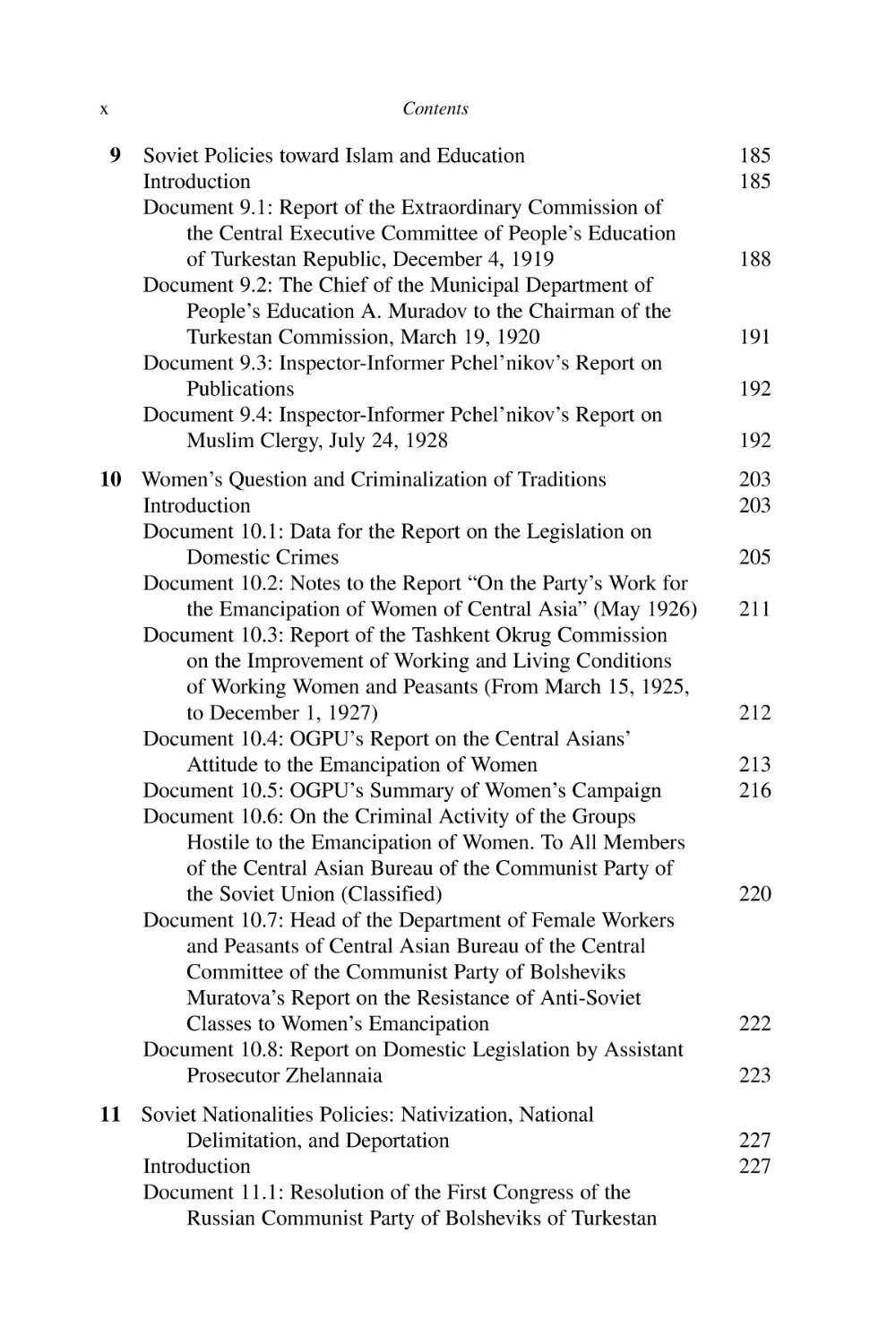
Contents
Acknowledgments
xv
Introduction
1
PART I: TSARIST CENTRAL ASIA
7
1
2
Precolonial Central Asia: Nomads and People of Oases
Introduction
Document 1.1: Ivan Andreev, Description of the Kazakhs’
Middle Horde
Document 1.2: Johann Gottlieb Georgi, About Tartar Peoples
Document 1.3: Burnashev and Pospelov, The Trip to Tashkent
Document 1.4: Ármin Vámbéry, Travels in Central Asia
Russian Policies and Steppe Realities in the Eighteenth
Century
Introduction
Document 2.1: Decision of the Board of Foreign Affairs
on the Letter Sent by Abu’l Khayr Khan, Approved by
Empress Anna. October 30, 1730
Document 2.2: Text of the Oath by Abu’l Khayr Khan
on the Acceptance of a Russian Protectorate, Approved
by the Board of Foreign Affairs. March 26, 1731
Document 2.3: Letter of Abu’l Khayr Khan to Anna
Ioannovna with a Request to Send Tevkelev to Him
and to Construct a Fortress at the Mouth of the
River Or’ (February 26, 1734)
v
9
9
12
18
24
28
39
39
42
43
44
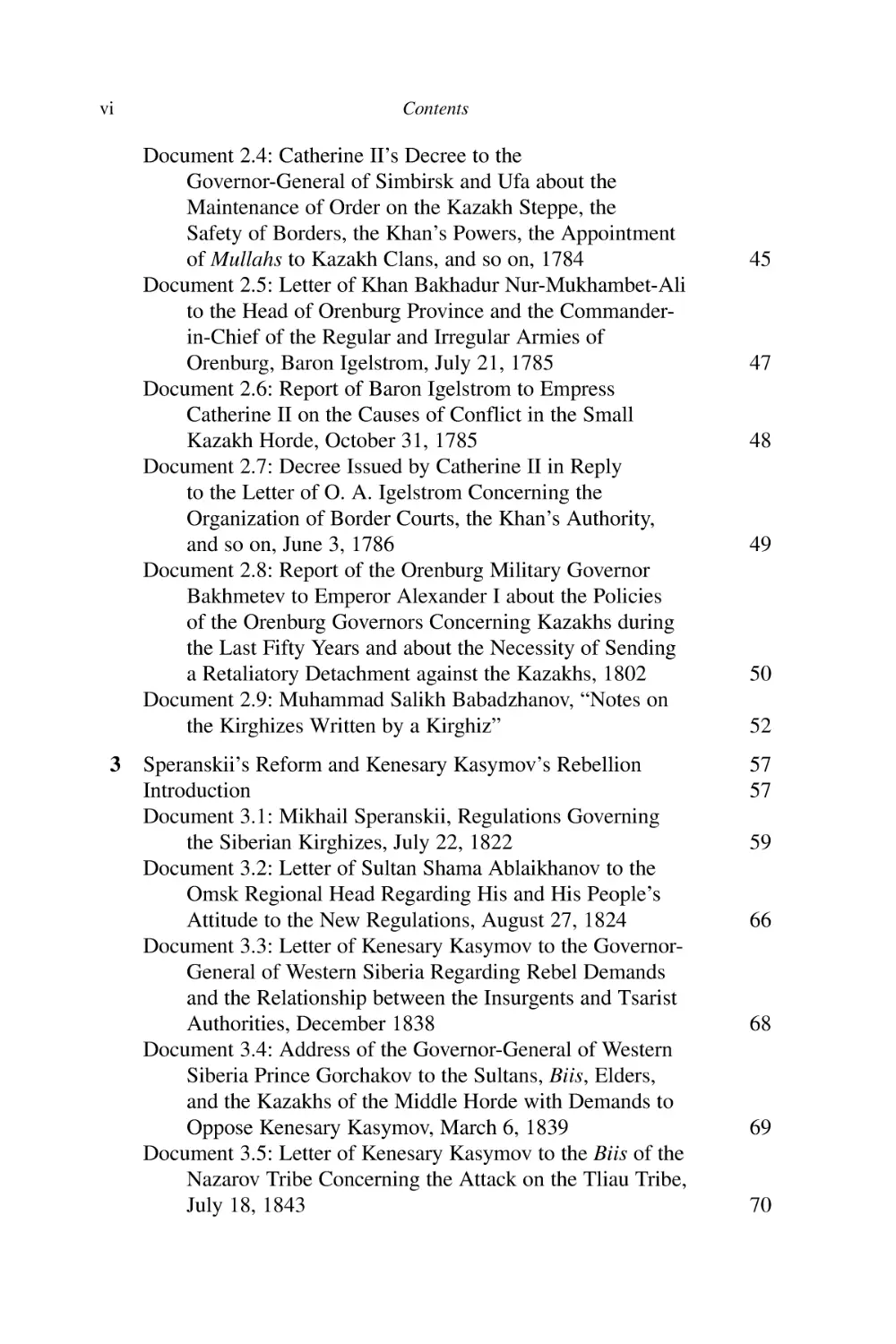
vi
Contents
Document 2.4: Catherine II’s Decree to the
Governor-General of Simbirsk and Ufa about the
Maintenance of Order on the Kazakh Steppe, the
Safety of Borders, the Khan’s Powers, the Appointment
of Mullahs to Kazakh Clans, and so on, 1784
Document 2.5: Letter of Khan Bakhadur Nur-Mukhambet-Ali
to the Head of Orenburg Province and the Commanderin-Chief of the Regular and Irregular Armies of
Orenburg, Baron Igelstrom, July 21, 1785
Document 2.6: Report of Baron Igelstrom to Empress
Catherine II on the Causes of Conflict in the Small
Kazakh Horde, October 31, 1785
Document 2.7: Decree Issued by Catherine II in Reply
to the Letter of O. A. Igelstrom Concerning the
Organization of Border Courts, the Khan’s Authority,
and so on, June 3, 1786
Document 2.8: Report of the Orenburg Military Governor
Bakhmetev to Emperor Alexander I about the Policies
of the Orenburg Governors Concerning Kazakhs during
the Last Fifty Years and about the Necessity of Sending
a Retaliatory Detachment against the Kazakhs, 1802
Document 2.9: Muhammad Salikh Babadzhanov, “Notes on
the Kirghizes Written by a Kirghiz”
3
Speranskii’s Reform and Kenesary Kasymov’s Rebellion
Introduction
Document 3.1: Mikhail Speranskii, Regulations Governing
the Siberian Kirghizes, July 22, 1822
Document 3.2: Letter of Sultan Shama Ablaikhanov to the
Omsk Regional Head Regarding His and His People’s
Attitude to the New Regulations, August 27, 1824
Document 3.3: Letter of Kenesary Kasymov to the GovernorGeneral of Western Siberia Regarding Rebel Demands
and the Relationship between the Insurgents and Tsarist
Authorities, December 1838
Document 3.4: Address of the Governor-General of Western
Siberia Prince Gorchakov to the Sultans, Biis, Elders,
and the Kazakhs of the Middle Horde with Demands to
Oppose Kenesary Kasymov, March 6, 1839
Document 3.5: Letter of Kenesary Kasymov to the Biis of the
Nazarov Tribe Concerning the Attack on the Tliau Tribe,
July 18, 1843
45
47
48
49
50
52
57
57
59
66
68
69
70
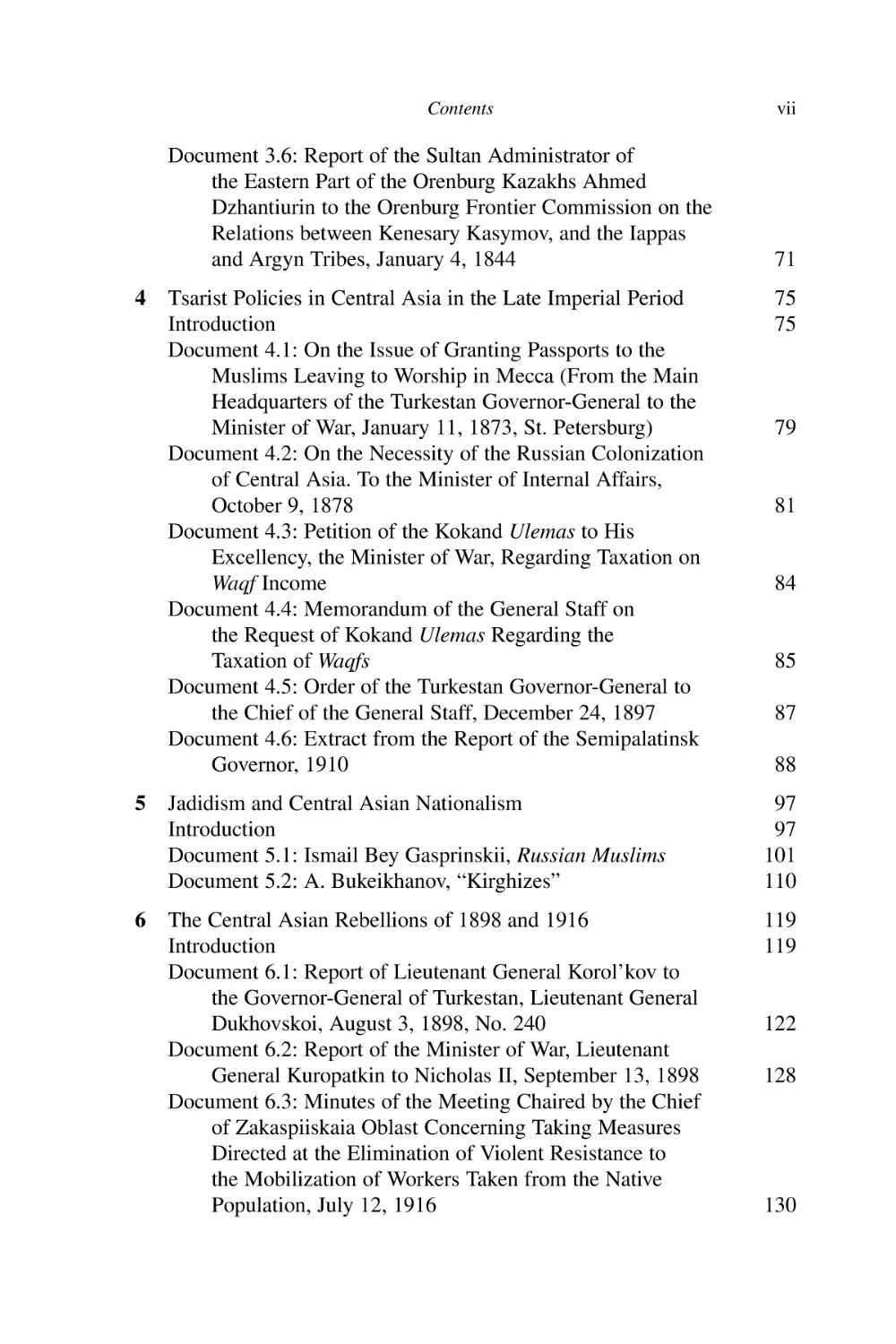
Contents
Document 3.6: Report of the Sultan Administrator of
the Eastern Part of the Orenburg Kazakhs Ahmed
Dzhantiurin to the Orenburg Frontier Commission on the
Relations between Kenesary Kasymov, and the Iappas
and Argyn Tribes, January 4, 1844
4
Tsarist Policies in Central Asia in the Late Imperial Period
Introduction
Document 4.1: On the Issue of Granting Passports to the
Muslims Leaving to Worship in Mecca (From the Main
Headquarters of the Turkestan Governor-General to the
Minister of War, January 11, 1873, St. Petersburg)
Document 4.2: On the Necessity of the Russian Colonization
of Central Asia. To the Minister of Internal Affairs,
October 9, 1878
Document 4.3: Petition of the Kokand Ulemas to His
Excellency, the Minister of War, Regarding Taxation on
Waqf Income
Document 4.4: Memorandum of the General Staff on
the Request of Kokand Ulemas Regarding the
Taxation of Waqfs
Document 4.5: Order of the Turkestan Governor-General to
the Chief of the General Staff, December 24, 1897
Document 4.6: Extract from the Report of the Semipalatinsk
Governor, 1910
vii
71
75
75
79
81
84
85
87
88
5
Jadidism and Central Asian Nationalism
Introduction
Document 5.1: Ismail Bey Gasprinskii, Russian Muslims
Document 5.2: A. Bukeikhanov, “Kirghizes”
97
97
101
110
6
The Central Asian Rebellions of 1898 and 1916
Introduction
Document 6.1: Report of Lieutenant General Korol’kov to
the Governor-General of Turkestan, Lieutenant General
Dukhovskoi, August 3, 1898, No. 240
Document 6.2: Report of the Minister of War, Lieutenant
General Kuropatkin to Nicholas II, September 13, 1898
Document 6.3: Minutes of the Meeting Chaired by the Chief
of Zakaspiiskaia Oblast Concerning Taking Measures
Directed at the Elimination of Violent Resistance to
the Mobilization of Workers Taken from the Native
Population, July 12, 1916
119
119
122
128
130
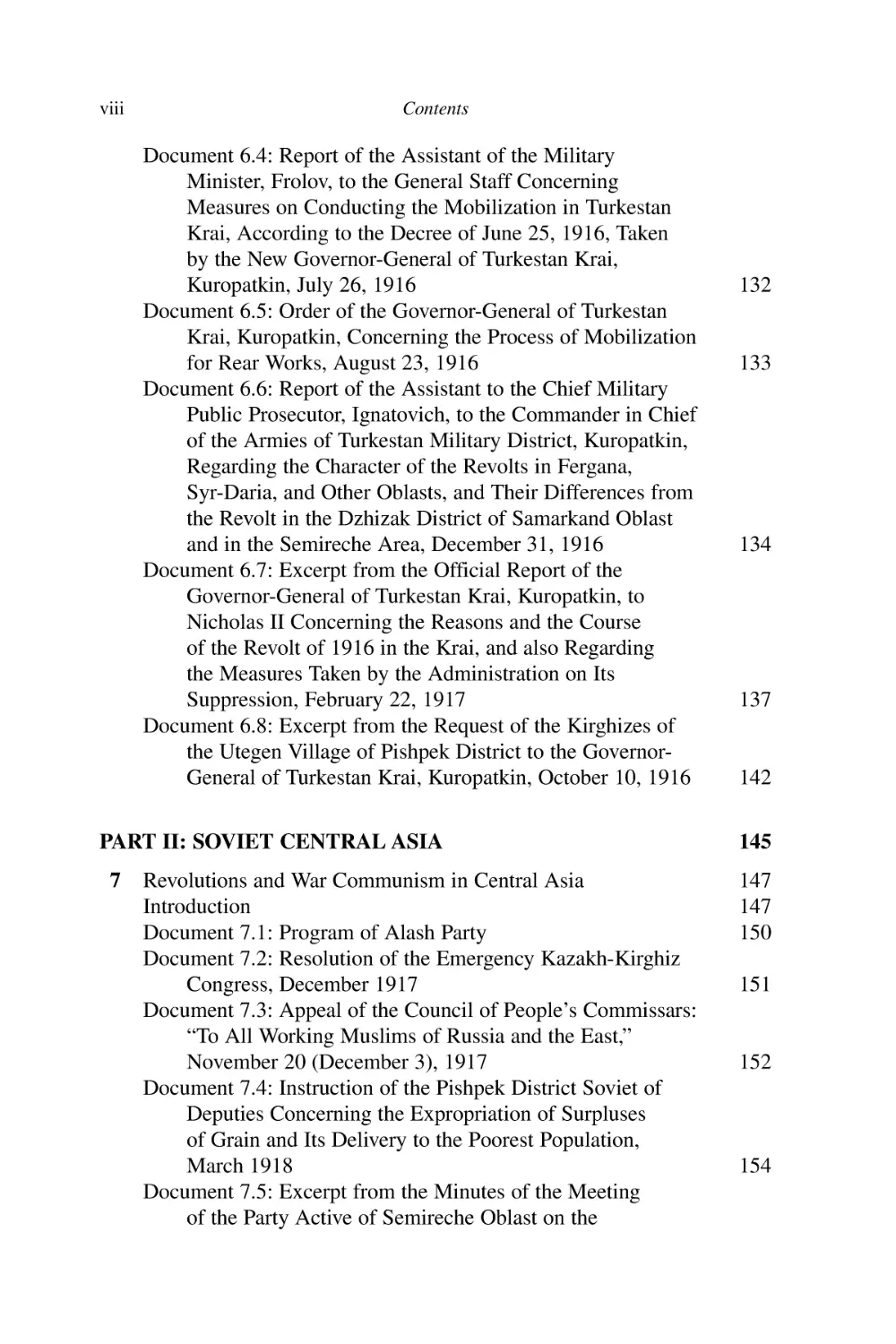
viii
Contents
Document 6.4: Report of the Assistant of the Military
Minister, Frolov, to the General Staff Concerning
Measures on Conducting the Mobilization in Turkestan
Krai, According to the Decree of June 25, 1916, Taken
by the New Governor-General of Turkestan Krai,
Kuropatkin, July 26, 1916
Document 6.5: Order of the Governor-General of Turkestan
Krai, Kuropatkin, Concerning the Process of Mobilization
for Rear Works, August 23, 1916
Document 6.6: Report of the Assistant to the Chief Military
Public Prosecutor, Ignatovich, to the Commander in Chief
of the Armies of Turkestan Military District, Kuropatkin,
Regarding the Character of the Revolts in Fergana,
Syr-Daria, and Other Oblasts, and Their Differences from
the Revolt in the Dzhizak District of Samarkand Oblast
and in the Semireche Area, December 31, 1916
Document 6.7: Excerpt from the Official Report of the
Governor-General of Turkestan Krai, Kuropatkin, to
Nicholas II Concerning the Reasons and the Course
of the Revolt of 1916 in the Krai, and also Regarding
the Measures Taken by the Administration on Its
Suppression, February 22, 1917
Document 6.8: Excerpt from the Request of the Kirghizes of
the Utegen Village of Pishpek District to the GovernorGeneral of Turkestan Krai, Kuropatkin, October 10, 1916
PART II: SOVIET CENTRAL ASIA
7
Revolutions and War Communism in Central Asia
Introduction
Document 7.1: Program of Alash Party
Document 7.2: Resolution of the Emergency Kazakh-Kirghiz
Congress, December 1917
Document 7.3: Appeal of the Council of People’s Commissars:
“To All Working Muslims of Russia and the East,”
November 20 (December 3), 1917
Document 7.4: Instruction of the Pishpek District Soviet of
Deputies Concerning the Expropriation of Surpluses
of Grain and Its Delivery to the Poorest Population,
March 1918
Document 7.5: Excerpt from the Minutes of the Meeting
of the Party Active of Semireche Oblast on the
132
133
134
137
142
145
147
147
150
151
152
154
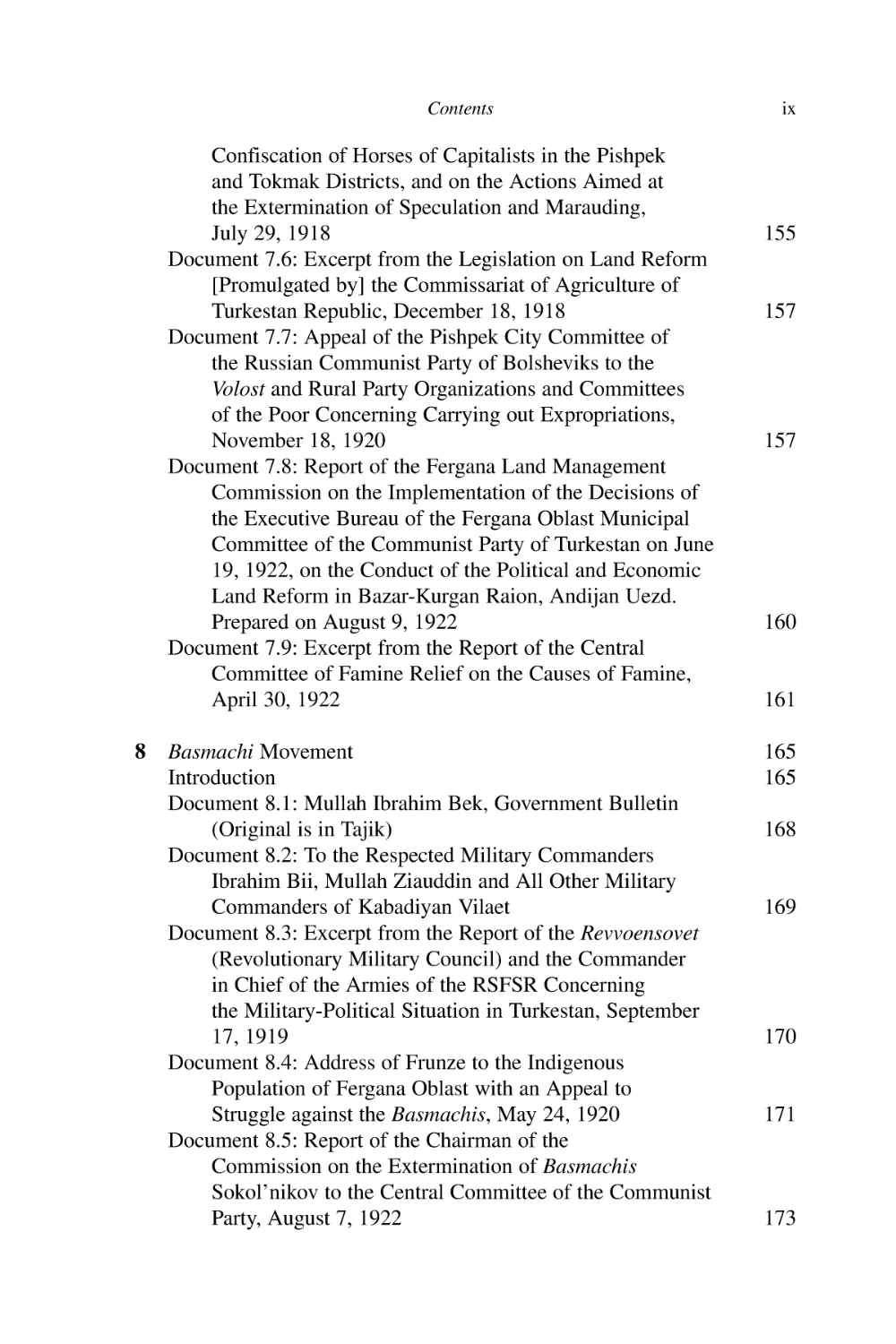
Contents
Confiscation of Horses of Capitalists in the Pishpek
and Tokmak Districts, and on the Actions Aimed at
the Extermination of Speculation and Marauding,
July 29, 1918
Document 7.6: Excerpt from the Legislation on Land Reform
[Promulgated by] the Commissariat of Agriculture of
Turkestan Republic, December 18, 1918
Document 7.7: Appeal of the Pishpek City Committee of
the Russian Communist Party of Bolsheviks to the
Volost and Rural Party Organizations and Committees
of the Poor Concerning Carrying out Expropriations,
November 18, 1920
Document 7.8: Report of the Fergana Land Management
Commission on the Implementation of the Decisions of
the Executive Bureau of the Fergana Oblast Municipal
Committee of the Communist Party of Turkestan on June
19, 1922, on the Conduct of the Political and Economic
Land Reform in Bazar-Kurgan Raion, Andijan Uezd.
Prepared on August 9, 1922
Document 7.9: Excerpt from the Report of the Central
Committee of Famine Relief on the Causes of Famine,
April 30, 1922
8
Basmachi Movement
Introduction
Document 8.1: Mullah Ibrahim Bek, Government Bulletin
(Original is in Tajik)
Document 8.2: To the Respected Military Commanders
Ibrahim Bii, Mullah Ziauddin and All Other Military
Commanders of Kabadiyan Vilaet
Document 8.3: Excerpt from the Report of the Revvoensovet
(Revolutionary Military Council) and the Commander
in Chief of the Armies of the RSFSR Concerning
the Military-Political Situation in Turkestan, September
17, 1919
Document 8.4: Address of Frunze to the Indigenous
Population of Fergana Oblast with an Appeal to
Struggle against the Basmachis, May 24, 1920
Document 8.5: Report of the Chairman of the
Commission on the Extermination of Basmachis
Sokol’nikov to the Central Committee of the Communist
Party, August 7, 1922
ix
155
157
157
160
161
165
165
168
169
170
171
173
x
Contents
9
Soviet Policies toward Islam and Education
Introduction
Document 9.1: Report of the Extraordinary Commission of
the Central Executive Committee of People’s Education
of Turkestan Republic, December 4, 1919
Document 9.2: The Chief of the Municipal Department of
People’s Education A. Muradov to the Chairman of the
Turkestan Commission, March 19, 1920
Document 9.3: Inspector-Informer Pchel’nikov’s Report on
Publications
Document 9.4: Inspector-Informer Pchel’nikov’s Report on
Muslim Clergy, July 24, 1928
10 Women’s Question and Criminalization of Traditions
Introduction
Document 10.1: Data for the Report on the Legislation on
Domestic Crimes
Document 10.2: Notes to the Report “On the Party’s Work for
the Emancipation of Women of Central Asia” (May 1926)
Document 10.3: Report of the Tashkent Okrug Commission
on the Improvement of Working and Living Conditions
of Working Women and Peasants (From March 15, 1925,
to December 1, 1927)
Document 10.4: OGPU’s Report on the Central Asians’
Attitude to the Emancipation of Women
Document 10.5: OGPU’s Summary of Women’s Campaign
Document 10.6: On the Criminal Activity of the Groups
Hostile to the Emancipation of Women. To All Members
of the Central Asian Bureau of the Communist Party of
the Soviet Union (Classified)
Document 10.7: Head of the Department of Female Workers
and Peasants of Central Asian Bureau of the Central
Committee of the Communist Party of Bolsheviks
Muratova’s Report on the Resistance of Anti-Soviet
Classes to Women’s Emancipation
Document 10.8: Report on Domestic Legislation by Assistant
Prosecutor Zhelannaia
11 Soviet Nationalities Policies: Nativization, National
Delimitation, and Deportation
Introduction
Document 11.1: Resolution of the First Congress of the
Russian Communist Party of Bolsheviks of Turkestan
185
185
188
191
192
192
203
203
205
211
212
213
216
220
222
223
227
227
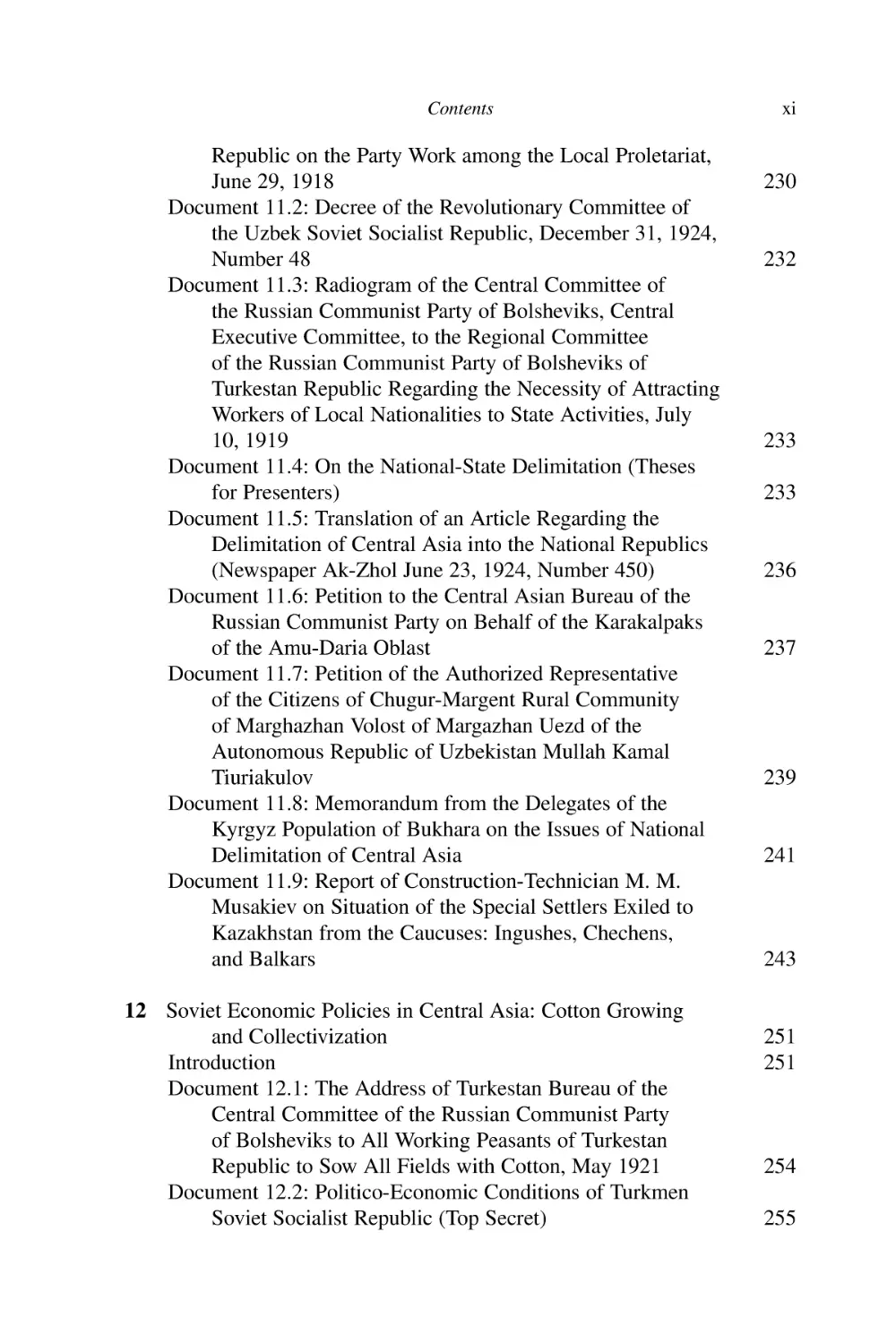
Contents
Republic on the Party Work among the Local Proletariat,
June 29, 1918
Document 11.2: Decree of the Revolutionary Committee of
the Uzbek Soviet Socialist Republic, December 31, 1924,
Number 48
Document 11.3: Radiogram of the Central Committee of
the Russian Communist Party of Bolsheviks, Central
Executive Committee, to the Regional Committee
of the Russian Communist Party of Bolsheviks of
Turkestan Republic Regarding the Necessity of Attracting
Workers of Local Nationalities to State Activities, July
10, 1919
Document 11.4: On the National-State Delimitation (Theses
for Presenters)
Document 11.5: Translation of an Article Regarding the
Delimitation of Central Asia into the National Republics
(Newspaper Ak-Zhol June 23, 1924, Number 450)
Document 11.6: Petition to the Central Asian Bureau of the
Russian Communist Party on Behalf of the Karakalpaks
of the Amu-Daria Oblast
Document 11.7: Petition of the Authorized Representative
of the Citizens of Chugur-Margent Rural Community
of Marghazhan Volost of Margazhan Uezd of the
Autonomous Republic of Uzbekistan Mullah Kamal
Tiuriakulov
Document 11.8: Memorandum from the Delegates of the
Kyrgyz Population of Bukhara on the Issues of National
Delimitation of Central Asia
Document 11.9: Report of Construction-Technician M. M.
Musakiev on Situation of the Special Settlers Exiled to
Kazakhstan from the Caucuses: Ingushes, Chechens,
and Balkars
12 Soviet Economic Policies in Central Asia: Cotton Growing
and Collectivization
Introduction
Document 12.1: The Address of Turkestan Bureau of the
Central Committee of the Russian Communist Party
of Bolsheviks to All Working Peasants of Turkestan
Republic to Sow All Fields with Cotton, May 1921
Document 12.2: Politico-Economic Conditions of Turkmen
Soviet Socialist Republic (Top Secret)
xi
230
232
233
233
236
237
239
241
243
251
251
254
255
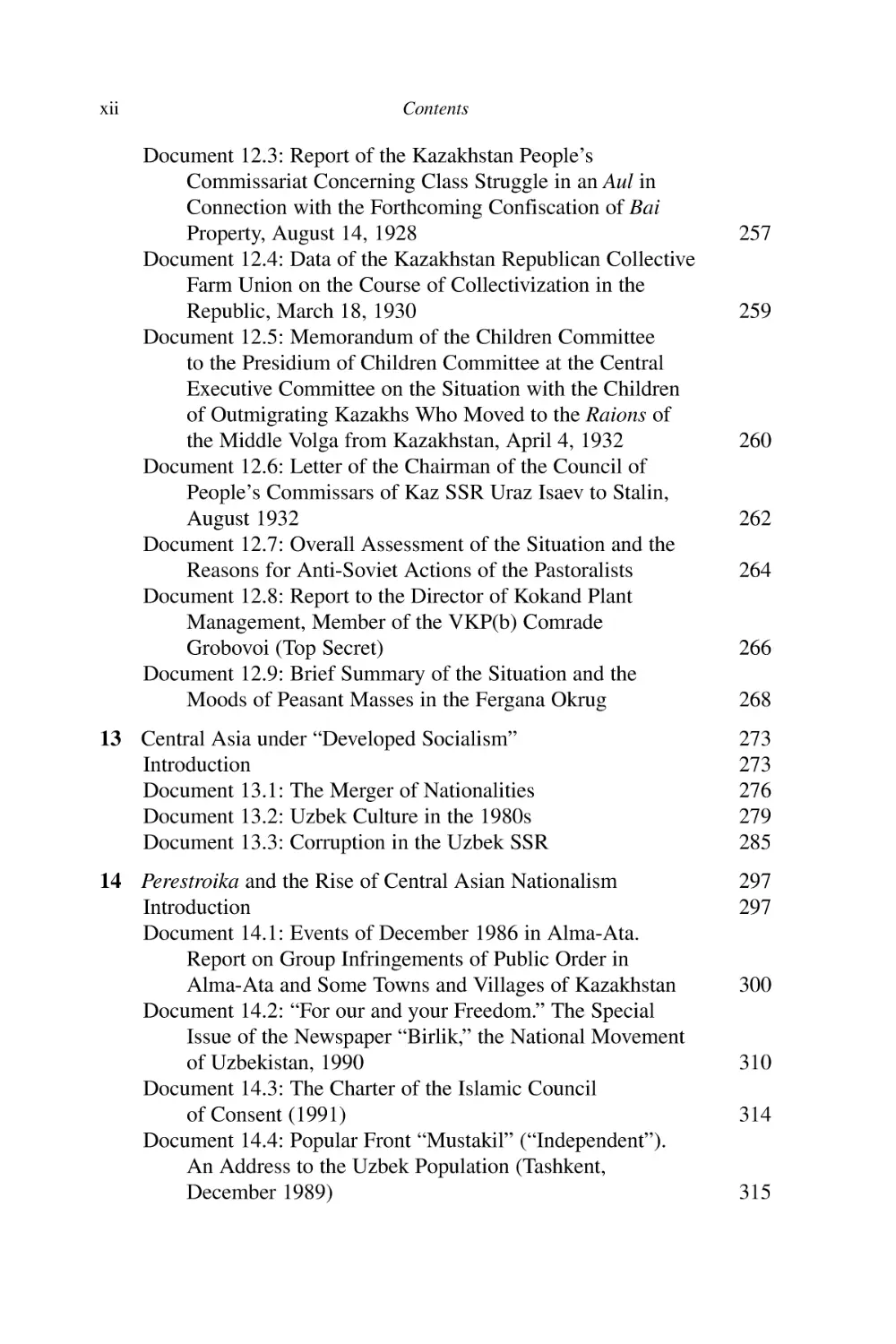
xii
Contents
Document 12.3: Report of the Kazakhstan People’s
Commissariat Concerning Class Struggle in an Aul in
Connection with the Forthcoming Confiscation of Bai
Property, August 14, 1928
Document 12.4: Data of the Kazakhstan Republican Collective
Farm Union on the Course of Collectivization in the
Republic, March 18, 1930
Document 12.5: Memorandum of the Children Committee
to the Presidium of Children Committee at the Central
Executive Committee on the Situation with the Children
of Outmigrating Kazakhs Who Moved to the Raions of
the Middle Volga from Kazakhstan, April 4, 1932
Document 12.6: Letter of the Chairman of the Council of
People’s Commissars of Kaz SSR Uraz Isaev to Stalin,
August 1932
Document 12.7: Overall Assessment of the Situation and the
Reasons for Anti-Soviet Actions of the Pastoralists
Document 12.8: Report to the Director of Kokand Plant
Management, Member of the VKP(b) Comrade
Grobovoi (Top Secret)
Document 12.9: Brief Summary of the Situation and the
Moods of Peasant Masses in the Fergana Okrug
257
259
260
262
264
266
268
13 Central Asia under “Developed Socialism”
Introduction
Document 13.1: The Merger of Nationalities
Document 13.2: Uzbek Culture in the 1980s
Document 13.3: Corruption in the Uzbek SSR
273
273
276
279
285
14 Perestroika and the Rise of Central Asian Nationalism
Introduction
Document 14.1: Events of December 1986 in Alma-Ata.
Report on Group Infringements of Public Order in
Alma-Ata and Some Towns and Villages of Kazakhstan
Document 14.2: “For our and your Freedom.” The Special
Issue of the Newspaper “Birlik,” the National Movement
of Uzbekistan, 1990
Document 14.3: The Charter of the Islamic Council
of Consent (1991)
Document 14.4: Popular Front “Mustakil” (“Independent”).
An Address to the Uzbek Population (Tashkent,
December 1989)
297
297
300
310
314
315
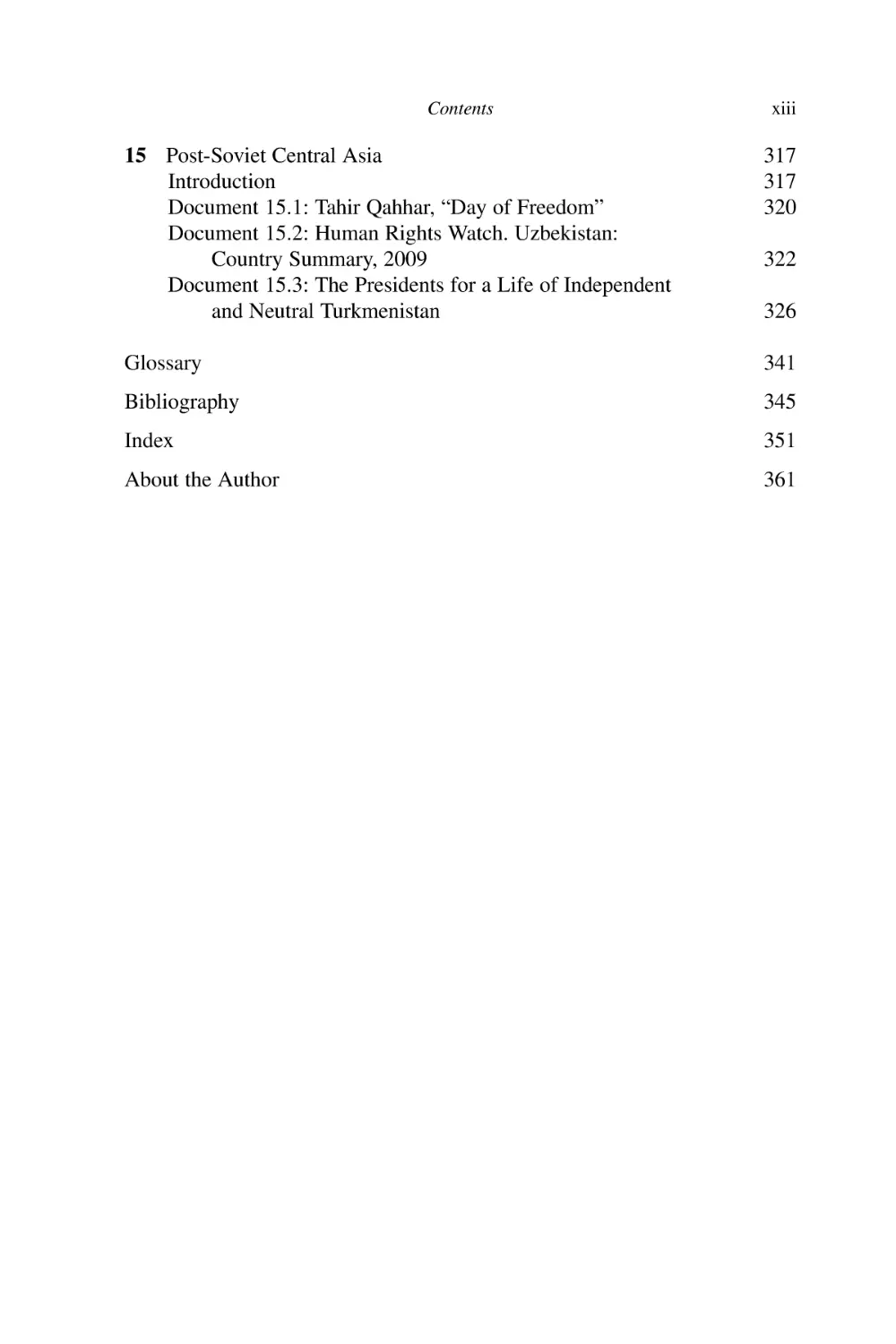
Contents
xiii
15 Post-Soviet Central Asia
Introduction
Document 15.1: Tahir Qahhar, “Day of Freedom”
Document 15.2: Human Rights Watch. Uzbekistan:
Country Summary, 2009
Document 15.3: The Presidents for a Life of Independent
and Neutral Turkmenistan
317
317
320
Glossary
341
Bibliography
345
Index
351
About the Author
361
322
326
Acknowledgments
The compilation of this primary source reader required extensive research in
the national archives of Russia and Central Asia, and I would not have been
able to conduct this research without the generous funds provided by SUNY
Oneonta’s Research Foundation, the School of Liberal Arts, and the Department of History of the State University of New York College at Oneonta.
I am grateful for the generous counsel of my colleagues and friends W
illiam
Ashbaugh and Matthew Hendley who, while serving their terms as chairs of
the History Department at SUNY Oneonta, provided me with tremendous
support and valuable guidance in preparing this volume for publication.
Many people helped to make my time researching in Russia and Central
Asia a productive experience. I extend my deepest thanks to the archivists and
librarians who assisted in my research.
I am especially grateful to my wife Vanessa Ziegler for her understanding
and love during the past few years, as well as her editing of the first part of
the reader. I am also thankful to my research assistant William Leahy, who
did a great job editing the second part of the reader.
xv
Introduction
The primary purpose of this source book is to assist college and university
professors in acquainting students with the basic political, social, and economic evolution of Central Asian civilization in its colonial (1731–1991) and
postcolonial (1991–present) periods, as well as gaining a mature understanding and appreciation of the uniqueness and dignity of Central Asian history.
Among other aspects of Central Asian history, the documents included in this
reader shed light on such topics as the issue of resistance and accommodation
of native societies to the policies of the imperial center, the transformation of
Central Asian societies under Tsarist and Soviet rule, and the history of Islam
in Central Asia and its role in nation- and state-building processes. This primary source book is instrumental for familiarizing students with the nationality policies of imperial Russian, Soviet, and post-Soviet governments, and the
effects produced by these policies on the natives of the region.
The documents collected in this reader challenge the traditional approach,
which has viewed Central Asians as passive recipients of the policies imposed
on them by central authorities. The documents demonstrate the active participation of the indigenous peoples in contact with other peoples by examining
the natives’ ways of organizing societies, their precolonial experience of contact with outsiders, and the structure of their subsistence systems. This source
book also helps students to place the major events and activities of Central
Asia within a global context. In addition to the importance of the documents
for the study of Central Asian history, many of them foster comparative
analysis and a cross-disciplinary approach to enlighten crucial historical and
contemporary problems pertinent to many parts of the world.
For many decades, Central Asia was both the frontier of the Russian
Empire and its only colony. The comparison of Russian imperial policies
in Central Asia with those of European powers in the Americas, Asia, and
1
2
Introduction
Africa elucidates the nature of modem imperialism. For example, the primary documents enable students to conduct a comparative analysis of the
factors that determined the character of interactions between colonizers
and indigenous people in Central Asia and North America. This reader also
demonstrates the factors responsible for the dual function of the frontier as
the contact zone, or the barrier separating colonizers and indigenous peoples.
Additionally, it explains the study of cross-cultural encounters, not only as
a history of resistance and confrontation in some regions but also as one of
collaboration which led to the deliberate construction of alliances between the
natives and newcomers.
The Central Asian source book also assists students in the study of the rise
of ethnonationalism and religious fundamentalism in postcolonial settings.
This phenomenon is quite typical in contemporary postcolonial societies, and
Central Asia is by no means the only region in the world which experiences
these developments. Religious fundamentalism and ethnonationalism are
among the most significant factors which threaten the world’s stability and
security at the beginning of the twenty-first century. Central Asia provides
a very good case for the study of the religious and ethnic radicalization of
societies.
In short, this source book is not only useful for the study of Central Asian
history in its colonial and postcolonial periods but also provides a primary
source foundation for research aimed at comparative studies of frontier,
imperialism, interethnic and interreligious relations, nationalism, and the rise
of religious fundamentalism in different settings.
The documents included in this reader center on the history of the region
that extends westward from the border of China to the Caspian Sea and the
lower Volga, and southward from Siberia to Iran and Afghanistan. Central
Asia covers an enormous territory of more than 1,500,000 square miles,
which is about half the size of the United States and more than seven times
the size of France, with a population of over 70 million.
Today Central Asia comprises Kazakhstan, Kyrgyzstan, Turkmenistan,
Uzbekistan, and Tajikistan. Its rich resources of oil and natural gas and its
important strategic position have made the region the new battleground for
influence between China, the United States, and the Russian Federation. Yet,
despite its strategic and economic significance, the region remains largely a
mystery to outsiders.
The documents included in the reader focus on the colonial period of Central Asian history, which lasted for 260 years from 1731 to 1991. The reader
also includes one chapter on the precolonial history of Central Asia to accentuate the effects produced by imperial rule on the peoples of the region, and
one chapter on postcolonial Central Asia to establish connections between the
past and the present.
Introduction
3
A colonial page in the history of the Central Asia was opened in 1731 when
Abu’l Khayr, the Khan of the Kazakh Younger Horde, petitioned to become
the subject of Russian Empress Anna Ioannovna. In the following 140 years,
the Russian Empire slowly, but steadily, incorporated the territories of Central Asia, turning them into its colony. By 1870, the entire territory of Central
Asia was included into the Russian Empire and, over the course of the following 120 years, the natives of Central Asia were considered subjects of the
Russian Empire and its successor, the Soviet Union.
According to renowned writer, commentator, and journalist Dilip Hiro, of
the many non-Slav regions of the Tsarist Empire, Central Asia experienced
the most turbulent experiences after the Bolshevik Revolution of 1917.1
These radical changes included the following: the delineation of Central
Asia along the ethnic lines, which resulted in the emergence of five republics
on its territory; the conversion of several spoken vernaculars into written
languages; a drastic transformation of property rights and economic organization of the Central Asian natives; a severe attack on Islam which led to
almost complete abrogation of places of worship; development of the system
of education unprecedented in the history of Central Asia; a change of the
position of women in society; and criminalization of those Central Asian
traditions which defined and reflected their place in earlier times. The ultimate purpose of these reforms was the creation of a new society. According
to the policy-makers in Moscow, this society had to be thoroughly different
from the traditional Central Asian one. The documents collected in the reader
demonstrate the strategies used by the Soviet government to introduce these
changes, the reaction of the native population to the Soviet policies, and the
results of these reforms. Though the aims and the policies of the Soviet government were considerably different from those of the tsars, one may see a
very important similarity between them: The plans of imperial policy-makers
were noticeably corrected by Central Asian realities.
Then, in 1991, the collapse of the Soviet Union heralded the independence
of Central Asia. The colonial past, however, has left an indelible impression
on all aspects of Central Asian life, and continues to define the social and
political structures in all newly independent Central Asian countries: The
very division of Central Asia into five republics is a Soviet creation, the vast
majority of members of native elites made their careers in the Soviet administrative and party apparatus, and the present economies of these countries were
formed for the most part during the colonial period of its history. This is why
I consider the colonial period of Central Asian history as the most significant
one for the understanding of present-day political, social, and economic situations in Central Asian countries.
This book is aimed at undergraduate and graduate students, and scholars specializing in Central Asian and Russian/Soviet history. I originally
4
Introduction
prepared the reader for my class on the history of modern Central Asia, which
I am currently teaching. The documents collected in this source book will
allow students to write research papers on any one of the following topics.
1. Compare and contrast Tsarist and Soviet imperial policies toward the
peoples of Central Asia. What were the interests of imperial officials
in these areas during different time periods, and how did these interests
define colonial policies? Your answer should include the political, social,
legal, cultural, and religious policies of the imperial center toward the
aboriginal societies of Central Asia.
2. Discuss the transformation of the social, political, economic, and gender structures of Central Asian societies under Russian and Soviet rule.
Consider both nomadic and sedentary Central Asian peoples. Were these
transformations planned by the imperial center? How would you evaluate
these transformations?
3. Discuss the issue of resistance and accommodation of native societies to
the policies of the imperial center. Trace the development of the attitudes
of different groups of the native population to Tsarist and Soviet rule.
What factors permitted the Russian state to establish and maintain its
control over Central Asia? What were the most important challenges to
Russian rule in the time period studied in this class?
4. Compare and contrast the causes, developments, and consequences of
revolts against central authorities and their representatives, which took
place in Central Asia during Tsarist and Soviet periods. What were the
rebels’ motives in both instances? How did the central authorities react to
these rebellions? What do the grievances of the insurgents tell us about the
imperial policies of the Tsarist and Soviet regimes?
5. Discuss the emergence of Central Asian nationalism and its relation to
the Islamic identity. How did nationalistic ideology manifest itself? What
were the aims of Central Asian nationalists of the different time periods
studied in this class? What were their strategies to gain popular support?
Scholars and students in other fields, such as nationalism, imperialism,
colonialism and postcolonialism, Islam, interethnic and interreligious relations, and frontier studies also would be interested in this book.
Andre Gunder Frank justly compares Central Asia to a “black hole in the
middle of the world,” and argues that Central Asia is both the most important and the most neglected part of the world and its history.2 There are no
published English-language primary source readers on the history of modern
Central Asia yet, which makes the work of professors teaching the history
of Central Asia at both undergraduate and graduate levels very problematic.
Introduction
5
This reader includes primary documents which have never been published in
English-language sources.
In terms of chronology, this reader is a logical continuation of Islamic
Central Asia: An Anthology of Historical Sources, edited by Scott C. Levi
and Ron Sela published by Indiana University Press in November 2009. Their
anthology, rightly advertised as “the first English-language anthology of primary documents for the study of Central Asian history,” covers the period
from the Arab conquests of the seventh century to the Russian conquest. My
source book differs from Levi and Sela’s anthology in two major aspects:
First, it concentrates on a later period of Central Asian history and, second,
it is primarily concerned with the interplay between imperial policies and the
natives’ reaction to them. More than anything else, it is a study of colonialism, anti-colonialism, and postcolonialism within a Central Asian setting.
Another difference is Levi and Sela’s concentration on the southern part of
Central Asia. I believe that Kazakhstan, being the largest and most economically productive Central Asian country, also deserves careful study.
NOTES
1. Dilip Hiro, Inside Central Asia: A Political and Cultural History of Uzbekistan,
Turkmenistan, Kazakhstan, Kyrgyzstan, Tajikistan, Turkey, and Iran (New York:
Overlook Duckworth, 2009), 391.
2. Andre Gunder Frank, The Centrality of Central Asia (Amsterdam: VU University Press, 1992), 45.
Part I
TSARIST CENTRAL ASIA
Chapter 1
Precolonial Central Asia
Nomads and People of Oases
INTRODUCTION
Although the first part of this primary source reader deals with the experience
of Central Asians during the colonial period of their history, to fully understand the changes produced in the Central Asian societies by tsarist policies
a researcher should be aware of the social, political, religious, gender, and
economic structures of both the steppe nomads and settled people of the
Central Asian khanates in the precolonial period of their history. The primary
purpose of the documents included in this part is to provide the reader with
this information. Another purpose of this chapter is to demonstrate that Central Asian society was far from being homogeneous. To illustrate this point,
the geographic scope of the places described in the reports and travel notes
is broad, ranging from the northern regions of modern-day Kazakhstan to the
Uzbek khanates situated in the southern part of Central Asia. Juxtaposing
the documents which describe the lives of the natives of different regions of
Central Asia, the reader may see similarities and differences between Central
Asian nomadic and settled societies, as well as interactions between them.
Prior to the beginning of the twentieth century, the distinction of the peoples
of Central Asia was not as between nationalities but as between nomad and
sedentary peoples. Moreover, as Geoffrey Wheeler states, “It was more usual
for a man to think of himself as a member of a tribe or a clan than as belonging to a whole people.”1
The documents of this chapter demonstrate and explain the key characteristics of social, economic, and political structures of pastoral nomads, which
were tightly interconnected to their specific way of life such as weakness of
khans’ and sultans’ authority among Central Asian nomads, as well as the
lack of political unity, the absence of agriculture and a money economy in
9
10
Chapter 1
the steppe, the importance of kinship systems, the ways of conflict resolution
within and between nomadic clans, as well as the nomads’ religious syncretism. Moreover, the documents contrast these characteristic features of the
nomadic societies to the sophisticated economic systems of the Uzbek khanates, the rigidness of their social and political structures, and the importance
of Islam among Uzbeks. The documents also demonstrate the institution of
slavery in both nomadic and settled societies of Central Asia, the importance
of Islam and its clergy in defining the domestic and foreign policies of the
Central Asian khanates, as well as a division of powers between secular and
religious authorities. Moreover, the documents reveal the position of women
in different Central Asian societies. Since the documents are written by outsiders (predominantly Russians), they disclose the interests of the European
powers in this part of the world.
The evidence provided in these documents also explains the reasons for the
inability of Central Asians to protect themselves from Russian encroachment.
Among these reasons, the documents demonstrate frequent turmoil caused by
the indeterminacy of the principles of succession and rivalries between different khanates. These squabbles and rivalries weakened the Central Asian
khanates and prevented them from forming durable alliances against Russian
imperial forces.
Chapter 1 includes travel notes and reports of Russian and European travelers, ethnographers, mountain engineers, and an army officer, who visited
different regions of Central Asia in the period between 1776 and 1863. These
documents are essential for anyone wishing to understand the basic characteristics of the nomadic and settled peoples of Central Asia. While reading them,
the reader should be aware of the Eurocentric views which distort reality,
frequently depicting the natives of Central Asia as primitive peoples lacking
the “fruits of higher civilization.”
One of the most important observers of Kazakhstan during the prerevolutionary period was a Russian military engineer and topographer named
Ivan Grigorievich Andreev, who had served for more than fifty years
on the border of southern Siberia and the Kazakh steppe. From 1785 to
1790, he wrote a monograph devoted to the Kazakh people under the title
“The Description of the Middle Horde of the Kirghiz-Kaisaks.”2 Although
Andreev’s research was published at the end of the eighteenth century, the
publication was incomplete and even the name of the author was not mentioned. As a result, Andreev’s monograph was long unknown to the general public. During his military service, Andreev built bridges, fortresses,
churches, and various constructions along the border separating Siberia
from the Kazakh steppe. He built fortresses along the Irtysh line, including
those of Semipalatinsk, Ust-Kamenogorsk, Iamyshevo, and Bukhtorma.
Andreev spent much of his life on the southern Siberian border, where he
Precolonial Central Asia
11
maintained close contact with Kazakhs. Andreev combined duties of service with his own personal interests as an ethnographer. He visited Kazakh
auls, talked to the representatives of different nomadic groups, and studied
the history, traditions, and culture of the Kazakh people. The chapters from
his monograph (Document 1.1) include descriptions of Kazakhs’ religiosity, traditions, and gender roles, as well as the political and social hierarchy
of the nomads.
Johann Gottlieb Georgi (1729–1802) was an ethnologist, naturalist, and
explorer. Georgi studied in Stockholm, and then moved to Russia where
he became a member of St. Petersburg Academy of Science. In Russia, he
learned about of the lives of the subjects of Empress Catherine II. Together
with academics P. S. Pallas and I. P. Falk, Georgi participated in several
“physical expeditions” organized by the St. Petersburg Academy of Science
in 1768–1774. He visited southeastern Russia, and the Altai, Baikal, Transbaikalia, Ural, and Volga regions. On these expeditions, Georgi collected
considerable natural and ethnographic collections. He compiled his observations in a book published in German, Russian, and French in the mid-1770s.
This book has retained its importance as a historical and ethnographic source
up to the present day. The parts of “A Description of All the Peoples Inhabiting the Russian State, as Well as Their Daily Rituals, Beliefs, Customs,
Clothing, Dwellings and Other Memorabilities” included in the reader (Document 1.2) give a detailed description of the Kazakhs’ system of sociopolitical
hierarchy, army organization, relations with Central Asian khanates and Russia, as well as the status of women in Kazakh society.
T. Burnashev and M. Pospelov were geologists and engineers whom Russian officials sent to Tashkent at the end of the eighteenth century with the
purpose of collecting information about extracting saltpeter and “meeting the
requests of the local possessor (i.e., Yunus Khodzha) of making a survey and
opening ore mines near Tashkent.” They provided detailed information about
Tashkent and its surrounding areas, the environment, civil society, and the
employment of the population (Document 1.3).
At the end of March 1863, Hungarian orientalist Ármin Vámbéry under the
name of Turk Reshid Effendi went from Tehran to the steppe of Turkmenistan with a caravan of Muslim pilgrims, who were returning from Mecca. The
clothing of the newfound Dervish consisted of pieces of cloth tied around
his waist with a rope, a patched felt jacket, and a large turban. His feet were
wrapped in rags, and a bag containing a Quran hung around his neck. In such
clothing Vámbéry hoped to blend in with a crowd of ragged pilgrims, who
(in addition to merchants and other travelers) constituted almost the entire
caravan. Having visited the Khiva Khanate, he sailed across the Amu-Daria
to Kungrad. Then Vámbéry crossed the fiery sands of the Kyzyl-Kum and
arrived in Bukhara. In March 1864, a year after the start of his journey, he
12
Chapter 1
reached the capital of Iran, from where he returned to Istanbul and then to
Budapest. In 1864, Vámbéry published a book on his travels called “Travels
across Central Asia” (Document 1.4). This book caused enormous interest in
Western Europe, Russia, and North America, and was translated into almost
all European languages.
DOCUMENT 1.1: IVAN ANDREEV, DESCRIPTION
OF THE KAZAKHS’ MIDDLE HORDE
Chapter V: Ceremonies
1. About Divine Service, Praying, and Fasting
1. Kirghiz-Kaisaks3 are Muslims. Islam came to them from Bukhara during
the period of rule of the ancient khan Zhanibek. Though during subsequent
centuries they came into close contact with different pagan peoples, they
esteemed them more as slaves and treated them scornfully, thus forcing them
to abandon their beliefs and become Kirghiz-Kaisaks’ co-religionists. They
have no akhuns (religious heads) or mullahs for divine services, and regard
any literate person as a mullah. Since none of them is literate, they choose
mullahs from the Tashkentians and Bukharians. Moreover, upon the request
of many notable sultans and elders, the Russian authorities send literate service Tatars and Bashkirs to the steppe to serve as scribes, whom they consider
enlightened people. They have neither temples nor mosques anywhere, and
consider the city of Tashkent in Turkestan the only holy place, because it
houses the tomb of an ancient Khazriat sultan, whom they deem sacred.
In their prayers they follow their parents and any aul or village has a
respected old man, who knows Islamic law and ceremonial customs better
than his tribesmen. This man leaves his dwelling and sings or rather shouts
prayers—that happens five times a day. Upon hearing this singing, everyone
according to the custom of Mohammedans (Muslims) should kneel down
and pray, leaving everything that he was doing. They, however, are not firm
in following the Muslim law. Due to the absence of literate people among
them, they perform pagan rituals and have adopted some ceremonies from
their pagan neighbors. Similar to a Kalmyk ceremony, they burn bones and,
making torches and covering them with oil, they set them alight, and worship
them and make sacrifices. Others, having received some punishment from
God, for example, if their children die, if they are unhappy with bad weather
such as storms, thunder, or lightening, or when in the winter frosts are
extreme, they become angry, curse their God, violate religious dogma, and
Precolonial Central Asia
13
avoid fasting, which they do not do anyway, being free and unsettled people,
constantly wandering from place to place. They do not celebrate the holidays
prescribed by Muslim law. They do not even know them; and festivals and
celebrations occur during marriages and funerals, and they consist mostly of
eating, drinking, and horse racing. Everyone should carry a page from the
Quran given to him by a mullah. This page they sew in their dresses. They
also wear it on their backs and across a shoulder under the right armpit. They
call this item a baitumar, and believe that having it will bring them happiness
and will help them to find their way if they get lost. Mullahs take advantage
of this superstition and sell them to Kirghizes at high prices.
2. About Customs and Behavior
2. (Kazakhs’) customs and behavior are rather strange. Being unenlightened
and uneducated people, they do not take off their caps when greeting their
sultans and elders. Instead, when meeting their superiors on the road riding
a horse, they descend from the horse and kneel down in front of them. Then
the sultan places his hand on the commoner’s shoulder. If [the Kazakhs] are
in a yurta, they greet each other in the same way and, then, they sit down in a
circle, usually without any ceremony; the only way they demonstrate respect
is that upon leaving, they never turn their backs to other people. In other ways
they are so impudent and shameless that, when they catch sight of something,
they will ask the owner to give this item to them, even if they actually do not
need it. They are garrulous and there are many eloquent people among them.
If their sultan says something with which they disagree, they immediately
mount their horses and leave and, not having even the slightest authority
over them, the sultan is unable to stop such impudent behavior, and nobody
will listen to him. When there are requests for the sultan to dispense justice,
the sultan sends for the suspect, his subject. If he wants to come, it is good,
but if the suspect does not wish to come to him, the sultan cannot bring him
by force. If the case is of particular importance, the sultan uses deception to
bring the suspect to his camp.
When Kirghizes meet, they greet each other by shaking each other’s hand
and hugging each other.
When it is possible [for a Kazakh] to steal horses in another volost and
drive them to his aul, it often happens. In such cases, the victims organize
a pursuit and, if they catch the offenders, the act of stealing is esteemed to
be a theft. But if the offender managed to reach his aul, and added the stolen horses to his herds, the act cannot be prosecuted, and they consider the
offender a courageous and brave man. Those Kirghizes, whose horses were
stolen, try to take revenge in the same way. This mutual theft is called a
14
Chapter 1
baranta. A baranta has negative consequences on the livelihood of those who
are involved in it. A baranta may last for a very long time, sometimes for ten
or more years. But finally one side brings the other to extreme ruin and poverty by driving away all the herds they have. Then those who are destitute go
to the sultans with a request, presented by their most eloquent and respected
people; and then the sultan convenes a great congress. Having listened to the
case, the congress discusses the arguments of both sides and decides how to
establish peace between them. Then the sultan orders the offender to return
some horses and cattle to the offended side. This decision is final and nobody
can change this. If a baranta is accompanied by murder (and that happens
quite often), then congresses of notable sultans and elders are convened. After
consideration of all the circumstances, the offender is supposed to pay kun,
which includes paying nine times as much as what was stolen, and this verdict
must be carried out. If the father (or mother and brothers) of the deceased
agree, he (or they) takes the kun in Kalmyk slaves, armor, horses, cattle,
and other items, and sometimes forces the murderer to give him not only his
property, but also his wives and children. If the victims disagree over the
kun, they may demand that the murderer be hanged or, having fastened him
to horses’ legs, painfully executed. The convicted thief should also pay nine
times as much as he had stolen, under strict supervision. If a respected person
knows the thief who has stolen and can prove it, he should take revenge on
the criminal, using baranta as the only means of taking revenge.
If a husband kills his wife, her death will be avenged not only by her
father, mother, and relatives but also by the entire volost. Because such
a murder is an act of disgrace for the whole society in which this woman
was born and raised, the murderer should pay a great kun, which includes
a woman or a maid, an armor given to the father or mother, and horses and
other cattle divided among the members of the clan of the murdered woman.
There are cases in which the father and brothers kill the murderer. If this
happens, then there is no trial, and nobody’s relatives should pay anything
since blood was paid for blood. Insignificant cases and divorces are not
considered by great sultans, for their involvement is quite expensive, since
the victims of the crime are supposed to provide the whole community with
food and drinks during the entire duration of the trial, which may last for
quite a lengthy period of time. At the same time, many trials are conducted
by individual elders.
They never fight long wars. Instead, they make impudent attacks and
raids, which are generally directed against wild Kirghizes. With the agreement of their elders, they also gather under the leadership of some sultan
and attack and plunder Karakalpaks and Khivians; these gangs also plunder
merchant caravans, which travel between Bukhara and Tashkent, and further
to the Russian fortresses of St. Peter and Semipalatinsk. They rob Russian
Precolonial Central Asia
15
merchants who participate in this trade and cause great losses and ruin to
commerce.
The Kirghizes give presents to sultans only when they wish to award them
for their services as judges; and sultans have the authority to take from them
whatever they wish.
5. The Wedding Ceremony
Sultans and other important and rich people pick future spouses for their
children when they are between three and seven years old, and commoners
do it later. The groom and the bride should be brought up by and live with
their parents until the kalym (payment for the bride) is paid in full. The kalym
may be paid with any type of property, such as horses and camels, and if the
parents are rich and important, the kalym may include Kalmyk slaves. As
it was said, the bride and the groom cannot marry until the groom pays the
bride price to the father-in-law. He, however, can come to the aul of his bride
and has the right to spend a night with her, but no intimacy between them is
allowed before the marriage, no matter how many nights they spend together.
After the payment for the bride is made, the wedding ensues, [and] maidens
dress, singing appropriate songs to entertain her [the bride]. After the groom
arrives [and] the bride [is] dressed in her best dress, the mullah puts a cup of
pure water in front of him and, having covered it with a white scarf, reads
appropriate prayers; and at last, having written something on a piece of paper,
dips this into the water and gives the cup both to the groom and the bride to
drink three times. After this ritual is performed, the bride goes to a special
yurta to have rest. Then women gather there, checking the virtues of the bride
and, if she is virgin, they take this with pleasure; in the opposite case, if she
has sinned before the marriage with the groom, those same women tear up to
pieces the bride’s elegant dress, and kill and eat the horse on which the groom
has ridden, and shout profanities at the young couple.
If a single woman gives birth to a child, it is not considered to be a crime or
a sin. If the groom discovers that his bride is not a virgin, the groom has the
right not to marry her and to take the bride money back from her father, also
demanding some compensation. If she is not carrying his child, and the groom
knows who her lover is, he has the right to kill both for his dishonor. He can
also take away or destroy her father and mother’s property, and marry her
sister without paying any kalym, and nobody has a right to stop him. Under
such circumstances, if the groom is a cruel man, he can hang his bride and her
lover on a camel, without interference from a sultan, and it is not subject to
court authority. The bride should bring a horse with a saddle, a gun, a dress,
carpets, and other items to the groom’s yurta as a dowry. At last, they have
[the wedding] festivities, which include feasting, drinking, and horse racing.
16
Chapter 1
6. Concerning the Dead
When the head of a household, or his married son dies, his body is washed
and covered with a pure white cloth. They stretch the dead man’s hands and,
having dug out a hole, bury his body in the ground (as the Tatars do). Then
the hole is covered with wooden boards and earth. But since in many places
wood is scarce, they cover the bodies with stones and set wooden signs above
tombs; and where there is absolutely no wood, they use only stones. During
the winter many Kazakhs do not do this; and until the ground thaws in the
spring, they string the body up in a tree and, then, after they bury him, they
fix a black sign on a long pole by his yurta. Inside the yurta, they set an effigy
of a man, dress it in a good dress, put a copper helmet on its head, and place
chainmail on its body; and, as a token of remembrance, every morning and
evening at sunset, wives, the man’s mother, daughters, and other women sit
in front of this effigy, mourn, [and] recollect his acts to glamorize his bravery,
skills, and so forth.
Whenever a stranger enters the yurta, the wife who loved the husband more
than the others should tear her face with her fingernails to demonstrate her
mourning. These signs sometimes stay on their faces for the whole year. After
the year passes, they remove this effigy and the black sign; also they convene
a great congress, commemorating his death; they usually have horse racing;
and then, after the entertainment is over, they cut the tail of the deceased’s
favorite horse. Then the widow has the right to marry another man, but this
man should be a brother or a close relative of her dead husband. They established this tradition for the deceased’s family not to lose the bride money paid
by the deceased before the marriage.
7. About Men
The men of the Kirghiz-Kaisaks, as a rule, have strong, corpulent bodies.
They may be of different heights and so strong, that it is difficult to push
them off a horse. They cannot run fast, for they spend most of their time on
horseback. That is why everyone has curved legs. The number of their wives
depends on their wealth. They may have up to seven wives or more. Each
has her own yurta. They wander to different places in order to find enough
food for their livestock. A man supervises his wives by staying between
their yurtas, [and] frequently visiting his wives, especially the younger ones.
These people are not jealous at all. There are no conflicts between the wives,
and the senior wife is treated as the real mistress, or mother. In addition to
their wives, Kirghizes have female Kalmyk slaves and, if there is no one to
marry them to, they treat them as concubines. These concubines give birth to
children, and the legitimate wives are not allowed to create any obstacles or
to voice any objections to such practices.
Precolonial Central Asia
17
8. About Women
The women have some beauty; but as Asian people, mixed from different
tribes, they look like Kalmyks with strong bodies, rather capable of rearing
children. Their hair is generally black and long, they arrange it in two braids,
and decorate them with rings and pieces of silk cloth, which almost reach
the floor, and attach silver decorations to them, which they buy from the
Tashkentians. They have the same decorations on bibs. Some women wear a
small silver ring in their noses, which is the sign of a father’s favorite daughter. They wear many rings on their fingers and earrings in their ears. These
earrings have pearls and are very long. They wear long dresses with jackets
made of velvet, and different European silk fabrics according to their wealth.
The boots that they wear are made of different kinds of leather: red and black
with sharp heels, so walking in them is rather difficult. They also wear trousers for they always ride camels, horses, and bulls; and they are great riders.
A woman never calls her husband by his name, since it is considered to be a
sin. Instead she calls him murza, that is, master. The woman cannot see her
father-in-law before she gives birth to a baby; and if she happens to see him
unintentionally, he should give her a valuable gift. When moving from one
place to another, the wives’ obligation is to pack up and transport yurtas, to
saddle a horse for the husband and to help him mount the horse. They also are
obliged to spin and weave wool, to sew different clothes, to make saddles, to
roll felts, to take care of the household, and to raise their children.
15. Concerning Their Food and Drink
Their principal foods are horsemeat, camel, and other livestock, including the
meat of animals which died of some unknown illness. They also eat different
kinds of bread. They do not bake it, but put flour into boiling water together
with barley and meat, and then fry it in oil. They do this predominantly in the
winter. In summertime, they eat very little meat with the exception of such
gatherings as commemorations, weddings, and other reunions. They drink
kumys made of fermented mare’s milk; and from cow and sheep milk, they
make kurt, which resembles cottage cheese. Then they dry it; and when they
plan to use it, they add warm water to it. They do not drink cold water either
in the summer or the winter. They always warm it up. When their boiled food
is too hot, they add cold water or snow to their bowls. This does not cause
them any health problems. They do not use spoons, but drink liquid food from
bowls. They cut meat and eat it with their hands. They also eat fish when they
acquire it from Russians, and some of them catch fish with nets and fishing
rods. They drink Russian vodka and wine but, generally, their favorite Russian drink is beer.
18
Chapter 1
(Source: Ivan Andreev, Opisanie Srednei Ordy Kirghiz-Kaisakov [Almaty:
Ghylym, 1998], 55–71.)
DOCUMENT 1.2: JOHANN GOTTLIEB
GEORGI, ABOUT TARTAR PEOPLES
Kirghizes
Nobody remembers when or why Kirghizes got divided into three hordes, one
of which is called the Great, the other Middle, and the third Younger. Each
horde has its own khan and its territory, which is subdivided among several
uluses.
Kirghizes’ appearance is no different from that of the Kazan Tatars. Their
eyes are smaller, probably, because they keep them half-closed because of the
blinding snow. They are cheerful and non-menacing. They are endowed by
nature with fair minds. They like the wasteland, are cool, affectionate, curious
and, therefore, not bloodthirsty.
Their robberies, cruelty, and injustice are more the consequences of their
severe and uncontrollable way of life, an absurd quest for vengeance and
false notions of honor and courage, rather than of a natural inclination to
such actions. That is why the increasing trade with Russia influences them,
correcting their mores. Their women are good housewives, known for their
kindness and sympathy to captives, whom they often help to escape, thereby
risking their own lives.
They do not have schools, which is why so few of them can write in their
own language. Their language, according to knowledgeable people, represents a Tatar dialect, which is not surprising because they are surrounded by
the Tatars and have no relations with any other peoples.
Their nobility is numerous. They call the lower strata “khodzha,” and
the middle one—“biui.” The highest aristocracy consists of sultans. Their
khodzhas are not the descendants of Muhammad, as is the case among
Turkestanians and other nations, but commoners. Biuis must have heroes, and
sultans, or princelings, must have chiefs among their ancestors.
Because they buy their women, they do not include them in their genealogical trees. Not only the tribes but also clans, or aimaks, carefully observe
the mutual union and elect their elders and rulers from the richest noblemen.
Their superiors do not receive any salaries, and the people do not show much
obedience to them and do not respect them more than ordinary people respect
any other wealthy person.
The khan himself is honored and respected because of the elders, who are
frequently his brothers, sultans, uncles, or their friends. Even those decisions
Precolonial Central Asia
19
that are made by the common consent of all aimaks’ chiefs are executed only
if they meet the people’s own interests. If any honest person sees that he can
benefit by not following these decisions, he violates them. If the decision is
made to go to war, all people capable of carrying weapons gather at a certain
place, having two or more horses and arms with them.
These crowds gather and advance being led by elected commanders. Since
everyone provides for himself, the army needs neither a treasury nor a system
of logistics. Their armies devastate everything. The livestock that they have
not eaten and the enemies who they have not killed, together with their wives
and children, are taken into captivity. When they grow weary of the martial
campaign, they gradually return to their encampments—that is why the size
of the army diminishes daily.
When they encounter brave enemies, they do not perform very well. They
are very poor archers. Their guns do not have a hammer, which is why they
fire them following the ancient way—igniting the fuse of gunpowder. They
cannot shoot straight from their horses, so they have to dismount, lie down,
and put their rifles on stands. Sometimes they get bored waiting for an enemy
[in such a position]. If their campaign is not succeeding or if they endure a
defeat, then everyone hurries to the nearest road to his ulus. For all that, they
usually beat those of their enemies who are as skillful as they are in military
arts.
Because elders perform the functions of judges in uluses and the khan
has more power in meting out justice than in direct rule, everyone supports
the existing laws and demands that these laws be observed. Laws are partly
based on the Quran, as well as their customs, and in special cases, on natural
justice. If one kills a man, he may be persecuted by his family for two years,
during which they may kill him without any punishment. If the murderer
manages to survive, he must give the victim’s relatives 100 horses, one slave,
and two camels. Five sheep are taken to replace one horse. The murder of a
woman, child, or a slave, as well as the desecration of women, followed by
an untimely birth is punishable by half the price described above. But in all
cases litigants’ interests are mitigated by their friends and acquaintances, and
the offended frequently reduce their number of claims.
The defacement of a man is to be compensated as half a loss of life. The
cutting of a thumb costs 100 sheep, of a little finger 20 sheep, while other
fingers cost from 30 to 60 sheep. Missing ears is considered to be such a
terrible flaw that people who endure this loss, even if it was not their fault,
are unbearable to them. If someone in his anger seizes his opponent’s beard
or genitals he, according to the decision of judges, will be severely tortured.
The punishment for stealing property is the following: The guilty should give
compensation, which is nine times higher than the value of the stolen commodity and so on. No one is allowed to take an oath on his own behalf and, if
20
Chapter 1
a brother or a friend of the accused refuses to testify against him, then nobody
can force him to do so.
All Kirghizes lead a nomadic way of life. They live in movable yurtas
and for the sake of their livestock, they do not settle, choosing to roam the
steppe instead. Livestock breeding is their principal occupation. Inasmuch
they migrate in the interests of their livestock, their animals graze in the north
in the summer and in winter they migrate to the south. Hunting and fishing
can be considered their subsidiary occupations. They do not even think of
farming, which would not be profitable in the steppe, which is mostly dry or
covered in salt marshes.
Their herds consist of horses, camels, cattle, sheep, and goats. They use
them as sources of food and clothing. Their welfare and social status, together
with their right to participate on committees and hold privileged positions
there, depend on the number of livestock that they own. An average livestock
breeder rarely has less than 30 horses, 25 or 15 heads of cattle, 100 sheep,
several camels, and 20 to 50 goats. The Middle Horde, as we heard, has
several people who have herds consisting of up to 10,000 horses and 300
camels, 3,000 to 4,000 heads of livestock, about 20,000 sheep, and more than
1,000 goats. The Younger Horde has individuals owning 5,000 horses and a
considerable amount of other animals.
Camels are very useful to their economy. When they move their encampments, they load the camels with their yurtas and household items, so that
they carry the weight of up to thirty poods. They never load more than sixteen poods on a camel if the trip is going to be long. Each camel yields ten
to twelve poods of wool a year, which they both sell to Russia and Bukhara,
and use themselves to make clothes and lassos. Moreover, they milk them for
making kumys and cheese, and sometimes for oil, which has more fat than
that of cows and is not as watery as mare’s milk. Kirghizes also eat their meat,
and use their skin for making large milk containers.
Kirghizes occasionally capture their neighbors, or steal livestock and
goods from them. Karakalpaks, Bukharans, Persians, Turkmens, more frequently Kalmyks, and occasionally Russians become their victims. Though
these actions are forbidden, they are not only unabashed of robbing, but also
brag among themselves of their bravery in such actions, as if they committed
some heroic acts or excelled on the battlefield.
In addition to random burglaries, they occasionally cross the border, frequently forming gangs, which often include members of the nobility as their
leaders. When they decide to rob a caravan inside or outside of their territory,
the entire uluses secretly join forces for this robbery. While committing robberies many Kirghizes either get captured or killed. In the cases of small robberies, everyone keeps what he could capture. A successful raid is followed
by the division of the booty.
Precolonial Central Asia
21
Every thief keeps the captured livestock for himself, and inasmuch the
captured women constitute the honor of a man, they keep them for themselves as well. They exchange other slaves and goods for livestock or sell
them to Bukharans. They frequently do such things to captured Russian, in
part, because they are afraid of possible retaliations, and because Bukharans
pay large sums of money for Russian captives, highly valuing their skills and
ability to do agricultural labor.
Kirghiz women perform the following functions: They milk livestock,
curry leather, make fabrics, felts, and perform other similar duties. They do
not weave canvas or hemp nettle, but only make thick clothes.
In comparison to other nomadic peoples of our countries, Kirghizes live
very well. With their unbridled freedom and easy opportunities to acquire
the number of livestock necessary for adequate living, they do not wish to
become somebody’s slave or servant but want everyone to treat them as his
brothers. That is why wealthy people cannot do without slaves. The more
slaves one has, the higher his status is, and the better care his herds get. Only
slaves serve the nobility. The khan has more than fifty of them.
For people whose lifestyles are no different from those of Kirghizes, slavery is not in the least painful because an owner treats his slaves as if they were
his relatives, feeds them the same food as he eats, and provides them with all
necessities. For captives who are not accustomed to such life, their captivity is rather hard. Attempts to escape from captivity and conspiring with the
wives of the owner are severely punished. Many died of such a punishment.
Because not everyone can have enough slaves for their herds, the rich give
a part of their livestock to the destitute. The latter look after the livestock of
their benefactors. If these herds quickly multiply, he considers this an act
of God’s grace and divides a significant part of this herd among the poor
people. If the giver preserves his well-being, then the people who received
the livestock from him do not owe him anything. However, if due to livestock
mortality, plundering, or because of some other misfortunes, he loses his
livestock, then the people who received the livestock from him should return
all of it, in addition to the offspring of this livestock, no matter how little
livestock they have left. Because of this practice, wealthy Kirghizes’ herds
became “eternal.”
In terms of food and drink, they follow Islamic norms. The most common
winter food is lamb and in summer they drink much kumys. All other dishes,
such as meat, roots of wild plants, milk, and dishes made of flour they make
for special occasions or simply for a change.
All of their dishes are rustic, not always clean, and seasoned only with salt.
Inasmuch they can only purchase flour and cereals from Russia, Bukhara,
and Khiva, many of them have never tried bread or porridge in their lifetime.
Kirghizes distill mare's milk and turn it into arak—a milk wine. Not having a
22
Chapter 1
shortage of meat, they can quench their thirst in winter time with meat broth.
They like animal fat so much that often they eat fat and oil with their hands.
They are generally good and voracious eaters. Four of them, returning from
hunting, could eat a whole lamb or a sheep in one sitting.
If any foreigner befriends a Kirghiz of either noble status or one respected
due to wealth, this friendship will give him far greater security than he would
have being accompanied by an armed guard on the steppe, which in no way
could defend him from a large gang. The robbers immediately abandon their
plan to attack a caravan as soon as the Kirghiz assures them that the foreigner
is his friend and if a Kirghiz promises to provide such protection, one can rely
on his word. Taking this precaution, many Russian merchants, especially of
Tatar origin, make profitable trips to Bukhara, Khiva, and other countries.
Noble and wealthy Kirghizes lead exactly the same lifestyle as commoners. Because of it, their encampments differ from each other only by the number of yurtas for wives, children, and slaves. When they ride their horses, one
can recognize a nobleman only by the number of people who accompany him.
They treat their people as if they were brothers. Since all of them are free
people, and because any newly wealthy man is honored, common people do not
revere their noblemen. Commoners come to the yurtas of noblemen without
invitation. Noblemen and commoners eat together, [and] commoners say whatever comes to their minds and follow only the orders of the noblemen which
they find expedient. Though commoners do not demonstrate strict obedience
to their khan, they treat him with much respect, as if he were a sacred person.
Since a khan, following the prescriptions of Quran, cannot marry his
daughters to his relatives and, due to his grandeur, refuses to marry them
to a common person without a considerable bride price, many of them stay
unmarried. The Kirghizes are able to see khan’s women only when they
change their encampment. On such an occasion, they ride good horses or
camels wearing their best clothes. If a Kirghiz meets his khan on the steppe,
he dismounts his horse and approaches the khan saying: “May God grant you
happiness!” (“Allah Akbar!”). Then, the khan touches his shoulder lightly
with his hand or a whip, and they consider such an act a kind of blessing.
Bukharians, Khivans, Tashkentians, and other neighboring peoples who
practice agriculture or make crafts take livestock and camels from Kirghizes
for their merchant caravans. In exchange, they provide them with the weapons that the Russian merchants cannot sell to them. It is also prohibited for
Russian merchants to sell them armor, clothing, and other things.
According to Eastern tradition, Kirghizes buy their wives. Like other Muslims, they have up to four wives. Moreover, some of them also have concubines whom they treat almost as well as their wives and consider the children
born by their concubines to be legitimate. Almost all poor common people
have only one wife, quite frequently captured from their neighbors.
Precolonial Central Asia
23
When a man wishes to marry a Kirghiz girl for the first time, he pays for
her with some 50 horses, 25 cows, 100 sheep, a few camels, a slave, and
armor. I am writing here about an average price. Poor suitors pay far less,
whereas wealthy ones pay several times more. Second wife is more expensive
than the first; the third is more expensive than the second, and so on.
The wedding ceremony, similar to that of Tatars, takes place in the bride’s
new yurta. Before the wedding, the bride sits down on a carpet and girls carry
her around the encampment for her to bid farewell to everyone. More young
women follow her and sing songs. If it is discovered that the bride married
without being a virgin, the guests kill a bridegroom’s horse, tear his wedding
attire, and blaspheme the wife the next morning. But the wife’s father should
give compensation to his son-in-law for this loss. If everything is fine, then
they enjoy themselves with a few days of feasting, dancing, singing, telling
stories, wrestling, racing, shooting, and so on. The newly married couple
should reward the winners of these competitions with clothes, decorations,
and sometimes horses. As the guests leave, they present the newlyweds with
livestock and other commodities.
A man who has more than one wife gives each her own yurta for them to be
able to raise their children separately from each other. She raises her children
as she considers appropriate. They are proud to have numerous children, and
force those wives who cannot bear children to become servants to the mothers
with many children.
At the beginning of the previous century, lured by Turkestani clergy, Kirghizes switched from shamanic paganism to the Islamic faith. They respect
their faith, but since they have no schools and the uluses do not have mullahs,
they are not only ignorant, but also extremely superstitious. The low number
of the mullahs living among them are Tatars that they Kirghizes captured who
can read and write. Because of their literacy, these Tatars serve as both clerics and advisers to noble Kirghizes. These people have very little knowledge
of their religion as they rarely possess a Quran or other holy scriptures, even
those who know Arabic. Various abdals, or people who perform circumcisions, constantly travel along the steppe. Since they receive one sheep as a
reward for the operation, they always have large herds.
A multitude of wizards live among them. The most important of them are
the following: the falshis—stargazers who, using heavenly signs, are said
to predict such trifles as lucky and unlucky days, and so on. The diagzys, or
prophets, are the people who not only know in advance what the weather will
be like, but they themselves can cause rain, wind, heat, and so on. Moreover,
they are able to stop or cast destructive spells. At least one diagzy lives in a
court of every noble Kirghiz. Baksys resemble pagan shamans. They boast
that they are familiar with evil spirits, summon them on occasion, sometimes
using a drum, and order them to perform different tasks, such as making
24
Chapter 1
wives and livestock fertile, curing the sick, foretelling the future, and similar
things. And those who are offended by the devil should seek their help. Many
wizards are quite wealthy.
(Source: Johann Georgi, A Description of All the Peoples Inhabiting the
Russian State, as Well as Their Daily Rituals, Beliefs, Customs, Clothing,
Dwellings and Other Memorabilities Part 2, About Tartar Peoples [St. Petersburg: Artilleriiskii Kadetskii Korpus, 1776], 115–42.)
DOCUMENT 1.3: BURNASHEV AND
POSPELOV, THE TRIP TO TASHKENT
Part I
Concerning the Former and Present State of Tashkent
At the time of his ascension to the throne, the present Head of Tashkent,
Yunus Khodzha, was rivaled by two other claimants to this position. All of
them had numerous parties of supporters. This opposition caused violent feuding among the inhabitants of the city. Because of this civil war, agriculture
and cattle breeding fell into disarray and the gardens have been destroyed.
Instead of working productively, everyone was fighting and their lives were
in constant danger. The neighboring states, especially that of Kokand, being
the most powerful one, used this internal feuding and appropriated the lands
of Tashkent adjacent to their territories. The Kirghizes of the Elder and
Middle Hordes have not missed this opportunity; they have acquired the best
areas from this territory, such as the city of Chemegen [Shymkent] with its
surrounding settlements, Turkestan, and other areas. At last all possessions
of Tashkent consisted of only the city of Tashkent, and that city was badly
devastated. The foreign occupation of the city was imminent.
Then, being tired of internal struggle, citizens decided to correct the errors,
and with the help of the Head of Khodzhent, who supported Yunus Khodzha,
overthrew the yoke of his rivals and foreign rulers, and, making reconciliations, have united. But the internal struggle had ruined the city, impoverished
the inhabitants, and devastated their fields. They lacked necessary products. It
required much effort and considerable skills from the new ruler to restore the
city. He restored agriculture and cultivation, rebuilt necessary fortifications in
the city. These fortifications were rebuilt to reinforce the protection of the city
and fostered the growth of new enterprises. Because neighboring Kirghizes
were not satisfied with what they conquered, they constrained the inhabitants
of Tashkent within the city, raiding those who dared to leave its walls.
That is why in 1798 Yunus Khodzha dared to use his weapons, having
collected an army and leading it against them. The first battles, though quite
Precolonial Central Asia
25
insignificant, gave him an advantage. He executed all those whom he captured and deemed guilty. Horror spread among these people and the fear of
execution was more powerful than the strength of any weapon. They were
scared and submitted to the will of Yunus Khodzha. Though with internal
displeasure, they accepted Yunus Khodzha’s rule. Then all the conquered
settlements were returned to the territory of Tashkent.
Concerning the Patterns of Rule
The ruler of Tashkent has unlimited authority over the lives and possessions
of his subjects, though he often executes this authority according to the
advice of his most honored officials who coordinate his policies. The leading
khodzhas [noblemen], in whose diligence and fidelity the ruler is assured,
participate in such councils. The court metes out justice in his presence orally
and nothing is written down. Those found guilty of major crimes are punished
with the expropriation of their possessions and exile from the country, and
sometimes they are executed by hanging or beheading. For minor crimes, they
are sentenced to sitting in a hole for a certain period of time, are beaten, or pay
fines. But there are no criminal laws or statutes; all depends on the ruler’s will.
A special official named Bashchi-Hodzha is appointed to provide order in
the city. He sees to the security of the inhabitants, resolves minor cases and, if
needed, also punishes those whom he finds guilty. Those who are not satisfied
with his decisions have free access to the ruler. The aforementioned official,
by the ruler’s order, imposes monetary and other requisitions and, since the
taxes are not fixed there, the ruler collects as much money as he needs. In the
absence of the ruler, the Bashchi-Hodzha assumes all of his authority.
None of the officials is paid any salary, but everyone is involved in agriculture, trade, or horticulture, for which purpose they occasionally use a certain
number of karakazans, or people who serve under their command and who
are exempt from all other requisitions. These karakazans do not receive any
salary. If anybody renders special service to the ruler, he is awarded with
monetary compensation or goods collected from inhabitants. In times of
peace these officials have no obligations; the most significant of them only
participate in councils convened to resolve all kinds of issues concerning the
well-being of the people, or in the case of an important legal proceeding as
described above. In other settlements, certain officials have full authority,
with the exception of taking possessions or lives of their subjects, and in all
their actions they are accountable to the ruler.
A note:
Though in the region of Tashkent the wheat harvest is always abundant and
many inhabitants engage in agriculture, many more work in other crafts and
consequently do not have considerable grain reserves, which means that they
26
Chapter 1
are unable to provide food to more than 10,000 visitors for any period of time
without bringing themselves to a state of impoverishment.
Part X
Concerning the Number of Soldiers and Their Arms
Karakazans, the inhabitants of Tashkent, constitute the region’s army. They
are divided into banners or regiments which have unequal numbers ranging
from 200 to 1,000 persons. The commanders of each banner are the khodzhas
appointed by the ruler of Tashkent. The karakazans’ obligations include service rendered to a khodzha’s household and constant readiness to embark on
a military campaign. The ruler of Tashkent and his children who are able to
lead an army have their own banners and, therefore, the karakazans. Their
total number does not exceed 6,000 men. They receive horses, arms, and
ammunition. If necessary, the number of soldiers is multiplied by the conscription of one or two men from each household; in extreme cases all people
suitable for war are enlisted. The ruler almost always leads the army, accompanied by all his male children who are able, if not to lead an army, at least to
handle a horse. This is done so that, from an early age, they are accustomed
to war and not frightened by the thunder of the guns. All of them, as well as
the most honorable officials, wear armor or some other sort of protection. A
successful conscription may raise as many as 30,000 Tashkentians in arms
and as many defeated Kirghizes can be added to the Tashkentian army. But
from all these soldiers, hardly a quarter of them possess rifles and, even those
few who have them, carry an insufficient number of shells. The rest of the
soldiers fight with spears and some with bows, which they do not use well
since they are not trained to use these weapons.
They take all their big cannons to war. They load them on carts and, since
they cannot build the stands, in a battle they place the cannons on the ground
and fire. Each shot throws the cannon from its place and they have to relocate
it. From this, one can judge the success and usefulness of their shooting. In
addition to these cannons, they have up to a hundred large guns used to shoot
pig-iron bullets from camels. Other than these, they do not seem to have any
other firearms. On the battlefield they do not follow any strategy. The soldiers
turn into a crowd, which runs aimlessly producing terrifying shouts. They
often fight in mutual confusion and whoever is more fearless and can sustain
an attack wins, even with fewer numbers. If their enemy is not terrified by
their attack, they retreat in disorder despite the presence of their commanders; and then those who win pursue them. Such battle strategies, as well as
the structure and weapons of the army, are the same in different parts of
Asia. Tashkentians have a rule: If, during a battle someone captures a man,
as well as his weapon, it is given to the ruler of Tashkent, who gives decent
Precolonial Central Asia
27
compensation for captives or booty. Other items, as well as women, belong
to those who took them.
Chapter XII
Some Traditions, Ways of Life, and Moral Norms of Tashkentians
Tashkentians, being followers of Mohammed, follow the rules prescribed by
the Quran. Their learning does not go further than reading spiritual books
and understanding the writing. Services in mosques occur daily, where all
adult men gather. Mullahs, being the Tashkentians’ spiritual chiefs, ascertain
the piety of the people, and it is not rare that they use violence to ensure
Tashkentians’ devotion to Islam. The ruler of Tashkent, as the principal
law enforcement officer, shows the example of piety and demands that his
subjects emulate him. Because of this, many Tashkentian ceremonies and
traditions are similar to those of other peoples of the same belief. Contempt
of the coreligionists would not be accepted, and it is not rare that distinctions
in status are obliterated, especially at public festivities, when people of different social layers eat the same food sitting together at the same table; from
this tradition people of other confessions are excluded.
The ruler of Tashkent sometimes visits chief officials, and one cannot see
any visible magnificence in their houses, nor in the ruler’s palace. The reason
for this is perhaps not so much due to their customs as the poverty of the
country. In other cases, the ruler maintains his importance and proves to be
strict in punishing even the most insignificant misdeeds of his subjects.
Polygamy is observed by the rules of their religion. The ruler of Tashkent
has as many as twelve wives whom he takes from his subjects. His children
receive special treatment; the eldest son, in order to be a worthy successor,
participating in battles, tries to prove that he is an excellent defender of the
dominion. By doing this, he earns popularity among the people. Younger
sons also perform different services and endeavor to earn rewards granted
by the ruler. He marries his daughters to his relatives and the most honorable
officials, who the ruler selects for that purpose, and these marriage ties are
highly respected. Other inhabitants have as many wives as they can afford,
giving cattle, money, and other items to their parents. Wives can divorce
their husbands for various reasons. For example, when a husband fails to
sufficiently provide for his wife’s welfare or abuses her. Women cover their
faces with a veil when they leave the house or even at home when men unrelated to the family are present. Instances of their intemperance are rare and
severely punished.
(Source: Boris Lunin, ed., Istoriia Uzbekistana v istochnikakh: Izvestiia
puteshestvennikov, geografov i uchenykh XVI—pervoi poloviny XIX v. [Tashkent: Fan, 1988], 145–55.)
28
Chapter 1
DOCUMENT 1.4: ÁRMIN VÁMBÉRY,
TRAVELS IN CENTRAL ASIA
Khiva, the Capital
As we are speaking of an Oriental city, what need to say that the interior of
Khiva is very different from what its exterior would lead us to expect! First,
reader, you must have seen a Persian city of the lowest rank, and then you
will understand my meaning when I say that Khiva is inferior to it; or picture
to yourself 3,000 or 4,000 mud houses standing in different directions in the
most irregular manner, with uneven and unwashed walls, and fancy these
surrounded by a wall ten feet high, also made of mud, and again you have a
conception of Khiva.
Its Divisions
The city is divided into two parts: (A) Khiva proper and (B) Itch Kale, the
citadel with its encircling wall, which can be shut off from the outer city by
four gates; and consists of five mahalle (quarters). The city, properly socalled, has nine gates and ten mahalle (quarters).
Bazars
Bazars, or shops for sale, equal to those which we see in Persia and in other
Oriental cities, do not exist in Khiva. The following only deserve any mention.
Tim, a small well-built bazar, with tolerably high vaulted ceilings, contains
about 120 shops and a caravanserai. Here are exposed all the cloth, hardware,
fancy articles, linen, and cotton that the Russian commerce supplies, as well
as the inconsiderable produce proceeding from Bukhara and Persia. Around
the tim are also to be seen nanbazari (bread market), bakalbazari (grocers),
shembazari (the soap and candle market), and the sertrashbazari (from ten to
twelve barbers’ rooms, where the heads are shaved: I say the heads, for the
man would be regarded as out of his senses or would be punished with death
who should have his beard shaved).
I must also class among the bazars the kitchik karavanserai, where the
slaves brought by the Tekke and the Yomuts are exposed for sale. But for
this article of business, Khiva itself could not exist, as the culture of the land
is entirely in the hands of the slaves. When we come to speak of Bukhara, we
will treat this subject more at large.
Madrasas (Colleges)
The number of colleges and their magnificent endowments are, in Central
Asia, always a criterion of the degree of prosperity and religious instruction
Precolonial Central Asia
29
of the population; and when we consider the limited means at their disposal,
we cannot but laud the zeal and the readiness to make sacrifices evinced both
by king and subject when a college is about to be founded and endowed.
Bokhara, the oldest seat of Islamite civilization in Central Asia, is a pattern
in this respect; but some colleges exist in Khiva also.
These madrasas are the only edifices in the midst of the mud huts that
deserve the name of houses. Their courts are for the most part kept clean, are
planted with trees, or used as gardens. Of the subject in which instruction is
given we will speak hereafter, remarking only by the way that the lectures
themselves are delivered in the cells of the professors to groups of scholars
ranged together according to the degree of their intellectual capacity.
Police
In each quarter of the town there is a mirab, responsible by day for the public
order of his district, in case of any rioting, theft, or other crime. The charge
of the city after sunset is entrusted to the four pashebs (chief watchmen),
who are bound to patrol the whole night before the gate of the citadel. Each
of them has eight under-watchmen subject to his orders, who are at the same
time public executioners. These, in all thirty two in number, go about the
city, and arrest everyone who shows himself in the streets half an hour after
midnight. Their particular attention is directed to burglars, or to the heroes of
the intrigues proscribed by the law: woe to those caught in flagrante delicto!
The Khan and His Government
That the Khan of Khiva can dispose despotically, according to his good
pleasure, of the property and lives of his subjects, scarcely requires to be
mentioned. In his character of Lord of the Land, he is what every father is
at the head of his family: Just as the latter, when he pleases, gives ear to a
slave, so the khan pays attention occasionally to the words of a minister; nor
is there any barrier to the capricious use of his authority, except that inspired
by the ulemas [Islamic scholars trained in madrasas], when these have at their
head such men as, by their learning and irreproachable lives, have conciliated the affection of the people, and rendered themselves objects of dread to
the khan. Matters stand so with almost all the governments of Asia, but this
is not altogether to be ascribed to the defects or entire absence of forms of
government. No! In all the times, and in all epochs of history, forms intended
for controlling the tyrannical and capricious exercise of power have existed in
theory, and have only remained inoperative from that weakness of character
and that deficiency of the nobler sentiments in the masses at large which have,
throughout the East, ever favored, as they still continue to do, every crime of
the sovereign.
30
Chapter 1
According to the Khiva’s constitution, which is of Mongol origin, he is
(1.) Khan or padishah, who is chosen for the purpose from the midst of a
victorious race.
At his side stand the
(2.) Inag, four in number, of whom two are the nearest relatives of the king,
and the two others merely of the same race. One of the former is always
the regular governor of the province of Hozaresp.
(3.) Nakib, the spiritual chief, must always be a Seid (of the family
of the Prophet). He has the same rank as the Sheikh-Al-Islam in
Constantinople.
(4.) Bii, not to be confounded with bey, with which it has only a similar
verbal meaning. The biis, in the battle, always at the right hand of
the khan.
(5.) Atalik, a sort of councilor of state, who can only be Ozbegs, and whose
number the khan can fix.
(6.) Kushbeghi.
(7.) Mehter, a sort of officer who has the charge of the internal affairs of the
court and country. The mehter must always be from the Sart (ancient
Persian population of Khiva).
(8.) Yasaulbashi, two in number, principal guards, whose functions are
those of introduction at the arz (public audience). The divan, a sort of
secretary, at the same time accountant is of the same rank.
(9.) Mehrem, also two in number, having merely the office of chamberlain
and confidants, yet possessing great influence with the khan and his
government.
(10.) Minbashi, commander of 1,000 horsemen.
(11.) Yuzbashi, commander of 100 horsemen.
(12.) Onbashi, commander of ten horsemen.
These twelve divisions form the class of officials, properly so-called, and are
styled Sipahi. They are also divided as follows: some whom the khan cannot
remove from office, some who have a fixed stipend, and the rest who are only
in active service in time of war.
The high officials are rewarded with lands, and the regular troops receive
from the khan horses and arms, and are exempt from all taxes and imposts.
Thus far of the secular officers.
The ulema or priests, of whom the nakib is the chief, are subdivided as
follows:
(1.) Qazi keliin, superior judge and chief of jurisdiction throughout the khanat.
(2.) Qazi ordu, who attends the khan as superior judge in his campaigns.
(3.) Alem, the chief of the five muftis.
Precolonial Central Asia
31
(4.) Reis, who is inspector of the schools, and exercises surveillance over the
administration of the laws respecting religion.
(5.) Mufti, of whom there is one in every considerable city.
(6.) Akhond, professor or elementary teacher.
The first three belong to the higher rank of officials, and on entering upon
their functions are richly provided for by the khan. The three others draw
their stipends from the waqf (pious foundations) paid to them in money and
produce; but it is, besides, the usage for the khan to make them certain presents every year, at the festivals of the Kurban and the Noruz. The ulemas of
Khiva do not stand in as high repute for learning as those of Bokhara, but they
are far from being so presumptuous and arrogant as the latter; and many are
animated by a sincere zeal to improve their countrymen as far as they can,
and to soften the rude habits contracted by constant wars.
Justice
This is administered in the mosques, and the private dwellings of the qazis
and muftis, on whom the jurisdiction devolves. But every individual may
prefer his complaint before the governor of the city or the province, who then
makes his decision after urf (i.e., as it seems to him right). Each governor,
and even the khan himself, must every day hold a public audience of at least
four hours’ duration, a duty the neglect of which illness can alone excuse;
and as no one can be excluded, the ruler is often forced to listen to and settle
even the pettiest family differences among his subjects. I have been told
that the khan finds it fine sport to witness the quarrels of married couple,
maddened with anger which he himself takes care to foment. The father of
the country is obliged to hold his sides for laughter to see, sometimes, man
and wife thrashing each other around the hall, and finally falling wrestling
in the mud.
CHAPTER XXIII
Internal and External Political Relations in Central Asia
(A) Internal Relations
From what I have said in the previous pages upon the subject of the recent
history of Khiva and Kokand, one may form a tolerably good idea of the
terms upon which the different khanates live with each other. I will, nevertheless, here collect a few facts to render it easier to appreciate the whole
situation. Let us begin with Bokhara. This khanate, which, even previously
to the introduction of Islamism, played a capital part, has, notwithstanding
32
Chapter 1
all the revolutions that have since occurred, always preserved its superiority,
and it is regarded at the present day as the cradle of the civilization of Central
Asia. Khokand and Khiva, as well as the other small khanate to the south,
and even Afghanistan itself, have never ceased to recognize its spiritual
supremacy. They praise and extol the mullahs, as well as the Islamite learning of the “noble Bokhara”; but their love of it extends only thus far, for all
attempts made by the Emir of Bokhara to make use of their political influence
to increase their political power have failed of success, not only in the khanates, but even in the respective cities. Nearsighted politicians might infer,
from the wars carried on by the Emir Nasrullah with Khiva and Khokand, that
Bokhara, from apprehension of a Russian invasion, is disposed to organize an
alliance by means gentle or foul. But this is not the case. Bokhara had never
any such plans. The campaigns of the emir are but predatory expeditions; and
I am firmly convinced that, should Russia proceed actively to carry out her
designs on Central Asia, the three khanates, so far from giving each other any
mutual support in the moment of peril, would by their dissensions, furnish
the common enemy with the very best arms against themselves. Khiva and
Khokand are then to be regarded as the constant enemies of Bokhara: Still,
Bokhara does not look for any serious danger in those quarters, and the only
rival that she really fears in Central Asia is one that is day by day becoming
more formidable to her—Afghanistan.
That this fear reached its highest point during the victorious march of Dost
Muhammad Khan toward the Oxus need scarcely be mentioned. Emir Nasrullah was well aware that he should never be forgiven by the aged Afghan for
his infamous jest played upon him, or rather his son, when the latter sought
his hospitality in Bokhara: As it was affirmed that Dost Muhammad Khan had
been reconciled with the English, and had become even an English mercenary,
the apprehension of the emir was still farther increased by the suspicion that
he was but a tool in the hands at the English to avenge the bloody deaths of
Conolly and Stoddart. Dark, indeed, must the pictures have been of the future
destiny of his khanate that the Tartar tyrant carried with him into his grave. Not
less was the apprehension entertained by his son and successor, the reigning
emir, on his accession. Mozaffar-ed-din was in Kokand when the intelligence
reached him of the death of Dost Mohammed. The messenger received a present of 1000 tenghe; the very same day a festival was improvised, and in the
evening the emir, to complete the number of his legal wives, took to his bed
his fourth spouse, the youngest daughter of Khudayar Khan. The great dread
has, indeed, passed away, but a feeling of “respect” continues still to exist; for
in Bokhara it is very well known that the Afghans, as fruit of the alliance with
England, can now dispose of some thousands of well-drilled regular troops.
Conscious of the superiority of the Afghans, and its own inability to cope
with them, it is the policy of Bokhara to do them as much harm as possible
by their intrigues. As the Afghans have allied themselves with England, it
Precolonial Central Asia
33
is not difficult to decry them throughout Turkestan as apostates from Islam,
and consequently during the last four years the commercial intercourse with
Kabul has much diminished. As before mentioned, the Tekke and Salor stand
constantly in the pay of Bokhara. At the siege of Herat it was a matter of great
surprise to the aged Dost that, in spite of all the presents which he made to
them, the Turkomans continued to molest him, and to carry off prisoners over
from his own army. He had quite forgotten his real enemies—the gold pieces
of Bokhara; for the sympathies of the Turkomans are ever with those that pay
best. Thus far of the internal policy of Bokhara.
Khiva has been much enfeebled by the continual wars it has had to maintain with its own tributaries—who are ever ready to renew the contest—the
Yomuts, Tchaudors, and Kazaks. The superiority of numbers is on the side
of Bokhara; and if the emir has hitherto been unable to conquer Khiva, the
sole cause is the bravery of the Ozbeg population. Allahkuli was, as I heard,
the first who sent an ambassador to Bokhara and Kokand (probably it was
at the suggestion of Connolly), in order to organize a system of mutual aid
and defensive alliance against that power of Russia which was ever on the
increase. Not only did Bokhara decline to enter into such alliance, but it even
evinced a disposition to enter into relations with Russia. Kokand, on the other
hand, as well as Shehri Sebz, and Hissar (cities which were then at war with
the emir), declared their readiness to adhere to the proposition of Khiva. But
this union never assumed any other form but that of a wish, never was carried into effect; and how difficult its realization would be is best shown by
an ancient Arab proverb, adapted by the Central Asiatics as descriptive of
their own national character, and which is to the following effect: “In Roum
are blessings, in Damascus beneficence, in Bagdad science, but in Turkestan
naught but rancor and animosity.”
Kokand, owing to the continual dissensions between the Kiptchaks, Kirghis, and Kaisaks, is a prey to the same evil as Khiva. When we add to this
the unexampled cowardice of its Ozbeg inhabitants, it will no longer appear
surprising if, in spite of its having the greatest population and the most extensive territory of the three khanates, it has, nevertheless, been continually
conquered by Bokhara.
(B) External Relations
In its political relations with foreign countries, Central Asia comes only in
contact with Turkey, Persia, China, and Russia.
The Sultan of Constantinople is regarded as chief of religion and Khalif,
and as it was the practice in the Middle Ages for the three khanates of Turkestan to receive, as badges of investiture from the Khalif of Bagdad, a sort of
court office, this old system of etiquette has not been abandoned even at the
present day; and the princes, on their accession to the throne, are wont still to
34
Chapter 1
solicit, through the medium of an extraordinary embassy to Stamboul, these
honorary distinctions. The Khan of Khiva assumes his rank as cupbearer, the
Emir of Bokhara as reis (guardian of religion), and the Khan of Kokand as
constable. These courtly functions have always been in high estimation, and I
have been informed that the different functionaries fulfill formally once every
year the corresponding duties. But the bond that unites them with Constantinople goes thus far, and no farther. The sultans cannot exercise any political
influence upon the three khanates.
The inhabitants of Central Asia, indeed, are in the habit of associating with
the word Roum (as Turkey is here called) all the power and splendor of ancient
Rome, with which, in the popular opinion, it is identified; but the princes seem
to have seen through this illusion, nor would they be disposed to recognize
the paramount grandeur of the sultan unless the Porte associated its “firman of
investiture” or its “licenses to pray” with the transmission of some hundreds or
thousands of piastres. In Khiva and Kokand these firmans from Constantinople
continue to be read with some demonstration of reverence and respect. The
former khanate was represented in Constantinople during a period of ten years
by Shukrullah Bay; the latter, during the reign of Mollah Khan, had only four
years ago an ambassador, Mirza Djan, at the court of the sultan. These envoys
were, in accordance with ancient usages, sometimes maintained for long periods of years at the cost of the state, a charge not altogether convenient as far
as its budget for foreign affairs was concerned, but nevertheless altogether
essential and necessary to the pretension to a spiritual superiority in Asia.
The Ottoman Empire could only have gained effectual political influence
in these remote regions of the East when it was roused from its slumbering
Oriental existence before the time of Peter the Great. In its character of Turkish dynasty, the house of Osman might, out of the different kindred elements
with which it is connected by the bond of common language, religion, and
history, have founded an empire extending from the shore of the Adriatic
far into China, an empire mightier than that which the great Romanoff was
obliged to employ not only force, but cunning, to put together, out of the most
discordant and heterogeneous materials. Anatolians, Azerbaijanis, Turkomans, Ozbegs, Kirghizes, and Tartars are the respective members out of which
a mighty Turkish Colossus might have arisen, certainly better capable of
measuring itself with its greater northern competitor than Turkey such as we
see it in the present day.
With Persia, its nearest neighbor, Khiva and Bokhara interchange ambassadors but rarely. The fact that Persia avows the principles of the Shiite sect
forms in itself just such a wall of separation between these two fanatical
nations as Protestantism created between the two great classes of Christians
in Europe three centuries ago. To this feeling of religious animosity let us
add, also, the traditional enmity between the Iranian and Turanian races that
has become matter of history, and we may then easily form an idea of the gulf
Precolonial Central Asia
35
that separates the sympathies of nations that nature has made inhabitants of
adjoining countries. Persia, which, according to the natural course of events,
should form the channel to convey to Turkestan the benefits of modern civilization, is far from producing there even the slightest effect. Powerless to
defend even her own frontiers from the Turkomans, the disgraceful defeat
she sustained, as before mentioned, at Merv, in an expedition directed, in fact,
against Bokhara, has utterly destroyed her prestige. Her power is the object
of very little apprehension in the three khanates, for the Tartars affirm that
God gave the Persians head (understanding) and eyes, but no heart (courage).
With respect to China, its political relations with Central Asia are so rare and
insignificant that they scarcely merit any mention. Once, perhaps, in a century
a correspondence takes place. The emirs are in the habit of sending occasionally envoys to Kashgar, but the Chinese, on their side, never venture so far into
Turkestan as Bokhara. With Kokand negotiations take place more frequently,
but it sends only functionaries of inferior rank to the Mussulman barbarians.
With Russia political relations are upon a very different footing. Having
been for centuries in possession of the countries that border upon the deserts
of Turkestan on the north, an extensive commercial intercourse has rendered
Russia more observant of what is going on in the three khanates than their
other neighbors, and has caused a series of efforts of which the only possible
termination seems to be their complete occupation. The very obstacles which
nature has interpose have rendered, indeed, the progress of Russia slow, but
perhaps her progress is only on that account the more certain. The three khanates are the only members now warning to that immense Tartar kingdom that
Ivan Vasilyevitch (1463–1605) imagined, and which he began actually to
incorporate with his Russian dominions, and which, since the time of Peter
the Great, has been the earnest though silent object of his successors.
In the khanates themselves this Russian policy has not passed entirely unnoticed. Princes and people are well aware of the danger that threatens them,
and it is only Oriental indifference and religious enthusiasm that lull them in
the fond sleep of security. The majority of the Central Asiatics with whom I
conversed upon this subject contented themselves by observing that Turkestan
has two strong defenses: (A) the great number of saints who repose in its territory, under the constant protection of the “noble Bokhara”; (B) the immense
deserts by which it is surrounded. Few men, and these only merchants, who
have resided long in Russia, would regard a change in their government with
indifference; for, although they have the same detestation for everything that
is not Mohammedan, yet, at the same time, they never cease to extol the love
of justice and the spirit of order that distinguish the “Unbelievers.”
(Source: Ármin Vámbéry, Travels in Central Asia: Being the Account of a
Journey from Teheran across the Turkoman desert on the Eastern Shore of
the Caspian to Khiva, Bukhara, and Samarkand; Performed in the Year 1863
[New York: Harper & Brothers, 1865], 378–488.)
36
Chapter 1
Figure 1.1 Modern Central Asia. “Commonwealth of Independent States. Central Asian
States (Political).” n.d. Map. University of Texas Libraries, Perry-Castañeda Library Map
Collection. Accessed February 10, 2019.
Precolonial Central Asia
37
Figure 1.2 Kazakh boy on horseback. Rossiiskii Gosudarstvennyi Arkhiv Kino-Foto
Dokumentov (hereafter RGAKFD) (Russian State Documentary Film and Photo Archive),
image 4-16921.
Figure 1.3
Kazakh women assembling a yurta. RGAKFD, image 4-17427.
38
Chapter 1
NOTES
1. Geoffrey Wheeler, introduction to Turkistan: Notes of a Journey in Russian
Turkistan, Kokand, Bukhara and Kuldja, ed. Geoffrey Wheeler (New York: Praeger,
1966), xiv.
2. The Kazakh nomads were divided into three independent confederations called
“hordes” or “zhuzes” (hundreds), socio-political formations: Ulu Zhuz (Greater
Horde), Orta Zhuz (Middle Horde), and Kishi Zhuz (Lesser, Little, or Younger
Horde). The Ulu Zhuz occupied a territory of southern Kazakhstan, the Orta Zhuz
that of central Kazakhstan, and the Kishi Zhuz that of western Kazakhstan. Each zhuz
had its own genealogy, history, and traditions, but shared a common Kazakh culture,
language, and religion.
3. The terms “Kirghiz-Kaisak,” “Kirghiz,” or “Kaisak” at that time referred to the
people we now call Kazakhs. “Kara-Kirghiz” was used to refer to the present-day
Kyrgyz.
Chapter 2
Russian Policies and Steppe Realities
in the Eighteenth Century
INTRODUCTION
Historians attribute the beginning of Kazakh-Russian relations to the midsixteenth century. These initial contacts, however, being the results of limited
trade between Muscovy and Central Asia were minimal and sporadic up to
the beginning of the eighteenth century.1 Peter the Great (r. 1682–1725) was
the first Russian ruler who showed interest in establishing control over the
Kazakh steppe. He defined the Kazakhs’ homeland as “the key and gate to all
Asian lands.” As a result, he proposed a treaty of protection and trade to the
Kazakh khans in 1694 and sent several missions to the Central Asian khanates. At the same time, Russian military forces were approaching the borders
of the steppe. In the period between 1716 and 1720, Russian authorities constructed a fortified line on the edge of the steppe in southern Siberia along
the Irtysh River, which extended more than 2,500 miles and consisted of
eleven fortresses, thirty-three redoubts, and forty-two beacons. Several of the
fortresses established during this time period, such as Omsk (built in 1716),
Semipalatinsk (built in 1718), and Ust-Kamenogorsk (built in 1720), became
the principal military and administrative centers used by St. Petersburg to
impose Russian rule over the Kazakh steppe in the subsequent decades.2
Peter the Great was also the first Russian leader who sent a military
expedition deep into Central Asian territory. Although Alexander BekovichCherkassky led the expedition of 1717–1718 with the purpose of establishing
a route to India, the army of the Khan of Khiva slaughtered the expeditionaries, thereby putting an end to Peter’s project.3 Peter’s death delayed the drive
for Russian expansion, though not for long.
Historian Svat Soucek divides the Russian conquest of Central Asia into
two distinct periods: In the first, which lasted from 1730 to 1848, Russia
39
40
Chapter 2
acquired the territory populated by Kazakh nomads; in the second, lasting
from 1864 to 1884, Russian rulers established their control over the rest of
Central Asia, which comprised the territories of modern-day Uzbekistan,
Kyrgyzstan, Tajikistan, and Turkmenistan. According to him, these periods differed not only in their duration but also in various other aspects. For
example, the first period structurally resembled the preceding acquisition of
Siberia, whereas the second one “stood squarely in the psychological context
of Europe’s contemporary ‘scramble for colonies’” and bore all the hallmarks
of nineteenth-century Europe’s colonial expansion.4
The documents which constitute this chapter deal largely with early (1731–
1822) Russian attempts to establish control over the Kazakh nomads, who
were included into the Russian Empire after 1731, when Abu’l Khayr, the
Khan of the Kazakh Kishi Zhuz (Younger or Lesser Horde), asked to become
the subject of Russian Empress Anna Ioannovna (r. 1730–1740). By the end
of 1731, most sultans of the Orta Zhuz (Middle Horde) gave similar oaths of
allegiance to the empress. Several years later, Jolbaria, the Khan of the Ulu
Zhuz (Great Horde), petitioned Russian authorities to accept him as a subject
in 1734 and 1738.5 The central purpose of this chapter is to demonstrate the
interplay between imperial plans and frontier realities. These documents challenge the traditional approach, in which scholars have viewed Central Asians
as passive recipients of the policies that central authorities imposed on them.
The Kazakhs’ reaction to the imposition of imperial laws, which ranged from
active resistance to accommodation, produced results unplanned by imperial
policy-makers.
The first group of documents (Documents 2.1–2.3) reveals Russian
interests in the Kazakh steppe in the first half of the eighteenth century, the
reasons for Abu’l Khayr’s request to have his lands included in the Russian
Empire, differences in the interpretation of the nature of the Abu’l Khayr’s
oath of allegiance by Kazakhs and Russians, and the misconceptions of Russian authorities on the position of the khan in the Kazakh hordes.
The next group of documents (Documents 2.4–2.7) deals with Catherine
II’s (r. 1762–1796) attempts to extend Russian legal practices to the steppe in
order to turn “unruly nomads” into “faithful subjects of the Russian Crown”
and the Kazakhs’ responses to these attempts. The policy conducted by the
Russian authorities toward the natives of the steppe during Catherine’s reign
is also known as Igelstrom’s reforms, named for the governor of Orenburg
Province, Baron Igelstrom. In addition to the extension of Russian legal practices to the nomads of the steppe, Igelstrom’s reforms included the promotion
of a “loyal” Islam among Kazakhs, the opening of schools on the steppe, the
development of trade between Russians and Kazakhs, the introduction of
agriculture and settlement among the nomads, and the use of Kazakhs for
further Russian expansion into Central Asia. At the time, Russian imperial
Russian Policies and Steppe Realities in the Eighteenth Century
41
elites believed that tying Kazakhs more firmly to Islam would entice them to
a more sedate way of life, which would make them easier to control.6 In order
to achieve this aim, Catherine planned to employ Kazan Tatars as missionaries in Central Asia. According to her plan, their activities were to diminish
the influence of mullahs from the southern part of Central Asia, which she
considered detrimental to Russian interests.7
In addition, the documents reveal the shift in relations between the Russian government and the Kazakh khans, and the attempts of Russian imperial
authorities to convert the khans into imperial agents on the steppe. Contrary
to imperial plans, Russian support for the khans caused major revolts and
disturbances on the steppe, instead of promoting Russian control over the
nomads. These documents attempt to explain the reasons for the unintended
consequences of Catherine’s policies on the nomads, which ultimately led to
the failure of her reforms. The sources of this section also display the nature
of relations between the nomads of the steppe and the Russian Cossacks—
the frontier warriors who manned the fortified lines erected several decades
earlier, demonstrating that their interactions were beyond imperial control.
The following document (Documents 2.8) reveals new attempts of the
Russian administration (this time under Alexander I) to subjugate Kazakhs.
According to the Rules for the Khan’s Council approved by Alexander
in 1806, the khan received the right to mete out justice over the horde,
while Russian authorities were to enforce the khan’s decisions regarding
all Kazakhs. The purpose of these policies was to prevent internal feuding
and acts of retribution, “to restore order and calmness” to the steppe, and to
guarantee the safety of trading caravans traveling through the steppe. As in
earlier periods, these policies did not achieve their aims. More often than not
imperial plans and frontier realities were in conflict with each other.
The article written by a Kazakh ethnographer and a member of the Russian Geographic Society, Muhammad Salikh Babadzhanov (Document 2.9),
concludes this chapter. In his article, Babadzhanov describes the long-term
effects produced by the reforms initiated by the Russian government on
his countrymen. He gives a detailed analysis of the effects of such Russian
policies as the promotion of Islam, development of trade, encouragement of
education, and introduction of agriculture. He also describes Kazakhs’ attitudes to the imperial government and individual Russians. Being born and
raised on the Kazakh steppe and educated in Russia, Babadzhanov was one
of a very few natives of Central Asia who was a member of both Kazakh
and Russian societies, which enabled him to fully understand the interplay
between the policies of the imperial government on the Kazakh steppe and
Kazakhs’ reactions to these policies. Babadzhanov explains why some imperial policies failed while Kazakhs modified other laws to such an extent that
they produced undesirable results for both Russian authorities and Kazakhs.
42
Chapter 2
DOCUMENT 2.1: DECISION OF THE BOARD
OF FOREIGN AFFAIRS ON THE LETTER
SENT BY ABU’L KHAYR KHAN, APPROVED
BY EMPRESS ANNA. OCTOBER 30, 1730
Decision of the Board of Foreign Affairs
On the Report to Her Imperial Majesty
The envoys from the Kirghiz-Kaisak hordes have arrived in Moscow with
a letter from their Khan, Abu’l Khayr. The letter says that he, with all his
people, wishes to be the subject of her Imperial Majesty.
The envoys also said that these Kaisak nomadic people have 40,000 tilt
carts, and apart from the aforementioned Abu’l Khayr Khan (who is the chief
of that Horde) there are two more khans—Barak and Abulmambet. They
wander in the Ulytau and Kichitov Mountains, along the Syr, Sarysu, and
Turgai Rivers, on the Karakum steppe, a month of riding away from Bashkirs
(as Bashkirs informed us).
Kaisaks have the following cities:
(1.) The principal city of Tashkent is ruled by Zhalbars [Zhol-barys] Khan (a
brother of the aforementioned Abu’l Khayr Khan).
(2.) Turkestan is ruled by Shemyaka [Semeke] Khan.
(3.) Sairam is ruled by Kuchuk [Kushuk] Khan and a considerable number of
villages are attached to these cities.
These nomadic and city khans are obedient to the chief Khan, Abu’l Khayr,
and are descendants of the same hereditary line. They are Muslims as well.
Furthermore, messengers are sent here with the consent of all these khans.
They wish to become the subjects of her Imperial Majesty on the following
conditions:
(1.) They promise to serve her Imperial Majesty faithfully and to pay iasak
[tribute in furs] as the Bashkirs serve and pay iasak;
(2.) that the subjects of Russia do not insult or ruin them;
(3.) if any enemy attacks the Kaisaks, Russians should protect them in the
same way as Her Imperial Majesty protects her other subjects;
(4.) that they had a war before with the Jungars and the Volga Kalmyks and
have since reconciled. But the Bashkirs do not want to make peace with
them without the order of Her Imperial Majesty, and that the Kaisaks
wish to live in peace with the Bashkirs;
(5.) that the captives which the Bashkirs and Russians took from them be
returned, and they promise to return captives to Russians.
Russian Policies and Steppe Realities in the Eighteenth Century
43
According to the opinion of the Board of Foreign Affairs, the aforementioned Kaisaks can be accepted as subjects of Her Imperial Majesty on the
aforementioned conditions. No danger or threat from it to the interests of Her
Imperial Majesty is expected. As for their promise to give iasak, it is argued
that we should take it only if they wish to extend it voluntarily and we should
not demand tribute from them if they refuse to pay it.
But it is necessary to clarify the following in these conditions.
(1.) That they keep themselves always in constant fidelity to Her Imperial
Majesty and Her successors.
(2.) That in accordance with the decrees or Her Imperial Majesty, they perform service obligations together with Her other subjects, such as the
Bashkirs and Kalmyks, [and] they should go to prescribed places without
any disobedience.
(3.) That they do not attack, make raids, or insult any Russian subjects, such
as Bashkirs, Yaik Cossacks, Kalmyks, or other subjects. They should live
in peace and harmony with them.
(4.) They also should not attack Russian or local merchants leaving from
Astrakhan or from other places with or without caravans, since these
merchants are either seeking to trade with them or to simply pass through
their territory. In addition, they should protect passing caravans from all
the dangers of the steppe.
Her Imperial Majesty read and approved this resolution.
October 30, 1730.
(Source: Margarita Masevich, Materialy po istorii politicheskogo stroia
Kazakhstana Vol. 1, So vremeni prisoedineniia Kazakhstana k Rossii do
Velikoi Oktiabr’skoi Sotsialisticheskoi Revoliutsii [Alma-Ata: Akademiia
Nauk Kazakhskoi SSR, 1960], 10–12.)
DOCUMENT 2.2: TEXT OF THE OATH BY ABU’L
KHAYR KHAN ON THE ACCEPTANCE OF A
RUSSIAN PROTECTORATE, APPROVED BY THE
BOARD OF FOREIGN AFFAIRS. MARCH 26, 1731
The exemplary oath:
I, Abu’l Khayr, the Khan of the Kirghiz-Kaisak Horde, together with
other khans and elders and all the Kaisak army promise and, in accordance
with our belief, swear on and kiss the Quran that we will obey the following
conditions:
44
Chapter 2
(1.) We promise to be the subjects of Her glorious and most powerful great ruler
Anna Ioannovna, the Empress of All-Russia and so on, and to serve Her
Imperial Majesty and Her successors and to be constantly faithful to Her.
(2.) When Her Imperial Majesty orders us, the Kaisak army, to go on campaign to any place with other Russian subjects, such as Bashkirs and
Kalmyks, then we will go willingly.
(3.) The Kaisak army will not attack Yaik Cossacks, Bashkirs, Kalmyks, nor
any other Russian subjects, and will neither insult nor make raids on them
and will live with these people peacefully and without quarrels.
(4.) We will not attack Russian or local merchants leaving from Astrakhan or
other places with or without caravans, since these merchants are either
seeking to trade with them or to simply pass through their territory. We
also shall provide protection to the traveling caravans from all dangers of
the steppe and, if necessary, will accompany them.
(5.) We will return Russian captives taken by our Kaisak army and, henceforth, will not capture anyone and those Kaisaks who are taken by Bashkirs are to be returned to us. In an assurance of this I, Abu’l Khayr Khan,
and other khans, elders, and army commanders signed this oath in 1731.
(Source: Margarita Masevich, Materialy po istorii politicheskogo stroia
Kazakhstana Vol. 1, So vremeni prisoedineniia Kazakhstana k Rossii do
Velikoi Oktiabr’skoi Sotsialisticheskoi Revoliutsii [Alma-Ata: Akademiia
Nauk Kazakhskoi SSR, 1960], 16–17.)
DOCUMENT 2.3: LETTER OF ABU’L KHAYR
KHAN TO ANNA IOANNOVNA WITH A
REQUEST TO SEND TEVKELEV TO HIM AND
TO CONSTRUCT A FORTRESS AT THE MOUTH
OF THE RIVER OR’ (FEBRUARY 26, 1734)
In the name of the supreme and almighty God, our glorious and most powerful great ruler, the Empress of Russia Anna Ioannovna!
Falling to the feet of Your Majesty, humbly and obediently I inform
you, that in 1731, following the decree of Yours, the envoy Mamet Murza
Tevkelev was sent to me, Your lowest slave for Your acceptance of my subjugation. Upon his arrival, we came to a consensus on issues pertaining to
Your Imperial Majesty and worked diligently to meet Your interests. Some
of my people still oppose my decision. In order to make them obedient, I ask
Your Imperial Majesty to send the aforementioned Tevkelev to the steppe
for I entrusted myself first to the will of the almighty God and then to the
will of Your Imperial Majesty, and Tevkelev can correct our affairs since he
Russian Policies and Steppe Realities in the Eighteenth Century
45
is familiar with the Kirghiz-Kaisak language and local conditions. He also
knows our customs and, for this reason, he can bring these angry opponents
into compliance. But if you send somebody else to our Kirghiz-Kaisak
people, this person will not understand the customs of our wild beasts, which
will hinder him from establishing order on the steppe and, then, my enemies
may overwhelm me.
To prevent this, I ask Your Imperial Majesty to send Tevkelev with 2,000
people to the mouth of the Or’ River to build a fortress. My brother Shemiaka joined the Middle Horde and opposes Your Imperial Majesty. I cannot
force him to submit to Your authority and beg Your Imperial Majesty not to
be angry with me because of his opposition.
(Source: Margarita Masevich, Materialy po istorii politicheskogo stroia
Kazakhstana Vol. 1, So vremeni prisoedineniia Kazakhstana k Rossii do
Velikoi Oktiabr’skoi Sotsialisticheskoi Revoliutsii [Alma-Ata: Akademiia
Nauk Kazakhskoi SSR, 1960], 20–21.)
DOCUMENT 2.4: CATHERINE II’S DECREE TO THE
GOVERNOR-GENERAL OF SIMBIRSK AND UFA
ABOUT THE MAINTENANCE OF ORDER ON THE
KAZAKH STEPPE, THE SAFETY OF BORDERS,
THE KHAN’S POWERS, THE APPOINTMENT OF
MULLAHS TO KAZAKH CLANS, AND SO ON, 1784
November 27, 1784
We regularly received your reports regarding developments in the borderlands, entrusted to your administration. We greatly appreciate your efforts
directed at ensuring the safety of the region and suppression of willful people.
We are giving you the following instructions:
(1.) Supplying different Kirghiz tribes with mullahs may considerably
improve our situation on the steppe. That is why you should endeavor to
procure them, demanding that the Kazan Tatars provide you with reliable
people. Then, you should give them appropriate instructions on how to
maintain the fidelity of the Kirghizes, and to prevent them from attacking and plundering our borderlands. You can provide these mullahs with
some financial support on their arrival to the steppe and, then, promise
them larger monetary rewards for their service if they demonstrate their
loyalty to Us and their diligence in the execution of Our orders.
(2.) Quarrels and fights, which Kirghizes can have with Karakalpaks, Khivinians, or some other peoples, if those take place beyond Our borders,
46
Chapter 2
should not be tolerated; and it is not permissible to give them any reinforcement or approval in such cases. And if Karakalpaks or others wish
to become Our subjects, referring to the instructions of your predecessor
given in Our statute on May 1, 1784, We order an end to the quarrels
between these peoples and for the selected deputies to resolve their conflicts under your supervision.
(3.) That so many Kirghizes demonstrate disobedience to Nurali Khan should
not be esteemed as going against our interests. This khan has directly
participated in attacks on Our subjects and we have evidence to prove the
validity of Our suspicions. He also lost authority and the respect of his
people and, finally, several times he evaded meeting your predecessor,
which makes him insalubrious and unreliable to Us. You should endeavor,
however, to arrange a meeting with him, and invite his brother Eraly Sultan and other sultans of his tribe to meet with you if it is necessary. At this
meeting you can decide more assuredly what is better for Our interests and
the security of the given territory; whether to leave him as khan, reconciling him to his rivals and enemies or to satisfy their demands. You should
give Us your opinion, and provide Us with the information on whether the
strongest and most numerous part [of the Horde] was against the khan, or
its greater part remains obedient to him, his brothers, and children. And
meanwhile, We are certain that it would be more favorable for Us to preserve the present division of this Horde, especially if tribal chiefs can get
used to Our army commanders’ direct administration.
(5.) It is necessary that you apply all your diligence to find out all possible
information on Kaip Khan, the man who you suggest for election to the
position of supreme khan of the Kirghiz-Kaisak Horde. Your information
should include his origin and character traits, where he resides, and if it
is possible to rely on him. And if you find out that his election will be
beneficial to Our interests, then you should inform him that you would
like to see him and persuade him to give an oath of loyalty to the Russian government, by means of which he could receive Our favor and
protection.
(6.) To elders and others who gave an oath to be Our loyal subjects and promised to refrain from raids, plunders, and other misdeeds, you should tell
them on Our behalf that We have most graciously accepted their repentance and that, by the steadfast observance of their oath, they will deserve
Our imperial favor and goodwill. As proof, you should order to return
to them the people captured from them, with the exception of only those
who belong to the khan. At the same time, it is necessary to make an
announcement to demonstrate the benevolence of the Russian state, that
people from each tribe may enter Russian service both for the protection
and maintenance of Our borders. These people will continue to stay on
Russian Policies and Steppe Realities in the Eighteenth Century
47
their grazing grounds during the period of their service [and] will receive
a salary from Our treasury equal to that which other service people of
irregular armies receive. If they demonstrate loyalty and diligence, then
they will receive further privileges and rewards. This should be done very
carefully for these people not to suspect, by their levity, that the Russian
government forces them into service but that this service will bring them
considerable advantages. We rely on your art and skills in the execution
of this order. The implementation of these instructions will decrease the
possibility of any disturbances on the steppe because the khan himself
petitions for asylum in Our fortresses.
(Source: Polnoe sobranie zakonov Rossiiskoi Imperii [hereafter, PSZ], ser. 1,
vol. 22, no. 16292.)
DOCUMENT 2.5: LETTER OF KHAN BAKHADUR NURMUKHAMBET-ALI TO THE HEAD OF ORENBURG
PROVINCE AND THE COMMANDER-IN-CHIEF
OF THE REGULAR AND IRREGULAR ARMIES OF
ORENBURG, BARON IGELSTROM, JULY 21, 1785
I received your Excellency’s two letters on 16 and 18 of August. In these
letters, you described the criminal behavior of Kirghiz-Kazakh thieves who
are in conflict with me. I found this account profoundly disturbing. These
Kirghiz-Kazakh thieves are my enemies, no less hostile to me than they are to
your Excellency. You reproach me for these criminals’ actions, writing that I
am their khan and that I should send my beloved children to command them
to release your captives and return them to you [unharmed]. Your criticism
offends me as these bandits oppose me and commit crimes against me. You
write as though you lack confidence in me and make me their accomplice. I
am shocked by your opinion.
As I have already written to your Excellency, these thieves consider me
their adversary and you, not trusting me, suggest that I send my sons to these
Kirghiz-Kazakhs, though these criminals will not only disobey my order but
[also] even kill my precious children. For this reason, I also believe that you
do not consider me your friend since, due to the offenses of these KirghizKazakh bandits, I have lost your trust as I have among these Kirghiz-Kazakhs.
They say that their khan is a Russian khan and he does not serve them.
Having said that, they turned away from me and left. And now I have asylum
neither here nor there. Knowing their hostile attitude to me, I have written
to your Excellency to warn you that if you do not send your armies here to
intimidate them, they will not be pacified.
48
Chapter 2
A friendly warning—if you do not send large armies from Orsk fortress to
the auls of those robbers, and neither devastate nor ruin the auls along the Ilek
and the Emba Rivers so that they cannot repeat their reprehensible acts, they
will not recognize me as their khan and will not stop the mutinies. Therefore,
I beseech you to order the aforementioned armies to advance immediately.
Khan Bakhadur Nur-Mukhambet-Ali
July 21, 1785
(Source: Vladimir Lebedev, ed., Materialy po istorii Kazakhskoi SSR
(1785–1828) Vol. 4 [Moscow: Akademiia Nauk SSSR, 1940], 56.)
DOCUMENT 2.6: REPORT OF BARON
IGELSTROM TO EMPRESS CATHERINE II ON
THE CAUSES OF CONFLICT IN THE SMALL
KAZAKH HORDE, OCTOBER 31, 1785
At the departure of the people’s assembly in which [the Kazakhs] were to
give an oath of loyalty, I ordered assessor Vekchurin secretly to find a means
to reconcile those elders who would be present at the assembly with the khan,
hoping that the mullah, as a Kirghiz spiritual leader who is greatly respected
among them, had the best chance to achieve success in this undertaking. All
attempts, however, were in vain. The enmity between the khan and these
people is so great that they accuse him of destroying the peace, declaring that
Abu’l Khayr Khan, who subjugated his people to the Russian crown, ruled his
people better eighteen years ago and contained them in due obedience. This
is why the steppe was always peaceful and did not commit any impudence.
After the death of Abu’l Khayr Khan, his son Nurali Khan followed his
father’s example during the first eight years of his reign, but about thirty years
ago he alienated all the best elders, from whom he gained both advice and
consent. In no way does he care about the well-being of his people; rather, he
oppresses his people in order to enrich himself in the following ways: when
Kirghizes drive their herds across the Line to the rich grazing grounds on the
steppe, he collects one horse and one ram from every household. In addition,
his children (the khan has forty of them) collect from the people the same
number of livestock for themselves.
If Kirghiz shepherds disobey him and drive their livestock without giving
the khan tribute, then he, being angry with such people, informs local border
authorities and the Ural Cossack Army that these Kirghizes who cross the
Line are thieves and have intentions to attack. These false denunciations
lead to the capture of the falsely accused and then the khan, having collected
many horses from the relatives of those who were captured, asks the border
authorities to release them.
Russian Policies and Steppe Realities in the Eighteenth Century
49
I tried to persuade the Kirghizes to reconcile with the khan, but my
attempts fell on deaf ears.
(Source: Vladimir Lebedev, ed., Materialy po istorii Kazakhskoi SSR
(1785–1828) Vol. 4 [Moscow: Akademiia Nauk SSSR, 1940], 66–67.)
DOCUMENT 2.7: DECREE ISSUED BY
CATHERINE II IN REPLY TO THE LETTER
OF O. A. IGELSTROM CONCERNING THE
ORGANIZATION OF BORDER COURTS, THE
KHAN’S AUTHORITY, AND SO ON, JUNE 3, 1786
(1) Those Kirghiz sultans and elders who gave Us an oath of loyalty should
be informed that after We received your report, which we consider to
be a new proof of their loyalty to Our throne, We extend Our favor and
goodwill to them, which they will fully enjoy if they unshakably keep
their fidelity and refrain from attacking Our other subjects.
(2) At your request, you will be supplied by all necessary items for rewarding the worthiest of the Kirghiz chiefs, which should be done at your
discretion. You should provide Us with the number of awards to be
distributed.
(4) It is useful and necessary to divide the Kirghiz steppe, at first, into three
parts and to build cities there, as well as mosques, schools, and inns
among the main tribes. The earlier you start doing this, the more beneficial it will be for us.
(5) It is absolutely necessary to persuade Nurali Khan to come to Orenburg
and, when he does come, you should conduct him to Ufa in a courteous
and decent manner, where he should be kept under the pretext of his
own safety until the steppe is pacified and, depending on the circumstances, additional instructions concerning him follow.
(6) We consider unprofitable the election of a new khan, along with present
authorities, and We should use all means at our disposal to postpone
the election. But in order not to raise suspicion among the Kirghizes
that We desire to suppress their self-administration, We should advise
them to have an administrative board consisting of their most honorable
elders from the principal tribes. When they begin to ask for permission
to choose a new khan, We should answer them that while the present
khan is still alive, it is unseemly to elect a new one. At the proper time,
however, the election is possible.
(10) The function of the border court, pending the decree promulgated in
Orenburg, is limited to the judgment of civil and criminal cases involving Kirghizes and does not extend to the administration of these people.
50
Chapter 2
(11) We consider useful the establishment of courts among Kirghizes,
though, initially, they should consist of their own people. Tatar mullahs
from Kazan or other areas can be used only for writing down the court’s
decisions. But even in such a case it is necessary to be careful and not
to risk the lives of the Tatars.
The salaries paid to the judges will persuade the Kirghizes to accept
and preserve the courts.
(13) First of all, it is necessary to dig moats around the cities built on the
steppe and then to strengthen them with earthen shafts that would make
their defense easier, particularly in the case of raids. But, at the same
time, We should be extremely careful not to disturb or alienate the
uncivilized people; that is why we need to tell them about the advantages that living in these cities provide and the protection that they give.
(Source: PSZ, ser. 1, vol. 22, no. 16400.)
DOCUMENT 2.8: REPORT OF THE ORENBURG
MILITARY GOVERNOR BAKHMETEV TO EMPEROR
ALEXANDER I ABOUT THE POLICIES OF THE
ORENBURG GOVERNORS CONCERNING KAZAKHS
DURING THE LAST FIFTY YEARS AND ABOUT
THE NECESSITY OF SENDING A RETALIATORY
DETACHMENT AGAINST THE KAZAKHS, 1802
From the time when the Line along the Ural River, the city of Orenburg,
and trade with Bukhara were established, going back to 1750 up to 1766,
caravans always passed through the steppe safely, and Kirghizes seldom
plundered them or kidnapped those who accompanied those caravans. Such
actions were almost unknown on the steppe at the time of General Nepliuev’s
tenure, who represented the Russian authorities on the steppe, because he has
been acting toward Kirghizes precisely in accordance with their life, customs,
conditions, and behavior, and the Line, which was founded at that time, was
strengthened by the fortresses both constructed and occupied by regular cavalry and infantry militia regiments. At that time, the militia protected the Line
as it would protect its own home, and other regiments obeyed and organized
the Bashkirs living inside of the province. The slightest attempt of Kirghizes
to rob caravans, kidnap people, and drive away cattle has been punished with
reprisals without any court decision, which prevented Kirghizes from committing crimes. The Kirghiz people themselves at that time, not being spoiled
by luxury and money making, were more loyal and peaceful. In addition to
that, prominent Kirghizes were kept in Orenburg as amanats [hostages].
Russian Policies and Steppe Realities in the Eighteenth Century
51
When the new khan was confirmed in the Kirghiz Horde, the Bashkirs were
pacified, and the Russian population in Orenburg province multiplied; it was
decided in 1767 that the region had too large an army stationed on the Line.
Militia regiments were abolished, regular troops were withdrawn, and the Line
had only garrisons and irregular detachments, such as the Orenburg, Bashkir,
and Meshchera Cossacks, with only one army regiment reformed later into
light cavalry detachments. Meanwhile the Kirghizes, through the exchange of
their livestock for manufactured goods in Orenburg, having got used to luxury
and beginning to use things earlier not known to them, have become crafty,
greedy, and inclined to larceny incited in them by Bukhara and Khiva, which
bought for large sums of money people kidnapped in Russia from them. In
response, we have started to punish Kirghizes with frequent punitive raids
(known under the name baranta here). In these raids both parties committed crimes. In the case of the Kirghizes, the khan, wishing to punish those
whom he did not like or those who refused to give him their property, driven
by revenge, made false denunciations pointing not to thieves (with whom he
perhaps shared the plunder), but to innocent people. On the other hand, the
fact that frontier commanders had the legal right to launch punitive raids at
any time they wished led to the ruin and plunder of the Kirghizes living close
to the Line. Of thousands of horses and sheep captured in punitive raids, only
hundreds were returned to their owners. The Cossacks who participated in the
baranta kept the rest of the captured livestock, which made them very wealthy.
In later decades, during the time of Russo-Turkish War of 1770, all other
regular army detachments were withdrawn from the Line and its defense
remained in the hands of garrison commanders stationed at the fortresses,
who had only irregular armies under their command. Then the abuses of the
punitive raids increased even more, and almost every commander allowed
the Bashkirs and Cossacks under their commands to steal from Kirghizes
and, on their return to the Line, took their share of plunder from their subordinates. These policies unleashed unrestrained irritation and rage among the
Kirghizes, particularly because the guilty ones always evaded punishment,
while the innocent suffered.
Bashkirs and Cossacks of the Ural army, which also had been left without
the appropriate supervision of local commanders, became unruly. Everyone
knows the tragic consequences of such policies. In the year 1773, all fortresses situated along the Line were ruined and burned down. Only some of
them have been rebuilt, while many others remain deserted to the present day.
At the same time, a considerable number of guilty Bashkirs, Teptiars, Tatars,
and other Muslims, as well as many criminals who were serving their terms
in Orenburg, escaped to the Kirghiz steppe.
Regarding the Kirghizes the following pacifying measures were taken:
courts were established in their Horde. The Council was organized in
52
Chapter 2
Orenburg, whose members together with Kirghiz elders inform the governorgeneral on the steppe policies. Considerable numbers of ordinary Kirghizes
are appointed as informants on the steppe. All the aforementioned Kirghizes,
without exception, receive salaries. Punitive raids, according to the order of
regional authorities, have been prohibited. But the Bashkirs, who are accustomed to enriching themselves at the expense of Kirghizes, are very difficult
to keep from going to the Kirghiz steppe to drive away cattle and horses from
Kirghizes. Cossacks and settlers, under a different pretext for allowing their
livestock into the Kirghiz herds, complain of the Kirghizes and demand the
return of their livestock and some compensation for the “theft.”
But due to the nature of their customs, mores, and lack of enlightenment,
those judicial establishments aimed at guiding Kirghizes’ lives and activities
could not affect them and remained ideals only. The elders and informants
allowed their tribesmen to know when and where it is safe to lead raids on
Russian territory. This information permitted Kirghizes of the steppe to kidnap people and steal livestock. These raids became even more successful due
to the assistance of those criminals who escaped to the steppe in 1773 and are
familiar with the access paths to the Line. Bukhara, and even more so Khiva,
having much need of people, almost hired, so to say, Kirghizes to capture
Russian people and bring them to their slave markets. The numbers of such
slaves in both of these possessions are counted in the thousands. The Council
of Orenburg was neither able nor willing to stop this practice.
(Source: Vladimir Lebedev, ed., Materialy po istorii Kazakhskoi SSR
(1785–1828) Vol. 4 [Moscow: Akademiia Nauk SSSR, 1940], 192–96.)
DOCUMENT 2.9: MUHAMMAD SALIKH
BABADZHANOV, “NOTES ON THE
KIRGHIZES WRITTEN BY A KIRGHIZ”
Every Kirghiz is a Sunni Muslim in his soul, but it is hardly noticeable due
to their shaky knowledge of the rules of their religion, to which they include
traditional folk practices.
In general, the influence of the Tatars on the Kirghizes is harmful because
they, together with the rules of Islam, brought different superstitions to the
Kirghiz people. They also teach the Kirghizes how to make false complaints
and commit fraud. In addition, I consider the Tatars’ influence harmful
because of their terrible fanaticism. In spite of having lived long beside Russians, they have not abandoned their coarse and obdurate ignorance. Russians
have so many good customs which we are ready to adopt wholeheartedly.
We have one more tradition, which we adopted from the Tatars—the drinking of tea. Following the examples of Tatars and Russians, tobacco smoking
Russian Policies and Steppe Realities in the Eighteenth Century
53
and alcohol consumption became widespread among Kirghizes. These practices produce extremely detrimental effects on the Kirghizes because they do
not know when to stop and it almost always does them harm.
On the damaging effect of tea drinking: Now, almost half of the Horde’s
population drinks tea. Many Kirghizes cannot afford it. But what can we do?
The elders regret this practice, but they cannot curtail it—we are accustomed
to drinking tea. The Tatars of Kundrov used to be wealthy livestock breeders.
Because of their tremendous spending on tea, they have become impoverished. Our elders fear that we will follow the same path.
Mullah Ishan, who resided in Orenburg Province, was particularly
renowned for his principled teaching of Islam. The khan sent him some Kirghiz boys to study under his tutelage. One of them named Aidzhary went to
Bukhara, where he completed his education. On his return to the Horde, he
was stopped in Orenburg. He was not allowed to enter the Horde since he had
been educated abroad. However, he was allowed to stay in Orenburg for one
year and then he was ordered to return to Bukhara. Kirghizes regret that they
could not use the deep knowledge acquired by Aidzhary.
The Kalmyks, who occupy the territory between the settlements of the Volga
peasants and the Kyrghizes’ lands, block any communication by committing
thefts and robberies instead of facilitating the interactions with farmers.
The authorities of the Orenburg Cadet School, introduced by Nepliuev,
allow ten boys from our Horde to study there. Therefore, the Khan appealed
to the honorable people of the Horde in 1845, asking them to send their
children to the Orenburg School. It took quite some time for parents to
agree to this proposal. Most mothers rebelled against this idea. Taking into
consideration the cruel treatment of their students by Muslim mullahs, they
feared that a Russian mullah could really torture a child to death. In addition, rumors had it that students in Russian schools are not allowed to sit in
the classroom, and that for them not to lose concentration, a crown of sharp
needles is placed around their heads, which injure an inattentive student on
the slightest movement.
Dzhangir Khan desired for Kirghizes to learn agriculture and, to this end, he
offered poor Kirghizes the necessary tools and means to till the soil, but Kirghizes strongly opposed the introduction of agriculture. They thought that by
becoming involved in land cultivation, they would become like Russians, who
are subjected to conscription. Therefore, Kirghizes refused to accept tsar’s
gifts and offers in order not to be included in the same category as Russians.
Khan’s house has a billiard table. He also has switched to Russian cuisine.
All of his servants are Kirghizes with an exception of one Tatar and one Russian. All of his maids are Russian women and girls. Under his rule, the traditional clothing of Kirghiz women considerably changed and improved. Now,
Kirghiz women’s clothing represents a mixture of Tatar and Russian designs.
54
Chapter 2
The strengthening of religious beliefs among the Kirghiz nobility led to
the emergence of purdah (a curtain which sharply separates the world of men
from that of women). With the introduction of the rule of Shar’ia, the position
of mullahs has gained significantly in importance. They have formed their
own caste, are actively involved in dispensing justice, and have become the
most useless human beings in economic terms.
The fraud of the Tatars damaged their reputation among Kirghizes so
much that Kirghizes completely disregard them and do not recognize them
as human beings. In addition, they call Tatars slaves with cut ears. I must say
that Kirghizes use these words referring to all people of other nationalities.
When enraged a Kirghiz may curse Russians as well, but in his heart he is
aware of their strength and power.
TRADE
First, the commerce was very limited. Kirghizes sold only livestock and
bought flour exclusively, the toughest paper products, robes from Bukhara
and Khiva, and semi-silk fabrics. Only very few went to marketplaces to
make such an exchange. Instead, most Kirghizes stayed in their auls, asking
“bazaarmen” to bring them what they needed. If some merchant came to their
aul, he fleeced them as he wished. It was difficult for Kirghizes to go to village or town bazaars. The Kirghizes were so bashful in the villages that on
their return home, they were as triumphant as warriors following a victory. A
native of the steppe visiting the city would be lost, amazed, and confused by
the sight of streets, buildings, and the movement of people and carts. They
brought only as much livestock as they needed to purchase essential items.
Russian merchants of livestock would go to the auls of prosperous Kirghizes
and have to persuade them to sell more of their livestock.
When [Kirghiz] children saw Russian people, they hid themselves behind
their mothers for fear. A bowl that a Russian touched had to be washed. After
Kirghizes had made their existence impossible without Russian manufactures, they established close relations with the Russians and came to cherish
their acquaintance and trust. They have always paid their debts promptly. It’s
been only recently that, having learnt little Tatar tricks, some Kirghizes have
begun to delay their payments, though the cases have been rare.
After establishing active economic relations, the Kirghizes began to drink
and eat with Russians from the same cups and bowls, entirely forgetting their
earlier fastidiousness. Trade has demonstrated that Russians are less greedy
for profit than Tatars and Armenians. Now every Kirghiz knows all the commercial fairs situated within 900 verstas of their Horde. They visit them all
and almost always gain profit.
Russian Policies and Steppe Realities in the Eighteenth Century
55
(Source: Muhammad Babadzhanov, “Zametki kirgiza o kirgizakh,” Severnaia Pchela, no. 4 [1861].)
NOTES
1. Steven Sabol, Russian Colonization and the Genesis of Kazak National Consciousness (New York: Palgrave Macmillan, 2003), 26.
2. Edward Allworth, “Encounter,” in Central Asia: 130 Years of Russian Dominance, A Historical Overview, 3rd ed., ed. Edward Allworth (Durham, NC: Duke
University Press, 2002), 9.
3. Shoshana Keller, To Moscow, Not Mecca: The Soviet Campaign Against Islam
in Central Asia, 1917–1941 (Westport, CT: Praeger, 2001), 2. Historians’ estimate
of the number of Russian troops participating in this expedition varies from 750 to
3,500. See Keller, To Moscow, 2, and Allworth, “Encounter,” 9.
4. Svat Soucek, A History of Inner Asia (Cambridge: Cambridge University Press,
2000), 195, 199.
5. Allworth, “Encounter,” 48.
6. Soucek, A History, 197; Hiro, Inside Central Asia, 238.
7. Allworth, “Encounter,” 4.
Chapter 3
Speranskii’s Reform and Kenesary
Kasymov’s Rebellion
INTRODUCTION
The reforms promulgated by the governor-general of Siberia Mikhail Speranskii in 1822 (Document 3.1) constituted the most serious attempt to transform
the Kazakh steppe into a Russian province. The Russian government formally
annexed the territories of the Middle and Younger Hordes, and subdivided
them along the Russian pattern based on territory, which supplanted traditional Kazakh confederate structures. The reforms of 1822 officially designated the Kazakhs of the Orta Zhuz as “Siberian Kirghizes” and the Kazakhs
of the Kishi Zhuz as “Orenburg Kirghizes.”1 Speranskii abolished the position
of the khan, incorporated Kazakh sultans into the ranks of imperial service
elites, took measures to turn Kazakhs from nomads to agriculturalists, established Russian legal norms for a number of crimes committed by Kazakhs,
introduced a system of tax collection, although some were exempt from paying, and imposed financial and labor obligations on Kazakhs. At the same
time, Speranskii intended to make Russian rule appealing to the natives of
the steppe. His statute introduced educational and medical institutions on the
steppe, allowed the sons of Kazakh sultans to study in Russian civil and military schools, opened Russian markets to Kazakh livestock, and gave Kazakhs
all the rights of “authentic” subjects of the tsar, exempting them from military
conscription.
As a letter of a Kazakh sultan to the Russian administration (Document 3.2)
demonstrates, the reforms were only partially successful.2 Conflicts between
57
58
Chapter 3
different Kazakh tribes continued, Russians seized the lands of Kazakhs, and
the unwillingness or inability of Russian authorities to resolve these disputes
resulted in the Kazakhs’ distrust of the new system of administration. Speranskii’s statute also created divisions within Kazakh society along new lines,
which contributed to major disturbances culminating in the revolt of Sultan
Kenesary Kasymov in 1837–1847.
Both Kazakhstani and Western historians consider Kenesary Kasymov’s
rebellion to be one of the most crucial events in the history of Kazakhstan
and define Kenesary’s ten-year struggle against Russian colonization as
the greatest challenge to Russian authority and the most important event
in Kazakh history in the nineteenth century. Historians and publicists typically portray Kenesary as the first Kazakh nationalist who raised the people
of the steppe in their fight for independence.3 The documents included in
this chapter (Documents 3.3–3.6) demonstrate the demands of Kenesary
Kasymov to the Russian government and to those Kazakh tribes who
refused to join his rebellion, the appeals of the Russian administration to
the rebels and those Kazakhs who maintained neutrality in the conflict,
and relations between Kasymov and other Kazakh tribes. These documents
shed light on the reasons for the rebellion and the causes of its ultimate
failure.
Kenesary’s insurgency was responsible for making the Russian administration change its position regarding peasant settlement on the steppe. Prior
to the rebellion, both the Omsk and Orenburg authorities refrained from
colonizing the steppe, invariably turning down numerous requests of Tatar
and Russian peasants to settle on the Kazakh steppe. The motivation for their
refusal was the need to preserve peaceful relations with Kazakhs and to limit
the number of Cossacks settled in the steppe to 100 per okrug.4 Nonetheless,
the period after the rebellion witnessed the mass migration of peasants and
Cossacks to the areas that once belonged to Kazakhs.5 The Russian government began to see the peasants’ colonization of the steppe as the surest
method of pacifying Kazakhs.
Kenesary’s rebellion became one of those events which, according to
A. Shemanskii, persuaded the Russian government that only the total subjugation of the nomads and the migration of peasants onto their territories
could guarantee the security of Russia’s southern borders.6 Rather than
halting Russian southward expansion and weakening the Russian position
on the steppe, Kasymov’s rebellion created conditions favorable both for
the establishment of Russian authority in northern and eastern Kazakhstan,
and for further Russian expansion to the southern regions of Kazakhstan
and Central Asia.
Speranskii’s Reform and Kenesary Kasymov’s Rebellion
59
DOCUMENT 3.1: MIKHAIL SPERANSKII,
REGULATIONS GOVERNING THE
SIBERIAN KIRGHIZES, JULY 22, 1822
Chapter I. Division
§ 4. In accordance with the present conditions of Kirghizes wandering
beyond the Line, their grazing grounds are divided into volosts, and volosts
into auls, which keep their present names.
§ 5. An aul should have from fifty up to seventy tilt carts, and a volost from
ten up to twelve auls.
§ 6. For the most convenient management, the volosts should be incorporated
into okrugs.
§ 7. An okrug generally contains from fifteen up to twenty volosts.
Chapter II. Administration
BRANCH I. Administrative Structures
§ 15. Auls are administered by elders.
§ 16. Volosts are administered by sultans.
§ 17. For the provision of justice in the auls and volosts, the present honorable
Kirghizes named biis preserve their functions and titles.
§ 18. For the administration of the whole okrug, volosts select the senior sultan.
§ 19. A prikaz (administration) is established in each okrug.
§ 20. In the prikaz under the presidency of the senior sultan, the following members are present: two Russian assessors appointed by the regional chief and
two assessors from honorable Kirghizes chosen by the Kirghiz community.
§ 21. An okrug prikaz has its office, translators, and interpreters.
§ 22.An okrug prikaz performs police and judicial functions.
§ 23. The internal guard of the okrug consists of Line Cossacks, who should
be sent there and, if possible, be permanently settled in the okrugs.
BRANCH II. Election Procedures
§ 25. Elders, the administrators of auls, are elected by the Kirghizes of these
auls and are confirmed in this rank by the okrug prikaz.
§ 26. The elections of elders take place every three years; the same elder can
be reelected for several consecutive terms.
§ 27. Sultans do not participate in the elections of the elders, aside from
informing theokrugp orkug prikaz of the election results. They can, however, inform the prikaz of their political opinions.
60
Chapter 3
§ 28. The prikaz does not nullify election results, but in the case of disagreement with the people’s choice, it should inform regional authorities.
§ 30. The sultan’s title is hereditary.
§ 31. The right of sultans to the administration of volosts should pass only
along a line of direct descent and only on the basis of primogeniture;
but also in accordance with the present customs, the sultan should first
obtain the consent of his community, which can select a different sultan,
but cannot entrust it with authority, without the approval of the regional
administration.
§ 32. If the sultan does not have a successor; then his brother or another close
relative may take this position, but only after he is elected by the entire
volost and confirmed by regional authorities.
§ 34. Sultans who do not administer volosts do not lose their title, but should
not interfere with the administration of the volosts.
§ 36. The senior sultan is selected only by sultans; Kirghiz assessors in the
prikaz are selected by biis and elders. All of them should be approved by
the regional administrator.
§ 48. The newly elected senior sultan does not begin to perform his functions
before he is approved by the regional administrator.
§ 50. In general all Kirghiz elders being elected to administrative positions
and approved in their ranks without the will of the higher authorities have
neither rights nor duties. They are, in essence, local officials placed in
administrative positions for the management of the people.
BRANCH III. Transfer of Ranks
§ 51. The senior sultan should be recognized and esteemed in the rank of
Major of the Russian military service everywhere while he remains in his
position.
§ 52. Even after his retirement, the senior sultan is considered among the
most honored of sultans and, if he serves three terms, he has the right to ask
for a diploma that confirms his status as a nobleman of the Russian Empire;
he keeps the rank which is assigned to him.
Chapter III. Order Concerning the Police
BRANCH I. On District Management
§ 56. The senior sultan is a land official who, being elected by his tribesmen,
receives the right of local management from the Russian administration.
He has all the means necessary for the maintenance of order and peace, and
for improving the well-being of the people subordinate to him.
§ 57. He [the sultan] executes all his orders through the okrug prikaz.
Speranskii’s Reform and Kenesary Kasymov’s Rebellion
61
§ 59. All sultans with their volosts are subordinated to and dependent on the
okrug prikazes.
§ 61. The main function of all police concerns entrusted to the okrug prikaz
is the preservation of internal order, and the private safety of persons and
property by measures of prevention and suppression. In this regard, the
prikaz is equal to a land court of internal districts and has all the rights and
duties of this establishment with the application of special rules regarding
Kirghizes.
§ 62. Therefore, the prikaz is obliged
(1) to protect people from general disasters and give, in those cases, the
necessary help;
(2) to provide education, diligence, and economic benefits to everyone;
(3) to use all means for the immediate suppression of disorders, which
are typical of Kirghizes, namely, robberies, baranta, and resistance to
authorities.
1. About Border Okrugs
§ 77. In border okrugs, according to the order of the regional administration,
permanent signs which mark the approved boundaries of the lands belonging to Kirghizes should be established.
§ 78. It is forbidden for Kirghizes to cross these boundaries with their
livestock.
§ 84. Foreigners who wish to move to the Kirghiz steppe should not be
accepted without the expressed permission of their own government and
the sanction of the regional administration.
2. Concerning the Okrugs Adjacent to the Line
§ 88. The principal duty of the prikazes whose okrugs are adjacent to the
Line is to prevent Kirghizes from crossing the border with their livestock
without authorization.
Chapter IV. Economic Order
BRANCH I. The State Facilities
1. Purpose of the Sums
§ 117. The senior sultans, members of district orders, and the sultans governing volosts receive a salary according to their positions, as well as doctors,
scribes, translators, and interpreters.
§ 119. A certain fund is allocated to take care of the poor, to treat the sick,
and to promote education.
§ 124. The following buildings have to be constructed in each okrug:
(A) a house for a premise of the okrug prikaz, its members, officials of the
office, translators, and interpreters;
(B) a praying house with a dwelling for the clergy;
62
Chapter 3
(C) a hospital to house between 150 and 200 people; [and]
(D) barracks for Cossacks if it is impossible for them to settle.
BRANCH II. Tribute and Duties
1. Material Tribute
§ 128. From the date of the introduction of these regulations, each okrug has
a five-year exemption from all tribute.
§ 129. During these five years only voluntary gifts for hospitals, schools, and
charitable institutions can be accepted from Kirghizes.
§ 132. In general, the maintenance of the clergy is assigned to the sultans.
§ 134. On the termination of first five years, tribute from Kirghizes should
be collected annually. Tribute should be paid in the form of livestock, one
from each hundred heads of livestock; camels are not to be taken.
2. Regular Duties
§ 143. The regular duties of Kirghizes consist of the construction and maintenance of internal means of communication.
BRANCH III. The Domestic Economy
1. Nourishing the People
§ 150. Though bread is not the essential foodstuff of the Kirghiz-Kaisaks,
to protect them from extreme hunger in the case of losing livestock to
epidemics and, at the same time, to encourage them to begin agricultural
practices, it is necessary to open state granaries in each district.
§ 156. The process of selling bread should be divided into two categories:
for the rich and for the poor. For the rich, the bread should be sold with an
increment, as mentioned above; for the poor—with a price reduction or at
the established price, on the discretion of the regional authorities.
§ 166. The sale of wine on the Kirghiz-Kaisak steppe is forbidden. A Kirghiz
may purchase a small amount of wine on the Line only during governmentally approved holidays.
2. Distribution of Lands
§ 167. From the land allocated for each district, the following plots should be
assigned: First, land that is convenient for agriculture, cattle breeding, and
other purposes on a residence of the prikaz from 5 to 7 square verstas for
the senior sultan, which he may possess during his tenure without losing
the right to use the common pastures.
§ 172. Then to each Kirghiz who wishes to cultivate land or perform other
economic activities, fifteen desiatinas shall be allocated.
§ 173. The okrug prikazes should protect these lands and should also ascertain that these lands are not left fallow.
Speranskii’s Reform and Kenesary Kasymov’s Rebellion
63
§ 174. If no agricultural labor is performed on the allocated lands within five
years, then they should be taken away and reassigned to other people.
§ 178. Sultans should be given a threefold proportion of land, and elders
double.
§ 179. The lands allocated for agriculture and other economic enterprises can
be inherited as permanent property, excluding those which belong not to
the person, but to the position. In such cases, only immovable enterprises
constitute property.
§ 181. Russian assessors in the prikazes and Cossacks should give the first
example in cultivating the lands and establishing economic enterprises.
§ 182. On the lands allocated to them, they should endeavor to practice agriculture and, if there is an opportunity, gardening, beekeeping, and so on.
§ 183. They should use all diligence to persuade sultans, elders, and other
Kirghizes in the profitability of those practices, to assist them in all possible ways, and give them necessary advice.
§ 184. They are obliged to persuade Kirghizes to plant appropriate kitchen
garden to protect their ploughed fields from being ruined by herds.
§ 185. Regional authorities should make sure that Kirghizes’ need for agricultural tools is met by selling or exchanging them on the Line or on the
steppe.
§ 187. The Kirghizes who will be the first in the okrug to practice significant
agriculture, beekeeping, and other enterprises, as well as all those who
achieve excellent successes in these undertakings, acquire the right to a
special reward. Regional authorities decide who the winners are and the
specifics of the awards.
BRANCH IV. Trade
1. General Rules
§ 188. Each Kirghiz has a right to sell his own products without restrictions
both inside the okrug and beyond its borders, even on the Line, through
customs and defense posts.
§ 189. Each Kirghiz can drive herds for sale to Russian cities through customs
and defense posts.
§ 190. Sultans may send entire caravans both abroad and to the Line; but their
passage onto the Line must be done through customs and defense posts.
§ 191. Every Russian merchant, having the right to be engaged in trade in a
different province, can import goods for retail sale on the Kirghiz steppe
through customs and defense posts.
§ 193. The movement of caravans should occur on the Kirghiz steppe without
payment of duties.
64
Chapter 3
§ 194. The sale and exchange of goods carried by caravans also should occur
on the Kirghiz steppe without payment of duties.
Chapter V. The Judicial Order
§ 205. All judicial cases pertinent to Kirghizes are divided into three groups:
(A) criminal, (B) formation claims, and (C) complaints against the
administration.
§ 206. Criminal cases applicable to Kirghizes are only the following: (A) high
treason, (B) murder, (C) robberies and baranta, and (D) obvious disobedience to the established law.
§ 207. All other cases, even theft, are considered formation claims, until education changes their habits and mores.
BRANCH I. Criminal Cases
§ 208. The criminal court is based precisely on preliminary investigation.
§ 209. Investigations occur under the jurisdiction of the okrug prikaz.
§ 210. In this case, the okrug prikaz performs the functions of a district court.
§ 211. The member of the prikaz who conducted the investigation has no
voice in the decision.
§ 212. Criminal cases are solved on the basis of a majority decision and state
ratification of that decision.
§ 213. The senior sultan has only the ordinary right of chairman in judging cases.
§ 214. Decisions on criminal cases are sent on audit to a regional court.
BRANCH II. Formation Claims
§ 215. All formation claims are resolved by biis in auls and volosts.
§ 216. Biis resolve such cases verbally, following Kirghiz laws and customs.
§ 217. Their decision is executed immediately.
§ 218. If anyone is dissatisfied with the decision of the biis, then upon the
presentation of clear evidence, he can renew the case by submitting a written request to the regional authorities.
§ 219. The regional authorities, by means of the okrug prikaz, give such affairs
an investigatory course and resolve them, also according to Kirghiz laws.
§ 220. The biis who made callous decisions are subject to penalties, but only
when their abuse of power is clearly determined.
BRANCH III. Religious and Educational Matters
§ 243. Due to the fact that the system of beliefs of the Kirghiz-Kaisaks at
the present time is more pagan than Muslim, there is a hope that many of
Speranskii’s Reform and Kenesary Kasymov’s Rebellion
65
them can be brought to Christianity. The regional authorities can ask for
the establishment of a special mission on the steppe so that it operates only
with persuasion and without the slightest compulsion.
§ 244. If in any okrug up to 1,000 persons are converted to Christianity, the
regional authorities are obliged to ask for assistance in the construction of
a church there and for the appointment of a local priest.
§ 245. Priests should endeavor to establish schools for training the youth in
law, reading, writing, basic mathematics and, in general, assist the local
authorities in matters of public education.
§ 246. If they wish, children of sultans and elders may be accepted to military
schools established on the Line and study there at the state’s expense.
§ 247. After receiving training in mathematics, writing, and reading, these
children may either return to their parents and relatives or, if they wish,
enter military service.
§ 248. According to the standard rules, each Kirghiz has the right to place his
son in educational institutions in all parts of the empire.
§ 249. In the establishment of schools, with the exception of those affiliated
with clergy, the authorities should not create any obstacles for Kirghizes;
rather, on the contrary, they should use all means to promote it.
Chapter IX. Special Kirghiz Rights and Customs
§ 268. Each Kirghiz, being a Russian citizen, has the complete freedom,
with the permission of his community and local leaders, to go wherever
he wishes for his own needs and work, according to the general rules and
rights granted to all Siberian nomadic natives.
§ 269. Any other Russian citizen has the same right to go to the Kirghiz
steppe, as if he were only in a neighboring province, though with a legal
passport and he must go through customs.
§ 270. Each Kirghiz can pass to a different land belonging to the Russian
state, take lodgings within the empire, enter military service, and join any
guild that he wishes, according to the general rules.
§ 271. Being inside the empire, Kirghizes must depend on local authorities;
upon entering an estate, they are obliged to perform all the duties of this
estate.
§ 272. Entering a tax-paying [social] estate, a Kirghiz is exempt from this
payment for a duration of five years; he is also exempt from military
conscription.
§ 273. In the volosts formed under this charter, the validity of the decree of
1808 concerning the purchase of Kirghizes in private possession must stop.
§ 274. Sultans have neither the right of possessor nor landowner over those
Kirghizes who are subordinate to them. They are only volost governors
66
Chapter 3
placed in their positions by higher authorities with the consent of the
people.
§ 275. Therefore, the Kirghizes have the right to petition the protection of
higher authorities against the oppression of the sultan.
§ 276. Every Kirghiz may possess immovable property.
§ 277. The slaves owned by a Kirghiz remains in his possession with the right
of sale, transfer, and hereditary possession, but the purchase in bondage of
free Kirghizes is strictly forbidden.
§ 278. The number of these slaves and their ownership should be known to
the okrug prikaz and all their transfers should be registered.
§ 279. Sultans comprise the highest and the most honored estate among Kirghizes. Therefore, they are released from corporal punishments.
Chapter X.
BRANCH IV. Mobility of the Line
§ 316. The Siberian Lines, in their function as defensive Lines, are not
established permanently, but in the process of bringing order to the lands
populated by Kirghizes, the Line moves forward and, at last, should reach
the state border and be made permanent there.
§ 317. The temporary establishment of defense posts in the steppe, if required,
depends on the orders of the regional authorities.
§ 318. The actual transferring of a Line to the state border should not be done
without the permission of the central government.
(Source: PSZ, ser. 1, vol. 38, no. 29127.)
DOCUMENT 3.2: LETTER OF SULTAN SHAMA
ABLAIKHANOV TO THE OMSK REGIONAL HEAD
REGARDING HIS AND HIS PEOPLE’S ATTITUDE
TO THE NEW REGULATIONS, AUGUST 27, 1824
To the Chief of Omsk Province from Sultan Shama Ablaikhanov, residing
with the Bozhansk clan of the Middle Horde.
I have the great honor to inform you that in December 1823 I sent my
earnest entreaty to the governor-general and the commander of the Siberian
Army Petr Mikhailovich Kaptsevich at a time when he was still in the city of
Tobolsk and had the honor to receive from his Excellency a letter in which it
has been specified that all my claims will be taken into consideration. Now
much time has already passed, but my requests are neither considered nor
answered.
Speranskii’s Reform and Kenesary Kasymov’s Rebellion
67
First, I requested for me to be able to send a deputation to the highest
court. The second request was concerning the livestock stolen from people
dependent on me by the Naiman tribe through means of baranta. The third
request referred to summer and winter grazing grounds. As of now I have not
received any answers to these requests.
For these reasons, I have become a liar in the eyes of my dependents. I
am always ready to serve Russia honestly, but the Kirghizes under me, from
the old to the young, reproach me for the Russian authorities not having any
interest in us and say that if the Russian authorities considered us human
beings, then they would meet at least one of our requests.
The okrug prikaz in Karkarala quite often invites and reproaches me for
this absence of interest. Though I discuss it with them they, being like wild
steppe horses or antelopes, harass me and repeat endlessly that though I had
asked about summer and winter grazing grounds, in fact Russians collect hay,
for example, in the Edres Mountains and other territories, and we do not dare
stay in winter in these places because our livestock will ruin their hay, thereby
causing a conflict. Furthermore, they tell me that if I had told the government
that our summer grazing territory reaches up to the Nura River, why then do
Russians become angry that now we wander there?
I do not know how to answer them. I traveled alone to Omsk and Semipalatinsk. As for my invitation to the prikaz, it will be of no use if I go there alone.
My subordinates tell me that three years have passed since they submitted
their complaint regarding the Naiman tribe, but the Russian government has
not assisted them in any way.
Cossack hundreder Ilya Sergeev, together with the registered mullah, came
to me last year, and handed over to me the charter and the announcement.
Every day I invited honorable people, read it to them, and told them that Russia
would not oppress us in any way; on the contrary, it would help us to restore
peace and calmness, baranta would end, and the sovereign would render us
his favor. I still continue telling them this. But these unrestrained people, just
like wild horses, are independent on the steppe and, fearing a return to winter
grazing lands, have remained near the lesser Tundupa River and do not dare
leave it because they are afraid that there are wolves or bears on their way.
Your Majesty, I ask you not to accuse either me or my subordinates for
this action. Believe me, they are just afraid! If Your Majesty recognizes me
as their sultan, I ask you to deliver the information and requests which I submitted in 1823 to the governor-general. If it is possible to send my deputation
to the royal court, Bozhanovites, subordinate to me, will be happy. You are
angry with me that I do not go to you and, maybe, consider me a disobedient
servant, but as proof of my fidelity, when the hundreder and mullah came to
me with the charter, have met them, have collected people, and read to them
the charter brought by them.
68
Chapter 3
Because the snow already melted, their horses grew tired and it was
impossible to go further by sleigh. Thus, I gave them four camels and sent
with them my son Zhanger, and he accompanied them safely to the Tobuklin
clan and came back with camels in fifteen days. Besides that, the translator
Dobshinsky and the elder Botabai came to me with an invitation to come to
the prikaz and I wished to go with them, but could not assemble my honorable people quickly as their livestock had been disseminated on different
grazing grounds, thereby being ruined by baranta. Secondly, the interpreter
Togolupov arrived from the Karkarala okrug with a written announcement of
opening the Kokchetav okrug, which I have accepted with pleasure and have
declared to people. Thirdly, when I was on the grazing grounds of the Bayan
aul during my mother’s funeral, Kuzu Bai and Mikhail Ershov came to me
without the letter and declared that Russian officials were furious with me,
but for what reason I know not.
If Your Majesty considers me a sultan, then I humbly ask you to pay attention and answer my requests for me not to look like an imposter in front of my
people. My only desire is to maintain peace and tranquility within the horde,
and I wish good health to the Russian tsar, in witness of the sultan Shama
Ablaikhanov his seal affixes.
August 27, 1824
(Source: Tsentral’nyi Gosudarstvennyi Arkhiv Respubliki Kazakhstan
(hereafter, TsGARK). [The Central State Archive of the Republic of Kazakhstan], f. 338, op. 1, d. 402, ll. 5-6 ob.)
DOCUMENT 3.3: LETTER OF KENESARY KASYMOV
TO THE GOVERNOR-GENERAL OF WESTERN
SIBERIA REGARDING REBEL DEMANDS AND
THE RELATIONSHIP BETWEEN THE INSURGENTS
AND TSARIST AUTHORITIES, DECEMBER 1838
I have the honor to inform you that my desire is that the people of two different countries enjoy a peaceful life, but now you suspect me of taking your
subjects under my jurisdiction. On the contrary, I say that it is you who established okrug administrations on the lands which belonged to our grandfather,
Khan Ablai, and collect tribute from the Kirghiz people. Hence, you oppress
us and, because of it, we are unhappy. It is impossible for us to pay you tribute and to live under your domination. For instance, take into consideration
how you would feel if “another country” ruled over Russia.
Of course, I used in my struggle some representatives of the people from
Bayan aul, Karakarala, and Akmola, and my intention is to bring more of our
people to my side. It would be beneficial for the Kirghiz people in general,
Speranskii’s Reform and Kenesary Kasymov’s Rebellion
69
if they remained in their primeval state. In such a case both our lives and the
relations between us would be more harmonious.
I also have heard that your aim was for Kokand and Bukhara to break communication with us and any other relations between us. On the contrary, these
Muslim leaders adhere to my request since the duty of any Muslim is to offer
protection to other Muslims if their lives are in danger. But it would be better
to have peaceful relations between Kirghizes and Russians.
Nonetheless, during their journeys on the steppe, the chief administrators
take the best horses from Kirghizes and, on their return, force the owners of
these horses to give them robes. The Cossacks slaughter three sheep a day
for their food and expropriate all valuable property from Kirghizes. Although
Kirghizes complain of these abuses to the heads of administration, their
complaints go unanswered. By sovereign law, it is forbidden to kill, loot, and
seize our horses, though this law is not observed, as the example of what happened to the murza of Turgul Volost Aznabai demonstrates.
His wife and two daughters-in-law were captured and still no one knows
where they are imprisoned.
As I am willing to establish friendly relations with you, I ask Your Excellency: (A) to destroy the fortress of Aktau, (B) to eradicate all other Russian
institutions and fortifications located on the steppe, (C) to end the Russian
administration in Akmolinsk as well, and (B) to release all our people, including two messengers sent to Sultan Kungur, from police custody.
I ask you to inform me of your decision.
Sultan Kenesary Kasymov affixed his seal.
(Source: TsGARK, f. 374, op. 2, d. 25, ll. 15-16 ob.)
DOCUMENT 3.4: ADDRESS OF THE GOVERNORGENERAL OF WESTERN SIBERIA PRINCE
GORCHAKOV TO THE SULTANS, BIIS,
ELDERS, AND THE KAZAKHS OF THE MIDDLE
HORDE WITH DEMANDS TO OPPOSE
KENESARY KASYMOV, MARCH 6, 1839
It is a fact known to you that the tricks of the insurgent Kenesary Kasymov
lured many Kirghizes to follow him last year. Many of these Kirghizes are
from the volosts, which had already voluntarily entered the outer okrugs. In
order to gain more accomplices, Kenesary solemnly vowed to destroy military posts established on the steppe and overthrow the chief administrators
elected among you. In short, he gave an oath to destroy the order that gives
you legitimate defense and opportunities to secure your wealth, which considerably increased under the patronage of our government.
70
Chapter 3
What has happened to those who followed Kasymov? Deprived of their
ability to constantly migrate, they have lost numerous herds. These losses
ruined their economy and caused their poverty. Ravaged by the consequences
of their thoughtlessness, they either wander in barren places or return, humbly
asking the authorities from whom they had escaped for mercy. Meanwhile,
the Russian army has not lost a single fort and will severely punish the rebels
in due time.
You, honorable sultans, biis, and elders, entrusted with official positions
by the [Russian] government and people, are required to explain what happened to those clans which joined Kenesary and to persuade your people that
the consequences of their disobedience will be tragic. They should know that
breaking the law, any communication with rebels and, more importantly,
hospitality extended to Kenesary’s envoys will be immediately and strictly
punished, as well as their evasion of the usual migration routes without special permission of the Okrug Administration, which will be deemed a flight
from the law. As we have exhausted our mercy, these actions henceforth will
be punished with arms, whose usage had been delayed until now not because
of our powerlessness, but because of our magnanimity.
Along with castigating criminals, the authorities, who have always been
fair, are ready to reward loyalty. Therefore, the delivery to the Russian
administration of any of Kenesary’s accomplices who still endeavor to persuade fools to join them will be rewarded with 100 rubles given to the chief
of the volost or aul.
The Commander of the Siberian Corps and the Governor-General of Western Siberia, Lieutenant-General Prince Gorchakov.
Tobolsk
(Source: TsGARK, f. 374, op. 1, d. 162, ll. 136-37 ob.)
DOCUMENT 3.5: LETTER OF KENESARY KASYMOV
TO THE BIIS OF THE NAZAROV TRIBE CONCERNING
THE ATTACK ON THE TLIAU TRIBE, JULY 18, 1843
God is omnipotent and eternal! From the brave and victorious father of greatness Kenesary Khan to the biis Baitiure, Bachik, Kyzyl, Aichundyi, Suleiman, Karakuchek, and other honorable Kirghizes of the Nazarov tribe. By the
will of the Almighty, you stained yourselves with the blood of our people.
Repent in this matter, acknowledge me as your khan, and be mine. We must
be united.
You have no fear of God and have not demonstrated any respect for the
dead. Your transgressions resulted in the punishment of the members of the
Tliau tribe. If you repent of your mistakes, then let the best of you come to
Speranskii’s Reform and Kenesary Kasymov’s Rebellion
71
me. I have been merciful to you. If you fail to appear then I, having waited
for you for thirty years, am going to punish you for thirty years. I believe in
God’s will. I am sending my servant Bavbuk to you. Believe his words.
Sultan Kenesary Kasymov affixed his seal.
(Source: TsGARK, f. 4, op. 1, d. 4336, l. 15 ob.)
DOCUMENT 3.6: REPORT OF THE SULTAN
ADMINISTRATOR OF THE EASTERN PART OF THE
ORENBURG KAZAKHS AHMED DZHANTIURIN TO
THE ORENBURG FRONTIER COMMISSION ON THE
RELATIONS BETWEEN KENESARY KASYMOV, AND
THE IAPPAS AND ARGYN TRIBES, JANUARY 4, 1844
In my report dated November 27 of the previous year, I had the honor,
among other things, to inform the Frontier Commission of the rumors that
the rebellious Sultan Kenesary Kasymov, by sending his brother Sultan
Nauruzbai Kasymov and others, demanded zakat from the Iappas tribe.
When the latter refused to pay tribute to Kenesary they, being afraid of an
attack, stayed for the winter near the Turgai River. We discovered recently
that most of the Iappas Kirghizes, being unable to endure the overcrowded
conditions on lands suitable for winter pastures, had to move farther down
to the Dzhylanchyk River, Lake Ak-Kul, and the Karakum Desert. Sultan
Kenesary raised his demands. Threatening to plunder the Iappas Kirghizes if
they resisted him, Kenesary collected a zakat of 2,000 sheep and an additional
200 camels and 200 horses, informing the Iappas Kirghizes that he took these
camels and horses as a fine for the Iappas’ participation in a Russian punitive
raid against his troops.
In addition, Kenesary seized many different weapons, such as rifles, sabers,
and lances from the Iappas Kirghizes. Kenesary did it not by himself, but by
sending his followers to the Iappas tribe, the most famous of whom is his
brother Sultan Nauruzbai Kasymov. Iappas tribesman Sarkuben Danakov
wounded Nauruzbai with a bii’s sword because the latter dared to voice
objections against Kenesary’s demands.
The people of the Iappas tribe were forced to satisfy Kenesary’s outrageous demands. They did it for only one reason—to avoid such terrible
consequences. They remembered what happened to a bii of the Iappas
tribe, cornet Altybai Kubekov, who dared to oppose Kenesary last year.
They also knew that Kenesary’s army was stationed quite close to them.
Only those Iappas tribesmen who could somehow accommodate themselves
among the Kirghizes of the Argyn tribe could feel safe and not be afraid of
Kenesary’s violence. At the same time, Kenesary strongly discouraged and
72
Chapter 3
even prohibited Iappas tribesmen from approaching the Syr-Daria River
in the winter, threatening them that he would deal with them more harshly
than before.
When a caravan left Troitsk, it went by the Iappas encampment without any problems. When it was passing the encampments of Kenesary,
however, he collected the following tribute from the caravan: Each group
of the Iappas carters was forced to provide him with three camels and
twenty-four other items, each group of Tatars gave one horse and eight
other items, and Bukharians handed over nine articles, yet Kirghiz carters of the Argyn tribe were exempt from paying tribute to Kenesary. He
explained his decision by arguing that the Argyn tribesmen did not engage
in any military campaign against his forces. Kenesary collects different
tribute from the Iappas tribesmen because they allegedly obeyed Russian
authorities in persecuting Kenesary’s accomplices. Afterward, the caravan
continued its journey.
According to fairly reliable sources, Kenesary somehow lured to his side
the batyr of the Tabyn tribe Baikadam Bakaidarov, along with his subordinate Kirghizes. When Baikadam joined Kenesary with his aul, he and
his comrades were arrested. They are kept chained in Kenesary’s encampment because Baikadam helped a Russian military detachment sent from
the Siberian Line last summer by directing the Russians to the location of
Kenesary’s brother, Sultan Kochek Kasimov, whose auls were destroyed by
this detachment. We do not know what has since happened to Baikadam.
As far as we can see, Kenesary does not harm the Kirghizes of the Argyn
tribe. On the contrary, he endeavors to maintain friendly relations with
them, avoiding any situation which may cause their displeasure. This is
nothing but a cunning trick. First, he is aware that if he turns these Kirghizes
against him, they, for the most part having their pastures near the Turgai
River, can make this area inaccessible to him. He cannot afford it because
the Turgai River valley may give his people a refuge in case of Russian
punitive raids. Secondly, by means of such actions, he probably wishes to
create an impression among naive Kirghizes that he plunders only those
who demonstrate their hostility to him as a way of taking revenge. Besides,
he probably dreams of bringing the Argyns to his side someday. However,
Kenesary obviously does not call the Argyns to participate in his mischievous actions so far, no doubt only waiting for a more favorable situation
to present itself, since a direct call for them to join him under the present
circumstances would produce a disastrous effect on the Argyn Kirghizes, as
they are well aware.
Although the Kirghizes of the Argyn tribe have never participated in any
of Kenesary’s criminal activities, they try not to cause his wrath. That is why
they avoid the demonstration of any sign of their dislike for him. Due to their
Speranskii’s Reform and Kenesary Kasymov’s Rebellion
73
naivety, they believe that by doing this, they can always save themselves
from the treacherous attacks of Kenesary. It is evident that the Argyns, in
spite of all Russian warnings, do not fully realize how they should deal with
the rebellious Kenesary and his accomplices.
Although in some ways judging by the nomadic routes of the Argyns, it
is obvious that they, being afraid of Kenesary as stated above, avoid any
demonstration of animosity toward him, it is neither beneficial nor suitable to
the measures taken by the Russian government for the extermination of the
hostile gangs of rebellious Kenesary. According to some rumors, Kenesary
managed to lure to his side at the beginning of this winter quite a considerable
number of different nomadic Kirghiz clans, which permanently wander along
the Syr-Daria River near Tashkent in the vicinity of the Ak-Mosque and the
town of Turkestan.
Having informed the Frontier Commission of the situation, I have the
honor to respectfully report that all Kirghizes of the part of the Horde
entrusted to me, who provoked Kenesary’s intense anger, fear his malevolent
actions, especially in the late winter or early spring since it is the time when
Kirghizes have their winter pastures and encampments in different places,
separated from each other by large distances and every Kirghiz is burdened
by the need to take care of his livestock, which requires much time and effort
in the winter. Therefore, one cannot be sure that, in the case of Kenesary’s
surprise attack, they can successfully fight him, or protect their auls and livestock from his larceny.
These circumstances demonstrate that if no measures aimed at the extermination and destruction of Kenesary’s rebellious gangs are taken in advance,
before he attracts more Kirghizes to his side, it should be clearly stated that
he can cause large-scale disorder and theft on the steppe. I also informed His
Excellency, the Military Governor of Orenburg.
Sultan Ahmed Dzhantiurin
(Source: TsGARK, f. 4, op. 1, d. 2232, ll. 356-59 ob.)
NOTES
1. Sabol, Russian Colonization, 32.
2. Some historians, such as Sabol, think that contrary to pacifying aboriginals of
the steppe, “Russian tactics only fostered greater discontent among the native population.” See Sabol, Russian Colonization, 35.
3. Manash Kozybaev, ed., Natsional’no-osvoboditel’naia bor’ba kazakhskogo
naroda pod predvoditel’stvom Kenesary Kasymova (sbornik dokumentov) (Almaty:
Gylym, 1996), 27; Steven Sabol, “Kazakh Resistance to Russian Colonization: Interpreting the Kenesary Kasymov Revolt, 1837–1847,” Otan Tarikhy, no. 3 (2002): 24;
Martha Olcott, The Kazakhs, 2nd ed. (Stanford, CA: Hoover Institution Press, 1995), 64.
74
Chapter 3
4. Tsentral’nyi Gosudarstvennyi Arkhiv Respubliki Kazakhstan (hereafter, TsGA
RK) (The Central State Archive of the Republic of Kazakhstan), f. 338, d. 196; TsGA
RK, f. 338, op. 1, d. 797, l. 10.
5. Georgii Katanaev, Kirghizskii vopros v Sibirskom Kazach’em voiske (Omsk:
Tipografiia Okruzhnogo Shtaba, 1904), 10.
6. A. Shemanskii, “Voennaia istoriia Russkogo dvizheniia v Sredniuiu Aziiu,”
Sredniaia Aziia (September–October 1910): 121.
Chapter 4
Tsarist Policies in Central Asia
in the Late Imperial Period
INTRODUCTION
The Russian conquest of the Central Asian khanates began in 1864 when
the Siberian and Orenburg military lines met, completing the encirclement
of the Kazakh frontier and preparing the way for Russia’s further advance to
the south. The following year witnessed the storming of the city of Tashkent,
the richest and most populous in the Khanate of Kokand, by 2,000 Russian
soldiers under the command of General Cherniaev, who sacked it in June,
defeating an army of 30,000 defenders. After the Russian army’s victory
over the Emir of Bukhara’s 40,000 soldiers in 1868, he surrendered his
northeastern territory and recognized the Russian tsar as his suzerain. Five
years later, in 1873 Russian General Konstantin Petrovich von Kaufman’s
troops coerced the Khan of Khiva to cede to Russia a part of his territorial possessions and to accept the political supremacy of the Russian tsar.
Finally, in 1876 Russian imperial forces obliterated the Khanate of Kokand
altogether, annexing all of its area.1 These victories established the formation of a new Russian dominion in Central Asia, which was completed by
General Skobelev’s campaign in 1881 against the Tekke Turkmenians and
General Komarov’s attack against the Afghans in 1884–1885. As a result of
these campaigns, Russia established its control over the oases and deserts of
the Transcaspian region.2
Historians provide numerous reasons for the Russian conquest of the
southern part of Central Asia, ranging from imperial ambitions hurt by military losses to Western European powers in the Crimean War (1853–1857)
and a rivalry with Great Britain, which established its hegemony over
75
76
Chapter 4
India and approached the southern borders of Central Asia, to an economic
interest in dominating the Central Asian market and its supply of raw
materials, primarily cotton, whose price soared as a result of the U.S. Civil
War (1861–1865).3 Regardless of the motives, the conquest was rapid with
relatively few losses for Russia, whose military superiority along with the
Central Asian khanates’ lack of organized resistance, domestic infighting,
and a backward economy easily sent the defenders of Central Asian independence to flight.4
Fearful of antagonizing Great Britain, its principal imperial rival in the
region and unwilling to overextend its administrative commitments, Russia
did not directly annex all Central Asian territories.5 Only the territories populated by non-Uzbek nomads and the Khanate of Kokand were integrated into
the Russian empire. The khanates of Bukhara and Khiva remained outside of
the Russian dominion and continued to be ruled by their traditional leaders
who, in spite of their recognition of vassal status to the Russian tsar, preserved their independence in internal affairs, maintained considerable internal autonomy, and were exempted from Russian occupation.6 The annexed
territories were organized into the Turkestan governor-generalship, created
in 1867, with a military governor-general at its head, whose headquarters
was located in Tashkent.7 This general governorship was divided into five
regions (oblasts): Syr-Daria, Semireche, Fergana, Samarkand, and Zakaspie.
The conqueror of this area General von Kaufman became the first governorgeneral of this new governor-generalship with almost unlimited powers.8
The Russian government stationed approximately 40,000 troops in the
subjugated territories to maintain control of them, and authorized the construction of railroads and a telegraph network.9 The Russian government did
not rely solely on military forces in dealing with its Central Asian subjects.
In the words of Jeff Sahadeo, “empire generated multiple strategies of accumulation, accommodation, and alliances” to establish its hegemony over the
natives of the newly conquered territories.10 A combination of these methods
was necessary since the new subjects exhibited “a vigorous urban culture,
a tradition of independence, and a desire for continued prosperity,” which
demonstrates that they posed formidable challenges to Russian colonizers.11
Historians disagree on the level of impact that the Russian conquest had
on the local population. Some historians argue that “the second half of the
nineteenth century was a time of drastic changes in the lives of the people of
Central Asia,”12 caused by the establishment of “institutions of control that,
in turn, prompted wide-reaching religious, cultural, and social change”13 and
“the life of the natives was immediately and increasingly affected by the new
order.”14 Whereas others insist that “no major changes in the social organization of the natives followed after Russian conquest, and Russia preserved
as well many traditional features in the system of administration,”15 Russian
Tsarist Policies in Central Asia in the Late Imperial Period
77
colonial rule “upheld the arrangements prevailing in local administration,
social organization, culture, and religion,”16 and the Russian imperial administration followed “one definite principle: Manage the population without
interfering in its affairs.”17
To understand whose interpretation is closer to the reality, the documents
included in this chapter reveal the colonial policies aimed at the circumscription of Islamic law, such as restrictions imposed on pilgrimages to Mecca
and the taxation on the waqfs, or charitable land-grant endowments used
to finance religious institutions (Documents 4.1, 4.4, and 4.5), as well as
the reaction of the Muslim ulema to these Russian administrative policies
(Document 4.3). The aforementioned documents demonstrate the changes in
Russian policies towards Islam as advocated by the first governor-general of
Turkestan, Konstantin von Kaufman, who simply ignored Islam and Muslim
society, acting as if there was no Muslim problem or Islam. These documents
reveal that, in the 1890s, the Russian government discovered how dangerous
their ignorance of Islam was and made a real stand against the growing influence of Muslim authorities.18
The documents also demonstrate justifications given by Tsarist administrators for the migration of Russian peasants from the inner provinces
of Russia to the newly acquired territories (Document 4.2) and the
demographic changes which this resettlement produced in Central Asia
(Table 4.1). This colonization initially affected the territories of modernday Kazakhstan but, later, at the beginning of the twentieth century, also
regions of the Turkestan general-governorship, especially Semireche and
Syr-Daria, which were opened to legal resettlement by Russian peasants in
1900.19 The ideas expressed in these documents became the basis for the
laws which regulated migration and by the time of the Russian Revolution
of 1917 drastically changed the demographics of the region, as well as the
social and economic relationships. Mass peasant resettlement exacerbated
tensions between the natives of Central Asia and the Russian migrants,
especially in the steppe regions where the colonial administration seized the
most fertile tracts of land from the Kazakh nomads, giving them to Russian
migrants.20 This land seizure caused a considerable constriction of pastures,
a reduction of livestock, and a decline in the nomads’ living standards,
which ultimately reached a miserable level. Though Russian migration to
southern Central Asia was quite insignificant, the arable land in that region
was so scarce that the arrival of even few settlers was enough to cause
tensions between Russians and aboriginal farmers.21 These tensions were
exacerbated by the lack of cultural mixing between the Russian settlers
and the natives of Central Asia. The members of these societies considered
each other as aliens with antagonistic interests, which also contributed to
the hostility between them.
78
Chapter 4
Among the most significant economic motives for Russian expansion
was the search for a new source of cotton, since the Civil War in the
United States had caused a major price increase in the world market.22 The
table included in this chapter (Table 4.2) reveals the economic changes
experienced by the natives of Central Asia as a result of the inclusion of
this region into the Russian market. These transformations are reflected,
first of all, in the expansion of the territories used for the cultivation of cotton, making Central Asia a supplier of raw materials for Russian industry,
as well as the growth of the number of industrial workers in the area. As
a result of tax incentives and the construction of railroads,23 by the beginning of World War I, Central Asia had become the main supplier of raw
material to the Russian textile industry and had raised Russia to a position
of one of the world’s leading cotton producers. In addition, the cultivation of cotton increased to the verge of becoming a monoculture, which
turned it to the basis of the region’s economic life. The intensification of
trade turned the previously isolated and self-sufficient rural economy of
Central Asia into a market-oriented one. The expansion of cotton cultivation had produced important effects on the native population creating its
dependence upon outside sources for food and other basic necessities. In
the words of one historian, “In the years of peace following the Russian
conquest, cotton transformed Turkestan into a money economy firmly
tied by a single crop to the Russian economy, upon which, furthermore, it
was dependent for its food.”24 Additionally, the construction of railroads
brought to Central Asia a number of railway workers from Russia, who, on
the one hand, profited from colonial power, and, on the other hand, were
armed with socialist ideology and deemed Tsarist and merchant elites to
be antagonistic classes.25 The railways, and the massive influx of Russian
railroad and industrial workers, also drastically transformed urban life
in Central Asia. New towns populated exclusively by Russians emerged
along the railway line. Old cities were transformed as well. Purely Russian quarters sprang up bordering the old tuzemnye (aboriginal) city
neighborhoods.26
Finally, one of the documents (Document 4.6) demonstrates the negative effects produced on the natives of Central Asia by the introduction
of the administrative and judicial reforms in the Kazakh steppe in the
last quarter of the nineteenth century. As in the previous centuries, imperial plans came into conflict with the frontier realities of Central Asia. In
the view of Helene d’Encasse, it could not be otherwise, since Russian
policies in Central Asia “stemmed above all from a profound ignorance
of the region.”27 Russian authorities misunderstood the aspirations of the
conquered people, which prevented them from adjusting their policies to
the actual realities.
Tsarist Policies in Central Asia in the Late Imperial Period
79
DOCUMENT 4.1: ON THE ISSUE OF GRANTING
PASSPORTS TO THE MUSLIMS LEAVING
TO WORSHIP IN MECCA (FROM THE MAIN
HEADQUARTERS OF THE TURKESTAN
GOVERNOR-GENERAL TO THE MINISTER OF
WAR, JANUARY 11, 1873, ST. PETERSBURG)
In the letter sent on October 21 of the last year, Your Excellency, informing
me of the measures taken by the Interior Ministry aimed at the initial decrease
and ultimately at the complete cessation of issuing passports to Muslim subjects of Russia traveling to Mecca to worship, asked me to give my opinion
on whether I consider it possible to implement such a policy within the general government entrusted to me. In other words, you asked me if I would be
able to discontinue the distribution of passports to Muslims of Turkestan and
the adjacent khanates traveling to Mecca following the same considerations
that the Interior Ministry heeded.
In my submission dated September 10, 1870, I had the honor to inform
Your Excellency that establishing the passport system for Muslims traveling through Russia to worship in Mecca in the governorship entrusted to me,
I took measures to limit the possible number of people wishing to make such
a long journey and, in addition to the conditions stipulated by law applicable to all Russian subjects willing to travel abroad, I established a special
requirement for those Muslims who wished to go to Mecca. According to
this additional requirement, every Muslim willing to make his pilgrimage
to Mecca must demonstrate to Russian authorities guarantees of three trustworthy persons testifying that the traveler has sufficient funds to perform the
upcoming trip and that he will be able to return without needing to borrow
money. If he takes loans anyway, then his guarantors are responsible for
paying this money back to the lender. This requirement was made due to
the difficult situation that our consulate in Constantinople experienced when
pilgrims requested loans from the Consulate in order to return home.
As for foreign Muslims, I found it necessary to establish the identity of the
person traveling to Mecca by asking local foreign authorities, and informed
the rulers of neighboring countries of traveling pilgrims.
Establishing this condition for the provision of passports to foreign Muslims, which had never been implemented before, I recognized it necessary,
keeping in mind that it is unacceptable to supply foreigners, as well as those
with no evidence of their origin or funds sufficient for the upcoming trip, with
the passports. Regardless of this, I found it necessary to charge the Muslim
subjects of Russia fees for the issuance of passports. According to Article 187
of Volume 14 of the Charter of Passports, foreign pilgrims, in addition to the
application fee of 2 rubles per stamp sheet, also should pay 1 or 2 rubles for
80
Chapter 4
a sheet of stamp paper required for foreigners traveling from one province of
the Russian empire to another. As Your Excellency can see, I used all possible measures, under local circumstances, to limit the number of individuals
traveling to Mecca.
Given to me by the Military Governor of the Syr-Daria Oblast statistical
data on the number of passports issued for the Muslims who went to worship
to Mecca demonstrates that forty-five Muslim Russian subjects and 173 foreigners went on pilgrimage to Mecca in 1871. Consequently, the number of
pilgrims from neighboring khanates exceeds by almost four times the number
of Russian citizens who traveled in 1871 to Mecca. Although the statements
of passport issuance for 1872 are not available yet, I believe that the number of Muslims subjects of Russia, who went to Mecca, will not exceed the
numbers of 1871.
Thus, most of the Muslims making the pilgrimage are the citizens of the
neighboring khanates and I do not think that it will be possible to stop these
religious journeys, in spite of my desire to do so. I do not think that it is possible to do, keeping in mind the following circumstances.
The main feature of the Muslim population constitutes undoubtedly a high
level of religiosity, which often acquires forms of fanaticism. One or two
individuals always control the underdeveloped Muslim masses. As our experience tells us, in most cases, such persons are mullahs. Every true religious
Muslim (those constitute a large majority) believes that it is his indispensable moral duty to go at least once in his lifetime to worship at the tomb of
Mohammed, and everyone who has been to Mecca enjoys his fellow citizens’
respect and esteem.
The rulers of the neighboring khanates are true Muslims themselves and,
because of that, they quite naturally sympathize with the religious aspirations
of their subjects and it is clear that, under such circumstances, any encroachment on the possibility of realizing the dream of every true Muslim can
produce very harmful effects on the attitudes of these fanatics. Additionally,
every step of the Russian authorities which may be considered oppressive in
this sense cannot but negatively affect our newly established friendly relations
with Central Asian rulers of Bukhara and Kokand, because it will be difficult
to balance the requirement of the desired protection of our trade in the khanates and the individuals sent for commercial purposes with the explicit oppression of Muslim foreigners traveling through our territory for religious needs.
To explain the reasons for the prohibition of Muslims’ pilgrimage to
Mecca due to the cholera epidemic which broke out in Dzhedbrs and our concern for the preservation of public health is hardly possible because, according to Muslim belief, no concern for public health can be placed at the same
level with the idea of religion. Every true Muslim raises the issue of adhering
to the major requirements of the religion far above all other existing issues.
Tsarist Policies in Central Asia in the Late Imperial Period
81
The question of life is not the object of primary importance for him. Not only
cholera but also a plague epidemic will not prevent a fanatic from his desire
to venerate the tomb of Mohammed.
In view of the aforementioned considerations, I do not deem it possible
to terminate the issue of passports to foreign Muslims going to worship in
Mecca. In my opinion, the pilgrimage of Muslim foreigners may be restricted
only gradually and using indirect measures.
We may expect favorable results in this respect only after a long period
of time. With regard to limitations on travel to Mecca of Muslim subjects of
Russia, I will now take some administrative measures to limit the possible
number of those willing to make such a trip, and will inform Your Excellency
in a timely manner of the results of these measures.
Adjutant General von Kaufman
(Source: Rossiiskii Gosudarstvennyi Voenno Istoricheskii Arkhiv (hereafter
RGVIA) [Russian State Historical Military Archive], fond 400, op. 1, d. 321,
ll. 13–16 ob.)
DOCUMENT 4.2: ON THE NECESSITY OF THE RUSSIAN
COLONIZATION OF CENTRAL ASIA. TO THE
MINISTER OF INTERNAL AFFAIRS, OCTOBER 9, 1878
The presentation of the governor-general of Western Siberia and the Council
of the General Office of Western Siberia on the colonization of the Kirghiz
steppe emphasizes the following points.
According to the governor-general of Western Siberia Adjutant General
Kaznakov, the Russian government, up to the present day, has paid its attention mostly to the development of productive forces on the Kirghiz steppe,
more specifically the metallurgical and gold mining industry. However,
despite the abundance of natural resources, these industries cannot reach
an appropriate level of development for many reasons. Chief among them
are the following: the inconvenience of communications, the lack of grain
markets due to underdeveloped agriculture, and the relatively high cost of
production itself.
Keeping these circumstances in mind, Adjutant General Kaznakov arrives
to the conclusion that industrial and gold mining activities on the Kirghiz
steppe should receive secondary priority and the main concern of the local
administration should be the gradual Russification of the Kirghiz population of the steppe. The most important and only possible method to achieve
this aim is the mixing of the Kirghiz population with Russian colonists, and
the Russian colonization of the Kirghiz steppe. This colonization should be
undertaken cautiously and without restrictions imposed on the nomads.
82
Chapter 4
Summarizing the benefits of the establishment of Russian settlements for
the entire area, governor-general of Western Siberia makes the following
conclusions.
Establishment of Russian settlements on the steppe along the roads of
Akmola and Semipalatinsk Oblasts would be beneficial for commercial
interests in the area. It would meet both the interests of the nomadic population and those of the military. Currently, post roads in these oblasts go partly
through Cossack stanitsas and settlements, and partly, due to the absence of
sedentary settlements in the larger territories, just through the pickets consisting of one or two houses in which only few coaches and travelers can be
accommodated. For the accommodation of a caravan with numerous carts,
these stations are unsuitable since they cannot give shelter or protect many
travelers from the steppe storms and other bad weather, especially since one
cannot find vegetation for horses or food for people there. Consequently, the
prices of commodities throughout the steppe are incredibly high.
The troops traveling through the steppe experience serious problems as
well, especially when they have to traverse roads in the absence of a sedentary population.
I agree with all the considerations of Adjutant General Kaznakov, who
determines the most important factors for the possibility of the colonization
of the steppes of Western Siberia in economic terms. I also think that the
rapid colonization of the steppes is important and desirable for military and
political reasons.
The question of the colonization of the steppes of Akmola and Semipalatinsk Oblasts cannot be separated from the general question of the
colonization of Siberia and Turkestan. Covering the vast expanses, our Asian
territories are not only thinly populated, but the growth of the Russian population has been slow in recent years.
Meanwhile, the developments which take place in such neighboring countries as China and Japan make it particularly important to strengthen the Russian presence in Asia. Both Japan and China have multimillion populations.
Both of them have emerged from a period of stagnation, which lasted many
centuries. With the help of their European teachers and instructors, these
countries have apparently approached the level of European countries.
The opening of universities in these countries, the construction of roads,
and the organization of judicial and administrative systems can produce
effects on the rise of people’s level and, more importantly, on the improvement of their economic situation only many years from now. The military
reforms in Japan and China are quite different in this sense. It is safe to
assume that, unfortunately for us, the Chinese Empire will be able to concentrate at any point on our border an army of 100,000 troops within a few
years, which will be properly organized, armed with modern weapons, have
Tsarist Policies in Central Asia in the Late Imperial Period
83
the appropriate number of rifled artillery, and will be led by experienced
military chiefs, perhaps even Europeans. Currently, we are able to oppose
this army only with a few battalions of soldiers and the Russian population is
insufficient to supplement even these minor units.
From military and political perspectives, we suggest increasing the Russian
population in the Asian part of our Empire by means of colonization to such
a size that it can supplement the military units located both in Siberia and in
Turkestan, and would allow us to have a sufficient supply in case political
events make it necessary to concentrate our military forces in one of these
areas. Under this plan, Western Siberia will serve as a reservoir for providing
men to military units stationed both in Eastern Siberia and Turkestan.
At present, our Asian possessions have the following number of field
troops:
Turkestan Military Okrug: Officers—837, lower ranks—38,950.
Western Siberia: Officers—197, lower ranks—12,662.
Eastern Siberia: Officers—269, lower ranks—12,806.
Total: Officers—1,303, lower ranks—62,408.
Assuming that 1 percent of the total population will perform military
service on a regular basis, the Russian population of Siberia and Turkestan
should comprise of more than 2,000,000 people. Since the entire population
of these regions is more than 6,000,000 people, political and military reasons
necessitate the mobilization of 3,000,000 Russians from the European part of
Russia for the colonization of Siberia and Turkestan.
The preservation of a separate existence of Kirghizes will adversely affect
our position in Asia. At the present time, with our occupation of Turkestan,
Akmola Oblast has become completely isolated and only a small part of
Semipalatinsk Oblast touches Eastern Turkestan. The nomadic population
of these oblasts has become quite peaceful and is getting increasingly accustomed to the consumption of bread, which makes them more and more aware
of the importance of agriculture. Under these conditions, the formation of
sedentary settlements on the steppe is unlikely to cause any difficulties among
the nomadic population, if we treat them with some caution.
With regard to the inspection and selection of places suitable for settlement
and their dissociation from the Kirghiz grazing grounds, the rewards given
to the Kirghizes for the land taken from them, the establishment of the order
of relocation of those wishing to resettle on the steppe from the Russian and
Siberian provinces, and their transportation to the selected locations, their
settlement, and the establishment of relationships between settlers and Kirghizes—all these issues must be resolved by local authorities. The attached
draft compiled by the Council of the Main Office of Western Siberia entitled
84
Chapter 4
“On the colonization of Kirghiz steppe” represents an instruction on how to
resolve most of these issues.
Deputy Minister of War, Chief of General Staff, Lieutenant General
Geiden-Skrytin.
Head of Asian Affairs, Colonel Kuropatkin
(Source: RGVIA, f. 400, op. 1, d. 498, ll. 39–45.)
DOCUMENT 4.3: PETITION OF THE KOKAND
ULEMAS TO HIS EXCELLENCY, THE MINISTER OF
WAR, REGARDING TAXATION ON WAQF INCOME
[Our] Most Humble Request:
When Kokand joined Russia in February 1876, His Excellency, GovernorGeneral von Kaufman had the following declaration published in Russian,
Sart, and Persian languages: “The population of the Fergana region, being in
subjection to His Imperial Majesty, will have the same rights as they enjoyed
before the inclusion and the Russian government will not oppress anyone nor
abuse anyone’s rights.”
We were respectful of General Cherniaev, who did not ignore us, and the
people prayed for the success of the Emperor. He graciously stated: “Your
Shar’ia, waqf endowment documents, and waqfs will remain in their present state. The endowed property will be exempt from taxation, and you will
continue to manage your waqfs and to divide the income received from them
according to the instructions outlined in the endowment documents.”
Living in complete tranquility and taking advantage of these benefits, we
happily spent our days praying for the prosperity of our gracious Emperor and
His Royal Court. However, in November 1893 the uezd administration gave
the order to levy a land tax on the income received from waqf endowments
dedicated to madrasas at a rate of 35 kopeks per ruble. On the basis of this
order, local administrators began to collect this tax, which ruined us poor and
weak people, whose survival completely depends on this endowment income.
The collection of this tax placed us in a very difficult situation.
We, those who pray, have the honor to humbly inform Your Excellency
that, according to the prescription of our Shar’ia, all the income received
from the endowments should be used to cover the needs of the madrasas in
which favor benefactors devoted their waqf. Under the previous administration, the waqf was exempt from any land tax.
The whole world knows that our Emperor has never deprived anyone of
His favor. He has compassion for all who are suffering. His Imperial Majesty
greatly helps all those who suffered due to earthquakes, epidemics, and famine. His Imperial Majesty made enormous donations to relieve the sufferings
Tsarist Policies in Central Asia in the Late Imperial Period
85
of the sick. He extends his care even to his enemies, to all without distinction,
taking them under his wing. Due to the high cost of living over the last two
years, the endowment income was insufficient to cover the living costs of
those people who depend on it, those who, being unfamiliar with any crafts
and having no other sources of income, in order to survive were forced to
take loans.
In view of the aforementioned, we dare most humbly to ask if you find it
possible, in addition to the numerous bounties rendered by His Imperial Majesty, to give us poor people His merciful blessing and to cancel the 35-kopek
land tax levied on our endowments. In such a case, the rules regulating
endowments, which existed under the Khan’s rule, would not be changed
and the prescriptions of Shar’ia regarding waqfs would not be violated. And
we weak people, spending our days in peace and tranquility, will pray for
the longevity and prosperity of His Imperial Majesty and His Imperial Court.
Signatures and inscribed seals of Kokand Ulemas (clergy), mudarisis
(teachers), muttevvales (guardians), and persons living on endowment
income.
(Source: RGVIA, f. 400, op. 1, d. 1709, ll. 1–7 ob.)
DOCUMENT 4.4: MEMORANDUM OF THE GENERAL
STAFF ON THE REQUEST OF KOKAND ULEMAS
REGARDING THE TAXATION OF WAQFS
On October 18, 1894, Muslim clerics of Fergana Oblast sent a petition to
Your Excellency regarding the collection of land taxes from the waqf property of Fergana Oblast. In this petition, they ask the Emperor to cancel the
collection of land taxes, which were levied on them this year in accordance
to the provisions of the Regulations on the Administration of Turkestan,
which were issued in 1886. The Regulations on the levy of land taxes in
Fergana Oblast were approved for the first time in 1880 by the late Adjutant
General von Kaufman. Based on these Regulations, waqf lands inhabited by
individual tenants and communities are to be taxed on a regular basis: onetenth of the gross income and a land fee of 35 percent of the earned income.
Waqf institutions which, until recently, used an ancient local tribute system
of kharadzh and tanap levied on one-fifth of the income lost about a half of
their revenues after these Regulations came into effect.
Due to the fact that the waqf income supports charitable institutions,
taking into consideration the influence of the clergy on the population, the
administration of Turkestan at that time considered it necessary to respect
the interests of the representatives of waqf institutions. These considerations resulted in the following policies: by the order of the assistant of the
86
Chapter 4
Governor-General Lieutenant General Kolpakovsky, waqf agencies were
allowed to continue the collection of fees from the people holding waqf lands
in 1881. To relieve the burden of taxation, for the population not to suffer so
much from extortion, the waqf lands of Fergana Oblast were exempted from
land fees in full.
Lieutenant General Cherniaev in the written report of the governor-general
of Fergana Oblast Lieutenant General Abramov on November 20, 1882,
made a resolution: “I allow leaving the collection of taxes from the waqf
lands in the present state, pending the review of documents if the people of
the Oblast give their permission in the form of a written verdict. No collection
of land taxes from these lands should occur.” Based on this decision, the collection of the land tax from the waqfs was excluded from estimates for 1884
and was not mentioned in the revenue estimates of Turkestan in subsequent
years. As it turned out, however, during the period from 1881 to 1884, the
Turkestan Chamber of Treasury continued to estimate income from taxing the
waqf property and, together with the Chamber of Control, identified an arrear
of 107,167 rubles and 93 kopecks accumulated over these years. This sum,
according to the report of Your Excellency, was canceled on June 28, 1890.
Before the enactment of the Regulations of 1886, nothing was decided about
the preservation of the existing policy on tax-collecting practices.
The War Ministry explained the local administration in the circular letter
dated December 3, 1886, that the taxation of landed property and the collection of land taxes can only be changed with the introduction of new regulations on new properties. Thus, the population of Turkestan paid land taxes in
accordance to the rules established by the governor-general’s authority.
Only in 1893, in compiling the estimates of tax income for 1894, the taxcollecting institutions of Fergana Oblast could provide the data necessary
for inclusion in the tax plans of this year. The land taxes collected from the
waqfs, according to the Regulations of 1886, were included in the tax plans
by the decision of the board of the governor-general of Turkestan.
The aforementioned information clarifies that the petitioners seek to cancel the collection of taxes from the waqf lands based on the state of things,
which existed up to the present time. From this period on, they did not
pay land taxes. However, even the governor-generals, who introduced and
maintained the tax exemption for more than ten years, recognized it to be a
temporary privilege to remain in place until waqf documents are inspected.
Despite the complete lack of legal grounds for the withdrawal of the tax
obligations from the owners of waqf property, we cannot ignore the collective petition of the Muslim clergy of Fergana Oblast on such an important
issue as a legitimate tax.
Due to this fact, the General Staff, without acknowledging the possibility
of exemption of waqf property from land taxes, considers it necessary to ask
Tsarist Policies in Central Asia in the Late Imperial Period
87
the Governor-General of Turkestan, in view of the importance of the issue, if
he considers it desirable to find some measures to alleviate the tax burden of
the waqf institutions in the process of transition to full tax collection in accordance with the Regulations of 1886. Such measures may include a reduction
in the amount of land taxes required from the waqf owners.
Lieutenant General Protsenko
(Source: RGVIA, f. 400, op. 1, d. 1709, ll. 10-10 ob.)
DOCUMENT 4.5: ORDER OF THE TURKESTAN
GOVERNOR-GENERAL TO THE CHIEF OF
THE GENERAL STAFF, DECEMBER 24, 1897
To the Governor-General of Turkestan, February 1898
According to the report sent by the administration of War Ministry
regarding the petition of the Kokand Ulemas with the request to cancel the
collection of the land taxes from the people cultivating the waqf lands, the
Emperor ordered to leave the petition without any consequences. The temporary exemption of waqf holdings from tax collection granted to the Muslim
clergy until 1895—that is, until the end of the reevaluation of all immovable
property, which was in effect for over an eleven-year period—should be considered a special dispensation of the Russian government. This temporary tax
exemption demonstrates the Emperor’s constant care for the Muslim clergy
of Turkestan.
Meanwhile, the Kokand Ulemas deem the introduction of tax collection
in 1893 a violation of the requirements of Shar’ia and encourage complaints
against Russian authorities. The Kokand clergy has always sought to increase
their income, which they use to strengthen their influence on the local population. This influence assists the Muslim clergy in stirring popular discontent
against Russian rule and in becoming more successful in achieving objectives
that are hostile to Russian policies in the region. In recent years, we have
repeatedly noticed cases of anti-Russian sentiment among the local population.
In view of these considerations, the Emperor has ordered administrators to
accept the petition of the Kokand clergy and to instruct the local administration of Turkestan to explain to their population that the order of Lieutenant
General Cherniaev was ill-conceived and made without first receiving permission from the highest authorities. The Emperor also ordered government
officials to take measures to prevent such petitions from being produced and
sent to Russian authorities in the future.
I have the honor to inform Your Excellency of this most important order
for the compilation of further instructions.
(Source: RGVIA, f. 400, op. 1, d. 1709, ll. 40–41.)
88
Chapter 4
DOCUMENT 4.6: EXTRACT FROM THE REPORT
OF THE SEMIPALATINSK GOVERNOR, 1910
[In the present report] I want to give my opinion on those laws, which regulate the lives of Kirghizes now.
In earlier times, when all administration of Kirghizes has been based on
the patrimonial principle, [according to which], sultans and their descendants
were the chiefs of volosts, whose ways of administering were based on old
customs and legends. These sultans performed their duties because they
perceived the administration of their former subjects as an honor. Eventually, with the pauperization of sultan clans, the population increase, and the
penetration of judicial practices to the steppe, all of this has changed. Old
customs of nomads were forgotten, their life has changed under the influence
of the Russians, and now the service in public positions is nothing else for the
Kirghizes, as the means for enriching these officials and their parties at the
expense of other groups of population.
As a rule, each volost has some rich Kirghizes who try to become volost
administrators and organize the parties of supporters by bribing and throwing
feasts. In some cases, their spending reaches up to 15,000 rubles. The members of the party fabricate false denunciations against their opponents with
the purpose of their elimination from the participation in elections, falsely
accusing them of committing serious crimes. It is possible to say that when
the year of elections comes, all Russian authorities are overloaded with these
accusations and complaints, which are mostly falsified.
The victorious party immediately starts to compensate its expenditures
spent on the elections. They fabricate falsified accusations against the representatives of opposite parties and file them to the traditional court. They take
away the plots of land from their opponents, steal their cattle and horses, send
petitions to the higher authorities demanding their exile for livestock theft, and
impose unbearable tribute on them. The party, which lost the elections, can do
nothing to protect itself from these abuses, because all positions in administration and traditional court are in the hands of the party which won the elections.
The Steppe Statute, which regulates the administration now, does not give
aul elders an opportunity to help the oppressed by the victorious party and at
best, their attempts lead to the division of volost or aul into two parts, with all
volost administration still being in the hands of the stronger party. Therefore,
the administration of Semipalatinsk Oblast Board, under my chairmanship,
has developed the project on the administration of Kirghizes on the basis of
the general legislation on peasants with some minor alterations caused by
local conditions.
I consider it to be my duty to mention here one measure undertaken by
me this year, which was sanctioned by the governor-general. For the first
time, I made it a requirement that the people wishing to become volost
Tsarist Policies in Central Asia in the Late Imperial Period
89
administrators should know the spoken Russian language and that the people
who do not know Russian will not be approved in these positions by me. I
could not allow it that the main representatives of authority among the Kirghiz people, who have lived under the Russian rule during two centuries, do
not know the state language.
Russian authorities had to talk even to them using translators. The fear that
there will not be enough people knowing Russian among the Kirghizes is
absolutely groundless, because a lot of Kirghizes have learnt Russian and studied at Russian schools. Many of them, however, pretend not to know the language. Their cunning nature makes even those Kirghizes who know Russian
always answer the representatives of the Russian authorities that they do not
understand and do not speak Russian, demanding that the conversation be conducted through a translator. This practice allows them to refuse the validity of
their statements, putting the blame on the translator, who misunderstood them
or translated their words incorrectly. Besides that, the conversation through the
translator enables Kirghizes to think up an absolutely false answer.
Keeping in mind the above specified negative moral qualities of the Kirghizes and the struggle between their parties, it is easy to imagine the deplorable situation of the Kirghiz traditional court. Created on the basis of the
Statute on the Administration of Turkestan Area, this court hears the majority
of criminal cases of Kirghizes, with the exception of the most serious of them,
and all civil and marriage cases. As it is reported above, the traditional court
is in the hands of the party, which won elections. All cases are solved without
any written laws and rules. Even serious criminal cases can be resolved by
the reconciliation of the sides involved. A guilty person can pay bribe and
be released from the strictest punishment, which the court may prescribe—
one-and-a-half-year imprisonment. Judges are corrupt and always defend the
interests of their party. Decisions are based on false oaths given by witnesses.
Judges do not receive any fixed salary, and award themselves with compensations demanded from the parties who are involved in legal proceedings.
This compensation is called biilyk and is always taken in the traditional court.
This policy occasionally leads to the economic ruin of those who address
their cases to the court. For example, the party who won the case has paid
a lot and cannot collect compensation from the people who lost the case, or
the decision of the traditional court is later canceled by the higher authorities.
Complaints on the decisions of the traditional court are considered by district
court, which either approves or cancels these decisions, and in the latter case
transfers them to the new investigation of the traditional court.
Thus, the district court cannot help the offended, since all the cases return
to the consideration of the corrupt, biased, and illegal traditional court. I do
not dare to take much of your time giving a multitude of examples of the
corruption of traditional courts, but let me give you only one example. In one
volost there lived two Kirghiz brothers. The younger brother was poor and
90
Chapter 4
worked as a hired laborer. The elder one was literate and consequently earned
his living by writing petitions and requests.
The richer brother has kidnapped a sixteen-year-old wife of an eightyyear-old rich Kirghiz and has escaped with her. Nobody knew where they
went. The rich Kirghiz has complained to the traditional court on the abduction of his wife. The court called the younger brother, who has just got
married a very young sixteen-year-old girl, and paid for her the bride price
to her parents. He was ordered to find his brother and to take the kidnapped
woman from him. The court gave him six months to accomplish this task.
Half a year passed, but the younger brother could not find the fugitives and
came back home. Then the court, following the traditional customs, has
decided to take his wife from him and to give her to the eighty-year-old man
instead of the wife stolen by his elder brother. I could not track whether this
decision of traditional court has been canceled or not. This example reveals
that this court maintains wild customs still existing among Kirghiz people.
Kirghizes groan under the yoke of traditional court and resort to any dodges
to transfer their cases to the judgment of the Russian court, transforming
thefts into robberies, fights into murders, etc. in their uncountable applications. All Russian authorities constantly receive requests from the Kirghizes
asking them that their cases should be sent to the Russian fair and incorruptible court. Holding my position in Semipalatinsk Oblast for three years,
I became convinced that it is impossible to leave the traditional court in its
present condition, for it is not a court, but a sneer at justice.
Keeping in mind the wide range of criminal cases judged by this court, it
is necessary to note that the nomadic Kirghiz people in their legal development stand below the settled ones. Since the settled Russian population has
no right to have legal proceedings by the elective court for a lot of offences
and crimes, it makes no sense to give this right to the nomadic population.
It seems wrong to give the nomadic population more rights than the Russian population has. It is possible to do only as a provisional step, in order
to prevent abrupt breaking of the whole structure of the native society, when
the Russian people conquer this or that nomadic people. The state, allowing the establishment of courts, whose judges are elected from the local
population, transfers a part of the government authority to these courts. It
is necessary to know who gets this part of authority transferred by the state.
Nowadays Kirghizes have much greater judicial authority than either Russian
peasant population of this area or the Siberian Cossacks, descendants of the
conquerors of this area. The state, apparently, should help to support in the
subdued people only what is better than existing in the rest of the empire,
but not what is worse. If the opposite happens, then the political system may
collapse. Similarly, the state cannot give the subdued people more rights than
the indigenous population of the state has. Because in such a case the state
loses its unity.
91
Tsarist Policies in Central Asia in the Late Imperial Period
The most shocking are their customs on marriage affairs. Kirghizes look
at the woman as at the commodities and sell the women to marriage for the
so-called bride money—that is compensation paid in the form of livestock
and money. Girls are for sale nearly since their birth and I saw seven- to
eight-year-old girls who were already sold as somebody’s wives. Many legal
claims are caused by this sale of women.
To extend Russian legislation to the wild Kirghiz Muslim people is impossible, for such an abrupt cancellation of their customs, which were developing for centuries, can threaten the peace in the region and cause disturbances
among the Kirghizes, which I have no opportunity to suppress due to the lack
of police and troops under my command.
Therefore, the board has come to conclusion that claims for larger sums
would be possible to withdraw from the judgment of traditional court only in
the case that the code of the Kirghiz civil laws would be made and approved.
Governor Troinitsky.
(Source: TsGARK, f. 15, op. 1, d. 472, ll. 24-27.)
Table 4.1
Population Numbers of Different Nationalities in Asian Russia
Russians
Kirghizes
Sarts
Uzbeks
Tajiks
Buriats
Turkmens
Yakuts
Tatars
Karakalpaks
Taranchis
Tunguses
1897
1911
5,341,745
4,082,748
1,458,128
534,825
338,279
289,001
248,651
225,772
175,735
111,799
60,999
76,504
9,945,732
4,692,384
1,847,420
592,150
396,529
332,554
290,170
245,406
208,133
134,313
83,000
75,204
Source: Georgii Glinka, ed., Aziatskaia Rossiia Vol. 1, Liudi i poriadki za Uralom (St. Petersburg: Izdanie
pereselencheskogo upravleniia glavnogo upravleniia zemleustroistva i zemledeliia, 1914).
Table 4.2
Area of Cotton Cultivation in Turkestan Oblasts, Thousands of Desiatinas
Years/
Obasts
1902
1904
1906
1908
1910
1912
1913
Fergana
Syr-Daria
Samarkand
Sakaspiisk
Total
159.0
15.4
10.1
10.3
194.8
186.0
17.3
17.8
15.0
236.1
180.0
27.3
14.0
11.0
232.3
168.7
23.8
21.9
30.3
244.7
237.2
38.0
25.2
28.3
328.7
255.6
64.6
27.1
37.7
385.0
271.0
62.5
26.0
41.5
401.0
Source: Georgii Glinka, ed., Aziatskaia Rossiia Vol. 1, Liudi i poriadki za Uralom (St. Petersburg: Izdanie
pereselencheskogo upravleniia glavnogo upravleniia zemleustroistva i zemledeliia, 1914).
92
Chapter 4
Figure 4.1 Map of Central Asian Khanates in the Middle of the Nineteenth Century.
Geoffrey Wheeler, ed., Turkistan: Notes of a Journey in Russian Turkistan, Kokand,
Bukhara and Kuldja (New York: Praeger, 1966).
Tsarist Policies in Central Asia in the Late Imperial Period
93
Figure 4.2 At a Russo-Aboriginal School in Turkestan. RGAKFD, album 16, image 4.
Figure 4.3 Kazakh Sultan-Administrator with His Family. RGAKFD, album 22, image 51.
94
Chapter 4
NOTES
1. Soucek, A History, 198.
2. Serge Zenkovsky, “Kulturkampf in Pre-Revolutionary Central Asia,” American Slavic and East European Review 14, no. 1 (February 1955): 15.
3. Helene d’Encausse, “Systematic Conquest, 1865 to 1884,” in Central Asia:
130 Years of Russian Dominance, A Historical Overview, 3rd ed., ed. Edward Allworth (Durham, NC: Duke University Press, 2002), 149.
4. d’Encausse, “Systematic Conquest.”
5. Wheeler, “Introduction,” XXIII.
6. Zenkovsky, “Kulturkampf,” 17; Adeeb Khalid, “Tashkent 1917: Muslim
Politics in Revolutionary Turkestan,” Slavic Review 55, no. 2 (Summer, 1996): 272;
John Whitman, “Turkestan Cotton in Imperial Russia,” American Slavic and East
European Review 15, no. 2 (April 1956): 193; Keller, To Moscow, 6.
7. Zenkovsky, “Kulturkampf,” 18.
8. d’Encausse, “Systematic Conquest,” 141.
9. Soucek, A History, 201, 204.
10. Jeff Sahadeo, Russian Colonial Society in Tashkent, 1865–1923 (Bloomington: Indiana University Press, 2007), 2.
11. Sahadeo, Russian Colonial Society in Tashkent, 1865–1923, 14.
12. Nadira Abdurakhimova, “The Colonial System of Power in Turkistan,” International Journal of Middle East Studies 34, no. 2 (May 2002): 239.
13. Robert Crews, “An Empire for the Faithful, A Colony for the Dispossessed,” in
Turkestan russe: une colonie comme les autres?, ed. Svetlana Gorshenina and Sergei
Abashin (Paris: Collection de l’IFEAC, 2009), 82.
14. Soucek, A History, 202.
15. Zenkovsky, “Kulturkampf,”18.
16. Marianne Kamp, “Pilgrimage and Performance: Uzbek Women and the Imagining of Uzbekistan in the 1920s,” International Journal of Middle East Studies 34,
no. 2 (May 2002): 265.
17. Helene d’Encausse, “Organizing and Colonizing the Conquered Territories,”
in Central Asia: 130 Years of Russian Dominance, A Historical Overview, 3rd ed.,
ed. Edward Allworth (Durham, NC: Duke University Press, 2002), 159.
18. d’Encausse, “Organizing and Colonizing,” 162, 170.
19. Sabol, Russian Colonization, 47.
20. Soucek, A History, 203.
21. d’Encausse, “Organizing and Colonizing,” 161.
22. Keller, To Moscow, 5; Hiro, Inside Central Asia, 24; Sahadeo, Russian
Colonial, 19.
23. The extension of the Trans-Caspian Railroad reached the principal cottongrowing regions in 1899 and the Orenburg-Tashkent Railroad was completed in
1906. These railroads greatly eased the transportation of Central Asian cotton to the
central areas of Russia and reduced Russia’s importation of cotton significantly. See
Ian Matley, “Industrialization (1865–1964),” in Central Asia: 130 Years of Russian
Tsarist Policies in Central Asia in the Late Imperial Period
95
Dominance, A Historical Overview, 3rd ed., ed. Edward Allworth (Durham, NC:
Duke University Press, 2002), 310, 328.
24. Whitman, “Turkestan,” 201.
25. Sahadeo, Russian Colonial, 109.
26. d’Encausse, “Organizing and Colonizing,” 161.
27. Ibid., 151.
Chapter 5
Jadidism and Central
Asian Nationalism
INTRODUCTION
The end of the nineteenth century witnessed the emergence of two ideologies among the Muslims of the Russian Empire—Jadidism1 and nationalism.
Both of them did not have precedence in the history of Central Asia, and
both were a reaction to imperial rule and a product of modernity. Both Jadids
and Central Asian nationalists favored a thorough reform of their society
and traditions that would permit Muslims to modernize their society, and
meet the challenges of the modern age and Russian colonialism. Though the
demands of the Jadids and nationalists to the imperial government were similar, and their ideas on the path of reforms necessary for the modernization of
their societies in many ways coincided, they emphasized different types of
identity. The nationalists recognized ethnic differences among Turkestan’s
Kirghiz, Uzbek, Kazakh, Tajik, and Turcoman populations of Central Asia,
and promoted the interests of their particular ethnic group. On the other
hand, Jadids thought of all Muslims in Central Asia as Turkestanis, a people
who shared the same Turkic language and Muslim religion. Envisioning a
territorial and linguistic Turkestani nation, which they called Turan, based
on a common Central Asian Turkic culture, Jadids emphasized a collective
identity that made unity among Central Asia’s native population possible and
desirable.2
Regardless of these differences, both Jadids and Central Asian nationalists
present an example of how colonized peoples were learning to use Western
knowledge for their own ends rather than ends of the empire. Both Jadids
and nationalists favored religious and social reforms to meet the Western
challenge and to restore power to their people. Both of these groups understood the discontent of the members of their communities and committed
97
98
Chapter 5
themselves to the improvement of their conditions through education, literacy, publishing, and political activism. Finally, both Central Asian nationalists and Jadids sought to reshape tribal, aul, or clan consciousness of their
countrymen into something bigger and more inclusive.
Ingeborg Baldauf defines Central Asian Jadidism as a social phenomenon
which united loosely connected groups of individuals who shared “enlightening and modernizing ideas that came together with the new method of
schooling introduced by Ismail Gasprinskii, the usul-i jadada.”3 The ideas
of reform of Crimean Tatar Ismail Bey Gaspirali (Gasprinskii) (1849–1914)
rapidly gained popularity among Central Asian intellectuals after the turn
of the century.4 In the words of Wheeler, Gasprinskii’s program of reforms
“was aimed at modernizing Islam with a view to enabling it to defend itself
against alien cultural encroachment.”5 His program of reforms included the
following elements: the modernization of Muslim culture, the introduction of
a new method of education in Islamic religious schools, and the emancipation of Muslim women, thereby challenging traditional Islamic clerical elites
with their own concept of progress.6 The opening of the reformed mektebs
to spread Gasprinskii’s ideas took place in Central Asia at the very end of
the nineteenth century in Andijan in 1897, and in Samarkand and Tokmak in
1898. Though these mektebs were founded and run by Tatars, natives of Central Asia soon followed suit, and Munawwar Qari Abdurrashid Khan-oghli
opened the first Uzbek reformed mekteb in Tashkent in 1901.7 The establishment of reformed educational institutions was not the principal purpose
of these activities. Rather it was a means of answering the question which
troubled Muslims of the Russian Empire at the turn of the century: “How can
we transcend cultural humiliation and regain the grandeur of bygone days?”8
In addition to establishing reformed mektebs, Jadid reforms also included
the publication of religious and secular literature, as well as textbooks; the
creation of a modern literature written by Muslims for their coreligionists;
journalism; and theatre. In addition, Gasprinskii and his followers actively
participated in the establishment of charitable societies.9
Despite the resistance of the established Muslim cultural elite, the ulema,
who viewed Jadids as a threat to Islam and their own privileged position in
society, and the suspicious attitude of Tsarist authorities, Jadids achieved
considerable successes in Muslim regions of the Russian Empire in the first
decade of the twentieth century. Hundreds of new-method schools were
established in Turkestan, which considerably raised the level of education
among the natives of Central Asia and fostered the development of their
spiritual life, literature, and education. In addition, new Uzbek, Tatar, and
Turkish literature became available in bookstores throughout the major
cities of Turkestan. According to several scholars, Central Asian Jadidism
formed “part of a larger movement for Islamic renewal” by the beginning of
Jadidism and Central Asian Nationalism
99
the twentieth century and the ideas of Gasprinskii “shook the framework of
thought in Central Asia.”10
In one of its most important aspects, however, the Jadidist movement
failed to reach its aim. Instead of uniting Muslims of Central Asia, the movement inspired by Gasprinskii created a split among the natives of Turkestan
into proponents of the “new method” and supporters of the “old method”
of education, known as Kadimchis (from the Arabic Kadim usid, meaning
“old method”). Conservative Muslims regarded the modernizing effort of the
Jadids as the greatest threat to traditional family life and to the very foundation of their faith. They viewed the modernists as both “impetuous youth[s]
disastrously drawing local society away from its traditions” and renegades
against the holy cause of Islam.11 In their view, every step towards modernization produced detrimental effects on the Islamic community, keeping it
“still further away from the state it had reached at its greatest splendor.”12
This conflict between the reformers and conservative majority of the Central
Asian population manifested itself in violent forms following the demise of
the Tsarist regime in 1917. Though, initially, Jadidism was essentially a cultural rather than political movement, by the time of the Russian Revolution,
Jadids, together with Central Asian nationalists, actively participated in the
political life of the region, and were leaders of political parties whose programs and activities will be discussed in later chapters.
Moreover, the attitude of the Tsarist government to the spread of the
Jadids’ philosophy was negative. Russian authorities perceived them as a
part of a pan-Turkic and pan-Islamic propaganda, which threatened the unity
of the empire and used different methods to stop its expansion. For instance,
Tatar teachers were barred from Kazakh educational institutions. Another
method used by the Russian government to prevent the spread of Jadidism
was to establish Russo-Kazakh schools to substitute Russian influence for
that of the Tatars.13
Another ideology which made its way to Central Asia in the second half of
the nineteenth century was nationalism. The leaders of the embryonic nationalist movement organized politically and openly criticized Tsarist colonial
policies, the economic and social dislocation of their countrymen, the disintegration of traditional social structures, and national-cultural deterioration.
These self-proclaimed national leaders thought of themselves as belonging to
a larger nationality, not merely clans or tribes, and considered their main function to be unifying a disparate population and initiating its “awakening” (i.e.,
instilling an awareness of nationality in the minds of the members of their
ethnolinguistic group). The methods for achieving this “awakening” included
publication of texts in local languages, increased and improved education,
and political organization.14 Steven Sabol, in his study of the emergence of
Kazakh nationalism, argues that the main task of Kazakh nationalists of the
100
Chapter 5
early twentieth century was “to bring Western and Russian advances—cultural, technological, and educational—to the Kazakh people.”15 Unlike the
Jadids, Central Asian nationalists were not trying to reform Islam to protect
the nation. Indeed, Islam played only a secondary role in their vision. Both
groups of these ideologists, nonetheless, made an attempt to reform a Central
Asian society that was in economic transition, which profoundly transformed
the social and cultural relations among members of their societies.
One of the most influential political leaders who formulated the main
demands of Kazakh nationalists was Ali Khan Bokeyqan-Uli (Bukeikhanov) (1866–1937). A descendant of the khans of the Kazakh Inner Horde
Bukeikhanov earned his degree at the Higher Institute of Forestry in Omsk.
Following graduation, he worked as a faculty member of this educational
institution. While holding a teaching position, Bukeikhanov actively participated in the political life of the country as a member of the central committee of the Russian Constitutional Democratic Party (Kadets), and as an
elected deputy to the First Russian State Duma and Muslim Congresses. In
his numerous publications, he condemned Tsarist colonial policies towards
Kazakhs, accusing the Russian government of destroying the Kazakh
economy and culture. According to Sabol, Bukeikhanov’s experience made
him “uniquely qualified to comment and critique” Tsarist policies towards
his countrymen. He traveled throughout the Kazakh steppe for more than
a decade collecting and assessing data compiled for government statistics,
which “clearly influenced his social perspectives as well as his maturing
nationalist ideology.”16 In his writings, Bukeikhanov also spoke to his own
countrymen, explaining that the only way for them to preserve their cultural
distinction was to transcend their tribal loyalties and form a nation. He
believed that the Kazakh nation would survive only if it developed education and literature of the Western type. According to Bukeikhanov, only
unified actions and access to political participation could save the Kazakh
nation from extinction.17 These views would become the core of the political
program of the Alash Orda Party, which he founded in July 1917 under the
slogan: “For the Liberation of the Kazakh People from Under the Colonial
Yoke.”18 His views and political activities gained him much popularity
among his countrymen, for which he was elected the first president of an
independent Kazakh state in 1918.19
This chapter includes excerpts from Gasprinskii’s (Document 5.1) and
Bukeikhanov’s20 (Document 5.2) writings, which represent their views on the
development of their societies and their criticism of Russian state policies.
In Soucek’s words, the people influenced by such reformers as Bukeikhanov
and Gasprinskii formed educated and politically sophisticated native elites,
who “proved themselves capable of putting up a brave fight for the people’s
rights” in the turbulent period following the beginning of World War I.21
Jadidism and Central Asian Nationalism
101
DOCUMENT 5.1: ISMAIL BEY
GASPRINSKII, RUSSIAN MUSLIMS
Presenting to the public our notes and thoughts on the conscious and close
approximation of Russian Muslims with their Russian compatriots, we
believe it is necessary to specify that, by no means, we have a claim to infallibility of our thoughts and observations. The purpose of these notes is to
initiate discussion and study the future of Russian Muslims in the interests of
our country and civilization.
Russian Muslims
So I think that in the future, perhaps not in the distant future, Russia is destined to become one of the major Muslim states, and I guess that it will not
diminish its significance as a great Christian nation. However, without predicting the future direction of the expansion of Asian borders, we just want
to point to the fact that even now up to ten million members of Turkic-Tatar
people live in Russia. They confess the same religion, speak the dialects of
the same language, and have the same social and public life and the same
traditions.
In recent years, we often read and hear about the great civilizing mission of
Russia in the East. Great, fine. But how should this mission manifest itself? Is
the replacement of qadis with county chiefs, naibs with police officers, bekets
with oblasts and gubernias, the tithe with the poll and other taxes, silk robes
and beshmets with noblesse collar, exhausts all the contents of this mission
and nothing else is to be done?
Perhaps our social status, limited education, and many other factors prevented us from having the opportunity to get closer to the sources of domestic policy of our country, but according to the observations, which we were
making during lengthy period of time, watching the activity of the Russian
authorities, we noticed only one good deed worthy of the great Mission. It is
the abolition of slavery in those places where this government came.
All the other manifestations of the Russian control over Muslims do not
go beyond the financial requirements of the state and the protection of public
safety and order, expressed in a variety of laws, regulations, and benefits
accumulated in various courts and boards and delivered to Muslims only in
the form of the sound of the bell of a district chief. The work of the government in the Muslim areas of Russian also manifests itself in many disputes,
land surveying, incomprehensible amount of foreclosures, in the opening
and closing of schools, in short, in numerous policies which succeeded one
another with the speed of the windmill wing. What results have these policies,
which took many years of work and considerable expenditures, produced?
102
Chapter 5
The results are disastrous: social and mental isolation of the Muslims, the
most profound ignorance, the dead stillness in all spheres of their activity, the
gradual impoverishment of the population and territory, and, on the outskirts,
disastrous emigration!
Providence placed numerous Muslims populating rich lands under the
control and the patronage of Russia, which makes Russia a natural intermediary between Europe and Asia, science and ignorance, and stagnation and
movement.
The lack of a thoroughly planned and coherent policy, inspired by a lofty
idea of spreading civilization among the Russian Muslims, is still a problem.
The absence of such a policy caused a lot of harm both to us, Russian Muslims, and to our country.
Russian Muslims neither recognize nor feel the interests and needs of the
Russian homeland. They do not understand its grief and joy. Neither can
they understand Russian nationwide desires and ideas. Their ignorance of
the Russian language isolates Russian Muslims from Russian thought and
literature, not to mention their total isolation from the world culture. Russian
Muslims lead miserable existence in a cramped and sweltered sphere of their
old notions and prejudices, divorced from the rest of mankind, and have no
other interests besides taking care of daily bread. They have no other ideal,
but the directives of their stomachs.
Is it not really sad that the Russian domination does not lead the Muslims
to progress and civilization? It is powerless to breathe in new life, ideas, and
aspirations to the Russian-Tatar dead bodies, not mentioning the material
crimes. Not only that. It is painful for me to admit that the Russian domination brought to a decline some of the means of mental development of the
Tatars, represented in their schools and writing.
If, indeed, in this sense we, the Tatars, were helpful to Rus[sia], then we
would like to receive the payment back. This payment should be made not
with old Asian, but with new European coin, that is by the spread among us
of European science and knowledge in general, rather than just domination
and collection of taxes. True, Russian themselves learnt from Europeans, but
now they can become our teachers and supervisors.
I am always saddened and amazed by the Muslims’ alienation, apathy, and
indifference to the most vital issues of their Russian homeland. It happens
despite the fact that laws made Muslims equal to Russians, and the features
of Russians’ national character which are extremely favorable to bringing
these two nations together. This sad phenomenon was observed not only on
the edges recently included in the Empire, but also in the interior provinces,
populated by Tatar Muslim population.
Many writers and travelers tend to explain such phenomena by hostile spirit of Islam, but in this case, such an explanation would have been
Jadidism and Central Asian Nationalism
103
extremely one-sided and erroneous. Being a Muslim myself, I am very well
familiar with this issue. That is why I strongly declare that religion has nothing to do with it. The teaching, which is based on love for the land, which
provides us with food and the loyalty to the master, who guards it, leaves no
room for exclusion, isolation, and hostility in the political sense. The fact,
which I have mentioned, must have completely different reasons. We will
explain them later.
Yes, my dear Russian countrymen, we need knowledge and light: so take
it seriously and give us light and knowledge, knowledge and light, otherwise
your dominance, as the rule for the sake of domination, will be lower than
that of the Chinese, because we know that they have brought the art of domination to perfection and its mechanism rhythmically moves around the same
point during the millennia.
The system of assimilation policy, regardless of the level of self-control
and tact with which it may be carried out, carries in itself the nature of coercion, restriction of the rights of the nation and, therefore, can inspire very
little sympathy. But, ignoring the issue of sympathy for the policy and turning
only to its usefulness, we cannot find any justification for the policy of the
absorption of one nation by another, the policy of Russification in our country, if the word “Russification” is understood as the absorption by Russians
other peoples of the Empire.
Turning to a different set of policies, derived from a respect for nationality and the full equality of tribes and peoples populating the country, we
observe that it perfectly serves the cause of national unity, while at the same
time assists in the introduction of education, promotion of progress and
development of the best forms of work and life. Being the policies based
on truth and justice, they are appealing to the people and work among the
most civilized nations of the world. Saying it all, we only want to express
that, similar to the relations between individuals which are better and more
friendly if they are based on mutual respect, recognition of rights, and solidarity of interests, the relations between human groups and nations must rest
solely on the same basis.
We have already mentioned the alienation of Muslims in regard to Russia,
their indifferentism for the country’s life. This is caused not by political sympathies or aspirations of Russian Muslims. Such sympathies and aspirations
do not exist. It is not important for a Muslim who commands him. According
to his religious law, he is obliged to be obedient to authorities if the government is fair and does not suppress the religious side of his life. Under this
condition, he does not feel either sympathy or hatred to his surroundings. He
is indifferent. Everything, which is not his own, does not interest him. He
ignores everything which is not a part of his knowledge, habits, and beliefs.
He considers such things as alien and unnecessary. He does not need the
104
Chapter 5
assistance of experience, criticism, and science for all occasions, for all matters of heart and mind. Eternal Quran gives him all answers and provides him
with guidance on all matters of life and death.
In view of existing social and community conditions of life, Russians and
Muslims are deprived of opportunities to exchange thoughts and ideas: all
their relationships begin and end with “buy it—sell it,” “give it—take it” and
then one goes to the right, the other to the left. The difference of language, life
circumstances, and beliefs in no way can promote rapprochement, sympathy,
and interests, so there is no need to search for political causes of Muslim
alienation from Russian life and activity. I am deeply convinced that only
ignorance, misunderstanding, and misconception prevent a Muslim from a
close, active and sympathetic participation in the life of the country. Islam
itself is not a hindrance for this participation. There is something stronger and
older than Islam which interferes with and corrupts the case here as everywhere else. This is ignorance, the struggle with which is not properly organized. Best Muslims and Russian should join forces to fight the ignorance.
In fact, how the Russian Muslims can sincerely sympathize with Russia
and Russians, when they do not know them and are familiar with them not
only in a form of an administrator, who speaks incomprehensible language.
All the Russian administrator does is the collection of taxes, duties, stamps
and imposition of different obligations. What does a Muslim have to do
with new and old courts? Both of them are beyond his understanding. Why
should he care for the city and county agencies after taxes are paid, when
these institutions do not stir a finger for the sake of Muslims? Why should
he care for Russian science and the media with its issues and concerns when
he does not know about the existence of the former and has no knowledge
of the language and aspirations of the latter? Under such circumstances and
conditions, neither solidarity nor conscious sympathy is conceivable. On
the contrary, mistakes or misunderstandings raise such circumstances that
accommodate gloomy expectations among Muslims, inspire their fear of the
future, passive anger, so to speak, even greater immersion to themselves, to
their stuffy little world.
Turning to resolving the question on how to achieve the unity of Muslims
with Russia, let us first analyze whether one can achieve this unity through
assimilation, whether it is possible to Russify Muslims. First of all, the
observer can easily see that the assimilation capacity of Russians is very
weak. We state that because we could not see Russified aliens. Instead, we
have examples of Russians who to some extent were influenced by the surrounding native tribes, adopting their language, as well as some customs,
beliefs, and clothes.
Although Muslims are deprived of high European culture as a force for
self-preservation, they have very strong, almost irresistible force of resistance
Jadidism and Central Asian Nationalism
105
to all sorts of alien influence in their religion which forms their public and
blocks all threats to their national identity. Muslims, not having and not
recognizing social classes, have no castes of the clergy. Religious hierarchy,
established by Russian laws in some Muslim lands, exists on paper only,
without preventing the members of other classes to satisfy spiritual needs of
the people and to perform religious rituals by the members of different classes
if, of course, they are prepared for that. Each Muslim community has its own
school and mosque, financed either by the community or by the capital and
property (waqfs) bequeathed to them.
Muslim mekteb22 maintains close contacts with the community and serves
as a complement to family school, where a child from his very birth falls
under irresistible influence of his father and mother who bring him up in the
spirit of Islam. Thus, when the child is seven to eight years old, he already has
such a strong Muslim tribal identity that it will surprise any novice observer
and will force the most zealous Russifier to have doubts in the possibility of
Russification.
Several of these communities have a big mosque. A few dozens of them
have one madrasa or high school, the place where all sources of knowledge of
Muslim scholars are concentrated. Their lawyers, mullahs, akhuns, teachers,
and scientists in general get their education in madrasas. All these agencies
and established social norms work constantly and tirelessly year after year.
They receive moral and material support from the Quran community and its
wealthy members, in their anticipation of earning awards in the future life.
Such Muslim community consisting of ten to twenty families, no matter
where it may find itself, groups around a mosque or a school, which often
share the same room, and immediately attaches itself to the nearest madrasa
to acquire higher knowledge. They send their children destined for higher
Islamic learning to the madrasas. Such small Muslim communities are scattered in the form of individual villages in many interior provinces of Russia.
Despite the centuries-old cohabitation with the mass of Russian folk, they
have not lost any Tatar Muslim features. Even the Russian language is almost
not spoken there. Only some men know it. With regard to Muslim women,
they do not speak Russian, with very few exceptions.
I believe that sooner or later the Russian Muslims, brought up by Russia,
will be ahead of the Muslims of other countries in their mental development
and civilization. Civilization, born in the Far East and gradually moving west,
now seems to be at the beginning of the reverse movement to the east. I think
that Russian and Russian Muslims will become the best of its agents.
So, since we see that the Russification of the Turkic Tatars of Russia is
impossible, and therefore the achievement of unity by using assimilation
policies is unattainable, what is left? There is only one possibility to achieve
unity, that is, moral convergence. The policies aimed at achieving this unity
106
Chapter 5
should be based on the principles of equality, freedom, science, and education. The achievement of the unity is not as difficult as it may seem at first
glance. Such a union can be very durable and will not produce any harmful
effect on either public or economic spheres of life of our country. On the
contrary, it will lead to a rapid intellectual and economic prosperity of the
territories inhabited by Russian Muslims.
If a mutual acquaintance and a community of ideas and interests connect
individuals, it seems to me that the same motifs can serve as an excellent basis
for the creation of the unity of social groups and nationalities. Give Muslims
the opportunity to learn Russia, its life and laws. Give them the opportunity
to acquire knowledge, which would refresh their stale outlook. Ease access
to new ideas and principles—and you will see how quickly ignorant and
apathetic Muslim masses will revive, humanize, and adjoin to the Russian
thought and life. Of course, this can be reached not by radical measure, but
by direct and trustful use of the teaching tools and language of the Muslims.
In short, the moral Russification of Muslims can be accomplished by raising their mental level and knowledge. It can be accomplished only through
the recognition of the Tatar language rights in schools and literature. Russian
Muslims have neither science nor literature and press and, I believe, it is
necessary to facilitate and to encourage their development. I may be told that
they can study in Russian schools, and then use the Russian literature and the
press for their development. In respect of certain individual this is true, but
if we speak of the masses, I think that the weakness of Russian schools and
science in this issue is obvious.
Higher education in Russia is unthinkable without nationwide language,
but nothing prevents us from disseminating basic knowledge in the Tatar
language in public schools and vocational schools of the lower level. This
method will allow fast penetration of knowledge in the masses of Muslims.
Instead of fruitless memorization of Russian words, they will be able to learn
what Russia is and who Russians are. They will learn some basic facts of the
Russian society, and will acquire some applied knowledge, being subjected at
the same time, to the educational influence of their educated mentor.
I really do not understand what may interfere with the introduction of the
Tatar language in school. Are the Russian language and science so weak that
they need the protection against other languages of the Empire? If it is not
the case, then until the Muslims acquire some basic knowledge, they will not
be interested in Russian science or language. They will not know their value
and will not feel they are needed. Alien schools will continue their useless
imitation of work, and Russian high schools and universities will be waiting
for Muslim youths in vain.
A Muslim does not know any book except the Quran or science except theology. He has no idea of geography, history, arithmetic, and so. In his belief,
Jadidism and Central Asian Nationalism
107
Russian school is mekteb, and gymnasium is Russian madrasa. And since he
has his mekteb and madrasa, and he wants to be a mullah or qadi, not a priest
or a judge, he is not interested in either Russian school or Russian books,
which he, because of his ignorance, is a little bit afraid of.
Give us light, elder brothers, or we will suffocate and decompose and will
infect the area. We, Muslims, are still children, so be wise educators. Talk to
us in such a way so that we could understand you, and not just stare at you.
When we understand you, when in our mektebs we begin to acquire the basics
of your science and knowledge, when we learn of our Russian homeland and
its rules from Tatar books, then you can be sure that we will have both the
will and the wish to enter your high schools and universities, in order to live
and work side by side with you. Before that, not knowing your science or
your life, we will be avoiding them and will not be aware of their benefits and
values, despite the touching eloquence and persuasion of officials of various
agencies unknown to us.
We will mention one more thing, which deserves attention and further
observation. A Muslim by his simplicity and patriarchal way of life, by the
purity of religious and moral principles inculcated in him since his childhood,
is devoid of cunning and hypocrisy, which he abhors, and is an honest man. A
solidly educated Muslim, to the good qualities of a common Muslim, adds a
broader humane view on such things as science and knowledge. They do not
shatter his Islamic principles and sympathies, but enlighten and humanize his
views, destroying, of course, prejudices and superstitions. But those Muslims
who, by the will of fate, in one way or another will learn a foreign language
and acquire the veneer of Europeanism without sound scientific backing, alas,
are almost lost to the useful and active life. These are the people who have
lost good qualities of their people and acquired bad qualities of another. In
their youth, they usually follow cheap free principles, are fans of Bacchus and
Venus, in their old age, they become disgusting bigots and hypocrites, pray
for absolution of their sins committed in their young years, and fight against
any novelty and the light of actual knowledge and progress.
I saw this pitiful type of Muslims among us, Russian Muslims, among
Arabs, and many among the Turks. God save us from such fruits of civilization and linguistics. Linguistics does not develop brains, but scientific education does. The Russian language will not breathe new life into the Russian
Muslims, but science will, which should be given to them by the easiest
method.
We have already said that it is necessary to use educational facilities created by Muslims and their language. Muslims have as many mektebs, that is,
primary schools, as needed. The number of high schools, madrasas, which
represent at the same time theological academies, seminaries, teaching,
and educational institutions, is also quite sufficient. All clergy and scholars
108
Chapter 5
(ulamas), all teachers (khodzhas) of the primary schools (mektebs) got their
education in madrasas, which are the only source of Islamic knowledge,
morality, and goodness. The influence of madrasas in the Muslim society and
the whole structure of their life and thought is much stronger and more direct
than that of any university in the European society.
Mektebs and madrasas, being institutions deeply rooted in the Muslim soil
and grown into it, rather than imposed upon it from above, as alien public
schools are, have an important credibility among the Muslims, enjoy their
sympathy and trust, and are highlighted by age-old traditions.
There was time, and this is vaguely known by almost all educated Muslims,
at least 50–60 percent of them, when Muslims studied in their madrasas the
following subjects: medicine, physics, chemistry, botany, astronomy, geometry, and so on. These are vague memories and traditions of the Arab madrasas
at the time of brilliant epoch of caliphs when the madrasas of Baghdad, Cordova, and other cities in the Muslim East had from twenty to thirty professors
(muderises, muallims) who taught various humanitarian and experimental
sciences. The curriculum of the present Tatar madrasas includes the Arabic
literary language, theology, and scholasticism. Methods of teaching are confined to drilling and memorization, memorization and drilling.
It seems to me that the Russians will do a great service to the fatherland
and humankind by restoring for their Muslim on the Russian soil the glorious Arab madrasas, which gave at one time so many famous scientists and
philosophers. To give a push to this process will not be difficult or expensive.
We only need to conduct a small transformation of nine or ten madrasas
across Russia in the Muslim centers such as Kazan, Ufa, Orenburg, Astrakhan, Tashkent, Samarkand, Baku, Nuha, and Bakhchisaraj to place the issue
of the intellectual development of Russian Muslims on its original basis.
All reformed madrasas could be called “great” or “first-rate” in contrast to
the unreformed ones, and their sokhtas (students) could have some benefits
and rights. The essence of the reform should be, in our opinion, an introduction to the curriculum of these madrasas teaching the introductory courses
in science in the Tatar language (abbreviated courses of geography, history,
sciences, arithmetic, geometry, pedagogy, and the basics of Russian jurisprudence). Teachers could be the people who pursued their education in the
Eastern Department of the University or in the Lazarev Institute of Oriental
Languages.
It will not be a problem to find administrators for these schools. Three
teachers, one of whom, at the same time would be a muderis (director), it
seems, would be enough for a madrasa. This reform would cost (salaries
of teachers and teaching materials) up to 7,000 to 8,000 per madrasa, and
all ten madrasas located in major centers would cost up to 80,000. Assuming that the costs may reach a 100,000 per year for ten madrasas, we find
Jadidism and Central Asian Nationalism
109
that the expenditures are quite insignificant compared to the brilliant results
which can be expected. To cover these expenditures, the government could
introduce a special tax collected from the Muslims, following the model of
the former tax collection levied on the Crimean Tatars.
In some fifteen years, Russian Muslims, instead of the present ignorant
clergy, would have developed clergy, educated ulemas; instead of current stupid teachers (khodzhas), we would have developed teachers prepared for their
activities. Then we could raise primary schools mektebs to the level which
would meet the requirements of time and introduce in them the best and
improved methods of teaching, instead of the currently existing memorization and sticks. In this way Russian, or rather, civilized ideas and knowledge
would quickly penetrate the masses. Once awakened, the curiosity would
spark among the Tatars the desire to acquire education. This desire would be
conscious rather than imposed by coercion.
Then the Muslims themselves would seek and create a means to study
the Russian language, to become closer to science and knowledge. Then the
distrust of the Russian Enlightenment and apathetic indifference to Russian
science would disappear. Muslims would be convinced that there is still a lot
to learn besides Arabic scriptures. Then the Russian school and universities
would gain importance in the eyes of Muslims. Their aloofness, distrust, and
apathy, these consequences of ignorance, like fog, would go away.
Think, dear reader, whether such an approach can negatively affect the
Russian language and science and whether the national education and universal culture will lose.
the Tatar language as a means
With regard to the actual significance of
to acquire knowledge, we must note that 50–60 percent of Muslim men and
women can read Tartar, whereas hardly one of a thousand of them can read
and understand Russian. Therefore, would not it be more practical if not
necessarily in the interests of the public and the state to take advantage of the
Tartar literacy as a tool for the spread of useful information about the country
among Muslim masses. Should not we facilitate and encourage the development of printing among the Tatars? Would it be bad if the orders of the government and public institutions were able to come to the attention of many
Muslim subjects of Russia in the form which they can understand? How
many misunderstandings, losses, and misfortunes can be avoided in this way!
Summarizing our thoughts about the rapprochement of Russians with
Muslims, and familiarizing them with Russia, we express these thoughts in
the following provisions. (1) Lack of knowledge, causing distrust, hinders
the rapprochement of Russian Muslims with Russia. (2) The spread of the
fatherland studies and knowledge among Muslims by means of the Russian
language is almost unthinkable. Russian schools do not attract even one of
a hundred of upper class Muslims, not to mention other classes. (3) If to
110
Chapter 5
introduce in the curriculum of Muslim madrasas the teaching of elementary
science in the Tatar language, it will facilitate access to knowledge in the
Muslim community without any harm to the state and will quickly raise the
intellectual level of the clergy, the middle class, and will dispel many of the
evil prejudices. (4) Facilitation of the printing in the Tatar language, due to
significant literacy of Tatars, will rapidly spread among them the necessary
and useful practical information. That is why it is necessary to protect and
promote all kinds of publications in the Muslim dialects. (5) It would be very
useful and therefore desirable to have translators in courts in the areas populated by Tatars. These translators would save Muslims from big losses and
sometimes misfortunes, which negatively affect their attitudes to the fatherland. It is also necessary to have the orders and notices of the Russian government published in local newspapers in Russian accompanied by a translation
into the native language. (6) Neither the interests of the Russian language nor
the interests of the state will suffer from these policies.
Ending these notes let me appeal to the educated Muslim youth. Brothers,
take the cause of public education seriously. With the help and assistance
of educated Russians, let us discuss the best ways to improve it. To acquire
knowledge is the dignity, but to transfer your knowledge to the ignorant is
even greater dignity and good and holy thing. Our religion teaches us that
good can be done in three ways: by deeds, words, and charity. All of them
are equally pleasing to God. The poor helps his neighbor with his work, the
knowledgeable with his teaching, and the rich with his money. So, you have
acquired knowledge and good rules. Do not keep them only for yourselves.
Try to pass on your knowledge to your neighbors and countrymen. Translate
good Russian books into Tatar language. Write for the poor, dark Tatars. Try
to open up and improve existing schools. Spread arts and crafts. I hope that
enlightened Muftis of Tauride and Kazan will provide you with proper assistance and support of their influence and knowledge in these holy undertakings.
My brethren, it will be honest and honorable. If not now then in future
the people will bless your name, keeping in mind the sacred maxim of great
Ali that “the ink of a scientist is just as worthy of respect as the blood of a
martyr.”
(Source: Ismail Gasprinskii, Russkoe musul’manstvo: Mysli, zametki i nabliudeniia musul’manina [Simferopol: Tipografiia Spiro, 1881].)
DOCUMENT 5.2: A. BUKEIKHANOV, “KIRGHIZES”
Talking about the domestic life of Kirghizes, we should note that their modern economic life does not fit into a simple formula of the primitive economy
of half-savage nomads, who constantly change their grazing grounds and
Jadidism and Central Asian Nationalism
111
move with their herds in search for better pastures and water supplies. The
purely pastoral economy of the Kirghiz is becoming the thing of the past,
gradually giving way to the mixed agricultural-pastoral economy. It can be
observed, at least, in those areas where natural and historical conditions and
economic trends are favorable for the development of agriculture.
In this respect, the Kirghiz Krai (Semipalatinsk, Akmola, Turguy, and Ural
regions) can be schematically divided into two regions: northern, which lies
above the 50th parallel, which is suitable for farming, and southern—where
the bad soil, scarcity of atmospheric precipitation, and distance from markets
make farming on any significant scale impossible.
According to statistical data, 63 percent of Kirghiz households are engaged
in agriculture, and each of them has an average of 2.25 acres of plowed land.
However, the main branch of economy of the Kirghizes still remains animal
husbandry, and livestock constitutes their main source of wealth.
Kirghizes settled down. The traditional old perception of them as ever
nomadic people, as pictured by Kirghiz Commission of Bulygin, representing
the position of the State Duma, is simply an anachronism, and only demonstrates the ignorance of our bureaucracy.
All the Kirghizes live settled in one place for eight to ten months a year.
Kirghiz village is called “kstau” from the words “ks” meaning “winter” and
“tau” meaning “a mountain.” In the old days, when the Kirghizes spent winters in pelt yurtas, they chose protected places in the mountains, that is why
they call their villages “kstau.” In our days, only the most insignificant part
of the Kirghizes live during winter months in pelt yurtas in their “kstau,”
which are located in the Hungry Steppe, where low soil productivity drives
the Kirghizes in winter from one “kstau” to another, forcing them to stay in a
yurta, in this symbol of the nomadic life.
As in other border regions of Russia, the government conducts the policy
of Russification on the Kirghiz steppes from the time immemorial. Russian
officials are not distinguished by either their educational qualifications or
by their knowledge of local conditions. The policy of Russification is usually accompanied by rude, arbitrary, and arrogant attacks on everything that
is sacred to the people. These policies are exacerbated in the steppe areas
by the fact that administrators do not know the language of the people, and
communicate with them through an interpreter, who also does not have any
educational qualifications. The most skillful interpreters usurp the unlimited
power of the uezd and peasant administrators, and become the real dictators
of their uezd or territory. Not only alcoholic army officers, who changed the
military service to the position of uezd or peasant administrator, or various
kinds of failures, who have not even graduated from high school, and accidentally became the rulers of the Kirghizes, but even the investigators and the
judges often become puppets in the hands of their interpreters.
112
Chapter 5
Russians, who could neither speak nor read the Kirghiz language, held the
official positions of the Kirghiz language interpreters in the offices, which
dealt with Kirghiz affairs, until October 17, 1905. This was done on purpose,
as is evident in the writing of a senior clerk in the Office of the GovernorGeneralship of the Steppe: “Kirghizes themselves must rise up to our level,
we are not obliged to learn their language!”
Starting from the time of Plehve’s rule, peasant administrators have not
accepted requests written in the Kirghiz language, and only the days of freedom stopped this practice. All correspondence in the steppe areas, even in
the office of volost administrator, is conducted in Russian. The entire volost
and the administrator himself are in the hands of an uneducated dealer clerk.
The long history of Russian rule over Kirghiz people made the latter come
to their conclusion on the nature of Russian administration. These conclusions can be seen in the form of popular aphorisms, which are widely spread
on the steppe. Thus, the Kirghizes say: “orysdan dosyngbolsa, koingda balsyn”—if you have a Russian friend, you should also hide an ax; “orys nan
dzhese, akhcha alady”—if a Russian eats bread, he takes bribes; “Kazakh
tiulegen tiue, orys buta”—a Kirghiz is a molting camel, and a Russian is a
shrub (a molting camel leaves shreds of its own wool on the bushes in spring).
Kirghiz mother calming down her screaming child scares him, saying:
“Orys kel’dy! Orys kel’dy! Kaskyr kel’dy! Kaskyr kel’dy!” A Russian has
arrived! A Russian has arrived! A wolf has come! A wolf has come! As can
be seen from these folk sayings, Kirghizes identify with wolves (a wolf is the
main enemy of a herdsman) not only the Russian government, but indeed all
Russians.
Ten or fifteen years ago, the Kirghiz steppe came into contact only with
Russian governmental officials and with Russian merchants in trade fairs on
the steppe. The latter, being the knights of the era of primitive accumulation of capital experienced by the Kirghiz steppe, could not create friendly
relationships between Kirghiz and Russian peoples. On the other hand, the
increasing Russian migration to the steppe, the struggle for land between
Kirghizes and settlers, and the rough forms, which this struggle acquires,
considerably deepen and exacerbate the already established relations based
on lawlessness and ethnic antagonism.
Kirghizes only recognize the natural land boundaries, such as mountain
ridges, meadows, rivers, lakes, and valleys. Peasants, by contrast, consider
plowed furrow to be the boundary of the land ownership, have absolutely no
understanding of their Kirghiz neighbors. This mutual misunderstanding is
usually the basis for clashes, which start with the encroachment of the Kirghiz
livestock on peasant holding and its subsequent damage.
Peasants capture the livestock, take ransom, which is so large that the Kirghizes are trying to get away from this neighborhood at the first opportunity,
Jadidism and Central Asian Nationalism
113
even if they will have to rent or buy a pasture in a new place. Since the peasants sometimes abuse their right, and capture the livestock, which is grazing
not on their land, but near the boundaries, the Kirghizes began to sow grain
around the peasant holding, encircling it by their furrows. Kirghizes take
their revenge on the settlers in their own way, by stealing peasants’ livestock.
In this respect, the Kirghizes established a kind of tacit agreement between
themselves.
About 109 sheep disappeared without a trace in a peasant village of Omsk
uezd in 1901. This is an incredible event in the Kirghiz steppe, where you
cannot hide the theft of even one sheep. But in this case it was possible to do,
because the herd belonged to the settlers. Judicial institutions have already
had to deal with cases of murder of Kirghizes by settlers caused by clashes
over land. Everyone remembers the battle between the Kirghizes and peasants in Petropavlovsk uezd in June 1906. Hundreds of armed settlers and
Kirghizes participated in this clash, which resulted in the death of several
people on both sides.
Kirghizes consider the entire steppe their property. There is not a single
inch of land which would not be used for grazing of their livestock at any
given time of a year, of course, with the exception of places unfit for grazing,
which are numerous in the Kirghiz steppe. According to the law, all the land
where the Kirghizes live is considered the property of the government. It is a
bitter irony of fate that the ownership of land in the steppe was granted only
to a few individuals from among the Kirghizes, whose ancestors had received
the land allotments for the dubious, from the point of view of Kirghiz people,
services.
Thus, the best and arable land for farming is legally withdrawn from the
Kirghiz possessions, and the indigenous population is expelled to new locations. The state treasury pays only for the demolished constructions of the
Kirghizes, if the Kirghiz estate gets included in the resettlement area. To
avoid paying the Kirghiz, the members of the Resettlement Department carefully avoid including Kirghiz estates, putting measuring piles at a distance of
several yards from their constructions, at the corners of their mud huts, and
the wells from which the Kirghizes take their water, and so on. This is the
surest way to force the Kirghizes to leave their land, without paying fees even
for their constructions.
In the 1890s, the Ministry of Land and Governmental Property, presently
called the Chief Administration of Land Allocation and Agriculture, wishing
to identify the surplus of land, which may be alienated from Kirghizes without damaging their economy, and given to immigrants, arranged a statistical
expedition, headed by statistician F. A. Shcherbina.
The issue of greatest significance—what is the future of peasants and
Kirghizes. The best lands of the northern Kirghiz steppe are similar to the
114
Chapter 5
lands of Samara Province. In the 1880s, the steppe was a place of colonization, and was even considered a province with the surplus of land. Now the
province produces at least 6,000 to 9,000 migrants a year. It is quite possible
that speedy massive migration of peasants to the Kirghiz steppe will erode the
virgin land earlier than farmers will have time to switch to a more intensive
form of agriculture. Kirghiz steppe, having lost its age-old virgin lands, will
become fruitless and with the modern technology of farming will cease to
yield.
We will repeat crop failures familiar to southeastern Russia. Having dispersed excellent pastures of the Kirghiz steppe, and turning it into a desert,
the farmer would gain nothing, and the Kirghiz, deprived of his pasture by
that time, will be completely impoverished, unless, under new conditions of
life, he will move to the cities.
Let us now turn to the cultural and political environment in which Kirghiz
nation evolved. Blood ties between the Turkic tribes, which had joined the
so-called Great, Middle, and Younger Hordes, have being holding them tight
for a long time. To the question “Who are you?” each Kirghiz answers: “Ush
dzhuzdyng balasymyz,” that is “we are children of the three hordes.” If the
question comes from some other Kirghiz, then the response will define one
of the hordes, or any of its tribes. Each Kirghiz tribe has its own battle cry—
the name of the most popular person, who have ever lived in it. A mythical
person Alash became the battle cry of all Kazakhs.
Kazakh Khan Ablai enjoyed extraordinary popularity in the eighteenth
century in the Kirghiz steppes. The Middle Horde (Semipalatinsk and
Akmola region) adopted his name as a battle cry. Staying home after hearing
the battle cry is considered the greatest shame. Not a single honest Kazakh
will allow his daughter to marry a person who has done so. Ablai battle cry
is popular even among the Russian Siberian Cossacks. One of them sending
his son to the war with Japan told him: “Ablai! Ablai! Dep kiipket!,” that is
“Ablai! Ablai! Attack!”
Thanks to the efforts of the governmental policy of Russification, on the one
hand, and the promotion of Islam, on the other hand, the old tribal union of
the Kirghiz people acquired religious and political character. Up to the recent
time, in the first half of the nineteenth century, Kirghizes were rather indifferent to any religion, including Islam. Only very few individuals made pilgrimage to Mecca at that time. By contrast, in 1905 alone, the Office of the Steppe
Governor-General gave 500 passports to those willing to travel to Mecca.
And this was done despite the existence of such unlawful obstructions as the
deprivation of the right to travel to Mecca to those whose volost has debts.
It sometimes happened that a kindhearted peasants’ administrator would
not allow a Kirghiz to Mecca, deciding that he had too little funds to make
such a trip. He based his judgment on the data recorded in the fiscal books,
Jadidism and Central Asian Nationalism
115
which as everybody, including the peasants’ administrator, know contains
obviously false figures.
In order to prevent the promotion of Islam, the administration expelled
all Tartars from the Kirghiz steppe. Due to this, the persecuted acquired the
aura of martyrdom, and secretly stayed in the steppe being concealed by
Kirghizes. The administration demanded that a teacher teaching in Kirghiz
mektebs (national primary schools) knew the Russian language. In order to
open a school or build a mosque, a special permit was required, which usually was not given.
As a result of this, mektebs and mosques were opened secretly. Buildings
without minarets were constructed to house chapels, to hide them from the
watchful eye of police. It should be noted that in matters of religion and
politics, lower agents of the police and administration, elected from among
Kirghizes, act in full agreement with their tribesmen. They also consider
themselves the members of the tribal community, so the secret schools and
chapels remain unknown only to uezd and peasants’ administration.
Orthodox missionaries work in the Kirghiz steppe, but the results of their
activities are absolutely insignificant. Only two groups of Kirghiz population
convert to Orthodoxy: juvenile homeless orphans, cut off from the steppe and
accidentally caught in the Russian villages, and loving couples, brides and
grooms, who by converting to the Orthodox faith hope to obtain freedom.
It is clear that such converts to Orthodoxy cannot be numerous, as it is a
responsibility of a tribe to take care of orphans, and public opinion does not
recognize the freedom of choice of a bride and a groom.
About six years ago, a volost clerk, fired by Kirghiz administrator, informed
the administration for the first time about the Kirghiz leaflet, printed on hectograph and broadly distributed on the steppe. This first Kirghiz proclamation,
written in the Arabic and Kirghiz languages, called the children of Alash to
rise as a single person against the encroachments of the Russian government
on their Islamic religion, as well as against the attempts to turn the Kirghiz
people to “peasants” and convert them to the Orthodox faith.
This basic idea of the proclamation is richly illustrated with examples of
the policy of Russification. The authors of the proclamation perceive the
desire to turn the Kirghizes to “peasants” in the fact that the institution of
“peasant” administrators was introduced in Akmola Province in 1902. Their
concerns regarding the imposition of Orthodox Christianity related to the fact
that at the same time in Akmola Province, the government began to open aul
schools for Kirghiz boys in which children were taught Kirghiz letters in Russian transcription. Arabic letters used by the Kirghizes were driven out of use.
Kirghizes, perceiving this policy as an attempt aimed at the destruction of
their writing language and a holy book Quran, asked the administration to
teach Islam in the Kirghiz transcript. This request was denied. Then Kirghizes
116
Chapter 5
had no choice but to recognize the validity of the argument of the authors of
the proclamation about the intentions of the government.
In connection with this proclamation, the first political searches were
made in the houses of the most famous Kirghizes, the mullahs and teachers.
Libraries and correspondence were arrested, and returned only in the days of
freedom, two to three years later. The most renowned Kirghiz scholar Mullah Nauzbay Palasov with his disciples was administratively expelled from
Kokchetav.
Nauan studied in Bukhara for fifteen years, graduated from high school
there and made a brilliant career, solely because of his extraordinary talent. He was a son of a poor Kirghiz from Kokchetav Uezd, and traveled
to Bukhara, as once Lomonosov did to Moscow. Nauan held a professor’s
position in a high school in Bukhara, from where he was summoned by
Kokchetav Kirghizes, by means of sending a special delegate. If the Russian government would deliberately try to alienate the Kirghiz people from
the Russian education and to push them into the pan-Islamism, then it could
do nothing better for achieving this aim than to start persecution of such a
popular man as Nauan.
(Source: Alikhan Bukeikhanov, “Kirghizy,” in Formy natsional’nogo
dvizheniia v sovremennykh gosudarstvakh, ed. A. I. Kastelianskii [St. Petersburg: Izdanie Tovarishchestva Obshchestvennaia Pol’za, 1910], 577–600.)
NOTES
1. The terms “Jadidism” and “Jadid” have become standard terms in Western and
Russian historiographies. Supporters of this ideology, however, usually referred to
themselves as ziyalilar (intellectuals) or taraqqiparwarlar (progressives). See Adeeb
Khalid, The Politics of Muslim Cultural Reform: Jadidism in Central Asia (Berkeley:
University of California Press, 1998), 93.
2. Kamp, “Pilgrimage,” 264; Adrienne Edgar, Tribal Nation: The Making of
Soviet Turkmenistan (Princeton, NJ: Princeton University Press, 2004), 33; Sahadeo,
Russian Colonial, 143.
3. Ingeborg Baldauf, “Jadidism in Central Asia within Reformism and Modernism in the Muslim World,” Die Welt des Islams 41, no. 1 (March 2001): 72.
4. Helene d’Encausse considers the Tatar Abu Nasr al-Khursavi (1783–1814) an
inspiration for Jadids in that he expressed the need for a religious revival and challenged all forms of religious life at the beginning of the nineteenth century. In her
view, his attacks on Muslim scholasticism stirred people’s minds and laid the foundation for Muslim reformist ideas formulated in later periods. See Helene d’Encausse,
“The Stirring of National Feeling,” in Central Asia: 130 Years of Russian Dominance,
A Historical Overview, 3rd ed., ed. Edward Allworth (Durham, NC: Duke University
Press, 2002), 172.
Jadidism and Central Asian Nationalism
117
5. Geoffrey Wheeler, “Islam and the Soviet Union,” Middle Eastern Studies 13,
no. 1 (January 1977): 41.
6. Sahadeo, Russian Colonial, 138.
7. d’Encausse, “The Stirring,” 177.
8. Ibid.
9. Khalid, “Tashkent,” 271.
10. Sahadeo, Russian Colonial, 142; d’Encausse, “The Stirring,” 178.
11. Sahadeo, Russian Colonial, 143.
12. d’Encausse, “The Stirring,” 177.
13. Ibid., 174–75.
14. Sabol, Russian Colonization, 1.
15. Ibid., 55.
16. Ibid., 79.
17. Ibid., 92.
18. Olcott, The Kazakhs, 115; Sabol, Russian Colonization, 141.
19. Sabol, Russian Colonization, 73.
20. Steven Sabol defines Bukeikhanov’s article, which is included in this chapter,
as his most important and clearest statement against Russian colonization. See Sabol,
Russian Colonization, 80.
21. Soucek, A History, 208.
22. The Muslim educational system consisted of two levels: the mekteb, or primary school, in which students learned the basics of reading Arabic and the Quran;
and the madrasa, in which students studied Muslim texts and prayers, and prepared
themselves to become clergymen.
Chapter 6
The Central Asian Rebellions
of 1898 and 1916
INTRODUCTION
During the final quarter of the nineteenth century Tsarist authorities in Turkestan met little organized resistance from the aboriginal population.1 In the
words of Helene d’Encausse, “[j]ust as local resistance to Russian penetration into Central Asia had been on the whole rather passive, so the reaction to
the Russian presence was at first rather slight.”2 It looked as if the natives of
Central Asia had accepted their fate. The massive Russian rural colonization
of the 1890s upset this relative tranquility, however. The worsened living
conditions of farmers and artisans caused by Russian industrial competition,
Russian colonists’ seizure of land, and the excesses of Russian administration led to sporadic skirmishes between the natives and Russian settlers and
authorities. Nonetheless, these riots were confined to small areas, were poorly
organized, lacked outside support, and, as a result, were easily suppressed.3
The only center of constant unrest was the small region of the Fergana Valley, situated northwest of the Pamir Mountains. Possessing some of the best
agricultural land in Central Asia, the Fergana Valley became an important
center of cotton production under Russian rule. Despite its economic significance for the Russian Empire, the Tsarist administration was unable to pacify
this area. Bands of insurgents were the source of constant disturbances here.
Since, for the most part, these bands attacked and plundered the aboriginal
population, the Russian government had little concern for their activities. The
situation changed in 1898, when over 2,000 aboriginals, under the command
of Sufi (i.e., mystical Islam) leader Ishan Muhammad Ali (Madali), attacked
the Russian barracks in the city of Andijan of the Fergana Valley killing
twenty-two soldiers and wounding sixteen to twenty more.4 Unlike previous
spontaneous uprisings, the Andijan rebellion acquired all the features of a
119
120
Chapter 6
holy war, which was thoroughly prepared and organized. Its organization,
along with the large numbers of people involved, the diverse composition of
the rebels, which included both native elites and poor people, and the vast
territory where the fighting occurred lead historians to assert that the rebellion
of 1898 was the most significant challenge to Russian policy in Central Asia
prior to the outbreak of World War I.5
Rioting lasted for three days, until the Russian army was able to arrest the
leaders of the insurgency and disperse the bands. Madali and seventeen of his
collaborators were publicly hanged. Madali’s village was demolished, and
over 300 participants of the revolt were banished to labor camps in Siberia.6
In addition to punishing the participants of the rebellion, Russian authorities
destroyed several villages, whose inhabitants were accused of having lent
support to the rebels. These people were transplanted to barren lands, and
their fields were allotted to Russian settlers.7 To prevent future uprisings,
the Russian administration strengthened its military control over Turkestan
by increasing police forces, giving guns to Russian settlers, and granting the
military the right to dismiss the people’s judges and locally elected administrators suspected of disloyalty to Russia.8 In spite of the continuation of
periodic attacks on Russian landowners in the following years, there were no
further large-scale riots directed against the Russian administration until the
1916 uprising.9
The immediate reason for the Revolt of 1916, defined by historians as
the most serious challenge to Russian imperial rule in Central Asia, and
the event which “occupies a leading place in the liberation struggle of the
people of Central Asia and all of the East,”10 was the announcement of
a conscription of roughly 250,000 Central Asian males, approximately 8
percent of the male population, who were to be sent to the Russian fronts
during World War I to be used to work on the construction of defensive
fortifications and military lines of communication in the areas of location of
the regular army. For the first time, the natives of Turkestan were required to
make a personal sacrifice for the Russian Empire, to leave their homes and
families behind to participate in a war being fought thousands of miles from
their homeland.11 This conscription, together with the excessive wartime
exploitation of the aboriginal population through taxes and forced labor,
provoked a number of uprisings in many parts of Central Asia directed
against government representatives, as well as civilians, especially farmers.
The hostilities were aimed not only against Russians, but also against local
administrators suspected of collaborating with the imperial regime, as well
as their unscrupulous falsification and manipulation of the lists of draftees.12
This violent reaction to the decision of the imperial government to draft
them for labor behind the front lines demonstrates the failure of the Russian
state to convince the natives of the benevolence of its policies and create a
The Central Asian Rebellions of 1898 and 1916
121
sense of loyalty among Central Asians to the Russian Empire. The revolt
united Central Asians of diverse social classes, and was supported both by
the nomadic and settled populations in all parts of Central Asia. The primary
targets of the insurgents were Russian settlers, Russian factories, railway
stations and railroads, and local administrators. The Russian government
had to deploy considerable military forces, including air squadrons, in order
to suppress the rebellion. The fighting was so fierce and the number of
casualties so high that, in the words of Sahadeo, “more Russian troops were
killed suppressing the rebellion than died during the initial conquest of the
steppe and Central Asia.”13
Historians give a wide range of reasons responsible for these rebellions,
emphasizing the significance of some and marginalizing others. Nevertheless,
all scholars agree that the rebellions were caused by Russia’s interference
in the daily lives of the natives of Central Asia. In the opinion of Shoshana
Keller, this involvement set off a self-perpetuating process. The more pronounced Russia’s intrusion in natives’ lives became, the more fiercely they
resisted, which justified greater Russian involvement to maintain its control
over the region.14 This involvement could be direct. For example, Russian
policies aimed at restricting Islamic institutions are described in chapter 4 of
this reader. At the same time, indirect Russian involvement can be seen in the
case of the inclusion of the region into the Russian market. On the one hand,
the introduction of the staple of cotton in the 1880s created conditions for the
rise of new social strata, such as a wealthy and powerful mercantile bourgeoisie and large landowners. On the other hand, this economic shift produced
devastating effects on ordinary farmers who, due to their inexperience with
usury, got trapped in a debt cycle.15
This transformation resulted in the creation of antagonistic classes,
thereby endangering peace in the area. Additionally, the increase of the
arable land dedicated to cotton made Central Asian dependent on the food
supplies coming from Russia.16 As a result of this dependency, during the
war, when the Russian authorities were either unable or unwilling to supply
the region with needed resources, famine struck the Turkestanis. Another
consequence of this policy, which harmed the local population and contributed to the willingness of many natives of Central Asia to participate
in rebellions, was the loss of land to large-scale Russian colonization after
1905.17 Though the Russian colonization of Central Asia slowed down during World War I, even a small influx of peasants from European Russia
during these years exceeded the tolerance of Central Asian natives.18 The
dislocations of the war years compelled natives to speak and act clearly
and forcefully. The fall of cotton prices and a compensatory war tax of 21
percent levied by the Ministry of Finance on all Central Asian Muslims led
to the impoverishment of small Central Asian farmers which, combined
122
Chapter 6
with the irregular delivery of food supplies from Central Russia, made them
unable to feed their families.19
The revolts of 1898 and 1916, themselves being important events in Central Asian history, also foreshadowed the course of other developments in the
region. The violent clashes between Russian and Central Asian communities
deepened the rift between them and caused irreparable divisions among the
peoples living there along ethnic—not class—lines, causing them to think of
each other as groups with antagonistic interests. This division, in many ways,
defined the direction which the revolutions of 1917 and events that followed
would take in Central Asia.20
The documents included in this chapter (Documents 6.1–6.2 refer to the
Andijan rebellion and Documents 6.3–6.8 to the Revolt of 1916) allow students to examine the wide range of motives and goals of both uprisings, longterm reasons for the discontent of the local population with Russian policies,
the role of the Islamic clergy in these revolts, the methods used by colonial
administrators to suppress them, and the consequences which these uprisings
produced on the aboriginals of Central Asia.
DOCUMENT 6.1: REPORT OF LIEUTENANT
GENERAL KOROL’KOV TO THE GOVERNORGENERAL OF TURKESTAN, LIEUTENANT GENERAL
DUKHOVSKOI, AUGUST 3, 1898, NO. 240
On May 20, I received orders from the Minister of War and Your Excellency.
I was commanded to go to Fergana and personally conduct an investigation
on the culpability of individuals who permitted the attack on Russian troops,
and to determine the degree of culpability of the natives and officials of
the administration. Having reported on my assignment, I find it possible to
proceed to the presentation of the information obtained in the process of my
investigation concerning the circumstances of the rebellion raised by Ishan
Mohammad Ali.
Personality of the Ishan
Ishan Mohammad Ali-Khalfa Mullah Sabyr Sufiev was a man of medium
height, physically well-developed, and somewhat pale with thoughtful,
expressive black eyes. According to him, he was forty-five years old, but he
looked younger. His ancestors were from Kashgar, he himself being born in
the village of Min-Tiube of Margelan Uezd, where he held a permanent residence. Eleven years ago, he made a pilgrimage to Mecca. After this pilgrimage, the influence that he has had on people has become particularly strong
The Central Asian Rebellions of 1898 and 1916
123
although, even before that, according to some reports, it was great and started
long time ago.
The influence of the ishan was so great that three years ago he began to
appoint raises in the districts adjacent to Min-Tiube. These censors of morals
resurrected by him were armed, as in the Khan’s time, with whips and beat
people for their failure to comply with Shar’ia law. Thus, next to our administration, the ishan’s representatives controlled and judged the population.
Conspiracy
According to the testimony of Ishan Madai, he has been obsessed with the
profound deterioration of his people’s morals. Although it was noticeable
in the final days of the Khanate of Kokand that, in the ishan’s opinion, this
moral decay precipitated the fall of the Khanate, the Russian conquest of the
area worsened the situation. The decline in morality has resulted in the development of debauchery, drunkenness, and gambling, a weakening of family
ties, and, in general, a variety of departures from the requirements of Shar’ia.
Russian authorities, though they treat people gently, at the same time abolished the zakat fee, which deprived waqf institutions of their income, and forbade pilgrimages to Mecca, thereby ignoring the decline of people’s morality.
Observing all this, the ishan described such a sad state of affairs to the Turkish Sultan and supposedly asked him to petition our Sovereign to take actions
to restore order according to the Shar’ia, “fearing that the evasion of Shar’ia
may cause the wrath of God against Russian authorities.”
It should be noted that this letter of the ishan to the Commander of the
Faithful was written a year ago—that is, following the Turkish victories over
the Greeks, when Muslims raised their heads everywhere, as well as their
hopes in the triumph of Islam. In response to this letter, written due to the
illiteracy of the author by his assistant, who is now dead, the ishan received
a letter delivered to him by a Kashgarian pilgrim. Along with the letter, the
Kashgarian handed the ishan the Sultan’s old robes. The ishan firmly believed
that the letter and robes were really sent to him by the Sultan. The receipt of
these sacred gifts and signs of authority from the Caliph must have affected his
exalted nature. It is very likely that he began to think that he was called upon
to save the people. Thus, he decided to liberate them from Russian dominion.
A Kirghiz named Kurman Bei Umarbaev testified that at the beginning of
Uraza of this year, he came to the ishan on the sixth day and stayed at his
place for five days. The people who stayed with the ishan at the time met after
prayers in houses and discussed their plans to start a jihad; they only had to
wait until the horses got better.
Another accused, also a Kirghiz, Maat Musa testified that shortly before
the attack on the Andijan camp, some officials of the native administration
124
Chapter 6
came to the ishan (he disclosed their names or described their appearance)
and affixed their seals to the ishan’s proclamation.
This appeal, or rather the oath, which was found in the Quran of Ziiauddin,
who read the sacred Muslim book during the attack on the camp in Andijan
on May 18, has fourteen seals (two of them belong to persons mentioned by
Maat Musa).
The document reads: “God created 18,000 worlds from nothing. He gave
a man a perfect image, elevating him above other creatures and made our
father Adam the Caliph. He created the whole world for our Prophet, made
him closer to Himself and placed him on the throne of honor. God spoke to
him, saying: ‘O Prophet. Let there be war against non-Muslims and apostates
from the faith.’ God promised them paradise if they proved to be His true
slaves. Four successors to the Prophet, giving instructions to the people, said:
‘Those, who sacrifice their property and lives for God and the Prophet for the
sake of jihad, will be like us.’ The Book was written to keep unworthy people
away. Consequently, now it is our obligation, the duty of God’s slaves and
followers of the Prophet, to declare jihad.”
As it is mentioned above, only twelve or so influential people affixed their
seals to this oath. Obviously, other prominent people were afraid to take
such a risk. However, it happened not because they did not share sympathy
for the ideas of the ishan, but due to the fact that these people are the wisest
and well-informed. Of course, they are aware of the weakness of the ishan
in comparison to our military strength. Common people, on the other hand,
have little or no understanding of the actual balance of power on both sides.
They just believed in the sanctity of the ishan and in his miraculous power.
This belief convinced them to follow him blindly.
This is the most general information that was obtained in the course of
the investigation of the rebellion raised by the Min-Tiube ishan, Mohammad
Ali. The investigation, which continues to this day, will probably disclose all
the details of the conspiracy. It would be particularly desirable to determine
the degree of harmful influence coming from Turkey and Afghanistan. The
existence of this influence can be proved by the fact that numerous Turkish
subjects began to arrive in Central Asia recently. These individuals did not
declare a specific purpose for their visit nor did they have proper documents.
Many of them were sent from Turkey to disseminate their presence in Central
Asia as an illustrated edition printed in Constantinople attests, which glorified
the victory of the Turks over the Greeks with a defilement of the Christian
cross. Finally, the rebellious ishan demonstrates that he was influenced by
Constantinople in that the initiators of the rebellion probably reside in Yildiz
Kiosk, or in the spheres which are close to it.
The reports presented by an Ura-Tiube district police officer clearly demonstrate that in the fall of last year, some Afghans tried to persuade the people
The Central Asian Rebellions of 1898 and 1916
125
of Matchi to fight on their side in case of a war. In May of the current year,
a mysterious Afghani man was arrested in Falgarsa Uezd of Pendzhekent
Uchastok. This man could not explain the purpose of his arrival and deliberately confused his speech. These facts indicate that Turkish and Afghani
envoys had been to Turkestan, and further investigation in this direction
would probably provide abundant evidence proving the detrimental activities
of Turkish and Afghani agents.
These activities, which became very noticeable recently, are caused by
the fanatical excitement of the native population of Turkestan. These moods
manifest themselves almost everywhere in Central Asia in various hostile acts
against the Russian people. For instance, not long ago, Kirghizes of AuliaAta verbally attacked and insulted two non-commissioned officers without
the slightest provocation from the latter. It was noted that the natives of
Tashkent, when seeing a Russian, often spit in his direction. Such spitting is
obviously an expression of contempt.
A Bukhara fanatic killed a railroad guard and attempted to kill another
Russian in the name of “jihad,” as he frankly told an investigator. He did
not even demonstrate any sign of remorse for his criminal actions. Bukharian authorities, doing a favor to our government, had this criminal executed.
Nonetheless, they gave him the opportunity to make a brief, though highly
fanatical speech from the scaffold. Before hanging him, the executioner cut
his throat which, according to Muslim belief, opens up the gates of paradise
for him. Thus, even some government officials who are friendly to us in
Bukhara are not immune to religious fanaticism.
The Degree of the Collaborators’ Culpability in the Rebellion
Having presented an outline of actions aimed at the pacification of Fergana
Oblast and an investigation of the circumstances of the mutiny raised by the
ishan Mohammad Ali, I will turn to the determination of the degree of culpability of the people involved in the rebellion.
The entirely elected native administration did not meet our expectations.
The uezd administrators were passive. Some of them actively participated in
the rebellion and even became the principal accomplices of the ishan (i.e.,
the Kulin volost administrator). Of all members of the native administration,
who undoubtedly knew of the plot, only one Min-Tiube volost administrator
informed the Russian administration of the conspiracy. Nevertheless, he did it
right before the attack on the camp took place, although he himself admitted
that he had learned of it on May 13.
On top of those people whose criminal activities have already been determined by the investigation, we should also recognize the guilt of the local
residents where the rebellion occurred. There are no doubts that they knew
126
Chapter 6
about the preparations for the rebellion but did not inform the authorities.
Military court-martials would have sentenced such criminals to death or to
hard labor. In practice, such harsh punishment would be inconvenient in
many respects. But, on the other hand, one must admit that the execution of
the main perpetrators and the sentencing of their accomplices to exile and
hard labor, while leaving everyone else unpunished, would hardly suffice.
Our task is to prevent similar injustices in the future. After the initial grief
in some families, only taking personal responsibility would make the people
think that the participants of the rebellion have suffered in the name of Islam,
for which they will be rewarded in Mohammad’s paradise according to the
convictions of fellow Muslims and will acquire the fame of heroes, so tempting for the fanatics of Islam.
Taking all this into consideration, it would seem expedient, on top of the
penalties determined by court decisions for individual criminals, to include
the following general measure: to expropriate all the lands situated along the
route of the rebel gang of the ishan Madali from the village Min-Tiube (Tajik
and Kashgar) to the suburban village of Don near the town of Andijan. These
lands should be seized from their owners and given to the state treasury.
All the inhabitants of these lands, without exception, should be removed to
other parts of the Empire. This resettlement should replace the death penalty,
penal servitude, and exile to Siberia. Thus, it will be a humane measure. At
the same time, it would ensure that the inhabitants of the territory, where the
armed uprising was prepared, would not escape punishment. In addition, this
measure to destroy their familiar nests, which have passed from fathers to
children, and force them to leave their homeland, which is dear to all, would
remain forever in the memory of the population as a stern reminder. Thereafter, the confiscated land from the village of Min-Tiube near Andijan should
be allocated to Russian peasants.
Considering all the circumstances and events accompanying the actions of
the Ishan Madai and his associates, we can safely say that the main reason for
the insurgency under consideration is Muslim fanaticism, which has revived
everywhere in recent years. The ishan of Min-Tiube was an influential adherent of this fanaticism. It is quite possible that the people, who had some personal grudge against Russian authorities, also have joined the rebellion, but
the accused have not expressed any group or individual complaints or even
laments. Madai’s complaints on the prohibition of pilgrimages to Mecca, and
the abolition of zakat and heradzh, as well as the abolition of some waqfs,
are an expression of religious discontent, which can be reduced to the same
reason for the uprising.
Until this year, however, Russian authorities always received timely information about an impending revolt. Such a difference in the state of events of
The Central Asian Rebellions of 1898 and 1916
127
the past and the present closely corresponds to the difference in the manner
of our administration in Turkestan before and after 1887. The first GovernorGeneral of Turkestan, K. P. Kaufman, who recognized the weaknesses of the
Regulations on the Administration of Syr-Daria and Semireche Oblast, introduced in Zeravshan Okrug and then in Fergana Oblast a significantly altered
order of our administration of these new territorial acquisitions in Central
Asia. First of all, he replaced the system of elections with one of administrative appointments.
Having chosen the uezd chiefs (and their assistants) from a group of outstanding military officers, Kaufman provided them with substantial salaries
and entrusted them with important authorities, including the right to preside
over the Congress of People’s Judges, and the right to hear and decide the
familial and marital affairs of the natives.
The population, accustomed to only obeying an authoritarian government,
followed the orders of these administrators. These administrators, in turn,
appointed volost officials, who enjoyed universal trust and respect in their
local environment.
Since the salary of volost administrators was relatively high (up to 1,200
rubles per year), which ensured their well-being, they had no incentive for
taking bribes from the people. Their material security and complete independence from the public, in connection with their honorary position, as well as
a huge difference in the moral standards between Russian administrators and
the greedy officials of the khan’s government, led volost administrators not
only to value their positions, but also to recognize the moral superiority of
Russian government. The majority of native administrators became sincerely
attached to their superiors and learned to appreciate the new state of affairs.
Since the majority of volost administrators, as it has already been mentioned,
by virtue of their personal qualities, enjoyed the respect and trust of the
population, they became the backbone of the Russian party, which preferred
Russian administration to any other. These people always provided us with
timely information regarding all kinds of disturbances or movements among
the masses, as well as the intentions of fanatics or adventurers. Because of
this, we could suppress all riots before they could pose any threat to our rule,
since such mutinies have never been completely unexpected.
The introduction of the Regulations of 1886 on the administration of
Turkestan considerably changed the situation. Unfortunately, this change was
not for the better.
The status and importance of uezd administrators, who were primarily
responsible for the preservation of peace in the region, and establishment of
respect and affection for the Russian government, were needlessly demoted.
The volume of paperwork, on the contrary, greatly increased, which reduced
128
Chapter 6
to the minimum their possibilities of personal control over vast territories
entrusted to them.
Then, instead of uezd administrators appointing volost officials, the Regulations introduced the elective principle. Consequently, the volost administrators took and preserved their offices regardless of the will of uezd leaders. The
personnel of the volost administration changed, as we all know. It became
worse to an astonishing degree. Elected volost administrators became concerned not so much with winning the approval of Russian authorities, but
with how to please the local population, especially the segment that has the
greatest impact on election results—that is, the parasites, exploiters, influential ishans, mudarises, mutevalis, and similar elements, most of whom treat
the Russian government with hostility.
All these changes, coupled with the aforementioned circumstances,
deprived the Russian administration of its former authority, which is so necessary in a half-wild Asian country with a fanatical Muslim population, and
deprived us of loyal aboriginals who cannot be fully replaced with scouts and
spies. This explains the audacity and suddenness of the attack on the camp in
Andijan on May 18 of this year.
Conclusion
I consider it my duty to state that severe punishment of those rebels led by
the ishan Madai and eviction of the residents of the area where the riot took
place to the European part of Russia will terrify the native population. The
horrific effect of these actions will last for a period of time long enough to
protect the land from a new revolt, similar to the one that occurred in May in
Fergana Oblast.
By increasing Russian colonization and making adjustments to the system of
our administration in our Central Asian possessions, we will restore the fallen
importance of our power and will raise it to an appropriate height, which will
make rebellions unthinkable. The acculturation of the natives will gradually
make them loyal Russian subjects, ready to live under the laws of the Empire.
Lieutenant General of the General Staff Korol’kov.
(Source: RGVIA, f. 400, d. 97–382, op. 85, ll. 281–97.)
DOCUMENT 6.2: REPORT OF THE MINISTER OF
WAR, LIEUTENANT GENERAL KUROPATKIN
TO NICHOLAS II, SEPTEMBER 13, 1898
In his conclusion, Lieutenant General Korol’kov points to the need to eliminate the possibility of similar occurrences, suggesting the following measures.
The Central Asian Rebellions of 1898 and 1916
129
(1.) Abolishing the elective principle, to appoint volost administrators
and people’s judges by the decision of uezd heads with the approval
of their appointments by the oblast administrators. Rural and aul
elders should be appointed by district heads with the approval of uezd
administrators.
(2.) The right to be Chair of the Congress of People’s Judges should be
given to the uezd chief administrator or, by his appointment, to a district head.
(3.) To fully restore the previous authority of the uezd administration, and
enable it to get closer to people and be familiar with their life. To
achieve this aim, it is necessary to restore the right of uezd administrators to make decisions on the familial and marital affairs of the
natives.
(4.) To unite military and civilian administrative authorities in the oblasts
with military governors at the head of each.
(5.) To make several corrections in the deployment of troops in Fergana
Oblast by strengthening certain garrisons.
(6.) Make it a law that the appointments to the highest judicial offices in the
oblast take place only with the prior consent of the governor-general.
Displacement from all the posts should be done by his command. The
governor-general should also have the right to request for his inspection any kind of correspondence from the Court Chamber and the
prosecutor in the Department of Justice.
(7.) Give the Turkestani governor-general the right to evict from Turkestan
forever or for a certain period of time ishans and all other individuals
politically harmful to the natives.
(8.) Give him the right to prohibit Tatars and Sarts from residing and trading on the Kirghiz steppe.
(9.) Not to appoint Muslims to the positions of uezd and district heads.
(11.) To require from the people’s judges and volost administrators after
approximately five years to conduct all official correspondence in
Russian and, in fifteen years, to appoint to these positions only those
persons who are fluent in Russian.
(12.) To give significant privileges to those children of natives who successfully completed the course of education in Russian-native and technical schools.
(13.) To establish for the study and observation of the spiritual life of the
native population: (a) the position of a special officer to the GovernorGeneral of Turkestan; (b) special departments in the oblast administrations, whose responsibilities include the administration of waqfs
(Article 267 of the Turkestani Regulations); and (c) positions of special
officials on Muslim affairs in the uezds.
130
Chapter 6
(14.) To establish methods and rules for the constant increase in the number
of Russian settlers in Turkestan.
(15.) To take special care of the establishment of hospitals, especially for
women, with as female doctors working in them as possible.
(16.) To attract Orthodox clergy to the region to be culturally influential in
the Russian Orthodox spirit. However, no missionary activities are to
be allowed.
[T]his is the essence of the opinions of Turkestani authorities.
Lieutenant General Kuropatkin.
Nicholas II wrote on the document “I Agree.”
(Source: RGVIA, f. 400, d. 85, part 4, ll. 37–44.)
DOCUMENT 6.3: MINUTES OF THE MEETING
CHAIRED BY THE CHIEF OF ZAKASPIISKAIA OBLAST
CONCERNING TAKING MEASURES DIRECTED
AT THE ELIMINATION OF VIOLENT RESISTANCE
TO THE MOBILIZATION OF WORKERS TAKEN
FROM THE NATIVE POPULATION, JULY 12, 1916
The Chief of the Oblast, Major General Kalmakov, suggested discussing
these questions: What reasons induced the [Kirghiz] population to refuse the
order to make aul lists [of conscripts] and to select those who will be sent
to the front? The Chief of Merv District, Colonel Peresvet-Soltan, explained
that he is well-informed on the attitudes of different classes of the population
to the conscription, including the youth and students. They told him that they
could not understand the requirements imposed on them and they did not
know what they had to do in the future. Elderly men told him that they would
not allow their sons go to war because it would destroy their family patterns,
and their children would become terrible and absolutely useless to them. It
is hardly improbable to find external influences on the steppe. The reason for
this disobedience to our orders is the fear of uncertainty.
Colonel Karpinsky has specified that, if we considered these fears to be the
reason for the disobedience, it also would be necessary to keep in mind that
the aboriginals can be externally influenced. Someone uses the current situation and stirs up the population, circulating the most ridiculous rumors. These
rumors may come even from the cotton companies, which are very much
interested in retaining their labor force in the oblast. Colonel Byalonovich
sees the main reason for the disturbances among the population and its refusal
to obey military conscription.
The Central Asian Rebellions of 1898 and 1916
131
Having discussed the questions regarding the execution of the highest
command on the mobilization of workers taken from native population of
Zakaspiiskaia Oblast, and so on, the Chief of the Oblast explains and recommends the following measures.
(1.) [F]or the execution of the highest command, district chiefs should make
the conscription of workers in the districts by following the patterns
required by local conditions.
(2.) In case of the failure of the local population to follow the authorities’
orders concerning the conscription of workers, arms should be used with
extreme caution and only for the suppression of the hostile actions of the
crowd.
(3.) In case of some resistance, it is necessary to demand assistance from the
army, without the use of arms, to perform the obligatory delivery of the
required quantity of workers.
(4.) If someone violates this command, inducing the population to counteraction, those perpetrators should be arrested and kept in confinement. The
chief of the Oblast should be informed of such cases immediately.
(5.) In addition to lawful measures aimed at the conscription of workers, it
will not be a superfluous measure taken by district chiefs to deprive those
people serving in administration of their pensions if they countermand
the specified orders or procrastinate in carrying them out.
(7.) As a result of this exchange of information with district chiefs, we discovered that the Turkmen population refuses to deliver workers to the
rear works due to their fear of foreign lands and external rumors that
they are actually being conscripted as soldiers. It is possible that, in case
of an emergency, it will be necessary to resort to force and perhaps even
to the use of weapons. Since the garrison of Zakaspiiskaia Oblast does
not have a sufficient number of available troops, we should ask the Governor-General to order a reinforcement of 200 Cossack troops equipped
with machine guns to be sent immediately: one to Merv, and another to
Tedzhen.
(9.) Even if the general attitude of the population is not hostile to the mobilization, nomads will always endeavor to evade conscription by fleeing or
hiding the runaways. That is why it would be extremely desirable to send
the conscripted workers immediately, thereby postponing their disinfection and inoculation until later, beyond the borders of the oblast.
(Source: N. V. Litvinenko, ed., Vosstanie 1916 goda v Turkmenii: Dokumenty i materialy [Ashkhabad: Institut Istorii Turkmenskoi SSR, 1938],
32–35.)
132
Chapter 6
DOCUMENT 6.4: REPORT OF THE ASSISTANT
OF THE MILITARY MINISTER, FROLOV, TO THE
GENERAL STAFF CONCERNING MEASURES ON
CONDUCTING THE MOBILIZATION IN TURKESTAN
KRAI, ACCORDING TO THE DECREE OF JUNE 25,
1916, TAKEN BY THE NEW GOVERNOR-GENERAL
OF TURKESTAN KRAI, KUROPATKIN, JULY 26, 1916
The Turkestani Governor-General, General-Aide-de-Camp Kuropatkin, having read all the correspondence regarding the non-Russian conscription in
Turkestan to serve in the rear works of the army, following the highest command of June 25, has come to the following conclusions.
(1.) The population and administration have not prepared at all for the conscription and, as a result of the haste which accompanied the mobilization, serious disorders occurred and Russian blood was shed. To restore
order, it was necessary to resort to the use of armed force.
(2.) Due to the use of weapons, open resistance to authorities has almost
ceased, but the population is still agitated and disorders can easily begin
again.
(5.) The Kirghiz population of Semireche Oblast is going to cross the border
and move to China. The same undoubtedly will be done by the Kirghizes
of Syr-Daria and the Kara-Kirghizes of Fergana. Attempts of the Kirghizes to move even to Afghanistan may take place as well. We also need
to expect that Turkmen-Yomuts, who usually spend a part of the winter
in Persian territory, will evade conscription by disappearing into Persian
lands.
(6.) In Turkestani oblasts, census taking is not conducted. The registration of
the people, who are subject to compulsory military service, is not available. Therefore, the definition of who exactly is a subject to the mobilization is extremely inconvenient. The attempts to conduct the census of the
population have resulted in the killings of the members of both Russian
and native administration, such as statisticians and registrars, by the local
population. The renewal of such census is the extremely inconvenient,
because it may cause new disorders and new victims.
(7.) The question of the exemption of some natives from conscription has yet
to be resolved and can also cause serious difficulties.
The simultaneous and fast mobilization of the male population aged nineteen to forty-three years would produce a terrible impact on the population of
Turkestan, in economic terms, first of all. The settled native population would
lose its crop of this year, particularly cotton, and could not harvest crops for
The Central Asian Rebellions of 1898 and 1916
133
the next year. The nomadic population would lose a considerable part of their
herds because it would lose the ability to migrate, since the remaining population (children, elderly men, and women) would not be able to move the herds
to new grazing grounds.
Losses from the speedy execution of the proposed measures would be
enormous to the state. It would lose 100,000,000 rubles worth of cotton
alone. The loss of livestock, so necessary to the army, would also produce
irreparable damage to our military. Instead of quiet frontier, we would have
a turbulent one in close proximity to Afghanistan and under the influence of
the fanaticism of a segment of the population capable of creating grave problems in the Asian outback. At the same time, the army would receive a group
of conscripted laborers, some of whom have no knowledge of how to use a
shovel or an axe (i.e., Kirghizes, nomadic Turkmenis), while others would
be unwilling to work. Moreover, these workers would require special care,
special food prepared by the natives themselves, cattle slaughtered by them,
special utensils, a multitude of translators, mullahs, and so forth. The Kirghiz
population would be poorly suited to perform such work.
The aggressive Turkmen population is proud that some of them serve in the
ranks of the regular army. The conscription of this group for auxiliary labor
could have the severest consequences and disrupt for a long time the hard
work achieved to pacify and settle this recently subdued population.
The mass migration of the Kirghiz and Turkmen population to China and
Persia, usually accompanied by plunder and thefts of cattle, along with border conflicts with Chinese and Persian population, will undoubtedly cause
difficulties in our relations with Persia and China. Migration of a part of the
Turkestani population to Afghanistan is rather probable, which can also cause
conflicts on the border with Afghanistan.
General Frolov
(Source: Anatolii Piaskovskii and Sergei Agadzhanov, eds., Vosstanie
1916 goda v Srednei Azii i Kazakhstane: Sbornik dokumentov [Moscow:
Akademiia Nauk SSSR, 1960], 39–42.)
DOCUMENT 6.5: ORDER OF THE GOVERNORGENERAL OF TURKESTAN KRAI, KUROPATKIN,
CONCERNING THE PROCESS OF MOBILIZATION
FOR REAR WORKS, AUGUST 23, 1916
The number of workers, who should be delivered by all five oblasts of Turkestan Krai, is defined at only 220,000 people. Such a number of workers taken
from the numerous native population of Turkestan is rather preferential, compared with the number of Russians conscripted to the regular army. Since the
134
Chapter 6
transportation of the workers will require significant time, this year’s harvest
will not suffer. Nevertheless, to allow even the first conscripts to participate
in the harvest, the tsar mercifully agrees to postpone the conscription of workers until September 15.
After the Russian conquest, the population of Turkestan preserved their
lands, religious freedoms were granted, and the local way of life was respected.
But until now, compulsory military service has not been required of the native
population. During the last forty to fifty years, following the Russian conquest
of the Central Asian Khanates, the native population lived in peace under the
protection of Russian bayonets, becoming more developed and prosperous. For
the most part, the economic growth of this area was achieved thanks to the sacrifices of the local Russian population, who financed the armies, railroads, and
so forth. In the hard times experienced by the Russian people, the native population of Turkestan had to be reminded of these sacrifices, the care given to
them by the Russian government, to remember the Russian sacrifices endured
for their prosperity, and without hesitation and doubts obediently respond to
the call of the Russian tsar to deliver in full the number of workers conscripted
for labor at the front rear. In the majority of districts of Turkestan, I hope
this will happen, but there are also such districts in which the population has
refused to provide workers, was indignant, aggressively attacked officials and
defenseless Russian civilians, and committed violent acts and even murders
against them. Most of such mutinies have already been pacified through force
of arms, the guilty ones are punished or will be punished, and the lands on
which the murders of people took place are forever expropriated by the state.
The Turkestani Governor-General, General-Aide-de-Camp Kuropatkin
(Source: N. V. Litvinenko, ed., Vosstanie 1916 goda v Turkmenii: Dokumenty i materialy [Ashkhabad: Institut Istorii Turkmenskoi SSR, 1938], 78–82.)
DOCUMENT 6.6: REPORT OF THE ASSISTANT
TO THE CHIEF MILITARY PUBLIC PROSECUTOR,
IGNATOVICH, TO THE COMMANDER IN CHIEF
OF THE ARMIES OF TURKESTAN MILITARY
DISTRICT, KUROPATKIN, REGARDING THE
CHARACTER OF THE REVOLTS IN FERGANA,
SYR-DARIA, AND OTHER OBLASTS, AND THEIR
DIFFERENCES FROM THE REVOLT IN THE DZHIZAK
DISTRICT OF SAMARKAND OBLAST AND IN
THE SEMIRECHE AREA, DECEMBER 31, 1916
The highest decree of June 25 was received in Tashkent on July 9. A
little earlier, the Governor-General of the Krai, General Martson received
The Central Asian Rebellions of 1898 and 1916
135
instructions from Petrograd, which ordered officials to prepare the population for the forthcoming measures and to make lists of workers subjected to
the mobilization. But even before that, the information about the forthcoming mobilization had become known to the local population in part due to
rumors and, in part, through the telegrams published in newspapers. These
newspaper articles made the people believe that the forthcoming measure
would be a universal conscription of the male population aged from nineteen
to forty-three years. According to this information, the conscription would
deprive the local population of its entire labor force, leaving elderly men
and women unable to replace working males, the former because of their
age and the latter due to the conditions of their harem lives. Such information has deeply disturbed the entire population. At the same time, the most
ridiculous rumors spread among the largely unenlightened masses. First of
all, a significant part of the population undoubtedly did not believe that the
conscription has its aim to mobilize the men for rear works only. They have
been convinced that their husbands and sons will be actually turned into soldiers. We do not know who exactly has started up such a rumor, but many
people have easily believed it and, during the disorders, the turbulent crowd
shouted: “Let’s not permit our children to become soldiers.” To become
soldiers meant to die somewhere among infidels, which contradicted their
religious concepts. In addition, the local population believed that they had
been granted freedom from compulsory military service at the time of the
conquest of their territory.
Rumors have persistently circulated among the population, so much so
that even before the war, some of the representatives of the native administration secretly gave their permission and expressed readiness to allow
the entire population to be subjected to compulsory military service and
that the following events are the result of these agreements. The idea that
native authorities, such as volost administrators and elders, sold the population for a large sum of money and that, only because of this, the new
duty is imposed on the people were the general belief of the population.
This case demonstrates that the majority of the population views these
administrative positions exclusively as a source of enrichment for those
who hold them.
Local parties fight hard during elections to take vacant positions and
spend tens of thousands of rubles to win them, fully confident that, having
won these positions, they will quickly compensate for the expenditures.
Widespread bribery and direct extortion during the conscription for rear
works have attracted the special attention of the governor-general during
his trips to Samarkand, Fergana, and Syr-Daria. On September 19, the
General Aide-de-Camp Kuropatkin spoke of a multitude of extortion cases,
which resulted in the arrests of those natives who did not bring the sum of
136
Chapter 6
money demanded [by local administrators] to pay for exemption from the
conscription.
In his order, Kuropatkin withdrew all the crimes of this sort from the jurisdiction of civil courts and offered them for the consideration of the military
courts. Meanwhile, the authorities assigned to native administrators the compilation of both preliminary and final lists of workers subjected to the mobilization. This undoubtedly also explains the phenomenon that, at the time of
the disorders, which arose in connection with the conscription, the fury of
the crowd fell first on the heads of these hated administrators and elders, and
that the greatest number of the crowd’s bloody victims was among them. In
the cases when together with these individuals some Russian officials were
killed, it usually happened accidentally, and only because they stood between
the crowd and native administrators. The crowd did not attack them, though
it had the opportunity to do so.
Those representatives of the native administration who, in the opinion
of the crowd, were guilty of betraying their interests were subjected to
brutal execution. Their corpses were torn into a shapeless mass, their
houses were destroyed, and their property plundered. All administrative
buildings were destroyed as well. Such attacks demonstrate that, along
with the natives’ willingness to punish local administrators for their participation in the organization of the conscription, the disturbances were
also caused by struggles between different parties. The character of the
chaos was generally the same all over the area, but their scale differed
considerably, depending on local conditions in various areas and even in
different districts.
The decisions on the verdicts demonstrate the following tendencies. (A)
In all those cases in which the participants of the revolts shed Russian blood,
even if it has not led to death, the initiators of the revolts were sentenced
to death; for all others, the death penalty was replaced by hard labor in
exile; and in only one case, which involved injury to a policeman, the death
penalty was replaced by a two-year term in prison due to the young age
and mental disability of the guilty person. (B) In cases in which the revolt
was accompanied by the murder or attempted murder of native officials
and aboriginals in general, the death penalty was confirmed, though only
if these murders were aggravated by some circumstances. For example,
executions were performed when a rebel killed several people, or he played
an especially outstanding role in a revolt, or committed first-degree murder.
In the majority of cases, however, the death penalty was replaced by hard
labor in exile.
(Source: Anatolii Piaskovskii and Sergei Agadzhanov, eds., Vosstanie
1916 goda v Srednei Azii i Kazakhstane: Sbornik dokumentov [Moscow:
Akademiia Nauk SSSR, 1960], 68–75.)
The Central Asian Rebellions of 1898 and 1916
137
DOCUMENT 6.7: EXCERPT FROM THE OFFICIAL
REPORT OF THE GOVERNOR-GENERAL
OF TURKESTAN KRAI, KUROPATKIN, TO
NICHOLAS II CONCERNING THE REASONS
AND THE COURSE OF THE REVOLT OF 1916
IN THE KRAI, AND ALSO REGARDING THE
MEASURES TAKEN BY THE ADMINISTRATION
ON ITS SUPPRESSION, FEBRUARY 22, 1917
The highest order on the conscription of the natives of Turkestan Krai to the
rear works of the army, sent to us by the telegram of the Minister of Internal Affairs on June 28, 1916, has caused serious turmoil in the oblasts of
Turkestan Krai, both among the settled and, in particular, among the nomadic
population.
Rebellions have begun in Samarkand Oblast, though only in Dzhizak
district disorder took the form of an open revolt on July 13. Colonel Rukin
and police captain Zotoglov were brutally killed in Dzhizak. Moreover, the
district chief and police officer Sobolev, inhabitants of the Russian population in Zaamin, forest guards, and a group of statisticians from the Ministry
of Agriculture were killed and their corpses mutilated. In total, eighty-three
Russians were killed, twenty wounded, and up to seventy Russians, mainly
women and children, were captured. The majority of the Russian women
were raped. A special retaliatory detachment was sent to Dzhizak district
from Tashkent for the suppression of the mutiny. As a result of the detachment’s actions, the mutiny was suppressed and the population was brought to
full submission by August 1.
In other areas of the Krai, mayhem was limited to attacks on native officials, of whom four have been killed and one wounded. The material damage
caused by the rebellions occurred in the following forms: (a) damage to railroad tracks and in the burning of railway constructions between the stations
of Dzhizak and Obruchevo, an extent of 65 versts; (b) in burning forty state
and nine private constructions; and (c) in the Russian loss of 150 horses, 255
heads of cattle, and more than 1,000 sheep. Owners, apparently exaggerating,
have estimated the loss of private property at over 1 million rubles.
Rebellious Kirghizes of six volosts in the vicinities of Pishpek and Tokmak have interrupted the communication with Przheval’sk; at the same time,
the revolt in the vicinities of Przheval’sk has begun. Numerous groups of
Kirghizes, partly armed, appeared in the areas of the Kastekskii Mountains.
These Kirghizes launched attacks on Russian settlements, destroying property and brutally killing Russian inhabitants.
Some organization was noticed in the actions of the Kirghiz gangs: some
of them had special badge-banners; some rebels had similar metal plates on
138
Chapter 6
their caps; the signal system was used to transfer data on the movement of our
troops; workshops for manufacturing gunpowder [and] steel weapons have
been established in the mountains.
Such an abnormal state of things in the extensive Turkestan Krai, at a time in
which all forces and means of Great Russia should be directed at the achievement of a complete victory over the strong external enemy, obliges me with
full frankness to inform Your Majesty about the principal reasons that caused
the insurgencies, about the military and administrative measures already being
carried out, and, at last, about the measures which, in my opinion, should be
taken to eliminate the possibility of similar disorders in the future.
The principal reasons for the rebellions in Turkestan Krai are as follows:
(a) The immediate reason for the disorders, undoubtedly, is the conscription
of the natives of Turkestan into work brigades. This conscription was
rushed, the administration being ordered to deliver workers immediately,
[which] has placed both the population and the Krai administration in a
difficult position. Because of the absence of family lists and population
registers according to age, the requirement to conscript men between
the ages of nineteen and thirty-one years has presented huge technical
difficulties and, at the same time, has placed the population in the most
difficult position, depriving it of the main source of labor during the time
when labor is most needed for harvesting crops.
Every possible rumor spreads quickly among the natives of the area and
easily causes disturbances. The most harmful of all was the rumor that the
conscription of workers is a hidden way of mobilizing the native population for compulsory military service. The population was also moved by the
rumor that laborers will have to work in the zone of actual fighting, since the
government is interested in their extermination with the purpose of transferring their lands to Russian immigrants.
Propaganda among the natives, as the court investigation has divulged, was
partly ideological, conducted with the participation of some representatives
of the local clergy.
An example of hostile propaganda can be seen in the Dzhizak rebellion.
The native rebels of this district, having attacked the Russian people, shouted
that they do not wish to be Russian subjects anymore and wished to be “Germania’s” citizens, and that Afghanistan will assist them. German and Turkish
agents also conducted active ideological brainwashing among the natives.
(b) There are deficiencies in “The Statute on the Administration of Turkestan Krai” of 1887. The Russian administration’s paternalistic care of the
native population has been deemed excessive. District chiefs became the
The Central Asian Rebellions of 1898 and 1916
139
agents of the state in the localities and it has alienated them from the population. The number of officials was small and they were poorly funded.
These measures have transferred actual authority over the population
to the hands of the native administration: the volost, the qaziis, and the
biis. These native authorities replaced Russian administrators and have
acquired tremendous power. Most of them hold their positions for many
years and are not elected to it, but appointed. Their arbitrary actions have
reversed time; the authority of the beks [feudal lords] became as strong as
it was before the Russian conquest. The traditional court became corrupt
and unjust, and caused, with the exception of Zakaspiiskaia Oblast, discontent among the population. Having received the order concerning the
mobilization of workers, district chiefs and police officers have ordered
native officials to make draft lists. Riots have begun with people demanding an end to this census and to release the lists that have already been
made. At the same time, the population took revenge on the oppressors
(seven volost chiefs, six clerks, and ten policemen were killed). Administration officials did not know how the population would react to the
conscription of workers. The officials were unaware of the volost chiefs’
actions, and insufficiently monitored the traditional court, schools, and
the spiritual life of the native population.
In addition to these general reasons, which have caused the native rebellions, I consider it my duty to inform Your Majesty of the reasons which,
within the last thirty years, amassed discontent among various groups of the
native population in Turkestan.
The main reasons are the following. The development of cotton facilities, especially in Fergana, has caused the influx of large sums of money to
the Krai. A small group of very rich natives, along with the pauperization
of small landowners, was the result of capitalist manufacturing, which has
quickly developed due to cotton production. Mechanized production has
hurt the handicraft work of small landowners. Debts and loss of land have
resulted. Wealthy natives then purchase this land, increasing the number
of landless peasants. The people’s debts are so great that, according to the
judicial department for 1914 and 1915, in Fergana alone the court ordered
executive authorities to collect from debtors over sixteen million rubles. The
protective measures aimed at keeping small plots of land in peasants’ ownership, in spite of their indebtedness, were not always applied, owing to ambiguities and discrepancies in the protective measures, along with certain laws
directed at confiscating property from debtors. In many cases, aboriginals had
to sell all their land and tools to repay their debts.
In many cases, volost elders and judges (qaziis) are protecting the interests
of the wealthy and decide the cases to their advantage. The impoverished
140
Chapter 6
masses in three core oblasts became dissatisfied with the native authorities
[and] judges and, during the time of the disorders, have attacked volost elders
and clerks. The speedy enrichment of a part of the population is accompanied
by moral decay, especially among the native youth. Binges, drunkenness,
debauchery, and gambling revolted the native clergy and elders, and caused
their discontent with the Russian administration, which has permitted this
moral decline to occur.
Among the Kirghiz Population
Among other nationalities occupying Turkestan Krai, the Kirghiz population,
constituting 2,615,000 people, is the section of the population most deprived
of civil rights regarding the use of land. Under the existing law, the land,
which provides sustenance for the nomadic Kirghiz population, is considered
state-owned and their surpluses can be seized for the state treasury. Too broad
an interpretation of the size of these surpluses, especially beginning in 1904,
has led to a situation in which large areas of land, sometimes vital for their
survival, are taken from the Kirghiz population and used for the formation
of Russian settlements [and] state cattle breeding sites. Additionally, the
Kirghizes are dissatisfied with the volost administrators’ arbitrary actions and
requisitions, as well as with the traditional court of the biis.
The aforementioned complex and disturbing conditions created in Turkestan Krai necessitate the fulfillment of the following measures.
The measures taken under the martial law established in the Krai to maintain order were broken by the armed resistance of the native peoples. The
purpose of these measures was to end the rebellions, punish the rebels, bring
peace to the population of Turkestan Krai, and protect the Russian population
in Semireche Oblast.
(1.) As it is stated above, the native revolts in Turkestan brought suffering to
3,709 Russians in all the oblasts of the Krai. Among them, 2,325 were
brutally murdered and 1,384 are still missing. Seven Russian officials
were killed in the oblasts, along with twenty-two native representatives
of the Russian administration. Over 9,000 facilities were destroyed or
ruined, including part of the railroad. Bridges and agricultural schools
were burned down. Some temples and hospitals were destroyed.
Fourteen-and-a-half battalions, 3,300 cavalry units [each 100 cavalrymen
constituted a military unit], forty-two cannons, and sixty-nine machine guns
have been deployed for the suppression of the revolts. Military actions against
the rebels occurred in different oblasts of the Krai between July 13, 1916, and
January 25, 1917. The army’s losses include ninety-seven killed, eighty-six
The Central Asian Rebellions of 1898 and 1916
141
wounded, and seventy-six missing in action. The grave crimes committed by
the natives of Turkestan, who had forgotten their faithful duty both to Your
Majesty and to all people living in Russia, our Great Motherland, required
severe punishment.
Russians in Turkestan number approximately 540,000 people. They are
scattered among seven million natives, comprising only 7.5 percent of the
total population of Turkestan Krai. The Russian population is peaceful and
unarmed. All those Russians born in Turkestan since the time of its conquest
have been released from serving in compulsory military service. At the time
of the disturbances, the Russians living in the settlements have not been our
strength on the Turkestani frontier, but our weakness. It was necessary to
divide the army, deploying military detachments for the protection of settlements threatened by attack. It is necessary that the native population firmly
learns that spilled Russian blood is punished not only by the execution of
the murderers, but also with the seizure of natives’ land, who proved to be
unworthy of owning it, as has happened with the participants of the Andizhan
revolt. This principle, firmly implemented with each native mutiny causing
Russian bloodshed, should prevent the reasonable part of the native population from attempts to attack Russian authority. These principles have been
used for the punishment of the aboriginals of Turkestan for their crimes
against the Russian government.
(1.) According to the court cases, which I have already resolved and approved
on February 1, 347 people were sentenced to death, 168 to hard labor
in exile, 228 are sequestered, and 129 people are imprisoned. Fifty-one
people were executed.
(2.) I recognize that it is necessary to confiscate land from the natives of
Turkestan with the purpose of defending the state in two oblasts: In
Dzhizak district of Samarkand Oblast, and in Przhevalsk, Pishpek, and
Semireche districts of Dzharkent Oblast.
The Russian settlers, who suffered heavy material losses, lost members of
their families, or witnessed the Kirghizes’ extreme atrocities, feel tremendous
animosity for the Kirghizes. It is necessary to adopt strict measures in order
to protect those unarmed Kirghizes who have already expressed their loyalty
or have refrained from participating in the revolt. There have been cases in
which Russians ruthlessly killed Kirghizes following the suppression of the
rebellion. Under such conditions, a return of the Kirghizes to their former
residences, shared with Russians, is absolutely impossible. Therefore, with
the goal of defending state order, I have refused to allow Kirghizes to return
to the territories where the revolt occurred and to allocate them new lands
where there are no Russian settlements.
142
Chapter 6
General Aide-de-Camp Kuropatkin
February 22, 1917
(Source: Anatolii Piaskovskii and Sergei Agadzhanov, eds., Vosstanie
1916 goda v Srednei Azii i Kazakhstane: Sbornik dokumentov [Moscow:
Akademiia Nauk SSSR, 1960], 87–100.)
DOCUMENT 6.8: EXCERPT FROM THE REQUEST
OF THE KIRGHIZES OF THE UTEGEN VILLAGE OF
PISHPEK DISTRICT TO THE GOVERNOR-GENERAL OF
TURKESTAN KRAI, KUROPATKIN, OCTOBER 10, 1916
Now, when the public opinion of all Semireche Oblast is drawn to the events
which took place here, for us Kirghizes, it is very difficult to address you with
any requests or complaints. We understand it very well but, at the same time,
we know that Your Excellency pays the same attention to the concerns and
needs of both the Russian and Kirghiz population, and protects both sides.
When the sad events began in Pishpek district and the Russian population
started to organize groups with the purpose of self-defense, one such group
from the settlement of Sosnovskoe under the leadership of the policeman
Inchin came to our Utegei village and, having ordered all the male population
to gather, has taken 145 of our men somewhere, having taken with them 170
of our horses. We do not know why the armed men have come to us, why
they have separated our men from their peaceful field work, or where they
have taken all our horses. Of the 145 people seized, 94 were married and now
94 widows with small children have been abandoned without any means of
subsistence. We have only fifty-seven men now. They survived only because,
at the time of the described event, they were not in their yurtas. At that time
there were mostly women and children at the settlement.
After the armed group had left, peasants from the neighboring village of
Sosnovskaia came to us and began to take everything they could from our
defenseless women. They searched yurtas, took all items which they found
useful, and many items were destroyed on the spot.
From the list of what was stolen from us, Your Excellency will see that
they took away everything that is necessary for our survival, in addition to
having taken our livestock earlier. They have not even left us any bread and
stole all the wheat we had. What should we do? The winter is coming and
we do not even have blankets to warm ourselves. When the cold weather
begins, the widows and children of the kidnapped men will starve in empty
and plundered yurtas.
The main thing—we do not have any bread. Famine will destroy us soon
because our supplies of wheat and barley were seized by the peasants of
The Central Asian Rebellions of 1898 and 1916
143
Sosnovskaia village, and the volost administrator and his clerk do not allow
us to take the wheat that remains in the field, declaring that this bread belongs
to the state treasury. The volost administrator has already taken the wheat
from ten of twenty-six desiatinas of our field to his barn and will soon take
the rest. No one has come to our aid.
Your Excellency, do not leave us when we are so desperately in need of
your protection. We humbly ask you to order an investigation on the case of
robbery committed against us by the peasants of Sosnovskaia and to return
at least part of the goods stolen from us because we do not have even the
most basic items to survive the coming winter. We also ask you to order the
volost administrator and his clerk not to take the wheat from our fields to the
treasury, but to permit us to collect it. Furthermore, we are required to pay
tribute, but we cannot afford to make this payment.
(Source: Tsentral’nyi Gosudarstvennyi Arkhiv Kirghizskoi Respubliki (The
Central State Archive of the Kirghiz Republic), f. Kollektsiia “O vosstanii v
1916 godu,” d. 17, ll. 2–3.)
NOTES
1. This does not mean that relations between the Tsarist administration and
natives of Central Asia were completely peaceful prior to the revolts studied in this
chapter. Jeff Sahadeo describes “the cholera riot,” which took place in Tashkent in
1892, when Russian anti-cholera measures that violated Muslim beliefs enraged the
aboriginals, who attacked the building of the municipal administration. Unlike the
revolts of 1898 and 1916, “the cholera riot” of 1892 was local in scope and only a
cessation of the anti-cholera measures led to its end. See Sahadeo, Russian Colonial,
91–108.
2. d’Encausse, “Organizing,” 160.
3. Ibid., 163–64.
4. Beatrice Manz, “Central Asian Uprisings in the Nineteenth Century: Ferghana
under the Russians,” Russian Review 46, no. 3 (July 1987): 267; Hiro, Inside Central
Asia, 26.
5. d’Encausse, “Organizing,” 167.
6. Hiro, Inside Central Asia, 26.
7. d’Encausse, “Organizing,” 169.
8. Ibid., 170.
9. Martha Olcott, “The Basmachi or Freemen’s Revolt in Turkestan 1918–24,”
Soviet Studies 33, no. 3 (July 1981), 353.
10. Sabol, Russian Colonization, 135.
11. Olcott, “The Basmachi,” 353; Sahadeo, Russian Colonial, 178.
12. Sahadeo, Russian Colonial 186; Helene d’Encausse, “The Fall of the Czarist
Empire,” in Central Asia: 130 Years of Russian Dominance, A Historical Overview,
3rd ed., ed. Edward Allworth (Durham, NC: Duke University Press, 2002), 210.
144
13.
14.
15.
16.
17.
18.
19.
20.
Chapter 6
Sahadeo, Russian Colonial, 181.
Keller, To Moscow, 6.
Ibid., 10–11.
Sahadeo, Russian Colonial, 168.
Ibid., 181.
d’Encausse, “The Fall,” 208.
Sahadeo, Russian Colonial, 168.
d’Encausse, “The Fall,” 213.
Part II
SOVIET CENTRAL ASIA
Chapter 7
Revolutions and War
Communism in Central Asia
INTRODUCTION
In 1917–1919, the political situation in Turkestan was set upon a confusing course with an unknown trajectory. The monarchy was overthrown and
replaced by the Provisional Government in Petrograd in February 1917. Central Asia devolved; the Tsarist army and government, which had maintained
order throughout the 1916 uprisings till the downfall of the tsar in February 1917, lost their direction. The local Russian and native language press
declared freedom and celebrated the end of colonialism. During these two
years, Muslim nationalists and traditionalists, as well as Russian colonialists and Russian revolutionaries residing in this area, contested the political
control of Turkestan. The fall of Tsarism gave the people of Central Asia
an opportunity to build their own society according to their own ideals.1
However, the people residing in the area had a broad range of views on what
kind of society they wanted to live in. Two competing centers of power, the
liberal Provisional Government’s Turkestan Committee and the Bolshevikdominated Soviet (Council) of Workers’ and Peasants’ Deputies, divided the
authority in Turkestan after the February revolution. Europeans dominated
both of these administrative organs and denied natives real political power.2
The division of indigenous population into several groups prevented it
from consolidating. One of them was the Shuro-i-Islam (Islamic Council),
who consisted of the progressive Jadids. The Jadids supported reform and
reorganization of the Russian empire as a federated democratic state, where
Muslims would enjoy full and equal rights. Another was the Ulema Jemyeti
(Board of Learned Men). Strongly influenced by traditional ulema, Ulema
Jemyeti were committed to the preservation of Islam in Turkestan, the assurance of the rights of the clergy, and the supremacy of Shar’ia law.3
147
148
Chapter 7
Several nationalistic parties, comprised of the natives of Turkistan, vied for
political control of the area as well. The most influential of the parties was the
Kazakh national-democratic party Alash Orda. Defined by Helene d’Encausse
as “the heir to the Kazakh enlighteners of the nineteenth century,” this party
received its name after a traditional battle cry (Alash) of Kazakh nomads.4
The delegates of the First All-Kazakh Congress held in Orenburg in late July
1917 constituted Alash Orda Party under the slogan: “For the Liberation of
the Kazakh People from under the Colonial Yoke.”5 The party demanded
the establishment of a democratic federative republic in place of the Russian
Empire and autonomy for Kazakhs living in this federation. Other demands
of the Alash Party, which Sabol defined as “the self-designated voice of the
Kazakh people,” included the return to traditional Kazakh judicial practices
and the use of Kazakh language in schools, courts, and the administration.
Additionally, the Alash Party proposed the land reform, which would favor
Kazakhs at the expense of the immigrant settlers. This reform prohibited
private ownership of land and purchase and sale of land plots. Finally, Alash
demanded Kazakh majority in the leadership of the republic.6 During October
1917 the Provisional Government in Petrograd fell. Consequently, during the
Second All-Kazakh Congress in December 1917, the Alash Party formed the
Kazakh government and declared their country to be the national republic
Alash Orda. However, this declaration remained nothing more than a statement due to the policies of the Bolsheviks, who assumed their monopoly on
power over most parts of the former Russian Empire, including Central Asia.
The Alash Party ceased to exist in March 1920, when the Russian Bolsheviks,
controlling the Kazakh Revolutionary Committee, ordered its dissolution.7
The Russian labor movement in Turkestan was represented by Social Democratic and Social Revolutionary parties, which had emerged long prior to the
revolutionary events of 1917. Both of the parties were concerned with Russian settlers, with little effort ever made to propagandize among the native
Muslims.8 Following the fall of the Tsarist regime in Petrograd, the members
of these parties formed Soviets (councils), comprised mostly of immigrant
industrial and railroad workers. The representatives of Tashkent Soviet
attacked the institutions of the Provisional Government and took power on
October 23, 1917, in the name of Bolsheviks, and declared itself the only
legitimate authority in Central Asia. In order to maintain their control over
Turkestan, the leaders of the Tashkent Soviet murdered tens of thousands of
Turkestanis, both Russians and natives.9
The Bolshevik government came to power in Petrograd in November 1917.
However, since the civil war that raged in southern and eastern Russia cut off
the Russian center from its periphery, the Bolshevik government had very little control over the developments in Central Asia during the first months of its
existence. The White Army headed by General Dutov effectively blockaded
Central Asia. The situation began to change on January 18, 1918. On this day,
Revolutions and War Communism in Central Asia
149
the Red Army temporarily lifted the siege, and Bolshevik government was
able to dispatch arms and supplies to Tashkent. The defeat of another White
Army commanded by General Kolchak in Siberia in May 1919 allowed the
Bolshevik government in Moscow to send the Fifth Army to Turkestan to
recapture the area. Several months later, the Organizational Bureau and the
Central Committee of the Russian Communist Party (Bolshevik) established
the Turkestan commission, comprised of commissars drawn from Russia and
sent to Central Asia to represent both the party and state sectors of the Soviet
government.10 With the establishment of the Turkestan commission and the
presence of the Fifth Army, the Bolsheviks established their rule over Central
Asia. The central Bolshevik government saw Central Asia as a vital economic
contributor to the country’s economy, as it sought the restoration of the textile production to return to operation the textile factories of Central Russia.
Additionally, the Bolshevik leadership viewed Central Asia as a propellant
to a wider socialist revolution, which was to spread from Soviet Turkestan to
the Muslim countries.11 Both of these considerations made the prospects of
the independent Turkestan quite unrealistic.12
The documents included in this chapter represent not only the ideologies
of a part of the native population of Central Asia on the political situation in
Turkestan prior and immediately after the Bolshevik Revolution but also the
early policies of the Soviet government in the area. The former group of the
documents includes the following: the program of the Alash Orda Party (Document 7.1), and the resolution of Kazakh-Kirghiz Congress (Document 7.2).
The latter group consists of the appeal of the Bolshevik government to all
working Muslims of Russia (Document 7.3), instructions given by the local
Soviet administration regarding the expropriation of surpluses of grain, confiscation of horses belonging to “capitalists,” land reform, and other attempts
to promote class conflict among the indigenous population (Documents
7.4–7.8). The latter policy was especially difficult to implement, because it
required the establishment of class categories among the societies where the
language of class was entirely alien.13 The documents also demonstrate the
Soviet policy of “decolonization” as Bolsheviks understood it. Finally, this
chapter also contains an excerpt from the report by the Central Committee of
Famine Relief on the causes of famine (Document 7.9), which demonstrates
the catastrophic results of the Civil War and early policies of the Soviet government on the Central Asian population. It should be noted that the famine
of the winter of 1918 and 1919 devastated the aboriginal population more
severely than migrants and led to the considerable decrease of the proportion
of the natives in most areas of Turkestan. According to the estimations cited
by Soucek, in the period between 1918 and 1921, “Russian land ownership
has increased in the Semireche province from 35% to 70%, while the number
of the Kyrgyz who have perished is estimated at 35.5%.”14 The natives of
southern Central Asia did not fare much better. The increase of the acreage
150
Chapter 7
reserved for cotton, which started since the conquest, at the expense of growing grain made the region dependent on Russia for food. Since the turbulence
of the Civil War disrupted the economic ties in the country, Soviet government in Petrograd was unable to send cereal into Central Asia, which caused
the famine in cotton growing areas.15
DOCUMENT 7.1: PROGRAM OF ALASH PARTY
§ 1 Russia should become a democratic federative republic (democracy—
people’s power, federation—union of small states). Each separate state
in a federative republic is independent and rules itself on the basis of
identical rights and interests. Constituent Assembly is at the head of the
government, and the President rules in the intervals between the meetings
of the Assembly. The Constituent Assembly and the State Duma elect the
president for a certain term. The right of elections belongs to all without
distinction based on origin, creed, and gender. Elections of deputies are
made by direct, secret voting.
§ 2 Kirghiz Autonomy is composed of oblasts and is a part of the Russian
Federation along with other nationalities. The Party aspires to bring prosperity and culture for people. The Party calls, and considers the poor as
comrades and miroedy as enemies.
§ 3 There are equality, personal immunity, and freedom of speech, press and
the unions in the Russian Federation. Employees cannot leave anywhere
without the permission of the owner.
§ 4 Religion should be separated from the state. Everyone should be free
and equal. Kirghizes should have their own mufti. Kirghiz mullahs make
records of marriages, births, deaths, and divorces.
§ 5 Each people should have its own judicial system agreeable to their customs: Judges should know the local language. In the districts with mixed
population, interrogations and decisions of court should be made in the
language of the ethnic group, which constitutes the majority in the given
district. All peoples are equal in rights in court. In the view that the most
powerful after God are judges and assessors, their decision should be
obligatory to all without exception.
The court in the steppe should follow all customs and traditions of people.
§ 7 Progressive taxation should be established. The rich should pay more, the
poor should pay less.
§ 9 Public education should be available to all. Education in all educational
institutions should be free of charge. Instructions should be conducted in
the native language of the students in elementary schools. Kirghizes should
have their institutions of secondary and higher education, including universities. Educational institutions should be independent; the government
Revolutions and War Communism in Central Asia
151
should not interfere in their internal life. All teachers and professors will
be elected. Education in small settlements should be conducted in log
huts—reading rooms.
§ 10 The basic principle, which the Constituent Assembly should follow
preparing the land law, is that all natives should receive sufficient land
first of all. The distribution of land among the peasant immigrants cannot
be done before all the natives will be allocated sufficient amount of land.
All the lands previously taken from the Kirghizes by immigrants should be
returned to their former owners. Kirghizes should receive the plots of the
most fertile land through their local committees. Plots of land should belong
only to the community. The people of Turkestan, in addition to receiving
land allotments, should also receive water allocations necessary for the irrigation of their plots. Distribution of land in general should be done in such
a way so that the entire clans instead of separate families used them. Buying
and selling of land should be strictly forbidden. All natural resources of the
land, such as great forests and rivers, will belong to the state.
The program compiled by Alikhan Bukeikhanov, Akhmed Baitursunov, MirIakub Dulatov, Ildes Gumarov, Turmukhamet Zhazhdibaev, Abdulakhmet
Birmekanov
(Source: Alikhan Bukeikhanov, “Programma partii Alash,” Kazak, November 21, 1917.)
DOCUMENT 7.2: RESOLUTION OF THE EMERGENCY
KAZAKH-KIRGHIZ CONGRESS, DECEMBER 1917
In December 1917, the emergency Kazakh-Kirghiz Congress was convened.
Representatives of nine oblasts, mainly populated by Kazakh-Kirghizes, were
present at this Congress. The Congress produced the following resolution.
Keeping in mind that the Provisional Government has fallen at the end of
October, that the Russian Republic has lost the government, which had the
trust of people and moral authority, that in the absence of any authority in the
country the civil war is possible, that waves of anarchy sweep over greater
cities and villages in all parts of the country, that anarchy gets stronger every
day and threatens to spread to the territory of those oblasts where KazakhKirghizes live, that the wave of anarchy threatens the life and property of the
population in Kazakh-Kirghiz oblasts, and that the only way out of the difficult situation is the establishment of firm rule, which would be recognized
by the entire population of Kazakh-Kirghiz oblasts, the Congress has unanimously decided the following.
(1) To form a national autonomous republic comprised of Bukei Horde,
Ural, Turgai, Akmola, Semipalatinsk, Semireche, Syr-Daria oblasts and
152
(2)
(3)
(4)
(5)
(6)
(7)
Chapter 7
the Kirghiz districts in Fergana, Samarkand, Amu-Daria of Zakaspiiskaia
oblast, the adjacent Kirghiz volosts of the Altay province. This republic
will represent continuous territory with the dominating Kazakh-Kirghiz
population, sharing the same origin, culture, history, and language.
To give the name “Alash” to the Autonomous Republic of the KazakhKirghiz Oblasts.
The territory of the Autonomous Republic Alash with all the resources
located on the surface of the land, waters with their riches, and also natural resources hidden under the surface, makes the property of Alash.
The All-Russia Constituent Assembly confirms the Constitution of the
Autonomous Republic Alash.
To everyone, living among the Kazakh-Kirghizes, the rights of minorities
are guaranteed. In all institutions of the Autonomous Republic Alash, the
representatives of all ethnic groups should be represented proportionally.
To rescue the oblasts of Alash from the general disorder of anarchy, it
is necessary to organize the provisional national council of Alash Orda,
which should consist of twenty-five members. Ten places in this council
should be given to Russians, and other peoples, living among the KazakhKirghizes. The headquarters of Alash Orda should become Semipalatinsk.
The Alash Orda should immediately take control of the executive branch
of power on the territory populated by Kazakh-Kirghiz population.
The Alash Orda should take vigorous measures to create people’s militia.
(Source: Nikolai Martynenko, ed., Alash Orda: Sbornik dokumentov [AlmaAta: Aikap, 1992], 104–5.)
DOCUMENT 7.3: APPEAL OF THE COUNCIL
OF PEOPLE’S COMMISSARS: “TO ALL
WORKING MUSLIMS OF RUSSIA AND THE
EAST,” NOVEMBER 20 (DECEMBER 3), 1917
Comrades! Brothers!
Great events are happening in Russia. The bloody war, whose purpose is to
split and annex other countries, is coming to its end. Domination of the predators, who have enslaved the nations of the world, is falling. The old building
of servitude and slavery is cracking to the strikes inflicted by the Russian
Revolution. The days of the world of arbitrariness and oppression are coming
to their end. The new world, the world of workers and the liberated, is born.
Workers and peasants’ government of Russia, the Council of People’s Commissars leads this revolution. Revolutionary councils of workers, soldiers, and
peasants’ deputies rule Russia. Authority in the country came to the hands of
Revolutions and War Communism in Central Asia
153
people. The working people of Russia have one desire—to achieve fair peace
and to help the oppressed nations of the world to win freedom for themselves.
Russia is not alone in this sacred undertaking. All workers of the West and
the East picked up the great call of liberation, given by Russian Revolution.
People of Europe, exhausted by war, are already stretching their hands to us,
creating peace. Workers and soldiers of the West are already gathering under
the banner of socialism, storming the strongholds of imperialism. Distant
India, which is oppressed by “enlightened” predators of Europe, already
raised the banner of revolt, organized their own councils of deputies. It is getting rid of slavery and is calling people of the East to struggle and liberation.
The empire of capitalist robbery and violence is falling. The ground under
the feet of predators of imperialism is burning. While these great events
are happening, we address you, workers and destitute Muslims of Russia
and the East, Muslims of Russia, Tatars of the Volga region and Crimea,
Kirghizes and Sarts of Siberia and Turkestan, Turks and Tatars of Transcaucasia, Chechens and mountaineers of Caucasus. We address all those, whose
mosques and chapels have been destroyed and whose beliefs and customs
were trampled by tsars and oppressors of Russia. Henceforth, your beliefs and
customs, your national and cultural establishments will be free and inviolable.
Arrange your independent and free national life. You have the right to it. You
should know that your rights, as well as the rights of all people of Russia, are
protected by the entire power of revolution and its embodiment—the Council
of workers, soldiers, and peasants’ deputies.
Support This Revolution and Its Government!
Muslims of the East, Persians and Turks, Arabs and Hindus, all those whose
lives and property, freedom, and native land were the object of buying and selling by greedy predators of Europe for hundreds of years, all those whose countries the robbers who have begun the war wished to divide between themselves!
We declare that secret contracts of the dethroned tsar regarding the capture
of Constantinople, which the dethroned Kerenskii confirmed, are nowadays
torn apart and destroyed. Russian Republic and its government, the Council
of People’s Commissars, are against the capture of the other country’s lands.
Constantinople should remain in the hands of Muslims.
We declare that the contract concerning the partition of Persia is torn apart
and destroyed. As soon as the military actions stop, the armies will be withdrawn from Persia, and Persians will have the right of free determination of
their destiny.
We declare that the contract about the partition of Turkey and withdrawal
of Armenia from it is torn apart and destroyed. As soon as the military actions
stop, Armenians will have the right to define their political self-determination
freely.
154
Chapter 7
Enslavement is coming not from Russia and its revolutionary government
but from the predators of the European imperialism, from those who waged
the present war, because they wished to divide your countries among themselves, from those who have transformed your native land into plundered and
destitute “colony.”
Get rid of these predators and enslavers of your countries. Now, when
the war and ruin are shattering the foundations of the old world, when the
entire world flares in indignation against imperialists-aggressors, when any
spark of indignation turns into a powerful flame of revolution, when even the
Indian Muslims, who got fed up with and have been stirred up by the foreign
yoke, raised revolts against the enslavers. Now we cannot be silent. Do not
waste time and get rid of the aggressors and your oppressors! Do not let them
plunder your native lands! You should be the masters of your country. You
should organize your life. You have the right to do this, for your destiny is
in your own hands.
Comrades! Brothers!
Firmly and resolutely we follow the path to the fair and democratic world. We
are bringing the liberation to the oppressed nations of the world.
Muslims of Russia! Muslims of the East! On this way of changing the
world, we are expecting your sympathy and support.
The People’s Commissar on National Affairs
I. Dzhugashvili (Stalin)
Chairman of the Council of the People’s Commissars
V. Ulyanov (Lenin)
(Source: Esfir’ Genkina, ed., Obrazovanie SSSR (1917–1924): Sbornik dokumentov [Moscow: Akademiia Nauk SSSR, 1949], 21–22.)
DOCUMENT 7.4: INSTRUCTION OF THE
PISHPEK DISTRICT SOVIET OF DEPUTIES
CONCERNING THE EXPROPRIATION OF
SURPLUSES OF GRAIN AND ITS DELIVERY TO
THE POOREST POPULATION, MARCH 1918
The Pishpek District Soviet of Deputies orders the following.
(1.) To call a meeting and to announce all decisions and appeals of the
Soviet and to order immediately to elect a committee for checking the
Revolutions and War Communism in Central Asia
(2.)
(3.)
(4.)
(5.)
(6.)
(7.)
(8.)
155
availability of grain products. This checking should be done under the
personal supervision of the deputies of this committee; extraneous persons are not allowed in the courtyard of the owner of grain.
To leave to the owner of the grain for his personal consumption one
pood and ten pounds of grain for one person per month until August 1,
and twelve poods of wheat per person for seeds. The rest of the grain
should be immediately taken to a separate barn, which should be sealed
by the commissar and put under the guard of a sentry.
Surpluses of grain should be given to poor inhabitants and new settlers
in the amount of one pood and ten pounds per person per month until
June 1. The remaining grain and other products should be delivered to
the district food committee.
For cultivating the land, the committee should use livestock of rich
peasants, and the poor should help them [the committee] with their
labor.
The committee should give to the owners the receipts with the data on
the quantity of the grain taken from them, specifying which was hidden
and which was lawfully kept.
Compensations for the taken grain will be paid by the Soviet.
The committee should deliver to the Soviet those peasants who will be
given grain.
For any resistance to the committee, the guilty will be brought to the
revolutionary tribunal [to be punished for their resistance].
Chairman of Soviet of People’s Deputies Shvets-Bazarnyi
Secretary Bigel
(Source: TsGAKR, f. 188, op. 1, d. 3, l. 24.)
DOCUMENT 7.5: EXCERPT FROM THE MINUTES
OF THE MEETING OF THE PARTY ACTIVE OF
SEMIRECHE OBLAST ON THE CONFISCATION
OF HORSES OF CAPITALISTS IN THE PISHPEK
AND TOKMAK DISTRICTS, AND ON THE
ACTIONS AIMED AT THE EXTERMINATION OF
SPECULATION AND MARAUDING, JULY 29, 1918
Listened: (4) Suggestions, outlined in the telegram of the Chairman of the
Pishpek Soviet, about the permission to expropriate horses for the needs of
the Red Army, and for their distribution among the poorest population.
Have decided: To accept the suggestions, presented by the Commissar of
the Means of Communication Anoshkin, which have the following terms:
156
Chapter 7
(1.) To confiscate the herds of capitalists, dividing the confiscated livestock
into three categories: working, army, and young. The aforementioned
livestock should be distributed according to the following pattern:
(a) Working livestock should be distributed among the poorest population. Everybody should get not more than two horses at the price
defined by the Soviet. In cases when the payments cannot be made
immediately, the payment may be postponed.
(b) Army livestock should be handed over (also for payment) for the
needs of the Red Army. Such horses should be considered state
property, and can be used under the strict control of authorities only.
(c) Young livestock should be left in the herds of the owners under
control of the Soviet.
If the number of horses confiscated from herds is insufficient, then it is recommended to confiscate one of every ten horses of average quality, at the
price established by the Soviet (the Decision of the Oblast Executive Committee from July 6, 1918).
Listened: (8) Request of the Commissar of Vernyi from July 22, on the
necessity of the Soviet actions aimed at more successful struggle against
marauding, and speculation of livestock. He suggested the Soviet to prepare
instructions concerning the following practices: (1.) the restrictions on sale of
cattle per customer, and (2.) introduction of compulsory certificates required
for the selling of livestock.
Have decided: To recognize the necessity of taking drastic measures,
aimed at the eradication of speculation and marauding, and to suggest district
Soviets to establish strict control over all markets of the oblast and to watch
over the correctness of the purchase and sale of cattle. Local administrative
bodies should be in charge of this control by using municipal, volost, and
rural militia. The latter should strictly ensure that the sellers of cattle have the
certificate from the appropriate authorities, which confirms their ownership
of the livestock sold by them. These certificates should also have information
that the sold livestock was either grown at home or bought by the seller for
his own needs without any speculative purposes.
Simultaneously with this policy, those in charge of watching the correctness of the purchase of livestock should also keep an eye on the buyers of the
livestock. Every time they should make sure whether the livestock is going
to be used for the buyer’s own needs or it is purchased for resale with the
purpose of gaining profit. In case the speculative purposes of either the seller
or buyer are defined, all the livestock should be immediately confiscated from
them and delivered to the oblast Commissar of the foodstuffs. Besides that,
the militia should be informed that the purchase of large amount of livestock,
which exceeds established norms, is not allowed under any conditions.
(Source: TsGAKR, f. 89, op. 1, d. 37, ll. 23–24.)
Revolutions and War Communism in Central Asia
157
DOCUMENT 7.6: EXCERPT FROM THE LEGISLATION
ON LAND REFORM [PROMULGATED BY]
THE COMMISSARIAT OF AGRICULTURE OF
TURKESTAN REPUBLIC, DECEMBER 18, 1918
§ 1. The Department of Land Reforms of the Commissariat of Agriculture
is in charge of agrarian policy of the Turkestan Republic. First of all, the
department should enforce the law on the socialization of land. For implementing the law on the socialization of land, it is necessary to expropriate
the land from proprietors and in general from all those people who do not
apply their labor for cultivating the land. After the land has been expropriated, all land suitable for agriculture should be equally distributed among all
working agriculturalists living on the territory of the Turkestan Republic. By
doing this, we will perform a continuous reorganization of the agricultural
population.
Some plots of land, having national value, should be nationalized. The
question regarding nationalization is also within the authority of the Department of Land Reform.
The lands expropriated from proprietors and other non-working owners,
together with all the state lands, such as lands for leasing, lands for settlers,
vacant lands, and livestock grazing grounds constitute free land fund of the
Republic, which is to be controlled by the Department of Land Reform, until
the distribution of land among working people is done. The process of the
socialization of land should be carried out in places by oblast and volost
administrations. The central Department of Land Reform should organize,
unite, and supervise the work of the lower levels of administration…
(Source: TsGAKR, f. 353, op. 1, d. 6, l. 197.)
DOCUMENT 7.7: APPEAL OF THE PISHPEK CITY
COMMITTEE OF THE RUSSIAN COMMUNIST PARTY
OF BOLSHEVIKS TO THE VOLOST AND RURAL
PARTY ORGANIZATIONS AND COMMITTEES
OF THE POOR CONCERNING CARRYING OUT
EXPROPRIATIONS, NOVEMBER 18, 1920
Dear comrades!
With the announcement of the program of expropriation of bread and
other foodstuff, Communists and Committees of the Poor face the task of the
prompt and painless execution of this expropriation.
By no means, Communists and Committees of the Poor can sabotage or
even stay indifferent at the time when the expropriation is carried out. They
should give their support and assistance to the food organizations in every
158
Chapter 7
possible way. The Party discipline and the workers of Central Russia and
Turkestan demand from us the execution of the policy of expropriation.
Communists and Committees of the Poor should do the bulk of work
on carrying out the announced expropriation. Only they, being ideological
agents of the social revolution, can successfully execute this difficult, but the
most important task.
The Communists of Semireche, executing this policy, will prove that they,
in spite of the former mistakes and their inept construction of the Soviet
state, are, nevertheless, Communists who are loyal to the social revolution
and the mistakes which they made are caused by their inexperience. When
approaching the expropriation, the burden must fall on the herds and granaries of kulaks and rich men. Therefore, the poor will not be affected by the
expropriation. Therefore, let Communists and Committees of the Poor, who
are aware of the importance of the problem, conduct this policy following the
class principle.
The correct approach to the question and its resolution will achieve two
aims: (1) we will fulfill the task which the central government assigns to us,
and (2) we will introduce the class division into the countryside. This class
division is necessary for the inculcation of the correct Soviet rule. The motto
of the grain requisition should be the following: “The richer people should give
more bread and livestock. On the contrary, the poor ones should give less.”
Under no condition we should conduct expropriation by extracting the
same amount of property from everybody. It is a bourgeois way, impermissible for the Soviet authorities. Such requisition will ruin poor men, and
rich people will hardly feel any burden and will remain well fed and rich.
Therefore, the City Committee once again reminds that the requisition should
be conducted strictly following the class principle. The following practical
actions are recommended.
(1.) Many kulaks and the compromisers, serving the interests of the rich
people, penetrated the Communist Party of Pishpek district. That is
why, it is necessary to expel all these parasites, with the purpose that
only farm laborers and poor men would conduct the requisition.
(2.) Having received the official data on the amount of bread, cattle, and
so on, which is the subject of requisition, you should start to arrange
secret meetings with the members of the Party and the most reliable
non-Party sympathizers only and start discussion on how to conduct
requisition.
(3.) First of all, approach the richest kulaks of your settlement, those who
have laborers, a plenty of livestock, and a lot of bread. You, Communists of the village, living with them for dozens of years, should
certainly know them.
Revolutions and War Communism in Central Asia
159
(4.) Consider also the number of eaters [dependents] in their families. Let
them keep only that amount of food which the order specifies and take
the surpluses.
(5.) After you do it with all kulaks, you should calculate how much bread,
livestock, and so forth are already collected. If this amount does not
completely meet the requirements, then apply the same policy to the
poorer kulaks. Calculate and write down their surpluses. If you follow
this recommendation, you will meet the expropriation requirements
imposed on your village from granaries and herds of kulaks, and not a
single pound of bread or meat will be taken from the poor men.
(6.) Certainly, if a Communist is required to part with his property, he
should provide an example by bringing all surpluses, and that any
Communist who dares to disobey the requisition, ordered by the Communist cell, and refuses to bring surpluses is in a big trouble.
(7.) Having conducted the requisition, the party cell should prepare a
report, which is to inform authorities on how much bread and livestock
everyone in the settlement owns. A copy of this report and a list of
those communists who did not obey the cell’s decision concerning the
requisition should be sent to the district party committee. The original
report becomes the rule announced at the meeting of the Committee of
the Poor, which is comprised of all non-Party poor men, both Russian
and the Muslim laborers, who work for kulaks, regardless of whether
or not they live in your settlement. They, being honest poor men, will
help you.
(8.) At their meeting with the Committee of the Poor, the Communists face
an even more important problem. They must explain and justify the
requisition for the poor men for the latter to agree with it and on the
general meeting to vote for the Communist expropriation. At the meeting with the Committees of the Poor, it is possible to change figures,
for example, to reduce the amount of requisition from one kulak or add
to another. It is impossible, however, to change the figure planned for
your settlement as a whole.
(9.) After the acceptance of the expropriation by the Committees of the
Poor, it is possible to call a general meeting, where the Communists
and Committees of the Poor will vote together to force kulaks to deliver
their surpluses of livestock and bread.
(10.) If kulaks are successful in persuading the population that the amount
of the expropriated property should be distributed equally among the
entire population at the general meeting, the Communists and Committees of the Poor are obliged to prevent voting on this suggestion.
(11.) During the requisition, you should conduct the most persistent struggle
against all provokers and troublemakers, catch them ruthlessly, make a
160
Chapter 7
report, and forward them to retaliatory institutions, such as the Special
Department or Cheka (political police), since the well-being of the
Soviet Republic depends on the efficiency of grain expropriation.
Soldiers of our valorous Red Army and workers of factories desperately need
bread!
Go get the bread!
The committee, which you elected one month ago, and hungry workers of
Russia and Turkestan demand from you to execute this expropriation.
With comrade greetings,
Chairman of the City Committee Golub
Member Muranov
Chairman of the Revolutionary Military Commissariat Klishev
For the District Commissar of the Foodstuff Belorusov
The secretary Bogomolov
(Source: TsGAKR, f. 567, op. 1, d. 49-a, l. 23.)
DOCUMENT 7.8: REPORT OF THE FERGANA
LAND MANAGEMENT COMMISSION ON THE
IMPLEMENTATION OF THE DECISIONS OF THE
EXECUTIVE BUREAU OF THE FERGANA OBLAST
MUNICIPAL COMMITTEE OF THE COMMUNIST
PARTY OF TURKESTAN ON JUNE 19, 1922, ON THE
CONDUCT OF THE POLITICAL AND ECONOMIC
LAND REFORM IN BAZAR-KURGAN RAION,
ANDIJAN UEZD. PREPARED ON AUGUST 9, 1922
The Chairman of the Oblast Economic Commission of Dzhalal-Abad raion
comrade Khodzhibaev presented a report at the joint meeting of the Executive
Bureau of the Fergana Oblast Municipal Committee of the Communist Party
of Turkestan on June 19, 1922. He proposed a draft of the amended detailed
work plan on land management in Fergana Oblast for 1922 regarding BazarKurgan raion. According to this report, the Executive Bureau of the Fergana
Oblast Municipal Committee made the following decisions.
(2) Village Nikolaevskaia is situated in the heart of the densely populated
Uzbek region. The people of this village constantly conducted colonial
policies against Uzbeks, committing numerous crimes. For example, they
attacked Bazar-Kurgan settlement in 1916. As a result of this attack, the
people of Nikolaevskaia village murdered 896 (according to some estimates
1,000) Muslims, including women, children, and elderly. Thus, it is necessary
to liquidate the aforementioned village, and to resettle its population among
Revolutions and War Communism in Central Asia
161
the villages of Dzhalal-Abad raion. The buildings, trees, and land of the village should be given to those members of the indigenous population who are
either landless or have little land. The grain collected by the villagers should
be distributed according to the needs of each household (according to the
number of people and livestock). The rest of the crop is to be given to the
foundation established to provide economic assistance to the newly settled
indigenous people.
Note
(3) To satisfy the feelings of resentment which the local indigenous population has to the colonialists, it is necessary to organize a strict legal hearing.
For the organization of this trial, the emergency committee should be created.
This committee should conduct a visiting session of the revolutionary tribunal, which inviting the indigenous population should try and publicly punish
the most avid colonizers.
(4) The order of granting the indigenous population with land is the following: first, the landless laborers; second, the peasants, who suffered from
colonialist terror and looting, as well as those who became the victims of
Basmachis; third, low-income peasants of the neighboring villages.
Interim Head of the Department of Land Management K. Pisarnik
(Source: Rossiiskii Gosudarstvennyi Arkhiv Sotsial’no Politicheskoi Istorii
(hereafter RGASPI) [Russian State Archive of the Social Political History],
fond 122, op. 1, d. 228. ll. 1-1ob.)
DOCUMENT 7.9: EXCERPT FROM THE REPORT OF
THE CENTRAL COMMITTEE OF FAMINE RELIEF
ON THE CAUSES OF FAMINE, APRIL 30, 1922
In order to present a clear picture of the work done by the Famine Relief
Committee of the Kirghiz Republic, it is necessary to briefly list the factors
responsible for the disaster and the conditions, which accompanied it.
Causes of Famine
Unprecedented sharp decline in the productivity of agricultural and livestock farms in Kirghiz Republic happened due to a number of reasons, of
which the most important factors that have created a nightmarish situation of
hunger are the following.
(a) The Civil War of 1917 to 1920, during which the territory of the
Kirghiz Republic turned into a battlefield, forced the masses of the
population to withdraw from agricultural work. The best working
cattle perished, being killed in battle or eaten. The loss of the livestock, especially those belonging to (residing in) the Kyrgyz steppe
162
Chapter 7
population due to the so-called Jut of 1920, resulted from the lack of
grass and almost complete absence of anti-epizootic medicine caused
by a lack of funds.
Signs of the beginning of the disaster:
When the agricultural population realized that the harvest would be poor,
and grain supplies or material resources would not be available for them,
they quickly left the places of their residence. The arrival of those refugees in
urban areas, their flooding of railway stations, and disorderly movements of
large crowds in different places of the Kirghiz Republic were an indication
that an inevitable disaster began.
Epidemic diseases intensified, and the number of abandoned children
increased. Coinciding with the beginning of famine, cholera epidemic struck
the population soon reaching alarming proportions. We had to exert tremendous efforts to stop the epidemic, in order to be able to prepare for the fight
against famine.
Central and local hunger relief committees were organized under such conditions. Their primary task was to determine the magnitude of the disaster in
order to be able to give this data to the central government. Using this data,
the committees were to persuade the government that the affected areas of the
Kirghiz Republic were doomed to famine and to seek the permission of the
government to cancel the tax in kind.
The Number of the Starving
Simultaneously, the committees determined the number of the people who
had to receive assistance from the state because of complete absence of food.
The number of starving people by October [is] 1,508,900 (statistical) [or]
1,558,927 (factual).
These figures indicate that despite some differences between the statistical
figures and the factual ones collected later, the scope of famine is calculated
correctly.
Chairman of the Kyrghyz Central Executive Committee and Chairman of
the Central Famine Relief Committee.
(Source: TsGARK, f. 196, op. 1, d. 40, ll. 307–10.)
NOTES
1. Marianne Kamp, “Pilgrimage,” 266.
2. Sahadeo, Russian Colonial, 200.
3. Martha Brill Olcott, “The Basmachi,” 353.
Revolutions and War Communism in Central Asia
163
4. Helene d’Encausse, “The Fall,” 222.
5. Sabol, Russian Colonization, 141.
6. Sabol, Russian Colonization, 89, 90.
7. Svat Soucek, A History, 149.
8. Khalid, “Tashkent,” 275.
9. Sahadeo, Russian Colonial, 200.
10. Keller, To Moscow, 36.
11. Sahadeo, Russian Colonial, 207, 215.
12. Prior to their coming to power in October 1917, Bolsheviks declared their
recognition of the right of the nationalities comprising the Russian Empire to choose
their destiny, including their right of secession. However, the policies of the Soviet
government proved that these declarations were quite different from the actual policies in Central Asia, which followed a colonial direction. See Helene d’Encausse,
“Civil War and New Government,” in Central Asia: 130 Years of Russian Dominance, A Historical Overview, 3rd ed., ed. Edward Allworth (Durham, NC: Duke
University Press, 2002), 224.
13. Sahadeo, Russian Colonial, 221.
14. Soucek, A History, 217.
15. d’Encausse, “The Fall,” 219.
Chapter 8
Basmachi Movement
INTRODUCTION
The natives of Central Asia did not universally accept the Soviet government of Turkestan’s claim to be the sole legitimate authority. It could hardly
be different, because the Soviets not only rejected the idea of Turkestani
autonomy but also strongly opposed the formation of a coalition government
and any natives’ participation in civil or military administration. This decision was responsible for welding the unity of all the Muslim political groups.1
In December 1917, Turkestani nationalists, both the representatives of the
conservative Ulema Jemyeti and the progressive Shuro-i-Islam, gathered in
Kokand, which at that time remained outside the administrative and military
reach of revolutionary Tashkent Soviet, and declared their intention to form
a parliament (Khalq Shurasi) based on universal franchise with direct, secret
voting. The purpose of this parliament was to consolidate all Turkestanis,
who were in the opposition to the Soviet rule, to form a Muslim government
and to make the entire Central Asian territory free from the Russian control.2
Following the declaration of the first new indigenous government of Southern
Central Asia, the Kokand Congress demanded from Moscow its recognition
as the sole legal authority of Turkestan.3 In response to this action, the Soviet
government in Tashkent sent the military forces to oust the autonomous government at Kokand in February 1918.
After a three-day siege of Kokand, Russian Red Guard detachments
breached the Old City walls and started massacring the inhabitants, murdering over 14,000 Kokandians and destroying the city. Prominent Muslim leaders managed to flee from Kokand.4 In the opinion of d’Encausse, the fall of
Kokand government was inevitable because it had neither sufficient troops,
nor real ties with the general population.5 However, instead of crushing
165
166
Chapter 8
the opposition, the Kokand massacre spurred a Muslim guerilla movement
which dispersed throughout the Central Asian hinterlands and carried on
warfare against the Russian settlements, Red Army detachments, and Soviet
government of Turkestan. This large-scale warfare lasted until 1923; then
in 1924–1926 the rebel movement declined into localized resistance which
resumed during the period of collectivization.
The bands of rebels, called Basmachis, by their enemies, represented the
most steadfast and pervasive resistance to Soviet rule on a local level, and
virtually all sectors of Turkestani society supported it. The Basmachis were
motivated by a variety of reasons, such as famine caused by economic crises, the Soviet denial of indigenous political rights, and disrespectful, often
brutal, treatment of the natives by the Bolshevik authorities.6 The economic
considerations played an especially important role during the initial period of
Basmachi movement, when thousands of emaciated Kazakh nomads joined
it. Following the 1916 rebellion, Russians’ expropriations of their herds,
coupled with the drought of 1917, left the Kazakhs with very few animals
and with insufficient amount of food to survive. The recent studies estimate
that about 30 percent of the nomads of Turkestan died of starvation during the
winter of 1917–1918.7 Many of those who survived had no other choice but
to join Basmachis. The situation of the settled natives of Turkestan was not
much better. Drought, sequestration of their holdings by Russian peasants,
and requisitions conducted by the Bolsheviks brought them on the brink of
starvation. Fergana Valley, where approximately a third of its residents died
in 1918 alone, became the center of Basmachi operation.8
The term Basmachi is etymologically derived from the Turkish verb
basmak, meaning “to oppress, to violate.” Before the takeover of Kokand,
this term had long been used to describe different bands of Central Asian
criminals roaming around the countryside attacking and plundering both
Russian and Turkestani settlements and caravans. After the revolution, the
Soviets used this term to denote the members of anti-Soviet rebel movement.9
However, the members of the resistance movement referred to themselves
as Qurbashis, meaning neighborhood head night watchman responsible for
enforcing curfew.10
The composition of the Basmachis was very diverse, ranging from the supporters of the Kokand government and defenders of Islam to bandits looking
to plunder both Russian settlers and their own coreligionists. This diverse
composition made the Basmachis incapable of coordinated activity.11
Additional weakness of the Basmachi movement, stemming from its
diverse composition, was the lack of a centralized political-military command
and internal divisions. Basmachis represented a conglomeration of separate
and often rival bands, which prevented them from uniting their forces to
become a real threat to the well-organized Soviet troops.
Basmachi Movement
167
The arrival of Enver Pasha, a former Turkish war minister, in Central
Asia in spring 1921 gave a chance to Basmachis to overcome this weakness.
His organizational talents and charisma allowed him to forge “an alliance
of conservative and liberal Muslim leaders and mountain tribal chiefs under
the twin slogans of pan-Turkism and pan-Islamism, with the aim of creating
a single Islamic state in the region.”12 Pasha persuaded the former Emir of
Bukhara to appoint him commander-in-chief of the Basmachis. This position allowed him turning the poorly led Basmachi groups into a professional
army and establishing his control over considerable part of the former Central
Asian khanates.
Initially, Soviet authorities relied solely on military forces to suppress the
Basmachi rebellion. They established militarized zones and destroyed villages suspected of collaborating with the Basmachis with cannon fire and
air raids.13 However, the scorched-earth campaign to eradicate Basmachi
movement brought the opposite results. By the end of 1919, there were over
20,000 Basmachi fighters and Soviet control was limited to the major industrial cities with predominantly Russian population, while the countryside and
smaller towns were under rebel control.14 The Soviet position was further
exacerbated with the direct involvement of Afghanistan in the affairs of the
Soviet–Basmachi fight.15
Incapable to crush the Basmachi movement solely through military means,
the Soviet authorities were forced to drastically change the economic and
social policies previously introduced to make the Soviet rule more appealing
to the natives of Central Asia. The Basmachi movement forced the Bolsheviks to realize that the attempt to eliminate the traditional basis of Turkestani
society and force it to Communism required an effort nothing short of all-out
war. In the beginning of the 1920s the Soviet authorities came to a conclusion
that they were not powerful enough to win this war. This conclusion made
them modify their policies toward the natives of Central Asia, which included
the involvement of natives in Soviet government institutions and avoidance
of actions that could inflame Muslim religious sentiments.16 According to the
Moscow government, the integration of the local educated activists within the
Soviet administration would bridge the gap between the authorities and the
local commoners.17
The aboriginal society benefited from the inclusion of the native intellectuals into the Soviet administrative system. For example, after the end
of the Civil War in 1920, some Alash Orda leaders were offered a place
in the Kazakh Revolutionary Committee, nucleus of the future government. Holding administrative positions, they played significant role in
setting political and administrative organization of the Steppe as well as
defining the state policies toward the people of this region. Due to their
activities, one of the decrees of the Soviet government proclaimed an end
168
Chapter 8
to colonization in 1920. Another decree, promulgated in 1921, initiated
the expropriation of land captured by Russian settlers and Cossacks and
its return to Kazakhs.18 These policies allowed the restoration of the traditional Kazakh nomadic economy and consequent rapid recovery in their
material situation.
Martha Brill Olcott emphasizes another consequence of the Basmachi
movement—its critical role in the formation of the basis of a common consciousness of the natives of Central Asia. According to her, the Basmachis
managed to bring together the various elements of Central Asian society in
an effort to defeat a common enemy. The Basmachi movement gave Central
Asians a sense of community and shared fate, making them think of what they
have in common with each other: a certain way of life, similar languages and
customs, and same religion.19
The documents included in this chapter represent the views of the leaders
of the Basmachi movement regarding the nature and aims of their rebellion
(Document 8.1), the Muslim religious leaders’ attitude to the Basmachi–
Soviet struggle (Document 8.2), and the Soviet government’s methods used
to undermine the movement with military actions and different concessions targeting the Basmachi popular support (Documents 8.3–8.5). One of
the documents is the report compiled by the Chairman of the Committee
Sokol’nikov (Brilliant) sent to Central Asia by the central Soviet government
in 1922 (Document 8.5). In this report, Sokol’nikov gives a list of reasons
that led to the rebellion and suggests methods aimed at its suppression. The
Soviet authorities used the methods suggested by Sokol’nikov in the period
between 1922 and 1925. The adoption of these methods, accompanied by the
assassination of Enver Pasha in May 1922, allowed the Soviet government to
suppress the Basmachi movement. The end of the Civil War in Central Asia
was officially announced on August 14, 1926.20
DOCUMENT 8.1: MULLAH IBRAHIM BEK,
GOVERNMENT BULLETIN (ORIGINAL IS IN TAJIK)
Let all Muslim troops and military units know our eternal belief in God’s
help make events in the world happen. These events bring us closer and
closer to the main goal of our struggle. We are winning. Below we present
the evidence and explain the essence of what has happened in the world
lately.
Cursed heathen Russian Bolsheviks began to conscript people to the army
and police in Bukhara, Fergana, and Samarkand. This circumstance causes
too much anxiety among the population of Bukhara, Fergana, and Samarkand. Muslims are worried and restless. Russians are also disturbed. Godless
Basmachi Movement
169
Bolsheviks killed a Japanese envoy in Moscow. This fact has prompted the
great powers, namely, America, France, England, Japan, and Italy, to unite
forces and speak out against the Bolsheviks. Foreign troops are fighting hard
against Bolsheviks. Estonia, Latvia, Lithuania, and Finland, which up to the
present time were on the Russian side, broke away and moved to the side of
the great powers. Germany gave about a thousand airplanes to Poland.
A desperate battle is being fought now near Warsaw, the capital of Poland.
Britain sent a large number of airplanes to Siberia. The Bolshevik Russia’s
Minister of Foreign Affairs traveled to China and organized a rebellion
there. The Chinese government is angry because of such interferences by
the Bolsheviks in their country’s affairs. They made a protest and declared
war on Russia. Bolsheviks gave weapons to Turkmens in Persia. Bolshevik
plundered all Persian firms and trade offices. That is why Persia turned away
from Bolshevik Russia and switched to the side of England and Germany.
Persia, supported by England and Germany, declared war on the Bolshevik
Russia. Currently, Bolsheviks remain alone; their situation is extremely complicated. England took Siberia, Germany occupied Warsaw, and Japan took
Vladivostok.
Warriors, be courageous and continue fighting. Muslim people, continue
to support the army, which protects you. Provide it with equipment, fodder,
food, and horses.
Do not join the Bolshevik army and police. Do not provide Bolsheviks with
any support. Join the Muslim troops, the Muslim army. It will save you. It
supports and protects you. I am openly talking about it for all of you to know
it. Be persistent. Greetings!
Mullah Ibrahim Bek
(Source: RGASPI, f. 62, op. 2, d. 463, l. 44.)
DOCUMENT 8.2: TO THE RESPECTED MILITARY
COMMANDERS IBRAHIM BII, MULLAH
ZIAUDDIN AND ALL OTHER MILITARY
COMMANDERS OF KABADIYAN VILAET
Our best wishes, prayers, and greetings go to all the fighters of a holy war.
After all, the aforementioned fighters for Islam on the sacred field of battle are
to be informed that God and all his prophets will reward their feats in the holy
fighting with eternal bliss. Anyone, who joins the sacred fighters of Islam,
guarantees his place in Paradise; those, who do not respond to the call of gozi,
will be punished with eternal torment in hell. For gozi (great martyrs for the
faith), according to glorious Shar’ia, are the first assistants of the prophets in
the struggle for Islam.
170
Chapter 8
Your glorious names will not be forgotten until doomsday. All the words
written here are confirmed by the texts from the Quran (the texts follow) in
Arabic. Thousands of greetings “bravo” go to you, “goziyans” (fighters for
Islam) when you are protecting Shar’ia. May God grant you the permanent
victory over the enemies of religion!
Be in good health and prosper in the shadow of the Almighty and the
prophets.
More than twenty high-ranking and most spiritual figures of Kabainsk
raion affixed their seals.
(Source: RGASPI, f. 62, op. 2, d. 463, l. 108.)
DOCUMENT 8.3: EXCERPT FROM THE REPORT
OF THE REVVOENSOVET (REVOLUTIONARY
MILITARY COUNCIL) AND THE COMMANDER
IN CHIEF OF THE ARMIES OF THE RSFSR
CONCERNING THE MILITARY-POLITICAL
SITUATION IN TURKESTAN, SEPTEMBER 17, 1919
The situation in Turkestan is following: The main events are taking place in
Fergana. Headed by White Guards, the “peasant army,” together with robbers, calling themselves Basmachis came to active actions there. They took
Osh. Andizhan is cut off. Railways are destroyed. The situation is critical.
We had to withdraw troops from Krasnovodskii and Kirghiz directions to
extinguish the fire, which had flamed up in Fergana.
Semireche front is still in disorder. Its organization will take considerable
time. Meanwhile, we should expect the approach of White Guards from
Kuldzha in the nearest future, for their small gangs have already penetrated
into our territory in the area of Kuldzha-Okhotnichii, reaching northern
coast of Issyk Kul. Local Chinese governors, apparently, give their support
to White Guards. Undoubtedly, Khiva will get actively involved at the first
opportunity. Bukhara is openly counterrevolutionary; all “our” White Guards
get a refuge and hospitable reception there. It actively buys weapon, cartridges, and prepares for fight.
This is our situation. Enemies are around. Fighting is everywhere. Meanwhile, the means for this struggle from the very beginning were insignificant, and nowadays, they are absolutely exhausted. Manpower, which had
been replenished almost exclusively by workers, is tired to the last degree.
It is so exhausted that the economic life as well as means of communication came to a standstill. Attempts to use the native population lead to their
flight from the Republic and only exacerbate the general ruin. The supplies
of cartridges and cannon shells are running out. We desperately need their
Basmachi Movement
171
delivery from you. We also need rifles, machine guns, and cannons. We ask
you to urgently deliver at least a division to our fronts. Now up to 20,000
soldiers are fighting, and we had to remove a half of them from the front.
We ask to transfer the task of chasing the Army of Kolchak to the Army of
Center, releasing our detachments to be sent to the south. We are waiting
for a prompt reply.
The Chair of Revolutionary Military Council of Turkestan Sadikov
Commander-in-chief of the armies Belov
(Source: RGVIA, f. 25859, op. 2, d. 25, l. 168.)
DOCUMENT 8.4: ADDRESS OF FRUNZE TO THE
INDIGENOUS POPULATION OF FERGANA
OBLAST WITH AN APPEAL TO STRUGGLE
AGAINST THE BASMACHIS, MAY 24, 1920
Comrades Muslims! We, the representatives of the Soviet authority, address
to you, inhabitants of cities and auls of ruined and covered with blood
Fergana.
Brothers! Blood has been flowing across Fergana for more than two years;
the exhausted population of the oblast’ cannot be engaged in peaceful work
for more than two years; gangs of Basmachis terrorize peaceful inhabitants,
steal their cattle, take away their wives and sons, deprive them of the last
property for more than two years. As a result of their extortionate “feats”
the entire population groans; fields are not cultivated, for they could not be
ploughed; fathers and mothers mourn over thousands of their lost children;
the economy of the formerly blossoming and prosperous oblast is ruined. It
is time to change the situation. It is time to burn out with hot iron the Basmachi ulcer. It is time to expel all robbers and gangsters from the oblast with
an iron brush. Henceforth, we will be conducting ruthless struggle against
Basmachis, because they are the obvious scourges of people. This firm decision of the Soviet authorities, who gave me, as the Commander-in-Chief of
Turkestan front, the order, which I should execute very shortly.
For the execution of the order, I am sending strong reinforcements to
Fergana Oblast. Their task is to exterminate and to drive the enemy away
from the Oblast. To achieve this purpose, I expect the help and assistance of
the entire exhausted Muslim population. Let the people know that the Red
Army is not an enemy but is their friend and defender. Let the people be
aware that any Red Army soldier or a military unit will not dare to touch a
hair on the head of a peaceful Muslim laborer. Let the people know, that the
armies do not dare to take any property of peaceful inhabitants and, on the
contrary, should render them the brotherly help. The population will be paid
172
Chapter 8
for everything that they deliver for the needs of the army. In extreme cases,
when there is no opportunity to immediately pay off with money, the commanders will give the people receipts with a seal of the military unit. These
receipts will be exchanged for money at the earliest opportunity. This is the
order, which I give to armies, and I expect that I will not see any tears and will
not hear any complaints from the laboring Muslims from the auls, through
which the units of the Red Army will pass.
If somebody will disobey this order, if somewhere the slightest insult will
be inflicted on the peaceful inhabitants, it is necessary to inform the nearest
military commanders about such cases immediately. For all such hooligans
and tyrants, the Soviet authority has only one answer: a bullet to the forehead.
Brothers, Muslim laborers, the Soviet authority has certain demands to
you as well. You should help the Soviet authorities with the eradication of
the Basmachi movement. You should take all measures aimed at the prompt
destruction of the predatory gangs. In each volost, in every aul, it is necessary to disarm and arrest immediately all Basmachis or their helpers. It is
necessary to catch all their spies. Everyone who is found guilty by giving any
assistance to Basmachis, will be ruthlessly executed. We will take hostages
from every aul, whose people deliver foodstuffs to Basmachis, hide them, or
render any other help and we will execute these hostages if their neighbors
do not stop their support for Basmachis. While the Basmachi movement
exists, and while the robberies and violence go on, the Soviet authorities will
continue using the aforementioned method against tyrants. Soviet authorities were patient for too long, forgiving abuses, pardoning everyone, who
repented and promised to return to the peaceful work. Nowadays, the bowl
of patience has run low, and we will ruthlessly finish with Basmachis with
our iron fist.
Our brothers, Muslim laborers, you should raise to the struggle against the
ulcer of the local life, against the Basmachi movement. Gather in amicable
brotherly family under the red banner of the Soviet authorities.
Long live Soviet power!
Long live Muslim poor of Fergana and of all Turkestan!
Long live Workers and Peasants’ Red Army, defender of the working
people!
Death to the enemies of people—to robbers and plunderers!
The present order should be announced to the entire population and its text
should be distributed in all auls and cities.
Commander-in-Chief of the Armies of Turkestan Front
Mikhail Frunze-Mikhailov
(Source: Pavel Kirillov, ed., M.V. Frunze na frontakh grazhdanskoi voiny:
Sbornik dokumentov [Moscow: Voennoe izdatel’stvo narodnogo komissariata oborony Soiuza SSR, 1941], 309–10.)
Basmachi Movement
173
DOCUMENT 8.5: REPORT OF THE
CHAIRMAN OF THE COMMISSION ON THE
EXTERMINATION OF BASMACHIS SOKOL’NIKOV
TO THE CENTRAL COMMITTEE OF THE
COMMUNIST PARTY, AUGUST 7, 1922
Basmachi movement is a reproach to all our work in Turkestan, and maybe
even in the entire East. We have fought hard against the Basmachis for four
years. However, we failed to suppress this movement. On the contrary, the
Basmachi movement expanded to other raions, and now it covers entire
Samarkand Oblast and some parts of Syr-Daria and Turkmen Oblast’s. How
can one explain this development? This may be explained by the fact that all
our work, which we did during the revolution, completely contradicts the way
of life, family and other traditions, which have been formed here, among the
native population, for centuries.
Our inability to understand the situation and use it for our benefits is a common problem. It has created serious complications, not only in Turkestan but
also in some neighboring countries, where we assumed the role of administrators. In order to most clearly define our mistakes, blunders, and occasional
atrocities in Turkestan, especially in Fergana, we must briefly characterize
our work in the neighboring countries.
Khiva
Let us take, for example, our work in Khiva. After the October Revolution,
our revolutionary enthusiasm made us believe that we can easily resolve the
“eastern question.” We were eager to immediately give a helping hand to the
oppressed working masses of the eastern countries. We were unable to tolerate the suffering of our brothers anymore. We moved to Khiva to liberate the
freedom-loving Uzbeks and Turkmens from Khan’s tyranny.
Two peoples—Yomuts and Uzbeks live in Khiva. From the time immemorial, they quarrel among themselves. The main reason for these quarrels
is the use of water. Uzbeks occupy the upper part of the irrigation network,
which allows them to grab the lion’s share of water supplies, whereas Yomuts
have to use leftovers. This uneven distribution of water has been a source of
constant misunderstandings and oftentimes led to violent conflicts. This feud
found its way to the newly organized government—the Council of Nazirs.
Several Yomuts, including Guliam-Ali and Koshmamed became the
members of the Council of Nazirs. As soon as the Council was organized,
its Uzbek members began to plot against these Yomuts accusing them
of treason. According to these accusations, Guliam-Ali and Koshmamed
were preparing a coup and so on. Unfortunately, while being in Khiva, the
174
Chapter 8
representatives of the Soviet Federation, comrades Shakirov and Malyshev
believed these accusations and as a result of it, decided to expel Gulam-Ali,
Koshmamed, and their followers, who had greatly helped us in the expulsion
of Dzhunaid Khan.
When the Yomuts saw this, they abandoned all their property, and all of
them with their wives and children, moved to Turkmen Oblast. Some were
riding horses, camels, oxen, whereas others had to walk. They travelled thousands of verstas through dry steppe. Many of them failed to make it to the
Caspian Sea. One can find their dead bodies and the corpse of their livestock
along the road. Finally, those of them who managed to survive found a shelter
in Persia.
These events clearly showed that we were politically ignorant and unable
to consider either the social forces or their relationships to each other. As a
result, we have the following:
(1) General devastation of Yomuts
(2) Basmachi movement led by Dzhunaid Khan, which continues so far
(3) Massive resentment among the Turkmen population
There are no doubts that until we establish good relationship between Uzbeks
and Turkmens, Khiva will not be pacified.
Bukhara
Now let us turn to Bukhara. We can see an absolute lack of understanding
of the situation there as well. Our Red Army almost took all of Bukhara two
years ago. However, after these two years of our control, the situation became
favorable for the rise of Enver Pasha. We created the conditions favorable for
the entire population of Bukhara to revolt against the Soviet power. As far
as we could find out, we have antagonized the people by our inept policies
here, as well. For example, we can point out to a very characteristic fact:
Explaining the essence of the revolution in Bukhara, the speakers stated that
our revolution was different from others in that respect, and it was directed
not only against the Emir but also against God and the Prophet, that is, against
the essence of the ideology and morality of the people who live there. This
was said in Bukhara, which is called the “sacred,” in the city where religion
is more firmly established than anywhere else. The whole way of life rests
entirely on a religious basis, because the population of Bukhara is the most
religious and fanatical, and of course, these anti-religious speeches raise all
the people against us.
Another factor, that caused general discontent, is the dictatorship of the
Special Department, the excesses committed by the military command, and
Basmachi Movement
175
some Red Army units. We established the supervision of the Special Department over the local population. All the members of the Special Department
are foreign to indigenous masses and are unfamiliar with the life of Bukhara.
Thus, the locals see it as a tool of an administrative oppression. Excesses of
the military command, committed both against the population and against
local authorities, caused the Bukhara government to demand the withdrawal
of the Red Army units.
Pan-Islamism, which is used to explain some of the movements in Bukhara,
continues to be more an invention of the Tsarist government, who used it as
an explanation of events happening among the native population rather than a
real factor. The uprising in Bukhara should be explained by the despair of the
Bukharians, caused by our policies. We recently made several concessions to
the people of Bukhara, such as the restoration of qazi courts,21 the return of
waqfs, and a number of others. These concessions produced some changes in
the mood of the population, and the Bukharians are now directly involved in
the elimination of the Basmachi movement. Certainly, fighting against Basmachis in Bukhara is coming to its end.
Fergana: The emergence and development of Basmachi movement
What We Did in Fergana
Railroad workers, who had in no way been linked with the local population
for a long time, brought soviet power to Fergana. Simultaneously, with the
emergence of the Soviet power in Fergana, a group of Muslim intellectuals,
together with the Ulema, convened a congress of Muslim warriors and farmers. This congress elected the government of autonomous Turkestan. First of
all, it announced an amnesty to all robbers and thieves, and urged them to join
the national army, which was formed in Fergana to support the government.
One of these thieves and robbers was the man named Irgashi, who had been
exiled to Siberia by the Tsarist government. After the revolution, he returned
home. The newly formed government of autonomous Turkestan appointed
Irgashi as kurbashi (which is translated as “chief of security forces”) of the
city of Kokand.
Soviet government sent a military unit of Dashnaks, headed by Comrade
Perfil’ev to Kokand, to eliminate this gang. This unit put the city under
siege. The government of autonomous Turkestan invited through special
messengers all Muslims to join the national army to defend their religion,
national freedom, and the government from “rapists,” “robbers,” “godless
Bolsheviks.” Indeed, the nearest villages responded to the call of Kokand.
They came to the city armed with axes, hunting rifles, and so on. The battle
lasted for three days. As a result of this battle, the autonomous government
of Turkestan ceased to exist and Irgashi and the remnants of his army left
176
Chapter 8
the city. By the time Kokand was captured, only the peaceful population and
those villagers who came to their help remained in the city. Dashnaks exterminated them all.
It is known that Dashnak Party emerged mainly as a fighting force against
Turkish despotism. Later this fighting became directed against the Turkish people and then against the Turkic peoples. When we asked one of the
prominent Dashnaks about his participation in the Fergana massacre, he said
that he had killed 75 Uzbeks. According to him, these murders satisfied only
50 percent of his personal revenge for the blood of his relatives killed by the
Turks. This episode was fatal to Fergana.
Dashnaks had complete control of the city for nine days. During these
nine days, inhabitants were mercilessly shot, and the property of the city and
goods were delivered to stores, or simply burned. Women and even underage
girls were openly taken away before their parents. The old city of Kokand
and bazaar were burned down. The population of Fergana, seeing such brutal
massacres, began to believe the “autonomists” who said that the Bolsheviks
were indeed thieves and bandits, and that there was nothing sacred to them,
and that they went against religion, God, and so on.
After the liquidation of the autonomous status of Fergana, the Soviet construction began. How was our political work conducted? The local conditions
transformed our slogan “down with the old world, down with the bourgeoisie.” For the “old world” we took all the mosques, madrasas, and mektebs,
which we have closed. Qazis and ulemas were arrested. The representatives
of Soviet power in Margilan fought against religious prejudices by burning
the Muslim holy book Quran. Cathedral mosque Dzhami in Andijan was
turned into barracks for Muslim troops, who practiced “batchebachestvo”22
there.
Our troops attacked mosques and threw bombs at praying ishans and
ulemas. Speakers ended their speeches at the rallies with the following exclamations: “Long live the liberation from the yoke of the gods and prophets,
long live the Soviet power!”
In response, Muslims took sand in their hands and threw it at the speakers,
saying: “Aga inga tash toprak” (translation—“let sand and stones seal your
mouth”), and went home feeling angry. As a result, all the clergy joined to
the Basmachis.
We regarded local bais as European bourgeoisie. We arrested and imprisoned them, releasing after their relatives paid certain indemnities. As for our
economic work, as we know, Fergana, being a country exclusively involved
in agricultural and handicraft production, was declared a “commune.” We
issued a certain decree on this and nationalized all land holdings there. Craft
production was also nationalized, including petty shops. Because of that, the
numerous artisans were thrown overboard and left without a piece of bread.
Basmachi Movement
177
If we add to this the fact that the large numbers of ginning factories were also
closed during the initial revolutionary period, it becomes clear that a really
difficult situation was created in Fergana. It was difficult in all respects: economic, political, and organizational.
It should also be mentioned that, simultaneously with these activities,
we expropriated horses for the labor service and conducted the mobilization of people in the Red Army. Additionally, we established the grain
monopoly, and the grain expropriation. As a result of it, the whole population including bais, clergy, peasantry, and artisans rose up against Soviet
rule and Soviet order. They joined the Basmachi movement, and it gave to
this movement, which at the beginning was purely bandit one, ideological
content, turning it into a popular uprising. The leaders of the Soviet government did not take this change into account and continued to fight against
bandit gangs.
Thus, during four years we failed to correctly understand the nature of
the movement, and continued calling it banditry. This incorrect definition is
responsible for our taking the wrong approach for resolving this issue. The
movement, under the slogan of defending the religion, freedom, nation and
fighting against the “infidels,” “rapists,” and “robbers,” that is against Bolsheviks, continued to grow and expand.
Former convict Irgashi returned to Kokand Uezd and lured a lot of disgruntled people to join his gang. Aman Polvan, together with his big gang
of robbers, resumed his activities in Namangan uezd, despite the fact that
the people of this uezd had stoned him for looting earlier. Along with these
criminal gangs, we can see the emergence of military units of a different kind,
consisting of more respected people. Such highly influential persons as qazis,
ishans, or former volost administrators and wealthy livestock owners became
the leaders of Basmachi gangs.
For example, after the Quran had been burned in Margilan, the chief of
police Madaminbek with his 40 subordinates turned away from the Soviet
government. Akhundzhan, who used to be a peaceful civilian, raised a gang
in Andijan. Khodzha Mat Ishan is famous throughout Fergana. People of the
city consider him “holy.” He has murids (disciples). This man also joined
Madaminbek’s forces and became Shaykh al-Islam (the spiritual father) of
all Muslim troops. In short, anti-Soviet gangs spontaneously emerged in all
parts of Fergana.
The emergence of gangs went along two lines. Some organizers of gangs
were professional criminals, whereas others were the representatives of the
population, who used to be peaceful civilians before the revolution. Unfortunately, we did not distinguish between these two elements of the Fergana
Basmachi movement. This political blindness deprived us of an opportunity
to resolve this issue sooner.
178
Chapter 8
Armed Struggle
Fighting against Basmachi movement has begun since the first days of its
emergence. Militias, created for this purpose in all cities, consisted mainly
of Dashnaks and Russian farmers, resettled by the old imperial government
in Fergana to conduct colonization, were hostile to the local population.
Their outrages reinforced Basmachi movement rather than suppressed it. The
actions of these militias were confined to the systematic looting villages, raping women, and shooting civilians. Every day of their activities caused the
emergence of new gang of Basmachis.
All of Fergana represents a solid fortress. The valley section of the oblast’
is covered entirely by villages almost adjacent to each other and crossed by
an infinite number of mud-brick fences, forming narrow zigzag streets. Under
these conditions, Basmachis are absolutely elusive for our troops, who are
also unfamiliar with local dialects. Therefore, we cannot capture those Basmachi gangs, which constantly attack towns and stations. Even when we are
able to locate a gang, it does not mean that we can capture or kill its members.
Having better horses, the gang always has a possibility to escape, instantly
breaking into small groups, running in different directions, and quickly disappearing. It happens due to Fergana conditions: One loses his enemy if the
distance exceeds 200–300 steps.
All the passes, valleys, and heights of strategic importance in the mountain
part of Fergana were occupied and strengthened by the gangs. The gangs
turned them into forts and bases, which they may retreat to and defend against
our strikes. Steep climbs, natural barriers, and fortified mountains, which
allow 10 people to stop the advance of an entire regiment, made these Basmachi nests completely inaccessible to us.
In the process of fighting, Basmachis have learnt our tactics and adapted
to them. Their intelligence and the assistance of population paralyzed all
our strikes. It happened because Basmachis established the most brutal terror among the people, punishing them for any assistance rendered to us.
Basmachis killed those natives who helped us by burning them alive, frying
them in boiling oil, cutting off the ears and noses, and slaying their closest
relatives. Under these conditions, military struggle against Basmachis proved
extremely difficult.
Punitive Operations
The activities of our secret police in Fergana produced even more grievous
complications. All their work has been based on the principle of general terror. The secret police practiced the system of taking hostages on such a large
scale that there were not enough buildings to keep these hostages. The secret
Basmachi Movement
179
police used the right of execution, granted to them, indiscriminately and did
not observe any norms. Different emergency groups of authorized officials
competed with each other in cruelty. The evaluation of the efficiency of their
work was based on how many people they killed. Each advance of Basmachis
against us resulted in the executions of the groups of hostages. However, the
executions did not stop the Basmachis, for the executions caused the Basmachis to attack with more vigor than before.
Similar to the military command, the punitive detachments did their best in
inventing the ways of combating Basmachis. One of these methods deserves
mentioning. They began to use this method at the beginning of the fourth
year of struggle, after taking into consideration all the mistakes and blunders
they made in the previous years. This method was adopted at the convention
of security officers and demonstrates their profound misunderstanding of the
situation. These security officers decided to make the lists of all Basmachis,
in order to arrest them when they return home in winter time, in order to
remove them from Fergana.
The instructions on how to conduct these policies were thoroughly prepared, and letters were printed and sent to the localities. To implement this
policy, designated military detachments were to interrogate the civilian population in villages. Knowing that Basmachis will immediately kill them for
giving the Soviets their names, the people gave false, fictitious, and absurd
names. The attempts to catch Basmachis using this information led to the
most incredible complications. Those who could never be Basmachis were
caught.
Local workers protested against the actions of the Cheka and Secret
Department. The protests caused the Cheka and Secret Department to accuse
these workers of the sympathies to Basmachis. There was not a single Muslim
official who would not be accused of it. As a result, a massive exodus of Muslim officials from Fergana began. Fergana became a vicious circle. None of
the local officials, even those who headed Commissariats, could be sent there.
Under pressure, they were leaving the party, but refused to go to Fergana.
In addition to the peasant settlers, who were guarding their interests, all
kinds of Muslim adventurers and robbers joined the punitive troops. All of
them were engaged in extortion.
Peace Proposals
In August 1921, all Basmachis made an official address to the Soviet government with the proposal of peace talks. They came up with a number of
different conditions regarding religious, economic, and political issues. These
conditions included the emancipation of Shar’ia; the opening of madrasas
and mektebs; the restoration of the courts of qazis and biis; the return of waqfs
180
Chapter 8
and religious institutions; the emancipation of market, farming, and handicraft production; and acceptance of Basmachi troops to the Red Army. All
civilians participated in the talks. There are no doubts that all these conditions
are the demands of the entire population.
We rejected all the conditions. Meanwhile, the time was extremely favorable for us. We could finally come to an agreement with the people and
achieve major success in pacifying the region. Skillful and intelligent conduction of the peace negotiations would clearly contribute to a major split in the
ranks of Basmachis.
Our Concessions and the Break in the Mood of Masses
However, these negotiations have not been useless for us. Within several
months, the Central Executive Committee of Turkestan issued a series of
decrees, which satisfied all the demands of the population. These decrees created a new line of our work, which came to be known as the Policy of Political Concessions (the restoration of the court of qazis, the return of waqfs, the
opening of madrasas and mektebs, and so on). These political concessions
coincided with the introduction of the New Economic Policy that gave people
an opportunity to return to the normal economic conditions. All this, taken
together, created a certain change in the mood of the masses towards the
Soviet regime.
At the same time, the Central Executive Committee of Turkestan issued a
decree on granting the amnesty to kurbashis and their warriors. This amnesty
gave them the guarantee of their personal safety and security of their property. Finally, the entire population has definitely put pressure on Basmachis,
and asked them to surrender to the Soviet authorities. A sharp split between
the population and Basmachis emerged on this basis. This split resulted in
Basmachis’ killing of some representatives of the population and looting
villages in some raions, whereas the population could exterminate Basmachi
gangs in other raions.
The further process deprived Basmachis of their base. The population
refused to support Basmachis. Basmachis had to begin systematic looting,
and the representatives of the people began to turn to the Soviet government
asking it to protect them from Basmachis. We began to receive numerous
requests from different villages requesting the arrival of Red Army units. The
local population promised to provide these units with food supplies.
The population regards all their suffering, loss of property, terror, general
economic misery, and the hopelessness of their situation as punishment from
above. Religious fanaticism has suddenly seized all of Fergana. Pilgrimages
become extremely important. Individuals, groups of Muslims, and oftentimes, entire villages liquidate their farms, sell all their possessions, and
Basmachi Movement
181
together with their families board trains and go on a pilgrimage to Mecca.
Childless pilgrims divorce their wives. The pilgrimage to Mecca becomes so
widespread that it turns into a threat to economic structures all over the oblast.
After careful examination of the situation in certain raions and the moods
of their population, the commission became certain that Fergana was ready
for the organization of self-defense. In the process of the organization of the
self-defense, we have involved in the struggle the most persistent labor element (middle peasants) and influential individuals such as qazis. We made
spiritual leaders and rank-and-file policemen the heads of the units.
The special committees, chosen by the people of villages and towns, are in
charge of the organization of these self-defense units. Many volunteers come
to those places, where these self-defense units are formed on their horses and
demand to be elected as their members. These self-defense units proved to be
extremely efficient.
By organizing self-defense units, we have provided the population with
full security from Basmachis, raised its initiative, completely separated the
population from the Basmachis, and firmly attached it to us. Representatives from every single volost and oblast have asked us to provide them with
weapons for self-defense. Basmachis consider the people’s appeals to us as
acts of treason, and therefore, often, use terror. As a result, the organization
of self-defense has enabled the population to put pressure on Basmachis not
only morally, but also as a real force splitting the ranks of the enemy.
We began to undo what had been achieved by us in five recent months in
Fergana. After we had made some progress and established efficient selfdefense in Fergana, we began to wonder how it corresponded to our principles and to doubt the loyalty of the units, which we had established.
The Special Departments, whose activities proceeded independently of
the local authorities, consist from the newly arrived aliens (Russian peasant
settlers), who are hostile to indigenous population. The Special Departments
accuse the entire local population of its sympathies for the Basmachis. They
cannot change their attitudes and prove to be unable to understand and grasp
the tasks of the moment. It happens at the time, when everybody, including all
the Red Army soldiers, realize that it is necessary to win the trust of the local
population and to trust it. The Special Department continues to repeat its old
song that all local people are Basmachis and that they cannot be trusted; that
the organization of self-defense does nothing but produces a regular supply
of Basmachis; and that only firm military pressure and the strengthening of
the punitive policies may be efficient.
The staff of the Special Departments spreads rumors that some of the selfdefense units are preparing to join Basmachis, or to sell them ammunition,
or to attack peasant villages, or to desert their current units, and so on. These
accusations follow each other and create a lot of complications in the normal
182
Chapter 8
operation of the police. The statement of the Chief of the Border Department
made by him in Osh demonstrates the attitude of some of the Soviet officials,
which led to such provocations. According to this high-ranking official, all
problems originate from the fact that “Musas” [Muslims] govern Turkestan
and therefore every honest man has to fight against “them.”
We should assume that these provocations mislead the Central Party Committee, which changes its original attitude toward Turkestan. Recent directives of the Central Committee are aimed at strengthening punitive policies,
the arresting of kurbashis, and resuming of hostage taking. These measures,
undoubtedly, are ruining all that we achieved in Fergana. Intensification of
punitive activities is renewing terror. The arrests of kurbashis are canceling
the amnesty, which was granted by Central Executive Committee of Turkestan, and thereby, is discrediting it in the eyes of the native masses. The
resumption of hostage-taking is persecuting innocent people and is alienating
the masses from us again. Fergana is bleeding.
(Source: RGASPI, f. 670, op. 1, d. 11.)
NOTES
1. Helene d’Encausse, “Civil War,” 224.
2. Marianne Kamp, “Pilgrimage,” 264. The delegates of the Muslim Congress
did not distinguish between the “Soviets” and “Russians” which is not surprising
given the fact that there were no natives of Central Asia in the Soviet government.
3. d’Encausse, “Civil War,” 226.
4. Olcott, “The Basmachi,” 354.
5. d’Encausse, “Civil War,” 228.
6. Edgar, Tribal Nation, 38.
7. Sahadeo. Russian Colonial, 203.
8. Ibid., 212.
9. William Ritter, “The Final Phase in the Liquidation of Anti-Soviet Resistance
in Tadzhikistan: Ibrahim Bek and the Basmachi, 1924–31,” Soviet Studies 37, no. 4
(October 1985): 491.
10. Keller, To Moscow, 47.
11. Edgar, Tribal Nation, 39.
12. Hiro, Inside Central Asia, 42.
13. Ritter, “The Final Phase,” 488.
14. Olcott, “The Basmachi,” 355.
15. Ritter, “The Final Phase,” 484.
16. Olcott, “The Basmachi,” 355.
17. d’Encausse, “Civil War,” 232.
18. Ibid., 239.
19. Olcott, “The Basmachi,” 365.
Basmachi Movement
183
20. Hiro, Inside Central Asia, 47.
21. Shar’ia courts. Prior to the Bolsheviks’ coming to power, these courts had
jurisdiction over all civil and criminal cases in Bukhara.
22. A Russian way of spelling a Turkic slang term “bacha bazi” which refers to a
variety of activities involving sexual relations between older men and younger adolescent men or boys.
Chapter 9
Soviet Policies toward
Islam and Education
INTRODUCTION
The Soviet takeover in Central Asia was a political, economic, social, and
cultural revolution. These elements of the revolution were closely interconnected. If any of these elements were missing, the leaders of the Soviet state
would consider the whole revolutionary project to be in danger. According to
Adeeb Khalid, the Bolsheviks viewed Cultural Revolution as a vital guarantee for safeguarding the political gains of the revolution. Thus in all regions
of the Soviet Union, the regime launched campaigns for literacy, health care,
women’s rights, and enlightenment.1 In predominantly Muslim areas of the
country, the cultural revolution of the 1920s included the following: an attack
on the religious educational institutions and their replacement by a network
of modem secular schools, campaigns against adult illiteracy, adoption of
a Latin alphabet for all Turkic languages of the Soviet Union in 1928, and
attacks on traditional practices in general.2 In the Bolsheviks’s view, these
measures were necessary for radical remaking of society and the individual.
A new education system, the cornerstone of the Cultural Revolution, was to
lay the foundations for the establishment of the Communist society. According to the Soviet policy makers, it had to be done not only by promoting the
literacy and expertise necessary for advanced industrialization, but also by
raising the general cultural level of Soviet people, a necessary prerequisite
for the construction of Communism.3 The introduction of the secular schools
by the Soviet government may only partially be considered the continuation
of the policies of the Tsarist authorities in the field of education. Konstantin
Von Kaufmann, the first Governor of Turkestan, sponsored the introduction
of a small number of secular schools for both Russians and Turkestanis.
His successor, Nikolai Rosenbach, continued to spread of the Russian
185
186
Chapter 9
education by sponsoring a system of Russian-language native elementary
schools (the so-called russko-tuzemnye shkoly or Russo-native schools),
whose aim was to “educate the natives in the spirit of respect for the throne
and state, Russian law and power and to prepare future Russian-speaking
translators, clerks, military officers, and teachers.”4 However, unlike the
Soviet educational institutions, the tuzemnye (aboriginal) schools of the Tsarist period were intended for the children of Central Asian elites and combined
much of the traditional mekteb curriculum, and the schools employed both
secular teachers and mullahs. In any case, the number of these schools was
very small, and the Tsarist government made no effort to encourage native
children to attend them.5 Such approach to the education of the aboriginal
population of Central Asia resulted in a very low level of literacy. According to Wheeler, only 3 percent of the Muslim population of Central Asia
could read or write prior to the revolution of 1917.6 The Soviet government
drastically changed the situation. Education was restructured, expanded, and
modernized along uniform Soviet lines. Native attendance of schools became
mandatory, and their further education at university level was facilitated and
encouraged. Six new literary languages (Uzbek, Kazakh, Kyrgyz, Turkmen,
Tajik, and Karakalpak) were created and broadly used for written expression.
The number and volume of newspapers, periodicals, and books in these languages skyrocketed.7
Unlike Tsarist administrators, the Bolsheviks, from the very beginning,
tried to use the system of education to combat their ideological rival—Islam.
Soviet policy makers saw religion as the antithesis to Marxist-Leninist ideology and a factor that prevents believers from being active and conscientious
builders of Communist society. For the Bolsheviks’ campaign to create a
“new socialist man” to be successful, it was necessary to limit or, preferably,
completely exterminate the influence of religion on the society.8 In addition
to the aforementioned factor of ideological rivalry between Communism and
religion, Wheeler gives two more reasons that were responsible for the hostility of the Soviet government to the Islamic institutions and religious leaders.
One of these reasons was the proximity of the Soviet territories populated
predominantly by Muslims to those of the Islamic countries of the Middle
East, South Asia, and China. The other reason was the Soviet belief that
Islam, being a continuing bond of union among the various Muslim nationalities of the USSR, created a barrier separating them from the other nationalities and particularly from the Russians.9 Dilip Hiro attributes the Bolsheviks’s
desire to eradicate Islam to their perception of any form of organized religion.
The leaders of the revolution viewed Islam as an integral part of feudal order,
which sanctioned the exploitation of laborers by landlords and rich traders
and discrimination against women.10 Regardless of giving different reasons
for the Soviet hatred for Islam, all historians agree that Bolshevik policy
Soviet Policies toward Islam and Education
187
makers considered Islam an obstacle on the path to Communist enlightenment which should be completely eradicated.11
Though the Soviet attitude to Islam was constant during the entire postrevolutionary period, the Moscow authorities relied on different methods to
win the masses away from Islam. These methods changed and depended on
the conditions prevalent at a certain time period. Soon after their coming to
power, the Bolsheviks called for the immediate nationalization of all land,
including the lands belonging to the Muslim institutions. Simultaneously, the
Soviet authorities introduced anti-religious legislation, which outlawed Quran
schools and closed all Shar’ia courts.12 These actions were perceived by the
natives of Central Asia as a declaration of war against the basis of their life.
The Bolsheviks’s anti-religious campaign was responsible for the popular
support for the Basmachis’ cause, whose revolt reached such proportions
that the Soviet government was unable to suppress it relying exclusively on
military force.
In order to win the support of the Muslims of Central Asia, which was
necessary for the restoration of its political control, the Soviet government
had to deviate from Lenin’s anti-religious teachings and make major political
concessions to Islamic institutions. A resolution of the Russian Communist
Party of Bolsheviks of May 18, 1922, provided for the return of waqf lands,13
increased autonomy for Shar’ia courts, and the legalization of religious
schools.14 Between 1922 and 1925, the Soviet authorities relied mostly on
nonviolent means in their struggle against Islam such as the spread of secular
education, publication of anti-religious brochures in indigenous languages, as
well as organizing atheist events such as talks, lectures, and film screenings
for the general public. Dilip Hiro believes that cautiousness of the Soviet
policies toward Islam at this time period was caused by two reasons. First,
Muslim society, being predominantly feudal, lacked a revolutionary industrial proletariat; second, the pervasive nature of the Islamic faith defined
every aspect of individual and social life and made Muslims view the state
and mosque as two sides of the same coin.15
The Soviet attack on Islam resumed in the mid-1920s. In 1925, the Muslim
clergy were formally banned from public office, and restrictions on Quran
schools were introduced. At the same time, the Soviet government sought
to deprive mullahs of their income and starve mosques of funds.16 In 1927,
waqf revenues were diverted to the commissariat for education, and some
madrasas and all Shar’ia courts were closed. In 1928, anti-Islamic campaign
turned into a physical assault. Most of Central Asia’s mosques were forcibly
closed, and some of them were destroyed, and most others turned to other
uses. Soviet authorities banned all religious schools, nationalized the remaining waqf lands, and cut off all links with the outside Muslim world. Numerous religious figures were imprisoned, sent off to labor camps as enemies of
188
Chapter 9
the people, and murdered. As a result of these policies, Islam “was all but
effaced from the surface of public and even private life” in Central Asia.17
Another change of the Soviet policies toward Islamic organizations took
place during the World War II. Stalin ended the persecution of Muslim clerics, permitted the establishment of Directorate of the Muslims of Central
Asia and Kazakhstan in Tashkent in 1942. In addition, he allowed a reduced
number of mosques to operate in Central Asia. Moreover, the Soviet authorities sanctioned the opening of two madrasas in Tashkent and Bukhara to
train the small number of Muslim clergymen.18 Soucek defines two reasons
for this Soviet permission of the existence of organized Islam: First, this
policy imitated the one of the Russian Federation’s where the Orthodox
Church received similar treatment; second, the toleration of Islam was necessary for the creation of the positive image of the Soviet Union among foreign
Muslim countries.19
The documents included in this chapter demonstrate the following: the
Bolsheviks’s views on the purposes of education of Central Asian natives
(Documents 9.1–9.3), the transition of the Soviet policies concerning Islam
from a gradualistic approach to a frontal attack on religion, and the reaction of
the native population to the educational reforms and anti-Islamic campaigns.
A classified report on Muslim clergy compiled by the agent of Extraordinary
Committee in 1928 (Document 9.4) demonstrates the effects produced by the
Soviet anti-religious campaigns on the spiritual life of the natives, the role
of the native Communists in the struggle against Islam, and the responses of
the Muslim clergy to the attempts of the Soviet government to exterminate
them as a class. Among other things, the documents shed light on the reasons
which were ultimately responsible for the Bolsheviks’s failure to destroy the
religion. One of the most important of them was the reaction of the native
population, including the Party members, to the Moscow authorities’ attempts
to reshape their culture into a Soviet mold. Table 9.1 shows the growth of
literacy among Kazakh and Russian population of Kazakhstan in the period
between 1924 and 1929.
DOCUMENT 9.1: REPORT OF THE EXTRAORDINARY
COMMISSION OF THE CENTRAL EXECUTIVE
COMMITTEE OF PEOPLE’S EDUCATION OF
TURKESTAN REPUBLIC, DECEMBER 4, 1919
It will not be an exaggeration to say that the history of the mankind does
not know examples of such spread of education that we have seen under the
Soviet rule in Russia. The Soviet government pays very close attention to the
spread of education, because it is the only way of spreading and strengthening
Soviet Policies toward Islam and Education
189
of the ideas of Communism, since the spread and strengthening of any idea is
possible only by means of education. The degree of development of national
education has always supported all political regimes and has always been an
indication of progress. That is why the government uses public education as
a tool for the consolidation of its power.
If we see in history that cultural centers are autonomous and free, after a
closer inspection, it becomes obvious that the external freedom serves the
purpose of fixing the existing system, and this freedom is given only to those,
who are loyal to this system. In other words, science has always been a servant of the existing order.
During the Tsarist period, Turkestan was deprived of the light of culture,
and those little pockets of it were built on the basis of Tsarist imperialism.
Russian social revolution overthrew the old regime and, of course, produced a
profound revolution in science and public education. Both the Muslim proletariat and the entire Muslim population of Turkestan are aware of it. The past
two years witnessed a profound diffusion of culture among the Muslim nations
that would require a century under the conditions of the peaceful evolution.
However, being aware of this achievement of the Soviet government in the
spread of education, we, unfortunately, cannot ignore the adverse phenomenon observed in this area. From the revolution of October 25, 1917, until the
sixth and even the seventh Congress of Soviets, the “comrades,” who headed
the educational system of Turkestan, tried to follow the old policy introduced
by Nicholas. Muslim proletariat of Tashkent, after long and arduous struggle,
managed to overcome this system, but, unfortunately, this old trend exists in
the secret corners of the Republic until now. An evident proof of this statement is the number of complaints received from the localities.
We must confess that, although, after the seventh Congress of the Soviets
the public education was placed in the hands of Muslims, yet due to a lack of
cultural forces, the actually cultural revolution failed to take place. In addition, many “comrades,” hiding behind the slogan “power to the locals,” failed
to implement the instructions coming from the center, that is, from Tashkent.
In other words, the Cultural Revolution, which was supposed to bring light of
culture to the darkest corners of Turkestan, never materialized.
Not to be misunderstood, let me make a reservation. Our aim is not a criticism of the Communist view on the program of education, but its evaluation
only. However, the misuse of Communism and the exploitation of this notion,
which is dear to us, must end.
Unfortunately, we have to point out that in addition to the class struggle
fought in Turkestan, we can observe a fierce battle between old and new
methods of teaching, which reduces all other issues to zero.
The clergy decries the ringleaders in the system of educational reform
as anathema. It happens because Turkestan not only failed to experience a
190
Chapter 9
period of social revolution, but it is also very far from the national revolution.
If you look at it from this angle, for anyone who does not want to ignore the
truth, it becomes clear that the Turkestan is experiencing the period of the
Middle Ages and the Inquisition. All Jadids (supporters of the new method)
were slaughtered, and all the cultural centers were destroyed in Bukhara.
You should not have any doubts that though Turkestan, with the assistance
of the Soviet authorities, did not embark on a path of progress yet, it would
not be able to achieve the revolution in teaching methods in the future. From
this point of view, the Soviet government is highly appreciated and understood. But we must point out that even though much is done in this area, this
is still much less than what we could and had to do there. As we have previously stated, we rejected the ideas of imperialism. We acted using the old
methods and completely ignored local conditions.
Communism does not recognize religion. It is true. But it is too early to
talk about that to the people, who are still experiencing the medieval period
of their development. By revealing the Communist attitude to religion, we
give powerful weapon to the hands of our enemies. We did exactly that. For
example, the Hordes of Kolchak and the British Imperialists very well understood the medieval spirit of Muslims, used our antireligious rhetoric against
the Communists, and were partly successful. They spread the information that
the Communists were against the religion, and it was quite natural that the
dark masses began to treat the Soviet government with suspicion.
Meanwhile Marxism says: “Communism will come only after the completion of all stages of the revolution of a given people,” which means that the
revolution must go through all its stages. Taking the aforementioned statement into account, one should consider some retreats, which we made in the
Eastern regions, as the fulfillment of one of the main rules of the revolution.
Therefore, it is clear that the expulsion of God’s Law from school curriculum
will be one of the biggest blows to the revolution. Having survived the twoyear period of revolution, the unenlightened population of Turkistan flees
from its own happiness.
The population of Turkestan villages not only prevents their children from
attending school, but the fear of secularist principles, introduced in these
schools, becomes one of the sources for the popular support of Basmachis
(bandits), who position themselves as the defenders of religion (Islam and
Shar’ia). Predatory movement in Fergana relies primarily on this. That is
why the program of the public education in Turkestan must be built on the
following principles:
First: The public education in Turkestan should be spread in the same degree
as the Communist program prescribed it.
Second: The teaching of the Law of God should be permitted in the schools as
a temporary measure up to the final consolidation of the revolution.
Soviet Policies toward Islam and Education
191
Third: To increase the cultural forces of Muslims, European teachers and
instructors should be invited, and the sufficient amount of textbooks and
teaching aids should be printed.
Fourth: For the development of technology among Muslims, we should open
enough technical and other special school.
Fifth: In view of the backwardness of the printing press in Turkestan, immediate steps must be taken to raise it to a higher level.
Sixth: To raise the cultural level of the Muslims in general, Commissariat
of People’s Education should take all possible measure to raise their level
together with the parallel development of the European population of
Turkestan.
Commissar of People’s Education
December 2, 1919
(Source: RGASPI, f. 122, op. 1, d. 58, ll. 108–109 ob.)
DOCUMENT 9.2: THE CHIEF OF THE MUNICIPAL
DEPARTMENT OF PEOPLE’S EDUCATION
A. MURADOV TO THE CHAIRMAN OF THE
TURKESTAN COMMISSION, MARCH 19, 1920
The Civil War has brought complete devastation to suffering people of Turkmenistan, which had lost its numerous members on the fronts of the European
war, where it sent cavalry regiments. The White Guard rapists and thugs, who
launched an uprising in Ashgabat, stripped indigenous people of their possessions, taking everything from them: camels, horses, donkeys, and sheep. Different self-proclaimed khans also confiscated everything they could from the
working people under the pretext of Zakat Ushur, that is, a tenth of all property.
Due to these difficult circumstances, our people have become very poor,
and now have nothing. Because of that, Turkmens and their children are
completely barefoot and naked. Opening Soviet schools in villages, I became
aware of very difficult circumstances in the countryside. The children of the
Turkmen people cannot attend school on cold and rainy days, because they,
as I said, are barefoot and naked.
Commissariat of People’s Education, anticipating such a situation, sent
more than 10,000 arshyns of textile to be distributed among the poorest students, but the former Chief of the Department of People’s Education gave this
textile to the European children residing in an orphanage of Poltoratsk city.
Thus, the Turkmen children remained barefoot and naked.
Currently Zakaspiiskaia Oblast’ has a special political status because of its
proximity to the eastern states, such as Persia, Afghanistan, and Azerbaijan.
Therefore, special attention should be paid to the needs of the indigenous
192
Chapter 9
peoples with the purpose of attracting the sympathy of the local population
for the Soviet regime.
All these considerations lead me to ask you, as the representatives of the
central government, for assistance in acquiring of 50,000 arshyns of textiles
for the poorest Turkmen students and for orphanages situated in the villages
of Poltoratsk uezd, as well as for the poorest teachers.
The Chief of the Municipal Department of People’s Education
A. Muradov
(Source: RGASPI, f. 122, op. 1, d. 58, ll. 131–131 ob.)
DOCUMENT 9.3: INSPECTOR-INFORMER
PCHEL’NIKOV’S REPORT ON PUBLICATIONS
Printing of textbooks and literature in the Kazakh language in the Kazakh
Soviet Socialist Republic started in 1920. The purpose of these publications
was, first of all, to provide the students of the first-level Kazakh school with
textbooks. The Russian schools and the schools of ethnic minorities were to
be supplied through the purchase of literature from the centers of respective
republics. The following numbers illustrate the growth of publications (textbooks and literature of educational and political nature) in the Kazakh language: 1921: three titles—7,500 copies; 1922: fifty-two titles—18,400 copies;
1923: forty-nine titles—15,045 copies; 1924: sixty-two titles—133,000 copies; 1925: forty-six titles—408,000 copies; 1926: fifty-six titles—434,590
copies; 1927: forty-nine titles—420,400 copies; 1928: 127 titles—1,054,500
copies. Thirty-six titles of textbooks were published this year. Twenty-two of
them have 732,000 copies. We do not have the information on the number of
copies of remaining fourteen titles published 1929 yet.
Besides that, only 234,500 copies of thirteen titles were published in the
new Kazakh (Latinized) alphabet. They included four textbooks published in
120,000 copies.
Inspector-Informer Pchel’nikov
(Source: Gosudarstvennyi Arkhiv Rossiiskoi Federatsii (hereafter GARF)
(State Archive of the Russian Federation), f. 3316, op. 21, d. 104, l. 12.)
DOCUMENT 9.4: INSPECTORINFORMER PCHEL’NIKOV’S REPORT ON
MUSLIM CLERGY, JULY 24, 1928
Classified. Should be returned
Soviet Policies toward Islam and Education
193
Report on Muslim Clergy
The general situation of the clergy during the reported period is characterized
by the following developments: (A) The universal decrease in the activity
of the upper-level clergy in cities and (B) certain stability in the position of
lower-level rural clergy. This decrease in the activity of the upper-level clergy
in cities was caused by
a) general weakening of the Muslim religious movement;
b) some pressure exerted on Muslim spiritual centers (prohibition of the
opening of new madrasas, limitations of publications, the removal of the
Statute of Central Spiritual Administration of Muslims from the register
of the NKVD, etc.);
c) worsening of the economic situation of the spiritual centers, that created
squabbles within these centers for the distribution of scarce cash flows.
These developments affected the village clergy to a much lesser degree.
We cannot discern any real decline in its activities. Similar to Tatarstan and
the North Caucasus, we see the village clergy continues to enjoy authority;
directs the faithful; in some cases, establishes contacts with the lower-level
Soviet administration; and uses our mistakes and shortcomings to agitate
against Soviet power and to strengthen religiosity in Central Asia, including
Kazakhstan.
The general state of the urban clergy is characterized by the lack of belief
in the possibility of the coexistence of the clergy with the Soviet government.
Because of that we may observe defeatist moods in their attitudes to Spiritual
Administrations (SA), decadence, and resentment against Soviet rule. The
clergy fled from towns into countryside and many of them abandoned r eligious
activities. The reduction of the number of madrasa students proves this point.
The following examples demonstrate the attitudes of the clergy to the Spiritual
Administration. Well-known Andijan ulema Kamil Maxum made the following statement about the SA: “The people and the clergy know the inertia of
the SA. That is why they do not send requests there, for the SA does not do
anything. The SA has done nothing with the petitions, which have already been
filed. The authorities have no respect for the SA; it does nothing, and the petitions disappear without a trace. We should not expect any actions from the SA.”
Mullah Akhmed Zaki Akhtiamov, a resident of Tashkent, in his conversations with the clergy made the following statement: “Although there are
Spiritual Administrations in Bukhara, Tashkent, Samarkand, and other cities,
they are only able to ensure that the religion does not develop. It would be
better if they did not exist at all. The Spiritual Administrations can save themselves only by gaining more influence, but they do not have such a desire.”
194
Chapter 9
Namangan clergy went beyond just talking. On demand of the clergy,
the SA decided to disband. Their official declaration stated, “People do not
need the SA, nobody addresses the SA, and the people do not ask the SA for
help.” Bukhara SA also faced the possibility of self-disbanding due to the
cancellation of imams’ subsidies from the Waqf Department. Margelan SA
also spoke of self-disbanding due to the lack of funding, which would keep
the SA running.
Certain groups of the clergy made attempts to restore SAs, trying to turn
them into organizations, which would truly unify the clergy a year or two ago.
There are no such attempts anymore. Clergy has almost lost faith in its ability
to create any viable organization under the existing conditions.
These pessimistic sentiments among the clergy are always associated with
the malicious verbal attacks (in the circle of their own) at the Soviet government, which supposedly brought the clergy to such a “disastrous” state. The
clergy also hopes the Soviet power will fall and the British will come to their
rescue. Such hopes became especially evident in connection with the break of
the Anglo-Soviet relations and in the threat of imminent war. Here are some
examples of such sentiments among the clergy:
Andijan Imam Agzam Khan Tiuria said: “The authorities are just waiting for a chance to somehow oppress the clergy relying on the support of
people. . . . Not having any income, I recently went to the village of Khanabad
and wanted to get a position of imam there. But when I learned that the government seized the waqf lands and a garden from the mosque, I came back.
Our life became bad, wherever you look, everywhere we are being squeezed.
They continue pushing us, and everything becomes tighter.”
Samarkand Ulema Mullah Kamal says: “Why on earth would people
be content with the government? What has it done for the people? People,
regardless of their social status, love religion and are dissatisfied with the
government’s policies on religion. If some of them praise this government,
still deep in their souls, they are all against it. As soon as the rumors of the
imminent war began to circulate, people have been waiting for an opportunity to get rid of this government. The conditions of peasants and the poor
are deplorable. The campaign for the veil removal, taxation, and suppression
of private trade intensify the rumors circulating among the population about
Quran rise to the sky (final of the signs of Doomsday). Many Party members
are also dissatisfied with the current policies and support them only because
they have to do so. What can one expect from the rest of population then?”
Imam of Mosque Bektash of Khodzhent Mullah Khamid Makhkambaev
angrily expresses his dissatisfaction with the actions of the Soviet authorities. He said that he spent nights praying to God, asking Him to destroy the
Soviet power, which closed numerous madrasas and even mosques. All waqf
property is expropriated; women are unveiled, and so on. He also added:
Soviet Policies toward Islam and Education
195
“It would be desirable for the religious leader to form an organization, which
would take the responsibility of spreading propaganda prayers aimed at the
overthrow of the Soviet power.”
Mullah Mohamed Said Hadzhi Mokhamedov (suburb of Bezh-Budi city)
in conversation with his fellow villagers said: “The Soviet government seeks
to permanently destroy our Shar’ia. Right now, many, arranging a marriage,
do not comply with the requirements of Shar’ia. They just register their marriage at the state office. It looks like there is no justice on the Earth anymore.
People are shying away from the faith. Our Lord will send punishment upon
them for that.” “I wish the present government and their unjust leaders would
perish soon.”
Imam of Mosque Khudoli of city Husar Mohammad Ishan told a group
of peasants: “The Soviet government humiliated the clergy in front of the
people. Because of this, all the clergy will soon have to die of hunger. Salvation will come only when Emir returns.”
Decadence of the clergy manifests itself in its attitude to the campaign
for the emancipation of women, in particular, the removal of the veil. We
met stubborn opposition of the clergy at the initial phase of the campaign.
However, the clergy were fast to realize that it will not be able to counter
the activities of Soviet power with their propaganda in this campaign, and
the campaign will go on. (“The struggle of the clergy against the removal
of the veil is useless. It will bring no positive results, and women will get
unveiled sooner or later.”) The loss of a base for their activities and insufficient income, which they can receive in the city, force the clergy to leave a
city for a village.
They go not only to the villages of their districts, but also they try their
luck in other districts. Bukhara clergy tries to preach even in Kazakhstan.
The departure of clergy to villages occurred in several cities. Twenty of such
cases were observed in Old Bukhara, ten imams left Margilan, twelve in
Khodzhent, and ten in Samarkand. The tendency of the urban clergy to leave
for the countryside becomes more and more widespread.
The following data demonstrates the reduction of the number of madrasas
and the number of students studying there: Eighteen madrasas with 1,098
students functioned in Kokand in 1926–1927. Only three of them continued
to offer classes in early 1928, and the number of students decreased to 145
people. At the beginning of the same academic year, these three madrasas
had up to 400 mullah-bachis [students]. Since most of the mullah-bachis
came from villages, the beginning of field work makes a significant part of
them leave the city. Part of them temporarily stopped their education for the
period of field work, and many others permanently quit their studies.
Theological schools in villages are in more secure position, because (among
other reasons) the Soviet schools are poorly equipped and insufficiently
196
Chapter 9
supplied with textbooks there. Regarding its sanitary condition, it is often not
much different from the religious school. The lack of good teachers in the
Soviet school often does not allow it to successful compete with the religious
school.
The following factors are also responsible for the depressive mood of the
city clergy:
a) Decline of religiosity in the city.
b) The restriction of the material base (elimination of waqfs and reduced fees
for different religious services).
c) The prohibition of religious teaching.
The number of the people, who do not follow uraza, and the quantity and
quality of those visiting mosques allow us to judge how low the level of
the religiosity of the urban population is. A year ago, it was impossible to
observe the significant number of people smoking in public, or drinking tea
during the daytime in tea-houses at the time of uraza. This year such actions
are quite frequent. The clergy openly complains on such changes, emphasizing that Muslims are moving away from religion, and the number of fasting
is becoming smaller. (“When this government took power, our life became
very difficult and we do not have what we used to have earlier, when Muslims performed all religious rituals, and regularly attended mosques. Only a
handful of people follow uraza now. Only some elderly people visit mosques.
When will we live according to the old traditions, and when will the authorities stop persecuting our religion?”) Only the forty to sixty-year-old believers
regularly attend mosques. Other age groups attend mosques less frequently
than in the previous year.
The decline of religiosity of the population affects the amount of the financial support of the clergy. The clergy also openly complains on the stinginess
of parishioners. Here is a typical example of such complaints:
Samarkand Imam Shamsutdin says, “The population became less generous. Nobody has invited me for iftar for almost a month. Having performed
namaz in the mosque of district Sufi-Razyk, I went to my district Kok-Mechet
for iftar. After eating some food, I hasten to conduct a prayer ‘khuftan’ in
district Sufi Razyk. This year I did not receive any income and do not have
30 kopecks to purchase mishalda. Imams do not have any privileges anymore.
Only those who want to give something to an Imam make donations, and
those who do not want, they do not make them.”
The following data demonstrates how imams’ incomes have changed
lately: A Samarkand Imam collected from 400 to 600 rubles annually in 1926.
His income was reduced to 200 or even 150 rubles in 1927. The imam’s
income in small districts is even lower.
Soviet Policies toward Islam and Education
197
Needless to say, the clergy does not want to surrender without a fight,
and in some cases, it is trying to organize people to help them defend their
positions, especially by means of district committees. A very typical case to
illustrate this point occurred in Kokand:
In connection with the liquidation of qazis in Kokand, a prominent
Kokand qazi Sabidzhan Maxum summoned the Chairman of the Makhalla
Committee Isakhan Mohamed Niiazov, and ordered him, together with other
chairmen of makhalla committees, to organize a protest against the liquidation of qazis in Fergana Okrug on behalf of believers. Isakhan gathered up
to ten chairmen of makhalla committees in a tea house and instructed them
to collect signatures. Those present chairmen agreed that it is necessary to
keep qazis. Each chairman of the makhalla committee went to the believers
with the declaration written by Sabidzhan Maxum and persuaded them to
sign it.
The declaration states: “We know that the government promised the freedom of religion and preservation of Shar’ia. Therefore, we are extremely
surprised that now it liquidates our qazis. We, the people protest against this.
Our qazis are the banner of Islam. Even the Tsarist government of oppressors
did not eliminate qazis. We hope that the government will not go against the
will of people.” This declaration, however, was not handed over to the Soviet
authorities, because the chairmen of makhalla committees failed to collect the
signatures of believers, who told them that they did not need qazis.
Clergy still enjoys the support of the makhalla committees in many
instances. This support is especially important for the former’s financial
security. Here are some examples of such linkages between makhalla committees and clergy: The Imam of Samarkand Makhmudov, having gathered
the residents of his makhalla in a mosque, began to complain that the believers do not pay. A representative of makhalla committee Abid Khodzha, who
was present at this meeting, said that the people had to make donations to
the imams, compiled a list of contributors, and warned the people that the
contribution had to be made cautiously, for the Soviet authorities not to learn
about it.
The clergy uses the mistakes of the Soviet authorities to strengthen its
influence on the population. These mistakes result from the excessive pressure, not caused by political expediency, which the Soviet local administration exerts on the clergy.
Khodzhent authorities banned drumming [nogara] during uraza. The
nogara informs the believers that the time appropriate for eating has come.
When a resident of Khodzhent Alibai Nizmatov addressed the chief of
police Hodzha Baba Khodzhaiev with the request to allow the resumption
of drumming, Khodzhaiev replied: “Do not even speak about this issue,
because the drumming contradicts our program.” Anti-Soviet element uses
198
Chapter 9
the prohibition of nogara in its anti-Soviet propaganda. Former wealthy bai,
presently merchant Khamid Khodzha Kasymov and others openly told each
other in a tea-house that the Soviet government and the Party would soon
completely ban the observation of religious rites.
In mid-1927 Andijan Waqf Department conducted the cutting of trees
in some mosques and began dismantling some of the mosques, to use their
bricks to build a Soviet school. This caused great fury among the clergy. The
former Chairman of Spiritual Administration Mavliavi Sheikh staged a demonstration consisting of 200–250 believers in front of Okrug Executive Committee. The demonstrators demanded to stop the dismantling of the mosque
and the interference in the religious affairs.
Village Clergy of Uzbekistan
According to incomplete data, there are 6,147 members of the clergy class in
the villages of Uzbekistan. We have already mentioned the situation of village clergy differs from the urban clergy by a larger degree of stability. This
is explained by the fact that village clergy did not experience such a shock
as it was in a city, and the people’s religiosity in the village is still strong,
and the economic policies of the state aimed at weakening the economic base
of the clergy did not bring their results, yet. The level of religiosity in the
countryside is evident from the attitude of peasants on such issues as cleaning ditches during uraza. In the vast majority of villages, the population of
Uzbekistan insisted on cleaning the irrigation ditches after uraza and holidays (It is necessary to observe uraza), despite the fact, that the weather was
good. Since 60 percent of village Communists observed uraza, the members
of the party supported these claims of peasants. This and the following facts
demonstrate the attitude of Party members and peasants to religious rituals,
in particular uraza.
In the village Chartak of Tashkent raion, seventeen out of twenty members
of the Communist Party of Uzbekistan observed uraza. The Executive Secretary of the Communist Party Cell of the village Sary-Chashme of Samarkand
Okrug, Mullah Babaiar Mirzakulov, a member of the Party since 1918, still
believes in superstitions. Mirzalukov worries only about the salvation of his
soul, praying five times a day. He observes uraza more persistently than
anyone else.
Two residents of the village Mazar of Zeravshan Okrug, the Chairman of
the Bakhchi-Kalyansk Village Council Dzhura Iuldashev and the secretary of
the same Village Council Bazar Sultanov, observe uraza. During the entire
period of uraza, they do not work. The office of the Village Council is closed.
The farmers must leave without results, expressing strong dissatisfaction.
Soviet Policies toward Islam and Education
199
A resident of the village Mazar of Zeravshan Okrug, Mirza Kasim Akhmedov, a member of the Communist Party since 1910, did not unveil his wife,
despite the examples of certain non-Party peasants. Akhmedov observes all
the religious rituals and says, “I observe uraza, perform prayers, and if that
does not meet the requirements of the Party, let me be expelled from it—I
will become a trader.”
The financial situation of clergy is better in villages than in urban areas
currently. While imam’s income in the city dropped to 150 and 100 rubles per
year, in the village an imam receives from 500 to 1,000 rubles. In addition,
most village imams have their own farms. Here are some examples of the
material conditions of village clergy, obtained by our informants: “Imam of
the mosque situated in village Iski-Tashkent of Iangi-Iul’skii Raion of Tashkent Okrug Mukhamedov has his own house consisting of eight rooms. The
clergy of Iski-Tashkent Suits-Tashkent has 18 tanaps of waqf land, which
they rent for 160 rubles.”
The weakness of the lower level Soviet and Party administration and the
influence, which the clergy has on it, are also among the reasons responsible
for the stability of village clergy. This influence is caused either by the existence of personal ties between the clergy and Soviet administrators, or by
direct participation of the clergy in public organizations.
The results of the influence of the clergy on the aforementioned organizations in villages may acquire various forms. For example, the clergy had an
opportunity to obtain loans from the foundation created for the poor in 1927.
The employees of the Soviet administration actively assisted the construction
of mosques and protested together with the clergy against the opening in the
Soviet village schools. They also filed petitions requesting the exemption of
imam from paying taxes. Members of the clergy become the Chairmen of
the Koshchi Unions and together with bais stifle the activities of the poor.
Finally, imam is de facto the secretary of the local Party organization, who
directs the official secretary to take those actions which he wants.
In connection with the registration of theological schools, Alty-Aryk Raion
Department of People’s Education of Fergana Okrug, sent to the Chairman
of the Village Council Mindan, Tashadzhan Mamadzhanov, a secret address,
requesting the collection of data on religious schools. Mamadzhanov, in his
official report, stated that there were no theological schools in his village. In
a conversation with the peasants and teachers of Soviet school of the village,
chairman Mamadzhanov said that the existence of one religious school in
their village does not hurt the development of Soviet education and added
that, being a religious person and a strict observer of all rituals of religion,
he could not eradicate the theological school, for if he did, then God would
punish him.
200
Chapter 9
Having financial security and popular support, village clergy more openly
conducts anti-Soviet activities. This work manifests itself mainly in the
propaganda against the Soviet school. Influenced by such propaganda, peasantry demonstrates hostile attitude to the Soviet school in certain places.
We can clearly see it in Bukhara Okrug and such backward areas as the
following: Khodzhent, Samarkand, and Zeravshan Okrugs. The main arguments of their propaganda are: “Soviet school does not teach anything, but
the corruption and rejection of Islam, and the children who study there turn
into kafirs.”
In some locations the propaganda of village clergy is aimed directly against
Soviet authorities. The clergy expresses its hopes that the Soviet power will
fall, and the British will come to “save Islam.” Thus, the main points of propaganda of the clergy are the same in the countryside as in the city. At the
ceremony of the laying of the foundation of a mosque in Ak-Er of Fergana
Raion, where the position of clergy is very strong, in the crowd chanted:
“We will create ‘Shura and Islam,’ we must be persistent, we will kill several
Soviet officials. It is necessary to increase the network of religious schools,
to strengthen their influence on population, to create spiritual administration
and completely stop attempts to unveil women.”
Reputable imam of the Papsk Raion of Fergana Oblast, Mohamed
Khodzha, after saying prayers, conducts anti-Soviet propaganda, pointing out
that in the near future, British forces will enter the territory of Uzbekistan.
In early March of 1928 Mohamed Khodzha, in the presence of people, said:
“The Soviet government uses different methods to destroy the religion, leads
Muslims to collapse and only the English, who support the religion of Muslims, can liberate us.”
The imam of a mosque situated in Babketinsk Raion of Bukhara Okrug,
Mullah Abdu Aziz after saying prayers told the faithful: “Let God destroy this
government, and let God strengthen the resistance of fighters for Shar’ia, and
let He destroy those who attack our faith.”
A resident of the village of Khodzhi-Amanbai (cleric) Murad Nurullaev
told the people: “The revolution in China took place due to Bolshevik
propaganda. They are responsible for the bloodshed. Now the Chinese
people came to their senses and turned their backs both to Russian and
Chinese Communists and ruthlessly slaughter them. The Communists
in Russia will follow their path, because there are no such people, nor
such a nation which are sympathetic to the Communists. Therefore, the
great powers led by Britain are preparing for war against the Russian
Bolsheviks.”
(Source: RGASPI, f. 62, op. 2, d. 1593, ll. 1–16.)
Soviet Policies toward Islam and Education
Table 9.1
Total
Kazakhs
Russians
201
The Dynamic of Literate People in Kazakhstan
1924/1925
1925/1926
1926/1927
1927/1928
1928/1929
25,525
7,994
17,531
39,376
16,365
23,011
52,740
28,480
23,260
54,207
28,519
25,688
155,000
93,000
62,000
Source: GARF, f. 3316, op. 21, d. 104, l. 13.
Figure 9.1
Uzbek Students of Textile Institute in Moscow. RGAKFD, image 0-20023.
NOTES
1. Adeeb Khalid, “A Secular Islam: Nation, State, and Religion in Uzbekistan,”
International Journal of Middle East Studies 35, no. 4 (November 2003): 576.
2. Khalid, “A Secular Islam: Nation, State, and Religion in Uzbekistan”.
3. Jeremy Smith, “The Education of National Minorities: The Early Soviet Experience,” The Slavonic and East European Review 75, no. 2 (April 1997): 283.
4. Edgar, Tribal Nation, 31.
5. Keller, To Moscow, 14, 15.
6. Wheeler, “Introduction,” xxxiii.
7. Soucek, A History, 230.
8. Emmanuel Karagiannis, “Political Islam in Uzbekistan: Hizb Ut-Tahrir AlIslami,” Europe-Asia Studies 58, no. 2 (March 2006): 261.
202
Chapter 9
9. Wheeler, “Islam,” 40.
10. Hiro, Inside Central Asia, 359.
11. Keller, To Moscow, xv.
12. Olcott, “The Basmachi,” 352.
13. Waqf is a plot of land belonging to a religious institution. Prior to the establishment of Russian rule over Central Asia, waqfs remained completely tax free. See
Ian Matley, “Agricultural Development (1865–1964),” in Central Asia: 130 Years of
Russian Dominance, A Historical Overview, 3rd ed., ed. Edward Allworth (Durham,
NC: Duke University Press, 2002), 279.
14. Olcott, “The Basmachi,” 360; Keller, To Moscow, 37.
15. Hiro, Inside Central Asia, 49.
16. Ibid., 50.
17. Soucek, A History, 246.
18. Soucek, A History, 230; Hiro, Inside Central Asia, 58.
19. Soucek, A History, 230.
Chapter 10
Women’s Question and
Criminalization of Traditions
INTRODUCTION
The Cultural Revolution, launched by Bolsheviks, included not only the
eradication of adults’ illiteracy but also the development of printing press,
opening new secular schools, and the struggle against Islamic institutions.
One of its most significant elements of the radical transformation of Central
Asian society was hujum, a direct assault on the foundations of women’s subordination, launched in 1927. The main focus of this campaign was the veil
or the paranji—an oversize robe with false sleeves, draped from the head to
cover the whole body.1 In the opinion of the Bolsheviks, the veil was much
more than an element of the Muslim women’s clothes. It was the symbol of
female seclusion, inferiority, and Central Asian backwardness. In addition,
hujum was closely connected with the Soviet anti-Islamic policies, because
for many Muslims, the veil symbolized one’s loyalty or disloyalty to the
umma (community of believers).2
Discarding the veils and burning them in public demonstrations in acts of
defiance of tradition was going to symbolize a conversion of thousands of
women to the Soviet way of life, Muslim women’s break with Islamic tradition, and the ultimate symbol of transformation from housebound, unenlightened slave to modern, educated, politically active, liberated human being.3
The unveiled women would be free to attend schools and meetings, participate in the village and town soviets, and work outside the home.4
Unveiling was the most visually arresting but not the only aspect of hujum.
The program of women’s emancipation increased work and educational
opportunities through aggressive enforcement of the laws. It was also aimed
at the eradication of marriage and family practices based in Islamic and tribal
customary law which were considered detrimental to women.5 This legal
203
204
Chapter 10
campaign aimed at outlawing “crimes of custom” (bytovye prestupleniia),
which included traditional marital practices, took place in all Soviet Central
Asian republics.6 This reform to change women’s status within marriage and
the family was especially important in the predominantly nomadic republics
of Central Asia, such as Kazakhstan and Turkmenistan, where women did not
wear veil prior to the hujum.7 Overnight Central Asian traditions, such as the
payment of bride-wealth, polygamy, unilateral male divorce, and underage
marriage, were dubbed as “socially dangerous remnants of the past,” hindering women’s entry into Soviet life and were punished by lengthy terms of
imprisonment.
Historians define several reasons for the Soviets’ decision to launch hujum.
Khalid considers public unveiling to be a metaphor for the state’s relationship
to local customs and traditions, which it wanted to modify on a “more rational” plane.8 Adrienne Edgar and Marianne Kamp regard hujum as a measure
aimed at freeing women from their subordinate status, with their subsequent
recruitment into Soviet collective farms, factories, and schools. In their opinion, hujum was launched with the aim to transform Central Asian women into
free individuals and active Soviet citizens, this being the necessary precondition for building a socialist society.9 Gregory Massell argues that the Soviet
state supported the women’s emancipation with the main purpose to substitute state control for patriarchal control of women. The Soviet policy makers
thought that they would transform women into the strongest supporters of
the government by breaking down traditional family structures and freeing
them from the constraints of custom. According to Douglas Northrop, for
the Soviet authorities, the veil became a criterion for defining the loyalty of
native male party members, who could prove their commitment to the Soviet
regime by unveiling their wives and daughters, while any refusal to unveil the
female members of their families meant an act of disloyalty to the Communist
Party and the Soviet government.10 In addition, the emancipation of women
from patriarchal oppression was used by the Soviet government as a crucial
legitimator for its control of Central Asia.11
Regardless of the reasons for the hujum, its results were quite different
from Moscow’s plans. The emancipation of women and criminalization
of traditions caused considerable amount of popular opposition among
the Central Asian natives that did not die out for several years and often
acquired violent forms. Around 2,000 women were killed in Uzbekistan
alone between 1927 and 1929 in response to the unveiling campaign. These
murders were often gruesome, involving the mutilation and desecration of
the victim’s body.12 Many Central Asian male Communists refused to follow Party directives to lead a hujum against their own culture and left their
positions in the Soviet administration, whereas many others pretended to
follow the orders coming from Moscow but continued to observe polygamy,
Women’s Question and Criminalization of Traditions
205
bride-price, and underage marriages.13 In addition, the natives of Central
Asia began to view the customs linked to women and marriage as the
symbols of national identity. Adhering to these traditions became a point
of pride for many indigenous people, including the members of the Soviet
administration.14
The documents included in this chapter represent the views of the Soviet
administration on the position of women in Muslim society and the motivations for the decision to turn family customs of Central Asian natives into
crimes (Documents 10.1 and 10.2). The documents also demonstrate the
efforts of the Soviet government aimed at emancipating women, raising
their educational level, and improving their working and living conditions
(Document 10.3). The reports of the agents of the State Political Directorate
(OGPU) and Muslim activists of Zhenotdel, the women’s section of the Communist Party (Documents 10.4–10.8), describe the resistance of the different
social groups of Central Asian natives, both men and women, including the
members of the Communist Party, to hujum; mass disturbances caused by
the Soviet policies of the women’s emancipation; the violent clashes between
native supporters and opponents of hujum; and the close connections between
hujum campaign and class and anti-Islamic struggles launched by the Soviet
government in Central Asia.
DOCUMENT 10.1: DATA FOR THE REPORT ON
THE LEGISLATION ON DOMESTIC CRIMES
We should include into the category of domestic crimes such actions of individuals, which, being the remnants of the past and preventing the economic,
political and cultural growth of the republic, are socially dangerous and as
such require a fight against them. Most important of them are the following:
the blood feud, abduction of women, underage marriages, polygamy, kaitarma, and forcing a woman to divorce. However, the most harmful custom,
which requires a special approach in combating it, is kalym, as an act of
flagrant violation of freedom of a woman, reducing her to the position of the
object of buying and selling, which is one of the means of illegal enrichment
of some at the expense of others. We consider it necessary to study each of
these crimes separately:
Marriageable Age
According to Shar’ia and customs of the Turkmens, the marriage between
young boys or girls, arranged by their parents, is legal, regardless of whether
the girl is a virgin or not, because “marriage arrangements are entrusted to the
206
Chapter 10
relatives of parents.” If the marriage of the underage is concluded by fathers
or grandfathers, when they reach adulthood, they have no right to agree or
disagree with it, because the parents’ decision in this matter cannot be suspected in malicious intentions. Hence it is clear that such marriage is required
for both partners, as if it was their own decision at the time when they reach
adulthood. Marriage is usually arranged when boys and girls are between ten
to fifteen years old, although there are cases when the marriages are arranged
for younger girls.
The purpose of such early marriages is the desire to quickly obtain payment (bride-price) to enable the husband to pay the entire amount before his
adulthood and obtain the right to use excessive proportion of public land and
water.
The tradition of betrothal (paatkha) of young children prior to marriage
and then a subsequent marriage of minors is extremely harmful. Entering
the marital cohabitation, a young girl, who did not reach puberty, destroys
her health from the very beginning of married life. Thus, it is not surprising
that twenty-two to twenty-three-year-old women look like they are forty.
Marriages of minors, which have a mass character, lead to the physical
degeneration of the population, because the children whose parents are
still physically immature, cannot be healthy and in turn cannot produce,
bear, and raise healthy children. Besides that, those whose betrothal was
arranged according to the custom, by reaching their adulthood, try to evade
the obligations of the previously concluded agreement, which generates
different kinds of misunderstandings and litigation, sometimes leading to
killings.
Taking all this into consideration, the Government of Turkmenistan establishes the marriage age for males—eighteen years, and for females—sixteen
years, that is, the age when a boy and a girl are physically mature enough for
the sexual intercourse not to produce harmful effect on their health; and the
offspring of such marriage would be viable. In addition, a man of eighteen
years of age and a girl in her sixteen years, marrying each other, make conscious decision and from the very beginning of their married life can provide
for themselves, and, consequently be independent.
There may be such occasions, when one marrying person reached marriageable age, while the other did not. Then the spouse, who reached marriageable age, according to the law, is considered a criminal, and is subject
to court procedure, and imprisonment for a term of up to three years, and the
marriage is considered void.
Turkmen customary marriage is identified with the trade deal, bringing
profit for parents or relatives of the girl. Because of this, marriages are very
often accompanied by parents or relatives’ forcing the girls to marry before
reaching marriageable age to get kalym.
Women’s Question and Criminalization of Traditions
207
The law considers such coercion as a crime, and those, who force a girl or
boy, who did not reach marriageable age, to marry are subject to the court to
the term of imprisonment for up to three years. The agreement of parents or
guardians of minors to marry them (kudalyk) is another case of the violation
of the law on marriage age. The guilty, in concluding such an agreement, are
subjected by law to a term of imprisonment not exceeding one year.
Polygamy
Polygamy is a great evil in everyday life of Turkmens, as well as other eastern
nations. Polygamy is an inherent belief of Islam. Polygamy has been a very
common phenomenon in Turkmenistan until recently. The resolution of the
Third Session of the Central Executive Committee seriously attacked this evil.
In essence, this law is directed entirely against the bais and kulaks, because
polygamy is a privilege of the propertied class only. The poor man can
hardly have only one wife. Bai can buy a few (by Shar’ia up to four wives).
Polygamy, above all, diminishes freedom and insults the dignity of women.
The position of women, whose husbands have multiple wives, is extremely
difficult. The equal treatment of all wives by the husband, in practice, is unattainable, and quarrels between wives are a common phenomenon. In addition,
polygamy promotes kalym.
According to the resolution of the Third Session of the Central Executive
Committee, polygamy, that is the marriage of the already married individual,
is prohibited from the date of promulgation of this ordinance.
Anyone entering into a new marriage without terminating an earlier one is
subject to criminal liability and imprisonment of up to five years.
Divorce
Before the revolution, divorce among the Turkmen population was a rare
phenomenon. This is explained by the fact that, while kalym exists, a woman
bought by a man for kalym becomes the property of her husband, and the
prerevolutionary law did not take her opinion into consideration.
The materials of pre-revolutionary jurisprudence let us know that divorce
was possible only if the husband was impotent, refused to support his wife,
or one of the spouses was sick and his or her illness was incurable. The ease
of divorce in our time has led to Turkmen women, mainly poor ones, filing a
large number of divorce applications to the courts. Having paid a large sum
of the bride price, earned by hard work and deprivations, a poor man, who
lost his wife as a result of a divorce, was naturally unhappy with the existing
order and ease of divorce. Besides that, having a peculiar notion of honor,
the poor man, whose wife left him, became a byword of the village and lost
208
Chapter 10
the respect of his relatives. He had no other choice but to avenge his wife or
her relatives, and the court archives have numerous cases of killings related
to divorces.
In most cases, the demands of wives to divorce do not represent their own
will. Leaving their poor husbands, wives are influenced by their parents or
relatives, who, using the opportunity of easy divorce, force them to leave their
husbands against their will in order to marry them again to a wealthy person
and get kalym again.
Thus, the law on easy divorce was in sharp contrast to the interests of a
woman. This law became an instrument in the hands of greedy individuals,
and “the arrangement of divorces” became a very profitable profession for
some individuals. The legal proceedings cannot determine whether a wife initiates divorce on her own will, or under the pressure of others, because, being
threatened by reprisals, she either lies or says nothing. The court, allowing
divorce, often makes a big mistake, assisting the actual sale of a woman, who
shortly after the divorce will be given to a wealthy person for kalym.
The government had the task to protect the interests of the poor peasant by
applying special measures administering divorce among the local population.
The law on divorce introduced such an order of the practice of divorce,
which meets the interests of women and poor peasants. The Divorce Law
inhibits the attempts of the others to enrich themselves. The resolution of the
Third Session of the Central Executive Committee does not eliminate divorce
as the expression of the free will of husband and wife and does not restrict
it, but sets a firm and sincere wish of husband or wife to divorce without any
outside influences as the basis for divorce.
Before making a decision on divorce, the court must determine, by collecting testimonies from the individuals disinterested in the divorce and observing during some period of time, what kind of relations exists between the
husband and wife, how long they have lived in a marriage, what is the income
of the family and other circumstances, whether the divorce request is valid. If
it is unjustified, the court should decide whether the person wishing to divorce
made this decision under the influence of others, and if so, then who they are.
If a married woman acts under the pressure of her parents, relatives, or
even strangers, those guilty of forcing her become the subjects of court hearing and may be imprisoned for a term of up to three years. The divorce under
such circumstances is not permitted.
Kaitarma
According to the existing Turkmen custom kaitarma, a woman marrying her
husband lives in the tent of her husband for a month before returning home
to her parents or guardians, where she lives until her husband completes the
Women’s Question and Criminalization of Traditions
209
payment of bride price in full. Pretext for the return to her parents’ house is
the preparation of a dowry, but the real reason for her return is to force her
husband to pay a bride-price. If the husband is unable to do so, then the marriage will be interrupted for a very long period, sometimes up to eight or even
ten years. During this period, spouses are strictly prohibited from seeing each
other. Her parents watch her very closely, because if a wife gets pregnant
during this period, the custom requires her immediate return of her husband’s
tent, without waiting for the completion of the payment of bride-price.
Such a lengthy break in the marriage relationship goes, in most cases,
against the wishes of both spouses, delays the establishment of domestic
economy, and negates their independence. The husband, trying to pay the
bride-price, goes into debts, and after finishing the payment to the parents
of his wife, it takes him many years of hard work to pay off these debts. In
other cases, kaitarma makes a young husband commit a crime to make his
legitimate dream to live in a marriage come true. Unable to quickly pay kalym
to the parents of his wife, he embarks on a path of quick and easy profit—
leaving the village for the desert, where he becomes engaged in banditry and
robbery.
The Criminal Code prohibits the tradition of kaitarma. Those responsible
for the detention of married women in such a way get imprisoned for a term
of up to two years (see Article 145 of the Code).
Abduction
Abduction of indigenous women for marriage is very common. In most cases,
it goes against the wishes of women and is one of the remnants of the violent
tribal past. Abduction is rarely confined to simple kidnapping, but in most
cases, it is linked to violence, committed not only against a woman, but with
an open attack on her parents and relatives, who resist abduction. Abduction
often leads to severe clashes, which results in human losses, and becomes a
cause of endless litigations and the struggle between families and clans. The
abducted woman, being claimed by the involved parties, is subject to severe
psychological and physical trials and lives under a constant threat from her
abductors, in case an attempt by her family to get her back.
According to the Criminal Code, adopted by the Second Session of the
Central Executive Committee, the abduction of a woman committed against
her will be punished by imprisonment with strict isolation for the period of
up to three years. The same actions committed by a group of individuals, who
used armed violence either against the woman, or against her parents and relatives, entail imprisonment for up to eight years (Article 147 of the Criminal
Code). Abduction of women with the purpose of sale entails imprisonment
for up to ten years (Article 148 of the Criminal Code).
210
Chapter 10
Other Domestic Crimes
The legislation of the Turkmen SSR prescribes punishment for other, less
common, domestic crimes as well:
(a) Use of religious superstitions by the population for the commercial
or any other personal purposes by selling prayer texts (doga), charms
(tumar), casting spells (dzhaady), and so on. according to the Criminal
Code TSSR adopted on February 1, 1928, is subjected to the forced labor
for a term of up to 6 months or a fine of up to 300 rubles (Article 119 of
the Criminal Code).
(b) Cutting of ears, nose, or genitals, practiced among the indigenous population as a revenge for adultery, according to the Criminal Code (Article
2, part 138) are to be punished by imprisonment for a term of up to eight
years with strict isolation.
(c) The use of young or juvenile males to satisfy their sexual needs (bachibastvo) entails the imprisonment with strict isolation for a term of up to
three years.
(g) Keeping of bachis and their exploitation for profit, as well as an organization of a brothel for bachibastvo entails imprisonment with a strict
isolation for up to six years (Article 163 of the Criminal Code).
About kalym
The custom of kalym occupies a special place in the lives of aboriginal population of the republic. Of the dowry given by the bride groom to his fiancé to
give her compensation in case of divorce, kalym turned to ransom paid to the
parents or other close relatives of the bride.
This establishment of kalym payment benefits not the bride, but her parents
or relatives; it turns a woman into property. Thus, it is a flagrant violation of
freedom of a woman as a person. On the one hand, kalym became one of the
sources of income derived by the bride’s parents. On the other hand, it has
created the husband’s treatment of his wife as if she was his property, and he
can do whatever he wants with her. The existence of kalym prevented poor
peasant population from having a family, establishing domestic economy,
and thus subjected him to miserable existence. Because of kalym, marriage
became the privilege of the propertied class—bais and kulaks.
The former Turkestan Republic passed a law in January 1923, which made
the practice of giving and receiving kalym illegal, but such a law just caused
kalym to “go underground.” It became a secret transaction, acquired solely
monetary value, and thus further increased the burden of its payment for the
poor population.
Women’s Question and Criminalization of Traditions
211
The Third Session of the Central Executive Committee of the Turkmen
Soviet Socialist Republic has chosen a different approach, and recognized
kalym not as a crime, but as “illegal enrichment” at the expense of another
person. By doing so, the Soviet authorities gave the individuals, who have
paid kalym, the right to claim the bride-price back, but this measure as a
means aimed at the eradication of kalym payments did not produce desirable results, and the number of claims to return kalym is insignificant. This
is explained by the fact that kalym is deeply rooted in everyday life, and by
fighting against it, we have to deal not only with wealthy classes of the population but also with the poor, because every poor man who has daughters,
looks at them as a potential source of income. It is extremely difficult to deal
with this phenomenon among uncultured population.
Currently, the Third Session of the Central Executive Committee is introducing the draft regarding kalym, which considers the taking and giving
kalym as a crime, which should be punished by up to five years of imprisonment accompanied by the confiscation of bride price.
(Source: GARF, f. 3316, op. 21, d. 100, ll. 77–90.)
DOCUMENT 10.2: NOTES TO THE REPORT “ON
THE PARTY’S WORK FOR THE EMANCIPATION
OF WOMEN OF CENTRAL ASIA” (MAY 1926)
(1.) The successful promotion of cultural and economic development in the
republics of Central Asia is not possible without solving the problem of
the emancipation of women.
(2.) The way of life, which preserves the enslavement of women (kalym,
polygamy, seclusion, the marriage of the underage, and others), is in
contradiction with the economic development and impedes the movement of the broad masses of women to economic independence.
(a) Development of special technical crops in agriculture and horticulture requires significant amount of hired labor. Meanwhile, women
workers are barely involved in agricultural production, with the
exception cotton cultivation (which is mainly done by women).
(d) Conditions of seclusion, which prohibit women to leave their
houses, serve as an obstacle to engaging the female youth of the
indigenous population in the productive labor.
(3.) Servile position of women in the everyday life is the biggest obstacle
to cultural development. Along with other terms and conditions of
everyday life of the indigenous peoples, it is one of the reasons for the
degeneracy of the population in some areas of Central Asia:
212
Chapter 10
(a) A huge percentage of skin diseases, mainly sexually transmitted,
are caused primarily by the lack of culture in general, and the lack
of culture in particular of mothers, who are often unfamiliar with
the use of soap.
(b) Early marriages and mutilation of women in childbirth leads to a
high mortality rate among women. As a result, there are only 880
women per 1,000 men in Central Asia.
(Source: RGASPI, f. 62, op. 1, d. 173, ll. 94–106.)
DOCUMENT 10.3: REPORT OF THE TASHKENT
OKRUG COMMISSION ON THE IMPROVEMENT
OF WORKING AND LIVING CONDITIONS OF
WORKING WOMEN AND PEASANTS (FROM
MARCH 15, 1925, TO DECEMBER 1, 1927)
In the Organizational Sphere
Prior to its organization in July 1927, the Okrug commission did not have a
precise understanding of the tasks of its work and has been working in the
following areas:
(1.) Legal work
(2.) Eradication of female unemployment
(3.) Organization of economic enterprises
As a part of the legal work, Okrug commission organized 4 Legal Advice
Offices. . . . We conducted two show trials in the old city of Tashkent. One
trial investigated the murder of an Uzbek woman by her husband and the
second trial investigated a similar case and was also conducted in the old city
of Tashkent.
Okrug commission, together with the Okrug Court, organized the clubs of
People’s Female Activists (Narzasedatelnits) in January 1927. We are planning to carry out systematic work with the members of these clubs, aimed at
the elaboration of Soviet laws in the city as well as in two villages, which
have Legal Advice Offices.
As a part of the organization of economic enterprises, the assistance of
Okrug Commission allowed the organization of two women cooperative
associations [artels]: one agricultural artel consists of six European women,
and one handicraft-trade-cotton cultivation artel consists of eight workers—
four Uzbek women, three Tatar, and a Russian woman.
In the educational sphere: This year, we achieved a significant increase in
the number of literacy schools in the Okrug. We opened thirty schools this
Women’s Question and Criminalization of Traditions
213
year and twenty schools last year. We also opened up an Okrug House of
Peasant Women on the tenth anniversary of Great October Socialist Revolution, which should help us in promoting new life in the family lives of the
peasant women.
In the sphere of women’s employment: Okrug commission works together
with the Department of Labor. During this time, the Labor Exchange provided 2,005 women with permanent employment and 876 women with temporary employment. About 208 of the employed are Uzbek women.
About 11,804 women including 5,426 Uzbeks have visited the commission since the day of its organization. The vast majority of them belong to
the poorest part of the city female population. We tried to help all of them.
We provided 968 women with medical assistance; gave housing to 253
women; accommodated ninety-one children to daycare centers; and sent seventy Uzbek women to the literacy schools. We made 381 requests tracing the
husbands of the women, who asked us to find them; sent fifty women to the
Department of Labor Protection; gave free protection to 927 women; resolved
conflicts on various issues in 980 cases; gave 1,400 dinners to 730 people
having spent 273 rubles for this purpose. Prior to feeding these women, we
had checked the material conditions of their households. We also granted
financial assistance of 610 rubles to 172 women.
Executive Secretary of Okrug Commission E. Demina
(Source: GARF, f. 6983, op. 1, d. 4, ll. 51–53.)
DOCUMENT 10.4: OGPU’S REPORT ON
THE CENTRAL ASIANS’ ATTITUDE TO
THE EMANCIPATION OF WOMEN
Many Uzbeks, including those who hold positions in the administration, are
ardent opponents of the emancipation of Uzbek women. However, in order
not to compromise themselves in front of Party organization, they outwardly
expressed their support of this emancipation. We are giving the information
on the real attitudes of the Uzbek senior officials to the issue of emancipation,
in particular to the unveiling of women:
Under no circumstances Abdullah Tashmukhamedov wants his wife to go
to meetings. When the Head of the Women’s Department of the City Raion
Committee, Bashktiat Khanum, suggested organizing women to celebrate the
anniversary of the Great October Socialist Revolution, Tashmukhamedov lost
his temper and told women to go to hell, believing that serious people will not
bother with such trifles as woman.
Tursun Khodzhaev-Mukhetdin Hodzha is an outspoken supporter of the
veil. He tried to force the Head of the Women’s Department, Bashktiat
214
Chapter 10
Khanum, to speak in favor of veiling. When she refused, he gave Rabiga
Nasyrova the right to speak in front of many people that the veil had to be
preserved. It happened at the plenum of Oblast Communist Party Committee.
Three Communists officials came to Munawar Kara (nationalist) and asked
him to write a protest letter to the newspaper on behalf of a woman. The letter
was to say that the wives of members of administration do not want to get
unveiled. The letter says: “Where is the promised freedom and equality, if
you force us, poor wives, against our will to unveil ourselves” and so forth.
“What if we are against it?” In case the Women’s Department wants to know
the author, they decided to write the letter on behalf of the courtesan Uktam
Khan.
The Head of Waqf Department, Mir Dzhalil Iakubov, said in a private conversation: “I’m not against the unveiling of women. On the contrary, I myself
in did 100% of unveiling in my family. My wife does not cover her face when
Uzbeks come to my house. When she goes to the meetings, she also has her
face open. She wears her veil only when she walks along streets, just because
35% of the people of our districts are religious fanatics, and I’m afraid that
they will treat me as an ardent foe.”
This is not a secret to anyone that 95 percent of the population in Uzbekistan is against the unveiling of women. Under such circumstances, the radical
approach to the unveiling of women may cause some misunderstanding.
We have adopted a resolution on the unveiling of women, and I am sure
that quite a few wives of senior officials will be among those women who
will refuse to unveil themselves. The different attitudes to unveiling lead to
scandals between husbands and wives, which may result in divorces. So, I’m
afraid that a sharp turn to the unveiling of women will mostly hurt the poor,
because their wives will leave them for bais.
Besides that, the entire Muslim population, wherever they live, veils
women. Mahomed’s law makes veiling an obligation, and every Muslim is
highly influenced by this fanatical belief. If we make unveiling of women
mandatory by legislation, it will probably create hostile attitudes of all Muslims to the Soviet power. Our enemies are using every possibility to intensify
their propaganda against the Soviet government and Communist Party. The
Soviet government should necessarily consider all of this.
The Attitude of Nationalists
Nationalist circles of Uzbek intellectuals definitely have a negative attitude
to the campaign of unveiling. However, since they fear reprisals, they do not
openly criticize unveiling, limiting their propaganda to the hidden criticism
of our policies using all mistakes made by the Party and the government.
Women’s Question and Criminalization of Traditions
215
We cite the opinion of two most prominent nationalist leaders: Munavvar
Kary Abdurashitov and Abidzhan Makhmudov.
In a conversation with a Communist, A. Makhmudov said: “We do not
want and will never agree that Komsomol members and newspaper loudmouths from the Women’s Department unveil our women. Will we agree
that our wives learn from your Women’s Department? Take, for example, a
history of prostitution in the past. I am very interested in this question and
collected statistics. And what have I found out? It turned out that the entire
Turkestan region had twenty-five brothels with 22,500 women working in
them, plus staff of 2,200 people–25,200 people in total. I was curious to
learn what happened to them after the revolution. It turned out that these
women found themselves in the Women’s Department, and in the Soviet
administration.
Take me, for example. I am an old man. How can I unveil my wife if she
can easily commit a sin? There are so many handsome young men in the
world. Of course, other people as well will be afraid for their wives if young
male Komsomol members are making speeches at their meetings. And we
know our wives.”
The Attitude of the Population
We can observe numerous cases of appalling subjugations of women including their sales—not only of daughters, but also of complete strangers. Lower
level administration frequently participates in these sales. We could also see
how they try to use the unveiling campaign for the struggle between different
groups within the administration.
On January 5, 1927, members of the Communist Party of Uzbekistan and
Komsomol Organization of Uzbekistan gathered for a meeting in the house of
the bai Appak Khodzha Kasym Khodzhaev, who lost all his land as a result
of the Land Reform. They came together to discuss the methods of struggle
against the opposing group of other bai, named Abdurakhman Khodzhaev.
The Technical Secretary of the cell of the Communist Party of Uzbekistan
Vakkas Kakharov said: “We are conducting the campaign for the emancipation of Uzbek women . . . that is why, we need to gather 15–30 people
by March 1, to board the carts with our wives and to go to Tashkent to the
building of Central Asia Bureau of the Central Committee of the Communist
Party. Then we should send a delegation and inform the central administration that we have done the job earlier, and at the moment they will come to
greet us, we will unveil our wives.” Another member of the Communist Party
of Uzbekistan voiced his objections. He said: “If we do this alone, we will
become a disgrace of the entire uezd, because our wives after that will make a
216
Chapter 10
lot of friends and will become prostitutes.” One disagreed: “But we will play
a bigger role in the future.”
4. Others
In Makhalla Gaukush Sheikhantaur, Uzbek women tell Russians and Tatars:
“You will not stay in Uzbekistan for long. We will kick you out of here in half
a year or in a year.” A group of the Uzbek women verbally attacked Russian
and Tartar women shouting to them: “You, dogs, will not live in Uzbekistan.”
Head of Information Department of the OGPU in Central Asia Diakov
Deputy Head of Information Department Ali
(Source: RGASPI, f. 62, op. 2, d. 1214. ll. 1–5.)
DOCUMENT 10.5: OGPU’S SUMMARY
OF WOMEN’S CAMPAIGN
Attitude of the Communist Administrators
Let’s take, for example, the Deputy Chairman of the Central Executive Committee Sultan Khodzha Kasim Khodzhaev. He studied a lot, fought for the
revolution, lived together with laborers, was arrested for his struggle for the
workers and peasants, completed higher education, but kept his wife veiled.
Another example is Faizulla Khodzhaev, who is an impeccable revolutionary,
but his wife also continues wearing a veil. The same is true about Akhunbabaev. Despite the fact that our cell decided that all Party members had to
bring their wives to a meeting, no one did that. Even the Executive Secretary
of the Central Committee of the Communist Party of Uzbekistan Ikramov
keeps his wife veiled at home.
Seven Communist officials of uezd level got together in the house of
Abdullaev, in the city of Samarkand. Discussing the issue of women’s unveiling, they expressed their disagreement with this policy. Saying that if women
were going to be unveiled, there would be a lot of evil unleashed, and the
Party was deeply mistaken on this matter, since it did not know the existing
situation. Besides that, religion, which has existed for over a thousand years,
may suffer in connection with this matter, and therefore everybody needs to
protest against the implementation of this policy.
According to the available information, no more than 5 percent of Party
members of the old city of Samarkand participate in propagating the ideas
of emancipation. Other Party members try to hush up the slogans of the
emancipation and do not want to make any contribution to the campaign.
Based on the requirements of the Raion Committee of the Communist Party
Women’s Question and Criminalization of Traditions
217
of Bolsheviks of Uzbekistan of the old city of Samarkand, all Party members
had to bring their wives, daughters, and other female relatives to the meeting.
However, no more than 3 percent of the Party members fulfilled this obligation, and the senior officials constitute only a small minority of those who
brought their wives. The latter said that their wives did not wish to attend
this meeting.
On February 23 of this year, the raion meeting of the members of the Communist Party of Uzbekistan of the city of Samarkand held a discussion regarding the emancipation of women (removing of veils). After this meeting, three
members of the Party . . . came to one of the neighborhoods, gathered around
themselves a few people from different classes (traders, clergy, farmers,
etc.), and informed them on the decision of the Party concerning the women,
expressing their displeasure with this decision and calling those present to
take counter-measures. Due to their propaganda, many of enraged natives
decided to take revenge on the Party members of their district.
Having armed themselves with sticks, the rebels wanted to take aggressive
actions including murders. The members of the Party, who initiated the mass
disturbances, encouraged such actions, but, as a result of decisive measures,
the crowd was dispersed and its members were forced to go home.
The Attitude of the Clergy, Bais, and Merchants
Clergy and bais together with their wives are campaigning among the people
(women) discouraging them from coming to the meetings: “They will dress
you in Russian clothes and you will become ‘dumy kalta’—‘short-tailed
woman’ (this is a scornful expression used by the traditional women regarding Russian women).” Such provocations are particularly widespread in those
makhallas, where ishans, mullahs, and bais live. These people are especially
influential in the remote makhallas of the old city. For example, a group of
ishans in Ishan Husar Makhalla persuaded the masses not to participate in the
campaign. As a result, only eight women attended a meeting.
The non-attendance of the meeting by the vast majority of the population is caused by the fact, that they were frightened by ishans, mullahs,
and bais’ propaganda against unveiling. Recently, the clergy began to talk
much about the upcoming March 8 event. On this day, the wives of senior
officials are to unveil themselves. Clergy indicates the Prophet Mohammad
commanded to veil women. That is why unveiling violates the foundation
of our religion. They also say that a woman is a sinful creature, and if they
get unveiled, they may corrupt the whole world and let the people, who want
to unveil women, be cursed. They are trying to impose these ideas on the
people around them.
218
Chapter 10
Masses
Private conversations between the wives of senior officials and their relatives
demonstrate that these women believe the unveiling will cause problems
for their families. They also think that this event provides an opportunity
for those, who actively participate in it, to get promotions and secure higher
salaries. The statements made by individual Party members confirm the existence of such sentiments. For example, the former Chairman Raion Professional Bureau Ali Musaev, speaking at a meeting of women, knocked at the
desk with his fist and shouted: “All the Party members, who do not unveil
their wives will be excluded from the Communist Party, and the parents who
object unveiling of their daughters will be arrested.”
In Besh-Agach and Sibzarsk Districts of Tashkent, the police brought
women to the meeting. The policemen went from one house to another and
demanded the women came to the meeting. The local residents insulted and
cursed the policemen. Policemen were standing by the entrance of the building, where the women’s meeting was taking place. They did not allow local
men to enter the building, which created an impression of their “guarding.”
Such action gave rise to the ideas that husbands permitted their wives to
attend the meeting because they were intimidated by police.
The same policy was implemented at the rally on March 8 at the Registan
Square in Samarkand, where the police standing at each entrance allowed the
entrance to the square to women only. . . . Only those Muslims, who were
dressed in European suits or carrying briefcases were allowed to the square.
The Muslims in their traditions costumes as well as European workers were
not allowed. The policemen told them: “Wait here. The women will pass, and
then, not later than in 15 minutes, you may go as well.”
As a result, none of them could enter the square. This policy resulted in
numerous conflicts between the police and the civilians. Some participants
of these conflicts were arrested and delivered to the police stations. When a
woman came to the rally, accompanied by a husband or a strange man, the
women were allowed to enter the square, and the men were stopped. Due to
that, many women wanted to leave the square. After the opening of the rally,
Comrade Sharinova made a welcoming speech. After that speech, many
Muslim women began to leave the rally, and these actions were perceived as
an escape from the forced unveiling. Police did not allow the women to leave
the meeting, stopping them at the exits.
Eight Uzbek women unveiled themselves at the rally. Some of them
wanted to leave, but they were stopped. The Chief of the Women’s Division
Abidova herself began to take off veils. She tore them into pieces and threw
to the ground. One of the unveiled women closed her face with a handkerchief and began to weep, while others stayed calm. Some women, who had
unveiled themselves at the meeting on March 7, came to the rally on March
Women’s Question and Criminalization of Traditions
219
8 veiled again and wanted to unveil themselves on the podium, which the
leaders of the rally did not permit them to do. Several Tatar women unveiled
themselves at the rally. These women were instructed to do so, in order to
give an example of alleged Uzbek unveiling to influence the women, who
would follow their example.
There are cases when the veiled Uzbek women abused the women, who
showed up in a public place without veils. For example, a veiled woman
called a young, Uzbek, unveiled woman a prostitute. The insulted woman
began to shout at her offender, tore off her veil, and become to beat her, and
then wanted to bring her to the police station. About 50 people witnessed this
clash, many of whom approved the actions of the unveiled woman.
One of the ishans, residing in the city of Bekh-Budi, Badretdin Khanov
gathered all his murids to worship. About fifty women joined them. The latter
were asked to go to the woman’s part of the house. Where under the supervision of ishan’s wives, they were repenting of their sins. Ishan’s wives are
actively involved in propaganda work, pointing at the harmful effects produced
by Women’s Department, and insisting on the continuation of wearing the veil.
The most atrocious cases of active opposition to the policy of women’s
emancipation took place in the city of Namangan. On February 2 of this year,
Sharif Iusupov, the Head of the Employment Bureau, on his return home, was
invited into the backyard by the resident of Mir Aziz, named Khodzhaev. The
latter caught him at his throat and, pulling out a pocket knife, said: “Give an
oath that you will not unveil your wife.” Under this pressure, Iusupov had to
give the oath.
Besides that, two cases of killing women took place in the last seven days.
The first murder occurred in Chukur-Kuchinsk, and the second in Sardobinsk
raion. Rumors have it that these women unveiled themselves on March 8, and
their murder was the revenge for this action. The influence of conservative
segments of the population resulted in the meetings of Communists’ wives,
who begged God to forgive their sins for the violation of the fundamental
laws of Shar’ia.
The Central Committee of the Party of Uzbekistan ordered the Party members to come with their wives and daughters to the Department of Education
to listen to the report on the emancipation of women. They were warned that
in the case of not bringing their female relatives with them, the party will take
punitive actions, including their expulsion from the Party. The president of
the Central Executive Committee of Uzbekistan Akhunbabaev informed his
wife about it and said: “The next week you should be unveiled,” and when
his wife agreed to that, Akhunbabaev said: “If you want to reveal your face,
I will divorce you.”
We have also observed a reverse reaction (very rare) of to the Communist
officials to the emancipation campaign. Several of them threatened their
wives with a divorce, if they refuse to unveil themselves. For example, the
220
Chapter 10
Assistant Chief of Police in Kokand Absarov, knowing that his wife will not
go to the meeting voluntarily, lied to her that they were invited to a party.
When the latter learned the purpose of the meeting is unveiling, she returned
home. Absarov informed her that if she does not unveil herself on March 8,
he will divorce her. Similar events took place in other cities of Central Asia
as well. However, none of these scandals led to the actual divorce.
Results of the Campaign
We planned to unveil 125 women in the Party Club of the Old City in Tashkent. All of them came to the meeting, but by the time of unveiling, only sixty
women were still in the building, the rest of them had run away.
According to unconfirmed information, only about 500–600 women
unveiled themselves, altogether, on March 8. In the evening of the same day,
young Uzbeks, with their wives, walked in Sheikhantaur. However, one can
rarely see unveiled Uzbek women now.
From eight to ten women unveiled themselves at a rally in the old city of
Samarkand on March 8. About thirty to thirty-five unveiled, Uzbek women
were present at the meeting on March 7. About twenty women got unveiled
at the same meeting. About fifty veils were burned down on the square at the
end of the rally by a crowd shouting cheers and applauding.
In the city of Andizhan there were cases when after the conferences, evening events, and meetings, family members met unveiled women and gave
them veils. The unveiled women put on veils again and continued to wear
them. In Tashkent makhalla Navan, three Party members at a meeting of the
Communist cell unveiled their wives. Having come home from the meeting,
their wives put on their veils again continued wearing them. Rumors have it
that the women returning from rallies and meetings unveiled, together with
their relatives do prayers and having tears in their eyes ask God to forgive
them a great sin.
Head of the Information Department of OGPU in Central Asia Diakov
Assistant Head of the Information Department Ali
(Source: RGASPI, f. 62, op. 2, d. 1214, ll. 30–41.)
DOCUMENT 10.6: ON THE CRIMINAL ACTIVITY OF
THE GROUPS HOSTILE TO THE EMANCIPATION
OF WOMEN. TO ALL MEMBERS OF THE CENTRAL
ASIAN BUREAU OF THE COMMUNIST PARTY
OF THE SOVIET UNION (CLASSIFIED)
Hostile groups, consisting of bais and clergy, commit terrorist frequent
attacks against those women’s activist, who are involved in the emancipation
Women’s Question and Criminalization of Traditions
221
campaign. These cases of direct terror included the following: murders,
assassination attempts, poisoning, violence, and intimidation. In addition to
that, we have observed the attempts to terrorize the unveiled Uzbek women,
violence and beatings of the unveiled Uzbek women and active supporters of
emancipation.
We can see new and sophisticated methods of struggle on the side of the
clergy and bais. Using their economic impact on the poor, they organize
murders in such a way, that the people directly involved in the crimes are the
poor, hired workers, and very often a husband or another relative becomes a
killer of the activist.
The circumstances of Isbaskent trial clearly demonstrate this point. That is
what the Secretary of Andizhan Okrug Committee writes: “From the beginning of the trial, the murderer was very quiet, having already decided that the
Soviet court will strictly punish him.” But obviously, in agreement with his
accomplices, he took all the responsibilities on himself. He did not want to
name those who used him as a tool and tried to prove to the court that he was
insane and stupid.
On the second day of the trial, his medical examination was made, which
showed that he is quite normal. After the examination, he began to tell the
truth and explained how his bai accomplices promised him a bull, cow, land,
and material assistance for his killing his wife. Assassins and the main instigators of Izbaskent murder were sentenced to death by shooting. The implementation of the sentence was delayed for two months. Finally, the shooting
was not approved. It was substituted by only ten years of imprisonment.
Meanwhile, any relaxation of penal policy encourages hostile forces and
helps their further organization that has all the signs of special organizations,
whose activities are aimed at anti-emancipation struggle. Bais and clergy
organize special meetings to coordinate anti-emancipation struggle in many
parts of Tashkent and Samarkand.
Hence it is necessary to:
(1) Take a series of measures aimed at substantially strengthening of the
punitive policies in this area.
(2) Consider the murders of emancipation activists as political counterrevolutionary crimes, punishing both the actual killers and their accomplices—those, who instigated the murder.
(3) As a measure to prevent the growth of the activity of hostile forces, it is
necessary to carry out eviction and confiscation of property of the hostile
elements (bais), who actively resist the emancipation of women.
(5) Widely popularize the results of ongoing trials and mobilize workers’
public opinion in the direction of public opposition to the hidden and
open raids of hostile groups against the women’s emancipation.
222
Chapter 10
Head of the Department of Female Workers and Peasants of Central Asian
Bureau of the Central Committee of the Communist Party of Bolsheviks
Muratova. June 28, 1928
(Source: RGASPI, f. 62, op. 2, d. 1693, ll. 33–35.)
DOCUMENT 10.7: HEAD OF THE DEPARTMENT
OF FEMALE WORKERS AND PEASANTS OF
CENTRAL ASIAN BUREAU OF THE CENTRAL
COMMITTEE OF THE COMMUNIST PARTY
OF BOLSHEVIKS MURATOVA’S REPORT
ON THE RESISTANCE OF ANTI-SOVIET
CLASSES TO WOMEN’S EMANCIPATION
The women campaign has attracted the attention of anti-Soviet elements not
only because of what it stood for, but also as a means of propaganda against
the government in general. All the campaigns against unveiling are directly
or indirectly connected with the attacks against the government’s actions in
other areas.
Reported in the previous documents, cases of bungling administrative
pressure, which took place during the campaign on women’s emancipation,
continue to occur, causing a public outcry.
The secretary of the Communist Cell in the village Uichi of Andizhan
Okrug in connection with the celebration of May 1 summoned fifteen imams
and told them to sign the commitment to declare to the peasants that they
had to unveil their wives and daughters. When the imams refused to sign
the commitment form, he arrested some of them and told the public that all
women had to come to the rally, and if someone would not come, he would
be brought by police.
In the same okrug, councils of eight villages forced the people of the villages to come together with their wives to the May 1 rally under the threat
of fines. Then, seeing that people are dissatisfied, these councils ordered the
confiscation of guns from the local hunters. At the same time, the Chairman of the Raion Executive Committee at a meeting of peasants in one of
these villages, being asked whether it is necessary to unveil wives, instead
of answering, drew a revolver and pointed it at the peasant, who asked this
question.
Increased propaganda of anti-Soviet circles, unskillful approach to the
campaign of the authorities, and the abuses committed by lower level administrators have led to several incidents during the campaign and the killings of
unveiled women and supporters of unveiling.
Women’s Question and Criminalization of Traditions
223
The aforementioned case of enforcing unveiling under the threat of
penalty in the eight villages resulted in a conflict, which had to be settled
by the commission, which came from the okrug center. Outraged by the
actions of the authorities and instigated by the clergy, up to 1,000 people
gathered in one of the villages, shouted “Give us the Communists, give us
the village council,” rushed to search for the members of the Executive
Committee and the Communists of the local Party cell, who were hiding
from the mob.
Besides that, as it has already been mentioned, we have registered several
cases of murder and assassination attempts committed against unveiling
women and the supporters of unveiling. It must be stressed that the number
of such cases has increased recently, and now they are likely to happen more
often and acquire mass character.
Head of the Department of Female Workers and Peasants of Central Asian
Bureau of the Central Committee of the Communist Party of Bolsheviks
Muratova. June 28, 1928
(Source: RGASPI, f. 62, op. 2, d. 1214. ll. 97–100.)
DOCUMENT 10.8: REPORT ON DOMESTIC
LEGISLATION BY ASSISTANT
PROSECUTOR ZHELANNAIA
The struggle for the emancipation of women by the measures of courtinvestigative apparatus in Turkmenia proceeds along two lines. The first line
manifests itself in the prosecution of direct criminal offenses. The second
line provides the protection of women’s civil rights. Class struggle, unfolding on all fronts of socialist construction, has significantly increased on the
front of female emancipation as well. This is evidenced by a lot of cases that
the Court classifies as terrorist acts committed against women aspiring to
emancipation.
While the Court made decisions on 695 such cases in 1928, it has already
made decisions on 1,127 cases in the first seven months of 1929. Thus, the
increase of such cases was more than by a half.
We increased the number of the completion of all kinds of domestic
crimes. All cases are initiated, mainly, by the people. Popularization of the
domestic legislation among the general population and show trials of almost
all domestic crimes contributed to the activity of the masses in the identification of domestic crimes.
At the initiative of People’s Commissariat of Jurisprudence, we have introduced new articles 144–1, 144–2 into the code of laws. These articles state
224
Chapter 10
that if someone prevents a woman from going to school or from attending
meetings, or abuses a woman, who is trying to emancipate herself, such an
individual should be put on trial. Most of the people involved in such types
of crimes, who are sentenced to the terms of imprisonment are for committing
domestic crimes are mostly working people, such as farm laborers, poor peasants, and middle peasants. This is the percentage distribution of the criminals
put on trial for committing domestic crimes: laborers constitute 10.2 percent,
the poor constitute 39 percent, middle peasants constitute 35 percent, and
bais constitute 7.5 percent, 77 out of 501 people who were found guilty were
sentenced to paying fines, forced labor, and so on.
To imprisonment: Up to one year—194 people; up to two years—ninetyone people; up to three years—forty-one people; up to five years—twentynine people; over five years—thirty-five people.
To shooting: Thirty-five People.
In general, we conduct strict punitive policies, particularly on such issues
as marriage of minors, rape, prevention of women from learning and community service, and so on.
Assistant Prosecutor: Zhelannaia
(Source: RGASPI, f. 62, op. 2, d. 2438, ll. 65–65 ob.)
Figure 10.1
Uzbek Man and Woman at a Meeting. RGAKFD, image 4-15334.
Women’s Question and Criminalization of Traditions
Figure 10.2
225
Mullah and Women. RGAKFD, image 2-98280.
NOTES
1. Kamp, “Pilgrimage,” 270.
2. Keller, To Moscow, 115.
3. Kamp, “Pilgrimage,” 272.
4. Adrienne Edgar, “Emancipation of the Unveiled: Turkmen Women under
Soviet Rule, 1924–29,” Russian Review 62, no. 1 (January 2003): 136.
5. Kamp, “Pilgrimage,” 272.
6. Edgar, “Emancipation,” 133.
7. Edgar, Tribal Nation, 221.
8. Khalid, “A Secular Islam,” 576.
9. Edgar, “Emancipation,”132; Edgar, Tribal Nation, 221; Kamp,
“Pilgrimage,” 267.
10. Douglas Northrop, “Languages of Loyalty: Gender, Politics, and Party Supervision in Uzbekistan, 1927–41,” Russian Review 59, no. 2 (April 2000): 185.
11. Douglas Northrop, “Subaltern Dialogues: Subversion and Resistance in Soviet
Uzbek Family Law,” Slavic Review 60, no. 1 (March 2001): 115.
12. Adrienne Edgar, “Bolshevism, Patriarchy, and the Nation: The Soviet ‘Emancipation’ of Muslim Women in Pan-Islamic Perspective,” Slavic Review 65, no. 2
(Summer 2006): 266.
13. Northrop, “Languages,” 196.
14. Edgar, Tribal Nation, 258.
Chapter 11
Soviet Nationalities Policies
Nativization, National
Delimitation, and Deportation
INTRODUCTION
Until recently, Western historians depicted the Soviet regime as a “breaker
of nations,” a centralizing state that suppressed national consciousness of the
peoples residing within its borders.1 Lately, however, historians have come to
a consensus that the Soviet state was a “builder of nations,” which promoted
national consciousness among non-Russians by creating national-territorial
republics and fostering indigenous elites and cultures within them.2 Khalid
goes as far as calling Soviet nationality policies in Central Asia “the most
ambitious—and successful—project of nation-building in human history.”3
Before the beginning of national delimitation in 1924, the Soviet Central
Asia consisted of three multiethnic territories: Turkestan and both the Muslim
dynastic states of Bukhara and Khiva, which became nominally independent
“people’s Soviet republics” in 1920. As the result of the “national delimitation,” these three entities were dissolved, and five Soviet Socialist republics
based on ethnic criteria were created: Uzbeks, Kazakhs, Kyrgyzes, Tajiks,
and Turkmens who acquired their own “national homelands.”4
To make the process of nation-creation in Central Asia complete, the
national delimitation was accompanied by affirmative action, which promised
preferential treatment in employment and higher education to the “titular
nationality” of each republic, with the ultimate aim of promoting native elites
to positions of power within the regional administrative system. The former
policy came to be known as “nativization” (korenizatsiia). Along with the
aforementioned political division of the Soviet Union along national lines
and the promotion of personnel from the local nationality for state and Communist Party bodies, Jeremy Smith adds to the list of factors responsible for
227
228
Chapter 11
the successful process of nation-creation developments such as construction
of industry and communications, the promotion of national languages in the
administration and education.5
Historians have not yet come to a consensus on the reasons responsible for
the Soviet decision to divide Central Asia into these republics. Some historians believe that the delimitation was caused by a strategy of “divide and rule”
practiced by other imperial powers from the ancient times. In their opinion,
the creation of national republics in Central Asia was a manipulative strategy
designed to destroy the Central Asia’s natural unity, and to combat panTurkic and pan-Islamic tendencies, with the ultimate purpose of establishing
central control.6 Others find the delimitation a proof of the Soviet regime’s
eagerness to win the allegiance of the ethnic minorities, and Soviet attempts
forestall any secessionist inclinations among them.7 Francine Hirsch defines
the national delimitation as a manifestation of the Soviet regime’s attempt to
create a new model of colonization.8 According to her interpretation, which
is supported by many recent scholars, the state-sponsored effort to delineate
new political boundaries and foster national-cultural distinctions was seen by
the Soviet policy-makers as a part of the process of double assimilation: “the
assimilation of diverse peoples into nationality categories and the assimilation of nationally categorized groups into the Soviet state and society.”9 This
point of view considers the formation of national Soviet republics to be the
first step on the road to Soviet internationalism.10 Foreseeing the mature
Soviet Union as a union of denationalized peoples, the Soviet leaders viewed
“the nation” as a transitional stage on the evolutionary timeline.11 Adrienne Edgar adds another explanation for the Soviet determination to create
national republics. According to her, the Communist officials believed that
the national delimitation would transform the ethnic conflict that plagued
Central Asia into a class conflict. In her opinion, the Bolsheviks believed that
“[i]nstead of ethnic groups vying with each other for political influence and
economic resources within each republic, the indigenous exploiting classes
of each new national republic would struggle with their own impoverished
classes.”12
Regardless of the motives, the national delimitation changed the political
and social terrain of Central Asia. Representatives of new titular nationalities (Uzbeks in Uzbekistan, Kazakhs in Kazakhstan, etc.) took, initially
imposed, nationality categories and used them to pursue their own aims.
Using coercion and deception, new national elites interfered in the process
of census conducted in 1926 to increase their group’s official numbers and
secure a monopoly on land and resources.13 At the same time, members of
new national minorities groups (such as Kazakh native speakers in Uzbekistan) faced forced discrimination, assimilation, and the loss of land and
livelihood. Such minority nationalities sent collective letters and petitions to
Soviet Nationalities Policies
229
Soviet leaders and administrative organs, asking them to mediate nationality
disputes. Thus, instead of expected equalization of power relations among socalled advanced and backward peoples, the delimitation of new borders led to
the emergence of new inequalities and creation of dominant nationalities and
minority nationalities in each national republic and oblast.14
Unlike the national delimitation, the reasons for korenizatsia, the active
promotion of the natives to the leadership position within the Central Asian
republics, as well as its consequences, have not caused a debate among historians. Northrop considers korenizatsia to be the manifestation of the weakness of the Soviet authorities. Their non-native representatives in Central
Asia were few in number, lacked financial resources, were largely ignorant
of local cultures, and possessed a Marxist program designed for an industrial
society.15 Under such conditions, the only way to maintain control over the
territory was the creation of sympathetic cohorts of indigenous men and
women who would be loyal to the Soviet state in exchange for giving them
an opportunity to occupy positions of authority in the Central Asian state and
party.16 Keller considers the inclusion of Turkestanis into the administrative
apparatus of Central Asian republics to be one of important breaks from the
Tsarist past, since, unlike the Communists, the governor-generals never tolerated even the appearance of ruling in conjunction with Muslims.17 According
to Adrienne Edgar, this break had an important symbolic meaning, because
it demonstrated to the natives the willingness of the Soviet government to
distance itself from Tsarist colonialism by supporting their aspirations for
self-determination and cultural autonomy.18
The results of korenizatsia were, on the one hand, a vast increase in popular participation in schools, public matters, and administration among the
“natives.”19 On the other hand, the native administrators who occupied many
important positions in the administration, especially at the ground level, were
now able to manipulate the directives of the Central government by blocking
some of them and turning others to their advantage.
The documents dealing with korenizatsia (Documents 11.1–11.3) and
national delimitation (Document 11.4), included in this chapter, demonstrate
the reasons behind the decisions of the Soviet policy-makers to redraw the
map of Central Asia and promote the acceptance of the native cadres to the
positions in the party and state administration, as well as the criteria of their
promotions. An interview with a Muslim Central Asian Soviet administrator
(Document 11.5) reveals a part of the new, national elites’ reaction to the
nation-creation efforts of the state. Three following documents (Documents
11.6–11.8) are the petitions of national minorities representatives sent to the
Central Executive Committee in Moscow. The authors of these petitions
complain about their assignment to the “wrong” republic. These complaints
demonstrate the abuses of the newly created dominant nationalities and the
230
Chapter 11
appropriation by the Central Asian natives of the official language defining themselves in national terms and trying to resolve their national status. According to Francine Hirsch, this aspect of their petitions proves the
increasing integration of the natives of Central Asia into the Soviet state and
society.20
The final document included in this chapter (Document 11.9) is not directly
relevant to the Soviet nationality policies toward the natives of Central Asia.
However, it sheds light on another important element of the Soviet nationality
policies as well as on the role prescribed to Central Asia by Moscow—the
role of punitive exile for “punished” or just “suspicious” nationalities of the
Soviet Union. The deportation of nationalities was the part of the relocation
policy of the Soviet government in the 1920s–1950s, which involved more
than sixty nationalities of the USSR. The justifications given by the Soviet
state for their forceful relocations differed. They included the following
objectives: to reduce the ethnic tension in different regions of the country,
to stabilize the political situation, to punish those who aided fascists during
World War II, and to stop banditry.
Regardless of these differences, most of these “punished peoples” were
sent to Central Asian republics, where they began to constitute a considerable portion of population. Millions of Koreans, Kalmyks, Chechens, Ingush,
Finns, Estonians, Crimean Tatars, Greeks, Poles, Iranians, Turks, Kurds,
Volga Germans, and many others found themselves in the environment very
much different from their homeland and with very little assistance from the
state which sent them there. The document, included in the section of this
chapter, which deals with the life of ethnic exiles in Central Asia, represents a
letter of a Chechen man written by him to Stalin. This man, together with half
a million of his countrymen, was forced to board a train and was sent from
his native Northern Caucasus to Central Asia on February 23, 1944, which
became their place of exile for a long thirteen years. In this letter he describes
the horrors of life in exile, the relations between different “punished” peoples
and the natives of Kazakhstan, and the effects produced by the brutal action
of the Soviet government on his nationality.
DOCUMENT 11.1: RESOLUTION OF THE FIRST
CONGRESS OF THE RUSSIAN COMMUNIST
PARTY OF BOLSHEVIKS OF TURKESTAN
REPUBLIC ON THE PARTY WORK AMONG
THE LOCAL PROLETARIAT, JUNE 29, 1918
(1) The autonomy of Turkestan, proclaimed by the efforts of the Party and
the will of revolutionary democracy, until this moment, has few real
Soviet Nationalities Policies
231
manifestations, which would demonstrate the rising consciousness of
Muslim proletariat and the growth of its sympathies to the Soviet authorities, whose policies and actions make them the only defender of the class
rights of the oppressed Muslim proletariat, whom the Party of Communists-Bolsheviks considers the main support of the Soviet authorities in
Turkestan.
(2) It is necessary to inculcate the ideas of class struggle into the minds of
broad masses of Muslim proletariat and to attach them to the uniform and
close family of the international proletariat. This work should be done
fast to deepen and expand the gains of the social revolution.
Taking all these considerations in mind, the Party of the proletariat and the
poorest peasantry considers it necessary to immediately put into practice the
following policies aimed at the creation of the autonomy of Turkestan and the
liberation of Muslim proletariat:
1. To attract broad Muslim masses to the construction of the new life, it
is necessary to recognize the local population’s Turkic language as the
prevalent language of the republic alongside Russian, as a state one, with
all consequences resulting from this recognition.
2. To establish the Commissariats on nationalities affairs for the most vigorous propaganda and attraction of broad masses of Muslims to the Soviet
work.
3. To make it obligatory to publish all official documents in Russian and
Muslim languages.
4. To organize, at the Central Committee, the center for professional training of skilled party workers for propagation among Muslim proletariat of
ideas of class struggle and Communism, ideals, which the international
proletariat wants to reach.
5. To render the uttermost trust to the Muslim proletariat, carrying out the
organization of the Red Army from Muslim proletariat for the protection
of the socialist native land.
6. To publish Party literature in the Muslim language, which is necessary
and important for the successful functioning of the Party apparatus
among Muslim proletariat.
Only after these measures are carried out, the Muslim proletariat will be
able to appreciate the ideas of International and will consciously join the great
family of the international proletariat.
(Source: Rezoliutsii i postanovleniia s’ezdov Kommunisticheskoi partii
Turkestana (1918–1924 gg.) [Tashkent: Partiia tarikhi instituti (Uzbek SSR),
1968], 17–18.)
232
Chapter 11
DOCUMENT 11.2: DECREE OF THE REVOLUTIONARY
COMMITTEE OF THE UZBEK SOVIET SOCIALIST
REPUBLIC, DECEMBER 31, 1924, NUMBER 48
In order to bring the work of Soviet administrative institutions closer to the
indigenous population and to attract broad masses of workers and peasants
to the Soviet construction, the Revolutionary Committee of the Uzbek Soviet
Socialist Republic decided:
1. Make it obligatory for all state, public, cooperative, economic, and other
institutions, organizations, and enterprises in their work at the volost and
uezd level to do all the paperwork exclusively in the Uzbek language.
NOTE 1: In the settlements, volosts, and cities, where most of the population does not speak in Uzbek, it is required to do all paperwork in two
languages: the Uzbek language and the language of the majority.
NOTE 2: In the cities with European population, which are surrounded
by the settlements where the Uzbeks constitute the majority of the population, all the clerical work should be done in the Uzbek and Russian
languages.
2. Paperwork on financial and technical issues should be conducted in the
Russian and Uzbek languages until we train the sufficient number of
indigenous officials to be able to deal with these issues.
3. Within the former Bukhara and Khorezm Republics in all oblast government, public, cooperative, economic, and other institutions, organizations,
and enterprises the paper work should continue to be done exclusively in
the Uzbek language.
5. Make it obligatory for all People’s Commissariats, central administration
and central social, economic, cooperative and other institutions, organizations, and enterprises to establish special offices for dealing with all
the paperwork in the Uzbek language. These offices should become the
intermediaries between the aforementioned institutions and local, oblast,
and uezd agencies and individual indigenous citizens. It is also necessary
to make it obligatory for the administrators of the aforementioned institutions to make incremental expansion of the indigenization of the administrative apparatus with the help of these offices.
8. Give the Central Commission of the Revolutionary Committee of the
Uzbek SSR the right of direct examination, instruction, and supervision of
the implementation of this resolution, as well as issuing instructions, and
an organization of special training courses for preparing indigenous technical staff in the People’s Commissariats and other central institutions.
Chairman of the Revolutionary Committee of the Uzbek Soviet Socialist
Republic.
Soviet Nationalities Policies
233
Executive Secretary of the Revolutionary Commissariat Goldberg
Executive Secretary of the Revolutionary Commissariat A. Dzhabarov
(Source: GARF, f. 6892, op. 1, d. 44, ll. 138–139.)
DOCUMENT 11.3: RADIOGRAM OF THE CENTRAL
COMMITTEE OF THE RUSSIAN COMMUNIST
PARTY OF BOLSHEVIKS, CENTRAL EXECUTIVE
COMMITTEE, TO THE REGIONAL COMMITTEE OF
THE RUSSIAN COMMUNIST PARTY OF BOLSHEVIKS
OF TURKESTAN REPUBLIC REGARDING THE
NECESSITY OF ATTRACTING WORKERS OF LOCAL
NATIONALITIES TO STATE ACTIVITIES, JULY 10, 1919
The Central Committee of the Russian Communist Party of Bolsheviks
informs the Central Executive Committee of the Soviet of the Turkestan
Republic and Oblast Committee of Communist Party that, on the basis of the
program of the Communist Party accepted by VIII Congress in the interests
of workers and peasants’ authorities in the East, it is necessary to attract the
native population of Turkestan to the work in state institutions, without the
required Party membership. The state institutions should be satisfied if the
nominees were put forward by Muslim working organizations. We order to
stop expropriation of Muslims’ property without the consent of the regional
Muslim organizations. It must be done to avoid any tensions, which may lead
to antagonism. We hope that Russian proletariat, being the advanced revolutionary element of Turkestan, will fulfill its revolutionary duty and will take
all measures to the realization of the plan devised by central authorities, and
will not cause difficulty in its implementation.
The Central Committee of the Russian Communist Party.
(Source: Tazhen Eleuov and Khamid Inoiatov, eds., Inostrannaia voennaia interventsiia i grazhdanskaia voina v Srednei Azii i Kazakhstane Vol. 1
[Alma-Ata: Akademiia Nauk Kazakhskoi SSR, 1964], 135–36.)
DOCUMENT 11.4: ON THE NATIONAL-STATE
DELIMITATION (THESES FOR PRESENTERS)
I
1. Keeping in mind the seriousness of the national question, our Party, from
the early days of its existence, at its first congress (in 1898) recognized the
right of nations to self-determination, the right of peoples to exist as independent states.
234
Chapter 11
2. The October Revolution has summed up the practical outcome of the
Party’s decisions on the national question. The essence of our policy is in the
following: (A) resolute rejection of any and all forms of coercion with regard
to nationalities, (B) recognition of the equality and sovereignty of nations
in the dispensation of their own destiny, and (C) recognition of the premise
that securing the rights of peoples can be accomplished only on the basis of
cooperation and volunteerism.
Implementing the will of working masses, the Bolshevik Soviet government, from its early days, pursues its activities on the nationalities of Russia
on the following basis: (A) equality and sovereignty of the peoples of Russia, (B) the right of the peoples of Russia to free self-determination, up to
the secession and the formation of an independent state, (C) cancellation of
any and all national and religious privileges and restrictions, and (D) the free
development of national minorities and ethnic groups inhabiting the territory
of Russia.
3. Party has determined, “Its main task is the promotion of rapprochement
between proletarians and semi-proletarians of different nationalities for a joint
revolutionary struggle to overthrow the landowners and the bourgeoisie.”
“As one of the transitional forms towards full unity, the Party establishes a
federative union of states, organized by the Soviet type” (see the program of
the Communist Party of Russia, adopted on the Eighth Congress of the Russian Communist Party).
II
3. Whereas regarding the questions of clarification and “unification” of the
forms of national administrative units, their internal reorganization, and the
delimitation of multinational republics along the ethnic lines are resolved in
almost all areas of the Soviet Union, these issues become especially important in the republics of Central Asia (Turkistan, Bukhara, Khorezm, and to
some extent Kyrgyzstan). Turkestan, Bukhara, and Khorezm republics, from
the moment of its emergence, have existed as multinational republics. Two of
them (Bukhara and Khorezm) are not included either in the Russian Socialist Federative Soviet Republic or in the USSR. Turkestan Republic is kept
at the intermediate stage of the federation. Kyrgyz Republic has raised the
question of the inclusion of the Kyrgyzes of Turkestan from the first days of
its existence.
4. The issue of redrawing the borders of the Central Asian republics and
the national-territorial delimitation of the peoples of this remote region is
very urgent due to the extremely intricate interethnic relations. Interethnic
conflicts emerged and developed due to a number of economic reasons,
experienced by the people of these republics. The oppressive policies of the
old Russia also contributed to these conflicts. The struggle against Basmachis
delayed the decision of these long overdue issues.
Soviet Nationalities Policies
235
5. The policy of the old regime had always rested on the retention and
strengthening of national inequality in respect to all backward peoples,
especially the peoples of Central Asia. This unequal treatment became the
basis for economic inequality. The policy of the Soviet government is always
aimed at the destruction of virtually every manifestation of national inequality. The first years of Soviet power here in Central Asia were carried out
under the motto of “anti-colonialism.” This struggle has basically come to
its end. However, we still have numerous conflicts among many indigenous
peoples of Central Asia. These conflicts take place because these peoples
have evolved and lived under different economic conditions.
6. Turkmen-Uzbek antagonism in Khorezm and Bukhara was formed, and
this antagonism continues to exist mainly due to land and water inequality
of nations. Turkmens, who have just started settling down, had to take nonirrigated, thin, and, often, saline lands. The best land had long been occupied
by sedentary Uzbeks. Tsarism and Khans’ despotism fostered and maintained
the exploitation of nomadic and semi-nomadic Turkmens by the Uzbek commercial capital, which was relatively developed (the same policy was actually
carried out by the first Soviet government in Khorezm).
Turkmen-Kirghiz tensions in the former Zakaspiskaia Oblast are caused
by the disputes over grazing land. These disputes have repeatedly turned to
armed clashes, and the conflict is not completely resolved until now. UzbekKyrgyz tensions in Turkmenistan and Bukhara have been created by the
incredible impoverishment of the Kirghiz economy under the attack of the
imperial colonization, which caused the rapid collapse of the tribal structure
of Kyrgyzes and created particularly favorable conditions for their enslavement by Uzbek commercial capital.
7. National antagonisms, whose roots are entrenched in the past and are
firmly seated in the economy of the peoples of Central Asia in the present, do
not allow their complete emancipation not only from the Russian colonizers,
but also from the native exploiters. Clashes between different nationalities
take the place of class antagonism. Instead of giving assistance and support to
the weakest and most backward nations, their exploitation by more powerful
nations is maintained.
To get rid of clashes on the national basis completely, which prevent local
nationalities from liberating themselves from any and all remnants of the
past, we must gradually create an appropriate local organization of the major
ethnic groups and establish adequate relations, which would be the most
conducive to the creation of mutually beneficial economic relations between
them, that is to complete the next phase of nation-building.
IV
10. Drawing borders between individual republics and implementing economic regionalization in Central Asia, we should carefully consider all the
236
Chapter 11
conditions that favor any nationality. We should pay maximum attention to
the weakest and the most backward nationalities.
11. We should make sure that the principle of equality determines all the
policies in establishing connections between different branches of economy
of the newly organized republics. We should also take into considerations
all the features of the economic activities, which any given nationality
practices.
Economic relationships must be established in the real proletarian spirit,
and should demonstrate brotherly attention to the needs of all backward
nationalities.
12. Each republic and oblast should fully secure the interests of national
minorities.
(Approved by the Central Asian Bureau of the Central Committee of the
Russian Communist Party of Bolsheviks. July 15, 1924)
(Source: RGASPI, f. 62, op. 2, d. 102, ll. 38–40.)
DOCUMENT 11.5: TRANSLATION OF AN ARTICLE
REGARDING THE DELIMITATION OF CENTRAL ASIA
INTO THE NATIONAL REPUBLICS (NEWSPAPER
AK-ZHOL JUNE 23, 1924, NUMBER 450)
“Zoning of Central Asia by Nationality” (Interview with Comrade Khodzhaev,
Who Has Just Arrived from Moscow)
Comrade Safarov said in 1921: “To eliminate historical tensions among
the peoples of Central Asia, we need Sovietization of the country by means
of creation of autonomous Soviet Republics for different nationalities.”
While working on the delimitation of Central Asian republics, we had to
deal with two questions. First, whether all republics of Central Asia should
form a federation or not? Second, if we merge Central Asian republics into
one federation, then which of the republics should have the city of Tashkent.
This is a very important question since Tashkent is the center of Central Asia.
It is the center of cultural and economic life and the principal trading market
of the entire area.
The representatives of all nationalities of Turkestan Republic participated
in the debate. Kirghiz representatives supported the creation of the United
Federation of Central Asian republics. According to the representatives of
Kirghizstan, Tashkent, being the main town in the Syr-Daria Oblast, should
be the capital of the Kirghiz Republic, because Tashkent is the unifying
center of the economies of Syr-Daria and Dzhetysu Oblasts. According to
Uzbek representatives, there is no need to create a federation comprised from
the republics of Central Asia. Regarding the city of Tashkent, the Uzbek
Soviet Nationalities Policies
237
representatives argued that, since it was an Uzbek city, it had to belong to
Uzbekistan. The representatives of Turkmens voiced their opinion in favor of
the establishment of independent republics, but they did not clearly say as to
whom Tashkent should belong to.
The representative of Kara-Kirghizes, Comrade Iusup Abdurakhmanov,
pointing to the distinctions existing between Kara-Kirghizes and Kirghizes,
said that the Kara-Kirghizes have nothing in common with Kirghizes. Their
spoken languages are absolutely different; their living conditions are not
identical; and the economic conditions of the Kara-Kirghizes are much closer
to those of Uzbeks than to those of Kirghizes. At the end of his speech, Comrade Abdurakhmanov expressed his opinion that Tashkent should be included
in the Kirghiz Republic.
Resolution of the Meeting
Having listened to the opinion of Turkestan representatives and taking into
account the desire of the majority of the Party members and the peoples of
Turkestan, the meeting made the following resolution: To create independent
Uzbek and Turkmen Republics in Central Asia and include them in the USSR
by means of special agreements: To create Tajik Autonomous Oblast within
the Republic of Uzbekistan and Kara-Kirghiz Republic and directly attach
the latter to the Soviet Union. The question regarding the status of Tashkent should be left unresolved until more information is collected regarding
this issue.
According to the opinion of Comrade Khodzhanov, this resolution needs to
be carried out in such a way, that it was not used by bais, manaps, and other
anti-Soviet elements. We need to pay more attention to all aspects of life and
conditions of nationalities.
Signed by Temir Bei
Translated by Mukhamedov
(Source: RGASPI, f. 62, op. 2, d. 102, ll. 1–2.)
DOCUMENT 11.6: PETITION TO THE CENTRAL
ASIAN BUREAU OF THE RUSSIAN COMMUNIST
PARTY ON BEHALF OF THE KARAKALPAKS
OF THE AMU-DARIA OBLAST
The Soviet Party organization has existed in the Amu-Daria Oblast for the
period of six years. The first thing I need to point out is the lack of cultural
and educational work among the Karakalpak population of the Amu-Daria
Oblast.
238
Chapter 11
Amu-Daria Oblast, especially its Karakalpak population, did not acquire
any rights in recent years. Karakalpak nation is the most oppressed of all
nations of Central Asia and consists mostly of poor elements. Their more economically and culturally developed neighbors also oppressed Karakalpaks.
The oblast administration explains this exploitation by saying that in postRevolutionary years there were no administrators of Karakalpak ethnicity.
Turkestan Republic is still not paying much attention to Karakalpaks, which
is why the Karakalpak population of the Amu-Daria Oblast to the present day
is still more backward than the neighboring peoples.
Revolutionary movement emerged among the Karakalpak population very
early in tsarist times. Its first manifestation took place in 1916 in Chimbai
Uezd, but the gendarme officers, together with volost administration, forced
the people to submit to the policy of Nicholas. It was the time when Karakalpak people rebelled against the policies of Nicholas and killed one police
officer of the Chimbai Uezd. This revolt demonstrates that the Karakalpak
population could not bear the oppression of Nicholas any more.
All the laborers of Amu-Daria Oblast, who work in factories and other
enterprises of Khorezm territory, are mostly Karkalpaks. Other nationalities
are engaged exclusively in trade. Drawing your attention to the aforementioned shortcomings, I ask the Central Asian Bureau to make the following
arrangements for the Amu-Daria Oblast especially in relation to the indigenous Karakalpak population: It is necessary to create autonomous Karakalpak
Oblast. Turkestan Republic has oppressed us for too long. We do not want to
stay in the oppressed position any more, since this oppression creates abnormal and unhealthy phenomena.
I want you to pay special attention to the present situation and strengthen
the work among the Karakalpaks. Provide us with education, improve our
lives, and employ administrators from the indigenous population. In a view
of Karakalpak people, it is necessary to unite all Karakalpaks (residing in
Amu-Daria and Hodzhent Oblasts) into one Autonomous Karakalpak Oblast
within the Kirghiz Republic—ethnically related and economically unified.
I also ask you to organize work, to follow the hard line, and to take decisive
action to abolish incorrect instructions of Turkestan administration, regarding
the taxation as well as labor obligations imposed on Karakalpak population,
because the Karakalpak population puts lots of effort into producing necessary farm products by means of very hard work during fifty days on irrigation
facilities and three months repairing irrigation equipment and performing
many other hard labor obligations.
The Karakalpak population has repeatedly mentioned all of these abnormalities to the Soviet government, wondering why it is deprived of equal
treatment even under the workers and peasants’ government. At the present
time in connection with the delimitation of the Central Asian republics along
Soviet Nationalities Policies
239
national lines, Karalalpak population demands its independent national rights
on an equal basis with other nationalities of Central Asia.
On behalf of the representatives of Karakalpaks
Chairman of the Amu-Daria Oblast Party Committee, Dosnavarov
(Source: RGASPI, f. 62, op. 2, d. 102, ll. 93–95.)
DOCUMENT 11.7: PETITION OF THE AUTHORIZED
REPRESENTATIVE OF THE CITIZENS OF
CHUGUR-MARGENT RURAL COMMUNITY OF
MARGHAZHAN VOLOST OF MARGAZHAN
UEZD OF THE AUTONOMOUS REPUBLIC OF
UZBEKISTAN MULLAH KAMAL TIURIAKULOV
We are an ethnic minority consisting of 2,800 people and 560 households.
We are nomadic Turks, who live in the village Chugur-Margent of Marghazhan volost. As a result of the Delimitation of 1924, our volost became
a part of the Uzbek Autonomous Republic. During the delimitation, the representatives of the highest Soviet authorities declared self-determination of
the peoples of the East. As a result of this declaration and in accordance with
the will of the world proletarian leader Lenin, the representatives of Kirghiz
and Uzbeks nationalities residing in Fergana Oblast received autonomy—the
former in the form of Kirghiz Autonomous Oblast, and the latter in the form
of Autonomous Uzbek Republic. Due to this delimitation, we, non-Uzbek
residents of the Uzbek Republic, do not feel autonomous because of several
reasons:
Our community does not have a school. Not Turks, but Uzbeks get the
positions of chairmen of the village councils. We do not have a single representative in the Soviet administration of Uzbekistan. Up to the present
moment, our community does not have the Union of Koshchi and a cell of
the Communist Party of Bolsheviks.
Basmachis controlled our territory from the first days of the Revolution of
1917 to 1923. During these years we cherished great hopes that the highest
authorities would send us leaders, more precisely, agitators, organizers, etc.
We also hoped that the state would help us restore our damaged economy.
These dreams never came true. Those cooperative organizations, which we
have, work very poorly.
We repeatedly asked the authorities of Uzbekistan to establish schools, to
organize Komsomol cells, to accept us as members of the Koshchi Union and
Communist Party, to send our Komsomol members to courses, to open up
reading rooms and women’s sections. All the above-mentioned requests were
declined. The situation regarding the irrigation of our fields is deplorable. We
240
Chapter 11
do not receive water on a regular basis; because of that almost all our crops
perished this year. The livestock death rate has reached 50 percent. Our sick
livestock is not provided with medical care despite the timely notification of
the Uzbek authorities about the epidemics.
We are the Turks. We are born to be nomads like Kyrgyzes. Our main
occupation is animal husbandry. Agriculture is of secondary importance. Our
economic life and lifestyles make our permanent settlement impossible. That
is why, at the end of spring fieldwork, we move to the mountains, where we
raise livestock that allows us to survive.
The people of our volost suffer from various infectious diseases. They turn
into epidemics. If we need medical assistance, we have to go to Andijan,
which is situated 40 miles away. Such a trip is very difficult for us.
According to the Constitution, we, Turks, are deprived of the right to
elect delegates and to participate in the elections of the soviets. Only Uzbeks
are the delegates. We, Turks, have no place there. There are only Uzbeks
officials. Turks are completely deprived of their right to work in low-level
administration in villages, towns, and cities. Uzbeks prevent us from such an
opportunity. They use different tricks and spread rumors that Turks are not
capable of working in administration. Turks have no chances to enter administration. The number of Turks in the administrative organs of the Uzbek
Autonomous Republic is close to 0 percent.
We, Turks, both nomadic pastoralists and agriculturalists, due to land
reform, have lost our right to acquire plots of land comparable in size to those
owned by bais and traders, who own landed estates of up to 40 desiatinas.
This injustice is the result of the abuses of Uzbek officials, who conducted the
reform. We sent a complaint about this injustice. This complaint states that
they acted contrary to the stipulations of the land law, and we are unhappy
with the decisions of these officials. Nobody pays attention to our petitions,
leaving them without consequences. Autonomous Republic of Uzbekistan
does everything on paper only. Nothing is done in reality.
Since we are Turks, no one cares about us, unless we send petitions. We
express our gratitude to the European brethren, to the industrial proletariat,
whose mighty power, courage, and boldness overthrew the old tsarist regime
and liberated the working class of Europe and Asia from the tsarist yoke.
Now the nomadic Turkic workers expect happiness. We are longing for
self-determination and education in our mother tongue in order to achieve
progress on the path shown to us by Lenin. However, the situation, in which
we find ourselves, now as results of national delimitation and the inclusion
of our territory to the Republic of Uzbekistan, can hardly allow us to achieve
this goal, that is, the nation’s self-determination that we expect in the future.
On the contrary, in dozens of years, we will completely lose our nation
of Turks. The following circumstances and developments allow us to make
Soviet Nationalities Policies
241
such a prophecy: (A) As a result of national delimitation we, the Turks of
this volost, found ourselves among the Uzbeks in the territory of the Uzbek
Republic, but our request to merge us with the Autonomous Kyrgyz Republic
was left without consequences. We were forced to stay in Uzbekistan as a
national minority. (B) However, we are Turks. Our lives and our living conditions are not compatible with the conditions of the Uzbek nation. We have
two different dissimilarities. We, nomadic Turks, engaged in cattle breeding
and agriculture, and cannot maintain and develop our economy, science, and
culture while residing among the Uzbeks, because the Uzbeks are involved
exclusively in agriculture, commerce, and industrial production.
We, Turks, cannot be permanently settled. Our second major economy
compels us to wander in the mountains during summer with our livestock, at
the same time practicing farming, which men do in wintertime. Women roam
with their livestock in the mountains from spring to fall. The isolation from
Kirgizia forces us to get permanent settlement, which leads to the decline of
our economic life and a step back.
Sending this petition, we ask to merge us with the Autonomous Kyrgyz
Republic, having conducted preliminary investigation of our request by sending your representatives to make sure that our request is just. In so doing, we
are attaching the list of signatures of our population.
Authorized representative, Mullah Kamal Tiuriakuov
July 25, 1926
(Source: GARF, f. 3316, op. 19, d. 317.)
DOCUMENT 11.8: MEMORANDUM FROM THE
DELEGATES OF THE KYRGYZ POPULATION
OF BUKHARA ON THE ISSUES OF NATIONAL
DELIMITATION OF CENTRAL ASIA
(To the Chairman of the Committee of the Central Committee of Russian
Communist Party, Comrade Kuibyshev from the Members of Bukhara Central Committee and Authorized Representatives of Kyrgyz Population of
Bukhara Naurzbaev, Kudaibergenov, and the Delegates of Kyrgyz Population of Bukhara Karakulov, Berkazzarov, Kultaev, and Dzhanaev, October
7, 1924)
Memorandum
When resolving the issue of national delimitation in Central Asia, Kyrgyz
population of Bukhara Republic, along with other delimitated peoples of
Central Asia, demanded an autonomous oblast for the Kyrgyz population
242
Chapter 11
to live together in these autonomous districts. The Uzbek government of
Bukhara disagrees with our just demands and denies the existence of Kyrgyzes in Bukhara Republic. According to their current orders, Kirghiz population of Bukhara should not exceed 40,000 people.
The Special Committee of the Central Asian Bureau of the Russian Communist Party established that exclusively Kyrgyzes constitute the population
of all the districts. The Committee visited the most disputable Kirmininsk
raion. Despite the fact that Bukhara government took all possible measures,
such as campaigning that Kyrgyzes were not Muslims, their wives walked
with open faces. Therefore, all people, who identified themselves as the
Kyrgyzes, at the poll would be referred to as kafirs (infidels) and would be
deported to Orenburg. Therefore, all delegates of the entire population of the
aforesaid districts unanimously stated that they were Kyrgyzes, and together,
with other people of Bukhara Republic, they were willing to form the Kyrgyz
Autonomous Oblast within the Republic of Uzbekistan.
We, who signed this document, are the authorized representatives of the
population of all aforementioned Kyrgyz districts of Bukhara Republic are
submitting the petition and ask the center to grant the Kyrgyz districts of
Bukhara the same rights to self-determination, which were given to other
delimitated peoples of Central Asia.
The number and territorial position of the Kyrgyz population of Bukhara
meet the requirements, established by the Soviet authorities, for the establishment of autonomous national units. According to the Emir’s statistics,
380,000 Kyrgyzes live in Bukhara Republic. According to the data presented
by Comrade Faizulla Khodzhayev at the fourth national meeting in June
1923, Kyrgyz population of Bukhara constituted 270,000 people.
Kyrgyz Department was organized at the Bukhara Central Executive Committee, which worked alongside Turkmen Department. The situation began
to improve. But when the issue of national delimitation of Central Asia was
raised, the position of the governing bodies of the Bukhara Republic changed
dramatically. According to the report of Faizulla Khodzhayev and Rahimbekov at the Fourth Bukharian Congress, the number of Kirgyzes was estimated to be 40,000 people. Only twenty-seven delegates represented 270,000
Kyrgyzes at that Congress. The organizers of the present Congress allowed
only four Kyrgyz representatives.
They began to say that Kyrgyzes couldn’t be separated into an autonomous oblast. Official prosecutions of Kyrgyzes began to take place. Under
the pretext of suppressing Basmachis, Bukhara administration began to send
troops to Kyrgyz districts (where Basmachis have never been). The most
active representatives of the Kyrgyz population are kidnapped and punished,
because they dare to call themselves Kyrgyzes. Women and even men (boys)
get raped. There were instances of Kirghiz pogroms.
Soviet Nationalities Policies
243
Why We Demand Autonomy
First of all, we must say that up to now the Uzbeks have oppressed all the
Kyrgyz population of Bukhara. The Uzbek government of Bukhara has been
forcibly suppressing our national characteristics. The government has not
taken any measures to meet the needs of the Kyrgyz population. There is not
a single school, trade union, or a Communist Party cell among the Kyrgyzes.
None of 380,000 Kyrgyzes are a member of either the Communist Party or
trade union. While it was possible to recruit Kyrgyzes for the participation
in the Soviet construction, all uezd, oblast, and volost administrative bodies
consist exclusively of Uzbeks. Consequently, these institutions of power
constantly abuse the Kyrgyzes.
If the Russian Communist Party, the leader of the October Revolution in
the East, does not take measures against the aforementioned phenomena, then
we can safely state that the future Uzbek government and the Uzbek Communist Party will do nothing to improve our situation. Central Asian Bureau
also failed to take into account our requests. Central Asian Bureau of the
Central Committee of the Russian Communist Party leaves the biggest part
of the Kyrgyz population and their best lands outside the sphere of influence
allocated to “Kyrgyz units,” entirely ignoring national-economic interests of
the Kyrgyzes.
We are asking to form the Kyrgyz Autonomous Oblast of Uzbekistan, and
include into its territory all the people who will express their desire to be
included. These areas include Naratin Vilaet, Bukhara Vilaet, Karmin Vilaet,
and Kyrgyz part of Kerchin Vilaet. The Center of the Autonomous Oblast
shall be located at Karmin City.
Signatures of the members of the delegation
Moscow, October 7, 1924.
(Source: RGASPI, f. 670, op. 1, d. 11, ll. 132–34.)
DOCUMENT 11.9: REPORT OF CONSTRUCTIONTECHNICIAN M. M. MUSAKIEV ON SITUATION
OF THE SPECIAL SETTLERS EXILED TO
KAZAKHSTAN FROM THE CAUCUSES:
INGUSHES, CHECHENS, AND BALKARS
(To the Chairman of Raion Council of People’s Deputies Comrade Kotok and
the Secretary of the Raion Committee Comrade Dubovitskii [Lozovski Raion])
1. Special settlers reside in sixty collective farms and settlements of
Lozovski Raion.
2. Number of families: 1,160.
244
3.
4.
5.
6.
Chapter 11
Number of persons: 4,893.
Number of purchased, constructed, and unfinished houses: 312.
Number of cattle owned by them: 200 head of cattle, 746 heads of sheep.
Amount of land used for growing grain, orchards, and melons: 25,329
hectares.
State assistance in the construction of houses for special settlers:
During the period between May 10 and August 15, I inspected fifty-nine
farms and settlements of the raion as a construction-technician. Construction
of houses and organization of work among the special settlers are in a very
poor state. While some collective farms, satisfactorily, carry out the construction of houses and the work of special settlers is organized, the overwhelming
majority of collective farms are not engaged in the construction of houses at
all; the work of special settlers is not organized; livestock is slaughtered; their
living conditions are terrible.
These are some of the examples: Collective farm Frunze (Chairman
Kaliev) has eleven families of special settlers. Cold and starvation caused the
deaths of thirty-five special settlers this year only. Only twenty-three special
settlers are still alive. Twelve of them are sick, emaciated, and swollen. Not
a single house is built for the special settlers. None of them have a job in the
collective farm, which results in their lack of housing and food supplies. Such
terrible conditions led to the deaths of almost all people entrusted by the state
to the collective farm Frunze. Another example is the collective farm Komintern (Chairman Urnu). There are nineteen families of special settlers in this
collective farm. Forty-three special settlers died from cold and hunger during
the last year. The collective farm has sixty people altogether. There was no
new construction here until recently. Special settlers’ work is not organized,
which resulted in such human losses. Seventeen people are sick, exhausted,
and swollen. Collective farm Red Pruzhina has eight families of special settlers. Eighteen people died from hunger and cold. Thirty-six people are sick,
emaciated, and swollen. There are also no new constructions and organization
of special settlers’ work there. Collective farm Proletarii (Chairman Brown)
has twenty-two families of special settlers, sixty-five people. Fifty-three
people died from hunger and cold. Neither a single house was built; not any
repairs were done since the beginning of settling of the people from the Caucasus. Their labor is not organized.
Ukrainians, Kazakhs, and Germans live in all these collective farms
alongside Chechens and Ingushes. However, not a single person from nonCaucasus ethnic groups died of hunger and cold during this period of time.
The special settlers from the Caucasus receive terrible treatment. Dead
bodies of the special settlers were scattered, unburied, in the dorms of several
collective farms for months in winter. This is today’s reality, regarding the
organization of special settlers’ lives.
Soviet Nationalities Policies
245
What a great contrast! Caucasians, who were deported for the alleged connections with the Germans (as it was announced at the time of expulsion),
are given to the hands of those same German special settlers. I visited seven
collective farms, where the Chairmen were Germans, including German special settlers. Caucasians’ work in those farms is organized much worse than
in others: standards of living are much lower. Chechens receive very little for
their work, and theft is widespread. Caucasian settlers are forced to stay away
from the basic operations of those farms. As one can see, the Germans think
that if the Caucasians learn the secrets of the collective farm administration,
they may undermine the economic might of the collective farms.
German special settlers and Germans, in general, are put in charge of the
huge economic enterprises and do not trust the main enemies of Soviet power,
the Ingushes and Chechens, [who] are the kinsmen of Great STALIN (see the
works of the academician Zhorra, who considers Chechens and Ingush to be
one of the groups of the Georgian nation).
In our area the majority of the population consists of Ukrainians, Kazakhs,
Germans, and Caucasians. All of them, with the exception of the last group,
that is, special settlers from the Caucuses are actively involved in all works
[on the collective farms]. Do I need to prove that the German special settlers, who became the chairmen of collective farms, take much better care of
the well-being of the German farmers than of any others? [As a result] the
Caucasian special settlers are ignored and live far worse than the Germans.
Such abuses against special settlers from the Caucasus are provoked by
different motives. In a number of collective farms under the pretext of theft,
sabotage, or evasion from work, beatings, killings, and other violent actions
take place. For example:
1. Collective farm Krasnaia Armiia (Chairman Berkalo). While collecting
wheatears, Vice Chairman of the farm Liakh has beaten teenager Ierolla
Polonkoev. These beatings caused Polonkoev’s death. I sent the request
to investigate the case, but no one was punished either for the murder or
beating.
2. Collective farm Budennyi. While collecting wheatears, during spring
plowing, a group of farmers from the farm Smychka have beaten a special
settler woman Bunda Chantieva, and left her in the field, where she died
the same night.
3. Collective farm Krasnoe Znamia. Collective farm storekeeper Kirill
Shontsev and his father Stepan Shontsev have beaten a disabled World
War II veteran, special settlers Boga Yakubov (the complaint accompanied by a doctor’s note was filed).
4. Collective farm Kalinin. A group of villagers, led by the storekeeper
Vasilii Kubina, has beaten special settlers Khosan Zhachukaev and Khalit
Idigov. Their wounds are not healed yet.
246
Chapter 11
5. Collective farm Kirov. Chairman Grechko systematically beats Caucasians.
6. Collective farm Kuibyshev. Brigade masters Liubin and Belok have
beaten special settler Bogaudin Tonkiev and stripped him of his clothes.
The clothes have not been returned.
7. Collective farm Budennyi. Chairman Moroz wounded special settler
Orikho Zhotiev with an abacus.
Such injuries are numerous. Nobody is punished so far for these outrages.
If a special settler hits, he is always brought to the court. On the contrary, the
assault and beatings of the Caucasians are encouraged.
Certainly no one would argue that there are no thieves among the special
settlers. It is evident from the decisions of the People’s Courts. Nobody will
say that the special settlers from the Caucuses are smart and culturally developed, and they can compete with the Germans in their honesty and abilities.
But it does not mean that the more culturally developed German special settlers can scoff at the Caucasian special settlers and starve and freeze them
to death. Everyone trusts the German special settlers. Does it mean that if a
man or a nation is stupid and ignorant, and cannot be compared in its intelligence, and the ability to work to the advanced nations, this nation or people
should be trampled, discarded, and destroyed? Now all the special settlers
work much better than last year, and they do not deserve these abuses and
bullying.
Is this action [the promotion of German special settlers] in line with the
policy of our government? Is it true that Caucasians are more dangerous enemies of humanity and the Soviet Union than the people of Hitler [gitlerovtsy],
as Comrade Shobolda and other leaders of collective farms want to prove?
The German special settlers, and perhaps, the Hitler’s men, and the White
Guards build their careers and well-being on the corpses of the defenseless
and weak-willed Caucasian mountaineers. I have already demonstrated and
proven, and thousands more examples and facts may be used to demonstrate
the true situation of the special settlers from the Caucuses in Lozovski Raion.
We have lost our community. We are split apart and incorporated into a
larger society. The members of this society avoid us as if we are some kind
of pestilence or plague. Adat [traditional code of laws] and customs used
to regulate our lives. Now we find ourselves in the state of moral chaos.
Chechen-Ingush language, which was formed in ancient times, is dying. Its
writing is forgotten and abandoned. Our children do not go to school, but
wander with wild looks, gradually losing their humanity.
If the criminals of any ethnicity deserve such greatest punishment, can
we still think that they represent the entire nation? There are disabled World
War II veterans and order-bearers among the Chechens and Ingushes. A large
Soviet Nationalities Policies
247
number of Chechens and Ingushes were killed on the battlefields fighting
against the Nazis. Many Chechen Stakhanovites work very well in the farms
and enterprises. All these honest laborers are ready to make any sacrifices to
redeem the crimes, committed by those parasites and traitors, who had been
exterminated long ago.
In 1919, Ordzhonikidze, one of the closest accomplices of Great Comrade
Stalin, described the participation of Chechens and Ingush in the Revolution:
“At the time when the hordes of the White armies were approaching Moscow,
when the slightest help against the White gangs could decide the fate of the
great events, the Ingush and Chechens have put their existence at stake, raised
arms and advanced against Denikin. It was done when everyone else turned
his back on the Soviet authorities.”
Ingushes and Chechens have existed from the time immemorial. They
survived the bloody and devastating invasions of Tamerlane, Genghis Khan,
and other blood-thirsty nations. In the years 1850–1880, many Chechens
and Ingushes were exterminated in accordance with the plan of royal satrap
Loris-Melikov. 200,000 Chechens and Ingushes were expelled to Turkey.
The Government of the Turkish Sultan followed the policies of the tsarist
government regarding Chechens and Ingushes. He sent them to distant corners of the country, where nearly all of them perished in Anatolia and in the
sandy steppe of Arabia.
Our great leaders Karl Marx, Friedrich Engels, Vladimir Lenin, and Josef
Stalin spent their lives fighting for the protection of small nations, for the
protection of the weak oppressed labor population ruined before their eyes
by strong states. Their greatness was formed in the fight against violence and
abuses committed against individuals and against defenseless nations, in the
fight for truth and justice.
The Communist Party and the Soviet state have a great future, and it is not
possible for them to leave spots on this future by dividing or eliminating the
innocent and defenseless Chechen-Ingush nation, regardless of how grievous are the crimes committed by some of its members. The whole world is
rejoicing. All the peoples of the boundless Soviet Union are celebrating the
defeat of German fascism and the bandit of the rising sun. Only the existence
of the Ingushes, Chechens, and Bolkars is marred with undeserved punishment, unparalleled in the history of the mankind from the time of Adam and
Eve up to the present day. I ask for your decision to mitigate the plight of the
Caucasian special settlers.
Construction Technician Musakiev
July 20, 1945
(Source: Gosudarstvennyi Arkhiv Pavlodarskoi Oblasti (State Archive of
Pavlodar Oblast), f. 221, op. 1, d. 22, ll. 29–31.)
248
Chapter 11
Figure 11.1 Map of Soviet Administrative Division in Central Asia. “Soviet Union –
Administrative Divisions 1974.” N.d. Map. University of Texas Libraries, Perry-Castañeda
Library Map Collection.
Soviet Nationalities Policies
Figure 11.2
0-45370.
249
Russian Agricultural Engineer and Turkmen Worker. RGAKFD, image
NOTES
1. Robert Conquest, Stalin: Breaker of Nations (New York: Penguin, 1991);
Walter Kolarz, Russia and Her Colonies (Hamden, CT: Archon Books, 1967).
2. Adrienne Edgar, “Genealogy, Class, and ‘Tribal Policy’ in Soviet Turkmenistan, 1924–1934,” Slavic Review 60, no. 2 (Summer 2001): 267; Edgar, Tribal
Nation; Ronald Suny, The Revenge of the Past: Nationalism, Revolution, and the
Collapse of the Soviet Union (Stanford, CA: Stanford University Press, 2001); Yuri
Slezkine, “The USSR as a Communal Apartment, or How a Socialist State Promoted
Ethnic Particularism,” Slavic Review 53 (Summer 1994): 414–52; Terry Martin, The
Affirmative Action Empire: Nations and Nationalism in the Soviet Union, 1923–1939
(Ithaca, NY: Cornell University Press, 2001).
3. Khalid, “A Secular Islam,” 579.
4. Edgar, Tribal Nation, 42.
5. Smith, “The Education,” 281.
6. Oliver Roy, The New Central Asia: The Creation of Nations (London: I. B.
Tauris, 2000), vii–viii, 8; Hiro, Inside Central Asia, 48.
7. Edgar, Tribal Nation, 43.
8. Francine Hirsch, “Toward an Empire of Nations: Border-Making and the Formation of Soviet National Identities,” Russian Review 59, no. 2 (April 2000): 202.
9. Hirsch, “Toward an Empire,” 213; Edgar, Tribal Nation, 44, 46.
10. Kamp, “Pilgrimage,” 264.
250
11.
12.
13.
14.
15.
16.
17.
18.
19.
20.
Chapter 11
Hirsch, “Toward an Empire,” 203.
Edgar, Tribal Nation, 46.
Hirsch, “Toward an Empire,” 214.
Hirsch, “Toward an Empire,” 214; Edgar, Tribal Nation, 64.
Northrop, “Languages,” 179.
Northrop, “Subaltern Dialogues,” 117.
Keller, To Moscow, 67.
Edgar, Tribal Nation, 71, 198.
Kamp, “Pilgrimage,” 264.
Hirsch, “Toward an Empire,” 218.
Chapter 12
Soviet Economic Policies
in Central Asia
Cotton Growing and Collectivization
INTRODUCTION
Historians attribute the beginning of forceful collectivization of agriculture
in the Soviet Union to a Stalin’s article titled “The Year of the Great Turn,”
which came out on November 7, 1929, the date of the twelfth anniversary
of the Socialist Revolution in Russia. This article called for a “great breakthrough in the countryside,” meaning that the process of collectivization was
to be sped up. In November 1929, Plenum of the Communist Party of the
Soviet Union reaffirmed this demand in its resolution. Central Committee
Plenums of the Communist Parties of all Central Asian Soviet republics followed suit and mandated the nationalization of all land and the resettlement
of the rural population on new collective farms—the policies came to be
known as collectivization.1
The purposes of collectivization were manifold. Soviet authorities saw
collectivization on the Kazakh steppe as a means to create a surplus of grain,
which could be sold abroad to finance the first Five-Year Plan’s rapid industrialization. Collectivization in southern regions of Central Asia was aimed at
forcing the rural population to increase the cultivation of cotton for the needs
of the Soviet industry. The ultimate goal of the increase of cotton cultivation
was to free the Soviet Union from dependence on imported cotton—the task
which made the revival of cotton production an urgent priority.2 The Soviet
interest in cotton cultivation represents one of the most visible continuations
of the Russian colonial practices regarding Central Asia. Communist Moscow was even more consistent than Tsarist St. Petersburg in turning Central
Asia into a megafarm, designed to produce ever-greater quantities of cotton
in return for finished products. This aim was achieved, but the health of
the aboriginals and their republics’ environment was the price paid for this
251
252
Chapter 12
classic colonial pattern. The colossal irrigation projects drained the Central
Asian rivers. Cotton monoculture exhausted the soil. Chemical fertilizers,
pesticides, and herbicides slowly killed the people residing in the areas of
cotton cultivation.
Additionally, the Soviet policy-makers believed that collectivization would
radically change the social structure of Central Asian society and improve the
undesirable political climate by destroying the power base of the traditional
leadership, such as aul and clan leaders, as well as the Muslim clergy, which
was perceived as the inevitable product of the existing traditional economy.3
Ethnically heterogeneous, collective farms led by Russian or native Communists were to serve as the basis for a new Central Asian society.
The collectivization drive took on added importance in the nomadic and
seminomadic areas because it was to be accompanied by a campaign to vastly
increase the acreage under cultivation. To achieve this purpose, the settlement
of Central Asian nomads (Kazakhs and Turkmen) was considered a necessary
prerequisite for the successful collectivization, because the nomadic economy
was seen as a major hindrance to the expansion of grain and cotton-growing.
Soviet policy-makers also believed that only the settlement of the nomads
could eradicate their economic and cultural anachronisms and destroy the
power of clan authorities.
The settlement of nomads was an undertaking of major proportions,
because over 70 percent of Kazakhs were listed as either livestock breeders
or the people who combined agriculture and livestock breeding according
to 1926 census data. Only 24.5 percent engaged solely in agriculture.4 The
process of settlement and collectivization of nomads was initially intended
to be a voluntary movement of poor and middle-class nomads into collective farms, driven by persuasion and explanations of the advantages of the
agricultural and collective economy. To split the unity of the Kazakh society
and win the support of its poorer part for the planned transformation of their
economy, the Soviet authorities launched a program of confiscation of the
wealthy Kazakhs’ (bais) livestock and property and their distribution among
the poorer members of their auls, who were then formed into nuclei for
collective farms.5 If these measures failed, compulsion served. The Soviet
authorities had to mostly rely on police and military force to settle down
the nomads and nationalize land and property in the nomadic areas in their
attempt to transform a nomadic livestock breeding population into a settled
agricultural one.6
One of the side effects of the collectivization and forced sedentarization of
the nomadic people was the purges of the native administrators and Communist Party functionaries, who had entered the state apparatus at the beginning
of the 1920s in the hope of improving the lives of their countrymen. Thus, the
former members of Alash Orda, who held the official positions in the Soviet
Soviet Economic Policies in Central Asia
253
government and denounced the brutality and excesses of the collectivization
drive in Kazakhstan, were accused of making concessions to local nationalism and removed from leadership positions, and they were replaced with
either more pliable natives of the Kazakh Steppe or by Russians and other
Europeans. Thus, in the words of Helene d’Encausse, “The local leadership
had already been broken before being physically liquidated (beginning in
1935); and it could no longer fight.”7 The similar elimination of the national
leadership took place in southern republics of Central Asia as well, where
educated national cadres took a stand against the Soviet agricultural policy,
which followed the Tsarist model with an emphasis on cotton growing and
consequent withdrawal from raising grain and other foodstuff. They accused
Moscow of turning this area into a one-crop colony, thus restoring the economic dependency of Central Asia. After making such statements, the native
administrators were removed from their positions, put on trial, convicted in
harboring national, chauvinistic, and anti-Russian feelings, and were either
imprisoned or executed.8
Though the results of collectivization were disastrous for all groups of
Central Asian natives, bringing many of them to the brink of starvation,9 the
collectivization drive, accompanied by settling, was especially devastating for
the Central Asian nomads. Hundreds of thousands of Kazakhs died of starvation between 1929 and 1934, and countless nomads were killed or arrested
while resisting collectivization. The number of Kazakh households declined
from 1,233,000 in 1929 to 565,000 households in 1936, and the Kazakh herd
was reduced by nearly 80 percent.10 Not only did the collectivization produce
disastrous effect on Kazakhs, it also deprived the Soviet state of a valuable
source of meat, hides, and wool, making the forceful sedentarization and collectivization of Kazakhs “the most serious economic blunder yet made by the
Russians in their entire 100-year rule of Central Asia.”11
The response of the natives to the collectivization drive was diverse. Some
nomads slaughtered their animals to prevent their forceful nationalization and
then wandered in search of food and employment becoming otkochevniki—
people without land or livestock. For the majority of these otkochevniki, their
wandering ended in starvation and death. Others fled the republic either to
Russia, other Central Asian Soviet republics, or countries, such as China
and Mongolia, during the years of the collectivization drive and formed sizable Kazakh Diasporas in these republics and countries. Many Central Asian
natives took up arms and fiercely, but unsuccessfully, resisted the Soviets’
attempt to change their lives, which resulted in one final sustained outburst
of Basmachi resistance.12 While there was strong resistance to collectivization in all parts of the Soviet Union, according to Adrienne Edgar, “It took its
most violent form in the ‘national republics’, especially those of the Muslim
periphery.”13
254
Chapter 12
The documents included in this chapter demonstrate the Soviets’ attempts
to reform the Central Asian economy, effects of these transformations on
the native populations, and the diverse forms of reaction of Central Asians’
to the Soviet policies. The substitution of grain production for the cultivation of cotton (Document 12.1); class conflict in the Kazakh aul caused by
the confiscation of the bais’ (wealthy Kazakhs’) property and its subsequent
redistribution among their poor clansmen (Document 12.3); the explanations of the disastrous effects of collectivization given by Soviet authorities
(Documents 12.4, 12.8, and 12.9); the witnesses’ accounts on the situation in
the newly established collective farms (Documents 12.2 and 12.6); descriptions of the lives (and deaths) of otkochevniki (Document 12.5); and secret
police (OGPU) agents’ analysis of different forms of native resistance to the
collectivization drive (Document 12.7) provide a multifaceted image of the
situation in Central Asia during the period of “The Great Turn.”
DOCUMENT 12.1: THE ADDRESS OF TURKESTAN
BUREAU OF THE CENTRAL COMMITTEE OF THE
RUSSIAN COMMUNIST PARTY OF BOLSHEVIKS TO
ALL WORKING PEASANTS OF TURKESTAN REPUBLIC
TO SOW ALL FIELDS WITH COTTON, MAY 1921
Comrades! The war on foreign and domestic fronts came to its end. Tsars,
bais, khans, and manaps of the entire world formed an iron ring around the
Soviet Republic, the republic of workers and peasants, trying to strangle it
in order to restore the enslavement of workers and farmers by the rich. The
battle lasted for three years. The bloodshed of workers and peasants lasted for
these three terrible but glorious years. The Soviet power proved to be victorious. The predators of the entire world, horrified by the steel rows of the Red
Army, had to retreat, but it does not mean that these vultures, accustomed
to drinking blood of the people, abandoned their struggle against the Soviet
power. No, in addition to fighting with weapons in their hands and bribing
internal white guards, they took control of the seas and do not let machines,
textiles, and other goods, necessary for the lives and economy of peasants and
workers to reach us.
During the four years of imperialist war and three years of civil war, our
economy has come to a complete breakdown, (A) factories are closed down
and (B) all transportation is destroyed. The Soviet government tries very
hard to restore our industries and our transportation, but the worst problem of
peasants and workers is that they have nothing to wear. They have no clothes.
Our huge factories, which supplied entire boundless expanses of Russia and
Turkestan with textiles, are half empty. Workers and peasants have neither
Soviet Economic Policies in Central Asia
255
clothes nor underwear. They have nothing to cover their bodies, and what
they have will soon wear out. Why are the factories empty?
The reason is that there is not enough cotton to let these factories function.
Turkestan used to produce fifteen million poods of cotton per year. The production fell. Only half-a-million poods of cotton were collected in Turkestan
in 1920. Previously, Russia received cotton worth eighty million golden
rubles each year from the United States. Now the American predator, just
like his brothers, became our enemy and wants to starve us to death. But just
like on the bloody front, they could not defeat the workers and peasants; they
should not win the struggle on the internal, economic front.
Our victory on the home front is entirely dependent on the labor of peasants. Whether the plans of the imperialist predators will come true depends
on. They will decide, whether the factories will function again. There is only
one solution of this problem—all the fields need to be used for growing
cotton.
Not a single spot should be left without cotton. All the forces and efforts
should be exhausted, but all factories should work in full swing in 1921.
Comrade peasants, remember that we will have clothes only when there is
enough cotton. Peasants will be dressed only when we have cotton. Their
wives and children will be dressed only when we have cotton. The peasant
farms will receive machines necessary for his economy only when the worker
is dressed, and the worker will be dressed only when we have cotton.
None of you should complain that there are no clothes. It depends on you,
because to make clothes, we need cotton. Sow your fields with cotton, comrades. Let not a single spot be left that does not grow cotton. Our salvation
and our victory over the predators of the entire world depend on that.
Comrades, remember, that millions of naked children are crying from cold.
They are stretching their little hands to you, having nothing to cover up their
frozen bodies. Millions of mothers are waiting for cotton from you, for them
to be able to clothe their children with this cotton.
Turkestan Bureau of the Russian Communist Party of Bolsheviks
(Source: RGASPI, f. 61, op. 1, d. 17, l. 392.)
DOCUMENT 12.2: POLITICO-ECONOMIC
CONDITIONS OF TURKMEN SOVIET
SOCIALIST REPUBLIC (TOP SECRET)
Describing the political mood of peasants during the spring planting season,
it should be noted that they were clearly negative. The most important reason
for this is the irregular delivery of food supplies and manufactured goods,
which has become chronic recently. Delivery of bread, and, therefore, the
256
Chapter 12
supply of cotton growers with food, became irregular since November of
1930. This situation got significantly worse in the following months. The following fact demonstrates the severity of the situation.
From January to March, the people were supplied exclusively with the
remnants of grain left from the previous year, which constitutes 30 percent of
the total demand in the first three months.
The irregular delivery of bread resulted in the fact that in a number of
areas the people were forced to make bread with an admixture of various surrogates (Takhta Bazar), and in some districts people starved to death (KaraKala). After that, when a wave of mass protests had shaken some areas of
the republic, the central authorities took urgent steps to book grain supplies,
including seed stocks and other redistribution of grain resources within the
Republic. These measures allowed us to partially satisfy some of the urgent
needs in bread (149,568 quintals) and to get out of this situation only in the
beginning of April.
Actions taken in March for the payment of our debt in, in the absence of
regular and uninterrupted delivery of grain from outside the Republic, has not
resolved the problem of bread supply, which again starts to acquire chronic
nature in the sense of debt. The matter of the bread supply to cotton farmers
is still quite acute throughout the Republic. Moreover, comparing the data on
the bread supplies of cotton growers in this year with the previous year, the
picture gets even darker. Despite the increase in area of cotton cultivation by
30 percent in this year, at the expense of significant decrease of lands used for
the cultivation of grain (29,200 hectares), the bread supply to cotton growers
did not improve. It is actually getting much worse.
Currently, due to insufficient bread delivery, there are cases of premature
harvesting of barley, followed by its immediate thrashing, and using this
barley for food (Geok-Tepin Raion) and making bread mixed with mulberry
leaves (Kizil Aiak Raion, Nerki, Kara-Kala, and others). The debt in bread
reached 3,080 quintals in Kizil-Aiak Raion on June 6. The bread is partially
given in April, and none is given in May in Karabekaul.
The mass protests, which took place in March, certainly, were caused
largely by the lack of grain available to peasants. The systematic undersupply of peasants with bread was responsible for the emergence of anticotton
moods that manifested themselves in the attempts to withdraw plots of land
from cotton cultivation.
The growth of the Basmachi movement this year also affects the moods
of peasant cotton growers, who, being dissatisfied with the insufficient bread
delivery, demanded the delivery of bread in meetings, and openly stated that
if it is not done, they would join the Basmachi gangs.
All the shortcomings in the work of raion and aul administrations, coupled
by the grain difficulties that the people experience in the present time, are
Soviet Economic Policies in Central Asia
257
used by the anti-Soviet elements, who are trying to persuade the people that
the policy of the Party and the government is based on the ideas of “robbery”
and “deceit.” These anti-Soviet elements in some cases call for protesting
against the cultivation of cotton, undersupply of bread, using European
agricultural equipment in the processing of crops, and so on. They spread
provocative rumors of an imminent fall of the Soviet regime, the arrival of
the British troops, and so on.
These provocative rumors are used by bais at the time of activation of
bandit gangs. They spread rumors about the successes of Basmachis, their
capture of a number of cities, raions, and republics where Basmachis allegedly established their power.
In some cases, bais’ activities are not limited to agitation, especially in
those cases when the aul administration opposes this campaign. In such cases,
the bais change their methods of struggle; from the clandestine activity, they
turn to open struggle committing terrorist acts and killing aul activists.
(Source: RGASPI, f. 62, op. 2, d. 2549, ll. 11–15.)
DOCUMENT 12.3: REPORT OF THE KAZAKHSTAN
PEOPLE’S COMMISSARIAT CONCERNING
CLASS STRUGGLE IN AN AUL IN CONNECTION
WITH THE FORTHCOMING CONFISCATION
OF BAI PROPERTY, AUGUST 14, 1928
General (conditions): Recently, the growth of political activity of bais, in
connection with the forthcoming confiscation of their property, is more and
more noticeable. We already informed you in July that the bais, having learnt
of possible “expropriation,” have taken a number of measures to block the
actions of the government. At the present moment, we see numerous cases of
bais selling their livestock for money which is easier to hide from confiscation. At the same time, we can observe the process of dividing herds, their
distribution among relatives, moving the livestock to remote areas of a district, and abroad. Bais tendencies have begun to acquire quite real forms, and
their actions are accompanied by political activity, expressed in their hostile
attitudes to the Soviet authorities, and the Party. To minimize their losses
from the forthcoming confiscation, bais, frequently with the assistance of the
officials of the local Soviet organizations, make fictitious certificates verifying the destruction of their livestock and, with the help of the same officials,
distribute their livestock among relatives and split the herds.
Making fictitious certificates on livestock losses: Concerning fictitious
certificates on the livestock losses, we have the following fact: “The inhabitant of aul № 17 of Merken District, Syr-Daria okrug, Kazybai Egizbaev,
258
Chapter 12
with the assistance of the local aul administration, which has fallen under the
bais’ influence, has acquired fictitious certificates about the destruction of his
livestock by weather conditions, hoping to hide his livestock from forthcoming expropriation.”
Splitting herds: The most widespread type of hiding property, mainly livestock, is the distribution of herds among relatives, and frequently among the
poor, in order to keep the livestock under the cover of the poor. Bai of aul №
5 of Kyzyl-Orda District Birzhan Danov, having heard about the forthcoming confiscation, divided his livestock between sons, and believed that this
action will help him to enter the category of the poor. Danov tells the people
of his aul: “Let they come now, I am a proletarian like anybody else.” The
division is made only de jure. His sons live with him and all his livestock,
which consists of 450 rams, 35 camels, 25 horses, and 30 cows, is divided
between them is equal parts. Bai of aul № 7 Teren-Uiazk District Zhurgambet Nurzhanov, after hearing about the confiscation of property, and having
agreed with his relative, the Chairman of the aul Soviet of the same aul, has
divided his property, defining his wife as an independent household owner.
Bai of aul № 10 of Chiiliisk District Makhambetov has distributed two-thirds
of his livestock for temporary use to several poor men of his aul, intending
to evade the confiscation in such a way. We have similar cases in many other
areas of Kazakhstan.
Sale of livestock: This form of counteraction to confiscation is quite
widespread. The bais sell their livestock, thinking that it will be easier to
hide money from the confiscation than huge herds of their livestock. Here
are some examples to demonstrate the aforementioned phenomenon: Bai
of aul № 1 of Teren-Uziakskii District of Kyzyl-Orda Okrug, Aberdin
Niyazov appeals to other bais to sell their livestock saying: “It is necessary for us, the rich, in the shortest possible term, to sell the livestock for
money, and keep the money in a secure place. The livestock is going to be
taken from us and given to our farm laborers anyway.” When his friends
asked him why he did not do that himself, Niyazov brought 400 rams and
other livestock to Kyzyl-Orda market, and sold them there. He divided into
two equal parts the remaining livestock consisting of 600 rams, 100 camels,
and 30 horses.
Political actions of bais: Political measures, taken by bais in their preparation for the forthcoming confiscation, were accompanied by a number
of various anti-Soviet and provocative propaganda campaigns, having the
purpose to cause panic among the Kazakhs. The bais spread rumors that the
expropriation will result in mass curtailing not only of bais but also of middle
peasants’ facilities. The aim of these rumors was to provoke panic among the
latter and to incite a clash between the middle and the poor peasants of an aul.
By doing this, bais hoped to prepare the failure of policy of the Party in an
Soviet Economic Policies in Central Asia
259
aul aimed at separating the middle peasants from bais during the confiscation
and preventing the formation of the union between the middle peasants and
the poor men.
(Source: Abde Tursunbaev, ed., Kollektivizatsiia sel’skogo khoziaistva
Kazakhstana Vol. 1 (1926—iiun’ 1941) [Alma-Ata: Izdatel’stvo Kazakhstan,
1967], 166–69.)
DOCUMENT 12.4: DATA OF THE KAZAKHSTAN
REPUBLICAN COLLECTIVE FARM UNION
ON THE COURSE OF COLLECTIVIZATION
IN THE REPUBLIC, MARCH 18, 1930
Course of collectivization: On March 15, there are 7,353 collective farms
across Kazakhstan, and half of them are Kazakh. About 43.9 percent of all
households are collectivized. The primary form of collective organization
[in Kazakhstan] is an agricultural artel. Three districts—Kustanai, Petropavlovsk, and Ural completed the process of total collectivization. There are
forty-seven districts, where the entire population is collectivized in other
parts of the Republic.
The main drawbacks of collectivization are: Very weak organizational
service of collective farms, their inefficient administration, contamination of
collective farms with class enemies, and very slow rate of nationalization of
the means of production (mainly livestock). Local administration and collective farm-unions know the numbers of collective farms but not their internal
structure or work.
Bais and kulaks persistently resist collectivization, squander property, and
provoke the poor and the middle peasantry to do the same. The main shortcoming of the work in localities is extremely poorly organized mass resistance to kulak and biis’ wrecking. As a result, the cattle in northern districts
were reduced almost by half (Petropavlovsk and Kustanai), in others—by
25–30 percent. Up to 25 percent of households left their lands, having liquidated livestock and farms.
Distortions and excesses brought much harm to collectivization. There
are many “legal” collective farms created on paper only. Poor management
of collective-farm construction has resulted in the fact that the livestock and
other property were squandered not only by the wealthy, but also by the
poor. For example, in Kudai (Kazakh) District, which has been too hastily
transferred to complete collectivization, only one horse was left to Kazakhs.
Many distortions took place in the policies aimed at nationalization as well.
In a number of collective farms, activists not only collectivized seeds, working livestock, and machines (which should be collectivized first of all) but
260
Chapter 12
also the items of personal use (sewing machines, guns, bank accounts, and
bonds of loans). In Krasnoarmeysk District of Petropavlovsk Okrug, they
have even collectivized hens. In some areas, such as Irdzhar, they have collectivized livestock but have not provided it with forage. All this resulted in
negative attitudes of collective farmers, many of whom are not confident in
(the efficiency) of collective farm. Because of this, the farmers, not seeing a
clear purpose of collective farms, hoard seeds, intending to sow with these
seeds the scraps of “their own” land.
There are a lot of facts of excesses in the practice of dekulakization. In
a number of districts, middle peasants were treated like kulaks. In Krasnoarmeysk District, for example, 496 households were confiscated, that is about
7 percent of all households of the district, which is three times more than it
was planned. About two-thirds of those, whose property was confiscated,
were middle peasants.
Informant of Kazkraikolkhozsoiuz A. Belov
(Source: TsGARK, f. 247, op. 1, d. 439, ll. 14–15.)
DOCUMENT 12.5: MEMORANDUM OF THE
CHILDREN COMMITTEE TO THE PRESIDIUM
OF CHILDREN COMMITTEE AT THE CENTRAL
EXECUTIVE COMMITTEE ON THE SITUATION WITH
THE CHILDREN OF OUTMIGRATING KAZAKHS
WHO MOVED TO THE RAIONS OF THE MIDDLE
VOLGA FROM KAZAKHSTAN, APRIL 4, 1932
The number of nomadic Kazakhs, who moved to eleven raions of the MiddleVolga Krai, exceeded 50,000 people; 30 percent of them are children. Kazakh
nomads came from the most remote areas of the Ural and Aktobe Oblasts
and from the areas adjacent to the Caspian Sea. Insignificant number of the
Kazakh nomads settled down to work in state and collective farms and timber industry, but the majority of them is moving from one raion to another,
and it is virtually impossible to establish the exact number of homeless and
neglected children, as well as adults, under such circumstances. Moreover,
the influx of Kazakhs continues, albeit on a smaller scale.
In the Orenburg Raion, the number of the nomadic Kazakhs (according to
the data of the Executive Committee) reached 7,000 people. Among them,
2,463 settled down and began to work in state and collective farms. Some of
the children of those, who settled down, are accepted to orphanages and daycare centers. Sanitary living conditions of the children of nomadic Kazakhs
are very bad (village of Karachi). Most of them live in dark and damp, semidestroyed mud huts with no heating.
Soviet Economic Policies in Central Asia
261
These dwellings are overcrowded. Almost eleven to seventeen people
have to share 10 square meters of living space. In terms of clothing, the situation is very bad. Some children are half-naked, while others are completely
naked, barefoot, covered with rags, which are torn to shreds. All of them are
exhausted. Some of them are swollen from malnutrition. Children suffer from
scabs, lichens, and boils. Lice infection is ubiquitous. There are children who
are not vaccinated against smallpox. Infant mortality is very high. Medical
assistance is unavailable. They have no opportunity to take a bath. In the
families whose members work in collective farms and other enterprises, only
the employees receive food. The members of their families do not receive
any assistance.
Most of the Kazakhs do not work. Together with their children, they stay
both on the outskirts of the city and in Orenburg, which currently is the center
of attraction. A great poverty of adolescents and adults of Kazakh men and
women is visible. These people with their children behind their backs collect
the leftover food in the dining rooms of the city.
The children who, together, with their parents are placed in the Church
of Intercession and the former chapel of Orenburg are in extremely difficult
situation. A large amount of these children and parents lay on the dirt floor in
the church in dense groups (frequently on each other). They spend their days
and nights in the most heinous and antisanitary conditions. Dirt and filth are
everywhere; the floor is littered with food debris. The room is stuffed with
people (about 2,500 Kazakhs live there). Most of the children are dressed in
rags (like those living in collective farms). Feeding the children is done once
a day (soup is delivered to the church from the feeding point in thermoses).
However, the feeding process is unorganized. Adults get most of the food
delivered to them. There is no separate dining room for children.
The children use dirty rusty cans instead of dishes. According to the
commandant and the students, belonging to ethnic minorities (serving children and adults), the number of children in this church is up to 350 people.
Accounting is extremely difficult, because the parents take their children
early in the morning to the city to beg and come back late at night.
Mortality rate among children and adults increases every day. Children
and adults in this church are dying before our eyes. The brigade found three
corpses, hidden in the pantry at the church which were kept there for three
days.
According to City Health Protection Department of Orenburg, the number
of deceased children of Kazakh nomads in the month of March constituted:
In Orenburg:
Preschool age: Thirty-one deaths
School age: Four deaths
262
Chapter 12
Adults: Forty-nine deaths
Total: Eighty-four people (85% of them dies of starvation)
Currently, up to three–four children die every day
Brigade of Children Committee of Central Executive Committee Zhuk
04/04/1932
(Source: GARF, f. A-2306, op. 70, d. 5287. ll. 71–73.)
DOCUMENT 12.6: LETTER OF THE CHAIRMAN OF
THE COUNCIL OF PEOPLE’S COMMISSARS OF
KAZ SSR URAZ ISAEV TO STALIN, AUGUST 1932
Comrade Stalin!
The present situation in the Kazakh aul makes me address you directly.
Livestock, which is one of the most important sectors of the economy of
Kazakhstan, despite radical changes in its development (soviet farms, collectivization), in terms of quantity is in a catastrophic condition.
According to the statistical data, Kazakhstan had forty million head of
cattle in 1929, but now there are only about six million animals, including
two million in state farms and of the remaining four million belong to individuals or collective farms. Most of this livestock is in Russian regions, but
not in the Kazakh areas, which used to be the main producers of livestock.
Since livestock is the main occupation and almost, the only source of income
for most of the Kazakh population, this decline in the number of livestock has
badly hit the Kazakh population. It should be honestly said that the situation
in livestock breeding seriously undermines our achievements in the development of the Kazakh aul.
The considerable part of the population of ten to twelve Kazakh regions
of Central Kazakhstan is starving. According to approximate data, ten to
fifteen thousand people died of starvation in the spring of this year. Mass
outmigration to other territories and republics, which was especially strong
in 1931, did not stop until now. Many Kazakh regions, compared to 1929
lost half of their population. The total number of farms of the Republic has
declined by 23–25 percent since 1921. Starving Kazakhs and abandoned children gathered around industrial centers, state farms in the Semipalatinsk and
Aktobe regions, and the railway station. They are engaged in theft and make
raids on the collective farm fields. Hunger, congestion, and dirt provided the
conditions for the spread of epidemics (smallpox, typhoid, dysentery, etc.).
Since Kazakhstan is a major livestock breeding area of the Soviet Union, the
situation in this branch of economy has affected the food and raw material
resources of the whole country.
Soviet Economic Policies in Central Asia
263
What are the reasons for the mass destruction of livestock? These reasons
are numerous. I will mention only some of the most important. Despite the
known excesses, I believe that government procurement of meat did not
produce significant effect on reducing of the livestock. Only the incorrect
distribution of the procurement between different districts, villages, collective farms produced negative results. Poor harvests of grain in the last several
years produced considerable impact on the reduction of livestock. An inadequate supply of livestock breeders with bread, coupled with full expropriation
of marketable grain by state from neighboring agricultural areas, increased
consumption of meat by the pastoralists. Detrimental effect on the wellbeing
of people produced the transformation of semideserted livestock breeding
areas into the “agricultural” ones. Of major importance was the bais’ destruction of their livestock, and their incitement of the poor and middle peasants
to follow their example.
The main reason that caused the current state of animal husbandry was the
distortions of your repeated instructions about collectivization in backward
national areas committed by the Communist Party of Kazakhstan. These
distortions were manifested in the forced collectivization, forced socialization of the cattle and the application of direct arbitrariness in the process of
livestock procurement. This was mainly done on the ground in the localities,
but the Republican administration was not persistent enough in correcting
these distortions. The Republican administration wanted to believe that
Kazakh masses would be willing to join collective farms and that only bais
and nationalists were against collectivization.
The desire of entire and immediate collectivization of aul dominated the
Regional Party Committee. Therefore, its decisions, aimed at the correction of
excesses, remained on paper only. It should be said that the practice of forced
collectivization and the continuous administration, which became widespread
in the region over the past two or three years, created an environment of
mismanagement, alienation of masses from their livestock, agriculture, and
complete disorientation of the masses. This led to massive destruction of livestock. Not only, bais destroyed cattle. All livestock breeders did that. There is
no doubt that the excesses and the reduction of cattle created a bad mood in
the masses of the Kazakh people. Bais skillfully used this mood.
We should admit that bais gained some success in many areas. This is
especially visible in the fact that in 1930–1931 bais managed to organize a
number of fairly large counter-revolutionary revolts, ranging from the Altai
to Mangyshlak. The major reason for mass outmigration is also caused by
excesses and food shortages that were used and exaggerated by bais. The
mistakes and shortcomings committed by the Party organization and its
leadership created this situation in auls. We could not organize successful
eradication of the leftist excesses and chauvinism. The desire to outdo the
264
Chapter 12
neighbors in the rates of collectivization and reach socialism faster than anybody else led to continuous administration collectivization in the Kazakh aul.
Due to the reluctance to recognize the tremendous reduction in the number
of livestock, and to analyze the causes of this decline, the Livestock Census
of 1930 manipulated the numbers adding 50 percent of the heads of cattle to
the factual number.
What is the general situation in the aul? Auls are not the same; they are
different now. There is a settled aul, mainly involved in agriculture; there is
a semiagricultural aul; and there is an aul involved in pure animal husbandry.
The situation in the agricultural aul is not bad, although somewhat worse
than in the Russian village, because Kazakhs used to work with livestock,
and they do not have skills necessary for agricultural work (bad quality of
work, and hence low yield). In twenty livestock breeding areas, the situation
is extremely difficult. They need assistance in the restoration of the livestock
herds and assistance of the ruined Kazakhs.
We have a certain increase in the activity of bais and kulaks, apparent
growth of local nationalism, rabid, and aggressive manifestations of chauvinism in Kazakhstan now.
The basis for these negative phenomena is difficulties in the aul. Local
nationalism feeds on the discontent of the ruined part of the Kazakh population. The great-power chauvinist kulaks incite ethnic hatred by spreading the
rumors of stealing Russian children by hungry Kazakhs with their subsequent
eating. Russians refuse to communicate with Kazakhs, because they are
thought to be the source of any infection, and so on.
With communist greetings, U. Isaev
(Source: Kuanysh Karazhanov and Abu Takenov, eds., Noveishaia istoriia
Kazakhstana: Sbornik dokumentov i materialov (1917–1939 gg.) Vol.1, Posobie dlia vysshikh, srednikh uchebnykh zavedenii i obshcheobrazovatel’nykh
shkol [Almaty: Sanat, 1998], 247–57.)
DOCUMENT 12.7: OVERALL ASSESSMENT OF
THE SITUATION AND THE REASONS FOR ANTISOVIET ACTIONS OF THE PASTORALISTS
As can be seen from the previous sections, livestock breeding is in catastrophic
decline and is on its path to the complete ruin (the direct destruction of herds).
Presently, we face its crisis, with almost no measures aimed at its overcoming
on the basis of socialist reconstruction. This factor should be considered as
a basic premise and the reason for the anti-Soviet sentiment and subsequent
actions of nomadic pastoralists, in addition, of course, to several other factors
that precipitated and directly influenced these anti-Soviet actions.
Soviet Economic Policies in Central Asia
265
At the same time, we failed to provide a clear class line in all our relationships with the pastoralists. The influence of bais was present. The poor were
not provided with the ways and perspectives of independent existence that is
why they easily succumbed to the provocations of bais and, being influenced
by them, raised against us. The situation was exacerbated by the fact that the
rapid reconstruction of the economic sector in agricultural zone, the planned
supply, and withdrawal from the market all the outputs of agricultural production, prevented the livestock breeder from supplying his livestock with
the forage necessary for its survival. Not seeing on our part any measures to
restore livestock, at least in the new forms and types of economic organization, pastoralists came to the conclusion that the conscious aim of the Soviet
power is their ruin.
The anti-Soviet elements spread the rumors of “conscious ruin of pastoralists” everywhere. These elements maintained this idea and explained it
by the fact that the Soviet government was about to fall, and that before its
fall, it was taking the last steps to ensure that the needs of its supporters are
satisfied, and the economy of pastoralists ruined. They argued that the ruin
of pastoralists was not accidental since the Soviet government in general, in
their opinion, always saw them as its enemies and did not care about them.
Along with these moments, the weakness of the lower level Soviet administration and its contamination with alien elements played a tremendous role
in the emergence of banditry. The role of the Soviet administration in the
localities is quite evident. At the emergence of the bandit movement, the
best, but quite numerously insignificant part of the Soviet Party activists was
exterminated, and the rest of them entered the gangs and even, in some cases,
have taken leading roles in the anti-Soviet movement.
Further factors that led to intensified anti-Soviet sentiments, and, finally,
open hostilities included the following:
(1) Migrations of Kazakhs from Kazakhstan to Turkmenistan, which began
in 1930 and took on a mass character at the beginning of 1931, under
the ideological leadership of tribal leaders, bais, and clergy, who had
escaped from the Soviet repressions. Their defiance, brutal massacres of
those Soviet officials, who tried to stop the migration, further increased
the disturbances among the pastoralist of Turkmeniia, who allied with
Kazakh bais on the basis of their class interests, especially in the Dzhebel
district of Krasnovodsk raion.
(2) The mutiny in Fort Alexandrovsk which became known among the population and acquired the diversity of imaginative interpretations.
Finally, the first successful operations against our troops by gangs finally
inspired the anti-Soviet forces, and since this time, the latter went to the
266
Chapter 12
organization of mass insurgency, taking with them, sometimes forcibly, pastoral population, under the slogan: “Muslims, get united to fight against the
Russian domination.”
Slowness in eliminating the insurrection movement by decisive armed
intervention involving military units, and confusion of local Party and Soviet
organizations created the basis for this panic, and contributed significantly to
the strengthening and expansion of the anti-Soviet movement, which still has
the tendency for the further expansion.
Political state in the sands, at the present time, is characterized by virtual
absence of the influence of Soviet power, and rampant arbitrariness of the
organized gangs, which consist of bais and the pastoralists, who were taken
away with their livestock under various pretexts. These gangs terrorize the
population and threaten the cultural zone.
The Chairman of the GPU of TSSR Gorbunov
Interim Head O. O. Barkovskii
(Source: RGASPI, f. 62, op. 2, d. 2549, ll. 90–93.)
DOCUMENT 12.8: REPORT TO THE DIRECTOR OF
KOKAND PLANT MANAGEMENT, MEMBER OF THE
VKP(B) COMRADE GROBOVOI (TOP SECRET)
This general overview of the sowing campaign in the Baghdad raion demonstrates that the construction of collective farm in the raion failed, and there
are concerns that in addition to collective farm construction, the entire sowing
campaign will fail, as well as all the activities associated with sowing.
There are many reasons responsible for the failure of establishing collective farming. On the one hand, the searches conducted in the houses,
confiscation of all the cotton up to the last pound from peasants, and the lack
of food supplies created fertile ground for the anti-Soviet campaign of bais
and kulaks. On the other hand, we used incompetent and wrong approach to
collectivization.
The thing is that the raion was not prepared for collectivization. The organizations and unions of poor laborers were absent almost everywhere. Party
organizations, both at raion and kishlak level, are weak and insignificant.
Poor laborers and middle peasants were under the influence of bais. When
the raion was declared an area of complete collectivization, this task was not
thoroughly analyzed by the party and Komsomol organizations. What then
can be said about the poor? Visiting comrades came to conduct the mobilization, but nobody at the local level received any instructions, and nobody
controlled their work.
Soviet Economic Policies in Central Asia
267
The very assignment of the organization of collective farms was incorrect,
because very few people understood the idea of complete collectivization
correctly. Some officials wanted to use violence to conduct forceful collectivization. Thus, for example, those unwilling to enter collective farms were
included in the special lists and those peasants, whose names were on this list
to be evicted or, in some cases, to be deprived of any assistance from the state
and cooperative organizations.
Without considering the remoteness of some kishlaks, collective farms
were organized on the basis of village councils. For example, kishlaks of
Kumsk Village Council stretched over 5–6 kilometers, and were organized
into a single collective farm. There are many such village councils.
The lack of planning and unity of work, the lack of discipline of the visiting
comrades, the absence of technical workers and their ignorance of the Uzbek
language, as well as the lack of definite lists of the kulaks and the disfranchised helped the bais and kulaks’ campaign. The arrests of those who did not
deliver cotton and have not paid tax in full were not sufficiently explained to
the working masses in kishlaks.
Having used all these drawbacks and mistakes, alien elements did their job:
The peasant masses fell under their influence, failed the collective farm construction, and jeopardized the sowing campaign, because in those localities,
where collective farm construction failed, all work stopped. In other words,
we gave power to the kulaks without any fight.
True, GPU officers captured the ringleaders of the resistance, but without
sufficient explanations and clarifications, these rebels can become martyrs
in the eyes of the masses. The rest of them still consider themselves as
winners, which means that at a certain moment they will again be able to
take the masses under their influence and to do what they want. And they
need a lot. For example, during the raids the rebels voiced the following
requirements:
(1)
(2)
(3)
(4)
(5)
(6)
(7)
(8)
Down with the collective farms,
disperse already existing collective farms,
free trade of working livestock,
sowing of cotton according to the peasants’ will,
release of arrested kulaks,
restoration of the rights of the disfranchised and the kulaks,
destruction of collective grain barns,
destruction of Europeans and similar demands.
These demands clearly demonstrate that the threat of the failure of the
sowing campaign in the raion is quite real. Therefore, I consider it necessary
268
Chapter 12
to use the same weapon against our enemies, that is, to strengthen awarenessraising campaign among the population. Even if the collective farm construction has already failed, we should still make the peasantry understand what
is needed to carry out sowing campaign and take them out from the influence
of alien elements. But neither Political Headquarters, nor Raion Committee
makes any steps in this direction. Currently the Political Headquarters are
disbanded, the Secretary of Raion Committee removed from his position, and
newly arrived comrades has not taken any special measures yet.
March 1, 1930. Member of the VKP(b), Employee of Agricultural Department of the Factory number 42 Koliasnikov
(Source: RGASPI, f. 62, op. 2, d. 2345, ll. 80–80 ob.)
DOCUMENT 12.9: BRIEF SUMMARY OF THE
SITUATION AND THE MOODS OF PEASANT
MASSES IN THE FERGANA OKRUG
According to the information available to the Okrug Committee, the situation
in the okrug in a number of raions (Bogdad, Chust-Khan, Buzaida) remains
unstable.
In Baghdad: The authorized state official Mullakhodzhaev organized in the
Village Council of Chuvaly, by using administrative methods, a large collective farm consisting of five villages. In the process of its organization, Mullakhodzhaev explained to the peasants that “those who enter the collective
farms, will eat mutton fat, and those who do not enter, will eat red pepper.”
When this state official, together with a committee, conducted an assessment
of livestock in one of these kishlaks on March 3, a crowd consisting of 150
people, led by the bais and the disfranchised, attacked them.
Two committee members were beaten up, and the Chairman of the Village
Council escaped. After that, the crowd went to other villages in an organized
way. Peasants from other villages joined the march. The crowd consisting of
500–600 people reached Kishlak Togat. The crowd gave an oath not to enter
the collective farm. Then the crowd captured Soviet officials, and forced
them to sign papers, which stated that the latter promised not to come to their
kishlaks to organize collective farms.
It took two days for the disfranchised clergy and bais to prepare this action
at special secret meetings of peasants. Similar actions occur in many other
village councils of Bogdad raion. For example, in Chek-Madan Village
Council, during the committee’s procedure of the assessment of livestock, a
crowd of peasants numbering 200–300 people approached the committee and
suggested its members to immediately leave the kishlak and to stop all the
work on collectivization. In the Village Council of Hidzha, collectivization
Soviet Economic Policies in Central Asia
269
was 100 percent completed. When the committee conducted the work on
assessing the livestock, up to 500 people got together and categorically
stated that they did not need the collective farm and demanded the immediate
dissolution of the kolkhoz administration. The similar events took place in
Samarkand, Ultarma, and several other village councils.
The bais, the clergy, and the disfranchised are among the leaders of the
anticollective farm movement. There are cases, when along with the refusal
to join collective farms, peasants refused to use European agricultural
equipment.
In Chust Khana: The first event took place on February 22–25. This uprising has been completely suppressed, but errors made by the employees of the
GPU and the local raion officials during the operation aimed at the capturing
of the ringleaders of the rebellion made the officials release the arrested bais.
It happened because the crowd of 150 people surrounded the place of arrest
in kishlak Mazar and began to demand the immediate release of those who
were arrested. The GPU officers had to meet these demands. On March 3,
the representative of the GPU, accompanied by a number of local officials,
was on his way to the kishlak Grum-Sarai to conduct an arrest of the counterrevolutionary element in this kishlak. Having reached this kishlak, they were
surrounded by a crowd of 300 people and severely beaten up. As a result of
this event, the representative of the GPU and two raion commissioners were
wounded and the village council was destroyed. The situation in this part of
the area remains tense.
In Buzaida: On March 4, unrest among peasants similar to that which took
place in Bogdad was noticed in several kishlaks. On March 5, this unrest
resulted in the open revolt against the collective farms in kishlak Kainy.
By the evening of this day, up to 1,500 peasants from neighboring kishlaks
gathered there to demand the lists of collective farmers for their destruction,
because they did not wish to remain in the collective farms.
Simultaneously, the crowd demanded the restoration of rights of the disfranchised. The same night, the Chairman of the Executive Committee went
to this kishlak. Everything was quiet and peaceful at night, but in the morning,
several women came to him and told that they were going to the mosque. By
the morning up to 500–600 people came to the mosque. They demanded the
abolition of collective farms, restoration of rights of the disfranchised, and so
on. The groups of peasants numbering 50–200 people roam along the kishlak’s streets. We have information that these crowds from all seven village
councils wish to form an organized column with the following slogans: “Give
us the lists of the collective farmers,” “cut taxes,” “release the prisoners,”
“restore the rights of the disfranchised,” and others.
The abovementioned facts show that the errors made earlier affect the
developments in raions. The kishlak class enemies use these mistakes for
270
Chapter 12
their benefits and organize discontent among the masses of poor and middle
peasants, and even among farm laborers. They organize open anti-Soviet
actions, aimed at the disruption of the activities of the Party and the Soviet
government, at the organization of spring sowing campaign, the construction
of collective farms and the fulfillment of the cotton program.
We took the following measures to fix the existing situation: all the best
forces of the city are thrown into the villages to do explanatory work. In
addition to those representatives, who had been sent to kishlaks before March
5, twenty more people are mobilized. They participated in the training session, where they learned about the decisions of the Central Committee of the
Communist Party of Uzbekistan. After receiving instructions, they have been
sent to the kishlaks. We took measures to increase the delivery of food and
manufactured goods to the kishlaks, reinforced the apparatus of the GPU,
which almost entirely is sent to the raion to conduct operational work in the
areas of complete collectivization to eliminate the kulaks as a class, as well
as to those areas that are not trustworthy.
Head of Organizational Distribution Department of the Okrug Committee
of the Communist Party of Uzbekistan Katz.
Head of Informational Political Subdepartment of the Communist Party of
Uzbekistan Balabanov
(Source: RGASPI, f. 62, op. 2, d. 2345, ll. 81–83.)
Figure 12.1
Uzbek Women Working on a Cotton Field. RGAKFD, image 0-1295 tsv.
Soviet Economic Policies in Central Asia
Figure 12.2
271
Starving Kazakh Nomad. RGAKFD, image 4-13536.
NOTES
1. Martha Olcott, “The Collectivization Drive in Kazakhstan,” Russian Review
40, no. 2 (April 1981): 125.
2. Edgar, Tribal Nation, 198, 206; Matley, “Agricultural Development,” 290.
3. Olcott, “The Basmachi,” 361.
272
Chapter 12
4. Olcott, “The Collectivization,” 124.
5. Matley, “Agricultural Development,” 302.
6. Edgar, Tribal Nation, 204.
7. Helene d’Encausse, “The Republics Lose Independence,” in Central Asia: 130
Years of Russian Dominance, A Historical Overview, 3rd ed., ed. Edward Allworth
(Durham, NC: Duke University Press, 2002), 260.
8. d’Encausse, “The Republics Lose Independence,” 263.
9. Marianne Kamp, “Three Lives of Saodat: Communist, Uzbek, Survivor,” The
Oral History Review 28, no. 2 (Summer–Autumn 2001): 24.
10. Olcott, “The Collectivization,” 136.
11. Matley, “Agricultural Development,” 303.
12. Olcott, “The Collectivization,” 128, 133, 137, 138.
13. Edgar, Tribal Nation, 197.
Chapter 13
Central Asia under
“Developed Socialism”
INTRODUCTION
Most of the documents included in the previous five chapters of the reader
analyzed the policies of the Soviet state in Central Asia during the first fifteen years that followed the Socialist Revolution of 1917. During this period,
the Soviet government established the basis of its rule over the Central
Asian natives and laid the foundation of the society, which lasted up to the
dissolution of the Soviet Union in 1991, and its remnants can still be felt
today. There is no doubt that the Soviet policies aimed at social and political
transformation of Central Asia, emancipation of women, economic reforms,
spread of education, creation of national republics, criminalization of traditions, and anti-Islamic struggle drastically changed Central Asian society
in social, economic, political, cultural, and religious spheres. However, the
results achieved by these reforms were quite different from those desired by
the Soviet policy-makers. Having realized that open resistance to the orders
coming from Moscow is futile, the natives of Central Asia adopted the policies of “inventive accommodation.” This inventive accommodation allowed
the Central Asian natives to block some and adopt other Soviet policy to
their advantage. This combination of veiled resistance, selective appropriation, and active modification of the Kremlin’s directives is responsible for the
Soviet government’s failure to achieve the desired results. The documents
included in this chapter demonstrate the incongruence between Soviet plans
and Central Asian realities. The incomplete Soviet control over Central Asia
allowed the natives of these republics to find ways to assert their own goals
and desires. Despite the Soviet policies, which included massive resettlement
of people from the European part of the Soviet Union, education on all levels
along western lines, compulsory service in the predominantly Russian armed
273
274
Chapter 13
forces, and segregation from the rest of the Muslim world, the fusion of all
the people inhabiting the Soviet Union, the aim, which was declared on the
22nd Congress of the Communist Party in 1961, never took place.1 In the
opinion of Edward Allworth, in spite of considerable changes brought by the
twelve decades of the Russian rule, the Central Asian natives were able to
preserve “the basic values and beliefs that pervade the society and create its
attitudes.”2
In spite of all the attempts of the Soviet government to eradicate Islam by
closing the mosques, eliminating clergy, and initiating sweeping changes in
the traditional family structure and status of women, Islam preserved its influence on society and remained the basis of personal beliefs and morals of the
majority of Central Asian natives.3 Even the most avowed native members
of the Communist Party remained Muslim in certain basic respects, such as
marriages, burials, and such customs as circumcision.4 Keller summarizes the
failures of the Soviet antireligious policies in the following words: “Mosques
that were technically closed actually functioned, women who unveiled at
party meetings put their veils back on to walk back home, clergy evaded
taxes, and religious tenets continued to be taught after Muslim schools were
closed, sometimes by teachers in Soviet schools.”5 Veneration of local saints,
pilgrimage to their shrines, and functions of clandestine mosques demonstrated the tenacity of Islam in this south-most area of the Soviet Union. To
prove the vitality of Islam in Uzbekistan, Dilip Hiro cites the findings of a
survey of undergraduates with a Muslim background at Tashkent University conducted in 1987. According to the survey, 60 percent of the students
described themselves as “Muslim,” 33 percent as “hesitant,” and only 7 percent as “atheist.”6
The first document of this chapter (Document 13.1) is a self-congratulatory
propaganda pamphlet, quite typical for the Brezhnev’s period of “mature”
or “developed” socialism of the 1970s and the first half of the 1980s. The
author is writing about the complete accomplishment of the Soviet mission in Central Asia. The popular propaganda term for the definition of the
Soviet achievements in the nationality policies at that time was the “merger
of nationalities” of the Soviet Union, which was ostensibly achieved by wise
political, economic, and ideological efforts of the Soviet leadership. According to the author, the new pan-Soviet spiritual values became internalized by
all Soviet citizens resulting in the complete consolidation of the Soviet people
into one indivisible Soviet nationality. The following documents, however,
prove that such statements represent nothing more than wishful thinking of
the Soviet ideologists.
The policy of glasnost (openness [of expression and criticism]), initiated
by the last president of the Soviet Union Mikhail Gorbachev, disclosed the
Central Asia under “Developed Socialism”
275
failures of Soviet social and economic policies in Central Asia and revealed
numerous instances to the general public outside of Central Asia, testifying
that deviations from the Marxist-Leninist world outlook, communist morality,
and socialist social awareness were widely spread in Central Asia, and that
“historically obsolete traditions, customs, and morals” continued to dominate
the lives of the Soviet Uzbeks, Tajiks, Kazakhs, Turkmen, and Kirghizes.
As a report to the Twenty-seventh Congress of the Communist Party of
the Soviet Union (Document 13.2) reveals, Uzbek ethnonationalism did not
become a thing of the past in the 1980s. Uzbek intellectuals studied and
taught history from a national not a class perspective. Uzbeks preserved many
traditions that went against Soviet norms and were a violation of the Soviet
laws. Uzbek Communists were not efficient in the eradication of native traditions. Many of them observed religious ceremonies themselves, and many
propagandists and agitators evaded personal participation in atheistic work.
They steered clear of openly criticizing the population of “the reactionary
essence of Muslim dogmas and customs that the Shar’ia dictates.” In short,
this document illustrates that, in the case of Uzbekistan, Soviet plans for
uniting all Soviet nationalities “into one indivisible Soviet nationality” were
neither achieved nor expected to be fulfilled in the foreseeable future.
Document 13.3 also demonstrates the failure of the Soviet government to
control the lives of Central Asian natives. This document represents a report
of a group of investigators sent from Moscow to Uzbek SSR in 1986 to investigate the corruption of the republican government. In addition to finding out
that corruption in Uzbekistan became a norm at all levels, the investigators
reported on the deplorable economic situation of commoners. The difference
between the living standards of the elites and the majority of the population
reached tremendous proportions. While the leaders of the republic lived in
magnificent country summer residences, slept in luxurious beds covered
with ornamented blankets, threw lavish feasts, typhus killed one person after
another. Every tenth newborn baby died. Child labor was exploited in cotton
fields,7 and the majority of the population was starving. The contrast between
living conditions of the Party elites and commoners in Uzbekistan, revealed
in the document, confirms the Soucek’s conclusion that the Soviet regime
created a new bureaucratic aristocracy in the supposedly classless society.8
The facts disclosed by the investigation demonstrate that central control
over the Central Asian republics was far from being absolute. Bribery in all
state and party institutions was rampant; bosses collected tribute from their
subordinates, and any position in the state hierarchy had its price. The sale
of positions became a public auction. Incompetent, irresponsible, and unreliable people were appointed to high administrative positions by paying bribes.
Corruption was not an occasional occurrence; it was the system that served as
276
Chapter 13
the basis for the organization of society in Soviet Uzbekistan. Total absence
of control, as well as the “hospitality” which Uzbek leaders gave to their
guests from Moscow, ensured the stability and invincibility of the system.
The conclusions of the investigation published in 1987 revealed a loss to the
public exchequer of $2 billion over a quarter century, and the fraud involved
over 2,600 officials in Uzbekistan and Moscow.9 The report makes it clear
that any attempt to destroy the existing system would cause a major shock for
the whole Central Asian society. The events of 1986–1991 demonstrated that
this was exactly what happened in Central Asia with the advent of Perestroika
(restructuring), launched by young and ambitious Soviet leader Mikhail
Gorbachev. In the words of Hiro, the public reports exposing corruption in
Central Asia, accompanied by extensive purges in the Central Asian party,
government, and economic organizations, “instead of restoring popular faith
in the system that had flushed out corrupt elements, . . . left the populace,
especially the Uzbek majority, confused and cynical, and less trusting of their
political system than before.”10 The media campaign initiated by Moscow
newspapers, aimed at disclosing the cases of corruption in Central Asia, also
hurt the national feelings of many Uzbeks, which prepared the ground for the
emergence of nationalist and religious opposition whose programs will be
discussed in the following chapter.11
This chapter also includes several tables that demonstrate the demographic
situation in Central Asian republics (Tables 13.1 and 13.2). The comparison
of the family sizes of Slavic people with those of Central Asian natives confirm Michael Rywkin’s conclusion that by the 1980s, the proportion of Slavs
was rapidly declining.12
DOCUMENT 13.1: THE MERGER OF NATIONALITIES
The Soviet people constitute an unprecedented phenomenon in history.
Internationalist in terms of its very essence, this new community of people
has united in a single family over 100 nations and ethnic groups belonging
to various races but has not submerged them within itself; on the contrary, it
has secured the flourishing of each one of them, while at the same time evolving numerous common psychological and moral features, conditioned by the
unity of their political, economic, and ideological life.
It is impossible not to single out the special role of the Russian people in
the establishment and development of the Soviet people. The name of the
first among equals of the fraternal peoples has been firmly and justly attributed to them. Not, of course, because the Russian people are numerically the
strongest or possess some qualities that are inaccessible to others. They have
won respect and authority for their revolutionary services, selflessness, and
Central Asia under “Developed Socialism”
277
spiritual generosity. It is no exaggeration to say that the Russian people have
become the backbone of our new internationalist community of people.
The rulers of Tsarist Russia made great endeavors to instill in Russians a
sense of “superiority” over a contemptuously hostile attitude toward “outsiders.” But nothing could eliminate sensitivity to other people’s troubles from
the soul of the Russian people, who became a good friend to all the country’s
peoples, large and small. The misanthropic ideas of chauvinism and racism
never took root in practice on Russian soil, and superpatriotic intoxication
never turned the heads of indigenous Russians.
The Russian people were, undoubtedly, the decisive force in the victory of
the Great October Socialist Revolution, on the battlefields of the civil war,
in the restoration of the national economy, and the industrialization of the
country and the collectivization of the countryside, that is, in the building of
socialism. They also played the major role in the victory over fascist Germany. Additionally, the Russian people made and are continuing to make an
invaluable contribution to our society’s postwar development.
As far as the first two decades of the Soviet Union’s existence are concerned, the Russian people rendered aid to all the USSR’s other peoples,
which it is difficult to measure with conventional yardsticks. They shared
literally everything they had with them, often giving away things they were
in dire need of themselves and taught them everything they had managed
to learn before them. During this period, the crux of the communist party’s
nationalities policy consisted, simultaneously, of establishing the national
statehood of many Soviet peoples—there was an intensive process of the
formation of new union and autonomous republics, autonomous oblasts, and
national okrugs—and effecting the accelerated economic and cultural development of all the backward regions of the country. The family of socialist
nations and the peoples’ uncrushable friendship and fraternal cooperation
were formed on precisely this basis. The party relied primarily on the Russian people in implementing this nationalities policy. The Russian language
became the means of communication between nationalities which made a
supreme contribution to the consolidation of the entire complex of internationalist ties.
Under our country’s specific conditions, following the republic’s voluntary unification in the Soviet Union, it would have been a crime against the
socialist revolution and the future of socialism and an irresponsible attitude
to the peoples’ destiny to have made centralized leadership of the union
state formalistic, telling the republics “govern yourselves at you wish.” This
would have been a conscious deviation from the principles of proletarian
internationalism and to the benefit of national sovereignty interpreted in an
egotistical, narrow and formalistic manner. Under such conditions it would
have been extremely difficult, if not impossible, for many of our peoples to
278
Chapter 13
extricate themselves from poverty and backwardness. Today it is common
knowledge that different nations of the Soviet Union have achieved their
flourishment due to comprehensive fraternal aid given to them under attentive
and skillful administration of the central authorities.
But maybe it is not a question of the past. Maybe now, when all the
nations and ethnic groups, comprising the Soviet people, have achieved
economic and cultural equality—they have had political equality from the
beginning—when every union Soviet republic constitutes an economically
strong and highly cultured state formation, maybe, proceeding from all this,
we should weaken the bonds of democratic centralism for the sake of that
notorious self-government. Of course, we are talking about the present. All
imperialism’s ideological and psychological attacks on the Soviet people
started with anti-Soviet “advisers,” be they overt or covert, displaying touching “concern” for their “interests” and human and national rights, and always
treated in abstract terms. But we know that the age-old dream of all such
“advisers” is to weaken by any means the great socialist power—the bastion
of social progress and peace throughout the world—smash its economic and
political system and weaken our invincible strength—the peoples’ fraternal
friendship.
A unified policy also has to be pursued in all corners of the country in ideological work and the communist education of the Soviet people. A MarxistLeninist world outlook, communist morality, and socialist social awareness
are class, not national phenomena. Therefore, to deviate from them in favor
of certain local traditions, which are against them, means willy-nilly to
depart from the worldview of the working class and communist ideology.
There has never been a supraclass ideology in any class society. Certain
champions of national uniqueness, for some reason, forget this elementary
truth, when it comes to attitudes toward certain spiritual values which appear
to be strictly national. National nihilism is bad and harmful, but national
conceit and tender feelings for “antiquity” and everything, which has been
carried down to our day from it, is no better. As we say, we are not people
who refuse to acknowledge our roots. It is just that for us the blood link
with the past lies in the field of the material, culture, and democratic spiritual culture, created by the people’s intellect and talent. An uncritical and
unthinking attitude to historically obsolete traditions, customs, and morals
leads as a rule to neglect of the new pan-Soviet spiritual values, invested
with a revolutionary, collectivism communist content. And this, manifestly,
does not promote the further consolidation of the Soviet people as a new
historical community of people or, consequently, the spiritual health of each
individual nation.
The social structure of Soviet society is developing intensively in the direction of the intensification of its homogeneity: The working class, kolkhoz
Central Asia under “Developed Socialism”
279
peasantry and people’s intelligentsia are drawing closer together in terms of
their qualitative indicators, mutual relations among them are improving, and
their alliance is strengthening. “Under present-day conditions,” the CPSU
(Communist Party of the Soviet Union) Central Committee resolution “On
the 60th Anniversary of the Founding of the USSR” notes, “the rapprochement of all the classes and social groups in Soviet society is continuing,
leaning toward the establishment in its main, and fundamental respects of
a classless structure of society within the historical framework of mature
socialism.” This important scientifically substantiated tenet of creative
Marxism-Leninism convinces us that new prospects are opening up for the
Soviet people in the immediate future, particularly in the question—a natural
question of the Soviet people—of the future merging (sliyaniye) of nations.
This is not the place to examine this question in all its complexity.
Let us just note that nobody intends to artificially accelerate this indubitably progressive process, which has nothing in common with the assimilation
of some nations by others. On the contrary, this process benefits all of the
country’s people. Time will show what this projected new fusion of people of
different ethnic groups and races will look like. However, it is perfectly clear
that it will be a human community of an unprecedentedly high level because
it will be stepping on the threshold of the full implementation of the great
humanist ideals of communism.
(Source: Richard Kosolapov, “My—Sovetskie liudi,” Kommunist, no. 12
[1982].)
DOCUMENT 13.2: UZBEK CULTURE IN THE 1980S
Report by Uzbek СP Central Committee First Secretary Inomjon Buzrukovich Usmankhodzhayev at the Third Plenum of Uzbek Party Central Committee said: “Tasks for Republic Party organizations for further increasing the
effectiveness of ideological work in the light of the requirements of the 27th
Communist Party of the Soviet Union (CPSU) Congress.”
Today, there is an urgent need to thoroughly analyze the ideological
reasons for the widespread negative phenomena in the republic in order to
determine, on the basis of past lessons, ways and directions for work on
restructuring and improving all ideological–political activity in the light of
the present needs of the party.
What Are These Basic Needs?
First of all, over the past two decades, idealization of the historical past and
departure from class positions in analyzing certain historical events and
280
Chapter 13
personalities have become widespread in the social sciences, in literature, art,
and other spheres of spiritual life in the republic. This, on the one hand, has
disoriented the masses with respect to the subject of national pride and has
done real damage to the matter of international education; and on the other
hand, it has created an ideological platform for praising the “little tsars and
rich farmers” with party cards which has caused ideological wavering among
many cadres.
Second, in the republic, an active and continuing process of mixing religious dogma with everyday consciousness has been taking place in many
cadres. This has led to an actual spiritual compromise with religion. As
a result, it is as if part of the people have acquired a dual personality: the
sociopolitical personality appears when they fight for our ideals; and their
everyday personality, when they observe religious rites. The one is skillfully
employed on the job and the other at home with their family.
Third, in educational work, there is a lack of clear-cut direction with
respect to broad affirmation of the Soviet way of life and the principles of
communist morality. This has led to changing the shape of a number of native
customs and traditions; stereotypes have appeared and have taken root in the
consciousness of part of the populace, stereotypes which are in conflict with
the spirit of our society, which lead to erosion of its moral principles and of
one’s evaluation of situations and positions in life.
Even one of the finest traditions of our people has been distorted that
of respect for the wisdom of the elders, for the Aksakals (village elders).
The tradition has automatically begun to shift to those senior in rank, who
occupy a higher position in society. Many leading cadres, considering this
the norm, have begun to demand obeisance and servility of their subordinates; a complex of personal infallibility and licentiousness has sprung up
among them. All this has given birth to a cult of official position of the first
order; to an atmosphere of intolerance of criticism and self-criticism and
openness in their work; and has led to violation of democratic principles in
the activities of party, Soviet and state organizations, as well as the working
collectives.
Fourthly and finally, gross violations of Leninist principles of selection of
cadres, including ideological principles, have occurred; these violations have
led to a situation in which our ideological apparatus is still operating unilaterally, and is divorced from concrete practical matters; quite often it continues
to create an atmosphere of ostentation and the illusion of wellbeing; it glosses
over shortcomings, and it does not always support the healthy critical voice
of the communists and the workers.
One also encounters serious distortions, as found in the third edition of
“Istoriya Uzbekskoy SSR” (The history of the Uzbek SSR) and the Uzbek
Soviet Encyclopedia. In them, the activity of the party in combining the
Central Asia under “Developed Socialism”
281
revolutionary struggle of the proletariat with the national liberation movement in the period of preparations for the October Revolution is oversimplified, and they have done a poor job of exposing the traitorous role of the
national bourgeoisie and the counter-revolutionary essence of Basmachi
movement.
The idealization of the past, and a nonclass and antihistorical approach has
led to a situation in which theatrical productions, films, and books which once
covered a broad range of topics, are populated with feudal despots like Timur
(Tamerlane), who are depicted by the thoughtless hands of certain writers,
in spite of historical truth, as humanists and far-sighted politicians. Primkul
Kadirov did not possess sufficient class maturity to perceive that Babur (a
descendent of Timur) was a typical Medieval man. The writer sheds rivers
of tears over an allegedly enlightened monarch, subtle lyricist, and historian,
ignoring his true actions as a conqueror.
Such short-sightedness is not as harmless, as it might seem at first glance.
Behind it is an attempt to rewrite history, to create nostalgia for patriarchal
society, and to represent Islam as if it were the keeper of national culture.
The mass information and propaganda media and the ideological establishments must step up their struggle with bourgeois ideology. The amount of
foreign–radio broadcasting to Uzbekistan has been delayed, and a campaign
of slander has been intensified for the purpose of arousing the religious and
nationalistic feelings of the local populace, and undermining the friendship
of the nations.
On the whole, we must admit that serious shortfalls have been permitted
in the republic’s social development; until recently, party, soviet, and economic organs have not devoted the proper attention to this. The task set by
the party congress, to ensure that by the year 2000 every family has its own
apartment, is for us, especially urgent and pressing. Today in Uzbekistan,
there are 20,000 families on waiting lists for an apartment and 71,000 persons
on the list for kindergartens and child care institutions; public catering and
transport operations are not organized satisfactorily. In everyday services,
and in providing libraries and clubs to the public, Uzbekistan occupies last
place in the country.
The bureau of the Central Committee recently examined the state of affairs
in health care. The situation in this sector (S. M. Bakhramov, minister), on
the whole, is still unsatisfactory. A low level of professionalism is observed
among many medical workers; the preventive medicine situation is poor;
there are instances of extortion and inattention to the sick. There is a lot of
illness in the country among children and women in childbirth; infectious
hepatitis is widespread. The lack of the necessary municipal services and
unsanitary conditions in production and domestic life, and violations of working and resting conditions have led to alarming indicators; in the last year
282
Chapter 13
alone, more than 37 million working-days were lost due to illness, and 230
million rubles were paid out on the basis of doctors’ certificates.
Solving economic and social problems is closely associated with intensifying the atheist education of the workers, and with overcoming the outmoded
and harmful vestiges in the people’s consciousness and behavior. In recent
years, this work has declined in the republic and in certain cities and districts
has come to naught. Belittling the danger of religious prejudices, camouflaging atheist education with declarative slogans, religious tolerance, and even
openly flirting with the clergy have led to a resurgence of religion, and especially Islam.
Religion today is not simply a variety of antiscientific philosophy, quite
often religion becomes the ideological basis for the patriarchal style of life, it
has a negative influence on social processes, and it is used as a cover for all
those who oppose rooting out the consequences of negative phenomena and
bringing health to the moral-psychological atmosphere that are trying to portray the work going on in the republic for strengthening discipline and order,
as if it was an antinational campaign.
Meanwhile, work in our republic on giving wide exposure to the harmful
effects of religion, and Islam in particular, is not going well. The result of this
is that observation of religious rites is not on the decline. A significant portion
of young people, women, and certain representatives of the intelligentsia are
captive to Muslim traditions. Even Komsomol members sanctify their marriages with religious rites. The funeral sites of many of the deceased, including CPSU members, are carried out according to religious canons.
Many reactionary traditions and rites have been resurrected and have
become widespread. The most extremist element of the nonregistered clergy
is speaking out against the norms of the socialist way of life and is committing gross violations of Soviet law.
Various kinds of charlatans, passing themselves off as ministers of a cult,
have become established in practically every populated place and makhalla,
where they preach the dogma of Islam unhindered, practice sorcery, and
distribute literature, and also tape recordings and video films with religious
content. As a rule, such persons are not employed at socially useful labor and
carry on a parasitical way of life. The affirmation by religious public opinion
of the splendor of religious rites at home in the family, especially for weddings and funerals, is enduring people to seek unearned income and to engage
in embezzlement.
The people are tired of all of this. Working people are bringing reports
on the creation of an intolerable atmosphere of extortion, especially in connection with funerals and weddings, and of the creation of an atmosphere
of alienation and condemnation around people who refuse to take part in
religious observances.
Central Asia under “Developed Socialism”
283
Lags in the solution of acute social problems and inattention to satisfying
the demand and the increasing spiritual needs of the people are having an
effect on the struggle with religious prejudices.
We must not underestimate the fact that our class enemies in their hostile
propaganda are counting on stirring up religious and nationalist feelings.
However, placidity and lack of concern have appeared among us with
respect to the attempts by imperialist and Muslim reactionaries to utilize
religion for anti-Soviet purposes. The mass information media and oral
propaganda are not devoting the required attention to in-depth, well-argued
criticism of the reactionary essence of Islam. Its class analysis in history
and culture is often lacking in artistic productions, in commentaries, and
in films.
Having seen all of this, incidentally, more than one of the republic’s party
committees, including the party Central Committee, has not reacted in a principled manner to the situation which has come to pass. Moreover, many party
committees do not possess reliable information about the activities of the cult
followers, and quite often conceal the true state of the religious situation. A
number of administrators, including party committee first secretaries, do not
follow-up their declarations and statements on the necessity to oppose religion with concrete actions. They look the other way when communists and
Komsomol members participate in religious rites and holidays.
Comrades, we must frankly state that the decisions which we have taken
on strengthening atheist propaganda are not being carried out satisfactorily;
often they do not even reach the primary party organizations, the ideological activists, and the communists. And this work is not well-organized in the
Andizhan, Bukhara, Namangan and Tashkent party obkoms (regional Party
committees).
It is especially alarming that a significant number of communists, including
party officials, are flirting with religion and are observing its rites and dictates. A. Yelemesov, former first secretary of the Tamdynskiy party raykom
(district Party committee), arranged for his father to be buried in accordance
with all the religious canons, in the presence of an enormous number of people. Among those dismissed from the party for observing religious rites were
Kh. Mukhsinov, director of the spinning and weaving factory of the Bukhara
textile combine; U. Yuldashev and A. Mirzabekov, directors of schools in
the Gurlenskiy and Zaaminskiy Rayons, and T. Razykova, chairman of the
Chindaulskiy village soviet, that is, precisely those people who should have
been supervising atheist education.
At times, intolerable conditions are created for those who are bold enough
to speak out against religion. Moreover, all of this is done with the tacit
approval of the party organs. The tribulations of M. Altybayev, director of
the House of Scientific Atheism in Kashka-Darya Oblast, went on for more
284
Chapter 13
than a year, because he was bold enough to criticize openly certain communists for their observing religious rites. A satirical article was published in the
oblast newspaper, in which the facts were crudely twisted and distorted, and
an active atheist was groundlessly subjected to accusations. But First Secretary N. T. Turapov and officials at the party obkom made it appear as if they
hadn’t noticed a thing, and it was only after the Central Committee became
involved that everything was put right.
And you see, for a long time the officials at the Dshizak party obkom and
the first secretary himself, I. S. Umarov, have persistently evaded liability for
making it possible to build mosques by using the means and scarce building
materials stolen from the state. Today, we remind the party obkom of this
once again but one would think that this is the last time.
Many of our leaders, party, Soviet, and Komsomol officials, propagandists,
and agitators, stubbornly refuse to personally participate in atheist work, and
they avoid openly speaking out before the public and criticizing the reactionary essence of the Islamic dogma and morals dictated by the Shari’a; in
general, they quite often avoid using the word “Islam.”
Life goes steadily on, and new things continually enter in and are affirmed
in our present-day conditions. Truly revolutionary changes have taken place
in our territory in resolving the women’s question. Next year, we shall mark
the 60th anniversary of hujum. There is no need to speak of successes with the
emancipation of women; they are plain to see. However, against this background the monstrous nature of certain manifestations of feudal, prerevolutionary attitudes toward women stand out all the more plainly.
The secret buying and selling of girls in the form of kalym (bride price),
which continues in a number of rayons, is not being properly rebuffed by
the party, Soviet, and social organizations. There are a great many cases of
slighting women in the family and in belittling their honor and worthiness,
especially in Samarkand, Kashka-Darya, Dzhizak, Bukhara, Navoi, and
Syr-Daria Oblasts.
Party, trade union, and Komsomol organizations, Soviet and economic
officials must decisively and actively oppose feudal, prerevolutionary attitudes
toward women. Every such instance must be made an example of special discussion at the bureau of party committees and ispolkom sessions, and they must
be given principled analysis. Propaganda on legal rights must be intensified
among the female populace, the work of universities on the culture of domestic
life must be improved, and the role and significance of women’s soviets must
be increased; they must become the assistants of the party committees.
New approaches must be worked out in working with families, in their
homes, aimed at an uncompromising struggle with the old rules of the
makhalla and house committees; to certify them, and to strengthen them with
Central Asia under “Developed Socialism”
285
communists and Komsomol activists, and representatives of the progressive
intelligentsia.
Our party organizations must seriously work on the problem of broad affirmation of Communist morality. As indicated above, unearned income, greed
bribe-taking, materialism, protectionism, family ties, and nepotism, servility
and other amoral phenomena have become fairly widespread among us.
Not encountering rebuffs on the part of party and soviet organs and the
public, certain people are holding, and quite often on the basis of unearned
income, noisy, crowded, day-long wedding celebrations until the wee hours
of the morning, disturbing the peace of thousands and thousands of people.
Participation of children in trade, at times, speculative trade, is not declining.
And how many tragic breakdowns of young families have occurred simply
because they were based on love, but were contrary to the wishes of the
parents?
In the struggle, with everything contrary to communist morality and the
Soviet way of life, party organizations must mobilize that healthy moral
potential which is found among an absolute majority of the ordinary workers
in our nation.
(Source: Inomjon Usmankhodzhayev, “Zadachi respublikanskikh partiinykh organizatsii dlia dal’neishego uluchsheniia effektivnosti ideologicheskoi raboty v svete trebovanii 27-go Kongressa KPSS.” Pravda Vostoka,
October 7, 1986.)
DOCUMENT 13.3: CORRUPTION IN THE UZBEK SSR
ARREST (I). Three groups took part in the arrest of a member of the Republican Central Committee, Karimov (he has been expelled from the Central
Committee of the Communist Party of Uzbekistan two months after that).
The main group was headed by an inspector on, especially important cases of
the General Public Prosecutor of the USSR Nikolay Veniaminovich Ivanov.
They took Karimov during his blitz-business trip to Karshi.
Newly appointed Deputy Minister Karimov, according to the established
“kind tradition,” celebrated his stately appointment for a long time, throwing plentiful feasts in a cozy “small guest house” of the Ministry of Land
Improvement and Water Conservation of the Uzbek SSR. Such magnificent
country summer residences (unlike special houses within the city boundaries)
were created specifically for parties. These luxurious residences, hidden from
curious eyes, and casual witnesses, were built for the heads of the republic.
They were built in that part of the Soviet Union, where, at the end of the
twentieth century, the typhus killed one person after another, heavy-faced
286
Chapter 13
supervisors from among “school instructors” tortured ten-year-old group
gatherers of cotton, and every tenth newborn baby died.
In these thick-walled “small houses,” covered by not flashy but very
expensive handmade carpets, the “leaders” of oblasts and the republic thoroughly gorged on shish kebab,13 while the rest of the population was starving
(even during good times, the annual consumption of meat did not exceed 6–8
kilograms, which was five times less than in the poorest European countries).
Behind thoroughly curtained windows of dark and spacious bedrooms, in the
isolated penthouses, top-ranking officers of the republic engaged in immoral
and drunk pleasures. It was done in the republic, where the cases of selfburning of the humiliated young women became a usual affair.
Here, on the same luxurious beds covered with ornamented blankets, slept
statesmen, at the same time, when thousands and thousands of their juvenile
fellow citizens spent their short nights on thin sheets spread on cold clay
floors.
Intoxicated and full visitors, having presented “modest gifts” to the high
visitor, have parted late at night, or rather early in the morning. Observant
posts have been set on all roads around the “small house.” They informed
each other on the radio of everything which was happening in the house.
Finally, the lights in the house went off. We decided to wait a little. Certainly, it is tactless to wake up such an important person, but the first flight to
Tashkent departs sometime around 6 a.m., and the policemen have decided
to capture Karimov, and take him straight to the airport, in order to avoid a
possible pursuit.
At a quarter to 6, Ivanov called a watchman and, having told him that he
had “a special package for comrade Karimov,” entered the “small house”
accompanied by two KGB agents. One more agent has come into a watchman’s box “to entertain” the watchman with a conversation. He started to
complain that bosses from Tashkent have come with a package for the deputy
minister. At this time, Ivanov has knocked to the door.
The agents put handcuffs on still intoxicated Karimov. Then they had
to remove them, as Abduvakhid Karimovich had to put on his clothes. It
would be too much to carry the deputy minister to Tashkent wearing underwear only.
After a while, Ivanov and two agents brought Karimov to the approaching
car, trying to hide from the attentive watchman that his master is wearing
“bracelets” on his wrists. The skillful guard of the statesman’s rest, however,
has suspected something, and without any delay, has informed to “whom it
is necessary” about the capture of Karimov. While they were “taking measures,” the group has already settled down in the armchairs of the plane. The
operation has been conducted without pursuits also because the KGB agents,
Central Asia under “Developed Socialism”
287
ready to any unexpected problem, had replaced the license plates of the car
on the way from the ministerial summer residence.
This action became quite an unpleasant surprise for the administration of
the republic, because the arrested paid to all of them, including the Secretaries
of the Republican Central Committee, a due tribute.
The Price of White Gold
Factory director Burkhanov, found guilty of giving bribes to the high-ranking
officials of the Ministry of Cotton Refining Industry of Uzbek SSR, provided
the investigators with the information on the cases of his giving bribes to
Karimov. The director took money for bribes through the chief of the sales
department of Bukhara cotton refinery factory, Namazov, from the qualifiers
of the procuring points. These qualifiers, in turn, received gifts from the
representatives of state farms and collective farms for faked figures on the
quantity of the handed over cotton (Burkhanov has voluntary gave back to the
state 2,500,000 rubles which he unlawfully extracted from the state). Explaining the motives, which have induced him to give considerable bribes to the
head of the oblast, Burkhanov has declared that he has been compelled to do
so by constant oppression from the “emir.” In one of the meetings Karimov
has directly said, “it is necessary to dismiss Burkhanov and to exclude him
from the Party.”
“I realized that Karimov wants to force me to give him a bribe,” the director said. “I began gradually realize that those people who give money to
Karimov work without having any problems.”
In the detailed description of the circumstances of delivery of his first
bribe, Burkhanov has specified that Karimov has directly stated that the
director had tried his high patience for too long, and asked: “When will you
bring money?”
Next morning, he came to Karimov’s house and in its hall handed over to
him a plastic bag with 7,000 rubles in it. Giving the money, Burkhanov notified Karimov of the sum. Karimov has slowly accepted the bag and gave a
bitter smile.
• “I have realized that the sum was too small, but he has not returned money
to me.”
It is, certainly, easy to accuse this person: He has not stopped, as some
people would have done, but with eagerness began to collect a larger sum.
But his words indicate that the entire oblast was well informed about Karimov’s “methods of work.” Nevertheless, Karimov was used as an example to
288
Chapter 13
follow. Outstanding figures named him “the gold fund of the republic” and
awarded him with governmental awards.
Behind the scenes, his subordinates freely shared with each other the
“prices” for Karimov’s friendly attitude, and the hard work of “the new khan”
was glamorized in the central newspapers. The idea crept into the minds that
may be this is the way it should be. Lenin prophesized: “There is no class,
which will defeat us. . . . Nobody can ruin us, but our own mistakes.”
Did not the quantity of these mistakes turn into the quality of an invincible mafia? Karimov, in details and garrulously narrating about his “style,”
especially stressed the fact that, unlike many talkers and idlers who prefer
to luxuriate on the Caucasian resorts in the height of the harvesting season
(among whom was late Rashidov), he, the First Secretary of the Oblast Party
Committee, dared to relax only (he carefully emphasized the word “only”)
after the end of a harvest season. I wish everyone did so: “Do with us, do as
we do, do better than we do!”
To be honest, the investigators initially thought that the former secretary
tries, according to graceful expression of other inmates of the prison, “to
hang up noodles on their ears.”14 Only later, they changed their minds.
Karimov was quite sincere. He has simply believed that “small infringements” are always inherent in greater affairs, and good results justify all
infringements. Not without pleasure he told us about his irrigation experiments. He even covered the pages of reports with drawings of schemes of
canals and water basins. He also held grudges against envious people and
his ill-wishers.
“This embittered people, who were lowered in their ranks. These people
had localized interests, had a bunch of relatives and friends, and in every
possible way disturbed me and the new administrative crew. They did not
allow us to work normally, blackmailed, attacked with anonymous calls and
letters, threatened not only me personally but also the members of my family. They wrote: “If you want to live, if the lives of your wife and children
are dear to you, leave our oblast. We, the sacred Bukharians, shall rule over
the people.” They wrote in the Arabic language. I have given some of these
letters to Rashidov and asked him to transfer me to a different oblast or to a
research institution.
This is why my family and I lived in constant fear. My family is big. I have
ten children and old people. But he said: “Do not pay attention and work.
These provokers are the local embittered people released by you from good
positions. They will do nothing.” Similar letters were also sent to the new
Chairman of Oblast Executive Committee, Suleiman Muradov. He told me
about it. He also told Rashidov about the threats. Rashidov gave the same
answer to him as he did to me.
Central Asia under “Developed Socialism”
289
In December 1977, I was at the Plenum of the Central Committee of
the CPSU. It was snowing badly in Bukhara at that time, and all members
of the bureau on crosscountry vehicles have left for the field-pastures to
render assistance to sheepherders. The Chairman of Oblast Executive
Committee Muradov was also going to go to the pastures of Kanimekhskii District. But his deputy on animal husbandry persuaded him to fly by
helicopter.
He did not want to fly by a helicopter but wished to go by a crosscountry
vehicle. But his assistants, without his consent, agreed with a helicopter trip,
and Muradov has departed with a group of people. His deputy on animal husbandry has not departed with him but went by the ground vehicle. Approximately in an hour or two, the helicopter blew up in the air, and Muradov,
with the group of people and the crew died. Up to now, we cannot precisely
determine the reason for the accident. Muradov’s death left six children, a
blind mother, and his wife without a provider.
Approximately after a year of this accident, somebody called me from
a phone booth. The calling man spoke to me in the Tadzhik language with
Bukharian accent (Bukharians speak Tadzhik language and consider themselves Tadzhiks, though many of them are registered as “Uzbeks”). “are
you Karimov?” the man asked. I answered: “Yes, I am Karimov.” Then
he said: “Your friend is talking to you. The one, who will send you to the
better world to join Muradov, if you do not leave sacred Bukhara.” He
hanged up.
I talked about it with Rashidov and asked him again to transfer me to a different oblast or to any position in Tashkent. But he cursed at me and told that
malicious people were everywhere. I have told, that the death of Muradov
was, probably, not accidental. But he refused to transfer me.”
Stages (September 1981)
From the “memoirs” of the Chief of Road-Building Administration T.
Muradov about his first meeting with the “true,” as he named himself,
“Leninist.”
Till that day Karimov did not know me and we have never talked. It was
our first conversation. I have told him my biography. Then he said that he
wanted to appoint me as the Chief of Road-Building Administration and
asked whether I would put up with this work. I knew the situation in the
oblast, in particular, that the Road-Building Administration does not have
enough equipment, bitumen is badly delivered, and has informed Karimov
about this, and has added, that if Oblast Party Committee and Oblast Executive Committee assisted with this, then I would be fine. Then Karimov talked
290
Chapter 13
to me for a long time, explaining that this position was great, honorable, and
not everyone could be appointed to it, and he personally wanted me to hold
this position.
After the official registration of papers in the Industrial Department Oblast
Party Committee was completed, Muradov met his predecessor, who was
promoted to a higher position. “I have told him about my conversation with
Karimov and that Karimov promised to call me once again. He said: ‘Well,
you need to be prepared.’”
Ignorant in such affairs, Muradov has not understood the meaning of that
last short phrase, but when he again came to see Karimov, the latter was more
open: “There were two of us in the office. Karimov began to praise the position again. Such positions are trusted not to everyone. He emphasized that I
should fulfill all his assignments. He also said that many people come to the
oblast and consequently there is unplanned spending. I stood and listened to
him silently. He, probably, thought that I have already brought him a bribe,
but since I was silent, he has told me: “I see that you are not ready yet, go and
receive consultation.” The same evening, I went to the District Party Committee, have told them about everything, and mentioned that Karimov directed
me to them “for consultation.”
Muradov “gave me a consultation,” having explained what was going on.
Next day I invited brothers to my house and told them that to be appointed
to the new position, I needed to pay. They have decided to chip in. Having
collected 20,000 rubles, Muradov contacted Karimov. He invited me to come.
About this meeting: “Karimov has invited me to a Kazakh yurta, which was
about six-seven meters away from a gate. Karimov has asked me about my
work in the road-construction administration. I began to take packs of money
from the pockets of jacket and trousers and put them on the floor of the yurta.
When I have taken all the money out, he has immediately told me that he was
in a hurry and, having said goodbye, left.”
It was necessary for the director “to keep in touch” with the imperious
extortioner until the autumn of 1983, that is, until the investigatory brigade
of the Department of Public Prosecutor of the USSR got involved in the
“Bukhara affair.”
“When I have already worked as the Chief of Road-Building Administration, I have learned, that on May 1, 1982, Karimov was celebrating his
50-years anniversary. Some leader of the oblast asked me whether I have
given a gift to Karimov in honor of this date. This person has told me that
Karimov has a list of those who gave him gifts. Then I decided to present him
watch ‘Orient,’ which I bought in Moscow for 250 rubles.”
Central Asia under “Developed Socialism”
291
Not much time has passed. Karimov called him into his office. He has
come to Oblast Party Committee to the “emir’s” office. Karimov said that
some committee has unexpectedly arrived in the oblast, and the Chairman of
this committee urgently needs 4,000 rubles. Muradov was standing silently,
thinking where to find such money. Karimov has bellowed:
• What are you thinking about? Go and bring the money!
In about a year, in November of 1983, Karimov called Muradov to his
office again. Karimov said that he was going to Moscow for a meeting, and
he needs 3,000 rubles for this purpose. Muradov was surprised that Karimov
demanded a bribe from him at the time, when the “emir’s” right hand Muzaffarov has already been arrested for bribery.
• I have realized then, that Karimov is invincible, and have told him without
any objections that I will bring money.
Again, this psychological nuance! People believed that if nobody dares to
touch their boss it means “Moscow covers him.” We should not forget that
Karimov himself, after his arrest was sure that he was arrested due to some
miscalculation. He forgot to give a bribe to someone, alas!
Repeatedly dropping a phrase that oblast is his level, Karimov, probably,
expressed his hope to serve again for the public good. He did not pretend.
I feel sorry for Abduvakhid Karimovich. The system, we emphasize this all
the time, has molded him according to its shape, and the talented person was
getting more and more involved in the work of this self-debugged machine,
the machine of total corruption.
Anatomy of Corruption
Investigation has revealed that the most decomposing influence, promoting
the spread of bribery to such a great extent, is caused by the fact that the
heads of district, oblast, republic, and the whole Soviet Union were among
the leaders of the criminal gangs. These individuals, becoming the organizers of bribery, plunder, and postscript have involved their subordinates in the
criminal activity. Those, in turn, did the same with their subordinates. Thus,
each subordinate link of the chain became the “victim” of their superiors.
They became the victims, but at the same time the perpetuators of the system. Corruption spread according to “the law of a fan,” from top to bottom.
292
Chapter 13
The fish decays from its head. Brezhnev’s style of administration (not thinking of tomorrow) became popular among low-level administrators. Each
office armchair easily turned into a convenient brick in a powerful pyramid
of bribery.
Another reason is the total absence of control. It is proven that many local
officials were beyond any supervision from a higher administration for a
number of years. These officials often organized criminal communities. We
should not forget the remark made at the 27th Congress of the People’s Deputies of the USSR: “The problems in republic have not appeared overnight,
they were gathering for years, grew from small to big ones.”
Officials of Union institutions, including officials of the Central Committee frequently visited Uzbekistan. It is impossible to imagine that they
have not noticed what was happening there. The fair estimation of the
activity of the representatives of the Center, who went with inspections
to Uzbekistan, is found the in the investigatory documents. These people
were well informed on criminal practices and deformation in the social life
of the republic. After returning to Moscow, remembering with nostalgia
“eastern hospitality,” they enthusiastically shared memories of magnificent
feasts with their colleagues. Why did not they report on the lawlessness of
the republican administration? The answer is quite obvious. Not all of them
came back from Uzbekistan with empty pockets. It is one of the tragedies
of the republic.
Another contribution to the glorification of “cotton victories” was made by
“veiled bribe-takers” from among those journalists, who regularly visit these
sunny areas. They have been perfectly informed about the true state of affairs
in the collapsing economic-political mechanism of the republic but preferred
plentiful feasts and fruit packages sent home to possible problems at work.
They did not believe that it is possible to change the system.
Third, not less important, underlying reason lies in the fact that quite a few
high-ranking officials remained unpunished for the serious crimes committed
by them. The aura of “untouchables” was created around them. Apparently,
from the materials of the cases, their criminal acts had defiantly open character. For example, the sale of positions acquired the public character, becoming an auction. Those who paid more were appointed to high positions. The
mercantile interests, which have prevailed above the state ones, have led to
the fact that incompetent, irresponsible and unreliable people were appointed
to high administrative positions for giving a bribe. Naturally, it has led to the
“contamination of the system.”
The fourth factor is mutual responsibility. In the course of time, the interests of numerous bribers and embezzlers of public funds weaved into one
293
Central Asia under “Developed Socialism”
ball. Passion for boundless profit, being a vicious aspiration, provided the
basis for the constructions of unions. The authority was absolutely barefacedly measured only by accumulation. Supporting each other in every possible way; these people covered each other’s crimes.
It was profitable for an official to be dishonest. Only in this case, he could
hope for success. The situation is dangerous for the country, because many
disturbing tendencies revealed in Uzbekistan, are present in other regions of
the country as well. It is necessary to think of it today because it may be too
late to start thinking of them tomorrow. The whole society should participate
in solving this social problem.
(Source: Tel’man Gdlian and Evgenii Dodolev, Piramida-1 [Moscow:
APS, 1990], 37–149.)
Table 13.1
Nationality Composition of Uzbekistan, 1959 and 1979
Number of given nationality
(thousands)
1959
Uzbeks
Karakalpaks
Russians
Tatars
Kazakhs
Tajiks
Koreans
Ukrainians
Kirhizes
Jews
Turkmens
Others
5,038
168
1,092
445
343
331
138
88
93
94
55
254
1979
10,569
298
1,666
649
620
595
163
114
142
100
92
381
Nationality as
percentage of total
1959
1979
62.1
2.1
13.5
5.5
4.2
3.8
1.7
1.1
1.1
1.2
0.7
3.0
68.7
1.9
10.8
4.2
4.0
3.9
1.1
0.7
0.9
0.6
0.6
2.6
Source: “Vsesoiuznaia perepis’ naselenia,” Vestnik Statistiki, no. 9 (1980): 61.
Table 13.2
Family Size by Nationality, USSR, 1979 (percentage)
Number of people in family
Uzbeks
Two
Three
Four
Five
Six
Seven or more
Average family size
9.1
9,5
12.0
12.7
13.3
43.2
6.2
Source: “Vsesoiuznaia perepis’ naseleniia,” Vestnik Statistiki, no. 11 (1981): 57.
Russians
33.5
32.4
23.1
7.7
2.3
1.0
3.2
294
Figure 13.1
Chapter 13
Uzbek Wedding. RGAKFD, image 0-3574 tsv.
Central Asia under “Developed Socialism”
Figure 13.2
Uzbek Women Praying. RGAKFD, image 0-3598 tsv.
Figure 13.3
Uzbek Woman—Hero of Socialist Labor. RGAKFD, image 0-183388.
295
296
Chapter 13
NOTES
1. In his report on domestic developments to this congress, Khrushchev declared
that the USSR had entered the stage of “developed” or “mature” socialism. This stage
of socialism was characterized by the rapprochement of different nationalities of the
Soviet Union resulting in rapid progress towards ultimate amalgamation.
2. Edward Allworth, “The New Central Asians,” in Central Asia: 130 Years of
Russian Dominance, A Historical Overview, 3rd ed., ed. Edward Allworth (Durham,
NC: Duke University Press, 2002), 572.
3. Keller, To Moscow, 247.
4. Soucek, A History, 246.
5. Keller, To Moscow, 250.
6. Hiro, Inside Central Asia, 134.
7. The use of child labor in cotton fields was practiced in other Central Asian
republics as well. According to a study conducted in 1988 in the Turkmen Republic,
rural children spent fifty-six to sixty-eight school days a year working in the fields.
See Hiro, Inside Central Asia, 193.
8. Soucek, A History, 231.
9. Hiro, Inside Central Asia, 399.
10. Ibid., 132.
11. Ibid.
12. Michael Rywkin, Moscow’s Muslim Challenge (Armonk, NY: M. E. Sharpe,
1990), 58–71.
13. A popular meal of skewered and grilled cubes of meat.
14. Russian colloquial expression for lying.
Chapter 14
Perestroika and the Rise of
Central Asian Nationalism
INTRODUCTION
Perestroika and glasnost revealed the failures of Soviet social, nationality,
and economic policies in Central Asia demonstrated in the previous chapter. It soon became clear to Mikhail Gorbachev and his supporters that any
attempt of the Soviet government to modify the existing system by establishing closer Moscow’s control over Central Asian republics would cause a
major shock for the whole Central Asian society. This is exactly what happened in December 1986, when Gorbachev replaced the First Secretary of the
Communist Party of Kazakhstan, Dinmukhamed Kunaev, an ethnic Kazakh,
who was publicly accused of political and economic corruption, with a party
functionary named Gennady Kolbin, an ethnic Russian who was not from
Central Asia. The purpose of this replacement was considered to be the first
step to abolish the nepotism and bribery that permeated the administrative
institutions of Kazakhstan. Gorbachev believed that the displacement of the
republic’s leader would ease the process of purging the corrupted officials,
who defrauded the state, created networks of vested interests, and fostered
cults of personality.
The result of this type of aggressive involvement was a rebellion in AlmaAta, the capital of Kazakhstan, which lasted for several days. To protest
against Kolbin’s appointment, viewed as an assault on their nationality, over
10,000 young Kazakhs, predominantly college and university students and
workers who gathered at the central square of Alma-Ata. Dissatisfied with the
explanations given to them by the leaders of the republic, the crowd turned
to violent actions, throwing stones at administrative buildings and attacking
policemen, who tried to prevent them from entering these buildings. Fire
engines were used to disperse the crowd. Over the next few days, there were
297
298
Chapter 14
demonstrations, street fights, and pogroms. Only the deployment of regular
army units in addition to police forces and massive arrests of the participants
of the disturbance, permitted authorities to suppress the rebellion. The rebellion was suppressed, but Gorbachev’s “victory” was, at best short lived.
Kolbin failed to break the system, meeting silent but stubborn resistance at all
administrative levels, and was finally recalled by Moscow in 1989 replacing
him with the Kazakh, Nursultan Nazarbaev, who had been the prime minister
of the republic for five years.
The document devoted to the events of December of 1986 in Alma-Ata
(Document 14.1) represent the combination of official reports that defined
the events as “nationalist disturbances,” and the testimonies of both Russians
and Kazakhs, who either witnessed or participated in the rebellion. These
testimonies demonstrate the grievances of the Kazakhs against the policies of
Moscow, the mutual perception of different ethnic groups residing in AlmaAta, the long-term reasons for the rebellion, and the role of various social
groups in the conflict.
Like what happened seventy years earlier in 1916, imperial forces suppressed the rebellion of the natives of Central Asia of 1986, demonstrating that an open revolt was doomed to failure. Another similarity between
these two rebellions is both revealed the grievances of the native population
against imperial policies and the central authorities’ unwillingness to resolve
them. The suppression of these rebellions also marked the appearance of
different democratic, Islamic, and nationalistic parties, which in both cases
outlived the contemporary political regimes of the imperial center. Three of
the documents included in this chapter focused on the political programs of
non-Communist parties that emerged in the final years of the Soviet era such
as Birlik, the Islamic Council of Consent, and the Popular Front Mustakil, as
well as the relations between these parties and republican authorities.
Birlik (Unity), the political movement with a strong nationalist bent that
played a significant role in developing Uzbekistan’s political agenda, emerged
in Uzbekistan in November 1988.1 A group of fifteen Uzbek intellectuals
formed the core of this political organization. Declaring Birlik a “popular
movement,” the Uzbek Popular Front, these intellectuals called a constituent
congress that was held in May 1989. The congress elected a central council
with Doctor of Mathematics Abdurakhim Pulatov as its chairman. Declaring
its aim to be the awakening of the political and social consciousness of the
masses, the leaders of Birlik actively used public meetings and demonstrations to gain popularity and exert pressure on the authorities. The demands of
the Burlik leaders included the recognition of Uzbek as the official language
of the republic and the state sponsored promotion of national traditions and
culture. Though the majority of the members of Birlik, including Pulatov,
did not demand independence for Uzbekistan, it nonetheless was critical of
Perestroika and Rise of Central Asian Nationalism
299
Soviet policies on the Central Asian republics.2 Birlik criticized Moscow for
its destructive environmental policies, its introduction of the monoculture of
cotton in Uzbekistan, and an unfair distribution of profits among different
republics of the Soviet Union. Such demands and criticism helped Birlik to
gain considerable popularity in the republic. It claimed over a half-a-million
members by 1989, and the demonstrations, organized by Birlik, brought
crowds of many tens of thousands to the streets and squares of Uzbekistan.
In spite of its moderate program, the republican government did not
favor the activities of Birlik. Official media considered party members to
be “extremists, Uzbek nationalists, hooligans, and destabilizing forces.”
Hundreds of participants who attended Birlik meetings were arrested.3 The
republican Communist Party apparatus demonstrated its unwillingness to
conduct any dialogue with oppositional parties. At the same time, however,
the Communist government of Uzbekistan, in order to gain popular support,
actively appropriated Birlik’s criticism of Moscow’s policies toward Central
Asian republics and took measures to promote Uzbek language and culture.
In the words of Hiro, the Uzbek government “stole the nationalist clothing
from the opposition” preserving its monopoly on power.4
Another non-Communist party in Uzbekistan, known as the Islamic Council, of Consent had an even less radical program. Though it declared jihad,
party leaders explained that another aimed their jihad, in order to achieve
complacency and philanthropy for the brotherhood of people on the Earth.
This party supported Gorbachev’s policies and called on all Muslims “to
assist and purge the state from vicious phenomena, to protect the interests of
workers.” Judging by this program, Islamic leaders in Central Asia at the end
of the 1980s tried to demonstrate their usefulness to the Soviet Union, instead
of opposing it.
Not all political parties, however, were so moderate. The Popular Front
Mustakil (Independent) had radical and extremist aims. In its address to the
Uzbek people the leaders of Mustakil called Uzbeks the slaves of Moscow,
whose land was conquered by barbarians. Mustakil blamed Moscow for the
violent Russifying, the degradating of Uzbek culture and national identity, the
falsifying of history, contaminating of the environment, and the plundering of
natural resources. According to Mustakil, the imperial center had two allies
which permitted this destruction—enslavement and degradation.
Moreover, the Russian-speaking population of Uzbekistan and native
Uzbek officials were “the most disgusting products of the empire.” The aims
of Mustakil were self-determination, the expulsion of the Russian-speaking
population and Communists from their native land, and “the formation
of an authentically sovereign democratic state.” In order to achieve these
aims, Mustakil demanded the election of a local Council of People’s Deputies “without the Russian-speaking occupational population, and without
300
Chapter 14
Communist Party members, who constitute the basis of the imperial forces
in Uzbekistan.”
This chapter of the reader includes the vision of the Birlik Party’s leaders
on the situation in Uzbekistan (Document 14.2), the program of the Islamic
Council of Consent (Documents 14.3), and the Popular Front Mustakil’s
Address to the Uzbek Population (Document 14.4). These documents do not
reflect the whole variety of different political parties and ideologies which
emerged in Central Asia in the final years of the existence of the Soviet
Union. They rather demonstrate the collapse of Marxism-Leninism as the
state ideology which opened up opportunities for other ideologies to fill the
vacuum. The end of the Soviet control over the region left Islamic, nationalistic, and democratic forces to compete with each other for the support (and
votes) of the population. On the other hand, there was no dispute within the
ruling parties, the renamed Communist Party, whose leaders, adopting rhetoric of their opponents, stayed in power and defined the course of the postSoviet development of now independent countries of Central Asia.
DOCUMENT 14.1: EVENTS OF DECEMBER 1986 IN
ALMA-ATA. REPORT ON GROUP INFRINGEMENTS
OF PUBLIC ORDER IN ALMA-ATA AND SOME
TOWNS AND VILLAGES OF KAZAKHSTAN
December 17, 1986, at 9:15 a.m.: A group of students of Kazakh ethnicity
consisting of 250–300 people has gathered in Alma-Ata on the square named
after Brezhnev to express their disagreement with the decision of the fifth
Plenum of the Central Committee of the Communist Party of Kazakhstan.
9:18 a.m.: Administration of the Ministry of Internal Affairs of the
Republic was informed about this fact. By the order of the deputy ministers
Basarov, Serikov, and Musin, operative groups of the Department of Internal
Affairs and Kalinin District police detachment, traffic police officers (100
people) and a special battalion of militia (165 people) went to the square
with the purpose to maintain public order there. Thirty employees of the
criminal investigation department were given an order to gather information
concerning the intentions of the participants of the meeting, and identify its
organizers and leaders. Simultaneously, the leadership of the Central Committee of the Communist Party of Kazakhstan and the Ministerial Soviet of
the Republic had been informed on the development of the situation. The City
Party Committee invited administrators of colleges and Party leaders of the
city to the square.
9:30 a.m.: The Central Committee of the Communist Party of Kazakhstan
made a decision to surround the square by law-enforcement forces. The
Perestroika and Rise of Central Asian Nationalism
301
actions and attitudes of the students were quite aggressive. They shouted out
ethnonationalistic slogans, demanded the revision of the decisions of the fifth
Plenum of the Central Committee, swung headers with the similar demands,
and insulted citizens.
After a while, the crowd has left the square and went to the dormitories of
the Kazakhstan Agricultural Institute, Pedagogical, and Female Pedagogical
Institutes, taking the students of these institutes with them. The representatives of the Communist Party and the government of the Republic have joined
the column, conducting necessary explanatory work and suggesting disbanding. Despite these suggestions, the crowd continued its movement, and by
2 p.m., returned to the square. Its number exceeded 2,000 people. Young
Kazakhs continued to come to the square.
The chairman of the Presidium of the Supreme Soviet Mukashev gave a
speech before the crowd explaining groundlessness and illegality of their
demands. Kazakh students and a part of workers and employees of some
industrial enterprises, who joined them, however, continued to protest. The
excitement of the crowd was increasing with every passing hour. Loud
appeals of provocative and menacing character were heard more and more
often.
The secretary of the Central Committee of the Communist Party of
Kazakhstan comrade Kamalidenov, the chairman of the Presidium of the
Supreme Soviet of Kazakh SSR comrade Mukashev, the chairman of the
Ministerial Soviet of the Republic comrade Nazarbaev, the first secretary of
the Oblast Party Committee comrade Mendybaev, and other high-ranking
officials of the Party and Soviet administration addressed the people who
gathered on the square.
The crowd answered by shouting ethnonationalistic slogans, began to
show aggression, and throw stones. By that time, following the decision of
the administration, the cadets of the police school and firefighters’ school
encircled the square to strengthen the cordon.
When it got dark (at around 6 p.m.), the number of protestors reached 3,000.
The crowd became more aggressive and tried to break by force to the building
of the Central Committee. Some of the most active and excited young men
had sticks, iron rods, bottles, and other items in their hands those they used
to attack policemen and soldiers of internal defense. They also threw pieces
of marble at them that they broke away from the facing of the nearby buildings. The hooligans were trying to break through, shot flares at the cordon
and the building of the Central Committee, and threw smoke candles behind
the barriers. Officers of law-enforcement detachments and soldiers of internal
defense, protecting themselves from the pressing crowd, which was severely
beating and mutilating them, were forced to defend themselves and, without
someone’s command, acted courageously and bravely. During this evening,
302
Chapter 14
the crowd undertook about twenty attempts to break into the building of the
Central Committee by force.
In coordination with the Bureau of the Central Committee, fire-engines
have been applied to disperse the crowd and to push the protestors from the
square. The crowd calmed down for some time, and then again has gathered in the center of the square and used violence against policemen and
soldiers who were beaten up. The crowd also burned two fire-engines and
two police jeeps. The protection of the building of the Central Committee
has been assigned to the cadets of the higher border school of KGB of the
USSR, and the released police units were thrown to the square to restrain
the hooligans.
In the interval between 11:30 p.m. and 12:00 p.m., without using any
weapons, the troops of the Ministry of Internal Affairs dispersed the crowd
and cleared the square. The officers of law-enforcement organizations, soldiers of internal defense, cadets of the police school, firefighters’ and borderdefense schools have actively participated in dispersing the crowd.
At 2 a.m., on December 18, the crowd of the youth of up to 1,000 people
was approaching the square. The crowd was shouting out ethnonationalistic
slogans. Some young men held sticks and other items suitable for physical
attack in their hands. The Central Committee, which had been informed about
this, has recommended inviting some people from this crowd to conduct
explanatory conversations with them. At 2:50 a.m. the crowd had agreed to
delegate five representatives, who entered the building of the Central Committee, where the leaders of the Party and the government of the Republic met
them. After the conversation, which lasted for more than an hour, the invited
came back to the crowd and began to convince the protestors to stop disorders
and to dismiss. At 4:15 a.m., the secretary of the Central Committee comrade
Kamalidenov addressed the crowd. As a result of the aforementioned measures, by 5:00 a.m., the crowd broke into separate groups, began to dismiss.
At the same time, the police patrols noticed the presence of big groups of the
youth in the streets adjacent to the square.
At 6:00 a.m. on December 18, 1986, the cordon around the square has been
strengthened by the units of special battalions, which arrived from Frunze and
Tashkent, with the total number of 413 troops. Five thousand volunteer combatants from the enterprises and establishments of the capital have also been
placed there. The situation on the square was completely under control. At the
same time, hooligans provoked conflicts with the officers of law-enforcement
organizations in the streets, made fights with passersby, taxi, bus, and trolley
drivers. Most of their victims were people of Russian ethnicity.
At 11:50 a.m., the volunteer combatant Savitsky, who was defending the
television studio have been delivered to the hospital with heavy wounds. He
died the next day.
Perestroika and Rise of Central Asian Nationalism
303
By 09:30 p.m., the streets adjacent to the square have been cleared of
hooligans. A total of 3,200 policemen and soldiers of internal defense participated in the operation. They used eleven fire trucks and fifteen armored
troop-carriers. The administrative staff acted in a resolute, self-denying, and
brave manner. Police patrols, combatants, and the soldiers of internal defense
watched order in the streets of the city and in public places. The reserves consisting of the units of the internal defense, which arrived from Chelyabinsk,
Novosibirsk, Ufa, Tbilisi, and Sverdlovsk, were organized. The situation on
the square was under control.
From 10:00 p.m. of December 18 to 7:00 a.m. of December19, the situation in the city was normalized. At the same time police patrols informed the
administrative staff about the new gatherings of the youth. The administrative
staff organized six well-equipped mobile groups consisting of fifty officers
each. These groups were sent to disperse the groups of hooligans. Simultaneously, the streets were patrolled by 116 groups of policemen and soldiers. As
a result of the patrols’ activity, six antisocial groups consisting of 300 people
were dispersed.
From December 17 till December 25 of 1986, 2,366 people were arrested
and delivered to police stations. According to preliminary data, 883 students,
1,168 workers, 49 white-collar employees, 164 high school and technicaltraining college students, and 102 unemployed were among the arrested
people. Out of those, 1,214 were members of All-Union Young Communist
League, and 34 were members of the Communist Party of the Soviet Union.
The number of injured policemen, soldiers, and cadets is 773 people; 202 of
them are hospitalized. Also, 441 civilians came to the hospitals, 128 of them
were hospitalized.
On December 23 at 07:30 p.m., the student of the Technical Institute Spataev, born in 1964, died in the municipal hospital number two. Spataev was
brought to the hospital at 08:20 p.m. on December 18 from the square named
after Brezhnev with a wound on his head in a state of intoxication. Spataev is
buried in Panfilov District of Taldy-Kurgan Oblast in the place of residence
of his relatives.
A. Zhovtis. December 17–18, 1986
December 17: Around 11 a.m., K. S. Kurova called me and said, “I went to
a market and saw the columns of demonstrators in Furmanov Street marching towards Brezhnev Square (to the Central Committee). They were carrying slogans in Russian: ‘Every people should have its leader!’” M. Tokarev
called me in two hours; crowds have passed his house on the Furmanov
Street. Other columns, numbering 2,000–3,000 thousand people were shouting out: “We want a Kazakh! We want a Kazakh!” They were carrying
304
Chapter 14
posters: “Lenin thought that each people had to have its leader!” Rumors say
that crowds are on the square and in the city. Everyone makes phone calls.
The police watch the order and do not interfere. Crowds concentrate on the
square.
Galia K. called me at around 11 a.m. “The crowd is on the square. It
is approaching. They burn motor vehicles. Police surrounded the square.
Crowds are also behind the police cordon. They shout: ‘We want a Kazakh!
We want a Kazakh!’ The city is alarmed.” Attempts to persuade the crowd
were made in the evening. Kamalidenov, the Third Secretary of the Central
Committee, the Public Prosecutor of the Republic, and Akhmetova from the
Central Committee of Komsomol (Young Communist League) addressed the
crowd, but did it extremely unsuccessfully. Akhmentova has ostensibly said:
“Russians have pulled us out from dirt.” This statement caused rage. The
crowd threw stones at the speakers. They broke out stones from fencings
and parapets on the square. Rumors have it that a Kazakh girl was killed.
The crowd tore apart the policeman, who had struck her with a stick. Police
officers wear French plastic helmets with boards (helmets close only a part of
a trunk), and they are armed with rubber sticks. The crowd was dispersed at
night. The square is still encircled.
December 18: I have arrived in the institute at 9 a.m.. We received the
instructions to give classes, keeping in mind the existing situation. The overwhelming majority of students were present. The Dean informed us that 189
people were wounded at night (they were brought to hospitals). Most of them
are policemen and soldiers. Almost 230 people were arrested. Instigators of
the disturbances are the students of the University (history and law majors),
agricultural, veterinary, and theater institutes, a part of workers of “AZTM”
and “Porshen” factories, and female workers of cotton refinery factory. A
total of 12,000–13,000 people took part in the events.
We went to a lecture hall. Around noon, we heard noise. All have rushed to
windows (lecture hall was on the second floor). We saw a crowd of 300–400
people marching along Komsomol Street. The people were carrying a huge
poster: “Each people should have its leader!” Boys and girls are among the
participants. Many girls were among them, carrying boards that have been
pulled out from fences, pieces of pipes, sticks, and pitchforks. The Dean and
professors locked themselves in the Dean’s office and called police. Attackers
rushed into the halls of the first and second floors and demanded: “Get out!
Kazakhs! Get out! All follow us!”
A part of the students had followed them. Some people jumped from windows and joined the demonstrators. The crowd has broken the institute bus.
Then all have rushed into the new seven-story building of the institute. Our
students joined them (historians and speech pathologists). They have grasped
Lenin’s big portrait. The Rector with a pro-Rector, named Fridman, followed
Perestroika and Rise of Central Asian Nationalism
305
the crowd in a car and tried to persuade those of our students, who joined it
to return. One student was wounded in our building. Sophomore Zobov was
beaten up with a stick and wounded on his head.
Rioters shamed Kazakhs, who “wished to hide” and did not go with them.
In one of the lecture halls, a female Komsomol leader sobbed: “They called
me a traitor!” “Kazakhs, join us!” was heard from all sides. The police
arrived, when the buildings became empty. About seventy combatants,
mainly the employees of the Academy of Science were in the courtyard during the attack. They began to tear off their red bandages and to run away.
Bandages rolled on the ground. Later, I saw red bandages on sidewalks, in
street ditches. Groups of combatants have been named “the people’s guard
(!).” They were armed with pieces of pipes. Russians clearly prevailed in
these groups.
At half past four, I went to a dormitory. I met my neighbor. He just saw
slaughter at the corner of Gorkii and Mir Streets. Policemen and cadets dispersed the crowd with sticks. Wounded people. Blood. Firearms were not
used. I have come to the dormitory by car. Public transportation does not
work in some parts of the city. Skirmishes take place on Abay Street.
At 11 p.m. the sound of breaking window was heard from the second floor.
Then we did not know who has done that. Next day we have found out that it
was an attack of Russian hooligans on the Kazakh dormitory. Special troops
and the groups of “people’s guard” kept order in the city at this time. I was
on duty till 10 a.m. of December 19.
December 19 (Friday): Disturbances in the city continue. Groups of hooligans attacked Russians. The rioters overturned some buses and burnt fifteen
cars. They have also crushed a kindergarten (as we have learned later, a group
of rioters was hiding from the policemen in the building of the kindergarten).
Some policemen got burns. Cars with people inside were set on fire. Rumors
are circulating that funerals of the killed demonstrators will take place today,
which will cause a new wave of disturbances. There are appeals to the
Kazakhs that all of them should participate in the funerals. The administration
of the Institute orders us to be prepared. Armored troop carriers and military
units go through the city, patrols consisting of civilian combatants control
crossroads. There are few Kazakhs among them.
More and more new details of the events of the last two days became to be
known. The organization of the disturbances was done very thoroughly. The
actions of the youngsters were closely supervised. Mamanov gave me the
name of the person who went from one part of the city to another by car and
made speeches in the dormitories of the University. Cars were approaching
the demonstrators, bringing them vodka and ostensibly treating the rioters
with hemp. Many saw this happening, including my friends. There was a lot
of vodka on December 18. There were no young people among the organizers.
306
Chapter 14
One of them was a forty-year-old woman. Instructions to the rioters came
from the people sitting in two “Volga” cars those were parked at some distance (from the square). Some young people constantly ran from them to the
crowd and back. The rioters were fed. Pies were placed on trays available to
everybody. The organizers made shifts (it was cold, –10°C). It is absolutely
clear, that the organizers did not want to stop disturbances and to achieve
something; most likely they needed disorders, and “indignation” of masses.
On December 18, people began to talk that the organizers were bribe takers, who had lost their positions and the heads of enterprises, which had gone
bankrupt. On December 18 and 19, the tensions remained. Clashes between
individuals were rampant. Mutual attacks at a primitive interethnic level
frequently occurred. Our professor, a Kazakh woman could not get home
because taxi drivers did not take Kazakhs. Skirmishes and insults were rampant on public buses.
December 20: The city is alarmed. We received instructions to conduct
classes. Students told me about the policemen’s actions, about interrogations
and beatings in police stations. The police officers frequently catch those,
who are safer to deal with, such as girls. I was told of two girls who were
arrested, beaten up in police station, and returned to the dormitory. They said
that arrested people were taken out of the city, where they were interrogated,
being confronted to a wall, and beaten. The policemen take their pictures and
then let them go. Not all of them. The girls got beaten; their neighbors take
care of them.
December 20: The meeting was called. Samalidenov from Kazakhstan
Pedagogical Institute chaired the meeting. An eighty-three-year-old professor
Tolybekov said the truth. He told us: “You ask a question of how it could happen? And I will tell you. These events were predetermined, since we had such
a worthless person at the head of the Republic, who collected similar people
around himself. He has appointed his brother, a drunkard and debauchee, the
president of the Academy of Science. Dzholdasbekov was appointed the Rector of the University, etc. These people had prepared what we all saw. Did not
we know that things were going downhill? We knew but pretended that all is
good. We got what we deserved.”
V. Kaplin. Information and Rumors. Reflections
on the December Revolt in Alma-Ata
The story of a Participant (a freshman of the History Department of Kazakhstan Pedagogical Institute).
I have learned about the results of the Plenum in the evening of December
16. Fifteen people gathered in our room. All were discussing and arguing.
The same was happening in other rooms. Why not a Kazakh? This was a
real insult. In general, there were three groups: those who has simply taken
Perestroika and Rise of Central Asian Nationalism
307
offence, those who argued that the government does not represent the interests of people and the Republic became disorganized, and the third group
was ideologists. Clever Kazakh intellectuals were exterminated in the 1930s.
Moscow, maybe, has raised all this dung, which rules over us on purpose. It
is necessary to do something about it. A nuclear hole was dug without our
agreement near Semipalatinsk. Kunaev was removed, because he did not
want to sign the transfer of Guryev and Mangyshlak Oblasts to the Russian
Federation. But the new one will sign such a document. The Russification of
Kazakhs is underway. Tatars, Bashkirs (my mother is from Bashkiria, I lived
there; therefore, I know what I am talking about) have already degenerated as
ethnic groups, and they expect the same happen to us.
We went to school on December 17. At noon, the students of Theater Institute came to the lecture hall, carrying poster: “Kazakhstan for Kazakhs.” They
should not have done so. It would sound better: “Kazakhstan for Kazakhstanians.” We have all rushed downstairs. The rector and professors were standing
by the door and did not let students out. Seniors have thrown them aside, and all
of us rushed out to the street. I was wearing a suit. Demonstrators have already
moved forward. First we went to the Female Pedagogical Institute; they also
had to fight against their professors and administrators before they could get
out. Then we went to the Medical and Railway Institutes. We have stopped a
tram, and have broken its windows. A part of people joined us, and others ran
away. We did not beat anybody and did not have sticks. Then we approached
the Institute of Technology. Some people in uniform were standing by the
entrance and let nobody out. We have broken the lock at the backdoor, and the
students of the Institute of Technology joined us. We went to the square. When
we approached the tribune, we did not know what to do. It was about 2 p.m.
Soldiers had shields and sticks. One girl tried to pass by them, they have broken
her head, and then we have rushed on them. We broke facing marble stones and
threw these stones at them. They fought back. My leg was hurt.
Speeches started. Some big shot tried to address us. Someone standing behind
him hit his head. He fell, and they dragged him away. Students of Kazakhstan
State University from History, Law, and Philology Departments also arrived.
Skirmishes with policemen and soldiers resumed. Fire-engines with water
pumps have arrived. They poured water on us. My glasses became covered with
ice and my jacket got wet. I saw how our guys seized a trashcan and threw it at
the fire engine. The driver began to beg for mercy, saying that he just followed
the order. He is lucky to be a Kazakh otherwise we would kill him.
Someone has told us, that one policeman pulled out a gun and told a student: “One more step, and I shoot.” The student made this step, the cop shot,
and the student fell. The crowd has attacked, and only bones have remained
from the policeman. His remnants were thrown to a ditch. No, I personally
did not see any dead bodies. We all burned down and overturned all motor
vehicles.
308
Chapter 14
Around 5 p.m., I went to my relatives. Then I changed my clothes and
went to the institute. All windows in a lobby were broken. The archeological museum was crushed only shelves remained. The professor, who
has been collecting the museum exhibition all his life, was sitting alone. I
have approached him. He said: “All are gone. There is nothing left.” He is a
Russian, a good professor. Our students would not do this. In general, drug
addicts and alcoholics did all such things. They appeared later.
December 18
At night before December 17, four black Volga cars stopped by the dormitory of the Kazakhstan State University. Somebody agitated to leave for
demonstration. Students have ostensibly burnt down a shop on the Furmanov
Street (two days before the described events the bread price went up). Was
it a provocation? Two fully loaded trucks brought vodka to students; I saw
broken boxes in the morning. Somebody also brought bread and pies.
Russians began to attack too. Then someone has told us that, on December
19, we should all get together to bury students. How do you think, someone
played with us? Something went wrong. I came to ask for an advice. Fights
became localized. They beat passers-by. Organizations dismissed women
ahead of time. In one class a girl refused to go to the square; she was raped.
There were attacks at the Lenin District Party Committee and at the City
Party Committee. Attackers have broken window glasses. A Kazakh girl has
declared: “I would kill these Russians with my own hands.” Askar told us:
“I saw, how two commandoes have seized a guy by his hands and from all
their force have struck him about a board of a truck. They have broken his
face, and have thrown him to the same truck. On the square, when the students began to press the police, the cordon has parted, students have broken
through, and they were captured and thrown into vehicles.”
Orlov (Russian Volunteer Combatant), December 19
I was on duty in the Frunze District Committee in the evening. Brigades of
patrols change. Structure and equipment: two policemen, three soldiers in
helmets with shields, wearing body armors, and a group of workers. A heap
of iron sticks is right on the ground. I talked to the soldier from Sverdlovsk.
Soldiers from Chelyabinsk and Latvia have also arrived. Georgians were late
because of bad weather. The driver told me: “In the Komsomol Street, a group
of about fifteen Kazakh youngsters armed with sticks has captured a bus:
“Move to the bus station!” They ordered the driver. He agreed, but passing by
a motor-vehicle pool, has sharply turned and has driven to its territory. Drivers dragged the youngsters from the bus, have beaten them and brought them
Perestroika and Rise of Central Asian Nationalism
309
to a police station.” In a word, people have already ceased to be afraid. By the
Central Store a column of youngsters has met a big group of workers-combatants. The latter had just received a load of steel rods. A complete victory.
Commandos from Novosibirsk dispersed the demonstration on the square
on December 18. All of them were armed with plastic shields and special
sticks, which strikes are equal to 300 kilograms hit. Bones crack from such
strikes. When an especially big crowd has approached the commandoes, they
formed a circle. They let the protestors break their circle, and then closed it
again. As a result, a group of students was locked inside this circle. They
were severely beaten with sticks. When none of the protestors could move,
the commandoes repeated the trick. Finally, the crowd surrounded them from
all sides. Then the commandoes formed a “turtle” and were beating the crowd
from behind the shields. One of the girls jumped on the shields with bare
hands. The hit of a stick made her teeth fly all over the place. But, all covered
with blood, she continued to climb on the shields. She was knocked down and
severely beaten. When the crowd, at last, has retreated, the soldiers collected
the abandoned items and took away those lying on the ground. Blood has
been washed off by fire-engines.
From the Report of the Public Prosecutor of the
Administration of the Supervision over the Execution
of Laws on the State Security Valuiskii
Materials, which are available in the Office of the Public Prosecutor of
Kazakh SSR, first of all the materials of criminal cases, testify that the young
people, during the events, put forward slogans which, frequently in offensive
form, expressed their disagreement with the decision of the Plenum of the
Central Committee of the Communist Party of Kazakhstan. The following
slogans demonstrate this point: “We need the people’s choice instead of the
imported secretary,” “Down with Kolbin,” “We are saying ‘no’ to the decisions of the government. It goes against the Decree on self-determination of
the nation,” “Each people chooses his own leader,” etc.
At the same time, we may safely argue that some part of the youth participated in the events, having given in to ethnonationalistic propaganda. The
following evidence supports this conclusion:
1. During the events, their participants put forward the slogans of seditious,
ethnonationalistic character, which were obviously directed at breaking
interethnic peace. Leaflets had the same message. They, for example, said:
“Russians, get out of Kazakhstan!” “You have eaten enough of Kazakhstani bread, now get out of here!” “Kazakhstan for Kazakhs. Long live
Kazakhs!” and so on.
310
Chapter 14
2. In order to induce the youth to the mass illegal actions, many of those,
who played the role of organizers, exploited ethno-nationalistic feelings
of the youth, warming up their seditious speeches with ethno-nationalistic
rhetoric. They made false statements that, ostensibly, the mass murder of
the Kazakh youth started on the square.
So, during the investigation of the cases, it was established, that the senior
lecturer of the Alma-Ata Architecture Institute, namely, Uvakov, having
arrived in the dormitory №1 at night of December 18, declared to students,
who were in the dormitory that he personally saw the massacre of Kazakh
students on the square, “whose corpses lay everywhere,” that policemen beat
Kazakh girls, drag them for their hair, Kazakh blood flows along the streets,
and it will never stop. At the same time, he reproached the students for not
showing up on the square.
Having given in to the propaganda of Uvakov, some of the students also
began to actively agitate among their comrades to leave for the square. As
a result of the actions of Uvakov and other individuals, 132 students, living
in the dormitory, did not go to the University on December 18. Policemen
arrested eleven of these students and three (including Ryskulbekov, who
committed deliberate murder) have been sentenced to imprisonment.
3. Statements and shouts of some participants of the disorders, with which
they attacked the people involved in protective cordon, testify the motives
of their actions. For example, Ryskulbekov, attacking policeman Almabekov, a Kazakh by ethnicity, shouted: “Ah you, damn cop, the Kazakh,
and have put on the uniform.” Then he gave him a fatal blow with a stick
on his temple. Statements of ethnonationalistic character in relation to
other officers of law enforcement organizations also took place.
(Source: Vitalii Ponomarev and Saltanat Dzhukeeva, ed., Dokumenty i
materialy o sobytiiakh 1986 goda v Kazakhstane [Moscow: Informatsionnoekspertnaia gruppa “Panorama,” 1993], 199–243.)
DOCUMENT 14.2: “FOR OUR AND YOUR FREEDOM.”
THE SPECIAL ISSUE OF THE NEWSPAPER “BIRLIK,”
THE NATIONAL MOVEMENT OF UZBEKISTAN, 1990
Central and republican mass media almost entirely ignores the national movement of Uzbekistan “Birlik.” The official reports of plenums of the Central
Committee of the Communist Party of Uzbekistan, oblast and district Party
committees, on the other hand, speak of “Birlik” in rather unflattering terms.
Perestroika and Rise of Central Asian Nationalism
311
We are called extremists, the Uzbek ethnonationalists, hooligans, and destabilizing forces. This list of unreasonable charges against the national movement is by no means complete.
The Party apparatus spreads rumors among Russian-speaking inhabitants
that the members of “Birlik” want to exile nonnative population from the
republic and withdraw Uzbekistan from the USSR. We shall clear it up: the
national movement of Uzbekistan “Birlik,” which was organized a little bit
more than a year ago, is a public organization uniting on a voluntary basis all
citizens of Uzbekistan, regardless of their social and ethnic affiliations.
The main objective of the movement is awakening the Uzbeks and all other
peoples living in the republic from social hibernation by means of sociopolitical education and wide attraction of the population to the struggle for wildlife
management, restoration of spiritual and material assets of Uzbekistan, and,
finally, for the reorganization of the Soviet society.
“Birlik,” in particular, demands the establishment of effective interactions
between voters and deputies. If it is necessary, “Birlik” also supports other
forms of public control over the administration, such as petitions and appeals,
as well as the organization of meetings and demonstrations.
The rather moderate program of the national movement “Birlik,” nevertheless, received hostile reception even from the new leaders of the republic. The
first secretary of the Central Committee of the Communist Party, Karimov,
initially stood up for the dialogue with nongovernmental organizations. The
leaders of “Birlik” were invited for conversations to the Central Committee, all necessary assistance and help were promised to them. In practice,
however, the party functionaries only waited for an opportunity to rout the
movement or simply to discredit it. It has occurred in the middle of October
of the last year, when the Bureau of the Central Committee of the Communist
Party of Uzbekistan has made a decision (becoming in essence the sole legislators in the republic) to introduce the police terror against nongovernmental
organizations. Hundreds of the participants of meetings have been arrested;
many of them were sentenced by administrative courts for ten and more days
of imprisonment, and also fined by large sums of money (up to 1,000 rubles).
Concerning the leader of the movement “Birlik,” Dr. Pulatov, criminal case
is instigated.
Thus, the party apparatus has demonstrated its hypocrisy and unwillingness to conduct any dialogue. Promises to register “Birlik” to allow it to voice
its opinion in local newspapers and to publish there the program of movement
were not more than some kind of maneuver.
Our Information
National movement of Uzbekistan “Birlik” has about 300,000 members.
Corresponding committees are organized in all oblasts. Its congress is the
supreme authority of the movement. The Plenum of the Central Council
312
Chapter 14
meets between the congresses. The board of the Central Council consists of
nineteen members. Three co-Chairmen supervise the board. National movement of Uzbekistan “Birlik” unites a number of scientists, workers, writers,
collective farmers, and students. It publishes three newspapers, including
recently published first edition in Russian.
Uzbekistan in Figures and Facts
1. The income per capita in the republic is twice below the Soviet Union
average.
2. Children’s death rate in Uzbekistan is one of the highest in the country.
3. Each rural worker of Uzbekistan consumes 8 kilograms of meat a year on
average
4. Destruction of the Aral Sea and the situation around the sea is an ecological accident not only for Central Asia and Kazakhstan, but also for the
Volga region and the south of Ukraine and Russia.
5. Monoculture of cotton is one of the main reasons for economic, ecological, and food crisis in Uzbekistan. In spite of it, the slogan of the government, “To give more cotton to the country,” is not removed from the
agenda.
6. Child labor is still widely used in cotton plantations of Uzbekistan.
7. Leapfrogs with the change of the leaders of the republic (Rashidov—
Usmankhodzhanov—Nishanov—Karimov) and corresponding official
chains of commands of the Supreme Soviet of the Uzbek SSR and the
Ministerial Soviet of Uzbekistan have led to the revival of corruption and
strengthening of administrative-command system.
8. Half measures of the government of the Republic (scanty distribution of
lands to peasants, some reduction of the construction of a network of the
enterprises of the group “A,” and one-time grant of money to cotton producers) do not cut the Gordian knot of the problems of the Republic.
9. Uzbekistan has about 2 million unemployed. The state planning organization of Uzbek SSR has, nevertheless, already planned to leave without
work one-third of the able-bodied inhabitants of the Republic by 2010.
10. Uzbekistan extracts 330 tons of gold annually, which constitute about
63 percent of all extraction of gold ore in the country, over one million
tons of oil, a plenty of natural gas (there is no official data), uranium, rare
metals, etc. The Republic, nevertheless, does not receive almost any part
of the profit, which it brings to the country.
11. Catastrophic situation has developed in national education. If we do not
immediately double the number of new schools and daycares, each class
will have over sixty students in 2000, and the waiting line to get a place
in a daycare will reach half a million.
Perestroika and Rise of Central Asian Nationalism
313
Our Interpretation of Fergana Events
We are sure that many Soviet people were surprised by the fact that among
those, who participated in the June pogroms and murders in Fergana Oblast
and were put under trial and sentenced to imprisonment for committing
crimes; direct organizers and promoters of the disorders were not present.
Only participants were arrested. The investigatory group answers all inquiries
of journalists very briefly: “We have no data yet.”
We assume that the investigation will never reveal the truth. The events
were organized beyond the borders of the Republic. The severe and bloody
conflict between Uzbeks and Meskhetian Turks was thoroughly planned.
Having used civil strife between Uzbek and Meskhetian Turk youth in
Kuvasai, fabricating fictitious photos with the images of ostensibly mutilated
Uzbek kiddies, the organizers have initiated a fire of bloodshed. So who are
they, these cold-blooded promoters of the fratricidal conflict?
The time has not come yet to give their names and positions, but we will
put it straightforward: The shadow cabinet of the opponents of Perestroika
organized the bloodshed. After the misfire in Tbilisi, they have conceived to
take revenge in Fergana Oblast, suitable for this purpose, where the explosive
situation (the mass unemployment horrifying poverty, ecological disasters)
has ripened for a long time. Their ultimate purpose was not the confrontation between Meskhetian Turks and Uzbeks. They expected that the conflict
would automatically turn into anti-Russian pogroms.
Such a development would give an excellent excuse for the deployment
of troops. But the plan of the provokers has failed. We proudly declare that
there was not a single case of a pogrom or a murder of Russian-speaking
inhabitants (one Russian was killed by a stray bullet, and it is not known
who shot that bullet). Then it was the turn of disinformation in mass media,
which repeatedly fabricated the slanderous facts about ostensibly antiRussian gatherings and anti-Russian and pro-Islamic attitudes of Uzbeks.
Unbridled falsification of the events still dominates the media with the
blessing of Lieutenant-General Pankin and the former Deputy Minister of
Internal Affairs of Uzbek SSR, Didorenko. Newspapers cite their unflattering characteristics of Uzbek people, depicting “ethnic fanaticism” and
“bloodthirstiness” of Uzbeks.
Our position: we resolutely condemn thugs and marauders in Margilan
and Fergana, and demand severe punishment for them. We, however, also
demand to put on trial those who organized and participated in the shooting of the participants of peaceful demonstration in Kokand, when special
divisions of the Ministry of Internal Affairs of Uzbek SSR were shooting at
Kokandians, who came to the central square to conduct negotiations with the
authorities. The investigatory group confirmed that none of them was armed.
314
Chapter 14
The main thing, which we demand is to find the organizers of the bloody
events in Fergana Oblast. Neither high positions, which they held, nor mutual
responsibility should rescue them from the fair anger of people.
(Source: A. I. Ginzburg, ed., Uzbekistan: Etnopoliticheskaia panorama.
Ocherki, dokumenty, materialy Vol. 1 [Moscow: Rossiiskaia Akademiia
Nauk, 1994], 208–212.)
DOCUMENT 14.3: THE CHARTER OF THE
ISLAMIC COUNCIL OF CONSENT (1991)
The Project of the Charter of Islamic Council of Consent
We consider jihad to be our program. Jihad is a sacred word of our Lord, by
which He calls us for cleansing, for destruction of exploitation of one person by another, to complacency and philanthropy, and to the brotherhood of
people on the Earth. Our movement supports the democratic process initiated
in our country, and we completely support Gorbachev in his revolutionary
changes.
At the XIX Party Conference, Gorbachev has confirmed that there are no
reasons “for the disrespectful attitude to the inner world of believing people.
Even less so any application of any administrative pressure for the establishment of materialistic views can be justified.” Our aspiration for actions is the
desire of believing people to support the progression of Perestroika.
Mufti Talgat Tadzhiddin said: “The restoration of Lenin’s norms of relations between the state and the religion is under way. It gives us confidence
for the future.”
Our movement is for democracy.
Our program is jihad!
We call all believers to assist and purge the state from vicious phenomena,
to protect the interests of workers. Our Charter is brief:
1. Any citizen of the Soviet Union, who reached the age of sixteen years can
become a member of the movement “Islam and democracy.” He or she
should constantly live on the territory of the country and believe in Islam.
2. Only faith can truly unite people, therefore the members of the movement
“Islam and Democracy” act within the strictly established frameworks of
jihad.
3. The supreme ruling board of the movement is the congress of the Islamic
Council of Consent and the initiative groups of the movement “Islam and
Democracy.”
4. The interval between congresses should not exceed six months.
Perestroika and Rise of Central Asian Nationalism
315
5. “Islam and democracy” does not deny but, on the contrary, welcomes the
participation of all imams and attendants of the Muslim Mosque in the
movement.
6. The major principle of the tactics of the movements “Islam and democracy” is spiritual purification of people from immorality, preaching of
jihad and humane ideas of faith that will promote returning of people
with pure conscience to the society. Our movement should preach only
democracy!
7. The members of the movement “Islam and democracy” should promote in
every possible way the development of Perestroika, influencing the minds
of people through the jihad program. Monetary fund of the movement
consists of donations.
Islamic Council of Consent
Members of the initiative group of the movement “Islam and Democracy”
Chairman of the initiative group of the movement “Islam and Democracy”
The secretary, 1991
(Source: A. I. Ginzburg, ed., Uzbekistan: Etnopoliticheskaia panorama.
Ocherki, dokumenty, materialy Vol. 1 [Moscow: Rossiiskaia Akademiia
Nauk, 1994], 301–2.)
DOCUMENT 14.4: POPULAR FRONT “MUSTAKIL”
(“INDEPENDENT”). AN ADDRESS TO THE UZBEK
POPULATION (TASHKENT, DECEMBER 1989)
The democratic civilized world led by the United States of America has
finally exposed the essence of the USSR, its evil imperial nature. Communism, similar to fascism, is put on the trial of mankind. Only the first steps
in this humane undertaking have been completed. The historical trajectory
has finally turned to benefit us, the people of the USSR, and the Natives of
Uzbekistan, all Central Asia, and Kazakhstan. Now our consciousness, our
ethnic pride should play its role.
We are prisoners who were born in bondage and know nothing about freedom. We have been suffering under the yoke of the Russian empire for 125
years. Our house became a double-exit courtyard; occupants inhabit our land.
We have been the victims of violent Russification; our culture, our way of
life and our national identity are degraded and in decline. Our history is Russified, our environment is contaminated, the invader plunders our sovereign
natural resources in a barbaric manner. All these processes became especially
noticeable during the Soviet period of the empire. The most disgusting product of the empire was the so-called Government of Uzbekistan, consisting of
316
Chapter 14
people who were summoned to voluntary fulfill the injurious intentions of
the empire.
Respect for the ashes of our remarkable ancestors, poets and thinkers, a
duty to future generations oblige us to revive our native land. We have no
other choice.
Our purpose is self-determination, the expulsion of the Russian-speaking
population and Communism from our native land, and the formation of an
authentically sovereign, democratic state. Our means is unity, nonviolence,
(and) solidarity with the world community of nations and people.
Our first step is the election of a local Council of People’s Deputies without
the Russian-speaking occupying population, without Communist Party members, who constitute the basis of the imperial forces in Uzbekistan.
This council which has been scolded, profaned, but still exists, and the aid
of the civilized democratic world will assist us on our way to revival. It is
necessary for us to always remember: The CPSU (Communist Party of the
Soviet Union), Communism, Socialism, Federation, Perestroika, etc., are the
concepts and terms, which appeared on our native land, when the independent
states of Central Asia and Kazakhstan were captured, and we were transformed into slaves. These concepts go against the expectations of the people,
which can only be met with independence and self-determination.
(Source: A. I. Ginzburg, ed., Uzbekistan: Etnopoliticheskaia panorama.
Ocherki, dokumenty, materialy Vol. 1 [Moscow: Rossiiskaia Akademiia
Nauk, 1994], 287–88.)
NOTES
1. Leokadia Drobizheva, Rose Gottemoeller, Catherine McArdle Kelleher, and
Lee Walker, eds., Ethnic Conflict in the Post-Soviet World: Case Studies and Analysis
(Armonk, NY: M. E. Sharpe Inc., 1996), 283.
2. The supporters of the Uzbek independence within Birlik, led by poet Muhammad Salih, first formed a faction within this organization and then, in April 1990, left
Birlik to establish the Demokratic Party of Erk (Freedom). See Hiro, Inside Central
Asia, 139.
3. Vladislav Babak, Demian Vaisman, and Aryeh Vasserman, eds., Political Organizations in Central Asia and Azerbaijan: Sources and Documents (London: Frank
Cass Publishers, 2004), 352.
4. Hiro, Inside Central Asia, 140.
Chapter 15
Post-Soviet Central Asia
INTRODUCTION
The collapse of the Soviet Union in 1991 made the real, national self-determination possible for the Central Asian people. For many natives of Central
Asia, 1991 was a year of euphoria. Getting rid of the Moscow’s dictate, they
hoped for the emergence of the state that would serve the interests of the
people and bring their nations to prosperity and glory. “Day of Freedom”
(Document 15.1), the poem written by Tahir Qahhar, one of Uzbekistan’s
most prominent poets and critics, demonstrates these aspirations.
The reality, however, proved to be quite different from the dreams of
people like Qahhar. The break from the Soviet past was not complete, and
the changes produced by the independence did not always benefit the natives
of Central Asia. In spite of the popularity of non-Communist parties in the
Soviet republic of Central Asia, such as Birlik, and their leaders, the collapse
of the Soviet Union did not raise them to the top administrative echelons.
In all post-Soviet Central Asian countries, first secretaries of regional Communist parties successfully navigated the transition to independence and
emerged as post-Communist presidents: Saparmurat Niyazov (President of
Turkmenistan since 1991), Nursultan Nazarbaev (President of Kazakhstan
since 1991), Emomali Rakhmonov (President of Tajikistan since 1997), Islam
Karimov (President of Uzbekistan since 1991), and Askar Akaev (President
of Kyrgyzstan since 1991).1 These former Communist party leaders were
able to retain and enhance their political position by quickly changing their
Communist rhetoric to a nationalistic one, seeking to anchor the legitimacy
of their rule in the nationalism and statehood of the titular nationalities of
their countries.2 On a practical level, this nationalistic rhetoric resulted in the
“nationalization” of the state administration and the promotion of ethnically
317
318
Chapter 15
homogeneous bureaucracy and the security forces. Despite these changes,
the leaders of the newly independent Central Asian countries preserved the
bureaucratic infrastructure and the methods of administration from the Soviet
time and pushed the initially promising alternatives to the margin of political
and public life.
The documents included in this chapter demonstrate that the collapse of
the Soviet Union in 1991 marked a sharp break with some Soviet policies,
while several others remained in place. Juxtaposing sources of the Soviet
era with those written during the period of independence leads the reader to
observe differences and similarities in the economic, social, political, and
cultural programs of the Soviet and post-Soviet governments. One of the
most noticeable continuations between the Soviet past and the independent
present in these countries is the fact that the political field continues to be
dominated by the state, which is, by no means, willing to rid itself of any
of the prerogatives it had inherited from the Soviet period. Neither do the
ruling elites tolerate opposition parties and individuals championing a free
political process.
The final years of the Soviet regime provided Central Asian republics a
period of tolerance and moderation between 1989 and 1992, in which limited
pluralism existed in politics and the media, and even a contested presidential
election were held in 1991. This period quickly came to an end.3 Instead of
promoting democracy, the leaders of the Central Asian countries eliminated
all the opposition to their rule, made their position virtually impregnable by
means of decrees, legislation, and intimidation, made efforts to bring the
citizens of their countries under nearly total control of the state, and created
regimes modeled on Stalinist paternal authority, accompanied by their personality cults.
The most extreme example of these policies is that of President Saparmurat Niyazov of Turkmenistan, who has styled himself Turkmenbashy, that
is, father or leader of Turkmen. Numerous golden statues of Turkmenbashy
decorate Ashgabat, the capital city of Turkmenistan; his name is given to the
multitude of entities; applicants to universities are required to declare their
allegiance to “the Great Saparmurat, Father of the Turkmen,” even the calendar is changed to demonstrate the contribution of this man to the “flourishing” of Turkmenistan; the month of January is named after Turkmenbashy.
Like the Soviet government, Turkmenbashy intervenes in the sphere of
family and education. Foreigners seeking to marry a Turkmen woman have
to pay a brideprice of $50,000 to the Turkmen state. And the book, which is
taught to every Turkmen child at school, is Rukhnama, written by Niyazov
with the purpose “to determine the main criteria for the development of the
Turkmen people and their moral qualities in the twenty-first century.” An
excerpt from this book is included in the reader (Document 15.3). Criticizing
Post-Soviet Central Asia
319
Rukhnama is tantamount to criticizing Turkmenbashy himself, an offence
punishable with a five-year jail sentence.4 In addition to the creation of Stalin’s type of personality cult, Turkmenbashy preserved the general management of the economy from the Soviet era, such as price controls, production,
and procurement quotas secured through state-run organizations, exchange
rate restrictions, and other hallmarks of the command economy.5 Turkmenbashy’s methods of dealing with opposition differ little from those typical
for the Soviet Union; dissidents are either thrown in jail or committed to
psychiatric hospitals.6
Other post-Soviet Central Asian leaders have been more restrained, but
the model upon that they seek to build their authority is much the same.
Rakhmonov portrays himself as the founder of the Tajik state. Nazarbaev
has designated himself as “El Bashi,” or leader of the homeland. Karimov
seeks to present a public image of the father of the nation, looking after
his people not only in a firm authoritarian manner but also as an engaged
paternal figure.7 These leaders have become dictators who threw the dissenters into jail and drove the opposition underground. Multiparty democracy
and a free press, which were emerging during the period of Perestroika,
are virtually gone; the open debate is either severely curtailed or has completely ceased; the leaders of the Central Asian countries take steps not only
to perpetuate their offices for life, but in some cases to set up a dynastic
rule, all the countries of the region are moving toward Stalin’s type of
authoritarianism.
The Human Rights Watch. Uzbekistan: Country Summary, 2009 (Document 15.2) demonstrates that Karimov did not keep his promise concerning
the democratizing of Uzbekistan, establishing the rule of law, and granting
religious freedoms to the people of the Republic, making Uzbekistan “among
the least free states in the world.”8 Contrary to Karimov’s promises to follow
the principles of democracy and to guarantee free mass media and no censorship, harassment of opposition, and censorship continued.9 According to the
international human rights activists, only geostrategic importance of Uzbekistan prevents Western leaders from putting him in the same category with
such notorious political figures as Saddam Hussein and Slobodan Milosevic.
The report demonstrates the lawlessness of Karimov’s regime. His violent
suppression of any opposition to his rule and torturing of political prisoners10
are accompanied by his control over Uzbekistani media and the maintenance
of the forced child labor in cotton harvest. Massacres of peaceful protestors,
persecution of the members of their families, imprisonment of his political
opponents, absence of independent judiciary, and arrests of the Muslims, who
practice their beliefs outside the state controlled religious institutions, made
Karimov’s government at least as oppressive as the Soviet regime. The one
he so vehemently promised to break with on his coming to power.
320
Chapter 15
DOCUMENT 15.1: TAHIR QAHHAR,
“DAY OF FREEDOM”
Uzbekistan, you now have freedom,
Your own flag, your own standard, your own splendor,
You have 300 million fellow Turks
And you also have the wide world.
Today, my homeland, be satisfied,
Be steadfast with your friends and enemies.
Be whatever you wish, but be strong–
Your time has come, your age is here.
Today you have few troops and armies,
Faced with one hundred thousand dangers,
Should there be rebellion or an attack–
May the Truth forbid – you have your sacrifice.
You have no atom bombs, missiles, or splendor,
But you have enough gold and uranium,
Whose treasury is the planet Earth,
You have your Turkistan, your Turan.
Who are we? We are natives of Turkistan,
Like Alp Tonga we have Turkish blood,
We have khans who founded hundreds of states,
My homeland, you have an undying glory.
The world conquerors all boasted,
And trod various corners of the Earth,
You have a khan named Oghuz,
Who was the first to found a World Empire.
Attila khan stayed in Europe,
In India, Babur and Mahmud Sultan.
You have a sultan who reigned
On three continents, the king of kings, Osman.
You have glory which no other nation has,
And a peaceful government which no other has,
May you also have a world with a contented heart
To which you have rights and bread to give.
The highest mountains are the Tangri Mountains,
Which the Chinese and Russians call Tien Shan,
You have sundry mountains and forests,
Forage for yourself and others like you.
The Greek, Arab, and Persian invaded,
At times the Chinese and Russian occupied,
Some stayed, some left,
You have had many foes stay here.
When those of the Book were ignorant,
When the people of the world were godless and unconcerned,
Post-Soviet Central Asia
Hey, my Turkish people, say it–
You had your one god–Oghan.
This is why you accepted Islam so quickly,
And served it in the East and West,
You gave it five holy Imams,
Turkistan, you have religious scholarship and knowledge.
Today too the people are in the heart of the scholar,
In Alma-Ata, Tashkent, and Hi
In Uzbek, Kazakh, and Uighur
You have Qurans to read.
When your foes broke down your borders,
Your mosques and meeting places were turned to ruins,
Your writing and scripts were outlawed,
All you had left was your faith.
The gallows of the red Russians was erected,
The snows of death overwhelmed,
You have six million Munawwar Qaris,
Fitrats and Cholpans.*
Your cities and fortresses were taken from you,
Your mountains, fields, and orchards were sold,
You have five or ten children who were not sold–
You have nationalist morals.
They speak always of history,
Crying within and giving hope;
You have sons who composed poetry,
During slavery, looking forward to the day of independence.
The generations went by without knowing them-selves,
Praising the enemy and groveling,
You have people who have not lived,
Having children, working, drinking wine.
Actually, this oppressed people is a mujahid,
A witness for all oppression,
You have a farmer in a plain black coat,
Landless and a martyr in his own land.
It is well that there is Truth, there is liberty,
That we came face to face with the day of freedom,
My people, now may you not be downtrodden,
You have an independent homeland and abode.
One hundred and forty years passed by in darkness,
All that you held and earned was lost,
You are free. But an important time has come:
Look–there is a dungeon in your mind.
You will become a nation when you cast this off,
You will build a national state,
The state will serve the people–
321
322
Chapter 15
You have a great time that will come to be.
(Source: Tahir Qahhar, “Day of Freedom,” World Literature
Today 70, no. 3 [Summer 1996]: 641–42.)
DOCUMENT 15.2: HUMAN RIGHTS WATCH.
UZBEKISTAN: COUNTRY SUMMARY, 2009
The Uzbek government’s human rights record remains abysmal. In 2008,
the authorities continued to suppress independent civil society activism and
religious worship, and to deny accountability for the 2005 Andijan massacre,
touting their own version of the events to foreign government representatives.
Yet international pressure on the Uzbek government declined with the suspension and subsequent partial lifting of European Union sanctions.
Uzbekistan held presidential elections on December 23, 2007. According
to the official tally, President Islam Karimov won reelection to a third term
with 88.1 percent of the vote, but the elections lacked any competitiveness
and failed to meet international standards. The legality of Karimov’s third
term was in question as he had already served the maximum two consecutive
terms allowed by the constitution.
The lack of rule of law continues to be a fundamental, structural problem.
The judiciary lacks independence and the weak parliament does not effectively check executive power. A deeply entrenched culture of impunity for
abuses persists. Local media outlets are not free and the government refuses
to accredit foreign journalists, while also blocking access to many websites
offering independent information on Uzbekistan and on topics deemed sensitive by the government. Forced child labor in the cotton fields remains a key
rights concern.
Human Rights Defenders and Independent Journalists
The Uzbek government continues to crack down on civil society, detaining
and threatening rights defenders, journalists, and others with prosecution for
their peaceful activism. Uzbekistan continues to hold at least eleven human
rights defenders and independent journalists in prison on politically-motivated charges, and at least two new arrests occurred in 2008. These activists
languish in prison following sham trials, serving lengthy sentences solely
because of their legitimate human rights or civic activism. Among them is
Jamshid Karimov, an independent journalist, who has been confined in a
closed psychiatric ward since September 2006.
On October 10, 2008, a court in Nukus sentenced Solijon Abdurakhmanov,
an independent journalist known for his critical reporting, especially on
Post-Soviet Central Asia
323
corruption, to ten years in prison for selling drugs. Abdurakhmanov denies
the charges and his lawyer believes that the police planted the drugs. Police
investigators failed to carry out basic investigative steps, such as fingerprinting the drugs despite the lawyer’s repeated requests.
On October 23, a court in Manget sentenced Akzam Turgunov, head of
the human rights organization Mazlum, to ten years in prison on fabricated
extortion charges. He had been arrested on July 11, and three days later, while
in a police investigator’s office writing a statement, someone poured boiling
water down Turgunov’s neck and back, severely scalding him, and causing
him to lose consciousness. The authorities refused to investigate the abuse
until Turgunov removed his shirt to reveal his burn scars during a court hearing on September 16.
Uzbek authorities continue to imprison other independent civic activists
for politically-motivated reasons. One such case is that of Yusuf Juma, a poet
and dissident sentenced to five years in a penal colony after calling during a
picket for President Karimov’s resignation. Two of Juma’s sons, Bobur and
Mashrab, have also been imprisoned on trumped-up charges apparently in
retaliation for their father’s activism.
In January–February 2008 the government released seven human rights
defenders, and another two in October, apparently as a gesture toward the
European Union. However, nearly all of them were required to sign pledges
agreeing to restrict their activities as a condition of release, and after release
were subjected to close surveillance and harassment. The authorities prevented
the released defenders from meeting with foreign visitors and generally from
pursuing their human rights work. Two fled the country, fearing for their safety.
The few international nongovernment organizations (NGOs) that remain in
Uzbekistan operate in a climate of government pressure and harassment. The
government refused to allow any of the previously expelled foreign NGOs to
return, although at least two of them attempted to do so. Human Rights Watch
was forced to suspend its operations in the country in July after the government denied work accreditation to, and then outright banned its researcher
from entering Uzbekistan.
The Andijan Massacre and the Situation of Refugees
The Uzbek government has adamantly rejected numerous and repeated calls
for an independent international inquiry into the May 2005 Andijan massacre, when government forces killed hundreds of protestors, most of them
unarmed. The circumstances surrounding the massacre have not been clarified, and those responsible for the killings have not been held accountable.
The government continues to persecute anyone whom it deems to have any
connection to or information about the Andijan events.
324
Chapter 15
Refugees, who fled Uzbekistan in the immediate aftermath of the massacre
and later returned to the country, as well as their families, have been a particular target of government pressure. They have been subjected to interrogations,
constant surveillance, ostracism, and in some cases overt threats to life that
has triggered a new wave of refugees.
Refugees in neighboring countries fear for their security because Uzbek
security forces operate in some areas across the border, such as Osh, Kyrgyzstan. The Uzbek government pressured Kyrgyz authorities to return the more
than 200 Uzbek refugees in Kyrgyzstan. In 2008, several Uzbek refugees
and asylum seekers were forcibly returned to Uzbekistan under suspicious
circumstances. For example, on May 13 prison authorities in Osh handed
Erkin Holikov to Uzbek police despite his asylum case being pending with a
court. On September 19, an Uzbek refugee, Hayotjon Juraboev, disappeared
after being stopped in Bishkek by unknown individuals whom witnesses
said introduced themselves as security officials, and was forcibly returned to
Uzbekistan.
Freedom of Religion
Uzbek authorities continue their unrelenting, multiyear campaign of unlawful
arrest, torture, and imprisonment of Muslims who practice their faith outside
state controls or who belong to unregistered religious organizations, with at
least 6,000 currently incarcerated for nonviolent religious offenses. Peaceful
religious believers are often branded “religious extremists.” Dozens were
arrested or convicted in 2008 on charges related to religious “extremism.”
Human Rights Watch documented allegations of ill-treatment in several of
these cases.
Many religious prisoners had their sentences extended without due process
for alleged violations of internal prison regulations or for alleged new crimes,
as a means of keeping them in prison.
Criminal Justice, Torture, and Ill Treatment
Abolition of the death penalty took effect in January 2008 and many death
row inmates were given fixed-term sentences. The government also introduced habeas corpus that month. However, in the absence of an independent
judiciary, this did not provide meaningful protection against arbitrary detention or abuses in pretrial detention.
The United Nations (UNs) Committee against Torture, reviewing Uzbekistan in November 2007, concluded that torture and ill-treatment remained
“routine” and issued urgent recommendations. The Uzbek authorities failed
Post-Soviet Central Asia
325
to implement these measures and Human Rights Watch continued to receive
credible, serious allegations of torture, indicating that torture remained a
widespread practice within a prevailing law enforcement and judicial culture
of impunity.
Child Labor
Although a new law on children’s rights took effect in January 2008 and
the government in March ratified the International Labour Organization’s
conventions on the “Elimination of the Worst Forms of Child Labour and on
the Minimum Age of Employment,” forced child labor in the cotton harvest
remains a key concern in Uzbekistan. Following the broadcast internationally
of footage on forced child labor, several retailers and clothing companies in
the United States and United Kingdom have taken measures to exclude the
use of Uzbek cotton.
Human rights monitors who reported on forced child labor found themselves often harassed by the police. For example, on October 2, police in
Gulistan briefly detained and assaulted Karim Bozorboyev, one of the seven
human rights defenders released at the start of the year, after the video
recorded children in Jizzakh being taken to the cotton fields to work.
Key International Actors
The Uzbek government persisted in its refusal to grant access to UNs special
rapporteurs with longstanding requests for invitation, including those on
torture and human rights defenders, and failed to take meaningful action to
address concerns and recommendations by a range of UN bodies. Uzbekistan
was due to be reviewed under the Universal Periodic Review mechanism of
the UN Human Rights Council in December 2008.
In a hugely disappointing move on October 13, European Union foreign
ministers decided to lift the visa ban on eight former and current Uzbek
government officials, thought to have been responsible for the Andijan
massacre, while retaining the purely symbolic embargo on arms trade with
Uzbekistan. The European Union pledged to keep the situation under review
and called on the Uzbek authorities to release all imprisoned human rights
defenders, cease their harassment, cooperate with UN monitors, and end
interference with NGO operations including Human Rights Watch. The
European Union cited progress in human rights as a justification for easing
the sanctions, an assessment that bordered on the absurd when contrasted
with the prevailing reality on the ground. Among the positive developments
highlighted by the European Union was a joint European Union -Uzbek
326
Chapter 15
government-organized seminar on “Liberalization of the Media,” held in
Tashkent on October 2–3. Many civil society participants from the European Union side had made clear that this seminar should not be considered
evidence of progress in the context of the impending sanctions review. The
European Union also welcomed the structured human rights dialogue it had
embarked on with Uzbekistan, without recognition that such dialogue alone
could not constitute progress.
The US Congress at long-last adopted legislation in December 2007 established specific human rights benchmarks that the Uzbek government must fulfill. In light of Uzbekistan’s failure to meet these benchmarks, sanctions, which
largely mirror those of the European Union, were imposed in late June 2008.
Both the United States and the European Union issued calls for the release
of Turgunov and Abdurakhmanov.
(Source: “World Report 2009: Rights Trends in Uzbekistan.” Human
Rights Watch. January 15, 2010. Accessed February 10, 2019. http://www.
hrw.org/en/node/79360.)
DOCUMENT 15.3: THE PRESIDENTS FOR A LIFE OF
INDEPENDENT AND NEUTRAL TURKMENISTAN
OATH
TURKMENISTAN, MY BELOVED MOTHERLAND,
MY BELOVED HOMELAND! YOU ARE ALWAYS WITH ME.
IN MY THOUGHTS AND IN MY HEART!
FOR THE SLIGHTEST EVIL AGAINST YOU,
LET MY HAND BE LOST!
FOR THE SLIGHTEST SLANDER ABOUT YOU,
LET MY TONGUE BE LOST!
AT THE MOMENT OF MY BETRAYAL TO MY MOTHERLAND,
TO HER SACRED BANNER,
TO GREAT SAPARMYRAT TURKMENBASHY,
LET MY BREATH STOP!
THE NATIONAL ANTHEM OF THE INDEPENDENT
NEUTRAL TURKMENISTAN
The great creation of Turkmenbashy,
Native land, sovereign state, Turkmenistan, light and song of soul,
Long live and prosper for ever and ever!
I am ready to give life for native hearth,
The spirit of ancestors descendants are famous for,
My land is sacred. My flag flies in the world.
A symbol of the great neutral country flies.
The great creation of Turkmenbashy,
Post-Soviet Central Asia
327
Native land, sovereign state, Turkmenistan, light and song of soul,
Long live and prosper for ever and ever!
My nation is united and is veins of tribes,
Ancestors’ blood, undying flows,
Storms and misfortunes of times are not dreadful for us,
Let us increase fame and honour!
The great creation of Turkmenbashy,
Native land, sovereign state, Turkmenistan, light and song of soul,
Long live and prosper for ever and ever!
Mountains, rivers, and beauty of steppes,
Love and destiny, revelation of mine,
Let my eyes go blind for any cruel look at you,
Motherland of ancestors and heirs of mine!
THE FIRST SECTION
TURKMEN
IN THE NAME OF ALLAH, THE MOST EXALTED
My Beloved People! My Dear Nation
This book, written with the help of inspiration sent to my heart by the God
who created this wonderful universe and who is able to do whatever He wills,
is Turkmen Rukhnama. Allah has exposed the Turkmen nation to great and
difficult problems since the creation of humankind. My people has successfully passed through these hard times. The Turkmen people whose history
goes back 5,000 years to the period of Oguz Khan, contributed to the universal values that emerged in the lands between the Eastern Mediterranean and
India, and indeed, cannot be underestimated. In its own lands, the Turkmen
people founded more than seventy states including the Anew, Altyndepe,
Margush, Parfiya, Seljuks, and Koneurgench states.
The Turkmen people has a great history which goes back to the Prophet
Noah.
Prophet Noah gave the Turkmen lands to his son Yafes and his descendants.
Allah made the Turkmens prolific and their numbers greatly increased.
God gave them two special qualities: spiritual richness and courage. As a
light for their road, God also strengthened their spiritual and mental capacity
with the ability to recognize the realities behind events. After that He gave
His servants the following general name: TURK IMAN. Turk means core,
iman means light. Therefore, TURK IMAN, namely Turkmen means “made
from light, whose essence is light.” The Turkmen name came to this world
in this way.
Turkmens have preserved their religion, their language, and the purity of
their nation, and created their own customs and legitimate conduct. These
multifaceted positive changes derive from the spiritual wealth of the people.
328
Chapter 15
Every Turkmen has this spiritual wealth and up until the eighteenth century
by their labor, honor, courage, and endurance they determined their fate by
themselves with cooperation at various levels, in the family, society, people,
and nation.
If you look at the history, over the last 300 years Turkmens’ attributes
have changed, their power and scope have decreased, conflicts have
replaced unity and cooperation. My Turkmen nation with neighboring
nations, the clans between themselves, and tribes against other tribes, all
fell into different conflicts. The lack of trust reached such a level in our
nation that citizens distrusted citizen, brother distrusted brother, and father
distrusted son. They lived without trusting each other or anyone else. I
lived in the Soviet era and, when I was young, I recognized and felt my
people’s lack of trust in justice and their hopeless view of the future. Our
people were not only unable to understand what they were experiencing but
also unable to judge their daily life. There was this kind of belief among
our people: “Day belongs to the powerful, and kawurma belongs to those
who have canines.” They used to believe that whatever you do, you cannot
prosper. But why has the fate of Turkmens been so problematic in the last
three centuries?
The state was divided, tribes fought with each other, the nation lost its
core, was almost led to forsake their religion, its language was simplified,
culminating in the loss of their horse, costume, jewelry, and customs which
had been gained through a thousand years’ work. Nothing happens in this
universe without a reason, whether it is a natural or manmade disaster which
afflicts a nation, there is always a reason for it.
Let’s leave each Turkmen to think about this question and face this problem in his soul and answer it before God.
By the order of Allah the Most Exalted, as the shadow of the third millennium fell on to us, in 1991, Turkmenistan became an independent state.
However, at the outset, this was only on paper. The developing society, state
institutions, thinking on national independence, sustainable economy and
international affairs shaped by national interest were namely taking shape.
The most challenging aspect of this business is to connect individual fate
with independence and to understand how our national interest is attached to
the independence. The most challenging aspect of this business is that views,
reasoning, and mental independence are not up to the level of understanding
the national benefit and interests that come about as a result of them.
If you do not have a national state organization, a national policy, a
national ideal which will enthuse and mobilize people, a national economy,
a national civilization, a national army, and then your condition cannot be
described as full independence. We need time for this. We need at least ten
to twenty years.
Post-Soviet Central Asia
329
My Dear Turkmen Nation!
You are the meaning of my life and source of my strength. I wish you a
healthy and long life. Our Turkmen ancestors were courageous people and
they began to educate their children before they came to life. The Turkmen
child reached maturity and bravery, and then has a national education and
worldview. For that reason, bodily health, intellectual stability, and integrity,
and good manners were the special characteristics of the Turkmen.
In our times, the Turkmen should take care in his eating and drinking to
preserve his health and endurance. He should not eat greedily. In order to
keep his health, strength, and productivity, the Turkmen should remember
Allah Almighty’s order: “Eat and drink but do not waste,” and behave according to this order.
The real Turkmen should be careful about the clothes he wears and the
way he dresses should be reasonable. His appearance should be pleasing since
Allah is beautiful and the Turkmen should be appropriate for His love.
The Turkmens before us continued to read and learn new sciences even
though they had reached the highest levels in the sciences. They lived with
the accumulated knowledge that had passed from generation to generation
and passed it on to the current generation. They thought that the learning of
the sciences would end if they made any break in this endeavor.
Today’s Turkmens, you will be seen as scientists if you keep reading. If
you lose your learning, then you will become illiterates. Every citizen of
Turkmenistan should have a knowledge of science. This would be the result
of brave souls, poetic perceptions, sensitive heart, and spiritual richness. To
read and to learn is to have a deeper knowledge of life. When one reads,
new ideas and anxieties emerge in the mind. Thus, to read and to learn is to
appreciate Allah Almighty. Intellectuals and scientists have special place in
my world and I show them great respect.
The Turkmen man should lead his family efficiently and direct them to
goodness.
Intellectual and wise, the Turkmen father should set a good example to
educate his children; he should approach his children with love and should
choose for them and offer them modesty, happiness, and compassion; he
should treat them equally and justly. The Turkmen child should not commit
illegitimate acts, and should be both physically and spiritually healthy. Thus,
a Turkmen child should have a sense of humor, and be generous and loyal to
his/her parents and the country, in addition to have a sense of responsibility.
After all these, the parents’ duties to their children are as follows: first, they
should ensure that they gain knowledge of a valid science, then help them
to have a home and, third, help them to marry. The Turkmen man should be
on his own after these aids. We take these three responsibilities seriously in
Turkmen territory. In each subject and area, our road be bright.
330
Chapter 15
In societal relations, the ethical values advised in the Quran and their
strength will improve the Turkmens’ characteristics and make them more
powerful in this Golden Age of Turkmens. Turkmens will be civilized, clean
attractive, and useful individuals.
Turkmens, without distinction, should not deceive, should not lie, should
be honest, and should not be jealous. Good morals and honesty are the
characteristics which suit the Turkmen best. The Turkmens who have these
qualities should be the citizens of the twenty-first century. May Allah give us
strength and patience on this road.
The never-ending spiritual source for a true Turkmen, who continuously
ponders on his spiritual world, who really worries about his well-being, who
is self-conscious, alert, and careful about enhancing his intellectual, physical,
and spiritual capacities, should be the Rukhnama, which never lets his exuberant, sensitive, poetic, and sublime heart, and longing-for spirit, deeply felt
enthusiasm and inner feelings, extinguish.
Rukhnama is the book of unity and togetherness. It is the only source
that will connect Turkmen’s present and its past. Up until now, there were
a number of words, special words, but not a whole word. Rukhnama should
fill this gap. Rukhnama should place in the hands of Turkmens their unique
and whole history, and spiritual striving. My philosophy is unity and togetherness. For in the absence of unity and togetherness, there is no nation. If it
happens by accident, it does not last long. Spiritual multiplicity, different
mental perspectives, and different voices of the soul have been built upon
this unity. The unity and togetherness inside becomes the pillars that keeps
the nation together.
No other nation in the world was divided into so many tribes as the Turkmens. The real unity of Turkmen is blood and language unity.
Unity provides the nation with the means to construct its future. Without
unity, it is not possible to understand the Turkmens’ past. Turkmenistan is
one of these nations which has the richest history. There have been so many
books written on different periods of Turkmen history, but a surprising situation emerges when one considers the huge number of books: it is not possible
to find Turkmens alone in these books. It is also surprising that in the works
of historians, and other intellectuals, the bits and pieces of Turkmen history
are very different and sometimes controversial. If you believe in one of these,
Turkmens are nomadic or seminomadic peoples and according to another
they are a pastoral people and deal with farming. According to another, they
are urban people and live in castles and established some major civilizations. Yet another says from a political view point hardworking, another says
humble, even lazy.
Where does this controversy and confusion come from? No one was able
to see the Turkmen nation as a whole, since it is a great nation.
Post-Soviet Central Asia
331
For that reason, a new spiritual approach is required to encompass the
whole Turkmen nation and history. Of course such an attempt may not
include all historical details. That is the duty of historians. As I said before,
we need a measure to decide on unity inside. The spiritual analyses and
descriptions of the content of the unrepeatable amount of the coincidences,
similarities, and differences of the history are needed. In this discourse, unifying, and generalizing philosophies play a role.
My Citizens! The Turkmen of today and tomorrow should know himself.
He should know his weakness and his strength, through and through! The
doctor who knows the problem can easily solve it. The people who can judge
their problems can avoid the problems! Rukhnama is the Turkmen’s book
about himself.
Rukhnama is not only our book! Rukhnama is also the book of our brothers
and other nations that rejoice at our happiness and are proud of our successes
and with whom we are together creating our Golden Age in these lands.
Rukhnama is also the book of our near and far brothers and neighbors.
You become friends after you get to know someone. The foreigners who
read Rukhnama will know us better, became our friends faster, and the
far and the foreign becomes closer to us on our path to being accepted in
the world.
Turkmenistan which has been the center of many great transformations and
a center of development and progress, had a very special place in the history
and expansion of Islam into the world. Turkmen people have made unlimited
contributions to the world.
If one wished to create a flag of beauty and perfection, then this flag would
be a Turkmen carpet.
If one wants to create a model of endurance, beauty and purity, then one
should take the Akhalteke horse as an example.
I have thanked God a 100,000 times since I was five years old that I
inherited honor, nobility, patience, highness of spirit, and objectives-ideals
from my parents in my body and soul. My character has not been weakened through times of both success and failure but rather strengthened. This
become a fountain that will never dry up for my Turkmen people, my sacred
land, my motherland, for the past and present, for its future generations that
started as a spring but turned into a river.
Our Ancestor Oguz Khan is the forefather of the Turkmen people, whom
Turkmen people assume to be a prophet. From the ancient civilized heritage
of Turkmen soil and from the Oguz Khan era, Golden Cow sculptures and
many other valuable relics have been found.
You cannot convince Turkmen people that Gorkut ata is a man without
saintly miracles (karamat)!
332
Chapter 15
Turkmens in history founded the great Parfiya State. Arsak Shah established relations with the Romans. During his era he was known as The Holy
Arsak Shah. In the history of the Turkmens, there have been many men
who have been believed to be like prophets and described as godly holy.
We have never tried to force other people to believe that these are men who
have prophecy, however, we do believe that those were not ordinary people
but worked saintly miracles (karamat) which we do not let others abuse our
beliefs, either.
This is not a history book. Though if we do not know the past, then the
destiny of our future generations will lie in obscurity or darkness. In addition,
their spiritual belief will diminish and Turkmens will lose their fundamental
principles. Therefore, it is necessary to be cognizant of these things. Between
the seventeenth and nineteenth centuries, some states diffused wicked propaganda in pursuit of their own national interests. They falsely represented the
nation of Turkmens as pillagers and merciless slaughterers, and described
them as a wild community who kill each other, living in tents, an ignorant,
uneducated, and nomadic nation.
These kinds of unjust and aberrant assertions are the political tricks which
aimed to erode the legendary past of Turkmen people and their contribution
to the history of the development of the world through many centuries, to
justify their invasion of its land and to take the Turkmen nation captive. In
fact, these sorts of untruthful and fallacious statements severely degraded the
place and the honor of Turkmens in world history. For the sake of God, it is
necessary to say that for seventy-four years under Soviet rule we lived as if
we accepted those opinions, Dear Turkmen, whoever thought differently was
declared the enemy of the people. For this reason, hundreds of thousands of
our citizens were executed, and millions of them were expelled or migrated
to foreign countries.
The remaining 3 million Turkmen citizens, in their homeland, mislaid their
identities by saying that we were Soviet people. Not only that, they started to
forget their language, religion, nation, national feelings, and emotions. Inciting and provoking differences and conflicts between the tribes, polarization,
diversity, and promotion of anarchy were the basic, systematic, methodical
games our enemies played against us.
In the communist Soviet Union, which was founded at the beginning of
the twentieth century by force, torture and blood, from 1987 on conflicts
occurred between various parts of society. Conflicts between the different
nations and injustice reached an unbearable level within the state, and so
government and its rule failed, and order tended to disappear. In this historical period I felt that the politicoeconomic position of the Soviet Union was
deteriorating. On August 22, 1990, I made a declaration that we would establish Turkmenistan as an independent, sovereign stable state having equal
Post-Soviet Central Asia
333
rights and status and independence in foreign relations with other countries
as all the world states.
Within the two preceding months, our relations with the Soviet Union’s
systems had almost ceased, and we saw that life necessitated further new
improvements. It became obvious that we could not go far or progress and
make our people happy and prosperous within that existing Soviet System
with a status independent within its borders but dependent on the Soviet
System.
Dear Turkmens, it was the point in history that our ancestors had longed
for. At that time, together with my colleagues, it was necessary for me to
work to establish an independent state by day and night without tiring, and
troubles were not able to deter me. On 26th October, we called a convention
of the Turkmenistan High Council. In the convention, the historical resolution
of Turkmenistan, we explicitly and definitively declared the independence of
the State of Turkmenistan. This is the content of the declaration.
We were a newly emerged state. Therefore, we needed everything from
pins to planes, medicine to computers. In the past, we produced tea in Nusay,
but to make tea we had to bring wood to boil the water for it from Russia, we
cultivated cotton in Merv but sent it to Europe to be made into cloth.
Our ancestors did not say in vain, “If your brother has much wealth, you
are rich, too; but if you are able to live by your own means then you are also
rich.”
We have maintained our friendship with the former USSR, and we have
not aroused its enmity.
We are very close to our former friends, and we make new friends; we have
no grudge against anybody, and we have no foe burning with a great passion
for revenge. So, when the general situation is like that, where is the logic in
us entering and founding various political, economic, and military unions?
The Turkmens, in an historical process over thousands of years, constituted a great nation under the name of the Turkmen. We call ourselves Turkmen with pride! What is it that gathers us in one home, collects us around one
dining table, builds one body, and bears us quickly towards the future? Have
we matured only by convening around one language and religion? What are
the other elements that make us a nation?
In the twentieth century, humanity progressed by exploring nature and all
lands; by researching the details of the animals and plants of the earth, by
flying into space, they advanced to a new and progressive age.
Since creation, human beings have considered themselves the only thinking, constructing, creating beings, and the only intelligent rulers of the earth.
Finally, they have begun to realize that this thought was wrong.
The human is not the only interacting, communicating, and thinking living
creature in the world! All living things and animals are able to perform some
334
Chapter 15
mental process or communicate in the world! All plants can interact among
themselves; they know how to process messages in some way conveyed to
them too!
After the ruthless attacks Chenghis Khan, the Turkmens spun a circle
of development from East to West. Turkmenistan was the most developed
country in the world. The first type of carriage was devised by the Turkmen.
It served to make much of the work of the army and the state easier. In early
days Turkmens discovered the art of making various tools with molten ores.
“The epic of Ergenekon” shows the ancient of Turkmens. This epic mentions the melting of ores from a huge mine, which has a metaphorical meaning, that is, exploring and stretching out to the new territories and world. It
conveys a perfect example of the Turkmen sword to the current era. On this
sword was engraved, “The Turkmen never unsheathes his sword against his
neighbor.”
Today, this sword is in a museum in Iran. The making of various tools
and materials made of iron and steel spread from the Turkmen plateau to the
world.
The ancient historians wrote that the best cloth was woven in Merw and
Nusay. In their books the Turkmen plateaus are well-known for silk cloth and
silk carpets.
Inventions increased day by day. Turkmenistan became the home of scientists, scholars, intellectuals, philosophers, artists and poets.
The history of the Turkmens is very glorious, too. The spirit of the Turkmens who comprehend this history will soar! But the history of Turkmens,
has been written as they wish by everybody except Turkmen historians.
No one should show contempt for the Turkmens by writing a false history
because they have a great history! No one should defame the Turkmens by
writing a false history because they have a very pure and clean nature!
My purpose in writing Rukhnama is to express explicitly how the nation
has contributed much to the sciences, literature, civilizations, and development of the world and in every area of life. I describe our good fortune at
the beginning of our history, which affected the world, but in the last seven
or eight centuries our nation has shrunk. She is measurably smaller but still
not an insignificant nation. Though her name is often not recalled among the
great, in fact, she is a very great nation, in her mind, in her spirit, in her blood,
in short, in all her entity. I want to show that the great legacy of our ancestors
remains. The Turkmen nation has traced marks as magnificent as those of
Great Britain, of the Great Indian Nation and of The Great Chinese Nation.
The flag of the Turkmen nation is her pure honor.
The greatness of every Turkmen is the greatness of her nation.
The Turkmen nation gave these to the world: pure Turkmen horses, perfect Turkmen carpets, magnificent Turkmen ornaments, wonderful Turkmen
Post-Soviet Central Asia
335
clothing and finery, pure white wheat, and the species of the sheep (saryja
goyun).
During the era of the Gaznaly Mahmyt, the Seljuk Kingdom, Koneurgench
states, Turkmen was the leading nation in the science, literature, and art in the
world. Turkmens introduced the Turkmen civilization to others.
After the collapse of the Harezem Shah state, which had supported science, literature, and the spiritual world, the Turkmen’s eminent philosophers,
scholars, literati, artists, and craftsmen spread not only through Turkey, but
also, by another route, to Caucasus, Anatolia, Arabia and from there passed
though Egypt to Spain. In this way, the scientific achievement of the Turkmen nations became the ferment of European scientific advancement. The
Turkmen wheel precipitated the scientific progress of the world. The lifestyle
of the Turkmens made a great contribution to the improvement of science,
production and industry.
Turkmen sees treachery as worse than anything; he sees it as base. He
condemns the traitor. The Turkmen nation has condemned traitors for thousands of years.
The commanders and soldiers who took part in the Gokdepe War unanimously, say in their writings that they never even encountered a traitor,
let alone received any help from a traitor. They point out the Turkmens’ indifference to money, gold, and other such things when patriotism, independence,
or some other invaluable principle is concerned. Our nation knows that a
noble Turkmen would never commit high treason. Of course, it is not right to
say that no one has ever committed such a crime out of greed and weakness
of character. In fact, there were a few such traitors in the Gokdepe War. They
were flattered or bribed with favors by the Russian Tsar and in exchange sold
their motherland to the Tsar. Those traitors were punished in their destiny.
Every fact should be evaluated by our nation, as should any good or evil in
our history. May those who would betray the motherland (atavatan) never be
allowed to take a place among us!
State is the unity of ideas and values; homeland is the unity of feeling
and values of the heart. When I look at the map of Turkmenistan, the shape
resembling a strong bull goring the Caspian Sea comes to life before my
eyes. from the Caspian to the mountains of Serhatabat, from the fertile lands
of Hojambaz to the vast plains and mountains of Dashoguz Aybowru. On my
office table there stands a 5,000- or 6,000-year-old statue of a golden bull
which was found in Altyndepe. There is a golden statue of a bull bearing the
World on its horns to the right of Palace of the State Presidency.
In every corner of our land, the golden pages of human development lie hidden. Indeed these lands are a treasury of humanity waiting to be discovered.
This land is the land that has granted many civilizations to the world.
336
Chapter 15
This land is full of oil, natural gas, and underground resources. Turkmenistan is one of the richest states of the world in terms of underground resources.
A total of world’s 30 percent oil and natural gas reserves lie in Turkmenistan.
Our peasants know that every handful of this land is more precious than
gold or jewels. Agriculture began in these lands and this land is the fatherland of white wheat. There is no country which can compete with the quality,
goodness, and flavor of fruits, vegetables, and cereals grown in this land.
Beloved Turkmens! This land is the Turkmens; these gardens, plains, deserts, mountains, and plateaus are lands that we call our homeland. When we
say homeland our ancestors come to mind and when we say our ancestors
our homeland comes to our mind. Turkmens who never bowed before sword,
spear or mace, shall bow to this land, and our ancestors and kneel to show
reverence for them.
In these sacred lands, we have established our independent and permanently neutral Republic of Turkmenistan.
Independent and Neutral Turkmenistan! You are beloved because we
found you in this sacred land.
Independent and Neutral Turkmenistan! As the world endures, you will
live, because we are dedicating our lives to molding you with love and affection, to adorning you with sincerity.
Independent and Neutral Turkmenistan! You are blessed because you
are the state which our ancestors, though it was their hearty wish, could not
achieve in eight centuries. We have built you on the wishes of our ancestors.
Independent and Neutral Turkmenistan! The Turkmen miracle and consecration starts with you. Only Allah is over you.
As the first man and prophet Adam was created in his prime by Allah, the
Most Exalted, so the Turkmen State was already based on substantial principles at its foundation. There is a proliferation of examples of state-building
and administration in world history. Some states have progressed well in
terms of their administrative structure. Some of the types of state are: democratic, monarchic, theocratic, republic, and socialist
Each of these state systems has unique characteristics. We are deriving
essential and valid methods from each and adapting them to our state administrative structure. We also make use of some of the numerous experiences of
our ancestors which are appropriate for the contemporary world.
Today, we have founded a state based on golden principles originating
from Turkmen society’s political, economic and cultural structure. We call
this style of governance “The Turkmen Way.” This is to the benefit of the
Turkmen state and people.
The making of our state is still in process. I hope that the Golden Century
will be the most splendid and developed era of our state administration.
Post-Soviet Central Asia
337
We are newly-embarked on a natural process. We have changed to a wholly
different economic system. Initiating new economic relations, we put forward
new ideas and ways that can inspire many developed countries of the world.
We do not hide the fact that we will only follow our own way without
imitating any state or nation. No person repeats the life of another, nor can a
state or nation follow the way of another state or nation. The ways may only
resemble each other. However, in the development and regression of societies, it is possible and generally the case that many events occur which are
beyond the control and will of mankind.
We, the Turkmen, became accustomed to ill and unjust treatment. During the seventy-four years of Soviet domination, we were oppressed and we
were not allowed to express our own opinions. But we bore all this. In all the
administrative meetings of the central Committee of the Communist party,
and in the General Assembly and Congress, in the Parliament, and in Moscow, we, the Turkmens, were criticized in a profound sense. This became a
custom then. They always accused and belittled the Turkmens for not having
been able to rid themselves of the so-called harmful remnants and effects of
the past, of having an undeveloped social thinking, and of being backward
economically, all of which accusations were beyond any comprehension.
However, as some of us started to take all these seriously and to appropriate
them to ourselves, we started to undermine one another, which, moreover,
became normal for us. In that sense, some of our own writers went further and
started conceitedly to criticize harshly and unjustly our shared traditions and
customs and the moral values belonging to our nation. That in turn brought
about mutual recriminations among people, and thus national pride and the
honor and self-esteem of our people and history were lost. Unfortunately, the
Turkmens perpetrated such acts against each other.
I want to emphasize seven elements which can damage the progress of the
state as follows:
First element: unqualified officials.
Second element: the spread of tribal and sectarian consciousness.
Third element: disagreements between people and tribes.
Fourth element: religious and sectarian conflicts.
Fifth element: disagreements with neighboring countries.
Sixth element: domestic turmoil.
Seventh element: the effects of natural catastrophes.
I, as the first President of Independent and Permanently Neutral Turkmenistan, accept as one of my basic duties, the responsibility for preventing the
development of the seven elements cited above. I advise the presidents who
338
Chapter 15
will succeed me to be sensitive to them, always take them into consideration,
and work hard in order to prevent the development of such calamities which
might harm our state.
THE SPIRITUAL WORLD OF THE TURKMEN
My dear people!
My beloved countrymen!
I feel we are one and the same. I am no different from you. I hide nothing
from you. Your joy and happiness are mine too. I am pleased to serve you
and to fulfill my responsibilities for the purpose of making your lives easier.
To achieve this end we have prepared the essential conditions to grant you
free access to the lands that you need to cover your daily expenses including
gas, electricity, food, and agricultural products. We have also arranged that
those accommodated in public housing will not be liable to pay any fees. And
those in need will be able to have access to essential foodstuffs. We have
worked to provide you with peace and tranquility. We have done all these in
line with the law.
I have thought since my youth that whenever a people has access to these
facilities, the nation that forms the basis of the state will elevate spiritually. Our present success is the fruition of our Independence and eternal
Impartiality.
May your spiritual power be raised! Let our spiritual strength be an example to the world at large!
The twentieth century was one full of severe difficulties. The Turkmens
who had never before been subjugated to the rule of a foreign country were
forced to endure foreign rule. The death toll of Turkmens who fought in
World War I from 1914 to 1918 is around 80,000. More than 900,000 Turkmens were deported between 1917 and 1930 because they were wealthy.
Some 4 million Turkmens had to leave the country in the same period.
Countless numbers of people were killed and sent into exile on the grounds
that they were nationalists, enemies of the public and terrorists. Their number
cannot be known precisely because people were seized secretly from villages,
towns, and cities. People were afraid to learn about what happened to those
seized. The Turkmen nation lived in a state of moral discontent.
We sometimes come across people today who say that they were better
off in the Soviet era. My dear Turkmen! Don’t be mistaken! Don’t you ever
bring the greatness of the state and independence down to your own level!
Our values, such as independence, freedom, and sovereignty, are priceless.
O Turkmen! You almost lost your native tongue during the Soviet era. You
were not admitted to schools and you could not find employment if you did
Post-Soviet Central Asia
339
not know Russian. You forgot about your religion, tradition and values. You
lagged economically. Our nation lived under terrible conditions in villages
and towns. It is essential that our old tell the young about all this.
Turkmenistan contributed revenue of $10–$18 billion from the production
of oil, gas, cotton, and chemicals to the Soviet Treasury, and less than $1
million came back.
Because of this, moral values ceased to exist, and immorality, lack of trust,
infidelity and fraud became widespread.
Parents are obliged to their children in the following ways and they should:
give the child a proper name;
guide and bring up the child properly;
provide training for the child;
provide the child with a profession;
help the child marry;
help the child establish his or her own home and family;
make the child available for service to the public, country and his or her
fellows.
Although not great in number, these obligations are very important. These all
add up to mean that the parents have to raise their child as a proper man or
woman and make him or her available for service to the nation.
Parents should think about these even before their child is born because
one can only do useless things without planning. Good deeds require planning in advance. Therefore, if you do something wrong, you will regret it; and
if you do a good deed, you will receive blessings.
Teach your child how to make efficient use of time.
The Devil keeps a close eye over your time and faith, both of which are
your precious belongings. Time is your life in this world, and faith is your life
in the other world. Wasting time means losing one’s life or oneself.
Teach your child how to save his time and life.
All that you can save of time will belong to you.
Time is a mace. Hit or be hit!
Be clever, skillful and hard-working! Laziness means being profligate and
leaving oneself to be blown about by the winds of fate.
Be hardworking and you will generate returns in cash; be lazy and you will
get into debt.
The comfort that laziness provides is like the taste of a sour cucumber.
Out of mercy for yourself, work.
Joblessness, lack of wisdom and laziness will damage you more than your
enemies ever could. Time is a wild predator, but if you train it, you may use
it to your benefit.
340
Chapter 15
Do not be subject to time; let it be your subject.
Live so that you regret nothing when you die.
Living does not only mean passing time. It means reaching eternity after
passing through time.
Teach the foregoing to your child.
If you do so, the child will be proud of his parents and fulfill his responsibilities sincerely.
(Source: Saparmyrat Turkmenbashy the Great, Rukhnama: Reflections on
the Spiritual Values of Turkmen [Ashgabad: State Publishing Service Turkmenistan, 2005], 1–326.)
NOTES
1. Michael Kort, Nations in Transition: Central Asian Republics (New York:
Facts on File Inc., 2003), 71.
2. This change of rhetoric was accompanied by the campaign aimed at silencing, or even eradicating any opposition to the rule of these individuals. For example,
the leader of the oppositional Birlik Party of Uzbekistan, Pulatov was attacked and
severely beaten by unknown assailants when he organized a rally in Tashkent to
demand fair elections and his party was officially outlawed. Being afraid for his and
his relatives’ lives, Pulatov immigrated to the United States shortly after the attack.
See Hiro, Inside Central Asia, 147.
3. Khalid, “A Secular Islam,” 586.
4. Hiro, Inside Central Asia, 217.
5. Ibid., 206.
6. Ibid., 213.
7. John Schoeberlein, “Doubtful Dead Fathers and Musical Corpses: What to Do
with the Dead Stalin, Lenin, and Tsar Nicholas?” in Death of the Father: An Anthropology of the End in Political Authority, ed. John Borneman (New York: Berghahn
Books, 2004), 216.
8. Laura Adams, The Spectacular State: Culture and National Identity in Uzbekistan (Politics, History, and Culture) (Durham, NC: Duke University Press, 2010), 5.
9. Hiro, Inside Central Asia, 153.
10. According to independent human rights groups, Uzbek prisons held around
6,500 political prisoners in 2002, most of them religious Muslims, with some tortured
to death. See Hiro, Inside Central Asia, 176, 177.
Glossary
Adat: The unwritten traditional law of Kazakhs
Aimak: A clan or tribal band among Mongolian people
Akhun (Akhund): Persian title for an Islamic cleric
Aksakal: Respected Central Asian elder; literary “white beard”
Arshyn: An obsolete Russian unit of length equal to 28 inches
Aul: A migratory encampment of the Kazakhs consisting of the members of
the same clan
Bai (bay): A wealthy native of Central Asia, often a member of the landholding elite; used by Russians as pejorative term after the October Revolution of 1917
Baranta (Barymta): Punitive raids against a rival clan aimed at driving away
its livestock as a revenge
Basmach (plural Basmachi): Literary “bandit”; term used by Russians to
designate Central Asian rebel against Soviet rule
Batyr: An honorific term meaning “brave warrior” in the Kazakh language
Bii: An interpreter of customary law or a traditional Kazakh judge
Cheka: Soviet Extraordinary Commission to Combat Counterrevolution and
Sabotage
Commissariats: Soviet government departments or organizations
Dashnak: A member of Armenian nationalist party
Desiatina: An obsolete Russian unit of area equal to approximately 2.7 acres
Guberniia: A major administrative subdivision of the Russian Empire
Heradzh (kharadzh): A land tax imposed on non-Muslims by Muslim rulers
Hujum: Literary “onslaught” or “assault”; Soviet campaign to liberate native
women, including mass unveiling
341
342
Glossary
Iftar: One of the religious observances of Ramadan. It is often done as a
community event, with people gathering to break their fast together
Imam: A title of various Muslim leaders. It is most commonly used as the
title of a worship leader of a mosque and Muslim community
Ishan: Leader of the Muslim Sufi sect, often revered as holy
Jadid: Muslim reformer; an adherent of the “new method,” a reformed system of Muslim education
Jut: Refreezing of melted snow at the end of the winter. The crust of ice cut
the legs of sheep and horses causing sudden devastating losses in livestock
of nomadic peoples of the steppe
Kafir: Arabic word for “infidel.” A derogatory term used to refer to a nonbeliever who has malevolent intentions towards Islam and Muslims
Kaitarma (gaitarma): Custom in which a bride returns to her parents’ home
for an extended period after her wedding
Kalym (qalin): Bride price, paid by the groom’s family to the bride’s
Khodzha: A man in Central Asia, who claims to be a descendant of Arab
missionaries of Islam
Kishlak: Rural settlement of semi-nomadic Turkic peoples of Central Asia.
The meaning of the term is “wintering place” in Turkic languages
Kolkhoz: Collective farm
Komsomol: Young Communist League
Korenizatsiia: Literary “indigenization” or “nativization.” Soviet policy of
preferences for indigenous personnel and native languages
Koshchi Union: A mass organization of working peasants in Central Asian
republics created by decision of the Fifth Congress of the Communist Party
of Turkestan in 1920
Kulak: Prosperous peasant, generally characterized as one who owned
relatively large farms and several heads of cattle and horses and who was
financially capable of employing hired labor and leasing land
Kumys: Fermented dairy product made from mare’s milk
Kun: Fine paid for committing crimes such as injury, insult, or murder
Kurban (Kurban Bayrami): Feast of Sacrifice. One of the major Muslim
holidays
Kurbashi (qurbashi): Leader of the Basmachi rebellion
Iasak: Tribute usually paid in furs
Madrasa (medrese): Muslim secondary school, place for training clergy
Makhalla (mahalle): Neighborhood, local community, or state administrative unit in Uzbekistan
Manap: A title of the local lords in Kyrgyzstan
Mekteb (mekdep): Muslim elementary schools
Miroedy: Commune destroyers, that is, wealthy farmers
Mishalda: Traditional dessert prepared solely during Ramadan
Glossary
343
Mudaris: a teacher in a Muslim school (madrasa)
Mufti: Islamic legal authority who gives a formal legal opinion in answer to
an inquiry by a private individual or judge
Mullah (mulla): Muslim cleric (among the Kazakhs and Turkmen, usually
any literate person capable of reciting prayers)
Mutevali (mutawalli): the title of the head of a madrasa, or caretaker of a
mosque
Naib: An Arabic word for “deputy” or “representative of authority”
Namaz: Islamic worship or prayer
NKVD: People’s Commissariat for Internal Affairs
Noruz (Nowruz): Ancient festival marking the arrival of spring
Okrug prikazy: Administrative centers of the units established on the
Kazakh steppe
Oblast: Province. Regional administrative unit of the Russian Empire and
Soviet Union
OGPU: Unified State Political Administration (the secret police)
Pood (pud): Unit of mass equal to approximately 16 kilograms (36 pounds)
Qazis (qadis): Muslim judges, deciding cases on the basis of the Shar’ia
Raion: District
Sart: A term used by Central Asian natives to designate the sedentary population of the region
Stakhanovite: A worker in the Soviet Union who was exceptionally hardworking and productive
Stanitsa: A Cossack frontier post or settlement
Shar’ia: Islamic canonical law based on the teaching of the Quran and the
traditions of the Prophet
Shura and Islam: Islamic governance
Tanap: A unit of land area equal to about a half-acre
Uchastok: Subdivision of an uezd
Uezd: A subdivision of an oblast, similar to a county
Ulema: A body of Muslim scholars who are recognized as having specialist
knowledge of Islamic sacred law and theology
Ulus: A unit consisting of several auls and ruled by a Sultan
Uraza: The practice of fasting during the holy month of Ramadan
Versta: An obsolete Russian unit of length equal to approximately 1.07
kilometers (0.67 miles)
Vilaet: Uzbek territorial administrative unit
VKP(b): All-Russian Communist Party of Bolsheviks
Volost: District, subdivision of an uesd
Waqf: real estate owned by mosques, mausoleums, Muslim schools, and
other religious institutions
Yurta: A portable tent made of felt
344
Glossary
Zakat: A religious tax imposed by Islamic law on land, livestock, and handicrafts, etc.
Zhenotdel: Women’s section of the Communist Party
Zhuz: Horde, a hundred
Bibliography
PRIMARY SOURCES
1. Archival Sources
Gosudarstvennyi Arkhiv Pavlodarskoi Oblasti (State Archive of Pavlodar Oblast),
fond 221.
Gosudarstvennyi Arkhiv Rossiiskoi Federatsii (State Archive of the Russian Federation), fonds 3316, 6892, 6983, A-2306.
Rossiiskii Gosudarstvennyi Arkhiv Kino-Foto Dokumentov (Russian State Documentary Film and Photo Archive).
Rossiiskii Gosudarstvennyi Arkhiv Sotsial’no Politicheskoi Istorii (Russian State
Archive of the Social Political History), fonds 61, 62, 122, 670.
Rossiiskii Gosudarstvennyi Voenno Istoricheskii Arkhiv (Russian State Historical
Military Archive), fond 400, fond 25859.
Tsentral’nyi Gosudarstvennyi Arkhiv Kirghizskoi Respubliki (Central State Archive
of the Kirghiz Republic), f. Kollektsiia “O vosstanii v 1916 godu.”
Tsentral’nyi Gosudarstvennyi Arkhiv Respubliki Kazakhstan (Central State Archiveof
the Republic of Kazakhstan), fonds 4, 15, 196, 247, 338, 374.
2. Published Primary Sources
Andreev, Ivan. Opisanie Srednei Ordy Kirghiz-Kaisakov. Almaty: Gylym, 1998.
Babadzhanov, Muhammad. “Zametki kirgiza o kirgizakh.”Severnaia Pchela, no. 4
(1861).
Bukeikhanov, Alikhan. “Kirghizy.” in Formy natsional’nogodvizheniia v sovremennykh gosudarstvakh (Avstro-Vengriia, Rossiia, Germaniia), edited by A. I.
Kastelianskii, 575–600. St. Petersburg: Izdanie Tovarishchestva Obshchestvennaia
Pol’za, 1910.
———. “Programma partii Alash.” Kazak, November 21, 1917.
345
346
Bibliography
Eleuov, Tazhen, and Khamid Inoiatov, eds. Inostrannaia voennaia interventsiia i
grazhdanskaia voina v Srednei Azii i Kazakhstane, Vol. 1. Alma-Ata: Akademiia
Nauk Kazakhskoi SSR, 1964.
Gasprinskii, Ismail. Russkoe musul’manstvo: Mysli, zametki i nabliudeniia
musul’manina. Simferopol: Tipografiia Spiro, 1881.
Gdlian, Tel’man, and Evgenii Dodolev. Piramida-1. Moscow: APS, 1990.
Genkina, Esfir’, ed. Obrazovanie SSSR (1917–1924): Sbornik dokumentov. Moscow:
Akademiia Nauk SSSR, 1949.
Georgi, Johann. A Description of All the Peoples Inhabiting the Russian State, as Well
as Their Daily Rituals, Beliefs, Customs, Clothing, Dwellings and Other Memorabilities, Part 2, About Tartar Peoples. St. Petersburg: Artilleriiskii Kadetskii
Korpus, 1776.
Ginzburg, A. I., ed. Uzbekistan: Etnopoliticheskaia panorama. Ocherki, dokumenty,
materialy, Vol. 1. Moscow: Rossiiskaia Akademiia Nauk, 1994.
Glinka, Grigorii, ed. Aziatskaia Rossiia, Vol. 1, Liudi i poriadki za Uralom. St.
Petersburg: Izdanie pereselencheskogo upravleniia glavnogo upravleniia zemleustroistva i zemledeliia, 1914.
Karazhanov, Kuanysh, and Abu Takenov, eds., Noveishaia istoriia Kazakhstana:
Sbornik dokumentov i materialov (1917–1939 gg.), Vol. 1, Posobie dlia vysshikh,
srednikh uchebnykh zavedenii i obshcheobrazovatel’nykh shkol. Almaty: Sanat,
1998.
Kirillov, Pavel, ed. M. V. Frunze na frontakh grazhdanskoi voiny: Sbornik dokumentov.
Moscow: Voennoe izdatel’stvo narodnogo komissariata oborony Soiuza SSR, 1941.
Kosolapov, Richard. “My—Sovetskie liudi.” Kommunist 12 (1982).
Lebedev, Vladimir, ed. Materialy po istorii Kazakhskoi SSR (1785–1828), Vol. 4.
Moscow: Akademiia Nauk SSSR, 1940.
Litvinenko, N. V., ed. Vosstanie 1916 goda v Turkmenii: Dokumenty i materialy.
Ashkhabad: Institut Istorii Turkmenskoi SSR, 1938.
Lunin, Boris, ed. Istoriia Uzbekistana v istochnikakh: Izvestiia puteshestvennikov,
geografov i uchenykh XVI – pervoi poloviny XIX vekov. Tashkent: Fan, 1988.
Martynenko, Nikolai, ed. Alash Orda: Sbornik dokumentov. Alma-Ata: Aikap, 1929.
Masevich, Margarita, ed. Materialy po istorii politicheskogo stroia Kazakhstana,
Vol. 1, So vremeni prisoedineniia Kazakhstana k Rossii do Velikoi Oktiabr’skoi
Sotsialisticheskoi Revoliutsii. Alma-Ata: Akademiia Nauk Kazakhskoi SSR, 1960.
Piaskovskii, Anatolii, and Sergei Agadzhanov, eds. Vosstanie 1916 goda v Srednei
Azii i Kazakhstane: Sbornik dokumentov. Moscow: Akademiia Nauk SSSR, 1960.
Polnoe sobranie zakonov Rossiiskoi Imperii, ser. 1, 22, no. 16292; 38, no. 29127.
Ponomarev, Vitalii, and Saltanat Dzhukeeva, eds. Dokumenty i materialy o sobytiiakh
1986 goda v Kazakhstane. Moscow: Informatsionno-ekspertnaia gruppa Panorama,
1993.
Qahhar, Tahir. “Day of Freedom.” Translated by Dirks William. World Literature
Today 70, no. 3 (Summer 1996): 641–42.
Rezoliutsii i postanovleniia s’ezdov Kommunisticheskoi partii Turkestana (1918–
1924 gg.). Tashkent: Partiia tarikhi instituti, 1968.
Turkmenbashy, Saparmyrat. Rukhnama: Reflections on the Spiritual Values of Turkmen. Ashgabad: State Publishing Service, 2005.
Bibliography
347
Tursunbaev, Abde, ed. Kollektivizatsiia sel’skogo khoziaistva Kazakhstana Vol. 1
(1926–iiun’ 1941). Alma-Ata: Izdatel’stvo Kazakhstan, 1967.
Usmankhodzhayev, Inomjon. “Zadachi respublikanskikh partiinykh organizatsii dlia
dal’neishego uluchsheniia effektivnosti ideologicheskoi raboty v svete trebovanii
27-go Kongressa KPSS.” Pravda Vostoka, October 7, 1986
Vámbéry, Ármin. Travels in Central Asia: Being the Account of a Journey from
Teheran across the Turkoman desert on the Eastern Shore of the Caspian to Khiva,
Bukhara, and Samarkand; Performed in the Year 1863. New York: Harper &
Brothers, 1865.
“Vsesoiuznaia perepis’ naselenia.” Vestnik Statistiki, no. 9 (1980).
“Vsesoiuznaia perepis’ naseleniia.” Vestnik Statistiki, no. 11 (1981).
“World Report 2009: Rights Trends in Uzbekistan.” Human Rights Watch. January
15, 2010. Accessed February 10, 2019. http://www.hrw.org/en/node/79360.
SECONDARY SOURCES
Abdurakhimova, Nadira. “The Colonial System of Power in Turkistan.” International
Journal of Middle East Studies 34, no. 2 (May 2002): 239–62.
Adams, Laura. The Spectacular State: Culture and National Identity in Uzbekistan
(Politics, History, and Culture). Durham, NC: Duke University Press, 2010.
Allworth, Edward. “Encounter.” In Central Asia: 130 Years of Russian Dominance,
A Historical Overview, 3rd ed., edited by Edward Allworth, 1–59. Durham, NC:
Duke University Press, 2002.
———. “The New Central Asians.” In Central Asia: 130 Years of Russian Dominance, A Historical Overview, 3rd ed., edited by Edward Allworth, 527–72. Durham, NC: Duke University Press, 2002.
Babak, Vladislav, Demian Vaisman, and Aryeh Vasserman, eds. Political Organizations in Central Asia and Azerbaijan: Sources and Documents. London: Frank
Cass Publishers, 2004.
Baldauf, Ingeborg. “Jadidism in Central Asia within Reformism and Modernism in
the Muslim World.” Die Welt des Islams 41, no. 1 (March 2001): 72–88.
Conquest, Robert. Stalin: Breaker of Nations. New York: Penguin, 1991.
Crews, Robert. “An Empire for the Faithful, A Colony for the Dispossessed.” In
Turkestan russe: une colonie comme les autres?, edited by Svetlana Gorshenina
and Sergei Abashin, 79–108. Paris: Collection de l’IFEAC, 2009.
d’Encausse, Helene. “Civil War and New Government.” In Central Asia: 130 Years
of Russian Dominance, A Historical Overview, 3rd ed., edited by Edward Allworth,
224–53. Durham, NC: Duke University Press, 2002.
———. “Organizing and Colonizing the Conquered Territories.” In Central Asia:
130 Years of Russian Dominance, A Historical Overview, 3rd ed., edited by
Edward Allworth, 151–71. Durham, NC: Duke University Press, 2002.
———. “Systematic Conquest, 1865 to 1884.” In Central Asia: 130 Years of Russian
Dominance, A Historical Overview, 3rd ed., edited by Edward Allworth, 131–50.
Durham, NC: Duke University Press, 2002.
348
Bibliography
———. “The Fall of the Czarist Empire.” In Central Asia: 130 Years of Russian
Dominance, A Historical Overview, 3rd ed., edited by Edward Allworth, 207–23.
Durham, NC: Duke University Press, 2002.
———. “The National Republics Lose Their Independence.” In Central Asia: 130
Years of Russian Dominance, A Historical Overview, 3rd ed., edited by Edward
Allworth, 1254–65. Durham, NC: Duke University Press, 2002.
———. “The Stirring of National Feeling.” In Central Asia: 130 Years of Russian
Dominance, A Historical Overview, 3rd ed., edited by Edward Allworth, 172–88.
Durham, NC: Duke University Press, 2002.
Drobizheva, Leokadia, Rose Gottemoeller, Catherine McArdle Kelleher, and Lee
Walker, eds. Ethnic Conflict in the Post-Soviet World: Case Studies and Analysis.
Armonk, NY: M. E. Sharpe Inc., 1996.
Edgar, Adrienne. “Genealogy, Class, and ‘Tribal Policy’ in Soviet Turkmenistan,
1924–1934.” Slavic Review 60, no. 2 (Summer 2001): 266–88.
———. “Emancipation of the Unveiled: Turkmen Women under Soviet Rule, 1924–
29.” Russian Review 62, no. 1 (January 2003): 132–49.
———. Tribal Nation: The Making of Soviet Turkmenistan. Princeton, NJ: Princeton
University Press, 2004.
———. “Bolshevism, Patriarchy, and the Nation: The Soviet ‘Emancipation’ of
Muslim Women in Pan-Islamic Perspective.” Slavic Review 65, no. 2 (Summer
2006): 252–72.
Frank, Andre. The Centrality of Central Asia. Amsterdam: VU University Press,
1992.
Hiro, Dilip. Inside Central Asia: A Political and Cultural History of Uzbekistan,
Turkmenistan, Kazakhstan, Kyrgyzstan, Tajikistan, Turkey, and Iran. New York:
Overlook Duckworth, 2009.
Hirsch, Francine. “Toward an Empire of Nations: Border-Making and the Formation
of Soviet National Identities.” Russian Review 59, no. 2 (April 2000): 201–26.
Kamp, Marianne. “Three Lives of Saodat: Communist, Uzbek, Survivor.” The Oral
History Review 28, no. 2 (Summer–Autumn, 2001): 21–58.
———. “Pilgrimage and Performance: Uzbek Women and the Imagining of Uzbekistan in the 1920s.” International Journal of Middle East Studies 34, no. 2 (May
2002): 263–78.
Karagiannis, Emmanuel. “Political Islam in Uzbekistan: Hizb Ut-Tahrir Al-Islami.”
Europe-Asia Studies 58, no. 2 (March 2006): 261–80.
Katanaev, Georgii. Kirghizskii vopros v Sibirskom Kazach’em voiske. Omsk: Tipografiia Okruzhnogo Shtaba, 1904.
Keller, Shoshana. To Moscow, Not Mecca: The Soviet Campaign Against Islam in
Central Asia, 1917–1941. Westport, CT: Praeger, 2001.
Khalid, Adeeb. “Tashkent 1917: Muslim Politics in Revolutionary Turkestan.” Slavic
Review 55, no. 2 (Summer 1996): 270–96.
———. The Politics of Muslim Cultural Reform: Jadidism in Central Asia. Berkeley:
University of California Press, 1998.
———. “A Secular Islam: Nation, State, and Religion in Uzbekistan.” International
Journal of Middle East Studies 35, no. 4 (November 2003): 573–98.
Bibliography
349
Kolarz, Walter. Russia and Her Colonies. Hamden, CT: Archon Books, 1967.
Kort, Michael. Nations in Transition: Central Asian Republics. New York: Facts on
File Inc., 2003.
Kozybaev, Manash, ed. Natsional’no-osvoboditel’naia bor’ba kazakhskogo naroda
pod predvoditel’stvom Kenesary Kasymova (sbornik dokumentov). Almaty:
Gylym, 1996.
Manz, Beatrice. “Central Asian Uprisings in the Nineteenth Century: Ferghana under
the Russians.” Russian Review 46, no. 3 (July 1987): 267–81.
Martin, Terry. The Affirmative Action Empire: Nations and Nationalism in the Soviet
Union, 1923–1939. Ithaca, NY: Cornell University Press, 2001.
Matley, Ian. “Agricultural Development (1865–1963).” In Central Asia: 130 Years of
Russian Dominance, A Historical Overview, 3rd ed., edited by Edward Allworth,
266–308. Durham, NC: Duke University Press, 2002.
———. “Industrialization (1865–1964).” In Central Asia: 130 Years of Russian
Dominance, A Historical Overview, 3rd ed., edited by Edward Allworth, 309–48.
Durham, NC: Duke University Press, 2002.
Northrop, Douglas. “Languages of Loyalty: Gender, Politics, and Party Supervision
in Uzbekistan, 1927–41.” Russian Review 59, no. 2 (April 2000): 179–200.
———. “Subaltern Dialogues: Subversion and Resistance in Soviet Uzbek Family
Law.” Slavic Review 60, no. 1 (March 2001): 115–39.
Olcott, Martha. “The Basmachi or Freemen’s Revolt in Turkestan 1918–24.” Soviet
Studies 33, no. 3 (July 1981): 352–69.
———. “The Collectivization Drive in Kazakhstan.” Russian Review 40, no. 2 (April
1981): 122–42.
———. The Kazakhs. 2nd ed. Stanford, CA: Hoover Institution Press, 1995.
Ritter, William. “The Final Phase in the Liquidation of Anti-Soviet Resistance in
Tadzhikistan: Ibrahim Bek and the Basmachi, 1924–31.” Soviet Studies 37, no. 4
(October 1985): 484–93.
Roy, Oliver. The New Central Asia: The Creation of Nations. London: I. B. Tauris,
2000.
Rywkin, Michael. Moscow’s Muslim Challenge. Armonk, NY: M. E. Sharpe, 1990.
Sabol, Steven. “Kazakh Resistance to Russian Colonization: Interpreting the
Kenesary Kasymov Revolt, 1837–1847.” Otan Tarikhy, no. 3 (2002): 24–39.
———. Russian Colonization and the Genesis of Kazak National Consciousness.
New York: Palgrave Macmillan, 2003.
Sahadeo, Jeff. Russian Colonial Society in Tashkent, 1865–1923. Bloomington: Indiana University Press, 2007.
Schoeberlein, John. “Doubtful Dead Fathers and Musical Corpses: What to Do with
the Dead Stalin, Lenin, and Tsar Nicholas?” In Death of the Father: An Anthropology of the End in Political Authority, edited by John Borneman, 201–19. New
York: Berghahn Books, 2004.
Shemanskii, A. “Voennaia Istoriia Russkogo Dvizheniia v Sredniuiu Aziiu.” Sredniaia Aziia (September–October 1910).
Slezkine, Yuri. “The USSR as a Communal Apartment, or How a Socialist State
Promoted Ethnic Particularism.” Slavic Review 53, no. 2 (Summer 1994): 414–52.
350
Bibliography
Smith, Jeremy. “The Education of National Minorities: The Early Soviet Experience.” The Slavonic and East European Review 75, no. 2 (April 1997): 281–307.
Soucek, Svat. A History of Inner Asia. Cambridge: Cambridge University Press, 2000.
Suny, Ronald. The Revenge of the Past: Nationalism, Revolution, and the Collapse of
the Soviet Union. Stanford, CA: Stanford University Press, 2001.
Wheeler, Geoffrey. Introduction to Turkistan: Notes of a Journey in Russian
Turkistan, Kokand, Bukhara and Kuldja, edited by Geoffrey Wheeler, xi–xxxiv.
New York: Praeger, 1966.
———. “Islam and the Soviet Union.” Middle Eastern Studies 13, no. 1 (January
1977): 40–49.
Whitman, John. “Turkestan Cotton in Imperial Russia.” American Slavic and East
European Review 15, no. 2 (April 1956): 190–205.
Zenkovsky, Serge. “Kulturkampf in Pre-Revolutionary Central Asia.” American
Slavic and East European Review 14, no. 1 (February 1955): 15–41.
Index
Ablai Khan, khan of the Kazakh Middle
Horde, 68, 114
Ablaikhanov, Shama, sultan of the
Kazakh Middle Horde, 66, 68
Adat (unwritten traditional law of
Kazakhs and Chechens), 246, 341
Afghanistan, 2, 133, 191; migration to,
132–33; relations with Central Asian
khanates, 32, 124, 138; and Russian
Civil War, 167
Afghans, 75, 124–25
aimak (a clan or tribal band among
Mongolian people), 18–19, 341
Akaev, Askar, First Secretary of
the Central Committee of the
Communist Party of Kyrgyzstan and
President of Kyrgyzstan since 1991,
317
akhun (Persian title for an Islamic
cleric), 12, 105, 341
Akmola (also Akmolinsk), 68–69,
82–83, 111, 114–15, 151
Akmolinsk. See Akmola
aksakal (“white beard”, respected
Central Asian elder), 280, 341. See
also elder
Alash, Autonomous Republic of the
Kazakh Kirghiz Oblasts, 152
Alash Orda Party, 100, 115, 148–49,
167, 252; program of, 150–51
Alexander I, Russian Emperor, 41, 50
All-Kazakh Congress, 148
Alma-Ata rebellion. See rebellion
amanats (hostages), 50
America, 1–2, 12, 169, 255, 315
Amu-Daria Oblast, 152, 237–39
Amu-Daria River, 11
Andreev, Ivan Grigorievich, Russian
military engineer, 10–12, 18
Anna Ioannovna, Russian Empress, 3,
40, 42–44
Argyn tribe, 71–73
Armenian, 54, 153
Ashgabat, the capital of Turkmenistan,
191, 318, 340
Azerbaijan, 191, 316n3
Babadzhanov, Muhammad Salikh,
Kazakh ethnographer, 41, 52, 55
bai (wealthy native of Central Asia),
176–77, 198–99, 207, 210, 214–15,
217, 220–21, 224, 237, 240, 252,
254, 257–59, 263–69, 341
Bakhadur Nurmukhambet-Ali Khan,
khan of Kazakh Younger Horde,
47–48
351
352
Index
baranta (punitive raids against a rival
clan aimed at driving away its
livestock as a revenge), 14, 51, 61,
64, 67–68, 341
bashchi-hodzha (student of Muslim
school), 25
Bashkirs, 12, 42–44, 50–52, 307
Basmachi rebellion, 144nn9, 11, 161,
162n3, 165–82, 182nn4, 9, 14, 16,
19, 190, 202nn12, 14, 234, 239, 242,
253, 271n3, 281, 341–42; causes
of, 165–66, 173, 175–77, 187;
composition of, 166, 177; methods
used by Soviet administrators to
suppress, 167, 171–72, 175, 178–81;
motives and goals of, 166; results
of, 168, 181–82; revival during
collectivization of, 256–57; role
of the Islamic clergy in, 168–70,
174–75
bek (feudal lord), 139
Bek, Ibrahim, leader of basmachis,
168–69, 182n9
Bekovich-Cherkassky, Alexander, the
leader of the first Russian military
expedition to Central Asia, 39
bii (traditional Kazakh judge), 59–60,
64, 69–71, 139–40, 179, 259, 341
Birlik (Unity), Democratic Party of
Uzbekistan, 298–300, 316n2, 317;
program of, 310–14
Bokhara. See Bukhara
Bolshevik, 147–48, 163n12, 166–67,
217, 222–23, 239, 254–55; Central
Asians’ attitude to, 168–69, 175–77,
200–201; coming to Central Asia,
149; policies towards the natives
of Central Asia, 157–60, 166–69,
183n21, 185–88, 203, 228, 230–31,
233–36; revolution, 3, 148, 149
Bukei Kazakh Horde (also Inner Kazakh
Horde), 38n1, 151
Bukeikhanov (Bokeyqan-Uli), Ali
Khan, a leader of Alash Orda
Party, and first president of an
independent Kazakh state, 100,
117n20, 151; on the effects of the
tsarist rule on Kazakhs, 110–16; on
the Kazakhs’ attitude to Russians,
112–13; on the Kazakhs’ national
consciousness, 114; on the Kazakhs’
religiosity, 114–15; on the Kazakhs’
Russification, 115. See also Alash
Orda Party
Bukhara (also Bokhara), 11–12, 14,
20–22, 28, 35, 38n1, 50–54, 69,
75–76, 80, 92, 116, 125, 167–68,
170, 174–75, 183n21, 188, 190,
193–95, 200, 227, 232, 234–35,
241–43, 283–84, 287, 289–90
Burnashev, Russian geologist and
engineer, 11, 24
Caspian Sea, 2, 35, 174, 260, 335
Catherine II, Russian empress, 11,
40–41, 45, 48–49; and promotion of
Islam among Kazakhs, 45–46
Central Committee of Famine Relief,
149; on causes of famine, 161; on
number of the starving, 162
Central Executive Committee of
Turkestan, 180, 182, 233
Chechen, 153; deportation of, 230,
243–47
Cheka (Soviet Extraordinary
Commission to Combat
Counterrevolution and Sabotage),
160, 179, 341
Cherniaev, commander of Tsarist
troops that stormed Tashkent, 75,
84–87
Chief Administration of Land
Allocation and Agriculture, 113
China, 2, 186, 320, 334; migration to,
132–33, 253; relations with Central
Asian khanates, 33–35; relations
with Russia, 82, 169; and Russian
Civil War, 170, 200
cholera: epidemic, 80–81, 162; riot,
143n1
Civil War: in Russia, 148–51, 161,
163n12, 167–68, 182nn1, 3, 5, 17,
Index
191, 254, 277; in Tashkent, 24; in
the USA, 76, 78
collectivization of agriculture, 166,
251–54, 259–70, 271n1, 272nn4, 10,
12, 277
Committee of the Poor, 159
Cossack, 41, 43–44, 48, 51–52, 58–59,
62–63, 67, 69, 82, 90, 114, 131, 168,
343. See also Siberian Cossack; Ural
Cossack; Yaik Cossack
cotton growing: in post-Soviet Central
Asia, 319, 322, 325, 333, 339; in
Tsarist Russia, 28, 76, 78, 91, 94nn6,
23, 119, 121, 130, 132–33, 139,
150; in the USSR, 211–12, 251–57,
266–67, 270, 275, 286–87, 292,
296n7, 299, 304, 312
Council of Nazirs, 173
Council of People’s Commissars,
152–54, 262
crimes of custom (also bytovye
prestupleniia), 204–11; such as
abduction of women, 209; such as
kaitarma, 208–9; such as kalym,
210–11; such as polygamy, 207; such
as underage marriages, 205–7
criminalization of Central Asian
traditions, 3, 203–11
Dashnak (member of Armenian
nationalist party), 175–76, 178, 341
“decolonization,” Soviet policy of, 149
Department of People’s Education,
191–92, 199
deportation of nationalities, 227, 230,
243–47
Dutov, general of White Army, 148
Dzhangir Khan, khan of Kazakh Inner
Horde, 53
Dzhantiurin, Ahmed, sultan
administrator of Kazakh Middle
Horde, 71, 73
Dzharkent Oblast, 141
Dzhizak, district of Samarkand oblast,
134, 137–38, 141, 284
Dzhunaid Khan, Basmachi leader, 174
353
education. See schools
El Bashi, (“leader of the homeland”,
the title of Kazakhstan President
Nursultan Nazarbaev), 319. See also
Nazarbaev
elder, 12–14, 18–19, 24, 43–44, 46,
48–49, 52–53, 59–60, 63, 65, 68–70,
88–90, 107, 129, 135–36, 139–40,
280, 341
England, 32, 169
Enver Pasha, leader of Basmachis,
167–68, 174
Fergana, 76, 84–86, 91, 119, 122, 125,
127–29, 132, 134–35, 139, 152, 160,
166, 168, 170–73, 175–82, 190, 197,
199–200, 239, 268, 313–14
Frunze, Mikhail, Commander-in-Chief
of the Armies of Turkestan Front,
171–72
Gaspirali (also Gasprinskii), Ismail Bey,
98–101; appeal to educated Muslims,
110; on the effects of the tsarist rule
on Muslims, 101–5; on the reform of
Muslim education, 105–10
Gasprinskii. See Gaspirali
Georgi, Johann Gottlieb, ethnologist,
naturalist, and explorer, 11, 18, 24
Germans, 230, 244–46
Germany, 138, 169, 277
glasnost (openness), 274, 297
Gorbachev, Mikhail, the last president
of the Soviet Union, 274, 276,
297–99, 314
Gorchakov, governor-general of
Western Siberia, 69–70
hujum, 203–5, 284, 341; and
criminalization of traditional
marriage and family practices, 204–
11; and unveiling of women, 203–4,
213–23
Iappas tribe, 71–72
iasak (tribute in furs), 42–43, 342
354
Index
Igelstrom, Iosif, governor of
Orenburg Province, 40, 47–49; and
introduction of border courts, 49–50
imam (title of various Muslim leader),
194–97, 199–200, 222, 315, 321, 342
Iran, 2, 5n1, 12, 334, 348. See also
Persia
Iranians, 34, 230. See also Persians
Irtysh line, 10, 39
Irtysh River, 39
Isaev, Uraz, Chairman of the Council
of People’s Commissars of Kazakh
SSR, 262, 264
ishan (leader of the Muslim Sufi sect,
often revered as holy), 53, 119,
122–26, 128–29, 176–77, 195, 217,
219, 342
Ishan Muhammad Ali (Madali),
119, 122–28; and organization of
rebellion, 123–26; personality of, 122
Islam, 1, 3–5, 10, 98–100, 102, 104–5,
107–8, 119, 225n8, 249n3, 281,
298–99, 314–15, 340n3, 342–43; and
anti-imperialist rebellions, 119–20,
122–26; and Basmachi rebellion,
165–67, 169–70, 174–77, 190; and
Central Asian nationalism, 100,
201nn1, 3, 8, 281, 300, 313; and the
nomads of Central Asia, 12–13, 21,
23, 52–54, 114–16; in post-Soviet
Central Asia, 321, 331; Russian
perception of, 102; and the settled
natives of Central Asia, 10, 27–33,
147; Soviet policies to, 3, 55n3,
117n5, 174–77, 179–80, 185–88,
193–200, 203, 205, 207, 225n12,
228, 273–74, 282–84; tsarist policies
to, 40–41, 53, 77, 114–16, 121–22,
129. See also Jadidism
Islamic Council of Consent, 298–300,
314–15
Issyk Kul lake, 170
jadid (Muslim reformer; an adherent of
the “new method”), 97–100, 116nn1,
4, 147, 190. See also Gaspirali
(Gasprinskii), Ismail Bey
jihad, 123–25, 299, 314–15
Jungars, 42
jut (refreezing of melted snow at the end
of the winter), 162, 342
kadimchis (supporters of “old method”),
99
Kaisaks. See Kazakhs
Kalmakov, chief of Zakaspiiskaia
Oblast, 130
Kalmyk, 12, 14–17, 20, 42–44, 53, 230
kalym (bride price, paid by the groom’s
family to the bride’s parents), 15,
205–11, 284, 342
Karakalpaks, 14, 20, 45–46, 91, 186,
237–39, 293
Kara-Kirghiz. See Kyrgyz
Karimov, Abduvakhid, a member of the
Republican Central Committee of
Uzbekistan, 285–91
Karimov, Islam, First Secretary of
the Central Committee of the
Communist Party of Uzbekistan
and President of Uzbekistan since
1991, 311, 317, 319, 322–23; and
Andijan massacre and the situation
of refugees, 323–24; and child
labor, 325; and criminal justice,
and torture in prisons, 324–25; and
freedom of religion, 324; and human
rights defenders and independent
journalists, 322–23; and international
relations, 325–26
Kasymov, Kenesary, sultan of Kazakh
Middle Horde, 57–58, 68–73, 73n3
Kaufman, von, Konstantin, first
governor-general of Turkestan,
75–77, 81, 84–85, 127, 185
Kazakh Elder (also Great, or Greater)
Horde, 18, 24, 38n2, 40, 114
Kazakh Hordes, 18, 24, 38n2, 40–42,
51, 53–54, 57, 73, 114, 344. See also
Kazakh Elder (also Great, or Greater)
Index
Horde; Kazakh Middle Horde;
Kazakh Younger (also Lesser, Small,
or Little) Horde
Kazakh Inner Horde, 100. See also
Bukei Horde
Kazakh-Kirghiz Congress, 149, 151–52
Kazakh Middle Horde, 10, 12, 18, 20,
24, 38n2, 40, 45–46, 57, 66–69, 114
Kazakh Revolutionary Committee, 148,
167
Kazakhs, 3, 16, 26, 33–34, 37, 38nn2,
3, 73n3, 75, 117n18, 129, 201,
244–45, 271, 290, 293, 321, 341,
343; difference from Kara-Kirghizes,
237; political activities of, 99–100,
148–52, 167–68; rebellions of,
57–58, 68–73, 120–23, 125, 130–33,
137–38, 140–43, 166, 264–65,
297–310; religiosity, hierarchy,
traditions, economy, food of,
10–24, 52–54, 97, 110–16; Soviet
administration of, 161–62, 186, 188,
192, 204, 227–30, 251–54, 257–65,
275, 297–98; Tsarist administration
of, 39–52, 57–68, 77–78, 81–84,
88–91, 93, 110–16. See also Kaisaks;
Kirghizes; Kirghiz-Kaisaks
Kazakhstan, 2, 5, 5n1, 9–10, 38n2, 58,
68, 74n4, 77, 188, 312, 315–17;
anti-religious campaign in, 193, 195;
collectivization in, 251, 253, 257–66,
271n1; emancipation of women in,
204; exile to, 230, 243–47; growth
of literacy in, 188, 201; nativization
of administration in, 228; Perestroika
in, 197; rise of nationalism in, 297,
300–10
Kazakh Younger (also Lesser, Little, or
Small) Horde, 3, 18, 20, 38n2, 40,
46, 48, 57, 114
Kaznakov, a governor-general of
Western Siberia, 81–82
KGB (Committee for State Security in
the Soviet Union), 286, 302
khan, 3, 9, 12, 18–19, 21–22, 29–32,
34, 39–49, 51, 53, 57, 68, 70, 75,
355
85, 100, 114, 123, 127, 173–74, 191,
235, 254, 288, 320, 327, 331
Khan’s Council, 41
Khayr, Abu’l, khan of Kazakh Younger
Horde, 3, 40, 42–44, 48
Khiva, 11, 21–22, 28–35, 39, 51–52, 54,
75–76, 170, 173–74, 227
khodzha (a man in Central Asia, who
claims to be a descendant of Arab
missionaries of Islam), 18, 25–26,
108–9, 342
Khodzha, Mat Ishan, 177
Khodzha, Yunus, 11, 24–25
Khodzhent, 24, 194–95, 197, 200
Khokand. See Kokand
Khorezm, 232, 234–35, 238
Kirghiz Autonomy, 150
Kirghizes. See Kazakhs
Kirghiz-Kaisaks. See Kazakhs
Kishi Zhuz. See Kazakh (Lesser, Little,
Small, or Younger) Horde
Kokand, 24, 31–35, 38n1, 69, 75–76,
80, 84–87, 92, 123, 165–66, 175–77,
195, 197, 220, 266, 313; massacre,
165–66, 175–76
Kolbin, Gennady, First Secretary of the
Communist Party of Kazakhstan,
297–98, 309
Kolchak, general of White Army, 149,
171, 190
komsomol (Young Communist League),
215, 239, 266, 282–85, 304–5, 342
korenizatsiia. See nativization of
administration
Korol’kov, lieutenant general of the
General Staff, 122, 128
Koshchi Union, mass organization of
working peasants in Central Asia,
199, 239, 342
kulak (prosperous peasant), 158–59,
207, 210, 259–60, 264, 266–67, 270,
342
kumys (fermented dairy product made
from mare’s milk), 17, 20–21, 342
kun (fine paid for committing crimes such
as injury, insult, or murder), 14, 342
356
Index
Kunaev, Dinmukhamed, First Secretary
of the Communist Party of
Kazakhstan, 297, 307
kurbashi (also qurbashi, titles of a
leader of Basmachi movement), 166,
175, 180, 182, 342
Kuropatkin, Aleksey, minister of war
and governor-general of Turkestan:
and Andijan rebellion, 128–30; and
rebellion of 1916, 132–43
kurt (dried cottage cheese), 17
Kyrgyz (also Kara-Kirghiz), 38n3, 132,
149, 186, 227, 235, 237, 240–43,
275, 324
Kyrgyzstan, 2, 5n1, 40, 234, 317, 324,
342
land reform: proposed by Alash Orda
Party, 148, 151; Soviet policy of,
149, 157, 160–61, 215, 240. See also
collectivization of agriculture
Lenin, Vladimir, Chairman of the
Council of the People’s Commissars,
154, 187, 239–40, 247, 288, 304,
314, 340n7. See also Leninist
Leninist ideology, world outlook,
principles, Leninism, 186, 275,
278–80, 288, 300
makhalla (neighborhood, local
community, or state administrative
unit in Uzbekistan), 197, 216–17,
220, 282, 284, 342
manap (title of the local lords in
Kyrgyzstan), 237, 254, 342
Margilan, city in Uzbekistan, 176–77,
195, 313
Mecca, 11, 55n3; pilgrimage to, 77,
79–81, 114, 122–23, 126, 181
mufti (Islamic legal authority who gives
a formal legal opinion in answer to
an inquiry by a private individual or
judge), 30–31, 110, 150, 314, 343
mullah, 12–13, 15, 23, 27, 32, 41, 45,
48, 50, 53–54, 67, 80, 105, 107, 116,
133, 150, 168–69, 186–87, 193–95,
198, 200, 217, 225, 239, 241, 343
murid (disciple or aspirant in Sufi
order), 177, 219
Musakiev, Chechen construction
technician, 243, 247
national delimitation of Central Asia,
227–29, 233–43
nativization of administration, 227–43;
reasons for, 228–29, 232–36; results
of, 228–30, 237–43
Nazarbaev, Nursultan, First Secretary
of the Central Committee of the
Communist Party of Kazakhstan and
President of Kazakhstan since 1991,
298, 301, 317, 319
Nazarov tribe, 70
Nepliuev, Ivan, governor-general of
Orenburg, 50, 53
New Economic Policy (also NEP), 180
Nikolaevskaia, village in Fergana
Oblast, 160
Niyazov, Saparmurat, First Secretary
of the Central Committee of the
Communist Party of Turkmenistan
and President of Turkmenistan
since 1991, 317–18. See also
Turkmenbashi
NKVD (People’s Commissariat for
Internal Affairs in Soviet Union),
193, 343
nogara (drumming during uraza),
197–98
Nurali Khan, khan of Kazakh Younger
Horde, 46, 48–49
OGPU (Unified State Political
Administration in the Soviet Union),
205, 213, 216, 220, 254, 343
okrug (administrative units established
on the Kazakh steppe), 58–70, 83,
127, 197–200, 212–13, 221–23,
257–58, 260, 268, 270, 277, 343
Omsk, 39, 58, 66–67, 74n5, 100, 113
Index
Orenburg Kirghizes. See Kazakh
Younger Horde
Orenburg Line, 75
Orenburg province, 47, 49–53, 58, 71,
108, 148, 242, 260–61; governor of,
40, 47, 50, 73
Orta Zhuz. See Kazakh Middle Horde
otkochevniki (people without land or
livestock), 253–54
Ottoman Empire, 34. See also Turkey
Palasov, Nauzbay, Kazakh theologian,
116
pan-islamism, 99, 116, 167, 175, 228
pan-Turkism, 99, 167, 228
perestroika (restructuring), 276, 297,
313–16, 319
Persia, 28, 33–35, 133, 153, 169,
174, 191, 320; migration to, 133,
174; relations with Central Asian
khanates, 33–35; and Russian Civil
War, 169. See also Iran
Persians, 20, 30, 35, 133, 153, 320.
See also Iranians
Peter the Great, Emperor of Russia,
34–35, 39
Pishpek, 137, 141–42
Pishpek District Soviet of Deputies: on
confiscation of horses, 155–56; on
expropriation of surpluses of grain,
154–55
Policy of Political Concessions, 168,
175, 180, 187
Popular Front Mustakil (Independent),
298–300, 315–16
Pospelov, Russian geologist and
engineer, 11, 24
prikaz (administrative committee),
59–64, 66–68, 343
Provisional Government in Petrograd,
147–48, 151
Provisional Government’s Turkestan
Committee, 147–48
Pulatov, Abdurakhim, leader of Birlik
Party, 298, 311, 340n2
357
Qahhar, Tahir, Uzbek poet and critic,
317, 320, 322
qazi (also qadi, Muslim judges), 30–31,
101, 107, 139, 175–77, 179–81, 197,
343
Quran, 11, 13, 19, 22–23, 27, 43, 104–6,
115, 117n22, 124, 170, 176–77, 187,
194, 321, 330, 343
qurbashi. See kurbashi
railroad, 76, 78, 94n23, 121, 125, 134,
137, 140, 148, 162, 170, 175, 262,
307; Orenburg-Tashkent railroad,
94n23; Trans-Caspian railroad, 94n23
Rakhmonov, Emomali, First Secretary
of the Central Committee of the
Communist Party of Tajikistan and
President of Tajikistan since 1991,
317, 319
rebellion, 4, 269, 320, 342; of 1916,
119–22, 130–43; Alma-Ata,
297–98, 300–310; Andijan, 119–30;
Basmachi, 165–82; Kenesary
Kasymov’s, 57–58, 68–73
Regulations Governing the Siberian
Kirghizes: and administrative
division of the Kazakh steppe, 59;
and development of Russian–Kazakh
trade, 63–64; and encouragement
of Kazakhs’ agriculture, 62–63;
and establishment of Russian legal
norms, 64; and incorporation of
Kazakh sultans into the ranks of
imperial service elites, 60–61; and
introduction of educational and
medical institutions on the steppe,
62; and introduction of the system
of tax collection, 62; and mobility
of the Line, 66; and permission to
Kazakhs to study in Russian schools,
65; and its results, 66–73
Revolutionary Military Council of
Turkestan, 170–71
Rosenbach, Nikolai, governor of
Turkestan, 185
358
Index
Rukhnama (the book authored by
Saparmurat Niyazov), 318–19,
326–40
Russian colonization of Central Asia,
55n1, 58, 73nn1, 2, 3, 77, 81–84,
114, 117n20, 119, 121, 128, 168,
178, 228, 235
Samarkand, 35, 76, 91, 98, 108, 134–35,
137, 141, 152, 168, 173, 193–200,
216–18, 220–21, 269, 284
Sart (term used by Central Asian natives
to designate the sedentary population
of the region), 30, 77, 84, 91, 129,
153
schools: Muslim (mektebs and
madrasas), 18, 23, 28–29, 31, 85,
98, 101–2, 105, 107–10, 115–16,
117n22, 139, 148, 150, 176, 179–80,
186–87, 193, 195–96, 200, 274,
342–43; Russian, 40, 49, 53, 57, 62,
65, 89, 93, 99, 106–7, 109, 111, 115,
129, 140, 146–47, 185–86; Soviet,
190–92, 196, 198–200, 203–4,
212–13, 224, 229, 239, 243, 246,
274, 283, 286, 296n7, 301–3, 307,
312, 338
Semipalatinsk, 10, 14, 39, 67, 82–83,
88–90, 111, 114, 151–52, 262, 307
Semireche, 76–77, 127, 132, 134,
140–42, 149, 151, 155, 158, 170
senior sultan, 59–62, 64
Shar’ia (Islamic canonical law based
on the teaching of the Quran and the
traditions of the Prophet), 54, 84–85,
87, 123, 147, 169–70, 179, 183n21,
187, 190, 195, 197, 200, 205, 207,
219, 275, 284
Shuro-i-Islam (Islamic Council), 147, 165
Siberia, 2, 10, 39–40, 82–83, 149, 153,
169; exile to, 126, 175; governorgeneral of, 57, 68–70, 82; labor
camps in, 120
Siberian Cossack, 90, 114
Siberian Kirghizes, 57, 59, 65. See also
Kazakh Middle Horde
Siberian Line, 66, 72, 75
slavery, 10, 12, 14–16, 19, 21–23, 28–29,
52, 66, 101, 152–54, 299, 321
Sokol’nikov (also Brilliant), 168, 173
Sosnovskoe, Russian village in
Semireche Oblast, 142–43
special department, 129, 160, 174–75,
181
special settlers, 243–47
Speranskii, Mikhail, governor-general
of Siberia, author of Regulations
Governing the Siberian Kirghizes,
57–59
Speranskii’s statute. See Regulations
Governing the Siberian Kirghizes
Spiritual Administration of Muslims,
193, 198, 200
Stalin: as the General Secretary of
the Communist Party of the Soviet
Union, 188, 230, 245, 247, 249n1,
251, 262, 318–19, 340n7; as the
People’s Commissar on National
Affairs, 154
Statute on the Administration of
Turkestan Krai, 89, 138
Sufiev, Ishan Mohammad Ali-Khalfa
Mullah Sabyr. See Ishan Muhammad
Ali (Madali)
Sultan, 9, 12–15, 18, 33–34, 40, 46, 49,
57, 59–73, 88, 93, 123, 216, 247,
320, 343
Syr-Daria Oblast, 76–77, 80, 91, 127,
132, 134–35, 151, 173, 236, 284
Syr-Daria River, 42, 72–73
Tadzhiddin, Talgat, chairman of the
directorate for international relations
of the USSR’s Muslim organizations,
314
Tajik Autonomous Oblast, 237
Tajikistan, 2, 5n1, 40, 317, 319
Tajiks, 91, 97, 227, 275, 293
Tashkent, 11–12, 14, 17, 22, 24–27,
42, 73, 75–76, 94nn6, 10, 11, 23,
98, 108, 117n9, 125, 134, 137, 143,
148–49, 163n8, 165, 188–89, 193,
Index
198–99, 212, 215, 218, 220–21, 231,
236–37, 274, 283, 286, 289, 302,
315, 321, 326, 340n2
Tatar (also Tartar), 12, 16, 18, 22–24,
32, 34–35, 41, 45, 50–54, 58, 72, 77,
91, 98–99, 101–10, 129, 153, 212,
216, 219, 230, 276, 293, 307
Tevkelev, Mamet Murza, Russian envoy
to the Kazakh Younger Horde, 44–45
Trans-Caspian railroad, 94n23
Turkestan, 12, 18, 23–24, 33, 35, 42,
73, 76–79, 82–83, 85–87, 89, 91, 93,
94n6, 97–99, 119–22, 125, 127,
129–30, 132–34, 137–42, 143n9,
147–49, 151, 153, 157–58, 160,
165–67, 170–73, 175, 180, 182, 185,
188–91, 210, 215, 227, 229–31,
233–34, 236–38, 254–55, 342
Turkestan commission, 149, 191
Turkey, 33–34, 124, 153, 247, 335.
See also Ottoman Empire
Turkmen, 20, 75, 91, 131–33, 169,
173–74, 186, 191–92, 205–8, 227,
235, 237, 242, 249, 252, 275, 293,
318, 327–40, 343
Turkmenbashi (“father or leader of
Turkmen”), the title of President of
Turkmenistan; Saparmurat Niyazov,
318–19, 326–27, 340. See also
Niyazov, Saparmurat
Turkmenistan, 2, 5n1, 11, 40, 116n2,
235, 249n2; emancipation of
women in, 204–11, 223–24, 225n4;
migration to, 265; post-Soviet,
317–18, 326–40; and Russian Civil
War, 191
Turkmen SSR (Soviet Socialist
Republic), 210–11, 237, 249n2, 255,
296n7
Turks, 107, 124, 153, 176, 230, 239–41,
313, 320
ulema (also ulama, Muslim clergy),
29–31, 77, 84–88, 98, 107–9, 147,
175–76, 343
359
ulema jemyeti (board of learned men),
147, 165, 193–94
ulus (a unit consisting of several auls
and ruled by a sultan), 18–20, 23,
343
Ulu Zhuz. See Kazakh Elder (also Great,
or Greater) Horde
Ural (also Yaik) Cossack, 43–44, 48, 51
Ural Oblast, 151, 260
Ural River, 11, 50, 111
uraza (practice of fasting during the
holy month of Ramadan), 123, 196,
199, 343
Ust-Kamenogorsk, 10, 39
Utegei, Kazakh village in Semireche
Oblast, 142
Uzbekistan, 2, 5n1, 94n16, 232, 237,
270, 281, 342; collectivization in,
268–71; corruption in, 275–76,
285–93; emancipation of women in,
204–5, 214–25; ethnic minorities
in, 239–43, 293; nativization of
administration in, 228; political
parties in, 298–300, 310–16, 340n2,
340nn2, 8; post-Soviet, 317, 319–26;
rise of nationalism in, 275, 280–81,
299, 315–16, 316n2; Russian
conquest of, 40; Soviet anti-religious
campaign in, 193–200, 201nn1–2, 8,
274–76
Uzbek khanates, 9–10, 28–35, 39,
75–76, 79–81, 92, 123, 134, 167.
See also Kokand and Khiva
Uzbeks, 91, 94n16, 97, 160, 173–74,
176, 201, 212–16, 218–21, 224,
227–28, 232, 235–37, 239–43, 270,
275–76, 293, 299–300, 311, 313
Vámbéry, Ármin, Hungarian orientalist,
11–12, 28, 35
Volga River, 2, 11, 42, 53, 153, 230,
260, 312
volost (district, subdivision of a used),
13–14, 59–61, 64–65, 69–70, 88–89,
112, 114–15, 125, 127–29, 135, 137,
360
Index
139–40, 143, 152, 156–57, 172, 177,
181, 232, 238–41, 243
waqf (real estate owned by mosques,
mausoleums, Muslim schools, and
other religious institutions), 31, 77,
84–87, 105, 123, 126, 129, 175,
179–80, 187, 194–96, 198–99,
202n13, 214, 343
White Army (also White Guards),
148–49, 170, 191, 246–47, 254
White Guards. See White Army
women, 3, 10, 133, 135, 137, 142,
160, 176, 178, 241–42, 245, 261,
269, 281–82, 286, 295, 341, 344; in
Alma-Ata rebellion, 304, 306–10;
in post-Soviet Central Asia, 318,
339; Soviet emancipation of, 94n16,
98, 185–86, 194–95, 200, 203–25,
225nn4, 12, 229, 239, 270, 273–74,
284; in traditional Muslim society,
11, 14–19, 21–23, 27, 37, 53–54,
90–91, 105, 109, 130
Yaik Cossack. See Ural Cossack
Yomuts (Turkmen nomadic tribe), 28,
33, 132, 173–74
yurta (a portable tent made of felt), 13,
15–17, 20, 22–23, 37, 111, 142, 290,
343
Zakaspiiskaia Oblast, 130–31, 139, 152,
191, 235
zakat (religious tax imposed by
Islamic law on land, livestock, and
handicrafts, etc.), 71, 123, 126, 191,
344
Zhenotdel (Women’s section of the
Communist Party), 205, 344
About the Author
Dr. Yuriy Malikov was born in Kazakhstan during the Soviet period of
its history. He earned his MA in history from Central European University
(Budapest, Hungary) and his PhD in history from the University of California, Santa Barbara. He is associate professor of history at the State University
of New York College at Oneonta, teaching courses on the history of Russia,
nationalism, comparative frontiers, and modern Central Asia. His academic
interests include the study of interethnic relations in Central Asia, ethnic
exiles in the Soviet Union, and the rise of nationalism and Muslim fundamentalism in post-Soviet Central Asia.
361