/



Text
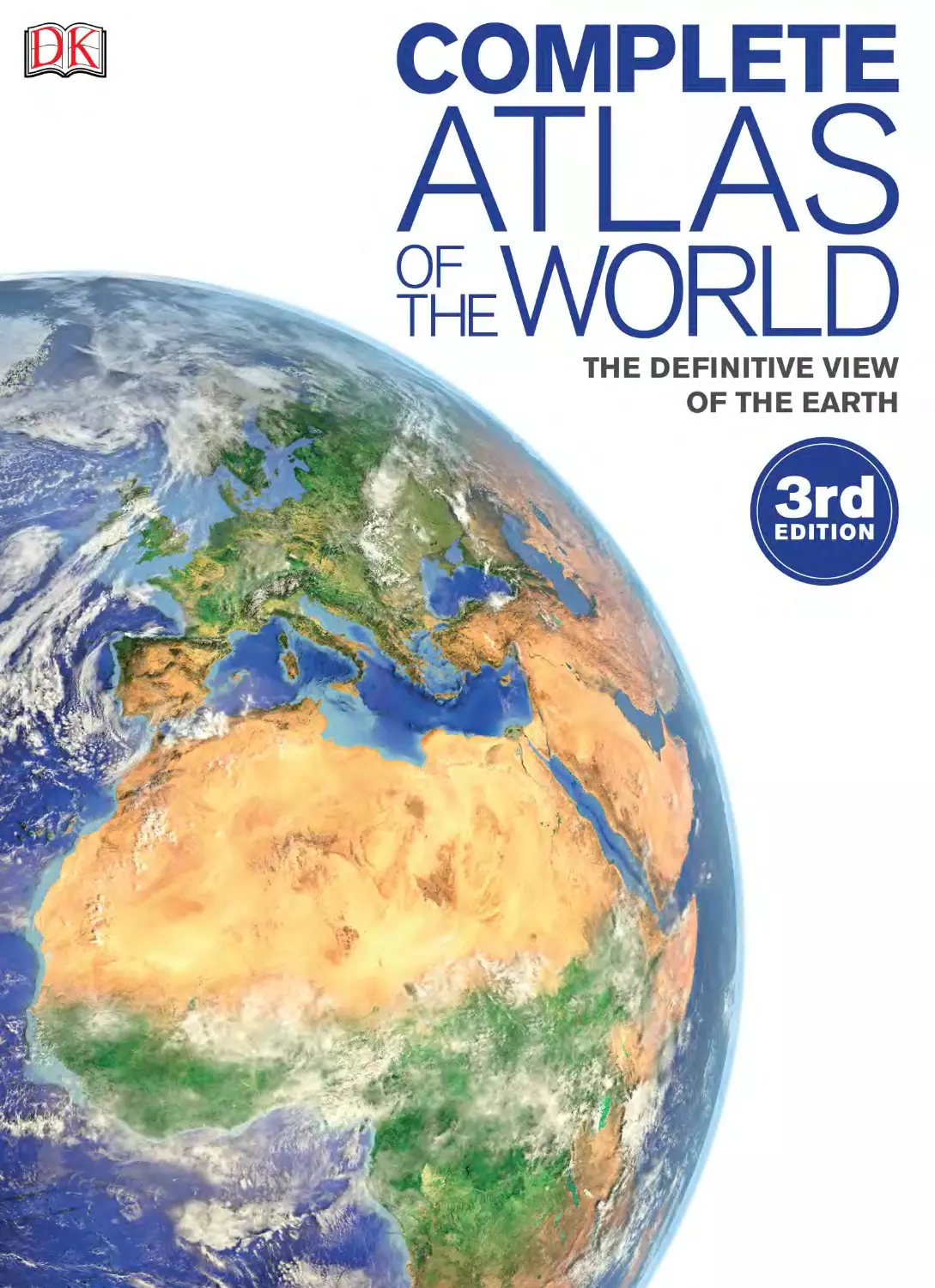
                    COMPLETE
ATLAS
?L WORLD
THE DEFINITIVE VIEW
OF THE EARTH

Penguin
Random
House
COMPLETE
ATLAS
™ WORLD

Penguin
Random
House
COMPLETE
ATLAS
™ WORLD
«1Вг
FOR THE THIRD EDITION
Senior Cartographic Editor Simon Mumford
Cartographers Encompass Graphics Ltd, UK
Producer, Pre-Production Luca Frassinetti Producer Vivienne Yong
Jacket Design Development Manager Sophia MTT
Publishing Director Jonathan Metcalf Associate Publishing Director Liz Wheeler Art Director Karen Self
FOR PREVIOUS EDITIONS
Cartographic Editors
Tony Chambers, John Dear, Ruth Hall, Andrew Johnson, Belinda Kane, Lynn Neal, Ann Stephenson
Cartographers
Paul Eames, Edward Merritt, John Plumer, Rob Stokes, lorwerth Watkins
Digital Map Suppliers
Advanced Illustration, Congleton, UK • Cosmographies, Watford, UK
Encompass Graphics, Brighton, UK • Lovell Johns Ltd., Long Hanborough, UK
Netmaps, Barcelona, Spain
Digital Terrain Data
Digital terrain data and continental panoramic images created by Planetary Visions Ltd, Farnham, UK
Editor
Robert Dinwiddie
Designers
Nicola Liddiard, Yak El-Droubie
Picture Research
Louise Thomas, Jenny Baskaya
Indexing and Database
T-Kartor, Sweden
Francesca Albini, Eleanor Arkwright, Renata Dyntarova, Edward Heelas, Britta Hansesgaard
Systems Coordinator
Philip Rowles
Flags courtesy of The Flag Institue, Cheshire, UK
16171819 20 10987654321
265177—May 2016
Reprinted with revisions 2009, Second edition 2012, Third edition 2016
Copyright u> 2007,2009, 2012,2016 Dorling Kindersley Limited. All rights reserved.
ISBN: 978-1-4654-4401-1
A WORLD OF IDEAS:
SEE ALL THERE IS TO KNOW
www.dk.com
Introduction
The World at the beginning of the 21st Century would be a place of unimaginable change to our
forefathers. Since 1900 the human population has undergone a fourfold growth coupled with an
unparalleled development in the technology at our disposal. The last vestiges of the unknown
World are gone, and previously hostile realms claimed for habitation. The advent of aviation
technology and the growth of mass tourism have allowed people to travel further and more
frequently than ever before.
Allied to this, the rapid growth of global communication systems mean that World events have
become more accessible than ever before and their knock on effects quickly ripple across the
whole planet. News broadcasts bring the far-flung corners of the world into everyone’s lives,
and with it, a view of the people and places that make up that region. The mysteries of the
World that once fueled global exploration and the quest to discover the unknown are behind us;
we inhabit a world of mass transportation, a world where even the most extreme regions have
been mapped, a world with multi faceted view points on every event, a World of
communication overload.
However, does this help us make sense of the World? It is increasingly important for us to have a
clear vision of the World in which we live and such a deluge of information can leave us
struggling to find some context and meaning. It has never been more important to own an atlas;
the DK Complete Atlas of the World has been conceived to meet this need. At its core, like all
atlases, it seeks to define where places are, to describe their main characteristics, and to locate
them in relation to other places. By gathering a spectacular collection of satellite imagery and
draping it with carefully selected and up-to-date geographic information, this atlas filters the
World’s data into clear, meaningful and user-friendly maps.
The World works on different levels and so does the DK Complete Atlas of the World. Readers
can learn about global issues of many kinds or they can probe in a little further for the
continental context. Delving even further they can explore at regional, national or even sub-
national level. The very best available satellite data has been used to create topography and
bathymetry that reveal the breathtaking texture of landscapes and sea-floors. These bring out
the context of the places and features selected to appear on top of them.
This third edition of the DK Complete Atlas of the World incorporates hundreds of revisions and
updates affecting every map and every page, distilling the burgeoning mass of information
available through modern technology into an extraordinarily detailed and reliable view
of our World.
Contents
The atlas is organized by continent,
moving eastward from the International
Date Line. The opening section describes
the world’s structure, systems and its
main features. The Atlas of the World
which follows, is a continent-by-continent
guide to today’s world, starting with a
comprehensive insight into the physical,
political, and economic structure of each
continent, followed by detailed maps of
carefully selected geopolitical regions.
WORLD
The Solar System..............8-9
The Physical World..........10-11
Structure of the Earth......12-13
Shaping the Landscape.......14-15
The World’s Oceans..........16-17
The Global Climate..........18-19
Life on Earth...............20-21
Man’s Impact on
the Environment.............22-23
Population 8c Settlement....24-25
Languages 8c Religion.......26-27
World Health................28-29
Water Resources.............30-31
The Economic System.........32—33
Global Communication........34—35
The Political World.........36-37
States, Borders,
Conflicts 8c Disputes.......38-39
Standard Time Zones............40
NORTH
AMERICA
North America....................42-43
North America Political..........44-45
North America Physical...........46-47
North America satellite image....48-49
Canada...........................50-51
Northern Canada..................52-53
Western Canada...................54-55
Southwest Canada.................56-57
Eastern Canada...................58-59
United States of America.........60-61
US: NE States 8c Southeast Canada.62-63
US: Boston to Washington DC......64-65
US: Eastern States...............66-67
US: Southeast States
US: Texas	70-71
US: Great Lakes States	72-73
US: Great Plains States	74-75
US: Northwest States.............76-77
US: Southwest States.............78-79
US: California...................80-81
US: Alaska 8c Hawaii.............82-83
Northern Mexico..................84-85
Southern Mexico..................86-87
Central America..................88-89
The Caribbean....................90-91
North American City Plans........92-93
SOUTH
AMERICA
South America........................94-95
South America Political..............96-97
South America Physical...............98-99
South America satellite image......100-101
Northern South America.............102-103
Western South America
including Galapagos................104-105
Amazon Basin.......................106-107
Eastern Brazil.....................108-109
Southeast Brazil...................110-111
Central South America..............112-113
River Plate........................114-115
Southern Argentina 8c Chile........116-117
Central Chile and Argentina............118
South America City Plans...............119
AFRICA
Africa.............................120-121
Africa Political...................122-123
Africa Physical....................124-125
Africa satellite image.............126-127
Northeast Africa...................128-129
Northwest Africa...................130-131
West Africa including Cape Verde.....132-133
Central Africa.....................134-135
East Africa........................136-137
Southern Africa including
Madagascar and Comoros.............138-139
South Africa.......................140-141
Africa City Plans..................142-143
Europe...........................144-145
Europe Political.................146-147
Europe Physical..................148-149
Europe satellite image...........150-151
Scandinavia, Finland 8< Iceland..152-153
Southern Scandinavia.............154-155
United Kingdom 8< Ireland........156-157
Northern Britain 8< Ireland......158-159
Southern Britain.................160-161
The Low Countries................162-163
France...........................164-165
Northern France..................166-167
Southern France & the Pyrenees.....168-169
The Iberian Peninsula............170-171
Southern Iberia..................172-173
The Italian Peninsula............174-175
The Alpine States 8< Northern Italy ...176-177
Germany..........................178-179
Rhineland 8< Hamburg.............180-181
Central Europe...................182-183
Southeast Europe.................184-185
Greece...........................186-187
Romania, Moldova 8< Ukraine......188-189
The Baltic States 8< Belarus.....190-191
Russian Federation...............192-193
Northern European Russia.........194-195
Southern European Russia.........196-197
The Mediterranean................198-199
European City Plans..............200-203
Asia.............................204-205
Asia Political....................206-207
Asia Physical.....................208-209
Asia satellite	image..............210-211
Southwest Asia...................212—213
Turkey & the	Caucasus...........214-215
The Near East.....................216-217
Israel & Lebanon..................218-219
The Arabian Peninsula.............220-221
Iran..............................222-223
Central & South Asia..............224-225
Kazakhstan........................226-227
Central Asia......................228-229
Afghanistan & Pakistan............230-231
Northern India, Nepal
& Bangladesh......................232-233
Southern India & Sri Lanka........234-235
East Asia.........................236-237
Western China...................238-239
Southeast China.................240-241
Yangtze River Valley............242-243
Yellow River Valley.............244-245
Northeast China.................246-247
Korea & Japan...................248-249
Southern Japan..................250-251
Northern Japan..................252-253
Southeast Asia..................254-255
Mainland Southeast Asia.........256-257
Western Maritime Southeast Asia ..258-259
Eastern Maritime Southeast Asia..260-261
Philippines.....................262-263
Asian City Plans................264-265
AUSTRALASIA
/ & OCEANIA
Australasia & Oceania................266-267
Australasia & Oceania Political......268-269
Australasia & Oceania Physical.......270-271
Australasia & Oceania
satellite image..._...............272-273
Australia.........................274-275
Southeast Australia................"ПЬ-ТП
New Zealand.......................278-279
Papua New Guinea & Melanesia......280-281
Micronesia........................282-283
Polynesia.........................284-285
Pacific Ocean.....................286-287
Indian Ocean......................288-289
Atlantic Ocean....................290-291
Antarctica........................292-293
The Arctic........................294-295
INDEX &
GAZETTEER
Geographical Comparisons.......296-297
Countries of the World	298-304
Geographical Names
Index	  306-432
Credits/Acknowledgements	4J2
Key to regional maps
Physical features
Drainage features
elevation			 main river
г	i 11 11 i	>.. 1 g.	1	s	s f	g-	£	s I	s	i	f 11
	2000m/6562ft 1000m/3281ft 500m/1640ft 250m/820ft 100m/328ft
		! 5 1 ? J, ! S 1 I 1 f 1 IIHYI
	below sea level	IK l г £ | f
 1 | I! о |B - и I		salt flat/salt pan

т /**'j | atoll		Ice features О
	-250m/-820ft -2000m / -6562ft	Graticule features
	-4000m/ -13.124ft	'^Jrfe'^ator
Communications Borders	Settlements	Physical features (continued) Andaman Sea INDIAN OCEAN Regions country	ARMENIA with parent state  МИКЛЕ (to NZ) federal region 	 MINAS GERAIS i^!tra,We	 MINSKAYA VOBLASTS’ region			 Vauduse cultural region	 New England Settlements capital city 	 BEIJING capttaL^ty	.. FORT-DE-FRANCE other settlements... Chicago Adana Tizi Ozou Miscellaneous
	settlement population symbols ® 500.000 to 1 million © 100.000 to 500.000 ® 50,000 to 100,000 0 10.000 to 50,000 о fewer than 10.000
111IJ1111 =- 8.S $5 ЙД 21 Йо. Ей 1II fl i i R i f i 1 |	if 1| 1	| *	* administrative center Typographic key
	Physical features Massif Central ANDES headland	 Nordkapp lfcano7pass	Mount Mere drainage features .... Lake Geneva spring/well/ rapids/dam 	 Mekong ice features		 Vatnajdkull
Miscellaneous features
’	site of interest
The Solar System
THE WORLD
The Solar System consists of our local star, the Sun, and
numerous objects that orbit the Sun - eight planets, five
currently recognized dwarf planets, over 165 moons
orbiting these planets and dwarf planets, and countless
smaller bodies such as comets and asteroids. Including a
vast outer region that is populated only by comets, the
Solar System is about 9,300 billion miles (15,000 billion
l km) across. The much smaller region containing just the
к Sun and planets is about 7.5 billion miles
к (12 billion km) across. The Sun, which contributes
к over 99 percent of the mass of the entire Solar
. System, creates energy from nuclear reactions
deep within its interior, providing the heat and
light that make life on Earth possible.
THE MOON'S PHASES
As the Moon orbits Earth, the
relative positions of Moon. Sun
and Earth continuously change.
Thus, the angle at which the
Moon’s sunlit face is seen by an
observer on Earth varies in a
cyclical fashion, producing the
Moon’s phases, as shown at
right. Each cycle takes 29.5 days.


What is a Planet?
The Moon
Earth’s only satellite, the Moon, is thought to
have formed 4.5 billion years ago from a cloud
of debris produced when a large asteroid hit
the young Earth. The Moon is too small to have
retained an atmosphere, and is therefore a
lifeless, dusty and dead world. However,
although the Moon has only about 1 percent of
the mass of the Earth, its gravity exerts an
important influence on Earth's oceans,
manifest in the ebb and flow of the tides.
SOLAR ECLIPSE
A solar eclipse occurs when the Moon passes between Earth
and the Sun. casting its shadow on Earth's surface. During a
total eclipse (below), viewers along a strip of Earth's surface,
called the area of totality, see the Sun totally blotted out for
a short time, as the umbra (Moon’s full shadow) sweeps over
them. Outside this area is a larger one, where the Sun
appears only partly obscured, as the penumbra (partial
shadow) passes over.
INSIDE THE SUN
The Sun has three internal layers. At its center is the core,
where temperatures reach 27 million’F (15 million’C) and
nuclear fusion occurs. The radiative zone is a
slightly cooler region through which energy
radiates away from the core. Further out, in
the convective zone, plumes of hot plasma
carry the energy towards the Sun’s visible
surface layer, called the photosphere. Once
there, the energy escapes as light, heat and
other forms of radiation.
PLANETS
MAIN DWARF PLANETS
MERCURY


JUPITER
SATURN
URANUS
NEPTUNE


AVERAGE DISTANCE
FROM THE SUH
SURFACE
TEMPERATURE
3029 miles
(4875 km)
7521 miles
(12,104 km)
7928 miles
(12,756 km)
4213 miles
(6780 km)
88,846 miles
(142,984 km)
74,898 miles
(120,536 km)
30,775 miles
(49.528 km)
(950 km)
1432 miles
(2304 km)
1429-1553 miles
(2300-2500 km)
(57.9 mill, km)
93 mill, miles
(227.9 mill, km)
1788 mill, miles
(2877 mill, km)
2795 mill, miles
(4498 mill, km)
257 mill, miles
3675 mill, miles
6344 mill, miles
(10,210 mill, km)
243 days
23.93 hours
24.62 hours
88 days
365.26 days
11.86 years
29.37 years
84.1 years
164.9 years
4.6 years
248.6 years
557 years
-292CF to 806°F
(-180’0 to 430°C)
896°F(480°C)
-94°Fto 131°F
(-70’0 to 55°C)
-184°Fto77 "F

-220°F (-140°C)
-320°F(-200’C)
-320“F(-200°C)
-380°F(-230°C)
-405°F 1-243’C)
DWARF PLANETS
THE WORLD
they also move more slowly.
have few or no moons, and no rings.
THE INNER PLANETS
AVERAGE DISTANCE FROM THE SUN
THE WORLD
The Physical World
THE WORLD
The Structure of the Earth
Earth is an almost perfect sphere consisting of a partly liquid core
overlain by a deep, semisolid layer, called the mantle, and two types
of surface crust, known as continental and oceanic crust. Our
planet has constantly evolved since it formed some 4.5 billion
years ago. Its continents are neither fixed nor stable. Over
the course of history, gradual movements of rocky
material within Earth's mantle, resulting from massive
internal flows of heat, have caused the great slabs of
material that make up the planet's surface, known as
tectonic plates, to shift around. The plates have
moved, collided, joined together, and sometimes
split apart. These processes continue to mold
Earth's surface, causing earthquakes and
volcanic eruptions, and creating oceans,
mountain ranges, rift valleys,
deep ocean trenches,
and island chains.
THE WORLD
FROM THE BIG BANG TO THE PRESENT DAY

Continental drift
Although Earth's tectonic plates move
only a few inches (centimeters) each year,
over hundreds of millions of years, its
landmasses have moved many thousands
of miles (kilometers), to create new
continents, oceans, and mountain chains.
Cambrian 543-490 million years ago
Dynamic Earth
Earth's surface is split up into several rigid, closely-
fitting sections, called tectonic plates. Each of the
plates contains some oceanic crust, and most also
contain some continental crust. The plates
constantly move relative to one another.
Movements at different types of
plate boundary produce various
types of geological structure
and activity.
EFFECTS AT PLATE BOUNDARIES
SLIDING PLATES
(TRANSFORM BOUNDARY)
THE WORLD
13
CONVECTION CURRENTS
FORMATION OF ISLAND ARC SUBDUCTION OF OCEANIC CRUST BLOCKS OF CONTINENTAL CRUST
AND OCEAN TRENCH	UNDER CONTINENTAL CRUST COLLIDE TO FORM MOUNTAINS
Deep within Earth's core, temperatures may exceed 8100°F
(4500"C). The heat from the core warms rocks in the mantle,
which become semimolten and rise upwards, displacing
cooler rock below the solid oceanic and continental crust.
This rock sinks and is warmed again by heat given off from
the core. The process continues in a cyclical fashion.
producing convection currents below the crust. These
currents lead, in turn, to gradual movements of the tectonic
plates over the planet's surface.
Triassic 252-199.5 million years ago
Jurassic 199.5-142 million years ago
Cretaceous 142-65 million years ago
Tertiary 65-2 million years ago
Shaping the Landscape
The basic material of Earth's surface is solid rock: valleys,
deserts, soil, and sand are all evidence of the powerful agents
of weathering, erosion and deposition that constantly transform
Earth's landscapes. Water, whether flowing in rivers or grinding
the ground in the form of glaciers, has the most clearly visible
impact on Earth's surface. Also, wind can transport fragments of
rock over huge distances and strip away protective layers of
vegetation, exposing rock surfaces to the impact of extreme
heat and cold. Many of the land-shaping effects of ice and
water can be seen in northern regions such as Alaska (below),
while the effects of heat and wind are clearly visible in the
Sahara (far right).
Ice and water
Some of the most obvious and striking features
of Earth's surface are large flows and bodies of
liquid water, such as rivers, lakes, and seas. In
addition to these are landforms caused by the
erosional or depositional power of flowing water,
which include gullies, river valleys, and coastal
features such as headlands and deltas. Ice also
has had a major impact on Earth's appearance.
Glaciers—rivers of ice formed by the
compaction of snow—pick up and carry huge
amounts of rocks and boulders as they pass over
the landscape, eroding it as they do so. Glacially-
sculpted landforms range from mountain cirques
and U-shaped valleys to fiords and glacial lakes.
THE WORLD
Heat and wind
Marked changes in temperature—rapid heating
caused by fierce solar radiation during the day,
followed by a sharp drop in temperature at
night—cause rocks at the surface of hot deserts
to continually expand and contract. This can
eventually result in cracking and fissuring of the
rocks, creating thermally-fractured desert
landscapes. The world's deserts are also swept
and scoured by strong winds. The finer particles
of sand are shaped into surface ripples, dunes,
or sand mountains, which can rise to a height of
650 ft (200 m). In other areas, the winds sweep
away all the sand, leaving flat, gravelly areas
called desert pavements.
DESERT LANDSCAPES
In desert areas, wind picks up loose sand
and blasts it at the surface, creating a
range of sculpted landforms from
faceted rocks to large-scale features
such as yardangs. Individually sculpted-
rocks are called ventifacts. Where the
sand abrasion is concentrated near the
ground, it can turn these rocks into
eccentrically-shaped “stone mushrooms."
Other desert features are produced
by thermal cracking and by winds
continually redistributing the vast
sand deposits.
15
THE WORLD
THE WORLD
Ocean currents
Surface currents are driven by winds
and by the Earth's rotation. Together
these cause large circular flows of
water over the surface of the oceans,
called gyres. Deep sea currents are
driven by changes in the salinity or
temperature of surface water. These
changes cause the water to become
denser and sink, forcing horizontal
movements of deeper water.
SURFACE TEMPERATURES AND CURRENTS
DEEP SEA TEMPERATURES AND CURRENTS
ЗВ □ tt
THE WORLD
Global Climate
The climates of different regions on Earth are the typical long-
term patterns of temperature and humidity in those regions.
By contrast, weather consists of short-term variations in factors
such as wind, rainfall, and sunshine. Climates are determined
primarily by the Sun's variable heating of different parts of
Earth's atmosphere and oceans, and by Earth's rotation. These
factors drive the ocean currents and prevailing winds, which in
turn redistribute heat energy and moisture between the equator
and poles, and between sea and land. Most scientists think that
major changes are currently occurring in global climate due to
the effects of rising carbon dioxide levels in the atmosphere.
The atmosphere
Earth’s atmosphere is a giant ocean of air that surrounds the planet.
It extends to a height of about 625 miles (1000 km) but has no
distinct upper boundary. The Sun’s rays pass through the
atmosphere and warm Earth's surface, causing the air to move and
water to evaporate from the oceans.
Global air circulation
THE WORLD
Winds, currents, and climate
Earth has 12 climatic zones, ranging from ice-cap and
tundra to temperate, arid (desert), and tropical zones.
Each of these zones features a particular combination of
temperature and humidity. The effects of prevailing
winds, ocean currents of both the warm and cold
variety, as well as latitude and altitude, all have an
important influence on a region’s climate.
For example, the climate of western
Europe is influenced by the effects
of the warm North Atlantic
Drift current.
This layer extends from
a height of 50 miles
(80 km) upward. Its
temperature increases
rapidly above a height
of 60 miles (90 km),
due to absorption
of highly energetic
solar radiation.
•	MESOSPHERE
The temperature of the
lower part of this layer
stays constant with height;
but above 35 miles (55 km), it
drops, reaching -112”F (80"C) at
the mesopause.
The temperature of the stratosphere is a
fairly constant -76" F (-60°C) up to an altitude of
about 12 miles (20 km), then increases, due to
absorption of ultraviolet radiation.
•	TROPOSPHERE
This layer extends from Earth’s surface to a
height of about 10 miles (16 km) at the equator
and 5 miles (8 km) at the poles. Air temperature
in this layer decreases with height.
Temperature and precipitation
Air moves within giant atmospheric cells called
Hadley, Ferrell, and polar cells. These cells are
caused by air being warmed and rising in some
latitudes, such as near the equator, and sinking in
other latitudes. This north-south circulation
combined with the Coriolis effect (below)
produces the prevailing surface winds.
The world divides by latitude into three major
temperature zones: the warm tropics, the cold
polar regions; and an intermediate temperate
zone. In addition, temperature is strongly
influenced by height above sea level.
Precipitation patterns are related to factors
such as solar heating, atmospheric pressure,
winds, and topography. Most equatorial
areas have high rainfall, caused by moist air
being warmed and rising, then cooling to form
rain clouds. In areas of the subtropics and
near the poles, sinking air causes high pressure
and low precipitation. In temperate regions
rainfall is quite variable.
THE CORIOLIS EFFECT
Air moving over Earth’s surface is deflected in a
clockwise direction in the northern hemisphere and
counterclockwise in the south. Known as the Coriolis
THE WORLD
Life on Earth
A unique combination of an oxygen-rich atmosphere and
plentiful surface water is the key to life on Earth, where few areas
have not been colonized by animals, plants, or smaller
life-forms. An important determinant of the quantity of life in a
region is its level of primary production—the amount of energy-
rich substances made by organisms living there, mainly through
the process of photosynthesis. On land, plants are the main
organisms responsible for primary production; in water, algae
fulfil this role. These primary producers supply food for animals.
Primary production is affected by climatic, seasonal, and other
THE WORLD
Biogeographical regions
Earth's biogeographical regions, or biomes,
are communities where certain species of
plants and animals coexist within the
constraints of particular climatic conditions.
They range from tundra to various types of
grassland, forest, desert, and marine biomes
such as coral reefs. Factors like soil richness,
altitude, and human activities such as
deforestation can affect the local
distribution of living species in each biome.
THE WORLD
Man and the Environment
The impact of human activity on the environment has
widened from being a matter of local concern (typically
over the build-up of urban waste, industrial pollution, and
smog) to affect whole ecosystems and, in recent decades,
the global climate. Problems crossing national boundaries
first became a major issue over acid rain, toxic waste
dumping at sea, and chemical spillages polluting major
rivers. Current concerns center on loss of biodiversity and
vital habitat including wetlands and coral reefs, the felling
THE WORLD
aerosols, damaged the ozone
layer in the stratosphere which
helps filter out the sun's harmful
ultraviolet rays. When a seasonal
ozone hole first appeared in 1985
over Antarctica, a shocked world
agreed to phase out CFC use.
OZONE HOLE
Man-made chlorofluorocarbons
and clearance of great tropical and temperate forests,
DEFORESTATION
At current rates of destruction, all
tropical forests, and most old-growth
temperate forest, will be gone by 2090.
The Amazon rain forest is a valuable
genetic resource, containing innumerable
unique plants and animals, as well as
acting as a crucial natural '‘sink1’ for
absorbing climate-damaging carbon
dioxide. Stemming the loss of these
precious assets to logging and farming is
one of the major environmental
challenges of modern times.
THE WORLD
Population and Settlement
Earth's human population is projected to rise from its current
level of 7.3 billion to between 8.1 and 11 billion by the year
2050. The distribution of this population is very uneven and is
dictated by climate, terrain, and by natural and economic
resources. Most people live in coastal zones and along the
valleys of great rivers such as the Ganges, Indus, Nile, and
Yangtze. Deserts cover over 20 percent of Earth's surface but
support less than 5 percent of its human population. Over half
the world's population live in cities—most of them in Asia,
Europe, and North America—as a result of mass migrations that
have occurred from rural areas as people search for jobs. Many
of these people live in so-called "megacities"—sprawling urban
THE WORLD
Million-person cities
The Greater Tokyo Area is the most
populous urban area in the world,
of 37.8 million. It includes Tokyo City,
which has a population of about 12
million, and adjoining cities such as
Yokohama. This satellite photograph
shows the Greater Tokyo Area today,
and also the boundaries of Tokyo City
the world with a population that exceeded one
million. By 1950 there were 83 such cities, and by
the year 2015 there were more than 500 such cities,
that have populations higher than 10 milli
Population density
A few regions, including Europe, India, and much of eastern Asia, have
extremely high population densities. Within these areas, a few
spots, such as Monaco and Hong Kong, have densities of
over 12,900 per sq mile (5000 people per sq km). Other
regions (mostly desert, mountain, ice cap, tundra, or
thickly forested areas) have densities close to
zero -examples include large areas of	north a
in 1860 (red) and 1964 (yellow).
THE WORLD
Language
Over 6800 different languages exist throughout the world, each one with its own
unique evolutionary history and cultural connotations. Most of these languages
are spoken only by small groups of people in remote regions. Sadly these minority
tongues are dying out—it is estimated that about a third will have disappeared by
the year 2100. The relatively small number of widely-spoken languages have
gained their current predominance and pattern of distribution through a
variety of historical factors. Among these have been the economic, military, or
technological success of certain peoples and cultures, differing population
growth rates, and the effects of migrations and colonization.
THE WORLD
The colonial powers
Colonialism between the 15th and 20th centuries had a
major influence in establishing the world prevalence of
various, mainly European, languages. Britain, for
example, was the colonial power in Canada, the USA
(until 1776), the Indian subcontinent, Australia, and parts
of Africa and the Caribbean. Hence, English is still the
main (or a major) language in these areas. The same
applies to France and the French language in parts of
Africa and southeast Asia, and to Spain and the Spanish
language in much of Latin America. For similar reasons,
Portuguese is the main language in Brazil and parts of
Africa, and there are many Dutch speakers in Indonesia.
TOP TEN LANGUAGES
<16	й J
; ПИК	t
НЧПГ 44 1903
I апч* «ри ^1 I
I HERITAGE STRUCTURE |
About 45 percent of people speak one of just ten
languages as their native tongue. Mandarin Chinese
is spoken by far the largest number—a situation
likely to persist, as minority language speakers in
China are encouraged to switch to Mandarin. English
usage is also increasing, as it is the most favored
language on the internet and in business circles.
Wherever English is not the mother tongue, it
is often the second language.
Religion
The spread of religion
By their nature, religions usually start off in small geographical areas and
1ST-7TH CENTURY
During this period, Christianity spread from its
origins in the eastern Mediterranean, while
Hinduism and forms of Buddhism spread in
Asia. Islam became established in Arabia.
then spread. For Christianity and Islam, this spread was rapid and
extensive. Buddhism diffused more slowly from around 500 все into a
large part of Asia. The oldest religion, Hinduism, has always been
concentrated in the Indian subcontinent, although its adherents in other
parts of the world now number millions following migrations from India.
7TH-16TH CENTURY
Islam later spread further through Asia and into
parts of Africa and Europe. Christianity diffused
through Europe and was then carried to many other
parts of the world by colonialists and missionaries.
Buddhism spread further in Asia.
About 83 percent of the world's population adheres
to a religion. The remainder adopt irreligious
stances such as atheism. In terms of broad
similarities of belief, there are about 20 different
religions in the world with more than 1 million
adherents. However, the larger of these are split
into several denominations, which differ in their
exact beliefs and practices. Christianity, for
example, includes three major groupings that have
historically been in conflict—Roman Catholicism,
Protestantism, and Orthodox Christianity—as well
as hundreds of separate smaller groups. Many of
the world's other main religious, such as Islam and
Buddhism, are also subdivided.
RELIGION AROUND THE WORLD
About 72 percent of humanity adheres to
one of five religions: Christianity, Islam,
Hinduism, Buddhism, and Chinese
traditional religion (which includes Daoism
and Confucianism). Of the remainder,
many are adherents of primal indigenous
religions (a wide range of tribal or folk
religions such as shamanism).
THE WORLD
27
Health
THE WORLD
On most health parameters, the countries of the
world split into two distinct groups. The first of
these encompass the richer, developed, countries,
where medical care is good to excellent, infant
mortality and the incidence of deadly infectious
diseases is low, and life expectancy is high and
rising. Some of the biggest health problems in
these countries arise from overeating, while the
two main causes of death are heart disease and
cancer. The second region consists of the poorer
developing countries, where medical care is much
less adequate, infant mortality is high, many
people are undernourished, and infectious
diseases such as malaria are major
killers. Life expectancy in these
countries is much lower and in
some cases is falling.
Infant deaths and births
Infant mortality is still high in many developing
nations, especially some African countries, due in
part to stretched medical services. As well as lower
infant mortality, the world's developed countries
have much lower birth rates—greater female
emancipation and easier access to contraceptives
are two causative factors.
Nutrition
Two-thirds of the world's food is consumed in
developed nations, many of which have a daily
calorific intake far higher than is needed by their
populations. By contrast, about 800 million people
in the developing world do not have enough food
to meet basic nutritional needs.
Life expectancy
Life expectancy has risen remarkably
in developed countries over the past
50 years and has now topped 80 years
in many of them. In contrast life
expectancy in many of the countries
of sub-Saharan Africa has fallen well
below 50, in large part due to the high
prevalence of HIV/AIDS.
A TL ANTIC
OCEAN
A TL ANTIC
OCEAN
И 2000-2499	| | below 2000
Healthcare
An indicator of the strength of
healthcare provision in a country
is the number of doctors per
1000 population. Some
communist and former
communist countries such as
Cuba and Russia score well in
this regard. In general, healthcare
provision is good or adequate in
most of the world's richer
countries but scanty throughout
much of Africa and in parts of
Asia and Latin America.
Smoking
Cigarette smoking—one of the most
harmful activities to health—is
common throughout much of the
world. Smoking prevalence is generally
highest in the richer, developed
countries. However, awareness of the
health risks has seen cigarette
consumption in most of these
countries stabilize or begin to fall. By
contrast, more and more people,
especially males, are taking up the habit
in poorer developing countries.
Communicable diseases
Despite advances in their treatment and
prevention, infectious diseases remain a huge
problem, especially in developing countries. Three
of the most common and deadly are tuberculosis
(ТВ), HIV/AIDS, and malaria. Of these, active ТВ
affects about 25 million people (often as a
complication of AIDS), with a particularly high
prevalence in parts of Africa. HIV/AIDS has spread
since 1981 to become a global pandemic. Malaria
affects about 225 million people every year.

TOP TEN KILLER DISEASES
THE WORLD
Preventive medicine
Throughout the world, doctors recognize that the
prevention of disease and disease transmission is just
as important as the treatment of illness. Preventive
medicine has many aspects and includes advice
about diet and nutrition; education about the
avoidance of health-threatening behaviors such as
smoking, excess alcohol consumption, and
unprotected sex; and the use of vaccines against
diseases such as typhoid, polio and cholera. In
developing countries, some of the main priorities in
preventive medicine are the provision of pure water
supplies and proper sanitation, as well as measures
against malaria, including the use of antimalarial
drugs and mosquito nets.
The world’s biggest killer diseases fall into two
main groups. One group, which includes
HIV/AIDS, malaria, tuberculosis, and childhood
diseases such as measles, mainly kills people in
poor countries. The other group includes
cardiovascular diseases and cancer, the big
killers in rich countries.
Water Resources
Water covers 71 percent of Earth's surface, but only 2.5 percent of this is
fresh water, and two thirds of that is locked up in glaciers and polar ice
sheets. Patterns of human settlement have developed around fresh
water availability, but increasing numbers of people are now
vulnerable to chronic shortage or interruptions in supply.
Worldwide, fresh water consumption multiplied more
than sixfold during the 20th century as populations
increased and agriculture became more
dependent on irrigation, much of it hugely
wasteful because of evaporation and
run-off. Industrial water demand also
rose, as did use in the home, for
washing, flushing, cooking,
and gardening.	,
o i л м
cyRi; / “s

THE WORLD
Water withdrawal
Agriculture accounts for 70 percent of water
consumption worldwide. Industry and domestic
use each account for 15 percent. Excessive

Drought
The disruption of normal rainfall patterns ca
drought problems even in temperate zones,
restrictions to low crop yields to forest fires. In
regions of the developing world where monsooi
rains fail, or water is perennially scarce, drought
 «1-81	45-00	30-15	15-30 (23o-l > | 1 mi dala
droughts in recent decades, with disastrous results
including destruction of livestock, desertification,
famine, and mass migration.
THE WORLD
31
Clean drinking water
Sub-Saharan Africa is among the most deprived
regions for lack of access to safe drinking water.
Worldwide, this terrible health hazard affects
over a billion people—at least 15 percent of the
population. One of the agreed United Nations
“millennium goals” for international development
is to halve this proportion by 2015, by tackling
chemical pollution from agriculture and industry,
and by introducing essential purification facilities
and local supply systems. In the industrialized
world, people have come to expect clean
drinking water on tap, even if they face rising
prices for its treatment and supply.
Economic Systems
THE WORLD
The world economy is now effectively a single global system based on "free market" capitalist
principles. Few countries still cling, like North Korea, to the "command economy" formula
developed in the former communist bloc, where centralized state plans set targets for
investment and production. In the West, state ownership of companies has greatly
diminished thanks to the wave of privatization in the last 25 years. Major
companies move capital and raw materials around the globe to take advantage
of different labor costs and skills. The World Trade Organization (wto)
promotes free trade, but many countries still use subsidies, and protect
their markets with import tariffs or quotas, to favor their own producers.
Balance of trade
Few countries earn from their exports
exactly as much as they spend on
imports. If the imbalance is persistently
negative, it creates a potentially serious
problem of indebtedness. The European
Union's (eu) external trade is broadly in
balance, but the US balance of trade has
been in deficit since the 1970s, partly
because it imports so many consumer
goods. This deficit now stands at around
US$ 500 billion a year.
Energy
Countries with oil and gas to sell (notably in the Middle East and
Russia) can charge high prices; trade in fuel was worth USS 1-4 trillion
in 2005. The US and others are turning back to nuclear power
(despite safety fears) for generating electricity. China relies heavily on
(polluting) coal. Renewable technologies promise much, but so far
make relatively minor contributions.
International debt
Saddled with crippling debts from past borrowing, the
world's poorest countries are still paying off US $100
million a day. This is despite recent successful campaigns
to get some of their debts cancelled to allow them to
use their limited resources for development. Most
international debt, however, is owed by developed
countries to one another. The US owes just over a trillion
dollars, around 7% of its total debt, to China.
Trade sector
World trade in merchandise tops US$ 10 trillion a
year. The global pattern is uneven. Latin America,
Africa, the Middle East, and Russia principally
export "primary" goods (agricultural produce,
mining and fuel). The “secondary" manufacturing
sector includes iron and steel, machine tools,
chemicals, clothing and textiles, cars and other
consumer goods. The West still dominates the
"tertiary" or non-merchandise sector, worth US$ 2.4
trillion, in services such as insurance and banking.
 above 50	^Hlb-25	I	I bekj
20-50	I | 1S	|	| no i.
 above 50	ВЯ30-19	I | below 20
41M9	□ 20-29	[—) data
THE WORLD

1000-2000
500-1000
250-300
below 2S0
Labor
China's huge low-cost labor force promotes its
conquest of world markets for manufactured
goods. India's educated workforce attracts call
centers and other service sector jobs, while the
more economically developed countries's (medc)
caring professions, and low-wage agriculture,
draw in immigrant labor.
Travel
Mass travel is now a ubiquitous feature of all developed countries,
and the provision of transport and tourism facilities one of the
world's biggest industries, employing well over 100 million people.
The travel explosion has come about, first, through major
improvements in transportation technology; and second, as a result
of increasing amounts of disposable income and leisure time in the
world's wealthier countries. The main reasons for travel today
include leisure pursuits and tourism (accounting for well over
half of the total financial outlay), work and business, pilgrimage,
migration, and visits to family and friends.
Major modes of transportation
THE WORLD
The major transport modes for people in the 21st century are
road, rail, and air travel. The most popular air routes are highly
concentrated within and between the USA, western Europe, and
Asia. Major roads and railroads are more evenly spread, following
the general distribution of the world's population.
Time versus distance
Travel times have shrunk fantastically over the past 150
years. In 1850, it took 3-4 months to get from London to
Sydney, whether by ship for most of the way or by a
series of different transports. By 1930, trains and faster
ships had reduced the journey to about 40 days. In 2005,
the trip took just 21 hours by air.
17 18 19 20 21 22 23 24 25 16 27 28 29 X> SI 32 33 34 35 36 37 38 39 40 41 42 43 44 45 46 47 48 49 50 51 52 53 54 55 56~
Media and Communications
Orbit: 90 minutes
the early 1990s as a
Highly Elliptical Orbit HEO
THE WORLD
Over the past 50 years, the term "media" has come to denote various
means of communicating information between people at a distance.
These include mass media—methods such as newspapers, radio, and
television that can be used to rapidly disseminate information to large
numbers of people—and two-way systems, such as telephones and
e-mail. Currently, the communication systems undergoing the most
rapid growth worldwide include mobile telephony and various
Internet-based applications, such as web sites, blogs, and podcasting,
which can be considered forms of mass media.
Internet usage
Internet usage has grown extremely rapidly since the early 1990s,
largely as a result of the invention of the World Wide Web. Usage
rates are highest in the USA (where about 80 percent of people
were using the Internet in 2006), Australia, Japan, South Korea, and
Finland. They are lowest in Africa, where on average (ess than 5
percent of the population were Internet users in 2006.
Mobile phone usage
By 2006, there were more than 2.5 billion mobile phone
users worldwide. In some parts of Europe, such as Italy,
almost everyone owns and uses a mobile—many
possess more than one phone. In contrast, throughout
much of Southern Asia and Africa, less than 10 percent
of the population are users. As well as utilizing
them as telephones, most users now
employ the devices for the additional
functions they offer, such as text
messaging and e-mail.
Satellite Communications
Modern communications satellites are used extensively for international
telephony, for television and radio broadcasting, and to some extent
for transmitting Internet data. Many of these satellites are deployed in
clusters or arrays, often in geostationary orbits—that is, in positions
that appear fixed to Earth-based observers.
Altitude: 3100-12.500 miles
(5000-20.000 km)
The Political World
Today's world map shows nearly 200 independent states, compared
with about 80 after World War II. The transformation is mainly due
to the withdrawal of European powers from huge colonial empires;
their remaining overseas dependencies are tiny by comparison. The
late 20th century also saw the collapse of communism, realignment
in Europe, and fragmentation in former Yugoslavia. Globally, the
Soviet Union's demise left the USA as the sole superpower, though
with fast-growing China and India emerging as economic giants
CONTINENTAL FACTFILE
9,358,340
6,886,000
4,053,309
16,838,365
3.285.048
24,238,000
17,835,000
30,335,000
10,498,000
43,608,000
8,508,238
THE WORLD
Canada 3,855,171 sq miles (9,984,670 sq km)

Brazil 202 million

Asiatic Russia 5,065,394 sq miles (13,119.382 sq km)
China 1394 million

Australia 2,967.893 sq miles (7,686.850 sq km)
International borders
The world political map of today displays a complex pattern of
boundaries that has evolved through history, and is still constantly
changing as new countries emerge and disputes and territorial
claims are slowly resolved. The map shows two main types of
THE WORLD
Borders, conflicts and disputes
THE WORLD
Conflict evolved in the 20th century from conventional land- or sea-based warfare to
increasingly long-range airborne attacks. Nuclear arms from 1945 took this to the
intercontinental scale. The Cold War presented a new type of conflict, underlined by
the race for weapons capabilities between the US and the Soviet Union. In Korea,
Vietnam, the Middle East and elsewhere, soldiers and civilians were
Lines on the map
The determination of international boundaries can use a
variety of criteria. Many borders between older states
follow physical boundaries, often utilizing natural defensive
features. Others have been determined by international
agreement or arbitration, or simply ended up where the
opposing forces stood at the end of a conflict.
ENCLAVES
Changes to international
boundaries occasionally
create pockets of land
cut off from the main
territory of the country
they belong to. In
Europe, Kaliningrad has
been separated from the
rest of the Russian
THE WORLD
Federation since the independence of the Baltic States.
Likewise, when Morocco was granted independence,
Spain retained the coastal enclaves of Ceuta and Melilla.
PHYSICAL BORDERS
Rivers account for one-sixth of the
world's borders: the Danube forms
GEOMETRIC BORDERS
Straight lines and lines of
longitude and latitude
have occasionally been
used to determine
International boundaries:
the 49th Parallel forms a
large section of the
Canada-US border, while
the 38th Parallel roughly
divides the Korean Peninsula. Internal administrative divisions within
Canada, the US, and Australia also use geometric boundaries.
part of the boundaries for nine
European nations. Changes in a river's
course or disruption of its flow can
lead to territorial disputes. Lakes and
mountains also form natural borders.
The World's Standard Time Zones
THE WORLD
40
TIME ZONES Because Earth is a rotating sphere, the Sun shines on only half of its surface at any one time. Thus, it is simultaneously morning, evening and night time in different parts of the world (see diagram below). Because of these disparities, each country or part of a country adheres to a local time. A region of Earth's surface within which a single local time is used Is called a time zone. There are 24 one hour time zones around the world, arranged roughly in longitudinal bands.	but are determined by geographical factors or by borders between countries or parts of countries. Most countries have just one time zone and one standard time, but some large countries (such as the USA, Canada and Russia) are split between several time zones, so standard time varies across those countries. For example, the coterminous United States straddles four time zones and so has four standard times, called the Eastern, Central, Mountain and Pacific standard times. China is unusual in that just one standard time is used for the whole country, even though it extends across 60° of longitude from west to east.
STANDARD TIME Standard time is the official local time in a particular country or part of a country. It is defined by the time zone or zones associated with that country or region. Although time zones are arranged roughly in longitudinal bands, in many places the borders of a zone do not fall exactly on longitudinal meridians, as can be seen on the map (above),	COORDINATED UNIVERSAL TIME (UTC) Coordinated Universal Time (UTC) is a reference by which the local time in each time zone is set. For example, Australian Western Standard Time (the local time in Western Australia) is set 8 hours ahead of UTC (it is UTC+8) whereas Eastern Standard Time in the United States is set 5
DAY AND NIGHT AROUND THE WORLD
hours behind UTC (it is UTC-5). UTC is a successor to, and
closely approximates, Greenwich Mean Time (GMT).
However, UTC is based on an atomic clock, whereas GMT is
determined by the Sun's position in the sky relative to the
0° longitudinal meridian, which runs through Greenwich. UK.
THE INTERNATIONAL DATELINE
The International Dateline is an imaginary line from pole to
pole that roughly corresponds to the 180" longitudinal
meridian. It is an arbitrary marker between calendar days.
The dateline is needed because of the use of local times
around the world rather than a single universal time. When
moving from west to east across the dateline, travelers
have to set their watches back one day. Those traveling in
the opposite direction, from east to west, must add a day.
DAYLIGHT SAVING TIME
Daylight saving is a summertime adjustment to the local
time in a country or region, designed to cause a higher
proportion of its citizens’ waking hours to pass during
daylight. To follow the system, timepieces are advanced
by an hour on a pre-decided date in spring and reverted
back in the fall. About half of the world's nations use
daylight saving.
COMPLETE
ATLAS
™ WORLD
THE MAPS IN THIS ATLAS ARE ARRANGED CONTINENT BY CONTINENT, STARTING
FROM THE INTERNATIONAL DATE LINE, AND MOVING EASTWARD. THE MAPS PROVIDE
A UNIQUE VIEW OF TODAY'S WORLD, COMBINING TRADITIONAL CARTOGRAPHIC
TECHNIQUES WITH THE LATEST REMOTE-SENSED AND DIGITAL TECHNOLOGY.
NORTH AMERICA
NORTH AMERICA
North America is the world's third largest continent with
a total area of 9,358,340 sq miles (24,238,000 sq km)
including Greenland and the Caribbean islands.
It lies wholly within the Northern Hemisphere.
FACTFILE
N Most Northerly Point: Кар Morris Jesup, Greenland 83° 38' N
 Most Southerly Point: Peninsula de Azuero, Panama 7" 15' N
E Most Easterly Point: Nordostrundingen, Greenland 12’ 08' W
W Most Westerly Point: Attu, Aleutian Islands, USA 172" 30' E
Largest Lakes:
Ф Lake Superior, Canada/USA 31,151 sq miles (83,270 sq km)
® Lake Huron, Canada/USA23,436 sq miles (60,700 sq km)
•	Lake Michigan, USA 22,402 sq miles (58,020 sq km)
ф Great Bear Lake, Canada 12,274 sq miles (31,790 sq km)
•	Great Slave Lake, Canada 10,981 sq miles (28,440 sq km)
Longest Rivers:
1 Mississippi-Missouri, USA 3710 miles (5969 km)
2 ; Mackenzie, Canada 2640 miles (4250 km)
3 Yukon, Canada/USA 1978 miles (3184 km)
4 St Lawrence/Great Lakes, Canada/USA 1900 miles (3058 km)
5 Rio Grande, Mexico/USA 1900 miles (3057 km)
Largest Islands:
♦	Greenland 849,400 sq miles (2,200,000 sq km)
♦	Baffin Island, Canada 183,800 sq miles (476,000 sq km)
# Victoria Island, Canada 81,900 sq miles (212,000 sq km)
ф Ellesmere Island, Canada 75,700 sq miles (196,000 sq km)
9 Newfoundland, Canada 42,031 sq miles (108,860 sq km)
Highest Points:
1 Mount McKinley (Denali), USA 20,332 ft (6194 m)
2 Mount Logan, Canada 19,550 ft (5959 m)
3 Volcan Pico de Orizaba, Mexico 18,700 ft (5700 m)
4 Mount St Elias, USA 18,008 ft (5489 m)
5 Popocatepetl, Mexico 17,887 ft (5452 m)
NORTH AMERICA
Lowest Point:
▼ Death Valley, USA -282 ft (-86 m) below sea level
Highest recorded temperature:
• Death Valley, USA 135°F (57°C)
Lowest recorded temperature:
-I Northice, Greenland -87°F (-66°C)
Wettest Place:
A Vancouver, Canada 262 in (6650 mm)
Driest Place:
— Death Valley, USA 2 in (50 mm)

NORTH AMERICA - Political
"M
Political
cd
<
T
cd
О
z
lORTtiWEST
eWhitehocse
markedly poorer than their wealthier northern
neighbors Haiti is the poorest country in the
western hemisphere.
Standard of living
The USA and Canada have one of the highest
overall standards of living in the world.
However, many people still live in poverty,
especially in inner city ghettos and some rural
Transportation
In the 19th century, railroads were used to open up the North
American continent. Air transport is now more common for long
distance passenger travel, although railroads are still extensively used
for bulk freight transport. Waterways, like the Mississippi River, are
important for the transport of bulk materials, and the Panama Canal i:
century, road transportation increased massively in North America,
with the introduction of cheap, mass-produced cars and extensive
highway construction.
Democracy is well established in some parts of the continent but is a recent
phenomenon in others. The economically dominant nations of Canada and the USA
have a long democratic tradition but elsewhere, notably in the countries of Central
America, political turmoil has been more common. In Nicaragua and Haiti, harsh
dictatorships have only recently been superseded by democratically-elected
governments. North America's largest countries—Canada, Mexico, and the USA—have
federal state systems, sharing political power between national and state or provincial
governments. The USA has intervened militarily on several occasions in Central
America and the Caribbean to protect its strategic interests.
UNITED
у -	(Лиуише*
Bet i ng
Sea

NORTH AMERICA - Physical
NORTH AMERICA
OCEAN
Greenland'
OCEAN
North American
Scale 1:33,500,000
Ла01£дЦ)ЪВйЛ« PLATH
,3” i.«
SdulhamNpn .Xmadiiiak
у
Cfats Island i	-


Environmental Issues
Many fragile environments are under threat throughout the region. In Haiti, all
the primary rain forest has been destroyed, while air pollution from factories
and cars in Mexico City is among the worst in the world. Elsewhere, industry
and mining pose threats, particularly in the delicate arctic environment of
Alaska where oil spills have polluted coastlines and
Climate
North America's climate includes extremes ranging from freezing Arctic
conditions in Alaska and Greenland, to desert in the southwest, and tropical
conditions in southeastern Florida, the Caribbean, and Central America.
Central and southern regions are prone to severe storms including
tornadoes and hurricanes.
NORTH AMERICA
।
=	Ш1 5 "
—	warm humid
	scmi-.jrid
	arid
	humid equatorial
	tropical
	..g	।
	im S I
	desert

Land use
Canadian prairies to Texas creating North
America's agricultural heartland. Cereals and
cattle ranching form the basis of the farming
economy, with corn and soybeans also
important. Fruit and vegetables are grown in
California using irrigation, while Florida is a
leading producer of citrus fruits. Caribbean
and Central American countries depend
sugar cane, often grown on large
plantations. This reliance on a si
vulnerable to fluctuating world
NORTH AMERICA
NORTH AMERICA
NORTH AMERICA
Canada

Northern Canada
Scale 1:7,500,000

NORTH AMERICA

Western Canada

S NORTH AMERICA
“'!ЧНЦ,
Southwest Canada
© 500,000 to 1 million
О 10,000 to 50,000 о below 10,000
Scale 1:3,750,000
Population
В above 5 million
© 100.000 to 500.000
H I million to 5 million
3 50,000 to 100.000
z
о
73
I
>
m
2
П
57
19,686ft_____
9843ft_____
6562ft______
3281ft_____
820ft ‘ I
H	I	J	К	L	M	N
W Eastern Canada
Scale 1:7,500,000
The United States of America
Scale 1:10,250,000
NORTH AMERICA
USA - Northeast States & Southeast Canada
z
о
73
I
>
m
2
П
63
19,686ft.
3281ft.
1640ft.
820ft.
USA - Boston to Washington DC
<
о
64
____ 6000m
____ 4000m
__ . 3000m
____ 2000m
____ 1000m
____-2000m
-4000m


NORTH AMERICA

USA - Eastern States


NORTH AMERICA
USA - Southeast States
Scale 1:3,000,000
USA - Texas

I I I I I I IU к I I 1
I I ? h f ® I I I I I	Я NORTH AMERICA
USA - Great Lake States

USA - Great Plains States
Scale 1:3,750,000
Population
Щ above S million
© lOOOOOtoSOO.OOO
hi i
"idoff
TH) rX'¥iV^ 3
USA - Northwest States
____ 6000m
____ 4000m
____ . 3000m
____ 2000m
____ 1000m
____-2000m
____-4000m
© 500,000 to I million
О 10.000 to 50,000 о below 10,000
H I million to 5 million
e 50.000 to 100.000
Population
В above 5 million
© 100.000 to 500,000
Scale 1:3,750,000

JTpBA.
)iefenbaker
SK AT
MO N-
“X
у.оЪп
Plut^ai
T^Sak-^11
Л	Л"'.
Kisbey (\	JC«lyle \
ieWSk-—FeicnP^


Agency sr X—Z
ЙИрЧ”5*
—ST


>л

z
о
73
I
>
m
2
П
77

19,686ft______
3281ft_______
’’"Waft
820ft________


USA - Southwest States
____ 6000m
____ 4000m
____ 3000m
____ 2000m
____ 1000m
____-2000m
____-4000m


NORTH AMERICA

G	H
USA - California

। Valley
-ВАГА
CALIFORNIA
- NO'tRTE
Scale 1:1,875,000

2 VDiaaWV H1MON

USA - Alaska
NORTH AMERICA
Scale 1:8,000,000

I I	I I I	I I I I	I I
| |	S	J I J	fc | | «	f |	$ NORTH AMERICA
Northern Mexico
© 500,000 to 1 million
О 10,000 to 50,000 о below 10,000
Scale 1:4,250,000
Population
В above 5 million
© 100.000 to 500.000
В 50,000 to 100.000

z
о
73
I
>
m
2
П
85
19,686ft______
3281ft_______
’"Woft
820ft________
-a I I I I I I I
[I t l. I I M I
Ю	CO	Ч	О»
----------i__________। F '	0
NORTH AMERICA
Southern Mexico

Central America
NORTH AMERICA

The Caribbean
Scale 1:6,250,000
NORTH AMERICA - Cities
NORTH AMERICA
NORTH AMERICA
SOUTH AMERICA
South America reaches from the humid tropics down
into the cold South Atlantic, with a total area of
6,886,000 sq miles (17,835,000 sq km). It comprises 12
separate countries, with the largest, Brazil, covering
almost half the continent.
FACTFILE
N Most Northerly Point: Punta Gallinas, Colombia 12‘28'N
S Most Southerly Point: Cape Horn, Chile 55’59'S
E Most Easterly Point: llhas Martin Vaz, Brazil 28‘5Г W
W Most Westerly Point: Galapagos Islands, Ecuador 92‘ 00' W
Largest Lakes:
0 Lake Titicaca, Bolivia/Peru 3141 sq miles (8135 sq km)
0 Mirim Lagoon, Brazil/Uruguay 1158 sq miles (3000 sq km)
0 Lago Poopo, Bolivia 976 sq miles (2530 sq km)
0 Lago Buenos Aires, Argentina/Chile 864 sq miles (2240 sq km)
0 Laguna Mar Chiquita, Argentina 695 sq miles (1800 sq km)
Longest Rivers:
1 Amazon, Brazil/Colombia/Peru 4049 miles (6516 km)
2 Parana, Argentina/Brazil/Paraguay 2920 miles (4700 km)
3 Madeira, Bolivia/Brazil 2100 miles (3379 km)
4 Purus, Brazil/Peru 2013 miles (3239 km)
5 Sao Francisco, Brazil 1802 miles (2900 km)
Largest Islands:
0 Tierra del Fuego, Argentina/Chile 18,302 sq miles (47,401 sq km)
0 llha de Marajo, Brazil 15,483 sq miles (40,100 sq km)
0 Isla de Chiloe, Chile 3241 sq miles (8394 sq km)
0 East Falkland, Falkland Islands 2550 sq miles (6605 sq km)
0 Isla Wellington, Chile 2145 sq miles (5556 sq km)
Highest Points:
>1 Cerro Aconcagua, Argentina 22,831 ft (6959 m)
2 Cerro Ojos del Salado, Argentina/Chile 22,572 ft (6880 m)
3 Cerro Bonete, Argentina 22,546 ft (6872 m)
4 Monte Pissis, Argentina 22,224 ft (6774 m)
51 Cerro Mercedario, Argentina 22,211 ft (6768 m)
Lowest Point:
▼ Laguna del Carbon, Argentina -344 ft (-105 m) below sea level
Highest recorded temperature:
0 Rivadavia, Argentina 120°F (49°C)
- Sarmiento, Argentina -27°F (-33°C)
Wettest Place:
0 Quibdo, Colombia 354 in (8990 mm)
Driest Place:
' Arica, Chile 0.03 in (0.8 mm)
7?
SOUTH AMERICA

SOUTH AMERICA - Political
Languages
Prior to European exploration in the 16th century, a diverse range of indigenous
languages were spoken across the continent. With the arrival of Iberian settlers,
Spanish became the dominant language, with Portuguese spoken in Brazil, and
Native American languages, such as Quechua and Guarani, becoming concentrated
in the continental interior. Today this pattern persists, although successive
Standard of living
Wealth disparities throughout the continent create a wide gulf
between affluent landowners and those afflicted by chronic poverty
in inner-city slums. The illicit production of cocaine, and the hugely
European colonization has led to Dutch being spoken in Suriname, English in
; Guyana, and French in French Guiana, while in
influential drug barons who control its distribution, contribute to the
violent disorder and corruption which affect northwestern South
America, destabilizing local governments and economies.
large urban areas, Japanese and Chir
are increasingly common.

Population
Almost half of South America's population lives in Brazil but,
due to the large uninhabited expanses of the Amazon Basin,
its overall population density is much lower than in other
countries. During the 20th century the most important
population trend was the movement from rural to urban
areas, giving rise to great population concentrations in cities
like Sao Paulo, Rio de Janeiro, Caracas, Lima, Bogota, and
Transportation
Most major road and rail routes are
confined to the coastal regions by the
forbidding natural barriers of the Andes
mountains and the Amazon Basin. Few major
cross-continental routes exist, although Buenos
Aires serves as a transport center for the main
rail links to La Paz and Valparaiso, while the
Population density
Pan-American Highways have made direct road
travel possible from Recife to Lima and from
Puerto Montt up the coast into central
America. A new waterway project is proposed
to transform the Paraguay river into a major
shipping route, although it involves
> SOUTH AMERICA-Physical
SOUTH AMERICA
Climate
The climate of South America is influenced by three principal factors:
the seasonal shift of high pressure air masses over the tropics, cold ocean currents
along the western coast, affecting temperature and precipitation, and the mountain
barrier produced by by the Andes, which creates a rain shadow over much of the south.
Rainfall
1-2 in (25-50 mm)
Climate
8-12 in (200-300 mm)
12-16 in (300-400 mm)
16-20 in (400-500 mm)
The
left
SOUTH AMERICA

Northern South America
19,686ft______
6562ft______
3281ft______
' 1640ft
820ft______
103
Western South America
Scale 1:6,500,000
Amazon Basin
Scale 1:6,500,000
CkNTlNS
Eastern Brazil
Scale 1:6,500,000
I I I I I I I I I I I
I M [M О I I I I
SOUTH AMERICA
Southeast Brazil


Central South America
ooo'oi “opq °
000'05 01000'01 о
иси||1Ш I о; 000'005 ©
000'00101000'05 ®
ЧО1Ц1Ш $ О] ЦО||||Ш I Н
000'005 О1000'001 ©
UOI||IIU s элодв И
uoiieindod
000'005'9=1 Э|еэ$
SOUTH AMERICA
River Plate
Scale 1:2,000,000
OCEAN
Southern South America

Central Chile & Argentina
20 30 40 SO Km
А	В	C	D	E	F	G
____ 6000m
____ 4000m
__ . 3000m
____ 2000m
____ 1000m
____-2000m
____-4000m
SOUTH AMERICA - Cities
AFRICA
Africa is the world's second largest continent with a
total area of 11,712,434 sq miles (30,335,000 sq km). It
has 54 separate countries, including Madagascar in the
Indian Ocean. It straddles the equator and is the only
continent to stretch from the northern to southern
temperate zones.
FACTFILE
N Most Northerly Point: Jalta, Tunisia 37" 31' N
S Most Southerly Point: Cape Agulhas, South Africa 34‘ 52' S
E Most Easterly Point: Raas Xaafuun, Somalia 51° 24' E
W Most Westerly Point: Santo Antao, Cape Verde, 25" 11' W
AFRICA
Largest Lakes:
W Lake Victoria, Kenya/Tanzania/Uganda 26,828 sq miles (69,484 sq km)
♦ Lake Tanganyika, Dem. Rep. Congo/Tanzania 12,703 sq miles (32,900 sq km)
Ф Lake Nyasa, Malawi/Mozambique/Tanzania 11,600 sq miles (30,044 sq km)
Ф LakeTurkana, Ethiopia/Kenya 2473 sq miles (6405 sq km)
9 Lake Albert, Dem. Rep. Congo/Uganda 2046 sq miles (5299 sq km)
120
Longest Rivers:
1 Nile, NE Africa 4160 miles (6695 km)
И Congo, Angola/Congo/Dem. Rep. Congo 2900 miles (4667 km)
3 Niger, W Africa 2589 miles (4167 km)
43 Zambezi, Southern Africa 1673 miles (2693 km)
5 Ubangi-Uele, C Africa 1429 miles (2300 km)
Largest Islands:
Ф Madagascar, 229,300 sq miles (594,000 sq km)
W Reunion, 970 sq miles (2535 sq km)
Ф Tenerife, Canary Islands 785 sq miles (2034 sq km)
• Isla de Bioco, Equatorial Guinea 779 sq miles (2017 sq km)
Ф Mauritius, 709 sq miles (1836 sq km)
Highest Points:
1	Kilimanjaro, Tanzania 19,340 ft (5895 m)
2	Kirinyaga, Kenya 17,058 ft (5199 m)
3	Mount Stanley, Dem. Rep. Congo/Uganda 16,762 ft (5109 m)
4	Mount Speke, Uganda 16,043 ft (4890 m)
5	Mount Baker, Uganda 15,892 ft (4844 m)
Lowest Point:
▼ Lac 'Assal, Djibouti -512 ft (-156 m) below sea level
Highest recorded temperature:
ф Al'Aziziyah, Libya 136°F (58°C)
Lowest recorded temperature:
- Ifrane, Morocco -11’F (-24°C)
Wettest Place:
Cape Debundsha, Cameroon 405 in (10,290 mm)
Driest Place:
— Wadi Haifa, Sudan <0.1 in (<2.5 mm)
HI	J	К	L	M	N
AFRICA
AFRICA - Political
Political
The political map of modern Africa only emerged following the end of World War II. Over the
next half-century, all of the countries formerly controlled by European powers gained independence from
Scale 1:30,500,000
their colonial rulers—only Liberia and Ethiopia were never colonized. The post-colonial era has not been
an easy period for many countries, but there have been moves toward multi-party democracy across
much of the continent. In South Africa, democratic elections replaced the internationally-condemned
apartheid system only in 1994. Other countries have still to find political stability; corruption in
government and ethnic tensions are serious problems. National infrastructures, based on the
colonial transportation systems built to exploit
Africa's resources, are often
inappropriate for independent
economic development.
MOROCCO
, blonds ~
Population
© 100.000 to 500.00C
Borders
50.000 to 100,000
Ю.ООО to 50.000
CAPE
VERDE
, ' SEN
PRAIA DAKAR»
GAMBIA
C M A 1.1 A
Sidi Bel Abbes
Khouribea
A L G
R I A
Erg
a
s
UREA
N I G E
CHA
RAM на
N’DIAMENA
I G E R I A
IVORY ,
urvorv GHANA.P
SOUTH SUDA
KENYA
-NAIROBI
RUNDI P
LUANDA
Z A
NAMIBIA
WINDHOEK
Standard of living
Pietermaritzburg
’®Port Elizabeth
M
Ifflflf
KINSHASA
ladi Kikwit3
GUINEA-
BISSAV ‘GUINEA
Omdurman ja
•ta Kassala
KHARTOUM" ... ,
gWad Med
s
MAURITANIA
• NOUAKCHOTT
/Senega/
EQUATORIAIm^O i’aounm!
GUINEA CAMEROO
SAOTOME& 7) >I
PRINCIPE S,A2 T°Mfii3BREi
lilQX}AB
4S P A I N Jl
eutaMelUIaVM
Spun) fioSMini. AIGIERS TiziOuzou Bizerle
I linger..,
TetouafiyjE.
RABAT//-
EGYPT,?S„„
SowetoKMBABA
, ..Welkom -
Уо- - Kimberley
BLOEMFONTEIN* « s
RK NA
•OUAGA
7.IMBABW
I'.ul.m.n
GEN RAI.APR ( AN
REPUBLIC
BOTSWAN
Kalahari
Malialapye/ .
Tiasm у
PRE OR A
^s0 FASO

LAAYOUNE,'
Western
Sahara

CONAKRY)
FREETOWN^
SIERRA LEONE
Standard of living
Since the 1960s most countries
in Africa have seen significant
improvements in life
expectancy, healthcare, and
education. However, 28 of
the 30 most deprived
countries in the world are
African, and the continent
as a whole lies well behind
the rest of the world in terms
of meeting many basic
human needs.

a
M A L


DEM. REP
CONGO
A N G О

SOUTH lbs<
AFRICA
CAPETOWN
U DA N
Khartoum
Ethiopian
.«..aS""”'
Highlands
THIO


DODOMA Zanzibari
• S* Dare^Salaam ?
^MAPUTO
1LAND
Transportation
African railroads were built to aid the exploitation
of natural resources, and most offer passage only
from the interior to the coastal cities, leaving
large parts of the continent untouched—five
land-locked countries have no railroads at all.
The Congo, Nile, and Niger river networks
offer limited access to land within the
continental interior, but have a number of
waterfalls and cataracts which prevent
navigation from the sea. Many roads were
developed in the 1960s and 1970s, but
economic difficulties are making the
maintenance and expansion of the
networks difficult.
Population
Africa has a rapidly-growing population of over 900 million people, yet over
75% of the continent remains sparsely populated. Most Africans still pursue a
traditional rural lifestyle, though urbanization is increasing as people move to
the cities in search of employment. The greatest population densities occur
where water is more readily available, such as in the Nile Valley, the coasts of
North and West Africa, along the Niger, the eastern African highlands, and in
South Africa.
Population density
AFRICA
123
VICTORIA* •
SEYCHELLES
COMOROS
Languages
Three major world languages act as lingua
francos across the African continent: Arabic in
North Africa: English in southern and eastern
Africa and Nigeria; and French in Central and
West Africa, and in Madagascar. A huge number
of African languages are spoken as well—over
2000 have been recorded, with more than 400
in Nigeria alone—reflecting the continuing
importance of traditional cultures and values.
In the north of the continent, the extensive use
of Arabic reflects Middle Eastern influences
while Bantu languages are widely-spoken across
much of southern Africa.
Official African Languages
AFRICA - Physical
AFRICA
Climate
AFRICA
AFRICA
VDIHdV 4
Г
w
AFRICA
Northeast Africa
Population


Scale 1:8,000,000
CYPRUS
J ERUS;
Dumyat
(Al Iskandarivah)
(ALQAHII
(Sinii)
Airayyuni
Balli Suw.iyf
;£A&0 K,
41 А К к A H
fort Sudan
ERITREA
AHJudaydah;
KHARTOpi
®OUTI
>MARA
DIMASHQ
(DAMASCUS)
UBBANOl
BEYROUTH!
(BEIRUTy
lidd.ih
(Jedda)'
X. VM Madinah
’ i '(Medina)

Northwest Africa


West Africa
AFRICA

Central Africa
Population
В above 5 million
© 100.000 to 500.000
Scale 1:8,000,000
1st
<.-•* f-5
19.686ft_____
3281ft_____
"'iZtdff
820ft______


East Africa
Scale 1:8,000,000
AFRICA
Southern Africa
Scale 1:8,000,000
О 25 50 75 100 125 150 175 200 Km

Population
В above 5 million
© 100.000 to 500.000
H I million to 5 million
e 50,000 to 100.000
© 500,000 to 1 million
О 10,000 to 50,000 о below 10,000
139
19,686ft_____
9843ft____
6562ft______
3281ft_____
328ft
Sea _______
Level
South Africa
Population
В above 5 million
© 100.000 to 500.000
Scale 1:4,650,000
H I million to 5 million
3 50,000 to 100.000
© 500,000 to 1 million
О 10,000 to 50,000
о below 10,000
AFRICA - Cities
AFRICA
E EUROPE
EUROPE
Europe is the world's second smallest continent with a
total area of 4,053,309 sq miles (10,498,000 sq km). It
comprises 46 separate countries, including Turkey and
the Russian Federation, although the greater parts of
these nations lie in Asia.
FACTFILE
 Most Northerly Point: Ostrov Rudol'fa, Russian Federation 81' 47' N
S Most Southerly Point: Gavdos, Greece 34" 51'N
E Most Easterly Point: Mys Flissingskiy, Novaya Zemlya,
Russian Federation 69" 03' E
W Most Westerly Point: Bjargtangar, Iceland 24’ 33' W
Largest Lakes:
Ф Lake Ladoga, Russian Federation 7100 sq miles (18,390 sq km)
® Lake Onega, Russian Federation 3819 sq miles (9891 sq km)
Ф Vanern, Sweden 2141 sq miles (5545 sq km)
Ф Lake Peipus, Estonia/Russian Federation 1372 sq miles (3555 sq km)
• Vattern, Sweden 737 sq miles (1910 sq km)
Longest Rivers:
1	Volga, Russian Federation 2265 miles (3645 km)
2	Danube, C Europe 1771 miles (2850 km)
3	Dnieper, Belarus/Russian Federation/Ukraine 1421 miles (2287 km)
4	Don, Russian Federation 1162 miles (1870 km)
5	Pechora, Russian Federation 1124 miles (1809 km)
Largest Islands:
<9 Britain, 88,700 sq miles (229,800 sq km)
9 Iceland, 39,315 sq miles (101,826 sq km)
ф Ireland, 31,521 sq miles (81,638 sq km)
ф Ostrov Severny, Novaya Zemlya, Russian Federation 18,177 sq miles (47,079 sq km)
ф Spitsbergen, Svalbard 15,051 sq miles (38,981 sq km)
Highest Points:
1	El'brus, Russian Federation 18,510 ft (5642 m)
2	Dykhtau, Russian Federation 17,077 ft (5205 m)
3	Koshtantau, Russian Federation 16,877 ft (5144 m)
4	Cora Kazbek, Georgia/Russian Federation 16,647 ft (5074 m)
5	Gora Dzhangitau, Georgia/Russian Federation 16,571 ft (5051 m)
Lowest Point:
▼ Caspian Depression, Russian Federation -92 ft (-28 m) below sea level
Highest recorded temperature:
ф Seville, Spain 122°F (50°C)
Lowest recorded temperature:
- Ust'-Shchuger, Russian Federation -72.6°F (-58.1 °C)
Wettest Place:
Л Crkvice, Bosnia and Herzegovina 183 in (4648 mm)
Driest Place:
— Astrakhan', Russian Federation 6.4 in (162.5 mm)
EUROPE - Political
Political
EUROPE
The political boundaries of Europe have changed many times, especially during the
Population
iZenflyc
ICELAND
Orkney Isfat
ESTONIA
Dusseldorf ’	,	 I
’GERMANY
aB°nn ? Leipzig® \	\
Lyon®
Simferopol’
20th century in the aftermath of two world wars, the break-up of the empires of
Austria-Hungary, Nazi Germany, and, toward the end of the century, the collapse of
communism in eastern Europe. The fragmentation of Yugoslavia has again altered the
political map of Europe, highlighting a trend towards nationalism and devolution. In
contrast, economic federalism is growing. In 1958, the formation of the European
Economic Community (now the European Union or EU) started a move toward
economic and political union and increasing internal migration. This process is still
ongoing and the accession of Bulgaria and Romania in January 2007, and Croatia in
2013, brought the number of EU member states to twenty eight. Of these, nineteen
have joined the Eurozone by adopting the Euro as their official currency.
UNITED
KINGDOM


EUROPE - Physical
EUROPE
Iceland
Relish ОшЧ^
‘'“S’
Peninsula
‘ЛцХаМ
Scale 1:22,500,000
\'1 y.Kfoid""
f ,М01<Ч<‘1'П
;»W
Greenland.
Sea ,

Climate
Europe experiences few extremes in either rainfall or temperature, with the
exception of the far north and south. Along the west coast, the warm currents of
the North Atlantic Drift moderate temperatures. Although east-west air
movement is relatively unimpeded by relief, the Alpine Uplands halt the progress
of north-south air masses, protecting most of the Mediterranean from cold,
north winds.
Climate
•JSj-tji-Roykjavfl
Average Rainfall
Average Temperature
'4 Nizhniy Novgorod
Using the land and sea
-ф-фноугл.
Land use
Europe's swelling urban population and the outward expansion
of many cities has created acute competition for land. Despite
this, European resourcefulness has maximized land potential,
and over half of Europe's land is still used for a wide variety of
agricultural purposes. Land in northern Europe is used for
cattle-rearing, pasture, and arable crops. Towards the
Mediterranean, the mild climate allows the growing of
grapes for wine; olives, sunflowers, tobacco and citrus
fruits, eu subsidies, however, have resulted in massive
overproduction and a land “set-aside" policy has ,
been introduced.


W A
Environmental issues
The partially enclosed waters of the Baltic and
Mediterranean seas have become heavily polluted, while
the Barents Sea is contaminated with spent nuclear fuel
from Russia's navy. Acid rain, caused by emissions from
factories and power stations, is actively destroying
northern forests. As a result, pressure is growing to
safeguard Europe's natural environment and prevent
further deterioration.
Ж EUROPE
VATNAJOKULL, ICELAND
ORESUND LINK, DENMARK/SWEDEN
PRAGUE. CZECH REPUBLIC


EUROPE
EUROPE 5

Scandinavia, Finland & Iceland
\q Н it.
Scale 1:4,750,000
О 20 40


Population
В above 5 million
© 100.000 to 500.000
H I million to 5 million
@ 500,000 to 1 million
e 50,000 to 100.000 О 10,000 to 50,000
о below 10,000
Southern Scandinavia

о
United Kingdom & Ireland
ш
156
____ 6000m
____ 4000m
, 3000m
---- 2000m.
____ 1000m
____ 2S0in


____-4000m
Scale 1:2,750,000
Northern Britain & Ireland

Southern Britain
rri
С
73
О
161
19,686ft______
3281ft_______
'1640ft
820ft________
EUROPE
Amsterdam
N о
t h
S e
Ж The Low Countries
Scale 1:1,125,000
Population
19.686ft______
France
Population
Scale 1:3,250,000
MONACO
Corse
(Corsica)

Northern France
Scale 1:1,750,000
Population
в above 5 million	S I million to 5 million	® 500,000 to I million

m
C
73
О
m
167
19,686ft______
Southern France & the Pyrenees

The Iberian Peninsula

Southern Iberia

The Italian Peninsula
Scale 1:3,000,000
The Alpine States & Northern Italy
EUROPE
176
____ 6000m
____ 4000m
____ 3000m
____ 2000m
____ 1000m
____-2000m
-4000m


EUROPE

Germany
Population
Scale 1:2,250,000
и
г Г1
&J." 5
И si
.< « Г
19.686ft______
179

EUROPE
fa
Rhineland & Hamburg
Population
Scale 1:1,200,000

• fg
fKH ь
ЖлИ>ж


EUROPE
&
Central Europe
Population
Scale 1:2,750,000
ед

Southeast Europe
Scale 1:2,500,000


50 Miles
Population
В above 5 million
© 100.000 to 500.000
H I million to 5 million
3 50.000 to 100.000
© 500,000 to I million
О 10.000 to 50,000 о below 10.000
Greece
Scale 1:2,500,000
EUROPE
gW

Romania, Moldova & Ukraine
____ 6000m
____ 4000m
__ - 3000m
____ 2000m t
____ 1000m
____-2000m
-4000m

Ж The Baltic States & Belarus
EUROPE
The Russian Federation

Northern European Russia

Southern European Russia

The Mediterranean

© 500,000 to 1 million
О 10,000 to 50,000 о below 10,000
Scale 1:8,750,000
100 125 ISO 175 200 Mlles
Population
В above 5 million
© 100.000 to 500.000
H I million to 5 million
3 50,000 to 100.000
Ж EUROPE-Cities
EUROPE
EUROPE
Ж EUROPE-Cities
EUROPE
EUROPE
< ASIA
Asia is the world's largest continent with a total area
of 16,838,365 sq miles (43,608,000 sq km).
It comprises 49 separate countries, including 97% of
Turkey and 72% of the Russian Federation. Almost
60% of the world's population lives in Asia.
FACTFILE
N Most Northerly Point: Mys Articheskiy, Russia 81 ‘ 12' N
S Most Southerly Point: Pulau Pamana, Indonesia 11' S
E Most Easterly Point: Mys Dezhneva, Russia 169' 40' W
W Most Westerly Point: Bozzcaada, Turkey 26‘ 2' E
Largest Lakes:
E Caspian Sea, Asia/Europe 143,243 sq miles (371,000 sq km)
E Lake Baikal, Russian Federation 11,776 sq miles (30,500 sq km)
E Lake Balkhash, Kazakhstan/China 7115 sq miles (18,428 sq km)
E Aral Sea, Kazakhstan/Uzbekistan 6625 sq miles (17,160 sq km)
E Tonle Sap, Cambodia 3861 sq miles (10,000 sq km)
ASIA
Longest Rivers:
1' Yangtze, China 3915 miles (6299 km)
2 Yellow River, China 3395 miles (5464 km)
3 Mekong, SE Asia 2749 miles (4425 km)
4 Lena, Russian Federation 2734 miles (4400 km)
S Yenisey, Russian Federation 2541 miles (4090 km)
Largest Islands:
E Borneo, Brunie/lndonesia/Malaysia 292,222 sq miles (757,050 sq km)
E Sumatra, Indonesia 202,300 sq miles (524,000 sq km)
E Honshu, Japan 88,800 sq miles (230,000 sq km)
E Sulawesi, Indonesia 73,057 sq miles (189,218 sq km)
E Java, Indonesia 53,589 sq miles (138,794 sq km)
Highest Points:
1. Mount Everest, China/Nepal 29,029 ft (8848 m)
2 K2, China/Pakistan 28,253 ft (8611 m)
3 ' Kangchenjunga I, India/Nepal 28,210 ft (8598 m)
4 Lhotse, Nepal 27,939 ft (8516 m)
5 Makalu, China/Nepal 27,767 ft (8463 m)
Lowest Point:
▼ Dead Sea, Israel/Jordan -1401 ft (-427 m) below sea level
Highest recorded temperature:
E Tirat Zevi, Israel 129°F (54°C)
Lowest recorded temperature:
- Verkhoyansk, Russian Federation -90°F (-68°C)
Wettest Place:
E Cherrapunji, India 450 in (11,430 mm)
Driest Place:
— Aden, Yemen 1.8 in (46 mm)


ASIA
СГ>
I
Population
3REA
Scale 1:35,500,000
Jtjpan
^East Sea)<>
the coastline of southern Asia. Today,
transportation networks often radiate from
coastal ports, reflecting the continuing
importance of sea and river travel for trade and
external communications. In the interior, high
mountain barriers such as the Himalayas, the
form but their spoken
dialects are mutually
unintelligible.
disparities exist across the continent. Afghanistan
remains one of the world’s most underdeveloped
nations, as do the mountain states of Nepal and Bhutan.
Further rapid population growth is exacerbating poverty
and overcrowding in many parts of India and Bangladesh.
Transportation
The transportation system varies enormousl;
in extent and quality across Asia. Early trade
routes included the Silk Route, from Beijing
Russian-speaking became mandatory—replacing the
indigenous Ural-Altaic languages in many urban
areas—although today the use of Central Asian
languages is being revived in the new republics. India's
linguistic mosaic comprises Dravidian languages, such as
Tamil, in the south, and the Indo-Aryan languages of the
north such as Hindi. In China, three main languages,
Standard of living
Despite Japan’s high standards of living, and
remain virtually impenetrable to most modern
terrestrial transportation. Major engineering
feats are necessary to conquer these hostile
frontier territories, although the success of the
Trans-Siberian Railway in overcoming the
harsh Siberian landscape, proves that
cross-continental transportation, if not
economically viable, is physically possible.
Languages
During the I9th century, Russian was introduced
PHILIPPINES
ASIA
ASIA - Physical
Climate
Average Rainfall
The climate of Asia exhibits marked differences from region to region, with
freezing polar conditions in the north, hot and cold deserts in central regions and
subtropical conditions throughout the south. Much of this variation can be
attributed to enormous mountain barriers and internal depressions found across
the continent. Monsoon winds, which reverse semi-annually, cause alternate wet
and dry seasons across southern Asia. These air masses
moving north from the ocean are stripped of
their moisture over the Himalayas
causing arid conditions across
the Plateau of Tibet. Both the
south and east are
susceptible to tropical
cyclones or typhoons.
60=N • (---
40°N •	_
20=N . \^T'.
Average Temperature
ASIA
\s»ppu
^Delhi,

ASIA
ASIA
Southwest Asia

Turkey & the Caucasus

Population
Makhachkala
•AphjAZETI
fcPQBUKA^VERt
<Wa
ЖАК»
iYERE'
AfiRI >
StunceEI
Fabrlz
>£кйет’
ADlYAMAtf
Zanjan^
§anliurfa[
Qazvtn
zanjam
AL ^ASAKAHi
KORDI
RAQQAfl
ianandaj
kDAN
VRKAZI
k^rmansh?
Fuyfltlt
B.'inicrA
lGHDAD
-i—ViransehiF
jJjurfa '
ItAN?'
Rasht i
(BAKU)
ГАУКОРоГ$&4 n " ° S
SM^nwdnK Budennovsk^1 Neftekianst -
1 Buynaksk;!
L-M^BUKA
“ DAGfoW.
D^S\ «'«s'. "tSsroiW,
4u"&sk'a_n FEDERATION

The Near East

Israel & Lebanon

The Arabian Peninsula

Iran & the Gulf States
Population


OA§OGUZWELAVATY (JngflzA*
l'urkmena^a>
tuAkmenis
таг»
ASG AB AT,
XGyiyW11
S НОЙ A l.I
^mawA
|S“S5»S'W
Mashhad
ijtHAR
\VAROAKi
VzaW»
W-e y
NpHtOZ
«Quetta
Zalu-ilal
\sht-i liililab
fdara^
OMAN
lepab
WELAYATY
4^'4
”  ,A.ss«"Wuripl
BUXORO Homiwj-
.yiLOYATI BuXgWj
ft'b"*°Merkezi Geregwm>'|
ahal welay ATY [•
Karachi ’
y.^7 -utuie»»/
'wurU«>*z-
X'KoW’»'1' t
South & Central Asia
Scale 1:15,500,000
ASIA
Kazakhstan

ASIA
Central Asia

ASIA
Afghanistan & Pakistan
Scale 1:5,250,000
Population
^AJ-IKISTA
1 TA KHAl
РАКЙТ UNKHi
, Peshawar
ISLAMABAD
(SKi4«“nhC'.
Gujfanwalai
.Kihiai
MiAbinabadJ
: Meerut
DEL
-Stj»hiaha4’u
Aligarh',
_uckno)
lipur
JpdhpuA
Jhopal
Ррфа1риг
>\r4 d
1	' M«
^Srinagar
\ ]A4V1M
",ni'S KASHMIR
'П'' Bhind
^Gwalior
'ESr»N(f
G Z.IZH10
TIBE
\вЬап8»Л' ‘‘
Гp^^5t
\ ,'Нк
19,686ft______
3281ft______
820ft ' ;


Northern India, Nepal & Bangladesh
Scale 1:6,250,000
© 500,000 to 1 million
О 10,000 to 50,000 о below 10,000
25 50 К ICO 125 150 175 200 Km
200 Miles
Population
В above 5 million
© 100.000 to 500.000
H I million to 5 million
3 50.000 to 100.000
19,686ft______
3281ft______
'’IgToft
820ft______
balpur
В
а У
eng
В
Chennai (Madras)
awada^J
Л Machffipatnam
Southern India & Sri Lanka

Scale 1:6,750,000
East Asia

Western China
Scale 1:7,750,000
© 500,000 to 1 million
О 10,000 to 50,000 о below 10,000
0 2S SO 7S I00 12S ISO I7S 200 Km
Population
© 100.000 to 500.000
e 50,000 to 100.000
I*
1
и..«
Be4«»*’r‘S.
Qiiighai.
Janxhou.
/an&
"X’M
-Lesban
IIZW
(ЭОТМЛУ
X.
Vine'4*
• Sh<’nl° S
W»’1
STATE 11
19,686ft______
3281ft______
820ft ‘ I


Southeast China
VISV ?

Yangtze River Valley
i
VISV


Scale 1:3,750,000
© 500,000 to 1 million
О 10,000 to 50,000 о below 10,000
Population
В above 5 million
© 100.000 to 500.000
H I million to 5 million
e 50.000 to 100.000
QuaniiJo
Changzht
Suzhd
gjOHAISH1
ngzhotf
Nanchang
ton^nwn\
long Kong
I-inghe
19,686ft______
3281ft______
820ft______


243
Yellow River Valley
Scale 1:3,750,000
Population
В above 5 million
© 100.000 to 500.000
H I million to 5 million
3 50.000 to 100.000
© 500,000 to 1 million
О 10,000 to 50,000 о below 10,000
19,686ft____
3281ft____
^Oft
820ft ' I
Northeast China
© 500,000 to I million
О 10,000 to 50,000 о below 10,000
Scale 1:6,250,000
25 50 75 I00 ITS ISO ITS 200 Km
Population
g above 5 million
© 100.000 to 500.000
H I million to 5 million
3 50,000 to 100.000
19,686ft______
3281ft______
820ft______
247
& ASIA
Korea & Japan


Northern Japan

Southeast Asia

Mainland Southeast Asia

Western Maritime Southeast Asia
Population
В above 5 million
© 100.000 to 500.000
Scale 1:7,000,000
H I million to 5 million
e 50.000 to 100.000
© 500,000 to 1 million
О 10.000 to 50,000 о below 10.000

75	100 HS 150
175	200 Mlles
19,686ft_____
9843ft____
6565ft______
3281ft_____
^'ig/tift
Eastern Maritime Southeast Asia
Population
В above 5 million
© 100.000 to 500.000
Scale 1:7,000,000
H I million to 5 million
3 50,000 to 100.000
© 500,000 to 1 million
О 10,000 to 50,000 о below 10,000
2S SO 7S IOO 125 ISO ITS 200 Km
ASIA
South China Sea & the Philippines

ASIA - Cities
ASIA
264
ASIA
AUSTRALASIA & OCEANIA
Australasia and Oceania with a total land area of
3,285,048 sq miles (8,508,238 sq km), takes in
14 countries including the continent of Australia,
New Zealand, Papua New Guinea, and many island
groups scattered across the Pacific Ocean.
FACTFILE
N Most Northerly Point: Eastern Island, Midway Islands 28‘ 15' N
S Most Southerly Point: Macquarie Island, Australia 54* 30'S
№ Most Easterly Point: Clipperton Island, 109‘ 12' W
•W Most Westerly Point: Cape Inscription, Australia 112’ 57' E
Largest Lakes:
9 Lake Eyre, Australia 3430 sq miles (8884 sq km)
9 Lake Torrens, Australia 2200 sq miles (5698 sq km)
9 Lake Gairdner, Australia 1679 sq miles (4349 sq km)
9 Lake Mackay, Australia 1349 sq miles (3494 sq km)
9 Lake Argyle, Australia 800 sq miles (2072 sq km)
Longest Rivers:
"I Murray-Darling, Australia 2330 miles (3750 km)
2 Cooper Creek, Australia 880 miles (1420 km)
3 Warburton-Georgina, Australia 870 miles (1400 km)
4 Sepik, Indonesia/Papua New Guinea 700 miles (1126 km)
5 Fly, Indonesia/Papua New Guinea 652 miles (1050 km)
Largest Islands:
9 New Guinea, 312,000 sq miles (808,000 sq km)
9 South Island, New Zealand 56,308 sq miles (145,836 sq km)
9 North Island, New Zealand 43,082 sq miles (111,583 sq km)
9 Tasmania, Australia 24,911 sq miles (64,519 sq km)
9 New Britain, Papua New Guinea 13,570 sq miles (35,145 sq km)
Highest Points:
1	Mount Wilhelm, Papua New Guinea 14,793 ft (4509 m)
2	Mount Giluwe, Papua New Guinea 14,331 ft (4368 m)
3	Mount Herbert, Papua New Guinea 13,999 ft (4267 m)
4	Mount Bangeta, Papua New Guinea 13,520 ft (4121 m)
5	Mount Victoria, Papua New Guinea 13,360 ft (4072 m)
Lowest Point:
▼ Lake Eyre, Australia -53 ft (-16 m) below sea level
Highest recorded temperature:
9 Bourke, Australia 128°F (53’C)
Lowest recorded temperature:
- Canberra, Australia -8’F (-22°C)
Wettest Place:
9 Bellenden Ker, Australia 443 in (11,251 mm)
Driest Place:
— Mulka Bore, Australia 4.05 in (102.8 mm)
».

AUSTRALASIA and OCEANIA - Political
Political
Vast expanses of ocean separate this geographically fragmented realm, characterized
more by each country's isolation than by any political unity. Australia's and New
Zealand's traditional ties with the United Kingdom, as members of the Commonwealth,
are now being called into question as Australasian and Oceanian nations are increasingly
looking to forge new relationships with neighboring Asian countries like Japan. External
influences have featured strongly in the politics of the Pacific Islands; the various
territories of Micronesia were largely under US control until the late 1980s, and France,
New Zealand, the USA and the UK still have territories under colonial rule in Polynesia.
Nuclear weapons-testing by Western superpowers was widespread during the Cold War
period, but has now been discontinued.
Population
в 500,000 to I million
@ 100.000 to 500.000
Scale 1:32,000,000
Language groups
£ 'r*'n
Population density
Av
(to France)
Standard of living

A > j
Languages
English is spoken throughout Australia and New
Zealand. In Australia, English has been superimposed
on a mosaic of Aboriginal languages. In New Zealand,
the indigenous language, Maori, is the official
language besides English. In Papua New Guinea,
Melanesian Pidgin has become a lingua franca
alongside several hundred indigenous languages.
Across the region, the indigenous languages can be
grouped into (1) the Aboriginal languages of Australia,
(2) the Papuan languages spoken mostly inland in
Papua New Guinea, and (3) the widely dispersed
Austronesian, which includes coastal languages of
Papua New Guinea, New Zealand
Maori, and languages of Oceania.
Population
Density of settlement in the region is generally low. Australia is one of the least
densely populated countries on Earth with over 80% of its population living
within 25 miles (40 km) of the coast - mostly in the southeast of the country.
New Zealand, and the island groups of Melanesia, Micronesia and Polynesia, are
much more densely populated, although many
of the smaller islands remain uninhabited.

О С УД iA
Standard of living
in marked contrast to its neighbor, Australia, with one of the world's
highest life expectancies and standards of living, Papua New Guinea is
one of the world’s least developed countries. In addition, high population
growth and urbanization rates throughout the Pacific islands contribute to
overcrowding. The Aboriginal and Maori people of Australia and New
Zealand have been isolated for many years. Recently, their traditional land
ownership rights have begun to be legally
recognized in an effort to ease their social
and economic isolation, and to improve
» living standards.
Transportation
While sea travel remains of paramount
importance throughout the continent,
well-developed regional and international air
travel has reduced the region's global
isolation. Internal air travel is particularly
important in Australia, where distances are
great and road systems are poorly developec
or in some areas nonexistent. Australia's rail
system, still operating on three different
guages, a legacy of its piecemeal
development, is being upgraded, particularly
in the north-south links.

AUSTRALASIA & OCEANIA
Climate
Surrounded by water, the climate of most areas is profoundly affected by the
moderating effects of the oceans. Australia, however, is the exception. Its dry
continental interior remains isolated from the ocean; temperatures soar during
the day. and droughts are common. The coastal regions, where most people live,
are cooler and wetter. The numerous islands scattered across the Pacific are
generally hot and humid, subject to the different air circulation patterns and
ocean currents that affect the area,
'ncluding the El Nino ocean current
anomaly, which produces
extreme aridity.
Average Rainfall
Rainfall
68 to 86'F (20 to 30’q
'ча 1
SOLOMONX
Using the land and sea
1-2 in (25-50 mm)
2-4 in (50-100 mm)
4-8 in (100-200 mm)
8-12 in (200-300 mm)
12-16 in (300-400 mm)
16-20 in (400-500 mm)
PAPUA
W GUINEA
NEW
ZEALAND, .ч’ш.
Tasman
Land use
Much of the region's industry is resource-based: sheep farming for wool
and meat in Australia and New Zealand; mining in Australia and Papua New
Guinea and fishing throughout the Pacific islands. Manufacturing is mainly
limited to the large coastal cities in Australia and New Zealand, like Sydney,
Adelaide, Melbourne, Brisbane, Perth, and Auckland, although small-scale
enterprises operate in the Pacific islands, concentrating on processing of
fish and foods. Tourism continues to provide revenue to the area—in Fiji it
accounts for 15 percent of gnp.
temperature
Environmental issues
The prospect of rising sea levels poses a threat to many low-lying islands
in the Pacific. Nuclear weapons-testing, once common throughout the
region, was finally discontinued in 1996. Australia's ecological balance has
been irreversibly altered by the introduction of alien species. Although it
has the world's largest underground water reserve, the Great Artesian
Basin, the availability of fresh water in Australia remains critical. Periodic
droughts combined with over-grazing lead to desertification and increase
the risk of devastating bush
fires, and occasional
flash floods.
V PACIFIC TEST SITES
Eniwrlok Atoll, Marshall Islands
Bikini Atoll, Marshall Islands

4 Sydney
Environmental issues
OCEAN

P A С I F I C


AUSTRALASIA & OCEANIA
AUSTRALAISIA & OCEANIA
273
AUSTRALASIA & OCEANIA
Australia
19,686ft______
Southeast Australia
Scale 1:6,500,000
* New Zealand
Scale 1:3,200,000
Papua New Guinea & Melanesia
BaihQr)
Island
GUADALCANAL
FIJI
(to France)
| Malala',
New Caledonia
NOUMEA
W Drain Rs''-


Micronesia


Scale 1:15,500,000
WORLD OCEANS
Pacific Ocean
WORLD OCEANS
WORLD OCEANS
G	H
Indian Ocean
Scale 1:32,000,000
SNVSDO спаом
-
WORLD OCEANS
Reykjanes
Hudson
<if Newfouiutliirui
.GERIA
LIBYA'
Banary
Gulf of A'iexit
MEXiCO
MALI
ER
Cape
CHAD
ЙИ11
bissau/ GUUNBi
NIGERIA
’COLOMBIA
Labrador'*"
\ Sea ’
Baffin Bay
, Baffin
Ooldrums Fracture Zone л^amount
OCEAN
Four North Fracture Zone
(Bluelields
>zNICA»A<SUAc„((„
C6WA Hondur
Я I C A
nig:
Newfoundland

1‘NouadhiboD			aha)	\ «Т
£
£u
3
F’
О
r>
ЛЭ
p
3
Scale 1:34,400,000
SNV30O СИНОМ
POLAR REGIONS
Illi I I I I I I I
I I I ii i k I J 1 I I
ntarctica
о
>
73
73
г-н
о
о
Z
С/)
POLAR REGIONS
The Arctic
POLAR REGIONS
Scale 1:18,190,000
РЧЩц
в^Л>ру


Geographical comparisons
I Largest countries	I
Russian Federation	6,592,735 sq miles	(17,075,200 sq km)
Canada	3,855,171 sq miles	(9.984,670 sq km)
USA	3,794,100 sq miles	(9.826,675 sq km)
China	3,705,386 sq miles	(9.596.960 sq km)
Brazil	3,286.470 sq miles	(8.511.965 sq km)
Australia	2,967.893 sq miles	(7,686,850 sq km)
India	1.269.339 sq miles	(3.287.590 sq km)
Argentina	1.068,296 sq miles	(2,766.890 sq km)
Kazakhstan	1,049,150 sq miles	(2,717,300 sq km)
Algeria	919,590 sq miles	(2,381,740 sq km)
GEOGRAPHICAL COMPARISONS
I Smallest countries
Vatican City	0.17 sq miles	(0.44 sq km)
Monaco	0.75 sq miles	(1.95 sq km)
Nauru	8.2 sq miles	(21.2 sq km)
Tuvalu	10 sq miles	(26 sq km)
San Marino	24 sq miles	(61 sq km)
Liechtenstein	62 sq miles	(160sqkm)
Marshall Islands	70 sq miles	(181 sq km)
St. Kitts & Nevis	101 sq miles	(261 sq km)
Maldives	116 sq miles	(300 sq km)
Malta	124 sq miles	(320 sq km)
Most densely populated countries


(18.949 persq km)
(9016 per sq km)
(1914 per sq km)
(1841 per sq km)
(1333 per sq km)
(1250 per sq km)
I Largest islands	To the nearest 1000 -	- or 100.000 for the largest
Greenland	849,400 sq miles	(2,200,000 sq km)
New Guinea	312,000 sq miles	(808,000 sq km)
Borneo	292.222 sq miles	(757,050 sq km)
Madagascar	229,300 sq miles	(594,000 sq km)
Sumatra	202,300 sq mites	(524,000 sq km)
Baffin Island	183.800 sq miles	(476,000 sq km)
Honshu	88.800 sq miles	(230.000 sq km)
Britain	88,700 sq miles	(229.800 sq km)
Victoria Island	81.900 sq miles	(212,000 sq km)
Ellesmere Island	75,700 sq miles	(196,000 sq km)
(698 per sq km)


Most sparsely populated countries
I Richest countries	GNI per capita, in USS
Monaco	186,950
Liechtenstein	136.770
Norway	102.610
Switzerland	90,760
Qatar	86.790
Luxembourg	69,900
Australia	65,390
Sweden	61,760
Denmark	61,680
Singapore	54,040
I Most widely spoken languages	|i
1. Chinese (Mandarin)	7. Bengali
3. Hindi	8.Portuguese
4. Spanish	9. Malay-Indonesian
5. Russian	10. French
I Poorest countries	GNI per capita, in USS	Largest conurbations	Urban area population
Burundi	260	Tokyo	37,800,000
Malawi	270	Jakarta	30,500,000
Somalia	288	Manila	24.100,000
Central African Republic	320	Delhi	24.000,000
Niger	400	Karachi	23.500.000
Liberia	410	Seoul	23,500.000
Dem. Rep. Congo	430	Shanghai	23.400.000
Madagascar	440	Beijing	21,000,000
Guinea	460	New York City	20,600,000
Ethiopia	470	Guangzhou	20,600.000
Eritrea	490	Sao Paulo	20.300,000
Gambia	500	Mexico City	20,000,000
		Mumbai	17,700.000
			17,400,000
Most populous countries			17,000,000
China	1,393,800.000	Moscow	16,100,000
India	1.267.400.000	Dhaka	15,700,000
USA	322.600.000	Lahore	15,600,000
Indonesia	252.800.000	Los Angeles	15,000,000
Brazil	202.120,000	Bangkok	15,000,000
Pakistan	185,100,000	Kolkatta	14.700,000
Nigeria	178,500,000	Buenos Aires	14.100,000
Bangladesh	159.000,000	Tehran	13,500,000
Russian Federation	142,500,000	Istanbul	13,300,000
Japan	127.000,000	Shenzhen	12,000,000
Countries with the most land borders
14: China
14: Russian Federation	Kazakhstan. Latvia. Lithuania. Mongolia. North Korea. Norway.
10: Brazil	Peru, Suriname. Uruguay, Venezuela)
9: Congo. Dem. Rep.	(Angola, Burundi. Central African Republic. Congo. Rwanda.
9: Germany	(Austria. Belgium, Czech Republic, Denmark, France, Luxembourg.
8: Austria	(Czech Republic. Germany. Hungary. Italy. Liechtenstein. Slovakia.
8: France	(Andorra. Belgium. Germany. Italy. Luxembourg. Monaco.
8: Tanzania	Uganda. Zambia)
8: Turkey	(Armenia. Azerbaijan, Bulgaria, Georgia. Greece. Iran, Iraq, Syria)
8: Zambia	(Angola. Botswana. Dem. Rep.Congo. Malawi. Mozambique.
Greatest waterfalls		Mean flow of water
Boyoma (Dem. Rep. Congo)	600.400 cu. ft/sec	(17.000 cu.m/sec)
Khone (Laos/Cambodia)	410,000 cu. ft/sec	(11.600 cu.m/sec) j
Niagara (USA/Canada)	195.000 cu. ft/sec	(5500 cu.m/sec)
Grande, Salto (Uruguay)	160.000 cu. ft/sec	(4500 cu.m/sec)
Paulo Afonso (Brazil)	100.000 cu. ft/sec	(2800 cu.m/sec)
Urubupunga. Salto do (Brazil)	97.000 cu. ft/sec	(2750 cu.m/sec)
Iguazu (Argentina/Brazil)	62,000 cu. ft/sec	(1700 cu.m/sec) 1
Maribondo, Cachoeira do (Brazil)	53,000 cu. ft/sec	(1500 cu.m/sec)
Victoria (Zimbabwe)	39,000 cu. ft/sec	(1100 cu.m/sec) 1
Murchison Falls (Uganda)	42,000 cu. ft/sec	(1200 cu.m/sec) 1
Churchill (Canada)	35.000 cu. ft/sec	(1000 cu.m/sec)
Kaveri Falls (India)	33.000 cu. ft/sec	(900 cu.m/sec)

Nile (NE Africa)	4160 miles	(6695 km)
Amazon (South America)	4049 miles	(6516 km)
Yangtze (China)	391S miles	(6299 km)
Mississippi/Missouri (USAj	37Ю miles	(5969 km)
Ob'-Irtysh (Russian Federation)	3461 miles	(5570 km)
Yellow River (China)	3395 miles	(5464 km)
Congo (Central Africa)	2900 miles	(4667 km)
Mekong (Southeast Asia)	2749 miles	(4425 km)
Lena (Russian Federation)	2734 miles	(4400 km)
Mackenzie (Canada)	2640 miles	(4250 km)
Yenisey (Russian Federation)	2541 miles	(4090km)
I Highest waterfalls	* Indicates that the total height is a single leap
Angel (Venezuela)	3212 ft	(979 m)
Tugela (South Africa)	3110 ft	(948 m)
Utigard (Norway)	2625 ft	(800 m)
Mongefossen (Norway)	2539 ft	(774 m)
Mtarazi (Zimbabwe)	2500 ft	(762 m)
Yosemite (USA)	2425 ft	(739 m)
Ostre Mardola Foss (Norway)	2156 ft	(657 m)
Tyssestrengane (Norway)	2119 ft	(646 m)
‘Cuquenan (Venezuela)	2001ft	(610 m)
Sutherland (New Zealand)	1903 ft	(580 m)
•Kjeltfossen (Norway)	1841 ft	(561 m)
I Largest deserts
Sahara	3,450,000 sq miles	(9,065,000 sq km)
Gobi	500,000 sq miles	(1,295.000 sq km)
Ar Rubai Khali	289,600 sq miles	(750,000 sq km)
Great Victorian	249,800 sq miles	(647,000 sq km)
Sonoran	120.000 sq miles	(311.000 sq km)
Kalahari	120.000 sq miles	(310.800 sq km)
Kara Kum	115.800 sq mites	(300.000 sq km)
Takla Makan	100.400 sq miles	(260,000 sq km)
Namib	52,100 sq mites	(135.000 sq km)
Thar	33,670 sq miles	(130.000 sq km)
GEOGRAPHICAL COMPARISONS
Highest mountains		Height above sea level
Everest	29.029 ft	(8848 m)
K2	28.253 ft	(8611 m)
Kangchenjunga 1	28,210 ft	(8598 m)
Makalu 1	27,767 ft	(8463 m)
Cho Oyu	26,907 ft	(8201 m)
Dhaulagiri 1	26.796 ft	(8167 m)
Manaslu 1	26.783 ft	(8163 m)
Nanga Parbat 1	26.661 ft	(8126 m)
Annapurna 1	26.547 ft	(8091 m)
Gasherbrum 1	26,471 ft	(8068 m)
I Largest bodies of inland water		With area and depth
Caspian Sea	143.243 sq miles (371.000 sq km)	3215 ft (980 m)
Lake Superior	31.151 sq miles (83.270 sq km)	1289 ft (393 m)
Lake Victoria	26,828 sq miles (69,484 sq km)	328 ft (100 m)
Lake Huron	23.436 sq miles (60,700 sq km)	751 ft (229 m)
Lake Michigan	22.402 sq miles (58.020 sq km)	922 ft (281 m)
Lake Tanganyika	12,703 sq miles (32.900 sq km)	4700 ft (1435 m)
Great Bear Lake	12.274 sq miles (31.790 sq km)	1047 ft (319 m)
Lake Baikal	11.776 sq miles (30.500 sq km)	5712 ft (1741m)
Great Slave Lake	10.981 sq miles (28,440 sq km)	459 ft (140 m)
Lake Erie	9.9IS sq miles (25.680 sq km)	197 ft (60 m)
I Hottest inhabited places	;
Djibouti (Djibouti)	86* F 84.7* F	(30-c) _ (29.3*0
Netlore (India)	84.5* F	(29.2'0
	84* F	(28.9'0
		(28.8 '0
Driest inhabited places
Aswan (Egypt)	0.02 in	(0.5 mm)
Luxor (Egypt)	0.03 in	(0.7 mm)
Arica (Chile)	0.04 in	(l.l mm)
lea (Peru)	Olin	(2.3 mm)
Antofagasta (Chile)	0.2 in	(4.9 mm)
Al Minya (Egypt)	0.2 in	(5.1 mm)
Asyut (Egypt)	0.2 in	(5.2 mm)
Callao (Peru)	0.5 in	(12.0 mm)
Trujillo (Peru)	0.55 in	(14.0 mm)
Al Fayyum (Egypt)	0.8 in	(19.0 mm)
I Deepest ocean features
Challenger Deep. Mariana Trench (Pacific)	35.827 ft	(10.920 m)
Vityaz III Depth, Tonga Trench (Pacific)	35,704 ft	(10.882 m)
Vityaz Depth, Kuril-Kamchatka Trench (Pacific)	34.588 ft	(10,542 m)
Cape Johnson Deep. Philippine Trench (Pacific)	34,441 ft	(10,497 m)
Kermadec Trench (Pacific)	32,964 ft	(10,047 m)
Ramapo Deep. Japan Trench (Pacific)	32,758ft	(9984 m)
Milwaukee Deep. Puerto Rico Trench (Atlantic)	30,185 ft	(9200 m)
Argo Deep. Torres Trench (Pacific)	30.070 ft	(9165 m)
Meteor Depth, South Sandwich Trench (Atlantic)	30.000 ft	(9144 m)
Planet Deep, New Britain Trench (Pacific)	29.988 ft	(9140 m)
I Wettest inhabited places	1
Mawsynram (India)	467 in	(П.862 mm)
Mount Waialeale (Hawaii, USA)	460 in	(11,684 mm)
Cherrapunji (India)	450 in	(11.430 mm)
Cape Debundsha (Cameroon)	405 in	(10,290 mm)
Quibdo (Colombia)	354 in	(8892 mm)
Buenaventura (Colombia)	265 in	(6743 mm)
Monrovia (Liberia)	202 in	(5131 mm)
Pago Pago (American Samoa)	196 in	(4990 mm)
Mawlamyine (Myanmar [Burma])	191 in	(4852 mm)
Lae (Papua New Guinea)	183 in	(4645 mm)
Countries of the World
Country factfile key
There are currently 196 independent countries in the world - more than at any previous time - and almost 60 dependencies.
Antarctica is the only land area on Earth that is not officially part of, and does not belong to, any single country.
In 1950, the world comprised 82 countries. In the decades following, many more states came into being as they
achieved independence from their former colonial rulers. Most recent additions were caused by the breakup of the
former Soviet Union in 1991, and the former Yugoslavia in 1992, which swelled the ranks of independent states.
In July 2011, South Sudan became the latest country to be formed after declaring independence from Sudan.
Formation Date of independence /
date current borders were established
Population Total population / population
density - based on total land area
Languages An asterisk (*) denotes the
official language(s)
Calorie consumption Average number
of calories consumed daily per person
COUNTRIES OF THE WORLD
298
AFGHANISTAN Central Asia	ANTIGUA & BARBUDA West Indies
Formation 1919/1919 Total area 250,000 sq. miles (647.500 sq. km) Religions Sunni Muslim 80%. Shi’a Muslim 19%, Other 1% Ethnic mix Pashtun 38%, Tajik 25%, Hazara 19%. Uzbek and Turkmen 15%. Other 3%	Formation 1981 /1981 Capital St.John’s Religions Anglican 45%. Other Protestant 42%. Roman Catholic 10%, Other 2%, Rastafarian 1% Ethnic mix Black African 95%, Other 5% Literacy rate 99%
Calorie consumption 2090 kilocalories
ALBANIA Southeast Europe	ARGENTINA South America
Formation 1912 /1921 Total area 11.100 sq. miles (28.748 sq. km) 20%. Roman Catholic 10% Ethnic mix Albanian 98%. Greek 1%. Other 1% Literacy rate 97%	Formation 1816/ 1816 Total area 1.068.296 sq. miles (2.766.890 sq. km) Religions Roman Catholic 70%. Other 18%. Protestant 9%, Muslim 2%. Jewish 1%
	Literacy rate 98%

ALGERIA North Africa	ARMENIA Southwest Asia
Formation 1962/ 1962	Formation 1991/»9I Total area 11.506 sq. miles (29.800 sq. km) 88%. Armenian Catholic Church 6%. Other 6% Ethnic mix Armenian 98%. Other 1%. Yezidi 1%
Total area 919,590 sq. miles (2.381.740 sq. km) and Jewish 1% and Jewish 1% Literacy rate 73%
ANDORRA Southwest Europe	AUSTRALIA Australasia & Oceania
Formation 1278/127? Total area 181 sq. miles (468 sq. km) Religions Roman Catholic 94%, Other 6% Other 18%. French 8% Literacy rate 99%	Formation 1901/ 1901 Total area 2,967.893 sq. mites (7,686,850 sq. km)
	Anglican 19%. Other 17%, Other Chnstian 13%"° United Church 6% other 19%, Asian 5%, Aboriginal 0.5%
	Literacy rate 99%
ANGOLA Southern Africa	AUSTRIA Central Europe
Formation 1975/ 1975 Total area 481.351 sq. miles (1246,700 sq. km) Religions Roman Catholic 68%, Protestant 20%, Other 25%. Bakongo 13%”°	Formation 1918/1919 Total area 32,378 sq. miles (83.858 sq. km) 9%, Other (including Jewish and Muslim) 8%. Protestant 5% Hungarian 6%, Other 1% Literacy rate 99%
Literacy rate 71%
AZERBAIJAN
Southwest Asia
BELARUS
Eastern Europe
BOLIVIA
South America
Formation 1991/1991
Total area 33.436 sq. miles (86,600 sq. km)
Church (Orthodox) 2%. Other 1% ₽
Ethnic mix Azeri 91%. Other 3%, Lazs 2%,
Literacy rate 99%
Formation 1991/1991
Total area 80,154 sq. miles (207,600 sq. km)
Religions Orthodox Christian 80%.
Roman Catholic 14%, Other 4%, Protestant 2%
Ethnic mix Belarussian 81%, Russian 11%, Polish 4%,
Ukrainian 2%. Other 2%

THE BAHAMAS
West Indies
Formation 1973/ 1973
Population 400,000 / 103 people per sq mile
Total area 5382 sq. miles (13,940 sq. km)
Religions Baptist 32%. Anglican 20%. Roman
Catholic 19%. Other 17%. Methodist 6%.
Church of God 6%
Ethnic mix Black African 85%, European 12%,

BAHRAIN
Southwest Asia
Formation 1971/ 1971
Total area 239 sq. miles (620 sq. km)
Religions Muslim (mainly Shi’a) 99%, Other 1%
Other Arab 10%. Iranian 8%
Literacy rate 95%
BANGLADESH
South Asia
Formation 1971/1971
Total area 55,598 sq. miles (144.000 sq. km)
Religions Muslim (mainly Sunni) 88%, Hindu 11%,
Other 1%
Ethnic mix Bengali 98%. Other 2%
BARBADOS
West Indies
Formation 1966 /1966
Population 300,000 / 1807 people per sq mile
17%, Pentecostal 8%, Methodist 7%.	8
Roman Catholic 4%
Ethnic mix Black African 92%. White 3%, Other
3%. Mixed race 2%
Literacy rate 99%
BELGIUM
Northwest Europe
Formation 1830 /1919
Total area 11.780 sq. miles (30,510 sq. km)
Religions Roman Catholic 88%. Other 10%.
Muslim 2%
Ethnic mix Fleming 58%. Walloon 33%, Other 6%.
Italian 2%, Moroccan 1%
Literacy rate 99%
Calorie consumption 3793 kilocalories
BELIZE
Central America
Formation 1981 /1981
Population 300,000 / 34 people per sq mite
Total area 8867 sq. miles (22,966 sq. km)
Religions Roman Catholic 62%. Other 13%,
Anglican 12%, Methodist 6%, Mennonite 4%,
Ethnic mix Mestizo 49%, Creole 25%. Maya 11%,
Garifuna 6%. Other 6%. Asian Indian 3%
Literacy rate 75%
BENIN
West Africa
Formation 1960 /1960
Total area 43.483 sq. mites (02,620 sq. km)
Christian 30%. Muslim 20%
Ethnic mix Fon 41%. Other 21%. Adja 16%.
Yoruba 12%. Bariba 10%
Literacy rate 29%
BHUTAN
South Asia
Formation 1656 / 1865
Population 800,000 / 44 people per sq mile
Total area 18,147 sq. miles (47.000 sq. km)
Religions Mahayana Buddhist 75%. Hindu 25%
Ethnic mix Drukpa 50%. Nepalese 35%.
Other 15%
Literacy rate 53%
Formation 1825/ 1938
Total area 424,162 sq. miles {1,098.580 sq. km)
Religions Roman Catholic 93%. Other 7%
Ethnic mix Quechua 37%. Aymara 32%.
Mixed race 13%, European 10%, Other 8%
Literacy rate 94%
BOSNIA & HERZEGOVINA
Southeast Europe
Formation 1992/1992

Total area 19.741 sq. miles (51.129 sq. km)
Christian 31%. Roman Catholic 15%. Other 10%.
Protestant 4%
Ethnic mix Bosniak 48%, Serb 34%, Croat 16%,
Other 2%
Literacy rate 98%
BOTSWANA
Southern Africa
Formation 1966 / 1966
Total area 231,803 sq. miles (600,370 sq. km)
Religions Christian (mainly Protestant) 70%.
Nonreligious 20%, Traditional beliefs 6%, Other
Ethnic mix Tswana 79%, Katanga 11%, Other 10%
Currency Pula = 100 thebe

BRAZIL
Soerth America
Formation 1822 /1828
Total area 3,286,470 sq. mites (8,511,965 sq. km)
Religions Roman Catholic 74%. Protestant 15%,
Atheist 7%. Other 3%. Afro-American Spiritist
Ethnic mix White 54%. Mixed race 38%. Black
6%, Other 2%

BRUNEI
Southeast Asia
Formation 1984 /1984
Population 400,000 /197 people per sq mile
Total area 2228 sq. miles (5770 sq. km)
14%. Other 10% Christian 10%
Ethnic mix Malay 67%, Chinese 16%, Other 11%,

BULGARIA
Southeast Europe
CAPE VERDE
Atlantic Ocean
COMOROS
Indian Ocean
CYPRUS
Southeast Europe
EAST TIMOR
Southeast Asia
Formation 1908 /1947
Total area 42.822 sq. miles (110,910 sq. km)
Other 4%. Roman Catholic 1%
Ethnic mix Bulgarian 84%, Turkish 9%, Roma 5%,
Other 2%
Literacy rate 98%
Formation 1975 /1975
Capital Praia
Population 500,000 / 321 people per sq mite
Total area 1557 sq. miles (4033 sq. km)
Religions Roman Catholic 97%. Other 2%.
1%	?	"° P

Formation 1975/1975
Population 800,000 / 929 people per sq mile
Total area 838 sq. mites (2170 sq. km)
Religions Muslim (mainly Sunni) 98%, Other 1%,
Roman Catholic 1%
Ethnic mix Comoran 97%, Other 3%

Formation 1960/ 1960
Total area 3571 sq. miles (9250 sq. km)
Religions Orthodox Christian 78%, Muslim 18%,
Other 4%
Ethnic mix Greek 81%, Turkish 11%, Other 8%
lira = 100 kurus)
Literacy rate 99%

Formation 2002 / 2002
Capital Dili
Total area 5756 sq. mites {14.874 sq. km)
Religions Roman Catholic 95%. Other (including
Currency US dollar = 100 cents
Literacy rate 58%
BURKINA FASO
West Africa
Formation I960 /1960
Total area 105.869 sq. mites (274,200 sq. km)
Religions Muslim 55%, Christian 25%.
Traditional beliefs 20%
Ethnic mix Mossi 48%, Other 21%, Peul 10%.
Lobi 7%. Bobo 7%. Mande 7%
Literacy rate 29%
BURUNDI
Central Africa
Formation 1962 /1962
Total area 10.745 sq. miles (27,830 sq. km)
23%. Muslim Ю%. Protestant 5%
Ethnic mix Hutu 85%. Tutsi 14%. Twa 1%
Literacy rate 87%
CENTRAL AFRICAN
REPUBLIC
Central Africa
Formation 1960 /1960
Total area 240,534 sq. miles (622.984 sq. km)
25%. Protestant 25%. Muslim 15%
Ethnic mix Baya 33%. Banda 27%. Other 17%.
Mandjia 13%. Sara 10%

CHAD
Central Africa
Formation 1960 /1960
Total area 495.752 sq. mites (1.284.000 sq. km)
Religions Muslim 51%. Christian 35%. Animist 7%.
Traditional beliefs 7%
Ethnic mix Other 30%. Sara 28%. Mayo-Kebbi
12%, Arab 12%, Ouaddai 9%. Kanem-Bomou 9%

CONGO
Central Africa
Formation I960 /1960
Total area 132,046 sq. mites (342.000 sq. km)
35%, Protestant 13%. Muslim 2%
Ethnic mix Bakongo 51%, Teke 17%. Other 16%,
Mbochi 11%, Mbede 5%

CONGO, DEM. REP.
Central Africa
Formation I960 /1960
Total area 905.563 sq. miles (2.345.410 sq. km)
Religions Roman Catholic 50%. Protestant 20%.
Traditional beliefs and other 10%, Muslim 10%,
Klmbanguist 10%
Literacy rate 61%
CZECH REPUBLIC
Central Europe
Formation 1993 /1993
Total area 30,450 sq. miles (78,866 sq. km)
Religions Roman Catholic 39%. Atheist 38%,
Other 18%, Protestant 3%, Hussite 2%
Ethnic mix Czech 90%, Moravian 4%, Other 4%,
Slovak 2%
Literacy rate 99%
DENMARK
Northern Europe
Formation 950/ 1944
Total area 16,639 sq. miles (43.094 sq. km)
Roman Catholic 3%. Muslim 2%
Literacy rate 99%
ECUADOR
South America
Formation 1830 / 1942
Total area 109,483 sq. miles (283,560 sq. km)
Religions Roman Catholic 95%, Protestant,
7%. Black African 5%”"
Currency US dollar = 100 cents
Literacy rate 93%
EGYPT
North Africa
Formation 1936/ 1982
Total area 386,660 sq. mites (1.001.450 sq. km)
Christian and other 9%. Other Christian 1%
Greek, and Berber 1%
Literacy rate 74%
COUNTRIES OF THE WORLD
299
CAMBODIA
Southeast Asia
CHILE
South America
COSTA RICA
Central America
DJIBOUTI
East Africa
EL SALVADOR
Central America
Formation 1953/^53
Total area 69.900 sq. miles (181,040 sq. km)
Religions Buddhist 93%. Muslim 6%. Christian 1%
Ethnic mix Khmer 90%. Vietnamese 5%. Other
4%. Chinese 1%
Literacy rate 74%
Formation 1818 /1883
Total area 292.258 sq. miles (756.950 sq. km)
Other Amerindian 9%. Mapuche 1%
Literacy rate 99%
Formation 1838 /1838
Total area 19.730 sq. miles (51.100 sq. km)
Nonreligious 11%. Other 4%
Other 1%, Chinese 1%, Amerindian 1%

Formation 1977 /1977
Capital Djibouti
Population 900,000/ 101 people per sq mile
Total area 8494 sq. miles (22.000 sq. km)
Ethnic mix Issa 60%. Afar 35%. Other 5%
Literacy rate 70%
Formation 1841 /1841
Total area 8124 sq. miles (21.040 sq. km)
Religions Roman Catholic 80%, Evangelical 18%,
Other 2%
Ethnic mix Mestizo 90%. White 9%, Amerindian
US dollar = 100 cents
CAMEROON
Central Africa
CHINA
East Asia
CROATIA
Southeast Europe
DOMINICA
West Indies
EQUATORIAL GUINEA
Central Africa
Formation I960 /1961
Total area 183,567 sq. miles {475,400 sq km)
English*
25%. Muslim 22%. Protestant 18%
21%, Equatorial Bantu 19%. Kirdi 11%. Fulani Ю%.
Northwestern Bantu 8%
Literacy rate 71%
Formation 960 /1999
Total area 3,705,386 sq. miles (9,596,960 sq. km)
20%. Other I3%S Buddhist 6%. Muslim 2%
Ethnic mix Han 92%. Other 4%. Hui 1%. Miao 1%.
Manchu 1%. Zhuang 1%
100 fen	У *	*

Formation 1991/1991
Total area 21,831 sq. miles (56,542 sq. km)
Religions Roman Catholic 88%, Other 7%,
Orthodox Christian 4%. Muslim 1%
Ethnic mix Croat 90%, Other 5%, Serb 5%

Formation 1978 /1978
Religions Roman Catholic 77%. Protestant 15%,
Other 8%
Ethnic mix Black 87%, Mixed race 9%,
Carib3%. Other 1%
Literacy rate 88%
Formation 1968 /1968
Population 800,000 / 74 people per sq mile
Total area 10,830 sq. miles (28.051 sq. km)
Religions Roman Catholic 90%, Other 10%
Ethnic mix Fang 85%, Other 11%, Bubi 4%
Literacy rate 94%
CANADA
North America
COLOMBIA
South America
CUBA
West Indies
DOMINICAN REPUBLIC
West Indies
ERITREA
East Africa
Formation 1867 /1949
Total area 3,855,171 sq. miles (9,984.670 sq. km)
Religions Roman Catholic 44%, Protestant 29%,
Literacy rate 99%
Formation 1819 /1903
Total areaP439.733 sq. miles (1,138,910 sq. km)
Religions Roman Catholic 95%. Other 5%
Ethnic mix Mestizo 58%, White 20%, European-
3%. Amerindian 1%

Formation 1902 /1902
Total area 42.803 sq. miles (110.860 sq. km)
Atheist 6%. Other 4%. Protestant 1%
Ethnic mix Mulatto (mixed race) 51%, White 37%,
Black 11%, Chinese 1%

Formation 1865 /1865
Total area 18.679 sq. miles (48,380 sq. km)
Religions Roman Catholic 95%.
Black African 11%
Literacy rate 91%
Formation 1993 / 2002
Total area 46.842 sq. miles (121,320 sq. km)
Religions Christian 50%, Muslim 48%, Other 2%
Ethnic mix Tigray 50%, Tigre 31%, Other 9%.
Afar 5%. Saho 5%
Literacy rate 70%
ESTONIA
Northeast Europe
GAMBIA
West Africa
GUATEMALA
Central America
HUNGARY
Central Europe
IRELAND
Northwest Europe
Formation 1991/1991
Orthodox Christian 25%, Other 19%
Ethnic mix Estonian 69%, Russian 25%,
Other 4%. Ukrainian 2%
Literacy rate 99%
Formation 1965/ 1965
(190 people per sq km)
Total area 4363 sq. miles (11,300 sq. km)
Religions Sunni Muslim 90%, Christian 8%.
Traditional beliefs 2%
Ethnic mix Mandinka 42%, Fulani 18%, Wolof 16%,
Jola 10%, Serahuli 9%, Other 5%
Literacy rate 52%
Formation 1838 / 1838
Total area 42.042 sq. miles (108.890 sq. km)
Religions Roman Catholic 65%. Protestant 33%.
Other 10%
Literacy rate 78%
Formation 1918/ 1947
Total area 35,919 sq. miles (93.030 sq. km)
Other 15%. Nonreligious 14%. Lutheran 3%
Ethnic mix Magyar 90%, Roma 4%, German 3%,
Serb 2%. Other 1%
Literacy rate 99%
ETHIOPIA
East Africa
GEORGIA
Southwest Asia
GUINEA
West Africa
ICELAND
Northwest Europe
Formation 1922/1922
Total area 27,135 sq. miles (70,280 sq. km)
Religions Roman Catholic 87%, Other and
Ethnic mix Irish 99%, Other 1%
ISRAEL
Southwest Asia

COUNTRIES OF THE WORLD
Formation 1896 / 2002
Total area 435,184 sq. mites (1,127,127 sq. km)
Religions Orthodox Christian 40%. Muslim 40%.
Traditional beliefs 15%. Other 5%
Ethnic mix Oromo 40%. Amhara 25%. Other 13%.
Sidama 9%, Tigray 7%, Somali 6%
Literacy rate 39%
FIJI
Australasia & Oceania
Formation 1970/ 1970
Population 900.000/128 people per sq mile
300
Total area 7054 sq. miles (18.270 sq. km)
Religions Hindu 38%. Methodist 37%.
Roman Catholic 9%, Muslim 8%, Other 8%
Ethnic mix Melanesian 51%, Indian 44%, Other 5%
Literacy rate 94%
Formation 1991/1991

Total area 26,911 sq. miles (69,700 sq. km)
Religions Georgian Orthodox 74%, Muslim 10%.
Church (Orthodox) 4%, Other 2%
6%. Russian Ж Ossetian 1%. Other 1%
Currency Lari = 100 tetri
Literacy rate 99%
GERMANY
Northern Europe
Formation 1871 /1990
Total area 137.846 sq. miles (357.021 sq. km)
Religions Protestant 34%. Roman Catholic 33%.
Other 30%. Muslim 3%
Other 3%, Turkish 2%
Literacy rate 99%
Formation 1958 /1958
Total area 94,925 sq. miles (245,857 sq. km)
Religions Muslim 85%. Christian 8%.
Traditional beliefs 7%
Ethnic mix Peul 40%. Malinke 30%, Soussou 20%,
Other 10%

GUINEA-BISSAU
West Africa
Formation 1974 /1974
Total area 13.946 sq. miles (36,120 sq. km)
Religions Traditional beliefs 50%. Muslim 40%.
Christian 10%
Ethnic mix Balante 30%, Fulani 20%, Other 16%,
Mandyako 14%, Mandinka 13%, Papel 7%

Formation 1944 / 1944
Population 300,000 / 8 people per sq mile
Total area 39,768 sq. miles (103,000 sq. km)
(mostly Christian) 10%. Roman Catholic 3%,
Ethnic mix Icelandic 94%, Other 5%, Danish 1%

INDIA
South Asia
Formation 1947 /1947
Capital New Delhi
Total area 1,269.339 sq. miles (3,287.590 sq. km)
Religions Hindu 81%. Muslim 13%. Christian 2%.
Sikh 2%, Buddhist 1%, Other 1%
Ethnic mix Indo-Aryan 72%, Dravidian 25%,
Literacy rate 63%
Formation 1948 /1994
Total area 8019 sq. miles (20,770 sq. km)
Other 4%. Druze 2%. Christian 2%
Ethnic mix Jewish 76%, Arab 20%, Other 4%

ITALY
Southern Europe
Formation 1861 /1947
Total area 116,305 sq. miles (301,230 sq. km)
Religions Roman Catholic 85%. Other and
Ethnic mix Italian 94%, Other 4%. Sardinian 2%
Literacy rate 99%
FINLAND
Northern Europe
GHANA
West Africa
GUYANA
South America
INDONESIA
Southeast Asia
IVORY COAST
West Africa
Formation 1917 / »47
Total area '30.127 sq. miles (337,030 sq. km)
Religions Evangelical Lutheran 83%, Other 15%.
Orthodox Christian 1%. Roman Catholic 1%
Ethnic mix Finnish 93%. Other (including Sami) 7%
Literacy rate 99%
Formation 1957/ 1957
Total area 92.100 sq. miles (238,540 sq. km)
Traditional beliefs 9%. Other 6% °
Ethnic mix Akan 49%. Mole-Dagbani 17%. Ewe
13%. Other 9%, Ga and Ga-Adangbe 8%, Guan
Formation 1966 /1966
Population 800.000 /11 people per sq mile
Total area 83,000 sq. miles (214.970 sq. km)
Religions Christian 57%. Hindu 28%.
Muslim 10%, Other 5%
Ethnic mix East Indian 43%. Black African 30%.
Mixed race 17%. Amerindian 9%, Other 1%
Literacy rate 85%
Formation 1949/ 1999

Total area 741.096 sq. miles (1,919.440 sq. km)
Roman Catholic 3%, Hindu 2%, Other 2%.
Buddhist 1%
Ethnic mix Javanese 41%. Other 29%, Sundanese
15%. Coastal Malays 12%. Madurese 3%
Literacy rate 93%
Formation I960 /1960
Total area 124.502 sq. miles (322,460 sq. km)
Religions Muslim 38%, Traditional beliefs 25%,
Roman Catholic 25%, Other 6%, Protestant 6%
Ethnic mix Akan 42%, Voltaique 18%. Mande du
Nord 17%. Krou 8%. Mande du Sud 10%.
Other 2%

FRANCE
Western Europe
GREECE
Southeast Europe
HAITI
West Indies
IRAN
Southwest Asia
JAMAICA
West Indies
Formation 987 / 1919
Total area 211,208 sq. miles (547.030 sq. km)
Religions Roman Catholic 88%, Muslim 8%,
Protestant 2%. Buddhist 1%. Jewish 1%
Algerian) 6%. German (Alsace) 2%. Breton 1%.
Literacy rate 99%
GABON
Central Africa
Formation 1960 /1960
Total area 103,346 sq. miles (267,667 sq. km)
Traditional beliefs 40%. Other 4%. Muslim 1%
Other 16%. Foreign residents 15%.
Nzabi-duma 11%, Mbede-Teke 8%
Formation 1829 /1947
Total area 50,942 sq. miles (131.940 sq. km)
Muslim 1%, Other 1%
Ethnic mix Greek 98%. Other 2%
Literacy rate 97%
GRENADA
West Indies
Formation 1974/ 1974
Total area 131 sq. miles (340 sq. km)
Religions Roman Catholic 68%. Anglican 17%.
Other 15%
Ethnic mix Black African 82%, Mulatto (mixed
race) 13%, East Indian 3%, Other 2%
Literacy rate 96%
Formation 1804 /1844
Total area 10,714 sq. miles (27,750 sq. km)
Religions Roman Catholic 55%. Protestant 28%,
Other (including Voodoo) 16%, Nonreligious 1%
Ethnic mix Black African 95%. Mulatto (mixed

HONDURAS
Central America
Formation 1838 /1838
Total area 43,278 sq. miles (112,090 sq. km)
Religions Roman Catholic 97%, Protestant 3%
Ethnic mix Mestizo 90%, Black African 5%,
Amerindian 4%, White 1%
Literacy rate 85%
Formation 1502 /1990
Total area 636.293 sq. miles (1.648,000 sq. km)
Other 2%
Ethnic mix Persian 51%. Azari 24%. Other 10%.
Lur and Bakhtiari 8%. Kurdish 7%
Literacy rate 84%
IRAQ
Southwest Asia
Formation 1932/1990
Capital Baghdad
Total area 168.753 sq. miles (437,072 sq. km)
Other (including Christian) 5%
Ethnic mix Arab 80%, Kurdish 15%. Turkmen 3%,
Other 2%

Formation 1962 /1962
(259 people per sq km)
Total area 4243 sq. miles (10,990 sq. km)
Other Protestant 20%. Church of God 18%,
Baptist 10%. Anglican 7%
Ethnic mix Black 91%. Mulatto (mixed race) 7%.
Literacy rate 88%
JAPAN
East Asia
Formation 1590/ 1972
Total area 145,882 sq. miles (377,835 sq. km)
Religions Shinto and Buddhist 76%. Buddhist 16%.
Other (including Christian) 8%


JORDAN Southwest Asia	KYRGYZSTAN Central Asia	LIBYA North Africa	MALAWI Southern Africa	MAURITANIA West Africa
Formation I946 /1967 Total area 35,637 sq. miles (92.300 sq. km) Other 2% Ethnic mix Arab 98%, Circassian l%, Armenian 1% Literacy rate 98%	Formation 1991 / E>9I Capital Bishkek Total area 76.641 sq. miles (198,500 sq. km) Orthodox Christian 30% Ethnic mix Kyrgyz 69%. Uzbek 14%. Russian 9%. Other 6%, Dungan 1%. Uighur 1% Literacy rate 99%	Formation 1951 / 1951 Total area 679.358 sq. miles (1,759,540 sq. km) Religions Muslim (mainly Sunni) 97%, Other 3% Ethnic mix Arab and Berber 97%, Other 3% Literacy rate 90%	Formation 1964 /1964 Total area 45,745 sq. miles (118,480 sq. km)	Formation 1960 /1960 Total area 397.953 sq. miles (1,030.700 sq. km) Wolof. French Ethnic mix Maure 81%, Wolof 7%. Tukolor 5%, Other 4%. Soninka 3% Literacy rate 46%
			Muslim 20%. Traditional beliefs 5% Ethnic mix Bantu 99%, Other 1%
			Literacy rate 61%
KAZAKHSTAN Central Asia	LAOS Southeast Asia	LIECHTENSTEIN Central Europe	MALAYSIA Southeast Asia	MAURITIUS Indian Ocean
Formation 1991/Ю91 Totalarea 1.049.150 sq. miles (2,717,300 sq. km) Uzbek. Tatar. Uighur Christian 44%. Other 7%. Protestant 2% Ethnic mix Kazakh 57%. Russian 27%. Other 8%. Uzbek 3%. Ukrainian 3%. German 2%	Formation 1953 / 1953 ₽ Total area 91.428 sq. miles (236,800 sq. km) 34%. Christian 1% Lao Soung 2%. Other 2%	Formation 1719/1719 Religions Roman Catholic 79%. Other 13%. Protestant 8% Ethnic mix Uechtensteiner 66%, Other 12%. Swiss 10%, Austrian 6%, German 3%. Italian 3%	Formation 1963 / 1965 Total area 127.316 sq. miles (329,750 sq. km) 1S%. Christian 9%. Hindu 6%. Other 5%	Formation 1968 /1968 Total area 718 sq. miles (1860 sq. km) Religions Hindu 48%, Roman Catholic 24%. Muslim 17%. Protestant 9%. Other 2% Ethnic mix Indo-Mauritian 68%. Creole 27%,
			tribes 12%. Indian 8%. Other 1%
Literacy rate 99%	Literacy rate 73%	Literacy rate 99%	Literacy rate 93%	Literacy rate 89%
KENYA East Africa	LATVIA Northeast Europe	LITHUANIA Northeast Europe	MALDIVES Indian Ocean	MEXICO North America
Formation 1963/ 1963 Total area 224.961 sq. miles (582.650 sq. km) Religions Christian 80%. Muslim 10%. Traditional beliefs 9%. Other 1% Ethnic mix Other 28%, Kikuyu 22%, Luo 14%, Luhya 14%. Kalenjin 11%. Kamba 11% Literacy rate 72%	Formation 1991/1991 Total area 24.938 sq. miles (64.589 sq. km) Religions Other 43%. Lutheran 24%. Roman Catholic 18%. О rthodox Christian 15% Ethnic mix Latvian 62%. Russian 27%. Other 4%. Belarussian 3%, Ukrainian 2%, Polish 2%	Formation 1991/W91 Total area 25,174 sq. miles (65,200 sq. km) Religions Roman Catholic 77%, Other 17%. Russian Orthodox 4%. Protestant 1%. Old believers 1% Ethnic mix Lithuanian 85%, Polish 7%, Russian 6%, Belarussian 1%, Other 1%	Formation 1965 /1965 Population 400.000 / 3448 people per sq mile Ethnic mix Arab-Sinhalese-Malay 100%	Formation 1836 /1848 Total area 761.602 sq. miles (1,972.550 sq. km)
				Religions Roman Catholic 77%. Other И%. Protestant 6%. Nonreligious 3% European 9%. Other 1% Literacy rate 94%
			Literacy rate 98%
	Literacy rate 99%
		Literacy rate 99%
KIRIBATI Australasia Er Oceania	LEBANON Southwest Asia	LUXEMBOURG Northwest Europe	MALI West Africa	MICRONESIA Australasia & Oceania
Formation 1979/ 1979 Population 104.488 / 381 people per sq mile	Formation 1941/1941 Total area 4015 sq. miles (10.400 sq. km) Religions Muslim 60%, Christian 39%, Other 1% Ethnic mix Arab 95%, Armenian 4%, Other 1%	Formation 1867 /1867 Population 500,000 / 501 people per sq mile	Formation I960 /1960	Formation 1986 /1986 Capital Palikir (Pohnpei Island) Population 105.681 / 390 people per sq mile
Religions Roman Catholic 55%, Kiribati Protestant Church 36%. Other 9% Ethnic mix Micronesian 99%. Other 1%		Total area 998 sq. miles (2586 sq. km) Religions Roman Catholic 97%, Protestant, residents 38% Literacy rate 99%	Total area 478.764 sq. miles (1.240.000 sq. km)	Religions Roman Catholic 50%. Protestant 47%. Other 3%
	Literacy rate 90%		Ethnic mix Bambara 52%. Other 14%. Fulani 11%. Saracole 7%. Soninka 7%. Tuareg 5%, Mianka 4%	Ethnic mix Chuukese 49%. Pohnpeian 24%. Other 14%. Kosraean 6%, Yapese 5%, Asian 2% Currency US dollar = 100 cents Literacy rate 81%
Calorie consumption 3022 kilocalories			Literacy rate 34%
KOSOVO (not yet recognised) Southeast Europe	LESOTHO Southern Africa	MACEDONIA Southeast Europe	MALTA Southern Europe	MOLDOVA Southeast Europe
Formation 2008 / 2008 Total area 4212 sq. miles (10,908 sq. km) Orthodox Christian 4% Ethnic mix Albanian 92%. Serb 4%. Bosniak and Gorani 2%. Turkish 1%. Roma 1%	Formation 1966 /1966 Total area 11,720 sq. miles (30,355 sq. km) Religions Christian 90%, Traditional beliefs 10% Literacy rate 76%	Formation 1991 /1991 Total area 9781 sq. mites (25333 sq. km)	Formation 1964 /1964 Capital Valletta Population 400.000 / 3226 people per sq mite Religions Roman Catholic 98%, Ethnic mix Maltese 96%, Other 4%	Formation 1991/1991 Total area 13.067 sq. miles (33.843 sq. km) Religions Orthodox Christian 93%, Other 6%, Baptist 1% Gagauz 5%. Russian 2%. Bulgarian 1%. Other 1% Literacy rate 99%
		Religions Orthodox Christian 65%. Muslim 29%. Roman Catholic 4%. Other 2% Turkish 4%. Roma 3%. Serb 2%, Other 2% Literacy rate 98%
			Literacy rate 92%
Literacy rate 92%
KUWAIT Southwest Asia	LIBERIA West Africa	MADAGASCAR Indian Ocean	MARSHALL ISLANDS Australasia & Oceania	MONACO Southern Europe
Formation 1961 /1961 Total area 6880 sq. miles (17.820 sq. km) Ethnic mix Kuwaiti 45%, Other Arab 35%, South Asian 9%, Other 7%, Iranian 4% Literacy rate 96%	Formation 1847 /1847 Total area 43,000 sq. miles (IIL37O sq. km) Religions Christian 40%, Traditional beliefs 40%, Muslim 20% Kpelle 20%. Bassa 16%. Gio 8%Лгои 7% Literacy rate 43%	Formation I960 /1960	Formation 1986 /1986	Formation 1861 /1861 (18.949 people per sq km) Total area 0.75 sq. miles (1.95 sq. km)
		Total area 226.656 sq. mites (587.040 sq. km) Roman Catholic) 41%. Muslim 7% Ethnic mix Other Malay 46%, Merina 26%, Betsimisaraka 15%, Betsileo 12%. Other 1% Literacy rate 64%
				Religions Roman Catholic 89%. Protestant 6%.
			Other 2% Ethnic mix Micronesian 90%. Other 10%	Ethnic mix French 47%, Other 21%, Italian 16%,
			Currency US dollar - 100 cents Literacy rate 91%	Literacy rate 99%
COUNTRIES OF THE WORLD
301
MONGOLIA
East Asia
NAURU
Australasia & Oceania
NIGERIA
West Africa
PANAMA
Central America
PORTUGAL
Southwest Europe
Formation 1924 /1924
Capital Ulan Bator
Total area 604,247 sq. miles (1.565.000 sq. km)
40%. Shamanist and Christian 6%. Muslim 4%
Ethnic mix Khalkh 95%. Kazakh 4%. Other 1%
Literacy rate 98%
Formation 1968 /1968
Population 9488 / 1171 people per sq mile
Roman Catholic 35%, Other 5%
1%, Other Pacific islanders 1%
Literacy rate 95%
Formation I960 /1961
Total area 356.667 sq. miles (923,768 sq. km)
Traditional beliefs 10%
Ethnic mix Other 29%. Hausa 21%, Yoruba 21%.
Ibo 18%. Fulani 11%

Formation 1903/ 1903
Total area 30,193 sq. miles (78,200 sq. km)
Religions Roman Catholic 84%. Protestant 15%.
Other 1%
Ethnic mix Mestizo 70%. Black 14%. White 10%.
= 100 cents
Literacy rate 94%
Formation 1139/ 1640
Total area 35,672 sq miles (92.391 sq. km)
Religions Roman Catholic 92%. Protestant 4%,
Nonreligious 3%. Other 1%
Literacy rate 94%
MONTENEGRO
Southeast Europe
NEPAL
South Asia
NORTH KOREA
East Asia
PAPUA NEW GUINEA
Australasia & Oceania
QATAR
Southwest Asia
COUNTRIES OF THE WORLD
Formation 2006 / 2006
Population 600.000 / 113 people per sq mile
Total area 5332 sq. miles (13,812 sq. km)
Religions Orthodox Christian 74%. Muslim 18%,
Roman Catholic 4%. Other 4%
Ethnic mix Montenegrin 43%, Serb 32%, Other
12%, Bosniak 8%. Albanian 5%
Literacy rate 98%
302
MOROCCO
North Africa
Formation 1956/Ю69
Capital Rabat
Total area 172.316 sq. mites (446.300 sq. km)
Other (mostly Christian) 1%
Ethnic mix Arab 70%, Berber 29%. European 1%
Literacy rate 67%
Republic of Nepal
Formation 1769 /1769
Total area 54,363 sq. miles (140,800 sq. km)
Religions Hindu 81%, Buddhist 11%. Muslim 4%.
Other (including Christian) 4%
Ethnic mix Other 52%, Chhetri 16%. Hill Brahman
13%. Tharu 7%. Magar 7%. Tamang 5%

NETHERLANDS
Northwest Europe
Formation 1648 / 1839
Total area 16.033 sq. mites (41,526 sq. km)
Religions Roman Catholic 36%. Other 34%.
Protestant 27%. Muslim 3%
Ethnic mix Dutch 82%. Other 12%. Surinamese
2%, Turkish 2%, Moroccan 2%
Literacy rate 99%
Formation 1948/1953
Total area 46,540 sq. mites (120,540 sq. km)
Religions Atheist 100%
Ethnic mix Korean 100%
Literacy rate 99%
NORWAY
Northern Europe
Formation 1905/ 1905
Total area 125.181 sq. miles (324.220 sq. km)
Ethnic mix Norwegian 93%. Other 6%. Sami 1%
Literacy rate 99%
Formation 1975/ 1975
Total area 178,703 sq. mites (462,340 sq. km)
Religions Protestant 60%. Roman Catholic 37%.
Other 3%

PARAGUAY
South America
Formation 1811 /1938
Total area 157,046 sq. miles (406.750 sq. km)
Ethnic mix Mestizo 91%. Other 7%, Amerindian
Literacy rate 94%
Formation 1971 /1971
Religions Muslim (mainly Sunni) 95%. Other 5%
Ethnic mix Qatari 20%. Indian 20%, Other Arab
20%, Nepalese 13%, Filipino 10%, Other 10%.
Pakistani 7%

ROMANIA
Southeast Europe
Formation 1878 /1947
Total area 91.699 sq. miles (237.500 sq. km)
5%* Roman Catholic 5%, Greek Orthodox 1%.
Greek Catholic (Uniate) 1%. Other 1%
Roma 3%. Other 1%
Literacy rate 99%
MOZAMBIQUE
Southern Africa
NEW ZEALAND
Australasia & Oceania
OMAN
Southwest Asia
PERU
South America
RUSSIAN FEDERATION
Europe/ Asia
Formation 1975 /*»97S
Total area 309,494 sq. miles (801.590 sq. km)
Religions Traditional beliefs 56%. Christian 30%.
Muslim 14%
Malawi 12%. Shona 11%. Yao°4%. Other 3%
Literacy rate 51%
Formation 1947 /1947

Total area 103.737 sq. miles (268.680 sq. km)
Religions Anglican 24%, Other 22%. Presbyterian
18%. Nonreligious 16%. Roman Catholic 15%.
Methodist 5%
Ethnic mix European 75%. Maori 15%. Other 7%,
Literacy rate 99%
Formation 1951 / 1951
Total area 82.031 sq. miles (212.460 sq. km)
Hhdu 25%
Ethnic mix Arab 88%. Baluchi 4%, Persian 3%.
Indian and Pakistani 3%. African 2%
Literacy rate 87%
Formation 1824 /1941
Total area 496,223 sq. miles (1.285,200 sq. km)
Religions Roman Catholic 81%, Other 19%
White 15%. Other 3%
Literacy rate 94%
Formation 1480 /1991
Total area 6.592.735 sq. miles (17,075,200 sq. km)
Religions Orthodox Christian 75%. Muslim 14%.
Other 11%
Ethnic mix Russian 80%. Other 12%. Tatar 4%.
Ukrainian 2%. Bashkir 1%, Chavash 1%


MYANMAR (BURMA)
Southeast Asia
NICARAGUA
Central America
PAKISTAN
South Asia
PHILIPPINES
Southeast Asia
RWANDA
Central Africa
Formation 1948 /1948
Total area 261,969 sq. mites (678,500 sq. km)
Religions Buddhist 89%, Christian 4%, Muslim 4%,
Other 2%. Animist 1%
Ethnic mix Burman (Bamah) 68%. Other 12%.
Shan 9%. Karen 7%. Rakhine 4%
Literacy rate 93%
Formation 1838 /1838
Total area 49.998 sq. miles (129,494 sq. km)
Religions Roman Catholic 80%. Protestant
Evangelical 17%. Other 3%
Ethnic mix Mestizo 69%, White 17%, Black 9%,
Literacy rate 78%
Formation 1947/1971
Total area 310,401 sq. miles (803,940 sq. km)
Religions Sunni Muslim 77%, Shi’a Muslim 20%,
Hindu 2%. Christian 1%
Ethnic mix Punjabi 56%. Pathan (Pashtun) 15%.
Sindh! 14%. Mohajir 7%. Baluchi 4%. Other 4%

Formation 1946 / 1946


13%, llocano 9%, Hitigaynon 8%, Bisaya 8%
Literacy rate 95%
Formation 1962 /1962
Total area 10,169 sq. miles (26.338 sq. km)
Religions Christian 94%. Muslim 5%,
Traditional beliefs 1%
Ethnic mix Hutu 85%. Tutsi 14%.
Other (including Twa) 1%
Literacy rate 66%
NAMIBIA
Southern Africa
NIGER
West Africa
PALAU
Australasia & Oceania
POLAND
Northern Europe
ST KITTS & NEVIS
West Indies
Formation 1990 /1994
Capital Windhoek
Total area 318,694 sq. miles (825.418 sq. km)
Religions Christian 90%, Traditional beliefs 10%
Ethnic mix Ovambo 50%, Other tribes 22%.
Kavango 9%, Damara 7%, Heiero 7%, Other 5%
Literacy rate 76%
Formation 1960 /1960
Total area 489.188 sq. miles (1,267.000 sq. km)
Religions Muslim 99%, Other (including
Christian) 1%
Tuareg 11%. Fulani 7%. Kanuri 6%, Other 2%
Literacy rate 16%
Formation 1994 / 1994
Religions Christian 66%, Modekngei 34%
Ethnic mix Palauan 74%, Filipino 16%, Other 6%,
Currency US dollar = 100 cents
Literacy rate 99%
Formation 1918 /1945
Total area 120.728 sq. miles (312.685 sq. km)
Ethnic mix Polish 98%. Other 2%
Literacy rate 99%
Formation 1983 /1983
Population 51,538 / 371 people per sq mile
Religions Anglican 33%, Methodist 29%,
Other 22%. Moravian 9%. Roman Catholic 7%
Ethnic mix Black 95%, Mixed race 3%, White 1%,
Literacy rate 98%
ST LUCIA West Indies	SENEGAL West Africa	SLOVENIA Central Europe	SPAIN Southwest Europe
rormation 1979/ 1979 Population 200,000 / 847 people per sq mile Religions Roman Catholic 90%. Other 10% Ethnic mix Black 83%, Mulatto (mixed race) 13%, Asian 3%, Other 1% jteracy rate 95%	Formation 1960 /1960 Total area 75.749 sq. miles (196,190 sq. km) Roman Catholic) 4%. Traditional beliefs 1% Ethnic mix Wolof 43%. Serer 15%. Peul 14%. Other 14%, Toucouleur 9%, Diola 5% Literacy rate 52%	Formation 1991/1991 Total area 7820 sq. miles (20,253 sq. km) Religions Roman Catholic 58%, Other 28%. Atheist 10%. Orthodox Christian 2%. Muslim 2% Ethnic mix Slovene 83%, Other 12%, Serb 2%, Croat 2%, Bosniak 1% Literacy rate 99%	Formation 1492 / PI3 Capital Madrid Total area 194,896 sq. miles (504,782 sq. km) Religions Roman Catholic 96%, Other 4% Galician 6%. Basque 2%, Other 2%. Roma 1%
			Literacy rate 98%
ST VINCENT & THE GRENADINES	SERBIA Southeast Europe	SOLOMON ISLANDS Australasia Er Oceania	SRI LANKA South Asia
West Indies	Official name Republic of Serbia	Official name Solomon Islands	Official name Democratic Socialist Republic of
rormation 1979/ 1979	Formation 2006 / 2008	Formation 1978 /1978	Formation 1948 /1948
Population 102,918 / 786 people per sq mile Total area 150 sq. mites (389 sq. km) Religions Anglican 47%, Methodist 28%, Roman Catholic 13%. Other 12% Ethnic mix Black 66%. Mulatto (mixed race) 19%. Other 12%, Carib 2%. Asian 1%	Total area 29,905 sq. miles (77,453 sq. km) Religions Orthodox Christian 85%, Roman Catholic 6%. Other 6%. Muslim 3% Ethnic mix Serb 83%, Other 10%, Magyar 4%, Bosniak 2%. Roma 1%	Total area 10.985 sq. miles (28.450 sq. km) Church 17%. Methodist 11%. Seventh-day Adventist 10%, Other 9% Ethnic mix Melanesian 93%. Polynesian 4%.	Total area 25,332 sq. miles (65,610 sq. km) Religions Buddhist 69%. Hindu 15%, Muslim 8%. Christian 8% Ethnic mix Sinhalese 74%, Tamil 18%, Moor 7%, Other 1%
jteracy rate 88%	Literacy rate 98%	Micronesian 2%, Other 1% Literacy rate 77%	Literacy rate 91%
SAMOA Australasia Er Oceania	SEYCHELLES Indian Ocean	SOMALIA East Africa	SUDAN East Africa
formation 1962 / 1962 Population 200.000 /183 people per sq mite Total area 1104 sq. miles (2860 sq km)	Formation 1976/ 1976 Religions Roman Catholic 82%. Anglican 6%. Other (including Muslim) 6%. Other Christian Hindu 2%. Seventh-day Adventist 1% Ethnic mix Creole 89%, Indian 5%. Other 4%. Chinese 2% Literacy rate 92%	Formation I960 /1960 Total area 246.199 sq. mites (637.657 sq. km) Ethnic mix Somali 85%. Other 15%	Formation 1956 / 2011 Total area 718.722 sq. miles (1.861,481 sq. km) Ethnic mix Arab 60%. Other 18%. Nubian 10%. Beja 8%, Fur 3%, Zaghawa 1%
Religions Christian 99%. Other 1% Other 2% jteracy rate 99%
			Currency New Sudanese P°“rid = 100 piastres
SAN MARINO Southern Europe	SIERRA LEONE West Africa	SOUTH AFRICA Southern Africa	SURINAME South America
ormation 1631 /1631 Other 2% jteracy rate 99%	Formation 1961 /1961 Total area 27.698 sq. miles (71.740 sq. km) Religions Muslim 60%, Christian 30%, Traditional beliefs 10% Ethnic mix Mende 35%. Temne 32%. Other 21%, Limba 8%. Kuranko 4% Literacy rate 44%	Formation 1934 /1994 Total area 471.008 sq. miles (1.219.912 sq. km) animist 29%. Muslim 2%, Hindu 1% Ethnic mix Black 80%, Mixed race 9%, White 9%. Aslan 2% Literacy rate 94%	Formation 1975 / 1975 Population 500,000 / 8 people per sq mile Total area 63,039 sq. miles (163,270 sq. km) Religions Hindu 27%. Protestant 25%. Roman Catholic 23%, Muslim 20%. Traditional beliefs 5% Ethnic mix East Indian 27%, Creole 18%. Black 15%, Javanese 15%, Mixed race 13%, Other 6%, Literacy rate 95%
SAO TOME & PRINCIPE West Africa	SINGAPORE Southeast Asia	SOUTH KOREA East Asia	SWAZILAND Southern Africa
rormation 1975/ 1975	Formation 1965 /1965 Religions Buddhist 55%, Taoist 22%, Muslim 16%, Hindu, Christian, and Sikh 7% Ethnic mix Chinese 74%, Malay 14%. Indian 9%. Other 3% Literacy rate 96%	Formation 1948/ 1953 Total area 38,023 sq. miles (98.480 sq. km) 38%, Roman Catholic 11%' Confucianist 3%, Other 1% Ethnic mix Korean 100% Literacy rate 99%	Formation 1968 /1968 Total area 6704 sq. miles (17,363 sq. km) Religions Traditional beliefs 40%. Other 30%. Roman Catholic 20%, Muslim 10% Ethnic mix Swazi 97%, Other 3% Literacy rate 83%
Total area 386 sq. miles (1001 sq. km) Religions Roman Catholic 84%, Other 16% Ethnic mix Black 90%, Portuguese and Creole 10% Literacy rate 70%
SAUDI ARABIA Southwest Asia	SLOVAKIA Central Europe	SOUTH SUDAN East Africa	SWEDEN Northern Europe
formation 1932/ 1932 Capital Riyadh Total area 756,981 sq miles (1,960,582 sq. km) jteracy rate 94%	Formation 1993 /1993 Total area 18.859 sq. mites (48,845 sq. km) 13%. Other 13%. Greek Catholic (Uniate) 4%. Orthodox Christian 1% Ethnic mix Slovak 86%. Magyar Ю%, Roma 2%, Czech 1%. Other 1% Literacy rate 99%	Formation 2011 / 2011 Capital Juba Total area 248,777 sq. miles (644,329 sq. km) Shilluk. Lotuko, English* Ethnic mix Dinka 40%, Nuer 15%, Bari 10%, Shilluk/ Anwak 10%. Azande 10%. Arab 10%, Other 5% Literacy rate 37%	Formation 1523/ 1921 Total area 173.731 sq. miles (449,964 sq. km) Religions Evangelical Lutheran 75%. Other 13%. Muslim 5%. Other Protestant 5%, Roman Catholic 2% SamL2%	8
			Literacy rate 99%
SWITZERLAND
Central Europe
Formation 1291 / 1857
Total area 15.942 sq. miles (41,290 sq. km)
Religions Roman Catholic 42%. Protestant 35%.
Ethnic mix German 64%. French 20%. Other 9.5%.
Italian 6%, Romansch 0.5%
Literacy rate 99%
SYRIA
Southwest Asia
Formation 1941 /1967
Total area 71,498 sq. miles (184,180 sq. km)
10%. Druze 3%. Other 1%"°
Literacy rate 85%
TAIWAN
East Asia
Official name Republic of China (ROC)
Formation 1949/ 1949
Total area 13.892 sq. miles (35.980 sq. km)
Christian 5%. Other 2%
Literacy rate 98%
TAJIKISTAN
Central Asia
Formation 1991/ 1991
Total area 55.251 sq. miles (143,100 sq km)
Other 2%
Ethnic mix Tajik 80%. Uzbek 15%. Other 3%,
Russian 1%. Kyrgyz 1%
Literacy rate 99%
TANZANIA
East Africa
Formation 1964 /1964
Population 50.8 million /148 people per sq mile
Total area 364,898 sq, miles (945,087 sq, km)
Religions Christian 63%. Muslim 35%. Other 2%
Ethnic mix Native African (over 120 tribes) 99%.
Literacy rate 68%
THAILAND
Southeast Asia
Formation 1238 /1907
Total area 198,455 sq. mites (514,000 sq. km)
Religions Buddhist 95%, Muslim 4%, Other
Ethnic mix Thai 83%. Chinese 12%, Malay 3%,
Khmer and Other 2%
Literacy rate 96%
COUNTRIES OF THE WORLD
303
TOGO
West Africa
TURKMENISTAN
Central Asia
UNITED KINGDOM
Northwest Europe
VATICAN CITY
Southern Europe
ZIMBABWE
Southern Africa
Formation 1960 /1960
Total area 21,924 sq. mites (56,785 sq. km)
Religions Christian 47%, Traditional beliefs 33%.
Muslim 14%, Other 6%
Ethnic mix Ewe 46%, Other African 41%,
Kabye 12%, European 1%
Literacy rate 60%
Formation 1991/1991
Total area 188,455 sq. mites (488,100 sq. km)
Orthodox Christian 9%. Other 2%
Ethnic mix Turkmen 85%. Other 6%. Uzbek 5%.
Russian 4%
Literacy rate 99%
Formation 1707 /1922
Official name State of the Vatican City
Formation 1929/1929
Total area 94.525 sq. miles (244.820 sq. km)
36%. Roman Catholic 9%. Presbyterian 4%.
Muslim 3%, Methodist 2%, Hindu 1%
Ethnic mix English 80%. Scottish 9%, West Indian,
Asian, and other 5%, Northern Irish 3%, Welsh 3%


Formation 1980/ 1980
Total areaP|S0P803 sq. miles (390,580 sq. km)
50%. Christian 25%. Traditional beliefs 24%.
Ethnic mix Shona 71%. Ndebele 16%. Other
African 11%, White 1%, Asian 1%


TONGA
Australasia & Oceania
TUVALU
Australasia fs Oceania
UNITED STATES
North America
VENEZUELA
South America
COUNTRIES OF THE WORLD
Formation 1970 /1970
Total area 289 sq. miles (748 sq. km)
Religions Free Wesleyan 41%. Other 17%. Roman
Catholic 16%, Church of Jesus Christ of
12%
Ethnic mix Tongan 98%. Other 2%
Literacy rate 99%
TRINIDAD & TOBAGO
West indies
304
Formation 1962/1962
Total area 1980 sq. miles (5128 sq. km)
Religions Roman Catholic 26%. Hindu 23%. Other
Pentecostal 7%. Muslim 6%
Ethnic mix East Indian 40%. Black 38%. Mixed
race 20%. White and Chinese 1%, other 1%
Literacy rate 99%
Formation 1978/ 1978
Capital Funafuti Atoll
Population 10.782 /1078 people per sq mile
Religions Church of Tuvalu 97%. Baha'i 1%.
Seventh-day Adventist 1%, Other 1%
Literacy rate 95%
UGANDA
East Africa
Formation 1962 /1962
Total area 91.135 sq. miles (236.040 sq. km)
12%. Other 3%	” С У >
Ethnic mix Other 50%, Baganda 17%, Banyakole
10%. Basoga 9%. Iteso 7%. Bakiga 7%
Literacy rate 74%
Formation 1776 / 1959
Total area₽3.794.IOO sq. miles (9,826,675 sq. km)
Religions Protestant 52%. Roman Catholic 25%.
Other and nonreligious 20%. Jewish 2%. Muslim 1%
Ethnic mix White 60%. Hispanic 17%. Black
Indians & Alaksa Natives 2%, Pacific Islanders 1%
Currency US dollar = 100 cents
URUGUAY
South America
Formation 1828/1828
Total area 68.039 sq. miles (176.220 sq. km)
nonreligious 30%. Jewish 2%. Protestant 2%
Ethnic mix White 90%. Mestizo 6%. Black 4%
Literacy rate 98%
Formation 1830 /1830

Total area 352,143 sq. miles (912.050 sq. km)
Protestant 2%, Other 2%
Ethnic mix Mestizo 69%, White 20%,
Black 9%. Amerindian 2%
Literacy rate 96%
VIETNAM
Southeast Asia
Formation 1976 /1976
Total area 127.243 sq, miles (329,560 sq. km)
Religions Other 74%. Buddhist 14%. Roman
Catholic 7%. Cao Dai 3%, Protestant 2%
Ethnic mix Vietnamese 86%, Other 8%,
Muong 2%. Tay 2%. Thai 2%
Literacy rate 94%
TUNISIA
North Africa
UKRAINE
Eastern Europe
UZBEKISTAN
Central Asia
YEMEN
Southwest Asia
Formation 1956/ 1956
Total area 63.169 sq. miles (163.610 sq. km)
!%.Jewish1% ' У *
Ethnic mix Arab and Berber 98%. Jewish 1%.
Literacy rate 80%
Formation 1991/1991
Capital Kiev
Total area 223,089 sq. miles (603,700 sq. km)
Religions Christian (mainly Orthodox) 95%,
Other 5%
Ethnic mix Ukrainian 78%. Russian 17%. Other 5%
Literacy rate 99%
Formation 1991 /1991
Total area 172.741 sq. miles (447.400 sq. km)
9%. Other 3%
Ethnic mix Uzbek 80%. Russian 6%. Other 6%.
Tajik 5%. Kazakh 3%
Literacy rate 99%
Formation 1990/ 1990
Total area 203,849 sq. miles (527.970 sq. km)
Religions Sunni Muslim 55%, Shi’a Muslim 42%.
Literacy rate 66%
TURKEY
Asia/ Europe
UNITED ARAB EMIRATES
Southwest Asia
VANUATU
Australasia Er Oceania
ZAMBIA
Southern Africa
Formation 1923/1939
Total area 301.382 sq. miles (780,580 sq. km)
Religions Muslim (mainly Sunni) 99%, Other 1%
Ethnic mix Turkish 70%, Kurdish 20%, Other 8%,
Arab 2%

Formation 1971 / 1972
Capital Abu Dhabi
Total area 32,000 sq. mites (82,880 sq. km)
Ethnic mix Asian 60%. Emirian 25%. Other Arab
12%. European 3%
Currency UAE dirham = 100 fils
Literacy rate 90%
Formation 1980/ 1980
Capital Port Vila
Population 300,000 / 64 people per sq mile
Total area 4710 sq. miles (12,200 sq. km)
Religions Presbyterian 37%. Other 19%, Anglican
15%. Roman Catholic 15%. Traditional beliefs 8%.
Literacy rate 83%
Formation 1964 / 1964
Total area 290,584 sq. miles (752.614 sq km)
Ethnic mix Bemba 34%. Other African 26%. Tonga
16%. Nyanja 14%. Lozi 9%. European 1%
Geographical names
Qolleh Persian, Mountain
Quan Chinese, Well
Qulla(i) Tajik. Peak
Qundao Chinese, Island group


The following glossary lists all
geographical terms occurring
on the maps and in
main-entry names in the
Index-Gazetteer, These
terms may precede, follow or
be run together with the
proper element of the name;
where they precede it the
term is reversed for indexing
purposes - thus Poluostrov
Yamal is indexed as Yamal,
Poluostrov.
Hsi Chinese, River
Huk Danish. Point
Tau Russian, Mountain(s)
Key
Geographical term
Language, Term
Ab Persian, River
Adrar Berber, Mountains
Air Indonesian, River
Alt- German. Old
Altiplanicie Spanish, Plateau
Anse French, Bay

Arrecife(s) Spanish, Reef(s)
Augstiene Latvian, Upland
Aust- Norwegian, Eastern

Baelt Danish, Strait
Bahr Arabic, River
Bassin French. Basin
Beinn, Ben Gaelic, Mountain
Besar Indonesian, Malay, Big
Birkat, Birket Arabic. Lake. well.
Boka Serbo-Croatian, Bay
8'8
Botigh(i) Uzbek, Depression basin
Bucht German, Bay
Bugtfen) Danish. Bay


Fjord Danish, Fjord


Ghadir Arabic, Well
Gjiri Albanian, Bay
Gol Mongolian. River
Gdl(ii) Turkish. Lake
Gory Russian, Mountain


Наук’ Amharic, Lake
Heide German, Heath, moorland
iji^a' Arabic, Well
Hka Burmese. River
Hora Belarussian, Czech, Mountain
Ilhdu(s) Portuguese, Islet(s)
Imeni Russian, In the name of
Inselfn) German, Island(s)
Islafs) Spanish. Island(s)
Isola (Isole) Italian, Islandjs)
Recif French. Reef
Recife Portuguese, Reef
Reshteh Persian, Mountain range
Respublika Russian. Republic.
Tizma(si) Uzbek, Mountain range.
-t6 Japanese, island
Jal Arabic, Ridge
-jitrv Estonian. Lake
Jazirat Arabic. Island
Jebel Arabic, Mountain
Rio Portuguese, River
Rio Spanish. River
Riu Catalan. River
Rivier Dutch. River
Rowd Pashtu, River
Jizni Czech, Southern
-jokull Icelandic, Glacier

-saari Finnish, Island
T6nle Cambodian, Lake
-tunturi Finnish, Mountain

Udde(n) Swedish, Cape, point
‘Uqlat Arabic, Well
Utara Indonesian, Northern
Vain Estonian, Strait
Vallee French, Valley
Kaikyd Japanese. Strait
Kali Nepali, River
Salar Spanish, Salt-pan

Kavir Persian, Desert
Island group
Khalig, Khalij Arabic. Gulf
Khawr Arabic, Inlet
Ko Thai, Island
Kdlpos Greek, Bay
Korfezi Turkish. Bay
Koshi Nepali, River
Kowtal Persian, Pass
Kray Russian, Region, territory
Kuduk Uighur. Well
Kul(i) Tajik. Uzbek. Lake
-kysten Norwegian, Coast
Lac French, Lake
Lago Italian, Portuguese, Spanish.
Laht Estonian, Bay
Lembalemba Malagasy. Plateau

Liqeni Albanian, Lake
M
Madinat Arabic. City, town
-magi Estonian. Hill
Maja Albanian. Mountain
Mal-aya, -oye, -yy, Russian, Small
Passo Italian, Pass
Mountain range

Peski Russian, Sands
Pi Chinese, Point
Pic Catalan. French. Peak
-piggen Danish,Peak
Pik Russian. Peak
Pivostriv Ukrainian, Peninsula
Planalto Portuguese, Plateau
Mountain range
Plato Russian. Plateau
Ploskogor’ye Russian. Upland
Porthmds Greek, Strait
Proliv Russian. Strait
Pulu Malay, Island
Puszcza Polish. Forest
Q
Qalamat Arabic, Well
Qatorkhh(i) Tajik. Mountain
San, Santa, Santo Italian.
Sao Portuguese. Saint
Sebkha, Sebkhet Arabic, Depression.
Sedlo Czech. Pass
See German, Lake
Selat Indonesian. Strait
-selka Finnish, Lake, ridge
Serra Portuguese, Mountain
-setoJapanese, Channel, strait
Northern
Sha’ib Arabic. Watercourse
Shan Chinese, Mountain(s)
Shaft Arabic, Distributary
Shi Chinese, Municipality
Shiqqat Arabic, Depression
Shurkhogfi) Uzbek, Salt marsh
Sint Dutch. Saint
-viken Swedish, Bay, inlet
Viztarlold Hungarian, Reservoir
Vodokhranilishche (Vdkhr.)
Ukrainian, Reservoir
Vrh Croat, Slovene, Peak
Vysocina Czech, Upland
w
Waadi Somali. Watercourse
Wadi Arabic Watercourse
Wal)at, Wahat Arabic. Oasis
Wan Chinese, Bay
Webi Somali, River
Wiloyat(i) Uzbek, Province
Wzgdrza Polish. Upland
Wzvyshsha Belarussian, Upland
Xe Laotian. River
Yanchi Chinese. Salt lake
Salt basin, wetlands

Stit Slovak, Peak
Strednd Slovak, Middle
Stredni Czech. Middle
Sungai Indonesian, Malay. River

Yaylasi Turkish. Plateau
Yoma Burmese, Mountains
Yu Chinese, Island
-zaki Japanese. Cape, point
Western
Zapadne Slovak, Western
Zapadni Czech. Western
Zatoka Polish, Ukrainian, Bay
Zemlya Russian. Earth, land
GEOGRAPHICAL NAMES
305
Index
INDEX
306
Glossary of Abbreviations
This glossary provides	a comprehensive guide to the abbreviations used
in this Atlas, and in the	Index.
A	F	N
abbrev. abbreviated	°F degrees Fahrenheit	N north
AD Anno Domini	Faer. Faeroese	NAFTA North America
Afr Afrikaans	Fij. Fijian	Free Trade Agreement
Alb. Albanian	Fin. Finnish	Nep. Nepali
Amh. Amharic	Fr. French	Neth. Netherlands
anc. ancient	Fris. Frisian	Nic. Nicaraguan
approx, approximately	ft foot/feet	Nor. Norwegian
Ar. Arabic	FYROM Former	NZ New Zealand
	Yugoslav Republic of
	Macedonia
ASEAN Association		P
of South East Asian
	G	Pash. Pashm
		PNG Papua New Guine
ASSR Autonomous	ggram(s)
Soviet Socialist	Gael. Gaelic	Pol. Polish
Republic	Gal. Galician	Poly. Polynesian
Aust. Australian	GDP Gross Domestic	Port. Portuguese
Az. Azerbaijani	Product (the total	prev. previously
Azerb. Azerbaijan	value of goods and
	services produced by	R
	a country excluding
В	income from foreign	Rep. Republic
Basq. Basque	countries)	Res. Reservoir
BC before Christ	Geor. Georgian	Rmsch Romansch
Bel. Belarussian	Ger. German	Rom. Romanian
	Gk Greek	Rus. Russian
Ben. Bengali
	GNP Gross National	Russ. Fed. Russian
Ber. Berber	Product (the total	Federation
B-H Bosnia-	value of goods and
	services produced bv a
bn billion (one thousand country)		s
million)		S south
BP British Petroleum		SADC Southern
Bret Breton	H	Africa Development
Brit British	Heb. Hebrew	Community
Bui. Bulgarian	HEP hydro-electric	SCr. Serbo-Croatian
Bur. Burmese	power	Sinh. Sinhala
	Hind. Hindi
		Slvk Slovak
	hist, historical
c	Hung. Hungarian	Slvn. Slovene
		Som. Somali
		Sp. Spanish
	I	St., St Saint
"C degrees Centigrade	I. Island	Strs Straits
CACM Central America	1 Icel. Icelandic	Swa. Swahili
Common Market	in inch(es)	Swe. Swedish
Cam. Cambodian	In. Inuit (Eskimo)	Switz. Switzerland
CAR Central African	Inti International
Republic	Ir. Irish	T
Cast. Castilian	Is Islands	Taj. Tajik
Cat. Catalan	It. Italian	Th. Thai
CEEAC Central Americ		Thai. Thailand
Chin. Chinese	J	Turk. Turkish
CIS Commonwealth	Jap. Japanese
of independent States
cm centimetre(s)	К	u
Cro. Croat	Kaz. Kazakh
Cz. Czech	kg kilogram(s)	UAE United Arab
Czech Rep. Czech	Kir. Kirghiz	Emirates
Republic	km kilometre(s)	Uigh. Uighur
	km2 square kilometre	UK United Kingdom
	(singular)	Ukr. Ukrainian
D	Kor Korean	UN United Nations
Dan. Danish	Kurd. Kurdish	Urd. Urdu
Div. Divehi		US/USA United States
Dom. Rep. Dominican	L
Republic		USSR Union of Soviet
Dut. Dutch		Socialist Republics
	LA1A Latin American	Uzb. Uzbek
	Integration Association
E	Lao. Laotian
E east	Lapp. Lappish	V
EC see EU	Lat. Latin	var. variant
EEC see EU	Latv. Latvian	Vdkhr.
ECOWAS Economic	Liech. Liechtenstein	Vodokhranilishche
Community of West African States	Lux. Luxembourg	Vdskh.
ECU European		Vodoskhovyshche
Currency Unit	M	(Ukrainian for
EMS European	m million/metre(s)	reservoir)
Monetary System	Mac. Macedonian
Eng. English	Maced. Macedonia
est estimated	Mai. Malay	w
Est. Estonian	Malg. Malagasy	W west
EU European Union	Malt. Maltese	Wei. Welsh
(previously European	mi. mile(s)
Community [EC],	Mong. Mongolian
European Economic	Mt. Mountain	Y
Community [EEC])	Mts Mountains	Yugo. Yugoslavia
	ф Country	О	Dependent Territory
	• Country Capital	О	1 lepeudept Territory Capitol
This index lists all the placenames and features shown on the regional and continental
maps in this Atlas. Placenames are referenced to the largest scale map on which they appear.
The policy followed throughout the Atlas is to use the local spelling or local name at regional
level; commonly-used English language names may occasionally be added (in parentheses)
where this is an aid to identification e.g. Firenze (Florence). English names, where they exist,
have been used for all international features e.g. oceans and country names; they are also
used on the continental maps and in the introductory World section; these are then fully
cross-referenced to the local names found on the regional maps. The index also contains
commonly-found alternative names and variant spellings, which are also fully cross-referenced.
All main entry names are those of settlements unless otherwise indicated by the use of
italicized definitions or representative symbols, which are keyed at the foot of each page.
Acevedo - Ajo, Cabo de
INDEX
= 5*зязяЗй S3 зйбЯяя й§я 53S £33 SS S3 а яя а яяяя я 3
ESS s s ES S¥SS8 5 SSas^SESS 55 Эя 555s 5 S §	5 55 SSiSSaaSESSSSSSSS 55 5 Sa
INDEX
Ajo Range - Alfred
Alfred - al-‘Ubaila
INDEX
s=a = Зз’яяя я я S S5SS85 55 з яя яяЗя 35 ёзз§ё§ rssSS я яя яЭяяя 2 3§ ёйяяя я я 5яяяяя я я

I g5a ess sssss sUs ss 3 s s sasa sss®E	® s 5® ®S bbs = ss ss£ 5ёЕ«в B
INDEX
Al ‘Ubaydi - Angola
g SSSx §g g	= gggg® M Es ss SS £s£E22£ в sgss =g §зй ss g § g § g gsaag ggg
Angola Basin - Arce
INDEX

INDEX
Arceburgo - Ashland
s S s S S S BsEsSS ёЕй £ E Ss SsE s assE S Зй3аЕв s ё £в S § 8 §is S£S!SE	§

X3GNI
(виэлу - puciqsy
INDEX
Avenio - Baia Farta
bbSssebb§ sb g=	s	5a gssgsg ga	g §gg §Ss= w s	S	sssSS as	kb	aaas	sEs Ей EEs s Sss E asEEs ass as««E	a a sgsgsasss assa sSS 8§aa“§ a sa Es	Ssaas a в	iasaE
йажЕеваеа be bs	a	be Sgasss se	5 ass |-3bs gs s	g	esEe? sa	as	ages	Ess ей ess a las a sesee s§s aaEsa	e = sE§aE§saa §seb ass saBsas s s§ as	sees? в e	esess
ss ЙЙ sSE S EsssE s EE aa ESs E
sBasa s bs as soa aaais e
= iSsSESa a E = = gEgSESSg sags g в &s«
5£5gs = S = = sg gcg gg
E s a s£s a a 55 a a sa=SS EES 5	5 5E3a E as 8 EE EE s EEEss E E EBEESEEEEEssaa EEEas
»S BS gs=«s= 3 5SE3SE >= a S 5 5= g==»2g ESs s 5 a i ЕЕЁВ s si
sg sb-eqi 2=a § й a a ESS?
IS I §a В a s
»E ass^sEE
=BS==S
Baia Mare - Banks, Iles
INDEX
sa	;	as	3	sgag 33 gass 53	г аг s?3 в в s < ss sassaasg &aj§	sass sgeea s	aa в аавгва	г£ га	з* s аа а а а 5 g $	|-
я ®	s	»в	“®S“8s S	зяядаа ааз 8“йЗ аз ;3ss з£	ж зз gsя g s з г ga =ай*ягй§ as»»	аааз 33==S s	зз й яе.?йй8	гз аа	аз а дя и я а Я а а	й “

INDEX
Banks Island - Battice
ESS E	b#8 El? E^mSEEI? E E я 5 ЕЕ B4MK 5 S E EErE^E E ЕЕ E я Eaie я EE^E EEs E = E s E 5E5E«3S2e !?££E S и laSa E3^££ I? Ev kis SJKS EES щ ЙЕ^ E S = r Ей'-ЕЕЕ я я SrSS я	й = 8
INDEX S
Battipaglia - Bella Vista
INDEX
Bellbrook - Beverly
Q	SB'S S52 E Ё Ё Ёч 5 СО Ё 6 as BE E E $ SS sis a= S
!• sssggsaagggg	gag	gssseS в ss	£E	5 5 §s»E 3§s	s g 8Ssas® r® K38Es	5 s
nr (?r. r, »5tns nr-	-ts	(я t-B:	00	a c n-^n SsS	a с ОяяЛяп >B Bi-s,n0 a:
Beverly - Black Warrior River
INDEX 5
a gas aaaag аагз за $ ssaa-=aa=3sag s a a	за ввз ag ags « as	3ga a as a§g sggaaa	g a 2 ia a saa	g § a ga aa=ea =	g ®a □ a§ §	at в “a «« з a	as a a 3 ага	=« ®a	a »K
3 533 33333 3533 33 = 333533333333 3 3 §	33 333 33	33 333 s S3	333 $ сЗ яЗй 5ЗЗ8ЗЗ	3 3 ® s® 3 333	3 3 5 33 «3333 3	3 S3 S 3= s	33 3 £3 53 3 я	я£ S 3 3 яяЗ	Зя aS	3
INDEX
Blackwater - Bongaigaoi

Bongandanga - Brasileia
INDEX
;s 3 gS§ В S3 “ 3333=53 Ss 3 3333 £3333 33S® 8 з S£=a £S Зяя S5£8 S£££3583 S3 33 Зййза
В INDEX
Brasilia - Buena Vista
£ ggas	® Ев ss g ssa as E SssSs 5S	£g233Sss3S8SgS ssssesEsEs
sb E ES ss ssSE S S 5 ^^s®Ё g s§gjjsgsassssgaagja s ysasssgg ё5гёя 5 ss sEsSSEassss ss2223ESSs
Buenavista - Caboolture
INDEX Й
INDEX
Cabora Bassa, Lake - Canizal
E s±ssEa^s=ss i a5s8E8Sg a s S §a ёЕЕЕЁЕЕг s EsEas a5=ss§ i ±es5S §2a s EE 45s SS Sa§EsE5 is iss ЁЕ 8 sEssaE 8sa$ §5 sasE s kssE Ess 8 Eb s г sgsssE5 bs Ess s sa 5ЕчЕ8$ s
Canjayar - Castellane
INDEX a
INDEX
Castellaneta - Chak Jhunira
Chaknakdysonga - Chernavchitsy
INDEX


INDEX
Chernavskaya - Christian River
Christiansand - Cobden
INDEX

INDEX
Cobena - Copiapo, Bahia
Copiapo, Rio - Crystal Brook
INDEX
a® 33 33	= 3 s =323 3 ssS ЗяЭ ааяяазкяга S3 ESssS 3g33 33 «333 ss3 SgasassgSS 33333
«3=3 3 S а3аа=3ега=3 Sg= 3 =S3== ==3333== gs =3=33 SS 3 3 S Sg =33= 3i

INDEX
Crystal City - Dang Raek, Phanom/Dangrek, Chaine des
Dangrek, Chuor Ph num - Den Burg
INDEX
INDEX
Denderleeuw - Djupivogui
Djura - Droue
INDEX
SSsSS SS ЗЗЗяЗЗЗк аЗЗ 33 S5aS gs кйЗ 355 5 3 3 S ЭЗЗЗЗзЗЗа я= S£S 3 aS a 53333
333383=3 33s 3=== $g = =s a 8 я=агаа S3 33 3=3 3 5 ===5333=3 Sss£3 £ £358 S3 g =8
3 £ S 5 $ 3 s==3=a aas= 3 я 3 5вя2 33 33 fegSS 355 $й£33 3 я яя яя я 3
uoiSay ujajsBjj - 8njg
X3QNI 8
Eastern Sayans - Elizabeth City
INDEX
s* “ Зинн и ЙЕ Е^Зй Е Е 9®й Ей S ЕЕ ё ё?8 м’йян Е ЕЕ ййЕ 15 ёййнй Е BStSB S йй Еййё Е ”
1
INDEX
Elizabethton - Erendira

5 гЕи г85аЁа££з Eg g£	sgg "Eggs s g E§B=ss=sEg gHsEE EE EEEsESgESgSg igg 2S:
s гз2 SsG sbCcsSsSt 5E §E?$ES e£e 3EeS= s S SSSBESSag-a ESSEe xS E$EbsESs2S5S SEE 8C:
Erenhot - Fairview
INDEX

INDEX
Fairview - Fishguard
Fishguard Bay - Free State Province
INDEX

£ 5SSSS522g Eg 5	=	8 SB Ё 8 8 g gg g SB g g 8 g « =S g E 6 g S в Й ggg ss в g;
INDEX
Freetown - Gan Jiang
t a£ в saaasa aS a a SSsas SS SSSS ё в ё ё ёШёёё 55 в 5 ®a35aEg ®£aaS£ss5ESS sS SssaS
Ganjig - Ghadames
INDEX

, " v - j;	" bbr' ОШШь b; ' л  ; b fly 1ЙОйЙ
। J<iki Лк л .. . S Ai =i iJ =H fa hr -4 hLh! is hi ii, ddhuhinih
iXSuog - siiuEpcqy
X3QNI
Gongzhuling - Great Lake
INDEX 3

INDEX
Great Lake - Gudensberg
S aS555SaiS5a3SS ё ёаа SsSSa=8Sssa Sbb в bsb S SSS Sa SsxS Si aa Sb S 5i»Sss® Ё £ 3 sacsa
Gudermes - Ца1Ьйп
INDEX S
я । ggg	® ssSsrsSSSS s 5 3 “ J S3 Sgg я g ss 5 g - g§ g g g SSSSSS S Srs § gg g rrrs я E Sg ss3 £ ESSS яяЗ 2 8 sSSr S 8§§яБЕ 3 S3 ESSESSE a § s as g
INDEX
Halcombe - Hautajarvi
INDEX
Haut Atlas - Hickory
INDEX
Hickory, Lake - Hope
Hope Bowdler - Hunt
INDEX

INDEX
Hunte - India
India - Itenez, Rio
INDEX

INDEX
Itenez, Rio - Jekyll Island
Jelai, Sungai - Juma He
INDEX

INDEX
Jurnba - Kamenka
Kamenka - Karpaten
INDEX
a ss asa	a	» »	»	gB« з «га as s	8S|	s j	«а a	s aa	a g	aa«	sfeasa	as a aags в as з	« a s ав= ass	» 0 a	a ags«	g в в	s	г bs	газ » g.»5 = » §Bg
S 82 OB	9	й й	й г ёяя fia S	353	§8	аЙ а	й 28	g §	aga	Saasa	aS а йайй - йа а	й a 2 S38 2 2 S	3 а а	г й8ай	й Й 8	S	2 2г	Зйа Ё йай й а гйг
INDEX
Karpathio Pelagos - Kenosha
Kensington - Kildare
IN
DEX
INDEX
Kildare - Klyaz’in
8Й й айм’ ййгВй ййййй Ё ®й йййй®В й й йй SB ЕйяйЗвйийЁ й ййййййй йй Й й й й й й й й8$$$ й йзйсй й йй й й й В ййй й’е йй й £ йй я® й» £ ййй й	йй й ййЙяйй й й й
Klyaz’ma - Korsovka
INDEX
!S& SS5 S S 8 8	8 8 S 8 SS 85 8aSS«SSS MS S S Z ZSSZKZ 8 SSRR 3 8 S S S SS
SB assB S SSBS Sg fi 8 a s a a j s ss ss gs a SSBS Sac: 8 й В aaaB В я
i
INDEX
Korsun’-Shevchenkivs’kyy - Kuantan
Kuantan, Batang - Kyzyl-Dzhiik, Pereval
INDEX
g a sa a asa 38 s a g § § aag SSSg aS a ss § ggsa 8?,Зйй г aS EisssS a s Ssi3 S

INDEX
Kyzylkak, Ozero - Lampasas
I ucgt ;шгг:ss$ssass? ss as 5a?s=aag as?ass?sa? g s? s= assasgsszs г= sssai:
Lampasas River - Laurens
INDEX

INDEX
Laurentian Highlands - Leslie
Lesmahagow - Lippstadt
INDEX
ая 33 ss s s аз ss-sgs з g g a g gg §sgg gas ggBs® g= §3 S ssgg 3 ss3 г s
laiuSuoq - quiorisdi'i
X3QNI
Longmen Shan - Lukwesa
INDEX
sga з 3 33 ® Sr= S 8 ®3SS8 k3sbs3$ 8 3= S 5 gs ga g33 a 3S33S3J за -§x г g g gg	s gg gsg a s g s S3 § 3 335 ? a 3333=338 g ag; g3 3=333 3 533:
ЗзвдЗЗЗЗ в 33 sSbssesS яг 353 ЗавггкЗЗ 3333 кяЗг HS833SBE 8к®38® 3 =3333 яЗВЗЗЗ=яя эЗякЗ ййй 3 3 33 3 33=в ЗкзЗ я §36 звзйЗВ х я 33 ®S?8g3 6 kss s8S§3ass S 3 3 33383 S3
INDEX
Lulea - Mad re, Sierra
55 ® ®g 5SE E 5E s2 * «5 as gg®*® ggs 5 $ £5 agxgggg ggg s S 5 g
Madre, Sierra - Maluu
INDEX
KRSSaS = 5 23 523 S5 й5Э552=в:гз252Я5 22 2 2 = 22 5555 5 5 2й 222 555Й5 Я 2 2S = 5 25 552255 .g .g
;s; s я я s 3S g S S=SS»3 33 s яя s rsbSsS S=§ SS3 S ! S;
E|S| ‘ЭЛрВДО ВЫВДО - П(П|ВДО
X3QNI
Maria Magdalena, Isla - Mat to
INDEX
— <S>n	'? eg й 3 3> ® § 3  2 "S SS- - 1C 8 to t2 £ 88 fiH“5S2KS^8 — S — — “* E S«wSS й“S®w" 2 3 S —t 8 — — — — — R —
а=И = 3 3r$S3= = =8 r= Й Вя8Е= s8 3 SS 8 5 5=	8	8 SSs «8«як8 88 aB 5 8 ==s8 §s 5 3s8a

INDEX

Matto Grosso - Melisey
[НрЩВШИщрщШШйП
t
Melissa, Akrotirio - Midzhur
INDEX
I
INDEX
Midzor - Moala
Moamba - Montigny-le-Tilleul
INDEX
£
эр |вивэ ‘anbiquiBzoj^ - aqny-jns-Xu8tiuoj\
X3QNI
Mozambique Channel - Mwenda
INDEX
-	sees b£e sss S s s aisisa eebee is ss s is	s ее see® Sees" 6
INDEX
Mwene-Ditu - Narbada
Narbo Martius - Neuenstadt
INDE
S г г я Зя Зя SS Зяя 33 я 3 38 ЗЗзяяЗяЗяя S sis SssSsS я 3 355S SsSSS = S S3


INDEX
Neuenwalde - Nikumaroro
Nikunau - North Plainfield
INDEX

INDEX
North Platte - Nyasa, Lake
Nyasaland/Nyasaland Protectorate - Olderfjord
INDEX

INDEX
Oldersum - Ormoc City
Ormond Beach - Ozarks, Lake of the
INDEX Й

INDEX
Ozbourn Seamount - Paragua, Rio
Paragua, Rio - Pelly Bay
INDEX
§ Sa S == = = =sss=5 = =8S“=«® §® i£s$S ==a= =§3§===9S S=S =5aS =S§ 3S SSS =335* Si

INDEX
Pelly Crossing - Piaui'
s ® s ± Sa £ ss S 3 s sSE £ 85 5 = аё EsESS gga SsSEE 5 assies sas sSssEs S S 5ssesEs£s£ Sxse5 sss 5 Sbs bs e SE£2sIsaa3 ss 5 в ss s 5 5ss£5£8b Sis K e»5sssss SSbSss
Piaui, E st ad о do - Plutarco Elias Calles
INDEX
S3 язЗ s й“ЗЭзЗ§ я“"“=з 55 sssss? sasssS 5= ? 355 = ?Ss= 3333
8° 3	358=86 эаге г E8E S3 gagaffiisasjaga 883b atJSSSa s5o 6Sg ЗйЭ~~ 3	S : a J- j5	a	35 = 3g ЕЭЗ 28388	3 S 333
== s	as® 5 B== =a =Э®з353БЗ?3 5333 a3&33s я®3 333 ЗЗзЗЗ S	3 3 5 33 53	3	ЁэйзЗ =s3 33®s=	Ss5 з 5 Зйя


INDEX
Pluzine - Portland Point

Portland Point - Provincetown
INDEX S
INDEX
Provins - Qarataii
$5 s 5 8 aS ® P s s 5s в a ®ss §ES 5 s 5 sb s £bs=S3 Ё * b£bs ®5в 3s s 53S§5 a ss 3 в S s 3 s be 5 § =s £5 5 SS S£ § ss
|

INDEX

Qaratau - Rafi ah
Я Я Я s!B >Я>Я Я 3 ЯЯЯЯ 3 Я аг S3 S 3 S asarSSSSS g S i ) I h > I > > I KsS SSaSSaSi

S INDEX
Rafsanjan - Reichenau
a sssg	is SS sb' S a is	5 5S egg ssassS sa	5	ss S —	s Seas 5 S » 5aa sis ssss = ss s 5	S	5 5	Ш is aE	SSasB	s Sag S sassS	s S	5 s s S8 ««SSSs--’ gg	a	5 = 5	8 8 заг’
** S sas®	8Й SQ aS a К S	s SS Sas sSSlSs aS	2	=й 8 s?	й ВЙЙЙ s Й 2 sBSI SBs Ss82 $ 5s В 8	S	s S	ЙЬ& S г SEi	eSsgi	= aSs В Sa3 = =	as	S Q S ss $5sS8sSa 85	В	ESS	2 S 58SB
assess® ass
EB^mSS^S в££«» b« SS S 5 sg»»2Ss gsagjs gg Sg g ваёвй
£ 8 • «5 sssagBg* £5 *ss
INDEX
Reichenbach - Rivas
INDEX
Rive-de-Gier - Roto
Rotoiti, Lake - Sagres
INDEX
g?
uozo1p-u9iJoqdui.X.$-}$ - aqaenSeg
X3QNI
Saint-Symphorien-sur-Coise - San Clemente
INDEX
=	aS=533 S8 8 я яв sgsgg sgsg я S §11 я =§ SlsSaaSl s gag S =	31® UsasRsssasssitRssS 23££S S S 3=al i IS Silas ssasS I Slsa&Ss Sa sg =gi = s ss ®$ess£ s £ ss ssss a ssSs -s
Ejipaj ив*,’ - nAnx pp э)иэшэ|э ub$
X3QNI

San Pietro - Sao Teotonio
INDEX
aao a aagassaa-s 3 sag =a gss ss as ° S $ 5 £aaa eq §«ag а а з з з а	ааёазааззьаз aa a a sg 3
8зЗ S SsS =§=*ззззз§ 3 "аз =з 竧 h aS s S г s =3§s =§ ;иг s 5 a 3 3 =	=§й®ё= = ззззй £= = = з= 5
pootps - sBjjaq sep эшоцх °?S
X3GNI
Schooten - Sert
INDEX

INDEX
Serta - Shevchenko
Shevchenkove - Silute
INDEX


S INDEX
Silutshana - Slov”yanoserbs’k
£ 2 :::se s 1 E s EE t s;s S5 s S E i Ss ssss SEE 8 S Is s ss E E sbSE s Её be ss
Slov”yans’k - Souk-el-Arba-el-Rhab
INDEX
sgsa&g «a s issaa s s sa gaasag as aa sssa««s «s ass ь вазааа=®чЗ|а $ &	bs=p ава
абй§яг	g §g«g g ° gs RgSSSS SI SS	SS	s sSSSSSSsSSSS 8 s	s§s= =Sg


INDEX
Souk-el-Arba-Rharb - Stargard in Pommern
Stargard Szczeciriski - Sud Quest, Pointe
INDEX
INDEX
Sud, Province - Swidwin
sisSaS assess» 88 йв 8 Её g EEs «ёё E is E s gg Eg g ё в S в SsEE Eg s sE Sssss s 2E5s s Esssggss gs§ gs g gg£s£ s E s siE 3s5£E £5ё Sffis Ё £ as EE Eg £ 88 E Si EgEg
Swiebodzice - Tambarana
INDEX
asS	S 5533=5§3S SSSsgSsSSaaS S 8 ggs aS 8 SSSSESa g я ss s g$g s gg ааа я g s
SSSgW	S	3SS« §	§ §S2Si3$SS a®	ЗД83 ®E8	38Sgg!g 33 23
:аякззз ззгязЗЗккяз	S	513382 =283 225S 3	3 3333835 83	8328 383	8358333 38 53
sgssg a s RS§ gg rBBsSSS SB3 g 33S =a =ss$ s3 3 § « « §§ esSSS ==2s=333==3 ? 55 -
	г- g	w а	ь< ы -л	и о *> -л	-лд	е «-садьй ^г:-" - п“-» u и
;Й	я 1 S3 ЗяяЗЗяЗ 33 2	g g	з a a	ssaa	ад	jag^sf « g gags sgaagg я aga	as s s
ло|Лвх - nequiEj,
X3QNI
Taylor, Mount - Thalashsheri
INDEX 5
saaa saa a & а г a = j a 5 г ьа? &=sa здвй8 з g йзг за = за«8 з й □□ a a s sasssaga « ?а 5$aa§s sasaaaaass ss е“’§ 4 s » f


INDEX
Thalat Khae - Tiszakecske
Tiszaujvaros - Totonicapan
INDEX
Sob зад aaaaost «as 3 а§з	agabaaaaas з ssag	да	g «5	s г §§ав«5ь; аа	a a	q
М  ;S~ gSajggS ggs й ggs	ggssgg8gaa	гг3 g ggga	ag	g sa	g g sgggS5Sg gg	g g	g
INDEX
Totonicapan, Departamento de - Tsukigata
Tsukumi - Oberlingen
INDEX
5SS£SS	s S ssss я S g; Jss -» = 5 S3 3 S я 5 3	5? s 5 :ss§ § S SgssSSEs
jutoj iqsn - в(Е!ЧП
X3QNI

Ushtobe - Varrel
INDEX
я S3*5 =	S83я3® S S 33 S3 s 333 3 S3 §3 333333 3 =3 г BS J S338 ®SS 3333
sgsassgs s ®	® S я 1 я Saass S8Sa я S SS я^я^яая я s5sa i SS.SgS 2 S ®

В INDEX
Varre-Sai - Vieille Case
Vieiras - Vodnjan
INDEX
sag	И s? E ??•?? « s®SSS 858 5 в S • »§ 8 8883 8388
INDEX
Vodnyy - Walldurn
Wallekraal - Wenxi
INDEX
INDEX
Wenxian - Wilton
Wilton - Xerzok
INDEX
i Sjkrrssrsr srs звяЗаЁ	sr33kkb ааайагазз&кязнкзЗ SrSrssS^ss ® = 5$s ssasss
INDEX
Xhumo - Yeflio
Yefremov - Zaandam
INDEX

INDEX
Zaanstad - Zhongzhou
Zhosaly - Zyryanovsk
INDEX
g 33 38^33 S 8 58 8S 8 £ 888 as88 8 888	888 S8 s8 ss88 88^8 я 5888 83 338 3333:

Picture credits
T = top, В = bottom, A = above, L = left, R = right.
Every effort has been made to trace the copyright
holders and we apologize in advance for any unintentional
omissions. We would be pleased to insert the appropriate
acknowledgement in any subsequent edition of
this publication.
Alamy Images: E.J. Baumeister Jr. 32br; blickwinkel 15fbr;
Danita Delimont 15bc; Mike Goldwater 38cl; Jon Arnold
Images 40crb; Jenny Matthews 31crb; Rob Niebrugge 14Ы,
14tc; David Norton Photography 21cr; Panorama Media
(Beijing) Ltd. 15fcla; Alex Segre 35Ы; Jon Sparks 15cla;
Keren Su / China Span 15cra; Maciej Wojtkowiak 26cb;
Corbis: Dave Amit / Reuters 31cb; Yann Arthus-Bertrand
30cla; Lloyd Cluff 14fcra; Najlah Feanny 32ca; Annie
Griffiths Belt 15br; Danny Lehman 14cra; Reuters 30br;
Galen Rowell 15Ы; Chuck Savage 28tc; Scott T. Smith
15fcra; David Woods 30cb; European Parliament
Photolibrary (www.europarl.eu): 26tr; Getty Images:
Laurance B. Aiuppy/Photographer’s Choice 21tl; Daniel
H. Bailey / Veer / Photonica 21ftr; Pascal Crapet / Stone
14fbl; Diehm / Stone 20clb; Georgette Douwma I Image
Bank 21cra; George F. Herben / National Geographic 14br;
James Kerrick / Stone 15fbl; Rome Magnusson / Image
Bank 21crb; Joanna McCarthy / Riser 20tc; Paul Nicklen /
National Geographic 14fbr; Joe Raedle 28cb; Chad Slattery
I Stone 34tr; Michael Townsend I Stone 21ftl; Joseph Van
Os/ Image Bank 20cla; Jeremy Walker/Stone 20cl;
NASA: Jesse Allen, Earth Observatory; based on data
provided by the ASTER Science Team 23crb; Ron Beck,
USGS Eros Data Center Satellite Systems Branch 24bc; JSC
Gateway to Astronary Photography of Earth 22br; U.S.
Geological Survey 8ca; U.S. Naval Observatory/ Antonio
Cidadao 9t; Image provided by the USGS EROS Data
Center Satellite Systems Branch as part of the Earth as Art
II image series 14fcla; Science Photo Library: NASA 23cr;
Still Pictures: Fred Bruemmer 14cla; Das Fotoarchiv 27ca;
Mark Edwards 23tr; NASA / UNEP 23bc, 23Ы;
Ray Pfortner 21tr; Michael Sewell 14bc; Sean Sprague 29Ы
Jacket images: Front: Getty Images: Buck Campbell
All other images © Dorling Kindersley.
For further information see: www.dkimages.com
PICTURE CREDITS
Data for the bathymetric maps provided by Planetary Visions Limited based on ETOPO2 global relief data, SRTM30 land elevation data and the Generalised Bathymetric
Chart of the Ocean.
ETOPO2 published by the U.S. Department of Commerce, National Oceanic and Atmospheric Administration, National Geophysical Data Center, 2001.
SRTM30 published by NASA and the National Geospatial Intelligence Agency, 2005, distributed by the U.S. Geological Survey.
GEBCO One Minute Grid reproduced from the GEBCO Digital Atlas published by the British Oceanographic Data Centre on behalf of the Intergovernmental Oceanographic
Commission of UNESCO and the International Hydrographic Organisation, 2003.
TerrestrialEcoregionsData: Olson, D. M, E. Dinerstein, E.D. Wikramanayake, N.D. Burgess, G.V.N. Powell, E.C. Underwood, J.A. Damico, I. Itoua, H.E. Strand, J.C. Morrison, CJ.
Loucks, T.F. Allnutt, Т.Н. Ricketts, Y. Kura, J.F. Lamoreux, W.W.Wettengel, P. Hedao, & K.R. Kassem. 2001. Terrestrial Ecoregions of the World: A New Map of Life on Earth. BioSci-
ence 51:933-938
Town plans derived from OpenStreetMap data © OpenStreetMap contributors