/

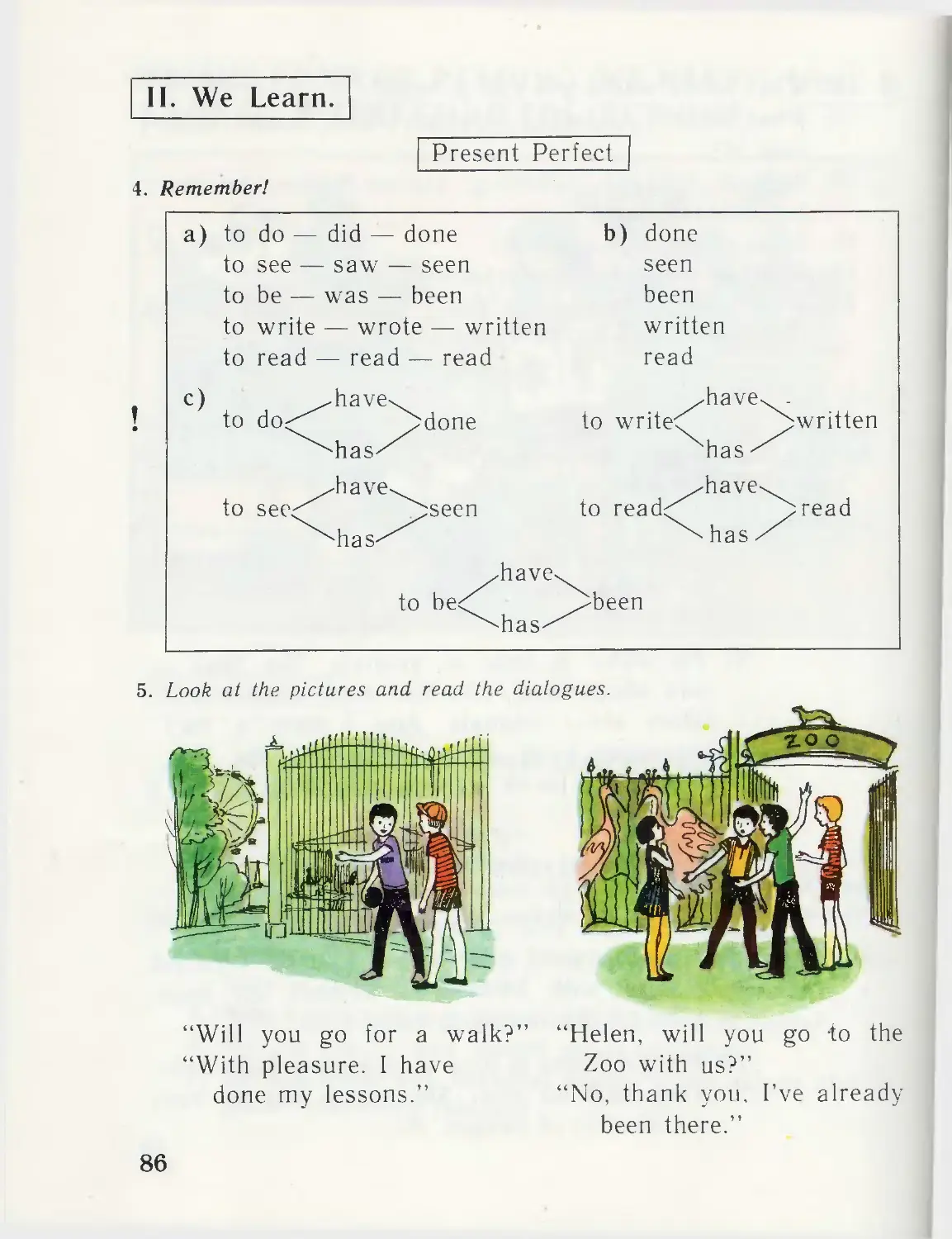
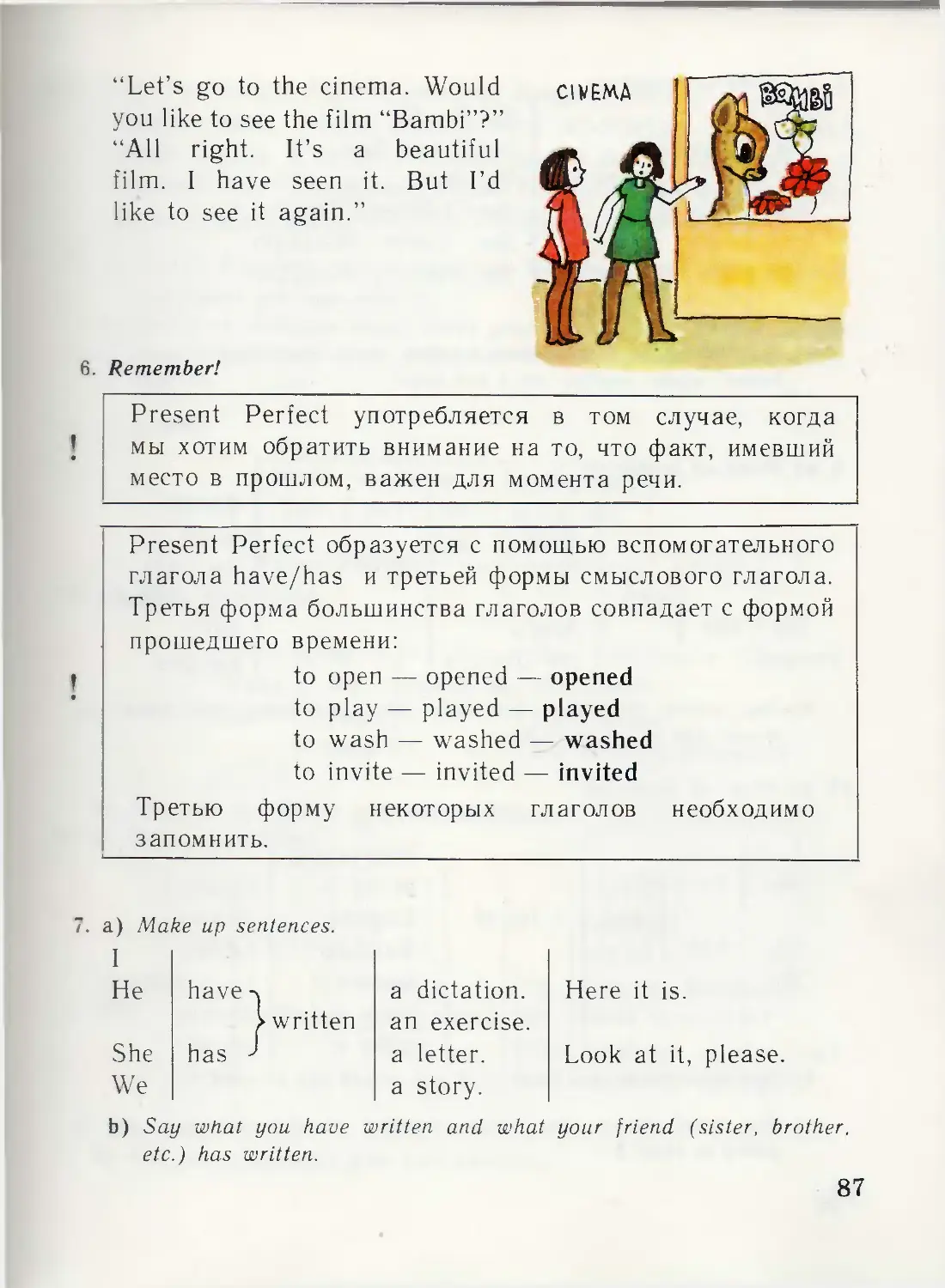
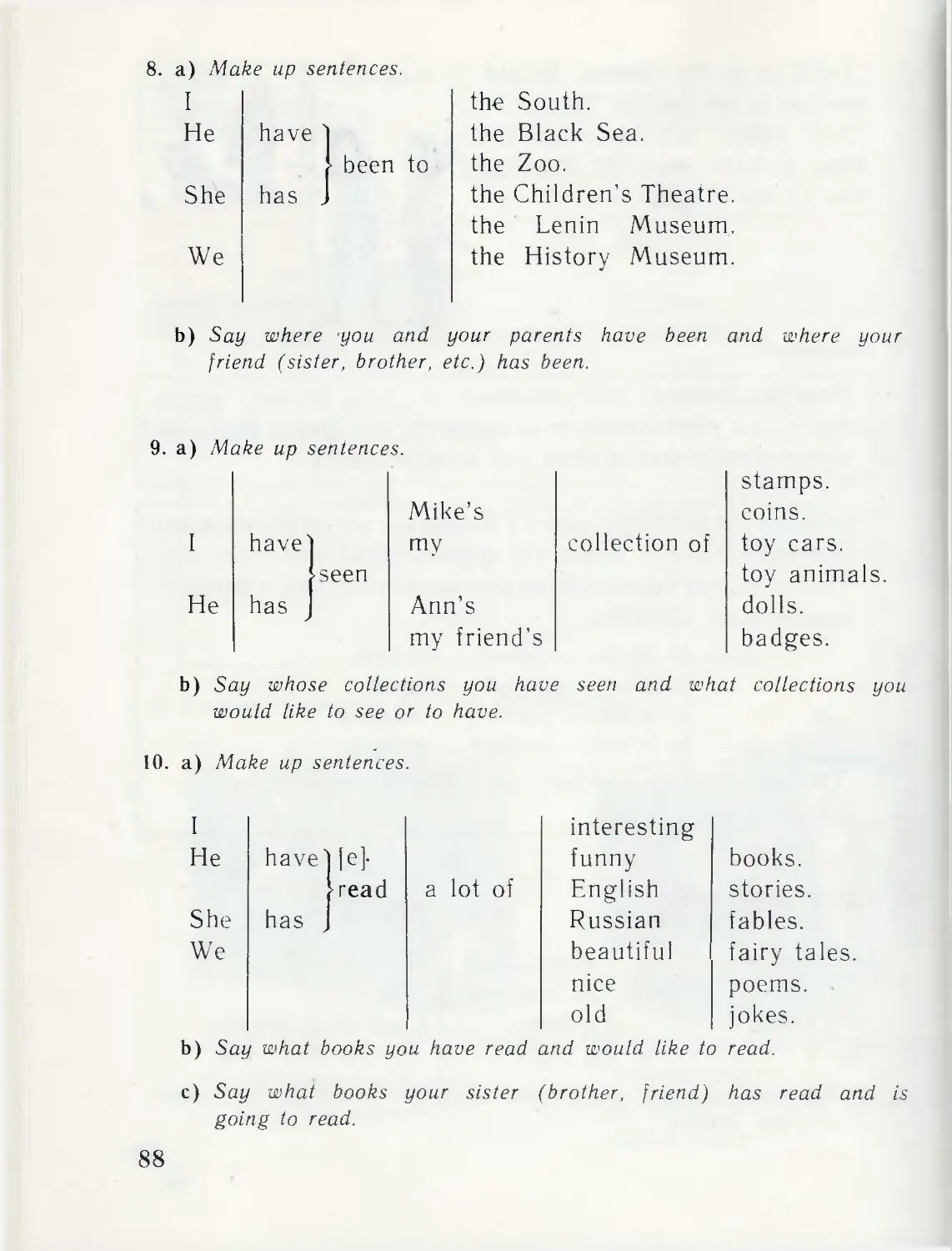
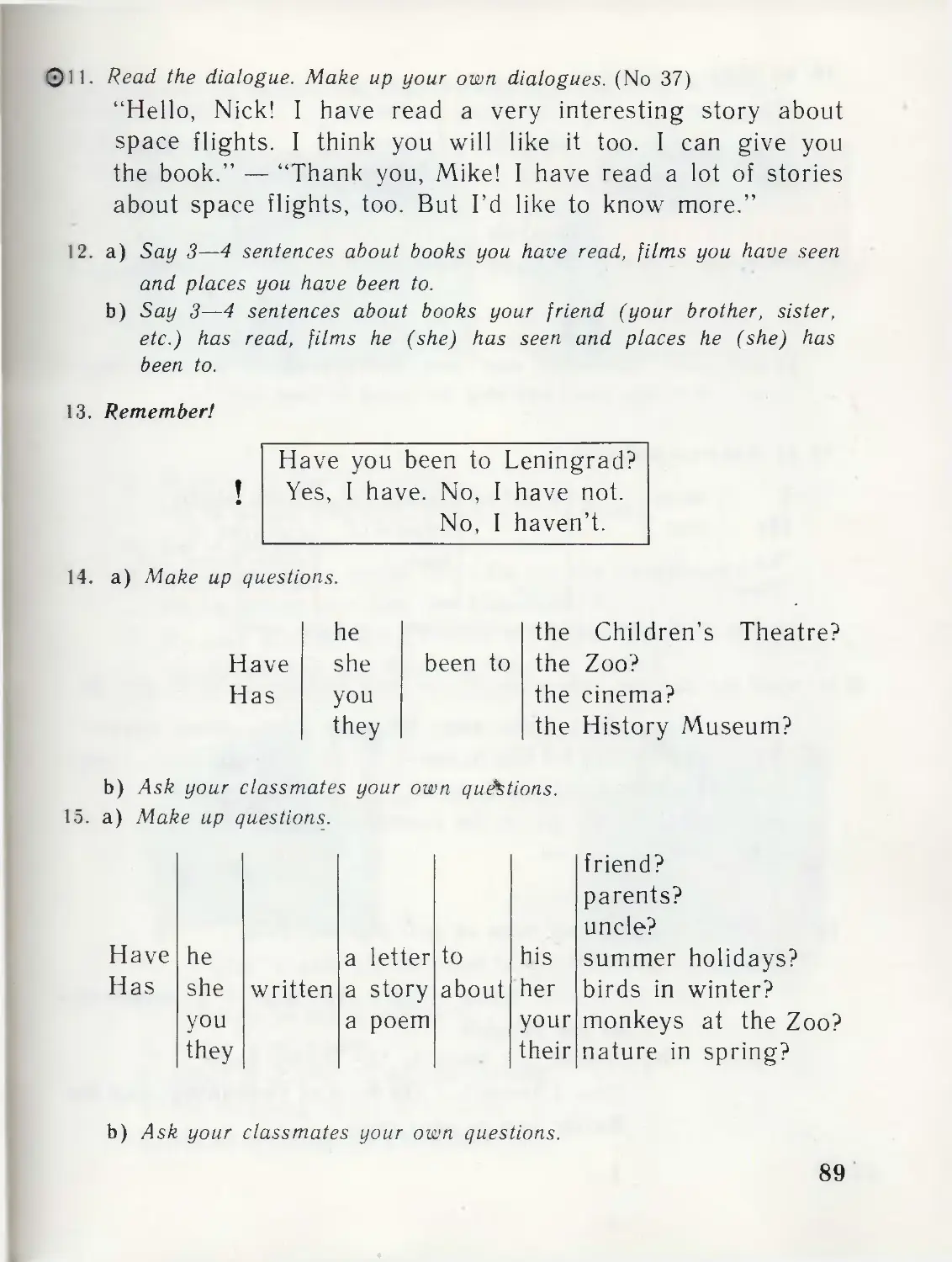




Author: Bogoroditskaya V.N. Khrustalyova L.V. Shavereva L.I.
Tags: english english grammar english language student book soviet student book
ISBN: 5-09-001775-1
Year: 1990

Text
                    L.I.SHAVERNEVA
V.N.BOGORODITSKAYA
L.Y.KHRUSTALYOVA

Л. И. ШАВЕРНЕВА
В. Н. БОГОРОДИЦКАЯ
Л. В. ХРУСТАЛЕВА
АНГЛИЙСКИЙ
ЯЗЫК
УЧЕБНИК ДЛЯ V КЛАССА ШКОЛ
С УГЛУБЛЕННЫМ ИЗУЧЕНИЕМ АНГЛИЙСКОГО ЯЗЫКА
Утверждено
Министерством народного образования
РСФСР
3-е издание
МОСКВА «ПРОСВЕЩЕНИЕ» 1990

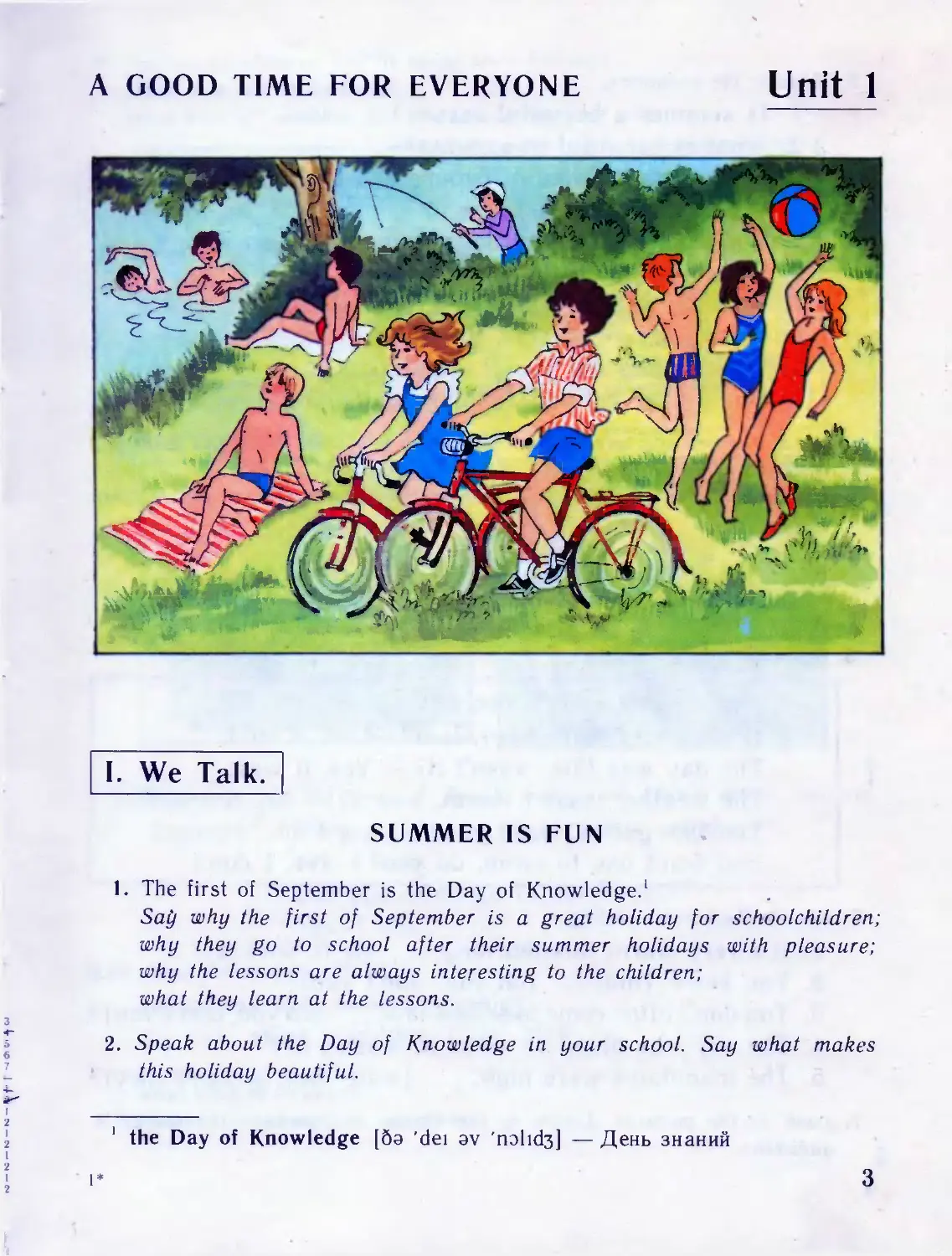
A GOOD TIME FOR EVERYONE
Unit 1
I. We Talk.
SUMMER IS FUN
1.	The first of September is the Day of Knowledge.1
Saij why the first of September is a great holiday for schoolchildren;
why they go to school after their summer holidays with pleasure;
why the lessons are always interesting to the children;
what they learn at the lessons.
2.	Speak about the Day of Knowledge in your school. Say what makes
this holiday beautiful.
1 the Day of Knowledge [бэ 'dei av 'nolid3] — День знаний
2
1*
3

3.	Answer the questions.
1.	Is summer a beautiful season?
2.	What is beautiful in summer?
3.	Is the weather fine in summer?
4.	Where do you usually go in summer?
5.	What do you usually do in summer?	,
6.	Where were you this summer?
7.	Was the weather warm?
8.	Were you outdoors all the time?
9.	What games did you play outdoors?
10.	Did you go boating (fishing, swimming)?
4.	a) Say where you were in summer, when you went there and what you
liked to do. Say why all children like summer.
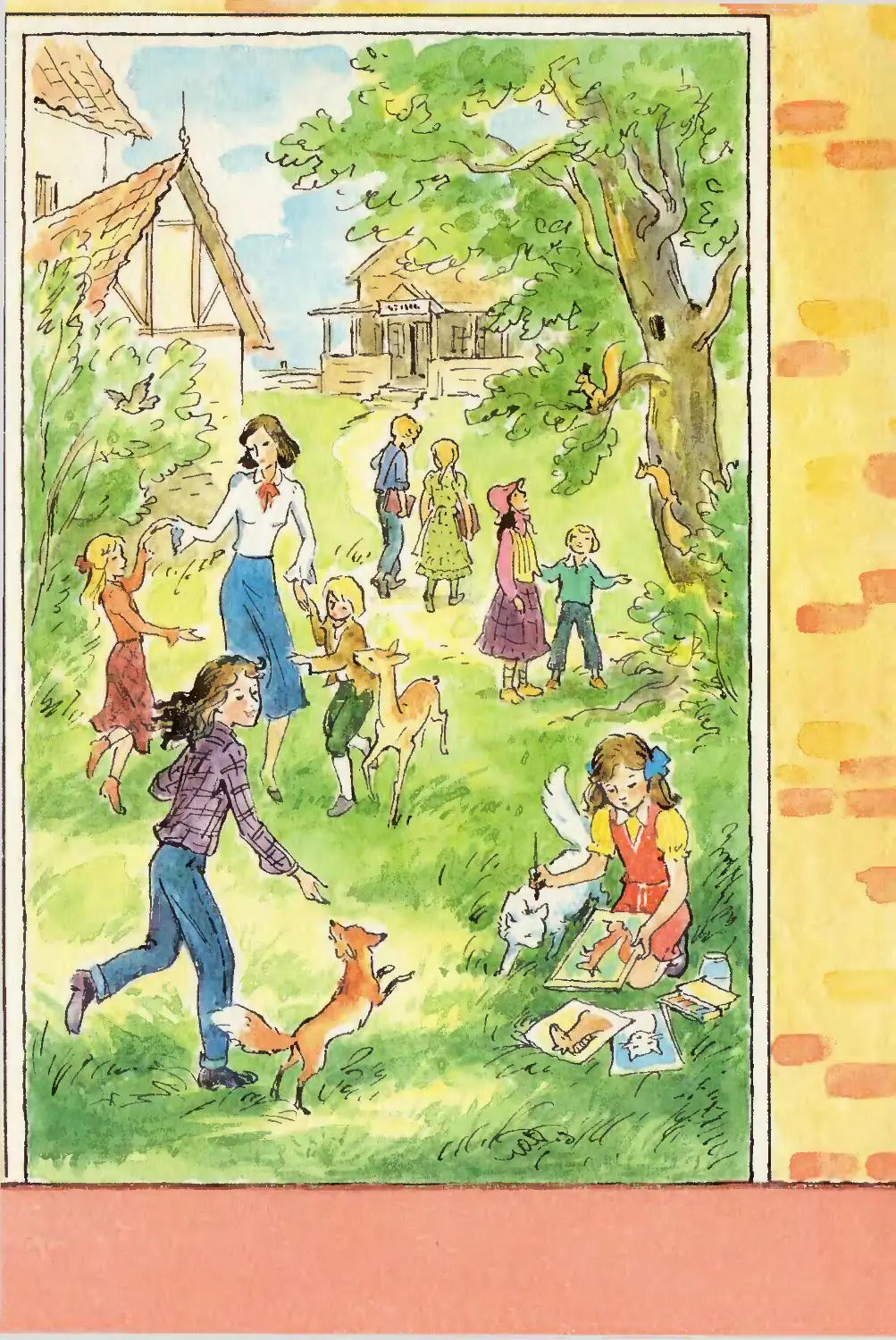
b) Look at the picture above and describe it. Say what the children
are fond of. 1 2 3 4 5II. We Learn.
5. Remember!
The garden is very nice, isn’t it? —
Yes, it is.
It isn’t very cold today, is it? — No, it isn’t.
The day was fine, wasn’t it? — Yes
, it was.
The weather wasn’t warm, was it?
— No, it wasn’t.
You like games, don’t you? — Yes,
I do.
You don’t like to swim, do you? —
No, I don’t.
6.	Choose the correct ending.
1.	It’s very warm this morning, ... (is it, isn’t it)?
2.	You know Tom, ... (do you, don’t you)?
3.	You don’t often come to school late,... (do you, don’t you) ?
4.	The sky was blue, ... (was it, wasn’t it)?
5.	The mountains were high, ... (were they, weren’t they)?
7.	Look at the pictures. Listen to the stories and answer the teacher’s
questions.
4
У

8. Say where children like to spend their holidays;
what it is fun to do there;
what kind of1 weather you like in summer and why.
9. Were you...? Did you...? Speak with your friend about summer.
Example: “Were you in the country this summer?”
“Yes, I was.”
“Did you often go to the forest?”
“Yes, I did.”
©10. Read the words. (No l2)
[i:] green, sea, season, 'seaside
[i] fish, swim, children, river, pick 1 21	what kind of — какая
2	Номер упражнения на пластинке.
5

[э] long, often, holidays, lot, soft
[ae] lamp, badminton, Saturday, camp, sand
[л] run, funny, summer, sun, sunny
[au] out, down, house, mouse, cloud
fai] write, fine, night, Friday, climb
[oi] boy, toy, coin, join, en'joy
fu] good, look, book, wood
©11. Read and remember how to use the words. (No 2, part A)
seaside: at the seaside, go to the seaside; My parents spend
every summer at the seaside. Did you go to the seaside in
June?
soft: soft green grass, soft toys; It’s nice to sit on the soft
green grass. My sister has many soft toys. I don’t like
this armchair. It’s not soft.
sunny: sunny days, sunny weather; It’s a pleasure to swim on
warm sunny days. Was the weather sunny in April? It was
a beautiful sunny afternoon.
sand: Little children like to play on the yellow sand. I like
to sit on the sand and look at the sea.
a cloud: Are there many clouds in the sky? There are some
clouds in the sky but they are not big, and the sky is
blue.
to climb [klaim]: climb a hill, climb mountains, climb a tree;
It is difficult to climb mountains. Boys- like to climb
trees.
a camp: at camp, a Pioneer camp; Tom spent a month at camp.
Every summer a lot of children go to Pioneer camps,
to enjoy: enjoy games, enjoy the weather, enjoy television; A
lot of people enjoy television. I enjoy my milk at break¬
fast-time.
a wood: green woods, go to the woods, in the woods; The
children often went to the woods on hot days,
to pick: Where, did you pick these nice flowers? The children
picked a lot of red apples from the apple trees.
6

12. What are they like? Choose an adjective and use it in the sentence.
Example: It was nice to look at the girl’s face, happy
It was nice to look at the girl’s happy soft
face.
I read many books.
The birds sang their songs.
The boy was strong and liked games.
Ann picked a lot of flowers and brought them
home.
There was a garden near the house.
It was nice to sit on the grass.
It was a pleasure to look at the children
at school on the first of September.
We enjoyed the weather because we could play
outdoors all the time.
beautiful
wonderful
quick
interesting
healthy
nice
soft
sunny
13. Say what you like to do (learn to do, want to do) in summer (in your
holidays, at school, at camp, in the country).
Example: We learn to draw animals at the drawing lessons.
We want to be healthy and strong.
14. Make up sentences.
Example: It’s fun to skip and it’s fun to play games.
It’s interesting to watch the clouds in the sky.
It’s wonderful to have a pet. 1 2 3 41.	It’s fun to... .
2.	It’s interesting to... .
3.	It’s wonderful to... .
4.	It’s nice to... .
7

15. Why do you enjoy it? Make up sentences.
I enjoy
English lessons
new books
games
sunny days
walks to the woods
warm weather
music
talks with friends
because...
16. Say what you enjoy at school (at home, in summer, at camp) and why.
17. Read the words.
[l] hill, quick, think, different, pick, 'squirrel
[л] fun, mushroom, country, wonderful, sunny, nut
[au] out, town, mountain, cloud, a'round
fael have, travel, camp, sand, ,under'stand
m field, street, week, tree, sea, seaside, each
[э:] autumn, August, daughter, North, of course
0 18. Read and remember how to use the words. (No 2, part B)
a squirrel ['skwfrl]: We often saw squirrels in the woods.
Squirrels are little animals, but their tails are long.
a nut: Squirrels like to eat nuts. “Where did you pick so many
nuts?” — “In the woods.”
around: Look around! It’s so beautiful here. There are so many
wonderful things around.
to understand — understood: Do you understand the sums?
Tom understood the sum and did it quickly.
each: each other, understand each other, help each other, see
each other; My brother and I do our best to help each
other. Are you always glad to see each other, boys?
of course [av'ko:s]: “Are you fond of swimming?” — “Of
course, I am.”
to make friends: Did you make many new friend's at camp,
Tom? — Of course, I did.
8

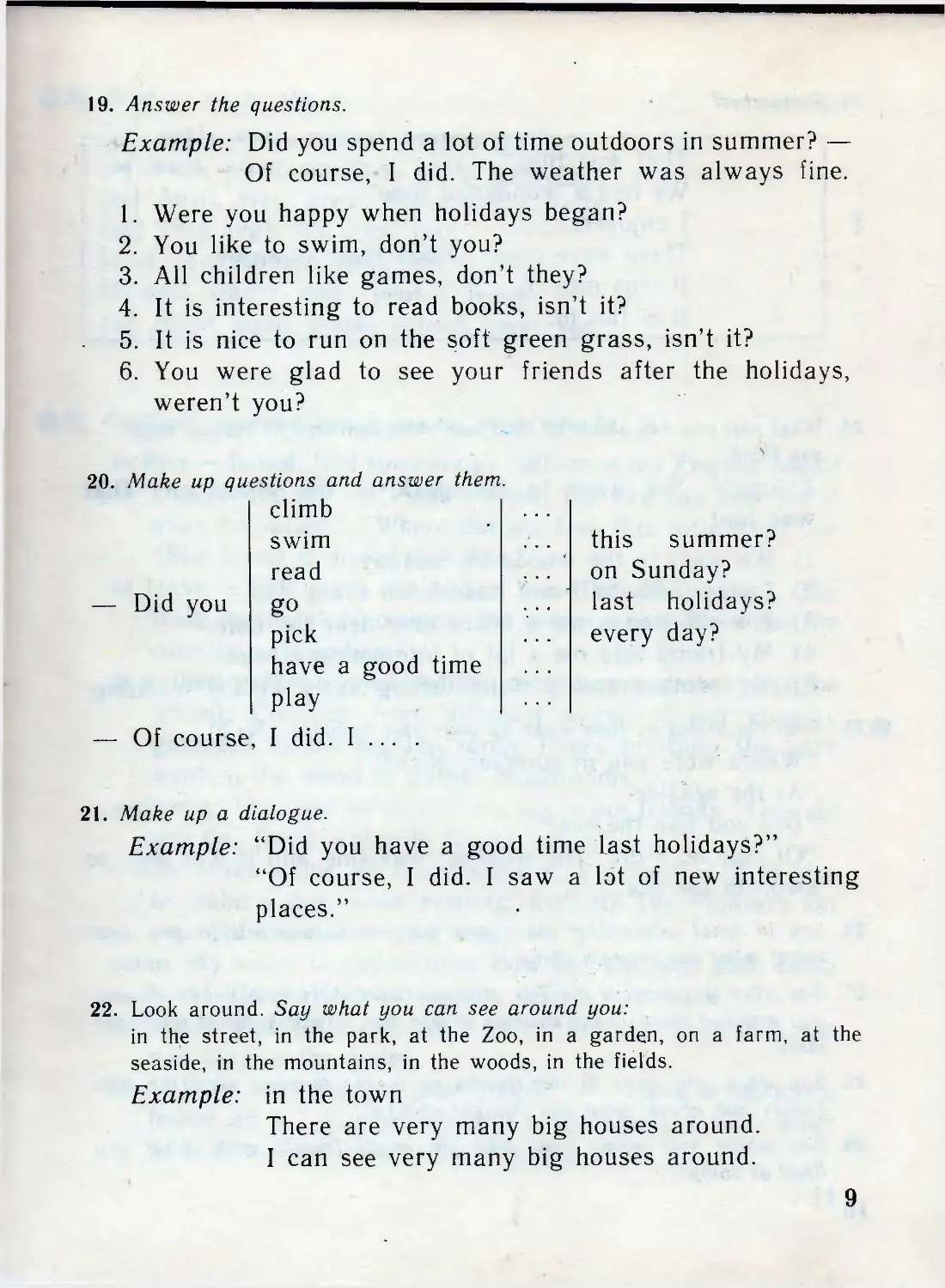
19.	Answer the questions.
Example: Did you spend a lot of time outdoors in summer? —
Of course, I did. The weather was always fine.
1.	Were you happy when holidays began?
2.	You like to swim, don’t you?
3.	All children like games, don’t they?
4.	It is interesting to read books, isn’t it?
5.	It is nice to run on the soft green grass, isn’t it?
6.	You were glad to see your friends after the holidays,
weren’t you?
.	V
20.	Make up questions and answer them.
climb
swim
this summer?
read
on Sunday?
Did you
go
last holidays?
pick
have a good time
play
every day?
— Of course, I did. I ... .
21. Make up a dialogue.
Example: “Did you have a good time last holidays?”
“Of course, I did. I saw a lot of new interesting
places.”
22. Look around. Say what you can see around you:
in the street, in the park, at the Zoo, in a garden, on a farm, at the
seaside, in the mountains, in the woods, in the fields.
Example: in the town
There are very many big houses around.
I can see very many big houses around.
9

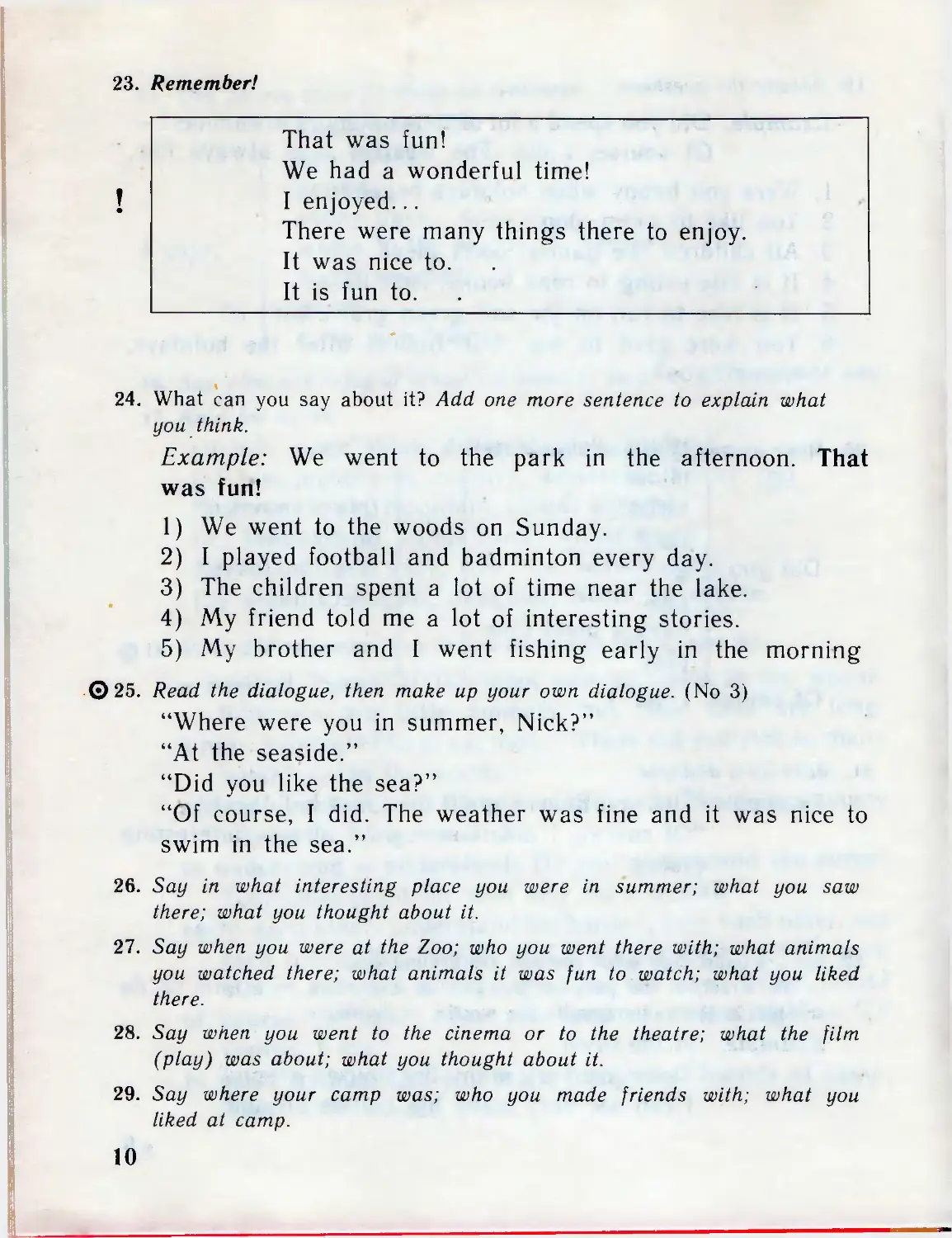
23. Remember!
That was fun!
We had a wonderful time!
\	I enjoyed...
There were many things there to enjoy.
It was nice to.
It is fun to.
24. What can you say about it? Add one more sentence to explain what
you think.
Example: We went to the park in the afternoon. That
was fun!
1)	We went to the woods on Sunday.
2)	I played football and badminton every day.
3) The children spent a lot of time near the lake.
4) My friend told me a lot of interesting stories.
5)	My brother and I went fishing early in the morning
©25. Read the dialogue, then make up your own dialogue. (No 3)
“Where were you in summer, Nick?”
“At the seaside.”
“Did you like the sea?”
“Of course, I did. The weather was fine and it was nice to
swim in the sea.”
26.	Say in what interesting place you were in summer; what you saw
there; what you thought about it.
27.	Say when you were at the Zoo; who you went there with; what animals
you watched there; what animals it was fun to watch; what you liked
there.
28.	Say when you went to the cinema or to the theatre; what the film
(play) was about; what you thought about it.
29.	Say where your camp was; who you made friends with; what you
liked at camp.
10

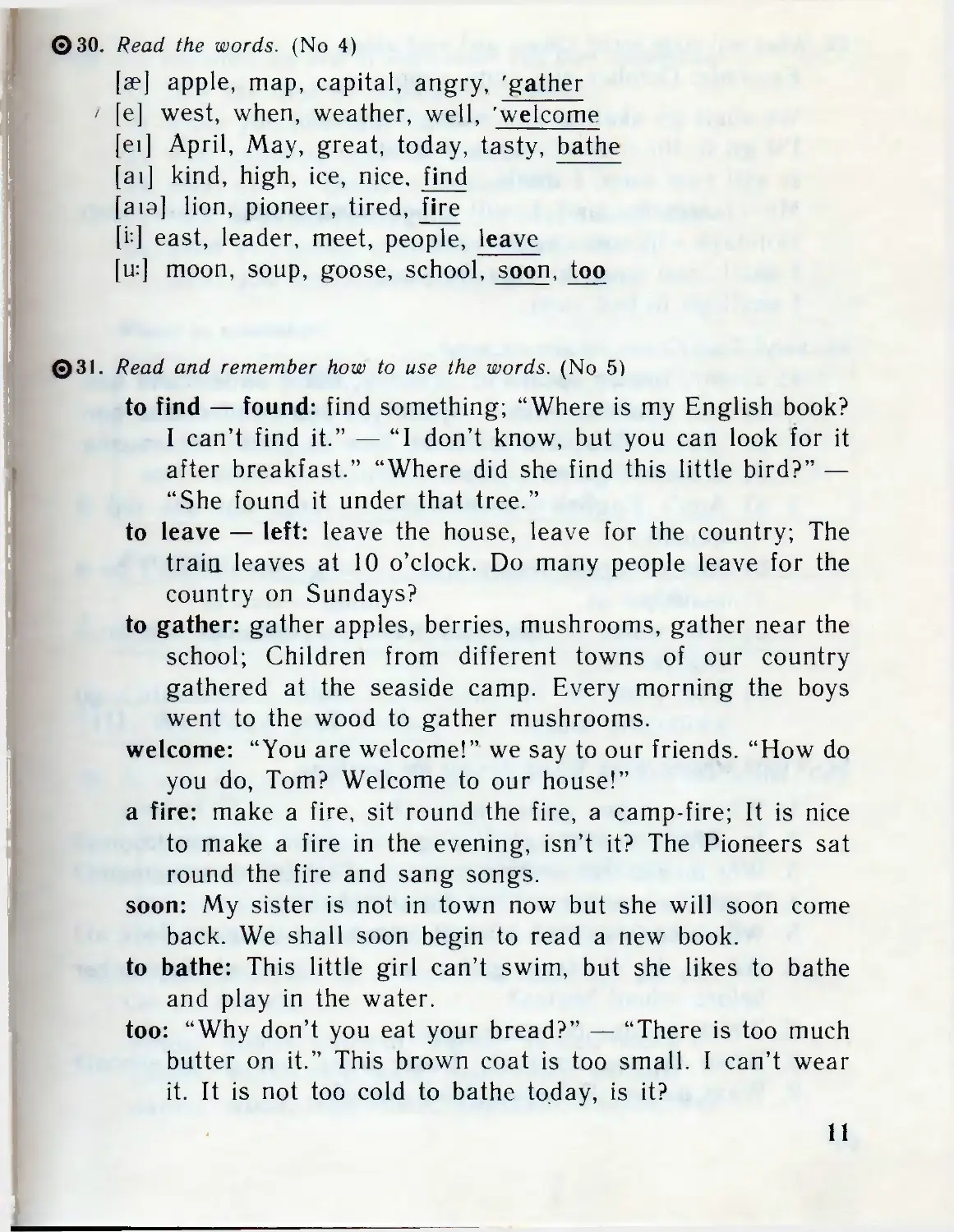
О 30. Read the words. (No 4)
[ae] apple, map, capital, angry, 'gather
/ [e] west, when, weather, well, 'welcome
[ei] April, May, great, today, tasty, bathe
[ai] kind, high, ice, nice, find
[аю] lion, pioneer, tired, fire
[i;] east, leader, meet, people, leave
[u:] moon, soup, goose, school, soon, too
031.	Read and remember how to use the words. (No 5)
to find — found: find something; “Where is my English book?
I can’t find it.” — “I don’t know, but you can look for it
after breakfast.” “Where did she find this little bird?” —
“She found it under that tree.”
to leave — left: leave the house, leave for the country; The
train leaves at 10 o’clock. Do many people leave for the
country on Sundays?
to gather: gather apples, berries, mushrooms, gather near the
school; Children from different towns of our country
gathered at the seaside camp. Every morning the boys
went to the wood to gather mushrooms,
welcome: “You are welcome!” we say to our friends. “How do
you do, Tom? Welcome to our house!”
a fire: make a fire, sit round the fire, a camp-fire; It is nice
to make a fire in the evening, isn’t it? The Pioneers sat
round the fire and sang songs,
soon: My sister is not in town now but she will soon come
back. We shall soon begin to read a new book,
to bathe: This little girl can’t swim, but she likes to bathe
and play in the water.
too: “Why don’t you eat your bread?” — “There is too much
butter on it.” This brown coat is too small. I can’t wear
it. It is not too cold to bathe today, is it?
11

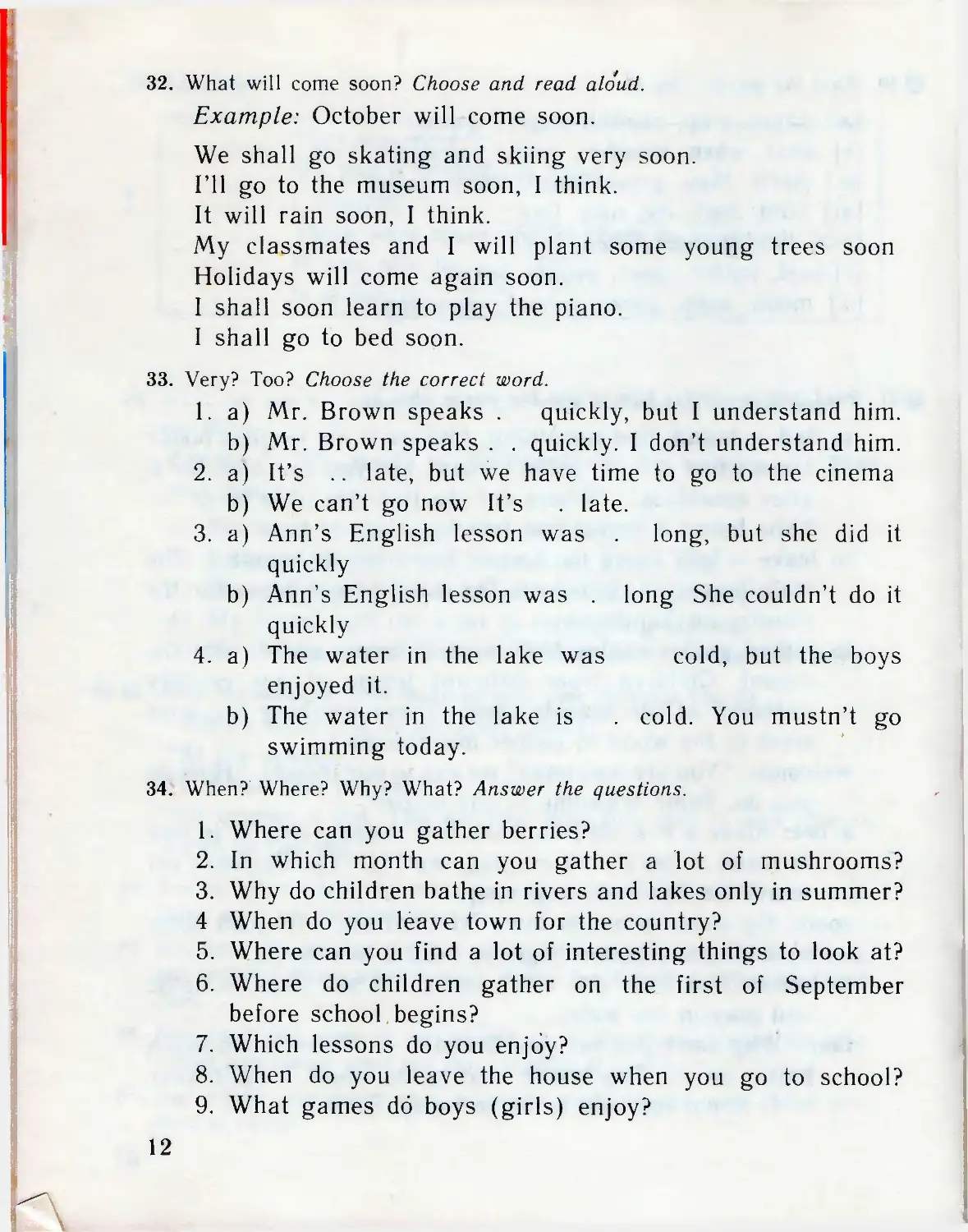
32.	What will come soon? Choose and read aloud.
Example: October will come soon.
We shall go skating and skiing very soon.
I’ll go to the museum soon, I think.
It will rain soon, I think.
My classmates and I will plant some young trees soon
Holidays will come again soon.
I shall soon learn to play the piano.
I shall go to bed soon.
33.	Very? Too? Choose the correct word.
1.	a) Mr. Brown speaks . quickly, but I understand him.
b) Mr. Brown speaks . . quickly. I don’t understand him.
2.	a) It’s .. late, but we have time to go to the cinema
b) We can’t go now It’s . late.
3.	a) Ann’s English lesson was . long, but she did it
quickly
b) Ann’s English lesson was . long She couldn’t do it
quickly
4.	a) The water in the lake was cold, but the boys
enjoyed it.
b) The water in the lake is . cold. You mustn’t go
swimming today.
34.	When? Where? Why? What? Answer the questions.
1.	Where can you gather berries?
2.	In which month can you gather a lot of mushrooms?
3.	Why do children bathe in rivers and lakes only in summer?
4 When do you leave town for the country?
5.	Where can you find a lot of interesting things to look at?
6.	Where do children gather on the first of September
before school begins?
7.	Which lessons do you enjoy?
8.	When do you leave the house when you go to school?
9.	What games do boys (girls) enjoy?
12

35. Did you enjoy the first of September? Tell your classmates:
1)	how the first of September began;
2)	when you left your house;
3)	who gathered near the school;
4)	what all the children looked like;
5)	what was interesting on the first school day;
6)	what you spoke with your friends about;
7)	what you learnt and enjoyed at school.
Words to remember:
around, to bathe, a camp, to climb, a cloud, each, each
other, to enjoy, to find, a fire, to gather, to leave, to
make friends, a nut, of course, to pick, sand, seaside,
soft, soon, a squirrel, sunny, to understand, too, to
welcome, a wood
Remember!
to find — found
to understand — understood
to leave — left
III. We Read and Talk.
36 In each line there is a word that does not go with the sound. Can
you find it?
[i:] seaside, week, field, weather, sweet, evening
[l]	swim, fish, fine, begin, children, different
[ae] camp, glad, language, gather, grass, badminton
[л] country, put, sunny, month, mushroom, nut, fun
37. In each line there is a word that does not go with the others.
Can you find it?
school, pupils, uniform, teacher, forest, books
games: volley-ball, walk, badminton, football
nature: wood, river, field, mountain, sweets, tree
13

©38. Read the sentences aloud. (No 6)
a)	The weather is fine.
The summer months go so quickly
It’s nice to sit down by a river or a lake
It’s nice to swim and it’s nice to fish.
b)	Did you have a good time in summer?
Was there a river or a lake near the camp?
39. Read the text Summer Is Wonderful. Find the sentences which say
what it is nice to do in summer
SUMMER IS WONDERFUL
©	Summer is wonderful! There are many long sunny days
and there is no school! There are new friends and many
interesting things to see and to do.
Some children spend their holidays at the seaside, some
in the' mountains and some in the country
Isn’t it nice to spend some weeks out of a noisy town?
Isn’t it nice to walk in the green fields? To watch the
clouds? To sit down by a river or a lake on soft green grass?
To climb the high hills? To swim and to fish? To play games
outdoors all the time? Children find a lot of things to
enjoy, and the summer months go so quickly © (No 7)
Then autumn comes and school begins
14

Welcome to school, boys and girls! How strong, healthy
and gay you are! And you are full of stories about your
holidays
40. a) Listen to the dialogue, then read it.
© Mike- Hallo, Nick!
Nick Hallo, glad to see you!
Mike And I’m glad to see you.
Did you have a good
time this summer?
Nick Certainly, I did. I was
in the country at my
grandmother’s. There
were many things there
to enjoy
Mike And I was at camp We had a lot of fun, of course.
Nick Was there a river or a lake near the camp?
Mike There was a lake. We always swam there on warm
days
Nick And I often went fishing That was fun! © (No 8)
b) Make up your own dialogues.
41 Read Ann’s story and Peter’s story. Say whose summer holidays
were more interesting
ANN AND PETE SPEAK ABOUT THEIR SUMMER
HOLIDAYS
ANN’S STORY
My brother and I spent two months in the country
The weather was always fine, and we liked to be outdoors
Every day there was something that was fun to do
We went for long walks to the woods, picked flowers,
gathered berries and mushrooms. We often saw squirrels
in the trees. I put some nuts and sweets on the grass
under the trees Then we stood and watched. To our surprise
15

the squirrels did not take the sweets. They only took the
nuts.
We enjoyed our games. The boys played football. My
girl-friends and I liked to play volley-ball and badminton.
We had a wonderful time in the country!
PETER’S STORY
I think I was the happiest of all because I was at a
wonderful children’s camp by the Black Sea near a big
mountain. Soviet Pioneers and children from different
countries gather here every year.
We all spoke different languages but we understood
each other very well.
In the morning we swam and bathed in the beautiful
sea and played games on the yellow sand. In the evening
we made a camp-fire, sat around it and sang songs. We
all became good friends.
The day to leave came too soon. We had a very good
time at camp with our new friends.
42.	Tell your classmates:
1)	how Ann and Peter spent their holidays;
2)	where they were;
3)	what it was fun to do;.
4)	what they enjoyed in summer;
5)	what they thought of their summer holidays.
Let’s speak about your summer holidays.
43.	Answer the questions.
1.	Where is it fun to spend the summer holidays?
2.	Why do you like to be outdoors all the time?
3. How do you become strong and healthy in summer?
4. What can you do in the woods, near a river, at the
seaside, in the mountains?
5.	Do you make new friends at camp?
6.	What games do you play in summer?
16

7 When do you leave for the country and when do you
come back home?
8. Why do many children say that the time to leave comes
too Soon!
9 Can you also say that the summer months go quickly?
10 Why do you enjoy your holidays?
44.	Say why it is so.
1)	It’s nice to spend some weeks out of town.
2)	Children can play outdoors all the time.
3)	The summer months always go very quickly
4)	Each day children have a lot of fun
5)	Summer holidays make children strong and healthy
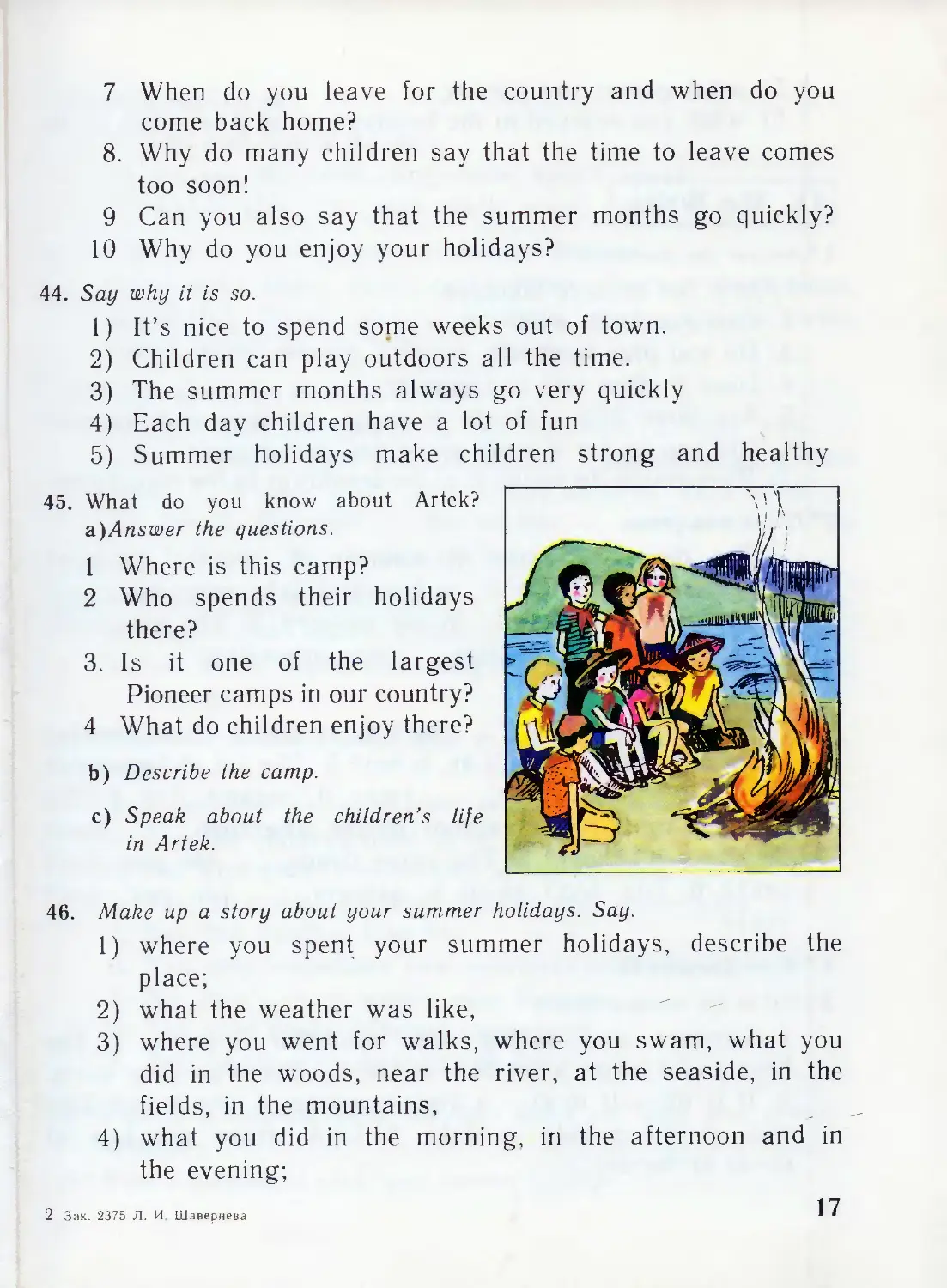
45.	What do you know about Artek?
a)	Answer the questions.
1	Where is this camp?
2	Who spends their holidays
there?
3.	Is it one of the largest
Pioneer camps in our country?
4 What do children enjoy there?
b)	Describe the camp.
c)	Speak about the children’s life
in Artek.
46.	Make up a story about your summer holidays. Say.
1)	where you spent your summer holidays, describe the
place;
2)	what the weather was like,
3) where you went for walks, where you swam, what you
did in the woods, near the river, at the seaside, in the
fields, in the mountains,
4)	what you did in the morning, in the afternoon and in
the evening;
2 Зак. 2375 Л. И. Шавернева
17

5)	what games you played;
6)	what you enjoyed in the holidays, what it was fun to do.
IV. We Write.
1.* Answer the questions.
1 Is it fun to have holidays?
2.	Can you swim well?
3.	Do you play football?
4.	Does it often rain in summer?
5.	Are there lots of birds in parks, ’gardens and forests?
6.	Did you go for a walk every day in summer?
7 Were you in the country, at the seaside or in the mountains?
2* Fill in was, were.
1. The days ... warm in summer. 2 We .. outdoors
all the time. 3. There . a beautiful lake near our camp
4.	My brother and. I . in the country 5. The mountains
... very high. 6. The game .. very interesting
3.	* Choose the correct ending.
1. His name is Pete, .. (isn’t it, is it)? 2 Your brother
is not a doctor, ... (isn’t he, is he)? 3. The 1st of September
was a wonderful day, . . (was it, wasn’t it)? 4 The
children were not at school in the afternoon, . (were
they, weren’t they)? 5. You enjoy tennis, . (do you, don’t
you)? 6. You don’t swim in autumn, (do you, don’t
you) ?
4.	* Write Exercise 14.
5.	* Fill in the missing letters.
1 Summer and spring are w-nd-rful s--sons. 2. The
boys could swim a lot bec--se the w--ther was very w-rm.
3. It is dif--c-lt to cl--- a high m-untain. 4 My.fr--nd Tom
was at the s--side in July 5. Look, there are lots of
cl--ds in the sky.
18

6.* Write Exercise 24.
7 * Write the past form of the verbs.
a)	go, see, do, swim, sing, have, spend, speak;
b)	watch, play, like, pick, walk, want, climb, enjoy.
8.	* Write out the words for the topic Summer Holidays.
Sand, cold, enjoy, sunny, gay, gather, berries, mushrooms,
wonderful, travel, games, presents, study, lessons, fruit,
spend, shine, nature, autumn, summer.
9.	* Fill in about, for, to, in, at, by, with.
1. Tom likes to speak ... his holidays. 2. They live ...
a big town. 3. Their lessons begin ... the morning. 4. Ann
went ... a walk every day. 5. The children liked to sit ...
the fire. 6. We went ... the seaside ... our parents. 7. Do
you leave ... the country on Sunday?
10.* Write the past form of the verbs:
a)	skip, travel, bathe, gather;
b)	sit, find, leave, run, begin, come, understand, make,
become.
\\.* Write 5—8 sentences about what it was fun to do in your summer
holidays.
12* These sentences are all answers to questions. Write the questions.
1	Yes, the children liked to be outdoors.
2	No, Ann spent two months in the country.
3.	Yes, they often gathered berries and mushrooms.
4.	Yes, the weather was fine.
5.	Yes, they sometimes saw squirrels in the forest.
6.	No, Pete’s camp wasn’t near Moscow.
7 Yes, they spoke different languages.
8. Yes, he often made the camp-fire.
13.	* Write 5—8 sentences about the place where you spent your summer
holidays.
14.	* Write a composition about your summer holidays.
2*

ALL AROUND YOU
Unit 2
I. We Talk.
NATURE IS AN INTERESTING STORY-BOOK
1 Answer the questions.
1	What interesting things can you
see when you go for a walk in
the woods (fields) ?
2 When can you find many
interesting things to watch?
3.	Is it fun to watch birds,
animals and fish?
4 What is it fun to watch in
spring (summer, autumn, win
ter) ?
20

5.	Can you say that each season
has its wonders?
6.	Are the colours of each
season different?
7 In what season do you plant
trees near your school or in
your garden?
8. At what lessons can you
learn a lot about nature?
9 Do you like to read books
about nature?
10 How can we learn a lot about nature?
2.	Describe each season of the year Speak about its weather, its colours,
its nature. Say what is wonderful in every season.
3.	Say which season of the year you like and why.
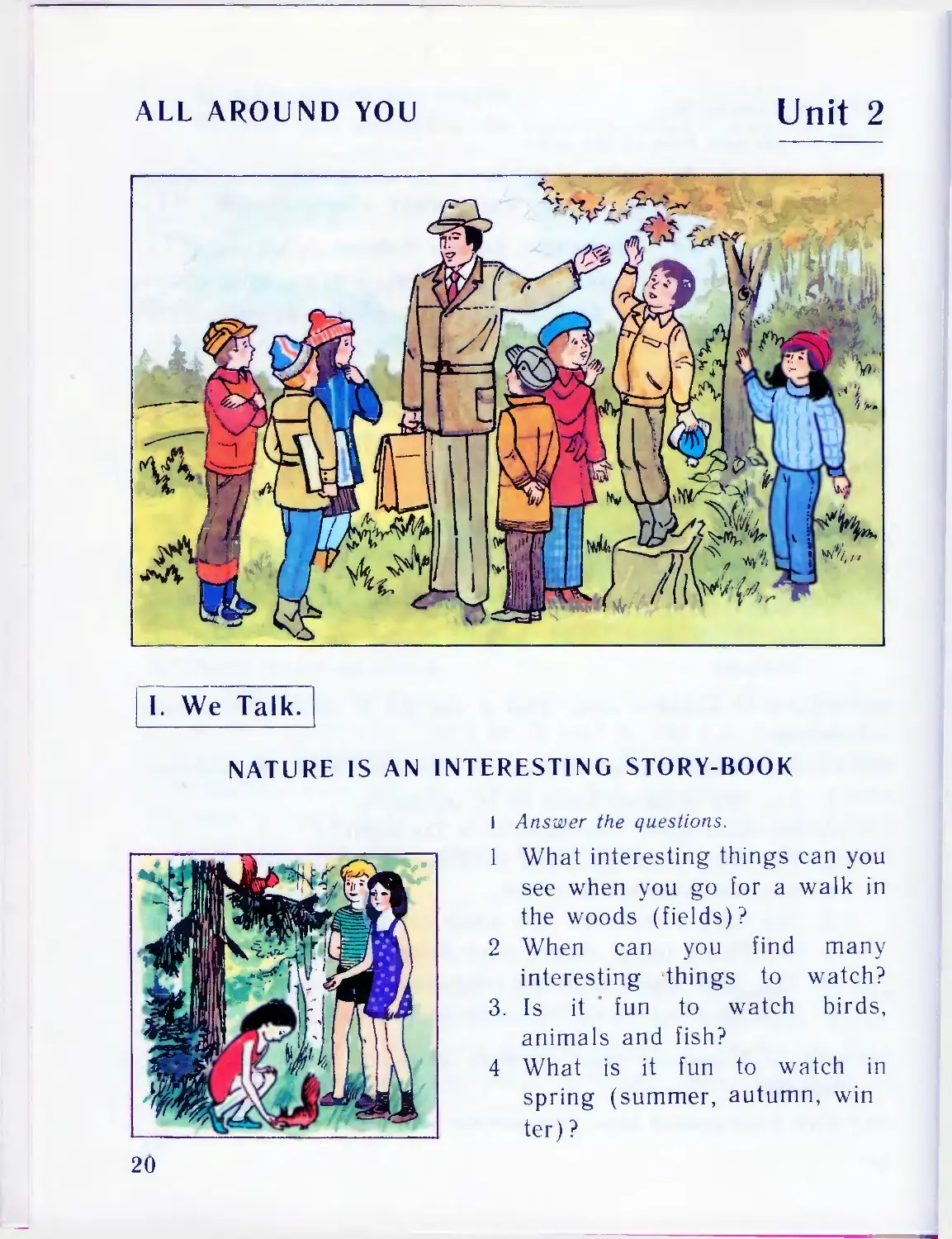
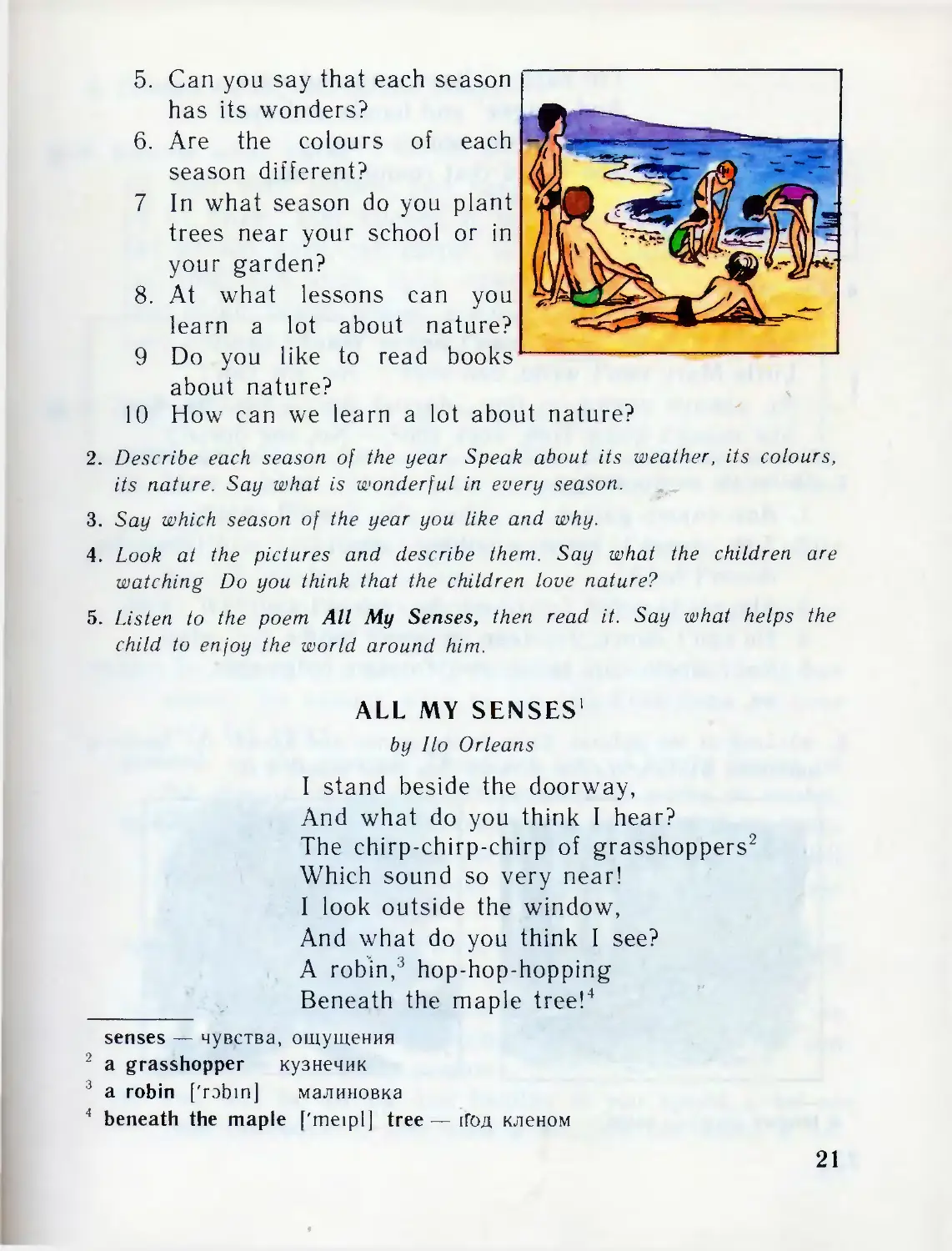
4.	Look at the pictures and describe them. Say what the children are
watching Do you think that the children love nature?
5.	Listen to the poem All My Senses, then read it. Say what helps the
child to enjoy the world around him.
ALL MY SENSES'
by Ilo Orleans
I stand beside the doorway,
And what do you think I hear?
The chirp-chirp-chirp of grasshoppers* 2
Which sound so very near!
I look outside the window,
And what do you think I see?
A robin,3 hop-hop-hopping
Beneath the maple tree!4
senses — чувства, ощущения
2 a grasshopper кузнечик
! a robin [’robin] малиновка
4 beneath the maple [’meipl] tree— [Год кленом
21

I’m happy I have ears and nose
And tongue1 and hands and eyes!
With all my senses I enjoy
The world that round me lies
II. We Learn.
6.	Remember!
He can speak English, can’t he? — Yes, he can
^	Little Mary can’t write, can she? — No, she can’t.
*	He always comes in time, doesn’t he? — Yes, he does
She doesn’t know Tom, does she? — No, she doesn’t.
7.	Choose the correct ending
1	Ann enjoys games, (does she, doesn’t she)?
2	Tom doesn’t know anything about it,	(does he,
doesn’t he)?
3. She reads a lot, (does she, doesn’t she)?
4 He can’t dance, (can he, can’t he)?
5.	Your uncle can speak two foreign languages, (can
he, can’t he) ?
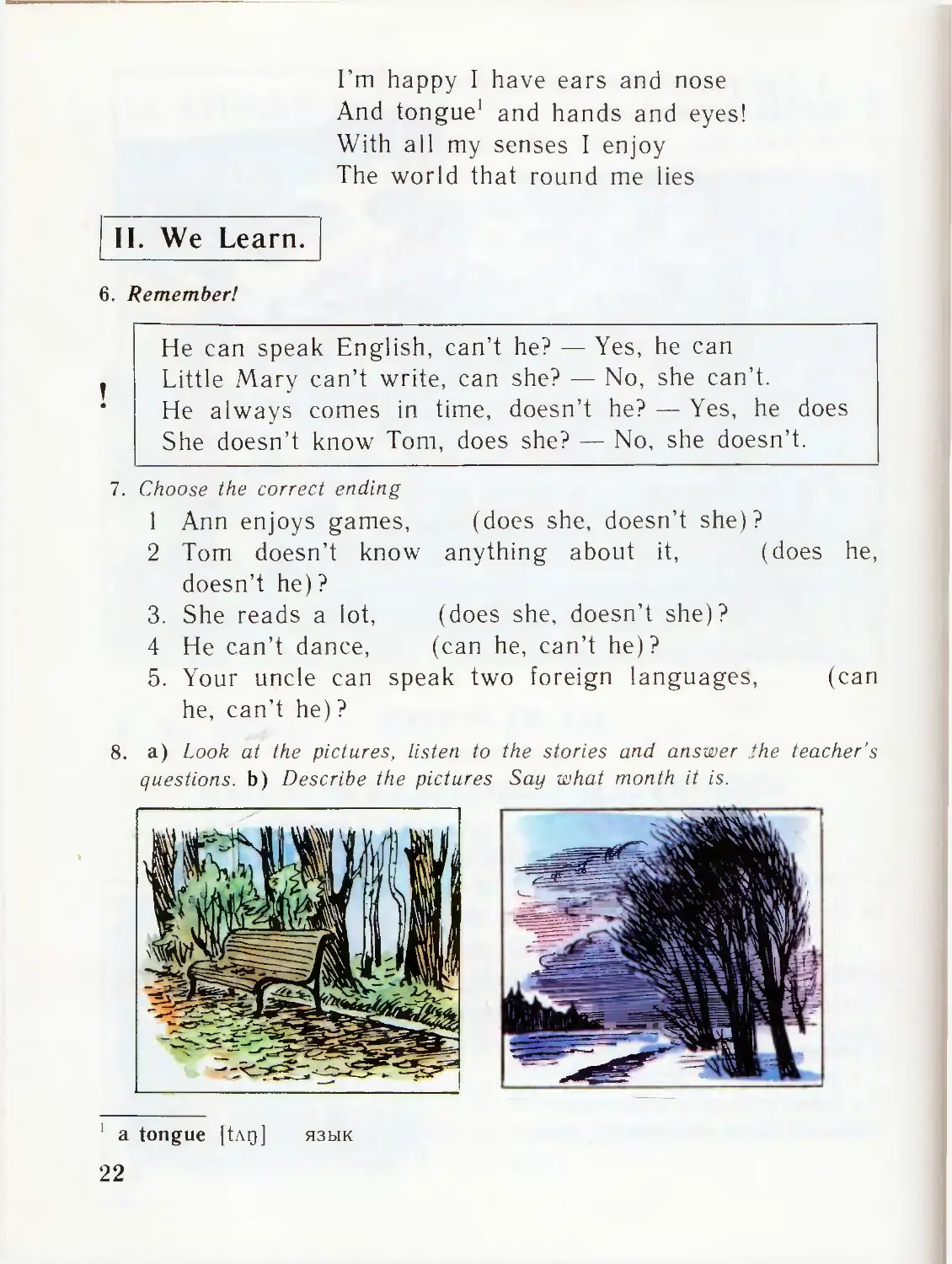
8.	a) Look at the pictures, listen to the stories and answer the teacher’s
questions, b) Describe the pictures Say what month it is.
1 a tongue [Пр] язык
22

9. Compare the different autumn months.
©10. Read the words. (No 9)
[i:] read, field, teacher, feel, need, keep
[l] ill, finger, film, kitchen, if, wind
[cu] garden, park, car, carpet, scarf, far, dark
[ai] fine, high, shine, light, right, bright
[au] cloud, house, blouse, around, ground
[ou] coat, go, home, yellow, know, blow
©II. Read and remember how to use the words. (No 10)
wind [wind] I don’t like it when the wind is blowing
to blow — blew [blu:]. blow strong; Soon a cold wind
began to blow
bright [brait] Spring is green, summer is bright. My sister
doesn’t like bright colours.
dark: Why is it so dark in the room? Summer evenings are
light, but winter evenings are dark,
far: far from, far away; My house is not very far from our
school He cannot walk to his office, because he lives
very far away.
ground: on the ground, There are lots of bright leaves on
the ground in autumn The ground is white in winter
to keep — kept: keep things, keep green, keep open,. Sometimes
people keep monkeys as pets. Some trees keep green all
the year round. Keep your eyes open and you will see
wonderful things.
to need: need something; What do you need for your drawing
lessons? Mother says that I need new shoes,
to feel — felt: feel happy; The day became hotter, and we
soon began to feel it. Mother felt happy when her son
gave her a birthday present.
if: You will be strong and healthy if you spend a lot of
time outdoors If you read a lot, you can learn a lot.
23

12. Remember!
!
noun
adjective
rain — rainy
cloud — cloudy
wind — windy
salt — salty
Mind the spelling!
sun — sunny
fun — funny
taste — tasty
shine — shiny
noise — noisy
13. What are they like? Complete the sentences.
Example: a) The day was rainy and cold.
b) It wasn’t cloudy and it wasn’t windy.
The weather was sunny
1.	I don’t like it when the weather in summer is .. and
2.	The cakes that Mummy cooked were very . . .
3.	The water in seas and oceans is ..
4.	The toys on the New Year tree were .
5.	It’s nice to bathe and swim when the day is .
6.	We laughed because the story was . . .
7.	In autumn the sky is usually grey and . .
14. Say how you feel:
after a nice, long walk to the woods, or to the fields;
when you get a beautiful birthday present;
when you see your friends after the holidays;
when you can help your friends;
when you are ill;
when you find some wonderful things;
when you spend a lot of time outdoors;
when you can’t do your work well;
when you can do everything very well.
Use the words: happy, fine, bad, healthy, tired, well.
24

15. Choose the correct ending.
If you are attentive,
If your friends help you,
If you study well,
If the sky is cloudy,
If there are a lot of trees
and flowers in the
garden,
If the hill is very high,
it only does you good,
it is difficult to climb it.
you can see a lot of interesting
things.
it usually rains.
you can do things better.
16. Say what you need: when you go to school; for your English
lessons; when you want to write a letter; when you want to play
volley-ball; when you go to the woods to gather mushrooms; when
you want to give a squirrel something to eat.
17.	Where do you keep them? Make up sentences.
I keep my
books
pencils
toys
skates
ball
exercise-books
pictures
collection of stamps
in my bookcase,
in a pencil-box.
on the writing-table,
on my shelf,
in my toy box.
in my room.
18.	Say where you keep your things.
19.	Complete the sentences.
Keep your eyes open and
you’ll see
Keep your ears open and
you’ll hear
a lot of wonderful things.
shiny stars in the sky.
how beautiful the world
around us is.
how beautiful nature is.
birds in the trees.
birds’ nice songs.
the wind in the trees.
the noise of the sea.
25

20.	Look at Nick’s room and Kate’s room, say whose room you like and
why. Say who keeps things in their right places and who does not.
21 Say what you can see if you keep your eyes open.
22.	Say what you can hear if you keep your ears open.
23.	Is it far away? Make up a dialogue Ask your classmates about
these places, school, shop, wood, museum, playground, river, lake,
cinema, theatre.
Example “Is the forest far from your house?”
“Yes, it is very far, I usually go there by bus ”
(“No, it is not very far I usually walk there ”)
024.	Read the words. (No 11)
[э:] g/irl, learn, work, world, turn
[ae] hand, gather, carrot, lamp, land
[i:] speak, keep, tree, field, deep
[e] welcome, letter, next, clever, else
[э:] four, forty, horse, short, more
[au] around, outdoors, clouds, wi'thout, round
©25. Read and remember how to use the words. (No 12)
to turn: The man turned and saw a car not very far The--
girl turned to see who was at the window
land: homeland, Motherland, We all love the land where
we live How great our homeland is!
deep: The seas and oceans are very deep You can swim
in this lake, it’s not deep
26

else: what else, where else, something else, who else;
What else can you tell me? Give me something else
to eat, I’m hungry
more: more than. , At school we learn our ABC, we learn
to read and write. But the teacher teaches us more
than that. She teaches us to tell wrong from right,
without [wi'baut] We can’t write without pens or pencils.
Why did you leave for the country without Tom?
round: You know that the ball is round. What else is round?
26.	With? Without? Choose the correct word.
1 The pupils went to the museum . their teacher.
2.	That morning the boy went for a walk to the park
his dog.
3.	I can’t draw a picture a pen or a pencil.
4.	Trees and flowers can’t grow sun.
5.	I like to play my classmates
6.	One day we looked into a bird-house . . four little
birds in it.
27.	More than. Compare:
Example There are more boys in our class than girls.
a)	towns, rivers, lakes, mountains, people — in Great
Britain and in the USSR,
b)	animals, birds — at the Zoo and in the forests,
c)	trees, flowers — in parks and gardens.
2S.	What do they look like? Say what the things you read about look
like.
Example The garden is full of bright flowers.
It looks so beautiful.	I beautiful
1 There are lots of stars in the dark sky.
2.	It’s fun to watch the monkeys at the Zoo.
3.	The airplane is very high in the sky.
4.	The lake is very large, can we swim in it?
5.	Look at the shiny stars.
beautiful
funny
small
clean, nice
bright
27

29.	Say what the winter woods look like;
what nature looks like in spring;
what the streets of your town look like on holidays;
what your school looks like;
what your mother looks like on her birthday;
what you look like after much work.
30.	Is it fun to walk in the park? Ask your friend:
when he was in the park;
what season it was;
where the park was;
what the park looked like;
who he went there with;
what he watched in the park;
what he enjoyed there.
31.	Tell your classmates about one of your walks in the park (in the
woods)
Words to remember:
to blow, bright, dark, deep, else, far (away), to feel,
ground, if, to keep, land, to look like, more, to need, round,
to turn, wind, without
Remember!
to feel — felt
to blow — blew
to keep -
- kept
III. We Read and Talk. * 1 2 332.	In each line there is a word that does not go with the others. Can
you find it?
1)	weather: windy, sunny, healthy, rainy, cloudy
2)	nature: stars, moon, sun, town, trees
3)	water: river, ocean, lake, rain, sand
28

33.	Guess the meanings of these words.
electric [l'lektrik], airplane [ eaplein]
034.	Read the following sentences aloud. (No 13)
1. Do you know why we need the Sun?
2. Do you know why the Moon is bright?
3.	Do you know what animals live on the Earth?
4 Do you know why stars look very small?
35. Read the text Keep Your Eyes Open. Answer the question:
Why must we keep our eyes open?
KEEP YOUR EYES OPEN
The world is full of wonder¬
ful things. You see the blue
sky and the grey rain, the
black night and the shiny
stars, trees and mountains,
seas and sunshine. These things
are the world, and they are all
around you.
Do you know why we need
the Sun? Why the Moon is bright?
What animals live on the Earth?
Why the stars look very small?
It is fun to know more about the world around you.
THE EARTH
The world we live on is a big, big round ball It is
turning all the time, but you cannot see or feel it. There
are other worlds, too, but the one we live on is the Earth.
The Sun shines on the Earth, the rain falls on it, the wind
blows on it.
29

THE SUN
The Sun gives more light than all the electric lights
in the world. It keeps the Earth warm Without sunshine
nothing will grow in the world
THE STARS
At night you can see the stars. All
day the stars are in the sky, but
the light from the Sun is so bright,
you cannot see them The stars are
bright only in the dark sky
Stars look very, very small,
but some are bigger than the Sun
Big things look little when they are
far away In the sky, airplanes look like
toys, but on the ground you can see
that they are very big
THE MOON
The Moon is a ball, too, like the Earth and the Sun.
It is smaller than the stars, but it is nearer, so it looks
bigger The Moon has no light. It is bright because the
Sun shines on it.
WATER
There is more water on the Earth than anything else,
more water than land, forest or grass. Some water falls
to the Earth as rain. Some of the water is in rivers Some
water is in lakes And some is in the deep oceans, this water is
salty But there is water not only in rivers and oceans
and lakes. Water is in trees, flowers, and in air, and there
is a lot of water in you. Nothing can live without water.
The world is all around you There are many interesting
things in the world to see if you keep your eyes open.
30

36.	Answer the questions.
1.	What wonderful things can you see around you?
2.	Can you see and feel that our Earth is turning all
the time?
3.	Why do we need the Sun?
4 Can plants grow without sunshine?
5.	Why can we see stars only at night?
6.	Why do stars look very small?
7.	Which is smaller, the Moon or the stars?
8.	Why is the Moon bright?
9.	Where can we find water on the Earth?
10.	Is there any water in air?
37.	Read the following sentences aloud.
1	The world is full of wonderful things.
2.	These things are the world.
3.	The world we live on is a big round ball.
4 Without sunshine nothing will grow on the Earth.
5.	Big things look little when they are far away
6.	There is more water on the Earth than anything else.
TAKE CARE OF NATURE
038.	Listen to the poem, then read it. Try and answer all the questions
of the poem. (No 14)
THE WIND
Who is the wind?	Are the breezes2 his children,
Does anyone know?	And does he have fun
Where does he come from? With the millions of people
And where does he go? He meets every day?
Does he live in a cave,1	I think that he must —
Does he talk with the sun,	In his own windy way!
39.	Tell your classmates something about nature which it is interesting
to know.
1	a cave пещера
2	a breeze — легкий ветерок
31

40.	Say what it is right and what it is wrong to do.
plant trees, make fires in the woods, take care of nature;
pick lots of flowers in forests, keep rivers and lakes clean,
keep parks and streets clean, make birdhouses.
©41 a) Listen to the dialogue then read it. Say what Tim can learn
at his uncle’s. (No 15)
“I’m always glad when I can
come to see you, Uncle”
“I’m glad you are here, Tim.
You can help me with some of
my work. I want to plant some
trees and flowers today ”
“We are learning about trees
and flowers at school I think I
can learn a lot here, can’t I?”
“Of course, you can. Keep
your eyes open, Tim, and you’ll
see a lot of interesting things.”
b) Make up your own dialogues.
42.	Answer the questions.
1.	Do you take care of plants and animals?
2. What do you do to keep gardens, yards and parks
clean and beautiful?
3.	How do you take care of nature?
4 What must you not do if you want to keep nature
beautiful?
5.	Can you make birdhouses?
6.	What can you learn if you keep your eyes and ears open?
43.	Make up a story. Say.
1) in what places you like to walk and what you find
there to watch,
2) what it is fun to watch in spring, summer, autumn
and winter;
32

3)	how you can learn many new and interesting things from
nature;
4)	how you take care of nature, what you must do to keep it
beautiful;
5)	what you must not do.
IV. We Write.
\*Answer the questions.
1 Are there many interesting things around us?
2.	In what season is nature very beautiful?
3.	In what season can you see yellow leaves on the trees?
4 When can you see the stars and the Moon?
5.	How do you know when it will soon rain?
2* Choose the correct ending
1.	You know why it rains and snows, (do you, don’t you) ?
2. It’s fun to work in the garden, (isn’t it, is it)?
3. You can’t see flowers so early in spring, ... (can you,
can’t you)? 4. Ann loves nature, . . (does she, doesn’t
•she)? 5. You never go for a walk on a cold, grey day, .
(do you, don’t you)? 6. You can plant trees in spring or
in autumn, . (can you, can’t you)? 7 The days are
short in winter, ... (aren’t they, are they)? 8. The days
were sunny in August, . (weren’t they, were they)?
3.	* Copy the adjectives, underline the suffix -y and write the nouns
from which they are formed.
Example, rainy— rain
sunny — sun
tasty — taste
Cloudy, windy, salty, funny, sunshiny, noisy, sandy.
4.	* Choose one of the adjectives to complete the sentences, sleepy, rainy,
windy, snowy, milky.
1.	When the night comes and it’s time to go to bed, we
are .
3 Зак. 2375 Л. И. Шавернева
33

2.	When we have wind all day long, we say that the day
is ... .
3.	When the snow is coming down and we cannot see well,
it is ...
4.	People take umbrellas with them if they think the day
will be ... .
5.	If something is white and looks like milk, it is ... .
5.* Answer the questions.
1.	Does your friend live in town or in the country?
2.	Does autumn begin in September or in October?
3.	Does the Sun give much or little light?
4.	Does it often rain or snow in November?
5.	Does your friend enjoy walks in the park, in the woods
or in the street?
6.* Write questions for more information.
1 The pupils were in the school garden. (When, with
whom, why?)
2.	The weather was very hot. (Where, when, why?)
3.	They played tennis yesterday morning (Where?)
4.	I wrote three letters to my friend. (When?)
5.	Mother left home at 4 o’clock. (Why?)
6.	He worked in the garden with his brother. (How long?)
7 My sister enjoyed the pictures in her new book. (Why?) 77 * Fill in dark, deep, ground, without, bright, blow.
1.	The leaves are falling to the ..	.2 Every child
will like this ... and beautiful book. 3. People and
animals can’t live . air 4 A strong wind began to
and soon the sky was ... with clouds. 5. Not all rivers
are . 6/ Sunshine is
34

8.* Review these forms.
some
any
every
no
somebody
something
anybody
anything
everybody
everything
nobody
nothing
Use the correct forms:
1.	Is there . . in the house? 2. There was ... in the room.
3.	We try to do ... well. 4. I’m glad to see ... at
school today. 5. Jane has ... nice to eat for her breakfast.
6.	Did you find ... new in this book? 7. ... felt happy
at home that evening. 8. He didn’t know the answer.
He said ....
9.* Use the correct forms.
a)	Example: tall — taller — the tallest
nice, big, clever, high, bright
b)	Example: funny — funnier — the funniest
noisy, happy, healthy
c)	Example: A mountain is higher than a hill.
The boy climbed the highest hill.
February is (short) month of the year.
This is one of (long) streets in our town.
Summer is (bright) season of the year.
Some films are (funny) others.
Boys are often (noisy) girls.
10.* Write Exercise 43.
3*

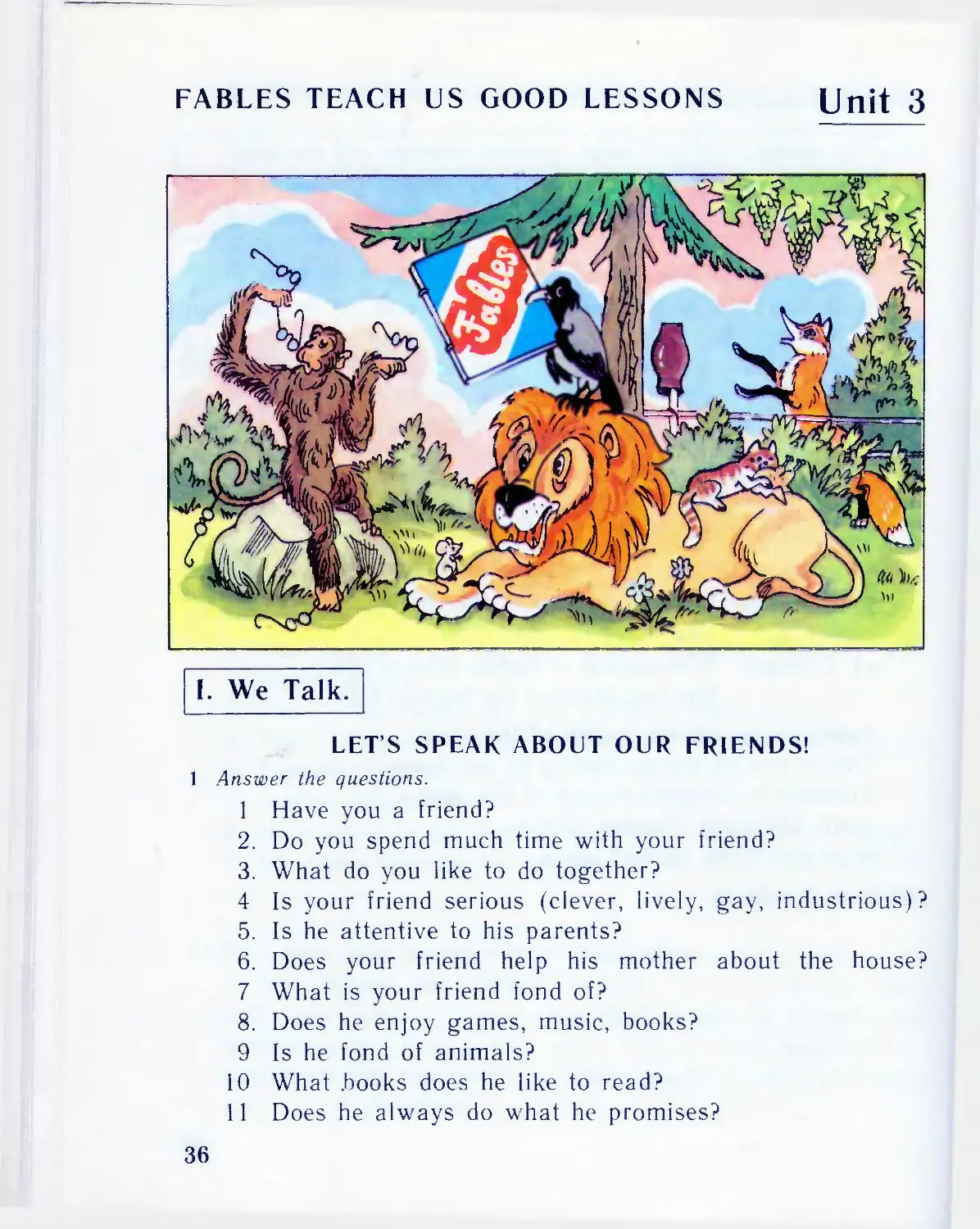
FABLES TEACH US GOOD LESSONS Unit 3
I. We Talk.
LET’S SPEAK ABOUT OUR FRIENDS!
1 Answer the questions.
1 Have you a friend?
2.	Do you spend much time with your friend?
3.	What do you like to do together?
4 Is your friend serious (clever, lively, gay, industrious)?
5.	Is he attentive to his parents?
6.	Does your friend help his mother about the house?
7 What is your friend fond of?
8. Does he enjoy games, music, books?
9	Is he fond of animals?
10	What .books does he like to read?
11	Does he always do what he promises?
36

12	What do you like in your friend?
13. Is there anything you don’t like in your friend?
2. Tell your classmates about your friend,
how old he is,
what he is fond of;
what books (games) he enjoys,
how you spend your time together,
what you like in him,
what you don’t like in him.
3. Look at the picture and describe it. Say what you like and what
you don’t like in some boys. Say what it is right and what it
is wrong to do.
Look at the
pictures and
describe them.
Say what you
think of the
children who
take care of
little ones 55. Ask your classmate about his friend. Use the words, industrious,
attentive, gay, serious, kind, good, clever
Example Is your friend a lively girl?
— Yes, she is very lively She likes to sing
and dance.
37

6. Say why it is good to have friends.
II. We Learn.
7.	Remember!
He came in time, didn’t he? — Yes, he did.
She didn’t need her raincoat, did she? — No, she didn’t.
8.	Choose the correct ending.
1.	Tom didn’t go to school yesterday, ... (did he, didn’t he)?
2.	They found the bird in the grass, ... (did they, didn’t
they)?
3. Mary promised to come, ... (did she, didn’t she)?
4. You didn’t learn the poem, ... (did you, didn’t you)?
5.	Their friends lived in the North, .. (did they, didn’t
they)?	?
0 9. Read the words. (No 16)
[e]	any, spend, tell, questions, re'member
fei] grapes, lake, say, table, fable
[i] little, dinner, sister, silly, pity
[i:] keep, leave, need, please, pleased
©10. Read and remember how to use the words. (No 17, part A)
a fable: Fables teach people lessons. Do you know many
fables?
silly: The fable about the silly monkey was very funny,
to remember: Do you remember the fable The Lion and
the Mouse? Remember that February has only 28 or
29 days.
pity: It’s a pity. It’s a pity you don’t remember the poem.
“It’s a pity you cannot think well,” said the Fox to the
Crow. It’s a pity you are busy today.
38

pleased: be pleased with, Mother is pleased with my progress
at school I was not pleased when he said that.
11 a) Look at the pictures, listen to the stories and answer the teacher's
questions.
b) Say what you think of the animals.
12.	Remember!
verb
4-
er
—
noun
work
— worker
read
reader
jump
jumper
teach
teacher
sing
singer
play — player
dance — dancer
write — writer
drive — driver
Mind the spelling!
run	— runner
travel	— traveller
swim	— swimmer
13.	What are they? Read these sentences and say what these people are.
Example Ann’s father swims very well
He is a wonderful swimmer
1	Reter’s father works at a factory
2	My friend reads lots of books
3	Many boys of our class play football very well
4	Jane’s sister teaches at school
39

5.	I know that his grandfather travelled a lot.
6.	His brother drives a car well.
7.	The girl sings very nicely
14.	Read the words.	t
[e]	collect, many, very, well, remember, to'gether
[i] swimmer, picture, pity, silly, 'million
[э:] wall, warm, course, walk, talk
[ou] over, open, cold, boating, boast, ago
[au] cloud, without, mountain, round, 'thousand
©15. Read and remember how to use the words. (No 17, part B)
a million: millions of people; Millions of people are fond
of reading. Millions of people live in Moscow,
a thousand ['Bauzond] • two thousand years, thousands
of people; Thousands of people come to the football
fields to see football matches.
to boast: I don’t like people who boast. He boasted that
he was the best runner in class,
ago: two days ago, three months ago, a year ago, long ago;
Three years ago I went to school for the first time.
How long ago did you learn to swim?
to talk [to:k]: When the girl came home, she wanted to
talk about her travelling all the time. What are you
talking about, Jane?
together: Do you and your friend go to theatres and museums
together? The friends spent a lot of time together
16. Do you know the right answers?
1.	How many thousands make a million?
2.	How many tens make a hundred?
3.	How many hundreds make a thousand?
40

17 How many? Fill in.
stars
hundreds
people
millions
of
birds
thousands
books
trees
1 We came into the bookshop and
saw .
on the shelves.
2 . travel all over our country every year.
3.	There are . in the dark sky.
4 The pupils of our school planted . . in the school yard.
•5. leave for the South when autumn comes
6.	leave for the country when summer comes.
18.	Some time ago. Say:
how old you were three years ago,
in what form you were two years ago;
how long ago you learnt to read and write;
what you did two days ago,
how long ago you read your first story in English,
how long ago you were at the cinema,
how many years ago your parents went to school,
how long ago you went to camp.
19.	It’s a pity It was a pity Add one more sentence to explain.
Example;	It’s a	pity	the weather is rainy We can’t	go
for a walk.
1.	It’s a pity you don’t remember the word. .
2 It’s a pity the wind is so strong
3.	It	was	a pity	that	the time to leave came too soon
4	It	was	a pity	Tom	was not at the theatre with us.
5.	It’s a pity Pete can’t come to the party.
20.	Explain why it’s a pity that .
Example• Ann doesn’t know this game.
It’s a	pity	that Ann doesn’t know this game.
She can’t play with us.
41

1 Nick cannot run fast.
2.	The day was cold and rainy
3.	Tom lives far from my house.
4.	You don’t always spend Sundays in the country
5.	The sky was dark.
6.	My friend is very busy.
21.	Read and say what the children must remember to do:
when they sit down to do their lessons;
when they sit down to have dinner;
when they go out to play;
if they want to please Mother;
if they have a pet at home;
when they talk to their friends.
22.	Remember!
Put on warm coats before you go out to play in cold
weather Wear a raincoat and take an umbrella when
you go out in rainy weather Do not play near the fire
Help your parents about the house. Keep your things
in their right places. Wash your hands before you eat.
Do not be very noisy Be attentive to your friends.
Do not boast. Take good care of your pet.
say — said
f
say — what?
tell — told
•
tell — whom?
Example: Please say that again.
Did you say “Good morning”?
The boy said “Good bye” and left the room.
Please tel} me your friend’s name.
The children told their friends a lot of stories.
42

23. Say? Tell? Choose the correct word.
1.	Ann Mary that she always went to the shop to buy
bread.
2.	What did you .. them?
3.	Please . that word again.
4.	“We can’t play any more,” she . . .
5.	The teacher us an interesting fable.
24.	Remember!
\ be going to
I’m going to write a letter to my granny.
What name are you going to give to your new dog?
He is going to leave at 5 o’clock.
25.	Say what they are going to do.
The lesson begins. — The teacher
The pupils...
It is evening	— Mother .
Father .
Kate...
Nick...
The day is rainy — I .
My friend.
It’s Sunday morning — Our family and I.
My aunt.
26.	Say what you are going to do:
after school,
this evening;
on Saturday;
on Sunday;
on the holidays;
at 2 o’clock this afternoon;
after our walk,
tomorrow.
43

027.	Read the words. (No 18)
[ae] have, lamp, gather, catch
[cu] far, farm, carpet, last, fast
[ai] life, lively, time, like, driver, wise
[m]	dear, theatre, ear, hear, deer
[еэ] compare, wear, there, hare
[л] wonder, wonderful, one, once, among
©28. Read and remember how to use the words. (No 19)
a hare [hea] The children once went into the woods and
saw a hare. The hare ran by not very far away and
they could see it well
to catch — caught: catch fish, catch a ball;
Catch the ball, catch the ball,
See it jump and see it fall
The boys caught a lot of fish in the lake. The wolf
couldn’t catch the hare.
fast [fcust] Some people speak very fast and I don’t
always understand them. Can you count fast?
a deer: Deer live in forests. You can see some deer at the
Zoo. Deer run very fast.
wise: Nick’s grandfather is a wise old man. In fables we
can read about wise animals and silly animals,
once [wAns] My friend once told me an interesting story
about some elephants. Once there lived a girl who liked
to dance very much.
among [э'тлг)]. The boy felt happy among his friends.
29.	Read the dialogues, then make up your own dialogues.
a)	“Are you going to travel with your brother in summer?”
“No, I’m going to travel with my parents.”
b)	“What are you going to do after school?”
“I’m going to read a book. And what are you going to dor
“I’m going to watch TV ”
44

30.	When? What? Who? How? Answer the questions.
1 Are you going to help your mother about the house?
a)	What are you going to do?
b)	When are you going to do it?
2.	Are you going to do your lessons after dinner?
a)	What lessons are you going to do today?
b)	When are you going to do them?
3.	Are you going to play outdoors?
a)	Who are you going to play with?
b)	How long are you going to play?
31.	Is that good? Say what you think of them.
Example Nick takes care of his little brother — I think
it’s very good that Nick takes care of his little
brother. They will be good friends.
Tom talks too much at the Mathematics lessons.—
I don’t think it’s good that Tom talks too much
at the Mathematics lessons. It will be difficult
for him to understand the sums. 1 * * * * * 71 Nick likes to boast.
2.	Ann always helps her classmates.
3.	Kate sometimes laughs at her friends.
4.	Little Tom always wants everything he sees.
5.	Pete always does what he promises.
6.	Jane is very kind.
7 Jack talks very well about what he can do. But the
work he does is not so good.
45

Words to remember:
ago (long ago), among, to boast, to catch, a deer,
a fable, fast, be going to do, a hare, a million, once,
be pleased, it’s a pity, to remember, silly, to talk, a
thousand, together, wise
Remember!
\ to catch — caught
III. We Read and Talk.
32.	In each line there is a word that does not go with the sound. Can
you find it?
[л] jump, much, nothing, laugh, once
[ou] over, know, boast, home, go, could
[i-.] pleased, each, read, teach, deer, people
[ai] time, wise, like, pity, write, life
33.	Find the most general word:
a)	lion, hare, deer, monkey, animal;
b)	men, women, people, children, workers;
c)	Sunday, day, Monday, Saturday, Friday.
34.	Read the names.
Aesop ['i:sap]; Greece [gri:s]
46

© 35. Read the fable The Traveller Who Boasted and answer the question.
Could the traveller show that he was the best jumper?
THE TRAVELLER WHO BOASTED
One of Aesop’s Fables
Aesop lived 2500 years ago in Greece. He did not write down
his fables. He told them to many people and they remembered them.
Millions of people all over the world now read Aesop’s fables.
©	A man once went travelling to a far country He
travelled for a year and saw many places there. There
was one place among them that he liked very much. When
he came home he wanted to talk about it all the
time.
People said to each other, “Why is he always
telling us about that place? We don’t want to know
about it.”
They asked him, “Why did you come back if it was
so nice there?” “I came back to tell you about it,” said the
man, and he talked and talked again © (No 20)
“In that place,” he said,
“all the men can jump well.
One day we wanted to see
who could jump the best. We
all jumped: My jump was
the best. I am a very good
jumper. It’s a pity you didn’t
see how well I jumped.”
“Jump now!” said one of
the men, “Show us here how
well you can do it. Jump
now!”
47

But the traveller could only boast well And the people
laughed at him.
Moral. People soon know who is a boaster
36. Answer the questions.
1 How long did the man travel?
2.	What did he talk about when he came back home?
3.	Did the people like his stories?
4 What kind of jumper did the man say he was?
5.	What did the people ask the traveller to do?
6.	Why did the people laugh at the traveller?
7 Do you like the traveller?
37 Read the fable The Lion and the Hare and answer the question.
What did the Lion have for dinner that day?
THE LION AND THE HARE
One of Aesop’s Fables
Once a Lion saw a Hare. He caught it and was going
to eat it when a Deer ran by
“That Deer will make me a bigger dinner,” he said. He let
the Hare go and ran after the Deer But the Deer could run
very, very fast and the Lion could not catch him.
48

When the Lion saw that he could not catch the Deer,
he said, “I will go back for the Hare.”
The Lion ran back but there was no Hare there.
“How silly I was!” he said. “I caught a Hare for my
dinner but I didn’t eat it. I let it go when I saw a bigger
animal I wanted too much and now I have nothing.”
Moral. It is sometimes wiser to be pleased with what
you have.
38.	Answer the questions.
1.	What did the Lion once see?
2.	Did the Lion run after the Hare first or after the Deer
first?
3.	Why did the Lion run after the Deer?
4.	Why could not the Lion catch the Deer?
5.	Did the Lion find the Hare when he ran back?
6.	Do you like the Lion?
39.	Read the proverbs. Each one may be the moral to one of the fables
you know. Say to which one.
If you run after two hares you won’t catch any.
Better to do well than to say well.
First catch your hare then cook it.
40.	What do you think about fables? Answer the questions.
1 What are fables about?
2.	Who do we see in the animals when we read fables?
3.	What kind of people (animals) do fables show us?
4.	What do you laugh at when you read a fable?
5.	Do fables teach us to think about people?
6.	Do fables teach us many good lessons?
7.	Can you say that fables are short and wise stories?
Why can you say so?
8.	What do fables teach us?
4 Зак. 2375 Л. И. Шавернева
49

41.	Say what fables are about;
what fables teach us;
what we laugh at when we read fables.
42.	Say what you like and what you do not like in other people.
IV. We Write.
\.*You want to ask one of your classmates: 1) where he likes to play;
2) what kind of books he enjoys; 3) what he is fond of; 4) how he
helps his parents; 5) how he likes to spend his holidays; 6) how
many good friends he has; 7) where his friends study.
Write these questions.
2* Write Exercise 8.
3.	* Copy the nouns, underline the suffix -er and write the verbs from
which they are formed.
Example: reader — read
traveller — travel
Worker, player, singer, dancer, writer, runner, swimmer,
boaster.
4.	* Write Exercise 13.
5.	* Good? Well? Choose the correct word.
Example: These children are good. They study well They
do everything well
1.	He swims ...	2. That is a ... apple. 3. She speaks
English very ... .4. She always cooks dinner ... 5. This
is a very ... book.
6.	* Write Exercise 23.
7.	* Write Exercise 25.
8.	* Write questions for more information.
Example• The boys went to see their aunt. (When?)
When did the boys go to see their aunt?
1 The girl read the book. (When?)
2.	They travelled in summer (How long?)
50

3.	She took an umbrella. (Why?)
4.	Ann spent her holidays well. (Where?)
5.	Kate drew a wonderful picture. (What?)
6.	They lived in the country. (How long?)
9.* Use the correct forms.
a)	story — stories
country —
berry —
army —
family —
puppy —
10.	* Write the past form of the verbs:
a)	say, tell, catch, come, run;
b)	jump, travel, talk, ask;
c)	boast, want.
11.	* Choose the correct ending.
Mother was pleased with
Jane because
Nobody liked him because
He was running so fast
that
I don’t remember this fable
because
The traveller’s friends
wanted to know
b) funny — funnier
angry —
early —
happy —
noisy —
lively —
we could not catch him.
he always boasted,
she was very kind and attentive
to all.
I read it long ago.
what places
much.
he liked very
12.* Write 8—10 sentences about one of the fables you know.
4*

THE WORLD OF IMAGINATION
Unit 4
I.	We Talk.
	 PLAN YOUR DAY
1 Answer the questions.
1 When do you usually come home from school?
2.	What do you do at home after school?
3.	Do you usually have time for play and fun?
4 On what week-days do you have little (much) time
for play and fun? Why?
5.	Do you plan your time on week days? Why?
6.	Does a good plan help people to do many things?
7 Do you (your parents, sisters, brothers) plan your
(their) days-off? Why do (don’t) you (they)?
8.	What did you do last Sunday from morning till evening?
9 Did you do it because you had a plan or did you do it
without any plan?
52

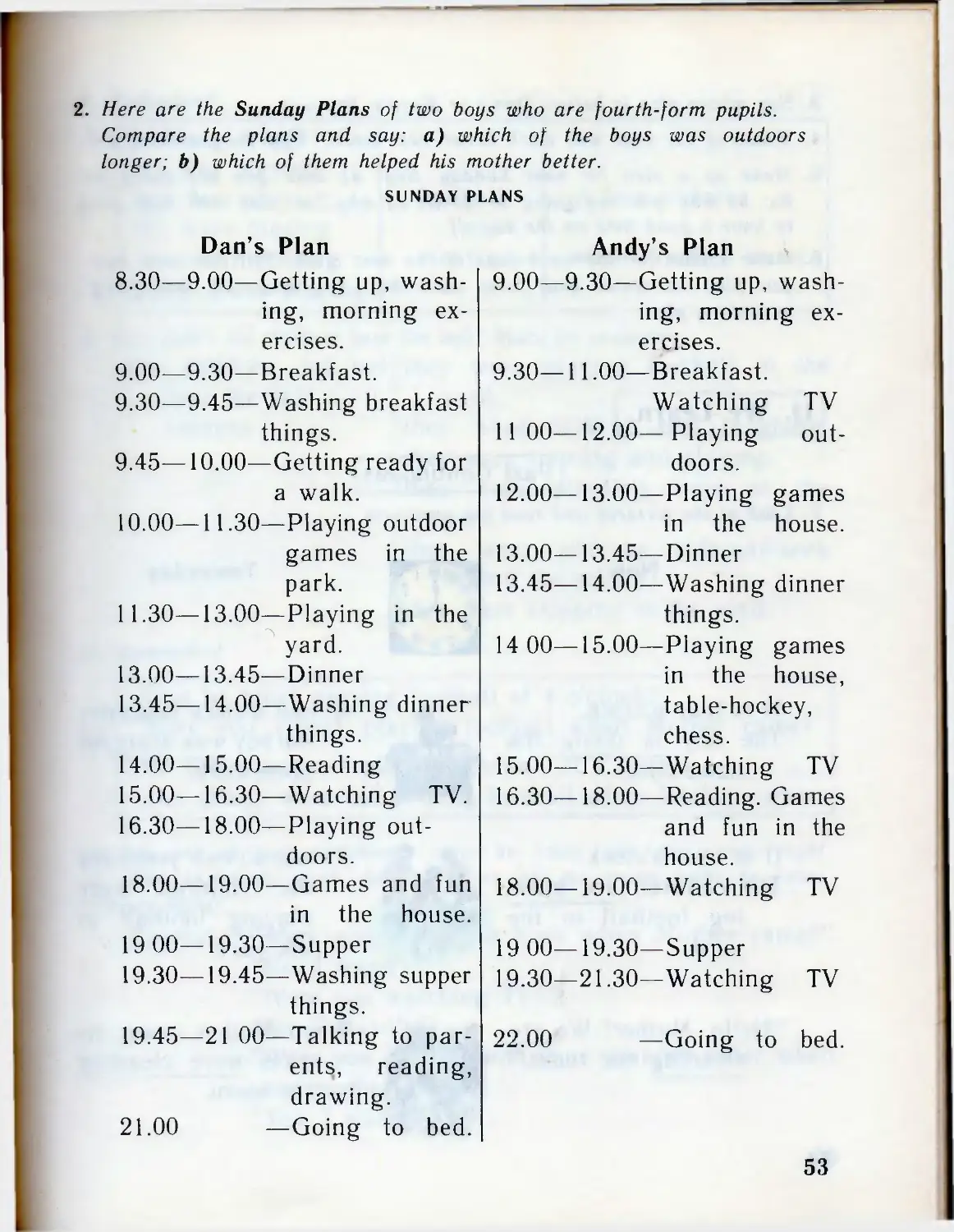
2. Here are the Sunday Plans of two boys who are fourth-form pupils.
Compare the plans and say: a) which of the boys was outdoors
longer; b) which of them helped his mother better.
SUNDAY PLANS
Dan’s Plan
8.30—	9.00—Getting up, wash¬
ing, morning ex¬
ercises.
9.00—	9.30—Breakfast.
9.30—	9.45—Washing breakfast
things.
9.45—	10.00—Getting ready for
a walk.
10.00—	11.30—Playing outdoor
games in the
park.
11.30—	13.00—Playing in the
yard.
13.00—	13.45—Dinner
13.45—	14.00—Washing dinner
things.
14.00—	15.00—Reading
15.00—	16.30—Watching TV.
16.30—	18.00—Playing out¬
doors.
18.00—	19.00—Games and fun
in the house.
19 00—19.30—Supper
19.30—	19.45—Washing supper
things.
19.45—	21 00—Talking to par¬
ents, reading,
drawing.
21.00	—Going to bed.
Andy’s Plan
9.00—	9.30—Getting up, wash¬
ing, morning ex¬
ercises.
9.30—	11.00—Breakfast.
Watching TV
11 00—12.00—Playing out¬
doors.
12.00—	13.00—Playing games
in the house.
13.00—	13.45—Dinner
13.45—14.00—Washing dinner
things.
14 00—15.00—Playing games
in the house,
table-hockey,
chess.
15.00—	16.30—Watching TV
16.30—	18.00—Reading. Games
and fun in the
house.
18.00—	19.00—Watching TV
19 00—19.30—Supper
19.30—	21.30—Watching TV
22.00	—Going to bed.
53

3.	Say whose plan is better Dan’s or Andy’s. Prove it.
4.	Which of the boys will work better next week? Why do you think so?
5. Make up a plan for next Sunday. Say: a) what you are going to
do; b) why you are going to do it; c) why the plan will help you
to have a good time on the day-off.
6.	Make a plan for the week-days of the next week. Tell the class how
you plan to spend your time each day. Say why you are going
to make a plan.
II. We Learn.
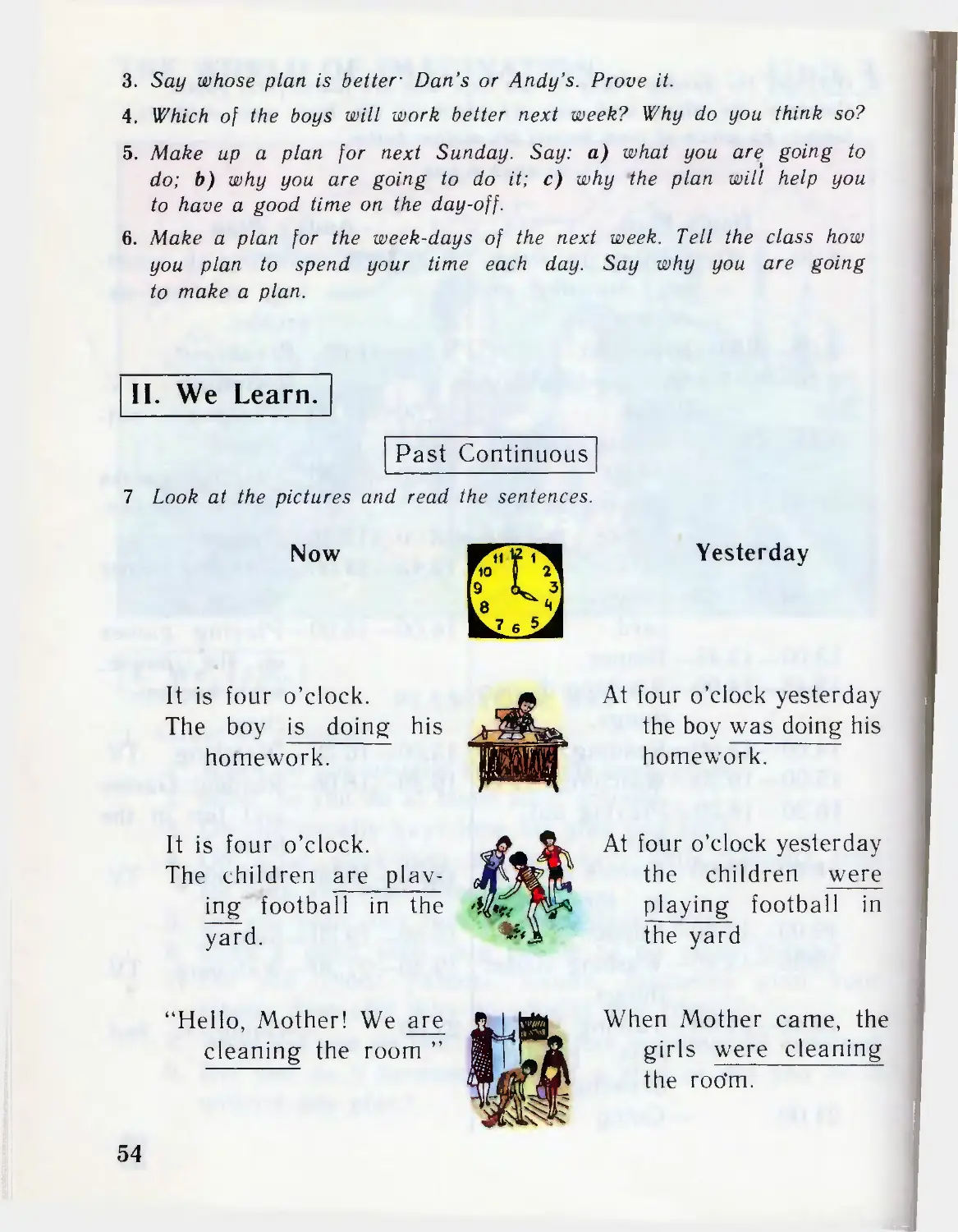
Past Continuous
7 Look at the pictures and read the sentences.
Now
Yesterday
It is four o’clock.
The boy is doing his
homework.
At four o’clock yesterday
the boy was doing his
homework.
It is four o’clock.
The children are plav-
ing football in the
yard.
At four o’clock yesterday
the children were
playing football in
the yard
“Hello, Mother! We are
cleaning the room ”
When Mother came, the
girls were cleaning
the roo’m.
54

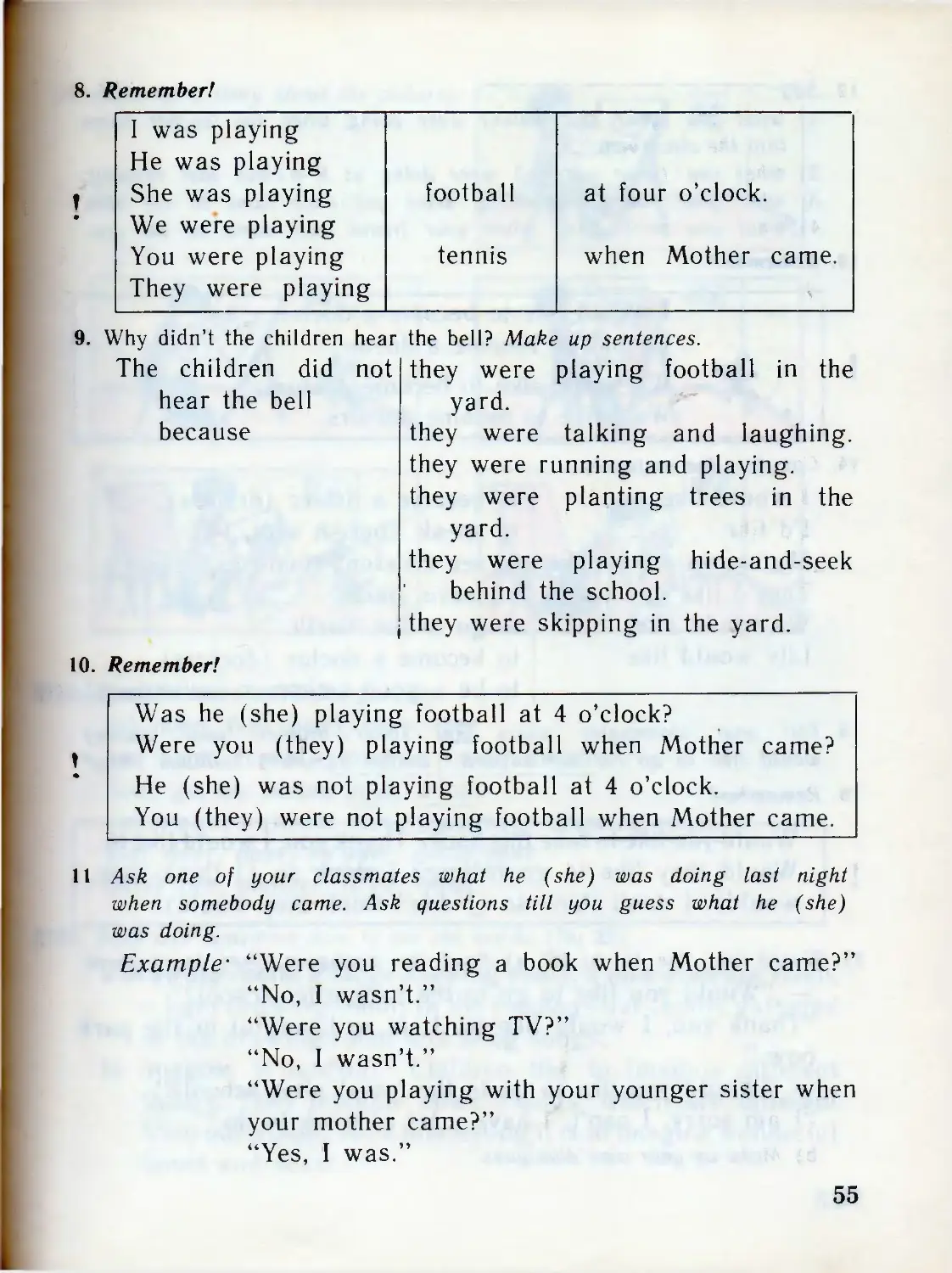
8. Remember!
f
I was playing
He was playing
She was playing
football
at four o’clock.
•
We were playing
You were playing
tennis
when Mother came.
They were playing
9. Why didn’t the children hear the bell? Make up sentences.
The children did
hear the bell
because
not
they were playing football in the
yard.
they were talking and laughing,
they were running and playing,
they were planting trees in the
yard.
they were playing hide-and-seek
behind the school,
they were skipping in the yard.
10.	Remember!
Was he (she) playing football at 4 o’clock?
^ Were you (they) playing football when Mother came?
He (she) was not playing football at 4 o’clock.
You (they) were not playing football when Mother came.
11 Ask one of your classmates what he (she) was doing last night
when somebody came. Ask questions till you guess what he (she)
was doing.
Example- “Were you reading a book when Mother came?”
“No, I wasn’t.”
“Were you watching TV?”
“No, I wasn’t.”
“Were you playing with your younger sister when
your mother came?”
“Yes, I was.”
55

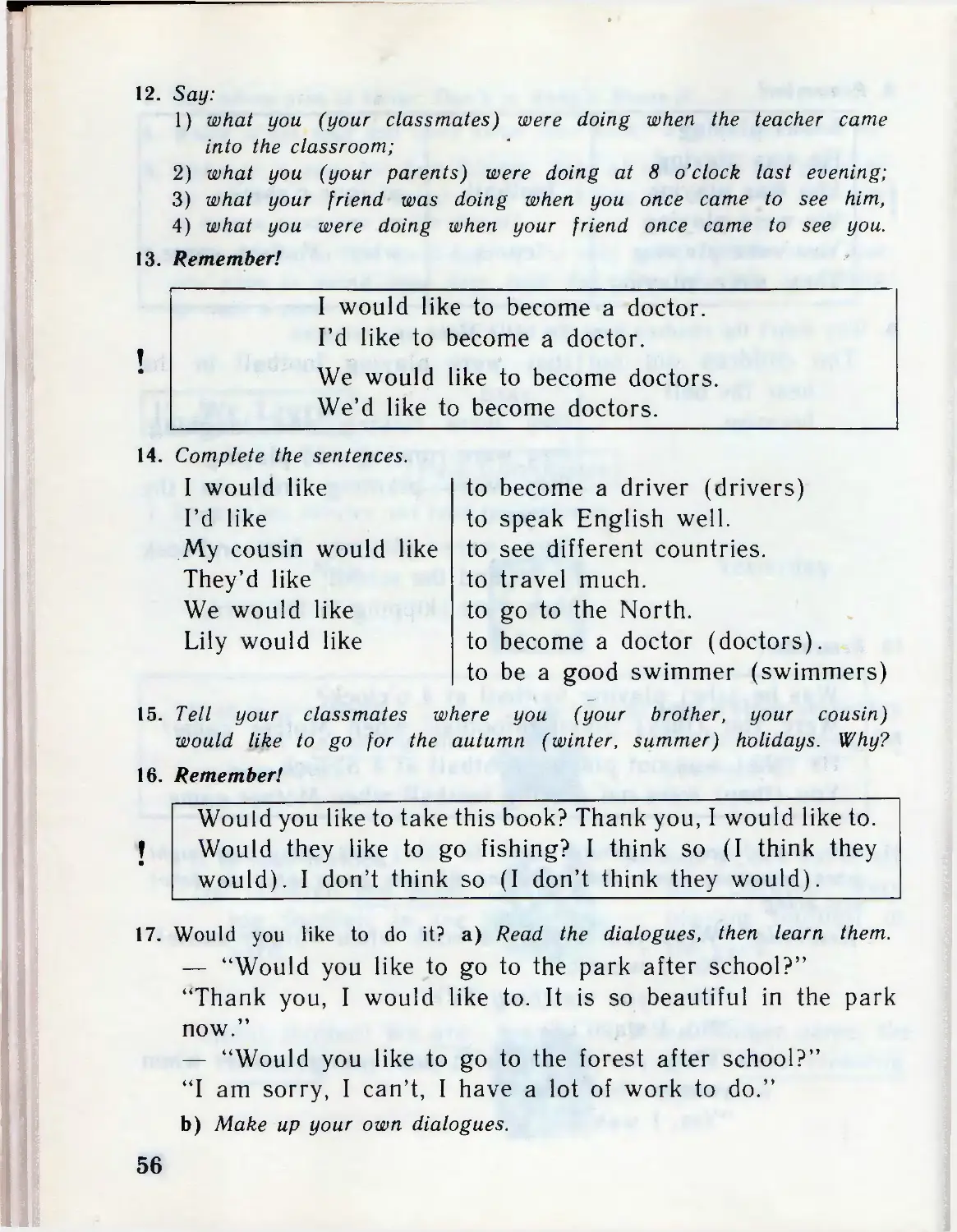
12.	Say:
1)	what you (your classmates) were doing when the teacher came
into the classroom;
2)	what you (your parents) were doing at 8 o’clock last evening;
3) what your friend was doing when you once came to see him,
4) what you were doing when your friend once came to see you.
13.	Remember!
I would like to become a doctor.
I’d like to become a doctor.
?
We would like to become doctors.
We’d like to become doctors.
14.	Complete the sentences.
to become a driver (drivers)
to speak English well,
to see different countries,
to travel much,
to go to the North,
to become a doctor (doctors),
to be a good swimmer (swimmers)
15.	Tell your classmates where you (your brother, your cousin)
would tike to go for the autumn (winter, summer) holidays. Why?
16.	Remember!
Would you like to take this book? Thank you, I would like to.
f Would they like to go fishing? I think so (I think they
would). I don’t think so (I don’t think they would).
17. Would you like to do it? a) Read the dialogues, then learn them.
—	“Would you like to go to the park after school?”
“Thank you, I would like to. It is so beautiful in the park
now.”
—	“Would you like to go to the forest after school?”
“I am sorry, I can’t, I have a lot of work to do.”
b) Make up your own dialogues.
I would like
I’d like
My cousin would like
They’d like
We would like
Lily would like
56

©19. Read the words. (No 21, part D)
[i:] meet, feel, need, keep, free
[ae] back, travel, i'magine, bmagi'nation
fou] go, so, home, both, a'lone
[o:] water, autumn, saw, 'naughty, 'drawing-room
[io] dear, near, ap'paer, ,disap'pear
[am] fire, pioneer, tired, 'quiet
©20. Read and remember how to use the words. (No 22)
a drawing-room: a large drawing-room, a nice drawing-room,
a light drawing-room, In the evenings our family gathered
in the drawing-room and sang songs,
to imagine [i'maed3in] Children like to imagine different
things. They imagine other worlds, which are different
from our planet. How interesting it is to imagine wonderful
lands and seas!
57

imagination [iymaed3rneijn] the world of imagination;
This little girl has a wonderful imagination He made
up the story; it was all imagination,
to appear [э'рю] — disappear: Look! A bright star appeared
in the sky and then disappeared in the clouds,
quiet f'kwaiat]: a quiet voice, a quiet street, a quiet game,
On rainy days children like to play quiet -games at
home. Is your mother’s voice always quiet?
alone: When the boy is alone at home, he plays quiet
games. He imagines that he is travelling to far-away
countries and towns. “You can’t do it alone, Nick,”
said the teacher “Ask your classmates to help you.”
naughty ['nodi]: a naughty boy, a naughty baby; Was
Tom Sawyer a naughty boy? Was he always doing
something wrong?
both [bouG]. both books, both toys, both of them, both of us,
Do both boys like quiet games? The girls looked up
and saw a squirrel in a tree, then another one; but
both squirrels quickly disappeared among the leaves,
(be) free: a free day (hour, evening, minute, time), I shall
be free all morning When will you be free? Are you
free this evening?
to plan: Mike always plans his time and can do a lot every
day
a plan: “What are your Sunday plans, Kate?”
week-days: on week-days, What do you usually do when you
have free time on week-days?
a yard: a nice yard, a clean yard; to go to (into) the
yard; Do you like to play in the yard?
21 Are they naughty? a) Look at the
pictures and answer the question.
“Give me that shoe, Rex!”
58

“I don’t want any soup ”
b) Describe the pictures.
“1 don't want to wash these
plates any more.”
22.	It is fun to imagine, a) Look at the picture and answer the questions:
1	Where is the girl?
2	Who is she playing with?
3. What kind of game is she
playing?
4	Is it a noisy game?
5	Is she having a good time?
b) Make up a story about the
picture.
23.	It is fun to imagine and draw Make up sentences.
It is interesting to imagine
and draw
It is fun to imagine and draw
other worlds,
other planets,
people on the Moon,
sea animals
people on other planets,
new towns
wonderful lands
59

24. Say what kind of pictures you like to draw. Do you like to draw
what you imagine or what you see every day? Do you draw pictures
of books you like?
25.	Say what can help you to imagine different things.
26.	Make up sentences.
When the weather
is cold,
When it is raining,
When you are alone
at home,
it is fun
it is interest¬
ing
it is nice
to play quiet games
at home.
to watch TV in the
drawing-room.
to stay at home and
read.
to imagine wonderful
lands.
to imagine different
towns and countries.
27.	Tell the class what you think it is interesting (it is fun, it is nice)
to do when a) you are at home alone; b) you are with your friends.
28.	Some of you were at camp in summer. Tell the class what the Young
Pioneers did there when a) the weather was cold; b) when it rained.
29. Speak about one of the rainy days. Say: a) where you were;
b) what you did; c) what it was fun (interesting) to do, d) why
it was interesting to do it.
30.	Speak about one of your summer (winter) days when the weather
was fine (nice). Say: a) where you were; b) what you did all day,
c)	what it was fun to do, d) why it was fun to do it.
31.	Read the dialogue, then make up your own dialogue.
—	I hate1 rainy days. There is never anything to do.
—	Why not watching TV? There is a programme for
children on.
—	I’m tired of that. I’d like to go outdoors. It’s a pity we
can’t.
—	Let’s draw pictures of books we like. It’ll be interesting
to imagine and draw.
—	Good idea.
1 I hate — зд. не люблю
60

32.	How do you spend your free time? Answer the questions.
1.	Do you have a lot of free time during the school year?
2.	When do you have your free time?
3.	What do you do if you have some free time after school
(in the evening)?
4 Are you free from lessons on Sundays?
5.	How many free days a week would you like to have? Why?
6.	What would you like to do on your free days?
©33. Read the words. (No 23)
[e] men, spend, says, said, for'get, 'well 'known
[ei] take, game, brave, became, 'paper
[з]	sorry, doctor, Moscow, want, 'follow, watch
[и]	wood, food, stood, cook, 'sugar
[i:] keep, need, speak, field, piece
©34. Read and remember how to use the words. (No 24)
sugar ['juga] • a lump of sugar, I don’t like much sugar
in my tea. Little puppies like sugar, but it is not good
for them.
watch [wotj] a new watch, a nice watch; Where is your
watch? My watch is on the shelf in my room,
paper: a piece of paper; The boy took a piece of paper and
began to draw pictures.
to forget — forgot: to forget a rule, to forget to do something;
We shall never forget the day when we joined the
Pioneers. Don’t forget to learn the rule,
to follow: to follow somebody (something), What day of
the week follows Thursday? Mary had a funny little
puppy that tried to follow her to school every morning,
but Mary’s father didn’t let it do that,
well-known: a well-known writer, a well-known place, to be
well known to everybody; Books by Gaidar are well
known to everybody in our country Fables by Aesop
are well known all over the world.
61

Words to remember:
alone, to appear, to disappear, both, a drawing¬
room, to follow, to forget, free, to imagine, imagination,
I’d like to. , naughty, paper, a piece of, a plan,
to plan, quiet, sugar, a watch, week-days, well-known,
a yard
Remember!
I forget — forgot
III. We Read and Talk.
35.	In each line there is a word that does not go with the sound. Can
you find it?
[ai] time, tiger, nice, mice, night, little, sky, fine
[au] house, mpuse, around, ground, down, our, mountain
36.	In each tine there is a word that does not go with the others. Can you
find it?
1)	tiger, horse, bear, fox, hen, pig
2)	drawing-room, bedroom, kitchen, chair
3)	sugar, meat, eggs, milk, ball, cheese
37.	Read the sentences and guess the meaning of the words you don’t
know.
1.	My toy animals are my imaginary [i'maed3inari]
friends. I usually talk to them and play with them.
Winnie-the-Pooh was Rudolf’s imaginary friend.
2.	Dogs and puppies eat bones.
38.	Read the names.
Donald Bisset ['donald 'bisat]; Sheila [’jrlo]
39.	Read and translate.
1.	Soon Sheila heard some sounds from under the carpet
and the pleased voice of the horse.
62

2.	“Grass sandwiches are what horses like,” said Sheila.
“There is one thing we’d like,” they said.
“An umbrella.”
3.	She sat down with the drawing-book and began to draw
a tiger and a horse both asleep.
4.	“Is there anything else you would like tonight?” she
asked them.
40. Read, the text Under the Carpet and answer the question.
Why did Sheila like to play with the imaginary animals?
UNDER THE CARPET
(After Donald Bisset)
Donald Bisset is an English writer His stories for children are
wonderful. Once he was an actor and told his tales on TV When
he was telling a tale, he showed the children very funny pictures.
The children loved his stories and liked the pictures very much.
His books are well known to children in Great Britain and other
countries.
Once upon a time there was a tiger and a horse who were
great friends. They lived under the carpet in the drawing-room.
They liked living in the drawing-room because they
liked to draw.
©	Sheila, the little girl who lived in the house, once asked
them, “How can you get under the carpet? How do you
get so flat?”1
“Because we’re imaginary animals,” they said.
“I’m an imaginary tiger ”
“And I’m an imaginary horse.”
“And where do you keep your grass?” Sheila asked
the horse.
“Under the carpet,” he said. “It’s imaginary grass.”
“And do you keep your bones there, too?” she asked
the tiger
1 flat — плоский
63

“Yes,” he said. And he disappeared under the carpet.
The horse followed him and Sheila was alone
Then she took her drawing-book, drew pictures of lumps
of sugar and put them under the carpet.© (No 25)
Soon she heard some sounds from under the carpet
and the pleased voice of the horse. The horse was eating
the sugar
Then Sheila wrote on a small piece of paper, “What
do tigers like?” and put it under the carpet. There was
some noise, then the horse put his head out.
“Grass sandwiches,” he said.
Sheila looked at him. “You’re a naughty horse. Grass
sandwiches are what horses like. Now go and ask the tiger
what he likes.”
The horse went and the tiger came out. “I’d like a
watch,” he said. “I’d like to tell the time.”
“All right!” said Sheila, and she drew a watch and
gave it to him, then she drew some grass sandwiches
for the horse. He disappeared. Soon they both came out.
“Thank you very much,
Sheila!” they said and gave
her a kiss.1
“Is there anything else
you’d like tonight?” she
asked them.
“There is one thing
we’d like,” they said. “An
umbrella.”
“An umbrella?” said
Sheila. “But it doesn’t
rain under the carpet. Oh,
I forgot! It’s imaginary
rain!”
1 to give a kiss — поцеловать
64

“Of course!” they said.
So she drew an umbrella and gave it to them.
“Thank you!” they said. “Good night!”
“Good night!” said Sheila and went to bed. Then she
thought, “They have a nice new umbrella but there is no rain.”
So she drew some rain on a big piece of paper, went to the
drawing-room and put it under the carpet.
Next morning when she came into the drawing-room it
was deep in water and the tiger and the horse were
sitting in the umbrella like in a boat.
“There was too much rain!” thought Sheila.
After breakfast when she came back to the drawing¬
room, Mummy was sweeping1 the carpet. There was
no water and no umbrella and no tiger and no horse.
She sat down with her drawing-book and began to
draw a tiger and a horse both asleep. Soon Mummy
went out. All was quiet in the drawing-room. Sheila was
alone. Soon she heard some sounds from under the carpet.
The horse and the tiger were snoring.2
41.	Choose and read the sentences from the text to describe the picture
on page 64.
42.	Answer the questions.
1.	Did Sheila have a good time when she was at home alone?
2.	What did she do?
3.	Where did her imaginary animals live?
4.	Were they both naughty? Why do you think so?
5.	What did she give them to eat?
6.	Where did the horse and the tiger sleep?
7.	What did Sheila see in the drawing-room in the morning?
8.	What happened after breakfast?
9.	What did Sheila- do when she saw no animals under
the carpet? Why did she do it?
1	to sweep — подметать
2	to snore [sno:] — храпеть
5 Зак. 2375 Л. И. Шавернева
65

43.	Speak about Sheila’s world of imagination.
1.	Sheila’s friends, the tiger and the horse, live in the
drawing-room under the carpet.
2.	Sheila takes care of her imaginary friends.
3.	The tiger and the horse are sometimes naughty.
■»
44.	Imagine what Sheila’s drawing-room looks like. Describe it.
IT IS FUN TO IMAGINE THINGS
45.	Answer the questions.
1.	What do boys and girls usually like to imagine?
2.	Is it interesting to talk with children who can imagine
things? Why?
3.	Is it fun to play with boys and girls who have a good
imagination? Why?
46.	Say why it is fun to imagine things.
47.	Speak about somebody you know (you read about in books) who
lives in the world of imagination and enjoys it.
048.	Listen to the poem, then read it. Answer the questions. (No 27)
1) How did Johnny play on a rainy day? 2) Did he enjoy
the game?	johnny brown’s ship
“What can I play at?” said Johnny Brown
When the rain was pouring,1 pouring down.
“If I have a ship I’ll have some fun
And sail2 to lands where there’s always sun!”
“You can have a ship,” said Mrs. Brown,
And she turned a table upside-down.3
She took a duster,4 yellow as egg —
A lovely sail for the table leg!
1	to pour [po:] — ЛИТЬСЯ
2	to sail — плыть, a sail — парус
3	upside-down — вверх дном
4	a duster — тряпка, полотнище
66

How Johnny laughed when he sailed away!
And his mother cried “Hooray! Hooray!’’
John loved his ship, and never again
Did he mind1 the outside, pouring rain.
49.	Speak about the children’s world of imagination. Say: a) what
kind of things boys and girls like to imagine; b) why it is fun to
imagine new worlds and unusual wonderful things; c) why it is fun
to read about imaginary worlds and things; d) why a good imagination
makes a child’s life happier.
IV. We Write.
1.* Write answers to the questions.
1.	Do you always plan your free time?
2.	When do you have time for play and fun after school?
3.	Can you do a lot of interesting things at school?
4.	Did you have a good time last Sunday?
5.	What interesting things are you going to do next Sunday?
2* Choose the correct form.
Once Andy and his sister Lily (went, were going) to
the wood. They (walked, were walking) in the wood when
they saw a squirrel in a tree. The squirrel (jumped,
was jumping) from tree to tree picking nuts. The children
(looked up, were looking up) and in another tree they
saw two more squirrels. The squirrels (played, were
playing) hide-and-seek.
3.	* Complete the sentences.
1.	I’d like to... . 2. Do you think Alice would' like
to... ? 3. Would you like to...? 4. They would like to... .
5.	I don’t think the boys would like to... .
4.	* Write Exercise 23 (5 sentences).
1 never again did he mind [maind] — никогда больше не обращал
внимания на
5*
67

5.* Read the words in the spelling list, then:
a)	write the words with “au”;
b)	write the words which rhyme
c)	write the words which have the same vowel
letters as “near”;
d)	write each word from the spelling list.
Underline the vowel letters
6.	* Complete the sentences.
When	the	weather	was	nice	in	autumn,
boys liked to play
When	the	weather	was	fine	in	summer,
Ann and Dan enjoyed
When	the	weather	was	nice	in	spring,
both of us played
When	the	weather	was fine	in	winter,
the children enjoyed
7.	* Write answers to the questions.
1.	Do you like quiet or noisy games?
2.	What do you usually do when you stay at home alone?
3.	Is it interesting to play with imaginary things?
8.	* Fill in the words: naughty, watch, paper, sugar, drawing-room.
1.	I don’t like much ... in my tea.
2.	What ... do Pioneers read?
3.	Yesterday Mother bought a new ... . The ... is very
nice. She likes it.
4.	Sheila’s ... was large and light.
5.	Both Sheila’s friends, the horse and the tiger, were ... .
9.	* Write 5 questions about Sheila and her imaginary friends.
10.* Write why it is fun to imagine things (5—6 sentences).
11 * Write why it is- interesting to play with children who have a good
imagination (6 sentences). 11 rhyme [raim] — рифмуются
outdoor games.
hide-and-seek.
different games.
football.
table-tennis.
hockey.
noisy games.
tired
appear
naughty
quiet
disappear
autumn
68

RED SQUARE IS DEAR
TO THE SOVIET PEOPLE
Unit 5
I. We Talk.
MOSCOW IS BEAUTIFUL
1. Answer the questions.
1.	Is Moscow green and beautiful?
2.	Are there many parks in Moscow? Are they beautiful?
3.	Are there many theatres, cinemas and museums in
Moscow?
4.	Do you like to go to museums? When do you usually
go to museums?
5.	Why do you like to go to museums and theatres?
6.	Is Red Square the most beautiful square in Moscow?
7.	What can you see in Red Square?
8.	Do children go to Red Square when they join the Young
Pioneers? Did you?
69

2.	Look at the picture and speak about Young Pioneers in Red Square.
Plan
1.	Where are the Young Pioneers?
2.	What do they look like?
3.	Why are they happy?
4.	Where do Moscow children usually go when they join
the Young Pioneers?
3.	Speak about the day when you joined the Young Pioneers.
4. Say what interesting places in Moscow (in your city) you know.
5. Everybody says that Moscow is beautiful. Can you say why?
6.	Say why Moscow is dear to all Soviet people.
II.	We Learn.
7.	Say what places people like to see in our country and why.
8.	Look at the pictures in this Unit and say what places people like
to see in Moscow and why.
О 9. Read the words. (No 28)
[l]	windy, silly, pity, 'city, 'visit
[e] desk, welcome, well-known, guest, 'centre, 'central
feij great, tasty, bathe, paper, fable, 'famous
[a:] turn, girl, work, yuni'versity
[э] follow, watch, forgot, soft, 'monument
70

[л] nut, sunny, under, 'underground, in front of
[cu] far, fast, car, dark, park, heart
©10. Read and remember how to use the words. (No 29)
a city — cities: old and beautiful cities, to leave a city,
a noisy city; There are many beautiful towns and cities
in our country. Novgorod is not a big city, but it is old
and beautiful. In summer children usually leave the
cities where they live. What city were you born in?
to visit: to visit a city, to visit a museum, to visit the
Soviet Union; Did you visit any museums in summer?
He usually visits other cities when he is on holiday.
Thousands of people from foreign countries like to visit
Moscow.
a university [Jumi'vaisiti]: Moscow University, London
University; We are on the Lenin Hills. Look! There is
Moscow University. Moscow University is very beautiful.
It is one of the largest universities in the world,
a monument ['monjumant]: a monument to a great writer;
There are a lot of monuments in Moscow. The monument
to Pushkin is dear to all. There are always flowers at
the foot of the monument.
in front [frAnt] of: There is a monument to Lomonosov
in front of Moscow University. You can see Young
Pioneers in front of the Lenin Mausoleum,
underground: the Moscow Underground (the Metro), to
go by the underground; The Moscow Underground is
the most beautiful in the world. Do you get to school
by the underground?
famous: a famous writer, a famous theatre, to become
famous, to be famous for, to be famous all over the
world; There are a lot of monuments to famous people
in Moscow. Moscow is famous for its theatres, museums
and monuments. Moscow Metro is famous all over the
world.
71

a heart [hcut]: to have a kind heart, to learn by heart, to
know by heart, the heart of the city; My grandmother
has a kind heart. We like to learn English poems by
heart. Moscow is the heart of our country,
the centre ['sento]: in the centre of; Gorky Street is in the
centre of Moscow.
central ['sentrl]: The central streets in big cities are noisy,
a guest [gest]: to invite guests, to have guests, to be a
guest, foreign guests; We can see a lot of foreign guests
in Moscow streets in summer. He likes to invite guests
to his birthday party. Do guests from other countries
often visit your school?
11. Places to visit. Make up sentences.
Lots of
Moscow
old Russian towns
Red Square
the Lenin Museum
people
the Pushkin Museum
Foreign
visit
the Bolshoi Theatre
guests
the Children’s
Theatre
every day.
on holidays,
on May Day.
on Great October
Day.
in summer.
12. Say what places
in Moscow
people usually visit and when.
13. Complete the sentences.
My friend
Foreign
guests	like
My parents likes
Moscow
guests
My aunt
to visit
to visit
a>
(Л
3
я
о
a>
S.3
I am fond of...
he is fond of...
she is fond of...
they are fond of
it is a beautiful place,
we can learn a lot
there.
72

14.	Thousands of guests visit Moscow. Say what places they like to
see and why.
15.	Tell the class:
a)	what places in Moscow you like to visit, when you usually
visit them and explain why you like these places;
b)	what places in your city (town) you like to visit, when you
usually visit them and why you like to visit these places.
16.	Complete the sentences.
1.	This is the Kremlin. There is a well-known monument
to ... here.
2.	This is Red Square. There is a well-known monument
to ... here.
3.	This is the centre of Moscow. We can see a well-known
monument to ... here.
4.	This is Gorky Street. There are monuments’to ... in it.
17.	Say how many monuments you can see in the central street (square)
of your city; what you can see at the foot of the monuments.
Use these names: V. I. Lenin; Minin and Pozharsky; Yuri
Dolgoruky; A. S. Pushkin; M. Gorky; V. Mayakovsky.
73

18.	Explain why there are always flowers at the foot of the monuments
to famous people.
Example: We are in ... .
This is a monument to ... .
There are always flowers ... .
The name of ... is dear to everybody.
His name is famous all over the world.
©19. Read the words. (No 30)
[ei] say, bathe, fable, paper, 'radio, space
[ai] wise, shiny, bright, flight, space flight
[э:] draw, Mausoleum, talk, caught, 'cosmonaut
[l] million, windy, city, 'history, tra'dition
©20. Read and remember how to use the words. (No 31)
radio ['reidiouj: to listen to the radio, to hear something
(a song, a play, a football game, etc.) on the radio,
a radio concert; Father usually listens to the radio
in the morning. He does not like to listen to a hockey
game on the radio. We can often hear new songs on
the radio.
a cosmonaut ['kozmanod]: Yuri Gagarin was the first
cosmonaut in the world. There are always flowers at
the foot of the monument to the first cosmonaut.
Valentina Tereshkova was the first woman cosmonaut
in the world. Do you like to read books about cosmonauts?
space: spaceship, spaceman, space flight, walk in space;
Soviet cosmonauts make space flights every year. We
can watch cosmonauts at work in spaceships on TV.
Cosmonauts visit Red Square before a new space flight,
history ['histari]: the history of our country, the history
of space flight, to be fond of history, the History Museum,
a history lesson, a history teacher; We are fond of
history. We would like to know more about the history
74

of different countries and the people who lived there
many years ago. Sometimes we visit the History Museum,
a tradition [tro'dijn]: an old tradition, to have a tradition,
to be a tradition; Every school has many good traditions.
It is a tradition in our family to gather together on
holidays. It is a good tradition in our country to put
flowers at the foot of monuments. It’s a tradition that
cosmonauts come to Red Square before a space flight.
21. Do you like to listen to the radio? Make up questions.
Do you
sometimes
stories
Does your
usually
listen to
songs
father
often
jokes
music
on the radio?
22. Make up sentences.
I like
fairy tales
beautiful poems
funny jokes
My friend
interesting
likes
to listen to
stories
Father
•
good music
new songs
doesn’t
a football game
like
a hockey game
on the radio.
23.	Tell the class what you often listen to on the radio and why you
like it.
Example: I often listen to jokes on the radio. I like them.
They are funny, and I laugh.
24.	Tell the class who does not always like to listen to the radio and
why.
Example: My father does not like to listen to a hockey
game on the radio. He likes to watch it on TV.
75

25.	Talk to your classmates about what you like to listen to on the radio.
Example: “Do you like to listen to fairy tales on the
radio?”
“Certainly, I do. I enjoy fairy tales.”
26. a) We want to know history of space flights. Do you know
when our famous cosmonauts made their space flights? Talk to
your classmates on this topic.
Example: “When did Yuri Gagarin make the first space
flight?”
“He made the first space flight on April 12, 1961.”
Valentina Tereshkova — the first woman cosmonaut —
16 June, 1963
Konstantin Pheoktistov, Boris Yegorov, Vladimir Komarov —
the first group flight— 12—13 October, 1964
Alexei Leonov — the first walk into open space during his
flight — 18—19 March, 1965
Alexei Leonov and Valery Cubasov — the first international
space flight together with the American cosmonauts —
15—21 July, 1975
Svetlana Savitskaya — the first woman cosmonaut who
walked into open space — 25 July,. 1984
b) Say what you know about other space flights.
27. What are our traditions? Make up sentences.
go to Red
Square
after they join
the Pioneers.
Pioneers
come to monu¬
before space
As a
cosmonauts
ments
flights.
tradition
Soviet people
welcome cos¬
with flowers.
foreign guests
monauts
with bread and
salt.
28. Say what people do as a tradition.
76

©29. Read the words. (No 32)
fei] take, take place, take pictures, change, pa'rade
fou] alone, both, told, golden, 'soldier
©30. Read and remember how to use the words. (No 33)
a parade [pa'reid]: On the 7th of November there is a
parade in Red Square. We can watch the parade on
TV. When does the parade begin?
to take place: A parade and a holiday demonstration take
place every year. When and where does a parade take
place? When do holiday demonstrations take place?
to take pictures: to take a picture of a monument, to take
pictures of Pioneers; Boys in our class can take good
pictures. Stand here, I’d like to take a picture of you
in front of this monument. Are you going to take pictures
of animals at the Zoo?
a soldier ['sould3o]: Look! This is a monument to the
Soviet Soldier There is a monument to a soldier in our
school yard.
duty: to be on duty, a Young Pioneer on duty, a soldier
on duty; You can see two Pioneers on duty in front
of the monument.
to change [tjemd3]: When you come to Red Square, you
can always see two soldiers on duty in front of the
Lenin Mausoleum. They change every hour.
31.	Remember!
f
un
adjective
unhappy — not happy
unkind = not kind
32.	Read and translate.
a) unhealthy, unusual, unknown, unpleasant, an unhappy
end, an unkind boy, an unusual question, an unknown
soldier, an unhealthy place;
77

b)	I have a collection of fairy tales. Some of them are
by unknown writers; but they are very interesting.
Some tales have an unusual end.
Words to remember:
(the) centre, central, a city, to change, a cosmonaut,
on duty, famous, in front of, a guest, a heart, history,
a monument, a parade, a place of interest, radio,
a soldier, space, a space flight, to take place, to take
pictures, a tradition, underground, a university, to visit
III. We Read and Talk.
33.	In each line there is a word that does not go with the others. Can
you find it?
1)	city: monument, museum, theatre, wood, university
2)	weather: windy, sunny, sunshiny, silly, rainy, cloudy
3)	nouns: traveller, jumper, gather, worker, driver
4)	verbs: feel, keep, eat, leave, deep, meet
34.	Read the words.
the Kremlin ['kremlin]; the Lenin Mausoleum ['lenin
.moiso'lkom]
35.	Read and translate the following sentences.
1.	There are two places in Moscow which are dear to all
the Soviet people.
2. People hear the sound of the Kremlin Clock, which
is well known to all those who listen to Moscow radio.
3. Red Square is full of people who carry flags and
flowers.
4.	Red Square is the place where children come after
they join the Young Pioneers.
5.	The first place people go to is Red Square.
78

36.	Read the text Red Square. Answer the question:
What is the first place people go to when they come to
Moscow?
RED SQUARE
©
Moscow... When you hear the name of our capital
what do you think of? The Moscow Underground? The
Bolshoi Theatre? Moscow University? There are two places
in Moscow which are dear to
the Kremlin and Red Square.
Red Square is the heart
of our capital. It is the oldest
and the most beautiful square
in the city. People from all
parts of the world come here.
They see the Kremlin with its
famous monuments and mu¬
seums. They hear the sound of
the Kremlin Clock, which is
well known to all those who
listen to Moscow radio. They
go to the History Museum.
Its collections tell us interest¬
ing stories about the history
of our country and the life oi
its people from old times to
our days. People like to come
to Red Square and take
pictures of it. © (No 34)
But the first place people
go to is the Lenin Mausoleum.
Guests from other parts of
the Soviet Union and foreign
countries visit it. There are
all Soviet people. They are
79

always two soldiers on duty at the Mausoleum. They change
every hour, and everybody likes to look at them.
Big parades and holiday demonstrations take place
in front of the Lenin Mausoleum on November 7 and May 1.
Red Square looks very beautiful on holidays. It is full
of people with flags and flowers in their hands.
Red Square is the place where children come after they
join the Pioneers. It is a tradition with cosmonauts to
come to Red Square before space flights.
Red Square is the finest and dearest place in Moscow!
37.	Find the sentences which are true according to the text.
1.	There are two places in Moscow which are dear to all
the Soviet people:
a)	They are the Kremlin and Moscow University.
b)	They are the Moscow Underground and the Kremlin.
c)	They are the Kremlin and Red Square.
2.	People go to the History Museum. Its collections tell
an interesting story:
a)	about the history of Moscow;
b)	about the history of our country;
c)	about the history of. Red Square.
3.	After Moscow children join the Young Pioneers they go:
a)	to the History Museum;
b)	to Red Square;
c)	to the Lenin Museum.
38.	These are the points of a plan. Arrange them in the order of the text.
1. Red Square is the place where parades and holiday
demonstrations take place.
2. The Lenin Mausoleum is dear to all Soviet people
3.	Red Square is one of the most beautiful places in Moscow
4.	Soviet people have a good tradition: they come to Red
Square on great holidays.
39.	Speak on each point of the plan.
80

©40. Listen to the poem, then read it. (No 35)
GREAT OCTOBER DAY
The Seventh of November —
The autumn sky is grey,
But hearts are full of sunshine
This great and happy day.
And lines of Soviet people
Across Red Square walk.
They carry flags and banners'
And gaily sing and talk.
41.	Say why the Seventh of November is a great day in the history of
our country and why it is dear to all Soviet people.
42.	Say what your city looked like on Great October Day;
where the parade (the demonstration) took place and how you could see it;
which of your friends (classmater) went on the demonstration and
what they told you about it.
43.	Speak on the topics:
1.	The capital of our country is one of the most beautiful
cities in the world.
2.	There are a lot of places of interest to see and to
visit in Moscow.
3.	Red Square is dear to all Soviet people.
44.	Describe the city or the town you live in, its places of interest, its
central square, street. Say why it is dear to you.
IV. We Write.
1 * Answer the questions.
1.	People can see a lot of interesting things in Moscow,
can’t they?
a banner — знамя
6 Зак. 2375 Л. И. Шавернева
81

2.	Are there many museums in Moscow?
3.	Can you learn a lot of interesting things in museums?
4.	Do all Soviet children go to Red Square when they
join the Young Pioneers?
5.	Why do thousands of people come to see Moscow?
2.* Fill in the articles where necessary.
1. Red Square is not ... largest square in Moscow, but it is
one of the most beautiful squares. 2. A lot of people go
to ... Lenin Mausoleum which is dear to everybody. 3. When
children join the Pioneers, they go to ... Lenin Museum.
It is not far from ... Red Square. 4. Everybody knows
... Bolshoi Theatre and is fond of it.
3	* Fill in the words: monuments, Moscow University, visit, city,
cities, enjoy, capital, heart, famous.
Thousands of people usually ... Moscow in summer.
It is the largest ... in our country and one of the largest ...
in the world. Moscow is the ... of the Soviet Union. There
are a lot of places to see and to ... here: Red Square,
the ... of our country, beautiful ... to great people who
are dear to the Soviet Union, the ... Bolshoi Theatre,
... on the Lenin Hills.
4.* Write Exercise 11, 3 sentences.
5* Write the plural form of the nouns.
Example: a berry — berries
A family, a story, a party, a country, a city, a university. 6 7 86.	* Write Exercise 13, 3 sentences.
7.	* Write Exercise 15, a) or b), 3 sentences.
8.	* Fill in the words: space flights, radio, cosmonaut, listen, tradition.
history.
1. My mother likes to ... to good music on the ... .2. There
are always flowers at the monuments to the first ..
Yu. Gagarin. 3. Soviet cosmonauts make ... every year. 4. At
82

our ... lessons we learn a lot of interesting things about
our country and our people. 5. It is a good ... in our
country to put flowers to the monuments on great holidays.
9.* Write Exercise 22, 3 sentences.
10	* Write Exercise 24, 3 sentences, about somebody who does not like
to listen to the radio and why.
11	* Write Exercise 27, 3 sentences.
12.* Copy the adjectives, underline the prefix un- and write the adjectives
from which they are formed.
Unkind, unusual, unknown, unpleasant, unhealthy.
13	* Read the words in the spelling list and then write the words with
the sounds [s], [k], [tj] in three columns.
Example:	[s]	fk]	ftj]
central of course child
Centre, catch, city, change, cosmonaut, place, space, picture,
once, children, cloud, camp, chicken, climb, each, capital,
chess, cousin.
14	* Complete the sentences.
1.	The collections of the History Museum tell us interesting
stories about...
2.	The soldiers on duty change...
3.	It’s a tradition with cosmonauts to...
4.	The sound of the Kremlin Clock is well known to all
those who...
5.	People who come to see Red Square like to...
15.* Write about the city (town) you live in and why it is dear to you.

WE ARE FOND OF READING. WE HAVE Unit 6
A LOT OF INTERESTING COLLECTIONS
I. We Talk.
OUR BOOKS AND COLLECTIONS
1. Answer the questions.
1.	Are you fond of reading?
2.	Do you like to read books about space flights and our
famous cosmonauts?
3.	Who is fond of reading fairy tales and fables?
4.	Do you like to read fairy tales or do you like to listen to
fairy tales on the radio?
5.	Who has interesting books of fairy tales at home?
6.	Do you like to read stories about animals?
7.	Do you know any beautiful poems about nature (funny
jokes, interesting fables)?
84

8.	What books would you like to read?
9.	What books is your sister (brother, friend, mother, father)
fond of?
10.	Who is fond of collecting stamps, coins, toy cars,
toy animals, dolls?
11.	What-else can you collect?
12.	Who has interesting collections of badges?
13.	What collections do you (your parents, your friends,
your sisters and brothers) have?
2. Say:
a)	what you like to read about and what books you have;
b)	what your friend (sister, brother, uncle, aunt, etc.) likes to read
about and what books he (she) has.
Example: a) I like to read about sports and sportsmen.
I have an interesting story about hockey.
My father likes to read about football. He
has a lot of books about that game.
b)	My sister is fond of animals. She likes to
read about them. She has many stories and
fables about animals. And I have a very
interesting book about animals at the Zoo.
There are a lot of funny stories in it. 33. Talk to your classmates about collections. Say:
a)	what you have and what you would like to have;
b)	what your friend (sister, brother, etc.) has and would like to have.
Example: a) I have a good collection of stamps. I collect
stamps with birds and animals on them.
I would like to collect coins, too.
b) My girl-friend is fond of collecting little dolls.
They look so nice! She would like to have
a collection of badges, too.
85

II. We Learn.
Present Perfect
4. Remember!
Will you go for a walk?
With pleasure. I have
done my lessons.”
Helen, will you go to the
Zoo with us?”
No, thank you. I’ve already
been there.”
86

“Let’s go to the cinema. Would
you like to see the film “Bambi”?”
“All right. It’s a beautiful
film. I have seen it. But I’d
like to see it again.”
6.	Remember!
Present Perfect употребляется в том случае, когда
мы хотим обратить внимание на то, что факт, имевший
место в прошлом, важен для момента речи.
Present Perfect образуется с помощью вспомогательного
глагола have/has и третьей формы смыслового глагола.
Третья форма большинства глаголов совпадает с формой
прошедшего времени:
f	to open — opened — opened
to play — played — played
to wash — washed — washed
to invite — invited — invited
Третью форму некоторых глаголов необходимо
запомнить.
7. a) Make up sentences.
I
He
have
a dictation.
Here it is.
> written
an exercise.
She
has J
a letter.
Look at it, please
We
a story.
b) Say what you have written and what your friend (sister, brother,
etc.) has written.
87

8. a) Make up sentences.
I
He
have '
She
has .
We
the South,
the Black Sea.
the Zoo.
the Children’s Theatre,
the Lenin Museum,
the History Museum.
b) Say where you and your parents have been
friend (sister, brother, etc.) has been.
and where your
9. a) Make up sentences.
stamps.
Mike’s
coins.
have'
my
collection of
toy cars.
seen
toy animals
has
Ann’s
dolls.
my friend’s
badges.
b) Say whose collections you have seen and what collections you
would like to see or to have.
10. a) Make up sentences.
I
interesting
He
have’
fe}
funny
books.
■read
a lot of
English
stories.
She
has
Russian
fables.
We
beautiful
fairy tales
nice
poems.
old
jokes.
b) Say what books you have read and would like to read.
c) Say what books your sister (brother, friend) has read and is
going to read.
88

©11. Read the dialogue. Make up your own dialogues. (No 37)
“Hello, Nick! I have read a very interesting story about
space flights. I think you will like it too. I can give you
the book.” — “Thank you, Mike! I have read a lot of stories
about space flights, too. But I’d like to know more.”
12.	a) Say 3—4 sentences about books you have read, films you have seen
and places you have been to.
b) Say 3—4 sentences about books your friend (your brother, sister,
etc.) has read, films he (she) has seen and places he (she) has
been to.
13.	Remember!
Have you been to Leningrad?
J Yes, I have. No, I have not.
No, I haven’t.
14.	a) Make up questions.
he
the Children’s Theatre?
Have
she
been to
the Zoo?
Has
you
the cinema?
they
the History Museum?
b) Ask your classmates your own questions.
15. a) Make up questions.
Have
he
a letter
to
his
friend?
parents?
uncle?
summer holidays?
Has
she
written
a story
about
her
birds in winter?
you
they
a poem
your
their
monkeys at the Zoo?
nature in spring?
b) Ask your classmates your own questions.
89

16. a) Make up questions.
Have
he
interesting
stories
space flights?
Has
she
beautiful
books
cosmonauts?
you
read
funny
fables
about
sportsmen?
they
nice
fairy
travellers?
English
tales
nature?
Russian
poems
the seasons?
children?
animals?
b) Ask your classmates your own questions about books (stories,
etc.) they have read and they are going to read soon.
17 a) Make up sentences.
I
have ]
> seen
a lot of
interesting
He
has j
beautiful
We
nice
They
films about... .
pictures of... .
collections of... .
b) Say what films, pictures, collections you have seen.
018. Read the dialogue, then make up your own dialogues. (No 38, part B)
“Hello, Mike! Have you seen the new film about space?”
“No, I haven’t. But I’d like to see it. I want to know more about
space. Have you got the tickets?”
“Yes, I have. Let’s go to the cinema together.”
“All right. Thank you.”
19.	Read the dialogues, then make up your own dialogues.
Example: a) “Have you been to the Black Sea?”
“Yes, I have. I like the sea. It’s wonderful
at the seaside. ”
b) “Have you been to the Baltic Sea?”
“No, I haven’t. I am fond of swimming, and the
Baltic Sea is very cold.”
90

20. Look at the pictures and read the sentences that refer to them.
1.	Mike is in the classroom.
2.	He is at an English lesson.
3.	He is on duty.
4. He is going to write the date on the blackboard.
5. He is going to clean the blackboard.
6.	He has written the date on the blackboard.
7.	He is writing the date on the blackboard.
1.	Mike is in the classroom.
2.	Mike is at home.
3.	Mike is going to do his lessons.
4.	He is going to read a book.
5.	He is writing an exercise.
91

6.	He is reading.
7.	He has done his lessons.
8.	He is sitting at his desk.
9.	He is putting his books into his bag.
10.	He is ready for school tomorrow.
11.	He can go for a walk now.
1.	Ann is at home.
2.	She is playing with her little sister.
3.	She has read a book of English fairy tales.
4.	She is going to read a book of fairy tales.
5.	She is reading a book of fairy tales.
6.	She is going to play with her little sister.
7.	She is fond of reading. 1 2 3 4 5 61.	It is summer.
2.	The weather is fine.
3.	It is going to rain.
4.	The children are going to
the Zoo.
5.	The children have been to
the Zoo.
6.	The children are at the Zoo.

7.	They are going to see the
monkeys.
8.	They are watching the
monkeys.
9.	They have seen a lot of
animals.
10.	They have seen some
funny monkeys.
11.	The children are talking
about the monkeys.
1.	It is winter.
2.	It is Sunday.
3.	The children are going from school.
4.	The children are going to the cinema.
5.	They are going to see a new film.
6.	The children have been to the cinema.
7.	They have seen a very good film.
8.	They are talking about it now.
9.	The children saw the film last Sunday.
10.	The children are going home.
93

21.	a) Describe one of the pictures on pages 91—93.
b) Listen to your classmate describing the pictures and say which
of the pictures he (she) is describing.
22.	a) Read the dialogue.
“Have you seen my collection of toy cars?”
“No, I haven’t, but I’d like to. I am fond of collecting toy
cars, too. When can I see your collection?”
“Come any time you like.”
“All right. I’ll bring my cars, too.”
b) Make up your own dialogues about your collections of stamps,
coins, badges, toy cars, etc.
23.	Remember!
a) to give — gave — given
to take — took — taken
to go — went — gone
to put — put — put
c)	havev
to give/ J^given
to
takeC^
has
have-
>taken
"has-
b) given
taken
gone
put
.have •
to go<^
miaS'-"'
.have-
to put<^
mas^
-gone
;put
24. a) Answer the following questions.
Where is Mary?
She
Where are your friends?
They
Where is your sister?
She
has
gone
Where is your brother?
He
have
Where are your parents?
They
home,
to school,
to the cinema,
to the seaside,
to see her
friend.
94

b) Ask and answer questions about where your friends are (your
sister is, etc.).
25. a) Answer the following questions.
Why are you not
writing?
Why is he not
He
have
given my pen to...
reading?
has
taken his book.
Why is she not
She
given her pencils to
drawing?
Kate
b) Imagine that your classmate is not writing something (is not
reading, is not drawing, etc.). Ask him why he is not doing it and
let him explain it.
26. a) Answer the following questions.
Where is your pen?
I
put
on the desk.
Where is the chalk?
You
have
taken
it
into your bag.
Where are my books?
He
has
to my friend.
Where are his pencils?
She
given
them
to the teacher
b) Ask and answer questions about where the things are.
27.	Remember!
f
to come — came — come
b)
come
to buy — bought — bought
bought
to make — made — made
made
to get — got — got
got
^havev
to come/ /come
^Vhas/
to
yhave4
buy/ /bought
'has^
^have^
^havev
to make/ /made
^has/
to
get< /got
Zhas/^
95

III. We Read and Talk.
28.	Why? Read the dialogues and find the right answers.
“Can I see Mike? Has he
come home from school?”
“Yes, he has. But he has
gone to the cinema.”
“When did he go?”
“Right after school. He’ll
be back soon.”
1.	Can Tom see Mike?
2.	Why can’t he see Mike?
a)	Mike has not come home from school.
b)	Mike has not done his lessons.
c)	Mike has gone to the cinema.
“I’d like to go and play
football.”
“But you must do your lessons
first, Mike.”
“I can’t. Nick has taken my
pen.”
“Has he? You can have my
pen.”
“All right, then.”
1.	Does Mike want to do his lessons?
2.	Why can’t Mike do his lessons?
a) He has given his pen to his friend.
96

b)	Nick has taken Mike’s pen.
c)	Mike wants to play football.
“Mummy..
“Yes, dear. Why are you so
unhappy?”
“You see, I — ”
“What’s the matter, dear?”
“I’ve got a bad mark.”
“Again? Why?”
“I made a lot of mistakes in
my dictation.”
“That’s because you didn’t do your homework well.”
1.	Why is the boy unhappy?
2.	Why has he got a bad mark?
a)	He didn’t answer the teacher’s questions.
b)	He made a lot of mistakes in his dictation.
c)	He didn’t learn the new rules well.
3.	Why did the boy make a lot of mistakes in his dictation?
a)	His friend took his books and he didn’t learn his lessons.
b)	He didn’t do his homework well.
“Of course, I did. I gave her
1.	Is the kitten hungry?
“Have you given some milk
to the kitten?”
“Not yet.”
“Why not?”
“I didn’t have time after
school.”
“Did you give anything to
the kitten in the morning?”
a toy mouse.”
7 Зак. 2375 Л. И. Шавернева
97

2.	Why is the kitten hungry?
a)	The girl was late for school in the morning.
b)	The girl has come home late.
c)	The girl hasn’t given the kitten anything to eat.
“Have the children gone to
bed already?”
“Yes, they have. They went to
bed at 9 o’clock, as usual.”
“I’ve bought some nice books
for them.”
“Well, they’ll see them
tomorrow.”
1.	Does the father want to see his children?
2.	Why does he want to see them?
a)	The children are very nice.
b)	Father wants to give them a lot of nice sweets.
c)	Father wants to play with his children.
d)	Father has bought some nice books and wants to show
them to the children.
©29. Read the dialogues and answer the questions. (No 39;
1.	“Let’s go for a walk, Ann.”
“No, I can’t. I am busy now. I am doing my lessons.
I have not written the exercise yet.”
“Jane, can you go for a walk?”
“All right! I have done my lessons. I’d like to go to the
park.”
Why can’t Ann go for a walk?
Why can Jane go for a walk?
2.	“Can you give me this book, Mike?”
“No, I can’t. I have not read it yet. I am reading it now.
98

But Nick has got these stories, too.”
“Nick, may I have these stories?”
“Of course, you can. I have read them. They are very
interesting.”
Why can’t Mike give the book to his friend?
Why can Nick give him the book?
30.	a) Complete the following dialogues. Use Present Perfect and
Present Continuous.
Example: a) “Let’s go to the cinema.”
“No, I can’t. I am doing my lessons.”
b) “Can you go for a walk with me?”
“With pleasure!”
1.	“Can you...?”
“No, I can’t. ...”
2.	“May I ask you...?”
“Of course! ...”
b) Make up your own dialogues.
31.	Read the story.
TWO SONS
There were once two men. Each of them had a son. One
of the men, whose name was Mr. White, was very strict1
with his son, and his friend, whose name was Mr. Brown,
always asked, “Why are you so strict? I am not so strict,
and my son is as good as your son!”
One day both men went to see some friends. Their sons
were there too, they were playing in the garden. Soon
the two men began to talk about their sons, and again Mr.
Brown said, “I cannot still understand why you are so
strict with your son.”
Mr. White looked out of the window and called2 his
strict — строгий
to call — звать
7*
99

son. He wrote a note1 and gave it to him. Then he said, “Take
this note home and bring me an answer from Mother.”
“Very well, Father,” said his son and went out.
When the boy left the room, his father began to speak:
“Tom is going downstairs.2 He has gone downstairs. He
is at the door. He is opening the door. He has opened the
door. He is going out. He is passing the cinema now. He
has passed it. He is in our street. He is walking up to the
house. He has come up to the house. He is at the door. He is
going into the house. He is standing before his mother.
He is giving the note to her. He has got the answer.
He is going back. He is crossing the street.3 He has crossed
the street. He is at the door of the house. He is coming
upstairs. He has come now.” And then he called,
“Tom!”
' “Here I am, Father,” answered Tom.
“Have you been home? Have you got what I wanted?”
“I have. Here is Mother’s answer.”
“Good, my boy. Thank you. You may go and play with
your friends now.”
Mr. Brown then said, “My son can also do all that.”
He wrote a note, called his son in, and asked him to take
the note to his mother and bring him an answer.
“Be quick. I need Mother’s answer.”
“Yes,” said the boy. “I understand.” And he went
out.
His father began to speak like the other man. “Bill is
going downstairs. He has gone downstairs. He is at the
door. He is going out. He has gone out. He is walking
down the street. He is crossing the street. He has crossed
the street. He is turning to the right. He is near our house.
1	a note — записка
2	downstairs (upstairs) — вниз по лестнице (вверх по лестнице)
3	to cross the street — переходить улицу
100

He is at the door. He is going in. He is giving the note
to his mother. He has got the answer. He is hurrying
downstairs. He is in the street. He has crossed the street.
He is at the door. He is coming upstairs. He has come.”
And then he called, “Bill!”
“Yes, Father,” answered Bill.
“Give me the answer from Mother.”
“I — I —I shall go in a minute ['mimt], Father. I am
looking for my cap.”
Both men looked at each other. They did not say
a word...
32. Find the sentences that refer to the pictures and read them aloud.
Some of the pictures are in the wrong order. Arrange them according
to the text.
1.	a) The boy
is opening the
door.
b) The boy has
opened the door
of the house. He
is going out.
2.	a) The boy
is going down¬
stairs.
b) The boy has
gone down¬
stairs.
He is at the
door.
3.	a) The boy
has come to
the street,
b) He is walk¬
ing up to the
house.
101

4.	a) The boy
is at the corner
of the street.
b) The boy is
passing the
cinema.
5.	a) He has
come to his
house. He is
at the door.
b) He has gone
into his house.
6.	a) The boy
is standing
before his
mother. She is
giving a note
to her son.
b) He has got
the answer.
7.	a) He has
gone out.
b) He is on his
way back to his
father.
8.	a) Have you
been home?
b) Here is
Mother’s
answer. She has
written a note
to you.
9.	a) He is going
upstairs to his
father,
b) He has
come to his
father.

IV. We Write.
1.	* Write the three forms of the verbs:
to be, to read, to see, to do, to write.
2.	* a) Write 3—4 sentences about yourself: what you have written,
what you have seen, what you have read, where you have been
to, what you would like to write, to see, to read.
b) Write 3—4 sentences about your friend (brother, sister).
3.	*a) Write Exercise 14 (b), 4 questions.
b) Write Exercise 15 (b), 4 questions.
4.	* Write the three forms of the verbs:
to buy, to give, to come, to put, to go, to take, to do, to get.
5.	* Write the answers to the questions in Exercise 29.
6.	* Write sentences that refer to pictures on pages 101—102.

WE LOVE NATURE.
WE TAKE CARE OF NATURE
Unit 7
I. We Talk.
AT THE ZOO, ON THE FARM, IN THE FOREST
I.	Answer the questions.
1.	What animals can you see at the Zoo, on the farm,
in the forest?
2.	What animals can people keep at home?
3.	It is very interesting to watch animals, isn’t it?
4.	Which animals are very quick (slow, quiet, clever)?
5.	Where do squirrels live?
6.	Have you seen squirrels in cities and towns?
7.	Where can you see squirrels in cities and towns?
104

2.	Say what animals live in woods in the central part of our country.
Describe them.
3. Tell the class what animals you like to see at the Zoo and why.
4. Say how many times you have been to the Zoo and explain why.
5.	You have been to the Zoo many times. Describe one of the animals
you have seen there.
II.	We Learn. * 1 2 3 46.	Make one sentence out of two.
Example: I came to school earlier. I wanted to help the
pupil on duty.
I came to school earlier to help the pupil on duty.
1.	The lion ran fast after the deer. He wanted to catch him.
2. The girl took her drawing-book. She wanted to draw
some wild animals.
3.	They went to the wood. They wanted to see and to
hear the birds.
4.	The boys walked about the Zoo. They wanted to see the
monkeys, bears and tigers.
7.	Say why you (somebody in your family) got up early one day.
Example: We got up early to go to the country.
8.	One winter Sunday your family went to the country, a) Say why
your family went to the country.
Use the words: to see the winter forest; to enjoy a walk in the
winter forest; to ski; to take care of animals and birds in the winter
forest; to put up bird houses; to put some corn for the birds.
Example: We went to the forest to ski.
b) describe your walk in the winter forest.
105

9.	Look at the pic¬
tures and say:
a)	why the boys
went to the park;
b)	why the Pio¬
neers came to the
younger children.
a)	These boys
went to the park
to...
b)	The Pioneers
came to the young¬
er children.. .
10.	Answer the questions.
a) Do you go to the Zoo to see the wild animals? Do
children go to the wood in winter to help birds and
little animals? Do you sometimes take corn, nuts
and seeds' to the park to help birds and squirrels in
winter?
b)	What do children take to the woods and to the parks to
help birds and animals in winter?
Did you do anything last winter to help them?
What did you do last winter for them?
Winter is coming. What are you going to do to help
animals and birds in winter? 11 seeds — семечки, семена
106

c)	Why do children often go to the park and to the woods
in winter to help birds and animals?
Why do schoolchildren make bird houses?
Have you made any bird houses? Why?
11.	Say: a) what seasons are hard for birds and animals in many parts
of our country and why; b) what children do to take care of them.
12.	Say what you have done this year to take care of animals and birds
and what you are going to do next winter.
13.	Remember!
f	The boys stood looking at the birds.
■	Father sat reading a book.
14.	Read and translate the sentences.
1)	Ann and Lena stood laughing at the monkeys.
2)	Dan and Max sat playing chess.
3)	Andy and Peter ran about playing hide-and-seek.
4)	John and Harry sat making bird houses.
5)	When we came the children sat watching TV.
6)	The little girl sat playing with her toys.
0 15. Read the words. (No 40)
[ae] cap, capital, rabbit, carrot, 'carry, 'happen
[u:] room, moon, soon, Zoo, food
[i] sit, hill, quick, difficult, 'middle
107

[э:1 saw, draw, door, more, store
[cu] ask, car, carpet, garden, park, hard
[ei] take, make, away, Tate, break
fai] like, time' tiger, nice, hide
[ou] go, snow, bone, home, hole
[э:] bird, girl, work, turn, hurt
©16. Read and remember how to use the words. (No 41)
food: tasty food, nice food, vegetable food, little food, a lot
of food; Do you like this food? Children like vegetable
food.
to store: Squirrels and some other animals store food for
the winter.
a store: “Look! What a big store of nuts the squirrels
have made for the winter,” said Ted.
to happen ['haepn]: “What has happened to your puppy,
Nelly?” — “He hasn’t come home.” “When did it
happen?” — ‘‘He disappeared two days ago.”
hard: hard work, hard life, to work hard; The life of animals
and birds is hard in winter in many parts of our country.
Max always works hard at his English,
to hide — hid — hidden: “Let’s play hide-and-seek!” — “All
right. Where shall we hide?” — “I think it is fun to
hide among the trees.”
a hole: Some animals live in holes in the ground. “You
have made a hole in your coat, Mike,” said Mother,
at the foot of: at the foot of a hill, at the foot of a mountain,
at the foot of a tree; Have the squirrels hidden their
store of nuts in a hole at the foot of a tree? The
Pioneer camp was at the foot of a mountain,
in the middle of: in the middle of the room, in the middle
of the forest, in the middle of the lake; There is a
table in the middle of the room. There was a red flag
in the middle of our Pioneer camp.
108

to hurt — hurt — hurt: The child fell” down and hurt his
arm. Children must not hurt birds and animals,
to carry: Look, a man is carrying a big box. What is the
boy carrying?
to break — broke — broken: The boy fell down and broke
his leg. “Who has broken the window?” asked the
man.
17.	a) Look at the pictures and say what the animals are carrying.
b) Make up stories on the pictures.
18.	Say: a) what food your family usually has for breakfast (lunch,
dinner, supper); b) what food your mother (father) buys every day.
Use the words: milk, bread, butter, eggs, sugar, tea, coffee, fish, meat,
cheese, potatoes, cabbage, carrots, cucumbers, tomatoes, vegetables,
fruit, pears, apples, grapes.
19.	Say: a) in what parts of the Soviet Union winter is a hard time
for birds and animals; b) why winter is a hard time for them; c) where
some animals keep their stores of food in winter; d) what grown-ups
and children do to take care of birds and animals during the hard
winter time.
109

20.	a) Look at the pictures and say what happened: 1) to the squirrel
when it was jumping from tree to tree; 2) to the hare when it was
running very fast; 3) to the hedgehog when it was cracking nuts;
4) to the baby bird who could not fly well.
b) Make up stories on the pictures.
21.	Listen to the poem The Hedgehog, then read it. Say why the hedgehogs
do not run away from stronger and bigger animals.
THE HEDGEHOG
by Edith King
The hedgehog is a little beast,1
Who likes a quiet wood,
Where he can feed2 his family,
On good and proper food.
He does not need to battle3 with,
Or run away from foes,4
His coat does all the work for him,
It pricks5 them on the nose.
1	a beast — зверь, зверек
2	to feed — кормить
3	to battle — сражаться
4	a foe [fou] — враг
5	to prick — колоть
110

©22. Read the words. (No 43)
|e]pen, then, them, pencil, central, remember,
[э] want, what, sorry, song, wrong, be'long
[л] cup, jump, run, under, nut, 'suddenly
[л] come, front, other, among, come, 'cover
[u:] room, moon, soon, two, do, move
[ei] came, game, brave, wait, a'shamed
fou] know, snow, most, nobody, 'moment
fai] nine, fine, nice, pine, die
[еэ] their, there, square, air, chair, fair
'hedgehog
©23. Read and remember how to use the words. (No 44)
a hedgehog ['hed3hog]: The children found a little hedgehog
in the	middle of	the wood. We have a hedgehog at home,
but it	does not	play with	us, it hides from everybody,
to belong (to somebody): Factories and plants belong to
people in the Soviet Union. Who does land belong to in
the Soviet Union? Land belongs to the Soviet people,
too.
suddenly ['sAdnlij: It began to rain so suddenly that we
did not know where to hide.
to cover ['kAvo]: In many parts of our country snow
covers the ground in winter and it is difficult for birds
to find food.
to	move	[muw]: Trains move	faster than cars, don’t they?
to	wait:	wait for	somebody;	“Who are you waiting for,
Max?” — “I am waiting for Andy. We are going to
the forest to put up bird houses that we have made.”
fair: It is not fair to leave birds and animals without food
in winter. People must help them,
ashamed: be ashamed, look ashamed; The boy looks ashamed,
he has not done the sums.
in: in a day, in a week, in a month, in a year; Our winter
holidays will begin in three weeks.
Ill

a moment ['moumont]: in a moment, for a moment; “Mother
will be back in a moment,” said Alice. “Please, wait
for me, I’ll be ready in a moment,” said Mary. Squirrels
cannot be quiet for a moment,
to die: The children found a baby bird. It could not fly.
The children took good care of it and it did not die.
24. Say how some people (children) showed they were fair (not fair)
to other people (their friends, classmates; to animals and birds).
26. Look at the pictures and say where: a) the train; b) the ship;
c) the car is moving; d) the boys are running.
Use the words: to the North, to the South, to the East, to the West.
Example: The train is moving to the North; the boys ...

27. Tell the class who you waited for one day after school. Say why
you waited for him.
Example: I waited for Peter to go to the park.
Words to remember:
(be) ashamed, to belong, to break, to carry, to cover,
to die, fair, food, at the foot of, to happen, hard, a
hedgehog, to hide, a hole, to hurt, in (in a day), a moment,
in the middle of, to move, a store, to store, suddenly,
to wait
Remember!
to
hide —
hid — hidden
to blow — blew — blown
to
fall -
- fell — fallen
to know — knew — known
to
grow
-— grew — grown
to break — broke — broken
to hurt — hurt — hurt
III. We Read and Talk.
28. In each line there is a word that does not go with the sound. Can
you find it?
fei] change, away, wait, break, teach
feo] pear, fair, care, carry, parents
8 Зак. 2375 Л. И. Шавернева
113

[ae] capital, last, happen, land
[cu] park, hard, plant, talk, sharp
29.	In each line there is a word that does not go with the others. Can
you find it?
meat, milk, carrot, potato, flower
squirrel, bear, hedgehog, wolf, nut
south, city, west, east, north
30.	Guess the meaning of the words you don’t know.
bush [buj-] — a small plant, smaller than a tree,
bushy ['buji] — looking like a bush; a bushy tail; Squirrels
have bushy tails.
bury ['beri] — hide something in the ground; You hide
things in a box, in a table, behind a tree. You bury
things in the ground, in the snow, under the leaves.
When you bury a thing you always put something on
it — ground, leaves, snow.
31.	Read the names.
Elsie ['elsi]	Mr. Bushy Tail ['mists 'buji 'teil]
David ['deividj Mrs. Bushy Tail ['misiz 'buji 'teil]
32.	Read and translate the sentences.
1.	Mr. Bushy Tail and Mrs. Bushy Tail were busy running
here and there to carry the nuts one by one to a hole at
the foot of a tree.
2.	They stood there talking and laughing and looking
up into the tree.
3.	The squirrels worked hard to gather the nuts.
4.	They are watching us to see what happens.
5.	Let’s hide behind a tree to see what they will do.
33.	Read the text and answer the questions:
1.	Why did David feel ashamed?
2.	Were the children fair to the squirrels?
114

BURIED TREASURE1
Mr. Bushy Tail and his
*wife lived high up in a tree
in the middle of a forest.
It was autumn and they were
gathering nuts. They were
busy running here and there to
carry the nuts one by one
to a hole at the foot of the
tree.
“Well!” said Mr. Bushy
Tail. “Now we are not afraid
of winter, we have stored a lot
of food.”
Suddenly they heard a
noise. The squirrels looked at
each other and Mrs. Bushy Tail quickly climbed up the
tree. Mr. Bushy Tail waited for a moment or two, put
some leaves over the nuts, and then he too jumped
quickly up the tree.
“Oh! Look! A squirrel! See, Elsie, a squirrel... there...
on that tree!” “Oh, David, there are two of them!”
They stood there talking and laughing and looking
up into the tree.
Mr. and Mrs. Bushy Tail looked down and saw a boy
and a girl at the foot of the tree. Suddenly the boy saw
the leaves.
“Look. Elsie! Look at what they have put under these
leaves!” “Nuts!” said Elsie. “They were hiding them when we
came up. Look how much food they have stored! They
are watching us now to see what we shall do!”
The squirrels were watching David as he picked up a nut
from the hole, and cracked it with his teeth.
1 treasure [Чгезэ] — сокровище
8*
115

“Try one, Elsie.” The girl picked up a large nut, but
suddenly put it back into the hole.
“David! It’s not fair.”
“Why not? We have found them and they don’t belong
to anybody.”
“Yes, they do. They belong to the squirrels.”
“But squirrels are not people.”
“No, David! The squirrels have worked hard to gather
these nuts and it is their winter store. They may die if
they cannot get food during the cold months.” David
looked ashamed.
“I did not think of it like that.” © (No 45)
“I’ll tell you what we’ll do,” said Elsie. “Let’s leave the
leaves where they are, and then hide behind a tree to see
what happens.”
“Right!” said David.
David and Elsie covered the nuts with the leaves
again and walked away. Soon the squirrels jumped down
the tree and buried their treasure. Then Mr. Bushy
Tail said, “Those two people will come back again.
We must move to another tree tonight.”
In the light of the moon the two little squirrels moved
all their nuts to a tree in another part of the wood.
David and Elsie came back to the wood many times
during the winter, but they never saw the squirrels again.
34.	Choose the correct ending.
1.	The squirrels ran up the tree:
a)	to disappear in it.*
b)	to see what happens.
c)	to hide the nuts.
2.	Elsie and David:
a)	took the squirrels’ store of nuts.
b)	found a store of mushrooms.
c)	left the squirrels’ store of nuts where it was.
116

3.	Mrs. Bushy Tail and Mr. Bushy Tail:
a)	left their store of nuts where it was.
b)	have moved their store of nuts to another place.
c)	have left that forest.
35.	Say who these words belong to:
1.	I did not think of it like that.
2.	Those two people will come back again.
3.	Let’s leave the leaves where they are.
4.	Now we are not afraid of winter, we have stored a lot
of food.
36.	Read the dialogues of Elsie and David in the wood. Then speak
for Elsie and David.
37.	Answer the questions.
1.	What kind of animals were Mr. and Mrs. Bushy Tail?
2.	Why is this a good name for squirrels?
3.	Where did the squirrels live?
4.	In what season did the squirrels gather the nuts?
5.	Why did they gather them?
6.	Where did they store the nuts?
7.	How did the squirrels store the nuts?
8.	What did Mrs. Bushy Tail do when she heard a noise?
9.	Who of the children saw the store of nuts?
10.	What did Elsie do with the nut?
11.	What did she say to.David?
12.	Why wasn’t it fair to take the nuts?
13.	What did the squirrels do with the nuts later?
14.	Did the children see the animals again?
15.	Did the squirrels teach them a lesson?
16.	What lesson did the children learn that day?
38.	Say what happened to Elsie and David when they went to the
forest one day. Say what lesson the squirrels taught them. Here
is a plan to help you.
1.	One autumn day Elsie and David found a store of
nuts at the foot of a tree.
117

2.	David wanted to take the nuts but Elsie asked him to
leave the nuts where they were.
3. The squirrels moved their store of nuts to another
place.
39.	Answer the questions.
a)	Where can children who live in cities, towns and on
farms see wild and farm animals? Is it fun to see
animals at the Zoo? Why? What animals can we sometimes
see in woods in the central parts of our country?
Have you ever seen wild animals in a wood?
b)	Do you know where wild and domestic animals live
and what food they eat?
Some animals store food for winter. Why do they
do it? Where do they hide their store of food? Are they
happy if they have much food for winter?
c)	Winter is a hard time for animals and birds in many
parts of our country. Why is winter a hard time for
animals and birds? What do some animals do to make
their life easier in winter? Who takes care of animals
and birds in winter? What do grown-ups and children
do to help birds and animals in winter and in spring?
40.	Say why it is so.
1.	There are a lot of interesting things around you in the
woods, in the mountains, at the seaside, at the rivers.
2.	Children must keep their eyes open to see and to learn
interesting things around them.
3.	You must teach your younger brothers and sisters to
see interesting things around them.
4.	People must take care not only of animals and birds.
People must take care of plants, seas, lakes, rivers,
pools.
5.	Each Pioneer must plant a tree to make the place he
lives in more beautiful.
118

41.	Answer the questions.
1.	Did you learn anything interesting when you Avere in the
wood (at the river, at the seaside, at the lake)? What
was it?
2.	Have you ever taught a younger child to love nature?
3.	Why must people take care of rivers, lakes, seas, and
woods?
4.	Have you planted a tree anywhere? When did you do it?
Are you going to plant some more trees? When? Where?
5.	Do you remember nature rules? Say them.
42.	Speak on the following topics.
1.	The world around us is beautiful.
2.	Children can learn a lot of interesting things if they
keep their eyes open.
3.	Grown-ups and children take care of nature; a) they
take care of woods, rivers, lakes, seas; b) they take
care of animals and birds.
4.	It is not fair to keep animals and birds in cages.
О 43. Listen to the poem, then read it. Say what you must not do at the
Zoo and why. (No 47)
ZOO MANNERS
Be careful1 what you say or do
When you visit the animals at the Zoo.
Don’t make fun of the camel’s hump,2
He’s very proud of his noble bump.3
Don’t laugh too much at the chimpanzee,4
He thinks he’s as wise as you or me;
And the penguins5 walking round the lake
1 be careful ['keafal] —будь осторожен
J the camel’s hump —горб верблюда
his noble bump — благородная выпуклость (зд. горб)
4	a chimpanzee [dJimpon'zi:] — шимпанзе
5	a penguin ['perjgwin] — пингвин
119

Can understand the remarks1 you make.
Treat1' them as well as they treat you,
And you’ll always be welcome at any Zoo.
[V. We Write.
1.	* Fill in the names of animals.
1.	This animal is very quick. It can climb up trees. It lives
in hot countries. It is a ... . 2. This animal is big. It can be
domestic and wild. It is an ... . 3. This small animal is
very quick. It can jump from tree to tree. It likes nuts. It
is a ... . 4. It lives in houses. It catches mice. It is a ... .
2.	* Complete the sentences.
Example: I went to the park to skate.
1.	We went to the wood to...
2.	My elder brother came to school early to...
3.	Mother went to the shop to...
4.	On Sunday we got up early to...
5.	The boys went out into the yard to... 33.	* Read the words in the spelling list, then:
quite
store
squirrel
a)	write the words with qu;
b)	write the two words that have rr in them;
c)	write the words which rhyme;
d)	write each word from the spelling list. Underline
door
quick
carry
the vowel letters.
remarks — замечания
to treat — относиться к
120

4.* Choose the correct form.
Once two friends (walked, were walking) in the forest.
They were in the middle of the forest when they saw a
hedgehog who (hid, was hiding) at the foot of a tree. When-
it saw the children it (ran, was running) away.
5.* Complete the sentences.
reading books,
laughing.
The children sat	talking.
The boys stood	playing chess.
looking at the squirrel,
drawing pictures.
6.* Choose the correct answer.
What food do squirrels and
hedgehogs store for win¬
ter?
Where do animals hide their
store of food in winter?
What seasons are hard for
animals and birds?
What do people do to help
animals and birds in win¬
ter?
Animals hide their store of
food in holes in the trees
or in the ground.
Winter and spring are hard
for animals and birds.
People leave food in woods
and parks.
Squirrels and hedgehogs
store nuts and mushrooms
for winter.
7* Choose the correct word.
1.	Nelly has a pet. It is a rabbit. Nelly is always (fair, unfair)
to her pet. 2. Dan cannot go for a walk. He is (busy, free)
learning a poem. 3. The boys have broken the window.
They look (happy, ashamed). 4. Don’t take the nuts. They
(belong, do not belong) to the squirrels. 5. In winter deep
snow (covered, did not cover) the ground.
121

8.* Fill in hard, suddenly, belong, happened, in the middle of, wait, fair.
1.	It was very ... to find the hedgehog under the leaves.
2.	We didn’t want to ... for Nick any longer.
3.	... dark clouds appeared in the sky and it began raining.
4.	It ... when we were travelling in the South.
5.	These books ... to my elder brother.
6.	There was a big table ... the room.
7.	Why do you take the thing that doesn’t belong to you?
It’s not ... .
9 * Write questions for more information.
1.	The children picked up a lot of nuts in this forest. (When?)
2.	The boy found a little bird. It could not walk. The boy
carried it home. (Where? Why?)
3.	The girls were waiting for Ann. (Why?)
4.	We can’t leave the house. (Why?)
10.	* Fill in articles where necessary.
1. Look! The squirrels have stored much ... food at ... foot
of ... tree. 2. In the forest we met ... children who were carry¬
ing ... baskets full of ... berries. 3. There is much ... snow
in ... garden. It has covered ... bushes and ... trees. 4. It
is difficult for ... birds to find ... food in winter. 5. “What
has happened to ... bird?” — “... bird has fallen off ... tree.”
11.	* Write 5—6 sentences on the topic Winter Is a Hard Time for Animals
and Birds.
12.	* Write 8—10 sentences on the topic Pioneers Take Care of Nature.

BE POLITE!
DON’T BE NAUGHTY!
Unit 8
I. We Talk.
1.	Do children help their parents when they are naughty?
Look at the pictures and answer the questions. 1 2 3 41.	Is Paul playing a quiet game?
2.	What does his mother say?
3.	Why does she ask Paul
to go and play outdoors?
4.	What may happen when
you play the ball in the
house?
123

5.	Is Mother right? Why?
6.	Why is Paul sad? What
has happened?
7.	What kind of boy is Paul?
2.	Is it good to take things which do not belong to you? Look at the pictures
and answer the questions.
1.	What is Nancy doing?
2.	Is she playing with her doll?
3.	Whose doll has she taken? Why?
4.	Is Nancy’s sister pleased? Why isn’t she?
5.	What do you think may happen to the doll?
II. We Learn.
3.	What do you look like? Look at the pictures and. answer the questions.
124

1. Why does Mother ask
Bob to wash?
2. What is the
boy doing in
the bath¬
room?
3. Why is he get¬
ting under the
sofa?
4.	What does Mother think
when she sees Bob
again?
0	4. Read the words. (No 48)
fei] change, ashamed, famous, wake, hate
[ou] hole, moment, boast, coat, soap
fai] hide, behind, tidy, untidy, polite, wipe
[auo] our, hour, flower, towel
125

[э:] turn, third, thirty, dirty
[u:] soon, blew, fruit, rude, rudely
© 5. Read and remember how to use the words. (No 49)
to wake up — woke (waked) up — woken up: Mother usually
wakes me up early. Very often Fatner says, “Don’t
wake him up. It is still early.” But Mother says, “Wake
up or you will be late.” But yesterday I got up earlier
than usual. The noise in the street woke me up.
to hate: When I wake up I go to the bathroom to wash. I hate
cold water in the morning. I make it warm,
to turn on, to turn off: First I turn on the cold water and
then I turn on the hot water.
soap: I hate to wash my face with soap. Mother knows it
and likes to say, “Water and soap won’t hurt you. Here
is a word to the wise: ‘Don’t get soap into your eves!’
a towel: d	Soon I am ready. I take my towel, wipe my face
to wipe: J	and hands on it and go to the kitchen,
tidy — untidy: t	Mother looks at me and smiles, “That’s a
clean — dirty: J	good boy — so tidy and clean.”
polite: Everyone likes a polite child. Be polite when you
speak with people.
rude: Don’t be rude with your friends.
6.	Are they clean and tidy? Read the jokes and describe the pictures.
a)	Dan: I don’t understand why I
must wash my hands before
school.
Mother: Why not?
Dan: I never put them up in
class.
126

b)	Mother: Why is your new
dress so dirty, Mary? And
your face and your hands
are dirty, too! Have you seen
me so untidy?
Mary: I didn’t see you when
you were a little girl.
7.	Say in what ways you can be polite when you meet your friends
at school; when you speak with your parents or grandparents or
teachers; when you speak with your friend (classmate) over the telephone.
8.	a) Say what you usually do in the morning; how you get ready
for school.
b) Ask your classmate when he usually gets up, who wakes him up,
what he does to make his clothes tidy, when he usually cleans his
things, how he gets ready for school. 99.	Look at the pictures and make up a story A Naughty Boy.
© 10. Listen to the poem, then read it. Say what you think of the boy. (No 51)
127

SILLY TO FUSS
Why must I wash behind my ears?
That’s what I want to know.
Why can’t I just wash hands and face,
Places that really show.
Who’s going to look behind my ears?
It seems so silly to fuss.
Besides, I think it’s waste1 2 of soap,
Oh, well, all right! If I must!
©11. Read the words. (No 52)
[1] thing, evening, interesting, ink
[e] tell, get, guest, forget, upset
[л] sunny, suddenly, monkey, punish
[0]	dog, soft, long, belong, strong, wrong
[o:] more, store, story, naughty, corner
[01]	boy, toy, join, enjoy, coin, spoil
©12. Read and remember how to use the words. (No 53)
ink: black ink, blue ink, green ink, red ink; much ink, little
ink, to write in ink; Please write in ink. There is little
ink in my pen. You have ink on your hands,
to spoil — spoilt — spoilt: to spoil a book, to spoil a uniform;
The boy has spoilt his uniform with ink.
to upset — upset — upset: to upset a glass of water, to upset
an inkpot, to upset a chair; The girl feels very sorry.
She has upset an inkpot and her best clothes are blue
with ink now.
wrong: to do wrong things, a wrong answer, right and
wrong; What’s wrong? The boy was naughty that
morning and did many wrong things. Mother was not
pleased with the boy. “I am sorry. I was wrong,” he
said.
1	to fuss — волноваться по пустякам
2	waste fweist] — напрасная трата
128

a corner: the corner of a room, the corner of a garden,
round the corner; The cinema is not far away, it’s
round the corner. The children were playing hide-and-
seek. Some of them hid round the corner,
to punish: “This is the fifth time I have punished you this
week. What must you say?” asked the teacher. —
“I’m glad it’s Friday, sir,” answered the boy.
О 13. Read the words. (No 54)
[i:] leave, piece, pleased, dream, mean
[ai] polite, kind, bright, climb, surprised
[ou] alone, blow, cold, slow, slowly
[oi] boy, toy, enjoy, noise, voice
О 14. Read and remember how to use the words. (No 55)
a voice: to have a beautiful (nice, pleasant) voice, to speak
in a quiet (an angry) voice; The children heard Father’s
voice and ran to meet him.
to dream — dreamt [dremt] — dreamt: Every child dreams
of a bicycle. Little girls dream of beautiful dolls,
a surprise: I have a pleasant surprise for you! What a
surprise! It has always been my dream!
in surprise: The boy was running to school. He was late.
Everybody looked at him in surprise. “What’s wrong?”
he thought.
(be) surprised: We were surprised to see him in the street
so late. Everybody was surprised to hear these words,
to mean — meant [ment] — meant: What does this word
mean? I don’t know what it means. What do you mean?
I am sorry! I didn’t mean to hurt you.
15.	Complete the sentences.
We were surprised
Mother was surprised
They were not surprised
to see...
to hear...
to learn...
because...
9 Зак. 2375 Л. И. Шавернева
129

16. Why are they surprised? Read and say why these children are
surprised.
Ann: Why is Pete so naughty? He is already a big boy
He must know what is right and what is wrong
Pete: I can’t understand why Tom is so late today. He
always comes in time.
Kate: How can the boys play outdoors when it is raining?
Dan: Pete says he doesn’t like stories about animals.
He isn’t right, I think. It’s always so interesting to
read animal stories.
17.	Say what girls and boys dream of.
18.	Is he kind? Read the joke.
Mother: And now, my little man, we have two pieces
of cake on the plate — a large piece and a small one.
Which one will you give your brother?
little one?
Dan: Do
you mean my
big brother or m>
19. Remember!
J adjective
ly = adverb
20. Read and translate.'
Mind the spelling!
a) kind
— kindly
angry — angrily
rude
— rudely
happy —- happdy
quiet
— quietly
noisy — noisdy
loud
— loudly
gay — gaily
bright
— brightly
soft
— softly
b) He was angry. He spoke angrily.
His words were rude. Don’t speak so rudely.
Her eyes were happy. The children laughed happily.
130

21.	Fill in the correct words.
a)	The children were playing so ... that Mother thought
there was nobody in the room. She was surprised
because it was so unusual. They played noisy games
more often than ... games (quiet, quietly).
b)	“Don’t make so much noise. We can’t hear anything,”
Grandmother asked ... (slow, slowly). She said it so ...
that the children were ashamed. Grandmother was
always ... to them (kind, kindly).
22.	Use each adverb to complete one of the sentences: loudly, brightly,
slowly, quickly, sweetly, happily.
1.	I had to speak very ... because Jack was standing far
from me.
2.	There were no clouds, and the moon shone ... .
3.	The squirrels climbed the tree so ...!
4.	The children had a wonderful time at the party, and
they were laughing ....
5.	The birds sang ... .
6.	Some animals are very fast, but some move very ... .
7.	Jane danced ... round the room.
23.	Answer the questions.
1.	How does a happy girl laugh?
2.	How does an angry man speak?
3.	How do bright stars shine?
4.	How do gay children dance and sing?
©24. Are you polite? Listen to the poem, then read it. (No 56)
FOUR LITTLE WORDS
There are four little words
That can help you a lot
When you hurt your friend
On purpose1 or not.
1 on purpose [ p9:p9s] — НЭрОЧНО
9*
131

So say these, words,
Don’t wait too long!
If you’ve hurt your friend
Say, “I’m sorry. I’m wrong.”
Words to remember:
a corner, clean, dirty, to dream, to hate, ink, to mean,
polite, to punish, rude, soap, slow, to spoil, a surprise,
(be) surprised, tidy untidy, a towel, to turn on, to turn
off, a voice, to upset, to wake up, to wipe, wrong
Remember!
to wake — woke (waked) — to dream — dreamt -
woken	dreamt
\	to mean — meant — meant
to upset — upset — upset
to spoil — spoilt — spoilt
III. We Read and Talk.
25.	In each line there is a word that does not go with the sound. Can you
find it?
[1] wind, bring, thing, begin, kind, children
[i:] dream, cream, bread, mean, sea, meat
[ae] happen, that, hand, wash, ran, bad
26.	In each line there is a word that does not go with the others. Can
you find it?
1)	right: tidy, clean, healthy, angry, strong
2)	wrong: boast, angry, attentive, silly, dirty
3)	tidy: water, soap, wash, towel, watch, bathroom
132

27. Read the names.
Pamela Travers ['paemala 'traevoz]
Mary Poppins ['mean 'papinz]
Michael ['maikl]
Ellen ['elan]
28.	Read and translate.
1)	No. 17, Cherry Tree Lane;
2)	curious ['kjuarias], a curious feeling;
3)	forbidden [fa'bidn], a forbidden thing; Michael did a
forbidden thing.
4) Michael knew the moment he opened his eyes that
something was wrong but he didn’t know what it was.
5) “Go and turn on your bath,” she said. But Michael
did not move. “I won’t,” he said slowly.
6)	Michael knew now what was happening to him. He knew
he was going to be naughty.
7)	He took his towel and went slowly in as she came out.
8)	After that he went downstairs making much noise —
a thing he knew was bad as it waked up everybody
else in the house.
29.	Read the text Bad Tuesday. Answer the questions.
1.	Was Jane kind to her brother? 2. Did Michael want
to see the shiny thing on the ground?
There has never been a nurse1 like Mary Poppins.
One day the wind brings her to the door of No. 17, Cherry
1 a nurse [na:s] — няня
BAD TUESDAY
(From Mary Poppins after Pamela Travers)
Part One
133

Tree Lane and unusual things begin to happen. Every
mother and every child in the world dreams of a nurse
like Mary Poppins. She can talk to dogs and birds, she can
take children to the Zoo at night. She can make things
magic1 if the children are good.
That morning Michael woke up with a curious feeling.
He knew the moment he opened his eyes that something
was wrong but he didn’t know what it was.
“What is today, Mary Poppins?” he asked.
“Tuesday,” said Mary Poppins. “Go and turn on your
bath,” she said. But Michael did not move.
“What did I say?” said Mary Poppins in a cold voice.
Michael knew now what was happening to him. He
knew he was going to be naughty.
“I won’t,” he said slowly.
Mary Poppins looked down at him.
“I won’t,” he said again slowly.
“What is she going to do?” Michael thought and
looked at Mary Poppins. He was surprised when without
a word she went into the bathroom and turned on the
water. He took his towel
and went slowly in as she
came out. Mary Poppins
did not come to help him.
Michael washed. Then he
dressed himself. He put on
his best clothes, that he
knew were only for Sunday.
After that he went down¬
stairs making much noise—
a thing which he knew was
1	magic ['maecbik] — волшебный,
волшебство
134

bad as it waked up everybody else in the house.
On the stairs he met Ellen, the housemaid,1 and knocked
the hot-water jug out of her hand.2
“Well, you are clumsy,”3 said Ellen.
“I meant to,” said Michael.
Ellen looked at him in surprise.
“Meant to? You meant — well, then you are a very
bad boy, and I’ll tell your Ma, so I will.”
“Do,” said Michael and he went on down the stairs.
That day he did many wrong things.
“I am ashamed of you,” said his mother. “Say you
are sorry, Michael.”
“But I am not sorry, I am glad.” And before she
could catch him he ran away.
©	The door of his father’s room was open. So Michael
did a forbidden thing. He went in, sat down at his father’s
desk, and with his father’s pen began to write on a
piece of paper. Suddenly he upset the inkpot, and the
chair and the desk and his best clothes were blue with
ink. But he didn’t feel sorry. © (No 57)
“The child must be ill,”4 said his mother.
“I am not ill. I’m better than you,” said Michael
rudely.
“Then you’re naughty,” said his mother. “We must
punish you.”
And five minutes later Michael stood in his best
Sunday clothes blue with ink in a corner of the room.
Jane tried to speak to him when Mary Poppins was
not looking, but he did not answer.
1	a housemaid ['hausmeid] — горничная
2	knocked the hot-water jug out of her hand — выбил из ее рук кувшин
с горячей водой
3	clumsy f'klAmzi] — неуклюжий, неповоротливый
4	The child must be ill — Ребенок, должно быть, болен
135

“I hate being good,” he said as he walked after Mary
Poppins and Jane on the afternoon walk to the park.
Suddenly Mary Poppins began, “You got out of bed the
wrong side1 this morning.”
“I didn’t,” said Michael. “There is no wrong side to
my bed.”
“Every bed has a right and a wrong side,” said Mary
Poppins.
“Try to be good, Michael,” said Jane in a whisper.
“I won’t,” he said, but so low that Mary Poppins
could not hear.
“Now, Sir,” she said, “off you go — in front of me.
Look,” she said, “there is a shiny thing on the ground.
Pick it up and bring it to me.”
Against his will2 Michael looked at the thing. Yes,
there was something shiny on the ground. It looked
very interesting. He walked on very slowly pretending3
that he didn’t want to see what it was.
30.	Read, and say who the following words belong to.
1.	“What is she going to do?”
2.	“Well, you are clumsy.”
3.	“Then you’re naughty. We must punish you.”
4.	“I hate being good.”
5.	“Try to be good.”
©31. Read the sentences aloud. (No 58)
1.	“What did I say?” said Mary Poppins in a cold voice.
2.	“What is she going to do?” Michael thought.
3.	“Try to be good, Michael,” said Jane in a whisper.
You got out of bed the wrong side — Ты встал не с той ноги
2	against his will — помимо своей воли, против своего желания
3	pretending — делая вид
136

32. Answer the questions.
1.	How does Mary Poppins appear in Michael’s house?
2.	Why does every child in the world dream of a nurse
like Mary Poppins?
3.	Did Michael want to go to the bathroom?
4.	Who went to the bathroom and turned on the water?
5.	Did Michael go to the bathroom?
6.	Did Mary Poppins come and help him?
7.	What clothes did Michael put on?
8.	What did Michael do when he went downstairs?
9.	What happened when Michael came into his father’s
room?
10.	How did Mother punish Michael?
11.	How did Jane try to help her brother?
12.	Was Michael good to his sister?
13.	Who saw a shiny little thing on the ground?
14.	Whom did Mary Poppins ask to bring the thing they
saw on the ground?
15.	How did Michael walk on to a shiny little thing on the
ground?
16.	Was Michael polite that morning?
17.	Why wasn’t he polite?
18.	Were his words rude?
19.	Did he hurt all the people in the house?
20.	How did he hurt them?
21.	Did he mean it?
33.	Say what you think: a) of Michael; b) of Jane; c) of Mary Poppins.
34.	Whose words are these? Choose and read Michael’s answer.
Example: “Go and turn on
your bath,” said
Mary Poppins.
1.	“Well, you are clumsy.”
2.	“I am ashamed of you.
Say you are sorry.”
“I won’t,” Michael answered.
“But I am not sorry. I am glad.”
“I won’t.”
137

3- “The child must be ill.”
4.	“You got out of bed the
wrong side this morning.”
5.	“Try to be good.”
I didn’t. There is no wrong
side to my bed.”
T won’t.”
I am not ill, I’m better than
you.”
35.	Learn to be polite. Read and remember polite answers.
1.	“Go and turn on your
bath.”
2.	“Well, you are clumsy,"
3.	“I am ashamed of you."
4.	“The child must be ill.”
5.	“Try to be good.”
“All right Just a moment.”
“Excuse me. I’m very sorry.”
"I’m sorry. I’m wrong.”
“I’m not ill, Mother. Don’t
worry.”
“All right, I’ll try.”
36.	You are always polite. What will you say?
1.	It is very noisy in the room. Mother is very tired. She
says, “Turn off the radio, please.”
2.	You have upset a glass of hot tea. Mother is not pleased.
“Well, you are clumsy, ” she says.
3.	Once you were rude to your younger sister or brother.
Mother said, “I am ashamed of you.”
4.	Mother thinks you are ill. She says, “You must be ill.”
5.	Your parents have punished you and you are angry. Your
younger sister or brother is sorry. She or he says, “Try
to be good.”
37.	Prove the following:
1.	Michael was naughty that morning.
2.	Michael was rude.
3.	Jane was kind to her brother.
4.	Mary Poppins was strict but not angry.
38.	Speak about the wrong things children sometimes do: a) at
home; b) at school; c) in the street.
138

39.	Explain why it is bad to do wrong things: a) to make a noise; b) to
take things that do not belong to you; c) to be rude; d) to be naughty.
40.	Answer the questions.
1.	What can hurt people?
2.	What mustn’t you do if you do not want to hurt people?
3. What do your parents feel when you do wrong things?
4. How can you make people happy and pleased with you?
5.	What are the right things that children must learn to do?
41.	Speak:
a)	about a person whom you think to be always polite;
b)	about a person who is not always polite. Say what he must learn
to do to be always polite.
IV. We Write.
1.* Exercise 1. Write the answers to the questions.
2* Exercise 2. Write the answers to the questions.
3.	* Look at the pictures in Exercise 3 and answer the questions.
1.	Does Bob look tidy and clean?
2.	Are his hands and his face dirty?
3.	What does the boy look like?
4.	What is the boy going to do in the bathroom?
5.	Is he going to wash with soap? Why do you think so?
6.	Is the towel clean?
7.	Why is Bob’s mother not pleased with the boy?
4.	* Answer the questions.
1.	Does Mother or Father wake you up?
2.	What does Mother (Father or Grandfather) say when
she (he) wakes you up?
3.	What do you do in the morning?
4.	Do you like to wash in cold water in the morning?
5. Do you like to wach with soap?
6. Why do children not like to wash their faces with soap?
139

5.	* Write Exercise 15.
6.	* Write Exercise 20.
7.	* Copy the adverbs, underline the suffix -ly and write the adjectives
from which they are formed.
Example: kindly — kind
angrily — angry
Quietly, rudely, warmly, coldly, honestly, nicely, noisily,
happily, seriously, softly, attentively, gaily.
8.	* Write the three forms of the verbs:
to break, to dream, to hurt, to mean, to upset, to make.
9.	* Read the words in the spelling list and then write the words with [э:],
[i:], [ou] in three columns.
Example:	[i:]	[э:]	[ou]
leave	birthday	boast
Dream, girl, soap, dirty, coat, clean, mean, first, blow,
hurt, grow, slow, turn.
10.	* Write how you can make people happy and pleased with you.

TRAVELLING
Unit 9
I. We Talk.
IT’S A PLEASURE TO TRAVEL
1. Answer the questions.
1.	Are people fond of travelling?
2.	Have you ever travelled?
3.	What parts of our country have you been to?
4.	What places of interest did you see (visit) there?
5.	Did you learn a lot of interesting things when you
travelled?
6.	Would you like to travel again?
7.	What parts of the country would you like to go to?
8.	Is it interesting to travel? Why?
9.	How can we travel?
141

2. Tell the classmates in what season you like to travel. Explain why.
3. Tell your classmates: a) what parts of the country you have been
to; b) who you travelled with; c) what season it was; d) how you
liked it there.
4.	Ask your classmates: a) where they have travelled to; b) how long
they were there; c) how they liked it there.
О	5. Listen to the poem, then read it. Say how the boy liked to travel
and why he liked it. (No 59)
CYCLING1
When the sun is shining
And I know it will not rain,
I take my nice new bicycle2
And ride down the lane.3
I like to cycle round corners,
I like to ring my bell, I strain4
And climb the hills,
Then ride down again.
That’s how I like to travel;
It’s better than a train,
Or bus or car or boat
Or even aeroplane.
II. We Learn.
6. Complete the sentences.
1.	In the North of our country a lot of places to enjoy,
there are	wonderful trees and flowers.
1	cycling ['saiklig] — езда на велосипеде
2	a bicycle [’baisikl] —велосипед
3	a lane —тропинка, узкая улица
4	to strain — делать усилие, напрягаться
142

2.
3.
4.
In the South of our country
there are
In the West of our country
there are
In the East of our country
there are
many beautiful lakes,
warm seas, large cold seas,
lots of wonderful places,
big woods,
high mountains.
7. Make up sentences.
When we travel, we
When people travel,
they
see
visit
learn
enjoy
different cities (towns),
a lot of interesting places,
more about people,
places full of wonders,
lots of interesting things,
more about people’s traditions,
beautiful nature.
8. Say: a) what you can
places you can visit.
see and learn when you travel; b) what
9. a) Look at the picture and answer the questions.
1.	Are the children camping out?
2.	Where are the tents?
3.	Who is fishing?
4.	Have they caught any fish?
143

5.	What are the girls doing?
6.	Is it fun to camp out? Why?
b) Describe the picture.
10.	Say why all children like camping out; what kind of weather (season)
is good (bad) for camping out and why; why it does you a lot of good
to camp out.
©11. Read the words. (No 60)
[е]	desk, get, spend, felt, tent
[ei] wait, train, day, name, stay, pale
[ж]	hand, happen, had, sand, camp, map
[i] city, visit, dinner, 'minute
[ai] fine, wise, shine, ride, 'bicycle
[aua] our, flower, towel, hour
©12. Read and remember how to use the words. (No 61)
bicycle ['baisikl]: Mike’s new bicycle is very nice, isn’t it?
to ride — rode — ridden: “Can you ride a bicycle?” — “Yes,
I can.” The boy often rode a bicycle in summer,
a tent: to put up a tent; When we travelled in summer,
we lived in a tent. The boys put up the tent very
quickly.
to camp out: to camp out at the foot of the mountain (in
the forest, at the river); Where did the Pioneers
camp out last Sunday?
to be cold: It’s a pity I haven’t put on my warm sweater,
I am cold. “Are you cold, Jane?” asked Granny,
pale: a pale face, a pale child, to look pale, pale colours,
pale green, pale blue; The boy looked pale, because
he was tired. “Why are you so pale?” Mother asked
Ann. “I am cold,” said Ann.
to stay: to stay at home; to stay at school; to stay at my
grandmother’s (aunt’s, uncle’s); In summer we
stayed at my uncle’s at the seaside. Children don’t
like to stay at home in fine weather.
144

a minute: “I’ll come in a minute,” said Mary,
an hour: There are sixty minutes in an hour,
a map: a map of the Soviet Union; a map of the city; to
study a map; Do you always have a map when
you travel? Can you find that city on the map?
13. Make up sentences.
The boys
Jane
looks pale
skated too long,
swam in cold water.
Paul
look pale
he
is tired.
My cousin
is cold
because
she
are tired.
The children
are cold
they
skied for a long time,
stayed outdoors for
a long time.
14.	1) Sap when it is a pleasure (it’s not a pleasure) to ride a bicycle.
Explain your answer.
2)	Say when you last rode a bicycle, how far and for how long
you rode, what the weather was like, what you enjoyed.
3)	Describe one of your bicycle rides.
15.	Say: a) where you travelled in summer (during your winter holidays);
b) how long you stayed there; c) who you stayed with; d) what
interesting things you could see and do there; e) how you liked
it there.
16.	Say what people usually enjoy whenMhey stay in the South (in the
North) of our country. Use the words:
hot weather, beautiful nature, sunny days, the Black Sea,
golden sand, beautiful trees and flowers, much fruit;
green woods, the White Sea, snowy hills in winter,
beautiful lakes, wonderful wooden houses, icy lakes in winter.
©17. Read the words. (No 62)
[ei] take, rain, became, pale, place, strange
[ou] snow, know, coat, moment, cold, hold, 'golden
10 Зак. 2375 Л. И. Шавернева
145

[ai] time, try, fine, shine, nice, ice, Icy
[л] fun, must, study, such, just, touch
[э]	soft, belong, strong, wrong, stop
fi] children, think, ink, minute, 'silver
[e] tell, spend, letter, else, bench
©18. Read and remember how to use the words. (No 63)
strange [streind3]: a strange question, a strange answer,
a strange noise, a strange language, strange animals,
strange plants; His strange questions surprised
everybody. In the mountains travellers can sometimes
see strange plants.
just: “ You just watch me, I’ll show you how to do it,”
said the teacher. The boys did not stay long, they just
looked in for a moment and then disappeared,
to touch [tatj']: to touch a thing, to touch somebody; “Don’t
touch anything on my table,” Father said to the boy.
Children* must not touch dogs which they do not know,
such: It is such an interesting book! I do not like such
noisy games.
ice: to skate on the ice, to fall down on the ice; Does ice
cover rivers in the North for a long time? It is nice
to skate on such good ice, isn’t it?
a bench: a long bench, a low bench, a wooden bench,
to sit on a bench, to sit down on a bench; The girl
went out into the garden and sat down on a bench,
to hold — held — held: to hold a book, to hold a ball,
to hold something in one’s hands; Look! Nelly is holding
a ball in her hands.
golden: golden autumn, golden leaves, golden sand,
silver: a silver spoon, a silver coin; It is so nice to play
on the golden and silver sand at the seaside,
to stop: The bus stopped at the corner.
146

19. Look at the pictures and say what the children are holding in their
hands and what they are going to do.
21.	Complete the sentences.
Example: February is such a cold month.
We visited such a beautiful place.
1.	... such a rainy season.
2.	... such a nice face.
3.	... such a strong animal.
4.	... such a long river.
5.	... such a wonderful town.
6.	... such.an interesting museum.
147

Words to remember
a bench, a bicycle, to camp out, (be) cold, golden, to
hold, an hour, ice, just, a map, a minute, pale, to ride,
sjlver, to stay, to stop, strange, such, a tent, to touch
Remember!
to hold — held — held
to leave — left — left
to feel — felt — felt
to sleep — slept — slept
to keep — kept — kept
to meet — met — met
to ride
— rode — ridden
Ш. We Read and Talk.
22.	In each line there is a word that does not go with the sound.
Can you find it?
[э:] girl, world, work, was, were, learn
[э:] small, North, more, warm, four, watch
[a:] answer, ask, fast, touch, dance, last
[au] now, down, around, found, could, round
23.	In each line there is a word that does not go with the others.
Can you find it?
1)	ship, train, bench, plane, boat
2)	lake, ocean, mountain, river, sea
3)	sweater, coat, skirt, tent, dress
24.	Guess the meaning of the words you do not know. Translate the
sentences.
a) sun — sunny	wind — windy
rain — rainy	ice — icy
b)	On rainy days the children stayed at home and played
quiet games. The day was windy. We could not play
badminton. Suddenly it became so cold and the wind
became so icy that Jane and Michael closed their eyes.
148

25.	a) Read the words.
Eskimo ['eskimou]
Indian ['indjan]
a compass ['kAmpas]
a shoulder ['jouldo]
fur [fa:]
a palm-tree [’pcumtri;]
b) Read and translate.
1.	The boy didn’t know it himself but he said, “I won’t
tell you.”
2.	An Eskimo man appeared in a long fur coat and welcomed
them.
3.	Mary Poppins and the children found themselves1
under palm-trees.
4.	They saw that from a tent a little Indian boy ran out.
He came quickly up to Mike and touched him on the
shoulder. “Touched you last he said and ran like a
hare.
026.	Listen to the sentences, then read th&m aloud. (No 64)
What	is it?	Who is he?
What	is it for?	Who -^are they?
What ^ are they?	How is he?
What are they for?
© 27. Listen to the dialogues, then read them. (No 65)
a)	“What is it?”
“It’s a compass.”
“What is it for?”
“It’s to travel with.”
b)	“Who are they?”
“They are Michael’s parents.”
“What are they?”
“His mother is an engineer and his father is a driver.”
1 found themselves — оказались
149

C5S
28. Read the text Round the World. Answer the questions:
1.	To what parts of the world did Mary Poppins and the
children travel? 2. How did Michael feel when he was in
bed in the evening?
ROUND THE WORLD
(From Mary Poppins after-Pamela Travers)
Part Two
Michael picked up the shiny thing. It was a small round
box. It looked unusual. Jane ran up and asked, “What is
it?”
The boy didn’t know it himself1 but he said, “I won’t
tell you.”
“Mary Poppins, what is it?” asked Jane.
Mary Poppins took the little box from Michael’s hand.
“It’s mine,” he said.
“No, it’s mine,” said Mary Poppins. “I saw it first.”
I
himself — сам

“But I picked it up.’’ He tried to take it from her hand
but she gave him such a look that he felt nervous.1
“What is it for?” asked Jane.
“To go round the world with,” said Mary Poppins.
“Pooh!” said Michael. “You go round the world in a ship,
or in an aeroplane. I know that. That box can’t take you
round the world.”
“Oh, can’t it?” said Mary Poppins with a curious look
on her face. “You just watch!” And holding the compass
in her hand she said the word “North!”
Suddenly it became very cold and the wind became
so icy that Jane and Michael closed their eyes. When
they opened them there was no park, no trees, no grass
and flowers. There was only blue ice around them and
deep snow under their feet.
“Oh, oh!” cried Jane. “What has happened to us?”
Mary Poppins looked at Jane but she had no time to
answer.
An Eskimo man appeared in a long white fur coat.
“Welcome to the North, Mary Poppins and Friends!”
he said. “You are cold. Let me get you warm fur coats.”
“No, thank you,” said Miss Poppins. “We have no
time to stay. We are going round the world and just
looked in for a moment.” And she took out the compass
and said “South!” © (No 66)
Suddenly Michael and Jane felt that it was getting
warmer and warmer and they found themselves under the
palm-trees. The sun was shining brightly, and all around
them they could see golden and silver sand that was as hot
as fire under their feet. The people under the palm-trees
welcomed Mary Poppins and the children. “You are welcome
to our place!” One of them said, “Oh, those are very
pale children. Where did you find them? On the Moon?”
1 felt nervous ['n3:v9s] — стало не по себе
151

Mary laughed at them and said, “Thank you for the
welcome but we have no time to stay. We just looked
in for a moment, you know. We are travelling round the
world.” She moved the compass and said “East!”
The palm-trees disappeared and the children found
themselves in an unusual street with very small houses.
Women in bright kimonos were walking along the
streets. Jane and Michael could hear a strange and
beautiful language which they did not understand.
Mary Poppins very quickly moved the compass again
and said “West!”
Round went the world and they all found themselves
in great pine-woods. They were walking through the
pine-woods to the tents round a big fire. They saw some
people in the firelight and Mary Poppins explained
to them, “We have only looked in, we have come to say
“Good-bye”. We have been round the world and this is
our last country.” They suddenly saw that from the tents
a little Indian boy ran out. He came quickly up to Mike
and touched him on the shoulder.
“Touched you last!” he said and ran like a hare.
That was too much for Michael. In a moment he was
after the boy and Jane hurried after both. Soon the three
of them were running among the trees.
“I’ll catch you!” Michael cried, and ran faster.
“What are you doing?” asked Mary Poppins. Michael
looked back at her and stopped suddenly. And to his
surprise there were no tents, no fire, no people. Nothing
but a garden bench, and Jane and Mary in the middle
of the park.
“All round the world and back again in a minute —
what a wonderful box!” Jane said happily.
In the evening when Michael was in bed and Mary
Poppins came to say good night, he said, “Oh, dear
152

Mary Poppins, isn’t it a funny thing: I’ve been so very
naughty today and now I feel "So very good.”
29.	Find in the text Round the World and read aloud the sentences
which mean the following.
1.	People in the North welcomed Mary Poppins and the
children very warmly.
2.	People in the South were surprised to see Jane and
Michael so pale.
3.	Jane and Michael imagined they were playing with an
Indian boy.
4.	Mary Poppins and the children travelled to imaginary
countries and spoke to imaginary people.
30.	Answer the questions.
1.	What was the shiny thing that Michael picked up?
2.	What parts of the world did Mary Poppins and the
children travel to?
3.	Did they stay in each part of the world long?
4.	Why didn’t they?
5.	How did Mary Poppins explain to the people why she
and the children could not stay long?
6.	Did the children imagine they were playing with an
Indian boy?
7.	What did the children imagine?
8.	What did the children see around them when they came
back home?
9.	How did Michael feel in the evening when he was
in bed?
31.	Say what Mary Poppins did to make the children happy. Use
the words:
to be kind, to tell stories, to take to imaginary countries,
to play imaginary games, to show wonderful things.
32.	Say how the author describes the North, the South, the East, the
West.
153

©33. a) Listen to the dialogue, then read it. (No 67)
Helen: Do you know any English proverbs, Paul?
Paul: Yes, certainly.
Helen: What are they?
Paul: East or West, home is best.
Helen: What does it mean?
Paul: It means that home is the best place for everybody.
It’s nice to come back home after travelling.
b) Make up your own dialogues.
34.	Answer the questions.
1.	In what parts of our country is it interesting to travel?
Why?
2.	Who do you like to travel with?
3.	How do you travel? Do you take a map and a compass
with you? Why do you need them?
4.	Is it interesting to travel when you have read a lot
about these places? Why?
5.	What can you learn when you are travelling?
6.	Do you like to imagine that you are travelling? Why?
35.	Do you know these places of interest
in London? Say what you can about them.
154

The Tower of London
The British Museum
36.	Soviet people travel much. Say.
a)	why people who live in the North and in the central parts of
our country like to travel to (he South;
b)	why lots of people like to travel to the North in different seasons.
37.	Imagine that you are talking to children from Great Britain. Ask
each other questions about your countries.
38.	Speak on the following topics.
1)	It is interesting to travel to different parts of our
great country.
2)	People must keep their eyes and ears open when they
travel.
3)	It is fun to imagine that you travel to different places.
39.	Tell the class how you (your family, your friends) travelled once.
IV. We Write.
	 W
1.* Write Exercise 2, 5 sentences.
2* Write Exercise 4, 5 questions.
3.	* Write Exercise 7, 5 sentences.
4.	* Fill in the words: stay, camping out, tent, a bicycle, be cold.
1. Why are you so pale, Kate? I	2. Our family
travelled in the South by car. At night we slept in a ... .
155

3.	Where did you ... in summer? 4. The children are ...
... at the foot of the mountain. 5. I like to ride ... when
the day is sunny.
5.	* Write 5 sentences about what you can see when you travel.
6.	* Write Exercise 16, 6 sentences.
7* Write the three forms of the verbs:
to hold, to feel, to keep, to leave, to sleep, to meet, to ride,
to become, to draw.
8.	* Write Exercise 31, 5 sentences.
9.	* Fill in articles where necessary.
1. The children stayed in ... house because it was cold
outdoors. 2. “Why are you so pale?” Mother asked ...
boy. 3. When they travelled in ... South, they lived in
... tent. 4. I have read ... interesting book about .,.
animals. 5. “Who has broken ... cup?” asked ... Mother.
10.	* Your friend travelled a lot in summer. Ask him where he travelled;
when he travelled; how he travelled; who he travelled with;
what interesting places and things he saw; what place he enjoyed.
Write these questions.
11.	* Write about how you once travelled.

HAPPY NEW YEAR!
Unit 10
THE NEW YEAR IS COMING
1. Answer the questions.
1.	Do you always have a New Year tree at home?
2.	How do you make the New Year tree beautiful
and bright?
3.	What presents can you find under the New Year tree?
4.	What presents do you like best?
5.	Do you have a lot of fun at New Year time?
6.	What do you wish your friends and your family?
7.	Why do you enjoy the New Year holiday?
8.	How long are your winter holidays?
9.	How much time do you spend outdoors?
10.	What games do you play outdoors in winter?
11.	Are you a good skater (skier, hockey-player)?
I. We Talk.
157

12. Do you go to New Year parties in your winter
holidays?
13. How do you usually spend your winter holidays?
2.	Tell your classmates: a) why you like the New Year; b) what fun
you have in your winter holidays.
3.	Ask your friend what he is going to do in winter holidays; where
he’d like to go.
4. a) Look at the picture and answer the questions.
1.	What is the girl looking
for?
2.	What can she find under the
New Year tree?
3.	Has the New Year come
already? How do you know?
4.	Do the girl’s parents know
that she is going to take a
present?
5.	Is the girl very curious?
b) Make up a story and say what you think of the girl.
II. We Learn.
5.	Describe the picture and say what
the children are doing for their
New Year party. Do you think
that the children will enjoy their
party? Why?
6.	Describe the picture and say why
the children are laughing.
158

7.	Look at the picture and say: a) where the children are; b) what
kind of theatre it is; c) what they are watching with interest.
О 8. Read the words. (No 69)
[э:] girl, earth, learn, turn, 'circus
[э:] all, ball, wall, call, hall
[a] sun, Sunday, fun, must, 'puppet
[u:] too, soon, goose, afternoon, lose
fau] cloud, town, around, ground, brown, clown
fei] make, late, congratulate, 'decorate, 'skating-rink
fai] tiger, quiet, hide, kind, find, shine, cry
fd] shop, song, long, soft, stop, a'cross
О 9. Read and remember how to use the words. (No 70)
a circus ['s9:kss]: go to the circus, enjoy the circus; Children
and grown-ups enjoy the circus. I’d like to go to the
circus on holidays.
a clown:- a funny clown; The clown looked very funny,
and everybody laughed. Can you imagine the circus
without clowns?
to decorate f'deksreitj: decorate a city (a house, a flat,
a room) with flowers, flags; We are going to decorate
the New Year tree with new toys. Have you already
decorated your room?
a hall: a big hall, a beautiful hall, to decorate a hall;
There were a lot of children in the school hall. The
hall was full.
159

a puppet: a puppet theatre; Have you been to the puppet
theatre? Let’s go to the puppet theatre,
to lose — lost — lost: lose a book, lose a .toy; Have you
lost anything? It’s a pity I have lost one of my
stamps.
a skating-rink: Is there a skating-rink not far from your
house?
to cry: “Look, Jane!” Nick cried. “The clock shows a
quarter to 12. The New Year is coming!”
across: There is a forest across the river. The hare ran
across the field and soon disappeared in the bushes.
WINTER, WHAT A GOOD TIME!
10. Say:
how often you go to the skating-rink;
how far the skating-rink is from your home;
for how long you can skate.
11.	Say:
where you like to ski;
in what weather it’s nice to ski;
why it’s fun to ski.
12.	Say:
when the children usually make a snow-man;
what the snow-man looks like;
what the children need to make its nose,
eyes and mouth.
160

13.	Say: why you like to go to
the New Year parties;
what fun you have at the
New Year party;
what the hall looks like.
14.	Say what fun children have in winter.
15.	Say where you can go on winter holidays.
16.	Read the dialogue, then make up your own dialogues. Speak with
your friend about holiday plans.
Kate: What are you going to do on holidays, Nick?
Nick: I’d like to go to the puppet theatre. It’s always
interesting there.
Kate: That’s fine. And I’ll go to the circus. I like it very
much.
Nick: I’m glad we’ll have a lot of time for fun. Are you
going to ski?
Kate: Of course, I am. If the weather is not too cold.
I’ll go out and ski every day.
©17. Listen to the poem, then read it. Say: what the clown is doing; why
it’s fun to watch him. (No 71)
THE CLOWN
Look, look, see the clown!
He’s jumping up,
He’s falling down.
He’s holding a plate upon a stick,1
He’s dropping2 it,
“Oh, catch it quick!”
1	a stick -^палка
2	to drop — ронять
1 1 Зак. 2375 Л. И. Шавернева
161

He’s dancing with the baby bear.
He’s blowing bubbles'
Everywhere.
He makes us laugh.
He makes us cheer.1 2
He’s gone. “Good-bye,
Come back next year.”
Words to remember:
across, a circus, a clown, to cry, to decorate, a hall,
to lose, a puppet, a skating-rink
Remember!
to bring — brought — brought to forget — forgot — forgotten
f to catch — caught — caught to speak — spoke — spoken
to think — thought — thought to say — said — said
to teach — taught — taught to tell — told — told
to lose — lost — lost
III.	We Read and Talk.
18.	In each line there is a word that does not go with the sound. Can you
find it?
[w] world, always, wind, with, pine-wood, frost, sweets
[cu] party, laugh, dance, play, hard, ask
[3:] hall, plate, morning, horse, walk, fall, storm
fae] stand, Daddy, happy, hands, bear, sat
[3:] circus, fir-tree, heard, learn, talk
19.	Read and translate.
1.	There are clowns from the circus at the party who are
so funny that the children laugh gaily.
2.	There were snow-storms and great winds, and I have
lost all the toys.
1	bubbles — пузыри
2	to cheer [tfis] — приветствовать громкими возгласами
162

3.	The clown tried to walk across the hall a.nd fell down
every moment.
4.	Shall I tell you “The Sleeping Beauty”?
20. Read the text At the New Year Party. Answer the question:
Did Father Frost tell the children a tale about the Sleeping
Beauty?
AT THE NEW YEAR PARTY
Children all over the world enjoy the New Year. They
know Father Frost will come to give them presents. They
like to have a fir-tree at home. It’s fun to decorate it,
and it’s nice to find a surprise under it in the morning.
Children may go to a big New Year party, where they
join their friends, and they all sing, dance around a
beautiful fir-tree in the middle of the hall. There are
clowns from the circus there who are so funny that the
children laugh gaily. It is always so very interesting at
the party!
Ann and Mike remember what fun they had last year.
The children laughed at the clowns who tried to do many
things but they could not. They tried to get on a horse and

they could not. They tried to walk across the hall and
fell down every moment. One of the clowns tried to stand
on a chair and he fell down. And all said very funny
things.
Then Father Frost appeared in the hall with a beautiful
Snow-maiden. But he did not look happy. “It was so hard
to get here,” Father Frost said. “There were snow-storms
and great winds. And I have lost all the toys!”
“Oh,” cried the children, “lost the toys!” They were so
unhappy.
Father Frost looked around. He saw many animals
in the room — hearts, rabbits, foxes. He asked them, “Can
you help me to find the toys?” The animals began to look
for the toys, here and there. The children watched them
with interest. Suddenly a bear found a large box of toys
in a far corner of the room. The children shouted with
joy1 as Father Frost began to give them the presents.
Then they danced round the fir-tree with all their lovely2
toys.
“Father Frost! Can you tell us a story?” asked one of
the boys.
“A story! A story!” cried the children. Father Frost
sat down under the tree and said, “Here we are in the
pine-wood, and the trees will be happy to listen! But I am
going to tell you only one story. Shall I tell you “The
Sleeping Beauty” or “Humpty Dumpty”?”3
“Humpty Dumpty!” cried the children.
Father Frost told them about Humpty Dumpty, and
they all learned the rhyme:
0	Humpty Dumpty sat on a wall;
1	to shout with joy — кричать от радости
2	lovely [’IavIi] — красивый
3	Humpty Dumpty — «Шалтай-Болтай»; букв. — коротышка, низенький
толстяк
164

Humpty Dumpty had a great fall.
All the King’s horses and all the King’s men
Couldn’t put Humpty Dumpty together again.© (No 72)
The children clapped their hands and cried, “Another,
another story!” They wanted the story of the Sleeping
Beauty, too. And they heard it.
Then they played games, sang songs and ate some
very tasty cakes and sweets before it was time to go home.
21.	Answer the questions.
1.	What funny things did the clowns do at the party in the
town hall?
2.	Who helped Father Frost to find the toys?
3.	Where were the toys?
4.	What stories did Father Frost tell the children?
5.	What rhyme did they learn?
6.	What did the children do at the party?
7.	Do you think that the children had a wonderful time?
22.	Say what was interesting for the children to see and to do at the
party and why.
23.	Learn the rhyme Humpty Dumpty.
24.	Say why children enjoy the New Year.
25.	Have you been to the circus? Answer the questions.
1.	How often do you go to the circus?
2.	When did you last go there?
3.	Did you see funny clowns there?
4.	What did the clowns do?
5.	What did they look like?
6.	Were there any animals at the circus?
7.	Were the animals clever?
8.	Did they dance (ride a bicycle, play ball, jump)?
9.	What did the animals do?
10.	Were the animals wild?
11.	Did you laugh gaily?
165

26.	Speak about one of your visits to the circus.
LET’S SPEAK ABOUT YOUR WINTER HOLIDAYS
27.	Say how long your winter holidays were, when they began and
when they were over.
28.	Say how you spent your winter holidays:
where you were;
what you saw;
what you enjoyed;
how much time you spent outdoors.
29.	Describe one of the most interesting days in your winter holidays.
30.	Learn the song.
JINGLE, BELLS!
Dashing through the snow
In a one-horse open sleigh
Down the hill we go
Laughing all the way.
Bells on bobtail ring, making spirits bright;
What fun it is to ride and sing
A sleighing song tonight.
Jingle, bells! Jingle, bells!
Jingle all the way!
Oh, what fun it is to ride
In a one-horse open sleigh. (2)

PETS
Unit 11
1. We Talk.
HAVE YOU GOT A PET?
1.	Answer the questions.
1.	What animals can we keep as pets?
2.	Can pets become your good friends?
3. Which animals are clever?
4. Which animals can understand people?
5.	Is it difficult to give a good name for your pet?
6.	Can pets answer to their names?
7.	What can you teach your pet?
8.	Do all pets need great care?
9.	How do you take care of your pet?
10.	Is it fun to have a pet?
167

2.	Tell your classmates: a) what pet you have got; how you take care
of it; b) what pet your friend has got; how he takes care of it.
3.	Say what pet you’d like to have at 'home and why.
© 4. Listen to the rhyme, then read it. Answer the questions■ (No 73)
Why was the child sad? Was he pleased with his new pet?
MY PET
Someone asked me yesterday:
“Have you got1 a pet?”
I sadly2 had to answer them:
“No, I haven’t yet!”
But now I’ve found a butterfly,
And we are great friends, he and I.
II. We Learn.
5. a) Look at the picture and answer the questions.
1. Do you think that the dog
is clever?
2.	Does the dog understand his
master? How can you see
it?
3.	What does the boy teach
his dog to do?
b) Describe the picture.
6. Describe the picture and say how
people teach wild animals to
understand them.
1	“Have you got...?” — «У тебя есть. ..?»
2	sadly — грустно
168

О 7. Read the words. (No 74)
[e] pet, present, 'friendly, 'heavy
[ei] late, place, a'gainst, brave, tame, a'fraid
[л] hungry, hundred, country, puppy, lovely, hunt
[i:] people, sleep, season, keep, free, treat, meal
© 8. Read and remember how to use the words. (No 75)
heavy ['hevi]: a heavy box, a heavy bag, a heavy chair,
heavy rain; I can’t carry the box. It’s too heavy. Why
is your schoolbag so heavy?
to hunt: hunt a deer, hunt wolves, hunt for food; A hungry
tiger once went out to hunt for food. The lion hunted
a deer but could not catch him.
a meal: three meals a day; Breakfast is the first meal
of the day. We usually have three meals a day.
friendly: a friendly game, a friendly animal; If you treat
animals with care and love they become very friendly,
(be) afraid: be afraid of something, be afraid to do something;
The little girl was afraid of the big dog. Mary was afraid
to ski down a high hill.
brave: a brave man, a brave soldier; What a brave man
he is! History knows a lot of brave men who did much
for their country.
to tame: tame an animal, tame a monkey,
tame: a tame animal, a tame squirrel (bird, deer); Man
has tamed animals to help him. It’s very difficult to
turn a wild animal into a tame one.
to treat: to treat people well, to treat somebody badly,
to treat animals well; They treated the children very
well. Do you know how to treat pets?
against: to be against; I am against his plan. That was
against my wish.
to take somebody to some place: My parents often took
me to the circus when I was a child. Do you take
your younger brother to the cinema with you?
169

9. What do they do? Add one more sentence.
1.	Nick treats his little sister very well. He...
2.	Ann treats her grandmother kindly. She...
3. Children always treat their pets with love. They...
4. It’s strange that Tom treats his bird badly. He...
Use the words: be kind, attentive, teach, carry heavy things, help,
keep the room (the cage) clean, take somebody to some place, read,
take care of..., take for a walk, play, give food, give little food.
10.	Say how we must treat old people, our friends, little children.
11.	Say: a) which animals people have tamed; b) which tame animals help
people; work for people; c) what the animals can do for people;
d) where we can see tame animals.
12.	Read and choose which things you will do (you won’t do) if
you have a pet puppy.
1.	I shall give him water to drink every day.
2.	I shall make a house for him where he will live.
3.	I shan’t talk to him.
4.	I shan’t hurt him.
5.	I shall often look into his house to see that he is all
right.
6.	I shall keep him at home all the time.
7.	I shall not look to see if he has water to drink.
8.	I shall be kind to him because he is my pet.
9.	I shall try to make him my friend.
10.	I shall ask my granny to take care of him.
13.	Say why children usually love their pets greatly and how they
treat them.
14.	Say when animals become friendly to people.
15.	What is he afraid of? What is he not afraid of? Choose the ending.
tame animals.
The boy is afraid of	wild animals.
The boy is not afraid of the dark.
storms in- the sea.
dogs.
170

16.	What is she afraid to do? What is she not afraid to do? Choose the
ending.
to walk in the thick dark forest.
The girl is afraid	to ski down a mountain.
The girl is not afraid to give food to animals.
to swim in cold water,
to swim in a deep river.
17.	Say what little children are sometimes afraid of (what they are
afraid to do).
18.	Say what you are not afraid of (what you are not afraid to do).
© 19. Read the words. (No 76)
fo:] short, more, North, naughty, hall, call
fi] visit, fish, tradition, thick, kill, village, miss
fai] nicer idea, white, like, wild, lie
© 20. Read and remember how to use the words. (No 77)
to lie — lay — lain: to lie on the sofa, to lie on a shelf
(on the ground, in the grass, under the tree), to' lie
on the floor, in the snow; Books and papers lay about
everywhere. The puppy was lying in the grass under
the tree.
thick: a thick book, thick grass, a thick forest, thick ice,
thick woods; It was difficult to walk in the thick grass.
The hare disappeared in the thick bushes,
to call [кэ:1] : call somebody; Your mother is calling you.
His name it Nicholas, but everybody calls him Nick,
a village ['vilid3]: in the village; The village stands on
a hill. What is the name of the village? We lived in
the village in August.
to leave — left — left: to leave something (somebody)
somewhere; Why are you leaving your sandwich on
the table, Tom? When Pete went to the park he didn’t
take his dog with him, he left it at home,
to miss: miss friends, parents, brother, family, country;
All people miss their homes when they are far away.
171

to kill: kill a wolf; The wolf killed a sheep not far from
the village.
21. What are they like? Choose and fill in the adjectives.
Example: Boys must learn how to be ... .
Boys must learn how to be brave.
1.	Ann gave a ... name for her new dog.
2.	The man spoke in an ... voice.
3.	It was difficult to tame the bears because
they were ... .
4.	The circus animals are not ... any longer,
they are ... .
5.	The children were not afraid to skate
on the ... ke_ of the lake.
6.	We read a story about a ... hunter who
killed a wolf.
7.	They couldn’t go out because the rain
was too ... .
8.	The boy let the bird go. It was happy
because it was ... .
brave
strange
angry
wild
tame
brave
thick
free
heavy
22. Do you miss them? Make up sentences.
We miss
our friends
our parents
our family
our homes
our pets
our brothers and
sisters
when we are far away,
when we live in another city,
when we leave home for a long
time.
when we haven’t seen each
other for a long time.
23.	Say when you miss your parents, your home and your friends and
why.
24.	Read and answer the questions:
1.	Why did the racoon1 family decide to find a new home?
1 a racoon [ra'kum] — енот
172

2.	Why did Mother Racoon go last? 3. Why was Father
Racoon happy when he was looking at other animals?
4.	Where and when did they hunt for food? Did they enjoy
their meal?
A NEW HOME
The racoon family lived in an old thick tree. But one
day the wind blew the tree down and they needed a new
place for the family to live. So they started out to find a new
home.
The racoons were walking through the big dark
woods. Father Racoon went first. Baby Racoon went next
and Mother Racoon was last. She wanted to be last because
she was afraid that her baby could run too far away from
her. He sometimes ran after blue-birds to play with them,
and then Mother called her* baby.
Soon Father saw another thick tree. He thought,
“That will make a nice home.” He climbed the tree and
went into the high hollow.1 There he looked around to see
if it was a good home. Then Father went out to watch
for other animals. He was glad to see that they were
all friendly. The racoon family moved into the big hollow2
tree, and Mother began to make their new home.
After dark Father, Mother, and Baby Racoon went
down the tree to the water to hunt for food. They were
so hungry that each of them ate a whole frog and a fish.
It was a wonderful meal!
Words to remember:
(be) afraid, against, brave, to call, friendly, heavy,
to hunt, to kill, to leave something (somebody) somewhere,
to lie — lay — lain, a meal, to miss, to take somebody
to some place, tame, to tame, thick, to treat, a village
1	a hollow — дупло
2	hollow — пустой
173

III. We Read and Talk.
25.	Read the names of the animals which: a) make good pets; b) climb
well; c) run well; d) jump well; e) swim well.
Dogs, cats, horses, monkeys, tigers, birds, foxes, bears,
squirrels, deer, elephants, cows.
26.	In each line there is a word which does not go with the sound.
Can you find it?
[cu] farmei, grass, want, answer, arms, heart, pass
[э:] daughter, call, brought, brother, thought, saw, morning
[i:] free, people, leave, treat, meet, very, week, sleep
[e] then, let, pet, head, heavy, great, went, said
27.	Read the sentences. Guess the meaning of the new words.
1.	The hunter was surprised when he saw a mother bear
and her little cubs near the tree.
2.	The bird is very bright. Its feathers are green and
yellow.
3.	The cat’s bushy coat was so soft and nice. It was
a pleasure to pat it.
28.	Read the names.
Kitty ['kiti]; Reynard ['reincud]
29.	Read and translate.
1.	One of the cubs who was braver than the others began
to move out of the hole.
2.	At first Reynard was afraid of people, but as he grew
older, he grew braver.
3.	“You cannot keep your pet any longer,” the girl’s
father said. “You cannot make a wild animal into a
tame one.”
4.	You cannot treat the/fox like a dog.
5.	Kitty went to the wood with a heavy heart.
174

30. Read the text Reynard. Answer the questions:
1) Where did Kitty leave the fox? 2) Who was Kitty’s
second pet?
REYNARD
In the middle of the wood
grew a great oak-tree. At the
foot of the tree there was a
hole in which a mother fox
and her three cubs lived.
One night when they were
only a few weeks old, their
mother went out to hunt, and
did not come back. The cubs
did not know what to do; and
for a long time they lay in
the hole and cried and called
their mother. One of them
who was braver than the
others began to move out of the hole.
Soon after, a farmer passed by1 and saw a cub in
the grass. It was a surprise to find a little fox-cub! He
picked him up, and took him home. The farmer’s children
were happy, and wanted to play with the little fox, but
the farmer took him to the barn2 where his dog was lying
with her puppies. The mother dog was not against; and
soon the cub was sleeping among his ne.w brothers and
sisters.
©	The farmer’s daughter Kitty called their new pet
Reynard. She thought it was a good name for a fox.
She invited her friends to see him, and they all liked her
strange pet.
1	to pass fpcus] by — проходить мимо
2	a barn — сарай
175

Reynard grew and soon became a beautiful fox with
a long nose, bright eyes, and a bushy tail. The fox-cub
liked to play games with his dog brothers and sisters,
he soon learnt to answer to his name, but only when
Kitty called him. She often took him for a walk in the
village. At first Reynard was afraid of people, but as
he grew older, he grew braver. ©(No 78)
And then, one night, the trouble1 began. A hen disappeared.
Next morning Kitty found feathers and bones at the
place where Reynard slept at nights.
“Oh, Reynard,” Kitty cried. “You have killed a chicken.
How could you do it?” But Reynard did not understand
why Kitty was angry. He hunted for food and killed
hens. What was wrong in that? He did not know.
“Well,” said Kitty’s father when he saw feathers. “I’m
sorry, but you cannot keep your pet any longer. You
cannot make a wild animal into a tame one.”
“Leave him at home, Daddy,” cried Kitty.
“No, you want to keep him as a pet, but he wants to
be out and to hunt like other foxes. He will be unhappy
without it. You cannot treat him like a dog.”
“Then what must I do, Daddy'?”- Kitty asked.
“You must let him go. Take him back to the country,”
her father answered.
“Do you remember the place I once showed you
where I found a family of cubs? Well, leave him there.
He will soon meet a fox family.”
With a heavy heart Kitty went -to the wood. She
stopped in a place where there were thick bushes, patted
the fox’s beautiful back and then she turned quickly and
ran home.
Reynard did not come back. He was free. He was a
wild animal and he jumped off quickly into the thick
1 a trouble [ЧглЫ] — неприятность
176

wood to look for his friends. He soon found a family of
foxes and was very happy.
As for Kitty, when she came home, her father met
her. He understood that Kitty missed her fox, and he
gave a little puppy to her.
“This is for you, Kitty,” he said. “I think you will
like a new pet. Take care of it.”
“Thank you, Daddy,” she said. She took the warm
little puppy in her arms and went to the house.
31.	Answer the questions.
1.	Where did a mother fox and her cubs live?
2.	What happened to the mother fox?
3.	Who found a little fox-cub in the wood?
4.	What did Kitty call her new pet?
5.	How did the girl treat the fox-cub?
6. What did the fox soon learn to do?
7. What did Kitty find in the barn one morning?
8.	Could they keep Reynard as a pet any longer?
9.	What did Kitty’s father ask her to do?
10.	Did Kitty want to take Reynard to the wood and
leave him there?
11.	Was Reynard happy in the wood?
32.	Think and say: a) why the fox was a strange pet; b) why Kitty
was angry with Reynard; c) why Kitty’s father asked her to
take Reynard to the wood; d) why Kitty’s father gave her a puppy
when she came back home.
33.	Prove the following:
1.	Kitty loved her new pet and took care of him.
2.	Reynard was a wild animal, and Kitty couldn’t tame
him.
3.	Kitty did not want to leave Reynard in the wood.
4.	Kitty’s father understood why she was unhappy.
5.	It was right to let the fox go.
12 Зак. 2375 Л. И. Шавернева
177

34. Read the text Interesting Facts About the Care of Pets. Answer
the questions:
1.	Which pet do you think is the most friendly? 2. Which
pet do you think is the most interesting?
INTERESTING FACTS ABOUT
THE CARE OF PETS
All boys and girls are fond of pets. If you treat them
kindly, they become very friendly and make you happy.
Good boys and girls never make them angry.
A Dog is the most friendly of all pets. When he is a
puppy, teach him to answer to his name, to understand
you, to help you, to do what you tell him. Take him
for a walk, give him two good meals a day. Remember
that he enjoys bones. Clean him, wash him with warm
soapy water.
A Cat enjoys milk and fish. When she is a kitten,
teach her. Give her a warm place at home and keep her
indoors at night. Cats like when you pat them.
A Rabbit makes an interesting pet. He needs a good
clean home and must have a little ground in which he
can run about. Give him food two times a day, morning
and evening. Rabbits like to eat vegetables. Clean the
rabbit with warm water, but never hold him by the ears.
A Parrot1 is one more interesting pet.
You can teach him to talk and to sing
songs. He is very tame. This gay bird
can sit on your hand and eat out of it.
He needs a clean cage. You must always
keep it clean. Give him food which you
pan buy at a pet shop. Remember to
cover his cage with a cloth2 at night.
1	a parrot ['paerot] — попугай
2	a cloth [kb0] — ткань
178

35.	Answer the questions.
1.	When do pets become friendly?
2. Which is better, to take a pet when it’s little or
when it’s already big?
3.	When do we begin to teach pets?
4.	What can we teach pets?
5. Which pets can you keep in town (in the country)?
6.	What food must you give to your pet?
7.	Where can you get food for the pet?
8.	Where do pets have their sleeping places?
9.	How must we treat animals?
10.	Why are boys and girls fond of pets?
36.	Say what you must remember if you keep a pet.
0	37. How do you like it? a) Listen to the dialogue, then read it. (No 79)
“How do you like your new pet?”
“Oh, thank you. It’s wonderful. I think it’s very funny.”
“What did you call him?”
“I called him Rex. It’s a good name for a dog, isn’t it?”
“Yes, it is fine. Do you teach him anything?”
“Not yet. He is very young. I shall teach him to do things
when he is bigger.”
“Do you think he will understand everything one day?”
“I am sure he will. Dogs are clever.”
b) Make up your own dialogues.
О 38. Listen to the poem, then read it. Say why birds don’t like to be in
cages, what they would like very much to do. (No 81)
IF I WERE A BIRD1
If I were a bird,	I’d want to spread2
I wouldn’t like to be
My wings and fly
In a little cage
Where I couldn’t be free.
Over the tree-tops
And into the sky.
If I Were a Bird — Если бы я был птицей
to spread [spred] — зд. расправить (крылья)
12*
179

I’d visit my friends
Who live very far,
Then I’d fly up high
And sit on a star.
IV. We Write.
1	* Write Exercise 2.
2.	* Copy the words, underline the suffixes and prefixes and write
the words from which they are formed.
Shiny, player, unkind, nicely, noisy, swimmer, unknown,
noisily, unusual, happily.
3.	* Write the three forms of the following verbs:
to grow, to become, to know, to cry, to begin, to find,
to understand, to say, to think, to take, to invite, to learn.
4.	* Write Exercise 9.
5.	* Choose the correct ending.
1.	The dog is big but
little Mary is not
afraid of it
2.	When Dan and Jane
were at the Zoo, they
were not afraid to come
up to the animals
3.	Ann was afraid to
swim in the river
4.	The children were
not afraid to skate
on the lake
5.	Kate was not afraid to
catch a hedgehog
the ice was thick.
it looked very little
and funny.
because they were in cages,
it is very friendly.
it was deep.
6.* Write Exercise 21.
180

1* Read the dialogue. Then write what Jane did not do.
“Did you go out to skate in the morning, Jane?”
“No, I didn’t. Mummy asked me to go to the pet shop
and buy some food for our parrot. So I went there.”
“Did you go by bus?”
“No, I didn’t. The weather was nice and I walked.”
“Did you come back soon?”
“No, I didn’t. I met Alice in the street and we talked
for some time.”
8.	* Correct the sentences. Use the negative form.
1.	Mother fox went out to hunt and soon came back.
2.	Reynard answered to his name when Kitty’s friends
called him.
3. Reynard understood why Kitty was angry with him.
4.	Reynard knew that it was wrong to kill hens.
9.	* Fill in the words: free, against, heavy, treat, missed, called, village.
1.	The boys said that they wanted to play a game on
Friday. The teacher was not ... .2. I lived for two months
in the- ... without my parents, and I ... them. 3. Nick
did not hear when his sister ... him. 4. Do you know how
to ... cats and dogs? 5. Why is this bag so ...? 6. It’s
a pity you don’t have a ... minute.	«
10.	* Complete the sentences.
1.	Animals become friendly to people if... . 2. Rabbits must
have a little ground because... . 3. You can teach your
dog to... . 4. A parrot is an interesting pet because... .
5.	Do you know that cats enjoy...?
11.	* IWrite why it is fun to have a pet and when pets become friendly
to people.

SELF DONE IS WELL DONE
Unit 12
WE HELP OUR PARENTS
1.	Answer the questions.
,	1. What do you do after you come home from school?
2.	Do you have time to help your mother about the house?
3.	What kind of work can children do at home?
4.	What are your everyday duties at home?
5.	What do you do about the house on Sundays?
6.	Are your parents pleased with you when you help them?
2.	Say what you usually do about the house on week-days and on
Sundays.
3.	Ask your classmates what kind of work they do about the house
and when they do it. Let them answer your questions.
182

0 4. Listen to the poem, then read it. Answer the questions. (No 82)
1. Is it the right way to make tea? 2. Can you make tea
yourself?
J	A CUP OF TEA
I think I’ll make a cup of tea,
I’m very fond of tea, you see.
First the water boiling1 hot,
Then just a little to warm the pot.* 2
Tip the water into the sink—3
Two tea-spoonfuls of tea, I think!
Then pour the water into the pot,
A lovely cup of tea I’ve got.
Milk and sugar into the cup,
Stir4 it once, then, drink it up.
II. We Learn.
5. Read and translate the dialogues.
Alice: Do you like the
cake, Ann?
Ann: Certainly, it’s nice.
Alice: I’ve cooked it myself.
Can you cook a cake
yourself, Ann?
A n n: I think I can.
' to boil — кипеть
2	a pot — чайник для заварки чая
3	tip the water into the sink — вылить воду в раковину
4	to stir [sta:] — размешивать, помешивать
Kate: What a nice bird
house it is! Have you
made it yourselves, boys?
Dan: Of course, we have
made it ourselves.
183

Mother: Has Jane watered the
flowers herself?
Andy: Yes, she has.
Mother: Has Pete watered the
fruit trees himself?
Andy: Yes, of course. They always
take care of flowers and fruit
trees themselves.
6. Remember!
I
you
he
she
it
myself
yourself
himself
herself
itself
we
you
they
ourselves
yourselves
themselves
7.	Say after the teacher.
1.	I can do it myself.
2.	You must do it yourself.
3.	He always does it himself.
4.	Tell her to do it herself.
5.	We shall do it ourselves.
6.	Can you do it yourselves?
7.	They can’t do it themselves.
8.	Translate the sentences.
1.	I shall take care of my pet myself.
2.	How dirty you are, Dan! Wash your face and hands
yourself.
3.	The girl saw herself in the mirror.1 She was pale.
4.	The baby fell down and hurt himself.
5.	Look! The kitten is playing with itself. It looks so
funny!
a mirror — зеркало
184

6.	“We can clean the room ourselves,” said the children.
“Don’t help us.”
7.	“Have you cooked the cake yourselves, girls?” Mother
asked.
8.	“I shall make the tea myself, Mummy!” said Mary.
9.	“Ask Mary and Kate to wash their dresses themselves.
They can do it themselves,” said Mother.
9.	Complete the sentences.
He cannot do this exercise ... .
Can you help him ...?
Does she take care of her pet ...?
I think I can clean the room ... .
What a nice picture! Paul has drawn it ... .
Don’t run so fast, boys! You will fall down
and hurt ... .
Betty and Dan can do the work ... .
Look what a nice bird house it is! We
have made it ... .
My little sister will water the flowers ... .
О 10. Read the words. (No 83)
[cu] fast, last, jar, laugh, large, hard, 'hard-,working
[ei] day, date, take, make, rainy, 'lazy
[э:] her, first, skirt, turn, hurt, 'furniture
[л] but, much, summer, lunch, funny, dust
[i:] eat, meet, clean, deep, keep, sweep
[еэ] where, their, care, chair, fair, air
[ju;] you, Tuesday, cucumber, uniform, 'duty
[ou] go, snow, home, told, cold, fold
©11. Read and remember how to use the words. (No 84)
lazy: Tom Sawyer was a naughty and lazy boy.
hard-working: Everybody knows that Pete is a hard-working
boy. He always helps his parents about the house. We
must all be hard-working, mustn’t we?
myself
yourself
herself
himself
ourselves
yourselves
themselves
185

to make one’s bed: The children keep their room tidy.
They always make their beds before they go to school.
furniture: There is not much furniture in my room. I have
a desk, two armchairs, a piano and a bookcase in it.
to dust: Ann stayed at school after classes today, she
was on duty. She dusted the desks and the tables,
swept the floors, watered the flowers. “Have you dusted
the furniture, Alice?” asked Mother.
to sweep — swept — swept: to sweep the floors; Wait a
moment! I shall sweep the floor. The room is not clean.
duty: It is Pioneers’ duty to be honest and hard-working.
It is our duty to keep our cities and towns clean and
tidy.
to air: to air a room, to air a classroom; “Have you
aired the classroom, Ann?” the teacher asked.
to tidy: to tidy a room; I must tidy up my room. She must
tidy herself. Do you have time to tidy up your room
in the morning?
to fold: to fold a dress, to fold up clothes; “Fold up your
scarf, Kate,” said Mother.
12.	Read the dialogue, then make up your own dialogues.
Alice: I’d like to help Mum.
Tell me what to do, Father.
Father: Tidy up your room. Mother will be happy to see
it clean.
13.	Answer the questions.
1.	How old were you when you learned to fold up your
clothes yourself?
2. Does your younger brother (sister) fold his (her)
clothes himself (herself) or do you help him (her)
to do it?
3.	How do you take care of your clothes?
4.	Do you teach your younger brother (sister) to fold his
(her) clothes?
186

5.	Do you leave your room tidy when you go to school?
6.	What do you do to leave your room tidy?
14. Say what you must do every day to keep your room tidy and
clean; at what time you usually tidy up your room; how often
you usually air your room and why you do it.
15.	Which of the boys and girls are lazy and which are industrious
and hard-working?
Tom	John
16. Choose the correct ending.
It is our duty
It’s my duty
It’s Pioneers’ duty
It’s Soviet people’s duty
It is children’s duty
Mary	Ann
to keep our cities and towns clean,
to keep our home (homes) tidy,
to help about the house,
to do every kind of work at home,
to take care of old people,
to work hard at school,
to take care of nature.
17. Speak about your (your brother’s, your sister’s) duties: a) at
school; b) at home. Use the patterns:
It’s my duty to...
It’s my brother’s duty to...
It is our duty to...
18. Speak about Soviet Pioneers’ duties: a) in cities and towns;
b) on a farm; c) at a Pioneer camp.
187

19.	Read the words.
[1] kitchen, ink, thing, different, miss, dishes
[u:] soup, shoes, moon, food, spoon
[o:] ball, talk, corner, north, more, fork
faia] lion, fire, tired, quiet, iron
20.	Read and remember how to use the words.
to make tea: Do you know how to make tea?
a spoon: You eat soup with a spoon.
a fork; a knife, knives: Mother asked me to put knives, forks
and spoons on the table. You eat meat with a knife and a fork,
a knife, knives: Mother asked me to put knives, forks and
spoons on the table. You eat meat with a knife and a fork,
dishes: We wash dishes in the kitchen. Will you wash
dishes after the dinner yourself?
to wash up: Where is Kate? — She is washing up the
dinner things. She has put the cups, plates, dishes in
the hot water.
to iron ['aion]: Ann took her new skirt to iron it. Nick
thought it was hard to iron trousers,
to water: to water plants (flowers, trees); We must water
flowers every day.
©21. Listen to the poem, then read it. Answer the questions. (No 85)
1.	Could Father do everything well? 2. Was Mother pleased
with what Father did when she was away? Why wasn’t
she?
WHEN MUMMY IS AWAY
Fd like to tell you all about
A very stormy day,
When Daddy stayed at home with me
While Mummy went away.
He made the beds and swept the floor,
And did the washing up.
(And do you know, he broke a plate,
Two saucers1 and a cup.)
1 a saucer ['so:so] — чайное блюдечко
188

Then, when he bathed me, after tea,
He taught me how to swim.
(And there were puddles1 on the floor,
And drips2 all over him!)
Then Mummy came home just in time
To see me getting down.
“Next time I’ll stay at home,” she said,
“While Daddy goes to town.”
22.	Say how you can help your parents about the house; what you can
do yourself; what you can do well.
23.	Do it yourself. Make up dialogues.
Example: “Can you make the cake yourselves, girls, or shall
I help you?” — “Thank you! We can do it our¬
selves.”
Use the words: wash the floor, make tea (breakfast, dinner), clean
the room, wash up, wash the dishes, water the flowers, dust the furniture,
sweep the floor, iron your clothes.
© 24. Read the words. (No 86)
[u:] room, soon, two, moon, too, pool
[еэ] there, their, chair, wear, air, fairy
[au] house, down, town, now, how, owl
[ia] near, dear, hear, deer, 'really
©25. Read and remember how to use the words. (No 87)
time: three times, many times; How many times have you
been to the Zoo?
kind of: every kind of fruit, all kinds of books, different
kinds of games; Helen likes all kinds of fruit. What kind
of books do you like? What kind of work do you do in the
house?
really ['riall]: Cinderella was really a very kind girl,
a pool: The boys went to the pool to fish.
1	puddles ['pxdlz] —лужи
2	drips — зд. капли
189

a fairy [Теэп]: The fairy was kind and beautiful,
an owl [aul]: The owl is a bird that sleeps in the day-time
and catches mice at night.
26.	Make up sentences.
My mother
vegetables
I "
berries.
We
like
fruit.
My aunt
likes
every kind of
food.
They
cake.
His cousin
cheese.
Words to remember:
to air, dishes, to dust, duty, a fairy, to fold, a fork,
furniture, hard-working, to iron, a kind of, a knife —
knives, lazy, to make one’s bed, to make tea, an owl,
a pool, really, a spoon, to sweep, to tidy, (many) times,
to wash up, to water
•
Remember!
\ to sweep — swept — swept
HI. Read and Talk. 1 2 327.	In each line there is a word that does not go with the sound. Can you
find it?
[e] Betty, many, upset, were, swept, every
[eij game, place, afraid, away, want, lazy
[ou] old, told, mother, show, fold, both
28.	In each line there is a word that does not go with the others. Can
you find it?
1)	father, children, mother, granny, aunt, Pioneer
2)	rainy, snowy, windy, happy, sunny, cloudy
3)	kind, unkind, honest, fair, clean, unfair
190

©29. Read the sentences aloud. (No 88)
1.	The mother loved both her children, but she was often
angry with them, because they were lazy and untidy.
2.	They often ran about the place, playing their games,
and they often upset furniture, broke the plates and cups,
and spoilt their clothes.
30.	Read and translate.
1.	The old owl was really kind and full of fun.
2.	The children often ran about the place playing their
games.
3.	Tommy and Betty wanted to know how they could get
a Brownie to help in their house.
4.	The children had more fun when they did their duties
like Brownies.
31.	Read the text The Brownie and answer the questions:
1.	Did Betty and Tommy learn to do anything in the house?
2.	Why was everybody happy when Betty and Tommy did
their duties like Brownies?
THE BROWNIE
“Tu-whit-tu-whoo!” An old brown owl sat in a high
tree in the moonlight and cried. She had big eyes that could
see in the dark. Many people were afraid of her, but she
was really kind and full of fun.
In a little house not far away there lived a man and his
wife and their' two children, Tommy and Betty. The mother
loved both her children, but she was often angry with them,
because they were lazy and untidy. They often ran about
the place playing their games, and they often upset furni¬
ture, broke the plates and cups, and spoilt their clothes.
Then one day Mother told them about the Brownies.
“How good it was in old, old times when the Brownies
visited the house,” said she.
0	“What is a Brownie?” the children asked.
191

“A Brownie,” answered the
mother, “was a little fairy, a boy
or a girl, who came to the
house early every morning when
everybody was sleeping. He
swept the floor, tidied the
rooms, cleaned the shoes, dust¬
ed the furniture, made break¬
fast, and folded up the children’s
clothes. The Brownie did every
kind of work, but nobody ever
saw him.1 Everybody was
happy and the home was always
bright and clean.”©(No 89)
Tommy and Betty wanted
to know how they could get
a Brownie to help in their house. Mother told them to ask
the old wise owl, as she knew everything about the fairies.
The owl could tell them where to look for a Brownie.
After dark, the two children went into the wood. They
were very brave at first, but it became darker and darker,
and they wanted to turn and run back home. Suddenly
they heard the cry of the owl among the trees. Betty came
up to the tree in which the owl was sitting.
“Mrs. Owl! Mrs. Owl! We have come to see you!” she
cried.
“I’m glad to hear it,” said the old Owl. “What can I do
for you?”
Betty and Tommy told her how they did not like to do
housework when they wished to play. They told her about
the Brownies and how they wanted to get a Brownie to do
everything at home.
“Tu-whit-tu-whoo!” said the Owl. “Do you see that pool,
1 nobody ever saw him — никто его никогда не видел
192

down there, Betty? Go to it when the moon is bright, turn
three times, and then say:
Twist1 me and turn me and show me the elf.2
I looked into the water and there saw ...
To get the missing word3 look down into the water and
there you will see the Brownie.”
Next evening when the moon was up, Betty and Tommy
went to the pool. Betty turned herself round three times
and cried:
‘‘Twist me and turn me and show me the elf.
I looked into the water and there saw ...”
When she looked into the pool she saw herself. They went
back to the Owl, and Betty said, “I saw nobody in the
water but myself.”
‘‘Tu-whit-tu-whoo!” cried the Owl. “Will not the word
‘myself’ fit?”4
Betty repeated the lines again.
“Twist me and turn me and show me the elf.
I looked into the water and there saw myself.”
“But I am not a Brownie!” she said.
“No, but you can be one,”5 answered the Owl. “If you
try. You are a strong and nice little girl. You can sweep
the floor, you can tidy up the room, dust the furniture,
make breakfast, wash breakfast things, you can make your
bed and clean your shoes and fold up your clothes. You
can do every kind of work before anyone is up. And when
your father and mother get up, they will be happy.”
Next morning Tommy and Betty got up very early.
They cleaned their house, made breakfast and quietly went
back to their rooms. When their father and mother wanted
1	to twist — крутить, вертеть
2	an elf — эльф
3	the missing word — недостающее слово
4	Will not the word “myself” fit? — Разве слово «себя» не подходит?
0 but you can be one — ты можешь им стать
13 Зак. 2375 Л. И. Шавернева
193

to do all the work as usual, they suddenly saw that they
had nothing to do. Day after day this went on, and the
children had more fun when they did their duties like
Brownies. Their home was always bright, tidy and clean,
and everybody was happy.
32.	Say who the following words belong to.
1.	“But I am not a Brownie!”
2.	“What is a Brownie?”
3.	“I am glad to hear it. What can I do for you?”
33.	Look at the pictures and say who does not belong to them. Explain
your answer.
34.	Agree or disagree. Prove your answer.
1.	The old Drown owl was unkind and dull.
2.	The mother loved her children. She was always pleased
with them.
3.	Tommy and Betty were lazy and untidy.
4.	The children often upset furniture, broke Dlates and cups,
and spoilt their clothes.
5.	Mother did not tell the children about the Brownies.
6.	Betty and Tommy went to the wood to look for a Brownie.
7.	The owl did not help the girl and the boy to find a Brownie.
8.	The children learned to do every kind of work in the
house.
9.	Mother was happy when the children did every kind of
work in the house.
194

35.	Answer the questions.
1.	Who lived in a little house near the wood?
2.	Why was their mother often angry with her children?
3.	Why did Mother tell the children about the Brownies?
4.	Why did the children want to have a Brownie in their
house?
5.	What did the children tell Mrs. Owl?
6.	What did the wise owl tell them to do?
7.	When did Betty and Tommy go to the pool?.
8.	What words did Betty say?
9.	What did the girl see in the pool?
10.	What was the missing word?
11.	What did the owl tell the children to do to be like
Brownies?
12.	Did the children learn to do every kind of work?
13.	Were their parents pleased with them? Why?
14.	Were the children happy that they could do all kinds
of work? Why?
36.	Speak about Tommy’s and Betty’s work in the house. Say: a) what
kind of work they did in the house; b) when they did all that; c) how
their mother and father felt about it; d) what changed in their home
when the children did the work like Brownies.
37.	Do you like. Tommy and Betty? Why? Speak about the boy and the
girl. Say how they learned to help their parents and to be tidy themselves.
©38. Read the poem, then learn it. Say what you think of the girl (No 91)
I KNOW A GIRL
1 know a girl, and who she is
I’ll tell you by and by,
When Mummy says “Do this” or “that”,
She says, “What for?” and “Why?”
She’d be a better girl by far
If she would say,1 “I’ll try.”
1 She’d be a better girl by far if she would say — Было бы гораздо лучше,
если бы она сказала
13*
195

39.	Tell the classmates what you did yesterday: a) from the .moment you
woke till the moment you went to school; b) from the moment you
came from school till the moment you went to bed.
40.	Say what children must do every day in the house to help their parents
to have more free time.
41. Is it the right way to help? Look at the pictures and tell the stories.
1. Bobby helps his mother.
Here are the words to help you:
to make the room tidy and
clean, to sweep the floor, a
broom,1 it is dull, to make it
fun, to ride a bicycle, to hold
a broom in his hands.
2.	Nick and Pete help Granny.
1 a broom — веник
196

42. Speak on the topics.
1. Children must do their duties well everywhere: a) at
school, at home; b) at the places they stay at.
2.	Children can do a lot to help their parents.
3. When children do their duties well, everybody in the
family is happy and all have more time for games and
fun.
IV. We Write.
i *
2*
3*
4.*
5*
6*
Write what you do about the house every day (5—7 sentences).
Choose the correct words.
1.	Have you made the bird house ... (yourself, yourselves)?
2.	This exercise is not difficult. Don’t help us. We shall
do it ... (ourselves, themselves). 3. Mary takes care of
her dog ... (herself, yourself). 4. I think Mike can clean the
room ... (himself, themselves). 5. Alice made this drawing
... (herself, yourself).
Write Exercise 9, 5 sentences.
Write Exercise 16, 5 sentences.
Write Exercise 17, 6 sentences.
Choose the correct ending.
It’s my duty
It’s Soviet Pioneers’ duties
It’s Pete’s and Kate’s duties
It’s Soviet people’s duty
to keep the room tidy,
to take care of nature,
to help their young brother,
to keep their cities clean.
197

7.* Fill in the missing letters.
f-rnit-re, sp-il, t-dy, sw-ep, d-ty, to f-ld, la-y, p-ol
8.	* Answer the questions.
1.	What kind of games do children like to play when they
stay alone at home?
2.	What kind of games do boys play in winter? Where do
they play them?
3.	What kind of games do children play at Pioneer camps
in summer?
4.	What kind of films do children like to see?
5.	What kind of books are children of your age fond of
reading?
6.	What kind of work can children do at home?
9.	* Read the words in the spelling list and then write the words with
[u:], [э:], [ou] in three columns.
Duty, fold, her, told, uniform, skirt, you, furniture, cold,
Tuesday, golden, turn.
10.	* Write what the children have done.
Mother: Thank you, Tom, the furniture is clean.
Thank you, Betty, the air in the room is fresh.
Thank you, John. The room is tidy. The carpet
is clean.
П * The Browns have three children. Their names are: Betty, John and
Tom. Ask Mrs. Brown what her children do about the house. 6 questions.
Example: Does Tom dust the furniture?
Do Betty and John take care of the flowers?
12.	* Write a composition “Pioneers’ duties in cities and towns, on a farm”.
13.	* Write a composition “Children can do a lot to help grown-ups”.
198

HOW TO MAKE MOTHER HAPPY
Unit 13
I. We Talk.
WE WANT TO MAKE PEOPLE HAPPY
1.	Answer the questions.
1.	How can you show that you love your parents, grand¬
parents, brothers and sisters?
2.	Are you always friendly with people?
3.	How can people see that a child is kind to others?
4.	When are people pleased with children?
5.	What can you do to make your parents happy?' 22.	Say what you would like to do to make your parents pleased and
happy.
Example: I would like to give my mother a scarf which I
made myself. I think she would be very pleased.
199

WE LIKE TO GIVE PRESENTS
3.	Answer the questions.
1.	What can you give people as presents?
2.	What presents can you make yourselves?
3.	Whom can you give the things you make yourselves
as a present?
4.	What do you think is the best present for your mother
(father, grandmother, your friend, etc.)? Why?
5.	Whom can we give a book as a present and when?
6.	Do you like to get a book as a present? Why?
7.	Some people say that a book is the best present. Do
you agree?
4.	Read the poem Choosing. Answer the questions:
Is it difficult for the children to choose something they
are wishing for? Why?
CHOOSING
by Eleanor Farjeon
Teacher: Which will you have, a ball or a cake?
Children: A cake is so nice, yes, that’s what I’ll take.
Teacher: Which will you have, a cake or a cat?
Children: A cat is so soft, I think I’ll take that.
Teacher: Which will you have, a cat or a rose?
Children: A rose is so sweet, I’ll have that, I suppose.
Teacher: Which will you have, a rose or a book?
200

Children: A book full of pictures? Oh, do let me look!
Teacher: Which will you have, a book or a ball?
Children: Oh, a ball! No, a book! No, a —
Teacher: There! Have them all!
II. We Learn, j
5. Look at the picture and describe it. Say: a) why grandfather and
the boys have come to the bookshop; b) what books each of the boys is
fond of; c) why you think so.
© 6. Read the words. (No 92)
[ei] late, afraid, radio, brave, 'favourite
[ae] capital, catch, 'character
[e] forget, remember, ad'venture
[ou] know, slow, joke, poem, 'poet
[u;] school, move, rude, rule, choose
[л] nut, come, sunny, funny, 'money
[o] box, follow, belong, fond, 'popular
© 7. Read and remember how to use the words. (No 93)
favourite ['feivorit]: a favourite writer, favourite books,
a character ['kaerikto]: the character of the book, favourite
characters; We can learn a lot from books and characters
in books.
an adventure [od'ventja]: interesting adventures, funny
adventures, adventure stories, adventure films; Children
201

are fond of adventure stories and films. Boys and girls
have a lot of adventures in summer,
a poet ['pouit]: a famous poet, a favourite poet, children’s
poet; I got a book of poems by my favourite poets as a
birthday present.
popular ['popjulo]: a popular song, popular books, a pop¬
ular name.
money ['тлш] : You don’t need a lot of money to make
someone a present.
a rule: good rules, to remember rules, as a rule, against
the rules; It was against the rules to leave camp after
dark. As a rule, I try to make something nice for Mother’s
birthday.
to choose — chose — chosen: to choose a present; There
were so many books in the bookshop that the girl didn’t
know which book to choose.
8.	Think of a present for your parents (grandmother, sister, brother,
friends, etc.). Don’t forget what they are fond of. Say what you would
like to give them as presents and explain why.
9.	Read the dialogue, then make up your own dialogues.
Alice: What a nice scarf! Is it a present for somebody?
Nancy: Yes, it’s a present for my mother.
Alice: And what are you going to give your father?
Nancy: Father will get a book of poems. And what presents
have you got for your parents?
Alice: I’ve got a collection of stamps for my father and a
nice drawing for my mother. I made it myself.
Nancy: I haven’t got any present for my brother yet.
Alice: What about a collection of toy cars?
Nancy: That’s a good idea!
© 10. Read and remember how to use the words. (No 94)
international [pnto'naejnl]: international holidays, inter¬
national solidarity.
202

to celebrate ['selibreit]: celebrate a holiday,
constitution [/lonsti'tju:j'n]: the Soviet Constitution;
Constitution Day; The Soviet people celebrate Constitu¬
tion Day on the 7th of October,
a victory: Victory Day; Victory Day is one of the greatest
holidays in our country.
11.	Say what holidays Soviet people celebrate.
Example: Soviet people celebrate International Women’s Day.
Great October Day	May Day
Constitution Day	Victory Day
Soviet Army Day	Cosmonauts’	Day
International Women’s Day	New Year’s	Day
The Day of Knowledge
12.	Say when we celebrate these holidays.
Example: We celebrate International Women’s Day on the
8th of March.
13.	Speak with your classmate about different holidays. Make up your own
dialogues.
Example: “What’s the date today, I wonder?”
“Sunday, the 8th of March.”
“What is it famous for?”
“It’s International Women’s Day.”
14.	Say when you would like to give your mother (grandmother, father,
friend, etc.) flowers, a book or some other things as a present.
203

Example: It’s the 8th of March. We celebrate International
Women’s Day today. I would like to give Mother
and Grandmother flowers as a present.
©15. Read the words. (No 95)
[л] sun, fun, jump, luck, 'honey
[al] shine, surprise, light, bright, de'light, fly
[i;] piece, feel, pleased, dream, bee
©16. Read and remember how to use the words. (No 96)
luck: What luck! Good luck! What luck to have such a
wonderful present! I wish you good luck!
in delight [di'lait], be delighted: “What a nice little bird!”
the children cried in delight. “Let’s give him a ticket
for the new adventure film. I think he will be delighted.”
a bee; honey ['hAm]: Little bees work hard. They are busy
all day long. They fly from flower to flower and collect
nectar. Bees give us sweet honey. Remember the proverb:
“As busy as a bee.”
to fly — flew — flown: birds fly, planes fly, time flies; Not
all birds fly away to warm countries in autumn.
17.	Read the rhyme, then learn it.
The moments fly — a minute’s gone,
The minutes fly — an hour is gone,
The day is gone — the night is here.
Thus flies a week, a month, a year.
18.	Say what it is.
When you once lose it,
You can never find it again.
©19. 1. Thinking of a present, a) Listen to the dialogues, then read them.
(No 97)
“You know it’s our mother’s birthday soon. It’s time to think
of a present for her.”
204

“Well, I’ve a little surprise for Mother.”
“How nice! What is it?”
“It’s a drawing.”
“Wonderful! She’ll be delighted.”
b) Make up your own dialogues.
2. Giving a present and taking it. What will you say when you get a
birthday present?
“Many happy returns of the
day, Ann! Here is a present
for you!”
a)	“What luck! Just what I
wanted!”
b)	“Thank you very • much!
What a lovely birthday
present!”
c)	“It’s kind of you to remember. What beautiful flowers!”
d)	“What a surprise! It has always been my dream!”
Words to remember:
an adventure, a bee, to celebrate, a character, constitution,
in delight, (be) delighted, favourite, to fly, honey, inter¬
national, luck, money, a poet, popular, a rule, a victory
Remember!
to
run — ran — run
to eat — ate — eaten
to
sing — sang —
sung
to fly — flew — flown
to
swim — swam
— swum
to choose — chose —
to
drink — drank
— drunk
chosen
III.	We Read and Talk.
20.	In each line there is a word that does not go with the sound. Can
you find it?
[io] near, hear, hair, deer, dear, ear
205

[еэ] pair, hair, here, bear, their
[еэ] hair, where, there, near, fair
21.	In each line there is a word that does not go with the others. Can you
find it?
1)	a bee: flower, honey, bird, nectar, busy, fly
2)	to fly: bird, bee, time, watch, airplane
3)	flowers: pretty, beautiful, lovely, nectar, tree, wild
4)	honey: tasty, sweet, nectar, bee, busy, flower
22.	Read the words and guess their meaning.
a) author ['э:0э]	Austrian ['3:strion]
Austria ['o:stria]	nectar ['nekta]
b)	a bunch: a bunch of flowers; What a lovely bunch of
flowers!
a wing: “Oh, I cannot fly. There is something wrong with
my wing,” cried a little bird.
23.	Read the names.
Felix Salten ['fidiks 'soltn]	Billy ['bill]
Walt Disney ['wodt 'dbznij	Bambi f'basmbi]
Thumper ['Элтрэ]
24.	Read and translate the sentences.
1.	The Hare thought hard. “I know,” he said at last.
2.	It was Bambi’s Mummy’s birthday.
3.	Every day he flew all over the forest collecting nectar
from the flowers and making honey.
4.	Thumper put the flowers down and off they went to try
and find some more pretty flowers.
25.	Read the story Bambi. Answer the question:
Do you have to spend a lot of money to make someone happy?
BAMBI
Have you ever heard of Bambi? He is a baby deer who
is famous all over the world. Bambi is one of the favourite
206

characters of boys and girls
in many countries.
“Bambi” is a book by an
Austrian writer, Felix Salten.
“Bambi” is a wonderful book. Its
author is a poet who feels nature
deeply and loves animals. Many
children have seen the wonderful
Walt Disney’s very popular film about Bambi. The
adventures of the baby deer are very interesting.
Here is a story about Bambi and his friends — the Hare,
whose name is Thumper, and the Bee, whose name is Billy.
©	It was Bambi’s Mummy’s birthday and Bambi wanted
so much to give her a birthday present. “But I’ve no money,”
he told his friend Thumper. “What am I going to do?”
Thumper thought hard. “I know,” he said at last, “we’ll
pick some flowers in the forest to give your Mummy. All
Mummies like flowers.” Little Bambi thought this was a
wonderful idea. So he and Thumper went all over the forest
picking the prettiest1 wild flowers. © (No 98) A bee named
Billy was sitting on a leaf not far from the place where
Bambi and his mother lived. As a rule, Billy was a busy
little bee. Every day he flew all over the forest collecting
nectar from the flowers and making honey. But today Billy
could not fly very much — there was something wrong
with his wing. “Oh, dear,” he said. “I can’t find many flow¬
ers today and I can’t make much honey.”
Just then Bambi and Thumper came back with a lot of
flowers. “We’ll leave them here and go off and pick some
more,” Bambi said with a smile. Thumper put the flowers
down and off they went to try and find some more pretty
flowers.
When the two little friends disappeared, Billy flew up
1 pretty ['priti] — прелестный
207

to the flowers and cried happily, “What luck! Г shall not
have to look for flowers, for they are here — lovely flowers,
full of nectar. Just what I wanted!” Billy gathered a lot
of nectar and soon flew away.
When Bambi and Thumper came back with more flowers,
Billy and his bee-friends had a surprise for them. “You
have helped us so much. This honey is for you,” they said.
Bambi was happy. Now he had not only a bunch of lovely
flowers as a birthday present for his Mummy, he also had
a piece of sweet honey to give her. “Honey and flowers!”
Mummy cried in delight. “What a lovely birthday present!”
Now Bambi understands that when it comes to giving
presents, you don’t have to spend a lot of money to make
someone happy. Will you remember that?
26.	Read and say who the following words belong to.
1.	“I have no money. What am I going to do?”
2.	“All Mummies like flowers.”
3.	“Oh, dear, I can’t find many flowers today and I can’t
make much honey.”
4.	“What luck! I shall not have to look for flowers, for
they are here — lovely flowers, full of nectar. Just what
I wanted!”
5.	“You have helped us so much. This honey is for you.”
6.	“Honey and flowers! What a lovely birthday present!”
27.	Answer the questions.
1.	Why was Bambi unhappy on his Mummy’s birthday?
2.	What was Thumper’s idea?
3.	Why was Thumper’s idea wonderful?
4.	What kind of bee was Billy?
5.	Why can we call Billy a busy bee?
6.	Why could Billy not make much honey that day?
7.	Who helped Billy and how?
208

8.	What surprise did Billy and his bee-friends have for
Bambi?
9.	Why was Bambi’s mother delighted?
28.	Prove the following:
1)	Bambi, Billy and Thumper were good friends.
2)	Billy was a busy little bee.
3)	Bambi loved his mother dearly and did his best to make
her happy.
4)	Billy and his bee-friends were pleased with Bambi’s help.
© 29. Listen to the poem, then read it. Answer the question. (No 99)
Why did the children wish to have a birthday every week?
MUMMY’S BIRTHDAY
’Twas Mummy’s birthday yesterday,
We had such lovely fun,
I don’t exactly1 know her age,
I think it’s twenty-one!
We had a picnic in the fields
And cake and sweets for tea,
And Mummy told us lots of tales
Under a shady2 tree.
Then Mummy played with Nell and me
A game of “hide-and-seek”,
I only wish that we could have
A birthday every week!
30.	Imagine what fun the children had on Mother’s birthday. Speak about
that day.
31.	Speak about games you can play at a birthday party.
32.	Say how you get ready: a) for your birthday party; b) for your friend’s
birthday party; c) for your mother’s birthday party.
1	exactly [lg'zaekth] — точно.
2	shady — тенистый.
1 4 Зцк 2375 Л. И. Шаверневз
209

©33. Listen to the poem, them read it. Answer the questions. (No 100)
1) Does the boy like to put on his new suit when he goes to
parties? 2) What does he like at parties?
PARTY FUSS'
I don’t think much of parties,
It’s the silly fuss they make —
Like putting on my new red suit —
But I do like party cake.
The games they play are not too bad,
Though1 2 I like the clown best.
But parties would be much more fun
If I weren’t ‘party-dressed’.
34.	Remember a birthday party which was interesting. Speak about it and
say why it was fun.
35.	Speak on the following topics.
1.	Mother’s birthday.
2.	My friend’s birthday party.
3.	My birthday party.
36.	Agree or disagree. Prove your answer.
1.	It is good to have a lot of friends.
2.	We can make nice presents without money.
3.	It is pleasant to make people happy.
4.	Children can have a lot of fun at a birthday party.
IV. We Write.
\.*Join the sentences.
Example: I gave my mother a present. It was a book.
I gave my mother a book as a present.
1.	I gave my grandmother a present. It was a scarf.
1	Party Fuss — Праздничная суета
2	though [бои] — хотя
210

2.	My grandfather gave me a present. It was a dog house
for my puppy.
3.	I gave my brother a present. It was a bird house.
4.	My brother gave me a present. It was a toy ship.
5.	I gave my little sister a present. It was a picture.
2.* Make up sentences.
I
My sister
am going
to
give
Mother...
My brother
is going
Grandmother...
Father
Mother
would like
my friend...
as a present.
3.* Copy the numerals.
one — the first
two — the second
three—the third
five -— the fifth
eight— the eighth 4 5 6 * 8 9nine — the ninth
twelve — the twelfth
the twenty-first
the twenty-second
the twenty-third
4.	* Write the dates:
7/X, 9/V, 7/XI, 1 /V, 12/1V, 23/11, 31 /XII, 8/Ш.
Example: 1/1—the first of January
5.	* Copy the names of the holidays (see Exercise 11 (II).
6.	* Fill in articles where necessary.
1) Soviet people celebrate ... Great October Day on ... 7th
of November. 2) ... working people all over ... world cele¬
brate ... May Day on ... 1st of May. 3) We celebrate ...
Victory Day on ... 9th of May.
7* Write what holidays Soviet people celebrate and when.
8.	* Write what international holidays people all over the world celebrate
and when.
9.	* Write the three forms of the verbs:
to fly, to run, to sing, to swim, to drink, to eat.
14*
211

10	* Read the words in the spelling list and then write the words with
[л], [ai], [tj] in three columns.
Honey, adventure, delight, bright, lovely, front, flight, fur¬
niture, question, light, money, right, among.
11	.* Fill in the missing words.
1.	A bee named Billy was sitting not	the place where
Bambi lived ... a rule, Billy was a busy little bee. Every day
he flew 	 the forest collecting nectar ... the flowers
and made honey. But today Billy could not fly very much ...
there was something wrong ... his wing. 2. Billy and his
bee-friends had a surprise ... Bambi. 3. “Honey and flow¬
ers!” Mummy cried ... delight.
12.	* Write questions for more information.
1.	Nick enjoyed the party. (Whose? What? Why?)
2.	Mother was delighted. (When? Why?)
3.	I wished my friends good luck. (When?)
13.	* Complete the sentences.
1.	Everybody liked the flowers because...
2.	It was interesting to listen to Tom’s story about...
3.	All the children know the name of this writer. His stories...
4.	In spring a lot of birds...
5.	Who is...
Use the words: lovely, bright, adventures, popular, to fly back, fa¬
vourite, a character.
14.	* Write what you do for your mother’s birthday party (4—5 sentences).
15.	* Write what it is fun to do:
a) at a party; b) at a picnic.
16.	* Write about a party you enjoyed most.

SCHOOLMATES
Unit 14
I. We Talk. I
WHAT DO YOU LEARN AT SCHOOL?
1. Answer the questions.
1.	What lessons do you have at school?
2.	What do you learn at the lessons of Mathematics (Russian,
History, Nature Study, English, Literature)?
3.	Do you learn a lot about your Motherland?
4.	Is it interesting for you to study?
5.	Does school teach you how to be a good friend, how to
treat other people?
6.	Do you miss your school and your classmates when
you are on holidays? Why?
7.	How can you help your classmates if they are ill (if they
don’t understand something in their lessons)?
213

8.	How do you and your classmates take care of your school,
your classroom?
9.	What are your Pioneer duties at school?
2.	Speak about your lessons and what you learn at them.
3.	Speak about your Pioneer duties.
4.	Say what you learn at school.
5.	Say how you like to spend free time with your classmates.
6. a) Look at the pictures and say:
1.	why the pupils are listening to their teacher very atten¬
tively;
2.	what the schoolchildren are doing to make this classroom
clean, tidy and beautiful;
3.	what the children are watching with great interest.
b) Describe one of your school days. Begin your story with: We came
to school at 8 o’clock.
214

II. We Learn.
ALICE’S ADVENTURE IN WONDERLAND
7.	Look at the pictures, listen to the story and answer the teacher’s
questions.
8. Describe the pictures. Say: a) how Alice found herself in a hall with
many doors; b) how she opened one of the doors; c) why she couldn’t
Set into the garden; d) how she felt when she became small.
215

© 9. Read the words. (No 101)
[i:] feel, deep, teacher, free, dream, key
[o] hockey, soft, follow, knock, doctor, lock, un'lock
[ou] blow, boast, alone, close, old, 'notice
[is] dear, near, ear, appear, disappear, a tear
[ai] sky, why, fly, by, cry
010. Read and remember how to use the words. (No 102)
a key [ki:]: to lose (find) a key, to look for the key, to turn
the key, the key to the door (to the bag); He opened the
door with his key. “What are you looking for?”—“I’m
looking for my key. I’ve lost it.”
to lock: to lock a house (a room, a door, a bag),
to unlock: to unlock a room (a box, a desk); This door does
not lock. Was it difficult to unlock the desk?
to notice: At first I didn’t notice the letter on the table. Did
you notice anything unusual?
to cry: The child fell down and began to cry. Why are you
crying, Billy?
a tear [tia]: in tears; Tears appeared in her eyes. She ran
out of the room in tears.
11. Remember!
! have to do
Example: We had to stay at home because we were waiting
for Tom.
Nick had to get up early in the morning because
he wanted to go fishing.
The driver had to stop the car far from the house
because children were crossing the street.
216

12. Why did you have to do it? Make up sentences.
to open the windows
to read the text again
to stay after classes
because
I had
to buy other shoes
We had
to do everything my¬
self
to put on coats
to take an umbrella
it was difficult.
Mother was busy,
it was very hot.
Nick asked us to
help him.
the weather was
windy.
my shoes were al¬
ready old.
it was raining.
13.	Say what they had to do.
Example: Mike knew that his train was leaving at 7 o’clock.
(to get up early) — Mike had to get up early in
the morning.
1.	Nick lost his key. (to look for it)
2.	Jane could not go for a walk. She had a lot of things to
do. (to stay at home)
3.	Ann saw that there were many cars in the street, (to stop
and wait for the green light)
4.	Tom did not understand a difficult sentence, (to read it
again)
14.	Read the words.
[e] pet, lesson, treasure, desk, every, head, 'enter
[ei] face, famous, brave, pale, save
[a:] hard, heart, fast, grass, pass, dance, chance
[ai] climb, find, invite, write, cry, 'silence, 'frightened, 'silent
15.	Read and remember how to use the words.
(be) frightened: to look frightened; The girl looked frightened
when she saw the big dog. She was so frightened that she
could not say a word.
to enter: to enter a room, to enter a hall; When John entered
217

the hall, he saw a lot of children there. He stood near the
door for some time and then entered the room,
silence: We listened to the story in silence. There was silence
in the classroom.
(be) silent: Why are you so silent, boys? We were surprised
that Alice was silent and didn’t want to say a word,
a chance: have a chance; This is a chance for you to show
what you can do. Didn’t you have a chance to speak to
her?
to save: to save a man, to save a child; The doctor saved the
child’s life.
16.	What were they doing? Complete the sentences.
Example: When I entered the room, my brother was drawing
a map.
1.	When the teacher entered the classroom, the pupils... .
2.	When Mother entered the room, I... .
3.	When the children entered the school hall, Daddy Frost... .
4.	When my friend entered our garden, my parents and I... .
17.	Were they frightened? Say what you think and why.
1.	The hunter suddenly saw a big bear not very far from him.
2.	The child saw lions and tigers in the circus for the first
time in his life.
3.	The girl noticed a mouse in the corner of the room.
4.	The children found themselves in a thick dark wood.
5.	The travellers walked for a long time and did not see any
village.
©18. Read the words. (No 103)
[i:] read, bee, sleep, sweep, key, dream, a'sleep
[u:] soon, move, lose, food, shoe, two, true
[ai] silence, frightened, cry, 'title, be'sides, 'out'side
[ei] classmate, day, plate, late, save, page
[ou] November, know, ocean, notice, 'noble,. 'only
[еэ] chair, airplane, bear, hair, parents, to tear
218

©19. Read and remember how to use the words. (No 104)
a dream: My dream is to become a doctor. “Good night!
Sweet dreams!” Mother said to her daughter.
(be) true: come true, a true friend; Is it true that Mary has
left for another city? Their dreams have come true,
a page: the pages of the book, a clean page; Open the book
at page 45. Read the text on page 45. The book has three
hundred pages.
a title ['taitl]: the title of the book; Do you remember the
title of the book? What is the title of the story?
outside: We heard some noise outside. The children like to
play games outside.
(the) only: the only child, the only daughter, the only answer:
The only_ thing he enjoys is football. This is the only book
by that writer I could find.
besides: I did not want to go, and besides, I was tired. The
boy felt a strong interest in Mathematics, and in foreign
languages besides.
noble ['noubl]: a noble man, noble words; “How noble he
is!” the woman said.
to tear [tea] — tore — torn: to tear a page, to tear clothes,
to tear a book, to tear a jacket; Who has torn this book,
boys? She turned the page so quickly that she tore it.
to fall asleep — fell — fallen: It was late but I couldn’t
fall asleep. The boy was tired and he soon fell asleep.
20. Say how children can tear their clothes sometimes; when you tore
some clothes (if you did) and how it happened; why it is a bad thing
to tear a book or a page in a book, and what you must always remem¬
ber if you don’t want to spoil a book.
21.	Say these sentences differently. Use the only.
Example: All my classmates like playing table-tennis, but
Mike doesn’t enjoy the game. Mike is the only boy
in our class who doesn’t enjoy table-tennis.
219

1.	All the children of our class went camping last Sunday,
but Jane could not go with us. She visited her granny.
P^ лх11^	1?шг4ь.г.е"зв iaJrrb4. hictiy1 'pv.myriw* AvhJ^h’otww^c
away and he could not come.
3.	All the children were listening to the tale with interest
but John was not attentive. He didn’t like tales.
4.	The weather was warm and the girls decided to play
outside. But Ann didn’t feel well and she stayed at home.
5.	All the pupils went out of the classroom after the lesson.
But Kate was on duty and she stayed to water the flowers
and to clean the blackboard.
22.	Answer the questions.
1.	What did you dream of when you were a child? Did your
dream come true? How did it?
2.	Do all your dreams always come true? Do you feel happy
when your dream comes true? How do you feel if your
dream doesn’t come true?
3.	Is your dream to become a good doctor (driver, engineer,
teacher, hockey-player, etc.)? Do you think it will come
true one day?
23.	Remember!
Read the words.
verb
+
ment
=
noun
punish — punishment
move — movement
Words to remember:
besides, a chance, to cry, a dream, to enter, to fall asleep,
(be) frightened, to have to do, a key, to lo lock (to unlock),
noble, to notice, (the) only, outside, a page, to save,
a schoolmate, silence, (be) silent, a tear, to tear, a title,
be true, to come true
220

Remember!
to tear — tore — torn	to wear — wore — worn
to draw — drew — drawn
to fall — fell — fallen
III.	We Read and Talk.
24.	In each line there is a word that does not go with the sound. Can you
find it?
[ai] silence, besides, outside, frightened, title, still
[ei] page, save, late, wait, brave, chance
[e] enter, desk, treasure, key, adventure, help
[ou] only, noble, notice, close, lock, alone
25.	Read the names.
Mark Twain ['mcuk 'twein]; Tom Sawyer ['tom 'so:jo];
Becky Thatcher ['beki 'Oaetja]; Mr. Dobbins ['dobins];
Benjamin Rogers ['bend3amin 'rod30z]; Joseph Harper
['d30uzif 'harpa]; Susan Harper ['su:zn 'hcupa]; Amy
Lawrence ['eimi 'brons]; the Mississippi [„misi'sipi]
River.
26.	Guess the meaning of the words and read them.
anatomy [a'naetomi]; professor [prs'feso]; . medicine
['medsn]; literature ['litaritjo]; figure ['figaj; interest
['intrist]
27.	Read and translate.
1.	There was not a child in school who did not want to have
a look at the book, but the chance never came.
2.	Most of the children did not notice anything, but there
were two of them who watched the teacher’s movements
with open eyes.
3.	Tom was not sorry because he knew who was waiting for
him outside till the punishment was over.
221

28. Read the text Tom Takes Becky’s Punishment. Answer the questions:
1.	What punishment did Tom have? 2. What did Becky tell
Tom when the punishment was over?
TOM TAKES BECKY’S PUNISHMENT
(From The Adventures of Tom Sawyer after Mark Twain)
Mark Twain is a true father of American literature. His book about
Tom Sawyer is the greatest story of American boyhood.1
The Adventures of Tom Sawyer is a book about the life of a boy
in a small town on the Mississippi River. Tom Sawyer was a boy with
a wild imagination. He and his friends liked to play games, dreamt of
different adventures. Tom was sometimes naughty and never quiet.
But he was often noble and always bright and full of ideas.
Tom Sawyer and Becky
Thatcher go to the village
school. Their teacher is Mr.
Dobbins. When he was young,
he wanted to become a doctor,
but his dream did not come
true. He became a village
schoolmaster,2 but love for med¬
icine was still in his heart.
His only treasure was a book
on anatomy.
Every day Mr. Dobbins took
a mysterious3 book out of his
desk and read it. He kept that
book under lock and key. There was not a child in school
who did not want to have a look at the book, but the
chance never came.
Now, as Becky was passing by the desk, which stood
1	boyhood — отрочество
2	a schoolmaster f'skuTmcrsta] — школьный учитель
3	mysterious Imis'tiarms] — таинственный
222

near the door, she saw that the key was in the lock! It was
a wonderful chance. She looked around; she was alone, and
the next moment she had the book in her hands. She read the
title of the book — Professor Somebody’s Anatomy — and
could not understand it. So she began to turn the pages.
She saw at once a coloured picture of a human figure.1
At that moment Tom Sawyer entered the room and saw the
picture. Becky wanted to close the book quickly and tore the
picture across. She put the book into the desk, turned the
key and burst into tears.2
“Oh, what shall I do?” Becky cried. “Mr. Dobbins will
whip3 me. And he has never punished me. Oh, what shall
I do!” And she ran away in tears.
©	School began. Tom did not feel a strong interest in the
studies. Every time he looked at Becky. Her face was pale.
From time to time Mr. Dobbins looked at the children who
were doing their sums. Then he unlocked his desk and took
out the book. Most of the children did not notice it, but there
were two among them who watched his movements with open
eyes. Tom looked at Becky. He saw how frightened she was.
“Quick — I must do something, to save her,” Tom said to
himself. He thought for a moment and — the chance was
lost4 —the master opened the book. Too late. There was no
help for Becky now. The next moment the master looked at
the children. There was silence in the room. © (No 105) Then
he spoke:
“Who tore the book?” The children were silent.
“Benjamin Rogers, did you tear the book?”
“No.”
“Joseph Harper, did you?”
1	a human figure — фигура человека
2	burst into tears — расплакалась
3	to whip — пороть
4	the chance was lost — возможность была упущена
223

“No.”
The master thought a little and then turned to the girls.
“Amy Lawrence?”
“No.”
“Susan Harper, did you do this?”
“No.”
The next girl was Becky Thatcher. “Rebecca Thatcher”—
Tom looked at her face. It was white.— “Did you tear —
no, look me in the face — did you tear this book?”
Just at that moment Tom shouted, “I did it.” The boy
stood a moment, then he walked slowly to the desk to have
his punishment. He looked at Becky and saw a surprise
and gratitude1 in her eyes.
Mr. Dobbins whipped the boy. Besides, Tom had to stay
two hours after school. But he was not sorry because he
knew who was waiting for him outside till the punishment
was over.
When he fell asleep that night he still heard Becky’s
words, “Tom, how could you be so noble!”
29.	Answer the questions.
1.	Where did the schoolmaster keep his mysterious book?
2.	Did all the children want to have a look at the book?
3.	Was there anybody in the room when Becky took the book
in her hands?
4.	How did Becky tear the picture?
5.	What did Becky look like at the lesson?
6.	Who saved Becky from the punishment?
7.	How did Mr. Dobbins punish Tom?
8.	What did Becky think of Tom?
30.	Think and, say:
aj why the book was so dear to the teacher; b) why all the
children wanted to see it; c) why Becky began to cry; d) why
1 gratitude — благодарность
224

only Torn and Becky watched the teacher’s movements with
interest; e) why Becky was pale at the lesson-; f) why Tom
was not sorry.
31.	Describe the scene where Becky takes the book and begins to turn
the pages.
32.	Describe the scene where Tom saves Becky from punishment.
33.	Say what you think of Tom.
34.	Say what makes classmates true friends.
35.	Read and say how you understand your Pioneer duties.
FROM THE YOUNG PIONEER CODE
1.	A Pioneer studies well; he is polite.
2.	A Pioneer helps old people and takes care of younger
children.
3.	A Pioneer is an example to all other children.
4.	A Pioneer is brave.
5.	A Pioneer loves nature, takes care of birds and animals.
36.	Say what you and your schoolmates do to be true Pioneers.
IV.	We WriteT
1.	* These sentences are answers to questions. Write the questions.
1. Yes, we spend five or six hours at school every day.
2. Yes, there are thirty-four pupils in our class.
3.	We learn English at school.
4. No, our school day is over at 2 o’clock.
5. No, I began to study English three years ago.
2.	* Write 5—8 sentences about how you like to spend your free time with
your classmates.
3.	* Write Exercise 12.
4.	* Write Exercise 16.
5.	* Write the three forms of the verbs:
to save, to enter, to cry, to notice, to lock, to unlock, to get,
to find, to feel, to fall, to grow, to begin.
15 Зак. 2375 Л. И. Шавернева
225

6.	* Write Exercise 20.
7.	* Choose the correct form of the verb.
1.	I knew that at that moment Tom (waited, was waiting)
for me outside. 2. My friend (read, has read) this book two
times. 3. Ann noticed that her sister (watched, was watch¬
ing) the game with interest. 4. “My parents never (punished,
have punished) me,” said Tom. 5. The girl began to cry
and then (ran, was running) away in tears.
8.	* Fill in: the only, besides, still, outside, chance, noticed.
1.	When she went ..., she put on her warm coat and cap.
2.	He was ... child who knew the secret. 3. We had to write
a composition, and a translation ... .4. We gave him another
... . 5. The boy ... makes mistakes in his dictation. 6. We
... nothing wrong at first.
9.	* Fill in the missing letters.
1.	The boy took the k-- and tried to unlo-- the door. 2. The
girl was fri--t-ned when she saw the strange animal. 3. “How
could you t--- your jacket, Dan?” Mother asked. 4. We did
not hear anything. There was s-l-nce in the yard. 5. It’s
a pity we don’t have a ch--ce to visit the place.
10.* Write what you and your schoolmates do to be true Pioneers.

BOOKS ARE OUR FRIENDS	Unit 15
AND TEACHERS
I. We Talk. * 1 2 3 4 5 6 7 8 9WE ARE FOND OF READING
1. Answer the questions.
1.	What kind of books do you like to read?
2.	Have you read many fairy tales, fables, poems, stories?
3.	What do you like to read about?
4.	Have you read any books by foreign writers?
5.	What English and American writers do you know?
6.	What books have you read in English?
7.	When did you learn to read English books?
8.	Is it difficult for you to read books in English?
9.	What can different kinds of books teach 'us (books on
history, about great people, about famous travellers)?
227
15*

10.	What do stories about birds and animals (fairy tales,
fables, poems) teach us?
11.	What can we learn from different kinds of books?
2.	Say what books you like to read and why.
3.	Are they good readers? Make up stories about the pictures.
a)
1.	Where is Nick?
2.	What film is he going to see?
3.	What book is he reading?
4.	Why is he reading the book
now?
b)
1.	Where is Nick now?
2.	What are the children doing?
3.	What does Nick like best —
the film or the book?
c)
1.	Where is little Dan?
2.	What kind of books are there
on the shelves?
3.	Is the boy going to read?
4.	What has he done with the
books?
5.	Is he trying to get the most
interesting book?
228

d)
1.	Is Dan pleased now? Why?
2.	Has he got the book?
3.	Can you say that books are
Dan’s friends?
4.	Can Dan’s parents leave him
alone?
5.	Is he a naughty boy?
6.	What can a little child do
with books?
04.	a) Listen to the poem, then read it. Answer the questions. (No 106)
1.	Why doesn’t Bobby look at games and toys?
2.	What games does the boy play?
BETTER THAN TOYS
Why doesn’t Bobby come and play?
He sits upon his chair all day.
At games and toys he doesn’t look,
But turns the pages of a book.
For cars and balls he doesn’t care
And quite forgets his Teddy-Bear.
And when we cry, ‘Oh, come and play!’
He only answers, ‘Go away!’
b)	Learn the poem.
c)	Do you agree that books are
better than toys? Can you read all
day long?
229

II. We Learn.
WE KNOW ENGLISH AND AMERICAN WRITERS
5. Make up sentences.
Daniel Defoe
['daenjal
da'fou]
Jonathan Swift
[МзэпэЭэп
'swift]
Lewis Carroll
[iuus 'kaerl]
Rudyard Kipling
is
(a) well-
English
['rAdjad 'kiplig]
are
known
American
Donald Bisset
['danald 'biset]
Mark Twain
['mcuk 'tweinj
(a) famous
writer.
writers.
6.	Say: a) the names of some English and American writers who are
well known to children in our country; b) what writers are famous
all over the world.
7.	Books and authors. What books did these writers write? Make up
sentences.
8.
Daniel Defoe
Jonathan Swift
Lewis Carroll
Mark Twain
Rudyard Kipling
Alan Milne
Pamela Travers
wrote
Robinson Crusoe.
Gulliver’s Travels.
Alice in Wonderland.
The Adventures of Tom Sawyer.
Mowgli.
Winnie-the-Pooh.
Mary Poppins.
Name the author of a book and say what you know about the book.
Example: Daniel Defoe is the author of Robinson Crusoe.
He is a famous English writer. The book is well
known all over the world. It is one of my favourite
230

books. It is about Robinson Crusoe and his strange
adventures.
9.	Tell your classmates: a) What books you have read and what they are
about; b) What books you haven’t read but would like to read and why.
10.	Books and book characters. Complete the following sentences.
1.	Friday and ...
2.	Father Wolf, Mother Wolf, Ballo, the bear
3.	Tom, Becky and ...
4.	The Tiger and ...
5.	Jane, Michael and ...
6.	Christopher Robin, his Teddy-Bear and ...
are the
characters
in ...
11.	Say what books and characters are popular with the children.
12.	Who are they? What are they famous for? Complete the sentences.
Example: Mary Poppins is famous for her magic.
is famous for
her adventures in Wonderland,
his adventures at school and at home,
his adventures on the seas and in
strange lands.
his adventures in the Jungle.
13.	Read the dialogue, then make up your own dialogues. Speak about
your favourite books and characters.
“Have you read Alice in Wonderland by Lewis Carroll?”
“Yes, I have. It’s my favourite book.”
“What is the book about?”
“It’s about a girl and her adventures in a wonderful and
unusual land.”
“Oh, I would like to read the book, too.”
“I am sure you will enjoy it.”
14.	Who are they? What are they like? Guess and say what book characters
we can describe as:
a)	brave and strong, clever and honest, fond of nature, not
afraid of wild animals, a true friend of his animal friends,
ready to save his animal.friends;
231

b)	lively and brave, naughty and lazy, a true friend, full of
ideas, fond of adventures;
c)	lazy and naughty, dirty and untidy, does not want to go to
school, want to play all day long, likes to boast, silly
but kind;
d)	beautiful and clever, tidy and clean, kind and hard¬
working, ready to help other people;
e)	strict and kind, fond of children, clever and full of won¬
derful ideas, can make things magic, can make children
happy.
15.	a) Look at the pictures and say which of these book characters you
like and why; b) speak about your favourite book characters and
say why you love them; c) say what book characters you do not like
and why.
16. Look at the picture and describe it: a) where the children are;
b) what the boys are doing; c) what the girls have already done;
d) who helps the little girl.
232

©17. Read the words. (No 107)
[ai] writer, title, kind, 'library
[еэ] care, bear, to tear, fair, fairy, li'brarian
[a:] bird, dirty, learn, turn, re'turn
[e] clever, adventure, friend, shelf — shelves
0 18. Read and remember how to use the words. (No 108)
a library ['laibrari]: a children’s library, a school library,
to join a library, to take a book from the library, library
books; Did you get these books at our school library?
Yes, these are library books. We can’t keep library books
very long.
a librarian [lai'brearion]: My friend’s mother is a librar¬
ian. A librarian knows a lot about all kinds of books,
to return: to return books, to return home, to return in time;
Don’t forget to return books in time! The man left his
umbrella at home but he had to return to get it because
it was raining.
a shelf — shelves: bookshelves; We keep books on the book¬
shelves.
19. Say who helps (helped) you (your friend, your brother) to choose
books to read: Make up sentences.
When I don’t know
what book to read
When my friend
I ask
Father
doesn’t know what
he asks
the librarian
book to read
When Mike did not
he asked
his friends
know what to read
about the history
she asked
his elder
of our country
When my younger
sister did not know
what to read
brother
to help me
(him, her)
to choose
a book.
233

20. Explain why you ask someone to help you to choose a book. Complete
the sentences.
... because
it is difficult to find an interesting book,
he knows a lot about great travellers,
he has read a lot about history,
he is fond of adventure books.
21.	Speak with your classmate about books you like to read, where you
take them and who helps you to choose a good book.
22.	Say: a) What library you go to; b) how often you go there; c) when
you joined the library; d) why you joined this library; e) how you
choose books there; f) how the librarian can help you.
23.	Read the dialogue and say what kind of books Ted and Sally like to
read and how you can sometimes see what the book is about.
AT THE LIBRARY
Ted: What kind of books do you like, Sally?
Sally: Oh, I like stories about famous men and women, es¬
pecially1 when they were young like us. I’ve just read
a very interesting book about Mark Twain.
Ted: Well, you know what to look for. I’d like to find some¬
thing about nature and animals.
Sally: Ted, look at the pictures in the books. They tell
things about the story. The book covers2 do, too.
24.	Are you a great reader? Ask your classmate:
how often he goes to the library;
how far from his house the library is;
what kinds of books he can find in it;
how long he usually keeps books;
how many books he can read for a month;
what kinds of books he has at home;
who helps him to choose books.
1	especially [ls'pejali] — особенно
2	a cover ['клуэ] — обложка
234

25.	a) Read and think about why you must keep the rules given below.
LIBRARY RULES
1.	Wash your hands before you begin to read.
2.	Do not write anything on the pages with a pen or a pencil.
3.	Do not make drawings in the book.
4.	Do not make dog’s ears in the book.1
5.	Do not tear the pages.
6.	Do not lose your books or leave them in shops or buses.
That means that you lose your friends.
7.	Return the books in time.
b) Say: which of the rules you always keep and why, which of the
rules it is difficult to keep and why.
26.	Do you agree that: a) children must join a library; b) children must
know the library rules and keep them; c) children cannot choose a good
book themselves?
©27. Read the words. (No 109)
[e] desk, best, shelves, letters, seven, 'several
[ei] page, great, strange, take, place, same, way
[ai] time, tidy, light, delight, quite, line
[ae] land, happen, imagine, imaginary, 'magic
[ia] ear, tear, appear, really, real
028.	Read and remember how to use the words. (No 110)
several ['sevrl]: several children, several times; When we
entered the library, there were several boys and girls
there. Each of the children took several books from the
shelves. I’ve told you several times that you must not
be noisy here in the library.
same: the same book, in the same street, at the same school,
at the same time; We live in the same house and go to the
make dog’s ears in the book — загибать углы страниц
235

same school. The boys began to speak at the same time,
and I could not understand anything. These girls go
to the same library and they like to read the same books.
line: to stand in line; When the children came to the cinema,
there were already many people there. They had to stand
in tine for tickets.
to line up: “Line up and be quiet!” the librarian said to the
children.
to take one’s place: When I came to the library to return my
books, there were several children at the desk. I took my
place at the end of the line and had to wait for some
time.
quite: quite alone, quite old, quite dark; Let’s go and see
Jane. She is quite alone. I would like to give her this
book. It’s quite new. I haven’t read it.
magic: a magic land, a magic book, magic words; Little
children like to read fairy tales about magic lands. It
was Pinocchio’s dream to get to a magic land. Don’t
forget to say magic words that can open hearts to you. Do
you remember them?
a way: the shortest way, the longest way, to ask the way;
on the way; on the way home, on the way to school; Can
you find your way home? Which is the shortest way to
the Lenin Museum? Can you tell me the way to the
Children’s theatre? Whom did you meet on the way to
school in the morning?
real: a real pleasure, a real adventure; “It’s a real adven¬
ture,” Alice thought, “I’ve never dreamt of it.”
Words to remember:
a library, a librarian, a line, to line up, magic, quite, real,
to return, (the) same, several, a shelf — shelves, to take
one’s place, a way
236

Remember!
f to begin — began — begun to become — became —become
III. We Read and Talk.
29.	In each line there is a word that does not go with the sound. Can you
find it?
[i:] people, read, keep, learn, queen
[э:] turn, return, dirty, girl, quite, learn
[ae] magic, imaginary, character, librarian, traveller
30.	In each line there is a word that does not go with the others. Can you
find it?
1.	books, shelves, library, yard, fairy tale, story
2.	famous, favourite, friendly, popular, well-known
3.	kind, quiet, tidy, clever, quite, brave, honest
31.	Read the names.
Edward Eager ['edwod Тдэ]	Barnaby ['banobi]
Frederica [Jredo'rbko]	Susan ['su:zn]
Abby ['aebi]
32.	Read and translate.
1)	“How strange,” Susan thought. “The books which you
must return in seven days are always the newest ones.
And nobody can call this book new.”
2)	As the five children walked home, Susan opened her red
book. “What is it?” said Barnaby. “Who is it by?” “I don’t
know,” said Susan. “It doesn’t say. But I think it must
be interesting.”
33.	Read the text. Answer the questions:
1.	What kind of book did Frederica want? 2. What book did
Susan take?
237

THE CHILDREN TAKE A BOOK AT THE LIBRARY
(From Seven-Day Magic after Edward Eager)
“The best kind of book,” said Barnaby, “is a magic book.”
“Of course,” said John.
The children were in the library. There were five of them
in front of the bookshelves, Barnaby and Abby and their
little sister Frederica. And their friends John and Susan.
“The best kind of magic book,” said'Barnaby, “is a book
about real people like us. And then, suddenly, something
happens — and it’s magic.”
“Like when you find a coin,” said Susan, “and you think
that it’s a nickel.1 And then you see that it isn’t a nickel —
it’s a magic talisman.”2
“Or you are playing outdoors,” said Abby, “and some¬
body asks you: ‘Is this the way to Butterfield?’ ”
“Only it isn’t the way to Butterfield but to the magic
land of Oz,3 I know how it happens.”
1	a nickel ['nikl] — монета в 5 центов
2	talisman ['taelizmon] — талисман
3	the land of Oz — страна чудес
238

“The best kind of magic book,” said Barnaby again,
“is a book where the magic has rules. And you must learn
those rules. And if you remember the rules, the magic will
work for you. But sometimes you forget them and then the
magic works against you.”
Everybody began to talk at the same time.
“Wait a minute,” said John. “What kind of magic book
do you want?”
“A book about five children just like us,” said Frederica.
“And they are walking home from library, and the magic
begins suddenly,” said Susan.
©	Each of the children took several books from the shelves
and lined up at the desk.
Suddenly Susan looked back and saw a book on one of
the shelves.
It was a thick red book, not very big and quite old. The
gold letters on it were rubbed off,1 so Susan could not read
the name of the book. Why she took the book from the shelf
she could not say. She put it on the books in her arms and
took her place at the end of the line.
When the librarian saw the red book, she said, “That’s a
seven-day book.”
Susan was surprised. “How strange,” she thought. “The
books which you must return in seven days are always
the newest ones. And nobody can call this book new.”
0 (No 112)
A minute later Susan and the other four children went
out of the library.
It was a bright summer morning. The children lived
in the same street, so they walked home together.
As the five children walked home Susan opened her
red book.
“What is it?” said Barnaby. “Who is it by?”
1 were rubbed off — были стерты
239

“I don’t know,” said Susan. “It doesn’t say. But I think
it must be interesting.” She looked at the first page and
began to read.
34.	Answer the questions.
1.	What did Barnaby say about the best kind of magic book?
2. What kind of magic did Susan like?
3. What kind of magic did Abby dream of?
4.	What did Barnaby say about the magic rules?
5.	What book did Susan suddenly see on one of the shelves?
6.	Why was Susan surprised that the red book was a seven-
day book?
7.	Why did the children walk home together?
8.	Why couldn’t Susan answer the question who the book
was by?
35.	Read the sentences aloud.
1.	The children were in the library.
2.	Susan put the red book on the books in her arms and
took her place at the end of the line.
3.	The books which you must return in seven days are al¬
ways the newest ones.
36.	Agree or disagree. Prove your answer.
1.	The children are fond of reading.
2.	They all think that the best kind of book is a magic book.
3.	Susan dreams of magic.
4.	Abby has read the book The Wizard of Oz.
5.	Susan was the first to take the red book.
LIBRARIES AND READERS
37.	Do you agree that: a) it is easy to choose a book to read; b) it is
difficult to choose an interesting book; c) old books are most interesting.
38.	Discuss the following.
1.	Children like a library where they can take books from
the shelves themselves.
240

2.	Children cannot choose a book to read, they must ask
the librarian to help them.
3.	What kind of library do you like best and why?
39. These are the reader’s cards of two children. Compare them and say:
a) what kinds of books each of the children is fond of; b) who reads
more; c) who of the readers is younger.
Jane’s Reader’s Card
Mike’s Reader’s Card
Date
Date
3.1. 1. The Boy and the
3.1. 1. The Adventures of
Wolf and other
Tom Sawyer
Fables
12.1. 1. Alice in Wonderland
12.1. 1. Robinson Crusoe
2. Winnie-the-Pooh
2. Lost Birthday
3. Nursery Rhymes
22.1. 1. Cinderella and other
22.1. 1. Gulliver’s Travels
Fairy Tales
2. Winnie-the-Pooh
2. Mary Poppins
31.1. 1. Mary Poppins
31.1. 1. Mary Poppins
2. Mowgli
2. Alice in Wonderland
40. Speak on the topics.
1.	It is interesting to read different kinds of books.
2.	Books are my best friends.
3.	Books are great teachers.
©41. Listen to the poem, then read it. (No 114)
THE LAND OF STORY-BOOKS
At evening when the lamp is lit,
Around the fire my parents sit.
They sit at home and talk and sing
And do not play at anything.
Now with my little gun, I crawl
All in the dark along the wall.
And play at books that I have read
Till it is time to go to bed.
16 Зак. 2375 Л. И. Шавернева
241

42. Answer the questions.
1.	What can the boy imagine when he plays at books?
2.	Is it interesting to play at books?
IV. We Write.
1.* Make up sentences (5—7).
Books about great
people
Books about famous
travellers
Books on history
Books about Pioneers
teach us
to be kind and clever,
to be noble.
to be brave and honest,
to be true friends,
to be hard-working,
to help the old people and
the younger ones,
to understand other peo¬
ple.
to love our Motherland,
to be polite, to please
other people.
2.* Make up sentences (5—7).
Stories about birds and can teach
animals	us
Fairy tales
Fables
Poems
to understand the beauty
of nature.
to love nature and to take
care of it.
to help animals and birds.
to be kind and clever.
to understand what is
right and what is
wrong.
not to be lazy and naugh¬
ty-
not to boast.
242

3.* Complete the sentences.
We can learn a lot about
new lands ...
the world around us ...
other countries and people ..
the history of ...
traditions of different people
animals ...
space ...
4.	* Write
5.	* Write
6.	* Write
7.	* Write
8* Write
9* Write
Exercise 7, 3 sentences.
Exercise 10, 3 sentences.
Exercise 12.
Exercise 19, 3 sentences.
Exercise 20, 3 sentences.
what makes books our best friends and great teachers.

LIVE AND STUDY AS
VLADIMIR ILYICH LENIN TAUGHT
Unit 16
I. We Talk.
MEMORIAL PLACES
1. Answer the questions.
1.	Where did Volodya Ulyanov spend his childhood?
2.	On what river is this town?
3.	What do we call this town now?
4.	Is there a memorial to Lenin in this town?
5.	Have any of you been to Ulyanovsk?
6.	Have you seen the memorial?
7.	Have you seen pictures of the memorial?
8.	What can visitors to the museum learn about the life of
Volodya Ulyanov?
244

2. Say what you know about the childhood of Volodya Ulyanov.
© 3. Listen to the poem, then read it. Learn the poem. (No 115)
LENIN’S PORTRAIT
We stand before a portrait
Upon the schoolroom wall:
We see the face of Lenin
So known and loved by all.
We often bring him flowers,
And twine them round the frame.1
We children honour deeply
His ever-cherished name.2
We promise: “We will study
To master all you taught,”
And say, “We are always ready
For lessons, work and sport.”
II. We Learn,
4.	Complete the sentences. .
1.	My mother teaches me (my sister, brother, us) to be...
2.	The Pioneer leader teaches Pioneers...
3.	I teach my younger sister...
4.	Last summer my father taught me...
5.	At camp the Pioneer leader taught us...
6.	In winter Pete’s brother taught him...
7.	Next summer our elder sister will teach us...
8.	At camp we shall teach the younger children...
5.	Say that you could not do something and that somebody taught you
to do it. Say when he (she) taught you to do it.
6.	Say that somebody could not do something and you taught him (her)
to do it. Say when you taught him to do it.
1	twine them round the frame — обвиваем ими раму
2	ever-cherished name — зд. незабвенное имя
245

7.	Say what you can do well and can teach somebody to do it.
8,	Speak about somebody who cannot do something and you would like to
teach him to do it.
Example: I have a sister. She cannot play badminton. She
wants to learn to play it. I can play badminton
well. I would like to teach her to play it. I think
I can do it in summer.
9.	Ask and answer. Read the questions and find the right answers.
1.	Who taught Pete to skate last
winter?
2.	Who taught the children at
camp to play tennis?
3.	Who taught his younger brother
(sister) to read?
4.	Who teaches young children to
love nature?
5.	Who teaches children to speak
foreign languages?
6.	Who teaches young children to
be tidy?
7.	Who teaches you to plan your
work?
10.	Ask a classmate who taught him (her) to do something. Let him (her)
answer your questions.
11.	Read the dialogue, then make up your own dialogues.
Andy: Can you play chess, Nick?
Nick: Yes, I can. I learned to play chess last winter.
Andy: Who taught you to play chess?
Nick: My elder brother did.
Andy: Can he play chess well?
Nick: Certainly he can. He is a good chess-player.
Andy: I would like so much to learn to play chess well!
Nick: Well, I shall teach you. Let’s begin on Sunday.
I do.
We all do.
The Pioneer leader did.
The teachers do.
Their mothers do.
My father does.
His elder brother did.
His mother did.
My elder sister does.
246

0 12. Read the words. (No 116)
[ae] hand, sand, map, happen, 'active
[i] city, children, difficult, different, strict
[e] tent, bench, spend, many, 'any, French, 'pleasant
[э:] girl, learn, turn, heard, her, German
[э:] all, saw, autumn, door, me'morial
[o] want, Moscow, honest, 'honour
[au] now, brown, mountain, about, proud
©13. Read and remember how to use the words. (No 117)
active- ['aektiv]: an active child, an active boy, active games,
active life, active work; Boys are usually fond of active
games. Do you like active or quiet games?
strict: a strict teacher, a strict father, a strict rule; Our
teacher is a kind but strict woman. Is your father strict?
When is your mother strict?
(be) proud: be proud of,; I’m proud of my father. He is a very
good worker.
French: the French language, a French book, to speak
French; My brother can speak French well.
German [Jarman]: the German language, to speak German;
My father can speak French, German and English,
memorial [mi'mo:nol]: Lots of visitors come to the Lenin
Memorial in Ulyanovsk. The Memorial tells them a lot
about the life of V. I. Lenin.
in honour of [Gno]: In many Soviet cities there are memo¬
rials in honour of the Soviet people who died for our
country.
any ['em]: any book, any bus, at any time, any day; Any
bus will take you to this street. You may take any book
you like.
pleasant ['pleznt]: a pleasant afternoon; What a pleasant
day it was!
14.	Say: a) what active games boys and girls like to play; b) where and
when they play them.
247

15.	А nswer the questions.
1.	Are your parents strict?
2. Which of your parents is more strict, Mother or Father?
3. When do you feel that they are strict?
4.	Is it good when your parents are strict? Why?
5.	Do you like strict teachers (Pioneer leaders)?
6.	Is your Russian teacher strict?
7.	Are you strict with your younger sister (brother)?
16.	Complete the sentences. Use the word any.
Example: There are a lot of books in the library.
You may take ...
You may take any book you like.
1.	My sister showed me several interesting coins. I could
choose ...
2.	Your uncle knows three foreign languages. He can teach
you ...
3.	Several buses and trams go to this park. You may
take ...
4.	There are so many interesting and beautiful places in our
country. You may travel ...
17.	Read and say who (what) these children are proud of.
Ann: There is a wonderful museum in our school. We can
learn a lot of interesting things about the history of our
city and our school there.
Pete: One can find all kinds of books in our school library.
We can choose any book we like in it.
Kate: My father can make so many things himself! He
always does everything about the house.
Mike: My elder sister knows a lot. She can answer any
question I ask her.
18.	Say why the Soviet people are proud of their country.
19.	Say in what cities there are memorials which are well known in our
country.
248

Words to remember:
active, any, French, German, in honour of, memorial,
pleasant, (be) proud of, strict
III. We Read and Talk.
20.	In each line there is a word that does not go with the sound. Can you
find it?
[au] town, ground, thought, house, down
[1] children, live, thing, kind, river
[л] other, front, lunch, come, only
[э:] morning, water, also, of course, world, corner, memo¬
rial
21.	In each line there is a word that does not go with the others. Can you
find it?
1)	apple, pear, grapes, potatoes, plums
2)	English, German, French, Great Britain, Russian
3)	morning, evening, day, season, afternoon, night
22.	Read and translate.
1.	The sun came in through the window.
2.	It was a great pleasure for him to be the first one in the
garden and to pick up the apples that lay on the ground.
3.	At breakfast Mother told the children that today was
their French-speaking day. That meant that they could
speak only French at table.
4.	They played hide-and-seek in the garden. What fun it was!
5.	Sasha is so very clever!
23.	Read the text A Summer Day. Answer the questions.
1.	When did everybody get up in the Ulyanovs’ house?
2.	Why was summer a wonderful time for children?
3.	Why did Volodya Ulyanov want to be like his elder broth¬
er Sasha?
249

A SUMMER DAY
(After The Life of Lenin by M. Prilezhayeva)
Summer was a golden season in Simbirsk. The summers
there were hot. There were many gardens full of apple trees
in the town.
There was a garden behind the Ulyanovs’ house, too. It
was not very big, but there were some fruit trees and other
kinds of trees in it. It was never hot under the trees. The
Ulyanovs were very fond of their garden. ;
It was seven o’clock in the morning. The sun came in
through the window. Volodya opened his eyes and jumped
out of bed. After some morning exercises, he washed his
hands and face and ran out into the garden. It was a great
pleasure for him to be the first one there and to pick up the
apples that lay on the ground. Then he could give them to
his brothers and sisters and to everybody else.
Everybody got up early in the Ulyanovs’ house. It was
the duty of Sasha and Volodya to water the flowers.
At breakfast Mother told the children that today was their
French-speaking day. That meant that they could speak only
French at table. They had also German-speaking days. Of
course, it was easier to speak Russian every day, but
Maria Alexandrovna wanted her children to know foreign
languages.
“What are you going to do after breakfast?” Olya asked
Volodya.
“The same as Sasha,” Volodya answered.
Sasha was a serious boy. He knew a lot. He was always
active in work and in play. All the children in the family
loved him and were proud of him. He was a true friend to his
elder sister Anna and to the younger children. Volodya
liked to play all the games that Sasha played. He liked to do
all the things that Sasha did.

How wonderful it was in summer! The children could take
any book, find a pleasant corner in the garden and forget
everything in the world.
After lunch Olya said to Volodya, “Let’s go and play:”
The children liked active games. That day they played hide-
and-seek in the garden. What fun it was! Father laughed
a lot. So did the children.1
All the time the sun was moving to the West, and now
evening was near.
“Boys, come to the Sviyaga!” Father said. This was a
quiet little river not far from their house. All the Ulyanovs
went down to the Sviyaga to bathe.
After bathing Volodya and Sasha went home together.
They walked in front of the others.
“What are you thinking about, Sasha?” Volodya asked.
“About a lot of things. Can you see that star in the sky?
Where did it come from? How did it begin? And how did
life begin on the Earth? And why are we here? What do
we live for?”
Volodya listened to his brother in silence and thought,
“Yes, why are we here? What do we live for? It is interesting
to live, to think, to ask questions, to get answers, to do things.
Sasha is so very clever. I’m so proud of him. I want to be
like Sasha.”
* * *
The house where the Ulyanovs lived is now a museum.
It is a part of the Memorial Centre in honour of the Ulyanov
family. Visitors to the Memorial Centre can learn a lot about
the life and work of V. I. Lenin.
24.	Find, in the text A Summer Day and read alond the sentences that
tell us the follewing:
1.	The garden behind the Ulyanovs’ house was nice.
1 So did the children. — Дети тоже.
251

2.	That day Volodya got up early because he wanted to do
something pleasant for his sisters and brothers.
3.	French-speaking and German-speaking days helped the
children to know foreign languages better.
4.	Volodya wanted to be like Sasha.
5.	The family went to the river.
6.	Volodya listened to his brother in silence.
25.	Answer the questions.
1.	Simbirsk was a green town, wasn’t it? What made it
green?
2.	Why were the Ulyanovs so fond of their garden?
3.	Volodya got up early that morning, didn’t he?
4.	What did he do in the garden?
5.	Do you remember the proverb “An hour in the morning
is worth two in the evening”? What does it mean?
6.	Whose duty was it to water the flowers in the garden?
7.	What languages did the children speak at breakfast?
8.	Why did they speak French at breakfast?
§. What games did the children like to play?
10.	What game did they play that day in the garden?
11.	Ilya Nikolayevich enjoyed the game, didn’t he? What
makes you think so?
12.	Where did the family spend the evening?
13.	What did Sasha and Volodya speak about on the way
home?
14.	Why did Volodya want to be like Sasha?
15.	What did Volodya do to be like Sasha?
26.	Speak about the Ulyanov family on a summer day in Simbirsk. Here
is a plan to help you.
1.	The Ulyanovs had a nice garden behind the house.
2.	Volodya got up early and ran out into the garden.
3.	It was fun to play hide-and-seek.
4.	The Ulyanovs spent the evening at the river.
5.	Sasha and Volodya spoke about a lot of interesting things.
252

27.	Say what the Ulyanovs taught their children. Use the words:
1.	to be honest, polite, kind, active, to do their duties well;
2.	to work hard at school and at home, to learn foreign
languages, to love music;
3.	to help each other, to teach each other, to take care of the
younger children, to help Mother in everything she did;
4.	to be tidy, to keep clothes and things tidy, to keep the
rooms tidy.
28.	Speak about Volodya Ulyanov’s work at school and at home.
1.	Volodya Ulyanov was a bright pupil.
2.	He was always attentive at school.
3.	He read a lot of books.
4.	He always planned his work and could do a lot during
the day.
29.	What a happy family the Ulyanovs were! Speak about:
a)	true friendship of the parents and the children in the family;
b)	the friendship among the children;
c)	Volodya’s and Sasha’s friendship.
30.	Answer the questions.
1.	Is it nice when grown-ups and children are friendly
in the family?
2.	Do children do a lot of good to their parents when a
family is friendly?
3.	What can children do at school and at home to make
their parents happy?
4.	Do children do a lot of work together when they are
friendly?
5.	Is it nice to do lots of things together? Why?
6.	When grown-ups and children do lots of things together,
they have more free time for fun, don’t they?
7.	Which families have more free time for cinemas, theatres,
travelling?
8.	What do you do to make your parents happy?
253

9.	Do you sometimes make your parents angry?
10.	When does it happen?
31.	Speak on the topics.
1.	It is nice when children and their parents are true friends.
2.	Children can do lots of things at school and at home to
make their parents happy.
3.	A friendly family can do a lot of interesting things to¬
gether.
4.	A friendly family does lots of things together and has
more free time for theatres, cinemas, travelling.
32.	Read the proverb, say what it means. Learn the proverb.
The early bird catches the worm.
33.	Describe a day when your family did a lot of interesting things together.
IV.	We Write.
1.* Write Exercise 1 (questions 1—7).
2* Write Exercise 4, 5 sentences.
3.	* Write Exercise 9, 5 questions.
4.	* Write the three forms of the verbs:
to learn, to teach, to skate, to feel, to begin, to have, to find,
to play, to do, to come, to see, to look, to keep, to plan,
to work.
5.	* Complete the sentences.
1.	My elder brother taught me...
2.	It’s Pioneers’ duty to be...
3.	The boy worked hard at school and...
4.	The children always kept their room...
5.	He always planned his work and...
6.	* Fill in: memorial, German, proud, strict, French, active.
1. All the boys in our class like ... games. 2. His granny
is very .... She does not let him play noisy games. 3. There
254

are always fresh flowers at the foot of this ... .4. My broth¬
er can speak ... and ... .5. The Soviet people are ... of
their sportsmen.
7.	* Read, the words in the spelling list and then write the words with
[з], [э:], [ai], fae] in four columns.
Active, always, childhood, doctor, daughter, foreign, honour,
memorial, taught, language, often, sang, kind, why, honest,
thank.
8.	* Fill in: of, in, up, out, into, at, to where necessary.
1. There were fruit trees ... front ... our house. 2. The boy
went ... the garden to pick ... apples. 3. After school Ann
went ... home. 4. What foreign language is Mike studying
... school? 5. I am proud ... my brother. He is a hard¬
working pupil.
9.	* You have a friend. Write 6 questions to ask him about his family and
about himself.
10	* Write a composition “Children can. do a lot to make their parents
happy”.
11	.* Describe a day when your family did a lot of interesting things together.

WE CELEBRATE GREAT
HOLIDAYS IN MAY
Unit 17
I. We Talk.
MAY DAY IS A HOLIDAY OF THE WORKING PEOPLE
1. Answer the questions.
1.	What holiday do people all over the world celebrate on
the 1st of May?
2.	Why do we call May Day an international holiday?
3.	How do the working people demonstrate their soli¬
darity with the workers of all other countries?
4.	How do the Soviet people celebrate May Day?
5.	What do Soviet cities, towns and villages look like on
May Day?
6.	What does Moscow look like on this great spring holi¬
day?
256

7.	Do thousands of visitors from all parts of our country
come to Moscow for the May Day holidays?
8.	Do foreign guests come to Moscow on this day?
9.	What is the first place Moscow guests go to?
10.	Would you like to take part in a holiday demonstration?
11.	What can you see on TV on May Day?
2.	Say:
a) what your family usually does on the May Day holidays; b) how
you celebrate May Day at school; c) what are your holiday plans.
3.	Say:
a)	why Red Square is dear to the working people all over the world;
b)	what Red Square looks like on great holidays.
II. We Learn.
© 4. Read the words. {No 119)
[d:] story, always, memorial, walk,war
[o] long, along, promise, monument, 'honour
[se] land, stand, happen, planet, .patriotic
[e] friend, defend, remember, 'memory
[m]	tears, serious, here, 'hero
[i:] keep, read, people, piece, peace
[ju:] pupil, new, beautiful, 'beauty
[э:] earth, turn, return, e'ternal, burn
© 5. Read and remember how to use the words.(No 120)
a war: during the war, the war is over, to be against war;
Soviet people are against war. People all over the world
were happy when the war was over,
patriotic ^paetri'otik]: the Great Patriotic War; The Great
Patriotic War began in 1941. It was over in 1945.
peace: to want peace, to defend peace; The peoples of the
whole world want peace. The Soviet people do their best
to defend peace.
a hero [’hiorou]: to become a hero, a war hero, Pioneer
17 Зак. 2375 Л. И. Шавернева	257

heroes, Hero City; A lot of Soviet people became real
heroes during the Great Patriotic War. There are several
Hero Cities in our country. We like to read books about
Pioneer heroes.
memory ['memori]: in our memory, in memory of; The
names of war heroes will live in our memory for ever.
We shall have a meeting in memory of Pioneer heroes,
to honour ['эпэ]: to honour the memory; As a tradition
Soviet people go to memorials and monuments to honour
the memory of war heroes on Victory Day.
the Tomb [tu:m] of the Unknown Soldier: People bring
a lot of flowers to the Tomb of the Unknown Soldier,
the Eternal [l'taml] Flame; to burn — burnt — burnt:
They stand by the memorial still and silent, they see
the Eternal Flame burning at the Tomb.
6. Answer the questions.
1.	When did the Great Patriotic War begin?
2.	When was the Great Patriotic War over?
3.	What heroes of the war have you read about?
4.	Were there Young Pioneers among the heroes of the
Great Patriotic War?
5.	Were the Soviet people ready to defend their country to
the last?
6.	Where do Soviet people go on Victory Day?
7.	Why do Soviet people go to the tnemorials?
8.	What did the war heroes die for?.
9.	How do Soviet people honour the memory of those who
died in the war?
© 7. Read, the words. (No 121)
[ae] imagine, happy, hand, 'battle
[e] every, several, memory, friend, 'enemy
[i] minute, victory, listen, 'simple
[э] not, want, watch, honour, his'toric
258

[oi] boy, toy, coin, des'troy
[ai] nice, besides, silence, light, fight
© 8. Read and remember how to use the words. (No 122)
to fight — fought [fo:t] — fought: to fight against war,
to fight for peace, to fight like a hero; The workers of
our country fought for the Revolution. He fought for
peace all his life. He fought like a hero,
a battle: a great battle, a battle for a city, to take part in
a battle, to fight in battle; The Soviet soldiers fought
bravely in many great battles,
historic: historic battles, historic space flights; Soviet Pioneers
want to know more about the heroes who took part
in the great and historic battle for Moscow. The Soviet
Union was the first to make historic flights into space,
an enemy: The enemies of peace are trying to begin a new
war.
to destroy: The enemies tried to destroy our cities, towns
and villages but the Soviet people fought like real heroes
to defend our Motherland.
simple: a simple question, a simple answer, a simple rule, a
simple plan, simple words; He spoke about the heroic battle
in simple words.
HISTORIC BATTLES
9. When did the historic battles take place? Make up sentences.
of Moscow
1941
of Stalingrad
1942
The historic battle
for Novorossiisk
took place in
1942
of Leningrad
1943
for Kiev
1943
10. Say: a) when the historic battles for Soviet cities took place; b) how
the soldiers fought in these battles; c) why the soldiers fought so
bravely.
17*
259

11. Say what cities Soviet people call Hero Cities and why.
©12. Read the words.(No 123)
[ж] imagine, happen, happy, 'happiness, 'banner
[e] spend, defend, friend, 'friendship
[э:] taught, fought, war, 'glory, 'glorious
[i:] peace, teach, reach, treat, greet
[ou] soldier, Soviet, heroic, those, throw
©13. Read and remember how to use the words. (No 124)
glory, glorious: to return with glory, a museum of Pioneer
Glory, glorious battles, a glorious victory,
heroic [hi'rouik]: a heroic battle, to fight heroically; Soviet
Pioneers often invite soldiers and officers of the Soviet
Army to their school museums of Pioneer Glory. They
like to listen to interesting stories about heroic battles and
glorious victories.
to greet: On May 9, 1945, thousands of people came out
into the streets to greet the heroes of the war. They
greeted the soldiers with flowers and happy smiles,
a banner: a red banner, the banner of Revolution; The
red banner is dear to the Pioneers. On great holidays
Pioneers stand on duty at the banner,
happy, happiness: A lot of people gave their lives for peace
and happiness on Earth.
friend, friendship: We shall do our best to live in peace and
friendship with all the peoples of the world,
to throw — threw — thrown: to throw a ball, to throw stones;
The boy carried a little girl out of the fire and threw
off his burning clothes.
14.	Say: a) what heroic battles and glorious victories you know; b) when
they took place; c) what Soviet people fought for during the Great
Patriotic War; d) how Soviet people greeted the war heroes.
s
15.	Speak about the Victory Parade on the 24th of June, 1945.
260

©16. Listen to the poem, then read it. Answer the question. (No 125)
Why do people love the white dove?
On a bright day,
On a light day,
A bird I see
For you and me.
A bird so white,
A bird so bright;
A bird we love,
The White Dove!
Words to remember:
THE WHITE DOVE
It sings a song of peace, my dove,
A song so sweet and free;
A song of peace, a song of love,
A song for you and me.
The bird so white,
The bird so bright;
The bird we love,
The White Dove.
a banner, a battle, beauty, to burn, to destroy, an enemy,
Eternal Flame, to fight, friendship, glory, glorious, to
greet, happiness, a hero, heroic, historic, to honour, mem¬
ory, patriotic, peace, simple, to throw, a tomb, a war
Remember!
■ «
to burn — burnt — burnt to fight — fought — fought
f to learn — learnt — learnt to hear — heard — heard
to throw — threw — thrown
to show — showed — shown
III. We Read and Talk.
17.	In each line there is a word that does not go with the sound. Can you
find it?
[ж]	happy, happiness, banner, many, battle
[e] defend, several, enemy, hero, memory
[э:] turn, return, burn, learn, bear, eternal
261

18.	In each line there is a word that does not go with the others. Can you
find it?
1)	victory, library, parade, hero, glory
2)	war, fight, greet, destroy, battle
3)	honour, memory, enemy, celebrate, victory
19.	Read and guess the meaning.
an officer ['ofisa]: My grandfather was an officer of the
Soviet Army.
a veteran ['vetaran]: Pioneers invite the war veterans to
their meetings.
an alley ['aell]: We walked along the alley slowly.
to march [modi’]: Soldiers and officers march along Red
Square oh Victory Day.
the front [frAnt]: Brave soldiers returned from the front
with victory.
a block: When we came to the memorial, we saw blocks of
red stone with earth from the Hero Cities.
20.	Read and translate.
1.	My grandfather fought many heroic battles and marched
as far as Berlin.
2.	I read the great and simple words: “Your name is un¬
known, your feat is immortal.”1
3.	The soldiers promised to defend the capital to the last.
They took this oath and went to the front right after the
parade.
21.	Read the text Victory Day. Answer the questions:
1) Where did grandfather and grandson go on Victory
Day? 2) Where did the boy invite the veteran?
1 “Your name is unknown, your feat is immortal.” — «Имя твое неизвест¬
но, подвиг твой бессмертен».
262

“Flying round the Earth in a
spaceship I saw how wonderful our
planet was. People, let us preserve1
this beauty and not destroy it!”
Yuri Gagarin
VICTORY DAY
One day my grandfather said: “I’ve got a letter from
one of my old friends. He is coming to Moscow to celebrate
Victory Day and to meet the veterans of the Great Patriotic
War.”
During the war my grandfather was an officer of the
Soviet Army. He fought many heroic battles and marched
as far as Berlin. On May 9, 1945, the war was over.
Everybody was happy. It was the greatest victory of the
Soviet people. “Let’s make May 9 our meeting day,” the
soldiers and officers said. “Let’s meet every year in Moscow
in Red Square.” And so they do now. It has become a
tradition dear to them all.
I asked grandfather to take me to Red Square. I wanted
to meet the heroes of the war, to listen to their stories,
to speak to them.
I was happy to see thousands of the war veterans who
were in Red Square on Victory Day.
©	The first place we went to was the Tomb of the Unknown
Soldier. Everybody wanted to honour the memory of those
who died to defend peace and happiness of our Motherland.
We took our place at the end of the long line and walked
slowly to the memorial. We moved along the alley and
first saw blocks of red stone with earth from the Hero
Cities. The people brought a lot of flowers to the memorial.
We honoured the memory of the heroes with a minute of
silence. We watched the soldiers on duty, we saw the Eternal
Flame burning at the monument. We read the great and
1 to preserve [pri'zarv] — сохранять
263

simple words: “Your name is unknown, your feat is im¬
mortal.” © (No 126)
As a tradition the veterans went to the Lenin Mausoleum
on this great day. When we passed along Red Square,
my grandfather and his friends remembered two historic
parades that took place many years ago. It was so interest¬
ing! I wanted to know more about those days and invited
one of my grandfather’s friends to come to our school
museum of Pioneer Glory.
My schoolmates and I greeted the war veteran with
flowers. What a wonderful day it was! He told us about
heroic battles and about brave Pioneer heroes. We listened
to his story of the glorious parades.
On November 7, 1941, when the enemy was near Moscow,
Soviet soldiers marched before the Lenin Mausoleum and
promised to defend the capital to the last. The soldiers
took this oath1 and went to the front right after the parade.
On June 24, 1945, the Victory Parade took place in Red
Square. Moscow welcomed the war heroes. Soviet soldiers
1 to take an oath [ou0] —дать клятву
264

threw down 200 enemy banners at the foot of the Mausoleum.
We shall always remember what our grandfathers have
done for peace on earth. We shall do our best to live in
peace and friendship with all peoples.
22.	Find the sentences which are true according to the text.
1.	My grandfather was ...
a) a soldier; b) an officer; c) a sailor.
2.	The first place we went to was ...
a) Red Square; b) The Lenin Mausoleum; c) The Tomb
of the Unknown Soldier.
3.	As we moved along the alley, we first saw .,.
a) thousands of war veterans; b) the Eternal Flame;
c)	blocks of red stone with earth from the Hero Cities;
d)	a lot of flowers.
4.	I invited one of my grandfather’s friends to come ...
a) to the History Museum; b) to our school museum;
c) to the museum of Pioneer Glory at our school.
23.	Answer the questions.
1.	Why was grandfather’s friend coming to Moscow?
2.	What was grandfather during the war?
3.	How did the Soviet soldiers and officers fight?
4.	When was the war over?
5.	Where do the war veterans meet as a tradition on
Victory Day?
6.	Why did the boy ask grandfather to take him to Red Square
on Victory Day?
7.	Why did the people go to the Tomb of the Unknown
Soldier?
8.	How did the people honour the memory of the war
heroes?
9.	Where did the veterans go as a tradition?
10.	What did grandfather and his friends remember when
they were in Red Square?
265

11.	Why did the boy invite one of the veterans to come
to the school museum of Pioneer Glory?
12.	Who greeted the veteran and how?
13.	What did the guest tell the Pioneers?
14.	When did the Soviet soldiers promise to defend the
capital to the last?
15.	Where did the soldiers go right after the parade?
16.	When did the Victory Parade take place?
VICTORY DAY IS ONE OF THE GREATEST HOLIDAYS
OF THE SOVIET PEOPLE
24.	Speak on the topics.
1.	The Soviet people honour the memory of the war heroes.
2.	The memory of the historic parades is dear to the old
and to the young.
3.	The tradition of the veterans is dear to their grandsons.
4.	The war veterans have a tradition to celebrate Victory
Day.
5.	Pioneers do their best to know the history of our Moth¬
erland.
©25. Listen to the poem, then read it. (No 127)
VICTORY DAY
The ninth of May,
The heart of spring...
Of peace on Earth,
Of joyous Spring
All people sing
And voices ring.
And everyone is gay
On such a glorious day!
26.	Say what Pioneers at your school do to honour the memory of the ■
war heroes.
27.	Read and say how you understand your Pioneer duties.
266

FROM THE YOUNG PIONEER CODE
A Pioneer loves his Motherland and is ready to defend it.
A Pioneer honours the heroes of the Great Patriotic War.
28.	Cay what you and your schoolmates do to be true Pioneers.
MAY 19TH IS THE HOLIDAY FOR SOVIET PIONEERS
29.	Read and speak on the facts.
The 19th of May, 1922, was the birthday of the Young
Pioneer Organization.
On the 6th of March, 1925, the first number of Pionerskaya
Pravda came out in Moscow.
In 1925 the Pioneer camp Artek opened.
In August, 1929, the Pioneers of the Soviet Union had
their first meeting in Moscow.
In June, 1936, Pioneers got the first Pioneer House in Mos¬
cow.
In June, 1962, Pioneers got the new Pioneer Palace1 on the
Lenin Hills.
30.	Ask each other questions on the history of the Young Pioneer Organi¬
zation.
1 a palace ['paelis] — дворец
267

31.	Say what facts from the history of the Young Pioneer Organization
you know.
IV.	We Write. |
1 * Fill in the words: celebrate, international, demonstrate, guests, dear,
heart.
People all over the world ... May Day on the 1st of May.
It is a great ... holiday. The working people ... their soli¬
darity with the workers of all other countries. A lot of for¬
eign ... come to Moscow on May Day. The first place
they go to is Red Square. Red Square is ... to working
people all over the world because it is the ... of the first
socialist country.
2* Answer the questions.
1.	What holiday do people all over the world celebrate in
spring?
2.	What is the first place Moscow guests go to on May
Day?
3.	Where does a holiday demonstration take place?
4.	What do Soviet cities, towns and villages look like on
this great spring holiday?
3.	* Fill in the words: war, peace, Patriotic, memory, heroes, honour.
1. The Great ... War began in 1941. It was over in 1945.
2. People all over the world were happy when the ... was
over. 3. The people of the whole world are against war,
they want .... 4. A lot of Soviet people became real ...
during the Great Patriotic War. 5. We shall never forget
the names of the war heroes, they will live in our ...
for ever. 6. As a tradition Soviet people go to the memorials
and monuments to ... the memory of the war heroes on
Victory Day. 44.	* Write Exercise 10, 3 sentences.
268

5.'* Make up sentences.
The sol¬
diers
fought like real
heroes
fought bravely
to defend the Motherland,
to bring peace to the world,
to make people happy,
to defend our cities, towns
and villages.
6.* Fill in the words: fought, historic, battles, defend, destroy.
The Soviet Army fought bravely in many great ... . The
... battle of Moscow took place in 1941. The soldiers ...
like real heroes. Many of them died to save the capital of
our Motherland. The enemy wanted to ... it, but every¬
body in our country was ready to die for Moscow. Old
people and women, little boys and girls did their best to
... the city.
7* Write the three forms of the verbs:
to burn, to learn, to fight, to hear, to throw, to show, to
become, to begin, to speak, to bring.
8.	* Complete the sentences.
1.	The Pioneers brought a lot of flowers to the memorial
because...
2.	The-war veterans told us about...
3.	It has become a tradition to...
4.	We must always remember that...
5.	The pupils of our school are proud of our museum...
9.	* Write what Pioneers at your school do to honour the memory of
the war heroes.

SUMMER IS COMING	Unit 18
I. We Talk.
PLAN YOUR SUMMER HOLIDAYS
1.	Answer the questions.
1.	Will your school year be soon over?
2.	When will the school year be over?
3.	What form will you be in next year?
4.	Have you learned a lot this year?
5.	What English books and stories have you read this
year?
6.	What have you learned to speak about at your English
lessons?
7. Do you begin to plan your summer holidays now?
8. Will you go to the village, to camp, to the seaside or
to another city? When will you go there?
9.	How much time are you going to spend there?
270

10.	What will you do there?
11.	Would you like to travel in summer?
12.	What places would you like to visit?
13.	Does your class (school) have a picnic each year before
summer holidays?
14.	When would you like to go for a picnic?
2.	Say what you have learned at your English lessons this year.
3.	Tell your classmates what places you would like to visit in summer
and why.
4.	Read the dialogue, then make up your own dialogues.
“Where are you going to spend your holidays?”
“I’m going to spend them in the village.”
“How long are you going to stay there?”
“For three weeks, I think.”
“Are you going by train?”
“No, we are going by bus.”
© 5. Listen to the poem, then read it. Say how children can spend their
summer holidays.(No 128)
SUMMER
Wake up! Wake up! For summer’s here;
Let’s run and jump and play,
There’s lot of time to fish and swim
And frolic in the hay.1
We’ll picnic on the sandy beach
And row2 across the lakes.
There’s time for every kind of game
On the longest summer days.
6. Say: a) where you are going to spend your holidays; b) for how
long you are going to stay there; c) what you are going to do there;
d) which summer month you will spend with your parents; e) what
plans your friends (classmates) have; f) what places they would like
to see.
1	to frolic in the hay — резвиться в сене
2	to row [rou] — грести
271

CAMPING OUT
7.	a) Look at the picture and answer the questions.
1.	Where has the family gone to camp out?
2.	What is the weather like?
3.	What are the boys doing?
4.	What is the girl holding in her hands?
5.	What is the mother going to do?
6.	Are the children going to fish?
7.	How else can they spend their time in this place? What
else can they do?
b)	Describe the place.
c)	Make up a story.
8.	Plan a picnic. Your classmates are going to have a picnic.
1.	What food will you take?
2.	What things will you need?
3.	Will you play games at the picnic?
4.	Who will play the games?
5.	What will you need for your games?
6.	Who will cook the meals?
7.	How many children will take care of the fire?
8.	Who will clean the place when the picnic is over?
9.	Say how everyone can help to make the work easy and the day a
happy one.
HAPPY HOLIDAYS TO YOU, GIRLS AND BOYS!
272

GRAMMAR REVIEW
1. Множественное число существительных
-s[s]
-s[z]
-es [iz]
cat — cats
desk — desks
plate — plates
girl — girls
boy — boys
day — days
dress — dresses
box — boxes
watch — watches
Существительные с особыми формами множественного числа
Единств.
число
man
woman
['wumanj
child
[tfaild]
foot
tooth
goose
[gu;s]
Множеств.
число
men
women
['wimm]
children
feet
teeth
.geese
[gi;s]
2. Притяжательный падеж существительных
а) Существительные в единственном числе
-’s[sl
-’s[zl
-’s[iz]
Kate’s hat
the cat’s leg
David’s books
Elsi’s dress
the boy’s toys
Alice’s bag
George’s pen
После глухих
согласных
После звонких соглас¬
ных и гласных
После шипящих и
свистящих согласных
18 Зйк. 23?5 JI. И ШавернеоЕ
273

б) Существительные во множественном числе
У
-’s
the girls’ room
the boys’ books
the children’s room
the men’s car
Только апостроф -’
Апостроф и “s”-’s
3.	Степени сравнения односложных
и некоторых двусложных прилагательных
-er
-est
long
longer
(the) longest ,
short
shorter
(the) shortest
happy
happier
(the) happiest
good
better
(the) best
bad
worse
(the) worst
4.	Личные и притяжательные местоимения
Единственное число
Множественное
число
1-е лицо
3-е лицо
1-е лицо
2-е лицо
3-е лицо
Личные
I
he
she
it
we
you
they
местоим.
те
him
her
it
us
you
them
Притяж.
ту
his
her
its
our
your
their
местоим.
274

5.	Местоимения some, any, no, something, anything,
nothing, somebody, anybody, nobody
a) some, any, no
+
some
There are some English books on the shelf.
There is some sugar in his tea.
p
any
Are there any English books on the shelf?
Is there any sugar in his tea?
—
no
There are no English books on the shelf.
There is no sugar in his tea.
b) something, anything, nothing
+
something
There is something on the table.
?
anything
Is there anything on the table?
—
nothing
There is nothing on the table.
c) somebody, anybody, nobody
+
somebody
•
There is somebody in the room.
?
anybody
Is there anybody in the room?
—
nobody
There is nobody in the room.
6.	Present Continuous
Утвердител
ьная форма
I am speaking English.
We are speaking English.
You are speaking English.
You are speaking English.
He (she) is speaking English.
They are speaking English.
18*
275

Вопросител
ьная форма
Are you speaking English?
Yes, I am.
No, I am not.
Yes, we are.
No, we are not (we aren’t).
Is he (she) speaking English?
Yes, he (she) is.
No, he (she) is not (isn’t).
Are they speaking English?
Yes, they are.
No, they are not (aren’t).
Отрицательная форма
I am not speaking English.
We are not speaking English.
You are not speaking English.
You are not speaking English.
He (she) is not speaking English.
They are not speaking English.
7.	Present Indefinite
Утвердительная форма
I play football well.
You play football well.
He (she) plays football well.
We play football well.
You play football well.
They play football well.
Вопросительная форма
Do you play football well?
Does he (she) play football well?
Do they play football well?
Yes, I do. No, I do not (don’t).
Yes, he (she) does. No, he (she)
does not (doesn’t).
Yes, they do. No, they do not
(don’t).
Отрицательная форма
I do not play football well.
You do not play football well.
He (she) does not play football well.
We do not play football well.
You do not play football well.
They do not play football well.
276

Remember! do not= don’t [dount]
does not= doesn’t ['dAznt]
8. Present Perfect
Утвердительная форма
I have done my homework.
You	have	done	your	homework.
He has done his homework.
We have done our homework.
You	have	done	your	homework.
They	have	done	their	homework.
I can go for a walk.
You can go for a walk.
He can go for a walk.
We can go for a walk.
You can go for a walk.
They can go for a walk
Вопросительная форма
Have you done your homework?
Has he (she) done his (her) home¬
work?
Have they done their homework?
Yes, I have. No, 1 have not (haven’t).
Yes, we have. No, we have not
(haven’t).
Yes, he (she) has. No, he (she)
has not (hasn’t).
Yes, they have. No, they have not
(haven’t).
Отрицательная форма
I have not (haven’t) done my homework.
You have not (haven’t) done your homework.
He (she) has not (hasn’t) done his (her) homework.
We have not (haven’t) done our homework.
You have not (haven’t) done your homework.
They have not (haven’t) done their homework.
Remember! have not= haven’t ['haevnt]
has not= hasn’t ['haeznt]
277

9. Past Continuous
Утвердительная форма
I was speaking English when Mike came.
You were speaking English when Mike came.
He (she) was speaking English when Mike came.
We were speaking English when Mike came.
You were speaking English when Mike came.
They were speaking English when Mike came.
Вопросительная форма
Were you speaking English when
Mike came?
Was he (she) speaking English when
Mike came?
Were- they speaking English when
Mike came?
Yes, I was. No, I was not (wasn’t).
Yes, we were. No, we were not
(weren’t).
Yes, he (she) was. No, he (she)
was not (wasn’t).
Yes, they were. No, they were not
(weren’t).
Remember! was not= wasn’t
were not= weren’t
10. Past Indefinite
Утвердительная форма
I went to the country last summer.
You went to the country last summer.
He (she) went to the country last summer.
We went to the country last summer.
You went to the country last summer.
They went to the country last summer.
278

Вопросительная форма
Did you go to the country last
summer?
Did he (she) go to the country last
summer?
Did they go to the country last
summer?
Yes, I did. No, I did not (didn’t).
Yes, we did. No, we did not (didn’t).
Yes, he (she) did. No, he (she)
did not (didn’t).
Yes, they did. No, they did not
(didn’t).
Отрицательная форма
1 did not go to the country last summer.
You did not go to the country last summer.
He (she) did not go to the country last summer.
We did not go to the country last summer.
You did not go to the country last summer.
They did not go to the country last summer.
Remember! did not= didn’t ['didnt]
11. Future Indefinite
Утвердительная форма
I (we) shall go to the country in summer.
He (she) will go to the country in summer.
They (you) will go to the country in summer.
279

Вопросительная форма
Will you
go
to
the
country
in
Yes, I shall. No, I shall not (shan’t).
summer?
Yes, we shall. No,
(shan’t).
we shall
not
Will he (she)
summer?
go
to the country
in
Yes, he will. No, he
(won’t).
(she) will
not
Will they
summer?
g°
to
the
country
in
Yes, they will. No,
(won’t).
they will
not
Отрицательная форма
I (we) shall not go to the country in summer.
He (she) will not go to the country in summer.
They (you) will not go to the country in summer.
Remember! shall not= shan’t [jcunt]
will not= won’t [wount]
SOUNDS
The Vowels
[i:] east, meet, people, leader, leave
[1] sit, still, swim, quick, hill, middle, squirrel
[e] west, welcome, then, pencil
[as] apple, capital, carry, happy, happen
[cu] car, ask, answer, dance, last, fast, dark
[o] not, song, dog, wrong, want, what, sorry
[o:] four, more, store, corner, autumn, thought
[u]	look, took, put, book, good, food
[u:] moon, school, soon, too, soup, move
[л] sun, Sunday, suddenly, come, front, other, cover
[э:] turn, girl, third, dirty, hurt, bird, fur
280

The Diphthongs
[ei] May, day, wake, hate, change, famous
[ai] nine, fine, nice, pine, high, light, fight
[01] boy, toy, enjoy, noise, voice
[au] now, down, town, round, sound, house
[ou] go, no, hole, coat, clothes, snow, cold, know
[io] here, near, dear, deer, real, really
[eo] chair, square, their, there, air, fair, fairly
Some Vowel Combinations
[aio] fire, tired, higher, Pioneer
[aus] our, hour, power, tower, towel, flower
The Consonants
The Voiceless Consonants
[p] pine, Pete, put
[f]	five, fill, fought
[0] think, thick, thank
[t] tent, little, went
[s] sit, last, circus
[Я shelf, sheep, fish
[tj] chess, teacher, catch
[k]	cat, cake, look
[h] hill, him, hedgehog
The Voiced Consonants
[b] bicycle, big, bring
[v]	victory, very, five
[6] them, father, with
[d] did, middle, stand
[z] zoo, rose, cries
[d3] jump, large, badge
[g]	^ve, bigger, dig
[n]	song, English, bring
[l]	little, also, still
[m]	moment, welcome, swim
[n]	nut, morning, soon
[r] rest, carry, bring
[w]	west, twelve, wind
[j] yellow, yes, yesterday
[3]	usual
281

IRREGULAR VERBS
be
was/were
been
become
became
become
begin
began
begun
blow
blew
blown
break
broke
broken
bring
brought
brought
burn
burnt
burnt
buy
bought
bought
catch
caught
caught
choose
chose
chosen
come
came
come
do
did
done
draw
drew
drawn
dream
dreamt
dreamt
drink
drank
drunk
eat
ate
eaten
fall
fell
fallen
fell
felt
felt
fight
fought
fought
find
found
found
fly
flew
flown
forget
forgot
forgotten
get
got
got
give
gave
given
g°
went
gone
grow
grew
grown
have
had
had
hear
heard
heard
hide
hid
hidden
hold
held
held
hurt
hurt
hurt
keep
kept
kept
know
knew
known
leave
left
left
learn
learnt
learnt
lie
lay
lain
282

lose
lost
lost
make
made
made
mean
meant
meant
meet
met
met
put
put
put
read
read
read
run
ran
run
say
said
said
see
saw
seen
show
showed
shown
sing
sang
sung
sit
sat
sat
sleep
slept
slept
speak
spoke
spoken
stand
stood
stood
sweep
swept
swept
swim
swam
swum
take
took
taken
teach
taught
taught
tear
tore
torn
tell
told
told
think
thought
thought
throw
threw
thrown
understand
understood
understood
upset
upset
upset
wake
woke
woken
wear
wore
worn
write
wrote
written

VOCABULARY
A a
about [a'baut] о, об
across [o'kros] 10 через
active ['asktiv] 16 активный
adventure [ad'ventjs] 13 приключение
afraid [a'freid]: be afraid of 11 боять¬
ся
after ['afta] после
afternoon ['afta'num] время после
полудня
in the afternoon днем
again [э'деш] снова, опять
against [a'geinst] 11 против
ago [э’дои] 3 тому назад
long ago 3 давно
agree [a'gri:] соглашаться
air [еэ] воздух; 12 проветривать
airplane*1 ['eaplein] самолет
all [э:1] весь, всё, все
all day long весь день
all over the world во всем мире
all over the country по всей стране
alley* ['sell] аллея
alone [a'loun] 4 один, одинокий
always ['odwaz] всегда
America [э'тепкэ] Америка
among [з’тлг)] 3 среди, между
anatomy* [a'naetami] анатомия
and [aend.end] и, да
angry ['aerjgri] сердитый
be angry сердиться
get angry рассердиться
animal [’aenimal] животное
domestic [da'mestik] animal до¬
машнее животное
wild [waild] animal дикое живот¬
ное
another [э'плбэ] другой, еще один
answer ['ansa] отвечать
answer questions отвечать на воп¬
росы
any ['em] какой-нибудь, сколько-
нибудь; 16 любой
anybody ['eni,badi] кто-нибудь
anything [’eniGig] что-нибудь
appear [a'pia] 4 появляться, пока¬
зываться
apple [’aepl] яблоко
April ['eipril] апрель
apron [’eipran] передник, фартук
arm [am] рука
armchair ['arntjea] кресло
army ['ami] армия
The Soviet Army Советская Армия
Soviet Army Day День Советской
Армии
around [a'raund] 1 вокруг, кругом
ashamed [a'Jeimd]': be ashamed of
7 стыдиться
ask [ask] спрашивать
ask questions задавать вопросы
asleep [a'sli:p] спящий
be asleep спать
fall asleep заснуть
at [aet] у, около
attentive [a'tentiv] внимательный
August ['a;gast] август
aunt [ant] тетя
1 Слова, отмеченные звездочкой, не входят в лексический минимум
5-го класса.
284

Austria* [b:stria] Австрия
Austrian* [btstrian] австрийский
author* [b:0a] автор
autumn [bdam] осень
in autumn осенью
last autumn прошлой осенью
away [a'wei] прочь
far away 2 далеко
go away уходить, уезжать
run away убегать
В b
baby ['beibi] ребенок, младенец
back*1 [baek] спина
back2 [baek] назад, обратно
be back (at school), come back,
go back возвращаться
bad [baed] (worse [wa:s], worst
[wa:st] ) плохой
badminton [’baedmintan] бадминтон
play badminton играть в бадмин¬
тон
bag [baeg] мешок, сумка
school bag портфель
ball [bod] мяч
banner [’baena] 17 знамя
basket ['bcuskit] корзина
bathe [bei6] купаться
bathroom [’bcrGrum] ванная комната
battle [’baetl] 17 битва, сражение
be [bi:] (was/were [waz/wa:], been
[bi:n]) быть, находиться
be born [Ьэ:п] родиться
1 was born in ... я родился в .. .
году
be ... years old: I am 11 years
old мне одиннадцать лет
be going to do something 3 соби¬
раться сделать что-либо
bear [Ьеэ] медведь
beautiful ['bjudaful] красивый, пре¬
красный
beauty ['bjudij 17 красота
because [bi'kaz] потому что; так
как
become [ЬГклт] (became [bi'keim],
become) остановиться, стать
bed [bed] кровать, постель
go to bed ложиться спать
bedroom ['bedrum] спальня
bedtime ['bedtaim] время ложиться
спать
bee [bi:] 13 пчела
before [bi'fo:] 3 перед, прежде чем
begin [bi'gin] (began, begun) начи¬
нать, начинаться
behind [bi'haind] сзади
belong (to) [bi'bg] 7 принадлежать
(кому-либо)
bench [bentj] 9 скамейка
berry ['berl ] ягода
besides [bi'saidz] 14 кроме того,
помимо
best [best] наилучший, самый хоро¬
ший
do one’s best стараться
better ['beta] лучше
bicycle ['baisikl] 9 велосипед
big [big] большой, крупный
bird [ba:d] птица
birthday [’ba:0dei] день рождения
on my birthday в день моего рожде¬
ния
Happy birthday! С днем рождения!
black [blaek] черный
blackboard ['blaekba:d] классная дос¬
ка
block* [bbk] блок, плита
blouse [blauz] блузка
285

blow [blou] (blew [blu:], blown
[bloun]) 2 дуть
blue [blu:] голубой, синий
boast [boust] 3 хвастаться, хвалить¬
ся
boat [bout] лодка
go boating кататься на лодке
bone* [boun] кость
book [buk] книга
bookcase ['bukkeis] книжный шкаф
born [bam] рожденный
be born родиться
both [bouG] 4 оба
box [baks] коробка, ящик
boy [boi] мальчик
brave [breiv] 11 смелый, храбрый
break1 [breik] (broke [brouk],broken
['broukn]) 8 разбить, сломать
break2 [breik] перемена (школьная)
breakfast ['brekfast] завтрак
have breakfast завтракать
for breakfast на завтрак
bright [brait] 2 яркий, блестящий;
16 способный
bring [brig] (brought [brad],
brought) приносить
brother ['Ьглбэ] брат
brown [braun] коричневый
burn [bam] (burnt, burnt) 17 гореть,
сжигать
bury* ['ben] хоронить, прятать
bush* [buj] куст
bushy* ['bu.fi] пушистый
busy [ bizl] занятой
be busy быть занятым
but [bAt] но, однако
buy [bai] (bought [bad], bought)
покупать
by [bai] около, у
by the river у реки
С с
cabbage ['кэеЫбз] капуста
cake [keik] пирог, пирожное
call [kad] 11 называть, звать
camp [kaemp] 1 лагерь
Young Pioneer camp пионерский
лагерь
at camp в лагере
camp out 9 ночевать в палатках
или на открытом воздухе
can [kaen] (could) мочь, уметь
capital ['каерital] столица
саг [кси] автомобиль, машина
саге [кеэ]: take care of заботиться
о (ком-либо)
carpet ['kcupit] ковер
carrot ['kaerat] морковь
carry ['kaen] 7 нести
cat [kaet] кошка
catch [kaetj] (caught [kad], caught)
3 ловить, поймать
celebrate [’selibreit] 13 праздновать,
отмечать праздник
central [’sentral] 5 центральный
centre ['senta] центр
certainly ['sadanli] конечно
chair [tjea] стул
chance [tjans] возможность, шанс
change [tjeind3] 5 менять(ся)
character ['kaenkta] 13 действующее
лицо
chess [tjes] шахматы
play chess играть в шахматы
chicken ['tjikin] цыпленок
child [tfaild] ребенок
childhood [tjaildhud] детство
children ['tji 1 dran] дети
choose [t.fu:z] (chose [tjouz], chosen
['tjouzn]) 13 выбирать
286

Christmas ['krismas] рождество
cinema ['sinima] кино, кинотеатр
go to the cinema ходить в кино
be at the cinema быть в кино
circus ['sa:kas] 10 цирк
city ['siti] 5 город
classroom ['klasrum] класс (ком¬
ната)
clean [kli;n] 8 чистый; чистить, уби¬
рать
clever ['kleva] умный
climb [klaim] 1 взбираться, влезать
close [klouz] закрывать
clothes [klou6z] одежда
cloud [klaud] 1 облако
cloudy ['klaudi] 2 облачный
clown [klaun] 10 клоун
coat [kout] пиджак, пальто
cock [kok] петух
coffee ['kafi] кофе
coin [koin] монета
cold [kould] холодный
It is cold холодно
be cold мерзнуть, зябнуть
I am cold 9 мне холодно
collect [ka'lekt] собирать
collection [ka'lekjn] коллекция
colour ['кл1э] цвет
What colour...? Какого цвета...?
come [клт] (came [keim], come)
приходить, приезжать
come true 15 сбываться, осущест¬
вляться
compass* ['kxmpas] компас
congratulate [kan'graetjuleit] позд¬
равлять
constitution [,konstrtju:jn] 13 кон¬
ституция, основной закон
cook [kuk] готовить, варить
corn [ko:n] зерно
corner ['кэ:пэ] 8 угол
cosmonaut ['kazmanad] 5 космонавт
count [kaunt] считать
country ['kxntri] страна
in the country за городом
course: of course [av'ka:s] 1 конечно
cover [’kxva] 7 покрывать
cow [kau] корова
crocodile ['krakadail] крокодил
cry [krai] 10 кричать; 14 плакать
cub* [kxb] детеныш
cucumber ['kju:kamba] огурец
cup [клр] чашка
curious* ['kjuarias] любопытный
D d
Daddy Frost ['daedi 'frost] Дедушка
Мороз
dance [dams] танцевать
dark [dak] 2 темный
date [deit] дата, число
daughter ['data] дочь
day [dei] день
The Day of Knowledge [6i: 'dei av
'по1Мз] День знаний
day-off ['dei'of] выходной день
dear [dia] дорогой, милый
dearly ['diali] нежно, горячо
to love dearly нежно любить
December [di'semba] декабрь
decorate ['dekareit] 10 украшать
deep [di:p] 2 глубокий
deer [dia] 3 олень
defend [di'fend] Защищать
delight [di'lait] 13 восторг, восхище¬
ние
in delight в восторге
be delighted (with) 13 восхищаться
demonstration ^deman'streijn] де¬
монстрация
287

holiday demonstration праздничная
демонстрация
May Day demonstration майская
демонстрация
take part in the demonstration
принимать участие в демонстра¬
ции
join the demonstration присоеди¬
ниться к демонстрации
describe [dis'kraib] описывать
desk [desk] парта, письменный стол
at the desk за партой
destroy [dis’troi] 17 разрушать,
уничтожать
dictation [dik'teijn] диктант
die [dai] 7 умирать
different ['difarant] разный, различ¬
ный
difficult ['difikalt] трудный
dinner ['dina] обед
have dinner обедать
for dinner на обед
dirty ['da:ti] 8 грязный
disappear [,disa'pia] 4 исчезать
dishes ['dijiz] 12 посуда
do [du=] (did [did], done [dAn])
делать, выполнять
do one’s homework делать уроки
do one’s duty выполнять свои обя¬
занности
do good приносить пользу
do one’s best делать все возможное,
стараться
doctor ['dakta] врач
dog [dog] собака
doll [dol] кукла
domestic [da'mestik] домашний (о
животном )
door [do:] дверь
down [daun] вниз
draw [dro:] (drew [dru:], drawn
[dro:n]) рисовать
drawing ['droar}] урок рисования;
рисунок
drawing-book 4 альбом для рисо¬
вания
drawing-room 4 гостиная
dream [dri:m] (dreamt [dremt],
dreamt) 8 мечтать; 14 мечта
dress [dres] платье; одеваться
drink [drigk] (drank [draerjk], drunk
[drAgkj) пить
driver ['draiva] водитель
duck [dAk] утка
dull [dAl] скучный, грустный
during ['djuarig] в течение, во время
dust [dAst] 12 вытирать пыль
duty [’djudi] 12 долг, обязанность
Pioneer duties обязанности пионе¬
ра
be on duty дежурить, быть дежур¬
ным
Е е
each [i:tj] 1 каждый
each other 1 друг друга
ear [ia] ухо
early ['a:h] рано
earth (the) [э:9] земля, земной шар
east (the) [i:st] восток
eat [i:t] (ate [et, eit], eaten ['i:tn])
есть, кушать
eight [eit] восемь
eighteen ['ei'tfcn] восемнадцать
eighty ['eiti] восемьдесят
egg [eg] яйцо
elder ['elda] старший (в семье)
electric’*' [rlektrik] электрический
elephant ['elifant] слон
288

eleven [l'levn] одиннадцать
else [els] 2 еще, другой
What else...? Что еще... ?
Who else...? Кто еще... ?
enemy ['enimi] 17 враг
engineer [,епс!зГп1э] инженер
English ['lrjgliJ] английский
the English language английский
язык
speak English говорить по-англий¬
ски
enjoy [in'd30i] 1 получать удоволь¬
ствие, наслаждаться
enter ['enta] 14 входить
Eternal Flame 17 Вечный огонь
evening ['uvnig] вечер
in the evening вечером
every ['evri] каждый
everything ['evriBig] всё
example [lg'zcumpl] пример
exercise ['eksasaiz] упражнение
do an exercise делать упражнение
exercise-book тетрадь
explain [iks'plein] объяснять
eye [ai] глаз
F f
fable ['feibl] басня
face [feis] лицо
fair [fea] 7 справедливый
fairy [’feari] 12 волшебница, фея
fairy tale ['feari'teil] сказка
fall [fod] (fell [fel], fallen ['fodan])
падать
fall asleep 14 заснуть
family ['faemili] семья
famous ['feimas] 5 знаменитый, из¬
вестный
be famous for быть известным, сла¬
виться
far [feu] далеко; далекий, дальний
far away 2 далеко
farm [feum] ферма
collective farm колхоз
fast [fast] 3 быстро
father [Чсибэ] отец
Father Frost [Чсибэ 'frost] Дед
Мороз
favourite ['feivarit] 13 любимый
feather* [Чебэ] перо
February [’februari] февраль
feel [fid] (felt [felt], felt) 2 чувство¬
вать
feel bad чувствовать себя плохо
feel well чувствовать себя хорошо
feeling* ['fidig] чувство
field [fidd] поле
fifteen [’fif'tim] пятнадцать
fifty ['fifti] пятьдесят
fight [fait] (fought [fat], fought)
17 сражаться, драться
film [film] фильм
find [faind] (found [faund], found)
1 найти, находить
find oneself* оказаться (где-либо)
fine [fain] прекрасный; хороший, чу¬
десный (о погоде)
finger [’figga] палец
finish ['finij] кончать(ся), заканчи¬
вать (ся)
fire [’faia] 1 огонь, костер
camp-fire пионерский костер
make a fire зажечь костер
first [fa:st] первый
fir-tree ['fadru] елка
fish [fij] рыба; ловить рыбу
go fishing ходить на рыбалку
five [faiv] пять
flag [flaeg] флаг
flat1 [flaet] квартира
19 Зак. 2375 Л. И. Ш
аверневя
289

flat*2 [flaet] плоский
get flat* стать плоским
floor [fb:] пол
flower [’flaua] цветок
fly [flai] (flew [flu;], flown [floun])
13 летать
fold [fould] 12 складывать
follow ['folou] 4 следовать, идти
за
fond [fond]: be fond of нравиться,
любить
food [fu:d] 7 пища, еда
foot [fut] (pi feet) нога (ступня)
at the foot of 7 у подножия
football ['futbod] футбол
play football играть в футбол
for [fo:] в течение; за; для
forbidden* [fo'bidn] запрещенный
foreign [’form] иностранный
foreign languages иностранные
языки
forest ['forist] лес
forget [fa'get] (forgot [fa'got], for¬
gotten [fa'gotn]) 4 забывать
fork [fo:k] 12 вилка
form [fo:m] класс
in the fourth form в четвертом
классе
forty ['fo:ti] сорок
four [fo;] четыре
fourteen ['fo:'ti:n] четырнадцать
free [fri:] свободный
French [frentj] 16 французский
fresh [frej] свежий
Friday ['fraidi] пятница
friend [frend] друг, подруга
make friends подружиться
friendly ['frendli] 11 дружеский
friendship ['frendjip] 17 дружба
frightened [’fraitnd] испуганный
290
be frightened 14 испугаться; быть
напуганным
front1 [frAnt]: in front of 5 перед
front*2 [frAnt] фронт
fruit [fru:t] фрукты
full (of) [ful] полный
fun [fAn] веселье, забава
have a lot of fun весело провести
время, хорошо повеселиться
funny ['fAni] смешной
furniture ['famitja] 12 мебель
G g
game [geim] игра
play games играть
garden ['gcudn] сад
gather ['дэебэ] 1 собирать(ся)
gay [gei] веселый
German ['бзэтэп] 16 немецкий
get [get] (got [got], got) получать
get ready for... приготовиться
к...
get up вставать
giraffe [d3i'raf] жираф
girl [дэ:1] девочка
give [giv] (gave [geivj, given
['givn]) давать
glad [glaed]: be glad быть довольным
I am glad я рад
glass [glcus] стакан
glorious ['glo:rias] 17 славный
glory [’glo:ri] 17 слава
glove [glAv] перчатка
go [gou] (went [went], gone [gon])
ходить, идти, ехать
go boating кататься на лодке
go fishing ходить на рыбалку
go shopping ходить по магазинам,
идти за покупками
go for a walk пойти погулять

goat [gout] коза
golden [’gouldan] 9 золотой, золо¬
тистый
good [gud] (better, best) хороший
goose [gu:s] (pi geese [gi:s]) гусь
grade [greid] класс (в школе)
grandfather ['graend,fa:6a] дедушка
grandmother ['graend,mA6a] бабушка
grapes [greips] виноград
grass [gras] трава
great [greit] великий
Great Britain ['greit 'britn] Вели¬
кобритания
Great October Socialist Revolution
(the) ['greit ok’touba 'soujalist
,reva'lu:Jn] Великая Октябрьская
социалистическая революция
Great Patriotic War ['greit
,paetri'otik 'wo:] Великая Отечест¬
венная война
Greece* [gri:s] Греция
green [gri:n] зеленый
greet [grid] 17 приветствовать
grey [grei] серый
ground [graund] 2 земля, почва
grow [grou] (grew [gru:], grown
[groun]) расти
grown-up ['дгоиплр] взрослый
guest [gest] 5 гость
H h
half [had] половина
half past 3 половина четвертого
hall [hod] 10 зал
hand [haend] рука
handicrafts ['haendikrafts] урок тру¬
да
happen to ['haepan] 7 случиться,
случаться (с кем-либо)
happiness [’haepinis] 17 счастье
happy ['haepi] счастливый
hard [ha;d] 7 тяжелый, трудный;
усердно
work hard много работать
hard-working трудолюбивый, мно¬
го работающий
hare [hea] 3 заяц
hat [haet] шляпа
hate [heit] 8 не любить; ненавидеть
have [haev] (had [haed, had], had)
иметь
have a good time хорошо провести
время
have to do 14 быть вынужденным
сделать что-то
he [hi:] он
head [hed] голова
healthy ['helGi] здоровый
hear [hia] (heard [ha:d], heard)
слышать
heart [had] 5 сердце
by heart наизусть
heavy ['hevi] 11 тяжелый
hedgehog [’hed3hog] 7 ежик
help [help] помогать
help about the house помогать no
хозяйству
hen [hen] курица
her [ha:] ее, ей
here [hia] здесь, сюда
hero ['hiarou] 17 герой
heroic [hi'rouik] 17 героический
heroically [hi'rouikah] 17 героически
herself [ha:'self] 12 сама
hide [haid] (hid [hid], hidden
[’hidn]) 7 прятать(ся)
hide-and-seek ['haidand'sfk] игра
в прятки
high [hai] высокий
19:
291

hill [hil] холм
him [him] его, ему
himself [him'self] 12 сам
his [hiz] его, свой
historic [his'torik] 17 исторический
history ['histori] 5 история
hockey ['hoki] хоккей
play hockey играть в хоккей
hole [houl] 7 дупло, нора, ямка
hold [hould] (held [held], held)
9 держать
holiday ['holidi] 5 праздник
holidays каникулы
home [houm] дом
at home дома
go home идти домой
come home приходить домой
homework ['houmwoik] домашнее
задание, домашние уроки
honest [’onist] честный
honey ['йлш] 13 мед
honour ['эпэ] 16 честь, слава; почет,
уважение; 17 уважать, почитать
in honour of 16 в честь (кого-либо)
horse [hois] лошадь
hospital ['hospitl] больница
in a hospital в больнице
hot [hot] жаркий
hour ['аиэ] 9 час
house [haus] дом
how [hau] как
how many сколько
how much сколько
how long сколько (о времени)
How old are you? Сколько тебе
лет?
hundred [’hAndrid] сто
hungry ['Ьлддп] голодный
be hungry хотеть есть
hunt [hAnt] 11 охотиться
hunt a bear охотиться на медведя
hunter ['hAnta] охотник
hurry ['hAri] торопиться, спешить
hurt [had] (hurt, hurt) 8 причинить
боль, повредить
I i
1 [ai] я
ice [ais] 9 лед
ice-cream ['aiskrrm] мороженое
icy* ['aisi] ледяной, холодный
idea [ai'dia] идея, мысль
That’s a good idea! Прекрасная
мысль!
if [if] 2 если
imaginary* [Гтэебзтэп] вообра¬
жаемый, нереальный
imagination [l.maedsi'neijn] 4 вооб¬
ражение
imagine [Ртаебзт] 4 воображать,
представлять себе
in [in] в, на, через
in the street на улице
in the picture на картинке
in a day через день
Indian* ['indjon] зд. индеец
industrious [in'dAstrias] трудолю¬
бивый
ink [ir)k] 8 чернила
ink-pot* [Hrjkpot] чернильница
inside ['in'said] внутри
interesting ['intristir)] интересный
international [pnto'naejnl] 13 между¬
народный
International Women’s Day Меж¬
дународный женский день
invite [m'vait] приглашать
iron ['aion] 12 гладить (утюгом)
it [it] он, она, оно (о предметах и
животных)
292

its [its] его, ее, свой (о предметах
и животных)
J j
January [’dgaenjuari] январь
jar [ёза] кувшин, банка
join [d30in] присоединять(ся); всту¬
пать
joke [d3ouk] шутка
July [d3U'lai] июль	,
jump [бзлтр] прыгать; прыжок
jumper [’бзлтрэ] 3 прыгун
June [d3u:n] июнь
just [d3Ast] 9 только
К k
keep [ki:p] (kept [kept], kept) 2 дер¬
жать; хранить, сохранять
keep rules выполнять правила, сле¬
довать правилам
keep one’s eyes open внимательно
наблюдать
key [ki:[ 14 ключ
kill [kil] 11 убить, убивать
kind1 [kaind] добрый
kind2 [kaind] 12 вид, сорт
What kind of...?	12 Какой...?
Что за...? Какого рода...?
kitchen [’kitjsn] кухня
kitten ['kitn] котенок
knife [naif] (pi knives) 12 нож
knock [nok] стучать
know [nou] (knew [nju:], known
[noun]) знать
L 1
lake [leik] озеро
lamp [laemp] лампа
land [laend] 2 земля
language [iaeggwid3] язык
the English language английский
язык
the Russian language русский язык
large [1ая1з] большой
last [last] последний, прошлый
late [leit]: be late for опаздывать
laugh [lcuf] смеяться
lazy [ieizi] 12 ленивый
leader [’lfds] руководитель, вождь
Pioneer leader пионервожатый
leaf [li:f] (pi leaves [li:vz]) лист
learn [lam] (learned, learnt) учить-
(ся)
learn a poem учить стихотворение
learn to do smth учиться что-либо
делать
leave [liiv] (left [left], left) 1 уез¬
жать; 11 оставлять
left [left] левый
leg [leg] нога
lesson ['lesn] урок
letter [’lets] буква, письмо
librarian [lai'bresrisn] 15 библиоте¬
карь
library [’laibrsri] 15 библиотека
lie [1 ai ] (>ay [lei], lain [lein]) 11 ле¬
жать
life [laif] жизнь
light [lait] свет, огонек; светлый
like1 [laik] любить, нравиться
I’d like to 4 мне бы хотелось
like2 [laik] похожий, подобный
line [lam] 15 очередь
line up 15 встать в очередь
listen to [’lisn] 5 слушать (кого-
либо)
little [’litl] маленький
lion [’laisn] лев
293
I

live [liv] жить
lively ['laivli] живой
living-room [iivigrum] жилая ком¬
ната
lock [bk] 14 замок; запирать на
замок
long [log] длинный
long ago 3 давно
look (at) [luk] смотреть
look for искать
look like быть похожим, выглядеть
lose [lu:z] (lost [lost], lost) терять
(a) lot of много
love [Iav] любить
lovely ['IavIi] красивый
low [lou] низкий
luck [1лк] счастье, удача
lunch [lAntj-] второй завтрак
have lunch завтракать
for lunch на завтрак
1W m
magic ['maed3ik] 15 волшебный; вол¬
шебство
make [meik] (made [tneid], made)
делать
make one’s bed 12 стелить постель
make tea заваривать чай
make smb happy сделать кого-либо
счастливым
man [maen] (pi men) человек, муж¬
чина
many ['mem] много
map [maep] 9 карта
March [madj] март
march* [matj] маршировать
master* ['mcusta] хозяин
mathematics [,mae9i'maetiks] мате¬
матика
May [mei] май
may [mei] мочь (выражает просьбу
или разрешение)
meal [mid] 11 принятие пищи; еда
mean [mi:n] (meant [ment], meant)
8 иметь в виду; значить, означать
meat [mid] мясо
medicine* ['medsin] медицина, ле¬
карство
meet [mid] (met [met], met) встре¬
чаться)
meeting ['midig] собрание
memorial [mi’mo:rial] 16 мемориал,
памятник
memory ['memari] 17 память
middle [’midi] середина
in the middle of 7 в середине
milk [milk] молоко
million ['miljan] 3 миллион
minute ['minit] 9 минута
miss [mis] 11 скучать (о ком-либо)
moment ['moumant] 7 момент, мгно¬
вение
Monday ['mAndi] понедельник
money [’тлш] 13 деньги
monkey [’mArjki] обезьяна
month [тлп9] месяц
monument ['monjumant] 5 памятник
moon [mum] луна
more [ma:] 2 больше
more than больше чем
morning ['mamir)] утро
do morning exercises делать заряд¬
ку
in the morning утром
most [moust] больше всего
mother ['тлбэ] мать
motherland ['тлбэ1аепб] родина
mountain [’mauntin] гора
mouse [maus] [pi mice) мышь
294

mouth [mauG] рот
move [mu:v] 7 двигаться; переезжать
(на новое место)
movement* [’rrmvmant] движение
museum [mju'ziam] музей
mushroom ['mAjrum] гриб
music ['mju:zik] музыка
must [mAst] должен, обязан
my [mai] мой, моя, мое
myself [mai'self] 12 сам, сама
N n
name [netm] имя
nature ['neitja] природа
naughty [’no:ti] 4 непослушный,
озорной; капризный
near [шэ] близко
necessary* ['nesisari] необходимо
neck [nek] шея
need [ni:d] 2 нуждаться (в чем-либо)
never ['neve] никогда
new [nju:] новый
next [nekst] следующий
nice [nais] хороший, приятный, кра¬
сивый
night [nait] ночь
at night ночью
nine [nain] девять
nineteen [’nain'tim] девятнадцать
ninety ['nainti] девяносто
no [nou] нет
noble ['noubl] 14 благородный
nobody ['noubadi] никто
noise [noiz] шум
noisy [’noizi] шумный
north (the) [no:0] север
nose [nouz] hoc
not [not] нет
nothing ['ПЛ01Г)] ничего
notice ['noutis] 14 заметить
November [nou’vembo] ноябрь
now [паи] теперь, сейчас
nut [nAt] 1 орех
nurse* [no:s] няня
О о
oath* [ou0] клятва
take an oath поклясться
ocean ['oujan] океан
o’clock [o'klok] час
at 2 o’clock в 2 часа
October [ok'toubo] октябрь
office ['ofis] учреждение
officer* ['ofisa] офицер
often ['ofn] часто
old [ould] старый
on [on] на
one [wAn] один
once [wAns] 3 однажды
only ['ounii] только
the only 14 единственный
open [’оирэп] открывать, открытый
other ['лба] другой
at each other друг на друга
with each other друг с другом
our ['aua] наш
ourselves [,au9'selvz] 12 сами
out [aut] вне, наружу
go out выходить
out of из
out-of-doors = outdoors ['aut'do:z] на
открытом воздухе
outside ['aut'said] 14 снаружи, на
открытом воздухе
over ['ouva]:
all over the world во всем мире
be over кончаться, оканчиваться
overcoat ['ouvakout] пальто
owl [aul] 12 сова
295

р р
page [рек!з] 14 страница
pair [рез] пара
a pair of gloves пара перчаток
pale [peil] 9 бледный
palm-tree* [’pamtri:] пальма
paper [’peips] 4 бумага
parade [pa'reid] 5 парад
parents [’pearants] родители
part [pat] часть
party . [’pati] вечер, прием гостей
New Year party новогодний вечер
past [past] прошлое; после
pat* [paet] погладить
patriotic [,paetri'otik] 17 патриотиче¬
ский
The Great Patriotic War Великая
Отечественная война
peace [pi:s] 17 мир
pear [рез] груша
pen [pen] ручка
pencil ['pensl] карандаш
pencil-box ['penslboks] пенал
people ['pi:pl] народ, люди
pet [pet] (любимое) домашнее жи¬
вотное
piano ['pjaenou] пианино
play the piano играть на пианино
pick [pik] рвать
picnic ['piknik] пикник
picture ['ptktja] картина, картинка
in the picture на картинке
piece [pi:s]: a piece of 4 кусок
[pig] поросенок
pink [pirjk] розовый
Pioneer [,ра1э'тэ] пионер
Pioneer House Дом пионеров
Pioneer leader пионервожатый
pity ['piti]: it’s a pity! 3 Как жаль!
place [pleis] место
to take one’s place 15 сесть на
место
plan [plaen] 4 план; планировать
plant1 [plcunt] завод
in a plant на заводе
plant2 [plant] растение; сажать
(растение)
plate [pleit] тарелка
play1 [plei] играть
play2 [plei] пьеса
pleasant ['pleznt] 16 приятный
pleased [plkzd]: be pleased 3 быть
довольным
pleasure [’р1езэ] удовольствие
plum [р1лт] слива
роет [’рошт] стихотворение
poet [’point] 13 поэт
polite [pa'lait] вежливый
pool [pud] 12 пруд
popular [’popjula] 13 популярный,
известный
porridge [’рэгДз] каша
potato [ps'teitou] картофель
prepare [рп'реэ] приготавливать
present [’preznt] подарок
professor* [pra'fess] профессор
promise [’promis] обещать
proud [praud] 16 гордый
be proud of 16 гордиться
punish [’рлшJ] 8 наказывать
punishment* [’pAnij'mant] наказание
pupil [’pju:pl] ученик
puppet [’рлрй] 10 кукла (в театре)
Puppet Theatre кукольный театр
puppy [’рлр1 ] щенок
put [put] (put, put) класть, положить
put on надевать (одежду)
296

Q q
quarter ['kwoda] четверть
It’s a quarter to four без четверти
четыре
question ['kwestjan] вопрос
quick [kwik] быстрый
quickly ['kwikli] быстро
quiet f'kwaiat] 4 тихий, спокойный
quite [kwait] 15 совсем, вполне
R r
rabbit ['raebit] кролик
radio ['reidiou] 5 радио
rain [rein] дождь
It rains; it is raining идет дождь
raincoat [’reinkout] плащ
rainy ['reini] 2 дождливый
read [rbd] (read [red], read) читать
reading [’rkdir)] чтение
ready ['redi] готовый
be ready быть готовым
real [rial] 15 действительный, на¬
стоящий
really ['riali] 12 действительно
record-book [’rekadbuk] дневник
red [red] красный
remember [ri'memba] 3 помнить
repeat [ri'pfct] повторять
return [ri'tam] 15 возвращать(ся)
revolution [,rev9'lu:Jn] революция
rhyme [raim] стихотворение
nursery rhymes ['na:srf raimz] дет¬
ские стишки
ride [raid] (rode [roud], ridden
['ridn]) кататься (на велосипеде,
лошади)
right [rait] правильный, верный,
справедливый
river ['riva] река
room [пип] комната
round [raund] 2 круглый
rubber [’глЬэ] резинка, ластик
rude [ru;d] 8 грубый
rudely ['ru:dll] 8 грубо
rule [rud] 13 правило
as a rule 13 как правило
keep rules выполнять правила
ruler ['ruda] линейка
run [глп] (ran [raen], run [глп])
бегать
Russian ['гл]п] русский
the Russian language русский язык
S	s
salt [sodt] соль
salty* ['sodti] соленый
same [seim] 15 тот же самый, один
и тот же, одинаковый, такой же
sand [saend] 1 песок
sandwich ['saenwid3] бутерброд
Saturday f'saetadi] суббота
save [seiv] 14 спасать
say [sei] (said [sed], said) сказать
scarf [skaf] шарф
school [skud] школа
at school в школе
go to school учиться в школе,
ходить в школу
school bag ['skudbaeg] портфель
schoolmate [’skudmeit] 14 школьный
товарищ
sea [si:] море
seaside ['sksaid] 1 побережье
to the seaside к морю
at the seaside у моря
season ['si:zn] время года, сезон
second ['sekand] второй
see [si:] (saw [so:], seen [si:n ])
видеть
297

sentence ['sentans] предложение
September [sep'temba] сентябрь
serious ['siarias] серьезный
seven ['sevn] семь
seventeen ['sevn'ti:n] семнадцать
seventy ['sevnti] семьдесят
several ['sevral] 15 несколько
sharp [Jeep] острый
she [Jr] она
sheep [Ji:p] (pi sheep) овца
shelf [Jelf] (pi shelves) 15 полка
shine [Jain] (shone [Jon], shone)
светить, сиять
shiny* ['Jaini] солнечный
ship [lip] корабль, судно
shirt [Jad] рубашка
shoe [Ju:] ботинок, туфля
shop [Jop] магазин
short [Jo:t] короткий
show [Jou] (showed [Joud], shown
[Joun]) показывать
side [said] сторона
silence ['sailans] тишина, молчание
silent ['sailant] молчаливый, без¬
молвный
silly ['Sill] 3 глупый
silver ['silva] 9 серебряный
simple [’simpl] 17 простой
sing [sip] (sang [saep], sung [sAp])
петь
sister ['sista] сестра
sit [sit] (sat [saet], sat) сидеть
sit down садиться
six [siks] шесть
sixteen ['siks'tim] шестнадцать
sixty ['siksti] шестьдесят
skate [skeit] кататься на коньках
skating-rink ['skeitipripk] 10 каток
ski [ski:] кататься на лыжах
skip [skip] прыгать, скакать
skirt [ska:t] юбка
sky [skai] небо
in the sky на небе
sleep [sli:p] (slept [slept], slept)
спать
slow [slou] 8 медленный
slowly [’slouli] 8 медленно
small [smod] маленький
snore* [sno:] храпеть
snow [snou] снег
It snows; it is snowing идет снег
snowball ['snoubod] снежок
play snowballs играть в снежки
snowmaiden* ['snoumeidn] снегу¬
рочка
so [sou] так, итак
soap [soup] 8 мыло
socialist ['soujalist] социалистиче¬
ский
sock [sok] носок
sofa ['soufa] софа, диван
soft [soft] 1 мягкий
soldier ['эоиШзэ] солдат
some [sAm] несколько, некоторые
somebody ['sAmbadi] кто-нибудь,
кто-то
something [’SAmGip] что-нибудь, что-
то, кто-то
sometimes ['SAmtaimz] иногда
son [sAn] сын
song [sop] песня
soon [su:n] 1 скоро, BCKOpe
sorry ['son]: be sorry (со) жалеть (о)
I am sorry простите, извините
soup [su:p] суп
south (the) [sau0] юг
Soviet ['souviet] советский
Soviet Union (the) ['souviet ’jumjan]
Советский Союз
space [speis] 5 космос
298

space flight ['speis 'flait] 5 косми¬
ческий полет
speak [spi:k] (spoke [spouk], spoken
['spoukn]) говорить
speak a forei n language говорить
на иностранном языке
speak English говорить по-англий¬
ски
spend [spend] (spent [spent], spent)
тратить, проводить
spoil [spoil] 8 портить
spoon [spu:n] 12 ложка
spring [sprig] весна
square [skweo] площадь
Red Square Красная площадь
squirrel ['skwiral] 1 белка
stamp [staemp] марка
stand [staend] (stood [stud], stood)
стоять
stand up вставать
star [sta] звезда
stay [stei] 9 оставаться
stay with somebody жить у кого-
либо
stay at somebody’s place останав¬
ливаться у кого-либо
stick [stik] палка
still [stil] все еще
stocking ['stokig] чулок
stop [stop] 9 остановиться
store [sto:] 7 запасать, делать за¬
пасы; запас
storm* [sto:m] шторм, буря
story [’stain] рассказ
strange [streind3] 9 странный, уди¬
вительный; чужой
street [strid] улица
in the street на улице
strict [strikt] 16 строгий
strong [strop] сильный
study ['stAdi] учиться, изучать
such [sAtJ] 9 такой
suddenly [’SAdnli] 7 вдруг
sugar ['Juga] 4 сахар
lump of sugar* кусочек сахара
sum [saiti] задача, пример (ариф¬
метический)
do a sum решать задачи (при¬
меры)
summer ['sAmo] лето
in summer летом
sun (the) [sAn] солнце
Sunday [’sAndi] воскресенье
on Sunday в воскресенье
sunny [’sAni] 1 солнечный
supper [’sApa] ужин
have supper ужинать
for supper на ужин
surprise [sa'praiz] 8 сюрприз
surprised: be surprised 8 удив¬
ляться
sweater ['sweta] свитер
sweep [swi:p] (swept [swept], swept)
12 подметать
sweet [swi-t] сладкий; конфета
swim [swim] (swam [swam], swum
[swAm]) плавать
T t
table ['teibl] стол
table-tennis настольный теннис
play table-tennis играть в настоль¬
ный теннис
tail [teil] хвост
take [teik] (took [tuk], taken
['teikn]) брать, взять
take care of заботиться
take off снимать (одежду)
take part in принимать участие в
299

take pictures 5 фотографировать
take place 5 происходить, иметь
место
take one’s place 15 занять свое
место
take smb to some place 11 отвести
кого-либо куда-либо
tale [teil] сказка
talk [to;k] 3 разговаривать, беседо¬
вать
tame [teim] 11 ручной, прирученный,
домашний; приручать, дрессиро¬
вать
tasty [ teisti] вкусный
tea [ti:] чай
teach [ШЛ (taught [tp:t], taught)
учить (кого-либо)
teacher ['tftjs] учитель
tear1 [tea] (tore [to:], torn [torn])
14 рвать
tear2 [tia] 14 слеза
teeth [ti:0] зубы
tell [tel] (told [tould], told) сказать,
рассказывать
ten [ten] десять
tent [tent] 9 палатка
put up a tent ставить палатку
text [tekst] текст
than [баеп] чем
that [6aet] тот; .что (союз)
theatre ['Giata] театр
at the theatre в театре
their [без] их, свой
them [бет] им, их
themselves [6am'selvz] 12 себя, себе,
сами
then [бел] тогда, потом, затем
there [без] там
they [6ei] они
thick [0ik] 11 густой; толстый
300
thing [Gig] вещь, предмет
think [0ir)k] (thought [God], thought)
думать
third [03:d] третий
thirteen ['03:'ti:n] тринадцать
thirty ['03:tl] тридцать
this [6is] (pi these) этот
thousand ['Gauzsnd] 3 тысяча
three [Gri:] три
throw [Grou] (threw [Gru.], thrown
[Groun]) 17 бросать
Thursday ['03:zdi] четверг
tidy ['taidi] 8 аккуратный, чистый;
приводить в порядок; прибрать
tie [tai] галстук; завязывать
tiger ['taigs] тигр
till [til] до
time [taim] время
What’s the time? Который час?
many times 12 много раз
tired: ['taiadj : be tired устать
title ['taitl] 14 заголовок, название
(книги)
to к, в, на
today [ts'dei] сегодня
together Лэ'дебэ] 3 вместе
tomato [ts'mcutou] помидор
tomb [turn]: Tomb of the Unknown
Soldier могила Неизвестного сол¬
дата
tomorrow [ts'morou] завтра
too [tu:] тоже; 1 слишком
too soon слишком скоро
too much слишком много
tooth [tu:0] (pi teeth [ti:0]) зуб
touch [ШЛ 9 касаться, трогать
towel ['tausl] 8 полотенце
town [taun] город
toy [toi] игрушка
tradition [trs'dijn] 5 традиция

train [trein] поезд
travel ['traevl] путешествовать
traveller ['traevlo] 3 путешественник
treasure* [Чгезэ] сокровище
treat [tri:t] 11 обращаться (с кем-
либо)
treat smb badly/kindly обращаться
с кем-либо плохо/бережно
tree [tri:] дерево
trousers [’trauzaz] брюки
true [tru:] 14 верный, настоящий
come true 14 сбываться, осуществ¬
ляться
try [trai] стараться, пытаться, про¬
бовать
try one’s best делать все воз¬
можное
Tuesday [4ju:zdi] вторник
turn [ta:n] 2 поворачивать(ся),
повертывать(ся)
turn on 8 включать
turn off 8 выключать
TV set t'ti : 'vi: 'set] телевизор
twelve [twelv] двенадцать
twenty ['twenti] двадцать
twist* [twist] перевернуться, пере¬
крутиться
two [tu:] два
U u
umbrella [лт'Ьге1э] зонтик
uncle ['лдк1] дядя
under ['Ando] под
underground ['Andograund] 5 место
understand [,Ando'staend] (understood
[,Anda'stud], understood) понимать
uniform ['jumifom] форма
school uniform школьная .форма
university [Ju:nfva:siti] университет
unlock [,An'bk] 13 отпереть
untidy [.An'taidi] 8 неопрятный
unusual [An'ju^ual] 5 необычный
usual [’ju:3ual] обычный
usually ['ju^uoli] обычно
up [лр] вверх
upset [Ap'set] 8 перевернуть, опро¬
кинуть
USSR (the) ['ju: 'es’es'cu] СССР
V v
vegetables ['ved3itoblz] овощи
very ['veri] очень
veteran* ['vetoron] ветеран
victory f'viktori] 13 победа
Victory Day 13 День Победы
village [rvilid3] 11 деревня
visit ['vizit] 5 посещать, навещать;
9 посещение, визит
voice [vois] 8 голос
volley-ball ['volibod] волейбол
play volley-ball играть в волей¬
бол
W w
wait [weit] 7 ждать
wait for somebody ждать кого-
либо
wake [weik] (up) (woke [wouk],
woken ['woukn]) 8 просыпаться,
будить
walk [wo:k] ходить, идти, гулять;
прогулка
go for a walk пойти погулять
wall [wod] стена
want [wont] хотеть
war [wo:] 17 война
wardrobe ['wo:droub] шкаф
warm [worn] теплый
301

wash [waj] мыть(ся); стирать
wash up 12 мыть посуду
watch1 [watf] следить, наблюдать
watch TV смотреть телевизор
watch2 [watj] 4 часы
water ['wado] вода; 12 поливать
way [wei] 15 дорога, путь
on one’s way to по пути в
we [wi:] мы
wear [wea] (wore [wo:], worn
[wo:n] ) НОСИТЬ
weather ['we6a] погода
Wednesday ['wenzdi] среда
week [wi:k] неделя
week-days 4 рабочие дни недели
welcome ['welkam] 1 приветствовать
well [wel] хорошо
well-known 4 известный, популярный
west (the) [west] запад
what [wot] что, какой
when [wen] когда
where [wea] где, куда
which [witfl который
white [wait] белый
who [hu:] кто
why [wai] почему
wild [waild] дикий
wind [wind] 2 ветер
windy ['windi] 2 ветреный
window [’windou] окно
wing* [wirj] крыло
winter ['winta] зима
in winter зимой
wipe [waip] 8 вытирать, сушить
wise [waiz] 3 мудрый
wish [wij] желать
without [wi'6aut] 2 без
wolf [wulf] (pi wolves [wulvz])
волк
woman [’wuman] (pi women
[’wimin]) женщина
wonder ['wxnda] чудо
wonderful ['wAndaful] замечатель¬
ный, чудесный
wood [wud] 1 лес
word [wa:d] слово
work [wa:k] работать; работа
worker ['wa:ka] рабочий
world [wadd] мир
all over the world во всем
мире
write [rait] (wrote [rout], written
['ritn]) писать
wrong [rap] неверный, неправиль¬
ный
be wrong 8 быть неправым
Y У
yard [jcud] двор
year [jia] год
this year в этом году
last year в прошлом году
next year в будущем году
yellow ['jelou] желтый
yes [jes] да
yet [jet] еще не ...
yesterday ['jestadi] вчера
you [ju:] ты, вы
your [ja:] твой, ваш; твои, ваши
yourself [ja:'self] 12 сам
yourselves [ja:'selvz] 12 сами
young [ j ЛГ) ] молодой
Z z
Zoo [zu:] зоопарк
302

CONTENTS
Unit	1	A Good Time for Everyone	 3
Text: Summer Is Wonderful	14
Unit	2	All Around You	20
Text: Keep Your Eyes Open	29
Unit 3 Fables Teach Us Good Lessons	36
Texts: The Traveller Who Boasted	47
The Lion and the Hare	48
Unit	4	The World of Imagination	52
Text: Under the Carpet	63
Unit	5	Red Square Is Dear to the Soviet People	69
Text: Red Square	79
Unit 6 We Are Fond of Reading. We Have a Lot of Interesting
Collections	 84
Text:	Two Sons	 99
Unit 7 We Love Nature. We Take Care of Nature	104
Text:	Buried Treasure	115
Unit 8 Be Polite! Don’t Be Naughty!	123
Text:	Bad Tuesday	133
Unit	9	Travelling	141
Text:' Round the World	150
Unit	10	Happy New Year!	157
Text:	At the New Year Party	163
Unit	11	Pets	167
Text:	Reynard	175
Unit	12	Self Done Is Well Done	182
Text: The Brownie	191
Unit	13	How to Make Mother Happy	199
Text: Bambi	206
Unit	14	Schoolmates	213
Text: Tom Takes Becky’s Punishment	222
Unit	15	Books Are Our Friends and Teachers	227
Text: The Children Take a Book at the Library	238
Unit	16	Live and Study as Vladimir Ilyich Lenin Taught	244
Text:	A Summer Day	250
303

Unit 17 We Celebrate Great Holidays in May	 256
Text: Victory Day	263
Unit 18 Summer Is Coming	270
Grammar Review	273
Sounds	280
Irregular Verbs	282
Vocabulary	284
Учебное издание
Шавернева Любовь Ивановна
Богородицкая Валентина Николаевна
Хрусталева Лилия Валентиновна
АНГЛИЙСКИЙ язык
Учебник для V класса школ
с углубленным изучением английского языка
Зав. редакцией Н. Н. Кузнецова
Редактор Н. И. Максименко
Рисунки художников В. Н. Шварца, Л. Ф. Малышевой
Художественный редактор Л. Ф. Малышева
Технический редактор Е. Н. Зелянина
Корректоры Л. П. Батанова, Л. А. Семина
ИБ № 12320
Подписано к печати с диапозитивов 21.12.89. Формат 70 X901 /16- Бум. офсетная № 1. Гарнит.
литературная. Печать офсетная. Уел. печ. л. 22,23 + форзац 0,29. Уел. кр.-отт. 83,43. Уч.-изд.
л. 12,27 + форзац 0,37. Тираж 145 000 экз. Заказ 2375. Цена 85 к.
Ордена Трудового Красного Знамени издательство «Просвещение» Государственного
комитета РСФСР по делам издательств, полиграфии и книжной торговли. 129846, Москва,
3-й проезд Марьиной рощи, 41.
Смоленский полиграфкомбинат Госкомиздата РСФСР. 214020, Смоленск, ул. Смольянинова, 1.

Now you are bigger
And you can enjoy
Some little tales
Instead of toys.
1

Good morning, friends
and classmates,
Good morning, everything.
We are happy to be here
To learn, to play and sing.

ББК 81.2Англ-922
Ш14
Условные обозначения
© Этот знак означает, что упражнение или часть текста записаны
на пластинку.
* Звездочка указывает, что упражнение нужно выполнить пись¬
менно.
! Восклицательный знак, стоящий слева от таблицы, означает, что
эти слова и выражения надо запомнить.
Сведения о пользовании учебником
№№
Фамилия и имя ученика
Учебный
год
Состояние учебника
в начале
года
в конце
года
1
2
3
4
Шавернева Л. И. и др.
Ш14 Английский язык: Учеб, для V кл. шк. с углубл. изуч. англ. яз. /
Л. И. Шавернева, В. Н. Богородицкая, Л. В. Хрусталева.— 3-е изд.—
М.: Просвещение, 1990.— 304 с.: ил.— ISBN 5-09-001775-1
2-е издание выходило под заглавием Учебник английского языка для IV класса
школ с преподаванием ряда предметов на английском языке в 1986 году.
ш 43060216000—318
103(03)—90
ISBN 5-09-001775-1
инф. письмо —90, № 172	ББК 81.2Англ-922
§ Издательство «Просвещение», 1982
Издательство «Просвещение», 1986, с изменениями