/






















Author: Bezkorovainaya G.T. Sokolova N.I. Koyranskaya E. A. Lavrik G.V.
Tags: english language language learning student book english for students academia publisher
ISBN: 978-5-7695-8063-5
Year: 2012


Text
                    Начальное
и среднее
профессиональное
образование
К 81.2Англ
Р71
Учебник
PLANET
OF ENGLISH
_о
Е^
CZ
О
=£
о
_о
_о
Е^
О
СО
со
о
со
СО
О.
ю
О
О
S'
о
НАЧАЛЬНОЕ И СРЕДНЕЕ ПРОФЕССИОНАЛЬНОЕ ОБРАЗОВАНИЕ
LaLLkit
Учебник английского языка
для учреждений НПО и СПО
Рекомендовано
Федеральным государственным автономным
учреждением «Федеральный институт
развития образования» (ФГАУ «ФИРО»)
в качестве учебника для использования
в учебном процессе образовательных учреждений,
реализующих программы НПО и СПО
Регистрационный номер рецензии 189
от 10 мая 2012 г. ФГАУ «ФИРО»
ACADEMA
Москва
Издательский
центр «Академия»
2012
Г ОГОУ СПО «Смоленский
технологический колледж»;
L библиотека
УДК 802.0(072.32)
ББК 81.2Англ я723я722
Р71
Авторы:
Г.Т.Безкоровайная, Н.И.Соколова, Е. А. Койранская, Г.В.Лаврик
Рецензенты:
преподаватель английского языка ГОУ СПО «Колледж декоративно-прикладного
искусства им. Карла Фаберже № 36» г. Москвы Н.С.Звенигородская;
кандидат культурологии, старший преподаватель кафедры лингвистики
Гуманитарно-социального института (г. Люберцы) А.А.Коржакова
Planet of English : учебник английского языка для учреждений НПО
Р71 и СПО / [Г. Т. Безкоровайная, Н. И. Соколова, Е. А. Койранская, Г. В. Лав-
рик]. — М. : Издательский центр «Академия», 2012. — 256 с. : ил.
ISBN 978-5-7695-8063-5
Структура и содержание учебника позволяют обобщить материал, пройденный в
средней школе, и обеспечить развитие знаний, навыков и умений на новом, более высо-
ком уровне. Особое внимание уделено формированию учебно-познавательного компо-
нента коммуникативной компетенции, для чего использованы проектные задания. При
составлении заданий учитывались требования Единого государственного экзамена.
Диск представляет собой сборник аудиоматериалов к учебнику.
Для обучающихся в учреждениях начального и среднего профессионального обра-
зования.
УДК 802.0(072.32)
ББК 81.2Англ я723я722
Учебное издание
Безкоровайная Галина Тиграновна,
Соколова Наталья Игоревна,
Койранская Елена Александровна,
Лаврик Галина Владимировна
Planet of English
Учебник английского языка для учреждений НПО и СПО
Ответственный редактор Н. П. Галкина. Редактор и корректор Дж.Дрффи.
Технический редактор О. Н. Крайнова. Дизайнер А. П. Зарубин. Художник Т. В. Малышева.
Компьютерная верстка: И. В. Постникова.
Изд. № 101115835. Подписано в печать 19.12.2011. Формат 70 х 90/16. Гарнитура Палатино.
Печать офсетная. Бумага офсетная №1. Усл. печ. л. 18,72. Тираж 10000 экз. Заказ № 1121.
ООО «Издательский центр «Академия», www.academia-moscow.ru
125252, Москва, ул. Зорге, д. 15, корп. 1, пом. 266.
Адрес для корреспонденции: 129085, Москва, пр-т Мира, 101В, стр. 1, а/я 48.
Тел./факс: (495) 648-0507, 616-00-29.
Санитарно-эпидемиологическое заключение № РОСС RU. АЕ51. Н 14963 от 21.12.2010.
Отпечатано в полном соответствии с качеством предоставленных издательством
материалов в ОАО «Тверской ордена Трудового Красного Знамени
полиграфкомбинат детской литературы им. 50-летия СССР».
170040, г. Тверь, проспект 50 лет Октября, 46.	ЛС
Оригинал-макет данного издания является собственностью Издательского центра «Академия»,
и его воспроизведение любым способом без согласия правообладателя запрещается
© Безкоровайная Г. Т., Соколова Н. И., Койранская Е. А., Лаврик Г. В., 2012
© Образовательно-издательский центр «Академия», 2012
ISBN 978-5-7695-8063-5	© Оформление. Издательский центр «Академия», 2012
Contents
Introductory Unit. Welcome to the Planet of English!..................4
Unit 1. A United Family Is the Best Treasure.........................12
Unit 2. There Is no Place like Home..................................24
Unit 3. What Do College Students Do?.................................34
Unit 4. A Dream Classroom............................................46
Unit 5. What's Your Hobby?...........................................58
Project 1 (Introductory Unit, Units 1 — 5). Discovering Celebrity Life..68
Master Your Skills 1. Youth Camp Application Form....................69
Unit 6. How Do I Get There?..........................................70
Unit 7. Eating Traditions...............................................82
Unit 8. Shops and Shopping...........................................92
Unit 9. Sports on Land, in Water, in the Air........................102
Unit 10. What Are You Doing Now?....................................112
Project 2 (Units 6 — 10). Planning a Hop-on/Hop-off Bus Tour........124
Master Your Skills 2. Application for Schengen Visa.................125
Unit 11. Moscow: Its Past and Present...............................128
Unit 12. "Russia - our beloved country . . .........................140
Unit 13. A Glimpse of Britain.......................................150
Unit 14. Customs, Traditions, Superstitions.........................160
Unit 15. The Countryside or the Big City?...........................172
Project 3 (Units 11 —15). Submitting a Manuscript to the Publishing House.... 182
Master Your Skills 3. Writing an Article About Your Home Town.......183
Unit 16. The Olympic Movement.......................................184
Unit 17. Art and Culture............................................196
Unit 18. Wonders of the World.......................................208
Unit 19. Man and Nature.............................................220
Unit 20. The Way into a Career......................................234
Project 4 (Units 16 — 20). A Real Professional Needs to Be Well-rounded.246
Master Your Skills 4. CV or Resume?.................................247
Appendix. Irregular Verbs...........................................250
Introductory Unit
Welcome to the Planet of English!
Warm-up
®Do you remember the English alphabet? How many vowels and consonants are
there in it?

Vowels; A, E..............................
Consonants; B, C.......................
Yana:	Hello! Is that Mrs Green?
Mrs Green: Yes, I'm Mary Green.
Удид:	My name is Yanina Petrishcheva.
Mrs Green: Oh ... Yarima . . .
Yana:	No, I am not Yarima. I'm Yanina. Yana for short.
Mrs Green: All right! Yana ... Petrova?
Yana:	No, Petrishcheva.
Mrs Green: Could you spell it, please?
Yana:	Yes, certainly. Y-A-N-I-N-A P-E-T-R-I-S-H-C-H-E-
V-A.
Mrs Green: I understand it now. That's a
difficult name to spell. Where are
you from? The Czech Republic?
No, I'm from Russia.
Yana:
In pairs act out similar dialogues using your
own names.
Welcome to the Planet of English!
3 Answer the questions.
1.	What's your name?
2.	What's your short name?
3.	What's the name of your best friend?
4.	Are you from Germany? Where are you from? What is your nationality?
5.	Can you spell the name of your hometown?
6.	Are you 19 years old? How old are you?
7.	Are you a first-year student? Are you at college now?
8.	Where is your best friend?
Pronunciation
Listen and repeat after the speaker.
Dearest creature in creation
Studying English pronunciation,
I will teach you in my verse
Sounds like corpse, corps, horse and
Previous, precious, fuchsia, via,
Pipe, snipe, recipe and choir,
Cloven, oven, how and low,
But be careful how you speak,
Say break, steak, but bleak and streak.
worse .. . Script, receipt, shoe, poem, toe.
Hear me say, devoid of trickery:
Daughter, laughter and Terpsichore.
Listening
TRACK 2.
Listen and repeat after the speaker.
1.	Ann: Hello! Is that Chris Burton?
Chris: Yes, I.......
Ann: Good afternoon. My...........
2.	Policewoman: What's.
Man: I......Dirk.
Policewoman: Could you
please?
Man: D-I-R-K.
Policewoman: Oh, I see.
3.	Maria: Good afternoon......
Maria.
Boris: Pleased to meet you, Maria.
Where........?
Maria: I.....Spain. I'm.......
5
Introductory Unit
Grammar
6 Study the grammar.
THE VERB TO BE
IN THE PRESENT SIMPLE
11	"	* 1	1	11	*"t	.	.	1	1	" , **,.;
I am я нахожусь (являюсь)
I am in the reading room. Я (нахожусь) в читальном зале.
I am a college student. Я студент колледжа. / Я являюсь студентом
колледжа.
I am fifteen. Мне пятнадцать (лет).
Не is	он находится (является)
She is	она находится (является)
It is он/она/оно/это (о неодушевленных предметах, животных) находится
(является)
The textbook is on the table. Учебник лежит/находится на столе.
It is new. Он новый.
It is for college students. Он для студентов колледжа.
We аге мы находимся (являемся)
We are in class. Мы на занятиях.
We are good at Chemistry. Мы хорошо успеваем по химии.
We are excellent students. Мы отличники.
You are ты находишься (являешься) I вы находитесь (являетесь)
You are at home. Ты дома.
You are ill. Ты болен.
You are absent from college. Ты отсутствуешь в колледже.
They аге они находятся (являются)
They are in the laboratory. Они в лаборатории.
They are second-year students. Они второкурсники.
They are future technologists. Они будущие технологи.
I There is no form “amn't" in English.
6
Welcome to the Planet of English!

I am at a lecture.
I'm at a lecture.
He is at a lecture.
He's at a lecture.
Am I at a lecture? — Yes, I am.
— No, I am not.
— No, I'm not.
Where am I?
I am not at a lecture.
I'm not at a lecture.
AM
Is he at a lecture?
— Yes, he is.
— No, he is not.
— No, he's not.
— No, he isn't.
Where is he?
He is not at a lecture
He's not at a lecture.
He isn't at a lecture.
You are at a lecture.
You're at a lecture.
Are you at a lecture?
ARE
— Yes, you are.
— No, you are not.
— No, you're not.
— No, you aren't.
Where are you?
You are not at a lecture.
You're not at a lecture.
You aren't at a lecture.
-j Put the verb to be in the correct form. Use both full and short forms
where possible.
1.	I.....a student of a radio-electronic college.
2	you at the lesson now? — No, we..................We.........at the cinema.
3.	The Maths home task.........very difficult.
4.	The children.......in the schoolyard playing football.
5	Sofia in the hospital? — Yes, she................She........ill.
6.	They........able students. They.........especially good at Literature.
7	I happy to have a new book as a present? Yes, I................I love reading!
8.	The banks........closed after 7 o'clock.
9	you a musician? — No, I.................I........a designer.
10.	They.......not good friends, they......acquaintances.
7
Introductory Unit
Vocabulary
8 Study the following words and expressions.
sociable — общительный
of the same age — ровесник
to be fond of sth — увлекаться чем-либо
acquaintance — знакомый
to exchange sth — обмениваться чем-либо
Reading
9 Read the text.
Good Friends
My name is Alexander, Alex for short. I am
a college student. I am sixteen. I'm a sociable
person. 1 have three foreign friends — Nora, Pi
and Jane. We are of the same age. We are fond
of modem music, books, sports and travelling. Nora is Swedish. She is a college
student too. She is a tall blonde. She is very beautiful. Peter is from Warsaw. He is
a future designer. Jane is from Great Britain. She is a sociology student from
London. None of us is married. We are too young for that!
We are really good friends, not just acquaintances. We exchange emails, speak very
often on the phone and Skype and even visit each other.
Are these statements true or false?
Correct the false ones.
1.	Jane is sixteen.
2.	Peter is Polish.
3.	Peter is a designer.
4.	All the friends are smart computer users.
5.	Alexander, Jane, Nora and Peter are pen
friends.
8
Welcome to the Planet of English!
Speaking
In pairs make up dialogues using the following prompts.
— Where are you from?
— I'm from ... My nationality is ...
— How old are you?
— I'm ...
— What is your occupation?
— I'm a .. .
— Who is your best friend?
— It's ...
— Is he/she married?
— No/Yes, he/she ...
— What is he/she fond of?
— He/she is fond of...
Here is some useful language
for introducing people:
Introduce yourself and your friend(s).
Write 10 —15 sentences.
I'm Maria Ivanova.
This is Maria Ivanova, my best friend.
I'd like you to meet Maria Ivanova, my
groupmate.
Practice
Describe yourself or any person of your choice.
The following vocabulary will help you.
Height
Рост
Appearance
Внешность
nice	симпатичный
beautiful	красивый (о жен щ и не)
handsome	красивый (о мужчине)
with a beard	с бородой
with a	с усами
moustache
with glasses	в очках
tall	высокий
short	невысокий
9
Introductory Unit
Body	slim	худой
Телосложение	thin	худой
	slender	стройный, изящный
	plump	полненький (о ребенке,
		женщине)
	strong	крепкий
	well-built	крепкий, хорошо
		сложенный
Skin	pale	бледный
Кожа	rosy	румяный
	tanned	загорелый
Dress	smart	хорошо одетый,
Одежда		нарядный
	neat	опрятный
Hair	blond/blonde
Волосы	fair
dark
black
grey
straight
waved
curly
long
medium-length
short
Eyes
Глаза
blue
grey
green
hazel
светлый (о мужчине/женщине)
русый
темный
черный
седой
прямой
волнистый
кудрявый
длинный
средней длины
короткий
голубой
серый
зеленый
карий
Face	round	круглый
Лицо	long	продолговатый
Nose	snub	курносый
Нос
10
For Project 1
14
Over a few weeks you are going to make a TV programme about a celebrity
(or a couple of celebrities) and you need to collect some information about them.
Work in groups of 3 — 4. Choose the celebrity you would invite to the
programme. Find some interesting photos and collect the following data from
the Internet, books and magazines:
•	full name;
•	date of birth, age;
•	place of birth;
•	nationality;
•	education, degree, profession;
•	appearance (height, hair and eye colour etc).
Is there any information above that you cannot find? Prepare interview
questions.
Unit 9
A United Family Is the Best Treasure
Warm-up
Draw a family tree using the words in the box.
husband, wife, father, mother, parents,
son, daughter, child, children, brother,
sister, twins, grandfather, grandmother,
grandparents, grandson, granddaughter,
grandchildren, great-grandfather,
great-grandmother, great-grandson,
great-granddaughter, great-grandchildren,
uncle, aunt, nephew, niece, cousin,
father-in-law, mother-in-law, son-in-law,
daughter-in-law, brother-in-law,
sister-in-law, close relatives, distant
relatives
Steve, Bob, William, Alexander, Kate, Victoria,
Dennis, Lucie, Elizabeth, Nick.
Repeat after the teacher.
She informed her dear husband with glee:
— We'll soon be two plus one, dear, that's three!
— Dick, Tom, Michael or Harry,
Ashley, Jon or even Barry?
She said: — Maybe he'll be a she!
12
Unit
A United Family Is the Best Treasure
b1 pairs perform a dialogue using the following phrases.
relatives?
Who are your other
I have a nephew, my sister's
son. And who are yours?
How many are in your family?
Do you have sisters or brothers?
Who are your other relatives?
Grammar
The Present Simple
Время the Present Simple обычно используется, когда мы:
1)	описываем привычки или действия по-
вторяющиеся в течение долгого време-
ни или всей жизни:
I use the Internet. — Я пользуюсь Интер-
нетом.
She lives in a flat. — Она живет в квар-
тире.
Не speaks very fast. — Он говорит
очень быстро.
Unit
2)	рассказываем о том, как часто совер-
шаем те или иные действия:
I get up at 8 o'clock every morning. —
Я встаю в 8 часов каждое утро.
How often do you go to the dentist? —
Как часто ты ходишь к стоматологу?
Не goes to the gym on Fridays. —
Он ходит в спортзал по пятницам.
3)	говорим об общеизвестных фактах или
абсолютных истинах:
If you heat water to 100 °C, it boils. — Если
вы нагреете воду до 100 градусов, то она
закипит, (абсолютная истина)
Students don't generally have much
money. — У студентов обычно нет большого
количества денег, (общепризнанный
факт)
British people drink a lot of tea, while
Americans drink more coffee. — Британцы
пьют много чая, в то время как американцы
пьют больше кофе.
4)	употребляем глаголы чувственного
восприятия (agree, believe, disagree,
feel, hear, know, see, understand, want
и др.), которые не употребляются во
временах Continuous:
I know that books will be my friends
all my life. — Я знаю, что книги будут
моими друзьями всю жизнь.
I want to become a software developer. —
Я хочу стать разработчиком
компьютерных программ.
к*
14
A United Family Is the Best Treasure
5)	даем инструкции или указания:
То start the program, first you click
on the icon on the desktop. — Чтобы
запустить программу, сначала кликните
на иконке на рабочем столе.
You go down to the traffic lights, then
you turn right... — Вы проходите
вниз к светофору, затем поворачиваете
направо...
You open the packet and pour the contents
into hot water. — Откройте пакет и вылейте
содержимое в горячую воду.
6)	ссылаемся на расписание, программу,
график, запланированные
события и т.п.:
Му train leaves at 12:30, so I need to be
at the station by 12. — Мой поезд
отходит в 12:30, так что мне нужно быть
на станции в 12:00.
What time does the film begin this evening?
— В какое время начинается
фильм сегодня вечером?
I see him at 6 o'clock. — Я встречаюсь с ним
в 6 часов, (каждый день)
7)	комментируем события в режиме
онлайн или пересказываем их, рассказы-
ваем анекдоты:
King serves and John makes a wonderful
return. — Кинг подает, и Джон прекрасно
справляется с подачей.
She comes up to me and takes me
by the hand. — Она подходит и берет меня
за руку.
15
Unit
НАРЕЧИЯ И СЛОВОСОЧЕТАНИЯ,
ХАРАКТЕРНЫЕ ДЛЯ THE PRESENT SIMPLE
often	часто
always	всегда
sometimes	иногда
usually	обычно
seldom	редко
occasionally	изредка, время от времени, подчас, порой
every Monday/week/evening etc	каждый понедельник/неделю/вечер и т.п.
ОБРАЗОВАНИЕ THE PRESENT SIMPLE
Число
Единственное	Множественное
1 I work. 2 You work. 3 He/She/It works.	We work. You work. They work.
1 Do I work?
2 Do you work?
3 Does he/she/it work?
Do you work at the factory?
Does he work in a workshop?
Who works in a workshop?
What does he do (for a living)?
Do we work?
Do you work?
Do they work?
— Yes, I do.
— No, I don't.
— Yes, he does.
— No, he doesn't.
16
A United Family Is the Best Treasure
1	I do not work.
I don't work.
2	You do not work.
You don't work.
3	He/She/It does not work.
He/She/It doesn't work.
We do not work.
We don't work.
You do not work.
You don't work.
They do not work.
They don't work.
5 Study the table and explain the rule.
S[s] keep — keeps, look — looks, laugh — laughs, sit — sits	s[z] answer — answers, draw — draws, dream — dreams, mean — means, read — reads, sing — sings		es [iz] do — does, go — goes
take — takes, write — writes	care — cares, come — comes, hide — hides, live — lives but: have — has		catch — catches, search — searches
	agree — agrees, see — sees		push — pushes, wash — washes
	buy — buys, play — plays, say — says		dress — dresses, miss — misses
			dance — dances
			choose — chooses, lose — loses
			fix — fixes, mix — mixes
			cry — cries, fly — —-studies	- flies,
		 - >»*»v я i- • .«U.WJiCHHW технологический колледж»' библиотека —					1		17
Unit
6 Fill in the gaps with the verbs from the box using the Present Simple.
Explain their usage.
live, take, understand, make, wear, go in for, study, like, mean, fall, see, go, read
1.	I.....from eight till three.
2.	She........figure skating.
3.	The partner.....a mistake and.........on the ice!
4	you.............far from your work?
5	he..............technical books? - No. He......books on history.
6.	It....my brother a lot of time to get to the college
7	you.............glasses?
8.	What.......this word........?
9.	I.....you..................the	rules of the game!
10	you............to the concerts at weekends?
7 Study the following words and expressions.
to make sb feel at ease — помочь кому-либо почувствовать себя как дома
to stay with sb — останавливаться у кого-либо
to be united — быть сплоченным, крепким (о семье)
elder — старший (о детях в семье); также older
to get on well (with sb) — ладить, иметь хорошие отношения (с кем-либо)
to spend a lot of time together — проводить много времени вместе
considerate — внимательный, доброжелательный
hard-working — трудолюбивый
intelligent — умный
to keep house — вести домашнее хозяйство
to look after sb — заботиться о ком-либо
strict — строгий
to arrange sb's time — организовывать/планировать чье-либо время
to fool around — слоняться без дела
to be fond of (doing sth) — увлекаться (чем-либо)
faculty — факультет, отделение; также department
to have one's duties about the house — иметь обязанности по дому
tidy — аккуратный
18
A United Family Is the Best Treasure
Reading
8 Read the text.
No Man Is an Island
Alexander has a new pen friend from Great Britain. Her name is Jane and she
comes to Moscow on a British-Russian educational exchange programme.
This is what he writes:
Hi Jane!
I know you are coming to Moscow, and to make you feel at ease, I want to invite you
to stay with us.
I think the family is the most important thing for every person. The family are
people who always love you, support you and help you. People say: "No Man Is
an Island." For me it is impossible to live without my family.
My family is rather large. It is very friendly and united. I have parents, an elder
brother and grandparents. We all get on with each other very well. We spend
a lot of time together.
My father's name is Konstantin Alexeevich. He is a plastic surgeon; he helps people
become more beautiful. He is a real professional. He is considerate, hard-working
and intelligent.
My mother's name is Liudmila Mikhailovna. She is an engineer, but she does a lot of work
about the house. She keeps the house and looks after us. She cooks very well. Our mother
is very kind but strict with us. She always checks how we do our homework. Mother
arranges our free time, so that we cannot just fool around. She is fond of reading.
My brother Alexei is 22 years old. He is a student at the Medical Faculty in Tver State
Medical Academy. He wants to become a good surgeon like our father. He is also a member
of the local theatre club. He often plays main parts in the plays. He comes home almost every
weekend.
My grandfather is a historian and grandmother is a linguist. They give lectures
in universities and write scientific books.
I have my duties about the house. I go shopping and clean the rooms. I like my home to be
clean and tidy. I think home is the nicest place. There is no place better than home and there
are no people more dear than your relatives.
I am looking forward to getting your reply
Best regards
Alex
19
Unit
9 Are these statements true or false? Correct the false ones.
1.	Alexander has a younger brother.
2.	His brother studies in a theatre school.
3.	Liudmila Mikhailovna is a cook.
4.	She spends a lot of time reading.
5.	She sometimes checks Alexander's and Alexei's homework.
6.	Konstantin Alexeevich is a professor at a medical university.
7.	He arranges the free time of his sons.
8.	Alexander's grandparents do scientific research.
9.	Alexander likes everything to be in order.
10.	Alexei's duty is to clean the rooms.
Listening
10 TRACK 3.
Listen to the three texts and find contradictions in the text in Ex. 8.
Speaking
11 Talk about your family using the following prompts.
My family is ... (small).
There are ... (three) of us in the family:...
We spend/don't spend a lot of time together.
We go to ..., visit. ..
My mum's name is ...
She is a ... (teacher).
She works in/at a . . .
My dad's name is . . .
He is a ...
He works in/at a . . .
My brother(s)/sister(s) is (are)...
We all have our duties about the house.
My mum ...; my dad ...; 1...
1 think our family is ...
20
A United Family Is the Best Treasure
Writing
12 j Write a letter to your English-speaking pen friend (100 —140 words). In your
letter describe your family and ask questions about your friend's family.
the sentences with the appropriate words and phrases from the box.
a.	cleans the rooms
b.	fond of chatting
c.	feel at ease
d.	considerate and helpful
e.	have my duties about the house
f.	to be tidy
g.	a professional
h.	look after
i.	supports
j.	do a lot of work about the house
k.	to go shopping
1.	intelligent
m.	united
n. East or West, home is best
o. our free time
1.	Welcome to my house!.......!
2.	My sister is....over the phone.
3.	Our relatives are.......
4.	My mother is very......., she is the
brain of our family.
5.	Our parents arrange........
6.	My friend.......me in everything I do.
7.	In my family the elder children....
the younger ones.
8.	All members of our family....., so we
are always very busy.
9.	My favourite pastime is.......
10.	Anna seldom......on Sundays.
11.	We like our house......
12.	Our college group is......
w Put the verbs in the correct form.
My working day (to begin) at 7 o'clock. I (to get) up, (to switch) on the radio and
(to do) my morning exercises. It usually (to take) me fifteen minutes. My younger
brother (to jog) in the park. I occasionally (to jog) with him. At half past seven we
(to have) breakfast. My father and I (to leave) home at 8 o'clock. He (to take) a bus
to his factory. My mother (to be) a doctor, she (to leave) home at 9 o'clock. In the
evening the whole family (to gather) in the living room. My father (to watch) news
on TV. My mother (to knit). My sister (to draw) or (to play) with her dolls. My
younger brother (to try) to build a ship model. Our cat (to catch) a toy mouse.
21
Unit
What do these people like to do and when?
Revise the texts in p. 8 and 19 and answer
the questions.
1.	Is Alexander a university student?
2.	Where are his foreign friends from?
3.	How old are they?
4.	What are they fond of?
5.	Are they married?
6.	Are they good acquaintances?
7.	Does Alexander live in Tver?
8.	Do his parents work at the hospital?
9.	What do his grandparents do for a living?
10.	Who arranges the boys' free time?
11.	What duties does Alexander have about
the house?
12.	What does Alexander think about the family?
22
A United Family Is the Best Treasure
Match the words on the left with their meanings on the right.
a.
1.	grandmother	b.
2.	mother-in-law	c.
3.	nephew	d.
4.	grandson
5.	niece	e.
6.	great-grandfather	f.
7.	uncle
8.	twin	g.
9.	great-granddaughter	h.
10.	aunt	i.
j-
daughter of your brother or sister
mother of your wife or husband
brother of your mother or father
one of two children born at the same time
to the same mother
son of your brother or sister
daughter of your grandson or
granddaughter
father of your grandfather or grandmother
sister of your father or mother
mother of your mother or father
son of your son or daughter
For Project 1
18
Continue preparing your programme about your celebrities. Find some
interesting photos and collect the following data from the Internet, books
and magazines:
• marital status;
• family members (parents, brothers, sisters.
spouse, children etc), their occupations.
Draw their family tree;
•	pets;
•	duties about the house, if any.
Is there any information above that you
cannot find? Prepare interview questions.
Unit
There Is no Place like Home
Warm-up
1 j Find the 10 hidden words.		f 1	О п	о с	Р h	Р и	о с	S h	i a	t i	e r
квартира	уютный
диван кабинет	этаж стул	а	г	е	с	о	г	n	e	r	s
кухня мусоропровод	угол напротив	t	b	к	е	h	f	1	о	о	r

24
Unit
There Is no Place like Home
2 Repeat after the teacher.
I bought a new Hoover today,
Plugged it in in the usual way,
Switched it on — what a din,
It sucked everything in.
Now I'm homeless with no place to stay.
What floor do you live on?
Do you have a lift?
How many rooms are there in your flat/house?
What furniture do you have in your living room?
▲
The first floor in Russia = the ground floor in the UK.
Americans say "apartment", but British people say "flat".
25
Unit
Study the grammar.
THERE IS AND THERE ARE
STRUCTURES
Для обозначения местоположения какого-нибудь предмета (предметов) или лица
(лиц) в английском языке в the Present Simple используются структуры there is и there
are:
There is a book on the desk.	На столе лежит/находится книга.
There are books on the desk.	На столе лежат/находятся книги.
Структура there is используется перед неисчисляемыми существительными
и исчисляемыми существительными в единственном числе:
There is a coffee table in the comer.	В углу стоит журнальный столик.
There is an Italian book on the shelf. На полке стоит/есть итальянская книга.
There is milk in the glass.	В стакане налито/есть молоко.
Структура there аге используется перед исчисляемыми существительными
во множественном числе:
There are six chairs in the room.
There are nice curtains on the window.
THERE IS
There is a book on the desk.
There's a book on the desk.
V Is there a book on the desk?
There is not a book on the desk.
There isn't a book on the desk.
There is no book on the desk.
В комнате шесть стульев.
На окне (висят) красивые шторы.
THERE ARE
There are books on the desk.
There're books on the desk.
Are there (any) books on the desk?
There are not (any) books on the desk.
There aren't (any) books on the desk.
There are no (any) books on the desk.
There is a book and exercise books on the desk.
There are exercise books and a book on the desk.
26
There Is no Place like Home
5 Make the sentences negative. Write all possible forms.
6
1.	There is some milk in the bottle.
2.	There are two chairs and one armchair in the sitting room.
3.	There are three apples and one pear in the box.
4.	There is some grapefruit juice in the glass.
5.	There are new houses in this street.
Make the sentences interrogative.
1.	There is a yard near my house.
2.	There are a lot of boxes in this comer
of the hall.
3.	There is sugar in the tea.
4.	There are a lot of pupils in the room.
5.	There is a fridge and a washing machine
in our kitchen.
7 Study the following words and expressions.
block of flats — многоэтажный, многоквартирный дом
on the outskirts — на окраине
landing — межквартирная лестничная площадка
modern conveniences — современные удобства
central heating — центральное отопление
running hot and cold water — водопровод с горячей и холодной водой
rubbish chute — мусоропровод
to give a piece of advice — давать совет
wallpaper — обои
to arrange — расставлять (мебель)
stylish — стильный
right (left)-hand corner — правый (левый) угол
cosy — уютный
to be in fashion — быть в моде / модным; to be out of fashion — быть
немодным; fashionable — модный; unfashionable — немодный
to be at a loss — растеряться, быть в растерянности
entry phone — домофон
study — кабинет
27
Unit
hall — коридор
wall unit — стенка
sideboard — сервант
stool — табурет
flat-screen TV — плоский
(жидкокристаллический) телевизор
divan bed — диван-кровать
standard lamp — торшер
built-in wardrobe — встроенный шкаф
to examine — разглядывать
projector alarm clock — будильник-
проектор
lampshade — абажур
bedside table — прикроватная
тумбочка
dressing table — туалетный столик
Reading
Read the text.
So Many Men so
Many Minds
Alexander's family has a flat in a new block of flats on the outskirts of Moscow.
Their flat is on the fourth floor.
Alexander's foreign friends — Peter, Jane and Nora — are now in Moscow.
At the weekend they come to Alexander to have a look at his new flat. Alexander
welcomes them on the landing. He shows them all the modem conveniences:
central heating, running hot and cold water, electricity, gas, the Internet, two
lifts and a chute to carry rubbish down, as well as three rooms, a kitchen and
a balcony.
Peter is a future designer. He gives Alexander a piece of advice to change the
wallpaper colours in his bedroom and rearrange some pieces of furniture. Peter
says: "Look! It would be right to put the bookcase closer to the right-hand comer.
I think your wallpaper should be pink."
Jane is not a designer. She is a sociology student, but she has good taste. Jane likes
Alexander's library with a lot of English and Russian books, the cosy kitchen and
the paintings on the walls. But Jane doesn't like the carpet on the floor. "It is not
in fashion now," she explains to Alex. As for the wallpaper colours in Alex's room,
Jane prefers them in green.
Alexander is at a loss. He looks at the wallpaper in his room and at the carpet
on the floor. Whose advice to follow?
28
There Is no Place like Home
9 Are these statements true or false? Correct the false ones.
1.	Alexander's pen friends are now in Moscow.
2.	At the weekend Alexander meets them at the metro station.
3.	He shows them a rich collection of English and Russian books.
4.	Peter likes Alexander's library and pictures on the walls.
5.	Jane is not a designer but she works for a building company.
6.	Jane thinks that Alexander does not follow fashion trends.
7.	She recommends Alexander to change the wallpaper in the living room.
8.	Jane prefers it in pink.
9.	Peter thinks it is better to move the bookcase.
10.	Alex is ready to follow his advice.
Listening
10	TRACK 4.
Listen to the second part of the text and choose its main idea.
A.	Nora gives another piece of advice.
B.	Nora criticizes the bedroom.
C.	It is always easy to follow advice.
Speaking
11	Talk about your flat/house using the following prompts.
I live ... (in the centre of Moscow).
My flat is on the ... floor of a .. .-storey block
of flats.
It has (all) modem conveniences:...
It is a .. .-roomed flat with a ... (living room
etc).
My favourite room is a ...
It is ... (large, cosy etc).
The wall/wallpaper colour is ...
The furniture there is ... (modern, stylish etc).
It includes ... (я round table etc).
I like/dislike rearranging the furniture.
29
Unit
Writing
12 You have received a letter from your pen friend Tim. He writes:
"... My parents want to buy a semi-detached house. I want it to have a large
lounge, a kitchen, a study downstairs and six bedrooms upstairs. I don't want
an open fireplace. I prefer to have central heating. We have two cars, so we need
at least two parking places or garages ..."
Write to Tim (100 —140 words). Ask him questions about the new house and
give your opinion and/or advice.
Pronunciation
13 TRACKS.
Listen and repeat after the speaker.
[ei]
mate
came
wait
bay
meat — mate — met
come — came — calm
white — wait — wet
buy — bay — boy
play — played — plate
grey — grade — great
aim — age — eight
fame — fade — fate
M Complete the sentences with the appropriate words and phrases from the box.
a.	central heating
b.	washing machine
c. in brown colour
d. at a loss
e. a lampshade
f. chute
1.	This family lives in a new....on.......
of Moscow.
2.	Our country house doesn't have......
3.	Most English houses don't have......and
in winter it is cold in them.
4.	In the kitchen we have a....but we
don't have a.......
5.	The.......is to carry rubbish down.
30
There Is no Place like Home
g. a garden and an orchard
h. wardrobes
i.	modem conveniences
j.	cosy
k.	block of flats
1.	in fashion
m.	the left-hand comer
n. dish washer
o. the outskirts
6.	They want to build a new house with
........around it.
7.	In my study everything is......
8.	The wall units are not....now.
Everybody prefers built-in......
9.	Our living room is small, but in spite of it,
it is very.......
10.	There is a small round table with a music
centre in........of the bedroom.
15,	Put the words in the right order to make sentences.
1.	are I there I three cushions I the sofa I on.
2.	want I in the right-hand corner I they I put I a coffee table I to.
3.	eight chairs I opposite the door I a round table I there is I and.
4.	new I his family I a vacuum cleaner I has got.
5.	on I a lot of I there are I pictures I the walls.
6.	not I the bedroom I there are I bedside tables I in I any.
7.	likes I room I sometimes I in I their granny I to rearrange I her I the furniture.
Put the verbs in the correct form.
British Homes
There (to be) 22 million homes in Britain - big
homes and small homes, old cottages and new
buildings, houses and flats. Many British people
(to love) old houses. They also (to love) gardening,
and there (to be) gardens everywhere you go: in
towns, villages and out in the country. Two thirds
of families in Britain (to own) their houses. Millions
of these houses (to be) the same with two or three
bedrooms and a bathroom upstairs, dining room
and kitchen downstairs. There (to be) a great many
different kinds of homes in Britain, but there (to be)
not enough! It (to be) often very difficult for young
people to find a home when they (to want) to start a family. British homes (to be)
usually smaller than American homes. But like Americans, different generations
usually (not to live) in the same house.
31
Unit
4
Kitchen Smart is a specialized retailer of high-quality kitchen furniture and appliances.
We offer many different products for your kitchen such as kitchen islands, kitchen
sinks, kitchen mats, storage and serving carts, desks, knife holders, cutting boards and
much more to keep your kitchen well-organized, safe and beautiful. All of our products
are chosen from safe kitchen equipment manufacturers with excellent reputations in
the kitchen furniture and equipment industries.
32
There Is no Place like Home
Look at the pictures and give advice what to change to make the rooms look
Complete the dialogue and get ready to act it out in class.
— Good afternoon! Are you......., the landlady?
— Yes, I am. You must be........Pleased to meet you.
— Pleased to meet you too.
— Welcome and come in. Let me show you your room. This way, please. It is not
very large, but..........
— Oh, I see. Is it furnished?
— Yes. There is/are......
— This is really good. And where is the bathroom?
— It's.......Let's go and have a look at it.
20
Continue preparing your programme.
Find some interesting photos and collect
the following data about your celebrity from
the Internet, books and magazines:
•	location (country, city/town, area, house/flat);
•	living conditions (type of the building, number of rooms, conveniences);
•	style of the furniture.
Provide a brief description of the room you like best Would you like to
rearrange anything? Why? Give the celebrity a piece of advice.
Is there any information above that you cannot find? Prepare interview
questions.
Unit
What Do College Students Do?
Warm-up
1 I What time is it?
Quarter to seven;
five past seven;
halt past nine;
twelve (exactly);
twenty to six;
quarter past three.
Repeat after the teacher.
When I was young, I was a boy scout,
Our activities were indoors and out.
We would go off to camp,
In good weather, or damp,
That is what scouting is all about!
34
Unit
What Do College Students Do?
What time do you get up?
What time do you go to bed?
When do your classes start and finish?
What do you do after classes?
Grammar
4	> Study the grammar.
КОЛИЧЕСТВЕННЫЕ И ПОРЯДКОВЫЕ
ЧИСЛИТЕЛЬНЫЕ
CARDINAL AND ORDINAL NUMERALS
Числительные делятся на количественные (Cardinal) и порядковые
(Ordinal). Количественные числительные обозначают количество предметов
и отвечают на вопрос how many? — сколько? Порядковые числительные
обозначают порядок предметов и отвечают на вопрос which? —
который?
35
Unit
Количественные числительные = Cardinal Numerals
	ПРОСТЫЕ		СОСТАВНЫЕ
0—12	13 — 19 (+ teen)	20 — 90 (+ty), 100; 1,000; 1,000,000	1.20—100: 25 — twenty-five, 93 — ninety-three. 2. From 101: 375 — three hundred and seventy-five; 2,941 — two thousand nine hundred and forty-one
0 — zero, nought (BrE) 1 — one 2 — two 3 — three 4 — four 5 — five 6 — six 7 — seven 8 — eight 9 — nine 10 — ten 11 —eleven 12 — twelve	13	— thirteen 14	— fourteen 15	— fifteen 16	— sixteen 17	— seventeen 18	— eighteen 19	— nineteen	20 — twenty 30 — thirty 40 — forty 50 — fifty 60 — sixty 70 — seventy 80 — eighty 90 — ninety 100 — one/а hundred 1,000 — one/a thousand 1,000,000 — one/a million 1,000,000,000 —one/a billion
Числительные hundred, thousand, million во множественном числе
не приобретают окончание -s, но если они играют роль существительных,
т.е. перед ними нет числительного (а после них обычно стоит предлог of),
то во множественном числе добавляется -s: hundreds of people — сотни
людей, thousands of words — тысячи слов.
Порядковые числительные = Ordinal Numerals
ПРАВИЛО ОБРАЗОВАНИЯ	ПРИМЕР
1. Перед порядковыми числительными обычно употребляется определенный артикль	the tenth
36
What Do College Students Do?
ПРАВИЛО ОБРАЗОВАНИЯ
ПРИМЕР
2. В составных порядковых числительных суффикс -th присоединяется к последнему слову	forty-sixth
3. Десятки, имеющие конечное -у, меняют его на -ie-	ninety — ninetieth
Исключения:	the first, the second, the third, the fifth, the ninth, the twelfth
Количественное числительное может следовать за определяемым словом.
Тогда оно по сути имеет значение порядкового, и артикль не употребляется:
Lesson One = The First Lesson — урок 1 = первый урок.
Дроби = Fractions
ПРОСТЫЕ ДРОБИ
SIMPLE FRACTIONS
1/2	one/а half	2/3	two thirds
1/3	one/а third	3/4	three fourths/quarters
1/4	one/а fourth/quarter	4/7	four sevenths
1/5	one/а fifth	7/18	seven eighteenths
1/10	one/а tenth	9/10	nine tenths
1/25	one/а twenty-fifth	2 1/2	two and a half
1/100	one/а hundredth	3 1/4	three and a quarter/fourth
1/1225	one/а thousand two hundred and twenty-fifth	2/5 ton 1/4 kilometre 1/2 kilometre	two fifths of a ton quarter of a kilometre half a kilometre
37
Unit
ДЕСЯТИЧНЫЕ ДРОБИ
DECIMAL FRACTIONS
В десятичных дробях	0.2	(zero) point two
в английском языке	.2	point two
ставится точка (point)	0.5	(zero) point five
	3.4	three point four
	3.215	three point two one five
	53.75	fifty-three point seven five
Годы = Years
Даты = Dates
1612	sixteen twelve
1857	eighteen fifty-seven
1900	nineteen hundred
1905	nineteen о [эи] five
1941	nineteen forty-one
1960	nineteen sixty
2000	two thousand
25th of July, 1976
July 25 (25th),
1976
25 July 1976
the twenty-fifth
of July, nineteen
seventy-six
July the twenty-
fifth, nineteen
seventy-six
Начиная c 2001 года годы читаются
как количественные числительные:
2007 — two thousand (and) seven
Время = Time
Для обозначения времени в английском языке употребляются количествен-
ные числительные от 1 до 12 вместе со словом o'clock, которое в разговорной
речи часто опускается:
It's seven o'clock. = It's seven. — (Сейчас) семь (часов).
It's five minutes to four. — Без пяти четыре.
It's five minutes past four. — Пять минут пятого.
It's half past five. — Половина шестого.
It's a quarter past six. — Четверть седьмого.
Время до полудня (с 1 часа ночи до 12 часов дня) обозначается как am {ante
meridiem):
38
What Do College Students Do?
It's 12 am. — Двенадцать часов дня.
Время после полудня (с 1 часа дня до 12 часов ночи) обозначается как рт
(poste meridiem):
If s 12 pm. — Двенадцать часов ночи.
В отличие от русского языка числительные 13 — 24 для обозначения часов и
31 — 59 для обозначения минут употребляются редко, в основном для указа-
ния часов и минут времени в расписании уроков, движения транспорта:
The train leaves at sixteen fifty-five. Cp.: The train leaves at four fifty-five pm или
The train leaves at five to five pm. — Поезд отправляется в шестнадцать пятьде-
сят пять; Поезд отправляется в четыре пятьдесят пять вечера; Поезд отправ-
ляется без пяти пять вечера.
ПРЕДЛОГИ ВРЕМЕНИ
in 1999 — в 1999 году
in April of 2009/April 2009 (разг.) — в апреле 2009 года
on April 20, 2009 — 20 апреля 2009 года
at eight am — в восемь часов утра
from four to/till five — с четырех до пяти
at breakfast/lunch/dinner/supper — за завтраком/обедом/ужином
at noon/midnight/night — в полдень/полночь/ночью
on Monday/Tuesday etc — в понедельник/вторник и т.д.
in the moming/afternoon/day/evening — утром/после обеда/днем/вечером
at/during the lesson — во время урока
in time — заблаговременно, вовремя
on time — точно в назначенное время, вовремя
5	Write the numerals in words.
1.	It's 5:35 am now.
2.	The bus leaves at 19:24.
3.	How many pages does this book have? — 244.
4.	This article is on page 38.
5.	The next train to Serpukhov leaves in 2 hours and 35 minutes.
6.	Tomorrow we have to be at the station at 8:40 am.
7.	On Fridays Alexander is in the swimming pool from 19:00 to 20:00.
8.	What time does the programme start? — At 23:55.
9.	Do you come home late? — No, at about 16:45.
10.	My brother graduates from the college in 2013.
39
Unit
Study the following words and expressions.
to do one's best — делать все от тебя
зависящее
to achieve — достигать
goal — цель
radio alarm — радиобудильник
to buzz — звонить, давать сигнал
lazybones — лентяй
to do one's morning exercises — делать
утреннюю гимнастику
health — здоровье
wealth — достаток
to have a shower — принимать душ;
также to take a shower
to get dressed — одеваться
to brush one's hair — причесываться
to take sb some time to do sth —
занимать определенное время, чтобы
сделать что-либо
to be in the habit of doing sth — иметь
привычку что-либо делать
to grab — хватать
to rush — бежать, спешить
mood — настроение
to flash by — пролетать
the humanities — гуманитарные науки
to drag — тянуться
break — перерыв, перемена
canteen — столовая
to be over — заканчиваться
groupmate — одногруппник
to be busy doing sth — быть занятым
чем-либо
Alexander's Working
Day
My usual working days look practically the same.
But I do my best to make them more interesting and
useful. Life is impossible without work. Teachers and
parents always say that hard work is the only way to
achieve our goals.
40
What Do College Students Do?
My working day usually starts like this. At
exactly 6:00 my radio alarm buzzes. Though
I am not a lazybones, in winter it is always
difficult for me to wake up early. I do my
morning exercises every morning. I know
that good health is better than wealth. After
having a shower I get dressed and brush my
hair. It takes me about 40 minutes. I am in
the habit of having only a light breakfast. After breakfast I grab my school bag and
rush for college. Unfortunately I live far from the college. It takes me about one
hour to get there.
Sometimes my mood depends on what classes I have. On some days lessons
flash by very quickly, especially if they are on the humanities or Maths, which
I like most, but they drag more slowly if they are on Chemistry or Biology and
especially when we have to write tests on them. Our classes start
at 8:20. Usually we have seven lessons a day. Each lesson lasts
45 minutes, but the breaks are too short: only 5 or 10 minutes.
Fortunately we have a large break in the middle of the day which
lasts 45 minutes. During this break we go to the canteen.
At 3 o'clock, when the classes are over, I sometimes stay
at college to play football with my groupmates. In the evenings
I am busy doing my homework. If I have some free time left, I go
for a walk with my friends, read or watch TV. At about 8 o'clock
all our family have supper. At 11:30 I take a shower and go to
bed.
Unit
8 Are these statements true or false? Correct the false ones.
1.	Alexander's working day starts at 6:30.
2.	He is in the habit of having a big breakfast.
3.	Alexander's favourite subject is Maths.
4.	In the middle of the day the students go
to the canteen.
5. Alexander likes to play football.
6. In the evenings he goes for a walk with
his friends.
Pronunciation
TRACK 6.
Listen and repeat after the speaker.
[ae]
mad
sang
pan
hat
mud — mad — made
sing — sang — sung
pen — pan — pain
hot — hat — heart
bank — bag — back
can — cash — catch
ham — has — hat
jam — jazz — jacket
Listening
-0 TRACK 7.
Listen to the three texts. What new information about Alexander have you learned?
Speaking
11 Talk about your working day using the following prompts.
My usual working day starts at... At.. . o'clock our classes are over.
I come back home at...
At home I. . .
If I have time, I...
I go to bed at...
I get up at...
It takes me ...
My classes start at...
We usually have ... lessons a day.
42
What Do College Students Do?
Writing
12
What do you usually do from 7 to 11 pm? Write 10 —15 sentences.
Complete the sentences with the appropriate words and phrases from the box.
a.	buzzes
b.	wealth
c.	busy
d.	goal
e.	hard
f.	takes a shower
g.	lazybones
h.	cold water
i.	canteen
j.	gathers
k.	flash by
1.	to organize
m.	health
n. lasts
o. to stay in bed
1.	Life is impossible without....work.
2.	Alexander tries.....his working day
well.
3.	At 6:15 my alarm clock........
4.	I usually try....as long as possible. Am
la.......?
5.	Good.......is better than.....
6.	I wash my face with........
7.	In a common school every lesson.....
40 minutes.
8.	This weekend I am......doing my
project.
9.	At dinner all our family...at the
kitchen table.
10.	At 11 o'clock he...and goes to bed.
Put the verbs in brackets in the Present Simple.
1.	Andrew (to watch) some educational programmes in English.
2.	This team (to play) like a champion.
3.	Parsons (to catch) the ball and (to pass) it to Roberts.
4.	The seminar (to finish) at 12:00.
5.	Emma (to dream) at the lesson.
6.	Ivan (to leave) school next year.
7.	Ann (to brush) her hair in front of the mirror.
8.	He (to grab) his bag and (to rush) to the bus stop.
9.	She often (to forget) her lunchbox at home.
10.	My groupmates (to say) that I (to dress) fashionably.
43
Unit
^15, Fill in the gaps with the correct prepositions.
1.	The plane arrives......time.
2	the evenings 1 am busy doing my homework.
3.	The meeting takes place.....April, 14.
4	April we take part in an international conference.
5	our meetings we discuss college issues.
6.	They go to the swimming pool.......Fridays.
7	supper I tell my parents about my day at college.
8.	Our lessons begin......the afternoon,......2 pm.
9.	The TV show starts.....5 minutes.
10.	We take exams two times a year:.....winter	and......
summer.
, i b do these people regulary do and when?
What Do College Students Do?
Revise the texts in p. 28 and 40 and answer the questions.
1.	What modern facilities are there in Alexander's block of flats?
2.	How does Peter suggest rearranging the furniture in Alexander's bedroom?
3.	What is the colour of the wallpaper in Alexander's bedroom?
4.	Who likes Alexander's kitchen?
5.	Who dislikes the carpet on the floor?
6.	Who finds the living room stylish?
7.	How many lessons a day does Alexander have?
8.	What are his favourite subjects?
9.	What lessons drag slowly?
10.	When does Alexander read?
18
You already know a lot of facts about your favourite person. It is very useful
to know about his/her usual working day, isn't it? Find some interesting photos
and collect the following data from the Internet, books and magazines:
•	what time he/she gets up (is he/she an owl or a lark?);
•	when he/she comes to work;
•	how he/she gets to work — by car, public transport or on foot;
•	how many hours a day he/she works;
•	when and where he/she has meals;
•	what he/she does after work;
•	what time he/she goes to bed.
Is there any information above that you cannot find? Prepare interview
questions.
Unit
A Dream Classroom
Warm-up
Look around and make a list of 10 things in your classroom. Read the words.
Repeat after the teacher.
At this time in our schools it is said
That the pupil need not use his head.
No longer he fidgets
And counts on his digits,
He manipulates buttons instead!!
In pairs perform a dialogue using the following questions.
What kind of building is my
college? It's a three-storey,
modem, well-designed
brick building.
What kind of building is your college?
What is there in front of I behind it?
What can we see if we enter your classroom?
46
Unit
A Dream Classroom
Grammar
4	Study the grammar tables and explain the rules.
МНОЖЕСТВЕННОЕ ЧИСЛО
ИМЕН СУЩЕСТВИТЕЛЬНЫХ
THE PLURALS OF NOUNS
Звук, на который оканчивается слово	Окончание во мн. ч.	Чтение окончания	Примеры
Звонкий согласный	-S	М	wall — walls
Глухой согласный	-S	[s]	book — books
Шипящий или свистящий согласный (s, ss, ch, sh, х)	-es	[iz]	bus — buses class — classes coach — coaches bush — bushes box — boxes
С, д, s, z + е	-es	[iz]	place — places college — colleges horse — horses prize — prizes but: house [haus] — houses ['hauziz]
Гласный	-s	[z]	menu — menus
О	-es	[Z]	tomato — tomatoes but: photo — photos, piano — pianos
Y после гласного	-s	[z]	day — days
Y после согласного (меняется на i)	-ies	[iz]	copy — copies
f fe (f меняется на v)	-es	[Z]	wolf — wolves but: roof — roofs, proof — proofs, chief — chiefs
47
Unit
Exceptions
Greek and Latin words
Singular	Plural
man	men
woman	women
person	people
penny	pence
foot	feet
tooth	teeth
child	children
ox	oxen
sheep	sheep
deer	deer
mouse	mice but: computer mouses
goose	geese
Singular	Plural
basis	bases
crisis	crises
datum	data
thesis	theses
phenomenon	phenomena
curriculum	curriculums, curricula
memorandum	memorandums memoranda
5	Put the words in brackets in the plural.
1.	(Business person) are involved in the management of (company).
2.	My father builds (bridge).
3.	Every year they spend a couple of (month) at the seaside.
4.	In our orchard we grow (potato) and (tomato).
5.	This museum exhibits the 18th-century (organ), (piano) and (grand piano).
6.	Why do financial (crisis) happen?
7.	I want to read Shakespeare's (play), both (tragedy) and (comedy).
8.	(Roof) on houses vary in geometry, method of ventilation and covering
material.
9.	There are computer (disc) in those (box).
10.	At the Geography lessons we study nature (phenomenon).
A Dream Classroom
6	f Form the plural.
Chairman, analysis, axis, criterion, medium, kimono.
ПРЕДЛОГИ МЕСТА И НАПРАВЛЕНИЯ
THE PREPOSITIONS OF PLACE AND DIRECTION
Place
Direction
on
into
from, out of
under
next to
across
in front of,
before
through
49
Unit
7	Put the correct prepositions of time, place and direction.
1.	Alexander goes........college five days a week.
2.	We have modem workshops..........the second floor and a computer classroom
......the third floor.
3.	He meets a lot of students....the conference every year.
4.	Tom comes.......the room at sits down.......the table.
5.	His family likes to go...of town.........the weekends.
6.	The dog is......the sofa and we cannot see him.
7.	His picture hangs.....the divan bed.
8.	We have a beautiful vase......table with a lot of flowers...it.
9.	I see the schoolyard.....the window.
10.	The seminar starts...10 minutes,........12 o'clock.
Vocabulary
8 Study the following words and expressions.
well-designed — хорошо
спроектированный
sports ground — спортивная площадка
inside swimming pool — крытый бассейн
first-year student — первокурсник
workshop — мастерская
tool — инструмент
reading room — читальный зал
laptop — портативный компьютер; также notebook
canteen — столовая
spacious — просторный
gymnasium — спортивный зал; также gym
staircase — лестница
well-equipped — хорошо оборудованный
multimedia projection unit — мультимедийный
проектор
window sill — подоконник
potted plant — растение в горшке
magnetic marker board — магнитно-маркерная доска
to attach — прикреплять
chart — схема
A Dream Classroom
Reading
ad the text.
Beyond Our Dreams!
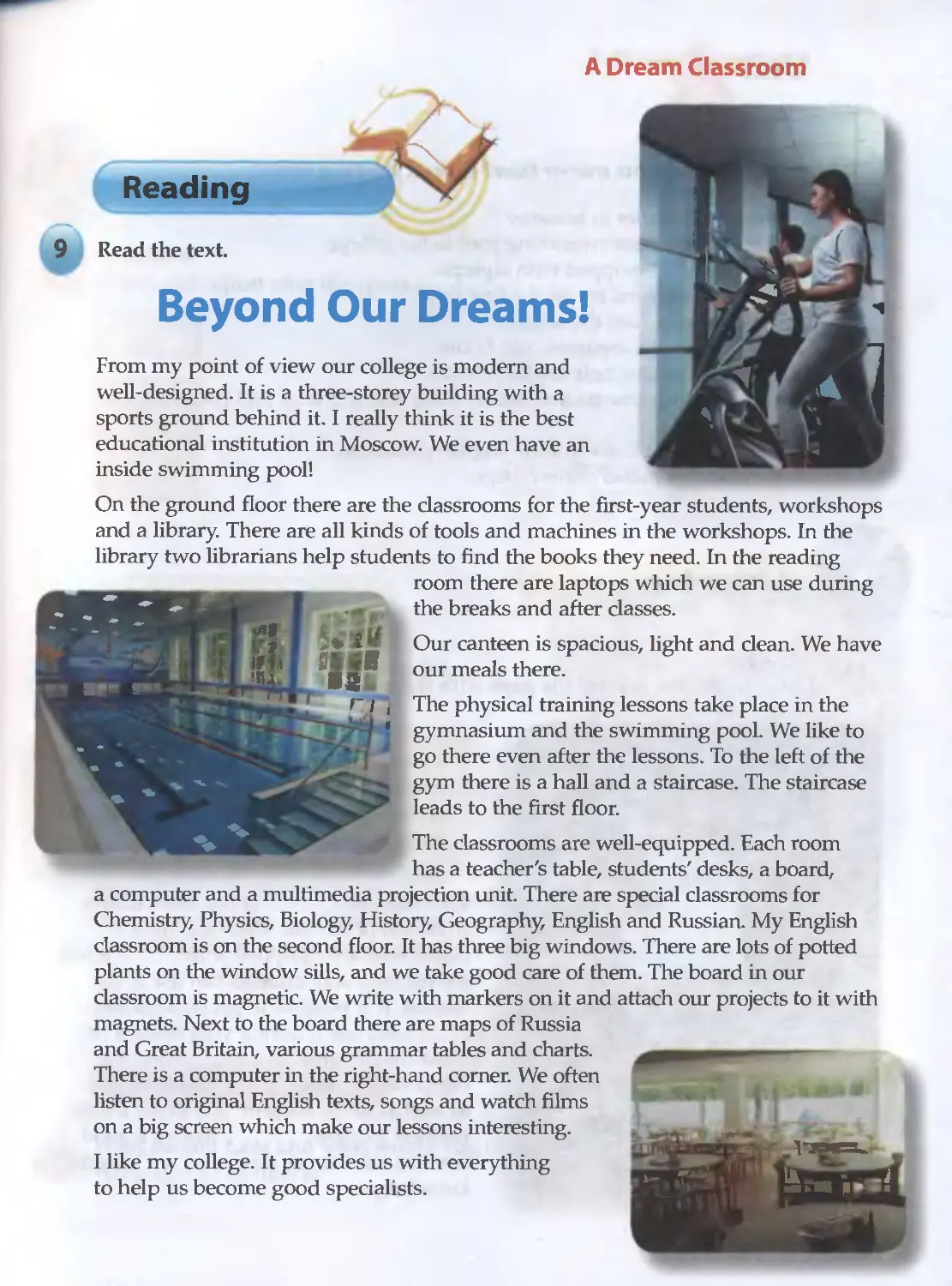
From my point of view our college is modem and
well-designed. It is a three-storey building with a
sports ground behind it. I really think it is the best
educational institution in Moscow. We even have an
inside swimming pool!
On the ground floor there are the classrooms for the first-year students, workshops
and a library. There are all kinds of tools and machines in the workshops. In the
library two librarians help students to find the books they need. In the reading
room there are laptops which we can use during
the breaks and after classes.
Our canteen is spacious, light and dean. We have
our meals there.
The physical training lessons take place in the
gymnasium and the swimming pool. We like to
go there even after the lessons. To the left of the
gym there is a hall and a staircase. The staircase
leads to the first floor.
The classrooms are well-equipped. Each room
has a teacher's table, students' desks, a board,
a computer and a multimedia projection unit. There are special classrooms for
Chemistry, Physics, Biology, History, Geography, English and Russian. My English
classroom is on the second floor. It has three big windows. There are lots of potted
plants on the window sills, and we take good care of them. The board in our
dassroom is magnetic. We write with markers on it and attach our projects to it with
magnets. Next to the board there are maps of Russia
and Great Britain, various grammar tables and charts.
There is a computer in the right-hand comer. We often
listen to original English texts, songs and watch films
on a big screen which make our lessons interesting.
I like my college. It provides us with everything
to help us become good specialists.
Unit
19
Are these statements true or false? Correct the false ones.
1.	Alexander studies in Moscow.
2.	There is an indoor swimming pool in his college.
3.	The library is equipped with laptops.
4.	All the classrooms are on the first floor.
5.	The classrooms are the same.
6.	After classes the students rush home.
7.	The students like their English classes.
8.	At the English lessons they watch films, listen to texts and present their
projects.
9.	They don't use chalk in their English classroom.
10.	Alexander is proud of his college.
to
Listening
11
TRACK 8.
Listen to the text and fill the gaps with the words in the box.
a large screen, multimedia tools, laptops
and multimedia projectors, presentations,
online, an information friend, equipment
and design
The classroom.......of the 2000s differs
from that of the 90s. More and more
classrooms are equipped with......which
the teachers and students can use at the
lessons. It is possible to get information
......and use it during your lessons or
show the pictures on........Now the
computer becomes........to the teacher
as well as to the student. It is easier for the
teachers to show........To give a good
lesson a teacher has now all....besides his
knowledge.
52
A Dream Classroom
Pronunciation
12 TRACK 9.
Listen and repeat after the speaker.
13
И
meat
least
bee
beat
Speaking
Talk about your classroom using the
following prompts.
met — meat — mate
list — least — last
bay — bee — beer
bit — beat — bet
key — keys — keeps
pea — peas — piece
scene — seas — seat
deer — deal — deed
My college is a (modern, old).. .-storey
building.
In front of the college building we can see ...
There is/are ... behind it.
The college is equipped with ...
The teachers use ... at the lessons.
There are ... on the ground floor;... on the first floor ...
When we enter the ... classroom, we can see ...
Our students try to take good care of ...
I think our college ...
What do you have and what would you like to have in your dream classroom?
Write 10 —15 sentences.
53
Unit
* Match the words in the box with the items in the photos.
a.	laptop
b.	exercise book
c.	marker
d.	CD
e.	magnetic board
f.	backpack
g.	chart
h.	projector
i.	screens
j.	laser pointer
54
A Dream Classroom
Complete the following text with the words and phrases from the box.
DVD player, swimming pool, to take care, gymnasium, library, book, laptop,
DVD discs, books, potted plants, window sills
Our technical school is very modem. There is a......on the second floor and
a......on the ground floor where we swim a lot. We have a large.......
with a lot of...in it. We can take any........we need. At the Maths or Physics
lessons the teacher uses a...to explain a new theme to us. In our English
classroom we have a.......and we use........with films, texts and exercises.
Our classroom is full of.....which stand on the........My groupmates
like.....of them.
Choose the correct preposition from the box where necessary.
for, by, in (7), on (3), into (2), to, from, over, at (3), of (3), in front of, under, behind,
next to, with (2), across
1.	When you come..........the classroom, you can see rows........desks and
a teacher's table.
2.	There are flowers......the pots........the window sills.
3.	We go........college five days......a week.
4	7 o'clock exactly my alarm clock wakes me up.
5	Thursdays we have an additional class..............Computer Science.
6.	Alexander leaves.......the college and goes.......home..........bus.
7.	The teacher writes.....the board and we make notes.........our exercise books.
8	seminars you have to speak................the class.
9	the college you can find a big garden.
10	our reading room the students can take any book...............the shelf and
work.........it......the desk.
11.	I don't see a desk....the room. - It's built.....the bookcase. When you
pull this drawer, it turns into a desk.
12	the hall there are laboratories...........monitoring equipment.
13.	The teacher's table is....the window.
14	the middle.............the room there is a glass table with documents
displayed.......the glass.
15.	The ideal place.....a flat-screen TV.......my living room is........
the fireplace.
55
Unit
Read the dialogue and get ready to act it out in class. Find the words with
following meanings:
1.	a subject that people talk or write
about
2.	a meeting at which people try
to improve their skills by discussing
their experiences and doing practical
exercises
3.	things that people do in order
to achieve a particular aim
4.	to give special attention
5.	a period of time used for a particular
activity, especially by a group
of people
Teacher: And here is the programme
for the course. The classes are organized
in three sessions. Session A starts at
9:00 am and focuses on speaking and
listening. At 10:30 we stop for a coffee
break and then gather again at 11:00
in this classroom to start session B.
Boris: And what do we do in Session B?
Teacher: We do all sorts of reading and
writing activities. We have reading
exercises and story-writing workshops.
Boris: When do we have a lunch break?
56
A Dream Classroom
6.	a period of time when you stop
working in order to rest, eat etc
7.	plans and preparations
8.	a series of actions which are designed
to achieve something important
Teacher-. Every day after Session В there
is a one-hour lunch break from 12:30
pm. In the afternoons we participate
in various other activities: on Mondays
we watch films, on Tuesdays we read
magazines and newspapers in the
library, on Wednesdays we have guided
tours round the city, and on Thursdays and Fridays we just gather in the cafe to talk
about interesting topics. Every day we finish at 3 pm.
Boris- And what are we going to do at weekends? Are there any special arrangements?
Or are we free to do whatever we want?
Teacher: We usually go on excursions.
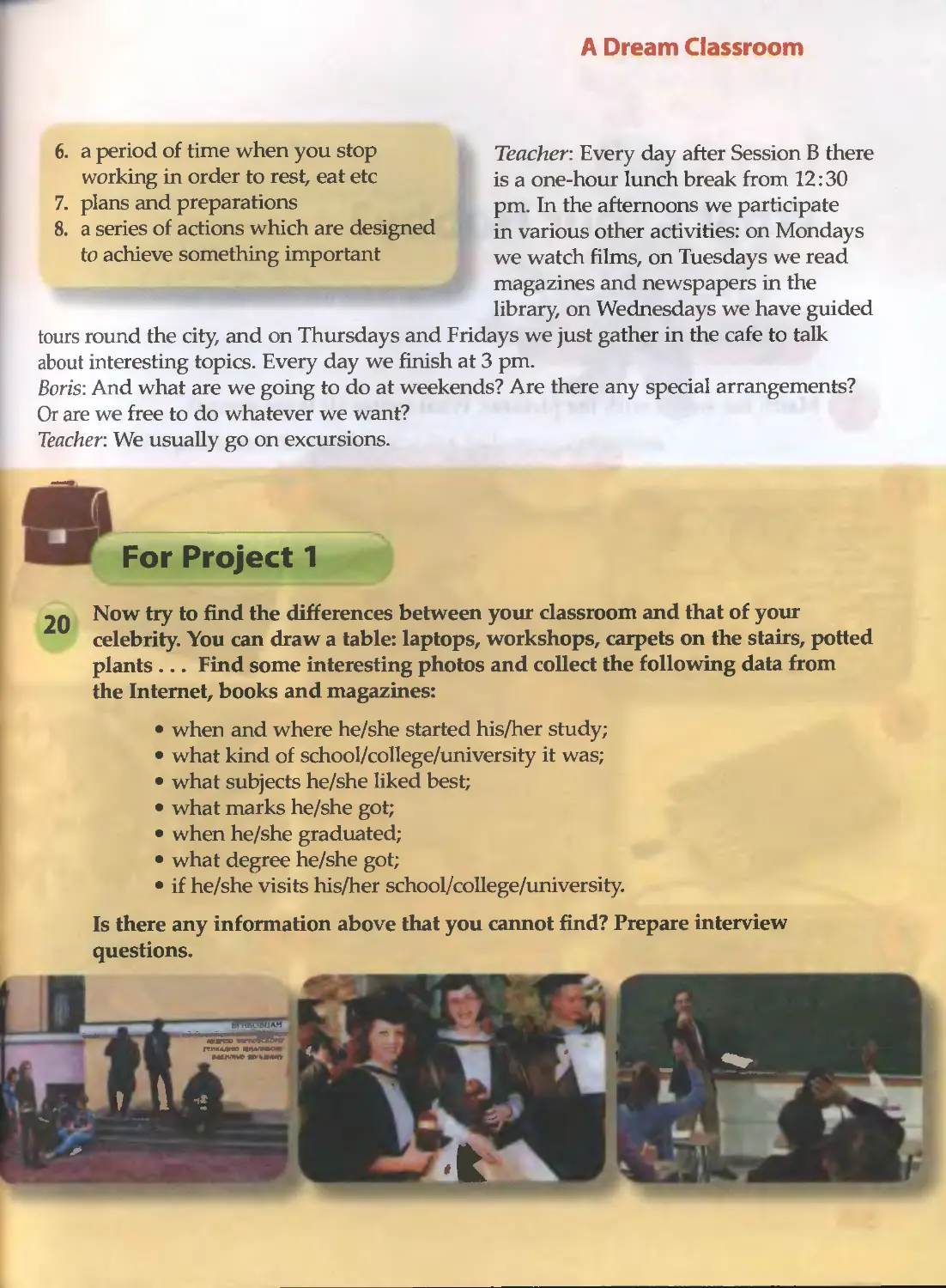
For Project 1
20
Now try to find the differences between your classroom and that of your
celebrity. You can draw a table: laptops, workshops, carpets on the stairs, potted
plants___Find some interesting photos and collect the following data from
the Internet, books and magazines:
•	when and where he/she started his/her study;
•	what kind of school/college/university it was;
•	what subjects he/she liked best;
•	what marks he/she got;
•	when he/she graduated;
•	what degree he/she got;
•	if he/she visits his/her school/college/university.
Is there any information above that you cannot find? Prepare interview
questions.
Unit
What's Your Hobby?
Warm-up
58
Unit
What's Yot^fcpbby?
^2^, Repeat after the teacher.
What are little boys made of, made of?
What are little boys made of?
Frogs and snails
And puppy-dogs' tails,
That's what little boys are made of.
3 ' In pairs perform a dialogue using the following questions.
Do you have much free time?
What is your favourite hobby?
Why do you like your hobby?
Are there any hobbies you would like to try?
Which hobbies do you think are the most difficult?
59
Unit
Grammar
Study the grammar.
LOVE, LIKE, ENJOY etc +
INFINITIVE/Ving
После глаголов love, like, dislike, hate, start, begin, continue, stop
и некоторых других может употребляться как инфинитив смыслового глагола,
так и смысловой глагол с окончанием -ing:
I love to watch / watching films at night.
He likes to play I playing football.
She hates to wash / washing the dishes.
They enjoy reading.
I am finishing reading this book.
to stop doing sth = not to continue an activity
to stop to do sth = to stop what you are doing in order to do sth
5	Rewrite the sentences using lovellikelenjoy + Ving.
1.	I (to love, to read) and (to listen to) the music.
2.	He (not to like, to play) chess.
3.	We (to like, to correspond) with each other very much.
4.	Bob (to hate, to wash) the dishes.
5.	We (to enjoy, to travel) round our country.
6.	They (to like, to chat) with each other in the evenings.
7.	Mary and her mum (to love, to do shopping).
8.	My parents (not to like, to go) to the theatre.
9.	I (to hate, to stay) at home at the weekends!
10.	What do you really (to enjoy, to do)?
11.	What do you (to like, to make)?
12.	She (to continue, to work) in the school library.
13.	Finally it (to stop, to rain).
14.	After you (to finish, to study) take some time to relax.
15.	Unfortunately many people (to dislike, to do) morning exercises.
60
Vocabulary
6	Study the following words and expressions.
hobby — увлечение
concern — беспокойство
to share sb's ideas with sb — делиться мыслями с кем-либо
activity — деятельность
entertainment — развлечение
performance — спектакль, представление
to attend — посещать
leisure — отдых, досуг
sense — чувство
excitement — восхищение
expectation — ожидание, надежды
pursuit — занятие
to pass sb's free time — проводить свободное время
environment — экологический
occupation — занятие
to surf the Internet — сидеть в Интернете, бродить по Интернету
to go in for sport — заниматься спортом
contest — состязание, конкурс
pastime — времяпрепровождение
calm — спокойный
widespread — распространенный
rabbit — кролик
trick — трюк
plant — растение
cacti pl — кактусы
motorbike — мотоцикл
part — деталь
the World Wide Web — Всемирная паутина
reggae — регги (музыкальное направление)
gainer — предпочтение
fantasy — фэнтези
to develop — развиваться
to satisfy — удовлетворять
61
Unit
Reading
7	Read the text. Make a list of all the people's activities mentioned in the text.
Alexander thinks that he has too many hobbies and too little time. He wants to
share his concern with his friend Peter from Poland. As Peter is coming to Moscow
only in two month's time, Alexander decides to write him. But before writing
an email, he puts his ideas in his diary:
"Nowadays it's hard to name all the activities, entertainments and hobbies
practised by people in their free time. A growing number of people prefer
watching films, performances, sporting events on TV to attending them.
There exist quite different sorts of leisure activities which give thousands
of people a sense of excitement and expectation. There are various pursuits
that people choose to pass their free time. Today people spend hours watching
different informative, educational or environment programmes. Other popular
occupations are surfing the Internet, playing computer games, listening to the radio,
reading books (often ebooks!), painting and so on. Many people prefer to go in for
different kinds of sports and lead an active way of life. Sometimes they participate
in competitions or contests and have a very good pastime. There are people that
prefer a calm way of spending their free time. They are fond of walks in parks or
gardens. More serious people prefer to visit museums, art galleries or theatres.
Aerobics and shopping are two of the most popular pursuits for women. Cooking
is also a very widespread activity among them. But nothing can be compared to
your favourite hobby. A hobby is a special interest or activity that you do in your
free time. Some people have animals as hobbies. They keep rabbits, or go fishing,
or train dogs to do tricks. Some are crazy about plants. They try to grow cacti or
tropical flowers in their kitchens and sitting rooms. Others are mad about their cars
or motorbikes. They spend their Saturdays and Sundays washing them, painting
them or buying new parts to make them go even faster. Many people make things
as a hobby ..."

62
What's Your Hobby?
8	Are these statements true or false? Correct the false ones.
1.	Alexander writes in his diary a list of all activities, entertainments and hobbies
practised by people in their free time.
2.	Alexander has no hobby and wants to select one.
3.	He meets with his friend to discuss this problem.
4.	Hobbies give people a sense of excitement and expectation.
5.	Today people spend a lot of time watching different informative, educational or
environment programmes.
6.	Women prefer aerobics, shopping and cooking.
7.	A hobby is an active pastime like sports or training
dogs.
8.	In order to relax most people prefer a calm way of
spending their free time.
9.	Animals can also be a hobby.
10.	People prefer ready-made things to hand-made
ones.
Listening
9	TRACK 10.
Listen to the text and name all Alexander's hobbies.
Listen again and check.
1 q Talk about your favourite hobby using
Yv the following prompts.
I have . . . (many, several, a few, only one)
hobbies/hobby.
My favourite hobby is ...
1 enjoy ...
It is ... (expensive, cheap, free).
I do it. .. (in a company, alone).
This hobby is done ... (inside, outside).
I love it because it is ... (funny, relaxing,
intellectual etc).
The best thing about my hobby is that. . .
But I don't like ...
Unit
Writing
Peter replies to Alexander's email. What does he advise? Write 100 —140 words.
Pronunciation
12 TRACK 9.
Listen and repeat after the speaker.
[e]
men
head
met
set
man — men — mean
heard — head — had
mate — met — meat
sit — set — sat
test — death — red
friend — said — many
check — shelf — leg
felt — bread — well
, , . Put the words under the following headings. Some words can go under several
headings. Use a dictionary if necessary.
Knitting & Sewing,
Drawing & Painting,
Stamp Collecting,
Cooking
Watercolous, spoon, exhibition, wool,
salt, album, frying pan, canvas, pattern,
gas cooker, pencil, needle, food processor,
sewing machine, cutting board, button,
magnifying glass, brush, scissors, knife,
fabric, forceps, eraser, measuring tape, fork,
mannequin, sketch, cotton, pepper, thread,
paper, catalogue.
64
What's Your Hobby?
Make sentences.
1.	he I not I jazz I enjoy.
2.	we I like I not I shopping.
3.	interests I have I I I many.
4.	hate I ebooks I she I reading.
5.	he I buy I to I fishing rods I like.
6.	time I spend I much I they I don't I at
home.
7.	good I a I of I educational I collection I
CDs I has I Lucy.
8.	I I for I hobby I this I need I and I needles I yarn.
9.	David I fond I is I of I coins I collecting.
10.	makes I happy I reading I me I and I to I music I listening.
Complete the text with the words and phrases from the box.
music, favourite, listen to music, information, news, collect, singers, programmes,
compact discs, museums
Rich people often.......paintings, rare things and other art objects. Often such
private collections are given to....., libraries. As for me, I like to.....
Therefore I collect..... .1 like different music........I collect discs of my
favourite groups and.........1 carefully study the printed.........I try to find
everything about my..........singers. I also like to watch music...on TV.
I want to keep up with the.......in the world of music.
Put the verbs in the correct form.
A hobby is what a person (to like) to do in his or her spare time. Hobbies
(to differ) like tastes. Your hobby (to make) your life more interesting. The most
popular hobby (to be) doing things. It (to include) a wide variety of activities
from gardening to travelling, from chess to volleyball. Both grown-ups and
children (to be fond) of playing different computer games. This hobby (to become)
more and more popular every year. Making things (to include) drawing, painting,
handicrafts. Many people (to collect) something - coins, stamps, compact discs,
toys, books.
65
Unit
Read the text and guess what hobby is described.
I love to spend the winter thinking about what I want to plant. I enjoy cleaning
out the beds in the spring and finding the little shoots coming out of the ground
for another year. I love to plant annuals in my containers. I love to wander out
in the mornings or evenings just to see what has grown since the last time I was
out. It amazes me how fast some things grow!
^18 / Which hobbies are more suitable for women, for men and for both?
Playing chess, mountain climbing, astrology, reading, model trains collecting,
animal communication, playing football, knitting, horse riding, photography, yoga
parachuting, riding motorbikes, cooking, exploring volcanoes and underwater
caves, sewing, travelling, dancing, fishing, computers, fashion, windsurfing,
playing the piano, aerobics in the water, collecting postcards, diving.
/1 9 | What do these people enjoy doing and why?
What's Your Hobby?
Revise the texts in p. 51 and 62 and answer the questions.
1.	What is behind Alexander's college?
2.	What is on the ground floor?
3.	How are the classrooms equipped?
4.	Where do the physical training lessons take place?
5.	What kind of activities do the students have at the English lessons?
6.	Why does Alexander like his college?
7.	What are Alexander's hobbies?
8.	What kind of music does he like?
9.	Why does he think that it's good to have many hobbies?
10.	Can you name all the activities and hobbies practised by people in their free
time?
21 Just like you, your friends and your relatives, celebrities
have some interesting hobbies. Your celebrity is no
exception. Perhaps one of his/her hobbies will inspire
you to take up a new hobby of your own! Find some
interesting photos and collect the following data from
the Internet, books and magazines:
•	what his/her hobby/hobbies is/are;
•	when and how he/she started it;
•	if this hobby expensive;
•	where he/she does it;
•	why he/she does it.
Is there any information above that you cannot
find? Prepare interview questions.
Project 1
(INTRODUCTION UNIT, UNITS 1 —5)
Discovering Celebrity Life
Class projects in your English class are a way to learn important skills for life. The
skills include leadership, working together, research, writing and speaking. Each
student in the class will be given the opportunity to take part in the presentation.
Your teacher will answer your questions and provide guidance.
For this Project you may need:
* a multimedia projection unit;
a screen;
0 a computer or CD/DVD recorder;
V a laser pointer
For this Project you have researched the life of famous people and composed
questions for interviews with them:
_ Personal data of the celebrities.
«. Information about their family members.
_ Their living condition report.
. Their working day routine.
- Facts about their school/college/university life.
Description of their hobbies.
1.	In your groups study the materials you have collected for the Project.
2.	Discuss them and decide which information is best suitable for the TV
programme.
3.	In class choose the title of the programme and of its parts.
4.	Self-assign each student a role:
. a producer who checks the plan and rules the programme;
. presenters (narrators) who conduct the programme and talk about
the celebrities;
.. reporters who conduct the interviews;
« editors who edit the script;
v an interior designer who decorates the studio and makes it nice and cosy;
 photographers who prepare a photo gallery;
 a sound producer who finds good music to accompany the programme.
5.	Research your roles.
6.	Prepare the programme and rehearse it before presenting.
7.	Present your programme. One ... two ... three ... Action!
68
Youth Camp Application Form
A.	Camper's Details
First name Middle name Surname
Male □ Female □
Date of birth (DD/MM/YYYY)Place of birth
Address: House Block Flat Street
City Region Country Postcode
College: Name Address
Year Group
Phone: Home Mobile Email__________________________________
B.	Parents' Details
Mother
First name Middle name Surname
Date of birth (DD/MM/YYYY)________________________________
Address: House Block Flat Street
City Region Country Postcode
Phone: Home Mobile Work Email
Place of employment: Company name_________________________
Address Position
Father
First name Middle name Surname
Date of birth (DD/MM/YYYY)________________________________
Address: House Block Flat Street
City Region Country Postcode
Phone: Home Mobile Work Email
Place of employment: Company name_________________________
Address Position
C.	Camper's abilities
English-language level: Elementary □ Intermediate □ Advanced □
Sports: Swimming □ Cycling □ Other sports
Hobbies___________________________________________________
Date	Signature
Unit
How Do I Get There?
block — корпус
entrance — подъезд
highway — шоссе
lane — переулок
drive — проезд
dead-end street — тупик
settlement — поселок
village — село, деревня
autonomous district — автономный
округ
postcode — почтовый индекс
Building (No.)..... Settlement/Village/Town/City
Block......	Region.......
Flat.......	Autonomous District......
Entrance......	Postcode.....
Floor......	Country......
Street.....
"Decipher" this address: find the country,
town, postcode, street, county, house,
occupier.
Mrs Mary Green
32, Godson Crescent, Kidderminster,
Worcestershire, UK, DY11 7JT
70
Unit
How Do I Get There?
3 Repeat after the teacher.
There was an Old Man on a hill,
Who seldom, if ever, stood still;
He ran up and down,
In his Grandmother's gown,
Which adorned that Old Man on a hill.
4 Work in groups of two and perform a dialogue using the following questions.
What is your address?
Do you live far from the centre?
How long does it take you to get to ... ?
What transport do you take to get from ... to ... ?
71
СПЕЦИАЛЬНЫЕ ВОПРОСЫ
SPECIAL QUESTIONS
Вопрос, который относится к какому-либо члену предложения и задается
с целью получения новой конкретной информации, называется
специальным вопросом. Он начинается с вопросительного слова:
Wh-words
who — кто, кого, кому
what — что, какой
whose — чей
whom — кого, кому
which — который (из нескольких)
when — когда
where — где, куда (также where to)
how - как, каким образом
why - почему
how much — сколько
(с неисчисляемыми существительными)
how many — сколько
(с исчисляемыми существительными)
how long — как долго, сколько
how often — как часто
Who is that tall man?
Who do you see there?
What is in his hands?
What colour are your eyes?
Whose pen is it?
Who(m) do you phone all the time?
Which stop is yours?
When does your train arrive?
Where do you live?
Where are you going (to)?
How do I get there?
Why do you always take a tram, not
the metro?
How much time do you spend
in the fitness centre?
How many times a week do you go
to the fitness centre?
How long does it take you to get to the
fitness centre?
How often do you go to the fitness centre?
Порядок слов в специальных вопросах обратный, за исключением вопросов к под-
лежащему.
Обратите внимание, что вопросительное слово what имеет два значения: какой и
что:
72
How Do I Get There?
What subject do you like best?
Какой предмет твой самый любимый?
What is your favourite subject?
Какой твой любимый предмет?
What do you know about this picture?
Что вы знаете об этой картине?
6 j Fill in the gaps with question words.
1.......type of music do you prefer: pop, rock, heavy metal?
2.......do you like fantasy?
3.......is your favourite actor or actress?
4.......do your pen friends live?
5.......do your parents have holidays?
6.......do you usually spend your weekends?
7.......flowers does your girlfriend like?
8.......questions does this questionnaire have?
9.......nickname is "Twiggy"?
10......snow falls in Finland?
НАРЕЧИЯ И ВЫРАЖЕНИЯ МЕСТА И НАПРАВЛЕНИЯ
ADVERBS AND EXPRESSIONS OF PLACE
AND DIRECTION
Place	Direction
near	down; up	around	up; down
Unit
Choose the right preposition or adverb of place and direction from the box.
along, right, in (2), across, on your left, into, straight, from left to right, through,
around
1.	I keep my car......the garage, not.....
the street.
2	you can see the Houses of Parlia-
ment.
3.	Turn.....just after the school.
4.	The photo shows,......... his sons Alex,
Andrew, Nick and Gregory.
5.	Go......., don't make any turns!
6.	They remove trees......highways that
are dead or diseased.
7.	Is it legal to ride your bike..the tun-
nel?
8.	"The Shop......the Corner" is an American romantic comedy.
9.	The administration plans to open a waterpark just.....the street.
10.	Am I allowed to drive.....Canada with my US car?
AN Study the following words and expressions.
to get off — выходить
up the stairs — наверх (no лестнице)
square — площадь
exit — выход
straight — прямо
side street — переулок; также back street;
lane (в названии улицы)
down the stairs — вниз
crowded — переполненный, многолюдный
towards — по направлению к, в сторону
чего-либо
crossroads — перекресток
74
How Do I Get There?
Reading
9 Read the text.
Today Alexander and his foreign friends are going to the rock concert "Music,
help!" in the Polytechnic Museum. Alex lives on the outskirts of Moscow. He does
not know how to get to this place, so he asks his father:
— Dad, can you tell me the way to the Polytechnic Museum? How can I get there
quickly?
— Sure. It's situated in the very centre of Moscow. Take the metro and get off at the
Lubianka station. Then go up the stairs to the street. There is a square opposite the
exit, called Novaya Ploshchad. The Polytechnic Museum is a big long building just
in front of you. Go straight across the Square. It is behind the bus stop.
— Thanks Dad.
Alexander goes to the local metro station. He leaves the entrance to his block
of flats, walks along the side street, turns left and then right. It takes him only
a ten-minute walk to get to the metro station. Alex goes down the stairs and takes
a train. In forty minutes he is at the Lubianka station. He turns left to the escalator.
Today the station is not so crowded. He goes up. He sees the old building of
the Polytechnic Museum across the square and walks straight towards it. At the
crossroads next to the Museum he meets with his friends - Peter, Jane and Nora.
They are glad to see Alex. They come into the Museum hall. The concert starts
in a quarter of an hour.
75
Unit
ю Are these statements true or false? Correct the false ones.
1.	Alexander goes to the Polytechnic Museum for the first time.
2.	He knows a quick way to get there.
3.	He lives on the outskirts of Moscow and far from the metro station.
4.	There are a lot of people at the Lubianka station.
5.	The Polytechnic Museum is in Lubianskaya Ploshchad.
6.	It's a modem tall building.
7.	There is a bus stop just in front of it.
8.	His groupmates are at the entrance waiting for him.
9.	The concert starts in fifteen minutes.
10.	The friends want to attend this concert as they are fond of country music.
. Pronunciation
TRACK 12.
Listen and repeat after the speaker.
peak — pick — pack
wheel — will — while
set — sit — sat
feet — fit — fat
king — kid — kit
pink — pig — pick
fill — fish — fit
big — Bill — biscuit
12 TRACK 13.
Listen to the dialogue and fill in the gaps with the words from the box. Draw
a map of this area.
opposite, turn right, walk, on the right, tell me the way, turn left, along the street, cross,
go ahead, crossroads
— Excuse me. Can you...........to the college, please?
— Yes, of course. Now..........Then..........to Narrow street. Go
to the first......and.......to Fancy Street. It's five-minutes'
76
How Do I Get There?
— Shall I......the crossroads first?
— No, the college is...., next to the bank and.....the cinema.
— Thanks a lot.
— You are welcome.
Speaking
-- Say how you get to the most popular place in your area from your home using
the following prompts.
I live in ... (city), in ... street.
... is . .. my home.
To get to the metro/bus station .. . (name) I. . . (walk, take a bus No. 246 etc).
It takes me ... minutes.
I have to change the line at the . .. station and go to the .. . station.
It takes me ... minutes /... stops.
The ... metro line/bus is usually ... (crowded, empty).
Then I go up the stairs to the street and turn ...
... is ... (on the left etc).
•	your college?
•	your favourite shopping centre?
•	the nearest cinema?
77
6
Unit
Read the text and answer the question:
W7ii/ do the British drive on the opposite side of the road?
Why We Drive on the Left
in the UK
The "rule of the road" in mainland
Europe and the majority of countries
in the world, including the United
States, is "to drive on the right".
In the United Kingdom and some
of her former dominions: Australia,
New Zealand, Kenya, Zambia, South
Africa, Zimbabwe, some Caribbean
Islands including Barbados and
St Lucia, India and Pakistan and
the Mediterranean island of Malta,
the rule of the road remains to drive
on the left. This also applies in Japan and Thailand.
The origin of this rule dates back to how people travelled in feudal societies.
As most people are right-handed, it made sense to carry any protective weapon in
this hand. When passing a stranger on the road, it would be safer to walk on the
left, so ensuring that your weapon was between yourself and a possible opponent.
Knights would hold their lances in their right hand, therefore passing on each
others' left.
Revolutionary France changed this historic practice, as part of its social rethink.
Their military general and Emperor Napoleon Bonaparte was left-handed,
therefore his armies had to march on the right, so he could keep his sword arm
between him and the advancing enemy. From that time any part of the world that
was colonized by the French would travel on the right, and the rest would remain
travelling on the left.
78
How Do I Get There?
Put questions to the words in the italics.
1.	Kate likes to walk along the streets in good weather.
2.	You need to turn to the right.
3.	His father leaves his car in the street.
4.	Alex has his English lessons three times a week.
5.	He drives/«st.
6.	They drive on the right side of the road in that country.
7.	We have several thousands books in our home library.
8.	Peter's granny cooks very tasty dishes.
9.	She is looking for a map to find that workshop.
10.	A waiter brings the customers their desserts.
Put the words in the right order.
1.	when I start I competitions I your I do?
2.	from I left I to get to I turn I Red Square I here.
3.	in I popular I kind I of transport I what I is I China I a?
4.	she I does not I why I the hospital I take I the metro I to get to?
5.	he I does I play I football I how often?
6.	rides I a motorbike I your I who I family I in?
7.	old I this I bridge I is I how?
8.	lead I side I does I to where I this I street?
9.	get off I at I third I stop I the train I the.
10.	coming I give way I to cars I at crossroads I from the right.
Match the questions with the answers.
1.	Excuse me, sir. Can you show me
the way to the British Museum?
2.	Excuse me. Where is the nearest post
office here?
3.	Is the bank around the comer?
4.	How long does it take you to get to
the station?
5.	Where is the cafe here?
a.	You turn left, and it is right there.
By the way, they have a special menu
this week.
b.	Only ten minutes.
c.	No. It is at the right-hand comer
of Darwin Street. Can you see that bank
machine?
d.	Yes, sure. It is over there. This way.
e.	It is on the left to the crossroads.
79
Unit
Where do these people want to go? How to get there?
Read the dialogue and get ready to act it out in class. Draw the route from
the students' hostel to the Royal Botanic Garden.
Nick: Excuse me.
Policeman: Yes? Can I help you?
Nick: Is this the Royal Botanic Garden?
Policeman: No, I'm afraid it's not. This is Princess Street Gardens. On the left is
Edinburgh Castle.
Nick: Hm ... I think we have lost our way. We want to go to the Royal Botanic
Garden. We started from our hostel in High Street and walked along Cockbum
Street, then straight on over Waverley Bridge for about 500 metres and then turned
left.
Policeman: Oh, I see. Don't turn left at the end of Waverley Bridge. Carry on
straight along St Andrew's until you reach the bus station.
80
How Do I Get There?
Ann-. But we don't want to go to the bus station. We want to see the Royal
Botanic Garden.
Policeman: Well, it's a long way from here. If you want to get there quickly, you
can take a bus from the bus station.
Ann: We would like to walk. How long does it take?
Policeman: Go straight along Hannover Street and then, when you come to the
park, carry on along Dundas Street. You will be there in about an hour. There is
the National Portrait Gallery at the end of the park. If you wish to see it, you will
need more time.
Ann: That's a good idea but we don't have much time.
Nick: Thank you very much!
Policeman: You are welcome.
For Project 2
21 Over a few weeks you are going to make your town/city/district presentation
and you need to collect some information to it.
Work in groups of 3 — 4. Find information about your local history museum
(or any other museum in your area) on the Internet, from booklets and the
museum itself:
Add some other interesting data. Take pictures
and/or videos.
• When was the museum founded?
• Who was it founded by?
• What are the main exhibits there?
• What are the most interesting exhibits?
• How many visitors are usually there?

Unit
Eating Traditions
Warm-up
Match the pictures with the words.
a. cucumbers
b. soup
c. apples
d. cup
e. cheese
f. knives
g. fish
i. cakes
j.	meat
k.	potatoes
1.	chicken
m. strawberries
n. cans
o. bread
p. cherries
f
2 Repeat after the teacher.
A canner can make
Many cans if he can,
But a canner cannot make a cake.
In pairs perform a dialogue using the following questions.
What is your favourite dish?
What kinds of food do you
What do you eat in the morning?
Where do you usually have lunch?
When do you have dinner?
What is your favourite dish?
What kinds of food do you dislike?
83
Unit
Grammar
ИСЧИСЛЯЕМЫЕ И НЕИСЧИСЛЯЕМЫЕ
СУЩЕСТВИТЕЛЬНЫЕ
COUNTABLE AND UNCOUNTABLE NOUNS
К исчисляемым существительным (Countable Nouns) относятся слова, обозначаю-
щие предметы, которые можно посчитать, например: apple, tomato, table, plate.
Эти существительные имеют единственное и множественное число: There is а сир
on the table. There are two cups on the table.
Неисчисляемые существительные (Uncountable Nouns) обозначают предметы, ко-
торые нельзя посчитать. К этой группе относятся слова, обозначающие абстрактные
понятия (happiness — счастье, beauty — красота)-, погодные явления (rain —
дождь, snow — снег); названия веществ, жидкостей (paint — краска, cotton —
хлопок, iron — железо, cheese — сыр, water — вода); болезни (flu — грипп,
gastritis — гастрит). Сюда же относятся такие слова, как advice — совет/советы,
air — воздух, behaviour — поведение, furniture — мебель, information — ин-
формация, luggage — багаж, news — новость/новости, traffic — движущийся
транспорт и др.
Неисчисляемые существительные могут также иметь единственное и множествен-
ное число, причем их значение во множественном числе часто приобретает другой
оттенок:
hair — волос, волосы	hairs — отдельные волосы
fish — рыба (собир.)	fishes — отдельные рыбы
fruit — фрукты (собир.)	fruits — фрукты (разных видов)
money — деньги	monies, moneys — деньги (в юридических
	документах)
water — вода	waters — воды {например, прибрежные)
cheese — сыр	cheeses — сорта сыра
sugar — сахар	sugars — кусочки или ложечки сахара
С неисчисляемыми существительными, как правило, не употребляется неопреде-
ленный артикль а/ап, но может использоваться определенный артикль the:
This information is well-known. The news is bad.
Неисчисляемые существительные формально можно перевести в разряд исчис-
ляемых, если добавить перед ними единицы измерения: jar — {стеклянная) бан-
Eating Traditions
ка, bottle — бутылка, cup — чашка, glass — стакан, slice — ломтик/кусок,
piece — кусок, loaf — буханка, tin — (жестяная) банка, kilo(gramme) — кило-
грамм, carton — упаковка, can — (жестяная) банка, packet — пакет и т.п. + of:
a loaf of bread — буханка хлеба	two loaves of bread — две буханки хлеба
a piece of advice — совет	a few pieces of advice — несколько советов
A LOT OF, MUCH, MANY,
A LITTLE, LITTLE, A FEW, FEW
Uncountable Nouns:
a lot of
a lot of much
(negative,
interrogative)
много	много
a little	little
немного	мало
There is □ sugar in the sugar bowl, (нулевой артикль)
There is a lot of sugar in the sugar bowl.
Is there a lot of / much sugar in the sugar bowl?
There is not much sugar in the sugar bowl.
There is a little sugar in the sugar bowl, (немного, но все же
есть)
There is little sugar in the sugar bowl, (мало, почти нет)
many
Countable Nouns:
a lot of	many
много	много
a few	few
немного	мало
There are a lot of apples in the vase.
There are many apples in the vase.
There are a few apples in the vase, (немного, но все же есть)
There are few apples in the vase, (мало, почти нет)
few
Unit
5 Fill in the gaps with much, a little, little, many, a feiv, feiv.
1.	There are......boys in our group and...........girls.
2.	We are thirsty! - It's a problem! There is.....water.
3.	There is.......cheese in the fridge. It's not enough for the salad.
4.	There are......people at the stadium. - Because it has been raining all day.
5.	There isn't....snow in the yard.
6.	There is.......food in the kitchen. We can't feed our guests.
7.	This disc has only......good songs. I don't want to buy it.
8.	My younger brother likes to go to the kindergarten. There are........toys there.
9.	There is.......furniture in my parents' bedroom: a bed, built-in wardrobe and
two bedside tables.
10.1 want to knit a short jacket. I don't need.....wool yam for it.
Vocabulary
-j Study the following words and expressions.
meal — еда, прием пищи
roll — маленькая круглая булочка
porridge — овсяная каша на молоке
com flakes — кукурузные хлопья
cream — сливки
marmalade — апельсиновый джем
buttered — намазанный маслом
boiled — вареный
ham — ветчина
pickles — маринованные овощи
mutton chop — отбивная из баранины
chips — жареный картофель
biscuit — печенье
light beer — светлое пиво
sociable sort of thing — мероприятие для общения
roast — жареный (в духовке, на огне)
sweet — сладкое, десерт
nut — орех
86
Eating Traditions
7
Reading
Read the text.
British Meals
Alexander already has some ideas about typical British food. The usual meals are
breakfast, lunch, tea and dinner. Breakfast is generally a bigger meal than they
have on the Continent, though some English people like a "continental" breakfast
of rolls and butter and coffee. But the usual English breakfast is porridge or com
flakes with milk or cream and sugar, bacon and eggs, marmalade (made from
oranges) with buttered toast, and tea or coffee. For a change you can have a boiled
egg, cold ham or perhaps fish.
They generally have lunch about one o'clock. The businessman in London usually
finds it impossible to come home for lunch, and so he goes to a cafe or restaurant;
but if they can make it home for lunch, they have cold meat (left over probably
from yesterday's dinner), potatoes, salad and pickles, with a pudding or fruit to
follow. Sometimes we have a mutton chop, or steak and chips, followed by biscuits
and cheese, and some people like a glass of light beer with lunch.
Afternoon tea you can hardly call a meal, but it is a sociable sort of thing, as friends
often come in then for a chat while they have their cup of tea, cake or biscuits.
In some houses dinner is the biggest meal of the
day. They begin with soup, followed by fish, roast
chicken, potatoes and vegetables, a sweet, fruit and
nuts, coffee. But in a great many English homes
we make the midday meal the chief one of the day,
and in the evening we have simple dinner - an
omelette, or sausages, sometimes bacon and eggs and
sometimes just bread and cheese, a cup of coffee or
cocoa and fruit.
87
Unit
Are these statements true or false? Correct the false ones.
1.	The English breakfast is also known as the continental breakfast.
2.	The usual English breakfast consists of rolls and butter and coffee.
3.	British people seldom drink coffee.
4.	In a great many British homes dinner is the biggest meal of the day.
5.	British people eat biscuits, cakes, fruit and nuts for dessert.
Pronunciation
9
TRACK 14.
Listen and repeat after the speaker.
[a:]
far
bar
heart
march
Listening
fur - far - four
bore - bar - bear
hurt - heart - hate
much - march - match
calm - card - cart
star - starve - start
harm - halves - half
park - palm - past
10 TRACK 15.
Listen to the texts and match them with the titles. There is one extra title.
A.	The Baker's	C. French Spices
B.	Packed Lunch	D. Early and Medieval English Cuisine
Speaking
411 > Talk about your family food traditions using the following prompts.
Our usual meals are . ..
The chief meal of the day is ...
My usual breakfast is ...
Eating Traditions
I generally have lunch at...
On weekdays I eat at/in ..., my parents
..., my brother/sister ...
I usually have ...
At weekends we ...
We have dinner at..
It consists of...
For festive dinners we cook ...
Our special dish is ...
12 Copy all the food words from the text in Ex. 7. Fill in the table.
Meat	Vegetables	Dairy	Cereals	Drinks	Dessert	Others

Writing
13
Write a British cuisine menu. Use the information of the Unit and other sources.
• Read the text using a dictionary. Put all the norms under the two headings:
Countable Nouns and Uncountable Nouns. Try to explain their number
(plural or singular). Add the food words to the table in Ex. 12.
My uncle Albert always has "high tea". He says he has no use for these
"afternoon teas" where you try to hold a cup of tea in one hand and a piece of
bread and butter about as thin as a sheet of
paper in the other. He's a Lancashire man,
and nearly everyone in Lancashire likes
high tea. They have it between five and
six o'clock, and they have ham or tongue
and tomatoes and salad, or sausages, with
good strong tea, plenty of bread and butter,
then stewed fruit, or a tin of pears, apricots
or pineapple with cream or custard and
pastries or a good cake. And that's what
they call a good tea.
89
Unit
(^0) Fill in the gaps with is or are.
1.	The news.......very sad.
2.	His knowledge of this subject...very deep.
3.	There......an apricot and two peaches on the plate.
4.	Where......my shoe?
5.	There......several oranges and a slice of lemon in the fridge.
6.	Their advice......good to follow.
7.	My cat's hair.....orange.
8	the furniture in your flat new?
9.	There......plenty of apples in the garden this year.
10.	There.....not any sugar in the sugar bowl.
Fill in the gaps with much, a little, little, many, a few, few.
1.	I like my coffee with......milk and sugar.
2.	The meal costs.....euros.
3.	You look fit! Do you exercise......?
4.	There is only......gouache in the bottle. You can't draw any pictures.
5.	Don't talk too.....at the lesson.
6.	We know the material well and ask the teacher only........questions.
7.	There are.......nuts in the bowl, put some more, please.
8.	I don't like sweet tea, so I put only....sugar in my tea.
9.	They have.......money. - Are you sure they are poor?
10.	In our country we don't eat.......seafood.
1 -jк Try to cook this delicious omelette according
to the recipe. Give it a name.
Ingredients
•	12 baby spinach leaves
•	2 tbsp olive oil
•	1/2 glass minced onion
•	1 clove garlic, minced
•	4 tbsp thick cream
•	8 eggs, beaten
•	Salt and pepper to taste
•	2 tbsp grated Parmesan cheese
90
Eating Traditions
tbsp = tablespoon — столовая ложка
spinach — шпинат
clove — головка (чеснока)
garlic — чеснок
minced — мелко порезанный,
порубленный
grated — натертый
coarsely — крупно
to chop — резать, рубить
skillet — сковорода
soft and transparent — полуготовность
to stir — мешать
foam — пена
to scramble — перемешиваться
to sprinkle — посыпать
to serve — подавать
Preparation
Coarsely chop the baby spinach leaves. Heat the oil in a large heavy skillet and
cook the onion and garlic until soft and transparent, about 5 minutes. Add the
chopped spinach and cook, stirring often, until spinach is tender, about 5 — 7
minutes.
In a small bowl, beat the cream with the eggs, salt, pepper until foamy. Add the
egg mixture to the skillet and cook and stir so that the eggs scramble with the
spinach, about 4 — 5 minutes longer. Sprinkle with cheese and serve.
Write a recipe of your favourite dish. Use a dictionary and Ex. 17 as a model.
For Project 2
19 Continue preparing your presentation. Make a survey about restaurants in your
area and their cuisine:
•	Name	•	Opening hours
•	Type of cuisine, speciality	•	Price level
•	Address	•	How many visitors are usually	there?
Add some other interesting data. Take pictures and/or videos.
Imagine you are a proprietor of one of these restaurants. Compose a menu.
Write your price list.
Unit
Shops and Shopping
Warm-up
Match the pictures with the words.
Unit
Shops and Stropping
Repeat after the teacher.
There was a Young Lady of Ryde,
Whose shoe-strings were seldom untied.
She purchased some clogs,
And some small spotted dogs,
And frequently walked about Ryde.
the following questions.
Who does shopping in your family?
Do you often go shopping?
Do you like it?
Do you shop online?
What kind of things do you like buying?
Where do you like to shop most?
What is your last purchase?
93
Unit
Grammar
4 Study the grammar.
НЕОПРЕДЕЛЕННЫЕ МЕСТОИМЕНИЯ
INDEFINITE PRONOUNS
К неопределенным местоимениям в английском языке относятся: some, any, one,
somebody, someone, anybody, anyone, something, anything.
Неопределенные местоимения указывают на неопределенные или неизвестные
предметы или лица. В сочетании с существительными они играют роль определе-
ния и указывают на неопределенное количество или качество.
1.	Местоимение some используется в утвердительных предложениях и имеет
значения несколько, некоторый, какой-нибудь. Также употребляется в специ-
альных и общих вопросах, выражающих просьбу или предложение (не пере-
водится). Местоимение any употребляется в отрицательных и вопросительных
предложениях. В утвердительных предложениях оно имеет значение любой.
I have some questions. — У меня несколько вопросов.
Do you have any questions? — У вас есть (какие-нибудь) вопросы?
Yes, I have some. — Да, у меня есть (несколько).
Where can I buy some discs? — Где я моту купить диски?
Would you like some coffee? — Хотите кофе?
You may ask any questions. — Вы можете задавать любые вопросы.
Which pen do you need? — Any will do. —
Какая ручка вам нужна? — Любая подойдет.
Когда местоимения some и any используются с существительными, обозначаю-
щими вещества, материалы и т. п., они выражают неопределенное количество и
часто не переводятся.
Do you want some water? — Хочешь воды?
I don't want any water. — Я не хочу (никакой) воды.
2.	Местоимения somebody, someone — кто-то, something — что-то
используются в утвердительных предложениях.
Somebody calls me every night. — Кто-то звонит мне каждую ночь.
You need someone like my mother. — Тебе нужен кто-то вроде моей мамы.
I want to tell something. — Я хочу кое-что рассказать.
3.	Местоимения anybody, anyone, anything используются в отрицательных и
вопросительных предложениях.
94
Shops and Shopping
Does anybody know the answer? — Кто-нибудь знает ответ?
I don't want to see anyone. — Я никого не хочу видеть.
Do you want anything to read? — Хочешь что-нибудь почитать?
4.	Слово one может быть как неопределенно-личным местоимением, так и заме-
стителем ранее упомянутого исчисляемого существительного (вместо неисчис-
ляемых не используется).
One never knows what may happen. — Никто не знает, что может произойти.
Is there a bank near here? — Yes, there is one at the end of this street. —
Здесь есть поблизости банк? — Да, есть, в конце улицы.
Fill in the gaps with some, any, one, somebody, someone, anybody, anyone,
something, anything where necessary.
1.	There are.......cakes on the plate.
2.	There aren't.......children in the schoolyard.
3.	Does........know how to solve this task?
4.	Are there.......shopping centres here? — Yes, there are........
5.	I'm in a hurry. Give me.......shirt.
6.	Is there......in the fitting room? — Yes, there is.......
7.	Do you like soft cheeses? — No, I prefer hard........
8.	I can't see.....on the shelf.
9.	Where can I buy........needles and thread?
10.	Take my pen. — Thank you, I have.........
* Vocabulary
Study the following words and expressions.
grocer's — бакалея
baker's — булочная
greengrocer's — магазин «Овощи —
фрукты»
dairy — молочный магазин
butcher's — мясной магазин
ready-made — готовый
fabric — ткань
china — фарфор
electrical appliances —
электроприборы
linen — постельное белье
customer — покупатель
counter — прилавок
underwear — нижнее белье
knitwear — трикотаж
pasta — макаронные изделия
flour — мука
poultry — мясо птицы
beetroot — свекла
ready-weighed and packed —
расфасованный
95
Unit
Reading
7 Read the text
What Do Shops Offer?
When we want to buy something, we go to a shop. Although every town or city
has many kinds of shops, many of these are typical: a supermarket, a department
store, men's and women's clothing stores, a grocer's, a baker's, a greengrocer's,
a dairy and a butcher's.
Alexander's family like to do their shopping at big department stores and
supermarkets. These sell various goods under one roof and this is very convenient.
A department store, for example, true to its name, consists of many departments:
ready-made clothes, fabrics, shoes, sports goods, toys, china and glass, electrical
appliances and electronics, cosmetics, linen, curtains, books, gifts, jewellery etc.
You can buy anything you like there.
There are also escalators in big stores which take customers to different
floors. The goods for sale are on the counters so that they can be easily seen.
In the women's clothing department you can find dresses, suits, blouses,
skirts, coats, beautiful underwear and many other things. In the men's clothing
department you can choose suits, trousers, overcoats, ties etc. In the knitwear
department one can buy sweaters, cardigans, short-sleeved and long-sleeved
pullovers, woollen jackets. In the cosmetic department they sell perfume, face
creams and powders, lipsticks, lotions, shower gels, soap, shampoos ...
96
Shops and Shopping
In the supermarket we can also buy many different things in the same location:
meat and sausages, fish, sugar, pasta, flour, cereals, tea, coffee, bread and whatnot.
At the butcher's there is a wide choice of meat and poultry. At the baker's you can
buy white or brown bread, rolls and biscuits.
Another shop we frequently go to is the greengrocer's, which is stocked with
cabbage, potatoes, onions, cucumbers, carrots, beetroots, green peas and various
fruits. Everything is sold here ready-weighed and packed.
If you call round at a dairy, you can buy milk, cream, cheese, butter and many
other milk products.
Are these statements true or false? Correct the false ones.
1.	You can buy vegetables in the greengrocer's.
2.	To buy various goods under one roof is very convenient.
3.	To buy meat and poultry you have to go to the butcher's.
4.	The dairy sells milk, cheese and sausages.
5.	Cereals are sold in the baker's.
6.	Everything in the greengrocer's is ready-made.
7.	You can find various fruits in the Frut & Veg shop.
8.	The department store is a store with escalators.
9.	The knitwear department offers everything for knitting.
10.	To buy china one needs to go to China.
Pronunciation
g TRACK 16.
Listen and repeat after the speaker.
[ai]
might
buy
type
quite
mate - might - meet
bay - buy - boy
tip - type - tape
quit - quite - quiet
why - wide - wife
buy - buys - bike
fly - flies - flight
try - tries - tribe
97
Unit
Listening
10 TRACK 17.
Listen to the two texts. What types of shopping are mentioned in them? What
are the advantages of the first and the second types? Select from the list.
•	Lower prices
•	Ability to purchase from sellers around the world
•	Excitement
•	Ability to smell and sometimes taste products
•	Quick price and product comparison
•	Ability to take goods home right away
•	Increased product selection
•	Convenience in terms of time and place
•	Ability to see goods physically
•	Time saving
•	Environmental benefits
•	No queues	 I
Speaking
11	Describe how you do your shopping.
I like/hate doing shopping.
I shop (exclusively) online/offline because it's ... (cheap, easy, convenient, better
choice, fun etc).
I do my weekly shopping on ... (Sunday).
My favourite stores are ...
I do my food shopping at...
I usually buy ... there.
I have I don't have a passion for buying clothes.
I spend a lot of money on ...
I (often) buy ...
To save time and/or money I stick to a routine:... (make a shopping list,
check the supermarket catalogue, buy goods in the sale, collect coupons, use
a discount card etc).
98
Shops and Shopping
Writing
12	Make a shopping list for the next week.
Write out all the shopping terms and explain their meaning.
The methods of shopping may vary. It may be a self-service shop where
the customer goes from counter to counter selecting and putting into a basket what
he or she wishes to buy. Then he or she takes the basket to the check-out counter,
where the prices of the purchases are added up. If it is not a self-service shop, and
most small shops are not, the shop assistant helps the customer in finding what
he or she wants. You pay money to the cashier and he or she gives you back the
change.
Reconstruct the dialogue and get ready to
у act it out in class.
At the Shoe Shop
— That's fine. I'll take them, please.
— Oh, the left shoe is a bit tight. Could I try
a larger size?
— How about these? They're very
comfortable.
— .. . roubles.
— Could 1 try them on in a ... (size), please?
— I'll just see if we have them in a ... . Yes, here we are. How's that?
— Good morning, madam. Can I help you?
— Of course. Here you are.
— Oh, that's much better. How much are they?
— That's fine. I'll take them, please.
— Yes. I'm looking for some comfortable ... {colour, model) shoes.
99
Unit
Fill in the gaps with the words in the box.
a.	shoppmg
b.	cosmetic
c.	things for sale
d.	basket
e.	clothes
f.	counter
g.	in fashion
h.	ready-weighed and packed
i.	select
j.	cashier
k.	food
1.	comfortable
m.	quality
• 	 ~
1.	There is a.....department in this shop where
you can buy perfume.
2.	You can come to the.....and choose your
purchase.
3.	In our greengrocer's you can buy....
vegetables.
4.	You pay money to the........
5.	You can........food and put it into the..
6.	She does the......in their family.
7.	I enjoy going shopping for new......
8.	They spend quite a lot of money on.......
9.	I don't feel...in these shoes.
10.1 always try to be......
Group the words under names of departments. There is more than one solution.
Add 10 words of your own.
Bracelets, sandals, hats, bath robes, cologne, sports nutrition, sweaters, rugs,
shower gels, creams, jackets, bedding, tops, running shoes, weather stations,
home phones, flip-flops, floorcare, wallets, personal fragrance, boots, computers,
lingerie, cameras, soaps, necklaces, shorts, swimming costumes, vests, handbags,
basketball shoes, herbs, lighting, T-shirts, candles, cell phones and devices, lotions,
home fragrance, jeans, playstation games, vitamins, sleepwear, home decor, belts,
mattresses, luggage + backpacks, pet care, skating boots, wedding rings, watches,
cardigans, mascara, scarves, bath towels, shower curtains, trousers, shoes, earrings.
Revise the texts in p. 87 and 96 and answer the questions.
1.	What is a continental breakfast?
2.	When do English people have lunch?
3.	Who prefer to have lunch at cafes or restaurants?
4.	What is the role of afternoon tea?
5.	Is dinner the biggest meal of the day?
6.	Where do Alexander's family prefer to do their shopping?
7.	Why do they find it convenient?
8.	What kinds of shops do you know?
9.	What do they sell at the butcher's?
10.	Where can you buy fish?
1OO
Shops and Shopping
Match the phrases in the right column with the replies in the left column.
a.	No, I haven't.
b.	I'd love to, but I don't need anything.
c.	I'm afraid, that's just not possible.
d.	Here you are. That's £6.50.
e.	Here is some aspirin for you.
f.	Do you have batteries for this camera?
g.	Yes, we do.
h.	Let me check for you. Yes, I've got one
here.
i.	Yes, here they are, on this upper shelf.
j.	It's £19.99. It's a little expensive.
1.	I'd like a kilo of tomatoes, please.
2.	How can I help you?
3.	Why don't you come to the mall
with me?
4.	How much is this scarf?
5.	I'd like my money back, please.
6.	Have you got the receipt, sir?
7.	Can you give me something for
1a headache?
8.	Have you got it in a smaller size?
9.	Do you accept credit cards?
10.	Do you sell dictionaries?
• Departments
• Goods sold there
• Price level
1 Continue preparing your presentation. Collect
information about the best shopping places in your
area:
•	Name
•	Type
•	Address
•	Opening hours
Add some other interesting data. Take pictures and/or
videos.
Unit
Sports on Land, in Water, in the Air
плавание
хоккей
корт
шахматы
команда
футбол
теннис
мяч
ДЗЮДО
бокс
102
after the teacher.
Unit
Sports on Land, in Water, in the Air
On a bike race through Scotland did pedal
A speedy French rider who led-all.
"Is my lead big?" he cried.
"Wee," a Scotsman replied.
So he slowed down and won no gold
medal.
3 In pairs perform a dialogue using the following questions.
Do you like to exercise?
Do you like to watch sports on TV? What are they?
What is your favourite summer sport?
What is your favourite winter sport?
What new sports would you like to try?
103
Unit
Grammar
4 Study the grammar table and explain the rules.
СТЕПЕНИ СРАВНЕНИЯ ПРИЛАГАТЕЛЬНЫХ
DEGREES OF COMPARISON OF ADJECTIVES
Degrees of Comparison
Одно- и двухсложные прилагательные
	Сравнительная Comparative	Превосходная Superlative
long	longer	the longest
wide	wider	the widest
hot	hotter	the hottest
happy —			happier	the happiest
Многосложные прилагательные
interesting	more interesting	the most interesting
Исключения
good - хороший	better	the best
bad - плохой	worse	the worst
little - маленький	less	the least
far - далекий 		farther/further	the farthest/furthest
Некоторые прилагательные имеют две формы:
polite — politer / more polite — the politest / most polite
simple — simpler / more simple — the simplest / most simple
clever — cleverer / more clever — the cleverest / most clever
104
Sports on Land, in Water, in the Air
Для сравнения двух предметов используются сравнительные союзы:
as... as — такой же ... как, not so ... as — не такой ... как, than — чем:
This athlete is as strong as that. — Этот спортсмен такой же сильный, как и тот.
This athlete is not so strong as that. — Этот спортсмен не такой сильный, как тот.
This athlete is (much) stronger than that. — Этот спортсмен сильнее, чем тот.
5	Put the adjectives in the correct form.
1.	When we win a game, we are (happy) people in the world.
2.	Yesterday it was (difficult) match of all.
3.	My friend is (tall) than me, so he plays basketball (good) than me.
4.	John is (good) player in our team.
5.	For me it's (interesting) to play football myself than to watch it on TV.
6.	This season our team is playing (bad) than last year.
7.	Windsurfing is one of (dynamic) sports.
8.	Karate is (popular) of the Japanese martial arts.
9.	It is much (difficult) to get up after falling down in ice skating than it is with
roller blading. Also ice skating is (slippery) than roller
blading.
10.	Who are (famous) female tennis players ever?
T—i "ilYl t	-W' b
6	Go, do or play! Use them in the correct form.
1-	He.......jogging
every morning.
2.	I love.....a good
game of chess from
time to time.
Play is used with ball sports or competitive games.
Do is used with activities that can be done alone.
Go is used with activities that end -ing.
3.	She...... gymnastics.
4.	This summer we........windsurfing every day on our holiday.
5.	He's quite the athlete. He....basketball, baseball and hockey.
6.	My wife.......horse riding twice a week.
7.	Why don't we........a set of tennis?
8.	Some people think that........aerobics four times a week is the best possible
way of keeping fit.
9.	His idea of the perfect summer holiday is to rent a sailboat and...sailing
between the islands of the Tuscan archipelago.
10.	They wear backpacks when they........hiking.
105
Unit
Study the following words and expressions.
player — игрок
team — команда
opponent — противник
to lose — проигрывать
to win — побеждать
to score — забивать (гол)
to comprise — включать (в себя)
races — гонки; horse races — скачки, motor
races — автогонки, cycle races — велосипедные
гонки
representative — представитель
cycling — велосипедный спорт
skating — конькобежный спорт
skiing — лыжный спорт
rowing — гребля
yachting — яхтенный спорт
devoted — преданный
Sports and Games
We are sure you are all interested in sport. Many of you certainly play such games
as volleyball or football, basketball or tennis. People who play a game are players.
Players form teams and play matches with other teams - their opponents. Two
players playing with each other are partners. Each team can lose or win. In a
football match players try to score as many goals as they can. Most matches take
place in large stadiums.
106
Sports on Land, in Water, in the Air
Athletics is the most popular sport. People call it "the queen of all sports". It comprises
such kinds of sports as running (for different distances), jumping (long and high jumps)
and others.	«
From time to time international championships and races (horse races, motor races, cycle
races) take place. Representatives of various countries can win gold, silver or bronze
medals. Such great championships in sport are organized every four years and we call
them the Olympic Games. Only the best may take part in them.
There are so many kinds of sports, such as cycling, swimming, gymnastics, boxing,
skating, skiing, rowing, yachting and many more in which you can take an active part or
just be a devoted fan.
9 Are these statements true or false? Correct the false ones.
1.	People who play a game are sportsmen.
2.	Two players playing with each other are opponents.
3.	Gymnastics is the queen of all sports.
4.	The most popular sport is tennis.
5.	Athletics comprises such kinds of sports as running, jumping, racewalking,
throwing and others.
6.	International championships take place every four years.
7.	The Olympic Games are a major international championship in which
thousands of athletes participate in a variety of competitions.
8.	The Olympic Games are organized every five years.
9.	Everyone who likes sport can take part in the Olympic Games.
10.	The athletes or teams who place first, second or third in each event receive
medals.
107
Unit
Listening
10
TRACK 18.
Listen to the three dialogues and fill in the gaps with the words from the box.
teams, convenient, a football match, season,
rest, swimming pool, success, tickets, invitation,
a game of golf
1.
— Hello, is that Tom?
— Yes, that's me. Hello, Dave.
— What about..........?
— Certainly, Dave. When do you plan it?
— Actually, I was thinking of Friday. Will it be.......
for you?
— That's a good idea. I haven't got anything fixed up
for Friday yet.
— What time shall we meet then?
—	I hope 3 pm will be fine.
—	OK, see you on Friday.
2.
— Frank, would you like to go to........with me? I've got two.........for today's
match.
— I think I can go. I'm doing nothing special tonight. Who is playing?
— Zenit is playing against Spartak.
— Oh, that should be an exciting match! Both..........have been very strong this
— Yes, you're right Let's meet at five at our usual place.
— Fine, thank you for the........
3.
— Hello, Ann! How about going to the........together tomorrow?
— I'd love to! But unfortunately I'll have to prepare for my exam tomorrow.
— Well, I suppose you could take a short....from your studies.
— Sorry, Pete, let's go there some other day, maybe right after the exam.
— OK. Let's go on Wednesday then. I wish you......at your exam.
— Thank you!
108
Sports on Land, in Water, in the Air
Speaking
1 .J Give simple reasons for liking/disliking different
• f sports, using the following prompts.
I'm good / not very good at. ..
Truly speaking, 1 don't like ... (running, team games
etc) because ...
But I'm fond of ... because ... (it helps me feel
healthy).
To my mind the most exciting kind of sports is ...
Personally I would never go playing ... because it's
very .. . (dangerous, expensive etc).
Writing
can you say about the importance of sport? Write 10 —15 sentences.
(Ф 2
Enumerate all the kinds of sports which are mentioned in the text in Ex. 8.
Which of them are you fond of? Why?
Fill in the gaps with the words in the box.
1.	Each team tries to........
2.	If a team wins, they are called......
3.	The players of the other team are called......
4.	We call the instructor of a team.....
5.	If a team loses the match, they are.......
6.	There's usually a leader of a team or.....
7.	A part of a game of tennis is called......
8.	We call correct play......
9.	The person who does the long jump is..........
10.2 :2 means that the match ended in........
a.	a draw
b.	a set
c.	score a goal
d.	fair play
e.	a long jumper
f. the opponents
g. a coach
h. the winners
i. the losers
j. the captain
109
Unit
5 | Using the following words, make up sentences according to the Model.
Model:
Rock climbing is the most dangerous sport.
Rock climbing is more dangerous than tennis.
Rock climbing is as dangerous as parkour.
Rock climbing is not so dangerous as / less dangerous than cave diving.
1-	golf
2.	tennis
3.	skateboarding
4.	chess
5.	football
6.	swimming
7.	boxing
8.	athletics
9.	windsurfing
10.	horse races
interesting
fast
dangerous
intelligent
popular
capturing
fairy
famous
expensive
fun
to Which of these sports are indoor, outdoor, winter, summer, water sports?
Figure skating, draughts, windsurfing, table
tennis, skiing, yachting, cycling, rugby,
boxing, rock climbing, cricket, water polo,
hockey, synchronous swimming, basketball,
chess, water skiing, curling, roller skating,
rowing, gymnastics, motor races, volleyball,
diving, baseball, karate, skydiving, billiards,
field hockey, rafting, judo, wrestling.
। Here are the answers. Write the questions
to them.
1.	Hockey is a very attractive game.
Why.........?
2.	A football team consists of 11 players.
How many.............?
110
Sports on Land, in Water, in the Air
3.	Men are more interested in sport
than women.
Who........?
4.	Cricket is the fairest game in the
world.
Which......?
5.	Climbing is one of the most
dangerous sports.
What kind......?
6.	Field hockey is played during summer.
When........?
7.	Football is popular in schools, colleges and universities.
Where..........?
8.	Horseball is a game played on horseback where a ball is handled and points are
scored by shooting it through a high net.
How........?
9.	Sambo is a Russian martial art and combat sport.
Whose.........?
10.	The marathon is a long-distance running event with an official distance
of 42.195 kilometres.
How long........?
g Continue preparing your
presentation. Find information
about sports in your area:
•	Sports clubs
•	Gyms
•	Stadiums and sports grounds
•	Sports activities you can do there
or in your local park
• Sports shops and goods they sell
Add some other interesting data. Take pictures and/or videos.
Unit 10
What Are You Doing Now?
Warm-up
Look at this picture and answer the questions.
Repeat after the teacher.
Does Alexander play the guitar?
Is he paying the guitar now?
What is he doing now?
There once was a man from Great Britain
Who interrupted two girls at their knitting.
Said he with a sigh,
"That park bench, well I
Just painted it right where you're sitting."
112
Unit j-
What Are You Doing Now?
In pairs perform a dialogue using the following questions.
What is your friend/relative doing right now?
What is going on outside?
What are you dreaming about?
What do you think is going on in ... ?
Where are people swimming, sunbathing and sailing?
Finish and practise in pairs.
1.
— I'm going to make a cake.
— What are you going to put in it?
— I'm going to put some ...
2.
— I'm writing an email to my cousin.
— What are you writing about?
— I'm writing about...
3.
— They are singing a song.
— What kind of song are they singing?
— They are singing a ...
4.
— We are going to St Petersburg this
afternoon.
— How are you going?
— We are going by ...
113
Unit
Grammar
Study the grammar.
THE PRESENT CONTINUOUS
Время the Present Continuous обычно используется,
когда мы:
1)	описываем действия, происходящие
в момент речи:
I'm sitting at my desk and listening to the
teacher. — Я сижу за столом и слушаю учителя.
It's snowing. — Идет снег.
They are playing draughts now. — Сейчас они играют в шашки.
2)	говорим о длительных действиях,
совершающихся в настоящий период,
но не обязательно в момент речи:
I'm learning to ride a horse. — Я учусь
верховой езде.
Му dad is doing his thesis. — Мой отец
пишет диссертацию.
Му elder brother is studying at university.
— Мой старший брат учится в
университете.
3)	рассказываем о запланированных
будущих действиях (и уверены в
их совершении, так как имеется
договоренность, план и т.п.):
What are you doing tomorrow afternoon? —
Что ты делаешь завтра днем?
Му grandparents aren't coming on
Saturday. — Мои бабушка и дедушка не
приедут в субботу.
I'm graduating from college next year. —
Я оканчиваю колледж в следующем году.
114
What Are You Doing Now?
КОНСТРУКЦИЯ TO BE GOING TO DO STH
TO BE GOING TO DO STH STRUCTURE
Конструкция to be going to do sth (собираться, намереваться) выражает:
1) намерение совершить действие, выраженное инфинитивом;
2) предсказание будущего действия, признаки которого имеются в
настоящем.
Обычно не употребляется с глаголом to go.
What аге you going to do tonight? — Чем собираешься заняться вечером?
It's going to rain. — Собирается/будет/пойдет дождь, (есть признаки)
She is going to the exhibition tomorrow. — Она идет на выставку завтра.
НАРЕЧИЯ И СЛОВОСОЧЕТАНИЯ,
ХАРАКТЕРНЫЕ ДЛЯ THE PRESENT CONTINUOUS
at the moment	в настоящий момент
(right/just) now	(прямо) сейчас
currently	сейчас
today	сегодня
tomorrow	завтра
this week/month/year	на этой неделе / в этом месяце/году
next week/month/year	на следующей неделе / в следующем месяце/году
ГЛАГОЛЫ, КОТОРЫЕ ОБЫЧНО
НЕ УПОТРЕБЛЯЮТСЯ В THE PRESENT CONTINUOUS
То know, to mind, to understand, to believe, to forget, to remember, to mean,
to doubt, to recognize, to like, to dislike, to prefer, to want, to care, to hate, to love,
to need, to appreciate, to seem, to see, to taste, to hear, to belong, to cost и др.
115
- ю
ОБРАЗОВАНИЕ THE PRESENT CONTINUOUS
Число
Единственное	Множественное
1 I am working. I'm working. 2 You are working. You're working. 3 He/She/It is working. He's/She's/It's working.	We are working. We're working. You are working. You're working. They are working. They're working.
1 Am I working?
2 Are you working?
3 Is he/she/it working?
Are we working?
Are you working?
Are they working?
Are you working on your project?
Is he working on his project?
— Yes, I am.
— No, I am not.
— No, I'm not.
— Yes, he is.
— No, he is not.
— No, he isn't.
— No, he's not.
Who is working on the project?
What are you doing?
1 I am not working.
I'm not working.
2 You are not working.
You're not working.
You aren't working.
3 He/She/It is not working.
He's/She's/It's not working.
He/She/It isn't working.
We are not working.
We're not working.
We aren't working.
You are not working.
You're not working.
You aren't working.
They are not working.
They're not working.
They aren't working.
116
What Are You Doing Now?
6 Study the table and explain the rule.
read — reading, walk — walking,
draw — drawing
write — writing, drive — driving,
take — taking
chat — chatting, stop — stopping,
plan — planning
occur — occurring, stir — stirring,
refer — referring
lie — lying, die — dying, tie — tying
ski — skiing, taxi — taxiing
cry — crying, study — studying,
play — playing
travel — travelling, cancel — cancelling, travel — traveling, cancel — canceling,
control — controlling (BrE)	control — controling (AmE)
7 Put the verbs in the Present Continuous where possible.
1.	He (to have) breakfast now.
2.	Liza (to write) an email to her pen friend.
3.	The teachers (to speak) to their parents at the moment.
4.	Natasha (to play) the piano and her friends (to listen) to her.
5.	Look! It (not to rain) anymore. The weather is fine.
6.	Where is Sergey?......he (to wash) the dishes in the kitchen?
7.	The doctor is busy, he (to examine) the patient.
8.	The baby (not to cry), she (to sleep).
9.	This week I (to study) hard for my exams.
10.1 (to want) to leave now.
11. President Dmitry Medvedev and Prime Minister Vladimir Putin still (to decide)
which of them will run in the 2012 presidential election.
12. These pictures (to belong) to the Metropolitan Museum of Art.
13.1 (to hear) what you (to say).
14. Our grandparents (to take) us to their home town in June.
15. What......the average car (to cost) today?
117
Unit
Put the verbs in the Present Continuous or Present Simple.
1.	She usually (to sing) only for her friends.
2.	Kate always (to help) her parents. She (to wash) the dishes after meals,
(to vacuum clean), (to dust) the furniture.
3.	Steve (to go) shopping very seldom but today he (to buy) a new jacket.
4.	Where are the students? — They (to have) dinner at the canteen.
5.	My mother (to plant) flowers every summer. This summer she (to plant) asters.
6.	This food (to taste) good.
7.	I (to look) at this man but (not to recognize) him.
8.	My aunt is a famous writer. She (to write) historical books. She (to write)
a book about life in 16th-century Scotland.
9. Why.........you (to wear) this funny hat? — I (to go) to a party tonight.
10. What.......you (to do) these days? — I (to work).
Vocabulary
J Study the following words and expressions.
to decide — решать
place of interest — достопримечательность
to arrive — прибывать
coach — туристический автобус
suggestion — предложение
luxurious — роскошный
ferry — паром
deck — палуба
cabin — каюта
lounge — холл, фойе, гостиная
entertainment — развлечение
Promenade — палуба-улица со множеством магазинов и ресторанов
suite — многокомнатный гостиничный номер
tax-free shop — магазин беспошлинной торговли
smorgasbord — шведский стол; также buffet
helicopter — вертолет
City Hall — ратуша
attraction — достопримечательность
118
What Are You Doing Now?
Planning a Trip
We are at Alexander's flat. Alexander and his friends
are deriding which places of interest they are going to
visit during their winter holidays.
Alexander: We are leaving Moscow for St Petersburg
by train on January 3rd at night. At about 5 am we are arriving in St Petersburg
and taking a coach to Helsinki. In Helsinki we are having lunch, a tour of the
historical centre of the city and free time.
Jane: Any suggestions on how to spend the free time?
Nora: Going shopping! Shopping streets are Aleksanterinkatu and Esplanadi. They
are connected to Senate Square.
Alexander: At 5 pm we are moving to Stockholm in the luxurious ferry Symphony.
Nora is telling her friends about this 14-deck ferry,
its cabins, lounges, restaurants and cafes, shops
and entertainments. It is famous for its Promenade,
luxurious suites with a bathroom, tax-free shops,
600-seat restaurant "Buffet" (or smorgasbord) with a
fantastic choice of dishes, spa salons, night clubs and
bars, a swimming pool, cinema and even a helicopter
deck!
Alexander: At 9:30 am we are in Stockholm where
we are visiting the Royal Palace, Drama Theatre,
City Hall, Cathedral, Old Town and many other
attractions. Stockholm is one of the most crowded
museum-cities in the world with around 100
museums. At 5 pm we are leaving Stockholm for
Helsinki and back to St Petersburg and Moscow.
Peter: Excellent. I think we are going to have a very
interesting trip.
119
Unit
11	Are these statements true or false? Correct the false ones.
1.	Alexander and his friends are planning to visit several Scandinavian countries.
2.	They are travelling by train.
3.	In Helsinki they are staying at a luxurious 5-star hotel.
4.	Senate Square is the historical centre of Stockholm.
5.	The shopping streets in Helsinki are in the very centre of the city.
6.	Alexander is giving some information about the ferry.
7.	The 14th deck of Symphony ferry is a helicopter deck.
8.	They are arriving in Stockholm in the evening.
9.	Stockholm is rich in museums.
10.	Their coach arrives in Moscow in the morning.
Listening
12	TRACK 19.
Listen to the three dialogues and fill in the gaps with the words from the box.
am going, are coming, is he going, are we having, is he taking, am making,
am talking about, are we going, is going
1.
— I say, mum, what........to have for dinner today?
— Oh, I.........a pizza now. I.......to make some salads too. Don't you
remember that today our friends the Stepanovs.........?
— Really?.......dinner together?
— That's what I.........
2.
— Where is Nick?..........a shower?
-r- Yes, he is. He......to the theatre with Ann.
— Fantastic!.......to buy some flowers for her?
— Well, I don't know. Give him such advice.
— Ok, I will.
120
What Are You Doing Now?
Speaking
Describe what your groupmates are doing at the moment or planning to do
using the following prompts.
I can see that.. .
Now...
Let's have a look at... (Anastasia). She ...
I know that tomorrow ...
Next week . ..
This/next year ...
Writing
Talk about your plans for tomorrow. Write
10 —15 sentences.
5:00 am -
7:00
etc
Do these actions and comment on them.
Model:
Stand up. — I'm standing up.
1.	Go to the door.
2.	Open the door.
3.	Close the door.
4.	Take a book.
5.	Read a sentence.
6.	Put the book aside.
7.	Switch on the light.
8.	Switch off the light.
9.	Look at your watch and tell the time.
10.	Sit down.
121
Unit
Put the verbs in the correct form.
1.	I (to go) out later.
2.	He (to cook) an omelette for dinner.
3.	In ten years' time I (to be) boss of my own successful company.
4.	We (to watch) the news in the evenings.
5........he (to do) his homework? — No, he (to listen) to music.
6.	What.......you (to do) these days? — Unfortunately, I (to work) a lot.
7	you (to work) at your essay?
8.	What.......you (to do) in this shop? — I (to buy) a pair of shoes.
9.	My girl (not to come) with me to the disco...you (to come) with me,
guys?
10.	This motorbike (to belong) to my neighbour.
122
For Project 2
18
Over a few weeks you are going to send material
to a publishing house compiling travel guides
in English. Plan a hop-on/hop-off bus tour of your
city/area.
Hop-on/hop-off bus tours, also often known as loop
tours, provide a quick and convenient way to get an
overview of a city. They are frequently used by visitors
on their first day or two in a new city as it quickly gives
them an overview of how the area is laid out, while a
tour guide provides a history and interesting facts of
the city as well. After seeing most of the major sites via the hop-on/hop-off bus,
they can then determine an itinerary for the rest of their stay, deciding which area
of the city they want to visit again on their own and which sites they would like to
see in more detail.
Hop-on/hop-off tours are also used by visitors who only have a very short amount
of time in an area. The loop tour enables them to cover a lot of ground in a short
period of time and experience most of the major attractions of a city.
Project 2
(UNITS 6 —10)
Planning a Hop-on/Hop-off Bus Tour
For this Project you have collected information about:
*	your local history museum;
*	the restaurants in your area, their cuisine and specialities;
*	the best shopping places;
» the sports clubs, gyms, stadiums etc and activities one can do there or in
your local park; the sports shops and the goods they sell.
You have also composed a menu and a price list for one of the restaurants and
planned a hop-on/hop-off bus tour.
1.	In your groups study the materials you have collected for the Project.
2.	Discuss them and decide which information should be included in the
presentation.
3.	Self-assign each student a role:
tour guides who conduct the tour and talk about the different places of
interest;
a restaurant critic;
a sports expert;
a shopping assistant;
photographers who are preparing a photo gallery;
video engineers who are making a video recording;
a sound producer who is finding good music to accompany the presentation.
4.	Research your roles.
5.	Prepare the presentation and rehearse it before presenting.
6.	Present your tour.
124
Application for a Schengen Visa
1.	Surname (Family name)___________________________________________
2.	Surname at birth (Former family name(s))
3.	First name(s) / Given name(s)_____________________________________________
4.	Date of birth (day, month, year)__________________________________________
5.	Place of birth____________________________________________________________
6.	Country of birth__________________________________________________________
7.	Current nationality_______________________________________________________
Nationality at birth if different__________________________________________
8.	Sex
Male □ Female □
9.	Marital status
Single □ Married □ Separated □ Divorced □ Widow(er) □ Other (please specify) □
10.	Type of travel document
Ordinary passport □ Diplomatic passport □ Service passport □ Official passport □
Special passport □
11.	Number of travel document________________________________________________
12.	Date of issue____________________________________________________________
13.	Valid until______________________________________________________________
U. Issued by_________________________________________________________________
15.	Applicant's home address and email address, telephone number(s)
16.	Current occupation_______________________________________________________
17.	Employer and employer's address and telephone number. For students, name and
address of educational establishment_________________________________________
125
18.	Main purpose(s) of the journey:
Tourism □ Business □ Visiting family or friends □ Cultural □ Sports □
Official visit □ Medical reasons □ Study □ Transit □ Airport transit □
Other (please specify) □
19.	Member State(s) of destination__________________________________________
20.	Member state of first entry_____________________________________________
21.	Number of entries requested
Single entry □ Double entries □ Multiple entry □
22.	Duration of the intended stay or transit (indicate number of days)
23.	Schengen visas issued during the past three years
No □ Yes □ Dates of validity: from......to.......
24.	Intended date of arrival in the Schengen area
25.	Intended day of departure from the Schengen area
26.	Surname and first name of the inviting person(s) in the Member State(s).
If not applicable, name of hotel(s) or temporary accommodation(s) in the Member
State(s)
Address and email address of inviting person(s)/hotel(s)/temporary
accommodation(s), telephone and telefax
27.	Name and address of inviting company/organization, telephone and telefax
126
28.	Surname, first name, address, telephone, telefax and email address of contact
person in company/organization
29.	Cost of travelling and living during the applicant's stay is covered
By the applicant himself/herself □
Means of support: Cash □ Traveller's cheques □ Credit card □
Prepaid accommodation □ Prepaid transport □ Other (please specify) □
By a sponsor (host, company, organization):
Referred to in fields 26 or 28 □
Other (please specify) □
Means of support: Cash □ Accommodation provided □
All expenses covered during the stay □ Prepaid transport □
Other (please specify) □
30.	Place and date_________________________________________________________
31.	Signature______________________________________________________________
127
Unit
77
Moscow: Its Past and Present
Warm-up
Match the words in the left and right columns.
a.	Moscow State University
b.	the Arbat
c.	Petrovsky Passage
d.	the Tretyakov Gallery
e.	the Tomb of the Unknown Soldier
f.	the Bolshoi
g.	Luzhniki
h.	Metropol
i.	Praga
j.	Pushkinsky
1.	department store
2.	theatre
3.	stadium
4.	cinema
5.	educational institution
6.	restaurant
7.	hotel
8.	museum
9.	monument
10.	street
128
Unit
Moscow: Its Past and Present
2 In pairs perform a dialogue using the following questions.
In Russian "red" (Krasnaya)
means "beautiful". Its previous
name was Pozhar (Fire).
Are you a Muscovite? Where do you live?
What places of interest do you know in Moscow?
What do you know about... (Yuri Dolgorukiy, the Kremlin, the Pushkin
Museum of Fine Arts etc)?
What would you do for entertainment in Moscow?
3j What Moscow attractions are described?
1.	It was the World's tallest structure from 1967 to 1975 (surpassed by the
Canadian CN Tower in 1976). Its height is 540 m, and it contains 3,544 stairs. It was
constructed to mark the 50th anniversary of the October Revolution. It is named
after the district of Moscow in which it is located.
2.	It was opened in 1939 to present the various achievements of the Soviet national
economy. By 1989 the Exhibition had 82 pavilions. Each pavilion was dedicated to
a particular industry or a field: space, education, radio-electronics, culture etc.
129
Unit
4 Study the grammar.
THE PAST SIMPLE
Время the Past Simple обычно используется, когда мы описываем:
1)	действия или свойства предмета, имевшие место в прошлом:
On Sunday afternoon we went for a walk along the beach. — В воскресенье
днем мы пошли протуляться по пляжу.
Mother was very worried. — Мама была очень обеспокоена.
Му grandfather knew several languages and read many books
in the original. — Мой дедушка знал несколько языков и читал многие
книги в оригинале.
Last night at 61 ate dinner (= I started eating at 6 pm). — Вчера вечером
в шесть я сел ужинать.
2)	действия, регулярно повторявшиеся в прошлом:
They swam every day. — Они плавали каждый день.
She gave them their medicine three times a day after meals. — Она давала им
лекарство три раза в день после еды.
3)	ряд последовательных действий в прошлом:
Не arrived from the airport, checked into the hotel and met the others. — Он
приехал из аэропорта, поселился в гостинице и встретился с остальными.
I added flour, poured in the milk and then beat in the eggs. — Я добавила
муки, влила молоко и потом вбила яйца.
I woke up, washed my face and brushed my teeth. — Я проснулся, умылся
и почистил зубы.
4)	действия, происходившие в течение определенного периода в про-
шлом:
She lived in Vladivostok for seven years. — Она жила во Владивостоке семь
лет.
I played basketball when I was a teenager. — Я играл в баскетбол, когда
был подростком.
Did you speak to her for long? — Yes, I spoke to her for 3 hours. — Ты дол-
го говорил с ней? — Да, я разговаривал с ней в течение трех часов.
Глаголы, называемые неправильными, в Past Simple имеют особые формы,
которые необходимо запомнить. Список неправильных глаголов см. в
Appendix.
130
Moscow: Its Past and Present
НАРЕЧИЯ И СЛОВОСОЧЕТАНИЯ,
ХАРАКТЕРНЫЕ ДЛЯ THE PAST SIMPLE
yesterday	вчера
on Sunday	в воскресенье (прошедшее)
last week/month/year	на прошлой неделе / в прошлом месяце/году
a week/month/year ago	неделю/месяц/год назад
in 2001	в 2001 году
ОБРАЗОВАНИЕ THE PAST SIMPLE
Число
Единственное
1 I worked.
2 You worked.
3 He/She/lt worked.
1
2
3
Множественное
We worked.
You worked.
They worked.
1 Did I work?
2 Did you work?
3 Did he/she/it work?
Did we work?
Did you work?
Did they work?
Did you work in a factory?
Who worked in a workshop?
What did he do?
I did not work.
I didn't work.
You did not work.
You didn't work.
He/She/lt did not work.
He/She/lt didn't work.
We did not work.
We didn't work.
You did not work.
You didn't work.
They did not work.
They didn't work.
— Yes, I did.
— No, I did not.
— No, I didn't.
131
Unit
КОНСТРУКЦИЯ USED TO + ИНФИНИТИВ
USED TO + THE INFINITIVE STRUCTURE
Конструкция used to + инфинитив используется для описания действий,
привычек, состояний, которые происходили регулярно или существовали
в прошлом, но более не происходят и не существуют.
There used to be a cinema in the town. — Раньше в этом городе был
кинотеатр.
George used to be the best student, but now Lena is the best. — Раньше лучшим
студентом был Георгий, а теперь — Лена.
Did you use to drive to work? — Ты раньше ездил на работу на машине?
5 Study the tables and explain the rules.
[d]	[t]	[id]
play — played, study — studied, dean — cleaned, peel — peeled	dance — danced, work — worked, stop — stopped, pass — passed, watch — watched, wash — washed, laugh — laughed, fix — fixed	want — wanted, need — needed
translate — translated, move — moved,
lie — lied
stop — stopped, plan — planned,
admit — admitted
occur — occurred, stir — stirred,
refer — referred
cry — cried, worry — worried
travel — travelled, cancel — cancelled,
counsel — counselled (BrE)
travel — traveled, cancel — canceled,
counsel — counseled (AmE)
132
Moscow: Its Past and Present
6	Put the verbs in the correct past form.
1.	She (to open) the door and (to come) into the room.
2.	We (to travel) a lot last year.
3.	Peter (to have) a birthday party last week and we (to enjoy) it very much.
4.	Children (to go) to Gorky Park and (to spend) the whole day there.
5.	Chekhov (to be) a great master of short stories and (to write) a lot of them.
6.	Our football players (to win) this match with a great score.
7.	Two years ago my brother (to finish) school and (to enter) Moscow State
University.
8.	He (to read) the book with pleasure and (to return) it to me yesterday.
9.	How Muscovites (to look) like a century ago?
10.	In the 15th century Moscow (to become) the most powerful of the Russian city-
states.
Pronunciation
7	TRACK 20.
Read the words after the speaker.
Matched, watched, patched, washed, pushed, stirred, occurred, referred, danced,
showed, allowed, counselled, bought, thought, said, hung, sang, heard, hurt, ate,
drew, grew.
; Vocabulary
8	Study the following words and expressions.
Muscovite — москвич
to be governed — управляться
city council — городской совет
mayor — мэр
borough — округ
hub — средоточие
network — сеть
civilian — гражданский
to adjoin — примыкать, граничить
marketplace — рыночная площадь
spot — место
popular assembly — народное собрание
cathedral — собор
liberator — освободитель
Grand Duke — великий князь
to occur — случаться
offensive — наступление
virtually — практически
to host — принимать (гостей)
to launch — запускать, начинать
133
Unit
Reading
9 Read the text.
Moscow: Forever
Young and Beautiful
Alexander is a Muscovite and he knows a lot
about the history of Moscow. Moscow is the capital
of Russia and of the Moscow region. It is the
administrative centre of the Central district. It is
situated on the Moscow River. Moscow is Russia's largest city and the leading
economic and cultural centre. Moscow is governed by a city council and a mayor
and is divided into boroughs. The heart of Moscow is the Kremlin, a walled city
in itself. Its walls represent the city limits as of the late 15th century. The hub of
the Russian railway network, Moscow is also a port and has several civilian and
military airports.
Adjoining the Kremlin in the east there is Red Square. It originally was
a marketplace and a meeting spot for popular assemblies. Red Square is still used
as a parade ground and for demonstrations. One of the most wonderful examples
of Russian architecture is St Basil's Cathedral. In front of the cathedral there stands
a monument to the liberators Minin and Pozharskiy.
The village of Moscow was first mentioned in the Russian Chronicles in 1147.
And this year it was founded by Yuri Dolgorukiy. In the 15th century Moscow
became the capital of the Russian national state, and in 1547 Grand Duke Ivan IV
became the first Tsar.
Built largely of wood until the 19th century,
Moscow suffered from numerous fires.
The most well-known of them occurred
during Napoleon's occupation in 1812.
Rebuilt, Moscow developed as a major textile
and metallurgical centre. During the 19th
and early 20th centuries it was the principal
centre of the labour movement and social
democracy.
134
Moscow: Its Past and Present
During World War П, Moscow was the goal of the German offensive. Although the
German columns were stopped only about 40 km from the city's centre, Moscow
suffered virtually no war damage.
The city hosted the Olympic Games in 1980.
In the 1990s the city began to attract foreign investment and became increasingly
westernized. Many reconstruction projects were launched. Nowadays Moscow is
even more beautiful with its modem cafes, shops and offices of European standard.
10 Are these statements true or false? Correct the false ones.
1.	Moscow is governed by a mayor.
2.	Moscow has several ports.
3.	Minin and Pozharskiy founded Moscow in 1147.
4.	The monument to Yuri Dolgorukiy stands in Red Square.
5.	St Basil's Cathedral is located within the territory of the Kremlin.
6.	The first Russian Tsar was Ivan the Terrible.
7.	In the 15th century Moscow became the capital of the Russian Federation.
8.	During World War II Moscow was occupied by the German troops.
9.	Moscow suffered from numerous fires. The most known of them occurred
during World War II.
10.	In the 1980s many reconstruction projects were launched.
Cj Listening
TRACK 21.
Listen to the text and fill in the gaps with the words from the box.
rapid transit system (2), stations, underground, route, subway, railway, line
The Moscow Metro is a........that serves Moscow and the neighbouring town
of Krasnogorsk. Opened in 1935 with one 11-kilometre.......and 13 stations,
it was the first....system in the Soviet Union. Currently the Moscow Metro
has 182........Its.......length is 301.2 kilometres. The system is mostly.....
with the deepest section located at 84 metres below ground, at Park Pobedy
station. The Moscow Metro is the world's second most heavily used......
after Tokyo's.......
135
Unit
Speaking
<12 Give simple information about the pictures using
\	’ the following prompts.
Surf the Internet and write about one of the Moscow attractions.
The ... is located ... (in ... street, near the ...
metro station, on the outskirts of Moscow etc).
It was built in ... (year, century) by ...
It is ... (beautiful, gigantic, monumental etc).
I know / don't know much about its history.
Last time I visited it in ... / I've never visited it...
(but I'd like to etc).
Complete the following sentences with
the words from the box.
reserve, partners, online reservation,
accommodation, wishes and means, approach,
tourist, luxurious, discounted rates, business
136
Moscow: Its Past and Present
If you are to visit Moscow as a..or on......., or you are planning to meet
your......in Moscow and need........, we are glad to offer you a Moscow
hotel reservation at.....You can a hotel of any level - from tourist
class to 5-star...hotels. It is an easy...with individual......to every
client. If you are undecided about which hotel to stay in, we will recommend you
something according to your......, trying to make the best possible choice for
you.
МЙ Put the verbs in the correct form.
1.	Prince Yuri Dolgorukiy (to want) to celebrate some successful negotiations
and was looking for a place to celebrate a feast. The place (to happen) to be
Moscow.
2.	In 1237 the Mongols (to bum) the city to ashes.
3.	In 1328 Moscow (to earn) the status of capital of the Russian region.
4.	In 1571 the Mongols (to attack) the city again and (to bum) it completely.
5.	A severe plague (to min) the city in 1654. It (to kill) a lot of inhabitants.
6.	In 1712 Moscow (to lose) its capital status to St Petersburg.
7.	In 1812 the war with Napoleon (to lead) to big fires in Moscow destroying
almost everything.
8.	On 12th March, 1918 the City of Moscow (to become) the capital of Soviet
Russia.
9.	When the USSR (to divide) in the year 1991, the city (to continue) to be
the capital of Russia.
10.	Moscow (to celebrate) its 850 Anniversary in 1997 and today (to be) one
of the more respected cities in the world.
137
For Project 3
16 Continue collecting information for a travel
guide. Work in groups of 3 — 4. Prepare
a visiting card for Moscow. Find some
interesting photos and collect the following
data from the Internet, books and
magazines:
-£} Geographic coordinates
Moscow is located at....of the Greenwich meridian in the middle of the...Plain.
The area lies at a height of.metres above the Moscow River and about.....
metres above sea level.
«с Total area
Moscow occupies..........square kilometres.
•ij Population
More than........people are living in Moscow. Among them there are representatives of
about.......nations and ethnic groups..........are the largest ethnic group in Moscow.
w Religion
........is the predominant religion in Moscow. The city also has communities
of Protestants, Roman Catholics, Jews and Muslims.
Government
Moscow is governed by......., who is popularly elected for a.....-year term, and by
a.....-member Duma (assembly). Moscow consists of.........administrative regions,
which are subdivided into......districts.
138
-H Area codes
Jj Time
Moscow Standard Time - MST differs from Greenwich
Mean Time - GMT:
summer MST = GMT +.......hours
winter MST = GMT +.......hours
«Л Climate
The climate in Moscow is.........It is mainly characterized by....summers and
......winters. The cold period starts in.....and ends in..........Snow falls in......
and stays till.......................................................................There may be long frosts or periods of thaw. The mild weather
comes in.......and stays till........
Л Foundation
The date of Moscow's founding is generally accepted to be........, when the first
record of Moscow appears in the Russian Chronicles. Moscow's history starts from
a wooden fortress, which was built by order of Prince.......on a hill at the confluence
of the......and the.........rivers. It is often said that Moscow is the third Rome,
because the main part of the city, according to the legend, was built on.....hills.
Symbol
The official symbol of Moscow is......., where
an ancient Old-Russian subject is depicted:.......
fighting down the Serpent.
Major attractions
Moscow boasts of its numerous attractions:..............
Unit
12
"Russia — our beloved country..."
Warm-up
Match the words with their explanations.
a.	lower house
b.	the head of state
c.	the Parliament of the Russian
Federation
d.	a written proposal for a new law,
which is brought before parliament
e.	the standard unit of money in Russia
f. a set of pictures painted on a shield
and used as the special sign of the
state
g.	the chairman of the Government
h.	the main political party
i.	the official song of a nation that is
sung or played on public occasions
j.	the Upper House
1.	the State Duma
2.	United Russia
3.	a bill
4.	the President
5.	the Federal Assembly
6.	the rouble
7.	the Federation Council
8.	the Prime Minister
9.	coat of arms
10.	the national anthem
Unit
"Russia — ourbelov country..."
In pairs perform a dialogue using the following questions.
Are you interested
in politics?
It's good to stay informed about
politics because if you vote and you
have no idea what you are voting for,
you might not like the result.
Are you interested in politics? Why? I Why not?
How do you stay informed on current events in Russia?
Do you discuss politics with your friends/relatives?
Do you have the right to vote? Do you vote? Why? I Why not?
Read the two translations of a Russian verse. Do you know its author?
You will not grasp her with your mind
Or cover with a common label,
For Russia is one of a kind —
Believe in her, if you are able...
Don't cover Russia with your mind,
Don't use your norms for understanding:
It has its outstanding kind —
You must believe without fading.
141
Unit
Grammar
4 Study the grammar.
THE FUTURE SIMPLE
Бремя the Future Simple обычно используется, когда мы описываем:
1)	однократное действие или состояние, которое совершится или будет
иметь место в будущем:
The delegation from Portsmouth will arrive tomorrow. — Делегация
из Портсмута прибудет завтра.
Му brother will get the tickets for us. — Мои брат купит нам билеты.
It will be cold tonight. — Вечером будет холодно.
2)	действия, которые будут регулярно повторяться:
1 will visit the tennis court twice a week. — Я буду посещать теннисный
корт дважды в неделю.
They will go to college by metro. — Они будут ездить в колледж на метро.
She will take Chinese lessons. — Она будет брать уроки китайского языка.
3)	ряд последовательных действий в будущем:
Не will arrive from the airport, check into the hotel and meet the others. — Он
приедет из аэропорта, поселится в госгинице и встретится с остальными.
Не will phone you and explain everything. — Он позвонит тебе и все
объяснит.
I will read the article and tell you what it is about. — Я прочитаю статью
и расскажу тебе, о чем она.
НАРЕЧИЯ И СЛОВОСОЧЕТАНИЯ,
ХАРАКТЕРНЫЕ ДЛЯ THE FUTURE SIMPLE
tomorrow	завтра
on Sunday	в воскресенье (следующее)
next week/month/year	на следующей неделе / в следующем месяце/году
in a week/month/year	через неделю/месяц/год
some day	когда-нибудь
142
"Russia — our beloved country..."
ОБРАЗОВАНИЕ THE FUTURE SIMPLE
В современном английском языке длЗ образования Future Simple
используется вспомогательный глагол will. Глагол shall (отрицательная
форма — shan't) употребляется в основном в британском варианте
английского языка в формальной речи для выражения действий, которые мы
твердо намерены совершить в будущем:
We shall be away next week.
I shall have to be careful.
Число
Единственное	Множественное
1 I will work.	We will work.
2 You will work.	You will work.
3 He/She/lt will work.	They will work.
j 1 Will I work?
2 Will you work?
3 Will he/she/it work?
Will we work?
Will you work?
Will they work?
Will you work at a factory? — Yes, I will.
— No, I will not.
— No, I won't.
Who will work in a workshop?
What will he do?
1 1 will not work.
1 won't work.
2 You will not work.
You won't work.
3 He/She/lt will not work.
He/She/lt won't work.
We will not work.
We won't work.
You will not work.
You won't work.
They will not work.
They won't work.
In official documents, orders shall - must.
All payments shall be made in cash.
You shall complete this assignment by 9 pm.
143
Unit
12
Put the verbs in the Future Simple.
1.	When we (to go) to the picture gallery?
2.	I'm sure you (to have) a nice time there.
3.	The seller (to send) the goods to the customer in a day.
4.	We (to visit) the farm in July.
5.	I (to be) careful with money.
6.	They (to arrange) a visit to some places of interest.
7.	Our country (to have) professional armed forces.
8.	Their guests (to have) lunch after the walk.
9.	We (to watch) this documentary with great interest.
10.	A lady always (to be) mysterious for a gentleman.
Pronunciation
TRACK 22.
Read the abbreviations after the
speaker. Match them with their explanations.
a.	UN
b.	G8
c.	CIS
d.	APEC
e.	NATO
f.	WTO
g.	EU
h.	UNESCO
i.	EEC
j.	IMF
1.	the World Trade Organization
2.	the European Union
3.	the United Nations Educational, Scientific and
Cultural Organization
4.	the Commonwealth of Independent States
5.	the International Monetary Fund
6.	the European Economic Community
7.	the United Nations
8.	the North Atlantic Treaty Organization
9.	the Asia-Pacific Economic Cooperation
10.	the Group of Eight
144
"Russia — our beloved country..."
Vocabulary
7 J Study the following words and expressions.
to be set up — создаваться
destruction — развал
independent — независимый
sovereign — суверенный
nation — государство
to elect — избирать
branch of power — ветвь власти
commander-in-chief — главнокомандующий
armed forces — вооруженные силы
treaty — договор (международный)
to enforce — проводить в жизнь
law — закон
to appoint — назначать
key judges — главные/верховные судьи
to override — отвергать, отклонять
to dissolve — распускать
bicameral — двухпалатный
the Federal Assembly — Федеральное
Собрание
to be involved — участвовать
legislative — законодательный
executive — исполнительный
judicial — юридический
to check and balance — сдерживать и уравновешивать
to vest — наделять, провозглашать
the Federation Council — Совет Федерации
house — палата
vote — голосование
chamber — палата
chairman — председатель
legislature — законодательство, закон
to initiate — брать начало, появляться
bill — законопроект
to approve — одобрять
the Supreme Court — Верховный Суд
145
Unit
Reading
8 Read the text.
The Political
System of Russia
The Russian Federation was set up by the
Constitution of 1993. After its destruction in 1991, the Soviet Union was broken up
into an independent Russia and 14 other new, sovereign nations.
The Russian Federation is a presidential (or a constitutional) republic. The
President is the head of state and is elected directly by the people. He controls all
the three branches of power. The President is commander-in-chief of the armed
forces, he makes treaties and enforces laws, appoints the prime minister, cabinet
members and key judges. The President can override and in some cases even
dissolve the national parliament, the bicameral Federal Assembly. The President
has his administration, but it is not part of the Federal Government. The President
is involved in the work of the legislative and executive branches.
The government consists of three branches: legislative, executive and judicial.
Each of them is checked and balanced by the President. The legislative power is
vested in the Federal Assembly. It consists of the Federation Council (upper house)
and the State Duma (lower house). The members of the State Duma are elected
by popular vote for a four-year period. The Federation Council is not elected. It is
formed of the heads of the regions. Each Chamber is headed by the Chairman.
Legislature is initiated in the State Duma, but to become a law a bill must be
approved by the lower and upper houses and signed by the President. The
executive power belongs to the Government. The judicial branch is represented
by the Constitutional Court, the Supreme Court and regional courts.
Russia — our beloved country..."
9 Are these statements true or false? Correct the false ones.
1.	The Russian Federation is a parliamentary monarchy.
2.	The President is the head of state and is elected by the State Duma.
3.	The President is involved in the work of the legislative and judicial branches
of power.
4.	The government consists of the Federal Assembly and the Federation Council.
5.	The executive power is vested in the Federal Assembly.
6.	The Federation Council is elected by popular vote.
7.	The Federation Council is formed of the heads of the regions.
8.	Each Chamber of the Federation Council is checked and balanced by the
President.
9.	The legislative power is represented by the Constitutional Court, the Supreme
Court and regional courts.
10.	The Russian Federation was set up by the Constitution of 1991.
- Listening
10 TRACK 23.
Listen to the texts and fill in the gaps with the words from the box.
1.
privatization, was elected,
disintegration, International
Monetary Fund, economic crisis,
radical changes, liberalization
Yeltsin......President of Russia in
June 1991, in the first direct presidential
election in Russian history. During and
after the Soviet.....wide-ranging
reforms including.......and market and
trade......were undertaken, including
......along the lines of "shock therapy"
as recommended by the United States and
the...All this resulted in a major
......, characterized by 50% decline of
both GDP and industrial output between
1990 - 95.
2.
voluntary, deputies, ballot,
Federal Assembly, expression,
election
.......of the State Duma of the.........
of the Russian Federation shall be elected
by citizens of the Russian Federation on
the basis of universal, equal and direct
suffrage by secret.........Participation
of a Russian Federation citizen in the
.......shall be free and..........Nobody
shall compel a Russian Federation citizen
to participate or not to participate in the
election or shall prevent free....of his
will.
147
Unit
Speaking
11 Speak about the political structure of Russia using the following prompts.
I'd like to tell about...
The Russian Federation was set up ...
Politically it is ...
The head of state is ...
His functions are ...
There are three branches of power:...
The Federal Assembly consists of...
The State Duma is elected by ...
The Federation Council is formed of ...
The legislative power ...
The executive power ...
The judicial power ...
__________________________
Writing	у/
Surf the Internet and write 10 —15 sentences about the President's duties.
i( 13 , Put the verbs in the correct form.
1.	Russia soon (to become) a key player on the world stage?
2.	Russia (to have) political weight in the past.
3.	Russia's economy (to depend) on oil prices.
4.	Russia (to take) steps to protect itself against terrorist action.
5.	Election of the President (to take) place every four years.
6.	The political system of Russia (to be) established by the Constitution in 1993.
7.	The Russian economy permanently (to grow) due to recent reforms in banking,
labour and private property.
8.	Russia year by year (to improve) its international relationships and cooperation
in areas of mutual interest.
148
Russia — our beloved country...'
9.	They (to start) discussing new government policy right after elections for
the President of Russia.
10.	The multiparty system in Russia (to begin) to emerge as early as 1980s.
What buildings are in the photos?
£
6
к
Й
e- a
15 The national symbols are a part of the
cultural heritage of every country. Find
pictures and collect information on the
three national symbols of Russia:
•	the National Flag;
•	the National Anthem;
•	the National Coat of Arms.
Unit г &
A Glimpse of Britain
Warm-up
Which things belong to the United Kingdom?
Oxford University, Metropolitan Museum of Art,
Big Ben, Eiffel Tower, five-o'dock tea,
Brooklyn Bridge, Beefeater, Mickey Mouse,
double-decker, coca-cola, cricket, Versailles,
pudding, Stars and Stripes, Winnie-the-Pooh,
Yale University, kilt, Disneyland, hamburger,
Yellow Submarine, spaghetti.
Read the joke and find the verbs in the Passive Voice.
Teacher-. Which is located farther away from our town, London or the Moon?
Johnny. London.
Teacher. London? What makes you think that?
Johnny. Because the Moon can be seen and London cannot.
150
Unit
A Glimpse of Britain
In pairs perform a dialogue using the following questions.
To my mind, Edinburgh is the
best city. It's location and layout
are dramatic and unsurpassed.
What place would you like to visit
most of all? Why?
What does Great Britain consist of?
What is the capital of Great Britain? What other cities do you know?
What are the main attractions of Great Britain?
What place would you like to visit most of all? Why?
Match the left and right columns.
1.	Buckingham
2.	Trafalgar
3.	Hyde
4.	Royal Botanic
5.	Rolling
6.	Doctor
7.	British
8.	National Portrait
9.	Queen
10.	Robert
a. Park
b. Gallery
c. Bums
d. Airways
e. Palace
f. Victoria
g. Garden
h. Watson
i. Stones
j. Square
151
Unit
Grammar
5 Study the grammar.
СТРАДАТЕЛЬНЫЙ ЗАЛОГ
THE PASSIVE VOICE
The Passive Voice показывает, что лицо или предмет, обозначенные подлежа-
щим, являются объектами чьего-либо действия:
The British Isles are separated from the Continent by the sea. — Британские
острова отделены от континента морем. Ср. с активным залогом.: The sea
separates the British Isles from the Continent.
ОБРАЗОВАНИЕ СТРАДАТЕЛЬНОГО ЗАЛОГА
The Passive Voice образуется при помощи вспомогательного глагола to be в
соответствующем времени, лице и числе и причастия прошедшего времени
(Participle II) смыслового глагола:
to take
Passive Voice	Present	Past	Future
Simple Continuous	am/are/is taken	.	.... „ . ,	,. . .	,	was/were taken	shall/will be taken am/are/is being taken
Например:
Active
Passive
Customs officers examine luggage.	Luggage is examined by customs officers.
Customs officers are examining our luggage.	Our luggage is being examined by customs officers.
Customs officers examined our luggage.	Our luggage was examined by customs officers.
Customs officers will examine our luggage.	Our luggage will be examined by customs officers.
152
A Glimpse of Britain
Отрицательная и вопросительная формы образуются по тем же правилам,
что и формы действительного залога:
Luggage is not (isn't) examined by customs officers.
Was our luggage examined by the customs officers?
В английском языке есть глаголы, которые в пассивном залоге требуют упо-
требления by-phrase — фразы, указывающей на деятеля производимого
действия: to accompany, to attend, to attract, to cause, to characterize,
to control, to follow, to govern, to influence, to join, to rule, to visit и др.:
The country is ruled by the Prime Minister. — Страной руководит премьер-
министр.
Put the verbs in the correct form.
1. The UK (to be) constitutional monarchy. This (to mean) that the official head
of state (to be) the monarch, but his or her powers (to limit) by the constitution.
The British constitution (not to write) in any single document. Only
some of the rules (to write) down in the form of ordinary laws (to pass)
by Parliament at various times.
2. The British national flag (to call) "Union Jack". It (to symbolize) the Union
of England, Scotland and Ireland and (to date) back from 1801. The flag
(to make) up of the crosses of the patron saints of England, Ireland and
Scotland. Wales (not to represent) because when the flag first (to appear), it
already (to unite) with England.
153
Unit
TRACK 24.
Read after the speaker.
Pronunciation
Northern Ireland, Northwest England
the British Isles, the Straits of Dover,
the English Channel, Birmingham, Liverpool, Manchester, Glasgow, Edinburgh,
Belfast, the Highlands, the River Thames, the River Severn, Gloucester,
Gloucestershire.
Vocabulary
8
Study the following words and expressions.
The British Isles — Британские
populated — населенный
острова
the Straits of Dover — пролив Па-де-
Кале
sheep-breeding — овцеводство
scenery — пейзаж
moor(land) — вересковая пустошь
plain — равнина
sovereign — монарх
to reign — править
fertile — плодородный
mountainous — гористый
vast — обширный
rocky — скалистый
coastal — прибрежный
valley — долина
machinery — машиностроение
food processing — пищевая
промышленность
industry — отрасль
Reading
Read the text.
Some Facts About
the UK
The United Kingdom of Great Britain and Northern Ireland with an area of 244,000
square miles is situated in the British Isles, which are separated from the European
continent by the North Sea, the Straits of Dover and the English Channel.
154
A Glimpse of Britain
It consists of four parts - England, Scotland, Wales
and Northern Ireland. The population of the UK
is over 62 million. Four out of five people live in
towns. The largest cities in the country are London,
Birmingham, Liverpool, Manchester, Glasgow and
Edinburgh. Nevertheless, agriculture is also well-
developed, especially sheep-breeding in Scotland.
The territory of the country is small but it has
a wide variety of landscape and scenery. There are
moors, rivers, lakes, mountains, hills and plains
there.
Politically the UK is a monarchy: the head of state
is the King or Queen. In practice the Sovereign
reigns, but does not rule: Great Britain is
governed by the Government. The present
Sovereign is Queen Elizabeth II. The real ruler of
the country is the Prime Minister representing the
party in power.
The heart of the UK is England. It is the richest,
the most fertile and most populated in the country.
The north and the west of England are mountainous,
but the remainder of the territory is a vast plain.
In Northwest England there are many beautiful
lakes with green, wooded or grassy shores and grey
mountains all around.
The smallest country is Wales. The largest part of Wales is covered with rocky mountains,
which are difficult to dimb. Most people in Wales live in the coastal plains.
Scotland is a land of mountains, wild moorlands, narrow valleys and plains, famous
lakes, known as lochs and no end of large and small islands. The Highlands of Scotland
are among the oldest mountains in the world. One third of the people in Scotland live in
or near its capital, Edinburgh, and its great industrial centre, Glasgow.
Northern Ireland became a part of the United Kingdom in 1920. The land is mountainous
and has few natural resources. Farming, machinery and equipment manufacturing, food
processing, textile and electronics manufacturing are the leading industries. Belfast is
the capital and the largest dty.
The capital of the UK, London, stands on the Thames. The Thames is the busiest and
the most important river in the UK, but it is not very long.
155
Unit
ю Are these statements true or false? Correct the false ones.
1.	Great Britain consists of three parts.
2.	The territory of the country is large: 244,000 square miles. (Transform it into
square kilometres: 1 mile = 1,609 km.)
3.	The smallest part is Wales.
4.	Most people in Wales live in the mountains.
5.	The Highlands are the oldest mountains in the world.
6.	They are situated in Wales.
7.	Glasgow is a great agricultural centre.
8.	Northern Ireland is rich in natural resources.
9.	The real ruler of the country is the Queen.
10.	The United Kingdom is a parliamentary republic.
TRACK 25.
Listen to the sentences and match the dates with the events. Listen again and
check.
a.	1588
b.	1805
c.	1689
d.	1847
e.	1707
f.	1790s
g.	1815
h.	1853 - 56
i.	122
j.	1783
1.	The Duke of Wellington defeated Napoleon.
2.	The period of the Crimean War.
3.	Hadrian's Wall was built.
4.	The Invincible Armada was destroyed.
5.	Britain was engaged into the Napoleonic Wars.
6.	The Ten-Hours' Bill was issued.
7.	The Kingdom of Great Britain was formed.
8.	Britain recognized American independence.
9.	The naval Battle of Trafalgar was fought.
10.	King James landed in Ireland.
156
A Glimpse of Britain
Speaking
Give general information about the United Kingdom using the following
Britain which is formally known as the United
Kingdom of... is the political unity of ...
It is located ...
Its total area is about...
The coasts of the UK are washed by ...
The scenery is ...
The capital of the UK is ...
The official language is ...
The national symbols of the UK are ...
Its form of government is a ...
Officially the supreme legislative authority is
the ... and the two Houses of Parliament:...
But the Queen ...
There are three major political parties:...
The largest cities are ...
The chief river is ...
Britain's major industries include ...
„ Choose one of the British cities and write
Я0Г about it using the following plan:
•	geographic location;
•	scenery;
•	climate;
•	flora and fauna;
•	population;
•	main industries;
•	places of interest.
157
Unit
Fill in the gaps with the following words and word combinations.
a. customs and traditions
b. sheep-breeding
c. from a cultural aspect
d. Oxford University
e. the House of Lords
f. ships
g.	the Straits of Dover
h.	computing and electronics
i.	varied
j.	the House of Commons
k.	shipyards
1.	textiles
1.	The British Parliament consists of...and..........
2.	Englishmen always respect their......
3.	The United Kingdom is separated from the continent by.......
4.	Many young people from all over the world would like to enter.......
5.	Agriculture is developed in Scotland, especially.....
6.	The climate of the UK is......
7.	Liverpool is famous......as the Beatles were organized there.
8.	Among British industries the most developed are......
9.	Two thirds of the world's.....used to come from UK..........
10.	In the early 18th century British...manufacture was based on wool which
was processed by individual artisans.
Put the verbs in the correct form.
Jane (to be) very excited because her friend
Alexander (to come) to London tomorrow
morning. His plane (to arrive) at 8:30.
Of course, she (to meet) him at the airport.
Then she (to take) him to her house. They (to
have) breakfast together. After that she (to take)
him to some places of interest. She (to be) sure
her friend (to be) pleased with that because
this is his first visit to the United Kingdom.
She (to plan) to take him to the National Gallery and the British Museum. She
(to arrange) a trip to Regent's Park. She (to hope) her guest (to enjoy) his stay
in London.
158
A Glimpse of Britain
Describe these attractions
by answering the following
questions.
•	What is its name?
•	Where can we see it?
•	Who made it? When?
•	What event/person etc is it
dedicated to?
For Project 3
17 In your groups prepare interesting questions for a
cross-cultural quiz devoted to various aspects of life
in the United Kingdom: geography, politics, economy,
traditions, cuisine, culture, sport...
Unit
74
Customs, Traditions, Superstitions.
Warm-up
Group the words and word combinations under
the following headings: Christmas, Halloween,
Thanksgiving Day, Easter, St Valentine's Day.
One word may go under several headings.
Rabbit, costume, heart, stocking, turkey, feast, Cupid,
deer, pumpkin, Santa Claus, valentine, trick or treat,
coloured eggs, candles.
Do you know what superstition is? Match the left and right columns and read
the superstitions.
1.	Lucky to knock
2.	The luck runs out of the horseshoe
3.	Friday the thirteenth
4.	The bride and groom
5.	If you drop a table knife,
6.	Unlucky to spill
a.	salt.
b.	is a very unlucky day.
c.	will bring that person bad luck.
d.	when the moon is growing.
e.	you will soon receive money.
f.	if it is upside down.
160
Unit
Customs, Traditions, Superstir ns...
7.	Cut your hair
8.	To give someone a purse or wallet
without money in it
9.	If your palm itches,
10.	The one who catches the bridal
bouquet
g.	expect a male visitor.
h.	wiy be the next to marry.
i.	must not meet on the day of the
wedding.
j.	on wood.
Work in groups of two and perform a dialogue using the following questions.
What do you know about
Easter traditions in the United
Kingdom?
Easter is one of the most important^
Christian holidays. It is traditionally
associated with Easter eggs and
the coining of spring. There is
a popular belief that wearing three
new things on Easter will bring
I good luck.
What do you know about... (New Year, Christmas etc) traditions in ...
(the United States etc)?
When is Christmas celebrated in Russia and in the UK? Do you know why?
How do you celebrate ... (St Valentine's Day, New Year etc)?
Do you believe in any superstitions?
161
Unit
Grammar
A Study the grammar.
АРТИКЛИ С ГЕОГРАФИЧЕСКИМИ НАЗВАНИЯМИ
ARTICLES WITH GEOGRAPHIC NAMES
Examples
The With oceans, seas, rivers, groups
of lakes, gulfs, canals, falls,
mountain chains, groups of isles,
regions, deserts, poles
— With mountains, peaks, isles,
(no lakes, bays, continents, provinces,
article) countries*, cities**, villages
The Pacific Ocean, the North Sea,
the Volga, the Great Lakes, the Persian
Gulf, the Panama Canal, the Niagara
Falls, the Urals, the Canaries, the Crimea,
the Middle East, the Sahara Desert,
the North Pole
Elbrus, Haiti, (Lake) Baikal, San Francisco
Bay, Europe, Russia, Moscow, Borodino
* Артикль the употребляется:
•	с названиями стран, в состав которых
входят слова Union, Kingdom, States,
Federation, Republic и т. n.: the Russian
Federation, the United Kingdom,
the United States, the Irish Republic;
•	с названиями во множественном числе:
the Netherlands, the Philippines;
•	с названиями-аббревиатурами: the USSR, the UK, the USA.
*	* Артикль the употребляется в названии the Hague.
АРТИКЛИ С НАЗВАНИЯМИ СТРАН СВЕТА
ARTICLES WITH THE POINTS OF THE COMPASS
the north
the south
162
the east
the west
the northwest
the northeast
the southwest
the southeast
Customs, Traditions, Superstitions...
5 Which of the geographic names are used with the article?
1. Yenisei	8. Tokyo	4	15. South Pole
2. Laptev Sea	9. Egypt		16. Philippines
3. Indian Ocean	10. Sakhalin		17. People's Republic
4. Suez Canal	11. USSR		of Chma
5. Middle East	12. Netherlands		18. Quebec
6. Kara-Kum	13. Ukraine		19. British Isles
7. Kilimanjaro	14. Far East		20. Hudson Bay
* Pronunciation
6 TRACK 26.
Read after the speaker. Do you know what holidays these words are related to?
Barbecue, parade, basket, poppy, harvest festival, fireplace, bonfire,
firework, wreath, jack-o'lantern, teddy bear, cranberry sauce, the Declaration
of Independence, two minutes' silence, lamb.
163
Unit
ЯН Study the following words and expressions.
custom — обычай
wassail — празднование святок
superstition — суеверие, примета,
обычай
precedent — прецедент
politeness — вежливость
feature — черта (характера),
особенность
fireplace — камин
lucky draw prize — лотерейный
выигрыш (билеты раздаются
на входе)
blessing — благословение
priest — священник
to reflect — отражать
Aboriginal culture — культура
аборигенов
prairie — прерия
tribal elder — старейшина племени
carved — резной
bone — кость
Great Britain
Some English customs and traditions are famous all over the world. Tea and
talking about the weather, for example. England is a land rich with traditions
ranging from wassailing to special holiday events and superstitions.
In Great Britain there is no written constitution, only customs, traditions and
precedents. Traditionally the Queen reigns but does not rule.
164
Customs, Traditions, Superstitions...
English people have traditions not only in political, but in social life. They like to spend
their free time in pubs where they can have a glass of beer and talk about different things
with their friends.
A typical feature of an English house is a
fireplace, even when there is central heating in
the house. Many families have pets — a dog, a
cat or a bird.
Politeness is a characteristic feature of English
people. They often say "Thank you", "Sorry",
"Beg your pardon".
Australia
Many Australians come together on St Patrick's
Day to celebrate Irish culture and remember St Patrick. Some organizations hold
St Patrick's Day breakfasts and lunches where lucky draw prizes are given and Irish
food and drinks are served. On St Patrick's Day parades people wear traditional Irish
costumes or dress in green.
Ireland
Many families prepare their homes for Easter Sunday by doing "spring cleaning" to
prepare the house for blessing by the local priest which is a religious ceremony that dates
back hundreds of years.
Canada
Canadian culture reflects a heavy influence
of British, American and Aboriginal culture and
traditions. For example, according to Canadian
prairie etiquette, if a neighbour brings you a
plate of food, you must return the plate dirty;
washing it will bring bad luck.
New Zealand
Church weddings are the most traditional
marriage celebrations in New Zealand.
According to custom, the groom should not see the bride before she joins him at the
front of the church on their wedding day. The Maori wedding ceremony is conducted
by a tribal elder and the couple is blessed in the Maori language. Wedding rings made
of carved bone are also popular amongst those wishing to include the ancient culture in
their wedding.
165
Unit
9	) Are these statements true or false? Correct the false ones.
1.	All English traditions are famous all over the world.
2.	Wassailing is a kind of English superstition.
3.	According to the British constitution the Queen reigns but does not rule.
4.	English people like to spend their free time at home.
5.	You can find fireplaces in English houses where there is no central heating.
6.	British people are very polite.
7.	Many Irish people come to Australia to celebrate St Patrick's Day.
8.	Many Australian families do "spring cleaning" on Easter Day.
9.	In New Zealand all the wedding ceremonies should be conducted in
accordance with Maori customs.
10.	Canadian culture reflects an influence of Australian traditions.
Listening
10	TRACK 27.
Listen to the dialogues and fill in the gaps with
the words from the box.
pumpkins, trick-or-treating, Christmas tree,
ghosts, Christmas, witches, Halloween,
presents, funny, goblins, decorated, lanterns
— Hello, Alex!
— Hi, Ann! Haven't seen you for ages! Where have you been?
— Oh, I was at my relatives'. We celebrated..........It was wonderful! We.........
the house and the..........I love this tradition. I bought......for my relatives
and I got a lot of nice.......
— You're lucky. Did you go out anywhere?
— Yes, we walked a lot. And we also visited some of their friends.
— Do you plan to go there next.........?
— Yes, I'd love to.
166
Customs, Traditions, Superstitions...
2.
— Hello, Nadia! What are your plans for
October 31st?
— Hi, Pete! Don't you know we are
celebrating.......? It's an old English
tradition and we also like it.
— Yes, I heard something about it, but I
never took part in it. Could you tell me
about it?
— Sure! Listen. On that day many homes
are decorated and lit by.......made from........that have been hollowed out.
— Really? That's interesting. Go on, please.
— We dress up as...............and..........and go........to neighbours.
— But why?
— Well, it's an old tradition. Besides, it's rather...
Speaking
1<[^ Give simple reasons for liking/disliking different holidays and traditions using
Wf the following prompts.
I really love ... It's my favourite holiday.
I enjoy celebrating it because ...
Truly speaking, I don't like the tradition of... because ...
To my mind the most mysterious holiday is ...
I thirds that... (St Valentine's Day etc) is a good way to ...
Personally I would never eat... I prefer to have ...
Writing
Choose one of the English-speaking world's holidays and describe it using
the following plan.
•	Is it old or modem?
•	In what countries do people celebrate it?
•	How do they celebrate it?
•	Do you like this tradition? Why? I Why not?
167
Unit
Practice
Find the 10 hidden words.
традиция королева праздновать чай	и п	t а	г t	а i	d о	i п	t а	i 1	О i	п с
национальный фестиваль	с	f	е	S	t	i	V	а	1	е
праздник индейка	о	с	h	о	I	i	d	а	У	1
обычай страна	и	Р	и	t	п	У	S	о	m	е
	п	е	W	S	U	t	U	п	е	b

	t	е	е	р	t	г	У	п	о	г
	г	t	е	а	I	о	к	g	е	а
	У	S	t	о	р	d	m	е	и	t
	q	U	е	е	п	о	d	а	У	е
Ш Fill in the gaps with articles where necessary.
1.	The oldest country in the world is.....Iran, which was known as.........
Persia until 1934.
2.	The hunters got lost in...Rocky Mountains.
3	Iceland is a volcanic island.
4.	The highest peak in......North America is.......Mount McKinley.
5.	They are planning to visit......Lake Chad in........North Central Africa
during their holiday.
6.	Although.......Australia is the smallest continent, it is the largest island
in the world.
7.	......Europe extends from......British Isles in...west towards.......
Urals in.......east.
8	Republic of Ireland is a state in........West Europe.
9	Dead Sea, also called..........Salt Sea, is a salt lake bordering....
Jordan to......east and........Israel and......West Bank to......west.
168
Customs, Traditions, Superstitions...
10	Tasmania, located..............southeast of.......mainland Australia,
is a major tourist attraction due to its diverse and spectacular scenery, unspoilt
wilderness and heritage.	•
15 Fill in the gaps with the following words and word combinations.
a.	gifts
b.	the USA
c. turkey
d. February
e. politeness
f. wool sack
g. Thanksgiving Day
h. cranberry sauce
i. domestic
j. the eve
k. chimney sweeps
1.	Halloween or.......of All Saints' Day is
celebrated on October 31.
2.	Though there are few.......working today,
a Sweeps Festival is celebrated in Rochester on
the first weekend in May, in honour of this old
profession.
3.	St Valentine's Day is celebrated on.....14.
4.	To present......on Christmas is a good
tradition.
5	is a characteristic feature of English
people.
6.	I know that many English people like.......
animals.
7.	Thanksgiving Day is very popular in.....
8.	The people can spend......with their families, as it is a four-day holiday.
9.	As the.....cooks, make the simple homemade........
10.	The Lord Chancellor presides over Parliament sitting on a., which
symbolizes the importance of wool in English
history.
What do you know about these traditions?
169
Unit
Read the information and fill in the table.
Country	Birthday Traditions
Canada	Greasing the nose with butter or margarine.The greased nose makes the birthday person too slippery for bad luck to catch them.
England	Fortune-telling cakes and bumps. If the birthday person's piece of cake has a coin in it, he or she will be rich. Also his or her friends give him or her the "bumps"— they lift him or her in the air by his or her hands and feet and raise him or her up and down to the floor, one for each year, then one for luck, two for luck and three for the old man's coconut!
Ireland	Birthday bumps. The birthday person is lifted upside down and "bumped" on the floor for good luck. The number of bumps given is the age of the child plus one for extra good luck.
Scotland	A pound note and a soft smack. A pound note is given for every year old the child is plus an additional pound for good luck. A soft smack on the bottom is also given for each year.
New Zealand	Birthday claps. After the birthday cake is lit, the "Happy Birthday" song is sung loudly and often out of tune and then the birthday person receives a clap for each year and then one for good luck.
The USA	Cake, candles and song. Candles are put on top of the birthday cake based on how old the person is. Then everyone sings "Happy Birthday", and at the end of the song the birthday person blows out the candles. If he or she blows them all out with one blow, his or her birthday wishes will come true.
Russia	>	1
170

For Project 3
18 In your groups make a collection of good-luck and bad-luck superstitions and
beliefs of different English-speaking countries. Compare them with Russian ones.
Prepare illustrations. Here are some examples:
•	If a rooster comes to your threshold and crows, you may expect visitors. (Irish)
•	It's bad luck to pick up a coin if it's tails side up. Good luck comes if it’s heads
up. (American)
•	Catch falling leaves in autumn, and you will have
good luck. Every leaf means a lucky month next
year. (English)
•	It is unlucky to cross two knives on a table.
(Scottish)
•	See a pin,
Let it lay,
You will have bad luck all day.
See a pin,
Pick it up,
You will have good luck. (Australian)
•	Breaking a mirror brings seven years
bad luck. (Canadian)
Unit
15
The Countryside or the Big City?
Warm-up
Group the words and word combinations
under the following headings: Countryside,
City.
University, meadow, horse, lift, orchard,
rubbish chute, block of flats, shopping mall,
pig, field, metro, well, shepherd, central
heating, theatre, harvest, trolleybus, milking
machine, farm.
In pairs perform a dialogue using the following
questions.
172
The Countryside or the Big City?
< *
What are the advantages of living in a big city?
What can you enjoy living in the countryside?
What are the facilities of a big city?	«
Is it difficult to find a job in the countryside?
Where do you usually spend your holidays, in the city or in the countryside?
Why?
Grammar « Ц
Study the grammar.
ГЕРУНДИЙ
THE GERUND
Герундий — это неличная форма глагола, оканчивающаяся на -ing, которая
называет действие.
Герундий обладает свойствами глагола и существительного. Перед ним
может стоять предлог, притяжательное местоимение, существительное в
притяжательном падеже. Герундий не употребляется с артиклем и не имеет
множественного числа.
Отрицательная форма герундия образуется с помощью частицы not.
Герундий после частицы по употребляется в запрещениях:
No littering! — Не сорить!
Герундий может употребляться в функции разных членов предложения:
1)	подлежащего (the subject):
Smoking is prohibited here. — Курение здесь запрещено.
Reading improves your knowledge. — Чтение совершенствует твои знания.
2)	прямого дополнения (the direct object):
Go on reading this text. — Продолжайте читать этот текст.
They prefer buying online. — Они предпочитают делать покупки онлайн.
3)	косвенного дополнения (the indirect object):
Му neighbour is good at breeding horses. — Мой сосед — успешный
заводчик лошадей.
Before entering the room please remove your footwear. — Перед тем как
войти в комнату, снимите, пожалуйста, обувь.
173
Unit
4)	частью составного именного сказуемого (the compound nominal
predicate):
His hobby is collecting coins. — Его хобби — коллекционирование монет.
Her job was registering documents. — Ее работой была регистрация
документов.
5)	определением (the attribute):
I know a way of solving this problem. — Я знаю способ решения этой
проблемы.
There is a chance of catching the train. — Еще есть шанс успеть на поезд.
Герундий входит в состав некоторых сложных существительных:
washing machine — стиральная машина
swimming pool — плавательный бассейн
driving licence — водительское удостоверение и др.
6)	обстоятельством (the adverbial):
After finishing their work they went home. — По окончании работы они
отправились домой.
Before leaving I always turn off the computer. — Перед тем как уйти, я
всегда выключаю компьютер.
Глаголы, после которых в качестве прямого дополнения употребляется
герундий (а не инфинитив): to admit, to avoid, to delay, to dislike, to enjoy,
to finish, to give up, to go on, to stop, to suggest, to understand и др.
Глаголы, после которых употребляется как герундий, так и инфинитив:
to begin, to continue, to forget, to have, to like, to love, to need, to prefer,
to remember, to start, to try и др.
Глаголы, прилагательные, причастия с предлогами, после которых
употребляется герундий: to be afraid of, to be fond of, to be famous for,
to be sure of, to be good at, to be interested in, to be proud of, to depend
on, to dream of, to concentrate on, to know of, to look forward to,
to think of, to succeed in, to insist on, to thank for и др.
Put the verbs in the form of gerund.
1.	Alex delayed (to catch) the aeroplane until the last minute.
2.	Rita loves (to go) to her country house.
3.	Ray gave up (to write) books.
4.	Sonya continued (to work) at the college.
5.	Pauline prefers (to work) with animals.
6.	Steve suggested (to go) out for dinner.
7.	Eric appreciated (to get) a birthday card from his mother.
The Countryside or the Big City?
8.	Carlos loves (to eat) at restaurants.
9.	Felix stopped (to go) to that store when a new store opened.
10.	Maria can't stand (to hear) a child cry. •
5 Choose the correct form (gerund or infinitive or both).
1.	Bob enjoys....tennis.
a. playing	b. to play	c. both
2.	Margery hates.......to heavy metal.
a. listening	b. to listen	c. both
3.	Sam avoided.......to the dentist as much as possible.
a. going	b. to go	c. both
4.	Susan offered.....the student.
a. helping	b. to help	c. both
5.	Maria wanted......Thursday off from work.
a.	taking	b. to take	c. both
6.	Christie needs......a book for reading in class.
a. buying	b. to buy	c. both
7.	She goes......every week.
a. skating	b. to skate	c. both
8.	The job involves....reports for the management.
a. preparing	b. to prepare	c. both
9.	Remember......at the crossroads.
a. stopping	b. to stop	c. both
10.	She's afraid.....by plane.
a. of going	b. to go	c. both
Pronunciation
6 TRACK 28.
Read after the speaker. Add these words to the lists in Ex. 1.
Amusement park, cereals, capital, metropolis, village, exhibition, cow, art gallery,
pollution, rush hour, fresh air, townhouse, illuminations, forest, skyscraper,
garbage, overpopulation, cattle, five-star hotel.
175
Unit
Vocabulary
Study the following words and expressions.
facility — приспособление, средство,
удобство, возможность
plumbing facilities — водопровод и
канализация
environment — окружающая среда,
обстановка
to pollute — загрязнять
criminal activities — уголовные
преступления
noise — шум
vehicle — транспортное средство
to live in harmony and peace — жить
в согласии и мире
community — населенный пункт
rush — суета, спешка
to keep up with — идти в ногу с
to face — встречаться, сталкиваться
to supply — удовлетворять
8
Reading
Read the text.
Living in a City
or a Village:
Advantages
and Disadvantages
Sometimes you may think that city life is better than village life. However there are
many advantages and disadvantages of living either in a city or in a village.
There are a lot of facilities for people in the city and they have more opportunities
for making money. Children can get a good education. Living in a big city with
a large population, you get used to making contacts and in this way you become
more socialized. There are large shops, banks, offices, cinemas, hotels, clubs,
176
The Countryside or the Big City?
hospitals etc in and around a city. People have
better transport facilities. There are the facilities
of electricity, highways, communication,
telecommunication and plumbing. So people
can lead a comfortable and enjoyable life.
But there are some disadvantages too. The cost
of living is very high in the city. Most goods
and food products are expensive. There is no
fresh air and pure water. The pace of life is high.
The environment is polluted with dust, smoke,
garbage and dioxide gases from factories. The
streets are dusty and unclean. So it is hard to
lead a healthy life. Many criminal activities often
take place in the city. The city is always busy and noisy. There are a lot of vehicles and
people on the roads.
There are also many advantages in village life. Generally, people there live in harmony
and peace. They have more friends in the community since it is small. The village people
always try to protect their traditional habits and culture. The village has clean air, less
noise, pollution and rush, and the environment is very beautiful. The village has few
vehicles, so roads are less dangerous for driving or cycling. People can easily get fresh
vegetables, fruits, meat and milk.
Village life also has its bad points. Some people are not well-educated. Villagers' children
go to the village school. They have difficulty in keeping up with new developments in
their field or profession. They have to face many difficulties in their everyday lives, like
travelling problems, entertainment and culture. They have to go to the city to supply
some of their needs.
177
Unit
9 Are these statements true or false? Correct the false ones.
1.	City life is better than village life.	*
2.	Village life has its bad points.
3.	Living in a small community makes you more sociable.
4.	The village has few vehicles, so people have better transport facilities.
5.	The village has a quieter environment.
6.	Village people have many difficulties, so it is hard to lead a healthy life.
7.	Village people always try to protect their culture, so they have no cultural
problems.
8.	Roads in the village are safer for driving and cycling.
9.	Plumbing facilities in the city provide people with pure water.
10.	Fresh vegetables, fruits, meat and milk are not available in the city.
Listening
10
TRACK 29.
Listen to the text and fill the gaps with the words from the box.
traffic accidents, entertainment,
communication, pollution, skyscrapers,
facilities, living standards, recreation,
comforts and luxuries
A big city is recognized by its....... means of
......and travel, shopping centres, dwellings
and various........for education, good health,
security,......and...........Life in a big city
is hectic. People are always on the run, heading
towards their varied destinations. Life is uneasy and restless. The pressure is reduced
by the charms that can be found only in a city. City life has many..of its own,
though there are some drawbacks too. The major threat to life comes from............
etc. People lead a hard life. Still they prefer living in a city because it offers them the
opportunities to improve their......and make their dreams come true.
178
The Countryside or the Big City?
Speaking
Compare life in the city and in the village. Use the following prompts.
I live in ...
Living in... (« big city, a small town, a village) has both advantages and
disadvantages.
The advantages are ...
The disadvantages are ...
I prefer living in ... because ...
12 Comment upon the proverb. Write 10 —15 sentences.
Grass is always greener on the other side of the fence. — Везде хорошо, где нас
нет.
Match the words to make word combinations.
1.	traffic
2.	rush
3.	latest
4.	poor
5.	fast
6.	large
7.	hard
8.	transport
9.	fresh
10.	modem
a. hour
b- transport
c. facilities
d. accident
e. conveniences
f. living conditions
g. air
h.	worker
i.	technology
j.	population
179
Unit
14 Put the correct prepositions.
1.	The girls insisted....going to the countryside.
2.	Our company is proud.......being competitive in the market.
3.	I am looking forward.......seeing you soon.
4.	She concentrated......creating the designs and her husband.....printing
them.
5.	Are you interested....working for us?
6.	We talked......visiting Birmingham.
7.	On a hot summer's day who doesn't think.....spending the afternoon with
a fishing rod?
8.	He was afraid.....being misunderstood.
9.	There are some homeowners who are quite good.......designing their own
yards.
10.	Have you ever dreamed.....starting a business?
What are their typical working weeks and the days off like? Use the example:
The typical working week of.........looks like this:
6:45 am
7:30 am
Morning exercises
Breakfast
Monday — Friday
Saturday — Sunday
9:00 am
10:30 — 10:50 am
Work begins
Coffee break
180
For Project 3
In your groups make lists of advantages and disadvantages of living in your
own location. Suggest some measures which may improve your life. Here is an
example:
Advantages and disadvantages of living in a city
Advantage
Disadvantage
Measure
Transport
Good transport
facilities
Traffic jams
People
More friends
Air pollution
Bad health because
we can't breath fresh
air
Congestion
Wider roads
More subways
More and longer
metro lines
Ecological fuel
Public transport
Bicycles
Doing sports
More trees
Home-based job
Education
Project 3
(UNITS 11—15)
Submitting a Manuscript
to the Publishing House
For this Project you:
w have prepared a visiting card for Moscow;
w have collected information about the national symbols of Russia;
v have thought of questions for a cross-cultural quiz about life in the
United Kingdom;
* have studied good-luck and bad-luck superstitions and beliefs of
different English-speaking countries;
«r have made lists of advantages and disadvantages of living in your
village/town/city.
1.	In your groups study the materials you have collected for the Project.
2.	Discuss them and decide which information should be sent to the
publishing house.
3.	Self-assign each student a role:
v experts who present their document headings in history local history, country
studies, folklore and ecology;
. editors who decide what material will appeal to readers, suggest possible
titles, review and edit reporters' copies for accuracy, content, grammar and
style;
 photographers who prepare a photo gallery.
4.	Research your roles.
5.	Prepare the manuscript.
6.	Submit it to the acquisition editor (your teacher). Answer his/her questions.
182
Master Your Skills 3
Writing an Article About Your Home Town
«
Isn't it great to see your home town in an encyclopedia, reference book or on
the Internet? Whether you live in your home town, city or village or have gone
elsewhere to live, it is always on your mind. Try your hand at writing an article
about it! Use the material you have collected for Project 3.
Name (village, town, city):________________________________________________________
Region:____________________________________________________________________________
Oblast: ___________________________________________________________________________
Krai:______________________________________________________________________________
Republic:__________________________________________________________________________
Country:___________________________________________________________________________
Year of establishment:_____________________________________________________________
Area (sq. km):_____________________________________________________________________
River, lake, sea:__________________________________________________________________
Population (year):_________________________________________________________________
Railway stations:__________________________________________________________________
Airports:__________________________________________________________________________
Public transport:__________________________________________________________________
High street:_______________________________________________________________________
Interesting historical facts:______________________________________________________
Industrial/agricultural enterprises:_______________________________________________
Ecological conditions:_____________________________________________________________
Educational institutions:__________________________________________________________
Medical care:______________________________________________________________________
Museums, places of interest:_______________________________________________________
Parks:_____________________________________________________________________________
Cinemas theatres:__________________________________________________________________
Sports facilities: ________________________________________________________________
Popular restaurants, cafes:________________________________________________________
Hotels:____________________________________________________________________________
Shopping centres:__________________________________________________________________
Famous people: ____________________________________________________________________
Works (novels films, songs etc) where your village/town/city is mentioned:
183
The Olympic Movement
Warm-up
Put these words under the three headings: Individual Sports, Sports for Two,
Team Sports.
Running, volleyball, jumping, wrestling, draughts, throwing, rugby, synchronous
swimming, hockey, dress, gymnastics, basketball, water polo, tennis, football,
ice dancing, baseball, badminton, weightlifting, speed skating.
*184
Unit
The Olympic Movement
Match the left and right columns.
1.	figure
2.	skating
3.	tennis
4.	Olympic
5.	high
6.	swimming
i. pool
b. jump
c. court
d. skating
e. champion
f. rink
using the following questions.
What do you know about
the Olympic Games?
The ancient Olympics were rather
different from the modem Games. '
There were fewer events, and only free
men who spoke Greek could compete.
The prizes were olive wreaths or ,
cxovms.	S
What do you know about the Olympic Games?
How often are they held?
What are the Olympic sports?
Do you watch the Olympic games? Where? What events?
How many times has our country hosted the Olympic Games? When?
Are you going to watch the Winter Olympics in Sochi?
185
u"“ $
Grammar
4 Study the grammar.
THE PRESENT PERFECT
И THE PAST PERFECT VS THE PAST SIMPLE
Время the Present Perfect обычно используется, когда мы говорим о действии
или состоянии, которое началось в прошлом и уже завершилось, но его
результат имеет значение в момент речи.
Если есть обстоятельства, указывающие на время совершения действия в
прошлом, то the Present Perfect не употребляется, а используется the Present
Simple.
The channels have already started broadcasting the match. — Каналы уже
начали транслировать матч.
Ср.:
The channels started broadcasting the match at 6. — Каналы начали
транслировать матч в шесть.
Время the Past Perfect употребляется для выражения действия или состояния,
завершившегося к определенному моменту в прошлом.
By the year 2000 they had finished building the stadium. — К 2000 году они
закончили строительство стадиона.
Ср.:
In the year 2000 they finished building the stadium. — В 2000 году они
закончили строительство стадиона.
НАРЕЧИЯ И СЛОВОСОЧЕТАНИЯ,
ХАРАКТЕРНЫЕ ДЛЯ THE PRESENT PERFECT
today	сегодня
this morning/evening	этим утром/вечером (если еще продолжается)
this week/month/year	на этой неделе / в этом месяце/году
never	никогда
186
The Olympic Movement
ever	когда-либо
often	часто
always	всегда
seldom	редко
already	уже
just	только что
yet (в вопросительных и отрицательных предложениях)	еще
lately	недавно
recently	недавно
by now / up to now	к настоящему времени
for several days / for a month	в течение нескольких дней/месяца
since	(начиная)с
НАРЕЧИЯ И СЛОВОСОЧЕТАНИЯ,
ХАРАКТЕРНЫЕ ДЛЯ THE PAST PERFECT
by 3 o'clock	к трем часам
by Monday	к понедельнику
by the 8th of March	к 8 марта
by 2015	к 2015 году
by then	к тому времени
by that time	к тому времени
by the end of the week/month/ year	к концу недели/месяца/года
*187
“ 16
Наречия already, ever, just, never, often, seldom обычно ставятся перед
смысловым глаголом; by now, by that time, lately, recently, yet — в конце
предложения.
We have already played a game of tennis.
Have you played a game of tennis yeti
We had already played a game of tennis by that time.
ОБРАЗОВАНИЕ THE PRESENT PERFECT
have + Participle II
Число
Единственное
1 I have worked.
2 You have worked.
3 He/She/lt has worked.
Множественное
We have worked.
You have worked.
They have worked.
1 Have I worked?
2 Have you worked?
3 Has he/she/it worked?
Have we worked?
Have you worked?
Have they worked?
Have you worked in a factory?
— Yes, I have.
— No, I haven't.
— No, I've not.
Has he worked in a workshop?
— Yes, he has.
— No, he hasn't.
— No, he's not.
Who has worked in a workshop?
What has he done?
e1
I have not worked.
I haven't worked.
I've not worked.
We have not worked.
We haven't worked.
We've not worked.
2 You have not worked.
You haven't worked.
You've not worked.
You have not worked.
You haven't worked.
You've not worked.
188
The Olympic Movement
3 He/She/It has not worked.
He/She/It hasn't worked.
He's/She's/It's not worked.
They have not worked.
They haven't worked.
They've not worked.
ОБРАЗОВАНИЕ THE PAST PERFECT
had + Participle II
I had = I'd
you had = you'd
he/she/it had = he'd/she'd/it'd
we had = we'd
they had = they'd
I had not = I hadn't = I'd not
you had not = you hadn't = you'd not
he/she/it had not = he/she/it hadn't =
he'd/she'd/it'd not
we had not = we hadn't = we'd not
they had not = they hadn't = they'd not
Put the verbs in the correct form. Use yet, already, just where possible.
— Don't forget to book the tickets for the match tomorrow!
— I.......(to do) that! I.....(to book) them yesterday.
— Great!.......you.......(to pick) up them?
— No, I........(not to be) to the booking office. But I..(to call) them and
they......(to confirm) that they booked the tickets in the morning.
— What about the email to the hotel?
— I.......(to finish) it but I...(not to send) it.
— I must go now. I.......(to call) to remind you to finish it! See you later. Bye.
— Bye!
189
Unit
Pronunciation
g TRACK 30.
Read after the speaker.
Stick, canoe, mat, rings, ball, dumbbell, bow, puck, racket, flippers, helmet, club,
skates, boots, barbell, gloves, net, basket, sledge, pole, parallel bars, gate, goggles,
air rifle, arrow, paddle, javelin, rubber cap.
Vocabulary
7 | Study the following
BC = before Christ — до нашей эры
wrestling — борьба
throwing — метание
javelin — копье
enormous — огромный
multi-sport event —
мультиспортивное мероприятие
to hold (held, held) — проводить
(что-либо)
words and expressions.
to host — принимать (в качестве
хозяина)
hemisphere — полушарие
host — хозяин
to support — болеть, поддерживать
the Olympic team — олимпийская
сборная
Reading
8 Read the text
The Olympic Games
The first record of the games dates from 776 BC in Greece. The important sports in
the original Olympic Games were running, jumping, wrestling, throwing the discus
and throwing the javelin. Only men competed, and they wore no clothes in order
to have greater freedom of movement.
190
The Olympic Movement
The first modem Olympiad took place in Athens in
1896. Since then the Olympic Games have been held
every four years with only two exceptions because ’
of the two world wars. There may be Summer and
Winter Games.
In modem times the Olympic movement has become
an enormous and expensive organization. The Winter
Olympic Games are a multi-sport event held every
four years.
The Winter Olympics have been hosted on three
continents, but never in a country in the southern
hemisphere. The United States has hosted the
Games four times. France has been the host three
times. Austria, Canada, Italy, Japan, Norway and
Switzerland have hosted the Games twice.
In 2014 Sochi will be the first Russian city to host
the Winter Olympics. Our Government, Olympic
Sports Committee and sportsmen are preparing for
this event with great enthusiasm. Our sportsmen are
going to win as many medals as they can. We will
support our Olympic team.
SOCHI
2014
CANDIDATE CITY
Are these statements true or false? Correct the false ones.
1.	The first Olympic Games were held in Ancient Greece.
2.	Both men and women took part in the Games at that time.
3.	The men wore no clothes because of the hot weather.
4.	The Olympic Games have been held every four years since 776 BC.
5.	The programme of the modem Olympic Games consists of running, jumping,
wrestling, throwing the discus and throwing the javelin.
6.	The Olympic Games are held every four years. There were only two exceptions
because of earthquakes.
7.	The Winter Olympics have been hosted in various countries on three conti-
nents.
8.	The USA and France have hosted the Games several times
9.	Sochi will be the first Russian city to host the Winter Olympics.
10.	The Winter Olympics have never been held in Russia before.
191
10	TRACK 31.
Listen to the text and fill in the gaps with the words from the box.
athletes, Zeus, circles, competitors, motto

SOME FACTS ABOUT THE OLYMPIC GAMES
1.	The five Olympic......represent the five continents: Africa, North and South
America, Asia and Australia. They are connected to symbolize the sports
friendship amongst all the people in the world.
2.	The Olympic......."Citius, altius, fortius" means "Faster, higher, stronger"
in Latin.
3.	The first official Olympic Games took place in 776 BC. They were held in
honour of.........., the supreme god of the Greeks.
4.	The Games are meant to promote respect amongst all the.......... regardless
of their race, religion or sex.
5.	To get an idea of the number of competitors participating in the Olympic
Games — at Sydney 2000,10,300............came involved in 28 sports, 292 events
and 635 matches.
192
The Olympic Movement
Speaking
11	Give general information about the Olympic Games using the following
prompts.
The first official Olympic Games took place in the year. . in ...
They were held in honour of...
The important sports in the original Olympic Games were...
The first modem Olympiad took place in the year... in ...
The Olympic Games are held every ...
They may be...
The five Olympic circles represent...
They are connected to symbolize...
Russia hosted the Games ...
In2014. . .
I'd like to go to the Olympic Games because
... (international competitions are one of
my favourite things, they're so exciting and
spectacular etc).
Writing
Which of the Olympiads - Winter or Summer - do you like more and why?
Write 10 —15 sentences.
193
Unit
Practice
Match the words with their definitions.
a.	support
b.	hold
c.	represent
d.	lose
e.	participate
f.	perform
g.	win
h.	host
i.	struggle
j.	compete
1.	to take part
2.	to try hard
3.	to carry out an activity for which one has trained, such as a sport
4.	to take part in a competition or sports event
5.	to provide the place and everything that is needed for an organized event
6.	to have an event in a particular place or at a particular time
7.	to not win a game
8.	to be the best or most successful in a competition, game etc
9.	to like a particular sports team and go to watch the games they play
10.	if you....your country in a sport, you take part in a sports event for that
country
MM Make up sentences in the Present Perfect, Past Perfect or Past Simple using
the words in brackets.
1.	they I meet I their opponents, (just)
2.	you I not play I your best game, (yet)
3.	I I buy I the tickets, (by the time of their arrival)
4.	I I visit I a game of cricket, (when I was in London last year)
5.	The coach I talk I to him. (yesterday)
6.	I I write I an email to the sponsor, (just)
7.	According to legend, the ancient Olympic Games I to be founded I by Heracles,
the son of Zeus.
8.	I I participate I in two competitions, (since I began exercising)
9.	We I hear I the news about your wins, (already)
10.	Over 10,000 athletes I take part I in the Olympic Games, (last year)
194
The Olympic Movement
Look at the photos. Which of the words from Ex. 6 correspond to them?
For Project 4
16 In your groups prepare some interesting
information about the Olympic Games. Think
of the following:
•	The Olympic Flag;
•	The Olympic Motto;
•	The Olympic Oath;
•	The Olympic Creed;
•	The Olympic Flame;
•	The Olympic Hymn;
•	The Olympic Medals;
•	The Opening Ceremony
Procession Order etc.
Unit 9 Z
Art and Culture
Warm-up
1 Complete the second and third columns of the table.
1. Marilyn Monroe	Actress	The USA	Gentlemen Prefer Blondes
2. Maya Plisetskaya
3. Giuseppe Verdi
4. Edith Piaf		1
5. Laurence Olivier		В л M	r 1

6. Vincent Willem van Gogh			1
7. Akira Kurosawa		* J л /
8. Gabriel Garcia Marquez
9. Johann Wolfgang von
Goethe
|10. ABBA
11. Antoni Gaudi
196
Unit
Art and Culture
2 How many sentences can you make?
1.	A camera
2.	A brush
3.	A piano
4.	A pencil
5.	A music
6.	A disc
is used for
a.	drawing.
b.	painting.
c.	recording.
d.	playing.
e.	dancing.
f.	taking photographs.
In pairs perform a dialogue using the following questions.
What kinds of art do you like best?
Who are your favourite ... (musicians, writers, painters etc)?
What are they famous for?
How often do you visit exhibitions and museums?
What was the last event you visited?
Do you have artistic abilities?
197
Unit
Grammar
0
4 Study the grammar.
МОДАЛЬНЫЕ ГЛАГОЛЫ
MODAL VERBS
Модальными глаголами называются глаголы, которые обозначают не дей-
ствие, а способность, допустимость, возможность, вероятность, необходимость
совершения действия. К ним относятся: can, may, might, must, should,
ought to, need.
Смысловой глагол после модальных глаголов употребляется в инфинитиве
без частицы to.
Модальные глаголы не нуждаются во вспомогательном глаголе, чтобы образо-
вать вопрос или отрицание.
CAN
(настоящее время — сап-, прошедшее — could, -was able to; будущее — will
be able to)
Выражает:
1)	физическую способность делать что-либо:
Can you swim? — Yes, I can. I even won an Olympic medal years ago. — Ты
умеешь плавать? — Да, умею. Много лет назад я даже получил олимпий-
скую медаль.
Не could / was able to win the race. — Он смог выиграть гонку.
They couldn't / were not (weren't) able to ice-skate. They had never done it
before. — Они не могли кататься на коньках. Они никогда этого не делали.
After a few lessons you will be able to drive a car. — После нескольких
уроков ты сможешь водить машину.
2)	разрешение или запрет сделать что-либо:
Dad, can I go to an exhibition tomorrow? — You can go only if you do your
homework. — Папа, могу я пойти на выставку завтра? — Можешь, но толь-
ко если сделаешь уроки.
3)	просьбу:
Сап / could you lend me your laptop? — Ты не мог бы одолжить мне свой
ноутбук?
198
Art and Culture
MAY
(настоящее время — may, прошедшее — might, будущее — will be
allowed)
Выражает:
1) разрешение или запрет, данные другим человеком, законом,
обществом:
May I smoke here? — No, you may not. (вежливый запрет)
— No, you can't, (разговорный вариант)
You will be allowed to go to the exhibition only if you do your homework. —
Ты сможешь пойти на выставку, только если сделаешь уроки.
2) вероятность или предсказание:
Robert may join our party today. But I'm not sure. — Вероятно, Роберт
придет на нашу вечеринку. Но я не уверен.
MIGHT
По сравнению с глаголом may выражает меньшую вероятность того, что
событие произойдет или произошло:
It might happen very soon. — Это может произойти очень скоро.
Не might have visited this museum. — Он мог бывать в этом музее (возможно,
когда приезжал в данную страну).
MUST
(настоящее время — must, прошедшее — had to, будущее — will have to)
Выражает:
1) обязанность, настоятельную рекомендацию, долженствование:
We must eat healthy food. — Мы должны есть здоровую пищу.
You mustn't touch those wires. — Нельзя дотрагиваться до проводов.
Не didn't have to do the shopping yesterday. The fridge was full. — Ему не
нужно было идти вчера в магазин. Холодильник был полон.
Will you have to go to work tomorrow? — No, I don't have to. I've got a day
off. — Тебе нужно завтра на работу? — Нет, у меня выходной.
2) уверенность:
The children must be at school by now. It's almost 10 o'clock. — Дети должны
быть в школе к этому времени. Уже 10 часов.
Не must come to this meeting. He has to do a report! — Он должен прийти
на встречу. Он выступает с докладом!
199
Unit
OUGHTТО/SHOULD
Should употребляется значительно чаще, чем ouglit to. Should, а не
ought to употребляется в вопросительных предложениях и официальных за-
явлениях.
Выражают:
1)	обязанность, долженствование, совет:
Candidates should be prepared to answer some questions. — Кандидаты
должны быть готовы ответить на вопросы.
What should I do to get a university degree? — Что мне нужно сделать, что-
бы получить диплом о высшем образовании?
You should read this new book. — Советую тебе прочитать эту новую кни-
гу.
We ought to find the way out. — Мы должны найти выход.
You ought to meet her; she's really nice. — Ты должен познакомиться с ней:
она очень милая.
2)	уверенность:
The children should be at school by now. — Дети должны быть в школе к
этому времени.
It should be a nice day tomorrow. — Завтра будет прекрасный день.
3)	сожаление, упрек по поводу того, что действие было / не было совер-
шено:
They should have called the police. — Они должны были вызвать полицию.
Не shouldn't have driven so fast. — Он не должен был ехать так быстро.
NEED
(употребляется только в форме настоящего времени)
Выражает:
1) необходимость совершить действие:
Need he come here? — Нужно ли ему приходить сюда?
You needn't come so early. — Вам не нужно приходить так рано.
2) сожаление по поводу того, что действие было совершено напрасно:
You needn’t have come so early. — Вам не нужно было приходить так рано.
200
Art and Culture
©Fill in the gaps with can, may, might, must, should, have to. There can be
more than one option.
4
HOWTO BECOME
A PROFESSIONAL MUSICIAN
It's not about what you must do ... It's about who you must become
I asked myself all the usual questions like, "How..I get on a world tour?",
"Where.......I send my CDs to?", "Who do I......talk to at the record
company?", "How........I make more money with my music and talents?", "What
do I......do to sell my music in other countries?" etc.
However, I wasn't ready for any of that yet. You...be ready as a musician,
but you haven't really prepared yourself mentally. When you "do things" now, you
will make some progress along the way, but that isn't success. Successful people
are successful not because they are intelligent or talented. When you become
"success-minded", you......have the power to achieve success in anything you
want to do. Let's begin working on "who you.....become". Your music career
success......be built from the inside first, then the external things you.do
will fall into place much more easily.
There no easy way to start a career in the music industry. You..........listen to
yourself and push through all bad days. And one day you.............become popular.
6	i Complete the sentences.
1.	To become a professional musician you must...
2.	You should listen to ...
3.	It can take a long time before ...
4.	You need to send your records to ...
5.	One day you might become ...
201
Unit
Pronunciation
7	TRACK 32.
Read after the speaker and put the words under
the following headings: Music, Cinema,
Literature, Painting, Dance.
Casting, watercolour, flamenco, violin, oil, novel,
note, screen, tango, brush, camera, role, waltz,
script, corps de ballet, fairytale, poetry, orchestra,
canvas, composer, pencil, conductor, short story,
portrait, comics, gallery, DVD player, disco, artist,
playwright.
Vocabulary
8j Study the following words and expressions.
heritage — наследие
to reflect — отражать
delight — наслаждение, радость
admiration — восхищение
to boast (of) — гордиться (чем-либо)
valuable — ценный
rare — редкий
canvas — холст
masterpiece — шедевр
tapestry — гобелен
weapon(s) — оружие
ivory — изделия из слоновой кости
pottery — керамика
merchant — купец
connoisseur — ценитель
the Trinity — Троица
outstanding — выдающийся
immortal — бессмертный
volume — том
short story — рассказ
fairytale — сказка
jewel — сокровище
cathedral — собор
tower — башня
brick — кирпич
astonishing — удивительный,
поразительный
dome — купол
film director — кинорежиссер
contribution — вклад
202
Art and Culture
Reading
Read the text.
The Russian Art
Heritage
Art reflects feelings and emotions, brings delight and
admiration. When speaking about the arts, we connect
with culture. Russia is a country that can boast of its artistic and cultural traditions.
Its museums attract tourists from all over the world.
The Hermitage is famous all over the world for its valuable rare collections of
canvases and other art objects. It comprises masterpieces by Leonardo da Vinci,
Titian, Raphael, Rembrandt, Rubens and others. People come to admire the
collections of sculpture, tapestry, textiles, weapons, ivory, pottery.
We must also mention the Tretyakov Gallery in Moscow. A Russian merchant
and a connoisseur of art, Pavel Tretyakov founded this picture gallery in the 19th
century. He was especially fond of the works of the Peredvizhniki - the artists who
belonged to the Society of Travelling Art Exhibitions such as Kramskoy, Perov,
Ghe and other great Russian painters. The Tretyakov Gallery reflects the whole
history of Russian art. It has a rich collection of early Russian paintings and icons,
including the world-famous "The Trinity" by Andrey Rublev.
Speaking about arts, we should not forget about music, especially classical music.
Outstanding Russian composers have made the whole world admire their music.
Everybody knows Tchaikovsky, Glinka and Rimsky-Korsakov.
Russia is world-famous for its literature. The "golden age" of Russian literature
began in the 19th century when such outstanding masters of letters as Pushkin,
Lermontov, Gogol, Turgenev and Dostoyevsky created their immortal masterpieces.
Alexander Pushkin was the author of more than 700 lyrical poems. He wrote
volumes of dramatic works, short stories and adaptations of Russian fairytales.
Russia is famous for its architecture. The real jewel of architecture is the Moscow
Kremlin with its cathedrals, towers and red-brick walls. St Basil's Cathedral is one of the
world's most astonishing buildings with eight domes of different designs and colours.
Russia is also rich in young talent. We can hear new voices in music and poetry,
see new canvases by modem artists, works of great actors and film directors. All
of them will make their contribution into Russian culture and art.
203
Unit
*10 Are these statements true or false? Correct the false ones.
1.	Art is a reflection of our feelings and emotions.	*
2.	Russia is world-famous for its cultural heritage.
3.	There is little young talent in modem Russia.
4.	The Tretyakov Gallery was founded in the 19th century by one of the Russian
artists.
5.	The Tretyakov Gallery has a rich collection of tapestry, ivory and weapons.
6.	The Tretyakov Gallery reflects the history of 19th-century Russian art.
7.	Alexander Pushkin adapted more than 700 fairytales.
8.	The real jewel of Russian architecture is St Basil's Cathedral in the Moscow
Kremlin.
9.	St Basil's Cathedral is one of the most astonishing buildings as it has ten
domes.
10.	Tourists from all over the world come to St Petersburg to admire the
masterpiece by Andrey Rublev "The Trinity".
П TRACK 33.
Listen to the three texts and give them titles.
Speaking
« - Speak about Russian culture using the following
Pf prompts.
Russia is a country rich in .. . traditions.
Its ... attract tourists from all over the world.
People come to ... to admire collections of...
Everybody knows the masterpieces of outstanding Russian composers:...
Russian masters of letters created immortal works. Among them are ...
Such plays as ... are staged by many theatres of the world.
The real jewels of Russian architecture are ...
There is also much young talent in Russia:... (Anastasia Volochkova, a ballerina
etc).
All of them will...
204
Art and Culture
( Writing
13^ Describe the art you admire most of all using the
following plan.
•	Name of the art.
•	Some interesting facts from its history.
•	Events you visit (where, how often) and would like
to visit.
•	Your favourite performers and their works.
•	Literature you read about this art.
 Here are some quotes by professional
designers to beginners. Rewrite these
quotes using modal verbs. Use negative
constructions.
1.	The best advice that I can give is to always
keep learning. Don't worry about having a
unique style; your style will come naturally
with time. It's also important to remember
that you are designing for a target
audience, not other designers.
2.	My advice for designers and illustrators
is to be open-minded and thick-skinned.
What we do is very subjective and we're
always being criticized. So, don't give up!
3.	I'm often asked how you can make money
in the shortest time. I always ask those
people why they are doing what they do.
I do this because I love what I do. I can't
imagine a life without it and it's one of the best feelings when you can
express yourself. Everything else comes naturally.
4.	I always advise anyone with an interest in design to keep practising,
experimenting and trying out new techniques. Follow your inspirations
and just do what you enjoy!
205
Unit
AV	‘
Ш Л
Finish the table in Ex. 1. Consult an encyclopedia or the Internet.
Read the text and write out sentences with gerunds.
What do you think
of television?
Let's talk about television. I've just remembered a funny incident a couple
of years ago. Some friends invited me for a drink. They lived in a big block
of flats, and when I got there, I took the lift up to their flat. Somebody opened
the door, but I couldn't see the person clearly because all the lights were off and
the television was on. I was pushed into a chair, and somebody put a glass into my
hand. I quite enjoy watching television, but this was a bad programme, and I hate
watching bad programmes. Still, what could I do? I don't mind sitting and resting
with a drink in my hand after a long day. The programme went on for about
half an hour, and I remember thinking, "I'll never accept another invitation from
people with a television." Then the programme came to an end, and somebody
switched the lights on and I stood up. What a surprise! I didn't know the other
people in the room, and they didn't know me! I had made a mistake. This was
the 5th floor, and my friends lived on the 15th floor. Well, I explained my mistake
and began apologizing, but they were very nice and friendly. "Stay and have
another drink with us," they said. However, I hate not being punctual, so I
apologized again and left.
I caught the lift up to the 15th floor and rang the bell at my friends' flat. Somebody
opened the door, but all the lights in the flat were off and the television was on,
so I quickly said, "I'm David Braine. Please apologize to Dr Perez for me, but I have
to go to the station and haven't time for a drink." Then I took the lift back to the
5th floor and had a drink with my new friends. At least their television was off!
206
For Project 4
-j In your groups prepare A Book of Amusing Facts on various kinds of
art: painting, sculpture, music, theatre, cinema, literature, architecture ...
Illustrate them with interesting pictures. Here are some examples:
•	The world's most valued painter, Vincent van Gogh, sold only one
painting in his entire life and he sold it to his brother who owned an art
gallery. The title of the painting was "Red Vineyard at Arles".
•	There are six versions of Franz Schubert's "Die Forelle" ("The Trout"),
simply because when friends asked him for copies of the song, he wrote
out new copies, as best he could remember at the time.
•	We do not really know what Shakespeare looked like! No portraits were
painted of Shakespeare whilst he was alive.
Unit 13
Wonders of the World
Warm-up
Find the 6 hidden words.
космос
эпоха
уникальный
Земля
пирамида
чудо
р о s р а с е
у u n i q u е
г е а п е w d
а е а г t h i
m е р о с h t
i t е о d i k
d w о n d e r
208
Unit
Wonders if the World
Match the words with opposite meaning.
1.	ancient
2.	build
3.	colour
4.	find
5.	huge
6.	populated
7.	against
8.	died
9.	natural
10.	rest
a.	lose
b.	deserted
c.	destroy
d.	survived
e.	tiny
f.	artificial
g.	modem
h.	work
i.	for
j.	black and white
What Wonders of the World do you know?
What is the most incredible thing you have ever seen?
What technical and scientific wonders do you know?
What would you do if you had a time machine?
209
Unit
Grammar
Study the grammar.
УСЛОВНЫЕ ПРЕДЛОЖЕНИЯ
CONDITIONAL SENTENCES
Условными предложениями называются сложноподчиненные
предложения, в которых в придаточном предложении содержится условие,
а в главном предложении — результат выполнения этого условия. Условие
и следствие могут относиться к настоящему, прошедшему и будущему.
Запятая в сложноподчиненном предложении ставится только тогда, когда
придаточное предложение находится перед главным.
Условные предложения делятся на три типа в зависимости от того, насколько
вероятно выполнение данного условия. Эту вероятность определяет
говорящий.
Тип условного предложения и вероятность выполнения условия	Придаточное предложение	Главное предложение	Перевод
1.Реальное условие (относится к будущему времени)	If we до to Egypt, Present Simple	we will visit the Pyramids. Future Simple	Если мы поедем в Египет, то посетим пирамиды.
2. Маловероятное условие (относится к настоящему и будущему времени)	If you went on the excursion. Past Simple	you would/could see many beautiful places. Would/could/might+ V	Если бы вы поехали на экскурсию, вы увидели бы много красивых мест.
3. Нереальное условие (относится к прошедшему времени)	If 1 had known about this invention. Past Perfect	1 would have made the right decision. Would/could/might + have+ Ved	Если бы я знал об этом открытии, то принял бы правильное решение.
210
Wonders of the World
СОЮЗЫ, ИСПОЛЬЗУЕМЫЕ
В ПРИДАТОЧНЫХ УСЛОВИЯ
if	если
in case	в случае если
unless	если не
if I were you
in your place
in your shoes
на вашем месте я бы...
5	Put the verbs in brackets in the correct form.
1.	If I.....(not to take) a taxi, I...(to miss) the train.
2.	If it....(to be) sunny tomorrow, we..........(to go) to get a tan.
3.	If I.....(to have) time tonight, I....(to finish) reading this book.
4.	If you......(to work) at the weekend, I......(to pay) you well.
5.	If you......(to ask) me for a help, I.....(to help) you at once.
6.	If he....(to finish) the work this week, he.......(can) go on holiday.
7.	You......(to pass) the exam unless you.......(to work) hard.
8.	If she......(to phone) me, I.......(to tell) her everything about it.
9.	If I.....(to be) in your shoes, I.....(to spend) all the time in a gym.
10.	If my brother....(to come) to visit me on
Sunday, we........(to go) for a picnic.
Pronunciation
6	TRACK 34.
Read after the speaker and fill in the table.
Saint Basil's Cathedral, Stonehenge, the Internet,
the Temple of Artemis at Ephesus, the Grand
Canyon, the Tower of Pisa, Lake Baikal, the International Space Station,
the Great Pyramid of Giza, the Hanging Gardens of Babylon, the Great Wall
of China, the Taj Mahal, the Channel Tunnel, Mount Elbrus.
Wonders of the World
Ancient Wonders
Technical Wonders
Natural Wonders
211
Unit
Vocabulary
7	Study the following words and expressions.
temple — храм
Artemis — Артемида
Ephesus — Эфес
unique — уникальный
the Hanging Gardens — Висячие сады
Семирамиды (также Висячие сады
Вавилона)
the Colossus of Rhodes — Колосс
Родосский
hunting — охота
fertility — плодородие
to date back to — датироваться
marble — мрамор
skilled — способный, талантливый
excavations — раскопки
to reveal — обнаруживать
pilgrim — пилигрим
ivory — слоновая кость
earring — серьга
necklace — ожерелье
Herostratus — Герострат
to bum to ground — сжигать дотла
decade — десятилетие
AD — нашей эры
to convert — обращаться
glamour — привлекательность
to tear (tore, tom) down — сносить
to be deserted — опустеть
attempt — попытка
site — место
to erect — возводить
Reading
8	Read the text.
The Temple of Artemis
at Ephesus
Is it simply a temple? How could it take its place among other unique structures
such as Great Pyramid, the Hanging Gardens and the Colossus of Rhodes?
For the people who actually visited it the answer was simple. It was not just
a temple. It was the most beautiful structure on earth. It was built in honour
of the Greek goddess of hunting, wild nature and fertility. That was the Temple
of Artemis at Ephesus.
212
Wonders of the World
It was situated in the ancient city of Ephesus
(about 50 km south of Izmir in Turkey).
Although the foundation of the temple dates *
back to the 7th century BC, the structure was
built around 550 BC. The great marble temple
was decorated with bronze statues of Amazons
sculpted by the most skilled artists of their time.
The temple served as both a marketplace and
a religious institution. Recent archeological
excavations revealed gifts from pilgrims
including statuettes of Artemis made of gold and
ivory, earrings, bracelets and necklaces.
In 356 BC a man named Herostratus burned
the temple to ground. Over the next two
decades the temple was restored. It was again
destroyed by the Goths in 262 AD and then
rebuilt. By the 4th century AD most Ephesians
had converted to Christianity and the temple lost its religious glamour. In 401 AD
the Temple of Artemis was tom down by St John Chrysostom. Ephesus was later
deserted, and only in the late 19th century the site has been excavated. Attempts
were recently made to rebuild the temple, but only a few columns have been re-
erected.
Are these statements true or false? Correct the false ones.
1.	The Temple of Artemis is one of the Seven Wonders of the World.
2.	It is situated in Greece.
3.	Its columns are made of bronze.
4.	The temple was founded in 550 BC.
5.	It was built in honour of a Greek queen.
6.	Today it is a museum which houses many works of art, including four ancient
bronze statues of Amazons.
7.	The temple was used as a marketplace.
8.	The people could sell and buy earrings, bracelets and necklaces there.
9.	In 401 AD the Temple of Artemis was tom down by St John Chrysostom and
then rebuilt.
10.	It is the most beautiful museum in the world.
213
Unit
1Я
10 TRACK 35.
Listen to the dialogue and fill in the gaps with the words from the box.
unique, Great Pyramid of Giza, amazing, natural, Wonders of the World,
Seven Wonders of the World, man-made, Stonehenge
— Good afternoon!
— Good afternoon! What can I do for you?
— I'm interested in some books about the..........
— We have many books on this topic. Most of them are illustrated very well. Wait
a minute, I'll bring you some of them. Here you are. This one is about the.....
And that one is about some of the most outstanding........wonders and..........
structures and monuments in the world: the........... the Statue of Liberty, Mount
Rushmore,........., Victoria Falls, the Grand Canyon ... The photographs depict
the.......qualities that make each of these places a true wonder.
— Oh, thank you! I'll take it. The pictures are..., and the text is just enough:
neither too long nor too short. Bye!
— Goodbye! I hope you'll enjoy reading it.
214
Wonders of the World
Speaking
Give general information about the Seven
Wonders of the World using the following
prompts.
The Seven Wonders of the World are ...
They were first described by ...
They are seven because ...
They are called "Wonders" because ...
(of their beauty, enormous size, their means
of construction are a complete mistery etc).
To my mind the most fantastic wonder is ...
It was built in ... (time, place) in honour of...
It has survived / hasn't survived to the present day.
It was destroyed in ... by ... (fire, earthquake, the man named... etc).
Its notable characteristics are ...
We need to know about the Seven Wonders of the World because they ... (are part
of our heritage and culture, symbolize... etc).
Writing
Flan a trip to a place you consider to be a Wonder of the World. You can choose
the form of an advertisement in a tourism magazine/site or a letter to a friend.
Include the following information:
•	Place name and location.
•	The best time to visit it (why).
•	Its brief history and description.
•	Why you consider it a Wonder of
the World.
215
1.	the Colossus
2.	the Great
3.	Lake
4.	Christ
5.	the Forbidden
6.	Easter
7.	Mount
8.	Burj
9.	the Dead
10.	the Mausoleum
a.	City
b.	the Redeemer
c.	Island
d.	of Rhodes
e.	Sea
f.	Everest
g.	Baikal
h.	at Halicarnassus
i.	Al Arab
j.	Pyramid of Giza
Fill in the gaps with the words and word combinations from the box.
Peterhof Palace, Mamayev Kurgan, Golden mountains, Baikal,
Trans-Siberian Railway, Seven Wonders of the World, St Basil's Cathedral,
Valley of the Geysers, Golden Ring, Mount Elbrus
1.	Alternative.......could be easily found on Russian territory if only tourists
were willing to dig them out.
2.	The.......is a group of towns and cities in Russia.
3.	Lake......is one of the genuine Seven Natural Wonders of the World.
4.	A most amazing attraction is the......in Kamchatka.
5.	The.......is now the longest continuous rail line on earth.
6.	Europe's highest peak is the 5,642 metre.......
7.	The so-called.....of the Altai Republic are noted for being among the most
beautiful parts of Siberia.
8.	The huge memorial statue of the Motherland, known as "The Motherland
Calls!" was the largest free-standing sculpture in the world when it was built
on top of..........in 1967.
216
Wonders of the World
9.	A legend says the architect was blinded after finishing his creation “........"
so that he couldn't build anything as beautiful again.
10	is a complex of palaces and gardens often called the Russian Versailles.
John is enjoying his new life in New York. Read the text about John's
adventures and put the verbs in brackets in the correct tense.
1.	If John....(not to oversleep), he..........(not to be) late for work.
2.	If he......(not to be) late for work, his boss.....(not to fire) him.
3.	If John....(not to lose) his job, he.......(not to walk) in the streets
in the afternoon.
4.	If he......(not to walk) in the streets, he.....(not to see) the travel agency
lottery.
5.	If he......(not to see) the lottery, he....(not to win) the tour to Egypt.
6.	If he......(not to win) the tour to Egypt, he......(not to go) sightseeing.
7.	If he......(not to go) sightseeing, he.....(not to get) acquainted
with the people from New York who offered him a job there.
8.	If he......(not to get) acquainted with them, he.......(not to work) a head
manager of the bank.
9.	If he......(not to work) as the head manager of the bank, he........
(not to be) happy and.......(not to have) money at all.
217
Unit 18
161 Guess what Wonders of the World are described.
1.	This is the only wonder of the ancient world that is still standing, and it is great
in every aspect. Built over 20 years, it held the record for the tallest man-made
structure in the world for over 3,800 years.
2.	Consisting of large stones in a standing position and forming a circle, it is
believed to have been built around 2500 BC. It is a UNESCO World Heritage Site.
Recent studies have led archaeologists to believe that it was used as a burial site
in its time.
3.	The literal translation of its name is "Old Mountain". It was declared a UNESCO
World Heritage Site in 1983. It is believed to be an Inca site.
4.	Though not man-made, its amazing peak certainly deserves a place in the top 10
wonders of the world as a natural wonder. Standing at 8,848 m tall, it is the highest
peak in the world above sea level, and was first conquered by Edmund Hillary and
Tenzing Norgay in 1953.
5.	Certainly one of the most known structures in the world, it is indeed a leaning
structure, standing at 55.86 m tall. It used to lean by 5.5 degrees, but restoration
work carried out between 1991 and 2000 has reduced that angle to 3.99 degrees.
6.	It is a massive structure, which is actually an amphitheatre, and is the largest
ever built in Italian history. It is elliptical in shape and is capable of seating 50,000
people. Though damaged partially by massive earthquakes and stone robbers, this
marvellous feat of Roman engineering has survived all the tough times.
7.	It is a breath-taking structure made of marble, and is located in India. Built
over 30 years, it comprises of a dome mausoleum, and also has the shrines of its
creator, the emperor Shah Jahan and his wife, Mumtaz Begum, in whose memory
the structure was actually built. A UNESCO World Heritage Site, it is a symbol
of iconic beauty and love.
8.	This structure is also one of the most famous ones in the world. It is actually
a collection of walls built across centuries by many dynasties. The whole series
of walls spans 8,851.8 km and is a fascinating wonder.
218
U In this Unit you had a chance to learn about the Seven Wonders of the ancient
world, which have remained famous for thousands of years and still amaze
people from all over the world. But time passes and nowadays people take pride
in other achievements, from scientific experiments to stadiums. In your groups
select a Wonder to be included in the New List of the Wonders of the World.
Try to persuade others as to why your Wonder should be included in the list.
You are now going to research the information about your Wonder. Illustrate it
with interesting photos.
Unit 19
Man and Nature
Warm-up
Cross out the word that does not belong
to the group.
1.	Panda, zebra, tiger, cow, elephant.
2.	Swan, turkey, hen, goose, duck.
3.	Apple tree, cherry tree, fir tree, pear tree,
plum tree.
4.	Tiger, cat, lion, leopard, giraffe.
5.	Seahorse, horse, dolphin, crocodile, fish.
220
Unit
Man and Nature
Act out the dialogue.
Lynn: Oh, what terrible weather! This rain! •
Susan: I love the rain. I love to ride my bike in the rain.
Lynn: Susan! You don't ride your bike in this weather, do you?
Susan: Of course I do! I always go to work on my bike.
Lynn: I always take the car. I only ride my bike on Sundays. I think John is like
you. He always goes to work on his racing bike.
Susan: Oh, does he? It is better for the environment, isn't it?
Lynn: Yes, of course. David Barton takes the train. That's alright too.
Susan: I guess so. How does Bill get to work?
Lynn: Bill? Oh, Bill Dillon. He usually walks to work.
In pairs perform a dialogue using the following questions.
Are you interested in ecological questions?
What do you think is the most important ecological problem?
What do you do to preserve natural resources?
Should we use public transport more?
221
Grammar
4 Study the grammar.
СОГЛАСОВАНИЕ ВРЕМЕН
THE SEQUENCE OF TENSES
В английском языке время глагола-сказуемого в придаточном предложении
(обычно это придаточные дополнительные, или изъяснительные) зависит
от времени глагола-сказуемого в главном.
Согласование времен заключается в следующем:
1. Если в главном предложении сказуемое стоит в одной из форм
настоящего или будущего времени, то сказуемое в придаточном
предложении может стоять в любой форме, которая требуется по смыслу:
Не says that he was busy yesterday. — Он говорит, что был занят вчера.
Не says that he will be busy tomorrow. — Он говорит, что будет занят
завтра.
Не says that he is busy. — Он говорит, что занят.
2. Если в главном предложении сказуемое стоит в одной из форм
прошедшего времени, то сказуемое в придаточном предложении
употребляется также в одной из форм прошедшего времени:
She said she prepared for the report. — Она сказала, что готовилась к
докладу.
She said she was preparing for the report. — Она сказала, что готовится
к докладу.
She said she had prepared for the report. — Она сказала, что подготовилась
к докладу.
She said the materials for the report had been prepared. — Она сказала, что
материалы к докладу уже готовы.
She said she would prepare for the report. — Она сказала, что будет
готовиться к докладу. (Future-in-the-Past)
222
Man and Nature
Согласование времен не соблюдается в следующих случаях:
1.	Если в состав сказуемого в придаточном ^предложении входят модальные
глаголы ought to, should:
I knew that he should have come by 3 o'clock. — Я знал, что он должен
прийти к 3 часам.
2.	Если в придаточном предложении сообщается об общеизвестном факте
или неопровержимой истине:
The teacher told the pupils that Novosibirsk stands on both banks of the river
Ob. — Учитель рассказал ученикам, что Новосибирск расположен на обоих
берегах реки Обь.
3.	Если придаточное предложение является определительным или вводится
союзами as — как, в качестве; than — чем:
It was not so cold yesterday as it is today. — Вчера не было так холодно, как
сегодня.
4.	Если действие придаточного предложения предшествует действию
главного предложения и время действия придаточного предложения
указано точно:
I knew that she left Moscow in 1945. — Я знала, что она уехала из Москвы
в 1945 году.
ПРЯМАЯ И КОСВЕННАЯ РЕЧЬ
Прямая речь — это чья-либо речь, передаваемая без изменений. На письме
она заключается в кавычки: " ". Все знаки препинания ставятся внутри
кавычек, тире не используется.
Косвенная речь передает лишь содержание слов говорящего. Она
представляет собой дополнительное придаточное предложение, вводимое
союзом that — что, который в разговорной речи часто опускается.
В косвенной речи соблюдается правило согласования времен.
223
Unit
УКАЗАТЕЛЬНЫЕ МЕСТОИМЕНИЯ И НАРЕЧИЯ
ВРЕМЕНИ И МЕСТА В КОСВЕННОЙ РЕ.ЧИ
Прямая речь	Косвенная речь
this — этот	that
these — эти	those
now — теперь	then
here — здесь	there
today — сегодня	that day
tomorrow — завтра	the next day
the day after tomorrow — послезавтра	two days later
yesterday — вчера	the day before
the day before yesterday — позавчера	two days before
next year — в будущем году	next year
last year — в прошлом году	previous year
5 Put the verbs in the correct form.
1.	Elena is saying that she......(to go) to the country every weekend.
2.	She has just told us that they.....(already, to build) the recycling plant.
3.	I remember that you........(to promise) to send the invitations by 12 o'clock.
4.	We thought they.........(must) use new farming technologies.
5.	Everyone knew that the conference.........(to start) next Monday.
6.	They felt sure they.....(can) suggest an excellent solution to this problem.
7.	From the latest reports we have learned that around 40,000 African elephants
.........(to be) killed each year.
8.	The manager didn't know that his boss.........(to go) on business trip.
9.	The seeds grew well because the farmers.......(to dig) the soil well.
10.	Experts said that the effect of global warming.....(to increase) desert area
and.......(to raise) sea levels.
224
Man and Nature
Pronunciation
g TRACK 36.
Listen to the poem and fill in the table. Listen again and check.
In Time of Silver Rain
Langston Hughes
In time of silver rain
The earth
Puts forth new life again.
Green grasses grow
And flowers lift their heads,
And over all the plain
The wonder spreads
Of life,
Of life,
Of life.
In time of silver rain
The butterflies
Lift silken wings
To catch a rainbow cry.
And trees put forth
New leaves to sing,
In joy beneath the sky
As down the roadway
Passing boys and girls
Go singing too
In time of silver rain
When spring
And life
Are new.
[ei]
[ai] [эи]
[oi] [cc]
[i:J
[i]
225
Unit
Study the following words and expressions.
danger — опасность
species — вид, виды
extinct — вымирающий
to hunt — охотиться
to damage — наносить ущерб,
разрушать
the World Wildlife Fund —
Всемирный фонд дикой природы
priest — священник
giant panda — большая панда
rare — редкий
to disappear — исчезать
to survive — выживать
whale — кит
to weigh — весить
mammal — млекопитающее
high-pitched — высокочастотный
cruel — жестокий
Reading
8	Read the text.
Animals in Danger
At present a thousand species are almost extinct because we hunt them or damage
their environment. Here are some of the animals in danger. The World Wildlife
Fund is fighting to save them.
The French priest, Pierre David, was the first European to see a giant panda in
China in 1869. Today the giant panda is one of the rarest species in the world.
There are perhaps only 300 of them left. It likes to live in bamboo forests, but these
are slowly disappearing.
The giant panda can live for up to 20 years, and a big male can weigh
150 kilograms. A new-born panda weighs only 125 grams and measures less
than 15 centimetres. The female panda is 800 times heavier than the baby at birth
and the baby is 3 — 4 months old before it can crawl. It is pinkish-white at birth
without dark markings and the familiar black eyes.
226
Man and Nature
Fortunately the Chinese government now protects the panda, so it should survive.
The World Wildlife Fund uses the panda^s its symbol.
The story of the whale has been another great wildlife tragedy. Some of these are
the largest animals that have ever lived. A blue whale can weigh over 125 tonnes.
Whales are mammals, not fish and they are highly intelligent. They send messages
to each other over very long distances with high-pitched sounds.
Whales are now in great danger because hunters have killed too many of them.
Modem ships and machines have made it easy to hunt these animals, and they are
often killed in a very painful and cruel way. Some countries have agreed to protect
the whale, but others have not and still kill too many.
9	Are these statements true or false? Correct the false ones.
1.	The World Wildlife Fund is an organization fighting to save animals in danger.
2.	It uses the whale and the panda as its symbols.
3.	At present about ten hundred species are almost extinct.
4.	It happens because people hunt them.
5.	Today the panda is one of the rarest species in the world.
6.	Whales and giant pandas are in great danger.
7.	A whale is a giant fish: a blue whale can weigh over 125 tonnes.
8.	Whales communicate with each other with high-pitched sounds.
9.	Fortunately the Chinese government now protects whales.
10.	Nevertheless, other countries still kill too many of them.
227
Unit
Listening
10	TRACK 37.
Listen to the text and fill in the gaps with the words in the box.
Greenpeace, oxygen, jungle rain forests, ecology, breathing, nature, wildlife,
flora and fauna
WHO CAN SAVE OUR PLANET?
People depend on the planet, on the Sun, on animals and plants around them.
People must take care of the Earth. Our...becomes worse and worse with
every new day. People destroy.....and cut down trees to make furniture. They
forget that they can't live without trees and plants, because they fill the air with
......Oxygen is necessary for our.........We can't stay indifferent to these
problems.
There are a lot of special organizations which are trying to save our nature. One
of them is.......Their aim is to help.....to survive, to rescue animals, to save
......, which are in danger of destruction. We must find the right way to save our
land, people and animals. We must take care of....because we are a part of it.
228
Man and Nature
Speaking
Talk about how we can save our nature using the following prompts.
People depend on...
At present... are in danger.
To save our planet we must...
To save natural resources I... (don't let the water run while rinsing or when
washing dishes by hand, use the blank sides of used paper etc).
I would like / wouldn't like to take part in ... because ...
Writing
Describe your personal ways of saving natural resources. Think of the
following:
•	reusable shopping bags;
•	reusable tableware;
•	rechargeable batteries;
•	walking and biking whenever possible;
•	viewing bank statements on screen etc.
229
Unit
Practice
Find the 10 hidden words.
природа
океан
дерево
растение
гора
полезный
выращивать
экология
море
животное
eoceanrwix
anygna ture
treedaumos
obkehnsoyp
rcoaoieupl
t i 1 csmfnoa
s n j auautwn
grownl laet
eontcani so
ecologynvy
230
Man and Nature
V Fill in the gaps with the words and word combinations in the box.
«
energy-saving, a part of it, air pollution, oxygen, breathe, countryside,
movements, take care, extinct and endangered, deforestation
1.	People should live closer to nature because we are...
2.	Many people prefer to live in the.....
3.	The big city is always synonymous with high.....from vehicles or industry.
4.	People can't live without......
5.	I would never cut down trees, they let us....
6.	Seventy per cent of land animals and plants live in forests, and many cannot
survive the.........that destroys their homes.
7.	Land degradation leads to an increasing number of....animals.
8.	To save our planet we must.....of it.
9.	The least we can do is try and adopt some....methods.
10.	Our company supports ecological organizations and......
15 Put the words under the following headings: Natural Disasters, Man-made
Disasters, Harmful Products & Pollutants.
Flood, aerosole, hurricane, greenhouse gases, inorganic (synthetic) fertilizer,
earthquake, noise pollution, tornado, global warming, volcanic eruption, oil spill,
pesticide, tsunami, nuclear radiation contamination.
231
Unit
& Rewrite the sentences in indirect speech.
1.	The reporter noted: "There is a serious lack of resources available tolls now."
2.	They admitted: "The earth is now overpopulated."
3.	Anna said: "To ride a bike is good for the environment and great for your
health."
4.	Scientists warn: "Oil spills damage the prime source of water for various cities,
marine life and even affect birds."
5.	Our teacher explained to us: "Many chemicals destroy the ozone layer because
they interact with ozone."
6.	A famous ecologist said: "The use of nuclear energy has led to the threat."
7.	The author of the article stated: "The high amounts of air pollution are caused
by the development of several industries and water pollution."
8.	A representative of Starbucks claims: "If fifty customers a day in every
Starbucks store brought their own mug, the resulting savings from unused
disposables would be the equivalent of saving 300,000 trees."
9.	I asked myself: "What are the ingredients of these cleaning products?"
10.	The professor taught us: "Don't worry about what the world is doing. Worry
about your own deeds that are contributing to the numerous environmental
problems on the planet."
LUJ Which of the two opposite opinions do you support? Choose one of them and
list down your arguments for it.
Example: New power? No, thanks. The world has reserves of coal etc.
1. Nuclear power? No, thanks
Do we need nuclear power? No, because the world has reserves of coal which will
last for hundreds of years. We should do research into new energy sources like the
sun, the wind, the waves etc.
Will jobs be lost if nuclear power is not produced any more? No. There will be
more jobs. It costs millions to create a single job in a nuclear power station.
Is nuclear power the cheapest possible energy? No. It turns out to be the most
expensive.
Have there been any nuclear accidents? Hundreds!
2. Why we need nuclear energy
Nuclear power stations are safe, clean, reliable and economic. The electricity
generated by nuclear power costs less to produce than electricity generated by
burning coal and much less than electricity generated by burning oil.
232
Man and Nature
Oil and coal are limited resources. The development of nuclear energy will allow
coal to be used for oil where possible. OU can be then used where there is no
alternative, e. g. air transport.
For Project 4
18
The environment is a hot topic these days, and there is a lot of information
about what is wrong and what we can do about it. In your groups make up
a list of global environmental problems
and propose your ways of solving them.
Illustrate your material with convincing
pictures.
Unit 20
The Way into a Career
Match the words in the two columns.
a.	a plumber
b.	a typist
c.	a coach
d.	a software engineer
e.	a flight attendant
f.	a judge
g.	a waiter
h.	a surgeon
i.	an architect
j.	a cook
1.	does operations in a hospital
2.	writes computer programs
3.	prepares and cooks food
4.	serves food and drinks at the tables in a restaurant
5.	decides how criminals should be punished
6.	types documents
7.	trains a person or team in a sport
8.	designs buildings
9.	repairs water pipes, baths, toilets etc
10.	serves food and drinks to passengers on a plane and
looks after their comfort and safety
234
Unit
The Way into a Career
Ms Wilson is a sales manager. What else can be found in her office? Make a list
— This is your office, Ms Wilson. *
— Oh, I see.
— Your desk. Your telephone. Your computer.
3 In pairs perform a dialogue using the following questions.
What subjects are you good at?
What do you study? What's your main subject?
What made you decide to go to this college?
Which is harder: to study in college or in school?
What advice would you give a secondary-school pupil who is about to go
to college?
Does education guarantee a good job?
235
Unit
Grammar
Study the grammar.
ВРЕМЕНА ГРУППЫ PERFECT CONTINUOUS
THE PERFECT CONTINUOUS TENSES
При употреблении времен этой группы всегда указан или подразумевается
период, в течение которого совершается действие.
1.	The Present Perfect Continuous употребляется для выражения длительного
действия, которое началось в прошлом и еще совершается в настоящее
время. Образуется при помощи вспомогательного глагола to be в форме
the Present Perfect (have been, has been) и причастия настоящего времени
(Participle I) смыслового глагола:
I have been preparing for my exams/or several days. — Я готовлюсь к
экзамену уже несколько дней.
Since when has he been working on this program? — С каких пор он
работает над этой программой?
С глаголами, не употребляющимися во временах группы Continuous
(to be, to have, to know, to love и др.), вместо the Present Perfect
Continuous употребляется the Present Perfect:
I have known him since my childhood. — Я знаю его с детства.
2.	The Past Perfect Continuous употребляется для выражения длительного
прошедшего действия, начавшегося ранее другого прошедшего действия,
выраженного в the Past Simple и еще происходившего в момент его
совершения. Образуется при помощи вспомогательного глагола to be
в форме the Past Perfect (had been) и причастия настоящего времени
смыслового глагола:
I had been working for a long time when my colleague came. — Я уже
давно работал, когда пришел мой коллега.
Ann realized she had been reading the wrong book. — Анна обнаружила,
что (до сих пор) читала не ту книгу.
3.	The Future Perfect Continuous употребляется редко. Служит для
выражения длительного будущего действия, которое начнется ранее
236
The Way into a Career
другого будущего действия или момента и будет еще происходить
в момент его наступления. Образуете^ при помощи вспомогательного
глагола to be в форме the Future Perfect (will/shall have been) и
причастия настоящего времени смыслового глагола:
By the January 1 of next year he will have been working at our institute
for forty years. — К 1 января следующего года он будет работать в нашем
институте уже 40 лет.
НАРЕЧИЯ И СЛОВОСОЧЕТАНИЯ, ХАРАКТЕРНЫЕ
ДЛЯ ВРЕМЕН ГРУППЫ THE PERFECT CONTINUOUS
for an hour/week/month/year	в течение часа/недели/месяца/года
for a long time	в течение долгого времени, долго, давно
since yesterday	со вчерашнего дня
since 10 o'clock	с 10 часов
5 Put the verbs in brackets in the Present/Past/Future Perfect Continuous.
1.	She.......(to clean) the house for an hour by the time her husband........
(to arrive).
2.	When I........(to become) his neighbour, he........(to live) in that house all
his life.
3.	We........(to fish) for two hours.
4.	I.......(to live) here for ten years next year.
5.	I.......(to work) in this office for a month.
6.	He........(to feel) tired because he.....(to play) football since lunchtime.
7.	They will be tired when they arrive. They.......(to travel) for 24 hours.
8.	The kettle......(to boil) for five minutes.
9.	She.......(to try) to open the door for forty minutes.
10.1.......(to use) this machine since last summer.
237
Unit
Pronunciation
6 TRACK 38.
Read after the speaker and match the names of professions with the pictures.
Mechanic, chemist, accountant, vet, lawyer,
hairdresser, decorator, make-up designer,
interpreter, chef, librarian, shoemaker, electrician,
carpenter, tailor.
The Way into a Career
7J Study the following words and expressions.
to be good at (Maths) — хорошо успевать по (математике)
to соре with — справляться с (чем-либо)
to get into the habit of doing sth — приобрести привычку делать что-либо
everything one gets hold of — все, что попадает кому-либо в руки
tastes in books — вкус к книгам
to take to (reading) — пристраститься к (чтению)
schooling — учеба в школе
a number of — несколько
heated discussion — горячий спор
system analyst — системный аналитик
software — программное обеспечение
to update — обновлять
to modify — изменять
to expand — расширять
to repair — исправлять
major — главный, основной
milestone — этап
goal — цель
achievement — достижение
prospect — перспектива
relevant —
соответствующий
employer — работодатель
to hire — нанимать
logistical — логистический
option — возможность
Unit
Reading
Choosing a Career
as a Computer Programmer
When I was seven, I went to school. I did well at school. I was especially good at
Maths and Geometry, but I also coped with the rest of the subjects. At school I got
into the habit of reading a lot. At first I read everything I got hold of. But the older
1 grew, the more definite my tastes in books became. I took to reading technical
books and books about computers and everything connected with them, such as
mathematics, physics, programming and so on.
In my last year of schooling I often wondered what I would do in the future, what
sphere of life I should choose. After a number of heated discussions with my
parents and friends I decided to be a computer programmer. So I entered a college
of information technology.
After computer engineers and system analysts design software programs,
computer programmers write them. Programmers also work on updating,
modifying, expanding and repairing existing programs. Programmers often work
closely with computer engineers.
Graduating from college is a major milestone. Some students see college as a
major goal, when in reality it is simply a step to other future life achievements. Job
prospects are excellent for well-educated programmers with relevant experience
and a passion for their work. Employers prefer to hire specialists who are familiar
with the latest technology. Marketing, sales, technical resources, logistical and
technical support are all possible career options for programmers. I think I shall
make a good programmer.
240
The Way into a Career
9	| Are these statements true or false? Correct the false ones.
1.	At school Alexander coped with all th^subjects.
2.	He reads everything he gets hold of.
3.	Alexander has been interested in programming since his childhood.
4.	His parents made him enter a college of information technology because they
both work in the field of IT.
5.	A computer programmer designs software programs.
6.	A programmer also installs and repairs computer equipment.
7.	Graduating from college is a step to other future life achievements.
8.	Job opportunities for any programmer are excellent.
9.	A programmer can work either at home or in an office.
10.	Alexander is sure he will become a good specialist.
10	TRACK 39.
Listen to the six extracts from job descriptions
and name the jobs.
Speaking
11	Talk about your future career using the following prompts.
When I studied at school, I was (especially) good at...
At school 1 got into the habit of...
I took to ...
Then I decided to become a ... / I've always wanted to be a ...
Therefore I entered the ... college.
I must study for ... years.
To become a good ... you need ...
The job duties of a ... are...
To my mind job prospects for... are ...
The career options are . ..
I think I shall make ...
241
Unit
Writing
Describe your future profession. Consider the following:
•	How long have you been interested in this profession?
•	What does this specialist do?
•	Where does he or she work?
•	What education and skills are required?
•	How do you prepare for this career?
•	What are the advantages and disadvantages of this profession?
•	What are the jobs within this profession?
Practice
Write the names of the objects shown in Ex. 5.
Fill in the gaps with the words from the box.
a.	firemen
b.	network security professionals
c.	salespeople
d.	mechanics
e.	accountants
f.	marketing specialists
g.	cosmetologist
h.	lawyers
i.	computer engineers
j.	artists
1........on average hear "no" four to five times before making a sale to a
customer.
2........should enjoy working with people because they are representing their
legal interests.
3.	Many little boys dream of becoming........when they grow up.
4.	Not everyone working at your local makeup counter is a licenced........Most
are just sales people.
5.	The industries of chemicals, energy, healthcare, financial services, business
services and government are hiring the largest number of.........at present.
242
The Way into a Career
6.	Years ago advertising agencies hired professionally trained..to produce
graphics for their magazine and newspaper ads.
7.	Some of the most popular career choices for....are auto, industrial, diesel
and aircraft mechanics.
8.	College main subjects for....include computer science, mathematics or
software engineering.
9.	When a company can't figure out how to connect what they do to people
around them,...........help get people excited about its products and services.
10.	A small company may have one or two......employed, while a large firm
may have a vast team of.......working in different divisions or branches.
J?. Make sentences using the following prompts.
Example-, this problem I for too long
They have been trying to solve this problem for too long.
1.	the presentation I several days
2.	the customers I twenty minutes
3.	this conference I two weeks
4.	this fax I 7 o'clock
5.	this subject I three terms
6.	the lecture I two hours
7.	the performance I several months
8.	training I one year
Match the beginnings and the endings of the sentences.
1.	I had been working hard for months
2.	I had been speaking for several minutes
3.	I was out of breath
4.	We had been standing at the bus stop
a long time
5.	The visitors had been sightseeing for
an hour
a.	because I had been running all the way.
b.	when I became ill.
c.	when the accident happened.
d.	by then.
e.	before I was stopped.
243
Unit
Open the brackets. Be ready to act out this dialogue in class.
— Good morning.
— Good morning. I (look for) a job as an office manager.
— What speed you (have)?
— I (type) fifty words a minute.
— What salary you (look for)?
— I'd like about 80 pounds a week.
— Which area you (prefer) to work in?
— In the City, if possible.
— You (care) to work for a small company?
— I'd rather (work) for a company with a large staff. Like the last place I (work) in.
— What about this advertising company I (get) on my list here?
— That (sound) very interesting.
— When could you see them for an interview?
— Any time this afternoon (suit) me.
— You (know) how to go to Regent's Park?
— I (take) the District line.
— You (let) me (know) if you (get) the job.
— I (ring) you immediately after the interview.
— Goodbye and good luck!
— Thank you very much!
244
For Project 4
4
18 What will your profession be like in the future?
People, goods and information become more and more mobile. Physical distance
has been shrunk. A global marketplace has formed. Information is almost instantly
available anywhere. How in your opinion the Internet, modem networking,
telecommunications, banking technologies, automotive innovations etc will affect
your profession in 20 — 50 — 100 years? What kind of specialists will it require?
Find interesting pictures proving your point of view.
dPJLHHCl (UNITS 16—20)
A Real Professional Needs to Be Well-rounded
For this Project you:
w have collected information about the Olympic Games;
have compiled A Book of Amusing Facts on various kinds of art;
have researched some modem Wonders of the World;
w have made up a list of global environmental problems and proposed
your ways of solving them;
have described what your profession will be like in the future.
1.	In your groups study the materials you have collected for the Project.
2.	Discuss them and decide which information should be presented.
3.	Self-assign each student a role:
a presenter who conducts the presentation;
	experts in sports & sports history, arts, science & technology, ecology,
employment who present their reports and prove that a real professional needs
to be well-rounded. Why is it important for everyone to learn the history of
sport, art, science, environmental changes? Consider the following ideas:
• Whether it is sports, art, ancient, modem, religious, archaeological, science
etc, history enables us to contemplate the experiences that came before us.
The history of sport can teach us a great deal about social changes.
By learning about specific artists or periods of art, we can more fully
understand what was happening in the historical religious and political
climate in which the art was being produced. Examining art gives us a
chance to learn how to critically think about something.
. By learning the history of science we can become acquainted with the
historical development of human understanding of the natural world.
Studying the history of environmental change can enhance a healthier
lifestyle for mankind, as well as prevent the extinction of plants and
animals, which could disturb our ecosystems.
History helps us understand people and society;
. photographers who prepare a photo gallery;
	a sound producer who finds good music to accompany the presentation.
4.	Research your roles.
5.	Prepare the presentation and rehearse it.
6.	Show the presentation.
246
CV or resume?
«
CV (BrE) = resume (AmE)
Curriculum vitae is a short written document that lists your education and
previous jobs, which you send to employers when you are looking for a job.
How to design the layout of CV?
Always type your CV. In general a new
graduate's CV should cover no more
than two sides of A4 paper. Usually
you should not attach a photograph.
A good font size to use is 12 (or 10 if
you want to put more information).
The document should use only one font
style, for example Times New Roman.
Keep your sentences short and simple.
Name
When writing your name, always put
your first name first and your family
name last (even if you write the family
name first in your own country).
Address
Include the full postcode.
Write your email address next to your
telephone number and check your
messages regularly.
Employment
List the most recent jobs first.
You should not use the word "I".
Education
You should list any schools you have
attended between the ages of about 15
and 18, but not before this age.
Other skills
If you have other skills or qualifications
which you believe may be relevant, you
can list these.
For example:
Computer skills (e. g. "Good
knowledge of standard office software,
including email and the Internet").
An international driving licence (only
mention this if you may need to drive
for the job).
Personal details
The exact list of personal details
you want to give may depend on
your circumstances and what the job
requires.
Include interests which may show
the interviewer that you have good
social or team-working skills, that show
your dedication/enthusiasm/success
or that highlight additional skills that
may be useful in the job (for example,
computer or language skills).
References
You should only provide references
if your employer asks for them.
Possible referees include a teacher or
previous employer. It may complicate
your application if you give the name
of a referee who lives abroad; if
you want to do this, make sure that
the person will be able to provide
comments in English, and give an
email address so that delays can be
minimized.
247
Master Your Skills 4
Example CV Store Assistant Manager	*
Personal information
First name(s) / Surname(s)	Robinson Cano
Address(es)	1234 Main Street
Telephone(s)	Home: (903)555-0146	Mobile: (903)555-2082
E-mail(s)	r_cano@nomail.com
Nationality	American
Work experience
Dates	December 1996 — present
Occupation or position	Store Assistant Manager
Main activities and responsibilities	Responsible for entire store operations in the absence of the manager. In charge of shipping and receiving, ordering and stocking of merchandise. Prepare cash pick-ups daily. Train new store employees
Name and address of employer	Sav-A-Lot Grocers 8877Texoma Pkwy. Sherman, TX 75090 USA
Type of business or sector	Grocery/Supermarket
Dates	June 1995 - December 1996
Occupation or position	Department Supervisor
Main activities and responsibilities	Ordering, receiving and stocking of merchandise. Inventory control
Name and address of employer	Kroger Grocery Stores 5678 Lamar St. Sherman, TX 75090 USA
Type of business or sector	Grocery/Supermarket
Education and training
Dates	September 1995 —June 1997
248
Master Your Skills 4
Title of qualification
awarded
Principal subjects /
occupational skills
Name and type of
organization providing
education and training
Dates
Title of qualification
awarded
Principal subjects /
occupational skills
Name and type of
organization providing
education and training
Personal skills and
competences
Mother tongue(s)
Other language(s)
Organizational skills and
competences
Computer skills and
competences
Driving licence(s)
Additional information
Associates Degree in Business Management
«
Business management, communication skills,
accounting, marketing and finance
Grayson Community College
September 1991 —June 1995
High School Diploma
Algebra, Biology, Business, English Grammar, History,
Literature, Mathematics and US History
Texoma High School
English
Good conversational Spanish, basic French
Assisting in profitability studies. Developing new, more
profitable scheduling methods for incoming shipments
and store employee scheduling. Risk Management
studies and store safety issues. Reviewing job
applications before passing on to manager and
scheduling interviews. Creating marketing strategies
to stimulate sales for the products. Excellent customer
service, leadership and motivational skills
Intermediate to expert level of proficiency in Excel,
QuickBooks Pro and Word
Texas Class В and C (commercial)
References available on request
249
Appendix
Irregular Verbs			4 Translation
Infinitive	Past	Participle II
arise	arose	arisen	возникать
awake	awoke	awoken	просыпаться
be	was, were	been	быть
bear	bore	born borne	нести; рождаться рожать
beat	beat	beaten	бить
become	became	become	становиться
begin	began	begun	начинать
bend	bent	bent	гнуть(ся)
bind	bound	bound	связывать
bite	bit	bitten	кусать
blow	blew	blown	Дуть
break	broke	broken	ломать
breed	bred	bred	выращивать, разводить
bring	brought	brought	приносить
broadcast	broadcast	broadcast	вещать
build	built	built	строить
burn	burnt/burned	burnt/burned	жечь; гореть
burst	burst	burst	взрываться
buy	bought	bought	покупать
can	could	—	мочь; уметь
catch	caught	caught	ловить
choose 250	chose	chosen	выбирать
Appendix
Infinitive	Past	Participle II «	Translation
come	came	come	приходить, приезжать
cost	cost	cost	стоить
cut	cut	cut	резать
deal	dealt	dealt	иметь дело
dig	dug	dug	копать
do	did	done	делать
draw	drew	drawn	рисовать
dream	dreamt/dreamed	dreamt/dreamed	мечтать
drink	drank	drunk	пить
drive	drove	driven	вести (машину)
eat	ate	eaten	кушать, есть
fall	fell	fallen	падать
feed	fed	fed	кормить
feel	felt	felt	чувствовать
fight	fought	fought	драться, сражаться
find	found	found	находить
fiy	flew	fiown	летать
forbid	forbade	forbidden	запрещать
forget	forgot	forgotten	забывать
forgive	forgave	forgiven	прощать
freeze	froze	frozen	замораживать
get	got	got	получать
251
Appendix
Infinitive	Past	Participle li	Translation
give	gave	given	давать
go	went	gone	идти
grind	ground	ground	молоть
grow	grew	grown	расти
hang	hung	hung	висеть; вешать
have	had	had	иметь
hear	heard	heard	слышать
hide	hid	hidden	прятать(ся)
hit	hit	hit	ударять, попадать
hold	held	held	держать
hurt	hurt	hurt	причинять боль
keep	kept	kept	держать
know	knew	known	знать
lay	laid	laid	класть
lead	led	led	вести
lean	leant/leaned	leant/leaned	опираться
learn	learnt/learned	learnt/learned	учить
leave	left	left	оставлять; покидать
lend	lent	lent	одалживать
let	let	let	давать возможность
lie	lay	lain	лежать
light	lit/lighted	lit/lighted	освещать
252
Infinitive	Past	' Participle II	Translation
lose	lost	lost	терять
make	made	made	делать
may	might	might	мочь; иметь возможность
mean	meant	meant	значить
meet	met	met	встречать
mistake	mistook	mistaken	ошибаться
misunderstand	misunderstood	misunderstood	неправильно понимать
overcome	overcame	overcome	преодолевать
pay	paid	paid	платить
prove	proved	proved/proven	доказывать
put	put	put	класть
quit	quit/quitted	quit/quitted	покидать
read	read	read	читать
ride	rode	ridden	ездить верхом
ring	rang	rung	звонить
rise	rose	risen	подниматься
run	ran	run	бежать
saw	sawed	sawn	пилить
say	said	said	говорить
see	saw	seen	видеть
seek	sought	sought	искать
sell	sold	sold	продавать
253
Appendix
Infinitive	Past	Participle II	Transition
send	sent	sent	посылать
set	set	set	устанавливать
sew	sewed	sewn/sewed	ШИТЬ
shake	shook	shaken	трясти
shine	shone	shone	светить; сиять
shoot	shot	shot	стрелять
show	showed	shown	показывать
shrink	shrank	shrunk	сокращаться, сжиматься
shut	shut	shut	закрывать
sing	sang	sung	петь
sink	sank	sunk	тонуть
sit	sat	sat	сидеть
sleep	slept	slept	спать
slide	slid	slid	СКОЛЬЗИТЬ
smell	smelt	smelt	пахнуть; нюхать
speak	spoke	spoken	говорить
spell	spelt	spelt	читать по буквам
spend	spent	spent	тратить
spin	spun	spun	вращаться
split	split	split	расщеплять(ся)
spoil	spoilt/spoiled	spoilt/spoiled	портить
spread 254	spread	spread	распространять (ся)
Infinitive
Past
Participle II Translation
stand	stood	stood	стоять
steal	stole	stolen	красть
stick	stuck	stuck	приклеивать
strike	struck	struck	бить; бастовать
swear	swore	sworn	клясться
swell	swelled	swollen	вздуваться
swim	swam	swum	плавать
take	took	taken	брать
teach	taught	taught	учить
tear	tore	torn	рвать
tell	told	told	рассказывать, говорить
think	thought	thought	думать
throw	threw	thrown	бросать
thrust	thrust	thrust	толкать
understand	understood	understood	понимать
wake	woke	woken	просыпаться; будить
wear	wore	worn	носить (одежду)
weave	wove	woven	ткать
win	won	won	выигрывать
withdraw	withdrew	withdrawn	брать назад; отзывать
write	wrote	written	писать
АВТОРЫ ВЫРАЖАЮТ ПРИЗНАТЕЛЬНОСТЬ:
-	рецензентам и консультантам В.Г.Кашинцевой и Н. С. Звенигородской
рекомендации при работе над учебником;
-	Александру Зарубину за разработку красочного, современного макета;
-	Джеймсу Даффи (James Duffy, Senior Lecturer in English Language and
Literature) за помощь в редактировании английских текстов;
-	Анастасии Лаврик за помощь в составлении заданий;
-	Анне Красоткиной, автору постановочных фотографий;
-	доцентам Славке и Михаилу Грънчаровым (Университет «Паисий Хилен-
дарски», г. Пловдив, Болгария), звукорежиссеру Веселину Вълканову (Радио
Пловдив), Събчо Каменеву, Татьяне Юдаковой за организацию записи диска
к учебнику;
-	студентам педагогического факультета Гуманитарно-социального института
(г. Люберцы) за участие в апробации материалов к учебнику.
В учебнике использованы материалы следующих сайтов:
www.brownielocks.com/Limericks.html(Unit2,Ex.2;Unit10,Ex.2);www.kitchenfurnituresmart.
com (Unit 2, Ex. 17); www.native-enlish.ru/topics/about-myself-3 (Unit 3, Ex. 7); http://
limericks.5gl net/education/a.htm (Unit 4, Ex. 2); http://mirpesen.com/ru/deana-carter/how
do-i-get-there.html (Unit 6, Ex 13); www.driving.co.uk/4a2.html (Unit 6, Ex. 15); http://esl.
about.com/od/vocabularyquizzes/a/sporting_vocabulary_quiz.htm (Unit 9, Ex. 6); http://
lengish.com/texts/text-41.html (Unit 9, Ex 8); http://www.hopon-hopoff.com (Unit 10,
Ex. 18); www.travelgrove.com/travel-guides/Russia/Moscow-History-c1714605.html (Unit 11,
Ex 15); www.moscow-hotels.com/quickfacts.htm (Unit 11, Ex 16); www.kampomaturite.
cz/%5Cdata%5CUSR_001 _PICTURES%5CThe_politiCal_system of_Great Britain.htm (Unit 13,
Ex. 6); www.ehow.eom/list_7272758_english-traditions_.html#ixzz1 lURVxyTm (Unit 14, Ex. 8);
http://dedunu.wordpress.eom/2007/11/10/advantages-and-disadvantages-of-the-village-
life-and-city-life (Unit 15, Ex. 8); www.wonderclub.com/WorldWonders/ArtemisHistory.html
(Unit 18, Ex. 8); www.vagobond.com/10-wonders-world/ (Unit 18, Ex. 16); www.ukstudentlife.
com/Work/CV.htm; www.cvtips.com/resumes-and-cvs/store-assistant-manager.html (Master
Your Skills 4), а также произведения авторов: G. N. Trenite (Intro Unit, Ex 4); E. Lear (Unit
6, Ex. 3; Unit 8, Ex 2); С. E. Eckersley (Unit 7, Ex 7, 14), G. Lester (Unit 9, Ex. 2); A. Liberman,
A. Dianov (Unit 12, Ex. 3); Bruton (Unit 17, Ex. 16).