/





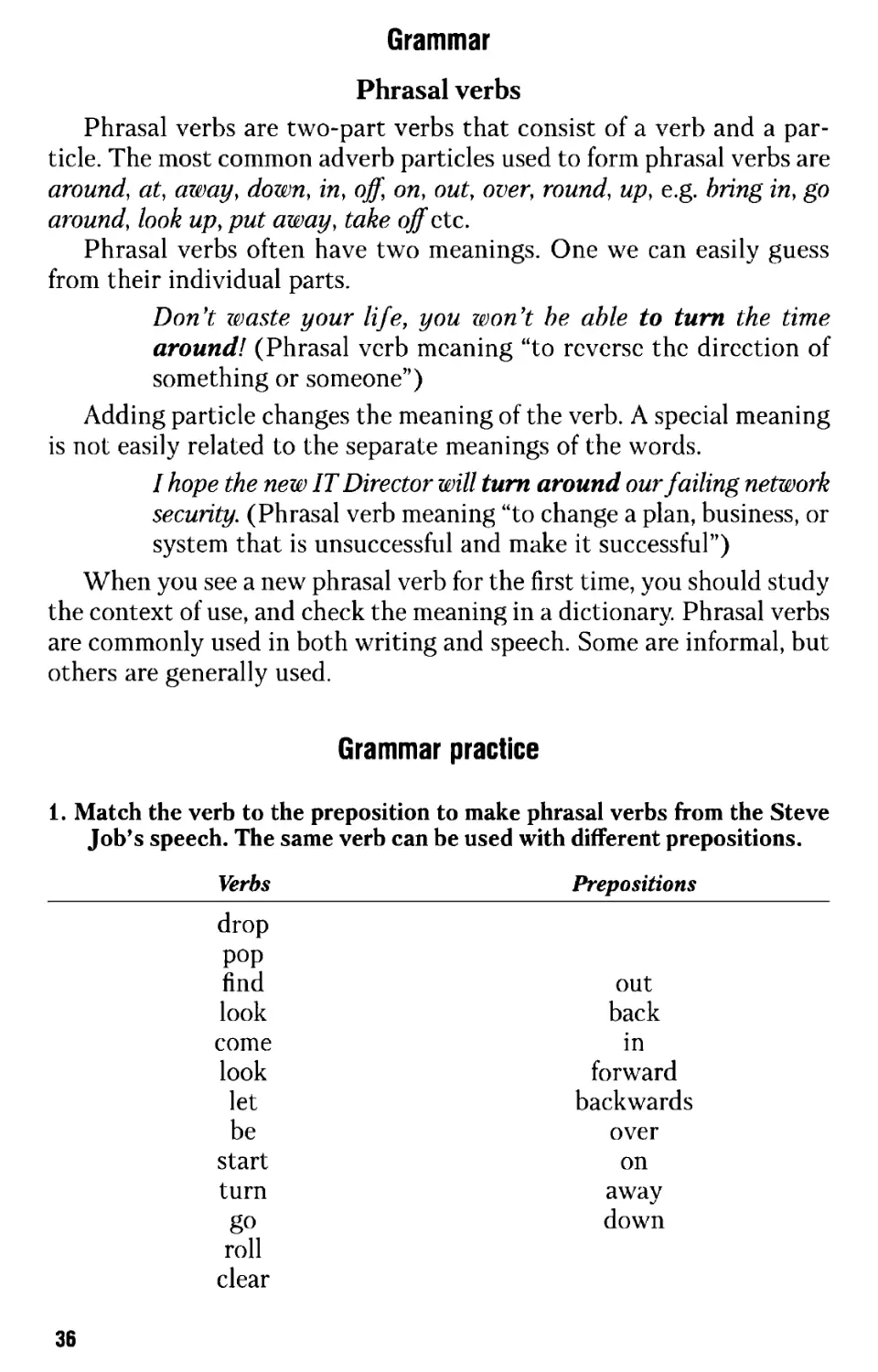




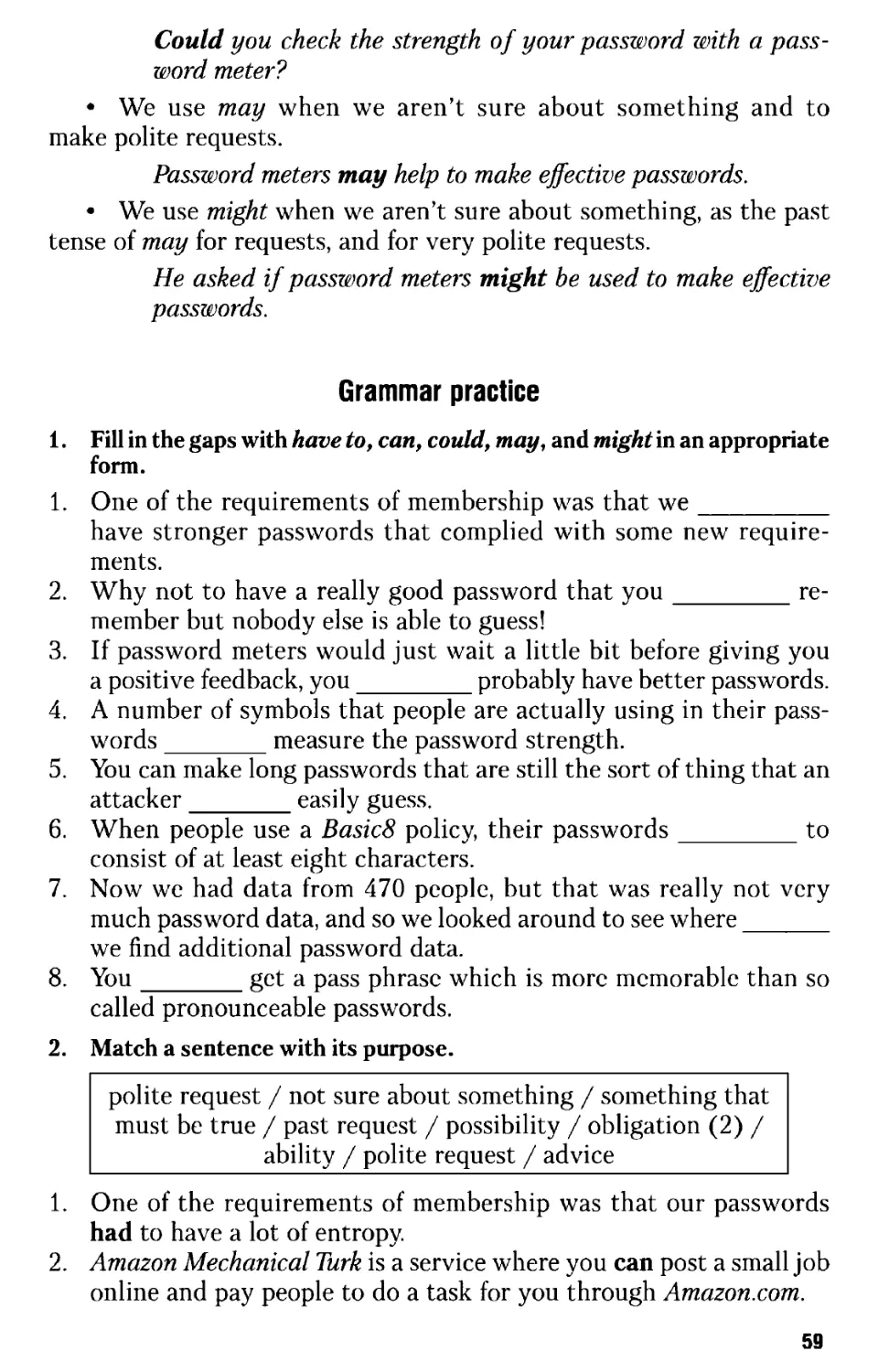


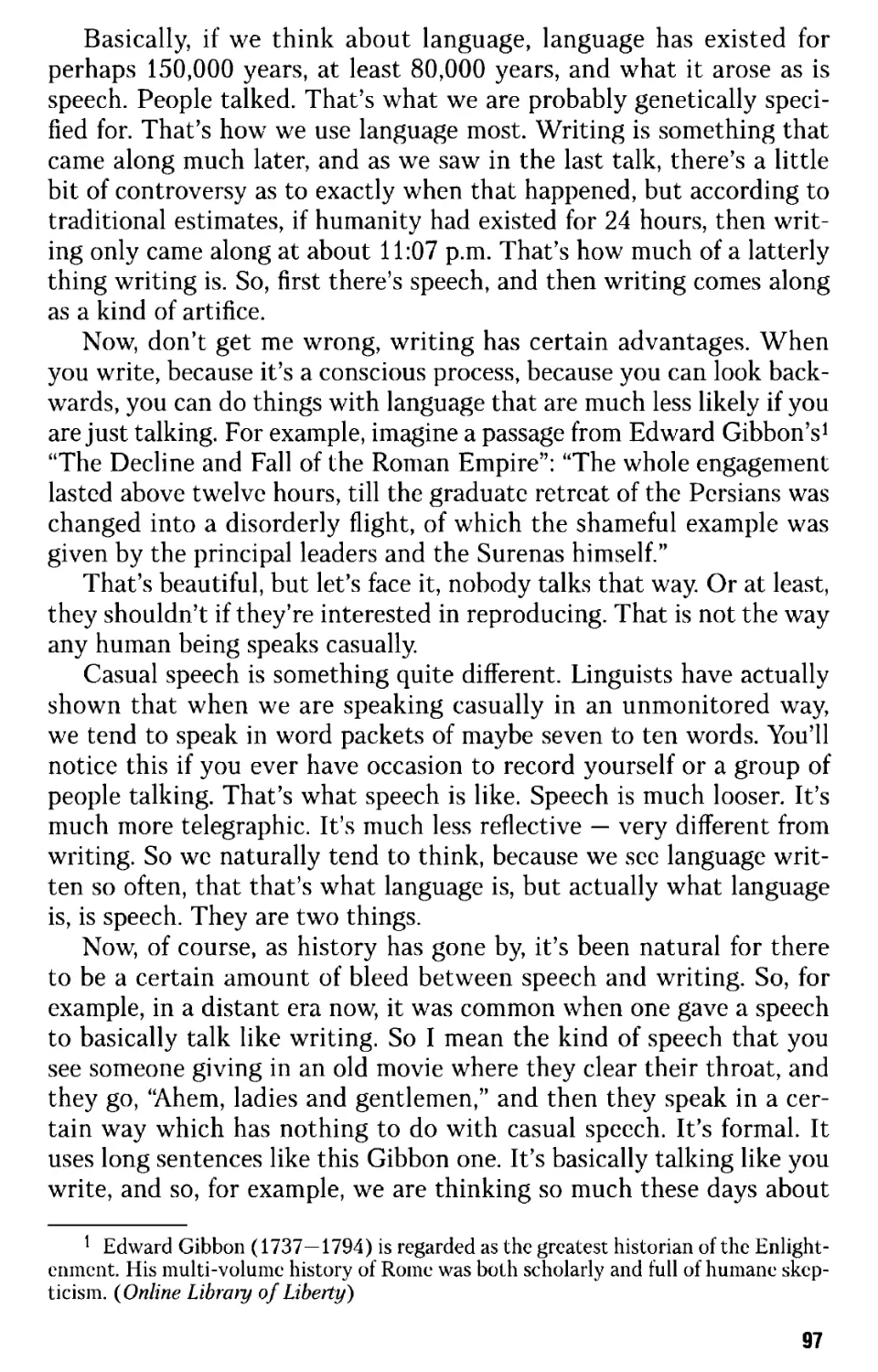








Author: Стогниева О.Н.
Tags: английский язык учебники и учебные пособия по английскому языку
ISBN: 978-5-534-05765-2
Year: 2018

Text
                    0. Н. Стогниева
АНГЛИЙСКИЙ ЯЗЫК
ДЛЯ ИТ-СПЕЦИАЛЬНОСТЕЙ
УЧЕБНОЕ ПОСОБИЕ ДЛЯ СПО
Рекомендовано Учебно-методическим отделом среднего
профессионального образования в качестве учебного
пособия для студентов образовательных учреждений среднего
профессионального образования
Книга доступна в электронной библиотечной системе
biblio-online.ru
Москва  Юрайт  2018
УДК 811.111(075.32)
ББК 81.2Англ-922
С81
Автор'.
Стогниева Ольга Николаевна — доцент, кандидат педагогических наук,
доцент кафедры английского языка для экономических и математических
дисциплин Департамента иностранных языков Национального исследова-
тельского университета «Высшая школа экономики».
Рецензенты'.
Чеснокова Н. Е. — кандидат педагогических наук, старший преподава-
тель кафедры иностранных языков Сургутского государственного универ-
ситета Ханты-Мансийского автономного округа — Югры;
Павловская Г. А. — кандидат педагогических наук, старший препода-
ватель кафедры английского языка для экономических и математических
дисциплин Департамента иностранных языков Национального исследова-
тельского университета «Высшая школа экономики».
Стогниева, О. Н.
С81 Английский язык для ИТ-специальностей : учеб, пособие для СПО /
О. Н. Стогниева. — М. : Издательство Юрайт, 2018. — 143 с. — (Серия :
Профессиональное образование).
ISBN 978-5-534-05765-2
Учебное пособие предназначено для развития навыков аудирования
и говорения в процессе углубленного изучения английского языка для спе-
циальных целей в сфере информационных технологий. Состоит из десяти
уроков, разработанных на основе аутентичных видеоматериалов, охваты-
вающих различные сферы использования современных информационных
технологий. Может быть использовано как для аудиторных занятий, так
и для самостоятельной работы.
Соответствует актуальным требованиям Федерального государствен-
ного образовательного стандарта среднего профессионального образования
и профессиональным требованиям.
Для студентов образовательных учреждений среднего профессио-
нального образования обучающихся по ИТ-специальностям.
УДК 811.111(075.32)
ББК 81.2Англ-922
'r-xlx-'i Все права защищены. Никакая часть данной книги не может быть воспроизведена
I JH	в как°й бы то ни было форме без письменного разрешения владельцев авторских прав.
Delphi Lav»1 Company Правовую поддержку издательства обеспечивает юридическая компания «Дельфи».
© Стогниева О. Н., 2017
ISBN 978-5-534-05765-2	© ООО «Издательство Юрайт», 2018
Contents
Book map ................................................5
Предисловие (Preface)....................................6
I. LESSONS...............................................9
Lesson 1. Can we build Al without losing control over it?
(by Sam Harris)..........................................10
Lesson 2. Five cool uses for a USB flash drive
(by CNET)................................................16
Lesson 3. How does a hard disk work?
(by Computer Tutorials)..................................21
Lesson 4. How the Internet works in five minutes
(by Aaron Titus).........................................28
Lesson 5. How to live before you die
(by Steve Jobs)..........................................33
Lesson 6. The game that can give you ten extra years of life
(by Jane McGonigal)......................................39
Lesson 7. This computer will grow your food in the future
(by Caleb Harper)........................................45
Lesson 8. Txtng is killing language. JK!!!
(by John McWhorter)......................................50
Lesson 9. What’s wrong with your pa$$w0rd?
(by Lorrie Faith Cranor)................................56
Lesson 10. Why massive open online courses (still) matter
(by Anant Agarwal)......................................61
II. TRANSCRIPTS.........................................69
1.	Can we build Al without losing control over it?......70
2.	Five cool uses for a USB flash	drive.................75
3.	How does a hard disk work?...........................76
4.	How the Internet works in five minutes...............78
5.	How to live before you die...........................80
6.	The game that can give you ten extra years of life...84
7.	This computer will grow your food in the future........91
8.	Txtng is killing language. J KI!!.......................96
9.	What’s wrong with your pa$$wOrd?......................101
10.	Why massive open online courses (still) matter.......108
III. KEYS................................................115
APPENDICES...............................................133
Appendix 1.	TED Talks related to Information Technology subject... 133
Appendix 2.	The Internet safety rules....................135
Appendix 3.	Tips for describing bar charts...............136
Appendix 4.	Useful phrases for discussions in pairs and in small
groups...................................................138
Suggested reading........................................140
Book map
Listening / Reading	Vocabulary	Grammar	Speaking	Page
1. Can we build Al without losing control over it?	Artificial Intelligence	Future Perfect for predictions	Benefits and risks of Al	10
2. Five cool uses for a USB flash drive	Flash memory	Zero and first conditionals	USB vs cloud storage	16
3. How does a hard disk work?	Hard disk drive compo- nents	Subordinate clauses	How to pro- tect your hard drive	21
4. How the Internet works in five minutes	The features of the Internet	Object and subject ques- tions	Benefits and risks of the Internet	28
5. Steve Job’s Stan- ford University commencement address	Steve Jobs’ life stories	Phrasal verbs	How to achieve success in life	33
6. The game that can give you 10 extra years of life	Computer games	Wishes and regrets about the past	Benefits of playing com- puter games	39
7. This computer will grow your food in the future	Digital farming	What if for imaginary situations, sug- gestions and possibilities	Benefits of the Food computer	45
8. Txtng is killing language. JK!!!	Texting issues	Adverbs	Texting vs writing and chatting	50
9. What’s wrong with your paSSwOrd?	Password entropy	Modal verbs have to, can, could, may, might	How to make a strong pass- word	56
10. Why massive open online courses (still) matter	Online learning	Present and Past Tenses	Describing bar charts	61
5
Предисловие (Preface)
Данное учебное пособие предназначено для развития навыков
аудирования и говорения у студентов образовательных учрежде-
ний среднего профессионального образования, изучающих англий-
ский язык для специальных целей и имеющих уровень владения
английским языком Intermediate — Advanced (В1/С1).
Пособие состоит их трех частей. В первой части представлены
уроки, разработанные на основе аутентичных видеоматериалов
(лекций TED Talks и эпизодов видео хостинга YouTube), охватыва-
ющих различные сферы использования современных информаци-
онных технологий. Содержание учебного материала соответствует
профессиональным интересам студентов и направлено на вызов
познавательной активности и повышение мотивации к изучению
иностранного языка.
Использование видеоматериалов при изучении английского
языка для ИТ-специальностей дидактически оправдано, так как
это способствует более детальному пониманию принципов дей-
ствия сложных механизмов и процессов, которые невозможно
непосредственно наблюдать, обучению алгоритмам выполнения
различных видов деятельности и организации проведения иссле-
дований, расширению кругозора, укреплению связи обучения
с жизнью за счет использования иностранного языка в профес-
сиональном контексте.
Пособие состоит из десяти уроков. Каждый урок основан
на материале видеолекции (просмотр которой осуществляется
в классе или дома) и организации дальнейшей работы по развитию
навыков аудирования, чтения, а также лексических и грамматиче-
ских навыков говорения.
Каждый урок имеет единую структуру, состоящую из таких
компонентов, как Introduction (представление темы урока, экспо-
зиция), Comprehension (контроль понимания общего и детального
содержания услышанного), Vocabulary (упражнения, нацеленные
на овладение новыми лексическими единицами, при этом часть
упражнений возможно выполнять онлайн), Grammar & Gram-
mar Practice (презентация грамматического явления и развитие
грамматического навыка), Discussion (задания на развитие рече-
6
вого умения, которые могут выполняться как в мини-группах, так
и в парах). В целом упражнения каждого урока направлены на рас-
ширение словарного запаса учащихся, обучение общему и деталь-
ному пониманию иноязычной речи, развитие навыков говорения.
Во второй части пособия представлены ключи к заданиям,
которые целесообразно использовать в процессе самоконтроля,
если учебное пособие используется для самостоятельной работы
студентов. Отметим, что для заданий по поиску слов ответы при-
ведены к тому набору букв, который дается в учебнике, так как
при выполнении задания онлайн буквы каждый раз генерируются
случайным образом.
В целях более детального понимания содержания видсолекций
в третью часть пособия включены их полные тексты.
В результате изучения представленного в пособии учебного
материала студент должен освоить:
трудовые действия
•	владеть лингвистическими навыками в объеме, необходимом
для получения информации из аутентичных источников;
•	навыками выражения своих мыслей и мнения в межлич-
ностном и деловом общении на иностранном языке;
•	приемами эффективной работы в парах и группах;
•	приемами самостоятельной работы с аутентичным лекцион-
ными материалами с целью собственного интеллектуального раз-
вития, повышения культурного уровня, профессиональной компе-
тенции;
необходимые умения
•	в области аудирования: воспринимать па слух аутентичные
научные и научно-популярные лекции, относящиеся к теме инфор-
мационных технологий (длительность звучания 5—15 минут);
извлекать общую и детальную информацию из услышанного;
•	в области чтения: понимать содержание аутентичных науч-
ных и научно-популярных текстов (объемом до 2600 слов); извле-
кать общую и детальную информацию из прочитанного;
•	в области говорения: вести/поддерживать диалог-расспрос
о содержании лекции, соблюдая нормы речевого этикета, при
необходимости использовать стратегии преодоления трудностей
в процессе коммуникации (переспрос, перефразирование и др.);
расспрашивать собеседника, задавать вопросы и отвечать на них,
высказывать свое мнение; принимать участие в обсуждении проб-
лемы;
необходимые знания
•	общую и профессиональную лексику в рамках обозначенных
тем;
7
•	грамматические явления, соответствующие современным
нормам английского языка, в рамках обозначенных тем;
•	факты иноязычной культуры, упоминающиеся в лекциях
учебного пособия;
•	основные ресурсы, с помощью которых можно эффективно
компенсировать недостающие умения в английском языке (сло-
вари, справочники, компьютерные программы, обучающие сайты).
Пособие предназначено как для аудиторных занятий, так и для
самостоятельной работы студентов.
I. LESSONS
Lesson 1
CAN WE BUILD Al WITHOUT LOSING CONTROL
OVER IT?
(by Sam Harris)
Scared of superintelligent Al? Sam Harris neuroscientist and phi-
losopher says that you should be, and not just in some theoretical
way We are going to build superhuman machines, says Harris, but we
haven’t yet grappled with the problems associated with creating some-
thing that may treat us the way we treat ants.
TED Talk for this lesson is available at: https://www.ted.com/talks/
sam_harris_can_we_build_ai_without_losing_control_over_it
Intro
•	Can Artificial Intelligence exist?
•	Can Artificial Intelligence become self-aware?
•	Can Artificial Intelligence learn?
•	Can Artificial Intelligence replace humans?
•	How close can we get to Artificial Intelligence being a replica of
the human brain? What is the best way to design it to get there?
Comprehension
Watch the video and answer the questions.
1.	What is Sam Harris’s professional background?
2.	What are the two possible options in the development of Al?
3.	What is Sam Harris’s concern about building machines that are
much more clever than people?
4.	What example did Harris give to illustrate how machines can treat
people?
5.	At what level of intelligence can machines perform now?
6.	Why according to Sam Harris is Al inevitable?
7.	What are the possible benefits and risks of superintelligent Al?
10
8.	We are told not to worry about AL What are the reasons for that?
9.	What problem may cause building superintelligent Al integrated
with human mind?
10.	What solution to this problem does Harris offer?
	Vocabulary
1. Match the words with their definitions.
1. intelligence	A. the ability to think flexibly and transfer learning from one domain to other domains
2. general intelligence	B. an intellect that is much smarter than the best human brains in practically every field, including scientific creativity, general wisdom and social skills
3. Artificial Intelligence	C. the ability to perceive information and to retain it as knowledge to be applied to- wards adaptive behaviors within an envi- ronment or context
4. superintelligence	D. the science and engineering of making in- telligent machines, especially intelligent computer programs that perform tasks that can normally only be done by human in- telligence such as “learning” and “problem solving”
5. far-fetched	E. out of control with anger or excitement
6. exponential progress	E an uneasy feeling of doubt, worry, or fear, especially about one’s own conduct
7. oracle	G. a large spacecraft or ship from which small- er craft are launched or maintained
8. mothership	H. a complex system of nerves and networks in the brain, it controls the basic emotions (fear, pleasure, anger) and drives (hunger, sex, dominance, care of offspring)
9. prudent	I. hard menial or dull work
10. limbic system	J. increase in number or size, at a constantly growing rate
11. breakthrough	K. certain to happen; unavoidable
11
12. berserk	L. very unlikely to be true
13. qualm	M. someone who knows a lot about a subject and can give good advice
14. inevitable	N. sudden, dramatic, and important discovery or development
15. drudgery	O. acting with or showing care and thought for the future
2. Practice the words online:
https://quizlet.com/215445232/can-we-build-ai-without-losing-
control-over-it-flash-cards/
3. Fill in the gaps with the words from Ex.l.
1.	Whenever their (ants’) presence seriously conflicts with one of our
goals, let’s say when constructing a building like this one, we an-
nihilate them without a.
2.	Now, I suspect this seems to many of you.
3.	I bet there are those of you who doubt that is possible,
much less________.
4.	We know that mere matter can give rise to what is called,
an ability to think flexibly across multiple domains, because our
brains have managed it.
5.	________is a matter of information processing in physical systems.
6.	It can design the machine that can build the machine that can
do any physical work, so we are talking about the end of human
7.	Stuart Russell is regarded as the on Artificial Intelligence.
8.	So it seems that even mere rumors of this kind of could
cause our species to go_______.
9.	Now we are just counting down the months until the lands.
10.	The safest and only________path forward is to implant this tech-
nology directly into our brains.
3. Solve the clues and the puzzle.
1. A thing that is accepted as true or as certain to happen, with-
out proof. 2. Development towards an improved or more advanced
condition. 3. Any device that transmits a force or directs its applica-
tion. 4. The application of scientific knowledge for practical purposes,
especially in industry. 5. Acting with or showing care and thought for
the future. 6. The ability to perceive information, and to retain it as
knowledge to be applied towards adaptive behaviors within an envi-
ronment or context. 7. The society, culture, and way of life of a par-
12
ticular area. 8. Hard menial or dull work. 9. Increase in number or size,
at a constantly growing rate. 10. Out of control with anger or excite-
ment. 11. Made or produced by human beings rather than occurring
naturally. 12. A person who carries out academic or scientific research.
13. An uneasy feeling of doubt, worry, or fear, especially about one’s
own conduct. 14. Sudden, dramatic, and important discovery or devel-
opment. 15. A large spacecraft or ship from which smaller craft are
launched or maintained. 16. Someone who knows a lot about a subject
and can give good advice. 17. A postulated sequence or development
of events.
Grammar
Predictions: Future Perfect and it in subject position
The Future Perfect is used to predict actions, which will be com-
pleted before a particular time in the future. It is often used with time
expressions such as by 2020, before the end of the century. For example:
By 2050, scientists will have designed AL
The strength of predictions can be varied by using the certainty
verbs like may/might/could instead of will. For example:
13
By 2070 the researchers may/might/could have implanted Al
chips directly into human brain.
The predictions can also be made by using it in subject position
when the true subject of the prediction is that clause. For example:
It’s likely that Al will share our values because it is literally
extension of ourselves.
It’s possible that Al will destroy human civilization.
Grammar practice
1.	Make predictions for 2050 about Al for each of the following items using
the rules given above. You may wish to use these verbs: use, become,
design, build, replace, wage, disappear, implant, and perform.
•	Computers software
•	Superintelligence
•	Artificial Intelligence
•	General intelligence
•	Human intelligence
•	Superintelligent Al/computers/machines
•	Al technology
2.	Put the verbs in brackets into the Future Perfect.
1.	By 2018 Al__________(be) your physician able to prescribe medica-
tion through machine-learning algorithms.
2.	By 2019 Al(resolve) 90 % disagreements among eBay
traders using “online dispute resolution.”
3.	By 2020 Al__________(do) virtual drug screening using machine-
learning algorithms called neural networks.
4.	By 2021 Al(provide) personalized tutoring and real-time
feedback for the schoolchildren.
5.	By 2022 Al__________(become) a high-tech personal chef with a da-
tabase of 2,000 recipes.
6.	By 2025 Al (create) a human-like character who can
think, act, react, and interact in a natural way, using both verbal
and nonverbal communication.
Discussion
Read the opinions of different people about Al:
“Al is being developed in numerous fields, such as driverless trans-
port, finance, fraud detection, as well as robotics and text and speech
14
recognition for numerous other applications. Supporters of Al suggest
that it is a massive opportunity for humanity, not a threat, and argue
that machines which can learn to do tasks currently requiring humans
could speed up processes, allowing humans more leisure time in the
future. However, critics worry that if we develop machines that can
learn very rapidly, drive our cars and do our jobs, we may reach a situ-
ation where they become more intelligent than humans.”1
In pairs or in small groups discuss the following question:
Should humanity fear advances in Artificial Intelligence?
Where do you stand? Choose one side only — for or against the
statement. Note down the points in support of your side. Using your
notes try to persuade your partner to accept your views on the state-
ment.
For the statement	Against the statement
1.	1.
2.	2.
3.	3.
4.	4.
1 Lyons R. Artificial Intelligence // Debating Matters. 2016. May. URL: http://
www.dcbatingmattcrs.com/documcnts/DM_Topic_Guidcs_Artificial_Intclligcncc_
pdfl.pdf
Lesson 2
FIVE COOL USES FOR A USB FLASH DRIVE
(by CNET)
Flash memory is a type of non-volatile memory that can be elec-
tronically erased and reprogrammed. Its name was invented by Toshiba
to express how much faster it could be erased — “in a flash”, which
means “very quickly”
The video for this lesson is available at: https://youtu.be/
wGcn3RnnqTc
Intro
•	What is flash memory?
•	Is it volatile or non-volatile?
•	In what portable devices is it used?
•	Do you often use a USB flash drive? What for?
Comprehension
Watch the video and fill in the table with the five possible applications of
a USB flash drive and software required.
An applications of a USB flash drive	Required software


16
	Vocabulary
1. Match the words with their definitions.
1. virus	A. general term for the various kinds of pro- grams used to operate computers and re- lated devices
2. USB flash drive	B. able to be transferred from one machine or system to another
3. password	C. a piece of software that attaches itself to a file. Once you run an infected program, it quickly spreads to the system files and other software and destroy the content of hard disks
4. software	D. software which is specifically designed to disrupt, damage, or gain authorized access to a computer system a piece of software that attaches itself to a file
5. malware	E. a sequence of characters (letters, numbers, symbols) used as a secret key for accessing a computer system or network
6. portable	E to place or fix software in position ready for use
7. to install	G. to copy data from one computer system to another, typically over the Internet
8. to download	H. the process of saving and transmitting data in encoded form
9. encryption	I. a small, portable flash memory card that plugs into a computer’s USB port and functions as a portable hard drive
2. Practice the words online:
https://quizlet.com/215501729/five-cool-uses-for-a-usb-flash-
drive-flash-cards/
17
3. Complete the word search task online following the link http://www.
proprofs.com/games/word-search/five-cool-uses-for-a-usb-flash-drive/
or in your course book.
J	R	w	D	R	О	W	s	s	A	P	C
R	A	Q	F	P	F	Y	о	в	E	P	H
О	A	Y	C	L	Y	F	H	R	F	z	U
T	В	L	К	H	T	S	A	M	S	N	X	PORTABLE ACCESS
A	E	M	E	W	I	W	R	s	L	S	L	UNLOCK PASSWORD
D	F	L	A	N	L	X	E	о	H	M	L	USB
E	H	R	В	A	C	c	C	в	S	и	A	PREDATOR MALWARE
R	E	Q	M	A	C	к	J	в	A	M	T	SOFTWARE FLASH
P	G	H	z	A	T	p	V	z	L	p	S	INSTALL
Q	T	Q	X	I	J	R	D	L	F	в	N
R	J	Y	p	J	Y	О	О	D	N	F	I
Q	u	W	D	X	N	V	X	P	H	R	H
2. Complete the sentences with the missed words from the word search
task.
1.	If you have a drive, it is probably because you
need a way to carry your files and documents around with you.
2.	The secret agent in all of us will love this first trick, which lets you
use your USB drive to lock and your computer.
3.	Once you get the on your drive, you will be able to
choose which apps you want to on it.
4.	Truecrypt is a free program that will encrypt or scramble the data
of your USB drive and protect it with a secure only you
know.
5.	AVG will scan your computer for and hopefully get you
back to work in no time.
6.	Your computer will deny to anyone who doesn’t have
the USB drive or your unique.
7.	More than your tablet or smartphone your USB drive
can run applications too. You can carry around programs like
Firefox, Chrome and Open Office and use your drive to run them on
any computer.
18
Grammar
Zero and First conditionals
Sentences with if where one event depends on another event are
called conditionals. The if... clause is the condition and the other part
of the sentence is the result.
Zero conditional:
if + Present Simple, ... Present Simple.
Zero conditional is used to describe things that are always or gener-
ally true. We can use when or if to introduce the sentence:
If you lose a USB flash drive, your data may he stolen.
An imperative structure may be used in the result clause:
If your USB device is not detected, try to reconnect the device.
First conditional:
if + Present Simple,... will/won’t...
First conditional is used to describe future events that will happen
or likely to happen. The event is real possibility in the speaker’s mind,
not imaginary.
If you use a unique password, your computer will be locked for
unauthorized usage.
Grammar practice
1.	Make sentences with if Start a new sentence with the ending of the
previous one.
•	carry documents, photos and music around
Example'. If I have a flash drive, I will carry my documents,
photos and music around with me.
•	encrypt the information
Example'. If I carry my documents, photos and music around
with me, I will encrypt the information on a flash drive.
•	sensitive information is safe in case of loss or theft
•	nobody uses information for harmful purposes
•	information remains secure
•	lam happy and confident
2.	Read the examples of if clauses and tell if it is Zero or First conditional.
1.	If you have a USB flash drive, you will probably need a way to
carry your files and documents around with you.
19
2.	If you are like me, you have a drawer full of drives from marketers
at conventions and events.
3.	If you are hit with the virus that renders your system, scan your
computer for malware.
4.	If all you want to do is use this thing for storing data, don’t forget
to encrypt it, especially if you have top secret information on your
drive.
5.	If you lose this flash drive, your information will remain secure.
6.	If you have any ideas we missed, tweet me.
Discussion
In pairs or in small groups discuss the following questions.
•	What are the pros and cons of USB flash drives vs cloud storage
according to their cost, security, service life, reliability, etc.?
•	Which application of a USB flash drive do you find the most
demanded?
•	Choose a flash-based device that you own and describe it.
Lesson 3
HOW DOES A HARD DISK WORK?
(by Computer Tutorials)
“A hard disk drive (sometimes abbreviated as Hard drive, HD, or
HDD) is a non-volatile memory hardware device that permanently
stores and retrieves data on a computer. A hard drive consists of one
or more platters to which data is written using a magnetic head, all
inside of an air-sealed casing. The desktop hard drive consists of the
head actuator, read/write actuator arm, read/write head, spindle, and
platter coated with magnetic material. On the back of a hard drive is
a circuit board called the disk controller or interface board and is what
allows the hard drive to communicate with the computer.”1
The video lecture for this lesson is available at: https://youtu.be/
4iaxOUYalJU
Intro
•	What is the internal hard drive?
•	What is it used for?
•	What is the largest storage capacity of a hard disk at present?
•	Can lost data from a hard drive be recovered?
•	Why should you format your hard drive?
Comprehension
Watch the video and answer the questions.
1.	How is data written and read on the platter?
2.	What makes the arm move?
3.	How does Faraday’s law work in the hard drive?
4.	What is the gap between the head and the disk surface?
5.	What is the function of a recirculating filter?
1 Hard drive // Computer Hope. 26.04.2017. URL: https://www.computerhope.
com/jargon/h/harddriv.htm
21
6.	What is the key element of the platter?
7.	What is coercivity?
8.	How can the information on the disk be squeezed up to 40%?
Vocabulary
1. Label the parts of the hard drive mentioned in the video
2. Match the words with their definitions.
1. coercivity	A. the force exerted on a charged particle q moving with velocity v through an elec- tric E and magnetic field В
2. filter	В. a magnetic plate, or disk, that constitutes part of a hard drive
3. nanometer	C. writing information on a disk or storage area
4. binary	D. information in electronic form that can be stored and processed by a computer
5. actuator	E. a mechanical device for moving or control- ling something
6. magnetization	E the resistance of a magnetic material to changes in magnetization, equivalent to the field intensity necessary to demagne- tize the fully magnetized material
22
7. Lorentz force	G. the process of making a substance magnet- ic by insertion in a magnetic field
8. data	H. relating to a system of encoding data using O’s and l’s
9. platter	I. a device that is used to remove something unwanted from a liquid, gas or surface
10. record	J. one billionth of a meter
3. Practice the words online:
https://quizlet.com/215541118/how-does-a-hard-disk-work-flash-
cards/
4. Solve the crossword online following the link: https://www.proprofs.
com/games/crossword/a-hard-disk-drive-hdd/ or in your course book
Across
1.	A mechanical device for moving or controlling something.
2.	The resistance of a magnetic material to changes in magnetization,
equivalent to the field intensity necessary to demagnetize the fully
magnetized material.
23
3.	Relating to a system of encoding data using 0’s and l’s.
4.	A device that is used to remove something unwanted from a liquid,
gas or surface.
5.	One billionth of a meter.
6.	Information in electronic form that can be stored and processed by
a computer.
Down
1.	The process of making a substance magnetic by insertion in a mag-
netic field.
2.	The force exerted on a charged particle q moving with velocity
v through an electric E and magnetic field B.
3.	A magnetic plate, or disk, that constitutes part of a hard drive.
4.	Writing information on a disk or storage area.
5.	Watch the video again. While watching fill in the gaps with the missing
words.
As a whole computer is a powerful tool but it must (1)_________
_______reliably to work well. Otherwise, it’s kind of pointless, isn’t it?
Let’s look inside and see how it stores data. It’s an ordinary hard drive
but its details, of course, are (2). Now I am sure you know
the (3)of hard drive. We store data on it in (4)
form, ones and zeros. Now this (5)supports a (6),
which is an electromagnet that scans over the disc and either writes
data by changing the magnetization of specific sections on the (7)
or it just (8)the data by measuring the mag-
netic polarization. In (9)_______pretty simple but in (10)________
a lot of hardcore engineering. The key focus lies in being sure that
the head can precisely, (11)__________read and write to the disk.
The first order of business is to move it with great control. To posi-
tion the arm engineers use a voice coil actuator. The base of the arm
sits between two (12)______________. They are so strong they’re are
actually kind of hard to pull apart. There. The arm moves because of
the Lorentz (13)________: pass a current through wire that’s in a the
geomagnetic field, and the wire experiences a force. (14)the
current, and the force also reverses. As current flows in one direction
in the coil, the force created by the (15)magnet makes the
arm move this way. Reverse the current, and it moves back. The force
of the arm is directly proportional to the (16)through the
coil, which allows the arm’s position to be (17). Unlike
a mechanical system of linkages, there is minimal wear and it isn’t
sensitive to temperature. At the end of the arm lies the most (18)
______________, the head. At it’s simplest it’s a piece of ferromagnetic
material wrapped with wire. As it passes over the magnetized sections
24
of the platter, it measures changes in the direction of the magnetic
(19)__________. We call it Faraday’s law. A change in (20)_________
produces a voltage in a nearby coil. So as the head passes a section
where the polarity has changed, it records a voltage spike. The spike’s
both negative and positive represent a one, and where there is no
voltage spike corresponds to a zero. The head gets astonishingly close
to the disk surface. A hundred nanometers in older drives, but today
under (21)__________in the newest ones. As the head gets closer to
the disc, its magnetic field covers less area allowing for more (22)
_________of information to be packed onto the disk surface. To keep
that critical height engineers use an ingenious method. They float the
head over the disk. You see, as the disk spins, it forms a boundary layer
of air that gets dragged past the stationary head at (23)________at
the outer edge. The head rides on a slider aerodynamically designed
to float above the platter and the (24)of this air bearing
technology is its self-induced adjustment. If any disturbance causes
the slider to rise too high, it floats back to where it should be. Now
because the head is so close to the disk (25)_______, any stray par-
ticles could damage the disc, resulting in (26). So engi-
neers place this recirculating filter in the airflow. It removes small
(27)__________scraped off the platter. To keep the head flying at the
right height the platter is made incredibly (28)________. Typically,
this platter is so smooth that it has a surface roughness of about (29)
. To give you an idea of how smooth that is, let’s imag-
ine that this section is enlarged until it is as long as a football field
American or International. The average bump on the surface would
be about three hundredths of an inch. The key element of the platter
is (30)_______________, which is cobalt with perhaps (31)__________
and (32)mixed in. Now this mixture of metals has high coer-
civity, which means that it will maintain that magnetization and thus
data until it’s exposed to another powerful magnetic field. One last
thing that I find enormously clever using a bit of math to squeeze up
to (33)percent more information on the disk. Consider this
sequence of magnetic poles on the disk surface 0 1 0 1 1 1. A scan by
the head would (34)__________these distinct voltage spikes both (35)
or for the ones. We would be easily able to dis-
tinguish it from, say, this similar sequence. If we compare them, they
clearly differ. Engineers, though, always work to get more and more
data onto a hard drive. One way to do this is (36)____the magnetic
domains, but look what happens to the voltage spikes when we do
this. For each sequence, the spikes of the ones now overlap and super-
impose giving fuzzy signals. In fact the two sequences now look very
(37). Using a technique called “partial (38)maxi-
25
mum likelihood” engineers have developed (39)codes that
can take a murky signal like this, (40)the possible sequences
that could make it up and then choose the most probable. As with
any successful technology, these hard drives remain unnoticed in our
daily lives unless something goes wrong.
Grammar
The Subordinate Clause
Subordination is used to combine two ideas in a single sentence.
For example:
Most PC's have an internal hard drive. It is used to store the
operating system, the programs and the user's files. => Most
PC’s have an internal hard drive that is used to store the oper-
ating system, the programs and the user's files.
A subordinate (or dependent) clause begins with a subordinate con-
junction or a relative pronoun and contains a subject and a verb. Still,
it’s not a complete sentence, it doesn’t contain a complete thought.
Subordinate Conjunctions	Relative Pronouns
After, although, as, because, before, even, even though, if, in order that, once, provided that, rather than, since, so that, that, than, though, unless, unlike, until, when, whenever, where, whereas, whether, while, why	That, which, whichever, who, whoever, whom, whose, whom- ever
Grammar practice
Fill in the gaps with subordinate conjunctions and relative pronouns: as, un-
like, because, until, unless, which (each word can be used more than once).
1.	current flows in one direction in the coil, the force cre-
ated by the permanent magnet makes the arm move this way.
2.	The force of the arm is directly proportional to the current through
the coil,allows the arm’s position to be finely tuned.
3.	a mechanical system of linkages, there is minimal wear
and it isn’t sensitive to temperature.
4.	it passes over the magnetized sections of the platter, it
measures changes in the direction of the magnetic poles.
26
5.____________________the head gets closer to the disc, its magnetic field covers
less area allowing for more sectors of information to be packed onto
the disk surface.
6.	the head is so close to the disk surface, any stray particles
could damage the disc, resulting in data loss
7.	This mixture of metals has high coercivity,means that it
will maintain that magnetization and thus data_______it’s ex-
posed to another powerful magnetic field.
8.____________________with any successful technology, these hard drives remain
unnoticed in our daily lives something goes wrong.
Discussion
In pairs or in small groups discuss the following questions:
•	As Bill Hammack mentions in the video, the hard drive remains
unnoticed in our daily life unless something goes wrong. It is a sophis-
ticated but fragile device. How can you protect your hard drive? Make
a poster with some useful tips and share it with other students in your
class.
•	What should you consider when thinking about upgrading or
buying a new computer hard drive?
•	What should be done to minimize the risk of data loss or corrup-
tion?
Lesson 4
HOW THE INTERNET WORKS IN FIVE MINUTES
(by Aaron Titus)
We are still at the very beginnings of the Internet. Let’s use it wisely.
(Jimmy Wales, the co-founder of Wikipedia).
The video lecture for this lesson is available at: https://www.
youtube.com/watch?v=7_LPdttKXPc
Intro
•	How old is the Internet? When was it created?
•	Who created the Internet?
•	Did the Internet become popular quickly?
•	How do you get online?
Comprehension
Watch the video. Mark the statements true (T) or false (F). Correct the
false sentences.
1.	Normally about 20% of people understand how the Internet actu-
ally works.
2.	The Internet is a cloud buried in the ground.
3.	A server is a special computer connected directly to the Internet.
4.	Every server has a unique Internet protocol address, or ID address.
5.	Your computer at home is a server because it is connected directly
to the Internet.
6.	Computers we use every day arc called clients because they are con-
nected indirectly to the Internet through an Internet service provider.
7.	aol.com is ISP only.
8.	Whenever an email, picture or webpage travels across the Internet,
computers break the information into smaller pieces called pockets.
9.	When information reaches its destination, the packets are reassembled
in their original order to make a picture, email, webpage or tweet.
10.	Anywhere two or more parts of the Internet intersect, there’s an IP
address.
28
Vocabulary
1. What do the acronyms stand for?
IP, DSL, ISP, AOL.
2. Match the words with their definitions.
1. server	A. an organization that provides services for accessing and using the Internet, which include Internet access, Internet transit, domain name registration etc.
2. client	B. a technology used to create high-band- width network connections over standard telephone lines, often in providing Internet service to homes
3. IP address	C. an American multinational mass media corporation, originally provided a dial-up service to millions of Americans, as well as providing a web portal, e-mail, instant messaging
4. digital subscrib- er line	D. an individual document on the Web, iden- tified by its own unique URL. It contains different elements, such as text, picture, video, links, etc.
5. Internet service provider	E. a networking device that forwards data packets between computer networks. It performs the traffic directing functions on the Internet
6. America Online	E a computer program or a device that ac- cepts and responds to requests made by another program, known as a client
7. coincidentally	G. a segment of data sent from one computer or device to another over a network. It contains the source, destination, size, type, data, and other useful information that helps packet get to its destination
8. webpage	H. a number which identifies a computer and distinguishes it from other computers on the Internet
9. router	I. happening by chance
29
10. packet	J. an application that runs on a personal com- puter or workstation and relies on a server to perform some operations
3. Practice the words online:
https://quizlet.com/215772408/how-the-internet-works-in-five-
minutes-flash-cards/
4. Complete the word search task online following the link http://www.
proprofs.com/games/word-search/the-Intemet-3/ or in your course
book.
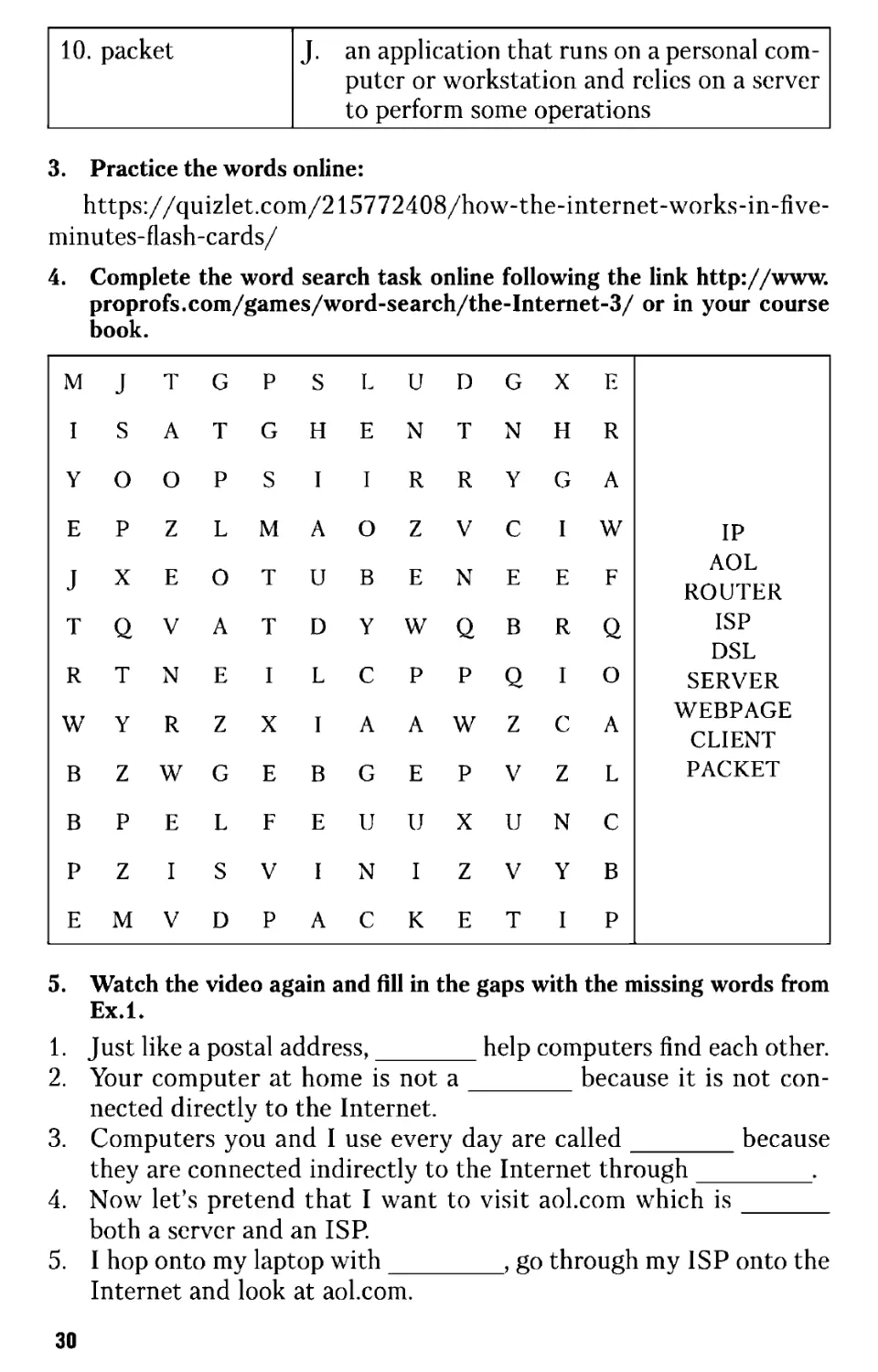
M I	J s	T A	G T	P G	s H	L E	u N	D T	G N	X H	E R
Y	о	О	P	S	I	I	R	R	Y	G	A
E	p	z	L	M	A	О	Z	V	C	I	W	IP
J	X	E	О	T	U	В	E	N	E	E	F	AOL ROUTER
T	Q	V	A	T	D	Y	W	Q	В	R	Q	ISP DSL
R	T	N	E	I	L	C	P	p	Q	I	о	SERVER WEBPAGE
W	Y	R	Z	X	I	A	A	w	z	C	A	CLIENT
В	Z	W	G	E	В	G	E	p	V	z	L	PACKET
в	P	E	L	F	E	U	U	X	и	N	C
p	z	I	S	V	I	N	I	z	V	Y	В
E	M	V	D	P	A	C	К	E	T	I	P
5. Watch the video again and fill in the gaps with the missing words from
Ex.l.
1.	Just like a postal address,help computers find each other.
2.	Your computer at home is not a because it is not con-
nected directly to the Internet.
3.	Computers you and I use every day are called because
they are connected indirectly to the Internet through.
4.	Now let’s pretend that I want to visit aol.com which is
both a server and an ISP.
5.	I hop onto my laptop with, go through my ISP onto the
Internet and look at aol.com.
30
6.	The next day Aunt Ruth dials into servers and retrieves
the email.
7.	Whenever an email picture or___________travels across the Internet,
computers break the information into smaller pieces called packets.
8.	You arc both sending_________back and forth over the Internet, but
what’s to keep your from accidentally ending up on your
boss’s screen?
9.	___________direct your packets around the Internet helping each
packet get one step closer to its destination.
Grammar
Questions
In questions, the auxiliary verb is placed before the subject.
Are you part of any social networks like Facebook or Google+?
If there is no other auxiliary, do or does (Present Simple) or did
(Past Simple) is used.
Did the Internet become popular quickly?
To find out more or different information, question words can be
added: who (for people), what/which (for things), when, how often (for
time), how much (for quantity), where (for places), why (for reasons)
and how (for manner).
What are some of the benefits of the Internet?
How much time do you spend on the Internet?
Why is it important to follow the Internet safety rules?
If who, what or which is the subject of the question, it comes before
the verb, and do as an auxiliary verb is not used.
Who created the Internet? (Subject — who)
What happened to the Internet connection? (Subject — what)
Object questions follow the normal structure.
What sort of Internet connection do they have? (Subject —
they, object — what)
Grammar practice
1. Make questions using these prompts, then practice asking and answering
the questions with your partner.
1.	How much time / spend / the Internet / every day?
2.	What / you / use / the Internet?
31
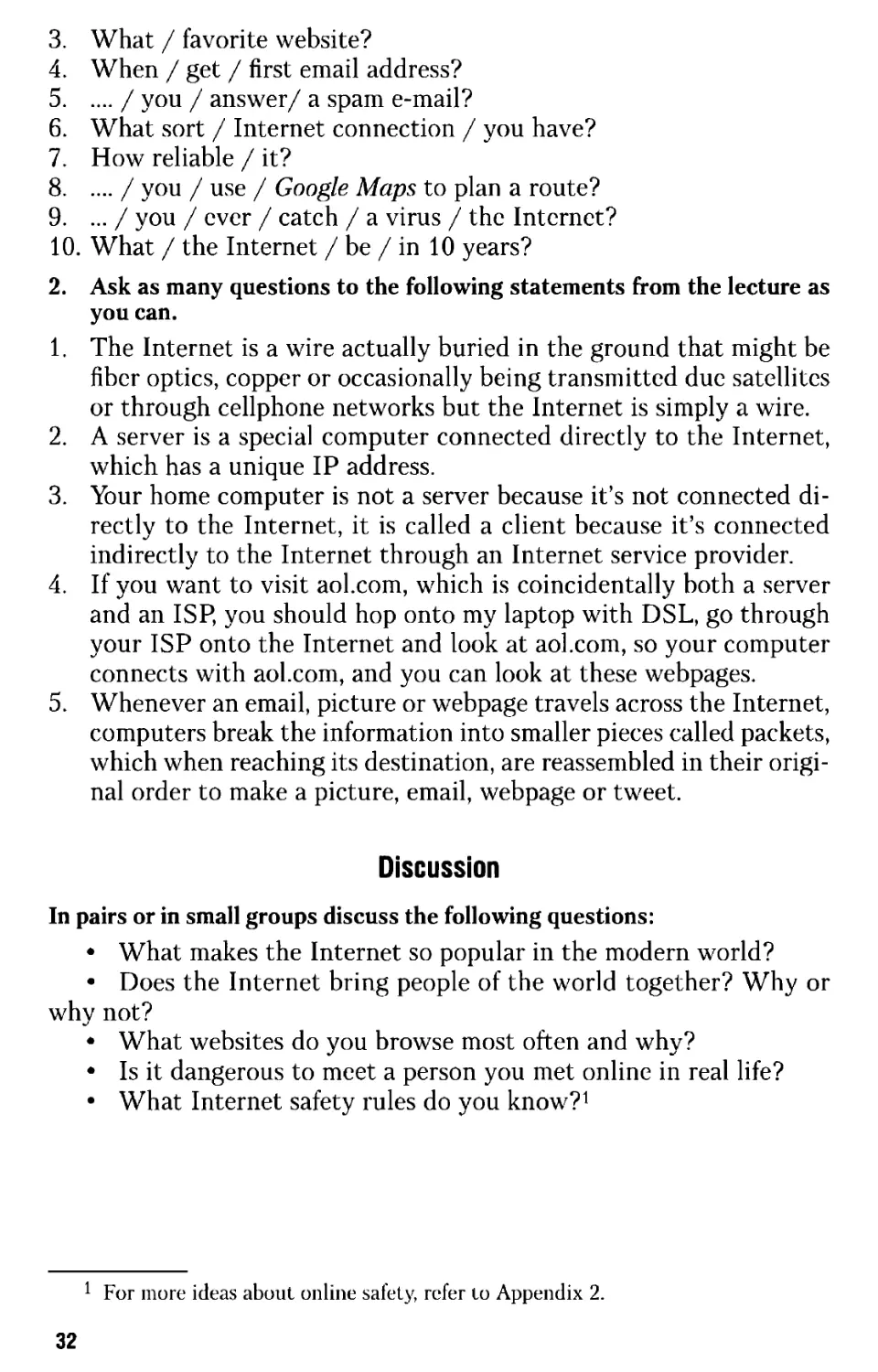
3.	What / favorite website?
4.	When / get / first email address?
5	/ you / answer/ a spam e-mail?
6.	What sort / Internet connection / you have?
7.	How reliable / it?
8	/ you / use / Google Maps to plan a route?
9.	... / you / ever / catch / a virus / the Internet?
10.	What / the Internet / be / in 10 years?
2. Ask as many questions to the following statements from the lecture as
you can.
1.	The Internet is a wire actually buried in the ground that might be
fiber optics, copper or occasionally being transmitted due satellites
or through cellphone networks but the Internet is simply a wire.
2.	A server is a special computer connected directly to the Internet,
which has a unique IP address.
3.	Your home computer is not a server because it’s not connected di-
rectly to the Internet, it is called a client because it’s connected
indirectly to the Internet through an Internet service provider.
4.	If you want to visit aol.com, which is coincidentally both a server
and an ISP, you should hop onto my laptop with DSL, go through
your ISP onto the Internet and look at aol.com, so your computer
connects with aol.com, and you can look at these webpages.
5.	Whenever an email, picture or webpage travels across the Internet,
computers break the information into smaller pieces called packets,
which when reaching its destination, are reassembled in their origi-
nal order to make a picture, email, webpage or tweet.
Discussion
In pairs or in small groups discuss the following questions:
•	What makes the Internet so popular in the modern world?
•	Does the Internet bring people of the world together? Why or
why not?
•	What websites do you browse most often and why?
•	Is it dangerous to meet a person you met online in real life?
•	What Internet safety rules do you know?1
1 For more ideas about online safety, refer to Appendix 2.
32
Lesson 5
HOW TO LIVE BEFORE YOU DIE
(by Steve Jobs)*
Jobs’ famous persuasive power was equalled by his creativity and
business brilliance — apparent in legendary hardware and software
achievements across three decades of work. The Macintosh computer
(which brought the mouse-driven, graphical user interface to promi-
nence), Pixar Animation Studios (which produced Toy Story, the first
fully 3D animated feature film), the iPod, the iPhone, the iPad all owe
credit to Jobs’ leadership and invention.
TED Talk for this lesson is available at: https://www.ted.com/talks/
steve_jobs_how_to_live_before_you_die
Intro
•	What do you know about Steve Jobs?
•	What companies did he found?
•	What products that have cultural ramification did he develop?
•	What is a commencement speech?
•	Who is a commencement speaker?
Comprehension
Watch the video and answer the questions.
1.	What level of education did Steve Jobs’ biological mother and his
adoptive mother and father reach?
2.	Did Jobs graduate from college? Why or why not?
3.	When Steve Jobs dropped out of the college, his life wasn’t roman-
tic. What did he do to survive?
4.	Jobs studied calligraphy while at Reed College. What is calligra-
phy? How did that later help Jobs as he started Apple?
1 Commonly known as Steve Jobs’ Stanford University Commencement Speech
(delivered on June 12, 2005).
33
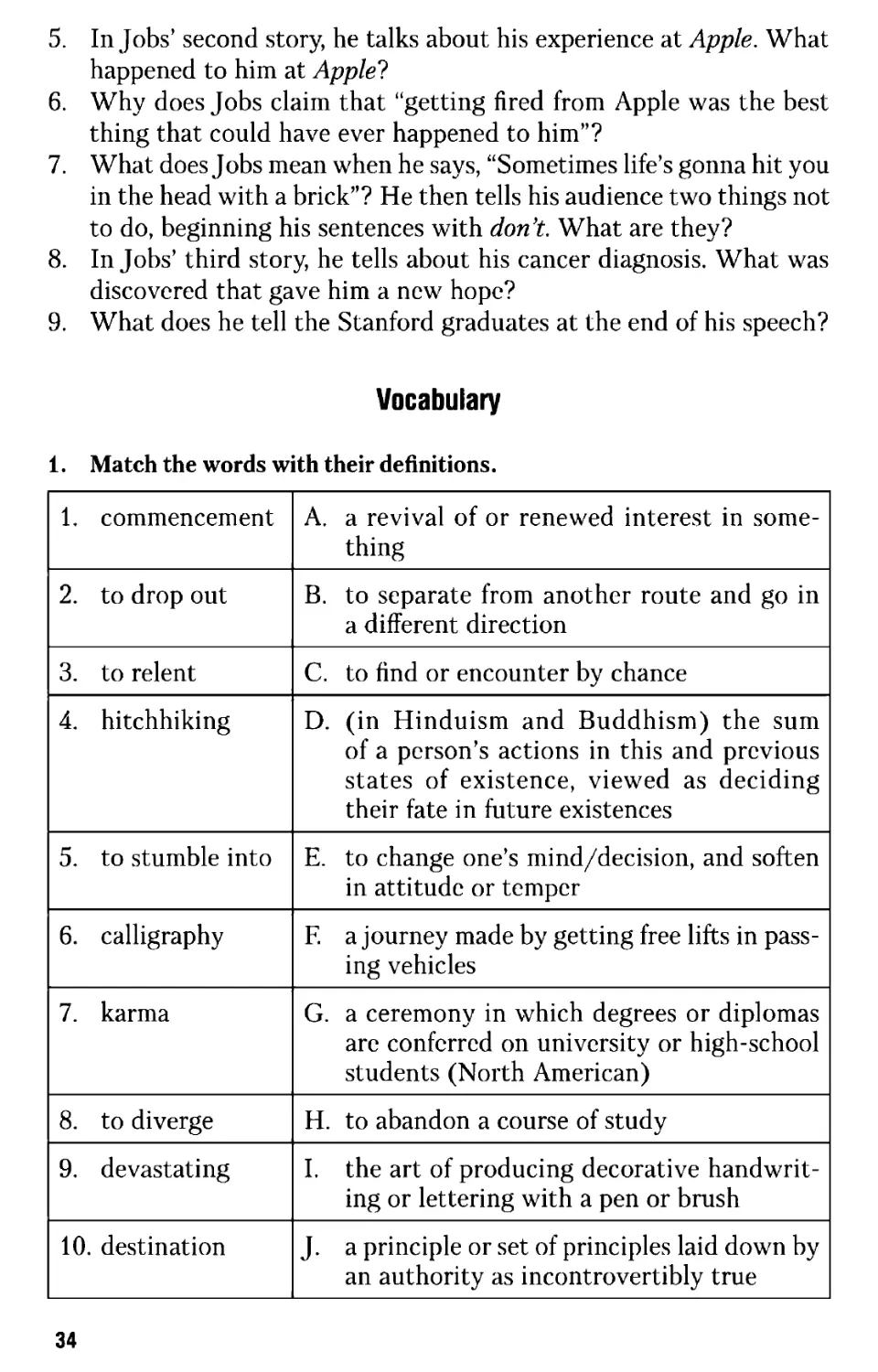
5.	In Jobs’ second story, he talks about his experience at Apple. What
happened to him at Apple?
6.	Why does Jobs claim that “getting fired from Apple was the best
thing that could have ever happened to him”?
7.	What does Jobs mean when he says, “Sometimes life’s gonna hit you
in the head with a brick”? He then tells his audience two things not
to do, beginning his sentences with don't. What are they?
8.	In Jobs’ third story, he tells about his cancer diagnosis. What was
discovered that gave him a new hope?
9.	What does he tell the Stanford graduates at the end of his speech?
Vocabulary
1. Match the words with their definitions.
1. commencement	A. a revival of or renewed interest in some- thing
2. to drop out	B. to separate from another route and go in a different direction
3. to relent	C. to find or encounter by chance
4. hitchhiking	D. (in Hinduism and Buddhism) the sum of a person’s actions in this and previous states of existence, viewed as deciding their fate in future existences
5. to stumble into	E. to change one’s mind/decision, and soften in attitude or temper
6. calligraphy	F. a journey made by getting free lifts in pass- ing vehicles
7. karma	G. a ceremony in which degrees or diplomas are conferred on university or high-school students (North American)
8. to diverge	H. to abandon a course of study
9. devastating	I. the art of producing decorative handwrit- ing or lettering with a pen or brush
10. destination	J. a principle or set of principles laid down by an authority as incontrovertibly true
34
11. renaissance	K. to break into pieces; become smaller or lower in amount, level, value etc.
12. to fall away	L. an intended ending point of a journey
13. dogma	M. causing severe shock, distress, or grief
2. Practice the words online:
https://quizlet.com/196595560/steve-jobs-stanford-university-
commencement-address-flash-cards/
3. Fill in the gaps with the words from Ex. 1.
1.	I am honored to be with you today at your from one of
the finest universities in the world.
2.	I of Reed College after the first 6 months.
3.	And yet death is the we all share.
4.	She only a few months later when my parents promised
that I would someday go to college.
5.	And much of what I by following my curiosity and intu-
ition turned out to be priceless later on.
6.	Reed College at that time offered perhaps the best in-
struction in the country.
7.	You have to trust in something — your gut, destiny, life,,
whatever.
8.	But then our visions of the future began to, and eventu-
ally we had a falling out.
9.	What had been the focus of my entire adult life was gone, and it
was.
10.	Apple bought NeXT, I returned to Apple, and the technology we
developed at NeXT is at the heart of Apple's current.
11.	Don’t be trapped by— which is living with the results of
other people’s thinking.
12.	On the back cover of their final issue was a photograph of an early
morning country road, the kind you might find yourself
on if you were so adventurous.
4.	What do the following idioms mean:
•	to connect the dots;
•	to drop the baton;
•	to dawn on?
In the transcript of the speech, find how these idioms are used. Make
your own examples using the idioms.
35
Grammar
Phrasal verbs
Phrasal verbs are two-part verbs that consist of a verb and a par-
ticle. The most common adverb particles used to form phrasal verbs are
around, at, away, down, in, off, on, out, over, round, up, e.g. bring in, go
around, look up, put away, take off etc.
Phrasal verbs often have two meanings. One we can easily guess
from their individual parts.
Don't waste your life, you won’t be able to turn the time
around! (Phrasal verb meaning “to reverse the direction of
something or someone”)
Adding particle changes the meaning of the verb. A special meaning
is not easily related to the separate meanings of the words.
/ hope the new IT Director will turn around our failing network
security. (Phrasal verb meaning “to change a plan, business, or
system that is unsuccessful and make it successful”)
When you see a new phrasal verb for the first time, you should study
the context of use, and check the meaning in a dictionary. Phrasal verbs
are commonly used in both writing and speech. Some are informal, but
others are generally used.
Grammar practice
1. Match the verb to the preposition to make phrasal verbs from the Steve
Job’s speech. The same verb can be used with different prepositions.
Verbs	Prepositions
drop
pop
find	out
look	back
come	in
look	forward
let	backwards
be	over
start	on
turn	away
go	down
roll
clear
36
2. Now complete each blank with the appropriate phrasal verb from the box
in the correct form.
look forward / look backwards / let down / come back /
clear out / look back / pop in / pop out / find out / drop
in / drop out
1.	When I, they decided at the last minute that they really
wanted a girl.
2.	My biological mother later that my mother had never
graduated from college and that my father had never graduated
from high school.
3.	It was pretty scary at the time, but it was one of the best
decisions I ever made.
4.	The minute I, I could stop taking the required classes
that didn’t interest me, and begin on the ones that looked
interesting.
5.	But 10 years later, when we were designing the first Macintosh
computer, it all to me.
6.	Of course, it was impossible to connect the dots when
I was in college.
7.	Again, you can’t connect the dots looking forward; you can only
connect them.
8.	It the old to make way for the new.
9.	I felt that I had the previous generation of entrepreneurs
— that I had dropped the baton as it was being passed to
me.
3. Replace the verb in bold with the phrasal verb of similar meaning.
1.	So at 30 I was fired.
2.	And so I decided to begin again.
3.	It happened that getting fired from Apple was the best thing that
could have ever happened to me.
4.	Pixar continued to create the world’s first computer animated fea-
ture film, Toy Story, and is now the most successful animation stu-
dio in the world.
5.	Like any great relationship, it just gets better and better as the
years pass.
6.	All external expectations all pride, all fear of embarrassment or fail-
ure — these things break into pieces in the face of death, leaving
only what is truly important.
7.	Right now, the new is you, but someday not too long from now, you
will gradually become the old and depart.
37
Discussion
In pairs or in small groups discuss the following questions:
1.	What are the lessons learned from these stories?
2.	Jobs experienced great success and great failure. What were his
successes, and how did his failure occur?
3.	Do you agree that the primary difference between successful people
and unsuccessful people is that the successful people fail more?
4.	How do you understand the following statement: “You can’t con-
nect the dots looking forward; you can only connect them looking
backwards”?
5.	“If today were the last day of my life, would I want to do what I am
about to do today?”
6.	In your opinion, what does Steve Jobs mean by quoting the state-
ment, “Stay hungry. Stay foolish”?
Lesson 6
THE GAME THAT CAN GIVE YOU TEN EXTRA
YEARS OF LIFE
(by Jane McGonigal)
Jane McGonigal, a game designer, claims that when we play a game
we tackle tough challenges with more creativity, more determination,
more optimism, and we are more likely to reach out to others for help.
She wanted to bring these gamer traits to her real life.
TED Talk for this lesson is available at: http://www.ted.com/talks/
jane_mcgonigal_the_game_that_can_give_you_10_extra_years_of_
life#t-264799
Intro
•	Do you like video/online games?
•	What’s your favourite game?
•	How often do you play video games?
•	Do you enjoy playing with others online or in person? Neither/
both?
•	Have you learned anything from gaming?
•	How much gaming do you consider to be too much? Why?
•	What do your parents think of video games?
Comprehension
Watch the video and answer the questions.
1.	According to Jane McGonigal, how much time a week people (as
the planet) should spend on playing computer games?
2.	What are the most frequently expressed regrets that people say
when they are on their deathbeds?
3.	Some people say that playing video games is a waste of time. Is it
true according to recent studies?
39
4.	What life event prompted Jane to create a role-playing recovery
game called Jane the Concussion Slayer, which was later renamed
SuperBetter?
5.	What is the order of playing a SuperBetter game?
__Recruit your allies
__Activate the power-ups
__Adopt a secret identity
__Battle the bad guys
6.	What happened to Jane as the result of playing a SuperBetter game?
7.	What is the impact of the game on the human condition after
a traumatic event?
8.	How do you get from trauma to growth?
9.	What are the four types of resilience? What tasks did she ask peo-
ple to complete as a part of a SuperBetter quest?
10.	What is the bonus for boosting these four types of resilience?
Vocabulary
1. Match the words with their definitions.
1. reasonable	A. something that is accepted as true or as certain to happen, without proof
2. to outperform	B. to remain undamaged or unaffected by
3. assumption	C. the capacity to recover quickly from diffi- culties
4. to trigger	D. to perform better than others
5. to contribute to	E. to use the good things in a situation
6. resilience	F. temporary damage to the brain caused by a fall or hit on the head or by violent shak- ing
7. to withstand	G. to suddenly release a violent force that cannot be controlled
8. to take advantage of	H. to help to cause an event or situation
9. to tackle	I. to cause something to start
40
10. concussion	J. something that provides you with the en- couragement that is needed to make your plan successful
11. nausea	K. based on or using good judgment and therefore fair and practical
12. to unleash	L. to try to deal with something or someone
13. springboard	M. a feeling of spinning around and being un- able to balance, often caused by looking down from a height
14. vertigo	N. a feeling of sickness with an inclination to vomit
2. Fill in the gaps with the words from Ex.l.
1.	Recent clinical trials conducted at East Carolina University
showed that online games can pharmaceuticals for treat-
ing clinical anxiety and depression.
2.	Now, because I am a game designer, you might be thinking to your-
self, “I know what she wants us to do with those minutes, she wants
us to spend them playing games.” Now this is a totally,
given that I have made quite a habit of encouraging people to spend
more time playing games.
3.	I had to avoid everything that my symptoms.
4.	There are four kinds of strength, or resilience, that to
post-traumatic growth.
5.	Your body can more stress and heal itself faster.
6.	Oxytocin will linger during the break, so of the network-
ing opportunities.
7.	Even just a tiny challenge, you are going to boost your
resilience, so you are going to earn more minutes.
8.	The number one thing you can do to boost your physical
is to not sit still.
9.	Instead, we can use a traumatic event as a to unleash our
best qualities and lead happier lives.
10.	Two years ago I hit my head and got a.
11.	The concussion didn’t heal properly, and after 30 days, I was left
with symptoms like nonstop headaches,,, mem-
ory loss, mental fog.
41
3. Complete the word search task online following the link http://www.pro-
profs. com/games/word-search/the-game-that-can-give-you-10-extra-
years-of-life/ or in your course book
R	E	A	S	о	N	A	в	L	E	W	L
N	Y	D	N	J	J	J	в	К	U	I	E
0	F	R	В	A	M	U	к	M	R	T	T
I	N	A	R	S	T	w	Q	P	E	H	U	NAUSEA TACKLE
s	A	О	R	S	F	V	p	S	S	s	В	WITHSTAND
s	U	В	E	u	C	A	к	U	I	T	I	RESILIENCE CONCUSSION
и	S	G	G	M	s	I	м	E	L	A	R	TRIGGER REASONABLE
c	E	N	G	p	D	U	z	S	I	N	T	ASSUMPTION
N	A	I	I	T	A	c	к	L	E	D	N	CONTRIBUTE SPRINGBOARD
0	W	R	R	I	U	M	Q	U	N	К	О
c	Q	P	T	о	X	H	D	T	C	U	c
в	L	S	и	N	F	z	Z	p	E	Q	в
4. Practice the words online:
https://quizlet.com/215980828/the-game-that-can-give-you-ten-
extra-years-of-life-flash-cards/
Grammar
Wishes and regrets about the past
We use wish and if only to talk about regrets — things that we
would like to change either about the past or the present.
Present regrets. In this case wish and if only are followed by the
Past Simple tense (emphasising that the wish we express is “unreal”).
If only he knew the rules of the game, he could win with better
score.
I wish I knew what to do.
Past regrets. In this case, wish and if only are followed by the Past
Perfect tense.
I wish rd known that when I was a teenager.
42
If only we’d known you were in town.
If the situation is negative, we make a positive wish clause.
I haven’t played that game. I wish I had played that game.
If the situation is positive, we make a negative wish clause.
I lost the game. I wish I hadn’t lost.
Grammar practice
1. Make a wish clause according to the situation as in the examples.
Situations	Wishes/regrets
She failed the test.	She wishes she hadn’t failed the test.
He didn’t call me yesterday.	I wish he had called me yesterday.
1. She spent three hours playing computer games.
2. I am afraid to do what makes me happy.
3. I didn’t have the courage to express my true self.
4. My priorities have not chan- ged.
5. I am not able to focus on my goals and dreams.
6. He doesn’t stay in touch with his friends.
7. I didn’t let myself be happier.
8. I work so hard.
2. Complete each sentence with a suitable form of the verb in brackets.
1.	I played Counter-Strike yesterday, that is why I didn’t write an
assay. I wish I(not wasted) my time playing computer
game.
2.	I was ill last night and I didn’t go out with my friends. I wish
I(go out) with my friends to the cybercafe last night.
3.	My computer was infected with malware. I wish I(install)
antivirus software before surfing the Net.
43
4.	I play fast-paced games. I wish it___________(help) me to make
quicker decisions in real life.
5.	This processor is really slow! I wish we(have) a faster one
to play computer games.
6.	I am disappointed in this web camera. I wish I(not buy) it.
7.	John spent a lot of money on video games. He wishes he
(not wasted) so much money!
8.	Thirty minutes of online game play a day increase people’s happi-
ness. I wish I(play) online games instead of taking antide-
pressants.
9.	He couldn’t fix his computer. He wishes his tech knowledge
(be) better.
10.	You promised not to tell anyone my password but you did. I wish
I______________(not tell) you.
11.	I give up quickly when dealing with difficulties. I wish I_______
(tackle) tough challenges with more creativity.
Discussion
In pairs or in small groups discuss the following questions.
•	What are the pros and cons of computer gaming?
•	What is your biggest regret in life? Why?
•	Do you agree with the following sayings?
“I would rather have a life full of mistakes than a heart full
of regrets.”
“Our biggest regrets are about chances we did not take.”
“Life is too short to live with regrets.”
Lesson 7.
THIS COMPUTER WILL GROW YOUR FOOD
IN THE FUTURE
(by Caleb Harper)
What do we know about the food we eat? What if there was climate
democracy? Caleb Harper and his colleagues explore the future of food
systems. Caleb Harper is the principal investigator and director of the
Open Agriculture Initiative (OpenAG) at the MIT Media Lab. Under
his guidance, a diverse group of engineers, architects, urbanists, econ-
omists and plant scientists is developing an open-source agricultural
hardware, software and data common aiming to create a more agile,
transparent and collaborative food system.
TED Talk for this lesson is available at: https://www.ted.com/
talks / caleb_harper_this_computer_will_grow_your_food_in_the_
future?language=ca
Intro
•	What is the global food crisis?
•	What is causing the global food crisis?
•	What does the term “food security” mean?
•	Is there a food crisis in Russia?
•	How does rising food prices influence local families and commu-
nities?
Comprehension
Watch the video and answer the questions.
1.	What is the food crisis according to Caleb Harper?
2.	Why being a farmer is not popular among the youth in the world?
3.	So how can we build the platform that inspires the youth?
4.	What is Caleb Harper’s lab known for?
45
5.	How can Caleb Harper grow “strawberries from Mexico” in his
lab?
6.	What information can IP addressable broccoli provide a farmer
with?
7.	What is a controlled environment for plants? How can it help the
plants grow?
8.	What are the benefits of Caleb Harper’s lab integration in school
education?
9.	What happened as the result of such integration?
10.	How is Caleb Harper sharing the information about his project?
11.	What is the future of food production?
	Vocabulary
1. Match the words with their definitions
1. genome	A. living genetic resources such as seeds or tissues that are maintained for the purpose of animal and plant breeding, preservation, and other research uses
2. phenomenon	B. the state of not having or not having enough of something that is needed
3. recipe	C. a measurement of how much water there is in the air
4. nutrition	D. a set of instructions telling you how to pre- pare and cook something, including a list of ingredients
5. deficiency	E. an organism’s complete set of DNA, in- cluding all of its genes
6. humidity	F. the value of food and the way that it influ- ences your health
7. aerophonics	G. to use something or someone, especially in an effective way
8. beacon	H. something that exists and can be seen, felt, tasted, etc., especially something unusual or interesting
9. to deploy	I. the process of growing plants in an air or mist environment without the use of soil or an aggregate medium (known as geoponics)
46
10. germplasm	J. a light or fire on the top of a hill that acts as a warning or signal
2.	Fill in the gaps with the words from Ex.l.
1.	If you know about the or genetics, this is the phenome,
right? The.
2.	So, if you are coding climate — this much CO2, this much O2 cre-
ates a— you are coding the expression of that plant, the
of that plant, the size of that plant, the shape, the color,
the texture.
3.	They can tell you when you see that plant dying that it’s a nitrogen
, a calcium deficiency or it needs more.
4.	This process,, was developed by NASA for Mir space sta-
tion for reducing the amount of water they send into space.
5.	We start having. We start sending information about
food, rather than sending food. This is not just my fantasy, this is
where we are already.
6.	Do you know that we have rare and ancient seed banks? Banks of
seed. It’s amazing. They have alive and things that you’ve
never eaten.
3.	Watch the lecture again and write down:
a)	what kind of professionals are involved in digital farming;
b)	what plants and vegetables are mentioned in the lecture.
4.	Practice the words online:
https://quizlet.com/216044857/this-computer-will-grow-your-
food-in-the-future-flash-cards/
Grammar
Imaginary situations, suggestions and possibilities
We use what if to talk about:
•	imaginary situations. We try to guess (or learn) possible results
based on future, present or past circumstances.
What if I start sending information about food, rather than
sending food? \=What will happen if 1 start sending informa-
tion about food, rather than sending food.?]
What if I didn’t put a bunch of sensors in the strawberries?
[=What would happen if I didn’t put a bunch of sensors in the
strawberries?]
47
If we refer to imaginary situations, we use “Third” conditional.
What if we hadn’t built a farm inside of the digital lab? [= What
would have happened if we hadn’t built a farm inside of the
digital lab?\,
•	suggestions: What if + present verb form can be used to make
suggestions about what may happen.
— What if we buy a food computer to grow our greens and veg-
etables?
— OK. Good idea-,
•	possibilities: What if+past verb form can be used to talk about
future possibilities.
What if we hired Camille as a new mechanical engineer?
Grammar practice
Fill in the gaps from the lecture with What if... structure. Decide if it is an
imaginary situation, suggestion or possibility.
How do you express yourself in food? If we had a platform, we might
feel empowered to question: (1)? For me, I questioned: (2)
(climate / democratic)? So, this is a map of climate in the
world.
(3)(each country / have / productive climate)? What
would that change about how we live? What would that change about
quality of life and nutrition?
Welcome to your global farm. We built a huge analog farm.
(4)(we / build / digital farm)? A digital world farm.
(5)(you / can take / apple), digitize it somehow, send it
through particles in the air and reconstitute it on the other side?
(6)(you / create / interface) that was much like a game.
So they have a 3D environment, they can log into it anywhere in the
world on their smartphone, on their tablet. They have different parts
of the bots — the physical, the sensors. (7)(they / select /
recipes) that have been created by other kids anywhere in the world.
They select and activate that recipe, they plant a seedling. While it’s
growing, they make changes. Does a plant need CO2? (8)
(CO2 / be / bad for the plants)? Crank up CO2, plant dies. Or crank
down CO2, plant does very well. Harvest plant, and you’ve created
a new digital recipe.
48
Discussion
In pairs or in small groups discuss the following questions.
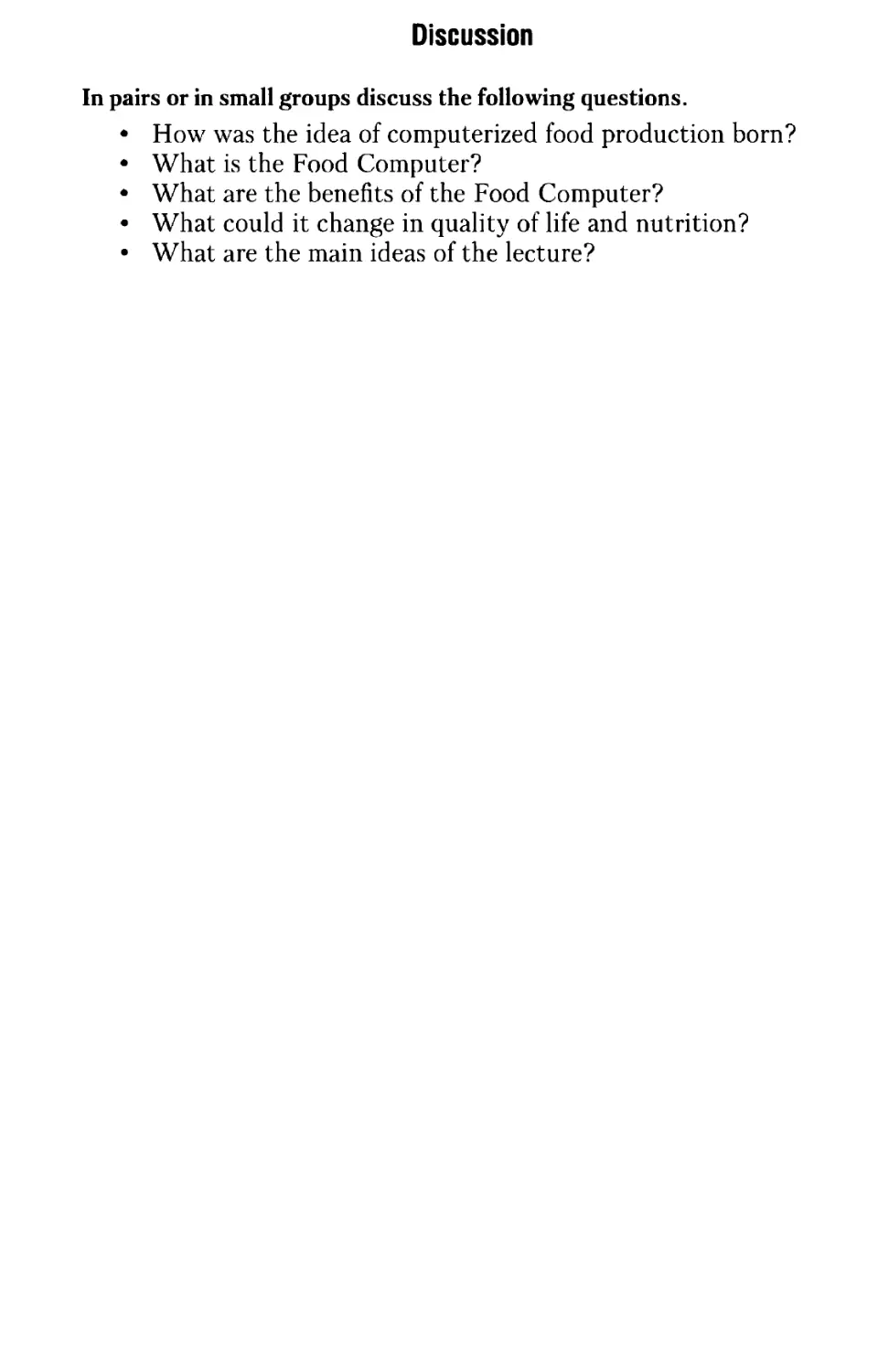
•	How was the idea of computerized food production born?
•	What is the Food Computer?
•	What are the benefits of the Food Computer?
•	What could it change in quality of life and nutrition?
•	What are the main ideas of the lecture?
Lesson 8.
TXTNG IS KILLING LANGUAGE. JKII!
(by John McWhorter)
Does texting mean the death of good writing skills? John
McWhorter posits that there’s much more to texting — linguistically,
culturally — than it seems, and it’s all good news.
John McWhorter is a linguist, Associate Professor of English and
Comparative Literature at Columbia University, teaching linguistics,
Western civilization and music history. He thinks about language in
relation to race, politics and our shared cultural history.
He is a regular columnist on language matters and race issues for
Time and CNN, writes for the Wall Street Journal “Taste” page, and
writes a regular column on language for The Atlantic.
TED Talk for this lesson is available at: http://www.ted.com/talks/
john_mcwhorter_txtng_is_killing_languagejk?language=en
Intro
•	Do you prefer to text or to talk on the phone? Why?
•	How often do you text?
•	Do you consider yourself a fast texter?
•	What is your favorite thing about texting?
•	Who do you text the most?
•	What is John McWhorter’s professional background?
Comprehension
Watch the video and answer the questions.
1.	Is it true that texting means the decline of literacy?
2.	What are the main features of writing?
3.	What are the main features of speech?
4.	At what condition are we allowed to write as we speak?
5.	What is texting? What are the characteristic features of texting?
6.	How does the meaning of LOL change over time?
50
7.	What is a pragmatic particle? What pragmatic particles are men-
tioned in the text?
8.	How is slash used in texting among young people today, according
to John McWhorter? What is the meaning of slash?
	Vocabulary
1. Match the words with their definition.
1. bidialectal	A. a text-based method of digital communica- tion
2. bilingual	B. a word or phrase that is used in speech to support interaction but do not generally add any specific semantic meaning to the message
3. empathy	C. a method of rapid writing by means of ab- breviations and symbols, used especially for taking dictation
4. hiccup	D. the ability to read and write
5. JK	E. capable of using two dialects of the same language
6. literacy	F. speaking two languages fluently
7. medium	G. a person or thing that causes great trouble or suffering
8. pragmatic par- ticle	H. the ability to understand and share the feelings of another
9. scourge	I. “just kidding”
10. shorthand	J. a temporary or minor problem or setback
11. slang	K. a number of objects of one kind, especially papers
12. texting	L. a type of language consisting of words and phrases that are regarded as very informal, are more common in speech than writing, and are typically restricted to a particular context or group of people.
13. sheaf	M. to laugh loudly and heartily
51
14. guffaw	N. a means by which something is communi- cated or expressed
2. Practice the words online:
https://quizlet.com/216145760/txtng-is-killing-language-jk-flash-
cards/
3. Fill in the gaps with the words from Ex.l.
1.	A_____________, that is what LOL has gradually become.
2.	Slash is used in a very different way in____among young people
today.
3.	They condense complicated concepts into words and
phrases, saving time.
4.	Innovative programs successfully encouraged adults to develop
their and numeracy skills.
5.	Personally, I am glad I am___________, but I am much more com-
fortable speaking Spanish than English.
6.	Increasing evidence is that being bilingual is cognitively beneficial.
That’s also true of being.
7.	Texting is a provoking the decline and fall of any kind
of serious literacy, or at least writing ability, among young people
in the United States.
8.	LOL is being used in a very particular way. It’s a marker of____.
9.	“LOL, thanks, gmail is being slow right now.” If you think about
it, that’s not funny. No one’s laughing. And yet, there it is, so you
assume there’s been some kind of.
10.	The________would have changed a little bit since the era of Love
Story, but they would understand what was on that message board.
11.	You can’t change the topic while you are texting, and so ways are
developing of doing it within this__________.
12.	Please show me a of texts written by 16-year-old girls,
because I would want to know where this language had developed
since our times.
4.	Complete the crossword online following the link http://www.proprofs.
com/games/crossword/texting-1/ or in your course hook.
Across
1.	Fluently speaking two languages.
2.	A temporary or minor problem or setback.
3.	A person or thing that causes great trouble or suffering.
4.	A pragmatic particle, a marker of empathy.
Down
1.	Fingered speech.
52
2.	An extraordinary event that is not explicable by natural or scien-
tific laws and is therefore attributed to a divine medium.
3.	A type of language consisting of words and phrases that are re-
garded as very informal.
4.	A new information marker.
Grammar
Adverbs
Adverbs are words that modify:
•	a verb:
That is not the way any human being speaks casually. (How
did he speak?);
•	an adjective:
On a manual typewriter, it was very difficult to type with the
pace of speech. (How difficult was it?);
•	another adverb:
She texted quite slowly. (How slowly did she text?)
Adverbs describe the reason or location of something, the time
or the way something happened. Generally, but not always, they end
in -ly. It’s important to note that not every word ending in -ly is an
adverb (e.g. lonely and friendly are adjectives).
There are also cases when the word has the same form as an adjec-
tive and an adverb (e.g. hard, early, fast)'.
New games require a fast processor. (Fast is an adjective)
53
The processor speed tells you how fast your PC executes instruc-
tions. (Fast is an adverb)
Adverbs can often function as intensifiers, they can be used to:
•	emphasize:
I really think that texting is an expansion of the linguistic rep-
ertoire.
Texting actually is evidence of a balancing act that young peo-
ple are using today,
•	amplify:
Our freshmen can't spell completely.
I absolutely disagree that texting means the decline of good
writing skills;
•	downtone:
What is going on is a kind of emergent complexity.
LOL means “laughing out loud” to some extent.
Grammar practice
1.	Write an adverbial form for the following words:
1)	artificial —
2)	basic —
3)	exact —
4)	first —
5)	genetic —
6)	latter —
7)	one —
8)	disorder —
9)	shameful —
10)casual —
2.	Complete the paragraph from the lecture with the adverbs (from the
previous exercise) + most, much, always and little'.
(1)	. if we think about language, language has existed for
perhaps 150,000 years, at least 80,000 years, and what it arose as is
speech. People (2)talked. That’s what we are probably (3)
specified for. That is how we use language (4). Writing
is something that came along (5)later. There is a (6)
bit of controversy as to (7)when that happened, but accord-
ing to traditional estimates, if humanity had existed for 24 hours, then
writing (8)came along at about 11:07 p.m. That’s how much of
54
a latterly thing writing is. So (9)there is speech, and then writ-
ing comes along, kind of (10).
Discussion
In pairs or in small groups discuss the following questions:
•	What are the positive and negative effects of texting?
•	Do you use any “textese” when you text?
•	How is texting similar to writing and how is it different?
•	Do you agree that texting means the decline of good writing
skills?
Lesson 9
WHAT’S WRONG WITH YOUR PA$$W0RD?
(by Lome Faith Cranor)
Lorrie Faith Cranor is a Professor in the School of Computer Sci-
ence and the Engineering and Public Policy Department at Carnegie
Mellon University. She studies online privacy, usable security, phish-
ing, spam and other research around keeping us safe online. Lorrie
Faith Cranor studied thousands of real passwords to figure out the sur-
prising, very common mistakes that users — and secured sites — make
to compromise security. How, you may ask, did she study thousands of
real passwords without compromising the security of any users? That’s
a story in itself. It’s secret data worth knowing, especially if your pass-
word is 123456...
TED Talk for this lesson is available at: http://www.ted.com/talks/
lorrie_faith_cranor_what_s_wrong_with_your_pa_wOrd
Intro
•	What is password?
•	Why is it important to choose a strong password?
•	What should you do to protect your passwords?
•	Do you know any tips for good passwords?
Comprehension
Watch the video and answer the questions.
1.	What is Cranor’s professional background?
2.	What is the aim of the research?
3.	What is the challenge of the research?
4.	What methods of collecting password data are used in the re-
search?
5.	How can password strength be measured?
6.	Do password meters actually work?
7.	What is a potential disadvantage of a password meter?
56
8.	What advice would you give to anyone who wants to create
a strong password?
Vocabulary
1. Match the words with their definitions.
1. dataset	A. an approximate calculation
2. password entro- py	B. occurring or done without definite aim, reason, or pattern
3. rule of thumb	C. a considerable number or amount
4. reluctant	D. a descriptive name added to or replacing the actual name of a person, place, or thing
5. to be suscepti- ble to attackers	E. a measure of the strength of a password
6. to crack	F. something demanded or imposed as an ob- ligation
7. scrambled form	G. to hack
8. nickname	H. to be sensitive to attackers
9. a bunch of	I. unwilling
10. requirement	J. a collection of related sets of information composed of separate elements but can be manipulated as a unit by a computer
11. random	K. coded form
2. Practice the words online:
https://quizlet.com/216189683/whats-wrong-with-your-paw0rd-
fl ash-cards/
3. Unscramble the words.
1.	rakcc_______________________
2.	amrdno______________________
3.	ucnbh_______________________
4.	nlimhecaca__________________
5.	erlntautc___________________
6.	ypnreto_____________________
7.	trautdefrs__________________
8.	emblsdcra___________________
57
4. Fill in the gaps with the words from Ex.l. and then discuss them with
your group/partner.
1.	What makes you much more reusing your password
or writing your password down?
2.	How could we benefit from__________________that our passwords
have to have a lot of entropy?
3.	What is the reason that the National Institute of Standards and
Technology has a set of guidelines, which have some
for measuring entropy?
4.	Why do you think system administrators are to re-
veal password data to others?
5.	How is the size of the passwords related to the frequency of their
appearance in the stolen?
6.	What do smarter hackers do for passwords?
5. Write down the words that have the opposite meaning, e.g. a dumb at-
tacker — a smart attacker.
1)	a known rule—
2)	a complex password -
3)	an unusable character —
4)	an easy policy —
5)	a strong password —
6)	a frequent password —
7)	an effective password meter —
8)	a positive feedback —
9)	a random word —
10)	a memorable phrase —
Grammar
Modal verbs: have to, can, could, may, might
•	We use have to to show that we are forced or obliged to do
something, to recommend something, to say that something must be
true or must happen.
One of the other policies we tried was called Basic 16, and the
only requirement here was that your password had to have at
least 16 characters.
•	We use can/could and can’t/couldn’t to express ability or possi-
bility, to offer to do something, to ask for or give permission, to request
something, to offer politely.
We are doing some research to see if we can make that approach
work even better.
58
Could you check the strength of your password with a pass-
word meter?
•	We use may when we aren’t sure about something and to
make polite requests.
Password meters may help to make effective passwords.
•	We use might when we aren’t sure about something, as the past
tense of may for requests, and for very polite requests.
He asked if password meters might be used to make effective
passwords.
Grammar practice
1. Fill in the gaps with have to, can, could, may, and might in an appropriate
form.
1.	One of the requirements of membership was that we_____________
have stronger passwords that complied with some new require-
ments.
2.	Why not to have a really good password that you____________re-
member but nobody else is able to guess!
3.	If password meters would just wait a little bit before giving you
a positive feedback, you___________probably have better passwords.
4.	A number of symbols that people are actually using in their pass-
words ____________measure the password strength.
5.	You can make long passwords that are still the sort of thing that an
attacker easily guess.
6.	When people use a Basic8 policy, their passwords___________to
consist of at least eight characters.
7.	Now we had data from 470 people, but that was really not very
much password data, and so we looked around to see where_________
we find additional password data.
8.	You get a pass phrase which is more memorable than so
called pronounceable passwords.
2.	Match a sentence with its purpose.
polite request / not sure about something / something that
must be true / past request / possibility / obligation (2) /
ability / polite request / advice
1.	One of the requirements of membership was that our passwords
had to have a lot of entropy.
2.	Amazon Mechanical Turk is a service where you can post a small job
online and pay people to do a task for you through Amazon.com.
59
3.	Could I use the same character more than three times?
4.	To protect your computer you simply have to change your pass-
word every two weeks.
5.	There has to be a reason for the information security office at Carn-
egie Mellon to be reluctant to share the passwords with the re-
searchers.
6.	Instead of telling people that they need to put all these symbols
and numbers into their passwords, we might be better just telling
people to have long passwords.
7.	She wondered if she might use a dictionary word as her password.
8.	May I use a pass phrase instead of a password?
9.	In the Carnegie Mellon University, they have to have eight char-
acters including uppercase, lowercase, digit, symbol in their pass-
word.
10.	We can collect some good password data if we study 5 000 pass-
words.
Discussion
In pairs or in small groups discuss the following questions:
•	Do you know how to create strong passwords?
•	What rules mentioned in the lecture do you follow when creat-
ing your own passwords?
•	Do you believe that password meters work?
•	Do you use passphrases instead of passwords?
•	Do you educate your friends, parents or grandparents on using
secure passwords?
Lesson 10
WHY MASSIVE OPEN ONLINE COURSES (STILL)
MATTER
(by Anant Agarwal)
2013 was a year of hype for MOOCs (massive open online courses).
MOOCs still matter — as a way to share high-level learning widely and
supplement (but perhaps not replace) traditional classrooms. Anant
Agarwal shares his vision of blended learning, where teachers create
the ideal learning experience for 21st century students.
TED Talk for this lesson is available at: http://www.ted.com/
talks/anant_agarwal_why_massively_open_online_courses_still_
mattcr?languagc=cn
Intro
•	WhatisMOOC?
•	When and where did MOOCs first appear?
•	What are the advantages and disadvantages of MOOCs?
•	Have you ever taken a MOOC?
•	What is your opinion about eLearning?
Comprehension
Watch the video and answer the questions.
1.	What was the last big innovation in education according to Agar-
wal?
2.	What does, in terms of education, “going from ox carts to the air-
plane” mean?
3.	What was the name of the first course MIT (The Massachusetts
Institute of Technology) launched? How many students enrolled
in the course? How many of them passed the course?
4.	How is a flipped classroom organized?
5.	How did the failure rate change in blended learning classroom?
61
6.	What key principles ensure the efficiency of MOOCs?
7.	What does it mean to reimagine and revolutionize education?
Vocabulary
1. Match the words with their definitions.
1. Massive Open Online Course (MOOC)	A. the use of imagination or original ideas to create something; inventiveness
2. blended learning	B. an educational practice in which students interact with other students to attain edu- cational goals
3. flipped classroom	C. a method of learning in which students are actively or experientially involved in the learning process. It is a model of in- struction that focuses the responsibility of learning on learners
4. pilot	D. an online course aimed at unlimited par- ticipation and open access via the Web
5. failure rate	E. a thing that prevents someone from con- centrating on something else
6. active learning	F. an instructional strategy that reverses the traditional learning environment by de- livering instructional content outside of the classroom; class that explores topics in greater depth and creates meaningful learning opportunities
7. gamification	G. number of failures per academic unit
8. peer learning	H. something done as an experiment or a test
9. distraction	I. a preference or special liking for something
10. creativity	J. an education program that combines on- line digital media with traditional class- room methods
11. alumni	K. an educational approach to motivate stu- dents to learn by using game design and game elements in learning environments
12. predilections	L. a graduate of a specific school, college or university
62
2. Practice the words online:
https://quizlet.com/192479966/moocs-flash-cards/
3. Fill in the gaps with the words from Ex. 1.
1.	At edX and a number of other organizations, we are applying these
technologies to education through to really increase ac-
cess to education.
2.	Two high school teachers at the Sant High School in Mongolia
their classroom, and their students watched video
lectures and completed interactive exercises at home and then they
came into class to interact with each other and do some physical
laboratory work.
3.	We applied these_________________techniques to learning, to en-
gage the students more in the learning process and teach them
4.	Discussion forums and Facebook-like interaction is not
, but it really helps students to learn.
5.	Learning from each other and learning by teaching is____________.
6.	We did a______________experimental blended courses, working with
San Jose State University in California with the circuits and elec-
tronics course.
7.	With this blended class last year, the fell to nine percent.
8.	___________provides much better results especially when the stu-
dents are interacting with material.
9.	Technologies that wc arc developing to create a_______________of
education help us to reinvent what we do in the classroom.
10.	155,000 students from 162 countries enrolled in this very first
course. This number is bigger than the total number of MIT
	in its 150-year history.
11.	But what if we embraced technology, embraced the millennial gen-
eration’s natural, and blend them into their lives.
Grammar
Present and Past Tenses
There are four present tense forms in English:
Tense	Form
Present Simple	I work
Present Continuous	I am working
Present Perfect	I have worked
Present Perfect Continuous	I have been working
63
We use these forms to talk about:
•	the present:
He is the student of the IT faculty at the Higher School of Eco-
nomics. He has been studying here for three months.
University education always aims at delivering knowledge and
skills relevant to a profession.
He is writing a code in Google. He has been coding for three
years',
•	the future:
The new MOOC on Linux starts next week.
We are going to be up monitoring the forum, answering ques-
tions.
Til get a new promotion as soon as I have finished course.
You will be tired out after you have been working all night',
•	the past:
So one night I am sitting up there, at 2 a.m. at night, and
I think about the question from a student from Pakistan.
There are four past tense forms in English:
Tense	Form
Past Simple	I worked
Past Continuous	I was working
Past Perfect	I had worked
Past Perfect Continuous	I had been working
We use these forms:
•	to talk about the past:
He studied at the IT faculty of the Higher School of Econom-
ics. He had studied there since September.
The students were discussing and interacting with each other
and by 4 a.m. in the morning, they had discovered the right
answer,
•	to refer to the present or future in conditions:
If you were like me, by the fifth minute I would lose the pro-
fessor.
•	to refer to hypotheses and wishes:
A student might watch a five-, seven-minute video and fol-
lowed that with an interactive exercise.
64
I wish it wasn’t so time consuming to complete this online
course.
•	to talk about the present in a few polite expressions:
Excuse me, I was wondering if this were the computer-graded
exercises.
I just hoped you would be able to help me with giving the stu-
dents feedback.
•	to talk about the action happened before another action in the
past:
Before the teacher could finish typing his answer to the ques-
tion, a student from the U.S. had popped in with a different
answer.
Grammar practice
Complete this paragraph (on peer learning) from the lecture with the verbs
given. Use these tenses — Present Simple, Present Continuous, Past Simple,
Present Perfect, Past Perfect — giving alternatives where possible.
So here, we (1)_____(use) discussion forums and discussions
and Facebook-\ike interaction not as a distraction, but to really help
students learn. Let me tell you a story. When we (2)(do)
our circuits course for the 155,000 students, I (3)_(sleep)
for three nights leading up to the launch of the course. I (4)
(tell) my TAs, OK, 24/7, we (5)(be) going to be up moni-
toring the forum, answering questions. They (6)(answer)
questions for 100 students. How (7)you(do)
that for 150,000?
So one night I (8)(sit) up there, at 2 a.m. at night,
and I (9)(think) there (10)(be) this ques-
tion from a student from Pakistan, and he (11)______(ask)
a question, and I said, OK, let me go and type up an answer. I (12)
(type) all that fast, and I (13)(begin) typ-
ing up the answer. Before I (14)_(finish), another student
from Egypt (15)(p°p) in with an answer, not quite right,
so I (16)(fix) the answer. Before I (17)(fin-
ish), a student from the U.S. (18)(pop) in with a different
answer. Then I (19)(sit) back, fascinated. Boom, boom,
boom, boom, the students (20)(discuss) and interacting
with each other, and by 4 a.m. that night, I (21) totally
(fascinate), having this epiphany. By 4 a.m. in the morning, they (22)
(discover) the right answer. All I had to do was go and
65
bless it, “Good answer.” So this is absolutely amazing, where students
(23)(learn) from each other, and they (24)
(tell) us that they (25)(learn) by teaching.
Discussion
In pairs or in small groups discuss the following.
The students who have taken a MOOC as a part of their university
course were asked to rate various scenarios from strongly disagree to
strongly agree1. Describe the information given in the graphs to your
partner2.
1. The reasons for taking a MOOC.
1 Stognieva 0. The integration of MOOCs into the University ESP course cur-
riculum: Beliefs and Practices // Professional and Academic English. 2016. No. 48.
P. 25-33.
2 For some useful vocabulary and grammar sec Appendix 3 “Tips for describing
bar charts.”
66
my specific interests
for this course
pace following my
own schedule
□ SA — strongly agree |_ N — neutral	H SD — strongly disagree
□ A - agree	О D - disagree
3. How students participating in MOOCs can contribute to the
learning community.
discussions on course
contents was a useful
practice for me
discussion and
presented relevant
viewpoints
process of studying
the course
□ SA — strongly agree
□ A - agree
EH N — neutral
H D — disagree
H SD — strongly disagree
67
4. Motivation to continue online education.
60%------------------------------------
О Very likely E2 Likely □ Neutral D Unlikely Q Very unlikely
II. TRANSCRIPTS
1.	Can we build Al without losing control over it?1
I am going to talk about a failure of intuition that many of us suffer
from. It’s really a failure to detect a certain kind of danger. I am going
to describe a scenario that I think is both terrifying and likely to occur,
and that’s not a good combination, as it turns out. And yet rather than
be scared, most of you will feel that what I am talking about is kind
of cool.
I am going to describe how the gains we make in Artificial Intelli-
gence could ultimately destroy us. And in fact, I think it’s very difficult
to see how they won’t destroy us or inspire us to destroy ourselves.
And yet if you are anything like me, you’ll find that it’s fun to think
about these things. And that response is part of the problem. OK? That
response should worry you. And if I were to convince you in this talk
that we were likely to suffer a global famine, either because of climate
change or some other catastrophe, and that your grandchildren, or
their grandchildren, are very likely to live like this, you wouldn’t think,
“Interesting. I like this TED Talk."
Famine isn’t fun. Death by science fiction, on the other hand, is fun,
and one of the things that worries me most about the development of
Al at this point is that we seem unable to marshal an appropriate emo-
tional response to the dangers that lie ahead. I am unable to marshal
this response, and I am giving this talk.
It’s as though we stand before two doors. Behind door number one,
we stop making progress in building intelligent machines. Our computer
hardware and software just stops getting better for some reason. Now
take a moment to consider why this might happen. I mean, given how
valuable intelligence and automation are, we will continue to improve
our technology if we are at all able to. What could stop us from doing
this? A full-scale nuclear war? A global pandemic? An asteroid impact?
Justin Bieber becoming president of the United States?
The point is, something would have to destroy civilization as we
know it. You have to imagine how bad it would have to be to prevent
us from making improvements in our technology permanently, gen-
1 Harris S. Can we build Al without losing control over it? : transcript // TED.
2016. June. URL: https://www.ted.com/talks/sam_harris_can_we_build_ai_without_
losing_control_ovcr_it/transcript?languagc=cn
70
eration after generation. Almost by definition, this is the worst thing
that’s ever happened in human history.
So the only alternative, and this is what lies behind door number
two, is that we continue to improve our intelligent machines year after
year after year. At a certain point, we will build machines that are
smarter than we are, and once we have machines that are smarter than
we are, they will begin to improve themselves. And then we risk what
the mathematician I. J. Good1 called an “intelligence explosion,”2 that
the process could get away from us.
Now, this is often caricatured, as I have here, as a fear that armies of
malicious robots will attack us. But that isn’t the most likely scenario.
It’s not that our machines will become spontaneously malevolent. The
concern is really that we will build machines that are so much more
competent than we are that the slightest divergence between their
goals and our own could destroy us.
Just think about how we relate to ants. We don’t hate them. We
don’t go out of our way to harm them. In fact, sometimes we take pains
not to harm them. We step over them on the sidewalk. But when-
ever their presence seriously conflicts with one of our goals, let’s say
when constructing a building like this one, we annihilate them with-
out a qualm. The concern is that we will one day build machines that,
whether they’re conscious or not, could treat us with similar disregard.
Now, I suspect this seems far-fetched to many of you. I bet there are
those of you who doubt that superintelligent Al is possible, much less
inevitable. But then you must find something wrong with one of the
following assumptions. And there are only three of them.
Intelligence is a matter of information processing in physical sys-
tems. Actually, this is a little bit more than an assumption. We have
already built narrow intelligence into our machines, and many of these
machines perform at a level of superhuman intelligence already. And
we know that mere matter can give rise to what is called “general intel-
ligence”, an ability to think flexibly across multiple domains, because
our brains have managed it. Right? I mean, there’s just atoms in here,
and as long as we continue to build systems of atoms that display more
and more intelligent behavior, we will eventually, unless we are inter-
rupted, we will eventually build general intelligence into our machines.
1 Irving John Good (9 December 1916 — 5 April 2009) was a British mathemati-
cian who worked as a cryptologist at Bletchley Park with Alan Turing. An originator of
the concept now known as “intelligence explosion.”
2 The intelligence explosion is the expected outcome of the hypothetically forth-
coming technological singularity, that is, the result of humanity building artificial gen-
eral intelligence (AGI). AGI would be capable of recursive self-improvement leading to
the emergence of ASI (artificial superintelligence), the limits of which are unknown.
71
It’s crucial to realize that the rate of progress doesn’t matter,
because any progress is enough to get us into the end zone. We don’t
need Moore’s law1 to continue. We don’t need exponential progress.
We just need to keep going.
The second assumption is that we will keep going. We will continue
to improve our intelligent machines. And given the value of intelli-
gence — I mean, intelligence is either the source of everything we value
or we need it to safeguard everything we value. It is our most valuable
resource. So we want to do this. We have problems that we desperately
need to solve. We want to cure diseases like Alzheimer’s and cancer.
We want to understand economic systems. We want to improve our
climate science. So we will do this, if we can. The train is already out
of the station, and there’s no brake to pull.
Finally, we don’t stand on a peak of intelligence, or anywhere near
it, likely And this really is the crucial insight. This is what makes our
situation so precarious, and this is what makes our intuitions about
risk so unreliable.
Now, just consider the smartest person who has ever lived. On
almost everyone’s shortlist here is John von Neumann2. I mean, the
impression that von Neumann made on the people around him, and
this included the greatest mathematicians and physicists of his time,
is fairly well-documented. If only half the stories about him are half-
true, there’s no question he’s one of the smartest people who has ever
lived. So consider the spectrum of intelligence. Here we have John von
Neumann. And then we have you and me. And then we have a chicken.
Sorry, a chicken. There’s no reason for me to make this talk more
depressing than it needs to be.
It seems overwhelmingly likely, however, that the spectrum of intel-
ligence extends much further than we currently conceive, and if we
build machines that are more intelligent than we are, they will very
likely explore this spectrum in ways that we can’t imagine, and exceed
us in ways that we can’t imagine.
And it’s important to recognize that this is true by virtue of speed
alone. Right? So imagine if we just built a superintelligent Al that was
no smarter than your average team of researchers at Stanford or MIT.
Well, electronic circuits function about a million times faster than
1 Moore’s law is the observation that the number of transistors in a dense inte-
grated circuit doubles approximately every two years.
2 John von Neumann (1903—1957) was a Hungarian-born American mathemati-
cian. His gift for applied mathematics contributed to the development of quantum the-
ory, automata theory, economics, and defense planning. Von Neumann pioneered game
theory and, along with Alan Turing and Claude Shannon, was one of the conceptual
inventors of the stored-program digital computer. {Encyclopedia Britannica)
72
biochemical ones, so this machine should think about a million times
faster than the minds that built it. So you set it running for a week,
and it will perform 20,000 years of human-level intellectual work, week
after week after week. How could we even understand, much less con-
strain, a mind making this sort of progress?
The other thing that’s worrying, frankly, is that, imagine the best-
case scenario. So imagine we hit upon a design of superintelligent
Al that has no safety concerns. We have the perfect design the first
time around. It’s as though we’ve been handed an oracle that behaves
exactly as intended. Well, this machine would be the perfect labor-
saving device. It can design the machine that can build the machine
that can do any physical work, powered by sunlight, more or less for
the cost of raw materials. So we are talking about the end of human
drudgery. We are also talking about the end of most intellectual work.
So what would apes like ourselves do in this circumstance? Well,
we’d be free to play Frisbee and give each other massages. Add some
LSD and some questionable wardrobe choices, and the whole world
could be like Burning Man.
Now, that might sound pretty good, but ask yourself: what would
happen under our current economic and political order? It seems likely
that we would witness a level of wealth inequality and unemployment
that we have never seen before. Absent a willingness to immediately
put this new wealth to the service of all humanity, a few trillionaires
could grace the covers of our business magazines while the rest of the
world would be free to starve.
And what would the Russians or the Chinese do if they heard that
some company in Silicon Valley was about to deploy a superintelligent
Al? This machine would be capable of waging war, whether terrestrial
or cyber-, with unprecedented power. This is a winner-take-all sce-
nario. To be six months ahead of the competition here is to be 500,000
years ahead, at a minimum. So it seems that even mere rumors of this
kind of breakthrough could cause our species to go berserk.
Now, one of the most frightening things, in my view, at this moment,
are the kinds of things that Al researchers say when they want to be
reassuring. And the most common reason we are told not to worry is
time. This is all a long way off, don’t you know. This is probably 50 or
100 years away. One researcher has said, “Worrying about Al safety is
like worrying about overpopulation on Mars.” This is the Silicon Val-
ley version of “don’t worry your pretty little head about it.”
No one seems to notice that referencing the time horizon is a total
non sequitur. If intelligence is just a matter of information processing,
and we continue to improve our machines, we will produce some form
of superintelligence. And we have no idea how long it will take us to
73
create the conditions to do that safely. Let me say that again. We have
no idea how long it will take us to create the conditions to do that
safely.
And if you haven’t noticed, 50 years is not what it used to be. This
is 50 years in months. This is how long we’ve had the iPhone. This is
how long The Simpsons has been on television. Fifty years is not that
much time to meet one of the greatest challenges our species will ever
face. Once again, we seem to be failing to have an appropriate emo-
tional response to what we have every reason to believe is coming.
The computer scientist Stuart Russell1 has a nice analogy here. He
said, imagine that we received a message from an alien civilization,
which read: “People of Earth, we will arrive on your planet in 50 years.
Get ready.” And now we are just counting down the months until the
mothership lands? We would feel a little more urgency than we do.
Another reason we are told not to worry is that these machines
can’t help but share our values because they will be literally extensions
of ourselves. They’ll be grafted onto our brains, and we’ll essentially
become their limbic systems. Now take a moment to consider that the
safest and only prudent path forward, recommended, is to implant this
technology directly into our brains. Now, this may in fact be the safest
and only prudent path forward, but usually one’s safety concerns about
a technology have to be pretty much worked out before you stick it
inside your head.
The deeper problem is that building superintelligent Al on its own
seems likely to be easier than building superintelligent Al and having
the completed neuroscience that allows us to seamlessly integrate our
minds with it. And given that the companies and governments doing
this work are likely to perceive themselves as being in a race against
all others, given that to win this race is to win the world, provided you
don’t destroy it in the next moment, then it seems likely that whatever
is easier to do will get done first.
Now, unfortunately, I don’t have a solution to this problem, apart
from recommending that more of us think about it. I think we need
something like a Manhattan Project on the topic of Artificial Intel-
ligence. Not to build it, because I think we’ll inevitably do that, but
to understand how to avoid an arms race and to build it in a way that
is aligned with our interests. When you are talking about superintelli-
gent Al that can make changes to itself, it seems that we only have one
chance to get the initial conditions right, and even then we will need to
absorb the economic and political consequences of getting them right.
1 Stuart Jonathan Russell (born 1962) is a Professor of Computer Science at Uni-
versity of California, Berkeley, known for his contributions to Artificial Intelligence.
74
But the moment we admit that information processing is the source
of intelligence, that some appropriate computational system is what
the basis of intelligence is, and we admit that we will improve these
systems continuously, and we admit that the horizon of cognition very
likely far exceeds what we currently know, then we have to admit
that we are in the process of building some sort of god. Now would be
a good time to make sure it’s a god we can live with.
Thank you very much.
2.	Five cool uses for a USB flash drive1
Hey guys! I am Sharon Vaknin and if you have a USB flash drive,
it’s probably because at some point you need a way to carry your
files and documents around with you. Or if you are like me, you have
a drawer full of drives you got from marketers at conventions and
events. And at the most basic level flash drives are good for storing
anything from documents to photos and music. But there are actually
a bunch of other cool ways you can use these little guys, and today I’ll
show you a few of my favorites.
The secret agent in all of us will love this first trick, which lets you
use your USB drive to lock and unlock your computer. With the free
program called Predator you can turn your drive into a key that keeps
your computer unlocked when it’s plugged in, but when you remove it
your computer locks down and will deny access to anyone who doesn’t
have the USB drive or your unique password.
More portable than your tablet or smartphone, your USB drive
can run apps too. You can carry around programs like Firefox, Chrome
and Open Office and use your drive to run them on any computer.
Just download the Portableapps platform from Portableapps.com to
get started. Once you get the software on your drive, you’ll be able to
choose which apps you want to install on it. There are many to choose
from like games, browsers and a bunch of useful utilities.
If you are hit with the virus that renders your system useless, you
can use a USB drive to get yourself up and running again. First go to
avg.com on another computer and load the AVG rescue CD software
onto the USB drive. Then plug it into the crippled PC. AUG will scan
your computer for malware and, hopefully, get you back to work in no
time.
With Windows 8 on the horizon, you might be wondering what’s in
store for Microsoft's next operating system. Well, you can check out
1 CNET How to: Five cool uses for a USB flash drive // Youtube. 04.05.2012. URL:
https://youtu.be/wGcn3RnnqTc
75
Windows 8 without overriding your current operating system by boot-
ing it from your USB flash drive. That way you can test drive Windows
8 and go back to your current operating system whenever you want.
There are some requirements and a few semi-advanced steps, so check
out Seth Rosenblatt’s complete instructions and this how-to video on
CNet TV.
And of course, if all you want to do is use this thing for storing data,
don’t forget to encrypt it, especially if you have top secret information
on your drive. TrueCrypt is a free program that will encrypt or scramble
the data of your USB drive and protect it with a secure password only
you know. So, if you lose this flash drive, your information will remain
secure.
So there you have it, five cool new uses for a USB flash drive. To
find more detailed instructions for all the ideas I mentioned, head on
over to How-to.cnet.com and tweet me if you have any ideas we missed.
3.	How does a hard disk work?1
A whole computer is a powerful tool but it must store data reliably
to work well. Otherwise, it’s kind of pointless, isn’t it? Let’s look inside
and see how it stores data.
Look at that. It’s marvellous. It’s an ordinary hard drive but its
details, of course, are extraordinary.
Now, I am sure you know the essence of a hard drive. We store data
on it in binary form, ones and zeros.
Now, this arm supports a head, which is an electromagnet that scans
over the disc and either writes data by changing the magnetization of
specific sections on the platter or it just reads the data by measuring
the magnetic polarization. In principle pretty simple but in practice
a lot of hardcore engineering. The key focus lies in being sure that
the head can precisely, error-free read and write to the disk. The first
order of business is to move it with great control. To position the arm
engineers use a voice coil actuator. The base of the arm sits between
two powerfid magnets. They are so strong they’re actually kind of hard
to pull apart. There. The arm moves because of the Lorentz force: pass
a current through a wire that’s in a geomagnetic field, and the wire
experiences a force. Reverse the current, and the force also reverses.
As current flows in one direction in the coil, the force created by the
permanent magnet makes the arm move this way. Reverse the current,
and it moves back. The force of the arm is directly proportional to the
1 Hard Disk Working | How docs a hard disk work | Hard Drive // Youtube.
18.06.2013. URL: https://youtu.be/4iaxOUYalJU
76
current through the coil, which allows the arm’s position to be finely
tuned. Unlike a mechanical system of linkages, there is minimal wear
and it isn’t sensitive to temperature.
At the end of the arm lies the most critical component, the head. At
it’s simplest it’s a piece of ferromagnetic material wrapped with wire.
As it passes over the magnetized sections of the platter, it measures
changes in the direction of the magnetic poles. We call it Faraday’s
law. A change in magnetization produces a voltage in a nearby coil. So,
as the head passes a section where the polarity has changed, it records
a voltage spike. The spike’s both negative and positive represent a one,
and where there is no voltage spike corresponds to a zero.
The head gets astonishingly close to the disk surface. A hundred
nanometers in older drives, but today under ten nanometers in the
newest ones. As the head gets closer to the disc, its magnetic field cov-
ers less area allowing for more sectors of information to be packed onto
the disk surface. To keep that critical height engineers use an ingenious
method. They float the head over the disk. You see, as the disk spins,
it forms a boundary layer of air that gets dragged past the stationary
head at 80 miles per hour at the outer edge. The head rides on a slider
aerodynamically designed to float above the platter, and the genius of
this air-bearing technology is its self-induced adjustment. If any dis-
turbance causes the slider to rise too high, it floats back to where it
should be.
Now, because the head is so close to the disk surface, any stray par-
ticles could damage the disc, resulting in data loss. So engineers place
this recirculating filter in the airflow. It removes small particles scraped
off the platter.
To keep the head flying at the right height the platter is made
incredibly smooth. Typically, this platter is so smooth that it has a sur-
face roughness of about one nanometer. To give you an idea of how
smooth that is, let’s imagine that this section is enlarged until it is as
long as a football field, American or international. The average bump
on the surface would be about three hundredths of an inch. The key
element of the platter is the magnetic layer, which is cobalt with per-
haps platinum and nickel mixed in. Now, this mixture of metals has
high coercivity, which means that it will maintain that magnetization
and thus data until it’s exposed to another powerful magnetic field.
One last thing that I find enormously clever: using a bit of math to
squeeze up to forty percent more information on the disk. Consider
this sequence of magnetic poles on the disk surface: 0 10 1 1 1. A scan
by the head would reveal these distinct voltage spikes, both positive
or negative for the ones. We would be easily able to distinguish it
from, say, this similar sequence. If we compare them, they clearly dif-
77
fer. Engineers, though, always work to get more and more data onto
a hard drive. One way to do this is to shrink the magnetic domains,
but look what happens to the voltage spikes when we do this. For each
sequence, the spikes of the ones now overlap and superimpose giving
fuzzy signals. In fact, the two sequences now look very similar. Using
a technique called “partial response maximum likelihood” engineers
have developed sophisticated codes that can take a murky signal like
this, generate the possible sequences that could make it up and then
choose the most probable.
As with any successful technology, these hard drives remain unno-
ticed in our daily lives unless something goes wrong.
4.	How the Internet works in five minutes1
So, how does the Internet work? Most of us know how to use the
Internet without actually understanding how it works, sort of like
electricity in your home. You use it every day but may not under-
stand the mechanics behind it. And if the electric grid is difficult to
understand, then the Internet must be impossible. Right? Wrong!
In the next few minutes, I’ll put you in the top 10% of people who
understand how the Internet actually works. For security catalyst,
com, I am Aaron Titus.
Whenever most people think of the Internet, this is what comes
to mind. The Internet is not a bubble cloud, even in the new age of
cloud computing. The whole fuzzy cloud picture was created by people
more concerned about job security than education. This is the Inter-
net. The Internet is a wire actually buried in the ground. It might
be fiber optics, copper or occasionally being due satellites or through
cellphone networks but the Internet is simply a wire. The Internet
is useful because two computers connected directly to this wire can
communicate. A server is a special computer connected directly to
the Internet, and webpages are files on that server’s hard drive. Every
server has a unique Internet protocol address, or IP address. Just like
a postal address, IP addresses help computers find each other. But
since 72.14.205.100 doesn’t exactly roll oft the tongue, we also give
them names like google.com, facebook.com or securitycatalyst.com.
So, this is how it works. Your computer at home is not a server
because it’s not connected directly to the Internet. Computers you and
I use every day are called clients because they’re connected indirectly
to the Internet through an Internet service provider. Here we’ll pre-
1 How the Internet Works in 5 Minutes // Youtube. 18.02.2009. URL: https://
www. youtube. com/watch?v=7_LPdttKXPc
78
tend that this is my home laptop and I am using DSL. Now let’s pre-
tend that I want to visit aol.com which is coincidentally both a server
and an ISP. I hop onto my laptop with DSL, go through my ISP onto
the Internet and look at aol.com. My computer connects with aol.com,
and I can look at these webpages.
Now let’s say that I want to send an e-mail to Aunt Ruth, and Ruth
has AOL dial up from home, and I’ve got a Gmail account.
I log on to gmail.com and compose a message to Aunt Ruth’s e-mail
address auntruth@aol.com.
Once I click “Send”, gmail.com sends the email to aol.com. The
next day Aunt Ruth dials into AOL servers and retrieves the email.
Whenever an email, picture or webpage travels across the Internet,
computers break the information into smaller pieces called packets.
When information reaches its destination, the packets are reassembled
in their original order to make a picture, email, webpage or tweet.
OK, so imagine you are at work sitting next to your boss and you
are both surfing online. Your boss is doing a market research and you
are updating your Facebook profile. You are both sending packets back
and forth over the Internet, but what’s to keep your packets from acci-
dentally ending up on your boss’s screen? That could be embarrassing.
The solution to that problem is IP addresses and routers. Everything
is connected directly or indirectly to the Internet has an IP address,
everything.
That includes your computer, servers, cell phones and all of the
equipment in between. Anywhere two or more parts of the Internet
intersect, there’s a piece of equipment called a router. Routers direct
your packets around the Internet helping each packet get one step
closer to its destination, very time you visit a website, upwards of 10
to 15 riders may help your packets find their way to and from your
computer.
Imagine each packet as a piece of candy wrapped in several layers.
The first layer is your computer’s IP address. Your computer sends the
packet to the first router, which adds its own IP address. Each time
the packet reaches a new router, another layer is added until it reaches
the server. Then, when the server sends back information, it creates
packets with an identical wrapping. As a packet makes its way over
the Internet back to your computer, each router unwraps a layer to
discover where to send the packet next until it reaches your computer
and not your bosses.
And that’s how the Internet works in five minutes or less, and you
are now easily in the top 10% of people who understand the basics of
the Internet. If you found this video helpful, check out securitycatalyst,
com, for all kinds of ideas on how to protect your information.
79
5.	How to live before you die1
I am honored to be with you today at your commencement from
one of the finest universities in the world. Truth be told, I never gradu-
ated from college, and this is the closest I’ve ever gotten to a college
graduation. Today I want to tell you three stories from my life. That’s
it. No big deal. Just three stories.
The first story is about connecting the dots.
I dropped out of Reed College after the first six months, but then
stayed around as a drop-in for another eighteen months or so before
I really quit. So why did I drop out?
It started before I was born. My biological mother was a young,
unwed college graduate student, and she decided to put me up for
adoption. She felt very strongly that I should be adopted by college
graduates, so everything was all set for me to be adopted at birth by
a lawyer and his wife. Except that when I popped out they decided at
the last minute that they really wanted a girl. So my parents, who were
on a waiting list, got a call in the middle of the night asking: “We’ve an
unexpected baby boy; do you want him?” They said: “Of course.” My
biological mother found out later that my mother had never graduated
from college and that my father had never graduated from high school.
She refused to sign the final adoption papers. She only relented a few
months later when my parents promised that I would go to college.
This was the start in my life.
And 17 years later I did go to college. But I naively chose a col-
lege that was almost as expensive as Stanford, and all of my working-
class parents’ savings were being spent on my college tuition. After six
months, I couldn’t see the value in it. I had no idea what I wanted to do
with my life and no idea how college was going to help me figure it out.
And here I was, spending all of the money my parents had saved their
entire life. So I decided to drop out and trust that it would all work
out OK. It was pretty scary at the time, but looking back it was one of
the best decisions I ever made. The minute I dropped out I could stop
taking the required classes that didn’t interest me, and begin dropping
in on the ones that looked far more interesting.
It wasn’t all romantic. I didn’t have a dorm room, so I slept on the
floor in friends’ rooms; I returned Coke bottles for the 5c deposits to
buy food with; and I would walk the 7 miles across town every Sun-
day night to get one good meal a week at the Hare Krishna temple.
I loved it. And much of what I stumbled into by following my curiosity
1 Jobs S. How to live before you die // TED. 2005. June. URL: https://www.ted.
com/talks/stevc_jobs_how_to_livc_bcforc_you_dic
80
and intuition turned out to be priceless later on. Let me give you one
example.
Reed College at that time offered perhaps the best calligraphy
instruction in the country. Throughout the campus every poster, every
label on every drawer, was beautifully hand calligraphed. Because I had
dropped out and didn’t have to take the normal classes, I decided to
take a calligraphy class to learn how to do this. I learned about serif
and sans serif typefaces, about varying the amount of space between
different letter combinations, about what makes great typography
great. It was beautiful, historical, artistically subtle in a way that sci-
ence can’t capture, and I found it fascinating.
None of this had even a hope of any practical application in my
life. But ten years later, when we were designing the first Macintosh
computer, it all came back to me. And we designed it all into the Mac.
It was the first computer with beautiful typography. If I had never
dropped in on that single course in college, the Mac would have never
had multiple typefaces or proportionally spaced fonts. And since Win-
dows'}^ copied the Mac, it’s likely that no personal computer would
have them. If I had never dropped out, I would have never dropped
in on this calligraphy class, and personal computers might not have
the wonderful typography that they do. Of course, it was impossible
to connect the dots looking forward when I was in college. But it was
very, very clear looking backwards ten years later.
Again, you can’t connect the dots looking forward; you can only
connect them looking backwards. So you have to trust that the dots
will somehow connect in your future. You have to trust in something —
your gut, destiny, life, karma, whatever. Because believing that the dots
will connect down the road will give you the confidence to follow your
heart, even if when it leads you off the well-worn path, and that will
make all the difference.
My second story is about love and loss.
I was lucky — I found what I loved to do early in life. Woz and I started
Apple in my parents’ garage when I was twenty. We worked hard, and in
ten years Apple had grown from just the two of us in a garage into a $2
billion company with over 4,000 employees. We’d just released our finest
creation — the Macintosh — a year earlier, and I had just turned thirty.
And then I got fired. How can you get fired from a company you started?
Well, as Apple grew, we hired someone who I thought was very talented
to run the company with me, and for the first year or so things went well.
But then our visions of the future began to diverge, and eventually we
had a falling out. When we did, our Board of Directors sided with him.
And so at thirty I was out, and very publicly out. What had been the
focus of my entire adult life was gone, and it was devastating.
81
I really didn’t know what to do for a few months. I felt that I had let
the previous generation of entrepreneurs down — that I had dropped
the baton as it was being passed to me. I met with David Packard and
Bob Noyce and tried to apologize for screwing up so badly. I was a very
public failure, and I even thought about running away from the Valley.
But something slowly began to dawn on me — I still loved what I did.
The turn of events at Apple had not changed that one bit. I’d been
rejected, but I was still in love. And so I decided to start over.
I didn’t see it then, but it turned out that getting fired from Apple
was the best thing that could have ever happened to me. The heaviness
of being successful was replaced by the lightness of being a beginner
again, less sure about everything. It freed me to enter one of the most
creative periods of my life.
During the next five years, I started a company named NeXT,
another company named Pixar, and fell in love with an amazing woman
who would become my wife. Pixar went on to create the world’s first
computer animated feature film, Toy Story, and is now the most suc-
cessful animation studio in the world. In a remarkable turn of events,
Apple bought NeXT, I returned to Apple, and the technology we devel-
oped at NeXT is at the heart of Apple's current renaissance. And Lau-
rene and I have a wonderful family together.
I am pretty sure none of this would’ve happened if I hadn’t been
fired from Apple. It was awful-tasting medicine, but I guess the patient
needed it. Sometimes life’s gonna hit you in the head with a brick.
Don’t lose faith. I am convinced that the only thing that kept me going
was that I loved what I did. You’ve got to find what you love. And that
is as true for your work as it is for your lovers. Your work is gonna fill
a large part of your life, and the only way to be truly satisfied is to do
what you believe is great work. And the only way to do great work is to
love what you do. If you haven’t found it yet, keep looking. And don’t
settle. As with all matters of the heart, you’ll know when you find it.
And, like any great relationship, it just gets better and better as the
years roll on. So keep looking. Don’t settle.
My third story is about death.
When I was seventeen, I read a quote that went something like: “If
you live each day as if it was your last, someday you’ll most certainly
be right.” It made an impression on me, and since then, for the past
thirty-three years, I’ve looked in the mirror every morning and asked
myself: “If today were the last day of my life, would I wanna do what
I am about to do today?” And whenever the answer has been “No” for
too many days in a row, I know I need to change something.
Remembering that I’ll be dead soon is the most important tool
I’ve ever encountered to help me make the big choices in life. Because
82
almost everything — all external expectations, all pride, all fear of
embarrassment or failure — these things just fall away in the face of
death, leaving only what is truly important. Remembering that you are
going to die is the best way I know to avoid the trap of thinking you
have something to lose. You are already naked. There is no reason not
to follow your heart.
About a year ago I was diagnosed with cancer. I had a scan at 7:30
in the morning, and it clearly showed a tumor on my pancreas. I didn’t
even know what a pancreas was. The doctors told me this was almost
certainly a type of cancer that is incurable, and that I should expect to
live no longer than three to six months. My doctor advised me to go
home and get my affairs in order, which is doctor’s code for “prepare
to die.” It means to try to tell your kids everything you thought you’d
have the next ten years to tell them in just a few months. It means to
make sure everything is buttoned up, so that it will be as easy as pos-
sible for your family. It means to say your goodbyes.
I lived with that diagnosis all day. Later that evening I had a biopsy,
where they stuck an endoscope down my throat, through my stomach
and into my intestines, put a needle into my pancreas and got a few
cells from the tumor. I was sedated, but my wife, who was there, told
me that when they viewed the cells under a microscope, the doctors
started crying because it turned out to be a very rare form of pancreatic
cancer that is curable with surgery. I had the surgery and, thankfully,
I am fine now.
This was the closest I’ve been to facing death, and I hope it’s the
closest I get for a few more decades. Having lived through it, I can now
say this to you with a bit more certainty than when death was a useful
but purely intellectual concept.
No one wants to die. Even people who want to go to heaven don’t
want to die to get there. And yet death is the destination we all share.
No one has ever escaped it. And that is as it should be, because Death is
very likely the single best invention of Life. It is Life’s change agent. It
clears out the old to make way for the new. Right now the new is you,
but someday not too long from now, you will gradually become the old
and be cleared away. Sorry to be so dramatic, but it’s quite true.
Your time is limited, so don’t waste it living someone else’s life.
Don’t be trapped by dogma — which is living with the results of other
people’s thinking. Don’t let the noise of others’ opinions drown out
your own inner voice. And most important, have the courage to follow
your heart and intuition. They somehow already know what you truly
want to become. Everything else is secondary.
When I was young, there was an amazing publication called The
Whole Earth Catalog, which was one of the bibles of my generation. It
83
was created by a fellow named Stewart Brand not far from here in Menlo
Park, and he brought it to life with his poetic touch. This was in the late
1960s, before personal computers and desktop publishing, so it was all
made with typewriters, scissors and Polaroid cameras. It was sort of like
Google in paperback form, thirty-five years before Google came along. It
was idealistic, overflowing with neat tools and great notions.
Stewart and his team put out several issues of The Whole Earth Cat-
alog, and then when it had run its course, they put out a final issue.
It was the mid-1970s, and I was your age. On the back cover of their
final issue was a photograph of an early morning country road, the kind
you might find yourself hitchhiking on if you were so adventurous.
Beneath it were the words: “Stay hungry. Stay foolish.” It was their
farewell message as they signed off. “Stay hungry. Stay foolish.” And
I have always wished that for myself. And now, as you graduate to
begin anew, I wish that for you.
Stay hungry. Stay foolish.
Thank you all very much.
6.	The game that can give you ten extra years of life1
I am a gamer, so I like to have goals. I like special missions and
secret objectives. So here’s my special mission for this talk: I am going
to try to increase the life span of every single person in this room by
seven and a half minutes. Literally, you will live seven and a half min-
utes longer than you would have otherwise, just because you watched
this talk.
OK, some of you arc looking a little bit skeptical. That’s OK,
because check it out — I have math to prove that it is possible. It won’t
make a lot of sense now. I’ll explain it all later, just pay attention to the
number at the bottom: +7.68245837 minutes. That will be my gift to
you if I am successful in my mission.
Now, you have a secret mission too. Your mission is to figure out
how you want to spend your extra seven and a half minutes. And
I think you should do something unusual with them, because these are
bonus minutes. You weren’t going to have them anyway.
Now, because I am a game designer, you might be thinking to your-
self, “I know what she wants us to do with those minutes, she wants us
to spend them playing games.” Now, this is a totally reasonable assump-
tion, given that I have made quite a habit of encouraging people to
1 McGonigal J. The game that can give you 10 extra years of life // TED. 2012.
June. URL: https://www.tcd.com/talks/janc mcgonigal the game that can give
you_10_extra_ycars_of_life/transcript?language=en
84
spend more time playing games. For example, in my first TED Talk,
I did propose that we should spend 21 billion hours a week, as a planet,
playing video games.
Now, 21 billion hours, it’s a lot of time. It’s so much time, in fact,
that the number one unsolicited comment that I have heard from peo-
ple all over the world since I gave that talk, is this: “Jane, games are
great and all, but on your deathbed, are you really gonna wish you
spent more time playing Angry Birds?”
This idea is so pervasive — that games are a waste of time that we
will come to regret — that I hear it literally everywhere I go. For exam-
ple, true story. Just a few weeks ago, this cab driver, upon finding out
that a friend and I were in town for a game developers’ conference,
turned around and said — and I quote — “I hate games. Waste of life.
Imagine getting to the end of your life and regretting all that time.”
Now, I want to take this problem seriously. I mean, I want games
to be a force for good in the world. I don’t want gamers to regret the
time they spent playing, time that I encouraged them to spend. So
I have been thinking about this question a lot lately. When we are on
our deathbeds, will we regret the time we spent playing games? Now,
this may surprise you, but it turns out there is actually some scientific
research on this question. It’s true. Hospice workers, the people who
take care of us at the end of our lives, recently issued a report on the
most frequently expressed regrets that people say when they are lit-
erally on their deathbeds. And that’s what I want to share with you
today — the top five regrets of the dying.
Number one: “I wish I hadn’t worked so hard.” Number two: “I wish
I had stayed in touch with my friends.” Number three: “I wish I had
let myself be happier.” Number four: “I wish I’d had the courage to
express my true self.” And number five: “I wish I’d lived a life true to
my drcams, instead of what others expected of me.”
Now, as far as I know, no one ever told one of the hospice work-
ers, “I wish I’d spent more time playing video games”, but when I hear
these top five regrets of the dying, I can’t help but hear five deep human
cravings that games actually help us fulfill.
For example, I wish I hadn’t worked so hard. For many people, this
means, “I wish I’d spent more time with my family, with my kids when
they were growing up.” Well, we know that playing games together has
tremendous family benefits. A recent study from Brigham Young Uni-
versity School of Family Life reported that parents who spend more
time playing video games with their kids have much stronger real-life
relationships with them.
“I wish I’d stayed in touch with my friends.” Well, hundreds of mil-
lions of people use social games like FarmVille or Words With Friends to
85
stay in daily contact with real-life friends and family. A recent study
from Michigan University showed that these games are incredibly
powerful relationship-management tools. They help us stay connected
with people in our social network that we would otherwise grow dis-
tant from, if we weren’t playing games together.
“I wish I’d let myself be happier.” Well, here I can’t help but think of
the groundbreaking clinical trials recently conducted at East Carolina
University that showed that online games can outperform pharmaceu-
ticals for treating clinical anxiety and depression. Just thirty minutes
of online game play a day was enough to create dramatic boosts in
mood and long-term increases in happiness.
“I wish I’d had the courage to express my true self.” Well, avatars
are a way to express our true selves, our most heroic, idealized version
of who we might become. You can see that in this alter ego portrait by
Robbie Cooper of a gamer with his avatar. And Stanford University
has been doing research for five years now to document how playing
a game with an idealized avatar changes how we think and act in real
life, making us more courageous, more ambitious, more committed to
our goals.
“I wish I’d led a life true to my dreams, and not what others expected
of me.” Are games doing this yet? I am not sure, so I’ve left a question
mark — a Super Mario question mark. Wc arc going to come back to
this one.
But in the meantime, perhaps you are wondering, who is this game
designer to be talking to us about deathbed regrets? And it’s true,
I’ve never worked in a hospice, I’ve never been on my deathbed. But
recently I did spend three months in bed, wanting to die. Really want-
ing to die. Now let me tell you that story.
It started two years ago, when I hit my head and got a concussion.
The concussion didn’t heal properly, and after thirty days, I was left
with symptoms like nonstop headaches, nausea, vertigo, memory loss,
mental fog. My doctor told me that in order to heal my brain, I had
to rest it. So I had to avoid everything that triggered my symptoms.
For me that meant no reading, no writing, no video games, no work or
email, no running, no alcohol, no caffeine. In other words — and I think
you see where this is going — no reason to live. Of course it’s meant to
be funny, but in all seriousness, suicidal ideation is quite common with
traumatic brain injuries. It happens to one in three, and it happened to
me. My brain started telling me, “Jane, you want to die.” It said, “You
never gonna get better.” It said, “The pain will never end.”
And these voices became so persistent and so persuasive that
I started to legitimately fear for my life, which is the time that I said to
myself after thirty-four days — and I will never forget this moment —
86
I said, “I am either going to kill myself or I am going to turn this into
a game.”
Now, why a game? Well, I knew from researching the psychology of
games for more than a decade that when we play a game — and this is
in the scientific literature — we tackle tough challenges with more cre-
ativity, more determination, more optimism, and we are more likely to
reach out to others for help. And I wanted to bring these gamer traits
to my real-life challenge, so I created a role-playing recovery game
called Jane the Concussion Slayer.
Now, this became my new secret identity, and the first thing I did
as a slayer was call my twin sister — I have an identical twin sister
named Kelly — and tell her, “I am playing a game to heal my brain, and
I want you to play with me.” This was an easier way to ask for help.
She became my first ally in the game, my husband Kiyash joined next,
and together we identified and battled the bad guys. Now, this was
anything that could trigger my symptoms and therefore slow down the
healing process, things like bright lights and crowded spaces. We also
collected and activated power-ups. This was anything I could do on
even my worst day to feel just a little bit good, just a little bit produc-
tive. Things like cuddling my dog for ten minutes, or getting out of bed
and walking around the block just once.
Now, the game was that simple: Adopt a secret identity, recruit
your allies, battle the bad guys, activate the power-ups. But even with
a game so simple, within just a couple days of starting to play, that
fog of depression and anxiety went away. It just vanished. It felt like
a miracle. Now, it wasn’t a miracle cure for the headaches or the cogni-
tive symptoms. That lasted for more than a year, and it was the hardest
year of my life by far. But even when I still had the symptoms, even
while I was still in pain, I stopped suffering.
Now what happened next with the game surprised me. I put up
some blog posts and videos online, explaining how to play. But not
everybody has a concussion, obviously, not everyone wants to be “the
slayer,” so I renamed the game SuperBetter.
And soon I started hearing from people all over the world who were
adopting their own secret identity, recruiting their own allies, and they
were getting “super better,” facing challenges like cancer and chronic
pain, depression and Crohn’s disease. Even people were playing it for
terminal diagnoses like ALS. And I could tell from their messages and
their videos that the game was helping them in the same ways that it
helped me. They talked about feeling stronger and braver. They talked
about feeling better understood by their friends and family. And they
even talked about feeling happier, even though they were in pain, even
though they were tackling the toughest challenge of their lives.
87
Now, at the time, I am thinking to myself, what is going on here?
I mean, how could a game so trivial intervene so powerfully in such
serious, and in some cases life-and-death, circumstances? I mean, if it
hadn’t worked for me, there’s no way I would have believed it was
possible. Well, it turns out there’s some science here, too. Some people
get stronger and happier after a traumatic event. And that’s what was
happening to us.
The game was helping us experience what scientists call post-trau-
matic growth, which is not something we usually hear about. We usu-
ally hear about post-traumatic stress disorder. But scientists now know
that a traumatic event doesn’t doom us to suffer indefinitely. Instead,
we can use it as a springboard to unleash our best qualities and lead
happier lives.
Here are the top five things that people with post-traumatic growth
say: “My priorities have changed.” “I am not afraid to do what makes
me happy.” “I feel closer to my friends and family.” “I understand myself
better. I know who I really am now.” “I have a new sense of meaning and
purpose in my life.” “I am better able to focus on my goals and dreams.”
Now, does this sound familiar? It should, because the top five traits
of post-traumatic growth are essentially the direct opposite of the top
five regrets of the dying. Now this is interesting, right? It seems that
somehow a traumatic event can unlock our ability to lead a life with
fewer regrets. But how does it work? How do you get from trauma to
growth? Or better yet, is there a way to get all the benefits of post-
traumatic growth without the trauma, without having to hit your head
in the first place? That would be good, right?
I wanted to understand the phenomenon better, so I devoured the
scientific literature, and here’s what I learned. There are four kinds of
strength, or resilience, that contribute to post-traumatic growth, and
there are scientifically validated activities that you can do every day
to build up these four kinds of resilience, and you don’t need a trauma
to do it.
Now, I could tell you what these four types of strength are, but I’d
rather you experience them firsthand. I’d rather we all start building
them up together right now. Here’s what we are going to do. We’ll play
a quick game together. This is where you earn the seven and a half
minutes of bonus life that I promised you earlier. All you have to do is
successfully complete the first four SuperBetter quests. And I feel like
you can do it. I have confidence in you.
So, everybody ready? This is your first quest. Here we go. Pick one:
stand up and take three steps, or make your hands into fists, raise them
over your head as high as you can for five seconds, go! All right, I like
the people doing both, you are overachievers. Very good.
88
Well done, everyone. That is worth +1 physical resilience, which
means that your body can withstand more stress and heal itself
faster. Now, we know from the research that the number one thing
you can do to boost your physical resilience is to not sit still. That’s
all it takes. Every single second that you are not sitting still, you
are actively improving the health of your heart, and your lungs and
brains.
Everybody ready for your next quest? I want you to snap your fin-
gers exactly fifty times, or count backwards from hundred by seven,
like this: one hundred, ninety-three... Go! Don’t give up. Don’t let the
people counting down from hundred interfere with your counting to
fifty.
Nice. Wow. That’s the first time I’ve ever seen that. Bonus physical
resilience. Well done, everyone. Now that’s worth +1 mental resilience,
which means you have more mental focus, more discipline, determina-
tion and willpower. We know from the scientific research that will-
power actually works like a muscle. It gets stronger the more you
exercise it. So tackling a tiny challenge without giving up, even one
as absurd as snapping your fingers exactly fifty times or counting back-
wards from one hundred by seven is actually a scientifically validated
way to boost your willpower. So good job.
Quest number three. Pick one: now, because of the room we are in,
fate’s really determined this for you, but here are the two options. If
you are inside, find a window and look out of it. If you are outside, find
a window and look in. Or do a quick YouTube or Google image search
for “baby [your favorite animal.]” Now, you can do this on your phones,
or you can just shout out some baby animals, I am gonna find some of
them and put them on the screen for us. So, what do we want to see?
Sloth, giraffe, elephant, snake. OK, let’s see what we got. Baby dol-
phin and baby llamas. Everybody look. Got that? OK, one more. Baby
elephant. We are clapping for that? That’s amazing.
All right, now what we are just feeling there is plus-one emotional
resilience, which means you have the ability to provoke powerful posi-
tive emotions like curiosity or love, which we feel when we look at
baby animals, when you need them most.
And here’s a secret from the scientific literature for you. If you can
manage to experience three positive emotions for every one negative
emotion over the course of an hour, a day, a week, you dramatically
improve your health and your ability to successfully tackle any prob-
lem you are facing. And this is called the three-to-one positive emotion
ratio. It’s my favorite SuperBetter trick, so keep it up.
All right, pick one, last quest: shake someone’s hand for six seconds,
or send someone a quick “thank you” by text, email, Facebook or Twit-
89
ter. Go! Looking good, looking good. Nice, nice. Keep it up! I love it!
All right, everybody, that is +1 social resilience, which means you actu-
ally get more strength from your friends, your neighbors, your family,
your community. Now, a great way to boost social resilience is grati-
tude. Touch is even better.
Here’s one more secret for you: shaking someone’s hand for six sec-
onds dramatically raises the level of oxytocin in your bloodstream, now
that’s the trust hormone. That means that all of you who just shook
hands are biochemically primed to like and want to help each other.
This will linger during the break, so take advantage of the networking
opportunities.
OK, well, you have successfully completed your four quests, so
let’s see if I successfully completed my mission to give you seven and
a half minutes of bonus life. And here is where I get to share one more
little bit of science with you. It turns out that people who regularly
boost these four types of resilience — physical, mental, emotional and
social — live ten years longer than everyone else. This is true. If you
are regularly achieving the three-to-one positive emotion ratio, if
you are never sitting still for more than an hour at a time, if you are
reaching out to one person you care about every single day, if you are
tackling tiny goals to boost your willpower, you will live ten years
longer than everyone else, and here’s where that math I showed you
earlier comes in.
So, the average life expectancy in the U.S. and the U.K. is 78.1
years, but we know from more than 1,000 peer-reviewed scientific
studies that you can add 10 years of life to that by boosting your four
types of resilience. So every single year that you are boosting your four
types of resilience, you are actually earning 0.128 more years of life or
46 more days of life, or 67.298 more minutes of life, which means every
single day, you are earning 184 minutes of life, or every single hour that
you are boosting your four types of resilience, like we just did together,
you are earning 7.68245837 more minutes of life.
Congratulations, those seven and a half minutes are all yours. You
totally earned them.
Awesome. Wait, wait, wait. You still have your special mission, your
secret mission. How are you gonna spend these minutes of bonus life?
Well, here’s my suggestion. These seven and a half bonus minutes
are kind of like genie’s wishes. You can use your first wish to wish for
a million more wishes. Pretty clever, right? So, if you spend these seven
and a half minutes today doing something that makes you happy, or
that gets you physically active, or puts you in touch with someone you
care about, or even just tackling a tiny challenge, you are gonna boost
your resilience, so you are gonna earn more minutes.
90
And the good news is, you can keep going like that. Every hour of
the day, every day of your life, all the way to your deathbed, which will
now be ten years later than it would have otherwise. And when you get
there, more than likely, you will not have any of those top five regrets,
because you will have built up the strength and resilience to lead a life
truer to your dreams. And with ten extra years, you might even have
enough time to play a few more games.
Thank you.
7.	This computer will grow your food in the future1
Food crisis. It’s in the news every day. But what is it? Some places
in the world it’s too little food, maybe too much. Other places, GMO is
saving the world. Maybe GMO is the problem? How is this apple food
crisis? You’ve all eaten an apple in the last week, I am sure. How old do
you think it was from when it was picked? Two weeks? Two months?
Eleven months — the average age of an apple in a grocery store in the
United States. And I don’t expect it to be much different in Europe or
anywhere else in the world. We pick them, we put them in cold storage,
we gas the cold storage — there’s actually documented proof of work-
ers trying to go into these environments to retrieve an apple and dying,
because the atmosphere that they slow down the process of the apple
with is also toxic to humans.
How is it that none of you knew this? Why didn’t I know this?
Ninety percent of the quality of that apple — all of the antioxidants —
are gone by the time we get it. It’s basically a little ball of sugar. How
did we get it so information poor and how can we do better?
I think what’s missing is a platform. I know platforms — I know com-
puters, they put me on the Internet when I was young. I did very weird
things — on this platform. But I met people, and I could express myself.
How do you express yourself in food? If we had a platform, we might
feel empowered to question: “What if?” For me, I questioned: “What
if climate was democratic?” So, this is a map of climate in the world.
The most productive areas in green, the least productive in red. They
shift and they change, and Californian farmers now become Mexican
farmers. China picks up land in Brazil to grow better food, and we are
slave to climate. What if each country had its own productive climate?
What would that change about how we live? What would that change
about quality of life and nutrition?
1 Harper C. This computer will grow your food in the future // TED. 2015. Dec.
URL: https://www.ted.com/talks/calcb harper this computer will grow your
food_in_the_future/transcript?language=en
91
Last generation’s problem was, we need more food and we need it
cheap. Welcome to your global farm. We built a huge analog farm. All
these traces — these are cars, planes, trains and automobiles. It’s a mir-
acle that we feed seven billion people with just a few of us involved
in the production of food. What if... wc built a digital farm? A digital
world farm. What if you could take this apple, digitize it somehow,
send it through particles in the air and reconstitute it on the other
side? What if?
Going through some of these quotes, you know, they inspire me to
do what I do.
First one: “Japanese farming has no youth, no water, no land and no
future.” That’s what I landed to the day that I went to Minamisanriku,
one stop south of Fukushima, after the disaster. The kids have headed
to Sendai and Tokyo, the land is contaminated, they already import
seventy percent of their own food. But it’s not unique to Japan. Two
percent of the American population is involved in farming. What good
answer comes from two percent of any population? As we go around
the world, fifty percent of the African population is under eighteen.
Eighty percent don’t want to be farmers. Farming is hard. The life of
a small-shareholder farmer is miserable. They go into the city. In India:
farmers’ families not being able to have basic access to utilities, more
farmer suicides this year and the previous ten before that. It’s uncom-
fortable to talk about. Where are they going? Into the city. No young
people, and everyone’s headed in. So how do we build this platform
that inspires the youth?
Welcome to the new tractor. Right? This is my combine. A number
of years ago now, I went to Bed Bath and Beyond and Home Depot
and I started hacking, and I built silly things and I made plants dance
and I attached them to my computer and I killed them all — a lot.
And I eventually got them to survive. And I created one of the most
intimate relationships I’ve ever had in my life, because I was learning
the language of plants. I wanted to make it bigger. They said, “Knock
yourself out, kid! Here’s an old electronics room that nobody wants.
What can you do?”
With my team, we built the farm inside of the media lab, a place his-
torically known not for anything about biology but everything about
digital life. Inside of these sixty square feet, we produced enough food
to feed about three hundred people once a month — not a lot of food.
And there’s a lot of interesting technology in there. But the most inter-
esting thing? Beautiful white roots, deep green colors and a monthly
harvest. Is this a new cafeteria? Is this a new retail experience? Is this
a new grocery store? I can tell you one thing for sure: this is the first
time anybody in the media lab ripped the roots off of anything.
92
We get our salad in bags; there’s nothing wrong with that. But what
happens when you have an image-based processing expert, a data sci-
entist, a roboticist, ripping roots off and thinking, “Huh. I know some-
thing about — I could make this happen, I want to try.”
In that process we would bring the plants out and we would take
some back to the lab, because if you grew it, you don’t throw it away;
it’s kind of precious to you. And I have this weird tongue now, because
I am afraid to let anybody eat anything until I’ve eaten it first, because
I want it to be good. So I eat lettuce every day and I can tell the pH
of a lettuce within .1. I am like, “No, that’s 6.1 — no, no, you can’t eat
it today.”
This lettuce that day was hyper sweet. It was hyper sweet because
the plant had been stressed and it created a chemical reaction in the
plant to protect itself: “I am not going to die!” And the plants “not-
going-to-die” taste sweet to me. Technologists falling backwards into
plant physiology
So we thought other people needed to be able to try this. We wanted
to see what people can create, so we conceived of a lab that could be
shipped anywhere. And then wc built it.
So on the facade of the media lab is my lab, that has about thirty
points of sensing per plant. So, if you know about the genome or genet-
ics, this is the phenome, right? The phenomena. When you say, “I like
the strawberries from Mexico,” you really like the strawberries from
the climate that produced the expression that you like. So if you are
coding climate — this much CO2, this much O2 creates a recipe — you
are coding the expression of that plant, the nutrition of that plant, the
size of that plant, the shape, the color, the texture. We need data, so we
put a bunch of sensors in there to tell us what’s going on.
If you think of your houseplants, and you look at your houseplant
and you are super sad, because you are like, “Why are you dying?
Won’t you talk to me?” Farmers develop the most beautiful fortune-
telling eyes by the time they’re in their late 60s and 70s. They can
tell you when you sec that plant dying that it’s a nitrogen deficiency,
a calcium deficiency or it needs more humidity. Those beautiful eyes
are not being passed down.
These are eyes in the cloud of a farmer. We trend those data points
over time. We correlate those data points to individual plants. These
are all the broccoli in my lab that day, by IP address. We have IP-
addressable broccoli.
So, if that’s not weird enough, you can click one, and you get a plant
profile. And what this tells you is downloadable progress on that plant,
but not like you’d think, it’s not just when it’s ready. When does it
achieve the nutrition that I need? When does it achieve the taste that
93
I desire? Is it getting too much water? Is it getting too much sun?
Alerts. It can talk to me, it’s conversant, wc have a language.
I think of that as the first user on the plant Facebook, right? That’s
a plant profile and that plant will start making friends. And I mean it —
it will make friends with other plants that use less nitrogen, more phos-
phorus, less potassium. We are going to learn about a complexity that
we can only guess at now. And they may not friend us back — I don’t
know, they might friend us back, it depends on how we act.
So, this is my lab now. It’s a little bit more systematized, my back-
ground is designing data centers in hospitals of all things, so I know
a little bit about creating a controlled environment.
And so, inside of this environment, we are experimenting with all
kinds of things, you know. This process, aeroponics, it was developed
by NASA for Mir space station for reducing the amount of water they
send into space. What it really does is give the plant exactly what it
wants: water, minerals and oxygen. Roots are not that complicated,
so when you give them that, you get this amazing expression. It’s like
the plant has two hearts. And because it has two hearts, it grows four
or five times faster. Right? It’s a perfect world. We’ve gone a long way
into technology and seed for an adverse world and we are going to
continue to do that, but we are going to have a new tool, too, which is
perfect world.
So we’ve grown all kinds of things. These tomatoes hadn’t been in
commercial production for one hundred and fifty years. Do you know
that we have rare and ancient seed banks? Banks of seed. It’s amazing.
They have germplasm alive and things that you’ve never eaten. I am
the only person in this room that’s eaten that kind of tomato. Problem
is it was a sauce tomato and we don’t know how to cook, so we ate
a sauce tomato, which is not that great. But we’ve done things with
protein — we’ve grown all kinds of things. We’ve grown humans... Well
maybe you could, but we didn’t.
But what we realized is, the tool was too big, it was too expen-
sive. I was starting to put them around the world and they were about
100,000 dollars. Finding somebody with 100 grand in their back pocket
isn’t so easy, so we wanted to make a small one.
So this project was actually one of my student’s, mechanical engi-
neering undergraduates, Camille. So Camille and I and my team, we
iterated all summer, how to make it cheaper, how to make it work bet-
ter, how to make it so other people can make it. And then we dropped
them off in schools, seventh through eleventh grade. And if you want
to be humbled, try to teach a kid something.
So I went into this school and I said, “Set it to sixty-five percent
humidity.”
94
The seventh grader said, “What’s humidity?”
And I said, “Oh, it’s water in air.”
He said, “There’s no water in air, you are an idiot.”
And I was like, “Alright, alright don’t trust me. Actually — don’t
trust me, right? Set it to one hundred.” He sets it to 100 and what hap-
pens? It starts to condense, make a fog and eventually drip.
And he says, “Oh. Humidity is rain. Why didn’t you just tell me
that?”
We’ve created an interface for this that’s much like a game. So they
have a 3D environment, they can log into it anywhere in the world
on their smartphone, on their tablet. They have different parts of the
bots — the physical, the sensors. They select recipes that have been cre-
ated by other kids anywhere in the world. They select and activate that
recipe, they plant a seedling. While it’s growing, they make changes.
They’re like, “Why does a plant need CO2 anyway? Isn’t CO2 bad?
It kills people.” Crank up CO2, plant dies. Or crank down CO2, plant
does very well. Harvest plant, and you’ve created a new digital recipe.
It’s an iterative design and development and exploration process.
They can download, then, all of the data about that new plant that
they developed or the new digital recipe and what did it do — was it
better or was it worse? Imagine these as little cores of processing. We
are gonna learn so much.
So here’s one of the food computers, as we call them, in a school
in three weeks’ time. Right? This is three weeks of growth. But more
importantly, it was the first time that this kid ever thought he could
be a farmer — or that he would want to be a farmer. So, we’ve open-
sourced all of this. It’s all online; go home, try to build your first food
computer. It’s going to be difficult — I am just telling you. We are in
the beginning, but it’s all there. It’s very important to me that this is
easily accessible. We are going to keep making it more so.
These are farmers, electrical engineer, mechanical engineer, environ-
mental engineer, computer scientist, plant scientist, economist, urban
planners. On one platform, doing what they’re good at. But we got
a little too big.
And I am pride to announce this is my new facility that I am just
starting. This warehouse could be anywhere. That’s why I chose it.
And inside of this warehouse we are going to build something kind of
like this. These exist right now. Take a look at it. These exist, too. One
grows greens, one grows Ebola vaccine. Pretty amazing that plants
and this DARPA Grand Challenge winner is one of the reasons we are
getting ahead of Ebola. The plants are producing the protein that’s
Ebola-resistant. So pharmaceuticals, nutraceuticals, all they way down
to lettuce.
95
But these two things look nothing alike, and that’s where I am with
my field. Everything is different. We are in that weird “We are alright”
stage and it’s like, “Here’s my black box —” “No, buy mine.” “No, no,
no — I’ve got intellectual property that’s totally valuable. Don’t buy
his, buy mine.”
And the reality is, we are just at the beginning, in a time when soci-
ety is shifting, too. When we ask for more, cheaper food, we are now
asking for better, environmentally friendly food. And when you have
McDonald's advertising what’s in the Chicken McNugget, the most mys-
terious food item of all time — they are now basing their marketing
plan on that — everything is changing.
So into the world now. Personal food computers, food servers and
food data centers run on the open phenome. Think open genome, but
we are going to put little climate recipes, like Wikipedia, that you can
pull down, actuate and grow.
What does this look like in a world? You remember the world con-
nected by strings? We start having beacons. We start sending informa-
tion about food, rather than sending food. This is not just my fantasy,
this is where we are already deploying. Food computers, food serv-
ers, soon-to-be food data centers, connecting people together to share
information.
The future of food is not about fighting over what’s wrong with this.
We know what’s wrong with this. The future of food is about network-
ing the next one billion farmers and empowering them with a platform
to ask and answer the question, “What if?”
Thank you.
8.	Txt ng is killing language. JK!!!1
We always hear that texting is a scourge. The idea is that texting
spells the decline and fall of any kind of serious literacy, or at least
writing ability, among young people in the United States and now the
whole world today The fact of the matter is that it just isn’t true, and
it’s easy to think that it is true, but in order to see it in another way, in
order to see that actually texting is a miraculous thing, not just ener-
getic, but a miraculous thing, a kind of emergent complexity that we
are seeing happening right now, we have to pull the camera back for
a bit and look at what language really is, in which case, one thing that
we see is that texting is not writing at all. What do I mean by that?
1 McWhorter J. Txtng is killing language. JK!!! // TED. 2013. Feb. URL:
https://www.ted.com/talks/john_mcwhortcr_txtng_is_killing_languagc_jk/
transcript?language=en
96
Basically, if we think about language, language has existed for
perhaps 150,000 years, at least 80,000 years, and what it arose as is
speech. People talked. That’s what we are probably genetically speci-
fied for. That’s how we use language most. Writing is something that
came along much later, and as we saw in the last talk, there’s a little
bit of controversy as to exactly when that happened, but according to
traditional estimates, if humanity had existed for 24 hours, then writ-
ing only came along at about 11:07 p.m. That’s how much of a latterly
thing writing is. So, first there’s speech, and then writing comes along
as a kind of artifice.
Now, don’t get me wrong, writing has certain advantages. When
you write, because it’s a conscious process, because you can look back-
wards, you can do things with language that are much less likely if you
are just talking. For example, imagine a passage from Edward Gibbon’s1
“The Decline and Fall of the Roman Empire”: “The whole engagement
lasted above twelve hours, till the graduate retreat of the Persians was
changed into a disorderly flight, of which the shameful example was
given by the principal leaders and the Surenas himself.”
That’s beautiful, but let’s face it, nobody talks that way. Or at least,
they shouldn’t if they’re interested in reproducing. That is not the way
any human being speaks casually.
Casual speech is something quite different. Linguists have actually
shown that when we are speaking casually in an unmonitored way,
we tend to speak in word packets of maybe seven to ten words. You’ll
notice this if you ever have occasion to record yourself or a group of
people talking. That’s what speech is like. Speech is much looser. It’s
much more telegraphic. It’s much less reflective — very different from
writing. So wc naturally tend to think, because we see language writ-
ten so often, that that’s what language is, but actually what language
is, is speech. They are two things.
Now, of course, as history has gone by, it’s been natural for there
to be a certain amount of bleed between speech and writing. So, for
example, in a distant era now, it was common when one gave a speech
to basically talk like writing. So I mean the kind of speech that you
see someone giving in an old movie where they clear their throat, and
they go, “Ahem, ladies and gentlemen,” and then they speak in a cer-
tain way which has nothing to do with casual speech. It’s formal. It
uses long sentences like this Gibbon one. It’s basically talking like you
write, and so, for example, we are thinking so much these days about
1 Edward Gibbon (1737—1794) is regarded as the greatest historian of the Enlight-
enment. His multi-volume history of Rome was both scholarly and full of humane skep-
ticism. (Online Library of Liberty)
97
Lincoln because of the movie. The Gettysburg Address was not the
main meal of that event. For two hours before that, Edward Everett1
spoke on a topic that, frankly, cannot engage us today and barely did
then. The point of it was to listen to him speaking like writing. Ordi-
nary people stood and listened to that for two hours. It was perfectly
natural. That’s what people did then, speaking like writing.
Well, if you can speak like writing, then logically it follows that you
might want to also sometimes write like you speak. The problem was
just that in the material, mechanical sense, that was harder back in the
day for the simple reason that materials don’t lend themselves to it. It’s
almost impossible to do that with your hand except in shorthand, and
then communication is limited. On a manual typewriter it was very
difficult, and even when we had electric typewriters, or then computer
keyboards, the fact is that even if you can type easily enough to keep
up with the pace of speech, more or less, you’d have to have somebody
who can receive your message quickly.
Once you have things in your pocket that can receive that mes-
sage, then you have the conditions that allow that we can write like
we speak. And that’s where texting comes in. And so, texting is very
loose in its structure. No one thinks about capital letters or punctua-
tion when one texts, but then again, do you think about those things
when you talk? No, and so therefore why would you when you were
texting?
What texting is, despite the fact that it involves the brute mechan-
ics of something that we call writing, is fingered speech. That’s what
texting is. Now we can write the way we talk. And it’s a very interest-
ing thing, but nevertheless easy to think that still it represents some
sort of decline. We see this general bagginess of the structure, the lack
of concern with rules and the way that we are used to learning on the
blackboard, and so we think that something has gone wrong. It’s a very
natural sense.
But the fact of the matter is that what is going on is a kind of emer-
gent complexity. That’s what we are seeing in this fingered speech. And
in order to understand it, what we wanna see is the way, in this new
kind of language, there is new structure coming up.
And so, for example, there is in texting a convention, which is LOL.
Now LOL, we generally think of as meaning “laughing out loud.” And
of course, theoretically, it docs, and if you look at older texts, then
people used it to actually indicate laughing out loud. But if you text
now, or if you are someone who is aware of the substrate of texting the
1 Edward Everett (April 11, 1794 — January 15, 1865) was an American politician,
pastor, educator, diplomat, and public speaker.
98
way it’s become, you’ll notice that LOL does not mean laughing out
loud anymore. It’s evolved into something that is much subtler.
This is an actual text that was done by a non-male person of about
20 years old not too long ago.
Susan: “I love the font you are using, btw.”
Julie: “lol thanks gmail is being slow right now”
Now, if you think about it, that’s not funny. No one’s laughing. And
yet, there it is, so you assume there’s been some kind of hiccup.
Then Susan says “lol, I know,” again more guffawing than we are
used to when you are talking about these inconveniences.
So Julie says, “I just sent you an email.”
Susan: “lol, I see it.”
Very funny people, if that’s what LOL means.
This Julie says, “So what’s up?”
Susan: “lol, I have to write a 10 page paper.”
She’s not amused. Let’s think about it. LOL is being used in a very
particular way. It’s a marker of empathy. It’s a marker of accommoda-
tion. We linguists call things like that pragmatic particles. Any spoken
language that’s used by real people has them. If you happen to speak
Japanese, think about that little word ne that you use at the end of
a lot of sentences. If you listen to the way black youth today speak,
think about the use of the word yo. Whole dissertations could be writ-
ten about it, and probably are being written about it. A pragmatic par-
ticle, that’s what LOL has gradually become. It’s a way of using the
language between actual people.
Another example is “slash.” Now, we can use slash in the way that
we are used to, along the lines of, “We are going to have a party-slash-
networking session.” That’s kind of like what we are at. Slash is used
in a very different way in texting among young people today. It’s used
to change the scene.
So for example, this Sally person says, “So I need to find people
to chill with” and Jake says, “Haha” — you could write a dissertation
about “haha” too, but we don’t have time for that — “Haha so you are
going by yourself? Why?”
Sally: “For this summer program at NYU.”
Jake: “Haha. Slash I am watching this video with suns players try-
ing to shoot with one eye.”
The slash is interesting. I don’t really even know what Jake is talk-
ing about after that, but you notice that he’s changing the topic. Now
that seems kind of mundane, but think about how in real life, if we are
having a conversation and we want to change the topic, there’re ways
of doing it gracefully. You don’t just zip right into it. You’ll pat your
thighs and look wistfully off into the distance, or you’ll say something
99
like, “Hmm, makes you think—” when it really didn’t, but what you are
really — what you are really trying to do is change the topic. You can’t
do that while you are texting, and so ways are developing of doing it
within this medium. All spoken languages have what a linguist calls
a new information marker — or two, or three. Texting has developed
one from this slash.
So, we have a whole battery of new constructions that are develop-
ing, and yet it’s easy to think, well, something is still wrong. There’s
a lack of structure of some sort. It’s not as sophisticated as the language
of The Wall Street Journal. Well, the fact of the matter is, look at this
person in 1956, and this is when texting doesn’t exist, 1 Love Lucy is
still on the air.
“Many do not know the alphabet or multiplication table, cannot
write grammatically.”
We’ve heard that sort of thing before, not just in 1956. 1917, Con-
necticut schoolteacher. 1917. This is the time when we all assume that
everything somehow in terms of writing was perfect because the people
on Downton Abbeyx are articulate, or something like that.
So, “From every college in the country goes up the cry, ‘Our fresh-
men can’t spell, can’t punctuate.’”
And so on. You can go even further back than this. It’s the President
of Harvard. It’s 1871. There’s no electricity. People have three names.
“Bad spelling, incorrectness as well as inelegance of expression in
writing.”
And he’s talking about people who are otherwise well-prepared for
college studies.
You can go even further back. 1841, some long-lost superintendent
of schools is upset because of what he has for a long time “noted with
regret the almost entire neglect of the original” blah blah blah blah
blah.
Or you can go all the way back to 63 A.D. — and there’s this poor
man who doesn’t like the way people are speaking Latin. As it hap-
pens, he was writing about what had become French. And so, there are
always — there are always people worrying about these things and the
planet somehow seems to keep spinning.
And so, the way I am thinking of texting these days is that what we
are seeing is a whole new way of writing that young people are devel-
oping, which they’re using alongside their ordinary writing skills, and
that means that they’re able to do two things. Increasing evidence is
that being bilingual is cognitively beneficial. That’s also true of being
1 Downton Abbey is a historical drama television series, a chronicle of the lives of
the British aristocratic Crawley family and their servants in the early 20th century.
100
bidialectal. That’s certainly true of being bidialectal in terms of your
writing. And so texting actually is evidence of a balancing act that
young people are using today, not consciously, of course, but it’s an
expansion of their linguistic repertoire. It’s very simple. If somebody
from 1973 looked at what was on a dormitory message board in 1993,
the slang would have changed a little bit since the era of Love Story1,
but they would understand what was on that message board. Take that
person from 1993 — not that long ago, this is, you know, Bill and Ted’s
Excellent Adventure2 3 — those people. Take those people, and they read
a very typical text written by a 20-year-old today. Often they would
have no idea what half of it meant because a whole new language has
developed among our young people doing something as mundane as
what it looks like to us when they’re batting around on their little
devices.
So, in closing, if I could go into the future, if I could go into 2033,
the first thing I would ask is whether David Simon had done a sequel
to The Wire2. I would want to know. And — I really would ask that —
and then I’d want to know actually what was going on on Downton
Abbey. That’d be the second thing. And then the third thing would be,
please show me a sheaf of texts written by 16-year-old girls, because
I would want to know where this language had developed since our
times, and ideally I would then send them back to you and me now
so we could examine this linguistic miracle happening right under our
noses.
Thank you very much.
9.	What’s wrong with your pa$$w0rd?4
I am a computer science and engineering professor here at Carnegie
Mellon, and my research focuses on usable privacy and security, and so
my friends would like to give me examples of their frustrations with
computing systems, especially frustrations related to unusable privacy
and security. Excuse me.
1 Love Story is a 1970 romance novel by American writer Erich Segal.
2 Bill & Ted’s Excellent Adventure (1989) is an American science fiction comedy
about two teens struggling to prepare a historical presentation with the help of a time
machine.
3 The Wire is an American television drama series that takes place in Baltimore and
the surroundings.
4 Cranor L. F. What’s wrong with your pa$$w0rd? // TED. 2014. Mar. URL:
https://www.ted.com/talks/lorric_faith_cranor_what_s_wrong_with_your_pa_
wOrd/transcript
101
So passwords are something that I hear a lot about. A lot of people
are frustrated with passwords, and, you know, it’s bad enough when
you have to have one really good password that you can remember but
nobody else is going to be able to guess. But what do you do when you
have accounts on a hundred different systems and you arc supposed to
have a unique password for each of these systems? It’s tough.
At Carnegie Mellon, they used to make it actually pretty easy for
us to remember our passwords. The password requirement up through
2009 was just that you had to have a password with at least one char-
acter. Pretty easy. But then they changed things. And at the end of
2009, they announced that we were going to have a new policy, and
this new policy required passwords that were at least eight characters
long, with an uppercase letter, lowercase letter, a digit, a symbol, you
couldn’t use the same character more than three times, and it wasn’t
allowed to be in a dictionary.
Now, when they implemented this new policy, a lot of people, my
colleagues and friends, came up to me and they said, “Wow, now that’s
really unusable. Why are they doing this to us, and why didn’t you
stop them?” And I said, “Well, you know what? They didn’t ask me.”
But I got curious, and I decided to go talk to the people in charge
of our computer systems and find out what led them to introduce this
new policy, and they said that the university had joined a consortium of
universities, and one of the requirements of membership was that we had
to have stronger passwords that complied with some new requirements,
and these requirements were that our passwords had to have a lot of
entropy. Now, entropy is a complicated term, but basically it measures
the strength of passwords. But the thing is, there isn’t actually a standard
measure of entropy. Now, the National Institute of Standards and Tech-
nology has a set of guidelines which have some rules of thumb for mea-
suring entropy, but they don’t have anything too specific, and the reason
that they only have rules of thumb is, it turns out, they don’t actually
have any good data on passwords. In fact, their report states, “Unfortu-
nately, we do not have much data on the passwords users choose under
particular rules. NIST would like to obtain more data on the passwords
users actually choose, but system administrators are understandably
reluctant to reveal password data to others.”
So, this is a problem, but our research group looked at it as an
opportunity. We said, “Well, there’s a need for good password data.
Maybe we can collect some good password data and actually advance
the state of the art here.”
So, the first thing we did is, we got a bag of candy bars and we
walked around campus, and talked to students, faculty and staff, and
asked them for information about their passwords. Now we didn’t say,
102
“Give us your password.” No, we just asked them about their pass-
word. How long is it? Does it have a digit? Does it have a symbol?
And were you annoyed at having to create a new one last week? So,
we got results from 470 students, faculty and staff, and indeed we con-
firmed that the new policy was very annoying, but we also found that
people said they felt more secure with these new passwords. We found
that most people knew they were not supposed to write their password
down, and only 13 percent of them did, but disturbingly, 80 percent
of people said they were reusing their password. Now, this is actually
more dangerous than writing your password down, because it makes
you much more susceptible to attackers. So, if you have to, write your
passwords down, but don’t reuse them. We also found some interesting
things about the symbols people use in passwords. So, CMU allows
32 possible symbols, but as you can see, there’s only a small number
that most people are using, so we are not actually getting very much
strength from the symbols in our passwords.
All right, so this was a really interesting study, and now we had
data from 470 people, but in the scheme of things, that’s really not
very much password data, and so we looked around to see where could
we find additional password data. So, it turns out there are a lot of
people going around stealing passwords, and they often go and post
these passwords on the Internet. So, we were able to get access to some
of these stolen password sets. This is still not really ideal for research,
though, because it’s not entirely clear where all of these passwords
came from, or exactly what policies were in effect when people created
these passwords.
So we wanted to find some better source of data. So we decided that
one thing we could do is we could do a study and have people actually
create passwords for our study. So, we used a service called Amazon
Mechanical Turkx, and this is a service where you can post a small job
online that takes a minute, a few minutes, an hour, and pay people,
a penny, ten cents, a few dollars, to do a task for you, and then you
pay them through Amazon.com. So, we paid people about 50 cents to
create a password following our rules and answering a survey, and then
we paid them again to come back two days later and log in using their
password and answering another survey. So, we did this, and we col-
lected 5,000 passwords, and we gave people a bunch of different poli-
cies to create passwords with. So, some people had a pretty easy policy,
we call it Basic8, and here the only rule was that your password had
1 Amazon Mechanical Turk is a crowdsourcing Internet marketplace enabling indi-
viduals and businesses to coordinate the use of human intelligence to perform tasks that
computers are currently unable to do.
103
to have at least eight characters. Then some people had a much harder
policy, and this was very similar to the CMU policy, that it had to have
eight characters including uppercase, lowercase, digit, symbol, and pass
a dictionary check. And one of the other policies we tried, and there
were a whole bunch more, but one of those we tried was called Basic
16, and the only requirement here was that your password had to have
at least 16 characters.
All right, so now we had 5,000 passwords, and so we had much more
detailed information. Again, we see that there’s only a small number
of symbols that people are actually using in their passwords. We also
wanted to get an idea of how strong the passwords were that people
were creating, but as you may recall, there isn’t a good measure of
password strength. So, what we decided to do was to see how long it
would take to crack these passwords using the best cracking tools that
the bad guys are using, or that we could find information about in the
research literature.
So, to give you an idea of how bad guys go about cracking pass-
words, they will steal a password file that will have all of the passwords
in kind of a scrambled form, called a hash, and so what they’ll do is
they’ll make a guess as to what a password is, run it through a hash-
ing function, and see whether it matches the passwords they have on
their stolen password list. So, a dumb attacker will try every password
in order. They’ll start with AAAAA and move on to AAAAB, and this
is going to take a really long time before they get any passwords that
people are really likely to actually have. A smart attacker, on the other
hand, does something much more clever. They look at the passwords
that are known to be popular from these stolen password sets, and they
guess those first. So they’re going to start by guessing “password”, and
then they’ll guess “I love you”, and “monkey”, and “12345678”, because
these are the passwords that are most likely for people to have. In fact,
some of you probably have these passwords.
So, what we found by running all of these 5,000 passwords we col-
lected through these tests to sec how strong they were, wc found that
the long passwords were actually pretty strong, and the complex pass-
words were pretty strong too. However, when we looked at the survey
data, we saw that people were really frustrated by the very complex
passwords, and the long passwords were a lot more usable, and in some
cases, they were actually even stronger than the complex passwords.
So this suggests that, instead of telling people that they need to put
all these symbols and numbers and crazy things into their passwords,
we might be better off just telling people to have long passwords. Now
here’s the problem, though: some people had long passwords that actu-
ally weren’t very strong. You can make long passwords that are still
104
the sort of thing that an attacker could easily guess. So, we need to do
more than just say “long passwords.” There has to be some additional
requirements, and some of our ongoing research is looking at what
additional requirements we should add to make for stronger passwords
that also are going to be easy for people to remember and type.
Another approach to getting people to have stronger passwords is
to use a password meter. Here are some examples. You may have seen
these on the Internet when you were creating passwords. We decided
to do a study to find out whether these password meters actually work.
Do they actually help people have stronger passwords, and if so, which
ones are better? So we tested password meters that were different sizes,
shapes, colors, different words next to them, and we even tested one
that was a dancing bunny. As you type a better password, the bunny
dances faster and faster. This was pretty fun.
What we found was that password meters do work. Most of the
password meters were actually effective. And the dancing bunny was
very effective too, but the password meters that were the most effective
were the ones that made you work harder before they gave you that
thumbs up and said you were doing a good job, and in fact wc found
that most of the password meters on the Internet today are too soft.
They tell you are doing a good job too early, and if they would just
wait a little bit before giving you that positive feedback, you probably
would have better passwords.
Now, another approach to better passwords, perhaps, is to use pass
phrases instead of passwords. So, this was an xked cartoon from a cou-
ple of years ago, and the cartoonist suggests that we should all use pass
phrases, and if you look at the second row of this cartoon, you can see
the cartoonist is suggesting that the pass phrase “correct horse battery
staple” would be a very strong pass phrase and something really easy to
remember. He says, in fact, you’ve already remembered it. And so, wc
decided to do a research study to find out whether this was true or not.
In fact, everybody who I talk to, who I mention I am doing password
research, they point out this cartoon. “Oh, have you seen it? That xked.
Correct horse battery staple.” All right, so we did the research study to
see what would actually happen.
So in our study, wc used Mechanical Turk again, and wc had the
computer pick the random words in the pass phrase. Now, the reason
we did this is that humans are not very good at picking random words.
If we asked a human to do it, they would pick things that were not very
random. So we tried a few different conditions. In one condition, the
computer picked from a dictionary of the very common words in the
English language, and so you’d get pass phrases like “try there three
come.” And we looked at that, and we said, “Well, that doesn’t really
105
seem very memorable.” So then we tried picking words that came from
specific parts of speech, so how about noun-verb-adjective-noun. That
comes up with something that’s sort of sentence-like. So you can get
a pass phrase like “plan builds sure power” or “end determines red
drug.” And these seemed a little bit more memorable, and maybe peo-
ple would like those a little bit better. We wanted to compare them
with passwords, and so we had the computer pick random passwords,
and these were nice and short, but as you can see, they don’t really look
very memorable. And then we decided to try something called a pro-
nounceable password. So here the computer picks random syllables and
puts them together so you have something sort of pronounceable, like
“tufritvi” and “vadasabi.” That one kind of rolls off your tongue. So
these were random passwords that were generated by our computer.
So, what we found in this study was that, surprisingly, pass phrases
were not actually all that good. People were not really better at remem-
bering the pass phrases than these random passwords, and because
the pass phrases are longer, they took longer to type and people made
more errors while typing them in. So, it’s not really a clear win for
pass phrases. Sorry, all of you xked fans. On the other hand, wc did
find that pronounceable passwords worked surprisingly well, and so
we actually are doing some more research to see if we can make that
approach work even better. So, one of the problems with some of the
studies that we’ve done is that because they’re all done using Mechani-
cal Turk, these are not people’s real passwords. They’re the passwords
that they created or the computer created for them for our study. And
we wanted to know whether people would actually behave the same
way with their real passwords.
So, we talked to the information security office at Carnegie Mel-
lon and asked them if we could have everybody’s real passwords. Not
surprisingly, they were a little bit reluctant to share them with us, but
we were actually able to work out a system with them where they put
all of the real passwords for 25,000 CMU students, faculty and staff,
into a locked computer in a locked room, not connected to the Inter-
net, and they ran code on it that we wrote to analyze these passwords.
They audited our code. They ran the code. And so we never actually
saw anybody’s password.
We got some interesting results, and those of you Tepper students
in the back will be very interested in this. So, we found that the pass-
words created by people affiliated with the school of computer science
were actually 1.8 times stronger than those affiliated with the business
school. We have lots of other really interesting demographic informa-
tion as well. The other interesting thing that we found is that when
we compared the Carnegie Mellon passwords to the Mechanical Turk-
106
generated passwords, there was actually a lot of similarities, and so this
helped validate our research method and show that actually, collecting
passwords using these Mechanical Turk studies is actually a valid way
to study passwords. So that was good news.
OK, I want to close by talking about some insights I gained while
on sabbatical last year in the Carnegie Mellon art school. One of the
things that I did is I made a number of quilts, and I made this quilt
here. It’s called “Security Blanket.” And this quilt has the 1,000 most
frequent passwords stolen from the RockYou website. And the size of
the passwords is proportional to how frequently they appeared in the
stolen data set. And what I did is I created this word cloud, and I went
through all 1,000 words, and I categorized them into loose thematic
categories. And it was, in some cases, it was kind of difficult to figure
out what category they should be in, and then I color-coded them.
So, here are some examples of the difficulty. So “Justin.” Is that the
name of the user, their boyfriend, their son? Maybe they’re a Justin
Bieber fan. Or “princess.” Is that a nickname? Are they Disney princess
fans? Or maybe that’s the name of their cat. “I love you” appears many
times in many different languages. There’s a lot of love in these pass-
words. If you look carefully, you’ll see there’s also some profanity, but
it was really interesting to me to see that there’s a lot more love than
hate in these passwords. And there are animals, a lot of animals, and
“monkey” is the most common animal and the 14th most popular pass-
word overall. And this was really curious to me, and I wondered, “Why
are monkeys so popular?” And so in our last password study, any time
we detected somebody creating a password with the word “monkey” in
it, we asked them why they had a monkey in their password. And what
we found out — we found 17 people so far, I think, who have the word
“monkey” — we found out about a third of them said they have a pet
named “monkey” or a friend whose nickname is “monkey”, and about
a third of them said that they just like monkeys and monkeys are really
cute. And that guy is really cute.
All right. So it seems that at the end of the day, when we make pass-
words, we either make something that’s really easy to type, a common
pattern, or things that remind us of the word password or the account
that we’ve created the password for, or whatever. Or we think about
things that make us happy, and we create our password based on things
that make us happy. And while this makes typing and remembering
your password more fun, it also makes it a lot easier to guess your pass-
word. So, I know a lot of these TED Talks are inspirational and they
make you think about nice, happy things, but when you are creating
your password, try to think about something else.
Thank you.
107
10.	Why massive open online courses (still) matter1
I’d like to reimagine education. The last year has seen the invention
of a new four-letter word. It starts with an M. MOOC: massive open
online courses. Many organizations are offering these online courses
to students all over the world, in the millions, for free. Anybody who
has an Internet connection and the will to learn can access these great
courses from excellent universities and get a credential at the end of it.
Now, in this discussion today, I am going to focus on a different aspect
of MOOCs. We are taking what we are learning and the technologies
wc are developing in the large and applying them in the small to create
a blended model of education to really reinvent and reimagine what we
do in the classroom.
Now, our classrooms could use change. So, here’s a classroom at
this little three-letter institute in the Northeast of America, MIT. And
this was a classroom about 50 or 60 years ago, and this is a classroom
today. What’s changed? The seats are in color. Whoop-de-do. Educa-
tion really hasn’t changed in the past 500 years. The last big innovation
in education was the printing press and the textbooks. Everything else
has changed around us. You know, from healthcare to transportation,
everything is different, but education hasn’t changed.
It’s also been a real issue in terms of access. So what you see here
is not a rock concert. And the person you see at the end of the stage is
not Madonna. This is a classroom at the Obafemi Awolowo University
in Nigeria. Now, we’ve all heard of distance education, but the students
way in the back, 200 feet away from the instructor, I think they are
undergoing long-distance education.
Now, I really believe that we can transform education, both in
quality and scale and access, through technology. For example, at
edX, we are trying to transform education through online technol-
ogies. Given education has been calcified for 500 years, we really
cannot think about reengineering it, micromanaging it. We really
have to completely reimagine it. It’s like going from ox carts to the
airplane. Even the infrastructure has to change. Everything has to
change. We need to go from lectures on the blackboard to online
exercises, online videos. We have to go to interactive virtual labora-
tories and gamification. We have to go to completely online grading
and peer interaction and discussion boards. Everything really has
to change.
1 Agarwal A. Why massive open online courses (still) matter // TED. 2013. June.
URL: https://www.ted.com/talks/anant_agarwal_why_massively_open_online_
courses_still_matter/transcript?language=en
108
So at edX and a number of other organizations, we are applying
these technologies to education through MOOCs to really increase
access to education. And you heard of this example, where, when we
launched our very first course — and this was an MIT hard circuits
and electronics course — about a year and a half ago, 155,000 students
from 162 countries enrolled in this course. And we had no marketing
budget. Now, 155,000 is a big number. This number is bigger than the
total number of alumni of MIT in its 150-year history. 7,200 students
passed the course, and this was a hard course. 7,200 is also a big num-
ber. If I were to teach at MIT two semesters every year, I would have
to teach for 40 years before I could teach this many students.
Now, these large numbers are just one part of the story. So today,
I want to discuss a different aspect, the other side of MOOCs, take
a different perspective. We are taking what we develop and learn in the
large and applying it in the small to the classroom, to create a blended
model of learning.
But before I go into that, let me tell you a story. When my daughter
turned 13, became a teenager, she stopped speaking English, and she
began speaking this new language. I call it teen-lish. It’s a digital lan-
guage. It’s got two sounds: a grunt and a silence.
“Honey, come over for dinner.”
“Hmm.”
“Did you hear me?”
Silence.
“Can you listen to me?”
“Hmm.”
So, we had a real issue with communicating, and we were just not
communicating, until one day I had this epiphany. I texted her. I got
an instant response. I said, no, that must have been by accident. She
must have thought, you know, some friend of hers was calling her. So
I texted her again. Boom, another response. I said, this is great. And so
since then, our life has changed. I text her, she responds. It’s just been
absolutely great.
So, our millennial generation is built differently. Now, I am older,
and my youthful looks might belie that, but I am not in the millennial
generation. But our kids are really different. The millennial genera-
tion is completely comfortable with online technology. So why are we
fighting it in the classroom? Let’s not fight it. Let’s embrace it. In fact,
I believe — and I have two fat thumbs, I can’t text very well — but I am
willing to bet that with evolution, our kids and their grandchildren
will develop really, really little, itty-bitty thumbs to text much better,
that evolution will fix all of that stuff. But what if we embraced tech-
nology, embraced the millennial generation’s natural predilections, and
109
really think about creating these online technologies, blend them into
their lives. So here’s what we can do.
So rather than driving our kids into a classroom, herding them out
there at eight o’clock in the morning — I hated going to class at eight
o’clock in the morning, so why are we forcing our kids to do that? So
instead what you do is you have them watch videos and do interactive
exercises in the comfort of their dorm rooms, in their bedroom, in the
dining room, in the bathroom, wherever they’re most creative. Then
they come into the classroom for some in-person interaction. They
can have discussions amongst themselves. They can solve problems
together. They can work with the professor and have the professor
answer their questions.
In fact, with edX, when we were teaching our first course on circuits
and electronics around the world, this was happening unbeknownst to
us. Two high school teachers at the Sant High School in Mongolia had
flipped their classroom, and they were using our video lectures and
interactive exercises, where the learners in the high school, 15-year-
olds, mind you, would go and do these things in their own homes and
they would come into class, and as you see from this image here, they
would interact with each other and do some physical laboratory work.
And the only way we discovered this was they wrote a blog and we
happened to stumble upon that blog.
We were also doing other pilots. So we did a pilot experimental
blended course, working with San Jose State University in Califor-
nia, again, with the circuits and electronics course. You’ll hear that
a lot. That course has become sort of like our Petri dish1 of learning.
So there, the students would, again, the instructors flipped the class-
room, blended online and in person, and the results were staggering.
Now, don’t take these results to the bank just yet. Just wait a little bit
longer as we experiment with this some more, but the early results are
incredible. So traditionally, semester upon semester, for the past several
years, this course, again, a hard course, had a failure rate of about 40
to 41 percent every semester. With this blended class late last year,
the failure rate fell to nine percent. So the results can be extremely,
extremely good.
Now, before we go, you know, too far into this, I’d like to spend
some time discussing some key ideas. What are some key ideas that
make all of this work?
One idea is active learning. The idea here is, rather than have stu-
dents walk into class and watch lectures, we replace this with what we
1 Petri dish is a small, round dish with a cover, used in scientific tests especially
for growing bacteria.
110
call lessons. Lessons are interleaved sequences of videos and interactive
exercises. So a student might watch a five-, seven-minute video and
follow that with an interactive exercise. Think of this as the ultimate
Socratization of education. You teach by asking questions. And this is
a form of learning called active learning, and really promoted by a very
early paper, in 1972, by Craik and Lockhart, where they said and dis-
covered that learning and retention really relates strongly to the depth
of mental processing. Students learn much better when they are inter-
acting with the material.
The second idea is self-pacing. Now, when I went to a lecture hall,
and if you were like me, by the fifth minute I would lose the professor.
I wasn’t all that smart, and I would be scrambling, taking notes, and
then I would lose the lecture for the rest of the hour. Instead, wouldn’t
it be nice with online technologies, we offer videos and interactive
engagements to students? They can hit the pause button. They can
rewind the professor. Heck, they can even mute the professor. So this
form of self-pacing can be very helpful to learning.
The third idea that we have is instant feedback. With instant
feedback, the computer grades exercises. I mean, how else do you
teach 150,000 students? Your computer is grading all the exercises.
And we’ve all submitted homeworks, and your grades come back
two weeks later, you’ve forgotten all about it. I don’t think I’ve still
received some of my homeworks from my undergraduate days. Some
are never graded. So with instant feedback, students can try to apply
answers. If they get it wrong, they can get instant feedback. They
can try it again and try it again, and this really becomes much more
engaging. They get the instant feedback, and this little green check
mark that you see here is becoming somewhat of a cult symbol at
edX. Learners are telling us that they go to bed at night dreaming of
the green check mark. In fact, one of our learners who took the cir-
cuits course early last year, he then went on to take a software course
from Berkeley at the end of the year, and this is what the learner
had to say on our discussion board when he just started that course
about the green check mark: “Oh god; have I missed you.” When’s
the last time you’ve seen students posting comments like this about
homework? My colleague Ed Bertschinger, who heads up the phys-
ics department at MIT, has this to say about instant feedback: he
indicated that instant feedback turns teaching moments into learn-
ing outcomes.
The next big idea is gamification. You know, all learners engage
really well with interactive videos and so on. You know, they would
sit down and shoot alien spaceships all day long until they get it. So
we applied these gamification techniques to learning, and we can build
111
these online laboratories. How do you teach creativity? How do you
teach design? We can do this through online labs and use computing
power to build these online labs. So, as this little video shows here, you
can engage students much like they design with Legos. So here, the
learners are building a circuit with Lego-like ease. And this can also be
graded by the computer.
Fifth is peer learning. So here, we use discussion forums and dis-
cussions and Facebook-like interaction not as a distraction, but
to really help students learn. Let me tell you a story. When we did
our circuits course for the 155,000 students, I didn’t sleep for three
nights leading up to the launch of the course. I told my TAs, OK,
24/7, we are going to be up monitoring the forum, answering ques-
tions. They had answered questions for 100 students. How do you
do that for 150,000? So one night I am sitting up there, at 2 a.m. at
night, and I think there’s this question from a student from Pakistan,
and he asked a question, and I said, OK, let me go and type up an
answer, I don’t type all that fast, and I begin typing up the answer,
and before I can finish, another student from Egypt popped in with
an answer, not quite right, so I am fixing the answer, and before I can
finish, a student from the U.S. had popped in with a different answer.
And then I sat back, fascinated. Boom, boom, boom, boom, the stu-
dents were discussing and interacting with each other, and by 4 a.m.
that night, I am totally fascinated, having this epiphany, and by 4 a.m.
in the morning, they had discovered the right answer. And all I had to
do was go and bless it, “Good answer.” So this is absolutely amazing,
where students are learning from each other, and they’re telling us
that they are learning by teaching.
Now, this is all not just in the future. This is happening today. So
we are applying these blended learning pilots in a number of universi-
ties and high schools around the world, from Tsinghua in China to the
National University of Mongolia in Mongolia to Berkeley in Califor-
nia — all over the world. And these kinds of technologies really help,
the blended model can really help revolutionize education. It can also
solve a practical problem of MOOCs, the business aspect. We can also
license these MOOC courses to other universities, and therein lies
a revenue model for MOOCs, where the university that licenses it
with the professor can use these online courses like the next-generation
textbook. They can use as much or as little as they like, and it becomes
a tool in the teacher’s arsenal.
Finally, I would like to have you dream with me for a little bit.
I would like us to really reimagine education. We will have to move
from lecture halls to e-spaces. We have to move from books to tablets
like the Aakash in India or the Raspberry Pi, 20 dollars. The Aakash is
112
40 dollars. We have to move from bricks-and-mortar school buildings
to digital dormitories.
But I think at the end of the day, I think we will still need one lec-
ture hall in our universities. Otherwise, how else do we tell our grand-
children that, “You know, your grandparents sat in that room in neat
little rows like cornstalks and watched this professor at the end talk
about content and, you know, you didn’t even have a rewind button.”
Thank you.
III. KEYS
Lesson 1
Comprehension
1.	Sam Harris is the author of five New York Times bestsellers, which
focuses on how our growing understanding of ourselves and the
world is changing our sense of how we should live. Harris received
a degree in philosophy from Stanford University and a Ph.D. in
neuroscience from UCLA.
2.	Behind door number one, we stop making progress in building in-
telligent machines. Behind door number two, we continue to im-
prove our intelligent machines year after year and once wc have
machines that are smarter than we are, they will begin to improve
themselves.
3.	The concern is that the slightest divergence between their goals
and our own could destroy us.
4.	Harris compares how machines can treat people with how people
treat ants. Normally people don’t hate them, but whenever their
presence seriously conflicts with their goals, people annihilate them
without a qualm.
5.	We have already built narrow intelligence into our machines, and
many of these machines perform at a level of superhuman intelli-
gence.
6.	“The train is already out of the station” which means the progress
keeps going. Unless people are interrupted, they will eventually
build general intelligence into their machines.
7.	Benefits: machines can do any physical work, which means the end
of human drudgery. Risks: the end of most intellectual work; the
level of wealth inequality and unemployment could raise; the soci-
ety could be split into the rich and the poor; Al machine would be
capable of waging war, whether terrestrial or cyber, with unprec-
edented power followed by a winner-take-all scenario.
8.	Firstly, it will take quite a lot of time before IA will be created.
Secondly, these machines will inevitably share our values because
they will be literally extensions of ourselves.
9.	Anyone who can build superintelligent Al integrated with human
mind will get a power to win the world or destroy it.
10.	He does not have a solution to this problem, apart from recom-
mending that more people in the world should think about it.
116
Vocabulary
1.	1 — С; 2 — A; 3 — D; 4 — В; 5 — L; 6 — J; 7 — M; 8 — G; 9 — О;
10 - H; 11 - N; 12 - E; 13 - F; 14 — K; 15 — I.
2.	1 — qualm; 2 — far-fetched; 3 — superintelligent Al, inevitable;
4 — general intelligence; 5 — intelligence; 6 — drudgery; 7 — oracle;
8 — breakthrough, berserk; 9 — mothership; 10 — prudent.
3.
Grammar practice
1. Suggested answers. By the year 2050:
It is likely that superintelligent machines will be used to develop
other computers.
Computers software will have become more powerful.
Superintelligent Al might/could/may have been designed.
General intelligence will have been built into machines.
Artificial Intelligence may have replaced human intelligence.
Superintelligence could have been used to develop other comput-
ers.
Human intelligence may have disappeared because of AL
It is possible that human intelligence will disappear because of AL
Al technology could have been implanted into our brain.
117
It is likely that Al technology will be implanted into our brain.
Superintelligent machines could have performed any physical work.
Superintelligent machines would have waged cyber war.
Superintelligent machines could have replaced human intelligence.
2.
1.	By 2018 Al will have been your physician to prescribe medication
through machine-learning algorithms.
2.	By 2019 Al will have resolved 90% disagreements among eBay
traders using “online dispute resolution.”
3.	By 2020 Al will have done virtual drug screening using machine-
learning algorithms called neural networks.
4.	By 2021 Al will have provided personalized tutoring and real-time
feedback for the schoolchildren.
5.	By 2022 Al will have become a high-tech personal chef with a da-
tabase of 2,000 recipes.
6.	By 2025 Al will have created a human-like character who can
think, act, react, and interact in a natural way, using both verbal
and nonverbal communication.
Lesson 2
Comprehension
Applications of a USB flash drive	Required software
You can turn your drive into a key that keeps your computer unlocked when it’s plugged in but when you remove it your computer locks down and will deny access to anyone who doesn’t have the USB drive or your unique password	Free program called Predator
You can use your drive to run programs like Firefox, Chrome and Open Office on any computer	The portable platform from portableapps.com
You can scan your computer for malware and get it back to work	AVG Rescue CD
You can test a new operating system without overriding your current operating system	Not mentioned
You can encrypt the data of your USB drive and protect it with a secure password so if you lose this flash drive, your information will remain secure	Truecrypt
118
Vocabulary
1.	1 — С; 2 — I; 3 — E; 4 — A; 5 — D; 6 — В; 7 — F; 8 — G; 9 — H.
2.
J	R	w	D	R	О	W	s	s	A	P	C
R	A	Q	F	P	E	Y	о	В	E	P	H
О	A	Y	C	L	Y	F	Г1	R	F	Z	U
T	В	L	К	II	T	S	A	Л1	S	X	X
A	E	M	E	W	I	w	R	s	L	s	L
D	F	L	A	N	L	x	E	О	11	M	L
E	El	R	В	A	C	c	c	в	S	и	A
R	E	Q	M	A	C	к	1	в	A	M	T
P	Q	[I	Z	A	T	p	V	z	L	p	s
Q	T	Q	X	I	J	R	D	E	F	в	N
R	.1	Y	p	J	Y	О	Q	D	N	F	1
Q	u	W	D	X	N	V	X	P	11	R	I!
3.	1 — USB flash; 2 — unlock; 3 — software, install; 4 — password;
5 — malware; 6 — access; 7 — portable.
Grammar practice
1. If I encrypt the information on a flash drive, sensitive informa-
tion will be safe in case of loss or theft.
If sensitive information is safe in case of loss or theft, nobody will
use it for harmful purposes.
If nobody will use it for harmful purposes, my information will
remain secure.
If information remains secure, I will be happy and confident.
2. Zero conditionals: 2, 3, 4, 6. First conditionals: 1, 5.
Lesson 3
Comprehension
1.	An arm supports a head, which is an electromagnet that scans over
the disc and either writes data by changing the magnetization of
specific sections on the platter or it just reads the data by measur-
ing the magnetic polarization.
2.	The arm moves because of the Lorentz force.
119
3.	At the end of the arm lies the most critical component the head
that is a piece of ferromagnetic material wrapped with wire. As
it passes over the magnetized sections of the platter, it measures
changes in the direction of the magnetic poles.
4.	A hundred nanometers in older drives and 10 nanometers in the
newest ones.
5.	A recirculating filter in the airflow removes small particles that
could damage the disk resulting in data loss.
6.	The magnetic layer which is covered with platinum and nickel
mixed in.
7.	High coercivity means that the metals will maintain the magneti-
zation and thus data until it is exposed to another powerful mag-
netic field.
8.	By shrinking magnetic domains and using “partial response maxi-
mum likelihood” technique.
Vocabulary
5. 1 — store data; 2 — extraordinary; 3 — essence; 4 — binary; 5 — arm;
6 — head; 7 — the platter; 8 — reads; 9 — principle; 10 — practice;
120
11 — error-free; 12 — powerful magnets; 13 — force; 14 — reverse;
15 — permanent; 16 — current; 17 — finely tuned; 18 — critical
component; 19 — poles; 20 — magnetization; 21 — 10 nanometers;
22 — sectors; 23 — 80 miles per hour; 24 — genius; 25 — surface;
26 — data loss; 27 — particles; 28 — smooth; 29 — one nanometer;
30 — the magnetic layer; 31 — platinum; 32 — nickel; 33 — forty;
34 — reveal; 35 — positive, negative; 36 — to shrink; 37 — similar;
38 — response; 39 — sophisticated; 40 — generate.
Grammar practice
1 — as; 2 — which; 3 — unlike; 4 — as; 5 — as; 6 — because; 7 — which,
until; 8 — as, unless.
Lesson 4
Comprehension
1 — F; 2 — F; 3 — T; 4 — F; 5 — F; 6 — T; 7 — F; 8 — F; 9 — T; 10 — F.
Vocabulary
1. IP — Internet protocol; DSL — digital subscriber line; ISP — In-
ternet service provider; AOL — America Online.
2. 1 - F; 2 - J; 3 - H; 4 - B; 5 - A; 6 - C; 7 - I; 8 - D; 9 - E;
10-G.
4.
M	.1	T	G	P	5	L	U	D	G	x	E
I	S	A	T	G	II	E	XT	T	N	II	R
Y	О	0	R	S	I	1	R	R	Y	G	A
E	p	z	L	M	A	О	Z	V	c	I	W
J	x	E	О	T	U	В	E	N	E	E	F
T	Q	V	A	T	D	\	W	0	в	R	о
R	T	x	E	I	L	с	P	P	Q	I	0
W	Y	R	z	X	T	A	A	w	/	C	A
В	Z	W	G	E	В	G	E	p	V	z	L
В	P	E	L	F	E	U	U	x	и	x	C
P	Z	I	S	у	I	N	I	z	V	Y	В
E	M	V	D	p	A	C	К	E	T	I	Р
121
5. 1 — IP addresses; 2 — server; 3 — clients, Internet service provider;
4 — coincidentally; 5 — DSL; 6 — AOL; 7 — webpage; 8 — packets,
packets; 9 — routers.
Grammar practice
1.
1.	How much time do you spend on the Internet every day?
2.	What do you use the Internet for?
3.	What is your favorite website?
4.	When did you get your first e-mail address?
5.	Have you ever answered a spam e-mail?
6.	What sort of Internet connection do you have?
7.	How reliable is it?
8.	Do you use Google Maps to plan a route?
9.	Have you ever caught a virus over the Internet?
10.	What will the Internet be like in 10 years?
2.
1.	What is the Internet? Where is the wire buried? What kind of
wire might it be? How else is the information transmitted?
2.	What is a server? What is a server connected to? What does each
server have? What does IP stand for?
3.	Why is your home computer not a server? How is your home com-
puter called? Why is it called a client? How is it connected to the
Internet?
4.	What is aol.com? What is ISP? What is DSL? How is your com-
puter connected with aol.com? When can you look at these web-
pages?
5.	How does the information travel across the Internet? What is
a packet? What happens to packets when they reach their destina-
tion?
Lesson 5
Comprehension
1.	Jobs’ biological mother was an unwed graduate student when Steve
was born and she put him up for adoption. His adoptive mother
never fished college and his adoptive father never finished high
school.
2.	Jobs dropped out of college. He did this in part because college was
tremendously expensive and his family did not have much money.
In fact, they had been saving money for most of their lives to afford
college for him. Jobs felt guilty about “wasting” their money, as
122
he didn’t feel like he was getting a good return on his investment.
Additionally, Jobs says that “by dropping out, he could stop taking
the required classes that didn’t interest him, and begin dropping in
on the ones that looked interesting.” This shows that Jobs would
more interested in learning and growing than he was in following
what everyone else was doing.
3.	He did not have a dorm room, he slept on the floor in friends’
rooms, he returned Coke bottles for the 5c deposits to buy food
with, and he walked the 7 miles across town every Sunday night to
get one good meal a week at the Hare Krishna temple.
4.	Calligraphy is the art of producing decorative handwriting or
lettering with a pen or brush. This is made clear as Jobs discuss-
es posters, typefaces, and spaces between letter combinations.
While Jobs admits that this wasn’t a very practical area of study,
it later became critical to the success of Apple as it was the first
computer company that placed an emphasis on style and typog-
raphy. This also shows that Jobs wasn’t afraid to follow his own
path in life. While calligraphy wasn’t a topic that most students
would have followed, Jobs was able to use it to his advantage
later in life.
5.	Despite being a co-founder of Apple, Jobs was fired from the com-
pany after having a disagreement with company leadership and its
board of directors. This was a significant failure for Jobs, but one
that ultimately helped him react on his working style and made
him a better person.
6.	The heaviness of being successful was replaced by the lightness of
being a beginner again, less sure about everything. It freed him to
enter one of the most creative periods of his life.
7.	“Sometimes life’s gonna hit you in the head with a brick” means
“when the worst things happen in your life”. The two sentences are
“Don’t lose faith” and “Don’t settle.”
8.	After Jobs was diagnosed with a largely untrentable form of pan-
creatic cancer, it was discovered that he had a very rare form of
this cancer that actually was treatable through surgery. This was
a remarkable shift as Jobs went from believing he only had a few
months to live to the realization that he could live a much longer
life.
9.	“Stay hungry. Stay foolish.”
Vocabulary
1.	1. 1 - G; 2 - H; 3 - E; 4 - F; 5 - C; 6 - I; 7 - D; 8 - B; 9 - M;
10 - L; 11 - A; 12 - K; 13 - J.
123
3. 1 — commencement; 2 — dropped out; 3 — destination; 4 — re-
lented; 5 — stumbled into; 6 — calligraphy; 7 — karma; 8 — diverge;
9 — devastating; 10 — renaissance; 11 — dogma; 12 — hitchhiking.
4. “To connect the dots” means to understand the relationship be-
tween different ideas or experiences, to find the “big picture.”
The person “dropping the baton” has not done his or her part
and has let down the team.
“To dawn on” means to suddenly understand something.
Grammar practice
1.	drop out; pop out; find out; be out; turn out; clear out; let down;
clear away; drop in; look forward; look backward; look back; come
back; go on; roll on; start over.
2.	1 — popped out; 2 — found out; 3 — looking back; 4 — dropped
out, dropping in; 5 — came back; 6 — looking forward; 7 —looking
backwards; 8 — clears out; 9 — let down.
3.	1 — was out; 2 — start over; 3 — turned out; 4 — went on; 5 — roll
on; 6 — fall away; 7 — be cleared away.
Lesson 6
Comprehension
1.	21 billion hours a week, as a planet.
2.	“I wish I hadn’t worked so hard”, “I wish I had stayed in touch with
my friends”, “I wish I had let myself be happier”, “I wish I’d had the
courage to express my true self’, “I wish I’d lived a life true to my
dreams, instead of what others expected of me.”
3.	According to modern studies:
—	parents who spend more time playing video games with their
kids have much stronger real-life relationships with them;
—	these games are incredibly powerful relationship-management
tools. They help us stay connected with people in our social net-
work that we would otherwise grow distant from;
—	online games can outperform pharmaceuticals for treating clini-
cal anxiety and depression. Just 30 minutes of online game play
a day was enough to create dramatic boosts in mood and long-
term increases in happiness;
—	playing a game with an idealized avatar changes how we think
and act in real life, making us more courageous, more ambitious,
more committed to our goals.
124
4.	Jane hit her head and got a concussion. The concussion didn’t heal
properly, she had such symptoms as nonstop headaches, nausea,
vertigo, memory loss, mental fog. Her doctor told her to avoid ev-
erything that triggered the symptoms (no reading, no writing, no
video games, no work or email, etc.) She knew from researching
the psychology of games that when people play a game they tackle
tough challenges with more creativity, more determination, and
more optimism. Jane wanted to bring these gamer traits to her real-
life challenge, so she created a role-playing recovery game called
Jane the Concussion Slayer.
5.	Adopt a secret identity, recruit your allies, battle the bad guys, ac-
tivate the power-ups.
6.	Within just a couple days of starting to play, that fog of depres-
sion and anxiety went away. Even when she still had the symptoms,
even while she was still in pain, she stopped suffering.
7.	The game could help people experience what scientists call post-
traumatic growth.
8.	Somehow, a traumatic event can unlock our ability to lead a life
with fewer regrets and build up the four kinds of resilience or
strength that contribute to post-traumatic growth.
9.	The four types of resilience are the physical, mental, emotional and
social resilience.
First, the audience was asked to either stand up and take three
steps, or make their hands into fists, raise them over the head as
high as they could for five seconds. The next task was to either
snap the fingers exactly fifty times or count backwards from hun-
dred by seven. The third task was to do a quick YouTube or Google
image search for baby animal. The final task was to shake some-
one’s hand for six seconds, or send someone a quick “Thank you”
by text, email, Facebook or Twitter.
10.	It turns out that people who regularly boost these four types of
resilience — physical, mental, emotional and social — live 10 years
longer than everyone else.
Vocabulary
1. 1 - K; 2 - D; 3 - A; 4 - I; 5 - H; 6 - C; 7 - B; 8 - E; 9 - L;
10 - F; 11 - N; 12 - G; 13 - J; 14 - M.
2. 1 — outperform; 2 — reasonable assumption; 3 — triggered; 4 —
contribute; 5 — withstand; 6 — take advantage; 7 — tackling; 8 —
resilience; 9 — springboard; 10 — concussion; 11 — nausea, vertigo.
125
3.
REASON A BLEWL
N	Y	D	N	J	J	J	В	К	U	T	Е
О	Е	R	В	А	М	U	К	М	R	Т	Т
I	N	A	R	S	Т	W	Q	I»	Е	II	U
SAORSFVPSSSB
S	U	В	Е	U	С	А	К	U	I	Т	I
U	S	G	G	М	S	I	М	Е	L	A	R
CENGPDUZS I X Г
NAI ITACKLEDN
О W	R	R	I	U	М	Q	U	N	к	О
С Q	Р	Т	О	X	II	О	Г	С	U	С
BLSUNFZZPEQB
Grammar practice
Situations	Wishes /regrets
1. She spent three hours playing computer games	She wishes she hadn’t spent three hours playing computer games
2. I am afraid to do what makes me happy	If only I was not afraid to do what makes me happy
3. I didn’t have the courage to express my true self	I wish rd had the courage to express my true self
4. My priorities have not changed	I wish my priorities had changed
5. I am not able to focus on my goals and dreams	I wish I were able to focus on my goals and dreams
6. He doesn’t stay in touch with his friends	He wishes he stayed in touch with his friends
7. I didn’t let myself be happier	I wish I had let myself be happier
8. I work so hard	I wish I didn 4 work so hard
126
2. 1 — hadn’t wasted; 2 — had gone out; 3 — had installed; 4 — helped;
5 — had; 6 — hadn’t; 7 — hadn’t wasted; 8 — played; 9 — had been;
10 — hadn’t told; 11 — tackled.
Lesson 7
Comprehension
1.	Using too much of GMO makes the food toxic and attenuate nutri-
tion.
2.	Young people don’t want to be farmers because farming is hard.
The life of a small-shareholder farmer is miserable. In India farmers’
families are not able to have basic access to utilities, more farmer
suicides this year and the previous 10 before that.
3.	By developing digital farms.
4.	With his team, he built a farm inside of the media lab, which is
about 60 square feet. They produced enough food to feed about 300
people once a month.
5.	He is coding a climate like in Mexico — this much CO2, this much
O2, creates a recipe — he is coding the expression of that plant, the
nutrition of that plant, the size of that plant, the shape, the color,
the texture. In the lab they put a bunch of sensors in the plant
(about 30) to know what’s going on.
6.	You can click one button and get a plant profile, which tells down-
loadable progress of that plant. When will it achieve the desired
nutrition and taste? Is it getting too much water? Is it getting too
much sun?
7.	It’s a perfect world for plants. Aeroponics give the plant exactly
what it wants: water, minerals and oxygen. It’s like the plant has
two hearts. And because it has two hearts, it grows four or five
times faster.
8.	An interface like a game makes the children learn so much due to
exploration process. They have a 3D environment and an iterative
design. They can log in from anywhere in the world on their smart-
phone or tablet. They select recipes that have been created by other
kids anywhere in the world, activate the recipe and plant a seedling.
They can download the data about that new plant that they devel-
oped or the new digital recipe and decide if it is better or worse.
9.	Among else, the kids start to consider becoming a farmer.
10.	He has open-sourced the food computer. Also the lab started to
send information about food, rather than sending food. There are
food computers, food servers, soon-to-be food data centers, con-
necting people together to share information.
127
11.	The future of food is about networking the next one billion farmers
and empowering them with a platform to ask and answer the ques-
tion, “What if?”
Vocabulary
1.	1 - E; 2 - H; 3 - D; 4 - F; 5 - B; 6 - C; 7 - I; 8 - J; 9 - G;
10 - A.
2.	1 — genome, phenomena; 2 — recipe, nutrition; 3 — deficiency, hu-
midity; 4 — aeroponics; 5 — beacons, deploying; 6 — germplasm.
3.	a — farmers, electrical engineers, mechanical engineers, environ-
mental engineers, computer scientists, plant scientists, economists,
urban planners, software developers, image-based processing ex-
perts, data scientists, roboticists;
b — apples, strawberries, lettuce, broccoli, tomatoes, greens.
Grammar practice
1 — What if; 2 — What if climate was democratic; 3 — What if each
country had its own productive climate; 4 — What if we built a digital
farm; 5 — What if you could take this apple; 6 — What if you created
an interface; 7 — What if they select recipes; 8 — What if CO2 is bad
for the plants.
Lesson 8
Comprehension
1.	According to John McWhorter, it’s not true though it’s easy to
think that it’s true.
2.	Writing is a conscious process, when you write you can look back-
wards and improve your piece of writing.
3.	Linguists have actually shown that when we are speaking casu-
ally in an unmonitored way, we tend to speak in word packets of
maybe seven to ten words. Speech is much looser. It’s much more
telegraphic. It’s much less reflective.
4.	Once you have a device in your pocket that can receive a message,
then you have the conditions when we can write like we speak.
That is where texting comes in.
5.	Texting is fingered speech that allows us to write the way we talk.
Texting is very loose in its structure. There is the lack of concern
with rules. No one thinks about capital letters or punctuation when
one texts. It is much less reflective.
6.	In older texts LOL meant “laughing out loud.” But if you text now,
you’ll notice that LOL does not mean laughing out loud anymore.
128
It is evolved into something that is much subtler. It is a marker of
empathy. It is a marker of accommodation.
7.	A pragmatic particle is a word or phrase that is used in speech to
support interaction but doesn’t generally add any specific semantic
meaning to the message, like ne in Japanese or yo in English.
8.	Slash is used to change the topic, it’s a new information marker.
Vocabulary
1. 1. 1 — E; 2 — F; 3 — H; 4 — J; 5 — I; 6 — D; 7 — K; 8 — B; 9 — G;
10 - C; 11 - N; 12- A; 13- K; 14 - M.
3. 1 — pragmatic particle; 2 — texting; 3 — shorthand; 4 — literacy;
5 — bilingual; 6 — bidialectal; 7 — scourge; 8 — empathy; 9 —hic-
cup; 10 — slang; 11 — medium; 12 — sheaf.
Grammar practice
1. 1 — artificially; 2 — basically; 3 — exactly; 4 — firstly; 5 —geneti-
cally; 6 — latterly; 7 — only; 8 — disorderly; 9 — shamefully; 10 —
casually.
2. 1 — Basically; 2 — always; 3 — genetically; 4 — most; 5 — much;
6 — little; 7 — exactly; 8 — only; 9 — firstly; 10 — artificially.
Lesson 9
Comprehension
1.	Lorrie Cranor is an Associate Professor of Computer Science at
Carnegie Mellon University, a private research university in Pitts-
129
burgh, Pennsylvania. She studies online privacy, security, phishing,
spam and how to keep us safe online.
2.	To obtain more data on the passwords users actually choose.
3.	The main challenge is getting a good password data considering
administrators are reluctant to reveal password data to others.
4.	They walked around campus and talked to students, faculty and
staff, and asked them for information about their passwords and
gave them a bar of chocolate as a reward. They also had an access
to some stolen password sets. They asked people to create pass-
words for their study, using a service called Amazon Mechanical
Turk. They studied the real passwords for 25,000 CMU students,
faculty and staff, though they never saw anybody’s password.
5.	Password strength can be measured by using a password meter.
6.	Password meters do work. Most of the password meters are actu-
ally effective.
7.	They are too soft, they tell you you are doing a good job too early,
and if they would just wait a little bit before giving you that posi-
tive feedback, you probably would have better passwords.
8.	A strong password should:
—	be long (at least eight characters);
—	contain both uppercase and lowercase letters;
—	use digits and symbols;
—	not contain a word or a phrase that can be found in a dictionary.
Also you shouldn’t:
—	write down your password;
—	use frequently used passwords like princess, monkey, I love you etc.;
— reuse the password.
Vocabulary
1. 1 — J; 2 — E; 3 — A; 4 — I; 5 — H; 6 — G; 7 — K; 8 — D; 9 — C;
10 - F; 11 - B.
3.	1 — crack; 2 — random; 3 — bunch; 4 — mechanical; 5 — reluctant;
6 — entropy; 7 — frustrated; 8 — scrambled.
4.	1 — susceptible to attackers; 2 — requirements; 3 — rules of thumb;
4 —reluctant; 5 — data set; 6 — cracking.
5.	1 — an unknown rule; 2 — a simple password; 3 — a usable charac-
ter; 4 — a hard policy; 5 — a weak password; 6 — an unusual pass-
word; 7 — an ineffective password meter; 8 — a negative feedback;
9 — a specific word; 10— an ordinary/unmemorable phrase.
Grammar practice
1. 1 — had to; 2 — can; 3 — might; 4 — may not; 5 — could; 6 — have
to; 7 — could; 8 — can.
130
2. 1 — obligation; 2 — ability; 3 — polite request; 4 — advice; 5 —
something that must be true; 6 — not sure about something; 7 —
past request; 8 — polite request; 9 — obligation: 10 — possibility.
Lesson 10
Comprehension
1.	The last big innovation in education was the printing press and the
textbooks.
2.	“Going from ox carts to the airplane” means to reinvent and rei-
magine what wc do in the classroom. For example, to go from
lectures on the blackboard to online exercises and videos; to go
to interactive virtual laboratories and gamification; to go to com-
pletely online grading and peer interaction and discussion boards.
Everything really has to change.
3.	It was an MIT hard circuits and electronics course. About 155,000
students from 162 countries enrolled in this course. 7,200 students
passed the course, though it was a hard course.
4.	In a flipped classroom, the students watch videos and do inter-
active exercises in the comfort of their dorm rooms or wherever
they’re most creative. Then they come into the classroom for some
in-person interaction.
5.	Traditionally, semester upon semester, for the past several years,
this course had a failure rate of about 40 to 41 percent every se-
mester. With this blended class late last year, the failure rate fell to
nine percent.
6.	The key principles are:
—	active learning;
—	self-pacing;
—	instant feedback;
—	gamification;
—	peer learning.
7.	For Anant Agarawal it means to move from lecture halls to e-spac-
es, to move from bricks-and-mortar school buildings to digital dor-
mitories.
Vocabulary
1. 1 - D; 2 - J; 3 - F; 4 - H; 5 - G; 6 - C; 7 - K; 8 - B; 9 - E;
10 - A; 11 - L; 12 - I.
3. 1 — MOOCs; 2 — had flipped; 3 — gamification, creativity; 4 —
a distraction; 5 — peer learning; 6 — pilot; 7 — failure rate; 8 — ac-
tive learning; 9 — blended model; 10 — alumni; 11 — predilections.
131
Grammar practice
1. 1 — use; 2 — did; 3 — didn’t sleep; 4 — told; 5 — were going; 6 —
had answered; 7 — do; 8 — was sitting / am sitting; 9 — thought /
think; 10 — is / was; 11 — asked; 12 — don’t / didn’t; 13 — begin /
began; 14 — (can) finish / finished; 15 — pops / had popped; 16 —
am fixing / was fixing; 17 — (can) finish / finished; 18 — pops / had
popped; 19 — sat; 20 — were discussing; 21 — am fascinated / was
fascinated; 22 — had discovered; 23 — is; 24 — are learning / learn;
25 — are telling / tell; 26 — are learning / learn.
Appendices
Appendix 1
TED Talks related to Information Technology subject
Don’t be left behind! Each of these talks has from 1 000 000 to
15 000 000 total views!
1.	Liukas, L. A delightful way to teach kids about computers. — URL:
https://www.ted.com/talks/linda_liukas_a_delightful_way_to_
teach_kids_about_computers
2.	Rubin, A. All your devices can be hacked. — URL: https://www.
ted.com/talks/avi_rubin_all_your_devices_can_be_hacked
3.	Peleg, D. Forget shopping. Soon you’ll download your new
clothes. — URL: http://www.ted.com/talks/danit_peleg_forget_
shopping_soon_you_ll_download_your_new_clothes
4.	Haas, H. Forget Wi-Fi. Meet the new Li-Fi Internet. — URL:
http://www.ted.com/talks/harald_haas_a_breakthrough_new_
kind_of_wireless_Internet
5.	Kurzweil, R. Get ready for hybrid thinking. — URL: https://www.
ted.com/talks/ray_kurzweil_get_ready_for_hybrid_thinking
6.	Elazari, K. Hackers: The Internet’s Immune System. — URL:
https://www.ted.com/talks/keren_elazari_hackers_the_
Internet_s_immune_system
7.	Urmson, Ch. How a driverless car sees the road. — URL: https://
www.ted.com/talks/chris_urmson_how_a_driverless_car_sees_
the_road
8.	Li, F.-F. How we are teaching computers to understand pictures. —
URL: https://www.ted.com/talks/fei_fei_li_how_we_re_teach-
ing_computcrs_to_undcrstand_picturcs
9.	Atala, A. Printing a human kidney. — URL: https://www.ted.com/
talks/anthony_atala_printing_a_human_kidney
10.	Follmer, S. Shape-shifting tech will change work as we know it. —
URL: https://www.ted.com/talks/sean_follmer_shape_shifting_
tech_will_change_work_as_we_know_it
133
11.	Mistry, Р. The thrilling potential of SixthSense technology. — URL:
https://www.ted.com/talks/pranav_mistry_the_thrilling_poten-
tialofsixthsensetechnology
12.	El Kaliouhy, R. This app knows how you feel — from the look on
your face. — URL: http://www.ted.com/talks/rana_el_kaliouby_
this_app_knows_how_you_feel_from_the_look_on_your_face
13.	Case, A. We are all cyborgs now. — URL: https://www.ted.com/
talks/amber_case_we_are_all_cyborgs_now
14.	Bostrom, N. What happens when our computers get smarter than
we are? — URL: https://www.ted.com/talks/nick_bostrom_what_
happens_when_our_computers_get_smarter_than_we_are
15.	Reichental, A. What’s next in 3D printing. — URL: https://www.
ted.com/talks/avi_reichental_what_s_next_in_3d_printing
Appendix 2
The Internet safety rules
1.	Don’t put too much personal information online. Always remember
to think carefully before you post.
2.	Maintain a positive online identity. Make sure you have a good on-
line reputation. There are cases of people having missed out on jobs
and places in college because their digital footprints didn’t impress
the recruiters.
3.	Protect your personal information. Learn how to use privacy set-
tings while networking.
4.	Choose smart passwords! Follow basic security rules, like not using
the same password for multiple accounts.
5.	Watch out for phishing frauds, especially if you like to shop or
manage your bank accounts online.
6.	Be wary of emails promising something that sounds too good to be
true and take care not to respond to spam or phishing messages.
7.	Advice is available from many places and if something goes wrong
online, you can get help calling a helpline or speaking to a trusted
friend.
8.	Balance your life! A virtual hug never matches a real one.
Appendix 3
Tips for describing bar charts1
1.	Start by saying exactly what the chart shows.
Useful vocabulary for the introduction part
Starting	Presentation Type	Verb	Description
The given / the presented / the shown / the provided...	figure / illustration / graph / chart / picture / bar graph / column graph / data / information...	shows / represents / depicts / illustrates / presents/ gives / provides / describes / outlines / compares / indicates / figures / gives data on / gives information on / presents information about / shows data about/ demonstrates / outlines/ summarises...	the comparison of... the differences... the changes... the number of... information on... data on... the proportion of... the amount of... information on... the percentages of...
2.	Describe the given information as precisely as you can. Use data
and numbers from the bar chart.
Useful vocabulary to express percentages
73% — nearly three quarters
51% — just over a half
49% — just under a half
32% — nearly a third
3% — a tiny fraction
50% — exactly a half
26% — roughly one quarter
49% — around a half
24% — almost a quarter
77% — approximately three quarters
1 Vocabulary For Academic IELTS Writing Task 1 (part 1) // IELTS Mentor.
URL: http://www.iclts-mcntor.com/48-iclts-vocabulary/vocabulary-for-acadcmic-
ielts-writing-task-l/528-vocabulary-for-academic-ielts-writing-task-l-part-l
136
3.	Compare the information. Talk about differences or similarities be-
tween the groups shown.
Making comparisons
Here are three grammatical structures that can be used to make
comparisons:
•	More / few / less + noun + than-,
•	adj. of one syllable ending in -er + than
•	More / less + adj. of more than one syllable + than
Examples:
Overall, more people preferred tablet devices than laptops.
A higher number for people preferred tablet devices than laptops.
Tablet devices were more popular than laptops.
4.	Conclude by saying what the main trends or changes are.
Vocabulary for summarising
•	To summarise ...
•	Overall it is clear ...
•	Overall the majority/minority ...
•	In sum,....
Appendix 4
Useful phrases for discussions in pairs and in small groups
Asking for an opinion
•	Could you tell me ... ?
•	May I ask you ... ?
•	Do you think / feel (that) ... ?
•	What do you think about / of... ?
•	What’s your opinion on ... ?
•	How do you feel about... ?
Giving an opinion
•	In my opinion / view ...
•	If you ask me ...
•	Personally (speaking) I think ...
•	First of all I’d like to point out...
•	It seems to me that...
•	Well, I’d say ...
Asking for an explanation
•	Could you explain to me ... ?
•	I don’t really understand ... ?
•	Are you saying that... ?
•	Just tell me the reason why ... ?
•	What do you mean by that?
•	Excuse me, did you say that... ?
Giving an explanation
•	What I mean is ...
•	The reason for this is ...
•	Just let me explain ...
•	Well, the reason is ...
•	Well, the thing is ...
•	The main problem is ...
Agreeing with an opinion
•	I (quite) agree.
•	Exactly / Right / Certainly / Definitely.
•	I completely agree with you on that.
•	I think so, too.
•	I don’t think so either.
•	Yes, indeed.
138
Polite disagreement with an opinion
I disagree (with you), I am afraid.
I don’t think so.
Do you really think so?
No, I really can’t agree with you.
I don’t think you are right / that’s right.
I wouldn’t say so.
Suggested reading
1.	Dummett, P. Keynote Upper Intermediate / P. Dummett, H. Ste-
phenson, L. Lansford. — Hampshire : National Geographic Learn-
ing ; Cengage Learning, 2016.
2.	Dummett, P. Keynote Intermediate / P. Dummett, H. Stephenson,
L. Lansford. — Hampshire : National Geographic Learning ; Cen-
gage Learning, 2015.
3.	Fitzgerald, P. English for ICT Studies in Higher Education /
P. Fitzgerald, M. McCullagh, C. Tabor, T. Phillips. — Reading :
Garnet, 2011.
4.	Hill, D. English for Information Technology: Level 1/D. Hill. —
Harlow : Pearson Education Limited, 2013.
5.	Hill, D. English for Information Technology: Level 2/D. Hill. —
Harlow : Pearson Education Limited, 2014.
6.	Virginia, E. Career Paths: Software Engineering / E. Virginia,
J. Dooley. — Newbury : Express Publishing, 2014.
Новые издания по дисциплине «Английский язык»
и смежным дисциплинам
1.	Литов, В. Ф. Английский язык : учеб, пособие для академиче-
ского бакалавриата / В. Ф. Айтов, В. М. Айтова. — 12-е изд.,
испр. и доп. — М. : Издательство Юрайт, 2016.
2.	Английский язык для академических целей. English for
Academic Purposes : учеб, пособие для бакалавриата и маги-
стратуры / Т. А. Барановская, А. В. Захарова, Т. Б. Поспелова,
Ю. А. Суворова ; под ред. Т. А. Барановской. — М. : Издатель-
ство Юрайт, 2017.
3.	Английский язык для естественнонаучных направлений : учеб-
ник и практикум для академического бакалавриата / Л. В. По-
лубиченко, Е. Э. Кожарская, И. Л. Моргун, Л. Н. Шевырдяева;
под ред. Л. В. Полубиченко. — М. : Издательство Юрайт, 2017.
4.	Антрушина, Г. Б. Лексикология английского языка. English
Lexicology : учебник и практикум для академического бакалав-
риата / Г. Б. Антрушина, О. В. Афанасьева, Н. Н. Морозова. —
8-е изд., перераб. и доп. — М. : Издательство Юрайт, 2017.
5.	Буренко, JI. В. Грамматика английского языка. Grammar in
Levels Elementary — Pre-Intermediate : учеб, пособие для ву-
зов / Л. В. Буренко, О. С. Тарасенко, Г. А. Краснощекова ; под
общ. ред. Г. А. Краснощековой. — М. : Издательство Юрайт,
2016.
6.	Бутенко, Е. Ю. Английский язык для ИТ-направлений. IT-
English : учеб, пособие для академического бакалавриата /
Е. Ю. Бутенко. — 2-е изд., испр. и доп. — М. : Издательство
Юрайт, 2016.
7.	Волгина, Е. А. Английский язык. Стилистический анализ тек-
ста : учеб, пособие для вузов / Е. А. Волгина. — М. : Издатель-
ство Юрайт, 2017.
8.	Гаврилов, А. Н. Английский язык. Разговорная речь. Modern
American English. Communication Gambits : учебник и практи-
кум для вузов / А. Н. Гаврилов, Л. П. Даниленко. — 2-е изд.,
испр. и доп. — М. : Издательство Юрайт, 2017.
141
9.	Гвишиани, Н. Б. Современный английский язык: лексикология :
учебник для бакалавров / Н. Б. Гвишиани. — 3-е изд., перераб.
и доп. — М.: Издательство Юрайт, 2017.
10.	Долголёва, Е. Е. Английский язык. General & Academic English :
учебник для прикладного бакалавриата / Е. Е. Долгалёва,
В. В. Левченко, О. В. Мещерякова. — М.: Издательство Юрайт,
2016.
И. Евсюкова, Е. Н. Английский язык. Reading and Discussion : учеб,
пособие для вузов / Е. Н. Евсюкова, Г. Л. Рутковская, О. И. Та-
раненко. — 2-е изд., испр. и доп. — М. : Издательство Юрайт,
2017.
12.	Коваленко, И. Ю. Английский язык для физиков и инжене-
ров : учебник и практикум для академического бакалавриата /
И. Ю. Коваленко. — М. : Издательство Юрайт, 2016.
13.	Кохан, О. В. Английский язык для технических направлений :
учеб, пособие для прикладного бакалавриата / О. В. Кохан. —
2-е изд., испр. и доп. — М. : Издательство Юрайт, 2017.
14.	Краснова, Т. И. Английский язык для специалистов в области
интернет-технологий. English for Internet Technologies : учеб,
пособие для академического бакалавриата / Т. И. Краснова,
В. Н. Вичугов. — 2-е изд. — М. : Издательство Юрайт, 2017.
15.	Кузьменкова, Ю. Б. Английский язык : учебник и практикум
для прикладного бакалавриата / Ю. Б. Кузьменкова. — М.: Из-
дательство Юрайт, 2017.
16.	Кузьменкова, Ю. Б. Английский язык для социологов : учебник
и практикум для академического бакалавриата / Ю. Б. Кузь-
менкова, А. Р. Жаворонкова. — М.: Издательство Юрайт, 2016.
17.	Куряева, Р. И. Английский язык. Видо-временные формы гла-
гола : в 2 ч. : учеб, пособие для академического бакалавриата /
Р. И. Куряева. — 5-е изд., испр. и доп. — М. : Издательство
Юрайт, 2016.
18.	Куряева, Р. И. Английский язык. Лексико-грамматическое по-
собие : в 2 ч. : учеб, пособие для прикладного бакалавриата /
Р. И. Куряева. — 6-е изд., испр. и доп. — М. : Издательство
Юрайт, 2016.
19.	Минаева, Л. В. Английский язык. Навыки устной речи (I Ат
All Ears!) : учеб, пособие для академического бакалавриата /
Л. В. Минаева, М. В. Луканина, В. В. Варченко. — 2-е изд.,
испр. и доп. — М. : Издательство Юрайт, 2017.
20.	Минаева, Л. В. Лексикология и лексикография английского
языка. English Lexicology and Lexicography : учеб, пособие для
бакалавриата и магистратуры / Л. В. Минаева. — 2-е изд., испр.
и доп. — М. : Издательство Юрайт, 2017.
142
21.	Невзорова, Г. Д. Английский язык : в 2 ч.: учебник для академи-
ческого бакалавриата / Г. Д. Невзорова, Г. И. Никитушкина. —
2-е изд., испр. и доп. — М. : Издательство Юрайт, 2016.
22.	Невзорова, Г. Д. Английский язык. Грамматика : учеб, пособие
для академического бакалавриата / Г. Д. Невзорова, Г. И. Ни-
китушкина. — 2-е изд., испр. и доп. — М.: Издательство Юрайт,
2017.
23.	Першина, Е. Ю. Английский язык. Практическая грамматика :
в 2 ч. Морфология : учеб, пособие для академического бака-
лавриата / Е. Ю. Першина. — 2-е изд., испр. и доп. — М. : Из-
дательство Юрайт, 2016.
24.	Погребная, И. Ф. Английский язык. A Focus on Communication
Skills : в 2 ч. : учеб, пособие для вузов / И. Ф. Погребная,
Е. Н. Степанова ; под ред. И. Ф. Погребной. — М. : Издатель-
ство Юрайт, 2016.
25.	Рачков, М. Ю. Английский язык для изучающих автоматику :
учеб, пособие для бакалавриата и магистратуры / М. Ю. Рач-
ков. — 2-е изд., испр. и доп. — М. : Издательство Юрайт, 2017.
26.	Уайльд, О. The picture of Dorian Gray. Intentions. Портрет Дори-
ана Грея. Эссе / О. Уайльд. — М. : Издательство Юрайт, 2017.
27.	Уайльд, О. The Plays. Пьесы / О. Уайльд. — М. : Издательство
Юрайт, 2017.
28.	Уайльд, О. The Tales. The poetical works. Сказки. Стихи и поэ-
мы / О. Уайльд. — М.: Издательство Юрайт, 2017.
29.	Филиппова, М. М. Деловой английский язык : учебник и прак-
тикум для академического бакалавриата / М. М. Филиппо-
ва. — 2-е изд., испр. и доп. — М. : Издательство Юрайт, 2017.
30.	Цатурян, М. М. Английский язык. Домашнее чтение : учеб,
пособие для академического бакалавриата / М. М. Цатурян. —
2-е изд., стер. — М. : Издательство Юрайт, 2016.
31.	Чикилева, Л. С. Английский язык для публичных выступлений.
English for public speaking : учеб, пособие для бакалавриата
и магистратуры / Л. С. Чикилева. — 2-е изд., испр. и доп. — М.:
Издательство Юрайт, 2016.
32.	Шевченко, Т. И. Теоретическая фонетика английского языка :
учеб, пособие для академического бакалавриата / Т. И. Шев-
ченко. — 3-е изд. — М. : Издательство Юрайт, 2017.
33.	Якушева, И. В. Деловой английский язык. Introduction into
Professional English : учебник и практикум для академическо-
го бакалавриата / И. В. Якушева, О. А. Демченкова. — 3-е изд.,
испр. и доп. — М.: Издательство Юрайт, 2017.
143
Наши книги можно приобрести:
Учебным заведениям и библиотекам:
в отделе по работе с вузами
тел.: (495) 744-00-12, e-mail: vuz@urait.ru
Частным лицам:
список магазинов смотрите на сайте urait.ru
в разделе «Частным лицам»
Магазинам и корпоративным клиентам:
в отделе продаж
тел.: (495) 744-00-12, e-mail: sales@urait.ru
Отзывы об издании присылайте в редакцию
e-mail: red@urait.ru
Новые издания и дополнительные материалы доступны
в электронной библиотечной системе «Юрайт»
biblio-online.ru
Учебное издание
Стогниева Ольга Николаевна
АНГЛИЙСКИЙ ЯЗЫК
ДЛЯ ИТ-СПЕЦИАЛЬНОСТЕЙ
Учебное пособие для СПО
Формат 60x90 ]/16.
Гарнитура «Petersburg». Печать цифровая.
Усл. печ. л. 8,94.
ООО «Издательство Юрайт»
111123, г. Москва, ул. Плеханова, д. 4а.
Тел.: (495) 744-00-12. E-mail: izdat@urait.ru, www.urait.ru