/

































Author: Барановская Т.А. Захарова А.В. Поспелова Т.Б. Суворова Ю.А.
Tags: английский язык учебники и учебные пособия по английскому языку
ISBN: 978-5-9916-7710-3
Year: 2017



Text
                    о: ВЫСШАЯ ШКОЛА ЭКОНОМИКИ
§ НАЦИОНАЛЬНЫЙ ИССЛЕДОВАТЕЛЬСКИЙ УНИВЕРСИТЕТ
Т. А. Барановская, А. B. Захарова, Т. Б. Поопелова, Ю. А. Суворова
Английский язык
для АкАдЕМичЕских
цЕлЕи
ENGLISH FOR ACADEMIC
PURPOSES
УЧЕБНОЕ ПОСОБИЕ
ДЛЯ БАКАЛАВРИАТА И МАГИСТРАТУРЫ
Под редакцией Т. А. Барановокой
Рекомендовано Учебно-методическим отделом высшего образования
в качестве учебного пособия для студентов высших учебных заведений,
обучающихся по гуманитарным направлениям
Книга доступна в электронной библиотечной оиотеме
hiblio-online.ru
Москва - Юрайт - 2017

УДК 811.111(075.8)
ББК 81.2Англ-92З
B24
Авторы:
Барановская Татьяна Артуровна — Доктор психологических наук, профессор, заве-
дующая кафедрой английского языка для экономических и математических дисциплин
Департамента иностранных языков, Директор Центра языковой подготовки Националь-
ного исследовательского университета «Высшая школа экономики»;
Захарова Анна Викторовна — старший преподаватель кафедры английского языка
для Экономических и математических дисциплин Департамента иностранных языков
Национального исследовательского университета «Высшая школа экономики»;
Поспелова Татьяна Борисовна — старший преподаватель кафедры английского языка
для экономических и математических дисциплин Департамента иностранных языков
Национального исследовательского университета «Высшая школа экономики»;
Суворова Юлия Александровна — старший преподаватель кафедры английского
языка для экономических и математических дисциплин Департамента иностранных язы-
ков Национального исследовательского университета «Высшая школа экономики».
Рецензенты:
Кузьменкова Ю. Б . — доктор культурологии, профессор, заведующая кафедрой англий-
ского языка для социальных дисциплин Департамента иностранных языков Националь-
ного исследовательского университета «Высшая школа экономики»;
Пономаренко E. B .
—
доктор филологических наук, профессор кафедры английского
языка N9 5 Московского государственного института международных отношений (универ-
ситета) МИД России.
Барановская, Т. А.
Б24
Английский язык для академических целей. English for Academic Purposes : учеб. посо-
бие для бакалавриата и магистратуры / Т. А . Барановская, А. В . Захарова, Т. Б . Поспелова,
Ю. А . Суворова ; под ред. Т . А . Барановской.
—
M. : Издательство Юрайт, 2017.
—
198 с.
—
Серия : Бакалавр и магистр. Академический курс.
ISBN 978—5 —9916—7710—3
Данное учебное пособие разработано коллективом авторов — профессора и преподава-
телей Департамента английского языка Национального исследовательского университета
«Высшая Школа экономики» — Ha основе образовательных стандартов и положений Кон-
цепции преподавания иностранных языков, принятых B Высшей школе экономики, с уче-
том требований ФГОС-З . В книге отражен результат многолетней практики преподавания
иностранного языка для студентов академического бакалавриата, реализован компетент-
ностный подход в преподавании английского языка.
Подходит для студентов, обучающихся по различным специальностям, так как освеща-
емые в пособии темы носят универсальный академический характер. Может быть полезно
как преподавателям в аудиторной и внеаудиторной работе, так и учащимся при самопод-
готовке.
Соответствует актуальным требованиям Федерального государственного образова-
тельного стандарта высшего образования.
Учебное пособие предназначено для студентов высших учебных заведений, обучающихся
по гуманитарным направлениям и специальностям.
УДК 811.111(075.8)
ББК 81.2Англ-923
Все права защищены. Никакая часть данной книги не может быть воспроизведена
в какой бы то ни было форме без письменного разрешения владельцев авторских прав.
Delphi Law company Правовую поддержку издательства обеспечивает юридическая компания «Дельфи».
© Барановская Т. А., Захарова А. В.,
Поспелова Т. Б ., Суворова Ю. А ., 2017
ISBN 978—5 —9916—7710—3
© ООО «Издательство Юрайт», 2017

Оглавление
Book Map .......................................................................................... 4
Предисловие (Preface) ..................................................................... 6
Short Forms and Labels ...................................................................... 8
Unit 1. What Is Science? ..................................................................... 9
Section 1. Modern Science: What Is It
9
Section 2. Modern Science: How Does It Work?
30
Section 3. History of Science
48
Check Understanding (1)
59
Sources
60
Unit 2. Science and Academia ............................................................. 61
Section 1. Science and Higher Education
61
Section 2. Science Development and Research University
81
Section 3. Academic Career
97
Check Understanding (2)
119
Sources
120
Unit 3. International Academia ......................................................... 121
Section 1. Education in Russia
121
Section 2. Education in the USA
134
Section 3. Education in the UK
149
Check Understanding (3)
162
Sources
164
Glossary ......................................................................................... 165
Keys .............................................................................................. 180
Unit 1. What Is Science?
180
Unit 2. Science and Academia
184
Unit 3. International Academia
190
Список литературы ........................................................................ 194
Новые издания по дисциплине «Английский язык»
и смежным дисциплинам ................................................................. 195

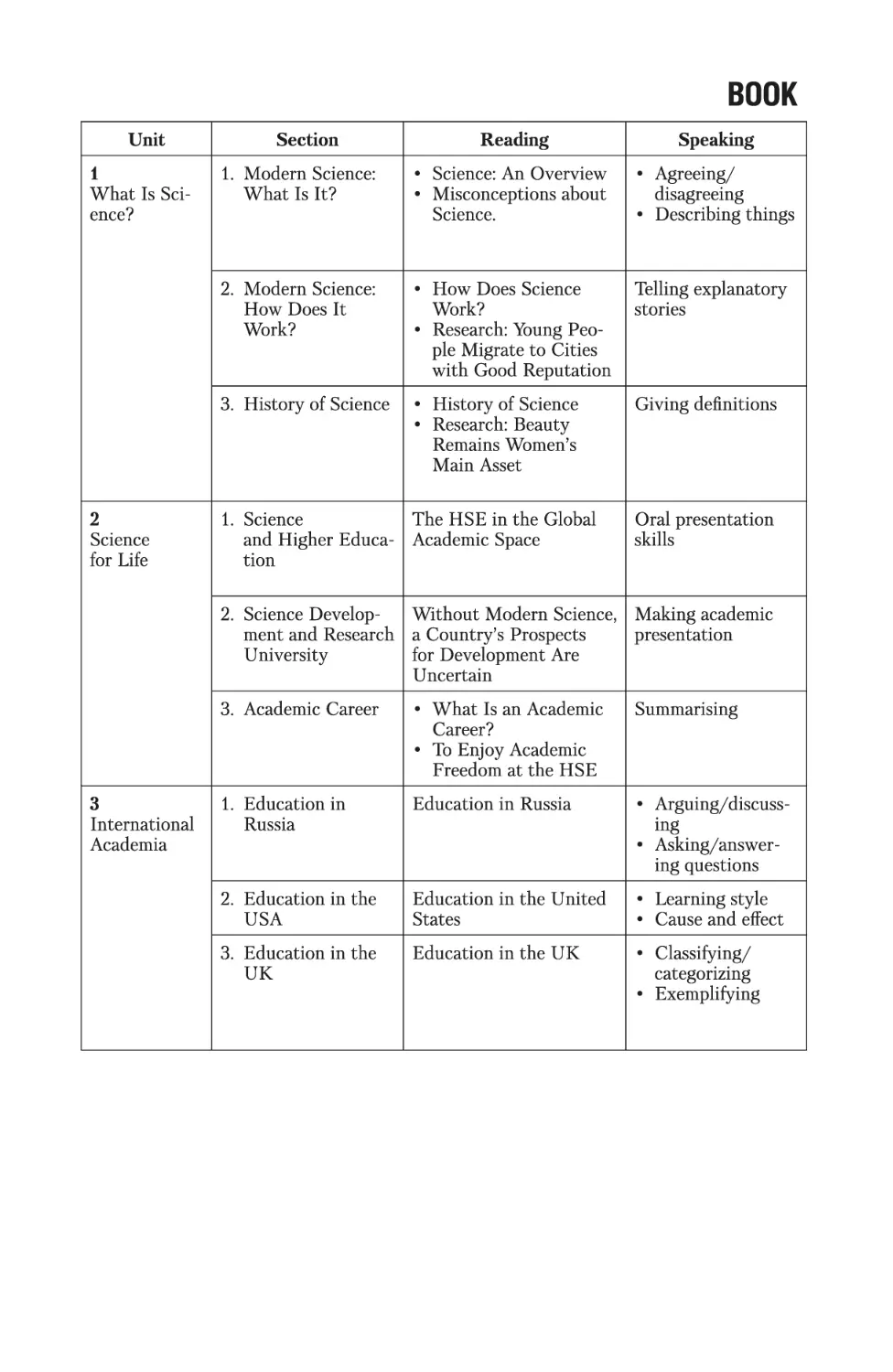
BOOK
Unit
Section
Reading
Speaking
1
.
Modern Science:
° Science: An Overview
° Agreeing/
What Is Sci—
What Is It?
° Misconceptions about
disagreeing
ence?
Science.
° Describing things
.
Modern Science:
° How Does Science
Telling explanatory
How Does It
Work?
stories
Work?
-
Research: Young Peo-
ple Migrate to Cities
With Good Reputation
.
History of Science ° History of Science
Giving definitions
° Research: Beauty
Remains Women’s
Main Asset
2
.
Science
The HSE in the Global Oral presentation
Science
and Higher Educa— Academic Space
skills
for Life
tion
.
Science Develop- Without Modern Science, Making academic
ment and Research a Country’s Prospects
presentation
University
for Development Are
Uncertain
.
Academic Career
0 What Is an Academic Summarising
Career?
-
To Enjoy Academic
Freedom at the HSE
3
.
Education in
Education in Russia
-
Arguing/discuss-
International
Russia
ing
Academia
° Asking/answer-
ing questions
.
Education in the
USA
Education in the United
States
0 Learning style
° Cause and effect
.
Education in the
UK
Education in the UK
° Classifying/
categorizing
° Exemplifying

MAP
Writing
Vocabulary
Grammar
Study Skills
Guidelines
on writing a sum—
0 Data, evidence
and facts
Genitive: possessive
form of nouns
° Answering
questions about
mary
° Academic vocabu—
research
lary
0 Before reading
strategies
Note-taking
Commonly misused
Nouns: plurals,
Mind mapping
and note—making
words:
expand/expend,
infer/imply
countable, uncount-
able
° Pre—writing
Academic vocabulary Articles
Critical reading
strategies
list
° Writing an
explanatory
essay
Definition
° Academic vocabu—
Relative clauses
Research design (1)
and academic
lary
clarity
° Commonly misused
words: assess/access
Hedging
° Prepositions
° Making connec-
Questions
° Commonly misused
tions
or hypothesis
words: very/vary
-
Linking words
Avoiding acciden— 0 Academic vocabu—
Reporting verbs
Research design (2)
tal plagiarism
lary
° Word family
Writing process
Commonly misused
Passive voice
Understanding text
words: issue/problem
structure/organiza-
tion
Academic CV
Nominalisation
Conditionals
Identifying refer—
(I—II types)
ence in the text
Writing an email
° Commonly misused
words: continual/
continuous
0 Abbreviations and
acronyms
Relative clauses:
defining
and non—defining
Proof—reading
written English

Предисловие
(Preface)
Данное учебное пособие адресовано Прежде всего преподавателям дис-
Циплины «Английский язык». Цель книги — способствовать развитию
языковой компетенции для академических целей, которая представляет
собой одно из приоритетных направлений языковой подготовки современ-
ности. Содержание пособия определяется, с одной стороны, практическими
потребностями студентов, связанными с выполнением академических
и профессиональных задач, с другой стороны, требованиями, предъявля-
емыми образовательными программами к качеству языковой подготовки.
Пособие может применяться для обучения английскому языку студен-
тов всех специальностей, поскольку выбранные темы носят универсальный
академический характер и способствуют созданию у учащихся Целостной
картины научного мира, последовательно раскрывая вопросы о современ-
ном понимании науки, ее роли B Жизни общества. Наряду с решением прак-
тической задачи формирования языковой компетенции происходит и фор-
мирование академических компетенций, B том числе исследовательских.
Таким образом, пособие помогает решить следующие задачи:
1) развитие языковых компетенций (академических интегрированных
языковых умений — говорения, чтения, письма, а также навыков — лекси-
ческих и грамматических);
2) развитие академических компетенций, к которым относятся: Эффек-
тивная работа с первоисточниками (текстовыми и аудио); составление вто-
ричных документов и документов, востребованных B академической среде,
B том числе международной; подготовка и проведение публичных высту-
плений, участие B дискуссиях и круглых столах;
3) совершенствование академического стиля письменной и устной речи;
4) формирование научного мировоззрения и базовых представлений
об исследовательской деятельности.
В результате освоения материала учащиеся должны:
знать
° Широкий спектр академической лексики и лексики, связанной с про-
блематикой научного общения и исследовательской работой;
° правила грамматики, необходимые для грамотной иноязычной ком-
муникации как B устной, так и B письменной форме;
° ключевые вопросы академической тематики, B том числе: современ-
ная наука, ее аспекты и проблемы, организация научной жизни, роль уче-
ного B современном мире, академическая среда, ее особенности, исследова-
тельские университеты, академическая жизнь B зарубежных странах;
уметь
° быстро ознакомиться с текстом, выделить важную информацию, пере-
дать его основное содержание, определить актуальность рассматриваемых

положений и Найти ответы на вопросы, связанные с содержанием текста
(чтение);
0 B диалоге: Давать подробные ответы на интересующие собеседника
вопросы академической и профессиональной сферы, описывать явление
или ситуацию, а также развивать отдельные Мысли, подкрепляя их допол-
нительными положениями и примерами (говорвние);
° B монологической речи: строить четкую систему аргументации,
высказывать собственную точку зрения, отмечая достоинства и недостатки
различных систем или теорий, включаться в дискуссию и выходить из нее,
используя необходимую лексику и лексико-грамматические обороты (гово-
рение);
° сопоставлять или противопоставлять имеющиеся данные, делать
заметки по ходу прочитанного или прослушанного материала, обобщать
прочитанный материал и кратко излагать его содержание, составлять ака-
демическое резюме, писать Электронные письма (письмо)
владеть навыками
° самостоятельной работы с языковым материалом (с использованием
справочной литературы, словарей, информационных сайтов);
° извлечения необходимой информации из оригинального текста
на английском языке;
° выражения собственного отношения к изучаемому явлению как
при межличностном, так и при академическом общении;
° восприятия, анализа и создания устных высказываний и письменных
текстов общеакадемической направленности.
Для успешного освоения материала уровень владения английским язы-
ком по шкале IELTS должен быть не ниже 6-6,5.
Книга состоит из трех Частей (Unit), B каждой из которых раскрываются
темы, связанные с организацией и деятельностью научного мира, его основ-
ными закономерностями, а также со сферой международного высшего обра-
зования. Части состоят из блоков (Section), каждый из которых посвящен
изучению определенной тематики в рамках основной темы и усвоению язы-
ковых навыков и умений, необходимых для общения в научной и академи-
ческой сфере. Все блоки содержат большое количество аутентичных текстов,
а также разнообразные упражнения и задания, направленные на развитие
и совершенствование лексических и грамматических навыков, отработку
языковых и академических умений. В конце каждой части приводится спи-
сок вопросов по закреплению изученного материала (Check Understanding)
и список использованных источников информации (Sources).
Ответы к упражнениям даны в разделе «Ключи» (Keys) B конце книги.
Наличие Этого раздела позволит учащимся самостоятельно осваивать мате-
риал, проверяя корректность вьшолнения заданий.
В конце пособия также приводится словарь (Glossary), который вклю-
чает основные научные термины, встречающиеся в текстах, и их толкова-
ние на английском языке.
Учебное пособие можно использовать B качестве основного средства
обучения в аудиторной и внеаудиторной работе, а также для самоподго-
товки.

Short Forms and Labels
Word Classes
adj = adjective
adv = adverb
n=noun
a=verb
Codes and Labels
abb. = abbreviation
pl. 2 plural
smb = somebody
smth = something

Unit 1
WHAT IS SCIENCE?
Objectives of the unit:
° to understand the essentials of science
° to develop language skills: reading (for gist and for detail), speaking
(describing objects, explanations, giving definitions, reporting) and writing
(a summary, an explanatory essay, making notes)
° to develop crucial study skills (critical reading, designing mid maps, talking
about the research)
° to learn the vocabulary related to science and the scientific method
° to practice grammar: genitive, nouns in academic English, articles
Section 1. Modern Science: What Is It
LEAD-IN
Exercise 1. Read the statements about science and decide whether you agree or
disagree with them.
Statements
Agree Disagree
1. Scientific ideas are absolute and unchanging.
2. Science can only disprove ideas.
3. The job of a scientist is to find support for his/her
hypotheses.
4. Science is pure. Scientists work without considering
the applications of their ideas.
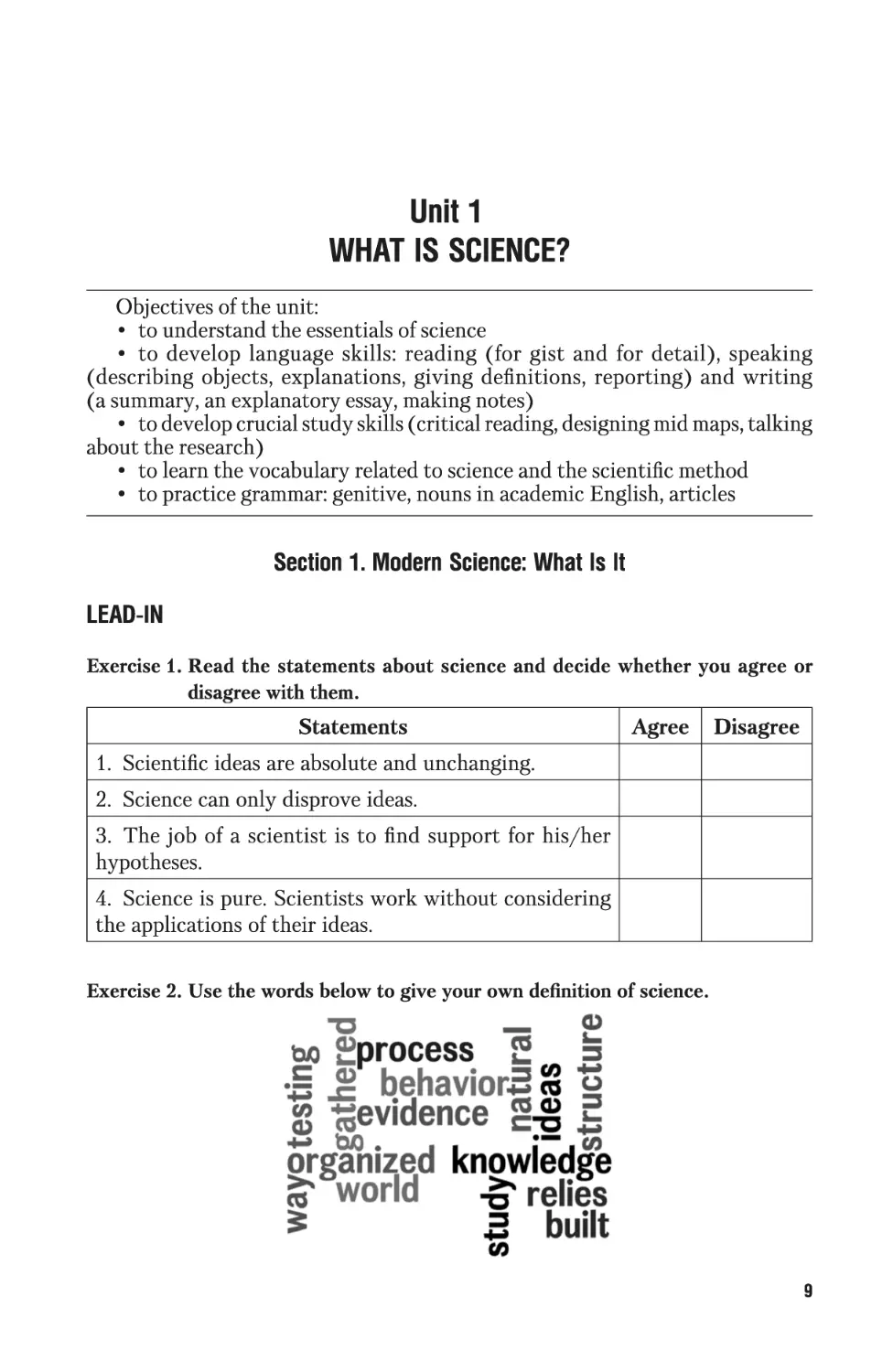
Exercise 2. Use the words below to give your own definition of science.
'5
—
2
no Eprocess 2 m 3
E 2 behaVIorqgg g
g Ebewdence =2 ‘3
gfganlzed knowledge
a world 5‘ reI|e_s
3
bullt
s
t
u

Exercise 3. Do you know these scientists? Tell others what you know about them
and their scientific careers.
l
READING
Science: An Overview
The word ‘science’ probably brings to mind many different pictures: a fat
textbook, white lab coats and microscopes, an astronomer peering through
a telescope, a naturalist in the rainforest, Einstein’s equations scribbled on a
chalkboard, the launch of the space shuttle, bubbling beakers... All of those
images reflect some aspect of science, but none of them provides a full picture
because science has so many facets:
-
Science is both a body of knowledge and a process. In school, science may
sometimes seem like a collection of isolated and static facts listed in a textbook,
but that’s only a small part of the story. Just as importantly, science is also a
process of discovery that allows us to link isolated facts into coherent and com—
prehensive understandings of the natural world.
-
Science is exciting. Science is a way of discovering what’s in the universe
and how those things work today, how they worked in the past, and how they
are likely to work in the future. Scientists are motivated by the thrill of seeing
or figuring out something that no one has before.
-
Science is useful. The knowledge generated by science is powerful and reli—
able. It can be used to develop new technologies, treat diseases, and deal with
many other sorts of problems.
-
Science is ongoing. Science is continually refining and expanding our
knowledge of the universe, and as it does, it leads to new questions for future
investigation. Science will never be ‘finished’.
-
Science is a global human endeavor. People all over the world participate
in the process of science.
Science is complex and multi—faceted, but the most important characteristics
of science are straightforward:
0 Science focuses exclusively on the natural world, and does not deal with
supernatural explanations.
° Science is a way of learning about what is in the natural world, how the
natural world works, and how the natural world got to be the way it is. It is not
simply a collection of facts; rather it is a path to understanding.
° Scientists work in many different ways, but all science relies on testing
ideas by figuring out what expectations are generated by an idea and making
observations to find out whether those expectations hold true.
10

° Accepted scientific ideas are reliable because they have been subjected to
rigorous testing, but as new evidence is acquired and new perspectives emerge
these ideas can be revised.
° Science is a community endeavor. It relies on a system of checks and bal—
ances, which helps ensure that science moves in the direction of greater accu—
racy and understanding. This system is facilitated by diversity within the sci—
entific community, which offers a broad range of perspectives on scientific ideas.
Many students have misconceptions about what science is and how it works.
The most common misconceptions about science are listed below
Misconception 1: Science is a collection of facts.
CORRECTION: Because science classes sometimes revolve around dense
textbooks, it’s easy to think that’s all there is to science: facts in a textbook. But
that’s only part of the picture. Science is a body of knowledge that one can learn
about in textbooks, but it is also a process. Science is an exciting and dynamic
process for discovering how the world works and building that knowledge into
powerful and coherent frameworks.
Misconception 2: Science is complete.
CORRECTION: Since much of what is taught in introductory science courses
is knowledge that was constructed in the 19th and 20th centuries, it’s easy to
think that science is finished — that we’ve already discovered most of what
there is to know about the natural world. This is far from accurate. Science is an
ongoing process, and there is much more yet to learn about the world. In fact,
in science, making a key discovery often leads to many new questions ripe for
investigation. Furthermore, scientists are constantly elaborating, refining, and
revising established scientific ideas based on new evidence and perspectives.
Misconception 3: There is a single Scientific Method that all scientists follow.
CORRECTION: ‘The Scientific Method’ is often taught in science courses
as a simple way to understand the basics of scientific testing. In fact, the Sci—
entific Method represents how scientists usually write up the results of their
studies (and how a few investigations are actually done), but it is a grossly
oversimplified representation of how scientists generally build knowledge.
The process of science is exciting, complex, and unpredictable. It involves
many different people, engaged in many different activities, in many different
orders.
Misconception 4: The process of science is purely analytic and does not involve
creativity.
CORRECTION: Perhaps because the Scientific Method presents a linear and
rigid representation of the process of science, many people think that doing sci—
ence involves closely following a series of steps, with no room for creativity and
inspiration. In fact, many scientists recognize that creative thinking is one of
the most important skills they have — whether that creativity is used to come
up with an alternative hypothesis, to devise a new way of testing an idea, or to
look at old data in a new light. Creativity is critical to science!
11

Misconception 5: Experiments are a necessary part of the scientific process.
Without an experiment, a study is not rigorous or scientific.
CORRECTION: Perhaps because the Scientific Method and popular portray—
als of science emphasize experiments, many people think that science can’t be
done without an experiment. In fact, there are many ways to test almost any
scientific idea; experimentation is only one approach. Some ideas are best tested
by setting up a controlled experiment in a lab, some by making detailed obser—
vations of the natural world, and some with a combination of strategies.
[1]
ACTIVITIES
Exercise 1. Read the text Science: An Overview and answer the questions below.
1. What is science?
What is the scientific method?
Is the scientific method a philosophy?
What is the difference between a hypothesis and a theory?
Why do scientists often seem tentative about their explanations?
What does science have to say about ghosts, ESP, and astrology?
P
7
9
4
1
9
3
9
0
!
“
Exercise 2. Use the on-line dictionary to define the following words.
Dictionary: http: //dictionary. cambridge .org/dictionary/learner-english
Word
Definition + Example
Collocation(s)
evidence
Something that makes you believe that something is give evidence / be
true or exists:
in evidence
There is no scientific evidence that the drug is addic—
tive.
experiments
fact
hypothesis
method
observation
reliable
testing
12

Exercise 3. Scan through the text and find words which can help you do the cross-
word.
W|
Across
3. one part of a subject, situation, etc. that has many parts /n/
4. a test done in order to learn something or to discover if something works
or is true /n/
5. an idea or explanation for something that is based on known facts but has
not yet been proved /n/
6. a mathematical statement in which you show that two amounts are equal
using mathematical symbols /n/
9. the act or process of examining a crime, problem, statement, etc. carefully,
especially to discover the truth /n/
10. something that is known to have happened or to exist, especially some—
thing for which proof exists, or about which there is information /n/
13

Down
1. one or more reasons for believing that something is or is not true /n/
2. a particular way of considering something /n/
4. the details or reasons that someone gives to make something clear or easy
to understand /n/
7. the fact that there are many different ideas or opinions about something /n/
8. (the study and knowledge of) the practical, especially industrial, use of
scientific discoveries /n/
SPEAKING
Exercise 4. Read six famous quotations about science and scientists. Do you agree
with the authors of these quotations? Why? / Why not?
1) Science is a wonderful thing if one does not have to earn one’s living at it.
Albert Einstein
2) Science is the great antidote to the poison of enthusiasm and superstition.
Adam Smith, the Wealth of Nations
3) Science is a cemetery of dead ideas.
Miguel de Unamuno, the Tragic Sense of Life
4) Science does not know its debt to imagination.
Ralph Waldo Emerson
5) The important thing in science is not so much to obtain new facts as to dis—
cover new ways of thinking about them.
William Lawrence Bragg
6) Science has made us gods even before we are worthy of being men.
Jean Rostand
Exercise 5. Read the quotations below. All of them respond to the question “What
is the one thing we should learn about science?”
a) Whose quotation comes closest to your belief about what science should teach?
b) Which quotations seem to contradict one another? Which quotations support
one another?
1) Science is about uncertainty. We do not yet know the answers to most of the
most important questions.
Freeman Dyson
2) I would teach the world that science is the best way to understand the world,
and that for any set of observations, there is only one correct explanation.
Lewis Wolpert
3) I would teach the world that scientists start by trying very hard to disprove
what they hope is true... a scientist always acknowledges the possibility of error,
and is less likely to be mistaken than one who always claims to be right.
Anthony Hoare
4) I would teach the world that science is imagination plus humility.
Michael Baum
14

5 Perfect as the wing of a bird may be, it will never enable the bird to fly if
unsupported by the air. Facts are the air of science. Without them a man of science
can never rise.
Ivan Pavlov
6 Science is built up offacts, as a house is built of stones; but an accumulation
of facts is no more a science than a heap of stones is a house.
Henri Poincare
Exercise 6. Practice answering questions. You must speak for at least two minutes.
Try to use some of the words and phrases from exercises above.
Describe a science programme or a scientific experiment you have seen
and enjoyed.
where and when you saw the programme / experi—
ment
You should say:
what happened in the programme / experiment
why the programme / experiment was enjoyable
and explain what you learnt from watching it
Describe a famous scientist you have met or know about
how famous that person is
why that person is famous
what he/she is doing now
and say if you think he/she will become more or less famous
in the future, and why
You should
say:
Describe a project you had to do in your studies or job.
who asked you to do that project
what the main aim of the project was
You should say: who helped you with it
and say if you think that project was a success or not,
and Why
WRITING
SUMMARY
How to Write a Summary: Some Guidelines
1) Shorten the text in such a way that all facts are in the summary. Leave
out examples, evaluations and interpretations.
2) Skim the text. You should know what the main content of it is. Read the
headline carefully. It is important.
3) Read the text again to understand more details. You must understand the
whole text.
4) Make notes (use keywords). Underline important words in the text.
5) Form sentences with the help of your keywords. These sentences should
reflect the main content of the text.
15

6) Connect the sentences using suitable conjunctions. The first sentence
should describe the main content of the text.
7) Use Simple Present or Simple Past. Write sentences in Reported speech.
8) Sometimes you have to change the persons.
9) Check your summary. Watch out for spelling mistakes.
Exercise 7. Read the text and write a summary.
Baby’s First Research
A geneticist working at her lab bench and and a six—month—old baby play—
ing with his food might seem to have little in common. After all, the scientist
is engaged in serious research to uncover the very nature of the physical world,
and the baby is, well, just playing... right? Perhaps, but some developmental
psychologists have argued that this ‘play’ is more like a scientific investigation
than one might think.
Take a closer look at the baby playing at the table. Each time the bowl of
cereal is pushed over the table edge, it falls to the ground — and, in the process,
it reveals critical evidence about how physical objects interact: bowls of cereal
(as well as pacifiers, blocks, books, bananas, and other physical objects) do not
float in mid—air, but require support to remain stable. It is likely that babies are
not born knowing this basic fact of the universe; nor are they ever explicitly
taught it. Instead, babies may form an understanding of object support through
repeated experiments — systematic interactions with the world around them —
and then build on this knowledge to learn even more about how objects inter—
act (e.g., how much physical contact is necessary for support, how the shape
of the objects affects one’s ability to support the other). Though their scales
and accoutrements differ, the baby’s investigation and the physicist’s experi—
ment appear to share the same aim (to learn about the natural world), overall
approach (gathering direct evidence from the world), and logic (are my obser—
vations what I expected?)
Though the claim is controversial, some psychologists have argued that
many of children’s ideas of how the world works resemble scientific theories:
0 These ideas are relatively coherent explanations for some set of phenom—
ena in the natural world.
0 Children use them to generate expectations about how people and objects
will behave.
0 They can be revised or rejected in favor of a new explanation if the weight
of evidence goes against the currently accepted explanation.
Some psychologists propose that young children learn about more than just
the physical world in this way — that they investigate human psychology and
the rules of language using similar means. For example, it may only be through
repeated experiments, evidence gathering, and finally overturning a pet theory,
that a toddler will come to accept the idea that other people can have different
perspectives and desires than he or she has — that, for example, inappropriate
behavior can be hidden from a parent’s view by simply moving behind the sofa
or that, unlike the child, Mommy actually doesn’t like graham crackers.
16

Viewing childhood development as a scientific investigation provides insight
into how children learn, but it also offers a provocative perspective on sci—
ence and scientists. Why do young children and scientists seem to be so much
alike? Psychologists Alison Gopnik, Andrew Meltzoff, and Patricia Kuhl have
proposed that science as an endeavor — the impulse to explore, explain, and
understand our world — is simply a holdover from our infancies. Perhaps evolu—
tion endowed human babies with curiosity and a natural drive to explain their
worlds — and adult scientists simply tap into the same explanatory drive that
served them as infants. The same cognitive systems that make young children
feel good about figuring something out may have been unwittingly co—opted by
adult scientists. As Gopnik and her colleagues put it, ‘It is not that children are
little scientists but that scientists are big children.’
[2]
VOCABULARY
Exercise 8. Read the three texts, do the tasks, and answer the questions.
Data, Evidence and Facts
Data
Data is a set of values of qualitative or quantitative variables. Data is mea-
sured, collected and reported, and analyzed, whereupon it can be visualized
using graphs or images. Data as a general concept refers to the fact that some
existing information or knowledge is represented in some form suitable for bet—
ter usage or processing.
Raw data, i.e . unprocessed data, is a collection of numbers, characters. Field
data is raw data that is collected in an uncontrolled in situ environment. Exper-
imental data is data that is generated within the context of a scientific investi—
gation by observation and recording.
The word ‘data’ used to be considered the plural of ‘datum’, and still is by
some English speakers. Nowadays, though, ‘data’ is most commonly used in the
singular, as a mass noun (like ‘information’, ‘sand’ or ‘rain’).
A. Translate from English into Russian the words and word combinations in bold.
B. Answer the questions:
1) What is data? What type of data do you plan to collect and analyse for
your research?
2) What is the difference between raw and field data?
3) Will you use experimental data in your research?
Evidence
Evidence, broadly construed, is anything presented in support of an asser-
tion. This support may be strong or weak. The strongest type of evidence is that
which provides direct proof of the truth of an assertion. At the other extreme is
evidence that is merely consistent with an assertion but does not rule out other,
contradictory assertions, as in circumstantial evidence.
17

Scientific evidence consists of observations and experimental results that
serve to support, refute, or modify a scientific hypothesis or theory, when col—
lected and interpreted in accordance with the scientific method.
In scientific research evidence is accumulated through observations of phe-
nomena that occur in the natural world, or which are created as experiments
in a laboratory or other controlled conditions. Scientific evidence usually goes
towards supporting or rejecting a hypothesis.
One must always remember that the burden of proof is on the person mak—
ing a contentious claim. Within science, this translates to the burden resting on
presenters of a paper, in which the presenters argue for their specific findings.
This paper is placed before a panel of judges where the presenter must defend
the thesis against all challenges.
A. Translate from English into Russian the words and word combinations in bold.
B. Answer the questions:
1) What is the difference between evidence and scientific evidence?
2) How is evidence accumulated in scientific research?
3) What is a claim? How to prove a claim?
Facts
A fact is something that has really occurred or is actually the case. The usual
test for a statement of fact is verifiability — that is, whether it can be demon—
strated to correspond to experience. Standard reference works are often used
to check facts. Scientific facts are verified by repeatable careful observation or
measurement (by experiments or other means).
A. Translate from English into Russian the words and word combinations in bold.
B. Read the statements below and decide, if they are facts or opinions:
1) The Russian Department of Agriculture recommends that adults con—
sume three to four cups of vegetables per day.
2) Playing team sports is the better way to lose weight.
3) Research shows that a diet low in salt helps people to lower their blood
pressure.
4) Home—cooked meal tastes better than meal in restaurants.
5) Research indicates that young people who ate meals with their parents
did well academically.
Exercise 9. Choose the word from the box to fill in the gaps. Explanation of the miss-
ing word is given in brackets.
conflicting; empirical; accurate; reliable; comprehensive
1. Unfortunately, there is scarce ............. data (can be trusted) to suitably
determine the various internal commercial links.
18

2. A substantial amount of ............... data (based on observation rather than
theory) was required for the verification of assumptions, estimation of param—
eters, fitting of distributions and validation of output.
3. The apparatus used in the experiment is simpler than that which would
be desirable to obtain fully ............. data (correct, exact, without any mistakes).
4. The design of semi—structured interviews enables interviewees to elabo—
rate on their answers, and the interviewer to ask probing questions, so ..................
data (full, complete) can be obtained.
5. The present essay is a comment on Nagel’s ‘Brain Bisection and the Unity
of Consciousness’ (1971) in which he argues that the data relating to patients
who have undergone corpus callosotomy constitute ............. data (contradic—
tory) with regard to the idea of the necessary unity of consciousness of a person
or mind, and of mind being something numerically absolute.
Exercise 10. From the following list use one word to complete the sentences. You
may need to change the form of some words.
assign /v/; context /n/; criterion /n/; data /n/; denote /v/; devise /v/;
formulate /v/; impact /n/; impact /V/
1. The Health Service should not be judged by financial ............. alone.
2. In this example ‘X’ ........... the time taken and ‘Y’ denotes the distance
covered.
3. The data was/were ............. by various researchers.
4. The report ............. the blame for the accident to inadequate safety regula—
tions.
5. Businesses are beginning to feel the full ............ of the recession.
6. It is important to see all the fighting and bloodshed in his plays in histori—
cal ...........
7. She has lots of good ideas, but she has difficulty .............. them.
8. Falling export rates have .............. on the country’s economy quite consid—
erably.
9. A new system has been .............. to control traffic in the city.
Exercise 11. Read the two parallel texts in Russian and English. Translate the miss-
ing words (phrases).
Образование, И B Частности высшее Education, or more specifically,
образование, Представляет собой Путь higher education, is the pathway
K (1) расширению npae и возможностей to 1 .................. and the develop—
людей И развитию наций.
ment of nations.
B Наше время (2) источником роста Knowledge generation has
и нрвусневания стало производство зНа- replaced ownership of capital
ний, а Не владение средствами нроиз- assets and labor productivity as
водства и Не производительность труда. the 2 ................... .
19

Слово «инновация» звучит как своего
рода «мантра» развития.
Innovation is seen as the mantra
for development.
Осознание Этого (3) Hacmwzmco широко
распространилось, Что страны соревну-
Ются Между собой B создании институтов
и организаций, которые (4) способство-
вали бы производству знаний.
This realization is 3 ............. that
nations are scrambling to create
institutions and organizations
that would 4 ............ the process of
knowledge creation.
Это производство подразумевает нали-
Чие сети ученых, (5) активно вовлечен-
ных B данный процесс, поскольку поиск
нового — зто результат деятельности
увлеченных умов, постоянно (6) ста-
вящих под сомнение уже известное
(при условии, Что сама деятельность
осуществляется в (7) благоприятных
условиях).
Knowledge creation requires a
network of scholars 5 ............ in its
pursuit because the search for the
unknown is a product of engaged
minds, constantly 6............. the
known in an 7 ................ .
Университет стал одним из важнейших
учреждений, созданных за всю историю
Человечества и (8) выдержавших испы-
тание временем.
Іп human history, the university
has been one of the great institu—
tions that 8 ............ .
(9) Тем не менее его структура за столетия
претерпела определенные изменения.
Its structure, 9 ............ , has changed
over the centuries.
Абстрактная мысль в рамках филосо-
фии и математики служила (10) доми-
нантной парадигмой.
Abstract thought through phi—
losophy and mathematics was the
10 ................. .
Методы схоластики использовались
для понимания и объяснения (11) сводов
законов, поддержания работы сложных
политических институтов в Болонье
и Париже.
Scholastic methods were
employed to understand 11 ............
and reasoning, supporting com—
pleX political institutions in
Bologna and Paris.
(12) Представление об университете как
об исследовательском институте появи-
лось в ХІХ веке B Германии — B зпоху
(13) бурного развития новых идей, когда
промышленная революция незаметно
проникла B мир.
12 ............. as a research institution
arose in 19th—century Germany, at
a time when the Industrial Revo—
lution had crept upon the world
in the age of 13 ......... .
Это (14) потребовало проведения змпи-
риЧеских исследований в лабораториях
до того, как правильность их результа-
тов была бы (15) подтверждена на прак-
тике и появились бы новые технологии.
This 14 ............ empirical research
to be undertaken in laboratories
before results could be 15 .......... for
new technology to emerge.
20

(16) Приоритетностъ исследования Над
преподаванием выкристаллизовалась
в гумбольдтианской Модели универси-
тета с присущим ей (17) поиском знаний
как непрерывной деятелъности.
16........... over teaching was solidi—
fied in the Humboldtian version of
the university, with the 17 ............ .
(18) Характерными чертами современ-
ного университета стали значительное
финансирование и поддержка исследова-
тельской работы со стороны государства.
18 ........... of the modern univer—
sity was the provision of substan—
tial public funding to support
research.
Современный исследовательский уни-
верситет предлагает также (19) специ-
ализацию по дисциплинам.
The modern research university
has also encouraged 19 ......... .
Разделение знаний на дисциплины
и области (20) обеспечивает глубину
их понимания во все более усложняю-
Щемся мире.
Dividing knowledge into disci—
plines and fields 20 ......... depth of
understanding in an increasingly
complex world.
Однако растет осознание того, Что про-
блемы XXI века требуют (21) целост-
ного понимания равличных аспектов
знания.
However, a growing understand—
ing has appeared that the prob—
lems of the 21st century require a
21 ............... .
Сегодня новые знания (22) появляются
на стыке существующих дисциплин,
и имеется множество способов их вза-
имного обогащения.
[3]
New knowledge today 22..........
of existing disciplines, and cross—
fertilization of disciplinary under—
standing occurs in myriad ways.
[4]
GRAMMAR
GENITIVE: THE POSSESSIVE FORM OF NOUNS
1. Position of the ’s with authors and referees
Context
Comment
Smirnov’s paper is an
excellent introduction to
the problem.
The ’s is placed after the last letter of the author
(or name, country, etc.) .
Shools’s research paper. Even if the last letter of the author’s name is an
s, then still put an ’s. Exceptions: non—English
surnames that end in a silent —s (e.g., Camus’ first
пооеІ, Descartes’ meditations).
Stain and Simpson’s
paper
Black et al’s project...
et al.
When a paper has been written jointly by two
authors, only put an ’s after the last name or after
21

Table termination
Context
Comment
Stain’s paper and Simp-
son’s paper take two
very different positions.
If two papers were written by two authors sepa—
rately, then the ’3 must be used for both authors.
It is each applicant’s
responsibility to ensure
that the three Referees’
Reports are submitted by...
If the noun is in the plural (e.g., those authors,
editors), then put just an apostrophe after the
plural —s.
They answered the three
referees’ questions, and
specifically, we have added
a new section as per Ref-
eree 1’s request.
When a referee is referred to by a number, put the
’s after the number.
Exercise 12. Underline the correct form. If both are correct, underline both.
1. Tim / Tim’s paper was the first to...
2. Tim’s et al. / Tim et al’s articles were the first to...
3. Smits / Smits’s / Smits’ most recent investigation into...
4. We met all the referee / referee’s / referees’ requests.
5. Turing / Turing’s / The Turing’s original thesis was that... He then went
on to reformulate this thesis by...
6. In our work Fourier / Fourier’s analysis was used to derive the...
7. Physicist Stephen Hawking / Hawking’s early career was...
11. Theories, instruments, etc.
Context
Comment
Adrian Wallwork’s manual
on academic writing.
Do not use construction “the + name of person
+ ,8”.
As predicted by Newton’s
theory of gravity, Mercury’s
orbit is elliptical.
The premise of Darwin’s
theory of evolution is that...
“the + name of person + noun”:
This construction can be used instead of the
genitive, with no change in meaning. This con—
struction is very formal and is used only with
famous scientists. This means that you cannot
write the Adrian Wallwork theory of writing,
because Adrian Wallwork (the author of this
book) is not sufficiently famous!
Fourier’s analysis of linear
inequality systems high—
lights that he placed more
importance on...
Turing’s machine was
designed to be an idealized
model of a human computer.
“name of person +’s + noun”:
The focus is usually more on the scientist. We
are talking about their original concept, their
life, etc.
22

Exercise 13. Underline the correct form. If both are correct, underline both.
1. Beer / The Beer’s / Beer’s findings, together with those ofJohann Heinrich
Lambert, make up Beer—Lambert/ the Beer—Lambert/ Beer—Lambert’s law.
2. A Boolean / Boolean ’s operator may refer to one of the following...
3. They used a Turing / Turing’s machine simulation to obtain their result.
4. A Turing / Turing’s machine is a device that...
5. We used an Apple / Apple’s G6 Powerbook laptop running LION to...
6. Apple / Apple ’3 / The Apple’s initial decision to make iPods solely com—
patible with iTunes caused...
7. The iPad/ iPad’s potential for education has been investigated...
8. The Thatcher / Thatcher / Thatcher’s administration caused tremen—
dous”
STUDY SKILLS
Exercise 14. Read the abstract of the research paper and answer the questions.
Youth Take Longer to Leave Their Parents
Young Russians are in no hurry to start living on their own. The age of moving
out from the parental home has increased from 18—20 for previous generations to
23—25 for today ’3 youth. Instead, young people are spending more time in search
of themselves and taking longer to get education and choose a partner, according
to a study by Ekaterina Mitrofanova, junior Research Fellow at the HSE Institute
0f Demography, and Alina Dolgova, student at the HSE Faculty 0f Social Sciences.
Leaving the parental home usually precedes major demographic milestones,
such as getting married (or moving in with a partner) and having children.
Typically, this move requires finding a home of one’s own and having a certain
degree of socioeconomic independence based on education, employment and
financial self—sufficiency. At least, this was the 20th century stereotype, but it
does not necessarily hold true today.
Today, individual lives tend to be more diverse and less linear than before,
while different life stages, such as going to school, starting a family, getting a
job, and retirement often follow new sequences and are based on more careful
and rational planning guided by individual preferences rather than social norms.
Thus, the timing of certain life events may vary.
A typical young Russian today matures rather slowly. They tend to be more
pragmatic, spend more time on education and self—exploration and put off get—
ting married and having children. As to cohabitation, young people are ready to
move in together much earlier than their predecessors and experience an earlier
sexual debut. Reflecting a new perspective on family values, marital behavior
tends to be more rational, with young people choosing life partners by trial and
error. And since ‘adult children’ are in no hurry to make lifelong decisions, they
postpone moving out from the parental home.
In their article The start of an independent life by Russians: the intergenerational
aspect published in Demoscope Weekly, Mitrofanova and Dolgova examine in ret—
rospect the behavioural changes in terms of leaving the parental home observed in
23

Russia over generations, and particularly the age of separation from one’s family
of origin. Their analysis is based on the findings from three waves (2004, 2007
and 2011) of the study ‘Parents and Children, Men and Women in Family and
Society’. Their sample of 4,687 respondents included those born between 1930
and 1986 who first left their parental family between the ages of 15 and 30.
Sometimes They Come Back
Most respondents (97%) have had some experience of living separately from
their parents, and 12% of those were living with their parents again at the time
of the survey. i.e. their independence turned out to be partially reversible for
whatever reason, such as breaking up with a partner, needing to save money,
having no place of their own, etc.
Comparing the number of respondents living on their own in different gen—
erations, one can see that the proportion of respondents born in the 19803 who
had never lived separately from their parents at the time of the survey was
quite high at 20%. Perhaps, at the time of the survey some of them were just
too young to live on their own; anyway, their demographic behavior is different
from that of their parents who used to ‘leave the nest’ at an earlier age.
Older Generations Became Independent Earlier
According to the authors, the highest proportion of respondents who left
their parents at 18 was found in the generation born between 1950 and 1959,
while subsequent generations showed an increasing proportion of those who
continued to live with their parents up to the age of 25.
Curiously, the 19703 generation demonstrated a tendency to leave the paren—
tal home at an earlier age, while in the 19803 generation, by contrast, the aver—
age age of starting an independent life increased again and reached 20.5, which
is almost the same as in the 19303 generation, whose young years fell in the
post—war period when families often stayed together to increase their chances
of survival.
Gender—wise, women in all observed generations tend to leave the parental
home about one year earlier than men.
Some People Regret Growing up T00 Fast
In addition, respondents were asked whether they felt they had left their
parents’ home at the right time or perhaps too early; their responses reflect a
shift in the perception of maturity across generations. The proportion of men
and women who believe they started living independently at the right time
drops from 77% in the 19303 generation to 70% in the 19803 generation, sug—
gesting that more recent generations are not so sure whether early indepen—
dence is a good thing.
Indeed, almost a third of the respondents born between 1980 and 1986
regretted starting an independent life a bit too early.
‘On the one hand, we can assume that 70% of the younger respondents had
made a well thought out decision since they are sure they started off on their
own at the right time for them; however, a fairly large and growing propor—
tion had apparently taken the decision lightly and later regretted it,’ note the
researchers.
24

Stereotypes ofAdulthood Need Revision
The authors examined the respondents’ attitudes towards social stereotypes
as to when one should start living independently.
The proportion of those who felt that 18 was the right age for starting off
on one’s own was high in respondents born before 1969, but declined from 44%
to 42% in subsequent generations, as more people questioned whether the legal
coming of age was indeed a good age for starting an independent life.
The vast majority (90%) of respondents believe that 23 to 25 is the best age
for the transition to adult life, since most young people at 25 would already
have an education, a job, access to socioeconomic resources and a sense of self—
sufficiency.
In fact, the actual age of leaving the parental home does not confirm the
stereotype that young people should leave their parents’ home as they legally
come of age. While many respondents still feel that starting an independent life
at 18 or 20 is normal, they also agree that becoming independent at 23 to 25 is
fine. According to the researchers, ‘just 60% of those who left their parents at
the age of 18 to 20 believe that it was the right time for them to do so’.
Young People in No Rush to Leave Parents
The authors used event history analysis to assess the chances of leaving the
parental home at different ages, using the moment one starts living separately
as the dependent variable. They used the data from the 2011 (third) wave of
the ‘Parents and Children, Men and Women in Family and Society’ survey for
their model as it includes a wealth of data on various demographic events. For
women, the likelihood of leaving parents before 30 is 1.2 higher than for men,
but later on, the chances are equal for both genders.
Event history analysis has confirmed the retrospective observation that the
chances of leaving one’s parents early were lower for people born in the 19303
(due to the historical context, as explained above). The retrospective findings
were also confirmed for the 1950s and 1970s generations — these cohorts had
the maximum probability of starting independent lives before the age of 20. But
in subsequent generations, the chances of starting off on one’s own before 20
consistently decreased, reaching the lowest in the 1980s generation, followed
by a consistent increase after the age of 24.
Thus, recent generations tend to leave their parents at the later age of 23 to
25 than their predecessors. In addition to that, after 2007, a consistent decrease
has been observed in the proportion of respondents who approve of starting an
independent life before one turns 20. Conversely, leaving one’s parents at 23
to 25 is becoming the new social norm, as most respondents in this age group
consider it the right time to start off on their own. In other words, young people
tend to postpone independence to a later age.
However, the study’s authors believe that for a more complete and accurate
picture, additional variables must be considered, such as education, occupation
and income levels — thus mapping out a plan for their future research.
[5]
25

Answer the questions:
What is the aim of this research?
What problem is studied in the paper?
Which data/evidence is used for the purposes of this research?
Is the sample representative for the study?
What methodology is used?
What are the findings of the researchers?
How can the results of the study be used in practice?
What are the limitations of this research?
Q
O
N
F
D
P
‘
r
B
W
N
!
‘
Exercise 15. Strategies for reading academic texts: before reading.
1. Think about your reasons for reading the text:
0 you are interested because it is about your subject, or it is related to
your subject
0 you want background information, or detailed information
-
you want to know what the writer’s views are
-
you are going to have a discussion
° you are going to write an essay on this subject later.
Each reason will influence the way you read e.g., quickly or slowly, looking
for fact or opinion.
2. Look at the title, headline, any sub—headings, photos or illustrations. Use
these elements to predict what the text will be about — the topic.
3. Think about what you already know on this topic.
4. Write down what you would like to find out from the text. You could
write actual questions you would like answers to.
5. Make a note of words or phrases connected with the topic that you may
find in the text.
Use the strategies above on the following text.
Scientific Words: Their Structure and Meaning
The Purpose and Nature ofScientific Words
The development of an appropriate vocabulary is essential to the develop—
ment of any subject. Words are the elements of language; language is the vehicle
of ideas. By silent language thoughts are developed in the mind, and by written
or spoken language thoughts are communicated to others.
It is obvious that a scientist must have names by which to identify and refer
to the various chemical substances, minerals, plants, animals, structural units,
instruments, etc., with which he deals. He must have suitable adjectives for
describing these things and suitable verbs for defining their behaviour.
He also needs suitable names by which to identify the various abstrac—
tions with which he deals — processes, states, qualities, relationships, and
so on. Thus, after Faraday had investigated the passage of electric currents
through different solutions and noted the resulting liberation of chemical
substances, the term electrolysis was invented. This one word was a kind of
26

shorthand symbol for the process; it ‘pinned down’ the process and conve—
niently embraced its many aspects. From then on it was possible to think
about the process and to talk about it to others. Similarly, the single term
symbiosis conveniently summarises a biological state; diathermancy identifies
a physical quality.
Many scientific words are of this kind. Without the name (or technical term)
a concept remains vague and ill—defined; the scientist is hindered in his mental
processes, in his recording of what he thinks and does, and in his communica—
tion with others.
In his communication a scientist is mainly concerned with the exact and
logical expression of that which he wishes to pass on to another. His purpose
is to inform (as clearly as possible), not to excite emotion. It follows that
each of his words must have a precise meaning, and one meaning only, so that
there is no risk of confusion or ambiguity. Of course he must know himself
what his words mean and he must assume that the person with whom he
communicates attaches the same meanings to them. (If he is communicating
with a person who is unlikely to understand his specialised terms, he must
take care not to use them, even if that may mean some loss of precision or
elegance. A number of ‘popular’ science talks fail because the speaker, often
an expert scientist, thoughtlessly uses words which the ordinary person does
not understand.)
The meanings of many ordinary words of our language are not single and
precise. Although the original, basic meanings may be clear, the words have
acquired a range of meanings over the years. Thus the familiar word fair has
somewhat different meanings when used to describe the weather, a person’s hair,
an action or decision, or a boy’s performance at school; some words (e.g., ‘rade’)
suffer a significant change in meaning. Hence a scientist avoids the ordinary
words of the language; he prefers his own words. These words can then be rigor—
ously defined and given the necessary precision of meaning.
The use of words which are ‘set apart’ from everyday life also enables
the scientist to avoid evoking irrelevant and distorting associations. Some
ordinary words convey more than their literal meanings; they evoke further
images, emotions and reactions on the part of the hearer or reader. (Thus
rea’, basically a word denoting a certain colour, may conjure up thoughts and
feelings relating to danger, to blood, or to a particular political outlook.) The
specialised words of science, if used in their proper contexts, are largely free
from distorting associations. It is interesting to note that when a scientific
term, originally well—defined, becomes a word of ordinary speech, it usually
suffers a widening of meaning and acquires a number of associations. Thus
criticism (as well as sulphuric acid) may be vitriolic, a man may be electri—
fied into action, and people may claim to be allergic to all sorts of things and
conditions. The word atomic, whose meaning is quite clear to the scientist,
may conjure up in the public mind a picture of wide spread destruction or of
unlimited power.
27

In addition to precision of meaning and freedom from associations, most
scientific words have a third quality: by their form and structure they reveal
something of their meanings. Many scientific words are logically built up from
simpler word—elements (usually of Greek or Latin origin) and the general mean—
ing of the whole can be inferred from an understanding of the parts. Some terms,
in fact, are self—explanatory if the Latin and Greek roots are known; they have
only to be ‘translated’ for their meanings to become apparent.
Thus a quadrilateral is clearly a four—sided figure, entomology is the study
of insects, gastrectomy is the cutting out of the stomach (or part of it). In the
case of a large number of words the full or precise meaning may not be directly
disclosed but the general meaning is apparent and the word is seen to ‘make
sense’. Thus cyanosis indicates a state (possibly a morbid state) of blueness; it
is a sensible word to use to denote the blue condition of the skin which results
from insufficient oxygen in the blood. A xerophyte (literally ‘a dry plant’) is one
which is adapted for living in very dry conditions; a hydrophyte is one which
lives on the surface of, or submerged in, water. A polymer consists of ‘many
parts’; the term is an appropriate one for a giant molecule which is built up from
a large number of simple units.
In a similar way, many chemical names are essentially descriptions of the
compounds which they denote. Thus whereas the common name aniline for a
certain oil discloses nothing about the nature of the compound (except, perhaps,
that it is vaguely related to indigo), the chemical name aminobenzene immedi—
ately indicates the molecular composition and structure.
Scientific language, to be efficient, must be universally intelligible. The clas—
sical languages, Latin and Greek, are so fundamental to the civilised world that
words constructed from elements of these languages are readily understood the
world over. (Even if scientists know little of the classical languages, they can
easily learn to ‘translate’ the scientific terms which they may meet.) Most sci—
entific terms are effectively international.
Sources ofScientific Words
Scientific words in English may conveniently be divided, from the stand—
point of their origins, into three groups:
a. those taken from the ordinary English vocabulary;
b. those taken virtually unchanged from another language;
c. those which have been invented.
The third group is by far the largest.
Just as the cricketer has taken certain everyday words, such as ran, over,
maiden, from the general English vocabulary and given them specialised mean—
ings within the context of his game, so the scientist has occasionally taken
ordinary English words and endowed them with specialised meanings. Energy,
work, power, salt, base, fruit are examples of such words. They are unsatisfac—
tory as scientific terms because they lack the essential qualities which we have
described. Although the scientist may give them precise meanings, they are
liable to be interpreted more loosely (or even differently) by the non—scientist.
28

They are not free from irrelevant associations; they reveal little of their mean—
ings by their forms; and usually, they are not understood outside the English—
speaking countries. There are not many words of this kind but, unfortunately,
most of them stand for concepts of fundamental importance.
The English language contains a number of words which have been taken
from another language with little or no change of spelling. Amongst them are
caf, morgue, souvenir, trek, marmalade and agenda. Practically all the scientific
words of this kind have been taken from Latin or Greek. As examples of Latin
words we may note axis, fulcrum, larva, radius, locus, nimbus, cortex. Many parts
of the human body, e.g ., cerebrum, pelvis, cornea, have Latin names. There are
fewer unaltered Greek words — thorax, stigma, iris, helix are examples — but it
should be noted that many terms adopted in Latin form, e.g., trachea, bronchus,
phylum, were themselves based on Greek. Many of the Greek or Latin terms
have retained their original meanings but in some cases the meanings have been
restricted and rendered more precise.
The largest group of scientific words is those which have been invented. The
advance of science during the last few centuries has been so rapid and so exten—
sive that no language has been capable of providing, ready—made, all the words
which were required. Further, the classical languages do not contain words
appropriate to modern discoveries, inventions and concepts. (There is no Latin
word, for example, for photography!) Hence the scientist has had to invent new
words for his own purposes.
It is very rare for a scientist to make up a word ‘out of his head’; the term
ester for a compound formed by the interaction of an alcohol and an organic
acid was perhaps such an invention. A small but interesting group of terms com—
prises those based on proper names. In the naming of the chemical elements
recourse has been made to the names of places (as in polonium, ytterhium), of
gods and goddesses (as in thorium, vanadium), of planets and asteroids (as in
uranium, cerium), and of scientists themselves (as in curium, gadolinium). Scien—
tists’ names have also been used to provide the names of units (e.g., zvatt, volt,
gauss, joule) and hence the names of measuring instruments (e.g., voltmeter).
Among the other terms based on the names of scientists are daltonism, nicotine,
bahelite and mendelism. A number of plants, e.g., fuchsia, dahlia are named after
botanists.
In his task of inventing new terms, however, the scientist has usually turned
to the classical languages for his raw material. He has taken ‘bits and pieces’ —
roots, prefixes, suffixes — from these languages and joined them together to form
the terms he needed. Thus, when he needed a general name for animals such as
snails and slugs which apparently walk on their stomachs, he took the Greek
roots gast(e)ro— (stomach) and —p0d (foot) and formed the new word gastropod.
When he wanted a word to describe a speed greater than that of sound he took
the Latin prefix super— (above, beyond) and the Latin root son— (sound) and
coined the adjective supersonic. Thousands of scientific words have been built
up from classical word—elements in this way.
29

It may be asked why the scientist should have turned to the classical lan—
guages for the words and word—elements which he needed. By turning to a lan—
guage other than his own he was certainly able to find words and elements
which were distinct from those of ordinary speech but he turned to the classical
languages for an important historical reason. The fifteenth and sixteenth centu—
ries witnessed that great revival of classical learning which is commonly called
the Renaissance. Latin was regarded as the universal language of scholarship;
it was the ‘perfect’ language of philosophy, theology and science. This classical
tradition persisted into the seventeenth century — both Harvey and Newton
wrote their great works in Latin — and it was not until towards the end of that
century that English was fully accepted as an adequate and suitable language
for a scholarly exposition of science.
During this period many Latin words were taken into the scientific vocabu—
lary and many new words were constructed (chiefly in the form of Latin words)
from classical elements. The tradition of using the classical languages as a source
of scientific words remains.
Greek was not used in the same way as a medium of expression but it was
held in respect as the language of the people who at one time led the world in
art, science and philosophy. Moreover, it provided a particularly suitable basis
for scientific language. It had been developed by a long line of philosophers as
a medium for accurate expression and its elements were such that derivatives
and compounds were readily formed. The scientists therefore mainly went to
the Greek for the new terms which they needed (though, as has been pointed
out, the terms were at one time often framed in Latin form). Greek is still the
source of most of the new terms of science and more than half of the words of
the great vocabulary of science are ultimately of Greek origin.
[6]
Section 2. Modern Science: How Does It Work?
LEAD-IN
Exercise 1. Decide which of the following makes science science. Explain your
choice.
Science...
a) relies on evidence;
d) uses testable ideas;
b) leads to ongoing research;
e) discovers facts;
c) focuses on the natural world;
f) explains the reality
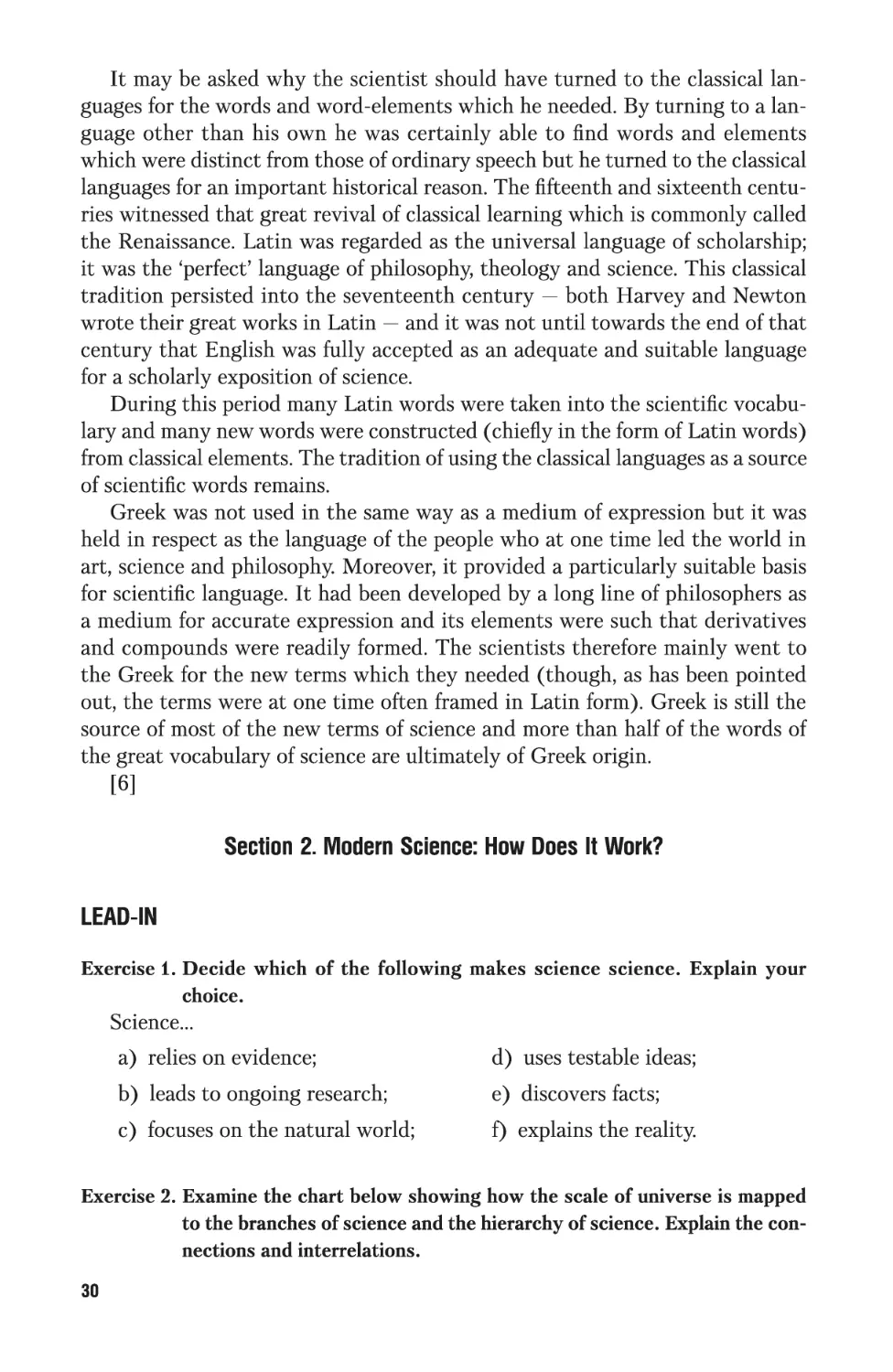
Exercise 2. Examine the chart below showing how the scale of universe is mapped
to the branches of science and the hierarchy of science. Explain the con-
nections and interrelations.
30

Scale of the Universe Branches of Science E Hierarchy of Science
Parallel Universes?
Sociology
Astronomy
“‘
low, ethics,
planetary science,
10" — - V isible Universe
'
." -‘
.
.
"'
economics
Window
10“ _
II
PhI
ai
,
'
_’‘
SVC 0 03V
205C ence
10“ " ' Milky Way
I
'
'
developmental,
climate, geology,
1013 _
..
'
cognitive
oceanography
E
.
u -..I
.
q;
15 _.
g10 _S|S
Functional Biology
E 1012_ 03" VStem
physiology, medicine, ecology
IE 109 .—
.
r.-
30‘
_
Earth
-
.'
. II Science
Cellular Biology
00-5 1
-
._
~_
.
_,
biochemistry, evolutionarybioioay
g1000-
--
_
Chemistry
D1
Human
.
.
materials, chemicaireoctions
0 001.
“
Physical
'
_
CII
..“v :4. .. :3“.
Science
10" -
e
-‘-"_. ‘*:.- 7-‘5,
Physics
-.
..‘
fifi- “0..
'
particle physics, thermodynamics
_
.
'
Ina
10.9
-
Atom
‘.2
10'"—
Formal
Mathematics
-
-
ca
ter science, statistics
,.
10-15— ' PartIE
'
science
mp"
"V
‘.
L.
.
s:I n
oglc
L
i,
.
k
_
/
reasoning, philosophy
READING
How Does Science Work?
1. Science as a collective institution aims
to produce more and more accurate natural
explanations of how the natural world works,
what its components are, and how the world
got to be the way it is now. Classically, sci—
ence’s main goal has been building knowledge
and understanding, regardless of its potential applications — for example, inves—
tigating the chemical reactions that an organic compound undergoes in order
to learn about its structure. However, increasingly, scientific research is under—
taken with the explicit goal of solving a problem or developing a technology, and
along the path to that goal, new knowledge and explanations are constructed.
For example, a chemist might try to produce an antimalarial drug synthetically
and in the process, discover new methods of forming bonds that can be applied
to making other chemicals. Either way (so—called ‘pure’ or ‘applied’ research),
science aims to increase our understanding of how the natural world works.
2. The knowledge that is built by science is always open to question and
revision. No scientific idea is ever once—and—for—all ‘proved’. Why not? Well,
science is constantly seeking new evidence, which could reveal problems with
our current understandings. Ideas that we fully accept today may be rejected or
modified in light of new evidence discovered tomorrow For example, up until
1938, paleontologists accepted the idea that coelacanths (an ancient fish) went
extinct at the time that they last appear in the fossil record — about 80 million
years ago. But that year, a live coelacanth was discovered off the coast of South
Africa, causing scientists to revise their ideas and begin to investigate how this
animal survives in the deep sea.
31

3. Despite the fact that they are subject to change, scientific ideas are reli—
able. The ideas that have gained scientific acceptance have done so because they
are supported by many lines of evidence. These scientific explanations continu—
ally generate expectations that hold true, allowing us to figure out how entities
in the natural world are likely to behave (e.g., how likely it is that a child will
inherit a particular genetic disease) and how we can harness that understanding
to solve problems (e.g., how electricity, wire, glass, and various compounds can
be fashioned into a working light bulb). For example, scientific understandings
of motion and gases allow us to build airplanes that reliably get us from one air—
port to the next. Though the knowledge used to design airplanes is technically
provisional, time and time again, that knowledge has allowed us to produce
airplanes that fly. We have good reason to trust scientific ideas: they work!
4. The process of science involves many layers of complexity, but the key
points of that process are straightforward:
5. There are many routes into the process — from serendipity (e.g., being hit
on the head by the proverbial apple), to concern over a practical problem (e.g.,
finding a new treatment for diabetes), to a technological development (e.g., the
launch of a more advanced telescope) — and scientists often begin an investi—
gation by plain old poking around: tinkering, brainstorming, trying to make
some new observations, chatting with colleagues about an idea, or doing some
reading.
6. Scientific testing is at the heart of the process. In science, all ideas are
tested with evidence from the natural world, which may take many different
forms — from Antarctic ice cores, to particle accelerator experiments, to detailed
descriptions of sedimentary rock layers. You can’t move through the process of
science without examining how that evidence reflects on your ideas about how
the world works — even if that means giving up a favourite hypothesis.
7. The scientific community helps ensure science ’5 accuracy. Members of the
scientific community (i.e ., researchers, technicians, educators, and students, to
name a few) play many roles in the process of science, but are especially impor—
tant in generating ideas, scrutinizing ideas, and weighing the evidence for and
against them. Through the action of this community, science is self—correcting.
For example, in the 1990s, John Christy and Roy Spencer reported that tem—
perature measurements taken by satellite, instead of from the Earth’s surface,
seemed to indicate that the Earth was cooling, not warming. However, other
researchers soon pointed out that those measurements didn’t correct for the
fact that satellites slowly lose altitude as they orbit and that once these cor—
rections are made, the satellite measurements were much more consistent with
the warming trend observed at the surface. Christy and Spencer immediately
acknowledged the need for that correction.
8. The process of science is intertwined with society. The process of science
both influences society (e.g., investigations of X—rays leading to the develop—
ment of CT scanners) and is influenced by society (e.g., a society’s concern
about the spread of HIV leading to studies of the molecular interactions within
the immune system).
32

Science Relies on Evidence
9. Ultimately, scientific ideas must not only be testable, but must actually
be tested — preferably with many different lines of evidence by many different
people. This characteristic is at the heart of all science. Scientists actively seek
evidence to test their ideas — even if the test is difficult and means, for exam—
ple, spending years working on a single experiment, travelling to Antarctica to
measure carbon dioxide levels in an ice core, or collecting DNA samples from
thousands of volunteers all over the world. Performing such tests is so impor—
tant to science because in science, the acceptance or rejection of a scientific idea
depends upon the evidence relevant to it — not upon dogma, popular opinion,
or tradition. In science, ideas that are not supported by evidence are ultimately
rejected. And ideas that are protected from testing or are only allowed to be
tested by one group with a vested interest in the outcome are not a part of good
sc1ence.
Scientific Ideas Lead to Ongoing Research
10. Science is an ongoing endeavor. It did not end with the most recent
edition of your college physics textbook and will not end even once we know
the answers to big questions, such as how our 20,000 genes interact to build a
human being or what dark matter is. So long as there are unexplored and unex—
plained parts of the natural world, science will continue to investigate them.
11. Most typically in science, answering one question inspires deeper and
more detailed questions for further research. Similarly, coming up with a fruitful
idea to explain a previously anomalous observation frequently leads to new expec—
tations and areas of research. So, in a sense, the more we know, the more we know
what we don’t yet know. As our knowledge expands, so too does our awareness of
what we don’t yet understand. For example, James Watson and Francis Crick’s
proposal that DNA takes the form of a double helix helped answer a burning ques—
tion in biology about the chemical structure of DNA. And while it helped answer
one question, it also generated new expectations (e.g., that DNA is copied Via base
pairing), raised many new questions (e.g., how does DNA store information?),
and contributed to whole new fields of research (e.g., genetic engineering). Like
Watson and Crick’s work, most scientific research generates new expectations,
inspires new questions, and leads to new discoveries.
[7]
ACTIVITIES
Exercise 1. Read the following words from the text. Check pronunciation of these
words with the dictionary.
components, chemical, chemist, technology, to accept, to inherit, various,
layers, diabetes, to ensure, hypothesis, to acknowledge, intertwined, society,
dogma, anomalous, endeavor
Exercise 2. Answer the following questions.
1) What are the main goals of science?
33

2) What is a typical scientific process? What are the stages of a typical sci—
entific process?
3) What is scientific testing?
4) Who are the members of the scientific community?
5) What are the characteristics of pure scientific knowledge?
6) How does science receive evidence?
7) What is the difference between pure scientific knowledge and alternative
knowledge (life experience, horoscopes, extra sensitive knowledge, etc.)?
8) Describe the way science works.
9) What is dogma? Give some examples.
Exercise 3. Scan through the text (paragraphs 1-11) and find words which can help
you do the crossword.
1|||||||
14
“‘|
||”|||
34

Across
1. modern and well developed /adj/ (para 5)
2. producing good results /adj/ (para 11)
5. to change something such as a plan, opinion, law, or way of behaviour
slightly, usually to improve it or make it more acceptable /v/ (para 2)
7. the fact of finding interesting or valuable things by chance /n/ (para 5)
9. more and more /adv/ (para 1)
10. an activity or business method in which a group of people meet to sug—
gest a lot of new ideas for possible development /n/ (para 5)
15. to make someone have a particular strong feeling or reaction /v/ (para 11)
16. to accept, admit, or recognize something, or the truth or existence of
something /v/ (para 7)
18. always behaving or happening in a similar, especially positive, way /adj /
(para 7)
Down
1. correct, exact, and without any mistakes /adj/ (para 1)
3. to make known or show something that is surprising or that was previ—
ously secret /v/ (para 2)
4. the state of having many parts and being difiicult to understand or find
an answer to /n/ (para 4)
6. easy to understand or simple /adj/ (para 4)
8. to look at or consider again an idea, piece of writing, etc. in order to cor—
rect or improve it /v/ (para 2)
11. the act of refusing to accept, use, or believe someone or something /n/
(para 9)
12. the size, shape, quality, etc. of something, which you discover by measur—
ing it /n/ (para 7)
13. a part that combines with other parts to form something bigger /n/
(para 1)
14. clear and exact /adj/ (para 1)
17. to make something certain to happen /v/ (para 7)
Exercise 4. Use the words from Exercise 3 to fill in the gaps. Remember to change
the form of the word.
1. Sweden has a reputation for
and stylish design.
2. The report
(that) the company made a loss of £20 million last
year.
3. We found it cheaper to
existing equipment rather than buy new.
4. The research has proved extremely
.
5. The government may need to
its policy in the light of this
report.
6. Her proposal met with unanimous
.
7. As a chief, he
great loyalty in his employees.
8. On Thursday, participants broke into groups for
sessions on
education.
35

9. We must be
in applying the rules.
10. Scientists have found a more
way of dating cave paintings.
11. I was astonished by the size and
of the problem.
12. Trust is a vital
in any relationship.
13. The government won’t even
the existence of the problem.
14. The airline is taking steps to
safety on its aircraft.
15. He explained in a quite
way that there wasn’t enough work
for us all.
16. Accurate
is very important in science.
17. It is becoming
clear that this problem will not be easily solved.
18. Reading should be an adventure, a personal experience full of
and surprise.
Exercise 5. Match the word with its definition.
1. accept
2. applied
science
3. endeavor
4. experi—
ment
5. hypo—
thesis
6. pure sci—
ence
7. research
8. scruti—
nize
36
A. To examine something very carefully in order to discover
information
B. A scientific test that involves manipulating some factor or
factors in a system in order to see how those changes affect the
outcome or behavior of the system. Experiments are important
in science, but they are not the only way to test scientific ideas.
C. A detailed study of a subject, especially in order to discover
(new) information or reach a (new) understanding
D. Research undertaken with the explicit goal of solving a prob—
lem or developing a technology. The boundary between pure
and applied science is fuzzy. Research undertaken in the pure
pursuit of knowledge often ends up having useful applications,
and research begun with an application in mind often ends up
informing our understanding of the natural world more broadly.
E. A proposed explanation for a fairly narrow set of phenomena,
usually based on prior experience, scientific background knowl—
edge, preliminary observations, and logic.
F. Research undertaken to build knowledge and understanding,
regardless of its potential applications. The boundary between
pure and applied science is fuzzy. Research undertaken in the pure
pursuit of knowledge often ends up having useful applications,
and research begun with an application in mind often ends up
informing our understanding of the natural world more broadly.
G. An attempt to do something
H. To take as the best explanation based on the evidence. In
the scientific community, an idea is generally accepted when it
is supported by many lines of evidence and meets other criteria
(e.g., consistency with well—established ideas in related fields).

Exercise 6. Complete the text with the sentences below.
Young People Migrate to Cities with Good Reputation
The opportunity to find an interesting and well—paid job, a comfortable socio—
cultural environment, and friendly and professional contacts in the new location
are all essentialfactors for graduates of universities from Russian regions who are
planning to move to another city.
The economic advantages of moving to another city, such as higher living
standards and the opportunity to find a well—paid job, are crucial, but they are
not the only attractive factors for graduates of regional universities. Other two
conditions that 1_ are social and psychological comfort (security and toler—
ance in the new community) and the city’s cultural atmosphere. These find—
ings were presented by Saida Ziganurova in her paper ‘Graduates of regional
universities as a migration potential: motives and the choice of destination’ at
the National Research Conference in Memory of Yury Levada ‘Contemporary
Russian society and sociology’, which took place at HSE.
The study was based on the data of a survey among senior students in 2013
collected as part of the HSE Institute for Social Development Studies Cen—
tre of Migration Policy project. Undergraduate and master’s students from five
regional centres, Kaliningrad, Kemerovo, Perm, Rostov—on—Don, and Ufa, were
surveyed. The sample included 1658 respondents.
Findings ofthe research
1. A quarter of respondents is planning to move
Migration plans were detected by the following question: ‘Where are you
going to live after graduation?’ Exactly a half of the respondents declared that
2_.
About a quarter (23%) of graduates are planning to move. Of them, 14%
are going to move to another Russian city, and 9% — abroad.
There are no significant differences in terms of gender or type of education
(state—funded or fee—paying) between the ‘settled’ and ‘mobile’ young profes—
sionals. Previous experience of migration is an important factor: there are more
students planning to move among those students who 3_.
Return migration (the flow of those who 4—) is lowest in Perm. There are
substantially more potential migrants, including return migrants, in Ufa. At the
same time, the share of those planning to move to another country is the lowest
in Ufa. This means that Ufa accumulates the biggest pool of internal mobility
among the surveyed cities.
2. Cities are attractive due to living standards and cultural associations
Key motives for the move were detected by means of the following question:
‘Why are you going to move to this specific city/country?’ The respondents
could choose no more than three reasons. The following answers were in the
top three: ‘I can find an interesting job there’ (32%), ‘I can expect a good salary
there’ (32%), ‘It is my dream city’ (21%).
It’s interesting that the motivation ‘There is a demand for professionals in
my field’ is not very popular (about 12%). This means that 5—.
37

To conclude, the key motivation factors for the move are often economic, but
at the same time, the image of the city and related socio—cultural associations
are also important.
3. The power of atmosphere
Factor analysis allowed the researcher to evaluate the locations’ attractive—
ness for potential migrants.
The first detected factor is again related to socio—economic conditions in
the city, such as job, salary, living standards, as well as cultural environment
and tolerance (this factor makes the biggest impact on general variance — 33%).
It’s interesting that 6— co—eXist in one factor. According to the researcher,
this is a sign of ‘integrated’ reputation of the destination city, its wealth in a
broader sense. There is general perception of potential destinations, based on
socio—economic and cultural characteristics.
The second factor is related to security and satisfactory conditions both in
terms of ecology and social environment. The researcher defines this factor as
‘comfort’ (23%).
The third factor is associated with social capital (16%) — presence of friends,
family and professional contacts, which facilitate the adaptation in the new city.
4. Two capitals as dream cities
Those who are going to move to Moscow choose this city for good salary
and marriage opportunities and also evaluate their professional contacts as good
ones. In other words, the choice of Moscow is determined by career or family
plans.
‘The choice of St. Petersburg is related to this city’s image as a safe and toler—
ant one,’ Ziganurova noticed, ‘And the motivation for the choice of this city is
unclear — this is a “dream city”.’
The researcher concludes that 7_, while St. Petersburg is perceived as a
comfortable city. Such attitudes are in line with existing stereotypes about these
cities, Ziganurova believes.
Graduates on the move are mainly driven by economic motivation, but socio—
cultural reputation of the city, its atmosphere and lifestyle are also important,
the scholar concluded.
[8]
A. have already moved from their hometown in order to study
B. add to young professionals’ positive impressions of the new location
C. an interesting job is a priority, and not necessarily connected to the area
of study
D. they were going to stay in the same city where they had studied
E. Moscow is seen as a city to pursue career plans
F. are going to move back to their home city
G. these varied characteristics of the potential migration destination
38

SPEAKING
Exercise 7. Try your hand at telling explanatory stories. The following exercises all
describe curious things. See if you can come up with one or two expla-
nations for each. Keep in mind: your explanation need not be true but
it must be such that it would explain the phenomenon in question if it
were true.
1. A survey done recently revealed that whereas 10% of all 20—year—olds are
left—handed, only about 2% of all 75—year—olds are left—handed.
2. Have you ever noticed that baseball players tend to be quite supersti—
tious? Batters and pitchers alike often run through a series of quite bizarre ges—
tures before every pitch.
3. Americans have a serious weight problem. In the last decade, both the
number of Americans who are overweight and those who are clinically obese has
increased by more than 10%. The increase over the last two decades for both
groups is nearly 20%.
4. Why have so many Americans switched from driving sedans to sports
utility vehicles and trucks in the last few years?
5. Tall women are more likely to have twins or triplets, according to a recent
study in which the average height of 129 women who gave birth to identical or
fraternal twins or triplets turned out to be more than an inch greater than the
average for all women.
Exercise 8. The two articles below explain curious phenomena: (1) Why are almost
all cabs in Manhattan in New York yellow, while most cabs in other towns
are in a variety of colours? and (2) Why have top earners’ salaries been
growing so much faster than everyone else’s?
Work with the partner:
Student A scans through Article 1 and finds the answer to the question: Why
are almost all cabs in Manhattan in New York yellow?
Student B scans through Article 2 and answers the question: Why have top
earners’ salaries been growing so much faster than everyone else ’5?
Then explain each other what lies behind each phenomenon.
ARTICLE 1
Why Are Almost All Cabs in Manhattan in New York Yellow,
while Most Cabs in Other Towns Are in a Variety of Colours?
Gaze down onto 34th Street from atop the Empire State Building in Man—
hattan in New York and you may think that 70 per cent of all vehicles on the
road are bright yellow saloons. Apart from an occasional Lotus or Lamborghini,
virtually all of these yellow vehicles are taxis, most of them Ford saloons. In
small towns across the world, none of the taxis are yellow and almost all of them
are MPVS. Why this difference?
Although it is possible to summon a taxi by phone in Manhattan, it is far
more common to hail one as it cruises by. It is therefore advantageous for taxis
39

to be as visible as possible. Research has shown that bright yellow is the best
colour for this purpose. (Red was once thought to be the most visible colour,
which is why fire engines used to be painted red. But many fire departments in
the US have now begun painting their engines yellow.)
In Manhattan, the typical occupied taxi carries only a single passenger, and
a taxi driver would rarely benefit by being able to carry more than four. New
York taxi drivers are thus more likely to find saloons attractive because they are
cheaper than MPVs and can easily accommodate most demands.
The pattern of taxi demand is different in the average small town. Owning a
car is much cheaper than in Manhattan, where parking alone can cost more than
£240 a month, so most people own one. Since there are relatively few people in
small towns who rely on taxis, it is uneconomical for taxis to cruise the streets.
Instead, people summon one by phone. Taxi drivers in small towns thus see little
advantage in painting their vehicles yellow.
Someone might object that taxis in New York are yellow because city regu—
lators require all cruising taxis to be that colour. It’s true, but this objection
resembles my angry correspondent’s objection that Braille dots are on the key—
pads of drive—up cash—point machines because regulations require them. When
taxi regulators adopted the colour rule in the wake of industry scandals, their
goal was to provide an easy means for passengers to identify legally licensed,
regulated taxis. They chose yellow because that was the predominant colour of
taxis at the time. The hypothesis that taxis are yellow because of the colour’s
high visibility provides a plausible account of why most taxis were yellow before
the regulation was adopted.
Small—town taxi drivers favour MPVs over saloons because passengers there
commonly travel in groups. Students and others who don’t own cars in small
towns tend to have low incomes and thus find it attractive to economise by
sharing taxis. For example, while the typical La Guardia airport taxi ferries only
a single passenger into New York, the typical local airport taxi carries a group
of four or more.
[9]
ARTICLE 2
Why Have Top Earners’ Salaries Been Growing
so Much Faster than Everyone Else’s?
During the three decades following the Second World War, incomes grew
at almost the same rate — just under 3 per cent annually — for people up and
down the income ladder. Since then, however, most income gains have gone
to those at the top. Thus, although the median wage is about the same now,
in purchasing power terms, as in 1975, the top 1 per cent of earners now make
roughly three times as much as they did then. Higher up, the gains have been
even larger. Chief executives of the largest American corporations, for example,
now earn more than five hundred times as much as the average worker in the
US, up from forty—two times as much in 1980. In the UK, executives have seen
a salary rise of 92 per cent over the last nine years, but average workers’ wages
have only risen in line with inflation. Why this shift?
40

Although many factors are involved, one in particular stands out — the rapid
acceleration of technological changes that increase the leverage of the most able
individuals.
Modern information technologies, together with lower transportation costs
and tariff barriers, have increased the scope of markets. A tyre company once
could have survived by being the best manufacturer in the country but today
must be among a handful of the most efficient producers worldwide. With mar—
kets so much broader in scope and so much more competitive than in the past,
small differences in the quality of executive decisions now translate into much
bigger differences in corporate earnings.
Greater leverage and competition, of course, do not explain all increases in
executive pay As the Enron example made clear, some executives have relied on
accounting fraud to increase their wealth. But studies suggest that salary gains
at the top have occurred primarily because executive decisions have become
much more important to the bottom line.
In product markets, the price of a good depends on its attributes. A high—
definition TV, for example, commands a higher price than a conventional one.
The same is true in labour markets, where the wage associated with a given job
will depend on its characteristics. What economists call the theory of compen—
sating wage differentials was originally advanced by Adam Smith in the Wealth
0f Nations.
The whole of the advantages and disadvantages of the different employ—
ments of labour and stock, must, in the same neighbourhood, be either per—
fectly equal, or continually tending to equality. If, in the same neighbourhood,
there was any employment evidently either more or less advantageous than
the rest, so many people would crowd into it in the one case, and so many
would desert it in the other, that its advantages would soon return to the level
of other employments.
Every man’s interest would prompt him to seek the advantageous, and to
shun the disadvantageous employment.
[9]
WRITING
NOTE MAKING FROM WRITTEN TEXTS
Note taking and note making are different academic skills.
Note taking is the practice of recording information captured from another
source. By taking notes, the writer records the essence of the information, free—
ing their mind from having to recall everything. Notes are commonly drawn
from a transient source, such as an oral discussion at a meeting, or a lecture, in
which case the notes may be the only record of the event.
Note making is the practice of recording, analysing and commenting on writ—
ten texts. Notes are commonly taken from articles, research papers, books. As a
student, it is essential to develop effective note—making skills to ensure that you
get the most out of the time that you spend reading.
41

HOW TO ORGANISE EFFECTIVE NOTES FOR ACADEMIC WRITING
The split—page methoa’, which explanation follows, may be a useful strategy to
help you organise your notes and assist you to develop skills that are so essential
for successful academic study.
1. Bibliographic details of the source
Make sure that you note down the appropriate bibliographic details. They
may include the surname and initial of the author or editor, the title of the
book/article, the title of the journal, the publisher, the place of publication, the
page numbers of the article, website details, including the URL, etc.
2. Page layout
Divide your page into 3 columns.
The first column
should be for your notes
based on the reading.
This section may include
paraphrased informa—
tion from the origi—
nal text (paraphrasing
means to rewrite some—
body else’s ideas in your
own words); or direct
quotes. Ultimately,
most of your notemak—
ing should paraphrase
or summarise the key
ideas of the author(s).
Use direct quotes spar—
ingly in assignments
and only in situations
where they seem to be
the most appropriate
way of expressing some—
thing.
The second column is
used for the page number
on which you have found
a particular piece of infor—
mation. This is essential
for two reasons. Firstly,
when directly quoting
you must acknowledge
the page number(s) on
which you located infor—
mation. Secondly, if
you need to clarify your
notes, you need to be
able to quickly locate the
information.
The third column is
used for your comments
on the text. Your com—
ments are vital because
they can give context —
how you see this infor—
mation in relation to
your own ideas — or
be simple notes clarify—
ing why you thought an
idea was useful. You can
acknowledge similari—
ties and differences with
other authors, or identify
where your knowledge
needs further develop—
ing. This is the section
that encourages you to
think critically about the
text, to question what
the author is saying and
to examine the strengths
and weaknesses of the
author’s ideas.
Exercise 9. Use split-page method for making notes of the following text.
Decreased Consumption of Vodka Likely to Extend Life Expectancy for Men
Russia has a significant life expectancy gap between men and women; one of
the key reasons why Russian men die earlier is excessive consumption of alco—
hol, particularly vodka.
In recent decades, however, vodka has become less popular among younger
Russians who now tend to prefer beer.
42

Evgeny Yakovlev and Lorenz Kueng examined male alcohol consumption
trends in the USSR and modern Russia and found that a decrease in vodka
consumption may cause the country’s male mortality to drop by a third over the
next two decades, even if public policies concerning alcohol availability remain
the same.
The researchers reviewed data from the HSE’s Russia Longitudinal Moni—
toring Survey (RLMS—HSE) and presented their findings at the RLMS—HSE
international conference hosted by the HSE and also published them in the
latest preprint ‘How Persistent Are Consumption Habits?’.
A Gender Gap: the Russian Style
Between 2000 and 2009, the average male life expectancy in Russia stood
at 60 years; 15 years less than in the US, seven years less than in Bangladesh,
and four years less than in North Korea. Russia also has the biggest difference in
life expectancy between men and women — the latter outlive men by 13 years
on average (data for the same period of 2000 to 2009). In the three countries
featured here for comparison, male and female life expectancies are much closer,
the difference being seven years in the US. and North Korea and just one year
in Bangladesh.
It is well known that alcohol consumption contributes significantly to
male mortality in Russia: according to research, some 40% of all deaths each
year are associated with alcohol, not just the fatal health consequences of
alcoholism such as alcohol poisoning, liver cirrhosis, etc., which account for
just 7% of all deaths; in addition, more than 30% of deaths are caused by
road accidents, Violent crimes and other occurrences resulting from alcohol
consumption.
Alcohol Consumption Preferences
However, Yakovlev and Kueng expect male deaths from alcohol to decline
in Russia, due to changes in alcohol consumption patterns over the past few
decades. While the choice of alcoholic beverages, including samogon and other
home brews, was extremely limited in the USSR and particularly during Gor—
bachev’s anti—alcohol campaign, since then the situation has changed dramati—
cally and multiple varieties of elite alcohol, wine and beer have become avail—
able, replacing vodka as the alcoholic drink of choice.
Yakovlev and Kueng have examined how alcohol consumption preferences
changed between the Soviet times and post—Soviet period. Most Russian men
born in the 603 and earlier who lived their formative years in the Soviet Union
continue to prefer vodka. According to Yakovlev and Kueng, vodka lovers from
this age cohort account for more than 60% of all male consumers of alcohol in
Russia. In contrast, younger generations are less likely to prefer vodka — just
48% of men born in the 70s and even fewer born in the 80s and 90s — 32% and
19%, respectively. Beer consumption for the same age groups stands at 20%,
36%, 56% and 68%, respectively.
43

A Healthier Alternative?
Traditionally, vodka is considered more dangerous than beer, and not only
because it can be of questionable quality. Studies show that alcohol poisoning
usually results from excessive consumption rather than poor quality of alcohol,
and that vodka lovers are more likely to drink excessively.
Thus, men who prefer beer have a lower risk of dying — a hypothesis con—
firmed by regression analysis, according to Yakovlev, who notes higher mortality
rates in vodka consumers of the same age.
The researchers conclude, optimistically, that even if the current alcohol prices
and alcohol—related policies remain the same, male mortality in Russia may decrease
by a third over the next two decades as vodka continues to lose popularity.
Even though in his earlier reports, Yakovlev suggested that measures such as
raising the price of vodka and keeping the price of beer relatively low could help
reduce male mortality, this issue is complicated considering the dangers of beer
alcoholism and excessive alcohol consumption among marginalised populations.
In addition to this, studies confirm that cheap counterfeit alcohol continues to
be consumed in Russia, and raising the price of vodka may cause less educated
and poorer consumers to switch to counterfeit liquor rather than beer.
[10]
VOCABULARY
Exercise 10. Study the difference between the two words. Do tasks.
EXPAND
EXPEND
1. To become large in size, number, or amount, To use or spend a lot of energy,
or to make something become larger:
etc. in order to do something:
Water expands as it freezes.
People of diflerent ages expend
2 If a company, business, etc. expands, or if diflerent amounts of money.
something expands it, they open new shops,
factories, etc.:
The computer industry has expanded greatly
over the last decade.
A. Fill in the gap with the correct word: expand or expend. Remember to change
the form of the verb.
1. The new system ................... the role of family doctors.
2. She ................. all her efforts on the care of home and children.
3. Smith ............ large sums in pursuing his claim through the court.
4. Most animals ............... a lot of energy searching for food.
5. Metals ............... when they are heated.
6. Student numbers ................ rapidly.
7. A child’s vocabulary ................ through reading.
8. There are no plans ................. the local airport.
9. We ................. the business by opening two more stores.
10. The waist ............... to fit all sizes.
44

INFER
IMPLY
To form an opinion that some— 1. To suggest that something is true:
thing is probably true because of Cleo blushed. She had not meant to imply
information that you have:
that he was lying.
A lot can be inferred from these 2. If a fact, event, etc. implies something,
statistics.
it shows that it is likely to be true:
The high level of radiation in the rocks
implies that they are volcanic in origin.
B. Fill in the gap with the correct word: infer or imply. Remember to change the
form of the verb.
1. I disliked the .............. criticism in his voice.
2. His silence seemed ............... agreement.
3. Much of the meaning must ............... from the context.
4. It ............... that we were at fault.
5. The survey ............. more people are moving house than was thought.
6. The fact that she was here ............. a degree of interest.
7. It is reasonable ................. that the government knew about these deals.
8. The project ............... an enormous investment in training.
9. Sustainable development ................ a long—term perspective.
10. Readers are left ............. the killer’s motives.
Exercise 11. Use the words from the box to fill in the gaps.
reasoning; natural laws; observation; experimentation; practitioner; scientific
method; research; discovery; inquiry; laboratory; objectivity
Essence of Science
Science — systematic effort of acquiring knowledge — through 1 ............. and
2 .............. coupled with logic and reasoning to find out what can be proved or
not proved — and the knowledge thus acquired. The word ‘science’ comes from
the Latin word ‘scientia’ meaning knowledge. A 3 ............ of science is called a
‘scientist’. Modern science respects objective logical 4 ............. , and follows a set
of core procedures or rules in order to determine the nature and underlying
5 ........... of the universe and everything in it. Some scientists do not know of the
rules themselves, but follow them through research policies. These procedures
are known as 6 .....................
Basic concepts ofscience
° 7 .................
—
systematic investigation into existing or new knowledge.
° Scientific 8 ..............
—
observation of new phenomena, new actions, or new
events and providing new reasoning to explain the knowledge gathered through
such observations with previously acquired knowledge from abstract thought
and everyday experiences.
0 9 ...............
—
facility that provides controlled conditions in which scientific
research, experiments, and measurement may be performed.
45

° 10 ...............
—
the idea that scientists, in attempting to uncover truths
about the natural world, must aspire to eliminate personal or cognitive biases, a
priori commitments, emotional involvement, etc.
0 11 ...............
—
any process that has the aim of augmenting knowledge,
resolving doubt, or solving a problem.
Exercise 12. Match the branch of science with its description.
Branches of science are divisions within science with respect to the entity or
system concerned, which typically embodies its own terminology.
Description
Branch
—
major branch of science, that tries to Social
explain and predict nature’s phenomena, based on empirical science
evidence. Here hypotheses must be verified scientifically to be
regarded as scientific theory. Validity, accuracy, and social mecha—
nisms ensuring quality control, such as peer review and repeat—
ability of findings, are amongst the criteria and methods used for
this purpose.
—
branches of knowledge that are con— Formal
cerned with systems, such as: logic, mathematics, theoretical science
computer science, information theory, game theory, systems
theory, decision theory, statistics, and some aspects of linguistics.
Unlike other sciences, it is not concerned with the validity of
theories based on observations in the real world, but instead with
the properties of systems based on definitions and rules.
—
study of the social world constructed Applied
between humans. It usually limits itself to an anthropomorphic science
centric View of these interactions with minimal emphasis on the
inadvertent impact of social human behavior on the external
environment (physical, biological, ecological, etc.).
—
branch of science that applies existing scien— Natural
tific knowledge to develop more practical applications, including science
inventions and other technological advancements.
GRAMMAR
NOUNS: PLURALS, COUNTABLE, UNCOUNTABLE
Exercise 13. VERB AGREEMENT. Underline the correct verb.
1. Of these preprints, more than a half deals / deal with this problem.
.
A number of authors has / have argued that...
.
The number of issues per year is / are reported in Table 5.
.
The majority of papers only covers / cover social issues.
.
This group of tables contains / contain all the relevant results.
.
Nine kilos is / are enough to ensure a good performance.
.
Two thousand dollars is / are required.
“
$
0
1
:
t
46

8. People is / are cognitively more complex than animals.
9. The police is / are present in heavy numbers.
10. Fourty per cent is / are certainly a high rate.
11. A variety of publications has / have investigated this business sector.
12. None of the tools work / works.
13. There is / are a laboratory and a staff room.
14. Both clinical and neuropathological evidence shows / show that these
symptoms are...
Exercise 14. The following sentences contain mistakes regarding uncountable nouns
that have mistakenly been used as if they were countable. Identify the
mistakes and correct them.
Many informations on the structure and function are being gathered.
This causes many traflics on the network.
There are few knowledge about the best way to do this.
These researches have achieved many progresses in this field.
I owe you ten dollar, I will give you them on Monday.
All patients gave a written consent to the tests.
Such feedbacks are crucial when analyzing the problem.
8. The time depends on the efficiency of each equipment and the number of
equipments.
9. Several software packages were developed with many attentions to eradi—
cating all bugs. However, in several situations, the results obtained from these
softwares are still erroneous.
10. Special hardwares are required in some situations.
S
S
W
S
J
‘
t
O
F
-
‘
i
‘
STUDY SKILLS
MIND MAPPING
A mind map is a diagram used to visually organize information. A mind map
is often created around a single concept, drawn as an image in the center of
a blank landscape page, to which associated representations of ideas such as
images, words and parts of words are added. Major ideas are connected directly
to the central concept, and other ideas branch out from those.
Mind Mapping Guidelines
Start in the center with an image of the topic, using at least 3 colors.
Use images, symbols, codes, and dimensions throughout your mind map.
Select key words and print using upper or lower case letters.
Each word/image is best alone and sitting on its own line.
5. The lines should be connected, starting from the central image. The lines
become thinner as they radiate out from the center.
6. Make the lines the same length as the word/image they support.
7. Use multiple colors throughout the mind map, for visual stimulation and
also for encoding or grouping.
8. Develop your own personal style of mind mapping.
9
3
9
0
!
“
?
47

9. Use emphasis and show associations in your mind map.
10. Keep the mind map clear by using radial hierarchy or outlines to embrace
your branches.
Exercise 15. Draw a mind map of the following text.
Medieval Science
During late antiquity and the early Middle Ages, the Aristotelian approach
to inquiries on natural phenomena was used. Some ancient knowledge was lost,
or in some cases kept in obscurity, during the fall of the Roman Empire and peri—
odic political struggles. However, the general fields of science, or natural phi—
losophy as it was called, and much of the general knowledge from the ancient
world remained preserved though the works of the early Latin encyclopedists like
Isidore of Seville. Also, in the Byzantine empire, many Greek science texts were
preserved in Syriac translations done by groups such as Nestorians and Mono—
physites. Many of these were translated later on into Arabic under the Caliphate,
during which many types of classical learning were preserved and in some cases
improved upon. The House of Wisdom was established in Abbasid—era Baghdad,
Iraq. It is considered to have been a major intellectual center, during the Islamic
Golden Age, where Muslim scholars such as al—Kindi and Ibn Sahl in Baghdad,
and Ibn al—Haytham in Cairo, flourished from the ninth to the thirteenth cen—
turies, until the Mongol sack of Baghdad. Ibn al—Haytham, known later to the
West as Alhazen, furthered the Aristotelian Viewpoint, by emphasizing experi—
mental data and the reproducibility of its results. In the later medieval period,
as demand for translations grew, for example from the Toledo School of Transla—
tors, Western Europeans began collecting texts written not only in Latin, but
also Latin translations from Greek, Arabic, and Hebrew. The texts of Aristotle,
Ptolemy, and Euclid, preserved in the Houses of Wisdom, were sought amongst
Catholic scholars. In Europe, Alhazen’s De Aspectibus directly influenced Roger
Bacon (13th century) in England, who argued for more experimental science, as
demonstrated by Alhazen. By the late Middle Ages, a synthesis of Catholicism
and Aristotelianism known as Scholasticism was flourishing in Western Europe,
which had become a new geographic center of science, but all aspects of scholasti—
cism were criticized in the 15th and 16th centuries.
Section 3. History of Science
LEAD-IN
Exercise 1. How do we decide that something is scientific versus something that is
unscientific?
Below, you will find six knowledge claim statements. Work with at least
one other person and together:
1) Read each of the knowledge claim statements below
2) Discuss and agree on an order to the claims, by letter, from that which
you deem least to that which you deem most scientific.
48

3) Place the letters on the spectrum below from least scientific to more sci—
entific.
Less scientific <
> More scientific
4) Justification: Be ready to explain to others the justification you used for
this order.
Knowledge Claim Statements
A. All living things are composed of one or more cells. We know this because
every living thing examined to date has been found to be composed of one or
more cells.
B. If you break a mirror, you will have seven years of bad luck.
C. The Earth is flat. Anybody can see that!
D. Taking Vitamin C prevents the common cold. Linus Pauling, the Nobel
laureate who discovered the structure of Vitamin C, says it does.
E. Humans have a soul. I believe this because it says so in the Bible. The soul
is what separates us from animals.
F. The rate of acceleration of all falling objects on Earth is constant. Two
spheres of identical diameter and volume are dropped from the top of a building;
one is made of steel, the other made of a plastic polymer. They both will acceler—
ate at the same rate (32 ft/sZ) and hit the ground at the same time.
READING
History of Science
Science in a broad sense existed before the modern era, and in many histori—
cal civilizations. Modern science is distinct in its approach and successful in its
results: ‘modern science’ now defines what science is in the strictest sense of the
term.
Science in its original sense is a word for a type of knowledge, rather than
a specialized word for the pursuit of such knowledge. In particular it is one of
the types of knowledge which people can communicate to each other and share.
For example, knowledge about the working of natural things was gathered long
before recorded history and led to the development of complex abstract think—
ing. This is shown by the construction of complex calendars, techniques for
making poisonous plants edible, and buildings such as the pyramids. However
no consistent conscientious distinction was made between knowledge of such
things which are true in every community and other types of communal knowl—
edge, such as mythologies and legal systems.
Before the invention or discovery of the concept of ‘nature’ (Ancient Greek
phusis), by the Pre—Socratic philosophers, the same words tend to be used to
describe the natural ‘way’ in which a plant grows, and the ‘way’ in which, for
example, one tribe worships a particular god. For this reason it is claimed these
men were the first philosophers in the strict sense, and also the first people
to clearly distinguish ‘nature’ and ‘convention’. Science was therefore distin—
guished as the knowledge of nature, and the things which are true for every
community, and the name of the specialized pursuit of such knowledge was phi—
49

losophy — the realm of the first philosopher—physicists. They were mainly spec—
ulators or theorists, particularly interested in astronomy In contrast, trying to
use knowledge of nature to imitate nature (artifice or technology, Greek techné)
was seen by classical scientists as a more appropriate interest for lower class
artisans. A clear—cut distinction between formal (eon) and empirical science
(doxa) was made by pre—Socratic philosopher Parmenides. Although his work
peri physeos is a poem, it may be viewed as an epistemological essay, an essay on
method in natural science. Parmenides’ eov may refer to a formal system, a cal—
culus which can describe nature more precisely than natural languages. ‘Physis’
may be identical to eov.
A major turning point in the history of early philosophical science was the
controversial but successful attempt by Socrates to apply philosophy to the
study of human things, including human nature, the nature of political com—
munities, and human knowledge itself. He criticized the older type of study of
physics as too purely speculative, and lacking in self—criticism. He was particu—
larly concerned that some of the early physicists treated nature as if it could be
assumed that it had no intelligent order, explaining things merely in terms of
motion and matter. The study of human things had been the realm of mythology
and tradition, and Socrates was executed. Aristotle later created a less contro—
versial systematic programme of Socratic philosophy, which was teleological,
and human—centred. He rejected many of the conclusions of earlier scientists.
For example, in his physics the sun goes around the earth, and many things have
it as part of their nature that they are for humans. Each thing has a formal cause
and final cause and a role in the rational cosmic order. Motion and change is
described as the actualization of potentials already in things, according to what
types of things they are. While the Socratics insisted that philosophy should
be used to consider the practical question of the best way to live for a human
being (a study Aristotle divided into ethics and political philosophy), they did
not argue for any other types of applied science.
Aristotle maintained the sharp distinction between science and the practi—
cal knowledge of artisans, treating theoretical speculation as the highest type
of human activity, practical thinking about good living as something less lofty,
and the knowledge of artisans as something only suitable for the lower classes.
In contrast to modern science, Aristotle’s influential emphasis was upon the
‘theoretical’ steps of deducing universal rules from raw data, and did not treat
the gathering of experience and raw data as part of science itself.
ACTIVITIES
Exercise 1. Read the text and answer the following questions.
1) Who were the first scientists?
2) How was science connected with philosophy?
3) What was Parmenides famous for?
4) What contribution did Socrates make to science?
5) What role did Aristotle play in the history of science?
50

Exercise 2. Read the following words from the text. Check pronunciation of these
words with the dictionary.
civilization, distinct, pursuit, calendar, technique, conscientious, physicist,
Socrates, Aristotle, contrast /n/, contrast /v/
Exercise 3. Read the text and choose the best phrase to fill each of the gaps.
Beauty Remains Women’s Main Asset
Social and cultural expectations regarding 1_ at a certain age are not as
strong as they were several decades ago. At the same time, however, age is gain—
ing importance in the process of self—representation in society. Youth is a sepa—
rate indicator of success. It doesn’t matter how old a person is, but it’s impor—
tant how they feel and how they present their age to society.
This is particularly important for women, 2— is closely related to appear—
ance and physicality. Centre for Youth Studies in St. Petersburg (CYS) scholars
decided to look at how women in various stages of life perceive their age as
related to changes in their bodies and appearances.
Real age and Psychological Age Don ’t Correspond
A number of studies are dedicated to age and age self—identification, 3—.
These studies have drawn varied and controversial conclusions. On the one
hand, age is losing its importance when it comes to determining life choices. For
example, people tend to marry and have children not when ‘it’s time’, but when
they feel the need to do so. Young people don’t always hurry to get jobs, since
they are trying to find their real vocation. And if someone decides to change
professions and goes to study for a new degree in their pre—retirement years, no
one would be surprised today. ‘An individual’s life is now less determined by the
life cycles 4_,’ the researchers said.
Patriarchy Guards Beauty
Practices for looking younger are especially important for women. Women’s
youth is associated with beauty, and to be beautiful is a special women’s ‘privi—
lege’ 5—, but by means of self—realization in many professional, creative and
everyday areas that have traditionally been the domain of men.
‘Many researchers 6— interpret this daily and persistent fight for a “beau—
tiful” and “ideal” body as a manifestation of patriarchy,’ the CYS researchers
noted. The Russian gender order, they believe, is patriarchal. Under such an
order, there are popular ideas that women obtain status and value through their
appearance, while men can position themselves through a wider range of quali—
ties, including intelligence, health, and strength.
Globally, mass culture standards are more exigent particularly to women’s
beauty, which is represented as ‘initially requiring improvement’, the research—
ers said. As a result, in modern society, beauty is a value 7_.
In this context,
body and appearance are an ‘object for investment’, which can not only help a
successful marriage, career, etc., but bring real returns in such fields as model—
ling or show business.
[1 1l
51

A. which demonstrates how perceptions of age boundaries and attitudes
towards one’s own age and other people’s age change over time
B. that remains relevant despite the fact that women today can express
themselves not only through appearances
C. what a person should do and who they should be
D. that women strive for as an absolute, religious imperative
E. that formed a part of previous generations’ experiences’
F. whose construction and perception of their own age
G. who work as part of the feminist discourse
SPEAKING
GIVING DEFINITIONS
Exercise 4. Use the prompt words to define the word given in bold.
research
structure
to modify
study
way
to change
discover
system
to improve
(new) understanding
arranged
more acceptable
to scrutinize
experiment
discovery
to examine
test
process
carefully
discover
finding
to discover
true
the first time
to observe
dogma
understanding
to watch
belief
subject
to happen
to accept
get
to learn
doubts
experiment/study
Exercise 5. Study the diagram which shows the stages of science development.
Report on the stages and their characteristics.
Early Cultures
History of science in early cultures refers to the study of protoscience in
ancient history, prior to the development of science in the Middle Ages.
Classical Antiquity
History of science in classical antiquity encompasses both those inquiries into
the workings of the universe aimed at such practical goals as establishing a
reliable calendar or determining how to cure a variety of illnesses and those
abstract investigations known as natural philosophy.
The Middle Ages
Science in the Middle Ages comprised the study of nature, including practi—
cal disciplines, the mathematics and natural philosophy in medieval Europe.
52

The Renaissance
During the Renaissance, great advances occurred in geography, astronomy,
chemistry, physics, mathematics, manufacturing, and engineering. Science and
inventions of Leonardo da Vinci — Italian polymath, regarded as the epitome
of the ‘Renaissance Man’, displaying skills in numerous diverse areas of study.
Scientific Revolution
Scientific revolution is an era associated primarily with the 16th and 17th cen—
turies during which new ideas and knowledge in physics, astronomy, biology,
medicine and chemistry transformed medieval and ancient Views of nature
and laid the foundations for modern science.
Governmental Impact on Science During WWII
Governmental impact on science during World War II represents the effect
of public administration on technological development that provided many
advantages to the armed forces, economies and societies in their strategies
during the war.
WRITING
PRE-WRITING STRATEGIES
Pre—zeriting strategies use writing to generate and clarify ideas. While many writ—
ers have traditionally created outlines before beginning writing, there are other pos—
sible prewriting activities. One of the most effective strategies is free—writing.
Free—writing is a process of generating a lot of information by writing non—
stop. It allows you to focus on a specific topic, but forces you to write so quickly
that you are unable to edit any of your ideas.
How to use the strategy:
1. Free—write on the assignment or general topic for several 5—10 minutes
non—stop. Force yourself to continue writing even if nothing specific comes to
mind. This free—writing will include many ideas; at this point, generating ideas
is what is important, not the grammar or the spelling.
2. After you’ve finished free—writing, look back over what you have written
and highlight the most prominent and interesting ideas; then you can begin all
over again, with a tighter focus. You will narrow your topic and, in the process,
you will generate several relevant points about the topic.
Exercise 6. Use a free-writing strategy to write as much as you can about the topic
Science and religion: a permanent conflict.
Exercise 7. Read the text below. Then: (1) make notes, (2) use information from
Exercise 6 and (3) write an exploratory essay.
EXPLANATORY ESSAY
The concept of an exploratory essay is that you start without an end in mind.
You don’t necessarily know how you feel about a subject or what you want to
53

say about the subject, you allow the research and your own direction to deter—
mine the outcome. This is writing to learn rather than writing to prove what
you know.
Purpose: The exploratory essay builds on the inquiry essay by having you look
at and contribute to a range of arguments rather than just one at a time. Whereas
the inquiry essay introduced you to a debate by looking at one argument a time, the
exploratory essay asks you to widen your vision to the whole conversation.
Science and Religion: Reconcilable Differences
(Background reading)
With the loud protests of a small number of religious groups over teaching
scientific concepts like evolution and the Big Bang in public schools, and the
equally loud proclamations of a few scientists with personal, anti—religious phi—
losophies, it can sometimes seem as though science and religion are at war. News
outlets offer plenty of reports of school board meetings, congressional sessions,
and Sunday sermons in which scientists and religious leaders launch attacks
at one another. But just how representative are such conflicts? Not very. The
attention given to such clashes glosses over the far more numerous cases in
which science and religion harmoniously, and even synergistically, co—exist.
In fact, people of many different faiths and levels of scientific expertise see
no contradiction at all between science and religion. Many simply acknowledge
that the two institutions deal with different realms of human experience. Sci—
ence investigates the natural world, while religion deals with the spiritual and
supernatural — hence, the two can be complementary. Many religious organi—
zations have issued statements declaring that there need not be any conflict
between religious faith and the scientific perspective on evolution.
Furthermore, contrary to stereotype, one certainly doesn’t have to be an
atheist in order to become a scientist. A 2005 survey of scientists at top research
universities found that more than 48% had a religious affiliation and more than
75% believe that religions convey important truths. Some scientists — like
Francis Collins, former director of the National Human Genome Research Insti—
tute, and George Coyne, astronomer and priest — have been outspoken about
the satisfaction they find in viewing the world through both a scientific lens and
one of personal faith.
This is not to suggest that science and religion never come into conflict.
Though the two generally deal with different realms (natural vs. spiritual),
disagreements do arise about where the boundaries between these realms lie
when dealing with questions at their interface. And sometimes, one side crosses
a boundary in its claims. For example, when religious tenets make strong claims
about the natural world (e.g., claiming that the world was created in six days,
as some literal interpretations of the Bible might require), faith and science can
find themselves in conflict.
Though such clashes may garner print, airwave, and bandwidth headlines,
it’s important to remember that, behind the scenes and out of the spotlight,
many cases exist in which religious and scientific perspectives present no con—
54

flict at all. Thousands of scientists busily carry out their research while main—
taining personal spiritual beliefs, and an even larger number of everyday folks
fruitfully view the natural world through an evidence—based, scientific lens and
the supernatural world through a spiritual lens. Accepting a scientific world—
view needn’t require giving up religious faith.
[1]
VOCABULARY
ACADEMIC VOCABULARY LIST
Academic vocabulary list is a list of words which appear with great frequency
in a broad range of academic texts. Some of these words are given below.
hypothesis ° activity ° process ° individual ° specific ° principle ° estimate °
variables ° method ° data ° research ° assessment ° identified ° system °
factors ° procedure 0 definition 0 assume ° theory 0 evidence ° established 0
issues - occur ° economic ° involved ° percent ° interpretation ° consistent °
income ° structure ° concept ° formula ° required ° components ° analysis °
distribution ° function ° approach ° indicate ° experiment ° period °
context significant ° similar 0 sector 0 basis
Exercise 8. Use a dictionary to translate these words from English into Russian.
Exercise 9. Translate the underlined words from Russian into English.
Наука — область человеческой деятельности, направленная на выра-
ботку и систематизапию объективных знаний о действительности. Осно-
m этой деятельности являются: сбор фактов, их постоянное установле-
m, обновление и систематизация, Критический анализ. На Этой основе
осуществлется синтез новых знаний или обобтдений, которые не только
описывают наблюдаемые природные или общественные явления, но и
позволяют строить причинно-следственные связи. Те теории и гипотезы,
которые подтверждаются фактами или опытами, формулируются B виде
законов природы или общества.
Наука B широком смысле включает B себя все условия и компоненты
соответствующей деятельности:
° методы научно-исследовательской работы;
° понятийный и категориальный аппарат;
° систему научной информации;
° всю сумму накопленных ранее научных знаний.
Научный метод
В структуру современного научного метода входят:
° Наблюдение фактов и измерение, количественное или качественное
описание наблюдений.
° Анализ результатов наблюдения — их систематизация, вычленение
значимого и второстепенного.
° Обобщение (синтез) и формулирование гипотез, теорий.
55

°
Прогноз: формулирование следствии из предложенной гипотезы
или принятой теории с помощью дедукпии, индукции или других логиче-
ских методов.
-
Проверка прогнозируемых следствий с помощыо зксперимента.
На каждом этапе принципиальное значение имеет критичное отноше-
ние, как к данным, так и к полученным результатам любого уровня. Необ-
ходимость все доказывать, обосновывать проверяемыми данными, п_од;
тверждать теоретические выводы результатами зкспериментов отличает
науку от других форм познания, в том Числе от религии, которая основы-
вается на вере в те или иные основные догматы.
GRAMMAR
THE vs. A/AN: SPECIFIC vs. GENERIC
Remember:
1. Use a/cm first time something is mentioned.
2. Use the on subsequent occasions (i.e. when the reader / listener already
knows what the talk is about).
3. Use a/an to refer to something generic, the to something specific or some—
thing which the reader will already be familiar with.
Exercise 10. Fill in the gap with the correct article.
1. The only thing you can take into the examination is _ dictionary.
2. The only thing you can take into the examination is a dictionary
dictionary you choose can either be mono— or bilingual.
3. This project presents
new system for modeling maps.
4. This project presents a new system for modeling maps.
system is
based on...
5. I don’t have
overhead projector at home.
6. I have a computer at home and at work.
overhead projector that
IhaveinmyofficeisaMacandtheoneatoneisanHP.
7. In this paper, we make
attempt to test the efficiency of...
8. In this paper,
attempt to assess the relative efficiency of the tested
methods was carried out on three levels.
9.
_
comparison of our data with those in the literature indicates that...
10.
_
comparison given in Ch. 3 highlights that...
11. We are now in
position to apply Theorem 2.
12. The graph indicates
position of each piece of equipment.
13. Contrary to what is currently thought, there is
growing demand
for experts in this field.
14. We need to satisfy _ growing demand for experts in this field, which
looks set to increase even further.
STUDY SKILLS
CRITICAL READING
It is important to read critically. Critical reading requires you to evaluate
the arguments in the text. You need to distinguish fact from opinion, and look
56

at arguments given for and against the various claims. This also means being
aware of your opinions and assumptions (positive and negative) of the text you
are reading so you can evaluate it honestly. It is also important to be aware of
the writer’s background, assumptions and purposes. All writers have a reason
for writing and will emphasize details which support their reason for writing
and ignore details that do not.
Read the text and answer the following questions.
1. What do you know about the author? What authority does the author
have?
2. Who is the intended audience?
3. What is the author’s purpose? Why was the text written?
4. What is the writer’s attitude towards the topic?
5. What conclusions are drawn?
Russian Top Executives Go Back to School
More than one in three Russian CEOs hold more than one academic degree,
making them stand out dramatically compared to the general public. By
going back to school and pursuing lifelong learning, senior executives expect
to increase their knowledge, human capital and income, according to Sergey
Solntsev, Senior Research Fellow at the HSE Laboratory for Labour Market
Studies.
Studying for a second degree requires a substantial investment of time and
money, and just 1% of Russians hold more than one university degree.
However, people in certain occupations are more likely than others to seek a
second degree; these include senior corporate executives, of whom 34.5% hold
at least two degrees, according to Solntsev who presented his findings in the
paper Demand for Second Higher Education: Empirical Evidence for Russian
Senior Executives, published in Educational Studies, issue 3, 2015.
Solntsev has analysed the educational paths of Russian CEOs and dep—
uty CEOs, chairs of the Board, heads of major company branches, and other
senior executives and found that their first degree was often in engineering,
followed by a degree in economics or business. In addition to this, those whose
first degree was in engineering or humanities were more likely to seek a second
degree compared to those holding degrees in economics or law
Solntsev reviewed 5,000 cases of Russian top executives (based on corporate
appointments data published in Vedomosti between 1999 and 2009) of banks,
insurance, manufacturing, service, IT and other large companies located mainly
in big cities. In each case, he examined the characteristics such as gender, age,
education and career trajectory. Across the sample, he found a prevalence of
men (83%). In more than half of all cases (54% men and 57% women), the sub—
jects were aged between 31 and 40, and in a quarter of all cases (21% of women
and 25% men) they were aged between 41 and 50 at the time of appointment.
A Second Degree Worth the Efiort
Generally, people can upgrade their skills using corporate training programs,
university—based courses, coaching on the job and self—study, among others.
57

Solntsev focuses on perhaps the most sophisticated way of learning, i.e. study—
ing for a second degree such as an MBA or a master’s in one’s current or new
profession. In contrast to the first degree — often obtained in one’s twenties
from a university and in a discipline recommended by others — a decision to
study for a second and subsequent degrees tends to be more independent and
mature and based on one’s work experience.
According to Solntsev, corporate executives usually expect a second degree
to pay off by facilitating career advancement and bringing about a substantial
salary raise. Solntsev also refers to other potential motives, based on the human
capital theory (executives seek to develop their human capital by filling the
knowledge gaps left by prior education and experience), and the theory of sig—
nals (a second degree sends a positive signal to potential employers and thus
creates a competitive advantage).
Most Executives Share an Engineering Background
Nearly all senior executives in Russia hold university degrees; about two—
thirds hold one degree, and 34.5% hold more than one degree.
According to Solntsev, executives whose first degree is in engineering are
more likely to seek a second degree. In Soviet times, the popularity of engi—
neering training reflected the country’s emphasis on industrial production,
including the military—industrial complex; in contrast, the post—Soviet market
economy was characterised by a growing service sector and declining rates of
industrial production. Thus, engineering was no longer the most relevant occu—
pation and those with an engineering background required additional skills to
find employment in the service sector — which prompted some of them to seek
a second degree.
Solntsev’s research confirms these observations. The most common first
academic degree held by Russian senior executives is one in engineering — a
median 46% based on data from both Soviet and post—Soviet periods, 60% of all
degrees obtained in Soviet times and just 35% of those earned in post—Soviet
times. In contrast, the proportion of degrees in economics increased from 21%
in Soviet times to 41% in the post—Soviet period.
Economists Less Likely to Seek More Training
In addition, Solntsev examined the chances of senior executives seeking a
second academic degree for senior executives depending on their first degree
and the time of obtaining it. He found that economists were almost half as likely
to opt for a second degree as holders of degrees in engineering and humanities —
23% vs. 40%, followed by lawyers (28%).
In addition, those with first degrees in engineering and humanities usually
studied for a second degree in Russia, while economists and lawyers often trav—
elled abroad to obtain a second degree. Solntsev assumes that the former two
groups only required a basic grasp of economics and management and wished to
stay in Russia so they could work while studying, whereas the latter two groups
sought a more sophisticated understanding of the subjects and were prepared
to pay significant amounts to study full time in top international universities.
58

The Quality ofInitial Education Can Afiect the Needfor a Second Degree
It might seem that those who obtained their first degree back in Soviet times
should feel a greater need for a second degree as knowledge tends to become
outdated. However, research does not confirm this.
Of those with a background in engineering from Soviet times, 36.2% have
sought a second degree, compared to 44.9% of those who earned their first
degree after the collapse of the USSR, according to Solntsev. He found a simi—
lar ratio among senior executives with the first degree in economics (20.6% vs.
23.4%).
According to Solntsev, the reason why more ‘techies’ and economists with
degrees obtained after 1991 opt for a second degree may be a perceived decline
in the quality of university education after the collapse of the Soviet Union.
Senior Executives Favour Economics and Business
According to Solntsev, executives’ preferences in terms of second degrees
may vary; those with a first degree in engineering are more likely than others
(54.4%) to choose economics for their second degree, while those with initial
training in economics tend to choose a second degree in business (47.2%), and
lawyers remain true to their profession and prefer to obtain a second degree in
law (35.2%).
62% of all respondents obtained their first degree in Moscow, followed by
St. Petersburg (16.7%), and then Novosibirsk, Nizhny Novgorod and Yekaterin—
burg (more than 1% each). Besides the fact that Moscow has more universities
believed to provide a better education, most major corporate employers are also
based in Moscow.
The top five Russian universities where senior executives earned their first
degrees include the Lomonosov Moscow State University, the Moscow State
Institute of International Relations, the Finance Academy, the St. Petersburg
State University, and the Moscow Aviation Institute. When it comes to a sec—
ond degree, the top 5 universities include HSE and Moscow State University.
HSE is the only university established after the collapse of the Soviet Union
which has made it to the top, the third most popular school between 1992 and
2000 and the second between 2001 and 2009.
Solntsev concludes that most frequently, senior executives choose to go back
to school to update their knowledge of economics and finance. In addition to
this, studying for a second degree is an integral part of lifelong learning, allow—
ing people to advance their careers and stay up to date with developments in
their business.
[12]
Check Understanding (1)
1. What is science?
2. What is the scientific method?
3. Is the scientific method a philosophy?
59

What is the difference between a hypothesis and a theory?
Why do scientists often seem tentative about their explanations?
What does science have to say about ghosts, ESP, and astrology?
What are the main goals of science?
What is a typical scientific process? What are the stages of a typical sci—
entific process?
9. What is scientific testing?
10. Who are the members of the scientific community?
11. What are the characteristics of pure scientific knowledge?
12. How does science receive evidence?
13. What is the difference between pure scientific knowledge and alterna—
tive knowledge (life experience, horoscopes, extra sensitive knowledge, etc.)?
14. Describe the way science works.
15. What is dogma? Give some examples.
16. Who were the first scientists?
17. How was science connected with and philosophy?
18. What was Parmenides famous for?
19. What contribution did Socrates make to science?
20. What role did Aristotle play in the history of science?
9
°
5
1
?
”
t
Sources
1. Understanding science: an overview. URL: http://undsci.berkeley.edu/
article/ (Дата обращения: 12.02.2015).
2. Baby’s first research. URL: http://undsci.berkeley.edu/article/babysfir—
stresearch (Дата обращения: 12.02.2015).
3. Путь к академическому совершенству. URL: http://www.hse.ru/
data/2012/09/05/1242022777/ (Дата обращения: 12.02.2015).
4. The road to academic excellence. URL: http://www.bc.edu/content/
dam/files/research_sites/cihe/pubs/Altbach_Salmi_20 1 1_The_Road_to_Aca—
demic_Excellence.pdf (Дата обращения: 12.02.2015).
5. Youth Take Longer to Leave Their Parents. URL: http://opec.ru/
en/1825312.html (Дата обращения: 12.06.2015)
6. Scientific words: Structure and meaning. URL: http://www.uefap.com/
reading/exercise/texts/sw.htm (Дата обращения: 11.02.2015).
7. How science works. URL: http://undsci.berkeley.edu/article/ (Дата
обращения: 24.04.2015).
8. Young People Migrate to Cities with Good Reputation. URL: http://
opec.ru/en/ (Дата обращения: 12.06.2015)
9. Frank R. The economic naturalist. Virgin Books Ltd., 2008. Pp. 26, 59.
10. Decreased Consumption of Vodka Likely to Extend Life Expectancy for
Men. URL: http://opec.ru/en/1847808.html (Дата обращения: 17.09 .2015).
11. Beauty Remains Women’s Main Asset. URL: http://opec.ru/
en/1850578.html (Дата обращения: 17.09.2015).
12. Russian Top Executives Go Back to School. URL: http://opec.ru/
en/1877288.html (Дата обращения: 02.10.2015).

Unit 2
SCIENCE AND ACADEMIA
Objectives:
0 to understand the relationship between science and academia
° to develop language skills: reading (for detail), speaking (presentation skills)
and writing (hedging, plagiarism, clarity)
° to develop crucial study skills (research design)
° to learn the vocabulary related to science in higher school
° to practice grammar: relative clauses, if—clauses, link devices, reporting
Section 1. Science and Higher Education
LEAD-IN
Exercise 1. Discuss with the partner the following questions.
1. What is the difference between basic research and applied research?
2. What is the aim of monitoring the studies carried out by research uni—
versities?
3. What functions do the government working groups perform?
4. What is the relationship between higher educational establishments and
the international academic labour market?
Exercise 2. Do you recognize the following abbreviations?
OECD, G20, BRICS, UNESCO
Exercise 3. What international scientific projects do these organisations conduct?
Exercise 4. Scan the text The HSE in the Global Academic Space and find out more
information about the questions above.
READING
The HSE in the Global Academic Space
Researches and Publications
The National Research University — Higher School of Economics operates
more than 100 research institutes and centres, and more than 20 international
61

laboratories led by foreign scholars, including the Nobel laureate Eric Maskin
and the Fields medal laureate Andrey Okunkov.
The number of research staff has grown from around 100 to almost 800 over
the last ten years.
Basic research aims to develop social sciences and make use of the univer—
sity’s research potential to solve key social and economic problems. All research
projects, both in the stage of development and following their completion, pass
through a system of independent, external review. From 2006 to 2013, the total
number of projects grew by a factor of more than 10. Most of these projects
concern health care, education, social welfare, microeconomics, and economic
and technological development.
Applied research has allowed the university to build a strong model for col—
laboration between academia, business and society. By commercializing research
innovations and forecasts, and by completing projects commissioned by state
institutions, state—owned companies and private business, the HSE has become
one of the largest research and innovation centres in the country in the social
and economic sciences.
Monitoring studies, carried out by the HSE serve as a source of relevant
information for state agencies, the mass media and other researchers. Among
the most commonly cited are Monitoring the Business Climate for the Real
and Service Sector Enterprises, the Russia Longitudinal Monitoring Survey
(RLMS), and Monitoring Enrollment in Russian Universities.
Expert Support
The HSE has become a leading centre of expert analysis for the Russian
government and Russia’s president. The university contributes to the draft—
ing of legislation, government programmes and policies at both the federal and
regional level.
The HSE provides analytic support to 10 government commissions and more
than 30 government working groups. In 2013, a long—term forecast was devel—
oped for Russia’s scientific and technological development to 2030.
Experts from the HSE have participated in a number of comprehensive proj—
ects, including:
0 Strategy for socio—economic development of Russia toward 2020
0 Social and economic development strategy for Moscow up to 2025
° Russian long—term science and technology foresight — 2030
° Government programmes to develop education, science and technology
° Innovative development programmes for state—run corporations
The Higher School of Economics takes part in several international scientific
and technical cooperation projects and is a partner of organizations such as the
OECD, G20, BRICS, UNESCO, UNIDO and others.
In the Global Academic Space
The Higher School of Economics was the first state university in Russia to
recruit specialists on the international academic labour market. HSE’s Cen—
tre for Advanced Studies (CAS) regulates all the main hiring procedures for
62

international recruitment and coordinates the activities of internal and external
experts under search and selection committees in each discipline.
The HSE regularly hosts academic discussions in which international experts
take part. The most notable event is the annual April International Academic
Conference on Economic and Social Development. Researchers from Russia and
abroad attend alongside heads of the Russian government, Russian Presidential
Administration, World Bank, International Monetary Fund, Organisation for
Economic Co—operation and Development, as well as the major Russian and
foreign companies.
Since October 2012 HSE participates in the implementation of the EUNEG
TEMPUS Joint Project ‘European Neighbourhood Policy Law and Good Gov—
ernance (EUNEG)’. The project supports the development of higher education
reform in partner countries (Russia, Ukraine and Moldova), through coopera—
tion with EU and in convergence with Bologna process and with EU devel—
opments deriving from the Strategic Framework for European Cooperation in
education and training (ET 2020) and Strategy for smart, sustainable and inclu—
sive growth (Europe 2020).
[1]
ACTIVITIES
Exercise 1. Read the text The HSE in the Global Academic Space and answer the
questions below.
1. What system do the research projects have to pass through? Why?
2. What government programmes and policies can higher schools contribute?
3. What opportunities can higher educational establishments provide to
international academic discussions?
4. What does Bologna process mean?
Exercise 2. Use the on-line dictionary to define the following words.
Dictionary: http://www.oxfordlearnersdictionaries.com
Word
Definition + Example
Nearby Words
analysis The detailed study or examination of something in order to analyse (verb)
(noun)
understand more about it; the result of the study, e.g.:
analyst (noun)
—
statistical analysis
analytic (adjec-
—
At the meeting they presented a detailed analysis of
tioe)
twelve schools in a London borough.
comple—
tion
forecast
source
relevant
63

Table termination
Word
Definition + Example
Nearby Words
specialist
derive
conver—
gence
Exercise 3. Scan through the text and find the adjectives which can help you do the
crossword.
1
2. including a wide range of people, things, ideas, etc.
Across
4. using a logical method of thinking about something in order to under—
stand it, especially by looking at all the parts separately
6. including all, or almost all, the items, details, facts, information, etc., that
may be concerned
9. connected with society and the way it is organized
64

Down
1. happening or done once every year
3. that can continue or be continued for a long time
5. closely connected with the subject you are discussing or the situation you
are thinking about
7. connected with the inside of something
8. connected with or located on the outside of something
SPEAKING
DEVELOPING EFFECTIVE ORAL PRESENTATION SKILLS
One of the ways of involving the students more actively in the learning process
is by conducting seminars. What usually happens in a seminar is that one student
is asked to introduce the topic. (Let’s call this person ‘the presenter’.) After the
presenter has introduced the topic it can then be discussed by all the participants.
There are two main stages involved in presenting a paper:
-
the preparation stage
0 the presentation stage.
The Preparation Stage
The preparation stage involves five steps:
making sure you understand the topic
making sure you understand the frame (given in the rubric)
generating your own preliminary ideas on the topic
researching the topic
writing up the topic.
P
‘
r
'
T
P
O
N
i
‘
The Presentation Stage
Exercise 4. What follows is a list of tips that have been given on making a short oral
presentation on a topic for discussion. Rate each recommendation on a
scale going from 5 down to 1 where 5 means ‘extremely important’ and
1 means ‘not at all important’. Can you think Of any other useful tips for
presenters?
Tips for Short oral presentations
Rating
-
Time limit. Your tutor may give you a time limit, or you may
be allowed to decide for yourself. If it is the latter, let your audi—
ence know what it is and make sure that it leaves plenty of time
for discussion. Do not exceed your limit.
0 Full version of presentation. Write out everything you
have to say, including examples and so on, then rehearse it until
you feel comfortable with it.
0 Outline notes. Reduce your talk to outline notes. Rehearse
your talk again, this time from the outline notes. Speak from the
outline notes. (But bring along the full version, just in case!)
65

Tips for short oral presentations (continuation)
0 Shared outline with audience. It will probably help your
audience if you share your outline notes, or perhaps just the main
headings, with them. Some ways of doing this are:
—
OHP (overheadprojector) . Make sure that what you have
written can be easily read, even from the back of the room.
—
Flipchart. Preferably written up beforehand — but see
OHP comment.
—
Handout. Leave plenty of room between the headings for
participants to make their own notes.
—
PowerPoint presentation. (But see OHP comment.)
° Eye contact. As far as possible, look at your audience while
you are speaking. While you are looking at your audience, try to
sense if they understand you. You will never make contact with
your audience if your eyes are constantly fixed on the paper in
front of you.
° Helpful overview. Start by very briefly reminding your
audience of the topic and summarising in a sentence or two what
you are going to say and/or how you are going to deal with the
topic.
° Signposting. Your talk should be clearly structured, and
the language you use should signpost the structure (that is, make
clear to the audience what the structure is: main points / exam—
ples / digressions / summary and so on).
0 Strong ending. Leave time for a strong ending. One way of
doing this is simply to emphasise the most important point that
you have made in your talk, but you may think of another good
way of ending, depending on the topic. Welcome comments from
the other participants.
Possible Seminar Topics (with topic area in brackets)
Exercise 5. Below are a series of statements that you may either agree or disagree
with. Prepare an introductory talk in which you explain the issues
involved and in which you make your own Views clear.
Also, remember that it is possible to agree with part of the position as
stated, and disagree with another part of it.
Rating
° (The developing world) International aid programmes are totally inef—
fective in relieving world poverty and should be abolished. All that happens is
that money is taken from poor people in rich countries and given to rich people
in poor countries.

° (The physical world) In order to save the environment it is necessary
that activities that can damage it should be heavily taxed. Thus all air travel
should be heavily taxed so that non essential journeys (by tourists, for example)
will be discouraged.
0 (Diet) Eating meat and fish necessarily involves cruelty to other living
creatures. Vegetarianism should be made compulsory.
° (Language policy) Promoting the use of English (or any other national
language) as an international language can easily turn into a new form of colo—
nialism (neo—colonialism). The United Nations should choose an artificial lan—
guage (such as Esperanto) and promote it as the universal second language.
° (Culture) Cultural differences cause disharmony. Children should be
taught to think internationally, rather than being drilled in their own history
and culture.
0 (Equal rights) Although they constitute about half the population, women
are badly under—represented in most governments. Political parties everywhere
should be compelled to ensure that at least 50 per cent of their candidates are
women.
0 (Energy policy) In view of the dangers created by global warming, the
use of nuclear power has to be continued and, indeed, further developed.
° (Sport) Sport today is far too commercialised. In high—profile athletics
competitions such as the Olympic Games we should return to the ideal of sport
performed only by amateurs.
Practise Vocabulary Guide and Peer Assessment Form below.
VOCABULARY GUIDE
The topic of my talk today is...
I’d like to begin by...
My talk will be organised like this. First,
And so we come to my first/second/third point.
The first/second/third point I want to make is this.
For instance... / For example...
Let me give you (another) example.
I’d like to sum up by repeating a point I made earlier (which is this.)
Let me (very briefly) summarise the main points I want to make.
If you have any questions I’d be pleased/happy to answer them (if I can).
Questioning / Clarification
I’d like to ask you about (what you said concerning... on the subject of...)
I wasn’t very clear about...
May I ask a question?
Could you please explain to us again the point you made about...
Interrupting / Turn-taking
Can I just come in there? Please do. / Yes, of course.
I’d like to pick up on something the last speaker said.
57

Disagreeing
I think that’s a very good point, but I also feel/think that...
I’m afraid I can’t (really/quite) agree with that point / the point just made.
Round-up / Summary
Looking back on our discussion, it seems to me that the main points that
have come up are these as follows.
OK, let’s try to summarise the main points that have come up (in our discus—
sion).
PEER ASSESSMENT FORM
Mention any particular strengths in the presentation.
Was an outline of the talk shared YES/NO
with the audience?
Was it clear?
YES/NO WHY/WHY NOT?
Was it helpful?
YES/NO WHY/WHY NOT?
Did the speaker maintain good eye YES/NO
contact with the audience?
Did the speaker give an overview of YES/NO
what the talk was going to be about?
Was it helpful?
YES/NO WHY/WHY NOT?
Was the structure / organisation of YES/NO
the talk clear?
Was there any time when you did not YES/NO
understand the speaker or lost the
thread of his or her argument?
If YES, what do you think caused the
breakdown in comprehension?
What about the pace / speed of deliv— too fast / too slow / just right
ery?
Was there a strong ending? (If NO, YES/NO
how could it have been improved?)
Have you any advice for the speaker
for future talks?

GRAMMAR
RELATIVE CLAUSES
A relative clause identifies or gives more information about a noun. It begins
with a relative pronoun (who, whose, what, which, where, when, whom,
that).
Types of Relative Clause
Relative Clause
Example
A defining relative clause 1. I looked at a variety of changes that had
identifies which or which occurred in different fields.
type of person or thing we 2. The system which Hill introduced is still
mean. The relative pronoun widely used.
can refer either to the subject
(1) of the relative clause or
the object (2).
A non—defining relative clause 3. Monnet, who is relatively unknown in
simply adds information the United States, was a lifelong proponent
about the noun. We usually of internationalism.
put a comma before and after 4. The system was introduced by Rowland
a non—defining relative clause Hill, whose ideas initially met with hostile
(3), unless it is at the end of a opposition and ridicule.
sentence (4).
We can’t leave out the relative pronoun or use that in a non—defining relative
clause.
° We can omit the relative pronoun in a defining relative clause if the rela—
tive pronoun is the object. However, in academic writing the relative pronoun
is usually included.
0 In academic writing, who is more usually used than that to add informa—
tion about people.
0 Don’t confuse whose and who’s (2 who is).
Exercise 6. Use the information in the table to help you match the following exam-
ples (1-6) to the descriptions of relative pronouns.
Relative pronouns are used to add information about:
° things (that, which and no relative pronoun), e.g.,
3
0 people (that, who, whom (formal) and no relative pronoun), e.g.,
0 time (when), e.g.,
0 location, situation or point in a process (where), e.g.,
° ‘belonging to’ and ‘associated with’ relationships (whose), e.g.,
0 how something happens (whereby), e.g.,

1) He was a man who spent virtually his entire adult life building one insti—
tution after another.
2) Hill’s postal system was an innovation whose influence is still seen today.
3) His call for a ‘Penny Post’ won the endorsement of leading newspapers,
which stood to benefit from reduced postal fees.
4) His walks took him across New Jersey, Maryland Rhode Island, and
Pennsylvania, where large numbers of Quakers lived.
5) Hill improved the process whereby mail was delivered around the coun—
try.
6) He lived in a time when Europe was one of the most dangerous places
on earth.
Exercise 7. Add the information in brackets as a relative clause (defining or non-
defining) to the sentences in an appropriate place. There may be more
than one possible answer.
1. Doctors thought the disease had been wiped out in the 19505. (it was
widespread at the start of the last century) — Doctors thought the disease, which
was widespread at the start of the last century, had been wiped out in the 19503.
2. Ben Johnson was an English poet and playwright. (he lived from 1572 to
1637)
3. An organic compound is any member of a large class of chemical com—
pounds. (their molecules contain carbon)
4. The patient was 25 years old. (his case is described here)
5. Anaerobic digestion is a simple process. (in anaerobic digestion, organic
matter is broken down by microorganisms)
6. The company is in the second stage of business development. (in this
stage activities and customer base are expanded)
Exercise 8. Redraft the following extracts by adding informal from the notes.
1. Another influential social entrepreneur is the Bangladeshi banker
Muhammad Yunus. He was previously a professor of economics at Chittagong
University
-
Born 1940
° Developed idea of ‘microcredit’ while at Chittagong Uni.
2. Victoria Hale founded the Institute for One World Health (IOWH). The
IOWH has set up a scheme with major pharmaceutical companies.
° aim of IOWH: make medicines available to poor communities
-
IOWH scheme: certain drugs developed by pharma companies can be sold
cheaply
3. Maria Montessori is best known for introducing a method of education.
She developed her ideas during the early part of her career.
0 method uses self—directed learning activities
° at start of career worked with children with learning disabilities — ideas
developed then
70

IT-CLAUSES: EXPRESSING PERSONAL OPINIONS IMPERSONALLY
Exercise 9. In academic writing it is often good style to express ideas in a more
impersonal way than in informal contexts. Which example in each of the
following pairs is more appropriate for academic writing?
1. a) It is necessary to recognise that the pressure for change exists.
b) We have to recognise that the pressure for change exists.
2. a) I think that the students’ high level of motivation is interesting.
b) It is interesting that the students were all highly motivated.
3. a) It is worth noting here that there are multiple causes .
b) I want to note here that there are multiple causes .
4. a) We should remember that in 1973 crude oil cost only $2 a barrel.
b) It should be remembered that in 1973 crude oil cost only $2 a barrel.
There are three main grammatical forms of it—clauses to express opinions:
it is + adjective + (to—infinite) + that
it + modal + passive verb + that
it is + other structures
Examples:
it is interesting to note that...
it is important to stress that...
it is necessary to clarify that...
it should be emphasized / recognized / stressed that...
it can be seen / argued / inferred that...
it is worth pointing out / noticing that...
Exercise 10. Underline the places in the following extracts where the writer intro-
duces an opinion. Then rephrase the extract using impersonal it—clauses.
The first one is done.
1. In my opinion, computers may soon take over from the teacher as the
main information provider in the classroom. If this happens, I think that the
profession of teaching will become seriously devalued.
It is possible that computers... it is likely that the profession...
2. I don’t think it is surprising that so few people turned out to vote in the
general election. We need to remember that this was the third general election
in as many years.
3. I wish to point out here that oil production is in decline. Consequently, in
my View a further rise in petrol prices is inevitable
4. We should recognise that there are few benefits in keeping animals for
food. Animals cause damage to the environment, and meat is less healthy than
vegetables. Consequently, it seems to me that governments need to discourage
people from eating meat, and in turn I believe this will probably reduce the
number of animals kept for food.
71

WRITING
DEFINITION AND ACADEMIC CLARITY
The Clarity Principle is taken very seriously in English academic writing. It
states that a writer should make everything clear to the reader he or she has in
mind. In terms of academic writing, ‘the reader’ is the particular academic com—
munity the writer is addressing.
Definitions are the basic tool for ensuring clarity in referring to concepts.
Definitions are important because whenever we write — and especially when
we write academic texts — we must be clear.
Be sure that your proposal is understandable to a general reader who does
not know much about your field of investigation. Define subject—specific and
technical terms. If you are using words that are different in meaning in the con—
text of your experiment from traditionally accepted meanings, define the terms.
Be sure to refer to authoritative sources in your definitions.
Explain any operational definitions, the definitions that you have created
just for your study. An example of an operational definition is: ‘For the purpose
of this research, improvement is operationally defined as posttest score minus
pretest score’.
The clearest way to arrange your definitions page is to arrange terms in
alphabetical order, with definitions stated in complete sentences.
The following is an example of a definition section from a proposal entitled
‘Self—directed learning readiness and life satisfaction among older adults’.
Definition ofKey Terms
Life Satisfaction — a self reported assessment of one’s overall psychosocial
well—being. It is a combination of (a) personality factors such as mood and
self—concept, (b) more socially—related factors such as the nature of one’s social
interactions, (c) perceived health, and (d) financial security.
Older Adult — for the proposed study, older adult is defined as any person
who is at least 65 years of age.
Self—Directed Learning — a process in which individuals take the initiative,
with or without the help of others, in diagnosing their learning needs, formulat—
ing learning goals, identifying human and material resources for learning, choos—
ing and implementing appropriate learning strategies, and evaluating learning
outcomes.
Self—Directed Learning Readiness — the degree to which one perceives one—
self to possess the attitudes and skills needed to be an effective self—directed
learner. It is measured in the proposed study through the Self—Directed Learn—
ing Readiness Scale (SDLRS), developed by Guglielmino (1977).
Exercise 11. Look at the definitions below: the columns show you the structure of
the definitions. Each entry in the left-hand column shows what is being
defined. Can you find the definition which is factually incorrect?
72

Concept Verb Article Class / ‘Wh-word’ + defining information
to be a/an/the Category
A doctor is
a
person
who is qualified to treat medical
problems.
A hospi— is
a
place
where ill people go to receive medi—
tal
cal treatment.
A disease is
an
illness
that has a set of characteristic
symptoms doctors can recognise.
AIDS
is
a
disease that affects a very small number of
people each year.
Patients are
—
people
who are receiving medical treatment.
Defining concrete terms is usually relatively easy. Such terms as ‘thermom—
eter’, ‘stethoscope’ and ‘prosthetic’ may be unfamiliar to you, but if you look
them up in a dictionary you will find an explanation that you can easily turn
into a formal definition if you follow this simple structure:
concept + is a (form of) or (species of) + class + which + special features.
Use the simple structure above to write definitions of these terms / concepts
(some everyday and some less common) from the field of health education.
0 Fitness
-
Nutrition
° Cholesterol
-
Antibiotics
EXTRACTING A DEFINITION FROM THE TEXT
Exercise 12. Read the text below and use the information in it to write a definition
of hypothesis.
The primary trait of a hypothesis is that something can be tested and that
those tests can be replicated. It is often examined by multiple scientists to
ensure the integrity and veracity of the experiment. This process can take years,
and in many cases hypotheses do not go any further in the scientific method as
it is difiicult to gather suflicient supporting evidence.
“As a field biologist my favorite part of the scientific method is being in the
field collecting the data, but what really makes that fun is knowing that you are
trying to answer an interesting question so the first step in identifying ques—
tions and generating possible answers (hypotheses) is also very important and
is a creative process. Then once you collect the data you analyze it to see if
your hypothesis is supported or not,” Jaime Tanner, a professor of biology at
Marlboro College says.
[2]
USING CLAUSES TO STRUCTURE DEFINITIONS
Study a typical structure for giving formal definitions. Use it to do the tasks
that follow.
73

Typical Structure for Giving Formal Definitions
Item to Be
Defined
Passive)
Verb Forms: Present
Simple (Active and
Defining Information
Good health
is...
means...
describes...
may be defined as...
can be de ned as...
is define as...
a state of complete physical,
mental and social well—being
Exercise 13. Complete the following definitions.
A chronic disease
Memory
Health care
Social welfare
Microeconomics
VOCABULARY
Exercise 14. Read the two parallel texts in Russian and English. Translate the miss-
ing words (phrases).
B академических исследованиях
ВШЭ особое внимание уделяется,
B первую очередь, (1) теоретиче-
ской базе, на основании которой
ведется Эффективная Модернизация
российской Экономики и общества
при помощи (2) современной институ-
циональной Экономики и экономиче-
ской социологии. Это позволяет ВШЭ
(3) сохранять свои сильные позиции
в стране и получать дополнительное
финансирование из государственных
и частных источников. Ученые ВШЭ
внесли (4) важный вклад в созда-
ние стратегий развития B различных
областях. Сюда входят Модернизация
образования, усовершенствование
системы государственного управ-
ления и реформа государственных
служб, модернизация здравоохране-
ния, (5) повышение конкурентоспособ-
ности реального сектора Экономики
России и (6) продвижение инструмен-
тов для осуществления динамичной
политики в промышленности, анализ
74
Academic research at HSE
focuses primarily on the (1)
under—
pinning effective modernization of
the Russian economy and society,
building on (2)
insti—
tutional economics and economic
sociology. This focus helps HSE
(3)
in Russia and receive
additional funding from the gov—
ernment and private sector. Uni—
versity researchers provided
(4)
into policy development in dif—
ferent areas: modernizing educa—
tion and health care, advancing
public administration and civil
service reform, (5)
of Russia’s economy
and (6)
for a dynamic industry policy,
reviewing prospects for effective

Перспектив эффективной Политики
с точки зрения Инновационной про-
граммы, (7) улучшение государствен-
ной статистики (c 2002 года) И Др.
[3]
policy making in innovations,
(7)
(since 2002), and
other issues.
[4]
Exercise 15. Look up the two commonly misused words assess and access in the on-
line Oxford Advanced Learner’s Dictionary.
Dictionary: http://oxfordlearnersdictionaries.com
A. Search for the meanings of these words and fill in the chart given below.
ASSESS
ACCESS
1.
1.
It’s difficult to assess the effects of Students must have access to good
these changes.
resources.
2.
2.
They have assessed the amount of Disabled visitors are welcome; there is
compensation to be paid.
good Wheelchair access to most facili—
ties.
B. Fill in the gaps with the correct word.
1. Journalists were denied
to the President.
2. Projects with clearly defined objectives are easier to
3 Decentralization of some ministry functions improved local capacity to
the community’s needs.
4. Having
to insured credit, banks’ shareholders find it irresistible
to borrow excessively.
5. You need a password to get
to the computer system.
6. Benchmark your risk management processes against industry practice,
their maturity and formulate solutions.
7. The country has to adopt legal regulations which must begin to work
before it could fully
the results of the changes.
8. They should be properly equipped and adequately staffed, and should
have
to all available information.
Exercise 16. Choose the word from the box to fill in the gaps.
up to date; comparative; surveys; participating; expertise; cutting—edge; field;
critically; empirical; profile
Priorities of the Research University
The selection of the priorities is critical for any university positioning itself
in the global educational market. A new university can follow well—established
universities by importing researchers and
1
in existing projects and
networks. This type of strategy definitely creates results, and HSE followed it
75

by joining a number of international
2
study projects and inviting
Western scholars to introduce young Russian researchers into
3
research areas. However, such an approach rarely leads to creating a unique
research
4
and to competing with international research universities.
So in addition to this approach, HSE is identifying specific niches where its
capacity and
5
could be unique and internationally competitive.
One of these multidisciplinary areas is the study of social and economic transi—
tion. By focusing on the transition, many HSE researchers have become widely
known experts in the
6
.
HSE has hosted a number of conferences
of the international networks of researchers in this area. Such an orientation
helped the young university to become a center of knowledge creation and
exchange. At the same time, such a focus creates a risk of missing
7
important cutting—edge areas.
Another approach to enter global research networks is based on appreci—
ating the importance of
8
data. HSE invested its own resources
and convinced the government to support large—scale empirical studies —
including household
9
, monitoring of enterprises and innovative
activities, empirical studies of civil society development, and so forth. This rich
body of knowledge was expected to attract foreign scholars to work in coop—
eration with Russian researchers. However, huge investments in these studies
did not fully pay off because the methodology of these studies was not always
10
.
This situation confirmed that setting priorities could be a very
difiicult and risky task.
[4]
STUDY SKILLS
CLEAR STATEMENT OF THE PROBLEM AND PURPOSE OF THE STUDY
The most important aspect of a research proposal is the clarity of the research
problem. For a short statement, it certainly has a lot of power. The statement
of the problem is the focal point of your research. It should state what you will
be studying, whether you will do it through experimental or non—experimental
investigation, and what the purpose of your findings will be. As a part of the
Introduction, effective problem statements answer the question “Why does this
research need to be conducted?”.
It is just one sentence (with several paragraphs of elaboration). In it, you are
looking for something wrong, something that needs close attention, or some—
thing where existing methods no longer seem to be working.
-
Example of a problem statement: “The frequency of job layoffs is creating
fear, anxiety, and a loss of productivity in middle management workers.”
In your wording, be succinct and on target. Give a short summary of the
research problem that you have identified. A research proposal may not be con—
sidered acceptable or credible if you fail to clearly identify the problem. Your
biggest difiiculty might be narrowing the topic since the topic is still relatively
unfamiliar to you. Your Literature Review should be a helpful source.
76

While the problem statement itself is just one sentence, it is always accom—
panied in the larger Introduction by several paragraphs that help to elaborate
and that may include other elements of the research proposal. You might
present persuasive arguments as to why the problem is important enough
to study or include the opinions of others (politicians, futurists, other pro—
fessionals). Explain how the problem relates to business, social or political
trends by presenting a bit of evidence from your Literature Review that dem—
onstrates the scope and depth of the problem. Try to give dramatic and con—
crete illustrations of the problem. After writing the Introduction, however,
make sure you can still easily identify the single sentence that is the problem
statement.
Exercise 17. Can you clearly identify the statement of problem in a study? Briefly
describe two studies that you read about when completing your review
of the literature. Identify the statement of problem in each. Evaluate
the statement for each based on the characteristics explained above in
a paragraph or two.
PURPOSE OF THE STUDY
This describes the goals and objectives that are the targets and desired out—
comes of work done by you to find answers to the problem or issue under inves—
tigation.
The purpose often starts with a single goal statement that explains what the
study intends to accomplish. A few typical statements are:
The goal of this study is to...
.. . overcome the difiiculty with...
...discover what...
.. . understand the causes or effects of...
.. . refine our current understanding of...
.. . provide a new interpretation of...
.. . understand what makes _ successful or unsuccessful
It is then followed by a paragraph which describes the objectives that sup—
port the goal of the research investigation.
The words goal and objective are often confused with each other. They both
describe things that a person may want to achieve or attain; however, each is
different in its scope. Goals are more global in nature, affecting larger popula—
tions over longer time frames. They are the big vision and are more general
in wording. Objectives are more specific and defined in nature. They are time—
related to achieve a certain task, and are the measurable outcomes of activities
undertaken to achieve goals; they are described as achieved or not achieved.
Objectives should align with a study’s goals.
The following chart can help you in determine whether a statement that you
have written is a goal or an objectioe.
77

Question
Goal
Objective
What is the mean— The purpose toward Something that one’s efforts or
ing of the state—
which an investiga—
actions are intended to attain
ment?
tion is directed.
or accomplish; purpose; target
What is the time Long term
Short term
frame of the state—
ment?
How would you
Cannot be measured Can be measured
measure the
action described
in the statement?
What is the type Intangible
Tangible
of outcome of the
action described
in the statement?
What kind of
Generic action
Specific action
action is described
in the statement?
What overall plan Broad plan
Narrow plan
is the statement
describing?
Statement exam— The after—school pro—
The after—school remedial educa—
ple
gram will help children tion program will assist 50 children
read better
in improving their reading scores
by one grade level as demon—
strated on standardized reading
tests administered afterparticipat—
ing in the program for six months.
Exercise 18. Study the brief information about the research and fill in the gaps 1—3
with the sentences a—c.
The research objectives:
Title
c. The aim of the research:
9
"
!
”
1
Teacher Training to Develop Students’ Abilities
201 1
Head: Shadrikov, Vladimir D.
Department: Institute of Educational Studies
The reflective practice of resolving theoretical and practical issues in teacher
training to develop student abilities is presented in research. The study is
based on the psychological abilities theory that is developed in the laboratory
of the psychology of abilities (National Research University “Higher School
of Economics”, Department of Psychology) under the scientific supervision of
Dr. Shadrikov.
78

The study puts into practice a research strategy that has been developed in
a series of carried out projects: “Development of Intellectual Operations as the
Basis of Formation for Human Cognitive Abilities” (2008); “Development of
Student Cognitive Abilities in the Comprehensive School (2009); “The Devel—
opment of Ability Theory and Its Applications for Training and Professional
Activities” (2010), that are complementing and expanding the psychology of
human abilities. The methodology of the study was defined as a theoretical
understanding of the abilities of a three—tiered formation: individual abilities
(natural abilities), subject’s abilities and personality abilities. The given abili—
ties are compared with basic psychological categories: processes, properties and
states. The research focused on the development of the subject of the activity
abilities. On the subject level the key mechanism for developing abilities is the
development of intellectual operations.
Research Object: To develop student abilities.
2
To develop a method and technique for training teachers in
working with students mental abilities.
3
1. To work out the theoretical principles for developing student mental abil—
ity based on the theory of mental development.
2. To identify the determinants for the successful development of student
mental abilities based on the acquisition of intellectual operations in the edu—
cational process.
3. To develop a technique for training teachers to work with the students
mental abilities based on educational content (tasks, exercises, etc.).
4. To specify the method in teacher training techniques designed to work
with the mental abilities of students on different educational levels (primary
school, secondary school).
Exercise 19. Study the brief information about the research. Underline the
problem(s) and the purpose(s) of the research.
Economics of Higher Education Development
201 1
Head: Carnoy, Martin
Department: International Laboratory for Education Policy Analysis
The study was conducted in two research areas:
1. The contribution of education reforms to the development of students’
skills in solving problems of different types.
2. Assessment of relations between students, teachers’ characteristics, educa—
tional practices used by them and the results of the Unified State Exam (USE).
The study results of each area are presented in separate parts of report.
Area 1. The contribution of education reforms in the development of stu—
dents’ skills to solve problems of different types.
The focus of the study:
Educational policy and its impact on changing results of TIMSS and PISA.
79

Aim:
—
To estimate an impact of educational reforms and socio—economic factors
on students’ achievements in large—scale assessment programs and their ability
to solve different type of tasks in general in 9 post—communist countries.
—
To identify the most important school teachers’ characteristics affecting
Russian pupils’ achievement in TIMSS.
Data:
For the first aim TIMSS data (IEA Study Data Repository, http://
rms.iea—dpc.org), cycles: 1995, 1999, 2003, 2007, and PISA (http://www.pisa.
oecd.org), cycles: 2000, 2003, 2006 was used for Russia, Latvia, Lithuania, Bul—
garia, Czech Republic, Hungary, Romania, Slovak Republic, Slovenia.
To realize the second aim, we used TIMSS 2007 Russian data.
Main results:
In the last 15 years in all 9 post—communist countries the results of TIMSS
(math and science) have been decreasing; also the variation between these
countries decreased. The achievement level in PISA (reading, math and sci—
ence) is more consistent during the period of observations.
School level information from PISA and TIMSS is quite often subject to
social desirability and low inter—rater agreement. So, factual information rather
than self—appraisal should be used.
Descriptive information from countries’ encyclopedias (IEA) is usu—
ally about intentions. So it cannot be used when the research question
concerns implementation or attainment. Or it is necessary to carry out
additional research that can provide standardized and comparable data
There is a lack of information on social and economic context (socio—economic
data from The World Bank, UNESCO, etc. and country encyclopedias (IEA),
especially concerning non—European countries. So this makes it difficult to carry
out comparative research using only this information.
There is a lack of specific information about teachers’ characteristics in
TIMSS questionnaire. For example it would be very useful if researchers had
an opportunity to distinguish teachers who graduated from educational schools
as opposed to those who studied at universities.
Suggestions for extending the research have been defined: it is worth includ—
ing teachers’ class practices. However it is necessary to keep in mind the results
of first part of the study about social desirability and other plausible problems.
Application area:
Educational policy
Research in education.
Area 2. Assessment of relations between students, teachers’ characteristics,
educational practices used by them and the results of the USE.
The main research question is how students’ background, teachers’ char—
acteristics and educational practices affect students’ academic achievements?
Which practices bring the most gain to different groups of students?
The methodology of analysis included “quasi value added” regression models
and the model known as “first difference”. All these models were used, correct—
ing the error terms for clustering.
80

Thus the effect of different non—observed students’ characteristics was fixed
and the bias problem was solved.
The analysis was based on the data of the sociological survey conducted in
May 2010 in 4 provinces. There were 4 groups of respondents: 11th grade stu—
dents, their math teachers, the Russian language teachers and the school prin—
cipals. The students’ Unified State Exam (USE) scores in math and in Russian
language were collected as well. The sample represented the 11 grade students
in each province.
As a result, the authors proved that students and teachers are not randomly
assigned to classrooms.
The connection between students’ background characteristics, teachers’ pro—
fessional experience and educational practices with students’ academic achieve—
ments was described. It was revealed that teachers have significant effect on
students’ academic achievements.
Finally according to the analysis results for lessening the difference between
Russian language and math exam scores it is very significant to raise the profes—
sional experience of the maths teachers. In this way, an increase in the average
USE math score can be seen.
Application area:
Educational policy
Research in education.
[5]
Section 2. Science Development and Research University
LEAD-IN
Exercise 1. Discuss the following questions.
1. What are the main functions of UNESCO?
2. What are the trends in R&D in the world today?
3. What are the main problems Russian R&D faces?
Exercise 2. Read the text and compare your ideas.
READING
Without Modern Science, a Country’s Prospects for Development
Are Uncertain
1. On November 10.2015, the UNESCO Science Report: towards 2030 was
presented in Paris. The report analyzes trends in R&D in different regions and
countries. The chapter of the report devoted to Russian was prepared by HSE
researchers Leonid Gokhberg and Tatiana Kuznetsova.
Public funding of R&D in Russia has increased significantly over the past
ten years and, at purchasing power parity, has been comparable to correspond—
ing expenditures in Germany and Japan (USD 32—35 billion in 2013), according
to the report’s authors.
81

2. ‘We have a lot of problems, some of which go back to Soviet times and
some of which have appeared more recently. Some of them can be solved quickly,
and some will take more time, but Russia undoubtedly has considerable poten—
tial in the area of science, and the state is advised to develop and support it,’
says Tatiana Kuznetsova, Director of HSE Institute for Statistical Studies and
Economics of Knowledge (ISSEK). ‘It is clear that increasing funding is dif—
ficult in the current economic and geopolitical situation, but we need to find
some rational solutions. We cannot go backwards. The fact is that the failures
of state funding that we saw in the 19903 have yet to be overcome — the state
still spends less on science than it did in 1990—1991.’
3. Whereas the state has sought to overcome these failures in recent years
by significantly increasing financial support, business has not shown greater
interest in developing R&D. The low intensity of investment in science on the
part of industry has been especially painful for the development of science as a
whole. The economy is developing slowly, and businesses do not have enough
resources or incentives to support science. Moreover, even funds that are avail—
able are not spent the same way they are in developed countries. Only a fifth
of total innovation expenditures by Russian companies goes to financing actual
research; purchases of new equipment and technology (often from countries
that are direct economic competitors) accounts for most spending. In the EU,
the situation is the exact opposite; for example, in Austria and France, 80% of
companies’ ‘innovative’ expenditures go towards research and development.
4. Rapid economic growth, stimulated by high oil prices in 2000—2008 (and
relatively high prices later on), had a paradoxically negative impact on the
innovative activity of Russian business. The government sought to correct this
situation, albeit at the level of state—owned companies, which were obligated
to carry out special innovation development programmes. This requirement
brought results: from 2010—2014, the share of innovative products as a part of
total sales by state—owned companies increased from 15.4% to 27.1%.
In general, gross domestic expenditures on R&D in Russia in 2013 amounted
to 1.12% of GDP. This is almost two times less than the EU average (1.92% of
GDP). In China, the figure is more than 2%, while in Germany and the US it
is closer to 3%.
5. The level at which articles by Russian academics are cited also leaves
much to be desired; it’s twice lower than the average for G20 countries. Patent—
ing new developments is also a problem. While absolute numbers of patents are
growing, 70% of them are ‘on paper’ and are not connected to major techno—
logical innovations. A market for intellectual property rights in Russia has still
not been formed. Gaps also remain in laws, which are supposed to protect and
stimulate development of this market.
6. More than 727,000 people were employed in R&D in Russia in 2013,
which is 1% of the country’s total workforce. In absolute terms, Russia is a
world leader, trailing only the US, Japan and China. But per 10,000 workers
(employed persons) Russia ranks only 215t (29th if we consider only research—
ers, i.e., without taking into account supporting science staff).
82

7. Almost one in four Russian adults has a higher education, and in the
younger generation, this share is increasing. In 2013/2014, 5.6 million stu—
dents were enrolled in Russian universities, with more than half of them in
the fields of economics, management and the humanities; more than 20% in
engineering; and less than 3% in the natural sciences and mathematics. One
of the primary missions of research universities in Russia is training scientists;
it is in universities that a significant number of those seeking Candidate’s
degrees and PhDs are working on their dissertations. The share of those who
do so in other academic institutions has fallen by a factor of three in the last
20 years.
8. ‘In today’s world there is no longer any debate about whether science is
important for a country. If there is no modern science, a country’s prospects
for the future are uncertain at best, and quite likely to strongly unfavourable,’
said Tatiana Kuznetsova. ‘Today, this is understood even in countries that have
never really had promising science and that for various reasons were even sepa—
rated from global processes. They are looking for research areas that will help
them get ahead, fill new niches, and push out competitors.’ A typical example in
this respect is Iran. The authors of report chapter devoted to this country show
how Iranian science achieved breakthroughs on a number of parameters (such
as publication activity), despite a quarter century of political and economic iso—
lation.
[6]
ACTIVITIES
Exercise 1. Read the following words from the text. Check pronunciation of these
words with the dictionary.
Soviet, region, expenditure, author, economics, fund, geopolitical, support,
intensity, industry, resource, incentive, purchase, paradoxically, competitor,
obligated, humanities, engineering, dissertation, niche, breakthrough, param—
eter, isolation
Exercise 2. Are the following statements TRUE, FALSE or NOT GIVEN according
to the text Without Modern Science, a Country ’8 Prospectsfor Develop-
ment Are Uncertain?
1) There was a considerable government subsidization of R&D in the Rus—
sian Federation over the last decade.
2) The R&D problems appeared in the USSR are the most complex to
tackle.
3) 70% of Australian businesses’ ‘innovative’ spendings go towards research
and development.
4) Abrupt economic growth, encouraged by high oil prices in 2000—2008,
suspended the development activity of Russian business.
5) There is a need to design and implement intellectual property rights mar—
ket in the Russian Federation.
83

Exercise 3. Scan through the text (paragraphs 1—8) and find words which can help
you do the crossword.
12
13
14
Across
2. to speak or write the exact words from a book, an author, etc. /v/ (para 5)
3. that you can get, buy or find /adj/ (para 3)
6. the possibility of something happening or being developed or used /n/
(para 2)
9. an oflicial right to be the only person to make, use or sell a product or an
invention; a document that proves this /n/ (para 5)
10. a way of solving a problem or dealing with a difficult situation /n/ (para 2)
12. a person or an organization that competes against others, especially in
business /n/ (para 3)
13. the act of spending or using money; an amount of money spent /n/ (para 1)
14. an opportunity to sell a particular product to a particular group of peo—
ple /n/ (para 8)
84

Down
something that encourages you to do something /n/ (para 3)
similar to somebody/something else and able to be compared /adj/ (para 1)
of or inside a particular country; not foreign or international /adj/ (para 4)
7. in a way that is large or important enough to have an effect on something
or to be noticed /adV/ (para 1)
8. all the people who work for a particular company, organization, etc. /n/
(para 6)
11. to succeed in dealing with or controlling a problem that has been pre—
venting you from achieving something /v/ (para 2)
O
F
F
.
“
Exercise 4. Use words from Exercise 3 to fill in the gaps. Remember to change the
form of the word.
1. The situation in the US is not directly
to that in the UK.
2. The two sets of figures are not
different.
3. The European marketplace offers excellent
for increasing
sales.
4. Further information is
on request.
5. Savings have been disposed of in order to meet the growing gap between
income and
.
6. She
a passage from the President’s speech.
7. The device was protected by
.
8. They spotted a
in the market, with no serious competition.
9. There is no
for people to save fuel.
10. There’s no simple
to this problem.
11. Two thirds of the
are women.
12. The two parties managed to
their differences
13. We produce cheaper goods than our
.
14. Output consists of both exports and sales on the
market.
Exercise 5. Match the word with its definition.
1. public a. the qualification obtained by students who successfully
funding
complete a university or college course
2. purchas— b. economics concept that exchange rates between currencies
ing power
should be based on their relative purchasing power in their
parity
domestic markets for a fixed basket of goods and services.
3. GDP
c. knowledge, creative ideas, or expressions of human mind
that have commercial value and are protectable under copy—
right, patent, servicemark, trademark, or trade secret laws
from imitation, infringement, and dilution.
4. intellec— (1. money that is generated by the government to provide
tual prop— goods and services to the general public.
erty
85

5. PhD
e. a long piece of writing on a particular subject, especially one
written for a university degree
6. disserta— f. the value of a country’s overall output of goods and services
tion
(typically during one fiscal year) at market prices, excluding
net income from abroad.
7. degree
g. a university degree of a very high level that is given to
somebody who has done research in a particular subject
Exercise 6. Complete the text with the sentences below.
Without Advanced Education, Young People Likely to Stay Unemployed
The level of education has a direct impact on young Russians’ chances of
getting a job. Young men and women with some post—secondary education — in
particular those with higher education — experience a shorter transition to their
first employment and a fairly low risk of staying unemployed, while those with
just nine year of compulsory secondary school — in fact, 20% of Russians under
29 — are likely to remain unemployed for prolonged periods, according to Elena
Varshavskaya, professor of the HSE Department of Human Resources Manage—
ment.
Young Russians’ employment prospects — and specifically the risks of not
finding a job once out of school — are the main theme of Varshavskaya’s paper
‘Successful Transition from Studies to Employment: Who Finds It Easier?’
presented at the Fourth International Conference of the Russian Associa—
tion for the Study of Higher Education ‘Rethinking Students: Ideas and New
Approaches to Research’.
There is an inverse correlation between one’s level of education and their
risk of becoming unemployed or economically inactive, according to Varshavs—
kaya. In other words, post—secondary education increases the chances of employ—
ment, while those who have worked their way through college or university are
at a clear advantage in getting a decent job.
1
The latter group of young people are described internationally by the acro—
nym NEET — Not in Employment, Education or Training (see E. Varshavskaya
‘Russian Youth NEET: Certain Characteristics and the Need for More Research’
in Statistics and Today’s Challenges: a Collection of Conference Papers. M.,
2015, pp. 71—75). The increase in this group observed in Europe and North
America since the early 1980s reflected a worsening situation in the labour mar—
ket for young people. In Russia, a decline in young people’s economic activity
was first observed in the 1990s and persisted throughout the more prosperous
2000s and 2010s, when other age groups were restoring their positions in the
labour market.
2
On the other hand, the difiicult economic situation in the country, combined
with financial challenges faced by households and a few other factors, such as
employers’ preference for hiring people with relevant work experience, forced
86

many students to work part—time or even full—time while studying, thus shifting
their career start to an earlier age.
Varshavskaya’s research is based on findings from the ILO’s School—to—
work Transition Survey (SWTS) conducted in 28 countries, including Russia,
where it was included as part of Rosstat’s employment survey and involved 11
regions — Bryansk, Volgograd, Voronezh, Nizhny Novgorod, Irkutsk, Novgorod,
Rostov, Sverdlovsk and Chelyabinsk Regions, and the Republics of Bashkorto—
stan and Dagestan.
3
Vocational Education and Training Increases the Chances ofEmployment
Two indicators are particularly significant for studying work—to—school
transition: employment status, i.e. whether or not a young person is employed
within three, siX or twelve months of completing their studies, and how long the
school—to—work transition has taken them.
4
Varshavskaya found a stark contrast in the rates of employment between
young people with just nine years of secondary school and their peers with post—
secondary education: after six months of completing their studies, just over half
(55.6%) of the former group were employed, in contrast to more than 80% of
the latter group (regardless of the level of post—secondary education).
Working While Studying Increases the Chances ofEmployment
According to Varshavskaya, combining work and studies increases the like—
lihood of finding employment soon after graduation and minimizes the risks
of unemployment for young people. University graduates have the greatest
advantage, and working while studying further increases their chances of find—
ing employment by almost 12 pp. (93.5% vs. 81.8%), while the chances of this
group staying unemployed or economically inactive stand at 2.8% and 3.7%,
respectively.
Varshavskaya found a gender gap in the rates of employment, with women
facing lower chances of employment and higher chances of economic inactiv—
ity — the latter by almost 1.7 times (13.8% vs. 8.2%).
However, the higher the education level, the less difference between men’s
and women’s status in the labour market.
5
As education lev—
els go up, the gender disparity goes down, with 86% of men and nearly 83% of
women with vocational training being employed.
Just over a third (36%) of young women with no education beyond sec—
ondary school are employed. According to Varshavskaya, ‘Almost half of them
(47.2%) are economically inactive and one in siX (16.7%) are unemployed.’ This
may be due not only to their levels of knowledge and skills, but also to their
reproductive behaviour, as women in this social group tend to have children
earlier and thus do not enter the labour market.
6
According to some estimates, this disadvantaged group
is quite numerous in Russia, more than one—fifth of all Russians aged 29 and
younger.
[7]
87

A. In the group with compulsory schooling only, the gender gap in employ—
ment rates stands at 28 pp.
—
64% for men and 36% for women.
B. Out of the total sample of almost 3,900 people aged 15 to 29, a subsample
of 2,254 was selected which included respondents who had completed their edu—
cation or training before 2012 (the survey was conducted in July 2012).
C. Thus, the risk of unemployment is the highest for young people with no
education beyond secondary school, and this group can remain excluded from
the labour market for prolonged periods.
D. In contrast, young people with just nine years of compulsory second—
ary school without any additional training face the highest risks of remaining
unemployed for a long time.
E. The survey respondents differed in terms of employment status (employed,
unemployed, economically inactive) and the level of education, ranging from
the compulsory nine years of secondary school to higher education.
F. These processes caused many young Russians to begin work later in life.
SPEAKING
Exercise 7. Read the text about five tips to give an academic presentation.
Five Tips to Make Academic Presentation
Tip #1: Use PowerPointjua'iciously.
0 Power Point slides do not need full sentences, and should never have a
paragraph full of information.
-
Use images effectively. You should have as little text as possible on the
slide. One way to accomplish this is to have images on each slide, accompanied
by a small amount of text.
0 Never put your presentation on the slides and read from the slides.
0 Do not have too many slides. Definitely do not have more than one slide
per minute of presentation.
Tip #2: There is a formula to academic presentations. Use it.
Once you have become an expert at giving academic presentations, you can
deviate from the formula. However, if you are a newbie, you need to follow the
formula.
° Introduction/Overview/Hook
-
Theoretical Framework/Research Question
Methodology/Case Selection
0 Background/Literature Review
0 Discussion of Data/Results
-
Analysis
° Conclusion
Tip #3: The audience wants to hear about your research. Tell them.
One of the most common mistakes in people giving presentations is that
they present only information the audience already know. This usually happens
when they spend nearly all of the presentation going over the existing literature
88

and giving background information on their particular case. You need only to
discuss the literature with which you are directly engaging and contributing.
Your background information should only include what is absolutely necessary.
If you are giving a 15—minute presentation, by the 6th minute, you need to be
discussing your data or case study.
Tip #4: Practice. Practice. Practice.
You need to practice your presentation in full before you deliver it. You might
feel silly delivering your presentation to your cat or your toddler, but you need
to do it and do it again. You need to practice to ensure that your presentation
fits within the time parameters. Practicing also makes it flow better. You can’t
practice too many times.
Tip #5: Keep To Your Time Limit.
If you have ten minutes to present, prepare ten minutes of material. No more.
Even if you only have seven minutes, you need to finish within the allotted
time. If you will be reading, a general rule of thumb is two minutes per typed,
double—spaced page. For a fifteen minute talk, you should have no more than 7
double—spaced pages of material.
Questions and Answers.
For many scholars, this is the most terrifying part of the presentation. What
if you do not know the answer to a question?
° Chances are, you know the answer. You have prepared this talk, you have
done your research, and you have been chosen to present.
° Sometimes someone may ask you a very complicated (and perhaps even
obscure) question. At times, it is helpful to “reiterate” what they are asking
(“Am I understanding correctly — you are asking such and such?”) That can
“buy” you some time to think, and it may entice the audience member to be
more to the point.
° Remember that you cannot know EVERYTHING. And that is completely
fine. You are to share what you know and also learn from others.
° Here too, confidence comes with practice. Try to find colleagues or friends
who are willing to listen to your presentation. Let them ask you questions before
you deliver your presentation at. This exercise will indicate what may be unclear
to audience members and what questions you should anticipate being asked.
Exercise 8. Prepare a 5-minute presentation of the main points of your project pro-
posal or, for example, of science at university. Try to follow the tips above
and pay attention to cohesion of your speech. Use the linking words:
Listing
Giving Examples
Generalising
first, second, third
for example
in general
first, furthermore,
for instance
generally
finally
to begin, to conclude as follows:
on the whole
next
that is
as a rule
89

Table termination
Reinforcement
Giving Examples
Generalising
(termination)
(termination)
also
in this case
for the most part
furthermore
namely
in most cases
moreover
in other words
usually
what is more
Result / Consequence Highlighting
in addition
so
in particular
besides
therefore
particularly
above all
as a result/conse—
especially
quence
as well (as)
accordingly
mainly
in the same way
consequently
Reformulation
not only... but also because of this/that
in other words
Similarity
thus
rather
equally
hence
to put it more simply
likewise
for this/that reason
Expressing an Alternative
similarly
so that
alternatively
correspondingly
in that case
rather
in the same way
under these circum—
stances
on the other hand
Transition to New
Deduction
the alternative is
Point
now,
then
another possibility would be
asfarasxiscon—
in other words
Contrast
cerned
with regard/refer—
in that case
instead
ence to
as for...
otherwise
conversely
it follows that
this implies that...
on the contrary
turning to
if so/not
in contrast
Summary
Stating the Obvious
in comparison
in conclusion
obviously
Concession (smth Unex-
pected)
to conclude
clearly
however
in brief
naturally
even though
to summarise
of course
however much
to sum up
as can be expected
nevertheless
overall
surely
still
therefore
after all
yet
90

Exercise 9. Before you give the presentation, examine the presentation assessment
form concerning only profiles A and B. Fill in the left-hand column (1-5)
with the following aspects assessed:
Language; Content; Delivery; Organisation; Evidence of preparation
|
Presentation Assessment Form
Aspects
Profile A
Profile B
1
Pronunciation hardly inter— Pronunciation of individual
feres with comprehension. Vol— words occasionally interferes
ume and speed are appropriate. with comprehension. Volume and
Rhythm and intonation are speed are adequate. Rhythm and
varied and appropriate. Good intonation generally appropriate.
eye contact.
Eye contact may be limited.
2
Clear evidence of ability to Some ability to express com—
express complex ideas, using plex ideas, although not consis—
a wide range of appropriate tently. Reasonable use of range
vocabulary. Cohesive devices, of vocabulary and structures.
where used, contribute to flu— Cohesive devices, where used,
ency. High degree of grammat— contribute to fluency, but are
ical accuracy.
sometimes misapplied.
3
Strong introduction, with clear Generally, there is a logical
outline. Logical ordering of ordering of main ideas. Intro—
main points. Effective conclu— duction / conclusion are linked
sion.
with main points.
4
Content is appropriate and rel— Content is mostly appropriate
evant. Topic is explored in suf— and relevant.
ficient depth.
5
Evidence of thorough familiar— Familiar with topic. Use of
ity with topic. Fluent delivery, notes sometime s interferes with
with skilful use of notes. Deals delivery of presentation. Use of
well with questions. Use of PowerPoint at times distracts
PowerPoint / OHTs enhances from presentation content, due
the presentation.
to unclear script / inappropriate
pictures / poor timing.
GRAMMAR
MAKING CONNECTIONS. LINKING WORDS
Exercise 10. Choose the most appropriate linking words.
1. As medicine came to be based on qualifications, rather than experience,
patriarchal institutions were able to ensure women were excluded from medi—
cine. They were unable to gain entry into the Universities offering qualifications
in medicine, for example / as follows: the University of Edinburgh, and pre—
vented from taking exams that would gain them a place on the Medical Regis—
ter (Witz, 1992). Although / In addition several women, including Sophie Jex
Blake, managed to gain university places, they were subject to prejudice and
abuse by fellow students, and following their entry onto the Medical Register,
91

universities changed their policies, ensuring that although women could study
medicine, they would not necessarily qualify to practice it (Witz, 1992).
2. There has been a huge increase in the number of official statistics since the
Central Statistics Office was set up in 1941, and now large quantities of statis—
tics are produced on a variety of different topics, rather /for example income,
housing and population. Asfor / Although they are widely used there are many
limitations of the use official statistics in sociology.
3. When we talk about the 1930s in terms of social history, we often refer to
the strong emergence of ideology into the public domain. Usually / Moreover,
for Latin American countries, the first half of the twentieth century marked the
coming of ‘modernity’. Other factors, however / instead, such as immigration
and a rumbling social hierarchy in the aftermath of slavery, tended to influence
society in more informal ways.
4. The first films with sound managed to reach a mass audience and demon—
strated what it was like to be a true Argentine, or Brazilian, in a light package.
Moreover / Ifso, the aftermath of key political events (Argentina, the ‘infamous
decade’ after the fall of Yrigoyen; Brazil, the 1930 coup of Vargas; Mexico, the
heritage of the revolution) and the subsequent split among the people brought
a new literature of thinkers focussing with urgency upon ‘national character and
the metaphysics of the Mexican, Argentinian or Brazilian “being” ’. The assess—
ment of each country’s culture climate in conclusion / thus provides interesting
insights into the attempts made at a culturally constructed nationhood.
5. There were interconnections between disease, migration, death, birth
rate, price and wage, amongst others; in practice of course the nature of and the
strengths of these links varied, nevertheless / yet they did exist. The incidence
of famine whether long or short term affected disease rates, fertility rates and
migration rates as well as / as well affecting prices and wages as the popula—
tion lessens. 0n the other hand / Likewise, high fertility could force prices up,
wages down, encourage migration and make disease more probable.
6. Machinery, tools and everyday implements like scissors or can open—
ers are fashioned for dextral users, forcing left—handers to use their less adept
hand or to find ways around their disadvantage. This can cause awkwardness
and a higher probability of accidents. Surely / Conversely, Merckelbach et al
(1994) did not find left—handers to be less physically fit nor to be more accident
prone. Instead/ Besides that, left—handers seem to have an advantage in sports.
Grouios et al (2000) discovered left—handers to be more common in competitive
sporting activities.
[8]
Exercise 11. Match the beginning of each sentence with the most appropriate ending
and add the missing prepositions.
1. HR policy aims
a) _ for 2 months, every 8—10 days.
2. In classical mechanics, the energy b) _____ meter—readings made by
of a body is defined in terms
the utility companies.
3. Monitoring tests were carried
c)
ever happening again.
92

4. How actively should the CEO and
the executive team participate
5. Gas and electricity consumption
data are usually derived
6. For more detailed information, refer
7. The research was based
8. Research efforts on turbines and
rotors will need to focus
9. If the mice could not find the
platform itself in two consecutive
attempts, it was excluded
10. The United Nations has a moral
responsibility to ensure that geno—
cides, such as the one perpetrated in
Rwanda, are prevented
11. The company managed
VOCABULARY
d) _ two experimental approaches.
e)
achieve full use of human
resources potential and to promote
each employee’s personal growth.
f)
experiment.
g) ___ its ability to do work on
other bodies.
h)
the implementation of the
strategic plan?
i) _____ improve financial results
due to favorable conditions on the
domestic sugar market.
j) ____ their cost—efficiency, reli—
ability and ease of maintenance.
k)
one of the references listed
earlier.
Exercise 12. Fill in the gaps with the correct preposition if necessary.
1. Budget incomes are shown according
the Russian Federation bud—
get classification into sections and basic types of income.
2. They are on the horizon and may have estimated high potential compa—
rable
3. This book is devoted
4. After taking
other renewable energy technologies.
the exploration of that cosmic perspective.
account the number of deaths expected, by consider—
ing patients’ prognostic factors, one hospital had fewer than expected deaths,
another the expected number, and a third more than expected.
5. The fall in retail sales is directly connected
ment.
6. Overall, foreign competitors are gradually being pushed
exclusive positions.
the decline in employ—
even from
7. That is why the increase in the GDP growth is only marginal despite
the impressive rise in the oil prices forecast.
8. Furthermore, in 69 countries women accounted
only 10 per cent
or less of parliamentarians, and a number of countries still denied women the
right to vote and to stand for election.
9. In the second part we provide the survey of legislative changes which
directly have an impact
doing business in Belarus.
Exercise 13. Find synonyms among the words given below.
prominent; elucidator; proponent; interpreter; illuminative; persuasive;
outstanding; intuitive; convincing; explanatory; adherent; descriptive
93

Exercise 14. Look at the definition of the two commonly misused words vary and
very and do the task.
VARY /verb/
VERY /adj/, /adv/
1. [intransitive] to be different from each
other in size, shape, etc.:
The students’ work varies considerably in
quality.
2. [intransitive] to change or be different
according to the situation:
The menu varies with the season.
3. [transitive] to make changes to some—
thing to make it slightly different:
1. used for emphasizing that a
quality exists or is true to a
great degree:
I took my music lessons my seri—
ously.
2. used for emphasizing that
someone or something is the
best or most suitable:
You might be the my person we
The job enables me to my the hours I
are looking for this job.
work.
Fill in the gaps with the correct word:
1. They were badly fed, badly clothed, and lived in the
worst
conditions.
2. The details may
, but all of these savings plans have the
same basic goal.
3 How did you know this was the
thing I wanted?
4. We want to make sure that we choose the
best design.
5. The quality of the students’ work
considerably.
6. We may
these rates in line with interest rates.
7. The software allows you to
the size of the print.
8. We worked till the
end of the day.
9. Prices
according to the type of room you need.
10. At the
least, Higgins should have to pay a fine for what
he’s done.
WRITING
HEDGING
There are a number of types of hedge:
1. Modal verbs indicating possibility
e.g., might, could
ing that the writer is speculating
2. Verbs distancing the writer from the claim or show— e .g., seem, indicate
94

3. Adjectives, adverbs and nouns showing the degree of e.g., possible, pos—
certainty
sibly, possibility
be likely to
4. Other expressions qualifying or limiting a claim
e.g., generally, tend
to, in most cases
Exercise 15. The following extracts are from the conclusions of journal articles in
the field of Applied Linguistics. Underline the hedges and add them to
the table.
1. Responses to questions are likely to impose greater demands on subjects’
second language skills.
2. Inadequate language proficiency and writing skills may be the main rea—
son for students’ problems with plagiarism.
3. The function of ‘please’ is to some extent to convey the speaker’s attitude.
4. The lectures used in this study were mainly descriptive in nature.
5. This study suggests the value of gathering more data on social cultural
factors.
6. The lack of motivation among students appeared to be related to their
attitudes toward the role of English in science.
7. Information from intercultural communication can be a valuable tool for
teacher educators.
8. Perhaps the use of taped oral feedback can provide focused assessment
for students.
Exercise 16. Look at the following claims from academic texts and decide which of
them should be hedged. Add a hedge from the table above where appro-
priate and make any other necessary changes. There may be more than
one possible answer.
1. Cities in the Northern Hemisphere will become hotter over the next cen—
tury. are likely to
2. Air pollution is not a new phenomenon.
3. Half of the Earth’s species will disappear within the next 75 years.
4. Evidence proves that there is a clear human influence on global climate.
(
)
1
.
By far the worst concentrations of pollutants are found in urban areas.
6. Climate change is the most important danger currently facing humanity.
\
]
.
Eventually it will no longer be profitable to use oil as the primary fuel for
the world.
8. Air pollution has got worse in developing countries because of economic
growth.
95

STUDY SKILLS
QUESTIONS OR HYPOTHESIS
Questions and hypotheses are testable explanations that are proposed before
the methodology of a project is conducted, but after the researcher has had
an opportunity to develop background knowledge (e.g., the literature review).
Although research questions and hypotheses are different in their sentence
structure and purpose, both seek to predict relationships. Deciding whether to
use questions or hypothesis depends on facts such as the purpose of the study,
the approach and design of the methodology, and the expected audience for the
research proposal.
A research question proposes a relationship between two or more variables.
Just as the title states, it is structured in form of a question. There are three
types of research questions:
-
A descriptive research question seeks to identify and describe some phe—
nomenon.
For example: What is the ethnic breakdown of patients seen in the emergency
room for non—emergency conditions.
0 A differences research question asks if there are differences between
groups on some phenomenon.
For example: Do patients who receive massage experience more relieffrom sore
muscle pain than patients who take a hot bath?
0 A relationship question asks if two or more phenomena are related in
some systematic manner.
For example: If one increases his level of physical exercise, does muscle mass
also increase?
A hypothesis represents a declarative statement, a sentence instead of a
question, of the cause—effect relationship between two or more variables. Make
a clear and careful distinction between the dependent and independent vari—
ables and be certain they are clear to the reader. Be very consistent in your use
of terms. If appropriate, use the same pattern of wording and word order in all
hypotheses.
While hypotheses come from the scientific method, to see how political
scientists use hypotheses, imagine how you might use a hypothesis to develop
a thesis for this paper: Suppose that we asked “How are presidential elections
affected by economic conditions?” We could formulate this question into
the following hypothesis: “When the national unemployment rate is greater
than 7 percent at the time of the election, presidential incumbents are not
reelected.”
Hypotheses can be created as four kinds of statements.
1. Literary null — a “no difference” form in terms of theoretical constructs.
For example, “There is no relationship between support services and academic
persistence of nontraditional—aged college women.” or “There is no difierence in
school achievement for high and low self—regulated students.”

2. Operational null — a “no difference” form in terms of the operation
required to test the hypothesis.
For example, “There is no relationship between the number of hours nontra—
ditional—aged college women use the student union and their persistence at the
college after their freshman year.” or “There is no difference between the mean
grade point averages achieved by students in the upper and lower quartiles of the
distribution 0f the Self—regulated Inventory.”
The operational null is the most used form for hypothesis—writing.
3. Literary alternative — a form that states the hypothesis you will accept if
the null hypothesis is rejected, stated in terms of theoretical constructs. In other
words, this is usually what you hope the results will show.
For example, “The more that nontraditional—aged women use support services,
the more they will persist academically.” or “High self—regulated students will
achieve more in their classes than low self—regulated students.”
4. Operational alternative — Similar to the literary alternative except that
the operations are specified.
For example, “The more that nontraditional—aged college women use the stu—
dent union, the more they will persist at the college after their freshman year.”
or “Students in the upper quartile of the Self—regulated Inventory distribution
achieve significantly higher grade point averages than do students in the lower
quartile.”
Regardless of which is selected, questions or hypotheses, this element of the
research proposal needs to be as specific as possible in whatever field of study
you are investigating. It should be realistic and feasible, and be formulated with
time and resource constraints in mind.
Exercise 17. Identify some of the questions or hypothesis within studies you have
read in your literature review. How do you think that the researchers
were able to determine these were sound propositions to make? Are
there things that you disagreed with in the questions or hypothesis,
or that you would do difierently? What did you learn from review-
ing your literature review that might be helpful when you write your
own paper?
Section 3. Academic Career
LEAD-IN
Exercise 1. Discuss the following questions:
1. What are the main routes when following an academic career?
2. Is there any correlation between academic career route and the job market?
97

3. Is there a difference between the research conducted at research—intensive
universities and at teaching—focused institutions?
4. What activities may be expected to contribute to during an academic
career?
READING
Task. Read the text and compare your answers.
What Is an Academic Career?
(Information about diflerent routes into an academic career)
There are three main routes you could consider when following an academic
career. These are:
° Research—only role, where the bulk of your time is spent conducting
research with limited or no teaching commitment
-
Teaching—only role, where majority of your time is for teaching with little
or no time specifically allocated for research
' Research and teaching position, i.e. a lectureship, where you will be
expected to both teach and conduct research.
In reality, most people will progress through a number of these roles when
pursuing an academic career. The route you take will depend on your inter—
ests, the funding and opportunities in your subject area, and the job market at
certain points in your career. It tends to be more common to have a long—term
research—only career in the sciences as at present there is more funding available
for research—only positions.
You should try to be clear about where your interests lie and what opportu—
nities are available in your subject area. Many academic jobs will be a balance
of research, teaching and administration but the percentage of time spent on
each will vary greatly. Factors that will affect how you spend your time include:
° Your role, e.g., if you are employed as a research or teaching fellow
0 Your level of experience, as junior lecturers will often have a greater teach—
ing load than more senior lecturers
° The type of institution as lecturers at research—intensive universities may
be expected to spend more time on research than those employed in teaching—
focused institutions.
Some of the activities you may be expected to contribute to during an aca—
demic career are as follows:
Research
As a PhD student you will be familiar with the range of activities that come
under the research heading. As an academic member of staff research activities
can include:
0 coming up with ideas for original research
98

0 identifying suitable funding bodies and preparing proposals to apply for
funding
0 conducting research (reading, collection and interpretation of data, gath—
ering of information from relevant sources, etc.)
° disseminating research findings through publishing
0 speaking at conferences
0 supervising postgraduate research students
° managing resources (research budget and possibly research staff).
Teaching
You may already have had some experience of teaching or tutoring. As an
academic member of staff teaching responsibilities can include:
° design of courses and development of curricula
° preparing notes and material for lectures
° delivering lectures to undergraduates and postgraduates
-
preparing for and facilitating discussion at small group tutorials
° marking / assessing students work
0 supervising Honours students’ dissertation research.
Administration
Some examples of the types of administrative roles academic staff may under—
take include director of studies, admissions tutors, course organiser, or open—day
co—ordinator / school liaisons officer.
Academics are also often members of several committees both within their
department or school (e.g., staff—student liaison, health & safety), their college
(e.g., library, equality and diversity, undergraduate studies) and/or across the
university (e.g., quality, scholarships and student funding, recruitment and
admissions strategy).
Administrative tasks associated with these roles include:
0 writing the course handbook
° designing exam questions and answers (and getting these validated
through the relevant committees)
° preparing a schedule of talks for visiting prospective students
0 writing references for students seeking employment or further study
-
screening applications for admission to postgraduate courses
° reading papers relevant to your committee membership and submitting
your comments for discussion at meetings.
[9]
ACTIVITIES
Exercise 1. Read the following words from the text. Check pronunciation of these
words with the dictionary.
route, bulk, commitment, allocate, pursue, career, vary, affect, contribute,
staff, curricula, tutor, tutorial, liaison, strategy, committee, comment

Exercise 2. Scan through the text What is an academic career? and find words which
can help you do the crossword.
1
10
11
Across
3. a senior member of some colleges or universities /n/
6. the subjects that are included in a course of study or taught in a school,
college, etc. /n/
9. to be in charge of somebody/something and make sure that everything is
done correctly /V/
10. to do something or try to achieve something over a period of time /V/
11. a person who already holds a first degree and who is doing advanced
study or research n/
Down
1. a period of teaching in a university that involves discussion between an
individual student or a small group of students and a tutor /n/
100

to produce a change in somebody/something /v/
the position of lecturer at a British university or college /n/
to spread information, knowledge, etc. so that it reaches many people /v/
to change or be different according to the situation /v/
to make a judgement about the nature or quality of somebody/something /v/
@
N
P
‘
P
E
"
Exercise 3. Use words from Exercise 2 to fill in the gaps.
1. Mr. Fakhretdinov taught biology and chemistry, worked as junior research
, senior research
at Chemistry Institute of Bashkor—
tostan branch of the USSR Academy of Sciences.
2. John Wain resigned a
at Reading to live in Oxford, where
he spent five years as a professor of poetry.
3. The Ministry has also given special consideration to promoting human
rights principles in the educational
at the primary and secondary
school level.
4. Everyone shall have the right to seek, get, transfer, produce and
information by any lawful means.
5. Make sure that health workers properly
drug intake by
patients during the entire treatment.
6. Well, what kind of policy should the Republic
?
7. The criteria actually processed by the server will
based on
the current date.
8. The participants were faculty from undergraduate and
medical institutes from Central Asia.
9. A typical PBL
consists of a group of 8—10 students and a
facilitator, who may occasionally ‘steer’ the session.
10. Work closely with resource manager to
and respond to
resource needs.
11. These drugs do not
action potential duration.
Exercise 4. Read the interview 1?) Enjoy Academic Freedom at the HSE and fill in the
gaps with the words in the box.
obtained; take; approach; invent; review; maintain; attended; co—authors;
accepted; share; techniques; projects; standards
To Enjoy Academic Freedom at the HSE
Dr. Dina Balalaeoa, who will begin a tenure—track position at the Faculty of
Social Sciences at the HSE in September, recently completed a postdoctoral fel—
lowship at the HSE. She received her PhD in Political Science at the State Univer—
sity of New York at Binghamton in 2013. She agreed to speak with the HSE news
service about her decision to make her career at the HSE and her plans for future
research and teaching.
—
Your academic career is closely connected with the HSE. Why have
you chosen to accept a permanent position at the university?
101

—
I made up my mind that I wanted to work at the HSE a year ago when
I
1
the offer for a postdoctoral fellowship in Political Science. I
really enjoyed this academic year. I am passionate about what I do, I relish my
research, I like teaching and that is what’s driving my work. I met wonderful
people, successfully
2
important conferences, completed several
papers, and started new exciting projects. I’ve got one preprint published on
the HSE website and two pieces are under
3
.
I also had a very
pleasant experience teaching. I take teaching seriously: every time you teach,
you learn. This year I will teach three courses that I am excited about — two
research seminars and Comparative Politics.
This year confirmed or even exceeded my expectations that the HSE is a
prominent university with the highest international standards of research and
teaching. The HSE provides a lot of opportunities for conducting high—quality
research,
4
connections with the international scientific commu—
nity and develop an individual
5
towards teaching. And I think
that, more generally, professors here enjoy much academic freedom, which is an
important prerequisite for any successful research. Also, a lot of Political Sci—
ence and Economics professors
6
my research interests, which is
encouraging and promising in terms of joint work. So accepting a tenure—track
position was an easy decision for me.
—
Did you enjoy working with students?
—
I really enjoyed it. I was impressed by the level of knowledge of my stu—
dents, especially in math related disciplines, for example, econometrics and
game theory. In general, students are really motivated here. What I noticed,
though — and this is unfortunately an international academic trend — is that
students are losing factual knowledge. They know theoretical concepts and how
to test them, but they forget about facts. It is important to remember that in
order to
7
your own theory you have to know what is actually
going on in politics. I hope to fill this gap with my own teaching.
—
What are your goals now?
—
As for most of us, my primary goal for the next three years is to pub—
lish in top international journals. Next year, I am planning to work on several
interdisciplinary
8
with my Russian and international colleagues
from the Political Science and other departments. I am also working on several
individual papers that will hopefully be sent out to journals soon.
—
You have had the opportunity to compare several universities from the
inside. What is attractive at the HSE, and what would you change to make
teachers and students feel more comfortable?
The HSE has a very special, welcoming atmosphere. Not only are my col—
leagues intelligent and smart, but they are also open—minded, easy—going and
nice people who are always willing to help. I think it would be nice, though,
if the HSE were to hold more interdisciplinary events where professors and
maybe even postgraduate students could hang out and discuss their research
interests and teaching
9
, for example.
—
HSE is part of the international research community. How do you use it?
102

—
The HSE has agreements with highly prestigious universities all around
the world, sends its professors and students abroad and hires many interna—
tional professors. This makes it a truly international place to work and study.
Largely, this is possible due to the high quality of research at the HSE that
lives up to international
10
.
HSE faculty members as well as
students enjoy plenty of opportunities to attend international conferences,
take part in foreign research projects, and
11
courses at differ—
ent universities abroad. In addition, most internationally hired faculty retain
their connections with colleagues from their previous jobs. For instance, I am
working now on several papers with my
12
from Binghamton
University where I
13
my Ph.D., a practice that I plan to con—
tinue in the future.
[10]
VOCABULARY
Exercise 5. Read the text below and choose the correct word to fill each gap from A,
B or C. There is an example at the beginning.
Example:
(0) A. identified
B. denoted
C. noted
The Research Hypothesis
The research hypothesis, (0)
H1, (1)
to be
accepted only if there is (2)
statistical evidence that would rule
out the null hypothesis as a reasonable possibility. The research hypothesis is
also called the (3)
hypothesis. Accepting the research hypothesis
represents a much stronger position than accepting the null hypothesis because
it requires convincing evidence.
People are often interested in (4)
the research hypothesis as
their hidden agenda, and they (5)
an appropriate null hypothesis
solely for the purpose of refuting it. The end result would be to show that ‘it’s
not just random, and so here’s my explanation...’ This is an accepted way of
doing research. (6)
people have fairly creative imaginations, the
research community has found that by requiring that the null hypothesis of
pure randomness be rejected before publication of a research finding, they can
effectively screen many wild ideas that have no basis in (7)
.
This
does not guarantee that all research results are true, but it does (8)
many incorrect ideas.
In deciding which hypothesis should be the research hypothesis, ask yourself,
Which one has the burden ofproof? That is, (9)
which hypothesis
requires the more convincing evidence before you decide to (10)
in it. This one will be the research hypothesis. Don’t neglect your own self—
interest! Feel free to shift the burden of proof onto those trying to sell you
things. Make them prove their claims!
103

1
A. are
B. is
C. have
2
A. convincing
B. proving
C. proof
3.
A. alternate
B. altered
C. alternative
4.
A. founding
B. establishing
C. organizing
5.
A. set up
B. set against
C. set down
6.
A. As
B. Since
C. Also
7.
A. fact
B. factually
C. actually
8.
A. off—screen
B. screen off
C. screen out
9.
A. determine
B. determinate
C. indeterminate
10.
A. take
B. apply
C. believe
Exercise 6. A. Complete the table using proper word forms.
Verb
Noun
Adjective
classify
permit
solution
counting
multiplication
analysis
B. Use the correct form of the word from the table above to complete the sentences.
1.
a) Because of the same reason, the patented method cannot be used for the
spectral
of variability of the given parameters.
b) The objective of this project is _____ how outcome goals can be
defined and applied practically and how outcomes can be measured.
c) There can be seen a positive effect on valuation due to increase in demand
and Wider
activity.
2.
a) Transfer of the voting right by one member of the Committee to other
members are not
.
b) Invited persons With
may participate in a general meeting of
shareholders and are even allowed to deliver a speech.
c) Some peculiarities of the system do not _____ for distinguishing
between the data varying frequently and the data varying rarely.
3.
a) If the experiment is cancelled the result from the first part of it will be
and considered as the final result.
104

b) The
of the absolute number of cells in a blood sample was ful—
filled on the day of testing.
c) One should possess a number of
techniques to solve the tasks.
4.
a) In order to obtain 1,248 you should
208 by 6.
b) There exist two
rules which allow solving problems in sta—
tistics.
5
a) 10,000 volumes and 5,200 books have been found and experts have to
and fully catalogue them.
b) Before doing the work students should master the
of the
different categories.
c)
products usually pass all stages of quality control and can
be ready for sale.
6.
a) In order to
the problem, the company intends to develop the
risk management system according to standards and adopt the experience of its
main shareholder.
b) As a result, development institutions have proved to be an effective
instrument which is able to find
to large—scale social and economic
problems and have become wide spread.
Exercise 7. Use the preposition(s) to complete the sentence.
1. There was a double digit growth
sales and an increase
market share.
2. The number of customers increased
a double—digit rate.
3. Very often the solution
each problem depends
the solu—
tions which can be made while solving smaller instances of the same problem.
4. Estimates for each category were multiplied
the proportion
of the population of the country in relation to the total population of the region.
5. The company can guarantee the customers to purchase goods and services
a fixed price.
6. The current ratio is a calculation of current assets divided
cur—
rent liabilities.
7. Suppliers are known as companies that provide other companies
materials, components, etc.
8. The study shows that the living standard of the country has remained
the same level for a number of years.
9. The company’s profits declined
$1.5m
$1.2m since
sales continued to deteriorate.
10. The sales improved last year
10% to $2m.
Exercise 8. Find synonyms among the words given below.
wealth; research; transition; describe; affluence; test; experiment; reflect;
adjust; transformation; study; adapt
105

Exercise 9. Look at the definition of the two commonly misused verbs apply and
imply and do the task.
APPLY
IMPLY
1. to make an official request for permis—
1. if one thing implies another
sion to do or have something:
thing, the other thing is
We advertised three jobs, and over 50 people likely to exist or be true:
applied.
The increase in the inflation level
2. to affect or be relevant to a particular
implies that wages are rising too
person or thing:
fast.
The discount no longer applies to him,
2. to suggest that you think
because he’s over eighteen.
something without saying it
3. to use a particular method, process, law,
directly:
etc.:
The doctor has stressed that her
The trialjudge had applied an incorrect prin— comments do not imply criticism
ciple of law.
of the study.
Fill in the gaps with the correct verb:
1. The warning carried an
threat.
2. A similar technique can be
to the treatment of cancer.
3. In this section we
some of the theory we have developed so far.
4. I didn’t mean to
that you were interfering.
5. The revised standard continues to
the acquisition method to
business combinations.
6. The problems with this approach multiply when you try to
it
consistently.
7. The worsening terms of trade do not necessarily
that this sector
is now worse off.
8. Controls over technology need not
limitations on the freedom to
conduct research.
9. A base level approach to funding will be implemented by those who wish
to
it.
10. Along the way, we will discover some useful tricks that you can
to your own projects as well.
Exercise 10. Read the sentences below and decide which meaning (A, B or C) of the
underlined word suits the context.
1. Consequently, the sampling size was influenced and raised random error
of the hypothesis test.
A. besides
B. hence
C. enhance
106

2. Since the confident level was set as 95%, which means there was a type
1 error (alpha) that was 5% of the probability of declaring a difference to be
statistically significant when no real difference exists in the population.
A. intends
B. matters
C. amounts
3. Type 2 error (beta) is the probability of declaring a difference to be non—
significant when a real difference exists in the population.
A. diversity
B. distinction
C. shade
4. Since the development of mathematical models and computational appli—
cations in modern ecological studies, stochastic simulation models are increas—
ingly used to approximate the probability of certain outcomes by running mul—
tiple trial runs.
A. installations
B. petitions
C. facilities
5. Many pupils thought that because the question was given in pounds that
they could not round the answer on their calculator to the nearest penny —
many converted the initial number into pennies first.
A. adjust
B. sphere
C. circularize
6. The approach used in lectures eliminates only random arcs meaning that
the solution found may only be approximate rather than optimal and that much
branching must go on before the actual optimal solution is found.
A. demolishes
B. sweeps away
C. wipes out
7. Explicit method approximates the state of a system at a later time step
from the state of the system at the current time, while an implicit method
approximates by solving an equation involving both the current state of the
system and the later one.
A. including
B. inferring
C. engaging
8. Implicit method is harder to compute and implement as it involves state
of the system of an unknown time—step.
A. effect
B. satisfy
C. employ
9. Getting consumers to simply try a product, thereby enabling them
to appreciate the reinforcement derived from consumption more full, often
enhances the @ of purchase.
A. clash
B. variance
C. chance
10. The uncertainty and vagueness apparent in custom can arguably be
“cured” by judicial action or rather judges using custom as a judicial tool to
promote efiiciency.
A. certain
B. obvious
C. visible
Exercise 11. Read the text below. For each question 1-10, write one word. There is
an example at the beginning.
Example: (0) &
Looking at Data
What do you (0)
when you look hard at tables of data (for exam—
ple, the back pages of the Wall Streetjournal)? What (1)
a professional
107

statistician see? The surprising (2)
to both of these questions is, often,
Not much. You’ve got to go to work on the numbers — draw pictures of them,
compute summaries from them, and so on — before their messages will come
through. This is (3)
professional statisticians do; they find this much
easier and (4)
rewarding than staring at large lists of numbers for long
(5)
of time. So don’t be discouraged if a list of numbers looks to you like,
well, a list of numbers.
Statistics in Management
What should a manager (6)
about statistics? Your knowledge should
include a broad overview of the basic concepts of statistics, with some (but not
necessarily all) details. You should (7)
aware that the world is random
and uncertain in many aspects. (8)
, you should be able to effectively per—
form two important activities:
1. Understand and use the results of statistical analysis as background infor—
mation in your work.
2. Play the appropriate leadership (9)
during the course of a statisti—
cal study if you are responsible (10)
the actual data collection and/or
analysis.
[1 1]
Exercise 12. Parallel texts. Look at the table below, here you can see the text origi-
nally written in English (Text A) and its translation (Text B). Compare
the two texts and suggest English equvalents of the missing words in
Text A.
Text A
Note that we never speak of
1
the research
hypothesis. This is because of
2
of the null hypoth—
esis as default. 3
the
null hypothesis 4
that
Text B
Заметим, Что Никогда He говорят
об (1) отклонении альтернативной
гипотезы. Это обусловлено тем, Что
нулевая гипотеза имеет (2) предпо-
чтительный статус быть приня-
той без доказательств. (3) Принятие
нулевой гипотезы (4) просто озна-
you don’t have enough evidence
5
it.
It may help you to think of the
hypotheses 6
of a criminal legal
case. The null hypothesis is ‘inno—
cent’ and the research hypothesis is
‘guilty’. 7
our legal system
is based on the principle of ‘innocent
until proven guilty’, this assign—
ment of hypotheses 8
.
9
the null hypothesis of
innocence says that 10
108
нает, Что нет достаточных доказа-
тельств Для ее (5) онроеержения.
Можно рассматривать нулевую
гипотезу (6) е терминах уголовного
Права. Нулевая гипотеза утверждает
«невиновен», в то время Как аль-
тернативная гипотеза утверждает
«виновен». (7) Поскольку наша Пра-
вовая система основана на принципе
«невиновен, пока не доказана вино-
вность», (8) есть смысл обозначить
гипотезы именно так. (9) Принятие
нулевой гипотезы о невиновности

to convict; it does not prove that the означает, Что (10) нет достаточных
person is truly innocent. 11
,
donaeamenbcme Для осуждения, но это
12
the null hypoth— He является Действительным Доказа-
esis and 13
the research телЬствоМ невиновности. (11) В то же
hypothesis of guilt says that there is время (12) Отклонение НУЛЄВОЙ ГИПОО-
enough evidence to 14
ТЄЗЫ И (13) принятие аЛЬТеРНаТІ/ІВНОИ
.
.
.
.
гипотезы о виновности говорит о том,
innocence as a poss1b1hty and to Что с Ществ ет Достаточно Много ока
.
.
Д-
15
establ1sh gullt. We
y
y
,
_
зателЬств, которые (14) исключают воз-
do not have to rule out gu1lt in
d
fid
.
b МожностЬ невиновности и (15) убеж-
or er to n someone innocent, Щ дают в виновности. Мы не Должны
we do have Ю rule out 1nnocence 1n показывать отсутствие вины Для Дока-
order ‘30 find 3011190113 ЅШІЁУ-
зательства невиновности, но Мы
[11]
Должны Показать отсутствие невино-
вности Для Доказательства виновности.
[12]
WRITING
AVOIDING ACCIDENTAL PLAGIARISM
Plagiarism in your academic work can have serious consequences. The Uni—
versity’s definition of deliberate plagiarism is “the fraudulent representation of
another’s work as your own”. But accusations of plagiarism may result from
carelessness, poor practice, or lack of understanding. Avoiding unintentional
plagiarism means knowing how and when to reference, understanding how to
get the balance right between your own arguments and your research, and being
meticulous about noting details when you are doing your research.
When You Need to Include a Reference
There is a common misconception that you only need to include a refer—
ence when you use a direct quote. In fact you should always acknowledge your
source when you include an idea or argument that you have found in the course
of your research.
Include a reference for.
° direct quotes
° paraphrases or summaries
0 a map, graph, or diagram taken from another source
° someone else’s idea explained in your own words.
Do not include a reference for.
° statements that are common knowledge, either generally or within your
topic. (For example, “The sun rises in the east and sets in the west” or “Des—
cartes’ cogito illustrates the notion of philosophical doubt”.)
° your own ideas and arguments
° your analysis or criticisms of other people’s ideas.
Getting the balance between your research and your own arguments
Students often worry that referencing everything they have read will make
their work look like it is just a collection of other people’s ideas. To avoid this,
109

remember to include your own analysis, interpretation and criticisms of the
works you have read. In UK higher education, your written assignments are
expected to demonstrate two things:
1. that you have read widely and appropriately;
2. that you understand what you have read, which you show by interpreting
it in relation to the brief for your assignment and the argument you are making.
For every statement or argument you make, check that you have:
a. some evidence — a reference to your reading or practical research;
b. some analysis, interpretation or criticism — consider what you think of
the statement or argument. Do you agree or disagree? What makes you agree
or disagree — something you’ve read? Something from your own experience?
A counter—argument?
Writing an assignment involves using academic evidence to support and
strengthen your own arguments — not to replace them. So before you include
a quote or paraphrase, consider whether it is really necessary: is it doing a use—
ful job as evidence for a statement or argument that you are making, or is it
just there to show that you’ve read the work? Note that it is bad practice to
include a lot of direct quotes — consider whether it is necessary to have the
exact words or whether it might be better to paraphrase. Avoid quoting whole
passages unless absolutely necessary.
Exercise 13. Which of the following extracts do you think are common knowledge,
and which do you think need references to information sources?
1. Learning a second language as an adult is different from learning a first
language as a child.
2. There are around 375 million speakers of English as a first language in
the world.
3. Communicative language teaching has not been a success in teaching
adults.
4. English is currently the most important language for international com—
munication.
5. A collocation is a sequence of two or more words that regularly occur
together.
6. Not every language teaching method works well in every teaching con—
text.
7. Languages change over time.
8. It has been shown that men interrupt in conversations more frequently
than women.
Exercise 14. Read the original paragraph below and decide which paraphrase
(1 to 3) is acceptable, that is, does not in any way plagiarise the source.
Being Old in the Global Village
In later life the saying ‘no man is an island’ becomes truer than ever. Older
men and women rely on collective support and this can be divided into three
overlapping systems. The first is economic, broadly interpreted to include paid
and unpaid work. Wherever pensions are low, restricted to civil servants and
110

the military, or non—existent, work is the main means of support in later life.
Some elders, usually men, are able to continue in paid jobs, especially if they
can shift to easier work, but most are likely to be doing unpaid work such as
farming, childcare or housework — often filling in for family members who work
in the formal economy.
[13]
Paraphmse 1
When we get older the saying ‘no man is an island’ becomes truer than ever.
Middle—aged men and women rely on collective support and this support can
be divided into three overlapping systems. The first is financial, broadly inter—
preted to include paid and unpaid work. Wherever pensions are low, restricted
to civil servants and the military, or not available, work is the major means of
support in later life. Some older people, usually men, are able to continue in paid
jobs, especially if they can change to easier work, but most are likely to be doing
unpaid work such as farming, childcare or housework — often substituting for
family members who work in the formal economy.
Pamphmse 2
There are three support systems available for older people. Employment,
paid or unpaid, is the major means of support particularly in situations where
pensions are inadequate, available only to certain groups or not available at all.
Some older people, most commonly men, engage in paid employment, usually
in easier jobs while most older people undertake unpaid work in agriculture,
childcare or housework. This latter group often takes the place of family who
are employed elsewhere.
Paraphmse 3
According to Wilson, older people rely on ‘three overlapping systems’ of ‘col—
lective support’. The main support is through work whether paid or unpaid. Not
surprisingly when pensions are inadequate, only available to certain economic
groups, or not available at all, work is the main provider for older people. Some
senior citizens, invariably men, undertake remunerative employments, usually
changing to less demanding jobs, while most engage in unpaid work in agri—
culture, minding children, or doing domestic chores. This latter group is ‘often
filling in for family members who work in the formal economy’.
GRAMMAR
REPORTING VERBS
A reporting verb is often used when we refer to the work of other writers in
academic text.
For example:
Diamond (2002) points out that only a small number of plant and animal
species have been exploited for food.
A number of studies have shown that a dietary intake of 10% canola oil
significantly shortened the life span of laboratory rats.
111

Reporting verbs have one of three general functions. They indicate what
other writers:
1. did in their research (e.g., study, measure, use).
2. found in their research (e.g., find, observe, show).
3. thought or said in their writing (e.g., think, believe; write, state).
Exercise 15. Find the reporting verbs in this extract from a research article looking
at variation in writing in different academic subjects. Write the verbs
in the appropriate group (1—3) above.
In a preliminary investigation, Dubley—Evans (1994) focused on dissertation
titles. Recently, Ditz (1999) conducted an extensive analysis on titles of scien—
tific texts. Finally, Bekenkoter and Hockin (2000) and Buskch—Lauer (2000)
analysed the conventions of title writing in scientific research articles. They
revealed in their studies that newer titles are semantically richer and are char—
acterised by an increasing syntactic fullness. In connection with this, Beken—
koter and Hockin commented that stating the results of an investigation in the
title of the article is becoming very common.
Exercise 16. Add the reporting verbs in the box to the group (1—3) above.
argue; carry out; claim; consider; demonstrate; discover; establish; examine;
explore; investigate; note; point out; prove; show; suggest
SPEAKING
SUMMARY
Exercise 17. Read the text and underline / highlight the main ideas then summarise
in your own words the key main ideas of the text.
I Teach People How to Become the Best Versions
of Themselves They Can Be
HSE alumna Alisa Simonenko, the founder of the Reforma project, first created
a pest extermination company before realising how she could help people find the
source of their personal happiness. HSE Day, which is one of the university ’5 big—
gest events that took place on September 9 this year, featured the Reforma Higher
School of Fitness.
—
You had some interesting experiences after graduating from HSE —
cultural events, IT projects, social networks, and even a disinfection service.
How did this all lead to what you’re doing now?
—
A big thanks goes out to my school first and foremost. This is where I
learned how to make friends, love, create, and always strive to be the best me
I can be every day. I wanted to always have this feeling throughout life, but in
reality, the older I get, the more I lose this sense of ease and celebration. This is
how I got the idea of setting out on a ‘life mission’ of instilling a certain univer—
sal happiness in myself and the people around me. This sounds bold and sugary
112

sweet, but I really dreamed of this, and after finishing HSE, I got the necessary
project management tools and realised that my dream was more than possible.
The first thing that came into my head was event organisation. But after several
years of organising festivals, the Olympic Torch Relay, and dozens of smaller
events, I realised that the ‘fireworks’ at the end of an event are over too quickly,
so to speak. I wanted to find a way to extend this happiness.
This is how Parasite Pro came about. It was my first serious business that
has been operating for over four years already. It’s definitely useful and makes
people happy. We specialise in bacteria, bugs, and rodents. And exterminat—
ing the cockroaches that surround people has brought me closer to my goal of
destroying similar ‘cockroaches’ in their heads.
—
Is there a market for these kinds of services? Do you have competi-
tors?
—
On the ‘happiness, health, and harmony’ market there are various proj—
ects that have been active for quite a while, instilling in people healthy habits,
healthy thinking, and a healthy environment. One example is Dmitry Shamen—
kov and his ‘Health Management System’ or Sekta. There are also several hun—
dreds of projects and people that offer clients such services. And this is certainly
one of the most prospective and growing markets.
Overall, I am the kind of person who doesn’t believe in competition. I believe
in uniqueness and endless self—development, which is why the project is bring—
ing in some of the best specialists we can find in order to create top quality
content and a comprehensive service that allows people to attain happiness,
health, and beauty. This sounds very sectarian, but there’s more to it than that.
—
Who are your coaches?
—
They are the heart of the project — psychologists who love fitness and
healthy eating. They generally come to us themselves. PhDs and researchers
from HSE, the Psychological Institute of the Russian Academy of Education,
and the Sechenov First Moscow State Medical University develop Reforma’s
programmes. These training programmes teach adults and children how to find
harmony and well—being in all aspects of life — physically, socially, and spiritually.
—
Did you have a business plan for the project?
—
I’m ashamed to admit it, but I was on the wrong path for the entire first
year of the business plan. I spent a long time unable to understand how to sell
such a complicated, deep, and somewhat frightening product. I think the reason
was that I lacked experience working with such large projects.
Now, thanks to the help I’ve gotten from serious experts in the field of online
marketing, I have reached a final formula — share a portion of the vast content
available, begin distributing it to everyone for free, thereby creating the maxi—
mum use possible for people and developing a community of ‘Reformers’ around
the project. This allows us to get to know one another and provide help without
selling directly
—
Is this a promo type of format?
—
It is more than a promo; it’s part of the business model. A type of invest—
ment in clients’ trust, which you can’t put a price tag on. At this stage, we pro—
113

vide positivity and use, and we talk about our programmes and introduce people
to our coaches. And only after all of this does a person naturally develop trust
and a desire to work with us intensively by going through one of our training
or coaching programmes.
—
How do you work with the client?
—
We base everything on a person’s unique characteristics. Only you and
your body know the best way to live your life, and if everything is okay at that
level, then you won’t have any problems in life. But the problem people face
today stems from a lack of contact. We don’t trust or listen to ourselves.
There are over a hundred working practices that are used. Of course, we
select the practices specifically for each case, and only after observation and
detailed diagnostics do we create a strategy for reaching a person’s goal — some—
thing like clear and well—formulated tasks that are completed step—by—step. The
tasks’ execution is looked at during meetings with the coach. A few of such
meetings will likely suffice.
—
Then this is a question of marketing. How do you ultimately sell the
product?
—
All of the project’s current marketing activities have culminated in the
creation of useful content on the YouTube channel Reforma TV, which we are
launching full force starting October 1. The thing is, we have practices that help
people quickly solve problems of a physical and psychological nature — faster
than years of meditation, after which it isn’t certain that you’ll reach your goal
without falling into the abyss of despair. It is these practices, recommendations,
and cases that we now want to offer on our channel for free.
The simplest way of joining us is to get on Reforma Game, a mobile app
that is a wellness quest with tasks and a section to talk to a coach personally.
The coach will tell you why your knees hurt when you run, or they will explain
when it’s bad to eat dates.
—
Have you tried finding investors for Reforma?
—
The large fitness website Onfit.ru became our investor a year ago. They
liked the idea of ‘playing a healthy lifestyle’. But we became divided in opin—
ion somewhat due to my desire to add more psychology to the project. I now
believe that it’s not worth putting a product on the market without testing it
first. And because of the current possibilities the internet provides us with, you
can do this for zero money. You don’t need investors at this stage.
But also, investments are not so simple. This is a huge responsibility and it’s
not always certain that you, as the entrepreneur, can carry this responsibility.
It’s more important and worthwhile to learn how to maintain contact with your
clients.
—
You don’t want to simply make money by franchising the methodol-
ogy? It’s unique after all...
—
The methodology is in fact unique, but it belongs to the Smart Body
Institute. Anyone can study there and become a coach and trainer.
Our main trump card is that we are guided by science. The institute’s found—
ers — leading wellness coaches Maria Danina and Natalia Kiselnikova — are
114

scientists who studied at the best universities in the world. They constantly
work with key figures in contemporary psychology, and they’ve developed their
own science—based approach towards harmonizing your body and mind. This is
why I have no doubts in the quality and uniqueness of the channel.
Reforma is special not just because of the approach, but also because of the
atmosphere and environment that we all create together. I am creating a strong
community around Reforma where I bring together people who lead or are
starting to lead a healthy and active way of life and can join in on our events,
develop, become the best versions of themselves possible, and learn to enjoy life
as much as possible.
—
How are you planning to work with the university in the framework of
your scientific project with HSE?
—
On HSE Day, we wanted to use fun and simple activities to tell people
about what we really do. And after this, we hoped to propose various ways of
working with HSE, including by creating a wellness laboratory where we could
work with students on how to improve their studies and personal life.
[14]
STUDY SKILLS
STRUCTURE OF THE RESEARCH REPORT OR PAPER
The most common structure of a research report, a thesis or a research article
is referred to as IMRD, which stands for Introduction, Method, Results and
Discussion. In the social sciences especially, the literature review is considered
so important that (rather than being part of the Introduction) it is given a sec—
tion to itself. Look at the summary below
Key features of each aspect of a research paper structure
0 Introduction
Mapping of the field (in some disciplines, there will also be a literature
review).
Identifying a research ‘gap’.
Making a claim about needed research.
Giving some idea of the MRD approach that will be used.
0 Method
Answering: How will this research be done? What materials or subjects will
be used? How many? etc.
Working according to the principles of Clarity and Reality (a writer should
make everything clear to the reader and assume that the reader has knowledge of
the world and does not have to be told everything).
Using the Relevance principle (keep to the topic and the purpose of the
research) to dictate the amount of detail to use.
° Results
Answering: What happened? Why? How sure can I be of the meaning of
these results?
115

Working according to the principles of Honesty and Reality (only say or write
that for which you have evidence and assume that your reader has knowledge of
the world and does not have to be told everything).
-
Discussion
This is probably the single most important part of the report, since it is here
that you demonstrate that you understand and can interpret what you have
done.
Exercise 18. Read the research article below. See whether you can find paragraphs
of the text that generally deal with each of the key IMRD areas. Match
either I, M, R, D for each of the paragraphs.
“Global Classroom” Experiment at Higher School of Economics:
Who Takes MOOCs Ofiered by Russian Universities?
(by Ksenia Kuzminyhh, Research Assistant at the Centre for Institutional
Research, Higher School of Economics)
1. Many experts believe that the MOOC phenomenon (massive open online
courses), which emerged in 2012, can be considered a disruptive innovation
in the sphere of education and a challenge to modern universities. One of the
main advantages of MOOCs their accessibility: anyone who has a laptop and
Internet—access can sign up for a course they find interesting for free and com—
plete it within several weeks.
Until recently MOOC providers were mostly major Western universities.
Since 2014 Coursera also offers Russian—language courses developed at Higher
School of Economics, Saint Petersburg State University, and Moscow Institute
of Physics and Technology. This papers reflects the results of a survey distrib—
uted among the students who took courses offered by Higher School of Eco—
nomics at Coursera. The survey was conducted by HSE Center for Internal
Monitoring, HSE Institute of Education and HSE Office for Curricula Sup—
port. Our main question was: who are the audience of HSE online—courses?
does online education help push the borders of traditional university student
audience? We will try to answer these questions in our paper.
2. HSE offered 9 MOOCs in February — September 2014: 6 were taught in
Russian (Financial Markets and Institutions; History of Economic Thought;
Microeconomics Principles; Industrial Organization; Introduction to LaTeX;
Macroeconomics), 3 in English (Core Concepts in Data Analysis; Public Eco—
nomics; Understanding Russians).
3. All the students were asked to complete two online surveys: one before
the beginning of the course, and a follow—up survey (after grading and certifi—
cation). Each registered student received a letter in the name of the lecturer
containing a link to the online—survey.
4. In total, 192,093 students registered for HSE courses; 11% of them
(21,867 students) completed the first survey, and only 2% (3,465 students)
completed the follow—up survey.
In the first survey we asked the participants about:
116

0 their sociodemographic background;
° their educational background;
° why they had decided to sign up for the course (they were given 12 state—
ments about the potential participation aims and could indicate to what degree
this or that statement was applicable to them).
In the final survey we wanted to know:
0 how the participants evaluated the usefulness of certain aspects of the
course and their satisfaction with them;
° how they perceived the results of their participation in the course in terms
of the specific knowledge they gained, their readiness to recommend the course
to others, their willingness to join other HSE programs, etc.
5. MOOCs as a Choice of Young Professionals Striving for Knowledge
We have learnt that our audience’s average age is 31 years, which is lower
than the Coursera average of 37 years.
6. In general, HSE MOOC audience is predominantly male (58%) but gen—
der distribution varies across different courses. For example, 71% of the stu—
dents who had signed up for “Core Concepts in Data Analysis” were male. The
average share of males among the participants of economics courses was 63%.
The only course dominated by females (60% of the audience) was “Understand—
ing Russians”, which can be referred to as a humanities course.
7. Half of the participants work full—time, one—third are part—time workers,
freelancer or entrepreneurs, and only 20% are university students. Nearly 49%
of the respondents had no prior educational experience and 69% had no rel—
evant work experiences in the disciplines they had chosen to study
8. The main motivation for participation turned out to be intellectual curi—
osity and interest in a new subject, which was applicable (fully or to a large
degree) for over 90% of the respondents. Over half of them agreed with the
statement that the chosen course would help them in their professional life
(55%) and/or in their education (43%). A large share (46%) wanted to learn
more about the subject.
In other words, HSE MOOC audience differs from the traditional student
audience both in terms of sociodemo—graphic features and motivation.
9. Russian— and English—language Courses: Difierent Audiences
Our analysis has also revealed a number of differences between the audiences
of Russian— and English—language courses.
10. The participants of English—language courses are generally older (their
average age was 35 against 30 among the Russian—language audience), which is
statistically significant.
11. Russian—language MOOC students mostly live in Russia (69%), the
Ukraine (10%) and Belarus (3%). English—language MOOC students live in the
US. (25%), India (9%), and Russia (7%), as well as other countries including
the EU, Canada, Brasil. So, the courses taught in Russian are mostly popular
in Russia and other C.I.S. countries, while those taught in English are truly
“exportable”.
117

12. On average, English—language audience turned out to be more educated:
57% of the participants said they had master’s degree or higher. Only 36% of
the Russian—language students reported having such a degree; most of them had
bachelor’s diploma or specialist degree (a traditional 5—year higher education
degree in Russia).
13. English—language audience turned out to be better pre—pared. Only
12% of them said they had zero prior knowledge in the chosen subject (against
29% among the Russian—language participants). Moreover, 39% said they had
already attended some classes on the subject (against 16% among the Russian—
language participants). Finally, they had more experience with online education
(80% said they had participated in MOOCs before).
14. Interestingly enough, English—language students (who, apparently, could
judge from their prior experience) were more realistic regarding their partici—
pation: 29% of them (versus 18% of the Russian—language audience) said they
would not participate in the course on a regular basis.
15. Course Evaluation: More Workload — Less Satisfaction
On the whole, the respondents evaluated course complexity, weekly work—
load and new material delivery rate as appropriate. When asked to evaluate
their satisfaction with different aspects of the course, it turned out that the
participants were mostly satisfied with HSE lecturers’ professional competence
(80% of the respondents chose 5 out of 5 when evaluating their level of satisfac—
tion of the professors). At the same time, many of them were not happy with
the depth of the contents offered, test tasks distributed, and the way discussion
boards were organized.
16. The course “Financial Markets and Institutions” scored highest across
all questions (reaching the average score of 4.64 out of 5), yet it also scored
lowest in terms of complexity (i.e. it turned out to be the easiest one). We have
noticed significant negative correlation between perceived “complexity” and
“course satisfaction”. It is now difiicult to interpret these results; moreover, they
require further verification. Still, we assume that maybe MOOCs are perceived
not only as a means of education but also as entertainment. If so, people are not
ready to deal with the material that is just too difficult.
17. [3 M00C Participation an Individual Process?
This is an assumption we’ve come to as a results of our analysis.
18. Video lectures turned out to be the most useful element of the course
(94% of the respondents chose 4 or 5 out of 5 when evaluating their usefulness).
Discussion boards and specialized groups in social networks appeared to be the
least used and least useful MOOC elements. Maybe this is due to the fact that
most students still regard MOOCs as a set of video lectures that are always
available at any convenient time rather than a real educational course. Such an
attitude doesn’t imply any peer—to—peer communication.
19. Another reason to support the idea that MOOC participation is an
individual process can be found when analyzing the students’ responses as to
why they have decided to sign up. “Following someone’s example” and “social
behavior” (doing some things just for the sake of doing it together with friends)
118

were the least common answers (only 7% of the respondents said this was fully
applicable or applicable to some extent).
MOOCS as a Way to Promote Russian Universities to a Wider Audience
20. We are absolutely positive that HSE has succeeded in creating its “global
classroom” at Coursera. The experiment has shown that our audience was com—
ing from many different countries and that Russia—based students weren’t al—
ways the most numerous.
21. Traditional students represent only a quarter of our audience. Most of
participants were young professionals aged 30—35, holding a degree and a full—
time job, who wanted to enrich their knowledge and improve their professional
skills with the help of online education.
22. In other words, Russian universities can succeed in reaching a wider
target audience through MOOCs, thus attracting more attention both to their
traditional programs and distance learning programs. There’s also data to sup—
port this: for example, 83% of the respondents said they would like to study at
HSE. 23% said they would like to participate in an advanced training program,
16% were thinking of completing an MBA, 13% mentioned graduate education
and professional re—training programs, 9% said they wanted to do a PhD, and
6% were talking about bachelor education.
23. The next step to take for Russian universities if they want to go on with
developing free distance education is to build comprehensive certifiable MOOC
programs (specializations). However, the specific nature of Russian— and Eng—
lish—speaking audiences should be taken into consideration when developing
such programs.
[15]
Check Understanding (2)
1. What is the difference between basic research and applied research?
2. What is the aim of monitoring the studies carried out by research uni—
versities?
3. What functions do the government working groups perform?
4. What is the relationship between higher educational establishments and
the international academic labour market?
5. What system do the research projects have to pass through? Why?
6. What government programmes and policies can higher schools contrib—
ute?
7. What opportunities can higher educational establishments provide to
international academic discussions?
8. What does Bologna process mean?
9. List the main points of an academic presentation assessment form.
10. How can we express personal opinions impersonally?
11. What are the priorities of the research university?
12. What are the trends in R&D in the world today?
13. What are the main problems Russian R&D faces?
119

14. What is the plan of academic presentation?
15. What types of hedge do you know?
16. What are the main routes when following an academic career?
17. Is there any correlation between academic career route and the job market?
18. What activities may be expected to contribute to during an academic
career?
19. When do you need to include a reference to avoid plagiarism?
20. What are the main points of the structure of the research report or paper?
Sources
1. The HSE in the Global Academic Space. URL: http://www.hse.ru/en/
org/hse/info/ (Дата обращения: 24.11.2015).
2. What Is a Scientific Hypothesis? URL: http://www.livescience.com/
21490—what—is—a —scientific—hypothesis—definition—of—hypothesishtml (Дата
обращения: (09.12.2016).
3. Путь к академическому совершенству. URL: http://www.hse.ru/
data/2012/09/05/1242022777/ (Дата обращения: 12.02.2015).
4. The road to academic excellence. URL: http://www.bc.edu/content/
dam/files/research_sites/cihe/pubs/Altbach_Salmi_20 1 1_The_Road_to_Aca—
demic_Excellence.pdf (Дата обращения: 12.02.2015).
5. Economics of Higher Education Development. URL: http://www.hse.ru/
en/org/projects/ (Дата обращения: 24.11 .2015).
6. Without Modern Science, a Country’s Prospects for Development Are
Uncertain. URL: http://www.hse.ru/en/news/research/165574880.html (Дата
обращения: 24.11.2015).
7. Without Advanced Education, Young People Likely to Stay Unemployed.
URL: http://opec.ru/en/1885166.html (Дата обращения: 24.11.2015).
8. URL: https://the.sketchengine.co.uk (Дата обращения: 24.11.2015).
9. What is an academic career? URL: http://www.ed.ac.uk/schools—
departments/careers/postgrad/phd/options/academic—career/what—is—it (Дата
обращения: 24.11.2015).
10. To Enjoy Academic Freedom at the HSE. URL: http://www.hse.ru/en/
news/edu/131198206.html (Дата обращения: 24.11.2015).
11. Siegal AF. Practical Business Statistics, 2nd ed. IRWIN, 2006, p. 4 .
12. Сигел АФ. Практическая бизнес-статистика / nep. c англ.
—
M.:
Вильямс, 2008, c. 30 .
13. Being old in the global village. URL: http://www.healthmatters.org.uk/
stories/Wilson (Дата обращения: 24.11.2015).
14. I teach people how to become the best versions of themselves they
can be. URL: http://www.hse.ru/en/success/simonenko/ (Дата обращения:
24.11.2015).
15. Higher Education in Russia and Beyond / Spring 2015, no. 1 (З). URL:
http://herb.hse.ru/data/2015/01/27/1 1052 13149/ (Дата обращения: 24.11.2015).
120

Unit 3
INTERNATIONAL ACADEMIA
Objectives:
° to compare the education systems in Russia, the USA, and the UK.
° to develop language skills: reading (for gist and for detail), speaking (arguing
and discussing, classifying and categorising, exemplifying, describing the learning
style, cause and effect) and writing (a summary, an explanatory essay, making
notes)
0 to develop crucial study skills (understanding text structure and
organization, identifying reference in the text, proof—reading written English)
° to learn the vocabulary related to education
° to practice grammar: the passive voice, relative clauses: defining and non—
defining
Section 1. Education in Russia
LEAD-IN
Exercise 1. In groups, talk about the following questions on education.
1. What is the main role of education to you?
2. Do you think the statement “You get what you pay for” is true for educa—
tion in your country?
3. What is/was missing from your own education?
4. How can education be improved in the place you study/have studied at?
Exercise 2. Statistics quiz: How much do you know about education in Russia?
Choose the most appropriate, in your opinion, variant from brackets.
1. In 2004, state spending for education amounted to (1.5%, 3.6%, 8.7%) of
GDP.
2. In 2011, the spending on education amounted to $(20, 120, 220) billion.
3. Private institutions account for (2%, 17%, 33%) of university—level stu—
dents.
4. In tertiary education (women, men) lead with 57%.
5. The literacy rate in Russia, according to the 2002 census, is (87.5%,
99.4%, 100%).
6. According to 2008 World Bank statistics, 54% of the Russian labor force
has attained a tertiary (college) education, giving Russia the (1st, 5th, 10th)
place in attainment of college—level education in the world.
121

7. In 2014, the Pearson/Economist Intelligence Unit rated Russian educa—
tion as 8th best in Europe and (5th, 13th, 19th) best in the world.
8. According to a 2005 UNESCO report, more than half of the Russian
adult population has attained a tertiary education, which is (twice, three times,
four times) as high as the OECD average.
9. As of the 2007—2008 academic year, Russia had (8.1, 18.1, 81.1) mil—
lion students enrolled in all forms of tertiary education (including military and
police institutions and postgraduate studies).
10. Foreign students accounted for (1.5%, 5.2%, 11%) of enrollment.
READING
Education in Russia
Education in Russia is provided predominantly
,_
by the state and is regulated by the Ministry of
.
Education and Science. Regional authorities regu—
late education within their jurisdictions within the
prevailing framework of federal laws. It includes:
—
pre—school education (for children at the age
of 6—7);
—
secondary education, which is split into elementary (grades 1—4), middle
(grades 5—9) and senior (grades 10—11) levels;
—
tertiary (higher) education;
—
post—graduate education.
Before 1990 the course of school training in the Soviet Union was 10 years,
but at the end of 1990 the 11—year course had been officially entered. Education
in state—owned secondary schools is free; first tertiary (university level) educa—
tion is free with reservations: a substantial number of students are enrolled for
full pay. Male and female students have equal shares in all stages of education,
except tertiary education where women lead with 57%.
Move towards Bologna Process
Russia is in the process of migrating from its traditional tertiary education
model, incompatible with existing Western academic degrees, to a modernized
degree structure in line with the Bologna Process model. (Russia co—signed
the Bologna Declaration in 2003.) In October 2007 Russia enacted a law that
replaces the traditional five—year model of education with a two—tiered approach:
a four—year bachelor degree followed by a two—year master’s degree.
The move has been criticised for its merely formal approach: instead of
reshaping their curriculum, universities would simply insert a BSc/BA accred—
itation in the middle of their standard five or siX—year programmes. The job
market is generally unaware of the change and critics predict that stand—alone
BSc/BA diplomas will not be recognised as ‘real’ university education in the
foreseeable future, rendering the degree unnecessary and undesirable without
further specialisation. Student mobility among universities has been tradition—
ally discouraged and thus kept at very low level; there are no signs that formal
122

acceptance of the Bologna Process will help students seeking better education.
Finally, while the five—year specialist training was previously free to all students,
the new MSc/MA stage is not. The shift forces students to pay for what was
free to the previous class; the cost is unavoidable because the BSc/BA degree
alone is considered useless. Defenders of the Bologna Process argue that the
final years of the specialist programme were formal and useless: academic sched—
ules were relaxed and undemanding, allowing students to work elsewhere. Cut—
ting the five—year specialist programme to a four—year BSc/BA will not decrease
the actual academic content of most of these programmes.
Postgraduate Levels
Postgraduate diploma structure so far retains its unique Soviet pattern
established in 1934. The system makes a distinction between scientific degrees,
evidencing personal postgraduate achievement in scientific research, and related
but separate academic titles, evidencing personal achievement in university—
level education.
There are two successive postgraduate degrees: Candidate of science and
Doctor of science. Both are a certificate of scientific, rather than academic,
achievement, and must be backed up by original/novel scientific work, evi—
denced by publications in peer—reviewed journals and a dissertation defended
in front of senior academic board. The titles are issued by Higher Attestation
Commission of the Ministry of Education. A degree is always awarded in one of
23 predetermined fields of science, even if the underlying achievement belongs
to different fields. Thus it is possible to defend two degrees of Candidate of sci—
ence independently, but not simultaneously; a Doctor of science in one field may
also be a Candidate in a different field.
Typical path of Candidate of science takes 2—4 years. The dissertation paper
should contain a solution of an existing scientific problem, or a practical pro—
posal with significant economic or military potential. The title is often perceived
as equivalent to Western Ph.D., although this may vary depending on the field
of study, and may not be seen as such outside of Russia.
Doctor of science, the next stage, implies achieving significant scientific out—
put. This title is often equated to the German or Scandinavian habilitation. The
dissertation paper should summarize the author’s research resulting in theo—
retical statements that are qualified as a new discovery, or solution of an exist—
ing problem, or a practical proposal with significant potential. The road from
Candidate of science to Doctor of science typically takes 10 years of dedicated
research activity; one in four candidates reaches this stage. The system implies
that the applicants must work in their research field full—time; however, the
degrees in social sciences are routinely awarded to active politicians.
Academic titles of associate professor and professor are issued to active uni—
versity staff who already achieved degrees of Candidate of science or Doctor
of science; the rules prescribe minimum residency term, authoring established
study textbooks in their chosen field, and mentoring successful postgraduate
trainees; special, less formal rules apply to professors of arts.
123

ACTIVITIES
Exercise 1. Read the text Education in Russia and answer the questions below.
1. How is education in Russia regulated?
2. What stages does education in Russia comprise?
3. How has the Bologna process influenced the structure of tertiary educa—
tion?
4. What has this change been criticised for?
5. How do the two postgraduate degrees differ?
6. What has changed in the BSc/BA programmes since they were intro—
duced?
Exercise 2. Use the on-line dictionary to define the following words.
Dictionary: http://dictionary.cambridge.org/dictionary/learner-english
Word
Definition + Example
Collocation(s)
jurisdiction The authority of a court or official organiza—
—
subject to / under /
tion to make decisions and judgments:
within smb ’s jurisdiction
School admissions are not under/within our
—
jurisdiction in smth
jurisdiction.
—
jurisdiction over smth
enroll
accredita—
tion
acceptance
successive
habilita—
tion
Exercise 3. Scan through the text and find words according to their definitions.
1. mostly or mainly /adv/
too different to exist or live together /adj /
be similar to and suitable for something /phrase/
make something into a law /v/
0
1
9
3
.
0
0
!
“
.
all the subjects taught in a school, college, etc or on an edu—
cational course /n/
6. put something into something else /v/
7. continue to keep something /v/
8. a very long piece of writing done as part of a course of
study /n/
9. a plan or suggestion, especially a formal one that a group
has to consider /n/
10. the highest college degree or a person having this
124

11. believing that something is very important and giving a
lot of time and energy to it /adj /
12. a teacher of high rank in a college or university who has a
lower rank than a professor /n/
13. say officially what people must do /v/
14. help and encourage someone who has less experience,
especially in their job /v/
Exercise 4. Use the words from Exercise 3 to fill in the gaps.
1. The Ministry has also given special consideration to promoting human
rights principles in the educational
at the primary and secondary
school level.
2. A project
has been prepared to address the following deliv—
erables.
3. While wheat is produced
on large farms, potatoes are typi—
cally grown in private gardens.
4. As the example indicates, possible statements may be
with
one another.
5. The beliefs, values and capabilities of a philosopher are
to
exploring what ‘should be’ or ‘could be’.
6. Several measures have been taken, some of which can be considered
the objectives of the Ministry.
7. In the case of dying, the secret option is that human beings could
their life force and relinquish only their awareness, the product of
their lives.
8. Maxim, at that time MSU’s student, was seeking a subject for his
9. Before you can query, modify, and
data, you must have a place
to store data.
10. The government intends to
legislation which notably will con—
trol the process of education.
SPEAKING
ARGUING AND DISCUSSING
In academic life, arguing and discussing is often part of a larger element of
speaking. In arguing and discussing, you are expected to present two or more
points of View and discuss the positive and negative aspects of each case. On the
basis of your discussion, you can then choose one point of view and persuade
your readers that you are correct. This means giving your opinions (positive
and negative) on the work of others and your own opinions based on what you
have learned. You need to evaluate arguments, weigh evidence and develop a set
of standards on which to base your conclusion.
As always, all your opinions must be supported — you should produce your
evidence and explain why this evidence supports your point of view It is impor—
125

tant to distinguish between your claim (proposition, thesis) — your point of
view, what you believe; your evidence (support or grounds) — the facts, data
and examples that support your point of View — and your reasons (warrant or
argument) — why you believe what you do, how the evidence you have pro—
vided leads to the claim your are making.
At its simplest your plan for speaking will be as follows:
—
Introduce the argument to the opponent, e.g., why it is a particularly rel—
evant topic nowadays or refer directly to some comments that have been voiced
on it recently.
—
Give reasons in favour of the argument. State the position, the evidence
and the reasons.
—
Give reasons against the argument. State the position, the evidence and
the reasons.
—
After summarising the two sides, state your own point of view, and explain
why you think as you do.
[1]
Exercise 5. Work in pairs. Discuss the statement: “It is the government who should pay
for higher education”. The brief description of the problem is given below.
Use the discussion phrase bank to help you.
Where does the lion’s share of value rest when it comes to higher education?
Is it with the individuals who reap the rewards of interesting work and higher
salaries? Or is it the state which will benefit from an educated society and com—
petitive workers? In a globalised world, where talent shortages are growing and
highly educated individuals move freely between jobs and countries, has the
balance of the benefit of higher education shifted from the state to the indi—
vidual? If so, who bears the responsibility for paying for higher education?
Discussion Phrase Bank
The basic idea seems to be
I agree with the point about
I find the idea that extremely interesting.
But I’m not sure I go along with the idea that
I also have my doubts about
For me the most interesting point is
In my own experience, what I’ve found is
Overall, I think a parallel between and is
No one can be completely objective in their point of view.
It is impossible to be truly impartial.
Exercise 6. Discuss the following questions with the partner.
1. How important do you think education is?
2. Do you think you have had a good education?
3. Do you think the quality of education is slipping?
4. Does your government really care about education?
5. What would you like to change about the education system of your coun—
try/university?
6. How has education changed in your country in the last 10 years?
7. What changes do you foresee in the next 50 years?
126

Exercise 7. Practice answering questions. You must speak for at least two minutes.
Describe an educational institution that you are studying or have studied in
You should
say:
where it is
what it looks like
what facilities it has
and say if you think it is a good educational institution or
not, and why
Describe a project you had to do in your studies or job
You should say:
who asked you to do that project
what the main aim of the project was
who helped you with it
and say if you think that project was a success or not,
and why
Describe a subject you would like to study in the future
8.11
what you need to study as part of that subject
where you can study it
You should what you think the most difficult things about that subject
say:
would be
(1 say if you think studying that subject will be useful in your
future life or not, and why
Describe a long term goal or ambition you have
You should say:
why you have that goal or ambition
when you would like to achieve that by
when you think you will achieve that by
and say what you will do if you can’t achieve that goal or
ambition
WRITING
PROCESS OF WRITING
The following procedure is useful when writing an extended essay or assignment.
No.
Task
Skills Needed
Product
1 Read the question and
Thinking academically
Subject
understand what you are
required to do. Think about
the subject, the purpose and
the audience
2 Think about what you know Brainstorming
Diagrams
about the subject. Write it
or notes
down in some way
127

Table termination
No.
Task
Skills Needed
Product
3 Find relevant books or
Library / research skills;
Reading
articles
reading skills: skimming and list
scanning
4 Make notes on these books Reading in detail;
Notes
and articles. Record full
selecting and note—taking;
details of the materials you
paraphrasing / summarising
use.
5 Organise your piece of work Planning;
Plan
organisation
6 Type or write your first
Writing from notes;
First
draft
synthesis;
draft
writing paragraphs;
typing / word—processing
7 Discuss your first draft
Speaking skills;
List
informally with friends,
listening skills;
of revi—
other members of your class discussion skills
sions /
and your lecturer if possible
changes
8 Revise your first draft, bear— Use of dictionaries and refer— Second
ing in mind any comments ence books;
draft
that were made in your
writing introduction and con—
discussions.
clusion;
Produce your second draft quoting / writing a list of
references
9 Proofread your draft
Checking for spelling mistakes; Writ—
checking punctuation and
ing with
grammar;
changes
checking vocabulary use;
marked
checking style;
checking organisation, refer—
ences etc.;
checking for plagiarism
10 Produce a final typed ver—
Typing / word—processing;
Final
sion
writing title / contents page pice of
work
11 Check everything
Final check
Hand in
[2]
Exercise 8. Write an essay “The influence of people’s education on their standard of
living”. Read the following article and also find some other information on
the topic. Use the strategies suggested above.
Higher Education Halves the Risk of Poverty
Higher education cuts the risk of poverty by more than half, according to
Alina Pishnyak and Daria Popova, leading researchers at the HSE Centre for
128

Studies of Income and Living Standards. Their findings reveal that the house—
hold incomes of families where all adults are university—educated stand at 20%
above the average, and conversely, in families where none of the adults hold a
degree, living standards tend to be below average by a quarter.
Income is most commonly used as a measure of living standards and well—
being, yet the concepts of ‘living standards’, ‘well—being’ and ‘income’ should
not be confused. A growing number of researchers share the view that estimated
household income or per capita GDP alone cannot serve as reliable indicators
of well—being.
In addition to this, in Russia, a fairly large informal sector of the economy
makes official income statistics inaccurate, further emphasizing the value of an
approach based on multiple criteria, since official monetary income can only serve
as an indirect and not necessarily accurate measure of household well—being.
In their paper ‘Households’ Standard of Living and Quality of Life in Mos—
cow: Objective and Subjective Indicators’, Pishnyak and Popova present the
findings of a study using a combination of indicators, including social well—being
as well as income and consumption, namely:
—
income levels and inequality in the distribution of cash income;
—
poverty by income;
—
poverty by consumer deprivation;
—
subjective assessment of poverty;
—
subjective assessment of personal status;
—
concern about the socio—economic situation and assessment of the social
environment.
Pishnyak and Popova studied the living standards of Moscow residents
using the data from the ‘Moscow and Muscovites’ longitudinal study, which
annually surveys at least 3,000 people aged 18 and above currently living in the
Russian capital. The survey includes questions about the respondents and other
members of their households and covers various characteristics of living in the
city, including financial and social well—being.
The Rich Getting Richer
According to ‘Moscow and Muscovites’, nominal incomes in Moscow
increased by 4.4% in 2014, i.e . to 104.4% of the 2013 levels; however, due to
rising prices, real incomes dropped in 2014 to 97.9% of the 2013 levels and to
98.2% of the 2012 levels, affecting mainly the middle class, whereas the 20% of
the lowest—income population experienced virtually no change, and the third
income quintile saw their revenues increase by 9.2%.
Factors affecting per capita household income include family demographics
and the number of family members with higher education and jobs; for example,
the average income of families with children in Russia is 1.6 times below that
of childless households, and the likelihood of falling into poverty for families
with children is twice that of childless households in Moscow and 2.6 more in
the entire country.
Conversely, having at least one family member with higher education reduces
the risk of poverty by 2.3 times, and the income of families where all adults are
129

university—educated stands at 20% above the Moscow average, while in families
where none of the adults hold a degree, living standards are below average by
a quarter.
However, even higher education does not guarantee protection from poverty —
according to ‘Moscow and Muscovites’, 8% of the ‘educated’ households end up
below the poverty line when their members are employed in the public sector.
No Holiday, No Meat
It is common for European studies to measure poverty by relative depriva—
tion, i.e. by what a household can and cannot afford.
In 2014, Muscovites most often could not afford expensive health care (63%
of households) and major purchases (58.8%), while about a quarter of house—
holds could not afford new furniture and appliances, and about the same num—
ber could not afford a week’s holiday away from home.
While common, these were not the most severe cases of deprivation; nearly
16% of the surveyed households could not afford even inexpensive vocational
training, and 12.2% could not afford to have friends and family over for a cel—
ebration.
A significant 9.7% of families struggle with basic necessities, such as having
enough fruit and vegetables, paying for medicines and health care, buying new
clothes and footwear, and eating meat, chicken or fish at least every other day.
A subjective perception of poverty can be used in addition to absolute and
relative poverty assessment. According to ‘Moscow and Muscovites’, consump—
tion standards vary depending on the income level, demographics, education
and employment of household members. Families with higher incomes tend to
have bigger needs. Thus, in 2014, households with incomes below the subsis—
tence minimum estimated a subjectively perceived poverty line at 17,850 rubles
per person per month, while households with incomes of four subsistence mini—
mums and more indicated that they needed at least 24,630 rubles per person
per month to survive.
Families with at least one university—educated adult estimate a subsistence
minimum at 1.2 of the same estimate given by families where no member has
higher education.
[3]
VOCABULARY
issue at problem
Exercise 9. Look at the following pair of words, spot the difference and do the task.
issue — a subject which people
problem — a difficult situation, per—
are thinking and talking about
son or thing that needs attention and
needs to be dealt with or solved
Insert the proper word: issue or problem.
1. Don’t worry about who will do it — that’s just a side
130

2. When is the government going to tackle the
of poverty
in the inner cities?
3. No one has solved the
of what to do with radioac—
tive waste.
4. We need to discuss some physiological
which have recently
appeared in our group.
5. I’m having
with my computer.
6. As employers we need to be seen to be addressing these
sympathetically.
7. The very high rate of inflation is a serious
for the gov—
ernment.
Exercise 10. Look at the two lists of idioms with problem and issue. Match the idiom
with its meaning.
problem
1. work the problem
2. teething problems/troubles
3. for all someone’s problems
4. root of the problem
a) in spite of a person’s problems
b) an understanding of the causes or basis of a problem
c) to actively try different solutions
(1) problems that you experience in the early stages of an activity
issue
take issue with smb
make an issue (out) of smth
have issues (with smb or smth)
at issue
$
9
0
.
“
?
a) to argue about smth, especially in a way that annoys other people because
they do not think it is important
b) to have problems dealing with smth because of smth that happened in
the past
c) the problem or subject is the most important part of what you are dis—
cussing or considering
d) to disagree with someone or smth
Exercise 11. Use the idioms from Exercise 10 to make the sentences complete.
problem
1. Let’s stop avoiding the issue and get at
2.
, she still seems to be a happy person.
3. There were the usual
at the start of the project, but that’s to
be expected.
4. The mayor has named a committee
of downtown parking.
131

issue
1.I
with people who say it is unpatriotic to criticise our govern—
ment.
2.
here is the extent to which exam results reflect a student’s
ability.
3. Nor will he
of the incident in which the Home Office combed
its files to discover whether the President, when an Oxford student, applied for
British citizenship to avoid a military draft.
4. There’s a self—help group for people who
with money.
GRAMMAR
PASSIVE VOICE
Look how active sentences are changed into passive:
Active
They create new programmes every
year.
Our students are taking the exam
next week.
The government raised the tuition fee
last year.
He was asking me some difficult ques—
tions.
They have chosen the new design.
They will give a press conference
tomorrow.
Passive
New programmes are created every
year.
The exam is being taken next week.
The tuition fee was raised last year.
I was being asked some difficult ques—
tions.
The new design has been chosen.
A press conference will be given
tomorrow.
Exercise 12. Change the sentences from the active into the passive.
1. They sacrifice interests of the community for profits.
The business invested large funds into this training project.
The institute will invest $5 million into this project.
They were raising tuition fees within the given period.
The National Bureau has analysed the results of the recent census.
6. The agency had completed the survey of the labour market for prospec—
tive graduates.
P
‘
r
H
P
O
N
Exercise 13. Put the verb in brackets into the correct passive form.
1. Only when this
(to do), modern scientific technology can be
used to its best advantage.
2. This teaching method
human history.
3. Who knows what scientific methods
4. Applications to the university
this year.
(to invent) only comparatively late in
(apply) in future.
(admit) from June to August
132

5. Now a pilot study
(to cany) out with Manchester University.
6. The system
(to invent) by a Frenchman, a teacher called Louis
Braille, who died in 1852.
7. The principal reported that despite year—long complaints nothing
(to do) about the problem.
8. Recently the relation between this and other techniques
(to
analyse) by Letelier.
STUDY SKILLS
UNDERSTANDING TEXT STRUCTURE (ORGANIZATION)
Every text has a structure. It is not just a random collection of sentences.
The parts that make up the text are related in a meaningful way to each other.
Recognising the way in which a text has been organised will help you to under—
stand it better. The writer may, for example, be explaining two opposing points
of view, or describing why something happens. Understanding the text organ—
isation will help you understand what the writer is trying to do.
Exercise 14. A . Read the following text and do the task.
The Personal Qualities of a Teacher
Here I want to try to give you an answer to the question: What personal
qualities are desirable in a teacher? Probably no two people would draw up
exactly similar lists, but I think the following would be generally accepted.
1. First, the teacher’s personality should be pleasantly live and attractive.
This does not rule out people who are physically plain, or even ugly, because
many such have great personal charm. But it does rule out such types as the
over—excitable, melancholy, frigid, sarcastic, cynical, frustrated, and over—bear—
ing: I would say too, that it excludes all of dull or purely negative personality.
I still stick to what I said in my earlier book: that school children probably ‘suf—
fer more from bores than from brutes’.
2. Secondly, it is not merely desirable but essential for a teacher to have a
genuine capacity for sympathy — in the literal meaning of that word; a capacity
to tune in to the minds and feelings of other people, especially, since most teach—
ers are school teachers, to the minds and feelings of children. Closely related
with this is the capacity to be tolerant — not, indeed, of what is wrong, but of
the frailty and immaturity of human nature which induce people, and again
especially children, to make mistakes.
3. Thirdly, I hold it essential for a teacher to be both intellectually and mor—
ally honest. This does not mean being a plaster saint. It means that he will be
aware of his intellectual strengths, and limitations, and will have thought about
and decided upon the moral principles by which his life shall be guided. There
is no contradiction in my going on to say that a teacher should be a bit of an
actor. That is part of the technique of teaching, which demands that every now
and then a teacher should be able to put on an act — to enliven a lesson, correct
a fault, or award praise. Children, especially young children, live in a world that
is rather larger than life.
133

4. A teacher must remain mentally alert. He will not get into the profession
if of low intelligence, but it is all too easy, even for people of above—average
intelligence, to stagnate intellectually — and that means to deteriorate intel—
lectually. A teacher must be quick to adapt himself to any situation, however
improbable and able to improvise, if necessary at less than a moment’s notice.
(Here I should stress that I use ‘he’ and ‘his’ throughout the book simply as a
matter of convention and convenience.)
5. On the other hand, a teacher must be capable of infinite patience. This,
I may say, is largely a matter of self—discipline and self—training; we are none of
us born like that. He must be pretty resilient; teaching makes great demands
on nervous energy. And he should be able to take in his stride the innumerable
petty irritations any adult dealing with children has to endure.
6. Finally, I think a teacher should have the kind of mind which always wants
to go on learning. Teaching is a job at which one will never be perfect; there is
always something more to learn about it. There are three principal objects of
study: the subject, or subjects, which the teacher is teaching; the methods by
which they can best be taught to the particular pupils in the classes he is teach—
ing; and — by far the most important — the children, young people, or adults to
whom they are to be taught. The two cardinal principles of British education
today are that education is education of the whole person, and that it is best
acquired through full and active co—operation between two persons, the teacher
and the learner.
[4]
B. Notice how the text is structured. Paragraph 1 asks a question and paragraphs
2—7 answer it. Complete the table with missing information.
Question
What are the desirable personal qualities in a teacher?
Paragraph 1
Quality 1
Paragraph 2
Quality 2
Paragraph 3
Quality 3
Paragraph 4
Answer
Quality 4
Paragraph 5
Quality 5
Paragraph 6
Quality 6
Paragraph 7
Section 2. Education in the USA
LEAD-IN
Exercise 1. What do the following quotations tell us about the advantages of educa-
tion?
a) Education’s purpose is to replace an empty mind with an open one. (Mal—
colm Forbes, 1919—1990)
134

b) Next in importance to freedom and justice is popular education, without
which neither freedom norjustice can be permanently maintained. (James A. Gar—
field, 1831—1881)
c) The great aim of education is not knowledge but action. (Herbert Spencer,
1820— 1903)
d) There is only one thing that can kill the Movies, and that is education. (Will
Rogers, 1879—1935)
e) Education is the best provision for old age. (Aristotle, 384 BC—322 BC)
Exercise 2. What problems of education do the following quotations highlight?
a) I have never let my schooling interfere with my education. (Mark Twain,
1835— 1910)
b) America believes in education: the average professor earns more money in a
year than a professional athlete earns in a whole week. (Evan Esar, 1899—1995)
c) Education has produced a vast population able to read but unable to distin—
guish what is worth reading. (G.M. Trevelyan, 1876—1962)
READING
Education in the United States
1. Education in the United States is pro—
vided by public schools and private schools.
Public education is universally required at
the K—12 level, and is available at state col—
leges and universities for all students. Pub—
‘
lic (free) education is typically from kinder—
"
garten to grade 12 and is thus referred to as ..
K—12 (short for K through twelve). K—12
public school curricula, budgets, and policies
niversity of Alabama
are set through locally elected school boards,
who have jurisdiction over individual school districts. State governments set
overall educational standards, often mandate standardized tests for K—12 public
school systems, and supervise, usually through a board of regents, state colleges
and universities. Funding comes from the state, local, and federal government.
2. Private schools are generally free to determine their own curriculum and
staffing policies, with voluntary accreditation available through independent
regional accreditation authorities. About 87% of school—age children attend
public schools, about 10% attend private schools, and more than 3% are home—
schooled. In most schools, education is divided into three levels: elementary
school, middle or junior high school, and high school.
3. Higher education in the United States is an optional final stage of formal
learning following secondary education. The US. ranks 10th among industrial
countries for percentage of adults with college degrees. Over the past 40 years
the gap in graduation rates for wealthy students and low income students
has widened significantly. 77% of the wealthiest quartile of students obtained
135

undergraduate degrees by age 24 in 2013, up from 40% in 1970. 9% of the least
affluent quartile obtained degrees by the same age in 2013, up from 6% in 1970.
4. Like high school, the four undergraduate grades are commonly called
freshman, sophomore, junior, and senior years (alternatively called first year,
second year, etc.). Students traditionally apply for admission into colleges.
Schools differ in their competitiveness and reputation. Admissions criteria
involve the rigor and grades earned in high school courses taken, the students’
GPA, class ranking, and standardized test scores. Most colleges also consider
more subjective factors such as a commitment to extracurricular activities, a
personal essay, and an interview.
5. Once admitted, students engage in undergraduate study, which consists
of satisfying university and class requirements to achieve a bachelor’s degree
in a field of concentration known as a major. (Some students enroll in double
majors or ‘minor’ in another field of study) The most common method consists
of four years of study leading to a Bachelor of Arts (B.A.), a Bachelor of Science
(BS), or sometimes another bachelor’s degree.
6. Some students choose to attend a community college for two years prior
to further study at another college or university. In most states, community
colleges are operated either by a division of the state university or by local spe—
cial districts subject to guidance from a state agency. Community colleges may
award Associate of Arts (AA) or Associate of Science (AS) degree after two
years. Those seeking to continue their education may transfer to a four—year col—
lege or university (after applying through a similar admissions process as those
applying directly to the four—year institution). Some community colleges have
automatic enrollment agreements with a local four—year college, where the com—
munity college provides the first two years of study and the university provides
the remaining years of study, sometimes all on one campus. The community
college awards the associate degree, and the university awards the bachelor’s
and master’s degrees.
7. Graduate study, conducted after obtaining an initial degree and some—
times after several years of professional work, leads to a more advanced degree
such as a master’s degree, which could be a Master of Arts (MA), Master of
Science (MS), Master of Business Administration (MBA), or others. Some stu—
dents pursue a graduate degree that is in between a master’s degree and a doc—
toral degree called a Specialist in Education (Ed.S.).
8. After additional years of study and sometimes in conjunction with the
completion of a master’s degree and/or Ed.S. degree, students may earn a Doc—
tor of Philosophy (PhD), a first professional degree, or other doctoral degree,
such as Doctor of Arts, Doctor of Education, etc. Entrance into graduate pro—
grams usually depends upon a student’s undergraduate academic performance
or professional experience as well as their score on a standardized entrance
exam. Many graduate and law schools do not require experience after earning a
bachelor’s degree to enter their programs; however, business school candidates
are usually required to gain a few years of professional work experience before
136

applying. 8.9 percent of students receive postgraduate degrees. Most, after
obtaining their bachelor’s degree, proceed directly into the workforce.
ACTIVITIES
Exercise 1. Read the following words from the text. Check pronunciation of these
words with the dictionary.
universally, K—12, jurisdiction, standardized, curriculum, quartile, sopho—
more, junior, rigor, associate, initial, pursue, conjunction, extracurricular,
entrance, experience, candidates, proceed
Exercise 2. Answer the following questions.
1. Is education in the United States free?
.
What is the K—12 level?
.
How are public and private schools supervised?
What levels is education the United States divided into?
What are admission requirements for the undergraduate study?
What is an Ed.S. in the American education hierarchy of degrees?
How is a PhD. earned?
N
¢
W
e
w
w
Exercise 3. Scan through the text and find words according to their definitions.
paragraph 1
1. the first year of school, for children aged five /n/
2. an official order to do something /n/
3. a group of people who officially control an
organization /n/
4. a member of the governing body of a univer—
sity or other academic institution /n pl./
paragraph 2
5. all the subjects taught in a school, college, etc.
or on an educational course /n/
6. official approval of an organization /n/
paragraph 3
7. having a lot of money /adj/
8. one of four equal measurements that a set of
things can be divided into /n/
paragraph 4
9. a student in the first year of a course at a US
college, university, or high school /n/
10. a student studying in the second year of a
course at a US university or high school /n/
11. when you look at or consider every part of
something to make sure it is correct or safe /n/
12. not part of the usual school or college course /n/
137

paragraph 5
13. become or make someone become an official
member of a course, college, or group /v/
14. the most important subject that a college or
university student studies, or the student who is
studying /n/
Exercise 4. Use words from Exercise 3 to fill in the gaps. Remember to change the
form of the word.
1. Since the goal is to ensure that all the right steps have been determined,
you need greater
and focus to get a project under control and to
identify a solution.
2. The chairman of the Board of _
should retake the exam.
suggested that the junior
3. What is the importance of
activities in education?
4. Only those institutions, which went through state
, canbe
called so.
5. The costs of medical care are rising beyond the point where even the most
societies are able to pay for all the care people want.
6. Six disabled young women who had undergone were
in skill—
training courses.
7. Students are free to choose their
in the curriculum.
SPEAKING
LEARNING STYLE
Exercise 5. What is your learning style? It is important to be aware of your learning
style, as this will indicate not only your strengths but also areas you need to
develop. Read about four approaches to learning.
The diver
The logician
° You tend ajumpin andhave ago.
-
You like things to make sense.
° You like to get things over with. 0 You like to know the reasons behind.
0 You like to see if things work.
0 You are organized in your approach
0 You like to get onto the next
to study.
thing quickly.
0 You enjoy tackling complex problems.
The dreamer
The searchlight
° You think a lot about the subject.
-
You find everything interesting.
0 You like to research things thor—
° You like to see the big picture.
oughly.
0 You have bits of information on lots
° You put off practical aspects such
of things.
as writing.
° You find it hard to select what is rel—
0 You have no idea where time
evant.
goes.
[5]
138

Exercise 6. In groups, discuss the questions.
1. Which style do you think best describes you personally?
2. Are you a mix of the styles? If so, in what way?
3. Is one learning style predominant in your group?
4. What could each of you do to improve your learning style?
CAUSE AND EFFECT
Exercise 7. Read the following text and observe the cause and effect relationships.
There are several factors that we have to take into account when we study
why some plants become weak or die. One reason is lack of water. If the soil
is dry, it causes the leaves to wilt, and this may cause the plant to die. On the
other hand, too much water may result in the leaves drooping, or becoming yel—
low. While plants need sunshine, if it is too strong, the soil may be baked and
the roots killed. However, if there is no light, the leaves will become pale and
the stems thin. Consequently the plant may die.
[1]
0 Lack of water —> dryness in the soil —> leaves to wilt —> death of plant.
° Too much water —> leaves droop or become yellow —> plant dies.
-
Too strong sun —> baked soil —> roots killed.
° Lack of light —> pale leaves & thin stems —> plant dies.
This relationship can be expressed in many ways:
Emphasising Cause
Plants die
because
there is lack of water.
owing to the fact that
Emphasising Effect
As
there is lack of water,
plants die.
Because
Since
There is lack of water.
Therefore,
plants die.
50,
Thus,
Hence,
Consequently,
Because of this,
For this reason,
As a consequence,
As a result,
There is lack of water,
as a result of which
plants die.
as a consequence of which
with the result that
139

With some grammatical changes:
Emphasising Cause
The fact that
plants die
is due to
lack of water.
may be due to
The/one reason plants dying is that
there is lack of water.
for
could be that
The/one cause of
Death of plants is
one efiect of
lack of water.
may be
one result of
one consequence
results from
ofdb
arises from
cause y
due to
because of
Emphasising Effect
Owing to
lack of water,
plants die.
One/The eflect of
is that
plants die.
result of
consequence of
Lack of water
results in
death of
leads to
plants.
produces
plants dying.
causes
is the cause of
gives rise to
brings about
There is lack of water,
(30)
resulting in
death of
(thus)
leading to
plants.
(thereby)
producing
causing
giving rise to
bringing about
If
there is lack of
plants die.
water,
Exercise 8. Read the following text and identify the cause and effect relationships.
Social Networks Can Support Academic Success
Social networks have been found to influence academic performance: stu—
dents tend to perform better with high—performers among their friends, as some
people are capable of inspiring others to try harder, according to Maria Yud—
140

kevich, Sofia Dokuka and Dilara Valeyeva of the HSE Centre for Institutional
Studies.
Most sociologists recognise four factors affecting student academic perfor—
mance, namely:
the family’s socioeconomic status;
the time spent on independent learning and preparation for classes;
the time spent working on a job or practicing a hobby; and
the university or school environment.
However, recent empirical studies indicate that the role of the social envi—
ronment may be underestimated, as classmates can greatly influence one anoth—
er’s behaviour and academic success.
Yet the value of many such studies is limited due to serious design flaws —
such as viewing a random group of classmates as one’s social network or assum—
ing that a student’s position in his or her social network is static. Rather than
being random, one’s social network is a product of conscious and dynamic
choice. Social networks, particularly among college freshmen, can change con—
siderably over time — e.g., a student can break up with an underachieving friend
and seek the company of A—graders.
Using 2013—2014 data on the social networks of 117 first—year students of
the Faculty of Economics at a Russian university, Yudkevich, Director of the
Centre for Institutional Studies, and junior research fellows of the same Centre
Dokuka and Valeyeva examined whether students consider academic success
in choosing friends among their classmates and whether friends influence each
other’s academic performance.
They analysed the data using stochastic actor—based modeling to address the
dynamics and other nuances of social group members’ behavior and presented
the findings in the paper Co—Evolution of Social Networks and Student Perfor—
mance in Educational Studies, issue 3, 2015.
Friends Can Help with Studies
According to the authors, in choosing friends, students do not usually con—
sider academic performance, but over time — often in the middle of the aca—
demic year — all members in a peer group tend to perform at about the same
level.
Thus, most students who surrounded themselves with high—achievers
improved their performance over time. The opposite was also true — those who
befriended underachievers eventually experienced a drop in grades.
According to the authors, while underachievers have a stronger influence
on their networks, high performers tend to gain popularity and eXpand their
influence over time, particularly by helping other students with their studies.
Men were found to have larger networks than women, and all students were
more likely to be friends with those whom they had known before college, class—
mates of the same gender, and members of their study group.
[6]
141

WRITING
ACADEMIC CV
Academic CVs should only be used for academic applications and have a
unique format. The key extra features compared to general CVs are more focus on:
—
publications
—
your research activities
—
funding awarded.
An academic CV is based on the Chronological CV format. However, the
two—page limit need not apply to academic applications due to the addition
of supporting information relating to detail of your PhD and other related
research. An academic CV can therefore be many pages in length, depending on
your experience in the work place — five pages is the rough guideline to aver—
age length.
Name
Write your contact details across the page (saving space)
Include your landline, mobile and email address.
Objective
Briefly state exactly what it is you want — what post are you applying for.
Personal profile
This is the key element of your CV. The rest of your CV content will be
based on this section. Use words which reflect skills and experiences which
match the opportunity you are applying for but keep it short.
Education
Write in reverse chronological order, the institutions where you studied,
when you studied and outcomes. If you are applying for your first post after
graduating, then this section can highlight aspects of your PhD which are rel—
evant to the post you are applying for. Include an abstract of your PhD.
Employment
Write in reverse chronological order, job title, organisation and dates (only
month and year necessary). Include jobs you did as a student only if they are
relevant to your application. Do not write a job description unless the employ—
ment is directly relevant to the post you are applying for.
Professional memberships
List any memberships you may have relevant to your research or other life
activities.
Skills
Use this section to write about your computational skills, administrative
skills, team—working skills, time—management, communication skills and project
management skills giving some evidence of how you acquired them.
Further information
Perhaps you held a position of responsibility, play/played a sport, have vol—
unteering experience, or were an active member of a university club? Do you
142

speak any languages, have a driving licence, play an instrument, or hold a non—
academic qualification? If so, include them here.
Referees
Three referees would be appropriate. Include your PhD supervisor and at
least one other academic who knows you. Give as many contact details for each
referee as possible, (address, e—mail and telephone number) with title if appro—
priate.
Academic C V Additions
Now you add the extra information you need to turn the Classic CV into one
for your application to work in academia. There is no set Academic CV format:
your layout is up to you. Below are some suggestions of how you can record
your skills and experience under different headings, and they are just examples.
Remember the three key elements potential employers look for are Research,
Teaching and Administration, so these three elements should definitely be pri—
oritised and included in all academic CV’s.
Research
Brief summary of current research and names of supervisors.
Emphasise creative and innovative aspects of your research where possible.
Where is your research going? Where would you like it to go?
Incorporate conferences and posters
Teaching
Teaching/demonstrating experience both paid and unpaid — including any—
thing of relevance.
Training, mentoring, facilitating
Supervision of students — undergraduate? Post graduate? Year?
What teaching materials have you designed or prepared?
Seminar experience? How many hours and how many students?
Have you organised any fieldwork or trips?
Any involvement in course organisation or preparation
Evaluation techniques
Administration
Responsibility for planning conferences
Committees and student associations
Marking, assessment and related paperwork — did you run a lecture course?
Examinations — perhaps you have helped with invigilation or marking?
Writing up research or checking other research work
Have you helped out at Open Days?
Planned or organised conferences?
Involvement in writing research proposals
Excellent verbal and written skills
Current research
Future research interests
143

Qualifications
Positions of reponsibility
Publications and presentations
Conferences and courses attended
Funding and academic award
Professional memberships
[7]
VOCABULARY
Nominalisation
Academic language puts a lot of information into noun phrases rather than
spreading it out over a Whole sentence. Compare:
1. Most people would agree that the reform of the educational system is impor—
tant.
2. There is a widespread agreement about the importance of the reform of the
educational system.
Exercise 9. Complete the table with nouns.
Verb
Noun
Formulate
Intend
Consume
Combine
Define
Evaluate
Agree
Rise
Enroll
Grow
Grow
Expand
Exercise 10. Change the following sentences so that they contain noun phrases.
1. This information enables us to formulate precise questions.
2. We intended to design a questionnaire and make it as simple as possible
to answer.
3. We aimed to define and evaluate a new approach to urban planning.
4. People buy products to consume themselves.
5. When these processes combine, life evolves.
144

Exercise 11. Read the two parallel texts in Russian and English. Translate the miss-
ing words (phrases).
Ключевыми для XXI века реали-
ями высшего образования по всему
Миру становятся следующие фак-
торы: массификация обучения; (1)
роль частного сектора в образовании
и приватизация государственных
учебных заведений высшего образо-
вания; (2) продолжающиеся дискус-
сии относительно тех преимуществ,
которыми обладают государствен-
ное и Частное высшее образование;
(3) бурное развитие азиатских стран
как научных Центров; недавний зко-
номический кризис и (4) его влияние
на высшее образование.
При 30% (5) поступающих еже-
годно в вузы среди соответствующей
возрастной группы увеличение числа
абитуриентов стало главной реалией
высшего образования последних 50
лет. C 2000 года количество людей,
поступивших в вузы по всему миру,
(6) возросло со 100 млн человек до более
чем 150 млн человек (OECD 2008),
и этот рост продолжается в большин-
стве стран. Только в двух странах —
Китае и Индии — B ближайшие два
десятилетия рост (7) составит поло-
вину от этого. Но поскольку в этих
странах в вузы принимают (8) соот-
ветственно только 22 и 10% предста-
вителей данной возрастной группы,
здесь заложены (9) большие возмож-
ности для роста.
Глобальная Экспансия подогрева-
ется спросом (10) постоянно расту-
щего сегмента населения на доступ
к получению квалификации, что
предоставило бы людям более Широ-
кие возможности, в том числе более
высокие заработки. (11) Потребно-
сти глобальной зкономики, основан-
ной на знаниях, также способствуют
глобальной зкспансии.
Кеу 2lst—century realities for
tertiary education worldwide in—
clude the massification of enroll—
ment, 1
and the priva—
tization of public higher education,
2
concerning pub—
lic versus private good in higher
education, 3
of Asian
countries as academic centers, and,
quite recently, the global economic
crisis and 4
With 5
of at least 30 percent of the eligible
age cohort, massification of enroll—
ment has been the central higher
education reality of the past half—
century. Since 2000, postsecondary
enrollments 6
(OECD 2008) worldwide, and
expansion continues in much of the
world.
In the next two decades in just
two countries, China and India,
this growth 7
.
But because these countries enroll
8
,
of the age group, they have 9
Global expansion has been .fueled
by demand from 10
for access
to the degrees, which is believed
to hold the promise of greater life—
time earnings and opportunities.
11
have also contributed to global
expansion. The implications of mas—
sification have been immense, how—
ever, with major financial impli—
cations, infrastructure challenges,
12
,
and potentially diminished returns
in labor markets with more uni
versity graduates than the economy
can sustain.
[9]
145

Последствия роста спроса на высшее
образование оказались огромными,
однако они сопровождались боль-
Шими финансовыми сложностями,
трудностями, связанными с инфра-
структурой, (12) вопросами качества
образования, возможным снижением
доходности на рынках труда, пере-
избытком выпускников вузов, Что
пагубно сказывается на зкономике.
[8]
GRAMMAR
CONDITIONALS (I-II TYPES)
Exercise 12. Compare the sentences. Decide, which sentence, A or B, describes an
event:
—
which is true or likely to happen in the present or the future;
—
which is untrue in the present.
A. If resources are not used effectively and are wasted, they will run out
sooner
B. If each resource had only one use, it would be much simpler.
Exercise 13. Choose the correct translation equivalent.
A. If resources are not used effectively, they will run out sooner.
1) Если бы ресурсы использовались неэффективно, то они бы закон-
Чились раньше.
2) Если использовать ресурсы неэффективно, то они закончатся
раньше.
В. If each resource had only one use, it would be much simpler.
1) Если бы каждый ресурс использовался лишь раз, то все было бы
значительно проще.
2) Если каждый ресурс использовать лишь раз, то все будет значи-
тельно проще.
Exercise 14. Put the verbs in brackets into the correct form.
1.IfI
(to be) a scientist, I would look at the problem in a different
way.
2. Everybody
(to be) happy if society is more affluent.
З. If time, space or convenience are considered as resources, they
(to be) limited.
4.I
(to answer) what makes a state wealthy if I knew the situation
better.
5. If you
(to spend) more time working, you will make more money.
146

6. If you worked more, you
7. You would know about Darwin more if you
8. If you study at university abroad, you
(to have) less time to relax.
(to study) biology.
(have to think) about
accommodation.
9. He
(to consider) accommodation if he studied abroad.
10. If I ___ (to be) a consumer, I would want satisfaction from my
resources (time and money).
Exercise 15. Match the halves of the sentences.
1. If the worst conceivable accident
were to occur in Britain at a nuclear
power station,
2. If the department approves the
application,
3. One would not rely on any Inter—
net resources
4. Even if companies do not export
their goods or services to other mem—
bers states,
5. If companies are getting leaner,
6. We can start a new project next
week
7. If education was free of charge,
STUDY SKILLS
a) if government statistics were
available.
b) they will have to adapt to Com—
munity legislation, which will alter
national law.
c) unless anyone disagrees.
(1) one million men, women and chil—
dren would die.
e) it will recommend the candidate’s
admission to the Faculty Postgradu—
ate Studies Committee.
f) absenteeism becomes a big prob—
lem and cracks soon begin to appear.
g) applicants would be even more.
IDENTIFYING REFERENCE IN THE TEXT
Every text has a structure. It is not just a random collection of sentences.
The parts that make up the text are related in a meaningful way to each other.
Recognising the way in which a text has been organised will help you to under—
stand it better. In order to understand the text, it is necessary to understand
how the sentences are related.
There are four main types of links used in academic texts: reference, ellipsis
and substitution, conjunction and lexical cohesion.
Reference
Certain items of language in English have the property of reference. That is,
they do not have meaning themselves, but they refer to something else for their
meaning, e.g ., it, he, she, his/him, their, this, here, there, the, etc.
147

Substitution and Ellipsis
Substitution is the replacement of one item by another and ellipsis is the
omission of the item. If writers wish to avoid repeating a word, they can use
substitution or ellipsis. E.g.:
1. A German philosopher, Hermann Ebbinghaus, came up with the revolution—
ary idea that memory could be studied experimentally. In doing & he broke away
from...
2. Some 0f the water which falls as rainflows on the surface as streams. Another
Mt is evaporated.
Conjunction
Conjunction shows meaningful relationships between clauses. It shows how
what follows is connected to what has gone before. E.g.:
Traditionally, research was done not in universities b_ut in academies of science.
Lexical Cohesion
This is a way of achieving a cohesive effect by the use of particular vocabu—
lary items. You can refer to the same idea by using the same or different words.
For cohesion to occur, it is not necessary for each word to refer to exactly the
same item or even be grammatically equivalent. All the words related to such a
word contribute to the cohesion.
Other commonly used are ‘repetition’, ‘synonyms’ and ‘near synonyms’, ‘col—
locations’, ‘super/sub—ordinate relationships’ (e.g., fruit/apple, animal/cat), etc.
[10]
Exercise 16. Read an abstract from the text and identify reference.
What Type of Student Do You Have to Teach?
Most lecturers try to help students develop their understanding. But under—
standing a foreign language is not the same as understanding why someone is
upset or understanding electromagnetism or understanding history. It is not to
be expected therefore that the same teaching methods will be appropriate to
these different kinds of understanding.
Most forms of understanding are expressed by concepts which differ from
everyday ones. For example, we all know that suitcases get heavier the longer
you carry them, but in science this is described in terms of constant weight
plus increasing fatigue. The concept ‘weight’ is introduced and laid alongside
the commonsense concept of ‘heaviness’. Similarly we all know that time passes
quickly when we are absorbed and slowly when we are bored, but science tells
us that this is an illusion; time really ticks away at a steady rate. Note that con—
ceptual change should not be the aim, as is sometimes suggested, since people
still also need their common sense. The aim is to add new sets of concepts and
to explain when to use which set.
But ‘understanding’ is not the only kind of learning which students need to
master. Instruction, demonstration and error—correction are the key teaching
activities — which are quite different from those needed to reach understand—
ing — while practice is the main learning activity.
148

Students also have to memorise information and be able to recall it when
required, as well as acquire several other kinds of learning (such as know—how
and attitudes and values) each of which calls for different teaching methods. So
learning—centred teaching includes a conscious matching of teaching methods
to the intended kind of learning.
While good teaching involves, among other things, helping students to
achieve their chosen learning goals, the picture is further complicated by the
different learning styles adopted by different groups of students.
[1 1]
Section 3. Education in the UK
LEAD-IN
Exercise 1. Do you have any background information about university colleges in
the UK?
Exercise 2. Choose among the buildings of a university college where students must
go if they want to...
.
speak to a lecturer in the history department.
.
find information about student club.
.
visit someone who is living in the student accommodation.
enquire about payment of fees.
attend a graduation ceremony.
listen to a talk about English literature.
see a doctor.
borrow a book.
.
Halls of residence
.
University square, staff car park
.
Administration building
.
Arts Faculty building
.
Great Hall
University Health centre
.
University bookshop, cafeteria and visitors’ car park
.
University library
Student Union
Sports grounds
.
School of Engineering
.
Arts Lecture Theatre
H
W
F
H
m
m
m
m
u
o
w
>
.
O
O
N
s
m
s
n
e
w
w
H
READING
Education in the UK
Education in the United Kingdom is a devolved matter with each of the
countries of the United Kingdom having separate systems under separate
149

governments. In each country there are five stages of education: early years,
primary, secondary, further education (FE) and higher education (HE). The
law states that full time education is compulsory for all children between the
ages of 5 (4 in Northern Ireland) and 16 (18 in England). Further Education
is non—compulsory, and covers non—advanced education which can be taken at
further (including tertiary) education colleges and Higher Education institu—
tions (HEIs). The fifth stage, Higher Education, is study beyond A levels or
BTECs (and their equivalent) which, for most full—time students, takes place in
universities and other Higher Education institutions and colleges.
Most UK universities fall into one or more of seven categories:
—
ancient universities — the seven universities founded before 1800 — Lon—
don, Durham and its former constituent college at Newcastle, and the colleges
of the former University of Wales;
—
Red Brick universities — large civic universities chartered at the begin—
ning of the 20th century before World War II;
—
Plate Glass universities — chartered after 1966;
—
The Open University — the UK’s ‘open to all’ distance learning univer—
sity (est. 1968);
—
New Universities — post—1992 universities formed from Polytechnics or
Colleges of Higher Education;
—
Russell Group — self—selected association of 24 public research universities.
_
_
'"
/’ The central co—ordinating body for universities in
' f7-
the United Kingdom is Universities UK. The vast
majority of United Kingdom universities are govern—
ment financed, with only four private universities.
All postgraduate students are liable for tuition fees —
though a variety of scholarship and assistantship
‘
schemes provide support. The main sources of fund—
ing for postgraduate students are research councils
such as the AHRC (Arts and Humanities Research
Council) and ESRC (Economic and Social Research
Council).
British universities tend to have a strong repu—
tation internationally for two reasons: history and
research output. The UK’s role in the industrial and scientific revolutions, com—
bined with its imperial history and the sheer longevity of its ancient universi—
ties, are significant factors as to why these institutions are world—renowned.
Four universities in the UK have never been ranked outside the top ten, with
Oxford, Cambridge, LSE and Warwick having become constant features at the
summit of national ranking tables, while Cambridge, LSE and Oxford Univer—
sity have consistently ranked in the top 3 positions.
A number of universities in the United Kingdom are composed of colleges.
These can be divided into three broad categories. In the case of the 18 constitu—
ent colleges of the federal University of London, the colleges operate largely as
self—governing universities, with teaching and research activities and control
King’s College London
150

over their own finances and admissions, and some have their own degree award—
ing powers.
A study by the Ofiice for National Statistics has found that, although university
graduates are consistently more likely to be employed than other people, they are
increasingly likely to be overqualified for the jobs which they do hold. The study
also found that the type of degree is significant. On average, medical undergradu—
ates earn the most at £45,600 per year, while media and information studies under—
graduates earn the least at £21,000 per year. Finally, a degree from a Russell Group
school is worth considerably more than a degree from a non—Russell school.
A study from the Higher Education Statistics Agency has found that, six
months after graduation, the proportion of graduates who are either in full—time
employment or studying for an advanced degree ranges from 78.7% for civil
engineers to 51.2% for artists. There is also a wide variation in the proportion of
graduates who are underemployed. For example, the most common employment
fields for civil and mechanical engineers are engineering and construction. On
the other hand, the most common workplaces for media studies graduates are
shops and restaurants.
Another concern is the decline in academic standards. Faculty are under
increasing pressure from administrators to award students good marks and
grades without regard for those students’ actual abilities, both to keep those
students in school paying tuition and to boost the school’s graduation rates.
Students often use course evaluations to criticize any instructor who they feel
has been making the course too difficult, even if an objective evaluation would
show that the course has been too easy
ACTIVITIES
Exercise 1. Read the text and answer the following questions.
1. What is peculiar about education in the United Kingdom?
What stages does education in the UK fall into?
How can UK universities be categorised?
What reputation do UK universities have?
What is the value of academic degrees in the UK?
9
:
5
9
0
!
“
Exercise 2. Compare and contrast the education systems in the three countries —
Russia, the United States, the UK.
Exercise 3. Match the words with their definitions.
1. devolved
a. considering something carefully on how good or bad it is
2. compulsory b. living for a long time
3. constituent c. be given to other people
4. chartered
d. a level of quality, especially a level that is acceptable
5. summit
e. the top of something
6. ranked
f. must be done because of a rule or law
151

7. standard
g. one of the parts or substances that something is made of
8. evaluation
h. having the necessary qualifications to work in a particu—
lar profession
9. longevity
i. the opinion that people have about how good or how bad
someone or something is
10. reputation j. having a position in a list which shows things or people in
order of importance
SPEAKING
Exercise 4. Practice answering questions. You must speak for at least two minutes.
Describe one method of learning you have used
how you found out about this method
what it consists of
how it compares to other methods of learning
and explain why this is the best way to study
You should say:
Describe a test you have taken elsewhere
where you took the test
how long it was
2:); should what skills and knowledge was tested
and say if you think that was a good test of your skills or
not, and why
Describe a skill you learnt successfully
what skill you learnt
when and where you learnt it
how you learnt it
and explain what helped you to learn successfully
You should say:
Exercise 5. Discuss the following questions in group:
1. Is continuous assessment an effective way of measuring students’ perfor—
mance?
2. What is more important in studying: formal correctness or freedom of
expression?
3. How beneficial is it to group students according to their level of ability?
4. How does studying environment influence learning?
5. What role do you think extracurricular activities play in education?
CLASSIFYING / CATEGORIZING
When we classify, we arrange members of a group. We often need to say what
our classification is and how we are making it.
152

Exercise 6. Read the following text and answer the questions below.
Lavas can be divided into two contrasting types, acid and basic. Acid or sili—
ceous lavas have a high silica content, about 70 to 75 per cent, and are stiff or
Viscous. They move slowly over the surface and solidify close to the vent. Basic
lavas have a silica content of about 50 per cent. They are dark colored and fluid,
and they flow more easily at lower temperatures and reach a greater distance
from the crater than do acid lavas.
Questions:
1 What is the text classifying?
2 How many types are there?
3 What are the two types?
4 How do we make the distinction?
Language
The tables below show some of the most common language used in sentences
which have classification as their purpose.
types
: acidic and basic.
There are
kinds
.
These are acidic and
classes
basic.
two
.
of lava
categorles
The
sorts
varieties
are acidic and basic.
consists of
categories
comprises
classes
.
These are acidic and
Lava
can be
two
kinds
basic.
divided
types
: acidic and basic.
into
varieties
classes
kinds
Acidic and basic are
types
of lava.
categories
varieties
according to amount
We can classify lava
on the basis of of silica
dependmg on present.
EXEMPLIFYING
In academic speaking it is common to make generalisations. It is often useful
to support these generalisations with examples.
Language
We show / exemplify / illustrate this by
For example,
153

For instance,
A key experiment shows / exemplifies / illustrates this
This is shown by the following examples
The following are examples of this
The following is a case in point
is a case in point.
institutions
such as the family
[1]
Exercise 7. Read the text. Find the examples of abbreviations (acronyms), catego-
rization, and exemplification.
Social Stratification Reproduced in Education
By choosing education for their children, parents tend to perpetuate social
inequalities. While educated middle—class parents invest in their children’s
future by selecting the best possible school and becoming actively involved in
the educational process, working—class families often feel they cannot afford to
choose and instead, send children to the nearest school, expecting them to make
it on their own, according to Larisa Shpakovskaya, Associate Professor at the
Department of Sociology, HSE Campus in St. Petersburg.
Russian schools struggle with social mobility, as differences among schools
and the choices that parents make for their children reflect the extent of social
stratification in the country. By choosing a school for their child, parents deter—
mine the future educational path, based mainly on the family’s background,
including the parents’ education, social status, financial situation, and cultural
capital.
Educated families of a high socioeconomic status usually make an effort to
find the best possible school for their child, even if it requires an investment of
money (paying for tuition and sponsoring a school) and time (some parents even
quit their job to help their child succeed at school). Parents in Russia have been
known to buy a car specifically to drive their child to a prestigious school at the
other end of town or move to a different apartment in order to be closer to the
child’s school, according to Shpakovskaya’s paper “The Educational Expecta—
tions of Parents: a Mechanism That Reproduces Social Inequality”, published in
the HSE’s Journal of Social Policy Studies, Issue 2, 2015. The above examples
may appear somewhat extreme, yet they illustrate the overall tendency among
middle—class families to navigate the educational services market as smart and
demanding consumers.
In contrast, few working—class families in Russia spend sufficient time
researching the educational options available to their children.
Shpakovskaya’s study is based on data from her recent interviews with par—
ents in St. Petersburg, including 25 mothers and 10 fathers of children aged 12
and younger from households of different incomes and educational levels. In
addition, she reviewed the findings from the HSE’s studies of family behaviour
(150 interviews conducted between 2010 and 2014), and some five thousand
154

postings from parents’ forums. Her analysis focused in particular on respon—
dents’ socioeconomic status and educational level, i.e . the variables that deter—
mine their cultural preferences, values, lifestyles, etc.
In her research, she distinguished between working—class respondents,
defined as people without higher education employed in menial or service jobs,
and middle—class respondents with higher education employed in IT, manage—
ment, research, art, engineering, and other intellectual occupations.
[12]
WRITING
WRITING AN EMAIL
1. Use a neutral email address. It should be a variation of your real name,
not a username or nickname. Use periods, hyphens, or underscores to secure an
e—mail address that’s just your name, without extra numbers or letters, if you
can. Never use an unprofessional email address. No one will take you seriously
in this case.
2. Use a short and accurate subject header. Avoid saying too much in the
subject header, but make sure it reflects the content of your email to a person
unfamiliar with you. If possible, include a keyword that will make the email
content easier to remember and/or search for in a crowded inbox.
3. Use a proper salutation. Addressing the recipient by name is preferred.
Use the person’s title (Mr., Mrs, Ms, or Dr.) with their last name, followed by a
comma or a colon. Optionally, you can precede the salutation with ‘Dear...’ (but
‘Hello...’ is acceptable as well). Using a last name is more formal and should be
used unless you are on first—name terms with the recipient. If you don’t know
the name of the person you are writing to (but you really should try to find
one), use ‘Dear Sir/Madam’ or ‘Dear Sir or Madam’ followed by a colon.
4. Introduce yourself in the first paragraph (if necessary). Also include why
you are writing, and how you found that person’s email address, or the oppor—
tunity you are writing about.
5. Write the actual message. Be sure to get your point across without ram—
bling; if it is fluffed up, the reader may glance over the important details. Try
to break up the message into paragraphs by topic to make your message more
logical and digestible.
The email should be no more than 5 paragraphs long and each paragraph
should be no more than 5 sentences long. Insert a line break between each para—
graph; indenting isn’t necessary and will likely be lost during the email transfer
anyway. Be sure to avoid informal writing.
6. Use the correct form of leave—taking. This will depend on your level of
intimacy with the recipient. Examples include:
Yours sincerely,
Yours cordially,
Respectfully,
Best,
Your student,
155

If your salutation was ‘Dear Sir or Madam’, an appropriate way would be:
Yours faithfully,
7. Sign with your full name. If you have a job title, include that in the line
after your name, and write the company name or website in the line after that.
If you do not have a job title, but you have your own blog or website related to
the content of the email, include a link to that below your name.
8. Proofread your message for content. Make sure you haven’t omitted any
important details (or repeated yourself). Reading your email aloud or asking
someone to proofread it is a great way to get a different perspective on what
you’ve written. Proofread your message for spelling and grammar.
Sample email to Professor Asking for Notes
Subject: Request for Notes
Message:
Dear Professor Radley,
I am writing to request the slides and notes from your 8am History 101 class
from last Friday, October 1st. I know you usually post them online. However, I
have not been able to locate them on your website. I am currently preparing for
mid—term exams and would appreciate the information. I was unable to attend
this particular lecture.
Thank you in advance.
Sincerely,
Brad Johnson
HISTlOl, Section 2
[13]
Useful Phrases
I am writing to inform you that / to give you further information / to request
I am pleased to say
Thank you for your letter of March 17.
Further to our meeting last Friday
I am very sorry to say that
I deeply regret the fact that
Please accept my apologies.
I would also like to mention that
I look forward to hearing from you.
VOCABULARY
CONTINUAL / CONTINUOUS
Continual and continuous are partial synonyms. Look through the sets of sen—
tences showing how these words are used in context.
A.
To remain competitive in the industry, a continuous effort must be made in
further research and development to improve our product.
156

Some psychologists have tried to suggest that development is an accumu—
lation of small qualitative changes over time, causing smooth, continuous
improvement, called linear dynamics.
With an ageing population and continuous progress in medical science, scar—
city of health care resources presents a growing problem.
The model has so far suggested that when a country leaves the fixed exchange
rate regime, the exchange rate is continuous and there is no sudden jump.
In summary, this study demonstrates that a country’s economic growth is a
continuous, long run process.
B.
Continual and accelerated expansion has seen the EU become an ever greater
‘economic giant’ argues Eysekens, with the addition of ten states in 2004.
In every project, we will run a continual measurement in order to ensure
achieving every target of the project.
Finally it emphasises the importance of a continual assessment of living stan—
dards.
Alternatively Conrad, Ford and joyce express the experience of modern life
as a continual cycle.
It is reported that there is continual decline in hotel telecom revenues.
Exercise 8. Match the word with its definition.
1. continual
A. is used to describe things that go on without a break
2. continuous B. is used to describe things which happen repeatedly or the
thing that is repeated many times, often in a way that is
harmful or annoying
Exercise 9. Use the correct word to fill in the gaps.
1.Ihadsix
hours of meetings.
2. His
attempts to intervene irritated everybody.
3. For four days the town suffered
attacks.
4.Hewasina
process of rewriting his material.
5. Rain was falling outside in a
silver curtain.
6. She was in
employment until the age of sixty—five.
7. She kept the letter as a
reminder of his kindness.
8. We lived in
fear of being discovered.
9. Recovery after the accident will be a
process that may
take several months.
157

ABBREVIATIONS AND ACRONYMS
Exercise 10. Read the two definitions — (a) and (b) — and decide which term — an
abbreviation or an acronym — should be inserted into the gap.
a) An
is a shorter version of something.
b) An
is a shorter version as well, but it is pronounced as a word.
Exercise 11. Complete the following table. Decide which of letters combinations are
abbreviations and acronyms.
0. BA
abb.
Bachelor of Arts
1. MA
_
of
2. BSc
—
of
3. MSc
_
of
4. MBA
_
of
5. PhD
_
of
6. WHO
7. UNESCO _
and
8. UCL
Exercise 12. Match the abbreviation or acronym from the list above to its descrip-
tion.
1. United Nations organization to promote health
2. United Nations organization promoting education, science
and culture
3. a postgraduate degree in humanities
4. a postgraduate business qualification
5. a postgraduate degree, one which entitles the holder to the
title Dr.
6. a first degree in a science subject
7. a postgraduate degree in a science subject
8. one of London’s main university colleges
158

Common Abbreviations in an Academic Context
Abbr.
Stands for
Example or Comment
e.g. for example (from Latin, exem— Many large mammals, e.g., ele—
pli gratia)
phants, rhino...
i.e.
that is (from Latin, id est)
High flyers, i.e. those who are ambi—
tious...
etc.
and so on (from Latin, et
Smaller European countries — Slo—
cetera)
venia, Slovakia, Estonia, etc.
—
had
different interests.
NB. note carefully (from Latin, nota NB. You must all the questions on
bene)
this page.
et al. and others (from Latin, et alli) used in bibliographical references, e.g.:
as mentioned in T. Potts et al. (1995)
ibid. in the same place as the pre—
1. Smith (2013) History of Enge—
ceding footnote (from Latin,
neering.
ibidem)
2. ibid.
cf
compare (from Latin, confer)
cf Lee (2005) for a different
approach to this topic
q.v.
which you can see (from Latin, used to refer the reader to another
quod bide)
part of a book or article for further
information
op.cit see previously quoted work by Potts op. cit. 33 —54
author (from Latin, opus citatum)
ed.
editor
used in bibliographical references
vol.
volume
used in bibliographical references
GRAMMAR
RELATIVE CLAUSES: DEFINING AND NON-DEFINING
Defining relative clauses are used to give essential information about some—
one or something — information that we need in order to understand what or
who is being referred to — and usually come immediately after the nouns they
describe. We usually use a relative pronoun (e.g., who, that, which, whose,
whom) to introduce a defining relative clause.
They’re the people who want to buy our house.
Here are some cells which have been ajfected.
They shouldgive the money to somebody who they think needs the treatment
most.
We often leave out the relative pronoun when it is the object of the verb:
This is a man who takes his responsibilities seriously.
Here are some cells the researcher has identified.
159

Warning:
In writing, we don’t use commas in defining relative clauses.
Non-defining relative clauses are used to give extra information about the
person or thing. It is not necessary information. We don’t need it to understand
who or what is being referred to.
We always use a relative pronoun (who, which, whose or whom) to intro—
duce a non—defining relative clause.
Clare, who I work with, is doing the London marathon this year.
Not: Clare, I work with, is doing the London marathon this year.
Alice, who has worked in Brussels and London ever since leaving Edinburgh,
will be starting a teaching course in the autumn.
Warning:
We don’t use that to introduce a non—defining relative clause:
Allen, who scored three goals in thefirst game, was the only player to perform
well.
Not: Allen, that scored three goals in the first game, was the only player to
perform well.
Punctuation
In writing, we use commas around non—defining relative clauses:
Unlike American firms, which typically supply all three big American car
makers, fapanese ones traditionally work exclusively with one maker.
Compare: Sports which are dangerous should be forbidden.
Sports, which are dangerous, should be forbidden.
[14]
Exercise 13. Underline the relative pronoun in the sentences. Explain the usage of
commas or lack of them.
1. The AlfredInstitute, where the recordings are kept, has an excellent library.
2. I’d like to hear the recordings that they made of the conference.
3. North America is a continent whose inhabitants used to speak more than
100 languages.
4. Her grandmother, whom we never met, is the only surviving speaker of
this dying language.
5. Anyone who has learned to speak another language will have had the
sensation of discovering a new personality.
6. Mark Passel, who works at Oxford University, claims that studying math—
ematics alters the brain.
STUDY SKILLS
PROOF-READING WRITTEN ENGLISH
When writing English for academic purposes it is important to be accurate.
It is, however, very difficult to produce language which is intelligent, appropri—
ate and accurate at the same time. It is therefore important to break down the
task into stages: an ideas stage and an accuracy stage. In the accuracy stage, all
160

your ideas are on the paper and you can concentrate on accuracy. You can care—
fully read your work and correct your mistakes.
However, in the same way that it is difficult to concentrate on ideas and
accuracy at the same time, it is difficult to check your work for all kinds of mis—
take at the same time. You therefore need to check your work several times, for
different purposes.
Exercise 14. Proof-read the following text: How many mistakes can you find?
Comparative study of animal help to show how man’s space require are influ—
enced in his environment. In animals we can observing the direction, the rate,
and the extent of changes of behaviour that follow changes in space available to
them as we can never hope to do in men. For one thing, by using animals it am
possible to acelerate time, since animal generations is relatively short. Scientist
can, at forty years, observe four hundred forty generations of mice, while has
in the same span of time seen only two generations of his own kind. And, off
course, he can be more detached about the fate of animal.
Exercise 15. Choose the correct word in each of the following sentences:
1. Three times he had made it clear to MacDonald that he did not wish to
accept / except his resignation.
2. Nevertheless, there was still considerable scope for policy to aflect / efiect
the situation.
3. Most environmental Non—Governmental Organizations regard this plan
as an allusion / illusion at best.
4. The latter has the advantages that the list can easily be amended /
emended and kept in the patient’s notes.
5. It is the duty of us all to assure / ensure / insure that an entire cultural
group is not tainted by the actions of a criminal minority.
6. The Boards of Directors of each airline would be appointed by the Cabi—
net, and their profits and losses would be born / borne by the Exchequer.
7. The aims of Boniface and Chrodegang complemented / complimented each
other.
8. The strategies in Axelrod’s computer were definitely / definitively uncon—
scious.
9. They are more than 300 of the world’s most eminent / imminent climate
scientists — in government service as well as in universities.
10. Bodlund and her colleagues find that, despite anticipated economic /
economical growth of 54 per by the year 2010, total Swedish electricity—demand
could decline by 25 per cent.
11. Only one contestant appeared and at the end of the prescribed / pro—
scribed waiting period, he asked for the non—appearance of his adversary to be
legally recorded.
12. In the Vedic period the abstract idea of time was regarded as the funda—
mental principal / principle of the universe.
13. Even though the task of pedalling on a stationary / stationery bicycle
was equally demanding at all times, it was felt by the volunteers to be most dif—
ficult to achieve in the middle of the night.
161

14. Bacon wished to chart a root / route by which to go where no one had
gone before.
15. An Act passed / past in that year gave power to the court to make an
adoption order.
16. At first sight /site the failure of conditioned suppression to show context
specificity looks like evidence against the notion.
17. One can waive / wave one’s rights by consenting, but not by promising.
Exercise 16. Proof-read the following text, checking the punctuation.
what makes human language unique how did language begin this book is
a wide—ranging and stimulating introduction to language which students and
general readers alike will read for enjoyment as well as instruction it explores
the most intriguing questions about the nature of human language drawing on
basic insights that have been developed by linguistics this century the author
introduces the reader to the study of language through chapters on grammar
sounds writing and words emphasising these as systems within the overall
system of language later chapters look at the stages through which children
learn language and the theories that explain their rapid progress at what can go
wrong with speech in childhood and maturity and at how speakers of a language
show their different origins in class
[15]
Check Understanding (3)
Exercise 1. Answer the following questions:
1. What stages does education in Russia comprise?
2. How has the Bologna process influenced the structure of tertiary educa—
tion?
3. What is the K—12 level?
What levels is education the United States divided into?
What are admission requirements for the undergraduate study?
What is an Ed.S. in the American education hierarchy of degrees?
How is a PhD. earned?
What is peculiar about education in the United Kingdom?
9. What stages does education in the UK fall into?
10. How can UK universities be categorised?
11. What reputation do UK universities have?
P
O
N
F
D
P
‘
r
”
Exercise 2. Read the text and choose the best sentence from the list below to fill in
each of the gaps.
Education as a Public Good
It is often argued that education is a public good and (1)
.
Econo—
mists define a public good as satisfying up to three conditions: 1) indivisibility,
2) nonrivalry, and 3) nonexcludability. Indivisibility can be illustrated by the
162

example of a bridge over a river, which can be used by anyone without extra
costs being incurred. Nonrivalry is virtually the same, except (2) _ that are
not reduced, rather than the amount of the good. For example, the good of hik—
ing in the Grand Canyon could be, to a large extent, indivisible, in that many
millions of people could do it without thereby hindering others also doing it.
However, the greater the number of people who hike, the lower the enjoyment
of those who wish to be in an empty wilderness — in (3) _.
Finally, nonex—
cludability pertains when it is not feasible to exclude any individual members
of the group from consuming the good. The classic economic example is of a
lighthouse.
It would seem (4)
.
It is clearly not nonexcludable, for a particular child
can be excluded from a classroom or any other educational opportunity. The
situation is similar for nonrivalry and indivisibility, for it is the case that if some
children have the attention of an excellent teacher, then that teacher has less
time for others, who therefore can obtain less benefit from the teacher. Indeed,
it seems likely (5)
that reformers wanted government to intervene in
education — to alleviate this inequality of access.
However, if it is not a public good in this sense, education does seem
likely to have neighborhood effects, or externalities — defined by economists
as (6) ____.
That is, there are likely to be benefits to the community or
society at large (if there are educational opportunities available) in terms of
equality of opportunity, social cohesion, democratic benefits, law and order,
economic growth, and so on. Crucially, these externalities are likely to exhibit
a large degree of nonexclusion (it is costly to exclude people from these ben—
efits or costs) and there are usually considerations relating to nonrivalry or
indivisibility (the external benefits or costs are likely to be available to all
with near zero marginal costs). For example, a society lacking in equality of
opportunity could be a dissatisfied, lawless society. One could exclude one—
self from the problems of such a society, but only at the expense of burglar
alarms, bodyguards, high fences, or by restricting one’s movements. It is in
this sense (7) _____; and it is in this sense that it could legitimately be
argued (8)
.
From these considerations, the discussion would need to focus on the per—
ceived effectiveness, efiiciency, and equity of public education, and the presence,
or lack, of private initiatives. These concerns bring us squarely back to the major
reasons adduced earlier for questioning the role of government in education.
A. which case the good is not nonrival
B. that it was precisely because of this nonrivalry or indivisibility
C. that this implies a particular role for government
D. that education satisfies none of these conditions
E. when an activity undertaken by one party directly effects another party’s
utility
F. that education needs government intervention to ensure its provision and
obtain these externalities
163

G. that it is the benefits available to every member of the public
H. that education could be referred to as a public good
[16]
Sources
1. Speaking. URL: http://www.uefap.com/speaking/spkframhtm (Дата
обращения: 17.08.2015).
2. The process of writing. URL: http://Www.uefap.com/writing/writfram.
htm (Дата обращения: 18.08.2015).
3. Higher Education Halves the Risk of Poverty. URL: http://opec.ru/
en/1852265.html (Дата обращения: 28.07.2015).
4. Understanding text structure/organization. URL: http://www.uefap.com/
reading/exercise/structure/qualteac.htm (Дата обращения: 07.09.2015).
5. Cotton D., Falvey В., Ken 5., Lebeau I., Rees G. Language Leader Advanced
Coursebook. Longman Pearson, 2010.
6. Ѕосіа1 Networks Can Support Academic Success. URL: http://opec.ru/
en/1876575.html (Дата обращения: 07.09.2015).
7. Academic CV. URL: http://WWW.jobs.ac.uk/careers—advice/
cv—templates/ 1309/academic—cv—template (Дата обращения: 18.09.2015).
8. Путь к академическому совершенству. URL: http://www.hse.ru/
data/2012/09/05/1242022777/ (Дата обращения: 18.07.2015).
9. The road to academic excellence. URL: http://www.bc.edu/content/
dam/files/research_sites/cihe/pubs/Altbach_Salmi_2O 1 1_The_Road_to_Aca—
demic_Excellence.pdf (Дата обращения: 18.07.2015).
10. Identifying reference in the text. URL: http://www.uefap.com/reading/
readframhtm (Дата обращения: 19.08.2015).
11. What type of student do you have to teach? URL: http://www.uefap.com/
reading/exercise/texts/studtyp.htm (Дата обращения: 19.08.2015).
12. Social Stratification Reproduced in Education. URL: http://opec.ru/
en/1859189.html (Дата обращения: 02.09.2015).
13. Write a Formal Email. URL: http://Www.wikihow.com/Write—a —For—
mal—Email (Дата обращения: 14.09.2015).
14. Relative clauses. URL: http://dictionary.cambridge.org/ru/
I‘paMMaTI/IKa/6pI/ITaHCKa51—rpaMMaTI/IKa/relative—clauses—defining—and—non—
defining (Дата обращения: 19.09.2015).
15. Accuracy. URL: http://www.uefap.com/accuracy/accframhtm (дата
обращения: 19.09.2015).
16. The changing role of government and education. URL: http://
WWW.answers.com/topic/the—changing—role—of—government—and—education
(Дата обращения: 13.09.2015).

academia /n/
academy /n/
access /v/
accessibility /n/
accessible /adj/
achievement /n/
acquisition /n/
adequate /adj /
affect /V/
affective /adj/
alternative /adj/
anallyse (yze)
analysis /n/
analyst /n/
analytic(al) /adj/
annual /adj/
apparent /adj /
approach /n/
Glossary
the world of learning, teaching, research, etc. at universi—
ties, and the people involved in it
a type of official organization which aims to encourage
and develop art, literature, science, etc.
to reach, enter or use smth
how easy smth is to reach, enter, use, see, etc.
that can be reached, entered, used, etc. by smb who has
problems walking
a thing that smb has done successfully, especially using
their own effort and skill
the act of getting smth, especially knowledge, a skill, etc.
enough in quantity, or good enough in quality, for a par—
ticular purpose or need
to produce a change in smb/smth
connected with emotions and attitudes
different from the usual or traditional way in which smth
is done
to examine the nature or structure of smth, especially
by separating it into its parts, in order to understand or
explain it
the detailed study or examination of smth in order to
understand more about it; the result of the study
a person whose job involves examining facts or materials
in order to give an opinion on them
using a logical method of thinking about smth in order
to understand it, especially by looking at all the parts
separately
happening or done once every year
easy to see or understand; obvious
a way of dealing with smb/smth; a way of doing or
thinking about smth such as a problem or a task
165

appropriate /adj /
approximate /v/
area /n/
aspect /n/
assess /v/
assessable /adj /
assessment /n/
assist /v/
assume /v/
assumption /n/
attitude /n/
attribute /n/
authoritative
/adj/
authority /n/
availability /n/
beneficial /adj/
beneficiary /n/
benefit /n/
categorization
/I1/
chapter /n/
circumstance /n/
166
suitable, acceptable or correct for the particular circum—
stances
to be similar or close to smth in nature, quality, amount,
etc., but not exactly the same
a particular subject or activity, or an aspect of it
a particular part or feature of a situation, an idea, a prob—
lem, etc.; a way in which it may be considered
to make a judgement about the nature or quality of smb/
smth
possible to judge or calculate
an opinion or a judgement about smb/smth that has
been thought about very carefully
to help smb to do smth
to think or accept that smth is true but without having
proof of it
a belief or feeling that smth is true or that smth will hap—
pen, although there is no proof
the way that you think and feel about smb/smth; the
way that you behave towards smb/smth that shows how
you think and feel
a quality or feature of smb/smth
that you can trust and respect as true and correct
the power or right to do smth
the fact that smth is possible to get, buy or find
improving a situation; having a helpful or useful effect
a person who gains as a result of smth
an advantage that smth gives you; a helpful and useful
effect that smth has
the process of putting people or things into groups
according to what type they are; a group made in this
way; classification
a separate section of a book, usually with a number or
title
(usually plural) the conditions and facts that are con—
nected with and affect a situation, an event or an action

civil /adj /
code /n/
comment /v/
commitment /n/
commission /n/
communication
/I1/
community /n/
compensate /v/
complex /adj/
complexity /n/
component /n/
computation /n/
compute /v/
concentrate /v/
concept /n/
conception /n/
conclude /v/
conclusion /n/
conduct /v/
confer /v/
contrast /v/
consensus /n/
connected with the people who live in a country
a system of words, letters, numbers or symbols that
represent a message or record information secretly or in
a shorter form
to express an opinion about smth
agreeing to use money, time or people in order to achieve
smth
an amount of money that is paid to smb for selling goods
and which increases with the amount of goods that are
sold
the activity or process of expressing ideas and feelings or
of giving people information
all the people who live in a particular area, country, etc.
when talked about as a group
to pay smb money because they have suffered some dam—
age, loss, injury, etc.
made of many different things or parts that are con—
nected; diflicult to understand; complete
the state of being formed of many parts; the state of
being difficult to understand
one of several parts of which smth is made
an act or the process of calculating smth
to calculate smth
to give all your attention to smth and not think about
anything else
an idea or a principle that is connected with smth
abstract
the process of forming an idea or a plan
to come to an end; to bring smth to an end
the end of smth such as a speech or a piece of writing
to organize and/or do a particular activity
to discuss smth with smb, in order to exchange opinions
or get advice
to show a clear difference when close together or when
compared
an opinion that all members of a group agree with
167

consequence /n/
considerable
/adj/
constant /adj/
constrain /v/
construct /v/
consume /v/
consumption /n/
constitute /v/
context /n/
contract /v/
contractor /n/
contribute /v/
convene /v/
conventional
/adj/
coordinate /v/
core /n/
corporation /n/
correspond /v/
correspondingly
/adv/
create /v/
credit /n/
criterion /n/
168
a result of smth that has happened
great in amount, size, importance, etc.
that does not change
to restrict or limit smb/smth
to form smth by putting different things together
to use smth, especially fuel, energy or time
the act of buying and using products
to form a group legally or officially
the situation in which smth happens and that helps you
to understand it
to become less or smaller; to make smth become less or
smaller
a person or company that has a contract to do work or
provide goods or services for another company
to give smth, especially money or goods, to help smb/
smth
to arrange for people to come together for a formal meet—
ing
(often disapproving) tending to follow what is done or
considered acceptable by society in general; normal and
ordinary, and perhaps not very interesting
to organize the different parts of an activity and the
people involved in it so that it works well
the most important or central part of smth
an organization or a group of organizations that is recog—
nized by law as a single unit
to be the same as or match smth
in a way that matches or is connected with smth that
you have just mentioned
to make smth happen or eXist
(education) a unit of study at a college or university (in
the US, also at a school); the fact of having successfully
completed a unit of study
a standard or principle by which smth is judged, or with
the help of which a decision is made

culture /n/
cycle /n/
data /n/
debate /v/
deduce /v/
define /v/
definition /n/
demonstrate /v/
deregulation /n/
derivative /adj/
derive /V/
design /v/
dimension /n/
disproportion
/11/
dissimilar /adj/
distinct /adj/
distinction /n/
distribute /v/
distribution /n/
document /n/
the customs and beliefs, art, way of life and social organi—
zation of a particular country or group
the fact of a series of events being repeated many times,
always in the same order
facts or information, especially when examined and used
to find out things or to make decisions
to discuss smth, especially formally, before making
a decision or finding a solution
to form an opinion about smth based on the information
or evidence that is available; infer
to say or explain what the meaning of a word or phrase is
an explanation of the meaning of a word or phrase, espe—
cially in a dictionary; the act of stating the meanings of
words and phrases
to show smth clearly by giving proof or evidence
the process of making a trade, business activity, etc. free
from rules and controls
copied from smth else; not having new or original ideas
to come or develop from smth
to make, plan or intend smth for a particular purpose or
use
a measurement in space, for example the height, width or
length of smth
the state of two things not being at an equally high or
low level; an example of this
not the same
used to emphasize that you think an idea or situation
definitely exists and is important
a clear difference or contrast especially between people
or things that are similar or related
to give things to a large number of people; to share smth
between a number of people
the way that smth is shared or exists over a particular
area or among a particular group of people
an official paper or book that gives information about
smth, or that can be used as evidence or proof of smth;
a computer file that contains text that has a name that
identifies it
169

domestic /adj/
dominate /v/
economic /adj/
economical /adj/
economically
/adV/
economics /n/
economy /n/
element /n/
emerge /V/
emphasis /n/
emphasize /v/
environment /n/
ensure /V/
error /n/
ethnicity /n/
establish /V/
estimate /V/
estimation /n/
equate to /V/
exclude /V/
exclusive /adj/
170
of or inside a particular country; not foreign or interna—
tional
to control or have a lot of influence over smb/smth,
especially in an unpleasant way
connected with the trade, industry and development of
wealth of a country, an area or a society
using no more of smth than is necessary
in a way connected with the trade, industry and devel—
opment of wealth of a country, an area or a society
the study of how a society organizes its money, trade and
industry
the relationship between production, trade and the sup—
ply of money in a particular country or region
a necessary or typical part of smth
to start to exist; to appear or become known
special importance that is given to smth
to give special importance to smth
the conditions that affect the behaviour and develop—
ment of smb/smth; the physical conditions that
smb/smth exists in
to make sure that smth happens or is definite
a mistake, especially one that causes problems or affects
the result of smth
the fact of belonging to a particular race
to start or create an organization, a system, etc. that is
meant to last for a long time
to form an idea of the cost, size, value etc. of smth, but
without calculating it exactly
a judgement or opinion about the value or quality of
smb/smth
to be equal to smth else
to deliberately not include smth in what you are doing
or considering
an item of news or a story about famous people that is
published in only one newspaper or magazine

expand /v/
evaluate /v/
evidence /v/
evident /adj/
export /n/
facility /n/
factor /n/
feature /n/
feature /v/
finally /adv/
finance /v/
focus /v/
formula /n/
formulate /V/
framework /n/
function /n/
fund /v/
goal /n/
grant /n/
hypothesis /n/
identify /v/
identity /n/
illegal /adj /
to become greater in size, number or importance; to
make smth greater in size, number or importance
to form an opinion of the amount, value or quality of
smth after thinking about it carefully
to prove or show smth; to be evidence of smth
clear; easily seen, obvious
the selling and transporting of goods to another country
a special feature of a machine, service, etc. that makes it
possible to do smth extra
one of several things that cause or influence smth
smth important, interesting or typical of a place or thing
to have an important part in smth
in a way that ends all discussion about smth
to provide money for a project
to give attention, effort, etc. to one particular subject,
situation or person rather than another
a series of letters, numbers or symbols that represent a
rule or law
to create or prepare smth carefully, giving particular
attention to the details
a set of beliefs, ideas or rules that is used as the basis for
making judgements, decisions, etc.
a special activity or purpose of a person or thing
to provide money for smth, usually smth oflicial
smth that you hope to achieve; aim
a sum of money that is given by the government or by
another organization to be used for a particular purpose
an idea or explanation of smth that is based on a few
known facts but that has not yet been proved to be true
or correct
to recognize smb/smth and be able to say who or what
they are
the state or feeling of being very similar to and able to
understand smb/smth
not allowed by the law
171

illustrate /v/
immigrate /v/
impact /v/
implement /v/
implementation
/I1/
imply /V/
impose /V/
inaccessible /adj /
inappropriate
/adj/
income /n/
inconsistent
/adj/
inconstancy /n/
indicate /v/
individual /n/
initial /v/
initially /adv/
instance /v/
institute /V/
insuflicient /adj/
integrate /v/
interact /v/
internal /adj/
interpret /v/
invalidity /n/
172
to make the meaning of smth clearer by using examples,
pictures, etc.
to come and live permanently in a country after leaving
your own country
to have an effect on smth
to make smth that has been officially decided start to
happen or be used
the act of making smth that has been oflicially decided
start to happen or be used
to make smth necessary in order to be successful
to force smb/smth to have to deal with smth that is dif—
ficult or unpleasant
diflicult or impossible to reach or to get
not suitable or appropriate in a particular situation
the money that a person, a region, a country, etc. earns
from work, from investing money, from business, etc.
not matching a set of standards, ideas, etc.
the fact that smb is not faithful in love or friendship
to show that smth is true or exists
a person considered separately rather than as part of
a group
to mark or sign smth with your initials
at the beginning
to give smth as an example
to introduce a system, policy, etc. or start a process
not large, strong or important enough for a particular
purpose
to combine two or more things so that they work
together; to combine with smth else in this way
to communicate with smb, especially while you work,
play or spend time with them
connected with the inside of smth
to explain the meaning of smth
the state of not being legally or officially acceptable

invariable /adj /
invest /v/
investigate /v/
investigation /n/
involve /v/
irrelevant /adj/
issue /n/
item /n/
journal /n/
justify /v/
label /v/
labour /n/
layer /n/
legal /adj/
legislate /v/
legislative /adj/
link /v/
linkage /n/
locate /v/
maintain /v/
maintenance /n/
major in /v/
major on /v/
maximization /n/
maximize /v/
always the same; never changing
to spend money on smth in order to make it better or
more successful
to find out information and facts about a subject or prob—
lem by study or research
a scientific or academic examination of the facts of
a subject or problem
if a situation, an event or an activity involves smth, that
thing is an important or necessary part or result of it
not important to or connected with a situation
a problem or worry that smb has with smth
one thing on a list of things to buy, do, talk about, etc.
a newspaper or magazine that deals with a particular
subject or profession
to show that smb/smth is right or reasonable
to fix a label on smth or write information on smth
the people who work or are available for work in a coun—
try or company
a level or part within a system or set of ideas
connected with the law
to make a law affecting smth
connected with the act of making and passing laws
to make a physical or electronic connection between one
object, machine, place, etc. and another; connect
the act of linking things; a link or system of links; con—
nection
to put or build smth in a particular place
to make smth continue at the same level, standard, etc.
the act of keeping smth in good condition by checking or
repairing it regularly
to study smth as your main subject at a university or
college
to pay particular attention to one subject, issue, etc.
the act or process of increasing smth as much as possible
to increase smth as much as possible
173

mechanism /n/
method /n/
methodology /n/
minority /n/
negative /v/
normalization
/11/
objective /n/
obtain /v/
obvious /adj/
occupation /n/
occur /v/
occurrence /n/
option /n/
overestimate /n/
outcome /n/
output /n/
parameter /n/
participate /v/
partnership /n/
perceive /v/
percentage /n/
perception /n/
periodic(al)
/adj/
phase /V/
174
a method or a system for achieving smth
a particular way of doing smth
a set of methods and principles used to perform a par—
ticular activity
the smaller part of a group; less than half of the people or
things in a large group
to prove that smth is not true
the act of making smth fit a normal pattern or condition;
the fact of starting to fit a normal pattern or condition
smth that you are trying to achieve
to get smth, especially by making an effort
easy to see or understand
easy to see or understand
to happen
smth that happens or exists
(education) a subject that a student can choose to study,
but that they do not have to do
an estimate about the size, cost, etc. of smth that is too
high
the result or effect of an action or event
the amount of smth that a person, a machine or an orga—
nization produces
smth that decides or limits the way in which smth can be
done
to take part in or become involved in an activity
a business owned by two or more people who share the
profits
to understand or think of smb/smth in a particular way
the number, amount, rate of smth, expressed as if it is
part of a total which is 100; a part or share of a whole
an idea, a belief or an image you have as a result of how
you see or understand smth
happening fairly often and regularly
to arrange to do smth gradually in stages over a period
of time

philosophy /n/
physical /adj/
policy /n/
positive /adj/
potential /n/
predict /v/
precise /adj/
previous /adj/
primary /adj /
principle /n/
principal /n/
prior /adj/
procedure /n/
proceed /v/
processing /n/
project /n/
proportionate
/adj/
promote /v/
publish /v/
purchase /v/
pursue /v/
range /n/
the study of the nature and meaning of the universe and
of human life
connected with things that actually exist or are present
and can be seen, felt, etc. rather than things that only
exist in a person’s mind
a principle that you believe in that influences how you
behave; a way in which you usually behave
directed at dealing with smth or producing a successful
result
the possibility of smth happening or being developed or
used
to say that smth will happen in the future; forecast
clear and accurate; exact
happening or existing before the event or object that you
are talking about
(education) connected with the education of children
between the ages of about five and eleven
a law, a rule or a theory that smth is based on
the person who is in charge of a college or a university
happening or existing before smth else or before a par—
ticular time
a way of doing smth, especially the usual or correct way
to continue doing smth that has already been started;
to continue being done
the treatment of raw material, food, etc. in order to
change it, preserve it, etc.
(education) a piece of work involving careful study of
a subject over a period of time, done by school or college
students
increasing or decreasing in size, amount or degree
according to changes in smth else
to help smth to happen or develop; encourage
to make smth available to the public on the internet
to buy smth
to do smth or try to achieve smth over a period of time
a variety of things of a particular type
175

reactionary /n/
reactive /adj /
reactor /n/
reassess /v/
recreate /v/
reformulate /v/
region /n/
register /v/
regulate /v/
regulatory /adj/
relevant /adj/
reliability /n/
reliance /n/
relocate /v/
rely on /V/
remove /V/
reside /v/
retain /v/
require /v/
requirement /n/
research /v/
resource /v/
respond /v/
176
a person who is opposed to political or social change
showing a reaction or response
a large structure used for the controlled production of
nuclear energy
to think again about smth to decide if you need to
change your opinion of it
to make smth that existed in the past exist or seem to
exist again
to say or express smth in a different way
one of the areas that a country is divided into, that has
its own customs and/or its own government
to notice smth and remember it; to be noticed
to control smth by means of rules
having the power to control an area of business or indus—
try and make sure that it is operating fairly
closely connected with the subject you are discussing or
the situation you are thinking about; having ideas that
are valuable and useful to people in their lives and work
the quality of being likely to be correct or true
the state of needing smb/smth in order to survive, be
successful, etc.; the fact of being able to rely on
smb/smth; dependence
to move or to move smb/smth to a new place to work or
operate
to need or depend on smb/smth
to take smth/smb away from a place
to live in a particular place
to keep smth; to continue to have smth
to need smth; to depend on smb/smth
smth that you must have in order to do smth else
to study smth carefully and try to discover new facts
about it
to provide smth with the money or equipment that is
needed
to do smth as a reaction to smth that smb has said or
done

restrict /v/
revenue /n/
scheme /n/
secure /V/
seek /V/
select /V/
sequence /n/
sexism /n/
significance /n/
significant /adj/
similarity /n/
site /n/
shift /V/
source /n/
specific /adj/
specification /n/
specifics /n/
specify /V/
statistic /n/
status /n/
strategy /n/
to limit the size, amount or range of smth
the money that a government receives from taxes or that
an organization, etc. receives from its business
a plan or system for doing or organizing smth
to protect smth so that it is safe and difficult to attack or
damage
to try to obtain or achieve smth
to choose smb/smth from a group of people or things,
usually according to a system
a set of events, actions, numbers, etc. which have a par—
ticular order and which lead to a particular result
the unfair treatment of people, especially women,
because of their sex; the attitude that causes this
the importance of smth, especially when this has an
effect on what happens in the future
large or important enough to have an effect or to be
noticed
the state of being like smb/smth but not exactly the
same
a place where smth has happened or that is used for smth
to move, or move smth, from one position or place to
another
a person, book or document that provides information,
especially for study, a piece of written work or news
detailed and exact, precise, particular, peculiar
a detailed description of how smth is, or should be,
designed or made
the details of a subject that you need to think about or
discuss
to state smth, especially by giving an exact measurement,
time, exact instructions, etc.
a collection of information shown in numbers
the social or professional position of smb/smth in rela—
tion to others
the process of planning smth or putting a plan into
operation in a skilful way
177

structure /v/
subsequent /adj/
sufficient /adj/
summary /n/
survey /v/
sustainable /adj/
task /v/
technical /adj/
technique /n/
technology /n/
text /n/
theoretical /adj /
theory /n/
transfer /n/
trend /n/
unaffected /adj /
underestimate
/11/
undertake /v/
uneconomical
/adj/
unresponsive
/adj/
unobtainable
/adj/
valid /adj /
178
to arrange or organize smth into a system or pattern
happening or coming after smth else
enough for a particular purpose; as much as you need
a short statement that gives only the main points of
smth, not the details
to investigate the opinions or behavior of a group of
people by asking them a series of questions
that can continue or be continued for a long time
togivesmbatasktodo
connected with a particular subject and therefore diffi—
cult to understand if you do not know about that subject
a particular way of doing smth, especially one in which
you have to learn special skills
scientific knowledge used in practical ways in industry,
for example in designing new machines
the written form of a speech, a play, an article, etc.
concerned with the ideas and principles on which
a particular subject is based, rather than with practice
and experiment
a formal set of ideas that is intended to explain why
smth happens or exists
the act of moving smb/smth from one place, group or job
to another; an occasion when this happens
a general direction in which a situation is changing or
developing
not changed or influenced by smth; not affected by smth
an estimate about the size, cost, etc. of smth that is too
low
to make yourself responsible for smth and start doing it
using too much time or money, or too many materials,
and therefore not likely to make a profit
not reacting to smb/smth; not giving the response that
you would expect or hope for
that cannot be obtained
that is legally or officially acceptable

validity /n/
the state of being logical and true
variable /n/
a situation, number or quantity that can vary or be
varied
variant /n/
a thing that is a slightly different form or type of smth
else
variation /n/
a change, especially in the amount or level of smth
vary /V/
to change or be different according to the situation
volume /n/
the amount of space that an object or a substance fills;
the amount of space that a container has
welfare /n/
the general health, happiness and safety of a person,
an animal or a group; money that the government pays
regularly to people who are poor, unemployed, sick, etc.;
social security

Keys
Unit 1. What Is Science?
SECTION 1
READING
Exercise 3. Do the crossword. Use words from the text.
Across
3. facet, 4. experiment, 5. hypothesis, 6. equation, 9. investigation, 10. fact
Down
1. evidence, 2. perspective, 4. explanation, 7. diversity, 8. technology
VOCABULARY
Exercise 9. Choose the word from the box to fill in the gaps. Explanation of the miss-
ing word is given in brackets.
1. reliable, 2. empirical, 3. accurate, 4. comprehensive, 5. conflicting
Exercise 10. From the following list, use one word to complete the sentences. You
may need to change the form of some words.
1. The Health Service should not be judged by financial criteria alone.
2. In this example ‘X’ denotes the time taken and ‘Y’ denotes the distance
covered.
3. The data was/were collected by various researchers.
4. The report assigned the blame for the accident to inadequate safety regu—
lations.
5. Businesses are beginning to feel the full impact of the recession.
6. It is important to see all the fighting and bloodshed in his plays in histori—
cal context.
7. She has lots of good ideas, but she has difficulty formulating them.
8. Falling export rates have impacted (on) the country’s economy quite con—
siderably.
9. A new system has been devised to control traffic in the city.
Exercise 11. Read the two parallel texts in Russian and English. Translate the miss-
ing words (phrases).
1. the empowerment of people, 2. source of growth and prosperity, 3. so per—
vasive, 4. facilitate, 5. actively engaged, 6. challenging, 7. enabling environment,
8. has emerged and endured, 9. however, 10. dominant paradigm, 11. legal stat—
180

utes, 12. The concept of the university, 13. explosion of new ideas, 14. required,
15. validated, 16. The primacy of research, 17. quest for knowledge as an ongo—
ing enterprise, 18. The discernible aspect, 19. specializations structured around
disciplines, 20. provides, 21. holistic understanding of knowledge, in its various
aspects, 22. materializes at the boundaries
GRAMMAR
Exercise 12. Underline the correct form. If both are correct, underline both.
1. Lm’s paper was the first to...
2. Tim et & articles were the first to...
3. Smits’s most recent investigation into...
4. We met all the referees’ requests.
5. Turing’s original thesis was that... He then went on to reformulate this
thesis by...
6. In our work Fourier analysis was used to derive the...
7. Physicist Stephen Hawking’s early career was...
Exercise 13. Underline the correct form. If both are correct, underline both.
1. Beer’s findings, together with those of Johann Heinrich Lambert, make
up th_e Beer—Lambert’s law.
2. Boolean operator may refer to one of the following...
3. They used a Turing machine simulation to obtain their result.
4. A Turing machine is a device that...
5. We used an Apple G6 Powerbook laptop running LION to...
6. Apple’s initial decision to make iPods solely compatible with iTunes
caused...
7. iPad’s potential for education has been investigated...
8. The Thatcher / Thatcher’s administration caused tremendous...
SECTION 2
READING
Exercise 3. Scan through the text (paragraphs 1—11) and find words which can help
you do the crossword.
Across
1. advanced, 2. fruitful, 5. modify, 7. serendipity, 9. increasingly, 10. brain—
storming, 15. inspire, 16. acknowledge, 18. consistent
Down
1. accurate, 3. reveal, 4. complexity, 6. straightforward, 8. revise, 11. rejec—
tion, 12. measurement, 13. component, 14. explicit, 17. ensure
Exercise 4. Use words from Exercise 3 to fill in the gaps. Remember to change the
form of the word.
1. advanced, 2. reveals, 3. modify, 4. fruitful, 5. revise, 6. rejection, 7. inspired,
8. brainstorming, 9. consistent, 10. accurate, 11. complexity, 12. component,
13. acknowledge, 14. ensure, 15. straightforward, 16. measurement, 17. increas—
ingly, 18. serendipity
181

Exercise 5. Match the word with its definition.
1. accept
H. To take as the best explanation based on the evidence. In
the scientific community, an idea is generally accepted when it
is supported by many lines of evidence and meets other criteria
(e.g., consistency with well—established ideas in related fields).
2. applied
D. Research undertaken with the explicit goal of solving a
science
problem or developing a technology. The boundary between
pure and applied science is fuzzy. Research undertaken in the
pure pursuit of knowledge often ends up having useful appli—
cations, and research begun with an application in mind often
ends up informing our understanding of the natural world
more broadly.
3. endeavor
G. An attempt to do smth
4. experi—
B. A scientific test that involves manipulating some factor or
ment
factors in a system in order to see how those changes affect
the outcome or behavior of the system. Experiments are
important in science, but they are not the only way to test
scientific ideas.
5. hypothesis E. A proposed explanation for a fairly narrow set of phenom—
ena, usually based on prior experience, scientific background
knowledge, preliminary observations, and logic.
6. pure sci— F. Research undertaken to build knowledge and understand—
ence
ing, regardless of its potential applications. The boundary
between pure and applied science is fuzzy. Research under—
taken in the pure pursuit of knowledge often ends up having
useful applications, and research begun with an application in
mind often ends up informing our understanding of the natu—
ral world more broadly.
7. research C. A detailed study of a subject, especially in order to discover
(new) information or reach a (new) understanding
8. scrutinize A. To examine something very carefully in order to discover
information
Exercise 6. Complete the article with the sentences below.
1B, 2D, 3A, 4F, 5C, 6G
Vocabulary
Exercise 10. Study the difference between the two words. Do exercises.
A.
1. The new system expanded the role of family doctors.
2. She expended all her efforts on the care of home and children.
3. Smith had expended large sums in pursuing his claim through the court.
182

4. Most animals expend a lot of energy searching for food.
5. Metals expand when they are heated.
6. Student numbers are expanding rapidly.
7. A child’s vocabulary expands through reading.
8. There are no plans to expand the local airport.
9. We’ ee expanded the business by opening two more stores.
10. The waist expands to fit all sizes.
1. I disliked the implied criticism in his voice.
2. His silence seemed to imply agreement.
3. Much of the meaning must be inferred from the context.
4. It was implied that we were at fault.
5. The survey implies (that) more people are moving house than was thought.
6. The fact that she was here implied a degree of interest.
7. It is reasonable to infer that the government knew about these deals.
8. The project implies an enormous investment in training.
9. Sustainable development implies a long—term perspective.
10. Readers are left to infer the killer’s motives.
Exercise 11. Use the words from the box to fill in the gaps.
1. observation, 2. experimentation, 3. practitioner, 4. reasoning, 5. natural
laws, 6. scientific method, 7. research, 8. discovery, 9. laboratory, 10. objectivity
11. inquiry
Exercise 12. Match the branch of science With its description.
Natural science, Formal science, Social science, Applied science
GRAMMAR
Exercise 13. Underline the correct verb.
1. deal, 2. have, 3. is, 4. cover, 5. contains, 6. is (are) 7. are, 8. are, 9. are,
10. is, 11. have, 12. work, 13. is, 14. shows (show)
Exercise 14. The following sentences contain mistakes regarding uncountable nouns
that have mistakenly been used as if they were countable. Identify the
mistakes and correct them.
1. much information / a lot of information, 2. a lot of trafiic, 3. is little
knowledge, 4. this research has achieved much progress, 5. ten dollars... give
you it, 6. gave (their) written consent, 7. feedback is, 8. each piece of equipment,
the amount of equipment, 9. much attention, this software is, 10. hardware is
SECTION 3
READING
Exercise 3. Read the text and choose the best sentence to fill each of the gaps.
1C, 2F, 3A, 4E, 5B, 6G, 7D
183

GRAMMAR
Exercise 10. Fill in the gap with the correct article.
1. The only thing you can take into the examination is a dictionary.
2. The only thing you can take into the examination is a dictionary. The
dictionary you choose can either be mono— or bilingual.
3. This project presents a new system for modeling maps.
4. This project presents a new system for modeling maps. The system is
based on...
5. I don’t have an overhead projector at home.
6. I have a computer at home and at work. The overhead projector that I
haveinmyofficeisaMacandtheoneatoneisanHP.
7. In this paper, we make an attempt to test the efficiency of...
8. In this paper, the attempt to assess the relative efficiency of the tested
methods was carried out on three levels.
9. A comparison of our data with those in the literature indicates that...
10. The comparison given in Ch. 3 highlights that...
11. We are now in a position to apply Theorem 2.
12. The graph indicates the position of each piece of equipment.
13. Contrary to what is currently thought, there is a growing demand for
experts in this field.
14. We need to satisfy the growing demand for experts in this field, which
looks set to increase even further.
Unit 2. Science and Academia
SECTION 1
READING
Exercise 3. Scan through the text and find the adjectives which can help you do the
crossword.
Across
2. inclusive, 4. analytic, 6. comprehensive, 9. social
Down
1. annual, 3. sustainable, 5. relevant, 7. internal, 8. external
VOCABULARY
Exercise 6. Use the information in the table to help you match the following exam-
ples (1-6) to the descriptions of relative pronouns.
0 things 3
0 people 1
0time6
0 location, situation or point in a process 4
-
‘belonging to’ and ‘associated with’ relationships 2
0 how something happens 5
184

Exercise 7. Add the information in brackets as a relative clause (defining or non-
defining) to the sentences in an appropriate place. There may be more
than one possible answer.
1. Doctors thought the disease, which was widespread at the start of the last
century, had been wiped out in the 19508.
2. Ben Johnson, who lived from 1572 to 1637, was an English poet and play—
wright.
3. An organic compound is any member of a large class of chemical com—
pounds whose molecules contain carbon.
4. The patient whose case is described here was 25 years old.
5. Anaerobic digestion is a simple process whereby organic matter is broken
down by microorganisms.
6. The company is in the second stage of business development, where or
when activities and customer base are expanded.
Exercise 8. Redraft the following extracts by adding informal from the notes.
1. Another influential social entrepreneur is the Bangladeshi banker Muham—
mad Yunus, who was born in 1940. He was previously a professor of economics
at Chittagong University, where he developed the idea of ‘microcredit’.
Muhammad Yunus, born in 1940, was a professor of economics at Chittagong
University when he developed the idea of ‘microcredit’.
2. Victoria Hale founded the Institute for One World Health (IOWH),
whose aim is to make medicines available to poor communities. The IOWH has
set up a scheme with major pharmaceutical companies whereby certain drugs
they developed can be sold cheaply.
3. Maria Montessori is best known for introducing a method of education
which uses self—directed learning activities. She developed her ideas during the
early part of her career when she worked with children with learning disabili—
ties.
Exercise 9. ...Which example in each of the following pairs is more appropriate for
academic writing?
1a,2b,3a,4b
VVRHHNG
Exercise 11. ...Can you find the definition which is factually incorrect?
AIDS is a disease that affects a very small number of people each year.
VOCABULARY
Exercise 14. Read the two parallel texts in Russian and English. Translate the miss-
ing words (phrases).
1) theoretical foundations, 2) contemporary, 3) keep its strong position,
4) critical input, 5) boosting competitiveness, 6) advancing the tools, 7) improv—
ing government statistics
1%

Exercise 15. A.
Assess
1. to make a judgement about the nature or quality of somebody/something
2. to calculate the amount or value of something
Access
1. the opportunity or right to use something or to see somebody/something
2. a way of entering or reaching a place
B. Fill in the gaps with the correct word.
1. access, 2. assess, 3. assess, 4. access, 5. access, 6. assess, 7. assess, 8. access
Exercise 16. Choose the word from the box to fill in the gaps.
1. participating, 2. comparative, 3. cutting—edge, 4. profile, 5. expertise,
6. field, 7. critically, 8. empirical, 9. surveys, 10. up to date.
STUDY SKILLS
Exercise 18. Study the brief information about the research and fill in the gaps 1—3
with the sentences a-c.
1b,2c,3a
SECTION 2
READING
Exercise 2. Are the following statements TRUE, FALSE or NOT GIVEN, according
to the text Without Modern Science, a Country ’8 Prospectsfor Develop-
ment Are Uncertain?
1) TRUE, 2) FALSE, 3) NOT GIVEN, 4) TRUE, 5) TRUE
Exercise 3. Scan through the text (paragraphs 1—8) and find words which can help
you do the crossword.
ACROSS
2. cite, 3. available, 6. potential, 9. patent, 10. solution, 12. competitor,
13. expenditure, 14. niche
DOWN
1. incentive, 4. comparable, 5. domestic, 7. significantly, 8. workforce,
11. overcome
Exercise 4. Use words from Exercise 3 to fill in the gaps. Remember to change the
form of the word.
1. comparable, 2. significantly, 3. potential, 4. available, 5. expenditure,
6. cited, 7. patent, 8. niche, 9. incentive, 10. solution, 11. workforce, 12. over—
come, 13. competitors, 14. domestic
Exercise 5. Match the word with its definition.
1d, 2b, 3f, 4c, 5g, 6e, 7a
186

Exercise 6. Complete the text with the sentences below.
1D, 2F, 3B, 4E, 5A, 6C
SPEAKING
Exercise 9. Before you give the presentation examine the presentation assessment
form concerning only profiles A and B. Fill in the left column (1—5) with
the following aspects assessed:
1. Delivery, 2. Language, 3. Organisation, 4. Content, 5. Evidence of prepa—
ration
GRAMMAR
Exercise 10. Choose the most appropriate linking words.
1. for example, Although; 2. for example, Although; 3. Moreover, however;
4. Moreover, thus; 5. nevertheless, as well as, Likewise; 6. Conversely, Besides that
Exercise 11. Match the beginning of each sentence with the most appropriate end-
ing.
1. e(to),2.g(of),3.a(out),4.h(in),5.b(from),6.k(to)7.d(on),8.j
(on), 9. f(from), 10. c (from), 11. i (to)
VOCABULARY
Exercise 12. Fill in the gap with the correct preposition if necessary.
1. to, 2. to/with, 3. to, 4. into, 5. with/to, 6. out 7.
—
8. for, 9. on
Exercise 13. Find synonyms among the words given below.
proponent — adherent
prominent — outstanding
elucidator — interpreter
descriptive — intuitive
explanatory — illuminative
Exercise 14. Look at the definition of the two commonly misused words vary and
very and do the task. Fill in the gaps with the correct word:
1. very, 2. vary, 3. very, 4. very, 5. varies, 6. vary, 7. vary, 8. very, 9. vary, 10. very
WRITING
Exercise 15. The following extracts are from the conclusions of journal articles in
the field of Applied Linguistics. Underline the hedges and add them to
the table.
1. Modal verbs indicating possibility
e.g., might, could
may (be). can (be)
2. Verbs distancing the writer from the claim or e.g., seem, indicate
showing that the writer is speculating
187

3. Adjectives, adverbs and nouns showing the degree e.g., possible, possibly,
of certainty
possibility
be likely to. perhaps
4. Other expressions qualifying or limiting a claim
e.g., generally, tend
to, in most cases,
mainly, to some extent
Exercise 16. Look at the following claims from academic texts and decide which of
them should be hedged. Add a hedge from the table above where appro-
priate, and make any other necessary changes. There may be more than
one possible answer.
1. Cities in the Northern Hemisphere will become hotter over the next cen—
tury. are likely to
2. Air pollution is not a new phenomenon.
—
no hedge needed
3. Half of the Earth’s species will disappear within the next 75 years. my
4. Evidence proves that there is a clear human influence on global climate.
appears to show / suggests
5. By far the worst concentrations of pollutants are found in urban areas.
—
n0 hedge needed
6. Climate change is perhaps the most important danger currently facing
humanity.
7. Eventually it will no longer be profitable to use oil as the primary fuel for
the world.
—
no hedge needed
8. Air pollution has got worse in developing countries mainly because of
economic growth.
SECTION 3
READING
Exercise 2. Scan through the text What is an academic career? and find words which
can help you do the crossword.
Across
3. fellow, 6. curriculum, 9. supervise, 10. pursue, 11. postgraduate
Down
1. tutorial, 2. affect, 4. lectureship, 5. disseminate, 7. vary, 8. assess
Exercise 3. Use words from Exercise 2 to fill in the gaps.
1. fellow, 2. lectureship, 3. curriculum, 4. disseminate, 5. supervise, 6. pursue,
7. vary, 8. postgraduate, 9. tutorial, 10. assess, 11. affect
Exercise 4. Read the interview To Enjoy Academic Freedom at the HSE and fill in the
gaps with the words in the box.
1. accepted, 2. attended, 3. review, 4. maintain, 5. approach, 6. share, 7. invent,
8. projects, 9. techniques, 10. standards, 11. take, 12. co —authors, 13. obtained
188

VOCABULARY
Exercise 5. Read the text below and choose the correct word to fill each gap from A,
B or C. There is an example at the beginning.
1B, 2A, 3C, 4B, 5A, 6B, 7A, 8C, 9A, 10C
Exercise 6. A . Complete the table using proper word forms.
Verb
Noun
Adjective
classify
classification
classified
permit
permit
permissible
solve
solution
—
count
count
counting
multiply
multiplication
—
analyse
analysis
analytical
B. Use the correct form of the word from the table above to complete the sentences.
1. analysis, to analyse, analytical
permissible, a permit, to permit
counted, count, counting
multiply, multiplication
classify, classification, Classified
solve, solutions
9
3
.
0
1
8
9
0
.
“
Exercise 7. Use the preposition(s) from the box to complete the sentence.
1.in;2.at;3.to,on;4.by;5.at;6.by;7.with;8.at;9.from,to;10.by
Exercise 8. Find synonyms among the words given below.
wealth — affluence, research — study, transition — transformation, reflect —
describe, experiment — test, adjust — adapt
Exercise 9. Look at the definition of the two commonly misused verbs apply and
imply and do the task. Fill in the gaps with the correct word:
1. implied, 2. applied, 3. apply, 4. imply, 5. apply, 6. apply, 7. imply, 8. imply,
9. apply, 10. apply
Exercise 10. Read the sentences below and decide which meaning (A, B or C) of the
underlined word suits the context.
1B, 2A, 3B, 4C, 5A, 6C, 7A, 8C, 9C, 10B
Exercise 11. Read the text below. For each question 1-10 write one word. There is
an example at the beginning.
1. does, 2. answer, 3. what, 4. more, 5. periods, 6. know, 7. be, 8. Furthermore,
9. role, 10. for
189

Exercise 12. Parallel texts.
1. rejecting, 2. the favored status, 3. Accepting, 4. merely implies, 5. to decide
against, 6. in terms, 7. Since, 8. makes sense, 9. Accepting, 10. there was not
enough evidence, 11. On the other hand, 12. rejecting, 13. accepting, 14. rule
out, 15. convincingly
Exercise 13. Which of the following extracts do you think are common knowledge,
and which do you think need references to information sources?
need references — 2, 3, 5, 8.
Exercise 14. Read the original paragraph below and decide which paraphrase
(1 to 3) is acceptable, that is, does not in any way plagiarise the source.
Paraphrase 1 does not cite the source; it also uses too much of the source
language to be considered a paraphrase.
Paraphrase 2 is a better paraphrase, but it is still not acceptable since the
source is not cited.
Paraphrase 3 is a good example of paraphrase mixed with selective quota—
tion. The source (Wilson) is cited and could be easily identified in the Works
Cited section.
GRAMMAR
Exercise 15. Find the reporting verbs in this extract from a research article looking
at variation in writing in different academic subjects. Write the verbs
in the appropriate group (1—3) above.
1. did in their research (e.g., study, measure, use, focus on conduct anal—
m).
2. found in their research (e.g ., find, observe, show, reveal).
3. thought or said in their writing (e.g., think, believe; write, state, L111-
M).
Exercise 16. Add the reporting verbs in the box to the group (1—3) above.
1. carry out, explore, examine, investigate
2. demonstrate, discover, establish, prove
3. argue, claim, consider, note, point out, show, suggest
Unit 3. International Academia
SECTION 1
Lead-in
Exercise 2. Statistics quiz: How much do you know about education in Russia?
1. 3.6%; 2. 20; 3. 17%; 4. women; 5. 99 .4%; 6. 1st; 7. 13th; 8. twice; 9. 8 .1;
10. 5.2%
190

READING
Exercise 3. Scan through the text and find words according to their definitions.
1. predominantly, 2. incompatible, 3. be in line with, 4. enact, 5. curriculum,
6. insert, 7. retain, 8. dissertation, 9. proposal, 10. PhD . 11 . dedicated, 12. asso —
ciate professor, 13. prescribe, 14. mentor
Exercise 4. Use the words from Exercise 3 to fill in the gaps.
1. curriculum, 2. proposal, 3. predominantly, 4. incompatible, 5. dedicated,
6. to be in line with, 7. retain, 8. dissertation, 9. insert, 10. enact
VOCABULARY
Exercise 9. Look at the following pair of words, spot the difl’erence and do the task.
1. issue, 2. problem, 3. problem, 4. issue, 5. problems, 6. issues, 7. problem
Exercise 10. Look at the two lists of idioms with problem and issue. Match the idiom
with its meaning.
Problem: 1c, 2d, 3a, 4b
Issue: 1d, 2a, 3b, 4c
Exercise 11. Use the idioms from Exercise 10 to make the sentences complete.
Problem: 1. the root of the problem, 2. for all her problems, 3. teething prob—
lems, 4. to work the problem
Issue: 1. take issue, 2. at issue, 3. make an issue, 4. have issue
GRAMMAR
Exercise 13. Put the verb in brackets into the correct passive form.
1. is done, 2. was invented, 3. will be applied, 4. has been admitted, 5. is
being carried, 6. was invented, 7. had been done, 8. has been analysed
Study Skills
Exercise 14. Complete the table with missing information.
1. personality should be pleasantly live and attractive, 2. essential to have a
genuine capacity for sympathy, 3. essential to be both intellectually and morally
honest, 4. must remain mentally alert, 5. must be capable of infinite patience,
6. should have the kind of mind which always wants to go on learning
SECTION 2
READING
Exercise 3. Scan through the text and find words according to their definitions.
1. kindergarten, 2. mandate, 3. board, 4. regent, 5. curriculum, 6. accredita—
tion, 7. affluent, 8. quartile, 9. freshman, 10. sophomore, 11. rigor, 12. extracur—
ricular, 13. enroll, 14. major
191

Exercise 4. Use words from Exercise 3 to fill in the gaps. Remember to change the
form of the word.
1. rigor, 2. regents, 3. extracurricular, 4. accreditation, 5. afiluent, 6. enrolled,
7. majors
VOCABULARY
Exercise 9. Complete the table with nouns.
formulation, intention, consumption, combination, definition, evaluation,
agreement, rise, enrollment, growth, increase, expansion
Exercise 11. Read the two parallel texts in Russian and English. Translate the miss-
ing words (phrases).
1. the role of the private sector, 2. the ongoing debate, 3. the rise, 4. the
role of the private sector, 5. annual enrollments in tertiary education, 6. have
increased from 100 million to well over 150 million, 7. will account for half as
much, 8. only 22 percent and 10 percent, respectively, 9. considerable scope for
expansion, 10. an ever—growing segment of the population, 11. the needs of the
knowledge—based global economy, 12. questions about quality of education
Exercise 14. Put the verbs in brackets into the correct form.
1. were, 2. would be, 3. will be, 4. would know, 5. spend, 6. would have,
7. studied, 8. will have to think, 9. would consider, 10. were
Exercise 15. Match the halves of the sentences.
1d, 2e, 3a, 4b, 5f, 6c, 7g
SECTION 3
LEAD-IN
Exercise 2. Choose among the buildings of a university college where students must
go if they want to:
1D, 21, 3A, 4C, 5E, 6L, 7F, 8H
READING
Exercise 3. Match the words with their definitions.
1c, 2f, 3g, 4h, 5e, 6j, 7d, 8a, 9b, 101
VOCABULARY
Exercise 8. Match the word with its definition.
1b, 2a
Exercise 9. Use the correct word to fill in the gaps.
1. continuous, 2. continual, 3. continuous, 4. continual, 5. continuous, 6. con—
tinuous, 7. continual, 8. continual, 9. continuous
192

Exercise 10. Read the two definitions — (a) and (b) — and decide which term —
abbreviation or acronym — should be inserted into the gap.
a) abbreviation, b) acronym
Exercise 11. Complete the following table. Decide which of the letters combinations
are abbreviations and acronyms.
1. Master of Arts, 2. Bachelor of Science, 3. Master of Science, 4. Master of
Business Administration, 5. Doctor of Philosophy, 6. World Trade Organisation,
7. United Nations Educational, Scientific and Cultural Organisation, 8. Univer—
sity College London
Exercise 12. Match the abbreviation or acronym from the list above to its description.
1. WHO, 2. UNESCO, 3. MA, 4. MBA, 5. PhD, 6. BSc, 7. MSC, 8. UCL
Exercise 14. Proof-read the following text. How many mistakes can you find?
Comparative studies of animals help to show how man’s space requirements
are influenced by his environment. In animals we can observe the direction,
the rate, and the extent of changes in behaviour that follow changes in space
available to them as we can never hope to do in men. For one thing, by using
animals it is possible to accelerate time, since animal generations are relatively
short. A scientist can, in forty years, observe four hundred and forty generations
of mice, while he has in the same span of time seen only two generations of his
own kind. And, of course, he can be more detached about the fate of animals.
Exercise 15. Choose the correct word in each of the following sentences:
1. accept, 2. affect, 3. illusion, 4. amended, 5. ensure, 6. borne, 7. comple—
mented, 8. definitely, 9. eminent, 10. growth, 11. prescribed, 12. principle,
13. stationary, 14. route, 15. passed, 16. sight, 17. waive
Exercise 16. Proof-read the following text, checking the punctuation.
What makes human language unique? How did language begin? This book
is a wide—ranging and stimulating introduction to language which students and
general readers alike will read for enjoyment as well as instruction. It explores
the most intriguing questions about the nature of human language drawing on
basic insights that have been developed by linguistics this century. The author
introduces the reader to the study of language through chapters on grammar,
sounds, writing and words, emphasising these as systems within the overall
system of language. Later chapters look at the stages through which children
learn language and the theories that explain their rapid progress at what can go
wrong with speech in childhood and maturity and at how speakers of a language
show their different origins in class.
CHECK UNDERSTANDING (3)
Exercise 2. Read the text and choose the best sentence from the list below to fill in
each of the gaps.
1C, 2G, 3A, 4D, 5B, 6E, 7H, SF
193

Список литературы
1. Brooks M., Scanlon]. Q: Skills for Success Intro. Listening & Speaking.
—
Oxford University Press, 2011.
2. Brooks M., Scanlon]. Q: Skills for Success Intro. Reading & Writing. Stu—
dent Book.
—
Oxford University Press, 2011.
3. Hewings M. Cambridge Academic English English Upper—Intermediate.
—
Cambridge University Press, 2012.
4. McCarthy M., O’Dell F. Academic Vocabulary in Use.
—
Cambridge Uni—
versity Press, 2008.
5. Барановская ТА., Захарова АВ., Ласточкина ТИ., Поспвлова Т.Б.,
Суворова ЮА. Английский язык Для экономистов: учебник и практикум
Для СПО.
—
M.: Издательство Юрайт, 2015.
6. Барановская ТА., Захарова АВ., Поспвлова Т.Б., Суворова ЮА. При-
кладная Экономика. Учебник по английскому языку.
—
M.: Изд-во НИУ
ВШЭ, 2016.

Новые издания по дисциплине «Английский язык»
и смежным дисциплинам
1. Абуева H.H. Английский язык в таможенном деле: практ. пособие
для вузов / H.H . Абуева, Э.М . Нурмагомедова.
—
2—e изд., испр. и доп.
—
M.: Издательство Юрайт, 2016.
2. Аитов ВФ. Английский язык: учеб. пособие Для академического
бакалавриата / ВФ. Аитов, B.M . Аитова.
—
12—e изд., испр. и доп.
—
M.:
Издательство Юрайт, 2016.
3. Английский язык для естественнонаучныХ направлений: учебник
и практикум для академического бакалавриата / Н.Л . Моргун, Е.Э . Кожар-
ская, Л.В. Полубиченко, Л.Н. ШевЫрдяева; под ред. Л.В. Полубиченко.
—
M.: Издательство Юрайт, 2016.
4. Английский язык для экономистов: учебник и практикум для акаде-
мического бакалавриата / Т.А. Барановская [и др.].
—
M.: Издательство
Юрайт, 2015.
5. Английский язык для Юристов: учебник для академического бакалав-
риата / MA. IOrOBa, E.B. Тросклер, C.B. Павлова, H.B . Садыкова; под ред.
М.А. Юговой.
—
M.: Издательство Юрайт, 2016.
6. Английский язык для Юристов: учебник и практикум для академи-
ческого бакалавриата / И.И. Чиронова [и др.]; под обЩ. ред. И.И. Чироно-
вой.
—
2—e изд., перераб. и доп.
—
M.: Издательство Юрайт, 2016.
7. Антрушина Г.Б . Лексикология английского языка: учебник и практи-
кум для академического бакалавриата / O.B . Афанасьева, H.H . Морозова,
Г.Б . Антрушина.
—
8—e изд., перераб. и доп.
—
M.: Издательство Юрайт,
2016.
8. Ашурбекова Т.И. Английский язык для Экономистов: учебник и прак-
тикум для прикладного бакалавриата / Т.И. Ашурбекова, З.Г . Мирзоева.
—
2—e изд., испр. и доп.
—
M.: Издательство Юрайт, 2016.
9. Bypemm ./I.B . Грамматика английского языка. Grammar in Levels
Elementary — Pre—intermediate: учеб. пособие для вузов / Л.В. Буренко,
О.С . Тарасенко, Г.А. Краснощекова; под обЩ. ред. Г.А. Краснощековой.
—
M.: Издательство Юрайт, 2016.
1О.Бутенко ЕЮ. Английский язык для ИТ-направлений. IT—English:
учеб. пособие для академического бакалавриата.
—
2—e изд., испр. и доп.
—
M.: Издательство Юрайт, 2016.
11.Вичугов B.H. Английский язык для специалистов в области интер-
нет-технологий. English for Internet Technologies: учеб. пособие для акаде-
мического бакалавриата / B.H . Вичугов, Т.И. Краснова.
—
2—e изд.
—
M.:
Издательство Юрайт, 2017.
12.Волгина EA. Английский язык. Стилистический анализ текста: учеб.
пособие для вузов.
—
M.: Издательство Юрайт, 2016.
195

13.Гаврилов AH. Английский язык для архитекторов. Architecture in
Russia: учебник и Практикум для академического бакалавриата / A.H. Гав-
рилов, H.H . Гончарова, T.M . Румежак; Под обЩ. ред. H .H . Гончаровой.
—
2—e изд., испр. и доп.
—
M.: Издательство Юрайт, 2016.
14.Гаврилов AH. Английский язык. Разговорная речь. Modern American
English. Communication Gambits: учебник и Практикум для вузов / A.H. Гав-
рилов, Л.П. Даниленко.
—
2—e изд., испр. и доп.
—
M.: Издательство Юрайт,
2016.
15.Гвишиани НБ. Современный английский язык: лексикология: учеб-
ник для бакалавров.
—
3—e изд.
—
M.: Издательство Юрайт, 2016.
16.Даниленко Л.П. Английский язык для Экономистов: учебник и Прак-
тикум для прикладного бакалавриата.
—
3—e изд., испр. и доп.
—
M.: Изда-
тельство Юрайт, 2016.
17.Долгалёва ЕЕ. Английский язык. General & Academic English: учеб-
ник для прикладного бакалавриата / B.B . Левченко, ОВ. Мещерякова,
E.E . Долгалёва.
—
M.: Издательство Юрайт, 2016.
18.Караулова ЮА. Английский язык для Юристов: учебник для бака-
лавриата и магистратуры.
—
M.: Издательство Юрайт, 2016.
19.Коваленко И.Ю . Английский язык для физиков и инженеров: учеб-
ник и практикум для академического бакалавриата.
—
M.: Издательство
К)райт,2016.
20.Короткина И.Б . Английский язык для государственного управления:
учебник и практикум для бакалавриата и магистратуры.
—
M.: Издатель-
ство Юрайт, 2016.
21.Костина ИО. Английский язык для гуманитариев: учебник и Прак-
тикум для академического бакалавриата / ИО. Костина, В.Б . Кракович.
—
2—e изд., испр. и доп.
—
M.: Издательство Юрайт, 2016.
22.Кохан O.B . Английский язык для технических направлений: учеб.
пособие для прикладного бакалавриата.
—
2—e изд., испр. и доп.
—
M.: Изда-
тельство Юрайт, 2016.
2З.Кракович В.Б. Английский язык для изучающих международные
отношения: учеб. Пособие для академического бакалавриата / ИО. Костина,
В.Б. Кракович, Е.А . Динес.
—
2—e изд., испр. и доп.
—
M.: Издательство
К)райт,2016.
24.Кузьменкова Ю.Б . Английский язык: учебник и практикум для При-
кладного бакалавриата.
—
M.: Издательство Юрайт, 2016.
25.Кузъменкова Ю.Б. Английский язык для социологов: учебник и Прак-
тикум для академического бакалавриата / Ю.Б. Кузьменкова, А.Р . Жаво-
ронкова.
—
M.: Издательство Юрайт, 2015.
26.Купцова АК. Английский язык для менеджеров и логистов: учебник
и Практикум для академического бакалавриата / AK. КуПЦова, Л.А . Коз-
лова, Ю.П . Волынец; Под обЩ. ред. А.К. КуПЦовой.
—
M.: Издательство
КЭрайт,2016.
27.Куряева Р.И . Английский язык. Видо-временные формы глагола:
учеб. Пособие для академического бакалавриата. В 2 ч. Часть 1.
—
5—e изд.,
испр. и доп.
—
M.: Издательство Юрайт, 2016.
196

28.Курявва PH. Английский язык. Лексико-грамматическое пособие:
учеб. Пособие для Прикладного бакалавриата. В 2 ч. Часть 2.
—
5-е изд.,
исПр. и доП.
—
M.: Издательство Юрайт, 2016.
29.Куряева Р.И . Английский язык. Видо-временные формы глагола:
учеб. Пособие для академического бакалавриата. В 2 ч. Часть 2.
—
3—e изд.,
исПр. и доП.
—
M.: Издательство Юрайт, 2016.
30.Курявва RH. Английский язык. Лексико-грамматическое Пособие:
учеб. Пособие для Прикладного бакалавриата. В 2 ч. Часть 1.
—
6—e изд.,
исПр. и доП.
—
M.: Издательство Юрайт, 2016.
З1.Латина СВ. Английский язык для строителей: учебник и Практикум
для Прикладного бакалавриата.
—
2—e изд., исПр. и доП.
—
M.: Издательство
Юрайт, 2016.
32.Левчвнко В.В . Английский язык для зкономистов: учебник для ака-
демического бакалавриата / B.B . Левченко, E.E . Долгалёва, O.B . Мещеря-
кова.
—
M.: Издательство Юрайт, 2016.
33.Макарова EA. Английский язык для ПсиХологов: учебник и Прак-
тикум для академического бакалавриата.
—
З-е изд.
—
M.: Издательство
Юрайт, 2016.
З4.Невзорова ГД. Английский язык: учебник для академического бака-
лавриата. В 2 ч. Часть 1 / Г.Д. Невзорова, Г.И . Никитушкина.
—
2—e изд.,
исПр. и доП.
—
M.: Издательство Юрайт, 2016.
35.Невзорова ГД. Английский язык: учебник для академического бака-
лавриата. В 2 ч. Часть 2 / Г.Д. Невзорова, Г.И . Никитушкина.
—
2—e изд.,
исПр. и доП.
—
M.: Издательство Юрайт, 2016.
36.Нввзорова ГД. Английский язык. Грамматика: учеб. Пособие для ака-
демического бакалавриата / ГД. Невзорова, Г.И . Никитушкина.
—
2—e изд.,
исПр. и доП.
—
M.: Издательство Юрайт, 2016.
З7.Нужнова ЕЕ. Английский язык для экономистов: учеб. Пособие
для Прикладного бакалавриата.
—
2—e изд., исПр. и доП.
—
M.: Издательство
Юрайт, 2016.
38. Смольянина EA. Английский язык для историков: учебник и Практи-
кум для академического бакалавриата.
—
M.: Издательство Юрайт, 2016.
39.Уваров В.И. Английский язык для зкономистов: учебник и Практи-
кум для Прикладного бакалавриата.
—
M.: Издательство Юрайт, 2016.
4О.Федоров C.E. Английский язык для историков: учебник для бака-
лавров / C.E. Федоров, А.В . ШаПиро, Л.И . Шульгат.
—
M.: Издательство
Юрайт, 2016.
41.Першина ЕЮ. Английский язык для металлургов и машинострои-
телей: учебник и Практикум для академического бакалавриата.
—
2—e изд.,
исПр. и доП.
—
M.: Издательство Юрайт, 2016.
42.Першина ЕЮ. Английский язык. Практическая грамматика: учеб.
Пособие для академического бакалавриата. В 2 ч. Часть 1: Морфология.
—
2—e изд., исПр. и доП.
—
M.: Издательство Юрайт, 2016.
4З.Першина ЕЮ. Английский язык. Практическая грамматика: учеб.
Пособие для академического бакалавриата. B 2 ч. Часть 2: Глагольные
формы и синтаксис.
—
2—e изд., исПр. и доП.
—
M.: Издательство Юрайт,
2016.
197

44.Погребная ИФ. Английский язык. А Focus on Communication Skills:
учеб. Пособие для вузов. В 2 ч. Часть 1 : Морфология / ИФ. Погребная,
Е.Н. Степанова; Под ред. ИФ. Погребной.
—
M.: Издательство Юрайт,
2016.
45.Погребная ИФ. Английский язык. А Focus on Communication Skills:
учеб. Пособие Для вузов. В 2 ч. Часть 2 : Глагольные формы и синтаксис /
ИФ. Погребная, Н.А. Пушкина; под реД. ИФ. Погребной.
—
M.: Издатель-
ство Юрайт, 2016.
46.Ступникова Л.В. Английский язык Для Юристов (Learning Legal
English): учебник и практикум Для академического бакалавриата. — 2 —e изд.,
перераб. и доп.
—
M.: Издательство Юрайт, 2016.
47.Филиппова М.М. Деловой английский язык: учебник и практикум
Для академического бакалавриата.
—
2—e изд., испр. и Доп.
—
M.: Издатель-
ство Юрайт, 2016.
48.Цатурян М.М. Английский язык. Домашнее чтение: учеб. пособие
Для академического бакалавриата.
—
2—e изд.
—
M.: Издательство Юрайт,
2016.
49. Чикилева Л. С . Английский язык для публичных выступлений. English
for Public Speaking: учеб. пособие для бакалавриата и магистратуры.
—
2—e изд., испр. и доп.
—
M.: Издательство Юрайт, 2016.
50. Чиронова ИИ. Английский язык для журналистов: учебник для ака-
Демического бакалавриата / И.И. Чиронова, E.B . Кузьмина.
—
M.: Изда-
тельство Юрайт, 2017.
51.Шевченко Т.І/І. Теоретическая фонетика английского языка: учеб.
пособие для академического бакалавриата / Т.И. Шевченко.
—
3—e изд.,
перераб. и Доп.
—
M.: Издательство Юрайт, 2016.

Наши книги можно приобрести:
Учебным заведениям и библиотекам:
B отделе по работе с вузами
тел.: (495) 744-00-12, e-mail: vuz@urait.ru
Частным лицам:
список магазинов смотрите на сайте urait.ru
B разделе «Частным лицам»
Магазинам и корпоративным клиентам:
B отделе продаж
тел.: (495) 744-00-12, e-mail: sales@urait.ru
Отзывы об издании присылайте в редакцию
e-mail: gred@urait.ru
Новые издания и дополнительные материалы доступны
в электронной библиотеке Biblio-online.ru,
a также B мобильном приложении <<Юрайт.Библиотека››
Учебное издание
Барановская Татьяна Артуровна,
Захарова Анна Викторовна,
Поспелова Татьяна Борисовна,
Суворова Юлия Александровна
Английский язык .,
для АкАдвмиЧЕскиХ Цвлви
ENGLISH FOR ACADEMIC PURPOSES
Учебное пособие для бакалавриата и магистратуры
Под редакцией Т. А. Барановской
Формат 70X1001/16 .
Гарнитура «Petersburg». Печать Цифровая.
Усл. пеЧ. л . 15,36.
OOO «Издательство Юрайт>>
111123, г. Москва, ул. Плеханова, д. 4a.
Тел.: (495) 744-00-12. Е -шаіІ: izdat@urait.ru, www.urait.ru