/


Author: Голубев А.П. Смирнова И.Б. Кафтайлова Н.А. Монахова Е.В.
Tags: английский язык экономика лингвистика языкознание
ISBN: 978-5-406-03119-3
Year: 2016



Text
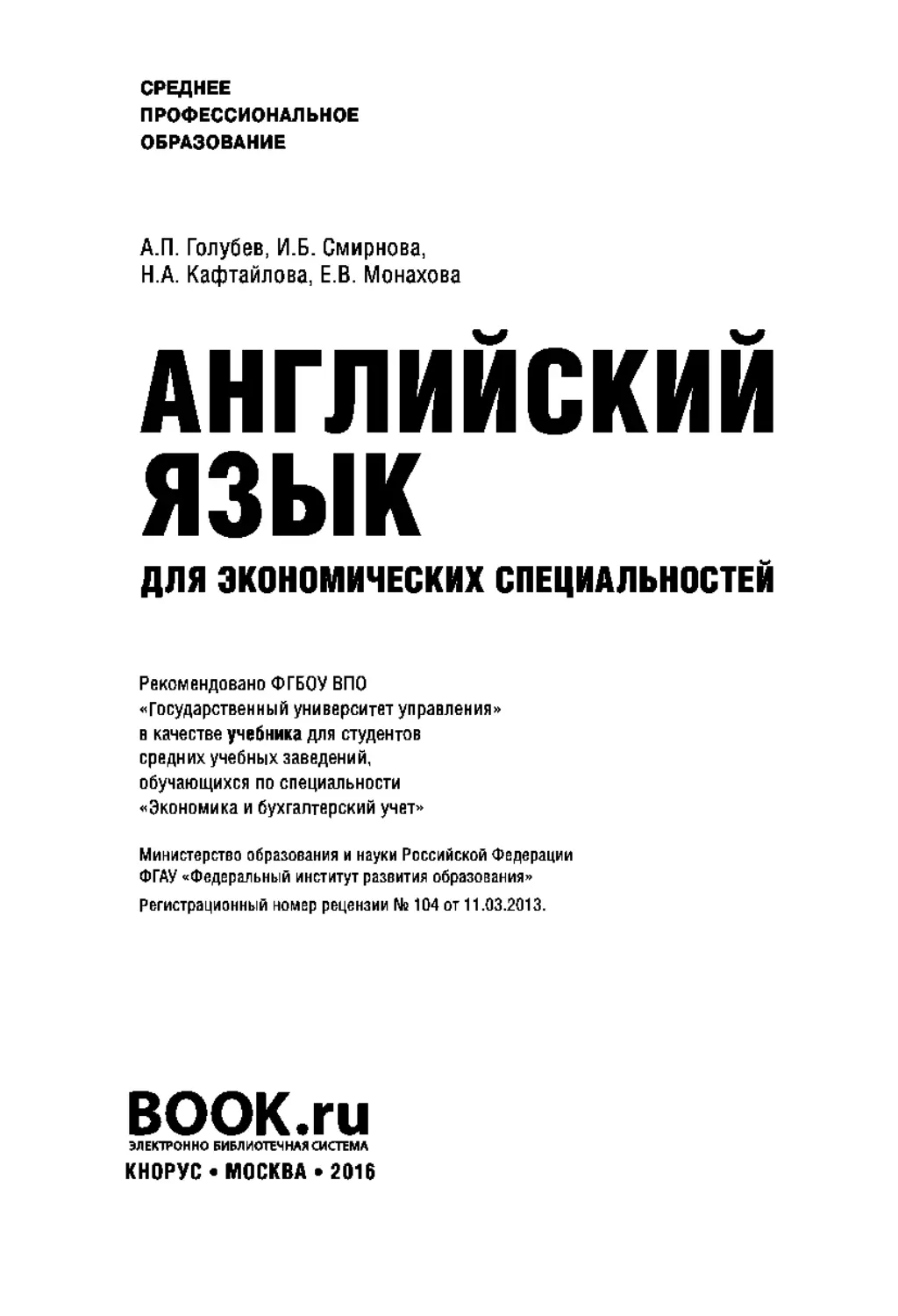
                    СРЕДНЕЕ
ПРОФЕССИОНАЛЬНОЕ
ОБРАЗОВАНИЕ
А.П. Голубев, И.Б. Смирнова,
Н.А. Кафтайлова, Е.В. Монахова
АНГЛИЙСКИЙ
ЯЗЫК
ДЛЯ ЭКОНОМИЧЕСКИХ СПЕЦИАЛЬНОСТЕЙ
Рекомендовано ФГБОУ ВПО
«Государственный университет управления»
в качестве учебника для студентов
средних учебных заведений,
обучающихся по специальности
«Экономика и бухгалтерский учет»
Министерство образования и науки Российской Федерации
ФГАУ «Федеральный институт развития образования»
регистрационный номер рецензии № 104 от 11.03.2013.
BOOK.ru
ЭЛЕКТРОННО БИБЛИОТЕЧНАЯ СИСТЕМА
КНОРУС • МОСКВА • 2016
СРЕДНЕЕ
ПРОФЕССИОНАЛЬНОЕ
ОБРАЗОВАНИЕ
А.П. Голубев, И.Б. Смирнова,
Н.А. Кафтайлова, Е.В. Монахова
АНГЛИЙСКИЙ
ЯЗЫК
ДЛЯ ЭКОНОМИЧЕСКИХ СПЕЦИАЛЬНОСТЕЙ
Рекомендовано ФГБОУ ВПО
«Государственный университет управления»
в качестве учебника для студентов
средних учебных заведений,
обучающихся по специальности
«Экономика и бухгалтерский учет»
Министерство образования и науки Российской Федерации
ФГАУ «Федеральный институт развития образования»
регистрационный номер рецензии № 104 от 11.03.2013.
BOOK.ru
ЭЛЕКТРОННО БИБЛИОТЕЧНАЯ СИСТЕМА
КНОРУС • МОСКВА • 2016
УДК 811.111(075.32)
ББК 81.2Англ.-723
Г62
Голубев А.П.
Г62 Английский язык для экономических специальностей : учебник /
А.П. Голубев, И.Б. Смирнова, Н.А. Кафтайлова, Е.В. Монахова. — М. :
КНОРУС, 2016. — 400 с. — (Среднее профессионального образование).
ISBN 978-5-406-03119-3
DOI 10.15216/978-5-406-03119-3
Нацелен на развитие навыков устной и письменной речи, затрагивает основные
общеупотребительные разговорные темы, содержит упражнения и диалоги Доступ-
ное изложение основ фонетики и грамматики на русском языке с упражнениями для
тренировки позволяет использовать учебник для начинающих. В разделе «Профес-
сиональная деятельность специалиста» изучаются темы, непосредственно связан-
ные с будущей работой выпускников учебного заведения Это позволит студентам
вести профессиональные беседы и читать специальную литературу. Лексический
раздел включает в себя основные термины и понятия по специальности. Учебник
содержит поурочный словарь и другие справочные материалы.
Соответствует действующему Федеральному государственному образователь-
ному стандарту среднего профессионаьного образования нового поколения.
Для студентов средних профессиональных учебных заведений экономического профиля.
УДК811.111(075.32)
ББК 81.2Англ.-723
АНГЛИЙСКИЙ ЯЗЫК ДЛЯ ЭКОНОМИЧЕСКИХ СПЕЦИАЛЬНОСТЕЙ
Сертификат соответствия № РОСС RLI АЕ51. Н 16604 от 07.07.2014
Изд Ns 5194. Подписано впечать 20 05 2015 Формат60*90/16
Гарнитура «Newton* Печать офсетная
ООО «Издательство «КноРус».
117218, г Москва, ул. Кедрова, д. 14, корп 2.
Тел 8-495-741-46-28
E-mail office@knorus ru http.//www.knorus ru
ОАО «Первая Образцовая типография»
142300, Московская область, г Чехов, ул Полиграфистов, д 1.
ISBN 978-5-406-03119-3
© Голубев А.П., Смирнова И.Б.,
Кафтайлова Н.А , Монахова Е.В., 2016
© ООО «Издательство «КноРус», 2016
СОДЕРЖАНИЕ
Предисловие.................................................. 6
I. ВВОДНО-КОРРЕКТИВНЫЙ ФОНЕТИЧЕСКИЙ КУРС
Общие сведения...................................... 10
Фонетическая транскрипция........................... 11
Английский алфавит.................................. 12
Основные особенности английской артикуляции......... 12
Урок!. Гласные переднего ряда. Согласные. Тема: Family...... 16
Урок 2. Гласные заднего ряда. Некоторые сочетания звуков.
Тема: Family................................................ 24
Урок 3. Дифтонги. Сочетания трех гласных звуков
Тема: Family Traditions..................................... 32
Урок 4. Правила чтения: Согласные, Гласные в ударном слоге
Тема: Visiting Card......................................... 42
Урок 5. Правила чтения: Сочетания гласных с согласными.
Гласные в неударных слогах. Тема: Speech Etiquette.......... 53
П. ОСНОВЫ ПРАКТИЧЕСКОЙ ГРАММАТИКИ
Урок 6. Существительное. Глагол. Система глагольных форм.
Повествовательное предложение.
Текст: Let’s Get Acquainted................................. 66
Урок 7. Прилагательное. Местоимение. Предлоги времени.
Текст: Му Day............................................... 90
Урок 8. Оборот there is. Предлоги места и направления.
Вопросительное предложение. Типы вопросов.
Отрицательное предложение. Текст: Му home.................. 105
Урок 9. Наречие. Числительное. Неопределенно-личные
и безличные предложения. Текст: I Study at College......... 125
Урок 10. Модальные глаголы. Глаголы, способные выступать
в модальном значении. Текст: Shopping...................... 145
УрокИ. Активный залог. Пассивный залог. Текст: Going Out... 162
Урок 12. Причастие. Конструкции с причастием. Конструкции
с инфинитивом. Текст: Eating Habits........................ 174
Урок 13. Герундий. Text: Sport............................. 189
Урок 14. Повелительное наклонение. Сослагательное наклонение.
Текст: Travelling.......................................... 200
Урок 15. Согласование времен. Косвенная речь. Текст: Healthcare. 214
Урок 16. Сложные предложения. Текст: Internet................... 228
Урок 17. Условные предложения. Текст: Music and Our Mind........ 242
Словарь к блоку II.............................................. 255
III. ПРОФЕССИОНАЛЬНАЯ ДЕЯТЕЛЬНОСТЬ СПЕЦИАЛИСТА
Урок 18. Theme 1: Economics..................................... 274
Text 1: Short Introduction into the Economic Theory
Text 2: What Does Economics Study?
Text 3: The Traditional and the Market Economy
Урок 19. Theme 2: Rules of Economics............................ 281
Text 1: The Efficient Market Hypothesis
Text 2: The Law of Demand
Text 3: The Random Processes
Урок 20. Theme 3: Modem Standing of the World Economy........... 289
Text 1: Globalization
Text 2: Economy During the Modem World Crisis
Text 3: About American and German Economies
Урок21. Theme 4: Problems of the Modern Economy................. 302
Text 1: Young People in the Modern Economy
Text 2: Ecological Problems
Урок 22. Theme 5: Branding and Product Placement................ 311
Text 1: Branding
Text 2: Product Placement
Урок23. Theme 6: Business Ethic................................. 320
Text 1: Ethic in Business
Text 2: Ethic in Business 2
Урок 24. Theme 7: Marketing..................................... 328
Text 1: Marketing
Text 2: About the Leader and Leadership
Словарь к блоку III (economic vocabulary)....................... 337
Тест ........................................................... 347
IV. ДЕЛОВОЙ АНГЛИЙСКИЙ
Раздел 1. Preparation for studies and work abroad
(подготовка к учебе и работе за рубежом)......................... 356
Урок 25. Continuing studies abroad (продолжение учебы за рубежом). 356
Урок 26. Correspondence with the chosen university
(переписка с выбранным университетом)............................ 361
Раздел 2. Searching a job abroad (поиск работы за рубежом)...... 366
Урок27. Preparation for a Job (Подготовка к трудоустройству)..... 366
Урок 28. Drawing Up and Filling In Documents
(Составление и заполнение документов)............................... 370
Раздел 3. Business trip abroad. Business contacts (поездка за рубеж.
Деловые контакты)................................................... 374
Урок 29. At the Railway Station. At the Airport
(На вокзале. В аэропорту)........................................... 374
Урок 30. At the hotel. Currency exchange (в гостинице. Обмен валюты)... 378
Раздел 4. Formal and informal correspondence. Business etiquette
(официальная и неофициальная переписка. Деловой этикет)............. 382
Урок 31. Invitations. Congratulations. Wishes
(Приглашения. Поздравления. Пожелания).............................. 382
Урок 32. Business Talk. Expression of Gratitude
(Частная деловая беседа. Выражение благодарности)................... 388
Приложение.......................................................... 392
ПРЕДИСЛОВИЕ
Данный учебник составлен в соответствии с программой по ино-
странному языку для средних специальных учебных заведений по эко-
номическим специальностям.
Иностранный язык по техническим специальностям в утверж-
денном Минобрнауки РФ классификаторе относится к циклу ОГСЭ:
общих гуманитарных и социально-экономических дисциплин. При
составлении учебника авторы руководствовались новым Федераль-
ным государственным образовательным стандартом среднего профес-
сионального образования (ФГОС СПО), согласно которому выпуск-
ник должен в области иностранного языка:
уметь:
общаться (устно и письменно) на иностранном языке на профес-
сиональные и повседневные темы;
переводить (со словарем) иностранные тексты профессиональ-
ной направленности;
самостоятельно совершенствовать устную и письменную речь,
пополнять словарный запас;
знать:
лексический (1200—1400 лексических единиц) и грамматический
минимум, необходимый для чтения и перевода (со словарем) ино-
странных текстов профессиональной направленности.
Основываясь на этих требованиях, учебник состоит из четырех
разделов:
I.	Вводно-коррективный фонетический курс.
II.	Основы практической грамматики.
III.	Профессиональная деятельность специалиста.
IV.	Деловой английский.
Исходя из того, что одним из требований является выработка
элементарных умений общения, авторы сочли необходимым начать
учебник с краткого вводно-фонетического курса, поскольку правиль-
ное произношение является одним из существенных условий обще-
ния. Неправильное или неразборчивое произношение не способствует
установлению взаимопонимания, ведет к недоразумениям, искаже-
нию смысла даже самых элементарных высказываний. Вводно-кор-
рективный фонетический курс и следующее за ним изложение основ
практической грамматики позволяют также использовать этот учеб-
ник для начинающих. В целом задачами первого раздела являются соз-
дание базы для правильного произношения, устранение и предотвра-
щение типичных ошибок. Для понимания и преодоления студентами
характерных трудностей произношения английские звуки рассматри-
ваются в сравнении с русскими. Данный раздел сопровождается моде-
лями для тренировки произнесения звуков, а также упражнениями на
чтение и правописание английских слов.
Следующий раздел, «Основы практической грамматики», содер-
жит краткие теоретические сведения, контрольные вопросы по из-
ложенным темам грамматики, учебные тексты и упражнения к ним.
Авторы сочли нецелесообразным растягивать изучение грамматики на
весь курс, как это иногда делается. По мнению авторов, лучше с са-
мого начала дать краткую, но целостную картину английской грамма-
тики, которая в дальнейшем может дополняться нужными деталями.
Поэтому грамматика здесь излагается как можно более концентриро-
ванно. Некоторые достаточно легкие для понимания грамматические
темы объединяются в одном уроке, а более сложные рассматриваются
отдельно. Поскольку учебник представляет собой в первую очередь
практический курс английского языка, авторы старались излагать те-
оретический материал по возможности предельно кратко и просто.
Материал в этом разделе дается по принципу от простого к сложному
и в связи с практическими целями. Система упражнений включает за-
дания различных типов в зависимости от степени освоения теоретиче-
ского материала. Каждый текст этого раздела вводит одну из разговор-
ных бытовых тем: «Мой колледж», «Мои друзья», «Досуг» и др.
Обращение к грамматике продолжается и в следующих разделах,
в которых даются упражнения на повторение отдельных грамматиче-
ских тем.
В третьем разделе «Профессиональная деятельность специали-
ста» изучаются темы, непосредственно связанные с будущей работой
выпускников учебного заведения. Его основная цель — сформировать
умения вести беседы на профессиональную тематику и читать специ-
альную литературу. Лексика данного раздела включает основные тер-
мины и понятия по специальности, необходимые для общего развития
обучаемых. Здесь целесообразно предлагать (на усмотрение препо-
давателя) такие задания, как «Подготовьте доклад на тему...», «Напи-
шите небольшое сочинение на тему...», а также задания, требующие
от студента умения применить свои знания в конкретной ситуации,
например: «Разыграйте сцену...», «Найдите выход из ситуации» и т.д.
В каждой теме повторяются изученные в предыдущем разделе грамма-
тические явления.
В четвертом разделе, «Деловой английский», в отличие от зада-
ний предыдущих разделов, связанных с общими бытовыми или спе-
циальными темами, перед студентами ставятся более узкие деловые
задания типа «Переведите документ», «Напишите письмо в инофир-
му», «Составьте резюме», «Выступите в роли переводчика на деловых
переговорах». Некоторые задания и темы этого раздела имеют факуль-
тативный характер и предназначены для продвинутых групп.
Материал всех разделов для большего удобства разделен на уроки.
Понятие «урок» здесь является тематическим, т.е. объединяет опре-
деленный круг вопросов, не означая при этом «один час» или «одно
занятие». Конкретное количество часов, отводимых на каждый урок,
может определяться преподавателем с учетом степени подготовленно-
сти группы.
Авторы
I
ВВОДНО-КОРРЕКТИВНЫЙ
ФОНЕТИЧЕСКИЙ КУРС
ОБЩИЕ СВЕДЕНИЯ
Звуки английского языка значительно отличаются от русских,
и их произношение часто вызывает трудности. Для преодоления этих
трудностей и для постановки правильного произношения прежде все-
го необходимо знать устройство речевого аппарата человека.
I ПОЛОСТЬ ГОРТАНИ
II ПОЛОСТЬ ЗЕВА
III ПОЛОСТЬ РТА
IV ПОЛОСТЬ НОСА
2.	Кончик языка
3.	Передняя часть спинки языка
4.	Средняя часть спинки языка
5.	Задняя часть спинки языка
6.	Корень языка
7.	Губы
8.	Зубы
9.	Альвеолы
10.	Твердое нёбо
И. Мягкое нёбо
12. Язычок
THE LARYNX
THE PHARYNX
THE MOUTH CAVITY
THE NASAL CAVITY
The tongue
The tip of the tongue
The blade of the tongue
The front of the tongue
The back of the tongue
The root of the tongue
The lips
The teeth
The alveolar ridge
The hard palate
The soft palate
The uvula
13. Голосовые связки	The vocal cords
14. Пищевод	The gullet
15. Трахея (дыхательное горло) The windpipe
10
ФОНЕТИЧЕСКАЯ ТРАНСКРИПЦИЯ
Фонетическая транскрипция — это обозначение условными зна-
ками звуков языка. Каждый знак фонетической транскрипции со-
ответствует одному звуку. В английском языке 44 звука (12 гласных,
24 согласных и 8 так называемых дифтонгов, т.е. звуков, состоящих
из двух гласных элементов). Количество звуков неравно количеству
букв английского алфавита, которых 26.
Транскрипцию обычно заключают в квадратные скобки.
Знаки фонетической транскрипции
Звук	Пример слова, в котором звучит данный звук	Звук	Пример слова, в котором звучит данный звук
	ГЛАСНЫЕ		СОГЛАСНЫЕ
[i:]	eat [i:t]	[p]	реп [реп]
[i]	bit [bit]	[b]	boot [bu:t]
[е]	egg [eg]	[t]	tent [tent]
[ж]	axe [seks]	[d]	dog [dog]
[а:]	arm [a:m]	[k]	cat [kaet]
[”]	ox [nks]	[g]	gift [gift]
[о:]	all [o:l]	[f]	fox [fnks]
[и]	book [buk]	[V]	vase [va:z]
[и:]	moon [mu:n]	[S]	sack [sa;k]
[Л]	cup [клр]	[Z]	zoo [zu:]
[з:]	earn [з:п]	in	ship [Tip]
[э]	supporter [so’polo]	[3]	garage [’дгега:з]
		[6]	thin [Oin]
	ДИФТОНГИ	[3]	then [Sen]
[ei]	eight [eit]	[tf]	chair [tfeo]
[эи]	oak [ouk]	№]	jug [фдд]
[ai]	item [aitom]	[h[	hat [hast]
[аи]	down [daun]	[m]	mail [meil]
[01]	boy [boi]	[n]	nest [nest]
[ю]	beer [bio]	[1]	log [log]
[еэ]	bear [beo]	[r]	rag [raeg]
[па]	tour [too]	to]	king [knj]
		Ш	yacht [jot]
		[w]	well [wel]
АНГЛИЙСКИЙ АЛФАВИТ
Буква	Произношение	Буква	Произношение
Аа	[ei]	Nn	[en]
ВЬ	[bi:]	Oo	[w]
Сс	[si:]	Pp	[Pi:]
Dd	[di:]	Qq	[kju:]
Ее	li:]	Rr	[or]
Ff	[efl	Ss	[es]
Gg	№i:]	Tt	[ti:]
Hh	[eitf]	Uu	[ju:]
li	[ai]	Vv	[vi:]
JJ	[cfeei]	Ww	[’dAblju:]
Kk	[kei]	Xx	[eks]
LI	[el]	Yy	[wai]
Mm	[em]	Zz	[zed]
ОСНОВНЫЕ ОСОБЕННОСТИ
АНГЛИЙСКОЙ АРТИКУЛЯЦИИ
Прежде чем приступить к работе над отдельными звуками ан-
глийского языка, отметим некоторые общие отличия английской ар-
тикуляции от русской.
1.	Англичане не артикулируют энергично, сильно не округляют,
не растягивают и не выдвигают губы.
2.	В нейтральном положении губы у русских более расслаблены
и уголки губ опущены. У англичан губы более напряжены и уголки губ
приподняты, что слегка напоминает улыбку.
3.	При произнесении английских согласных звуков язык больше
отодвинут назад, находится в более низком и плоском положении, чем
при произнесении русских согласных. Поэтому они не смягчаются, а
произносятся твердо, за исключением [f], [3], [tf], [ф], а также [1] перед
гласными i, е, и.
4.	При произнесении английских гласных язык чаще находится
в задней части ротовой полости, а при произнесении русских — пре-
имущественно в передней части.
12
Этим определяются некоторые характерные особенности звуков
английского языка.
Гласные звуки
1. Гласные английского языка в отличие от русских делятся
на долгие и краткие. Долгие гласные произносятся более напряженно,
чем краткие. Например: [i] — [i:], live [Irv] — leave [li:v]. Но не все краткие
гласные имеют парный долгий звук.
2. Дифтонги характеризуются скользящей артикуляцией от од-
ного элемента к другому. В русском языке такие звуки отсутствуют.
Согласные звуки
cab [kzeb] (такси, кеб)
bag [Ьагд] (сумка)
leave [li:v] (уходить)
had [heed] (имел)
1.	Английские глухие согласные произносятся более энергично,
чем русские.
2.	Для английской речи важно различение конечных глухих
и звонких звуков, поскольку оно является смысловым. Например:
cap [кгер] (шапка)
back [Ьгек] (спина)
leaf [li:f] (лист)
hat [haet] (шляпа)
Одной из наиболее распространенных ошибок русских учащихся
является оглушение английских конечных звонких согласных.
3.	При произнесении согласных [t], [d], [1] и носового [п] в ан-
глийском языке кончик языка касается альвеол, а не верхних зубов,
как при произнесении русских [т],[д], [л] и [н].
4.	Глухие согласные [р], [t], [к] произносятся с придыханием.
Оно особенно заметно перед долгим гласным ударного слога. С пред-
шествующим звуком [s] эти звуки произносятся почти без приды-
хания.
park [pha:k]
tea [thi:]
course [kho:s]
speak [spi:k]
stay [stei]
skate [skeit]
Ударение
В английском языке, также каки в русском, ударение в слове мо-
жет приходиться на разные слоги. Ударение в транскрипции обознача-
ется знаком, который ставится перед началом слога: possible [’pnsabal],
impossible [itn'posabal].
В английских многосложных словах может быть два ударения
различной силы: главное и второстепенное. Значок главного ударения
ставится вверху, а второстепенного — внизу: possibility [.posabiliti].
13
Ударение в английском языке, так же как и в русском, выполняет
смыслоразличительную функцию между некоторыми глаголами и су-
ществительными:
export [ik'spo:t] — экспортировать;
export [’ekspo:t] — экспорт.
Кроме того, в английском языке ударение может служить для раз-
личия словосочетаний и сложных слов:
blackboard [bkekbo:d] — классная доска;
black board [Ъ1агк bo:d] — черная доска.
Гласные звуки в безударном положении
В английском языке, так же как и в русском, неударный гласный
звук, как правило, произносится неотчетливо. Звук также может пол-
ностью выпадать.
Наример: interval [’intavgl], pencil ['pensal], begin [bi'gin], nickel
[’nikl], away [a'wei].
При этом, если в слове есть долгий безударный гласный, он не ре-
дуцируется (это одна из основных ошибок русскоговорящих учащих-
ся): monograph ['mnnagra:!].
Интонация
Для графического изображения интонации употребляют следую-
щие условные знаки:
— ударный слог;
• неударный слог;
—х падение тона в ударном слоге;
___' повышение тона в последнем ударном слоге;
= диапазон голоса;
f короткая пауза;
। более долгая пауза;
и очень долгая пауза.
Интонация вопросов
Основные интонационные контуры повествовательного и восклица-
тельного предложения
1.	В повествовательных предложениях обычно употребляется
нисходящий тон:
It’s late, [its 'leit]	. ч
I feel well, [ai Ti:l 'wel]	.	\
2.	В побудительных предложениях, выражающих приказание
и запрещение, употребляется нисходящий тон:
Let him speak, ['let him ’spi:k] ' '	.
3.	В побудительных предложениях, выражающих просьбу, упо-
требляется восходящий тон:
Spell the word, please. —	,-----;------------------
['spel da ’W3:d pli:z]	--------=------------------------
4.	Восклицательные предложения произносятся с нисходящим
тоном:
How funny!	—	-------------------
['hau Тлш]	---------------------------------
What a scene!	—	,------------------------
['wot a 'si:n]	---------------------------------
1.	В общем вопросе обычно употребляется восходящий тон:
Am 1 late?	—	_------------------------
['asm ai Teit]	----------------------------------
Is he busy?	— ,-------------------------------
['iz hi bizi]	----------------------------------
2.	В альтернативном вопросе первая часть произносится с вос-
ходящим тоном, вторая — с нисходящим тоном:
Is it Thursday or Friday? —	_------------------------
['iz it '03:zdi a ’fraidi]	---------=——----------------------
3.	Специальный вопрос произносится с нисходящим тоном:
Who is ready?	—	_------------------------
['hu: iz 'redi]	----------------------------------
4.	В расчлененных вопросах повествовательная часть предложе-
ния произносится с нисходящим тоном, вопросительная — с восходя-
щим тоном:
The room isn’t light, is it? -----=----------------;-----------
[da 'ru:m 'izant 'lait ’isit] -------------—=------------------
Когда говорящий не сомневается в правильности своего выска-
зывания, употребляется нисходящий тон:
Peter is eight, isn’t he? —	’ > | ' >----------------
['pi:tar iz 'eit 'izant hi:] ----------------------—-----------
УР0К1
ГЛАСНЫЕ ПЕРЕДНЕГО РЯДА.
СОГЛАСНЫЕ.
ТЕМА: FAMILY
ГЛАСНЫЕ ПЕРЕДНЕГО РЯДА
Рассмотрим гласные переднего ряда, при произнесении которых
язык находится впереди: [i:], [1], [е], [аг].
[i:]
Долгий гласный [i:] — более открытый звук, чем русский [и].
Это означает, что средняя часть спинки языка поднимается к твердому
нёбу несколько меньше, чем для русского [и]. Кончик языка при этом
касается нижних зубов, а губы растягиваются, слегка обнажая зубы.
Например: eat [i:t].
[i]
Положение органов речи примерно то же, что и при произнесении
звука [i:], но средняя часть спинки языка выгибается кверху чуть меньше.
Данный звук представляет собой нечто среднее между русскими [и] и [э].
Например: bit [bit],
[е]
Кончик языка касается нижних зубов. Средняя часть спинки
языка выгибается вперед и кверху, но не так высоко, как при произ-
несении звука [i]. Углы губ оттягиваются в стороны. Рот открывается
чуть шире, чем для [i].
Например: egg [ед].
[ге]
Традиционно считается кратким гласным. Но в словах sad, bad, bag,
jam, man он звучит долго. Кончик языка касается нижних зубов, перед-
няя часть языка лежит ниже, чем при произнесении звука [е]. Расстоя-
16
ние между челюстями широкое. Данный звук представляет собой нечто
среднее между русскими [э] и ударным [а] перед мягким согласным.
Например: axe [asks].
СОГЛАСНЫЕ
(В указанных ниже парах звуков каждый первый звук глухой,
каждый второй — звонкий.)
Шумные смычные
[PL [Ь]
Губы напряжены больше, чем при произнесении русских [п] и [б],
и чуть растянуты. Они на мгновение плотно смыкаются, тотчас размы-
каются, и воздух с шумом вырывается. (Звук [р] перед долгим ударным
гласным сопровождается придыханием.)
Например: pen [pen], boot [bu:t].
[t], [d]
При произнесении английских [t] и [d] язык отодвигается назад,
а его кончик прикасается к альвеолам. При произнесении русских [т]
и [д] кончик языка прикасается к передним верхним зубам. (Звук [t]
сопровождается придыханием.)
Например: tent [tent], dog [dog],
[k], [g]
Английский [k] в отличие от русского [к] сопровождается приды-
ханием. Звук[д] похож на русский [г] (не украинский фрикативный [г]!).
Например: cat [kast], gift [gift].
Шумные щелевые
[f],[v]
Нижняя губа прижимается к верхним резцам не внутренней сто-
роной, как при произнесении русских [ф] и [в], а внешней. Оба звука
произносятся с бблыпим напором воздуха и, соответственно, с боль-
шим шумом, чем русские.
Например: fox [foks], vase [va:z],
[в], [Э]
Кончик языка неплотно прижимается к режущему краю верхних
резцов, но может быть поставлен и между передними верхними и ниж-
17
ними зубами. Эти звуки не свистящие, как русские [с] и [з], а «шепе-
лявые».
Например: thin [0m], then [деп].
[s], [Z]
При произнесении английских [s] и [z] кончик языка поднят к
альвеолам, язык подается немного назад (при произнесении русских
[с] и [з] он опущен). Поэтому [s] и [z] не такие свистящие, чем соот-
ветствующие русские звуки. Губы слегка округлены.
Например: sack [stek], zoo [zu:].
[П,[з]
При артикуляции [/] и [3] поднимается только передняя часть
языка: его кончик — к заднему скату альвеол, а средняя часть спин-
ки — к твердому нёбу, тогда как при произнесении русских [ш] и [ж]
поднимается и задняя часть спинки языка. Поэтому [/] и [3] более мяг-
кие, чем [ш] и [ж]. Губы несколько выдвигаются и округляются.
Например: ship [ftp], garage [’даггаз].
[tf], №]
При произнесении этих звуков смычка переходит в щель. Такие
звуки называются аффрикатами. Звук [tf] следует произносить тверже,
чем русский [ч]: спинка языка поднимается к нёбу не так высоко. При
произнесении [ф] к этой артикуляции добавляется голос.
Например: chair [tfea], jug [флд].
[h]
Гортанный звук, образованный трением воздушной струи о сбли-
женные, но не напряженные голосовые связки. При произнесении
звука [h] положение артикуляторов такое же, как при произнесении
последующего гласного, но этот гласный следует произнести с при-
дыханием. Задняя часть спинки языка не поднимается к нёбу, как при
произнесении русского [х].
Например: hat [hast].
Сонанты
Носовые
При произнесении носовых [ш], [п] и [ij] мягкое нёбо опущено.
[т]
По сравнению с русским [м] при произнесении английского [т]
сомкнутые губы более напряжены и чуть растянуты. Воздушная струя
проходит через нос.
18
Например: mail [rneil].
[n]
Язык несколько отодвигается назад, тупой конец языка прижат
к альвеолам, но не опущен, как при произнесении русского [н].
Например: nest [nest].
[0]
Чтобы произнести звук [р], рекомендуется вдохнуть через нос
с широко открытым ртом и, сохраняя это положение, на выдохе дать
голос. При этом происходит смыкание задней части спинки языка с
опущенным мягким нёбом. Кончик языка опущен.
Например: king [kir>].
Щелевые
[1]
Кончик языка плотно прижимается к альвеолам, тогда как при
произнесении русских [л] и [л’] он прижимается к внутренней поверх-
ности верхних зубов. На конце слов и перед согласными [1] произно-
сится более твердо. Твердый [1] произносится мягче, чем [л]. Мягкий
[1] произносится тверже, чем [л’].
Например: log [log].
Ш
Средняя часть спинки языка поднимается к твердому нёбу не-
много меньше, чем при произнесении русского [й]. Поэтому в англий-
ском звуке гораздо меньше шума, чем в русском. Губы растянуты, кон-
чик языка находится у нижних зубов.
Например: yacht [jot].
[w]
В русском языке такого звука нет. Напряженные губы сильно
округляются и несколько выдвигаются вперед, образуя узкую круглую
щель, и тотчас переходят к положению, необходимому для произнесе-
ния следующего гласного. Надо следить, чтобы нижняя губа не задева-
ла верхних зубов, иначе получится [v].
Например: well [wel].
[г]
Английский [г] произносится кончиком языка, приближенным
к альвеолам. Губы слегка округляются. Только между гласными и по-
сле [6], [б] при произнесении [г] кончик языка контактирует с альвео-
лами, производя один удар.
Например: rag [ггед].
19
УПРАЖНЕНИЯ
1. Прочитайте буквы английского алфавита и числа, содержащие
изученные звуки.
В [bi:] С [si:] D [di:] E[i:]	F [ef]	N [en] G [cfci:]	P	[pi:] L [el]	S	[es] M [em]	T [ti:]	V[vi:] X [eks] Z [zed]
3 three [Ori:]	11 eleven [flevn]	20 twenty [twenti]
6 six [siks]	12 twelve [twelv]	23 twenty-three
7 seven [sevn]	15 fifteen [,fifti:n]	26 twenty-six
10 ten [ten]	16 sixteen [,siks'ti:n] 17 seventeen [,sevn’ti:n]	27 twenty-seven
50 fifty [Tifti]	60 sixty [’siksti]	70 seventy ['sevnti]
53 fifty-three	63 sixty-three	73 seventy-three
56 fifty-six	66 sixty-six	76 seventy-six
57 fifty-seven	67 sixty- seven	77 seventy-seven
2. Прочитайте следующие предложения.
Let me see! ['let mi: 'si:] Разрешите подумать!
(Одну минуту, сейчас отвечу.)
Spell it! ['spel it]	Прочитайте/скажите его (слово)
по буквам.
Repeat it, please.	Повторите это/его/ее, пожалуйста.
[n’pi:t it 'pli:z]
3. Прочитайте примеры. Не смягчайте согласные перед [1:], [I], [е].
[i:]	[i]	[e]	[ж]
[mi:]	[pm]	[ges]	[tern]
[ki:]	[fil]	[set]	[®t]
[si:]	[tin]	[bet]	[ten]
[hi:]	[bizi]	[men]	[bask]
[bi:n]	[SItl]	[net]	[mtetf]
[ji:p]	[fifti]	[’sevn]	[ 'kaepitl]
LTi:p]	[’siksti]	[lesan]	['aebsans]
4. Не оглушайте конечные звонкие согласные и не произносите их
с призвуком [“] ([blg“], [spi:d“] и т.п.).
20
[i:]	[i]	[e]	[®]
[bi:d]	[iz]	[egz]	[sez]
[tji:z]	[big]	[bed]	[send]
[spi:d]	[giv]	[’sekand]	[haev]
5. Прочитайте текст и познакомьтесь с членами семьи Уайт (the Whites).
1.	This is Pat.	['Sis iz ’paet]	Это Пэт.
	Pat is three.	[’ptet iz ’6ri:]	Пэт три года.
	She is little yet.	[’Ji iz 'litl jet]	Она еще маленькая.
	She is very pretty.	['Ji iz 'ven 'pnti]	Она очень симпа- тичная.
2.	This is Ted.	[’Sis iz ’ted]	Это Тед.
	Ted is six.	[’ted iz ’siks]	Теду шесть лет.
	He can sing very well.	[hi kasn 'snj ’ven ’wel]	Он очень хорошо поет (букв, «умеет петь»).
	He can read easy texts.	[hi kasn ’ri:d 'i:zi ’teksts]	Он умеет читать легкие тексты.
	His dad helps him.	[hiz 'dasd ’helps him]	Папа ему помогает.
3.	This is Dick.	[’Sis iz ’dik]	Это Дик.
	Dick is seven.	[’dik iz 'sevan]	Дику семь лет.
	He has many friends.	[hi ’hasz ’mem 'frendz]	У него много друзей.
	His friends live in his street.	[hiz 'frendz 'liv in hiz 'stri:t]	Его друзья живут на той же улице.
	This is Ben.	['Sis iz 'ben]	Это Бен.
	He is ten.	[hi iz 'ten]	Ему десять лет.
	He gives his cat fish.	[hi ’givz hiz kast fij]	Он дает своему коту рыбу.
	His cat eats fish.	[hiz 'kast 'i:ts ’fij]	Кот ест рыбу.
	It is fat.	[it iz 'fast]	Он толстый.
5.	This is Helen.	['Sis iz 'helm]	Это Хелен.
	She is eleven.	[Ji iz I’levan]	Ей одиннадцать лет.
	She is happy when she is free.	[Ji iz ’haspi | wen Ji iz ’fri:]	Она весела, когда она свободна.
	She is sad when she is busy.	[Ji iz ’sasd | wen Ji iz ’bizi]	Она грустна, когда занята.
6.	This is Pete.	['Sis iz 'pi:t]	Это Пит.
	He is very neat.	[hi iz ’ven ’ni:t]	Он очень опрятный.
21
	Не is sixteen this week.	[hi iz siks'ti:n Sis 'wi:k]	На этой неделе ему исполнится шест- надцать лет.
	He is interested in physics.	[hi iz ’intnstid in 'fiziks]	Он интересуется физикой.
7.	That is Dad.	[’Sret iz ’daed]	Это папа.
	He is fifty-three.	[hi iz Tifti '0ri:]	Ему пятьдесят три года.
	He teaches English.	[hi 'ti:tfiz ’irjgliJ]	Он преподает ан- глийский.
	He speaks many lan- guages.	[hi 'spi:ks 'mem 'laeggwicftiz]	Он говорит на мно- гих языках.
6. Прочитайте вопросы и утвердительные ответы.
Is Pat 3?	['iz paet '0ri:?]	Yes, she is [jes, Ji 'iz]
Is Ted 6?	['iz ted ’siks?]	Yes, he is [jes, % hi ’iz]
Is Dick 7?	['iz dik 'sevn?]	Yes, he is [jes, % hi ’iz]
Is Helen 11?	['iz helm ilevn?]	Yes, she is [jes, Ji ’iz]
Is Ben 10?	['iz ben 'ten?]	Yes, he is [jes, % hi ’iz]
Is Pete 16?	['iz pi:t siks'ti:n?]	Yes, he is [jes, % hi ’iz]
Is Dad 53?	['iz daed ’fifti '0ri:?]	Yes, he is [jes, % hi ’iz]
7. Прочитайте разделительные вопросы (в русском языке им соответ-
ствуют вопросы, заканчивающиеся словами «не так ли?»).
Pat is little, isn’t she?	['past iz 'litl 'izantji?]
Ted is six, isn’t he?	['ted iz ’siks 'izant hi?]
Dick is seven, isn’t he?	['dik iz 'sevn | 'izant hi?]
Helen is happy, isn’t she?	['helm iz ’haepi | ’izantji?]
Ben’s cat is fat, isn’t it?	[benz kaet iz Taet | ’izant it?]
Контрольные вопросы
1.	Что такое фонетическая транскрипция?
2.	Какие классы звуков выделяют в английском языке?
3.	Каковы основные особенности произношения английских гласных?
4.	Каковы основные особенности произношения английских согласных?
5.	Каковы особенности ударения в английском языке?
22
6.	Какая интонация свойственна повествовательным, восклицательным,
побудительным предложениям?
7.	Какая интонация свойственна разным типам вопросительных предло-
жений?
ДОМАШНЕЕ ЗАДАНИЕ
(Home Task)
1.	Напишите следующие слова из текста урока, записанные в транс-
крипции:
[pset], [kaet], [feet], [saed]
[Ti:], [hi:], [strirt], [ri:d], [Ori:]
[jet], [“ven], [siks], [iz], [it], [dis], ['bizi]
2.	Переведите на английский язык и прочитайте вслух.
маленький	Он преподает,
опрятный	Он ест.
счастливый	Он пьет,
грустный	Он разговаривает,
большой	Он помогает.
3.	Выпишите из текста урока в четыре колонки слова с ударными глас-
ными [I], [i:], [е], [ае].
4.	Выучите два любых коротких рассказа из текста урока.
23
УРОК 2
ГЛАСНЫЕ ЗАДНЕГО РЯДА.
НЕКОТОРЫЕ СОЧЕТАНИЯ ЗВУКОВ.
ТЕМА: FAMILY
ГЛАСНЫЕ ЗАДНЕГО РЯДА
К гласным заднего ряда (язык находится сзади) относятся гласные
[<г],[о:],[о],[А],[и:],[и],[з:], [э].
[а]
Язык отодвигается назад дальше, чем при произнесении
русского [а], и становится максимально плоским. Кончик языка
отходит от нижних зубов. Рот широко открыт. Губы находятся
в нейтральном положении.
Например: arm [а:т].
[о:]
Язык отодвинут дальше по сравнению с [а:]. Английский [о:]
более широкий, чем русский [о]. Рот открыт широко. Задняя часть
спинки языка выгнута к мягкому нёбу. Напряженные губы округлены.
Например: all [э:1].
[»]
Задняя часть спинки языка выгнута к мягкому нёбу чуть меньше, чем
для произнесения [о:]. Губы немного округлены, но не выдвинуты вперед.
Например: ox [oks].
ГЛАСНЫЕ ЗАДНЕГО
ПРОДВИНУТОГО ВПЕРЕД РЯДА
При произнесении гласных заднего продвинутого вперед ряда
язык отодвинут не так далеко.
[А]
Этот гласный похож на русский звук [а] в безударном положении.
Подъем языка средний, кончик языка находится за основанием
нижних зубов. Губы растянуты.
Например: сир [клр].
[и:]
24
Английский звук [и:] не такой глубокий, как русский [у]. Язык оттянут
назад дальше, чем при произнесении [а]. За опущенным кончиком языка
остается значительное пространство. Подъем языка высокий. Рот открыт
нешироко. Губы сильно округлены, но мало выдвинуты вперед.
Например: moon [mu:n].
[и]
Язык оттянут не так далеко, как для произнесения [и:],
но от кончика языка до нижних зубов также остается значительное
пространство. Подъём языка высокий. Губы заметно округлены,
но почти не выдвигаются вперед.
Например: look [luk].
[з:]
Такого звука в русском языке нет. Язык приподнят, но его спинка
плоская. Кончик языка опущен. Углы напряженных губ растянуты.
Зубы слегка обнажены. Раствор рта узкий.
Например: earn [з:п].
[а]
Этот гласный называется нейтральным. Он слышится лишь
в безударном положении. Обладает различным тембром в зависимости
от позиции в слове (иногда может выпадать):
—	в конечном положении близок к [a]: drama [Углтэ];
—	в других положениях напоминает [з:]: perform [pa'fo:m].
НЕКОТОРЫЕ СОЧЕТАНИЯ ЗВУКОВ
1.	На стыке слов конечный согласный не следует соединять
с первым гласным следующего слова. Перед гласным рекомендуется
делать короткую паузу:
is in [iz	’in]
is ill [iz	'il]
is easy [iz i:zi]
and all [and^ o:l]
and R [and | '<x]
and eleven [and % flevn]
2.	Два гласных внутри слова или на стыке слов читаются слитно
(без гортанного взрыва):
the east [3t_’i:st]
the Earth [Й1_'з:0|
the arm [3i_'a:m]
to eat [taji:t]
to earn [ta_'3:n]
to act [ta_'£ekt]
3.	Во избежание озвончения глухого согласного перед звонким
рекомендуется продлевать глухой согласный:
this bag [diss Ъгед]
this desk [diss ’desk]
nice day fnaiss ’det]
25
4.	Сочетания [9s] и [3z], которые встречаются в формах множе-
ственного числа существительных и третьего лица единственного чис-
ла глаголов в настоящем простом времени, произносятся слитно:
month [тлп0]	months [тлп05]
sheath [Ji:0]	sheaths [Ji:3z]
to bathe [tu ’bei3]	he bathes [hi bei3z]
5.	При сочетании каких-либо двух из следующих взрывных со-
гласных: [р], [b], [t], [d], [k], [g] — первый согласный не сопровожда-
ется взрывом:
red dawn ['red_.'do:n] black gloves [Ъ1агК_'д1луг]
last bell ['loisCbel]	big debt [’bigjdet]
УПРАЖНЕНИЯ
1.	Прочитайте буквы английского алфавита и числа, содержащие из-
ученные звуки.
В
С
D
Е
F
1	one[wAn]
2	two [tu:]
3	three
4	four [fo:]
6 six
7 seven
10	ten
G
L
M
N
Q [kju:]
W ['dAblju:]
X
Z
11	eleven
12	twelve
13	thirteen [,03:'ti:n]
14	fourteen [,fo:'ti:n]
15	fifteen
16	sixteen
17	seventeen
20 twenty
21 twenty-one
22 twenty-two
23 twenty-three
24 twenty-four
26 twenty-six
27 twenty-seven
30 thirty ['03:ti] ]
40 fourty ['fo:ti]
100 one hundred
['wan ’hAndrad]
2.	Прочитайте следующие предложения:
Please repeat the first sentence.
[*pli:z | n'pi:t За 'fs:st 'sentans]
We are learning foreign languages,
[wi cc ’1з:пп1) form 'laerigwicftiz]
Please look at the blackboard!
[pli:z 'luk set За blaskbo:d]
Повторите, пожалуйста, первое
предложение.
Мы изучаем иностранные языки.
Посмотри на доску, пожалуйста.
26
Call me. ['ko:l mi]
Give me a call, ['giv mi а 'ko:l]
See you! ['si: ju]
I wish you a pleasant journey!
[ai 'wifju a 'plezant '4зз:ш]
Позвони мне.
Пока!
Счастливого пути!
3.	Прочитайте слова. Не оглушайте конечные звонкие согласные.
[а]	[Л]	[o:]	[”]
[ак]	[лр]	[do:]	[oks]
[<xmz]	[ЬМ]	[fo:]	[on]
U<xd]	[bAd]	[bo:d]	[kink]
[1а:с1з]	[dAk]	[wo:m]	[WDZ]
[ka:d]	[jAI)]	[wo:k]	[kod]
[kla:s]	[клт]	[spo:t]	[bob]
	[tfcASt]	[ko:l]	[spot]
4.	Следите за придыханием при произнесении [р], [t] и [к] перед долги-
ми ударными гласными.
[ka:] [pa:t]	[pa*]	[po:l]	[to:t] [pa:st]	[po:t]	[ko:s]
5. Прочитайте слова, обращая внимание на место ударения.
[.лр'гаП] [,ЛП'4ЛП]	[,An'4jASt] [э'тлг)]	[t'riAf] ['опэ]	['ofa] ['ontst]	[Ърэга] [’uktapas]
6. Согласные перед [з:] и [Ju:] произносите твердо!
[и:]	[и]	[з:]	[a]	[ju:]
[du:]	[put]	[Гз:]	[э’плбэ]	[nju:z]
[hu:]	[pul]	[Ьз:]	[di'rekta]	['bju:ti]
[blu:]	[kud]	[bs:d]	['fa: Sa]	['mju:zik]
[mu:v]	[luk]	[d3:t]	[pa’lait]	['stjirdant]
[sum]	[gud]	[f3:st]	['several]	['institju:t]
[sku:l]	[wud]	[w3:k]	[*weda]	[tju:n]
[su:p]	[stud]	[дз:1]	[sa'vaiv]	[fju:]
7. Следите за придыханием при произнесении [р], [t], [к] перед долги-
ми ударными гласными.
[tu:]	[till]	[рз:1]	[a'pa:t]
[pu:l]	[t3:l]	['p3:san]	[э'кз:]
[ku:l]	[кз:1]	[sep'temba]	fsekand]
27
8. Прочитайте слова, обращая внимание на глухие и звонкие согласные.
[р] - [Ь]
[pred] — [baed]
[pret] — [baet]
[рае] - [Ьа0]
[pi:] - [bi:]
[t] - [d]
[tat] — [dat]
[ti:m] — [di:m]
[tin] — [din]
[metl] — [medl]
M - [g]
[kal] - [go:l]
[k®p] - [gasp]
[kot] - [got]
[klas] — [glas]
9. Прочитайте продолжение текста о семье Уайт.
1.	These аге twins John and Andrew. ['di:z a 'twinz £ 'djon and 'rendru:] John is four, [’фоп iz fa:] And Andrew is four too. [rend 'aendni: iz To: 'tu] John has got a small ball. ['4jon haz got a 'smo:l 'bo:l] And Andrew has got a big one. [rend ’aendni: haz 'got a 'big WAn]	Это близнецы Джон и Эндрю. Джону четыре года. И Эндрю тоже четыре года. У Джона есть маленький мяч. А у Эндрю — большой.
2.	These are children’s aunts: ['di:z ’a 'tfildranz 'ants | aunt Dorothy and aunt Julia [ant 'dnra9i and 'ant ’djalia] Aunt Dorothy is thirty. [ant 'dnre9i iz '0з:ti] She is a nurse. [fi iz a 'ns:s] And aunt Julia is forty. [rend ’ant ’d^udia iz Tati] She is a nurse too. [fi iz a 'ns:s 'tu:] The aunts have got beautiftil villas. [<5i ants hav 'got 'bju:tifal 'vilaz] Aunt Dorothy has got a red villa. [ant 'dnra9i haz 'got a 'red 'vile] And aunt Julia has got a green one. [rend ’ant 'djalia haz 'got a 'gri:n WAn]	Это их тети: тетя Дороти и тетя Джулия. Тете Дороти тридцать лет. Она няня. А тете Джулии сорок лет. Она тоже няня. У тетушек есть прекрасные виллы. У тети Дороти — красная вилла. А у тети Джулии — зеленая.
3.	These are children’s uncles: [*di:z a ’tjildrenz 'Arjkalz %	Это их дяди:
28
	uncle Lewis and uncle Morris.	дядя Льюис и дядя Моррис.
	['xrjkal 'Inis and 'Arjkal ’moris] Uncle Lewis is tall. ['xrjkal 'luis iz'to:l] He is a worker. [hi iz a 'w3:ka] And uncle Morris is short. [aend ’лг)ка1 ’moris iz ’Jb:t] He is a worker too. [hi iz a 'w3:ka tu:] Uncle Lewis and uncle Morris are forty-four. ['xrjkal 'liris and ’лг)ка1 ’mans a: 'fo:ti’fo:]	Дядя Льюис ВЫСОКИЙ. Он рабочий. А дядя Моррис невысокий. Он тоже рабочий. Дяде Льюису и дяде Моррису по сорок четыре года.
	These are two eldest brothers Roy and Max. [Si:z a: 'tu: 'eldist 'brxSaz 'roi and 'rnaeks] Roy is 22. [’roi iz 'twenti'tu:] And Max is 24. [aend ’maeks iz 'twenti'fa] Roy has got a blue car. [’roi haz 'got a ’blu: 'ka:] And Max has got a black one. [aend ’maeks haz 'got a ’black wxn]	Это два старших брата — Рой и Макс. Рою двадцать два года. А Максу двадцать четыре. У Роя голубой автомобиль. А у Макса — черный.
5.	These are the eldest sisters Liz and Bab. [’di:z a: Si 'eldist 'sistaz £ 'liz and 'baeb] Elisabeth is twenty. [I’lizabaB iz 'twenti] And Barbara is 27. [aend ’bcrbara iz 'twenti'sevn] Elisabeth has already got her family. [I’lizabaB haz 1’redi 'got ha 'fasmili]	Это две старшие сестры Лиз и Бэб. Элизабет двадцать лет. А Барбаре двадцать семь. У Элизабет уже есть семья.
29
	And Barbara has got a family too. [tend 'ba:bara haz 'got a Ttemili 'tu] It’s large. [its '1а:ф] Barbara has got a son and two daughters. ['ba:bara haz 'got a Члп and 'tu ’do:taz]	У Барбары тоже есть семья. Она большая. У Барбары сын и две дочки.
6.	These are Elisabeth’s and Barbara’s husbands: ['di:z 'a: I'lizabaGs and 'bubaraz 'hAzbandz Arthur and Charles. ['o:6ar and 'tfulz] Arthur is a turner. ['o:6ar iz э Чз:пэ] And Charles is an architect. [tend 'tfulz iz an 'a:kitekt]	Это мужья Элизабет и Барбары: Артур и Чарльз. Артур — токарь. А Чарльз — архитектор.
7.	And this is Mother. [tend 'Sis iz 'тлЭэ] She is 46. [fi iz 'forti’siks] She has got twelve children in all: Pat, John, Andy, Ted, Dick, Ben, Helen, Pete, Liz, Roy, Max and Bab and three grandchildren. [fi haz 'got 'twelv 'tjildran in ’o:l | 'past 'фоп 'tendi 'ted | 'dik 'ben 'helm | 'pi:t % 'liz £ 'roi | masks and 'bteb | and '9ri: 'grten .tfildran] She loves them very much. [fi 'Iavz dam 'ven 'mAtJ]	А это мама. Ей 46 лет. У нее всего 12 детей: Пэт, Джон, Энди, Тэд, Дик, Бэн, Хелен, Пит, Лиз, Рой, Макс и Бэб и три внука. Она их очень любит.
2. Переведите вопросы и ответьте на них.
Who is 4? ['hu: iz fa:]
Who is 27?
Ijohn is. ['фоп iz]
I Andrew is.
30
Who is 46?
Has John got a ball? ['h®z фоп 'got
a ’bo:l]
Has Andrew got a ball too?
Has aunt Dorothy got a villa?
Has Roy got a car?
Has Liz got a family?
Has John got a big ball?
Has aunt Dorothy got a green villa?
Yes, he has. [’jes hi 'hasz]
Yes, she has.
No, he hasn’t, ['паи % hi 'haszant]
He has a small one.
[hi haz a 'smo:l WAn]
No, she hasn’t.
ДОМАШНЕЕ ЗАДАНИЕ
(Home Task)
1.	Напишите слова, данные в транскрипции
[о:], [a:nt], [ka], [1а:ф], [ol'redi], [fa:], [bo:l], [smo:l], [to:l], [fo:t], [o:l],
[’data], [WAn], [’Aijkal], [sAn], [Iav], [mAtfl, [’hAzband], [got], [Чз:пэ],
[’w3:ka], [пз:в], [’vile], ['sista], [’tfildran], [blu:], [’bju:tifal], [’aendru:], [tu:].
2.	Переведите и прочитайте вслух следующие слова.
Маленький (по размеру), красивый, красный, черный, зеленый,
синий, высокий (о человеке), низкий, большой (многочисленный),
уже, тоже, всего, очень.
3.	Выпишите в шесть столбиков слова из текста урока с ударными глас-
ными [а:], [а], [о:], [о], [з:], [и:].
4.	Выучите два любых отрывка из текста.
31
УРОКЗ
ДИФТОНГИ.
СОЧЕТАНИЯ ТРЕХ ГЛАСНЫХ ЗВУКОВ.
ТЕМА: FAMILY TRADITIONS
ДИФТОНГИ
Дифтонг состоит из двух гласных элементов, которые произно-
сятся с одним ударением и образуют один слог.
Английские дифтонги имеют ударение на первом гласном звуке,
второй поизносится слабее и менее отчетливо. По долготе дифтонг ра-
вен долгому гласному.
[ai]
[а] — самый широкий звук из ряда [i] — [е] — [о:] — [а]. От него
происходит скольжение к безударному [i], но полного образования [i]
не достигается. В [i] нельзя допускать шума, т.е. [j]l
Например: item ['aitam].
[аи]
Начало этого дифтонга то же, что и у дифтонга [ai], скольжение
органов речи происходит в направлении звука [и].
Например: down [daun].
[ei]
Начало дифтонга совпадает с гласным [е]. Скольжение происхо-
дит в направлении звука [i].
Например: eighty [’eiti],
[oi]
Ударный элемент дифтонга близок к [о:]. Далее происходит
скольжение к звуку [i].
Например: boy [boi].
32
[эи]
Звук [а] ближе к [о], чем к [з:]. Чтобы придать ему необходимый
оттенок, нужно шире раскрыть рот и округлить губы. Далее следует
скольжение к звуку [и].
Следует помнить, что этот дифтонг произносится иначе, чем рус-
ское сочетание [оу] или [эу].
Например: oak [эик].
[1Э]
Начало дифтонга может совпадать как с началом долгого [к], так
и с кратким [i], Скольжение достигает звука [а] или его оттенка [л].
Например: beer [bid].
[еэ]
Начало дифтонга совпадает с [е], второй элемент — слабое [а],
близкое к [л].
Например: [Ьеэ].
[иэ]
Начало дифтонга совпадает с [и], второй элемент — слабое [э],
близкое к [а].
Например: tour [tua],
СОЧЕТАНИЕ ТРЕХ ГЛАСНЫХ ЗВУКОВ
Сочетание трех гласных звуков обычно произносится в два слога:
первый элемент — самый сильный, средний — так слаб, что часто ис-
чезает, а конечный — вновь усиливается.
[ап]	tired	[taiad]
[аиэ]	our	[аиэ]
[01Э]	employer	[im'ploia]
[аиэ]	lower	[1эиэ]
При произнесении этих сочетаний следует исходить из дифтон-
гов [ai], [аи], [oi], [эи], прибавляя к ним звук [а].
УПРАЖНЕНИЯ
1.	Прочитайте буквы английского алфавита и числа, содержащие из-
ученные звуки.
А	Н	О	V
В	I	Р	W
С	J	Q	X
33
D	К	R	Y
E	L	S	Z
F	M	T
GNU
1 one	11 eleven	21 twenty-one
2 two	12 twelve	22 twenty-two
3 three	13 thirteen	23 twenty-three
4 four	14 fourteen	24 twenty-four
5 five [faiv]	15 fifteen	25 twenty-five
6 six	16 sixteen	26 twenty-six
7 seven	17 seventeen	27 twenty-seven
8 eight [eit]	18 eighteen [,ei'ti:n]	28 twenty-eight
9 nine [nain]	19 nineteen [,nain'ti:n]	29 twenty-nine
10 ten	20 twenty
80 eighty ['eiti]
90 ninety [’nainti]
1000 [*WAn 'Qauzand]
1 000 000 ['WAn 'miljan]
2.	Прочитайте слова, данные в транскрипции.
[ai]	[au]	[01]	[эи]	[ei]
[ai]	[aut]	[oil]	[auk]	[eit]
[ais]	[hau]	[фот]	[sun]	[eim]
[aiz]	[kau]	[’Olli]	[sold]	[eicfc]
[aidl]	[taun]	[’oista]	[gauld]	[eit©]
3.	Прочитайте слова. Не допускайте превращения элемента дифтон-
га [I] в [j].
[ai]	[oi]	[ei]
[pai]	[boi] [bat]	[toi] [tai]	[cfeoi] [dai]	[foil] [mai]	[koin] [io]	[ea] [ia]	[ea] [ma]	[kam’pea] [hia]	[tfes]	[pei] [mei] [dei] [sei] [wei] [va] [pua] [fua] [mua]
34
[die]	[Sea]	[tua]
[tie]	[hea]	[due]
4. Прочитайте слова. He смягчайте согласный перед [ei], [ia], [еэ].
[peid]	[mein]	['nali]	[jia]	[fee]
[meid]	[meil]	[,end3i'nia]	[hea]	[mea]
[peil]	[ma]	[klia]	[pea]	[dea]
5. Прочитайте слова. Не допускайте появления звука []] перед [э].
[aia]	[oia]	[eia]
[aian]	[im’ploia]	['peiabal]
[faia]
[waia] ]
[taiad]
[aua]	[aua]	[on]
[aua]	[laua]	['vancfc]
[paua]	[maua]
[faua]	[graua]
[taua]	[,kaualijan]
6. Прочитайте слова. He искажайте и не путайте звуки [v]/[w]
H[f]/[V].
[v]	[w]	[f]	[v]
[veil]	[neil]	[foist]	[vast]
[vein]	[wein]	[fret]	[vret]
[vent]	[went]	[frl]	[vi:l]
[v3:s]	[w3:s]	[fetf]	[vetj]
[vest]	[west]	[fju:]	[vju:]
[vi:l]	[wi:l]	[li:f]	[li:v]
[vain]	[wain]	[seifs]	[seivz]
7.	Потренируйтесь в чтении скороговорок, постепенно ускоряя темп.
The five warriors fought very well. [Sa 'faiv ’wonaz 'fat 'ven ’wel]
His first verses were even worse, [hiz 'fs:st 'V3:siz 'ws: ’i:van 'ws:s]
8.	Прочитайте слова. Отчетливо произносите согласные [s], [z], [J]
"[‘Л-
[s]	[z]	LO	[tj]
[sed]	[zed]	[fee] [si:l]	[zi:i]	LTi:p]	[tjea] [tji:p] 35
[sirjk]	[znjk]	[’Jen]	[’tjen]
[sip]	[zip]	[fu:z]	[tju:z]
[ais]	[aiz]	[m»J]	[msetf]
9. Прочитайте слова. Следите за произношением межзубных согласных:
[s]	[©]	[z]	[3]
[saerjk]	[0жг)к]	[buz]	[bu:3]
[so:]	[©о:]	[si:z]	[si:3]
[sol]	[0a:t]	[’klauznj]	["klaudir)]
[si:m]	[0i:m]	[bri:z]	[bri:d]
[pa:s]	[pa:0]	[saiz]	[said]
10.	Прочитайте скороговорки.
Не zealously sought to sell the snake to the zoo.
[hi 'zelasli 'sat to 'sei Зэ 'sneik ta Зэ 'za]
This is a thick stick.
[dis iz a '0ik 'stik]
11.	Прочитайте обороты there is (есть, имеется — ед.ч.) и there are
(есть, имеются — мн.ч.) в разных формах (утвердительной, вопро-
сительной, отрицательной). Эти обороты часто встречаются в ан-
глийском языке. Их следует запомнить.
There is a table in the
room.
[3ear“iz э 'teibl in Зэ
’rum]
В комнате есть стол.
There are tables in the
room.
[Зеэг“'о: 'teiblz in da
’rum]
В комнате есть столы.
Is there a table in the
room?
[’iz dear“a 'teibl in Зэ
'rum?]
В комнате есть стол?
Аге there tables in the
room?
['а: Зеэг 'teiblz in Зэ
'rum?]
В комнате есть столы?
Yes, there is.
[’jes 3ear“iz]
Да, есть.
No, there is not.
[’паи £ dear'Tz ’nnt]
Нет, не имеется.
Yes, there are.
[’jes dear~'a:]
Да, есть.
No, there are not.
[’паи £ Зеэг~а: 'not]
Нет, не имеется.
12.	Прочитайте и запомните некоторые разговорные выражения для
знакомства и приветствия.
- Hello! [Ьэ1эи]
- Let me introduce myself.
[’let mi ,intra'dju:s mai'self]
- My name is... [mai 'neim iz]
— Здравствуйте!
— Позвольте представиться.
— Меня зовут...
36
— Здравствуйте, мистер...
— Здравствуйте, миссис...
— Мистер..., позвольте мне
представить вас миссис...
— Очень приятно, мистер...
— Рад с вами познакомиться.
— Познакомьтесь, пожалуйста,
с мисс...
— Мы уже встречались.
— Доброе утро/добрый день/
добрый вечер, мисс...!
— How do you do, Mr... ?
[’hau du ju: 'du: mista ... ?]
— How do you do, Mrs... ?
[’hau du ju: 'du: misiz ... ?]
— Mr... , let me introduce you to
Mrs... ['mista ... £ let mi jntra’djus
ju: ta 'misz...]
— This is a pleasure, Mr...
[3is iz a 'pleja 'mista ...]
— I’m very pleased to meet you.
[aim 'ven ’pli:zd ta 'mi:t ju]
— I want you to meet Miss ...
[ai 'wont ju ta ’mi:t 'mis...]
— We’ve met before. [wi:v 'met bi'fo:]
— Good morning/Good afternoon/
Good evening, Miss...!
[’gud 'mo:nir) / 'gud ufta'nun / gud
'i:vnnj | mis...]
— Allow me to introduce my friend ...
[a'lau mi ta ,intra'dju:s mai Trend ...]
— Glad to meet you, Mr...
['glaed ta 'mi:t ju | 'mista ...]
— Nice to meet you too, Mr ...
[’nais ta 'mi:t ju: 'tu: mista ...]
— I’ve been looking forward to meet-
ing you.
[aiv bi:n 'lukirj 'fawad ta ’mi:tir) ju:]
— Delighted, Mr... [dilaitid | ’mista...]
— Позвольте мне представить вам
моего друга...
— Приятно познакомиться,
мистер...
— Также и мне, мистер...
— Я давно хотел с вами познако-
миться.
— Очень приятно, мистер...
13.	Прочитайте и запомните названия времен года, месяцев и дней не-
дели, обращая внимание на соответствующие предлоги.
in winter	[in ’winta]	зимой
in spring	[in spnij]	весной
37
in summer in autumn	[in Ълтэ] [in ’o:tam]	летом осенью
on Sunday	[on 'SAndl]	в воскресенье
on Monday	[on 'mAndi]	в понедельник
on Tuesday	[on 'tju:zdi]	во вторник
on Wednesday	[on 'wenzdi]	в среду
on Thursday	[on '03:zdi]	в четверг
on Friday	[on ’fraidi]	в пятницу
on Saturday	[on ’sretidi]	в субботу
in January	in May [in ’mei]	in September
[in 'cfcenjwan] в январе (и т.д.)		[in sep'temba]
in February	in June [in ’фи:п]	in October
[in 'februari]		[in oktauba]
in March	in July [in c&ix'lai]	in November
[in 'ma:t[]		[in nau'vemba]
in April	in August [in 'o:gast]	in December
[in 'eipnl]		[in di’semba]
14.	Прочитайте тексты о традициях семьи Уайт и переведите их, пользу-
ясь словами к текстам.
Grandmother’s Week ['gr£en,mAdaz wi:k]
Grandmother has a well-organized life. ['дгагп,тлбэ haz a ’wel'o:ganaizd
laif]
Here are her occupations: [hiar <r har~nkju’peijhz]
On Sundays she sews and knits, [on SAndiz Ji 'sauz and nits]
On Mondays she goes to the market, [nn nundiz Ji 'gauz ta da 'mo:kit]
On Tuesdays she plays the piano, [on 'tju:zdiz Ji 'pleiz da pi’asnau]
On Wednesdays she works about the house, [nn 'wenzdiz Ji 'ws:ks a'baut da
haus]
On Thursdays she sews again, [on '03:zdiz Ji 'sauz a'gen]
On Fridays she goes to the church, [on 'fraidiz Ji 'gauz ta da ’tj3:tj]
On Saturdays she plays again some music, [nn 'sastadiz Ji 'pleiz a'gen SAtn
'mju:zik]
38
So everybody in the house enjoys beautiful music, tasty dishes and nice
clothes she makes, [sau 'evnbodi in Sa 'haus in’cfcoiz 'bju:tifol 'mjirzik
'teisti 'dijiz £ and 'nais 'klauSz Ji 'meiks]
As for Grandmother, she enjoys good health, different work and love of her family,
[asz fa 'дгагп,тлЗэ £ Ji in'cfcoiz gud ’hel9 % difarant 'w3:k | and 'Iav av 'Ьз:
'fasmili]
Vocabulary [vau'ktebjulan]
(Слова к тексту)
week
life
occupation
to sew
to knit
logo
market
to play
piano
to make
to work about the house
again
church
house
beautiful, nice
tasty
dish
clothes
to enjoy
health
work
love
неделя
жизнь
занятие
шить
вязать
идти,ехать
рынок
играть
фортепиано
делать (готовить)
работать по дому
снова
церковь
дом (постройка)
красивый
вкусный
блюдо
одежда
наслаждаться
здоровье
работа
любовь
Good Traditions Year by Year
[gud tro'difanz 'jia bai 'jia]
Mother and Father keep good traditions, ['шлЗэг and 'fa:3a 'ki:p 'gud
tra'dijanz]
Here are some of them. ['hiar“<x Члт av 3em]
In winter the days are short and the evenings are long, [in 'winta За 'deiz <x
'fort and 3i 'i:vnitjz a: 'log]
Children sit by the fire, ['tfildren 'sit bai Sa 'faia]
39
Father reads aloud. ['fa:Sa 'rick a'laud]
In spring the sun shines brightly, [in 'sprig ds 'sAn 'Jamz ’braitli]
It’s not too hot outside, [its 'not 'tu: 'hot 'autsaid]
The garden is poor yet. [da 'gadn iz ’риэ jet]
They have not much work to do there. [dei hav 'not mAtf 'w3:k ta 'du: Sea]
So, at this time ofthe year children draw and paint in the open air. ['sauat'Sis
'taim av Sa 'jia 'tfildren 'dro: and 'peint in di 'aupan 'ea]
In summer the Whites go to the country, [in 'sAma Sa 'waits 'gau ta За 'клШп]
They work in the garden. [Sei 'W3:k in Sa 'ga:dn]
They grow vegetables and fruit. [Sei 'grau 'vecfeatablz and 'fru:t]
Boys and girls help their parents, ['baiz and 'дз:1х 'help 'Sea 'prerants]
They go to the forest. [Sei 'gau ta da 'forist]
In autumn it is time to study, [in 'o:tam it iz 'taim ta 'stAdi]
The little children are in the nursery, [da 'litl 'tfildran o:r~in da ’n3:san]
The elder ones are at school, [di 'elda WAnz a:r~at 'sku:l]
The students are at the university. [Sa 'stjirdants <cr~at Sa jmm'v3:siti]
They often go to the library. [Sei 'ofan gau ta S 'laibrari]
They work in different workshops. [Sei ’w3:k in 'difarant 'w3:kjbps]
There is so much homework! [Sear'Tz sau mAtf 'haumw3:k]
Vocabulary
year by year
to keep good traditions
some of them
to read aloud
to sit
by the fire
the sun
to shine
brightly
too
it’s hot
garden
poor
much work
to draw and paint
in the open air
to help
parents
to grow
it is time
год за годом
соблюдать добрые традиции
некоторые из них
читать вслух
сидеть
у камина
солнце
светить
ярко
слишком
жарко
сад
бедный
много работы
рисовать карандашом и красками
на открытом воздухе
помогать
родители
расти, выращивать
пора
40
to study
library
homework
учиться
библиотека
домашняя работа/задание
ДОМАШНЕЕ ЗАДАНИЕ
(Home Task)
1.	Напишите следующие слова и выражения, данные в транскрипции.
[ha'bu], ['hau du: ju:' du:], [gud 'mo:nitj],
[let mi intra'dju:smai'self], [mai 'neim iz ...]
2.	Назовите буквы английского алфавита.
3.	Назовите по-английски дни недели, месяцы и времена года.
4.	Выпишите из текстов слова с дифтонгами.
УРОК 4
ПРАВИЛА ЧТЕНИЯ: СОГЛАСНЫЕ
И ГЛАСНЫЕ В УДАРНОМ СЛОГЕ.
ТЕМА: VISITING CARD
ПРАВИЛА ЧТЕНИЯ: СОГЛАСНЫЕ
Большинство согласных букв обозначают согласный звук,
входящий в название буквы. Таковы b, d, f, j, k, 1, m, n, p, t, v, z.
Остальные согласные буквы имеют свои особенности чтения.
Таблица 1
Согласные буквы, имеющие два варианта чтения

Буква
Перед
Позиция
Перед
Примеры
Перед всеми согласными в конце слога
Перед
Перед
Перед всеми согласными в конце слога
В начале слова
Между гласным и согласным
В конце слова после глухого
После звонкого согласного
После гласного
Между гласными
cent [sent]
cinema [’sinama]
cymbals I'simbalz]
cat [kaet]
cost [knst]
cut [kxt]
music [’mjurzik]
gentleman I'cfeentlman]
gin [cfcin]
gym [cfcim]_______________
game [geim]
goat [gaut]
gull [QaI]________________
dog [dog]_________________
sack [ssek]
east [i:st]
cats [kaets]
dogs [dngz]
pies [paiz]
rose [rauz]
№1
42
Окончание
Буква	Звук	Позиция	Примеры
	Iks]	Перед согласным В конце слова После ударного гласного	text [tekst] fox [fnks] exercise ['eksasaiz] exhibition l.eksi’bifan]
	[«z|	Перед ударным гласным	exam [ig'zasm] example [ig’zampl]
Таблица 2
Сочетания sh, ск, ng, ph
Буквосочетание	Звук	Примеры
sh	1Л	she [fi:], shine [fain]
ck	Ik]	sack [seek], pocket [’pnkit]
ng	[0]	sing [sig], bring [bng]
Ph	[f]	photo [’fautau], physics [’fiziks]
Таблица 3
Сочетания согласных букв, имеющих два варианта чтения
Букво- сочетание	Звук	Позиция	Пример
th	[3]	В местоимениях В служебных словах В знаменательных словах (между гласными)	this [dis], that [dast] the [di:] bathe [beid]
	[в]	В начале и в конце знаменательных слов и в середине слов иностранного происхождения	thin |0in], bath [ba:0] author |'э:6э]
qu	fkw]	В ударном слоге	quite [kwait], quiet ['kwaiat]
	Ik]	В конце слова	unique [ju:'ni:k]
gu	[gw] И1	В словах французского происхождения	language [’lasggwicfc], league |li:g]
wh	Ihl	Перед о	who [hu:|, whose [hu:z]
	[w]	Перед остальными гласными	when [wen], why [wai]
Таблица 4
Сочетание ch, имеющее три способа чтения
Букво- сочетание	Звук	Позиция	Пример
ch	[tfl	В различных позициях	chat [tfast], beach [bi:tf]
	[k]	В словах греческого происхождения	ache [eik], architect [’a:kitekt]
	1Л	В словах французского происхождения	machine [ma'jkn], moustache [ma'staj]
43
Чтение гласных в английском языке зависит от типа слога.
Различают четыре типа слога:
I — открытый слог (т.е. слог, оканчивающийся на гласную либо
на согласную + е);
II	— закрытый слог (т.е. слог оканчивающийся на согласную);
III	— слог с буквой г (т.е. гласная + г или гласная + г + согласная);
IV	— слог с гласной после г (т.е. гласная + г + гласная).
Следует иметь в виду, что здесь излагаются самые общие прави-
ла. Слова, не подчиняющиеся правилам, даны с фонетической транс-
крипцией.
Таблица 5 показывает типы чтения гласных букв в соответствии
с четырьмя типами слога.
Таблица 5
слога	Буква
	а	о	е	i 1 У	u
I	lei]	[эо] go	Ц:| he	[at] nice	my time	rhyme	Lju:] student
II	[®] add	[«] hot clock	|е] let	[i] is	myth big	nymph	[A] study
III	[<г|	[а] lord	|з:] her	girl	myrtle	fur term	birth	turn
IV	[еэ| parents	[я]	[a] here mere	|aia] fire	tyre	[jus] during
ТРЕНИРОВОЧНЫЕ УПРАЖНЕНИЯ
1. Прочитайте слова, обращая внимание на тип слога.
I	11	III	IV
[ei]	[as]	[a]	[ea]
age	am	arm	fare
ache	at	far	care
pale	apple	part	dare
came	man	large	rare
make	has	architect	share
made	glad	card	bare
game	sad	mark	declare
44
о
I	II
[эи]	[о]
open	on
bone	ox
stone	spot
go	hot
home	shop
close	cod
sole	dog
I	II
[i: ]	[e]
see	egg
Pete	else
bee	set
be	bet
tree	men
I	II
[at]	[i]
I	if
ice	ill
pie	pin
fine	big
five	miss
side	sit
like	fifty
I	II
[at]	[i]
my	myth
type
style
[ju:]	[u:] после r, 1
due	rule
dune	rude
tune	flute
cube	blue
tube
III	IV
[o:]	[o:]
or	ore
bom	more
port	store
sport	before
order	shore
lord	core
corn	bore
E
III	IV
[з:]	[la]
her	here
herd	mere
nerve	sphere
serve
term
I
III	IV
[з:]	[aia]
girl	fire
firm	tire
dirt	tired
bird	wire
first	hire
thirst
circle
III	IV
[з:]	[aia]
myrtle	tyre
U
II	111	IV
[л]	[з:]	Uua]
sun	fur	cure
bus	curve	during
cup	nurse	pure
just	bum
must	hurt
45
2. Закрыв транскрипцию, прочитайте вслух примеры.
Таблица
Буквосочетание	Чтение	Примеры
ai	[ei]	wait
ay		say
ei	[ei]	eight
еу		grey
ea	[к]	tea
ее		bee
ew	[ju:]	new, few
ue	[ju:]	due, Tuesday
	|u:]	true, blue
Ul	[ju:]	suit
oi	[01]	boil, voice
oy		boy, toy
oo+k	[»]	book, hook
00	|u:]	too, food, room
OU	[au]	out
OW		cow, owl
OW	|au]	know, low
oa		coal, boat
3. Закрыв транскрипцию, прочитайте вслух примеры.
Таблица Чтение гласных диграфов с буквой г
Буквосочетание	Чтение	Примеры
ai+r	[eo]	air, fair
ei+r	[eo]	keir
ee+r	[a]	beer, deer
oa+r	[□:]	oar, board
ea+r	[eo] [a]	bear, pear, ear, clear
oo+r	[□:] IM	door, floor, poor, moor
ou+r	[□:] IM [аоэ]	pour, course tourist our, hour
4. Прочитайте объединенные колонки слов по горизонтали. Обращайте
внимание на чередование гласных.
46
[I]	[e]	[a*]			[i:]	[i]
bid	bed	bad			me	mill
bit	bet	bat			see	sit
big	beg	bag			eat	it
did	dead	dad			tea	tin
fin	fen	fan			be	bill
hid	head	had			steel	still
miss	mess	mass			peel	pill
[u:]	[«]		[A]	[a:]	IN	[o:]
pool	pull		come	calm	don	dawn
cool	could		done	dam	non	north
boot	book		much	march	cock	cork
goose	good		cut	cart	cot	caught
cooper	cook		duck	dark	pock	pork
tool	took		cud	card	pot	port
wound	wood		cup	carp	shot	short
Visiting Card ['viziturj ko:d]
(Визитная карточка)
В этом уроке вы научитесь составлять и оформлять визитную кар-
точку.
1.	Прочитайте вслух, пользуясь транскрипцией, образцы документов
и слова, необходимые для их заполнения.
В визитной карточке используются следующие сокращения
(abbreviations [a,bri:vi’eijan]):
а) для обозначения адреса:
St	street	[stri:t]	улица
Blvd	boulevard	[’bu:lava:d]	бульвар
Emb	embankment	[im'baerjkmant]	набережная
Ave	avenue	['aevmju:]	проспект
Sq	square	[skwea]	площадь
в) для обозначения уровня образования или ученой степени:
А — Associate [a'saujnt] — выпускник среднего специального
учебного заведения;
47
ДА — Associate of Arts [a’saujnt av ’a:ts] — выпускник гуманитарно-
го среднего специального учебного заведения;
BSc (Am. BS) — Bachelor of Science ['teetfala av 'saians] — бакалавр
наук;
BA (Am. AB) — Bachelor of Arts ['baetjala av 'arts] — бакалавр ис-
кусств;
В.	Mus. — Bachelor of Music ['bsetfala av 'mju:zik] — бакалавр му-
зыки;
MSc/MS — Master of Science ['master av 'saians] — магистр есте-
ственных или точных наук;
МА — Master of Arts ['master av ’arts] — магистр гуманитарных наук;
PhD — Doctor of Philosophy [’doktar av fi'losafi] — доктор фило-
софии;
DSc — Doctor of Science [’doktar av 'saians] — доктор естественных
или точных наук;
LitD — Doctor of Letters ['doktar av 'letaz] — доктор филологиче-
ских наук.
Оформление адреса в английском языке не совпадает с формой,
к которой привыкли в России. Сравните:
In Russian (по-русски):	Россия, 117218 г. Москва ул. Кедрова, д. 14., корп. 2, Издательский торговый дом «КноРус»
In English (по-английски):	Publishing Trading House “KnoRus” 14, building 2, Kedrov St., Moscow, 117218 Russia
Для обозначения должностей в учебных заведениях используют
следующие слова и словосочетания:
директор	director	[di'rekta]
	manager	[’тагшфа]
	head master	[hed ’ma:sta]
	principal	[’pnnsapal]
о женщине	head mistress	[hed 'mistns]
заместитель	assistant director	[a'sistant di'rekta]
директора
и.о. директора	acting director	['aektir) di'rekta]
зам. начальника/	assistant chief,	[a'sistant ’tfi:f]
директора	deputy director	['depjuti di'rekta]
48
классный	class/form teacher	[klars/form 'tirtfa]
руководитель	form master	[’form morsta]
научный руководитель	supervisor of studies	[’sjurpa'vaizar av 'stAdiz]
учитель	teacher	[’tirtfa]
домашний	tutor (Am)	[tjurta]
школьный	(school) teacher	[(’skurl),tirtfa]
	(school) master/-mis-	[('skurl),marsta /
	tress	.mistns]]
	schoolman (Am)	[(’skurl),masn
английского языка	English teacher/ master	[’njgliJ 'tirtfa/marsta]
математики	mathematics teacher/	[,me0imstiks 'tirtfa/
	master	marsta]
пения	singing master	[’sujgirj 'marsta]
танцев	dancing master	[’darnsir) 'marsta]
ИЗО	art teacher	[,art'tirtfa]
музыки	music teacher	[,mju:zik 'tirtfa]
физвоспитания	physical training teacher	[’fizikal 'treinnj ’tirtfa]
ОБЖ	security of life teacher	[si'kjuanti av 'laif'tirtfa]
заведующий	headclerk	[’hedklark]
канцелярией	executive (Am)	[ig'zekjutiv]
учебной частью	head of studies	[’hed av 'stAdiz]
АХЧ	assistant manager	[a'sistant 'maenitfea]
отделом	head of department	[’hed av department]
проректор	pro-rector	[’prau ’rekta]
декан	dean	[dim]
	president of a faculty	[’prezidant av a 'faekalt i]
ответственный за	responsible for	[ris’pDnsabal for]
доцент	senior lecturer	['sirma 'laektjara]
	senior reader	[’sirnia 'rirda]
	assistant professor (Am)	[a'sistant prafesa]
преподаватель	teacher	[’tirtfa]
в вузе	lecturer	flektfara]
	instructor	[in’strAkta]
няня	nurse (maid)	[’nsrs (,meid)]
воспитатель	educator	[’edjukeita]
воспитательница	mistress	[’mistns]
49
Названия образовательных и воспитательных учреждений
детский сад	kindergarten	['kindaga:tn]
	nursery school	fn3:san skirl]
школа	school	[sku:l]
педагогическое	primary school teachers’	fpraiman skirl
училище	training college	'ti:tfa(z) ’treinr) 'койф]
среднее специальное	college	[’kolnfc]
учебное заведение
вуз	university	[ju:ni'v3:siti]
	institute	finStltjlEt]
	Образец визитной карточки
Михаил Михайлович Михайлов	Mikhail М. Mikhailov
преподаватель Калужского машиностроительного колледжа	Lecturer Kaluga Engineering College
248000, г. Калуга ул. Новослободская, 31 Тел.825-65-65, 825-65-67	31, Novoslobodskaya St Kaluga, 248000 Russia Phones 825-6565,825-6567
Образец удостоверения личности
Удостоверение	Identity Card [ai'dentiti ’ka:d]
Имя	First Name ['fjtst ’neim]
Фамилия	Surname ['ssrneim]
Гражданство	Citizenship [’sitizanjip]
Национальность	Nationality [.naeja'nasliti]
Род занятий	Occupation [,nkju'peijan]
Почтовый адрес	Full Postal Address [ful ’paustl a’dres]
Телефон	Telephone Number ['telifaun ’плтЬа]
Подпись	Signed [saind]
Дата	Date [deit]
2.	Прочитайте и запомните названия некоторых стран, столиц, нацио-
нальностей.
Country	Nationality	City
Russia ['гл[э]	Russian ['гл[п]	Moscow ['moskau]
Great Britain ['greit britn]	Englishman/woman [’iijglijman/wuman]	London [lAndan]
50
Ireland ['aidland]	Irishman/woman ['aianjman/wuman]	Dublin [’dAblin]
Canada [’krenada]	Canadian [ka’neidjan]	Ottawa ['otawa]
America [a'merika]	American [э'тепкэп]	Washington [’wojiptan]
France [fra:ns]	Frenchman/woman [frentf man/wuman]	Paris ['peens]
Italy ['itali]	Italian [ftaelian]	Rome [raum]
Spain [spein]	Spaniard [’sprenjad]	Madrid [ma'dnd]
China [tjaina]	Chinese [,tfai’ni:z]	Beijing [.bei'tjjir)]
Germany ['фз:тэш]	German [’фз:тэп]	Berlin [,Ьз:'1гп]
3.	Прочитайте вслух анкетные вопросы и ответы на них (не забывайте
об интонации специального вопроса).
1.	What is your name? 2.	What is your surname? 3.	What nationality are you? 4.	What country are you from? 5.	What’s your address? 6.	What’s your profession? 7.	What languages do you speak?	['wot iz ja 'neim] ['wot iz ja S3:’neim] ['wot ,nrejd'nreliti a ju:] ['wot ’kAntn a: ju from] ['wots jo:r a’dres] ['wots jo: pra’fejn] ['wot ’IrerjgwirJjiz du: ju: 'spi:k]
1. My first name is... 2. My surname is... 3.1 am... 4.1 am from ... 5. My address is ... 6.1 am a ...	[mai ’first ’neim iz ...] [mai ’S3:neim iz...] ['at rem...] ['at rem Iran...] [mai dd'res iz...] ['at rem э...]
7. I speak English, German, French and Russian, [ai spi:k 'irjghJ
’фз:тэп £ 'frentf S, and 'гл/п]
HOME TASK
1. Напишите по-английски ваш домашний адрес и адрес вашего учеб-
ного заведения.
При написании русских названий и имен пользуйтесь правилами
транслитерации. Транслитерация представляет собой замещение букв
русского алфавита соответствующими буквами или сочетаниями букв
английского алфавита.
51
Таблица соответствия русских и английских букв
А—а	Ё—е	М—m	У—и	Ъ-”
Б—b	Ж—zh	Н-п	Ф-f	Ы—у
B-v	3-z	О-о	X—kh	Ь-’
r-g	И—i	П-р	Ц-ts	Э-е
Д-d	Й—у	Р-г	Ч-ch	Ю—уи
Е-е	К—к	С—s	Ш-sh	Я—уа
	Л-1	Т—t	Щ-shch
2. Составьте по образцу ваше удостоверение личности.
Образец
Identity Card
First name(s)	Samuel fsasmjual]
Surname	Smith [smi0]
Citizenship	The USA [da 'ju: es 'ei]
Nationality	American [a'menkan]
Occupation	Student of Minnesota University ['stju:dant av jnmi'satrta juni‘v3:siti]
City (town, village)	Minneapolis [.mmi'aspalis]
Telephone number
Signed
Date	15.02.2015
3. Прочитайте слова, учитывая тип слога или положение гласной в бук-
восочетании.
Cat, we, week, term, plan,weak, plane, hate, wet, West, East, card,
play, not, Spain, her, gulf, part, jump, team, tune, herd, eat, yard, bum, hair,
hare, seem, nor, pure, North, stream, hop, here, serve, loss, sphere, went,
share, dune, hut, fair, mend, disk, nice, cry, tone, note, early, sing, sun, fire,
skirt, use, cord, forge, gentle, dress, meet, earn, hurt, simple, single, since,
cure, pearl, dure, shirt.
4. Напишите данные в упр. 3 слова в транскрипции.
52
УРОК 5
ПРАВИЛА ЧТЕНИЯ: СОЧЕТАНИЯ
ГЛАСНЫХ С СОГЛАСНЫМИ. ГЛАСНЫЕ
В НЕУДАРНЫХ СЛОГАХ.
ТЕМА: SPEECH ETIQUETTE
СОЧЕТАНИЯ ГЛАСНЫХ С СОГЛАСНЫМИ
В предыдущем уроке говорилось, что чтение гласных в основном
определяется типом слога.
Однако в сочетании с некоторыми согласными гласные могут чи-
таться особым образом. Приводим таблицу наиболее часто встречаю-
щихся подобных сочетаний.
Таблица 1
Буквосочетание	Чтение	Пример
af	la:]	after |’a:fta]
alf	la:]	half|ha:f]
alm	la:]	calm |korm]
an	la:]	glance |gla:ns]
ask	la:]	ask [a:sk]
ass	la:]	glass [gla:s]
ath	la:]	path [pa:0]
asp	la:]	grasp |gra:sp]
al	|o:|	already [al'redt]
alk	|o:|	chalk |tfak]
aught	|o:|	caught [ko:t]
aw	|o:|	draw [dro:]
war	|o:|	warm |wo:m]
ought	|o:|	ought |at[
igh	|at|	high [hat]
53
Окончание
Буквосочетание	Чтение	Пример
ight	[at]	light [lait]
ild	[at]	child Itfaild]
ind	[ai]	mind (maind]
old	|эо]	old Isold]
ost	|эо]	post [paust]
wor	|з:]	world [W3:ld]
еаг+согласный	|з:]	earth [з:в]
1. Закрыв транскрипцию, прочитайте вслух примеры.
ЧТЕНИЕ ГЛАСНЫХ В НЕУДАРНЫХ СЛОГАХ
Как уже говорилось выше, неударные гласные могут подвергать-
ся редукции. Ниже показаны различные случаи редукции.
Таблица 2
Редукция гласных
Буква	Положение в слове	Звук	Примеры
	1. В конечном открытом слоге и подобных ему сочетаниях букв. 2. В других положениях	[I] 1*]	'cottage, 'village, 'palace, 'Sun- day, 'captain 'aside, 'cinema, 'syllable, 'soda, 'about, 'dollar
	1. В конечных -es (после свистящих, шипящих); -ed (после |t], |d[); в предударном слоге. 2. В остальных положениях в большинстве случаев	[I] |э]	beaches, 'wishes, 'washes, 'passes, 'started, 'nodded, be'gin, re'peat 'moment, 'sentence, 'tendency, 'vowel, 'teacher, baker, longer
i/У	1. В большинстве случаев в предударном и послеударном слоге. 2. В конце слов перед г	[I] |э]	'visit, in'deed, 'city, 'synonym 'tapir, 'martyr
ei/ey	В большинстве случаев	[I]	'foreign, 'hockey
0	1. В большинстве случаев, кроме конечного положения. 2. в конце слова	|э] |эо]	tobacco, 'pilot, 'motor, ob'tain, bottom, 'synonym tobacco, 'also
U	В большинстве случаев	|э]	'murmur, 'minus, sur'vive, 'difficult, 'nature
54
2. Прочитайте слова, обращая внимание на чтение неударных гласных.
'engine
’lady
'orange
’angry
'happy
’article
’artist
'after
’answer
'over
’offer
’order
’orchard
'student
Особого внимания заслуживает редукция гласных в служебных
и вспомогательных словах. (Более подробно о них будет сказано ниже.
Пока важно научиться правильно произносить их.)
Если вместо редуцированных форм этих слов употребить полные,
нарушится ритмический строй речи и они получат излишнюю значи-
мость.
Таблица 3
Редуцированные и полные формы служебных слов,
местоимений и вспомогательных глаголов
(в качестве вримеров даны английские пословицы с буквальным переводом)
Слово	Полная форма	Редуцированные формы
Артикли (определители существительных): the	|8i:]	[di],|di:] перед словом, начинающимся с гласного [да] перед словом, начинающимся с согласного The exception proves the rule. Исключение подтверждает правило. The appetite comes with eating. Аппетит приходит во время еды.
	lei]	[а] перед словом, начинающимся с согласного Habit is a second nature. Привычка — вторая натура. A good beginning makes a good ending. Хорошее начало создает хороший конец.
	[sen]	[ап [, [п] перед словом, начинающимся с согласного An apple a day keeps the doctor away. В день no яблоку съедать — докторов не вызывать.
55
Продолжение
Слово	Полная форма	Редуцированные формы
Союзы: и	[aend[	lend] Time and tide wait for no man. Время и морской прилив никого не ждут.
but но, а (противопоставив-	IbM]	|bat| The spint is willing but the flesh is weak. Дух силен, а плоть немощна.
как, поскольку	[az]	[ez] Enough is as good as a feast. Достаточное количество так же хорошо, как Handsome is as handsome does. Тот красив, кто красиво поступает.
или	1*] |о:г]	[э[,[а] перед согласным [or],[аг] перед гласным East or West, home is best. Запад или восток, дом лучше всего.
(при сравнениях)	[джп]	[дэп],[йп] TWo heads are better than one. Две головы лучше, чем одна. Better late than never. Лучше поздно, чем никогда.
Предлоги: at у, в, возле	|at]	[at] A cat may look at a king. Кошка может смотреть на короля.
for	[fa]	[fo],[fa[ перед согласным One law for the rich and another for the poor. Для богатых — один закон, для бедных — другой.
of (предлог, имеющий разные значения)	|dv]	|av],[v] Out of sight, out of mind. Прочь с глаз, прочь из памяти.
to к, в	|tu:]	|ta] перед согласным [tu] перед гласным
56
Окончание
Слово	Полная форма	Редуцированные формы
		Early to bed and early to rise makes a man healthy, wealthy and wise. Рано ложиться и рано вставать —здоровым, богатым и мудрым бывать.
Вводная частица в оборотах there is, there are	Idea] [dea'rtz] [беэ'га:]	[да] перед согласным [дат] перед гласным [deaz],[daz] [дата] While there’s life, there’s hope. Пока есть жизнь, есть надежда. There’re two sides to every question. В каждом вопросе имеется две стороны.
Относительное местоимение that который	-	употребляется только в редуцированной форме: |dat], [dt] It’s a poor heart that never rejoices. Бедно то сердце, которое никогда не радуется. All is well that ends well. Все хорошо, что хорошо кончается.
3. Прочитайте разговорные выражения, содержащие редуцированные
формы слов (в скобках курсивом дана полная форма, которая в раз-
говорной речи редуцируется).
Благодарность
Thank you, you’ve [jtrv] (yow have) been very helpful.	Спасибо, вы мне очень помогли.
You’re [jua] (you are) welcome.	Пожалуйста./Не стоит благодар- ности.
Thank you for coming. Not at all. You’re (You are) very kind. Thank you for your company.	Спасибо, что пришли. Не стоит благодарности. Вы очень добры. Спасибо за компанию.
Извинение
Гт (lam) sorry. Never mind.	Простите. Ничего./Пусть это вас не беспо- коит).
1 must apologize [a'polacfcaiz] to you.
You needn’t apologize.
It’s (It is) [its ] my fault [forlt].
Excuse me.
Hiat’s (That is) all right.
Я должен извиниться перед вами.
Вам нет необходимости
извиняться. Это моя вина.
Извините, (нисходящая интонация)
Ничего./Все в порядке.
Привлечение внимания
Excuse me [mi] (те [mi:])./Pardon
me [mi].
Yes? What is it?
Excuse me, could [kud] you tell me
the time?
It’s (It is) 5 to [ta] 5.
Извините, (восходящая интона-
ция)
Да, что такое?
Простите, вы не могли бы сказать
время?
Без пяти пять.
Вопросы о состоянии дел
How are you?
Fine, thank you. And how are you?
Not too well.
Why? What’s [wots] (What is) the
matter?
How’s [hauz] (How is) Mary [mean]
getting on with her work?
I’m afraid I don’t [daunt] (do not)
know [паи]. I don’t see much of her.
I’m glad you’re [jua] (you are) back.
1 was [waz] missing you badly.
Sowas 1.
Как поживаете?
Спасибо, хорошо. А вы?
Не очень хорошо.
Почему? Что случилось?
Как дела у Мэри с ее работой?
Боюсь, я не знаю.
Я редко ее вижу.
Рад, что вы вернулись.
Я очень скучал без вас.
Я тоже.
Прием гостей
Come in, please.
This way.
Thank you.
Take a seat. Make yourself at [at] (at
[set]) home.
Thank you very much.
Заходите, пожалуйста.
Проходите сюда.
Спасибо.
Садитесь, пожалуйста. Чувствуйте
себя как дома.
Большое спасибо.
HOME TASK
1.	Подберите английские выражения, уместные в следующих ситуа-
циях.
1.	Вы повстречали знакомого, которого давно не видели.
58
2.	Вам помогли в трудный момент.
3.	К вам пришли гости.
4.	Вы не располагаете информацией, о которой вас спрашивают.
5.	Перед вами извинился неловкий пассажир, толкнувший вас.
6.	Вас благодарят за оказанную вами добрую услугу.
7.	Вы нечаянно повредили чужую вещь.
2. Переведите диалоги.
— Большое спасибо.
— Пожалуйста.
— Как поживаешь, Джим?
— Замечательно, спасибо. А ты?
— Как дела у отца?
— Хорошо, спасибо.
— Что случилось?
— Ничего, все в порядке.
— Я рад,что вы вернулись.
Проходите, пожалуйста.
— Большое спасибо.
— Я должен извиниться перед
вами.
— Пусть это вас не беспокоит.
— Джим!
— Да? Что такое?
— Спасибо, что пришли.
— Не за что.
3. Выучите на выбор семь английских пословиц из вышеприведенной
таблицы.
ТЕСТ ПО ВВОДНО-КОРРЕКТИВНОМУ
ФОНЕТИЧЕСКОМУ КУРСУ
Выберите правильный вариант из четырех указанных.
1- LTip]
a. sip	b. cheap	c. ship	d.sheep
2. [beek] a. back	b. beg	c. cab	d. bark
3. [park] a. pork	b. pack	c. park	d. rag
4. [htepi] a. happy	b. chap	c. cherry	d. apple
5. [mu:n] a. moon	b. mourn	c. mean	d. man
6. [,siks'ti:n] a. six	b. sixty	c. sick	d. sixteen
7. [giv] a. give	b. guy	c. good	d. guide
8. [’Vila] a. wheel	b. villa	c. will	d. guide
9. [nain] a. nanny	b. Nina	c. name	d. nine
60
10.	[spmj] a. sprint	b. spring	с. sprang	d. sprung
11.	chair
	a. [Via]	b. Циэ]	с. [tfea]	d. [tTa:]
12.	cab
	a. [kaep]	b. [kaeb]	с. [kju:b]	d. [ka:d]
13.	North
	a. [no:0]	b. [nnt]	с. [пз:5]	d. [nAt]
14.	East
	a. [aest]	b. [i:st]	С. [IZ]	d. [est]
15.	West
	a. [west]	b. [wet]	с. [wi:st]	d. [vest]
16.	physics a. ffiziks]	b. [hisiks]	с. ['pisin]	d. [pik]
17.	new
	а. [паи]	b. [паи]	с. [ni:]	d. [nju:]
18.	boy
	a. [boi]	b. [bo:i]	с. [bai]	d. [bi:]
19.	coat
	a. [kaut]	b.[koi]	с. [клт]	d. [sset]
20.	Earth
	a. [i:st]	Ь. [з:0]	С. [13]	d. [cut]
21.	Pat is three.
	а. Пэт на дереве.		с. Пэт играет.
	b. Пэт три года.		d. Пэт маленькая.
22.	She is little.
	а. Она маленькая		с. Она танцует.
	b. Он маленький.		d. Она большая
23.	Не has many friends.
	а. У нее много друзей.		с. У него много братьев.
	b. У него много друзей.		d. У него много денег.
61
24.	Dad teaches English.
а.	Папа учит английский.
b.	Дедушка учит английский.
25.	These are twins.
а.	Это дети.
b.	Это дяди.
26.	Aunt Dorothy is a nurse.
а.	Тетя Дороти — няня.
b.	У тети Дороти есть вилла.
27.	Не is a worker too.
а.	Он рабочий.
Ь.	Он тоже рабочий.
28.	Roy has got a blue car.
а.	Рой живет на голубой вилле.
Ь.	У Роя голубой автомобиль.
29.	Barbara has got a son.
а.	Бэб приснился сон.
Ь.	У Барбары есть сын.
30.	She loves them very much.
а.	Она их очень любит.
b.	Она ловит рыбу.
31.	В комнате есть стулья.
a.	There is a chair in the room.
b.	There are chairs in the room.
32.	Здравствуйте!
a.	How do you do?
b.	Goodbuy!
33.	Приятно познакомиться.
a.	Hello!
b.	Nice to meet you.
34.	Зимой
a.	in winter
b.	on Sunday
с.	Папа преподает английский.
d.	Папа говорит по-английски.
с. Это близнецы.
d. Это сестры.
с. У тети Дороти красивая
вилла.
d. Дороти — их тетя.
с. Он еще работает.
d. Он на работе.
с. У Роя черный автомобиль.
d. Рой любит кататься.
с. У Барбары два сына.
d. У Барбары две дочки.
с. У нее много детей.
d. У нее есть внуки.
с. There is a table in the room.
d. There are tables in the room.
c. See you
d. How are you?
c. Good evening.
d. Had invited.
c. on Friday
d. in spring
62
35.	Визитная карточка a. visit card b. visiting card	c. viza d. visit
36.	Фамилия a.	first name b.	Christian name	c. surname d. family
37.	Русский a. Russia b. Russian	c. Rush d. Rooster
38.	Туристический колледж a. kindergarten b. tour school	c. tourism college d. teachers training college
39.	Учитель английского языка a.	English teacher b.	teacher English	c. teacher’s English d. class teacher
40.	На каких языках вы говорите? a.	What is your name? b.	What is your address?	c. What languages do you speak? d. What country are you from?
41.	Thank you very... a. good	b. well	c. much	d. big
42. I was ... you badly.
a. missing	b. miss	c. getting on	d. very
43. Make yourself...
a. please	b. excuse me	c. helpful	d. at home
44. Give me a...
a. wish	b. call	c. see	d. sorry
45. How... you?
a. are	b. thank	c. do	d. is
46. Let me ... myself.
a. thank	b. let	c. introduce	d. —
47. I’m very ... to meet you.
a. nice	b. want	c. pleased	d. me
63
48.	Good... 1
	a. meaning	b. morning
49.	My name is... a. American	b. John
50.	I speak... a. English	b. England
c. market	d. meeting
c. manager	d. Doctor
of Science
c. Great Britain d. American
II
ОСНОВЫ ПРАКТИЧЕСКОЙ
ГРАММАТИКИ
УРОК б
СУЩЕСТВИТЕЛЬНОЕ.
ГЛАГОЛ. СИСТЕМА ГЛАГОЛЬНЫХ ФОРМ.
ПОВЕСТВОВАТЕЛЬНОЕ ПРЕДЛОЖЕНИЕ.
ТЕКСТ: LET’S GET ACQUAINTED
Краткий обзор английской грамматики мы начнем с рассмотре-
ния основных частей речи: существительного и глагола.
СУЩЕСТВИТЕЛЬНОЕ
Чтобы уверенно обращаться на практике с английским существи-
тельным, нужно хорошо знать следующие правила:
1.	Употребление с существительным артикля.
2.	Образование множественного числа существительных.
3.	Образование притяжательного падежа существительных.
Употребление артикля
Артикль — это служебное слово, которое может стоять перед су-
ществительным. В русском языке такой части речи нет.
Артикль бывает двух видов: определенный the и неопределенный
а (ап).
Одно и то же существительное, в зависимости от его значения,
может употребляться как с определенным, так и с неопределенным ар-
тиклем. В ряде случаев артикль может отсутствовать.
Употребление существительных с неопределенным артиклем
Неопределенный артикль произошел от числительного one
один, и его эквивалентами в русском языке могут служить такие
слова, как один, какой-то, любой. Иными словами, неопределен-
66
ный артикль указывает на то, что какой-либо предмет принадлежит
к классу однородных предметов и не выделятся из числа таких же
предметов:
Не saw a cat.
Give me an apple.
He is a student.
Aman is waiting for you.
Он увидел (какую-то) кошку.
Дай мне (любое) яблоко.
Он студент (один из многих).
Вас ждет (какой-то) человек.
Обратите внимание, что неопределенный артикль, поскольку
он имеет значение один, не может употребляться с существительными
во множественном числе.
Неопределенный артикль произносится как [аг] перед согласным
и как [ten] перед гласным звуком. Например: a student, an apple.
Употребление существительных с определенным артиклем
Этот артикль происходит от указательного местоимения that тот
и выражает значения этот, известный, единственный в своем роде.
Иными словами, определенный артикль выделяет какой-то предмет
из класса ему подобных:
Where is the cat?
The apple is tasty.
He came to the student.
The man was wearing a hat.
The moon was rising in the sky. Луна поднималась в небе (единствен-
ные в своем роде предметы).
Где кошка? (известная говорящим)
(Это) яблоко вкусное.
Он подошел к студенту (известному).
(Этот) мужчина был в шляпе.
В отличие от неопределенного артикля определенный артикль
может употребляться с существительными как в единственном, так
и во множественном числе:
Не saw the students.
Он увидел (этих) студентов.
Определенный артикль в единственном числе может также обо-
значать целый класс предметов, т.е. иметь обобщающее значение:
The cat has four paws.
She can play the piano.
The computer can do many
operations.
Кошка (т.е. все кошки) имеет четыре
лапы.
Она умеет играть на пианино
(т.е. не на каком-то конкретном, а на
пианино вообще).
Компьютер (т.е. любой компьютер)
может выполнять много операций.
67
Примечание. Следует помнить, что в таком обобщающем значе-
нии во множественном числе существительные употребляются без ар-
тикля:
Cats have four paws.	Кошки имеют четыре лапы.
(The cats имело бы значение «эти кошки».)
Определенный артикль произносится как [da] перед согласными
и [di:] перед гласными. Например: the student [da 'stju:dant], the apple
[di: 'aspal].
Отсутствие артикля
Артикль отсутствует:
—	перед существительными во множественном числе, перед ко-
торыми в единственном числе стоял бы неопределенный артикль:
There are cats in the yard.	Во дворе кошки.
We are students.	Мы студенты',
—	перед существительными, обозначающими отвлеченные по-
нятия и вещества:
Friendship is based on mutual	Дружба основана на взаимном
respect.	уважении.
Snow is white.	Снег белый.
—	перед существительными, уже имеющими другие определите-
ли (местоимение, числительное и т.п.):
Не saw my cat.	Он увидел мою кошку.
Give me some apples.	Дай мне (несколько) яблок;
—	перед именами собственными, так как они не требуют даль-
нейших уточнений (об исключении из этого правила см. далее):
London, Michael, France, Newton;
—	перед существительными, обозначающими титулы, звания
и формы обращения, если за ними идет имя собственное:
Professor Smith, General Stone, Mr White;
—	с названиями дней, месяцев, времен года:
on Sunday	в воскресенье
in summer	летом
in August	в августе
(Но с определенной датой или периодом употребляется опреде-
ленный артикль: the summer of 1979.);
68
— в ряде устойчивых сочетаний:
at home	дома
at school	в школе
at work	на работе
to go to bed	ложиться спать
to go to school	ходить в школу
to go to work	ходить на работу
by car	на машине
by bus	на автобусе
by plane	на самолете
by train	на поезде
by underground	на метро
on foot	пешком
on board a ship	на корабле
for breakfast	на завтрак
at lunch	за ланчем
to dinner	к обеду
by heart	наизусть
by chance	случайно
by mistake	по ошибке
by name	по имени
from year to year	из года в год
from day to day	изо дня в день
from morning till night с утра до ночи
from time to time	время от времени
Существуют также устойчивые сочетания, в которых
употребляется определенный или неопределенный артикль,
например:
as a result of	в результате
in (during) the night	ночью
(ср. at night)
Такие сочетания следует запоминать.
Употребление артикля с некоторыми именами собственными
В ряде случаев с именами собственными употребляется опреде-
ленный артикль.
69
К ним относятся:
— названия океанов, морей, рек, каналов, групп островов, гор-
ных цепей, пустынь:
the Pacific Ocean
the Black Sea
the Thames
the English Channel
the Panama Canal
the Canaries
the Alps
Тихий океан
Черное море
Темза
Ла-Манш
Панамский канал
Канары
Альпы
— фамилии членов одной семьи:
the Greens, the Forsytes;
— названия стран, включающие такие слова, как:
Republic
Union
Kingdom
Federation
States
республика
союз
королевство
федерация
штаты
Например: the Russian Federation;
— названия стран во множественном числе и названия регионов:
the Netherlands
the Middle East
the South of England
Нидерланды
Ближний Восток
Юг Англии
South Africa
Northern Ireland
Eastern Europe и т.п.
Южная Африка
Северная Ирландия
Восточная Европа
— названия судов, гостиниц, ресторанов, музеев, английских га-
зет, кинотеатров, памятников:
The Titanic
The Savoy
The Tower of London
The White House
The Financial Times
«Титаник»
«Савой»
Лондонский Тауэр
(старинная крепость в Лондоне)
Белый дом
«Файненшл тайме»
70
Если название места или здания определяется именем собствен-
ным — именем человека или названием населенного пункта, то ар-
тикль не ставится:
Westminster Abbey
Hyde Park
Buckingham Palace
Вестминстерское аббатство
Гайд-парк
Букингемский дворец
Образование множественного числа существительных
Множественное число существительных образуется с помощью
окончания -s (или -es):
day — days
box — boxes
день — дни
коробка — коробки
Окончание -es появляется, если существительное в единствен-
ном числе оканчивается на -s, -ss, -х, -sh, -ch (т.е. на шипящие и сви-
стящие).
Окончание множественного числа -(e)s произносится:
[s] — после глухих согласных:
text текст	texts [teksts] тексты
safe сейф	safes [seifs]	сейфы
[z] — после гласных и звонких согласных:
day — days
dog — dogs
[iz] — после шипящих и свистящих звуков:
branch — branches
bridge — bridges
fox — foxes
size — sizes
У некоторых существительных, оканчивающихся в единственном
числе на -fe и -f, во множественном числе f переходит в v:
life — lives
half — halves
shelf — shelves
Ho:
roof — roofs
proof — proofs
belief — beliefs
71
В существительном house при образовании множественного чис-
ла глухой согласный переходит в звонкий:
house [haus] — houses [’hauziz].
Если существительное в единственном числе оканчивается на у
и перед ней стоит согласная, то это у во множественном числе меняет-
ся на i и прибавляется окончание -es:
country — countries.
Существительные, образующие множественное число
не по общему правилу
Некоторые существительные сохранили древние формы образо-
вания множественного числа:
man — men	мужчина — мужчины
woman [woman] — women [’wimm]	женщина — женщины
child — children	ребенок — дети
tooth — teeth	зуб — зубы
foot — feet	нога (ступня) — ноги
goose — geese	гусь — гуси
mouse — mice	мышь — мыши
sheep — sheep	овца — овцы
deer — deer	олень — олени
ox — oxen	бык — быки
Некоторые существительные имеют латинское или греческое
происхождение и сохранили латинскую или греческую форму образо-
вания множественного числа, например:
basis [’beisis] — bases [’beisi:z]
crisis [’kraisis] — crises [’kraisi:z]
radius [’reidias] —radii [’reidi,ai]
locus ['laukas] — loci [’lausai]
datum [’deitam] — data [’delta]
phenomenon [fi’nnminan] — phe-
nomena [fi’nomina]
базис — базисы
кризис — кризисы
радиус — радиусы
место — места
данная величина — данные
явление — явления
Притяжательный надеж существительных
Притяжательный падеж употребляется в основном с одушев-
ленными существительными и выражает принадлежность. В русском
языке он соответствует родительному падежу (когда тот выражает при-
72
надлежность), например: книга (чья? кого?) студента (родительный
падеж).
Притяжательный падеж образуется прибавлением к существи-
тельному -’s (апострофа и буквы s):
the student’s book
Jones’s [’djaunziz] room
Имена собственные, в единственном числе оканчивающиеся на
-s или -х, часто на письме получают в притяжательном падеже только
апостроф, но при произнесении сохраняется окончание [iz]:
Marx’ ['ma:ksiz] works.
Существительные во множественном числе, оканчивающиеся на
-s, во множественном числе также имеют только апостроф. Их произ-
ношение не меняется:
the students’ ['stju:dants] book.
Если существительное во множественном числе оканчивается
не на -s, то притяжательный падеж образуется по общему правилу,
т.е. прибавлением апострофа и окончания -s:
the children’s room.
Следует помнить, что форма притяжательного падежа с апо-
строфом намного чаще используется в отношении людей и животных
(the student’s books, the horse’s hoof). Для неодушевленных предметов
обычно употребляется форма с предлогом of:
the legs of the table — ножки стола.
Примечание. В притяжательном падеже могут употребляться такие суще-
ствительные, как earth, water, sun, moon, world, ocean, ship; названия городов
и стран: the ocean’s resources, the world’s popularity, the ship’s crew, London’s
population; иногда названия деталей машин: the plane’s propeller, а также су-
ществительные, обозначающие время и расстояние: a mile’s distance, a day’s
journey (но a four-day journey), a year’s absence, a month’s leave. Здесь выражает-
ся не принадлежность, а мера.
Если выражена принадлежность сразу к нескольким существительным,
то апостроф ставится в конце группы:
These are Tom and Jim’s books.	Это книги Тома и Джима.
(Не Tom’s and Jim’s)
ГЛАГОЛ
Чтобы правильно образовывать различные времена глагола, не-
обходимо знать:
1) три основные формы глагола;
2) изменение глаголов по лицам в настоящем времени.
73
Основные глагольные формы
Для простоты понимания глагольных форм представим, что они
отвечают на следующие вопросы:
1 форма	И форма	III форма
Инфинитив	Простое прошедшее время	Причастие прошедшего времени
что делать?	что делал?	какой (предмет в результате воздействия на него)?
to translate переводить	translated переводил	translated переведенный
	У большинства глаголов эти формы образуются с помощью суффикса -ed*
* Суффикс -ed произносится:
[id] после t и d:
to start — started ['stolid]— started ['sttctid],
to end — ended [endid] — ended [endid];
[d] после гласных и звонких согласных (кроме [d])'
to stay — stayed [steid] — stayed [steid];
to live — lived [livd] — lived [hvd];
[t] после глухих согласных, кроме [t]:
to ask — asked [o:skt] — asked [a:skt].
Если неопределенная форма оканчивается на -у с предшествую-
щей согласной, то у меняется на i: to try — tried — tried.
Если неопределенная форма оканчивается на -е, то с прибав-
лением суффикса -ed эта буква выпадает: to translate — translated —
translated.
С прибавлением суффикса -ed удваивается конечная согласная:
1)	у односложных глаголов, оканчивающихся на одну согласную:
to stop — stopped — stopped;
2)	у многосложных глаголов, оканчивающихся на одну соглас-
ную, если ей предшествует краткий гласный звук и ударение падает на
последний слог: to admit — admitted — admitted;
3)	если неопределенная форма оканчивается на -1: to travel —
travelled — travelled.
В первой форме, т.е. в инфинитиве, перед глаголом имеется ча-
стица to, которая примерно соответствует русскому суффиксу -ть.
Если мы хотим сказать по-английски, например, «понимать», к слову
“understand” необходимо добавить частицу to:
to speak — разговаривать, to understand — понимать и т.д.
74
Существует ряд так называемых неправильных глаголов, которые
образуют свои основные формы иначе. Их следует заучивать. Пол-
ный список таких глаголов содержится в любом словаре. Здесь даются
лишь некоторые, встречающиеся наиболее часто:
to hear	heard	heard	слышать
to see	saw	seen	видеть
to speak	spoke	spoken	разговаривать
to say	said	said	сказать
to tell	told	told	рассказывать
to eat	ate	eaten	есть
to drink	drank	drunk	пить
logo	went	gone	ходить,ездить
to come	came	come	приходить, приезжать
to have	had	had	иметь
to do	did	done	делать
to take	took	taken	брать
to give	gave	given	давать
to understand	understood	understood	понимать
to read	read	read	читать
to write	wrote	written	писать
to be	was, were*	been	быть
жественном (были).
Спряжение глаголов в настоящем времени
В настоящем времени глаголы, как правильные, так и неправиль-
ные, изменяются следующим образом:
1	translate, write	We translate, write
Не 1 She	translates, writes 11	J	You translate, write They translate, write
Иными словами, в третьем лице единственного числа прибавля-
ется окончание -s или -es.
Окончание -es появляется, если неопределенная форма оканчи-
вается на шипящий или свистящий звук (на письме -s, -ss, -х, -sh, -ch,
-tch). Окончание -(e)s произносится по тем же правилам, что и окон-
чание множественного числа существительных, например:
he washes, he catches и т.д.
Если неопределенная форма оканчивается на -у с предшествую-
щей согласной, то у меняется на i и добавляется окончание -es:
to try — he tries.
Если букве у предшествует гласная, то добавляется окончание -s:
to play — he plays.
Глаголы to do и to go принимают окончание -es:
he does [daz], he goes [’gauz].
Особым образом ведут себя лишь несколько так называемых мо-
дальных глаголов. Они не принимают в третьем лице единственного
числа никакого окончания. О них пойдет речь в дальнейшем. Это гла-
голы: сап мочь, уметь; may мочь, иметь разрешение; must быть обязан-
ным, должным, ought to быть обязанным, должным, need нуждаться.
От глаголов, кроме модальных, можно образовать также актив-
ное причастие с окончанием -ing: translating переводящий, going идущий
ИТ.Д.
Система глагольных времен
Зная три основные формы и правила изменения глаголов в на-
стоящем времени, можно построить все остальные временные формы.
В английском языке, как и в русском, существует три времени: насто-
ящее (Present Tense), прошедшее (Past Tense) и будущее (Future Tense).
Отличие английских времен состоит в том, что действие или со-
стояние, выражаемое глаголом, может быть четырех видов.
В русском языке их два, например: читал (несовершенный вид)
и прочитал (совершенный вид).
Эти четыре вида действия или состояния в английском языке на-
зываются:
1. Simple (Indefinite) Простое (неопределенное) действие	Подразумевается факт: Идет дождь (часто, редко, по утрам ИТ.Д.).
2. Continuous Продолженное	Подразумевается действие, продолжающееся в определенный момент: Идет дождь (в данный момент.)
3. Perfect Завершенное	Подразумевается действие, завершенное к данному моменту: (Уже) прошел дождь.
76
4. Perfect Continuous
Завершенно-продолженное
В отличие от Perfect подразумевает-
ся, что действие еще не закончилось,
а в отличие от Continuous — что дей-
ствие не только продолжается в данный
момент, но и началось ранее и уже име-
ет какой-то результат или срок: Дождь
идет с утра (три часа) и т.п.
Все эти четыре состояния могут проявляться в любом времени.
Таким образом, общая схема всех временных форм такова:
SIMPLE	PRESENT PAST FUTURE
CONTINUOUS	PRESENT PAST FUTURE
PERFECT	PRESENT PAST FUTURE
PERFECT CONTINUOUS	PRESENT PAST FUTURE
Эти формы образуются следующим образом.
В образовании будущего времени всех групп участвует вспо-
могательный глагол will1 и инфинитив основного глагола без части-
цы to.
При образовании прошедшего времени во всех лицах употребля-
ется основной глагол в его второй форме (см. выше «Основные гла-
гольные формы»).
В группе Simple вспомогательным глаголом при образовании от-
рицательной и вопросительной форм основного глагола выступает
to do делать — в настоящем времени (изменяется по лицам) и его вто-
рая форма did — в прошедшем времени. Инфинитив со вспомогатель-
ным глаголом употребляется без частницы to.
В образовании группы Continuous участвует вспомогательный
глагол to be быть в соответствующем времени (прошедшем, настоя-
щем или будущем) и основной глагол с окончанием -ing.
1 В современном английском языке глагол shall не употребляется
для образования будущего времени в первом лице, а является модальным
глаголом долженствования.
77
В образовании группы Perfect участвует вспомогательный глагол
to have иметь в соответствующем времени (прошедшем, настоящем
или будущем) и III форма основного глагола.
В образовании группы Perfect Continuous участвует вспомогатель-
ный глагол to be быть в форме Perfect (т.е. вспомогательный глагол to
have иметь в соответствующем времени (прошедшем, настоящем или
будущем) + III форма глагола to be (been) и основной глагол с оконча-
нием -ing).
SIMPLE	He sings these songs. Он поет эти песни (часто, редко, по утрам и т.п.). Не sang these songs. Он пел эти песни. Не will sing these songs. Он будет петь эти песни.
CONTINUOUS	Не is singing. Он поет (в данный момент). Не was singing. Он пел (в тот момент). Не will be singing. Он будет петь (в тот момент).
PERFECT	Не has sung a song. Он спел песню (уже, только что, к данному моменту и т.п.). Не had sung a song. Он спел песню (к моменту в прошлом). Не will have sung a song. Он споет песню (к моменту в будущем).
PERFECT CONTINUOUS	Не has been singing for an hour. Он поет уже час. He had been singing for an hour. Он пел уже час (к моменту в прошлом). Не will have been singing for an hour. Он будет петь час (к моменту в будущем).
Чтобы выбрать правильную временную форму, необходимо:
1) определить вид действия;
2) определить, к какому моменту оно относится (настоящему,
прошедшему или будущему).
Например, нужно сказать по-английски:
1.	Он много читал.
78
2.	В это время он читал.
3.	К тому времени он уже прочитал книгу.
В первом предложении действие относится к группе Simple (кон-
статируется факт чтения).
Действие второго предложения происходит в определенный мо-
мент, на что указывают слова в это время (at that time). Следовательно,
его можно отнести к группе Continuous.
В третьем предложении действие уже завершилось к определен-
ному моменту: к тому времени (by that time), т.е. это группа Perfect.
Все три предложения отвечают на вопрос что (с)делал'?, т.е. от-
носятся к прошлому (Past).
[. Past Simple.
2. Past Continuous.
3. Past Perfect.
Пользуясь приведенной выше схемой, делаем перевод:
1.	Не read much.
2.	Не was reading at that time.
3.	He had read the book by that time.
У русскоязычных учащихся затруднение вызывает выбор между
Present Perfect и Past Simple. Несмотря на то что Present Perfect является
настоящим временем, оно означает завершенное действие, и перево-
дить его нужно прошедшим временем:
Не has come. — Он (уже, как раз и т.п.) пришел.
Чтобы не путать Present Perfect с Past Simple (Не came. — Он пришел),
нужно помнить, что Present Perfect имеет связь с настоящим моментом
и с ним могут употребляться такие обозначения времени, как today, this
year, this week, this morning и т.п., если этот период все еще продолжается:
I have seen him this morning. Я видел его этим утром (утро еще
продолжается).
Сравните:
I saw him this morning. Я видел его этим утром (утро уже
(Past Simple)	прошло).
С Present Perfect употребляются также наречия already, always,
never, ever, so far (пока, до сих nop), just (только что), not yet (еще нет):
I have never been there.	Я никогда там не был.
Не has just left.	Он только что ушел.
Past Simple обычно характеризует прошлое действие как оторван-
ное от настоящего. С ним употребляются такие наречия, как yesterday,
last year (month, week), ago, the other day (на днях) и т.п., или указывается
дата в прошлом:
I met him yesterday (in 1999).
79
Past Simple (не Past Perfect) употребляется также для обозначения
последовательных или повторных действий в прошлом:
Не took the candle, opened the Он взял свечу, открыл дверь
door and went out.	и вышел.
Контрольные вопросы
1.	Каковы основные правила употребления артиклей?
2.	Как образуется множественное число существительных?
3.	Для чего служит и как образуется притяжательный падеж существитель-
4.	Как образуются основные формы глагола?
5.	Как изменяется глагол в настоящем времени?
6.	Как образуются временные формы глагола? Что они означают?
ТЕКСТ
Let’s Get Acquainted
Му name is Andrew. Andrew Darling. Nice surname, isn’t it? But not
for me. My groupmates often make jokes about it, and I must confess that it
doesn’t make me happy.
My friends and my family call me Andy, but when my Mum is angry,
she calls me Andrew, fortunately that doesn’t happen very often. My Dad is
my close friend, and he just calls me “pal”.
I live in the suburbs of London, the capital of Great Britain. I live
with my parents and my elder sister Susan. 1 am 19. Susan is just a year
older than me, but she treats me as if I were a small kid. Sometimes she
even tries to tell me off and call me Andrew like my Mum does, but I never
let her do it. Susan thinks she is a beauty (well, she is, but I never admit
it) — a slim girl with big brown eyes, blond wavy hair and good complexion.
She drives a lot ofboys crazy and is proud ofit. But beauty, 1 think, makes
people a bit selfish. Susan thinks about herself first. And she is always on
the phone talking to someone. She is discussing boys, fashion trends and the
latest films with her friends, and at such moments I am simmering off my
anger. I just can’t stand it! But strange as it may seem, I adore my sister.
She is reliable, friendly, generous and optimistic. She is just 20, but she
has achieved a lot. She has visited a lot of places, she has won in different
competitions (she is a gymnast) and she is the best student in her group.
80
Moreover, she is a real helping hand to my Mum doing everything about
the house.
I seem to be totally different from my sister. A plain skinny young
man who is always complaining about something or other, who is sit-
ting in front of his computer all day long and never lifts a finger round
the house. But wait! Have a closer look, and you will see the same big
brown eyes sparkling with humour, pleasantness and optimism. I haven’t
achieved big results yet though I have been trying hard, but that’s the
matter of time. Right now I am just a student who studies, goes out with
his friends and loves his family.
My Mum and Dad are really great. They are honest, kind, clever, reli-
able and pleasant people, and 1 love spending time with them. My Dad is
a banker. He began to work in a bank when he graduated from the university.
He had been working there for some time already when hemet my Mum. You
will never guess what my Mum does! She is an actress'. Absolutely incompat-
ible people, it may seem. But actually my parents are a good example when
opposites attract. They can’t stay long without each other. Last month my
Mum went on a tour to another city and my Dad missed her so much and
called her every day.
They complement each other. Mum is lively, active, with a good sense
of humour. Dad is serious and reliable, but he likes entertainment too.
We often spend our holidaus at my Dad brother’s place. He lives in
Glasgow, Scotland. His name is James, and his wife’s name is Elizabeth.
They have two sons, Keith and Steve. They are 5 years old. Yes, they are
twins, and they are great. A bit noisy, but bright and funny boys. 1 love
to spend time with them playing football. Last summer, when I was going
to spend a month with my friends in the mountains, I learnt that my neph-
ews had fallen ill and 1 changed my mind immediately. They were so happy
to see me!
Susan doesn’t participate in our games, but she loves the boys too. She
takes them to different places like cafes, puppet shows and the zoo. She reads
to them and teaches them to draw. But that is not the only reason why she
comes to our uncle and aunt. Well, shops again! Susan, my aunt Elizabeth
and my aunt’s friends go on a spending spree whenever we come to visit
them.
This summer we are going to Scotland again, and 1 think I will
hardly see my sister because it will be a period of sales. I hope by the
time we arrive, a lot of things will have been bought already and Susan
will be spending all her time with us and we will again spend every eve-
ning in the garden having tea and chatting about different stuff. Time
will show.
81
Active Words and Word Combinations
groupmate
to confess
pal
suburbs
to treat sb
to tell off
to simmer off anger
can’t stand
helping hand
plain
skinny
to complain (about)
to never lift a finger round the house
to sparkle
incompatible
opposites attract
to complement
twins
bright
to go on a spending spree
одногруппник
признаваться
приятель
пригород
обращаться с кем-либо
отчитывать, выговаривать
с трудом сдерживать гнев
не выношу
помощник
обыкновенный
тощий
жаловаться (на)
пальцем о палец не ударить,
чтобы помочь по дому
сверкать
несовместимый
противоположности
притягиваются
дополнять
близнецы
смышленый
отправиться транжирить деньги
Vocabulary Exercises
1.	Read and translate the text.
2.	Right or wrong? Correct the statements if necessary.
1.	Andrew’s name isn’t nice.
2.	It makes him happy.
3.	His father is his enemy.
4.	The Darlings live in the United States of America.
5.	Susan is Andrew’s junior by a year.
6.	She likes to discuss many things over the phone.
7.	She is the worst student in her group.
8.	Andy is a bit different from his sister.
9.	His parents complement each other.
10.	His mother has no sense of humour.
11.	His father doesn’t like entertainment.
82
12.	They spend vacations in London.
13.	This summer he won’t see his sister.
14.	Andrew is Doctor of Arts.
3.	Choose the information concerning Andrew, his sister and his parents.
Learn some phrases describing each of them and retell the three stories.
4.	Imagine or describe your boyfriend/girlfriend and write down his/her
portrait using the following words and expressions from the text.
Name, surname, older/younger, slim/fat, eyes, hair, complexion, self-
ish/generous, reliable, friendly, optimistic, the best/the worst, a real helping
hand to sb, plain, skinny, honest, kind, clever, pleasant, lively, active, with a
good sense ofhumour, serious, bright, funny.
5.	Insert missing verbal forms into the following sentences and check your-
self.
1.	1 must that it makes me unhappy.
2.	Fortunately, that doesn’t very often.
3.	1 in the suburbs of London.
4.	Susan________________about herself first.
5.	She is just 20, but she has a lot.
6.	She the best student in her group.
7.	1 haven’t achieved big results yet though I hard, but
that’s the matter of time.
8.	My Mum and Dad are really great, and I love time
with them.
9.	My Dad had been working in a bank for some time already when he
	my Mum.
10.	He began to work when he from the university.
11.	Dad’s brother in Glasgow, Scotland.
12.	They two sons, Keith and Steve.
13.	1 love to spend time with them football.
14.	Susan, my aunt Elizabeth and my aunt’s friends go on a
whenever we come to visit them.
6.	Make up sentences with the following words and expressions:
—	close friend;
—	treat sb as (if);
—	drive sb crazy;
—	be proud of sth;
—	simmer off one’s anger;
83
—	can’t stand;
—	strange as it may seem;
—	win in competitions;
—	complain about sth;
—	guess;
—	actually;
—	extremes meet;
—	go on a tour;
—	miss sb;
—	fall ill;
—	change one’s mind;
—	the only reason why;
—	a period of sales.
7.	Speak about yourself and the family which you belong to.
Grammar Exercises
(Перевод заданий в случае затруднения см. на стр. 270)
The Plural Form of Nouns
1.	Distribute the following nouns according to their plural form.
-s	-es	-ies	-ves Exceptions
Stick, envelope, church, man, shelf, cherry, manager, trophy, mouse,
duty, key, goose, law, torch, box, rival, knife, ruby, argument, woman, child,
playground, potato, wolf, brush, dress, sport, hobby, wife, foot, window,
body.
2.	Read the words in plural, [s], [z] or [iz]?
Bananas, oranges, loaves, bugs, singers, jewels, watches, taps, necks,
planes, foxes, spoons, forks, bears, houses, grapes, beaches, banks, dolls,
shoes, birches.
3.	Comment on the absence or use of articles with the words given in italics
in the text Let’s Get Acquainted.
84
4.	Fill in the article where necessary.
1)	My sister is_______doctor.
2)	He has got red hair and blue eyes.
3)	Elephant is biggest animal.
4)	I need_____room for five days.
5)	At eleven she was already in bed.
6)	_______Lake Baikal is in______eastern part Russia.
7)	In morning he reads__________________Times or
Washington Post.
8)	_______lunch we hadtoday wasverygood.
9)	Why are you looking at____sky?
10)	How much are_______blue jeans?
The Possessive Case
5.	Find in the text words used in the possessive case.
6.	Make possessive forms:
1.	his friend... guitar;
2.	the girls... school;
3.	my aunt and uncle... car;
4.	Simon... leather jacket;
5.	John and Sarah... bicycles;
6.	Richard... book;
7.	people... help;
8.	children... money;
9.	women... handbags;
10.	my sister... flat.
7.	Translate.
1.	Почему дверь Сары открыта? Почему дверь кабинета открыта?
2.	Почему руки детей такие грязные? Почему подлокотники
кресла такие грязные?
3.	В карманах детей что-нибудь есть? В карманах пальто что-
нибудь есть?
4.	Что у тебя с руками? Что со стрелками часов?
5.	Рядом с твоей ногой (ступней) что-то есть. Рядом с подножием
горы что-то есть.
85
The Verb
8.	Give the three forms of the following verbs.
Be, open, bring, watch, come, understand, follow, become, write,
close, play, specify, catch, keep, take, cry, negotiate, have, help, repeat, know,
make, phone, say, tell, celebrate, cut, give, avoid, provide, let, forget, speak,
do, read, hold.
9.	Comment on the use of tenses in the text above.
10.	Put the time expressions in the correct place in the sentence.
1.	I come to this place (sometimes).
2.	I have known him five years (for).
3.	We’ve been repairing this car morning (since).
4.	I will talk to him again (never).
5.	Jake is late for work (never).
6.	My parents have called (just).
7.	She graduated from the institute (five years ago).
8.	He has received two awards (recently).
9.	I’m going to France (tomorrow).
10.	She is talking (constantly).
11.	Choose the appropriate tense.
1.	1 believe / will believe it when I see / am seeing it.
2.	She usually has / is having two cups of coffee, but today she has / is
having only one.
3.	If you drop/will drop that vase, it will break/break.
4.	When 1 wrote / was writing my essay, John called / was calling me.
5.	I’ve done / did that task already.
6.	By the end of next week I will have already left /will leave this city.
7.	When I was going/went out ofthe house, I took my umbrella because
it rained / was raining.
8.	About a thousand people were waiting / waited in front of the
Embassy.
9.	It has snowed/has been snowing since Friday.
10.	I know/have known Adrian for a very long time.
12.	Use the words in brackets in the correct present form.
1.	She (live) in New York at the moment.
2.	Where (be) you all this time?
3.	They (work) in the garden since morning.
86
4.	I (look for) my bag all morning.
5.	[usually (change) jobs every three years.
6.	Go and call Dad, he (wash) the car at the moment.
7.	I (start) just writing a report.
8.	We (not / want) to go to the cinema, we (see) already this film.
9.	He (talk) to his boss for an hour already.
10.	James (train) for the Olympics these days.
11.	I (arrive) tonight.
12.	She seldom (talk to) strangers.
13.	Who (you / write) to?
14.	(Be) you busy right now?
15.	I can’t go to the shop with you, I (spend) all my money.
13.	Use the words in brackets in the correct past form.
1.	1 (buy) a new dress yesterday.
2.	When I (come), my friend (have) dinner.
3.	Somebody (leave) his carat our gates.
4.	It (be) 10 o’clock, and our father (come) home.
5.	I (can) hear the children in the garden. Their mother (say) they
(play) for an hour already.
6.	No one (know) what (happen) to Sarah.
7.	They told me they (watch) TV when I (call).
8.	By the time Jack (turn up), we (eat) everything.
9.	The place (look) deserted.
10.	He (pass) the exams successfully because he (prepare) for them for
nearly two months.
11.	I (see) the sea from the window of her room.
12.	We (wait) for her for an hour when she (call) and (say) she (be)
late.
13.	We (fall) silent because someone (knock) at the door.
14.	Everyone (admit) he (be) the best student in the group.
15.	They (meet) two years ago.
14.	Use the words in brackets in the correct future form.
1.	There is someone at the door. I (go) and see.
2.	I (go) to London next week.
3.	This time next week, I (lie) on the beach.
4.	By next weekend, Alan (move) house.
5.	By tomorrow morning, she (sleep) for twelve hours.
6.	Don’t call me tomorrow morning, I (sleep) after the night shift.
7.	The train (arrive) at 7 o’clock.
8.	I hope I (manage) to reach him by the phone.
87
9.	It’s late, I (take) a taxi home.
10.	I’m buying vegetables because I (make) vegetable soup.
11.	If you (arrive) too early, I (pick) you up at the railway station.
12.	I think he (be) late tonight.
13.	By the end of next week, I (pass) all my exams.
14.	By the time she (finish) work, we (wait) for her for more than an hour.
15.	I can’t wait! I (swim) in the sea tomorrow.
15.	Translate.
1.	У Джека новая машина. Он мне ее только что показал.
2.	Фильм очень смешной. Двое похищают сына миллионера,
и он значительно осложняет им жизнь. 3. Сандра пытается дозво-
ниться до своей подруги. 4. В наши дни все меняется очень быстро.
5. Мы знакомы с Джулией уже более пяти лет. 6. Сегодня утром я по-
лучил десять писем, а написал ответ только на пять из них. 7. Ребе-
нок очень грязный, потому что он все утро играл в футбол. 8. Мой
брат опаздывает, я жду его уже два часа. 9. Все выходные я провел
дома, потому что учитель по математике дал нам большое задание.
10. Когда гости пришли, мы все еще готовили обед. 11. Я купила ве-
чернее платье, потому что хотела надеть нечто особенное на вече-
ринку. 12. Она целый день думала, как проведет свой отпуск. 13. Се-
годня вечером мы идем смотреть новый фильм. Моя сестра тоже
хочет пойти с нами. 14. Я еще не закончил отчет, но, думаю, к вечеру
он уже будет готов. 15. В следующем году будет уже четыре года, как
она работает в модельном бизнесе.
16.	Finish the sentences speaking about yourself.
1.	This morning at 10 o’clock, I...
2.	Yesterday I...
3.	A few years ago, I...
4.	At this moment, I...
5.	I think...
6.	I often...
7.	I have already ...
8.	Next week, I...
9.	I have never...
Speech Practice
Answer the questions.
1.	Do you like your name and surname?
2.	Do they suit your nature?
88
3.	Did your parents many happily?
4.	Do they complement each other?
5.	How do your parents call you? And what about your friends?
Writing Practice
Write an essay on one of the following topics and then retell it.
1.	The most important people in my life.
2.	My family.
3.	About myself.
УРОК 7
ПРИЛАГАТЕЛЬНОЕ.
МЕСТОИМЕНИЕ.
ПРЕДЛОГИ ВРЕМЕНИ И ДРУГИЕ
ПРЕДЛОГИ.
ТЕКСТ: MY DAY
ПРИЛАГАТЕЛЬНОЕ
Прилагательное в английском языке не изменяется по числам
и падежам. Сравните:
a new book — new books новая книга — новые книги
Необходимо запомнить, как образуются степени сравнения при-
лагательных.
Образование степеней сравнения
Степени сравнения односложных прилагательных образуются
с помощью суффиксов -ег и -est:
Положительная степень	Сравнительная степень	Превосходная степень
high	higher	the highest
высокий	выше	самый высокий
Определенный артикль в превосходной степени указывает на то,
что существительное, которое следует за прилагательным, является
уникальным в своем роде (т.е. самый высокий из ряда подобных).
У большинства двухсложных и у всех многосложных прилага-
тельных степени сравнения образуются с помощью специальных слов
more и most (они соответствуют русским словам более и наиболее).
difficult
трудный
more difficult
the most difficult
труднее
самый трудный
90
Для выражения уменьшительного значения используют слова less
и least (они соответствуют русским словам менее и наименее)'.
difficult	less difficult	the least difficult
трудный	менее трудный	наименее трудный
Исключением из правила являются прилагательные good, bad,
little (хороший, плохой, маленький). Их формы следует выучить:
good	better	the best
bad	worse	the worst
little	less	the least
Запомните также три основные конструкции, которые использу-
ются при сравнении:
as high (difficult) as ...
not so high (difficult) as ...
higher than...
more difficult than
такой же высокий (трудный), как...
не такой высокий (трудный), как...
выше, чем...
труднее, чем...
МЕСТОИМЕНИЕ
Местоимения — это слова, которые указывают на предметы
и их признаки, но не обозначают их.
Запомнить основные местоимения поможет следующая таблица:
Личные местоиимения		Притяжательные местоимения		Возвратные и усилительные местоимения
Отвечают на вопрос «кто?»	Отвечают на вопросы: «кого?», «кому?», «о ком?» и т.д.	Отвечают на вопрос «чей?»**		Соответствуют русским местоимениям сам, сами и т.д. или возвратной частице -ся возвратных глаголов типа умываться
I	те	ту	mine	myself
he	him	his	his	himself
she	her	her	hers	herself
it*	it	its	its	itself
we	us	our	ours	ourselves
you	you	your	yours	yourself, yourselves***
they	them	their	theirs	themselves
*	Местоимение среднего рода it употребляется вместо существительных, обознача-
ющих неодушевленные предметы и некоторые живые существа (животные и дети; срав-
ните, например, русское существительное дитя, которое тоже среднего рода ) Поэтому
на русский язык местоимение it следует переводить он, она или оно в зависимости от рода
заменяемого им существительного:
We saw a flower. It was white.
He took the book It was new.
Мы увидели цветок. Он был белый.
Он взял книгу Она была новая.
*	* Первая форма употребляется в сочетании с определяемым словом, вторая — само-
стоятельно, т.е без последующего существительного'
Это моя книга.
Эта книга «оя.
This is my book.
This book is mine.
*	** В современном английском языке нет местоимения ты. В обращении к одному
лицу и ко многим лицам употребляется местоимение you, которое переводят как вы или
ты в зависимости от контекста
В возвратных и усилительных местоимениях по отношению к одному лицу употре-
бляется yourself, а к нескольким — yourselves.
Ask yourself.
Ask yourselves.
Спроси(те) себя.
Спросите себя.
Указательные местоимения
Ед. число	Мн. число
this — этот, эта, это	these [Si:z] — эти
that — тот, та, то	those [Sauz] — те
Вопросительно-относительные местоимения
who — кто, whom — кого, whose — чей
which — который, that — который (не путать с похожей формой
that — тот)
Неопределенные местоимения
some — какой-нибудь, некоторый, несколько
any — какой-нибудь, сколько-нибудь (в вопросительных и отрица-
тельных предложениях); любой (в утвердительных предложениях).
по (местоимение-прилагательное) — никакой, ни один
every — каждый
all — все
other, another — другой
both — оба
Местоимения some, any, по и every могут образовывать сложные
местоимения со словами body, thing и one:
92
Somebody, someone	Кто-то, кто-нибудь	Употребляются в утвердительных предложениях
Something	Что-то, что-нибудь
Anybody, anyone	Кто-нибудь	Употребляются в вопросительных и отрицательных предложениях
Anything	Что-нибудь
Nobody, no one	Никто
Nothing	Ничто
ПРЕДЛОГИ ВРЕМЕНИ
in summer — летом
in April — в апреле
on Thursday — в четверг
in the morning — утром
at night — ночью
at five o’clock — в пять часов
in two hours — через два часа
by five o’clock — к пяти часам
ДРУГИЕ РАСПРОСТРАНЕННЫЕ ПРЕДЛОГИ
with — с
without — без
by
—	у, около, при
—	к (определенному времени)
—	указывает на автора, средство, причину, источник (a novel by
Tolstoy — роман Толстого, by train — поездом, by experience —
по опыту и т.д.)
for — для
В английском языке многие глаголы сочетаются с определенны-
ми предлогами. Они часто не соответствуют предлогам в русском язы-
ке, и их надо запоминать.
Например:
смотреть на	to look at
надеяться на	to hope for
93
Некоторые английские глаголы не требуют предлогов, хотя в рус-
ском языке при их переводе требуется предлог.
Например:
to answer	отвечать на
to enter	входить в
и т.д.
Поэтому в дальнейшем обращайте внимание не только на глагол,
но и на то, как с ним употребляется предлог.
Контрольные вопросы и задания
1.	Как образуются степени сравнения прилагательных?
2.	Перечислите личные, притяжательные и возвратно-усилительные ме-
стоимения.
3.	Как употребляются местоимение it, две формы притяжательных место-
имений и форма второго лица?
4.	Назовите наиболее употребительные предлоги времени, укажите основ-
ное значение, которое они выражают.
5.	Что вы знаете об употреблении глаголов с предлогами?
ТЕКСТ
Му Day
What is my usual day? Well, it’s morning, and it’s time to get up. 7.30.
In half an hour, I’ll have to start for the university. Meanwhile, 1 go to the
bathroom, look at myself in the mirror, see a half-asleep, disgruntled but yet
nice and pleasant guy, wash my face and brush my teeth.
I go downstairs and see my family assembled there already. Just look at
them! My Mum, though she starts work at about noon, is already up all smiles
and liveliness. She’s just cooked something good-smelling (1 guess, that’s
scrambled eggs today), put some slices of cheese and ham on the plate, got
some toasts and jam and is waiting for everyone to share that feast with her.
My father is already sitting at the table with his usual morning news-
paper, checking some financial reports and reading some financial forecasts.
Having analysed all those figures, he’ll come to work an hour later having all
the necessary information at his fingertips and full of beans.
My sister Susan appears. Oh, no! Look at her! Fresh as a daisy, she’s
smiling too. Are they all happy to be up so early?
Breakfast finished, we (my father, Susan and me) setoff. My father gives
me a lift, and in twenty minutes I’m standing at the gates of our university cam-
pus. Some of my friends are already waving at me or beckoning to join them.
94
I am a first-year student, and I study maths and computer program-
ming. I love studying, and I don’t take it as a heavy burden of responsibility.
But 1 do realize that it’s a ticket into real life and it gives you a good start. And
though I can say that I’m having quite an amazing time here socializing with
my friends, 1 get close only with those people who share my point of view. I
don’t like layabouts or party animals who spend their time on clubbing.
My lessons usually finish at about two in the afternoon. After that, I go
to the computer service-providing company where 1 have a part-time job. I
am an errand boy doing all the dirty work there, but I learn a lot about com-
puters and get professional skills there. 1 like the guys I work with, they don’t
despise or look down on me, they are very friendly and open and ready to give
a hand if I need help.
At six, I leave my working place. Now I have some time for myself.
What will I do? 1 am a bit tired already but it won’t stop me from doing some
physical exercises. Good way to relax, change your activity and keep fit. I am
speaking about football, of course. I am keen on it, and two or three times
a week I train with the local football team. I even sometimes take part in com-
petitions, but I am more an amateur than a professional.
My trainings leave me totally drained. And when 1 come home, the only
thing I can do is chill out in front of the TV or my computer. That’s why my
Mum and Susan call me a lazy bone and couch potato, but they know that’s
not true. They are great because when I am in my room, no one interferes.
1 know that it’s my personal space and my privacy is respected. At 21.30,1 go
down, have a snack, come back to my room, do my home task, and at about
midnight I go to bed.
Active Words and Word Combinations
it’s time to get up
meanwhile
half-asleep
disgruntled
feast
financial forecast
to have sth at one’s fingertips
full ofbeans
fresh as a daisy
to set off
to give a lift
campus
пора вставать
между тем, тем временем
полусонный
недовольный
пир
финансовый прогноз
знать что-либо как свои пять
пальцев
жизнерадостный, энергичный
цветущая, свежа как роза
отправляться в путь
подвозить
университетский двор
95
to wave at
to beckon
burden of responsibility
to socialize
layabout
party animal
clubbing
part-time job
errand boy
to despise
to look down on
to give a hand
to keep fit
to be keen on
amateur
drained
to chill out
lazy bone
couch potato
to interfere
to have a snack
махать рукой (кому-либо)
подзывать
груз ответственности
общаться
тунеядец,лентяй
тусовщик
хождение по клубам
работа на неполный рабочий
день
мальчик-посыльный
презирать
смотреть свысока на
помогать
держать себя в форме
увлекаться
любитель
истощенный
расслабляться
лентяй
лежебока
вмешиваться
перекусить
Vocabulary Exercises
1.	Read and translate the text.
2.	Right or wrong? Correct the statements if necessary.
1.	Usually Andrew gets up at 7.00.
2.	He never looks in the mirror.
3.	His mother doesn’t cook food.
4.	His father never reads newspapers.
5.	His sister doesn’t get up early.
6.	Andrew is a second-year student.
7.	He likes clubbing.
8.	He has no job.
9.	He doesn’t like the guys he works with.
10.	He doesn’t do any physical exercises.
11.	His trainings leave him totally drained.
12.	His privacy is respected at home.
96
13.	He has a snack before sleeping.
14.	He does his home task before sports.
3.	Choose the information concerning Andrew’s morning, afternoon and
evening. Learn some phrases about each part of his usual working day and
retell the three stories.
4.	Imagine and tell a story of your Mend’s working day using the following
words and expressions from the text.
Morning, bathroom, mirror, breakfast, at the table, university campus,
lessons, afternoon, part-time job, good way to relax, more an amateur than
a professional, totally drained, the only thing, TV, computer, one’s personal
space.
5.	Insert missing verbal forms into the following sentences and check your-
self.
1.	in half an hour Andrew’ll for the university.
2.	Meanwhile, he________________at himself in the mirror and
_____________his teeth.
3.	He goes downstairs and sees his family already.
4.	His Mum already up all smiles and liveliness.
5.	She’s just something good-smelling and is
everyone to that feast with her.
6.	His father is already at the table with his usual
morning newspaper,some financial reports.
7.	His sister Susan_________smiling too.
8.	Breakfast finished, they_off.
9.	His father_______________him a lift, and in twenty minutes he’s
at the gates of our university campus.
10.	Some of his friends are already at him or
to join them.
11.	He loves, and he doesn’t it as
a heavy burden of responsibility.
12.	But he does that it’s a ticket into real life.
13.	He close only with those people who
his point of view.
14.	He doesn’t like layabouts or party animals who spend their time
on clubbing.
15.	He an errand boy doing all the dirty work but he____________
a lot about computers and professional skills there.
16.	The guys he works with don’t or look down on Andrew.
17.	At six, he his working place.
97
18.	Two or three times a week he with the local football
team.
19.	He even sometimes in competitions.
20.	He in front of the TV or his computer.
21.	His Mum and Susan_______him a lazy bone and couch potato.
6.	Make up sentences with the following words and expressions:
—	start for the university;
—	go downstairs;
—	something good-smelling;
—	usual morning newspaper;
—	check some financial reports;
—	read financial forecasts;
—	have all the necessary information at his fingertips;
—	a heavy burden of responsibility;
—	a ticket into real life;
—	a good start;
—	have quite an amazing time;
—	socialize with friends;
—	computer service-providing company;
—	be keen on sth.
7.	Speak about your usual working day.
Grammar Exercises
Degrees of Comparison of Adjectives
1.	Form the comparative and superlative degrees of the following adjectives.
Strong, small, wide, energetic, interesting, happy, large, little, pretty,
common, expensive, little, clever, hot, talented, bad, fast, colourful, famous,
old, important, far, cheap, new, quick, loud, energetic.
2.	Use the adjectives in the proper form.
1.	Jack is(tall) person in his family.
2.	Brazil is(big) South American
country.
3.	She is(happy) person I know.
4.	The coffee is bitter. Could you make it a little
(sweet)?
98
5.	If you need any(far) advice, I am at your
disposal.
6.	Which winter sport is(dangerous)?
7.	I like living in the suburbs. It’s (convenient) than living in the
city.
8.	My parents are(old) than your parents.
9.	Are singers from your country(popular)
than singers from the US?
10.	This is(good) women’s football team in the
country.
11.	I think he is(intelligent) person in the
class.
12.	I am thirsty, but you must be(thirsty).
13.	A minute is(long) than a second, but
	(short) than an hour.
14.	My boyfriend is(handsome) young man in the
world.
3.	Fill in the gaps with very, much / a lot/far / a little / a bit / slightly or by
far.
1.	This book is informative and interesting.
2.	You look happier today than you looked yesterday.
3.	This is the most expensive dress in the shop.
4.	Could you speak slower, please?
5.	Jim has good chances to become the winner.
6.	This armchair is more comfortable.
7.	She is the prettiest girl I know.
8.	It’s hotter today than it was yesterday.
9.	It’s a important task.
10.	I’ll take this dress because that one is more
expensive.
4.	Use the following types of comparison: as ... as; not so/as ... as;
less ... than; the least ... than; comparative + and + comparative;
the + comparative...; the + comparative.
1.	I am not beautiful my mother.
2.	This film is interesting than the other one.
3.	This game is interesting of all I’ve played.
4.	The I waited, the impatient
I became.
5.	The life is getting_(hard) and(hard).
99
6.	She is intelligent her brother.
7.	Over the years, the trees grew(tall) and
(tall).
8.	The you study, the you know.
9.	Jane is polite than I expected.
10.	It’s not interesting__________________________________you
think.
11.	He is demanding person of all the patients.
12.	I am not successful
1 want to be.
5.	Answer the questions speaking about yourself.
1.	What is the longest journey you’ve ever taken?
2.	Are you as tall as your father?
3.	What is the most interesting book you’ve read?
4.	Are you very good at making compliments?
5.	Are you as busy as a bee?
6.	Who is the most important person in your life?
7.	What is the most useful thing you have?
8.	Are you as nonchalant as children?
Pronouns
6.	Use the correct form of the pronouns.
Subject pronoun	Object pronoun	Possessive adjective	Possessive pronoun	Reflexive pronoun
I	me	my	mine	myself
you	you	your	yours	yourself
he	him	his	his	himself
she	her	her	hers	herself
it	it	its	—	itself
we	us	our	ours	ourselves
you	you	your	yours	yourselves
they	them	their	theirs	themselves
1.	Have (you) seen (you) new teacher?
2.	I like the quality of the carpet, but I don’t like (it) colour.
3.	Do (you) like rock music? — Yes, (I) listen to (it) all the time.
4.	I banged (I) head on the cupboard door.
5.	They are sitting in (they) living room.
100
6.	Look at (you) in the mirror.
7.	They’ve brought a lot of things. Is that bag (they)?
8.	When I was cooking, 1 cut (I).
9.	Her child is clever. (He) teacher says (he) is very advanced for his age.
10.	Don’t put (you) feet on the table!
11.	She doesn’t need a company, she likes being by (she).
12.	Where are your glasses? — I’ve lost (they).
13.	The club has (it) meetings on Mondays.
14.	We are taking (we) holiday in June.
15.	Are these coats (you)?
16.	Jane and (she) husband Bill went on holiday with (they) children.
17.	These are interesting films. — I know, I’ve seen (they) several times.
18.	The cat is washing (it).
19.	Tell children to go and wash (they) hands.
20.	Of course, it’s (I) bag. I’ve told you several times it’s (I).
8.	Use the correct demonstrative pronoun.
this — that, these — those
1.	What are you doing____afternoon?
2.	are very necessary things.
3.	Who is woman over there?
4.	men seem very happy, but women are
rather sad.
5.	I’m really busy days.
6.	I read about the life of people in the 19th century.
days people didn’t have so many things that make life easier.
7.	Hello!is Jane. Can I talk to Sam?
9. Use the correct form.
	Affirmative	Interrogative	Negative
Countable / uncountable	some	any	not any / no
People	someone / somebody	anyone / anybody	no one / not anyone nobody / not anybody
Places	somewhere	anywhere	nowhere / not anywhere
Things	something	anything	nothing / not anything
1.is calling.
2. Where are all people? 1 don’t see in the streets.
101
3.	What’s up? — There’s in my eye.
4.	There’s I like more than spending time with my
friends.
5.	Where is my bag? 1 must have put it.
6.	Could 1 have more tea, please?
7.	What was that sound? —.
8.	Where shall we go? —you want.
9.	There’s nothing to eat. 1’11 cook.
10.	Is there sugar left? — No, we have to buy
11.	Are there boys in your group?
12.	I can’t think of to say.
10. Use everyone / everybody, everything or everywhere.
1.	liked the concert.
2.	is ready for the party.
3.	I’ve talked to 1 know.
4.	It seems that he’s been.
5.	is taking the exam today.
6.	must be cleaned.
7.	It was a terrible day.went wrong.
8.	he goes, people like him.
9.	The meal is wonderful.tastes delicious.
10.	What’s wrong? Why is crying?
11.	Every or each?
1.	We go there evening.
2.	of us knows the answer.
3.	I hardly recognize him_____________________time we meet.
4.	She bought three dresses, and of them is marvellous.
5.	member of our team is going to participate.
6.	I have my English classes Monday and Friday.
7.	Don’t spend much time on_______________________task.
8.	of us got a very nice gift for Christmas.
9.	citizen must take part in the election.
The Prepositions of Time
12.	Fill in the gaps with the prepositions of time where necessary.
1.	They met 1985.
2.	I’ll tell you what happened to me the weekend.
102
3.	She was bom 29th February.
4.	Jack, who is only three, is afraid to stay alone____night.
5.	My favourite programme starts five o’clock.
6.	We are leaving ten minutes. Hurry up!
7.	This philosopher lived the 19th century.
8.	The clock strikes midnight.
9.	I work______nine_________seven every day except Saturday and
Sunday.
10.	I’ll see you tomorrow morning.
11.	I had to work Christmas Day.
12.	I have my English lessons 10.00 Thursdays.
13.	It gets very hot here____summer.
14.	I got a letter from her yesterday morning.
15.	Can we meet lunchtime__________________Tuesday?
16.	Can you wake me up_______6?
17.	My son gets up late Sundays.
18.	He’ll be with us_____a minute.
19.	They’ll finish the test half an hour.
20.	She is sleeping the moment.
13.	Translate into English.
1.	Пойдем здесь, это самый короткий путь.
2.	Она самая младшая в семье.
3.	Вильгельм Завоеватель покорил Британию в 1066 году в битве
при Гастингсе.
4.	Чем дольше вы говорите по телефону, тем больше вы должны
платить.
5.	Она очень хороший друг, гораздо лучше, чем ты.
6.	Я сегодня ухожу, тебе придется самому приготовить себе поесть.
7.	Этот мой плащ, а тот — ее.
8.	Ты сама подстриглась?
9.	Эта проблема не такая серьезная, как вам кажется.
10.	Мой банк сменил свое название.
11.	Я сейчас занят, поговорим попозже.
12.	Я куплю билеты на концерт. — Сколько они стоят?
13.	Это самая сложная задача из всех.
14.	Дела идут все хуже и хуже.
15.	Как тебе мои новые туфли? — Они мне нравятся.
16.	Когда к вам можно прийти? — В любой день.
17.	Он сейчас ни с кем не хочет говорить.
18.	Эта книга намного интереснее.
103
19.	На вечеринку могут приходить все.
20.	Каждый раз, когда я вижу своего начальника, я начинаю
нервничать.
14.	Describe your day.
Speech Practice
Answer the questions.
1.	Do you plan your working day on the eve?
2.	Can you concentrate well on your work?
3.	How do you usually relax after work?
4.	Do you go in for sports or do you practise some sport at your place?
5.	Do you analyse your state before going to bed?
Writing Practice
Write an essay on one of the following topics and then retell it.
1.	My usual occupations.
2.	Howlprogress in the art ofliving.
3.	Tell me what you do every day and I’ll say what you are.
УРОК 8
ОБОРОТ THESE IS.
ПРЕДЛОГИ МЕСТА И НАПРАВЛЕНИЯ.
ВОПРОСИТЕЛЬНОЕ ПРЕДЛОЖЕНИЕ.
ТИПЫ ВОПРОСОВ.
ОТРИЦАТЕЛЬНОЕ ПРЕДЛОЖЕНИЕ.
ТЕКСТ: MY НОМЕ
ОБОРОТ THERE IS И ЕГО ФОРМЫ
Оборот there с личной формой глагола to be в английском языке
употребляется часто и имеет значение: есть, имеется, находится.
There is a table in the corner.
There is a book on the table.
В углу находится стол.
На столе имеется книга.
Глагол to be в этом обороте может употребляться во множествен-
ном числе и в разных временных формах:
There was a table in the room.
There are two tables in the room.
There were two tables in the room.
There will be a table in the room.
There will be two tables in the room.
В комнате стоял стол.
В комнате стоят два стола.
В комнате стояли два стола.
В комнате будет стол.
В комнате будет два стола.
В обороте there с глаголом to be может употребляться еще одно
слово there — там:
There is a table there.
Там стоит стол.
В вопросительном предложении вопрос начинается с глагола
to be, за которым следует частица there. Если вопрос образуется с по-
мощью вспомогательного глагола (см. раздел «Вопросительные пред-
ложения»), то частица there ставится после вспомогательного глагола:
105
Was there a table in the comer?
Are there books on the table?
Will there be a table in the corner?
Отрицательная форма образуется с помощью частицы not, кото
рая ставится после глагола to be. При этом исчисляемое существитель
ное в единственном числе употребляется с неопределенным артиклем
а существительное во множественном числе или неисчисляемое суще
ствительное — со словом any:
There isn’t a book on the table.
There are not any books on the table.
There isn’t any water in the cup.
На столе нет (ни одной) книги.
На столе нет книг.
В чашке нет воды.
Отрицательную форму можно также образовать с помощью ме-
стоимения по, которое ставится перед существительным. В этом слу-
чае существительное употребляется без артикля:
There is no book on the table.
There are no books on the table.
There is no water in the cup.
ПРЕДЛОГИ МЕСТА И НАПРАВЛЕНИЯ
Основные предлоги места и направления можно представить
в виде следующей схемы:
in front of (впереди)
Например:
Не is in the room.
The pictures are on the wall.
The rug is under the table.
The table is at the window.
Он в комнате.
Картины на стене.
Коврик под столом.
Стол у окна.
106
We live near the river.
They went to London.
She came into the room.
He came from Moscow.
We got out of the car.
She took the rug from under the
table.
The shop is right in front of you.
He was hiding behind the house.
There is a lamp over the table.
Мы живем возле реки.
Они уехали в Лондон.
Она вошла в комнату.
Он приехал из Москвы.
Мы вышли из машины.
Она взяла коврик из-под стола.
Магазин прямо перед вами.
Он прятался за домом.
Над столом висит лампа.
Следует учесть, что один и тот же предлог может выражать не-
сколько значений и переводиться на русский язык, соответственно,
по-разному. Например:
at the door — у двери
at the meeting — на собрании
at school — в школе
on the table — на столе
on Sunday — в воскресенье
Такие сочетания предлогов с существительными следует запоми-
нать целиком.
ВОПРОСИТЕЛЬНОЕ ПРЕДЛОЖЕНИЕ.
ТИПЫ ВОПРОСОВ
В английском языке можно выделить пять типов вопросов:
1)	общий (Выходите на занятия?);
2)	специальный (Когда, зачем, как и т.п. вы ходите на занятия?);
3)	вопрос к подлежащему (Кто, какой студент и т.п. ходит на за-
нятия?);
4)	альтернативный (Вы ходите на занятия или остаетесь дома?);
5)	разделительный (Вы ходите на занятия, не так ли ?).
Чтобы правильно задавать вопросы любых видов, нужно четко
представлять себе схему общих вопросов во всех видах времен. При
этом можно отталкиваться от приведенной в предыдущем уроке схемы
утвердительных предложений. Вы легко заметите, что в большинстве
случаев всего лишь меняются местами подлежащее и сказуемое. Но-
вый элемент добавляется только в первых двух строках общей схемы:
107
во временах Present Simple и Past Simple. Здесь в образовании вопро-
са участвует вспомогательный глагол to do делать в соответствующей
форме.
Общие вопросы
Simple	Present: Does he sing these songs? Past: Did he sing these songs? Future: Will he sing these songs?	Он поет эти песни? Он пел эти песни? Он будет петь эти песни?
Continuous	Present: Is he singing? Past: Was he singing? Future: Will he be singing?	Он поет (в данный момент)? Он пел (в тот момент)? Он будет петь (в тот момент)?
Perfect	Present: Has he sung the song? Past: Had he sung the song? Future: Will he have sung the song?	Он уже спел песню (к данному моменту)? Он уже спел песню (к моменту в прошлом)? Он уже споет песню (к моменту в будущем)?
Perfect Conti-	< nuous	Present: Has he been singing for 2 hours? Past: Had he been singing for 2 hours? Future: Will he have been singing for 2 hours?	Он поет уже два часа? Он пел уже два часа? Он будет петь два часа?
Эту схему общих вопросов можно применять ко всем английским
глаголам, за исключением глагола to be быть в его основном значении,
а не как вспомогательного или модального, а также модальных глаго-
лов can, may, must. Во-первых, в группе Simple глагол to be не требует
в вопросах вспомогательного глагола to do. Сравните: Does he speak
English? / Is he a good student?
Во-вторых, модальные глаголы can, may, must вообще не употреб-
ляются в группах Continuous и Perfect. В группе Simple их употребле-
ние в прошедшем и в будущем времени ограниченно, и вместо них
в таких случаях используются их заменители (об этом будет сказано
далее в разделе «Модальность»).
108
Специальный вопрос
Зная схему общих вопросов, задать специальный вопрос не со-
ставит труда. В начале предложения нужно поставить вопросительное
слово (что, где, когда и т.д.) или группу слов, а дальше сохранить по-
рядок слов общего вопроса. Сравните:
Общий вопрос	Специальный вопрос
Does she sing these songs?	How does she sing these songs?
Is she singing?	Where is she singing?
Had she been singing for 2 hours?	How long had she been singing?
Вопрос к подлежащему
В таком вопросе роль подлежащего выполняет само вопроситель-
ное слово или группа слов (Кто приехал ?, Какие студенты занимаются
здесь ?и т.п.). В результате сохраняется прямой порядок слов, т.е. вна-
чале идет подлежащее, а за ним сказуемое. Для постановки вопроса
к подлежащему можно также использовать схему образования общих
вопросов, учитывая следующее. В группе Simple в этом случае не ис-
пользуется вспомогательный глагол to do: поскольку подлежащее сто-
ит на первом месте, то вопрос к подлежащему в Present Simple и Past
Simple строится по образцу утвердительных предложений. Сравните:
Утвердительное предложение	Вопрос к подлежащему
He goes there.	Who goes there?
The students came early.	What students came early?
Все остальные вспомогательные глаголы в вопросе к подлежаще-
му выполняют свою роль.
Who has come?	Кто пришел?
What will happen?	Что произойдет?
What is going on in the hall?	Что сейчас происходит в зале?
Альтернативный вопрос
Такой вопрос связан с выбором, поэтому в нем есть союз or или.
Возможность выбора существует для всех типов вопросов, перечис-
ленных выше: общего, специального и вопроса к подлежащему. По-
этому альтернативные вопросы задаются по тем же образцам, но до-
бавляется элемент выбора:
Did he remain there or did he go abroad?
109
When did he go abroad: in summer or in winter?
Who went abroad: he or his friend?
Разделительный вопрос
Разделительный вопрос состоит из двух частей. Первая часть во-
просом как таковым не является. Это обычное утвердительное или от-
рицательное предложение. Вслед за ним идет краткий общий вопрос.
Если первая часть утвердительная, то вопрос задается в отрицательной
форме, и наоборот:
Не lived there, didn’t he?
He did not live there, did he?
ОТРИЦАТЕЛЬНЫЕ ПРЕДЛОЖЕНИЯ
Все отрицания легко образовать по схеме общих вопросов. До-
статочно лишь поставить в начале предложения подлежащее, а после
первого вспомогательного глагола — отрицательную частицу not:
Simple	Present: He does not sing these songs. Past: He did not sing these songs. Future: He will not sing these songs.
Continuous	Present: He is not singing. Past: He was not singing. Future: He will not be singing.
Perfect	Present: He has not sung the song. Past: He had not sung the song. Future: He will not have sung the song.
Perfect Continuous	Present: He has not been singing for 2 hours. Past: He had not been singing for 2 hours. Future: He will not have been singing for 2 hours.
В разговорной речи отрицательная частица not употребляется
в сокращенной форме:
is not = are not was not were not	isn’t aren’t = wasn’t = weren’t	do not = does not did not =	don’t = doesn’t didn’t
will not	= won’t [waunt]	has not =	hasn’t
shall not	= shan’t [Ja:nt]*	have not	= haven’t
		had not	hadn’t
* Устаревшая форма вспомогательного глагола для образования
будущего времени в первом лице.
ПО
С глаголом to be в первом лице единственного числа возможна
только полная форма отрицания I am not (или I’m not). Форма ain’t
встречается в диалектах или в нелитературной речи. Запомните также
форму первого лица единственного лица глагола to be в отрицательных
вопросах: I am late, aren’t I? Aren’t I tired?
Отрицательный смысл предложение приобретает также, если
в нем употребляются отрицательные местоимения: по никакой,
ни один', nobody, по one, попе никто; nothing ничего, ничто; отрицатель-
ные наречия: never никогда; nowhere нигде, никуда или отрицательный
союз neither ... пог ни ... ни. Помните, что в английском предложении
может быть только одно отрицательное слово и в этом случае частица
not не употребляется. Сказуемое выражается глаголом в утвердитель-
ной форме. Сравните:
Не did not see them.
Nobody saw them.
He never saw anything like that.
They did not tell him the truth.
Nobody told him anything.
He does not know anything about it.
He knows nothing about it.
Do you have any news?
I have no news.
Обратите внимание, что русскому вопросительному предложе-
нию в отрицательной форме соответствует английский вопрос, не со-
держащий отрицания. Сравните:
Вы не видели его?	Have you seen him?
В английском языке общий вопрос в отрицательной форме вы-
ражает удивление:
Don’t you want to hear it? Разве (неужели) вы не хотите это
или Do you not want to hear it? услышать?
Помните также, что при кратких ответах на вопрос одного слова
yes или по недостаточно. Краткий ответ содержит также подлежащее
и соответствующий вспомогательный глагол.
Does he go there?
Is she singing?
Yes, he does.
No, he doesn’t.
Yes, she is.
No, she isn’t.
Will they come?
Who works there?
Yes, they will.
No, they won’t.
Our students do.
При этом после yes должен идти глагол в утвердительной форме,
а после по — в отрицательной. В русском языке возможен ответ Да, не
понравилось или Нет, понравилось. В английском такие соединения не-
допустимы:
Не knows that, doesn't he?	Yes, he does.
No, he doesn't.
He hasn't read the book, has he?	No, he hasn’t.
Yes, he has.
Haven’t you seen him?	Yes, I have.
Контрольные вопросы
1.	Что означает оборот there с глаголом to be?
2.	Как может изменяться глагол to be в этом обороте?
3.	Как образуются вопросительные и отрицательные предложения с обо-
ротом there is?
4.	Назовите наиболее употребительные предлоги места и направления,
укажите основные значения, выражаемые ими.
5.	Как в английском языке образуются общие вопросы в различных вре-
менах?
6.	Как образуются остальные типы вопросов (специальный, к подлежаще-
му, альтернативный и разделительный)?
7.	В каких случаях не употребляется вспомогательный глагол to do?
8.	Как образуются отрицательные предложения?
9.	Какие имеются способы отрицания, кроме употребления частицы not?
10.	Из каких элементов состоит краткий ответ?
11.	Каковы различия в употреблении yes и по в английском языке от да и нет
в русском?
ТЕКСТ
Му Ноше
What an interesting task we were given today — to describe our flats or
houses. The point is to show how dear our place is to us. Home, sweet home.
Oh, I love my home, and I hope when you read my description, you will
understand why. So, let’s begin.
Just a few miles north of Central London lies a stunning four-bedroom
detached family home with a breathtaking view. Set behind a deep, gated
driveway, the house occupies 0.2 acre plot with a 20 foot landscaped rear gar-
112
den. This striking house boasts fabulous entertaining space, a state-of-the-art
kitchen and well-planned living accommodation. This fine home has been
meticulously refurnished throughout and finished with a high attention to
both detail and design.
A glazed front entrance door leads into the entrance hall with a double-
glazed window to the side and stairs rising to the first floor. There is a door
to under-stairs storage cupboard. The hall is rather big and is decorated with
pictures of horses (my father adores these animals’).
Glazed doors lead off to the living room. It’s a room with a window to the
front and a bay window to the side. The floor is covered with a soft greenish car-
pet. The wallpapers are of mixed green and brown colours. The furniture suite
(sofa and armchairs) are upholstered with some plush (1 think) fabric, and to-
gether with the carpet and wallpapers they make a perfect match. There is a fire-
place opposite the sofa and a coffee table between the sofa and the fireplace.
There is often a vase with flowers on the table because my Mum loves them.
Sliding patio doors lead to the kitchen. It’s a room with two windows
to the side and a window to the front. It’s Mum’s territory, and it’s equipped
with different appliances. There’s a bowl stainless steel sink and drainer unit
with a mixer tap, a gas hob and a built-in double oven. That’s the place we
love to come to because there’s always a commotion, bursts of laughter and
chit-chat. If one of us returns home in low spirits, he or she immediately goes
to the kitchen. With all the members of the family sitting round an oval table
and talking merrily while munching something, life seems perfect.
Let’s take our galleried landing with windows to the front and side and
go upstairs to the first floor. The further doors here lead off to four rooms.
One is our parents’ bedroom. It’s a room with windows to the front,
side and rear, overlooking the front garden to the front and a bit bigger garden
to the rear. There are two sets of double doors to fitted wardrobes and a door
to a built-in storage cupboard. The biggest part of the room is occupied by a
double bed with a very nice bed cover my sister and I gave our parents fortheir
wedding anniversary.
The other room is my sister’s room with a double-glazed window to the
rear overlooking the garden. It’s a no-way for me to enter the room because
Susan respects her privacy. Though she never follows this policy in relation
to me because she always tries to peep into my room, which is next to hers,
rolling her eyes and announcing that not a single human being could live in
such a mess 1 have in my room. Well, whatever she says (though she is right,
of course), I stick to my privacy too.
The last room on this floor is a guest room with a nice view to the rear
garden and a rather big double bed. It’s quite often used because we always
have someone (relatives or friends) staying with us.
113
There is also a bathroom on this floor with an obscure window to the
front. It’s fitted with a two-piece suite comprising a bath and a pedestal hand
wash basin. The walls are tiled, and there is a radiator, that’s why it’s always
warm here.
If you look out on the roadside, you’ll see a double garage with addi-
tional off-street parking for two cars.
To the rear and side of the house, there is a lawn garden with a range of
mature trees and shrubs. There is a paved terrace which is enclosed by a low
wall.
How do you find my house? Well, there’s nothing like this place for me!
That’s where I feel peace and quiet, where 1 love to be.
The materials of the sites: http://www.primelocation.com, http://www.haart.co.uk,
http://www.shields.gg were used
Active Words and Word Combinations
stunning
detached home
breathtaking view
gated driveway
plot
landscaped rear garden
striking house
to boast
fabulous entertaining space
state-of-the-art kitchen
well-planned living accommoda-
tion
meticulously refurbished
glazed front entrance door
to lead into the entrance hall
double-glazed window
under-stairs storage cupboard
bay window
wallpapers
furniture suite
upholstered with some plush fabric
fireplace
великолепный, потрясающий
отдельный дом
захватывающий вид
огороженная подъездная аллея
участок
сад позади дома с красивым видом
удивительный дом
хвастаться, гордиться
потрясающая комната для
приема гостей
кухня, обставленная по
последнему слову техники
хорошо спланированное
жилище
тщательно отремонтированный
наполовину застекленная
входная дверь
вести в холл
окно с двойным остеклением
чуланчик под лестницей
эркерное окно
обои
мебельный гарнитур
обитый плюшем
камин
114
sliding patio doors
equipped with different appliances
bowl stainless steel sink
drainer unit with a mixer tap
gas hob
built-in double oven
chit-chat
in low spirits
galleried landing
overlooking the front garden
two sets of double doors
fitted wardrobe
privacy
to peep into
to stick to
obscure window
pedestal hand wash basin
tiled
paved terrace which is enclosed
by a low wall
peace and quiet
большие стеклянные
раздвижные двери
оборудованный различными
приборами
чашеобразная раковина из
нержавеющей стали
сушилка с краном-смесителем
конфорка
встроенная двухъярусная печь
болтовня
в плохом настроении
лестничный пролет
с ограждением
выходящий в сад перед домом
две двустворчатые двери
встроенный шкаф
уединение, личное пространство
заглядывать
придерживаться
непрозрачное/затемненное окно
раковина на тумбе
покрытый кафелем
терраса с настилом, окруженная
низкой стеной
тишина и покой
Vocabulary Exercises
1.	Read and translate the text.
2.	Right or wrong? Correct the statements if necessary.
1.	What a boring task they were given today!
2.	Miles and miles north of Central London, lies a detached family home.
3.	This grey house can’t boast entertaining space.
4.	A glazed front door leads to the garden.
5.	The hall is rather big and is decorated with pictures of dogs.
6.	The floor is covered with some plush fabric.
7.	There is no fireplace.
8.	The kitchen is Dad’s territory.
9.	Their parents’ bedroom is a room overlooking the sea.
10.	The biggest part of the room is occupied by different appliances.
115
11.	The last room on this floor is a guest room with a nice view to the
mountain.
12.	The walls of the bathroom aren’t tiled.
13.	To the rear and side of the house there is a lawn garden with a range
of young trees and shrubs.
14.	The paved terrace is enclosed by a high wall.
3.	Choose the information concerning the living room, the kitchen, the
bedrooms, the bathroom, the garage. Learn some phrases about them and
retell the five stories.
4.	Imagine and describe your Mend’s cottage or country house using the
following words and expressions from the text or similar:
Detached family home, gated driveway, landscaped rear garden, enter-
taining space, state-of-the-art kitchen, well-planned living accommodation,
glazed front entrance door, entrance hall, under-stairs storage cupboard,
hall, pictures of sb/sth, living room, floor, carpet, wallpapers, furniture suite,
fireplace, coffee table, vase with flowers, bowl stainless steel sink, drainer unit
with a mixer tap, gas hob, built-in double oven, oval table, the first floor,
sets of doors, double bed, bed cover, guest room, bathroom, two-piece suite,
radiator, double garage with additional off-street parking for two cars, paved
terrace.
5.	Insert missing verbal forms into the following sentences and check your-
self.
Just a few miles north of Central London a stunning 4 bed-
room detached family home.
The house 0.2 acre plot with a 20 foot landscaped rear
garden.
This striking house fabulous entertaining space, a state-
of-the-art kitchen and well-planned living accommodation.
This fine home meticulously throughout
and with a high attention to both detail and design.
A glazed front entrance door into the entrance hall with
a double glazed window to the side and stairs to the first floor.
The hall is rather big and is with pictures of horses.
The floor of the the living room with a soft greenish
carpet.
The wallpapers of mixed green and brown colours.
116
Together with the carpet and wallpapers the sofa and armchairs
________________a perfect match.
There often a vase with flowers on the table because my
Mum them.
Sliding patio doors to the kitchen.
It is with different appliances.
That’s the place we love to because there’s always
a commotion and chit-chat.
Our parents’ bedroom is a room with windows to the front, side and
rear,the front garden to the front and a bit bigger gar-
den to the rear.
The biggest part of the room is by a double bed
with a very nice bed cover.
The guest room is quite often because we always have
someone (relatives or friends)with us.
The bathroom is with a two-piece suite comprising
a bath and a pedestal hand wash basin.
If you on the roadside, you’ll see a double garage with
additional off-street parking for two cars.
To the rear and side of the house there is a paved terrace which is
________________by a low wall.
How do you my house?
That’s where I peace and quiet, where 1 love to be.
6.	Make up sentences with the following words and expressions:
—	an interesting task;
—	sweet home;
—	breathtaking view;
—	striking house;
—	commotion;
—	bursts of laughter;
—	be in low/high spirits;
—	seem perfect;
—	wedding anniversary;
—	follow some policy;
—	live in such a mess;
—	stick to one’s privacy;
—	nice view;
—	nothing like this place.
7.	Describe your house or flat.
117
Grammar Exercises
Prepositions
1.	Choose the correct preposition.
1.	The father is standing (between, among) his children. There are five
of them!
2.	We are sitting at the table (at, inside) the restaurant. The woman is
standing (outside, out of) the restaurant.
3.	Some boys are cycling (along, through) the pavement.
4.	Some people are going (up, across) the steps of the building and some
are going (along, down).
5.	Be careful while driving, there are always a lot of cars parked (outside,
next to) buildings and people appear from (in front of, behind) of them quite
unexpectedly.
6.	The children were lost and had to go (across, through) the forest for
some hours before they were found.
7.	Two women are sitting (on, onto) the bench, a girl is sitting (between,
among) them, a man is standing (towards, behind) the bench.
8.	There was no way to cross the lake, so we had to walk (through,
round) it.
9.	She walked (past, along) the shops without looking in the windows.
10.	Spending too much time (on, in front of) the TV is bad for your eyes,
let’s go (outside, inside) and have a walk.
11.	The bank is (next to, near) my house, it takes just a while to walk
there.
12.	The man has fallen (from, off) the horse and is now lying (on, on top
of) the ground.
13.	I saw a girl coming (past, towards) me smiling, but I didn’t have the
slightest idea who she was.
14.	The boy got (over, out of) bed, went to the window and looked (out,
into).
15.	The current is very strong. It would be dangerous to swim (through,
across) the river.
2.	Fill in the blanks with prepositions.
1.	There’s a vase_____the table, and 1 put some flowers it.
2.	She’s going to come to the party_______her car.
3.	We keep the saucepans the cupboard_________________the cooker.
4.	Sorry we are late — we were driving____a slow bus all the way.
118
5.	Look! There is a big bird flying high up____the tree.
6.	In the theatre 1 couldn’t see anything because there was a very tall
man	me.
7.	She got the taxi and ran the street.
8.	He walked slowly________the road for a few minutes, then stopped
and went a small door___________________a garden.
9.	Mary went_________the stairs and____________her office, took a letter
________the table and started to read it.
10.	We flew directly________Berlin_________Moscow.
11.	What time do we arrive________Glasgow?
12.	There’s a garage on the other side of the street just our
house.
13.	There’s a new shop______comer of the street.
14.	The train from England to France goes_______the Channel Tunnel.
15.	My friend is coming___________the six o’clock bus. I’m meeting her
________the bus station.
Construction there is
3.	It от there?
1.	is a new student in our group.
2.	is a tree in the yard.is a very big tree.
3.	are some parks in the city.
4.is	a very nice and warm day.
5.is	a letter for you.is on the table.
6	.are things scattered all about the place.
7	. Look at this coin.is a new item in my collection.
8	. is somebody at the door.
9	.is a caron the parking lot.is my car.
Questions
4.	Read and translate.
a.	Genera! Questions
1.	Does he live in Spain?
2.	Is chocolate cake your favourite food?
3.	Do you watch horror films?
4.	Have you ever been to New York?
5.	Are you going to join your friends who are having a party?
6.	Did you call me yesterday?
7.	Was the boy who’s just waved at us your brother?
119
8.	Is she keen on sports?
9.	Will you see him tomorrow?
10.	Is your child playing in the garden?
b.	Alternative Questions
1.	Does she play the guitar or the violin?
2.	Is your house on the left or on the right?
3.	Have you been to England or to the USA?
4.	Are you going out or staying at home tonight?
5.	Are you watching news or a film?
6.	Did you spend your holidays with your family or by yourself?
7.	Shall I call our clients or go and talk to them?
8.	Is she reading or sleeping now?
9.	Will you arrive in the airport at 6 or 7 pm?
10.	Have you bought the tickets or just booked them?
c,	Special Questions
1.	What is the fastest way to get to your place?
2.	What are you reading?
3.	Why are you angry today?
4.	Where did you spend your last holiday?
5.	How much is that red sweater?
6.	When did the accident happen?
7.	How long does it take to get to your college?
8.	Who have you just talked to?
9.	Where were you when the robbery took place?
10.	What will you do when the child wakes up?
d.	Questions to the Subject
1.	Who is going to come to our party?
2.	Who cancelled the meeting?
3.	Who has broken my favourite cup?
4.	Who takes the children to school?
5.	Who is making all that noise?
6.	Who will take part in the competition?
7.	Who has won the game?
8.	Who was shouting when I called?
9.	Who has taken my bag?
10.	Who could buy such an expensive hat?
120
5.	Complete the following tag questions.
1.	She is always happy to see us,_?
2.	We haven’t met,?
3.	They have been sitting here for an hour already,'
4.	Sam will be late today,?
5.	You haven’t travelled abroad,?
6.	Our colleagues are very friendly,?
7.	Jane will be 20 next week,?
8.	You weren’t listening to me,?
9.	They got married when they were students,?
10.	It wasn’t a nice trip,?
11.	They haven’t written the test yet,?
12.	You were reading something when I came,?
13.	We spend little time together,?
14.	The President will make a speech tonight,?
15.	Jack cheated at the exam,_____?
6.	Ask questions according to the model.
Model 1: She plays tennis. — Does she play tennis?
1.	They travel a lot.
2.	He is going to win the competition.
3.	They studied together.
4.	We have just met.
5.	She will be happy to see you.
6.	Sam and Sally are top students.
7.	We were watching the film when we heard some noise.
8.	She definitely knows the answer.
9.	He had finished the work before his boss came.
10.	The children were happy to get New Year gifts.
Model 2: She lives in a big city. — Does she live in a big city or in a country?
1.	Kate listens to classical music.
2.	We played tennis yesterday.
3.	He has gone to France.
4.	She can play the piano.
5.	The children have been watching cartoons all morning.
6.	Sam seldom walks to work.
7.	My friends never go to pubs.
8.	She got a bouquet ofbeautiftil roses for her birthday.
121
9.	I will learn Japanese next year.
10.	IWe are going to stay in tonight.
Mod	el 3: My daughter is going to Spain. (Where... ?) — Where is your
daughter going?
1.	He works for a Spanish company. (Who ... ? What company... ?)
2.	She’ll celebrate her birthday in a cafe. (Who... ? Where... ? What... ?)
3.	I’m leaving for Greece on Friday night. (Who... ? Where... ? When... ?)
4.	Sophie speaks seven different languages. (Who ... ? How many... ?)
5.	She is doing her homework right now. (Who ... ? What... ?)
6.	He has changed jobs five times. (Who... ? What... ? How many... ?)
7.	We are moving house tomorrow. (Who ... ? What... ?)
8.	We were singing karaoke when my friend called. (Who... ? What... ?
What kind of... ?)
9.	They broke up after a quarrel. (What... ? Who ... ?)
10.	I’ll go to the theatre with my friend. (Who... ? Where... ? Who... with?)
Model 4: They took some water with them. — They took some water with
them, didn't they?
1.	The Smiths go on holiday to Spain.
2.	Terry isn’t at the office.
3.	Sam managed to reach the top of the mountain.
4.	They have sailed round the world.
5.	You don’t believe him.
6.	She didn’t like the dress I bought.
7.	We went on a picnic yesterday.
8.	The car was very expensive.
9.	She hasn’t returned yet.
10.	He will never speak to you again.
7.	Put all possible questions to the sentences.
1.	It is raining over there.
2.	She loves going to discos at least once a week.
3.	They found a weak bird that couldn’t fly and brought it to the vet.
4.	The boy wanted to play football inside the house.
5.	The children are going to the park.
6.	They will stay at the party until their parents come to pick them up.
7.	I expect Samantha to come and stay with us.
8.	He has just finished the book 1 gave him.
9.	I’ll stay in the house until it stops snowing.
10.	My friends like staying in my flat.
122
Negative Sentences
8.	Make the sentences negative.
1.	They locked all the doors.
2.	They will have to leave before Friday.
3.	John got up late and missed the bus.
4.	It’s the biggest house in our street.
5.	Playing tennis is tiring.
6.	We need new people in our company.
7.	They were excited to see the snow.
8.	She was talking to her friend on the phone.
9.	1 thought she was a very responsible person.
10.	The game we played yesterday was very interesting.
11.	1 have to work late on Friday.
12.	They have been chatting for half an hour already.
13.	There were many delicious dishes.
14.	1 knew what had happened before.
15.	We are going to be busy tonight.
16.	He will call you later this evening.
17.	The people expected the results to come out very soon.
18.	It always happens to otherpeople.
19.	He has a music lesson every Tuesday.
20.	We have known each other for five years.
9.	Ask different kinds of questions about the text.
10.	Distribute the following words into four groups: Kitchen, Bathroom,
Bedroom, Living room.
Blanket, dishwasher, microwave, towel rail, coffee table, sheet, grater,
bed, kettle, bookcase, minor, shower, wardrobe, rug, chair, desk, washbasin,
picture, pillow, TV set, curtains, lamp, sink, bedside table, cooker, armchair,
telephone, DVD player, remote control, cushion, floor lamp, sponge, bath-
tub, mixer, fridge, ladle, kitchen scales, cupboard.
11.	Makeup a list of things you have in your flat (room, house etc).
12.	Make up a dialogue.
Student A
You are looking for a new flatmate. Write down some questions that
you would ask people to find out if they could be a good flatmate. Make up
different types of questions. Use these questions to interview Student В who
123
has come to see about the room. What is your decision? Will you let him/her
be your flatmate?
Student В
You want to rent a room in a fiat with another person. Write down some
questions that you would ask people to find out if they were going to be a good
flatmate. Make up different types of questions. Use these questions to inter-
view Student A, who has a room to rent. What is your decision? Do you want
to be his/her flatmate?
Speech Practice
1.	Ask questions about the text and answer them.
2.	Ask questions about your description and answer them too.
Writing Practice
Write an essay on one of the following topics and then retell it.
1.	My home.
2.	My favourite room in the house.
3.	What is one’s real home.
УРОК 9
НАРЕЧИЕ.
ЧИСЛИТЕЛЬНОЕ.
НЕОПРЕДЕЛЕННО-ЛИЧНЫЕ
И БЕЗЛИЧНЫЕ ПРЕДЛОЖЕНИЯ.
ТЕКСТ: I STUDY AT COLLEGE
НАРЕЧИЕ
Наречием называется часть речи, обозначающая время, место,
образ действия, меру или степень. Наречия отвечают на вопросы
когда?, где?, как?, в какой мере? По форме наречия делят на простые,
производные, сложные и составные.
Простые наречия нельзя разложить на составляющие элементы.
Например: soon, here, fast и т.д.
Производные наречия образуются от прилагательных и некоторых
существительных с помощью суффиксов. В основном это суффикс -1у:
day — daily
quick — quickly
simple — simply и т д.
Сложные наречия образуются путем сложения слов:
sometimes — иногда
anyway — так или иначе, во всяком случае
inside — внутри и т.д.
В составных наречиях вместе с основным используется служебное
слово (обычно предлог):
at least, in vain, at all и т.д.
Для правильного употребления наречий нужно знать:
1) степени их сравнения;
2) место наречия в предложении.
125
Степени сравнения паречпй
Степени сравнения наречий образуются так же, как и степени
сравнения прилагательных.
Односложные наречия образуют степени сравнения путем
прибавления суффиксов -еги -est:
Положительная	Сравнительная	Превосходная
степень	степень	степень
soon	sooner	soonest*
скоро	скорее	скорее всего
* В отличие от прилагательных в превосходной степени наречия
употребляются без артикля.
Наречия, оканчивающиеся на -1у (кроме early), образуют степени
сравнения путем прибавления слов more и most:
Положительная	Сравнительная	Превосходная
степень	степень	степень
easily	more easily	most easily
легко	легче	легче всего
Наречие early образует степени сравнения при помощи суффик-
сов: -ег и -est:
early — earlier — earliest
Как и в случае с прилагательным, есть несколько наречий,
образующих степени сравнения от других корней. Это наречия well
хорошо, badly плохо, much много, little мало.
Положительная	Сравнительная	Превосходная
степень	степень	степень
well	better	best
badly	worse	worst
much	more	most
little	less	least
Место паречпя в предложении
Наречие часто ставится в начале или в конце предложения.
Наречия определенного времени (today, yesterday, tomorrow и т.д.)
могут стоять как в начале, так и в конце предложения:
Не was busy yesterday.	Вчера он был занят.
Yesterday, he was busy.
126
Наречия неопределенного времени (always, never, often, seldom,
rarely, already и др.) ставятся перед глаголом:
Не always comes in time.
Он всегда приходит вовремя.
Но с глаголом to be эти наречия стоят после него:
Не is always busy.
Он всегда занят.
Наречия sometimes иногда и usually обычно могут стоять перед
глаголом, а также в начале или в конце предложения:
We sometimes go there.	Иногда мы ходим туда.
Sometimes we go there.
We go there sometimes.
В сложных глагольных временах (т.е. выраженных двумя и более
глаголами) наречия неопределенного времени обычно ставятся после
первого глагола'.
This rule has already been men-
tioned above.
They can never understand simple
things.
He will always be ready.
Об этом правиле уже
упоминалось выше.
Они никогда не могут понять
простых вещей.
Он всегда будет готов.
ЧИСЛИТЕЛЬНОЕ
В английском языке, как и в русском, числительные делятся на
количественные и порядковые:
Количественные (сколько?)		Порядковые (который?) the first	первый
1	one один
2	two	the second
3	three	the third
4	four	the fourth
5	five	the fifth
6	six	the sixth
7	seven	the seventh
8	eight	the eighth
9	nine	the ninth
127
10	ten	the tenth
11	eleven	the eleventh
12	twelve	the twelfth
13	thirteen	the thirteenth
14	fourteen	the fourteenth
15	fifteen	the fifteenth
16	sixteen	the sixteenth
17	seventeen	the seventeenth
18	eighteen	the eighteenth
19	nineteen	the nineteenth
20	twenty	the twentieth
21	twenty-one	the twenty-first
22	twenty-two	the twenty-second
30	thirty	the thirtieth
40	forty	the fortieth
50	fifty	the fiftieth
60	sixty	the sixtieth
70	seventy	the seventieth
80	eighty	the eightieth
90	ninety	the ninetieth
100	a (one) hundred	the (one) hundredth
101	a (one) hundred and one	the (one) hundred and first
102	a (one) hundred and two	the (one) hundred and second
200	two hundred	the two hundredth
222	two hundred and twenty-two	the two hundred and twenty-second
1,000	a (one) thousand	the (one) thousandth
1,001	a (one) thousand and one	the (one) thousand and first
2,999	two thousand nine hundred	the two thousand two hundred and
and ninety-nine		ninety-ninth
100,000 a (one) hundred thousand		the (one) hundred thousandth
1,000,000	a (one) million		the (one) millionth
2,000,000	two million		the two millionth
1,000,000,000 a (one) milliard		the (one) milliardth
Числительные с суффиксом -teen имеют два ударения, причем
ударение на последнем слоге сильнее, чем на первом. Но когда эти
128
числительные употребляются с существительными, ударение падает на
первый слог, а последний становится безударным. Сравните: Jbur'teen
и fourteen 'students.
Обратите внимание, что между сотнями (тысячами, миллионами
и следующими за ними десятками или единицами) ставится союз and:
999	nine hundred and ninety-nine
9,009	nine thousand and nine
9,909,099 nine million nine hundred and nine thousand and ninety-
nine
Числительные hundred, thousand, million не принимают окончания -s
во множественном числе. Но когда они употребляются для обозначе-
ния неопределенного количества сотен, тысяч, миллионов, то они пе-
реходят в разряд существительных и принимают окончание -s. В этом
случае другое существительное следует за ними с предлогом of:
Thousands of students learn English.
Существительное, которое следует за числительным, употреб-
ляется без предлога: Three thousand students.
Порядковые числительные употребляются с определенным ар-
тиклем, даже если определяемое ими существительное не выражено,
а лишь подразумевается. Если порядковые числительные пишутся
цифрами, к ним добавляются две последние буквы слова, : 1st, 2nd,
3rd, 4th, 21st и т.д.
Некоторые особенности употребления чпслительпых
В английском языке при обозначении номеров страниц, домов
и т.п. обычно употребляются количественные числительные, а не
порядковые. Количественное числительное в этом случае ставится
после существительного, а существительное употребляется без артикля.
Open your books at page 10.
Read lesson one, part two, paragraph 3.
В датах годы обозначаются количественными числительными.
При чтении четырехзначную дату делят пополам и каждую половину
читают как отдельное число:
1900 — nineteen hundred
1901 — nineteen one
nineteen hundred and one
nineteen hundred о [эи] one
2000 — two thousand
129
Слово year год после цифрового обозначения не употребляется,
но может стоять перед ним:
It happened in 1895.
It happened in the year 1895.
Числа месяца обозначаются порядковыми числительными.
May 22nd, 1951	May the twenty-second nineteen fifty-one.
The twenty-second of May nineteen fifty-one.
Написание дат может быть различным: Мау 22, May 22nd,
22nd May, 22nd of May. Названия дней недели и месяцев пишутся с за-
главной буквы:
Sunday, May 22nd, 1951.
День недели, число и год на письме разделяются запятыми.
В номерах телефонов каждая цифра произносится отдельно:
140-65-84 one four о six five eight four
Цифра 0 читается как буква о: [эи].
Дробные числа (простые н десятичные)
В простых дробях числитель выражается количественным
числительным, а знаменатель — порядковым:
'/3 one fifth
3/3 three fifths
Обратите внимание, что если числитель больше единицы, то зна-
менатель получает окончание множественного числа -s. Запомните
также дроби ‘/2 и ‘/4, которые передаются особо:
a (one) half (‘/2)	a (one) quarter ('/4)
[haf]	['kwo:ta]
Существительное, следующее за дробью, стоит в единственном
числе, а за смешанным числом — во множественном:
3/3 metre	three fifths of a metre
2'/4 metres	two and a quarter metres
two metres and a quarter
В десятичных дробях дробь отделяется от целого числа не запятой,
как в русском языке, а точкой, которая читается как point. Цифра 0
читается как о [эи] или nought [no:t]:
130
0.5	point five
nought point five
0.005	point nought nought five
nought point nought nought five
1.02	one point nought two
В американском варианте английского языка слово «ноль»
пишется и читается zero ['zi(a)rau]. При чтении десятичных дробей
перед словом point делают короткую паузу. Если в десятичных дробях
есть целые единицы, то, как и в простых дробях, существительное
ставится во множественном числе:
0.5 centimetre	nought point five ofa centimetre
2.5 centimetres	two point five centimetres
Проценты обозначаются следующим образом:
2.5 %	two point five per cent
40 %	forty per cent
НЕОПРЕДЕЛЕННО-ЛИЧНЫЕ ПРЕДЛОЖЕНИЯ
В русском языке неопределенно-личные предложения подраз-
умевают неопределенное лицо и не имеют подлежащего (Говорят, что
он скоро придет — не указано, кто говорит).
В английском языке предложение почти всегда имеет подлежа-
щее, в том числе неопределенно-личное. В таком случае подлежащее
выражается местоимением one (приблизительно соответствует слову
некто) или местоимением they они. На русский язык эти местоимения
не переводятся:
From the window, one saw the river. Из окна была видна река.
They say he will come soon.	Говорят, что он скоро придет.
Местоимения one и they лишь формально употребляются здесь
в значении неопределенного лица. При этом местоимение they исклю-
чает говорящего, a one относится ко всем (they say буквально означает
они говорят, т.е. говорят другие, a one saw буквально означает некто ви-
дел, т.е. кто угодно, безразлично кто).
БЕЗЛИЧНЫЕ ПРЕДЛОЖЕНИЯ
Безличные предложения в русском языке вообще не подразуме-
вают какого-либо лица или предмета, совершающего действия (на-
пример: Светает. Тепло. До станции далеко и т.п.).
131
В английском языке в безличных предложениях подлежащее вы-
ражается местоимением it оно:
It is warm.
It is getting dark.
It is far to go to the station.
It rains. It shows.
Тепло.
Темнеет.
До станции далеко.
Идет дождь. Идет снег.
Контрольные вопросы
1.	Какие формы наречий существуют в английском языке?
2.	Как образуются степени сравнения наречий?
3.	Какое место наречия занимают в предложении?
4.	Как образуются количественные и порядковые числительные?
5.	Какие знаки употребляются при написании числительных?
6.	Как образуются простые и десятичные дроби?
7.	Как в номерах и датах употребляются порядковые и количественные
числительные?
8.	Как образуются неопределенно-личные предложения?
9.	В чем разница между местоимениями one и they, выполняющими роль
подлежащего в неопределенно-личных предложениях?
10.	Как образуются безличные предложения?
ТЕКСТ
I Study at College
Hi! My name is Andrew, and I am a first-year student studying maths
and computer programming at School of Economics in London. I love my
groupmates and my teachers, but I’d say our school is full of show-offs and
smart alecs who want to show how many facts they know or those who don’t
care what they study and what they’ll do in future. I work part-time, and I
think what we get at School is just the base but we really learn by being out
there in the world and making our own way. Today, I talked about that with
my friend Keith.
Andrew: What do you think of our group?
Keith: They are mostly nice guys though there are some that really an-
noy me.
A: Who, for example?
K: You know, it’s a bit difficult to get a word in edgeways with that guy,
Sam, around. He never shuts up.
132
A: Tell me about it! He is such a know-all, always corrects everybody
else and interrupts you.
K: Or Bob! Today, I was in a pair with him at physics to do some task,
and I found out he’s a bit of a weirdo, never looks you in the eye, always
mumbles to himself and fiddles around with his pens and papers.
A: Yeah, very disconcerting. But all the rest seem to be nice blokes.
K: They are, and that’s great!
A: What about the teachers?
K: They are so different! I think geography is an interesting subject. At
least I thought so before I began to study here. Because Lisa Therese who
teaches it seems to be such a bore! When we asked her what is the point of
studying geography at School of Economics, she said that “education is
about accumulating a body of knowledge which contributes to an individual’s
development and helps create a sense of identity” and other stuff like that.
Couldn’t she simply ask some of us to show hot spots on the map? I think
that would dry us up.
A: Or our computer studies teacher. He is of an adverse opinion that
education should be more practical and less theoretical. When he ran his
own firm as an employer, he wasn’t looking for academics and egg-heads. He
wanted a good team with practical skills like meeting deadlines and the abil-
ity to prioritize tasks, people who are competent and who can be trained up.
К: I think the best way is to reasonably combine both approaches: the-
ory and practice.
Pondering over such grave things, I came to my working place and
found the following note:
Andrew, today is our boss’s birthday. We decided to make a feast, but as
everyone is busy now, can you do a preparatory work and get all the ingredi-
ents ready to cook?
1 can black beans, drained;
И cup chopped red onion;
И tsp freshly ground pepper;
1/3 cup flour;
4 skinless chicken breasts;
4 thin lemon slices;
И crumbled cheese;
8 ounces fresh mushrooms, sliced;
‘A cup diced carrots.
All the rest is on us. Thank you, pal!
Oh, my! That’s what our work is about! Or maybe that’s what is meant
by being one team?
133
Active Words and Word Combinations
groupmate
show-off
smart alec
to get a word in edgeways with
know-all
weirdo
to mumble to oneself
to fiddle around with
to disconcert
bore
to accumulate a body of knowledge
to contribute to an individual’s
development
to help create a sense of identity
hot spot
to dry up
adverse opinion
egg-head
to meet deadlines
to prioritize
approach
feast
to do a preparatory work
to drain
to chop
to grind (ground)
skinless chicken breast
to crumble
ounce
to dice
одногруппник
показушник, хвастун
умник
вставить словечко
всезнайка, умник
со странностями
бормотать себе под нос
возиться, перебирать
приводить в замешательство
зануда
накапливать знания,чтобы
способствовать развитию
личности
помогать осознанию своего я
горячая точка
заставить замолчать
противоположное мнение
умник
укладываться в срок
устанавливать приоритеты
подход
пир
сделать подготовительную работу
слить воду
крошить, резать, шинковать
молоть
куриная грудка без кожи
крошить, растирать
унция
нарезать кубиками
Vocabulary Exercises
1.	Read and translate the text.
2.	Right or wrong? Correct the statements if necessary.
1.	Andrew is a fifth-year student studying maths and computer program-
ming at School of Economics in London.
134
2.	He does not respect his teachers.
3.	Everybody at School is an excellent student.
4.	Bob is a reliable person.
5.	Sam always interrupts his adversary.
6.	Keith criticizes the geography teacher who is not quite competent.
7.	He appreciates the computer studies teacher.
8.	They decided to make a feast.
9.	Keith asks Andrew to get all the ingredients ready to cook.
3.	Give short descriptions of the following characters: Sam, Bob, Lisa
Therese, computer studies teacher.
4.	Speak about your college using the following words and expressions from
the text:
—	a first-year student at;
—	study at college;
—	love one’s groupmates and teachers;
—	just the base;
—	annoy sb;
—	be in a pair with sb at sth;
—	an interesting subject;
—	more practical, less theoretical;
—	combine two approaches;
—	birthday;
—	make a feast;
—	do the preparatory work;
—	what is meant by being one team.
5.	Insert missing verbal forms into the following sentences and check yourself.
1.	I say our school is full of show-offs.
2.	I work part-time, and I think what we at School is just the
base but we really______by being out there in the world and
our own way.
3.	What do you of our group?
4.	They are mostly nice guys though there are some that really
	Keith.
5.	Sam never_____up.
6.	Keith was in a pair with him at physics to do some task, and he
he’s a bit of a weirdo.
7.	All the rest seem to nice blokes.
8.	Lisa Therese, who teaches geography,to be such a bore!
135
9.	“Education is about a body of knowledge
which to an individual’s development and
a sense of identity” and other stuff like that.
10.	Computer studies teacher appreciates a good team with practical skills
like deadlines and the ability to____________________________________tasks,
people who are competent and who up.
11.	Or maybe that’s what is by being one team?
6.	Make up sentences with the following words and expressions:
—	care about sth;
—	work part-time;
—	learn by being in the world;
—	make one’s own way;
—	get a word in edgeways;
—	fiddle around;
—	disconcerting;
—	other stuff like that;
—	ponder over grave things;
—	do preparatory work;
—	get all the ingredients ready to cook.
7.	Give your mates and teachers’ short characteristics. Don't forget about
yourself.
Grammar Exercises
Adverbs
1.	A. Form the adverbs from the adjectives.
B.	Which adverbs have the same forms with adjectives?
C.	Which adverbs have different meanings when adding-/^?
Soft, careful, quick, hard, slow, fast, high, quiet, late, easy, extensive,
near, happy, free, nervous, sudden, anxious, horrible.
2.	Form the degrees of comparison of the following adverbs.
Efficiently, hard, well, badly, quietly, little, peacefully, early, satisfacto-
rily, many.
3.	Put the adverbs given in brackets into the correct place in the sentence.
1.	They watched films (all day long).
2.	We put the vase on the table (carefully).
136
3.	The party was amazing (utterly).
4.	He will do it (soon).
5.	They knew they were lost (then).
6.	She calls me (never).
7.	She has opened your gift (just).
8.	They bought a fridge (yesterday).
9.	He is doing his homework (quietly).
10.	I was feeling tired (extremely).
4.	Insert the adverbs into each line of this message in the most suitable
position.
Thank you for the e-mail you sent. I have spoken to
Eric, but he says he is waiting for confirmation from
the board before we can go ahead with the proposed
changes. The delay is getting on my nerves, but I
hope to get started on the project. As is the case, we
will receive confirmation at the last minute and have
to work for the next couple of months in order to get
into production.
yesterday, already
still
quite quickly
very soon
often, suddenly
flat out
fast
Numerals
5.	Make the fallowing cardinal numbers ordinal.
One, twenty, three, seventeen, thirty, five, fifty, sixteen, ninety, eighty-
seven, forty-two, fourteen, sixty-nine, thirty-six, seventy-two, eight, thirteen.
6.	Read the numerals.
57; 123; 879; 45; 2,593; 23,946; 75; 37; 90; 356,890; 1,345,834; 43; 825;
190; 87,426; 627; 372; 87,534; 9,045; 29; 3,685; 1,863;
7.	Read the dates.
1745, 2009, 1278, 1700, 899, 1478, 1790, 1643, 1847, 1600, 754, 1945,
1356, 2011, 1290.
07.04.1974, 23.11.1986, 15.11.1976, 12.07.1955, 30.01.1967, 02.03.1993,
08.12.1949, 13.10.1990, 05.05.2002, 07.09.2014.
8.	Do calculations as in the example.
Addition
5 + 7 = 12	5 and 7 equals/is 12.
71 + 9 —	34 + 78 =	12 + 56 =	8 + 45 =
137
Subtraction
20-10 = 10
67 -60 =
10 subtracted from 20 equals 10 / 20 minus 10 is 10.
34 - 23 =	89 - 45 =	78 - 12 =
Multiplication
5 x 5 = 25	5 multiplied by 5 equals 25 / 5 by 5 is 25 / 5 times 5 is 25.
3x8=	15 x5=	45 x2=	23 x7 =
Division
27 : 3 = 9	27 divided by 3 equals / is 9.
48 : 8 =	50 : 10 =	63 : 7 =	30 : 6 =
9.	The sentences below are written as they would be spoken. Rewrite them as
they would be normally written / using numbers.
1.	Fifty minus ten plus eight is forty eight.
2.	Three times six is eighteen.
3.	The show will start at seven thirty on the fifth of May.
4.	It cost me six pounds seventy-five pence.
5.	Phone me on double three — four — two — seven — five.
6.	The mixture is two thirds water.
7.	France beat England three — nil. (football)
8.	It measures four and three quarter inches by two and a half inches.
9.	A litre is one point seven six pints.
10.	Brazil and Italy drew three all.
10.	Write the following sentences as they would be spoken.
1.	73 + 40 - 58 = 55.
2.	448 : 56 = 8.
3.	14x 25 = 350.
4.	Edward VII died in 1910.
5.	It happened at noon on 14th May.
6.	The dress cost $12.50.
7.	Our new phone number is 5532786.
8.	Please quote reference No. 8/2-756.
9.	The population is 1,233,057.
10.	1 mile = 1.609 kilometres.
11.	It is 17.38% gold.
12.	The final score was 2 — 2. (football)
11.	Put each of the following words in its correct place in the sentences below.
digits round	even ordinal	scores
dozen Roman good cardinal odd (x 2) average
138
1.	It was after midnight, but there were still___of people in the
streets.
2.	1,2,3,4,5 etc. are_______numbers. 1st, 2nd, 3rd, 4th, 5th etc. are
________numbers.
3.	Could you go and buy a________eggs, please?
4.	I, II, III, IV etc. are numerals.
5.	2,4, 6, 8, 10 etc. are___numbers. 1, 3, 5, 7, 9 etc. are______
numbers.
6.	There are normally seven______in a London telephone number.
7.	There were twenty-_______people at the meeting. I don’t know
exactly how many.
8.	It was a bargain. I paid £ 10, but it was worth a_fifteen.
9.	The students’ ages vary. The is about 22.
10.	Ok, I’ll lend you the £95 you need. Well, let’s make it a_____
number. Here’s £ 100.
12.	Answer the questions.
1.	When were you bom?
2.	When did you meet your best friend?
3.	What is your height?
4.	How many legs does a spider have?
5.	How many things do you possess?
6.	When did the Second World War begin? When was it over?
7.	How old are your parents?
8.	When did you go to school? When did you finish it?
9.	When are you going to have your summer vacations?
10.	How many days off do you usually have in a week?
13.	Match a phrase in bold from column A with a phrase with the same
meaning in column B.
A
a.	I waited a little less than a week for
a letter about the job.
b.	Both my parents are in their for-
ties.
c.	Jake? He's about fourteen or
fifteen.
d.	The suspect says she left the
building at approximately 6 pm.
e.	I waited a little more than a week
for a phone call from Maria.
В
1. She says that she left at around
6 pm.
2.1 waited a week or so.
3.	They’re both elderly.
4.	He's about my age.
5.	He's in his teens.
139
f.	I can’t remember exactly, but
I guess there were maybe 50 people in
the club.
g.	My sister’s boyfriend is about the
same age as me.
h.	The new guy at work is in his late
twenties.
i.	Danny’s parents are both quite
old — they’re in their late sixties or
early seventies.
j.	There were more or less 50 people
at Tom’s wedding.
6. They're both middle-aged.
7. There were about 50 people there.
8.1 waited almost a week.
9. There were roughly 50 people
there.
10. He's about 27 or 28.
14.	Read the recipes.
1.	10 ounces mixed salad greens, 2 cups powdered sugar.
2.	'/ cup coarsely chopped toasted walnuts, 1 /2 tsp salt.
3.	16 ounces fat-free plain yogurt, !4 tsp cinnamon.
4.	7 cup shelled pistachio nuts, 2 eggs, lightly beaten.
5.	4 cups frozen vegetables, thawed, 2 cups cubed cooked chicken.
6.	3 garlic cloves, minced, 2 tbs melted butter or olive oil.
7.	8 ounces fresh mushrooms, sliced, % cup diced carrots.
15.	Translate.
1.	There are some cute children in the room.
2.	You never know who you can trust.
3.	It’s getting dark.
4.	One can never predict what will happen next.
5.	There were never such friends who were as different as Jack and Tom.
6.	They say his house was violated.
7.	You can put on your favourite clothes, call your close friend and get
swallowed by the night life.
8.	One will never easily accept that s/he was bullied and picked on.
9.	It is still not clear who is responsible for the task we got from CEO.
10.	There won’t be any delivery from these suppliers.
16.	Translate from Russian into English.
1.	Говорят, что об этом писали все газеты.
2.	Опасно переходить улицу в этом месте, лучше дойти до свето-
фора.
3.	Кажется, он с нами скучает. Нужно включить какую-нибудь
музыку.
140
4.	Сложно обсуждать то, о чем не имеешь никакого представле-
ния.
5.	В моей группе было 12 человек, и только три из них работают
по профессии, которую выбрали.
6.	Даже в 65 она выглядела бесподобно. Легко себе представить,
какой красавицей она была в молодости.
7.	Никогда не знаешь, чего нужно опасаться, — даже друзья могут
подвести.
8.	Боюсь, я не смогу приехать: только дорога займет у меня пол-
тора часа.
9.	В воздухе чувствуются осенняя свежесть и грусть.
10.	На столе несколько карандашей, выбирай любой.
Indefinite Personal Sentences
17.	Translate.
1.	They say the food in this restaurant is not good.
2.	One can never know what will happen next.
3.	They say the country made a good choice with the new President.
4.	They say the new footballer can save the team.
5.	One should always help elderly people.
6.	One must abide by the law.
18.	Translate using indefinite personal sentences.
1.	Говорят, он часто прогуливает занятия.
2.	При работе с этим прибором нужно следовать инструкции.
3.	Говорят, зима в этом году будет очень холодная.
4.	Надо отвечать за свои слова и поступки.
5.	Нам сказали, что экзамены в этом году будут сдавать по другой
системе.
6.	Нас предупредили, что ночь будет холодная.
Impersonal Sentences
19.	Translate.
1.	If you open the window, it’ll be cold here.
2.	Is it dark in the street?
3.	When it gets dark, we turn on the light.
4.	It won’t be difficult for me to come here.
141
5.	Do you like when it rains?
6.	It’s very dirty here.
7.	It takes two hours to get to that place.
8.	It’s great that you managed to come.
9.	It was a good idea to come here.
10.	It was kind of you to help him.
20.	Translate using impersonal sentences.
1.	Ее было трудно узнать. Она сильно изменилась.
2.	Я надеюсь, в октябре еще будет тепло.
3.	Жаль, что вы не видели ее выступления.
4.	Вам будет интересно осмотреть дом.
5.	Сейчас поздно. Вам не следует звонить ей в это время.
6.	Ему было трудно переводить статью, так как он не знал многих
слов.
7.	Вам будет интересно поговорить с ним. Он столько знает!
8.	Студентам было легко разговаривать с англичанином на ан-
глийском.
9.	Важно закончить статью сегодня.
10.	Сегодня тепло?
Speech Practice
1.	Are all these things of equal importance to you?
Pen, pencil, rubber/eraser, book, schoolbag, pencil case, pencil sharp-
ener, notebook, dictionary, ruler, set square, compass, computer, pendrive,
propelling pencil, calculator, calendar, diary, blackboard, digital board,
white-board, paperclip, chalk, scissors, glue, paper, folder, Post-it, file, high-
lighter, photocopier, tape, stapler, adhesive, drawing pad, marker, poster,
correction fluid.
2.	Which of the subjects are available in your college? Can you add any more
subjects to the list?
Geography, History, Physics, Chemistry, Maths, Biology, Music,
Latin, Information Technology, English, Art, Design Technology, Religious
Studies, Technical Drawing, Physical Education.
3.	Answer the questions.
1.	Do you like studying? Give reasons.
2.	Say three positive things about your college. And three negative
things!
142
3.	What’s your favourite subject? Why?
4.	Do you have any classes in the afternoons? When/Where and what
do you study?
5.	Do you get homework every day? How long does it usually take you
to do your homework?
6.	How often do you have exams? How long do you study for an exam?
7.	What time do your lessons start? Do you think it’s a good time to start?
8.	Would you prefer to study at home? Why/Why not?
9.	Would you like to have a uniform?
10.	Would you like to be a teacher? Why/Why not?
11.	Who is responsible for a child’s education — parents or teachers?
12.	Can you imagine a life without study? What would you do every day?
4.	Read the dialogues, give the definition of the underlined phrases and make
up your own sentences.
Kevin: I can make it. I’m out to win!
Ella: You’ll make it, Kevin. Just put your best foot forward in all you do.
Kevin: I certainly try. I know life has hard times to get through, but it’s
important to make best of every situation.
Ella: That’s right. And if a plan fails through, we have to try and try
again.
Kevin: I don’t give up. Ella, you know that. I’m determined to make out
well.
Ella: Why not? Just be on your toes and keep your eyes open. There are
opportunities everywhere. You only have to search out and take advantage of
them whenever possible.
Kevin: Weil, Ella, like you. I’m a go-getter, so I’m sure to make it!
Ella: With your confidence and optimism, you will. You’ve already
come a long way.
Attending School
Aldi: I can’t wait to get going with my new classes at Stanford.
Njel: Neither can I. Which classes did you sign up for? I signed up for
Biochemical.
Aldi: I signed up for that too, and also fora Computer Technology course.
Njel: Do you think you can handle two courses at the same time?
Aldi: I hope so. I want to make out well in spite of language barrier.
Njel: Then, you’ll just have to put your best foot forward, and give it all
you’ve got.
Aldi: That’s right. I want to keep up with the class. I certainly don’t want
to fall behind the others.
143
Njel: Oh, you’ll keep up if you pay attention to the instructors, take
notes and bum the midnight oil.
Aldi: I guess so, but we’ll both have to get used to studying.
Njel: Well, with perseverance and determination, I’m sure we’ll have it
made.
Aldi: I think so. I have set my sights on a bright future. We will be both
definitely out to win.
Njel: Yeah ... a bright future for us. Education is the key.
5.	Make up your dialogues on different aspects of studying.
Writing Practice
Write an essay on one of the following topics and then retell it.
1.	My college.
2.	My colleagues.
3.	Learn to know yourself.
УРОК 10
МОДАЛЬНЫЕ ГЛАГОЛЫ.
ГЛАГОЛЫ, СПОСОБНЫЕ ВЫСТУПАТЬ
В МОДАЛЬНОМ ЗНАЧЕНИИ.
ТЕКСТ: SHOPPING
МОДАЛЬНЫЕ ГЛАГОЛЫ
Модальные глаголы — это глаголы, которые сами по себе
не выражают действия или состояния, а устанавливают отношение
между подлежащим и действием или состоянием, выраженным
инфинитивом другого глагола.
Модальные глаголы имеют значения возможности, умения,
необходимости, желательности.
Сравните в русском языке:
Она поет (пела, будет петь и т.п.) — I действие
Она может (умеет, должна, ей необхо- I модальность + действие
димо, следует) петь и т.п.	|
К модальным глаголам относятся глаголы can, may, must, ought to,
need.
Инфинитив, с которым сочетаются модальные глаголы,
употребляется без частицы to (кроме глагола ought).
Особенности модальных глаголов:
1.	Модальные глаголы не имеют окончания -s в третьем лице
единственного числа настоящего времени. Сравните:
She sings.	She must (can, may, ought to) sing.
2.	Они не имеют ряда форм, которые могут принимать другие
глаголы, а именно инфинитива, причастия и герундия.
145
Глаголы сап и may имеют формы настоящего и прошедшего вре-
мени:
Present Simple	can	may
Past Simple	could [kud]	might [mait]
Остальные модальные глаголы имеют только форму настоящего
времени.
3.	Вопросительная и отрицательная формы модальных глаголов
образуются без вспомогательного глагола to do:
Can she	x
May she
Must she	> sing?
Need she
Ought she to /
В отрицательной форме частица not ставится сразу после
модального глагола. Глагол сап с частицей not пишется слитно:
Не cannot do it.
В разговорной речи могут употребляться сокращенные
отрицательные формы:
can't [k<xnt]	mayn't [’meint]	mustn't ['mxsnt]
couldn't ['kudnt]	mightn’t [’maitnt]	needn't [’ni:dnt]
Значения и употребление модальных глаголов
Сап
Глагол сап означает физическую или умственную способность
совершить действие. Обычно переводится словами может, можно
и т.д. (в отрицательной форме словами не может, нельзя и т.д.):
Не can do it.	Он может это сделать.
It cannot be done.	Это нельзя сделать.
How can it be explained? Как это можно объяснить?
В сочетании с глаголами, обозначающими чувства и восприятие
(to see, to hear, to smell и т.д ), глагол can на русский язык не переводится.
Can you see him?	Вы видите его?
Глагол could — форма Past Simple, а также вежливая форма глагола
сап. Может употребляться с перфектным инфинитивом для указания
на возможность, которой не воспользовались:
You could have taken him with you.
Вы могли взять его с собой (но не взяли).
146
May
Глагол may может означать:
1. Разрешение:
May I ask you a question? Можно (разрешите) задать вам вопрос?
You may go.	Вы можете (вам разрешается) идти.
В ответах на вопрос May I ... ? в значении можно употребляется
may, а в значении нельзя — mustn’t:
May I go?	Мне можно идти?
Yes, you may.	Да, можно.
No, you mustn't.	Нет, нельзя.
2. Возможность или предположение:
Не may do it. Он может это сделать (может быть, это сделает).
Сравните:
Не can do it. Он может это сделать (способен это сделать).
Иными словами, may служит для выражения фактической, разовой
возможности (вдруг возьмет да и сделает), а сап выражает, скорее, общую
возможность, теоретическую способность сделать что-либо.
В сочетании с перфектными формами инфинитива глагол may
выражает предположение (с оттенком сомнения, неуверенности) по
отношению к прошедшему времени:
Не may have done it. Он, бытьможет, уже сделал это.
В значении предположения может употребляться и форма might.
Она выражает еще меньшую степень уверенности, чем may:
Не might do it, but I don’t	Он мог бы сделать это,
think he will.	но я не думаю, что он это сделает.
Не might have done it,	Он мог бы уже сделать это,
but I am not sure.	но я не уверен.
Форма might может также иметь значение упрека:
You might do it.	Вы могли бы делать это.
You might have done it. Вы могли бы уже сделать это
(но не сделали).
Must
Глагол must выражаетнеобходимость, обязанность, настоятельный
совет и соответствует словам должен, нужно, надо.
They must do it.	Они должны сделать это.
Must I go there?	Нужно ли мне идти туда?
147
В ответах на вопрос с глаголом must в утвердительном ответе
употребляется этот же глагол, а в отрицательном — needn’t:
Must I go and see him? Нужно ли мне навестить его?
Yes, you must.	Да, нужно.
No, you needn't.	Нет, не нужно.
Глагол must может также выражать вероятность и переводиться на
русский язык словами должно быть, вероятно.
Не must have done it. Он, должно быть (вероятно), уже сделал это.
Здесь выражается гораздо более сильная уверенность по сравне-
нию с глаголом may.
Ought to
Глагол ought to близок к глаголу must, но выражает не столько
обязанность или приказ, сколько моральный долг, желательность:
You ought to do it at Вам следовало бы/следует/вы должны
once.	сделать это сейчас же.
В сочетании с перфектным инфинитивом ought to употребляется
по отношению к прошедшему времени и показывает, что действие не
было выполнено.
You ought to have done it Вам следовало бы сделать это сразу же
at once.	(но вы этого не сделали).
Need
Глагол need выражает необходимость совершения действия. Мо-
дальный глагол need употребляется в вопросительных и отрицатель-
ных предложениях1:
Does he need to go there? He did not need to go there.	Ему нужно туда ехать ? Ему не нужно было (не было необходимости) туда ехать (не ясно, состоялась ли поездка).
He needn't have gone there.	Ему не нужно было туда ездить (состоялась ненужная поездка).
He needed the book.	Ему нужна была книга.
148
В целом глагол need чаще употребляется в качестве смыслово-
го глагола, чем модального. Наиболее распространенной модальной
формой является форма needn’t:
Need you go there? Нужно ли вам ехать туда?
Не need not go there. Ему не нужно ехать туда.
В сочетании с перфектным инфинитивом этот глагол употребля-
ется в отношении прошедшего времени и означает, что не было не-
обходимости совершать действие (как в примере выше: Не needn’t have
gone there).
Глаголы, способные выступать в модальном зиачеиин
Кроме перечисленных выше модальных глаголов, в модальном
значении могут выступать и другие глаголы: shall, will, should, would,
to be, to have to.
Shall
Глагол shall может употребляться в качестве модального для вы-
ражения приказа, долженствования:
Packing shall secure full safety
of the goods.
Shall употребляется также
распоряжений или указаний:
Shall we translate?
Shall we read?
Обратите внимание на ответ
Shall I start?
Yes, please.
No, you needn’t.
Упаковка должна обеспечивать
полную сохранность товара.
в вопросах с целью получения
Мы должны переводить?
Нам читать?
на подобный вопрос:
Мне начинать?
Да.
Нет.
Will
Глагол will употребляется в качестве модального глагола для
выражения воли, желания, настойчивости или постоянства:
All right, I will go there. Хорошо, я пойду/намерен пойти туда.
The door will not open. Дверь никак не открывается (букв.
«не хочет» открываться).
Употребляется также для выражения просьбы:
Will you give me the book, please? Дайте мне, пожалуйста, книгу.
149
Should
Глагол should употребляется в качестве модального для выражения
необходимости, морального долга. Может переводиться словами
следует, должен:
Не should go there.	Ему следует/он должен пойти туда.
One shouldn’t be in a hurry. He следует торопиться.
В сочетании с перфектным инфинитивом should употребляется
в отношении прошедшего времени и означает, что действие не было
выполнено:
Не should have gone there. Ему следовало бы пойти туда
(но он этого не сделал).
Would
В качестве модального глагола would употребляется для выражения
вероятности:
That would be a difficult task. Это, вероятно, трудная задача.
Он также может выражать повторное или обычное действие
в прошлом:
Не would go there every day. Он, бывало, ходил туда каждый день
(обычно).
В отрицательном предложении по отношению к прошедшему
времени would означает нежелание, отказ выполнять действие:
Не wanted to come in, but the Он хотел войти, но дверь
door would not open.	не открывалась.
Глагол would употребляется также для выражения просьбы,
которая является еще более вежливой, чем с глаголом will:
Would you give me the book. He могли бы вы дать мне книгу?
please?
Would you excuse me?	Извините меня, пожалуйста.
То be
В сочетании с инфинитивом другого глагола с частицей to глагол
to be имеет модальное значение. Он указывает, что действие должно
произойти в соответствии с планом или договоренностью:
Не is to go there on Monday. Он должен пойти туда
в понедельник.
Не was to work there for two Он должен был работать там два
days.	дня.
150
В прошедшем времени в сочетании с перфектным инфинитивом
глагол to be указывает, что намеченное действие не совершено:
Не was to have gone there last week. Он должен был пойти туда
на прошлой неделе (но что-то
этому помешало).
То have to
Как и глагол to be, глагол to have в сочетании с инфинитивом
другого глагола с частицей to имеет модальное значение. Он указывает
на вынужденность действия:
Не has to do it.	Он вынужден сделать это.
We had to go there.	Нам пришлось идти туда.
You will have to help them. Вам придется помочь им.
Обратите внимание, что вопросительная и отрицательная формы
глагола to have в этом значении образуются с помощью вспомогатель-
ного глагола to do:
Do you have to help him? Вы должны помочь ему?
Не does not have to stay. Ему не нужно (отсутствует
необходимость, необязательно,
ничто не заставляет) оставаться.
Замена недостающих форм
некоторых модальных глаголов
Как уже говорилось выше, модальные глаголы сап, may, must,
ought to, need в отличие от других глаголов не имеют ряда форм. Так,
например, глаголы сап и may не могут употребляться в будущем, а
глагол must и в прошедшем, и в будущем времени. Чтобы передать
выражаемое этими глаголами значение в указанных временах,
используют соответствующие эквиваленты:
а)	для can — to be able to (быть в состоянии, мочь);
б)	для may — to be allowed to (получатьразрешение)'.
He will be able to help us soon. Он скоро сможет помочь нам.
We won’t be allowed to use Нам не разрешат пользоваться
a dictionary.	словарем;
в) для must — оборот to have to (см. выше):
Не had to warn them. They will have to stay here.	Он должен был их предупредить. Им придется остаться здесь.
151
Контрольные вопросы.
1.	Какие глаголы называют модальными?
2.	Какие модальные глаголы имеются в английском языке?
3.	В чем отличие модальных глаголов от смысловых в образовании
глагольных форм?
4.	Какие другие глаголы могут выступать в модальном значении?
5.	Как образуются в этом случае вопросительные и отрицательные
формы?
6.	Что могут обозначать модальные конструкции с перфектным
инфинитивом?
7.	Какие средства используются для выражения значения модаль-
ных глаголов can, may и must в тех временах, где эти глаголы не имеют
собственных форм?
ТЕКСТ
Shopping
Jack: Hi, Andy!
Andrew: Hi, Jack! Where are you going?
J: To the shop. I’m going to buy a gift for Mabel. Are you invited to her
birthday party?
A: 1 am. But I haven’t bought anything yet. Can we do that together?
J: Great! Do you mind going round the shops?
A: Can we make it only one shop? 1 hate supermarkets and stores, and
I don’t waste time shopping unless 1 really need something.
J: I guess that’s the case. We need to buy a gift for our friend.
A: Oh, OK then. But let’s somehow narrow down the choice to two or
three shops.
J: What about this one?
They enter a clothing store.
Sales assistant: Can I help you?
A: We are just looking, thanks.
S: What sort of thing are you looking for?
J: Actually, we don’t know, something as a gift to our friend.
S: Is it a boy or a girl?
A: A girl. And a very fashion conscious one.
J: Yes, she is very choosy about what she wears.
S: What about this stretch top? It’s the craze of the day.
152
A: Don’t know, looks rather nice.
S: What size is she?
J: May be S? I’m not sure.
A: Neither am 1.
S: As 1 see, it’s going to be problematic. Why don’t you buy something
for a woman of any age and size?
A: What do you mean?
S: 1 mean this silk scarf. Very beautiful and trendy.
J: Great idea! 1 like it! What colours have you got?
S: Usually girls choose something to match their eyes or their
clothes.
J: Her eyes. She has very beautiful green eyes.
S: Purple suits people with green eyes.
A: Really? Let it be purple then. Is that all? I think we should buy some-
thing else.
J: Shall we buy some gloves to match the scarf?
A: Why not? But how do you know the gloves will fit?
J: We’ll ask this nice lady, the shop assistant, to try them on. It’s a bit
embarrassing to ask her to try clothes on, but with gloves it will do. She’s of
Mabel’s size, I think.
A: Excuse us, could you help us and try these gloves on?
S: Oh, yes, with pleasure.
A: Everything looks great. What do you think, Jack?
J: Yes. Let’s take them then. We take them.
S: Good. How would you like to pay?
A: In cash. Here you are.
S: Thank you.
Andrew and Jack, going out.
A: We were lucky to have this girl help us, otherwise we could spend the
rest of the day on that.
J: That’s true.
Active Words and Word Combinations
Do you mind ... ?
to go round the shops
1 don’t waste time shopping.
that’s the case
to narrow down the choice to
Ты не против?.,
пройтись по магазинам
Я не трачу время на хождение
по магазинам.
это тот самый случай
сводить выбор к
153
fashion conscious
choosy
the craze of the day
trendy
to match
to suit
to fit
let it be
to try on
embarrassing
in cash
следящий за новинками в моде
привередливый, разборчивый
последний писк моды
модный, стильный
подходить по цвету, быть в тон
идти, подходить
подходить, быть впору
пусть будет
примерять
неловкий, деликатный
наличными
Vocabulary Exercises
1.	Read and translate the text.
2.	Right or wrong? Correct the statements if necessary.
1.	Andrew is going to the University.
2.	He is not invited to Mabel’s birthday party.
3.	He has already bought a present for her.
4.	Andrew likes shopping very much.
5.	Jack takes Andrew with to a clothing store.
6.	The sales assistant asks them questions helping to choose the right present.
7.	First they examine a silk top, after that — a stretch scarf.
8.	The shop assistant suggests buying a green scarf that suits Mabel’s eyes.
9.	They do not buy anything else.
10.	Andrew tries gloves himself and returns them to the shop assistant.
3.	Role-play the dialogue between the friends and then the scene in the shop.
4.	Speak about shopping using the following words and expressions from the
text:
—	to buy a gift for;
—	be invited to her birthday party;
—	go round the shops;
—	not to waste time shopping;
—	really need sth;
—	guess;
—	narrow down the choice to;
—	fashion conscious;
—	be choosy about;
154
—	the craze of the day;
—	look rather nice;
—	sth for a woman of any age and size;
—	beautiful and trendy;
—	to match eyes or clothes;
—	something else;
—	match sth;
—	with pleasure;
—	look great;
—	pay in cash.
5. Insert missing verbal forms into the following sentences and check your-
self.
Jack: Hi, Andy!
Andrew: Hi, Jack! Where are you?
J: To the shop. I’m going to a gift for Mabel.
you invited to her birthday party?
A: 1 am. But 1 haven’t anything yet. Can we do that
together?
J: Great! Do you going round the shops?
A: Can we make it only one shop? 1 hate supermarkets and stores, and
1 don’t shopping unless I really something.
J: I____________that’s the case. We need to buy a gift for our friend.
A: Oh, OK then. But somehow narrow down the choice
to two or three shops.
J: What about this one?
They enter a clothing store.
Sales assistant: Can 1 you?
A: We just looking, thanks.
S: What sort of thing are you?
J: Actually, we don’t, something as a gift to our friend.
S:it a boy or a girl?
A: A girl. And a very fashion conscious one.
J: Yes, she is very choosy about what she.
S: What about this stretch top? It’s the craze of the day.
A: Don’t, looks rather nice.
S: What size she?
J: May be S? Г not sure.
A: Neither 1.
S: As 1 see, it’s going to__problematic. Why don’t you buy some-
thing for a woman of any age and size?
155
A: What do you?
S: 1 mean this silk scarf. Very beautiful and trendy.
J: Great idea! 1 it! What colours have you got?
S: Usually girls choose something to their eyes or their
clothes.
J: Her eyes. She has very beautiful green eyes.
S: Purple people with green eyes.
A: Really? Let it be purple, then. Is that all? I think we
buy something else.
J: Shall we buy some gloves to match the scarf?
A: Why not? But how do you know the gloves will fit?
J: We’ll ask this nice lady, the shop assistant, to try them on. It’s a bit
to ask her to try clothes on, but with gloves it will do. She’s
of Mabel’s size, 1 think.
A:us, could you help us and try these gloves on?
S: Oh, yes, with pleasure.
A: Everything looks great. What do you think. Jack?
J: Yes. Let’s take them then. We take them.
S: Good. How would you like to?
A: In cash. Here you are.
S: Thank you.
Andrew and Jack, going out.
A: We were lucky to have this girl help us, otherwise we could
the rest of the day on that.
J: That’s true.
6. Imagine that you choose a present for your friend. What questions would
you ask the shop assistant?
Grammar Exercises
Modal Verbs
1.	Choose the correct variant.
1.	How can / could / must 1 help you?
2.	You should / need / shall be very careful.
3.	You mustn’t / needn't / shouldn’t pay in cash, we take credit cards.
4.	Can / may / must you hold the door for me, please?
5.	Will / shall / ought we go out tonight?
6.	You needn’t / can’t / may not take a taxi. I’ll give you a lift.
156
7.	He might / should / must have been late. Fortunately, he came on
time.
S.	1 have to / ought to / may wear suits, we have a dress code.
9.	Ann can’t / isn't allowed to / isn't able to play the piano.
10.	You ought to / should / must have told her the truth. She worried so
much about her daughter.
2.	Fill in the gaps with the proper modal verb.
Use	Modal verb
Making a request Making an offer	_ you help me to clean the flat? 	I help you with housework? I have some free time.
Expressing possibility Expressing lack of ability	He _	_ be studying in the library. She is 12 years old, but she still	 dress herself.
Expressing criticism Expressing prohibition	You _	have talked to him first. You	the things with you from the office.
Refusing permission Asking for permission	You _	_ smoke here. It’s a rule, take this booklet, please?
Asking for suggestions or instructions Giving advice		prepare the figures for you? You	consult a specialist before doing it.
3. What advice would you give in the following situations?
1.	1 can’t sleep.
2.	1 want to change my job.
3.	1 want to lose weight.
4.	1 am looking for a new apartment.
5.	1 finished school, and 1 can’t choose the institute to study at.
6.	1 want to migrate, but I don’t know what country to choose.
4. Match the phrases in column A with their synonyms in column B.
A	В
1. You must...	A. Would you like me to ... ?
2. Shall we ... ?	B. You can’t...
3. You should have ...	C. They were allowed to ...
4. They didn’t need to ...	D. I’m sure...
157
Contunued from p. 157
A	В
5. He can’t be ...	E. You are to ...
6. You mustn’t...	F. Let’s...
7. Shall I... ?	G. You ought to ...
8. At last they could ...	H. 1 managed to ...
9. You should...	1. It would have been better if...
10.1 was able to ...	J. It wasn’t necessary forthem to ...
5.	Rephrase the following sentences in as many ways as possible according to
the example.
Example: You had better not touch that dog. — You shouldn’t / mustn’t
touch that dog.
1.	Why don’t we invite somebody to the party?
2.	I’m sure he will be late.
3.	Do you mind if 1 sit here?
4.	I wish you told me what happened.
5.	We are obliged to clock in when we come to work.
6.	She managed to find the way, although it was very difficult.
7.	I strongly advise you not to discuss such questions with her.
8.	She didn’t need to leave earlier, but she did.
9.	You are to report to the Head of the Department as soon as you get
the results.
10.	It’s forbidden to listen to music loudly here.
11.	Can you open the door for me, please?
12.	You are forbidden to enter the premises.
13.	How about going to the cinema?
14.	Is it possible to stay here for the night?
15.	It isn’t necessary for me to do shopping, my husband does it.
6.	Correct mistakes in the use of modal verbs.
A dilemma is a situation in which you have a choice and you don’t know
what you should to do. In my case, 1 worked as a teacher at school, but one
day 1 realized that 1 was so tired that 1 didn’t can go on with it. My school-
children were noisy, rude, undisciplined. Ifthey were good, 1 always thought,
“They are suspiciously nice today, something must to be going on.’’ One day
I heard a programme on how to fix things in your bathroom. And now 1 have
an idea. What if I become a plumber? 1 am going to learn all the things 1 must
to know. Shall 1 become the one? I guess this job must to be less stressful and
tiresome for me. That’s why I have make a choice now.
158
7.	Make up your sentences having the following meanings:
1)	ability (can, could, be able to);
2)	necessity (need to, needn’t to, don’t need to);
3)	advice (should, ought to, must);
4)	deduction (must, have to, can’t, couldn’t);
5)	permission (can, could, may, might, be allowed to);
6)	offer (shall, can, could);
7)	prohibition (must, can);
8)	criticism (should, ought to).
8.	Read the text about shopping in England. Compare it with shopping in
Russia.
Shopping in England
Not only are we, in the words of Napoleon, “a nation of shopkeep-
ers” , we are also a country of compulsive shoppers. We love to shop! It is our
number one leisure activity and accounts for around 37% of all money spent
in England.
The main shopping street in many towns is called the High Street, where
you should head for if you want to go shopping. A few small shops are owned
by local people. Most are owned by national “chains” of stores. This makes
many town centres look the same. Some towns also have street markets where
fresh food and cheap goods can be bought. Away from the town centre, small
“corner” shops provide groceries to local customers.
In England, most retail shops are generally open 6 or 7 days a week.
They are open from 9 am to 5.30 pm. Some shopping centres stay open until
8 pm or later.
Sunday shopping has become popular in recent years, and most large
shops in towns are open for business. Some large town supermarkets now
open 24 hours.
Bank holidays are a great time to shop as there are many sales on espe-
cially around Easter and Christmas. On public holidays (called “bank holi-
days’’) some shops open and some shops do not. As a general rule, banks and
other business will be closed, but most supermarkets and large stores will be
open (except on Christmas Day).
In villages, some shops still follow the tradition of an early closing day
(usually a Wednesday) when the shops close at 1.00 pm.
The materials of the site http://projectbritain.com were used
159
9.	Make a list of things to buy at a grocery store, fruit and vegetables store,
drugstore, bakery, coffee shop, butcher’s shop, and stationery store.
10.	Make up a dialogue between a customer and a shop assistant, using some
of the following speech formulas and phrases of your own.
Excuse me, I'd like to buy...
How much is it?
How much are they ?
How can I help you ?
Here you are.
Shall I wrap it in paperfor you ?
11.	Makeup a questionnaire Are You a Shopaholic! to interview your friend.
Example: Do you rush off to the shops as soon as you have any money
to spend? Do you find it impossible to resist buying things? Do you go shop-
ping only when you absolutely have to? Do you compare prices before buying
something?
12.	In groups of four, work out a common questionnaire and interview your
groupmates. What are the results?
13.	Translate the dialogue.
— Вам помочь?
— Да, я хочу купить мобильный телефон.
— А какой телефон вы ищете?
— Не знаю. Я не особо в них разбираюсь.
— Зависит от того, какие функции вам нужны. Вы хотите иметь
доступ в Интернет, слушать музыку, радио, играть в игры?
— Нет, мне нужно только делать звонки и отправлять сообщения.
— Как вам нравится вот этот телефон? Основная модель, ничего
сложного, только важные функции. И легок в обращении.
— Хорошо. А какие у вас есть цвета?
— Таких моделей немного. Только черный и красный.
— А серебристый?
— Нет, таких моделей нет.
— Нет, красный мне не подходит. Хорошо, давайте черный. Где
оплатить?
— Проходите сюда. Как вы хотите оплатить?
— Наличными. Вот, пожалуйста.
— Ваша сдача. Спасибо!
160
Speech Practice
Tell the class what presents you usually accept and reject.
Writing Practice
Write an essay on one of the following topics and then retell it.
1.	A gift for your sweetheart.
2.	In a gift boutique / art salon.
3.	What do you consider the best present?
УРОКИ
АКТИВНЫЙ ЗАЛОГ.
ПАССИВНЫЙ ЗАЛОГ.
ТЕКСТ: GOING OUT
АКТИВНЫЙ ЗАЛОГ
В английском языке имеется два залога: действительный, или
активный (Active Voice), и страдательный, или пассивный (Passive
Voice). Авторы сочли целесообразным использовать термины, сходные
с английскими.
Активный залог указывает на то, что действие совершается ли-
цом или предметом, выраженным в предложении подлежащим.
The tree is growing.	Дерево растет.
ПАССИВНЫЙ ЗАЛОГ
Пассивный залог показывает, что лицо или предмет, выраженные
подлежащим, не сами выполняют действие, а испытывают на себе чье-
либо воздействие. Сравните:
Active Voice: Студенты (подлежащее) выполнили работу.
Passive Voice: Работа (подлежащее) выполнена студентами.
Пассивный залог в английском языке образуется при участии
вспомогательного глагола to be быть и Participle II смыслового глагола.
Глагол to be меняется по временам, лицам и числам, а причастие
остается неизменным.
162
Формы глагола в пассивном залоге
Present: The song is sung by	Эта песня поется
the students.	студентами.
Simple Past: The song was sung	Эта песня пелась
by the students.	студентами.
Future: The song will be sung Эта песня будет спета
by the students.	студентами.
Present: The song is being sung	Эта песня сейчас
by the students.	поется студентами.
Continuous Past:	The song was being sung	Эта песня пелась
by the students.	студентами (в тот
Future:	—	момент).
Present: The song has been	Эта песня (уже) спета
sung by the students.	студентами.
Perfect Past: The song had been sung by Эта песня (уже) была
the students.	спета студентами.
Future: The song will have been sung Эта песня (уже) будет
by the students.	спета студентами.
Из таблицы видно, что в отличие от активного залога в пассив-
ном залоге не употребляется группа времен Perfect Continuous, а так-
же время Future Continuous. Вместо Future Continuous и Future Perfect
Continuous употребляется форма Future Simple:
The books will be sold	Книги будут продаваться
from 11 till 14.	c 11 до 14.
Вместо времен Present и Past группы Perfect Continuous
употребляются соответственно времена группы Perfect:
The books have been sold Книги продаются (уже) 2 часа,
for 2 hours.
Отрицания в пассиве образуются с помощью частицы not, которая
ставится после первого вспомогательного глагола:
The work has not been done. Работа не выполнена.
В вопросительной форме пассива первый вспомогательный
глагол ставится перед подлежащим:
Will the work have been done? Работа (уже) будет выполнена?
В вопросительно-отрицательной форме (не забывайте, что в
английском языке она выражает удивление, а не собственно вопрос,
как в русском языке) частица not ставится после подлежащего, а в
163
сокращенной форме сливается со вспомогательным глаголом (о со-
кращениях см. раздел «Вопросительное и отрицательное предложе-
ние»):
Will the work not have been done?
Won't the work have been done?
Разве работа не будет выполнена?
Дополнение с предлогом by выражает лицо или движущую силу,
а дополнение с предлогом with — орудие действия:
The plan was discussed by the students. План обсуждался студентами.
We draw with a pencil.	Мы рисуем карандашом.
В целом употребление пассивного залога в английском языке
шире, чем соответствующего ему в русском языке страдательного за-
лога. В Passive Voice, например, могут употребляться глаголы to answer
отвечать, to help помогать, to speak разговаривать, to look at смотреть
на, to send for посылать за, to influence влиять и др., которые в русском
языке употребляют лишь в действительном залоге:
The question was answered.
He will be helped by his friends.
The doctor has been sent for.
На вопрос был дан ответ.
Ему помогут друзья.
За доктором (уже) послали.
Некоторые глаголы в английском языке могут иметь после себя и
прямое дополнение, и косвенное. Например: давать что-то (прямое
дополнение) кому-то (косвенное дополнение):
We gave the students the book. Мы дали студентам книгу.
We gave the book to the students. Мы дали книгу студентам.
Такие глаголы могут в пассивном залоге образовывать две кон-
струкции: прямой пассив (подлежащим становится прямое допол-
нение) и косвенный (подлежащим становится косвенное дополне-
ние):
The book was given to him. (прямой пассив)
He was given the book. (косвенный пассив)
В эту же группу входят глаголы: to give, to ask, to invite, to offer,
to order, to show, to tell, to teach, to refuse и др.
Косвенный пассив не употребляется с глаголами, требующими
косвенного дополнения, с предлогом to. Например:
to explain something to somebody — объяснять кому-то что-то.
Сравните: to give somebody something — давать кому-то что-то.
164
С такими глаголами употребляется только прямой пассив. К ним
относятся глаголы to explain (to somebody), to describe (to somebody),
to dictate (to somebody), to suggest (to somebody) и др.:
The rule was explained to the stu- Правило объяснили студентам,
dents.
A new plan was suggested to them. Им был предложен новый план.
(Неправильно: The students were explained.... They were suggested...)
С глаголами, которые требуют предложного дополнения (напри-
мер, laugh at смеяться над, talk about говорить о и т.п.), в пассивном
залоге предлог сохраняет свое место после глагола:
Не was being talked about.	О нем говорили.
They will be laughed at.	Над ними будут смеяться.
К числу наиболее употребительных в пассивном залоге глаголов
с предложным дополнением относятся следующие:
to look at
to speak to
to talk about
to laugh at
to send for
to account for
to deal with
to arrive at a conclusion/
decision
смотреть на
разговаривать с
говорить о
смеяться над
посылать за
объяснять (букв. отчитываться за)
иметь дело с
приходить к заключению/решению
и др.
Довольно часто в английском языке встречаются пассивные кон-
струкции с формальным подлежащим it. На русский язык они перево-
дятся неопределенно-личными предложениями:
it is said
it is thought
it is believed
it is reported
it is known
it is considered
It is said that he was given a leave.
It has long been known that they
were laughed at.
говорят
думают
полагают
сообщают
известно
считается
ит.д.
Говорят, что ему дали отпуск.
Давно было известно, что над
ними смеялись.
165
Контрольные вопросы
1.	Чем активный залог отличается от пассивного?
2.	Как образуется пассивный залог?
3.	Как образуется вопросительная форма пассивного залога?
4.	Как образуется отрицательная форма пассивного залога?
5.	Как в пассиве выражается деятель (или движущая сила) и как — орудие,
с помощью которого производится действие?
6.	Что такое прямой и косвенный пассив? Какие глаголы могут образовы-
вать обе эти конструкции?
7.	Как образуется пассив с глаголами, требующими предложного дополне-
8.	Как переводятся на русский язык пассивные конструкции с местоиме-
нием it?
9.	Какие временные формы не употребляются в пассиве и какие формы их
заменяют?
ТЕКСТ
GOING OUT
Today is Saturday, and my parents are going out. Where do they usually
go, I wonder? How do they entertain themselves? I see that my Mum loves
going out. It’s really an event for her. You can feel her anticipation since
early morning. She is happy, chirrupy, trying to decide what dishes she’ll
order if they go to a restaurant, whether she is going to like the play if they
go to the theatre or any other performance if it’s going to be something on
stage, or hoping that the film they are going to see won’t be very violent and
scary. 1 guess that’s their usual choice: theatre, restaurant, cinema or some
performance. Sometimes when my parents run out of ideas, they check up
with Time Out London and can for a change go to some museum or new
exhibition.
From time to time, though, my parents get invitations from their friends
or colleagues to attend the wedding ceremony of their sons or daughters or
birthday parties. In this case the preparations will be more prolonged and
complicated.
In the morning, my Mum sees the beautician, goes to the hairdresser’s,
to the boutique to buy some elegant evening dress. She really keeps my Dad
waiting, and he takes pains to conceal his irritation. Mum is so happy, he
166
doesn’t want to spoil her mood. He knows that the whole evening will be
spoilt then. Very wise!
And I hardly see my sister at home, she is a real party animal!
Why is it so problematic with me then? It’s not that 1 don’t like going
out. 1 do! 1 love spending time with my friends. Jack, Bob, Sam — they are
great guys! They often pick me up at weekends, and we go to play bowling or
cheer for our favourite football team or to some rock concert or sometimes
a bar. We talk about cars, sport, study, work, girls. Girls.
What 1 worry about is going out with girls. Dating some girl is really an
ordeal. 1 can’t say 1 am shy or something, but it’s not easy.
I asked myself, “When can 1 go out with someone?”, when 1 was 13,
browsed the Internet and see what 1 found there (that was for 12—13 year old
guys like me. Then I thought, “Thanks God, I’m not the only one with the
problem like that!”).
The answer depends a lot on what you mean by “going out". While crushes
start as early as elementary school, kids start talking about "goingout” or “going
together" in middle school. Usually, what they mean is that two people let it be
known that they like each other. They might write notes to each other or talk on
the phone or text message each other.
If somebody asks you to “go out", it might feel great that someone likes you,
but also a little strange. You might wonder what it will mean if you say yes. And
what if you want to stop “going out” with this person? These couples usually don’t
last long, and that's perfectly OK. The best advice is to go slowly because it's easy
for kids to get their feelings hurt.
How did I take it then? Well, what do you think? They still call me
“kid”, and there are so many “ifs” and “mights”.
I don’t think that any person will dare to call me “kid” now. But “ifs”
still exist. Sometimes when 1 am with a girl and 1 am engrossed in the discus-
sion of something, I have a feeling that she wants me to hug and kiss her.
Sometimes it’s just the other way round, as soon as I lean to her, she suddenly
wants to talk to me about something. It’s too tricky.
A couple of weeks ago a new student joined our group. Suzanne. Suzy
is a nice girl. She took a seat next to me, and then 1 introduced her to our
groupmates, we had lunch together. Yesterday she gave me a lift from school.
Don’t want to think about anything yet, it’s great the way it is. And 1 am quite
at ease with her.
The materials of the site http://kidshealth.org were used
167
Active Words and Word Combinations
to go out
anticipation
chirrupy
Play
performance
on stage
violent
scary
to run out of ideas
to check up with
for a change
exhibition
to attend
preparations
prolonged
complicated
to see the beautician
to go to the hairdresser’s
boutique
to keep waiting
to take pains
to conceal irritation
to spoil mood
wise
to hardly see
party animal
problematic
to pick smb. up
to cheer for
ordeal
to browse the Internet
crushes
to dare
to be engrossed
the other way round
to lean
tricky
to give a lift
to feel at ease with...
проводить время не дома, идти
в ресторан, театр и т.д.
ожидание, предчувствие
разговорчивый, жизнерадостный
пьеса
постановка, представление
на сцене
жестокий
страшный
истощать запас идей
сверять, уточнять
для разнообразия
выставка
посещать
приготовления
продолжительный
трудный, мудреный
идти в косметический кабинет
идти в парикмахерскую
магазин модной одежды
заставлять ждать
прилагать все усилия
скрывать раздражение
портить настроение
мудрый
редко видеть
тусовщик
проблематичный
заезжать за кем-либо
болеть за
тяжкое испытание
искать информацию в Интернете
увлечения, симпатии
осмеливаться
быть занятым, поглощенным
наоборот
наклоняться
хитро,запутанно
подвозить
чувствовать себя свободно с...
168
Vocabulary Exercises
1.	Read and translate the text.
2.	Right or wrong? Correct the statements if necessary.
1.	Andrew’s Mum doesn’t like going out.
2.	She never anticipates events.
3.	His parents’ usual choice is market, park, bath houses.
4.	The preparations always last long.
5.	Father sees the beautician, and Mother takes pains to conceal her
irritation.
6.	Andrew’s sister is a party animal!
7.	Andrew himself doesn’t love spending time with his friends.
8.	At weekends, they go to the theatre or the cinema or to a museum.
9.	A couple of weeks ago, a new student joined his group.
10.	She took a seat next to Andrew, and then they had lunch together.
11.	He feels at ease with her.
3.	Choose the information concerning Andrew’s, his sister’s and his parents’
weekends. Learn some phrases describing them and tell the three stories.
4.	Imagine your boyfriend/girlfriend’s weekend and describe it using
the following words and expressions from the text:
—	go out;
—	entertain oneself;
—	happy and chirrupy;
—	guess;
—	theatre, restaurant, cinema;
—	museum or new exhibition;
—	get invitation from smb;
—	preparations prolonged and complicated;
—	see the beautician;
—	go to the hairdresser’s;
—	buy some elegant evening dress;
—	keep sb/waiting;
—	conceal one’s irritation;
—	spoil one’s mood;
—	spend time with friends;
—	great guys;
—	play bowling;
—	cheer for one’s favourite football team;
—	talk about cars, sport, study, work, girls;
169
—	a new student;
—	a nice girl;
—	take a seat next to sb;
—	introduce sb to groupmates;
—	have lunch together;
—	give a lift;
—	be at ease with sb.
5.	Insert missing verbal forms into the following sentences and check your-
self.
1.	How do they entertain_____________?
2.	You can Mum’s anticipation since early morning.
3.	She is trying to what dishes she’ll order if they go to
a restaurant, whether she is going to_______the play if they go to the theatre
or any other performance if it’s going to be something on stage, or hoping that
the film they are going to see be very violent and scary.
4.	Sometimes, when my parents_________________ideas, they___________
for a change go to some museum or new exhibition.
5.	From time to time, though, my parents get invitations from their
friends or colleagues to the wedding ceremony of their sons or
daughters or birthday parties.
6.	In this case the preparations will more prolonged and
complicated.
7.	In the morning my Mum the beautician, goes to the
hairdresser’s.
8.	She really my Dad waiting, and he takes pains to
conceal his irritation.
9.	He knows that the whole evening will be then. Very
wise!
10.	And 1 hardly see my sister at home, she is a real party animal!
11.	some girl is really an ordeal for Andrew.
12.	He______say he shy.
13.	Once he the Internet and found there an article on
teenagers’ problems.
14.	How did he it then?
6.	Make up sentences with the following words and expressions:
—	anticipation;
—	performance;
—	exhibition;
—	wedding ceremony;
170
—	the whole evening;
—	write notes to each other;
—	go slowly;
—	get one’s feelings hurt;
—	just the other way round;
— be at ease with sb.
7.	Speak about your weekend.
Grammar Exercises
The Passive Voice
1.	Choose the correct variant.
1.	1 studied / was studied English at school.
2.	All the invitations sent / were sent yesterday.
3.	The new hospital will be opened / will open by the President.
4.	The wind broke / was broken the window.
5.	She was driving very fast, that’s why she stopped/was stopped by the
police.
6.	1 couldn’t finish the work myself, so 1 asked / was asked my friend
to help me.
7.	The book was written / wrote by a famous author.
8.	We spent / were spent all the money during our vacation.
9.	The shop has just closed / has just been closed.
10.	The figures were checked / checked very thoroughly.
2.	Make negatives and questions (present, past or future).
1.	Jaguar cars (not make) in America. — Where...?
2.	Diamonds (not find) in Scotland. — Where...?
3.	My coat (not cost) much. — How much...?
4.	My father (not educate) in England. — Where...?
5.	The sick children (not take) to summer camps. — Where...?
6.	We (not pay) tomorrow. — When...?
7.	Her dress (not make) in France. — Where...?
8.	The maintenance of the equipment (not finish) in two weeks. —
When...?
9.	The house (not clean) yet. — When...?
10.	The letter (not post) on Tuesday. — When...?
3.	Fill in the gaps with by or with.
1.	The cake was decorated______coconut flakes.
171
2.	The door was opened________my sister.
3.	The lock was broken________a hammer.
4.	The letters were posted children.
5.	He was hit on the head_____a stick.
6.	This picture is drawn______pencils.
7.	The tiger was shot_________a gun.
8.	All the preparations were made________my mother.
4.	Make a sentence in Passive from the words below.
1.	That’s a nice toy. — Yes. It / make / my daughter.
2.	Did you arrange your birthday party? — No. It / arrange / my
husband / in secret.
3.	Will you type the reports yourself? — No. They/type / my secretary.
4.	Are you going to drive to work today? — I can’t. The car/not fix/yet.
5.	This room is a mess. — Yes. It / not clean/for weeks.
6.	Did you build the garage yourself? — No. The garage / build / even
before we moved here.
7.	How is John doing at work? — Great! He / promote last week.
8.	Your daughter is sick, you’d better call the doctor. — Oh, dear!
She I take to hospital then.
9.	Why is she afraid of dogs? — She / bite / a dog / when she was a little
girl.
10.	Where did you learn to dance? — I / teach / to dance / at school.
5.	Change active sentences into passive or passive sentences into active ones.
1.	Kate is choosing a new flat at the moment.
2.	The case is being investigated by the police.
3.	When we arrived there, we were immediately taken on a tour.
4.	Terry offered me a lift to work.
5.	We will look after your children.
6.	They will be sent an invitation soon.
7.	He keeps his money in a safe.
8.	They haven’t found the thieves yet.
9.	I expect Jane will get a promotion this year.
10.	The book hasn’t been read yet.
11.	The new bridge will be built by the end of the year.
12.	I hate people giving me orders.
13.	I can’t stand being laughed at.
14.	What were the streets decorated with?
15.	I’d love to be taken to a ball.
172
6.	Find sentences in the text containing the Passive Voice. Makeup questions
to them.
Speech Practice
1.	How do people usually spend time when they go out? What factors does it
depend on?
2.	Here are some headings from Time Out London. Make a dialogue and
decide where you can go out tonight.
Restaurants, Bars and Pubs, Films, Around Town, Museums and Attrac-
tions, Music, Music Festivals, Classical and Opera, Art, Theatre, Comedy, Cab-
aret, Dance, Clubs, Sport and Fitness, Shopping.
3.	Make up a short story on what you do when you go out.
Writing Practice
Write an essay on one of the following topics and then retell it.
1.	My best weekend.
2.	Going out in our city/town.
3.	My friend’s birthday party.
УРОК 12
ПРИЧАСТИЕ.
КОНСТРУКЦИИ С ПРИЧАСТИЕМ.
КОНСТРУКЦИИ С ИНФИНИТИВОМ.
ТЕКСТ: EATING HABITS
ПРИЧАСТИЕ
Причастие в английском языке, как и в русском, образуется
от глагола. Сравните:
to give	давать
giving	дающий, давая
given	даваемый, данный
Прежде всего нужно знать, как	образуются две основные фор-
мы английского причастия — Participle I и Participle II. Исходя из этих
двух форм будет легко понять изменение причастий в различных за-
логах.
Participle I (причастие 1) образуется прибавлением к основе
глагола суффикса -tag:
to finish — заканчивать finishing — заканчивающий
Причастие I соответствует также деепричастию в русском языке.
Participle II (причастие II) у правильных глаголов образуется
путем добавления к основе суффикса -ed (об этом уже говорилось при
изучении темы «Глагол»):
to finish — заканчивать; finished — законченный
Форму Participle II неправильных глаголов нужно заучивать
(об этом также говорилось в разделе «Глагол»):
174
to begin — начинать
to go — ходить
begun — начатый
gone — ушедший
ит.д.
Подобно тому как у глагола образуется форма Perfect с помощью
вспомогательного глагола to have и пассивный залог — с помощью гла-
гола to be (сравните to see видеть и to be seen быть видимым), причастия
также могут иметь перфектную форму и пассивный залог. При этом
вспомогательные глаголы to have и to be употребляются в форме при-
частия. Запомните следующую схему:
Active
seeing — видящий
Passive
being seen — видимый
Perfect
having seen — (уже)
увидевший
having been seen — (уже)
увиденный
Большинство непереходных глаголов не имеют формы пассив-
ного залога. Соответственно ведет себя и причастие от этих глаго-
лов:
______I Simple_____________I Perfect_____________
Active | falling — падающий| having fallen — (уже) упавший
Passive I —	I —
Конструкции с инфинитивом
Инфинитив вместе с существительным или личным местоимени-
ем может выступать как единый член предложения — так называемое
сложное дополнение (Complex Object).
Общую формулу такого дополнения можно, задавая вопрос,
условно представить следующим образом:
кого? (одушевл.)	I
I + что делать?
что? (неодушевл.)	|
Эта конструкция употребляется в следующих основных
случаях:
1.	После глаголов, выражающих желание: to want, to wish, to de-
sire, оборота should/would like и др.:
We want him to come. Мы хотим чтобы он пришел.
175
2.	После глаголов, выражающих физическое восприятие: to see,
to hear, to feel, to watch и др. После этих глаголов частица to с инфинитивом
не употребляется:
We saw him cross the street. Мы видели, как он перешел улицу.
3.	После глаголов to make, to have (в значении «заставлять»), to let.
В этом случае инфинитив тоже употребляется без частицы to:
What made him come? Что заставило его прийти?
We shall have them do it. Мы заставим их это сделать.
Let him go.	Пусть он уходит.
Инфинитив в сложном дополнении употребляется и в пассивной
форме:
We do not want him to be Мы не хотим, чтобы над ним
laughed at.	смеялись.
Наряду со сложным дополнением может употребляться так
называемое сложное подлежащее (Complex Subject). Если суще-
ствительное или местоимение из сложного дополнения становится
подлежащим, а предложение переходит в пассивный залог, то инфи-
нитив всегда употребляется с частицей to, даже с глаголами воспри-
ятия, после которых в сложном дополнении частицы to не требуется.
Сравните:
They saw him cross the street. Они видели, как он перешел улицу.
Не was seen to cross the street. Видели, как он перешел улицу.
Пассивные конструкции с последующим инфинитивом довольно
часто употребляются в письменной речи после глаголов to say, to re-
port, to announce, to state, to suppose, to know:
He was said/supposed to know Говорили/полагали, что он ничего
nothing about it.	об этом не знает.
Активные конструкции такого вида с последующим инфинитивом
часто употребляются с глаголами to seem, to prove, to happen, to be sure,
to be likely/unlikely.
He seems to think so.
They happened to be there at
that time.
He is sure to come.
He is likely to be sent there.
Кажется, он так думает.
Они случайно оказались там в это
время.
Он обязательно придет.
Его, вероятно, пошлют туда.
176
Конструкции с причастием
Причастие, как и инфинитив, может образовывать сложное
дополнение:
We saw him crossing Мы видели, как он переходит улицу
the street.	(букв, «видели его переходящим»).
Отличие от инфинитивного оборота здесь состоит в том, что
причастие в сложном дополнении выражает процесс, а инфинитив —
факт совершения действия. Сравните:
We saw him cross the street. Мы видели, как он перешел улицу
(факт, а не процесс перехода, как
в примере с причастием).
Независимый нричастиый оборот
Кроме сложного дополнения причастие может образовывать так
называемый независимый причастный оборот. В предложении он вы-
полняет в основном роль обстоятельства (чаще всего причины, време-
ни или условия). На русский язык он обычно переводится придаточ-
ным предложением.
Этот оборот, как правило, состоит из существительного с прича-
стием. Причастие может принимать различный вид (пассивный, пер-
фектный и др, см. раздел «Причастие»):
The weather being fine, they went for
a walk.
The rain having stopped, they did not
take their umbrellas.
All doors having been locked, they had
to wait.
The experiment having been finished,
they could go home.
Поскольку была прекрасная
погода, они пошли на прогулку.
Так как дождь прекратился, они
не взяли зонты.
Из-за того что все двери были
закрыты, им пришлось ждать.
Эксперимент был закончен, и они
могли пойти домой.
Контрольные вопросы
1.	Как образуется Participle I и Participle II?
2.	Какие формы имеет английское причастие?
3.	Как образуется сложное дополнение с инфинитивом?
4.	В каких случаях оно употребляется?
5.	Когда в нем не употребляется частица to?
6.	Как образуются пассивные конструкции с инфинитивом?
177
7.	В чем отличие сложного дополнения с причастием от сложного до-
полнения с инфинитивом?
8.	Как обычно переводится независимый причастный оборот?
9.	В каких формах в нем может употребляться причастие?
ТЕКСТ
Eating Habits
What Do Our Children Eat?
This is the question that seems to cause anxiety of specialists but not
parents.
Those were medical specialists who studied what kids are eating while
being with their parents or for their school dinners. They realized that chil-
dren eat about several kilos of chips every week, plus all sorts of junk food
which contains too much fat, salt or sugar. But why is junk food so popular?
Take hamburgers, for example.
The way they are served can explain their popularity. People think that
it is convenient to eat hamburger buns and it makes the taste much more
pleasant. Moreover, it’s fast food. No doubt, if you compare it with fresh
food, it’ll take more time to prepare, and costs much more than processed
food.
But if you think about your health, you shouldn’t be in a rush. That’s
why fresh meat or fish, fresh vegetables, salad and fruit should be in your
everyday menu.
And what about a bowl of cold cereal and milk, or some cookies and
snacks in the morning? The research showed that a lot of them contain whop-
ping amounts of sugar, the average is 3—5 teaspoons of it for a bowl.
So what advice do the specialists give?
Read back package labels (not the front!). Don’t be fooled by the front
of the box nutrition claims. Look at the nutrition panel on the back, and
make your own decision.
Add some fresh, frozen or dried fruit to low-sugar cereals: boost the
nutrients and provide nature’s sweetness by adding fruit to a low-sugar cereal.
Remember to choose low-fat milk. This is a calcium- and vitamin
D-rich option — important for kids of all ages.
Parents are the most important example for their children. They can
help their children develop healthy eating habits. It would be great if you cook
together, eat together, talk together and make mealtime a family time.
It’s no use if parents stick to fast food but give lectures to their children
about benefits of fresh food. It’s for everyone then to munch on fruits, veg-
etables and whole grain. The rules should work for everyone.
178
English Cuisine
Have you ever heard what foreign people say about English food? They
say it’s “boring”, “tasteless”, “shocking”, “unimaginative”. It’s chips and
overcooked vegetables. But British people have their own theory. It runs
as follows: their basic ingredients when fresh are so full of flavour that they
didn’t have to invent sauces and complex recipes to disguise the taste of the
food. What can compare with fresh peas or new potatoes just boiled (not over-
boiled) and served with butter? Why drown spring lamb in wine or cream or
yoghurt and spices, when with just one or two herbsit is absolutely delicious?
It is interesting that when you think about such factors as geography and
climate, you understand that they play quite an important role in creation of
national food. The British think that constant rain gives them rich soil and
green grass and their ancestors just took what the earth gave them without
having to take trouble and look for some discovery and invention concerning
food.
If you ask people who visited Britain to name some English dishes, they
will say “fish and chips” and then stop. The British will, of course, deny the
fact that it’s the only dish they can serve. But no one will question the ob-
servation that English dishes are not exported, but a surprising number of
them are imported from all over the world. In most cities in Britain you’ll
find Indian, Chinese, French and Italian restaurants. What could that fact
mean, 1 wonder?
The materials of the sites http://www.amazingkidscdc.com,
http://www.today.com were used
Active Words and Word Combinations
anxiety
junk food
bun
convenient
processed food
in a rush
cereal
cookies
snacks
whopping
bowl
nutrition claims
тревога, беспокойство
вредная, нездоровая еда
булочка
удобный
обработанные продукты
в спешке
хлопья из злаков
печенье
легкий завтрак, сухой завтрак
чудовищный, огромный
чашка
утверждения о питательной
ценности
179
to boost the nutrients
low-fat milk
to stick to
to munch
flavour
recipe
to disguise
herbs
delicious
ancestor
to take trouble
to question
observation
повышать содержание
питательных веществ
молоко с пониженным
содержанием жира
придерживаться
жевать, грызть
вкус
рецепт
изменять, скрывать
травы
вкусный
предок
утруждать себя, прилагать
усилия
ставить под вопрос, подвергать
сомнению
замечание, наблюдение
Vocabulary Exercises
1.	Read and translate the text.
2.	Right or wrong? Correct the statements if necessary.
1.	Parents do not usually care about what children eat.
2.	Medical specialists studied kids’ menu at school and at home.
3.	English children eat a lot of junk food.
4.	Buns make the taste of food much better.
5.	Fresh food costs much more than processed food.
6.	Fresh meat or fish, fresh vegetables, salad and fruit should not be in
our everyday menu.
7.	Cold cereal, cookies and snacks contain a lot of sugar.
8.	We should not read front package labels in order to make our own
decision.
9.	Fruit provide nature’s sweetness to food.
10.	We should choose high-fat milk which is important for kids of all ages.
11.	Parents can’t help their children develop healthy eating habits.
12.	Mealtime should be a family time.
3.	Do you follow the advice given by the medical specialists in the first
article? Say what you think of it.
180
4.	Imagine your parents’ menu and write it down using the following words
and expressions from the text:
—	cause anxiety;
—	several kilos of chips every week;
—	plus all sorts of junk food which contains too much fat, salt or sugar;
—	junk food;
—	the way it is served;
—	a convenient way to eat;
—	fast food;
—	think about health;
—	everyday menu;
—	a bowl of cold cereal and milk;
—	some cookies and snacks in the morning;
—	add to food some fresh, frozen or dried fruit;
—	choose low-fat milk;
—	for people of all ages;
—	cook together, eat together;
—	make mealtime a family time;
—	the rules work for everyone.
5.	Insert missing verbal forms into the following sentences and check your-
self.
Have you ever what foreign people say about English food?
They say it’s “boring”, “tasteless”, “shocking”, “unimaginative”.
But British people their own theory. It as
follows: their basic ingredients when fresh are so full of flavour that they
 have to  sauces and  recipes to
the taste of the food.
What can with fresh peas or new potatoes just boiled (not
overboiled) and served with butter?
When you think about such factors as geography and climate, you
that they play quite an important role in creation of na-
tional food.
The British think that constant rain gives them rich soil and green grass
and their ancestors just took what the earth gave them without having to
and some discovery and invention concerning
food.
If you ask people who visited Britain to some English dish-
es, they will say “fish and chips” and then stop.
181
The British will, of course,the fact that it’s the only dish
they can serve.
But no one will the observation that English dishes are
not, but a surprising number of them are from
all over the world. In most cities in Britain you’ll Indian, Chi-
nese, French and Italian restaurants. What could that fact mean, I wonder?
6.	Make up sentences with the following words and expressions:
—	seem to cause anxiety;
—	realize;
—	contain;
—	no doubt;
—	be in a rush;
—	whopping amounts of sugar;
—	back package labels;
—	make your own decision;
—	boost the nutrients;
—	a calcium- and vitamin D-rich option;
—	example for sb;
—	develop healthy eating habits;
—	it’s no use;
—	it would be great;
—	give lectures to sb about sth.
7.	Speak about English cuisine and the cuisine of the country where you live.
Grammar Exercises
Participles
1.	Underline the correct word.
1.	I enjoyed the holiday, it was very relaxed I relaxing.
2.	His habit to bite nails is extremely annoying I annoyed.
3.	I still feel very tired / tiring.
4.	He was very exciting / excited by the results of the exam.
5.	It was amazing / amazed to visit such a place.
6.	I am frightened I frightening of the dark.
7.	His mother was worried / worrying because he didn’t return home.
8.	I find swimming very invigorating / invigorated.
9.	I was impressed / impressing by her paintings.
10.	She is very encouraging / encouraged in her attitude towards students.
182
2.	Rewrite the sentences using participles.
Examples: Because she was tired, Jane went to bed. — Being tired, Jane went
to bed.
He was lying on the bed, and he was reading a book. — He was ly-
ing on the bed reading a book.
He took his master’s degree and applied for a job. — Having taken
his master’s degree, he applied for a job.
1.	She burnt her finger when she was ironing clothes.
2.	Because he was late, he took a taxi.
3.	As he had witnessed the crime, he was expected to give evidence in
court.
4.	She was sitting on the sofa, and she was knitting a jumper.
5.	The girl who is sitting next to your sister is my girlfriend.
6.	When he got off the bus, he helped his mother.
7.	Emma turned the key in the lock and opened the door.
8.	He realized that he had missed the last train, and he began to walk.
9.	He was very angry when his car broke down because he had had
it serviced only a week before.
10.	After the teacher had explained the exercise, he asked the students
to do it.
11.	Ann picked up her pen and started to write the letter.
12.	When she saw the shadow, she screamed.
13.	The information which was presented in the article was invaluable.
14.	When she had done her homework, she watched TV.
15.	Because he was cold, James turned on the heater.
3.	Combine the two sentences.
1.	He fed the dog. He sat down to his own dinner.
2.	The world disappointed him. He became a monk.
3.	1 havelooked through the fashion magazines. I realize that my clothes
are hopelessly out of date.
4.	1 didn’t like to sit down. I knew that the grass was very wet.
5.	She believed that she could trust him absolutely. She gave him a blank
cheque.
6.	She didn’t want to hear the story again. She had heard it all before.
7.	He escaped from prison. He was looking for a place where he could
get food.
8.	She asked me to help her. She realized that she couldn’t do it by
herself.
9.	He offered to show us the way home. He thought we were lost.
10.	We visited the museum. We decided to have lunch in a caf£.
183
4.	Correct the following sentences in which participles are used.
1.	Passing under a ladder, a pot of paint fell on my head.
2.	Barking furiously, 1 led the dog out of the room.
3.	Shining in the sky, we saw the first star.
4.	Running into the room, a rug caught her foot and she fell.
5.	Pinned to the door by a knife, the man saw a notice.
6.	Sitting in the dentist’s chair, an idea suddenly occurred to me.
7.	Getting out of bed, a scorpion bit him.
8.	Rushing out of the house, a lorry knocked me over.
9.	Towed behind the car, I saw a trailer with a boat on it.
10.	While sitting at the foot of a cliff, a stone fell on him.
The Complex Object with the Infinitive
5.	Translate.
1.	We expect him to be late today.
2.	I saw her leave the house.
3.	Kate asked for the task to be done immediately.
4.	He forbade his son to join the other boys.
5.	The teacher wants this exercise to be done in a written form.
6.	Jack was made to look after his little sister.
7.	I want her to stop worrying.
8.	The policeman ordered us to give him our licences.
9.	I don’t consider her to be a trustworthy person.
10.	I felt him touch my hand.
6.	Fill in the gaps with the particle to where necessary.
1.	I tried to make him______accept his fault.
2.	We expected her__________have a reaction like that.
3.	She didn’t take the papers from the stranger, just watched him___
put them in his bag.
4.	I’d love you_______come and see my son.
5.	The critics thought the book_______be of cunent interest.
6.	He declared the meeting_______be postponed.
7.	We wished her______stay with us.
8.	My wife dislike me_______smoke indoors.
9.	He ordered his meal______be brought at once.
10.	We were made_______tidy the flat after our game.
7.	Translate using the Complex Object with the Infinitive.
1.	Я видел, как она взяла вашу книгу.
184
2.	Я хочу, чтобы ты объяснил мне свое поведение.
3.	Говорят, весна в этом году наступит поздно.
4.	Я считаю, что он прав.
5.	Я бы хотела, чтобы праздник мы провели вместе.
6.	Я видел, что она хотела остаться подольше.
7.	Не позволяйте ребенку есть столько сладкого.
8.	Она любит, когда ей рассказывают забавные истории.
9.	Они не ожидали, что собрание будет таким торжественным.
10.	Я никогда не слышал, как она поет.
The Complex Object with the Participle
7.	Translate.
1.	We saw him crossing the street.
2.	1 heard them quarrelling in the hall.
3.	We watched the train leaving the station.
4.	Has anyone seen them entering the room?
5.	No one noticed the child falling asleep.
6.	She felt somebody tapping her on the shoulder.
7.	Did you see the picture being taken away?
8.	We heard his mother speaking about his failures.
9.	We watched her approaching us.
10.	The students observed the teacher carrying out the experiment.
8.	Translate using the Complex Object with the Participle.
1.	Вы не слышали, как обсуждалась эта проблема?
2.	Вы слышали, как хозяин пригласил всех выйти в сад?
3.	Я никогда не видел, как садится солнце в городе.
4.	Неужели ты не почувствовала, что за тобой наблюдают?
5.	Я видела, как он идет по улице.
6.	Мы видели, как незнакомец завернул за угол.
7.	Разве вы не слышали, как в дверь стучали?
8.	Ты не заметил, как она спрятала что-то в сумочку?
9.	Мы сидели на берегу, наблюдая, как солнце поднимается над
морем.
10.	Сначала я не заметил, что кто-то стоит рядом.
Absolute Constructions with Participles
9.	Which sentences have Absolute Constructions with Participles? Translate
the sentences.
185
1.	A magnet being broken in two, each piece becomes a magnet with
its own pair of poles.
2.	The man standing at the window was our teacher last year.
3.	Speaking English, pay attention to the intonation.
4.	The room being dark, I couldn’t see him.
5.	The letter having been written, he went out to post it.
6.	The weather being fine, they went for a walk.
7.	They are having the house painted at the moment.
8.	He sat bolt upright, his eyes never leaving the house.
9.	All the people leaving in this house are young people.
10.	The task finished they could have some rest.
11.	We realize how difficult that is now, with my mother gone.
12.	Having walked most of the night, she felt tired and sleepy.
13.	The washing-machine being out of order, shehadto wash the clothes
herself.
14.	She was standing there looking at her children.
15.	The money spent, they had practically nothing to live on.
10.	Healthy or unhealthy? What do you think? Use the following phrases.
I think_______is healthy I unhealthy / useful / useless.
I suppose_____is good for you / not good for you.
In my opinion,_______is useful because it makes food tasty.
I suppose_____is ...
I think we need_________because ...
In my opinion,_______is useful / healthy I useless / unhealthy...
I don’t think________is good for you because ...
о sandwiches
о cheese
о vegetable and fruit salads
о pizza
о fish and fried potatoes
о porridge
о stewed vegetables
о milk and yoghurt
о coffee
о sweets and cakes
о red wine
о beer
о pasta
о a Big Mac
о chicken
Speech Practice
1.	Compare eating habits in Russia and other countries.
186
2.	Answer the questions.
1.	Are you a good cook? What is your speciality?
2.	What do you think of the British cuisine?
3.	Are you fond of pizza? What is your favourite topping?
4.	Are you for or against fast food?
5.	Have you ever tried Greek/Japanese / Chinese or some other food?
6.	What is your favourite fruit or vegetable?
7.	What is a typical dish in your country?
8.	Who does the cooking in your family?
9.	How often do you eat out?
10.	Have you ever been on a diet?
11.	What’s a big holiday in your country? How do you celebrate it? What
food do people typically eat on this holiday?
12.	Do you think that only woman/wife should cook? Why?
3.	Read the recipe how to make a sandwich.
Complete the sentences with first, then, next, and finally.
Give the recipe of your favourite dish. Use such words as slice, melt, grate,
grill, layer, cut, dip, fry, chop, boil, blend, bake, add.
Ingredients:
Bread Ham
Lettuce	Butter
Tomato	Cheese
butter the bread.
______________add	some	lettuce	and	tomato.
a slice of ham and
a slice of cheese.
4.	Read the menu. Make up a dialogue in a restaurant.
Example:
Waiter
Are you ready to order?
Would you like anything else?
Customer 1
Yes, I’ll have tomato soup to start.
Then fish and chips and salad.
Customer 2
And I’d like prawn cocktail to start.
Then roast beef and vegetables.
That’s all, thank you.
187
Starter/First Course Soup Tomato soup Mushroom soup Chicken soup Prawn cocktail Avocado salad Main Course Fish Chicken Beef Lamb Lasagne Vegetarian pasta	Side Dishes Vegetables Chips Roast potatoes Garlic bread Salad Dessert/Pudding Lemon meringue Chocolate mousse Ice cream Fruit salad Cheese cake
Writing Practice
Write an essay on one of the following topics and then retell it.
1.	My eating habits.
2.1 give you advice about food.
3. Eat for living, and do not live for eating.
УРОК 13
ГЕРУНДИЙ.
TEXT: SPORT
ГЕРУНДИЙ
Герундий образуется от глагола и соединяет в себе свойства гла-
гола и существительного. Для лучшего понимания сущности герундия
и его отличий от причастия следует иметь в виду, что он передает про-
цесс действия, выраженного глаголом, от которого образован герун-
дий. В русском языке ему соответствуют такие формы, как пение, рисо-
вание и т.д. Сравните:
песня
a song
(существительное)
пение
singing
(герундий)
Образование герундия и его форм
Герундий, как и причастие 1, образуется с помощью суффикса
-ing:
to read — читать	reading — чтение
Так же как и причастие, герундий может употребляться в пер-
фектной форме. Сравните формы герундия с формами причастия:
Active
Passive
seeing
being seen
Perfect
having seen
having been seen
189
Отрицательная форма герундия образуется с помощью частицы
not, которая ставится перед ним: not seeing, not being seen и т.д. На рус-
ский язык герундий, особенно его сложные формы, может перево-
диться по-разному в зависимости от норм русского языка:
Не was sure of finding them.
The snow ceased falling.
She hates being laughed at.
We learn by doing.
Thank you for coming in time.
No smoking!
Он был уверен, что найдет их.
Снег перестал идти.
Она не переносит, когда над ней
смеются.
Мы учимся, делая (что-л.).
Спасибо, что пришли вовремя.
Не курить'.
Обратите внимание, что герундий в отличие от существительного
не имеет артикля, а также формы множественного числа.
Запомните глаголы, с которыми участо употребляется герундий:
advise
appreciate
avoid
dislike
enjoy
cant’t help
imagine
mind
miss
practise
recommend
risk
suggest
и др.
Например:
He suggested going to see Vlad.
They couldn’t help laughing when they saw his surprise.
I enjoyed playing golf when I was in Britain.
Do you mind my smoking here?
To master English, you must practise speaking it a lot.
Nobody risked breaking this news to her.
If you want to leave this job, you can’t avoid speaking to him.
После глаголов, обозначающих начало, продолжение и окончание
действия (begin, continue, start, finish, stop, enable), а также глаголов
hate, like, love может употребляться либо инфинитив, либо герундий.
Например:
Не began to play the piano.	He began playing the piano.
They like to mock at each other.	They like mocking at each other.
Обратите внимание, что в некоторых случаях выбор инфинитива
или герундия влияет на смысл предложения:
190
He stopped smoking.
He stopped to smoke.
He forgot to tell me about it.
He forgot telling me about it.
1 regret to tell you, but you have got
a bad mark on your test.
1 regret having told you about her
visit.
Он бросил курить.
Он остановился, чтобы покурить.
Он забыл сказать мне об этом.
Он забыл, что (уже) рассказал
мне об этом.
Мне жаль говорить тебе, но ты
получил плохую оценку за
контрольную работу.
Жаль, что я сказал вам о том, что
она приходила.
Контрольные вопросы
1. Как образуется герундий? Каково его основное значение?
2. Какие формы имеет герундий?
TEXT
Sport
The Olympic Games is a very important international sports event
that takes place in summer and winter, in which thousands of athletes from
different countries compete with each other. The Games are held every
four years, with Summer and Winter Olympic Games alternating each
other, which means that every two years we have either Summer or Winter
Olympics.
The Olympic Games began in Olympia, Greece in the 8th century
BC. They have a long history during which they turned into a political
tool either to make alliances with other nations and announce truce be-
tween countries at war or to show negative attitude towards the political
system or decisions of some country by boycotting the Olympic Games
held in it.
In 1894 the International Olympic Committee (IOC) was founded.
The IOC has become the governing body of the Olympic Movement. The
international Olympic Committee headquarters is located in Lausanne,
Switzerland.
Russia has taken part in the modern Olympic Games a lot of times, but
as different nations and in different membership. The Russian Empire first
competed in the 1900 Games, then in 1908 and 1912 Games. When the Soviet
Union was established in 1922, Russian athletes competed in the Olympic
Games as part of the Soviet Union team.
191
In 1980, the Soviet Union hosted the Summer Olympics in Moscow.
After the breakup of the Soviet Union in 1991, in 1992 Olympics Russia
competed as part of the Unified Team, and once again as Russia at the 1994
Winter Olympics.
On 4 July 2007, during the 119th International Olympic Committee
Session, the Russian city Sochi was elected as a host city of the 2014 Winter
Olympics, officially the XXII Olympic Winter Games.
The 2014 Winter Olympics were scheduled to be held from 7 to 23 Feb-
ruary 2014 in Sochi. One more significant event of these Games was that this
was the first time Russia hosted the Paralympics. The 2014 Winter Paralym-
pics, officially known as the XI Paralympic Winter Games, were held in Sochi
from March 7 to March 16, 2014.
Both the Olympic and Paralympic Games were organized by the So-
chi Organizing Committee (SOOC). The 2014 Winter Olympics were the
first Olympic Games for the Russian Federation because the 1980 Summer
Olympics held in Moscow were in the former Soviet Union.
Now Sochi is deeply involved in the construction of the Olympic venues.
The Sochi Olympic Park was built by the Black Sea coast in the Imeretin Val-
ley. All the venues were new and were clustered around a central water basin
on which the Medals Plaza was built. The organisers took pride in the com-
pactness of the Olympic Stadium because all indoor venues of the Olympics
were gathered within walking distance.
Sochi held an unofficial referendum to elect the mascot for the 2014
Winter Olympics. There were four mascot candidates: Ded Moroz, a snow-
flake, a polar bear and a dolphin. The majority of Sochians voted for the dol-
phin. However, it was not up to the citizens of Sochi to decide on the mascot
of the Games. The representatives ofthe Sochi Organizing Committee for the
Games, the responsibility of which is to officially elect a logo and a mascot,
pointed out that all citizens of the country should agree on the final version
of the mascot which was also the result of work by professional designers and
market analysts.
There was controversy over the announced mascots. As a result there
were three of them. The ultimately selected mascots were a polar bear, snow
hare and snowboarding leopard.
Fifteen winter sports events were included in the 2014 Winter Olym-
pics. A total of twelve new events in five sports were to be contested at those
games.
The materials of the site http://en.wikipedia.org were used
192
Active Words and Word Combinations
sports event
athlete
to compete
to hold
to alternate
political tool
to make alliances
to announce truce
countries at war
the International Olympic Com-
mittee
governing body
headquarters
in different membership
to establish
to host
breakup
the Unified Team
was elected as a host city
significant event
the Paralympic Games
to be deeply involved in
Olympic venues
the Imeretin Valley
to cluster
the Medals Plaza
to take pride in
within walking distance
mascot
to point out
controversy
ultimately
спортивное событие
спортсмен
соревноваться, состязаться
проводить
чередовать, сменять
политический инструмент/
средство
заключать союзы
объявлять перемирие
воюющие страны
Международный олимпийский
комитет
руководящий орган
штаб-квартира
в разном составе
основывать
принимать у себя, проводить
распад
Объединенная команда
был выбран как город-
организатор/столица
Олимпийских игр
важное/знаменательное событие
Паралимпийские игры
активно заниматься/вести
олимпийские объекты
Имеретинская низменность
концентрироваться
площадь Награждения
гордиться
в шаговой доступности
талисман
подчеркивать, замечать
дискуссия, полемика,
расхождение во мнениях
в конечном итоге
193
Vocabulary Exercises
1.	Read and translate the text.
2.	Right or wrong? Correct the statements if necessary.
1.	The Olympic Games is a very important national sports event in which
thousands of athletes compete with each other.
2.	The Games are held every year.
3.	The Olympic Games are a political tool.
4.	The International Olympic Committee is the governing body of the
Olympic Movement.
5.	The international Olympic Committee headquarters is located in
Russia.
6.	In 1980, the Soviet Union hosted the Summer Olympics in Moscow.
7.	In 1992 Olympics, Russia competed as part of the Unified Team.
8.	In 2007, the Russian city Sochi was elected as a host city of the
XXII Olympic Winter Games.
9.	The 2014 Winter Olympics were scheduled to be held in Moscow.
10.	The 2014 Winter Paralympics were held in February 2014.
11.	Sochi wasn’t involved in the construction of the Olympic venues.
12.	The Sochi Olympic Park was built by the Baltic Sea coast.
13.	The Olympic Stadium was compact.
14.	There were six mascot candidates: Ded Moroz, a snowflake, a polar
bear, a dolphin, a snow hare and a snowboarding leopard.
15.	Fifteen winter sports events were included in the 2014 Winter Olympics.
3.	Choose the information concerning the definition of the Olympic Games,
short history of the Olympic Games, Russia in the modern Olympics,
Sochi as a center on the 2014 Olympics, the mascot for the 2014 Winter
Games. Learn some phrases on each of them and retell the five stories.
4.	Remember the Olympic Games you saw once on TV and describe them
using the following words and expressions from the text:
—	take place;
—	in summer or in winter;
—	every four years;
—	athletes;
—	compete in the Olympic Games;
—	a host city of the Olympics;
—	the Organizing Committee;
—	Olympic venues;
—	the Olympic Stadium;
—	sports events.
194
5.	Insert missing verbal forms into the following sentences and check your-
self.
1.	The Olympic Games is a very important international sports event
that in summer and winter.
2.	The Games every four years. The Olympic Games
have a long history during which they a political tool.
3.	In 1894, the International Olympic Committee (IOC)
founded.
4.	The international Olympic Committee headquarters
in Lausanne, Switzerland.
5.	Russia___________in the modem Olympic Games a lot of times,
but as different nations and in different membership.
6.	The Russian Empire first in the 1900 Games, then in
1908 and 1912 Games.
7.	In 1980, the Soviet Union the Summer Olympics
in Moscow.
8.	On 4 July 2007 during the 119th International Olympic Committee
Session, the Russian city Sochi was as a host city of the 2014
Winter Olympics, officially the XXII Olympic Winter Games.
9.	The 2014 Winter Olympics were to be held from 7
to 23 February 2014 in Sochi.
10.	Russia___________the Paralympics.
11.	Both the Olympic and Paralympic Games were
by the Sochi Organizing Committee (SOOC).
12.	The Sochi Olympic Park by the Black Sea coast in
the Imeretin Valley.
13.	Sochi held an unofficial referendum to the mascot for
the 2014 Winter Olympics.
14.	The majority of Sochians________for the dolphin.
15.	The representatives ofthe Sochi Organizing Committee for the Games
out that all citizens of the country should agree on the final
version ofthe mascot.
16.	Fifteen winter sports events were in the 2014 Winter
Olympics.
17.	A total oftwelve new events in five sports were to be
at these games.
6.	Make up sentences with the following words and expressions:
—	alternate each other;
—	make alliances with other nations;
195
—	announce truce between countries at war;
—	show negative attitude towards sth;
—	by boycotting;
—	the governing body;
—	headquarters;
—	membership;
—	after the breakup;
—	be scheduled;
—	a significant event;
—	be involved in sth;
—	take pride in sth;
—	within walking distance;
—	professional designers and market analysts;
—	at the games.
7.	Speak about the 2014 Winter Olympics.
Grammar Exercises
Gerund
1.	Compare the activities using gerunds:
1)	running, swimming (slower);
2)	studying, teaching (more interesting);
3)	eating at home, eating out (more expensive);
4)	listening, speaking (easier);
5)	reading, watching TV (less interesting);
6)	flying, going by train (faster);
7)	shopping, working (more tiresome).
2.	Use the correct preposition.
1.	I am thinking_______going to Greece next summer.
2.	He is good__________making calculations.
3.	Sam apologized___________being late.
4.	You can’t stop him_______doing something ifhe wants to.
5.	She felt tired because she wasn’t used_____walking long distances.
6.	Thank you___________helping me with my work.
7.	Alice dreams________being an opera singer.
8.	He is interested_________playing football, not watching it.
9.	Tracy was very excited_________going to the party.
196
10.	Which British Prime Minister was famous___________smoking big
cigars?
11.	1 hope you have a good excuse_____being late.
12.	1 am in charge______preparing Christmas parties.
13.	He is complaining_______having a lot of work to do.
14.	He decided to go out instead______doing his homework.
15.	Don’t worry_________washing the dishes, 1’11 do it myself.
3.	Put the words in brackets into the correct infinitive form or the -ing form.
1.	1 don’t know what_______(do) at the weekend.
2.	The professor allowed us____(go) home earlier.
3.	James is rich and can afford______(buy) expensive things.
4.	After cleaning the windows, he went on______(wash) the car.
5.	1’11 never forget___(sail) down the Danube.
6.	Gary confessed to___(break) the window.
7.	My parents let me_______(stay) at my friend’s house.
8.	1 am sorry. 1 didn’t mean_________(break) your vase.
9.	Mason prefers_______(do) everything himself.
10.	Gloria regrets______(shout) at her sister.
11.	Sophie loves________(look) after people.
12.	Being a teacher means_______(correct) a lot of homework.
13.	Please don’t forget_____(pay) the bill.
14.	1 am sorry for______(miss) your birthday.
15.	He tried______(not / make) mistakes, but he failed.
4.	Read the description of the English game Hopscotch.
1.	Play with some friends and take turns to go.
2.	Throw a stone to 1.
3.	Don’t step on 1.
4.	Hop to 2, 3, put two feet on 4-5, hop to 6, put two feet on 7-8 and
then hop to 9.
5.	Turn round and do the same to go back to 1.
6.	On your next turn, throw the stone to 2 and go up to 9 and back again.
7.	Miss a turn if you: drop the stone; miss the number with your stone;
put your feet on the lines or fall over.
8.	The first person to throw the stone to 9 and hop up and back is the
winner.
5.	Give the instructions how to play some Russian game.
6.	Make a description of some sport according to the following.
197
Type: a. Individual sport; b. Team sport
Number of participants
Setting / type of field / court etc
Description (what you have to do to win etc)
Rules
7.	Answer the questions.
1.	What is the most popular sport in your country?
2.	What’s your favourite summer sport?
3.	What’s your favourite winter sport?
4.	What new sport would you like to try?
5.	What is the most dangerous sport?
6.	Do you do any sport?
7.	Do you know how to play golf?
8.	What sports are you good at?
8.	Make up a dialogue. Your friend wants to take up some sport. Decide
which sport is better for him/her.
9.	Translate.
1.	Если вы хотите участвовать в соревнованиях, регулярно по-
сещайте тренировки.
2.	На вашем месте я бы отдала дочь в конный спорт. Врачи даже
рекомендуют его в качестве терапии.
3.	Подойди к тренеру и спроси, когда ты выступаешь.
4.	Если бы мы не поменяли тренера, мы бы выиграли на прошлых
соревнованиях.
5.	Если вы хотите заниматься гимнастикой, начинать надо в очень
раннем возрасте.
6.	Ваш сын мог бы участвовать даже в Олимпийских играх.
7.	Если вы хотите быть волонтером на Олимпийских играх в Сочи,
зарегистрируйтесь на официальном сайте.
8.	На вашем месте я бы лучше занялась танцами, а не спортом.
9.	Я бы хотел стать спортсменом, но родители хотят, чтобы я был
музыкантом.
10.	Я не был еще ни на одних Олимпийских играх. Как мне туда
попасть?
11.	Сейчас очень многие люди занимаются спортом. Мне бы хоте-
лось, чтобы среди них было больше молодежи.
12.	Если бы я интересовалась футболом, я бы пошла вчера с вами
на матч.
198
13.	Я предпочитаю зимние виды спорта летним.
14.	Если ты придешь на соревнования, ты увидишь, как выступает
наша команда.
15.	Если бы мне в детстве сказали, что я стану шахматистом, я бы
никогда в это не поверил.
Speech Practice
Answer the questions.
1.	Do you like sports?
2.	What sport do you prefer? Why?
3.	What sport is the most useful for men and women?
4.	What sports are particularly dangerous for health?
5.	What kind of people do usually like risk? Do you?
Writing Practice
Write an essay on one of the following topics and then retell it.
1.	My favourite sports game.
2.	My favourite sportsman/woman.
3.	How to remain always fit and sporty.
УРОК 14
ПОВЕЛИТЕЛЬНОЕ НАКЛОНЕНИЕ.
СОСЛАГАТЕЛЬНОЕ НАКЛОНЕНИЕ.
ТЕКСТ: TRAVELLING
ПОВЕЛИТЕЛЬНОЕ НАКЛОНЕНИЕ
Повелительное наклонение выражает волю говорящего, побуж-
дение к действию, просьбу или приказание. Форма повелительного
наклонения по отношению ко второму лицу в единственном и множе-
ственном числе образуется от инфинитива без частицы to:
Read!	Читай'. Читайте'.
Look at the blackboard!	Смотри(те) на доску!
Отрицательная форма повелительного наклонения образуется
при помощи вспомогательного глагола to do делать и частицы not.
Частица not обычно сливается со вспомогательным глаголом:
Don’t read!	Не читай(те)'.
Don’t look at the blackboard! He смотри(те) на доску!
Для выражения воли говорящего по отношению к первому
и третьему лицу употребляется глагол to let позволять, давать,
разрешать:
Let him read!	Дай(те) ему читать'.
Пусть он читает'.
Let them look at the blackboard!	Дай(те) им посмотреть на доску!
Пусть они посмотрят на доску!
Let us read!	Давайте читать'.
Почитаем'.
Глагол to let может использоваться в своем основном значении
позволять, разрешать. Тогда предложение Let us read! будет означать
200
Разрешите нам читать1. В этом случае местоимение us получает
ударение.
Отрицательные предложения с let также образуются с помощью
вспомогательного глагола to do и частицы not.
Don’t let us read! Давай(те) не будем читать'.
В вежливых просьбах перед глаголом ставится оборот will you:
Will you look at the blackboard, Посмотрите, пожалуйста, на доску,
please?
Will you let me read, please? Пожалуйста, разрешите мне читать.
Еще более вежливый оттенок придает просьбе употребление
глагола would:
Would you open the door? Вы не могли бы открыть дверь?
Будьте добры, откройте,
пожалуйста, дверь.
СОСЛАГАТЕЛЬНОЕ НАКЛОНЕНИЕ
В сослагательном наклонении действие рассматривается не как
реальный факт, а как желательное или предполагаемое. Сравните:
Изъявительное наклонение Сослагательное наклонение
Он ходит (ходил, пойдет) туда. Мы хотим, чтобы он пошел туда.
Важно, чтобы он пошел туда.
Он пошел бы туда, если бы его
встретили.
Образование сослагательного наклонения
По способу образования сослагательное наклонение можно ус-
ловно разделить на простое и составное. Простое сослагательное на-
клонение образуется от инфинитива без частицы to. Составное со-
слагательное наклонение образуется при участии вспомогательного
глагола should и инфинитива основного глагола без частицы to. Со-
ставное сослагательное наклонение может иметь две формы: неопре-
деленную и перфектную. В перфектной форме после вспомогательно-
го глагола should1 идет перфектный инфинитив (т.е. вспомогательный
глагол have + Participle II основного глагола).
1 Существуют формы сослагательного наклонения со вспомогательным
глаголом would, но для простоты и удобства изложения они даны в разделе
«Условные предложения», с которыми эти формы неразрывно связаны.
201
Простое сослагательное наклонение	Составное сослагательное наклонение
	неопределенное	перфектное
he (she, it) we	go you they	J	he (she, it)	. .. should we	) go you	6 they	J	he (she, it)	. .. should we	) , have gone you they	J
Обратите внимание, что в отличие от изъявительного наклонения
в простом сослагательном наклонении глагол не принимает в третьем
лице единственного числа окончания -s и употребляется без измене-
ния независимо от времени, к которому относится действие. Простое
сослагательное наклонение имеет форму прошедшего времени лишь
для глагола to be. Для всех лиц употребляется форма were.
Перфектная форма сослагательного наклонения используется
для выражения действия, предшествующего моменту речи.
Употребление сослагательного наклонения
1.	Сослагательное наклонение употребляется в придаточных
предложениях после безличных оборотов типа it is necessary необходи-
мо, it is important важно, it is desirable желательно, it is impossible невоз-
можно и т.п. Наиболее употребительной является форма с should:
It is important (necessary etc.) that he Важно (необходимо и т.п.), чтобы
should go there.	он туда поехал.
Простая форма сослагательного наклонения употребляется глав-
ным образом в языке официальных документов, в технической лите-
ратуре и в поэзии:
It is necessary that the equipment be Необходимо, чтобы оборудование
delivered by air.	было доставлено самолетом.
2.	Сослагательное наклонение употребляется в придаточных цели,
вводимых союзами so that, in order that для того, чтобы, lest чтобы не:
In order that he should come in time,
we must hurry him.
He spoke slowly so that they should
write down.
Write down all the new words lest
you should forget them.
Чтобы он пришел вовремя, мы
должны поторопить его.
Он говорил медленно, чтобы они
могли записывать.
Запишите все новые слова, чтобы
вы их не забыли.
202
3.	Сослагательное наклонение используется в придаточных
предложениях после глаголов, выражающих приказание, требование,
предложение. К ним относятся такие глаголы как to order, to command
приказывать; to request требовать; to propose, to suggest предлагать к. др.:
He ordered that they should go there Он приказал, чтобы они сразу же
at once.	пошли туда.
They suggested that he should go with Они предложили, чтобы он пошел
them.	сними.
4.	Форма сослагательного наклонения прошедшего времени
от глагола to be (для всех лиц were) употребляется в придаточных
предложениях после оборота с глаголом to wish в значении хотелось бы:
1 wish 1 were you.	Я хотел бы быть на вашем месте.
1 wish it were summer now. Я хотел бы, чтобы сейчас было лето.
Другие глаголы, как уже говорилось, такой формы прошедшего
времени в сослагательном наклонении не имеют. В этом случае
употребляется форма Past Simple изъявительного наклонения:
I wish I knew it. Хотел бы я знать это.
5.	Форма сослагательного наклонения were употребляется также
в придаточных предложениях, вводимых союзами as if, as though как
будто, как если бы:
Не talks as though he were a stu- Он разговаривает, как будто он
dent.	студент.
Для остальных глаголов употребляется Past Simple изъявительного
наклонения:
Не talks as if he knew the truth. Он разговаривает, как будто знает
правду.
Если действие придаточного предложения предшествует дей-
ствию главного, то и для глагола to be, и для всех остальных глаголов
употребляется форма Past Perfect изъявительного наклонения в значе-
нии сослагательного:
Не talks as if he had been there. Он разговаривает, как будто он там
побывал.
Контрольные вопросы
1.	Как образуется повелительное наклонение по отношению ко второму
лицу в единственном и множественном числе?
203
2.	Как образуется повелительное наклонение по отношению к первому
и третьему лицу?
3.	Как выражается вежливая просьба?
4.	Что означает сослагательное наклонение?
5.	Как образуются его основные формы?
6.	В каких типах придаточных предложений употребляется сослагательное
наклонение?
7.	В каких случаях употребляется форма прошедшего времени сослагатель-
ного наклонения от глагола to be? Какую форму принимают в этих слу-
чаях другие глаголы?
ТЕКСТ
Travelling
A lot of people spend their holidays travelling. But the destinations can
be different. Some travel to see modern cultures, countries and continents,
others — the ruins of ancient cities and historical sights. There are also people
who prefer to spend their time in the nature’s lap who travel to enjoy pictur-
esque places. One can never deny that it’s interesting to discover new things
and different ways of life, to meet different people, to try different food, to
listen to different music.
Travellers have a great variety of options. You can choose to go to a big city
and spend your time visiting museums and art galleries, going on excursions
and doing shopping and dining at exotic restaurants. But you can also take
a quiet holiday by the sea with nothing to do but walk and bathe and lie in the
sun. Some people prefer mountains with white snow, bright blue sky and skiing.
Most travellers and holidaymakers bring a camera with them and take pictures
of everything that interests them — the sights of a city, old churches and castles,
views of mountains, lakes, valleys, plains, waterfalls, forests, different kinds of
trees, flowers and plants, animals and birds. They even say that there are such
people who send themselves letters or postcards from the places they visit de-
scribing their feelings and impressions and later, when they come home and
start their routine life, it’s such a pleasant surprise forthem when they suddenly
get their own postcard from the place where they spent their last holiday.
People travel by train, by plane, by ship or boat and by car. All means
of travel have their advantages and disadvantages. People choose the kind of
travelling according to their plans and preferences. Everybody knows that the
fastest way of travelling is by plane though it doesn’t give you an opportunity
to see the places and enjoy the view from the window.
If we are fond of travelling, we see and learn a lot of things that we can
never see or learn at home, though we may read about them in books and
newspapers and see pictures of them on TV.
204
Today, people mostly travel by air, as it’s the fastest way of travelling.
Passengers arrive in the airport some hours before the departure time no mat-
ter if it’s an international or domestic flight, as there must be enough time to
complete the necessary airport formalities. Before passengers get on board
the plane, they have to register their luggage. Each passenger gets a boarding
pass to be shown at the departure gate and to the stewardess when boarding
the plane. The flight can take several hours, and you must plan beforehand
what you’ll do during the flight. There are actually not a lot of options: sleep-
ing, watching films shown during the flight, using your own computer for
different purposes and reading. People usually don’t like long flights because
you have to sit for a long time without the opportunity to stand up and have
a walk (a brief walk along the aisle doesn’t count).
Travelling by train is, of course, slower than by air, but it also has its
advantages (as its disadvantages, of course). If you are going to travel by train,
you’d better book seats beforehand because many people choose this means
as it’s cheaper than by plane. Modern long-distance trains are very comfort-
able, and there are sleepingcars and diningcars which make even the lon-
gest journey enjoyable. You can buy first-class, second-class and third-class
sleepers in a separate compartment. Be sure to check up the track, platform
and train numbers at the railway station information bureau or information
board otherwise you run the risk to miss your train.
If you travel a long distance, you can buy a ticket for express. If you
want to go somewhere and get there as quickly as possible, you’d better know
that express trains only stop at the largest stations while other trains stop at
all stations. Once you are in your compartment, the conductor will bring you
the bedding. There are usually two lower and two upper berths in a sleeper
compartment. Some people like to occupy upper berths because they are not
disturbed by other passengers and they can peacefully sleep there. During
your way on the train, you can read newspapers, books, look out of the win-
dow, communicate with other passengers or sleep. It’s interesting to look out
ofthe window, because you can see the country you are passing through, and
not only the clouds as when you are flying.
You can’t but agree that travelling is a great thing. Motives to travel in-
clude pleasure, relaxation, discovery and exploration, getting to know other
cultures and a great number of other reasons. Travel may be local, regional,
national (domestic) or international. You can also choose some other inter-
esting means of travelling like walking or bicycling, it’s all to your taste and
preferences.
The materials of the sites http://www.noisette-software.com,
http://engmaster.ru were used
205
Active Words and Word Combinations
destination
ancient
sight
in the nature’s lap
picturesque
to deny
to discover
great variety
option
excursion
to bathe
to lie in the sun
to take pictures
church
castl
view
lake
valley
plain
waterfall
postcard
to describe
impression
advantages and disadvantages
preference
departure
arrival
domestic flight
on board the plane
to register luggage
boarding pass
beforehand
aisle
to book seat
sleepingcar
compartment
track
information bureau
information board
место назначения
древний
достопримечательность
на природе
живописный
отрицать
открывать
большое разнообразие
выбор
экскурсия
купаться
лежать на солнце, загорать
фотографировать
церковь
замок
вид
озеро
долина
равнина
водопад
открытка
описывать
впечатление
преимущества и недостатки
предпочтение
отправление
прибытие
внутренний рейс
на борт(у) самолета
регистрировать/сдавать багаж
посадочный талон
заранее
проход
бронировать место
спальный вагон
купе
путь
справочное бюро
информационное табло
206
to run the risk
conductor
bedding
berth
can’t but agree
exploration
to your taste
рисковать
кондуктор
постельное белье
полка
нельзя не согласиться
исследование
на ваш вкус
Vocabulary Exercises
1.	Read and translate the text.
2.	Right or wrong? Correct the statements if necessary.
1.	Very few people spend their holidays travelling.
2.	It’s not interesting to discover new things and different ways of life,
to meet different people, to try different food, to listen to different music.
3.	Travellers have no options.
4.	Holidaymakers can’t bring a camera with them.
5.	It’s such a pleasant surprise to get one’s own postcard from the place
visited recently.
6.	The fastest way of travelling is by train.
7.	Today, people mostly travel by ship.
8.	Each passenger must have a boarding pass.
9.	People usually like long flights.
10.	Modern long-distance trains are not very comfortable.
11.	You must have your bedding with you.
12.	When travelling by train, you can see the country you are passing
through.
13.	There aren’t any interesting means of travelling.
3.	Choose the information concerning the aims of travelling, the variety of
cultural options, sending postcards and different means of travel. Learn
some phrases about them and tell your stories.
4.	Travelling nowadays: problems or relaxation? Give your own opinion
using the facts from the text and the following words and expressions:
—	spend one’s holidays;
—	different destinations;
—	discover new things;
—	ways of life;
—	meet people;
207
—	spend one’s time;
—	visiting museums and art galleries;
—	going on excursions;
—	doing shopping;
—	dining at exotic restaurants;
—	take a quiet holiday;
—	by the sea;
—	take pictures of sth;
—	advantages and disadvantages;
—	learn a lot of things;
—	complete the necessary airport formalities;
—	register the luggage;
—	get a boarding pass;
—	check up the track, platform and train numbers;
—	occupy upper berths;
—	look out of the window;
—	pleasure and relaxation;
—	discovery and exploration;
—	getting to know other cultures.
5.	Insert missing verbal forms into the following sentences and check your-
self.
1.	A lot of people spend their holidays.
2.	Some travel to modern cultures, countries and
continents, others — the ruins of ancient cities and historical sights.
3.	There are also people who to spend their time in the
nature’s lap, who travel to picturesque places.
4.	One can never that it’s interesting to discover new things.
5.	You can choose to go to a big city and spend your time
museums and art galleries,on excursions,shopping
and at exotic restaurants.
6.	But you can also take a quiet holiday by the sea with nothing_
but walk and bathe and lie in the sun.
7.	They even say that there are such people who send themselves letters
or postcards from the places they visit their feelings and
impressions and later, when they come home and start their routine life, it’s
such a pleasant surprise for them when they suddenly get their own postcard
from the place where they spent their last holiday.
8.	People the kind of travelling according to their plans
and preferences.
9.	Today, people mostly by air, as it’s the fastest way of
travelling.
208
10.	Passengers in the airport some hours before the
departure time.
11.	Each passenger gets a pass to be at
the departure gate and to the stewardess.
12.	The flight can several hours.
13.	People usually don’t like long flights because you have to
for a long time without the opportunity to and have a walk.
14.	Be sure to the track, platform and train numbers
at the railway station information bureau or information board.
15.	If you travel a long distance, you can a ticket for
express.
16.	Some people like to occupy upper berths because they are not
by other passengers and they can peaceftilly sleep there. During
your way on the train, you can read newspapers, books, look out of the window,
communicate with other passengers or sleep.
17.	It’s interesting to look out of the window, because you can see the
country you are through.
6.	Make up sentences with the following words and expressions:
—	the ruins of ancient cities and historical sights;
—	spend time in the nature’s lap;
—	enjoy picturesque places;
—	a great variety of options;
—	walk and bathe and lie in the sun;
—	the sights of a city;
—	views of mountains;
—	according to one’s plans and preferences;
—	give you an opportunity to;
—	get on board the plane;
—	book seats beforehand;
—	be sure to do sth;
—	run the risk to do sth;
—	a ticket for express;
—	communicate with other passengers.
7.	Speak about travelling in summer.
Grammar Exercises
Imperative
1. Translate.
1.	Have a look at this picture.
209
2.	Fill in this form.
3.	Don’t open this door.
4.	Don’t play on the road.
5.	Bring me that chair.
6.	Call me next week.
7.	Sign here.
8.	Don’t break the vase.
9.	Take your friends with you.
10.	Don’t tell anyone.
2.	Translate the sentences. Make them more polite using such phrases as
Will you ...? Would you... ? Could you...?
1.	Дайте мне необходимые документы.
2.	Дайте мне ваш адрес и телефон.
3.	Пишите печатными буквами.
4.	Говорите громче. Вас плохо слышно.
5.	Дайте мне ответ как можно быстрее.
6.	Предоставьте нам всю необходимую информацию.
7.	Выполните эту работу к пятнице.
8.	Переведите ваше резюме на английский язык.
9.	Отправьте письмо почтой.
10.	Вызовите такси.
3.	Translate the sentences with the help of tag questions for the Imperative
to sound more polite.
Example: Give us a hand, will you? Speak more slowly, could you ?
1.	Послушайте, что я скажу.
2.	Идите за мной.
3.	Отведите ребенка в детский сад.
4.	Упакуйте вещи.
5.	Сделайте это снова.
6.	Передайте директору, что совещание в три.
7.	Организуйте встречу.
8.	Прибери в комнате.
9.	Напечатай отчет.
10.	Купи подарок сестре.
Conditionals
4.	Put the verbs in brackets in the correct forms (Real Conditional).
1.	If the temperature (go up), the sea level (rise).
2.	If it (rain), we (have) the party inside.
210
3.	1 hope he (stop) smoking if you (tell) him to.
4.	If you (be) always late, you (lose) your job.
5.	If she (go) to live in China, she (have to) learn Chinese.
6.	If the population (continue) to increase, there (be) enough food.
7.	If there (not/be) a good film on TV, we (go) fora walk after dinner.
8.	If the temperature (fall) below 0, the water (turn) into ice.
9.	1 (give) you a lift if I (find) my car keys.
10.	If I (be) busy tomorrow evening, 1 (see) you on Friday.
5.	Put the verbs in brackets in the correct forms (Unreal Conditional).
1.	if I were you, I (not / go) out tonight.
2.	if Jim (come) homeearly tonight, we would watch the film together.
3.	We would have changed our plans if you (tell) us you would be late.
4.	If you had saved some money, you (can) go on holiday.
5.	If you watched the news, you (know) what happened.
6.	You might win if you (take) part in the competition.
7.	If you (be) older, you could live by yourself.
8.	She (call) if she had remembered about your birthday.
9.	If I (know) him, 1 would have told that to him.
10.	She would be very happy if you (come) to visit her.
6.	Combine the two sentences (Mixed Conditional).
1.	She is absent-minded. She made a lot of mistakes in the text.
2.	1 left my mobile at home. I can’t call him now.
3.	He was not told that the lecture was cancelled. That’s why he is sitting
in the classroom now.
4.	She didn’t prepare for the interview. That’s why she doesn’t have
the job.
5.	They went out last night. That’s why they are tired today.
6.	He didn’t train hard. He is not a champion.
7.	He is allergic to nuts. He didn’t eat the cake.
8.	1 didn’t buy the map. I am asking for directions now.
7.	Answer the questions.
1.	If you could change one thing in the world, what would it be?
2.	If you could speak any other language, which language would you
speak?
3.	If you had a time machine, where would you go?
4.	If you were an animal, what animal would you be?
5.	If you were a colour, what colour would you be?
211
6.	If you could meet any famous person, who would you like to meet?
7.	If you could do any job, what would you like to do?
8.	If you could get an answer to a question, what question would you
Speech Practice
1.	Prepare some information about one of the interesting places (waterfalls,
mountain chains, capes, historical sights etc) as in the example.
A Guide to the Great Wall of China
Stretching for several thousand kilometres from the east coast of the
country to the Gobi Desert, the Great Wall of China is said to be the only
man-made structure visible from outer space. The oldest section was begun
in 221 BC, using soldiers and local people, as well as intellectuals who had
been sentenced to forced labour under repressive Qin dynasty. Not surpris-
ingly, the layers of compacted earth used to construct the wall soon began to
crumble, and it was left to the later Han dynasty to restore and add to it.
By now the wall had evolved from a mere defence system for keeping out
marauding tribes into a safe haven where trade could flourish, and bustling
market towns sprang up at the many busy gates. But the ornate and imposing
structure with which we are familiar from photographs was not added until
the fourteenth century by Ming, using advanced brick-building technology.
It was he who joined the three separate walls to create this truly impressive
feat of construction.
The materials of the site http://www.macmillan.com were used
2.	Choose one of the statements and discuss it in groups of three or four. Do
you agree or disagree with each other?
1.	The international language should be Chinese.
2.	All countries should be the same size.
3.	Russia is the best country to live in.
4.	Travelling broadens your scope.
5.	Do not go to the country the language of which you don’t know.
6.	When in Rome, do as the Romans do.
3.	Imagine that one of you is a visitor from another country and the other is
asking about the visitor’s country. Find out more about it using question
words. Then change roles.
When...?
How long... ?	Where ... ?
212
How much... ?
What... ?
What kind of... ?
What time... ?
Which... ?
Who...?
Why... ?
What... for?
4.	Tell your grouptnates about the trip you have always dreamt about but
never gone. Where would you go? What would you do there? Use the
following patterns.
I would like io go to...
I would visit...
I could...
It would be...
Means of travelling: car, yacht, plane, bike, train, ship.
Types of accommodation: caravan, chalet, luxurious hotel, guesthouse,
tent, youth hostel, self-catering flat.
Holiday equipment: helmet, mask & snorkel, rucksack, binoculars, cool
box.
Sightseeing: museum, art gallery, castle, palace.
Adjectives: spectacular, wonderful, elegant, unforgettable, comfortable,
breathtaking, spacious.
Types of holidays: safari, sailing, cruise, cycling, package.
5.	Speak about your last trip.
Writing Practice
Write an essay on one of the following topics and then retell it.
1.	My favourite means of travel.
2.	My favourite pastime, while travelling by plane or by train.
3.	Travelling abroad.
213
УРОК 15
СОГЛАСОВАНИЕ ВРЕМЕН.
КОСВЕННАЯ РЕЧЬ.
ТЕКСТ: HEALTHCARE
СОГЛАСОВАНИЕ ВРЕМЕН
Если сказуемое главного предложения стоит в настоящем
(Present) или будущем (Future) времени, то сказуемое придаточно-
го предложения может быть в любом времени, которое требуется по
смыслу. Если сказуемое главного предложения выражено какой-либо
формой прошедшего времени (Past), то сказуемое придаточного пред-
ложения тоже должно стоять в одной из форм прошедшего времени.
Сравните:
Не says (that) he
(Present)
(Past)
(Future)
goes there,
went there,
will go there.
Он говорит, что он
ходит туда,
ходил туда,
пойдет туда.
Не said (that) he
went there.
had gone there,
would go there.
(Past)
(Past Perfect)
(Future in the Past)
Он сказал, что он
ходит туда,
ходил туда,
пойдет туда.
214
Итак, если сказуемое главного предложения стоит в прошедшем
времени, то в придаточном предложении для выражения одновремен-
ности используется время Past (Simple или Continuous — в зависимости
от вида действия); для выражения предшествующего действия — Past
Perfect (или Past Perfect Continuous — в зависимости от вида действия),
а для выражения будущего действия — Future in the Past («будущее в
прошедшем»). Оно образуется по тому же принципу, что и обычное
Future для всех групп, с той лишь разницей, что вспомогательные гла-
голы shall и will меняются соответственно на should и would.
Примечание. Форма Past Perfect не употребляется, если указано
время совершения действия. Указание времени дает понять, что дей-
ствие произошло раньше, и поэтому нет необходимости использовать
Past Perfect, указывающее, что действие произошло до какого-то мо-
мента в прошлом. Сравните:
Не says he went there in 1999. He said he went there in 1999.
Согласование времен не соблюдается:
1. Если придаточное предложение выражает какую-либо универ-
сальную истину или закон:
Navigators realized that the earth is Мореплаватели обнаружили, что
round.	Земля круглая.
2. Если придаточное предложение представляет собой условное
предложение, относящееся к типу маловероятных или нереальных
(см. раздел «Условные предложения»). Сравните:
We know that if he had time, he Мы знаем, что, если бы у него
would go there.	было время, он пошел бы туда.
We knew that if he had time, he Мы знали, что, если бы у него
would go there.	было время, он пошел бы туда.
КОСВЕННАЯ РЕЧЬ
Косвенная речь в отличие от прямой передает не сами слова го-
ворящего, а их содержание. Чтобы правильно строить предложение
с косвенной речью, нужно знать три основных случая, которые воз-
никают при переводе прямой речи в косвенную:
1)	сообщение (Он сказал/сообщил и т.п., что...);
2)	вопрос (Он спросил/хотел знать/поинтересовался и т.п...);
3)	просьба или приказ (Он попросил/велел/приказал и т.п...).
Перевод прямой речи в косвенную происходит следующим образом:
215
Сообщение
Прямая речь'. Не said, “Igo there.”
Косвенная речь: Не said (that) he went there.
Знаки прямой речи (запятая и кавычки) отсутствуют, и действует
правило согласования времен.
Вопрос
Вопрос без вопросительного слова. В таком вопросе используется
союз if или whether, примерно соответствующие в русском языке
частице ли:
Прямая речь:	Не asked, “Do you go there?”
Косвенная речь: He asked if they went there.
Здесь соблюдается прямой порядок слов (подлежащее стоит перед
сказуемым), а также закон согласования времен.
Вопрос с вопросительным словом. В этом случае роль соедини-
тельного элемента играет само вопросительное слово. Здесь тоже со-
блюдаются прямой порядок слов и закон согласования времен:
Прямая речь:	Не asked, “When do you go there?”
Косвенная речь: He asked when they went there.
Просьба или приказ
Поскольку в повелительном наклонении употребляется инфини-
тив, то согласования времен не требуется:
Прямая речь:	Не said to them, “Go there.”
Косвенная речь: He told them to go there.
В отрицательной форме:
Прямая речь:	Не said to them, “Don’t go there.”
Косвенная речь: He told them not to go there.
Если время и место, указываемые в прямой речи, при переходе
к косвенной речи изменились, то происходит следующая замена
наречий места и времени, а также указательных местоимений:
Прямая речь
now
today
tomorrow
the day after tomorrow
yesterday
the day before yesterday
last night
ago
Косвенная речь
then
that day
the next day
two days later, in two days’ time
the day before, on the previous day
two days before
(on) the previous night
before
216
next year
last year
here
this
these
next year, following year
previous year
there
that
those
Если для косвенной речи время и место имеют то же значение,
что и для прямой, то никакой замены делать не нужно. Например,
если кто-либо сказал: “I’ll be here tomorrow” и для участников разго-
вора слова здесь и завтра имеют тот же смысл, то не нужно менять их
на там и на следующий день:
Не said he would be here tomorrow.
Замену нужно делать в случае, если понятия завтра и здесь
относятся к другому дню и месту:
Не said he would be there next day.
Контрольные вопросы
1.	В чем заключается правило согласования времен?
2.	Какие временные формы употребляются при согласовании времен для
выражения одновременного, предшествующего и будущего действия?
3.	В каких случаях не применяется форма Past Perfect?
4.	Как строится косвенная речь при передаче сообщения, вопроса, прось-
бы или приказа?
5.	Как косвенная речь влияет на порядок слов в предложении?
6.	Как изменяются в косвенной речи наречия места и времени, а также ука-
зательные местоимения?
7.	В каких случаях не происходит их замена?
ТЕКСТ
Healthcare
By the word “healthcare” people understand the diagnosis, treatment,
and prevention of disease, illness, injury, and other physical and mental im-
pairments in people. Access to healthcare varies across countries, groups and
individuals. It depends a lot on social and economic conditions as well as the
health policies of the country. Healthcare systems are organizations estab-
lished to meet the health needs ofthe population. Their exact type varies from
country to country. In some countries, healthcare planning is distributed
among private businesses, whereas in others planning is made more centrally
217
by the government or other coordinating bodies. In all cases, according to the
World Health Organization (WHO), a well-functioning healthcare system
requires a robust financing mechanism; a well-trained and adequately-paid
workforce; reliable information on which to base decisions and policies; and
well-maintained facilities and logistics to deliver quality medicines and tech-
nologies. Healthcare is conventionally regarded as an important determinant
in promoting the general health and wellbeing of people around the world.
The materials of the site http://en.wikipedia.org were used
Dialogue 1
Laura: Mary, you look so tired. What’s happened?
Магу: I don’t know. I guess it’s work.
L: Have you seen a doctor recently?
M: No, I haven’t. Why?
L:	I think you should. Have you had any days off sick?
M:	Well, yes, a couple of times.
L: Right, could you tell me why?
M: Just because of some minor things: colds and flu. Sometimes I had
a backache and sore eyes.
L: Did you take days off to have a rest?
M: No, 1 can’t. We are so busy now that my job is turning out to be
a nightmare. Moreover, my boss has given up smoking, and he is going
through cold turkey now, and he is very moody and up-and-down. It’s get-
ting me down.
L: This is awful! You must change your job then. I’ll start looking for
something else for you too.
M: Oh, thank you, that’s very kind of you.
Dialogue 2
Doctor: How did it all start?
Patient: I was diagnosed about five years ago. First, I had a mole on the
skin, then it got red and itchy and I realized it was something serious. But
I couldn’t go to the doctorthen, my daughter had a baby and needed my help.
So I put it off and put it off and when at last I came to the doctor for a routine
check-up, they broke the news to me.
D: What did you do?
P: It all came out of the blue. I was so shocked; 1 didn’t know what to
do. And 1 began to get used to the idea of death! But my family were very sup-
portive and hoped for the best. They put me on some treatment, it took some
time, of course, but it all turned out fine and I’ve been feeling much better
since then.
218
D: That’s good news! Only don’t forget to pay us regular visits.
P: I won’t!
Dialogue 3
Lucy: I heard interesting news about dieting today!
Dave: What was that?
L: They said that if you are on a plump side, it’s bad for you to change
things drastically and lose weight.
D: And you decided to give up the idea of starting going to the gym?
L: Don’t you think it’ll be dangerous for me?
D: Oh, come on. Don’t be dramatic. It can’t do you any harm. Only
good.
L: What about the news?
D: They said the sudden change is bad, but if you do it step by step ...
L: Ok, the first step — I’ll buy one burger today instead of two!
D: What about the gym?
L: I think 1’11 come to it gradually.
D: You are incorrigible!
Active Words and Word Combinations
healthcare
diagnosis
treatment
prevention
disease
illness
injury
impairment
coordinating body
World Health Organization
robust
well-maintained facilities
conventionally
determinant
to have days off sick
cold
здравоохранение, медицина
диагноз
лечение
предотвращение
болезнь,заболевание
болезнь, нездоровье
рана, повреждение
поражение
координирующая организация
Всемирная организация
здравоохранения
здоровый, крепкий, надежный
содержащаяся в порядке
материальная база (здания,
лаборатории, оборудование)
традиционно
решающий фактор
не приходить на работу
по болезни
простуда
219
‘flu (from influenza)
to have a backache
to have sore eyes
nightmare
to give up
to go through cold turkey
moody
up-and-down
to get down
mole
itchy
to put off
check-up
to break the news (to ...)
out ofthe blue
to get used to
supportive
dieting
to be on a plump side
drastically
to lose weight
dramatic
to do harm
step by step
incorrigible
грипп
испытывать боль в спине
испытывать боль в глазах
кошмар
бросать, оставлять (привычку)
переживать период резкого
прекращения принятия
вещества, к которому человек
пристрастился (например,
о курении)
с резкими переменами
в настроении
резкие перепады в настроении
угнетать, огорчать
родинка
вызывающий зуд
откладывать
осмотр
сообщать известие (кому-либо)
неожиданно
привыкать
готовый прийти на помощь/
поддержать
соблюдение диеты
быть полным
решительно, радикально, резко
сбросить вес
драматичный
приносить вред
постепенно
неисправимый
Vocabulary Exercises
1.	Read and translate the text.
2.	Right or wrong? Correct the statements if necessary.
1.	By the word “healthcare" people understand disease, illness, injury
and other physical and mental impairments in people.
2.	Access to healthcare doesn’t vary.
220
3.	Healthcare systems are organizations established to meet the social
needs of the population.
4.	In some countries, healthcare planning is distributed among private
businesses, whereas in others planning is made more centrally by the govern-
ment or other coordinating bodies.
5.	A well-functioning healthcare system requires disease, illness, injury
and other physical and mental impairments in people.
6.	Access to healthcare depends a lot on a robust financing mechanism;
a well-trained and adequately-paid workforce; reliable information on which
to base decisions and policies; and well-maintained facilities and logistics to
deliver quality medicines and technologies.
7.	Healthcare is conventionally regarded as an important determinant
in promoting illness, injury and other physical and mental impairments in
people.
3.	Choose the information concerning the three patients’ symptoms from the
dialogues. Learn some phrases about them and retell the three stories.
4.	Remember your or your Mend’s or parent’s last disease and describe it
using the following words and expressions from the text or similar:
—	look tired;
—	see a doctor;
—	colds and ‘flu;
—	take days off to have a rest;
—	change one’s job;
—	be diagnosed;
—	sth serious;
—	hope for the best;
—	put sb on some treatment;
—	turn out fine;
—	feel much better;
—	pay regular visits.
5.	Insert missing verbal forms into the following sentences and check your-
self.
1.	By the word “healthcare” people the diagnosis, treat-
ment and prevention of disease, illness, injury and other physical and mental
impairments in people.
2.	Access to healthcare across countries, groups and indi-
viduals.
3.	It a lot on social and economic conditions as well as
the health policies of the country.
221
4.	Healthcare systems are organizations established to the
health needs of the population.
5.	In some countries, healthcare planning is among
private businesses, whereas in others planning is more centrally
by the government or other coordinating bodies.
6.	A well-functioning healthcare system a robust financing
mechanism; a well-trained and adequately-paid workforce; reliable informa-
tion on which to base decisions and policies; and well-maintained facilities
and logistics to deliver quality medicines and technologies.
7.	Healthcare is conventionally as an important deter-
minant in the general health and wellbeing of people around
the world.
6.	Make up sentences with the following words and expressions:
—	prevention of disease, illness, injury;
—	physical and mental impairments in people;
—	access to healthcare;
—	the health policy of the country;
—	healthcare systems;
—	the World Health Organization (WHO);
—	a well-functioning healthcare system;
—	a robust financing mechanism;
—	a well-trained and adequately-paid workforce;
—	reliable information on which to base decisions and policies;
—	well-maintained facilities and logistics;
—	deliver quality medicines and technologies;
—	an important determinant;
—	promoting the general health and wellbeing of people.
7.	Speak about healthcare in your country, city, district.
Grammar Exercises
Reported Speech
1.	Retell the dialogue.
2.	Make up reported statements.
Model 1: Sandra said, “1 can’t see the difference between these two cars." —
Sandra said that she couldn’t see the difference between those two cars.
Model 2: He said, “I came home late yesterday.” — He said (that) he had come
home late the previous day.
222
Use one of the following words: hope, assure, promise, agree, think, boast, say,
remind, complain, warn.
1.	He said, “1’11 go back home and see my parents.”
2.	Sandra said, “I think I’ll see Olivia at the party."
3.	The judge said, “The explanation is unconvincing."
4.	“I would buy a car if 1 had enough money,” he said to her.
5.	“Koalas live in Australia,” the teacher said.
6.	“I’ve won a lot of competitions," the athlete announced.
7.	“They never listen to me,” the girl said.
8.	“I may be late this evening,” Fiona said.
9.	Jack said, “I remind you that we must make a report on Friday.”
10.	“Yes, that was a wonderful party,” 1 said.
3.	Make up reported questions.
Model 1: Jane said, “Why do you want to leave your job?” — Jane asked why
I wanted to leave my job.
Model 2: The manager asked, “Have you finished the reports?" — The man-
ager asked if I had finished the reports.
You can introduce reported questions with such words as: ask, inquire, wonder,
want to know.
1.	“How old are you?” the teacher asked me.
2.	“Do you find this task difficult?” my friend asked.
3.	The customer asked, “How much is this blouse?”
4.	“Do you know where the bank is?" a stranger asked me.
5.	“Where are your trainers?” the coach asked.
6.	The mother exclaimed, “Where have you been?”
7.	The host asked, “Will you stay for the night?”
8.	“What country would you like to live in?” she asked me.
9.	“What are your plans for tonight?” 1 asked her.
10.	Kate asked, “What did you do yesterday?"
4.	Make up reported commands, requests, suggestions.
Model 1: The headmistress said to the student, “Come to my office after the
lesson." — The headmistress told the student to come to her office after the lesson.
Model 2: “ Stay where you are!" the policeman said. — The policeman ordered
to stay where I was.
Use one of the following words: suggest, threaten, order, beg, warn, ask, advise,
demand, tell.
1.	Keith told me, “Give me your book, please.”
2.	“Let’s go out tonight,” my friend said.
223
3.	He said, “Do it now!”
4.	He said to them, “Please, please help me!"
5.	The mother said, “Don’t touch the iron.”
6.	She shouted, “Stop, it or 1’11 slap you!"
7.	The robber said, “Give me the money!”
8.	“Don’t trust her,” she said.
9.	“Will you please hold the door for me?" she said to me.
10.	The chef said to me, “Put the cake in the oven.”
5.	Fill in the appropriate prepositions where necessary.
1.	They accused her________committing the crime.
2.	He suggested_______go the theatre.
3.	She apologised_____being late.
4.	He admitted________spending all money.
5.	She complained_____having noisy neighbours.
6.	She denied_________eavesdropping.
7.	The children insisted___staying by themselves.
8.	He boasted_________being the cleverest student.
6.	Report the dialogue.
Samantha: How was your trip to Canada?
Ann: I wish I’d spent my holiday here.
S:	Do you want to say that you didn’t like your trip?
A: I can’t say it was good, but the matter is not in Canada. I broke my
leg.
S: Oh, no! How did it happen?
A: I was going downstairs, twisted my leg and broke it.
S:	Poor you! I am sorry to hear that.
A: Yes, my holiday was spoilt, but my boyfriend was so nice and kind,
he did everything for me.
S:	At least you’ve found something positive in that situation.
A: Yes, I try to be optimistic.
Sequence of Tenses
7.	Say whether the action of the object clause precedes, follows or is
simultaneous with the action of the principal clause.
1.	I hope you know who called me yesterday and why I am here.
2.	I heard from Lora that Jack had married and was going to emigrate
from the country.
224
3.	She said she would be waiting for me the following morning.
4.	1 couldn’t tell my Mum what I had spent my money on, she would
be furious.
5.	He asked me what project I was working at and when I was planning
to finish it.
6.	We knew that she plays the violin well.
7.	1 thought that we would discuss the problem when he came back.
8.	He said he had never cried before.
9.	She told me that she had never thought before that she would meet
such a nice man.
10.	1 think I will never be able to help you.
8.	Use the correct form of the verbs in brackets.
1.	1 heard yesterday that they (join) us later.
2.	The question was what we (can) do in that situation.
3.	The picture that you (draw) last year (be) very popular now, and
1 am sure it (become) famous.
4.	Who told you I (not/come)?
5.	1 told my friend that I (read) her book only when I (pass) my exam.
6.	We didn’t know that he (be) ill for such a long time.
7.	1 don’t know if she (be) aware that he (come) today.
8.	1 thought you always (want) to be free.
9.	1 was afraid my Mum (be) very angry if I (come) late.
10.	She said she (not/can) understand why they (not/change) the decision.
11.	She thought that the weather next week (be) nice.
12.	She said that we (not/know) the way out.
13.	Tell John that his children (watch) TV for four hours already.
14.	She asked where they (go) to stay.
15.	There were just a few people on the platform, most (take) their seats
in the carriage.
9.	Translate.
1.	Я не заметил, как моя собеседница куда-то исчезла.
2.	Я надеялся, что умею плавать.
3.	Донна приняла душ перед тем, как пойти спать.
4.	Когда она приготовила обед, она позвала детей.
5.	Неожиданно она поняла, что случилось что-то ужасное и надо
было куда-то бежать и кого-то спасать.
6.	Закончив домашнее задание, она села смотреть телевизор.
7.	Он позвонил на вокзал, но поезд уже ушел.
8.	Так как мы опаздывали, мы взяли такси.
225
9.	Я надеялся, что кто-то нашел мои вещи и вернет их мне.
10.	Она думала, что до отъезда так вас и не увидит.
10.	Read the words. What do they mean? Use them in sentences of your own.
eliminate
saturated fat
veggies
migraine
digest food
well-balanced
obese
insomnia
sugary drinks
inflammation
11.	What should a person with the following problems do?
Cough, fever, fracture, headache, toothache, sore throat, nausea, mea-
sles, stomach ache, cold, backache.
12.	Match the phrases below. Think of some other problems and solutions.
1.1 have a horrible headache.
2. My back hurts.
3.1 have a sore throat.
4. I’ve got a stomach ache.
5. Take a short break.
6.1 have a high temperature.
a.	Have a cup of tea with honey.
b.	You will work better after it.
с.	I ate something bad in the morning.
d.	Take an aspirin.
e.	You should lie down.
f.	I worked too much yesterday.
13.	Answer the questions.
1.	How often are you ill?
2.	Do you have a healthy lifestyle?
3.	What do you normally do when you have problems with health?
4.	When was the last time you visited a doctor? Why did you go there?
5.	Are you afraid of doctors?
6.	If something happens, can you provide primary care?
7.	What do you think of self-treatment?
8.	How long does it usually take you to recover when you have a cold?
14.	Describe your last visit to the doctor.
15.	Translate.
Ешьте здоровую пищу, и будете здоровы. Кажется, такое заявление
не может никого удивить. Но слышали ли вы, что есть здоровая пища,
которая может поддержать не только ваше физическое, но и умственное
состояние? Хотя, если хорошенько подумать, это положение не такое
уж неожиданное. Мы, к примеру, знаем, что шоколад может улучшить
наше настроение.
226
В Великобритании, например, проводилась целая кампания, что-
бы исключить в школах вредную пищу, а давать только полезную еду.
Как говорит один из руководителей школы, дети стали спокойнее,
лучше концентрируются и учатся успешнее.
В 1950 году ученые выявили, что так называемая средиземномор-
ская диета (фрукты, овощи, рыба, оливковое масло и красное вино)
продлевает жизнь. Итак, что же нам советуют есть? Чтобы улучшить
память, надо есть красную рыбу, а концентрацию — овощи. Орехи по-
могают справиться с бессонницей, а рис побеждает депрессию. Хотите
жить дольше, используйте оливковое масло. В общем, чтобы вы ни де-
лали, думайте о вашем физическом и психическом здоровье.
Speech Practice
Answer the questions.
1.	What’s the best way to keep fit and healthy?
2.	How to escape stresses?
3.	How to heal oneself?
Writing practice
Write an essay on one of the following topics and then retell it.
1.	Professional diseases.
2.	Genetic diseases.
3.	Aquired diseases.
227
УРОК 16
СЛОЖНЫЕ ПРЕДЛОЖЕНИЯ.
ТЕКСТ: INTERNET
В английском языке, как и в русском, предложения делятся на
сложносочиненные (Compound Sentences) и сложноподчиненные
(Complex Sentences).
СЛОЖНОСОЧИНЕННЫЕ
ПРЕДЛОЖЕНИЯ
Сложносочиненные предложения состоят из двук или более про-
стых предложений, не зависящих друг от друга. Простые предложения
соединяются в сложносочиненные при помощи сочинительных со-
юзов and и, a; but но; as well as так же как и; neither ... погни... ни...; not
only ... but also не только, но и и т.д. или без них.
Между предложениями, соединенными сочинительными союза-
ми, обычно ставится запятая, но перед союзами and и or запятая может
быть опущена, особенно если они вводят короткие предложения.
При бессоюзном сочинении простые предложения отделяются
друг от друга запятой или точкой с запятой.
After dinner he left, and she began После обеда он ушел, а она
washing the dishes.	начала мыть посуду.
Не was not there but his friend was. Его там не было, но был его друг.
The violin sounded so good, he Скрипка звучала так приятно,
began to play faster.	что он стал играть быстрее.
СЛОЖНОПОДЧИНЕННЫЕ
ПРЕДЛОЖЕНИЯ
Сложноподчиненные предложения состоят из главного
предложения (Principal Clause) и одного или нескольких придаточных
(Subordinate Clause).
228
Придаточное предложение может присоединяться к главному
при помощи подчинительных союзов (that что, if если, because потому
что и др.) или союзных слов (who кто, whose чей, when когда, where где,
куда и др.). Возможно также и бессоюзное присоединение.
ОСНОВНЫЕ ТИПЫ ПРИДАТОЧНЫХ
ПРЕДЛОЖЕНИЙ
1.	Условные предложения (см. раздел «Условные предложения»),
2.	Изъяснительные предложения. Отвечают на вопрос what (что)?
Возможны варианты вопроса с предлогами, например, what about
(о чём)? и т.п.
It has long been known that he
goes there.
Who went there remains unknown.
He said (that) he had been there.
You don’t know what you are talk-
ing about.
Было давно известно (что?), что он
ходит туда.
Кто ходил туда, остается
неизвестным
(что остается неизвестным?).
Он сказал (что?), что он там бывал.
Вы не знаете (чего?), о чем говорите.
3.	Определительные предложения. Отвечают на вопрос which?
what? какой?
Не is the man we were talking Он тот человек, о котором мы
about.	говорили.
The book he is reading now is very Книга, которую он читает, очень
interesting.	интересная.
4.	Обстоятельственные предложения. Могут указывать время,
место, причину, цель, образ действия, следствие, уступку и отвечают
на соответствующие вопросы: when? когда?', where? где?, куда?; why?
почему?; what for? зачем?; how? как? и др.
Придаточные места отвечают на вопросы: where где?, куда?; where
from? откуда?
They waited for him where he usu- Они ждали его там, где он
ally walked.	обычно ходил.
Придаточные времени отвечают на вопросы: when когда?, how long
как долго?, till when? до каких пор? и др.
229
We will speak about it when he
comes.
As soon as he came, they started the
work.
He left before they reached the
house.
They did not stop till (until) it grew
dark.
Мы поговорим об этом, когда он
придет.
Как только он пришел, они
начали работу.
Он ушел, прежде чем они
добрались до дома.
Они не останавливались, пока не
стемнело.
В придаточных предложениях времени с союзами when, whenever,
till, until, as soon as, after, before, by the time, as long as, while не употреб-
ляется будущее время. Вместо него употребляются формы Present.
Придаточные образа действия отвечают на вопрос how? как?,
каким образом? и присоединяются к главному предложению союзами
as как; as if как будто, как если бы:
They did it as he had told them. Они сделали так, как он им сказал.
Придаточные сравнения соединяются с главным предложением
при помощи союзов as, than, as... as, not so ... as, the ... the:
They did less than they could. Они сделали меньше, чем могли.
The more we learn, the better we Чем больше мы учимся, тем лучше
know the subject.	мы знаем предмет.
Придаточные причины отвечают на вопрос why? почему? и при-
соединяются к главному предложению союзами because потому что,
since поскольку, as так как:
Не did not come because he was Он не пришел, потому что был
busy.	занят.
As it was warm, he went for a walk. Так как было тепло, он пошел
гулять.
Придаточные следствия обычно присоединяются к главному
предложению союзом so that так что и имеют значение следствия или
результата действия, указанного в главном предложении:
They came in time, so that there was Они приехали вовремя, так
no more reason to worry.	что больше не было причин для
беспокойства.
230
Придаточные цели отвечают на вопросы: what for зачем?, for what
purpose? с какой целью? и присоединяются к главному предложению
союзами that, in order that, so that чтобы, для того чтобы; lest чтобы не.
Обычно в таких придаточных используется конструкция
may + инфинитив или might + инфинитив, если сказуемое стоит в про-
шедшем времени:
Не speaks/spoke slowly in order Он говорит/говорил медленно,
that we may/tnight understand чтобы мы все поняли.
everything.
В придаточных цели может также употребляться Subjunctive (см.
раздел «Сослагательное наклонение»), обычно с союзом lest:
Write down all the new words	Запишите все новые слова,
lest you should forget them (= that you чтобы вы их не забыли.
may not forget them).
После lest глагол употребляется в утвердительной форме, так как
в английском предложении бывает только одно отрицание, а союз lest
является отрицательным.
Придаточные уступительные отвечают на вопрос in spite of what?
несмотря на что? и присоединяются к главному предложению союзами
и союзными словами though, although хотя; however как бы ни, однако;
whatever что бы ни и др.
Though it was raining, they went for Хотя шел дождь, они пошли на
a walk.	прогулку.
Whatever weather it is, they will go Какая бы ни была погода, они
for a walk.	пойдут на прогулку.
Контрольные вопросы
1.	На какие виды подразделяется сложное предложение?
2.	Как образуется сложносочиненное предложение?
3.	Как образуется сложноподчиненное предложение?
4.	Каковы основные типы придаточных предложений?
5.	На какие вопросы они отвечают?
231
ТЕКСТ
Internet
The opportunities and dangers your PC provides
Have you ever heard the word “telecommunications”? This term refers
to the transmission of information over long distances using the telephone
system, radio, TV, satellite or computer links. But in the modem world, tele-
communications mainly means transferring information from one PC to
another via modem and phone lines. Your modem links you to the external
world. You will be able to exchange e-mails and files with your friends and
business partners; you can get access to the Web and search for information
about current affairs, entertainment; chat with other people, order goods and
pay for them, transfer money. You can also access your office from your com-
puter at home or your laptop in a hotel room.
The Internet is an open system and gives us a lot of benefits, but it also
makes us vulnerable and exposed to hackers who break into computer systems
for fun or on purpose to steal information or propagate viruses.
So what dangers does the Internet contain and how can we make our
transactions secure?
The question of security becomes crucial when we send some confiden-
tial information such as credit card numbers. When you buy something on the
Web and type your credit card number which goes from computer to com-
puter on its way to the seller, one of the intermediary computers can be infil-
trated by hackers and your data can be copied. To avoid risks, you should set
all security alerts and protection, and if you use online bank services, make
sure your bank uses digital certificates.
Similarly, as your e-mail message travels across the net, it is copied
temporarily on many computers in between. This means it can be read by
unscrupulous people who illegally enter computer systems. You can protect
your message by encoding it with some encryption.
Company networks connected to the Internet can be attacked by in-
truders who try to steal valuable information such as bank accounts and busi-
ness reports. To protect important data, companies hire security consultants
who provide security solutions. The most common methods of protection are
passwords for access control, encryption and decryption systems, and fire-
walls.
What is the utmost danger to all PC users? Viruses, of course. They
can enter a PC through files from discs, the Internet. If you want to protect
your system, don’t open e-mail attachments from strangers, take precautions
while downloading files from the Web and don’t forget to update your anti-
virus software.
232
Steve Jobs
Millions of people all over the world mourn the passing of Steve Jobs,
the Apple chairman and former CEO who made personal computers, smart-
phones, tablets and digital animation mass-market products. Steven Paul
“Steve” Jobs passed away on October 5th, 2011 after a long struggle with can-
cer at the age of only 56 years old.
Without maybe realizing that he managed to unite people around the
world who became loyal to his products, and colleagues who were touched by
his passion and creativity. The Apple company created a site where everyone
can share their memories, thoughts, and feelings about Steve. Read what one
of his colleagues wrote and what is in tune with other messages:
Steve Jobs was so much more than a great person, a legendary figure in
our technological society; many years from now, I do believe that people will still
speak of the iPod and iPhone and iPad, and how the company that created them,
and how the man behind that company was a forward-thinking leader of a com-
puting revolution and how his company’s products changed so many aspects of so
many people’s lives. As another young, forward-thinking human being, who has
spent his time in his own garage working on his own ideas, lean proudly say that
Mr. Jobs has inspired me to follow in his footsteps and someday, make even half
the difference which he has made on society. Nobody has or ever will ever create
an MP3 player so popular, a cell phone so ubiquitous, or a tablet so perfect as
Steve Jobs.
The way to success was not easy. When Steve was in high school, he
spent his free time at Hewlett-Packard. It was there that he befriended Steve
Wozniak. In 1976, they started Apple Computers. The duo started in the Jobs
family garage, to fund their entrepreneurial venture Jobs sold his Volkswagen
bus, and Wozniak sold his beloved scientific calculator.
Jobs and Wozniak revolutionized the computer industry by making the
machines smaller, cheaper, intuitive and accessible to everyday consumers.
However, after their initial success the next several products from Apple
were claimed to have significant design flaws resulting in recalls and con-
sumer disappointment. There came a long period of competition with IBM,
which surpassed Apple sales. In 1984, Apple released the Macintosh, market-
ing the computer as a piece of a counter culture lifestyle: romantic, youthful,
creative. Though the computer was great, the sales were good, the Macintosh
was still not IBM-compatible.
In 1985, Jobs resigned as Apple’s CEO to begin a new hardware and
software company called NeXT, Inc. The following year Jobs purchased an
animation company which then became Pixar Animation Studios. Pixar Stu-
dios produced extremely popular animation films such as Toy Story, Finding
Nemo and The Incredibles. In 2006, the studio merged with Walt Disney.
233
In 1997, Apple bought NeXT, Inc. and Jobs returned to his post as
Apple’s CEO.
Steve Jobs initiated Apple’s success in the 1970s, he is credited with re-
vitalizing the company in the 1990s. His ingenious products, hard work, loy-
alty, enthusiasm and creativity brought him love of colleagues and consumers
all over the world.
The materials of the site http://www.thebiographychannel.co.uk were used
Active Words and Word Combinations
term
transmission
satellite
to transfer
via
to link
external world
access
cunent affairs
laptop
benefit
vulnerable
to be exposed to
to break into
on purpose
to propagate
to contain
transaction
crucial
intermediary
to infiltrate
security alert
temporarily
unscrupulous
illegally
to encode
encryption
valuable
encryption and decryption system
термин, понятие
передача
спутник
передавать
через, посредством
связывать, соединять
внешний мир
доступ
текущие события
ноутбук
польза, преимущество
уязвимый
подвергаться воздействию
взламывать
намеренно
распространять
содержать
операция
решающий, ключевой
посреднический, промежуточный
проникать, фильтровать
сигнал об опасности
временно
беспринципный, нещепетильный
незаконно
кодировать, шифровать
кодирование
ценный
система кодирования
и декодирования
234
firewalls
precautions
to mourn
passing
chairman
former CEO (Chief Executive Offi-
cer)
tablet
to pass away
cancer
loyal
to be in tune with
ubiquitous
entrepreneurial venture
flaw
recall
competition
to surpass
compatible
to resign
to merge
ingenious
межсетевая защита
меры предосторожности
оплакивать, скорбеть
смерть
председатель
бывший исполнительный
директор
планшетник
умереть
рак
верный, преданный
соответствовать
повсеместный
предпринимательское дело
недостаток
возврат
конкуренция
превосходить
сходный, совместимый
уходить с должности
сливаться, поглощать
изобретательный, гениальный
Vocabulary Exercises
1.	Read and translate the text.
2.	Right or wrong? Correct the statements if necessary:
1.	The term “telecommunications” refers to the transmission of
information over short distances.
2.	But in the modern world, telecommunications mainly means
transferring information from one PC to another.
3.	Your modem links you to the internal world.
4.	With a modem one can exchange e-mails and files with friends and
business partners; get access to the Web and search for information about
cunent affairs and entertainment; chat with other people, order goods and
pay for them, transfer money.
5.	One can’t so far access his/her office from the computer at home or
the laptop in a hotel room.
6.	The Internet makes us vulnerable.
7.	We can’t make our transactions secure.
235
8.	The question of security becomes crucial when we send holiday cards.
9.	Computers can be infiltrated by hackers and your data can be copied.
10.	To avoid risks, you should make our transactions secure.
11.	Your e-mail message can’t be read by unscrupulous people who
illegally enter computer systems.
12.	We must protect our message by encoding it with some encryption.
13.	To protect important data, companies can hire security consultants.
14.	The most common methods of protection are stealing valuable
information such as bank accounts and business reports.
15.	Viruses can enter a PC from the Internet.
16.	If you want to protect your system, open e-mail attachments from
strangers.
17.	You are able to exchange passwords for access control, encryption
and decryption systems, and firewalls.
3.	Choose the information concerning Steve Jobs: his life, his achievements,
his creations, the story of his company. Learn some phrases about them
and tell the four stories.
4.	Give advice to computer users using the words and expressions from the text:
—	an open system;
—	makes sb vulnerable and exposed to hackers;
—	contain dangers;
—	make one’s transactions secure;
—	send some confidential information;
—	go from computer to computer;
—	be infiltrated by hackers;
—	be copied;
—	avoid risks;
—	set all security alerts and protection;
—	make sure your bank uses digital certificates;
—	protect one’s message by encoding it with some encryption;
—	try to steal valuable information such as bank accounts and business
reports;
—	hire security consultants who provide security solutions;
—	passwords for access control;
—	encryption and decryption systems;
—	firewalls;
—	enter a PC through files from discs or the Internet;
—	protect the system;
—	attachments from strangers;
236
—	take precautions;
—	while downloading files from the Web;
—	update one’s anti-virus software.
5.	Insert missing verbal forms into the following sentences and check your-
self.
1.	Millions of people all over the world the passing
of Steve Jobs, the Apple chairman and former CEO who made personal
computers, smartphones, tablets, and digital animation mass-market products.
2.	Steven Paul “Steve” Jobs on October 5th, 2011
after a long struggle with cancer at the age of only 56 years old.
3.	Without maybe realizing that he to unite people around
the world who became loyal to his products, and colleagues who were
by his passion and creativity.
4.	The Apple company created a site where everyone can
their memories, thoughts, and feelings about Steve.
5.	The term “telecommunications”to the
transmission of information over long distances using the telephone system,
radio, TV, satellite or computer links.
6.	Butinthe modem world, telecommunications mainly
transferring information from one PC to another via modem and phone lines.
7.	Your modem you to the external world.
8.	You will be able to e-mails and files with your
friends and business partners; you can access to the Web
and for information about cunent affairs, entertainment;
with other people,goods and pay for them,
________________money.
9.	So what dangers does the Internet and how can we
our transactions secure?
10.	The question of security crucial when we send
some confidential information such as credit card numbers.
11.	One of the intermediary computers can be by
hackers and your data can be.
12.	To avoid risks, you set all security alerts and protection
and if you use online bank services,sure your bank uses digital
certificates.
13.	You can protect your message by it with some encryption.
14.	Company networks connected to the Internet can be attacked by
intruders who try to valuable information such as bank accounts
and business reports.
237
15.	To protect important data, companies security
consultants who security solutions.
16.	Viruses can enter a PC through the Internet.
17.	If you want to protect your system, don’t to update
your anti-virus software.
6.	Make up sentences with the following words and expressions:
—	transferring information via modem and phone lines;
—	be able to exchange e-mails and files;
—	can get access to the Web and search for information about current
affairs;
—	chat with other people;
—	order goods and pay for them;
—	transfer money;
—	access an office from the computer at home;
—	break into computer systems for fun or on purpose;
—	the intermediary computer;
—	travels across the net;
—	the most common methods of protection;
—	take precautions while downloading files from the Web.
7.	Speak about your problems with your computer and the Internet.
Grammar Exercises
Composite sentences
1.	Fill in the blanks with the conjunctions and, but,neither... nor, so, either...
or, not only... but, or, yet.
1.	Paula insisted on choosing the path on the right... Jack didn’t agree
with her.
2.	He looked into the room. His Mum was knitting ... his sister was
watching TV.
3.	... you follow our rules ... you do it by yourself.
4.	... Jack felt happy that morning... the whole world around him seemed
to enjoy the life.
5.	... Jack wanted to speak ... his sister was ready to talk to us.
6.	It was raining ... we decided to stay at home.
7.	There are two options: we stay at home and have a lousy evening ...
we go out and enjoy ourselves.
8.	Sam apologized ... she couldn’t forgive him for what he said.
238
2.	Define the type of the subordinate sentence. Translate the sentences.
1.	1 don’t know whether I’ll stay.
2.	The woman she is talking to now is very beautiful.
3.	He got used to the idea that she led her life apart from his.
4.	While she was trying to decide what to do, he stopped the car.
5.	He waited till his mother had gone.
6.	Since we haven’t been introduced, I’ll use “mister” when talking to
him.
7.	1 don’t rememberwhen we met last time.
8.	We were told that the meeting was postponed.
9.	As you have no money with you, you can’t buy this dress.
10.	The question you asked is being discussed now.
11.	We hardly noticed that it had stopped raining.
12.	She didn’t reply because she didn’t know the answer.
13.	Since our birthdays fall on the same day, we’ll celebrate them
together.
14.	She showed us how to use the dishwasher.
15.	He couldn’t find any work since his reputation was spoilt.
3.	Join the two sentences into one.
1.	You don’t know how to play. You can’t participate in the game.
2.	You gave me the book. It was very interesting.
3.	He loves that place. He was born there.
4.	They talked to us. The teacher is ill.
5.	You can do this task in a written form. You can answer it orally.
6.	We do everything for him. He is never happy.
7.	She was talking on the phone. He waited.
8.	It was getting dark. They heard somebody whisper outside the door.
9.	He is ready to play all games. He never knows the rules.
10.	You told me about the film. 1 have never seen it.
11.	She was cross with her son. She says so.
12.	He was travelling about Europe. He spent nearly all his money.
13.	1 can’t tell you who this man is. 1 see him forthe first time.
14.	The game was stopped. It began to rain.
15.	You gave me some material for the exam. It was very helpful.
4.	Translate.
1.	Я знаю, что он уже уехал.
2.	Чем больше вы будете работать над этой темой, тем больше она
вам понравится.
239
3.	Она тихо закрыла дверь, чтобы не разбудить детей.
4.	Я не знаю человека, которого вы описываете.
5.	Я спросил Тома, пригласит ли он свою сестру на обед.
6.	Я уверена, она вам понравится, как только вы начнете работать
с ней.
7.	Она решила отправиться в путешествие, как только пойдет
в отпуск.
8.	Я не знаю, согласится ли он с вами.
9.	Он обещал дать мне какие-то книги, как только я начну работать
над диссертацией.
10.	Или вы соглашаетесь, или я сделаю это сам.
11.	Покажите мне, что вы принесли.
12.	Она казалась удивленной, хотя ранее я уже рассказывал ей про
этот случай.
13.	Пойдемте с нами, или вы останетесь здесь один.
14.	Мы осмотрим город завтра, если у нас будет время.
15.	Докладчик говорил громко, чтобы люди в конце зала могли его
слышать.
5.	Ask ten questions about the texts of this lesson.
6.	Look the following words up in the dictionary.
Give their definitions as interface elements: window, scroll bars, menu
bar, pull-down menu, pointer, toolbar buttons, disc icons, folders, program icons,
document icons, printer icon, dock icons.
7.	Explain the following noun phrases.
Example: memory chips — chips of memory,
disc controller — a device which controls the disc drive
1. screen reader
2.	printing device
3.	company’s database
4.	adapted keyboards
5.	portable computer
6.	colour scanner
7.	employees’ abilities
8.	Answer the questions.
1.	Do you often use the Internet?
2.	What do you use it for?
240
3.	What is a database?
4.	What tasks can be performed by using a database?
5.	What makesword processors superior to traditional typewriters?
6.	How do you say the following expressions in the Russian language:
compact disc, CD-ROM disc drive, laser technology, erasable optical disc?
7.	Which device would you use to take digital video?
8.	What is a “bit”?
9.	What information is lost when the computer is switched off?
10.	What precautions do you take to protect your computer?
9.	Discuss the following questions with your partner.
1.	What kinds of cybercrimes are more dangerous?
2.	What measures can be taken by governments against computer crime?
3.	Our personal information is in the Internet, is our privacy in danger?
4.	is it right to put restrictions on the content of the internet?
Speech Practice
Answer the questions.
1. What’s the use ofthe PC and the Internet?
2. What’s the harm ofthe PC and the Internet?
Writing Practice
Write an essay on one of the following topics and then retell it.
1.	How I use my computer.
2.	An Internet “voyage”.
3.	How to get aquainted via the Internet.
241
УРОК 17
УСЛОВНЫЕ ПРЕДЛОЖЕНИЯ.
ТЕКСТ: MUSIC AND OUR MIND
УСЛОВНЫЕ ПРЕДЛОЖЕНИЯ
В английском языке можно выделить три типа условных предло-
жений:
1.	Выражающие реальную возможность. В них придаточное
предложение стоит в настоящем времени, а главное — в будущем:
If he comes, we will start the work. Если он придет, мы начнем
'-----,--z	работу.
Present	Future
2.	Выражающие маловероятное или нереальное условие, относя-
щееся к настоящему или к будущему. В них придаточное стоит в фор-
ме прошедшего времени (Past Simple), а в главном вспомогательный
глагол будущего времени will принимает форму would (вспомогатель-
ный глагол shall — форму should; это так называемое будущее в про-
шедшем — Future in the Past):
If he came, we would start the work.	Если бы он пришел, мы
'-----.--'--------------------’	начали бы работу.
Past Simple Future in the Past
Строго говоря, здесь используются формы Subjunctive (см. раз-
дел «Сослагательное наклонение»). В придаточном предложении
употребляется простая форма Past Subjunctive, а в главном предло-
жении — составная форма Subjunctive Simple со вспомогательным
глаголом should или would. Но форма Past Subjunctive существует
только для глагола to be (were для всех лиц), а для остальных глаголов
в этом значении используется Past Simple. В главном предложении
242
формы Subjunctive Simple образуются так же, как и формы Future in
the Past (см. раздел «Согласование времен»). Поэтому гораздо проще
запомнить переход от первого типа условных предложений ко вто-
рому, используя логику перехода настоящего времени в прошедшее,
а будущего — в будущее в прошедшем. Обращайте внимание на гла-
гол to be.
If he were free, he would be here.
Past Subjunctive от глагола to be
Если бы он был свободен, он
был бы здесь.
3.	Выражающие нереальное или неосуществленное условие в про-
шлом. В них в придаточном предложении употребляется Past Perfect,
а в главном — Future Perfect in the Past (т.е. в Future Perfect глаголы shall
и will меняются соответственно на should и would):
If he had come yesterday, we would have started the work.
Past Perfect	Future in the Past
Если бы он пришел вчера, мы начали бы работу.
Учтите, что иногда возникают ситуации, когда условие и след-
ствие относятся к различным временам (например, придаточное
предложение относится к прошедшему, а главное к настоящему или
будущему, или наоборот). Тогда образуются условные предложения
смешанного типа:
If they knew the language, they would have gone abroad last year.
2-йтип	3-йтип
Если бы они знали язык, они уехали бы за границу в прошлом году.
If he had been there, we would go there too.
3-йтип	2-йтип
Если бы он уже побывал там, мы тоже поехали бы туда.
Кроме союза if придаточные условные предложения могут
присоединяться к главному союзами:
243
unless
provided (that)
providing (that)
on condition (that)
in case (that)
supposing (that)
suppose (that)
если не
при условии если, при условии что
в случае (если)
если бы; если предположить, что
They will go there provided that the	Они поедут туда при условии, что
safety measures are strictly observed, меры безопасности будут строго
соблюдены.
С союзом unless сказуемое в придаточном предложении имеет
утвердительную форму:
Не will help us unless he leaves. Он поможет нам, если только он не
уедет.
Контрольные вопросы
1.	Какие типы условных предложений имеются в английском языке?
2.	Как они образуются?
3.	В чем отличие глагола to be от остальных глаголов при образовании ус-
ловных предложений?
4.	Когда образуются условные предложения смешанного типа?
5.	Какие союзы кроме союза if могут использоваться для образования ус-
ловных предложений?
ТЕКСТ
Music and Our Mind
In any culture you take, people sing, dance and play musical instru-
ments. Music plays an important role in our lives. Experts say that because
of the way our brains process music, learning how to sing or to play a musical
instrument or just listening to music gives a wide range ofbenefits.
The experiments showed that children whose lives are somehow con-
nected with music have better chances to achieve good results in other studies
such as maths or language skills. One research held in Canada during nine
months discovered that children who studied music had with time the biggest
IQ test improvements than other children.
244
The matter is that during studying music and playing scores several re-
gions of the brain are used. Thus, reading notes, for example, improves spa-
tial reasoning skills, which in its turn helps in solving such maths problems
like fractions.
Music can be used for medical purposes, for example, for the treatment
of diseases which affect memory. The secret is in the way our brain processes
music. One area near the forehead, the medial prefrontal cortex, makes use of
memories stored in two other areas: the amygdala and hippocampus. That’s
why when you hear some song, it can remind you of something bitter or sweet
that happened in your life. For patients who suffer from Alzheimer’s disease,
listening to music can help unlock buried memories by strengthening musical
pathways to memories.
The studies of the music — brain connection usually focus on classical
music, as it’s known that classical music activates both the left and right sides
of our brains. One study using scans observed subjects’ brain activity as they
listened to a piece of classical music. It turned out that brain activity was high-
est during the short breaks between the movements of a piece. During each
pause, the person’s brain was in the state of anticipation of what would come
next, while organizing what he or she had just heard. This process of sorting
beginnings and endings is similar to the way our brain organizes information.
That’s why classical music can help us to improve the activity of brain.
Some people go further and take the brain — music connection to an-
other level by listening to personalized “brain music”. It’s a whole procedure
that takes several steps. First, a person’s brainwaves (which are unique to
each of us) are measured. Then, with a help of a mathematical procedure, the
brainwaves are turned into short pieces of music. Listening to a “relaxing”
piece (based on slower brainwaves) can slow one’s heart rate and lower one’s
blood pressure. A person’s “activating” piece (based on faster waves) can help
a person concentrate and prepare for a difficult task.
You’ll be surprised to learn how connected our brains and music are.
Some scientists say that we’re born with the ability to learn music, just as we
all have the skills to learn language. Some countries realizing the benefits of
music study like Japan and Hungary make music study a part of their educa-
tion systems. So don’t waste time and use such a great and pleasant means as
music the tool for developing your abilities.
Michael Jackson
Michael Joseph Jackson (August 29, 1958 — June 25, 2009) was an
American recording artist, singer, songwriter and musician. He is recognized
as the King of Pop all over the world. Formore than forty years, he remained
an important and worldwide famous person in popular culture. He contrib-
uted a lot to the development of music, dance and fashion.
245
He first appeared on the scene as a member of The Jackson 5 and began
his solo career in 1971. In the 1980s, Jackson was a leading singer in popular
music. The music videos for his songs, such as “Beat It”, “Billie Jean” and
“Thriller”, were credited with transforming the medium into an art form and
a promotional tool.
Jackson introduced a number ofintricate dance techniques, such as the
moonwalk, to which he gave the name and which became his carte-de-visite.
Jackson’s album “Thriller” (1982) is recognized as the best-selling al-
bum. Jackson’s achievements are great. He is one of the few artists to have
been inducted into the Rock and Roll Hall of Fame twice, and he is the only
dancer who was also inducted into the Dance Hall of Fame from the world
of pop and rock’n’roll. He received a great number of awards, among them
multiple Guinness World Records; 13 Grammy Awards, 26 American Music
Awards, 13 number-one singles in the United States in his solo and the esti-
mated sale of over 750 million records worldwide. This made him the most-
awarded recording artist in the history of popular music. Besides that he was
also oneofthe world’s most distinguished humanitarians and philanthropists
having donated more than 300 million dollars in charity.
Jackson’s death on June 25, 2009 caused a global outpouring of grief,
and as many as one billion people around the world reportedly watched his
public memorial service on live television.
The materials of “Reading Fusion ” series were used
Active Words and Word Combinations
research
with time
scores
notes
spatial reasoning skills
fraction
purpose
treatment
to affect memory
forehead
prefrontal cortex
amygdale
hippocampus
to remind
исследование
с течением времени
партитура
ноты
навыки пространственного
мышления
дробь
цель
лечение
повреждать память
лоб
префронтальная кора
миндалевидное тело
гиппокамп
напоминать
246
Alzheimer’s disease
anticipation
brainwaves
songwriter
to contribute to
to credit
intricate
carte-de-visite
to induct
award
distinguished
humanitarian
philanthropist
charity
outpouring
болезнь Альцгеймера
предвидение, предвосхищение
электроэнцефалограмма;
мозговые волны
композитор-песенник
способствовать
приписывать; объяснять (что-либо)
запутанный, сложный
визитная карточка
принимать в члены, вводить
награда
известный, знаменитый
гуманист
филантроп
благотворительность
проявление
Vocabulary Exercises
1.	Read and translate the text.
2.	Right or wrong? Correct the statements if necessary.
1.	Music doesn’t play any important role in our lives.
2.	Children whose lives are somehow connected with music have no
chances to achieve good results in other studies.
3.	Children who studied music had with time the higher IQ test
improvements than other children.
4.	When studying music, several regions ofthe brain are used.
5.	Music can’t be used for medical purposes.
6.	Music can help lock memories.
7.	Classical music activates only the left side of our brains.
8.	Brain activity is lower during the breaks between the movements of
apiece.
9.	The process of sorting beginnings and endings is similar to the way
our brain organizes information.
10.	Listening to a “relaxing” piece (based on slower brainwaves) can
accelerate one’s heart rate and raise one’s blood pressure.
11.	Personalized “brain music” can help a person concentrate and prepare
for a difficult task.
247
12.	We’re born with the ability to learn music, just as we all have the skills
to learn language.
13.	Some countries make music study a part of their education systems.
3.	Choose the information concerning the benefits of studying music and
listening to it, the effects of classical or “personalized” music and our
natural genetic musical abilities. Learn some phrases about them and tell
the five stories.
4.	Speak about Michael Joseph Jackson using the following words and
expressions from the text:
—	the King of Pop;
—	an important and worldwide famous person;
—	in popular culture;
—	appear on the scene;
—	a leading singer in popular music;
—	intricate dance techniques;
—	the best-selling album;
—	the world of pop and rock’n’roll;
—	a great number of awards;
—	the most-awarded recording artist;
—	one of the world’s most distinguished humanitarians and philanthro-
pists;
—	donate more than 300 million dollars in charity;
—	a global outpouring of grief.
5.	Insert missing verbal forms into the following sentences and check your-
self.
1.	In any culture, you, people sing, dance, play musical
instruments.
2.	Music an important role in our lives.
3.	Listening to music a wide range of benefits.
4.	Children whose lives are somehow with music have
better chances to achieve good results in other studies.
5.	One research held in Canada during nine months__________that
children who studied music had with time the biggest IQ test improvements
than other children.
6.	During studying music and playing scores several regions of the brain
are.
7.	Reading notes spatial reasoning skills, which in its turn
helps in such math problems like fractions.
248
8.	Music can be used for medical purposes, for example, for the treatment
of diseases which memory.
9.	The secret is in the way our brain music.
10.	Music can you of something bitter or sweet that
happened in your life.
11.	Listening to music can unlock buried memories
by musical pathways to memories.
12.	Classical music both the left and right sides of our
brains.
13.	The process of sorting beginnings and endings is similar to the way
our brain information.
14.	Classical music can help us to the activity ofbrain.
15.	Listening to a “relaxing” piece (based on slower brainwaves) can
one’s heart rate and one’s blood pressure.
16.	A person’s “activating” piece can help a person and
for a difficult task.
17.	We’re with the ability to learn music, just as we all have
the skills to learn language.
18.	Some countries realizing the benefits of music study like Japan and
Hungary music study a part of their education systems.
19.	So don’t time and use such a great and pleasant means
as music the tool for developing your abilities!
6.	Make up sentences with the following words and expressions:
—	play musical instruments;
—	a wide range of benefits;
—	achieve good results;
—	IQ test improvements;
—	spatial reasoning skills;
—	solving maths problems;
—	medical purposes;
—	something bitter or sweet that happened in your life;
—	suffer from some disease;
—	buried memories;
—	focus on sth;
—	turn out;
—	be similar to sth;
—	improve the activity ofbrain;
—	takes several steps;
—	slow one’s heart rate;
—	lower one’s blood pressure;
249
—	concentrate and prepare for a difficult task;
—	have the skills to learn language;
— the tool for developing your abilities.
7.	Speak about music in your life.
Grammar Exercises
1.	Put in the article where necessary.
1.		children learn things quickly.
2.	______Brussels is the capital of__Belgium.
3.	The book is on______shelf on______right.
4.	Our apartment is on second floor.
5.	Do you like coffee?
6.	What city is capital of your country?
7.	Panama Canal joins Atlantic Ocean and
Pacific Ocean.
8.	We are going to buy new furniture.
9.	Do you like to spend your time near______sea or in________
mountains?
10.	Don’t forget to send her postcard.
2.	Choose the correct variant.
1.	My brother is good I well at the moment.
2.	He is deep I deeply in love with her.
3.	She left us sudden / suddenly.
4.	This book is high / highly recommended by our teacher.
5.	Please be quiet / quietly.
6.	The hall was pretty / prettily decorated.
7.	I opened the door slow / slowly.
8.	She near / nearly burst into tears.
9.	You can travel freely / free.
10.	Which of his books do you like most / mostly?
3.	Use the proper pronoun.
1.	Jane and Jack live in London, but_son lives in New York.
2.	I don’t think it’s__problem.
3.	I got out of the bath and dried___with a towel.
4.	Do you think most people are happy in____jobs?
5.	Jack has a bad memory. He can’t remember.
6.	Kate, wait! There is something on coat.
250
7.	1 entered the room, but there was there.
8.	Jane, behave at school.
9.	1 see that it’s not_____umbrella.is yellow.
10.	We are going to invite_____friends to the party.
4.	Use the proper present tense.
1.	Where is Jack? — He (study) in the library. He (study) there since
morning.
2.	1 (know) him well. How long you (know) him?
3.	She (teach) English. She (work) for twenty years.
4.	Where are the children? — They (be) in the garden. They (play)
football. They (play) it for half an hour.
5.	They are busy at the moment. They (discuss) the results of their work.
6.	My brother is at home. He (be) ill. He (be) ill a week already.
5.	Use the proper past tense.
1.	He (not / see) me as he (read) a book.
2.	1 (shout) to him to stop, but he (not I hear) me.
3.	When 1 (wake up), my mother already (go).
4.	A lot of people (wait) outside. 1 was told they (stand) there for some
hours already.
5.	He thanked me for what I (do) for him.
6.	We (walk) for about an hour before we (see) the lake which (sparkle)
in the sun.
6.	Change the Active into the Passive.
1.	The gardener has planted some trees.
2.	A famous designer will redecorate the building.
3.	You must clean the room.
4.	Fleming discovered penicillin.
5.	You can improve your health with more exercises.
6.	The doctor will give you some advice.
7.	The postman delivers letters.
8.	You may open the window.
9.	Someone is helping her with the housework.
10.	The policeman has arrested the thief.
7.	Translate the sentences using modal verbs.
1.	Вам надо много готовиться, чтобы сдать экзамен.
2.	Ему не надо было покупать продукты, но он их купил.
251
3.	Должно быть, она уже едет сюда.
4.	Не может быть, чтобы она все рассказала другим.
5.	Возможно, он скоро придет.
6.	Не следовало так грубо разговаривать с сестрой.
7.	Можно мне взять ваш словарь?
8.	Пойдем сегодня куда-нибудь?
9.	Детям не позволили сидеть допоздна.
10.	Он смог решить сложную задачу.
8.	Use the proper preposition.
1.	She got married_________Easter Monday.
2.	We finished school______ 1996.
3.	They played tennis______10.00____11.00.
4.	He got ill____the journey.
5.	Paul crashed his car because he didn’t stop_the traffic lights.
6.	She put the money at the bottom of her suitcase,her
clothes.
7.	In class, I usually sit_the window.
8.	I went_____the stairs and________the corridor.
9.	It took him five hours to get_London________Edinburgh.
10.	Do you think 1 can learn English_two months.
9.	Translate using the Subjunctive Mood.
1.	Если бы сейчас не шел дождь, мы бы поехали за город.
2.	Он выучил бы вчера стих, если бы не помогал брату делать до-
машнее задание.
3.	Мы бы пошли на прогулку, если бы не было так холодно.
4.	На вашем месте я бы сама позвонила ему.
5.	Если бы не этот случай, мы бы так и не узнали, что он за че-
ловек.
6.	Если бы он вчера не пришел к нам, вы бы так и не познакоми-
лись.
7.	Если бы вы не помогли мне, я бы никогда не закончила работу.
8.	На вашем месте я бы не жаловался, а действовал.
9.	Если бы она не была такой забывчивой, она бы вчера вам по-
звонила.
10.	Вам бы следовало поблагодарить его вчера за помощь.
11.	Если бы не мама, они бы сами не навели порядок дома.
12.	Если бы он вел машину осторожнее, несчастного случая не
произошло бы.
13.	Если бы он дал мне статью завтра, я бы в субботу ее вернул.
252
14.	Если бы ты не улыбался, он бы поверил нам.
15.	Если бы остались, мы бы замечательно провели время.
10.	Write a short biography of Lady Gaga using the following facts. Write the
biography of your favourite musician.
Born March 28, 1986 / New York.
Learn to play piano / age 4.
Start sing in public / age 14.
Family I not be wealthy.
Lady Gaga / spiritual woman / believe in God.
Become famous 2008 / release her debut album “The Fame”.
“Just Dance" and “Poker Face” / top charts around the world.
Recognize / one of the best-selling music artists of all time.
11.	Answer the questions.
1.	If you were a song, what type of song would you be and why? If you
can’t define it by genre, tempo or mood, describe it in any way you can.
2.	If you had to listen to the same song ten times every day or never
listen to music at all, which would you choose? If you chose the song, which
would it be?
3.	If you could learn to play one musical instrument, what would it be
and why?
4.	If you could go to only one kind of concerts, what concerts would
that be?
5.	If you had a chance to learn any dance, what dance would that be?
12.	Translate the names of musical instruments. Which instruments can you
play? Which would you like to play?
Organ, tambourine, triangle, electric guitar, drum, tuba, trumpet, flute,
saxophone, violin, piano, drum kit, cymbals, clarinet, guitar.
13.	Illustrate the following idioms in situations of your own:
1)	to have more than one string to your bow;
2)	to be on the same wavelength;
3)	to buy something for a song;
4)	to change tune;
5)	to play second fiddle;
6)	to perform swansong;
7)	it’s time to face the music;
8)	to make a song and dance about something.
253
Speech Practice
Answer the questions.
1.	Do you like music?
2.	Do you study it or only listen to it? Why?
3.	What’s music, in your opinion?
Writing Practice
Write an essay on one of the following topics and then retell it.
1.	My favourite piece of music.
2.	My favourite composer /singer /musician.
3.	My favourite musical instrument.
СЛОВАРЬ К БЛОКУ II
(VOCABULARY)
А
a great variety	большое разнообразие
access	доступ
accumulate a body of knowledge to contribute to an individual’s development	накапливать знания,чтобы способствовать развитию личности
advantages and disadvantages	преимущества и недостатки
adverse opinion	противоположное мнение
affect memory	повреждать память
aisle	проход
alternate	чередовать, сменять
Alzheimer’s disease	болезнь Альцгеймера
amateur	любитель
amygdale	миндалевидное тело
ancestor	предок
ancient	древний
announce truce	объявлять перемирие
anticipation	ожидание, предчувствие, предвидение, предвосхищение
anxiety	тревога, беспокойство
approach	подход
arrival	прибытие
athletes	спортсмены
attend	посетить
award	награда
В
bathe	купаться
bay window	эркерное окно
be credited to	объясняться чем-либо
2SS
be engrossed	быть занятым, поглощенным
be exposed to	подвергаться воздействию
to be infiltrated	проникать, фильтровать
be keen on	увлекаться
be on a plump side	быть полным
beckon	подзывать
bedding	постельное белье
beforehand	заранее
benefit	польза, преимущества
berth	полка
boarding pass	посадочный талон
boast	хвастаться, гордиться
book seat	бронировать место
boost the nutrients	повышать питательность
bore	зануда
boutique	магазин модной одежды
bowl	чашка
bowl stainless steel sink	чашеобразная раковина из нержавеющей стали
brainwaves	электроэнцефалограмма; мозговые волны
break into	взламывать
break the news to	сообщать известие
breakup	распад
breathtaking view	захватывающий вид
bright	смышленый
browse the Internet	искать информацию в Интернете
built-in double oven	встроенная двухъярусная печь
bun	булочка
burden of responsibility	груз ответственности
C
campus	университетский двор
can’t but agree	нельзя не согласиться
can’t stand	не выношу
cancer	рак
carte-de-visite	визитная карточка
castle	замок
cereal	хлопья из злаков
256
chairman	председатель
charity	благотворительность
check up with	сверять, уточнять
check-up	осмотр
cheer for	болеть за
chill out	расслабляться
chirrupy	разговорчивый; жизнерадостный
chit-chat	болтовня
choosy	привередливый, разборчивый
chop	крошить, резать, шинковать
church	церковь
clubbing	хождение по клубам
cluster	концентрироваться
cold	простуда
compartment	купе
compatible	сходный; совместимый
compete	соревноваться, состязаться
competition	конкуренция
complain (about)	жаловаться (на)
complement	дополнять
complicated	трудный, мудреный
conceal irritation	скрывать раздражение
conductor	кондуктор
confess	признаваться
contain	содержать
contribute to	способствовать
controversy	дискуссия, полемика, расхождение во мнениях
convenient	удобный
conventionally	традиционно
cookies	печенье
coordinating body	координирующая организация
couch potato	лежебока
countries at war	воюющие страны
crucial	решающий, ключевой
crumble	крошить, растирать
crushes	увлечения, симпатии
current affair	текущее событие
257
D
dare	осмеливаться
delicious	вкусный
deny	отрицать
departure	отправление
describe	описывать
despise	презирать
destination	место назначения
detached home	отдельный дом
determinant	решающий фактор
diagnosis	диагноз
dice	нарезать кубиками
dieting	соблюдение диеты
disconcert	приводить в замешательство
discover	открывать
disease	болезнь, заболевание
disgruntled	недовольный
disguise	изменять; скрывать
distinguished	известный, знаменитый
do a preparatory work	делать подготовительную работу
do harm	приносить вред
do you mind ... ?	ты не против?..
domestic flight	внутренний рейс
double glazed window	окно с двойным остеклением
drain	сливать воду
drained	истощенный
drainer unit with a mixer tap	сушилка с краном-смесителем
dramatic	драматичный
drastically	решительно, радикально, резко
dry up	заставить замолчать
E
egg-head	умник
embarrassing	неловкий; деликатный
encode	кодировать, зашифровывать
encryption and decryption system	система кодирования и декодирования
entrepreneurial venture	предпринимательское дело
258
equipped with different appliances	оборудованный различными приборами
errand boy	мальчик-посыльный
establish	основывать
excursion	экскурсия
exhibition	выставка
exploration	исследование
external world	внешний мир
F
fabulous entertaining space	потрясающая комната для приема гостей
fashion conscious	следящий за новинками в моде
feast	пир
feel at ease with	чувствовать себя свободно с
fiddle around with	возиться, перебирать
financial forecast	финансовый прогноз
fireplace	камин
firewalls	межсетевая защита
fit	подходить, быть впору
fitted wardrobes	встроенные шкафы
flavour	вкус
flaw	недостаток
flu (from influenza)	грипп
for a change	для разнообразия
forehead	лоб
former CEO (Chief Executive Officer)	бывший исполнительный директор
fraction	дробь
fresh as a daisy	цветущая, свежа как роза
full of beans	жизнерадостный, энергичный
furniture suite	мебельный гарнитур
G
galleried landing	лестничный пролет с ограждением
gas hob	конфорка
gated driveway	огороженная подъездная аллея
get a word in edgeways with	вставить словечко
get down	угнетать, огорчать
259
get used to	привыкать
give a hand	помогать
give a lift	подвозить
give up	бросать, оставлять (привычку)
glazed front entrance door	наполовину застекленная входная дверь
go on a spending spree	отправляться транжирить деньги
go out	проводить время не дома; идти в ресторан, театр и т.д.
go round the shop	пройтись по магазинам
go through cold turkey	переживать период резкого прекращения принятия вещества, к которому человек пристрастился (например, о курении)
go to the hairdresser’s	идти в парикмахерскую
grind (ground)	молоть
groupmate	одногруппник
H
half-asleep	полусонный
hardly see	редко видеть
have a backache	испытывать боль в спине
have a snack	перекусить
have days off sick	не приходить на работу по болезни
have sth at one’s fingertips	знать что-либо как свои пять пальцев
have sore eyes	испытывать боль в глазах
headquarters	штаб-квартира
healthcare	здравоохранение, медицина
help create a sense of identity	помогать осознанию своего я
helping hand	помощник
herb	трава
hippocampus	гиппокамп
hold	проводить
host	принимать у себя, проводить
hot spot	горячая точка
humanitarian	гуманист
I
I don’t waste time shopping	я не трачу время на хождение по магазинам
260
illegally	незаконно
illness	болезнь, нездоровье
impairment	поражение
impression	впечатление
in a rush	в спешке
in cash	наличными
in different membership	в разном составе
in low spirits	в плохом настроении
in the meanwhile	между тем, тем временем
in the nature’s lap	на природе
in tune with	соответствовать
incompatible	несовместимый
incorrigible	неисправимый
induct	принимать в члены, вводить
information board	информационное табло
information bureau	справочное бюро
ingenious	изобретательный, гениальный
injury	рана, повреждение
interfere	вмешиваться
intermediary	посреднический, промежуточный
intricate	запутанный, сложный
is deeply involved in	активно занимается, ведет
it’s time to get up	пора вставать
itchy	вызывающий зуд
J
junk food	вредная, нездоровая еда
К
keep fit	держать себя в форме
keep waiting	заставлять ждать
know-all	всезнайка, умник
L
lake	озеро
landscaped rear garden	сад позади дома с красивым видом
laptop	ноутбук
layabout	тунеядец, лентяй
lazy bone	лентяй
leads into the entrance hall	ведет в холл
lean	наклоняться
261
let it be	пусть будет
lie in the sun	лежать на солнце, загорать
link	связывать, соединять
look down on	смотреть свысока на
lose weight	сбросить вес
low-fat milk	молоко с пониженным содержанием жира
loyal	верный, преданный
M
make alliances	заключать союзы
mascot	талисман
match	подходить по цвету, быть в тон
meet deadlines	укладываться в срок
merge	сливаться, поглощать
meticulously reftirbished	тщательно отремонтированный
mole	родинка
moody	с резкими переменами в настроении
mourn	оплакивать, скорбеть
mumble to oneself	бормотать про себя
munch	жевать, грызть
N
narrow down the choice to	свести выбор к
never lift a finger round the house	пальцем о палец не ударить, чтобы помочь по дому
nightmare	кошмар
notes	ноты
nutrition claims	утверждения о питательной ценности
0
obscure window	непрозрачное/затемненное окно
observation	замечание, наблюдение
Olympic venues	олимпийские объекты
on board the plane	на борт(у) самолета
on purpose	намеренно
on stage	на сцене
opposites attract	противоположности притягиваются
262
option	выбор
ordeal	тяжкое испытание
ounce	унция
out ofthe blue	неожиданно
outpouring	проявление
overlooking the front garden	выходящий в сад перед домом
P
pal	приятель
part-time job	работа неполный рабочий день
party animal	тусовщик
pass away	умереть
passing	смерть
paved terrace which is enclosed by a low wall	терраса с настилом, окруженная низкой стеной
peace and quiet	тишина и покой
pedestal hand wash basin	раковина на тумбе
peep into	заглядывать
performance	постановка, представление
philanthropist	филантроп
pick me up	заезжают за мной
picturesque	живописный
plain	обыкновенный; равнина
play	пьеса
plot	участок
point out	подчеркивать, замечать
political tool	политический инструмент/ средство
postcard	открытка
precaution	мера предосторожности
preference	предпочтение
prefrontal cortex	префронтальная кора
preparation	приготовление
prevention	предотвращение
prioritize	устанавливать приоритеты
privacy	уединение, личное пространство
problematic	проблематичный
processed food	обработанные продукты
263
prolonged	продолжительный
propagate	распространять
purpose	цель
put off	откладывать
question	ставить под вопрос, подвергать сомнению
R
recall	возврат
recipe	рецепт
register luggage	регистрировать/сдавать багаж
remind	напоминать
research	исследование
resign	уходить с должности
robust	здоровый, крепкий, надежный
run out of ideas	истощать запас идей
run the risk	рисковать
S
satellite	спутник
scary	страшный
scores	партитура
security alerts	предупреждение безопасности
see the beautician	идти в косметический кабинет
set off	отправляться в путь
show-off	показушник, хвастун
sight	достопримечательность
significant event	важное/знаменательное событие
simmer off anger to	с трудом сдерживать гнев
skinless chicken breasts	куриные грудки без кожи
skinny	тощий
sleepingcar	спальный вагон
sliding patio doors	большие стеклянные раздвижные двери
smart alec	умники
snack	легкий завтрак, сухой завтрак
socialize	общаться
songwriter	композитор-песенник
sparkle	сверкать
spatial reasoning skills	навыки пространственного мышления
264
spoil mood	портить настроение
sports event	спортивное событие
state-of-the-art kitchen	кухня,оборудованная по последнему слову техники
step by step	постепенно
stick to	придерживаться
striking house	удивительный дом
stunning	великолепный, потрясающий
suburbs	пригород
suit	идти, подходить
supportive	готовый прийти на помощь/ поддержать
surpass	превосходить
T
tablet	планшетник
take pains	прилагать все усилия
take pictures	фотографировать
take pride in	гордиться
take trouble	утруждать себя, прилагать усилия
tell off	отчитывать, выговаривать
temporarily	временно
term	термин,понятие
that’s the case	это тот самый случай
the craze of the day	последний писк моды
the governing body	руководящий орган
the Imeretin Valley	Имеретинская низменность
the International Olympic Com- mittee	Международный олимпийский комитет
the Medals Plaza	площадь Награждения
the other way round	наоборот
the Paralympic Games	Паралимпийские игры
the Unified Team	Объединенная команда
tiled	покрытый кафелем
to your taste	на ваш вкус
track	путь
transaction	операция
transfer	передавать
transmission	передача
treat sb	обращаться с кем-либо
treatment	лечение
265
treatment	лечение
trendy	модный, стильный
tricky	хитро,запутанно
try on	примерять
twins	близнецы
two sets of double doors	две двустворчатые двери
U
ubiquitous	повсеместный
ultimately	в конечном итоге
under-stairs storage cupboard	чуланчик под лестницей
unscrupulous	беспринципный, нещепетильный
up-and-down	резкие перепады в настроении
upholstered with some plush fabric	обитый плюшем
V
valley	долина
valuable	ценный
via	через, посредством
view	вид
violent	жестокий
vulnerable	уязвимый
W
wallpapers	обои
was elected as a host city	был выбран как город- организатор, столица Олимпийских игр
waterfall	водопад
wave at	махать рукой (кому-л.)
weirdo	со странностями
well-planned living accommoda- tion	хорошо спланированные удобства для жизни
well-maintained facilities	содержащаяся в порядке материальная база (здания, лаборатории, оборудование)
whopping	чудовищный, огромный
wise	мудрый
with time	стечением времени
within walking distance	в шаговой доступности
World Health Organization	Всемирная организация здравоохранения
266
ТЕСТ
1. Choose the correct variant of the four given.
1	He ... a college student.
	a. am	c. do
	b. were	d. is
3	This is... pen.
	a. my friend	c. my friend’s
	b. mine friends d. mine friend’s
5	They... a lot.
	a. reading	c. reads
	b. read	d. do read
7.	Igo... shop.
	a. at	c. to
	b. in	d. —
9.	This is ... text in the magazine.
	a. an easiest	c. easier
	b. the easiest	d. the most easy
11	Look! He ... a truck!
	a. drives	c. is driving
	b. drive	d. driving
13	They ... about it tomorrow.
	a. spoke	c. speak
	b. speaked	d. will speak
2	There ... twelve people in the class.
	a. are	c.he
	b. am	d. is
4	My mother is ... good teacher.
	a. the	c. —
	b. a	| d. an
6	Two ... are sitting on the bench.
	a. a man	c.mans
	b. men	d. the man
8	Lili is James’s....
	a. wife	c. daughters
	b. husband d. wives
10	Your blouse is new, but mine is ... .
	a. newer	c. newest
	b. last	d. latest
12	She ... to see him tomorrow.
	a. will go	c. will
	b.go	d. going
14	He ...just... his new joke.
	a. have ... told c. has ... told
	b. did ...tell d. was ...tell
267
15	He ... meat when father came into the room.
	a. ate	c.eats
	b. was eating d. has eaten
17	There was... at college.
	a. somewhere c. anybody
	b. nobody	d. any
19	Jane Eyre is written... Bronte.
	a. with	c. from
	b. by	| d. —
21	Come to our college ...!
	a. immediate c.more quickly
	b. immediately d.the quickest
23	... students will go on holiday?
	a. How many c. How
	b. How much d. When
25	Who ... a lot in your group?
	a. sleeping	c. sleeps
	b. are sleeping d. sleep
27	She was born ... fifth of June.
	a. on the	c.on
	b. in the	d. at the
29	The girl... TV is my daughter.
	a. who watch c. watching
	b. watched d. was watching
31	After... they went home.
	a. driving	c. drive
	b. to drive	d. driven
33	He... many ofh his hosewarming	s groupmates to
	a. was invited	c. were invited
	b. invited	d. had invited
35	If we ... a test today I will win.
	a. will have	c. had
	b. would have d. have
16	I... my friend two weeks ago.
	a. have seen	c. see
	b. was seeing	d. saw
18	He is ... best friend.
	a. mine	с. I
	b. my	d. we
20	He is keen... puter.	playing com-
	a. about	c. on
	b. at	d. with
22	Whose book is it? — It’s....
	a. ours	I c. my
	b. our	d. our’s
24	It has stopped snowing,... ?
	a. was it	c. hasn’t it
	b. didn’t it	d. has it
26	There are ... photos on the wall.
	a. no any	c. any
	b. no	d. nothing
28	He enjoyed.	music.
	a. to listen	c. listen
	b. listening	d. listened
30	Ice hockey..	in Russia.
	a. was play	c. is play
	b. is played	d. plays
32	... this magazine is really not interesting.
	a. One say	c. They say
	b. It says	d. Some says
34	... two hours to do work.
	a. It takes me	c. It take me
	b. It take	|d. 1 do
36	If you see the	view, you... it.
	a. enjoyed	c. had enjoy
	b. enjoy	d. will enjoy
268
37	They... book ifthey hadn’t left their electronic reader at the hotel.
	a. would read	c. will read
	b. would have readen	d. had read
39	If she hadn’t treated her disease lightly, she wouldn’t... compli- cations.
	a. have	c. have had
	b. had	d. been had
41	... sing.
	a. Let him	c. Let he
	b. Let’s him d. Let his
43	1 hoped I... fail at the leaving examination.
	a. wasn’t	c. don’t
	b. wouldn’t	d. won’t
45	They love surfing... they went to the ocean.
	a. so	c. why
	b. because	d. then
47	He saw her... the square.
	a. to cross	c. cross
	b. crossed	d. was crossing
49	He asked me ... the text.
	a. translate	c. translating
	b. to translate	d. would trans- late
38	If you asked her to help you, she... at once.
	a. will come	c. came
	b. would come	d. would came
40	The teacher wanted ... to make those exercises at home.
	a. their	c.them
	b. they	d. theirs
42	... close the window, please!
	a. Not	c. Wasn’t
	b. No	d. Don’t
44	He said he ... in Great Britain in his youth.
	a. lives	c. was lived
	b. had lived d. lived
46	If we ... home earlier, our sis- ter will cook a festive dinner.
	a. would come	c. came
	b. will come	d. come
48	He ... to speak with her.
	a. ought	c. may
	b. must	d. will
50	They ... finish the composi- tion yesterday.
	a. must be	c. were to
	b. had	d. should
2. Topics for discussion.
1. Speak about your family. 2. Speak about your working day. 3. De-
scribe your flat. 4. Speak about your college. 5. Speak about your shopping.
6. Speak about your going out. 7. Describe your eating habits. 8. Speak about
your favourite kind of sport. 9. Describe your travelling. 10. Speak about Hi-
neses. 11. Speak about the WWW. 12. Describe the world of music.
269
Перевод заданий
Answer
Answer the questions... — Ответьте на вопросы...
Ask
Ask questions... — Задайте вопросы...
Choose
Choose the correct... — Выберите правильный...
Combine
Combine ... sentences... — Объедините... предложения...
Comment
Comment on the use of... — Прокомментируйте использование...
Compare
Compare ... using... — Сравните..., используя...
Complete
Complete the following ... — Закончите следующие...
Correct
Correct the mistakes... — Исправьте ошибки...
Define
Define the type ... — Определите тип...
Describe
Describe your... — Опишите ваш...
Discuss
Discuss the following questions... — Обсудите следующие вопросы...
Distribute
Distribute the following ... — Распределите следующие...
Explain
Explain the following ... — Объясните следующие...
Fill
Fill in the blanks with ... — Заполните пробелы...
Fill in the gaps with... — Заполните пропуски...
Find
Find in the text... — Найдите в тексте...
Finish
Finish the sentences... — Закончите предложения...
Form
Form the degrees of comparison ... — Образуйте степени сравнения...
Give
Give definitions ... — Дайте определение...
Insert
Insert... into each line ... — Вставьте... в каждую строку...
270
Make
Make up a dialogue ... — Составьте диалог...
Match
Match the phrases in column A with the ... column В ... — Сопоставьте
фразы из колонки Ас... из колонки В
Put
Put the words in brackets into the correct form ... — Поставьте слова
в скобках в правильную форму...
Read
Read the words ... — Прочитайте слова...
Rephrase
Rephrase the sentences ... according to the example ... — Перефразируйте
предложения... в соответствии с примером...
Retell
Retell the dialogue ... — Перескажите диалог...
Translate
Translate the sentences ... — Переведите предложения...
Use
Use the words in brackets in the correct form ... — Используйте слова
в скобках в правильной форме...

Ill
ПРОФЕССИОНАЛЬНАЯ
ДЕЯТЕЛЬНОСТЬ
СПЕЦИАЛИСТА
УРОК 18
UNIT 1: ECONOMICS.
TEXT 1: SHORT INTRODUCTION
INTO THE ECONOMIC THEORY.
TEXT 2: WHAT DOES ECONOMICS
STUDY?
TEXT 3: THE TRADITIONAL
AND THE MARKET ECONOMY
TEXT 1
Short Introduction into the Economic Theory
1.	Read the text and identity its most important ideas.
This is the main area of national economy which conducts investiga-
tion and explanation of single-economic and overall economic issues to the
object. It deals with private business questions, for example, the behaviour
of the private households and enterprise (microeconomics), and overall eco-
nomic aspects around the economic situation and the employment situa-
tion (macroeconomics). Besides, the typical approach is the development of
abstract economic models which show the complicated economic reality in
simplistic manner and thus allow its investigation.
Thus economic theory (also national economy theory, economic theo-
ry) that subrange the national economy deals with basic notions and aspects
of economic kind.
The important economic theories are:
Physiocracy (1758).
Classical economics from approx. 1780.
Classical economics is widely known as the first grounded econom-
ics theory. The most famous exponents are Adam Smith from Great Britain
as the author of the classical economics theory, Thomas Malthus etc. For
274
example, Antoine de Montchrestien was a French dramatist, who wrote an
economic work. Also he was the first who used the term “political economy”.
Marxist economic theory from approx. 1850.
Karl Marx was a German scientist. He wrote his main work Capital and
was its theory founder. It describes the functioning of capitalism. The Marx-
ist theory was a political ideology of Russia for more than 70 years till the end
ofthe 20th century.
Neoclassical theory from approx. 1870.
In the course of industrialization questions of the profit distribu-
tion became increasingly interesting for economists. Socialism and Marx-
ism originated. These mental schools stressed the need for regulation of
management and demanded collectivization of the means of production.
Its important representatives are Robert Owen, Charles Fourier and Karl
Marx. At the same time, other scientists like Friedrich List and Gustav von
Schmoller stamped the historical school. Their demands were protection of
the local economy as well as investigation of the reality instead of (before)
quick generalizations.
Keynesianism from approx. 1930.
John Maynard Keynes from America worked out a theory of over-
coming economic crises by an active economic policy of the state and thus
founded Keynesianism. In parallel, a neoliberals called economic model was
developed on the basis ofthe liberalism.
Neoliberals from approx. 1940.
Monetarism from approx. 1970.
Exercises
2.	Match the following English and Russian words and word combinations.
microeconomics
economic model
macroeconomics
economic theory
national economy
political economics
private business
economics
макроэкономика
микроэкономика
национальная экономика
политэкономия
семейное/индивидуальное/частное
предприятие
экономика
business
экономическая модель
экономическая теория
3.	Find in the text the English equivalents to the following Russian words and
word combinations. Fill in the list.
275
	экономика
	политэкономия
	индивидуальное/частное предприятие
	микроэкономика
	макроэкономика
	национальная экономика
	общеэкономический
4.	Make ten sentences of your own using the words from exercises 2 and 3.
5.	True or false?
1.	Each country in the world deals with micro- and macroeconomics.
2.	Many different countries use different economic models.
3.	The economic theory exists only now. There weren’t any economic
theories before.
4.	Keynesianism emerged in the USA.
5.	Monetarism was a philosopher in Greece.
6.	Complete the sentences.
1.		deals with private business questions about
the behaviour of the private households and enterprise.
2.	deals with overall economic aspects, for
example, the economic situation and the employment situation.
3.	The deals with basic notions and aspects
of economic kind.
4.	A. de Montchrestien was the first who used the term “political
economy”.
5.	Keynesianism______________________was developed on the basis
of the liberalism.
economic model, economic theory, macroeconomics, microeconomics,
political economy
7.	Make up ten questions about the text. Ask your groupmates to answer them.
8.	Make up an outline of the text.
9.	Retell the text using the outline.
10.	Translate into English.
1.	Экономическая теория имеет дело с вопросами о частном
предпринимательстве, например о поведении частных домашних хо-
276
зяйств и (микроэкономического) предприятия, и с общеэкономиче-
скими аспектами, например экономической ситуацией и занятостью
населения (макроэкономика). 2. Кроме того, типичный подход — раз-
витие абстрактных экономических моделей, с помощью которых по-
казывают сложную экономическую действительность в упрощенном
виде. 3. Классическая экономика широко известна, поскольку впер-
вые доказывает экономическую теорию. 4. Самый известный при-
мер — это Адам Смит как разработчик классической экономической
теории. 5. В ходе истории вопрос об индустриализации распределения
прибыли становился для экономистов все более интересным.
11.	Answer the questions.
1.	Which main economists of different times and countries do you know?
2. What are their achievements?
3.	Why do we need the economic theory?
4.	What is macroeconomics?
5.	How can we differ it from microeconomics?
12.	Which facts about economics and economic theory do you know? Discuss
in your group what they can imply. Use the word combinations given at the
end of the block.
TEXT 2
What Does Economics Study?
13.	Read the text and identify its most important ideas.
Nowadays, economics is one of the most important sciences. Econom-
ics studies relationships between different economic agents, particularly gov-
ernment, manufacturers and consumers.
Once the economic processes became scientifically measurable, the
separate science was formed — the economic theory.
The existence of the economy is determined by the following reasons.
The first is requirement. People and the states have to meet the requirements
of the market and therefore are engaged in economic activities. The second is
offer. So where there’s demand, there’s supply.
Besides, one of the specific features of the modern economy is the un-
derstanding that resources are limited and nonrenewable.
The economic formula “goods — money — goods” is wellknown.
But today, when massmedia influences people’s opinion greatly, it is neces-
sary to add the word “information" to it.
277
There are two general types of economics: microeconomics and mac-
roeconomics. Microeconomics describes processes of different markets, the
behaviour of individual firms and customers. In addition, microeconomics
studies demand and supply of markets and balance between them. More-
over, microeconomics analyses different kinds of goods and services and their
characteristics.
Whereas macroeconomics studies the aggregate groups of agents, mac-
roeconomics deals with the following issues:
—	economic growths and economic cycles (What is the economic
growth? Which factors does economics have an influence on?);
—	unemployment;
—	government budget;
—	inflation;
—	export and import.
So, economics is one of those disciplines that are in great demand now-
adays. The basic knowledge of economics is necessary for any area connected
with business processes.
Exercises
14.	Find in the text and write out words and word combinations with the word
stem “economy” . How many words can you find? Fill in the table.
economy
15.	Explain each word or word combination to your groupmates. Work in
a small group.
16.	Make up three questions about the text. Ask your groupmates to answer
them.
17.	Make up an outline of the text.
18.	Retell the text using the outline.
19.	Do you think it is important to study economics? Why? Why not? Make
a short presentation with “pros” and “cons”. Use the word combinations
given at the end of the block.
278
ТЕХТЗ
The Traditional and the Market Economy
20.	Read the text and identify its most important ideas.
No country can exist without economy. The most well-known types of
economies are traditional and market. The typical traits of traditional econo-
my are the absence of employers, salaries and paid workers. It appeared long
time ago and still exists only in a few underdeveloped countries, situated in
some parts of South America, Africa and Asia.
The main principle of this type of economy is the custom. Everything is
subjected to it. Nowadays, generations do the same things that their ancestors
did. They usually live in tribes. Social roles of men and women are distributed
according to their natural abilities. Men are hunters; women look after family.
There are no shops.
Another trait of traditional economy is the absence of money and tech-
nology. Money is useless there, because people produce and buy nothing. They
get everything they need from mother nature. The life in societies with the tra-
ditional economy is rather peaceful, because they don’t have reasons for fight-
ing. However traditional way of life has its own flaws. The main negative point
about it is poverty. Countries with the traditional economies are the poorest
in the world. It’s caused by the custom-oriented way of life that excludes any
changes and modernizations. As a result, people have no protection from natu-
ral disasters, diseases and lack of food. Hunger accompanies their whole life.
Their death rate is very high. Only few of them live up to 40 years old.
Moreover, even this type of traditional economy is becoming extinct
now. There are only few left on our planet, and they will probably disappear
in 100 years.
The market economy is most widely-spread among the majority of the
modem countries. It’s based on free entrepreneurship and agreement rela-
tionships between economic agents. That’s why it is also called the free mar-
ket. It isn’t controlled by anyone. Competition is the only thing that matters
here. It is the fight between independent economic agents, which is regulated
by one main mechanism: clients’ demand breeds supply.
Competition has distributional, control and incentive functions. The
distributional function means that incomes are distributed according to the
competitiveness of the enterprise. The control function means that the com-
position of the good is offered by the preferences of consumers. The incentive
function means that the technical progress and as a result the maximization
of the gross national product is promoted.
But every coin has two sides. The freedom of the market economy may
lead to inflation, unemployment and stagnation.
279
Exercises
21.	Give two main points of the text.
22.	Find in the text words to characterize your main points. Fill in the table.
Use the example.

no shops	free market


23.	Make up five sentences about the traditional and the market economy with
the help of your table. Work in a small group.
24.	Make up at least four questions about the text. Ask your groupmates to
answer them.
25.	Make up an outline of the text.
27. Retell the text using the outline.
28. Which is better: the traditional or the market economy? Why do you think
so? Make a short presentation on this topic. Use the links (p. 310).
УРОК 19
UNIT 2: RULES OF ECONOMICS
TEXT 1: THE EFFICIENT MARKET
HYPOTHESIS
TEXT 2: THE LAW OF DEMAND
TEXT 3: THE RANDOM PROCESSES
TEXT 1
The Efficient Market Hypothesis
1.	Read the text and identify its most important ideas.
The Efficiency market hypothesis (acronym EMH) was developed in
1970 by the US-American economist Eugene Fama. This point includes the
data processing in placement markets but without accepting the additional
risks.
Therefore, in this hypothesis, the efficiency of the capital market or of
the information market efficiency is mentioned.
Fama considered the financial markets efficient because all necessary
information could be received from fixed rates in equity market. Further-
more, extra profit can be achieved by forecasting further possible rates.
This market will always be one step ahead of any investor. It will be bet-
ter to invest than believe in some short-term scheme for enrichment.
The Efficiency market hypothesis can be formulated in one sentence:
’’The market is always right.” Following this rule, a company will definitely
get systematic profit. The hypothesis is connecting with the Random walk
theory. This theory states that all rates in financial market are formed ran-
domly. This basic propositions follow directly from the Efficiency market
hypothesis.
281
In fact, this theory considers the impact of historical events. Therefore,
the ftiture rates can be predicted by mathematics, computers or calculations.
And it gives a possibility to some markets’ insiders to suggest that the market
is irrational. According to this, three main statements were conceptualized.
The first one is a week-form efficiency point. Another one is semi-strong-
form efficiency. And the last one is strong-form efficiency.
Moreover, it’s possible to use buy-and-hold strategy on the stock mar-
kets which can be useful for receiving profits constantly.
Although the EMH is the cornerstone on the modern financial the-
ory, it usually becomes the subject of discussions among researchers and
market players. These creditors and investors believe it’s impossible and
helpless to forecast markets’ trends and rates by the fundamental or techni-
cal approach.
Moreover, critics of the EMH provide as an argument the stock ex-
changes crash in 1997 and the Internet bubble blew up and in one day the
DJIA market fell by more than to 20% markets’ tendencies.
By the way, in this situation, some of the stock analytics considered the
Internet bubble a way to get profit. During the process of measuring the rates
on the financial market, internal and external economical factors should be
taken into consideration. Analysis of the major macroeconomic variables and
past prices can lead to understanding future markets’ trends. But one has to
have in mind that mistakes in this assessment can be a reason of incorrect
understanding of markets tendencies.
Remarks
According to the efficient market hypothesis (EMH), it is possible to be-
lieve that financial markets operatively react to the arriving information. It is
possible to say that they rely on this information. All changes in the markets
depend on the arriving information.
The buy-and-hold strategy is the strategy of long-term investments as-
suming that the financial markets stably give a high rate of return, despite the
recession or increase periods. It is considered that it is possible to enter the
market and buy securities at fall and to sell them at ceiling prices. It is recom-
mended for beginning investors.
The Internet bubble (a bubble of a dotcom or a bubble of information
technology) was the speculative bubble, taking place during the period ap-
proximately from 1995 to 2000. Then it was possible in stock markets of in-
dustrially developed countries to see that the prices for their actions promptly
grew in the new Internet sector for that period and adjacent areas.
282
Exercises
2.	Match the following English and Russian words and word combinations.
placement market
paper market
stock market
investor
the buy-and-hold strategy
get (no) profit
systematic profits
инвестор
(не) получать прибыль
стратегия покупки и удержания
рынок ценных бумаг
систематическая прибыль
фондовый рынок
3.	Find in the text the English equivalents to the following Russian words and
word combinations. Fill in the list.
	эффективная гипотеза рынка
	дополнительные риски
	ошибки в оценке
	инвестор
	эффективный рынок
	систематическая прибыль
	курсы акций
	фундаментальный анализ
	макроэкономические переменные
	будущие тенденции рынка
	стратегия покупки и удержания
	(не) получать прибыль
	неблагоприятные факторы
4.	Make at least ten sentences of your own using the words from exercises
2 and 3.
5.	True or false?
1.	Even though sometimes errors in valuation may occur and investors
are not always rational, market can still be considered efficient.
2.	Prices can adjust instantaneously, and many can make systematic
profits.
3.	There is an argument that markets are irrational.
4.	All these approaches recur and guarantee systematic profits through
large time periods.
5.	There are no models which will provide long-term extraordinary
returns.
283
6.	Complete the sentences.
1.	Prices adjust instantaneously, and no one can make__________.
2.	Past prices and analysis of major macroeconomic variables can give
investors a clue to.
3.	Returns that can be obtained from discovery of a short-time tendency
are small and due to transaction costs turn out to be less than from the
4.	When all investors try to take the opportunity of an “anomaly”,
everyone and a pattern becomes ineffective.
5.	Such things as crisis of 1987 and the Internet bubble can be explained
by a cumulative effect of, rather than psychological
condition of investors.
buy-and-hold strategy, future market tendencies, gets no profit, systematic
profits, unfavourable factors
7.	Make up ten questions about the text. Ask your groupmates to answer
them.
8.	Make up an outline of the text.
9.	Retell the text using the outline.
10.	Translate into English.
1.	Даже притом что иногда могут произойти ошибки в оценке
и инвесторы не всегда рациональны, рынок можно все еще считать
эффективным. 2. Критики эффективной гипотезы рынка предполага-
ют использовать курсы акций, а также предсказуемый и технический
подход и частично фундаментальный анализ. 3. Это означает, что про-
шлые цены и анализ главных макроэкономических переменных могут
дать инвесторам ключ к разгадке будущих тенденций рынка. 4. Ког-
да все инвесторы пытаются воспользоваться возможностью «анома-
лии», все не получают прибыль и образец становится неэффективным.
5. Такие примеры, как кризис 1987 года и интернет-пузырь, могут
быть объяснены совокупным влиянием неблагоприятных факторов.
11.	Answer the questions.
1.	Why do we need the placement market?
2.	Which processes can be observed in this market?
3.	What role does such a market play in the world economy and in the
economy of your country?
4.	Who can participate in this market?
5.	Does this market have any perspective in the future?
284
12.	What do you know about the placement market? What is it? Where can it
be? Who is the member of such a market? Discuss these questions in your
group. Use the links (p. 310).
TEXT 2
The Law of Demand
13.	Read the text and identify its most important ideas.
Economics is one of the most important spheres in humans activities
and has a great influence on peoples day-to-day lives. First of all, economics
has its implementation in the law of demand and supply, which was formu-
lated by Alfred Marshall.
The law of demand means an inverse proportion between the value of
demand and the price level. There is a special index which shows the degree
of demand price elasticity. However, there is a group of goods which doesn’t
conform to the standard law of demand, known as Giffen goods.
The law of Demand means that the demanded amount decreases with
rising price and vice versa.
The more property one has at disposal, the less he or she will pay for an
additional unity.
Economically rational postquestioner will be anxious to maximise the
use of his or her income as much as possible.
If the price of goods rises, the cash value decreases due to the fact that an
individual prefers to hold on to his or her money rather than to purchase goods.
Just like every existing law in the world, the law of demand has a number
of crucial characteristics. The law of demand can be explained by the fact that:
— the price and the level of consumptions are interconnected,
— the amount of consumption decreases,
— the price changes the income and the substitution effect.
It is quite clear that all of us have faced the impact of this law of demand
at least once.
Exercises
14.	What is the text about?
15.	How can you characterize the law of demand? Find the words in the text to
characterize it. Make a diagram or a plan to describe the law of demand.
285
16.	Make up three sentences about the law of demand with the help of your
diagram or plan. Work in a small group.
17.	Make up at least three questions about the text. Ask your groupmates to
answer them.
18.	Make up an outline of the text.
19.	Retell the text using the outline.
20.	Where and how can we use the law of demand? Make a short presentation
on this topic. Use the links (p. 310).
TEXT3
The Random Processes
21.	Read the text and identify its most important ideas.
Now we are going to talk about random processes and their applica-
tions. First we’ll give the definition of a random process and see what classifi-
cations of it exit nowadays. Then we’ll consider a particular type of a random
process, which is called Marcov’s chains and finally, the applications of this
process in economics and banking will be considered.
A random process is a process the value of which at any moment of time
is a random variable. An example of a random process can be temperature
measured at particular moments of time.
The most popular classification of a random process is the classification
by time and by state. They differentiate a random process with discrete state
and discrete time (an example of which is the number of chess pieces on the
checkerboard registered every five minutes), a random process with continu-
ous state and discrete time (the temperature measured at particular moments
of time), with discrete state and continuous time and with continuous state
and continuous time (voltage).
Of a particular interest is the Markov’s chain, the random process with
discrete state and discrete time. The Markov’s chain is a process in which the
state of the system in the future is determined only by the state of the system
now. That is, the ftiture is connected to the past through the present.
Andrew Markov, a great soviet mathematician, derived a method to
predict the future state of the system using matrix methods. He himself was
interested in predicting the sentences of the famous Evgeny Onegin using this
method. However, his theory has many other applications in different spheres
of knowledge.
286
Let’s consider a bank trying to decide whether to increase or decrease
lending to the industry. The probabilities of companies in this industry to
default are put into a table, which is called the migration matrix. Each sell in
this matrix shows the probability of a company which is rated Aa to get Bb
next year. Markov’s chains’ method enables us to predict the probability of
a company to default in the next year if the migration matrix is given. We just
multiply this matrix by itself, and get the results for the next year.
Exercises
22.	Match the following English and Russian words and word combinations.
random process
classification
discrete state
discrete time
continuous state
continuous time
matrix method
migration matrix
the probabilities of companies
random variable
definition
вероятности компаний
вероятностный процесс
дефиниция
дискретное время
дискретное состояние
классификация
матрица перемещений
матричный метод
непрерывное время
непрерывное состояние
определение
случайная величина
случайная переменная
23.	Find the English equivalents to the following Russian words and word com-
binations in the text. Fill in the list.
	дефиниция, определение
	классификация
	экономика
	банковское дело
	ценность
	компания
	система
24.	Make at least ten sentences of your own using the words from exercises
22 and 23.
25.	True or false?
1.	A random process is a process the value of which at any moment of
time is a random invariable.
287
2.	The most popular classification of a random process includes four
combinations.
3.	The Markov’s chain is a process in which the state of the system in
the future is connected to the past through the present.
4.	A great Soviet mathematician Andrew Markov derived a method to
predict the future state of the system using alternative methods.
5.	The probabilities of companies in this industry to default are put into
the migration matrix.
26.	Complete the sentences.
A random process is a process the value of which at any moment of time
is a.
The most popular classification of a random process differen-
tiates a random process with discrete state and discrete time; with
and discrete time; with discrete state and continu-
ous time and with continuous state and.
The Markov’s chain is a process in which the state of the
in the future is determined only by the state of the
system now.
Andrew Markov was interested in predicting the sentences of the fa-
mous “Evgeny Onegin” using the.
The probabilities of companies in this industry to default are put into
a table, which is called the.
continuous state, continuous time, matrix method, migration matrix, ran-
dom variable, system
27.	Make up ten questions about the text. Ask your grouptnates to answer
them.
28.	Make up an outline of the text.
29.	Retell the text using the outline.
30.	What do you know about random processes? Where do random processes
have place? Discuss these questions in your group. Use the links (p. 310).
288
УРОК 20
UNIT 3: MODERN STANDING
OF THE WORLD ECONOMY
TEXT 1: GLOBALIZATION
TEXT 2: ECONOMY DURING
THE MODERN WORLD CRISIS
TEXT3: ABOUT AMERICAN
AND GERMAN ECONOMIES
TEXT 1
Globalization
1.	Read the text and identify its most important ideas.
Nowadays, the concept of globalization is in vogue as it has occupied
almost every sphere of human life. Undoubtedly, it is difficult to keep up
with rapid changes both for individuals and traditions, customs with various
unique cultural aspects. So some people claim that it is impossible to preserve
traditional cultures without losing an acquired pace of development. It can
be a reality that although beaming mutual concessions, these two can be suc-
cessfully combined without the setting traditional culture to become extinct
ending up with unpredictable consequences for the society.
First, globalization and technological development don’t imply the so-
ciety losing its sense of commitment towards cultural aspects. Such trends as
urban sprawl, hi-tech industries, modern means of transportation, interna-
tional trade and cooperation between countries must be within moral guide-
lines. That’s why nowadays quite a few organizations exist that defend the
rights of minor rations creating and funding national museums and cultural
centers.
289
Second, as assimilation between countries strengthens due to interna-
tional affairs and links, they acquire unified standards which carry over cul-
tural aspects as well. Thus it happens to be difficult to distinguish between
inherent traditions of a country and those which are not. But at this stage,
technology gives an opportunity for neater countries not to decline being
doomed to narrow knowledge of nothing but their own existence. Technol-
ogy provides a huge field for struggling towards the better and, life opens new
prospects. Therefore in such circumstances adoration forvalues from the past
and infinite pride for ability to have great cultural heritage is as strong as it
never used to be before.
Finally, in order not to let technology destroy the structure of the soci-
ety an alternative pastime should be offered for a person. This way he would
become educated in a wide sense of this world. Such people would be able to
guide technological process and remember that technology should serve, not
to rule.
Summing it up, in order the nature, the society, the relationships be-
tween diverse countries be in harmony for the system as well as for its com-
ponents, technology must be combined with tradition. This way spiritual and
materialistic sides of progress will complement each other creating a world
where it is both convenient and pleasant to live.
Exercises
2.	Find the relevant English-Russian word and word combinations. There are
many variants.
globalization
pace of development
technological development
urban sprawl
hi-tech industries
means of transportation
international trade
and cooperation
international affairs and links
technology
open new prospects
destroy the structure of the society
technological process
combine with tradition
balance between spiritual and ma-
terialistic sides of progress
баланс между духовной
и материальной стороной
прогресса
высокотехнологичные отрасли
промышленности
глобализация
комбинировать с традициями
международная торговля
и сотрудничество
международные отношения
и связи
открывать новые перспективы
производственная деятельность
разрушать структуру общества
средства транспортировки
темп развития
290
development rate
urbanization
hi-technology industry
world trade and partnership
work activity
технологический процесс
технологическое развитие
технология
урбанизация
3.	Find in the text the English equivalents to the following Russian words
and word combinations. Fill in the list.
	глобализация
	темп развития
	технологическое развитие
	урбанизация
	высокотехнологичные отрасли промышленности
	средства транспортировки
	международная торговля и сотрудничество
	международные отношения и связи
	технология
	открывать новые перспективы
	разрушать структуру общества
	технологический процесс
	комбинировать с традициями
	баланс между духовной и материальной стороной прогресса
4.	Make at least ten sentences of your own using the words from exer-
cises 2 and 3.
5.	True or false?
1.	Nowadays, the concept of globalization is in vogue as it has occupied
almost every sphere of human life.
2.	Globalization and technological development are dangerous, they
imply the society losing its sense of commitment towards cultural aspects.
3.	Nowadays, you can’t find any organizations that defend the rights
funding national museums and cultural centers.
4.	Technology provides a huge field for struggling towards the better
and, life opens new prospects.
5.	Spiritual and materialistic sides of progress will complement each
other creating a world where it is both convenient and pleasant to live.
291
6.	Complete the sentences.
1.	Some people claim that it is impossible to preserve traditional cultures
without losing an acquired.
2.	Such trends as, hi-tech industries, modem means
of transportation, international trade and cooperation between countries must
be within moral guidelines.
3.	As assimilation between countries strengthens due to
, they acquire unified standards which carry over cultural aspects as well.
4.	At this stage__________gives an opportunity for neater countries
not to decline being doomed to narrow knowledge of nothing but their own
existence.
5.	Summing it up, in order the nature, the society, the relationships
between diverse countries be in harmony for the system as well as for its
components, technology must be.
combined with tradition, international affairs and links, pace of develop-
ment, technology, urban sprawl
7.	Make up ten questions about the text. Ask your groupmates to answer
them.
8.	Make up an outline of the text.
9.	Retell the text using the outline.
10.	Translate into English.
1.	В настоящее время понятие глобализации находится в моде,
поскольку оно заняло почти каждую сферу человеческой жизни.
2. Такие тенденции, как урбанизация, высокотехнологичные отрасли
промышленности, современные средства транспортировки, между-
народной торговли и сотрудничества между странами, должны быть
в пределах моральных руководящих принципов. 3. Поскольку асси-
миляция между странами усиливается из-за международных отноше-
ний и связей, они приобретают объединенные стандарты, которые
также переносят культурные аспекты. 4. Люди были в состоянии ве-
сти технологический процесс и помнить, что технология должна слу-
жить, а не управлять. 5. Таким образом, баланс между духовными и
материалистическими сторонами продвижения будет соответствовать
друг другу и создавать мир, где удобно и приятно жить.
11.	Answer the questions.
1.	What is globalization?
292
2.	What countries, in your opinion, are coming to the processes of
globalization? Why do you think so?
3.	Why does the globalization exist?
4.	What causes the globalization?
5.	What are the positive and the negative sides of the globalization
in your opinion?
6.	How does the globalization influence the culture?
7.	What is urbanization?
8.	Is it possible to name international companies global companies?
9.	Which companies that you know are global?
12.	What do you know about the modern state of the world economy? What
is globalization? Discuss these questions in your group. Use the links
(p.310).
TEXT 2
Economy During the Modern World Crisis
13.	Read the text and identify its most important ideas.
The eurozone being so close to the breakup in the period of crisis
shouldn’t be self-indulgent and think only about itself. Four and a half years
of crisis have changed the attitude of European countries toward the invest-
ment and finance in the real economy.
Though the traditional theories claim that firms make sound economic
analysis before decision-making, the research shows that they are not rational
actors and are shaped by their managers. For example, the managers who
start their career during a recession period have a more conservative style in
comparison with “non-recession" ones. The companies headed by “reces-
sion manager” are unwilling to access public markets, have lower capital bud-
gets and pay higher effective tax. Such financial conservatism can restrain
capital-intensive projects, research and development and start-ups that try to
commercialize innovative technology.
It’s understandable that during the recession the investors are very care-
ful with their investments. However, if the investors bet on experimental and
innovative ventures and invest in firms set up at the top of economic cycle,
they are more likely to fail, of course, but if they succeed, they create more
value. No doubt, the financial sector can benefit from prudent investment,
293
but for companies and investors in the real economy a rash turn away from
debt and risk would be a mistake.
The current crisis in Europe has several reasons. Granting credits, ex-
cessive use of derivatives, inflow of cheap money from countries with arising
market economy, unreasonable methods of regulation of the monetary and
credit relations, inconsistent policy of the government are just some of them.
Trying to get maximum returns of financial investments, European countries
made some miscalculations. But you can look at it differently. The duty used
correctly can add for the company value from the economic point of view. It
provides certain tax privileges, imposes discipline on the company and pre-
vents arbitrariness in its economy.
Exercises
14.	Match the following English and Russian words and word combinations.
the eurozone
the financial sector
financial requirements
investments and finance
economic analysis
a world economic crisis
internal financing
the borrowed capital
conservative management style
independence
financial conservatism
innovative technologies
financial instability
financial support
a stage of economic growth
venture capitalists
investments
granting the credits
financial instrument
inflow of cheap money
arising market economy
the monetary and credit relations
supervising functions
returns of financial investments
investment strategy
венчурная компания
внутреннее финансирование
возвращения финансовых
инвестиций
возникающая рыночная экономика
денежно-кредитные отношения
еврозона
европейская зона
заемный капитал
инвестиции
инвестиции и финансы
инвестиционные стратегии
инновационные технологии
капиталовложения
консервативный стиль управления
контролирующая функция
мировой экономический кризис
независимость
предоставление кредитов
приток дешевых денег
самофинансирование
стадии экономического роста
финансовая неустойчивость
финансовая поддержка
финансовые потребности
294
финансовый инструмент
финансовый консерватизм
финансовый сектор
функция надзора
экономический анализ
15.	Find in the text the English equivalents to the following Russian words and
word combinations. Fill in the list.
	европейская зона
	финансовый сектор
	инвестиции и финансы
	экономический анализ
	мировой экономический кризис
	финансовая неустойчивость
	финансовая поддержка
	инвестор
	финансовый инструмент
16.	Make at least ten sentences of your own using the words from exercises
14 and 15.
17.	True or false?
1.	The European zone is nearly on the brink of destroying.
2.	Firms base the solutions of financing on the different economic
theories.
3.	Managers after a world economic crisis very often preferred internal
financing.
4.	in the period of crisis, public companies with low financial budgets
do not supervise finance.
5.	The financial sector can benefit from reasonable investment strategy.
18.	Complete the sentences.
1.	During that period reluctantly accepted
higher financial requirements and lower levers as the new norm.
2.	According to traditional theories, firms base the solutions of financing
on the.
3.	The managers who begin their career during recession,
remain, and they can influence decision-making even some decades later.
4.	test at this time commercialization.
295
5.	It became known that the firms based on a
have a high probability to be ruined.
conservative management style, economic analysis, innovative technologies,
stage of economic growth, the financial sector
19.	Make up ten questions about the text. Ask your grouptnates to answer
them.
20.	Make up an outline of the text.
21.	Retell the text using the outline.
22.	Translate into English.
1.	В тот период финансовый сектор неохотно принял более высо-
кие финансовые потребности и более низкие рычаги как новую норму.
2. Такой долгий спад изменил отношения к инвестициям и финансам
в реальной экономике. 3. Фирмы сохраняют тенденцию не привле-
кать заемный капитал и в период послекризисного восстановления.
4. Кризисы способствуют напряженности рынков и формируют фи-
нансовый консерватизм. 5. Просчеты были вызваны стремлением
взять максимальные возвращения финансовых инвестиций.
23.	Answer the questions.
1.	How has the crisis changed the relations in real economy?
2.	What will be the base of modern economic analysis?
3.	How does the crisis influence the top managers, finance directors,
commercial directors of firms?
4.	What are the reasons of a crisis?
5.	What good ways of resolving a crisis do you know?
24.	What do you know about the modern world crisis? What are the reasons
of it? Discuss these questions in your group. Use the word combinations
given at the end of the block.
TEXT3
About American and German Economies
25.	Read the text and identify its most important ideas.
In a situation of global world economic and financial crisis, partner
communications between different countries play an important role. Interna-
tional financial transactions cause global trade cycles.
296
Nowadays, political, economic, cultural and also military relations
are very important for the USA and Germany. The relations between Ger-
man and American economies are widely free of striking problems. In 2007
Germany engaged into “Transatlantic Economic partnership" and a great
diversity of additional economic opportunities have arisen from such en-
gagement.
The USA is the most important trading partner of Germany besides
the EU. Moreover, Germany is the most important trading partner of the
USA in Europe. Measured in the whole volume (imports plus exports) of
the bilateral movement of goods of the USA, Germany takes the fifth place
after Canada, China, Mexico and Japan. In Germany the bilateral move-
ment of goods with the USA takes the fourth place after the Netherlands,
China and France.
Germany and the USA are important investment locations for each
other.
In fact, Germany is the fourth largest foreign investor for the USA, after
Great Britain, Japan and the Netherlands. Germany stands at the eleventh
place with regard to the foreign direct investments ofthe USA. So these two
countries are not the emerging markets now, but the biggest world market
players.
The occurrence of the world financial crisis still influences people all
over the world. People in the USA are still extremely afraid and distrustful
to invest their money. Everyone continues to cut borrowing and spend cau-
tiously, so that billions of dollars are lacking for investment needs. Nowadays,
banks are required to hold more capital to protect against a sudden downturn.
Business cycles contain upturns and recessions in economies of differ-
ent countries, for example, German and American.
The German economy recovered much faster than that of the USA.
Weak demand on euro was caused by rapid growth in exports. Germany con-
tinues to provide monetary support to EU countries. So the position of Ger-
many is stable.
In reality, modern economic situation is very unstable, because of
continual economic cycle. It is characterized by unemployment and falling
exchange rates, but also quickly developing exports as well as emerging and
developing markets. Fiscal stimulus is connected with an increase of budget
deficit.
However, the methods of the American economic statistics are subject
to rigorous criticism by citizens.
Here is a question: where do the causes for these strengths lie, espe-
cially accounting for the fact that cyclic variations affect American economic
growth during the last decades.
297
Of course, one must also bear in mind certain economic framework
agreements. Among the rest, these are inflows of capital from abroad etc. By
the way, the American economic growth has remained at a very steady high
level in the long-term consideration early in the 21st century. It was also an
increase in terms of the absolute changes. The situation was typical for expo-
nential growth, which was treated as a central theme at the beginning of the
70s in a report ofthe “Club of Rome”.
Nowadays, the USA must use different financial stimuli and financial
sources. Moreover, it is very important to carefully implement fiscal or mon-
etary policies.
Next year, the German economy will increase significantly. Economic
experts currently predict a strong growth starting at the initial value of at least
1% from the previous year. However, there is also a reverse ofthe success: the
so much important investments will contribute only a “modest measure” to
the growth.
Therefore, only every third company wants to raise its issues next year.
This is precisely the same value like a year ago in spring. Every sixth company
wants to even lower its investments.
The economy of Germany has a strong orientation to exports. From
American point of view, the country should focus its policy on strength-
ening home demand, because the German policy leads to deflationary
trends and to imbalances in the euro-zone. This means that the Germans
do not demonstrate enough domestic demand having a great proportion
of goods exported abroad. Besides, the euro-states which are export-ori-
ented such as Spain or Greece also suffer from the economic crisis. The
German purchasing power could be of benefit for it and compensate its
commercial deficits.
Basically the currency report contains no revolutionary news, but
only points at to-persistently different attempts of Germany and the USA.
While the US government and the Fed pursue the fight of the unemploy-
ment and the support of the growth as the top priorities, the focus is tra-
ditionally stronger in Germany on the fight of inflation and support of
exports that contribute a considerable part to the gross domestic product.
Such conflicts of aims are illustrated in the Economic theory with a so-
called magic quadrangle.
Frankly speaking, there are some dimensions which separate the Ger-
man and the American economic models. Among these are exports, fiscal
or incomes policy and subsidies for short-time working schemes. Relevant
monetary policy even helps to cut taxes.
298
Exercises
26.	Match the following English and Russian words and word combinations.
financial crisis
financial transaction
investment location
global trade cycles
orientation to export
incomes policy
subsidies for short-time
working schemes
fiscal policy
emerging markets
financial source
falling exchange rate
export
unemployment
cut taxes
fiscal stimulus
economic cycle
безработица
быстро развивающийся экспорт
возникающие рынки
инвестиционное размещение
налоговая политика
ориентация на экспорт
падающий обменный курс
развивающиеся рынки
сокращать налоги
субсидии для схем сокращенного рабочего
дня
финансовая операция
финансовый источник
финансовый кризис
финансовый стимул
циклы международной торговли
экономический цикл
экспорт
27.	Find in the text the English equivalents to the following Russian words and
word combinations. Fill in the list.
	финансовый кризис
	финансовая операция
	инвестиционный банк
	циклы международной торговли
	ориентация на экспорт
	субсидии для схем сокращенного рабочего дня
	налоговая политика
	возникающие рынки
	экспорт
	быстро развивающийся экспорт
	финансовый источник
	падающий обменный курс
	безработица
	сокращать налоги
	экономический цикл
	финансовый стимул
299
28.	Make at least ten sentences of your own using the words from exercises
26 and 27.
29.	True or false?
1.	We can name the global financial crisis the least of all severe challenge
for the present.
2.	Economists point out three very important dimensions, which are
orientation to export, subsidies for short-time working schemes and fiscal
policy.
3.	Falling exchange rate assists in booming export.
4.	Booming export and low unemployment hindered Germany to near
full capacity utilization.
5.	Fiscal stimulus is connected with an increase of budget deficit.
30.	Complete the sentences.
1.	Born in the USA, this economic disaster quickly spread across the
globe at a speed of.
2.	is the great financial source for the country because
the Germans are exporting lots of high-quality and expensive machinery and
engineering, which can help other nations recover.
3.	In many countries, includingthe USA, there are calls for government
to spend more and to jump-start economy.
4.	Keynesians have criticized Germany at this point in the
, arguing that fiscal stimulus will give economies
more benefits, not fewer.
5.	That’s why some critics accuse the country of not living up to its
responsibility to the European community due to spending limitation or its
	and addiction to export.
export, cut taxes, financial transaction, fiscal policy, economic cycle
31.	Make up ten questions about the text. Ask your groupmates to answer
them.
32.	Make up an outline of the text.
33.	Retell the text using the outline.
34.	Translate into English.
1.	Экономисты указывают на три очень важных измерения, что-
бы объяснить проблему. 2. К ним относятся экспорт, субсидии для
300
рабочих схем с сокращенным рабочим днем и налоговая политика.
3. Именно поэтому уровень безработицы уменьшился во время неко-
торых худших частей рецессии. 4. Это также включает сокращающие
издержки, чтобы предоставить компаниям относительную экономи-
ческую свободу. 5. В то же самое время финансовое предостережение
вызывает сокращение дефицита и легкие долговые выплаты.
35.	Answer the questions.
1.	What is a crisis?
2.	What can cause a crisis?
3.	Doyou think, a crisis exists only in one country or in several countries?
Why?
4.	What ways of overcoming a crisis are given in the article?
5.	What are positive and negative sides of these two points of view?
36.	What do you know about the modern state of the world economy? What
is a crisis? What causes it? Discuss these questions in your group. Use the
links (p. 310).
УРОК 21
UNIT 4: PROBLEMS OF THE MODERN
ECONOMY
TEXT 1: YOUNG PEOPLE
IN THE MODERN ECONOMY
TEXT 2: ECOLOGICAL PROBLEMS
TEXT 1
Young People in the Modern Economy
1.	Read the text and Identity its most important ideas.
In recent years, the market structure has changed significantly and con-
tinues to change rapidly becoming more and more sophisticated. The follow-
ing tendency directly reflects on labour market leading to both positive and
negative changes. It has always been of urgent concern that getting a satisfac-
tory job is quite a problem for young people and high-tech industry exacer-
bates the situation. There are various opinions held on this issue: some claim
it is young people who have to adjust to technological era by being more flex-
ible whereas other blame governments for not caring about potential work-
ers. There exists a grain of trust in each argument and this essay is aimed at
determing to what extent the success of young people in getting a job depends
on governments and on personal incentive.
Employers are likely to welcome workers with previous work experience
thus they tend to neglect paying good remuneration or even offering a better
job to young people. Some sort of stereotype takes place here and as for the
governments there are quite a few measures that must be taken to reverse this
trend. Firstly, they should encourage firms to negotiate with universities in or-
der to establish some basis for potential workers by getting them acquainted
with a firm’s structure and working environment. What is more, firms may offer
302
summer practice within the country as well as abroad so that young people are
able to apply fresh knowledge obtained at universities to work. Secondly, gov-
ernments should widen working places offered by state to compete with com-
mercial ones where barriers for young people to enter market are even higher.
However, one-sided effort is not enough and incentives should also
come from potential workers. They ought to possess up-to-date information
and be aware of cunent structural changes in labour market and in the one
of goods and services. Young people are better to be active and open-mined
to search for a job in different areas of the branch. Moreover, they need to be
involved in things they do and possess necessary personal qualities such as
diligence, curiosity and conscientiousness in order not to do job superficially
and assert themselves as prospective part of a team.
Governments should give an incentive for young people to struggle and
keep looking for a satisfactory job with opportunities to progress in the fu-
ture. But at the same time governments are not to go beyond the scope of
being a primary mover as a successful and self-sufficient worker is formed by
overcoming difficulties and deciding what he really wants to do on his own.
Therefore, some initial support from the government is undoubtedly essen-
tial, whereas further turn is to be taken by an individual and his ambitions.
Exercises
2.	Match the following English and Russian words and word combinations.
market structure
labour market
high-tech industry
potential workers
employers
workers with previous
work
firm’s structure
working environment
summer practice
to apply fresh knowledge
working places
necessary personal quali-
ties
job market
working conditions
market organization
self-sufficient worker
высокотехнологичная промышленность
летняя практика
наниматель
необходимые личные качества
потенциальные работники
применять новые знания
производственные условия
работодатель
рабочие места
рабочие с опытом работы
рынок труда
самостоятельный рабочий
структура рынка
структура фирмы
303
3.	Find in the text the English equivalents to the following Russian words
and word combinations. Fill in the list.
	структура рынка
	рынок труда
	высокотехнологичная промышленность
	потенциальные рабочие
	работодатель
	рабочие с опытом работы
	структура фирмы
	производственные условия
	летняя практика
	применять новые знания
	рабочие места
	необходимые личные качества
4.	Make at least ten sentences of your own using the words from exercises 2
and3.
5.	True or false?
1.	For many years the market structure continues to remain the same
and the speed of its development doesn’t change.
2.	It has always been of urgent concern that getting a satisfactory job
is quite a problem for young people and high-tech industry exacerbates the
situation.
3.	Young people have to adjust to technological era by being more flexible
and they are potential workers.
4.	Employers are likely to welcome workers with previous work experi-
ence thus they tend to neglect paying good remuneration or even offering a
better job to young people.
5.	Legal issues are difficult and there aren’t any firms, which may offer
summer practice to young people within the country as well as abroad.
6.	Complete the sentences.
1.	The following tendency directly reflects on
leading to both positive and negative changes.
2.	They should encourage firms to negotiate with universities in order
to establish some basis for potential workers by getting them acquainted with
a firm’s structure and.
304
3.	Governments should widen offered by state
to compete with commercial ones where barriers for young people to enter
market are even higher.
4.	They need to be involved in things they do and possess___
such as diligence, curiosity and conscientiousness in
order not to do job superficially and assert themselves as prospective part of
a team.
5.	Governments are not to go beyond the scope of being a primary
mover as a successful and is formed by overcoming
difficulties and deciding what he really wants to do on his own.
labour market, necessary personal qualities, self-sufficient worker, working
environment, working places,
7.	Make up ten questions about the text. Ask your groupmates to answer
them.
8.	Make up an outline of the text.
9.	Retell the text using the outline.
10.	Translate into English.
1.	В последние годы структура рынка изменилась значительно
и продолжает становиться все более сложной. 2. Молодые люди долж-
ны приспособиться к технологической эре, а правительства должны
заботиться о своих потенциальных рабочих. 3. Сначала работодате-
ли, вероятно, будут предпочитать рабочих с опытом работы, но они
также могут платить хорошее вознаграждение или даже просто пред-
лагать лучшую работу молодым людям. 4. Помимо этого, фирмы мо-
гут предложить летнюю практику в стране, а также за границей, что-
бы молодые люди были в состоянии применить знания, полученные
в университете. 5. Они должны обладать необходимыми личными ка-
чествами, такими как любознательность, усердие и добросовестность,
чтобы стать частью команды.
11.	Answer the questions.
1.	Who are young people?
2.	Why do they have so many problems?
3.	Is there a place for young people in the modern economy?
4.	What can young people give to the modern economy?
5.	In which branches ofthe economy can they work?
305
12.	What do you know about the problems of the modern economy? Which
place co young people take in the modern economy? Discuss these
questions in your group. Use the links (p. 310).
TEXT 2
Ecological Problems
13.	Read the text and identify its most important ideas.
Recent years have risen a number of disputes among people on the way
human economic activity influences the environment and its’ possible trans-
formations in order to prevent devastating effect it may cause. Environmental
scientists see a solution to this problem in giving the ecology a leading role
in converging economical principles which is in a way a rather ambiguous
approach. They state an aspect that rises concerns, offer possible methods to
tackle it and consider the anticipated consequences.
The major problem of modern economic activity is that it keeps spread-
ing and gaining too much intrinsic value which results in moral guidelines
being rapidly wiped out. Indeed, a great part of resources are non-renewable
although the humanity scorns to neglect this fact, pollution coefficients are
dramatically growing, nature is not considered by juveniles to have a unique
value in itself. Thus, it is difficult to deny that ecologists’ concern makes sense
so far as if we continue to develop our technology without wisdom or pru-
dence, our own servant may prove to be our executioner.
The further point is that some urgent measures are to be taken so that
fatal consequences don’t happen. One possible solution may be to encourage
establishing organizations that deal with ecological issues (i.e. BBC WWF)
and make them attractive for new members. The next way is to create harsher
laws and punishments for intentionally conducting ecologically detrimental
actions. Moreover, formulating a sense of belonging to nature and responsi-
bility for our behavior towards it is of vital importance and needs to be incor-
porated in school curriculum as a special discipline. But at the same time that
change is not made without inconvenience, even from worse to better, which
in our case may be a slowing down in the rate of development and making
humanity bounded to a certain extent.
If we are to admit the suggested procedure, the society is likely to reach
harmony between its needs and ways to satisfy them without destroying the
natural balance. Alternative sources of energy would have both higher life-
spun and productivity. But the problem is that there exists risk of huge spend-
306
ing that may appear to be unjustified as not every individual would be willing
to give up his unbounded way of life.
We can absolutely agree with the ecologists’ point of view because
global problems have their roots in minor disasters, but their approach
is quite ambiguous in a way that it can have positive effects in developed
countries with a stable structure of the society. For those countries which
don’t belong to this category a strong basis for creating a self-sufficient eco-
nomic system is needed, whereas, ecological policy is a more advanced step
which may either have no influence or result in a stagnation of a country.
Exercises
14.	Match the following English and Russian words and word combinations.
human economic activity
influences the environment
devastating effect
environmental scientists
ecologist
environmentalist
environmental engineer
economical principles
offer possible methods
consider the anticipated conse-
quences
the major problem of modem eco-
nomic activity
a great part of resources
are non-renewable
pollution coefficients are growing
organizations that deal with ecologi-
cal issues
ecologically detrimental actions
without destroying the natural bal-
ance
alternative sources of energy
productivity
stable structure of society
self-sufficient economic system
ecological policy
деловая активность человека
влиять на окружающую среду
разрушительный эффект
эколог
предлагать возможные методы
рассматривать ожидаемые
последствия
большая проблема современной
деловой активности
большая часть ресурсов
невозобновляемы
коэффициенты загрязнения
растут
организации, которые имеют
дело с экологическими
проблемами
экологически вредные действия
не разрушая естественный баланс
альтернативные источники
энергии
производительность
развитые страны с устойчивой
структурой общества
самостоятельная экономическая
система
экологическая политика
307
15.	Find in the text the English equivalents to the following Russian words and
word combinations. Fill in the list.
	деловая активность человека
	влиять на окружающую среду
	разрушительный эффект
	эколог
	экономические принципы
	предлагать возможные методы
	рассматривать ожидаемые последствия
	большая проблема современной деловой активности
	большая часть ресурсов невозобновляемы
	коэффициенты загрязнения растут
	организации, которые имеют дело с экологическими проблемами
	экологически вредные действия
	не разрушая естественный баланс
	альтернативные источники энергии
	производительность
	развитые страны с устойчивой структурой общества
	самостоятельная экономическая система
	экологическая политика
16.	Make at least ten sentences of your own using the words from exercises
14 and 15.
17.	True or false?
1.	Environmental scientists see a solution to this problem in giving the
ecology a leading role in converging economical principles which is in a way
a rather ambiguous approach.
2.	A great part of resources are non-renewable although the humanity
scorns to neglect this fact, pollution coefficients are dramatically growing, the
nature is not considered by juveniles to have a unique value in itself.
308
3.	One possible solution may be to encourage establishing organizations
that deal with ecological issues and make them attractive for new members.
4.	If we are to admit the suggested procedure the society is likely to
reach harmony between its needs and ways to satisfy them with destroying
the natural balance.
5.	Global problems have their roots in mighty disasters, but their ap-
proach is quite ambiguous in a way that it can have negative effects in developed
countries without a stable structure of the society.
18.	Complete the sentences.
1.	The most evocative issues that cause a multitude of disputes among
people from all walks of life is the way influences the
environment and its’ possible transformations in order to prevent a devastating
effect it may cause.
2.	They state an aspect breeds up concern, offer possible methods to
tackle it and.
3.	are dramatically growing, the nature is
not considered by juveniles to have a unique value in itself.
4.	The next way is to create harsher laws and punishments for intention-
ally conducting_____________________________.
5.	would have both higher life-span
and productivity.
alternative sources of energy, consider the anticipated consequences, ecologi-
cally detrimental actions, human economic activity, pollution coefficients
19.	Make up ten questions about the text. Ask your groupmates to answer them.
20.	Make up an outline of the text.
21.	Retell the text using the outline.
22.	Translate into English.
1.	Большая часть ресурсов невозобновляемы, и нельзя прене-
брегать фактом, что коэффициенты загрязнения резко растут. 2. Су-
ществуют организации, которые имеют дело с экологическими про-
блемами. 3. Следующий способ состоит в том, чтобы создать более
жесткие законы и систему наказаний за намеренное проведение эко-
логически вредных действий. 4. Общество достигнет гармонии между
своими потребностями и способами удовлетворить их, не разрушая
естественный баланс. 5. Альтернативные источники энергии и даль-
ше повышают уровень жизни и производительность. 6. В последние
309
годы возникает множество споров среди всех групп общества о том,
что деловая активность человека влияет на окружающую среду и нуж-
ны преобразования, чтобы предотвратить разрушительный эффект,
который это может вызвать.
23.	Answer the questions.
1.	How does economy influence the ecological situation?
2.	Where is ecology bad? Why?
3.	Where is the best situation? Why do you think so?
4.	What resources can you name?
5.	Which of them are non-renewable? Why?
24.	What do you know about the problems of the modern economy? Are they
connected with the ecology? Discuss these questions in your group. Use
the links (p. 310).
УРОК 22
UNIT 5: BRANDING AND PRODUCT
PLACEMENT
TEXT 1: BRANDING
TEXT 2: PRODUCT PLACEMENT
TEXT 1
Branding
1.	Read the text and identify its most important ideas.
Nowadays, a lot of companies try to be leaders on the market and get
the highest position in their activities and to succeed. One of the main thing
which is required forthem is branding.
The name of the company can lead not only to its recognition, but also
to complete oblivion. That is why, from this side, branding is so important.
The right, simple and eye-catching picture or logo will help you to be
widespread among people.
A brand can be defined as a name, term, sign, symbol, design and other
characteristics (or a combination of them) of a product aimed at differentiat-
ing this product from other ones. A brand has a clear brand identity so that
people think of it as something particular in relation to other brands. That’s
why both technological advances and presales can be a good step for success-
ful sales.
Historically, it seemed that building a brand was not that difficult.
A logo of the company was already a guarantee of a high quality and con-
sistency. Brands protected people from buying goods of low quality. Brands
also helped consumers to buy efficiently as they were a storehouse of trust.
Consumers associated a well-known brand with a successful product. Well-
known brands can sometimes support the market.
311
There are many companies such as Coca-Cola, Apple, Starbucks, Mac-
Donald’s etc whose brandshave become long-standing by now. The consum-
ers or customers may not be informed about all the activities and details in
these companies but they know their existence.
Some firms already aren’t satisfied with their old and long-standing
brands and rebrand them to be modem. But it’s not always a successful deci-
sion. Some brands are comprehended by a “brand amnesia”. For example,
New Coke or Puma are relatively new, but quite forgotten brands.
The new marketing approach makes promotion and selling of a prod-
uct a much harder task. Brands now face strong competition even from the
most unexpected quarters so branding now isn’t just describing the virtues of
a product any more.
The objectives of a brand include delivering a clear message, confirming
brand’s credibility, connecting the target audience emotionally, motivating
a consumer and concreting brand recognition or brand awareness.
Success in branding is achieved through clear understanding of custom-
ers’ needs and prospects. The battle for customers intensifies day by day and
marketers have to struggle to create strong feelings for their brands. Brand
managers invest more money and time in researching and building a certain
brand because thus they make a promise to customers and try to define their
buyers’ behaviour.
Nowadays, the global recession caused both brand failure and creation
of new brands, like Polaroid or E-bike. By the way, Polaroid falls into the
category of the single-handedly run brands.
There are some important steps companies are recommended to follow
in creating a successful brand.
Do your research. By doing that you’ll see where you stand in compari-
son with your main competitors.
Define the target audience. By figuring out the information about the
needs and motivations of a customer you’ll be able to understand how to po-
sition the brand and the company toward the target audience.
Compose the mission and establish the values. A set a values drives the
organization’s culture and the mission shows where the company will be in
fiiture.
Create your visual identity. Your logo, colours, font, website etc should
echo the same consistent brand image that customers easily recognize.
Develop your marketing strategy. Remember, that the marketing pro-
cess is the most important part of whole business. Formulate, evaluate and
select market-oriented strategies.
Track, evaluate and adjust. Creating a brand isn’t a static process. If the
company doesn’t get enough traction, it requires evaluation and adjustments.
312
Developing a brand strategy can be one of the most difficult steps in the
marketing plan process. It’s often the element that causes most businesses the
biggest challenge, but it’s a vital step in creating the company identity.
There are a lot of kinds ofbranding, but now one of the most popular is
Internet-branding.
Internet-branding or Online-branding is the way people create new
brands in the Internet space. The main audience is the Internet users. That’s
why they work in social sites, online pages and etc. The quantity of user be-
coming greater and greater, it can be an amazing opportunity to improve this
field.
The Internet branding doesn’t need a huge budget to reach aims. The
right positioning will lead to success of some companies.
The materials of the website http://marketing.about.com/were used
Exercises
2.	Math the following English and Russian words and word combinations.
sales
brand
buyer behaviour
presale
global recession
technological advances
market
long-standing brand
to support a market
single-handedly
marketing process
consumer
brand failure
successful product
бренд
давно существующий бренд
заказчик
мировой кризис
мировой экономический кризис
поведение покупателя
поддерживать рынок единолично
покупатель
пользователь
потребитель
предварительная продажа
предпродажа
провал бренда
продажи
процесс маркетинга
рецессия
рынок
технические достижения
успешный продукт
3.	Find in the text the English equivalents to the following Russian words and
word combinations. Fill in the list.
313
	продажи
	бренд
	поведение покупателя
	предпродажа
	мировой экономический кризис
	рынок
	давно существующий бренд
	поддерживать рынок единолично
	процесс маркетинга
	покупатель
	успешный продукт
	провал бренда
4.	Make at least ten sentences of your own using the words from exercises 2
and3.
5.	True or false?
1.	When a company noticed that its sales were flagging, it would come
to one conclusion: its product has success.
2.	This shift in thinking, from product-blame to brand-blame, is related
to the way seller’s behaviour has changed.
3.	More often than not, when brands struggle or fail it is usually down
to a distorted perception of either the brand, the competition or the market.
4.	Brands sometimes develop a tendency for over-estimating, a brand
believes it can support a market single-handedly.
5.	Studying brand failures allows planning and implementation process
to learn from the mistakes of other brands’ failures.
6.	Complete the sentences.
1.	Companies don’t blame the product, they blame the.
2.	Branding “” the product or service to the user so it's
simply a more efficient way to sell things.
3.	This is not always the fault of the company, as something really is
beyond their immediate control (, technological
advances, international disasters etc).
4.	Some brands see the whole as an act of covering
up the reality of their product.
5.	If anything might have been done differently to produce and market
a rather than one that failed.
brand, global recession, marketing process, presales, successful product
314
7.	Make up ten questions about the text. Ask your groupmates to answer them.
8.	Make up an outline of the text.
9.	Retell the text using the outline.
10.	Translate into English.
1.	Эта перемена во взглядах, от обвинения продукта до обвинения
фирмы, связана с тем, каким образом изменилось поведение покупа-
теля. 2. Это не всегда ошибка компании, поскольку некоторые вещи
действительно находятся вне их непосредственного контроля (напри-
мер: глобальный кризис, технические достижения, международные
бедствия и т.д.). 3. Самый очевидный случай бренд-амнезии проис-
ходит, когда почтенный, давнишний бренд пробует заменить его ори-
гинальную формулу новым продуктом. 4. Действительно, некоторые
бренды рассматривают весь процесс маркетинга как акт укрывания от
действительности их продукта. 5. Каждая неудача бренда может быть
исследована с точки зрения того, что можно изменить, чтобы произве-
сти и продать успешный продукт, а не тот, который потерпел неудачу.
11.	Answer the questions.
1.	What is a brand in you opinion?
2.	Is there dependence between sales and brands?
3.	Which brand myths do you know?
4.	What brands do you know?
5.	Which brand do you prefer? Why?
12.	What do you know about branding? Is it necessary to brand different
products? Discuss these questions in your group. Use the links (p. 310).
TEXT 2
Product Placement
13.	Read the text and identify its most important ideas.
There are some main features of product placement, it goes without
saying that the majority of us are getting tired of advertising because it chas-
es us everywhere. More and more ad-space is popping up every day. The
point is that it makes advertising ineffective, consumers are just becoming
unreceptive to in-your-face ad. So it’s necessary for advertising to find out
new methods of impact or develop old ones. Thus, they appeal to product
315
placement. Product placement is a form of advertising where branded goods
are used in media.
The next point deals with principles of product placement. Have you
ever watched a TV show or a movie and felt like you were watching a really
long commercial? If so, then you’ve been the victim of bad product place-
ment. There’s certainly a line that can be crossed when presenting brand name
items as props within the context of a movie, TV, show or music video. Clever
advertisers try never to cross that line. They want their products to be visible
within a scene, but not the focus. The product needs to fit, almost seamlessly,
into the shot and context of the scene. When done correctly, product place-
ment can add a sense of realism to a movie or TV show.
In this creative sample of product placement, we may be looking at the
ftiture of this type of advertising — name brand products that are not simple,
chosen to fill a role in a screenplay but products that are created to fill that role.
Next we come to the reasons of product placement effectiveness. Let’s
look into the secrets of product placement success. First, you can skip it be-
cause it’s part of the actual entertainment.
Second, it’s not interruptive. It means that viewers aren’t annoyed be-
cause their favourite films or TV programmes are not interrupted and they do
not have to wait to go back to watch a TV show or movie.
Third, it’s almost like a celebrity endorsement: the viewers think that if
these famous people are using it, then they must like it and it must be good.
Fourth, the message is subliminal so the filters in our brain don’t block
it. It penetrates into our subconsciousness.
Due to its specific features, product placement has become an effective
form of advertising which has good prospects in ftiture.
Exercises
14.	Match the following English and Russian words and word combinations.
product placement
advertising
to find out new methods of im-
pact
branded goods
principles of product placement
the victim of bad product place-
ment
clever advertisers
add a sense of realism to sth
(теле)зрители
брендовые товары
будущее этого типа рекламы
добавить реалистичности
жертва плохого продакт-
плейсмента
знаменитость
найти новые методы воздействия
подсознание
подсознательное сообщение
316
the future of this type of advertis-
ing
the reasons of product placement
effectiveness
the secrets of product placement
success
part of the actual entertainment
viewers
celebrity
famous people
the subliminal message
subconsciousness
specific features
effective form of advertising
good prospects in future
принципы работы продакт-
плейсмента
причины эффективности продакт-
плейсмента
продакт-плейсмент
размещение скрытой рекламы
реклама
специфика
специфические особенности
тайны успеха продакт-плейсмента
умные рекламодатели
хорошие перспективы в будущем
часть фактического развлечения
эффективная форма рекламы
15.	Find in the text the English equivalents to the following Russian words
and word combinations. Fill in the list.
	продакт-плейсмент
	реклама
	брендовые товары
	принципы работы продакт- плейсмента
	рекламодатель
	эффективность продакт-плейсмента
	зрители
	одобрение
	знаменитость
	сообщение
	подсознание
	специфика
	перспективы
16.	Make at least ten sentences of your own using the words from exercises
14 and 15.
17.	True or false?
1.	It’s necessary for advertising to change or replace well-known old
methods of impact.
2.	You’ve probably been a victim of bad product placement.
317
3.	Just silly advertisers will cross that line.
4.	You can skip the actual entertainment because it’s a part of product
placement success.
5.	The message is subliminal so the filters in our brain don’t block it.
18.	Complete the sentences.
1.	The majority of us are getting tired of because it
chases us everywhere.
2.	Product placement is a form of advertising where
are used in media.
3.	When done correctly, product placement can
to a movie or TV show.
4.	It penetrates into our.
5.	Due to its specific features, product placement has become
which has good prospects in fiiture.
add a sense of realism, advertising, branded goods, effective form of advertis-
ing, subconsciousness.
19.	Make up ten questions about the text. Ask your groupmates to answer
them.
20.	Make up an outline of the text.
21.	Retell the text using the outline.
22.	Translate into English.
1.	Само собой разумеется, что большинство из нас устает от ре-
кламы, потому что она преследует нас всюду. 2. Таким образом, для
успешной рекламы необходимо знать новые методы воздействия
или развивать старые. 3. Продакт-плейсмент — это форма рекламы,
где брендовые товары представлены в средствах массовой информа-
ции. 4. Жертвы плохого продакт-плейсмента могут смотреть сериалы
или кинофильмы и понимать, что они смотрят действительно глубо-
ко коммерческий проект? 5. Давайте изучать тайны успеха продакт-
плейсмента.
23.	Answer the questions.
1.	What is product placement?
2.	Is it necessary to practise product placement?
3.	Which examples of product placement can you give?
318
4.	Which positive and negative sides of product placement can you
name?
5.	Which product will be easier to use in product placement in your
opinion? Why? Why not?
24.	What do you know about product placement? What is important in product
placement? How can product placement influence the customers’
behaviour? Discuss these questions in your group. Use the links (p. 310).
УРОК 23
UNIT 6:	BUSINESS ETHICS
TEXT 1:	ETHICS IN BUSINESS (1)
TEXT 2:	ETHICS IN BUSINESS (2)
TEXT 1
Ethics in Business (1)
1.	Read the text and Identify its most important ideas.
Relationships between participants of the market present one of the im-
portant component of economy. It is obvious that this type of regulations,
unfortunately, is not always followed.
A lot of entrepreneurs follow gold, but unfair, bridge instead of agree-
ments. It could have a negative impact on the image of this company and
loss of partners or clients, and as a consequence, reduction of profit and even
bankruptcy. That’s why it is important to speak about ethics, exactly ethics
in business.
So, business ethics is how business should follow defined standards and
keep a certain level of social responsibility and accountability to all of stake-
holders, which include all the society from employees and customers to sup-
pliers. This is how management agenda has risen up.
Every business has to have good business ethics. A variety of factors
should be taken into consideration. For example, the question is whether co-
operation with unethical organizations makes a business unethical, too.
Business ethics raises the question of how the business deals with the
world in everyday life. Ethic is different from company to company. It touch-
es upon not only interaction with the world at large but also the relations
with the single customer. While being in business, many companies create
their negative image. Lots of people suppose that business does nothing but
320
makes money, but this is the bottom line. This is just capitalism and nothing
more. There is not anything wrong in making bigger profit. Ethical behaviour
depends on how the business is running.
A lot of international companies, particularly the most popular brands
among public, don’t pay special attention to good business ethics. A lot of
well-known companies have been spending millions of dollars on breaking
ethical business laws. Finances are the major deciding factors. A lot of large
companies don’t care about people, moreover, most of them working in
a customer service sphere have shown unethical behavior.
So, it’s necessary to bear in mind that business ethics could be an ef-
fective tool in construction of good connection with both other firms and
consumers. Both sellers and consumers daily deal with each other. Public
use of ethics laws in business can make a good reputation for each company.
To conclude, it’s essential for public to ensure than companies follow
the correct business requirements. Nowadays, there is a fierce competition
in the market. In this case, only few companies can be proud ofthe correct
business ethics.
Exercises
2.	Match the following English and Russian words and word combinations.
business ethics
social responsibility
employees
customer
daily dealing with
interact with
reputation
making money
bottom line
capitalism
ethical behaviour
responsibility
public use
to break ethical business laws
major deciding factor
to adhere to business ethics
anti-trust, ethical and environ-
mental laws
seller
can be applied to sth
to be proud of
антимонопольные, этические
и экологические законы
бизнес-этика
взаимодействовать с
главный решающий фактор
гордиться
делание денег
деловая этика
ежедневный контакт с
итог
капитализм
клиент
ключевой момент
многомиллионный продавец
может быть применен к чему-л.
нарушать этические законы бизнеса
общественное использование
основной момент
ответственность
практический результат
придерживаться деловой этики
321
репутация
служащие
социальная ответственность
существенный момент
этичное поведение
3.	Find in the text the English equivalents to the following Russian words and
word combinations. Fill in the list.
	деловая этика (хорошая, правильная)
	социальная ответственность
	служащие
	клиенты
	взаимодействовать
	репутация
	существенный момент
	капитализм
	ответственность
	общественное использование
	этические законы бизнеса
	антимонопольные, этические и экологические законы
	продавец
4.	Make at least ten sentences of your own using the words from exercises 2
and3.
5.	True or false?
1.	What is business ethics in the behaviour that a business adheres to in
its daily dealing with the world?
2.	Many businesses have gained a good reputation.
3.	It could be called socialism in its purest form.
4.	The first business was irresponsible, and it was a link to the chain of
unethical business.
5.	Money is the major deciding factor.
6.	Complete the sentences.
1.	Business ethics also demonstrates a level of
and accountability to a range of stakeholders that stretches from employees
and customers to suppliers and the wider community.
322
2.	To some people, businesses are interested in
and that is the bottom line.
3.	Many major brands have been fined millions for.
4.	If a company does not and breaks the laws, they
usually end up being fined.
5.	There are many companies that_______________on the correct
business ethics but in this competitive world.
adhere to business ethics, braking ethical business laws, making money, can
be proud, social responsibility
7.	Make up ten questions about the text. Ask your groupmates to answer
them.
8.	Make up an outline of the text.
9.	Retell the text using the outline.
10.	Translate into English.
1.	Идея о том, что бизнес должен не только вести себя согласно
определенному стандарту, но и демонстрировать уровень социальной
ответственности и ответственности перед заинтересованными лица-
ми — от служащих и клиентов до поставщиков и далее, — стоит на
управленческой повестке дня. 2. Этика бизнеса проявляется не только
в том, как бизнес взаимодействует с миром в целом, но также и один на
один с каждым клиентом. 3. Много фирм обрели плохую репутацию,
только находясь в бизнесе. 4. Некоторые люди могут согласиться, что
изначальный бизнес несет ответственность, а все далее — связи в цепи
неэтичного бизнеса. 5. Если компании не придерживаются деловой
этики и нарушают законы, они обычно заканчивают тем, что бывают
оштрафованы.
11.	Answer the questions.
1.	What is business ethics?
2.	Business ethics is a big problem, isn’t it?
3.	Which companies are using the correct and good business ethics?
Which the bad one?
4.	Experts believe good business ethics gives big money. Are they right?
5.	By making money it is possible to forget the business ethics. Or not?
12.	What do you know about business ethics? Is it important to hold the rules
of ethics, including the business ethics rules? Discuss these questions in
your group. Use the links (p. 310).
323
TEXT 2
Ethics in Business (2)
13.	Read the text and identify its most important ideas.
Nowadays, it’s impossible to imagine any business area without busi-
ness ethics. Though this word can mean different things for different people,
its importance is obvious for shareholders and vendors and other people con-
nected with the business area. To be successful, the business should deal hon-
estly with people.
Business ethics is an important instrument of hiring and management
processes. When employees are aware that they are treated fairly, they achieve
better results in their work. That is beneficial for the whole business in general
and for the success of the company where these employees are working in
particular.
It goes without saying that business ethics goes beyond the borders of
the firm and includes social responsibility and relationship with the local
community. For example, employees may assist with community events, do-
nate funds in support of local charities, or simply behave honestly in dealings
with other local business. As a result, the community will offer its support in
return, which can also be invaluable to the success ofthe business.
Business ethics is vital not only for some social areas of business, but
also for finance. If vendors and shareholders are treated dishonestly, the prof-
its of this business will decline rapidly. And vice versa, the business that takes
into account the interests of its vendors will not only become profitable in
no time but will be able to keep this position for rather a long period of time.
Customers make one more important component in the business chain
that should be taken into account when we talk about the importance of busi-
ness ethics. If they are not treated fairly they will not hesitate to give all nec-
essary negative information to the social networks that are always hungry for
something “hot”. Some of such negative word-of-mouth programmes will be
enough to make even rather a successful company a bankrupt.
But of course, this principle can work another way round. If custom-
ers feel that they are dealt in an ethically correct way, they can attract more
clients than any other advertisement.
Exercises
14.	Match the following English and Russian words and word combinations.
importance of	I акционеры
honest business	I важность
324
shareholders
vendors
hiring
business management
hiring process
success of the company
direct relationship between
management team
members of the community
support of local charities
social networks
держатели акций
кредиторы
набор сотрудников
найм
непосредственная связь между
поддержка местных благотворительных
учреждений
прием на работу
руководство
социальные сети
управление бизнесом
успех компании
честный бизнес
члены сообщества
15.	Find in the text the English equivalents to the following Russian words and
word combinations. Fill in the list.
	важность
	акционеры
	кредиторы
	найм
	управление бизнесом
	успех компании
	руководство
	члены сообщества
	благотворительные учреждения
	социальные сети
16.	Make at least ten sentences of your own with the words from exercises 14
and 15.
17.	True or false?
1.	When a business is known for dealing honestly with all people, it’s
more likely to become successful.
2.	The lack of business ethics can’t be seen in hiring and business
management practices.
3.	The importance of business ethics goes beyond the direct relationship
between its employees and management team.
4.	A business that behaves in an impudent way among the members of
the community will find its support.
325
5.	Social networks can easily make up negative information about a
business and customers do not hesitate to do so.
18.	Complete the sentences.
1.	ofbusiness ethics should be obvious throughout
every area of the business.
2.	The initial people whom the business hires should be aware of the
values and ethics practices of the business, so when they begin to take over the
they can continue these practices.
3.	It helps the company to hire and retain excellent employees, which
is instrumental to the overall.
4.	A business that behaves in an ethical way among the
will find that the community often offers its support
in return, which can also be invaluable to the success of the business.
5.	have made negative information about
a business much easier, and customers do not hesitate to do so.
hiring process, the importance, members of the community, social networks,
success of the company
19.	Make up ten questions about the text. Ask your groupmates to answer
them.
20.	Make up an outline of the text.
21.	Retell the text using the outline.
22.	Translate into English.
1.	Важность деловой этики можно видеть в методах найма
и управления бизнесом. 2. Для бизнеса выгодно нанять и сохранить
лучших служащих, которые будут способствовать успеху компании.
3. Важность деловой этики отражается в непосредственной связи
между служащими и руководством любой компании. 4. Также важно
не забыть важность деловой этики, имея дело с клиентами, которые
являются одними из самых важных людей в бизнесе. 5. Людям не тре-
буется наличие большого количества негативных отзывов в прессе,
чтобы полностью прекратить покупать продукты бизнеса.
23.	Answer the questions.
1.	What makes business ethics important?
2.	What would you do to be a company with the correct business ethics?
Is it necessary?
326
3.	How would you deal with your employees and customers, shareholders
and vendors, with the whole society to reach your business and personal goals
as a business owner?
4.	Is business ethics the time lost? Prove the contrary.
5.	Is the business ethics important for you as a customer?
24.	What can you say about business ethics? What is business ethics? Are
there any problems concerning it? Discuss these questions in your group.
Use the links (p. 310).
УРОК 24
UNIT 7:	MARKETING
TEXT 1:	MARKETING
TEXT 2:	ABOUT THE LEADER
AND LEADERSHIP
TEXT 1
Marketing
1.	Read the text and Identify its mnst important ideas.
Marketing is a kind of activity, aimed at people’s wants and needs
through exchange. It is Philip Kotler’s definition. Marketing is a very impor-
tant thing nowadays. There is no modem company which can survive without
marketing, because it helps companies to be more useful for customers, reli-
able and profitable. Marketers should be creative and professional to develop
their company in the right way. Marketing experts have developed techniques
for determining the needs of prospective customers. It’s done by the way of
market segmentation. A market segment is a classification of potential private
or corporate customers by one or more characteristics, in order to identify
groups of customers which have similar needs and demand similar products
or services.
There are four principal factors that provide the most effective choice
for the consumer — the four Ps: product, price, place, promotion.
Place includes location of a production and distribution.
Promotion includes all forms of marketing communication, like adver-
tising, special events, directmail or service. For example, advertising of luxury
brands. We know, that luxury brands are experts in creating word-of-mouth
advertising through fashion weeks and events. But priority should be given
328
not only to the advertisements. Luxury brands should train their marketers to
focus on customer needs through research and testing.
Price and product are also essential parts of marketing.
The main idea of business is that companies should respond to con-
sumer needs, otherwise they will be bankrupts. For example, nowadays con-
sumers are ditching foods and drinks which are unhealthy (such as crisps and
fizzy drinks) for products that appear to offer some kind of health benefit.
Coca-cola company has a lot ofbrands, and because of it is successful so far.
In conclusion, companies need to be constantly engaged in product de-
velopment, if they wish to grow and make profits.
Exercises
2.	Match the following English and Russian words and word combinations.
marketing
exchange
marketer
market segment
promotion
advertising
advertisement
respond to
bankrupt
development
profit
marketing communication
customer needs
market segmentation
банкрот
маркетинг
маркетинговая коммуникация
маркетолог
обмен
отвечать
потребительские потребности
прибыль
развитие
реагировать
реклама
рекламирование
рекламное объявление
рост
сегмент рынка
сегментация рынка
соответствовать
стимулирование сбыта
3.	Find in the text the English equivalents to the following Russian words and
word combinations. Fill in the list.
	маркетинг
	бренд класса «люкс»
	продукт
	размещение
	креативный, творческий
329
	профессиональный
	частный
	коропоративный
	часть маркетинга
4.	Make at least ten sentences of your own using the words from exercises
2 and 3.
5.	True or false?
1.	Marketing is a kind of activity, aimed at people’s wants and needs
through exchange.
2.	If companies want, they can survive without marketing, because
it sometimes hinders companies to be useful for customers, reliable and
profitable.
3.	Marketers should be creative and professional to develop their
company in the right way.
4.	The main idea ofbusiness is that companies should get maximal profit,
otherwise they will be bankrupts.
5.	Companies need to be constantly engaged in product development,
if they wish to grow and make profits.
6.	Complete the sentences.
1.	is a very important thing nowadays.
2.	A classification of potential private or corporate customers by one or
more characteristics is a.
3.	There are four principal factors that provide the most effective choice
for the.
4.	includes all forms of marketing communication.
5.	But priority should be given not only to the.
advertisements, consumer, market segment, marketing, promotion
7.	Make up ten questions about the text. Ask your groupmates to answer them.
8.	Make up an outline of the text.
9.	Retell the text using the outline.
10.	Translate into English.
1.	Маркетинговые эксперты развили множество техник, для
того чтобы определить потребности возможных клиентов. 2. Сегмент
330
рынка характеризует группы клиентов, которые имеют одинаковые
потребности и требуют одинаковые продукты или услуги. 3. Бренды
класса люкс создаются молвой, рекламирующей их во время недель
моды и других событий. 4. Цена и продукт — составные части мар-
кетинга. 5. В настоящее время потребители не покупают продукты и
напитки, вредные для здоровья.
11.	Answer the questions.
1.	What is marketing? Give the definition of it.
2.	What do the marketers do?
3.	What is the market segmentation?
4.	What factors describe the customer’s wishes?
5.	What is the main idea of business?
12.	Why do we need marketing? Do you agree that modern economy can exist
without marketing? Why not? Discuss these questions in your group. Use
the links (p. 310).
TEXT 2
About the Leader and Leadership
13.	Read the text and identity its most important ideas.
What is leadership? in other words, leadership is management.
The term “leadership” was submitted by Harvard Professor John
P. Kotter.
He thinks that the leader is not only a manager, but more a visionary,
a unique person. So leadership means that followers need to be inspired and
motivated.
The leadership develops creativity, innovation, sensory fulfilment and
lifestyle.
One part of the leadership is the organizational context. It provides
a comprehensive introduction to the internal and external aspects of differ-
ent organizations. Eventually, it investigates structures, resources and func-
tions, as well as behaviour and culture, and finishes by addressing the issues
involved in the management of a changing environment.
One ofthe main problems of the leadership is achieving the goals. If the
firm focuses on business-orientated issues, it has also social responsibility.
That’s why the leadership is close to the management.
331
In fact, there are many scientific leadership-conceptions now.
What do you need to be a successful leader? What determines it? Which
style of leadership will it be necessary to prefer? Such questions arise at all
times. Everybody has got a lot of examples inhistory where the main qualities
of a leader have been shown.
Frankly speaking, to be a leader is not so easy. Every leader must be ori-
ented towards the success. He is the person who organizes the teamwork and
must have the leadership knowledge skills.
Let’s discuss the main features ofthe leadership.
You need to be responsible in order to accept all the consequences of
your decisions.
It is essential for great leaders to combine such features as tenacity, pa-
tience and courage. It means that you must keep fighting until you win.
One of the most important things is that you need to be flexible. People
can’t plan all their lives and they should be ready for different changes and
challenges.
All the great leaders have one thing in common — ability to communi-
cate. While communicating people share their ideas, get knowledge and have
new experience.
The fifth and the final characteristic is that you need to clearly see aims
and be able to find resources and solutions for their achievement.
It is not the full list of main points of being a leader, because you will
face a lot of other problems on your way to leadership. But you always need to
be charismatic, energetic and optimistic to keep people by your side.
Leadership includes such concepts like leader and his characteristics,
followers or team and its activity, attributes and traits and communicative
situation.
The respected leader is also an honorable and trustworthy person.
The clever leader organizes the team work with the basis of good atmo-
sphere and friendly relationship and will try to achieve the effective results of
such activity.
On the whole, it is important for business development when the fol-
lowers are technically proficient. To achieve the goals of business success they
need to be ready for self-improvement.
The position of a leader requires understanding of human nature and
clear sense of direction. Day-to-day situations make the leader implement,
motivate and provide management. He is characterized by high responsibility
for everyone.
But everyday life is far from an ideal picture. The communication with
business partners sometimes brings confrontation. In each situation, it is nec-
essary to use respect.
332
Far-sighted firm leader also pays his attention to communication with
foreign partners. In short, the question covers both the verbal and nonverbal
communication.
The materials of the websites http://www.nwlink.com, http://www.fast-
company.com were used
Exercises
14.	Match the following English and Russian words and word combinations.
leadership
organizational context
achieve a goal
leadership knowledge skills
traits
unique
to be determined by
leader
follower
communication
understanding of sth
successful
styles of leadership
human nature
nonverbal
confrontation
(in)effective results
respect
clear sense of direction
attributes
observation
honorable and trusted leader
self-serving person
the basis of good relationship
respected
implementing, motivating
and providing direction
self-improvement
to be technically proficient
responsibility
(не)эффективные результаты
атрибуты
благородный лидер, которому
доверяют
быть определенным
быть опытным в техническом
отношении
быть технически опытным
взаимодействия
глава
достигать цели чего-л.
достигать цель
единственный (в своем роде)
знания и умения лидерства
коммуникация
конфронтация
корыстный
лидер
лидерство
наблюдение
невербальный
обязанность
организационный контекст
основание хороших отношений
осуществление, мотивация
и обеспечение руководства
ответственность
понимание чего-л.
последователь
признаки
333
teamwork
to achieve goals of
работа в команде
самосовершенствование
стиль руководства
уважаемый
удачливый
уникальный
успешный
человеческая природа
черты
ясное умение ориентироваться
15.	Find in the text the English equivalents to the following Russian words and
word combinations. Fill in the list.
	лидерство
	организационный контекст
	достигать цель
	знания и умения
	уникальный
	быть обусловленным
	лидер
	последователь
	коммуникация
	понимание чего-л.
	успешный
	стиль руководства
	понимание человеческой природы
	невербальный
	несоответствующее поведение
	конфронтация
	(не)эффективные результаты
	благородный
	корыстный
	основание хороших отношений
	осуществление, мотивация и обеспечение руководства
	самосовершенствование
	взаимодействие
334
16.	Make at least ten sentences of your own using the words from exercises
14 and 15.
17.	True or false?
1.	In the organizational context, it means that leadership is a process
whereby an individual influences a group of individuals to achieve a common
goal.
2.	Leaders carry out the process by losing their leadership knowledge
skills.
3.	The fundamental starting point is having a good understanding of
women’s nature.
4.	You may need to confront an employee for inappropriate behavior,
but if the confrontation is too late or too early, too harsh or too weak, then
the results may prove ineffective.
5.	The basis of good relationship is honorable character and selfless
service to your organization.
18.	Complete the sentences.
1.	While leadership is learned, the processed by
the leader can be influenced by his or her attributes or traits.
2.	You must have an honest who you are,
what you know, and what you can do.
3.	People want to be guided by those they respect and who have
a.
4.	He uses this observation to say if you are an honorable and trusted
leader or a who misuses authority, to look good ant get
promoted.
5.	Leadership is a critical management skill, which allows to inspire
workers into higher levels of to achieve goals of an
organization.
clear sense of direction, self-serving person, skills and knowledge, teamwork,
understanding of
19.	Make up ten questions about the text. Ask your groupmates to answer
them.
20.	Make up an outline of the text.
21.	Retell the text using the outline.
22.	Translate into English.
335
1.	В организационном контексте лидерство означает процесс, по-
средством которого человек влияет на группу людей, чтобы достигнуть
общей цели. 2. Лидеры осуществляют это процесс, просто применяя
свои навыки и знание лидерства. 3. Лидерство определено четырьмя
факторами: лидер, последователи, коммуникация и ситуация. 4. Раз-
личные люди требуют различных стилей руководства. 5. В любой от-
правной точке есть хорошее понимание человеческой натуры, то есть
потребностей, эмоций и побуждений индивидуума. 6. Вы, возможно,
должны противостоять служащему из-за несоответствующего поведе-
ния, но если конфронтация наступила слишком поздно или слишком
рано, была слишком резка или слишком слаба, то результаты могут
оказаться неэффективными.
23.	Answer the questions.
1.	What is the leadership?
2.	What is your attitude to leadership?
3.	Can you say that you are a leader?
4.	Which leader are you?
5.	Who do you think is the best leader?
6.	Is it possible to be an ideal leader?
7.	Which skills and knowledge are important for a good leader?
8.	By which factors is the leadership determined?
9.	Who are followers? What do they do?
10.	How are the communication and the situation connected?
24.	What do you know about leadership? What is leadership? Is it important
to be a leader in your opinion? Is it necessary? Who can be a leader? What
is the leadership? Discuss these questions in your group. Use the links
(p. 310)
336
СЛОВАРЬ К БЛОКУ III
(ECONOMIC VOCABULARY)
А
achieve a goal		достигать цель
achieve goals of		достигать целей чего-л.
add a sense of realism to sth		добавить реалистичности чему-л.
additional risks	[a'dij(a)nal]	дополнительные риски
adhere to business ethic		придерживаться деловой этики
advertising	[tedvataizirj]	реклама
alternative sources of energy		альтернативные источники энергии
anti-trust, ethical and environmental laws		антимонопольные, этические и экологические законы
arising market economy		возникающая рыночная экономика
attribute	['astribju:t]	атрибут, черта, признак
В
balance between spiri- tual and materialistic sides of progress		баланс между духовной и материальной стороной прогресса
bankrupt	['beeijkrApt]	банкрот, растратчик
basis of good relation- ship		основание хороших отношений/ взаимодействия
booming export		быстро развивающийся экспорт
bottom line	['botamlain]	ключевой момент
337
brand	[brand]	бренд
brand failure		провал бренда
branded goods		брендовые товары
break the ethical busi- ness laws		нарушать этические законы бизнеса
business	['biznis]	дело, бизнес, предприятие
business ethic		бизнес-этика, деловая этика
business management		управление бизнесом
buyer behavior		поведение покупателя
borrowed capital	['bnroud 'ksepitl]	заемный капитал
C
can be applied to every- thing		может быть применен ко всему
capitalism		капитализм
celebrity, famous people	[si'lebnti]	знаменитость
clear sense of direction		ясное умение ориентироваться
clever advertisers		умные рекламодатели
combine with tradition		комбинировать с традициями
communication	[ka,mju:ni'keif(a)n]	коммуникация
confrontation	[,konfran'teir(a)n]	конфронтация
conservative manage- ment style	[kan's3:vativ nranidsmant stall]	консервативный стиль управления
consider the anticipated consequences		рассматривать ожидаемые последствия
consumer, customer	['kAStama]	покупатель, заказчик, пользователь, потребитель
cut taxes		сокращать налоги
D
daily dealing (with)		ежедневный контакт (с)
destroy the structure of society		разрушать структуру общества
338
determined, to be		быть обусловленным, быть определенным
devastating effect		разрушительный эффект
development	[di'velapmant]	развитие, рост
development rate		темпы роста
direct relationship between		непосредственная связь между
E
(in)effective results		(не)эффективные результаты
ecological policy		экологическая политика
ecologically detrimental actions		экологически вредные действия
economic analysis	[,eka'nnmik a'naslisis]	экономический анализ
economic cycle		экономический цикл
economic model		экономическая модель
economic theory		экономическая теория
economical principles		экономические принципы
economics		экономика
effective form of adver- tising		эффективная форма рекламы
efficient market		эффективный рынок
emerging markets	[I'msrdsnj 'ma:kits]	возникающие рынки, развивающиеся рынки
employees		служащие
employer	[im'pbra]	работодатель, наниматель
environmental scientist ecologist environmentalist environmental engineer	[ikoladjist] [in,vai(a) rariment(a)list|	эколог
errors in valuation		ошибки в оценке
exchange rate	[ikstjeinds reit]	обменный курс
the European zone		европейская зона
F financial conservatism	финансовый консерватизм
339
financial crisis	[Ца)1'паепГ(э)1 'kraisis]	финансовый кризис
financial instability		финансовая неустойчивость
financial instrument		финансовый инструмент
financial requirements		финансовые потребности
financial source	[so:s]	финансовый источник
financial support		финансовая поддержка
financial transaction	[trasnzaskf(e)n]	финансовая операция
find out new methods of impact		найти новые методы воздействия
firm’s structure		структура фирмы
fiscal stimulus		финансовый стимул
follower	[ 'folaua]	последователь
fundamental analysis of		фундаментальный анализ
future market tenden- cies		будущие тенденции рынка
future of this type of advertising		будущее этого типа рекламы
the financial sector		финансовый сектор
G
gets (no) profit		(не) получать прибыль
global recession		мировой кризис, мировой экономический кризис, рецессия
global trade cycles	['saik(a)l]	циклы международной торговли
globalization		глобализация
good prospects in future		хорошие перспективы в будущем
granting the credits		предоставление кредитов
great part of resources resources are non- renewable		большая часть ресурсов невозобновляемы
H
high-tech industry		высокотехнологичная промышленность
hiring	[haia]	найм, набор сотрудников
340
hiring process		прием на работу
hi-tech industries, hi-technology industry	[,haitek' nolatfei]	высокотехнологичные отрасли промышленности
honestly business		честный бизнес
honorable and trusted leader		благородный лидер, которому доверяют
human economic activ- ity		деловая активность человека
implementing, moti- vating and providing direction		осуществление, мотивация и обеспечение руководства
importance of	[im'po:t(a)ns]	важность
inappropriate behaviour		несоответствующее поведение
incomes policy fiscal policy	['fisk(a)l]	налоговая политика
independence	[,indi'pendans]	независимость
inflow of cheap money		приток дешевых денег
influences the environ- ment	[in'vai(9)ronmant]	влиять на окружающую среду
innovative technologies		инновационные технологии
interact with cooperate		взаимодействовать с
internal financing	[in't3:nl 'fainaensnj]	внутреннее финансирование, самофинансирование
international affairs and links		международные отношения и связи
international trade and cooperation world trade and part- nership		международная торговля и сотрудничество
investment location	[in'vestmant]	инвестиционное размещение
investment strategy		инвестиционные стратегии
investments		капиталовложения
341
investments and finance	[in'vestmant and 'fainsens]	инвестиции и финансы
investor	[in'vesta]	инвестор
к
labour market, job market	['leiba,ma:kit]	рынок труда
leader	['li:da]	глава, лидер
leadership	['Irdafip]	лидерство
leadership knowledge skills		знания и умения лидерства
level	['lev(a)l]	уровень
long-standing brand		давно существующий бренд
м
macroeconomics		макроэкономика
macroeconomic variables		макроэкономические переменные
major deciding factor		главный решающий фактор существенный момент основной момент
making money		делание денег
management team	['masnidjmant ti:m]	руководство
market	['ma:kit]	рынок
market economy		рыночная экономика
market structure, market organization		структура рынка
marketing process		процесс маркетинга
means of transportation		транспортные средства, средства транспортировки
members of the community		члены сообщества
microeconomics		микроэкономика
multi-million seller		многомиллионный продавец
342
necessary personal qualities		необходимые личные качества
the monetary and credit relations		денежно-кредитные отношения
N national economy	национальная экономика nonverbal	[,поп'уз:Ь(э)1]	невербальный О
observation	[,nbza'veif(a)n]	наблюдение
offer possible methods		предлагать возможные методы
open new prospects		открывать новые перспективы
organizational context		организационный контекст
organizations that deal with ecological issues		организации, которые имеют дело с экологическими проблемами
orientation to export	['ekspo:t]	быстро развивающийся экспорт
P
расе of development		темп развития
paper market placement market		рынок ценных бумаг
part ofthe actual entertainment		часть фактического развлечения
political economics		политэкономия
pollution coefficients are growing		коэффициенты загрязнения растут
potential workers		потенциальные рабочие
presale		предварительная продажа, предпродажа
pride themselves		гордиться собой
principles of product placement working		принципы работы продакт-плейсмента
private business		частное/семейное/индиви- дуальное предприятие
product placement	[ 'prodAkt]	продакт-плейсмент
343
productivity	[,pn>dAk'tiviti]	производительность
profit	{profit]	прибыль, выгода, польза
public use		общественное использование
Q
question of ethical behaviour		вопрос этического поведения
R
reasons of product placement effectiveness		причины эффективности продакт-плейсмента
reputation	[,repju'teiT(a)n]	репутация
respect	[rispekt]	уважение
respected		уважаемый
respond	[n'spond]	отвечать, реагировать, отзываться
responsibility	[n.sponsa'biliti]	ответственность, обязанность
returns of financial investments		возвращения финансовых инвестиций
s
a stage of economic growth		стадии экономического роста
sales		продажи
secrets of product placement success		тайны успеха продакт- плейсмента
self-improvement		единственный (в своем роде)
self-serving person	[,self's3:vir}'p3:s(9)n]	корыстный единоличник
self-sufficient economic system		самостоятельная экономическая система
self-sufficient worker		самостоятельный рабочий
shareholder	['Jeahaulda]	акционер
social networks		социальные сети
social responsibility		социальная ответственность
344
specific features	[spi'sifik'fi:tjaz]	специфические особенности
stable structure of society		развитые страны с устойчивой структурой общества
stock market		фондовый рынок
stock prices		курсы акций
styles of leadership		стиль руководства
subconscious	[sAb'knnJbs]	подсознание
subliminal message		подсознательное сообщение
subsidies for short-time working schemes	['sAbsidi]	субсидии для схем сокращенного рабочего дня
success of the company		успех компании
successful	[sak'sesf(a)l]	успешный удачливый
successful product		успешный продукт
summer practice		летняя практика
supervising functions		контролирующая функция
support a market single- handedly		поддерживать рынок единолично
support of local chari- ties		поддержка местных благотворительных учреждений
systematic profit	[,sisti'maetik 'profit]	систематическая прибыль
T
teamwork		работа в команде
technological advances		технические достижения
technological develop- ment	[di'velapmant]	технологическое развитие
technological process		технологический процесс
technology	[tek'noladsi]	технология
the buy-and-hold strategy		стратегия покупки и удержания
to apply fresh knowl- edge		применять новые знания
345
to be technically profi- cient		быть технически опытным, быть опытным в техническом отношении
traditional economy	[tro'dif(a)nal]
trait	[trei(t)]	характерная черта особенность
и
the major problem of modem economic activity		большая проблема современной деловой активности
understanding of	[.Anda'stffindirj]	понимание чего-л.
understanding of hu- man nature		понимание человеческой природы
unemployment		безработица
unfavourable factors		неблагоприятные факторы
unique	[ju:'ni:k]	уникальный
urbanization urban sprawl	[,3:banai'zeif(a)n]	урбанизация
V
vendors	['vends]	держатель акций кредитор
venture capitalists	[ 'ventfs 'kae pitl ists ]	венчурная компания
victim of bad product placement		жертва плохого продакт- плейсмента
viewer	['vju:s]	(теле)зритель
w
without destroying the natural balance		не разрушая естественный баланс
work activity		производственная деятельность
workers with previous		рабочие с опытом работы
working environment working conditions	[,w3:knj ksn'diftsjnz]	производственные условия
working places	['ws:kpleis]	рабочие места
world economic crisis	[wa:ld]	мировой экономический кризис
346
ТЕСТ
1. Choose the correct variant of the four given:
1	... deals with private business questions and enterprise
	a. microeco- nomic	c. macroeco- nomics
	b. private households	d. everybody
3	Economics studies the way people deal with ....
	a. different rules	c. limited resources
	b. a fact of life	d. microeco- nomics
5	There isn’t... in a traditional economy.
	a. money	c. shops
	b. work	d. magazines
7	EMH states: investors can- not systematically get returns above average without accept- ing additional....
	a. profits	c. risks
	b. report	d. money
9	The reason of the law of demand is the limited ... we have.
2	... deals with overall economic aspects
	a. microeco- nomic	c. macroeco- nomics
	b. each other	d. national economy
4	What do economists do?
	a. collect data	c. create eco- nomic models
	b. formulate theories	d. all above- mentioned
6	The market economy is usually called....
	a. a micro- economic	c. the traditional economy
	b. the free market	d. to produce more goods
S	Markets are irrational. This statement is supported by....
	a. “Internet bubble”	c. “crisis of 1987”
	b. particular events	d. all above- mentioned
10	The strength of the price or de- mand relationship is called ... .
347
	a. money	c. time
	b. people	d. rules
11	A random process is a process the value of which at any mo- ment of time is ... .
	a. a random variable	c. not impor- tant
	b. temporary	d. limited
13	The concept of... has occu- pied almost every sphere of our life.
	a. business ethic	c. price
	b. health	d. globaliza- tion
15	According to traditional theo- ries, firms base the solutions of financing on the ....
	a. relationship	c. companies
	b. economic analysis	d. urbaniza- tion
17	... is quickly spread across the globe at a speed of financial transaction.
	a. globalization	c. financial crisis
	b.internet banking	d. telephone
19	Employers are likely to wel- come workers with previous
	a. much many	c. car
	b. congratula- tion	d. work expe- rience
21	A great part of resources are
	a. temporary	c. renewable
	b. nonverbal	d. non- renewable
	a. time man- agement	c. price elastic- ity
	b. leadership	d. risks
12	That is, the future is connected to the past through ... .
	a. afternoon	c. tomorrow
	b. the gift	d. the present
14	... provides a huge field for struggling towards the better and, life opens new prospects.
	a. good food	c. emotions
	b. technology	d. economics
16	Crises promote tension of the markets and form ....
	a. marketing	c. globalization
	b. friendship	d. financial conservatism
18	... is the great financial source for the country.
	a. financial crisis	c. fiscal policy
	b. export	d. workers
20	The governments should give ... a satisfactory job with opportu- nities to progress in the future.
	a. workers	c. market
	b.young people	d. employers
22	... would have both higher life- spun and productivity.
	a. woods	c. governments
	b. electricity	d. alterna- tive sources of energy
348
23	Companies don’t blame the product, they blame ... .
	a. many	c. customers
	b. the brand	d. ecology
25	A form of advertising where branded goods are used in media is... .
	a. product placement	c. product development
	b. branding	d. advertising
27	Abusiness adheres to ... in daily dealing with the world.
	a. time man- agement	c. business ethic
	b. it	d. customers
29	The importance ofbusiness ethic can be seen in ... prac- tices.
	a. hiring	. business nanagement
	b. both cases	. law
31	... is an activity, aimed at people’s wants and needs through exchange.
	a. leadership	c. product placement
	b. business	d. marketing
33	... is a process whereby an individual influences a group of individuals to achieve a common goal.
	a. leadership	c. public use
	b. ethical be- havior	d. stagnation
24	What Polaroid did with the instant photography market is called....
	a. brand am- nesia	c. brand decep- tion
	b. brand ego	d. brand myth
26	Clever... want their products to be visible within a scene, but not the focus.
	a. young people	c. customers
	b. bestsellers	d. advertisers
28	Good business ethics should be part of every
	a. reputation	c. employer
	b. partnership	d. business
30	A business that behaves in an ethical way among the ... will find that the community often offers its support in return.
	a. members of the commu- nity	c. social net- works
	b. company	d. customers
32	There are some principal fac- tors that provide the most ef- fective choice for the consumer:
	a. product and price	c. place and promotion
	b. nothing	d. the four P’s: a and c
34	Leadership is determined by these factors:... .
	a. leader and followers	c. communica- tion
	b. situation	d. all above- mentioned
349
2. Topics for discussion.
1. Speak about the economic theories. 2. Describe what economics
studies? 3. Speak about the traditional and the market economy. 4. Speak
about the efficient market hypothesis. 5. Describe the law of demand. 6. De-
scribe the random process. 7. Speak about the globalization. 4. Speak about
the modern world crisis. 8. Speak about the different countries after the
world crisis. 9. Speak about the problems of modern economy. 10. Speak
about young people of modem economy. 11. Describe ecological problems.
12. Speak about branding. 13. Speak about product placement. 14. Speak
about business ethics. 15. Speak about marketing. 16. Speak about the lead-
ership.
Answers
1	... deals with private business questions and enterprise
	a. microeco- nomic	c.
	b.	d.
3	Economics studies the way people deal with ... .
	a.	c.
	b. a fact of life	d.
5	There isn’t... in a traditional economy.
	a. money	c.
	b.	d.
7.	EMH states: investors can- not systematically get returns above average without accept- ing additional....
	a.	c. risks
	b.	d.
9.	The reason of the law of demand is the limited ... we have.
2	... deals with overall economic aspects
	a.	c. macroeco- nomics
	b.	d.
4	What do economists do?
	a.	c.
	b.	d. all above- mentioned
6	The market economy is usually called....
	a.	c.
	b. the free market	d.
8	Markets are irrational. This statement is supported by....
	a.	c.
	b.	d. all above- mentioned
10	The strength of the price or de- mand relationship is called ... .
350
	a. money	c.
	b.	|d.
11	A random process is a process the value of which at any mo- ment of time is....
	a. a random variable	c.
	b.	d.
13	The concept of... has occu- pied almost every sphere of our life.
	a.	c.
	b.	d. globaliza- tion
15	According to traditional theo- ries, firms base the solutions of financing on the ....
	a.	c.
	b. economic analysis	d.
17	... is quickly spread across the globe at a speed of financial transaction.
	a.	c. financial crisis
	b.	d.
19	Employers are likely to wel- come workers with previous
	a.	c.
	b.	d. work expe- rience
21	A great part of resources are
	a.	c.
	b.	d. non-re- newable
23	Companies don’t blame the product, they blame ... .
	a.	c. price elasticity
	b.	|d.
12	That is, the future is connected to the past through ... .
	a.	c.
	b.	d. the present
14	... provides a huge field for struggling towards the better and, life opens new prospects.
	a.	c.
	b. technology	d.
16	Crises promote tension of the markets and form....
	a.	c.
	b.	d. financial con- servatism
18	... is the great financial source for the country.
	a.	c.
	b. export	d.
20	The governments should give ... a satisfactory job with opportu- nities to progress in the future.
	a.	c.
	b. young people	d.
22	... would have both higher life- spun and productivity.
	a.	c.
	b.	d. alternative sources of energy
24	What Polaroid did with the instant photography market is called....
351
	а.	с.
	b. the brand	d.
25	A form of advertising where branded goods are used in media is....
	a. product placement	c.
	b.	d.
27	A business adheres to ... in daily dealing with the world.
	a.	c. business ethic
	b.	d.
29	The importance ofbusiness ethic can be seen in ... prac- tices.
	a.
	b. both cases	1.
31	... is an activity, aimed at people’s wants and needs through exchange.
	a.	c.
	b.	d. marketing
33	... is a process whereby an in- dividual influences a group of individuals to achieve a com- mon goal.
	a. leadership	c.
	b.	d.
	a.	c.
	b. brand ego d.
26	Clever... want their products to be visible within a scene, but not the focus.
	a.	c.
	b.	d. advertisers
28	Good business ethics should be part of every....
	a.	c.
	b.	d. business
30	A business that behaves in an ethical way among the ... will find that the community often offers its support in return.
	a. members of the community	c.
	b.	d.
32	There are some principal fac- tors that provide the most ef- fective choice for the consumer:
	a.	c.
	b.	d. the four P’s: a and c
34	Leadership is determined by these factors:....
	a.	c.
	b.	d. all above- mentioned
352
Рассчитать оценку по тесту можно при помощи следующей таб-
лицы:
Количество баллов	Оценка по пятибалльной шкале	Количество баллов	Оценка по десятибалльной шкале
31-34	5	34	10
		33	9
		31-32	8
25-30	4	28-30	7
		25-27	6
19-24	3	22-24	5
		19-21	4
13-18	2	16-18	3
		13-15	2
7-12	1	7-12	1
< 7	0	< 7	0
Useful Expressions
I think...
To my mind...
First of all...
As you know...
The fact is...
Now...
Today...
On the one hand ...
On the other hand ...
First...
Second...
Third...
However...
Moreover...
Agreement
I agree with you.
I think so.
353
Disagreement
I don’t agree with you.
I don’t think so.
You must be joking.
It can’t be serious.
IV
ДЕЛОВОЙ АНГЛИЙСКИЙ
Раздел 1
PREPARATION FOR STUDIES
AND WORK ABROAD
(ПОДГОТОВКА К УЧЕБЕ И РАБОТЕ
ЗА РУБЕЖОМ)
УРОК 25
CONTINUING STUDIES ABROAD
(ПРОДОЛЖЕНИЕ УЧЕБЫ ЗА РУБЕЖОМ)
Если вы намереваетесь поступить в иностранный университет
в Америке или Канаде, то приемные комиссии потребуют от вас на-
писать о себе небольшое эссе (два машинописных листа). Его иногда
называют Personal Statement или Statement of Purpose или Statement of
Reasons. В этом эссе следует кратко изложить то, что представляет ин-
терес для приемной комиссии. Это не просто сухое изложение вашей
автобиографии, а, скорее, краткий рассказ о том, каковы мотивы ва-
шего решения поступать в данный университет, какие основания у вас
считать, что вы добьетесь успеха на выбранном поприще; какой опыт
вы имеете в данной сфере. Такое эссе должно помочь преподавателям
составить представление о личности будущего студента. Поэтому вам
необходимо убедить их, что вас действительно стоит принять в уни-
верситет.
Некоторые общие принципы составления Personal Statement:
356
1.	Писать о том, что лучше помогает понять ваш характер и ваши
жизненные планы.
2.	Вся информация, которую вы о себе рассказываете, должна
иметь связь с общей целью эссе.
3.	Эссе должно включать в себя только положительную инфор-
мацию.
4.	Оно должно содержать ваше имя, подпись, специальность, на
которую вы поступаете.
В американских и канадских университетах присваивают после-
довательно 3 степени: Bachelor — бакалавр (соответствует 3-4 курсам
университета СНГ), Master — магистр (еще два года учебы в универси-
тете), Doctor — доктор (еще 3-5 лет учебы в университете).
Российский аттестат зрелости примерно равен свидетельству об
окончании двенадцатилетней школы. Дипломы о высшем образова-
нии обычно приравниваются к четырем годам американского универ-
ситетского обучения по специальной программе.
В американских и канадских университетах почти все стипендии,
выделяемые для иностранных студентов, уходят на вторую и третью
ступени (graduate studies). Но если вы приняли решение поступить на
1 ступень (undergraduate studies), можно собрать необходимые доку-
менты — о них речь пойдет дальше — и связаться с выбранным уни-
верситетом, чтобы узнать все об условиях обучения и возможностях
финансовой поддержки.
Exercises
1. Translate the text.
Undergraduate Admission
Applicants to the School are required to submit an Application for
Admission to the University and are required to follow the regular Univer-
sity admission procedures described in the F1U Undergraduate Admissions
web site. Applicants must be eligible for admission to the University before
receiving admission to the School. A minimum TOEFL score of 500 written
is required for international applicants.
Any student who has completed two years of college (60 transferable
semester hours) may apply for admission to the upper division program. Full
credit will be granted for both Associate in Arts and Associate in Science de-
grees from regionally accredited institutions. Domestic students may enroll
on either a full-time or a part-time basis. International students must enroll
full-time (at least 12 credits per semester). Students with less than 60 transfer
credits are subject to freshman admission criteria.
357
All students are required to meet the University’s Curriculum require-
ments prior to graduation. It is not necessary to have been previously en-
rolled in a hotel, restaurant, or tourism program. The curriculum will pro-
vide the specialized professional education to equip students for a career in
hospitality and tourism management. Students with training in liberal arts,
business, education, or technology, for example, are qualified to enroll in
the program.
A maximum of 60 lower division undergraduate semester credits maybe
transferred from a junior or community college program. More credits may
be transferred from a related upper-division program at a four-year institu-
tion.
2. Read and fill in the application form.
Application Form
Applications should be returned to the University.
This form must be completed in black ink or using a typewriter or word-
processor.
Please use A4 size paper for all attachments.
Please indicate which course you are applying to:
— Economics courses
— Applied Economics
— Banking
— Billing and Coding Specialist
— Ecological Economics
— Economic Development
— Economics
— Engineering Economics
— Finance
— Financial Management
— Home Economics
— Insurance
— International Economics
— Logistics
— Measurement and Quantitative Methods
— Medical Billing
— Medical Coding
— Policy Studies
— Political Economy
— Pre-Economics
— Quantitative Economics
358
1.	Personal Details
Family name:
Title: Mr, Mrs, Miss, other title:
First names:
Nationality:
Male/Female:
Country of permanent residence:
Date ofbirth:
Age:
Place ofbirth:
2.	Education
University or College attended:
Subjects studied:
Grade Dates:
3.	Any other qualifications or training
Give details, where obtained, and dates:
4.	Relevant experience
Please give details of any past employment (paid and voluntary), or any
other experience you think relevant:
5.	Reasons for study
Please state in not more than 150 words:
a)	why you wish to undertake this course;
b)	why you feel it is relevant to your particular educational/professional
needs;
c)	how you envisage contributing to the future development of your
country upon completing your course of study.
6.	Finance
Please state why you require a scholarship to undertake your proposed
course of study. Further enquiries may be made prior to the offer of a scholar-
ship.
7.	Essay
Please attach to this form an essay (in English) of no more than 1,000
words analysing what you consider to be the most significant issue relating to
the society, politics, economics, or culture today.
S. Supporting Documents
Please attach any other information you think relevant to your applica-
tion. Do not include testimonials.
9.	Address for correspondence where you can be contacted.
E-mail:
Telephone number (mobile and home):
Fax (if applicable):
359
I certify that the statements made by me in this form are correct. I confirm
that if my application is successful, I will conform to the requirements.
10.	Signature:	Date:
Notes to candidates:
•	References and transcripts will not be returned to applicants.
•	Successful applicants are required to sign a declaration that they will
return to their country for a minimum of 3 years on completion of their stud-
ies.
•	The University regrets it cannot provide feedback on unsuccessful ap-
plications.
УРОК 26
CORRESPONDENCE WITH THE CHOSEN
UNIVERSITY
(ПЕРЕПИСКА С ВЫБРАННЫМ
УНИВЕРСИТЕТОМ)
Если вы выбрали американский или канадский университет,
в процессе поступления вам нужно будет написать несколько писем.
Краткие правила оформления:
1.	Письмо должно быть отпечатано на компьютере.
2.	Оно должно быть не длиннее одной страницы.
3.	Поля не должны быть слишком узкими.
4.	Письмо должно быть разбито на завершенные по смыслу
абзацы.
В правом верхнем углу должен быть расположен ваш адрес. Он
пишется в следующем порядке: имя, улица, дом, город, штат, почто-
вый индекс, страна. На одну-две строки ниже, под адресом, должна
быть напечатана дата. Перед адресом университета, в который вы пи-
шете, должно остаться две свободные строки. Все выравнивается по
левому краю. Через строку ниже идет обращение: Dear Sir при обра-
щении к мужчине или неизвестному лицу, Dear Ms при обращении к
женщине. Обращение заканчивается двоеточием (как принято в аме-
риканской деловой переписке; в иных случаях после обращения знак
препинания отсутствует или ставится запятая). Абзацы вашего письма
должны быть отделены от обращения и друг от друга пустой строкой.
После последнего абзаца пропускается две строки и обычно пишется
Sincerely yours / Best regards. Пропустите еще четыре—шесть строк для
подписи и напечатайте ваше имя.
361
REQUEST FOR APPLICATION MATERIALS
(Письмо-запрос)
Galina Sokolova
6, Komsomolsky
Prospekt, ap. 43,
Moscow
Russia
E-mail: sokolova_galina@mail.ru
February 15, 2015
University of Massachusetts Amherst
Undergraduate Admissions Office
Mather Building
37 Mather Drive
Amherst, MA 01003
USA
Dear Sirs:
I am Sokolova Galina, 19, a final-year student at Moscow College of Com-
merce and Economics.
I am majoring in Banking. A list of my courses with hours and grades (unof-
ficial transcript) is enclosed. 1 am to graduate next spring and I wish to apply
for admission as a student in your Department. 1 would like to begin studying
in the fall semester of 2015.
Would you please send me an application form and other papers necessary for
application. I will be very grateful for any additional information (entrance
requirements, financial aid, undergraduate programs).
Sincerely yours,
Galina Sokolova
1.	Translate into English.
Студент последнего курса, список дисциплин с указанием коли-
чества академических часов, прием в качестве студента, осенний се-
местр (амер.), анкетный бланк, дополнительная информация, финан-
совая помощь, требования к поступающим.
362
1.2.	Write a request of your own.
COVERING LETTER
(Сопроводительное письмо)
АДРЕС: СВОЙ И ПОЛУЧАТЕЛЯ
(СМ. ПРИМЕР ВЫШЕ)
Dear Sirs:
As my application for the fall of 2015,1 am sending you the following materi-
als (enclosed):
1)	Completed Application Form
2)	Completed International Student Financial Statement
3)	Certified copy of my official transcript (academic certificate) with the at-
tached official translation into English made by the Moscow State Notary
Office 1
4)	Two-page Personal Statement
5)	Three letters of recommendation (in separate envelopes)
6)	Copies of TOEFL, TWE.
Please acknowledge the receipt of this packet.
Please also let me know if you need any additional documents.
1 would be very grateful to you if you duplicated your admission decision via
e-mail.
Thank you for considering my application.
Sincerely yours,
Galina Sokolova
2.1.	Translate into English.
Заполненная анкета, рекомендация, официальная копия дипло-
ма, документ, решение о приеме.
2.2.	Spell the abbreviations of the tests and translate their full names into
Russian:
TOEFL	Test of English as a Foreign Language
TWE	Test of Written English
TSE	Test of Spoken English
363
2.3.	Translate your academic certificate into English.
ACCEPTANCE AND REFUSAL
(Прием и отклонение предложений)
Пример письма, в котором отклоняется предложение, сделанное
университетом:
Galina Sokolova
6, Komsomolsky
Prospekt, ар. 43,
Moscow
Russia
E-mail: sokolova_galina@mail.ru
March 1 , 2015
The University of Chicago
Department of Economics
1126 E. 59th Street,
Chicago, IL 60637
Dear Sirs:
Thank you very much foryour offer of admission and teaching assistantship.
I regret that 1 cannot accept your offer because I have already accepted an
offer from University of Cambridge, where the program is closer to my field
of interest.
I am very grateful for your consideration and favorable attitude towards my
application.
With many thanks for your help,
Sincerely yours,
Galina Sokolova
Пример письма, в котором предложение принимается.
(АДРЕС)
Dear Sirs:
I was very pleased to learn that 1 was admitted as a student in the Faculty of
Applied economics and that the teaching assistantship is being offered to me.
364
Your department has excellent reputation, and it is an honor for me to be ac-
cepted there.
1 would like to inform you that 1 accept your offer of admission and teach-
ing assistantship in the fall of 2015.1 am also sending you this acceptance via
e-mail.
Please acknowledge the receipt of this message by return e-mail.
Please send me information about on-campus housing.
With many thanks for your generous help.
Sincerely yours,
Galina Sokolova
3.1.	Learn the expressions used in the letters and render the contents of
the letters in English.
Раздел 2
SEARCHING A JOB ABROAD
(ПОИСК РАБОТЫ ЗА РУБЕЖОМ)
УРОК 27
PREPARATION FOR A JOB
(ПОДГОТОВКА К ТРУДОУСТРОЙСТВУ)
В этом уроке мы коснемся вопросов трудоустройства. По-
знакомьтесь вкратце с теми процедурами и документами, которые
требуются при трудоустройстве, в частности, в США.
ТЕХТ1
1.	То begin your job search, you must identify the kind ofjob you want,
where the jobs are, and what employers expect.
2.	If you are a student or a graduate of a vocational, technical, or pro-
fessional (university) training program and you have the same interests, you
already know the kind ofjob you want.
3.	Begin by thinking about the work you can do. Include work you have
been trained to do, work you have actually done, and work you enjoy doing.
4.	Next, talk to as many people as possible about jour job interests and
concerns.
366
5.	Thinking and talking help, you build a network of people interested
in helping you.
6.	This network will lead to specific job contacts.
7.	However, job counseling is also useful.
8.	Job counseling is a professional service that may include vocation-
al — interest and aptitude testing; informing and advising about particular
jobs; and providing training and guidance on the various steps at a job search.
Exercises
1.1.	Find in the text the equivalents ofthe following words and word com-
binations:
—	поиски работы;
—	профессиональное учебное заведение;
—	профессиональные контакты;
—	служба трудоустройства;
—	проверка профессиональной пригодности и интересов;
—	обучение и руководство.
1.2.	Answer the questions about Text 1.
1.	What must you do to begin your job search?
2.	What must you include when thinking about the work you can do?
3.	How can you build a network of people interested in helping you?
4.	What is job counselling?
5.	Does it provide training and guidance?
TEXT 2
1.	Employers want to select employees who have or who can learn the
skills necessary to do the job.
2.	Most employers will not hire people who are not dependable or who
cannot get along with others.
3.	Thus, they want to learn as much as possible about the skills, depend-
ability and personal characteristics of prospective employees.
4.	Depending on the job you are applying for, you might have to com-
plete an application form, participate in one or more employment interviews,
submit a resume, take a test, have a physical examination, or submit refer-
ences, samples of your work, and copies of your school records.
5.	Each of these steps in the employment process provides the employer
with important information about you.
367
Exercises
2.1.	Find in the text the equivalents of the following words and word com-
binations:
—	предприниматели;
—	работники;
—	навыки;
—	отбор работника (надежность работника);
—	личные качества;
—	претендовать на (работу);
—	сдать экзамен;
—	пройти медицинское обследование;
—	предоставить резюме и рекомендации.
2.2.	Which is correct?
1.	Employers want to select only those employees who already have the
necessary skills.
2.	Most employers will hire only dependable people.
3.	Employers want to learn all except your personal characteristics.
4.	You might have to take a test when applying for a job.
5.	You are never requested to submit references or school records.
TEXT3
1.	Many people believe that answering newspaper want ads is the best
method to use.
2.	Job advertisements are found in the classified advertising section of
newspapers.
3.	Want ads are also found in professional journals.
4.	There are two main types of want ads: “Help wanted" and “Jobs
wanted”. You should read the want ads for two reasons: first, to learn more
general information about jobs that are available; second, to learn specific
information about a particular job that is of interest to you.
5.	The ad may tell the education and work experience that are required
for the job, the location of the job, the working hours, and the pay.
6.	It also tells you how to apply for the particular job.
7.	Avoid ads that make unrealistic offers.
8.	If an ad suggests that you will make a lot of money quickly and easily,
do not apply for that job.
368
Exercises
3.1.	Find in the text the equivalents ofthe following words and word com-
binations:
—	объявление;
—	подходящая работа;
—	профессиональные журналы;
—	объявления о приеме на работу;
—	«требуются на работу»;
—	«ищу работу»;
—	профессиональный опыт;
—	местонахождение фирмы;
—	рабочий день;
—	оплата;
—	нереальные предложения;
—	заработать много денег.
3.2.	Ask questions about Text 3.
4.	Say in a few words what documents you must prepare before applying
for a job.
5.	Retell the texts.
УРОК 28
DRAWING UP AND FILLING
IN DOCUMENTS
(СОСТАВЛЕНИЕ И ЗАПОЛНЕНИЕ
ДОКУМЕНТОВ)
TEXT 1
1.	Here are the information and official records that you should gather
before you apply for any job.
2.	You will need a Social Security number for almost any job.
3.	All US residents, foreigners with special visas and even foreign stu-
dents can get a Social Security number and a card.
4.	If you are not a US citizen, you will have to explain what kind of visa
you have and give visa number.
5.	If you are foreign student at a US university, you usually can be em-
ployed only by your university.
6.	Some foreign university students earn small amounts of money by
working as babysitters, dishwashers, translators and foreign language tutors.
7.	In addition, after graduation, foreign students are sometimes permit-
ted to work in this country for one year to gain more experience and knowl-
edge.
Exercises
1.1.	Find in the text the equivalents of the following words and word com-
binations:
—	карточка социального обеспечения;
—	гражданство;
—	свидетельство о рождении;
370
—	тип визы;
—	присматривать за детьми;
—	частный учитель иностранного языка;
—	расширить опыт и знание.
TEXT 2
1.	If you are younger than 18, you must have a work permit.
2.	You can get a work permit from the principal’s office of a high school
or from the county school board office.
3.	Some jobs require you to drive during working hours.
4.	Most states require a written test and a driving test.
5.	Being limited-English-proficient or a foreigner should not, normally,
stop you from getting a driver’s license.
6.	If you went to high school in another country, you should do every-
thing possible to get a copy of your foreign high school diploma.
7.	If you attended a college or university, you should get an official tran-
script of your record.
8.	If you completed a vocational — technical training program, you
should have a certificate to verily that you had such training.
9.	Some professions require you to have a state license in order to work.
These professions include cosmetology, nursing, medicine, law, accountan-
cy, pharmacy, engineering, teaching and others.
10.	To get the license, you must take an exam. To find out about getting
a state license, contact the state licensing board in the capital of your state.
11.	Employers may be interested in knowing the kind of training and
experience you received in the military, even if you served in the military of
another country.
Exercises
2.1.	Find in the text the equivalents of the following words and word com-
binations:
—	разрешение на работу;
—	рабочее время;
—	экзамен по вождению автомобиля;
—	плохо владеющий английским языком;
—	водительские права;
—	копия свидетельства о среднем образовании;
—	официальная выписка из диплома;
371
—	лицензия;
—	комитет по лицензиям;
—	подготовка и обучение в армии;
—	служить в армии.
ТЕХТЗ
1.	A personal data sheet is a form that has information about you that an
employer might want to see.
2.	Practice printing your answers on a blank paper before you write on
the form.
3.	Use a dictionary to make sure that you spell correctly.
4.	A completed job application provides the employer the answers to
questions about your education and work experience.
5.	The answers to unstated but important questions tell him about your
ability to work neatly, spell correctly and provide accurate and complete data.
6.	A resume is an individualized, written summary of your personal,
educational and experience qualifications.
7.	If you are looking for a professional, technical, administrative, or
managerial job, you will heed a resume.
8.	A resume is like a written sales presentation.
9.	An effective resume creates a favorable impression of you while pre-
senting your abilities and experience.
10.	Make a complete and accurate record of every job you have had.
11.	For each job, include the dates and places you worked, your duties,
and the name of your supervisor.
12.	You should list your most recent job first and your first job last.
13.	Try to give U.S. equivalent, for foreign terms, including job titles
university degrees, and (translations of) publications and companies.
14.	Also, give specific information about foreign work experience, in-
cluding cities and countries and a description of your exact duties.
Exercises
3.1.	Find in the text the equivalents of the following words and word com-
binations:
—	личный листок;
—	заполнение чего-либо печатными буквами;
—	заявление-анкета о приеме на работу;
—	образование и трудовой стаж;
372
—	работать аккуратно;
—	грамотно писать;
—	предоставлять точные и подробные данные;
—	резюме;
—	обобщение сведений;
—	реклама;
—	рабочий опыт;
—	служебные обязанности.
Раздел 3
BUSINESS TRIP ABROAD.
BUSINESS CONTACTS
(ПОЕЗДКА ЗА РУБЕЖ.
ДЕЛОВЫЕ КОНТАКТЫ)
УРОК 29
AT THE RAILWAY STATION.
AT THE AIRPORT
(НА ВОКЗАЛЕ. В АЭРОПОРТУ)
Exercises
1. Make a story about Mr X’s business trip using the following words and
expressions:
знание языка
командирование за границу
запрос на командирование
специалистов за границу
командировка
длительная командировка
заграничная командировка
краткосрочная командировка
language knowledge/proficiency
sending abroad
request for sending specialists
abroad
mission, business trip, assignment
long-term business trip
mission abroad
short-term business trip
374
расходы по командировке
находиться в командировке
поехать в командировку
разрешение
разрешение на въезд (виза)
разрешение на выезд (виза)
давать разрешение
получать разрешение
истечение срока действия визы
срок действия визы
выдавать визу
запрашивать визу
получать визу
продлевать визу
анкета
оформление документов
паспорт
заграничный паспорт
предъявлять паспорт
стажировка
стажировка студентов
поездка
служебная, поездка
продолжительность поездки
цель поездки
вызов
срок командировки
срок пребывания
таможня
служащий таможни
консул
консульство
медицинский контроль
паспортный контроль
таможенный контроль
travel(ling) expenses
to be on a mission
to make a business/а mission
permit, authorization, permission
entry visa
exit visa
to give/grant permission
to obtain/get permission
expiration of a visa
validity of a visa
to grant a visa
to apply for a visa
to obtain/get a visa
to extend a visa
questionnaire, (personnel department)
form, personal history
official registration of documents/
papers, putting sb’s papers in order
passport
passport (fortravelling abroad)
to show/produce one’s passport
training, study course
(professional) training of students
journey, trip
official trip, mission
duration of a joumey/trip
purpose/aim of a joumey/trip
call, summons
period/term of a mission
term of stay(ing)
customs office, the Customs
customs officer/official
consul
consulate
radical control/examination
passport control
customs inspection place
375
прибытие в страну
прилет делегации
известить о прилете
пребывание за рубежом
arrival in the country
arrival of a delegation
to inform/notify of the arrival
stay(ing) abroad
прием
отъезд
reception
departure, leaving
AT THE AIRPORT
2. Tell the story about what Mr X was looking for and asking at the airport
and in the plane. Use the indirect speech in your story.
Where is the Aeroflot office?
How do I call Aeroflot?
When should I be at the airport?
1 would like to confirm my (return)
reservation.
Where is the information office?
Where is the ticket office?
1 want a ticket on a plane to ...
please; flight number...
is this a direct flight?
How long is the flight?
When does the plane get to ... ?
How much does the ticket cost?
Where is the waiting room?
Where is the cloak room?
1 would like to check this.
Where do I claim my bags?
1 would like to claim my bags, please.
Porter, here are my bags
(baggage,
hand luggage).
When/where is the check-in?
When does boarding begin?
Show me my place please.
Please bring me...
some water
Где находится представительство
«Аэрофлота»?
Как позвонить в «Аэрофлот»?
Когда я должен быть в аэропорту?
Я хотел бы подтвердить свой
(обратный) рейс.
Где справочное бюро...?
Где касса?
Мне, пожалуйста, билет на
самолет до..., рейс №...
Этот рейс прямой?
Какая продолжительность
полета?
Когда самолет прибывает в...?
Сколько стоит билет?
Где находится зал ожидания?
Где здесь камера хранения?
Я хочу сдать это на хранение.
Где получают багаж?
Выдайте, пожалуйста, мой багаж.
Носильщик, вот мои сумки
(багаж,
ручная кладь).
Когда/где регистрация?
Когда начинается посадка?
Покажите мне мое место,
пожалуйста.
Дайте мне, пожалуйста,
воды;
376
an airsickness pill	аэрон.
When are we to land?	Когда мы должны приземлиться?
AT THE RAILWAY STATION
3. Tell the story about what Mr. X was looking for and asking at the railway
station and in the train. Use the indirect speech in your story.
Where is the terminal?
How do I get to the station?
Where is...
the schedule of trains?
Is there a [through] train to ...?
How much does a ticket in the
intemational/first class/second class
carto... cost?
When does train number... leave
(arrive)?
When does the train leave for...?
Please give me a ticket (a return/
round-trip ticket)
in the sleeping-car to ...
From which platform?
When does the train get in to ...?
How do I get to platform number...?
the snack bar
the newspaper stand
Is this carriage number... ?
Here is my ticket.
Please wake me an hour before we
arrive (at/in)...
dining-car
toilet
Please bring me
a cup of tea;
one more pillow/blanket.
What is the next station?
Где находится вокзал?
Как проехать на вокзал?
Где находится...
расписание поездов?
Есть ли поезд [прямого
сообщения] до...?
Сколько стоит билет в
международном/мягком/
купейном вагоне до...?
Когда отходит (прибывает) поезд
№...?
Когда отправляется поезд на...?
Дайте, пожалуйста, билет
в мягкий вагон до... (туда и
обратно)
С какой платформы?
Когда поезд прибывает в...?
Как пройти на платформу №...?
буфет
газетный киоск
Это вагон №...?
Вот мой билет
Разбудите меня, пожалуйста, за
час до прибытия (в...)
вагон-ресторан
туалет
Принесите, пожалуйста,
чашку чая;
еще одну подушку/одеяло.
Какая следующая станция?
Task 4. Tell a story about travelling abroad you know from life, literature or
films. Use the vocabulary of the lesson.
377
УРОК 30
AT THE HOTEL. CURRENCY EXCHANGE
(В ГОСТИНИЦЕ. ОБМЕН ВАЛЮТЫ)
EXERCISES
1.	Translate Mr X’s words into English using the suggested expressions.
Я хотел бы...
остановиться в гостинице/
оформить проживание
в гостинице/
забронировать/заказать комнату
заранее
снять/освободить номер в
гостинице
аннулировать заказ
Забронируйте, пожалуйста,
номер (два номера) в...
гостиница, отель
пансион
кемпинг
Моя фамилия... X.
Что вы можете сказать о
городских гостиницах?
Мне платить вперед или при
отъезде?
Сколько стоит номер в сутки?
to put up (stop) at a hotel
to register at a hotel
to reserve (book, engage) a room in
advance
to sign [sain] in (out)
to cancel the reservation
reserve a room in...
hotel [hau'tel]
boarding house
camping site
the Astoria
the Metropol
the Ritz Hotel
last name
say of
pay in advance or on departure
the price per night
378
В гостинице есть...?
удобства
прием в стирку личных вещей
кондиционирование воздуха
электрический камин
Какие еще удобства (средства
обслуживания) есть в...?
Есть ли у вас...?
танцевальный зал
ресторан
плавательный бассейн
теннисный корт
площадка для игры в гольф
биллиард
Я хотел бы снять номер на сутки
(две недели, месяц)
Я забронировал его...
(по электронной почте,
по телефону)
Вот подтверждение
Я хотел бы комнату с видом
на море (площадь, в сад,
на горы)
Этот номер мне (не) подходит
Есть ли номер...?
подешевле
получше
потише
Включает ли стоимость
номера...?
завтрак
обслуживание
Где и когда у вас завтрак?
На каком этаже мой номер?
Где находится...?
бюро обслуживания
обмен валюты
авиа- (железнодорожная) касса
лифт
conveniences [kan'vrntansiz]
laundry service
air-conditioning
electric fire
facilities [fa'silitiz]
ballroom
restaurant [ 'restarant]
swimming-pool
tennis court
golf course
billiards
to book a room for a night
(a fortnight, month)
Reserve
by ...
Here is the confirmation
overlooking the...
facing...
with the view of...
to suit [sju:t]
to include
personal services
to be served
service bureau
currency exchange
the air (rail) ticket office
lift (Br)/elevator (Am)
379
Дайте, пожалуйста, ключ от the key to...
номера...
Есть ли в номере...?	an air-conditioner
кондиционер
телевизор
телефон
компьютер
Помогите мне, пожалуйста, to fill in the form
заполнить бланк
2.	Now translate the reception clerk’s replies into English:
К сожалению, у нас есть в настоящий момент только... На какое время вы у нас остано- витесь? Ваш номер на... этаже — Простите, сэр, но, заполняя карточку прибытия, вы пропустили колонку (строку) для имени гостя фамилии даты рождения места рождения постоянного адреса подписи Вот ваш ключ, сэр. Если вам что-нибудь будет нужно, нажмите кнопку звонка. Вам могут погладить костюм, почистить ботинки, постирать рубашку, принести обед в номер. К вашим услугам портье горничная	double rooms single rooms expensive rooms a cheap back room a room with no bath to stay with smb. ...the arrival card... the column (the line) the guest to press the button You can have your... ... pressed ...is at your service. porter chambermaid
380
При гостинице вы найдете
салон красоты
киоск канцелярских товаров
справочное бюро
парикмахерская
пункт обмена иностранной
валюты
Пожалуйста, когда вы выходите
из гостиницы, не забывайте
оставить ключ у нас.
On the premises ofthis hotel...
a beauty parlour
stationery stall
information bureau
hairdresser’s
foreign exchange desk
to leave the key with...
CURRENCY EXCHANGE
3.	Translate these expressions into Russian.
1.	Where is the nearest exchange office?
2.	Where can I change foreign currency?
3.	What are the operating hours of the bank (currency exchange office)?
4.	Which window/counter should I go to?
5.	What is the rate of exchange for US dollars (pounds sterling, euro)?
6.	How much is the commission?
7.	Where should I sign?
8.	Please give me a receipt for the currency exchange.
9.	Please note that I exchanged this amount of currency.
4. Describe one of the hotels where you stayed.
5. Tell your own story (ora story you heard) about registration at a hotel and
currency exchange.
381
Раздел 4
FORMALAND INFORMAL
CORRESPONDENCE.
BUSINESS ETIQUETTE
(ОФИЦИАЛЬНАЯ
И НЕОФИЦИАЛЬНАЯ
ПЕРЕПИСКА. ДЕЛОВОЙ ЭТИКЕТ)
УРОК 31
INVITATIONS. CONGRATULATIONS.
WISHES
(ПРИГЛАШЕНИЯ. ПОЗДРАВЛЕНИЯ.
ПОЖЕЛАНИЯ)
EXERCISES
1.	Read and translate the samples of formal and informal letters.
LETTERS OF INVITATION AND REPLIES
Formal Letter of Invitation
Mr and Mrs John Alan Green
request the pleasure of
Mr VladimirN. Vladimirov’s
company at dinner on Wednesday,
December the tenth at seven o’clock
1, Newton Street.
R.S.VP.
R.S.V.P. (Fr. Repondez s’il vous plait) - Ответьте, пожалуйста.
382
ACCEPTANCE
Mr Vladimir N. Vladimirov
accepts with pleasure
Mr and Mrs John Alan Green’s
kind invitation for dinner
on Wednesday, December the tenth
at seven o’clock.
REFUSAL
Mr Vladimir N. Vladimirov
much regrets that a previous engagement
prevents his accepting
Mr and Mrs John Alan Green’s
kind invitation for dinner
on Wednesday, December the tenth.
Informal Invitations for Dinners
Dear Mrs...,
Will you and Mr ... have dinner with us on Friday, the first of April, at
eight o’clock?
It is a long time since we have had the pleasure of seeing you and we do
hope that you will be able to come.
Sincerely yours/Best wishes,...
Acceptance
Dear...,
Mr ... and 1 will be delighted to dine with you on Friday, the first of
April, at eight o’clock. How very nice of you to invite us!
We are both looking forward with great pleasure to seeing you and
Mr... again.
Sincerely yours/Best wishes,...
Refiisal
Dear Mrs...,
I cannot tell you how sorry 1 am that we cannot dine with you on Friday,
the first of April. Unfortunately my husband is on a business mission now,
and he will be back only on Sunday, too late for your dinner party. That is
why we are unable to accept your kind invitation. It was very kind of you to
ask us; and I know Mr... will be as sorry as I am to miss an evening with you
and Mr... .
Sincerely yours,...
383
CONGRATULATIONS
My dear N,
I am so glad to find out that you really have got the rank of Principal and
a new appointment. You thoroughly deserved to get both. I suppose that you will
soon be leaving us now. Well, you must come over here all the more frequently
until you do go. With hearty good wishes.
Yours, N.
Reply to the Letter
My dear K,
It was most kind of you to write me such a cordial letter. Of course I feel
as pleased as I can at the result ofthe whole affair. 1 won’t be leaving England
for another six weeks, so we’ll often meet again. 1 must thank you most deeply
for the great encouragement you have given me. 1 don’t know what I should
do without it.
Yours, M.
ADDRESS
В уроке «Переписка с университетом» вы познакомились с оформ-
лением адреса внутри письма. Теперь об адресе на конверте. Обратный
адрес должен быть указан в левом верхнем углу или на откидной части
конверта. Имя адресата пишется немного ниже центра конверта.
В правом верхнем углу приклеивается марка.
John A Green	stamp
1, Newton Street.
Town ofMount Royal
Quebec, Canada, H3P2T1
Vladimir N.Vladimirov
567, Moskovskaya Street
248 000 Kaluga
Russia
2.	Learn the expressions of certain traditional congratulations:
Merry Christmas!
Happy New Year!
Happy New Year and my very best wishes!
(The) Same to you!
May Day greetings to you!
Victory Day greetings to you!
384
3.	Here are congratulations on other occasions. Invent and describe a scene
of congratulating using some of these expressions.
Congratulations on your success!
(on your good luck!)
Congratulations on your lucky win!
Happy birthday!
Many happy returns of the day!
I hear you’ve defended your gradua-
tion paper. Congratulations!
You’ve finished school. Con-
gratulations!
You’re a student now. Con-
gratulations!
I hear you’ve got your first salary.
Congratulations!
Welcome!
Welcome home!
I hear you’ve defended your gradu-
ation project/got your first degree.
Congratulations!
С удачей!
С выигрышем!
Поздравляю с днем рождения!
С защитой диплома!
С окончанием школы!
С поступлением в институт!
С первой зарплатой!
С приездом! С прибытием!
С возвращением!
Ты, говорят, уже защитил
диплом?
Поздравляю!
4.	Learn the expressions used when giving a present.
We’d like you to accept this very Примите наш скромный подарок в
modest token of our esteem. знак нашего уважения к Вам.
Here’s our little gift/present.
And this is for you (from me/us).
Прими(те) наш небольшой подарок.
(А) это вам в подарок (от меня,
от нас).
Это вам на память.
And here’s a little souvenir to
remember me/us by.
And this is a little memento from
me/us.
5.	Make short poems with different wishes (See examples below). Don’t
forget to thank for kind wishes or to wish the same.
WISHES AND REPLIES
I wish you...	(Я) желаю (вам, тебе)...
With all my heart I wish you... От (всего) сердца желаю...
385
1 wish you every success!
1 wish you (every) success in pass-
ing your examination!
Good luck to you with your
exam(ination)!
With all my heart 1 wish you happi-
ness/joy!
1 wish you the best of everything!
On the occassion of... I wish you.
For your birthday 1 wish you...’
Желаю хорошо отдохнуть!
Желаю поскорее выздороветь!
Желаю счастливого пути!
Удачи!
Долгих лет жизни!
Не робей!
Береги(те) себя!
Будь здоров!
Пусть сбудутся (все)
ваши мечты!
И вам желаю того же!
И вам также счастья!
Надеюсь на это.
Будем надеяться на лучшее.
Хорошо бы...
Хорошо, чтобы было так!
Да поможет вам Бог!
Желаю вам больших успехов!
Желаю тебе сдать экзамен!
От всей души желаю тебе счастья!
Желаю вам всего наилучшего!
В связи с... желаю...!
В день рождения желаю...!
Have a good holiday!
Get well (and) soon!
Happy journey!
Good luck!
May you live on and on and on!
Don’t be shy! Courage!
Take care of yourself!
Keep well!
Stay healthy!
May (all) your dreams come true!
(The) same to you!
I also wish you joy!
I hope so.
Let’s hope for the best.
It would be fine.
If only it were as you say!
God help you!
Examples:
My dear Bess, I wish you every...
You’ve been so kind as to give me a lift, that you must receive a ...
On my day I’ve made some dishes and received some kind...
I see you’re going on vacations, so here are my...
Happy New Year has been struck, may it bring to you Good....'
Let us have a pleasant rest: we shall hope for the...
Now I wish the same to you: may your dreams come quickly...
and so on...
386
6.	Write invitation letters:
а)	приглашение Mr and Mrs... на официальный обед в честь зна-
менитого писателя (in honour of a well-known writer);
b)	полуофициальное приглашение на обед вашим знакомым (to
your acquaintances Mr and Mrs ...);
с)	неофициальное приглашение Mr ... позавтракать в Starbucks
(to have a lunch at Starbucks);
d)	короткое письмо другу с приглашением на день рождения (to а
birthday dinner);
f)	небольшое письмо N, состоящее из трех параграфов, с пригла-
шением провести выходные у вас в деревне (a weekend).
7.	Write three responses to an invitation for dinner:
а)	вы принимаете приглашение;
b)	вы не можете принять приглашение, потому что вы уезжаете
в дом отдыха за несколько дней до указанной в приглашении даты (to
a vacation home);
с)	вы не можете принять приглашение, так как уже приглашены
в другое место (because of a previous engagement).
УРОК 32
BUSINESS TALK. EXPRESSION
OF GRATITUDE
(ЧАСТНАЯ ДЕЛОВАЯ БЕСЕДА.
ВЫРАЖЕНИЕ БЛАГОДАРНОСТИ)
Exercises
1.	Make up a dialogue between representatives of two different firms using
the following words and expressions.
деловое свидание
договоренность (понимание)
дать (или получить) полномочия
сделать что-л.
быть ознакомленным с...
Мы имеем честь представлять...
Этот документ должен идти
за подписью директора.
Какая сумма отводится на эти
цели?
Могли бы вы ввести нас в курс
дела относительно...?
У вас есть какие-нибудь
предложения?
Вас удовлетворяют наши
условия...?
Можем ли мы считать, что...?
Это надо обсудить.
Возможны варианты.
appointment
understanding
to give (receive) authority to do sth
to be familiar with ...
We have the honour to represent...
This document must go over the
director’s signature.
What amounts will be allowed for
the purpose?
Could you put us in the picture
about... ?
Have you got any proposals to
make?
Are you happy with our terms of... ?
Can we take that... ?
It’s a matter for the discussion.
There may be alternatives.
388
Я вам перезвоню по этому
вопросу.
нанести визит
На него можно положиться,
назначен управляющим
I’ll call you back concerning the
subject.
to pay a visit
He is a person you can rely on.
appointed to be Manager
2.	Imagine a telephone conversation between two managers and retell it
using the indirect speech.
Вчера мы получили телеграмму
этой фирмы.
Разрешите вам напомнить...
обсудить (изменить) создавшееся
положение
Нет причин для беспокойства.
Поясните свою мысль,
пожалуйста.
Мы бы просили вас...
Я в этом совершенно уверен,
стремиться к соглашению
Вы не пожалеете.
Что касается вашего
предложения...
Я понимаю, что вы имеете
в виду.
Это вам решать.
Здесь мы договорились.
The cable of the firm reached us
yesterday.
May 1 remind you ...
to discuss (to improve) the situation
There is no reason to worry.
Would you be more specific, please.
We would request you to ...
I’m quite positive about it.
to seek agreement
You won’t regret it.
Regarding your offer...
I see your point.
It’s up to you to decide.
We are with you here.
3.	Translate the expressions on the left into Russian and react to the
statements in a polite manner using the suggestions given on the right.
It goes contrary to our plans.
It’s next to impossible.
I’m sorry to say no.
We are eager for lunch.
It was hard talks, but it’s all over
now!
My secretary will fix
you up with all you need.
We’ve captured a big contract
to supply.
(Жаль, что...)
(He наша вина...)
(Что поделаешь...)
(Время прощаться.)
(Благодарность за участие
в переговорах)
(Вы очень любезны.)
(Какая удача!)
389
We all have to adjust to new situations.
Our arrangement will operate imme-
diately.
Perhaps we can settle for...
May I trouble you to consider our
plan?
(Попытаемся.)
(Всегда готовы помочь.)
(Само собой! Хорошо!)
(Сделаем все возможное!)
4.	Read and learn some idioms you may hear during talks with your foreign
partners.
Лучше синица в руках, чем
журавль в небе.
Брать быка за рога.
Открыть карты.
Витать в облаках.
Любой ценой.
Идти на компромисс.
Проще простого.
Поставить все на карту.
По крайней мере...
Знать толк в чем-либо.
Найти общий языке...
Игра стоит свеч.
Не откладывая дела в долгий
ящик.
Стоять на своем.
Без сучка, без задоринки.
Ставить точки над i.
A bird in the hand is worth two in
the bush.
To take the bull by the horns.
To lay cards on the table.
To be in the clouds.
At all costs.
To split the difference.
Easy as ABC.
To put all one’s eggs in one basket.
At all events...
To have an eye for something.
To see eye to eye with ...
The game is worth the candle.
To let no grass grow under one’s
feet.
To stand one’s ground.
Without a hitch.
To cross a “t” and dot an “i”.
GRATITUDE
5.	You meet a foreign delegation arrived in your home town. They bring
many presents for representatives of your firm. Write the plot of a short
play and act it out. Use the expressions of gratitude given below.
Спасибо!
Спасибо, да.
Спасибо, нет.
Спасибо вам за...
Большое спасибо!
Thank you.
Yes, please.
No, thank you.
Thank you for...
Thank you (so) very much.
Thanks a lot.
390
Спасибо, что навестили нас.
Спасибо за то, что не забываете
нас.
Даже не знаю, как вас
благодарить.
Я вам очень признателен.
Позвольте выразить вам нашу
благодарность.
Мы вам так благодарны!
Thank you for coming to see us.
Thanks for the visit.
Thank you for remembering us.
Thank you for keeping in touch.
I don’t know how to thank you.
Thank you. Much obliged.
I would like to express our
gratitude.
We are so grateful to you!
6.	Think of and write a larger play about a private business talk. Use the
expressions of this lesson and previous ones.
7.	Act as a chairman at a press conference on problems of studies and work
abroad.
ПРИЛОЖЕНИЕ
СПИСОК основных
НЕПРАВИЛЬНЫХ ГЛАГОЛОВ
Infinitive	Translation	Past Indefinite	Participle II
be	быть	was, were	been
become	становиться, сделаться	became	become
begin	начинать	began	begun
bend	гнуть, сгибать(ся)	bent	bent
break	ломать, разбивать	broke	broken
bring	приносить, привозить	brought	brought
build	строить	built	built
bum	жечь	burnt	burnt
buy	покупать	bought	bought
catch	ловить, схватывать	caught	caught
choose	выбирать	chose	chosen
come	приходить, приезжать	came	come
cost	стоить	cost	cost
cut	резать, разрезать	cut	cut
do	делать	did	done
draw	тащить; рисовать	drew	drawn
drink	пить	drank	drunk
eat	есть, кушать	ate	eaten
fall	падать	fell	fallen
fight	бороться, сражаться	fought	fought
find	находить	found	found
fly	летать	flew	flown
forget	забывать	forgot	forgotten
forgive	прощать	forgave	forgiven
freeze	замерзать, замораживать	froze	frozen
get	получать, доставать	got	got
give	давать	gave	given
go	идти, ходить, ехать	went	gone
392
grow	расти; становиться	grew	grown
hang	висеть, вешать	hung	hung
have	иметь	had	had
hear	слышать	heard	heard
hide	прятать(ся)	hid	hidden
hold	держать; проводить (собрание и т.д.)	held	held
keep	держать, хранить	kept	kept
know	знать	knew	known
lay	класть	laid	laid
lead	вести, руководить	led	led
leave	оставлять, покидать	left	left
let	позволять, разрешать	let	let
lie	лежать	lay	lain
lose	терять	lost	lost
make	делать, заставлять	made	made
mean	значить, подразумевать	meant	meant
meet	встречать	met	met
pay	платить	paid	paid
put	класть	put	put
read	читать	read	read
ride	ездить верхом	rode	ridden
rise	подниматься, восходить	rose	risen
ring	звонить	rang	rung
run	бежать	ran	run
say	сказать	said	said
see	видеть	saw	seen
sell	продавать	sold	sold
send	посылать	sent	sent
set	устанавливать	set	set
shake	трясти, колебать	shook	shaken
shine	сиять, блестеть	shone	shone
show	показывать	showed	shown
sing	петь	sang	sung
sit	сидеть	sat	sat
sleep	спать	slept	slept
speak	говорить, разговаривать	spoke	spoken
spend	тратить, проводить (время)	spent	spent
393
spring	прыгать	sprang	sprung
stand	стоять	stood	stood
steal	воровать	stole	stolen
strike	ударять	struck	struck
take	брать	took	taken
teach	обучать, преподавать	taught	taught
tear	разрывать	tore	tom
tell	сказать, сообщить,	told	told
	рассказывать
think	думать	thought	thought
throw	бросать	threw	thrown
wake up	будить, пробуждаться	woke up	waked up
wear	носить, изнашивать	wore	worn
win	выигрывать, завоевывать	won	won
write	писать	wrote	written
КРАТКИЙ СПРАВОЧНИК
ПО СЛОВООБРАЗОВАНИЮ
Словообразование в английском языке может происходить
следующими основными способами:
1)	без изменения слова;
2)	при помощи перемещения ударения;
3)	при помощи чередования звуков;
4)	при помощи аффиксации (добавления префиксов и суффиксов).
ОБРАЗОВАНИЕ НОВОГО СЛОВА БЕЗ ИЗМЕНЕНИЯ СЛОВА
Многие слова являются различными частями речи, хотя внешне
ничем друг от друга не отличаются, например:
(to) work — работать
work — работа
(to) free — освобождать
free — свободный
ПЕРЕМЕЩЕНИЕ УДАРЕНИЯ
В ряде слов перемещение ударения является средством разли-
чения имен существительных и прилагательных, с одной стороны, и
глаголов — с другой. В существительных и прилагательных ударение
падает на первый гласный звук, в глаголах — на второй:
394
record — запись; (to) record — записывать
perfect — совершенный; (to) perfect — совершенствовать
Однаковрядесловсдвумя, тремя иболее гласными между суще-
ствительными и глаголами нет разницы:
command — приказание; приказывать
offer — предложение; предлагать
ЧЕРЕДОВАНИЕ ЗВУКОВ
В некоторых словах чередование согласных звуков является
средством различения частей речи:
house [s] — дом; (to) house [z] — вмещать
use [s] — польза, использование; (to) use [z] — употреблять,
использовать
АФФИКСАЦИЯ
Значительная часть префиксов лишь меняет значение слова, но
не меняет его принадлежности к той или иной части речи. Сравните:
(to) arm — вооружать; (to) rearm — перевооружать; но: large — большой;
(to) enlarge — увеличивать.
Суффиксы обычно служат для образования одной части речи от
другой:
circle — круг; (to) circulate — циркулировать; circulation — циркуляция
НАИБОЛЕЕ УПОТРЕБИТЕЛЬНЫЕ СУФФИКСЫ
И ПРЕФИКСЫ
Продуктивные суффиксы (т.е. те, с помощью которых образуют-
ся новые слова) существительных:
-	er, -or, -ist, -ian, -ician, -ion, -sion, -tag, -ness, -ity, -ism, например:
to read — reader, to conduct — conductor;
typist, librarian, Indian, musician, union, version, beginning, happi-
ness, brevity, patriotism;
менее продуктивные или непродуктивные суффиксы:
-	age, -tnent, -иге, -ance, -ence, -dom, -hood, -ship, -th, например:
package, department, departure, clearance, sentence, freedom, child-
hood, friendship, width.
Наиболее продуктивные суффиксы прилагательных:
-	able, -ible, -al, -у, -less, -ish, -ic, -ive, например:
honourable, invisible, final, happy, careless, foolish, democratic, effective;
другие суффиксы прилагательных:
-	ent, -ant, -fill, -ous, -ly, например:
current, important, helpful, continuous, friendly.
395
Суффиксы глаголов:
-	ize (продуктивный): (to) organize
-	fy (малопродуктивный): (to) classify
-	еп (непродуктивный): (to) shorten
Суффиксы наречий:
-	ly (наиболее продуктивный): slowly
-ward(s): afterwards
Префиксы:
с отрицательным значением:
un-, dis-, de-, in- (il-, ir-, im), non-, mis-, например:
unreasonable, (to) disagree, (to) decrease, insoluble, illegal, irrational,
impossible, non-standard, misunderstanding;
с разными значениями:
anti-, co-, counter-, en-, inter-, over-, post-, pro-, re-, self-, semi-, sub-,
ultra-, например:
antimissile, cooperate, counterpart, enlarge, international, (to) over-
come, postwar, (to) protect, (to) reform, self-acting, semi-automatic, (to)
substract, ultramodern.