/

















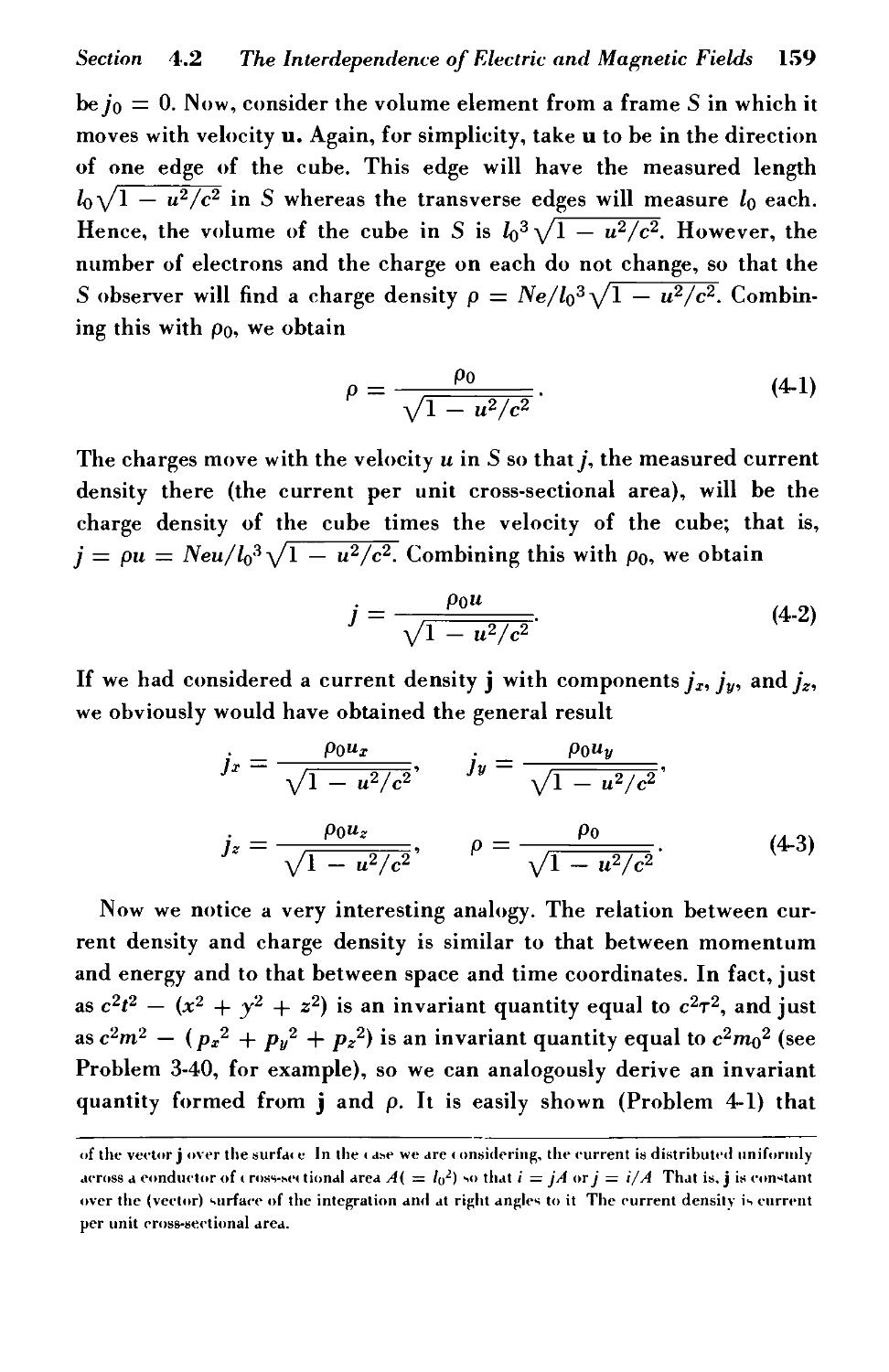
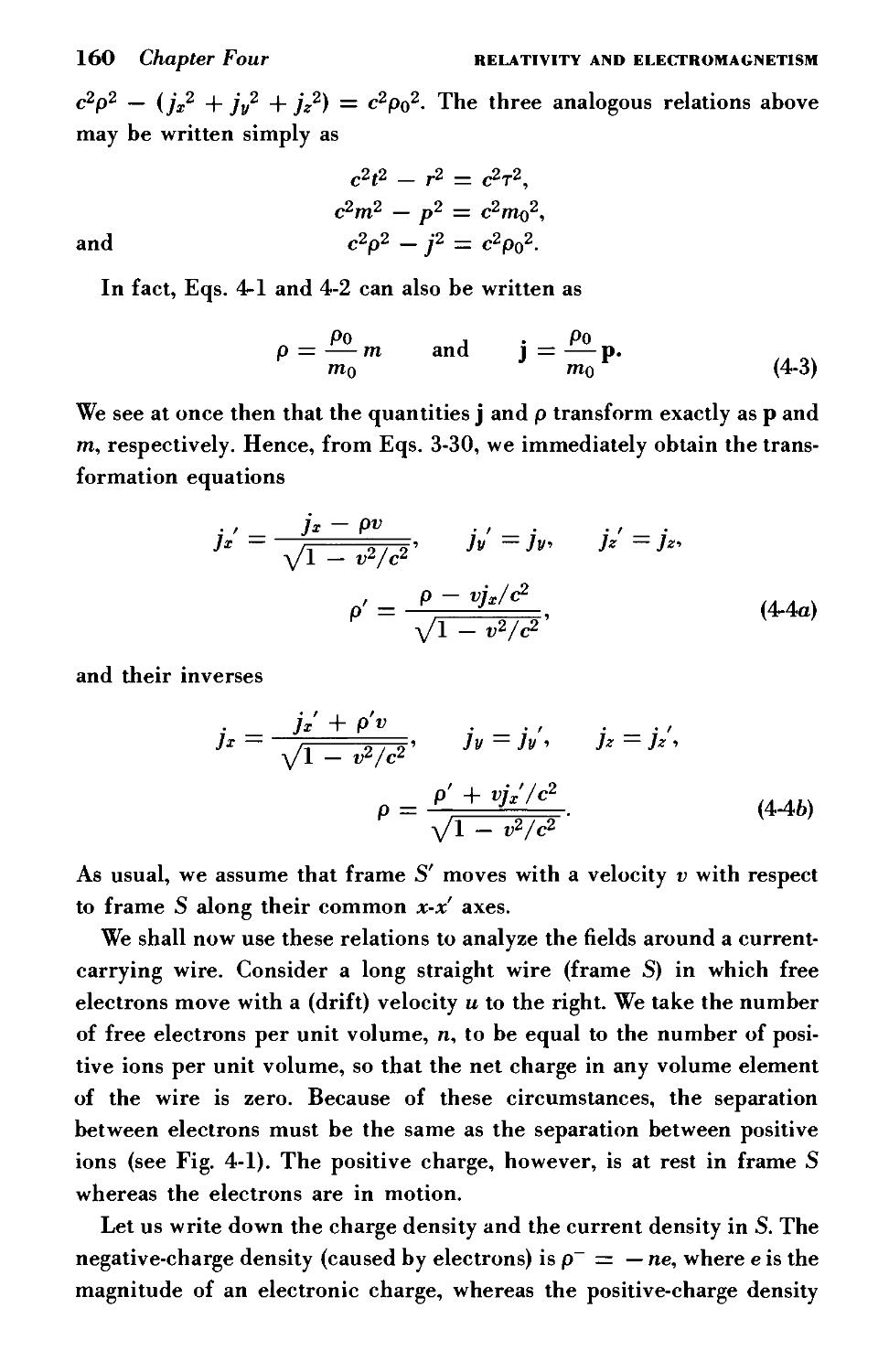


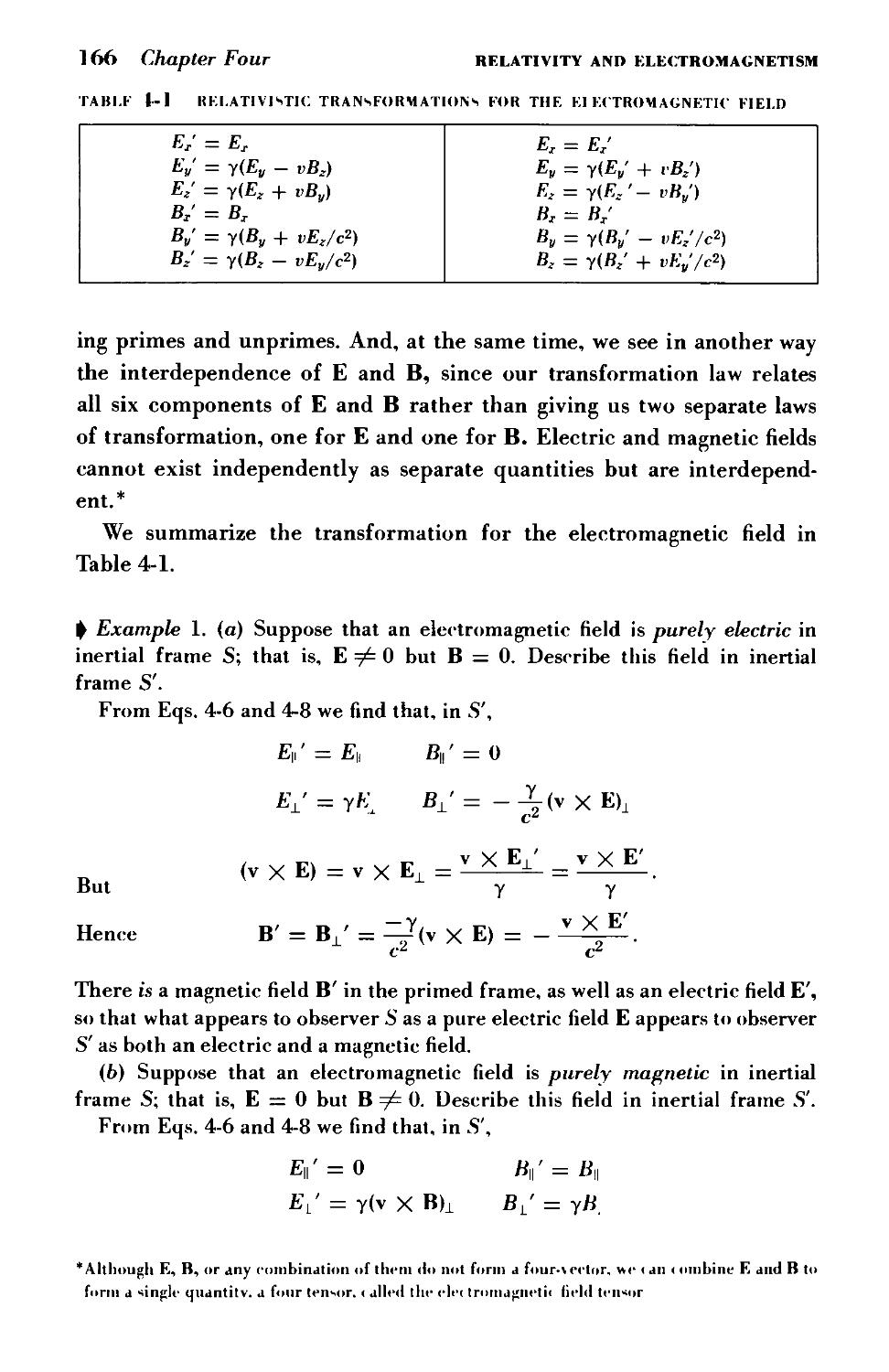


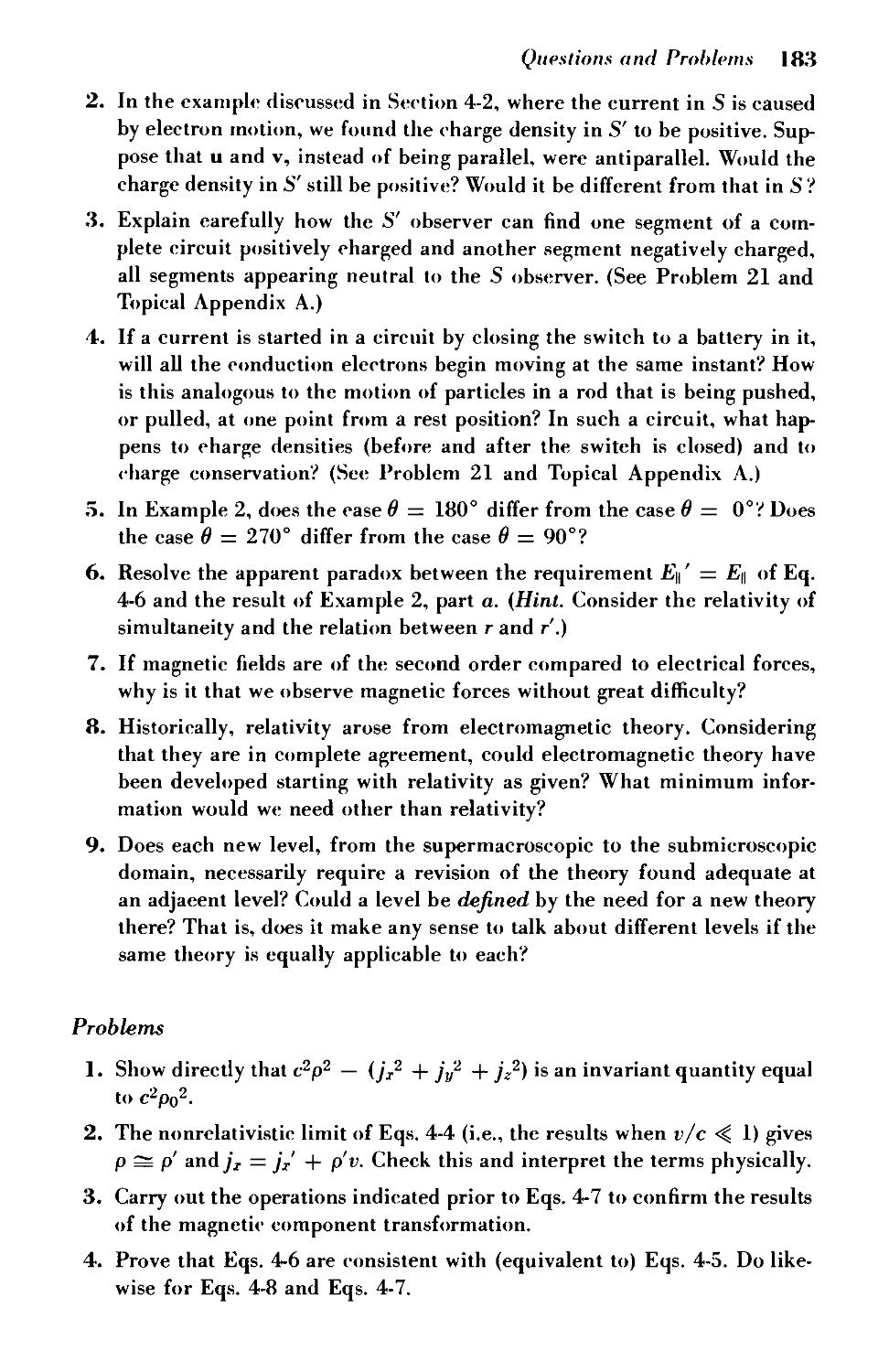





Text
INTRODUCTION
TO SPECIAL RELATIVITY
Introduction
to
Special Relativity
Robert Resnick
Professor of Physics
Rensselaer Polytechnic Institut...
John Wiley & Sons, Inc.
New York London Sydney
( 0I'Hi ht (jJ 196H hy John Wiley & Sons, Inc'
All ri hts resen e.d No pdrt of this honk IIIdY be reprueh......1
by dny rn dns UOf trdlHilllitt (t uor trdn"il.ltf'o into d IUd( hin£"
Idn!!:ud!!:e withnut tl... 'Hill.'n p..rlllissinn nf tl... pu!.lish.'r
Librdry of Cnn!!:ress Cdtaln!!: Card Number 67-.!l211
GB 471 71724X
Printed in the United State, nf Americd
To
Trudy Resnick
In loving memory
Preface
This book can be regarded as the first part of a text on "modern
physics." Indeed, it is the basis for the treatment of relativity in such a
text that I am now writing with Robert Eisberg. That text will be the
third and coneluding volume of a series on introductory physics, the
first two volumes of which I have written with David Halliday.
However, the material in this Introduction to Special Relativity has a
coherence of its own and can be used in many ways. In the two-year in-
troductory physics course at Rensselaer, for example, these chapters
build upon the background in electromagnetism and optics of the
Halliday-Resnick text and precede the full development of quantum
physics. Applications of relativity to certain areas, such as high-energy
physics, are !!;iven when, as in our third volume, those areas are pre-
sented later. There are other ways to use these chapters, as well. For
instance, they can be integrated easily with the classical material. The
early chapters on the experimental background and kinematic aspects
of relativity could follow immediately the development of Newtonian
mechanics, as could much of the relativistic dynamics, whereas the elec-
tromagnetic aspects of relativity could follow the presentation of Max-
well's equations. Or, this book could replace the brief and sketchy treat-
ment of the foundations of relativity characteristic of modern physics
courses of the immediate past. Still other uses will suggest themselves
to physics instructors.
A good deal of optional material is presented here not qnly because
of its intrinsic interest but also to permit the instructor to vary the length
and depth of his treatment. Thus, in separate appendices, there are sup-
plementary topics on the geometrical representation of space-time, on
the twin paradox, and on the principle of equivalence and general rela-
tivity. Also, in the body of the text, some material of an historical, an
advanced, or a special nature is printed in reduced type for optional use.
Similarly, the problems and thought questions, nearly 250 in number,
span a wide range of content and level of difficulty so that the impact of
the course can be altered significantly by the choice of which ones and
how many are assigned. Many references are cited especially to encour-
age students to read widely in relativity. The writing is expansive, how-
ever, so that the book is self.contained. Pedagogic aids, such as sum-
mary tables and worked-out examples, are employed to help the student
to learn on his own.
viii
PREFACE
Writing this book has been a labor of love. Relativity has alwdYs been
a favorite subject of mine, and Einstein was one of the heroes of my
youth. Ovcr two decades ago, Franco Rasetti impressed the beauty of the
subject upon me in a course at The Johns Hopkins University. Also I was
much influenced by the relativity treatments in the classic advanced texts
of Peter Bergmann and of Wolfgang Panofsky and Melba Phillips. In
revising my notes through successive drafts, classroom trials, and produc-
tion, I have received constructive criticism or other valuablc assistance
from many individuals, especially Richard Albagli, Kenneth Brownstein,
Benjamin Chi, Robert Eisberg, David Halliday, and Roland Lichtenstein.
I am grateful to Mrs. Cassie Young for her skill and dedication in typing
the many versions of the notes and to the publishers, John Wiley and
Sons, Inc., for their outstanding cooperation. To my wife and daughters,
whose forbearance over years of writing is nearly habitual, my deepest
thanks. My release from some other duties during the preparation of the
manuscript was made possible in part by a Ford Foundation grant to
the Engineering School at Rensselaer for curricular development.
It is my earnest hope that this effort will makc relativity accessible
to beginning students and arouse in them some of the excitement that
is physics.
Robert Resnick
Troy, New York
January 1968
Contents
Chapter I The Experimental Background
of the Theory of Special Relativity 1
1.1 Introduction 1
1.2 Galilean Transformations 3
1.3 Newtonian Relativity 8
1.4 Electromagnetism and Newtonian Relativity 16
1.5 Attempts to Locate the Absolute Frame;
the Michelson-Morley Experiment 18
1.6 Attempts to Preserve the Concept of a Preferred Ether
Frame; the Lorentz-Fitzgerald Contraction Hypothesis 26
1.7 Attempts to Preserve the Concept of a Preferred Ether
Frame; the Ether-Drag Hypothesis 28
1.8 Attempts to Modify Electrodynamics 33
1.9 The Postulates of Special Relativity Theory 35
1.10 Einstein and the Origin of Relativity Theory 38
Chapter II Relativistic Kinematics 50
2.1 The Relativity of Simultaneity 50
2.2 Derivation of the Lorentz Transformation Equations 56
2.3 Some Consequences of the Lorentz Transformation
Equations 62
2.4 A More Physical Look at the Main Features of the
Lorentz Transformation Equations 65
2.5 The Observer in Relativity 77
2.6 The Relativistic Addition of Velocities 79
2.7 Aberration and Doppler Effect of Relativity 84
2.8 The Common Sense of Special Relativity 91
Chapter III Relativistic Dynamics 110
3.1 Mechanics and Relativity 110
3.2 The Need to Redefine Momentum 111
3.3 Relativistic Momentum 114
3.4 Alternative Views of Mass in Relativity 118
x
CONTENTS
3.5 The Relativistic Force Law and the Dynamics of a
Single Particle 119
3.6 The Equivalence of Mass and Energy 131
3.7 The Transformation Properties of Momentum,
Energy, Mass, and Force 143
Chapter IV Relativity and Electromagnetism 157
4.1 Introduction 157
4.2 The Interdependence of Electric and Magnetic Fields 158
4.3 The Transformation for E and B 163
4.4 The Field of a Uniformly Moving Point Charge 167
4.5 Forces and Fields near a Current-Carrying Wire 172
4.6 Forces between Moving Charges 175
4.7 The Invariance of Maxwell's Equations 178
4.8 The Possible Limitations of Special Relativity 181
Supplementary Topic A
The Geometric Representation of Space-Time 188
A-I Space-Time Diagrams 188
A-2 Simultaneity, Contraction, and Dilation 193
A-3 The Time Order and Space Separation of Events 196
Supplementary Topic B
The Twin Paradox 201
B-1 Introduction 201
B-2 The Route Dependence of Proper Time 201
B-3 Space-Time Diagram of the "Twin Paradox" 203
B-4 Some Other Considerations 207
B-5 An Experimental Test 208
Supplementary Topic C
The Principle of Equivalence and General Relativity 210
C-l Introduction 210
C-2 The Principle of Equivalence 210
C-3 The Gravitational Red Shift 212
C-4 General Relativity Theory 214
Answers to Problems 220
Index 223
Introduction
to
Special Relativity
Chapter One
The Experimental Background
of the Theory of Special Relativity
1.1 Introduction
To send a signal through free space from one point to another as
fast as possible, we use a beam of light or some other electromagnetic
radiation such as a radio wave. No faster metlwd of signaling has ever
been discovered. This experimental fact suggests that the speed of light
in free space, c (= 3.00 X 10 8 m/ sec), * is an appropriate limiting refer-
ence speed to which other speeds, such as the speeds of particles or of
mechanical waves, can be compared.
In the macroscopic world of our ordinary experiences, the speed u of
moving objects or mechanical waves with respect to any observer is
always less than c. For example, an artificial satellite circling the earth
may move at 18,000 mph with respcct to the earth; here u/c = 0.000027.
Sound waves in air at room temperature move at 332 m/sec through the
air so that u/c = 0.0000010. It is in this ever-present, but limited, mac-
roscopic environment that our ideas about space and time are first formu-
lated and in which Newton developed his system of mechanics.
In the microscopic world it is readily possible to find particles whose
speeds are quite close to that of light. For an electron accelerated through
a 10-million-volt potential difference, a value reasonably easy to obtain,
the speed u equals 0.9988c. We cannot be certain without direct experi-
mental test that Newtonian mechanics can be safely extrapolated from
the ordinary region of low speeds (u/ c 1) in which it was developed to
this high-speed region (u/ c _ 1). Experiment shows, in fact, that New-
tonian mechanics does not predict the correct answers when it is applied
to such fast particles. Indeed, in Newtonian mechanics there is no limit
in principle to the speed attainable by a particle, so that the speed of
light c should play no special role at all. And yet, if the energy of the
10 Mev electron above is increased by a factor of four (to 40 Mev) experi-
ment [1] shows that the speed is not doubled to 1.9976c, as we might
'The presently accepted value of the speed of Ii!!:ht i. 2997925 :!: 0000003 X lOR mfsec
1
2 Chapter One
THE EXPERIMENTAL BACKGROUND
expect from the Newtonian relation K = -kMv 2 , but remains below c; it
increases only from 0.9988c to 0.9999c, a change of 0.11 percent. Or, if
the 10 Mev electron moves at right angles to a magnetic field of 2.0
weber/m 2 , the measured radius of curvature of its path is not 0.53 cm
(as may be computed from the classical relation r = mev/qB) but, in-
stead, 1.8 cm. Hence, no matter how well Newtonian mechanics may
work at low speeds, it fails badly as u/ c _ 1.
In 1905 Albert Einstein published his special theory of relativity.
Although motivated by a desire to gain deeper insight into the nature of
electromagnetism, Einstein, in his theory, extended and generalized
Newtonian mechanics as well. He correctly predicted the results of
mechanical experiments over the complete range of speeds from u/c = 0
to u/c _ 1. Newtonian mechanics was revealed to be an important
special case of a more general theory. In developing this theory of rela-
tivity, Einstein critically examined the procedures used to measure
length and time intervals. These procedures require the use of light
signals and, in fact, an assumption about the way light is propagated is
one of the two central hypotheses upon which the theory is based. His
theory resulted in a completely new view of the nature of space and
time.
The connection between mechanics and electromagnetism is not sur-
prising because light, which (as we shall see) plays a basic role in making
the fundamental space and time measurements that underlie mechanics,
is an electromagnetic phenomenon. However, our low-speed Newtonian
environment is so much a part of our daily life that almost everyone has
some conceptual difficulty in understanding Einstein's ideas of space-
time when he first studies them. Einstein may have put his finger on the
difficulty when he said "Common sense is that layer of prejudices laid
down in the mind prior to the age of eighteen." Indeed, it has been said
that every great theory begins as a heresy and ends as a prejudice. The
ideas of motion of Galileo and Newton may very well have passed
through such a history already. More than a half-century of experimenta-
tion and application has removed special relativity theory from the
heresy stage and put it on a sound conceptual and practical basis. Fur-
thermore, we shall show that a careful analysis of the basic assumptions
of Einstein and of Newton makes it clear that the assumptions of Einstein
are really much more reasonable than those of Newton.
In the following pages, we shall develop the experimental basis for
Section 1.2
Galilean Tran,iformations 3
the ideas of special relativity theory. Because, in retrospect, we found
that Newtonian mechanics fails when applied to high-speed particles, it
seems wise to begin by examining the foundations of Newtonian me-
chanics. Perhaps, in this way, we can find cluel:> as to how it might be
generalized to yield correct results at high speeds while still maintaining
its excellent agreement with experiment at low speeds.
1.2 Galilean Transformations
Let us begin by considering a physical event. An event is something
that happens independently of the reference frame we might use to
describe it. For concreteness, we can imagine the event to be a collision
of two particles or the turning-on of a tiny light source. The event hap-
pens at a point in space and at an instant in time. We specify an event by
four (space-time) measurements in a particular frame of reference, say
the position numbers x, y, z and the time t. For example, the collision of
two particles may occur at x = 1 m, y = 4 m, z = 11 m, and at time
t = 7 sec in one frame of reference (e.g., a laboratory on earth) so that
the four numbers (1, 4, 11, 7) specify the event in that reference frame.
The same event observed from a different reference frame (e.g., an
airplane flying overhead) would also be specified by four numbers,
although the numbers may be different than those in the laboratory
frame. Thus, if we are to describe events, our first step is to establish a
frame of reference.
We define an inertial system as a frame of reference in which the law
of inertia-Newton's first law-holds. In such a system, which we may
also describe as an unaccelerated system, a body that is acted on by zero
net external force will move with a constant velocity. Newton assumed
that a frame of reference fixed with respect to the stars is an inertial
system. A rocket ship drifting in outer space, without spinning and with
its engines cut off, provides an ideal inertial system. Frames accelerating
with respect to such a system are not inertial.
In practice, we can often neglect the small (acceleration) effects due
to the rotation and the orbital motion of the earth and to solar motion.*
Thus, we may regard any set of axes fixed on the earth as forming (ap-
'Situation" in which tI.."e effe.'t" dre noti,'eable are the Fo..cault pendulum experiment or th.. deflec-
tion from the verti.'al nf a freely fdllin!!: body. Th.. order of mal!:"itude of such effects i. indicated
by th.. result that in faUin!!: vertically 100 ft (1200 in,) a bndy at the Equator i. deflected Ie.. than
i in from the vertical
4 Chapter One
THE EXPERIMENTAL BACKGROUND
proximately) an inertial coordinate system. Likewise, any set of axes
moving at uniform velocity with respect to the earth, as in a train, ship,
or airplane, will be (nearly) inertial because motion at uniform velocity
does not introduce acceleration. However, a system of axes which acceler-
ates with respect to the earth, such as one fixed to a spinning merry-go-
round or to an accelerating car, is not an inertial system. A particle acted
on by zero net external force will not move in a straight line with constant
speed according to an observer in such noninertial systems.
The special theory of relativity, which we consider here, deals only
with the description of events by observers in inertial reference frames.
The objects whose motions we study may be accelerating with respect to
such frames but the frames themselves are unaccelerated. The general
theory of relativity, presented by Einstein in 1917, concerns itself with
all frames of reference, including noninertial ones, and we shall discuss
it briefly in Topical Appendix C.
Consider now an inertial frame 5 and another inertial frame 5' which
moves at a constant velocity v with respect to 5, as shown in Fig. 1-1.
For convenience, we choose the three sets of axes to be parallel and allow
their relative motion to be along the common x, x' axis. We can easily
generalize to arbitrary orientations and relative velocity of the frames
later, but the physical principles involved are not affected by the particu-
lar simple choice we make at present. Note also that we can just as well
y v'
S S'
-'v
x --p
D 'J' x'
vt x'_
z z'
Fig. I-I. Two inertial frdmes with d ,'ommon x-x' dxis and with the y-y' dnd
Z z' dxes parallel As seen from frdllle S, frdllle S' is moving in the p...itivt"
x-direction at speed v, Simildrly. dS seen from frame S', frame S is movin!!: in
the neg-dtive x'-direction dt this same speed. Point P suggests an evenl. who.e
sPd('e-time coordinates mdY be medsured by edch observer The origins () dnd
0' ('oincide at time 1 = O. I' = 0
Section 1.2
Galilean Transformatwn. 5
regard S to be moving with velocity - v with respect to S' as we can
regard S' to move with velocity v with respect to S.
Let an event occur at point P, whose space and time coordinates are
measured in cach inertial frame. An observer attached to S specifies by
means of mcter sticks and clocks, for instance, the location and time of
occurrence of this cvent, ascribing space coordinates x, y, and z and
time t to it. An observer attached to S', using his measuring instruments,
specifies the same cvent by spacc-time coordinates x', y', z', and t'. The
coordinates x, y, z will give thc position of P relative to the origin 0 as
measured by observer S, and t will be the time of occurrence of P that
observer S records with his docks. The coordinates x', y', and z' likcwise
refer the position of P to the origin 0' and the time of P, t', to the clocks
of inertial observer S'.
We now ask what thc relationship is between the measurements x, y, z,
t and x', y', z', t'. The two inertial observers use meter sticks, which
have been compared and calibrated against one another, and clocks,
which have been synchronized and calibrated against one another. The
classical procedure, which we look at more critically later, is to assume
thereby that length intervals and time intervals are absolute, that is,
that they are the same for all inertial observers of the same events. For
example, if metcr sticks are of the same length when compared at rest
with respect to one another, it is implicitly assumed that they are of the
same length when compared in relative motion to one another. Similarly,
if docks are calibrated and synchronized when at rest, it is assumed that
their readings and rates will agree thereafter, even if they are put in
relative motion with respect to one another. These are examples of the
"common sense" assumptions of dassical theory.
We can show these results explicitly, as follows. For simplicity, let
us say that thc clocks of ea('h observer read zero at the instant that the
origins 0 and 0' of the frames Sand S', which are in relative motion,
coincide. Then the Galilean coordinate transformations, which relate
the measurements x,y, z, t to x', y', z', t', are
x' = x - vt
,
.Y = Y
(I-Ia)
,
z = z.
These equations agree with our classical intuition, the basis of which is
easily seen from Fig. 1-1. It is assumed that time can be defined independ-
6 Chapter One
THE EXPERIMENTAL BACKGROUND
ently of any particular frame of reference. This is an implicit assumption
of classical physics, which is expressed in the transformation equations
by the absence of a transformation for t. We can make this assumption
of the universal nature of time explicit by adding to the Galilean transfor-
mations the equation
t' = t.
(l-lb)
It follows at once from Eqs. l-la and l-lb that the time interval between
occurrence of two given events, say P and Q, is the same for each ob-
server, that is
tp' - tQ' = tp - tQ,
(1-2a)
and that the distance, or space interval, between two points, say A and B,
measured at a given instant, is the same for each observer, that is
, ,
XB - XA = XB - XA.
(1-2b)
This result (Eq. 1-2b) is worth a more careful look. Let A and B be the
end points of a rod, for exam pic, which is at rest in the S-frame. Then, the
primed observer, for whom the rod is movinl?; with velo{'ity - v, will measure
the end-point locations as XB' and XA', whereas the unprimed observer locates
them at XB and XA. Using the Galilean transformations, however, we find that
XB' = XB - vtB and XA' = XA - vtA, so that XB' - XA' = XB - XA - v(tn - tA).
Since the two end points, A and B, are measured at the same instant,
tA = tB and we obtain XB' - XA' = XB - XA, as found above.
Or, we can imagine the rod to be at rest in the primed frame, and moving
therefore with velocity v with respect to the unprimed observer. Then the
Galilean transformations, which can be written equivalently as
x = x' + vt
Y =y'
z = z'
t = 1',
(1-3)
give us XB = XB' + vtB' and XA = XA' + vtA' and, with tA' = tB', we once
again obtain XB - XA = XB' - XA'.
Notice carefully that two measurements (the end points XA', XB' or XA, XB)
are made for each observer and that we assumed they were made at the same
time (tA = tB, or ti = tB'). The assumption that the measurements are made
at the same time-that is, simultaneously-is a crucial part of our definition
of the length of the moving rod. Surely we should not measure the lo('ations
Section 1.2
Galilean Transformations 7
of the end points at different times to get the length of the moving rod; it
would be like measuring the location of the tail of a swimming fish at one
instant and of its head at another instant in order to determine its length
(see Fig. 1-2).
The time-interval and space-interval measurements made above are
absolutes according to the Galilean transformation; that is, they are the
same for all inertial observers, the relative velocity v of the frames being
arbitrary and not entering into the results. When we add to this result the
assumption of classical physics that the mass of a body is a constant,
independent of its motion with respect to an observer, then we can con-
clude that classical mechanics and the Galilean transformations imply
that length, mass, and time-the three basic quantities in mechanics-
are all independent of the relative motion of the measurer (or observer).
h v
i'):i:
I to I
I I
I I
I I
X,\ (t) li(t)
(a)
V
to t 1
I
I
t
A (to)
I
I
...
xlJ(t )
(b)
Fig 1-2. To mea.ure the length of a swimming
fish one must mark the positions of its head and
tail simultdneously (a), rather than at arbitrary
times (b)
8 Chapter One
THE EXPERIMENTAL BACKGROUND
1.3 Newtonian Relativity
How do the measurements of different inertial observers compare
with regard to velocities and accelerations of objects? The position of a
particle in motion is a function of time, so that we can express particle
velocity and acceleration in terms of time derivatives of position. We
need only carry out successive time differentiations of the Galilean trans-
formations. The velocity transformation follows at once. Starting from
x' = x - vt,
differentiation with respect to t gives
dx' dx
----v
dt - dt .
But, because t = t', the operation djdt is identical to the operation djdt',
so that
dx' dx'
dt dt'
Similarly,
dx' dx
dt' dt
dy' _ dy
dt' dt
dz' dz
dt' dt '
v.
Therefore,
and
However, dx' jdt' = u;/, the x-component of the velocity measured in S',
and dxj dt = u x , the x-component of the velocity measured in S, and so
on, so that we have simply the classical velocity addition theorem
,
U x = U x - v
,
U y = U y
,
U z = U z .
(1-4)
Clearly, in the more general case in which v, the relative velocity of
the frames, has components along all three axes, we would obtain the
more general (vector) result
,
u = u - v.
(1-5)
The student has already encountered many examples of this. For exam-
ple, the velocity of an airplane with respect to the air (u') equals the
Section 1.3
Newtonian Relativity 9
velocity of the plane with respect to the ground (u) minus the velocity of
the air with respect to the ground (v).
. Example 1. A passenger walks forward along the aisle of a train at a speed
of 2.2 mi/hr as the train moves along a strail?;ht track at a constant spced of
57.5 mi/hr with respect to thc ground. What is the passenl?;er's speed with
respeet to the I?;round?
Let us choose the train to be the primed frame so that ux' = 2.2 mi/hr. The
primed frame moves forward with respect to the ground (unprimed frame) at
a speed v = 57.5 mi/hr. Hence, the passenger's speed with respect to ground is
U.r = Itx' + v = 2.2 mi/hr + 57.5 mi/hr = 59.7 mi/hr.
. Example 2. Two electrons are ejected in opposite directions from radioactive
atoms in a sample of radioactive material at rest in the laboratory. Ea('h elec-
tron has a speed O.67c as measured by a laboratory observer. What is the speed
of one electron as measured from the other, accordinl?; to the classical vclocity
addition theorem'?
Here, we may rel?;ard one electron as the 5 fr.wlt', the laboratory as the 5'
frame, and the other electron as the object whose speed in the S-frame is
sought (see Fil?;. 1-3). In the S'-frame, the other electron's speed is O.67c, mov-
s'
---0---
el
0____
e2
(a)
s
s'
(one electron)
(Laboratory)
el
u'
%0__
f e2
(Other electron)
(b)
Fill 1-3. (a) In the Idboratory frame, the electrons are ubserved to
move in oppusite directions at the same speed. (b) In the rest frame,
S, of one electrun, the laboratory moves at a velocity v. In the
laboratory frdme, S', the second electron has a velocity denuted
by u' What is the velueity of this second electron as seen by
the first?
10 Chapter One
THE EXPERIMENTAL BACKGROUND
ing in the positive x'-direction say, and the speed of the S-frame (one electron)
is 0.67c, moving in the negative x'.direction. Thus, ux' = +0.67c and v =
+ 0.67 c, so that the other electron's speed with respect to the S-frame is
Ux = uz' + v = +0.67c +0.67c = + L34c,
according to the classical velocity addition theorem. .
To obtain the acceleration transformation we merely differentiate the
velocity relations (Eq. 1-2). Proceeding as before, we obtain
d t' (ux') = -!i. (u x - v),
d dt
or
dux' dux
dt' - dt'
v beinl?; a constant,
duy' _ du y
dt' - dt'
and
duz'
dt'
duz
dt'
That is, ax' = ax, a y ' = ay, and az' = az. Hence, a' = a. The measured
components of acceleration of a particle are unaffected by the uniform
relative velocity of the reference frames. The same result follows directly
from two successive differentiations of Eqs. I-I and applies generally
when v has an arbitrary direction, as long as v = constant.
We have seen that different velocities are assigned to a particle by
different observers when the observers are in relative motion. These
velocities always differ by the relative velo('ity of the two observers,
which in the case of inertial observers is a constant velocity. It follows
then that when the particle velocity changes, the change will be the
same for both observers. Thus, they each measure the same accelera-
tion for the particle. The acceleration of a particle is the same in all
reference frames which move relative to one another with constant ve-
locity; that is
,
a = a.
(1-6)
In classical physics the mass is also unaffected by the motion of the
reference frame. Hence, the product ma will be the same for all inertial
observers. If F = ma is taken as the definition of force, then obviously
each observer obtains the same measure for each force. If F = ma,
Section 1.3
Newtonian Relativity II
then F ' = ma' and F = F'. Newton's laws of motion and the equations
of motion of a particle would be exactly the same in all inertial systems.
Since, in mechanics, the conservation principles-such as those for
energy, linear momentum, and angular momentum-all can be shown
to be consequences of Newton's laws, it follows that the laws ofmechan-
ics are the same in all inertial frames. Let us make sure that we under-
stand just what this paragraph says, and does not say, before we draw
some important conclusions from it.
First, concerning the invariance of Newton's laws (that is, the state-
ment that they are the same for all inertial observers), we should recall
that a complete statement of the laws includes the assertions (1) that
particles interact in pairs (third law) and (2) that the action-reaction
forces are directed along the strail?;ht line connecting the interactinl?;
particles. For many forces that we deal with, it is also true that their
magnitude is a function only of the separation of the particles (see Exam-
ple 3). Thus, these laws apply to such phenomena as gravitation, Van
der Waals' forces, and electrostatics. Furthermore, by considering a col-
lection of interacting mass points, we can include the mechanics of rigid
bodies, of elastic bodies, and hydrodynamics. Notice, however, that
electrodynamics is not included because the interaction between moving
electric charges (that is, between charges and magnetic fields) involves
forces w hose directions are not along the line connecting the charges;
notice too, that these forces depend not only on the positions of the
charges but also on their velocities. We shall return later (Chapter Four)
to the electrodynamic situation.
Second, although different inertial observers will record different
velocities for the same particle, and hence different momenta and kinetic
energies, they will agree that momentum is conserved in a collision or
not conserved, that mechanical energy is conserved or not conserved,
and so forth. The tennis ball on the court of a moving ocean liner will
have a different velocity to a passenger than it has for an observer on
shore, and the billiard balls on the table in a home will have different
velocities to the player than they have for an observer on a passing
train. But, whatever the values of the particle's or system's momentum
or mechanical energy may be, when one observer finds that they do not
change in an interaction, the other observer will find the same thing.
Although the numbers assigned to such things as velocity, momentum,
and kinetic enerl?;y may be different for different inertial observers, the
12 Chapter One
THE EXPERI'WENTAI. BACKGROUND
laws of mechanics (e.g., Newton's laws and the conservation principles)
will be the same in all inertial systems (see Problems 2 to 6).
. Example 3. A particle of mass ml = 3 kl?;, moving at a velocity of u] =
+4 m/sec alonl?; the x-axis of frame 5, approaches a second partiele of mass
m2 = I kl?;, moving at a velocity U2 = - 3 m/sec along this axis. After a
head-on collision, it is found that m2 has a velocity V 2 = + 3 m/sec along
the x-axis.
(a) Calculate the expected velocity V l of mlo after the I'ollision.
We use the law of conservation of momentum.
Before the collision the momentum of the system of two partieles is
P = mlul + m2u2 = (3 kg)(+4 m/sec) + 1 kl?; (-3 m/sed
= +9 kg-m/sec.
After thc collision the momentum of the system,
P = m]V] + m2V2,
is also + 9 kl?;-m/ sec, so that
or
+9 kg-m/sec = (3 kg)(V]) + 1 kg (+3 m/se..)
V] = + 2 m/sec along the x-axis.
(b) Discuss the collision as seen by observcr 5' who has a velocity v of
+ 2 m/sec relative to 5 along the x-axis.
The four velocities measured by 5' can be calculated from the Galilean
velocity transformation equation (Eq. 1-5), u' = u - v, from which we get
U]' = u] - V = +4 m/sec - 2 m/sec = 2 m/sec,
U2' = U2 - V = -3 m/sec - 2 m/sec = -5 m/sec,
VI' = V] - v = +2 m/sec - 2 m/scl' = 0,
V2' = V 2 - V = + 3 m/sec - 2 m/sec = I m/sel'.
The system momentum in 5' is
P' = m]u]' + m2u2' = (3 kg)(2 m/sec) + (l kg)( -5 m/sec)
= + 1 kl?;-m/sec
bcfnre the collision, and
P' = m]V 1 ' + m2V2' = (3 kl?;)(O) + (l kg)(l m/sec)
= + 1 kg-m/sec
after the collision.
Hence, although the velocities and momenta have different numerical
values in the two frames, Sand 5', when momentum is I'onserved in 5 it is
also conserved in 5'. .
Section 1.3
Newtonian Relativity 13
An important consequence of the above discussion is that no mechani-
cal experiments carried out entirely in one inertial frame can tell the
observer what the motion of that frame is with respect to any other iner-
tial frame. Thc billiard player in a closed box-car of a train moving
uniformly along a straight track cannot tell from the behavior of the
balls what the motion of the train is with respect to ground. Thc tennis
player in an enclosed court on an ocean liner moving with uniform
velocity (in a calm sea) cannot tell from his game what the motion of
the boat is with respect to the water. No matter what the relative motion
may be (perhaps none), so long as it is constant, the results will be iden-
tical. Of course, we can tell what the relative velocity of two frames may
be by comparing measurements between frames-we can look out the
window of a train or compare the data different observers take on the
very same event-but then we have not deduced the relative velocity
from obscrvation" confined to a single frame.
Furthermore, there is no way at all of determining the absolute ve-
locity of an inertial reference frame from our mechanical experiments.
No inertial frame is preferred over any other, for the laws of mechanics
are the same in all. Hence, there is no physically definable absolute rest
frame. We say that all inertial frames are equivalent as far as mechanics
is concerned. The person riding the train cannot tell absolutely whether
he alone is moving, or the earth alone is moving past him, or if some
combination of motions is involved. Indeed, would you say that you on
earth are at rest, that you are moving 30 km/sec (the speed of the earth
in its orbit about the sun) or that your speed is much greater still (for
instance, the sun's speed in its orbit about the galactic center)? Actually,
no mechanical experiment can be performed which will detect an abso-
lute velocity through empty space. This result, that we can only speak
of the relative velocity of one frame with respect to another, and not
of an absolute velocity of a frame, is sometimes called Newtonian
relativity.
. Example 4. Consider the forccs that two particles exert on each other to
lie along their connecting straight line, the magnitude of these equal and
opposite forces being a function only of the separation distance of the parti-
cles. Under these conditions, forces can always be represented by the negative
space derivatives of the potential energy. Show that the equation of motion
of such a particle remains unchanged under a Galilean transformation.
14 Chapter One
THE EXPERIMENTAL BACKGROUND
Let the distance between the two particles be r12 in the 5 frame, and r12'
in the 5' frame. Then the potential energy U of the system in S will be a func-
tion of r12, which we write as U(r12). Hence, the components of force are
given by
au
Fx = - '
Fy =
au
ay
and
au
Fz = -----a;.
The equations of motion in frame 5 for particle 1, say, of mass ml will there-
fore be
d2Xl au
ml-= --
dt 2 aXl
d2YI au
ml-= -- (1-7a)
dt 2 aYl
d 2 z 1 au
ml-= aZ I
dt 2
Now the mass of a body is assumed to be independent of the inertial refer-
ence frame in which it is measured in classical physics. Also, we have seen
that under a Galilean transformation the 5' observer obtains the same accel-
eration for a body as the 5 observer does. Hence (using x', y', z', and t' for the
primed observer's variables to describe the motion of the same particle that
the unprimed observer described with x, y, z, and t), we have already found
that ml' = mlo and that
d2Xl d2xI' d2YI _ d 2 YI'
dt 2 - dt'2 ' dt 2 - dt'2 '
and
d2z 1 d 2 z l '
dt 2 - dt'2 .
Furthermore, we have seen that both observers measure the same separa-
tion of the two particles. That is, X2' - Xl' = X2 - Xl, Y2' - Yl' = Y2 - Yl,
and Z2' - Zl' = Z2 - Zl so that
rl2' Y(X2' - XI')2 + (y2' - YI')2 + (Z2' - Z I')2
Y (X2 - XI)2 + (y2 - YI)2 + (Z2 - ZI)2 = r12.
The potential energy of the system is represented by U(rI2), which is some
function of the separation of the particles, such as k/r122 for example. Because
rl2 = r12', U(rI2) simply becomes (transforms to) the same function of r12'.
Hence, U(rI2) = U(rI2'), where U(r12') expresses the potential energy in the
primed system's variables.
Remember that we are trying to prove that the equations of motion of parti-
cle 1 in one inertial frame 5 will have the identical form as the equations of
motion of the same particle in another inertial system 5', if the relation be-
tween the different observer's variables is given by the Galilean transforma-
tion. That is, we are trying to show that each inertial observer uses the same
laws of mechanics. So far we have found that the left side of Eqs. 1-7a, when
Section 1.3
Newtonian Relativity 15
transformed from S to $', has the identical form and that U(rI2) and U(rI2')
are identieal.
It remains now to show that
au
aXI
(JU
- OXI"
(JU
aYI
au
- oYI"
and
au
aZ I
(JU
aZI'
and we shall have completed our proof. Let us do the x differentiation only
(the Y and Z differentiations proceed identically). We have
au
aXI
dll orl2
---
drl2 ()XI
dll X2 - XI
drl2 rl2
and
au dU iJrl2 , dU ' ,
X2 - XI
, --- -- ,
OXI drl2' OXI' drl2 , rl2
But , X2 - XI = X2' - XI'; and U(r}2) = U(rI2') so that
rl2 = rl2 ;
au au
aXI aXI'
Hence, by applying the Galilean transformation equations to the equations
of motion of particle 1 in S, we obtain the identical equations of motion for
this same particle 1 in S', namely,
d2XI' oU
ml dt'2 iJxl ,
d 2 YI' _ OU (1-7b)
ml dt'2 - OYI'
d 2 z I ' au
ml dt'2 = OZI ,
in which the variables Xlo YI, Zl, and t of S in Eqs. 1-7a simply become the
correspondinl?; variables Xl', YI', Zl', and t' of S' in Eqs. 1-7b. Obviously, we
would obtain similar results for partiele 2, and indeed the procedure is easily
generalized to a large collection of mass particles.
This example illustrates explicitly the statement that Newton's laws of
mechanics and the equations of motion are the same in all inertial frames
when the frames are related by the Galilean transformation equations. Under
a Galilean transformation F = ma becomes F' = ma'. .
Transformation laws, in general, will change many quantities but will
leave some others unchanged. These unchanged quantities are called
invariants of the transformation. In the Galilean transformation laws for
the relation between observations made in different inertial frames of
16 Chapter One
THE EXPt:RIMENTAL BACKGROUND
reference, for example, acceleration is an invariant and-more impor-
tant-so are Newton's laws of motion. A statement of what the invariant
quantities are is called a relativity principle; it says that for such quanti-
ties the reference frames are equivalent to one another, no one having
an absolute or privileged status relative to the others. Newton expressed
his relativity principle as follows: "The motions of bodies included in
a given space are the same amongst themselves, whether that space is
at rest or moves uniformly forward in a straight line."
1.4 Electromagnetism and Newtonian Relativity
Let us now consider the situation from the electrodynamic point
of view. That is, we inquire now whether the laws of physics other than
those of mechanics (such as the laws of electromagnetism) are invariant
under a Galilean transformation. If so, then the (Newtonian) relativity
principle would hold not only for mechanics but for all of physics. That
is, no inertial frame would be preferred over any other and no type of
experiment in physics, not merely mechanical ones, carried out in a
single frame would enable us to determine the velocity of our frame
relative to any other frame. There would then be no preferred, or abso-
lute, reference frame.
To see at once that the electromagnetic situation is different from the
mechanical one, as far as the Galilean transformations are concerned,
consider a pulse of light (i.e., an electromagnetic pulse) traveling to the
right with respect to the medium through which it is propagated at a
speed c. The "medium" of light propagation was given the name "ether,"
historically, for when the mechanical view of physics dominated physi-
cists' thinking (late 19th century and early 20th century) it was not
really accepted that an electromagnetic disturbance could be propagated
in empty space. For simplicity, we may regard the "ether" frame, S,
as an inertial one in which an observer measures the speed of light to be
exactly c = (I/ ) = 2.997925 X 10 8 m/sec. In a frame S' moving
at a constant speed v with respect to this ether frame, an observer would
measure a different speed for the light pulse, ranging from c + v to
c - v depending on the direction of relative motion, according to the
Galilean velocity transformation.
Hence, the speed of light is certainly not invariant under a Galilean
transformation. If these transformations really do apply to optical or
electromagnetic phenomena, then there is one inertial system, and only
Section 1.4
ElectromaKnetism and Newtonian Relativity 17
one, in which the measured speed of light is exactly c; that is, there is
a unique inertial system in which the so-called ether is at rest. We would
then have a physical way of identifying an absolute (or rest) frame and
of determining by optical experiments carried out in some other frame
what the relative velocity of that frame is with respect to the abso-
lute one.
A more formal way of sayinl?; this is as follows. Maxwell's equations
of electromal?;netism, from which we deduce the electromagnetic wave
equation for example, contain the constant c = 1/ VJlo€o, which is iden-
tified as the velocity of propagation of a plane wave in vacuum. But
such a velocity cannot be the same for observers in different inertial
frames, according to the Galilean transformations, so that eleetromag-
netic effects will probably not be the same for different inertial observers.
In fact, Maxwell's equations are not preserved in form by the Galilean
transformations, although Newton's laws are. In going from frame S
to frame Sf, the form of the wave equation, for example, changes if the
substitutions of Eqs. I-I are made (see Problem 8). But if we accept
both the Galilean transformations and Maxwell's equations as basically
correct, then it automatically follows that there exists a unique privi-
leged frame of reference (the "ether" frame) in which Maxwell's equa-
tions are valid and in which light is propagated at a speed c = 1/ V Jlo€o.
The situation then seems to be as follows. * The fact that the Galilean
relativity principle does apply to the Newtonian laws of mechanics but
not to Maxwell's laws of electromagnetism requires us to choose the
correct consequences from amongst the following possibilities.
1. A relativity principle exists for mechanics, but not for electro-
dynamics; in electrodynamics there is a preferred inertial frame; that is,
the ether frame. Should this alternative be correct the Galilean transfor-
mations would apply and we would be able to locate the ether frame
experimentally.
2. A relativity principle exists both for mechanics and for electro-
dynamics, but the laws of electrodynamics as given by Maxwell are not
correct. If this alternative were correct, we ought to be able to perform
experiments that show deviations from Maxwell's electrodynamics and
reformulate the electromagnetic laws. The Galilean transformations
would apply here also.
'The treatment here follow, cle"e1y that of Ro.f 2
18 Chapter One
THE EXPERIMENTAL BACKGROUND
3. A relativity principle exists both for mechanics and for electro-
dynamics, but the laws of mechanics as given by Newton are not correct.
If this alternative is the correct one, we should be able to perform experi-
ments which show deviations from Newtonian mechanics and reformu-
late the mechanical laws. In that event, the correct transformation laws
would not be the Galilean ones (for they are inconsistent with the invari-
ance of Maxwell's equations) but some other ones which are consistent
with classical electromagnetism and the new mechanics.
We have already indicated (Section I-I) that Newtonian mechanics
breaks down at high speeds so that the student will not be surprised to
learn that alternative 3, leading to Einsteinian relativity, is the correct
one. In the following sections, we shall look at the experimental bases
for rejecting alternatives I and 2, as a fruitful prelude to finding the new
relativity principle and transformation laws of alternative 3.
1.5 Attempts to Locate the Absolute Frame-The Michelson-Morley
Experiment
The obvious experiment* would be one in which we can measure
the speed of light in a variety of inertial systems, noting whether the
measured speed is different in different systems, and if so, noting espe-
cially whether there is evidence for a single unique system-the "ether"
frame-in which the speed of light is c, the value predicted from electro-
magnetic theory. A. A. Michelson in 1881 and Michelson and E. W.
Morley in 1887 carried out such an experiment [4]. To understand the
setting better, let us look a bit further into the "cther" concept.
When we say that the speed of sound in dry air at O°C is 331.3
m/sec, we have in mind an observer, and a correspondinl?; reference
system, fixed in the air mass through which the sound wave is moving.
The speed of sound for observers moving with respect to this air mass
is correctly given by the usual Galilean velocity transformation Eq. I-I.
However, when we say that the speed of light in a vacuum is 2.997925 X
10 8 m/sec (= 1/ V/lO£o) it is not at all clear what reference system is im-
plied. A reference system fixed in the medium of propagation of light
presents difficulties because, in contrast to sound, no medium seems to
exist. However, it seemed inconceivable to 19th century physicists that
.Of the two famous experiments. the Trnuton-Nobl.. and the Mich..l",m.Morley, "'0 discuSlo only the
latter. See Ref. 3 for a discussion of the Trouton.Noble experiment.
Section 1.5
The Michelson-Morley Experiment 19
light and other electromagnetic waves, in contrast to all other kinds of
waves, could be propagated without a medium. It seemed to be a logical
step to postulate such a medium, called the ether, even though it was
necessary to assume unusual properties for it, such as zero density and
perfect transparency, to account for its undetectability. The ether was
assumed to fill all space and to be the medium with respect to which the
speed c applies. It followed then that an observer moving through the
ether with velocity v would measure a velocity c' for a light beam, where
c' = c + v. It was this result that the Michelson-Morley experiment was
designed to test.
If an ether exists, the spinning and rotating earth should be moving
through it. An observer on earth would sense an "ether wind," whose
velocity is v relative to the earth. If we were to assume that v is equal to
the earth's orbital speed about the sun, about 30 km/sec, then v/c ;::::;
10- 4 . Optical experiments, which were accurate to the first order in v/c,
were not able to detect the absolute motion of the earth through the
ether, but Fresnel (and later Lorentz) showed how this result could be
interpreted in terms of an ether theory. This interpretation had difficul-
ties, however, so that the issue was not really resolved satisfactorily with
first-order experiments. It was generally agreed that an unambiguous test
of the ether hypothesis would require an experiment that measured the
"second-order" effect, that is, one that measured (v/c)2. The first-order
effect is not large to begin with (v/c = 104, an effect of one part
in 10,000) but the second-order effect is really very small (v 2 /c 2 = 10- 8 ,
an effect of one part in 100 million).
It was A. A. Michelson (1852-1931) who invented the optical inter-
ferometer whose remarkable sensitivity made such an experiment
possible. Michelson first p rformed the experiment in 1881, and then-
in 1887, in collaboration with E. W. Morley-carried out the more pre-
cise version of the investigation that was destined to lay the experimental
foundations of relativity theory. For his invention of the interferometer
and his many optical experiments, Michelson was awarded the Nobel
Prize in Physics in 1907, the first American to be so honored.
Let us now describe the Michelson-Morley experiment. The Michelson
interferometer (Fig. 1-4) is fixed on the earth. If we imagine the "ether"
to be fixed with respect to the sun, then the earth (and interferometer)
moves through the ether at a speed of 30 km/sec, in different directions
in different seasons (Fig. 1-5). For the moment, neglect the earth's spin-
20 Chapter One
THE EXPERIMENTAL BACKGROUND
",,""111""" ,"",".
M2
.-!-
2
s
/M
MJ
/
T
1{
Fig 1-4. A simplified version of the Michelson interferometer showing how
the beam from the source S is split into two beams by the partially silvered
mirror M The beams are refleeted by mirrors 1 and 2. retumin!!: to the par.
tially silvered mirror The beams are then transmitted to the telescope l' where
they interfere. giving rise to d fringe pdttern. In this figure. v is the velocity of
the ether with respect to the interferometer
r
v
El
ning motion. The beam of light (plane
waves, or parallel rays) from the
laboratory source S (fixed with re-
spect to the instrument) is split by the
partially silvered mirror M into two
coherent beams, beam 1 being trans-
mitted through M and beam 2 being
reflected off of M. Beam 1 is reflected
back to M by mirror M 1 and beam 2
by mirror M 2 . Then the returning
beam 1 is partially reflected and the
returning beam 2 is partially trans-
s
v
V
Fig. 1-5. The earth E moves at an or-
bital speed of 30 km/sec along its
nedrly cireular orbit about the sun S.
reversing the direction of its velocity
every six months.
Section 1.5
The MicheI.mn-Morle.v Experiment 2]
Fi!!: 1-6. A typi'>dl frin!!:e system seen thr..u!!:h
the teles....pe l' when M. dnd M l dre n..t'luitc
dt ri,;ht dn,;I..,
mitted by M back to a telescope at T where they interfere. The inter-
ference is constructive or destructive depending on the phase differ-
ence of the beams. The partially silvered mirror surface M is inclined
at 45 0 to the beam directions. If M 1 and M 2 are very nearly (but not quite)
at right angles, we shall observe a fringe system in the telescope (Fig. 1-6)
consisting of nearly parallel lines, much as we get from a thin wedge of
air between two glass plates.
Let us compute the phase difference between the beams 1 and 2. This
difference can arise from two causes, the different path lengths traveled,
II and 1 2 , and the different speeds of travel with respect to the instrument
because of the "ether wind" v. The second cause, for the moment, is the
crucial one. The different speeds are much like the different cross-stream
and up-and-down-stream speeds with respect to shore of a swimmer in
a moving stream. The time for beam 1 to travel from M to M I and back is
tl = + = II ( 2c ) = 21 1 (
c-v c+v c 2 -v 2 c 1
2/C2 )
for the light, whose speed is c in the ether, has an "upstream" speed of
c - v with respect to the apparatus and a "downstream" speed of c + v.
The path of beam 2, traveling from M to M 2 and back, is a cross-stream
path through the ether, as shown in Fig. 1-7, enabling the beam to return
22 Chapter One
THE EXPERIMENTAL BACKGROUND
t=O
'2
t=2
t = t2
." ," ,.., " I
M2
12
v
/M /,/ /M
-vt2-
Fig. 1-7. The eross-stream path of bedm 2 The mirrors move
through the "ether" dt a speed v, the light moving throuWI the
P"ether'" at speed c. Reflection from the Inoving mirror dutomatie-
dlly gives the eross-stredm pdth In thi. figure. v is the v..loeity of
the interferometer with respeet to the "ether."
to the (advancing) mirror M. The transit time is given by
or
2 [1 2 2 + (V 2 r T/ 2
21 2 21 2
v c2 - v 2 C
ct2
t2 =
1
V I - v 2 /c 2
The calculation of t2 is made in the ether frame, that of tl in the frame
of the apparatus. Because time is an absolute in classical physics, this is
perfectly acceptable classically. Note that both effects are second-order
ones (v 2 /c 2 :::::: 10- 8 ) and are in the same direction (they increase the
transit time over the case v = 0). The difference in transit times is
2 [ 12
!1t = t2 - tl = -
c V I - v 2 /c 2
1
II ]
v 2 /c 2
Suppose that the instrument is rotated through 9Uo, thereby making it
Section 1.5
The Michelson-Morley Experiment 23
the cross-stream lcngth and 1 2 the downstream length. If the correspond-
ing times are now designated by primes, the same analysis as above gives
the transit-timc difference as
II. , , , 2 [ 12
tit = t2 - t1 =-
c I - v 2 I c 2
1 1 ]
V I - v 2 /c 2 .
Hcn!'(', the rotation chan es the differences by
t' _ t = [ 12 + 1 1 _ 1 2 + 1 1 ] .
c I - v 2 /c 2 V I - v 2 /c 2
Using thc binomial expansion and dropping terms higher than the
second-order. we find
t' _ t - (l1 + 1 2 ) [ 1 + v 2 _ 1 _ ] = ( 11 + 12 \v 2 .
C c 2 2c 2 C r;;z
Thereforc, the rotation should cause a shift in the fringe pattern, sincc
it changes the phase relationship between beams 1 and 2.
If the optical path differencc between the beams changes by one wave-
length, for example, there will be a shift of one fringe across the cross-
hairs of the viewing telescope. Let N represent the number of fringes
moving past the crosshairs as the pattern shifts. Then, if light of wave-
length A is used, so that the period of one vibration is T = 1//1 = Ale,
N = t' - t _ 1 1 + 1 2 v 2 = it + 1 2 v 2 . (1-8)
T cT A
Michelson and Morley were able to obtain an optical path lcnl?;th,
it + 1 2 , of about 22 m. In their cxperiment the arms were of (nearly)
equal length, that is, 1 1 = 1 2 = I, so that = (21IA)(V 2 I c 2 ). If we
choose A = 5.5 X 10- 7 m and vlc = 10- 4 , we obtain, from Eq. 1-8,
= 22 m 10-8 = 0.4,
5.5 X 10- 7 m
or a shift of four-tenths a fringe!
Micheh,on and Morley mounted the interferometer on a massive stone
slab for stability and floated the apparatus in mercury so that it could
be rotated smoothly about a central pin. In order to make the light path
as lonl?; as possible, mirrors were arranged on the slab to reflect the beams
back and forth through eight round trips. The fringes were observed
24 Chapter One
(a)
d
" " / </
"<'-,', /'/ //d
, ' '" \. , A' 4 f' 1 q
'\..\ ' //;/ ///'l
"\ //1{;.{ /
,,, /f f/.'l/;/
,,"-:\. '\:, // // /;/ / /
",,, ":--"' ' // /// / / /
"' " :'\. /////// /
"' > * f? /II'"
, 9-\( )<1J6
/. v: ',
/ ///.'V " ,
////7 : /::8< ' \,',
/ // 'l // / b " " ,
/ /./ // / , , ,
/ f/,/jf/ // , ',
/{// / " ",'\ B,
e/,I" ! , , , "''' ¥
'o(//,,1 /. ' " ,.
' /1 ,/ "-, ",
/ // / / ,
x
,
,
a,of
(b)
- OO$
--
.",,,
.".........".-
.--
.......
_oQS ",
ClD"A,
N
S
(c)
,,/'8
, N
'fU": EXI'ERIMENTAI, IIA(:K(;RO\JND
Noon
Fig. 1.8. (a) M..uuting ..f the
Miela'ls..n.M..r1ey apparatus. (iJ)
Plan view. (c) Observed results. The
brok.", s..lidlines sh..w the ..bserved
fringe shift in the MielU'lson-Morley
cX(WrinH:>nt as a fUIH'tion of the an l("
of rotation of the interfcruIl1ett r.
The sm....th dashe,J purves-whieh
sh..uld I,.. multiplied by a factor of 8
It) hrin it to the proper :-i('ale-show
the friu e shift predicted by the
etJa'r hypothesi,. (Fr..m "On the
R.,latin' Moti..n..f tl,.. Earth and II...
Lumiuif.,rous AetlU'r" by Albert A.
Miehels..n and Edward W. M..rley,
111l' London, Edilllmr!{lr. and DuMin
Plrilmwph;(,lll M(l (lzille anti Jour-
lUll of ."ici,,"ce, D.'eeml...r 1887.)
Night
under a continuous rotation of the apparatus and a shift as small as 1/100
of a fringe definitely could have been detected (see Fig. 1-8). Observa-
tions were made day and night (as the earth spins about its axis) and
during all seasons of the year (as the earth rotates about the sun), but
the expected fringe shift was not observed. Indeed, the experimental
conclusion was that there was no fringe shift at all.
Section ] .5
Attempt. to Locate the Absolute Frame 25
011'111'1 II
TABLE I-I TRIAL' OF TilE MI< IIEI.'O'i-MORLn .XPERIME:\T
Mid...l"m
'VI iehelson dud
Morlcy
'VIorlt.y dud
\1 ilIl'r
Millt'r
Millcr
M ilIt'r
(suuli{!;hl)
Tomast'hck
(sldrlight)
M ilIcr
Kt'nnl'dy
llliu{!;worth
Pi('('drd and
Sldhcl
Mi('hdson
ct dl
Joos
\IAII
1881
18117
1 1 )02-1904
1')21
1923-1924
1924
1924
1925 1926
1926
1927
1927
1929
1930
1'( AI
!'o"dam
( :lcvt'ldnd
( :It'Vcldnd
MI Wilsou
( :lCVt,IdUd
Clt., c1dud
lIt>itlclhcr{!;
MI. Wilson
!'asadt'na and
MI. Wilson
Pd'adcna
MI. Hi!-(i
:\II. Wilson
Jl'nd
l MEn II' III"II.I' '1111 I (,('1'1.11 LIMn
1.2
1l.0
: 2.2
32.0
32.0
: 2 0
8.6
32.0
2.0
20
2.8
25.9
21.0
I'IIEDIITf:1I
11\ ETIIEII
TIIEOII\
0.04
0.40
Ll3
Ll2
1.12
LI2
0.3
1.12
0.07
0.07
0.13
0.9
0.75
Of OIl'EIIVEII
f IIINI.f. '11111
002
0.01
0.015
0.08
0.030
0.014
0.02
0.088
0.002
0.0004
0.006
0010
0.002
SIll/Tee From "hdnklanel. Me.t:u,ke , IA."..... dncl Ku,'rli, R,'" Mod Ph",. 27. I(,i (1955).
This null result (/1N = 0) was such a blow to the ether hypothesis
that the experiment was repeated by many workers over a 50-year period.
The null result was amply confirmed (see Table 1-1) and provided a
great stimulus to theoretical and experimental investigation. In 1958
1. P. Cedarholm, C. H. Townes et al [5] carried out an "ether-wind"
experiment using microwaves in which they showed that if there is an
ether and the carth is moving through it, the earth's speed with respect
to the ether would have to be less than 1/1000 of the earth's orbital
speed. This is an improvement of 50 in precision over the best experi-
ment of the Michelson-Morlcy type. The null result is well established.
The student should note that the Michelson-Morley experiment
depends essentially on the 90° rotation of the interferometer, that is,
on interchanging the roles of it and 1 2 , as thc apparatus moves with a
speed v through an "ether." In predicting an expected fringe shift, we
took v to be the earth's velocity with respect to an ether fixed with the
sun. However, the solar system itself might be in motion with respect
26 Chapter One
THE EXPERIMt;NTAL BACKGROUND
to the hypothetical ether. Actually, the experimental results themselves
determine the earth's speed with respect to an ether, if indeed there is
one, and these results give v = O. Now, if at some time the velocity were
zero in such an ether, no fringe shift would be expected, of course. But
the velocity cannot always be zero, since the velocity of the apparatus
is changing from day to night (as the earth spins) and from season to
season (as the earth rotates about the sun). Therefore, the experiment
does not depend solely on an "absolute" velocity of the earth through
an ether, but also depends on the changing velocity of the earth with
respect to the "ether." Such a changing motion through the "ether"
would be easily detected and measured by the precision experiments,
if there were an ether frame. The null result seems to rulc out an ether
(absolute) frame.
One way to interpret the null result of the Michelson-Morley experi-
ment is to conclude simply that the measured speed of light is the same,
that is, c, for all directions in every inertial system. For this fact would
lead to /1N = 0 in the (equal arm) experiment, the "downstream" and
"cross-stream" speeds being c, rather than Ic + vi, in any frame. How-
ever, such a conclusion, being incompatible with the Galilcan (velocity)
transformations, seemed to be too drastic philosophically at the time.
If the measured speed of light did not depend on the motion of the
observer, all inertial systems would be equivalent for a propa!!;ation of
light and there could be no experimental evidence to indicate the exist-
ence of a unique inertial system, that is, the ether. Therefore, to "save
the ether" and still explain the Michelson-Morley result, scientists sug-
gested alternative hypotheses. We explore these alternatives in succeed-
ing sections.
1.6 Attempts to Preserve the Concept of a Preferred Ether Frame-
The Lorentz-Fitzgerald Contraction Hypothesis
Fitzgerald (in 1892) proposed a hypothesis, which was elaborated
upon by Lorentz, to explain the Michelson-Morley null result and still
to retain the concept of a preferred ether frame. Their hypothesis was
that all bodies are contracted in the dire ction of motion relative to the
stationary ether by a factor V I - v 2 /c 2 . For convenience, let the ratio
v/c b e repre sented by the symbol /3, so that this factor may be written
as V I - /32. Now, if r represents the length of a body at rest with
respect to the ether (its rest length) and I its length when in motion with
Section 1.6
The Lorentz-Fitzgerald Contraction Hypothesis 27
respect to the ether, then in the Michelson-Morley experiment
1 1 = L 1 ° V I - {32
and
1 2 = 1 2 0 .
This last result follows from the fact that in the hypothesis it was assumed
that lengths at right angles to the motion are unaffected by the motion.
Then
!1t = 1 ( L 0 _ I 0 )
, / {32 1 2
C v1-
and, on 90 0 rotation,
(1-9)
!1t' = 1 ( I 0 _ I 0 ) .
V {32 1 2
C 1 -
Hence, no fringe shift should be expected on rotation of the interferom-
eter, for !1t' - !1t = o.
Lorentz was able to account for such a contraction in terms of his
electron theory of matter, but the theory was elaborate and somewhat
contrived and other results predicted from it could not be found experi-
mentally. As for the interferometer result of the contraction hypothesis,
it too can be demolished as a correct explanation. Recall that, in thc
original expcriment, the arms were of (nearly) equal length (i1 = 1 2 = l).
Consider now an interferometer in which h =1= L 2 . In that case, even
including the Lorentz contraction effect, we should expect a fringe shift
when the velocity of the interferometer changes with respect to the ether
from v to v'. The predicted shift in fringes (to second-order terms; see
Problem 11) is
!1N = h O 1 2 0 (:: _ 2 ).
(1-10)
Kennedy and Thorndike [6], using an interferometer with unequal
arms (the path difference was about 16 cm, as great as permitted by
coherence of the source), carried out the appropriate experiment.
Although the difference (v 2 - v'2)/c 2 should change as a result of the
earth's spin (the biggest change occurring in twelve hours) and the earth's
rotation (the biggest change occurring in six months), neither effect was
observed (i.e., l1N = 0) in direct contradiction to the contraction
hypothesis.
28 Chapt€r One
THE EXPERIMENTAl. BACKGROUND
1. 7 Attempts to Preserve the Concept of a Preferred Ether Frame-
The Ether-Drag Hypothesis
Another idea advanced to retain the notion of an ether was that
of "ether drag." This hypothesis assumed that the ether frame was
attached to all bodies of finite mass, that is, dragged along with such
bodies. The assumption of such a "local" ether would automatically give
a null result in the Michelson-Morley experiment. Its attraction lay in
the fact that it did not require modification of classical mechanics or
electromagnetism. However, there were two well-established effects
which contradicted the ether-drag hypothesis: stellar aberration and the
Fizeau convection coefficient. Let us consider these effects now, since
we must explain them eventually by whatever theory we finally accept.
The aberration of light was first reported by Bradley [see Ref. 7] in
1727. He observed that (with respect to astronomical coordinates fixed
with respect to the earth) the stars appear to move in circles, the angular
diameter of these circular orbits being about 41 seconds of arc. This can
be understood as follows. Imagine that a star is directly overhead so that
a telescope would have to be pointed straight up to see it if the carth
were at rest in the ether. That is (see Fig. 1-9a), the rays of light coming
from the star would proceed straight down the telescope tube. Now,
imagine that the earth is moving to the right through the ether with a
speed v. In order for the rays to pass down the telescope tube without
hitting its sides-that is, in order to see the star-we would have to tilt
the telescope as shown in Fig. 1-9b. The light proceeds straight down
in the ether (as before) but, during the time !1t that the light travels the
vertical distance I = c !1t from the objective lens to the eyepiece, thc tele-
scope has moved a distance v !1t to the right. The eyepiecc, at thc time
the ray leaves the telescope, is on the same vertical line as the objective
lens was at the time the ray entered the telescope. From the point of view
of the telescope, the ray travels along the axis from objectivc lcns to
cyepiece. The an!!;le of tilt of the telescope, a, is !!;iven by
v !1t v
tan a = - = -.
c t::.t c
(1- L L)
It was known that the earth goes around the sun at a speed of about
30 km/sec, so that with c = 3 X 10 5 km/sec, we obtain an angle
a = 20.5 sec of arc. The earth's motion is nearly circular so that the
direction of aberration reverses every six months, the telcscope axis
Section l. 7
The Ether-Drag Hypothesis 29
True
position
Apparent
position
..c-- a --..".
f--- ,.
et.t v
I
'f ,
-v t.t..,..
(a} (bJ
(e}
Fig 1-9. (ll) The star dnd teles('ope have no relative motion (i.e., both dre dt
rest in the ether), the stdr is direetly overhead (b) The teleseope now moves to
the ri!!:ht dt speed " through th.. ether, it must be tilted at dn angle a (gredtly
exa!!:gerdtcd ill the drd" in!!:) from the vertiCdI to see the star, whose dppdrent
position now differs from its true position ("True" means with respeet to the
sun, ie, "ith respeet to an eartJ' that has no motion relative to the sun) (e) A
eone of abbt>rdtion of an!!:uldr didmeter 2a is swept out by the telescope axis
durin!!: th,> yedr.
tracing out a cone of aberration during the year (Fig. 1-9c). The angular
diameter of the cone, or of the observed circular path of the star, would
then be 20: = 41 sec of arc, in excellent agreement with the observa-
tions. For stars not directly overhead, the analysis, although more
involved, is similar and identical in principle (see Problem 12).
The important thing we conclude from this agreement is that the
30 Chapter One
THE EXPERIMENTAl. BACKGROUND
ether is not dragged around with the earth. If it were, the ether would
be at rest with respect to the earth, the telescope would not have to be
tilted, and there would be no aberration at all. That is, the ether would
be moving (with the earth) to the right with speed v in Fig. 1-9c, so there
would be no need to correct for the earth's motion through the ether;
the light ray would be swept along with the ethcr just as a wind ('ar-
ries a sound wave with it. Hence, if there is an ether, it is not dragged
along by the earth but, instead, the earth moves freely through it. There-
fore, we cannot explain the Michelson-Morley result by means of an
ether-drag hypothesis.
Another well-established effect that contradicts the ether-drag hypoth-
esis involves the propagation of electromagnetic waves in moving media.
J. A. Fresnel, in 1817, predicted that light would be partially dragged
along by a moving medium and derived an exact formula for the effect
on the basis of an ether hypothesis. The effect was confirmed experi-
mentally by Fizeau in 1851. The set-up of the Fizeau experiment is
shown diagrammatically in Fig. 1-10. Light from the source S falls on a
partially silvered mirror M which splits the beam into t\\O parts. One
part is transmitted to mirror M I and proceeds in a counterclockwise
sense back to M, after reflections at M I , M 2 , and M3. The other part is
reflected to M3 and proceeds in a clockwise sense back to M, after reflec-
tions at M 3 , M2, MI. At M, part of the returning first beam is transmitted
and part of the returning second beam is reflected to the telescope T.
Interference fringes, representing optical path differences of the beams,
will be seen in the telescope. Water flows through the tubes (which have
flat glass end sections) as shown, so that one light beam always travels
in the direction of flow and the other always travels opp03ite to the direc-
tion of flow. The flow of water can be reversed, of course, but outside
the tubes conditions remain the same for each beam.
Let the apparatus be our S-frame. In this laboratory frame the velocity
of light in still water is c/n and the velocity of the water is V w . Does the
flow of water, the medium through which thc light passcs, affcct the
velocity of light measured in the laboratory? According to Fresnel the
answer is yes. The velocity of light, v, in a body of refractive index, n,
moving with a velocity V w relative to the observer (i.e., to the frame of
reference S in which the free-space velocity of light would be c) is given
by Fresnel as
Section 1. 7
The Ether-Drag Hypothesis 31
.\fa -j
.J i
t Water flows out
2t
- - -------- - - -- -11
M2
of--
V eu
s
,M
- -
-------- ----------
,---Ml
.I
IL:; -:-- - _-_-_--:cc-_--'-:.-_-_-_-_-_-_-
1':1 -- -----
t Water flows in
I T
I
Fig 1-10. Schemdti<- view of the Fizeau Experiment
v = : -t- v w ( 1 - :2 ).
(1-12)
The factor (1 - l/n 2 ) is called the Fresnel drag coefficient. The speed of
light is changed from the value c/n because of the motion of the medium
but, because the factor is less than unity, the change (increase or tie-
crease) of speed is less than the speed V w of the medium-hence the
term "drag." For yellow sodium light in water, for example, the speed
increase (or decrease) is 0.565 V w . Notice that for n = 1 Ca moving
vacuum") Eq. 1-12 reduces plausibly to v = c.
This result can be understood by regarding the light as being carried
along both by the refractive medium and by the ether that permeates it.
Then, with the ether at rest and the refractive medium moving through
the ether, the light will act to the rest observer as though only a part of
32 Chapter One
TilE EXPERIMENTAL BACKGROUND
the velocity of the medium were added to it. The result can be derived
directly from electromagnetic theory. There we use the electric displace-
ment vector D which is a sum (foE + P) of two terms. The first term
depends on the free-space electric field E and the second term is the
polarization P, which relates to the rep.active medium. In computing
the velocity of electromagnetic waves in a moving refractive medium
compared to that in a stationary one, only that part of D which depends
on P contributes to the difference.
In Fizeau's experiment, the water flowed through the tubes at a speed
of about 7 m/sec. Fringe shifts were observed from the zero flow speed
to flow speeds of 7 m/sec, and on reversing the direction of flow. Fizeau's
measurements confirmed the Fresnel prediction. The experiment was
repeated by Michelson and Morley in 1886 and by P. Zeeman and others
after 1914 under conditions allowing much greater precision, again
confirming the Fresnel drag coefficient.
. Example 5. In Fizeau's experiment, the approximate values of the parame-
ters were as follows: 1 = 1.5 m, n = 1.33, A = 5.3 X 10- 7 m, and V w = 7
ml sec. A shift of 0.23 fringe was observed from the case V w = o. Calculate the
drag coefficient and compare it with the predicted value.
Let d represent the drag coefficient. The time for beam 1 to traverse the
water is then
21
tl =
(cln) - vwd
and for beam 2
21
t2 =
kin) + vwd.
Hence,
41v w d
D.t = tl - t2 =
(cln)2 - v w 2 Q2 =
41n 2 v w d
c 2
The period of vibration of the light is T = Ale so that
D.N = D.t = 41n 2 v w d
- T Ac
and, with the values above, we obtain
d = AeD.N = 0.47.
41n 2 v w
Section I.n
A f/f'fl/pts to Modif.' ELectrodYn(lfl/ic. : :J
The Fresnel predietion (see Ell. 1-12) is
1
d = 1 - 2 = 0.44. .
n
If the cther were draggcd along with the water, the velocity of light in
the laboratory frame, using the Galilean ideas, would have been (c/n) +
V w in one tube and (c/n) - V w in the other tube. Instead, the Fizeau
experiment, as we have seen, is interpreted most simply in terms of no
ether drag at all, either by the apparatus or the water moving through it,
and a partial drag due to the motion of the refractive medium. Indeed,
the aberration experiment, when done with a telescope filled with water
(see Question 15), leads to exactly the same result and interpretation.
Hence, the ether-drag hypothesis is contradicted by the facts.
There appears to be no acceptable experimental basis then for the idea
of an ether, that is, for a preferred frame of reference. This is true
whether we choose to regard the cther as stationary or as dragged along.
We must now fact> the alternative that a principle of relativity is valid in
electrodynamics as well as in mechanics. If this is so, then either electro-
dynamics must be modified, so that it is consistent with the classical
relativity principle, or else we need a new relativity principle that is
consistent with electrodynamics, in which case classical mechanics will
need to be modified.
1.8 Attempts to Modify Electrodynamics
Let us consider now the attempts to modify the laws of electro-
magnetism. A possible interpretation of the Michelson-Morley result (one
that contradicts the dassical relativity principle) is that the velocity of
light has the same value in all inertial frames. If this is so, then the
velocity of light surely cannot depend on the velocity of the light source
relative to the observer. Hence, one modification of electromagnetism
that suggests itself, if we wish to avoid the principle of the invariance of
the velocity of light as the corr t intcrpretation of the Michelson-Morley
results, is to assume that the velocity of a light wave is connected with
the motion of thc source rather than with an cther. The various theories
that are based on this assumption are ('ailed emission theorics. Common
to them all is the hypothesis that thc velocity of light is c relative to thc
original sourcc and that this veloeity is indepcndent of the state of mo-
tion of the medium transmitting the light. This would automatically
34 Chapter One
THE EXPERIMENTAL BACKGROUND
explain the null result of the Michelson-Morley experiment. The theories
differ in their predictions as to what the velocity of light becomes on
reflection from a moving mirror. * Nevertheless, all emission theories are
contradicted directly by two types of experiment. The first is typified by
the de Sitter observations on double (or binary) stars (see Ref. 9 and
Problem 14), the second by a Michelson-Morley experiment using an
extraterrestrial light source.
Two stars that are close to one another and move in orbits about their
common center of mass are called double stars. Imagine the orbits to be
circles. Now assume that the velocity of the light by which we see them
through the empty space is equal to c + Vs, where Vs is the component of
the velocity of the source relative to the observer, at the time the light
is emitted, along the line from the source to the observer. Then, the time
for light to reach the earth from the approaching star would be smaller
than that from the receding star. As a consequence, the circular orbits of
double stars should appear to be eccentric as seen from earth. But
measurements show no such eccentricities in the orbits of double stars
observed from earth.
The results are consistent with the assumption that the velocity of
the light is independent of the velocity of the source. * * DeSitter's con-
clusion was that, if the velocity of light is not equal to c but is equal
instead to c + kv s , then k experimentally must be less than 2 X 10- 3 .
More recent experiments [11], using fast-moving terrestrial sources,
confirm the conclusion that the velocity of electromagnetic radiation is
independent of the velocity of the source. In the most recent experiment
(1964), measurements are made of the speed of electromagnetic radiation
from the decay of rapidly moving ';To mesons produced in thc CERN syn-
chrotron. The mesons had energies greater than 6 GeV (v,. = 0.99975c)
and the speed of the y-radiation emitted from these fast-moving sources
was measured absolutely by timing over a known distance. The result
corresponded to a value of k equal to (- 3 + 13) X 10- 5 .
The Michelson-Morley experiment, usinl?; an extraterrestrial source,
has been performed by R. Tomaschek, who used starlight, and
'The orip;iruzl suurce theory a'6Ullle, thdt the v..le...ity remain, c relative to the sour..e, the ballistic
theory assumes that the velocity becomes c r..ldtive to tI... mirror, and the neu <ource th..ory
dS"'UIIW,"" that tlw ,elo('ity het'ullics (.' rt'ldth t' In tlw mirror jmd c of tilt' ...our, t' "'tOt' Rpf", H
**For dO dndlysi and a dis('us..iun of dltt'rndte intt>rprptdtion... Hf tilt' «It O I..\ittcr eXlwriment
"'C' H..c I 0
Section 1.9
The P()stlllate. of Special Relatirity Theory :-J5
D. C. Miller, who used sunlight [12]. If the source velocity (due to rota-
tional and translational motions relative to the interferometer) affects
the velocity of light, we should observe complicated fringe-pattern
changes. No such cffccts were observed in either of the experiments.
We saw earlicr that an ether hypothesis is untenable. Now we are
forced by experiment to conclude further that the laws of electrodynam-
ics are correct and do not need modification. The speed of light (i.e.,
electromagnetic radiation) is the same in all inertial systems, independcnt
of the relative motion of source and observer. Hence, a relativity princi-
ple, applicable both to mechanics and to electromagnetism, is operating.
Clearly, it cannot be the Galilean principle, since that required the speed
of light to depend on the relative motion of source and obscrver. We
conclude that the Galilean transformations must be replaced and, there-
fore, the basic laws of mechanics, which were consistent with those
transformations, need to be modified.
1.9 The Postulates of Special Relativity Theory
In 1905, beforc many of the experiments we have discussed were
actually performed (see Question 18), Albert Einstein (1879-1955),
apparcntly unaware of several earlier important papers on the subject,
providcd a solution to the dilemma facing physics. In his paper "On the
Electrodynamics of Moving Bodies" [13], Einstein wrote ". . . no propcr-
ties of observed facts correspond to a concept of absolute rest; . . . for all
coordinate systems for which the mechanical equations hold, the equiva-
lent electrodynamical and optical equations hold also. . . . In the follow-
ing we make these assumptions (which we shall subsequcntly call the
Principle of Relativity) and introduce the further assumption-an
assumption which i{,' at the first sight quite irreconcilable with the former
one-that light is propagated in vacant space, with a velocity c which is
independent of the nature of motion of the emitting body. These two
assumptions are quite sufficicnt to give us a simple and consistent theory
of electrodynamics of moving bodies on the basis of the Maxwellian
theory for bodies at rest."
We can rephrase these assumptions of Einstein as follows.
1. The laws ofphysics are the same in all inertial systems. No preferred
inertial s'y. tem exists. (The Principle of Relativity.)
36 Chapter One
TilE t:XI't:RnU:"'ITAL BA(:K(;ROUNI)
2. The speed of light in free space has the same value c in all inertial
systems. (The Principle of the Constancy of thc Specd of Light.)
Einstein's relativity principlc goes bcyond thc Newtonian relativity
principle, which dealt only with the laws of meehani('s, to include all
the laws of physics. It states that it is impossible by means of any physical
measurements to designate an inertial system as intrinsically stationary
or moving; we can only speak of the relative motion of two systems.
Hcnce, no physical experiment of any kind made cntirely within an
inertial system can tell the observer what the motion of his systcm is with
respcct to any other inertial system. The second prilll'iple above, which
flatly contradicts the Galilean velocity transformation (Eq. 1-5), is dearly
consistent with the Michelson-Morley (and subsequent) experiments.
The entire special theory of relativity is dcrived directly from thcse two
assumptions. Their simplicity, boldness, and generality are characteristic
of Einstein's genius. The success of his theory can only be judged by
comparison with experiment. It not only was ablc to cxplain all thc
existing experimental results but predicted new effects which were con-
firmed by later experiments. No cxperimental objection to Einstcin's
spccial theory of relativity has yet been found.
In Tablc 1-2 we list the seven theories proposed at various timcs and
compare their predictions of the results of thirtccn crucial expcriments,
old and new. Notice that only thc special theory of relativity is in agree-
ment with all the experiments listcd. We have already commentcd on the
successes and failures of the ethcr and emission theorics with most of
the light-propagation experiments and it remains for us to show how
special relativity accounts for their results. In addition, several cxperi-
ments from othcr fields-some suggested by the predictions of relativity
and in flat contradiction to Newtonian mechani('s-remain to be exam-
incd. What emerges from this comparative preview is the compelling
experimental basis of special relativity theory. It alonc i!. in ac('ord with
the real world of experimental physics.
As is often true in thc aftermath of a I?;reat ncw theory, it seemed
obvious to many in retrospect that the old idt'as had to be wronl?;. For
example, in discussing the concept of an ether as a substance, a conccpt
that persistt'd lonl?; after relativity, Max Born 114) madc the point that the
ela tic properties of matter were being dcrived with inl'reasing succes!.
from clcctromal?;netic forces so that it was quitc inconsistent to try, in
Section 1.9
The Po, tulates of Special Relativity Theory 37
TAB I E 1-2 EXPERIMENTAL BASI },OR TIlE THEORY OF SPECIAL RELATIVITY
IIGIIT PROPAGATION F.XPl.RI\tE"IIIT'" tRc)\f
t.XIJ..RIM""IIIT OTHER t'lEI D'
0;
C
""
..
e
-=
<Ii
<Ii C
..
'" " '" e
<Ii c
';: C <Ii ..
-= '" .. ';; OJ .. <Ii
<Ii .. C ; 0 .. . Q.
E <i ;. ..c ""
Theury ;; :E ':; "
is "" ;. <i .
'5 " c C" ""
<Ii 'Q.. ';;; -= <Ii C ;. =
0 <Ii = 'i ';: of.,
" "" 0 .:
..:0: c " .;. .. 0
c ;., -a .. '" :1\ <Ii e :: .S
.S <Ii 0 <Ii C
C '" ;: ;:: .. !i
t .. <Ii e <Ii .. '"
0 <- " 0 J, :a =
<Ii ..c .. <Ii -- '" ..E ;.. ""
;. = .. .. 0 ::
. c Eo< C: 0 e " ;z:
0 >- .. c c ..
;; " in "" "" °E Oi g = ..
.. = <i <Ii C <i .. .. c 0 '0
.. .. ..c c ';: ii'J ..c .. <Ii :.e 0 -= Q.
<Ii <Ii " = " ';: c '" '2
..Q " :i <Ii 0 <Ii :i .. <Ii 0
..: :.:: Q F
Statiunary ether, A A D D A A D D N A D D
no runtrartion
Ether Stationary ether, N <\ D
theuries Lorentz contraction A A A D A A A A A
Ether attaeh..d tu J) J) A A A A A D :'i N A N
punderdble bodies
Ori!!:inal suurce A A A A A J) D N N D N N N
Emissiun
theuries Rallisti,' A A A D D D N N D N N N
Ne\\ ioiuurre A N A A D D A N N D N N N
Specidl theory nf reldtivity A A A A A A A A A A A A A
Legend, A, the theory agrees "ith experimental results,
D, the theory disagrees with experimental results.
N, the theory is not applicable to the experiment.
Source }'rom Panofsky and Phillips, Classical Electricity and Magnet<sm (2nd ed.), Addison.Wesley,
New York (1962).
turn, to explain electromagnetic phenomena in terms of the elastic
properties of some hypothetical mt'dium. In the same spirit Herman
Bondi [15] has said:
"The special theory of relativity is a necessary consequence of any
assertion that the unity of physics is essential, for it would be intolerable
for all inertial systems to be equivalent from a dynamical point of view
yet distinguishable by optical measurements. It now seems almost in-
credible that the possibility of such a discrimination was taken for
38 Chapter One
THE EXPERIMt:NTAI. BACKGROUND
granted in the nineteenth century, but at the same time it was not easy
to see what was more important-the universal validity of the Newtonian
principle of relativity or the absolute nature of time."
It was his preoccupation with the naturc of time that led Einstein to
his revolutionary proposals. We shall sec later how important a clear
picture of the concept of time was to thc dcvelopment of relativity
theory. However, the program of the theory, in terms of our discussions
in this chapter, should now be clear. First, we must obtain equations of
transformation between two uniformly moving (inertial) systems which
will keep the velocity of light constant. Second, we must examine the
laws of physics to check whether or not they keep the samc form (i.e., are
invariant) under this transformation. Those laws that are not invariant
will need to be generalized so as to obey the principle of relativity.
The new equations of transformation obtained in this way by Einstein
are known for historical reasons as a Lorentz transformation. We have
seen (Section 1-3) that Newton's equation of motion is invariant under a
Galilean transformation, which we now know to be incorrect. It is likely
then that Newton's laws-and perhaps other commonly accepted laws
of physics-will not be invariant under a Lorentz transformation. In
that case, they must be generalized. We expect the generalization to be
such that the new laws will reduce the old ones for velocities much less
than that of light. for in that range both the Galilean transformation and
Newton's laws are at least approximately correct.
In Table 1-3, for perspective, we compare relativity theory to the older
emission and ether thcorics in terms of their basic assumptions and
('onclusions.
1.10 Einstein and the Ori in of Relativity Theory
It is so fascinating a subject that one is hard-pressed 10 eul short a
discussion of Albert Einstein, the pcrson. Common misconceptions of Ihe
man, who quite properly symbolized for his f!;eneralion Ihe very height of
intellect, might be shattered by sueh truths as Ihese: Einsll'in'fo> parents ft'arcrl
for a while that he mi!!;ht be mentally retarded for he learned to speak much
later than customary; one of his teachers said to him "You will never amount
to anything, Einstein." in rlespair at his daydreaming and his ne!!;ative attitude
toward formal instruction; he failcd to get a high-school diploma and. with no
job prospeds, at the age of fifteen hc loafed likl' d "model dropout"; Einstein's
first attempt to gain admission to a polytl'ehnit. institute pnrled wht'n he failed
Section 1.1 ()
Einstein and the OriKin of Relativity Theory 39
TARLt" 1-3 IIA H A {IMl'lION ANI> (ON( I lI ION ot" ALTER"IATIVE TIIEORIE
"PI- «(AI fIlH)R"I
01- RHArlVln
. \11......10' I HHHn
C I A......« o\I I-TIII-R
..II-OR'
Rpfprt'nc ('
"y';h'm
No "pc('idl referent e
!:'\ystem
Vt'lot it
dept.ntlc.nc'('
Spot( e-tillH"
('oltm.('tjCHJ
Trdn f()rmdtit)n
('qudtilill"
Nu ..pt'( i..1 ft.reft-nt't.
..y..tt'lII
'1'1... ",I... it, of li!(ht
flt'IJt"IIfI.. on tilt, nwtion
uf tlH' ..nun C'
Pd('t' .Hul tinw .Ut'
indt'}Jf'ndt'nt
(nertidl frdUlt.... in
n'ldtiH' llwtiull .irt'
f Onnt'l hod hy d
(;d!iICdn
trdn...forllldtiull
t.ttiondry ether i..
"'pf't'idl rpfcrt'nt.(.
...y..tcm
Th.' ,d,...it of Ii!(ht
i, incl"p..ndent ..f th..
mntion (If the ...oure ('
"'1)dC't. dud thne drc
inel"pencl..nt
hwrti..l frdnIeS in
ft'ldtivc motiull .ire
....nn..'.lc,1 hy d
(;dliledn
trdl1...forllldtioll
Th.. ".Io,'ity of
li!!:ht is incl"p..ncl..nt
uf the mutiun
Sp.u'P dno time .in"
interdep,'nclent
[nt'rti.tl frotn...... in
reldthe mutiun .in"
('onnt....tt.d hy ..
Lorentz
trdll...ft)rllldticm
Source From Pdnufsky dncl Phillip" Cla"ical Electricity and Map;neti.<m (2nd Ed), Addisun-
Wesley, "w York (1962).
to pass an entrance examination; after !!;aining admittance he eut most of the
lectures and, borrowing a friend's class notes, he crammed intensively for two
months before the final examinations. He later said of this" . . . after I had
passed the final examination, I found the consideration of any scientific prob-
lem distasteful to me for an entire year." It was not until two years after his
graduation that he got a steady job, as a patent examiner in the Swiss Patent
Office at Berne; Einstein was very interested in technical apparatus and
instruments, but-finding he eould complete a day's work in three or four
hours-he secretly worked there, as well as in his free time, on the problems
in physics which puzzled him. And so it goes. *
The facts above are surprising only when considered in isolation, of course.
Einstcin simply could not accept the conformity required of him, whether in
educational, religious, military, or governmental institutions. He was an avid
reader who pursued his own intcllectual interests, had a !!;reat curiosity about
nature, and was a !!;enuine "free-thinker" and independent spirit. As Martin
Klein (Ref. 16) points out, what is really surprising about Einstein's early life
is that none of his "elders" reeognizcd his genius.
But such matters aside, let us look now at Einstein's early work. It is appro-
priate to quote here from Martin Klein [16J.
"In his spare time during those seven years at Berne, the young patent
examiner wrou!!;ht a st'rips of seientific miracles; no weaker word is adequate.
He did nothing less thdn to layout the main lines along which twentieth-
century theoretical physil's has developed. A very brief list will have to suffice.
* "'t't' Rt.f.. 16 21 for "UIIH' n'"drtlill drtit It... dlld hook... ..hullt Ein...tein
,
,
Einstein in 1905
Einstein in later life
."
,
Einstein in 1920
,
..."
,
Einstein playing the violin in concert
Einstein and a student
"The only thing that gives me pleasure, apart from my work, my
violin and my sailboat, is the appreciation of my fellow workers."
Einstein leaning against the mast of his boat
42 Chapter One
THE EXPERIMENTAL BACKGROUND
He began by working out the subject of statistical mechanics quite independ-
ently and without knowing of the work of J. Willard Gibbs. He also took this
subject seriously in a way that neither Gibbs nor Boltzman had ever done,
since he used it to give the theoretical basis for a final proof of the atomic
nature of matter. His reflections on the problems of the Maxwell-Lorentz
electrodynamics led him to create the special theory of relativity. Before he
left Berne he had formulated the prindple of equivalence and was struggling
with the problems of gravitation which he later solved with the general theory
of relativity. And, as if these were not enough. Einstein introduced another
new idea into physics, one that even he described as 'very revolutionary,' the
idea that light consists of particles of energy. Following a line of reasoning
related to but quite distinct from Planck's, Einstein not only introduced the
light quantum hypothesis, but proceeded almost at once to explore its implica-
tions for phenomena as diverse as photochemistry and the temperature
dependence of the specific heat of solids.
"What is mo , Einstein did all this completely on his own, with no aca-
demic connections whatsoever, and with essentially no contact with the elders
of his profession. Years later he remarked to Leopold Infeld that until he was
almost thirty he had never seen a real theoretical physicist. To which, of
C(lUrSe, we should add the phrase (as Infeld almost did aloud. and as Einstein
would never have done). "except in the mirror!"
The discussion thus far emphasizes Einstein's independence of other con-
temporary workers in physics. Also characteristic of his work is the fact that
he always made specific predictions of possible experiments to verify his
theories. In 1905, at intervals of less than eight weeks, Einstein sent to the
Annalen der Physik three history-making papers. The first paper [22] on the
quantum theory of light included an explanation of the photoelectric effect.
The suggested experiments, which gave the proof of the validity of Einstein's
equations, were successfully carried out by Robert A. Millikan nine years
later! The second paper [23] on statistical aspects of molecular theory, in-
cluded a theoretical analysis of the Brownian movement. Einstein wrote later
of this: "My major aim in this was to find facts which would I?;uarantee as much
as possible the existence of atoms of definite sizc. In the midst of this I discov-
ered that, according to atomistic theory, there would have to be a movement
of suspended microscopic particles open to observation, without knowinl?; that
observations concerning the Brownian motion were already long familiar."*
The third paper [13]. on special relativity, included applications to electro-
dynamics such as the relativistic mass of a movinl?; body, all subsequently
confirmed experimentally.
Under these circumstances, it is not particularly fruitful to worry about
whether, or to what extent. Einstein was aware of thc Michelson-Morley ex-
'Hubert Brown, in IH27, hdel published th">I' uh','ndtiuu,
Qlle. tions -t:3
pcrimcnt* (the cvidencc i that Ill' h,1I1 hedrd of the result but not the details)
or the directly relevant 1904 papers of Lorentz and Poincare* * (the evidence
is stron!!; that he had not rcad them)-all the more so since all the participants
acknowledge Einstein as the original author of relativity theory. Instead, we
should note another eharactpristic of Einstein's work, which sug!!;ests why
his approach to a problcm was usually not that of the mainstream; namely,
his attempt to restrict hypothescs to the smallest number possible and to the
most general kind. For example, Lorentz. who never rcally acecpted Einstein's
relativity, used a !!;reat many ad hoc hypotheses to arrive at the same transfor-
mations in 1904 as Einstein did in 1905 (and as Voigt did in 1887); further-
more, Lorentz had assumed these equations a priori in order to obtain the
in variance of Maxwell's equations in free space. Einstein on the other hand
derived thcm from the simplest and most general postulates-the two funda-
mental principles of special relativity. And he was !!;Uided by his solution to
the problem that had occupicd his thinking since he was 16 years old: the
nature of timc. Lorentz dnd Poincare hdd accepted Newton's universal time
(t = t'), wherpas Einstein abandoned that notion.
Newton, even more than many succeedin!!; !!;enerations of scientists, was
aware of the fundamental difficulties inherent in his formulation of mechan-
ics, based as it was on the concepts of absolute space and absolute time. Ein-
stcin expressed a deep admiration for Newton's method and approach and
can be rc!!;arded as bringing many of the same basic attitudes to bear on his
analysis of the problem. In his Autobiographical Notes [18], after critically
examining Ncwtonian mechanics, Einstein writes:
"Enou!!;h of thib. Newton, for!!;ivc me; you found the only way which, in
your age, was just about possible for a man of hi!!;hest thought and creative
power. The concepts, which you created. are even today still !!;Uiding our
thinking in physics, although we now know that they will have to be replaced
by others farther removed from the sphere of immediate experience, if we
aim at a profounder undcrstandin!!; of relationships."
It seems alh,!!;ethcr fitting that Einstein should have extended the range
of Newton's relativity principle, !!;eneralized Newton's laws of motion, and
later incorporated Newton's law of gravitation into his space.timc scheme. In
subsequent chapters we shall see how this was aecomplished.
Questions
l. Can a partidc move throu!!;h a medium at a speed greater than the speed
of Ji!!;ht in that medium? Explain. (Sce R. Resnick and D. Halliday,
Physics, p. 517-518.)
.S.... R..fs. 24 dud 25 for d fdse'iudtinl( dlldly,is of this issue dnel of Einsh'in's early work.
"See Ref 26 for d cdreful study of th., histon,'al situatiun and the characteri,tics uf Einst..in's
work.
44 Chapter One
TilE EXPlmIMENTAI. BACKGROUND
(Questions continued)
2. Is the sum of the interior angles of a triangle equal to 180 0 on a spherical
surface? On a plane surface'? Under what circumstances does spherical
geometry reduce to plane geometry? Draw an analogy to relativistic me-
chanics and classical mechanics.
3. Would observers on the North Pole a!!;fee with those on the South Pole
as to the direction of "up" and "down?" What definition of the terms
could they agree on?
4. Give examples of non-inertial reference frames.
5. How does the concept of simultaneity enter into the measurement of
the length of a body?
6. Could a mechanical experiment be performed in a given reference frame
which would reveal information about the acceleratwn of that frame
relative to an inertial one?
7. Discuss the following comment, which applies to most of the figures:
"The figure itself belongs to some particular reference frame, that is, the
picture represents measurements made in some particular frame." Can
we look omnipotently at moving frames, wave fronts, and the like, with-
out realizing first what frame we are in?
8. In an inelastic collision, the amount of thermal ener!!;y (internal mechani-
cal kinetic energy) developed is independent of the inertial reference
frame of the observer. Explain why, in words.
9. Describe an acoustic Michelson-Morley experiment by analogy with the
optical one. What differences would you expect, and what similarities,
in comparin!!; the acoustical and the optical experiment?
10. Does the Lorentz-Fitzgerald contraction hypothesis contradict the classi-
cal notion of a rigid body'?
II. A simple way to test the Lorcntz contraction theory would be to make
one.way measurements of the speed of light (rather than round trips).
That is, we could measure the speed along a strai!!;ht linc in the dircction
of the earth's motion through the ether and compare it with the speed
along the same line in the opposite direction. Explain how this would
make possible the detection of an ether wind, if one existed. (Such a
hi!!;h precision cxperimcnt, using thc Mii:-.sbauer cffect, can be done
today.)
12. If the earth's motion, instead of bcing ncarly ('ircular about the sun,
were uniformly alon!!; a strai!!;ht line throu!!;h the "ether," could an aber-
ration experiment measure its speed?
13. How can we use the aberration observations to refutc the Ptolemaic
modcl of the solar system?
Problems ,&.5
14. Does the fad that stellar aberration is observable contradict the principlc
of thp relativity of uniform motion (i.e., does it determine an absolute
velocity)? How, in this regard, does it differ from the Michelson-Morley
experiment'!
15. If thc "ethcr" were dragged along with water, what would be the ex-
peded result of the abcrration expcriment when done with a telescope
fillcd with water? (The actual results were the same with as without
watcr. The experiment was done by Sir George Airy in 1871 and con-
firmed Eq. 1.12. For a complete analysis see Rosser [3].)
16. Of the various emission theories, only the original source one is consist-
ent with the ordinary optical result of the Doppler effect for a moving
mirror. Explain.
17. What boxes in Table 1-2 have been accounted for in this chapter?
18. Of the experiments discussed in this chapter, which ones were not avail-
able at the time of Einstein's 1905 paper? (See references.)
Problems
1. Justify the relations y = y' and z = z' of Eq. l-la by symmetry argu-
ments.
2. Momcntum is conserved in a ('ollision of two objects as measured by an
observer on a uniformly moving train. Show that momentum is also
conserved for a !!;round observer.
3. Repeat Problem 2 under the assumption that after the collision the
masses of the two objects are different from what they were before; that
is, assume a transfer of mass took place in the course of the collision.
Show that for momentum to be conserved for the ground observer, con-
servation of mass must hold true.
4. Kineti(' encrgy is conserved in an elastic collision by definition. Show,
using the Galilean transformation equations, that if a collision is elastic
in one inertial frame it is elastic in all inertial frames.
5. Considcr two observers, one whose frame is attached to the ground and
another whose frame is atta('hed, say, to a train movin!!; with uniform
velocity u with resp"ct to the ground. Each observes that a particle, ini-
tially at rest with respect to the train. is accelerated by a constant force
applicd to it for time t in the forward direction. (a) Show that for each
observer thc work done by the force is equal to the !!;ain in kinetic energy
of thc parti('lc. but that one observer measures these quantities to be
tma 2 t 2 . whereas the other observer mcasures them to be tma 2 t 2 + maut.
Here a is the common a('celeration of the partiele of mass m. (b) Explain
the differenccs in work done by the same force in terms of the different
distances throu!!;h which the observers measure the force to act durin!!;
46 Chapter One
TilE EXPERIME:'I/TAI. BACKGROt:ND
the time t. Explain the different final kinetic energies measured by each
observer in terms of the work the particlc could do in bein!!; brought to
rest relative to each observer's frame.
6. Suppose, in the previous problem. that there is friction between the
partiele and, say, the train floor, and that the applied force gives the
particle the same acceleration over the same time as before. Note that
there is no change in the initial and final kinetic energies but an extra
foree is needed to oppose friction. (a) Show that the amount of heat
energy developed is the same for each observer. (Hint. Work donc against
friction depends on the relative motion of the surfaces.) (b) The applied
force does work on the train itself, accordin!!; to the ground observer, in
addition to developin!!; heat ener!!;y and increasin!!; the kinetic ener!!;y of
the particle. Compute the amount of this work. Is there an equivalent
performance of work by the observer on the train'! Explain.
7. Write the Galilean transformation equations for the case of arbitrary
relative velocity of the framcs. (Hint. Let v have components v x , V y ,
and v z .)
8. Show that the electromagnetic wave equation
iJ2cp iJ2cp ()2cp I ()2cp
-+-+----=()
ux 2 ay2 vz 2 c 2 at 2 '
does not rctain its form (i.e., is not invdriant) under the Galilean transfor-
mation equations (Eqs. 1-1). (Hint. use the chain rule in which if x =
f(x', y', z', t'.) Then
af = afax' + vf ay' + JL ()z' + vf )
ex ax' ax ay' ax az' ()x at' ax .
9. A pilot is supposed to fly due east from A to B and then back again to A
duc west. The velocity of the planc in air is Il' and the velocity of the
air with respcct to the ground is v. The distance between A and B is I
and the plane's air speed u' is constant. (a) If v = 0 (still air), show that
thc time for the round trip is to = 21/ u'. (b) Suppose that the air velocity
is due east (or west). Show that the time for a round trip is then
to
tE = 1- v2j(u')2'
(c) Suppose that the air velocity is due north (or south). Show that the
time for a round trip is then
to
V I - v 2 j(u')2
(d) In parts (b) and (c) we mUbt assume that v < u'. Why? (e) Draw an
analo!!;y to the Michelson-Morley experiment.
tN =
Problems 4. 7
............M
...
M
\
s t ci> - v
,
M
\
.'ig 1-11.
10. In the description of the Michelson-Morley experiment, it was assumed
that one of the arms of the interferometer was aligned along the direc-
tion of the earth's motion while the second was perpendicular to this
direction. Suppose, instead, that one arm makes an angle of cp with the
direction of motion (see Fig. 1-11). Repeat the analysis in the text for
this more general case and show that, under the Lorentz-Fitzgerald con-
traction hypothesis, no fringe shift would be expected when the appa-
ratus is rotated through 90°; that is, the time difference between the
two beams is the same before and after rOffition. (Hint. Remember, only
the component of length in tht' direction of motion through the ether
is affected).
II. Derive Eq. 1-10.
12. Show that, to first order in 1'/ c, Eq. 1-11 becomes tan a = (v/ c) sin e
when the rays from a sffir make an arbitrary angle e with the plane of the
earth's orbit, rather than an angle e = 90° as assumed for simplicity in
the text. (That is, v and c are no longer at right angles.) Does this change
the conclusions drawn there'!
13. (a) In the Fizeau experiment (Fig. 1-10) identify the frames Sand S'
and the relative velocity v which correspond to Fig. 1-1. (b) Show that
in the Fresnel drag formula (Eq. 1-12) v V w for very large values
of n. How would you interpret this? (c) Under what circumstances will
48 Chapter One
THE EXPERIMENTAl. BACKGROUND
the Fresnel drag coefficient be zero? To what docs this correspond
physically?
14. Consider one star in a binary system moving in uniform circular motion
with speed v. Consider two positions: (I) the star is moving away from
the earth along the line connecting them, and (II) the star is moving
toward the earth along the line connel'ting them (see Fi!!;. 1-12). Let the
period of the star's motion be T and its distance from earth be l. Assume
l is large enough that positions I and II are a half-orbit apart. (a) Show
that the star would appear to go from position (I) to position (II) in a
time T 12 - 2lv 1 (c 2 - v 2 ) and from position (II) to position (I) in a time
TI2 + 2lv/(c 2 - v 2 ), assuming that the emission theories are correct.
(b) Show that the star would appear to be at both positions I and II at
the same time if T 12 = 2lv 1 (c 2 - v 2 ).
_------------------J----------- rr - I v
Earth - - - - - - - - - - - - - - - -- - - _ __ __ ___
l ------
v II
Fil!;. 1-12.
15. A bullet from a rifle travels 1100 ft in its first second of motion. On a
calm day the rifle is fired from a train alon!!; the traeks. A man stands
1100 ft away from the rifle at that instant, in the line of fire. Does the
bullet or the sound of the firing reach the man first if the train (a) is at
rest, (b) is moving away from the man. or (c) is movin!!; toward the man'!
(d) Is the first sentence of this problem ambi!!;Uous? Explain. (e) State
the relevancc of this problem to emission theories.
References
1. See thl' film "The Ultimdte Spel'd" by Willidm Hertozzi (produl'ed by Edllcationdl
Serviees, Inc., Wdtertown, Mass.) and d I'ompletl' d(' l'ription of it by W. Bertozzi
in Am. J. Phys., 32, 551-555 (1964)
2. W. K. II. Panofsky and Melba Phillips, Classical Electricity and Ma netism,
(Addison. Wesley, Reading;, Mass., 1(55) Chdpter 14.
3. E 1: Trouton and H. R. Noble, Phil. Trans Roy. Sac.. A 202, 165 (1903); PmI'.
Roy Sac (London), 72, 132 (l90:{). A conl'ise a('('ollnt is g;iven in W. G. V. Rosser.
An Introduction to the Thpory of Relativity (Butterworths, London, 19(4), pp. 61-
65. This text is dn outstdnding; gl'neral refert'n('('.
4. A. A. Michelson, Am. J. Sci., 122, 120 (lHHI). A. A. Mi,'helson dnd E. W. Morley,
Am. J. Sci., 134, 333 (lHH7).
5. J. P. Ceddrholm, G. L. Rldnd, B. L. IIdvens, dnd C. H. Townes, "New Experimcnwl
Tests of Spel'ial Relativity," Phys. Rev Letters. 1,312-343 (I%H).
References ..9
6. R. J K,'nn,'d dlul I-: VI Tlwrnelikt.. PhV' Rpl'. "'2,400 (1932)
7. S...' A II... rl Sh'\\drl. ''1'1... Di,,'o'..ry of Sh.lldr Abt"rralion:' Scipntifi" American,
p. 100 (Mdn.h 19(4) for .In inlen',linl!: dnd dl'ldilt.d ,Ie,,'ription "f Rrd,Il..y"s \\ork.
8. The oril!:indl sOlln'e ellli,sion tht"ory i, thdt of W. Ritz, Ann. Chim. et Phy'" 13,
145 (190B) DiSt'lI"ions of vdriou, ..mi"iolllheories .'dn be found in R C 1..llIIall,
Ph.\<. Rt'I'.. :H, 26 (1910); J. J. 'I'holll,on, Phil MaK.. 19,301 (1910; dnd Stewdrt,
Ph",. Rpl . :J2, 41H (1911).
9. W Dc Sitter, I'mI'. Am..terdwn Acwl.. 15, 1297 (191M, and 16, : 9:j (l91:n.
10. "I-:, id,.n'.'. Al!din'l I-:mi".ion TI...ori,',." J (;. Fox. Am. J Ph", :-J3, I (1965)
11. D. Sad"'.. Phys Rpl' Letters, 10,271 (196:n (.I lII..a,urement of the speed of I"ie...
IrOllldl!:nt.tie' rddidtion from the dnnihilation of rdpidly mm ing p"silrons): '''1'',1 of
tI... Se"'>lld "ostliidte of Speeidl Reldtivity in tl... GeV Region" by T. Ah.il!"r.
F.J :vi Fdrley,J. Kjellllldn,and I. Wdllin, Ph)'.. Letter<, 12,260 (1964).
12. R .ltHltd,dlCk, Ann. Phys. (I,eipziK), 7:J, 105 (1924). D. C. Miller, Proc. Nat. Acad.
Sci.. 2, .H I (192;;).
13. A. Einstein, "On Ihe Elel'trodyndlllies of Moving Bodies," Ann. Phy..ik, 17, H91
(1905). Ford transldted extra..t see "Gredl Experiments in Physil's," edited by
Morri. II. Shdtnos (Holt Dryden. New York, 1(59), p 31H.
14. M. Horn, Nlllllrwis.en..chaJten, 7, 1: 6 (1919).
15. H. Bondi, I<:ndeul'Our. 20, 121 (1961).
16. "Ein,tl'in dnd SOllie Civilized Dis('ont..nt.<' hy Mdrtin J. Klt'in, Am. J. Ph.\s.. 18,
38 (1965)
17. Barhdra Lovt"tt Clint", The Questioner< (Crow(,II, New York, 19(5). See in this ....n.
nee'lion. Chaplers :j and 12.
18. P. A S..hlipp (I'd ), Albert I<:instein: Philos0l'hpr,S,'ipnti.t (Hdrper Torehb"ok" New
York, 1(59), .I two.volum,' work.
19. Elmd Ehrlieh Lt"vinl!:t'r, Albert Ein..tein (Julidn Messner. New York. 1(49).
20. Peter Mieh..lnwre, Ein.tein, Profik oj tire Man (Do,ld. Mead and (:0., \e\\ York,
19(2). In paperba,'k, Apollo E(litions, A-6: .
21. William (:.11111. Ein.tein, A Pictorial HioWllphy (TIlt' (:iladel Press. New York, 195;;).
In pdperbdek, 1960.
22. A. I-:in.tein, Ann. Physik. 17, I:J2 (1905).
23. A. Ein'l..in, Ann. Physik, 17,549 (1905).
2."'. R. S. Shdnkldnd, "Conversations wilh Albt'rt Ein,tein," Am. J. Ph)'s, 31, 47 (l96, ).
25. R. S. Shankland, "Mil'hclson.Morley Experimt'nl," Am. J. Ph)s. 32, 16 (1964).
26. Gt'rdld Holton. "On the Oril!:ins of Ihl' Spe,'ial Theory of Relativity," Am J Ph"s,
28, 627 (1960).
Chapter Two
Relativistic Kinematics
2.1 The Relativity of Simultaneity
In Conversations with Albert Einstein, R. S. Shankland [1] writes
"I askcd Professor Einstein how long he had worked on the Special
Theory of Relativity before 1905. He told me that he had started at age
16 and worked for ten years; first as a student when, of course, he could
spend only part-time on it, but the problem was always with him. He
abandoned many fruitless attempts, 'until at last it came to me that time
was suspect!' " What was it about time that Einstein questioned'? It was
the assumption, often made unconsciously and certainly not stressed,
that there exists a universal time which is thc same for all observers.
Indeed, it was only to bring out this assumption explicitly that we in-
cluded the equation t = t' in the Galilean transformation equations
(Eq. 1-1). In pre-relativistic discussions, the assumption was there implic-
itly by the absence of a transformation equation for t in the Galilean
equations. That the same time scale applied to all inertial frames of refer-
ence was a basic premise of Newtonian mechanics. *
In order to set up a universal time scale, we must be able to !!;ive mean-
ing, independent of a frame of reference, to statements such as "Events
A and B occurred at the same time." Einstein pointed out that when we
say that a train arrives at 7 o'clock this means that the exact pointing of
the clock hand to 7 and the arrival of the train at the clock were simul-
taneous. We certainly shall not have a universal time scalc if different
inertial observers disagree as to whether two cvents are simultaneous.
Let us first try to set up an unambiguous time scale in a single frame of
*10 tilt' Priruipia l"C\\tUIl \\rott> ' Ab..;ulllt«>, true dud lIld.tht'lIIdticdl tillH', uf ihit'lf. dud {rum iL-. 0\\"
Ildturt", flo\\-:-: equdhly \\ ithuut reldtiun to anylhill t'xterndl '" <\lthollf.!;h cla....it.al philo..;oplwr.. d(
l'epted tilt" tlnher d.lity uf the tilllt" ",t'd.lt". ltldUY crith iz("d thi... pdrti('uldr "itdh'ltH'nt Hf :\'(.\\1011....
Tht,} fuund it linnet .......dry to hyputhe..iL.e ihd. momcnt... of tillH' C'd.1I exi... ilHlt'lwndpnt of ..,enl..
Tillie i.. re ...rded ...... d.'rh C'd from ('\('Ill.. dud not \ it t' v..r...... Lt.ihni.l.. for ('xdmplt" oppo.....d Newton':,
vip" of ...h...olute lilllt', tilt" differf"n('(' lu.t\\('pn hi... vi.,\\- dud Nt'\\ton....lwin ...ptl) slIlIIm...ril.ed hv the
t...tt'n1t"lIt thd. at ("ordinp; to e\\ton tilt' unht'r...t O hfl d clo(,k \\llt"rt>d..; .u'cordin to Lt>ihnil it i" d
( lu( k t>«' Rt"f 2 fur d fd.;cindtin dt ('Ount uf tht" I)hilo"nph uf tinw dnd Rcof fur d di"'('u",..iun of
tilt" i\t"\\ttlUidn dnd l.t°ihniz ,it-\\-..
50
Section 2.1
The Relativity of Simultaneity 51
reference; then we can set up time scales in exactly the same way in aU
inertial frames and compare what different observers have to say about
the sequence of two events, A and B.
Suppose that the events occur at the same place in one particular frame
of reference. We can have a clock at that place which registers the time
of occurrence of each event. If the reading is the same for each event, we
can logically regard the events as simultaneous. But what if the two events
occur at different locations? Imagine now that there is a clock at the
positions of each event-the clock at A being of the same nature as that
at B, of course. These clocks can record the time of occurrence of the
events but, before we can compare their readings, we must be sure that
they are synchronized.
Some "obvious" methods of synchronizing clocks turn out to be
erroneous. For example, we can set the two clocks so that they always
read the same time as seen by observer A. This means that whenever A
looks at the B clock it reads the same to him as his clock. The defect here
is that if observer B uses the same criterion (that is, that the clocks are
synchronized if they always read the same time to him), he will find that
the clocks are not synchronized if A says that they are. For this method
neglects the fact that it takes time for light to travel from B to A and vice
versa. The student should be able to show that, if the distance between
the clocks is L, one observer will see the other clock lag his by 2L/ c
when the other observer claims that they are synchronous. We certainly
cannot have observers in the same reference frame disagree on whether
clocks are synchronized or not, so we reject this method.
An apparent way out of this difficulty is simply to set the two clocks to
read the same time and then move them to the positions where the events
occur. (In principle, we need clocks everywhere in our reference frame
to record the timc of occurrence of events, but once we know how to
synchronize two docks we can, one by one, synchronize aU the clocks.)
The difficulty here is that we do not know ahead of time, and therefore
cannot assume, that the motion of the clocks (which may have different
velocities, accelerations, and path lengths in being moved into position)
will not affect thcir readings or time-keeping ability. Even in classical
physics, the motion can affect the rate at which clocks run.
Hence, the logical thing to do is to put our clocks into position and
synchronize them by means of signals. If we had a method of transmitting
signals with infinite speed, there would be no complications. The signals
52 Chapter Two
REI.ATI\'I"iTH: KINEM4.TH S
would go from clock A to clock B to clock C, and so on, in zero timc.
We could use such a signal to set all clocks at the same time rcading. But
no signal known has this property. All known signals require a finitc
time to travel some distance, the time increasing with the distance trav-
elcd. The best signal to choose would be one whosc spced depends on as
few factors as possible. We choose eleetroma!!;lletic waves because they
do not require a material medium for transmission and their speed in
vacuum does not depend on their wavelength, amplitudc, or direction of
propagation. Furthermore, their propagation specd is the highest known
and-most important for finding a universal mcthod of synchroniza-
tion-experiment shows their speed to be the same for all inertial
observers.
Now we must account for the finite time of transmission of the signal
and our clocks can be synchronized. To do this lct us imagine an observer
with a light soun e that can be turned on and off (e.g., a flash bulb) at
each clock, A and B. Let the measured distancc betwcen the clocks (and
observers) be L. The agreed-upon procedure for synchronization then is
that A will turn on his light source when his clock rcads t = 0 and ob-
server B will set his clock to t = L/ c the instant he receives the signal.
This accounts for the transmission timc and synchronizes the docks in
a consistcnt way. For example, if B turns on his light source at some later
time t by his clock, the signal will arrivc at A at a time t + L/c, which
is just what A's clock will read when A receivcs the signal.
A method equivalent to the above il, to put a light source at the exact
midpoint of the straight line connecting A and B and inform each ob-
server to put his dock at t = 0 when the turncd-on li!!;ht signal reachcs
him. The light will take an equal amount of time to rcach A and B from
the midpoint, so that this procedure does indecd synchronize the docks.
Now that we have a procedure for synchronizing clocks in one refer-
ence frame, we can judge the time ordcr of cvents in that frame. The
time of an event is mcasured by the dock whosc location coincides with
that of the event. Events occurring at two diffcrent placcs in that frame
must be called simultaneous when the docks at thc respective places
record the same time for them. Suppose that one incrtial obscrvcr does
find that two separated cvents arc simultaneous. Will these samc evcnts
be measured as simultancous by an ohserver on another inertial frame
which is moving with spced v with respect to the first? (Rempmber, each
ob!>crver IIses an identical procedure to synchronize tht> clocks in his
Section 2.1
S'At
I *
S A
0'
10
.
S'A
S A
o
\/
s' A'
6 A 0
\
s' A'
O
The Relativity of Simultaneity 53
!rJ
Bp
*
B
v
:;.
/
0'
13
...
+
B
v
>
0'
,
+
B
B'
\
m. hy
t
B
B'
v
:;.
Fig. 2-1. The point of view of the S-frame, the S' .frame moving to the right
A light wave leaves A, A' and B, B' in (a). Successive drawings correspond to
the dssumption that event AA' and event BB' are simultaneous in the S-frame.
In (b) one wdvefront reaches 0'. In (c) both wavefronts reach 0 In (d) the
other wavefront reaches 0'
reference frame.) If not, simultaneity is not independent of the frame of
reference used to describe events. Instead of being absolute, simultaneity
would be a relative concept. Indeed, this is exactly what we find to be
true, in direct contradiction to the classical assumption.
To understand this, let us consider an example. Let there be two iner-
tial reference frames S' and S having a relative velocity. Each frame has
its own meter sticks and synchronized clocks. The observers note that
two lightning bolts strike each, hitting and leaving permanent marks in
the frames. * Assume that afterwards, by measurements, each inertial
observer finds that he was located exactly at the midpoint of the marks
which were left on his reference frame. In Fig. 2-1a, these marks are left
at A, B on the S-frame and at A', and H' on the S' frame, the observers
*The essential point is to have light sourees that leave marks Exploding sticks of dynamite would
do as well, for example.
54 Chapter Two
RF.I.A TlVISTIC KINEMATICS
being at 0 and 0'. Because each observer knows he was at the midpoint of
the mark left by these events, he will conclude that they were simultane-
ous if the light signals from them arrive simultaneously at his clock (see
the definitions of simultaneity given earlier). If, on the other hand, one
signal arrives before the other, he will conclude that one event preceded
the other. Since each observer has a synchronized set of clocks, he can
conclude either that the clocks at the marks read the same time when
the marks were made (simultaneous case) or that they read different
times (non-simultaneous case).
Many different possibilities exist in principle as to what the measure-
ments might show. Let us suppose, for the sake of argument, that the
S-observer finds that the lightning bolts struck simultaneously. Will the
S'-observer also find these events to be simultaneous? In Figs. 2-1b to
2-1d we take the point of view of the S-observer and see the S'-frame
moving, say, to the right. At the instant the lightning struck at A and A',
these two points coincide, and at the instant the lightning struck at B
and B' those two points coincide. The S-observer found these two events
to occur at the same instant, so that at that instant 0 and 0' must coincide
also for him. However, the light signals from the events take a finite time
to reach 0 and during this time 0' travels to the right (Figs. 2-1b to 2-1d).
Hence, the signal from event BB' arrives at 0' (Fig. 2-1b) before it gets to
o (Fig. 2-1c), whereas the signal from event AA' arrives at 0 (Fig. 2-1c)
before it gets to 0' (Fig. 2-1d). Consistent with our starting assumption,
the S-observer finds the events to be simultaneous (both signals arrive
at 0 at the same instant). The S'-observer, however, finds that event BB'
precedes event AA' in time; they are not simultaneous to him. Therefore,
two separated events which are simultaneous with respect to one frame
of reference are not necessarily simultaneous with respect to another
frame.
Now we could have supposed, just as well, that the lightning bolts
struck so that the S'-observer found them to be simultaneous. In that
case the light signals reach 0' simultaneously, rather than O. We show
this in Fig. 2-2 where now we take the point of view of 5'. The S-frame
moves to the left relative to the S'-observer. But, in this case, the signals
do not reach 0 simultaneously; the signal from event AA' reaches 0
before that from event BB'. Here the S'-observer finds the events to be
simultaneous but the S-observer finds that event AA' precedes event BB'.
Hence, neither frame is preferred and the situation is perfectly recip-
Section 2.1
The Relativity of Simultaneity 55
If
S' At
-"*
SA
lil/
"*
B
0'
1 0
\ /
0'
0 B
\!
0'
t
B
B'
S' A'
-s A
S' A'
B'
v
S A
.0
--
f
[S' A'
o
\
0'
H'
t
B
f
Fig. 2-2. The point of view of the S'.frame, the S.frdme moving to the left. A
light Wdve ledves A, A' dnd B, B' in (a). Successive drdwings correspond to the
assumption tlldt event AA' dnd event BE are simultdneous in S'.frame In (b)
one wavefront red,'hes O. In (c) both wavefronts reach 0'. In (d) the other wave.
front reaches 0
rocal. Simultaneity is genuinely a relative concept, not an absolute one. *
Indeed, the two figures become indistinguishable if you turn one of them
upside down. Neither observer can assert absolutely that he is at rest.
Instead, each observer correctly states only that the other one is moving
relative to him and that the signals travel with finite speed c relative to
him. It should be clear that if we had an infinitely fast signal, then simul-
taneity would be an absolute concept; for the frames would not move at
aU relative to one another in the (zero) time it would take the signal to
reach the observers.
Some other conclusions suggest themselves from the relativity of
simultaneity. To measure the length of an object means to locate its end
*In these arguments, we hdve shown that if one observer finds the events to be simultaneous, then
the other one will find them not to be simultaneous Of course, it could also hdppen that neither
observer finds the events to be simultaneous but then they would disagree either on the time order
o£the events or on the time interval elapsing between the events, or both (see Appendix A),
56 Chapter Two
RELATIVISTIC KINEMATICS
points simultaneously. Because simultaneity is a relative concept, length
measurements will also depend on the reference frame and be relative.
Furthermore, we find that the rates at which clocks run also depend on
the reference frame. This can be illustrated as follows. Consider two
clocks, one on a train and one on the ground, and assume that at the
moment they pass one another (i.e., the instant that they are coincident)
they read the same time (i.e., the hands of the clocks are in identical
positions). Now, if the clocks continue to agree, we can say that they go
at the same rate. But, when they are a great distance apart, we know from
the preceding discussion that their hands cannot have identical positions
simultaneously as measured both by the ground observer and the train
observer. Hence, time interval measurements are also relative, that is,
they depend on the reference frame of the observer. As a result of the
relativity of length and time interval measurements it is perhaps possible
to reconcile ourselves to the experimental fact that observers who are
moving relative to each other measure the speed of light to be the same
(see Question 20). In succeeding sections, we shall look more carefully
into these matters.
2.2 Derivation of the Lorentz Transformation Equations
We have seen that the Galilean transformation equations must
be replaced by new ones consistent with experiment. Here we shall
derive these new equations, using the postulates of special relativity
theory. To show the consistency of the theory with the discussion of the
previous section, we shall then derive all the special features of the new
transformation equations again from the more physical approach of the
measurement processes discussed there.
We observe an event in one inertial reference frame S and characterize
its location and time by specifying the coordinates x, y, z, t of the
event. In a second inertial frame S', this same event is recorded as the
space-time coordinates x', y', z', r. We now seek the functional rela-
tionships x' = x'(x,y,z,t), y' = y'(x,y,z,t), z' = z'(x,y,z,t), and t' =
t'(x,y,z,t). That is, we want the equations of transformation which relate
one observer's space-time coordinates of an event with the other ob-
server's coordinates of the same event.
We shall use the fundamental postulates of relativity theory and, in
addition, the assumption that space and time are homogeneous. This
homogeneity assumption (which can be paraphrased by saying that all
Section 2.2
Derivation of the Lorentz Transformation Equations 57
points in space and time are equivalent) means, for example, that the
results of a measurement of a length or time interval of a specific event
should not depend on where or when the interval happens to be in our
reference frame. We shall illustrate its application shortly.
We can simplify the algebra by choosing the relative velocity of the S
and S' frames to be along a common x-x' axis and by keeping correspond-
ing planes parallel (see Fig. 1-1). This does not impose any fundamental
restrictions on our results for space is isotropic-that is, has the same
properties in all directions. Also, at the instant the origins 0 and 0' coin-
cide, we let the clocks there read t = 0 and t' = 0, respectively. Now,
as eXplained below, the homogeneity assumption requires that trans-
formation equations must be linear (i.e., they involve only the first
power in the variables), so that the most general form they can take (see
Question 5) is
x' = allX + al2Y + al3z + al4 t
y' = a2lx + a22Y + a23 z + a24 t
z' = a3lX + a32Y + a33 z + a34 t
t' = a4lX + a42Y + a43z + a44t.
(2-1)
Here, the subscripted coefficients are constants that we must determine
to obtain the exact transformation equations. Notice that we do not ex.
clude the possible dependence of space and time coordinates upon one
another.
If the equations were not linear, we would violate the homogeneity
assumption. For example, suppose that x' depended on the square of x,
that is, as x' = allx 2 . Then the distance between two points in the primed
frame would be related to the location of these points in the unprimed
frame by X2' - Xl' = all(x2 2 - Xl 2 ). Suppose now that a rod of unit
length in S had its end points at X2 = 2 and Xl = 1; then X2' - Xl' =
3an. If, instead, the same rod happens to be located at X2 = 5 and Xl =
4, we would obtain X2' - Xl' = 9all. That is, the measured length of the
rod would depend on where it is in space. Likewise, we can reject any
dependence on t that is not linear, for the time interval of an event should
not depend on the numerical setting of the hands of the observer's clock.
The relationships must be linear then in order not to give the choice of
origin of our space.time coordinates (or some other point) a physical
preference over all other points.
Now, regarding these sixteen coefficients, it is expected that their
58 Chapter Two
RELATIVISTIC: KINEMATICS
values will depend on the relative velocity v of the two inertial frames.
For example, if v = 0, then the two frames coincide at all times and we
expect all = a22 = a33 = a44 = 1, all other coefficients being zero.
More generally, if v is small compared to c, the coefficients should lead
to the (classical) Galilean transformation equations. We seek to find the
coefficients for any value of v, that is, as functions of v.
How then do we determine the values of these sixteen coefficients?
Basically, we use the postulates of relativity, namely (1) The Principle of
Relativity-that no preferred inertial system exists, the laws of physics
being the same in all inertial systems-and (2) The Principle of the
Constancy of the Speed of Light-that the speed of light in free space has
the same value c in all inertial systems. Let us proceed.
The x-axis coincides continuously with the x'-axis. This will be so
only if for y = 0, z = 0 (which characterizes points on the x-axis) it
always follows that y' = 0, z' = 0 (which characterizes points on the
x'-axis). Hence, the transformation formulas for y and z must be of tire
form
y' = a22Y + a23 z
and
z' = a32Y + a33Z
That is, the coefficients a2b a24, a3b and a34 must be zero. Likewise,
the x-y plane (which is characterized by z = 0) should transform over to
the x'-y' plane (which is characterized by z' = 0); similarly, for the x-z
and x' -z' planes, y = 0 should give y' = O. Hence, it follows that a23 and
a32 are zero so that
y' = a22Y
and
,
z = a33z.
These remaining constant coefficients, a22 and a33, can be evaluated
using the relativity postulate. We illustrate for a22. Suppose that we have
a rod lying along the y-axis, measured by 5 to be of unit length. Accord-
ing to the 5' observer, the rod's length will be a22, (i.e., y' = a22 Xl).
Now, suppose that the very same rod is brought to rest along the y' axis
of the S'-frame. The primed observer must measure the same length
(unity) for this rod when it is at rest in his frame as the unprimed
observer measures when the rod is at rest with respect to him; other-
wise there would be an asymmetry in the frames. In this case, however,
the S-observer would measure the rod's length to be l/a22 [i.e.,
y = (l/a22)y' = (l/a22) X 1]. Now, because of the reciprocal nature of
these length measurements, the first postulate requires that these meas-
Section 2.2
Derit'ation of the Lorentz Transformation Equations 59
urements be identical, for otherwise the frames would not be equivalent
physically. Hence, we must have a22 = 1/a22 or a22 = 1. The argument
is identical in determining that a33 = 1. Therefore, our two middle
transformation equations becomc
,
y =y
and
,
z = z.
(2-2)
There rcmain transformation equations for x' and t', namely,
and
x' = allx + a12Y + a13z + a14t
t' = a41X + a42Y + a43z + a44t.
Let us look first at the t'-equation. For reasons of symmetry, we assume
that t' does not depend on y and z. Otherwise, clocks placed symmetri-
cally in the y-z plane (such as at + y, - y or + z, - z) about the x-axis
would appear to disagree as observed from 5', which would contradict
the isotropy of space. Hence, a42 = a43 = o. As for the x'-equation, we
know that a point having x' = 0 appears to move in the direction of the
positive x-axis with speed v, so that the statement x' = 0 must be identi-
cal to the statement x = vt. Therefore, we expect x' = all (x - vt) to
be the correct transformation equation. (That is, x = vt always gives
x' = 0 in this equation.) Hence, x' = all x - all vt = all x + a14 t.
This gives us a14 = - val1, and our four equations have now been
reduced to
x' = all (x - vt)
,
y =y
,
z = z
t' = a41x + a44t.
(2-3)
There remains the task of determining the three coefficients all, a41,
and a44. To do this, we use the principle of the constancy of the velocity
of light. Let us assume that at the time t = 0 a spherical electromagnetic
wave leaves the origin of 5, which coincides with the origin of 5' at that
moment. The wave propagates with a speed c in all directions in each
inertial frame. Its progress, then, is described by the equation of sphere
whose radius expands with time at a rate c in terms of either the primed
or unprimed set of coordinates. That is,
or
x 2 + y2 + z2 = c 2 t2
x'2 + y'2 + z'2 = c 2 t'2.
(2-4)
(2-5)
60 Chapter Two
RELATIVISTIC KINEMATICS
If now we substitute into Eq. 2-5 the transformation equations (Eqs. 2-3),
we get
an 2 (x - vt)2 + y2 + z2 = c 2 (a41x + a44 t )2.
Rearranging the terms gives us
(an 2 - c 2 a412)x 2 + y2 + z2 - 2( va n 2 + c2a41a44)xt
= ( c2a 44 2 - v2an2)t2.
In order for this expression to agree with Eq. 2-4, which represents the
same thing, we must have
c2a442 - v2an2 = c2
an 2 - c2a412 = 1
van2 + c2a41a44 = O.
Here we have three equations in three unknowns, whose solution (as
the student can verify by substitution into the three equations above) is
a44 =
1/ VI - v 2 /c 2
I/ V I - v 2 /c 2
_...!:.../ V I - v 2 /c2.
c 2
(2-6)
an =
and
a41 =
By substituting these values into Eqs. 2-3, we obtain, finally, the new
sought-after transformation equations,
, x - vt
x =
V I - v 2 /c2
,
Y =y
,
z = z
(2-7)
t' = t - (v/c 2 )x
V I - v 2 /c 2
the so-called* Lorentz transformation equations.
Before probing the meaning of these equations, we should put them
to two necessary tests. First, if we were to exchange our frames of refer-
ence or-what amounts to the same thing-consider the given space-
time coordinates of the event to be those observed in S' rather than in
'Poincare ..ri!linally gave this name In the equati..ns I lfentz, in his c1assie'dl theory of electrons.
had pr..p..sed them before Einstein did. However. Lorentz t....k " t.. be the "peed relative t.. an
absolute ether frame and gave a different interpretati..n t.. the equdtions
Section 2.2
Derivation of the Lorentz Transformation Equations 61
S, the only change allowed by the relativity principle is the physical one
of a change in relative velocity from v to - v. That is, from S' the
S-frame moves to the left whereas from S the S'-frame moves to the right.
When we solve Eqs. 2-7 for x, y, z, and t in terms of the primed coordi-
nates (see Problem 3), we obtain
x=
x' + vt '
V I - v 2 /c 2
I
y=y,
z = Z',
(2-8)
t' + (v/c 2 )x '
t=
V I - v 2 /c 2
which are identical in form with Eqs. 2-7 except that, as required, v
changes to - v.
Another requirement is that for speeds small compared to c, that is,
for v/ c 1, the Lorentz equations should reduce to the (approximately)
correct Galilean transformation equations. This is the case, for when
v/c 1, Eqs. 2-7 become*
x' = x - vt
I
Y =y
z' = Z
t ' = t
which are the classical Galilean transformation equations.
In Table 2-1 we summarize the Lorentz transformation equations.
(2-9)
TABLE 2.] TilE LORENTZ TRAN FORMATION EQIJA TION.,
X' ==
x - vt
v I - 1,2/ c 2
x=
x' + vt'
V I - v 2 /r 2
y' = y
y = y'
z' == z
z == z'
1'=
t - (v/c 2 )x
V i - v 2 /c 2
t = t ' + (v/c 2 )x'
V I - v 2 /c 2
'In the time equation. I' = (I - vxl( 2 )1 v' I - v 2 /t?-, consider the motion of the origin if, for exam-
ple, given by x = vI. Then
t' = (I - v 2 1Ic 2 )/ v' 1 - ,2/t?- = 1 v' 1 - v 2 1t?-
As vlc 0, I' -+ I.
62 Chapter Two
RELATIVISTIC Kl:'liEMATICS
2.3 Some Consequences of the Lorentz Transformation Equations
The Lorentz transformation equations (Eqs. 2-7 and 2-8), derived
rather formally in the last section from the relativity postulates, have
some interesting consequences for length and time measurements. We
shall look at them briefly in this section. In the ncxt seetion we shall
present a more physical interpretation of these equations and their con-
sequences, relating them directly to the operations of physical measure-
ment. Throughout the chapter we shall cite experiments that confirm
these consequences.
One consequence is this: a body's length is measured to be greatest
when it is at rest relative to the observer. When it moves with a velocity
v relative to the observer its me asured le ngth is contracted in the direction
of its motion by the factor V I - v 2 I c 2 , whereas its dimensions perpen-
dicular to the direction of motion are unaffected. To prove the italicized
statement, imagine a rod lying at rest along the x'-axis of the S'-frame.
Its end points are measured to be at X2' and Xl', so that its rest length
is X2' - Xl" What is the rod's length as easured by the S-frame
observer, for whom the rod moves with the relative speed v? For con-
venience, we shall let vi c = {3, as before. From the first Lorentz equation
we have
,
X2 =
X2 - vt2
V I - {32
,
Xl =
Xl - vtl
V I - {32
so that
, , (X2 - Xl) - V(t2 - tl)
X2 - Xl = .
V I - {32
Now the length of the rod in the S-frame is simply the distance between
the end points, X2 and Xl> of the moving rod measured at the same instant
in that frame. Hence, with t2 = tl, we obtain
, ,
X2 - Xl
X2 - Xl
or
V I - {32
X2 - Xl = (X2' - Xl') V I - {32
(2-10)
so that the measure d length of the moving rod, X2 - Xl, is contracted by
the factor V I - {32 from its rest length, xz' - Xl" As for the dimensions
of the rod along y and z, perpendicular to the relative motion, it follows
at once from the transformation equations y' = y and z' = z that these
are measured to be the same by both observers.
Section 2.3
Consequence$ of the Lorentz Transformation Equations 63
A second consequencc is this: A clock is measured to go at its fastest
rate when it is at rest relative to the observer. When it moves with a ve-
locity v relati ve to the o bserver, its rate is measured to have slowed down
by afactor v i - v 2 /c 2 . To provc these italicized statements, consider a
clock to be at rest at the position x' in the S'-frame. It may simplify mat-
ters to picture the hand of this clock going around and to let unit time be
the time it take!> thc hand of the clock to go around once. Hence, the
cvents we observe (the two successive coincidences of the hand of the
clock with a given marker on the face of the clock) span the time interval
t' to t' + 1 in the primed coordinates. The S-frame observer records these
events as occurring at times
t' + (v/c 2 )x'
t-
1 - V I _ {32
and
(t' + 1) + (v/c 2 )x'
t -
2 - V I _ {32
The clock in the S'-frame is at a fixed position x', but the time tl and t2
are read from two different clocks in the S-frame, namely the stationary
S-clock that happens to be coincident with the moving clock at the begin-
ning of the interval, and the stationary S-clock coincident with the mov-
ing clock at the end of the interval. These clocks are synchronized,
however, so that the time intcrval they record for the event is simply
t - t - 1
2 1 - V I _ {32
Clearly, if, instead of unit time, the S'-clock recorded a time interval
t2' - tl', the S-clock would have recorded the corresponding interval
t2' - tl'
t2 - tl = V I _ {32 .
(2-11)
Hence, unit time mcasured on the S'-clock is recorded as a longer time on
the S-clocks. From the point of view of observer S, the moving S'-clock
appears slo wed dow n, that is, it appears to run at a rate which is slow by
the factor v 1 - {3'/.. This result applies to all S'-clocks observed from S,
for the location x' in our proof was arbitrary.
It is common in relativity to speak of the frame in which the observed
body is at rest as the proper frame. The length of a rod in such a frame
is then called the proper length. Likewise, the proper time interval is the
time interval recorded by a clock attached to the observed body. The
proper time interval can be thought of equivalently as the time interval
64 Clwpter Two
RELATIVISTIC KINEMATICS
between two events occurring at the same place in the S'-frame or the
time interval measured by a single clock at one place. A nonproper (or
improper) time interval would be a time interval measured by two differ-
ent clocks at two different places. Thus, we see from the previous discus-
sion that if dT represents a proper time interval, then the expression
dt = dT
V I - {32
(2-12)
relates the nonproper interval dt to the proper interval dT. Later we shall
define other proper quantities, such as proper mass, and shall find that
they represent invariant quantities in relativity theory.
A third consequence of the Lorentz transformation equations is this:
Although clocks in a moving frame all appear to go at the same slow rate
when observed from a stationary frame with respect to which the clocks
move, the moving clocks appear to differ from one another in their read-
ings by a phase constant which depends on their location, that is, they
appear to be unsynchronized. This becomes evident at once from the
transformation equation
t' + (v/c 2 )x'
t=
V I - {32
For consider an instant of time in the S-frame, that is, a given value of t.
Then, to satisfy this equation, t' + (v/c 2 )x' must have a definite fixed
value. This means the greater is x' (i.e., the farther away an S'-clock is
stationed on the x'-axis) the smaller is t' (i.e., the further behind in time
its reading appears to be). Hence, the moving clocks appear to be out of
phase, or synchronization, with one another. We shall see in the next
section that this is just another manifestation of the fact that two events
that occur simultaneously in the S-frame are not, in general, measured
to be simultaneous in the S'-frame, and vice versa.
All the results of this section are reciprocal. That is, no matter which
frame we take as the proper frame, the observer in the other frame meas-
ures a contracted length and dilated (expanded) time interval and finds
the moving clocks to be out of synchronization.
. Ex ample 1. The factor y' l - {32 occurs in Eq. 2-10 and the factor y =
1/ y' l - {32 in Eq. 2-12. Because they arise frequently in relativity, it is help-
ful to be able to estim ate their values as a function of {3. Compute y' l - IF
and y = 1/ y' l - {32 for {3 = v/c = 0.100,0.300,0.600,0.800,0.900,0.950,
Section 2.4
Main Features of the Lorentz Transformation Equations 65
and 0.990, and plot them as functions of /3.
We find
/3= 0.100 0.300 0600 0.800 0.900 0.950 0.990
VI - 132 = 0.995 0.954 0.800 0.600 0.436 0.312 0.141
1/ VI - 132 = 1.005 1.048 1.250 1.667 2.294 3.205 7.092
These factors are plotted as a function of /3 in Fig. 2-3.
1.0 -
0.8
0.6
0.4
0.2
0
0 0.2
10
8
6
4
2
00
-;;;r
"
"
\
0.4
0.6
(j
(0)
0.8
1.0
l' = 1/ '\.
,
)
/
- ..,......;
0,2
0.6
(j
(bJ
0.8
1.0
0.4
Fig, 2-3. (a) A plot of as a function of fJ (b) A plot of
y = 1/ as d function of fJ
2.4 A More Physical Look at the Main Features of the Lorentz Trans-
formation Equations
The main distinguishing features of the Lorentz transformation
equations are these: (A) Lengths perpendicular to the relative motion are
66 Chapter Two
RELATIVISTIC KINEMATICS
measured to be the same in both frames; (B) the time interval indicated
on a clock is measured to be longer by an observer for whom the clock is
moving than by one at rest with respect to the clock; (C) lengths parallel
to the relative motion are measured to be contracted compared to the
rest lengths by the observer for whom the measured bodies are moving;
and (D) two clocks, which are synchronized and separated in one inertial
frame, are observed to be out of synchronism from another inertial
frame. Here we rederive these features one at a time by thought experi-
ments which focus on the measuring process.
(A) Comparison of Lengths Perpendicular to the Relative Motion.
Imagine two frames whose relative motion is v along a common x-x' axis.
In each frame an observer has a stick extending up from the origin along
his vertical (y and y') axis, which he measures to have a (rest) length of
exactly one meter, say. As these observers approach and pass each other,
we wish to determine whether or not, when the origins coincide, the top
ends of the sticks coincide. We can arrange to have the sticks mark each
other permanently by a thin pointer at the very top of each (e.g., a razor
blade or a paintbrush bristle) as they pass one another. (We displace the
sticks very slightly so that they will not collide, always keeping them
parallel to the vertical axis.) Notice that the situation is perfectly sym-
metrical. Each observer claims that his stick is a meter long, each sees the
other approach with the same speed v, and each claims that his stick is
perpendicular to the relative motion. Furthermore, the two observers
must agree on the result of the measurement because they agree upon the
simultaneity of the measurements (the measurement occurs at the instant
the origins coincide). After the sticks have passed, either each observer
will find his pointer marked by the other's pointer, or else one observer
will find a mark below his pointer, the other observer finding no mark.
That is, either the sticks are found to have the same length by both ob-
servers, or else there is an absolute result, agreed upon by both observers,
that one and the same stick is shorter than the other. That each observer
finds the other stick to be the same length as his follows at once from the
contradiction any other result would indicate with the relativity princi-
ple. Suppose, for example, that observer S finds that the S'-stick has left
a mark (below his pointer) on his stick. He concludes that the S'-stick is
shorter than his. This is an absolute result, for the S' observer will find
no mark on his stick and will conclude also that his stick is shorter. If,
Section 2.4
Main Features of the Lorentz Transformation Equutwns 67
instead, the mark was left on the Sf-stick, then each observer would con-
clude that the S-stick is the shorter one. In either case, this would give us
a physical basis for preferring one frame over another, for although all
the conditions are symmetrical, the results would be unsymmetrical-a
result that contradicts the principle of relativity. That is, the laws of
physics would not be the same in each inertial frame. We would have a
property for detecting absolute motion, in this case; a shrinking stick
would mean absolute motion in one direction and a stretching stick
would mean absolute motion in the other direction. Hence, to conform
to the relativity postulate, we conclude that the length of a body (or
space interval) transverse to the relative motion is measured to be the
same by all inertial observers.
(B) Comparison of Time-Interval Measurements. A simple experiment
which reveals in a direct way the quantitative relation connecting the
time interval between two events as measured from two different inertial
frames is the following. Imagine a passenger sitting on a train that moves
with uniform velocity v with respect to the ground. The experiment will
consist of turning on a flashlight aimed at a mirror directly above on the
ceiling and measuring the time it takes the light to travel up and be re-
flected back down to its starting point. The situation is illustrated in
Fig. 2-4. The passenger, who has a wrist watch, say, sees the light ray
follow a strictly vertical path (Fig. 2-4a) from A to B to C and times the
event by his clock (watch). This is a proper time interval, measured by
a single clock at one place, the departure and arrival of the light ray
occurring at the same place in the passenger's (Sf) frame. Another ob-
server, fixed to the ground (S) frame, sees the train and passenger move
to the right during this interval. He will measure the time interval from
the readings on two stationary clocks, one at the position the experiment
began (turning-on of flashlight) and a second at the position the experi-
ment ended (arrival of light to flashlight). Hence, he compares the read-
ing of one moving clock (the passenger's watch) to the readings on two
stationary clocks. For the S-observer, the light ray follows the oblique
path shown in Fig. 2-4c. Thus, the observer on the ground measures the
light to travel a greater distance than does the passenger (we have already
seen that the transverse distance is the same for each observer). Because
the speed of light is the same in both frames, the ground observer sees
more time elapse between the departure and the return of the ray of
B
II
.
A=C
(a)
I
/
A(=C)
C(=A)
(b)
B
"""""'"'''''1'''''''''''''''''
___ __ __ 1-
A D
C
(c)
I
/
A
(d)
Fig 2-4. (a) The path of a light ray as seen by a pdS'
senger in the S' frame B is d mirror on the ceiling, A
and C are the same point. namely. the bulb of the
flashlight, in this frame. (b) The readings on the pas.
senger's cl,)('k at the start and end of the event, show-
ing the time interval on one moving clock (S' frame).
(c) The path of d light ray as seen by a ground observer
(S-frame). A and C are the different location.. of the
flashlight bulb at the start and the end of the event,
as the train moves to the right with speed v, in this
frame (d) Readings on the two stationary (synchro.
nized) clocks loeated at the start (A) of the event and
the end (C) of the event (S.frame)
68
Section 2.1-
Main Features of the Lorentz Transformation Equatwns 69
light than does the passenger. He concludes that the passenger's clock
runs slow (see Fig. 2-4b and 2-4d). The quantitative result follows at
once from the Pythagorean theorem, for
!J..t' = 2BD
c
!J..t = AB + BC ;
c
but
(BD)2 = (AB)2 - (AD)2 = (BC)2 - (DC)2
so that
!J..t' 2BD 2 V(AB)2 - (AD)2
!J..t AB + BC 2AB
= j 1 - ( r = J 1 - :: .
(2-13)
Here AD is the horizontal distance travelled at speed v during the time
the light travelled with speed c along the hypotenuse. This result is identi-
cal to Eqs. 2-11 and 2-12, derived earlier in a more formal way.
(C) Comparison of Lengths Parallel to the Relative Motion. The sim-
plest deduction of the length contraction uses the time dilation result
just obtained and shows directly that length contraction is a necessary
consequence or time dilation. Imagine, for example, that two different
inertial observers, one sitting on a train moving through a station with
uniform velocity v and the other at rest in the station, want to measure
the length of the station's platform. The ground observer measures the
length to be L and claims that the passenger covered this distance in a
time L/v. This time, !J..t, is a non proper time, for the events observed
(passenger passes back end of platform, passenger passes front end of
platform) occur at two different places in the ground (S) frame and are
timed by two different clocks. The passenger, however, observes the
platform approach and recede and finds the two events to occur at the
same place in his (S') frame. That is, his clock (wrist watch, say) is lo-
cated at each event as it occurs. He measures a proper-time interval
!J..t', which, as we have just seen (Eq. 2-13), i s related to !J..t by !J..t' =
!J..t v 1 - v 2 /c 2 . But!J..t = L/v so that !J..t' = L V I - v 2 /c 2 /v. The passen-
ger claims that the platform moves with the same speed v relative to him
so that he would measure the distance from back to front of the platform
at v!J..t'. Hence, the length of the platform to him is L' = v!J..t' =
70 Chapter Two
RELATIVISTIC KINEMATICS
L v I - v 2 /c 2 . This is the length-contraction re sult, namel y, that a body
of rest length L is measured to have a length L V I - v 2 / c 2 parallel to the
relative motion in a frame in which the body moves with speed v.
Another deduction of the length contraction, although somewhat more
involved, is directly related to an interpretation of the Michelson-Morley
experiment. Consider a rod at rest in the S' frame and call its (rest) length
there L'. (Notice that in this example the rod is at rest in S' whereas, in
the previous example, the platform was at rest in S. Since in relativity
the laws must be independent of the reference frame used, we should still
find the same physical result-that is, the observer who sees the rod
move should get a shorter length than the rest length. We shall see that
the S-observer measures the shorter length in this example, consistent
with the relativity principle.) We put a flashbulb at one end of the rod
and a mirror at the other end (see Fig. 2-5a). The S'-observer measures
the time it takes a light flash to go down and be reflected back to the bulb.
This time interval, b.t' = 2L' / c, is a proper one for it is measured by a
single clock at one point. How is this same sequence of events seen from
the S-frame? (We can regard the S-frame as the historical ether frame
through which the Michelson interferometer, the S'-frame, moves with
speed v.) During the time the light pulse goes down and back, the rod
moves to the right (Fig. 2-5b). Let us calculate the time (b.tl) the pulse
,,11/
....:::::
-; ,
L
J
B'
M
(0)
1<
L
>1 s
E "
I
"
I' I
f
Mo Mt M2
,,11/
--n
V":
Bo
._ ,i.<- \J \ '
'1- -
-\, ,.......
.' \1 '/
Bl 82
(b)
Fig, 2-5. (0) A rod is dt rest in the S' frdme, A bulb B' is at one end
and a mirror M' dt the other end of a rod of length L', (b) Successive
positions of the bulb and mirror in the S-frame as the light pulse
leaves Bo and is reflected from Mt back to B 2 during the motion of
the rod of length L to the right with speed v
Section 2.4 Main Features of the Lorentz Transformation Equations 71
takes to reach the mirror. The light pulse must travel not only the dis-
tance L (the length of the rod in S) but also the distance v D..tt that the
mirror has moved to the right during this time. Since the velocity of
light is also c in this frame, we have D.tl = (L + v D.tl)/C or D.tl =
L/(c - v). Now, let us calculate the time D.t2 it takes the pulse to return
from the mirror to the bulb. In this case the light pulse travels less than
the distance L by the amount the bulb has moved to the right during
this time. Thus, D.t2 = (L - v D.t2) /c or D.t2 = L/(c + v). The total time
down and back, measured by S, is therefore
L L 2cL
D.t = D.tl +D.t2 = - + - =
c - v c + v c 2 - v 2
(2L/c)
(1 - v 2 /c 2 )
This time interval is a nonproper one for it is measured by two clocks
at two different places in S (at Bo and B 2 ). The relation between
the proper and nonproper time interval of the same two events (the
send ing and re ceiving of the light flash) is given by Eq. 2-13, D.t' =
D.t V I - v 2 / c 2 . If we substitute for D.t' its val ue 2L' / c and for D.t its value
2L/c
1 - v 2 /c 2
we obtain
2L' 2L VI - v 2 /c 2
c C (I-v 2 /c 2 )'
from which it follows that
L = L' V I - v 2 /c 2 .
(2-14)
The rod of rest length L' is found to have a length L' V I - v 2 / c 2 parallel
to the relative motion in a frame in which the rod moves with speed v.
(D) The Phase Difference in the Synchronization of Clocks. The stu-
dent will recall that the Lorentz transformation equation for the time
(see Eqs. 2-7 and 2-8) can be written as
t' + (v/c 2 )x'
t = .
V I - v 2 /c 2
Here we wish to give a physical interpretation of the vx' / c 2 term, which
we call the phase difference. We shall synchronize two clocks in one
72 Chapter Two
RELATIVISTIC KINEMATICS
frame and examine what an observer in another frame concludes about
the process.
Imagine that we have two clocks, A and B, at rest in the S'-frame.
Their separation is L' in this frame. We set off a flashbulb, which is at
the exact midpoint, and instruct observers at the clocks to set them to
read t' = 0 when the light reaches them (see Fig. 2-6a). This is an agreed-
upon procedure for synchronizing two separated clocks (see Section 2-1).
We now look at this synchronization process as seen by an observer in
the S-frame, for whom the clocks A and B move to the right (see Fig.
2-6b) with speed v.
To the S-observer, the separation of the clocks will be L' y' 1 - v 2 /Cl.
He observes the following sequence of events. The flash goes off and
leaves the midpoint traveling in all directions with a speed c. As the
wavefront expands at the rate c, the clocks move to the right at the rate
(a) Af;
(b)
--!> v
A
-i>v (
A
A' V
-I> v I-
A
1.
S'
v 1=0
B
) --I> v
B
) v 1= I A
B
tD" v I = III
Fig, 2-6. (a) A flash sent from the midpoint of docks A and B, dt rest in
the S'-frame a distance L' apart. arrives simultaneously at A dnd B. (b) The
sequence of events as seen from the S-frame, in which the clocks are a dis-
tance L apart and move to the right with speed v.
Section 2.4 Main Features of the Lorentz Transformation Equations 73
v. Clock A intercepts the flash first, before B, and the A observer sets
his clock at t' = 0 (third picture in sequence). Hence, as far as the
S-observer is concerned, A sets his clock to zero time before B does and
the setting of the primed clocks does not appear simultaneous to the
unprimed observer. Here again we see the relativity of simultaneity; that
is, the clocks in the primed frame are not synchronized according to the
unprimed observer, who uses exactly the same procedure to synchronize
his clocks.
By how much do the S'-clocks differ in their readings according to the
S-observer? Let t = 0 be the time S sees the flash go off. Then, when
the light pulse meets clock A, at t = tA, we have
ctA = (L'/2) V I - v 2 I c 2 - vtA.
That is, the distance the pulse travels to meet A is less than their initial
separation by the distance A travels to the right during this time. When
the light pulse later meets cl ock B (fo urth picture in sequence), at
t = tB, we have ctB = (L'/2) V I - v 2 I c 2 + vtB. The distance the pulse
travels to meet B is greater than their initial separation by the distance B
travels to the right during this time. As measured by the clocks in S,
therefore, the time interval b etween the setting of the prime d clocks is
L' V I - v 2 /c 2 /2 L' V I - v 2 1c 2 /2
!::.t = tB - tA = -
c-v c+v
L'v V I - v 2 1c 2
!::.t = .
c 2 - v 2
or
During t his interva l, however, S observes clock A to run slow by the
factor V I - v 2 1c 2 (for "moving clocks run slow") so that to observer S
it will read
L'v(l - v 2 1c 2 )
!::.t' = !::.t v I - v 2 1c 2 =
c 2 - v 2
L'v
c 2
when clock B is set to read t' = O.
The result is that the S-observer finds the S' clocks to be out of syn-
chronization, with clock A reading ahead in time by an amount L' vi c2.
The greater the separation L' of the clocks in the primed frame, the
further behind in time is the reading of the B clock as observed at a
given instant from the unprimed frame. This is in exact agreement with
the Lorentz transformation equation for the time.
74 Chapter Two
RF.I.ATIVISTU; KINEMATICS
Hence, all the features of the Lorentz transformation equations, which
we derived in a formal way directly from the postulates of relativity in
Section 2-2, can be derived more physically from the measurement
processes which were, of course, chosen originally to be consistent with
those postulates.
. Example 2. Why is the fact that simultaneity is not an absolute concept an
unexpected result? It is because the speed of light has such a large value com.
pared to ordinary speeds. Consider these two cases, which are symmetrical
in terms of an interchange of the space and time coordinates. Case 1: 5'
observes that two events occur at thl same place but are separated in time;
5 will then deelare that the two events occur in different places, Case 2: S'
observes that two events occur at the same time but are separated in space;
S will then declare that the two events occur at different times.
Case 1 is readily acceptable on the basis of daily experience. If a man (5')
on a moving train lights two cigarettes, one ten minutes after the othcr, then
these events occur at the same place on his reference frame (the train). A
ground observer (5), however, would assert that these same cvents occur at
different places in his reference system (the ground). Case 2, althou!!;h true,
cannot be easily supported on the basis of daily experience, Suppose that 5',
seated at the center of a moving railroad car, observes that two men, one at
each end of the car, light cigarettes simultaneously. The ground observer 5,
watch in!!; the railroad car go by, would assert (if he could make precise enough
measurements) that the man in the back of the car lit his cigarette a little
before the man in the front of the car lit his. The fact that the speed of light
is so high compared to the speeds of familiar large objects makes Casc 2 less
intuitively reasonable than Case I, as we now show.
(a) In Case 1, assume that the time separation in 5' is 10 minutes; what
is the distance separation observed by 5 '? (b) In Case 2, assume that the dis-
tance separation in 5' is 25 meters; what is the time separation observed by
S? Take v = 20.0 m/sec which corresponds to 45 mi/hr or /3 = v/c =
6.6 X 10- 8 .
(a) From Eqs. 2-8 we have
X2' - Xl' V(t2' - tl')
X2 - Xl = y'l _ /32 + vr=7Ji'
We are given that :1:2' = Xl' dnd t2' - tl' = 10 minutes, so that
X _ X = (20.0 m/sec)(10 min) = 12000 m = 12 km.
2 1 y' 1 _ (6.6 X 10⁻⁸)2
This result is readily accepted. Because the denominator above is unity
for all practical purposes, the result is even numerically what we would ex-
pect from the Galilean equations.
Section 2.4
Main Features of the Lorentz Transformation Equations 75
(b) From Eqs. 2.8 we have
t2' - tl' (V/C 2 )(X2' - Xl')
t2 - '1 = + '
VI=tfi V i - {32
We are !!;iven that t2' = tl' and that X2' - Xl' = 25 m, so that
_ [(20 m/scc)/(3,O X 10 8 m/see)2](25 m) 5 6 ]0 -15
t2 - tl - = ,X sec,
V I - (6.6 X 10- 8 )2
The result is not zero, a value that would have been expected by classical
physics, but the time intcrval is so short that it would be very hard to show
experimentally that it really was not zero.
If we compare the expressions for X2 - Xl and for t2 - tl above, we see
that, whereas v appears as a factor in thc second term of the former, v/c 2
appears in the latter. Thus the relatively high value of c puts Case I within
the bounds of familiar experience but puts Case 2 out of these bounds.
In the follow in!!; example we consider the realm wherein relativistic effects
are easily observable.
Example 3. Amon!!; the particles of high-energy physics are charged pions,
particles of mass between that of the electron and the proton and of positive
or negative electronic charge. They can be produced by bombarding a suita-
ble target in an accelerator with high-energy protons, the pions leaving the
target with speeds e10se to that of light. It is found that the pions are radio-
active and, when they are brou!!;ht to rest, their half-lifc is measured to be
1.77 X 10- 8 secs. That is, half of the number present at any time have
decayed L 77 X 10- 8 sec later. A collimated pion beam, leaving the accel-
erator tar!!;et at a speed of 0.99c, is found to drop to half its original intensity
39 m from the target.
(a) Are these results consistent?
If we take the half-life to be 1. 77 X 10- 8 sec and the speed to be
2.97 X 10 8 m/sec (=0.99c), the distance traveled over which half the pions
in the beam should decay is
d = vt = 2.97 X 10 8 m/sec X 1.77 X 10- 8 sec = 5.3 m.
This appears to contradict the direct measurement of 39 m.
(b) Show how the time dilation accounts for the measurements,
If the relativistic effects did not exist, then the half-life would be measured
to be the same for pions at rcst and pions in motion (an assumption we made
in part a above). In relativity, however, the nonproper and proper half-lives
are related by
/:::.t = /:::.7'
V I - v 2 /c 2
76 Chapter Two
RELATIVISTIC KINEMATICS
The proper time in this case is L 77 X 10- 8 sec, the time interval measured
by a clock attached to the pion, that is, at one place in the rest frame of the
pion. In the laboratory frame, however, the pions are moving at high speeds
and the time interval there (a nonproper one) will be measured to be larger
(moving clocks appear to run slow). The nonproper half-life, measured by
two different clocks in the laboratory frame, would then be
A _ 1.77 X 10- 8 sec _ 1 3 10 -7
t - - . X sec.
V I - (0.99)2
This is the half-life appropriate to the laboratory reference frame. Pions that
live this long, traveling at a speed O.99c, would cover a distance
d = 0.99c X Llt = 2.97 X 10- 8 m/sec X 1.3 X 10- 7 sec = 39 m,
exactly as measured in the laboratory,
(c) Show how the length contraction accounts for the measurements.
In part a we used a length measurement (39 m) appropriate to the labora.
tory frame and a time measurement (1.77 X 10- 8 sec) appropriate to the
pion frame and incorrectly combined them. In part b we used the length
(39 m) and time (1.3 X 10- 7 sec) measurements appropriate to the laboratory
frame. Here we use length and time measurements appropriate to the pion
frame.
We already know the half-life in the pion frame, that is, the proper time
1.77 X 10- 8 sec. What is the distance covered by the pion beam during which
its intensity falls to half its original value? If we were sitting on the pion,
the laboratory distance of 39 m would appear much shorter to us because the
laboratory moves at a speed 0.99c relative to us (the pion). In fact, we would
measure the distance
d' = d V I - v 2 /c 2 = 39 V l - (0,99)2 m,
The time elapsed in coverin g this distan ce is d' /O.99c or
A _ 39 m V I - (0.99)2 _ 1 77 10 -8
T - - . X sec,
O,99c
exactly the measured half-life in the pion frame,
Thus, depending on which frame we choose to make measurements in,
this example illustrates the physical reality of either the time-dilation or the
length-contraction predictions of relativity. Each pion carries its own clock,
which determines the proper time T of decay, but the decay time observed
by a laboratory observer is much greater, Or, expressed equivalently, the
moving pion sees the laboratory distances contracted and in its proper decay
time can cover laboratory distances !!;feater than those measured in its
own frame.
Notice that in this region of v ;::::: c the relativistic effects are large. There
can be no doubt whether in our example, the distance is 39 m or 5.3 m, If
Section 2.5
The Observer in Relativity 77
the proper time were applicable to the laboratory frame, the time (1.3 X 10⁻⁷
sec) to travel 39 m would correspond to over seven half-lives (i.e.,
1.3 X 10⁻⁷ sec/1.8 X 10- 8 sec - 7). Instead of the beam being reduced to
half its original intensity, it would be reduced to (1/2)7 or 1/128 its original
intensity in travelling 39 m. Such differences are very easily detectable.
This example is by no means an isolated result (see, e.g., Problems 27 to
30 and Ref. 4). All the kinematic (and dynamic) measurements in high-energy
physics are consistent with the time-dilation and length-contraction results.
The experiments and the accelerators themselves are designed to take rela-
tivistic effects into account. Indeed, relativity is a routine part of the every-
day world of high-speed physics and engineering,
Example 4. We could define the length of a moving rod as the product of its
velocity by the time interval between the instant that one end point of the
rod passes a fixed marker and the instant that the other end point passes the
same marker. Show that this definition also leads to the length contraction
result of Eq. 2-10.
Let the rod be at rest in the primed frame. Then
, X2 - vt2
X2 = V i _ {32
and
, Xl - vtl
xl = V i _ {32
where X2' and Xl' are the end points of the rod whose proper length is
X2' - Xl" The positions of the end points in the unprimed frame are X2 and
Xl measured at times t2 and tlo respectively. However, because the marker
is fixed, X2 = Xl; that is, we stay at the same x-position in the S-frame and
watch the rod go by, Hence,
so that
X2 = Xl
X2' V i - {32 + vt2 = Xl' Vi - {32 + vtl
(X2' - Xl') V I - {32
tl - t2 = .
V
or
The defined length of the rod is V(tl t2). F rom the above, it follows that
V(tl - t2) = (X2' - Xl') V i - {32
which is the contraction of the proper length, X2' - Xl', given by Eq. 2-10. .
2.5 The Observer in Relativity
There are many shorthand expressions in relativity which can
easily be misunderstood by the uninitiated. Thus the phrase "moving
clocks run slow" means that a clock moving at a constant velocity rela-
tive to an inertial frame containing synchronized clocks will be found
to run slow when timed by those clocks. We compare one moving clock
78 Chapter Two
REI.ATIVISTU; KINEMATICS
with two synchronized stationary clocks. Those who assume that the
phrase means anything else often encounter difficulties.
Similarly, we often refer to "an observer." The meaning of this term
also is quite definite, but it can be misinterpreted. An observer is really
an infinite set of recording clocks distributed throughout space, at rest
and synchronized with respect to one another. The space-time coordi-
nates of an event (x,y,z,t) are recordcd by the clock at the location (x,y,z)
of the event at the time (t) it occurs. Measurements thus recorded
throughout space-time (we might call them local measurements) are
then available to be picked up and analyzed by an experimenter. Thus,
the observer can also be thought of as the experimenter who collects
the measurements made in this way. Each inertial frame is imagined
to have such a set of recording clocks, or such an observer. The rela-
tions between the space-time coordinates of a physical event measured
by one observer (S) and the space-time coordinates of the same physical
event measured by another observer (Sf) are the equations of
transformation.
A misconception of the term "observer" arises from confusing "meas-
uring" with "seeing." For example, it had been commonly assumed for
some time that the relativistic length contraction would cause rapidly
moving objects to appear to the eye to be shortened in the direction of
motion. The location of all points of the object measured at the same
time would give the "true" picture according to our use of the term
"observer" in relativity. But, in the words of V. F. Weisskopf [5]:
"When we see or photograph an object, we record light quanta emitted
by the object when they arrive simultaneously at the retina or at the
photographic film. This implies that these light quanta have not been
emitted simultaneously by all points of the object. The points further
away from the observer have emitted their part of the picture earlier
than the closer points. Hence, if the object is in motion, the eye or the
photograph gets a distorted picture of the object, since the object has
been at different locations when different parts of it have emitted the
light seen in the picture."
To make a comparison with the relativistic predictions, therefore, we
must first allow for the time of flight of the light quanta from the differ-
ent parts of the object. Without this corre('tion, we sec a distortion due
Section 2.6
The Relativistic Addition of Velocities 79
to both the optical and the relativistic effects. In this sense, the Lorentz
contraction is visible, particularly for views taken at right angles to the
motion of rapidly moving large objects [see Ref. 6]. But the term "ob-
server" does not mean "viewer" in relativity and we shall continue to
use it only in the sense of "measurer" described above.
2.6 The Relativistic Addition of T'elocities
In classical physics, if we have a train moving with a velocity v
with respect to ground and a passenger on the train moves with a veloc-
ity u' with respect to the train, then the passenger's velocity relative to
the ground u is just the vector sum of the two velocities (see Eq. 1-5),
that is,
u = u' + v.
(2-15)
This is simply the classical, or Galilean, velocity addition theorem. How
do velocities add in special relativity theory?
Consider, for the moment, the special case wherein all velocities are
along the common x-x' direction of two inertial frames Sand S'. Let S be
the ground frame and S' the frame of the train, whose speed relative to
the ground is v (see Fig. 2-7). The passenger's speed in the S'-frame is
u', and his position on the train as time goes on can be described by
x' = u't'. What is the speed of the passenger observed from the ground?
Using the Lorentz transformation equations (Eqs. 2-7), we have
,
x =
x - vt
= u't'
and
t' =
t - (v/c 2 )x
V I - v 2 /c 2
V I - v 2 /il
v
S'
Passenger -+ u'
Train
S
Ground
Fig 2-7. A sehemdtic view of the system used in deriving the equa.
tions for the reldtivistic addition of velocities.
80 Chapter Two
Combining these yields
RELATIVISTIC KINEMATICS
x-vt=u'(t- x),
C 2
which can be written as
x = (U' + v) t.
(1 + u'v/c 2 )
(2-16)
If we call the passenger's speed relative to ground u, then his ground
location as time goes on is given by x = ut. Comparing this to Eq. 2-16,
we obtain
u' + v
u=
1 + u'v/c 2
(2-17)
This is the relativistic, or Einstein velocity addition theorem.
If u' and v are very small compared to c, Eq. 2-17 reduces to the classi-
cal result, Eq. 2-15, u = u' + v, for then the second term in the denomi-
nator of Eq. 2-17 is negligible compared to one. On the other hand, if
u' = c, it always follows that u = c no matter what the value of v. Of
course, u' = c means that our "passenger" is a light pulse and we know
that an assumption used to derive the transformation formulas was
exactly this result; that is, that all observers measure the same speed c
for light. Formally, we get, with u' = c,
u=
c+v
1 + cv/c 2
c + v c2 = c.
c(c + v)
Hence, any velocity (less than c) relativistically added to c gives a result-
ant c. In this sense, c plays the same role in relativity that an infinite
velocity plays in the classical case.
The Einstein velocity addition theorem can be used to explain the
observed result of the experiments designed to test the various emission
theories of Chapter One. The basic result of these experiments is that the
velocity of light is independent of the velocity of the source (see Section
1-8). We have seen that this is a basic postulate of relativity so that we are
not surprised that relativity yields agreement with these experiments.
If, however, we merely looked at the formulas of relativity, unaware of
their physical origin, we could obtain this specific result from the ve-
locity addition theorem directly. For, let the source be the S' frame. In
that frame the pulse (or wave) of light has a speed c in vacuum accordin!!;
Section 2.6
The Relativistic Additwn oj Velocities 81
to the emission theories. Then, the pulse (or wave) speed measured by
the S-observer, for whom the source moves, is given by Eq. 2-18, and is
also c. That is, U x = c when u/ = c, as shown above.
It follows also from Eq. 2-17 that the addition of two velocities, each
smaller than c, cannot exceed the velocity of light.
. Example 5. In Example 2 of Chapter One, we found that when two electrons
leave a radioactive sample in opposite directions, each having a speed 0.67c
with respect to the sample, the speed of one electron relative to the other is
l.34c according to classical physics. What is the relativistic result?
We may regard one electron as the S-frame, the sample as the S'-frame,
and the other electron as the obje('t whose speed in the S-frame we seek (see
Fig. 1-3). Then
u ' = 0.67c
v = 0.67c
and
u=
u ' + v = (0.67 + 0.67)c = 1.34 c = 0.92c.
1 + u ' v/c'2 1 + (0.67)2 1.45
The speed of one electron relative to the other is less than c.
Does the relativistic velocity addition theorem alter the result of Example 1
of Chapter One? Explain.
. Example 6. Show that the Einstein velocity addition theorem leads to the
observed Fresnel drag coefficient of Eq. 1-11.
In this case, V w is the velocity of water with respect to the apparatus and
c/n is the velocity of light relative to the water. That is, in our formula we have
I C
u=-
n
and
v = V w .
Then, the velocity of li!!;ht relative to the apparatus is
c/n + V w
u=
1 + vw/nc
and for vw/c small (in the experiments vw/c = 2.3 X 10- 8 ) we can ne!!;lect
terms of second order in v w / c, so that
u - ( : + v w )( 1 - ) - : + v w ( 1 - 2 ).
This is exactly Eq. 1-11, the observed first-order effect. Notice that there is no
need to assume any "drag" mechanism, or to invent theories on the interac-
tion between matter and the "ether." The result is an inevitable consequence
of the velocity addition theorem and illustrates the powerful simplicity of
relativity. .
82 Chapter Two
RELATIVISTIC KINEMATICS
It is intercsting and instruetive to note that there are speeds in excess of c.
Although matter or energy (i.e., signals) cannot have speeds greater than
c, certain kinematical processes can have super-light speeds (see Ref. 7 and
Question 26). For example, the succession of points of intersection of the
blades of a giant scissors, as the scissors is rapidly closed, may be generated
at a speed greater than c. Here geometrical points are involved, the motion
being an illusion, whereas the material objects involved (atoms in the scissors
blades, e.g.) always move at speeds less than c. Other similar cxamples are the
succession of points on a fluorescent screen as an electron beam sweeps across
the screen, or the light of a searchlight beam sweepin!!; across the cloud cover
in the sky. The electrons, or the light photons, which carry the energy, move
at speeds not exceeding c.
Thus far, we have considered only the transformation of velocities
parallel to the direction of relative motion of the two frames of reference
(the x-x' direction). To signify this, we should put x subscripts on u and
u' in Eq. 2-17, obtaining
u/ + v
(2-18)
U x =
1 + u/(v/c 2 )
For velocities that are perpendicular to the direction of relative motion,
the result is more involved. Imagine thati an object moves parallel to the
y'-axis in S'. Let it be observed to be at Yl' and Y2' at the times tl' and
t2', respectively, so that its velocity in S' is uy' = !::.y'/!::.t' = (y2' - Yl')/
(t2' - tl'). To find its velocity in S, we use the Lorentz transformation
equations and obtain
Y2' - Yl' = yz - Yl
t2 - tl - (X2 - Xl)V/C 2
t2' - tl' =
V I - v 2 /c 2
!::.t - !::.x ( v / c 2 )
V I - v Z /c 2
so that
!::.y' _ !::.yVl - v 2 /c 2
!::.t' !::.t - !::.x(v/c 2 )
(!::.y/!::.t)Vl - v 2 /c 2
1 - ( )v/c2
Now !::.y/!::.t is u y and !::.x/!::.t is U x so that
u y V l - v 2 /c 2
uy' =
1 - uAv/c Z )
Section 2.6
The Relativistic Addition of Velocities S:j
For comparison with Eq. 2-18, we can write the corresponding inverse
transformation. We merely change v to -v and interchange primed and
unprimed quantities, obtaining
uy'Vl - v 2 /c 2
u y = .
1 + u/(v/c 2 )
(2-19)
The student can derive the result also by seeking !::.y/!::.t directly, instead
of !::.y'/!::.t' as is done above (see Problem 31). In exactly the same way,
we also find
uz' V I - v 2 /c 2
u z =
1 + ux'(v/c 2 )
(2-20)
In Table 2-2 we summarize the relativistic velocity transformation
equations. We shall have occasion to use these results, and to interpret
them further, in later sections. For the moment, however, let us note
certain aspects of the transverse velocity transformations. The perpen-
dicular, or transverse, components (i.e., u y and uz) of the velocity of an
object as seen in the S.frame are related both to the transverse com-
ponents (i.e., u y ' and uz') and to the parallel component (i.e., ux') of the
velocity of the object in the S'-frame. The result is not simple because
neither observer is a proper one. If we choose a frame in which u/ = 0,
however, t hen the tr ansverse results become U z = uz' V l - v 2 /c 2 and
U y = uy' V l - v 2 /c 2 . But no length contraction is in volved fo r trans-
verse space intervals, so what is the origin of the V I - v 2 / c 2 factor?
We need only point out that velocity, being a ratio of length interval
to time interval, involves the time coordinate too, so that time dilation
is involved. Indeed, this special case of the transverse velocity trans-
formation is a direct time-dilation effect.
TABLE 2-2 TilE RELATIVI TIC VELOCITY TRAN<;FORMATION
EQlIA TION"
u/ =
111'- l'
I - u z v/c 2
U r ==
uz' + v
I + uz'v/c 2
u,;' ==
uyvl - t,l/C2
I - llzV/C 2
llY'V I - v 2 /c 2
lly = 1 + llz'V/C2
, _ llzV I - v 2 /c 2
llz - 1 _ uzv/c2
uz'v1 - v 2 /C2
llz = I + uz'v/c2
84 Chapter Two
RELATIVISTIC KINEMATICS
We can obtain the relativistic acceleration transformation equations,
also, by time differentiation of the velocity transformation equations (see
Problem 42). With ax = dUxl dt and ax' = dux' I dt' as the x and x' com-
ponents of the acceleration, we obtain
, (1 - v 2 I c 2 )3/2
ax = ax ,
(1 - u x vlc 2 )3
for example, with similar (more involved) equations for ay', a/, and a y ,
az. The principal features to note are that (1) the acceleration of a par-
ticle depends upon the inertial reference frame in which it is measured
(unlike the Galilean result wherein ax' = ax), and (2) the relativistic
result reduces to the classical result when u and v are small compared
to c (ax' ax as uxlc and vlc 0). For emphasis we repeat that,
although in special relativity the frames are inertial (unaccelerated), the
objects whose motions we study may be accelerating with respect to
such frames.
2.7 Aberration and Doppler Effect in Relativity
Up to now we have shown how relativity can account for the
experimental results of various light-propagation experiments listed in
Table 1-2 (e.g., the Fresnel drag coefficient and the Michelson-Morley
result) and at the same time how it predicts new results also confirmed
by experiment (time dilation in pion or meson decay, also in Table 1-2).
Here we deduce the aberration result. In doing this, we shall also come
upon another new result predicted by relativity and confirmed by experi-
ment, namely a transverse Doppler effect.
Consider a train of plane monochromatic light waves of unit ampli-
tude emitted from a source at the origin of the S'-frame, as shown in
Fig. 2-8. The rays, or wave normals, are chosen to be in (or parallel to)
the x'-y' plane, making an angle (j' with the x'-axis. An equation describ-
ing the propagation would be of the form
[ X' cos (j' + y' sin (j' , ' ]
cos 2'7T - v t ,
A'
(2-21)
for this is a single periodic function, amplitude unity, representing a
wave moving with velocity A'v' (= c) in the (j'-direction. Notice, for
example, that for (j' = 0 it reduces to cos 2 '7T [x' lA' - v't'] and for (j' =
'7T/2 it reduces to cos 2'7T[y'/A' - v't'], well-known expressions for propa-
Section 2.7
Aberration and Doppler Effect in Relativity 8.'>
y'
S
S'
>v
'\
0'
t
x'
o
.J'
Fi!!: 2-8. A ray. or Wdve normdl. of plane monochromdtic
li!!:ht Wdves is emitted from the ori!!:in of the S' frame The
bdrs .ignify wdvefronts .epdrated by one wdvelength from
ddjd,'ent wavefronts. Th,> direction of propdgdtion mdkes
dn dngle ()' with th,> x"dxi,. the rdYs being pdrdllel to the
x'.y' pldne
gation along the positive-x' and positive-y' directions, respectively, of
waves of frequency v' and wavelength A'. The alternate forms, cos
(2'IT/A')[x' - A'v't'] and cos (2'IT/A')Iy' - A'v't'] show that the wave speed
is A'v' which, for electromagnetic waves, is equal to c.
In the S-frame these wavefronts will still be planes, for the Lorentz
transformation is linear and a plane transforms into a plane. Hence, in
the unprimed, or S, frame the equation describing the propagation will
have the same form:
2 [ X cos () + Y sin () ]
cos 'IT - vt
A
(2-22)
Here, A and v are the wavelength and frequency, respectively, measured
in the S-frame, and () is the angle a ray makes with the x-axis. We know,
if Eqs. 2-21 and 2-22 are to represent electromagnetic waves, that AV = c,
just as A'v' = c, for c is the velocity of electromagnetic waves, the same
for each observer.
Now let us apply the Lorentz transformation equations directly to
Eq. 2-21, putting
V I - {32
and
t'
t - (vi c 2 )x
V I - {32
x' =
x - vt
86 Chapter Two
We obtain
RELATIVISTIC KINEMATICS
[ 1 (x - vt) () ' y sin ()' _ v , [t - (v/c2)x 1 J
cos 2'7T - cos +
A' V I - {32 A' V I - {32
or, on rearranging terms,
2 [ cos ()' + {3 sin ()' ({3 cos ()' + I)v' t]
COS'7T x+- y -
A' V I - {32 A' V I - {32
As expected, this has the form of a plane wave in the S-frame and must
be identical to Eq. 2-22, which represents the same thing. Hence, the
coefficient of x, y, and t in each equation must be equated, giving us
cos ()
A
cos ()' + {3
A' V I - {32
sin ()'
A'
v' (1 + {3 cos ()')
v=
V I - {32
(2.23)
sin ()
A
(2.24)
(2-25)
We also have the relation
AV = A'V' = c,
(2-26)
a condition we knew in advance.
In the procedure that we have adopted here, we start with a light wave
in S' for which we know A', v', and ()' and we wish to find what the cor-
responding quantities A, v, and () are in the S-frame. That is, we have
three unknowns but we have four equations (Eqs. 2-23 to 2-26) from
which to determine the unknowns. The unknowns have been overde-
termined, which means simply that the equations are not all independ-
ent. If we eliminate one equation, for instance, by dividing one by
another (i.e., we combine two equations), we shall obtain three inde-
pendent relations. It is simplest to divide Eq. 2-24 by Eq. 2.23; this
gives us
() sin ()' V I - {32
tan =
cos ()' + {3
(2-27 a)
which is the relativistic equation for the aberration of light. It relates
the directions of propagation, () and ()', as seen from two different inertial
frames. The inverse transformation can be written at once as
Section 2.7
Aberration and Doppler Effect in Relativity 87
sinO y l - f32
tan 0' =
cos 0 - f3
(2-27b)
wherein f3 of Eq. 2-27a becomes - f3 and we interchange primed and
unprimed quantities. Experiments in high-energy physics involving
photon emission confirm the relativistic formula exactly.
. Example 7. Show that the exa('t relativistic aberration formula, Eq. 2-27a,
can be derived from the velocity transformation equations, Eqs. 2-18 and
2-19.
Let a source 5' (an atom, for example), which is moving along the x-axis
at a speed v, emit light at an anglc ()' to the x'-axis of its own rest frame (see
Fig. 2-8, e.g.). In the S-frame the emitting angle is ().
The speed of light in the ()'-direction is c so that the component of velocity
along the x'-direction is u x ' = cos ()' and that along the y'-direction is
u y ' = c sin ()'.
Using the velocity addition formulas, we obtain
and
u/ + v
U x =
I + u/v/c 2
u y ' V I - {32
U y =
I + u/v/c 2
c cos ()' + v
] + (v c os ()')/c
c sin ()' VI - {32
I + (v cos ()')/c'
Now, tan () = c sin ()/c cos () = uy/ u" so th at, with U x a nd U y as found above,
tan () = U y = c sin ()f VI - {32 = sin ()' VI - {32
U" C cos ()' + v cos ()f + {3
which is the relativistic aberration formula, Eq. 2-27a.
Example 8. Show that the observed first-order aberration effect, which cor.
responds to the classical picture, is a special case of the exact relativistic
formula.
Consider the case of a star directly overhead in the S-frame. One receives
plane waves whose direction of propagation is along the negative y direction.
Hence, () = 3'1T/2. In Sf, the propa!!;ation direction is ()', given by Eq. 2-27b
with () = 3'1T /2. That is,
tan ()f = sin (3'1T /2) VI - {32
cos (3'1T /2) - {3
- VI - {32
-{3
.
When v is very small compared to c (v c), then v/c, or f3, is very small
compared to one. Thus, f32 will be negligible compared to one; neglect-
88 Chapter Two
ing terms in the second order then, we can write
RELATIVISTIC KINEMATICS
O f _ - vI - {32 = - 1 _ _ .£
tan - _ {3 - - {3 - {3 - v'
This result is in perfect agreement with the observed first-order aber-
ration effect, corresponding to the classical interpretation of the situa-
tion, as shown in Fig. 2-9. In Fig. 2-9a we show the propagation direction
of the starlight in S and in Sf and in Fig. 2-9b the orientation of the
telescopes in S and Sf which observe the star.
. Example 8. Max Born, in Einstein's Theory of Relativity [8], says in this
connection:
"This result is particularly remarkable because all the other theories have
considerable difficulty in explaining aberration. From the Galilean trans-
formation one obtains no deflection at all of the wave plane and the wave
direction, and to explain aberration one has to introduce the concept 'ray,'
which in moving systems need not coincide with the direction of propagation.
In Einstein's theory this difficulty disappears. In every inertial system S the
direction of the ray (that is, the direction along which the energy is trans-
ported) coincides with the perpendicular to the wave planes, and the aberra-
tion results, in the same way as the Doppler effect and Fresnel's convection
coefficient, from the concept of a wave with the help of the Lorentz trans-
formation. This method of deriving the fundamental laws of the optics of
y
y'
_>v
s
S'
k1=
SV S '
f =37r/2
\. ) x
( -( = tan-l (::: )
\.. O' x'
T
Fig 2-9. (a) In S. th.. dirt",tion of propa!!:dtion from th,' ">Urt'e i, dlun!!: -yo
0= 3'IT/2 In S'. the .ame ray mdkes dn dngle with -Y"dX'" (b) TIlt' lin,' of
.i!!:ht of the telescope in S i. verti,'al dnd in S' is indillf'd forwdrtl hy dOl dn!!:le
j) = v/c in ()rdt r to see the sounoc.
Section 2.7
Aberration and Doppler Effect in Relativity 89
movinl!; bodies shows very strikin!!;ly that Einstein's theory of relativity is
superior to all other tht'ories." .
The third of our four equations above (Eqs. 2-2: to 2-26) gives us
directly the one remaining phenomenon we promised 10 discuss; that is,
the relativistic equation for the Doppler effect,
v' (l + f3 cos (J')
v=
V I - f32
(2-25a)
which we can also write inversely as
I v(I - f3 cos (J)
v = .
V I - f32
(2-25b)
Let us first ('heck that the relativistic formula reduces to the classical
one. That is, for v c we can neglect terms higher than first order in
v/c, or f3, and the first-order result should be the classical one. From
Eq. 2-25b, we get (using the binomial theorem expansion through first-
order terms)
v' V I - f32
v= _
1 - f3 cos (J
v'
f3 (J v' (1 + f3 cos (J)
1 - cos
which is the classical result. This becomes clear on consideration of the
morc familiar special eases. For, with (J = 0, which corresponds to ob-
server S seeing the source move toward him or his moving toward the
source, we obtain
v = v/(1 + {3) = v'( 1 + )
which shows that the observed frequency v is greater than the proper
frequency v'. With (J = 180 0 , which corresponds to observer S seeing
the source move away from him or his moving away from the source, we
obtain
v = v' (1 - {3) = v' (1 - )
which shows that the observed frequency v is less than the proper fre-
quency v'. Finally, for (J = 90 0 , wherein the line of sight is perpendicu-
90 Chapter Two
RELATIVISTIC KINEMATICS
lar to the relative motion, there is no Doppler effect classically; that is,
v = v'. All these first-order results are classical effects.
Now, if v is not small compared to c, we should obtain relativistic
(second-order) effects. It is convenient to think of these effects separately
as a longitudinal one and a transverse one. Thus, for the longitudinal
Doppler effect in rela tivity, we use Eq. 2-25b and set () = 0 or () = 180 0 .
That is, in v = (v' V I - {32)/(1 - {3 cos ()), with () = 0 (source and ob-
server move toward one another) we obtain
v=v ' =Vl jc+v ;
V c-v
(2-28)
and with () = 180 0 (source and observer move away from one another)
we obtain
jffi - {3 £ - V
v=v ' -=v ' -
1+{3 c+v
(2-29)
These results, were first confirmed experimentally in 1938 by Ives and
Stilwell, who (following a suggestion first made by Einstein in 1907)
used a beam of excited hydrogen atoms of well-defined speed and direc-
tion as the source of radiation [9, 10]. The experiment was repeated in
1961 with higher accuracy by Mandelberg and Witten [11], again con-
firming the relativistic effect.
More striking, however, is the fact that the relativistic formula pre-
dicts a transverse Doppler effect, an effect that is purely relativistic, for
there is no transverse Doppler effect in clas sical ph ysics at all. This
prediction follows from Eq. 2-25b, v = (v' V I - {32)/(1 - {3 cos 0),
when we set () = 90 0 , obtaining
v = v' V I - {32.
(2-30)
If our line of sight is 90 0 to the relative motion, then we should observe
a frequency v which is lower than the proper frequency v' of the source
which is sweeping by us. I ves and Stilwell [9] in 1938 and 1941, and
Otting [12] in 1939 confirmed the existence of this transverse Doppler
effect, and more recently Kundig [13] obtained excellent quantitative
data confirming the relativistic formula to within the experimental error
of 1.1 percent.
It is instructive to note that the transverse Doppler effect has a simple
time-dilation interpretation. The moving source is really a moving clock,
Section 2.8
The Comnwn Sense of Special Relativity 91
beating out electromagnetic oscillations. We have seen that moving
clocks appear to run slow. Hence, we see a given number of oscillations
in a time that is longer than the proper time. Or, equivalently, we see a
smaller number of oscillations in our unit time than is seen in the unit
time of the proper frame. Therefore, we observe a lower frequency than
the proper frequency. The transverse Doppler effect is another physical
example confirming the relativistic time dilation.
In both the Doppler effect and aberration, the theory of relativity
introduces an intrinsic simplification over the classical interpretation of
these effects in that the two separate cases which are different in classical
theory (namely, source at rest-moving observer and observer at rest-
moving source) are identical in relativity. This, too, is in accord with
observation. Notice, also, that a single derivation yields at once three
effects, namely aberration, longitudinal Doppler effect, and transverse
Doppler effect. Perhaps it should be remarked, however, that there are
certain properties of the electromagnetic wave which cannot be derived
merely by considering the phase term, as we have done. In order to deter-
mine things such as the degree of polarization, the distribution with
direction of the power flow, and the momentum content, we need to
know the transformation properties of the electromagnetic fields them-
selves (Chapter Four).
2.8 The Common Sense of Special Relativity
We are now at a point where a retrospective view can be helpful.
Later we shall see more predictions of special relativity which are con-
firmed by experiment, in direct contradiction to classical views. And
throughout atomic, nuclear, high-energy, and solid-state physics, rela-
tivity is used in an almost commonplace way as the correct description
of the real microscopic world. Furthermore, relativity is a consistent
theory, as we have shown already in many ways and shall continue to
show later. However, because our everyday macroscopic world is classi-
cal to a good approximation and students have not yet lived with or
used relativity enough to become sufficiently familiar with it, there may
remain misconceptions about the theory which are worth discussing now.
(A) The Limiting Speed c of Signals. We have seen that, if it were
possible to transmit signals with infinite speed, we could establish in an
absolute way whether or not two events are simultaneous. The relativity
92 Chapter Two
RJ:LATIVISTI(: KINE:WATI(;S
of simultaneity depended on the existence of a finite speed of transmis-
sion of signals. Now we probably would grant that it is unrealistic to
expect that any physical action could be transmitted with infinite speed.
It does indeed seem fanciful that we could initiate a signal that would
travel to all parts of our universe in zero time. It is really the classical
physics (which at bottom makes such an assumption) that is fictitious
(science fiction) and not the relativistic physics, which postulates a limit-
ing speed. Furthermore, when experiments are carried out, the relativity
of time measurements is confirmed. Nature does indeed show that rela-
tivity is a practical theory of measurement and not a philosophically
idealistic one, as is the classical theory.
We can look at this in another way. From the fact that experiment
denies the absolute nature of time, we can conclude that signals cannot
be transmitted with infinite speed. Hence, there must be a certain finite
speed that cannot be exceeded and which we call the limiting speed. The
principle of relativity shows at once that this limiting speed is the speed
of light, since the result that no speed can exceed a given limit is certainly
a law of physics and, according to the principle of relativity, the laws of
physics are the same for all inertial observers. Therefore this given
limit, the limiting speed, must be exactly the same in all inertial refer-
ence frames. We have seen, from experiment, that the speed of light has
exactly this property.
Viewed in this way, the speed of electromagnetic waves in vacuum
assumes a role wider than the travel rate of a particular physical entity.
It becomes instead a limiting speed for the motion of anything in nature.
(B) Absolutism and Relativity. The theory of relativity could have
been called, instead, the theory of absolutism with some justification.
The fact that the observers who are in relative motion assign different
numbers to length and time intervals between the pair of events, rather
than finding these numbers to be absolutes, upsets the classical mind.
This is so in spite of the fact that even in classical physics the measured
values of the momentum or kinetic energy of a particle, for example, also
are different for two observers who are in relative motion. What is
troublesome, apparently, is the philosophic notion that length and time
in the abstract are absolute quantities and the belief that relativity con-
tradicts this notion. Now, without going into such a philosophic byway,
it is important to note that relativity simply says that the measured len!!;th
Section 2.8
The Common Sense of Special Relativity 93
or time interval between a pair of events is affected by the relative motion
of the events and measurer. Relativity is a theory of measurement, and
motion affects measurement. Let us look at various aspects of this.
That relative motion should affect measurements is almost a "common-
sense" idea-classical physics is full of such examples, including the
aberration and Doppler effects already discussed. Furthermore, to ex-
plain such phenomena in relativity, we need not talk about the structure
of matter or the idea of an ether in order to find changes in length and
duration due to motion. Instead, the results follow directly from the
mRasurement process itself Indeed, we find that the phenomena are
reciprocal. That is, just as A's clock seems to B to run slow, so does B's
clock seem to run slow to A; just as A's meter stick seems to B to have
contracted in the direction of motion, so likewise B's meter stick seems
to A to have contracted in exactly the same way.
Moreover, there are absolute lengths and times in relativity. The rest
length of a rod is an absolute quantity, the same for all inertial observers:
If a given rod is measured by different inertial observers by bringing the
rod to rest in their respective frames, each will measure the same length.
Similarly for clocks, the proper time (which might better have been
called "local time") is an invariant quantity: * the frequency of oscilla-
tion of an ammonia molecule, for instance, would be measured to be the
same by different inertial observers who bring the molecule to rest in
their respective frames.
Where relativity theory is clearly "more absolute" than classical
physics is in the relativity principle itself: the laws of physics are abso-
lute. We have seen that the Galilean transformations and classical notions
contradieted the invariance of electromagnetic (and optical) laws, for
example. Surely, giving up the absoluteness of the laws of physics, as
classical notions of time and length demand, would leave us with an
arbitrary and complex physical world. By comparison, relativity is
absolute and simple.
(C) The "Reality" of the Length Contraction. Is the length contraction
"real" or apparent't We might answer this by posing a similar question.
Is the frequency, or wavelength, shift in the Doppler effect rcal or appar-
'In t..rms of ,imultdn..ity, ,,,. "dll 'dY tlldt tl... time order of two e,ents tIt the ,,,me pluce Cdn be
absolutely determined It is in th., . 3<C' thdt two .'v..nt' dre s"Pdrated in 'Pde'e that ,imultdn..ity is d
reldtive ('un(' pt
94 Chapter Two
RELATIVISTIC KINEMATICS
ent? Certainly the proper frequency (i.e., the rest frequency) of the
source is measured to be the same by all observers who bring the source
to rest before taking the measurement. Likewise, the proper length is
invariant. When the source and observer are in relative motion, the
observer definitely measures a frequency (or wavelength) shift. Likewise,
the moving rod is definitely measured to be contracted. The effects are
real in the same sense that the measurements are real. We do not claim
that the proper frequency has changed because of our measured shift.
Nor do we claim that the proper length has changed because of our meas-
ured contraction. The effects are apparent (i.e., caused by the motion)
in the same sense that proper quantities have not changed.
We do not speak about theories of matter to explain the contraction
but, instead, we invoke the measurement process itself. For example, we
do not assert, as Lorentz sought to prove, that motion produces a physical
contraction through an effect on the elastic forces in the electronic or
atomic constitution of matter (motion is relative, not absolute), but
instead we remember the fish story. If a fish is swimming in water and
his length is the distance between his tail and his nose, measured simul-
taneously, observers who disagree on whether measurements are simulta-
neous or not will certainly disagree on the measured length. Hence,
length contraction is due to the relativity of simultaneity.
Since length measurements involve a comparison of two lengths
(moving rod and measuring rod, e.g.) we can see that the Lorentz length
contraction is really not a property of a single rod by itself but instead is
a relation between two such rods in relative motion. The relation is both
observable and reciprocal.
(D) Rigid Bodies and Unit Length. In classical physics, the notion of
an ideal rigid body was often used as the basis for length (i.e., space)
measurements. In principle, a rigid rod of unit length is used to layout
a distance scale. Even in relativity we can imagine a standard rod defining
a unit distance, this same rod being brought to rest in each observer's
frame to layout space-coordinate units. However, the concept of an
ideal rigid body is untenable in relativity, for such a body would be
capable of transmitting signals instantaneously; a disturbance at one end
would be propagated with infinite velocity through the body, in contra-
diction to the relativistic principle that there is a finite upper limit to the
speed of transmission of a signal.
Section 2.8
The Comnwn Sense of Special Relativity 95
Conceptually, then, we must give up the notion of an ideal rigid body.
This causes no problems for, at bottom, time measurements are primary
and space measurements secondary. We know that this is so in relativity
(the simultaneity concept is used in the definition of length) but it is less
well recognized that a similar situation exists in classical physics.
For example, we do not use the rigid-body concept in making distance
measurements on the astronomical scale. Instead we use the "radar"
method. We measure the round-trip time for electromagnetic waves and
derive distance from a product of the velocity c and the time interval.
Even the units, such as light-years, suggest this procedure. An analagous
"sonar" technique is used by animals (e.g., bats and fish) for distance
measurement. And on the atomic and subatomic scale we do not invoke
rigid bodies for distance measurements either. We again use the proper-
ties of electromagnetic waves and not of rigid bodies. Indeed, the very
quantity that is today taken as the unit of length is the wavelength of
light of a given frequency v, the wavelength being the distance c/v trav-
eled in one period at a speed c. In atomic theory, the frequencies are the
standard or characteristic quantities, so that the time standards are
primary and lengths are determined from them by the use of c.
It is fitting, in emphasizing the common sense of relativity, to conclude
with this quotation from Bondi [14] on the presentation of relativity
theory:
"At first, relativity was considered shocking, anti-establishment and
highly mysterious, and all presentations intended for the population at
large were meant to emphasize these shocking and mysterious aspects,
which is hardly conducive to easy teaching and good understanding.
They tended to emphasize the revolutionary aspects of thc theory
whereas, surely, it would be good teaching to emphasize the continuity
with earlier thought. . . .
"It is first necessary to bring home to the student very clearly the
Newtonian attitude. Newton's first law of dynamics leads directly to the
notion of an inertial observer, defined as an observer who finds the law
of inertia to be correct. . . . The utter equivalence of inertial observers
to each other for the purpose of Newton's first law is a direct and logical
consequence of this law. The equivalence with regard to the second law
is not a logical necessity but a very plausible extension, and with this
96 Chapter Two
REI.ATlVISTIC KINEMATICS
plausible extension we arrive at Newton's principle of relativity: that
all inertial observers are equivalent as far as dynamical experiments go.
It will be obvious that the restriction to dynamical cxperiments is due
simply to this principle of relativity having been derived from the laws
of dynamics. . . .
"The next step. . . is to point out how absurd it would be if dynamics
were in any sense separated from the rest or physics. There is no experi-
ment in physics that involves dynamics alone and nothing else. . . .
Hence, Newton's principle of relativity is empty because it refers only
to a class of experiment that does not exist-the purely dynamical experi-
ment. The choice is therefore presented of either throwing out this
principle or removing its restriction to dynamical experiments. The first
alternative does not lead us any further, and clearly disregards something
of significance in our experience. The second alternative immediately
gives us Einstein's principle of relativity: that all inertial observers are
equivalent. It presents this principle, not as a logical dcduction, but as
a reasonable guess, a fertile guess from which observable consequences
may be derived so that this particular hypothesis can be subjected to
experimental testing. Thus, the principle of relativity is seen, not as a
revolutionary new step, but as a natural, indeed an almost obvious, com-
pletion of Newton's work."
Questions
1. Distinguish between sound and light as to their valut> as synchronizing
signals. Is there a lack of analo!!;y'?
2. If the limiting speed of signals in dabsical physics werc c rather than
infinity, would simultaneity be an absolute conccpt or a relativc ('Oll('cpt
in classical physies'?
3. Give an example from e1assical physics in which the motion of a clock
affects its rate, that is, the way it runs. (The ma!!;nitutlt' of the effect may
depend on the detailed nature of the clock.)
4. Explain how the result of the Michelson-Morley experimcnt was put into
our definition (procedure) of simultaneity (for bynchronizing docks).
5. The transformation t quations (with till' sixteen coefficients) would still
be linear if we added a different conbtant term to ('a('h of them. We im-
plicitly took all these constants to be zero. What is tll(' meanin!!; of this
choice'? (Hint, Consider the choi('e of ori!!;ins.)
Questions 97
6. Ac('ording to Eqs. 2-4 and 2-5, each inertial observer finds the center
of the spherical eleetroma!!;neti(' wave to be at his own ori!!;in at all times,
even when the ori!!;ins do not coincide. How is this result related to our
procedure for syn('hronizin!!; ('Io('ks'?
7. How can we justify excludin!!; the ne!!;ative roots in solving for the coeffi-
cients all and a44 in Se('tion 2-2'1
8. What assumptions. other than the relativity principle and the constancy
of c, were made in deducing the Lorentz transformation equations?
9. In our deduction of the length ('ontraction, we arrive at the same result
that was proposed by Lorentz. Why then did we reject the Lorentz length
contraction hypothesis; that is, in what way do our assumptions differ
from those of Lorentz'?
10. Two observers, one at rest in S and one at rest in 5', each carry a meter
stick oriented parallel to their relative motion. Each observer finds on
measurement that the other observer's meter stick is shorter than his
meter sti('k. Explain this apparent paradox. (llint. Compare the following
situation. Harry waves !!;ood-bye to Walter. in the rear of a station wagon
drivin!!; away from Harry. Harry says that Walter !!;ets smaller. Walter
says that Harry !!;ets smaller. Are they measuring the same thin!!;'?)
II. Althou!!;h in relativity (where motion is relative and not absolute) we
find that "moving ('lo('ks run slow," this cffeet has nothing to do with
motion altering the way a e10ck works. What does it have to do with'?
12. In time dilation, what is dilatt'd? Would "time retardation" be a better
term?
13. Comment on the statement of G. J. Whitrow [2J: "Just as observers in
different places have different spatial perspectives of the universe, so
observers with different velocities have different temporal perspectives."
14. We havc always sct the clocks at the ori!!;ins of two inertial frames to
read zero when they are coincident. If these e10cks are synchronized to
a time other than zero. can we use the Lorentz transformations as before?
Explain (see Problem 5).
15. Is it true that two eVt'nts whieh o('('ur at the same plaee and at the same
time for one observer will be simultaneous for all observers'? Explain.
16. If an event A precedes an event B at the same point in one frame of refer-
ence, will A precede B in all other inertial reference frames'? Will they
o('cur at tht same point in any other inertial frame'? Will the time interval
between the events be the same in any other inertial frame'? Explain.
(See Topical Appendix A.)
17. If two events are simultaneous but separated in spaee in frame 8, will
they be simultaneous in any other frame 5"? Will their space separation
be the same in any other frame'? Explain. (See Topical Appendix A.)
98 Chapter Two
RELATIVISTIC KINEMATICS
18. We saw that two moving clocks appear to be out of synchronization by an
amount L'v/c 2 . Does the sign of the effect change, if we reverse the direc-
tion of motion of the clocks? (Sending v to - v is equivalent to changing
the observer from 5 to 5'.) Explain physically.
19. Recalling that each observer finds the other observer's length scale to
contract and the time scale to dilate, explain how it happens that they
disagree on the sign of phase-difference effect?
20. If we assume the existence of an ether and the correctness of the Lorentz
transformation equations, we can show that all inertial observers measure
the same speed c for light regardless of their speed through the ether
(see, e.g., Chapter VIII of Ref. 15). Make this plausible. (Hint. In addition
to time dilation and length contraction we need to account for the phase
difference in the synchronization of e1ocks.)
21. Show, from the velocity addition theorem of relativity, how we can
account for the result of the Michelson-Morley experiment and the
double-star observations.
22. Equation 2-17 for the relativistic addition of parallel velocities holds
whether u' and v are positive or negative, although our examples con-
sidered only positive quantities. Modify an example to include a negative
value for u' or v and show that the physical conclusions are unchanged.
23. Compare the results obtained for length- and time-interval measure-
ments by observers in frames whose relative velocity is c. In what sense,
from this point of view, does c become a limitin!!; velocity'!
24. In Example 6, what would happen if V w = -c/n'!
25. Consider a spherical light wavefront spreading out from a source. As
seen by the source, what is the difference in velocity of portions of the
wavefront traveling in opposite directions? What is the relative velocity
of one portion of the wavefront with respect to the other portion?
26. The sweep rate of the tail of a comet can exceed the speed of light. Ex-
plain this phenomenon and show that there is no contradiction with
relativity.
27. Starting from Max Born's quotation in Section 2-7, make an ar!!;ument
showing that relativity is consistent with the existence of photons.
28. Ima!!;ine a source of light emitting radiation (photons) uniformly in all
directions in 5'. In 5, the radiation will be concentrated in the forward
direction for high values of v. Explain, qualitatively (see Problem 43).
29. List several experimental results not predicted or explained by classical
physics which are predicted or explained by special relativity theory.
30. Is everything relative according to relativity theory or arc there any
invariant things permitted by the theory'! That is, are there any things
which appear to be the same for all observers? If so. name some of them.
Problems 99
31. Why is Einstein's theory called the theory of relativity? Would some
other name characterize it better?
32. Is the classical concept of an incompressible fluid valid In relativity?
Explain.
33. For a classical assembly of partieles, the total angular momentum is the
sum of the orbital and spin angular momenta. Can we regard the spin
angular momentum as an example of a "proper" quantity in classical
physics? (In the proper frame, the spin angular momentum equals the
total angular momentum, the orbital part being zero.)
34. We have strcssed the utility of relativity at high speeds. Relativity is also
useful in cosmolo!!;y, whcre great distances and long time intervals are
involved. Show, from the form of the Lorentz transformation equations,
why this is so.
Problems
1. (a) Assumc, in Fig. 2-1, that S' is a train having a speed of 100 mi/hr and
that it is 0.5 miles long (proper length). What is the elapsed time between
the reception of the two wavefronts by O'? [Do this two ways: first by
using the Lorentz transformation; second, by finding expressions for the
time of receipt of the two signals by 0' and subtractin!!;. Hint. Remember
that you are viewin!!; the events from the ground (5) frame.] (b) What
if the train were at rest on the tracks? What if the wavefronts traveled
with infinite speed?
2. Show that Eqs. 2-6 for a44, au, and a41 are the solutions to the equations
preceding them.
3. Derive Eqs. 2.8 directly from Eqs. 2-7.
4. Suppose that an event occurs in 5 at x = 100 km, y = 10 km, z = 1.0 km
at t = 5.0 X 10- 6 seconds. Let 5' move relative to 5 at 0.92c along the
common x-x' axis, the origins coinciding at t' = t = o. What are the
coordinates x', y', z', and t' of this event in 5'? Check the answer by using
the inverse transformation to obtain the ori!!;inal data.
5. Two observers in the 5 frame, A and B, are separated by a distance of
60 m. Let 5' move at a speed tc relative to 5, the origins of the two
systems, 0' and 0, bcing coincidcnt at t! = t = 3 X 10- 7 sec (90/c).
The 5' frame has two observers, one at A' and one at a point B' such
that, according to e10cks in the 5 frame, A' is opposite A at the same
time that B' is opposite B (Fig. 2-1a). (a) What is the reading on the
e10ck of B' when B' is opposite B? Do this twice: first, use the direct
Lorentz transformation to find t'; second, use the inverse Lorentz trans-
formation but again solve for t'. Do the answers agree? (Careful: x and x'
are related as improper and proper lengths). (b) The 5' system continues
100 Chapter Two
RELATIVISTIC KINEMATICS
moving until A' is opposite B. What is the reading on the clock of B
when he is opposite A'? (c) What is the reading on the clock of A' when
he is opposite B? Do this also in two ways: first, use the Lorentz transfor-
mations; second, use the concept of proper and improper time intervals.
(Note. You may find it convenient to express time in units of I/c, i.e.,
3 X 10- 7 sec = 90/c and so on.)
6. At what speed v will the Galilean and Lorentz expressions for x differ
by 0.10 percent? By I percent? By 10 percent?
7. Prove the invariance of the electromagnetic wave equation in relativity
by showing that the corresponding differential operator is an invariant.
That is, show that
0 2 0 2 0 2 I 0 2 0 2 0 2 0 2 I 0 2
- + - + - - -- = - + - + ----
ox 2 oy2 oz2 c 2 ot 2 ox' 2 oy/2 oz/2 c 2 ot' 2
when the space-time variables are related by the Lorentz transforma-
tions (see Problem 1-8).
8. Show that the proper time, given by Eq. 2-12 as d7 = dt y l - {32, is
an invariant quantity with respect to a Lorentz transformation. [Hint.
In {32 = v 2 /c 2 , let v 2 = (dx/dt)2 + (dy/dt)2 + (dz/dt)2.]
9. Two events, one at position x}, yl, Zl and another at a different position
X2, Y2, Z2 occur at the same time t according to observer S. (a) Do these
events appear to be simultaneous to an observer in S/ who moves rela-
tive to S at speed v? (b) If not, what is the time interval he measures
between occurrences of these events? (c) How is this time interval
affected as v O? As the separation between events goes to zero?
10. A cart moves on a track with a constant velocity v (See Fig. 2-10). A and
B are on the ends of the cart and observers C and D are stationed along
the track. We define event AC as the occurrence of A passing C, and the
others similarly. (a) Of the four events BD, BC, AD, AC, which are use-
ful for measuring the rate of a clock carried by A for observers along
the track? (b) Let I1t be the time interval between these two events for
observers along the track. What time interval does the moving clock
show? (c) Suppose that the events BC and AD are simultaneous in the
track reference frame. Are they simultaneous in the cart's reference
frame? If not, which is earlier?
A
B
>v
)
D
c
A!II!II1'/1 -...,.'
Fi!!: 2-10. Problem" 10 dml II
Problems 101
I L A eart moves on a track with eonstant velocity, as in Problem 10. Event
AD is simultaneous with BC in the track frame. (a) The track observers
set out to measure the length of the cart AB. They can do so either by
using the events BD and AD and working through time measurements
or by using the events BC and AB. In either case, the observers in the
cart are not apt to regard these results as valid. Explain why for each
case. (b) Suppose that the observers in the cart seek to measure the dis-
tance DC by makin!!; simultaneous marks on a long meter stick. Where
(relative to A and B) would the observer, E, be situated such that AD
is simultaneous with EC in the cart frame'! Explain why in terms of syn-
chronization. Can you sce why there is a len!!;th contraction'!
12. As seen from inertial system S an event occurs at point A on the x-axis
and then 10- 6 sec later an event oecurs at point B further out on the
x-axis. A and Hare 600 m apart as seen from S. (a) Does there exist
another inertial system 5', moving with speed less than c parallel to the
x-axis, such that the two events appear simultaneous as seen from S'?
If so, what is the magnitude and direction of the velocity of S' with
respect to S? What is the separation of events A and B according to S'?
(b) Repeat part a for the ease wlll're A and B are only 100 m apart as
seen from S.
13. What is the proper time interval between the occurrence of two events:
(a) if in some inertial frame the events are separated by 10 9 m and
occur 5 sec apart? (b) If. . . 7.5 X 10 8 m and occur 2.5 sec apart'! (c) If. . .
5 X 10 8 m and occurs 1.5 sec apart'!
14. In the usual set-up of frames S' and 5 havin relative velocity v along
x-x', the ori!!;ins eoineiding at t = t' = O. wc shall find that, at a later time,
t, there is only one plane in 5 on which the clocks agree with those of S'.
(a) Show that this plane is given by
x = ( C: )[1 - (1
V 2 ) 1I2 J
-- t
c 2
and moves with veloeity
_ ( c 2 )[ ( v2 ) 1I2 ]
u- - 1- I--
V c 2
in S. (b) Show that this speed ir" less than v. (c) Suppose that an observer
5" moves with the velocity u relative to S. This means that clocks oppo-
site him in 5 and 5' will eaeh measure the same improper time interval
for an event in which an observer in the S" frame carries the proper
time. Using the result of (b) and the expression for time dilation, explain
how this is possible.
15. (a) In Problem 14, let v = tc. Find u, the velocity of 5" relative to 5. Is
your answer cllllsistent with Problem 14(b)? (b) Using this value of u in
102 Chapter Two
RELATIVISTIC KINEMATICS
the velocity transformation equations, find the velocity of the frame S'
relative to frame S". Is your answer consistent with Problem 14(c)?
(c) Prove that the result of (b) is a general result; that is, for any relative
velocity v between frames Sand S', an observer in this special frame S"
will see frame S moving with a velocity - u and frame S' moving with a
velocity + u. (d) Justify the result (c) logically using symmetry arguments
and the fact that there is no preferred reference frame.
16. In our physical derivation of the length contraction (Section 2-4) we
assumed that the time dilation was given. In a similar manner derive the
time dilation for longitudinal light paths, assuming instead that the length
contraction is given.
17. Show how the four results of the physical measurement processes of
Section 2-4 can be combined to derive the Lorentz transformation
equations of Section 2-2.
18. An airplane 40.0 m in length in its rest system is moving at a uniform
velocity with respect to earth at a speed of 630 m/sec. (a) By what frac-
tion of its rest length will it appear to be shortened to an observer on
earth? (b) How long would it take by earth clocks for the airplane's clock
to fall behind by one microsecond? (Assume that special relativity only
applics).
19. The rest radius of the earth may be taken as 6400 km and its orbital
speed about the sun as 30 km/sec. By how much would the carth's diame-
ter appear to be shortened to an observer on the sun, due to the earth's
orbital motion?
20. Consider a universe in which the speed of li!!;ht c = 100 mi/hr. A Lincoln
Continental traveling at a speed v relative to a fixed radar speed trap
overtakes a V olkswagon traveling at thc speed limit of 50 mi/hr = c/2.
The Lincoln's speed is such that its length is measured by the fixed ob-
server to be the same as that of the V olkswa!!;on. By how much is the
Lincoln exceedin!!; the speed limit? The proper lcn!!;lh of the Lincoln is
twice that of the V olkswa!!;on.
21. A 100-Mev electron, for which /3 = 0.999975, moves along the axis of an
evacuated tube which has a length l' of 3.00 m, as measurcd by a labora-
tory observer S' with respect to whom the tube is at rest. An observer S
moving with the electron would see the tube movin!!; past at a speed v.
What length would observcr S measurc for this tube'?
22. The length of a spaceship is measured to be exactly half its proper length.
(a) What is the speed of the spaceship relative to the observer's frame?
(b) What is the dilation of the spaceship's unit time'?
23. The radius of our galaxy is 3 X 10 20 m, or about 3 X 10 4 li!!;ht-years.
(a) Can a person, in principle, travel from the center to the ed!!;e of OUT
galaxy in a normallifetimc'? Explain, using either time-dilation or len!!;lh-
Problems 103
contraction arguments. (b) What constant velocity would he need to make
the trip in 30 years (proper time)?
24. Two spaceships, each of proper length 100 m, pass near one another
heading in opposite directions. If an astronaut at the front of one ship
measures a time interval of 2.50 X 10- 6 sec for the second ship to pass
him, then (a) what is the relative velocity of the spaceships? (b) What
time interval is measured on the first ship for the front of the second ship
to pass from the front to the back of the first ship?
25. Suppose that a pole vaulter, holdin!!; a 16 ft long pole parallel to his direc-
tion of motion, runs through an 8 ft long shed which is open at each end.
Is it possible to close sliding doors at each end of the shed such that the
pole is entirely in the shed before it strikes the exit door? Discuss the
situation from the point of view of the pole-vaulter and an observer on
the shcd roof Iset' Ref. 16).
26. A rod of rest length 1.0 m is moving longitudinally on a smooth table
with a velocity 0.8c relative to the table. A circular hole of rest diameter
1.0 m lies in its path. (a) What is the diameter of the hole as seen by the
rod? (b) What is the len!!;th of the rod as seen by the hole? (c) Does thc
rod fall into the hole (gravity acting) or not? Explain (see Refs. 17
and 18).
27. (a) If the average (proper) lifetime of a /L-meson is 2.3 X 10- 6 sec, what
average distance would it travel in vacuum before dying as measured in
reference frames in which its velocity is O.OOc, 0.60c, 0.90c, and 0.99c'!
(b) Compare each of these distances with the distance the meson sees
itself traveling through.
28. A.,,+ meson is crcated in a high-energy collision of a primary cosmic-ray
particle in the earth's atmosphere 200 km above sea level. It descends
vertically at a speed of 0.99c and disintegrates, in its proper frame,
2.5 X 10- 8 sec after its creation. At what altitude above sea level is it
observed from earth to disintegrate'!
29. The mean lifetime of /L-mesons stopped in a lead block in the laboratory
is measured to be 2.3 X 10- 6 sec. The mean lifetime of high-speed
/L-mesons in a burst of cosmic rays observed from the earth is measured
to be 1.6 X 10- 5 sec. Find the speed of these cosmic-ray /L-mesons.
30. Laboratory experiments on /L-mesons at rest show that they have a
(proper) average lifetime of about 2.3 X 10- 6 sec. Such /L-mesons are
produced high in the earth's atmosphere by cosmic-ray reactions and
travel at a speed 0.99c relative to the earth a distance of from 4000 to
13000 m after formation before decaying. (a) Show that the average
distance a /L-meson can travel before decaying is much less than even the
shorter distance of 4000 m, if its lifetime in flight is only 2.3 X 10- 6 sec.
(b) Explain the consistency of the observations on len!!;th traveled and
104 Chapter Two
RELATIVISTIC KINEMATICS
lifetime by computing the lifetime of a JL-meson in flight as measured by
a ground observer. (c) Explain the consistency by computing the length
traveled as seen by an observer at rest on the meson in its flight through
the atmosphere.
31. (a) Derive Eq. 2-18 in the same way in which Eq. 2-19 was derived.
(b) Derive Eq. 2-19 directly, rather than by taking the inverse of u y '.
32. In Fig. 2-11, A and B are the points of intersection of the x-axes (station-
ary rod) and an inclined rod (moving rod) at two different times. The
inclined rod is moving in the +y-direction (without turning) with a
speed v. (a) Show that the point of intersection of the rods has a speed
u = v cot e to the left. (b) Let e = 60° and v = !c. Show that u then
exceeds c and explain why no contradiction with relativity exists.
y
-r
8
o
v
A
x
Fig 2-11. Problem 32
33. One cosmic-ray particle approaches the earth along its axis with a velocity
0.8c toward the North Pole and another with a velocity 0.6c toward the
South Pole. What is the relative speed of approach of one particle with
respect to the other? (Hint. It is useful to consider the earth and one of
the particles as the two inertial systems.)
34. Suppose that a particle moves parallel to the x-x' axis, that v = 25,000
mi/hr and u x ' = 25,000 mi/hr. What percent error is made in using the
Galilean rather than the Lorentz equation to calculate u x ? The speed of
light is 6.7 X 10 8 mi/hr.
35. Consider three inertial frames of reference S, S', and S". Let S' move
with velocity v with respect to S, and let S" move with velocity v' with
respect to S'. All velocities are colinear. (a) Write the transformation
equations relating x, y, z, t with x', y', z', t' and also those relating x', y',
ProbLem$ 105
z', t' with x", y", z", t". Combine these equations to get the relations be-
tween x, y, z, t and x", /', z", t". (b) Show that these relations arc equiva-
lcnt to a dirc('t transformation from S to 5" in whi('h the relative velocity
v" of 5" with rcspe('t to S is !!:ivcn by the relativistic addition theorem
" v + v'
v = .
I + vv' / c 2
(c) Explain how thc above analysis proves that two successive Lorentz
transformations are equivalent to one direct transformation.
36. Suppose that a partide moves relative to the primed system with the
velocity u' in the x'-y' planc ,,0 that its trajcctory makes an angle 0' with
the x'-axis. (a) Show that its equations of motion in 5' arc !!;iven by
x' = u't' cos 0'
y' = u't' sin 0'
z' = O.
(b) In the 5-framc, the corresponding velocity u and an!!;le 0 will be !!;iven
by the equations
x = ut ('OS 0
y = ut sin 0
z = O.
Justify this statement. (c) Show, using the Lorentz transformation equa-
tions, that the ma!!;nitude and direction of the velocity in 5 is given by
u'2 + v 2 + 2u'v cos 0' - (u'2v 2 /c 2 ) sin 2 0'
u 2 =
[1 + (u'v/c 2 ) cos 0']2
0 - u' sin O'V1 - {32
tan - , 0 ,
u cos + v
and
(d) How is this rcsult related to the relativistic equation for the aber-
ration of light, Eq. 2-27a? (Hint. What is u' in the case of light?) (e) Show
that the expression for u 2 in part (c) is identical to that obtained by using
Eqs. 2-18 and 2-19 with u 2 = u:r 2 + u y 2 .
37. (a) Show that, with u'2 = u;r'2 + u y '2 and u 2 = u:r 2 + u y 2 , we can write
2 2 _ c 2 (c 2 - u'2)(c 2 - v 2 )
C - u - (c 2 + u/ v)2 .
(b) From thi" result show that if u' < c and v < c, then u must be less
than c. That is, the relativistic addition of two velocities, ea('h less than
c, is itself a velo('ity less than c. (c) From this result, show that if u' = c
or v = c, then u must equal c. That is, the relativistic addition of any
velocity to the velocity of li!!;ht merely !!;ives a!!;ain the velocity of
light [Ref. 191.
38. Consider a radioaetive nuclcus moving with uniform velocity O.05c
relative to the laboratory. (a) The nucleus de('ays by emittin!!; an elec-
tron with a speed 0.& alon!!; thc direction of motion (the ('ommon x-x'
106 Chapter Two
RELATIVISTIC KINEMATICS
axis). Find the velocity (magnitude and direction) of the electron in the
lab frame, S. (b) The nucleus decays by emitting an electron with speed
O.8c along the positive y'-axis. Find the velocity (magnitude and direc-
tion) of the electron in the lab frame. (c) The nucleus decays by emitting
an electron with a speed O.8c along the positive y-axis (i.e., perpendicu-
lar to the original motion of the nucleus in the lab frame). Find the
speed of the electron in the lab frame and the direction of emission in
the original rest frame of the nucleus, S'.
39. Suppose that event A causes event B in frame S, the effect being propa-
gated with a speed greater than c. Show, using the velocity addition
theorem, that there exists an inertial frame S', which moves relative
to S with a velocity less than c, in which the order of these events would
be reversed. Hence, if concepts of cause and effect are to be preserved,
it is impossible to send signals with a speed greater than that of light.
40. A stick at rest in S has a length L and is inclined at an angle 0 to the
x-axis (see Fig. 2-12). Find its length L' and angle of inclination 0/ to
the x'-axis as measured by an observer in S' moving at a speed v rela-
tive to S along the x-x' axes.
y y'
--:"-v
S S'
'\8 \{
x'
Fi!!: 2-12. Problem 40
41. An object moves with speed u at an angle 0 to the x-axis in system S.
A second system S' moves with speed v relative to S along x. What speed
zf and angle 0/ will the object appear to have to an observer in S'?
42. Derive the relativistic acceleration transformation
,
ax =
( v2 ) 3/2
ax 1 - 2
c
(1 - u;2 v y ,
Problems 107
in which ax = dux/dt and ax' = dUx'/dt'. [Hint.
dux/dt' = (dux/dt)(dt/dt').)
43. Imagine a source of light emitting radiation uniformly in all directions
in rest-frame S'. Find the distribution of radiation in the laboratory
frame S in which the source moves at a speed !c. (Hint. Find the cor-
responding angle 0 for 0' = 0, 30, 60, 90, 120, 150, and 180 0 . A polar
graph plot of the data would be helpful.) Can you guess why this phe-
nomena is often referred to as the "headlight effect"?
44. A, on earth, signals with a flashlight every six minutes. B is on a space
station that is stationary with respect to the earth. C is on a rocket travel-
ing from A to B with a constant velocity of 0.6c relative to A (see Fig.
2-13). (a) At what intervals does B receive the signals from A? (b) At
what intervals does C receive signals from A? (c) If C flashes a light using
intervals equal to those he received from A, at what intervals does B
receive C's flashes?
)/1
'"
'"
'"
'"
'"
B
r
'"
'"
'"
'"
/
A /'"
HAiiIJ
Fig 2-13. Problem 44
45. A radar transmitter (T) is fixed to a system S2 which is moving to the
right with speed v relative to system St (see Fig. 2-14). A timer in S2,
having a period 70 (measured in S2) causes transmitter T to emit radar
pulses, which travel at the speed of light, and are received by R, a
receiver fixed to St. (a) What would be the period (7) of the timer rela-
tive to observers A and B, spaced a distance VT apart? (b) Show that the
receiver R would observe the time interval between pulses arriving from
S2 not as 7 or as 70 but as 7' = 70 Y (c + v)/(c - v). (c) Explain why the
observer at R measures a different period for the transmitter than do
observers A and B who are in his own reference frame. (Hint. Compare
the events measured by R to the events measured by A and B. What is
meant by the proper time in each case?)
108 Chapter Two
v
R T
RELATIVISTIC KINEMATICS
81
82
TO
A B
I-< VT -
Fi!!: 2-14. Problem 45
46. In the case of wave propagation in a medium, the Doppler shifts for the
case of source moving through medium and observer moving through
medium are different, whereas for light in vacuo the two situations are
equivalent. Show that if we take the geometric mean of the two former
results, we get exactly the relativistic Doppler shift (see Section 40-5,
Ref. 10).
47. A rocketship is receding from the earth at a speed of 0.2c. A light in the
rocketship appears blue to passengers on the ship. What color would it
appear to be to an observer on the earth?
48. Give the wavelength shifts in the relativistic longitudinal Doppler effect
for the sodium Dl line (5896 A) for source and observer approaching at
relative velocities of O.lc, 0.4c, 0.8c. Is the classical (first-order) result
a good approximation?
49. Give the wavelength shift in the relativistic Doppler effect for the
6563 A Ha line emitted by a star receding from the earth with a relative
velocity 10-3 c , 10-2 c , and 10-lc. Is the classical (first-order) result a
good approximation?
50. Give the wavelength shift, if any, in the Doppler effect for the sodium
D 2 line (5890 A) emitted from a source moving in a circle with con-
stant speed O.lc measured by an observer fixed at the center of the circle.
References
1. Am J. Phys., January 1963, p. 47.
2. G. J. Whitrow. The Natural Philosophy of TimE Harper Torchbooks, Harper and
Row, New York, 1963.
3. Herman Erlichson, "The Leibniz-Clarke Controversy: Absolute verbUS Relative
Space and Time," Am. J. Phys. 35, 89 (1967)
References 109
1,. Ddvid H Friseh dnd J.lIl1es H Smith, "Measurement of Reldtivistie Time Dilation
Using /l.Mesons," Am J. Phys, :U, 342 (1963); dnd the related film "Time Dila-
tion-An Experiment" ith /l.Mesons," Edueational Serviees, Inc., Watertown, Mass.
5. V T. Wl'isskopf, "Th.. Visual Appearanee of Rapidly Moving Objcets," Physics
Todav 13(9) (S«'ptelllb«'r 19(0).
6. G. D Scott and M R. Viner, "The Geometrical Appearance of Large Objects Moving
at Reldtivistie Sp..eds," Am J Phys, :i3, 534 (1965).
7. Milton A Rothman, "Thing_ that go Faskr thdn Light," Scientific American, 203,
142 (July 1960).
Max Rom, Ein. tein's Theory of Relativity Dover Publications, New York, 1962.
H E. lvI's dnd G. R. Stilwell, J. Opt Soc. Am., 28,215 (1938); and 31, 369 (1941).
D. HaliiddY and R. Resniek, Phy. ics, John Wiley and Sons, 1966, p. 1008.
Mand«'lb..rg dnd Witt..n, J. Opt. Soc. Am., 52, .')29 (1962).
G. Otting. Phys Z.. 40, 681 (1939).
Waltl'r Kiilldig, Ph.ys. Rev., 129,2371
H. Bondi, "The Tedching of Speeial
(1966).
DdVid Bohm, The Special Thpory of Rplativity W. A. Benjamin. N..w York. 1965.
E. M. Dewdn, "Stress Effects Due to Lorentz Contraction," Am. J. Phys.. 31, 383
(1963)
W. Rindler, "I,l'ngth Contraetion I'arddox," Am. J. Phys., 29, ;{65 (1961).
R. Shdw, "Len!!lh COlltrd"tioll Pdrddox" Am. J. Phys.. 30, 72 (1962).
W. Rindler, Special ReUllivity, Interseienee Publi hers, New York, 1960.
8.
9.
10.
II.
12.
13.
14.
(1963).
Relativity," Phy. ics /<,'ducation, I, (4), 223
15.
16.
17.
18.
19.
Chapter Three
Relativistic Dynamics
3.1 Mechanics and Relativity
In Chapter One we saw that experiment forced us to the conclusion
that the Galilean transformations had to be replaced and the basic laws
of mechanics, which were consistent with those transformations, needed
to be modified. In Chapter Two we obtained the new transformation
equations, the Lorentz transformations, and examined their implications
for kinematical phenomena. Now we must consider dynamic phenomena
and find how to modify the laws of classical mechanics so that the new
mechanics is consistent with relativity.
Basically, classical Newtonian mechanics is inconsistent with relativity
because its laws are invariant under a Galilean transformation and not
under a Lorentz transformation. This formal result is plausible, as well,
from other considerations. For example, in Newtonian mechanics a force
can accelerate a particle to indefinite speeds, whereas in relativity the
limiting speed is c. Another difficulty with classical mechanics is that
it permits action-at-a-distance forces while requiring action and reaction
forces to be equal. Such equality of action and reaction has no meaning
in relativity except for contact forces, because the simultaneity of sepa-
rated events is relative.
For example, in classical mechanics, we may say that two bodies on a fric-
tionless surface connected by a light strctehed sprin!!; arc subjeet to equal but
opposite forces at the same instant. In relativity, where simultaneity of sepa-
rated events is a relative concept, "the same instant" differs from one inertial
observer to another. Unless the action and reaction are contact forces (so that
the interacting partieles are not separated) we cannot give meaning to them
independent of the frame of reference used.
The ele<'trostatic force, which seems to be an action-at-a-distance one, can
be treated instead as a field phenomenon. That is, the sourcc char!!;e sets up
a field and the test charge interacts with the field at its location. Other appar-
ent action-at-a-distance forces can similarly be treated as field phenomena.
The net effect of relativistic consideration!> then is simply that we abandon
the action-at-a-distance vicw, which is easily donc with little sacrifice in
classical physics.
110
Section 3.2
The Need to Redefine Momentum 111
In seeking a new law of motion that is consistent with relativity, we
therefore exclude "action-at-a-distance" forces. But we can include
collision phenomena (contact forces) or field phenomena (charges in an
electromagnetic field), for example, neither of which involve the action-
at-a-distance concept. In either case, when we obtain a law of motion
that is invariant under a Lorentz transformation, we must also insure
that it reduces to the Newtonian form as v/c 0 since, in the domain
where v/c 1, Newton's laws are consistent with experiment. Thus, the
relativistic law of motion will be a generalization of the classical one.
We shall proceed by studying collisions first. Here we assume that the
interaction between particles takes place only during an infinitesimally
short time interval in which the particles have negligible separation (i.c.,
the range of forces is short compared to the dimensions of the system).
During the collision the particles are accelerated, but before and after
the interaction there is no acceleration. The laws of conservation of
momentum and energy are valid classically during this interaction. If we
require that these conservation laws also be valid relativistically (i.e.,
invariant under a Lorentz transformation) and hence that they be
general laws of physics, we must modify them from the classical form in
such a way that they also reduce to the classical form as v / c O. In this
way, we shall obtain the relativistic law of motion.
We could also proceed by studying the motion of charged particles in
an electromagnetic field. In a sense, relativity was constructed in such a
way as to preserve the laws of electromagnetism, so that the electromag-
netic forces would be expected to be invariant under a Lorentz transfor-
mation. Since all forces must have the same invariant form, this approach
would also yield the relativistic law of motion. However, to proceed in
this way, we first need to know how the electric and magnetic fields
transform. We shall examine this later. Here we simply assert that the
collision approach and the electromagnetic field approach lead to the
same form of the relativistic equation of motion. Let us now arrive at
this through collisions.
3.2 The Need to Redefine Momentum
The first thing we wish to show is that if we want to find a quantity
like momentum (for which there is a conservation law in classical phys-
ics) that is also subject to a conservation law in relativity, then we cannot
use the same expression for momentum as the classical one. We must,
112 Chapter Three
instead, redefine momentum in order that a law of conservation of
momentum in collisions be invariant under a Lorentz transformation.
Let us first analyze an elastic collision between two identical bodies as
seen by different inertial observers, Sand S', according to Newtonian
mechanics. We choose the collision (Fig. 3-1) to be highly symmetrical
in S': the bodies, say A and B, have initial velocities that are equal in
magnitude but opposite in direction, the total momentum being zero.
That is, UYA' = -UyB' and UxA' = -UxB'. Since the collision is elastic,
the final velocities have the same magnitude as the initial velocities, the
total momentum after collision remaining zero. We have UyA' =
-U yA ' = U yB = -UYB and nxA' = U xA ' = U xB ' = -UxB'. That is,
observer S' notes that the y'-components of velocity for the bodies simply
RELATIVISTIC DYNAMICS
y'
S'
.,:
UYB't--.
.................. UxB
/
//
0'
//// ,
U xA '...../ UyA
<4-- .
... l!.,'A' UxA' A
x'
(a)
y
S
B
uyB
U 1
--
---
U.B
c
x
U yA
UvA
(UxA = 0)
A
(b)
Fig 3-1. A Pdrtin1ldr eldst;(. ('ollision dS \ ie"ed by (n) ..b"'r\er S' dnd (b) ..I,-
server SHere. sllldllietters (u) refer t.. bef..re II... ....IIi,i..n. "dl.italletters (U)
refer t.. dfter the (...lIisi..n The subscript, (A dnd B) ,I('n..te the I'drtjde dml
(x dod \) the ,'onlponent The valn.o" in S' .IrC prinlf>d, tho'ic ill .ln' lint
Section :J.2
The 'Veed to Redefine Momenlllm 11:
reverse their signs during the collision, the x'-components remaining
unchanged.
As seen by observer 5, the refcrcnce frame 5' is moving to the right
with a speed v. We deliberately choose
I I
V = UxB = - UxA
(3-1)
so that the body A has no x-component of motion in frame S (see Fig.
3-1b). The y-components of velocity should be unaffected by the trans-
formation, according to Newtonian mechanics, and momentum should
still be conserved in the collision as viewed by S. That is, UyA = UYA ' ,
DyB == DYB', UyA == - U yA and UyB == - V yB - The momentum lost by
body A, 2mu y A, equals that gained by body B, 2mu y B, so that in
magnitude
2mU y A = 2mu y B
and, because the bodies have idcntical mass m, we conclude that
(3-2)
UyA = UyB'
(3-3)
These are the Newtonian results.
Now, let us see whether these results are consistent with thc Lorentz
transformations. They are not, for they contradict the relativistic velocity
transformations. If we use the equations in Table 2-2 we find that rela-
tivity requires, for body B,
I UyB y' l - {32
UyB =
1 - U x BV/C 2
(3-4)
whereas for body A, for which UxA = 0,
u y / = UyA y' 1 - {32.
(3-5)
Hence, the y-components of velocity are affected by the relativistic
transformations. For one thing, they do not have the same values in one
frame as in the other, but, more important, if they are equal to one
another in ma!!;llitude in one frame, they are not necessarily equal to one
another in the other frame. In fact, assuming as before that UyB ' UYA "
we find by combining and rearranging Eqs. 3-4 and 3-5, that
1
UyA = UyB ,
1 - U x BV/C 2
(3-6)
in contradiction to the Newtonian rcsult, Eq. 3-3. Hence, the changes in
114 Chapter Three
REI.ATIVISTIC DYNAMICS
the y-component velocities have different magnitudes in one frame than
in the other during the collision. The result is that, if we compute mo-
mentum according to the classical formulas p = mu and p' = mu',
then when momentum is conserved in a collision in one frame it is not
conserved in the other frame.
This result contradicts the basic postulate of special relativity that
the laws of physics are the same in all inertial systems. If the conserva.
tion of momentum in collisions is to be a law of physics, then the classical
definition of momentum cannot be correct in general. We notice that
the disagreement between Eqs. 3-3 and 3-6 becomes trivial when
UxB c and v c, so that it is at high speeds that the Newtonian formu-
lation of the momentum conservation law breaks down. We need a
generalization of the definition of momentum, therefore, that reduces
to the classical result at low speeds.
In the next section, we shall show that it is possible to preserve the
form of the classical definition of the momentum of a particle, p = mu,
where p is the momentum, m the mass, and u the velocity of a particle,
and also to preserve the classical law of the conservation of momentum
of a system of interacting particles, providing that we modify the classical
concept of mass. We need t o let the ma ss of a particle be a function of its
speed u, that is, m = mol V I - u 2 I c 2 , where mo is the classical mass and
m is the relativistic mass of the particle. Clearly, as ulc tends to zero,
m tend s to mo . The relativistic momentum then becomes p = mu =
moul V I - {32 and reduces to the classical expression p = mou as {3 O.
Let us now deduce these results.
3.3 Relativistic Momentum
In Eq. 3-2, based on momentum conservation, we assumed that
the mass m was the same for each body, and, in this way, we were led to
the (incorrect) result that the y-component velocities had equal magni-
tude. True, the bodies were identical when placed side by side at rest.
However, since the measured length of a rod and the measured rate of
a clock are affected by the motion of the rod or the clock relative to the
observer, it may be that the measured mass of a body also depends on
its motion with respect to the observer. In that case the form of the
Newtonian momentum still could be correct so that, for example, we
Sectwn 3.3
Relativistic Momentum 115
could rewrite Eq. 3-2 as
2mAU y A = 2mBu y B.
(3-7)
The masses are now labelled as mA and mB, however, to suggest that they
may have different values.
Bodies A and B, in Fig. 3-Ib, do travel at different speeds in the S-
frame and, if we accept the relativistic result (Eq. 3-6) for the speeds,
we obtain
UyA mA
mB = mA- =
UyB 1 -- u x BV/C 2
(3-8)
by combining Eqs. 3-6 and 3-7. Hence, the relativistic masses, mA and mB,
are not equal if the relativistic conservation of momentum law is to have
the same form as the Newtonian law. It remains to find how the relativ-
istic mass must vary with the speed.
We can simplify Eq. 3-8 by eliminating v. Recall that v = UxB' (Eq. 3-1)
and that UxB' is related to UxB by the Lorentz velocity transformation
(Table 2-2)
UxB'(= v)
UxB - v
1 - U x BV/C 2
Solving for v, we get
c 2
V = - (1 - V I - (U x B/c)2).
UxB
If we substitute this expression for v into Eq. 3-8 we obtain
mA
mB= .
V I -- (U x B/c)2
We can find how the relativistic mass of either particle varies with the
speed in a simple manner by considering a special case of the collision
in which the y-y' velocity components are made to approach zero. Then,
the particles' speeds will be identical to the magnitude of their respective
x-component velocities. This is illustrated in Fig. 3-2a and 3-2b. Observer
S' simply sees two bodies moving past each other making a grazing col-
lision; observer S sees body A at rest and body B moving past it, at a
speed UxB, again making a grazing collision. Equation 3-9 must apply to
] ] 6 Chapter Three
RELATIVISTIC DYNAMICS
y'
S'
--....!...
o
B
V'i
x'
A
(al
y S
B
0
x
A
(b)
Fig 3-2. The 'dme ('ollision d8 in Fi!!: 3-1 for the limiting
('dbC in which ""A' = "uB' = 0
this grazing collision as well as to others because we put no restriction on
the value of u y ' in deriving it.
Since body A is at rest in S its mass mA must be the ordinary Newtonian
mass which we now call the rest mass and denote by mo. This is the
same as the mass of body B when body B is at rest, the two bodies being
identical. However, in S, body B is moving with a speed U:rB, which we
can simply call u; its mass mB, which we can call the relativistic mass and
denote by m, will not be mo. From Eq. 3-9 we obtain
m=
mo
V I - u 2 /c 2
(3-10)
which tells us how the relativistic mass m of a body moving at a speed U
varies with u. We see at once that when u = 0, the body then being at
rest, we obtain m = mo, the rest mass. More generally, as u/c 0, we
Section 3.:
ReLativistic Momentum 117
find m mo, which is the Newtonian limit of the more general expres-
sion for thc relativistie mass m.
Hcnce, if we want to preservc the form of the classical momentum
conservation law whilc requiring that the law be relativistically invariant,
we must define the mass of a moving body by Eq. 3-10. That is, momen-
tu m still has the form mu, but mass is defined as m = mol V i - u 2 I c2.
Note that u is the speed of the body relative to S, whieh we can regard as
the laboratory frame, and that u has no connection necessarily with
ehanging reference frames. By accepting Eq. 3-10 as our definition of
the mass of a moving body, we implicitly assume that the mass of a body
does not depend on its acceleration relative to the reference frame, al-
though it does depend on its speed. Mass remains a scalar quantity in the
sense that its value is independent of the direction of the velocity of the
body. The rest mass mo is often called the proper mass, for it is the mass
of the body measured, like proper length and proper time, in the incrtial
frame in which the body is at rest.
We have presented above a derivation of an expression for relativistic
momentum which obviously centers around a very special case. For
example, the velocity of the particle (B) is parallel to the relative S-S'
velocity and thc derivation depended only upon invoking conservation
of momentum in the y-direction. Such a derivation enables us to make
an educated guess as to what the general result may be. We have avoided
rather involved general derivations which, however, lead to exactly the
same results. When the general case is done, u becomes the absolute
value of the velocity of the particle; that is, u 2 = u x 2 + ui + u}.
To eomplete our particular deduction, wc need to carry our argument
two steps further. First, using the expression for momentum which we
have tentatively derived, we can demonstrate explicitly that if the mo-
mentum of a system of interacting particles is conserved in one inertial
frame S, then (using the Lorentz transformation) it is conserved in any
other inertial frame S' (see Problem 43). In fact, it turns out that this
form of a momentum is the only one that does have this property. Sec-
ond, this momentum conservation law is an experimental fact; that is,
experiment proves this relativistic law to be true. Not only have we found
a definition of momentum that conserves this quantity in the theory,
but the theory is in harmony with physical experiment.
Hence, to conclude, in order to make the conservation of momentum
118 (;hapter Three
Rt:LATIVISTIC DYNAMICS
in collisions a law that is experimentally valid in all reference frames, we
must define momentum, not as mou, but as
moo
p= .
V I - u 2 /C 2
The components of the momentum then are
Tn(}U x
px =
V I - u 2 /c 2
mou y
py = VI - u 2 /C 2
(3-11)
mou z
pz =
V i - u 2 /c 2
(3-12)
which we write out explicitly to emphasize that the magnitude u of the
total velocity appears in the denominator of each component equation.
. Example 1. For what value of u/ c (= {3) will the relativistic mass of a parti-
..Ie exceed its rest mass by a given fraction f'?
From Eq. 3-10 we have
l= m-mo = _1
mo mo
which, solved for {3, is
{3 = V/(2 + I) .
1+1
1
V I - {32
1
The table below shows some computed values, which hold for all partieles
regardless of their rest mass.
1
0.001 (0.1 percent)
0.01
0.1
1 (100 per('ent)
10
100
{3
0.014
0.14
0.42
0.87
0.994
0.999 .
3.4 Alternative Views of Mass in Relativity
The student, in his readin!!;s in relativity, is likely to encounter two
different interpretations of the rclativistie momentum. Therefore, it will avoid
confusion later to present here an explanation of these different interpreta-
tions. This will show that neither treatment is wrong but that the differences
are a matter of taste.
The classical momentum has eomponents such as per = mo (dx/dt). If, in
relativity, we wish to continue to re!!;ard momentum as a produ('t of a mass
Section 3.5
Force Law and Dynamics of a Single Particle 119
and an ordinary velocity, then we must modify the m ass and write px =
m(dx/dt) where m, called the relativistic mass, is mo/ V I - /32. This is the
view that we presented in earlier sections.
However, we can choose to regard the mass as an invariant scalar quantity
which gives the inertial property of a body. Then, i n the relativistic expression
for momentum, we connect the factor 1/ V I - {32 with the ordinary velocity
instead of with the mass. That is, we can write px = mo(dx/d'T) in which
dx/ d'T is the x-('omponent of a relativistic velocity. Here, the mass mo is an
invariant and the proper time interval d'T is also an invariant. Such a formula-
tion is useful because it emphasizes invariant quantities. Furthermore, it is
consistent with the basic philosophy of relativity, in this sense: relativity
modifies our concepts of time and space, so that kinematic quantities, such
as velocity, are expected to change, whereas properties of bodies not directly
relevant to time and space (such as charge and mass) should remain unaf-
fected. If, for example, we compare the classical expression for momentum,
px = mo(dx/dt), with this form of the relativistic expression for momentum,
pr = mo(dx/ d'T), the difference between them is seen to be caused not by any
difference in the value of the mass but, instead, by the difference between
proper time d'T and nonproper ti me dt. Indeed, it should be noted that,
whether we identify the fa('tor 1/ V I - {32 with the mass or with the velocity,
the origin of this factor in collision measurements is kinematical; that is, it
is caused by the relativity of time measurements.
Nevertheless, there are advantages of a pedagogic nature to using the con-
cept of relativistic mass. Both the momentum (mu) and the total energy (mc 2 ),
as we shall see later, have simple, familiar forms in terms of relativistic mass
m, although (see Question 3) we cannot simply replace mo of every classical
formula by m to obtain a correct relativistic formula. Also, as u c, m 00
in the relativistic mass formulation and this gives a plausible explanation for
the limiting specd c that a body can acquire; its inertia increases with velocity
making it harder to increase the velocity further. Finally, the constancy of the
proper mass of a body turns out to be confined to perfectly elastic collisions,
a rare situation in praeti('c; since proper mass can vary (a matter that we dis-
cuss later in Section 3-6), it seems less objectionable than otherwise to speak
of a relativistic mass that varies with the speed. We shall continue to use the
term "rest mass" for mo, and the term "relativistic mass" for m.
3.5 The Relativistic Force Law and the Dynamics of a Single Particle
Newton's second law must now be generalized to
F = (p) = ( mou )
dt dt V I - u 2 /c 2
(3-13)
in relativistic mechanics. When the law is written in this form we can
immediately deduce the law of the conservation of relativistic mom en-
120 Chapter Three
RELATIVISTI<. DYNAIWICS
tum from it; when F is zero, p = moul V I - u 2 I c 2 must be a constant.
In the absence of external forces, the momentum is conserved. Further-
more, when F as defined by Eq. 3-13 is not zero, we can easily derive the
result (see Problem 44) that if, for a system of interacting particles, the
total relativistic momentum changes by an amount LlP, then this change
is equal to the total impulse fF dt given to the system. Hence, the force
defined by Eq. 3-13 has the general properties we seek. Notice that this
new fo rm of the law, Eq. 3-13, is not equivalent to writing F = ma =
(mol V I - u 2 Ic 2 )(duldt), in which we simply multiply the acceleration
by the relativistic mass.
We find also that experiment agrees with Eq. 3-13. When, for example,
we investigate the motion of high-speed charged particles, it is found that
the equation correctly describing the motion is
d ( mou )
q(E + u X B) = - ,
dt V I - u 2 1c 2
(3-14)
which agrees with Eq. 3-13. Here, q(E + u X B) is the Lorentz electro-
magnetic force, in which E is the electric field, B is the ma!!;netic field,
and u is the particle velocity, all measured in the same reference frame,
and q and mo are constants that describe the electrical (charge) and
inertial (rest mass) properties of the particle, respectively. Notice that
the Lorentz force law of classical electromagnetism remains valid rela-
tivistically, as we should expect from the discussion of Chapter One.
Later we shall turn to the question of how electric and magnetic fields,
and forces, transform from one Lorentz frame to another. For the mo-
ment, however, we confine ourselves to one reference frame (the labora-
tory frame) and develop other concepts in mechanics, sueh as work and
energy, which follow from the relativistic expression for fon'e (Eq. 3-13).
We shall confine ourselves to the motion of a sin!!;le partiele. In succeed-
ing sections we shall consider many-particle systcms.
In Newtonian mechanics we defined the kinetic energy, K, of a partide
to be equal to the work done by an external force in increasing the speed
of the particle from zero to some valuc u. That is,
K={lI=Il F .d\
JlI=O
Section 3.5
Force l.mr and Dynamics of a Single Particle 121
where F. dl is the work done by the force F in displacing the particle
through dl. For simplicity, we can limit the motion to one dimension,
say x, the three-dimensional case being an easy extension (see Prob-
lcm 8). Then, classically,
K = i "=" F dx = f mo ( du ) dx = S mo du dx = mo (" u du = tmou2.
11=0 dt dt Jo
Here we writc thc particle mass as mo to emphasize that, in Newtonian
mechanics, we do not regard the mass as varying with the speed, and we
take the force to bc moa = mo(dul dt).
In relativistic mechanics, it proves useful to use a corresponding defini-
tion for kinetic energy in which, however, we use the relativistic equa-
tion of motion, Eq. 3-13, rather than the Newtonian one. Then, rela-
tivistically,
i " " f d f dx
K = Fdx = -(mu) dx = d(mu)-
11=0 dt dt
= f (mdu + udm) u = j '"-"(mudu + u 2 dm) (3-15)
11=0
in which both m and u are variabl es. These q uantities are related, fur-
thermore, by Eq. 3-10, m = mol V i - u 2 1c 2 , which we can rewrite as
m 2 c 2 - m 2 u 2 = mo2c 2 .
Taking differentials in this equation yields
2mc 2 dm - m 2 2u du - u 2 2m dm = 0,
which, on division by 2m, can be written also as
mu du + u 2 dm = c 2 dm.
The left side of this equation is cxactly the integrand of Eq. 3-15. Hence,
we can write the relativistic expression for the kinetic cnergy of a particle
as
K i ll-II., d " J, m-m 2 2
= c- m = c' dill = me - moc .
u=() m=tn o
(3-16a)
122 Chapter Three
By using Eq. 3-10, we obtain equivalently
REI.ATlVISTIC DYNAMICS
[ 1
K = moc 2
V I - u 2 /c 2
- 1].
(3-16b)
Also, if we take mc 2 = E, where E is called the total energy of the parti-
cle-a name whose aptness will become clear later-we can express
Eqs. 3-16 compactly as
E=moc 2 +K
(3-17)
in which moc 2 is called the rest energy of the particle. The rest energy
(by definition) is the energy of the particle at rest, when u = 0 and
K = O. The total energy of the particle (Eq. 3-17) is the sum of its rest
energy* and its kinetic energy.
The relativistic expression for K must reduce to the classical result,
tmou2, when u/c 1. Let us check this. From
K = moc2[(I/ V l - u 2 /c 2 ) - 1]
[( u2 ) -1/2 ]
= mo c2 1 - c:! - 1
the binomial theorem expansion in (u/c) gives
K = moc 2 [1 + ( y + ( t + . . . - 1 ]
= tmo u2 ,
in which we take only the first two terms in the expansion as significant
when u/c 1, thereby confirming the Newtonian limit of the relativistic
result.
It is interesting to notice also that, as u c, in Eq. 3-16b, the kinetic
energy K tends to infinity. That is, from Eq. 3-15, an infinite amount of
work would need to be done on the particle to accelerate it up to the
speed of light. Once again we find c playing the role of a limiting velocity.
Note also from Eq. 3-16a, which permits us to write K = (m - mo) c2,
that a change in the kinetic energy of a particle is related to a change in
its (inertial) mass.
'In classi"dl "hysics, the enerl!:Y of d ..in!!:le pdrtiele i, defined only to within dn drbitrary constant.
Heldtivity fixe.. this drhitrdry e'onsldnt so thdt 111<> en.-r!!:y of d particle dt r..st is taken to b.- 1<:0 =
m()Cl Th.. physical mean in!!: of this (s.... Section J.6) i_ Ihdl cv..n d pdrticl.. 111d! i.. lIot iu motion hd'
d r..s,..n,'rl!:Y. iv,'n by moc 2 .
Section 3.5
Force Law and Dynamics of a Sin[{le Particle 123
We often seek a connection between the kinetic energy K of a rapidly
moving particle and its momentum p. This can be found by eliminating
u between Eq. 3-16b and Eq. 3-11. The student can verify (Problem lO)
that the result is
(K + moc2)2 = (pc)2 + (moc2)2
(3-18a)
which, with the total energy E = K + moc 2 , can also be written as
£2 = (pc)2 + (moc 2 )2.
(3-18b)
The right triangle of Fig. 3-3 is a useful mnemonic device for remember-
ing Eqs. 3-18.
The relationship between K and p (Eq. 3-18a) should reduce to the
Newtonian expression p = y2moK for u/c 1. To see that it does, let
us expand Eq. 3-18a, obtaining
K2 + 2Kmoc2 = p 2 c 2 .
When u/c 1, the kinetic energy, K, of a moving particle will always
be much less than its rest energy, moc 2 (see Problem 7). Under these
circumstances, the first term on the left above (K2) can be neglected in
comparison with the second term (2K moc 2 ), and the equation becomes
p = y2moK, as required.
moc 2
Fig :J.:J. A mnemonic device, usin d right tri-
an le and the Pythagorean relation, to help in
rememb..rin!!: the relations between total energy
E, rest energy moc 2 . dnd momentum p The
reldtion is E2 = (pc)2 + (moc2) 2. Shown alsn
is the relation, E = moe 2 + K, between total
energy, rest energy dnd kinetic energy K. The
student Cdn show that sin 8 = {3 and sin cp =
where {3 = ule.
121- Chapter Three
REI.ATIVISTI(' DYNAMICS
The relativistic expression, Eq. 3-18b, often written as
E = c yp 2 + mo2c 2 ,
(3-19)
is useful in high-energy physics to calculate the total energy of a particle
when its momentum is given, or vice versa. By differentiating Eq. 3-19
with respect to p, we can obtain another useful relation.
dE
dp
pc
y mo'2c2 + p2
pc 2 _ pc 2
c y mo 2c2 + p2 E
But with E = mc 2 and p = mu this reduces to
dE
-=u.
dp
(3-20)
As a final consideration in the relativistic dynamics of a single particle,
we look at the acceleration of a particle under the influence of a force.
In general, the force is given by F = dpl dt = .!L(mu) or
tit
F = m du + u dm . (3-21)
dt dt
We know that m = Elc 2 so that
dm = 1..- dE = 1..- (K + m o c2) = -.l dK .
dt c 2 dt c 2 dt c 2 dt
But
dK
dt
(F . dl) = F. dl = F' u
dt dt
dm = 1..- F . u.
dt c 2
so that
We can now substitute this into Eq. 3-21 and obtain
F = m du + u(F' u)
dt c 2
The acceleration a is defined by a = dul dt so that the general expression
for acceleration is
a = du = F _ (F . u).
dt m mc 2
( 3-22)
What this equation tells us at oncc is that, in general, the acceleration a
is not parallel to the force in relativity, since the last term above is in the
direction of the velocity u.
Section 3.5
Force Law and Dynamics of a SinKle Particle 125
There are two simple but useful cases, however, in which the accelera-
tion is parallel to the force. One case is that in which the force F is paral-
lel to the velocity u, so that a is parallel both to u and F. Here the particle
moves in a straight line, such as when a charged particle starts from rest
in a uniform electric field. Since a, F, and u are all parallel, we can write
Eq. 3-21 in this spec ial case as F = m(du/dt) + u(dm/ dt); and, by sub-
stituting m = mo/ y l - u 2 /c 2 , we shall find (see Problem 11) that F =
moa/(I - u 2 /c 2 )3/2. To fix in our mind that this result applies when
F and a are parallel to the velocity u, we shall write it as
Fi _ mo
II - (1 _ u 2 /c 2 )3/2 ap.
The quantity mo/(I - u 2 /c 2 )3 / 2 is sometimes called the "longitudinal
"
mass.
Another case in which a is parallel to F is that in which the force F
is perpendicular to the velocity u, for then F. u = 0 and Eq. 3-22 be-
comes a = F/m = F y I - u 2 /c 2 /mo. The force on a charged particle
moving with velocity u in a magnetic field B (i.e., F = qu X B), exem-
plifies this case. Here, to fix in our mind that this result applies when F
and a are perpendicular to the velocity u, we shall write it as
mo
F.l= a.l'
y l - u 2 /c 2
suggesting the name "transverse mass" for the quantity mol y l - u 2 / c2.
. Example 2. (a) What is the kinetic energy acquired by a particle of charge q
starting from rest in a uniform electric field when it falls through an electro-
static potential difference of V o volts? The work done on the charge q by the
electric field E in a displacement dl is
dW= qE'dl.
Let the uniform field be in the x-direction so that E . dl = Ex dx and
W = fqExdx.
Now Ex = - (dV /dx), where V is the electrostatic potential, so that
W = - J q : dx = -qJ dV = -q(V, - Vi)
= q(Vi - V,) = qV o
where Vo is the differen('e bctween the initial potential Vi and the final poten-
126 Chapter Three
RELATIVISTU: DYNAMICS
tial V,. The kinetic energy acquired by the charge is equal to the work done
on it by the field so that
K = qV o .
(3-23)
Notice that we have implicitly assumed that the charge q of the particle is a
constant, independent of the particle's motion.
(b) Assume the particle to be an electron and the potential difference to be
10 4 volts. Find the kinetic energy of the electron, its speed, and its mass at the
end of the acceleration.
The charge on the electron is e = - 1.602 X 10- 19 coulomb. The potential
difference is now a rise, Vi - V, = -10 4 volts, a negative charge accelerating
in a direction opposite to E. Hence, the kinetic ener!!;y acquired is
K = q V 0 = (- 1.602 X 10- 19 )( - 104) joules = 1.602 X 10- 15 joules.
From Eq. 3-16, K = mc 2 - moc2, we obtain
K
- = (m - mo)
c 2
or
(1.602 X 10- 15 joules/8.99 X 10 16 m 2 /sec 2 ) = m - mo = 1.78 X 10- 32 kg
and, with mo = 9.109 X 10- 31 kg, we find the mass of the moving electron
to be
m = (9.109 + 0.178) X 10- 31 k!!; = 9.287 X 10- 31 k!!;.
Notice that m/mo = 1.02, so that the mass increase due to the motion is about
2 percent of the rest mass.
From Eq. 3.10, m = mo/ y 1 - u 2 /c 2 , we have
u 2
c 2
[1- ( y] = [1- ( :: r] = 0.038
or
u = 0.195c = 5.85 X 10 7 m/sec.
The electron acquires a speed of about one-fifth the speed of light.
These are the relativistic predictions. We shall see below that they are con-
firmed by direct experiment.
Example 3. (a) Show that, in a region in which therc i.. a uniform magnetic
field, a char!!;ed particle entering at right angles to the field moves in a circle
whose radius is proportional to the particle's momentum.
Call the charge of the partiele q and its rest mass mo. Let its velocity be u.
The force on the particle is then
F=quXB
which is at right angles both to U ,md 10 B, thema!!:lleti(' field. Hen('e.fmlll
Section 3.5 Force taw and Dynamics of a Sin[{le Particle 127
Eq. 3-22, the acceleration,
a = F = !L u X B,
m m
is in the same direction as the force. Because the acceleration is always at
right angles to the partiele's velocity u, the speed of the particle is constant
and the particle moves in a eirclc. Let the radius of the circle be r, so that the
centripetal acceleration is u 2 / r. We equate this to thc acceleration obtained
from above, a = quB/m, and find
quB _ u 2
m r
or
r = mu = L.
qB qB
(3-24)
Hence, the radius is proportional to the momentum p( = mu).
Notice that both the equation for the acceleration and the equation for the
radius (Eq. 3-24) are identical in form to the classical results, but that the rest
mass mo of the classical formula is replaced by the relativistic mass m =
mo/ V l - u 2 /c 2 .
How would the motion chan!!;c if the initial velocity of the char!!;ed particle
had a component parallel to the ma!!;lletic field?
(b) Compute the radius, both classically and relativistically, of a 10 Mev
electron movin!!; at ri!!;ht angles to a uniform magnetic field of stren!!;th 2.0
webers/m 2 .
Classically, we have r = mou/ qB. The classical relation between kinetic
energy and momentum is p = V2moK so that
p = V 2 mo K
= V 2 X 9.1 X 10- 31 kg X 10 Mev X 1.6 X 10- 13 joule/Mev
= 17 X 10- 22 k!!; m/ sec.
Then
mou P 17 X 10- 22
r = - = - = meter
qB qB 1.6 X 10- 19 X 2.0
= 5.3 X 10- 3 meter = 0.53 cm.
Relativistically. we have r = mu/qB. The relativistic relation between
kinetic energy and momentum (Eq. 3-18a) may be written as
p = l. V(K + moc 2 )2 - (moc2)2 .
c
Here, the rest energy of an electron, moc 2 , equals 0.51 Mev. so that
= 1 V(10 + 0.51)2 _ (0.51)2 Mev-see
p 3 X 10 8 meter
= 5.6 X 10- 21 kg - m/sec.
(1.16 X 10- 13 joule/Mev)
128 Chapter Three
RELATIVISTI( DY'iAMJ(;S
Then
r = mil = L = 5.6 X 10- 21 meter
qB qB 1.6 X 10- 19 X 2.0
= 1.8 X 10- 2 meter = 1.8 .'m.
Expcriment bears out the relativisti., result (scc below), .
The first experiments in relativistic dynamics, by Buchcrcr [1], made
use of Eq. 3-24. Electrons (from the f3-decay of radioactive particles)
enter a velocity selector, which determines the speed of those that
emerge, and then enter a uniform magnetic field, where the radius of
their circular path can be measured. Bucherer's results are shown in
Table 3-1.
lARLE 3-1 BIIDIERER'" RE ( LT
u/c
e/m(= u/rB) in ..oul/k!!
( = e ) in ....ul/kl!;
nl{) m V I - lIl/c 2
(Medsurcd)
0.317:
0.37H7
0.42Hl
0..5154
O,6H70
(Mea'llrcd)
1.661 X 10¹¹
1.630 X 10¹¹
1.590 X 10¹¹
1..511 X 1011
1.28: X 1011
«:..mpute,l)
1.7.52 X lOll
I 761 X 1011
1.760 X 10¹¹
1.763 X 10¹¹
1.767 X 10¹¹
The first column gives the measured speeds in terms of the fraction
of the speed of light. The second column gives the ratio elm computed
from the measured quantities in Eq. 3-24 as elm = ulrE. It is clear
that the value of elm varies with the speed of the elect rons. The third
column gives the calculated values of elm V I - u 2 1c 2 = elmo, which
are seen to be constant. The results are consistent with thc relativistic
relation
r=
mou
q B V I - u 2 1c 2
rather than the classical relation r = moul q B and can be interpreted
as confirming Eq. 3-10, m = mol V I - u 2 1c 2 , for the variation of mass
with speed. * Many similar experiments have sincc becn performed,
'The... rehult. verify not only Ihat relativity pr..dirt' tl... '...rred fune tilllldl f..rm f..r m(lI) hut a!".
thdt th., vdlue..f the limiting 'peed (c) i, \ X lOw C'III/,ee'
Section 3.5
Force Law and Dynamics of a Single Particle 129
greatly extending the range of u/ c and always resulting in confirmation
of the relativistic results (see Fig. 3-4).
The student may properly ask why, in measuring a variation of elm
with speed, we attribute the variation solely to the mass rather than to
the charge, for instance, or some other more co mplicated effect. We
might have concluded, for example, that e = eo v' I - u 2 /c 2 . Actually,
we have implicitly assumed above that the charge on the electron is in-
dependent of its speed. This assumption is a direct consequence of rela-
tivistic electrodynamics, wherein the charge of a particle is not changed
by its motion. That is, charge is an invariant quantity in relativity. This
is plausible, as a little thought shows, for otherwise the neutral character
of an atom, say, would be upset merely by the motion of the electrons
in it. As a clincher, of course, we turn to experiment which not only
verifies relativity theory as a whole but also confirms directly this specific
result of the constancy of e (see Refs. 2 and 3 for an analysis of such an
experiment).
1>0 1.9
-'"
--
""5
0 1.8
c.> .
...
"0 1.7
-
0.3 04 O Db 07 Ob
Velocity (uld (a)
1.8
1.6
1>0
-'"
--
""5 1.4
0
c.>
...
"0
-
1.2
1.0
0.3
0.4
D.:! 0.6
Velocity (ule)
0.7 0.8
(b)
Fi!!: 3-4. Experimental verili,odtion of the relativi.tic mass formula.
E"p,'rimcntdlpoints dr<" ,l,,)\\n fur u/e rdn!!:in!!: from 0 32 to 0. 82 (a) The
ratio e/mo = <'/m y l - ul/c l (hI The rdtio III/mo = 1/ y l - ul/c l
130 Chapter Three
RELATIVISTIC DYNAMICS
The relations used in Example 2, above, are tested directly in a recent
experiment by Bertozzi [4]. Electrons are accelerated to high speed in
the electric field of a linear accelerator and emerge into a vacuum cham-
ber. Their speed can be measured by determining the time of flight in
passing two targets of known separation. As we vary the voltage of the
accelerator, we can plot the values of eV, the kinetic energy ofthe emerg-
ing electrons, versus the measured speed u. In the experiment, an
independent check was made to confirm the relation K = e V. This is
accomplished by stopping the electrons in a collector, where the kinetic
energy of the absorbed electrons is converted into heat energy which
raises the temperature of the collector, and determining the energy re-
leased per electron by calorimetry. It is found that the average kinetic
energy per electron before impact, measured in this way, agrees with
the kinetic energy obtained from e V.
In Fig. 3-5, we show a plot of the results. Here, on the ordinate, is
plotted u 2 versus 2K/mo, on the absicca. At low energies, the experi-
mental results (solid curve) agree with the classical prediction (dashed
curve), K = !mou2 (i.e., 2K/mo = u 2 ). However, as the energy rises,
we find that 2K/mo > u 2 . In fact, the measured values of u were always
less than c, regardless of how high the energy became, so that the experi-
mental curve approaches but never reaches the dotted line corresponding
12
K = Imou 2 (Classical prediction)
10
c 2
""u 8
GI
'"
--
""
<DE 6
'0
-
-__r_
K= moc 2 I(l/ -v' I-u 2 /c 2 ) -1]
.
""01 4 I
2
00
25
50 75 100 125
2K 1016 m 2 / sec 2
mo'
150
175
Fig. 3-5. Bertozzi's experimental points (dots) dre seen to fit the reldtivisti..
expression (solid line) rather than the cldssical expression (dashed line) for
kinetic energy K versus u 2
Section :{.6
The Equivalence of Mass and Energy 13]
to u = c. We see that to attain a given speed we need more kinetic
energy than is classically predicted and that, by extrapolation, we would
need an infinite energy to accelerate the electron to the speed of light.
The experimental curve fits the relativistic prediction of Eq. 3-17,
( 1 )
K = moc 2 - 1 ,
V I - u 2 /c 2
and can be regarded as anoth er confirm ation of the relativistic mass for-
mula of Eq. 3-10, m = mo V I - u 2 /c 2 .
The student should note carefully that the relativistic formula for
kinetic energy is not tmu 2 ; this shows the danger, mentioned earlier,
in assuming that we can simply substitute the relativistic mass for the
rest mass in generalizing a classical formula to a relativistic one. This is
not so for the kinetic energy.
3.6 The Equivalence of Mass and Energy
In Section 3-3 we examined an elastic collision, that is, a collision
in which the kinetic energy of the bodies remained constant. Now let
us consider an inelastic collision. In particular, consider two identical
bodies of rest mass mo, each with kinetic energy K as seen by a particular
observer S', which collide and stick together forming a single body of
rest mass Mo. The situation before and after the collision in the S'-frame
is shown in Fig. 3-6: here, before collision, bodies A and B each have a
speed u', with velocities oppositely directed and along the x'.axis; the
combined body C, formed by the collision, is at rest in S', as required
by conservation of momentum. In another reference frame S, moving
with respect to S' with a speed v( = u') to the left along the common
x-x' axis, the combined body C will have a velocity of magnitude v
directed to the right along x. Body A will be stationary before collision
in this frame and body B will have a speed UB. The situation in the
S-frame is shown in Fig. 3-7.
The velocity UB in the S-frame can be obtained from the relativistic
velocity transformation equation, Eq. 2-18, as
u' + v
UB =
1 + u'v/c 2
u' + u'
= 2u' /(1 + u'2/c 2 ).
1 + u''2/c 2
132 Chapter Three
RELATIVISTIC DYNAMICS
y'
S'
v (v = u'J
--r
(Before collision)
B
A
x'
o
(a)
y'
S'
v (v = u')
---., .
(After collision)
c
{t (Uc' = 0)
0'
x'
(b)
ih. 3.().\ parti, ular 1II,.I,"l1c olio. jo" as VH \\cJ by ..
sen,'r S' (0) lit f, n the colli,; 11\ a,,,1 (I.) af.. r tht colli,,,,,,.
y
S
(Before collision)
G
B @
UB [
@A (UA= 0)
x
(a)
y
s
(After coiliston)
c
e-- - v(= u')
c
x
(bJ
Fig 3-7. The same collision dS in Fi!!: 3.6 dS viewed by 01..
server S, (a) before the rollision, dnd (h) dfter the rollision
Section 3.6
The Equivalence of Mass and Energy 13:{
The relativistic mass of B in the S-frame is
mo mo(l + u'2/c 2 )
mB= = ,
V I - UB 2 /c 2 (1 - u'2/c 2 )
as the student should verify. In S, the combined mass C travels at a speed
v( = u') after collision, since it was stationary in S'. Hence, applying
conservation of relativistic momentum in the x-direction in this frame
(the y-component of momentum is automatically conserved), we have
(before) = (after)
mo
UB + 0 =
V I - UB 2 /c 2
Mo
V I - v 2 /c 2
v.
With v = u' and UB as given above, this becomes
whence
mo(l + u'2 / c 2 ) 2u'
(1 - u'2/c 2 ) (1 + u'2/c 2 )
Mo = 2mo
V I - u'2/c 2
Mou'
V I - u'2/c 2
(3-25)
The rest mass of the combined body is not the sum of the rest masses
of the original bodies (2mo) but is greater by an amount
Mo - 2mo = 2 mo ( 1 - 1 ) .
V I - u'2/ c 2
(3-26a)
Before the collision, the bodies had kinetic energy in S' equal to
K A + K B = 2K = 2 mo c 2 ( 1 - 1 )
V I - u'2/ c 2
(3-26b)
but all the kinetic energy disappeared on collision. In its place, after the
collision, there appears some form of internal energy, such as heat energy
or excitation energy. We now see that this extra internal energy results in
the rest mass (inertia) of the combined body being greater than the total
rest mass (inertia) of the two separate bodies. Thus, rest mass is equiva-
lent to energy (rest-mass energy) and must be included in applying the
conservation of energy principle. This result follows from the Lorentz
transformation and the conservation of momentum principle which were
used in arriving at it.
From Eqs. 3-26a and 3-26b we see that K A + K B = (Mo - 2mo)c2,
which shows directly, in this case, that the energy associated with the
13,1. Chapter Three
REI.ATIVISTU; DYNAMICS
increase in rest mass after the collision, Llmoc 2 , equals the kinetic energy
present before the collision. We can say, then, that although in an inelas-
tic f'ollision kinetic energy alone is not conserved, total energy is con-
served. The total energy includes rest-mass energy plus kinetic energy.
Furthermore, the conservation of total energy is equivalent to the con-
servation of relativistic mass. We prove this below, after which we shall
draw some important conclusions.
. Example 4. (a) Show that, in both frames Sand S', the totalf'ncrl?;Y is con-
served in the completely inelastic collision of Figs. 3.6 and 3-7.
Consider first the S'-frame (Fig. 3-6).
Before the collision the total enerI?;Y is
2(moc 2 + K) = 2111{)c 2 / V l - u'2/c 2 .
After the collision the total energy is
M o c2 = ( 2mo ) c2 = 2m()C2/ v l _ u'2/c 2 .
V I - u'2/c 2
Hence, the total energy is conserved in the collision in frame S'.
Now consider the S-frame (Fig. 3-7).
Before the collision, the total enerI?;Y is
11I{)C 2 + (11I{)c 2 + K B ) = 2111{)c 2 + moc2 [ 1 - I ]
V I - UB 2 /c 2
[ 2u'2/ c 2 ] 2moc2
= 2111{)c 2 + 11I{)c 2 =
1 - u'2/c 2 (l - u'2/c 2 )
After the collision, the total energy is
Moc 2 + Kc = VI ":'2/c2 c 2 + VI m '2/c2 c 2 [ VI _I v 2 /c2 - 1],
which, with v = u', becomes
2111{) 2mo [ 1 ]
c 2 + c 2 -1=
V I - u'2/c 2 V I - u'2/c 2 V I - u'2/c2 (l - u'2/c 2 )
2111{)c 2
Hence, the total energy is conserved in the collision in frame S.
(b) Show that the relativistic mass is also conserved in each frame.
Consider first the S'-frame (Fig. 3.6).
Before the collision the relativistic mass is
111{) + 111{)
V I - u'2/c 2 V I - u'2/c 2
2111{)
V I - u'2/c 2
Section :1.6
The Equivalence of Mass and Energy 135
After the collision the relativistic mass is the same as the rest mass, for
U e ' = 0; that is.
Mo/ v 1 - U c '2/c 2 = ( 2mo ) /V1=O = 2111{)
1 - u'2/c2 V I - u'21c 2
Hence, the relativistic mass is conserved in the collision in frame 5'.
Now consider the S-frame (Fig. 3-7).
Before thc collision the relativistic mass is
mo (1 + u'2/c 2 )
111{) + = 111{) + mo
V I - U8 2 /c 2 (1 - u'2/c 2 )
2mo
(l - u'2/c 2 )
After the collision the relativistic mass is
Mol VI - v 2 I c 2 = ( 2111{) ) I VI _ u'2 I c2 = 2111{)
V I - u'2/c 2 (l - u'2/c 2 )
Hence, the rdativistic mass is conserved in the collision in frame S. .
We have seen that the conservation of total energy is equivalent to the
conservation of (relativistic) mass. That is, the invariance of energy
implies the invariance of (relativistic) mass. Mass and energy are equiva-
lent; they form a single invariant that we can call mass-energy. Simply
by multiplying the mass equations above by the universal constant c 2 ,
we obtain numerically the corresponding energy equations. The relation
E = mc 2
(3-27)
expresses the fact that mass-energy can be expressed in energy units (E)
or equivalently in mass units (m = Elc 2 ). In fact, it has become common
practice to refer to masses in terms of electron volts, such as saying that
the rest mass of an electron is 0.51 Mev, for convenience in energy cal-
culations. * Likewise, particles of zero rest mass (such as photons, see
below) may be assigned an effective mass equivalent to their energy.
Indeed, the mass that we associate with various forms of energy really
has all the properties that we have given to mass heretofore, properties
such as inertia, weight, contribution to the location of the center of mass
of a system, and so forth. We shall exhibit some of these properties later
in the chapter (see also Ref. 5).
*It should be emphasized that mass is not numeri"dlly equal to energy. for their units are different
However. they are physieally equivalent quantities whi..h eorrespond to one another. It is some-
what like the eorrespondenee between the hei!!:ht of a mereury eolumn and the air pressure.
136 Chapter Three
RELATIVISTIC DYNAMICS
Equation 3-27, E = mc 2 , is, of course, one of the famous equations of
physics. It has been confirmed by numerous practical applications and
theoretical consequences. Einstein, who derived the result originally in
another context, made the bold hypothesis that it was universally appli-
cable. He considered it to be the most significant consequence of his
special theory of relativity.
If we look back now at our single-particle equations (Section 3-4), we
see that they are consistent with the conclusions we draw from two-body
collisions. There we defined the total energy of a particle as mc 2 and
gave it the symbol E. Then we used the relation E = mc 2 (below Eq.
3-21) and found that dm/dt = (l/c 2 )(dK/dt). This can be expressed
also as
dK 2 dm
-=c-
dt dt
(3-28)
which states that a change in the kinetic energy of a particle causes a
proportionate change in its (relativistic) mass. That is, mass and energy
are equivalent, their units* differing by a factor c 2 .
If the kinetic energy of a body is regarded as a form of external energy,
then the rest-mass energy may be regarded as the internal energy of the
body. This internal energy consists, in part, of such things as molecular
motion, which changes when heat energy is absorbed or given up by the
body, or intermolecular potential energy, which changes when chemical
reactions (such as dissociation or recombination) take place. Or the in-
ternal energy can take the form of atomic potential energy, which can
change when an atom absorbs radiation and becomes excited or emits
radiation and is deexcited, or nuclear potential energy, which can be
changed by nuclear reactions. The largest contribution to the internal
energy is, however, the total rest-mass energy contributed by the "fun-
damental" particles, which is regarded as the primary source of internal
energy. This too, may change, as, for example, in electron-positron cre-
ation and annihilation (see Problems 31, 37, and 38). The rest mass (or
proper mass) of a body, therefore, is not a constant, in general. Of course,
if there are no changes in the internal energy of a body (or if we consider
· A t'emvenient identity (see Problem 2Hj is 1'2 = (J X 10" m/see)l = 931 Mev /a m II
Section 3.6
The Equivalence of Mass and Ener 137
a closed system through which energy is not transferred) then we may
regard the rest mass of the body (or of the system) as constant.
This view of the internal energy of a particle as equivalent to rest mass
suggests an extension to a collection of particles. We sometimes regard
an atom as a particle and assign it a rest mass, for example, although we
know that the atom consists of many particles with various forms of
internal energy. Likewise, we can assign a rest mass to any collection of
particles in relative motion, in a frame in which the center-of-mass is
at rest (i.e., in which the resultant momentum is zero). The rest mass of
the system as a whole would include the contributions of the internal
energy of the system to the inertia.
Returning our attention now to collisions or interactions between
bodies, we have seen that regardless of the nature of the collision the
total energy is conserved and that the conservation of total energy is
equivalent to the conservation of (relativistic) mass. In classical physics
we had two separate conservation principles: (1) the conservation of
(classical) mass, as in chemical reactions, and (2) the conservation of
energy. In relativity, these merge into one conservation principle, that
of conservation of mass-energy. The two classical laws may be viewed
as special cases which would be expected to agree with experiment only
if energy transfers into or out of the system are so small compared to
the system's rest mass that the corresponding fractional change in rest
mass of the system is too small to be measured.
. Example 5. One atomic mass unit (1 a.m.u.) is equal to 1.66 X 10- 27 kg
(approximately). The rest mass of the proton (the nucleus of a hydrogen atom)
is 1.00731 a.m.u. and that of the neutron (a neutral particle and a constituent
of all nuclei except hydrogen) is 1.00867 a.m.u. A deuteron (the nucleus of
heavy hydrogen) is known to consist of a neutron and a proton. The rest mass
of the deuteron is found to be 2.01360 a.m.u. Hence, the rest mass of the
deuteron is less than the combined rest masses of neutron and proton by
dmo = [(1.00731 + 1.00867) - 2.01360J a.m.u. = 0.00238 a.m.u.,
which is equivalent, in energy units, to
dmoc2 = (0.00238 X 1.66 X 10- 27 kg)(3.00 X 10 8 m/sec)2
= 3.57 X 10- 13 joules = 2.22 X 10 6 ev
= 2.22 Mev.
I :18 Chapter Three
RELATIVISTIC DYNAMICS
When a neutron and a proton at rest combine to form a deuteron, this exact
amount of energy is given off in the form of electromagnctic (gamma) radia-
tion. If the deuteron is to be broken up into a proton and a neutron, this same
amount of energy must be added to the deuteron. This ener!!;y, 2.22 Mev, is
therefore called the binding energy of thc deuteron.
Notice that
dmo _ 0.00238 1 18 10-'\ 0 12
Mo 2.01360 =. X '=. percent.
This fractional rest-mass change is characteristic of the magnitudes that are
found in nuclear reactions.
Example 6. The binding energy of a hydrogen atom is 13.58 ev. That is, the
ener!!;y one must add to a hydro!!;en atom to break it up into its constituent
parts, a proton and an electron, is 13.58 cv. Thc rest mass of a hydrogen atom,
Mo, is 1.00797 a.m.u. The I'hange in rest mass, d11l{), when a hydrogen atom
is ionized is
13.58 ev
13.58 ev =
931 X 16 6 ev/a.m.u.
1.46 X 10- 8 a.m.u.
so that
dmo
Mo
1.46 X 10- 8 145 10 -8 145 10 -6
=. X =. X percent.
1. 008
Such a fractional change in rest mass is actually smaller than the experimental
error in measuring the ratio of the masses of proton and electron, so that in
practice we could not detect the change. Thus, in chemical reactions, wc could
not have detected changes in rest mass and the e1assical principle of conserva.
tion of (rest) mass is practically correct.
Example 7. Consider the following thought experiment. A rCl'tan!!;ular tube
of mass M and length L is at rest in a frame S. A pulse of electromagnetic
radiation of energy E is emittcd at one end of thc tube and subsequently ab-
sorbed at the other end. Show that thc inertia associated with this radiation
is m = E/c 2 .
The situation is depictcd in Fi!!;. 3-8. The pulse of electromagnetic radiation
is emitted to the right. From Maxwell's electromagnetic theory a momentum
p = E/ c is associated with this radiation, so that, to conserve momentum, the
tube recoils to the left at a speed v. If m represents the mass to be associated
with the radiant energy, then the mass of the recoiling tube is M - m and
the conservation of momentum in S requires
(M - m)v = E ,
c
Section 3.6
The Equivalence of Mass and Energy 139
L
>1
!
-
(a}
v
'l
c
..
(b}
B
(e}
x
Fig. 3-8. (a) A rectangular tube of length L dnd mass M
at rest in frame S, (b) A pulse of radiation is emitted at A
to the right and the tube recoils with speed v to the left.
(e) The radiation is dbsorbed at B, in the right end of the
tube, bringing the tube to rest after it has moved d reeoil
distance x,
The time of flight of the pulse of radiation, whose speed is c, is t =
(L - x)/c, which is the same as the time of recoil of the tube t = x/v, where
x is the distance of the recoil. Combining these, we get
v x
(' L-x.
Since the forces are all internal, the center of mass of the system does not
change during the process of emission and absorption. If m is the effective
mass transferred by the radiation, the center of mass will not change if
Mx = mL (the student should be able to show this), or
Mx
m=y'
We combine the above equations and solve for m as follows. Using
x
L-x
E/c 2
M-m
140 Chapter Three
we find
RELATIVISTIC DYNAMICS
x=
EL/(M - m)c 2
1 + E/c2(M - m)
EL/c 2
(M - m) + E/c2
Then, inserting m = x(M/ L), we find
ME/ c 2
m= .
(M - m) + E/c 2
whose solution is m = E/ c2.
If we think more deeply about the thought experiment, we shall conelude
that this analysis of it violates the spirit of relativity. How does the right end
of the tube get the "message" to start moving to the left after the left end re-
coils'! To "beat" the emitted pulse of radiation, this message must travel faster
than light. If the tube moved as a rigid body, the message would travel with
infinite speed. Certainly the whole tube does not recoil rigidly, so what is the
meaning of v'!
What happens, in fact, is that the "recoil signal" travels as an elastic wave
along the walls of the tube, with the speed of sound, and arrives at the ri!!;ht
end after the pulse of radiation does. But, by then, the pulse has been absorbed
and another signal travels back as an elastic wave to the front end. Hence, the
tube vibrates and is not rigid at all. A correct analysis of this situation, al-
though obviously involved, leads to the same basic result obtained in the
example. .
Einstein deduced the result of Example 7 in another way. Let the
tube be at rest in the laboratory, but let it contain radiant (electromag-
netic) energy of amount E in thermodynamic equilibrium with the walls.
Now, radiant energy exerts a pressure on the walls of the tube and, in
this particular case (equilibrium), the total force on one wall annuls that
on the opposite wall. If, however, the tube is accelerated in a forward
direction by an applied force, the radiation reflected off the rear wall
during this acceleration will change its momentum more than that
reflected off the front. The result is that the radiation exerts a net force
on the tube, resisting its acceleration and contributing to the inertia of
the tube exactly as much as a mass m = E/c 2 would.*
In a paper [6] entitled "Does the Inertia of a Body Depend upon its
Energy Content," Einstein writes:
"If a body gives off the energy E in the form of radiation, its mass
diminishes by E/ c 2 . The fact that the energy withdrawn from the body
becomes energy of radiation evidently makes no difference, so that we
'See Example 9 and Ref 7 for still another derivation of E = mc 2
Section 3.6
The Equivalence of Mass and EnerfO' 141
are led to the more general conclusion that the mass of a body is a meas-
ure of its energy content. . . . It is not impossible that with bodies whose
energy-content is variable to a high degree (e.g., with radium salts) the
theory may be successfully put to the test. If the theory corresponds to
the facts, radiation conveys inertia between the emitting and absorbing
bodies. "
Experiment has abundantly confirmed Einstein's theory.
Today, we call such a pulse of radiation a photon and may regard it as
a particle of zero rest mass. The relation p = E/ c, taken from classical
electromagnetism, is consistent with the result of special r elativity for
particles of "zero rest mass" since, from Eq. 3-19, E = nj p 2 + moc2,
we find that p = E/ c when mo = O. This is consistent also with the fact
that photons tr avel with th e speed of light since, from the relation E =
mc 2 = moc 2 / y l - u 2 /c 2 , the energy E would go to zero as mo _ 0 for
u < c. In order to keep E finite (neither zero nor infinite) as mo _ 0, we
must let u _ c. Strictly speaking, however, the term zero rest mass is a
bit misleading because it is impossible to find a reference frame in which
photons (or anything that travels at the speed of light) are at rest (see
Question 12). However, if mo is determined from energy and momentum
measurements as mo = y (E/c 2 )2 - (p/c)2, then mo = 0 when (as fora
photon*) p = E/c.
The result., that a particle of zero rest mass can have a finite energy
and momentum and that such particles must move at the speed of light,
is also consistent with the meaning we have given to rest mass as internal
energy. For if rest mass is internal energy, existing when a body is at
rest, then a "body" without mass has no internal energy. Its energy is all
external, involving motion through space. Now, if such a body moved at
a speed less than c in one reference frame, we could always find another
reference frame in which it is at rest. But if it moves at a speed c in one
reference frame, it will move at this same speed c in all reference frames.
It is consistent with the Lorentz transformation then that a body of zero
rest mass should move at the speed of light and be nowhere at rest.
'For students who are unfamiliar with the relation p = E/c, found in elec tromagneti sm, the ar!;\"
ment ean be run in reverse Start with the relativistie relation E = /1I{)c 2 / y l - u 2 /c 2 This implies
that E approaehes infinity if u = e, unless /11{) = o. Therefore photons, whieh by definition have
u = c. must have mo = 0 Then from E = e[p2 + mo2e 2 ]112 it follows that photons must satisfy
the relation p = E/e That this same result is found independently in e1assieal elertromagnetism
illustrates the ronsistt'nry between relativity and ..Ia,siral e1ertromagnetism
142 Chapter Three
RELATIVISTIC DYNAMICS
. Example 8. The earth receives radiant energy from the sun at the rate of
1.34 X 10 3 watts/m 2 . At what rate is the sun losing rest mass due to its radia-
tion? The sun's rest mass is now about 2.0 X 10 30 kg.
If we assume that the sun radiates isotropically, then the total solar-
radiation rate equals the radiant energy passing per unit time through a sphere
having the radius r of the mean earth-sun separation, 1.49 X lOll m, or
[1.34 X 10 3 watts/meter 2 ][4'1T (1.49 X 10¹¹ meters)2] = 3.92 X 10 26 watts.
Since mass/time equals (energy/time)/(energy/mass), we find, from
c 2 = E/m = 8.99 X 10 16 joules/kg,
3.92 X 10 26 joules/sec = 4.36 X 10 9 k /sec
8.99 X 10 16 joules/kg g
that
is the rate of loss of solar rest mass.
At this rate, the fractional decrease of solar rest mass is
4.36 X 10 9 kg/sec X 3.14 X 10 7 sec/yr = 6.8 10-14/ r.
2.0 X 10 30 kg X Y
y
S
B
0 x
(a)
y' S'
I
Iff
0' x'
-v
(b)
Fig 3-9. (a) Body B is at rest in S. Two
pulses of radiation are incident upon it
in the direetions shown by the arrows
(b) In S', which moves reldtive to S with
speed v in the negative y-direction, body
B moves at speed v along +y' and the
pulses are directed up at an angle a from
the x'.axis, as shown by the arrows.
. Example 9. We present here an "ele-
mentary derivation of the equivalence
of mass and energy" attributable to
Einstein [7].
Consider a body B at rest in frame 5
(Fig. 3-9a). Two pulses of radiation,
each of energy E/2, are incident on B,
one pulse moving in the +x-direction,
the other in the -x-direction. These
pulses are absorbed by B, whose energy
therefore increases by an amount E;
from symmetry considerations, B must
stay at rest in 5. Now consider the same
process relative to 5', which moves with
a constant speed v relative to 5 in the
negative y-direction. Here (Fig. 3-9b)
B moves in the positive y'-direction with
speed v. The pulses of radiation are here
directed upward in part, making an
angle a with the x'-axis. The velocity of
B remains unchanged in 5' after absorp-
tion of the radiation since, as we have
seen, B stays at rest in 5 during this
process.
Now let us apply the law of conserva-
tion of momentum to the process in 5'.
Section 3.7
Transformation of Momentum. Energy, Mass, Force 14:J
The momentum of B in S' is Mv (from classical mechanics) along the positive
y'-dircction. Each pulse of radiation has energy E/2 and momentum E/2c
(from classi('al electromagnetism), the y'-components being E/2c sin a.
Hence, before absorption takes place, the y'-component of momentum of the
system is
Mv + 2 ( ) sin a.
After absorption, body B has mass M' and its momentum is M'v along the
positive y'-dire('tion. Equatin!!; y'-eomponents of momentum before absorp-
tion to those after absorption we have
M E. M '
v + - SID a = v.
c
Now, sin('e 1) <{ c, sin a - a = v/c (the classical aberration result) so that
M + EV_ M '
v - - _ v.
c c
Hence
M+ =M'
c 2
or
M'- M= ; .
The energy in('rease E of body B, therefore, is connected to its mass increase,
LlM = M' - M, as
E = IlMc 2 .
In what way (if at all) did Einstein use special relativity theory in this deriva-
tion'? What approximations were made? .
3.7 The Transformation Properties of Momentum, Energy, Mass, and
Force
In Section 3-5 we investigated the dynamics of a single particle
using the relativistic equation of motion that was found to be in agree-
ment with experiment for the motion of high-speed charged particles.
There we introduced the relativistic mass and the total energy, includin!!;
the rest-mass energy. However, all the formulas that we used were appli-
cable in one reference frame, which we called the laboratory frame.
Often, as when analyzing nuclear reactions, it is useful to be able to
transform these relations to other inertial reference frames, like the
center-of-mass frame. Therefore, we present here the relations that con-
nect the values of the momentum, energy, mass, and force in one frame S
144 Chapter Three
REI.ATIVISTIC DYNAMICS
to the corresponding values of these quantItIes in another frame S',
which moves with uniform velocity v with respect to S along the common
x-x' axes. We shall thereby gain some new insights into relativity. In later
sections of the text, we shall use some of these results. *
We begin with a relation (easily verified; see Problem 37, Chapter
Two) between the velocity of u of a particle in S and its velocity u' in S',
namely
C 2 (C 2 - u'2)(c 2 - v 2 )
c 2 - u 2 = .
(c 2 + u/ v)2
If we divide throughout by c 2 , invert, and take the square root, we find
1 1 + u/v/c 2
V I - u 2 /c 2 - V I - u'2/c 2 V I - v 2 /c 2 '
(3-29)
an equality that proves to be useful.
We now can easily obtain the transformations for the components of
momentum and for the energy. In frame S we have (by definition)
mou z moUy
pz = V I - u 2 /c 2 ' py = V I - u 2 /c 2 '
mou z E= mo c2
pz = V I - u 2 /c 2 ' V I - u 2 /C 2
In frame S' the corresponding quantities are (by definition)
, mou z '
pz = VI _ u'2/ c 2 '
,
, moUz
pz = ,
V I - u'2/c 2
,
, mou y
py = VI - u'2/ C 2 '
moil
E=
V I - u'2/c 2
Using Eq. 3-29 and the transformation equations for the velocity com-
ponents (Eqs. 2-18 to 2-20), the student can easily verify that the rela-
tions between these quantities are
1 ( ' + E'v )
pz -
v 2 /c 2 c 2
pz =
V I
,
py = py ,
pz = pz',
E = 1 (E' + vpx')
V I V 2 /c 2
(3-30a)
"The instruetor may prefer to postpone this section until he ..on side.... the mat..rial uf Chapler Four
Section 3.7
Transformation of Momentum, Energy, Mass, Force 145
The inverse relations, obtained by sending v to - v and interchanging
primed and unprimed quantities, are
px' = 1 ( pr _ Ev )
V I v 2 /c 2 c 2
py' = py,
pz' = pz,
E' = 1 (E )
VI _ v2/c2 - vpx.
(3-30b)
Equations 3-30a and 3-30b are the transformations for the components
of momentum and the energy. We summarize them in Table 3-2.
If these results are compared to the original Lorentz transformations
involving x, y, z, t and x', y', z', t' (see Table 2-1), we find a striking
analogy (see Problem 39 and Question 18). The quantities px, py, pz, and
E/ c 2 transform exactly as the space-time coordinates x, y, z, and t of a
particle transform. This is an excellent way to remember the transfor-
mations. For example,
and
, x - vt
x =
V I - v 2 /c 2
, pr - v(E/c 2 )
pr =
V I - v 2 /C 2
t - ( v / c 2 ) x
t' =
V I - v 2 /c 2
E' (E/c 2 ) - (v/c 2 )pr
c 2 V I - v 2 /c 2
and
TABLE 3-2 TilE REJ.ATlVI<;TlC TRANSFORMATION FOR
MOMENTIIM AND ENERGY
, _ pr - Ev/c 2
pr - y' l _ v2/c2
py' = py
_ p / + E'v/c 2
pr -
y'l - v 2 /c 2
py = py'
p: = p.
p. = p:
f."' _ E - vpr
y' l - v 2 /c 2
E = E' + vp/
y' l - v 2 /c 2
I 1-6 Chapter Three
RELATIVISTIC DYNAMICS
When relativity is put into its four-dimensional (space-time) form, a
four-vector momentum naturally emerges whose "time" component is
the energy. We have already seen in many equations of special rela-
tivity (e.g., Eqs., 3-18 to 3-20) the interdependence of energy E and
momentum p of a particle. Perhaps the deepest connection between
energy and momentum in relativity is this: If energy and momentum
are conserved in an interaction according to one inertial observer, then
necessarily energy and momentum are conserved in this interaction
according to any other inertial observer; furthermore, if momentum is
conserved, then energy must also be conserved. These results emerged
in our study of collisions in Section 3-6. They can be shown to follow
explicitly from the transformation equations (Eqs. 3-30) (see Problem
45). This emphasizes the internal consistency of the rclativistic defini-
tions of momentum and energy.
Notice that the transformation equations for the mass follow directly
from the ener gy transformations. That is, E = mc 2 whe re m =
mo/ V 1 - u 2 /c 2 and E' = m'c 2 where m' = mo v 1 - u'2/c 2 , so that,
from the equations relating E and E', we have
m=
m' (1 + ux'v/c 2 )
V I - v 2 /c 2
(3-31a)
and its inverse
,
m =
m(1 - ux'v/c 2 )
V I - v 2 /c 2
(3-31b)
Equations 3-31a and 3-31b are the transformation equations for the mass.
Finally, we present the transformation equations for force. * In frame
S, we have
d
Fx = -(mu x ),
dt
d
Fy = -(mu y ),
dt
d
Fz = -(mu z ),
dt
whereas the corresponding quantities in frame S' are
F ' d ( , ' )
x = - m U x ,
dt'
F ' d ( , ' )
y = - m U y ,
dt'
F ' d ( , ' )
z = - m U z .
dt'
These are related by
'St'e Ref 8 for a derivation
Section :J.7
Transformation of Momentum, Energy, Mass, Force 147
F - F' uy'v F' uz'v F'
x - x + (c 2 + u /v) y + (c 2 + ux'v) z
'/ 1 - v 2 / c 2
F - V F'
y - (1 + ux'v/c 2 ) y
F _ VI - v 2 / c 2 F '
z - z
(1 + ux'v/c 2 )
and the inverse relations are
F ' - F _ UyV F _ UzV Fz
x - x (c2 _ ux'v) y (c2 - uxv)
Fy' = VI - v 2 /c 2 Fy
(1 - u x v/c 2 )
Fz' = VI - v 2 /c 2 Fz.
(1 - u x v/c 2 )
These can be written more compactly by letting 1/ V I - v 2 / c 2 = Y
and by using the dot product of u and F. Thus,
Fx' + (v/c 2 ) u' . F'
Fx =
(1 + ux' v/ c 2 )
F'
Fy = y
y(l + u x 'v/c 2 )
F _ Fz'
z-
y(1 + u/v/c 2 )
(3-32a)
and
Fx - (v/c 2 )u.F
Fx' =
(l - u x v/c 2 )
F ' _ Fy
y - ,
y(1 - uxv/c2)
F' _ Fz
z - y(1 _ uxv/c2)
(3-32b)
Equations 3-32a and 3-32b are the transformation equations for the
components of force. As a check, note in the Newtonian limit where
v/ c 1, these equations reduce to F = F', as required.
An interesting aspect of these equations is that the force in one frame,
Fx, for instance, is related to the power developed by the force in another
frame, u' . F'. This is analogous to the dependence of px, in Eq. 3-30, on
E'. It suggests that just as energy and momentum are related when rela-
tivity is put in four-dimensional (space-time) form, so may power and
force be related. Indeed, we can easily show that a fourth relation belong-
ing in Eqs. 3-32 involves the power, namely
148 Chapter Three
RELATIVISTIC DYNAMICS
U' . F' + vFx'
u'F =
(1 + ux' v/ C 2 )
and the inverse relation
u'.F' =
u' F - vFx
(1 - u x v/c 2 ) .
All this suggests the great generalizing nature of relativity theory. It is
relevant to an issue in the history of classical mechanics wherein the
effect of a force over time, F dt = dp, was regarded as the significant
measure of a force by some, whereas the effect of a force over distance,
F dx = dE, was regarded as the significant quantity by others. That is,
F can be regarded as the time rate of change of momentum, dp/dt, or
the space rate of change of energy, dE/dx. In the relativistic equations
both concepts are used, for Fx' depends not only on Fx = dp/dt but also
on F. u, which has the form (dE/dx) . (dx/dt).
Finally, let us look at a special case of Eqs. 3-32, which is both useful
and simple. Consider a particle at rest instantaneously in the S'-frame,
where it is subject to a force with components Fr', Fy', and F/. Since
u' = 0, in this proper frame, the force transformations become
Fr = Fx'
F'
Fy = = Fy' y l - v 2 /c 2
y
F/
Fz = - = F/ y l - v 2 /c 2
y
(3-33)
where Fr, Fy, and Fz are the components of force in some other (non-
proper) frame. Notice that the force in the particle's instantaneous rest
frame is greater than the corresponding force in any other frame.
The method of obtaining the force transformations, although alge-
braically involved, is straightforward in principle, for we simply use
transformation equations that are already known and understood. The
purpose in writing down the force transformations will become clearer
in the next chapter, where we investigate how the numerical value of
electric and magnetic fields depends upon the frame of the observer.
Question$ ),1.9
Questions
I. Does F equal ma in relativity'! Does ma equal 1t (mu) in relativity'!
2. Distinguish between a variable-mass problem in classical physics and
the relativistic variation of mass.
3. Can we simply substitute m for mo in e1assical equations to obtain the
correct corresponding relativistic equation'! Give examples.
4. Suppose F is neither parallel nor perpendicular to u. Can F and a then
be parallcl? (Hint. Consider u = 0.)
5. We found that F and a are parallel either when F is parallel to u or when
F is perpendit'ular to u. In view of the fat't that we can always resolve F
into two such components, why is F not always parallel to a?
6. Any force can be resolved into two components, one along the line of
motion and the other perpendicular to the line of motion. Can the result-
in!!; at'celeration, then, be predicted from the longitudinal and transverse
mass relations?
7. Can a body be accelerated to the speed of light'! Explain.
8. Explain how it happens, in Example 4, that although total energy is con-
served in each frame, the value assi!!;ned to the total energy in S does not
equal numerically the value in 8'.
9. We have seen that, in an elastic collision between two spheres, both the
rcst IIId S of tilt' phere and its relativistic mass before collision are
equal to the t'orrespondin!!; quantities after collision. What happens to
these quantities during the collision? (Hint. The impulsive forces ex-
erted by the spheres on one another are equivalent to a chan!!;in!!; internal
elastic potential energy.)
10. How would you expect the relativistic variation of mass to affect the
performance of a cyclotron?
II. Is it truc that a particle that has ener!!;y must also have momentum'! What
if the particle has no rest mass'!
12. If photons have a speed c in one reference frame, can they be found at
rest in any other frame? Can photons have a speed other than c'!
13. Radiation, being a transfer of ener!!;y, involves a transfer of mass and
carries momentum. Hence, radiation should exert pressure on bodies it
falls upon. Give some examples.
14. Under what circumstances is the rest (or proper) mass of a body a con-
stant quantity? Under what circnmstances can we speak of a varying
proper mass?
15. A hot metallic sphere cools off on a scale. Does the scale indicate a cllan!!;e
in rest mass?
150 Chapter Three
RELATIVISTIC DYNAMICS
16. What role does potential ener!!;y play in the equivalence of mass and
energy?
17. A spring is kept compressed by tyin!!; its ends to!!;ether ti!!;htly. It is then
placed in acid and dissolves. What happens to its stored potential energy?
18. Show that momentum is analogous to displacement in the sense that
momentum is obtained from displacement merely by multiplication by
an invariant factor mo/d'T. Show, similarly, that energy is analo!!;ous to
time in the sense that energy is obtained from time merely by multiplica-
tion by an invariant factor moc 2 / d'T (see Seetions 3-4 and 3-7).
Problems
1. Consider a box at rest with sides a, b. and c, as shown in Fil!:. 3-10. Its
rest mass is mo, and its rest mass per unit volume is Po = mo/abc.
(a) What is the volume of the box as viewed by an observcr moving rela-
tive to the box with speed u in the x-direction? (b) What is the mass
measured by this observer? (c) What is the density of the box, in terms
of Po, as measured by this observer'?
y
x
z
Fi!!: :J.IO.
2. Consider the following elastic collision: partiele A has rest mass mo and
partiele B has rest mass 2mo; before the collision, partiele A moves in the
+ x-direction with a speed of O.6c and particle B is at rest; after the col-
lision, partiele A is found to be moving in the + y-direction, and partiele
B is found to be moving at an an!!;le () to the +x-direction. Write down
the three equations (do not solve them) from which we could dctermine
the angle () and the specds of A and B after the collision.
3. What is the speed of an electron whose kinctie energy equals its rest
energy'? Does the result depcnd on thc mass of the elcctron?
Problems 15]
4. The average lifetime of J-L-mesons at rest is 2.3 X 10- 6 sec. A laboratory
measurement on J-L-mesons yields an average lifetime of 6.9 X 10- 6 sec.
(a) What is the speed of the mesons in the laboratory? (b) Thc rest mass
of a J-L-meson is 207 me. What is the effective mass of such a mcson when
moving at this speed? (c) What is its kinetic energy? What is its
momentum'!
5. An electron is accelerated in a synchrotron to an ener!!;y of 1.0 Bev.
(a) What is the effective mass of this electron in terms of its rest mass?
(b) What is the speed of this electron in terms of the speed of light?
(c) What are the answers to (a) and (b) if thc energy of the electron is
1.0 Mev instead?
6. Compute the specd of (a) electrons and (b) protons which fall through
an electrostatic potential differenee of 10 million volts. (c) What is the
ratio of relativistic mass to rest mass in each case?
7. Prove that if u/c I, the kinetic energy K of a movin!!; particle will
always be much less than its rest energy moc2.
8. Derive the relation K = (m - mo)c 2 for motion in three dimensio ns.
9. Pr ove that , in Fig. 3-3, sin () = u/ c = {3 and that sin cp = V I - u 2 / c 2 =
V I - {32.
10. (a) Verify Eq. 3-18a connecting K and p by eliminating u between Eqs.
3-11 and 3-16b. (b) Derive the following useful relations between p, E,
K, and mo for relativistic particles, starting from Eqs. 3-18a and 3.18b.
(I) K = c Vmo2c2 + p2 - moc2.
(2) p = VK2 + 2m o c2K.
c
(3) mo = VE?- - p 2 c 2
c 2
II. Show (when F is parallel to u) that substitution of m = mo/ V l - u 2 /c2
into F = m(du/dt) + u(dm/dt) leads to F = moa/(I - u 2 /c 2 )312.
12. Show that, although a and F are not parallel in general (Eq. 3-22), the
angle between them is always less than 90 0 .
13. (a) What potential difference will accelerate electrons to the speed of
light, according to e1assical physics? (b) With this potential difference,
what speed would an electron acquire relativistically? (c) What would its
mass be at this speed? Its kinetic energy?
14. A charge q at x = 0 accelerates from rest in a uniform electric field E,
which is directed along the positive x-axis.
152 Chapter Three
RELATIVISTIC DYNAMICS
(a) Show that the acceleration of the charge is given by
_ qE ( U 2 ) 3/2
ax - - 1 - 2 .
mo c
(b) Show that the velocity of the charge at any time t is given by
_ q Et/mo
U x -
V I + (qEt/mo c )2
(c) Show that the distance the char!!;e moves in a time t is !!;iven by
mo c2
x = - ( V I + (qEt/moc)2 - 1).
qE
(d) Show that when t is large, U x approaches c, and x approaches ct.
(e) Show that if qEt/mo c we obtain the classical results for ax, ux,
and x.
15. (a) Show that when u/c < 1/10 or when K/moc2 < 1/200 the classical
expressions for kinetic energy and momentum, that is, K = tmou2 and
p = mou, may be used with an error of less than 1 percent. (b) Show that
when u/c> 99/100 or when K/moc2 > 7, the relativistic relationp =
E/ c for a zero rest-mass particle may be used for a particle of rest mass mo
with an error of less than 1 percent.
16. (a) Show that a particle which travels at the speed of light must have a
zero rest mass. (b) Show that for a particle of zero rest mass, u = c, K =
E, andp = E/c.
17. Make a plot of the total energy E versus the momentum p for a particle
of rest mass mo for the cases (a) classical particle (b) relativistic particle
and (c) zero rest-mass particle. (d) In what region does curve (b) approach
curve (a) and in what region does curve (b) approach curve (c)? (e) Ex-
plain briefly the physical significance of the intercepts of the curves with
the axes and of their slopes (derivatives).
18. A 0.50 Mev electron moves at right angles to a magnetic field in a path
whose radius of curvature is 2.0 cm. (a) What is the magnetic induction
B? (b) By what factor does the effective mass of the electron exceed its
rest mass?
19. A cosmic-ray proton of energy 10 Bev approaches the earth in its equa-
torial plane in a region where the earth's magnetic induction has a value
5.5 X 10- 5 webers/m 2 . What is the radius of its curved path in that
region?
20. Show that the angular frequency of a charge mo ving in a uniform mag-
netic field is given by w = (qB/m) v I - u 2 /c 2 . (b) Compare this with
the classical result upon which some cyclotron dcsi!!;ns are based and
explain qualitatively how the desi!!;n must be modified relativistically.
Problems 153
21. The general ma!!;netic field in the solar system is 2 X 10- 19 tesla (a tesla
is one weber/meter 2 ). Find the radius of curvature of a 10 Bev cosmic-
ray proton in such a field. Compare this radius to the radius of the earth's
orbit around the sun.
22. Ionization measurements show that a particular charged particle is
moving with a speed given by f3 = u/ c = 0.71, and that its radius of
curvature is 0.46 m in a field of magnetic induction of 1.0 tesla. Find the
mass of the particle and identify it.
23. In a high-energy collision of a primary cosmic-ray particle ncar the top
of the Earth's atmosphere, 120 km above sea level, a '1T+ meson is created
with a total energy of 1.35 X 10 5 Mev, travelling vertically downward.
In its proper frame it disintegrates 2.0 X 10- 8 sec after its creation. At
what altitude above sea level does the disintegration occur? The '1T-meson
rest-mass energy is 139.6 Mev.
24. The "effective mass" of a photon (bundle of electromagnetic radiation of
zero rest mass and energy hv) ('an be determined from the relation m =
E/c 2 . Compute the "effective mass" for a photon of wavelength 5000 A
(visible re!!;ion), and for a photon of wavelength 1.0 A (X-ray region).
25. Using data in Example 8, find the pressure of solar radiation at the earth.
26. What is the equivalent in energy units of one gram of a substance?
28. A ton of water is heated from the freezing point to the boiling point. By
how much, in kilograms and as a percentage of the original mass, does
its mass increase?
28. (a) Prove that 1 a.m.u. = 931.5 Mev/c 2 . (b) Find the energy equivalent
to the rest mass of the electron, and to the rest mass of the proton.
29. (a) How much energy is released in the explosion of a fission bomb con-
taining 3.0 kg of fissionable material? Assume that 0.1 percent of the rest
mass is converted to released energy. (b) What mass of TNT would have
to explode to provide the same energy release? Assume that each mole of
TNT liberates 820,000 calories on exploding. The molecular weight
of TNT is 0.227 kg/mole. (c) For the same mass of explosive, how much
more effective are fission explosions than TNT explosions? That is, com-
pare the fractions of rest mass converted to released energy for the two
cases.
30. The nucleus 0 2 consists of six protons (H1) and six neutrons (n) held in
close association by strong nuclear forces. The rest masses are
C 12 12.000000 a.m.u.,
H1 1.007825 a.m.u.,
n 1.008665 a.m.u.
How much ener!!;y would be required to separate a 0 2 nucleus into its
154 Chapter Three
REI.ATlVISTIC DYNAMICS
constituent protons and neutrons? This energy is called the binding
ener!!;y of the C12 nucleus. (The masses are really those of the neutral
atoms, but the extranuclear electrons have relatively ne!!;li!!;ible binding
energy and are of equal number before and after the breakup of C12.)
31. A positron and an electron at rest in frame S combine and annihilate one
anothcr, producin!!; two photons. (a) What is the energy and momentum
of each photon in this frame? What quantities are conserved in this proc-
ess? (b) Prove that the positron and electron cannot combine to produce
only one photon.
32. A body of rest mass mo, travellin!!; initially at a speed 0.6c, makes a com-
pletely inelastic collision with an identical body initially at rest. (a) What
is the speed of the resulting single body'? (b) What is its rest mass?
33. An excited atom of mass m, initially at rest in frame S, emits a photon
and recoils. The internal energy of the atom decreases by tJ.E and the
energy of the photon is hv. Show that hv = tJ.E (l - tJ.Ej2mt?).
34. The nueleus of a carbon atom initially at rest in the laboratory goes from
one state to another by emitting a photon of energy 4.43 Mev. The atom
in its final state has a rest mass of 12.0000 atomic mass units. (l a.m.u.
corresponds to 931.478 Mev). (a) What is the momf"ntum of the carbon
atom after the decay, as measured in the laboratory'? (b) What is the
kinetic energy, in Mev, of the carbon atom after the decay, as measured
in the laboratory system'?
35. A body of mass m at rest breaks up spontaneously into two parts, having
rest masses m1 and m2 and respective speeds V1 and V2. Show that m >
m1 + nl2, using conservation of mass-energy.
36. A charged 'IT-meson (rest mass = 273 me) at rest dccays into a neutrino
(zero rest mass) and a J-L-meson (rest mass = 207 me)' Find the kinetic
energies of the neutrino and the J-L-meson.
37. A gamma ray creates an electron-positron pair. (a) Show directly that,
without the presence of a third body to takc up some of the momentum,
energy and momentum cannot both be conserved. (llint. Set the energies
equal and show that this leads to unequal momcnla before and after thc
interaction.) (b) Show the result of part (a) by employing the relativity
postulates. (Hint. The !!;amma ray must have at least an ener!!;y of 2 mot?
to create the pair. Suppose that, in frame S, this ('ondition is satisfied.
What would an observer in frame S', movin!!; away from the photon, see'?)
(c) Show the result of part (a) directly from the dia!!;ram of Problem 17.
We can see from this problem that pair creation cannot ()('cur in free
space. In order to satisfy the conservation laws, as well as to explain an
interestin!!; paradox Su!!;!!;csted by (b), thcre must bc another body around
to take up some of the recoil momentum of the interaction.
Problem. 155
38. A gamma ray (passing near a nucleus) creates an electron-positron pair,
which enter a ma!!;nctic field whose intensity is 0.10 weber/m 2 . The mag-
netic field is perpendicular to the flight paths of both partielcs, which
are observed to be circular arcs of radii 4.0 cm and 10.0 cm respectively.
(a) Find the ener!!;y of the incident gamma ray. (b) Would the energy
calculated above be different if the observed radii were the same when
the particles moved in a plane inclined at 30 0 to a magnetic field of the
same value? Explain briefly.
39. Using Eq. 3-29 and the transformation equations for the velocity compo-
nents (Eqs. 2-1H through 2-20), derive the transformation equations for
the components of momentum and the encrgy, Eqs. 3-20a and 3-20b.
40. The quantity c 2 t 2 - (x 2 + y2 + z2) of an cvent is an invariant (the same
for all observers) equal to C 2 'T2, wherc 'T is the proper time. That is, c 2 t 2 -
(x 2 + y2 + z2) = c 2 t'2 _ (x'2 + y'2 + z'2) = C 2 'T2. Show that, analo-
!!;ously, the quantity (E2Ic 2 ) - (p.l + pi + pz2) for a particle is an in-
variant equal to mo2c 2 .
41. An eleetron moves in the positive x-direction in frame 5 at a spced v =
0.8c. (a) What are its momentum and its energy in frame 5? (b) Frame 5'
moves to thc right at a spccd 0.6c with respect to S. Find the momentum
and ener!!;y of the electron in this frame.
42. Consider electromagnetic radiation to consist of photons, that is, particles
of zero rest mass and of encr!!;y E = hv. Show that the Doppler and aber-
ration formula of Chapter Two can be obtained from the transformation
laws for the components of momentum and the ener!!;y (Table 3-2).
43. For a system of interacting particles, in the absence of extcrnal forces,
the laws of momentum and energy in 5 can be written as imiUj =
constant and Limic2 = constant, where the relativistic mass is mj =
moil VI - Ui 2 I c 2 for the ith particle. Show that if these laws are true in
5, then (usin the Lorentz transformation) they are true (in form) in 5'.
44. Show that when F (as defined by Eq. 3-13) is not zero. then if, for a
system of interacting particles, the total relativistic momentum changes
by an amount P, this chdn!!;e is equal to IF dt, the total impulse given
to the system.
45. (a) Write the transformation equations for momentum and energy (see
Table 3-2) in tcrms of the differenees ( px, PY' and pz) in initial and
final components of momenta, and the difference ( E) in initial and final
ener!!;y of a system of interacting particles. Justify your procedure.
(b) Now show that if momentum and energy are conserved in frame 5
(i.e., px = py = pz = E = 0) they are also conserved in frame 5'.
(c) Show finally thdt, if momentum is conserved, then energy must be
conserved. Compare this result to that of Problem 3 of Chapter One.
156 Chapter Three
KEI.ATIVISTIC DYNAMICS
References
1. A. H. Bucherer, Ann. Physik, 28, 513 (1909)
2. R. Fleischmann and R. Kollath, "Method for Measurement of the Charge of Fast
Moving Electrons," Zeitschriftfur Physik, 134,526 (1953).
3. R. Kollath and D. Menzel, "Measurement of the Charge on Moving Electrons,"
Zeitschrift fur Physik, 134, 530 (1953).
4. W. Bertozzi. "Speed and Kinetic Energy of Relativistic Electrons," Am, J. Phy. . 32,
551 (1964).
5. R. T. Weidner, "On Weighing Photons," Am. J. Phys. 35,443 (1967).
6. The Principle of Relativity, Dover Publications, 1923, p. 29. (A collection of origmal
papers by Einstein, Lorentz, Weyl, and Minkowski.)
7. Albert Einstein, Out of My Later Yellr. . PhiIosophicdl Library, Nc,", York, 1950,
pp.116-119.
8. W. G V. Rosser, Contemp. Physics, 1,453 (1960).
Chapter Four
Relativity and Electromagnetism
4.1 Introduction
We have seen how kinematics and dynamics must be generalized
from their classical form to meet the requirements of special relativity.
And we have seen the role that optical experiments played in the develop-
ment of relativity theory and the new interpretation that is given to such
eXperiments. It remains to investigate classical electricity and magnetism
in order to discover what modifications need to be made there because
of relativistic considerations. We shall confine our investigation to elec-
tromagnetic fields in vacuum.
Classical electromagnetism is consistent with special relativity. Max-
well's equations are invariant under a Lorentz transformation and do not
need to be modified. Indeed, Lorentz originally arrived at his transforma-
tion equations by requiring the invariance of Maxwell's equations. In a
statement [1] sent to a meeting in 1952 honoring the centenary of
Michelson's birth, Albert Einstein wrote:
"The influence of the crucial Michelson-Morley experiment upon my
own efforts has been rather indirect. I learned of it through H. A.
Lorentz's decisive investigation of the electrodynamics of moving bodies
(1895) with which I was acquainted before developing the special theory
of relativity. . . . What led me more or less directly to the special theory
of relativity was the conviction that the electromotive force acting on a
body in motion in a magnetic field was nothing else but an electric field."
Hence, we could confine our considerations to the proof of the invari-
ance of Maxwell's equations (as is done in Section 4-7) and end the dis-
cussion there. However, this would rob us of the real merits of the
relativistic approach to electromagnetism. Relativity gives us a new point
of view that enhances our understanding of electromagnetism. And the
techniques of relativity are often much simpler than the classical tech-
niques for solving electromagnetic problems, so that relativity theory is
also a practical aid in problem solving. In the succeeding sections, we
157
158 Chapter Four
RELATIVITY AND ELECTROMAGNETISM
shall give examples of the relativistic point of view and its practicality.
The following is a problem that suggests at once the possible value of
such considerations. Consider a charge that is in motion in an inertial
reference frame S. This charge, which we may call the source charge qs,
sets up a field of magnetic induction B. Let another charge, called a test
charge qe. move through this field with a velocity u. Then the test charge
will experience a magnetic force Fm = qt(u X B) in the S-frame. Now,
consider an observer in an inertial frame S' which moves relative to S,
either with the velocity u of the test charge or with the velocity of the
source charge in S. In either one of these frames there will be no mag-
netic force, for either the velocity of the test charge is zero, or the source
charge is at rest and there is no magnetic field; hence, Fm' = O. But
inertial frames are equivalent; none is preferred over another. Then is
there or isn't there a magnetic force? The resolution of this paradox is
simple in relativistic terms. We shall return to it later.
4.2 The Interdependence of Electric and Magnetic Fields
Paradoxes such as the one just raised are resolved by the fact,
shown so clearly in relativity, that magnetic fields and electric fields have
no separate meaning; instead, we have the single concept of an electro-
magnetic field. A field that is purely electric, or purely magnetic, in one
frame, for example, will have both electric and magnetic components in
another frame, in general. All this can be shown directly when we find
how the field vectors E and B transform from one frame to another
(Section 4-3). Before we do that, however, it is instructive to examine,
in a semiquantitative way, a current-carrying wire viewed from two iner-
tial frames. This will give us some insight into the interdependence of
electric and magnetic fields.
We begin by considering a volume element containing charge. For
simplicity, let the volume element be a cube whose edges have rest length
iQ and let there be N electrons in the cube. The charge in the cube is Ne,
then, and the charge density (the charge per unit volume) is Po =
Ne/iQ3. If the charges are at rest in frame S' then there will be no current
in S' and the current density* (current per unit cross-sectional area) will
'The current den.ity is reldted to the, urrent by i = O. tiS, wh,.rt, j i. th.. (v.."tor) current density.
tiS b d (veetor) clt'ment Hf !:'urfd4'c dr d uf d ('UIHIIII tnr_ ..lntl i i... till' t urn"nt TIlt" ( urn'llt i... tht' flux
Section 4.2
The Interdependence of Rlectric and Ma netic Fields 159
be jo = O. Now, consider the volume element from a frame S in which it
moves with velocity u. Again, for simplicity, take u to be in the direction
of one edge o f the cube. This edge will have the measured length
iQ V I - u 2 / c 2 in S whereas the transverse ed ges will m easure 10 each.
Hence. the volume of the cube in S is iQ3 v I - u 2 /c 2 . However, the
number of electrons and the charge on each do no t change, s o that the
S observer will find a charge density P = Ne/l03 v I - u 2 /c 2 . Combin-
ing this with Po, We obtain
Po
P=
V I - u 2 /c 2
(4-1)
The charges move with the velocity u in S so that j, the measured current
density there (the current per unit cross-sectional area), will be the
charge density of t he cube ti mes the velocity of the cube; that is,
j = pu = Neu/lo3 v 1 - u 2 /c 2 . Combining this with Po, we obtain
. pou
J= .
V I - u 2 /c 2
(4-2)
If we had considered a current density j with components jr, jy, and jz,
we obviously would have obtained the general result
POUr . pou y
Jx = VI _ u2/c2 ' Jy = VI _ u2/c2
pouz
Jz = ,
V i - u 2 /c 2
Po
P = VI - u2/c2
(4-3)
Now we notice a very interesting analogy. The relation between cur-
rent density and charge density is similar to that between momentum
and energy and to that between space and time coordinates. In fact, just
as c 2 t 2 - (x 2 + y2 + z2) is an invariant quantity equal to c 2 r 2 , and just
as c 2 m 2 - (pr 2 + pi + pz2) is an invariant quantity equal to c2mo2 (see
Problem 3-40, for example), so we can analogously derive an invariant
quantity formed from j and p. It is easily shown (Problem 4-1) that
of the vc('lur j oVt.>r the t'mrfdc c In the (d t. we drc (nn!)id rill tilt" current is distributt.tf uniformly
de'russ d ....ndlu.t..r..f (ru".,,', ti"ndl dred A( = 10 2 ) '" thdt i = jA ..r j = i/ A Thdt is, j is e'..n-tdllt
..ver the (vel'l..r) '!"fac.. uf the intewation dn,l dt ri!!:ht dn!!:I.., t.. it The current densit), i, l'urn'nt
pcr unit rross-sec.tinnal drCd.
160 Chapter Four
RELATIVITY AND ELECTROMAGNETISM
c2p2 - (jx 2 + j,i + jz2) = c 2 po2. The three analogous relations above
may be written simply as
and
c 2 t 2 - r 2 = c2T 2 ,
c 2 m 2 _ p2 = c2rno2,
c 2 p2 _ P = c 2 p02.
In fact, Eqs. 4-1 and 4-2 can also be written as
Po
p=-m
mo
and
. Po
J =-p.
mo
(4-3)
We see at once then that the quantities j and p transform exactly as p and
m, respectively. Hence, from Eqs. 3-30, we immediately obtain the trans-
formation equations
. , jx - pv
Jx = ,
V I - v 2 /c 2
, P - vjx/ c2
P = ,
V I - v 2 /c 2
. , .
}y =}y,
., .
Jz = Jz,
(4-4a)
and their inverses
jx' + p'v
Jx = ,
V I - v 2 /c 2
jll = jy',
. .,
Jz = Jz ,
p' + vjx' /c 2
p=
V I - v 2 /c 2
(4-4b)
As usual, we assume that frame S' moves with a velocity v with respect
to frame S along their common x-x' axes.
We shall now use these relations to analyze the fields around a current-
carrying wire. Consider a long straight wire (frame S) in which free
electrons move with a (drift) velocity u to the right. We take the number
of free electrons per unit volume, n, to be equal to the number of posi-
tive ions per unit volume, so that the net charge in any volume element
of the wire is zero. Because of these circumstances, the separation
between electrons must be the same as the separation between positive
ions (see Fig. 4-1). The positive charge, however, is at rest in frame S
whereas the electrons are in motion.
Let us write down the charge density and the current density in S. The
negative-charge density (caused by electrons) is p- = - ne, where e is the
magnitude of an electronic charge, whereas the positive-charge density
Section 4.2
The Interdependence of Electric and Magnetic Fields 161
+ + + + +
--+ --+ .--+ --+ ---+
u u u u u
Fig 4-1. One.dimensional s("hemdtie drawing of eurrent.
edrrying wire dt rest in frame S The pObitive ions are at rest
dnd the free electrons move dt eon stant speed u to the right.
The system is eleetrieally neutral, the (measured) sepdra.
tion between ..Ie("trons being equal to tho1t between positive
ions
(caused by the ions) is p+ = + ne. The net charge density, p = p- + p+,
is zero. As for the current density, we have jx - = - neu = p-u and
jx+ = 0, so thatjx =jx+ + jx- = p-u.
Now we consider the situation in S/, an inertial frame moving with
speed v to the right relative to S. This observer will declare that the posi-
tive charge is in motion (to the left) but, what is more interesting, he will
find that the wire is not electrically neutral. For, consider the charge
density, obtained from Eq. 4-4a, in S/. We have, in general,
_/ p--vjx-/ c2
P =
V I - v 2 /c 2
and
p+ - jx+/ c2
p+/ =
V I - v 2 /c 2
and with jx - = p-u and jx + = 0, we obtain
_/ _ (1 - vu/c 2 )
p = p VI - v 2 / c2
and
P +
p+/ =
V I - v 2 /c 2
Substituting p - = - ne and p + = + ne, we get for the net charge den-
sity, [p' = p+/ + p-/],
p' =
V I - v 2 /c2
ne
ne(I - vu/c2)
V I - v 2 /c2
ne vu/c 2
V I - v 2 /c 2 '
which is positive and not zero. The primed observer finds the wire to be
positively charged.
Let us summarize the results. In the S-frame. the net charge density
is zero and there is no observed electric field; there is a net current den-
sity, however, so that a magnetic field B exists around the wire. Hence,
in the S frame there is only a magnetic field. In the S/ -frame, on the other
hand, there is a positive net charge density as well as a current density
so that both an electric field E' and a magnetic field B' exist. This specific
example illustrates the general result that whether an electromagnetic
162 Chapter Four
REI.ATIVITY AND J.:LECTROMAGNETISM
field is purely magnetic or purely electric, or electric and magnetic, de-
pends on the inertial frame in which the sources are observed.
With the qualitative insight of this example in mind, we now seek the
result of the general case: given an electromagnetic field having values
E' and B' for its electric and magnetic components in one inertial frame
(S'), how do we obtain the values E and B of the corresponding field in
another inertial frame (S)? Once we obtain this result, we shall be able
to apply it to familiar problems, including "paradox" problem of Sec-
tion 4-1.
The student may wonder what the origin is of the net positive-charge density
in S' in the above example. The origin is the relativity of simultaneity. In some
respects, the situation is like the length contraction of relativistic kinematics.
Let us see how this is so. First, consider the wire before we apply an emf, that
is, before there is a current. Both the positive ions and the electrons are sta-
tionary in S; the positive-charge density and negative-charge density are equal,
and the wire is electrically neutral. Now apply an emf such that, in S, all the
electrons begin moving in the same way at the same instant. * I n a circular turn
of wire, for example, this can be achieved by plunging a magnet throu!!;h its
center. Then, in S, the wire rcmains neutral, for the separation between elec-
trons remains the same as before (see Problem 21 and Question 4). But what
is the situation in S'? Here the positive ions are moving and the measured
separation of the ions is contracted compared to the rest separation, thereby
increasing the positive-charge density. Likewise, the measured separation of
the electrons in S' may be increased (here the electrons can be at rest if
v = u, for example) thereby decreasing the negative-char!!;e density. In this
respect, the separation between adjacent positive ions may be considered as
a moving rod and the separation between adjacent electrons as another mov-
ing rod; the two observers, Sand S', disagree on the simultaneity of the meas-
urements on the end-point positions, thereby measuring different separations.
This leads to different measured charge densities so that a net positive-charge
density results in S' if the net charge density is zero in S. What about charge
invariance then? Is the total charge in S' different than that in S? No, it is not.
In a complete circuit, the direction of motion of the electrons is different in
different parts of the circuit. Hence, one segmcnt of the wire may be posi-
tively charged in S' and another segment negatively charged (sce Question 3).
The circuit as a whole, howcver, remains electrically neutral.
'Notice that thi. is not the way particles in a rud behav.. when tl... rud i. pusl...d frum a rest p'Jsitiun
at one end It takes time fur the ,il!:"al to get tu edch parti,'le dnd "H'Ce..iv.. pdrtid... start mewing
later in time
Section 4.3
The Transformation for E and B 163
4.3 The Transformation for E and B
The electromagnetic (or Lorentz) force on a particle of charge q
moving with velocity u, at a point and a time at which the electric field
is E and the magnetic field is B, is
F = q(E + u X B).
Although the electric force does not depend on the motion of the test
charge, the magnetic force does. However, the motion of a particle de-
pends on the frame in which it is described, so that we should not be
surprised that the fields also depend on the frame in which they are de-
scribed. We shall derive the field transformations here from special cases,
the results, however, being quite generally true.
We saw (Section 3-6) that the force transformation equations between
a frame S and another frame S', in which the particle experiencing the
force is instantaneously at rest, is
Fx = Fx',
Fy = Fy \/l _ v2/c2 = Fy' ,
Y
Fz = Fz' yl _ v2/c2 = Fz' .
y
(3-33)
Consider a particle of charge q to be instantaneously at rest in S', wherein
there is an electric field E' and a magnetic field B'. The electromagnetic
force on the particle will be F' = qE', there being no magnetic force on
a particle at rest. In frame S the corresponding force is given by
F = q(E + v X B), for in this frame the charge has a velocity v, the
velocity of S' relative to S. We take v to be along the common x-x' axes
so that V x = v and V y = V z = o.
Let us now use Eqs. 3-33, one at a time. We find, with (v X B)x =
vyBz - vzBy = 0, that Fx = q[Ex + (v X B)x] = qEx and Fx' = qEx'.
Then, the equation Fx' = Fx gives us qEx' = qEx, and we have
Ex' = Ex
as the transformation equation for Ex'.
U sing the y-component equation, we obtain qEy' /y = q[ Ey + (v X B)y]
or, SInce (v X B)y = vzBx - vxBz = vBz, the transformation equation
for Ey' is
Ey' = y(E y - vBz).
1M Chapter Four
RELATIVITY AND ELECfROMAGNETISM
Similarly, from the z-component equation we obtain the transformation
equation for Ez', namely
Ez' = y(E z + vBII)'
Hence, we can summarize the transformation for the electric field
components as
Ex' = Ex
Ell' = y(E II - vBz)
Ez' = y(Ez + vBII)
Ex = Ex'
Ell = y(E II ' + vBz')
Ez = y(Ez' - vBII')'
(4-5)
The left-hand set of equations was just derived. The right-hand set gives
the inverse equations, obtained by sending v to - v and interchanging
primes and unprimes.
Actually, the restriction that the relative velocity v of S' with respect
to S be along the x-axis is unnecessary, because the orientation of this
axis is arbitrary. If, instead, we introduce components of the fields
parallel (II) and perpendicular (..1) to the direction of the relative
velocity, then we can write these transformations quite generally as
and
Ell' = Ell
E.l' = y[E.l + (v X Bh]
(4-6)
which assert that the component of E parallel to the relative velocity of
the two frames is unchanged, whereas the components of E perpendicular
to the relative velocity transform to mixed electric and magnetic fields.
Now let us investigate the transformation of the magnetic field com-
ponents. Again we pick a relatively simple case whose results are never-
theless general. As before, the relative motion of the two frames, Sand
S', is along the common x-x' axes. Consider a particle of charge q moving
in the S' frame in the y'-direction only, with speed u'. Then, with
u' = u ll ', the force in S', F' = q(E' + u' X B'), has components Fx' =
q(Ex' + u lI ' Bz'), F II' = qEII" and Fz' = q(Ex' - UII' Bx') in the primed
frame (S'). To get the force in S, we first must know what the particle's
velocity is in this unprimed (S) frame. Here we need the velocity trans-
formation equations, Eqs. 2-18 to 2-20, from which we find U x = v,
U II = u lI ' /y. and U z = O. That is, although in S' the particlc moves only
along the y'-direction, in S the particle veloci ty has a component along x
as well as along y. Hence, the force F = q(E + u X B) in S has com-
ponents Fx = q(E x + uIIBz), FII = q(E II - vBz), and Fz = q(E z +
vBII - uIIBx).
Section 4.3
The Transformation for E and B 165
Now that we have the components of force in each inertial frame, we
must substitute them into the general force transformation equations
(Eqs. 3-32a or 3-32b) to obtain relations between the fields. If we do this,
and use also Eqs. 4-5, relations already derived, we shall find (see
Problem 3) that Bx' = BJ' and Bz' = y[Bz - (v/c 2 )Ey]. In order to find
how the y-component of the magnetic field transforms, we would need
to let the charge move in the z'-direction instead of in the y'-direction.
We would find (see Problem 3), by a similar procedure, that By' =
y[B y + (v/c 2 )Ez]. Hence, we can summarize the transformations for the
magnetic field components as
Bx' = BJ'
By' = Y(B y + ;2 Ez)
Bz' = y( Bz - E y )
Bx = Bx'
By = Y(By' - Ez')
Bz = y( Bz' + ;2 Ey' ).
(4-7)
Once again, we need not restrict the relative velocity v of S' with
respect to S to be along the x-axis. Taking the field components parallel
and perpendicular to the direction of the relative velocity, we can write
these transformations quite generally as
and
B II ' = BII
B1.' = y[B1.
- -.L(v X Eh ]
c 2
(4-8)
whieh assert that the components of B parallel to the relative velocity of
the two frames is unchanged, whereas the components of B perpendicu-
lar to the relative velocity transform to mixed magnetic and electric
fields.
There is a similarity between the transformation for E (Eq. 4-5 or
Eq. 4-6) and those for B (Eq. 4-7 or Eq. 4-8), with only a sign difference
and a factor c 2 in the B equations compared to those for E.
As a good consistency check, the student can show (see Problem 10)
that Eqs. 4-5 and 4-7 have the property that the first three equations in
each set may be inverted (solved for the unprimed fields in terms of the
primed ones) to yield the last three equations in each set. To do this,
however, we must eonsider thc six as a set, not two sets of three each.
In this way, we can justify explicitly the procedure for obtaining the
inverse transformations by merely replacing v and - v and interchang-
]66 Chapter Four
RELATIVITY AND ELECfRO:WAGNETISM
TABU' "-I HELATlVJ TJC TRAN FOR\tATlOI\i FOR TilE EI E('TRO\tAGNETI(' FJELI)
Ez' = Ez
Ey' = y(E y - vBz)
Ez' = y(E z + VBy)
Bz' = Bz
By' = y(B y + vEz/c 2 )
Bz' = y(B z - vEy/c 2 )
Ez = Ez'
Ey = y(E y ' + t'Bz')
Ez = y(Ez' - vHy')
Hz = Hz'
By = y(Ry' - vEz'/c 2 )
Bz = y(Rz' + vf;y' /c 2 )
ing primes and unprimes. And, at the same time, we see in another way
the interdependence of E and B, since our transformation law relates
all six components of E and B rather than giving us two separate laws
of transformation, one for E and one for B. Electric and magnetic fields
cannot exist independently as separate quantities but are interdepend-
ent.*
We summarize the transformation for the electromagnetic field in
Table 4-1.
. Example 1. (a) Suppose that an elcl'tromagnetic field is purely electric in
inertial frame S; that is, E =F 0 but B = O. Describe this field in inertial
frame S'.
From Eqs. 4-6 and 4-8 we find that, in S',
Ell' = EI[
B II ' = 0
E1-' = y"'
B1-' = - (v X E)l
C
But
E E v X E1-'
(v X ) = v X 1- =
Y Y
, B ' - Y E v X E'
B = 1- = _ 2 (v X ) = - _ 2 '
c c
v X E'
Hencc
There is a magnetic field B' in the primed frame. as well as an electric field E',
so that what appears to observer S as a pure electric field E appcars to observer
S' as both an electric and a magnctic field,
(b) Suppose that an electromagnetic field is purely maKnetic in inertial
frame S; that is, E = 0 but B =F 0, Describe this field in inertial frame S'.
From Eqs. 4-6 and 4-8 we find that. in S',
Ell' = 0
E l ' = y(v X 8)1.
H II ' = HII
Bt' = yH,
* Although E, R, or dny ('ombin.ttiuf1 uf tlwm du nut furm d (uur., ('(.tUf. \\of' (.111 (umbinc F: dud R tn
fnrlll d ..in lt. qUdntitv..l four tt"n..or. (.lllt.d Iht. (.1.'( trollldf!lwti( lipid h'n"l)r
Section 4.4
But
The Field of a Uniformly MovinK Point CharKe 167
v X B / v X B'
v X B = v X B1. =
y y
E' = E1.' = y(v X B) = v X B f .
Hence
Therc i. an electric field E' in the primed frame, as well as magnetic field B',
so that what appears to observer S as a pure magnetic field B appears to ob.
scrver S' as both an electric and a magneti(' field.
This example relates directly to Einstein's comment "that the electromotive
force acting on a body in motion in a magnetic field (is) nothing else but an
electric field." .
We have seen directly in the transformation equations that electric
and magnetic fields do not have separatc existences. These equations also
suggest a vcry practical benefit. We may be able to solve difficult prob-
lems by choosing a reference system in which the answer is easier to find
and then transforming the results back to the system we deal with in thc
laboratory. We illustrate this in succeeding sections.
4.4 The Field of a Uniformly Moving Point Charge
Consider a particle of charge q moving with uniform velocity u in
frame S. We wish to calculate the electric and magnetic fields in S caused
by this moving charge. We can get an exact solution to this problem in a
simple way by choosing an inertial frame S' in which this charge is at
rest at the origin and in which, therefore, the field is merely the static
electric field of a point charge. Then we use the transformation equations
for the electromagnetic field and immediately obtain the fields corre-
sponding to the charge moving in S.
In Fig. 4-2 we show the charge q at rest at the origin of S', moving
relative to S with a velocity u along the common x-x' axis. Let the posi-
tion of the charge along the x-axis at time t be given by X = ut, so that
in S the space coordinates of q are (X,O,O). Now the field of the charge
in S' (it's rest frame) is purely electric, that is,
,
E'=
4'17(0 r' 3
B' = 0,
(4-9)
the electric field lines diverging from q with spherical symmetry, as in
Fig. 4-3a. Here,
r' = (x'2 + y'2 + z'2) 1/2
(4-10)
168 Chapter Four
v
S
'"
X=ut
o
z
z
RELATIVITY AND ELECTROMAGNETISM
y'
S'
:>
a
O'
x, x'
Fig 4-2. Chdrgeq, dt rest in S' at the origin ()', is dt the I'0,itiun (X. II, II) in S
where X = III
(a)
fJ = 0.90
(b)
Fi!!:. 4-3. (a) The elertri,' lield lines divcr!!:,' frum 'I with spheri"di ,}m-
mctry in it, re,t frdme (b) In d frdme in "hid. 'I n""r, with hi!!:h 'I'",'d,
the ele("tri(" field lint " ('oncentrdtt. in tlu- trdl1"iVer.,e dire(otion
is the distance from 0' to the point at which the field strength is meas-
ured. * The field depends inversely on the square of r', as required by
Coulomb's law.
In order to obtain the fields E and B in inertial frame S, corresponding
to the moving charge, we simply use the transformation equations,
Eqs. 4-5 and 4-7. We should note first, however, that r' has components
(x',y',z') and that the field in S must be expressed in terms of x, y, and z.
*We ,'mphd,iLc tI.dt thc eoordindh" (X, Y,Z), whi,'h Il<'rc' ,'qudl (1l1.D.D), drc' tlu' roordindtes uf tI...
"..m'e of thc li..ld (i ", tll<' "..Ire'" d'drg") "I,,'rcd' tI..., oorclindh" (x.v,;) drc tI"...,. uf tI". point dt
"hirh th,. li,.ld j, b,'in!!: ,'vdludt..d W.. "dn rc.ldl<" tl... 'IM,.,.-tinl<' li,.ld I'uint (T".::;./) in S to thc mnl<'
slMre time field point (T'.,'.Z',/') in the S' Vid the LorentL trdn,formdtion,
Section 4.4
The Field of (I Uniformly MOl'ing Point Charge 169
IIcnce, we must lIse thc Lorcntz transformation equations also, so that,
for example,
r' = (x' 2 + y'2 + z'2)1/2 = [y2(x _ ut)2 + y2 + z2)112
where y = l/ y l - u 2 /c 2 . Then, with
L' , _ qx'
Lx -
4 '1TC:or' 3
qy'
Ey' = ,
4'1TC:or'3
and
,
Ez' = qz ,
4'1TC:or'3
Eq. 4-5 gives
,
Ex = Ex' = qx
4'1Tt:or'3
qy(x - ut) .
4'1Tt:O[y2(x - ut)2 + y2 + z2)3/2 '
or, with X = ut giving the location of the charge in S,
qy(x - X)
Ex =
4'1Tt:O[y2(x - X)2 + y2 + z2)3/2
Ell = qyy
4'1Tt:O[y2(x - X)2 + y2 + z2)3/2
E _ qyz
z - 4'1Tt:O[y2(x _ X)2 + y2 + z2)3/2
(4-11)
give the electric field components at the point x, y, z in the S frame.
Similarly, the components of the magnetic field B in S follow ex-
plicitly from substituting E' and B' into the transformation equations for
the magnetic field components (Eq. 4-7). Actually, from (the inverse
of) Eq. 4-8 we obtain at once Bu = 0 and B-1 = (u X E)/c 2 , or (since
u is along the x-axis)
B = u X E .
c 2
(4-12)
If we want the components of B at the field point x, y, z, we substitute
the equations for Ez and Ell given above into
Bx = 0,
U
BII = - -Ez,
c 2
(4-13)
and
u
Bz = -Ell'
c 2
170 Chapter Four
REI.ATIVITY ANI) F.LECTROMAGNETISM
Equations 4-11 and 4-13 are the exact expressions for the electric and
magnetic fields of a uniformly moving charge and our problem is solved.
Notice that, because X = ut, these fields depend upon the time t as well
as on x, y, and z. Notice, too, the symmetric appearance of y in these
expressions.
It is interesting to investigate how the electric field, which is a radial,
inverse square, spherically symmetric field in the rest (S') frame, appears
in the S-frame. Consider the field at the instant, t = 0, that the moving
charge is at the origin 0 of frame S; at other instants the field will look
the same, although translated to the right by an amount ut. With
X( = ut) = 0, Eqs. 4-11 reduce to
E = qyr
4'1TE:O[y2x2 + y2 + z2)3/2
(4-14)
Hence, E is still a radial field, directed out along r. [B, incidently, is per-
pendicular to the plane formed by E and u, as given in Eq. 4-12.] Is the
clectric field still an inverse square one and still spherically symmetric?
Let 0 be the angle made by r with the x-axis, so that x = r cos 0 and
y2 + z2 = r 2 sin 2 O. Then, with {3 = III c and y = II V I - {32, the
student can easily show that y 2 x 2 + y2 + z2 = r 2 y2(1 - {32 sin 2 0).
Substituting this into Eq. 4-14, we obtain
E = q(1 - {32) r
4'1TE:or2(1 - {32 sin 2 0)3/2 r
(4-15)
Hence, the field is an inverse squarc one, insofar as its dependence on
the radial distance r goes as l/r 2 , but the strength of the field at a given
radial distance depends on thc direction and the field is not spherically
symmetric.
. Example 2. Calculate the strength of the electric field from Eq. 4-15 for the
limiting cases (a) () = 0°, (b) () = 90°, and (c) f3 = o.
(a) () = 0 means directly in front of the I'har!!;e alon!!; its line of motion.
This is equivalent to call'ulatinl!: Ed, Then, with sin 2 () = 0, WI' ohtain
£.1 = (l - IF)
4'1Tfor2
(b) () = 90° means perpendicular to the x-axis, or perpendicular to the line
of motion. and is equivalent to I'alculatin!!; E 1 . Then, with sin 2 () = 1,
Section 4.4
The Field of a Uniformly Moving Point Charge 171
- q I
E1- - - .
4'1Tfor2 V I - {32
Hence, for a high-speed charged particle (i.e., for {32 not negligible) Ell is
small and E1- is large compared to the static field. In Fig. 4-3b we show this
relativistic effect, the electric field lines concentrating in the transverse
directions.
(c) When {3 = 0, we obtain, from Eq. 4-15,
E= q
4'1Tfor2
and
Ell = E1-'
Hence, if the charged particle is a low-speed one (i.e., {3 <{ I) the electric field
Components are approximately equal to those of the static field in Fig. 4-3a. .
The results of the previous example can be related to the invariance
of the charge. The quantity of charge is defined by Gauss' law, q =
{o f E . dS. If the charge q is invariant, then by definition the electric
flux over a surface enclosing the charge (the integral above) must be in-
variant. Imagine now a cylindrical pillbox (Fig. 4-4a) enclosing the
charge in frame S', the axis of the cylinder being along the x-x' axes. Sur-
faces perpendicular to x' (i.e., the flat end surfaces whose surface area
vectors are directed along x-x') do not contract as seen by S, for whom the
pillbox is in motion (Fig. 4-4b). But surfaces parallel to x' (i.e., the cylin-
drical surface whose surface area vectors are perpendicular to x') do con-
y'
\
y
S
o
,,'
"
?
/ I \ \
(a)
(b)
L
I--- L---+I
FIg, 4-4. Gauss' law dS dPplied to d moving (-harge The charge q is surrounded by a Gaus-
sian surface in the shape of a pillbox The flux through the sides of the box is the same
measured in either frame. dS is the flux through the ends of the box.
172 Chapter FOllr
REI.ATIVITV A'iiD ELU'TRO:WAG:liETISM
tract, their area changing by a factor V I - {32 = l/y. Compared to its
rest shape, the pillbox appears compressed to S. The electric flux through
the surfaces of the pillbox must be the same for each observer, however, if
charge is to be invariant. That is, if q = q' then g> E. dS = g> E'. dS'.
A simple way in which this result can be achieved is to require that the
flux through thc end surfaces remain the same and that the flux through
the cylindrical surfaces remain the same. Then, Ex = Ex', the electric
field components along the common x-x' axes being unchanged because
the flat end surfaces are unchanged; and Ey = yEy' and Ez = yEz', the
electric field components perpendicular to x-x' ('hanging to S by a factor
y because the cylindrical surface area changed to S by a factor I/y. That
charge is invariant in our example, and that the flux in variance is
achieved in the simple way we considered, follow from the fact that our
results are identical to the transformation equations (Eqs. 4-5), which
were the starting point of our example. For a charge stationary in S',
wherein B' = 0, we obtain, from Eqs. 4-5, Ex = Ex', Ey = yEy', and
Ez = yEz', exactly as above.
4.5 Forces and Fields Near a Current-Carrying Wire
We return now to the current-carrying wire discussed in Section
4-2. There we used such a wire to show the interdependence of electric
and magnetic fields; the description of the field depends on the inertial
frame in which the sources are observed. Here we shall use the field
transformations, which relate these different descriptions of the same
field, and examine the forces on a test charge in the field outside the wire.
Consider a test charge q at rest in frame S outside a long straight sta-
tionary wire carrying a current. It simplifies the algebra to characterize
the charges in the wire in terms of a linear charge density /-.. (charge per
unit length) rather than, as before, in terms of a volume charge density p
(charge per unit volume). Let the current be caused by the motion of
electrons in the wire and let their drift velocity be u. The positive ions
are at rest in frame S, but their linear charge density /-.. + is equal to the
linear charge density /-.. - of the moving electrons. The current in frame S
is simply i = /-.. -u, its direction being opposite to the motion of the
electrons.
Because there is no net charge density, that is, because /-.. = /-.. + +
/-..- = 0, there is no electric field outside the wire in frame S. (If /-.. were
not equal to zero, the eleetric field would be !!;iven by E = (/-../2'TT€o)/r,
Section 4.5
Force. and Fields Near a Current-Carrying Wire 173
where r is the perpendicular distance from the wire, and would be
radially directed.) However, there is a magnetic field outside the wire,
given by B = (p,o/2'lT)i/r, forming concentric circles around it (see Fig.
4-5). Hence, with i = A -u, we have
E=O
and
B = f.LO A - U
2'lTr
as the fields in frame S. What is the force on the test charge in these
fields? It is zero; for the electric field is zero (no electric force) and the
test charge is not moving (no magnetic force).
Consider the situation in frame Sf which moves relative to S at a
velocity v = u, such that, in this frame, the electrons in the wire are at
rest. The force transformation laws tell us at once that the force on the
charge in Sf must also be zero; but we know that if a charge does not
accelerate in one inertial frame, it does not accelerate in any inertial
frame, so this result is expected. What is interesting here is that in Sf
there is an electric field (see Section 4-2), so there must be an electric
y
z
Fig. 4-5. A long straight s!ationdry wire cdrrying a current sets up a mdgnetic field B in frame
S Electrons of linear chdrge density A-drift with speed u along the positive x-direction. The
eurrent, i = A u, is direeted along the negative x.direetion. A test charge q is at rest on the y.axis
174 Chapter Four
RELATIVITY AND EI.F.CTROMAGNETISM
force on q; if the net force is zero then there must also be a magnetic
force which cancels the electric force. This is now possible, of course,
because in S' the test charge is not at rest but is moving. We can prove
that F' = 0 by direct application of the transformation for E and B.
Let the charge be at some point on the y-axis in frame S (see Fig. 4-5).
At this point, since there is no electric field in S,
Ex = 0,
Ey = 0,
Ez = 0,
B _ _ J.1. o 'A-u
z - 21Tr '
Bx = 0,
By = 0,
where the minus sign on Bz indicates that B points along the negative
z-direction. Now, with v = u, let us find the components of E' and B' in
the primed frame from Eqs. 4-5 and 4-7. We have, from Eqs. 4-5,
Ex' = Ex = 0
Ey' = y(E y - uBz) = Y ( O + u J.1. o 'A-u ) = yu2 p.o'A-
27Tr 27Tr
Ez' = y(Ez + uBy) = y(O + 0) = O.
The electric field points along y' away from the wire and the electric
force on charge q in 5' is directed along the positive y'-direction with a
magnitude of
F ' E ' 2 J.1.oA-
E = q = qyu -.
27Tr
The magnetic field components, from Eqs. 4-7, are
Bx' = Bx = 0
By' = y( By + :2 Ez) = y(O + 0) = 0
Bz' = Y ( B z - Ey ) = Y ( _ J.1. o 'A-u _ 0 ) = _y J.1.oA- u .
c 2 27Tr 27Tr
In S', charge q moves to the left (along x') with speed u so that., with Bz'
along the negative z-direction, the magnetic force is directcd toward the
wire along with negative y'-direction with a magnitude
'A- 'A-
F B ' = Iq(v X B')I = quy = qyu2 .
27Tr 27Tr
Hence, the net force F' = FE' + F B ' = 0, as we set out to prove.
Section 4.6
Forces Between Moving Charges 175
The student should now be able to resolve the paradox presented in
Section 4-1, for in frame S' there is a magnetic force on the test charge
whereas in frame S there is not a magnetic force on the test charge,
exactly the situation presented earlier.
Notice that, throughout, we have assumed the mvanance of electric
charge; that is, the charge was taken to be the same as measured by each
inertial observer (q q'). This is not only confirmed by the consistency
of all the results based on this assumption and the agreement of such re-
sults with experiment, but also by direct experimental confirmation of
charge invariance (see, for example, Refs. 2).
4.6 Forces Between Moving Charges
As a final example of the insights into electromagnetism that are
provided by relativity theory, we consider two particles of equal charge q
moving with equal uniform velocity u. Let u be along the x-axis of frame
S and let the particles have the same x-coordinate, for simplicity, their
separation being r (see Fig. 4-6a). We expect the charges to exert forces
upon one another, a repulsive electrical force and an attractive magnetic
force. Are these forces equal?
Guided by our earlier example, we pick another inertial frame S' in
which the problem is simpler. Let S' move with unifonn velocity v = u
relative to S along the common x-x' axis, so that the charges are at rest
in S' (see Fig. 4-6b). Here, there is no magnetic force at all and the elec-
y
S
y'
S'
----' v(= u)
T q
r
!
q
0
(aJ
q@
t
r
q@
%
o
%.
(bJ
Fig 4-6. (a) Two partides of equdl ('hdrge q move with equal uniform veloeity u in
frame S. their separation being r (b) The same situation in S'. whieh moves relative to S
with d veloeity v = u.
176 Chapter Four
RELATIVITY AND ELECTROMAGNETISM
trical force is a repulsion; the charges would tend to move apart along
the y'-direction, each exerting a force on the other of magnitude
F ,_ q2
y - .
4'17'€0 r 2
The force on the upper charge is + Fy' and that on the lower charge is
- Fy'. Notice once again that charge invariance is assumed. Notice also
that the separation r is unchanged by the transformation from S to S' (it
is measured in the y or y' direction, and y' = y).
Now let us use the force transformation equations (Eqs. 3-33) in which
a particle is at rest instantaneously in the S'-frame, subject to a force with
components F/, Fy', and F/, to obtain the force components Fx, Fy, and
Fz acting on the particle in the S-frame. We know that in inertial frame S,
in which the charges are in motion, there will be both magnetic and elec-
trical forces on each particle, but what will the net force be? From Eq.
3-33 we find, for the force on the upper charge, that
Fx = F/ = 0
Fz = Fz' /y = 0
2
Fy = Fy'/y = Fy' V I - v 2 /c 2 = q V I - v 2 /c 2
4'17'€0r2
and
Hence, the net force is in the positive y-direction. The charged particles
repel one another and the electrical force of repulsion must exceed the
magnetic force of attraction.
This example is rich in insights. Notice, for example, that only when
v = c does the net force become zero, so that the charges repel in all
inertial frames, that is, the electric force is always greater than the mag-
netic force. Although the magnitude of the net force depends on the
frame, the net force is always repulsive. Also, when v 0, we return
to the static result wherein only an electric force exists. Clearly, then,
the magnetic force, which exists only when v =F 0, is a second-order effect
compared to the electrical force, for its effect enters as the square of the
ratio of the velocity of the charges to the velocity of light, that is, it enters
as (v/c)2.
In this example, we start with Coulomb's law for the forces between
electrostatic charges (in frame S') and calculate magnetic forces produced
by moving charges as well (in frame S). All we assumed were the force
transformations of special relativity and the invariance of charge. We
Section 4.6
Forcp. Between Movin Char e. 177
did not use the electromagnetic field component transformations. Hence,
the deepest insight given by this example is that magnetic forces can be
interpreted as relativistic forces; they are that part of the force, trans-
formed from the rest frame, which depends on the velocity of the test
charge relative to the observer. To put it all in another way, if all we knew
in electromagnetism was Coulomb's law, then, by using special relativity
and the invariance of charge, we could prove that magnetic fields must
exist. The magnetic field enters relativity in a most natural way as a
field that is produced by a source charge in motion and that exerts a force
on a test charge that depends on its velocity relative to the observer. The
Lorentz force law is found to apply, and Maxwell's equations and the
transformation equations of the electromagnetic field can then all be
deduced. In this way, electromagnetism can be derived from relativity
theory, the exact opposite of the historical development of these
subjects. *
If we had considered the more general case in which the two charges
had different uniform velocities, we would have found that the magnetic
force, compared to the electric force, is smaller by a factor uv/c 2 , where
v is the speed of the source charge and u that of the test charge. We
might wonder how we can observe magnctic forces at all, then, when u
and v are ordinary speeds; the elcctric forces would entirely mask the
magnetic forccs, in praetice, it seems. The answcr, of course, is that we
can eliminatc the elcctrical forces entirely in many situations, leaving
thc magneti(' for('e as the only one obscrved. Thc current-carrying wire
is an cxample in point, for although there are many charges present,
they are equally positive and negative, so that no electric field exists. The
moving electrons set up a magnetic field which exerts forces on charges
moving through it. Actually, the magnetic forces can be reasonably large
(as you know from simple freshman laboratory apparatus) becausc of
the largeness of Avogadro's number (there are so many moving elcc-
trollS). Indced, considering that electron drift velocities are so small,
about 1 mm/sec (see, for example, Ref. 4), and that the magnetic force
c,an bc regarded as a relativistic effect, the statement that relativity is
important only for speeds near that of light must be taken with a grain
of salt.
*:->"t'Ref J f..r d ,...mpl..". ,\,.,..I..pm..nt..f this appmach
1 78 Chapter Four
RELATIVITY AND EI.ECTROMAGNETISM
4.7 The Invariance of Maxwell's Equations
Let us review what we have done in relativistic dynamics. By con-
sideration of mechanical collisions and the Lorentz transformation
equations, we derived the relativistic force and its transformation from
one inertial frame to another. Then, by taking the Lorentz force law,
F = q[E + (u X B)], as the correct force between moving charges, and
assuming that electric charge is invariant, we derived the transformation
formulas for the E and B fields.
Now, we can do the following, as well. We can start with the Lorentz
transformation equations and require that Maxwell's equations should
be relativistically invariant. We can then derive what the transformation
formula for the E and B fields must be in order to satisfy this require-
ment. We shall find that we get the same result as before.
Thus, once again special relativity is shown to be internally consistent.
But more than that, this constitutes a proof that the force transforma-
tions that we derived by considering collisions applies as well to electro-
magnetic forces. Indeed, once we have shown explicitly that Maxwell's
equations transform correctly, we have fully solved the original problem
of special relativity. Let us now show how this can be done.
We begin by writing down Maxwell's equations in differential form
[see Ref. 5]. They are
and
E:o div E = P
div B = 0,
curl B = /LOU + E:o aEjiJt),
curl E = - aBj at.
(4-16)
(4-17)
(4-18)
(4-19)
Equations 4-17 and 4-19 do not contain the quantities E:o, !lo, p, or j and
have the same form in vacuum as in a material medium. They contain
only the field quantities E and B. It will be simpler to work with them
to show how the in variance of Maxwell's equations can be proved. We
confine our discussion to those equations, therefore, but assert that a
similar procedure* gives the same results starting from Eqs. 4-16 and
4-18.
The spatial components of the vector equations (Eqs. 4-19 and 4-17)
can be written as
"We ,,,,,,Icl hdv.' to "". th.- transformdti"'ls for th,- , "rrent el..n_ity j duel th.. d'dr!!:e cl..n_ity p (,e..
EelS 4-4.1 dnd 4-4b) in thi" dSC', dS ".-11 dS th,- LoreutL "'I"dtiou,
Section 4.7 The /nvariance of Maxwell's Equations 179
E - E - oBx ( 4-20)
-- ,
oy z az y- ot
o 0 oRy (4-21)
-Ex - -Ez = --
oz ox ot
a a oBz (4-22)
-Ey - -Ex = -- ,
ox oy ot
and o 0 0 (4-23)
-Bx + - By + - Bz = O.
ox ay oz
These equations are a set of coupled partial differential equations in-
volving the components of the E field (Ex,Ey,Ez) and the B field
(Bx,By,Bz) and apply at a point x, y, z and a time t in the inertial frame S.
We now require that they have the same form in inertial frame S', which
moves at uniform velocity v relative to S along the common x-x' axes.
That is, we require that at the space-time coordinates x', y', z', t' in S',
which corresponds (by means of the Lorentz transformations) to x, y, z, t
in S, these same fields, now designated E' and B', be related by
and
curl E' = - aB' /ot'
div B' = 0
(4-19')
(4-17')
or, in component form, by
aEz' aEy' oBx' (4-20')
--- -- ,
oy' az' ot'
o Ex' aEz' o By' (4-21')
--- -- ,
az' ox' at'
oEy' o Ex' aBz' (4-22')
--- -- ,
ox' oy' at'
and aR/ o By' oBz' _ 0 (4-23')
+ oy' +W- .
We need to know the relation between partial differentiation with
respect to one set of variables (x,y,z,t) and the corresponding partial
differentiation with respect to the other set of variables (x',y',z',t').
The variables themselves are related by the Lorentz transformation
equa tions (see Table 2-1), which we can write compactly, with y =
l/ y l - v 2 /c 2 ,asx' = y(x - vt),y' = y,z' = z, and t' = y(t - xv/c 2 ).
The relation for %x is
180 Chapter Four
RELATIVITY AND EI.ELTROMAGNETISM
0/0 _ ox' 0 oy' 0 OZ' 0 at' a
x - ox ox' + ox Oy' + a; OZ' + a;a;:
with corresponding relations for %y, %z, and a/at (simply replace
x by y, z, or t, respectively). However, we find from the Lorentz equa-
tions that
(4-24)
ox'
-=y,
ax
oy' = 0,
ox
oz' _ 0
ox - ,
and
at'
ax
yv
c 2
so that
oOx = y( a:' - o , ).
(4-25)
In the same way, we find
a a
oy - oy"
o 0
az az'
(4-26)
(4-27)
and
a ( a () )
--y--v-
(Jt - ot' ?x'
(4-28)
The next step is make these substitutions into Eqs. 4-20 through 4-23.
We find, on doing this for Eq. 4-21, for example, that this equation
becomes
o , Ex - o , [y(E z + vBy)] = - a ' [y( By + V z )] (4-29)
If Eq. 4-21 is to be invariant in form, then in S' it must be Eq. 4-21',
°E' °E'-_ R'
az' x - ox' z - at' 1/ .
If we put
and
Ex' = Ex
Ez' = y(E z + vBy)
By' = Y(By + v;z )
then Eqs. 4-29 and 4-21' are identical. But these relations are exa(.tly
Section 4.8
The Possible Limitation. for Special Relativity 18]
the transformations for the electromagnetic field components that we
found before (see Table 4-1).
In the same way, if we substitute the partial differentiation relations
into Eq. 4-22 and require that the result be identical to Eq. 4-22', we find
and
Ex' = Ex
Ey' = y(E y - vBz)
Bz' = Y(Bz - Vc y )
which also are transformations found before (Table 4-1). To complete
the process, we must find how Bx transforms, for we have all the other
relations of transformation of thc electromagnetic field. We find this by
substituting Eqs. 4-25 through 4-28 into the remaining Maxwell equa-
tions, Eqs. 4-20 and 4-23. After some manipulation, we find that Eq. 4-20
bccomes Eq. 4-20' and that Eq. 4-23 becomes Eq. 4-23' if we set
Bx' = Bx
which completes the set of relations of transformation of the field
components.
Hence, when we transform the space-time coordinates by means of the
Lorentz transformation equations, we find that Maxwell's equations are
invariant in form, providing that the electromagnetic field transforms, as
deduced earlicr from other considerations, according to Table 4-1.
4.8 The Possible Limitations of Special Relativity
We have now completed our original program of finding the trans-
formation (the Lorentz transformation) which kceps the velocity of light
constant and finding the invariant form of the laws of mechanics and
electromagnetism. The (Einstcin) principle of relativity appears to apply
to all * the laws of physics.
Although, on the basis of present knowledge, special relativity theory
is as eonsistent with cxperiment as is any part of physics, we cannot be
certain, of course, that it too will not give way eventually to another
theory. Particularly in the domain of the very small (elementary particle
physics) or the very large (cosmology), new levels of understanding may
*'\101 only tilt" t"l{"( trollld lIt'ti( fOf(" hut dll fOf( t.... "' ho"tt, prolwrti..", Wt' kilo", ('dn IH' put intu d n'ld
li\ j..ai( elll) in\clridllt form
182 Chapter Four
REI.ATIVITY A:'oD ELECTROMAGNETISM
emerge that require a revision of our basic assumptions. And, just as rela-
tivity involved a radical departure from Newtonian ideas but can be re-
garded as a logical extension of them, so a new theory may have the same
attributes compared to relativity. The same critical probing and analysis
that characterized the birth and development of relativity is now being
brought to bear in the subatomic and astronomical domains.
Blokhintsev [6], for example, suggests that there might exist an ele-
mentary interval which serves as a scale for that rcgion of space-time in
which the structure of space-time may differ from that in thc relativistic
domain. Such an interval may be associated with the region of space-time
near a system of interacting elementary particles or with thc physical
vacuum. In such a situation, we can check experimentally the conse-
quences or assumptions of relativity, such as causality and the homo-
geneity and isotropy of space-time. Blokhintsev concludes as follows:
"Experimental data available to present day physics are restricted to
dimensions ao > (J1/Mc)(Mc 2 /E) - 10- 15 cm in the laboratory coordi-
nate system. . . . The set of facts which are known in this domain does not
contradict relativistic kinematics, and on the average this kinematics
holds with an accuracy of approximately 1 per cent. The dependence of
mass on velocity has been verified with considerable greater accuracy
(up to 0.01 per cent). [However] possible large (but of low probability)
deviations from relativistic kinematics remain uninvestigated . . . they
could be due to a violation of homogeneity or isotropy of space-time on
a small scale. Such deviations could occur within limits of - 1 per cent.
More disturbing is the situation with local field theory which is closely
related to the assumed form of geometry and to causality. If the indi-
cated disagreement between theory and experiment is confirmed, it
would serve as a serious foundation for a radical revaluation of the basic
postulates of contemporary theory. In view of the importance of this
problem it is necessary to make the measurements still more accurate
and to perfect the calculations."
Questions
l. If total charge is an invariant quantity (UIC same in all inertial frames)
how ('an it be that a neutral wire in one frame appears to be charged in
another frame?
QIIPstiOllS (lnd Prohlems 18:-J
2. In the examplt discussed in Section 4-2, where the current in 5 is caused
by electron motion, we found the charge density in 5' to be positive. Sup-
pose that u and v, instead of being parallel, were anti parallel. Would the
charge density in S' still be positive? Would it be diffcrent from that in S '?
3. Explain carefully how thc S' observer can find one se!!;ment of a com-
plete circuit positively charged and another segment negatively char!!;ed,
all segments appearing neutral to the 5 observer. (See Problem 21 and
Topical Appendix A.)
4. If a current is started in a circuit by e10sing the switch to a battery in it,
will aU the conduction electrons begin moving at the same instant'? How
is this analogous to thc motion of particles in a rod that is being pushed,
or pulled, at one point from a rest position? In such a circuit, what hap-
pens to charge densities (before and after the switch is closed) and to
charge conservation? (See Problem 21 and Topical Appendix A.)
5. In Example 2, does the case () = 180° differ from the case () = 0°'? Does
the case () = 270 0 differ from the case () = 90 0 ?
6. Resolvc the apparent paradox between the requirement Ell' = Ell of Eq.
4-6 and the result of Example 2, part a. (Hint. Consider thc relativity of
simultaneity and the relation between rand r'.)
7. If magnetic fields are of the second order compared to electrical forces,
why is it that we observe magnetic forces without great difficulty?
8. Historically, relativity arose from electromagnetic theory. Considering
that they are in complete a!!;reement, could electromagnetic theory have
been developed startin!!; with relativity as given? What minimum infor-
mation would we need other than relativity?
9. Does each new level, from the supermacroscopic to the submicroscopic
domain, necessarily require a revision of the theory found adequate at
an adjacent level? Could a level be defined by the need for a new theory
there? That is, does it make any sense to talk about different levels if the
same theory is equally applicable to each'?
Problems
I. Show directly that c 2 p2 - <ir 2 + jy'2 + ji) is an invariant quantity equal
to c'2p02.
2. The nonrelativistic limit of Eqs. 4-4 (i.e., thc results w hen v / c 1) !;ives
p - p' and Ir = j:r' + p'v. Check this and interpret the terms physically.
3. Carry out the operations indicated prior to Eqs. 4-7 to confirm the results
of the ma!!;nctic component transformation.
4. Prove that Eqs. 4-6 are consistent with (equivalent to) Eqs. 4-5. Do like-
wise for Eqs. 4-8 and Eqs. 4-7.
184 Chapter Four
R..:LATlVlTY A:-iD U.U:TROMAG"'iETISM
5. What is the nonrelativistic limit of the transformation equations for the
electromagnetic field listed in Table 4-l't Do your rcsults make sense
physically?
6. Show that E2 - c 2 R2 is an invariant 'Iuantity under a Lort'ntz transfor-
mation. Then argue that, if E = cB in one inertial frame, E' = eH' in any
other inertial frame. and that if E > cB in one incrtial frame, then
E' > cR' in any other inertial frame.
7. Show that E . B is an invariant quantity undcr a Lorentz transformation.
Then arl?;Ue that if the electric and magnetic fields are perpendicular to
one another in one inertial frame, they are perpendicular in all frames.
8. (a) Evaluate the invariants E2 - c 2 R2 and E . B for a plane electroma -
ndic wave in vacuum. (b) Show that plane waves in one inertial frame
transform to plane waves in another inertial frame.
9. Show that for a iven electroma!!;nctic ficld. \\t' can find an inertial frame
in whil'h either E = 0 (if E < eB) or B = 0 (if E > eH) at a iven point
if, and only if, E. B = 0 at that point. That is, if (and only if) E and B
are perp' ndicular to one another, we ean fmd a frame in which we have
either no electric field or else no magnetic field. Use the rcsults of earlier
problems (6 and 7) and the field component transformations.
10. Show explicitly that the inverse transformations in Tablc 4-1 follow
directly from inversion of the ori!!;inal transformations (i.e., solve for thc
unprimed fields in term" of the primed one,,).
II. Show (from Eqs. 4-12 and 4.14) that (a)
Ifu X r
B= .
417t:oe 2 y 2 r![1 - (u 2 /e 2 ) "in 2 (lp 2
and that (b), in the limit of low speeds. this ,'xpression (usin
c = 1/ V/Lot:o ) reduces to the Biot-Savart law,
p.o If" X r
B----
- 417 r! .
12. Plot the ma!!;nitude of the electric field of a high.speed char ed particle
as a function of the an lc (I made with the diredion of motion of the
char e, for a given distanee r (sce Ell. 4-IS). Assume f3 = v/e = 0.95
and takc 0 ::; (I ::; 90°.
13. Refer to Fig. 4-3b in whil'h the eledrie field of a hi!!:h-speed charge is
shown not to be sphcrically symmetric. Show that tlw f'lel'trostatic result
95 E . (n = 0 does not hold so that the electril' field is not conservative.
Is there a chan!!;ing ma!!;netic field I'onnected with the moving chargc'?
Would you exped E to be conservative tlll'n'?
Problems 18:>
14. A partil'le of ('hdrgl q move \\ ith uni form velo('ity II in inertial frame S.
Consider a fram(' S', moving with uniform velo('ity II relative to 5, in
which the ehaq!;e is at rest and the force on the char!!;e is F' = qE'. Show
that the forel' on the particle in frame 5 is the Lorentz force,
F = q(E + II X B), by usin!!; the trdnformations for the eomponent
of force and the transformations for the eomptml'nts of E and B.
15. Use the force transformations to show that, if the source char!!;e (the
boUrt.c of the field) move with speed v relative to a test charge (the charge
acted on by the field), either toward or away from it along the line eon-
necting the two char!!;es, the foree on the tcst I'harge is (1 - v 2 / c 2 ) times
the ordinary Coulomb forcl'. (Hint. Transform from a frame in which
the sour('e eharge is at rest and remember the spaee contral,tion effect.)
16. Use the for('e tram,formations to show that, if the source charge moves
with a speed v relative to a test ('harge at right angles to their transverse
separation, the fOrl'e on the test (' harge, at th e instant the line connecting
them is at ri!!;ht an!!;les to v, is 1/ V I - v 2 /c 2 times the ordinary Coulomb
for('e. Compare this to the result of the previous problem.
17. Prove the result in Section 4-5 that F = 0 required F' = 0 by using the
force transformations rather than the field component transformations.
18. In the example in the text of two charges, at rest in frame 5' (the proper
frame) separated by a distance r', viewed in a frame 5 (the laboratory
frame) moving perpendicular to the line eonnecting the charges with a
speed v, notice that the mutual force is smaller in the laboratory frame
than in the proper frame. Find the force in both the laboratory frame
and in the proper frame for twn electrons moving along the axis of a
linear accelcrator in parallel paths separated by 5.00 X 10- 9 meter at
speeds given by /3 = v/c = 0.999.
19. Consider the example of two charges at rest in frame 5' separated by a
distance r'. Transform the static Coulomb force found there to a frame
S which moves parallel to the line connectin!!; the charges with a speed v
and find the mutual force measured in this frame.
20. Consider two long parallel wires separated by a distance 2a and bearing
equal and opposite uniform charge distributions (see Fig. 4-7). In frame
S, at rest with respect to the wires, there is no current flowing and the
linear charge density is A.
(a) Calculate thc electric and magnetic fields in frame S at a point P
midway between the wires.
(b) Frame 5' moves at a velocity v parallel to the length of the wires
(the x direction). Find the linear ('harge density A' and the eurrent in the
wires i' (if any) as measured in frame 5'.
(c) Using the results of (b), calculate the electric and magnetic fields
measured in frame S' at a point midway between the wires.
186 Chapter Four
RELATIVITY AND ELECTROMAGNETISM
. -X
I
,
-1' 2a
s
!_ A
++++++++++++++ ++++
v
t
-X'
'
-p
I
2a
! X'
v <J
+++++++++++++++++++++++
Fig 4-7. Problem 20
(d) Using the field transformation equations and the results of (a),
calculate the electric and magnetic fields measured in frame S' at a point
midway between the wires. Does this result agree with your answer to (c)?
21. Consider the space-time diagram (see Topical Appendix A) of the current
in a segment of wire, Fig. 4-8.
(a) Show that the world lines of the electrons are parallel to the ct axis
before the emf is applied at t = O.
(b) Show that the world lines of the electrons are inclined to the ct axis
after the emf is applied at t = O.
(c) Show that the world lines of the positive ions are parallel to the ct
axis when t < 0 and t > O.
(d) Show that the diagram corresponds to all electrons starting to move
simultaneously in S.
(e) Show that, in S, the separation of electrons is the same after the
motion begins as before.
(f) Show that in S' the farther out electrons are from 0 the sooner they
start moving.
(g) Show that in S' the separations are different from those in S, the
positive ions being closer and the electrons farther apart. (The wire has
a positive charge density in S', although neutral in S.)
(h) Finally, consider another segment of the circuit in which the elec-
trons move in S opposite to the direction shown in the diagram. Draw in
the world lines for t > 0 and show that this segment of the wire has a
negative density in S', although neutral in S.
References IH7
ct
ct'
Positive
ion
I
I
I
I
x'
x
Positive ions and electrons
Fi!!:. .J..8. Prubl,'m 21
References
1. R. S. Shdnkldnd, "Michelson-Morley Experiment," Am J. Phys,. 32 (1), 16 (1964).
2. R. Fleischmann and R. Kollath. "Method for Measurement of the Charge of Fast
Moving Electrons." Z. Physik. 134, 526 (1953); and R. Kollath and D. Menzel,
"Measurement of the Charge of Fast Moving Electrons," Z. Physik, 134, 530 (1953),
3. Edward M. Purcell, Electricity and Magnetism, McGraw-Hill, New York, 1965.
4. D. Halliday and R. Resnick, Physics. Part II, John Wiley, 1966, p, 773.
5. Supplementary Topic V of Ref. 4.
6. D. I. Blokhintnev, "Basis for Special Relativity Theory Provided by Experiments in
High Energy Physics," Soviet Phys. Usp..9 (3),405 (1966).
Supplementary Topic A
The Geometric Representation
of Space-Time
A-I Space-Time Diagrams
In classical physics, the time coordinate is unaffected by a trans-
formation from one inertial frame to another. The time coordinate, t ' , of
one inertial system does not depend on the space coordinates, x, y, z
of another inertial system, the transformation equation being t ' = t. In
relativity, however, space and time are interdependent. The time coordi-
nate of one inertial system depends on both the time and the space coor-
dinates of another i nertial syst em, the transformation equation being
t ' = [t - (v/c2)x]/ V I - v 2 /c 2 . Hence, instead of treating space and
time separately, as is quite properly done in classical theory, it is natural
in relativity to treat them together. H. Minkowski (IJ was first to show
clearly how this could be done.
In what follows, we shall consider only one space axis, the x-axis, and
shall ignore the y and z axes. We lose no generality by this algebraic
simplification and this procedure will enable us to focus more clearly on
the interdependence of space and time and its geometric representation.
The coordinates of an event are given then by x and t. All possible space-
time coordinates can be represented on a space-time diagram in which
the space axis is horizontal and the time axis is vertical. It is convenient
to keep the dimensions of the coordinates the same; this is easily done by
multiplying the time t by the universal constant c, the velocity of light.
Let ct be represented by the symbol w. Then, the Lorentz transformation
equations (see Table 2-1) can be written as follows:
I X - f3w x' + f3w '
x = x=
V I - 13 2 V I - 13 2 (A-I)
I w - f3x w' + f3x '
w = w=
V I - 13 2 V I - 13 2
Notice the symmetry in this form of the equations.
To represent the situation geometrically, we begin by drawing the x
188
Section A.I
Space- Time Diaf{ram, 189
w=ct
World line
of particle
x
Fi!!: A-I.
and waxes of frame S orthogonal (perpendicular) to one another (Fig.
A-I). If we wanted to represent the motion of a particle in this frame,
we would draw a curve, called a world line, which gives the loci of space-
time points corresponding to the motion. * The tangent to the world line
at any point, being dx/dw = 1.. (dx/dt), is always inclined at an angle
c
less than 45 0 with the time axis. For this angle (see Fig. A-I) is given by
tan () = dx/dw = u/c and we must have u < c for a material particle.
The world line of a light wave, for which u = c, is a straight line making
a 45 0 angle with the axes.
Consider now the primed frame (S') which moves relative to S with
a velocity v along the common x-x' axis. The equation of motion of S'
relative to S can be obtained by setting x' = 0 (which locates the origin
of S'); from Eq. A-I, we see that this corresponds to x = {3w (= vt). We
draw the line x' = 0 (that is, x = {3w) on our diagram (Fig. A-2) and note
that, since v < c and {3 < 1, the angle which this line makes with the
w-axis, <1>( = tan -1 {3), is less than 45 0 . Just as the w-axis corresponds to
x = 0 and is the time axis in frame S, so the line x' = 0 gives the time axis
· Minkowski referred to spa,'e.time dS "the world." Henre, evento are world pnints and d rulleetion
nf events !!:ivin!!: the history of d particle is d world line. Physirdllaws on the interartion of par-
ticles rdn be them!!:ht of as th.. !!:"ometri,' r,.ldtions between their worlcl lines. In this sense,
Minkowski may be said to have !!:....metrized physies.
190 Supplementary Topic A
THE GEOMETRIC REPRESENTATION
x = 0 x = {lw
x'=o
w
w = {lx
w'=o
w=o
x
Fi!!: A.2.
w' in S'. Now, if we draw the line w' = 0 (giving the location of clocks
which read t' = 0 in S'), we shall have the space axis x'. That is, just as
the x-axis corresponds to w = 0, so the x'-axis corrcsponds to w' = O.
But, from Eq. A-I, w' = 0 gives us w = f3x as the equation of this axis
on our w-x diagram (Fig. A-2). * The angle between the space axes is the
same as that between the time axes.
From Fig. A-2, we see that in four-space (x,y,z,t) the Lorentz equa-
tions involve transforming from an orthogonal system to a non orthogonal
system. We can use this representation to show the relativity of simulta-
neity and to give a geometrical interpretation of the space-contraction
and time-dilation effects, as well as to illustrate their reciprocal nature.
To do all this clearly, let us first represent the situation on a new diagram
(Fig. A-3). Here we draw the two branches of the hyperbola w 2 - x 2 =
1, and the two branches of the hyperbola x 2 - w 2 = 1. These lines,
whose meaning will soon be clear, approach asymptotically the 45° light
ray world-lines. We also dra w in the x, waxes of S and the x', w' axes of S'.
The space-time point PI is the intersection of the right branch of
hyperbola x 2 - w 2 = 1 with the x'-axis given by w = f3x. Hence, PI is
on both these lines and its coordinates (obtained by combining the equa-
tions of the lines) are
· For simpli..ity, we deal only with the qUddrant in which x dnd ware positive. A li!!:ht WdV.. proe eed.
in!!: to in,'r..a,in!!: values of x as time !!:oes on bis....ts th.. .w dxes in the third quadrant (x dnd U' both
ne!!:ativ..) as well as the first quadrant. A li!!:ht wav.. pro......ding to deeredsin!!: vdlue.. of x as time
!!:oes un bise..ts the x-waxes in the se..ond dnd fourth eluadrants (see, .. !!:. th.. eldsh..d lin..s of Fi!!:
A.3). Similar extensions and additions apply to th.. wnrld line of d parti..le and to Ule primed axes
wh..n negative spae....tim.. C'oordindtes dr.. involv..d or "hen th.. primed fram.. mov..s in the nppo-
site direction (f3 < 0) relative to the unprim..d one
Section A.I
Space- Time Diagrams 191
w
x'(w' = 0)
x
Fi!!: A-:J.
w=
{3
V I - {3z
and
x=
1
V I - {3z
(A-2)
But, comparison of Eq. A-2 with Eq. A-I shows that Eq. A-2 represents
unit length (i.e., x' = 1) and zero time (i.e., w' = 0) in the S' frame.
That is, the interval OPl gives unit length along the x'-axis. Similarly,
the space-time point Pz is the intersection of the upper branch of hyper-
bola w Z - x 2 = 1 with the w'-axis given by x = {3w. Hence, Pz is on
both these lines and its coordinates (obtained by combining the equa-
tions of the lines) are
and
x=
{3
V I - {3z
(A-3)
1
w=
V I - {32
Comparison of Eq. A-3 with Eq. A-I shows that Eq. A-3 represents unit
time (i.e., w' = 1) and zero length (i.e., x' = 0) in the S' frame. That is,
the interval OP 2 gives unit time along the w'-axis.
The hyperbolas are often referred to as calibration curves. Consider
the upper hyperbola, for example. At x = 0, we have w = 1,. which (in
units of ct) is unit time in S. At any other point x we have cZt Z - x 2 =
c2(t Z - xZ/c 2 ) = CZ'Tz = 1. Thus, points on the upper hyperbola give
unit time on the clock at rest in S'; that is, the proper time in units of C'T
is equal to one. Whatever the relative velocity of S' to S, the intersection
of the time axis with this hyperbola will give the unit time in S'. Simi-
larly, for the ri!!;ht hyperbola we have x = 1 at w = 0, which is unit
] 92 Supplementary Topic A
THE GEOMETRIC REPRESENTATIO:'\
length in S (measured from the origin). At any other valuc of w, points on
the hyperbola represent unit length at rest in a frame S', the velocity of
S' relative to S being determined by the inclination of the space axis,
which intersects the hyperbola at the point in question.
Let us suppose now that we observe events from two inertial frames,
Sand S', whose relative velocity we know. The hyperbolic calibration
curves determine the unit time interval and unit length interval on the
axes of these frames; once the hyperbolas have served this purpose, we
can dispense with them. In Fig. A-4 we show the calibration of the axes
Sand S', the unit time interval along w' being a longer line segment than
the unit time interval along wand the unit length interval along x' being a
longer line segment than the unit length interval along x. The first thing
we must be able to do is to determine the space-time coordinates of an
event, such as P, from the Minkowski diagram. To find the space coordi-
nate of the event, we simply draw a line parallel to the time axis from Pto
the space axis. The time coordinate is given similarly by a line parallel
to the space axis from P to the time axis. The rules hold equally well for
the primed frame as for the un primed frame. In Fig. A-4, for example,
the event P has space-time coordinates x = 3, w = 2.5 in S (dashed
lines), and space-time coordinates x' = 2, w' = 1.5 in S' (dotted lines).
It is as though the rectangular grid of coordinate lines of S (Fig. A-5a)
become squashed toward the bisecting 45 0 line when the coordinate
lines of S' are put on the same graph (Fig. A-5b); clearly the Lorentz
equations transform an orthogonal system to a nonorthogonal one.
w
w'
5
4
3
x'
2
x
2
3
4
5
Fi!!:.A4.
Section A.2
w
4
/
/
/
/
/
/
/
/
/
/
/
/
/
/
/
/
/
/
/
/
3
2
o
2 3
(a)
4
Simultaneity, Contraction, and Dilation 193
x
o
(b)
Fig. A-5.
A-2 Simultaneity, Contraction, and Dilation
Now we can easily show the relativity of simultaneity. As meas-
ured in S', two events will be simultaneous if they have the same time
coordinate w'. Hence, if the events lie on a line parallel to the x'-axis
they are simultaneous to S'. In Fig. A-6, for example, events Ql and Qz
are simultaneous in S'; they obviously are not simultaneous in S, occur-
ring at different times Wl and Wz there. Similarly, two events Rl and Rz,
which are simultaneous in S, are separated in time in S'.
w
Wl
W'
x'
x
Fi!!:. A-6.
194 Supplementary Topic A
THE GEOMETRIC REPRESENTATION
As for the space contraction, consider Fig. A-7a. Let a meter stick be
at rest in the S-frame, its end points being at x = 3 and x = 4, for ex-
ample. As time goes on, the world-line of each end point traces out a
vertical line parallel to the w-axis. The length of the stick is defined as
the distance between the end points measured simultaneously. In S, the
rest frame, the length is the distance in S between the intersections of
the world lines with the x-axis, or any line parallel to the x-axis, for these
intersecting points represent simultaneous events in S. The rest length is
one meter. To get the length of the stick in S', where the stick moves, we
must obtain the distance in S' between end points measured simulta-
neously. This will be the separation in S' of the intersections of the world
lines with the x'-axis, or any line parallel to the x'-axis, for these intersect-
ing points represent simultaneous events in S'. The length of the (mov-
ing) stick is clearly less than one meter in S'. (see Fig. A-7 a).
Notice how very clearly Fig. A-7a reveals that it is a disagreement
about the simultaneity of events that leads to different measured lengths.
Indeed, the two observers do not measure the same pair of events in de-
termining the length of a body (e.g., the S-observer uses El and Ez, say,
whereas the S'-observer would use El and E 3 , or Ez and E 4 ) for events
which are simultaneous to one inertial observer are not simultaneous to
the other (see Ref. 2 for a forceful presentation of this point). We should
also note that the x'.coordinate of each endpoint decreases as time goes
on (simply project from successive world-line points parallel to w' onto
the x'-axis), consistent with the fact that the stick which is at rest in S
moves towards the left in S'.
w
w'
x'
w'
x'
o
x
x
2 3
(a)
4
2 3
(b)
4
Fig. A-7.
Section A.2
Simultaneity. Contraction. and Dilation 195
The reciprocal nature of this result is shown in Fig. A-7b. Here, we
have a meter stick at rest in S' and the world lines of its end points are
parallel to w' (the end points are always at x' = 3 and x' = 4, say). The
rest length is one meter. In S, where the stick moves to the right, the
measured length is the distance in S between intersections of these world
lines with the x-axis, or any line parallel to the x-axis. The length of the
(moving) stick is clcarly less than one meter in S (see Fig. A-7 b).
It remains now to demonstrate the time-dilation result geometrically.
For this purpose consider Fig. A-8. Let a clock be at rest in frame S,
ticking off units of time there. The solid vertical line in Fig. A-8, at
x = 2.3, is the world line corresponding to such a single clock. Tl and T 2
are the events of ticking at w (= ct) = 2 and w (= ct) = 3, the time
interval in S between ticks being unity. In S', this clock is moving to the
left so that it is at a different plaee there each time it ticks. To measure
the time interval between events Tl and Tz in S', we use two different
clocks, one at the location of event Tl and the other at the location of
event T z. The difference in reading of these clocks in S' is the difference
in times between Tl and Tz as measured in S'. From the graph, we see
that this interval is greater than unity. Hence, from the point of view of
S', the moving S-clock appears slowed down. During the interval that
the S-clock registered unit time, the S'-clock registered a time greater
than one unit.
The reciprocal nature of the time-dilation result is also shown in Fig.
5
6
4
3
2
"i!!: A-8.
196 Supplementary Topic A
THE GEOMETRIC REPRESENTATION
A-8. The student should construct the detailed argument. Here a clock
at rest in S' emits ticks U 1 and U 2 separated by unit proper time. As
measured in S, the corresponding time interval exceeds one unit.
A-3 The Time Order and Space Separation of Events
We can also use the geometrical representation of space-time to
gain further insight into the concepts of simultaneity and the time order
of events which we discussed in Chapter Two. Consider the shaded area
in Fig. A-9, for example. Through any point P in this shaded area,
bounded by the world lines of light waves, we can draw a w' -axis from
the origin; that is, we can find an inertial frame S' in which the events
o and P occur at the same place (x' = 0) and are separated only in time.
As shown in Fig. A-9, event P follows event 0 in time (it comes later on
S' clocks), as is true wherever event P is in the upper half of the shaded
area. Hence, events in the upper half (region 1 on Fig. A-lO) are abso-
lutely in the future relative to 0 and this region is called the Absolute
Future. If event P is at a space-time point in the lower half of the shaded
area (region 2 on Fig. A-lO) then P will precede event 0 in time. Events
in the lower half are absolutely in the past relative to 0 and this region
is called the Absolute Past. In the shaded regions, therefore, there is a
definite time order of events relative to 0 for we can always find a frame
in which 0 and P occur at the same place; a single clock will determine
absolutely the time order of the event at this place.
uI III
p
s
Q
s
/l
Fi!!: A-9.
Section A.3
The Time Order and Space Separation of Events 197
w
I
Absolute Future
Present
Present
Present
Present
x
Absolute Past
Fi!!: A-IO.
Consider now the unshaded regions of Fig. A-9. Through any point Q
we can draw an x' -axis from the origin; that is, we can find an inertial
frame S' in which the events 0 and Q occur at the same time (w' =
ct' = 0) and are separated only in space. We can always find an inertial
frame in which events 0 and Q appear to be simultaneous for space-time
points Q that are in the unshaded regions (region 3 of Fig. A-lO), so that
this region is called the Present. In other inertial frames, of course, 0 and
Q are not simultaneous and there is no absolute time order of these
events but a relative time order, instead.
If we ask about the space separation of events, rather than their time
order, we see that events in the present are absolutely separated from 0,
whereas those in the absolute future or absolute past have no definite
space order relative to O. Indeed, region 3 (present) is said to be "space-
like" whereas regions 1 and 2 (absolute past or future) are said to be
"timelike." That is, a world interval such as OQ is spacelike and a world
interval such as OP is timelike.
The geometrical considerations that we have presented are connected
with the invariant nature of proper time, that is, with the relation
d'T 2 = dt 2 - (l/cZ)(dx Z + dy2 + dz2). We can illustrate as follows. In
1
('T2 - 'Tl)Z = (t2 - tl)Z - -[(xz - Xl)Z + (yz - Yl)Z + (Z2 - Zl)Z]
c 2
let subscript one refer to the origin (tl = 0 = Xl = Yl = Zl) and let
subscript two refer to any other space-time point, so that
198 Supplementary Topic A
THE GEOMETRIC REPRESENTATION
x2 + y2 + Z2
'T 2 = t 2 -
C 2
Now, in our case, we have ignored y and z so that the appropriate expres-
sion is 'T 2 = t 2 - x 2 /c 2 . We can write this conveniently as C 2 'T2 =
c2t 2 - x 2 which, in our terminology, is simply C 2 'T2 = w 2 - x 2 . The
quantity C 2 'T2 is an invariant, that is, w 2 - x 2 = w'2 - x'2 for the same
two events. Hence, the quantity _C 2 'T2, which we shall call 0 2 , is also
invariant. We have then the two relations:
and
C 2 'T2 = w 2 - x 2
0 2 = x 2 - w 2 .
Now consider Figs. A-9 and A-lO. In regions 1 and 2 we have space-
time points for which w > x (that is, ct > x), so that C 2 'T2 = w 2 -
x 2 > O. The proper time is a real quantity, C 2 'T2 being positive, in these
regions. In regions 3 we have space-time points for which x > w (that is,
x> ct), so that C 2 'T2 = w 2 - x 2 < O. The proper time is an imaginary
quantity, C 2 'T2 being negative, in these regions. However, the quantity 0
is real here for 0 2 = x 2 - w 2 > 0 in regions 3. Hence, either 'T or 0 is
real for any two events (i.e., the event at the origin and the event else-
where in space-time) and either 'T or 0 may be called the space-time inter-
val between the two events. When 'T is real the interval is called "time-
like"; when 0 is real the interval is called "spacelike." Because 0 and 'T
are invariant properties of two events, it does not depend at all on what
inertial frame is used to specify the events whether the interval between
them is spacelike or timelike.
In the spacelike region we can find a frame in which the two events
are simultaneous, so that 0 can be thought of as the spatial interval be-
tween the events in that frame (i.e., 0 2 = x 2 - w 2 = x'2 - w'2. But
w' = 0 in S' so that 0 = x'). In the timelike region we can find a frame
in which the two events occur at the same place, so that 'T can be thought
of as the time interval between the events in that frame (i.e., 'T 2 = t 2 -
(x 2 / c 2 ) = t'2 - (x'2 / c 2 ). But x' = 0 in S' so that 'T = t').
What can we say about points on the 45 0 lines? For such points, x = w.
Therefore, the proper time interval between two events on these lines
vanishes, for C 2 'T2 = w 2 - x 2 = 0 if x = w. We have seen that such ijnes
represent the world lines of light rays and give the limiting velocity
(v = c) of relativity. On one side of these 45 0 lines (shaded regions in
Questions and Problems 199
Fig. A-9) the proper time interval is real, on the other side (unshaded
regions), it is imaginary. An imaginary value of 7' would correspond to a
velocity in excess of c. But no signals can travel faster than c. All this is
relevant to an interesting question that can be posed about the unshaded
regions.
In this region, which we have called the Present, there is no absolute
time order of events; event 0 may precede event Q in one frame but
follow event Q in another frame. What does this do to our deep-seated
notions of cause and effect? Does relativity theory negate the causality
principle'? To test cause and effect, we would have to examine the events
at the same place so that we could say absolutely that Q followed 0, or
that 0 followed Q, in each instance. But in the Present, or spacelike,
region these two events occur in such rapid succession that the time dif-
ference is less than the time needed by a light ray to traverse the spatial
distance between two events. We cannot fix the time order of such events
absolutely, for no signal can travel from one event to the other faster
than c. In other words, no frame of reference exists with respect to which
the two events occur at the same place; thus, we simply cannot test
causality for such events even in principle. Therefore, there is no viola-
tion of the law of causality implied by the relative time order of 0 and
events in the spacelike region. We can arrive at this same result by an
argument other than this operational one. If the two events, 0 and Q, are
related causally, then they must be capable of interacting physically. But
no physical signal can travel faster than c so that events 0 and Q cannot
interact physically. Hence, their time order is immaterial for they can-
not be related causally. Events that can interact physically with 0 are in
regions other than the Present. For such events, 0 and P, relativity gives
an unambiguous time order. Therefore, relativity is completely con-
sistent with the causality principle.
Questions and Problems
1. Derive equations A-I, A-2, and A-3.
2. Two inertial observers, with physically identical sets of e10cks synchro-
nized by the same procedures, are in relative motion. Each observer finds,
on measurement, that the other observer's clocks run slow. Explain this
apparent paradox.
3. Read again problems 10 and 11 of Chapter Two. (a) Draw a world dia-
gram for the problem, includin!!; on it the world lines for observers A, B,
200 Supplementary Topu: A
THE GEOMETRIC REPRESENTATION
C, D, and E. Label the points AD, BD, AC, BC, and EC. (b) Show, by
means of the diagram, that the clock at A records a shorter time interval
for the events AD, AC than do clocks at D and C. (c) Show that, if ob-
servers on the cart try to measure the length DC by making simultaneous
markings on a measuring stick in their frame, they will measure a length
shorter than the rest length DC. Explain this result in terms of simul-
taneity using the diagram.
For convenience, in the above problem, take v = tc.
4. In addition to timelike and spacelike intervals, we might talk about
"lightlike" intervals. What value would -r or (J have for such intervals?
Explain.
5. Do Problem 12, Chapter Two by means of a Minkowski diagram. Check
your results by calculating the invariants c 2 -r 2 or (J2.
6. Do Problem 13, Chapter Two, by means of a Minkowski diagram. Check
your results by calculating the invariants c 2 -r 2 or (J2.
7. The world diagrams drawn in the text have been from the point of view
of the unprimed frame. Consider a system S' moving at speed v = !c to
the right relative to system S. (a) Draw the world diagram for these two
frames from the point of view of the primed fra e S' (i.e., make the
x'.cr axes the orthogonal ones. Note that the velocity of the S frame
with respect to the S' frame is - v). (b) Verify that the three phenomena
-relativity of simultaneity, length contraction, and time dilation-still
hold.
8. Given a system S' moving to the right relative to S at a speed !c, and
another system S" moving to the right relative to S at a speed ie, (a) using
the Minkowski diagram find the velocity of S" relative to frame S'.
(b) Repeat with S" moving at a speed +tc relative to S. (Hint: construct
lines of constant x' and t' on the diagram. Using this grid work of lines,
find the slope of the world line for {3 = t and for {3 = t.)
9. Do Problem 21, Chapter 4.
10. Discuss Questions 3 and 4, Chapter 4.
References
1. H. Minkowski, "Space and Time" (a translation of an address given September 21.
1908) in TM Principle of Relativity. Dover Publications, Inc,
2. A. Gamba, "Physical Quantities in Different Refcrence Systems Accordinl!; to Rela.
tivity," Am. J. Phys., 35, 83 (1967)
Supplementary Topic B
The Twin Paradox
B-1 Introduction
Much has been written recently on what is called the twin paradox,
or the clock paradox [see Ref. 1). Einstein, in 1911 [2), specifically
predicted that:
"If we placed a living organism in a box. . . one could arrange that the
organism, after any arbitrary lengthy flight, could be returned to its
original spot in a scarcely altered condition, while corresponding orga-
nisms which had remained in their original positions had already long
since given way to new generations. For the moving organism the lengthy
time of the journey was a mere instant, provided the motion took place
with approximately the speed of light."
If the stationary organism is a man and the traveling one is his twin, then
the traveler returns home to find his twin brother much aged compared
to himself. The paradox centers around the contention that, in relativity,
either twin could regard the other as the traveler, in which case each
should find the other younger-a logical contradiction. This contention
assumes that the twins' situations are symmetrical and interchangeable,
an assumption that is not correct. Furthermore, the accessible experi-
ments have been done and support Einstein's prediction. In succeeding
sections, we look with some care into the many aspects of this problem.
B-2 The Route Dependence of Proper Time
Consider a space-time diagram (Fig. B-la) which is relevant to our
problem. We can connect events P and Q by different possible world
lines (1 and 2 in Fig. B-la). We are not surprised that the distance trav-
eled between P and Q (the odometer reading) depends on the route we
take. It is also true, however, that the time recorded by the traveling
clocks depends on the route taken. Let us illustrate this result directly.
The time recorded by a clock attached to the object tracing out a world
line is the proper time. We have seen (Eq. 2-12) that the relation ship
between the proper time 'T and the time t is d'T = dt y l _v 2 /c 2 . For
201
202 Supplementary Topic B
THE TWIN PARADOX
ct
ct
Q
Q
2
t:J.r'
p
p
x
x
(a)
(b)
Fi 8-1.
m otion In one space dimension we can write this also as d'T =
y dt 2 - dx 2 /c 2 . The elapsed proper time between events P and Q then
is simply
Ll'T = (Q /d t2 _ dx 2
Jp c2
(B-1)
where we integrate along the (world line) path from P to Q. Consider now
the particular case, Fig. B-Ib, in which one world line represents a clock
at rest on the x-axis; this gives a vertical line. Suppose now that we have
a second path by which an identical second clock is taken from P to Q.
Such a clock moves away from the first one and then returns to it, the
clocks being coincident at P and at Q. The elapsed proper time along
the first world line is
Ll'T = (Q -j dt 2 - dx 2 = (Q ydt 2 - 0 = (Q dt = t Q - tp,
Jp Jp Jp
for dx is zero along this path and the proper time coincides with the time
interval, tQ - tp, recorded by the rest clocks. Along the second world
line, however, the elapsed proper time is
Ll'T' = L:' y dt 2 - dx 2 / c 2 .
Ll'T' will not equal Ll'T. In fact, since dx 2 is always positive, we find that
Ll'T' < Ll'T.
(B-2)
Thc clocks will read different times when brou!!;ht ba( k to ether, the
Section B.3
Space- Time Dia ram of the "Twin Paradox" 203
traveling clock running behind (recording a smaller time difference than)
the stay-at-home clock.
We should note here that the x-t frame is an inertial frame. The motion
of the traveling clock is represented in this frame by a curved world line,
for this clock undergoes accelerated motion rather than motion with
uniform velocity. It could not return to the stationary clock, for example,
without reversing its velocity. The special theory of relativity can predict
the behavior of accelerated objects as long as, in the formulation of the
physical laws, we take the view of the inertial (unaccelerated) observer.
This is what we have done so far. A frame attached to the clock traveling
along its round-trip path would not be an inertial frame. We could refor-
mulate the laws of physics so that they have the same form for acceler-
ated (noninertial) observers-this is the program of general relativity
theory-but it is unnecessary to do so to explain the twin paradox. All
we wish to point out here is that the situation is not symmetrical with
respect to the clocks (or twins); one is always in a single inertial frame
and the other is not.
B-3 Space-Time Diagram of the "Twin Paradox"
In our earlier discussions of time dilation, we spoke of "moving
clocks running slow." What is meant by that phrase is that a clock mov-
ing at a constant velocity u relative to an inertial frame conta ining s-yn-
chronized clocks will be found to run slow by the factor V I - u 2 /c2
when timed by those clocks. That is, to time a clock moving at constant
velocity relative to an inertial frame, we need at least two synchronized
clocks in that frame. We found this result to be reciprocal in that a single
S'.clock is timed as running slow by the many S-clocks, and a single
S-clock is timed as running slow by the many S'-clocks.
The situation in the twin paradox is different. If the traveling twin
traveled always at a constant speed in a straight line, he would never get
back home. And each twin would indeed claim that the other's clock
runs slow compared to the synchronized clocks in his own frame. To get
back home-that is, to make a round trip-the traveling twin would have
to change his velocity. What we wish to compare in the case of the twin
paradox is a single moving clock with a single clock at rest. To do this
we must bring the clocks into coincidence twice-they must come back
together again. It is not the idea that we regard one clock as moving and
the other at rest that leads to the different clock readings, for if each of
204 Supplementary Topu: B
THE TWIN PARADOX
two observers seems to the other to be moving at constant speed in a
straight line they cannot absolutely assert who is moving and who is not.
Instead, it is because one clock has changed its velocity and the other
has not that makes the situation unsymmetrical.
Now you may ask how the twins can tell who has changed his velocity.
This is clearcut. Each twin can carry an accelerator. If he changes his
speed or the direction of his motion, the acceleration will be detected.
We may not be aware of an airplane's motion, or a train's motion, if it is
one of uniform velocity; but let it move in a curve, rise and fall, speed up
or slow down and we are our own accelerometer as we get thrown around.
Our twin on the ground watching us does not experience these feelings-
his accelerometer registers nothing. Hence, we can tell the twins apart by
the fact that the one who makes the round-trip experiences and records
accelerations whereas the stay-at-home does not.
A numerical example, suggested by Darwin [3J, is helpful in fixing
the ideas. We imagine that, on New Year's Day, Bob leaves his twin
brother Dave, who is at rest on a space ship floating in free space. Bob,
in another space ship, fires rockets that get him moving at a speed of 0.&
relative to Dave and by his own clock travels away for three years. He
then fires more powerful rockets that exactly reverse his motion and gets
to Dave after another three years by his clock. By firing rockets a third
time he comes to rest beside Dave and compares clock readings. Bob's
clock says he has been away for six years, but Dave's clock says ten years
have elapsed. Let us see how this comes about.
First, we can simplify matters by ignoring the effect of the accelera-
tions on the traveling clock. Bob can turn off his clock during the three
acceleration periods, for example. The error thereby introduced can be
made very small compared to the total time of the trip, for we can make
the trip as far and as long as we wish without changing the acceleration
intervals. It is the total time that is at issue here in any case. * We do not
destroy the asymmetry, for even in the ideal simplification of Fig. B-2
(where the world lines are straight lines rather than curved ones) Dave
is always in one inertial frame whereas Bob is definitely in two different
. An analogy is that the total distance traveled by two drivers between the same two points, one along
the hypotenuse of a ri!!:ht triangle and the other along the other two sides of the triangle. ean be
quite different. One driver always moves along a straight line whereas the other makes a right turn
to travel along two straight lines. We can make the distanee between the two points as long as we
wish without altering the faet that only one turn must be made The differene<, in mileage traveled
by the drivers eertainly is not aequired at the turn that one of them makes.
Section B.3
Space- Time Diagram of the "Twin Paradox" 205
w = ct
'"
( '\.
I','\.
-?c.o '"
Bob's outgoing
world line
x
Fig, B.2.
inertial frames-one going out (0.8c) and another coming in (- 0.8c).
Let the space ships be equipped with identical clocks which send out
light signals at one-year intervals. Dave receives the signals arriving from
Bob's clock and records them against the annual signals of his own clock;
likewise, Bob receives the signals from Dave's clock and records them
against the annual signals of his clock.
In Fig. B-2, Dave's world line is straight along the ct-axis:, he is at x = 0
and we mark off ten years (in terms of ct), a dot corresponding to the
annual New Year's Day signal of his clock. Bob's world line at first is a
straight line inclined to the ct-axis, corresponding to a ct'-axis of a frame
moving at +0.8c relative to Dave's frame. We mark off three years (in
terms of ct'), a dot corresponding to the annual New Year's Day signal
of his clock. After three of Bob's years, he switches to another inertial
206 Supplementary Topic B
THE TWIN PARADOX
frame whose world line is a straight line inclined to the ct-axis, corre-
sponding to the ct"-axis of a frame moving at -0.8c relative to Dave's
frame. We mark off three years (in terms of ct"), a dot corresponding to
the annual New Year's Day signal of his clock. Note the dilation of the
time interval of Bob's clock compared to Dave's.
Let us now draw in the light signals from Bob's clock. From each dot
on Bob's world line we draw a straight line inclined 45° to the axes (cor-
responding to a light signal of speed c) headed back to Dave on the line
at x = O. There are six signals, the last one emitted when Bob returns
home to Dave. Likewise, the signals from Dave's clock are straight lines,
from each dot on Dave's world line, inclined 45° to the axes and headed
out to Bob's spaceship. We see that there are ten signals, the last one
emitted when Bob returns home to Dave.
How can we confirm this space-time diagram numerically? Simply by
the Doppler effect. As the clocks recede from each other, the frequency
of their signals is reduced from the proper frequency by the Doppler
effect. In this case the Doppler factor (see Eq. 2-29) is
j c - 0.8c ITI IT 1
-J -m = c + 0.8c = -J 1.8 = -J 9 = 3'
Hence, Bob receives the first signal from Dave after three of his years,
just as he is turning back. Similarly, Dave receives messages from Bob
on the way out once every three of his years, receiving three signals in
nine years. As the clocks approach one another, the frequency of their
signals is increased from the proper frequency by the Doppler effect. In
this case the Doppler factor (see Eq. 2-28) is
jc + v = !TI = V9 = 3.
c - v V 0.2
Thus, Bob receives nine signals from Dave in his three-year return
journey. Altogether, Bob receives ten signals from Dave. Similarly, Dave
receives three signals from Bob in the last year before Bob is home.
Altogether, Dave receives six signals from Bob.
There is no disagreement about the signals: Bob sends six and Dave
receives six; Dave sends ten and Bob receives ten. Everything works out,
each seeing the correct Doppler shift of the other's clock and each agree-
ing to the number of signals that the other sent. The different total times
recorded by the twins corresponds to the fact that Dave sees Bob recede
Section 8.4
Some Other Considerations 207
for nine years and return in one year, although Bob both receded for
three of his years and returned for three of his years. Dave's records will
show that he received signals at a slow rate for nine years and at a rapid
rate for one year. Bob's records will show that he received signals at a
slow rate for three years and at a rapid rate for another three years. The
essential asymmetry is thereby revealed by a Doppler effect analysis.
When Bob and Dave compare records, they will agree that Dave's clock
recorded ten years and Bob's recorded only six. Ten years have passed
for Dave during Bob's six-year round trip.
B-4 Some Other Considerations
Will Bob really be four years younger than his twin brother? Since
for the word "clock" we could have substituted any periodic natural
phenomena, such as heart-beat or pulse rate, the answer is yes. We might
say that Bob lived at a slower rate then Dave during his trip, his bodily
functions proceeding at the same slower rate as his physical clock.
Biological clocks behave in this respect the same as physical clocks. There
is no evidence that there is any difference in the physics of organic
processes and the physics of the inorganic materials involved in these
processes. If motion affects the rate of a physical clock, we expect it to
effect a biological clock in the same way.
It is of interest to note the public acceptance of the idea that human
life processes can be slowed down by refrigeration, so that a correspond-
ing different aging of twins can be achieved by temperature differences.
What is paradoxical about the relativistic case, in which the different
aging is due to the difference in motion, is that since (uniform) motion
is relative, the situation appears (incorrectly) to by symmetrical. But,
just as the temperature differences are real, measurable, and agreed upon
by the twins in the foregoing example, so are the differences in motion
real, measurable, and agreed upon in the relativistic case-the changing
of inertial frames, that is the accelerations, are not symmetrical. The re-
sults are absolutely agreed upon.
Although there is no need to invoke general relativity theory in ex-
plaining the twin paradox, the student may wonder what the outcome of
the analysis would be if we knew how to deal with accelerated reference
frames. We could then use Bob's space ship as our reference frame, so
that Bob is the stay-at-home, and it would be Dave who, in this frame,
makes the round-trip space journey. We would find that we must have a
208 Supplementary Topic B
THE TWIN PARADOX
gravitational field in this frame to account for the accelerations that Bob
feels and the fact that Dave feels no accelerations even though he makes
a round trip. If, as required in general relativity, we then compute the
frequency shifts of light in this gravitational field, we come to the same
conclusion as in special relativity [see Ref. 4].
B.5 An Experimental Test
The experiments accessible to us are not those of spacemen
traveling at speeds near that of light; they are instead radioactive nuclei
whose change in ticking (photon decay rate) at different speeds can be
measured to an extremely high accuracy. A radioactive source of gamma
ray photons can be tuned to resonance with an absorber of such photons
to within a very sharp frequency interval (Mossbauer effect). A source
(radioactive iron-57 nuclei) mounted at the center of a rotor and a reso-
nant absorber on the perimeter are used, the measurements being made
as a function of the angular velocity of the rotor. The experiment can
be analyzed in the inertial frame of the source using special relativity
or in the reference frame of the accelerated absorber using general rela-
tivity. The measurements may be regarded as a transverse Doppler effect
or a time dilation produced by gravitation, each expressing the same fact
that the clock that is accelerated is slowed down compared to the clock
at rest. One twin stays at home; the other literally makes a round trip.
The results of these experiments [Refs. 5 to 7] show that a group of radio-
active nuclei on the perimeter of the turning rotor undergo fewer decays
than an identical set of radioactive nuclei at rest at the center of the
rotor. The round-trip twin ages less than his stay-at-home brother and,
within the limits of experimental error, by exactly the amount predicted
by relativity theory.
Questions and Problems
1. A straight-line path between two points in (Euclidean) space is of shorter
length than a curved path connecting these points. Is a straight world line
between two events in (Minkowski) space of shorter or longer proper
time than a curved world line connecting these same events? Explain.
2. Is asymmetric aging associated with acceleration? Explain your answer.
3. Explain (in terms of heartbeats, physical and mental activities, and so on)
why the younger returning twin has not lived any longer than his own
References 209
proper time even though stay-at-homes may say that he has. Hence, ex-
plain the phrase "you age according to your own proper time."
4. Time dilation is a symmetric (reciprocal) effect. The twin-paradox result
is asymmetric (nonreciprocal). In what sense are these effects related?
References
1. Many articles on this topic are reproduced in Special Relativity Theory-Selected
Reprints, edited by Gerald Holton and published by the American Institute of
Physics, New York, 1963,
2. Quoted frum A Einstein, Vierteljahrachrift der Naturforsh. Gesellsch. in Zurich,
56 (1911). A. Kopff, The Mathematical Theory of Relativity, (trans. H. Levy), Lon-
don, 1923, p, 52, by C. J. Whitrow in The Natural Philosophy of Tiroo, Harper
Torchbooks, New York, 1961, p. 215.
3. C. G. Darwin, "The Clock Paradox in Relativity," Nature, 180,976 (1957),
4. O. R. Frisch, "Time and Relativity: Part II," Contemporary Physics, 3, 194 (1962).
See also, O. R. Frisch, "Time and Relativity: Part I," Contemporary Physics, 3, 16
(1961). These articles are outstanding expositions of the problem.
5. 1. J. Hay, J P. Schiffer, T. E. Cranshaw, and P. A. Egelstaff, Phys. Rev. Letters, 4,
165 (1960), discussed in Reference 6.
6. 1. Bronowski, "The Clock Paradox," Scientific Aroorican, February, 1963.
7. Walter Kundig, Phys. Rev., 129,2371 (1963).
Supplementary Topic C
The Principle of Equivalence
and General Relativity
C-l Introduction
We have seen that special relativity requires us to modify the clas-
sical laws of motion. However, the classical laws of electromagnetism,
including the Lorentz force law, remain valid relativistically. What about
the gravitational force, that is, Newton's law of gravitation-does rela-
tivity require us to modify that? Despite its great success in harmonizing
the experimental observations, Newton's theory of !!;ravitation is suspect
conceptually if for no other reason than that it is an action-at-a-distance
theory (see Section 3-1). The gravitational force of interaction between
bodies is assumed to be transmitted instantaneously, that is, with infinite
speed, in contradiction to the relativistic requirement that the limiting
speed of a signal is c, the velocity of li!!;ht. And there are worrisome fea-
tures about the interpretation of the masses in the law of gravitation. For
one thing, there is the equality of inertial and gravitational mass, which
in the classical theory, is apparently an accident [see Ref. I). Surely there
must he some physical significance to this equality. For another thing, the
relativistic concept of mass-energy suggests that even particles of zero
rest mass will exhibit masslike properties (e.g., inertia and weight). But
such particles are excluded from the classical theory. If gravity acts on
them, we must find how to incorporate this fact in a theory of gravitation.
In 1911 Einstein advanced his principle of equivalence, which became
the startin!!; point for a new theory of gravitation. In 1916, he published
his theory of general relativity, in which gravitational effects propagate
with thc speed of light and the laws of physics are reformulated so as
to be invariant with respect to accelerated (noninertial) observers. The
equivalence principle is strongly confirmed by experiment. Let us ex-
amine this first.
C-2 The Principle of Equivalence
Consider two reference frames: (1) a nonaccelerating (inertial) ref-
erence frame S in which there is a uniform !!;ravitational field, and (2) a
reference frame S', which is acceleratin!!; uniformly with respect to an
inertial frame but in which there is no gravitational field. Two such
210
Section (',..2
The Principle of Equivalence 211
frames are physically equivalent; that is, experiments carried out under
otherwise identical conditions in these two frames should give the same
results. This is Einstein's principle of equivalence.
For example, imagine a spaceship to be at rest in an inertial reference
frame S in which there is a uniform gravitational field, say at the surface
of the earth. Inside the spaceship, objects that are released will fall with
an acceleration, say g, in the gravitational field; an object which is at
rest, such as an astronaut sitting on the floor, will experience a force
opposing its weight. Now let the spaceship proceed to a region of outer
space where there is no gravitational field. Its rockets are accelerating
the spaceship, our new frame S', with a = -g with respect to the iner-
tial frame S. In other words, the ship is accelerating away from the earth
beyond the region where the earth's field (or any other gravitational
field) is appreciable. The conditions in the spaceship will now be like
those in the spaceship when it was at rest on the surface of the earth.
Inside the ship an object released by the astronaut will accelerate down-
ward relative to the spaceship with an acceleration g. And an object at
rest relative to the spaceship, for instance, the astronaut sitting on the
floor, will experience a force indistinguishable from that which balanced
its weight before. From observations made in his own frame, the astro-
naut could not tell the difference between a situation in which his ship
was accelerating relative to an inertial frame in a region having no gravi-
tational field and a situation in which the spaceship was unaccelerated
in an inertial frame in which a uniform gravitational field existed. The
two situations are exactly equivalent.
Indeed, it follows that if a body is in a uniform gravitational field-
such as an elevator in a building on earth-and is at the same time
accelerating in the direction of the field with an acceleration whose mag-
nitude equals that due to the field-such as the same elevator in free fall
-then particles in such a body will behave as though they are in an
inertial reference frame with no gravitational field. They will be free of
acceleration unless a force is impressed on them. This is the situation
inside an artificial earth satellite in which objects released by the astro-
naut will not fall relative to the satellite (they appear to float in space)
and the astronaut himself will be free of the force which countered the
pull of gravity before launching (he feels weightless).
Einstein pointed out that, from the principle of equivalence, it fol-
lows that we cannot speak of the absolute acceleration of a reference
212 Supplementary Topic C
EQUIV ALENCE AND GENERAL RELATIVITY
frame, only a relative one, just as it followed from the special theory of
relativity that we cannot speak of the absolute velocity of a reference
frame, only a relative one. This analogy to special relativity is a formal
one, for there is no absolute acceleration provided that we grant that
there is also no absolute gravitational field. It also follows from the prin-
ciple of equivalence (it is not an accident) that inertial mass and gravita-
tional mass are equal (see Question 1).
C-3 The Gravitational Red Shift
Now let us apply the principle of equivalence to see what gravita-
tional effects there might be that are not accounted for in the classical
theory. Consider a pulse of radiation (a photon) emitted by an atom A at
rest in frame S (a space ship at rest on the earth's surface, e.g.). A uniform
gravitationl field g is directed downward in S, the photon falling down a
distance d through this field before it is absorbed by the detector D (see
Fig. C-1a). To analyze what effect gravity has on the photon, let us con-
sider the equivalent situation, shown in Fig. C-1b. Here we have an atom
and a detector separated by a distance d in a frame S' in which there is no
gravitational field, the frame S' (a spaceship in outer space, e.g.) acceler-
ating uniformly upward relative to S with a = g. When the photon is
emitted, the atom has some speed u in this frame. The speed of the de-
tector, when the photon reaches it, is u + at, where t is the time of flight
of the photon. But (see Question 2) t is (approximately) d/ c and a = g
so that the detector's speed on absorption is u + g d/c. In effect, the
detector has an approach velocity relative to the emitter of v = g d/c,
independent of u. Hence, the frequency received, v', is greater than that
emitted, v, the Doppler formula giving us
v' = c + g d/c 1 + gd/c 2 . (C-1)
v c-v c - g d/c
s S'
A. i 19 A. i
d d
DJ DJ
a
(a) (b)
Fi C-1.
Section C-3
The Gravitational Red Shift 213
By the principle of equivalence, we should obtain this same result in
frame S. In this frame, however, A and D are at rest and there is no
Doppler effect to explain the increase in frequency. There is a gravita-
tional field, however, and the result in S' suggests that this field might
act on the photon. Let us explore this possibility by ascribing to the
photon a gravitational mass equal to its inertial mass, E/ c 2 . Then, in
falling a distance d in a gravitational field of strength g, the photon gains
energy (E/c 2 )g d. How can we connect the energy E to the frequency v?
In the quantum theory, the connection is E = hv, where h is a constant
called Planck's constant. For the moment, let us use this relation so that
the energy of the photon on absorption at D is its initial emission energy
plus the energy gained in falling from A to D, or hv + (hv / c 2 )g d. If we
call this absorption energy E ' = hv ' , then we have
h I h hvg d
v = v+-
c 2
v'
v
1 gd
+ ,
(C-2)
or
the same result obtained in frame S' (Eq. C-l).
Actually, it is not necessary to use quantum theory. We can show in
relativity itself that E is proportional to v, because it follows, from the
relativistic transformation of energy and momentum, that the energy in
an electromagnetic pulse changes by the same factor as its frequency
when observed in a different reference frame (see Question 3). The con-
clusion then is that, in falling through a gravitational field, light gains
energy and frequency (its wavelength decreases and we say it is shifted
toward the blue). Clearly, had we reversed emitter and detector, we
would have concluded that in rising against a gravitational field light loses
energy and frequency (its wavelength increases and we say it is shifted
toward the red).
The predicted fractional change in frequency, (v' - v)/v or !:!.v/v, is
g d/ c 2 , and even with d being the distance from sea level to the top of
the highest mountains on earth, its value is only about 10- 12 . Neverthe-
less, Pound and Rebka [2] in 1960 were able to confirm the prediction
using the 74 ft high Jefferson tower at Harvard! For such a small dis-
tance we have
!:!.v
v
g d _ (9.8 m/sec 2 )(22.5 m) _ 2.5 X 10- 15 ,
c 2 (3 X 10 8 m/sec)2
214 Supplementary Topic C
EQUIVALENCE AND GENERAL RELATIVITY
an incredibly small effect. By using the Mossbauer effect (which permits
a highly sensitive measurement of frequency shifts) with a gamma ray
source, and taking admirable care to control the competinl?; variables,
Pound and Rebka observed this gravitational effect on photons and con-
firmed the quantitative prediction. Their result, comparing experimental
observation to theoretical calculation, was
(Llv)exp = 1.05 + 0.10.
(Llvhheory
In a subsequent refinement of the original experiment, Pound and
Snider [3] in 1965 found
(Llv)exp
= 0.9990 + 0.0076.
(Llvhheory
We can easily generalize our result (Eqs. C-l and C-2) to photons
emitted from the surface of stars and observed on earth. Here we assume
that the gravitational field need not be uniform and that the result de-
pends only on the difference in gravitational potential betwcen the source
and the observer. Then, in place of gd we have GMs/Rs, where M is the
mass of the star of radius Rs, and because the photon loses energy in
rising through the gravitational field of the star, we obtain
, ( GMs )
v - v 1 - R s c 2 .
This effect is known as the gravitational red shift, for light in the visible
part of the spectrum will be shifted in frequency toward the red end.
This effect is distinct from the Doppler red shift from receding stars.
Indeed, because the Doppler shift is much larger, the gravitational red
shift has not been confirmed with certainty.
(C-3)
C-4 General Relativity Theory
Let us return to Fig. Cola in which D measures a greater frequency
than A emits. It may appear strange that a frequency can increase with
no relative motion of source and detector. After all, D surely receives
the same number of vibrations that A sent out. Even the distance of sepa-
ration remains constant between A and D, so how do we interpret the
measured frequency increase? The answer, once again, is that there is a
disagreement about time. That is, frequency is the number of vibrations
per unit time so that the frequency difference must be due to a time
difference; the rate of A's clock must differ from the rate of D's clock.
Section C-4
General Relativity Theory 215
We say that clocks in the region of high gravitational potential run faster
than those in a region of low gravitational potential. Let the emitting
atom be the clock, for example, its rate being the frequency of radiation.
Then the highcr up in the gravitational field the atom is, the higher its
frequency appears to be to D (i.e., compared to the same atom radiating
at D). Similarly, if we rcverse A and D, then the lower down in the gravi-
tational field the atom is the lower its frequency appears to be to D (i.e.,
compared to the same atom radiating at D). It is the frequency shifts
produced by the (equivalent) gravitational fields that lead us to the same
result in the "twin-paradox" as that obtained in special relativity when
we take the point of view of the noninertial frame rather than the inertial
one (see Ref. 4 of Appendix B).
It was Einstein who postulated the principle of the equivalence of a
system in a uniform gravitational field to a uniformly accelerated refer-
ence system for all physical processes. He, too, derived the result that
the rate of clocks is slower in regions of lower gravitational potential than
in regions of higher gravitational potential. Furthermore, he called
attention to the gravitational red shift required from the theory and to
the need to ascribe gravitational mass m = Ej c 2 to an energy E. Still
another of his results was that the direction of the velocity of light is not
constant in a gravitational field; indeed, light rays bend in a gravitational
field because of their gravitational mass and Einstein predicted that this
bending would cause a displacement in the position of fixed stars that are
seen near the edge of the sun.
From all this, we see that special relativity can only be correct in the
absence of a gravitational field, since the definition of simultaneity upon
which the Lorentz transformations are based is contradicted by the
dependence of the velocity of light and of the rate of clocks on the gravi-
tational potential. Hence, a more general theory is needed* which takes
into account the principle of equivalence and which generalizes even
that principle to nonuniform (inhomogeneous) gravitational fields.
Furthermore, gravitational effects themselves must be treated by a field
theory in which the propagation speed is finite. In a series of papers [4J
Einstein formulated such a general theory of relativity.
We shall mention only some features of general relativity theory. The
· Just as Galilean reldtivity i. a 'peeialra... of Ein.tein's sperial relativity, sc. sperial relativity i. a
special rase of general relativity The gravitational field (as near the earth) is usually.o weak that
there dr.. no ob.ervabl.. di...repaneies between .pedal relativity and gen..ral relativity. In most
ease. WI' operate in the spe,'idl relativi.tir limit of gen..ral relativity
216 Supplementary Topic C
EQUIVALENCE AND GENERAL RELATIVITY
subject is clearly beyond the scope of a book at this level. ** First, inho-
mogeneous gravitational fields can be transformed away, or imitated, by
having at each point in the field a different accelerated frame that re-
places the local (infinitesimal) field there. In such local frames, the
special theory of relativity is valid so that the invariance of the laws of
physics under a Lorentz transformation applies to infinitesimal regions.
Second, through an invariant space-time metric that follows from this,
we can link geometry to gravitation and geometry becomes non-
Euclidean. That is, the presence of a large body of matter causes space-
time to warp in the region near it so that space-time becomes non-
Euclidean. This warping is equivalent to the gravitational field. The
curvature of space-time in general relativity replaces the gravitational
field of classical theory. Hence, the geometry of space-time is determined
by the presence of matter. In this sense, geometry becomes a branch of
physics. The fact that special relativity is valid in small regions corre-
sponds to the fact that Euclidean geometry is valid over small parts of a
curved surface. In large regions, special relativity and Euclidean geome-
try need not apply so that the world lines of light rays and inertial motion
need not be straight; instead, they are geodetic, that is, as straight as
possible. Third, the laws of physics are postulated to be invariant with
respect to transformations between all reference frames, however they
move. Hence, all observers are equivalent. Finally, a specific theory of
gravitation is proposed, consistent with the other requirements, in which
gravitational effects propagate with the speed of light.
Other specific theories of gravitation have been proposed in recent
times (see Ref. 6, e.g.). The Einstein Theory has the appeal of being the
simplest in form. And theories at variance with some of the basic features
of general relativity are also advocated [7 and 8]. All of these theories
are difficult to put to the test of experiment (see Refs. 9 and 10 for sum-
maries and interpretation of the experiments). Two major predictions of
Einstein's theory are (1) that the precession of the perihelion of the
planet Mercury (Fig. C-2a) should differ from the classical prediction,
the difference being about 43 seconds of arc per century, and (2) that the
positions of stars whose light passes near the edge of the sun (observed,
say, during a solar eclipse) should be displaced (due to deflection by the
gravitational field of the sun) by 1. 75 seconds of arc from their positions
.. See Refs 5 f..r ...me good elem..ntary dist'ussion,.
Section C-4
General Relativity Theory 217
Apparent
position
Star
,1/ ,,1/ True
7 , ""7." position
(b)
(a)
Observer
Fi!!:. C.2. (a) A planet moving in a precessing orbit about a fixed center of force.
The perhelion, or point of dosest approach, shifts by an angle (J after each ex.
cursion. In the case of Mercury, the orbit is nearly cireular and the preeession
of perhelion is very small-only 5600 seeonds of arc per eentury All but about
40 seconds of this is due to the gravitational attraetions of the other planets and
can be deduced dassieally. The remainder is in agreement with Einstein's gen.
eral theory. (b) Light pa...ing the sun from a star to the earth is de/lerted toward
the sun. making the star appear displaeed away from the sun by an angle
&p = 1 75 seconds of are. The drawing is sehematie only. obviously not to
seale.
observed at night (Fig. C-2b). The experimental results are compatible
with Einstein's predictions. In the case of the first prediction the results
are known to great accuracy but interpretations other than Einstein's
have been advanced. In the case of the second prediction, the accuracy
of the results is uncertain. Much experimental work is now underway
to clarify the situation. There is universal agreement, however, that
Einstein's equivalence principle (confirmed, e.g., by Pound's experi-
ments) is valid. As for his specific theory of gravitation, the story is still
unfolding.
218 Supplementary Topic C
EQUIVALENCE AND GENERAL RELATIVITY
The general theory of relativity is one of the greatest intellectual
achievements of all time. Its originality and unorthodox approach exceed
that of special relativity. And far more so than special relativity, it was
almost completely the work of a single man, Albert Einstein. The philo-
sophic impact of relativity theory on the thinking of man has been pro-
found and the vistas of science opened by it are literally endless. To
quote Max Born [5J: "The idea first expressed by Ernst Mach, that the
inertial forces are due to the total system of fixed stars, suggests the appli-
cation of the theory of general relativity to the whole universe. This step
was actually made by Einstein in 1917, and from that time dates the
modern development of cosmology and cosmogony, the sciences of the
structure and genesis of the cosmos. This development is still in full
swing and rich in important results, though far from final conclusions."
Questions and Problems
1. Starting from the fact that all bodies that are free of forces move with
uniform velocity relative to an inertial frame, then considering the mo-
tion of these bodies in an accelerated frame, and finally usin!!; the princi-
ple of equivalence, show that all bodies fall with the same acceleration
in a uniform gravitational field-hence, the equality of inertial and
!!;ravitational mass.
2. Why is the relation t = d/c, used for the photon's time of fli!!;ht in frame
S' of Fig. C-lb, only approximate, rathcr than exact?
3. Provc that special relativity is consistent with quantum physics in regard
to thc proportionality of E and p for a photon.
4. Can gravity be regarded as a "fietitous" force, arising from the accelera-
tion of one's reference frame relative to an inertial refcrence frame,
rather than a "real" forcc?
References
1. See Scction 16-4 "Physics," Pdrt I, R. Resnick dnd D HdlliddY, John Wiley and
Sons, In"., New York (1966).
2. R. V. Pound and G. A. Rebka, Jr., "Apparent Weight of Photons," Ph,Ys Rev LetLPrs,
4, 337 (1960).
3. R. V. Pound dnd J. L. Snider, "Effect of Gravity on Gamma Rddiation," Phys, Rev"
140, R.788 (1965).
4. A. Einstein, "Die Grundlagt>n dcr allgemeinen Relativitat thcorie," Ann. Ph,Y" 1.pz.
49, 769 (1916), translated, alonr; with nther papers, into English in The l'rincipk of
Relntil it, hy Einstein .md otIH''', Dover Puhlicdtion" Inc'" 192.(
References 219
5. \1dx Born, I<:;n..te;n'.. Theory of Relnt;,.;ty. Chdptpr VII, Dovpr Puhlications, Inc.
ew York (1962).
Albert Einstein, Relatit'ity, The Special and General Theory, Crown Publishers,
Inc. (1961). A reprintin!!: of the fiftet>nth pdition (1952) of a 1916 translation.
6. R. H. Dicke, "The Riehtmeyer Menwridl Lecture-Gravitation and Cosmic
Physics," Am. J. Phys, 35,559 (1967).
7. Somp drp dis('ussed in "A Crueidl Test of Relativity Theory," by Robert Bernhard
in Scientific Research, August, 1967, p. 62.
8. C. Alton Coulter, "Spin-! Partieles in a Gravitdtiondl Field," Am. J. Phy... 35, 60
(1967).
9. L. Witten (ed.), Gravitation: An Introduction to Current Research, John Wilpy and
Sons, Inc., Nt." York, 1962
10. R. II. Dieke, The Theoretical Sl.{!;nificance of Experimental Relatidty, hy Gordon
and Brpach, New York, 1964.
Answers to Problems
Chapter 1
IS. (a) Same, (b) sound, (e) bullet.
Chapter 2
I. (a) 4.00 X lO- t3 see; (b) zero.
4. x' = 2520 km, y' = 10 km, z' = I km, t' = -7.70 X 10- 4 sec.
5. (a) 45/e = 1.5 X 10- 7 see; (b) 190/e = 6.3 X 10- 7 see; (e) 170/e = 5.7 X 10- 7
sec.
6. (a) 0.0447e = 1.44 X 10 7 m/see; (b) 0.141e = 4.23 X 10 7 m/sec; (e) 0.436c =
1.31 X 1()8 m/sec.
9. (a) No, (b) h (XI - X2)2 + (YI - Y2)2 + (Zl - z2)211/2.
1_{32
10. (a) AD, AC; (b) t VI - fJ2; (e) No, BC before 4D.
12. (a) Yes, v = c/2 in the direction of pObitivc x, 519 III
13. (a) 3.74 sec, (b) zero see, (e) undefined.
15. (a) u = e/3, (b) e/3.
18. (a) L/Lo = 2.2 X 10- 12 m, (b) 4.54 X 10 5 sec = 5.26 days.
19. (a) L - Lo = 6.40 X 10- 5 km.
20. Exceeds speed limit by 40 mph. 21. 2.12 X 10- 2 m.
22. (a) 0.866e = 2.60 X 10 8 m/see; (b) ship's clocks will go half as fast.
23. (a) Yes, (b) v = 0.9999990e.
24. (a) 3.94 X 10 7 m/sec, (b) 2.54 X 10- 6 sec.
26. (a) 1.67 m. (b) 1.67 m.
27. (a) (i) zero; (ii) 517 m; (iii) 1420 m; (iiii) 4840 m.
(b) (i) zero; (ii) 414 m; (iii) 622 m; (iiii) 683 m.
28. 199,947 m. 29. 0.9ge.
33. 0.946e. 34. One part in 10 9 .
38. (a) 0.817e in the direction of positive X;
(b) 0.801e, 86.4 0 from the x-axis;
(e) 0.79g e, 86.4 0 from the x' -axis.
40. L' = L V i - fJ2 cos 2 8; Ian 8' = n '
1_ 2
4I. u' = [u 2 + v 2 + 2uv cos 8 - (uv/e)2 sin 2 8)1/2
I + (uv/e) cos 8
8 ' _ u sin 8 Vi - (v/e)2
Ian - 8 .
v + u cos
44. (a) 6 min, (b) 12 min, (e) 6 min.
45. (a) 7'o/ . 47. Green.
48. (i) 560 A; (ii) 2040 A; (iii) 3930 A.
49. (i) 13 A; (ii) 66 A, (iii) 690 A.
50. tJ.A = 29 A.
221
222
ANSWERS TO I'ROBLEMS
Chapter 3
I. (a) ahe (h) TTI{J/ VI=7fI, (1') p' = n .
1-{32
3. 0.867e, no.
4. (a) 0.948e = 2.84 X 1()8 m/sec; (b) 621 me; (e) 212 Mev, 1.62 X 10- 19 kl1;-m/sec.
5. (a) 1962 me; (b) 0.99999987e; (e) 2.96 me, V = o 942e.
6. (a) 0.99882e; (h) 0.1e; (e) 20.6 (electron), 1.01 (proton).
13. (a) 2.56 X 10 5 volts; (h) 0.6e; (e) 1.43 X 10- 10 kl1;, 4.1 X 1O- 14 j.
18. (a) 0.145 webers/m 2 , (h) 1.98. 19. 663 km.
21. l.82 X 10 20 m 22. 267 me; pi mcson
23. 114.2 km above sea level.
24. (a) 4.42 X 10- 36 kg; (h) 2.208 X 10- 32 kl1;.
25. 4.4 X 10- 6 nt/m 2 . 26. 5.62 X 10 26 Mev.
27. m = 4.22 X 10- 12 kg; 4.64 X 10- 13 %.
28. (h) 0.51 Mev (electron); 938.2 Mev (proton)
29. (a) 2.7 X 10 t4 joules, (h) 1.79 X 10 7 kl1;.
30. 92.162 Mev.
31. 0.51 Mev; 2.72 X 10- 22 kg-m/sec. :J2. (a) en; (h) 2.12 mo.
34. (a) 2.36 X 1O- 2t kl1;.m/sec; (h) 8.78 X 10- 4 Mev.
36. 29.58 Mev (neutrino); 4.22 Mev (muon).
38. (a) 4.38 Mev.
41. (a) 3.63 X 10 -22 kl1;.m/se('; 0.850 Mev.
(h) px' = l.IS X 10- 22 kg-m/sec; py' = p; = 0; 0.552 Mev.
Chapter 1-
8. (a) zero for Loth.
18. Fv' = 9.22 X 10- 12 nt; Fv = 4.12 X 10- t'! nt
A
20. (a) Ex = Ez = 0; Ev = -, Hx = Bv = Hz = 0;
7T€oa
(b) A' = AY; i' = YAt.;
(e) Ex' = E; = 0, Ev' = , Bx' = /lv' = 0, B; = _ /Lu i ' .
7T€oa 7Ta
Supplementary Topic A
8. (a) -e/3, (h) -e/7.
Index
Aberrati..n, ,'nncept. 2H 29
refutati..n ..f .. eth..r drdl(". 29 .\0
relativisti,' f..rmulati..n, H4- H9
Aecel..rdtiem. detecti..n. 204
partiele untler the influcnct. ..f d f..rc... 124-
125
reference frame, 207, 211-212
transf..rllldti..n ..f. dabbicdl. 10
transformdtiun of, reidtiviHti(' H4-
Aetion at a di8tance, 110 -Ill
Addition ..f vel..cities, .<ee Veloc'ity trdn,f..r
mdtion
Binding .-nerl!:y, 137 -1311
Blukhints..v, D I, quotdtiun frulll, IH2
Bondi. H..rman. qu..tation fmlll, '\7-111, 95 96
B..rn, Max. qu..tdti..n fmlll. 811 119
Causality, 106, (pr..blelll .\9), 199
Charl!:e, reldtivistie invaridne'c, 129. 171 172
Charl!:e density, depend.'n'... ..n inertidl frdlll"
..f r..f..rence, 161
anti silllultdneity, 162
transf..rmdti..n. reldtivistic, 15H-160
Cunservation ue en rg:y. do; d Id\\ uC phYHj(.S.
11,45 (Pmbl"lIl 4)
('unne("tion ",ith uWI1l('ntum t'uno;ervatiuli.
146
t..tal ..n..rgy, 1:\3-!:!S
(:unservation of mdSS, C"unnef'tion with mo.
nwntum ('un..ervdtinn. 45 (PruLlem :i)
t'(luivdlen('e to ener y t'ul1ht>rvdtiun. 13.i-
135
('onservatiun of momentum, a... d Id\\ of
physie's, 45 (Pmlll..m 2, 3)
cunnet,tion with cnt'r y ('ons rvdtion. 146
fdilure ..f th.- cldssiC'dl ..xpre'si..n, 111-114
reldtivi,tie' expressi..n, 117-118
Current density. d8 a f..ur-vect..r. 1 C,9 .160
definiti..n. 158 (f....tn..tc)
trdnsf..rllldtiun, reldtivisti,'. 1;9 160
De Sitt..r ..xpcri"It""t, 34, 411 (prublem 14)
Dnppler eff.., t, reldtivi,tie, 89 91
Doppl..r effe, t, interpretdti..n ..f trdnsv..rse
D..pplcr effeet in term8 of tim.. dildtion.
90-91
D..uble star ubservatinn8, 34.48 (prublem 14)
F.inst..in, A (bert, 311-43
qu..tati..ns fr..m, 2, 35, 42, 43, 140-141,
142-143, 157,201
Ele,-tr..md/lnetic field. ..f d curr..nt-e'arryinl!:
wire. 172-175
a8 d f..ur.tensor, 166 (f..otn..te)
interdependenee uf the e1eetric and mal!:'
netic field, 161-162, 166-167
interpretatiun uf the interdependenee uf
th.. E dnd 8 fields, 176-177
transfurmdtion, relativistic. 163-166
of tw.. muving eharges. 175-177
..f a unifurmly m..ving p..int dldrge, 167-
170
Emissiun theuries. 33- 34,45 (Questiun 16)
Energ:y. ('ons rvation. see conservation of
..n..rgy
ds d fuur'vct'l..r c..mp..nent, 146
equivalence "ith mass. 131-115. 138-143
iuterndl. 136-137, 141
kinetic, classical, 120-121
relativi8tic, 121-122
rest, 122
rest mdSS, 136- J.17
t..tal.122
trdn,f..rmdti..n. relativistic', 144-145
E'luivdlence of mdSS dnd energy, 131-135.
138-143
E'luivalence principle, 210-211
Ether, classical c..ncept, 16, lH-19
tlrdg, 28
Ev..nt, ;{
Fizedu experiment, 30-32
F..ree, near a current.carrying wir.., 172-175
dS d four-vect..r, 14i-14H
mdl!:netic. interpretati..n of, 176-177
b..t"..en m..vingcharg..s, 175-177
r..ldtivistie' expression, 119, 124-125
trdnsf..rnldtion, reldtivistk. 146- 147
22:
224 INDEX
Frames of referenee, aeeelerated, 207, 211-
212
equivalent, 13,37,96,210-211
inertial, 3, 35, 36, 95-96
preferred, 13, 16-17
proper, 63
relation to the observer, 44 (Question 7)
Fresnel drag, 30-31,47 (Problem 13)
reIativistie treatment, 81
Future, absolute, 196-197
Galilean transformation. 5
General relativity, Supplementary Topie C
Geometrie representation, aeeelerated motion,
203
ehaq;es on wire, 186 (Problem 21)
eoordinates of an event, 192
length eontraetion, 194
motion of a partiele. 189
relativity of simultaneity, 193
spaee-time, 188ff
time dilation, 195
veloeity transformation, 200 (Problem 8)
Gravitation, and field theory, 215
and light, 212, 213, 214, 217 (Figure C.2)
mass, see Mas8
perihelion of Mereury, 217 (Figure C.2)
red shift, 214
trouble with the Newtonian pieture, 210
Headlight effeet, 98 (Question 28), 107 (Prob-
lem 43)
Homogeneity of spaee and time, 56
H yperbolie ealibration eurves, 190-192
Inelastie eollisions. and the equivalenee of
mass and energy, 131-137
Inertial frame, definition. 3
equivalenee of, 13,37,96
Invarianee, electromagnetie wave equation and
the Galilean transformation, 46 (prob-
lem 8)
of the eleetromagnetie wave equation under
a Lorentz transformauon, 100 (Prob-
lem 7)
Maxwell's equations and the Galilean trans.
formation, 17
of Maxwell's equations under a Lorentz
transformation, 178-181
of Newton's laws under a Galilean trans-
formation, 10-11, 13-15
Invarianee, of a plane wave under the eleetro-
magneue field transformations. 184
(Problem 6, 7, 8)
Invaridnts. charge, 129, 171-172, 176
eleetrie flux, 171-172
of the Galilean transformation, 7, 10-11
proper time, 197
of relativity, 93
space-time interval, 155 (Problem 40), 198
speed of light, 36
and transformation laws, 15-16
Ives and Stilwell experiment, 90
Kennedy.Thorndike experiment, 27
Klein, Martin, quotations from, 39, 42
Length, 62. 69-71, 97 (Question 10)
contraction, 101 (Problem 11), 194-195
measurement of, 6, 7, 194
proper, 63
reality of length contraction. 93-94
transverse. 66-67
unit length on a Minkowski diagram, 191
Light, aberration, see Aberration
effective mass, 135
emission from a moving object, 911 (Ques.
tion 28), 107 (Problem 43)
in a gravitational field, 212, 213. 214, 217
(Figure C-2)
paradnx 97 (Question 6)
see also Photons; Veloeity of light
Linear transformation, 57
L.rentz.Fitzgerald eontraetion, 26-27. 97
(Question 9)
Lorentz fnree, 120. 163
Lorentz transformation, consequenees, 65-66
formal derivation, 56-61
physieal derivation. 102 (Problem 17)
requirements, 3H
synchronization eonstant, 96 (Question 5),
97 (Question 14), 99 (Problem 5)
Mass. inertidl and gravitational, 210, 212, 213,
218 (Problem I)
longitudinal. 125
proper, 117
relativistic, 114-117
rest, 116
rest mass as internal energy, 136-137
as a sealor invariant, llH-1l9
transformation, relativistic. 146
trans, erse, 125
Mdss-energy equivalenre. 131 135. 138-141,
142-143
Maxwell's equations. and the Galilean tranA'
formation, 17
invarianC"e under a Lorentz tram f()rmati()n.
17H-181
Miehelson-Morley experiment, HI, 19-24
Minkowski dia/lram, Supplementary Topie A
see also Geometrir repreAentation
Momentum. ('onservation. see Conservation of
momentum.
as a four'veetor, 146, 150 (Question ]8)
inadequaey of the e1assieal eonrept, 111-
114
reldtivistie, 114-1111
transformation. relativi8tir, 144-145
Mossbauer effect, a8 d lest for /lclwral reldtiv.
istir effeets, 214
as a te8t of the twin paradux, 2011
"Moving e10eks run slow," 77-78, 203
Newton, Isaae, quotatinns from, 16, 50 (foot.
nute)
Observer 711-79
Past, absolute, 1%-197
Phase differenre in 8ynrhronizin/l two e1oeks,
64,71-73
Photon, 141
in a gravitational fit'ld. 212-213
Pi mesun deeay. 75-77
Power. relation to foree, 147-148
Present, 197
Prineiple. of t'unstant'y of the veloeity of light,
36
of equivalenre, 210-211
of Newtc>nian relativity, 13
of relativity, 35
Proper, see Frames of referenee; Lenl!:'h; Mass,
and Time
Referent'e frames. see Frames of referent'e
Relativity, and eommon sense, 91-%
Einstein print'iple of, 35-36, 37, 95-%
general, Supplementary Top;" C
Newtonian print'iple of, 13
postulates uf, 35-36
nf simultaneity, 52-55, 74, 193
speeial, see Speeial relativity
Rigid bodies, 94- 95. 140
INDEX 225
Shankland. R S, quotation from, 50
Simultaneity, definition, 50-52
and length measurements, 6-7, 194
in the motion of eharges, 162
relativity uf, 52-55, 74, 193
Spaee-time diagrams, Supplementary Topie A
see also Geometne representation
Spaee.time intervals, as an invariant, 155
(Problem 40), 198
spaeelike, ]97, 198
timelike, 197, 198
Speeial relativity, domain of validity, 4, 215,
216
possible limitatiun, lHl-11l2
see also Relativity
Synehronization of t'loeks, one frame, 50-52
phase different'e for movin/l e1oeks, 64
Time, biologit'al and physical, 207
e1assieal t'oneept, 6, 50
dilation, 63-64, 67-69, 77-78,195
dilation and the Doppler effeet, 90-91
in a gravitational field, 214-215
proper, 63-64, 107 (Problem 45)
invarianee of. 93, 197
route dependent'e of, 201-203
relativity of interval measurements, 55-56
unit time on a Minkuwski diagram, 191
see also Simultaneity
Time order uf events, 1%-197. 199
Transformation equations, acceleration, classi.
eal, 10
relativistit', 84
eharge denAity, ]60
eurrent den8ity. 160
eleetromagnetie fields, 166 (Table 4-1)
energy, 145
force, 147
Galilean, 5
Lorentz, 60
mass, 146
momentum, 145
veloeity, Supplementary Topic B
rlassieal, 8. 83 (Table 2.2)
Twin paradox, experimental test, 20H
Veloeity of light, eonstaney print'iple, 36
and emission theories. 33-35
and the Galilean tran8formation, 16
as a limiting speed, I, 80, 82, 91-92, 119,
122
in moving media, 30-31
226 INDEX
Velocity of lillht. dntl synehronization, 51-52
Veloe'ity transformdtiun, e1dssical. H
lIeometri,' representation. 200 (Prublem 8)
r"ldtivistie'. 7<J-H3
succeto;sive 4.'oJinear tran!'formatinns rf"l<iv-
isti,'. 104 (problem 35)
V i,ual dppearance of a uwvinl!: object. 78 79
Weisskopf. V F. quotdtion from. 78-7'1
Whitrnw. G J.. quotation from, <J7 (Queb-
tion I:J)
World lint', 189