/




















Text
                    THE MADSEN MACHINE RIFLE
MAIN CHARACTERISTICS
ORGANISATION AND TACTICAL USE


ж
INVENTED. DESIGNED AND MANUFACTURED EXCLUSIVELY BY:
DANISH RECOIL RIFLE SYNDICATE
(D.ANSK REKYLRIFFEL SYNDIKAT)
FRIHAYNEN, COPENHAGEN, DENMARK
MADSEN MACHINE RIFLE: (Model Alfa)
Weight (without accessories)... 16 lbs.
Firing Capacity: 10 shots per second, 4C0 shots per minute including time for changing magazines, 12,000 shots per
hour, including time for barrel changing which operation takes 12 seconds.
Also: single shots with rapidity at will u;? to about LOO shots per minute.
a. Madsen Machine Rifle, model Alfr..
b. Mad.si:11 Muihine Riflt!, iiiudul Bela.
e. Madsen Machine Gun, model Epsylon for aisc in Tanks.
THE MADSEN MACHINE RIFLE
MAIN
CHARACTERISTICS
INTRODUCTION.
The correctness of the following claims has been proved during the
trials carried out with the 1915 model at the Machine Gun School B. EL F.
in France, with the 1918 model in England al the School of Musketry, Ilythe,
Kt tbt* RxiyaL Smail Arms Fne.«iry, FlnfieM, nr.d at trials in May 1918 buforn
the Trainee] Muchino-Gun Officers of all Units of the London District
Command.
The 1920 model (almost identical with the 1919 model) is a further
improvement of the model Of 1918 and the gun Is row provided with an
efficient flash-absorber. The model of 1919 was submitted to exhaustive
trials in England by the New Zealand Expeditionary Force and stood every
test brilliantly. The Danish liecoil Rifle Syndicate maintain that their
Madsen Machine Rifle is in every respect superior to any other light
machine gnn in existence and they chal'enge all other inventors nr manu-
facturers to submit their guns to really exhaustive trials in
direct conijietition with the Madsen gun.
The official reports on the Madsen Gun which are published herewith,
testify to the correctness of all claims for the Gun made in this booklet.
THE MADSEN MACHINE RIFLE,
Model 1920, is invented designed and manufactured by the Danish
Recoil Rifle Syndicate, of Copenhagen, Denmark. It is an automatic
weapon of rifle calibre — firing 400 rounds per minute, — which
combines the minimum -of weight — 16 lbs. — with a firing efficiency
and endurance almost equal to that of the most efficient heavy ma-
chine-guns. The Madsen gun is in every respect superior to the Lewis,
Hotchkiss, Lyon-Hotchkiss. Chauchat, Browning, Berthier and Beard-
more Farquhar Guns. It is recoil operated, not gas-operated like the
other guns, it is Lighter, stronger and more efficient; its barrel can
5
be changed in 12 seconds; it can keep up cont:nnous rapid fire for an
unlimited time, it is very much simpler and belter constructed and
breakages never occur, its automatic working is much more reliable
than tha^ of any other gun under Service conditions and it will stand
rough handling which no olbei* gun can withstand.
'IMPELLING FORCE:
The Madsen gun is /Cecml-operated. The Lewis, Hotchkiss, Lyon-
Hotchkiss, Browning, Berthier and Beardmore-Farquhar guns are Gas-
operated.
Recoil-operation offers the following advantages:
1.	All powder-gases leave the barrel through the muzzle and there-
fore do not tehoke or heat the mechanism.
2.	As the mechanism is not heated during firing all component parts
preserve their initial hardening and therefore will neither break
nor wear out nor deteriorate. Besides a recoil-operated gun with
a cool mechanism and casing is far easier to handle during action
than a gas-operated gun with overheated mechanism and casing.
3.	The recoil is a constant force, wherefore the counterbalancing
force, viz: that, of the return spring, is also kept constant; this
means that the tension of the roturn-spring will never require
readjustment as in gas-operated guns. (In the recoil-operated
Vickers Gun however the return spring does require readjust-
ment because this spring is stretched and not compressed as in
the Madson Gun).
4.	No part of the gun requires cleaning, oiling or readjustment
while the gun is in action.
5.	Water in the barrel or mechanism has no ill effect consequently a
reteoil-operated gun can be cooled swiftly by plunging it in water
and firing can be continued instantly.
6.	Variations in the temperature of the atmosphere have no effect
on the working of the mechanism.
7.	A recoil operated gun can use a short barrel, while gasx>perated
guns arc bound to use long barrels.
GAS-OPERATION
offers no advantage whatever over recoil-operation but involves a
series of disadvantages viz:
1.	A portion of the gas is trapped and led into certain parts of the
mechanism thereby choking the mechanism so that the gun must
frequently be taken out of action and cleaned.
2.	The mechanism gets overheated by the gases; this interferes with
the initial heat-treatment of various component parts which, sub-
jected to violent automatic working in an overheated state will
soon deteriorate, wear out or break. Hence the many breakages
that occur with gas-operated guns.
3.	The propelling force viz: the gas-pressure diminishes gradually
when gas-port and gas-cylinder geb choked with the result that
a gas-operated gun frequently refuses to work until the tension
of the return spring has been readjusted.
4.	Gas-operated guns therefore will fall out of action, perhaps in
critical moments, to have their mechanism cleaned, oiled and read-
justed.
5.	Water that gets into the barrel or gas-cylinder may entirely para-
lyse the automatic working.
6.	Variations in the atmospheric temperature greatly influence the
automatic working of a gas-operated gun. In snow or on the ice
such a gun will frequently be unable to fire.
7.	A long barrel is necessary with gas-operated guns, because the
gas-port bored in the barrel, must be at a certain distance from
the muzzle as well as from the chamber end.
AMMUNITION.
The Madsen M. R. of British pattern fires the ordinary -303 British
Infantry cartridge. Patterns for other countries are designed for their
respective Infantry ammunition.
7
THE WEIGHT
of the Madsen Machine Rifle is 15 lbs. 6 ozs. Including bhe fl ash -
absorber the weight of the gun complete is JG lbs. 2 oas. whilst the
weight of the Lewis Gun coimplete with its lightest mount is 28A lbs.
and that of the Ilobchkiss Gun 28 lbs. The weight of the Vickers Gun
complete is 76| lbs. (Gun 28|, tripod 48) plus 10 lbs. cooling water —
total £64 lbs.
The Madsen gun is the lightest of all existing machine-guns.
In the official report of the New Zealand Expeditionary Force it
is said:
*Thc lightness of the gun is gained in the parts where there
»is not any strain. The parts where strain conies are made extra
^strong which is net so in the Lewis Gun.
The following comparison shows that not only the gun itself but also
the accessories carried in the field are lighter wih the Madsen gun that
with the present British service guns:
	MADSEN		LEWIS		.HOTCHKISS
	k>*.	ox.	Ibi.	«X.	ifci.	az.
GUN complete		16	6	26	0	26	8
FLASH ABSORBER		0	12		no		no
MOUNTING not necessary with the Madsen ...	1	12	2	8	1	8
SPARE BARREL not including weight of breech mechanism for the Madsen .......	3	1	3	91 >2	10	*14»ll
SPARE PARTS and TOOLS with bag for carrying including complete breach mechanism for the Madson 		5	7	7	141/2	6	141В
TOTAL...	20	G	40	0	45	13
An attempt has been made in certain quarters to establish a
comparison between the weight of the Madsen Gun with spare barrel
and Праге breech mechanism (total: 21 lbs.) and the Lewis gun without
these accessories (28 lbs.). Such a comparison is of course most unfair.
The fact that the Madsen Gun can change barrel in the firing line
in 12 seconds while it takes 20 minutes to change the barrel of the
Lewis gun is no reason why the Madsen should he put at a disadvantage
as regards weight. In the firing line one man may carry the Madsen
gun (16 lbs.) while another man carries the spare barrel with breech
(5 lbs.); but the Lewis gun (28 lbs.) cannot be divided into two portions
when the gun is kept ready for action. White a man can easily carry
a burden of 16 lbs. without fatigue, he will soon gel bred and even
exhausted if bound to carry a burden of 28 lbs. over rough ground.
In a prolonged action one Madsen gun with its spare-barrel and
breech, (21 lbs.) will do the same work as 3 or 4 Lewis guns (85 or
114 lbs.). The Danish Syndicate are prepared to prove this whenever
the Lewis gun is submitted to a really exhaustive trial in direct compe-
tition with the Madsen Gun.
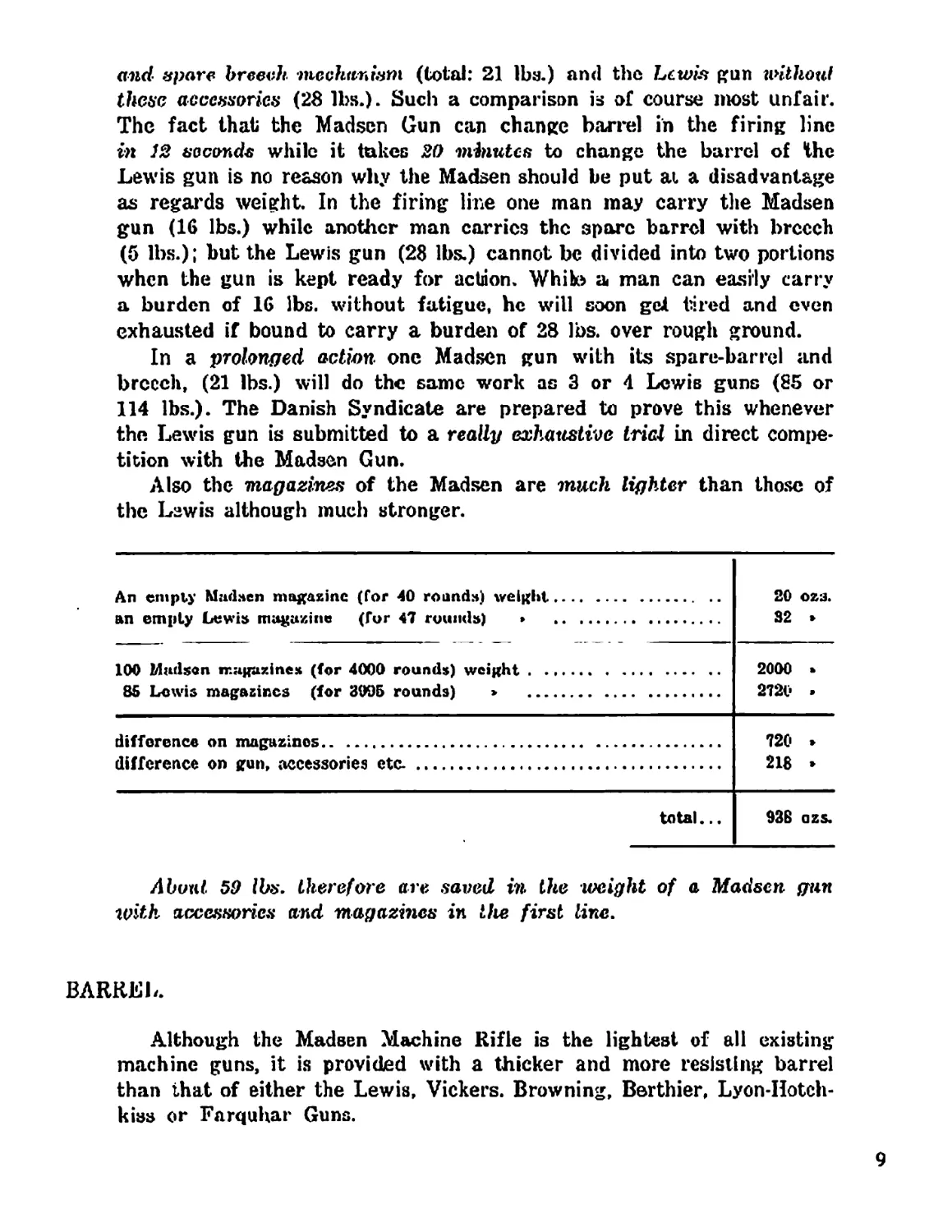
Also the magazines of the Madsen are much lighter than those of
the Lewis although much stronger.
Ал empty Mad»en magazine (Гог 40 round») weight..................
an empty Lewi» mugu/Jne (Гог 47 round») .........................
20 023.
32 »
100 Mudsan magazine* (for 4000 round») weight....................... 2000	»
85 Lewis magazines (for 3995 rounds) »	..................... 2720 •
difference on magazines........................................................ 720	»
difference on gun, accessories etc. ........................................... 218	»
total...
938 ozs.
ЛЬон/. 50 lbs. therefore are saved in the weight of a Madsen gun
with accessories and magazines in the first line.
BARREL.
Although the Madsen Machine Rifle is the lightest of all existing
machine guns, it is provided with a thicker and more resisting barrel
than that of either the Lewis, Vickers. Browning, Berthier, Lyon-Hotch-
kiss or Farquhar Guns.
9

Light machine guns must be provided with comparatively light bar-
rels; ImI. a. light ba.’-r«*.l is worn mil. very quick’.у unless some means a/’O.
found to reduce the length of eack continuous burst of rapid fire and
yet to keep the gun in action for an unlimited time if required. The
Madsen is the on’y light machine-gun in which this problem is solved.
This is dune by the use of two barrels firing alternatively, a change of
barrel taking 12 seconds only.
The longer one makes each burst of continuous rapid fire the sooner
a barrel will be warn out. The same barrel may withstand say:
(1) N-thousand rounds if fired in bursts of 200 rounds each
or (2) One third of N-thousand if fired in bursts of 500 rounds
or (3) One sixth of N-thousand if fired in bursts of 1000 rounds.
With the Madsen Gun continuous firing can be kept up for an un-
limited ti.me and yet long separate bursts be avoided because the bar-
rels are changed so quickly. In actual warfare a Madsen Gun using its
two barrels alternatively would practically never be out of action and
yet able to withstand not twice as many rounds as a single-barrelled
gun but probably ten times as many, before renewal of barrels becomes
necessary.
PORTABILITY.
The weight of the Madsen Gun is so well balanced that it is carried
and handled almost as easily as a rifle. The firer can advance by rushes
at top speed and clear obstacles as easily as an ordinary infantryman.
The Madsen Gun is so constructed that its mechanism and casing remain
cold even when the barrel is red hot, wherefore the gun can be handled
and carried with bare hands under all circumstances.
FIRING POSITIONS.
The Madsen M. R. is fired with ease from the shoulder without any
mount or support (rapid firing or single shots), the rifleman standing,
kneeling or lying prone. The recoil is absorbed by the return spring and
is therefore nut felt. Firing in standing position is of particular im-
portance when fighting at close range, or inside buildings and ruins,
11
or on flooded, marshy or broken up grounds. The gun is used, with
bayonet, almost as easily as a rifle. It can also be fired with great ac-
curacy from a light detachable bipod that weighs lbs. The Madsen
M. R. therefore, can be used equally well for long range or accuracy
firing, and for short range fighting or in a hand-to-hand struggle.
ACCURACY & TRAVERSING.
The official Report of the Machine gun School, British Army in
France, (1915) sums up the accuracy trials as follows:
xAvcurac?/; good*.
^Traversing:	extremely	good*.
During the trials on {Salisbury Plain, August 1919, the following
results were obtained:
at 200 yards: 100<yo inside circle of 12“ diameter
91 oio »	>	«"	>
at 400 yards: 100°lo inside .square uf 1*0“ у 14“
75°Jo •	»	> 0*5“ X 1*3“
at 600 yards: 100°1л inside square of 1*11“ X 2'3"
75лк> >	»	» 1* G“ X 2’0“
at 200 ysrds: 15 -ron plates V X 1* shot down with 19 shots in 1 min. 18 sec.
At another official trial the following results were obtained:
at 1400 yards: target 50 standing skirmishers, 1 pace interval 100 single shots,
1 min. 20 sec. 46 hits, 30 targets hit.
nt 1.000 уards: target 50 standing skirmishers, 1 рксе interval 272 shots rapid,
1 min. 20 see. 100 hits, 39 targets hit.
Surely no other machine gun could obtain better results.
At the Sch(»l of Musketry, Hythe, (1918), the Madsen Gun with
bayonet fixed was fired from the shoulder without any support, rifleman
standing as well as lying prone, 880 rounds rapid against an embank-
ment at 200 yards range.
The observation by the Experimental Officer is as follows:
*This was carried out. Firer appeared to traverse top of bank
*with a remarkable accuracy.
12

VISIBILITY.
The gun is nearly rifle-shaped. Beyond about 60 yards range it can-
not be distinguished from an ordinary rifle. It has a special device for
single shot firing and the 192.0 model is provided with a FLASI(-AB-
SORBER which eliminates the flash. Madsen Guns, therefore, can be
used with all the advantage of surprise, as they cannot be detected as
machine guns until the desired moment The New Zealand report states:
»This gun can be excellently concealed to look like a rifle —
rafter many attempts it was found impossible to conceal the
»Lewis gun under 400 yards.
RAPID FIRE.
The 40 rounds#in a magazine are fired in 4 seconds, and the empty
magazine replaced in two seconds. The Madsen Gun, therefore, can fire
400 rounds per minute, or slower if desired.
SINGLE SHOTS.
Also slower single shot fire can be used by turning a small swivel
into the corresponding position, and then only one shot will be fired
each time the trigger is pressed. The Lewis Gun has no such device for
single-shot firing.
COOLING ARRANGEMENT.
The Madsen Gun can be cooled either by barrel-changing, water
or air.
A second barrel, with complete breech attached (the whole in one
plain piece weighing 5 lbs.) is carried in a heat-proof scabbard that
holds the barrel conveniently even if red-hot. When the first barrel is
heated through firing it is changed — in 12 seconds — and firing con-
tinued with the Second Barrel whilst the hot removed barrel is cooled
by exposure to the air or with water, of which an ample supply is car-
ried in small rubber bags on the belts. When the Second Barrel is heated
the First Barrel is used again, and so on. The Rifleman changes the
14

barrel without tools, with hare, hands, (as the breech repnains cold)
remaining in his firing position (standing or lying) and even whilst
running:
The barrel can also he cooled without being removed from the gun
by dipping it in water (in a ditch, shell hole, or the jikc) or by pouring
water over it whilst firing. Thus tjie Madsen M. R. can be used with
one barrel only. Neither the Lewis nor the Hotchkiss Gun can be cooled
in this way, as they arc gas-operated. In the report of the London Di-
strict Command, May 1918, it is stated:
»Л/. certain trials recently the Madsen gun with barrel extremely
»hot, was thrown bodily into a muddy dyke, the mechanism lite-
orally dripping with slime, water etc. and was immediately fired
without any cleaning whatsoever, the barrel being effectively
»cooled by immersion in the water without any loss of firing ef-
ficiency.
At the trial at Bislcy in June 1918 is was proved that neither the
Lewis nor the Hotchkiss guns could fire a shot automatically after im-
mersion in water while the Madsen was entirely unaffected by the
water and mud.
SUSTAINED FIRE.
The chief advantage of the Madsen Machine Rifle is that it can keep
up a continuous rapid fire for an unlimited time, the IS seconds for
changing barrels between each series being the sole interruption. In
this way 12.000 rounds can be fired in one hour — a most remarkable
efficiency for a machine gun that weighs only 16 lbs.
Usually the barrel is changed or cooled after each burst of 400
rounds rapid or even 200 rounds; but the Madsen gun can fire without
difficulty in continuous bursts of 1000 rounds each if required. The
shorter bursts are preferred in order to prolong the life of the barrels,
as explained on page 5 und 6.
The official report of all machine-guns Experts of the London Di-
strict Command (May 1918) lays down for the Madsen Machine Rifle:
»Rapid fire can be opened instantaneously and can be con-
tinued for an unlimited lime. After firing about a thousand
mounds continuous in the test, the barrel became overheated. It
16
vivos then removed by Number One and a. new barrel placed in
^position, in about 15 seconds. Thia vpinalwn was carried out in
»all firing positions and without employment of any tools. The
^overheated barrel was cooled by water. It appeared immaterial
whether the water was clean or muddy.
COMPARISON WITH OTHER SYSTEMES.
In respect of sustained fire, the Madsen Machine Rifle is superior
to all machine-guns of other systems.
With the VICKERS GUN (86 lbs. complete with mount) the cooling
water boils after 600 rounds continuous fire and has evaporated after
about 1.000 rounds. To refill the water-jacket thereafter, firing must be
interrupted for at least .1 minutes.
With the LEWIS GUN (28.} lbs. with mount) the entire gun, me-
chanism and body as well as barrel, is overheated after 800 to 1.000
rounds continuous rapid firing. After that, the gun must be taken out
of action for 20 ta 30 minutes to cool down, and must be dismantled to
have the gas cylinder cleaned and oiled and the return spring adjusted.
In the meantime, the Lewis Gun is as useless as a log of wood. It is
obvious that a machine-gun able to maintain rapid fire for 2 to 3 minu-
tes only, with intermittent pauses of 20 to 30 minutes, is inefficient in
modern warfare. The tactics used by the Germans of attacking in huge
masses, one dense wave following close upon the other, were obviously
based upon this fundamntal defect of the Lewis Gun. The first attacking
waves were sacrificed to >heat the British guns*, while the succeeding
waves to press home the attack when the Lewis and Hotchkiss guns
had reached their limit of fire jammed and fell out of action.
In the House of Lords 6th June 1918, Admiral Lord Beresford stated:
vThere have been thousands of men killed and hundred of
^trenches lost on account of the jamming of the Lewis gun ....
»This gun (the Madsen) does not jam.
On the same occasion Lieut. Colonel Lord Penrhyn stated:
am informed that the Germans know perfectly well when
>our Lewis guns are out of action and that their rushes in waves
>are to a very considerable extent Limed to meet the occasions
*when owr Lewis guns happen to be out of action. With the Ma ri-
ll
»sen gun yon could change the barrel in fifteen seconds and go
»straight away.
To change the barrel of the Lewis Gun requires practically total
dismantling of the gun and takes about 20 minutes. Neither the Lewis
nor the Hottehkiss Gun can be waler-uuuled. In the ^Machine Gun Ma-
nual*, page 81, it is laid down that
».... all traces of water must be removed from barrel, bore and
*gas cylinder .... Until all water is blown out of gas-cylinder,
»the gas pressure ivill be insufficient for ensuring automatic
»working.
This, of course, moans that it is impossible to watercool these guns
during action.
As regards the Hotchkiss Gun (28| lbs.) the Official British Cavalry
Report of May 1918, comparing this gun with the Madsen lays down
the following;
»A change of barrel with the Madsen is <mly necessary after
^firing a thousand rounds as against five hundred with the Hotch-
»kiss; and again with the Hotchkiss, one cannot continue unlimited
»fire with two barrels only, unless time is given for one barrel
»io cool, but with a pool of water or using the water carriers pro-
voided with the Madsen Equipment, Madsen barrels are fit for
»use within a few seconds of changing. This feature makes them
^suitable for a prolonged, option. After firing about 500 rounds
*urith the Hotchkiss, the mechanism gels clogged with brass fillings
»and dirty oil burnt by heating of the gun, and the gun must be
^stripped and cleaned. This takes a considerable time.
»The mechanism of the Madsen is totally unaffected by dirt.
»dust or sand. There are no brass fillings and dirty til has no
^effect.
^Changing barrel with the Madsen can be done by one man tn
^twelve seconds. Changing barrel with the Hotchkiss requires two
»men; this operation causes a considerable amount of movement
»and exposure.
Further, the Hotchkiss must have its gas-cylinder cleaned and oiled
and the return spring adjusted before it can he used again, whilst it
is laid down in the Report that with the Madsen no adjustments or
any cleaning or oiling arc necessary during action*. In other words, the
18
Madsen can keep up continuous rapid fire for any length of time with
only 12 hccciuIh interruption after each series of up to 1000 rounds
whilst the Hotchkiss can fire only in short series with very long inter-
mittent pauses. The Hotchkiss, therefore, is reduced to the same state
of impotence nearly as quickly as the Lewis, and must be taken out
of action after a few minutes firing. Tn addition, the automatic working
nf the Hotchkiss Gun is extremely Lad under Service conditions. It was
for these reason that the Hotchkiss (or Bene Mercier) Gun was turned
doom as unserviceable by the American Army after having been in use
as a general service weapon.
MAGAZINE.
Tim Madsen Machine Rifle uses magazines of steel, each containing
Ю rounds. The magazines arc very securely held in position when placed
on the gun; nevertheless, they are replaced in two seconds. The Madsen
magazines are very strong; they will stand being walked upon, kicked
about, thrown on to hard ground and similar rough handling without
causing ar.y stoppage in the firing of the gun. With the Lewis and
Hotchkiss Guns, the slightest deformation of the magazines will imme-
diately cause the guns to jam, because the magazine forms part of the
mechanism. The Madsen Magazine is merely an exterior casing for the
cartridges and has no relation with the mechanism of the gun. When
in position Lhe magazine is covered by the firers head and helmet so
that it cannot be seen by the enemy.
In spite of their greater strength, the Madsen Magazines are much
lighter than those of the Lewis gun; as set forth on page 5 there is a
saving of 45 lbs. in favour of the Madsen on the dead weight of maga-
zines for 4000 rounds besides the 14 lbs. saved on the gun etc.
The Madsen, but not the Lewis gun, can use magazines of aluminium,
thus obtaining a further great saving in weight. The shape of the Mad-
sen magazines is an ideal one for transport and handling, whilst most
fighting men agree that the drum-shaped Lewis magazines are very in-
convenient to handle and to pack.
The Madsen gun can fire without magazines, fed by hand at the
rate of GO rounds per minute. This is important if the gun gets sepa-
rated from its magazines or there has been no Lime to refill them.
THE FEED MECHANISM
is extremely simple and positive so that the Madsen M. R. can be
fired in all positions frem vertically upwards to vertically downwards.
19
The New Zealand Expeditionary Force state in their official report:
^Loading mechanism. absolutely efficient giving positvc feed»
»wo chance of cross or double feed as each cartridge is automati-
really separated from following cartridge. This is a great advan-
tage over the Lewis gun. There are no springs to get jammed
»or broken. Mechanical action- so arranged to obviate any part
^wearing.
LOADING.
The Madsen is loaded with a pull of the cocking-handle only for the
first magazine; loading for the succeeding magazines is performed
automatically without using the cocking handle. In this way, time and
effort are saved and the firer can keep continuous observation of his
target. The cocking handle remains immobile during firing. The Vickers,
Lewis and Hotchkiss Guns are without these advantages.
UNLOADING.
The magazine is removed (whether empty or still containing cartrid-
ges) and lhe last cartridges ejected with a pull of the cocking handle.
FIRING MECHANISM.
The New Zealand Report says:
* Firing Mechanism excellent. By adjusting a small lever under
the trigger guard single shots can be fired without the necessity
*as in the Lewis Gun of special loading of magazine or -movement
»of the cocking handle.
EJECTION.
The empty cartridge cases are automatically ejected downwards and
slightly forwards, thereby causing no inconvenience either to the rifle-
man or to the men next to him in the firing line. With the Lewis and
20
Hotchkiss Guns the hot cartridge cases are ejected violently to the side,
causing great inconvenience to the men near the gun.
MECHANISM.
The mechanism of the Madsen Machine Rifle is extremely simple
and chiefly constructed on the cam-and-groovc principle, which is the
best existing. The bearing surfaces are long and large and slide smoothly
against each other without undue friction or violence. Jamming never
occurs with the new model of the Gun and was practically out of question
even with the older models.
In the official report of the Commandant, Machine-Gun-School, Bri-
tish Army in France (1915) it is laid down that the Madsen Machine
Rifle:
»is mechanically sound, is well constructed and -not subject to
* failure. I recommend this rifle strongly to your notice and sug-
»gesl that a number of them be ordered for issue to units.
In the official report of the School of Musketry, Hythe, Jan. 1918.
it is stated that:
ztke gun functioned correctly .... There was little liability to
*jan\, and jams are easily cleared. Mud in the magazine had little
^effect-.
In the official report of H. M. S. frExcellfentJc, Whale Island, it is
stated:
»By this time, the gun was throughly covered with grit and
>dust. The gun was then loaded and fired without any trouble.
>A certain amount of grit had got into the mechanism through
*the magazine-holder, but this had no effect an the operation of
%lhe mechanism. The gun was then immersed in salt water for
*5 minutes with the grit still rn it. On being taken out of the
coaler it was loaded and fired correctly.
The Officer Commanding the Zuhiland Mounted Rifles after having
used Madsen Machine Rifles (Rcxcr guns) in the Natal Rebellion of
1Э06, reported inter alia, as follows:
»During the time the guns have been in use, not one single
21
»instance of cartridge jamming han occurred, a valuable point
»thal needs no comment.
After 1G years' improvement, the mechanism of the Madsen Machine
Rifle has in fait reached absolute! perfection. Its unfailing* automatic
working even under the most difficult Service conditions and in spite
of mud, earth, sand, water, dust. etc. (within reasonable limits) is
indeed one of the must important advantages of the Madsen Machine
Rifle. Ai a trial wiUi Um Brazilian army, one Madsen Machine Rifle
fired 26.000 rounds without a single failure or stoppage. At another
trial 69.000 rounds were fired from- one Madsen Gun without a single
steppage or jam occuring.
The gun will not require any cleaning whilst in action and vill
fire correctly without lubrication.
ROUGH HANDLING.
The Madsen gun and its magazines are very strongly built and will
stand the roughest handling on the battlefield. Tn the official ro|X>rt of
the London District Command, May 1918, it is stated:
xTho gun was twice thrown ten or twelve feet up into the
»air and fell on hard ground; the ‘magazines were kicked and
^stamped on. The gun fired correctly and without any stoppage
^immediately after.
*No Lewis дни would have stood the rough treatment to
twhich both the gun and magazines were subjected.
Similar trials were carried out many times with the same gun also
at the School of Musketry, Hythe, with, equally good results.
SAFETY.
Immediately after the firer releases the trigger, the fire will stop
and the barre. with the breech be automatically caught in its rearward
position, leaving the chamber empty. Under no conditions can there
be a cartridge in the chamber when firing has stopped, and accordingly
all danger of a misfire caused by the heat of the barrel is eliminated.
22
TRAINING.
In the report of the School of Musketry, Jlythe, (1918) on the Mad
sen Machine Rifle, Model 1918, it is stated:
^Instruction on the mechanism is very easy to imparl.
In the Infantry Report from the London District Command, May,
1918 it is stated:
»A Non-Commissioned Officer who had only two hours instruc-
tion was able to fire the gun correctly and to strip it in 30 seconds.
»!ts simplicity from an instructional point of view appears
»to be of great importance. The Company's claim that a few
*days should be sufficient to train troops, who hare had previous
^knowledge of Machine Guns, appears to be justifiable.
In the official Cavalry Report on the Madsen Gun (May 1918) it is
laid down:
»/!$ regards the training of troops in the use of this weapon
xits advantages are pronounced, and a considerable amount of
xtime can be saved. The question of stoppages is almost obliterated,
*the handling of the rifle is extremely simple, and with twelve
^hours' training a man would be quite efficient in the handling
xof gun and mechanism, and given sufficient ammunition for
* training purposes, an effective shot within а гиеек.
GENERAL CONCLUSIONS.
In the official British Infantry Report (May 1913) the following
conclusion is drawn:
*The ' general impression produced by these trials is a very
^favourable one. AU observers were unanimous in the opinion
xthal the Madsen Machine Rifle has a great advantage over the
vLewis and. Hotchkiss Guns in weight, simplicity and firing effi-
xciently.
^Moreover the fact has been demonstrated that a sufficient
^knowledge of Lhq guv ran he acquired in. a few hours. This appears
»to be a very important point having regard to the time and
^labour necessary for the training of efficient Lewis gunners.
23
The conclusion contained in the official British Cavalry Report (May
1918) is as follows:
»From a cavalry point of view, from wh(tt has been seen
^during the past few weeks of the Madsen Machine Rifle both
the range and from practical experience gained we are of
xopinicn that this weapon is vastly superior to any light automatic
*gun we have yet seen and certainly superior in every way to
bthe Hotchkiss Automatic Gun with which the Cavalry are now
barmed. With a weapon almost as easily used as a Rifle, and with
bits simplicity and apparent reliability the Cavalry would have
ьап extremely powerful and concentrated fighting force without
biosing its mobility.
THE GENERAL OFFICER COMMANDING THE CANADIAN
MACHINE GUN CORPS
during the war macle a detailed report on the Madsen Gun after
trials in June 1918. He summarizes his opinion as follows:
bThe only thing which is not satisfactory is the large flash
remitted by the present model. If this is corrected, and I am
^confident it can be done, the Madsen will be without question
vtke best automatic Rifle at present, available.
This defect is now entirely corrected; the new flash absorber elimina
tes the flash at day time, and reduces it at night time to look like a
flash from an ordinary rifle.
THE NEW ZEALAND EXPEDITIONARY FORCE
have submitted the Madsen Gun to exhaustive trials in August and
September 1919, and an official report was drawn up by the Colonel
in charge of the trial ending with the following general conclusion:
bThe Detachment Commanders and myself are convinced that
»the Lewis gun possesses wo advantage whatever over the Madsen
»Gun while ths Madsen in our opinion is far ahead of the Lewis
*Gun. We strongly recommend that the Madsen Gun be adopted
bin New Zealand in place of the Lewis Gun.
24
The Lewis and the Hotchkiss Guns that are adopted as service
weapons for the Brinish Infantry and Cavalry, are practically speaking,
no longer in use in any other country nut even in the countries of their
origin viz. America and France.
Although the Lewis Gun is the invention of an American officer
it was emphatically refused as unserviceable for war on land, by the
United States War Department* The U. S. Marine Corps were armed
with Lewis guns when they landed in France but were obliged to discard
these guns shortly afterwards.
The Hotchkiss Gun was used in the United States’ Army for several
years under the name of the Bene Mercier Machine Rifle. But the gun
proved a complete failure during fighting with the Mexicans and was
discarded as obsolete before the Great War in Europe. Yet in 1915 or
1916 the very same gnn was adopted as the service gnn of the British
Cavalry after the Americans and the French had discarped it.
At that time a considerable order for Madsen Guns was placed by
the Ministry of Munitions and a big factory built for their production
in England and nearing completion. But this manufacture was stopped
by order of a certain gentleman in the Ministry of Munition and a new
factory built for Hotchkiss guns in spite of the fact that the British
Machine Gun School in France and the Naval School of Gunnery at
Whale Island had strongly recommended the adoption of the Madsen Gun.
The relative merits of the (adopted) Hotchkiss and the (refused)
Madsen gnn came tn light again in May 1918 during the comparative
trials carried, out by machine-gun-experts of the British Cavalry. The
verdict of these experts is quoted above:
>.... Wc are of opinion that this weapon (the Madsen Machine
»Rifle) in vastly superior io any light automatic Gun we have
*yet seen and certainly superior in every way to the Hotchkiss
* Automatic Gun with which the Cavalry are now armed.
25


Team advancing carrying 23 wallets with 46'50 rounds of ammunition, each wallet
containing 5 magazines holding 40 rounds each.


Danish Machine Gun Compar.y with 24 Madsen Guns.
J
ORGANISATION AND TACTICAL USE
The Madsen Machine Rifle, is used with great advantage by the
Infantry, Cavalry, Field Artillery (for defence of the batteries) Supply
Columns (on motor lorries) and also by the Navy (for landing parties
and light craft). Special Models of the Madsen Gun are designed for use
in Aeroplanes and in Tanks.
1
INFANTRY
A COMPLETE TEAM
for one Madsen Machine Rifle with ammunition consists nf a Rifle-
man (No. 1) three Ammunition Carriers (No. 2, 3 & 4). In open warfare
a man (No. 5) may be added leading a pack-mule or pony with am-
munition. The gun itself is served entirely by one man. The Carriers
are armed with powerful, long range, automatic pistols.
FIGHTING POWER.
If these 5 men were armed with 5 ordinary rifles they could fire
about 40 rounds per minute on the average. Armed with 1 Madsen Ma-
chine Rifle with ammunition they can fire 400 rounds per minute. The
fighting power of each such team is therefore increased ten limes,
without in any way diminishing their mobility and independence.
AMMUNITION
is carried in light wallets of leather or web each holding 5 magazines
with 200 rounds. It is suggested to have 20 wallets with 100 magazines
35
holding 4000 rounds for each gwn. Besides, the rifleman curries one
magazine (40 rounds), in a holder on the belt, for his own defence in
ease of emergency.
WHEN ON THE MARCH
the pack mule carrice 10 wallets while the other 10 are carried on
a caisson or other vehicle or distributed among the gun-team and accom-
panying infantry.
WHEN IN A DEFENSIVE POSITION
all 20 wallets are kept under cover near the gun.
WHEN ADVANCING TO ATTACK
the wallets are carried forward by the gunleam and by other in-
fantry men. Each man can carry 2 wallets, or 4 wallets for a short
distance; all men of the team therefore have a leather-yoke with spring
hooks for 2 wallets so as to leave their hands free. In open warfare the
pack-mulo carrying 2000 rounds will follow the advancing line as near
as possible, and is further used to bring back empty magazines and
bring up refilled magazines as near as possible to the firing Line as
cover and circumstances will permit.
Reserve ammunition is brought up in the usual way by supply de-
tachments. The difficulties involved in the transport of ammunition are
obviously the same whatever system, of mackine-gun is used. With the
Madsen-gun however a considerable weight is saved owing to the light-
ness of the magazines — 45 lbs. on every 100 magazines (4000 rounds).
EQUIPMENT.
The Rifleman (No. 1)-.
Machinc-Riflc with Bayonet.
Bipod in holder.
?. water bags (for eonling barrel).
Belt and shoulder-straps.
1	magazine (40 round») in holder.
36
Each ammunition Carrier (No. 2, 3, 4 & .5):
Automatic pistol with ammunition.
2	water bags.
Belt and leather-yoke.
No. 2 carries 2 small ponchos with spare parts and tools, second barrel-and-breech
in cooling eheath, cleaning-rod.
The corpural commanding a. section of 2 gun-tennis carries:
Automatic pistol with ammunition, 1 small jwuch with spare-parts and tools
(common for the 2 guns) and 1 pouch with an oil-can.
The Pack-Mule:
Bridle.
Pack-saddle for 10 wallet's (50 magazines with 2COO rounds).
INCORPORATION.
No new unit will have о be created: only a certain number of Infantry
Sections should be re-anned as above mentioned, and thus converted
into machine rifle Sections, each Section (8 men) forming complete
teams for 2 Madsen Machine Rifles with ammunition.
AS AN EXAMPLE,
it is suggested to provide:
Each Infantry Platoon with 2 Machine Rifle Sections (4 M. R'a and 16 men) which
could either remain so distributed, or
Each Infantry Company could unite its 8 M. K. Sections forming 1 Machine Rifle Pla-
toon (16 M. R*s and 64 men)
Each Infantry Battalion could again unite its 4 M. R. Platoons forming 1 Machine
Rifle Company (64 M. R's and 256 men)
Each Infantry Brigade could again unite its 4 M. IL Companies forming 1 Machine
Rifle Battalion (256 M. It’s and 1.024 men).
In this way the commanders of Brigades, Battalions and Companies
could conveniently concentrate or distribute their Machine Rifles as
the tactical situation may require, without splitting up any of the re-
gular Machine Rifle Units.
Such Machine Rilfc Unite arc as mobile as ordinary Infantry; they
37
can advance by ruhhcs at top speed, clear obstacles cn their way, take
up positions everywhere and instantly open fire. The fact that the
Madson Gun can be fired without support in standing position enables
the Machine Rifle Units to fight under conditions where heavy machine
guns arc useless: in close quarter fighting, on flooded, marshy or broken
up ground when fording rivers, when penetrating into buildings and
ruins or into the onnemy’s trenches and dugouts. Farther, the Machine
Rifle Units can carry out storming assaults, using the Madsen Guns
with their bayonets for the final hand-to-hand struggle.
TACTICAL USE.
The Madsen Machine Rifle should be used in accordance with its
particular characteristics viz:
(1)	Its firing efficiency and endurance, ulniust equal tv that uf the
Vickers Gun (76 Ibs.Q concentrated in a wcajwn weighing 16 lbs., und so
well balanced that it can be fired from the shoulder without support and
used with bayonet almost as easily as a rifle.
(2)	Its portability and handiness even when the barrel is hot. its me-
chanism and casing remaining cold.
(2)	The rapidity (12 seconds) and ease with which the barrel is changed
in any position of the rifleman and even when he is running.
(4)	Its ability tn keep up continuous rapid firing for an unlimited time
— 40U rounds per minute and up to 12.01)0 rounds per hour, including the
limo for barrel changing between the series.
(5)	The simplicity and perfect working of its mechanism in spite of
mud, water, sand, etc.
(6)	Mo adjustment of the return spring nor denning and oiling of any
part when the gun is in action.
(7)	The remarkable strength of the gun and magazines that enables
them to stand the roughest handling on the battlefield.
(8)	Lighter magazines than tho Lewis Magazines: 113 lbs. saved on the
magazines for 10.000 rounds.
The Madsen Guns, therefore, will enormously increase the fighting
strength of all Infantry Units, not only for defence, but particularly
for attack.
33
hi the Offensive, the Madsen Machine Rifles should he used con-
centrated in great number in the first attacking wavo, and on the
flanks of tho attacking Unite enabling the Infantry to maintain the
suporloly of fire with their own arms from the critical moment when
the artillery can no longer support them by overhead fire. They should
be followed by other waves of Bombers, Riflemen and »Moppors-Up«.
Every attacking Brigade can concentrate its 4 Machi«ne-Rifle Com-
panies in the front line, with their 256 Madsen Guns deployed on a front
of some 1.000 yards width. These can develop a fire of some 100.000
rounds per minute, with overwhelming effect, against the enemy’s tren-
ches and their supports and against the counter attacking reserves.
In this way, the Infantry will be able to break through one line
after another, and penetrate deep into the Enemy’s defensive area, the
Machine-Riftos breaking their organised resistance, the succeeding waves
bringing up fresh ammunition, the Bombers and x-Moppers Up* clearing
the trenches that are passed.
The Machine Rifle Units are also admirably suited for the capture
of fortified villages and for holding newly won positions until stronger
reinforcements of Infantry and Artillery can be brought up.
No other Machine Gun can rival the Madsen Machine Rifle in the
Attack, because this gun alone combines lightness and handiness with
a tremendous firing efficiency and perfect working under severe battle-
field conditions.
The Machine guns now in use with the British Infantry and Cavalry
do not combine these qualities. The Vickers Gun is capable of keeping
up continuous rapid fire but its weight with the indispensable mounting
is 76 lbs. and so it is too heavy to be brought over the top and rushed
forward with the attacking Infantry. It can only fire from Rs mounting
and is useless in a hand-to-hand struggle.
The Lewis and Hotchkiss Guns possess neither of these essential
qualities. They are comparatively heavy (28 lbs. i. e. nearly double
the weight of the Madsen Gun) and very difficult to handle after firing,
the entire gun being overheated. They can keep up rapid fire only for
a few minutes with long intermittent pauses to cool down. Their auto-
matic working is bad and unreliable under severe battlefield conditions.
They are useless in a hand-to-hand struggle.
Even the Lewis Gun Company admits these shortcomings of the
Lewis Gun. In their published booklet: » Lewis Automatic Machine Guns,
the Vital Factor in the European War< (6th page), it is said:
»/»?. the early days the characteristics of the gun were not
^thoroughly understood by ust with the result that the gun tvas
39
to tests which it has never been intended to with-
island. For instance, it teas fired con tin о us I у until it became
*red hot and jammed,
and further in the >Instruction nn the. T^nwis Automatic Gun< радо 64:
»The gun is suited only for short bursts of rapid fire and
^should only be used when an excellent target is offered.
In the Defensiv the Madsen Machine Rifles possess the advantage of
paramount importance — that each gun keep up continuous rapid fire
for an unlimited time at the rate of 12.000 rounds per hour, so that a
defensive position held by a great number of Madson Machine Rifles
(there can be one for every yard) cannot be broken or taken by any
Infantry attack, however long the onrush continues and however dense
the attacking masses may bo.
Such attacks could only succeed against positions held by Lewis and
Hotchkiss guns and ordinary rifles, which weapons after a few minutes,
roach their limits of fire and fall out of action.
In defence also the lightness and handiness of the Madsen Gun is
of great importance, because the Infantry may be called upon to change
position or to counter-attack or retire at any moment.
During the preceding Artillery bombardment, the Madsen Guns can
be held under cover in dug-outs, etc. and yet be. thrown on to the parapet
as quickly as ordinary rifles, however demolished the parapet may be.
The Vickers Gun is an admirable weapon for maintaining sustained
fire from a defensive position, but it is too heavy to be instantly brought
into action if it were held under cover during the bombardment, and
must frequently be abandoned in retreat.
Should the enemy penetrate into our defensive system, then the light,
short and handy Madsen Gun is an admirable weapon for fighting in
the trenches, round traverses; barricades and dug-outs to prevent the
enemy’s further progress.
11
CAVALRY
For the Cavalry, the Madsen Machine Rifle is the ideal weapon
because it increases tremendously their fighting power without impe-
ding mobility and independence. The great superiority of the Madsen
40


ГН*


М. К. over the Hotchkiss Gun is explained in detail in the first part
of this booklet.
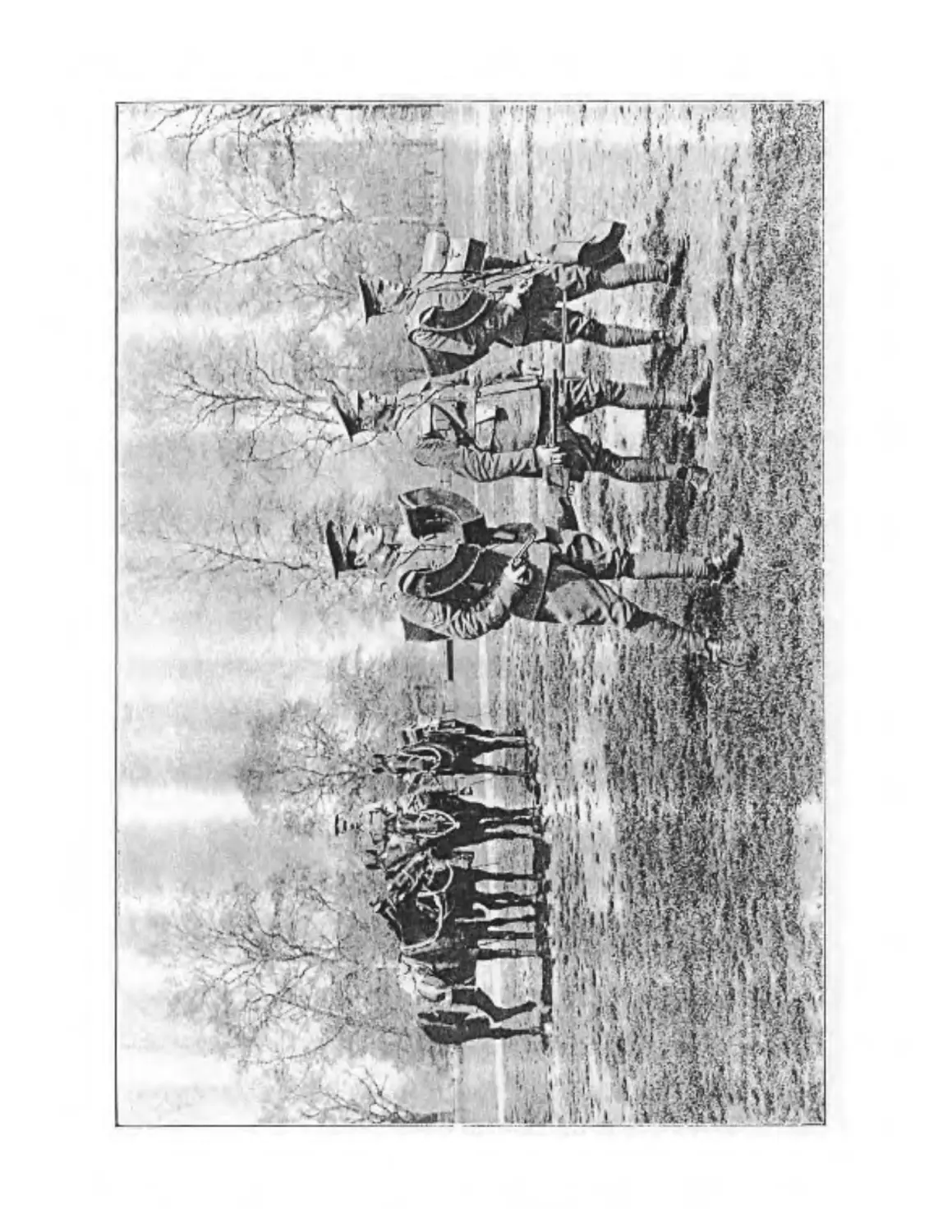
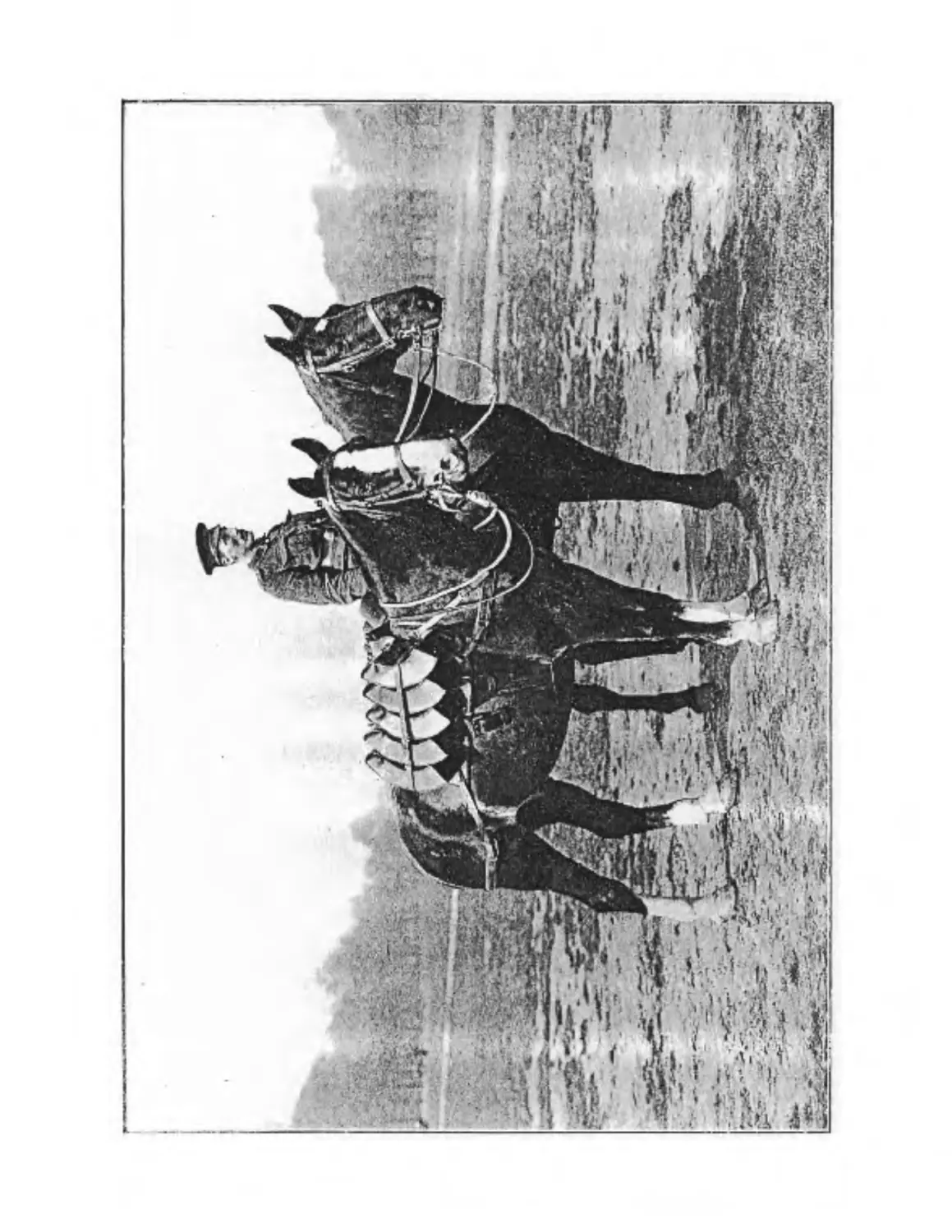
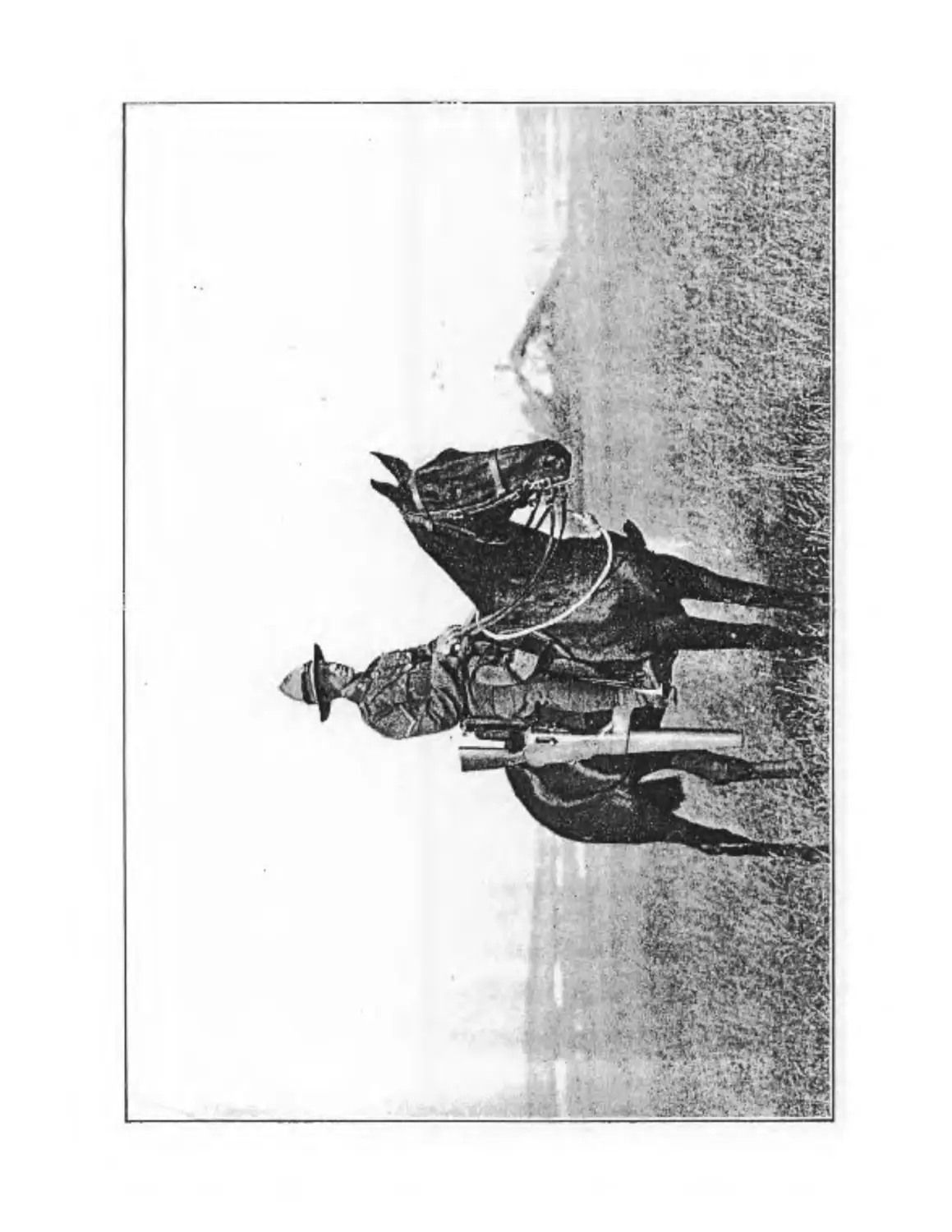
With the Cavalry, even/ fifth man could be armed with the Madsen
Machine Rifle, which is carried in a leather bucket at the saddle like
an ordinary rifle, counter-balanced by the kit-bag. The Madsen gun is
only 6 lbs. heavier than an ordinary rifle.
When mounted, the trooper can charge with sword or lance and
perform all other cavalry duty as usual.
A CAVALRY SECTION
when dismounted for action, will form a complete team for 2 Mad-
sen M. R. with ammunition, viz: 1 Rifleman (No. 1), 2 Ammunition
Carriers (No. 2 and 3), 1 Horse Holder (N<x 4) and a trooper (No. 5)
leading a pack-horse with ammunition.
, Ювп mounted, the Section will act as ordinary Cavalry.
EQUIPMENT.
No. 1, 2, 3 & 4 are armed with sword nr lance. No. 2, 3, 4 & fi with
powerful long-range automatic pistols. Otherwise, the equipment is the
same as for Infantry Machine Riflo Teams (see page 21), bub carried
as shown on the photographs.
AMMUNITION
is kept in pairs of wallets carried on the saddles like holsters. Kit
is carried in a pair of bags at the rear of the< saddle.
No. 1 carries a pair of small wallets containing 4 magazines and one
magazine in a holder on the belt. No. 2. 3, 4 & 5 carry each a pair of
wallets with 10 magazines. The corporal commanding the section car-
ries also a pair of wallets with 10 magazines viz: 5 for each of his 2 guns.
The pack-horse carries 5 pair of wallets each holding 10 magazines.
53
*Пп:гс is accordingly /о/ each Madsen Gant hi the first Uno:
CorporuL	6 magazines with		200 rounds
No. 1.	Б	—			200	—
No. 2,	JO	* 		400
No. 3.	10	—	> 		400	—
No. 4,	10	—	> 		400	—
No. 5,	10	-	> 		400	—
Pack-Horse!	,60	—	> 		2000
Total.	1(10 magazines with		4000 rounds
Reserve ammunition is carried, as usual, on caissons and waggons
with the supply columns.
MOBILITY.
Cavalry armed with Madsen Machine Rifles are as mobile as Ca-
valry armed with ordinary Rifles. In spite of its lightness, the Madsen
Machine Rifle is as powerful a weapon as the heavy tripod-mounted
Vickers Gun, and infinitely more powerful than the Hotchkiss Gun
which guns both require special pack-horses with horse-leaders for
transport.
ORGANISATION.
A Regiment of 4 Squadrons of 4 Troops of 4 Sections would have
4 X4 X 4 X 2 — 128 Machine Rifles, with 512.000 rounds in magazines
for immediate use in the first line, plus reserve ammunition. No special
Machine-Gun Section or iMachine Gun Squadron would* be required, and
the entire Cavalry organisation would therefore be simplified and uni-
form, the Cavalry being armed throughout with one fire-arm, the Mad-
sen Machine Rifle instead of three viz. the Vickers, the Hotchkiss and
the Service Rifle, each of which requires different instruction and
training, and must have its»ammunition loaded in its own particular
way (Vicker-Belt; Hctchkiss-Strip and Rifle-Clip) thus complicating the
ammunition supply.
54
FIGHTING POWER.
Every Cavalry Unit would thus obtain an enormous increase in ite
fighting power for dismounted action. In open warfare, even the smal-
lest Cavalry Patrol would dispose of a machine-rifle with ammunition and
would therefore, if compelled to fight on foot, be able to dislodge the
enemy’s patrols or outposts of Cavairy or Infantry. This would enable
them to seize points of advantage for scouting or to hold such points
for the sucueding liroops.
One Squadron armed wilk rifles can now. when dismounted bring
96 ordinary rifles into action, firing about 1.000 rounds per minute. One
Squadron armed with Machine Rifles as above suggested could bring
32 Madsen Guns into action, firing 12.800 rounds per minute. To equal
this, entire Cavalry Brigade (3 regiments) would have to dismount for
action. Even if one Squadron were used to bring up fresh ammunition
for another fighting Squadron immense efficiency and tactical superio-
rity would be gained.
As the Cavalry are now armed they are unable to play any decisive
part in the battle of to-day in spite of all gallantry. True, their horses
enable them to arrive quickly where their presence is required. But
once on the spot die Cavalry lacks the necessary fighting power to
conquer.
With the present armament a Cavalry Regiment cannot put more
than about 300 rifles in the firing line together with a few heavy cum
bersome Hotchkiss guns which quickly fall out of action owing to over-
heating and choking or owing to mud, dust, water, burnt oil, brass
fillings, bent strips, cbc., (see the Official British Cavalry Report com-
paring the Madsen and the Hotchkiss). The fighting power of the Regi-
ment therefore is reduced to equal that of an Infantry Company and
this is out of proportion to the cost for upkeep of Cavalry.
The introduction of the Madsen gun would open up new possibilities
for the Cavalry.
Л dismounted Cavalry Regiment could then bring into action 128
Madsen guns firing 50.000 rounds in any given minute. This is equal
to the fire that 5 Infantry Battalions armed with rifles could develop,
and it should be remembered that the Madsen guns are capable of
keeping up this violent fire as long as may be required. They never fall
out of action.
TACTICAL USE.
It is obvious that with such a tremendous fighting power added to
55
its mobility and dash, the Cavalry v/ill again, under the changed con-
ditions of modern warfare, become an Ann of the greatest importance,
constituting a highly mobile and powerful reserve to bo brought up
quickly for attack or defence in critical situations. It may for instance
be urgent to hold a newly-won position until reinforcements of Infantry
and Artillery are brought up; or if a local defeat has been inflicted on
our troops, it may prevent a disaster when a Cavalry Brigade armed
with Madsen Rifles is hurried to the spot in time.
Generally speaking, the tactical use of Madsen guns with dismounted
Cavalry, is the same as for Infantry (as sol forth on page 23 and
following).
EXPERT OPINION.
The Madsen gun was submitted to prolonged trials with the British
Cavalry in the Spring of 1918 and a detailed official report was drawn
up ending with the following general conclusions:
>From a Cavalry point of view, from what has been seen
^during the past few weeks of the Madsen Rifle both on the
Grange and from practical experience gained, we are of opinion
»that this weapon is vastly superior to any light automatic gun
*we have yet seen, and certainly superior in every way to the
»IIotchkiss Automatic Gun with which the Cavalry are now armed.
bits possibilities in open warfare are most pronounced owing
xlo its lightness and easy handling, whether it be in attack or
»defence.
bWith a weapon almost as easily used as a rifle, and with its
^simplicity and apparent reliability, the Cavalry would have an
^extremely powerful and ^concentrated fighting force without
closing its mobility* unhampered in the use of his force by the
^difficulties of unnecessary pack-horses, able on all occasions to
»bring this remarkable weapon to bear in the shortest possible
ъИте, able dismounted to put out a large bell of reliable con-
bcentrated fire, most useful in the holding of a position recently
^occupied, and, at close quarters, an effective weapon for which
suf table bayonet attachment is provided..
bln our opinion the possibilities of this weapon from a purely
»Cavalry point of view arc infinitely superior to those of the
^Hotchkiss.
56


HI
FIELD ARTILLERY
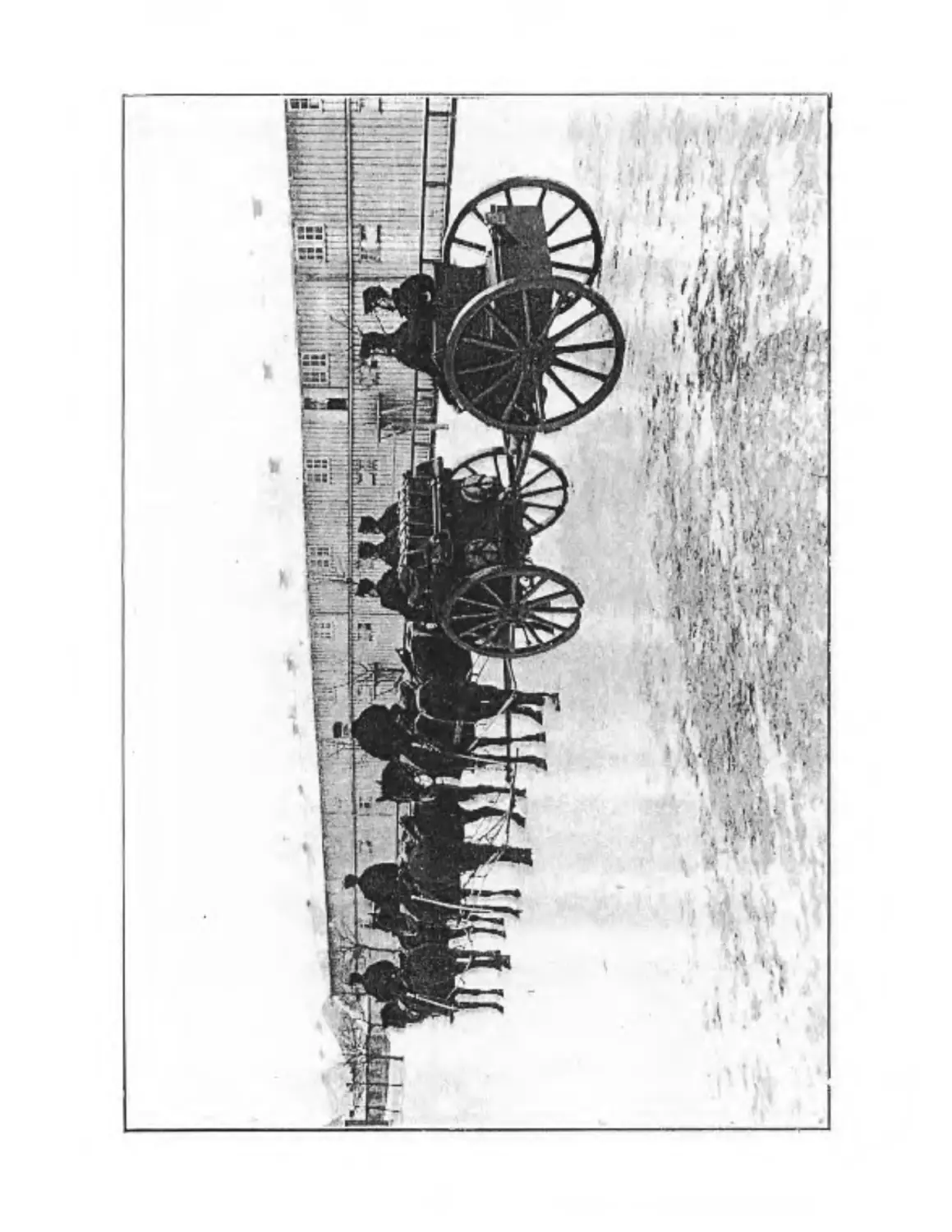
The Madsen Machine Rifle may be used with great advantage for
the defence of field batteries whether on the inarch or in position
against sudden attacks by hostile troops or air-craft. Each battery should
be provided with a sufficient number of these rifles (for instance 8)
to defend all echelons of the baitery in position, viz: the gun line, the
isolated limbers and teams, the reserve wagons and teams, and the
fire control station. For this purpose, four of the machine rifles should
be carried on the wagon bodies, two on the limbers and bwu un horse-
backs.
The Madsen Machine Rifle can easily be served in case of attack by
the artillerymen who otherwise serve the wagons or limbers. In this
way, the Field Artillery will be more effectively defended and will no
longer need escorts of Cavalry or covering detachments of Infantry
for protection.
IV
WITH THE NAVY
The Madsen Machine Rifle is admirably suited for Landing parlies
which might be exclusively armed with these weapons. Warships can
only land comparatively few men whilst their task may be of great im
portancc. It is, therefore, essential that the Landing parties should
possess the greatest possible fighting power. What is said above for
the Infantry equally well applies to Marine Infantry or Landing Parties
of Sailors who could derive the same advantages from these light and
powerful weapons.
Further Madsen Machine Rifles may be successfully used as an aux
iliary armament? for destroyers, patrol-boats, submarines, mine-sweepers
and other light craft, for river-expeditions and for AnfaAircraft Service.
V
WITH THE TANK-CORPS
The Danish Recoil Rifle Syndicate have designed a special British
TANK-MODEL of their Madsen Machine Gun, designed as the other
63
British models, to fire the British scrviccMriflc-ammunition, bore -303.
The Tank Model is provided with trunnions in the barrel-axis line,
armoured bullet-proof barrel-uuvcr, special Tank-sight, arid a short
pistol grip instead of the usual rifle-stock. The mechanism is identical
with that of the other models of the Madsen gun.
The advantages which this gun offers fur use in Tanks are shortly
summarized as follows:
1.	Perfect automatic working under all conditions. No jamming.
2.	Entire absence of breakable parts or parts that get out of order
during combat.
3.	No oiling, no cleaning, no rcadjusment of any part.
4.	The entire mechanism and its casing are located behind the trun-
nions, inside the armoured turret of the tank. Yet this portinn
is very much shorter and smaller than the corresponding portion
of the present Tank-gun.
5.	Only the barrel with the armnnred harrel-covcr protrude outside
the turret.
6.	Extra-heavy barrel enabling the gun to fire long bursts of con-
tinuous rapid fire.
7.	Barrel with breech is changed in 12 seconds from inside the tur-
ret without removing the gun itself. Enemy cannot detect when
barrel changing is taking place.
8.	Gun never out of action except fur this interruption of 12 seconds.
Otherwise continuous rapid fire (400 rounds per minute) can be
kept up for an unlimited time. Also slower single-shots can be
fired simple by turning a swivel into the corresponding position.
9.	No vibration and no recoil felt.
10.	No flask to betray the position of the tank through the smoke-
screen.
These caracteristics give the Madsen Tank-Gun a distinct superiority
over the Hcrtchkiss-'gun used in the British Tanks during Uie war.
64
VI
IN AEROPLANES
The Danish Recoil Rifle Syndicate have designed two special Aero-
plane-Models of the Madsen Machine Gun. One model is a »fixed gun«
firing through the propeller with a synchronised trigger device. The
magazine contains №0 rwnds of British -303 service ammunition. The
barrel is heavy so as to make it withstand a greater number of shots
before being worn out; the length of the barrel is such as to give the
bullet an initial velocity of 2450 feel per second so that the usual regula-
tion aeroplane-sight may be used without alteration.
The other model is a » moveable gun« provided with trunnions so as
to be mounted in a Scarff-Ring or thq; like. Various models of maga-
zines, smaller than that for the »fixed gun« are in existence.
Otherwise the 2 guns are indention! They are both provided with an
efficient flash-absorber and a special simple device that increases the
rapidity of fire.
The advantages which the Royal Air Force would obtain by the use
of these 2 Madsen guns are shortly summarized as follows:
1.	One and the same system of machine gun — for moveable as
well as for >fixed gunsc. Therefore: simplified and uniform in-
struction, simplified supply of spare-parts and maintenance of
the guns.
2.	Perfect automatic working. Absolute security against jamming.
3.	No oiling, no cleaning, no readjustment of any part of the gun.
4.	Entire absence of breakable parts or parts that get out of order
during action.
5.	Exhaust oil from the engine dirt etc. do not affect the perfect
working of the gun.
6.	Extra-heavy barrel enabling the gun to fire long bursts of rapid
fire without being worn out too soon.
7.	No flash.
8.	Great accuracy.
These two Madsen Aircraft-guns have recently been submitted to
exhaustive comparative trials with the Swedish Royal Air Force with
the result that they were classified as the best existing aerial machine-
guns and adopted as service-weapons. They are also adopted as service
guns by the Danish and the Norwegian Royal Air Forces.
65