/
















Text
CONTENTS	*
I.	DESCRIPTION OF THE GUN ......................... 5
1.	The fixed parts .............................. 5
2.	The recoiling parts .......................... 6
3.	The trigger gear ............................. 7
4.	The recoiling and percussion mechanism.......	7
5.	The safety device ............................ 9
6.	The breech block and its movements............ 9
7.	The cartridge feeding mechanism ............. 10
8.	The ejection mechanism ...................... 12
9.	The firing mechanism ........................ 13
10.	The magazine ................................ 14
II.	ACTION OF MECHANISM	WHEN	FIRING ...... 16
Loading ........................................ 16
Firing ......................................... 17
Unloading ...................................... 18
III.	STOPPAGES AND THEIR	REMEDIES ........... 20
1.	Jams ........................................ 20
2.	Faulty closing .............................. 21
3.	Faulty ejection ............................. 21
4.	Misfire...................................... 22
5.	Faulty cartridge feeding .................... 22
6.	Empty case in ejection way .................. 23
IV.	FIGURES No. 1 TO 7 OF THE MADSEN MACHINE
GUN M. 1940.
V.	NOMENCLATURE AND PHOTOGRAPHS of parts,
accessories and tools for the MADSEN Machine Gun
M. 1940. Plates I—X.
VI.	DIMENSIONS, WEIGHTS etc. of MADSEN Machine
Gun M. 1940.
VII.	KEY TO NOMENCLATURE.
I.
DESCRIPTION OF THE GUN
The MADSEN machine gun is an air-cooled weapon and
consists of :
the fixed parts and
the recoiling parts.
The working of the gun is brought about as follows: the re-
coiling parts under the pressure of the powder gas and a system
of springs move backwards and forwards within the fixed parts;
this is caused by the powder gas pressure on the base of the
cartridge being transferred through the breech block to the re-
coiling parts; when firing ceases, the recoiling parts are in their
rearmost position with the chamber empty.
1.	The fixed parts.
(Fig. 7).
The principal fixed parts are the barrel casing (104) and the
frame (1). which are screwed together, and the trigger plate
(65) and stock (96). These two latter parts are connected by
means of the stock screw (98) and they are made fast to the
frame (1) by means of the frame bottom bolt (141) and the
frame lid locking bolt (22).
On the left side of the frame (1) is the magazine receiver:
mounted on the trigger plate is the trigger gear and the organs
for regulating the movements of the recoiling parts.
At the top the frame is closed by the frame lid (2). In its
underside the trigger plate has an opening for the passage of
6
empty cases, which can be closed by the flap-shaped spring-con-
trolled deflector (92).
On the fore end of the barrel casing is the flash absorber
(381). On its upper side is the foresight base with the foresight
(31), and farther back the rear sight base (23) with the rear
sight leaf spring (26), leaf (24) with the slide (27) and notch.
On both sides the leaf has a graduated scale from 200 to 1900
metres.
On the underside of the barrel casing towards the muzzle are
two struts which can be folded back along the casing: they are
adjustable for length and are joined together by a jointed stay
with a wing-nut, by means of which the struts can be clamped
back in the unused position.
At the middle of the upper side of the casing there are studs
to hold the clamp of the gun mounting when the gun is to be placed
on it. A little farther back on the right side is the carrying-
handle (592), which is secured to the barrel casing by means
of the carrying-handle ring (598), in the hinge of which the
handle can be folded up and down.
The barrel casing is also designed to take anti-aircraft sights;
a separate description contains particulars of the construction
and mounting of these sights.
Near the toe of the stock (96) is the stock elevator socket
(197) and wing nut, and on the right side of the stock a holder
for the periscope, which can be used when firing over cover.
On the left side of the trigger plate is the sight-post for mount-
ing the elevation clinometer for use in indirect fire.
2.	The recoiling parts.
(Fig. 7).
The main details of the recoiling parts are the barrel (43),
the breech (44) and the breech block (59).
7
The breech (44), into which the barrel is screwed, is in the
form of an oblong frame holding the breech block (59), which
moves inside the breech round the horizontal breech block
bolt (61).
The fixed parts and the recoiling parts are connected together
by the recoil arm (69), which is mounted on the horizontal
crank axle bolt (68) and the head of which engages in a groove
in the link (47), which is immovably connected with the breech
(44).
3.	The trigger gear.
(Figs. 1, 2 and 3).
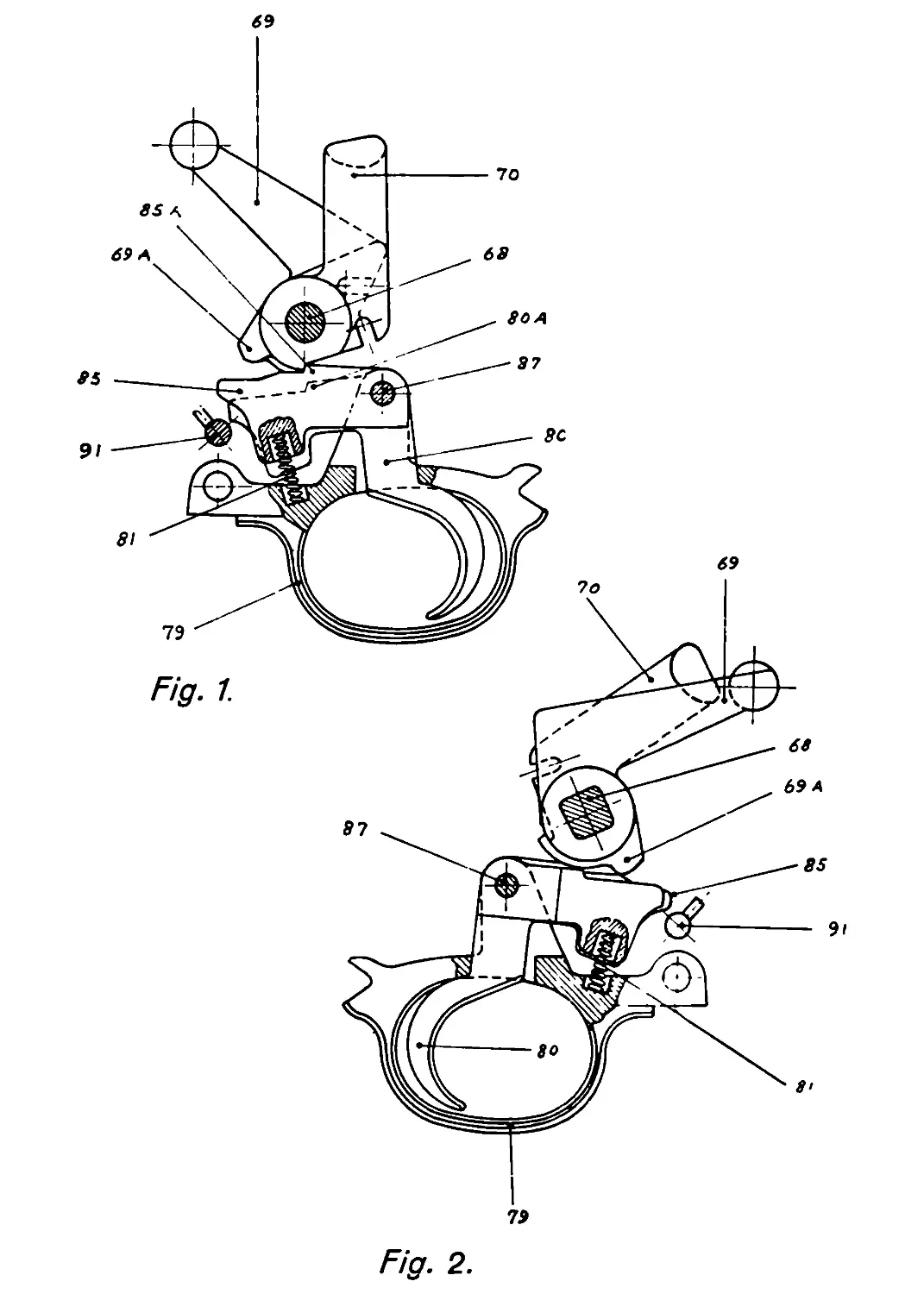
The trigger gear is placed inside the trigger plate (65). It
comprises the trigger guard (79), the trigger (80) and trigger
spring (81). The trigger guard has a seating for the trigger rod
pin (87) on which the trigger works. The finger-piece of the
trigger extends down into the trigger guard, and in addition the
trigger has a forward pointing arm which is pressed upwards
by the trigger spring, and which on its upper side has a nose
(80A) to engage the notch in the recoil arm (69).
The trigger rod (85), which turns on the trigger rod pin to
the left of the trigger, has on its upper side a nose (the sear) to
fit into the notch of the percussion arm (70). At its fore end
the trigger rod and also the forward pointing arm of the trigger
are cut away to allow the safety catch (91) to be turned in under
them.
4.	The recoiling and percussion mechanism.
(Figs. 1, 2 and 3).
The backward motion of the recoiling parts is braked by the
recoil arm (69) together with the recoil spring (75) and the
percussion arm (70) with its spring (76) working together, and
at the end of the recoil the parts are thrust forward again by the
recoil arm and spring alone.
8
The recoil arm is mounted on a four-sided seating on the
crank axle bolt (68) and is thus fixed to it and moves with it.
At its fore end the recoil arm has a head which engages in a
groove in the link (47), thus forming the connection between
the fixed and the recoiling parts of the gun.
At the rear the recoil arm has seatings for the two studs on
the recoil spring plunger (74), and below these a notch for the
nose of the trigger by means of which the recoiling parts are
held in the rearmost position when the pressure on the trigger is
released.
The recoil spring (75) is compressed during the recoil be-
tween the percussion and recoil spring base (78) in the trigger
plate (65) and the shoulder on the recoil spring plunger; this
compression checks the recoil of the moving parts and sends
them forward again at the end of the recoil as long the trigger
is kept pressed.
On the boss of the recoil arm is the trigger stud (69A); dur-
ing the final part of the forward movement this stud depresses
the trigger rod, thus releasing the trigger rod nose (85A) out
of the notch in the percussion arm. which is thus released and
then strikes.
The percussion arm (70), which turns on the crank axle bolt
(68), has at its rear end seatings for the studs of the percussion
spring plunger (77), below these a notch for the trigger rod
nose (85 A), and at the fore end a head which at the moment
of firing impacts on the hammer (48).
The percussion spring (76) lies round the percussion spring
plunger in the same manner as the recoil spring and plunger,
and is compressed between its shoulder and the spring base
(78).
9
5.	The safety device.
(Figs. 1 and 2).
The safety catch (91) consists of a transversal bolt with a
radial cam. When the recoiling parts are in their rearmost
position the safety catch can, by means of a finger-piece on the
’.eft side of the trigger plate (65), be set at three different posi-
tions, marked from below: “F“, “D“ and “S“.
In position “F“ (ready to fire) the cam slopes obliquely up-
wards and forwards, so that both the forward-pointing arm of the
trigger and the trigger rod are free and can move downwards.
In position “D“ (discharge) the cam is vertical and solely
supporting the fore end of the trigger rod, thus stopping its
movement downwards, whereby the percussion arm is locked in
the cocked position. The forward pointing arm of the trigger,
which is somewhat shorter, is free, so that the recoil arm can
be released and the gun can be unloaded without risk of firing.
In position “S“ (safety) the cam slopes upwards and back-
wards, thus supporting both trigger rod and trigger and locking
them, so that firing is impossible.
6.	The breech block and its movements.
(Figs. 4, 5, 6 and 7).
Forward on the right side the breech block (59) has a down-
ward lug having on its right side the breech block guide stud
(59A). At the top rear the breech block is drilled transversally
for the breech block bolt (61): it is also drilled longitudinally
for the firing pin (62) ; on its underside is the ejection track
(59 B), and on its upper side is a clearance to permit the cart-
ridge to be fed into the chamber.
The breech block guide plate (20) is placed in the right side
of the frame (1) and on its inner side has five blocks which
serve to guide the motion of the breech block as described
below.
10
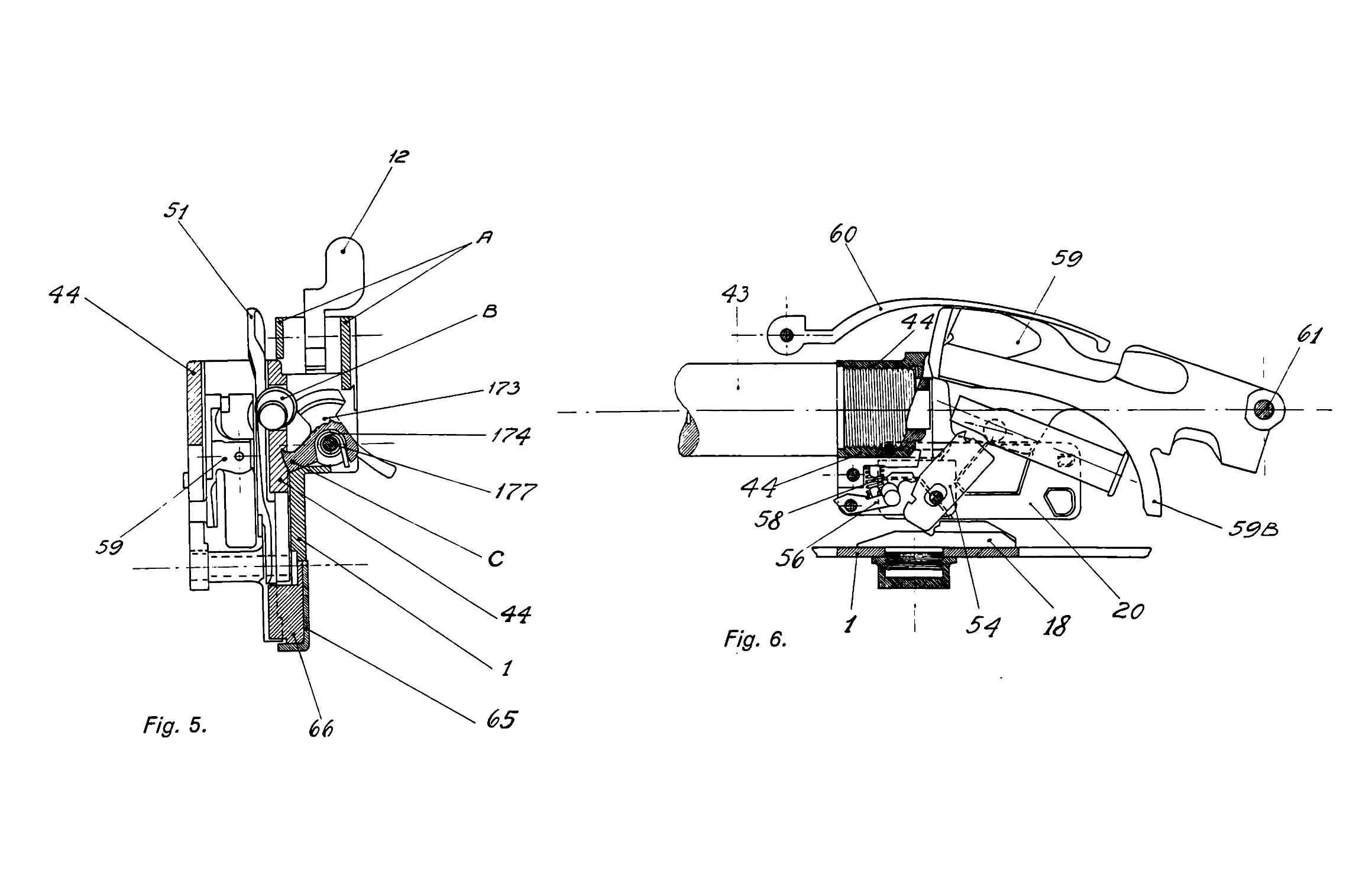
On Fig. 4 the barrel (43) is shown closed by the breech block
(59). The breech block guide stud (59A) rests between the
two foremost blocks of the breech block guide plate (20), these
two blocks forming a horizontal track for the stud. When the
shot is fired the parts begin to recoil, in which motion the
barrel and the breech block retain their mutual positions, so that
the chamber is still closed until the guide stud strikes against the
middle block on the guide plate. As the breech block is resting
on the ejector (54), the guide stud cannot slip under the middle
block, so that it now moves up along the track a-b, thus raising
the fore end of the breech block so that the chamber is opened.
As the recoil continues, the guide stud runs along the track
b-c, which keeps the breech block raised up so that the empty
cartridge case can be ejected.
When the guide stud has passed the point c, the breech block
spring (60) in the lid (2) of the frame will press down the fore
end of the breech block: and as the recoil is simultaneously
ended and the return movement begins, the guide stud will glide
downwards and forwards along the track c-d, so that the chamber
is open while the guide stud runs forward along the track d-e.
During this latter motion a cartridge is fed into the chamber;
the latter is then closed by the breech block, of which the guide
stud runs up along the track e-a and continues till it reaches its
starting point between the two foremost blocks of the guide plate.
Of the two rear blocks on the guide plate, the purpose of the
upper one is to facilitate the ejection of unfired rounds, whereas
the lower one prevents double loading.
7.	The cartridge feeding mechanism.
(Figs. 5 and 7).
On the left side of the frame (1) is the magazine receiver
(A), into which a magazine can be placed and locked there by
the magazine catch (12) ; the rounds from the magazine fall on
11
to the floor of the magazine receiver, the magazine cut-off being
pushed back by the action of inserting the magazine.
The cartridge distributor (173) forms the floor and left wall
of the magazine receiver and turns on its own axis on the cart-
ridge distributor pin (177), which lies parallel to the axis of the
bore.
The cartridge distributor, which in this manner forms a bed
for the cartridge, has on its left side an outward cam and on its
right side a short arm (C), which is actuated by the distributor
guide (163) on the left side of the breech, against which the arm
is pressed by the cartridge distributor spring (174).
The cartridge feeder (51), which turns on the cartridge feeder
axle pin (52) between two downward lugs on the breech (44),
is in the form of a three-armed lever, with one long arm and
two short ones, and it can move backwards and forwards be-
tween the breech block and the left wall of the breech, which
has an elongated clearance for the passage of the cartridge.
The long upward arm of the cartridge feeder deals with the
cartridge, whereas the two short downward arms govern the
motions of the feeder by engaging round the cartridge feeder
actuating block (66) on the trigger plate (65).
At the moment of firing the cartridge feeder (51) is right for-
ward and rests lightly against the extreme left edge of the cart-
ridge base, whilst the cartridge distributor (173), of which the
arm (C) rests on the upper edge of the distributor guide (163),
is turned outwards so that the next round is lying on the floor
of the magazine receiver.
With the firing of the round the barrel and breech recoil;
with this the arm of the cartridge distributor glides down the
ramp of the distributor guide, thus releasing the distributor
spring and pressing the round in the magazine receiver over to-
wards the left side of the breech, while the outer cam of the
distributor passes under and cuts off the next round.
12
At the same time the cartridge feeder actuating block (66)
swings back the cartridge feeder (51), so that it has just passed
and stopped behind the rear edge of the cartridge opening in
the left side of the breech shortly before the same rear edge
passes the base of the cartridge in the magazine receiver.
Now the cartridge distributor presses the cartridge (B) in
through the opening into the breech block in front of the
cartridge feeder, with the point of the bullet turned a little to
the right, whereafter, when the recoiling parts begin their return
motion, and the breech block falls to its lower position, the
cartridge feeder moves forward and takes the cartridge through
the clearance in the upper part of the breech block and into the
chamber, which is then closed by the breech block; the distributor
guide (163) meanwhile has again turned the cartridge distributor
back, so that a fresh round falls down into the magazine receiver.
8.	The ejection mechanism.
(Figs. 6 and 7).
The ejection mechanism consists of the ejector (54), the
ejector lever (56) and ejector lever spring (58), which have
their position in the forward part of the breech (44), and the
ejector trip block (18). which is held by a nut to the bottom of
the frame (1).
The ejector, of which the hole for the ejector bolt (55) is
somewhat longer and wider than the bolt diameter, has a certain
amount of play and is kept in the vertical position by the ejector
lever, which is kept pressed down by the ejector lever spring
and with its claw engages the slot in the bottom forward edge of
the ejector. When in this position the extractor on the ejector
does not reach as far as in behind the collar of the cartridge in
the chamber.
During the rearward motion produced by the recoil, the fore
end of the breech block is raised as already described, while the
13
ejector, still vertical, glides up the ramp of the ejector trip block.
This upward motion takes the extractor in under the collar of
the cartridge.
During the passage of the ejector across the horizontal sur-
face of the ejector trip block the claw of the ejector lever is lifted
free of the slot, as a stud on the left side of the lever glides up a
sloping track on the left side of the ejector trip block.
After passing the horizontal surface of the ejector trip block
the ejector trips against the step on the block, falls backwards
almost to a horizontal position and throws out the empty case;
the case follows the ejection track (59 В) of the breech block and
falls down through the opening in the trigger plate, where it
strikes and is deflected by the deflector (92), so that the case
hits neither the gunner nor his helper.
Fig. 6 shows the mutual positions of the parts described while
the recoil is in progress, at the moment when the ejector (54)
is tripping over the step on the ejector trip block (18).
When the recoiling parts are moving forward, the breech
block (59), which is now in its lowest position, will hold the
ejector (which after ejecting the empty case is lying on the
ejector trip block) down in its prone position until the breech
block guide stud has passed the sloping track of the forward
lower block, whereafter the ejector lever, which has become re-
engaged with the ejector, will raise the latter to its vertical posi-
tion again, partly under the influence of the ejector lever spring
(58), partly because the aforesaid stud on the left side of the
ejector lever is pressed down by a bevel flange at the fore end of
the left side of the ejector trip block.
9.	The firing mechanism.
(Fig. 7).
The firing mechanism comprises the firing pin (62) and firing
pin spring (63) and the hammer (48).
14
The firing pin, which has its position inside the firing-pin way
in the breech block (59), has a rounded point at the fore end,
at the middle a shoulder for the firing pin spring, and at the
rear a cylindrical collar, the fore edge of which, in conjunction
with a seating in the firing-pin way, limits the forward motion
of the pin, whilst the rear end forms an anvil for the head
of the hammer. In the underside of the firing pin collar is a slot
for the firing pin retaining stud (64), which restricts the rear-
ward motion of the firing pin.
The firing pin spring (63), which lies round the firing pin
and is compressed between the shoulder of the pin and a cylin-
drical seating in the firing-pin way, keeps the point of the pin
behind the front face of the breech block except at the moment
of firing.
The hammer (48), which swings on the hammer axle pin
(49) in the rear wall of the breech (44), has a head at the front
for the firing pin and at the rear an anvil for the percussion
arm (70).
When the trigger releases the percussion arm, it strikes down
on the hammer, which transmits the stroke to the firing pin,
whereby the latter is thrust forward and hits the percussion cap
of the cartridge, the firing pin spring being compressed at the
same time.
At the very beginning of the recoil after the round is fired the
percussion arm leaves the anvil on the hammer, gliding up an
inclined track in the link (47), so that the firing pin spring can
withdraw the tip of the firing pin into the breech block.
10.	The magazine.
(Plate VII).
The magazine is in the form of a flat box of sheet steel.
One end of the magazine is closed by the bottom, whereas the
other is open. Inside the magazine is the platform; between
15
the latter and the bottom is a spring, which gradually becomes
compressed as the magazine is being filled with cartridges.
The cartridges are prevented from falling out of the magazine
by an outside spring with a hook on its left side; this is auto-
matically released when the magazine is placed in the magazine
receiver on the gun.
The reinforcing band at the open end of the magazine has a
lug at the front and a clearance at the rear to secure the maga-
zine in the receiver, which has a corresponding clearance and
the magazine catch.
II.
ACTION OF MECHANISM WHEN
FIRING
The gun is designed for automatic fire, and therefore auto-
matic fire is the normal, employed in long or short bursts of up
to a whole magazine at a time.
Single shots can be fired if the gunner lets the trigger go
quickly after each round: the mechanism will then remain in the
rear position each time, as explained below.
The gun must be loaded before firing commences.
Loading.
When a magazine is placed into the magazine receiver, the
spring hook will be pressed to the left so that the cartridges
become free; they are then pressed forward by the magazine
spring until the first round is lying on the floor of the magazine
receiver.
The gunner then performs a loading motion, in which the
crank is pulled smartly backwards, then released and, with a
blow of the hand, thrust forward till it engages with the crank
catch on the right side of the frame.
This motion rotates the crank axle bolt, and with it the recoil
arm. which draws the recoiling parts back to the rearmost posi-
tion, where they are held by the nose of the trigger entering
up behind the notch on the recoil arm.
At the same time the percussion arm is cocked, being held
by the nose of the trigger rod, whilst the cartridge distributor
17
has carried the first round from the magazine receiver over to-
wards the left side of the breech block in front of the cartridge
feeder.
The gun is now ready to fire; if necessary the safety catch
can now be applied.
Firing.
The gun is fired by pressing the trigger. This pressure lowers
the forward-pointing arm of the trigger, thus releasing the recoil
arm; under the pressure of the recoil spring the arm carries the
recoiling parts forward, whereby the cartridge is inserted into
the chamber and the breech block closes it as described above.
When the recoiling parts still have about 2.5 mm to complete
the forward motion, the trigger stud (69 A) on the recoil arm
hits the trigger rod and depresses it, thereby releasing the per-
cussion arm to fire the round, while the next cartridge falls into
the magazine receiver as previously described.
The recoil is produced by the pressure of the powder gas
against the inside of the cartridge base.
During this motion the empty case is ejected after the breech
block is raised under the influence of the guide stud as stated
above.
Before the breech block rises, the firing pin must be drawn
back from the percussion cap and the pressure must have left
the barrel. For this reason the rearward movement of the breech
block is straight backwards for the first 10 mm, and during this
motion the link raises the head of the percussion arm away
from the hammer, so that the firing pin can be pressed back by
the firing pin spring. For this purpose the link has an inclined
track which presses against the right half of the head on the
percussion arm.
Furthermore, the cartridge feeder is turned back and the next
round is laid over in front of it by the distributor.
18
Simultaneously, the recoil arm and percussion arm are
pressed back by the breech link, thus compressing the recoil and
percussion springs; the nose of the trigger rod engages in the
notch in the percussion arm, which is thus cocked.
The recoil having ended, the recoil spring thrusts the
mechanism forward, and the next round is fired just before
the forward movement has terminated; firing proceeds in this
manner till the magazine is empty or till the gunner ceases to
press the trigger.
If the magazine is empty, the mechanism will stop in the for-
ward position, with no round in the chamber.
Should the gunner release the trigger before the magazine is
empty, the trigger spring will force the forward-pointing arm of
the trigger upwards and its nose will enter the notch in the
recoil arm the first time the latter passes the nose on its way
back; this prevents the mechanism from moving forward again,
and no round is fed into the chamber.
It will thus be seen that by means of this device no cartridge
will be placed in the chamber when fire ceases, and it is there-
fore impossible for a round to enter a heated chamber and per-
haps explode through spontaneous ignition.
As stated above, the gun can fire a single shot at a time by
releasing the trigger quickly after each round. The gun will then
act as described above for every round. If the gunner is not
quick enough in releasing the trigger, two rounds automatic will
be fired before the gun stops.
Unloading.
If firing ceases while there are still rounds in the magazine,
and firing is not to be resumed, the gun is unloaded in the
following manner.
The safety catch must be turned to “D“ (Discharge) and the
magazine lifted off the magazine receiver, being gripped from
19
the rear with the right hand which presses it forward and down-
wards, the magazine catch at the same time being released by a
pressure forward with the palm of the hand.
There will now be two rounds at most in the magazine re-
ceiver, and they can be removed by alternately pressing the
trigger and performing a loading motion.
These rounds can also be taken out of the magazine receiver
by pressing the forefinger on the nose of the bullet, thus tilting
up the base, or by turning the gun on its left side and shaking
them out. The lower cartridge must in this case be set free by
pressing the finger-piece of the cartridge distributor with the left
hand.
After unloading, the mechanism is returned to the forward
position and the deflector closed up.
III.
STOPPAGES AND THEIR REMEDIES
Should the gun stop while firing, the gunner must apply the
safety catch at once if possible, then quickly open the frame lid
in order to judge of the cause from the position of the mech-
anism.
While clearing the trouble the gunner must keep calm, use
his head, and act energetically but ivithout ever using force.
The following stoppages may occur:
1.	Jams.
A jam can be seen from the fact that the mechanism is not all
the way forward and that the breech block has stopped in its
lower position, being prevented from rising by a round which
has not been fully inserted into the chamber.
Cause:
a.	The cartridge cannot go right into the chamber owing to
dirt on it or in the chamber itself, or dents in the cartridge
case.
b.	The empty case of the last round has separated, and the
end is jammed inside the chamber.
Remedy:
a.	I. Close the lid and cool the barrel by pouring water on it
from the water-bag. Then make a few very short loading motions
to try and press the round right into the chamber, whereafter it
is extracted by making a powerful loading motion.
21
a. II. If the round cannot be made to go right into the
chamber, remove the magazine and any rounds in the magazine
receiver. Now draw the recoiling parts as far back as possible,
pulling the crank with the right hand, the left hand armed with
the emergency extractor (253) easing the jammed cartridge out
of the chamber and pressing it so far over against the cartridge
distributor that the recoiling parts can pass into their forward
position. Then pick up the cartridge from the magazine receiver
with the extractor.
b.	Close the frame lid remove the magazine and any rounds
in the magazine receiver.
Now turn the trigger plate down and change the barrel; the
loader then extracts the separated case from the barrel with
the clearing plug (267). The clearing plug cannot be inserted
into the chamber while the barrel is in the gun.
2.	Faulty closing.
This is recognized by the mechanism being right forward, the
round right home in the chamber, and the breech block on the
way upwards.
Cause:
The cartridge collar is too thick or the cartridge itself too
long.
Remedy:
Close the frame lid, cool the barrel with water, then proceed
as for Jams a. I. and a. II.
3.	Faulty ejection.
The mechanism is not right forward and the breech block is
in its top position.
22
Cause:
a.	The cartridge case has jammed in the chamber and the
ejector has torn the cartridge collar.
b.	The cartridge case has merely got jammed in the chamber.
Remedy :
a.	Pull back the recoiling parts, then push out the case with
the cleaning rod.
b.	Eject the case by making a loading motion.
4.	Misfire.
The mechanism is right forward and the percussion arm has
fallen, but there is a round in the chamber.
Cause:
Faulty percussion cap or charge.
Remedy:
Close the lid and eject the round by a quick loading motion.
5.	Faulty cartridge feeding.
a.	The mechanism is not right forward, the breech block is
in its lower position, the round is not fully inserted, the cartridge
feeder is lying alongside of or behind the cartridge, and the per-
cussion arm is cocked.
b.	The mechanism is right forward but the chamber is empty.
Cause :
a.	The round fell too late from the magazine for the cartridge
distributor to have time for laying it over in front of the cart-
ridge feeder, either owing to dirt in the magazine or because the
magazine spring is too weak or it is broken.
Otherwise, the cartridge distributor spring may be weak or
broken, or the cotter in the distributor pin has fallen out.
23
b.	short recoil, owing to low charge in the cartridge, or the
mechanism is too dry or dirty.
The rounds may have stuck in the magazine owing to dirt,
dents in the cases or in the magazine, or the magazine spring is
weak or broken.
Remedy:
a.	and b. Perform a loading motion. If this does not suffice,
remove the magazine and the rounds from the magazine re-
ceiver ; then take out the round that failed to enter the chamber
and inspect both magazine and cartridge distributor, etc., clean
and oil. If necessary, clean and oil the mechanism.
Should the magazine be defective, take another one; if the
cartridge distributor spring is weak or broken, replace it.
If the cartridge distributor pin cotter is missing, replace it.
6.	Empty case in ejection way.
The case is extracted from the chamber but is jammed be-
tween the recoiling and the fixed parts of the gun.
Remedy:
Open the frame lid and perform a short loading motion, which
will cause the case to drop out.
69
Fig. 2.


6o

V.
NOMENCLATURE AND
PHOTOGRAPHS
OF
PARTS, ACCESSORIES AND TOOLS
FOR
THE MADSEN MACHINE GUN
MODEL 1940
MAIN PARTS
I.	BARREL CASING Barrel casing. Sights. Flash absorber. II.	FRAME Frame. Frame lid. Sundry parts of frame and lid. III.	BARREL Barrel. Breech. Breech block. IV.	TRIGGER PLATE Trigger plate. Trigger guard. Safety catch.	V.	STOCK Stock. Stock elevator socket. Periscope sight base. Struts. Fittings. VI.	STOCK ELEVATOR VII.	MAGAZINE VIII.	ANTI-AIRCRAFT SIGHT Fore sight. Rear sight. IX.	ACCESSORIES AND TOOLS X.	ACCESSORIES AND TOOLS
Photo
No.
1
2
3
4
5
6
7
8
9
10
II
12
13
14
15
16
17
Name of Pan	Faciorv No.
I. BARREL CASING
Barrel casing 		104
Sights.
Foresight 		31
Foresight protector, right 		110
Foresight protector, left 		111.
Foresight protector screw for 110 and 111...	33
Pin for No. 33 		34
Rear sight base 		23
Rear sight base rivet 		30
Rear sight leaf spring 		26
Rear sight leaf 		24
Rear sight hinge screw 		25
Rear sight slide 		27
Rear sight slide catch 		28
Rear sight slide catch spring 		29
Flash absorber.
Flash absorber 		381
Flash absorber catch 		236
Flash absorber catch spring 		238

Photo
No.
Name of Part
Factory
No.
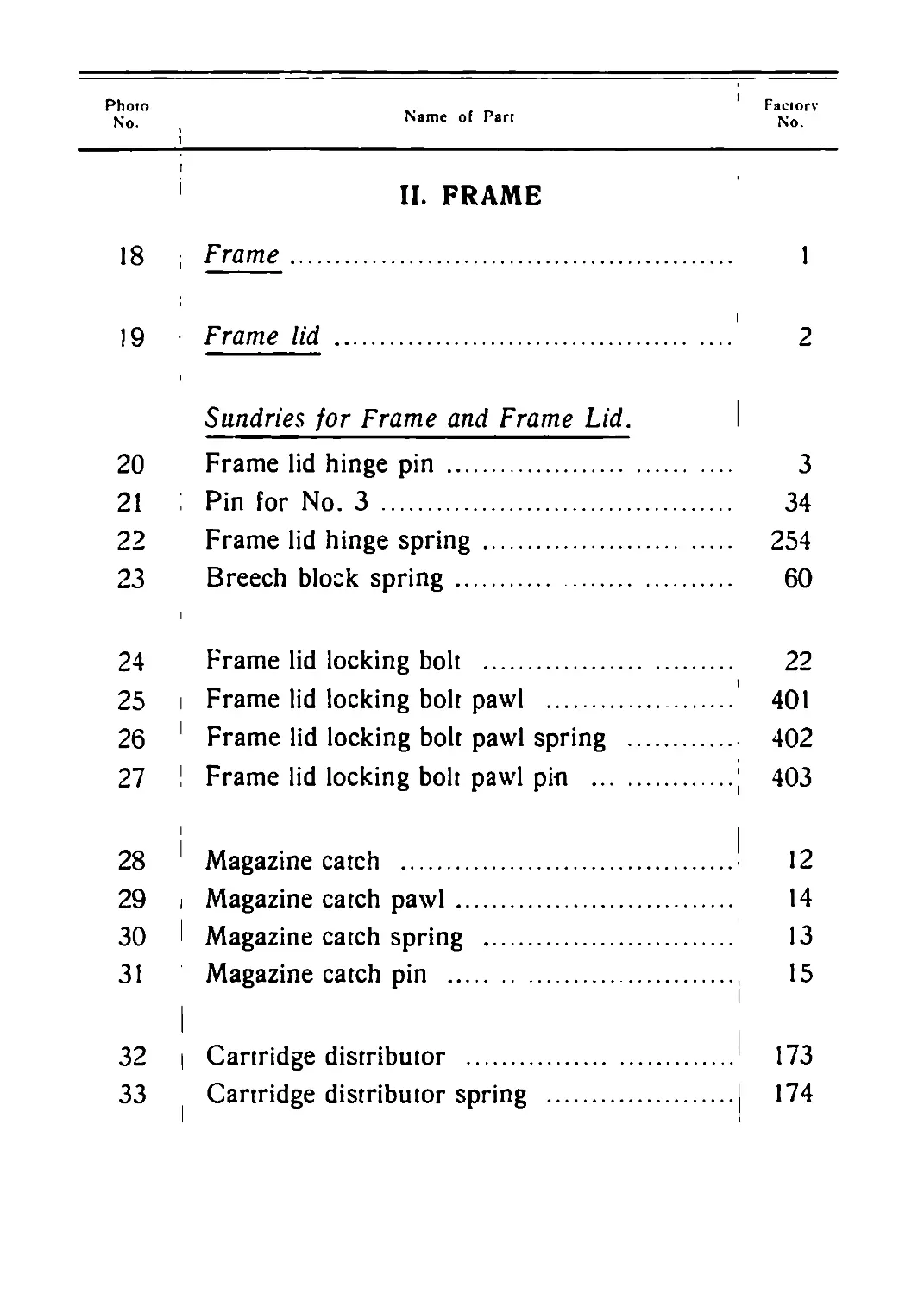
II. FRAME
18
19
20
21
22
23
24
25
26
27
28
29
30
31
32
33
Frame................................. 1
Frame lid ............................ 2
Sundries for Frame and Frame Lid. I
Frame lid hinge pin ........................... 3
I Pin for No. 3 ................................ 34
Frame lid hinge spring ...................... 254
Breech block spring........................... 60
Frame lid locking bolt ....................... 22
i	Frame lid locking bolt pawl ................ 401
1	Frame lid locking bolt pawl spring ......... 402
!	Frame lid	locking bolt	pawl pin ..........J	403
1	।
1	Magazine catch .............................. 12
।	Magazine catch pawl.......................... 14
I	Magazine catch spring ....................... 13
Magazine catch pin ........................... 15
।	i
I	Cartridge	distributor	....................'	173
Cartridge	distributor	spring .............I	174
Phoio
No.
34
35
36
37
38
39
40
41
42
43
44
45
Name of Part	Factorv No.
Cartridge distributor pin 		177
Pin for No. 177 		34
Breech block guide plate		20
Breech block guide plate latch 		21
Crank catch stop 		151
Frame end plate 		16
Frame end plate screw 		17
Frame bottom plate 		150
Ejector trip block 		18
1 Ejector trip block nut 		19
Frame bottom bolt 		141
Frame bottom bolt locking pin 		902
/9
39
с
40
т
4/
4S
Photo
Name of Pan
Haciorv
No.
in. BARREL
46
47
48
49
50
51
52
53
54
55
56
57
58
59
60
61
62
63
Barrel.
i	------------------------------------------ ।
,	Barrel	....................................[	43
Barrel	locking pin ........................1	162
Pin for No. 162 ............................... 34
1 Breech.
Breech ........................................ 44
!
Distributor guide ........................... 163
' Distributor guide rivet ....................1	288
। Ejector ........................................ 54
Ejector bolt ................................... 55
Ejector lever.................................
Ejector lever axle pin ......................
i
l
।
Ejector lever spring ........................
Ejector stop ................................
Ejector stop pin.............................
Pin for No. 45 ..............................
56
57
58
46
45
34
I
। Cartridge feeder ............................ 51
; Cartridge feeder axle pin ................... 52
Key for No. 52 ...........................	219
। Pin for No. 52 .............................. 53
Phoio No.	Name of Part	Factorv No.
64	Link 		47
65	Hammer 		48
66	Hammer axle pin 		49
67	Breech cover plate 		298
	Breech block.
68	Breech block 		59
69	Breech block bolt 		61
70	Firing pin 		62
71	Firing pin spring 		63
72	Firing pin retaining stud 		64
*6
Phoio
No.
73
74
75
76
77
78
79
80
81
82
83
84
85
86
87
88
89
90
91
92
93
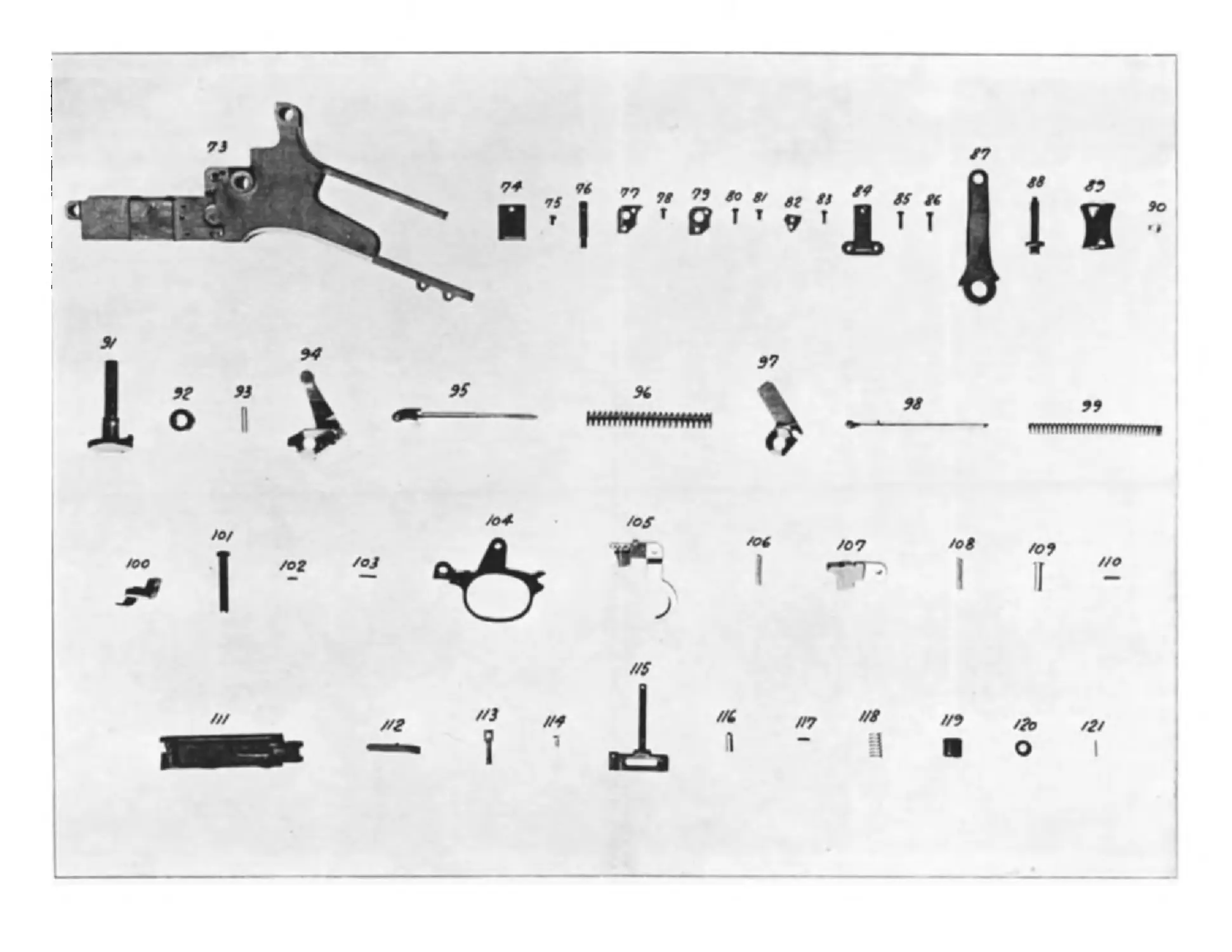
Name of Pari	Factory No.
 IV. TRIGGER PLATE
Trigger plate		65
Cartridge feeder actuating block 			66
Cartridge feeder actuating block rivet 		396
Trigger plate bolt 		164
Recoil arm stop 		165
Recoil arm stop rivet 		221
Percussion arm stop 		406
. Percussion arm stop rivet 		407
1 Percussion arm stop rivet 		408
Crank stop pawl 		395
Crank stop pawl rivet 		221-A
Telescope-sight post ........................ 755
Telescope-sight post rivet .................. 221-A
Telescope-sight post rivet ..................1	883
Crank ...............................
Crank bolt ..........................
Crank knob ..........................
I
| 167
1 166
Crank bolt washer ....................! 168
I Crank axle bolt ......................I	68
i Crank block washer ...................  71
I Crank bolt pin ......................I	73
Photo No.	Name of Part	Factory No.
94	Recoil arm 		69
95	Recoil spring plunger 		74
96	Recoil spring 		75
97	Percussion arm 		70
98	Percussion spring plunger 		77
99	Percussion spring 		76
100	Percussion and recoil spring base 		78
	Trigger guard.
101	Deflector hinge pin 		93
102	Key for No. 93 		219-A
103	Pin for No. 93 		215
104	Trigger guard 		79
105	Trigger 		80
106	Trigger spring 		81
107	Trigger rod 		85
108	Trigger rod spring 		81
109	Trigger rod pin 		87
110	Pin for No. 87 		34
111	Deflector 		92
112	Deflector opening spring 		169
113	Deflector latch 		94
114	Deflector latch screw 		95
Photo No.	Name of Pan	Factory No.
	Safety Device.
115	Safety catch		91
116	Safety catch pawl		409
117	Safety catch pin 		411
118	Safety catch spring 		410
119	Safety catch spring housing 		895
120	Safety catch washer 		896
121	Safety catch pin 		411-A

Phoio No.	Name of Part	Factory No.
122	V. STOCK Stock. Stock 		96
123	Stock screw 		98
124	Shoulder flap hinge plate screw 		102
125	Stock elevator socket. Stock elevator socket 		197
126	Stock elevator clamp 		193
127	Stock elevator clamp wing-nut 		199-A
128	Stock elevator clamp wing-nut washer 		277-A
129	Periscope sight base. Periscope sight base 		936
130	Periscope sight base screw 		102
131	Locking pawl for No. 936 		937
132	Spring for No. 936 		938
133	Pin for No. 936 		939
134	Strut. Strut hinge collar		38
134	Stop pin for strut hinge collar 		923
135	Strut hinge collar clamp 		175
136	Strut hinge collar screw 		37
137	Pin for strut hinge collar screw 		215
Photo No.	Name of Part	Factory No
138	Strut head		179
139	Strut assembling pin 		158
140	Strut tube 		40
140	Strut tube collar 		789
140	Strut tube collar pin 		749
141	Strut stay-bar band 		784
142	Strut transverse stay-bar 		747
143	Strut transverse stay-bar 		747-A
144	Strut stay-bar band pin 		786
145	Strut stay-bar screw 		785
145	Strut stay-bar screw key 		190
146	Strut stay-bar screw washer 		787
147	Strut stay-bar wing nut 		199
148	Strut stay-bar screw washer 		277
149	Strut tube collar 		790
150	Strut tube collar pin 		749
151	Strut spike 		156
152	Strut assembling pin 		158
153	Strut spike flange 		35
154	Strut spike flange pin 		36
	Fittings.
155	Carrying-handle ring 		598
156	Carrying-handle ring screw 		128
Photo No.	Name ol Part	Factory No.
157	Sling-swivel ring nut 		943
158	Carrying-handle arm pin 		597
159	Carrying-handle arm 		595
160	Carrying-handle 		592
161	Carrying-handle arm washer		168
162	Sling-swivel ring 		126
163	Sling-swivel ring screw 		128
164	Sling-swivel		127
164	Sling-swivel eye 		155
165	Sling-swivel ring link 		112
166	Sling-swivel ring link pin 		113
/37
Phoio No.	Name of Parr	Factory No. 1
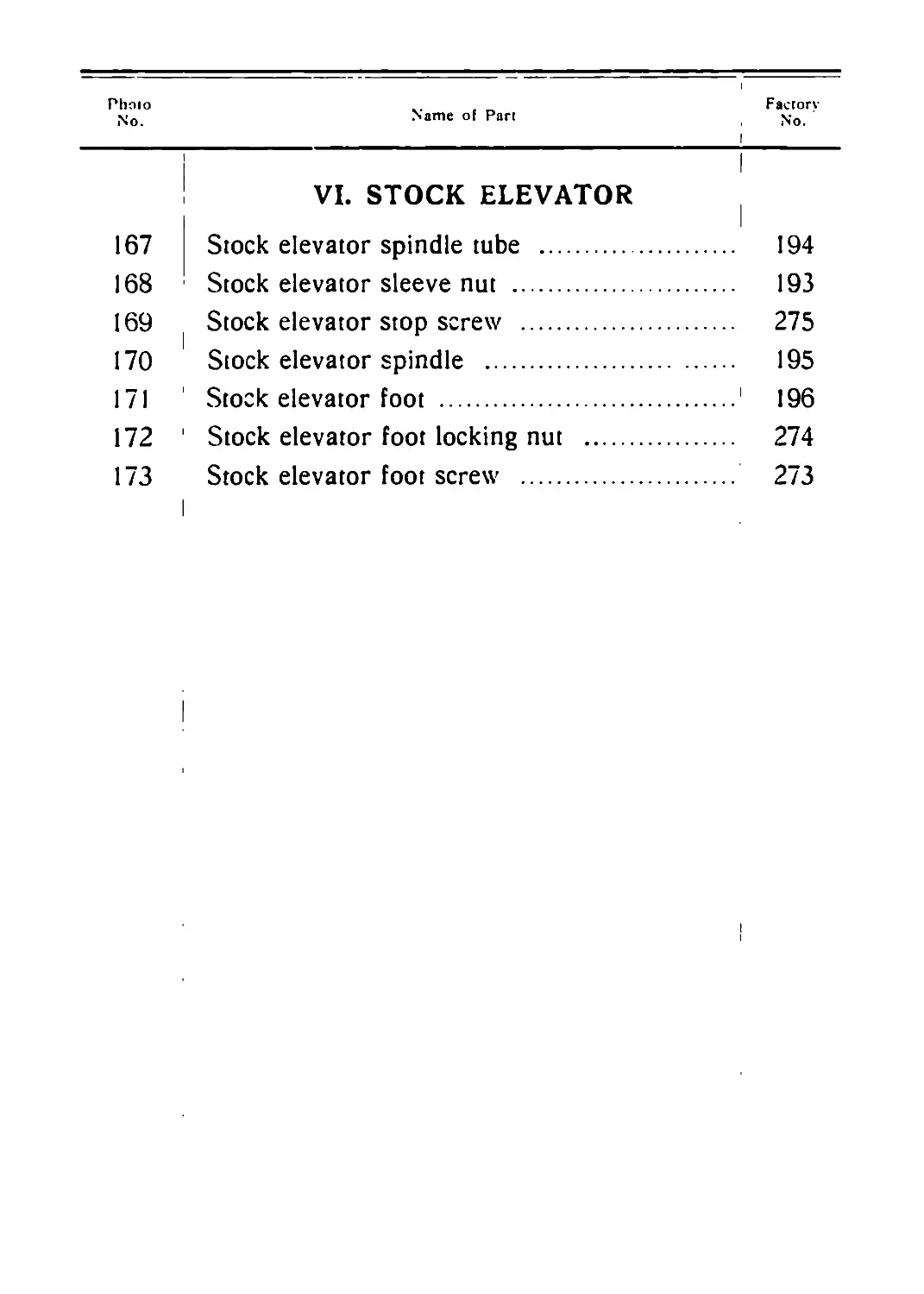
	VI. STOCK ELEVATOR	1 1
167	Stock elevator spindle tube 		....	194
168	Stock elevator sleeve nut 		....	193
169	Stock elevator stop screw 		.... 275
170	Stock elevator spindle 		....	195
171	Stock elevator foot 		....' 196
172	Stock elevator foot locking nut 		.... 274
173	Stock elevator foot screw 		.... 273

/са
/7/
Name of Parr
Photo
No.
Facrorv
No.
174	VII. MAGAZINE Magazine 		5000
174	° Magazine lid 		5001
175	Magazine reinforcing band 		5010
176	Magazine bottom band 		5002
177	Magazine cut-off 		5006
178	Magazine latch spring 		5011
179	Magazine platform 		5005
180	Magazine platform spring 		5008
181	Magazine platform box 		5003
182	Magazine spring 		5007
183	Magazine base plate 		5009

VI.
DIMENSIONS, WEIGHTS, ETC.
OF
MADSEN MACHINE GUN
MODEL 1940
Length of gun with flash absorber ......... 1600	mm
Weight of gun with flash absorber .......... 9.0	kg
Length of spare barrel with breech ......... 640	mm
Weight of spare barrel with breech ......... 2.2	kg
Length of rifled part of barrel ........... 412.19mm
Number of grooves ........................... 4
Width of grooves ....................... 3.9+ 0.2 mm
Depth of grooves ....................... 0.12+ 0.06 mm
Pitch of rifling (right-hand turn) ......... 240	mm
Calibre ................................ 7.94+ 0.03 mm
Rate of fire ............................ 450	r. p. min.
Maximum range ............................. 2900	m
Maximum range on sights ................... 1900	m
Muzzle height, gun on struts ............... 330	mm
Magazine weight (empty) ..................... 0.540	kg
Magazine weight (with 30 rounds) ............ 1.338	kg
Weight of cartridge........................ 26.6	g
Length of cartridge .................... 75.1—1 mm
Weight of bullet .......................... 11.7	g
Muzzle velocity at 30° C.................... 725	m, sec.
Photo
No.
197
198
199
200
201
202
203
204
205
206
207
208
209
Name of Parc
Factory
I
X. ACCESSORIES AND TOOLS
।
। Spring remover .........................'	136
|	Hexagon spanner .......................!	138
i Pair of nippers ......................... 142
'	Barrel mirror .........................I	145
• Punch, 3 mm ............................. 270
Punch, 4 mm ............................. 146
Wires, bundle of .......................1	224
|	Wires, bundle	of ....................... 225
Hammer screwdriver .....................j	264
।	Box ...................................i	293
Deflector kev	........................... 392
Brass punch ............................1	147
Breech key .............................. 263
1
/97
2о4
id
Phoio No.	Factorv Name of Pari
190 191 192 193 194 195 196	IX. ACCESSORIES AND TOOLS | Cleaning rod 	 134 Chamber pull-through 	i 135 Oilcan 	1 143 Oil can cap and brush 	 217 Cleaning rod extension 	 205 Extractor, emergency 	 253 Clearing plug and hook key 	 267/251
/9о
/92
Photo No.	Name of Parr	Factory No.
	I 1	VIII. ANTI AIRCRAFT SIGHT
184	। Fore sight 		432
185	Fore sight claw pin 		1554
186	. Fore sight claw 		578-A
187	Fore sight claw screw 		579
188	i Rear sight post 		440
189	Rear sight post screw 		579

Factory No.	Name	Photo No.	Plate No.
1	KEY TO NOMENCLATURE Frame 		18	II
2	Frame lid 		19	Я
3	Frame lid hinge pin 		20	«1
12	Magazine catch 		28	n
13	Magazine catch spring 		30	я
14	1 Magazine catch pawl 		29	tl
15	Magazine catch pin 		31	n
16	Frame end plate 		39	n
17	Frame end plate screw 		40	я
18	1 Ejector trip block 		42	n
19	Ejector trip block nut 		43	я
20	Breech block guide plate 		36	n
21	Breech block guide plate latch 		37	n
22	Frame lid locking bolt 		24	я
23	Rear sight base 		7	I
24	Rear sight leaf 		10	M
25	! Rear sight hinge screw 		11	Я
26	I Rear sight leaf spring 		9	я
27	' Rear sight slide 		12	я
28	; Rear sight slide catch 		13	я
29	' Rear sight slide catch spring 		14	я
30	! Rear sight base rivet 		8	я
31	1 Foresight 		2	я
33	! Foresight protector screw 		:	5
34	| Pin for No. 33 		6	п
34	i Pin for No. 3 		। 21	II
I