/











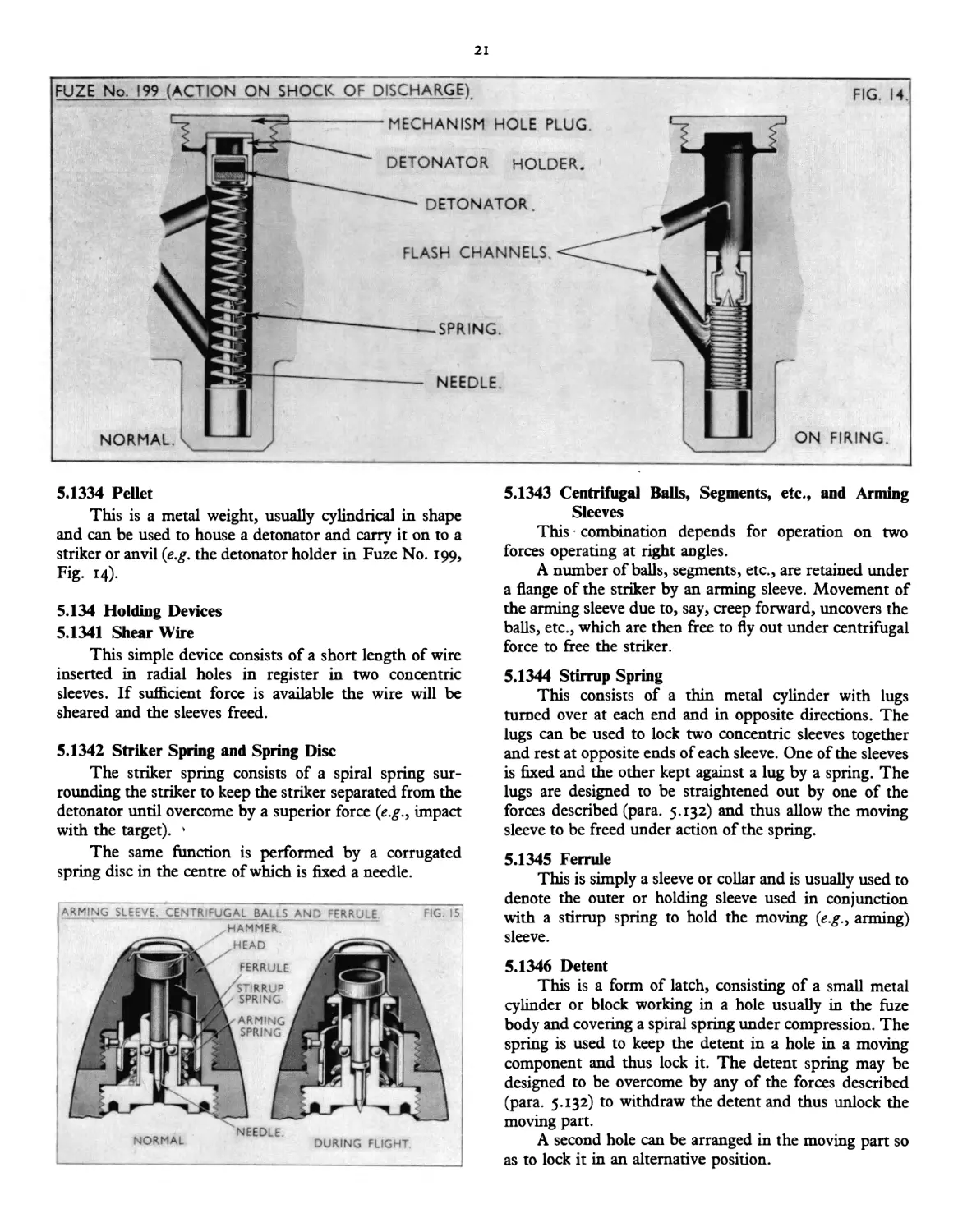
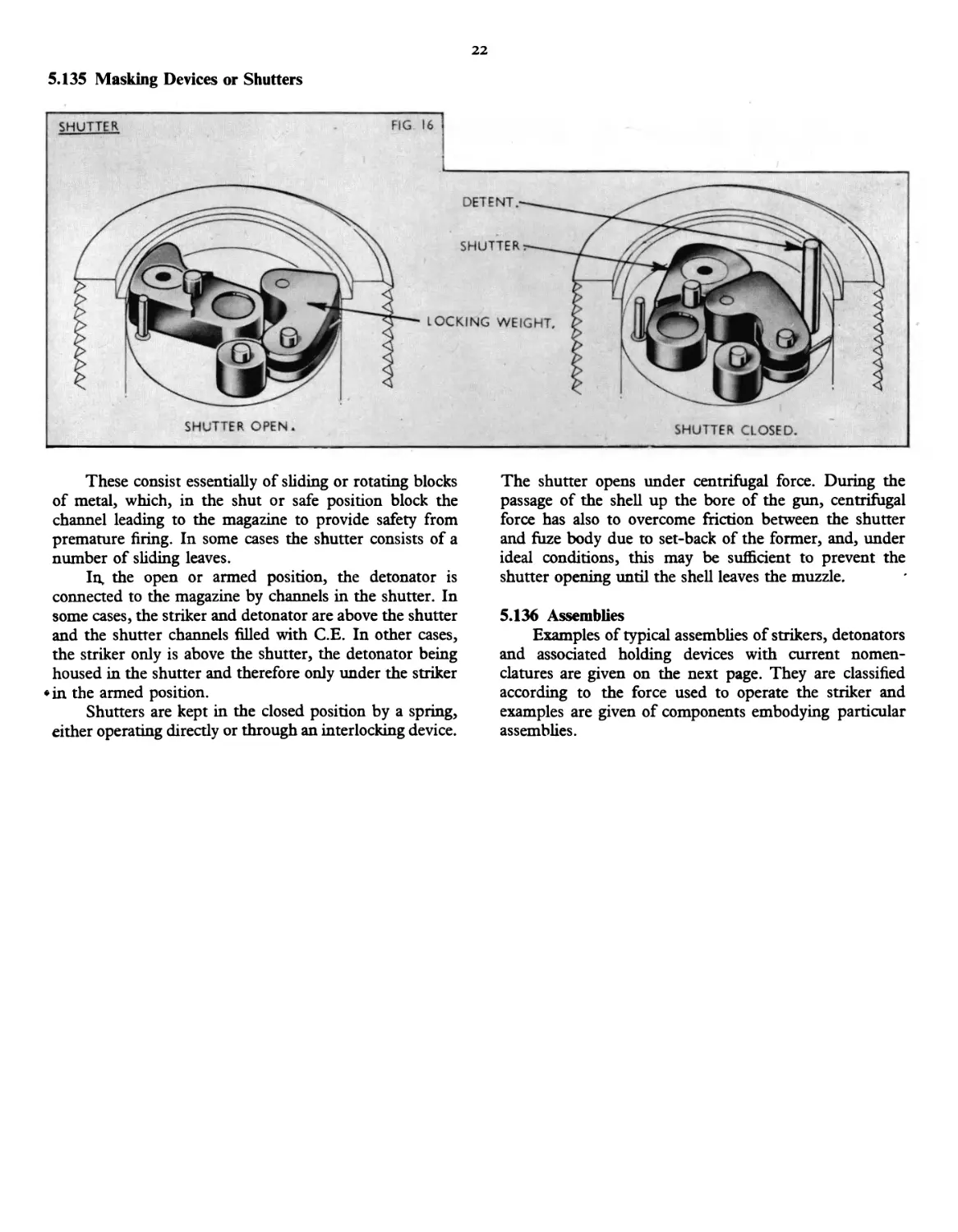
















Tags: weapons
Year: 1949




Text
                    уло. Code No.
5430
RESTRICTED
WAR OFFICE,
25th August, 1949
CONTENTS
Page
i. INTRODUCTION
I.I 1.2	General .... A.A. Equipments .	1 1
1-3	The Round of Ammunition .	1
1.4 2. EXPLOSIVES	Ammunition Categories	2
2.1	General ....	2
2.2	Propellants ....	3
2.3	High Explosives .	5
2.4	Miscellaneous Compositions .	9
2.5 3. THE CARTRIDGE	Conclusions....	IO
	Cartridge Case	11
3.2	Primer	....	11
3-3	Igniter	....	• В
34	Propellant Charge	• Ч
3-5 4. THE PROJECTILE	Decoppering Charge	• 14
4-i	General ....	• M
4.2	Shell		• 15
4-3 5. FUZES, GAINES,	Shot .....	18
TRACERS, ETC.	5.1	General ....	19
5.2	Fuzes .....	 24
5-3	Gaines	....	 36
54 6. DRILL AMMUNITION	Tracers and Igniters	• 36
6.1	General ....	• 37
6.2	Cartridges ....	• 37
6.3 7. RECORDS	Fuzes .....	• 38
7-i	Ammunition	 38
7.2 8. MARKINGS	Gun .....	• 39
8.1	General ....	• 40
8.2	Cartridge Case	• 40
8-3	Primer	....	 4i
84	Projectile ....	• 4i
8-5	Gaine or Auxiliary Detonator.	• 43
8.6	Fuze and Plug	• 43
8-7	Tracer and Tracer-Igniter	• 44
8.8 9. CARE, PRESERVATION	Package ....	• 44
AND PREPARATION	9.1	Packages ....	• 45
9.2	Storage ....	• 46
9-3	Preparation ....	• 47
94	Routine Inspections at Gun Positions 52
9-5	Damaged and Defective Ammunition 52
9.6	Salvage ....	• 54
ii
APPENDICES
A.	Explosives and their Uses
B.	Propellant Composition .
C.	Propellant Nomenclature
D.	High Explosive Composition
E.	Cartridges
F.	Primer and Igniter Details
Page	Page
• 55 । G. Empty Components	....	69-71
. 56 H. Methods of Filling	....	73-76
. 57	I.	Fuze, Tracer and Igniter Details	-77
 58	J.	Package Details.............................78
59-67	K.	Weights and Stowage Dimensions	-79
• 68
SUPPLEMENTS
		Page	Page
F.117	Fuze, Percussion, D.A., No. 117	80-83	P.n	Primer, Percussion, No. n .	. no
F.208	Fuze, Time, Mechanical, No. 208	84-87	P.12	Primer, Percussion, No. 12.	. in
F.208M	Mechanism, Time, 43 seconds.	88-92	P.17	Primer, Electric, No. 17	. 112
F.214	Fuze, Time, Mechanical, No. 214	93-96	P.18	Primer, Percussion, No. 18 .	. 113
F.2I4M	Mechanism, Time, Fuze No. 214	•	97-101	Т.п	Tracer and Igniter, No. n .	. 114
F.255	Fuze, Percussion, D.A., No. 255	. I02-105	T.I2	Tracer and Igniter, No. 12 .	115
G.11	Gaine, No. 11	. IO6-IO7	T.14	Tracer and Igniter, No. 14.	. 116-117
P-9	Primer, Percussion, No. 9	. IO8-IO9 !	1
ILLUSTRATIONS
Fig.	Subject	Page	Fig.	Subject	Page
1. Propellant Shapes	....	• 4	19. Fuze, Time, Mechanical, No. 208 .	26
2. Propellant Dimensions ....	6	20. Clockwork Mechanism of Time Fuzes	• 27
3. Use of Initiators, Intermediaries and Bursters	• 7	21. Escapement .....	.	28
4. 3.7-inch Q.F. Case ....	n	22. Fuze, No. 214		• 29
5. Primer, Percussion, No. 1	12	23. V.T. Fuzes—Block diagram .	• 32
6. Primer, Electric, No. 17	• В	24. V.T. Fuzes—Firing Circuit	 32
7. Propellant Charge		• 14	25. V.T. Fuzes—Assembly .	.	.	.	• 33
8. H.E. Shell		• 15 !	26. V.T. Fuzes—No. T97 and T98	• 33
9. Shrapnel Shell .....	16 ।	27. Fuze, Percussion, D.A., No. 117, Mk. 8 .	• 34
10. Practice Projectile.....	• 17	28. Fuze, Percussion, D.A., No. 255, Mk. 1 .	• 34
n. Method of Filling Tracer Cavity of A.P. Shot	. 18	29. Fuze, Base ......	• 35
12. Detonator ......	. 19	30. Gaine, No. 11	• 36
13. Magazine ......	• 19	31. Tracer, Shell, No. 2, Mk. 7* .	• 36
14. Fuze No. 199. Action on Shock of Discharge	21	32. Tracer and Igniter, Shell, No. 12, Mk. 2 .	• 37
15. Arming Sleeve, Centrifugal Balls and Ferrule	21	33- Typical Exploder System for D.A. and	Time
16. Shutter		22	Fuzes ......	• 49
17. Combustion Time Fuze Rings	. 24	34. Typical Exploder System for V.T. and	Time 49
18. Fuse No. 199		• 25	Fuzes
iii
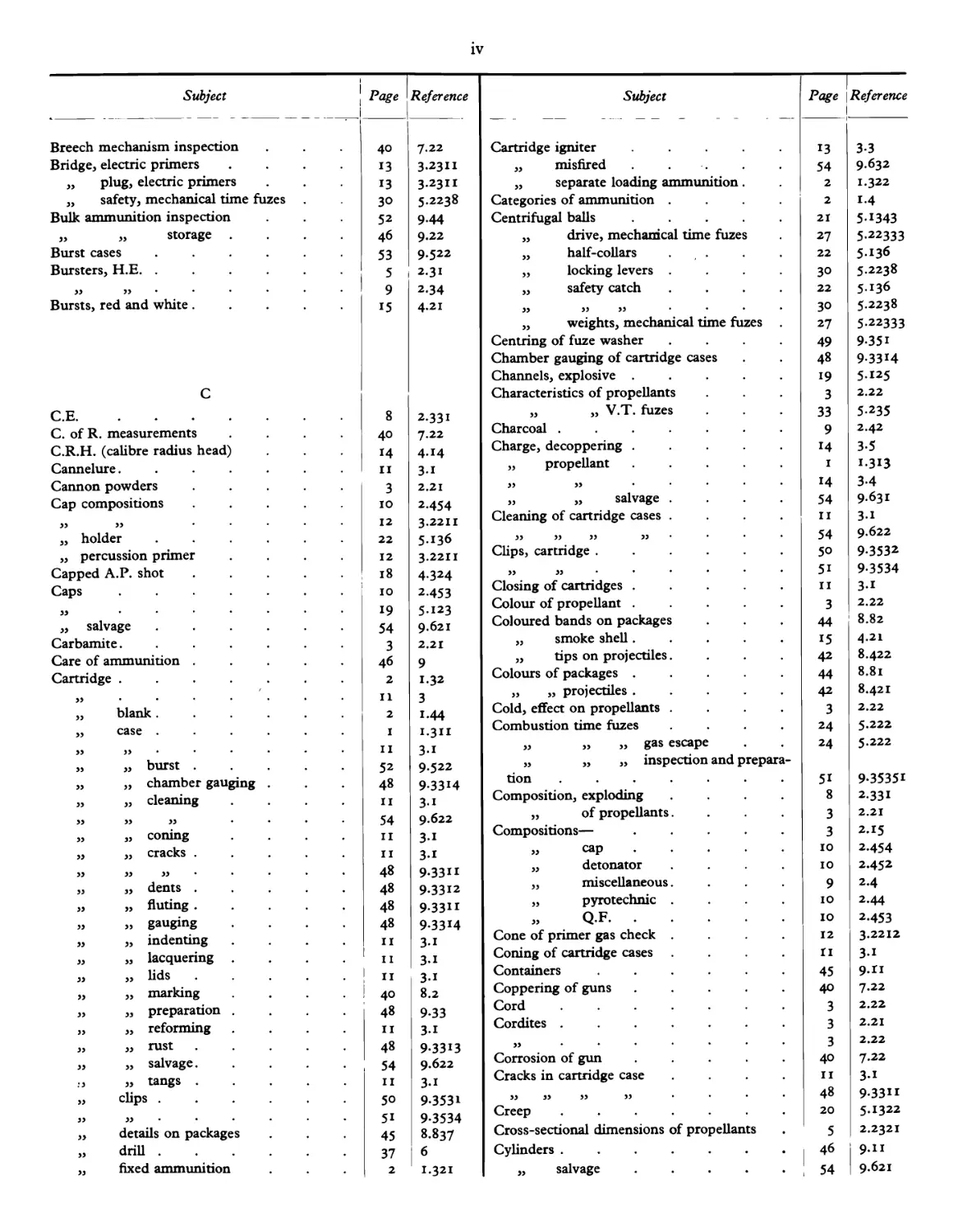
INDEX
NOTE: A decimal system is used for references.
For example, the “Balance Arm” entry in the Index is: 5.22352, meaning that the reference will be found in:
5	FUZES, GAINES,	TRACERS,	ETC.
5.2	FUZES
5.22	Time Fuzes
5.223	Mechanical
5.2235	Escapement
5.22352	Balance Arm
A fullpoint (.) is placed after the number of the Main Heading.
To locate a paragraph or sub-paragraph:
Find the Index entry.
Turn to the PAGE referred to in the Index entry.
Find on the left-hand side of the column the FULL NUMBER quoted in the Index, e.g. 5.22352 for “Balance
Arm”.
Subject	Page	Reference	Subject	Page |	Reference
A		I	Assemblies of fuze mechanisms .	22	5.136
“A” Primers, preparation ....	48	9.322	Assembly of V.T. fuzes ....	33	5234
A.A. equipments	.....	1	1.2	Auxiliary detonator .....	32	5.2326
A.P. shot .......	18	4.322	,, ,, .....	36	5.3
A.P.C. shot		18	4.324	Azide, lead	.	' .	8	2.322
A.P.C.B.C. shot	.....	18	4-325
A.S.A		8	2.324	В
Acceleration forces acting on fuzes	20	5.1322	Balance arm, mechanical time fuzes	28	5.22352
Accidents .......	52	9.521	Ball of primer gas check ....	12	3.2212
Action sequence of mechanical time fuzes	30	5.2238	Ballistic cap, A.P. shot ....	18	4.325
Aerial, V.T. fuzes .....	3i	5.2321	,,	„ mechanical time fuzes	25	5.2231
Age, effect on propellant ....	3	2.22	Balls, centrifugal	.....	21	51343
Amatol .......	9	2.343	Band, driving ......	14	4.13
Ammonium nitrate .....	9	2.342	Bands on packages .....	44	8.82
,,	perchlorate ....	IO	2.434	,,	» projectiles .....	42	8.424
Ammunition in bulk .....	46	9.22	Barrel, mechanical time fuzes	25	522332
„	recesses .....	52	| 9.42	Base of projectile	.....	14	4.12
„	records .....	38	7.1	Basic colours of projectiles ....	42	8.421
Amplifier, V.T. fuzes .....	32	, 5 2324	Batch label ......	45	8.845
Antimony sulphide .....	IO	2.453	„ number on packages ....	44	8.835
Anvil of fuze ......	20	5.1ЗЗ1	Batches .......	38	7.12
Arbor, mechanical time fuzes	25	5.22332	Battery, V.T. fuzes .....	3i	5.2322
Arming .......	20	5-13*	Blank .......	2	1.44
» ring		22	1 5136	Blinds .......	53	9 524
„ sleeve ......	21	5.134З	„ destruction, disposal and removal	53	9.5242
„ spring			22	! 5136	Blow-backs ......	53	9.522
„ of striker .....	22	; 5136	Body of projectile .....	14	4.11
„	„ V.T. fuzes.	....	' 33	! 5.235	Booster .......	3	2.14
Armour piercing shot.....	18	4322	,, . . . . . . ’ .	5	2.31
,,	,, capped shot	18	। 4 324	Bottom crown, mechanical time fuzes .	22	5.136
,,	,,	„ ballistic cap shot	18	4325	»	»	»	j> »	30	5.2237
Arrangement of handbook ....	I	1.13	Boxes, ammunition .....	45	9.11
iv
Subject		Page	Reference	Subject	Page 1	Reference
Breech mechanism inspection		40	7.22	Cartridge igniter	.....	13	3-3
Bridge, electric primers ....		В	З.2311	,, misfired	54	9.632
,,	plug, electric primers	В	3.2311	„	separate loading ammunition .	2	1.322
	safety, mechanical time fuzes	30	5.2238	Categories of ammunition ....	2	1.4
Bulk ammunition inspection		52	9.44	Centrifugal balls	.....	21	5.1343
,,	„	storage ....	46	9.22	„	drive, mechanical time fuzes	27	5.22333
Burst cases	......		53	9.522	„	half-collars	22	5.136
Bursters, H.E. ......		5	2.31	„	locking levers ....	30	5.2238
,,				9	2.34	„	safety catch ....	22	5.136
Bursts,	red and white.....	15	4.21	33	33	33	....	30	5.2238
				„	weights, mechanical time fuzes	27	5.22333
				Centring of fuze washer ....	49	9.351
				Chamber gauging of cartridge cases	48	9.3314
				Channels, explosive		19	5.125
	C			Characteristics of propellants	3	2.22
C.E.		8	2.331	„	„ V.T. fuzes	33	5.235
C. of R. measurements	....		40	7.22	Charcoal .......	9	2.42
C.R.H. (calibre radius head)		14	4.14	Charge, decoppering .....	14	3.5
Cannelure.......		11	3.1	„ propellant .....	1	I.3I3
Cannon powders	.....		3	2.21	„ „ .....	14	3-4
Cap compositions .....		10	2-454	„	„	salvage ....	54	9.631
		12	3.22II	Cleaning of cartridge cases ....	11	З.1
„ holder	......		22	5.136	33	33	33	33	•	54	9.622
„ percussion primer	....		12	3.22II	Clips, cartridge ......	50	9.3532
Capped A.P. shot .....		18	^.324	,,	5i	9 3534
Caps		10	2-453	Closing of cartridges .....	11	З.1
33		19	5.123	Colour of propellant .....	3	2.22
„ salvage ......		54	9.621	Coloured bands on packages	44	8.82
Carbamite.......		3	2.21	„ smoke shell.....	15	4.21
Care of ammunition .....		46	9	„	tips on projectiles....	42	8.422
Cartridge .......		2	1.32	Colours of packages .....	44	8.8l
		11	3	33	33 projectiles .....	42	8.42I
	blank ......	2	I.44	Cold, effect on propellants ....	3	2.22
	case ......	1	I.3II	Combustion time fuzes ....	24	5.222
33	,,......	11	3-1	„	„	„ gas escape	24	5.222
33	„ burst .....	52	9.522	„	„	„ inspection and prepara-
33	„ chamber gauging .	48	9.3314	tion .......	51	9.З5З51
33	,, cleaning	....	11	3.1	Composition, exploding ....	8	2.331
33	33	33	....	54	9.622	„	of propellants....	3	2.21
33	„ coning	....	11	3.1	Compositions—	.....	3	2.15
	,, cracks .....	11	3.1	33	cap		10	2.454
33	33	33	48	9.3311	„	detonator ....	10	2.452
33	„ dents .....	48	9.3312	„	miscellaneous....	9	2.4
	„ fluting		48	9.3311	„	pyrotechnic ....	10	2.44
33	„ gauging	....	48	9.3314	33	QF		10	2-453
33	„ indenting ....	11	31	Cone of primer gas check ....	12	3.2212
33	„ lacquering ....	11	3.1	Coning of cartridge cases ....	II	3.1
33	„ lids .....	11	3.1	Containers	......	45	9.П
33	„ marking	....	40	8.2	Coppering of guns .....	40	7.22
33	„ preparation ....	48	9.33	Cord .......	3	2.22
33	„ reforming ....	11	3.1	Cordites .......	3	2.21
33	,, rust .....	48	9.3313	„ .......	3	2.22
33	„ salvage		54	9.622	Corrosion of gun	.....	40	7.22
..	„ tangs		11	3.1	Cracks in cartridge case ....	11	3.1
	clips ......	50	9.3531	33	33	33	33	....	48	9.ЗЗ11
,,	,,......	51	9.3534	Creep .......	20	5.1322
33	details on packages	45	8.837	Cross-sectional dimensions of propellants	5	2.2321
33	drill		37	6	Cylinders .......	1 46	9.11
33	fixed ammunition	2	1.321	„ salvage		! 54	9.621
V
Subject D D.A. fuzes	...... D.C.A	 » ....... D.C.B	 D.C.C	 D.C.D	 Damaged ammunition	.... Damp, effect on amatol .... „	„	„	ammonium nitrate „	„	„	F.O.M	 ,,	„	„	fuze powders „	„	„	gunpowder „	„	„	lead azide .... „	„	„	primers .... „ protection in storage »	33	33	»	... Deceleration forces acting on fuzes Decoppering agent, whitemetal dome of primer magazine „	„	„	lid of cartridge case . „	charge	 „	„ lead foil and tin foil Defective ammunition	.... Delay fuzes	 Dents in cartridge cases	.... Destruction of blinds ..... Detents ....... Detonating composition “A” 33	33	» «С TJ 33 33	33	15	.	.	. Il	33 33	33	.	.	. 33	33	“D”	.	.	. „	train	..... Detonation	...... Detonator compositions .... ,,	holder	..... Detonators	...... „	self-destroying .... Dimensions of propellants .... Direct action percussion fuzes Discs on projectiles ..... Disposal of blinds ..... Disruptive initiators ..... Dome of mechanical time fuzes 33	33	33	33	33	• „	,, primer magazine .... Double base propellants .... Drill ammunition ..... 33	33	..... ,, cartridges ...... ,, fuzes	...... Drive of mechanical time fuzes Driving band ...... „	„ loose ..... Dynamite ....... E Electric primers......	i Page \ Reference 34	5-242 io ; 2.4522 12 I 3.2211 10	2.4523 10	2.4524 10	2.4525 52 9.51 9	2.343 9	2.342 8	2.321 9	2.43 9	2.42 8	2.322 11	3.21 10	2.5 47	9.2221 20	5.1322 12 । 3.2213 11	3.1 14	35 14	3-5 52	9.52 35	5-244 48	9-3312 53	9.5242 21	5.1346 10	2.4522 12	3.2211 10	2.4523 10	2.4524 10	2.4525 I 5	2.31 2	2.13 10	2.452 22	5.136 19	5.123 37	5-43 5	2.232 34	5.242 42	8.425 53	9.5242 8	2.32 | 25	5.2231 28	5.2236 12	3.2213 3	2.21 ;	2	1.45 । 37	6 37	6.2 38 16.3 1 25	5.2233 1	14	4.13 1	52	9521 1	5	2.31 в 1323	Subject Elements of V.T. fuzes .... Equipments, A.A. .	,. Erosion of propellant ..... Escape wheel ...... Escapement ...... Exploder ....... Explosion ....... Explosives	...... ,,	devices of fuzes .... ,,	label, government „	stores, salvage .... External tracer ...... F F.O.M	 ,, effect of heat and damp . Ferrule ....... ,, ....... Filling date on packages .... „ factory monogram on packages . Firing arm	...... 33	33 lever	 ,, circuit, V.T. fuzes .... ,, devices of fuzes	.... 33 Pin	 Fixed ammunition ..... „	„	cartridge „	„	„ case preparation „	„	drill cartridge . Flash inhibitor ...... „ of propellant ..... „ practice projectiles .... Fluting of cartridge cases .... Forces acting on fuzes and gaines. Form of propellant ..... Fouling by propellant..... Fraction markings on packages Frame of mechanical time fuzes . Fulminate of mercury..... j>	33	33 Fuze—	....... „	body	markings	..... „	„	stampings	 „ cover markings .	.	.	. „	„	rubber stamp markings „	„	salvage	 „	„	stampings	 ,,	details on packages .... „	drill	 „	inspection...... „	interchangeability .... „	markings ...... „	percussion.	..... ,,	powders ...... „	preparation	..... „	removal ...... „	setting ......	Page 3i ' 1 3 28 28 3 2 2 19 45 54 36 8 IO 8 21 22 44 44 22 30 32 20 20 2 48 37 3 3 17 48 20 3 3 44 25 8 10 29 43 43 43 43 54 43 45 38 5i 49 43 34 9 51 5i 1	Reference 5.232 1.2 2.22 5.22351 5.2235 2.14 2.12 2 5.12 8.842 963 5.41 2.321 2.4521 2.321 5.1345 5.136 8.836 8.836 5136 5.2237 5.2325 5.133 51331 1.321 1.321 9.332 6.21 2.21 2.22 4.23 9.ЗЗ11 5.132 2.22 2.22 8.833 5.2232 2.321 2.4521 5.2 8.61 8.611 8.62 8.622 9.621 8.621 8.839 6.3 9 3535 9.352 8.6 5.24 2.43 9-3535 9 3534 1.21
vi
Subject	Page	Reference	Subject	Page	Reference
Fuze setting ......	30	5.2238	Hand race, mechanical time fuzes	30	5-2237
„	„ locking .....	30	5.2238	Handling of bulk ammunition	46	9.221
„ suitability.	.....	49	9.352	„	„ V.T. fuzes ....	46	9.221
„ tension ......	24	5.221	Head of projectile .....	14	4.14
„ time	......	24	5.22	Heat, effect on F.O.M. ....	8	2.321
» V.T		3i	5.23	„	„	„ propellants' ....	3	2.22
„ washer, centring of	49	9.351	„	„	„ T.N.T		9	2.341
Fuzed shell, stacking .....	47	9.22323	High explosives......	5	2.3
Fuzing .......	50	9.353	Holder, cap ......	22	5136
„ stores ......	50	9.3533	„ detonator .....	22	5.136
,, tools ......	50	9.3532	Holding ring, V.T. fuzes ....	33	5-234
			„ devices for fuzes ....	21	5134
G
G. 12 powder	......	12	3.2213	I
Gaine— .......	36	5.3	Igniferous initiators .....	IO	2.45
„ markings......	43	8.5	Igniters and tracers, markings	44	8-7
„ removal ......	5i	9.3534	„ cartridge .....	13	3.3
„ for V.T. fuzes .....	32	5.2326	„ shell 			37	542
Gas check, percussion primers	12	3.2212	„ tracer ......	37	5-44
,, escape, combustion time fuzes	24	5.222	Ignition of propellant.....	3	2.22
„ seal, electric primers ....	13	3.2312	»»»•••••	13	3-3
Gauge, measuring wear of bore, for R.A. use.	40	7.22	„	„ tracer			36	5.41
„ plug, bore, for R.A. use .	40	7.22	Illuminants ......	3	2.15
Gauging of cartridge cases ....	48	9.3314	Illumination ......	IO	2-44
Gear train, mechanical time fuzes	27	5.2234	Incendiaries ......	IO	2.44
Gelatinization ......	3	2.21	Indenting of cartridge case ....	11	31
Glass, powdered	.....	10	2.453	Inhibitor, flash ......	3	2.21
Government explosive label	45	8.842	Initiation of explosions	....	3	2.14
Grains, propellant .....	3	2.22	Initiators	......	5	2.31
Graze fuzes ......	34	5.242	„	disruptive .....	8	2.32
Ground colours of packages	44	8.8I	„	igniferous .....	IO	2.45
Grummets	......	46	9.12	Innocuous	......	*7	4.23
,,	salvage .....	54	9.621	Inspection of breech mechanisms.	40	7.22
Guide bush, striker .....	22	5.136	,,	,, fuzes .....	51	9-3535
Gun position, routine inspection of ammunition	52	94	„	„ gun positions ....	52	94
„	,, storage of ammunition .	46	9.21	„	„ ,, wear ....	40	7.22
„ record book or memorandum of examina-			Interchangeability of fuzes ....	49	9352
tion ......	40	7.24	Intermediaries ......	3	2.14
„ wear	......	39	7.21	„ ......	5	2.31
Guncotton	......	5	2.31	„ ......	8	2.33
Gunpowder ......	9	2.42	Internal tracers ......	36	5.41
,, ......	13	33	Introduction to Handbook ....	I	1
,, ......	13	3.2313
,, ......	16	4.22
„ ......	17	4.23	J
„	effect of damp ....	9	2.42	Junghans fuze mechanism ....	25	5.2231
„	sulphurless ....	9	2.42	Jungle stripes on packages ....	43	8.831
H			L
H.E		5	2-3	Labels .......	45	8.84
„ shell.	......	15	4.21	Lacquering of cartridge cases	11	31
H.E.S. (H.E. substitute) ....	17	4.23	Lead azide	......	8	2.322
Hair spring, mechanical time fuzes	28	5.22353	„	„ effect of damp ....	8	2.322
Half-collars, centrifugal ....	22	5136	Length of propellant .....	5	2.2322
Hammer .......	20	5.1ЗЗ2	Lever, striker ......	22	5.136
„ spring		30	5.2237	Lids of cartridge cases	....	11	3.1
Hampers .......	45	91	Life of propellant .....	38	7.112
vii
Subject	Page	Reference
Liners, package ......	45	9.11
„ primer magazines ....	12	3.2213
Loading .......	1	1.23
Locking of fuze setting ....	30	5.2238
„ pins, mechanical time fuzes	30	5.2238
,, ring, mechanical time fuzes	30	5.2238
„ weight, mechanical time fuzes .	30	5.2238
Loose driving bands .....	52	9-521
Lots of ammunition .....	38	7.11
„ „ propellants .....	3	2.22
33	33	33	.....	38	7.112
Lyddite .......	5	2.31
M
М.94 (T.98) Fuze .	34	5.2363
М.95 (T.149) Fuze		34	5.2364
М.98 (T.97) Fuze .....	34	5.2362
Magazine, electric primers ....	В	З.2313
„ fuze ......	19	5.124
„	liners of primers....	12	3.2213
„	percussion primers	12	З.2213
Mainspring, mechanical time fuzes	25	5.22332
Markings—	......	: 40	8
„	cartridge case ....	40	8.2
„ fuze ......	43	8.6
33	33 body		43	8.61
„	„ cover		43	8.62
„	fraction .....	44	8.833
3J	gaine		43	8.5
„	operational .....	44	8.832
„ package .....	44	8.8
„ primer	.....	4i	8.3
„	projectile .....	4i	8.4
„	tracer and igniter....	44	8.7
Masking devices	.....	22	5.135
Measurement of gun wear ....	40	7.22
Mechanical devices of fuzes and gaines .	20	513
„	time fuzes	....	25	5.223
,,	,,	„ arbor	25	5.22332
„	„	„ balance arm	28	5.22352
33	33	33 barrel	25	5.22332
„	,,	„ bottom crown .	22	5.136
33	33	33	33	33			30	5.2237
„	„	„ centrifugal bolt .	30	5.2237
33	33	33	33	drive	.	।	27	5.22333
33	33	33	33	locking lever	30	5.2238
Mechanical time fuzes, centrifugal safety catch	22	5136
33	33	33	33	33	33	30	5.2238
33	33	33	33	weight	27	5.22333
,,	,,	„ dome	25	5.2231
33	33	33	33	•	28	5.2236
„	»	,, escape wheel	28	5.22351
„	„	„ escapement	28	5.2235
33	33	33 firing arm	.	।	22	5.136
33	33	33	33	33 lever.	30	5.2237
33	33	33 functioning	|	30	5.2237
33	33	33 gear wheels	.	,	27	5.2234
Subject	Page	Reference
Mechanical time fuzes, hairspring	28	522353
33	33	33 hand	30	5-2237
33	33	33	33 race.	30	5.2237
„	,,	„ inspection	5i	9.35352
„	„	„ Junghans mechanism.	25	5.2231
„	„	„ locking fuze setting	30	5.2238
„	„	„	„ pins	30	5.2238
*>	33	33	33 ring	30	5.2238
»	»	33	33 weight .	30	5.2238
„	„	„ mainspring	25	5.22332
„	„	„ muzzle safety	30	5.2238
33	33	33 pallet	28	5.22352
,,	„	„	„ arm	28	5.22352
»	33	33	3j pad.	28	5.22352
33	33	33 pillar	22	5.136
„	„	,, pinions	27	5.2234
33	33	33 pivots	27	5.2234
„	„	,, preparation	50	9-35352
33	33	33 regulation	28	5-2236
33	33	33 safety bridge	30	5-2238
„	„	„	„ disc	30	5-2237
33	33	33	93 lever	30	5-2238
33	33	33	33 muzzle	30	5.2238
»	33	33	33 plate	22	5.136
„	„	„ set-back pin	22	5.136
„	„	„ setting pin	30	5.2237
„	,,	„ shutter opening.	30	5.2238
„	„	„ spin effect	28	5.2236
33	33	33 spring drive	25	5.22332
„	„	„ stampings on body	43	8.6111
33	33	33 stop lever.	30	5.2238
„	„	„ striker arming .	30	5.2238
33	33	33	33 bolt	23	5.136
33	33	33	33	33	•	•	30	5.2237
33	33	33	33	33 spring	22	5.136
33	33	33	33 lever	23	5.136
„	„	„	„ release	30	5.2238
33	33	33	33 spring	22	5.136
„	„	„ Tavaro mechanism	25	5.2231
„	33	33 tensioning ring.	25	5.2231
.,	„	„ Thiel mechanism	25	5.2231
33	33	33 timing	28	5.2236
33	33	33	33 disc	22	5.136
33	33	33	33	33	•	•	30	5.2237
Memorandum of examination	40	7.24
Mercury fulminate .....	8	2.321
Metals, effect of amatol ....	9	2.343
„	„	„ ammonium nitrate	9	2.342
Mineral jelly ......	3	2.21
Miscellaneous compositions.	9	2.4
Misfired primers and cartridges, salvage	54	9.632
Misfires .......	52	9.522
Moderant.......	3	2.21
Moisture .... See “Damp”
Monogram of filling factory	44	8.836
Mould growth, protection ....	45	9.11
Multitubular propellant ....	3	2.22
Muzzle safety, mechanical time fuzes .	30	5.2238
„	„ V.T. fuzes ....	33	5.2332
viii
Subject	Page	Reference	Subject Piercing shot	 Pillar, mechanical time fuzes Pinions, mechanical time fuzes Pivots, mechanical time fuzes Plate, safety, mechanical time fuzes Plug gauge, bore	.	' . „ markings, V.T. fuzes .... „ removal ...... „ transit ...... Plugged shell, stacking	.... Potassium chlorate ..... ,, ,,	..... „	nitrate	..... Powders, cannon	. •	. „	fuze ...... ,,	G. 12 ...... Power of propellant ..... Practice ammunition ..... „ projectile ..... „ shot ...... Prematures	...... ,, ...... Preparation, ammunition .... „	cartridge case .	. „	fuze ..... „	primer ..... ,,	projectile	.... Preservation of ammunition Primers—.	...... „ ....... ,,	effect of damp	.... ,,	electric	..... „	„	bridge	.... «	»	„	plug „	„ gas seal	.	. * ,,	,, magazine .... „	magazine dome .... „	„	liner	.... „	misfired	..... „	obturation	..... „	percussion	..... „	„	cap	.... „	»	gas check ,,	„	magazine „	preparation ..... ,,	protection ..... „	removal	..... „	repairs ...... „	stampings on base .... Practice projectile ..... Projectile ....... „	base ...... „	body 	 „	centring	 „	details on packages „	driving band .... „	head ......	Page	Reference
N Nature of propellant, nomenclature Needle ....... » pellet	 Nitration ....... Nitrocellulose cannon powders Nitroglycerine ...... Nomenclature, mechanical fuze components . ,,	propellants .... „	‘ V.T. fuzes .... Non-explosive stores, salvage Nose rings on projectiles .... О Object of handbook ..... Obturation of gun ..... »	» >j „	„ primer	 Operational ammunition	.... „	markings	on packages Oscillator, V.T. fuzes..... P P.C. limit....... PEN/D.i	 P.E.T.N	 Packages	.	.	1 „	cartridge details .... „	coloured bands .... ,,	fuze details ..... „	ground colours .... „	jungle stripes	.... „	labels ...... ,,	markings ..... „	projectile details .... „ salvage	 „	stacking ..... „	stencilling ..... Packer’s label ...... Packing serial number	.... j>	»	»	.... Painting of projectiles.	.... Pallet— ....... „ arm.	...... „ pad	 Paper shot	...... Pellet (explosive)	..... „ (weight)	 Penetrative cap ...... Penthrite ....... Pentolite ....... Percussion fuzes	..... „	,, inspection and preparation . „	primers ..... Phosphorus, red	..... Picrite .......	5 20 22 3 3 3 30 5 34 54 42 i 1 Xi 12 2 44 32 40 9 8 45 45 44 45 44 44 45 44 45 54 47 44 45 39 44 42 28 28 28 19 : 24 , 21 I 8 8 34 5i 12 15 3	2.231 5I33I 5136 2.21 2.21 2.21 5.2237 2.23 5.2361 9.62 8.423 1.12 1.22 зл 3.2212 1.42 8.832 5.2323 7.23 2.344 2.333 91 8.837 8.82 8.839 8.8l 8.83I 8.84 8.8 8.839 9.621 9.2231 8.83 8.844 7.13. 8.835 8.42 5.22352 5.22352 5.22352 4.35 5.222 5.1334 4324 2.333 2.334 5.24 9.35353 3.22 4.21 । 2.21		18 22 27 27 22 40 43 51 43 47 10 10 9 3 9 12 3 2 17 19 14 20 40 47 48 48 48 48 45 1 11 11 В 13 13 В r3 12 12 54 12 12 12 12 12 48 5i 12 12 4i 17 1 14 14 2 20 45 14 14	4.32 5.136 5-2234 5-2234 5.136 7.22 8.63 9-3534 8.63 9.22322 2.451 2-453 2.42 2.21 2.4З 3.2213 2.22 1.43 423 4.33 4.12 5.131 7.23 9.3 933 935 932 934 9 1.312 3-2 З.21 3.23 3.23И 3.23II 3.2312 3.2313 3.2213 3.2213 9632 3.2212 3.22 3.22II 3.2212 3.2213 9.32 9-3534 3.2213 З.2213 8.3I 4.23 I.3I4 4 4.12 2.11 5.1324 8.838 4.13 4.14
ix
Subject Projectile painting	..... „	practice	..... „	preparation..... „	stampings	..... ,,	stencilling	..... „ weight	 Proof shot	...... Prematures	...... Propellants	...... ,,	age, effect of . ,,	carbamite..... „	characteristics .... „	charge	 '	«	„ salvage	.... „	cold, effect of	. „	colour ..... ,,	composition .... „	cordite .	.	. *	. „	cross-section .... „	damp, effect of.	.	.	. „	dimensions .... ,,	double-base .... „	flash	..... „	form ..... „	fouling	 „	grains	 „	heat, effect of . „	ignition ..... „	length	 „	life	 ,,	lots.	..... »	» . „	mineral jelly .... „	multitubular .... „	nature ..... „	nomenclature .... ,,	picrite ..... „	power ..... „	properties	.... „	rate of burning. „	ribbon ..... „	shape ..... „	single-base .... ,,	size	..... JS	>J	..... „	sliverless grain .... ,,	slotted tube .... „	smoke . ,,	standard grain .... „	strip	 „	sun, effect of . „	temperature, effect of „	tubular ....’. Protection of ammunition at guns ,,	,, bulk ammunition „	„ primers ..... Provisional condemning limit Proximity fuzes	.....	Page	Reference	Subject	Page	Reference
	42 17 48 41 42 4i 19 40 3 3 3 3 14 54 3 3 3 3 5 3 5 3 3 3 3 3 3 3 13 5 38 5 38 3 3 5 5 3 3 3 3 3 3 3 3 5 3 3 3 3 3 3 3 3 46 47 51 40 3i	8.42 4-23 934 8.41 8-43 8.41 4-34 7-23 2.2 2.22 2.21 2.22 3-4 9.631 2.22 2.22 2.21 2.21 2.2321 2.22 2.232 2.21 2.22 2.22 2.22 2.22 2.22 2.22 3.3 2.2322 7.II2 2.22 7.II2 2.21 2.22 2.231 2.23 2.21 2.22 2.22 2.22 2.22 2.22 2.21 2.22 2.232 2.22 2.22 , 2.22 2.22 2.22 2.22 2.22 2.22 , 9-213 9.222 9-3534 7-23 1 523	Pyrotechnic compositions .... Q “Q” primers, preparation .... Q.F. composition ..... „ ,,	..... Quarters of gun life . R R.D.202 	 „ cement	...... ,, ,,	...... R.D.X	 „ /beeswax	..... Records ....... Red phosphorus	..... „ shell bursts	..... Re-forming of cartridge cases .	. Re-fuzing	...... „	stores	..... ,,	tools ...... Regulation of mechanical time fuzes Relay	 Removal of blinds ..... „	,, fuzes, gaines, plugs, etc. „	„ primer	 Repair of primers ..... Ribbon propellant ..... Rings on nose of projectile .... Round of ammunition	.... Routine inspection at gun positions Rubber stamp markings on fuze covers. Run-up of projectile ..... »	j>	»	..... Rust on cartridge cases .... ,,	,, projectiles ..... S S.A.P. shot ...... S.R. 227 and 227A ..... Safety bridge, mechanical time fuzes „ catch, centrifugal, mechanical fuzes „ devices, V.T. fuzes .... „ disc, mechanical time fuzes „ lever, mechanical time fuzes „	muzzle, mechanical time fuzes .,	,, V.T. fuzes .... „ plate, mechanical time fuzes Salvage ....... Scope of handbook ..... Segments ....... Self-destroying detonator .... „ destruction of shell	.... »	»	»	j>	.... ,,	„	by	V.T.	fuzes »	»	j>	»	» »	>j	>j	»	» Semi armour piercing shot ....	IO 48 IO 12 40 IO 9 50 9 8 38 15 15 11 50 50 50 28 37 53 5i 12 12 3 42 1 5i 43 20 39 48 48 18 IO 30 22 25 30 30 30 33 22 54 1 21 37 15 37 33 32 33 18	2-44 9.321 2-453 3.2211 7.22 2.434 2.343 9 3533 2.345 2.332 7 4.21 4.21 3.1 9 353 9.3533 93532 5.2236 5-42 9.5241 9-3534 3.2213 3.2213 2.22 8.423 1.3 94 8.622 5.1322 7-21 9.ЗЗ13 934 4323 2.433 5-2237 5136 5233 5.2237 5.2238 5.2238 5.2332 5.136 9.6 I.II 5.1343 5.43 4.21 5.42 5.235 5.23252 5.2333 1 4.323
X
Subject	Page	Reference	Subject	Page	Reference
Separate loading ammunition	i	1.23	Spring drive mechanical time fuzes	25	5-2233
„	„ cartridge ....	2	1.322	„ hair ......	28	5-22353
„	„	„	case preparation	48	9 333	„ stirrup ......	21	5-1344
„	„ drill cartridges .	38	6.22	33	.......	22	5.136
Sequence of action of mechanical time fuzes .	30	5.2238	„ striker ......	20	5-1333
Serial packing number	....	39	7.13	„	33	‘	•	21	i 5.1342
33	»	33	....	44	8.834	,,	,, bolt .....	22	1 5136
Service V.T. fuzes .....	34	5.236	Stacking ammunition at guns	46	1 9214
Set-back .......	20	5.1322	„	„	packages	47	9.2231
,, .......	22	5136	,,	bulk ammunition ....	47	9.223
33	pin 			22	5.136	,, fuzed shell .....	47	9.22323
Set forward ......	20	5.1322	„ loose shell .....	47	9.2232
33	33	......	22	5.136	„ plugged shell	....	47	9.22322
Setting fuzes ......	1	I.2I	Stampings, cartridge case ....	40	8.21
33	30	5.2238	„	fuzes	.....	43	8.611
Shape of propellant .....	3	2.22	,,	fuze covers ....	43	8.621
Shear wire	......	21	5.1341	„	gaines		43	8.51
Shell—		«5	4.2	„	primers .	4i	8.31
„ closing		5i	93536	„	projectiles	....	4i	8.41
33 H.E		15	4.21	„	tracers and igniters	44	8.71
„ igniter		37	5.42	Standard grain propellants ....	3	2.22
„ self-destruction .....	15	4.21	Star shell .......	3	2.15
„ semi-lethal, coloured smoke	15	4.21	Station label ......	45	i 8.843
„ shrapnel ......	16	4.22	Stencilling cartridge cases ....	4i	8.22
„ stacking of	....	.	47	9.2232	,,	combustion time fuzes	43	. 8.612
33 star		3	2.15	„	projectiles.....	42	| 8.43
Shot—		18	4.3	,,	packages .....	44	| 8.83
33 A.P		18	4.322	Stop lever, mechanical time fuzes.	30	5.2238
„ A.P.C		18	4.324	„ paper shot......	19	435
„ A.P.C.B.C	|	18	4.325	Storage of ammunition	....	46	9-2
зз paper		19	4-35	Stores for fuzing and re-fuzing	50	9 3533
„ piercing	j	18	432	Striker .......	20	5.1331
„ practice ......	19	433	„ arming, mechanical time fuzes .	30 I	5.2238
,, proof	......	19	434	„ bolt, mechanical time fuzes	22	5.136
33 S,A.P	1	18	4323	зз	зз	зз	зз	33	•	30	5.2237
Shrapnel shell	.	.	.	.	16	4.22	,,	33 spring .....	22	5.136
Shutters .......;	22	5.135	„ guide bush .....	22	5.136
„ opening, mechanical time fuzes	30	5.2238	,, lever ......	22	5.136
Side slap .......	20 ,	51324	„ release, mechanical time fuzes .	30	5.2238
Signals .......	10	2.44	„ spring		20	5.1ЗЗЗ
Single-base propellant	....	3	2.21	,, ,,......	21	5.1342
Siting of ammunition at gun positions .	46	9.212	Stirrup spring ......	21	5.1344
Size of propellants .....	3	2.22	Strip propellant.	.....	3 i	2.22
Sleeve, arming ......	21	51343	Stripes, jungle, on packages	44	8.831
,, ,,......	22 ।	5136	Styphnate, lead ......	8 I	2.323
Sliverless grain ......	3 1	2.22	Sulphur .......	9	2.42
Slivers ....... 1	3	2.22	,, .......	, 9	2.43
Slotted tube propellant .	. ।	3	2.22	Sulphurless gunpowder ....	9	2.42
Smoke box .......	9	2.341	Sun, effect of .	10	2.5
33	33	......	15	4.21	,,	,,	,, on F.O.M. ....	8	2.321
„ producers .	. 1	3	2.15	зз	зз зз зз propellants	3	2.22
„ production .....	1 10	2.44	„ protection from in storage	47 1	9.2223
„ of propellants .....	j 3	2.22		1
,, shell, coloured.	....	15	4.21	T	1
Spin of fuzes ......	20	5.1323	Т.97 (M.98) Fuze .....	34	5.2352
33	33	33	28	5.2236	Т.98 (M.94) Fuze		34	5.2353
„ switch, V.T. fuzes ....	I 32	5.23252	Т.149 (M.97) Fuze		34	5.2354
Spring, arming ......	22	5.136	T.N.T		5	2.31
„ disc ......	21	1 5.1343	„ .......	8	' 2.335
xi
Subject	Page	Reference	Subject	Page	Reference
T.N.T		9	2.341	V.T. Fuzes assembly .....	33	5234
„ effect of heat .....	9	2.341	„	„ auxiliary detonator	32	5.2326
Tangs of cartridge cases ....	ii	31	„	„ batches .....	38	7.121
Tavaro fuze mechanism ....	25	5.2231	„	„ battery .	.	.	3i	5.2322
Temperature variations, protection from	10	2.5	„	„ blinds .....	33	5-2334
» » » »	47	9.2224	„	„ characteristics ....	33	5-235
Tension of fuzes	.....	24	5.221	„	,, elements .....	3i	5.232
Tensioning ring, mechanical time fuzes.	25	5.2231	,,	„ firing circuit ....	32	5.2325
Termite attack, protection from .	45	9.11	„	„ fuze markings ....	43	8.613
Tetryl .......	8	2.331	„	„ gaine		32	5.2326
Thiel fuze mechanism	....	25	5.2231	„	„ handling		46	9.221
Thyratron, V.T. fuzes	....	32	5.2325	„	„ inspection.....	51	9-35354
Time fuzes		24	5.22	„	„ М.94 (T.98)	....	34	5.2353
„	„ combustion ....	24	5.222	„	» М.95 (T.149) ....	34	5.2354
,,	,, mechanical	....	25	5.223	„	„ М.98 (T.97)	....	: 34	5.2352
,, rings, combustion time fuzes	24	5.222	„	„ markings, fuze ....	43	8.613
Timing disc, mechanical time fuzes	22	5.136	„	„	»	Plug ....	43	8.63
„ of mechanical time fuzes .	28	5.2236	„	„	„	projectile	42	8.427
Tin foil decoppering charge	14	3.5	„	„ nomenclature ....	34	5.2351
Tips, coloured, projectile ....	42	8.422	„	„ oscillator .....	32	5.2323
Tools for fuzing and re-fuzing	50	9.3532	„	„ plug markings ....	43	8.63
Tracer and igniter, shell	.	.	" .	37	5.43	„	„ preparation	....	51	9 35354
,, markings	.....	44	8.7-	„	„ projectile markings	42	8.427
„ symbols on projectiles	42	8.426	„	„ safety devices ....	32	5.233
Tracer-igniter ......	37	543	,,	„ self-destruction ....	33	5.235
Tracers .......	10	2.44	»	jj	j>	»	....	34	5.2363
,, .......	36	1 54	a	>J	>J	ii	....	34	52364
Train, detonating .....	5	2-31	„	„ service .....	34	5.236
,, of gears, mechanical time fuzes .	27	52234	„	„ spin switch	....	32	5.23252
Trinitrotoluene .	. See “T.N.T.”		1	„	„ T.97 (M.98)	....	34	5.2362
Tropic proofing.	.....	45	9.II	„	„ т.98 (M.94)	....	34	5.2363
Tubular propellant .....	3	2.22	>,	» т.149 (M.97) ....	34	5.2364
			,,	,, unshorter switch	32	5.23251
U
Unshorter switch, V.T. fuzes	32	5.23251	W
Unused propellant charges, salvage	54	963I	Washers, fuze/shell, centring	48	9.35
			Waterproofing ......	45	9.11
V			Wear of guns ......	39	7-21
V.T. fuzes—	.....	31	523	Weight of projectile .....	4i	8.41
„	„ aerial		31	5.2321	White metal cartridge lids ....	11	31
,,	„ amplifier .....	1 32	5.2324	„	„ domes of primer magazines	12	3.2213
,,	,, arming .....	33	| 5.235	„ shell bursts .....	15	4-21
RESTRICTED
ANTI-AIRCRAFT AMMUNITION
I.	INTRODUCTION
1.1	GENERAL
1.11	Scope
Primarily anti-aircraft ammunition, but also embraces
ammunition used by A.A. guns in the secondary roles of
coast, medium, field and anti-tank artillery.
1.12	Objects
Promotion of a fuller understanding of all aspects.
Presentation of essential data for easy reference.
Provision of detailed information on components.
1.13	Arrangement
Body of Notes Consideration of broad principles.
Appendices	Data in tabular form.
Supplements	Detailed descriptions of current ser-
vice components.
As is indicated by the title, this pamphlet is essentially
a note-book on everything concerning A.A. ammunition.
Although containing very complete detailed information
in the appendices and supplements, a study of the whole
of the notes should not only enable the details to be
understood but should also assist in the understanding of
other British as well as foreign ammunition for which
details may not be available.
1.2	A.A. EQUIPMENTS
1.21	Fuze-setting
All heavy A.A. equipments are fitted with fuze-setting
machines. The older types of machines were operated by
means of pawls engaging slots in the fuze. The latest types
employ knife rings to grip the fuze by biting into the
metal of the fuze.
1.22	Obturation
Anti-aircraft guns are of the Q.F. type, that is, they
employ a cartridge as a means of obturation, as distinct
from guns of the B.L. type where the obturator pad on
the breech block fulfils this function.
1.23	Loading
Q.F. guns may be either Fixed or Separate Loading.
With ammunition for fixed Q.F. guns the projectile is
fixed to the cartridge case and loaded as one entity,
whereas with ammunition for separate loading guns,
either the projectile is first loaded and rammed, followed
by the cartridge, or else the projectile and cartridge
(although separate entities) are loaded together in one
loading operation from a loading tray.
Anti-aircraft guns up to and including 3.7-inch
calibre are fixed Q.F., the larger calibres being separate
loading mainly because the complete rounds of the latter
are difficult to transport and handle.
1.3	THE ROUND OF AMMUNITION
1.31	Components
The main components of a complete Q.F. round are
the cartridge case, primer, propellant charge and pro-
jectile.
1.311	Cartridge Case
This is normally of brass and serves to obturate the
chamber of the gun, contain and protect the propellant,
support the primer and any additional ignition required,
and finally, in the case of a fixed round, to unite the
propellant section of the round to the projectile.
1.312	Primer
This is normally screwed into the centre of the base
of the cartridge case. On being struck by a mechanically
operated striker or fired electrically, it serves to produce
alone or in conjunction with additional ignition in the
cartridge, sufficient flash adequately to ignite the pro-
pellant.
1.313	Charge
This consists either of cordite or of nitro-cellulose
propellant. The charge may also include a decoppering
agent consisting of a small amount of tin and/or lead,
usually in the form of foil, included as nearly as possible
immediately in rear of the projectile.
1.314	Projectile
This may be either a solid “shot” or a hollow
“shell” filled with explosives or other substances. In the
latter case a fuze and/or shell igniter is fitted to initiate the
explosive filling. In both cases, a tracer may also be fitted
to give a visible “ trace” of the path of the projectile in the
sky.
2
1.32	Cartridge
The precise meaning of the term cartridge varies
according to whether it refers to fixed or separate loading
ammunition. This variation in meaning is unfortunate, as
errors are liable to occur on this account when demanding
or accounting for ammunition. A demand for 1000
cartridges will bring iooo complete rounds to a unit
equipped with fixed Q.F. guns, but only 1000 cartridges
to a unit with separate loading guns. To get 1000 shell and
iooo fuzes as well as iooo cartridges, the latter unit must
demand all three items as they are packed and supplied
separately.
1.321	Fixed Ammunition
With this ammunition the projectile is firmly attached
to the cartridge case, and thus the projectile, cartridge case,
propellant and the primer for ignition of the propellant
constitute a single entity termed the “cartridge”.
1.322	Separate Loading Ammunition
In this case, the projectile and case are separate and
the “ cartridge ” consists only of the cartridge case, pro-
pellant and primer and does NOT include the projectile.
1.4	AMMUNITION CATEGORIES
1.41	General
There are four main categories of ammunition,
Operational, Practice, Blank and Drill. It is most impor-
tant that the distinctions should be clearly understood
and recognized.
Only one category of ammunition should ever be on
the gun position at any one time.
1.42	Operational
All ammunition components in this category, e.g.
cartridge, projectile and fiizes, are LIVE and the pro-
jectile is primarily lethal, although such non-lethal items
as smoke shell are necessarily included.
1.43	Practice
Ammunition in this category is for practice firing.
The components are LIVE. The projectile, however,
could be classed as semi-lethal and is designed to inflict
the minimum of damage to the practice target.
1.44	Blank
This is used for demonstrations and saluting purposes.
It consists of a cartridge containing only a charge, usually
of gunpowder.
1.45	Drill
All drill ammunition is completely INERT and is
used for practice in handling.
2.	EXPLOSIVES
2.1	GENERAL
2.11	Definition
An explosive is a substance which, on being suitably
initiated, is capable.of exerting a sudden and intense
pressure on its surroundings. The resulting disturbance
may be either an “explosion” or a “detonation”.
A sound knowledge of the explosives used in A.A.
ammunition is essential to a proper understanding of the
principles of care and maintenance, as is also some know-
ledge of the metals used for the explosive containers such
as shells, magazines, etc.
2.12	Explosion
With an explosion, the explosive is converted into gas
by burning which progresses comparatively slowly and
regularly and exerts a sustained pressure on the container.
This pressure builds up until “something goes”. In the case
of a propellant charge, this is the projectile which is
forced up the bore of the gun, neither projectile nor gun
being damaged.
If the explosive is confined in a sealed container, such
as a shell, this will fracture at its weakest points into a
few large fragments. The actual fractures are compara-
tively clean and normal to the surface.
The principal explosives of this type are the cordites,
nitrocellulose propellants and gunpowder.
These explosives if insufficiently confined will only
bum, and this fact is made use of in various powder trains
for fuzes, tracers, etc.
2.13	Detonation
With a detonation, however, the conversion into gas
is by a disruptive and almost instantaneous wave action
which shatters the container into a large number of small
fragments travelling at great speed and therefore with
great penetrative power. These fragments are themselves
evidence of the disruptive action, being jagged and split.
Thp explosives that are capable of being detonated
are known as High Explosives.
Unless there is efficient initiation and transmission of
the detonative wave, however, a partial detonation,
explosion, or burning only will result. Complete detona-
tion is generally evidenced by black smoke and incomplete
detonation or explosion by white smoke. (Where a smoke
box is incorporated in the filling, however, the subsequent
and very rapid development of a white smoke cloud from
the phosphorus may be deceptive.)
2.14	Initiation
Explosives are started off by “Initiators”. These are
ignited either by a direct blow, friction or flame, and are
used for starting the action of combustion, explosion or
detonation.
For starting combustion or explosion, a flame only is
required and such an initiator is termed “Igniferous”.
Where a detonating wave is required, however, a “Dis-
ruptive” initiator is necessary. This starts by burning, but
quickly builds up to detonation.
The detonating wave from a disruptive initiator is
seldom powerful enough in itself to set off the com-
paratively stable high explosives used as the main filling
or bursting charge of a shell and consequently an “ Inter-
mediary” or “Exploder” is interposed. (The American
term “Booster” is synonymous with “Exploder”.)
Disruptive initiators and intermediaries are classed
as high explosives.
2.15	Compositions
In addition to the propellants and high explosives,
there is a variety of Compositions, chief among them being
gunpowder. This is the oldest known explosive, and
although no longer used as a propellant or lethal bursting
charge, is used extensively and forms vital links in almost
every ammunition component. Other compositions
include igniferous initiators, illuminants for star shell and
tracers and smoke producers.
2.16	Uses
A diagrammatic representation of the various types
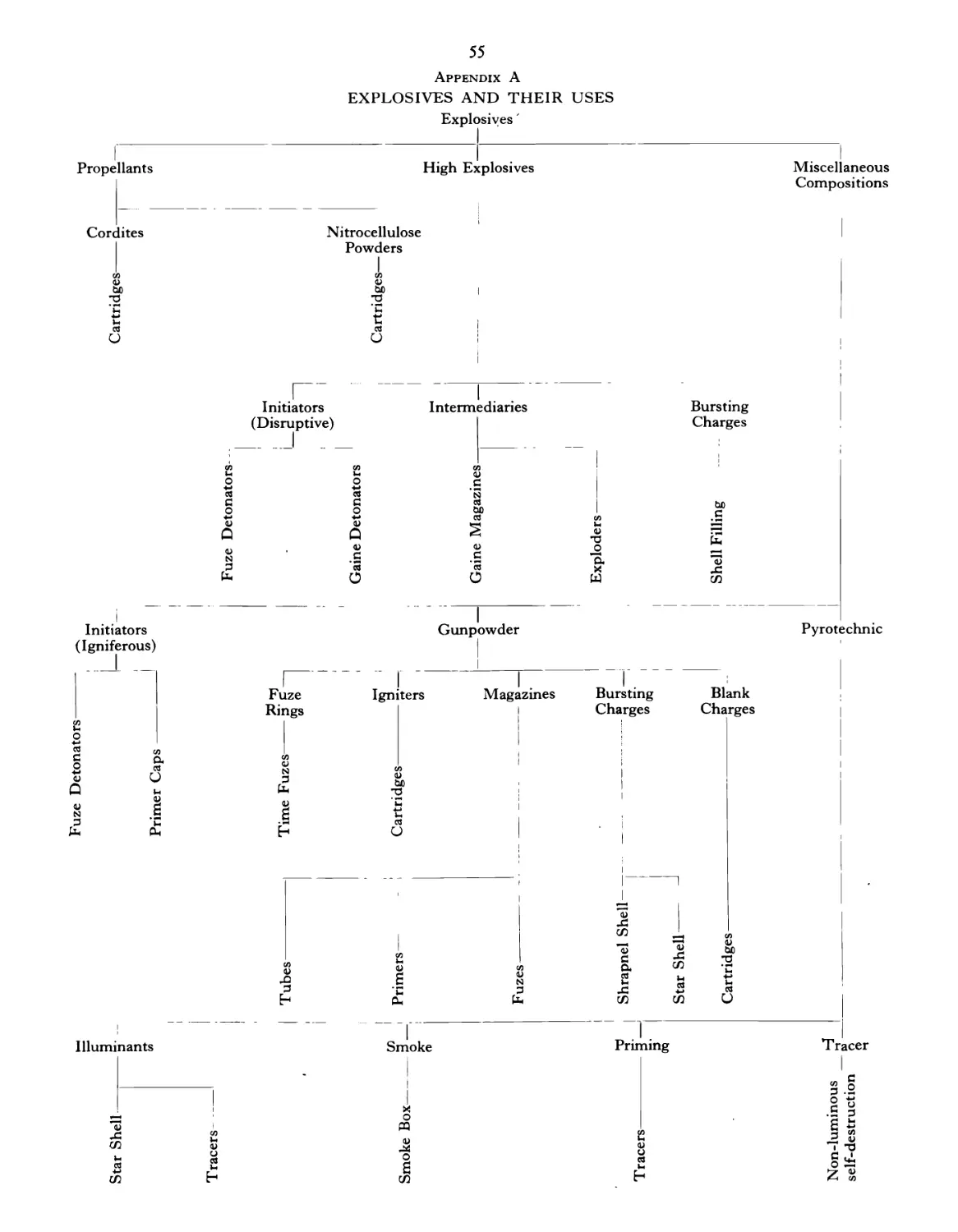
and uses of explosives is at Appendix A.
2.2	PROPELLANTS
2.21	Composition
Particulars of the basic propellants in current use
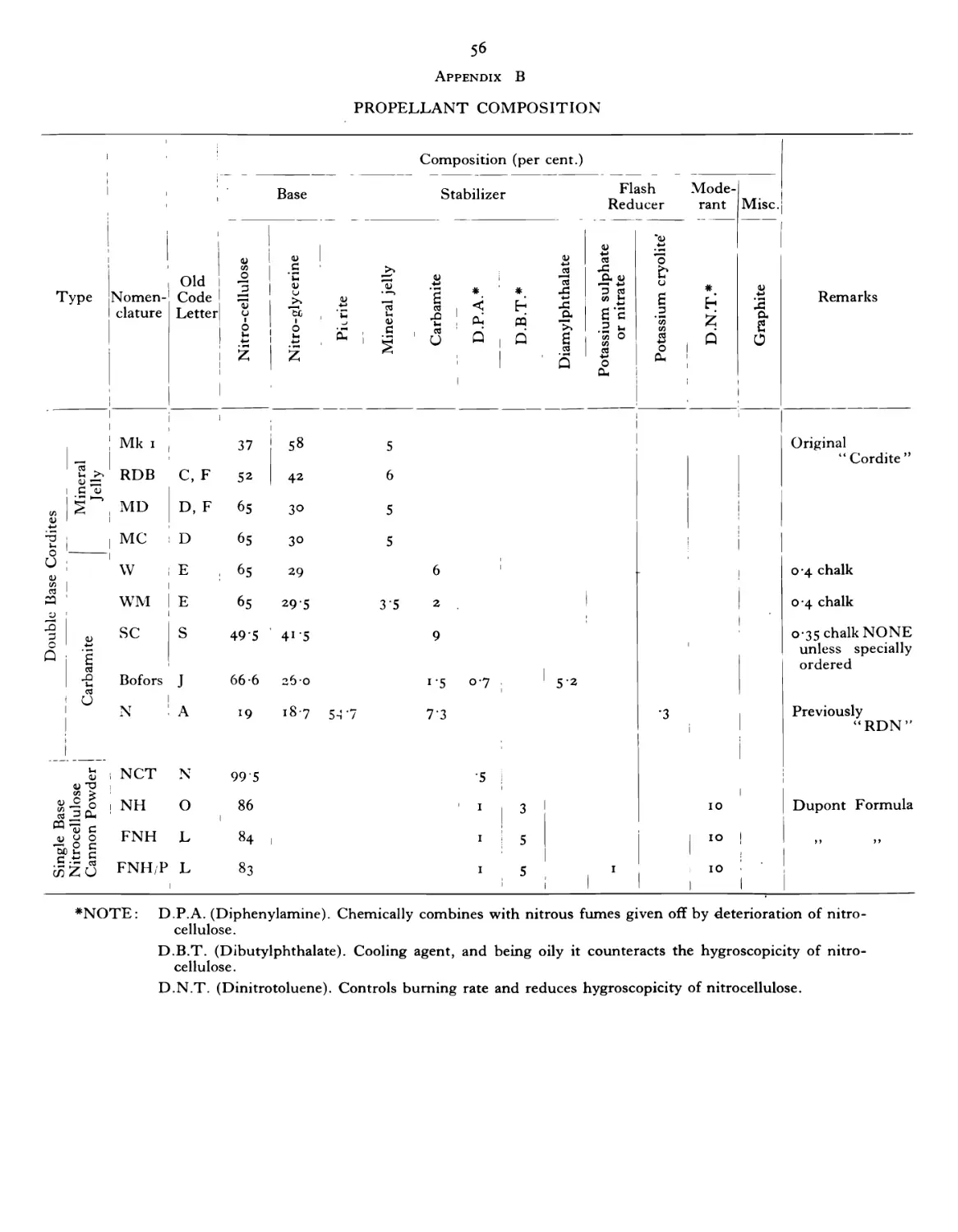
for A.A. ammunition are given in Appendix B.
All modem propellants used in the British service
contain nitrocellulose, and when based on this alone, are
known as “Single-base” types or “Nitrocellulose Cannon
Powders”. (The American term “Cannon Powder”,
which is synonymous with “Propellant” is misleading in
that these propellants are not powders as normally under-
stood.)
British “Double-base” type propellants contain
nitroglycerine in addition to nitrocellulose and are known
as “Cordites”. The cordites are often further described as
“Mineral Jelly” or “Carbamite” according to the
stabilizer used.
Picrite type propellants are based mainly on picrite
although they also contain nitrocellulose and nitro-
glycerine.
The cellulose employed in manufacture may be
derived from cotton, wood, grass, or other pulp. This is
nitrated and gelatinized. A stabilizer is added to reduce the
natural decay of such mixtures, and a flash inhibitor
incorporated (with or without a moderant} where flashless-
ness is required.
During manufacture, the propellant in the form of a
dough is generally pressed through dies which determine
the shape of the cross-section. This dough emerges in the
form of macaroni and is afterwards cut into long “sticks”
or very short lengths called “grains”.
2.22	Characteristics
The temperature of the propellant charge before
ignition affects the ballistics obtained. The Range Tables,
which are compiled for the service projectile at a standard
muzzle velocity, include data to show the variation in
shooting which may be expected due to variations in
charge temperature.
High charge temperatures lead to high chamber
pressures which may be excessive in extreme conditions.
Accordingly it is correct drill to keep charges as reasonably
cool as possible and particularly to keep ready-use ammuni-
tion at as uniform a temperature as possible to ensure
consistent shooting.
The heat conductivity of propellants is low, with the
consequence that charges tend to lag behind their sur-
roundings in regard to change of temperature. This
presents some problems in the determination of the
effective charge temperature, particularly with Q.F.
ammunition and is one of the main reasons why Q.F.
ammunition should not be subjected to direct sunlight.
Apart from this consideration, direct sunlight can do no
good, but may on the other hand in extreme cases produce
changes of ballistics, although this is unlikely with modern
propellants as compared with the older ones. The method
of measuring charge temperature is dealt with in training
manuals.
Propellants are produced in “Lots” which are
checked for homogeneity and performance. Cartridges
made up from one lot (as is indicated by the Batch
marking) should therefore be identical in character and
performance in a given gun.
With modem propellants, reasonable age does not
materially affect ballistics.
The colour of most propellants varies from a light
amber and various shades of blue and green to black. In
the case of cordite, the colour deepens with age.
The shape and size or form of the propellant deter-
mines the rate of burning and provides the necessary
control to suit different calibres and barrel lengths as well
as varying charges. Generally, the smaller the surface
area, the slower the rate of burning. The cross sections
most commonly used are shown in Fig. i.
4
PROPELLENT SHAPES.
FIG. I
CORD
(ORIGINAL CORDITE).
STRIP OR RIBBON
* SLIVERS ARE THE PORTIONS REMAINING BEHIND AFTER THE EXPOSED SURFACES HAVE BEEN CONSUMED INWARDS.
The equally undesirable features of flash and smoke,
although governed to a major extent by the actual com-
position of the propellant, are also affected by the ignition
and the peculiarities of the gun and charge. Unfortunately,
a decrease in flash can sometimes only be achieved at the
expense of an increase in smoke, and vice versa. In fact,
the term “flashless” (or “smokeless”) as applied to a
particular nature of propellant expresses the intention but
not necessarily the result, i.e., a charge described as
flashless may in some guns and some conditions give a
full flash.
The products of combustion of a flashless charge
contain carbon monoxide and are therefore poisonous.
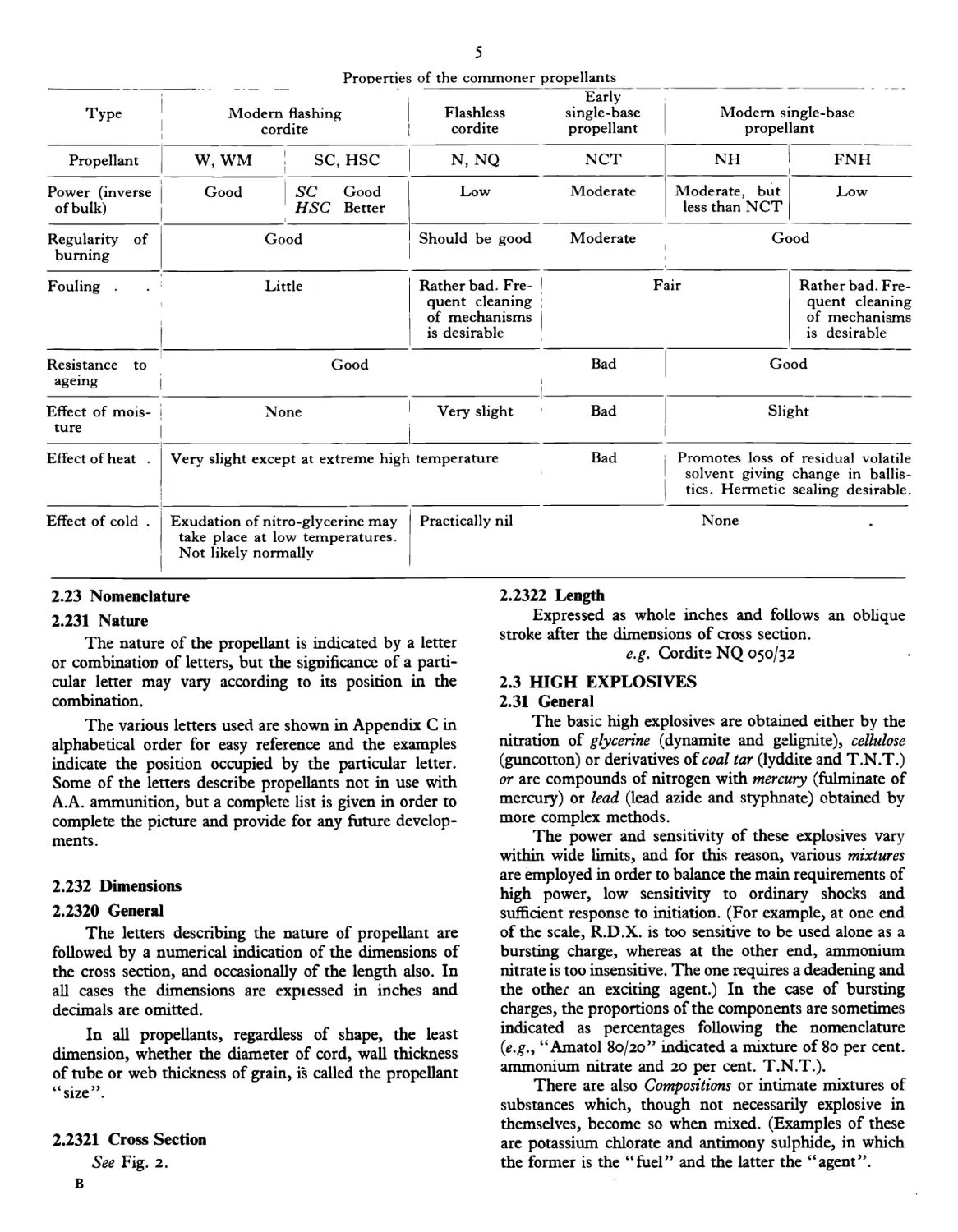
The chief characteristics and points of difference of
the main types of propellants are shown in the following
table:
Properties of the commoner propellants
Type	Modem flashing cordite		Flashless cordite	I	Early single-base propellant	Modem single-base propellant
Propellant	W, WM	SC, HSC	N, NQ	NCT 1	NH	FNH
Form	Completely colloidal or gela- tinous. Used in “sticks” and bundled		Not entirely colloidal and slightly brittle. Used in very short lengths or “grains”. Filled loose. (N may also be used in sticks)
Ignition .	Fairly easy with moderate quan- tity of gunpowder		Difficult. Re- quires more gunpowder than; W or WM i	Fairly difficult		Difficult
Smoke	Little		Considerable, but partly due to more powder for ignition	!	Moderate		Considerable, but partly due to more powder ignition
Flash	Considerable, particularly in high pressure guns 1		Practically none in many guns, but may be con- siderable in high pressure guns	Considerable		Practically none in many guns, but may be con- siderable	in high pressure guns
Erosion	Moderate	SC moderate HSC considerable	Little	Moderate i 1		Moderate, but less than NCT	Little
5
Type	Properties of the commoner propellants 1	. Early Modem flashing	Flashless	single-base cordite	[	cordite	propellant		Modem single-base propellant
Propellant	W, WM	SC, HSC	N, NQ	NCT	NH	।	FNH
Power (inverse of bulk)	Good	SC Good HSC Better	Low	Moderate	Moderate, but less than NCT	Low
Regularity of burning	Good	Should be good	Moderate	Good
Fouling .	Little i	Rather bad. Fre-	Fair quent cleaning ; of mechanisms is desirable		Rather bad. Fre- quent cleaning of mechanisms is desirable
Resistance to ageing	Good	Bad	Good
Effect of mois- ture	None	Very slight	Bad i	Slight
Effect of heat .	Very slight except at extreme high temperature	Bad		Promotes loss of residual volatile solvent giving change in ballis- । tics. Hermetic sealing desirable.
Effect of cold .	Exudation of nitro-glycerine may take place at low temperatures. Not likely normally	Practically nil	None	-
2.23	Nomenclature
2.231	Nature
The nature of the propellant is indicated by a letter
or combination of letters, but the significance of a parti-
cular letter may vary according to its position in the
combination.
The various letters used are shown in Appendix C in
alphabetical order for easy reference and the examples
indicate the position occupied by the particular letter.
Some of the letters describe propellants not in use with
A.A. ammunition, but a complete list is given in order to
complete the picture and provide for any future develop-
ments.
2.232	Dimensions
2.2320 General
The letters describing the nature of propellant are
followed by a numerical indication of the dimensions of
the cross section, and occasionally of the length also. In
all cases the dimensions are expiessed in inches and
decimals are omitted.
In all propellants, regardless of shape, the least
dimension, whether the diameter of cord, wall thickness
of tube or web thickness of grain, is called the propellant
“size”.
2.2321	Cross Section
See Fig. 2.
В
2.2322	Length
Expressed as whole inches and follows an oblique
stroke after the dimensions of cross section.
e.g. Cordite NQ 050/32
2.3	HIGH EXPLOSIVES
2.31	General
The basic high explosives are obtained either by the
nitration of glycerine (dynamite and gelignite), cellulose
(guncotton) or derivatives of coal tar (lyddite and T.N.T.)
or are compounds of nitrogen with mercury (fulminate of
mercury) or lead (lead azide and styphnate) obtained by
more complex methods.
The power and sensitivity of these explosives vary
within wide limits, and for this reason, various mixtures
are employed in order to balance the main requirements of
high power, low sensitivity to ordinary shocks and
sufficient response to initiation. (For example, at one end
of the scale, R.D.X. is too sensitive to be used alone as a
bursting charge, whereas at the other end, ammonium
nitrate is too insensitive. The one requires a deadening and
the other an exciting agent.) In the case of bursting
charges, the proportions of the components are sometimes
indicated as percentages following the nomenclature
(e.g., “Amatol 80/20” indicated a mixture of 80 per cent,
ammonium nitrate and 20 per cent. T.N.T.).
There are also Compositions or intimate mixtures of
substances which, though not necessarily explosive in
themselves, become so when mixed. (Examples of these
are potassium chlorate and antimony sulphide, in which
the former is the “fuel” and the latter the “agent”.
6
PROPELLANT DIMENSIONS	FIG. 2
	. DIMENSIONS OF CROSS - SECTION
TYPE	UNIT OF INCH	EXPLANATION		EXAMPLE
MINERAL JELLY CORDITES.	1/100	DIAMETER OF DIE USED TTi	'w//,	NOT THE SIZE OF FINISHED PRODUCT.		RDB 8
CARBAMITE CORDITES.	1/1000	EXTERNAL DIAMETER OF DRY (FINISHED) CORDITE.		W 145
RIBBON (CARBAMITE CORDITE ONLY.)	1/1000	WIDTH (Ы THICKNESS OF STRII	3 I THICKNESS (a) FOLLOWED BY WIDTH ’ (FINISHED SIZE) a-b	NQ/R 014x048
TUBULAR AND SLOTTED TUBE CORDITES.	1/1000	b~T~	k	EXTERNAL - INTERNAL DIAMETERS a	(FINISHED SIZE) >	i-b	WMT 211 100
MULTI-TUBULAR CORDITES AND NITROCELLULOSE POWDERS.	1/1000	AVERAGE WEB THICKNESS (FINISHED) a»b		NH 023
Small amounts of aluminium powder, mealed
powder and sulphur are also used to increase the amount of
heat and/or flame for initiators, and powdered glass to
increase friction and promote initiation. Beeswax and
paraffin wax are used mainly as desensitizing agents.
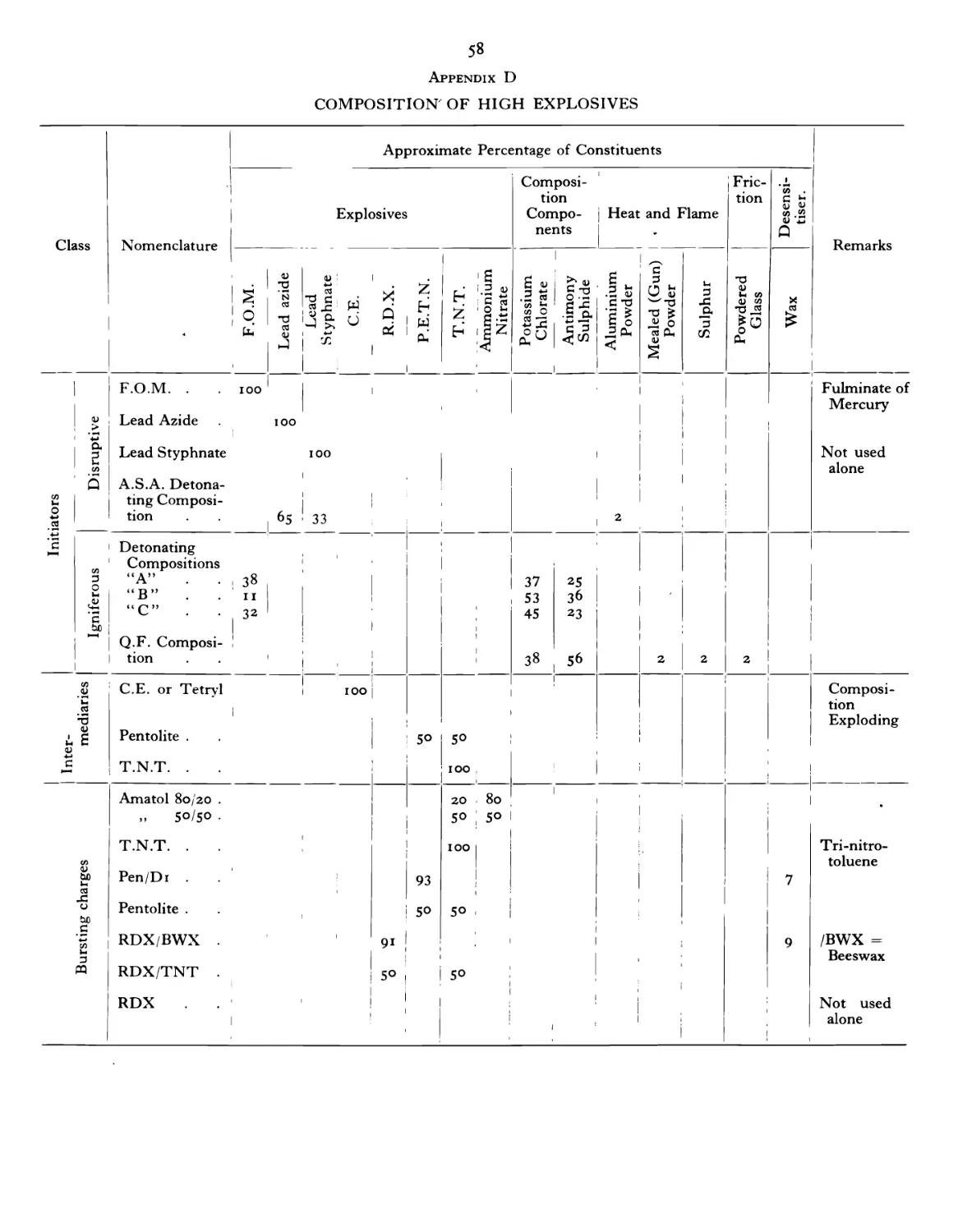
The constituents of the principal high explosives are
given in Appendix D.
The high explosives used in gun shell are conveniently
divided into the following groups:
Bursters
Initiators (Disruptive)
Intermediaries
The Burster is normally chosen for its relative insen-
sitivity and for its power and violence which determines
blast and fragmentation respectively.
The Initiator is chosen for its ability to detonate
either as the ultimate result of contact with flash or as a
result of a relatively light blow. When detonated as the
result of contact with flash it is said to “bum to detona-
tion”, a phenomenon in which, in effect, a part of the
H.E. bums with explosive violence so producing a “self
detonating” shock for the remainder.
As the H.E. initiators are thus necessarily very sensi-
tive, the amount which can be safely used in a gun
projectile are small, and it must be carefully supported.
Usually the initiator is carried in a small copper detonator
shell.
The Intermediary has to pick up the small impulse
from the H.E. initiator, amplify it and pass it on as a
detonation impulse adequate to secure the efficient
detonation of the burster. As they are necessarily required
in somewhat greater quantity than the H.E. initiators, the
intermediaries are less sensitive than the H.E. initiators.
When used between the magazine of a fuze or gaine and
the burster in the shell, the intermediary is usually called
the “exploder” which in fact is a rather misleading term.
The American term “Booster” is more descriptive.
7
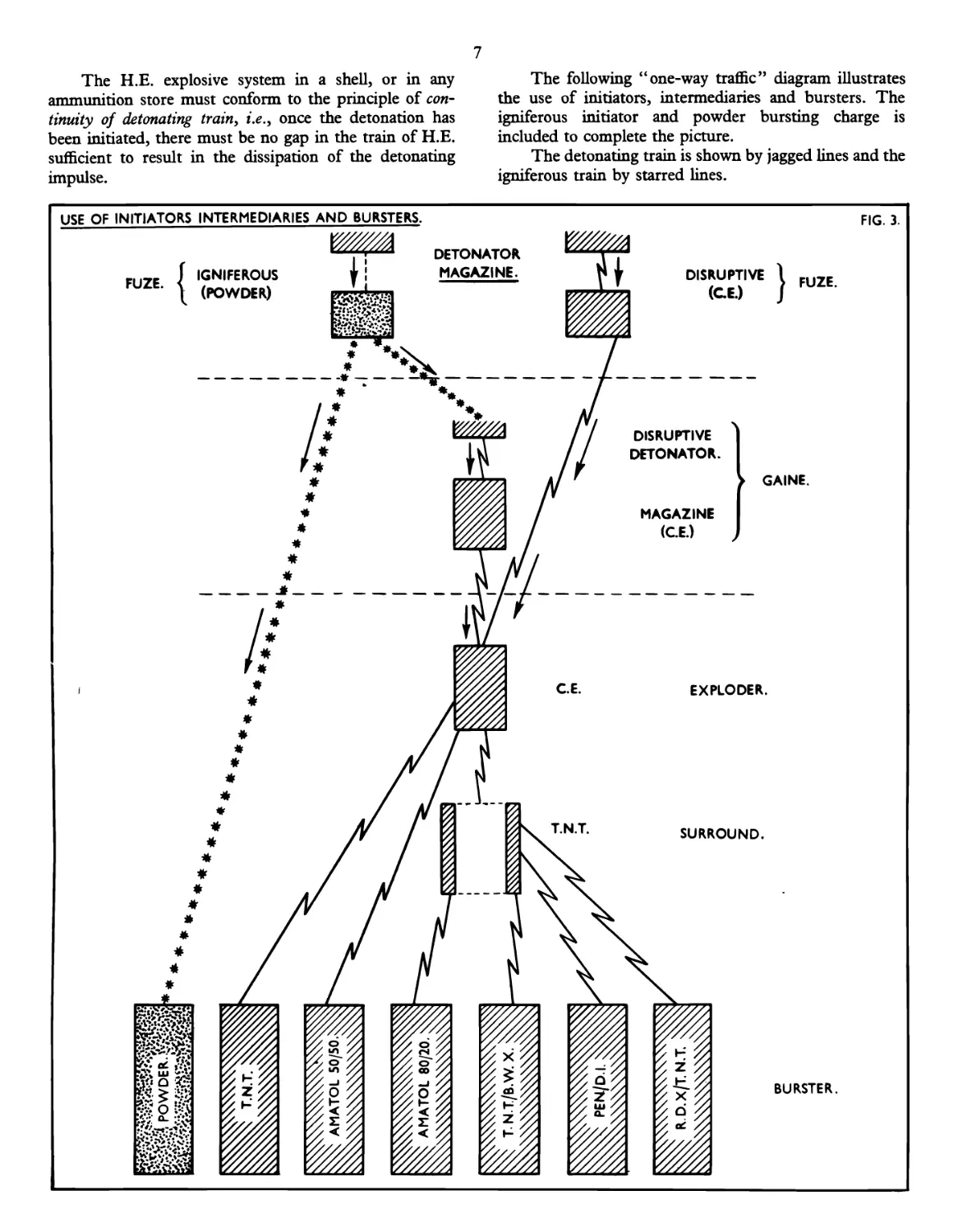
The H.E. explosive system in a shell, or in any
ammunition store must conform to the principle of con-
tinuity of detonating train, i.e., once the detonation has
been initiated, there must be no gap in the train of H.E.
sufficient to result in the dissipation of the detonating
impulse.
The following “one-way traffic” diagram illustrates
the use of initiators, intermediaries and bursters. The
igniferous initiator and powder bursting charge is
included to complete the picture.
The detonating train is shown by jagged lines and the
igniferous train by starred lines.
8
The characteristics of the various high explosives met
with in A.A. ammunition will now be considered indivi-
dually.
2.32	Initiators (Disruptive)
2.321	Fulminate of Mercury
This consists of small grey or brownish-grey crystals
resembling fine sand. It is very sensitive to shock, flame
and friction. When ignited it bums to detonation very
quickly.. It tends to become rather less sensitive when
compressed and in this condition it is said to be “dead
pressed”.
Warm damp storage has a deleterious effect on fulmi-
nate, decomposing it and causing interaction with the
metallic envelope. Hot dry storage also renders fulminate
unserviceable, especially when in the small quantities, four
to six grains, used in gaines and fuzes. Consequently,
gaines and fuzes fitted with fulminate detonators must be
protected from heat as much as possible, particularly from
direct sunlight.
It is rarely used alone, its commonest application
being as a sensitizer in igniferous initiating mixtures.
2.322	Lead Azide
This is a white or grey powder of small crystals. It is
not as sensitive to blows as fulminate but somewhat more
sensitive to friction.
Owing to changes in the crystals which take place
when the substance is wet and which render it progressively
more sensitive, lead azide must not be allowed to become
wet.
It is widely used in disruptive detonators, and if
required to be initiated by a blow, such detonators are
frequently sensitized by a layer of sensitive igniferous
initiator.
Lead azide is used as a filling for gaine and fuze
detonators.
2.323	Lead Styphnate
This is a bright orange-yellow powder. It is rather
less sensitive to friction and impact than fulminate but
bums rapidly to detonation and is unaffected by moisture or
temperature. It is not used alone.
2.324	A.S.A.
This is a mixture of lead azide, lead styphnate and a
small proportion of aluminium powder.
It is bright orange in colour and is very sensitive both
to flash and to blows. It is stable in dry storage.
It is employed widely in disruptive detonators and
does not require sensitization as does lead azide. It is used
in the lower disruptive detonator in graze action percus-
sion fuzes under an igniferous detonator.
2.33	Intermediaries
2.331	C.E. (Composition Exploding) or Tetryl
This is a pale yellow crystalline powder which is stable
under ordinary conditions of temperature and moisture.
It is a powerful and violent high explosive of inter-
mediate sensitivity, i.e., such that it can be caused to
detonate correctly by the detonation in contact with it of
an acceptably small quantity of disruptive initiator.
It is widely used as a filling in fuze and gaine maga-
zines and in small quantities to complete the detonating
train between successive parts of a high explosive train.
In powder or in pressed form it is also used as the
“exploder” in H.E. shell.
2.332	R.D.X./Beeswax
R.D.X. is an extremely powerful and violent high
explosive of sensitivity rather greater than C.E. When
mixed with beeswax its sensitivity is greatly reduced and,
in this form it can be formed into pellets. Such pellets are
used in the exploder system of some H.E. shell, but owing
to their low sensitivity they must be used to follow a
reasonable quantity of intermediary of greater sensitivity,
such as C.E.
The advantage of using R.D.X./BWX as an inter-
mediary resides in the fact that it builds up to its full rate
of detonation very quickly so that the burster in the shell
is thoroughly initiated at its upper end as well as lower in
the shell cavity.
2.333	P.E.T.N. or Penthrite
This is an extremely violent and powerful explosive
and is too sensitive to be used alone.
It is unaffected by heat and moisture and is stable.
2.334	Pentolite
This is a mixture of T.N.T. with P.E.T.N., forming
a pale yellow crystalline mass. The T.N.T. serves to
desensitize the P.E.T.N. Various mixtures are used, but
the commonest contains 50 per cent, by weight of each
ingredient and is known as Pentolite 50/50. and is used
as an alternative to C.E. in the magazines of fuzes and
gaines.
2.335	T.N.T. (Trinitrotoluene)
T.N.T. in crystalline flake form (T.N.T. Grade 1
Exploder Flake) can be used either loose or in the form of
prepressed pellets as an intermediary.
It is more sensitive than cast T.N.T., but less so than
C.E., and often an exploder system will, for this reason,
have a T.N.T. intermediary at the lower end of the shell
cavity only.
T.N.T. is also sometimes used in the form of a cast
tube surrounding the exploder cavity when the burster is
amatol for example. This “T.N.T. Surround”, as it is
called, is used for a number of reasons, but when used
with amatol it can also be regarded as part of the inter-
mediary system since T.N.T. is more sensitive and more
violent than amatol and can thus be regarded as helping
the exploder system to secure correct detonation of the
amatol.
9
2.34	Bursters
2.341 T.N.T. (Trinitrotoluene)
This is a pale yellow substance with a melting point
somewhat below the boiling point of water. It has a low
sensitivity (as have all bursters) and is normally filled into
the shell cavity in molten condition and allowed to set.
It is chemically inert and is unaffected by moisture.
Modem T.N.T. which is pure is unaffected by ordinary
variations in temperature, although extremes of heat can
cause an oily and explosive exudation which may get
nipped in the threads and thus cause a premature.
It has little or no effect on metals.
T.N.T. is used alone as a bursting charge and also as
an ingredient in a considerable number of mixed high
explosives, such as the amatols, R.D.X./T.N.T. and
Pentolite.
As very little smoke is given off on detonation, either
a smoke-box may be inserted, or a smoke mixture incor-
porated in the main filling to assist observation.
2.342 Ammonium Nitrate
As with T.N.T., only the purest is used, as the lower
grades contain impurities that affect the stability of the
mixture in the case of amatol, should the T.N.T. also be
of low grade.
Ammonium nitrate is very hygroscopic and when
wet attacks metals, some of the corrosive products being
very sensitive.
It is too insensitive to be used alone.
2.343 Amatol
This intimate mixture of T.N.T. and ammonium
nitrate is more powerful but less violent than T.N.T.
Broadly speaking, in the amatols, increase of ammonium
nitrate content corresponds to decrease of sensitivity and
violence but increase in power.
Ammonium nitrate being hygroscopic and water
soluble, amatols must be kept dry, in which latter condi-
tion they are stable and inert.
Because of the hygroscopicity of the nitrate the
interior of shells are protected by copal varnish and other
metal parts by R.D. cement, in addition to special sealing
arrangements.
Amatol is made by stirring the nitrate into molten
T.N.T. and this mixture is either poured into the shell as
with T.N.T., or forced in by screw action if the mixture is
too “stodgy” as it is with 80/20.
Amatol was used as a bursting charge mainly in order
to economize in T.N.T., the nitrate being cheap and easy
to produce. The only mixture to.be found in A.A.
ammunition is 50/50 and that was produced only for a
short time.
In view of their lower violence, the lethality of
amatol shell from the point of view of fragmentation is not
as good as that of the same shell filled with T.N.T.
2.344 PEN/D.l
This consists of pentolite desensitized by the incor-
poration of wax, usually to about nine per cent, of the
weight of the mixture.
This desensitized pentolite is used as a main shell
filling.
2.345 R.D.X.
This is another very powerful and very violent high
explosive of too great a sensitivity to be used alone as a
burster. Mixed with 40 to 50 per cent. T.N.T., the
mixture is suitable for use as a burster in shell, as also are
some mixtures of R.D.X. and Beeswax.
R.D.X. is not affected by moisture or temperature
variations and has no effect on metals.
2.4	MISCELLANEOUS COMPOSITIONS
2.41	General
This group of explosives broadly speaking includes
the mixtures which bum, but are not employed as pro-
pellants and which, under normal conditions of use, do
not undergo detonation.
Those compositions used in A.A. ammunition will
be considered individually.
2.42	Gunpowder
This consists of a mixture of potassium nitrate,
charcoal and sulphur in the proportions of 75.5 per cent.,
14.5 per cent, and 10 per cent., respectively. These
ingredients are ground, mixed in the wet condition, dried
and granulated. The granular material resulting is
sieved to give products of regular grain sizes.
Gunpowder is very sensitive to flash and when
ignited bums with great rapidity. It is sensitive to moisture
(since potassium nitrate is water soluble) and if allowed
to become damp, cakes on subsequent drying.
Sulphurless gunpowder is a mixture of 70.5 per cent,
of potassium nitrate and 29.5 per cent, of charcoal. It is
employed as a priming.
The rate of burning of gunpowder depends upon its
grain size and is faster the smaller the grain.
2.43 Fuze powders
2.431 General
Fuze powders as a whole are very sensitive to moisture,
which in quite small quantities alters their rate of burning
very considerably.
2.432 22 sec. and 30 sec. Powders
These consist of 75 per cent, potassium nitrate,
16 per cent, charcoal and nine per cent, sulphur. They are
made with specially selected charcoal and under very
carefully controlled conditions so as to produce powders
which bum regularly and at the desired speed.
10
2.433 S.R. 227 and 227A
These are very similar to gunpowder, their composi-
tion being 72 per cent, potassium nitrate, 21 per cent,
charcoal and seven per cent, sulphur.
S.R. 227A is used in A.A. combustion time fuzes.
2.434 R.D. 202
This is a slagless powder, so called to distinguish it
from the other fuze powders which, like gunpowder, yield
on burning a large quantity of solid residue. It contains
77 per cent, ammonium perchlorate, 20 per cent, charcoal
and three per cent, starch.
2.44	Pyrotechnic Compositions
Such materials are used for illumination, signals,
incendiary purposes, smoke production and tracing.
Broadly they all comprise a combustible material and a
source of oxygen.
The rate of burning depends on the proportions of
the mixture, the nature of the ingredients and the degree
of aggregation as well as the pressure under which the
burning takes place.
The nature of the result is modified as required by
the introduction of modifying agents such as metallic
salts, dyes, smoke producing ingredients, etc. The com-
position may also include bonding agents such as resins,
waxes and the like.
2.45	Igniferous initiators
2.451 General
Igniferous compositions, used for the initiation of
flash, consist basically of a fuel (antimony sulphide) and
a source of oxygen (potassium chlorate).
These substances alone in intimate mixture are
already fairly sensitive to shock, but are made more so by
the addition of a sensitizing ingredient.
2.452	Detonator Compositions
2.4521 General
In these compositions the sensitizing ingredient is
mercury fulminate and they have been given a rather
unfortunate name. It should be clearly understood that
none of these compositions is ever employed to initiate
detonation directly. On the contrary, they are used to
initiate combustion. The four compositions, А, В, C, and
D, differ mainly in the proportions of their ingredients
which modify their sensitivity and their intensity of
burning. Sensitivity may be lost in tropical storage.
2.4522 D.C.A.
This is widely used for igniferous initiation in fuzes
and as a sensitizing layer for lead azide in some disruptive
detonators.
2.4523 D.C.B.
This is also employed in fuzes.
2.4524 D.C.C.
Not widely used.
2.4525 D.C.D.
Not widely used.
2.453	Q.F. Composition
This mixture of antimony sulphide and potassium
chlorate is sensitized by an addition of mealed gun-
powder, sulphur and powdered glass. It is much more
stable than D.C.A., for example, but rather less effective
and less sensitive. It has the advantage over D.C.A., that,
when filled into primer caps, it is not liable to sensitization
by shock as is D.C.A., a fact which led to the restoration
of Q.F. composition as a filling for some primer caps during
the 1939-45 war.
2.454	Cap Composition
This is used for the caps of small arms cartridges and
for the caps of tubes, percussion, small arms cartridges.
The sensitizer is mealed gunpowder, sulphur and mercury
fulminate. Here again, the composition deteriorates in
tropical storage conditions.
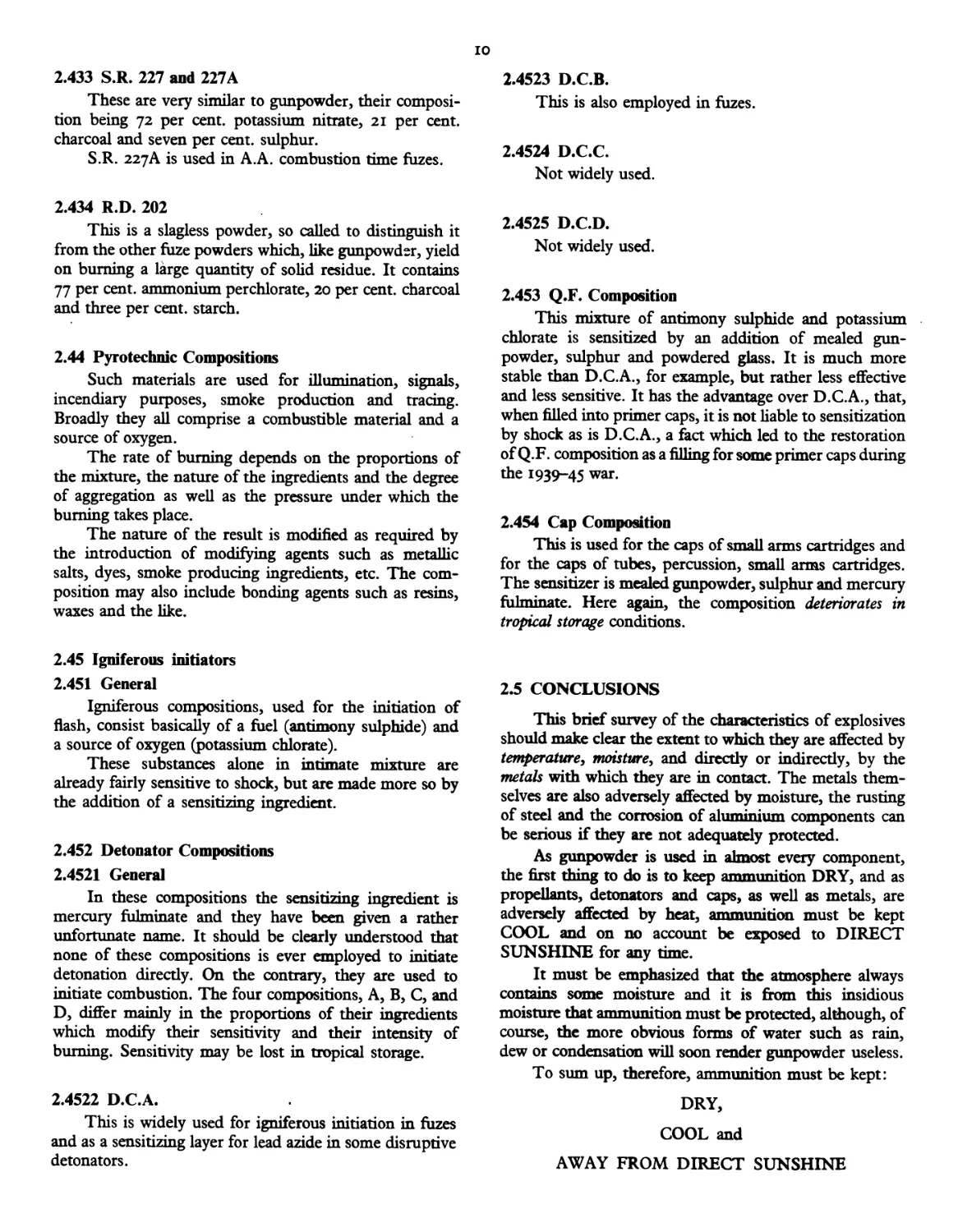
2.5	CONCLUSIONS
This brief survey of the characteristics of explosives
should make clear the extent to which they are affected by
temperature, moisture, and directly or indirectly, by the
metals with which they are in contact. The metals them-
selves are also adversely affected by moisture, the rusting
of steel and the corrosion of aluminium components can
be serious if they are not adequately protected.
As gunpowder is used in almost every component,
the first thing to do is to keep ammunition DRY, and as
propellants, detonators and caps, as well as metals, are
adversely affected by heat, ammunition must be kept
COOL and on no account be exposed to DIRECT
SUNSHINE for any time.
It must be emphasized that the atmosphere always
contains some moisture and it is from this insidious
moisture that ammunition must be protected, although, of
course, the more obvious forms of water such as rain,
dew or condensation will soon render gunpowder useless.
To sum up, therefore, ammunition must be kept:
DRY,
COOL and
AWAY FROM DIRECT SUNSHINE
II
3. THE CARTRIDGE
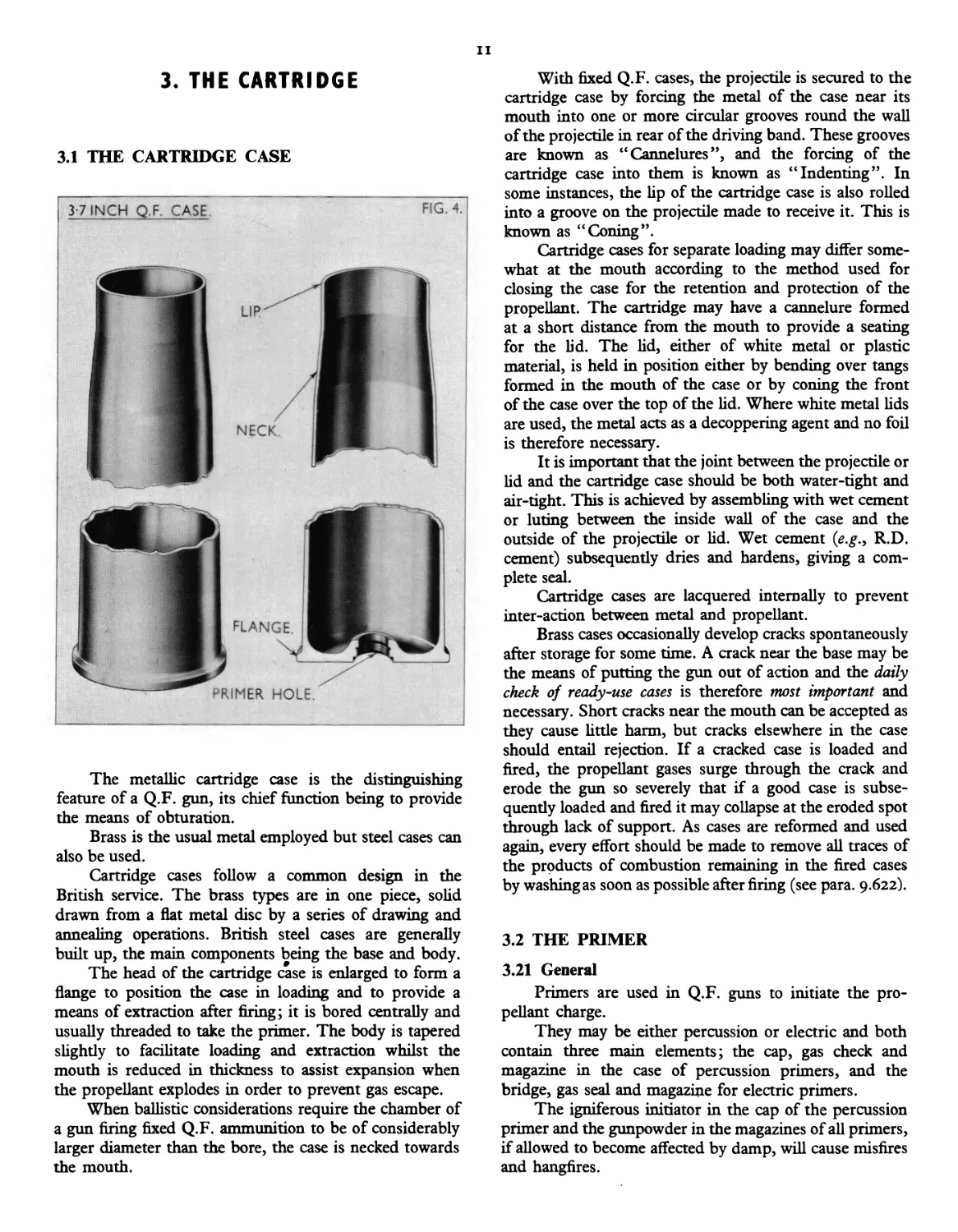
3.1 THE CARTRIDGE CASE
The metallic cartridge case is the distinguishing
feature of a Q.F. gun, its chief function being to provide
the means of obturation.
Brass is the usual metal employed but steel cases can
also be used.
Cartridge cases follow a common design in the
British service. The brass types are in one piece, solid
drawn from a flat metal disc by a series of drawing and
annealing operations. British steel cases are generally
built up, the main components being the base and body.
The head of the cartridge case is enlarged to form a
flange to position the case in loading and to provide a
means of extraction after firing; it is bored centrally and
usually threaded to take the primer. The body is tapered
slightly to facilitate loading and extraction whilst the
mouth is reduced in thickness to assist expansion when
the propellant explodes in order to prevent gas escape.
When ballistic considerations require the chamber of
a gun firing fixed Q.F. ammunition to be of considerably
larger diameter than the bore, the case is necked towards
the mouth.
With fixed Q.F. cases, the projectile is secured to the
cartridge case by forcing the metal of the case near its
mouth into one or more circular grooves round the wall
of the projectile in rear of the driving band. These grooves
are known as “Cannelures”, and the forcing of the
cartridge case into them is known as “Indenting”. In
some instances, the lip of the cartridge case is also rolled
into a groove on the projectile made to receive it. This is
known as “Coning”.
Cartridge cases for separate loading may differ some-
what at the mouth according to the method used for
closing the case for the retention and protection of the
propellant. The cartridge may have a cannelure formed
at a short distance from the mouth to provide a seating
for the lid. The lid, either of white metal or plastic
material, is held in position either by bending over tangs
formed in the mouth of the case or by coning the front
of the case over the top of the lid. Where white metal lids
are used, the metal acts as a decoppering agent and no foil
is therefore necessary.
It is important that the joint between the projectile or
lid and the cartridge case should be both water-tight and
air-tight. This is achieved by assembling with wet cement
or luting between the inside wall of the case and the
outside of the projectile or lid. Wet cement (e.g.9 R.D.
cement) subsequently dries and hardens, giving a com-
plete seal.
Cartridge cases are lacquered internally to prevent
inter-action between metal and propellant.
Brass cases occasionally develop cracks spontaneously
after storage for some time. A crack near the base may be
the means of putting the gun out of action and the daily
check of ready-use cases is therefore most important and
necessary. Short cracks near the mouth can be accepted as
they cause little harm, but cracks elsewhere in the case
should entail rejection. If a cracked case is loaded and
fired, the propellant gases surge through the crack and
erode the gun so severely that if a good case is subse-
quently loaded and fired it may collapse at the eroded spot
through lack of support. As cases are reformed and used
again, every effort should be made to remove all traces of
the products of combustion remaining in the fired cases
by washingas soon as possible after firing (see para. 9.622).
3.2	THE PRIMER
3.21	General
Primers are used in Q.F. guns to initiate the pro-
pellant charge.
They may be either percussion or electric and both
contain three main elements; the cap, gas check and
magazine in the case of percussion primers, and the
bridge, gas seal and magazine for electric primers.
The igniferous initiator in the cap of the percussion
primer and the gunpowder in the magazines of all primers,
if allowed to become affected by damp, will cause misfires
and hangfires.
12
With some primers and propellants an igniter is also
used to reinforce the flash from the primer and ensure
efficient ignition.
Primers can be repaired and used again.
Primers should invariably be removed from the
cartridge case should it ever be necessary to use force to
get the case into the breech of the gun. This particularly
applies to any form of hammering, as not only might the
primer cap be struck by accident but the shock might well
damage it. The primer can be replaced once the case is
fully home.
3.22	Percussion
3.221 Description
3.2211 Cap
This consists of a small copper shell containing about
i grain of cap composition, covered with a tin foil disc and
assembled with a fillet of waterproofing composition in the
primer, with the open end close to an anvil and nearest to
the magazine. Either D.C.A. or Q.F. composition may
be used. D.C.A. is somewhat more sensitive and provides
more certainty in action, but experience has shown that if
primers containing this composition are rammed home by
a power rammer and subsequently unloaded there is a
serious risk that they will function prematurely when next
rammed into the gun. In fact, a primer containing D.C.A.
must NOT be power rammed a second time, but should be
removed when the round is unloaded and replaced by a
new primer. (Primers containing D.C.A. (“A” composition)
aie not specifically marked but all primers containing Q.F.
composition subsequent to August 1940, have the letter
“Q” stamped on the base. Some of the packages for
the “Q” primers also had the letter “Q” stamped on the
ends, but this has since been discontinued.)
The cap composition is initiated by the cap being
driven down on to the striker by the striker of the breech
mechanism.
3.2212 Gas Check
The obturation or prevention of gas escape through or
past the primer is of great importance as gas wash may
cause serious damage to the breech mechanism.
Rearward escape of gas through the primer is pre-
vented by a copper ball or cone which is contained in a
central recess in the anvil and retained by a plug. This
recess is connected by fire holes in the anvil to the cap
and by fire holes in the plug to the magazine. This
arrangement permits the flash from the cap to pass to the
magazine, but the ball or cone is forced back on to a seating
by the explosion of the primer magazine and thus seals
the fire holes in the anvil.
3.2213 Magazine
The magazine may be formed in the body of the
primer or it may be a separate component screwed on to
the primer. Its length may vary within wide limits. It
contains gunpowder, usually G.12.
Integral magazines have a closing disc securely fixed
to the body but weakened to provide an easy opening
without fracturing, as debris in the bore might be trouble-
some.
The separate magazine is provided with fire holes,
and a liner prevents escape of the powder, the liner being
also varnished with shellac varnish as a protection against
damp. Some of these magazines have a fire hole at the
forward end and to prevent accidental perforation of the
liner by the propellant, this hole is covered by a white
metal “dome”, the white metal of which also acts as a
decoppering agent.
3.222 Action
The striker of the firing mechanism is driven on to
the cap (or cap holder) and the composition is nipped on
the anvil. The flame passes through the fire holes in anvil
and plug, past the ball or cone and ignites the gunpowder
in the magazine. The resultant explosion forces the ball
or cone back on to its seating preventing internal gas
escape, and passes through the closing disc or fire holes
to ignite the propellant charge. In primers without a ball
or cone sealing device, the cap is forced rearwardly on to
the face of the breech block, where it is supported and
serves to prevent gas escape.
3.23 Electric
3.231 Description
3.2311 Bridge
The bridge consists of a short length of iridio plati-
num wire, both ends of which are secured to the bridge
plug, one to a copper wire running down the insulated
centre of the body to a contact piece and the other to an
earthed pole piece.
Guncotton dust surrounds the bridge, and a per-
forated powder pellet is held to the plug by a screwed
cover.
3.2312 Gas Seal
Obturation through the primer is secured by the
copper bridge plug which is shaped at the rear to wedge in
the correspondingly shaped opening in the body. It is also
provided with a gas check lip at the front to act as an
obturator.
3.2313 Magazine
The separate magazine contains gunpowder (G.12)
and is provided with a number of fire holes or vents. The
front vent of the magazine is closed with a white metal
dome to prevent intrusion of stick propellant. There is
a liner to prevent escape of the powder.
3.232 Action
The firing pin of the breech mechanism makes con-
tact with the contact piece, and when a firing current is
passed through the insulated copper wire the bridge fuses,
ignites the guncotton yam, the pellet and gunpowder in
the magazine. The explosion of the primer magazine
forces the bridge plug back into the coned opening and
outwards at the front gas check lip to prevent internal gas
escape. The flame from the magazine ignites the pro-
pellant charge.
3.3 THE IGNITER
This consists of a shalloon bag containing gun-
powder. It is placed round or in front of the primer in
certain cartridges and assists the ignition of the propellant
charge.
14
3.4 THE PROPELLANT CHARGE
See Appendix E.
The propellant charge may be made up of cords or
sticks or it may be in granulated form as grains.
When cords are used, they are tied in bundles with
silk sewing, cotton sewing or shalloon braid, and arranged
to fit over and around the primer.
With a granular propellant, the charge is filled loose
into the case. If there is consideiable free space in the
case of a fixed Q.F. round, the propellant may be confined
to the rear of the case by means of a leather board cap
shellacked into position and supported by a distance piece
(e.g., a cardboard tube) between the cap and the base of
the projectile.
3.5 THE DECOPPERING CHARGE
Tinfoil or leadfoil is incorporated in the charge, when
necessary, to counteract coppering of the bore. Special
decoppering charges, containing an extra amount of foil
may be used for cleaning a badly coppered gun, although
such charges are not a normal service issue.
Where white metal lids are used to close separate
loading Q.F. cartridge cases, the white metal of the lid
acts as a decoppering agent and no foil is necessary.
Similarly the white metal domes of some primers assist
the decoppering action although additional tin or lead foil
is still required in these cases.
4.	THE PROJECTILE
4.1	GENERAL
4.11	Body
The bodies of all projectile are manufactured from
steel or iron, the type of which depends upon the use to
which the projectile is put.
The external contour of the projectile is mainly
cylindrical, but may be tapered (streamlined) at the rear
and is provided with an ogival or radiused head to reduce
air resistance in flight. The cylindrical portion is provided
with a circumferential groove or grooves to accommodate
the driving band or bands.
4.12	Base
The bases of practice projectiles and shrapnel shell
are usually plain.
With H.E. shell a rolled steel plate is used as a
protection against propellant gases reacting on the H.E.
filling and causing a premature.
Some projectiles have recesses in the base to take
tracers and/or shell igniters.
4.13	Driving Band
The metal used is usually copper although various
alloys of copper and nickel as well as sintered iron are also
used.
The driving band serves the purpose of sealing the
propellant gases behind the projectile, imparting a spin
that continues throughout the flight of the shell and of
centring the projectile in the bore of the gun.
The rotation or spinning of the shell enables an
elongated projectile to be used.
The centring is seldom well done except in the case
of projectiles with forward as well as rear driving bands.
More than one driving band is often used for high
velocity guns and the functions of sealing, driving and
centring are variously shared by the bands according to
the design.
4.14	Head
The head is ogival, that is to say, the parallel sides
of the projectile are curved inwards forwardly of the
shoulder to form a point. Some projectiles are more
pointed than others and the actual shape is expressed
according to the radius of the curve or ogive expressed in
calibres and referred to as the “calibre radius head” or
“CRH’,’.
Prior to 1945, if the CRH exceeded two, it was indi-
cated by the addition of a letter to the mark of the
projectile according to the following code:
CRH	Code letter
From 2 to 4	A
„ 4 to 6	В
„ 6 to 8	.	C
„ 8 to io	D
The radius referred to above includes the fuze and/or
ballistic cap when fitted.
4.2	THE SHELL
4.21	High Explosive
The high explosive shell is forged to form a cavity for
the explosive, the mouth being screwed to take the fuze.
The interior is varnished, the explosive is poured or
pressed into position, a central cavity being left to receive
a smoke box or exploder while the upper surface of a
filling is topped with a waterproofing material.
The smoke box contains red phosphorus and gives
off a white puff of smoke to indicate the point of burst.
Many shell are not fitted with a smoke box as the distinc-
tive black smoke produced as the result of the detonation
of the T.N. T. or R.D.X. filling is sufficient. A distinctive
red burst can be obtained by the introduction of a red dye
in the H.E. filling, such shell, however because of the
reduction in the H.E. content are only semi-lethal.
Shell fuzed with percussion or proximity fuzes for
use in the A.A. role are also fitted with a self-destroying
element designed to burst the shell after a given time of
flight. This is essential in order to avoid functioning on
reaching the ground should the aircraft target have been
missed. The self-destruction element is in the nature of
a secondary fuze and may be electric, mechanical or
combustion type. The simplest form consists of a shell
igniter in the base of the shell to ensure self-destruction
after a fixed time of flight.
When the fuze or gaine functions, the exploder picks
up the detonating wave from the C.E. pellet or magazine,
amplifies it and detonates the main filling. When the
self-destruction device functions the shell is generally
exploded only by the ignition of the filling by a powder
magazine.
Details of Methods of Filling are shown in
Appendix H.
16
4.22 Shrapnel
Shrapnel shell have a separate head attached by a
shoit screw thread or by set screws and twisting pins and
an internal fillet of solder. A recess in the base is fitted
with a tin cup charged with gunpowder, and above this a
thick steel disc with a central hole rests on a ledge. A
central tube connects the fuze hole bush with the tin cup.
The space between the central tube and the inside wall of
the shell is filled with lead alloy bullets embedded in resin.
The fuze hole bush is threaded to receive the fuze and
screws into the nose of the shell and is soldered to the tube.
The explosion of the fuze sends a flame down the
tube to ignite the gunpowder charge which explodes. The
steel disc is forced forward, carrying the bullets, resin,
central tube, head of shell, with fuze hole bush and fuze,
clear of the shell body. The components are thus separated
and follow generally the path of the trajectory. The bullets,
acting under centrifugal force, spread out to form a cone.
The shell body is not broken up by the explosion.
A.A. shrapnel is fitted with a time fuze, but if this
fails to burst in the air there is little risk of the shell
bursting on graze.
Shrapnel is not at present in use in the British service.
17
4.23 Practice Projectiles
Practice projectiles are of the ordinary H.E. type
except that the main filling is either gunpowder, a gun-
powder composition or an inert substance known as
“H.E. Substitute”, or H.E.S.
Practice projectiles for the larger calibres normally
consist of an empty “H.E.” shell, filled H.E.S. except for
a cavity beneath the fuze which is filled by a powder
pellet over one or more magnesium pellets. The powder
produces white smoke and the magnesium ensures a
visible flash.
The term “innocuous” to designate these practice
shell is misleading and, in fact dangerous, as the shell
may contain gunpowder either in the fuze, shell or
tracer.
i8
4.3 SHOT
4.31	General
The term “shot” applies to projectiles containing no
explosive as the main filling or bursting charge.
4.32	Piercing
4.321	General
These are provided for use in the secondary anti-tank
or anti-ship role.
Penetration of armour by shot causes damage in
proportion to the remaining forward and rotational
velocity of the shot and the confinement of space beyond
the armour of the target. Additional damage is also
inflicted by the projection of the “plug” of armour ahead
of the shot, occasional break-up of the shot during pene-
tration, flaking of the armour and by concussion.
Most shot are fitted with tracers.
4.322	A.P. (Armour Piercing)
A.P. shot are of forged steel and pointed, the radius
of the head being usually less than two calibres as a more
pointed head tends to break upon impact. The head is
hardened to penetrate the target but the hardness de-
creases progressively towards the base in order to allow
increased toughness to the body and thus reduce the
incidence of break up.
4.323	S.A.P. (Semi Armour Piercing)
S.A.P. shot are not so strong as A.P. and are only
suitable for use against the lighter armoured portions of
targets.
4.324	A.P.C. (Armour Piercing, Capped)
A.P.C. shot are A.P. shot fitted with a penetrative cap
of hardened alloy steel whose function is to assist the point
of the shot at the moment of impact and help its entry into
the plate. The cap increases the maximum penetrative
performance of the shot considerably.
4.325	A.P.C.B.C. (Armour Piercing, Capped, Ballistic
Cap)
A.P.C.B.C. shot are A.P.C. shot fitted with a bal-
listic cap. This latter is a light hollow pointed cap fitted
over the penetrative cap. It increases the radius of the
head and allows a better shaped penetrative cap to be used
without any loss of ballistics.
19
4.33	Practice
This is similar to S.A.P. shot but of a lower grade
steel.
4.34	Proof
This consists of a solid cylinder of steel, fitted with
the standard driving band. It is used for proof of guns and
mountings and is desighed to withstand the high chamber
pressures used at gun proof.
4.35	Paper
This usually consists of two or more portions. They
are made of paper cylinders, closed at the ends with
strawboard discs and filled with diamond grit or iron
filings. The rear portion has a “driving band”, or stop,
also of board, formed at the rear.
Paper shot are used at proof of mountings to simu-
late firing stresses.
5.	FUZES, GAINES, TRACERS AND
IGNITERS
5.1	GENERAL
5.11	General
Fuzes, gaines, tracers and igniters are conveniently
considered together as the components of the projectile
that between them ensure the initiation of the bursting
charge at the desired time and place, and, in the case of
tracers, provide a visible indication of the trajectory.
5.12	Explosive Devices
5.121	Genera]
Explosives forming the explosive train of the various
components of the projectile are generally contained in
either a detonator shell, magazine chamber, channel or bag.
The explosive may be loose, pressed in situ, or in the
form of pellets. In this latter form a separate container is
not always necessary.
5.122	Pellets
These are formed of pre-pressed explosive, both
C.E. and powder pellets being used.
Powder pellets are sometimes perforated, in which
case they serve to reinforce flash, or they may be solid
and in this form constitute a delay.
DETONATOR
FIG 12
DETONATING COMPOSITION.
5.123	Detonators and Caps
These are either igniferous or disruptive according to
whether they are required to ignite powder or detonate
C.E. respectively.
Small igniferous detonators are also termed “Caps”.
Detonators and caps consist of small copper cups
containing the explosive, closed by a thin metal disc and
a brass washer secured by turning over the lip of the cup.
Initiation is by impact with a needle, striker or anvil,
or by passing an electric current through a filament in
contact with the explosive.
5.124	Magazine
This can be formed either in the body of the fuze,
gaine, primer, etc., or can be a separate container secured
to the body.
It may be either igniferous or detonating according
to whether it is filled with powder to produce a flash or
with C.E. to detonate an H.E. charge respectively.
5.125	Channels
These connecting links may contain loose powder,
compressed powder, pellets of powder or C.E., or may be
empty and merely serve the purpose of flash direction.
Channels filled C.E. or similar high explosive are
used to ensure substantial continuity of the detonating
train.
20
5.13	Mechanical Devices
5.131	General
The ultimate object of the mechanical devices is to
ensure that the detonator is struck at the desired instant.
Premature action is prevented by various forms of
holding and locking devices, and as a further safety
measure, masking devices can be incorporated to block the
detonating train to an H.E. bursting charge.
A component is said to be “armed” when it is in
such a condition that there is nothing to prevent initiation
of the bursting charge, either on a disturbance of the
existing state of motion or rest (e.g., impact of a percussion
fuze or movement of a blind) or on the functioning
(normally or prematurely) of a time or proximity device.
Although freedom from premature action is essential
for both safety and operational reasons and embraces
handling, loading and projection until well clear of the
muzzle, the projectile must be fully armed on approaching
the target.
The various devices in use will be described according
to their principle functions of holding, masking and
firing, after considering the forces used to operate them.
5.132 Forces
5.1321 General
All components of fuzes, gaines, tracers, etc., are
either fixed relatively to the projectile or are free to move
within certain limits. The movement of the free compo-
nents, controlled or restrained as necessary by friction
and/or springs, depends principally upon the forces
arising from acceleration, deceleration and spin, although
it is also affected by “side-slap” to an extent depending
mainly upon the state of wear of the gun.
Some or all of these forces are utilized to ensure
correct operation as well as in various safety devices.
5.1322 Acceleration and Deceleration
The acceleration of the projectile and fixed compo-
nents tends to leave the free components behind. If the
acceleration is moderate, the loose parts “creep back”,
and if violent, “set back”. Conversely, deceleration
causes “creep forward” and “set forward”.
Violent acceleration occurs at the instant of firing the
gun, and comparatively moderate acceleration with the
subsequent forcing of the projectile up the bore of the gun.
Moderate deceleration continues from the moment
the projectile leaves the muzzle until it becomes violent on
impact. Violent and momentary deceleration also occurs
with a worn Q.F. gun with appreciable free run-up when
the driving band first takes up the rifling.
5.1323 Spin
Centrifugal force, resulting from the rotation of the
shell, acts in a plane at right angles to the line of flight to
force the free components outwards from the centre of the
sheU.
Centrifugal force is not normally intended to be
effective until the shell has left the bore of the gun as the
free components are expected to be held in their original
positions by frictional forces proportional to the set back
forces in the gun.
5.1324 Side-Slap
Forces acting in a plane roughly at right angles to the
axis of the bore are also set up owing to inadequate
centring of the projectile. This causes the shoulder of the
projectile to hit against the bore of the gun. These forces,
however, are only appreciable with a well worn gun, and
in this case, the excessive hammering is known as “side-
slap”.
5.133 Firing Devices
5.1331 Striker, Firing Pin or Needle and Anvil
A striker, firing pin or needle is a rod of metal with
a pointed end to impinge on the detonator. The American
term “firing pin” is synonymous with “striker” and the
distinction between a striker and needle is that of size
only, the needle being smaller.
An anvil is a steel block with a nipple projecting from
the centre.
Initiation of a detonator is by impact with a striker or
anvil nipple. The striker may be forced on to the detonator
(Fig. 19) or the detonator (in a weighted holder or
“pellet”) on to a striker (Fig. 14) or anvil (Fig. 32).
Striker and detonator are kept apart by a holding
device. Additional and interlocking holding devices can
also be incorporated.
5.1332 Hammer
See Fig. 15.
This is usually a rod with an enlarged head and is
mounted in front of the striker and used to “hammer”
the striker on to the detonator.
The hammer is often used with very sensitive fuzes
designed to function on aircraft fabric or skin.
The sensitivity of the fuze can be reduced by having
a thin diaphragm formed in the fuze head above the
hammer. The shape of the hammer head and thickness of
the diaphragm is somewhat critical. If such a fuze is too
sensitive it may function on impact with raindrops.
In some cases, the hammer and striker are combined
in one piece and the combined hammer and striker is then
termed a “hammer”.
5.1333 Striker Spring
See Fig. 21.
The striker spring consists of a spiral spring sur-
rounding the striker and used to drive the striker down
on to the detonator when released by a trigger. This spring
is kept in compression until released and must not be
confused with the striker spring used as a holding device
(see para. 5.1342).
21
5.1334 Pellet
This is a metal weight, usually cylindrical in shape
and can be used to house a detonator and carry it on to a
striker or anvil (e.g. the detonator holder in Fuze No. 199,
Fig- 14)-
5.134	Holding Devices
5.1341 Shear Wire
This simple device consists of a short length of wire
inserted in radial holes in register in two concentric
sleeves. If sufficient force is available the wire will be
sheared and the sleeves freed.
5.1342	Striker Spring and Spring Disc
The striker spring consists of a spiral spring sur-
rounding the striker to keep the striker separated from the
detonator until overcome by a superior force (e.g., impact
with the target). '
The same function is performed by a corrugated
spring disc in the centre of which is fixed a needle.
5.1343	Centrifugal Balls, Segments, etc., and Arming
Sleeves
This combination depends for operation on two
forces operating at right angles.
A number of balls, segments, etc., are retained under
a flange of the striker by an arming sleeve. Movement of
the arming sleeve due to, say, creep forward, uncovers the
balls, etc., which are then free to fly out under centrifugal
force to free the striker.
5.1344	Stirrup Spring
This consists of a thin metal cylinder with lugs
turned over at each end and in opposite directions. The
lugs can be used to lock two concentric sleeves together
and rest at opposite ends of each sleeve. One of the sleeves
is fixed and the other kept against a lug by a spring. The
lugs are designed to be straightened out by one of the
forces described (para. 5.132) and thus allow the moving
sleeve to be freed under action of the spring.
5.1345 Ferrule
This is simply a sleeve or collar and is usually used to
denote the outer or holding sleeve used in conjunction
with a stirrup spring to hold the moving (e.g., arming)
sleeve.
5.1346 Detent
This is a form of latch, consisting of a small metal
cylinder or block working in a hole usually in the fuze
body and covering a spiral spring under compression. The
spring is used to keep the detent in a hole in a moving
component and thus lock it. The detent spring may be
designed to be overcome by any of the forces described
(para. 5.132) to withdraw the detent and thus unlock the
moving part.
A second hole can be arranged in the moving part so
as to lock it in an alternative position.
22
5.135 Masking Devices or Shutters
These consist essentially of sliding or rotating blocks
of metal, which, in the shut or safe position block the
channel leading to the magazine to provide safety from
premature firing. In some cases the shutter consists of a
number of sliding leaves.
In» the open or armed position, the detonator is
connected to the magazine by channels in the shutter. In
some cases, the striker and detonator are above the shutter
and the shutter channels filled with C.E. In other cases,
the striker only is above the shutter, the detonator being
housed in the shutter and therefore only under the striker
♦ in the armed position.
Shutters are kept in the closed position by a spring,
either operating directly or through an interlocking device.
The shutter opens under centrifugal force. During the
passage of the shell up the bore of the gun, centrifugal
force has also to overcome friction between the shutter
and fuze body due to set-back of the former, and, under
ideal conditions, this may be sufficient to prevent the
shutter opening until the shell leaves the muzzle.
5.136 Assemblies
Examples of typical assemblies of strikers, detonators
and associated holding devices with current nomen-
clatures are given on the next page. They are classified
according to the force used to operate the striker and
examples are given of components embodying particular
assemblies.
23
Force	Striker	Detonator	Holding Device	Component
Set back on firing the gun	Fixed Needle fixed to Needle Pellet	Moving Detonator in Detonator Holder	Spring between Needle Pellet and detonator holder	Fuzes 199 223
	Fixed Needle	Moving Detonator in Pellet	Stirrup Spring	Fuze 80/44
	Fixed Needle Plug	Moving Detonator at- tached to Pellet	Stirrup Spring
	Fixed Anvil	Moving Cap in Cap Holder	Stirrup Spring	T & I 12
Action of striker Spring	Moving Striker. (Collar at top of striker to retain striker spring. Cam at base to rest on Pillar and Centrifugal Safety Catch}	Fixed Detonator	i Cam of striker rests on pillar and centrifugal safety catch. Rotation of striker cam off pillar prevented by Striker Lever being locked by Hand Centre	Fuzes 206 207 208 211
	Moving Striker. (Collar near i Fixed Detonator centre of striker. Top of collar retains Striker Spring and bottom rests on Safety i Plate}		Collar of striker rests on one toe of centrifugal safety plate, the other toe being held by slot in centrifugal Firing Arm. Rotation of firing arm to free safety plate prevented by engagement with both Timing Disc and Set Back Pin	Fuze 214
	Moving Striker. (Top of striker slotted to admit toe of Striker Bolt}	Fixed Detonator	Slot in striker engaged by one toe of striker bolt. Striker Bolt Spring rotates bolt to free striker as soon as a second toe of bolt can slip into slot in Bottom Crown on rotation of latter	Fuze 209
Explosion of fuze magazine	Moving Needle. (Upper part flanged for Disc}	Detonator fixed to centrifugal shutter	Needle held in corrugated spring disc	Gaine No. 8
Direct Impact with target	Moving Striker. (Top of striker bored for Shearing Wire and bottom reduced in diameter for Centrifugal Half-Collars}	Fixed Detonator	Striker secured by shearing wire and locked by centri- fugal half-collars, latter re- tained by Arming Ring and Ferrule	Fuze 370 i
	Striker moving in Guide Bush. Striker Springbetwetn striker head and top of guide bush. Arming Sleeve and Arming Spring between bottom of guide bush and fuze body	Detonator fixed in cen-1 trifugal shutter	' 1	Striker kept off detonator by striker spring and locked by segments, the latter retained by arming sleeve and spring	Fuzes 117 230
Direct Impact with target via Hammer	Moving Hammer and Needle (upper end of needle flanged to accommodate centrifugal balls)	Fixed Detonator I	Hammer and needle retained Balls kept in holes in Striker Guide by Arming Sleeve and Stirrup Spring retaining the arming sleeve	Fuzes 223 250 251 255
Set Forward on im- pact with target	Fixed Needle	।	Moving Inertia Pellet containing Deto- nator	Detent operated by setback and holding Centrifugal Bolt in inertia pellet, latter also held by Creep Spring	Fuzes 501 502
24
5.2	FUZES
5.21	General
The fuze, in conjunction with the explodering system,
ensures the correct functioning of the bursting charge, either
after a set time (Time), on nearing the target (Proximity)
or on impact with the target (Percussion).
Although particular types of fuzes are considered
separately, one or more types may be combined into a
single fuze (e.g., Time and Percussion).
Fuzes are normally placed either in the nose or base
of the shell.
With nose fuzes, the fuze body is shaped externally
to conform to the shell contour and with base fuzes the
body is cylindrical for entry into the shell cavity.
AU fuzes (with associated gaines, if igniferous),
embody devices to ensure:
Safety in handling, both before and during
loading.
Bore and muzzle safety immediately after firing.
Arming after leaving the muzzle.
Firing of magazine and initiation of bursting
charge.
The above devices are housed in the fuze body and
have been described in detail (paras 5.12 and 5.13).
For time fuzes, the fuze body also contains the time
element, and for proximity fuzes, the proximity element.
5.22	Time Fuzes
5.221	General
Time fuzes are set for time before loading by rotation
of a moving portion of the fuze against the fixed fuze body
by means of a fuze key or fuze setting machine. Gradua-
tions are provided to enable the setting to be checked.
The time element may be either of the combustion
or mechanical type.
The bottom portion of the fuze body generaUy forms
a platform upon which the moving part rotates for setting
the time of ftmctioning. With British fuzes, the fixed part
is either graduated in arbitrary fuze lengths for reading
against an indicator on the moving part, or else the moving
portion is made to operate a fuze length indicator on the
fixed part. In addition, both fixed and moving parts
generaUy have slots for the engagement by the pawls of
fuze keys or the older fuze setting machines. Such slots
are not required by the latest fuze setting machines which
grip the fuze by means of knife rings.
The moving portion must be tight enough to prevent
movement in handling, transport, loading and firing, and
yet sufficiently loose to permit setting by the fuze key or
fuze setting machine. The maintenance of the correct
stiffness or tension is important.
5.222	Combustion
These fuzes embody a train of compressed powder
which bums through until the time as set has expired.
The flash then fires a magazine.
The powder is generaUy contained in circumferential
grooves in adjacent time rings, the powder burning in one
ring until it can ignite the powder in the other, depending
upon the relative position of the two rings as determined
by the setting.
Two rings are usuaUy employed, the upper ring being
fixed by pinning to the stem of the fuze body, and the
other movable, or “ free” to rotate on the stem. The under
surface of both rings is grooved for almost the entire
circumference, the grooves being charged with fuze
powder under compression.
The upper ring has a radial channel from one end of
the powder groove to pick up the flash from the detonator,
the channel containing a perforated powder peUet to
facilitate this function. A second channel to the outside
of the ring forms a gas escape, being fitted with a smaU
closing disc to provide a watertight cover, and a per-
forated powder peUet to blow the disc clear when ignited.
The lower ring differs only in having a vertical
channel (instead of a radial channel) to pick up the flame
from the powder grooves in the upper ring.
The interior of the fuze body is usually bored out
from both top and bottom to leave a diaphragm, the upper
boring accommodating the “clock” and the bottom
forming a magazine and containing the detonator.
The Thiel and Junghans clocks are secured to the
diaphragm by screws inserted from underneath and
enclosed by a dome which is in turn retained by a screwed
collar or sleeve which engages the interior threads of the
body. The dome is covered by a ballistic cap, or both
dome and cap may be combined. The bottom of the dome
is flanged, and between this flange and the bottom of the
sleeve is a wire tensioning ring. The tension is varied by
adjustment of the sleeve and the fuze set by rotation of the
dome.
The Tavaro clock is enclosed in a cylinder secured to
the inside of the body. The top of the cylinder has four
saw cuts to enable the cylinder to grip the top of the clock
frame, and this device, combined with the pressure of the
moving cap on the securing washer above the cylinder and
clock frame, provides the tension. The top of the clock is
covered by a fixed cap secured to the body, and above this
is the moving cap for fuze setting.
The clock of a fuze is very similar to an alarm clocks
and will be considered in detail under the headings of
Frame, Drive, Gear Train, Escapement and Timing.
The central stem or body contains the detonator,
needle and magazine.
Cloth washers are placed below the two rings to
ensure a tight joint.
Both rings are secured by a cap which is screwed on to
the stem of the fuze and bears down on to the rings to
secure the necessary tension.
5.223	Mechanical
5.2231 General
These fuzes depend for their action on a clockwork
mechanism consisting of a train of wheels, driven either
by a spring or by centrifugal weights, and controlled by an
escapement.
At the end of the time as set, the mechanism releases
a lever which allows a striker to be driven on to a detonator
to fire a magazine.
The following are typical mechanisms:
Type	Drive	| Fuzes
Thiel (German)	; Spring wound up during manu- facture	206, 207, 208, 211
Junghans (German)	Spring assisted centrifugal weights	214
Tavaro	। (Swiss)	Spring partially wound up by i fuze setting	209
5.2232 Frame
This consists of an assembly of flat plates, one above
the other, secured by bolts, dowels and distance pieces.
The plates form platforms upon which are mounted the
various components and in which holes are drilled as
bearings for the shafts or arbors of the various wheels.
The plates are identified either by being numbered
“outwards” from the drive, or from the bottom, or by
being described as “bottom”, “train”, “panel”, “top”,
etc.
5.2233 Drive
5.22331 General
The drive may be either spring, centrifugal or a
combination of both.
5.22332 Spring
A mainspring consisting of a coiled steel spring is
housed in a “barrel” or flat round box, and mounted on
an arbor.
The outer end of the spring is secured to the barrel
and the inner end to the centre or barrel arbor.
With the Thiel clock, the spring is wound up during
manufacture by rotation of the barrel by a winding key
engaging teeth on the periphery of the barrel.
With the Tavaro mechanism the spring is further
wound by rotation of the barrel arbor when setting the
fuze.
FIG. «9.
FUZE 208.
27
CLOCKWORK MECHANISMS OF TIME FUZES.
FIG. 20.
FUZES NO 207 & 208.
MUZZLE SAFETY DEVICE
BRIDGE (208 FUZE ONLY)
TRIGGER
HAND
LEVER
STRIKER SPRING
3rd PINION
CLICK
3rd WHEEL
PILLAR
SPRING
CENTRIFUGAL SAFETY CATCH
MAIN SPRING
SAFETY
AXIS
- MAIN SPRING
BARREL
> FUZE NO, 214
HAND RACE
FRICTION DRIVEN ONLY
OME. KEYED TO CENTRE ARBOR
HAMMER SPRING
HANDSPRING rpiiAR
TIMING DlSCbr
TIMING DISC LUG
CENTRE ARBOR
CLICK SPRING
LEAF OF SAFETY DISC
FUZE AT SAFE
FIRING ARM
TENSIONING NUT
No. 5 PINION
DETONATOR
HOLDER
STRIKER
AND SPRING
TIMING
DISC SPRING
LEVER
PIN
GEAR SEGMENTS
SET BACK PIN /
AND SPRING
SAFETY PLATE
STRIKER
FUZE NO 209
CENTRE
ARBOR WHEEL
4th PINION
4th WHEEL
whfelE HA,R spr,NG PALLET
VvnCEL
FUZE SET VERY SHORT FUZE DETONATING
5.22333 Centrifugal
With the Junghans clock, a pair of toothed quadrants
or gear segments with integral weights near one end of
the teeth, are mounted eccentrically on either side of and
in mesh with a central pinion. The gear segments are
assembled with the weighted ends towards the centre of
the fuze. A small coiled spring is also mounted on each
arbor of the gear segments to assist in starting the clock.
On rotation of the shell, the weights are forced out-
wards by centrifugal force, and assisted by the springs,
rotate the gear segments and thus the central pinion.
5.2234 Gear Train
A sequence of gear wheels to give the required step up
ratio from the drive to the escapement forms the gear
train.
The larger wheels are termed gear wheels (or just
wheels) and the smaller ones pinions.
Pairs of wheels and pinions are generally mounted
together on the same arbor.
The ends of the arbor, usually reduced in diameter
and coned, are termed pivots. Holes drilled in the plates
form bearings for these pivots.
As with the plates, the wheels and pinions are
identified either by being numbered or named according
to their function.
No. 2
ESCAPEMENT WHEEL
SPRING FOR
STRIKER BOIT
PIN FOR STRIKER
BOLT SPRING
PALLET ARM
AXLE —
WEIGHT (
HAIR SPRING
FERRULE
RACKET
BARREL ARBOR
STRIKER SPRING
STRIKER
PINION FOR BOTTOM
CROWN WHEEL
BOTTOM CROWN
STRIKER BOLT
L- CENTRIFUGAL BOLT
ESCAPEMENT WHEEL No I
FIRST INTERMEDIATE
WHEEL
TOP CROWN
MAIN SPRING
BOTTOM CROWN
WHEEL
28
TIME FUZE MECHANISM.
FIG. 21 .
SHOWING ACTION OF PALLET AND HAIR SPRING.
PERSPECTIVE VIEW OF PLAN.
5.2235 Escapement
This is the controlling mechanism by means of
which the power of the drive is allowed to drip away—or
escape—in a steady stream.
It comprises the escape wheel, pallet and hairspring.
5.22351 Escape Wheel
A wheel with specially shaped teeth for engagement
with the pallet pads (see below) and the final wheel in the
gear train.
5.22352 Pallet or Balance Arm
This consists of a straight steel bar with widened or
weighted ends, termed the “Pallet Arm”, at the centre of
which and at an angle to it, are two short arms with the
ends turned up or down. These short arms are termed
“Pallet Pads” (or sometimes just “pallets”) and engage
the teeth of the ’scape wheel one at a time.
The pallet is mounted on a Pallet Arbor.
The pallet performs the same function as the balance
wheel of a watch.
5.22353 Hairspring
A thin spring, either held loosely between two fixed
supports or coiled with one end only fixed. The centre of
a straight spring or the free end of a coiled spring is
connected to the pallet arbor.
5.22354 Action
Vibration of the hairspring and pallet disengages one
of the pads from the ’scape wheel. In doing so, the pad
receives an impulse or kick from the escape tooth as it
jumps forward before being momentarily locked by the
entry of the other pallet pad into an adjacent tooth. This
action is repeated by the disengagement of the second pad.
The resulting series of impulses is transmitted to the
pallet arm and results in an oscillation which is main-
tained at a rate determined by the weight and length (or
moment) of the balance arm and the bending or torsional
properties of the hairspring.
5.2236 Timing
As with an ordinary clock, the fuze mechanism must
be regulated for correct time keeping. This is affected by
adjustment of the hairspring and is generally done before
the mechanism is assembled into the fuze and before the
fuze is “filled”, i.e., before the explosive elements are
assembled. Unlike an ordinary clock, however, the speed
of running is affected by the rotation of the projectile.
This “spin effect” is determined for each type of mechan-
ism and is allowed for when regulating.
With the clock correctly adjusted, the time taken for
the fuze to function from the instant of firing the gun
depends upon the arrangements made for starting the
clock and for actuating the firing mechanism at the end of
the time as set. In general terms, the time of running is
set by the positioning of a “plate”. This plate incorporates
a “slot” into which an “arm” is designed to slip at the
end of the time as set. Either the plate is rotated by the
clock against a fixed arm, or vice versa.
This rotation is started by the firing of the gun and
the slipping of the arm into the slot actuates the firing
mechanism.
The sequence of this action and the operation of the
safety and other devices is shown in the following table:
29
Instant	Operation	Detail
Before firing .	. 1 Setting	The time of running is set on the fuze by rotating the dome or cap to position an internal circular “plate” relative to the centre arbor
Firing of gun .	Locking of fuze setting 1 Set-back or centrifugal action fixes the “ plate ” in the position set Unlocking of clock	Set-back or centrifugal action
Shell travelling up bore Clock jambed	Friction on pivots and bearings due to set-back probably prevents clock
of gun	starting
Shell leaves muzzle of gun	Shutter armed	Detonator and magazine connected
	Striker armed	Centrifugal device withdrawn from striker
	Clock freed	Set-back ceases and the escapement starts. Centre arbor rotates either the “plate” against the “arm” or vice versa
Shell still near muzzle of gun	Muzzle Safety	The “arm” prevented from slipping into the “slot” when the plate position corresponds to fcero setting by a muzzle safety device
Expiration of time as de- termined by setting	Striker released to fire the detonator	The “arm” slips into the “slot” in the “plate” to trigger the striker 1
30
5.2237 Detailed Nomenclature and Functioning
The “plate”, “slot” and “arm” referred to in the
previous paragraph take various forms with different
clocks. The nomenclature and functioning of these key
components in the three typical mechanisms is shown in
the following table:
Mechanism	Thiel	Junghans	1	Tavaro
Fuze	206, 207, 208, 21 I	214	1 209
“Plate”	Hand Race. A race-way formed as an integral part of the dome	Timing Disc. Frictionally held to Centre Arbor. Above this and screwed to the dome is a Hammer Spring and Setting Pin, the latter engaging an upturned lug on the disc	Bottom Crown. Geared to Centre Arbor and to moving Cap I
“Slot” .	Silhouette of hand cut in flat surface of hand race	Small curved slot cut in from the periphery of timing disc	Bevelled slot cut in rim of bottom crown
“Arm”	Hand. Slotted to the centre arbor and kept bearing on the under- surface of the hand race by the hand spring	Finger of Firing Arm Lever. Kept bearing on the periphery of the timing disc by centrifugal force I acting on a weight on the other ! end of the lever	।	“Follower” toe of Striker Bolt. Kept bearing on the inside of the rim of the bottom crown by the striker bolt spring
Bore Safety Device	Muzzle Safety Bridge. Covers the hand at short settings to prevent it entering slot i	Safety Disc. Secured to the centre arbor with a projecting leaf to mask the slot at short settings )	Centrifugal Bolt. Has a xaised and bevelled step which occupies slot in bottom crown at short settings and prevents entry of toe of striker bolt
5.2238 Detailed Sequence of Action
The complete sequence of action of the three typical fuze mechanisms is as follows:
Operation	Thiel Clock	Junghans Clock	Tavaro Clock
Setting . * 1	Hand race of dome rotated against friction between dome and body as maintained by pressure of sleeve on tensioning ring. Hand held by lug of trigger 1	Setting Pin on dome rotates Tim- ing Disc on centre arbor against friction between disc and arbor and between dome and body as maintained by pressure of sleeve on tensioning ring. Centre arbor held by locking of pallet arm by safety lever and timing disc held by setting pin	, Cap rotated against friction on । securing washer between fixed cap and top of clock frame and between top of cylinder and clock frame. Rotation of cap winds up mainspring and turns bottom crown. After the crown has turned through about i| secs, of setting, the bevelled edges of centrifugal bolt and slot force the centrifugal bolt through the slot to ride on the outside of the bottom crown
Locking of Setting	Fuzes 206 and 207. Splined Locking Ring inside the dome sets back to shear the wire rivets in the side and be impaled on Locking Pins in the body to lock the dome and thus the hand race Fuzes 208 and 211. A Locking Weight inside the dome and above the hand race sets back to j shear the Shear Wires and drive ! Locking Pins into recesses in the । body and thus lock the dome to 1 the body	No positive locking device. Re- liance is placed on friction be- tween timing disc and centre arbor after freeing of timing disc from setting pin	Centrifugal Locking Levers engaged , Toothed Ring inside fixed cap to lock the moving cap and thus the 1 bottom crown
Unlocking the clock	The Trigger sets back and releases the hand. Trigger kept back by ; Trigger Locking Bolt	The timing disc is released from setting pin by the hammer set- ting back and flattening the upturned lug of the timing disc. The timing disc is now free to rotate with the centre arbor	No positive unlocking action at this stage
31
Operation	Thiel Clock	Junghans Clock	Tavaro Clock
Opening of Shutter	Shutter swings open by centrifugal force and thus connects deto- nator and magazine. (Similar action also occurs with the gaine shutter used with Fuzes 206 and 207)	Shutter swings open by centrifugal force and thus connects deto- nator and magazine	The leaves of the shutter open by centrifugal force to open the passage between striker and detonator. Should the striker be prematurely released, the striker will lock the shutter leaves per- manently in the closed position
Arming of Striker	Centrifugal Safety Catch swings out to withdraw toe of catch from cam of striker	Set Back Pin drops back and no longer prevents rotation of firing arm
Freeing of Clock	Escapement started by vibration of shell and the centre arbor rotates the hand	The Safety Lever flies clear of the end of the pallet arm and in doing so distorts the hairspring and gives a flick to the pallet arm to start the escapement. The centre arbor turns the tim- ing disc	The Stop Levers fly outwards and release the pallet arm and thus allow the centre arbor to rotate the bottom crown back towards the zero position
Muzzle Safety	Hand prevented from rising by the Muzzle Safety Bridge. (Fuzes 208 and 211 only) at settings below 0.57 (0.72 secs.)	Arm of firing lever prevented from entering slot of timing disc by projecting leaf of safety disc at settings below 1.32 (1.67 secs.)	“Follower” toe of striker1 bolt pre- vented from entering slot in bottom crown by step of centri- fugal bolt occupying slot at set- tings below 1.25 (1.25 secs.)
Running of clock in flight	After rotating clear of the muzzle safety bridge the hand bears on the under surface of the hand race	Finger of firing arm bears on the periphery of the timing disc as it rotates	“Follower” toe of striker bolt bears on inner surface of bottom crown as it turns. Centrifugal bolt kept clear of the slot by centrifugal force
Release of striker	Hand spring forces hand up through slot of hand race to re- lease the lever and allow the striker spring to rotate the striker cam off the pillar and force the striker down on to the detonator	Centrifugal force makes the finger of the firing arm lever slip into slot of timing disc to rotate the firing arm lever and allow the striker safety plate to swing clear of the striker. The spring can then drive the striker down on to the detonator	Striker bolt spring makes the “follower” toe of the striker bolt slip into slot in bottom crown to withdraw the other toe from slot in striker to allow striker to be driven down on to the detonator.
5.23 Proximity or Variable Time (V.T.) Fuzes
5.231 General
Proximity or “Variable Time” fuzes are operated by
the reflection of wireless waves from the target. These
waves are transmitted from the fuze and the reflected
waves from the target interfere with the direct waves to
give a beat which is utilized to trigger the firing mechanism
of the fuze.
The distance from a standard size and nature of
target at which these fuzes will operate is predetermined.
The size and nature of the actual target being engaged
affect its powers of reflection and impose small variations
on this predetermined distance.
Safety devices are included as for other types of
fuzes. These may be either electrical or mechanical.
A self-destruction device is included in fuzes for use
in the A.A. role to prevent functioning of the fuze on
nearing the ground should it not have been operated by
the target.
5.232	Elements
The V.T. fuze is essentially a self-contained battery
wireless transmitter and receiver with built-in aerial. It
consists of an oscillator, amplifier and firing circuit and is
used with a gaine or auxiliary detonator.
5.2321 Aerial
This consists of either a plated steel cup embedded in
the plastic nose of the fuze or a half loop of wire fixed
over a former in the nose. The two types of fuzes are
referred to as “Capped” and “Capless” respectively.
5.2322 Battery
This is a reserve type of primary battery with the
electrolyte contained in a glass ampoule which is broken
by set-back on firing the gun. It gives high tension supply
for the plates and low tension for heating the filaments of
the valves and negative bias for the grid of the thyratron
in the firing circuit.
32
5.2323 Oscillator
This is a combined transmitter and detector which
sends out waves of radio frequency and receives them
again after reflection from the target. The interaction of
the two waves produces Ripple Impulses of audio
frequency.
5.2324 Amplifier
This amplifies the signals from the oscillator and
passes them on to the firing circuit. Pentode valves are
employed for A.A. fuzes to give high sensitivity. For
fuzes for use in the ground role, triodes are used.
5.2325 Firing Circuit
This consists of a grid condenser, thyratron or gas
filled triode valve, firing condenser and electric detonator,
together with a spin switch and unshorter switch.
The grid of the thyratron is negatively biased and
receives the amplified signals from the amplifier. The
plate or output circuit is completed through the firing
condenser in series with the detonator. The unshorter
switch shunts the detonator and the spin switch shunts
the whole of the output.
The grid and firing condensers are charged by the
battery through resistances. When a strong enough signal
is received on the grid, the bias is destroyed and the
thyratron triggered, allowing plate current to flow and
the firing condenser to discharge through the detonator
and thus initiate the magazine.
5.23251 Unshorter Switch
This consists of a metal cup, the top of which is
fitted with a central insulated contact stud. The bottom of
the cup is made porous. The cup is contained in a steel
shell, the bottom of which forms a sump beneath the cup.
The cup is filled with mercury and the switch is
mounted radially with the contact stud towards the centre
of the fuze.
Before firing, the mercury keeps the switch closed
and thus shorts the detonator. A few seconds after firing,
centrifugal action forces the mercury into the sump to
open or unshort the circuit and thus give Delayed Arming.
5.23252 Spin Switch
This consists of a metal reed contact operated by
centrifugal force. The contact opens soon after firing and
with A.A. fuzes it is also designed to close again when the
spin has decreased in flight to a predetermined extent.
Before firing, therefore, the switch provides safety in
handling by discharging the firing condenser to earth
should the battery be accidently activated.
In flight, if the thyratron is not operated by a target
signal, the eventual closing of the switch again will give
self-destruction by discharging the firing condenser, this
time through the detonator, thus initiating it.
5.2326 Gaine or Auxiliary Detonator
This consists of a shutter assembly over a C.E.
magazine. Two shutters are mounted one above the
other, one displacing a disruptive detonator and the other
a C.E. filled channel from the axis of the fuze.
5.233	Safety Devices
5.2331 Before Firing
The battery is not activated until the gun fires.
The spin switch is closed and shorts the firing con-
denser.
The unshorter switch shorts the electric detonator.
The shutter prevents a flash from the electric deto-
nator from initiating the magazine.
33
5.2332 After Firing
The unshorter switch provides delayed arming and
muzzle safety.
The battery is not fully activated until about half a
second after firing.
5.2333 In Flight
The spin switch gives self-destruction should the
fuze not be operated by the target.
5.2334 Disposal of Blinds
The active life of the battery is no more than about
two minutes.
5.234	Assembly
Sub-assemblies of the components consist of the
monitor or bundle, reserve battery, rear fitting and gaine.
The monitor comprises the oscillator, amplifier and
firing circuit except for the spin switch, unshorter switch
and electric detonator embodied in the rear fitting. The
gaine contains the shutter and magazine assembly.
The fuze body or container consists of a plastic front
case moulded on to a metal base ring or threaded insert
into which a sleeve or can is secured, from underneath.
The base ring is threaded externally for screwing into
the fuze hole of the shell and has two parallel slots for
engagement by the key for inserting and removing the fuze.
The cylindrical steel sleeve is of smaller diameter to
enter the fuze hole of the shell. It is screw-threaded
externally at the top to enter the base ring. The interior
has a left-hand thread to take a holding ring to support the
battery and rear fitting and also to take the top of the gaine.
The front case contains the aerial and monitor and
the sleeve houses the battery and rear fitting with the
gaine screwed into the base.
Some types of fuze have a heavy coating of wax on
the outside which should not be removed.
5.235	Characteristics
Fuzes are generally designed within fairly narrow
limits according to their particular role, and are often
specific to particular guns.
Fuzes for use in the A.A. role have an arming time
of about 11 seconds and the spin switch gives self-
destruction. The time to self-destruction is predetermined
and limits the minimum Q.E. below which the fuze
should not be used when firing over friendly territory.
These fuzes function within sixty feet of an aircraft target.
Fuzes for use in the ground role are less sensitive,
have an arming time of over five seconds and the spin
switch does not give self-destruction. These fuzes function
at about fifty-five feet over dry land when fired in the
lower register and at about ten feet in the upper register.
34
5.236	Service Fuzes
Fuzes now in the service were all made in the United
States and the only British A.A. gun for which they are
approved is the 3.7-inch Marks 1 to 3.
5.2361 Nomenclature
All fuzes carry the U.S. Navy designation of Mark 45.
In the development stage, each type of fuze was given
a “T” number. This is followed by an “E” number to
designate the model. A final letter may also be used
to indicate a minor modification. This is the system used to
describe these fuzes in the British service. An example of
a complete nomenclature is:
T.149 E.iA
An alternative nomenclature has been adopted by the
U.S. Army now that the fuze is a standard store. In this
case, each type is given an “M” number followed by an
“A” number to indicate the model. An oblique stroke,
followed by a number may also be used to denote a mino£
modification.
e.g. T.149 E.iA becomes M.95 A.1/1
The three types of fuze approved for use with the
3.7-inch Marks 1 to 3 guns are described below.
5.2362 Т.97 (M.98)
This fuze is for use in the ground role only. It can be
distinguished from the A.A. fuzes by having a truncated
nose.
5.2363 Т.98 (M.94)
This is the standard A.A. fuze with a contour modelled
on that of the British No. 208 mechanical time fuze.
It has a mean time to self-destruction of about thirty
seconds and a minimum safe Q.E. of thirty degrees.
5.2364 T.149 (M.95)
This varies from the T.98 fuze only in that the mean
time to self-destruction is about ten seconds and the
minimum safe Q.E. is reduced to fifteen degrees.
5.24 Percussion Fuzes
5.241 General
Percussion fuzes are of various types according to the
speed of action required. Generally speaking, the Direct
Action fuze has the fastest action, followed closely by the
Graze fuze and finally by the Delay Action Graze fuze.
The essential elements of percussion fuzes are the
firing mechanisms accompanied by the holding and safety
devices. These have already been described in detail in
para. 5.1.
A self-destruction device is necessary for shell fitted
with percussion fuzes when used in the A.A. role to
prevent functioning of the fuze on impact with the ground
should the target be missed. Such a device may be
embodied in the fuze as a time element or be entirely
separate as with a shell igniter (para 5.42).
FUZE, PERCUSSION, D.A., No. 117 MARK 8.
PLAN VIEW OF SHUTTER.
SAFETY CAP.
LOCKING
WEIGHT.
C.E. PELLET. -	FIG. 27.
ARMING SLEEVE
SEGMENTS.
ARMING SPRING.
STRIKER SLEEVE.
STRIKER.
BODY.
LOCKING WEIGHT.
SHUTTER.
MAGAZINE.
BOTTOM CAP.
FUZE No 255 MARK I
HEAD-
BALL
FERRULE>
STIRRUP SPRING.-
STRIKER GUIDE-
DETONATOR.-
LEAD AZIDE r
DETONATOR
PELLET.
SHUTTER.
PART П.
PAPER DISC'
FERRULE:
BODY.-
STEMMED С E'
MAGAZINE.—
HAMMER.
FIG 28
HOUSING.
ARMING SLEEVE.
ARMING SPRING.
STRIKER.
- DETONATOR PLUG.
DELAY COMPOSITION
-PELLET SPRING.
HALF COLLAR,
SHUTTER, PART I
STIRRUP SPRING
LEAD WASHER
STEMMED PLUG.
H-----C E PELLET.
5.242 Direct Action (D.A.) Fuzes
These fuzes depend for their action on the driving
of a striker on to a detonator by direct action on impact
with the target.
35
BASE FUZE.
FIG. 29.
MAGAZINE PELLET
MAGAZINE COVER.
LOWER CENTRIFUGAL BOLT
INERTIA PELLET.
PEA BALL.
PRESSURE PLATE.
C.E. PELLET.
CREEP SPRING
NEEDLE
DETONATOR-
STEMMED C.E.
PELLET.
(IGNITION CHAMBER.
NEEDLE CAP.
BODY.
DETENT.
UPPER CENTRIFUGAL BOLT
MASKING BOLT.
DETENT SPRING.
RETAINING BOLT.
DELAY FITTING.
------- PELLETS,
(FLASH HOLE.)
5.243 Graze Fuzes
These fuzes depend for their action on a weighted
needle being driven on to an igniferous detonator (or
vice versa) by setting forward on the sudden deceleration
caused by impact with or grazing of the target.
5.244 Delay
Delay in fuzes may be fixed or optional and is attained
in two ways, which may be employed together.
One way is to interpose a baffle in a flash channel to
force the flash td follow a tortuous path.
The other way is to interpose a layer of solid pyro-
technic material which must be burnt through to allow
the flash to proceed on its way.
Having regard to the characteristics of detonation, it
will be evident that delay can only be obtained in the
igniferous train of a fuze and not in the disruptive train.
Consequently a disruptive fuze can only have delay
incorporated if the early part of the explosive train is
igniferous.
Зб
GAINE No. II, MARK 4.
FIG. 30
SHUTTER CLOSED
(WITH HOLDER ETC REMOVED)
SHUTTER OPEN
( WITH HOLDER ETC. REMOVED )
5.3	GAINES
A gaine is a device to transform the flame given off
by a powder magazine into the detonating wave required
to detonate an H.E. filling.
It consists of a disruptive initiator and C.E. magazine
and is generally contained in a metal body for screwing
into the shell immediately below the fuze. The gaine may
be designed to screw into the nose of the shell or may be
embodied in the fuze itself.
The gaine often contains a shutter (para. 5.135)
to provide bore and muzzle safety.
The American term “Auxiliary Detonator” is
synonymous with “Gaine”.
5.4	TRACERS AND IGNITERS
5.41	Tracer
See also Fig. 11.
This is a device to emit light (and usually smoke) to
form a trace for night and day observation of the path of
the projectile.
It consists of a train of tracer composition usually
topped with priming composition and/or gunpowder and
is contained either in a cylindrical metal body for placing
at the base of the projectile or in a special cavity prepared
in the base of the projectile.
The tracer, when contained in a tracer body, is
referred to as “Internal” or “External” according to
whether it is inserted flush with the base of the projectile
or projects outside. A tracer inserted directly into a shell
cavity is known as “Cavity”.
TRACER, SHELL No. 2 MARK 7
37
The time of burning depends on the quantity, com-
position, compression and degree of confinement of the
filling.
The tracer composition is ignited by the priming
composition which latter is ignited either by the flash of
the propellant or by a tracer igniter (para. 5.44). In the
former case, the rear of the tracer body is generally
closed only by a thin disc of metal or celluloid that is
ruptured by the explosion of the propellant. In the latter
case, the base of the igniter is covered by a closing disc
and both igniter and disc are ejected after initiation by the
pressure built up by the burning composition.
5.42	Igniter, Shell
This is a device to ensure the self-destruction of the
shell after a fixed time, should the bursting charge not
have been initiated by the fuze.
The shell igniter is very similar to a tracer except for
the addition of a charge of gunpowder contained in a
small chamber in front of and connected with the com-
position cavity. The gunpowder chamber and connecting
channel containing gunpowder pellets is known as the
Relay and serves to give positive ignition of the bursting
charge.
As a visible trace is not necessary for a pure igniter,
the igniter composition emits little or no light or smoke
and for this reason the shell igniter is sometimes referred
to as an “invisible tracer”.
The burning through of the train of composition
determines the time, and the subsequent ignition of the
gunpowder charge ensures the explosion of the bursting
charge in the shell. A shell filling thus ignited is unlikely
to detonate.
TRACER AND IGNITER, SHELL, No. 12 MARK 2. F'G 32
SEALING DISC
PRIMING COMPOSITION.
5.43	Tracer and Igniter, Shell
This is a combination of a tracer to give a visible
trace and a shell igniter to ensure self-destruction.
In some cases the powder magazine or relay is re-
placed by a self-destroying detonator inserted in front of
the shell cavity containing the tracer composition. This
self-destroying detonator consists of a disruptive detonator
and C.E. pellet so that in this case the shell would be
destroyed by detonation rather than by explosion.
The “Tracer and Igniter, Shell” is commonly re-
ferred to as a “Tracer-Igniter” and can thus be confused
with the “Igniter, Tracer” or tracer igniter (para. 5.44
below).
5.44	Igniter, Tracer
See Fig. 32.
This is a device to ensure the ignition of the tracer
composition where this is not done by the propellant
flash.
It consists of a cylindrical metal body for insertion
in the base of the projectile and containing an anvil and an
igniferous detonator, a cap holder held by a stirrup spring
and operated by set-back and a connecting channel to some
loose gunpowder above the priming composition in the
main cavity.
The base of the igniter is covered with a closing disc
and both igniter and disc are ejected by the pressure built
up by the tracer composition after ignition.
6.	DRILL AMMUNITION
6.1	GENERAL
Drill ammunition contains no explosive whatever
and all items of this ammunition are painted black with
the word “DRILL” in white lettering. (Any drill
ammunition not so painted must be returned to R.A.O.C.
and not used.)
Live ammunition, Practice as well as Operational,
must not, in any circumstances, be used for drill purposes.
All preliminary training is carried out with drill
ammunition and in peace-time no other sort of ammuni-
tion should be on the gun position at the same time. In
war, however, although drill ammunition is still used for
training, operational ammunition may also be on the gun
position. This introduces a risk of error and accident
which can only be avoided by very careful attention on the
part of all concerned
The broad general rule to follow at operational
positions or elsewhere when operational ammunition is
present is to store the drill ammunition in some central
place clear of the guns. It should be brought to the gun
position for training only, all live ammunition being
segregated and steps taken to ensure that the two types do
not get mixed up during drill. On completion of the
training period, the drill ammunition should be returned
to the central store, all items carefully checked and live
ammunition excluded.
6.2	CARTRIDGES
6.21	Fixed Ammunition
Drill cartridges to represent fixed ammunition are of
three main types.
The earlier designs comprised a hardwood or
vulcanized rubber body shaped to the contour of the com-
plete service round and fitted with a brass nose and base
38
to standard dimensions. With the smaller calibres, the
brass nose represented the whole projectile. The nose and
base were secured to each other by a central steel rod, the
latter being surrounded by lead weights to bring the drill
cartridge to the service weight. The nose could be either
pointed or threaded to take a fuze, while to protect the
point of the striker, the base was either fitted with a
rubber plug or recessed.
A later design makes use of the service cartridge case
and empty shell. The shell is secured to the base by a
central steel rod bolted to the base of the cartridge case
and shell respectively, the space between the rod and walls
of the cartridge case being filled with hardwood slats. The
driving bands of the shell are reduced in diameter and the
cartridge case coned and indented to the shell as for
service. A drill fuze can be fitted to the shell.
The latest design for Heavy A.A. also utilizes the
service cartridge case and empty shell, but the central rod
is replaced by a steel tube. The shell is bored out from the
rear to the full diameter of the standard cavity to take the
steel tube which fills the cavity right up to the fuze hole.
This method of construction gives much greater rigidity
to the whole round. A special adapter fitted to the base
of the cartridge case, and another screwed into the fuze
hole of the shell, secure the ends of the tube. The space
between the tube and cartridge wall is filled with hard-
wood slats, the driving bands are turned down and the
cartridge case coned and indented to the shell. A drill fuze
can be fitted to the shell.
6.22	Separate Loading Ammunition
There are two types of projectile. One is specially
made of cast iron, bored out from the base to bring to the
correct weight, and the cavity closed by a plug. The other
type is a converted empty H.E. shell with the driving
bands turned down.
The cartridge is similar to the latest type of fixed
ammunition, a central steel tube connecting the base of
the service cartridge case to a special brass lid, the space
between the tube and walls of the cartridge case being
filled with hardwood slats.
6.3	FUZES
These may be made as drill fuzes or they may be
adapted from service fuzes by emptying or burning out
the explosive elements.
As with other drill ammunition, all drill fuzes should
be painted black with the word “DRILL” in white
lettering.
7.	RECORDS
7.1	AMMUNITION
7.11	Lots
7.111	General
Component parts of service ammunition are made up
in lots, each lot being the product of one manufacturer
under the same set of conditions and from the same raw
material.
Each unit in tne lot is assumed to be uniform with
the remainder.
The number of units forming a lot varies, and may
range from iooo for primers, or 2000 for mechanical time
fuzes, to 20,000 or more for small-calibre propellant
charges.
A lot number is allocated to each lot and wherever
possible each item is marked with the lot number to facili-
tate identification. •
The Inspector of Armaments maintains extensive
technical records of all lots, also of the complete rounds,
and is in a position to investigate any defect arising later,
and in most cases, trace its cause.
7.112	Propellants
Propellant charges deteriorate in store and the rate
of deterioration depends mainly on the storage tempera-
ture. Efforts are made to store all cartridges of the same
propellant lot number under similar conditions and care-
ful records of the storage temperature are kept in peace
and reported to the Inspector of Armaments. From these
sources, and from the records of periodical technical
tests, the remaining “life” of the lot is determined. In
war, periodic chemical tests are impracticable, while in
mobile units the recording of storage temperatures
cannot be done satisfactorily, so both requirements are
suspended. This can be permitted with reasonable safety
as most cartridges are made up with modem propellants
which should not cause any anxiety as to stability for at
least five years.
7.12	Batches
7.121	General
For ballistic and record purposes, fixed Q.F. am-
munition is made up and issued under a batching system.
With this system, Q.F. cartridges are divided into two
categories.
Where combustion time fuzes are fitted the batch
contains fuzes all of the same lot and the cartridges are
said to be “batched on the fuze”. Where combustion time
fuzes are not fitted, however, the batch contains propellant
charges all of the same lot and in this case the cartridges
are said to be “batched on the propellant”. Lots batched
on the fuze generally contain 2,000 cartridges, whereas
those batched on the propellant may comprise anything
from 5,000 to 20,000 cartridges.
To simplify records and the ready location of com-
ponents, batches are sub-divided into sub-batches on the
basis of the next important item in the cartridge. Thus,
cartridges batched on the fuze are sub-batched on the
propellant, and those batched on the propellant are sub-
batched on the fuze, except for shotted cartridges, when
sub-batcbing is on the primer or tracer.
Each batch is allocated a serial number and each sub-
batch is given a letter or numbers to follow the batch
number.
To simplify records still further, batched ammuni-
tion is divided into types and a letter allocated to each is
39
placed before the batch number. The letters used to
indicate these types are as follows:
В	Full Charge, H.E.
C	„	,,	Smoke
E	„	„	A.P. and	S.A.P. Shot
F	„	„	Target Shell
M Reduced Charge, H.E.
S Full Charge, Practice Projectile (filled powder)
T ,,	,,	„	„ (filled inert)
U Reduced Charge, Practice Projectile (filled powder)
The complete description therefore consists of the
type letter, batch number and sub-batch letter, e.g.
B.2406A.
As there are more propellant charges in a lot than
there are combustion time fuzes in a lot, it follows that
the majority of cartridges batched on the fuze will not
require to be sub-batched and therefore the absence of
any sub-batch letter need cause no comment.
The batching system and marking is designed to help
the gunner, the store-holder and the central records. The
main features to note are:
All propellant charges in a batch are ballistically
equal.
Cartridges should be stored according to batches
where these exist, and all ready-use rounds at a gun
should be from the same batch or sub-batch.
7.122	V.T. Fuzes
These are invariably batched and issued separately.
Existing service fuzes which were manufactured in
the United States of America are batched on the basis
of a twenty-four-hour factory output of sub-assemblies.
This is indicated by a four-symbol code system as
follows:
A figure to denote the year of manufacture, e.g.
“7” for 1947.
A letter to denote the month:
A	January	G July
В	February	H August
C	March	J September
D	April	К October
E	May	L November
F	June	M December
Two figures to indicate the day of manufacture.
A “nose code” consisting of a letter or letters to
indicate details of the circuit used, methods of construc-
tion and details of manufacture.
A complete batch designation could therefore be:
5J
1945 Sept.
18 AB
18th * Nose code
7.13	Packing Serial Number
Every package containing British A.A. ammunition
is also given a packing serial number which is stencilled
on the ends of the package.
Whenever a fresh batch or sub-batch is commenced,
a new series is taken up, numbering from one, con-
secutively. That is to say, each batch is contained in
packages numbering from one to whatever number is
allocated to the last package completing the batch.
A detailed record is kept of all sub-components
forming the cartridges in the package, consequently if the
cartridge type letter, batch number, sub-batch letter and
packing serial number is quoted, the Inspector of Arma-
ments can produce complete details of the contents of
the package.
7.2	GUN
7.21	Gun Wear
The combined effect of driving band friction and
the erosion due to the heat generated by the propellant
charge gradually washes away the metal of the bore and
a point is reached when this wear has so enlarged the bore
that it no longer provides the required degree of accuracy
and the gun or barrel has to be condemned as un-
serviceable.
The wear is greatest at the commencement of
rifling and condemning limits are set for each nature of
gun on the basis of a specified amount of wear measured
at a point one inch in front of the commencement of
rifling. The wear may not be equal all round the bore,
which latter often assumes an oval shape.
As the bore wears, separate loading projectiles can be
rammed further into the gun. This results in a loss of
muzzle velocity due to an increase in chamber space and
a corresponding reduction in the effective length of the
rifling. Fixed Q.F. projectiles, however, are all loaded in a
standard position and each successive round, as the wear
progresses, is further than its predecessor from the real
commencement of rifling. This distance is known as
“run up” and leads to unusual stresses on the whole
projectile as it takes the rifling on firing. This may
seriously affect the components of the fuze and gaine as
well as the explodering system, and even the main filling,
leading to blinds, and in extreme cases, to premature action.
The amount of wear, for each round fired, depends
upon three principal factors, i.e.:
Temperature of combustion of the propellant
charge.
Temperature of the gun.
State of bore and projectile.
The temperature of combustion depends, in its turn,
upon the nature of the propellant and the loading density
of the charge. With cordites, the temperature of combus-
tion increases in accordance with the proportion of nitro-
glycerine. Nitrocellulose propellants are cooler than the
cordites.
As the temperature of combustion increases with the
loading density, full charges wear the gun much more
rapidly than reduced charges.
The temperature of the gun is mainly affected by the
rate and duration of fire.
40
Bursts of rapid fire cause more wear than the same
number of rounds fired slowly, although prolonged firing
even at slow rates of fire cause excessive wear.
To sum up, therefore, to keep the gun wear as small
as possible and thus prolong the life and accuracy of the
gun, battery personnel must:
Keep the bore clean of dirt and debris.
Keep rapid bursts strictly to operational require-
ments.
Allow adequate cooling intervals during prolonged
firing.
Use reduced charge whenever possible (Ground
role only).
7.22	Inspection and Measurement
It is most important to keep a close watch on the
condition of the bore, particularly as affecting wear and
corrosion. This is a two-fold responsibility of the R.A.
and R.E.M.E. Full instructions are contained in E.M.E.R.
Armt. A.520/2 series and this publication should be
closely studied by all concerned. These instructions
include:
Inspection of the breech mechanism.
Inspection of the bore for coppering and flattening
of the lands.
Passage of the “ Gauge, plug, bore, for R.A. use”.
Application of the “ Gauge, measuring wear of bore
at 1-inch from C. of R.”
Wear is appreciated in terms of actual measurement,
either taken with the above-mentioned gauge by R.E.M.E.
personnel or by a special unit gauge, the “ Gauge, measur-
ing wear of bore, at i-inch from C. of R., for R.A. use”.
Wear is also conveniently and roughly expressed in
quarters of life of the gun. (These “quarters” of life are
sometimes arbitrary only.)
7.23	Provisional Condemning Limit
Each gun has a limit of wear beyond which it must
not be fired. This is called the provisional condemning
(P.C.) limit. This limit is often specific for different
ammunition components, particularly fuzes. As the
ammunition is not designed for firing from a gun worn
beyond the P.C. limit, great care must be taken to avoid
this, owing to the danger to personnel and equipment from
possible prematures. This is the B.C’s responsibility as is
the frequent measurement and constant appreciation of
the state of wear and the remaining life of his guns.
7.24	Equipment History
Records of all measurements are entered in Army
Book 402 (Equipment History) of the gun. Guns must
also be measured at specific stages by R.E.M.E. personnel
and the results are also entered in this book. Space is
provided for recording the Results of Examination
(A.F. B2562-1) and for a Daily Record of Rounds Fired
(A.F. B2562-2). It is essential that these records are
scrupulously kept so as to provide a complete picture of
the state of wear of the gun at any time.
If, owing to operational or other reasons, the wear
cannot be measured, an estimate can be made by adding
to the last wear measurement, the additional wear calcu-
lated to have since accrued. The wear is calculated from
figures given in the appropriate Range Tables and also
reproduced in E.M.E.R. Armament A.520 series. It must
be stressed, however, that the only real criterion is actual
measurement and that this is increasingly important as the
gun approaches the end of its life.
8.	MARKINGS
8.1	GENERAL
A system of marking, which is standardized to a large
extent, is applied to ammunition and packages to facili-
tate identification, issue and use of the Correct types.
The markings may be in the form of over-all painting,
stamping or stencilling.
Over-all painting refers to the contents of projectiles,
usually the filling of shells.
Stamped markings on ammunition relate to the
empty components, but in the case of fuzes, gaines and
tracers they include filled details.
Stencilled marking on ammunition and packages
relate to the explosive contents.
Symbols are employed in many instances and they
assist non-British personnel at docks and elsewhere to
recognize types.
Markings are important in that they provide a com-
plete means of identification. In handling ammunition
and packages care must be taken to avoid damaging or
obliterating the markings.
The following paragraphs show the markings to be
found on A.A. packages with their significance.
8.2	CARTRIDGE CASES
8.21	Stampings on Base
Calibre of Gun.
Mark of empty case.
Lot number.
Manufacturer’s initials or recognized trade mark.
Year of manufacture.
The letter “A” and a series letter and number to
denote that the case has been low temperature annealed.
As, since 1/4/37, all cases have been subjected to this
treatment, both at manufacture and repair, this marking
has been discontinued.
The letter “C” denoting cordite or nitrocellulose
filling. This is followed by the letter “F” or “R” each
time that the case is filled with a FULL or REDUCED
charge respectively. If broken down without firing, the
last indicating letter is barred out.
Contractor’s initials or monogram in a rectangle on
repaired cases, together with the repair batch number.
“BLANK” to denote cases to be used for blank
charges only.
4i
8.22	Stencilling
8.221	General
Stencilled markings are in silver nitrate on brass
cases or a solution of silver fluoride on brass plated steel
cases.
8.222	Base of case
8.2220 General
HE ...	.
HE SMK BX .
HE RED SMK BX
PRAC
PRAC RED .
T
RED ....
H.E., Full Charge.
H.E., Full Charge with
Smoke Box.
H.E., Reduced Charge, with
Smoke Box.
Practice Projectile, Full
Charge.
Practice Projectile, Reduced
Charge.
Projectile fitted with Tracer.
Reduced Charge (Separate
loading)
8.2221 Fixed Ammunition
Mark of complete rounds (after August 1948).
8.223 Side of Case
8.2231 Fixed Ammunition
8.22311 General
“BATCH” followed by a batch letter and number
and, where applicable, sub-batch letter. The word
“Batch” has been omitted since January 1943.
Code letter in a rectangle, e.g. | E |, indicating nature
of propellant. The code letters are:
A Flashless cordite N, NQ or N/S.
E	Cordite W or WM in Cord or Tube.
H	Cordite HSCT.
HK	Cordite HSCT/K.
J	Cordite Bofors.
К	FNH/DB Powder.
L	FNH or FNH/P Powder.
N	NCT of 1914-18 manufacture.
О	NH Powder.
S	Cordite SC or SU.
X	Cordite AN.
(The above code was discontinued in January, 1944)
OR
Propellant letter indication of the type and shape of
propellant, e.g. WM, NS, FNH, etc. (These letters are
not within a rectangle.)
“ DEC” to indicate extra amount of tin foil in special
decoppering rounds.
8.22312 Q.F. 40 m/m.
“T” Projectile fitted with Tracer.
OR
Figure in circle, e.g. @ denoting nominal time in
seconds to self-destruction when fitted with S.D. tracer.
“PRAC” denoting practice projectile whatever
filling.
8.2232 Separate Loading Cartridges
Type, size and lot number of propellant.
Mark of cartridge.
Monogram of filling factory and filling date.
8.2233 Blank Cartridges
“BLANK”.
Weight, nature of charge and lot number.
Mark of cartridge.
Monogram of filling factory and filling date.
8.3 PRIMERS
8.31 Stampings on Base
Number and Mark.
Manufacturer’s initials or recognized trade mark,
followed, if repaired, by month and year of repair.
“M” or “MR” after mark to denote the first or
second repair and filling respectively.
Month and year of manufacture.
OR
Year numeral and empty Series letters.
Monogram of filling station.
Date of filling (Month and Year).
Filled Lot number.
“Q” if primer cap contains Q.F. Composition (after
May, 1940).
8.4	PROJECTILES
8.41	Stampings
Calibre and mark of empty projectile.
Manufacturer’s initials or recognized trade mark and
date of manufacture.
Lot number of empty projectile.
Projectile material:
CS Cast steel.
FS Forged steel.
BS Bored from the bar (steel).
CI Cast iron.
SS Semi-steel.
“SMK” denoting Smoke projectile.
“P SPL” denoting special practice projectile.
Weight marking. A.A. projectiles have no weight
marking to indicate variations from the standard weight.
(A.A. guns are essentially high velocity weapons used at
low tangent elevations and such variations are not
sufficiently significant ballistically to justify further
ammunition sorting).
42
8.42	Painting
8.421 Basic Colours
Buff or Yellow
Green
Black
White
H.E. SheU.
Target Smoke Shell filled phos-
phorus.
Other A.A. Projectiles.
Projectiles used with reduced
charges in fixed Q.F. ammuni-
tion were painted white from the
shoulder (or, on H.E. shell, from
below the green band) to the
driving band. This marking was
discontinued from February,
1945-
8.422 Coloured Tips
Black	SheU fiUed Amatol, denoting ab-
sence of smoke producing mixture.
White	Shot.
8.423 Rings on Nose
Red	AU sheU and practice projectiles
containing explosives, including
shot fitted with tracers.
H.E. sheU (Prior to introduction of
single-line code for Method of
Filling). (See under Stencilling):
Plain Ring Suitable for tempe-
rate climates only.
X-X-X Limited life in hot
climates.
XXXX Unrestricted. Suit-
able for hot cH-
mates.
H.E. SheU (After introduction of
single-line code for Method of
Filling):
Plain Ring Unrestricted. Suit-
able for hot cH-
Light Brown.
White .
8.424 Bands
Green
Blue
YeUow .
mates.
X-X-X Limited life in hot
climates.
Suitable for tempe-
rate climates only.
Cast iron or Semi-steel projectiles.
Shot. (The white tip, denoting shot
is taken to represent also one
white ring):
One Ring S.A.P.
Two Rings A.P.
SheU fiUed Amatol or T.N.T.
SheU fiUed R.D.X. mixture prior to
1945-
SheU fiUed R.D.X. mixture after
May, 1945.
Practice projectiles, except H.E.
target sheU.
Black
H.E. sheU
One band FiUed Pentolite.
superimpos-
ed on Green
Two bands Practice projectile.
8.425 Discs
(Two, diametrically opposite)
Green
Aluminium .
Red Star on
H.E. SheU fitted with Smoke Box
Plain Disc Steel Smoke Box.
“A” on disc Aluminium Smoke
Box.
“B” on disc BakeUte Smoke Box.
Filling incorporates flash producing
composition.
Star SheU.
White Disc
8.426 Tracer Symbols
.	Projectiles prepared for Tracer but
having no tracer fitted.
T .	Projectiles fitted with Tracer.
Figure in Circle, Time to self-destruction in Heu of
e.g. (12) tracer symbol (since 1943).
8.427 Vertical Stripes
(Two, diametricaUy opposite, on shoulder of sheU)
Black	Presence of extra removable 4J oz.
Exploder in H.E. sheU and
therefore suitable for V.T. or
other fuzes.
White	Presence of dummy removable
4I oz. Exploder in Practice Pro-
jectiles and therefore suitable for
V.T. or other fuzes.
8.43	Stencilling
CaHbre and Mark of Projectile (Separate loading
only).
Details of Filling
Prior to 1945
Monogram of filling factory and date of
filling. (AU fixed Q.F. ammunition either fiUed
by a different factory to that which assembles
the complete round, or stored in the fiUing
factory for more than one month before assembly
into complete rounds.)
Series number in a ring to distinguish the
fiUed lot.
Design number of Method of Filling,
1945 and after
Method of FiUing Code, FiUing Factory
Monogram and abbreviated date of fiUing
(month and year) in a single-line code, e.g.:
RL 745 x.
M. of F. Code F.F. Monogram Date of FiUing
DetaUs of Methods of FiUing are shown in
Appendix H.
43
The Code letters so far allotted are as follows:
CODE	M. of F.	Fuze Plug
L.S	D.D/L/8029	17
L.5/1	D.D/L/8029A	17
L.5/2	D.D/L/8029B	17
L.7	D.D/L/18851	T.98 ' D.2/L/555/GF/230	T.98
L.io	D.D/L/11606	255 D.D/L/19675	255
L.10/1	D.D/L/14279	255 D.D/L/19674	255
L.14	D.D/L/12568	208 D.D/L/14261	208
L.36	24
“RED”	(on yellow Practice projectiles restricted
band)	for use with reduced charges.
“RED”	(on white Projectiles used with reduced
painted part near charges.
the shoulder)
Letters	denoting H.E. filled shell, other than
nature	of filling lyddite or amatol.
(e.^. T.N.T.)
Fraction	The proportion of H.E. fillings (except amatol 80/20).
Code Number (on On R.D.X. filled shell, denotes
blue or	green band)	the proportion of T.N.T. On T.N.T. filled shell, denotes the presence of R.D.X. con- tamination.
“PHOS”	Shell charged with phospho- rus.
Gaine particulars Number, Mark and Lot. (Dis- continued after 1941.)
“USE T 98 FUZE” Absence of extra 4} oz. explo-
(In black on	der and therefore suitable
shoulder of shell) only for V.T. fuzes.
8.5 GAINES OR AUXILIARY DETONATORS
8.51 Stampings
Number and Mark
“Z” (Suffix to On some No. 9 and и Gaines
Mark)	indicates the fitting of a lead
azide detonator. (Omitted
after 1945.)
“Z/Y” (After lot No.) On No. 11 Gaines indicates
the fitting of a lead azide/
C.E. detonator.
Contractor’s initials or
recognized trade-mark.
Year of manufacture.
Series lot No.
Initials of filling con-
tractor or mono-
gram of filling
station.
Date of Filling
(Month and year.)
Filled lot No.
8.6	FUZES AND PLUGS
8.61	Fuze body
8.611 Stampings
8.6111 General
Number and Mark.
Contractor’s initials or recognized trade-mark.
Year of Manufacture.
Series lot No.
Initials of Filling contractor or monogram of filling
station.
Date of Filling. (Month and year.')
Filled lot No.
8.6112 Mechanical Time Fuzes
Initials or recognized trade mark of contractor manu-
facturing the clock when the clock is made by a
different contractor.
Year of manufacture of clock.
Number of mechanism.
8.612 Stencilling
“T” in blue Indicates Time fuze only. (Discon-
tinued in October, 1944.)
“FFC” .	. Followed by a number denoting the
fuze factor correction for Fuze 199.
(Discontinued after October, 1943,
but retained on the fuze cover, see
para. 8.62, below.)
8.613 Ink Stampings
(V.T. Fuzes only)
Batch designation On outside of the shield contain-
ing the monitor and visible
through the plastic, or on the
metal base ring.
Equipments for On sleeve of fuze, e.g. “3.7” f°r
which fuze is 3.7-inch. Marks 1 to 3 guns,
approved
8.62 Fuze Covers
8.621 Stampings
Number and Mark of fuze cover.
Manufacturer’s initials or recognized trade-mark of
maker of cover.
Number and Mark of fuze.
Initials of filling contractor or monogram of filling
station.
Date of filling of fuze. (Month and year.)
Filled lot No. of fuze.
8.622 Rubber Stamp Marking
Fuze factor correction in BLUE for 3.7-inch gun
on the left and in RED for 3-inch 20-cwt. gun on the
right. (Fuzes No. 199 and 223.) (After 1944, the F.F.C.
for the 3.7-inch gun only is shown.)
44
8.63 Transit Plugs
Painted Blue, indicates the presence of an extra
removable 4I oz. exploder and therefore the method of
filling is suitable for V.T. or other fuzes.
8.7 TRACERS AND TRACER-IGNITERS
8.71 Stampings
Number and Mark.
Contractor’s initials or recognized trade-mark.
Year of manufacture.
Series lot No.
Initials of filling firm or monogram of filling station.
Date of filling. (Month and year.)
Filled lot No.
8.8 PACKAGES
8.81 Ground Colours
“ Service” (Deep bronze,
green or camouflage
brown)
Light green
Dark grey
Red oxide
Signal red
All ammunition stores
other than those men-
tioned below.
Smoke producing stores.
Chemical filled stores.
Incendiary stores.
Blank cartridges.
8.82 Coloured Bands
Yellow Packages containing ammunition made or
converted for practice purposes.
White Packages containing ammunition made up
with charges giving lower velocities than
Service charges, e.g., Reduced charge.
The letters “RED” are stencilled on
the band.
8.83 Stencilling
8.830 General
Standard markings are placed on ends and sides of
rectangular packages and on the lids and side of cylindrical
containers.
Jungle stripes are placed on the lids only.
Operational markings may be placed on top and one
long side of rectangular packages and on the side only of
cylindrical containers.
8.831 Jungle Stripes
These consist of a series of diagonal yellow stripes
one inch wide and one inch apart on packages specially
designed for use in the tropics.
8.832 Operational Markings
This is an abbreviated description of the contents of
the package in large white letters stencilled over the
standard markings. It is intended to provide rapid and
easy identification at ports, beaches, landing grounds, etc.
The recognized abbreviations are as follows:
Abbreviation	Cartridge
5 25 AA CART	5 25-in. Mk. 2 gun, full charge
37 AA6	3 7-in. Mk. 6 gun, H.E. fuze 208, full charge
37 AAHEN/S	3 7-in. Mks. i to 3 guns, H.E. fuze 208 or 214, full charge cordite N/S
37 AAFZD199N/S	3 7-in. Mks. 1 to 3 guns, H.E. fuze 199, full charge cordite N/S
3’7 AA HE 98 N/S	3 7-in. Mks. 1 to 3 guns, H.E.,
	plugged for fuze, T.98 full charge cordite N/S
3 7 AA HE OPT 98	3’7-in. Mks. 1 to 3 guns, H.E., plugged for fuze 208 or T.98, full charge
37 AAHEPLGDN/S	3 7-in. Mks. 1 to 3 guns, H.E. plugged, full charge cordite N/S
3’7 AAFZD223RED	3 7-in. Mks. 1 to 3 guns, H.E. fuze 223, reduced charge NH
3-7 AASHOTNH	3 7-in. Mks. 1 to 3 guns, AP shot, full charge NH
40 MM PENT 12 SEC	40 m/m gun, H.E. filled Pento- lite, No. 14 tracer
40 MM TNT 7 SEC	40 m/m gun, H.E. filled T.N.T., No. 11 tracer
40 MM TNT 12 SEC	40 m/m gun, H.E. filled T.N.T., No. 14 tracer
40 MM PENT 7 SEC	40 m/m gun, H.E. filled Pento- lite, No. 11 tracer
40 MM RDX 7 SEC	40 m/m gun, H.E. filled R.D.X., No. 11 tracer
40 MM RDX 12 SEC	40 m/m gun, H.E. filled R.D.X., No. 14 tracer
40 MM SHOT	40 m/m gun, A.P. shot
8.833 Fraction *
This is used to indicate packages not containing the
full approved complement of stores.
8.834 Packing Serial Number
This is in white on ends of packages only.
8.835 Batch Number
The batch letter and number, and where applicable,
the sub-batch letter.
8.836 Filling Factory Monogram and Date
As applicable and refers to the station which packs the
complete store.
45
8.837 Cartridge Details
Decoppering symbol
“DEC”
Nature of Propellant
Lot No. of Propel-
lant
Mark of Cartridge
(complete round)
8.838 Projectile Details
Calibre and nature
Mark
Nature of filling
SheU fiUing restric-
tions
SheU M. of F. code
SheU Series No.
Smoke Box symbol
Flash producer sym-
bol
Tracer symbol
8.839 Fuze Details
Fuze number and
mark
Fuze fiUer and lot
No.
Fuze factor correc-
tion
Placed on packages containing
decoppering rounds.
Propellant code letter in a
rectangle or indication letter
without a rectangle.
As applicable. Where two dif-
ferent sizes of propellant are
packed, the lot number of
the smaller size is shown
first.
As applicable. (Follows pro-
jectile details.) (After August,
1948.)
As apphcable, e.g, “3.7 H.E.”
As apphcable.
As apphcable, e.g, “T.N.T.”,
“50/50”, “R.D.X. 3”, etc.
Red “XXX”, “X-X-X” or
“	” superim-
posed or beside indication of
fiUing when package con-
tains sheU bearing a similar
marking round the nose.
As applicable.
As apphcable.
Green disc (with or without
“A” or “B” stencilling) to
indicate presence and type
of smoke box.
Aluminium paint disc to denote
presence of flash producing
agent in shell fiUing.
As apphcable. To denote
fitting of sheU with tracer
or tracer-igniter.
As apphcable, or “PLGD” if
plugged rounds are packed.
Initials of fuze filler and lot
No. of fiUed fuze, e.g., “BR
123A”.
As apphcable for Fuze 199 or
223. In BLUE for 3.7-inch
Mks. 1 to 3 guns (and pre-
viously in RED for 3-inch
20-cwt. gun).
8.84 Labels
8.841 General
Government explosive labels and station labels are
fixed on the outside of packages and packer’s labels and
batch labels on the inside.
8.842 Government Explosive Label (A.F.L. 1606)
This label indicates that the package and contents
belong to the Government and that its design, quantities
packed, etc., are governed by Service Regulations and not
those of the Home Office.
A numeral on the label indicates the storage group to
which the package belongs.
Army and Ministry of Supply labels have a blue
ground with red printing, Navy have white ground. Air
Ministry and M.A.P. have a buff ground.
8.843 Station Label (A.F.L. 600)
These are white muslin strips with two black lines
and letters which indicate the station or factory responsible
for packing. A list of the station monograms, as they are
termed, wiU be found in Magazine Regulations. These are
primarily sealing labels and if found to be damaged on
receipt of the package, an examination of the contents
should be carried out and the package resealed by an
I.O.O. before storing.
8.844 Packers Label (A.F.L. 566A)
This is a paper label containing detaUs of the contents
of the package, place and date of packing and the name of
the packer. Fixed by shellac to the underside of the Ud it
enables responsibihty for deficiencies to be traced.
8.845 Batch Label (A.F.L. 97)
A paper label showing full details of the component
items used to make up the cartridge. This enables the
manufacturing details of each component item to be traced
from Inspection records. It is fixed to the inside of the lid.
9. CARE, PRESERVATION AND
PREPARATION
9.1	PACKAGES
9.11	General
Packages are necessary to protect and preserve the
ammunition from damage during handling, transport and
storage and to facilitate handling by being made up of
convenient sizes and weights.
As a general principle, all designs of packages should
be suitable for service anywhere and under any conditions.
This principle is now extended to embrace tropical condi-
tions, the latest designs of packages being waterproof and
proof against mould growth and attack by termites.
The contents of packages must be securely positioned
inside to prevent damage by movement.
Most packages consist of an outer “Box” and an
inner “Container” and the ammunition is protected from
moisture, etc., by proofing either the box or its container.
The complete assembly is termed the package.
The earlier boxes were mostly of wood, but steel has
been widely adopted now, mainly because of the saving
in space and the lessened fire risk. As wooden boxes,
46
however, can be put into production more quickly than
steel ones, it frequently happens that first supplies for
new types of ammunition are made of wood until a design
can be produced in steel.
The outer package is variously termed a “Box” or
“Cylinder”, according to whether it is rectangular or
cylindrical in shape. It may be provided with a liner or
other internal fittings to position the ammunition and
these fittings should be left with the outer package.
Special outer packages are also made of wicker for use in
airborne operations and are known as “Hampers”. A
canvas covering is also provided for the hamper.
The container can be removed and carried in equip-
ment or other packages as required. Containers for fixed
and separate loading Q.F. cartridges are generally made
of a “Paper” consisting either of chipboard bonded with
adhesives or rolled brown paper. Containers for fuzes
consist of hermetically-sealed tin “Cylinders”.
The sealing and hence the watertightness of all
packages is liable to be impaired by rough handling or bad
storage.
Packages are not generally provided for projectiles of
the larger calibre of separate loading ammunition, the
driving bands, however are protected by grummets.
(See belozo.)
Complete rounds of fixed Q.F. ammunition are packed
either fuzed or plugged. In the latter case the fuzes are
built packed in separate boxes. V.T. fuzes are invariably
packed separately.
Full details of the service packages are given in
Appendices J and K.
9.12	Grummets
The driving bands of most separate loading pro-
jectiles are protected by grummets or rings of rope and/or
canvas. These should always be kept in position during
transit and storage, but must of course be removed before
loading.
9.2	STORAGE
9.21	Ammunition at Gun Position
9.211	General
It will be extremely unlikely that anything approach-
ing the normal explosives storehouse will be found in the
vicinity of gun positions in the field, consequently storage
places will usually have to be adapted or improvised.
The study of “Regulations for the Army Ordnance
Services, Part 6, Supply of Ammunition in the Field” is
recommended.
9.212	Siting
Ready-use ammunition will have to be placed near
the gun, but the remaining ammunition, in packages,
should be sufficiently far from the guns to eliminate the
risk of an explosion involving the guns. A distance
of twenty yards will suffice for this purpose, provided the
dump is traversed on the side nearest the gun.
Neither the ready-use ammunition nor the main
supply should be in one place. The former should be in
three or four places around each gun and the latter should
be sub-divided into convenient groups at least twenty
yards apart. The object of this is to reduce the risk from
enemy gunfire or bombing, to minimize the results of
explosion and to avoid the loss of all the ammunition at
one gun or in a single battery dump by one hit.
9.213	Protection
For protection against enemy fire, direct sunlight and
extremes of temperature, the best arrangement is an
underground dug-out, but this may prove difficult to
ventilate and keep dry. A semi-underground dug-out,
having the roof and walls timbered and covered with a
protective coating of earth, is often a possibility. Timber
is usually scarce, but, if obtainable, such dug-outs can
be better ventilated and kept drier than real underground
dug-outs.
Recesses for ready-use ammunition are best arranged
around the gun pit in which recesses are formed in the
inner face at three or four places by means of sandbags,
pieces of timber, corrugated iron, wire netting, etc., and
fitted with drop curtains, preferably waterproof, although
sacking is more likely to be available and does very well.
9.214	Stacking
Fixed Q.F. ammunition recesses for ready-use
ammunition require shelves or cross supports so arranged
that the cartridge is supported at two places, one being
just inside the flange of the case, and the other just in
front of the normal or rear driving band.
Separate loading Q.F. cartridges if issued in tin-lined
packages or containers are best kept therein. Trench
boarding or dunnage should be provided to keep them off
the ground.
Shell should be piled horizontally, with the nose
fuzes towards the parapet. They should be raised clear of
the ground on dunnage.
9.22	Ammunition in Bulk
9.221	Handling
Ammunition when issued to units is carefully packed in
well-designed boxes or containers of wood or steel. These
packages enable the ammunition to withstand successfully
a considerable amount of rough usage in transport and
storage. This does not, however, justify careless handling,
as although the packages may not appear any the worse,
such rough usage may render the contents wholly or
partly unserviceable. Distortion of containers by rough
usage is a common reason for the subsequent entry of
moisture. Ammunition packages, therefore, should in-
variably be handled with reasonable care.
Ammunition packages rarely exceed i cwt. and can
be carried very comfortably by two persons; consequently
there is no excuse for the packages being thrown about as they
can and should be lifted and carried. When they have to
47
be moved by a crane or derrick, as in loading and unload-
ing ships, they should not be placed in nets or slung by the
handles. The correct procedure is to use ammunition
trays or scale-boards, on which they can be carefully
stacked and secured.
Should packages be badly damaged, they and their
contents should be set aside for technical examination;
a procedure which must also be adopted if the package is
dropped, whether any damage is apparent or not.
V.T. fuzes and auxiliary detonators are invariably
bulk packed and should not be removed from their
respective package until just before fuzing the shell prior
to firing. Similarly, V.T. fuzes and auxiliary detonators
will be removed from shell and replaced by plugs before
transporting and storing. The auxiliary detonators will
be removed from the fuzes and replaced by the special
left-handed plugs and both fuzes and auxiliary detonators
then replaced in their particular packages.
9.222 Protection
9.2221 General
Packages should be kept dry, not exposed to direct
sunlight and protected from extremes and particularly
large and rapid changes of temperature.
9.2222 Damp
The handling or movement of packages in wet
weather should be avoided whenever possible. When this
must be done, every precaution should be taken to avoid
rain, snow, etc., reaching the packages.
The erection of a tarpaulin or corrugated iron screen
over the vehicle or stack and the careful covering and
uncovering of the vehicle or stack as the loading or
unloading proceeds, will usually afford sufficient pro-
tection.
Covered vehicles should be used whenever possible.
Packages suspected of containing water should be
opened, the contents and packages cleaned and dried and
the whole repacked.
Wet primers are a fruitful source of misfires or hang-
fires.
9.2223 Sun
Any kind of protective covering that may be available
should be used to protect the packages against sunlight in
transport and in the dump.
9.2224 Temperature Variations
As extreme temperatures may affect the efficiency of
the ammunition, though not its safety, every possible
effort should be made to obtain uniform temperature by
night and day. Such conditions are only possible in the
field by the use of underground or semi-underground
storage. The advantages of below ground storage are so
many that the co-operation of the R.E. should be sought
where necessary.
9.223 Stacking
9.2231 Packages
Packages should be stacked on some form of support
which keeps them at least three inches clear of the ground,
one end of every package being exposed to the air.
Both wood and steel packages can be stacked to a
height of ii feet, although a stack of five or six feet
high is the best limit to work to in the field. With small
dumps, a height of two or three feet may be found
sufficient.
When above ground, storage has to be adopted, the
ammunition stacks should be covered with tarpaulins,
corrugated iron sheets or any other form of improvised
cover which may be obtainable. The cover should be
about 12 inches above the top of the stack to provide
adequate ventilation. If the ventilation is inadequate,
sweating may result. Additional ventilation may be pro-
vided during the day by raising the cover at the shady end
of the stack.
If only a limited quantity of portable covers such as
tarpaulins are available, the protection of ammunition must
have prior claim. Tarpaulins should be protected from
damage by the sharp comers of packages.
9.2232 Loose Shell
9.22321 General
Shell issued loose with grummets should usually be
placed bn their base on wood dunnage. If piled or stacked
horizontally, the lower tier should rest on suitable
supports clear of the ground. The pile may be four feet
high.
Alternate layers of shell should be placed head to
base, special care being taken to avoid damage to driving
bands.
Shell may be placed alongside cartridges or the two
may be kept separate, the latter probably being the better
arrangement.
Some form of covering should be arranged if possible
in order to prevent rusting and to give protection against
the sun.
9.22322 Plugged Shell
Weather has very little effect on plugged shell and
they may need very little attention as long as they are
well painted or free from rust.
9.22323 Fuzed Shell
As the fuze may be rendered unserviceable by damp-
ness, direct sunlight or extremes of temperature, fuzed
shell require more careful treatment and should be well
protected. Oily rags must not be used on fuzed shell as the
oil may creep into the fuze and render the explosive
unserviceable.
9.3	PREPARATION
9.31	General
A certain amount of ammunition will have to be got
ready at each gun for instant use. The quantity prepared
48
should be kept as low as possible consistent with opera-
tional requirements because exposed rounds are much
more liable to deterioration than those in packages.
The preparation of ready-use ammunition calls for
great care to ensure that it is really ready for use and that
all components are in a completely serviceable condition.
The following procedure should be adhered to as
closely as possible:
Select only sound, clean and dry packages, and
if possible, all from the same batch.
Open the packages methodically and carefully,
taking care not to damage the contents.
If the ready-use ammunition is to be stored in
racks, recesses, etc., out of the packages, the latter
should be reassembled when empty, placed under
cover, and sufficient retained for use should a
change in position be ordered.
The ready-use ammunition should, as far as
possible, be replaced in its original package if not
fired. If it has been expended, the packages should
be returned to R.A.O.C., together with all unused
components.
Individual components should be examined and pre-
pared as follows:
9.32	Primer
The primer should not project beyond the surface of
the case. If it does, it should be screwed home with the
primer key, but if this is not possible, the primer should
be removed, another inserted and screwed home correctly,
luting being applied to make a watertight joint. Only
“Luting, thick, Mk. 4” will be used.
The primer should always be screwed in tightly, but
while it must not project beyond the surface of the case,
it may lie slightly below the surface to the extent of
0.015-inch, i.e.) about the thickness of the finger nail, and
still be accepted as fully serviceable.
The cap of the primer must be clean and free from
grit.
9.321 “Q” Primers (except for 40 m/m. ammunition)
Not more than the threads of the primer should be
filled with luting, any excess being wiped off before
inserting into the case. After insertion, also, any excess
should be removed.
9.322 “A” Primers and all primers for 40 m/m. ammuni-
tion
Luting should be applied liberally in order to give a
cushioning effect, especially with power ramming, any
excess of luting being wiped off the surface after insertion.
9.33 Cartridge Case
9.331 General
The case should be dry, clean, free from rust marks,
cracks, dents or fluting.
9.3311 Cracks and Fluting
Straight cracks not exceeding | inch in length at the
mouth of the case can be ignored, but cracks or fluting
elsewhere render the case unserviceable and the cartridge
should be returned to R.A.O.C., marking the package
“Cracked cartridge case”.
9.3312 Dents
Slightly dented cases may be accepted if they gauge
in the gun. (See below.)
9.3313 Rust
Rust marks from steel packages, if slight, can usually
be removed by a lightly oiled rag, care being taken to keep
the oil from reaching the primer or propellant and to wipe
over the case with a dry rag afterwards.
Badly rusted cases should not be used but should be
cleaned as far as possible, repacked, and if practicable
returned to R.A.O.C.
9.3314 Gauging
Cartridges, both fixed and separate loading, but
except those for the 3.7-inch Mk.6 gun, may be chamber
gauged in the gun and should go fully home. The breech
mechanism should not be closed, however, unless the
striker has first been removed.
Any cartridge which fails to gauge in the gun should
be tried in other guns.
Cartridges should be loaded by hand when gauging
and automatic ramming gear should not be used.
Frequent gauging should be avoided as it tends to
weaken the cartridge case/projectile joint.
Any cartridge failing to gauge should be repacked and
returned to R.A.O.C. and the package suitably marked.
9.332 Fixed Ammunition
There should be no movement between the case and
the projectile. Slight looseness is not harmful, provided
that the cartridge will gauge in the gun, but very loose
cases should be replaced in their packages and segregated
pending their return to R.A.O.C.
9.333 Separate Loading Ammunition
The closing lid should be examined to see that it is
sound, serviceable and in the proper position. Only
cartridges with serviceable lids should be held for ready-
use.
9.34 Projectiles
These should be dry, clean, well painted, free from
rust and have undamaged driving bands.
Rust can be removed by using a fine grade of emery
cloth or a scratch card.
Unpainted surfaces of 6-pr. projectiles and upwards
may be coated with warm “boiled linseed oil, lead free”,
using a brush, and allowed to dry. One coat is sufficient
and should be applied to the unpainted parts only, other-
wise the projectile may become “high to Gauge”.
49
Projectiles smaller than 6-pr. should have the bare
places coated with “lead free mineral jelly” and not
linseed oil.
Capped projectiles should have the caps firmly
attached and not deformed.
9.35 Fuzes
9.351 General
Projectiles designed for base fuzes are issued complete
with fuze.
Shell for nose fuzes may be issued fitted with either
a plug or fuze. It is most important that the fuze should be
screwed fully home into the shell and secured by the fixing
screw.
If a washer is fitted beneath the fuze it must be
properly centred as any protrusion will seriously affect the
ballistics.
V.T. fuzes are invariably issued separately and the
bases of the fuzes plugged. The plug is removed and the
gaine or auxiliary detonator inserted immediately prior to
fuzing the shell.
9.352 Suitability of Fuze
The suitability of a fuze for any particular shell is
governed by the extent of the fuze intrusion into the shell
cavity as well as by the explodering system essential to a
particular fuze/shell combination. These details are shown
in the Method of Filling (M. of F.) drawings of the pro-
jectile. Appendix H gives particulars of service methods of
filling, and Fig. 33 shows typical explodering systems for
Time and D.A. fuzes.
Provided that the use of these fuzes is approved for
any particular gun, the following assemblies of fuzes and
other components, as stated, are interchangeable:
Assembly
Guns for which fuze
is approved
Fuze		Component	Calibre	Mark
No.	Mark
117	10-15*	22 drm. C.E. Ex-	. 525-in.	1 & 2
		ploder*	3 7-in.	1 to 3
199	All	No. 11 Gaine	3‘7-in.	1 to 3
207	All	No. 11 Gaine	3 7-in.	1 to 3
208	1 to 4	None	525-in.	1 & 2
			3 7-in.	1,	2, 3 & 6f
208	5 & 6	None	37-in.	6
214 !	1	None	3 7-in.	1 to 3
223 1	All	No. 11 Gaine	3'7-in.	1 to 3
251 1	All	None	40 m/m.	All
255	All	None	! 40 m/m.	All
*Mk. 14 must NOT be used with REDUCED charge.
fFuzes of R.O.F.(B) manufacture only for Mk. 6 gun.
The greater intrusion of V.T. fuzes, with their
accompanying auxiliary detonators necessitates special
methods of filling. The following diagram shows typical
explodering for V.T., Time and Percussion fuzes:
FIG. 33
Smoke box
or T.N.T.
Exploder.
Smoke box
or TNT.
Exploder.
199,206	208
Fuze HZ Fuzes 20Z 209 Fuzes 211
223,230 *	214.
T.97
Fuzes 208 Fuzes T. 98 Fuze 117
2(4	T.I49
TYPICAL EXPLODER SYSTEMS FOR
D.A & TIME FUZES.
(M. of F. 8029, 12056 & 14261.)
TYPICAL EXPLODER SYSTEMS FOR
VT..TIME and D.A. FUZES.
(M.ofF. 18831 and D2(L)555/GT/23O.)
50
With these methods of filling, assemblies are inter-
changeable as follows:
Assembly	Guns for which fuze
is approved
Fuze	1		Component	Calibre	Mark
No.	Mark !
208	i to 3	4I oz. C.E. Ex- ploder *	3 7-in.	1 to 3
T.97	All	None	3’7-in.	1 to 3
T.98	All	None	3 7-in.	1 to 3
T.149	All ।	None	3 7-in. ।	1 to 3
117	10 to 15 	L	4j oz. C.E. Ex- ploder,* plus C.E. Pellet	37-in.	1 to 3
* For Practice Projectiles, dummy exploders consisting
of wooden blocks with a central flash hole or felt washers
are used. C.E. exploders must NOT be used.
9.353 Fuzing and Re-Fuzing
9.3531 General
The operation of fuzing or re-fuzing projectiles
requires careful supervision and should be undertaken
under conditions approaching as closely as possible to
“field laboratory conditions” as defined by Regulations
for the Army Ordnance Services, Part 6, Supply of
Ammunition in the Field, paras. 120 to 139 inclusive.
In particular, the operation will be carried out under
cover, and no fires, naked lights, lighters, matches or
smoking materials will be allowed in the vicinity.
The atmospheric conditions of the hut or tent in
which the operations of opening up and closing the shell
are carried out must be quite dry to prevent moisture
entering the shell when opened up.
All components must be perfectly dry before inser-
tion, and only one shell at a time must be worked upon
during breaking down and assembly. All operations must
be carried out‘‘ under precautions ”.
In all shell operations, cleanliness and careful handling
are most important and it is essential that no dirt, dust,
grit or extraneous matter be allowed to enter the shell, or
come in contact with any components. Before the removal
of any components, therefore the exterior of the shell must
be thoroughly cleaned and the components stored in
perfectly clean packages until required again.
If the round is complete, it is essential that the pro-
jectile is firmly held and the cartridge case well supported
lest the projectile be loosened in the case.
Cartridge clips should always be put on to protect the
primers.
To sum up, therefore, although re-fuzing is normally
a laboratory job, if the three basic principles of
DRYNESS
CLEANLINESS
CARE
are observed, it can be carried out by battery personnel in
a satisfactory manner.
9.3532 Tools Required
The correct implements should invariably be used in
order to minimize damage to ammunition and danger to
personnel. The following tools should be available:
Tool
Use
Clips, Cartridge
Protection of primers of Q.F. am-
munition.
Fuze Key No.	119’	Inserting and Removing Nos. 199 and 207 fuzes.
Fuze Key No.	121	Inserting and Removing No. 117 fuze.
Fuze Key No.	175	Inserting and Removing Nos. 208, 214, T.97, T.98 and T.149 fuzes.
Fuze Key No.	222	Inserting and Removing Plugs. Re- moving plug from base of Nos. T.97, T.98 and T.149 fuzes.
Fuze Key No.	223	Inserting and Removing Fuze No. 208 made after 1945.
Gaine Key No. 69		Removing No. 11 Gaine.
Hook, extracting Extracting Exploders,
exploders Mk. 2
Improvised Scraper Clearing shell cavity,
or length of wire
of non-ferrous
material
Wrench, Rocket Holding shell when inserting or re-
“ U ”, 3-in. Mk. 1 moving fuzes.
3/16-in. Drill with Drilling a seating for point of fixing
adjustable collar screw into fuze threads.
9.3533 Stores Required
The following stores should also be available:
Item	Vocab. Section	Remarks 1
Cement R.D. No. 1 or 1 A, lead free	i и 1	To cover recess of screw fixing fuze after inser- tion of screw.
Composition R.D. 1154	 и	To fill interstices between time rings of combustion time fuzes and between the screwed collar, dome and body of mechanical time fuzes.
Disc, Tracing Cloth, 1 78-in. diam.	S.2 i 1 1	1 Each exploder (including the bottom exploder or smoke box, according to design) should be covered by two of these discs, shiny sides together. The discs act as bearings 1 when the fuze is screwed home and prevent move- ment of the exploder.
Luting, thin, Mk. 5, lead free	и	To coat threads of fuze before insertion and to coat threads of fixing screw before insertion.
Naphtha	j i	и	For dissolving R.D. cement when removing set screw fixing fuze.
5i
9.3534 Removal of Fuze or Plug, Gaine and Other
Components
Slip cartridge clips over the base of the cartridges of
Q.F. ammunition to protect the primer.
Fix a strap wrench or other suitable tool round the
shell to hold it securely.
Carefully remove the cement covering the screw
fixing fuze with a pointed tool, taking great care not to
damage the threads. Should difficulty be experienced, the
cement may be dissolved by the application of Naphtha for
twenty-four hours. In plugged shell, the fixing screw will
be found embedded in luting only.
Unscrew the fixing screw sufficiently to clear the
fuze-hole threads. A screwdriver should be used with a
blade narrower than the screw head.
Remove fuze or plug and any other components not
required.
Inspect the cavity. This should be free from loose
explosive, with no sign of cracking or powdering of the
main filling. Should a round show this defect, it should be
immediately plugged up, set on one side for the I.O.O.’s
examination and disposal instructions.
Inspect screw threads and make entirely free from
old luting or other extraneous matter.
9.3535 Inspection and Preparation
9.35351 Combustion Time Fuzes
The fuze covers should be kept on until immediately
before use and not removed when preparing for ready-use.
Fuzes with tight covers should preferably be used for
ready-use, the covers being tested for looseness by a
straight pull only and never by a twisting motion that
might disturb the setting.
When the cover is removed, the setting should be
checked and/or the fuze correctly set. Unless the ammuni-
tion is to be fired immediately, whenever the cover is
removed, or the setting altered, R.D. composition 1154
must be rubbed into the spaces between the time rings,
cap and body, and allowed to dry. Any excess composition
should be wiped off while still wet. A delay of an hour in
this waterproofing may prove fatal to the serviceability
of the fuze.
Wipe the threads of fuze and shell with a clean rag
and coat the threads of the fuze with luting.
9.35352 Mechanical Time Fuzes
Check the setting of the fuze and re-set to SAFE if
necessary, and if the dome has been moved, the fuze must
be re-waterproofed within two hours. R.D. Composition
1154 should be worked into the junction of the screwed
collar, dome and body, any excess composition being
wiped off before allowing to dry.
Where there is a plain cylindrical surface below the
threads of the fuze, it should be examined to ensure that
the cement coating is continuous; if not, recoat with
Cement R.D. No. 1 and allow to dry.
Wipe the threads of fuze and shell with a clean rag
and coat the threads of the fuze with luting.
9.35353 Percussion Fuzes
For those fuzes provided with a safety cap, see that
the safety devices securing the cap are in position and in a
fully serviceable condition so that they can be readily
withdrawn and the caps removed as soon as the order to
do so is received.
If the ammunition is not to be fired immediately, any
openings in the fuze should be lightly coated with R.D.
Composition 1154 or luting as a protection against
moisture.
Where there is a plain cylindrical surface below the
screw threads of the fuze, it should be examined to ensure
that the cement coating is continuous, and if not, it should
be re-coated with Cement R.D. No. 1 and allowed to dry.
Wipe the threads of fuze and shell with a clean rag
and coat the threads of the fuze with luting.
9.35354 V.T. Fuzes
Remove the required number of fuzes and gaines
from their containers. They should be handled carefully
and special care taken that they are not dropped and that
any protective wax coating is not damaged.
Unscrew the bakelite plug from the base of the fuze
(this has a LEFT HAND thread). In most cases this can
be unscrewed by hand. If a tool is necessary, use Key
No. 222 if available.
Screw the gaine hand-tight into the base of the fuze,
no washer being required (LEFT HAND thread).
Wipe the threads of the shell with a clean rag.
9.3536 Re-fuzing and Closing of Shell
Insert the correct exploders, etc. It is important that
exploders are inserted with the marked end uppermost.
Cover each exploder with two tracing cloth discs,
shiny sides together.
Place a copper and asbestos washer over the fuze
threads.
Screw the fuze into the shell, using the correct key.
Make certain that the fuze goes right home. No forcing
should be necessary. If the fuze body binds against the
cavity wall, reject the shell or the fuze according to which
is at fault. Tighten the fuze while holding the shell with a strap
wrench. DO NOT HAMMER ON THE FUZE KEY
HANDLE TO TIGHTEN THE FUZE. Use only such
pressure as can be applied by hand to the fuze key handle.
If the fuze cannot be tightened so that a good seating is
obtained between the shell and fuze, reject either the
shell or fuze.
It may be necessary to drill a small seating for the
point of the fixing screw into the threads of the fuze. This
seating must be of just sufficient depth to ensure that the
screw will hold the fuze securely. Care must be taken not
to damage the screw hole threads during this operation. A
3/16 inch drill fitted with an adjustable collar should be
used for this operation.
Put a pellet of luting on the screw fixing fuze and
screw home. Fill recess with R.D. Cement No. 1, smooth
off flush and allow to dry. Clean up shell externally.
52
Remove cartridge clip and strap wrench and replace
round in its ready-use rack. V.T. fuzed shell must not be
placed in packages although other types of fuzed shell may.
9.4	ROUTINE INSPECTIONS AT GUN POSI-
TIONS
9.41	General
Systematic daily inspections should be made of all
ammunition held at gun positions. These inspections
should be no less critical than the daily inspection of
personnel and gun equipment. To be effective, it is
essential that the inspecting officer should have a thorough
knowledge of the ammunition supplied, its use, and the
details of care and preservation needed to maintain it in
a thoroughly serviceable condition. The following para-
graphs summarize the points to which particular attention
should be paid.
9.42	Ammunition Recesses
Convenient siting.
Protection from direct sunlight, rain, snow, etc.
No danger from flooding if below ground level.
Any ammunition which has been wetted by rain or
water and whose serviceability is suspect, should be with-
drawn from ready-use and reported to I.O.O. for examina-
tion.
Effective ventilation. If inadequate, it may be
advisable to move the ammunition out into the open in dry
dull weather.
Protection from small arms fire from ground and air.
Reasonable protection from artillery fire, bombing
and gas.
No oil, oily rags, waste, paint tins, broken glass or any
store other than the ammunition and the approved
ammunition implements should be allowed in the
recesses.
9.43	Ready-use Ammunition
Primers should be flush or only slightly below the
surface of Q.F. cartridge cases.
Cartridge cases should be clean, dry and free from
cracks or fluting. (The case may crack spontaneously and
therefore should be examined daily.) Cases must not be
oiled.
The projectile of fixed Q.F. ammunition should be
firmly attached to the cartridge case.
Projectiles should be dry, free from rust and painted
or with the unpainted portions coated with linseed oil or
mineral jelly according to calibre.
Diiving bands should be clean and undamaged.
Where safety caps are provided for D.A. fuzes, they
should be fitted.
Time fuzes should be treated with R.D. 1154 when
prepared and immediately after being set or re-set.
9.44	Ammunition in Bulk
An air space of at least a foot should exist between
the ammunition stack and the walls or roof to provide
ventilation.
One end of each package should be visible.
Packages should be clean, free from debris or wet;
if necessary, steel packages and separate loading projectiles
(unless fuzed) can be wiped with an oily rag. Condensa-
tion or “sweating” often occurs on steel packages and
projectiles, but is not normally harmful.
If grummets are provided they should be fitted over
the driving bands.
9.5 DAMAGED AND DEFECTIVE AMMUNITION
9.51 Damaged Ammunition
When ammunition arrives, whether at a dump or gun
position, the packages should be carefully examined and
all those damaged, any that are known to have been
dropped, or suspected of containing water, should be set
aside for subsequent examination of the contents.
Undamaged ammunition can be repacked in service-
able containers if available, care being taken, however, to
see that the markings on the packages are amended to
agree with the new contents and the batch labels trans-
ferred.
If a package has got wet, both the package and
contents should be thoroughly cleaned and dried before
being repacked. It must be remembered that wet primers
are a fruitful source of misfires and hangfires.
Ammunition suspected of being damaged, whether
by rough handling or damp, should be returned to the
nearest R.A.O.C. depot, suitably marked.
9.52 Defective Ammunition
9.521 General
Defective ammunition is generally manifested by
misfires, blow-backs, burst cases, erratic times to burst,
blinds or prematures.
Loose driving bands leading to erratic shooting and
often due to a very worn gun are denoted by a howling
sound, and unsteadiness, due mainly to the same cause, is
evidenced by a swishing sound.
All defects are the direct result of either the ammuni-
tion or equipment suffering from one or more of the
following
Misuse
Neglect
Defect
The remedy for the first two is obvious, but that for the
last is seldom apparent and. necessitates lengthy investiga-
tion. The success or otherwise of investigations depends
primarily upon the evidence available and every effort
should be made to obtain first-hand evidence immediately.
This must be done “before the blood is dry”.
The fullest possible details are required of the mark-
ings of defective ammunition and the packages from which
it was taken. The actual packer’s and batch labels should
be retained.
Arrangements should be made for the retention of all
evidence, whether material or personal, until the investiga-
tion has been completed.
53
Full details of the action to be taken in the event of an
accident (including prematures, whether inside or outside
the bore) are contained in Regulations for Army Ordnance
Services, Part 7, Pamphlet No. 5. As an accident may
occur at any hour of the day or night, these regulations
should be familiarized and be available for consultation at
any time.
9.522 Misfires, Blow-backs and Burst Cases
All evidence, including the actual primer and cart-
ridge, either unfired or fired, must be available for examina-
tion and the subsequent investigation.
Primers which have been struck, but which have not
fired, are liable to be sensitive to shock, and accidents may
occur if such rounds are put with serviceable ammunition.
Therefore, in no circumstances will a round fitted with a
misfired primer be transported by road or rail, NOR will it be
mixed with serviceable ammunition.
When returning ammunition to the R.A.O.C., a
certificate will be rendered to the effect that there are no
rounds fitted with misfired primers in the consignment
and no such consignment will be accepted by the R.A.O.C.
without such a certificate signed by the consigning officer.
Misfired rounds will be disposed of as follows
If spare primers are held, the primer will be
changed.
If spare primers are not held, the misfired
primer will be removed, the primer hole will be
plugged (a fired primer can be used for this) and the
round set aside pending the insertion of a new
primer.
If for any reason it is impossible to remove a
misfired primer, the round will be set aside for
destruction by the I.O.O. It will not, in any
circumstances be stored amongst serviceable am-
munition.
Misfired primers will be reported to the local
I.O.O. who will arrange destruction.
9.523 Prematures
Most of the evidence is destroyed although circum-
stantial evidence will be available by taking details of the
next round that would have been fired but for the pre-
mature. Particulars of the shell burst are most valuable.
The nature of the burst, including position, noise,
appearance and the colour of the smoke and the presence
or absence of strike marks on the ground should be noted.
An immediate search should also be made for all shell and
fuze fragments. If the guns are by the sea-shore, the strike
of fragments can often by seen by splashes and it may be
possible to recover fragments if a thorough search is made
directly the tide recedes. Fragments should be retained
for subsequent expert examination and a sketch made to
show where they were recovered in relation to the gun.
Evidence of actual fuze setting, bearing and Q.E., are
also most valuable and although difficult to obtain in the
case of remote power gun control and automatic loading,
E
fuze-setting and firing, every effort should be made to
record even approximate values.
Equipment damaged as a result of a premature, which
in the opinion of R.E.M.E., warrants further examination,
will be despatched to C.I.A. under arrangements to be
made by D.D.O.S. Command.
9.524 Blinds
9.5241 General
Evidence in these cases will be mostly negative, but
such information is none the less valuable. Further and
important information is often obtained by examination of
these rounds after they have fallen and have been located.
9.5242 Disposal
A.A. shell which fail to burst in the air or on impact
with the ground, frequently fall in friendly territory and
have to be disposed of under precautions. There is some
risk attached to handling blind H.E. shell, and only
trained personnel should deal with them. Disposal is
normally carried out by the R.A.O.C., but the R.A. may
have to handle blinds, therefore the following notes may
be helpful as a guide.
When a blind shell is located, an area within twenty
yards’ radius should be cleared whilst the work of disposal
proceeds. The greatest risk of the shell bursting is if it is
moved or struck.
If the shell is in open ground, i.e., clear for fifty yards’
radius, the earth should be cleared sufficiently to apply a
a demolition charge and blow it up. This is done by laying
a slab of guncotton, C.E. or T.N.T. on the shell, with
primer and detonator fitted. The detonator should have at
least three feet of safety fuze attached. Place a partly filled
sandbag over one end of the slab to keep it in position,
light the safety fuze with a fuzee and retire under cover.
After the explosion occurs examine the hole and remove
the residue of the shell.
Should an H.E. shell be lying in a street or building
where destruction in situ is not practicable, its removal
requires care as there is some risk of explosion. Other
types of shell or shot are practically safe for removal. An
H.E. shell may, however, have the detonator pierced by
the striker or at any rate be fully armed and so function on
movement. As H.E. shell are fitted with safety shutters,
there is a strong possibility of the shutter having closed
under action of the shutter spring so that the firing of the
detonator is not likely to affect the filling. When a shutter
is not fitted with a spring it may not return to the safe
position. Particular care should be taken with ammunition
fired from American equipment as most of these shutters
are designed to lock in the armed position in flight and
thus remain armed. A study of the fuze and gaine draw-
ings will indicate what is likely to happen.
To reduce the risk of removal to a minimum, scrape
the earth clear of the fuze. If the time fuze is set SAFE,
or if the gas escape discs of combustion time fuzes are not
blown out, the shell should be safe to move, although this
54
must be done carefully, keeping it generally horizontal and
using a rubber-tyred vehicle. If the time fuze has func-
tioned, there is more risk, but here it may be assumed that
as the shell has failed to function after falling from a
considerable height, there is no great objection to removal
as previously described.
The area should be cleared of people during the
removal of the shell.
Where D.A. fuzes are fitted the risk of removal is
somewhat greater than with time fuzes, but here again, as
the drop from a height has failed to fire the fuze, careful
removal is a relatively safe proposition.
With V.T. fuzes, the cause of a blind is generally
associated with a failure of some electrical component,
often the battery. As the life of the battery, once activated,
is not more than two minutes, these blind fuzes should be
reasonably safe to handle.
In the vast majority of instances in closed spaces,
therefore, removal under precautions to a disposal site can
be accepted as practicable. If any serious doubt exists,
however, there is no harm in leaving the shell as it is
unlikely to go off spontaneously.
In every instance of blind shell, steps should be
taken, subject to the observance of safety precautions, to
obtain as much information as possible about the fuze,
gaine and shell by scrutiny of the visible markings and in
the case of a time fuze, noting the setting, as this informa-
tion is of the greatest value in determining the cause of the
failure, following which, remedies can be devised to
prevent a recurrence. This information should be sent to
the I.O.O.
9.6 SALVAGE
9.61	General
When the projectile has been fired off, there remain
unexpended certain components whose salvage and return
to the factories is a vital part of the war effort of the nation,
particularly as the stocks of metal and wood available for
the manufacture of munitions is somewhat restricted.
Apart, however, from any question of restriction, the
return of these components in good condition will
economize manufacture and free production capacity.
Every care should therefore be taken to avoid un-
expended or repairable components being damaged, and
it is the duty of every unit to return them to the R.A.O.C.
in good condition. They should be evacuated from gun
positions as soon as possible after the projectile and pro-
pellant charge have been expended, and as much care taken
of them empty as filled. There is no reason why the
majority of unexpended components should not be used
again, with or without a certain amount of repair, while if
they are no longer fit for service they will be valuable as
scrap.
Certain items, such as cartridge cases, require special
treatment before disposal (see below) and explosive and
non-explosive stores must always be segregated for
separate disposal arrangements.
9.62	Non-explosive Stores
9.621 General
These consist of the following items:
Packages, complete with lids, internal fit-
ments, screws, nuts, packing pieces, etc.
Empty cartridge cases and fired primers.
Plugs and washers.
Fuze covers and caps.
Grummets.
9.622 Cartridge Cases
Empty cartridge cases require special and immediate
attention after firing as the products of combustion are
likely to act on the metal and cause cracks to appear in the
case, often some considerable time after the case has been
reformed and filled again.
As soon as possible after firing the empty cases should
be stood on their bases, filled with cold water and allowed
to stand for at least half an hour. This treatment should
be followed at the earliest opportunity by a thorough wash
with a hot solution of caustic soda.
9.63	Explosive Stores
9.631 Unused Portions of propellant Charges
These should be packed carefully hr sealed packages,
marked with the explosive contents and transported apart
from non-explosive salvage.
9.632 Misfired Primers and Cartridges
Under no circumstances will misfired primers and
cartridges be transported by rail or road.
Appendix A
EXPLOSIVES AND THEIR USES
Explosives'
I
Propellants
High Explosives
I
Miscellaneous
Compositions
Cordites
Nitrocellulose
Powders
I
Initiators
(Disruptive)
Intermediaries
Bursting
Charges
CA
<u
73
J
Initiators
(Igniferous)
..._L
Gunpowder
Pyrotechnic
Fuze
Rings
Magazines
Bursting
Charges
Blank
Charges
о
св
c
о
<D
Q
<u
N
i
I
Illuminants
~’Г
Smoke
.1.
Priming
56
Appendix В
PROPELLANT COMPOSITION
Type Nomen- clature	Г По —	1	• ' Nitro-cellulose	।	Composition (per cent.) Base	Stabilizer <U	(D .£	1	>•»	л li	ZX	<u	i £	Л	-з	*	' A	1	"	S	•£	!	b	« b	,	£	i	|	1	O	Q	1	Q	S C-	1	. s Z	'	1	Q 1	Potassium sulphate 1 or nitrate	|	3- Potassium cryolite’ 3 I £ D.N.T *	§ g.	v.	2 (	Graphite	5? P	Remarks
01 n	i	Double Base Cordites Single Base	i				 			 Nitrocellulose 	1	Mineral Cannon Powder 1	Carbamite	Jelly § 5 z z z о	g S » 2 X S X 2	o’	-	n o 2 *•	37 C,	F	52 D,	F	65 i	D	65 1	E	,65 E	65 S	49'5 J	66-6 A	19 N	99’5 О	86 L	84 L	83	1 58	5 42	6 3°	5 3°	5 29	6	1 295	352.	1 4i 5	9 26-0	1-5	0-7	.	।	5’2 187	5-1'7	7'3 '5 ; '	1	1	3 1	1	I	5 1	;	5	; 1	1		’3 10 1 ,o 1	1 10	1 1 1 1 1 1 1 1	Original “ Cordite ” 0 4 chalk 0 4 chalk 0 35 chalk NONE unless specially ordered Previously “RDN” Dupont Formula i
*NOTE: D.P.A. (Diphenylamine). Chemically combines with nitrous fumes given off by deterioration of nitro-
cellulose.
D.B.T. (Dibutylphthalate). Cooling agent, and being oily it counteracts the hygroscopicity of nitro-
cellulose.
D.N.T. (Dinitrotoluene). Controls burning rate and reduces hygroscopicity of nitrocellulose.
57
Appendix С
PROPELLANT NOMENCLATURE
Letter	Examples	Significance	|	Remarks
None	Mk. 1	Cordite
A	A	Flashing cordite based on soluble cotton nitro- 1	Contains DNT and cooler than W or WM
		cellulose
В	RDB	“B” formula of Research Department
c	CD —	Carbamite (“D” formula)
	MC	Cracked (Mineral Jelly)
	sc	Cordite (Solventless)
	su/c	Cog cross-section	Only applicable to SU. Follows /К or /Р
D	SUD	Drilled	Only applicable to SU
DB	FNH/DB	Double Base (Cordite)
F	FQ	Flashless nitrocellulose based on soluble wood
		nitrocellulose
G	SUG	Grooved	।	Only applicable to SU
H	HSC/T	Hotter	Oblique stroke previously omitted
/К	HSC/K/T	Potassium Cryolite added (flash reducer)	“ K” = Potassium. Oblique stroke previously
			omitted
M	MD	Mineral Jelly (“ D ” formula)	1
	WM	Modified (“ W ” formula)
	N/M	Multi-tubular (7 holes)	Cut into short lengths or “grains”. Follows /К
			or /Р
N	N/P/S	Flashless cordite based on insoluble cotton nitro- i
		cellulose
NC	NCT	Nitrocellulose (tubular)
NH	FNH 	Non-hygroscopic (flashless)
P	FNH/P	Potassium Sulphate or Nitrate added (flash
	-	reducer)
Q	| NQ	Hotter
R 1	NQ/R	Ribbon	Follows /К or /Р
RD	RDB	Research Department (“B” formula)
S	SC	Solventless (Cordite)
	N/S	Slotted tube	Follows /К or /Р
SG	SU/SG	Slotted tube, grooved	Only applicable to SU. Follows /К or /Р
/Т	WM/T	Tubular	Precedes /К or /Р. Oblique stroke previously
1			' omitted
U	su	Rockets .	| Unrotated projectiles
w	WMT	“PF” formula	W— Waltham Abbey
X	SU/X	1	Cruciform cross-section	Only applicable to SU. Follows /К or /Р
NOTE : Certain American propellants have nomenclatures denoting the formula only and are therefore not descriptive.
An example of this is M4X, a double-base “powder” in the form of irregular spherical grains
58
Appendix D
COMPOSITION' OF HIGH EXPLOSIVES
Class			Approximate Percentage of Constituents													I Remarks i
				Explosives					Composi- tion Compo- nents		Heat and Flame			Fric- tion	Desensi- tiser.
		< i *	i ! F.O.M. Lead azide		Lead	i Styphnate C.E.	R.D.X.	P.E.T.N.	T.N.T. Ammonium Nitrate		Potassium Chlorate Antimony Sulphide		Aluminium Powder	Mealed (Gun) Powder	Sulphur	Powdered Glass	Wax
Initiators	Disruptive	F.O.M. .	. ioo । Lead Azide	ioo Lead Styphnate A.S.A. Detona- ting Composi- tion	.	.	65		100	:	1						1 1 2	1 1 i 1	i i 1	i 1 I		Fulminate of Mercury Not used alone
	Igniferous	1 Detonating 1 Compositions “A”	.	. , 38 . , 'i 1 Q.F. Composi- ! 1 tion	.	.	1				1		1 i		37 53 45 38	25 36 23 56		 2	2	1 2
Inter- mediaries		C.E. or Tetryl	100 Pentolite . T.N.T. .			i i i 1	50	1 50	: IOO .									Composi- tion Exploding
Bursting charges		Amatol 80/20 . „	50/50 • T.N.T. . Pen/Di Pentolite . RDX/BWX . RDX/TNT . RDX 1		1 i I	1 91! 5° 1 i	93 50 i	20 50; IOO I 50 50	80 50 i		1 1	1 1 1 1	i	i	i 1	1 1 7 9	Tri-nitro- toluene /BWX = Beeswax Not used alone
59
Appendix E
CARTRIDGES
5 25-iN. Mk. 2 Gun
(Where more than one item is shown below, these are alternatives)
Charge	Mark	Brass Case Mark	Lid 1	1 Mark	Primer : No.	j Igniter	|	Propellant			1 —1 Method of Filling Design Number
			1 Nature				Nature and ।	Size	Weight
								lb.	oz. dr.
F	1	2	Whitemetal <	2	i7	1 No. 61	1 N/P/S 263-066 ;	24	12 0	DD/L/13505
F	2 1	2* 3	Whitemetal ’	2	17	No. 61	| N/P/S 263-066 | i	24	12 0	1 DD/L/13505
F	3	3/1	Plastic 1	3	17	No. 61	| N/P/S 263-066	24	12 0	D2/L/297I/GF/II4
	3 7-iN. Mk. 6 Gun
Charge	1 Mark	Brass Case Mark	Primer , No. 1	Propellant CM. of F. Design No. Igniter	DD/L/15342 with Foil | ,	Weight i Nature and Size 1	 ' lb. oz. dr. ,					Projectile
									Filled Mark	1	* ,	Fuze	Fuze Method	of	1	No.	Hole Filling Design	No. Number ।
	H.E. Shell
F	A	1	9	FNH/P 061			17	1 4	8	4C	; DD/L/14261	24
F	2C	i	9			FNH/P 061	17	4	8	4C DD/L/14261	208
F	3C	1	,	9			N/P/M 061	17	2	0	4C	DD/L/14261	208
F	4C	1	9		N/2P/M 055	17	6	0	4C	DD/L/14261 j 208
F	5	1	9			FNH/P 061	17	4	8	4/1	D2/L/555/GF/230	1 24
Practice Projectile
F |	1 1	i 1	9	' 1	1	N/2P/M 055	17	6	0 1	D2/L/2424 /GF/230	24
3 7-iN. Mks. 1-3 Guns
Charge	IVTarV	Brass Case	1 1 Primer	1	Propellant	I M. of F. Design No. ।	DD/L/7831A with Foil !	Projectile		i 1 Gaine	Fuze	Plug Fuze
					Filled ;	Method of Filling
	IVldlK			1 igniter
		Mark	No. ।	No.	Weight I Nature and	•	 1	Size	lb. oz. dr.	Mark 1 1	Design Number	1 No. 1	No.	Hole No.
H.E. Shell
F !	A | 	1	1	11	I Wl24	। ;	wm 130		7	1	8	iC	1 DD/L/8029 DD/L/12056	1 II 1 1	. *7
F	c i	1	1 1 11	37 | 8.9	1 NH 050 1	8	9	8	! iC	DD/L/8029 DD/L/12056	11	i 17
F	D	1	II	39 1	N/S 164-048 1	8	i8	1 0 1		iC	DD/L/8029 DD/L/12056		17
F	iC	1	11	1	W 124 WM 130	7	1	i8	iC	DD/L/8029 DD/L/12056	11	| 199 :	1
6о
3'7-in. Mks. 1-3 Guns (Where more than one item is shown below, these are alternatives)
Charge	Mark	Brass Case Mark	Primer  No.	1 '	Prope M. of F. D | DD/L/783U Igniter No. Nature and Size	।		llant esign No. X with Foi Weigh lb. | oz.		1 it dr. i	Projectile Filled Method of Filling Mark Design Number		Gaine No. i	Fuze No.	Plug Fuze Hole No.
	H.E. Shell
F	2C	1	11	1	W 124 | WM 130			7 1	I	8 i	iC	DD/L/8029 DD/L/12056	11	207
F	5C	1	и ।	37 NH 050 I 89			8	9	8	iC	DD/L/8029 DD/L/12056	11	199 1
F	6C	1	ii	37	NH 050 1	89			8	9	8	iC	DD/L/8029 DD/L/12056	11	207
F	7C	i	11	39	N/S 164-048		8	8	°	1 iC	DD/L/8029 DD/L/12056	11 	1	199
F	8C	1 1 "		39 N/S 164-048		8 	1	8 	1	°	iC	DD/L/8029 DD/L/12056	11	207
F	9C	i	ii	37	1 FNH/P 049 1 ;	1	’				9	0	2	iC	DD/L/8029 DD/L/12056	11	199 1
F	i iC	1	11	j W 124 ' WM 130			7	1	8	c	DD/L/14261		208
F	12С	1	ii	37 NH 050 1 89 :			8	9	8	iC	DD/L/14261		208
F	13C	1	1 II !	39		N/S 164-048	8	8	0	iC	DD/L/14261		208
F	14С	1	: ”	37		FNH/P 049	9	0	2	iC	DD/L/14261		208
F	16С	1	II	39	N/S 164-048	8	8	0	I»»»*C 5	DD/L/18851			29
F	18С	1	11	1 89	NH 050	8	9	8	iC	DD/L/8029	11	223
F	19С	1	ii	39		N/S 164-048	8	8	0	iC	DD/L/14261		214
F	20C	1	i 11	1 39	N/S 164-048	8	8	0	iC	1 DD/L/8029	II	223
F	21	1	1 11	; 89	FNH/P 049	9	0	2	I	DD/L/14261		214
F	22	1	ii	39		| N/S 164-048	8 1	8	0	I»***C	DD/L/18851 D2/L/555/GF/230		214
F	23	1	i 11 i		1 W 164 , WM 130	7	1	8	! iC	DD/L/14261		214
F	24	1	! 11	1	i NH 050	8	9	8	iC	DD/L/14261		214
R	iC	1	11		w 057 j WM 061	3	2	IO	iC	DD/L/8029 DD/L/12056	11	199
R	3C	1	II		i NH 033	3	15	0	iC	DD/L/8029 DD/L/12056	II	199
R	4C	1	11	NCT 033				3 1 1	15	0	iC		DD/L/8029 DD/L/12056	11	199
R	5C	i	9	1 74			N 045	3 1	13	0	iC	DD/L/8029 DD/L/12056	11	223
61
3 7-in. Mks. 1-3 Guns (Where more than one item is shown below, these are alternatives)
Charge	Mark	Brass Case Mark	Primer No.	Igniter No.	Propellant M. of F. Design No. DD/L/7831A with Foil				Projectile		Gaine No.	Fuze No.	1 Plug Fuze Hole No.
									Filled Mark	Method of Filling Design Number 1
					Nature and Size	Weight
						lb.	oz. | dr.
H.E. Shell
R	6C	1	9	74	N 045	3	13	0	! 1C	DD/L/8029 DD/L/12056	11	199
Practice Projectile
F	3	1 1	1 11	39	N/S 164-048	8	8	0	I ! D2/L/2424/GF/230				29
F	4	I	II	39	N/S 164-048	8	8	0	I	' D2/L/2424/GF/230		214
R	4	I	9		N 045	3	13	0	I	i D2/L/2424/GF/230				29
R	5	I	9		N 045	3	13	0	I	j D2/L/2424/GF/230		214
S.A.P. Shot
F	iT	I	11		W 124 WM 130	7	1	8 i 1 i- i	IT I	DD/L/13074	i
									2T	DD/L/14187 DD/L/16147A D2/L/1450/GF/121
									4T :	DD/L/16341A D2/L/1451/GF/122
F	zT	I	11	37	NH 050	8	9	8 1	it ;	DD/L/13074
									2T	DD/L/14187 DD/L/16147A D2/L/1450/GF/121
									4T DD/L/I634IA D2/D/I45I/GF/I22
F	3T	I	11	39	N/S 164-048	8 1	8	0	iT DD/L/13074
									2T i 1	DD/L/14187 DD/L/16147A
									4T	DD/L/16341A D2/L/1451 /GF/122
	A.P, Shot
F	5T	I	11	37 89 1 1	NH 050	| 1	8	9	8 1	2T	DD/L/13074		1
									3T !	DD/L/14187 DD/L/16147A D2/L/1450/GF/121
									st 	।	DD/L/16341A D2/L/1451/GF/122
F	6T	I	11	39	N/S 164-048	8	8 1 1	01. i 1 1 1	2T	DD/L/13074
									3T	DD/L/14187 DD/L/16147A D2/L/1450/GF/121
									5T	DD/L/16341A D2/L/1451/GF/122
62
3.7 in. Mks. 1-3 Guns (Where more than one item is shown below, these are alternatives)
Charge	Mark	Brass Case Mark	Primer No. I	J	Propellant M. of F. Des. No. 7831A with	F Igniter	। No.	|	I	A Nature and 	 !	Size	b.	DD/ oil Veigl oz.	1	Projectile L. ,	,	 it	Filled Method of Filling 	1 Mark '	Design No. dr.	Gaine No. 1 i	Fuze No.	Plug Fuze Hole No.
A.P.C.B.C. Shot
F	1	 1 "		37	| NH055	' 9 89 1	1	11	° | i	| D2/L/1452/GF/218
Practice Shot
F	iT	1 i	ii	39	N/S 164-048	8 1 1 i	1	1	8 1 0 iT 1 3T ! 4T	DD/L/14218 DD/L/I6I47A D2/L/I450/GF/I2I DD/L/I634IA D2/L/I45I/GF/I22
F	2T 1	I 1	11	'	37	1 NH 050	1 8 89	; 1 1	9,8 iT 1	2T 3T 4T	DD/L/14218 DD/L/II6I47A D2/L/I450/GF/I2I DD/L/I634IA D2/L/I45I/GF/I22		1 1
40 m.m. Gun (Where more than one item is shown below, these are alternatives)
Charge	Brass Mark Case 1 Mark i	Propellant M. of F. Des. No. CIA/A. 347 with Foil Primer	 No.	> Weight Nature and Size 1	 | oz. dr.	Projectile —I	: Filled	Method of Filling Mark !	Design No. 1	Fuze No. 1	Tracer I
H.E. Shell
F	4T 1	I* ! 2	18	WT 120-040 WNT 124-040	9 1	0 1	2T 1 4T , 6T	DD/L/9578A	251	No. 12
F	ST	I I* 2	18 i	NH 023 HN 025	. IO 14		2T i 4T i 6T I 1	DD/L/9578A	;	251	No. 12
F 1	7T i	I* 2 3 4	12	WT 120-040 WMT 124-040	9 1	01 1	2T ! 4T 6T 1 i	DD/L/9578A 1	251	No. 12
F	8T	I* 2 3 4	12 l	NH 023 HN 025	IO 1	14	2T 4T 1 6T 1 1	DD/L/9578A	251	No. 12
F	10T	1 1* 2	18 I	WT 120-040 WMT 124-040	9	0 i	2T 4T 1 6T 1	DD/L/11606 DD/L/13674 DD/L/19675	251	No. 11
F	11T 1	1 1* 2	18	NH 023 NH 025	IO	14 ; 1	2T 4T 6T !	DD/L/11606 DD/L/13674 DD/L/19675	251 1	No. 11
бз
CARTRIDGES
40 м.м. Gun
(Where more than one item is shown below, these are alternatives)
Charge	Mark	Brass Case Mark	Primer No. 1	Propellant M. of F. Des. No. CI with Foil Nature and Size	Projectile A/A. 347 Weight Filled	Method of Filling	, 	1	 Mark	Design No.	। oz. | dr.	Fuze No. 1	Tracer
H.E. Shell
F	12T	I* 2 3 4	12	WT 120-040 WMT 124-040	9	° i		1 2T 4T 6T	DD/L/11606	i	251 DD/L/13674 DD/L/19675	1 1	1	No. 11 1
F	13Т	1* 2 3 4	12	NH 023 NH 025	IO	"4	2T 4T 6T	DD/L/11606	251 DD/L/13674	, DD/L/19675	1	No. 11 1
F	15Т	1 1* 2	18	FNH/P 022	11	12	' 2T 4T 6T	DD/L/11606	251 DD/L/13674 DD/L/19675	No. 11
F	16Т	1* 2 3 4	12	FNH/P 022	11	12	zT 4T 6T	DD/L/11606	1 251 DD/L/13674 DD/L/19675	No. 11
F	17Т	1 1* 2	18	FNH/P 022	11	12	2T 4T 6T	DD/L/9578A	251	No. 12
F	18Т	1* 2 3 4	12	£nh/p 022	11	12	2T 1 4T 5T ' 6T	DD/L/9578A	251 1	No. 12
F	19Т	1 1* 2	18	' FNH/P 022	11	7	zT 4T 6T	DD/L/14279	251 DD/L/19674	;	No. 14
F	20T	1 1* 2	18	NH 023 NH 025 1	IO	9l	2T 4T 6T	DD/L/14279	251 DD/L/19674	No. 14
F	21Т	1 1* 2	18	WT 120-040 WMT 124-040 i	8	12 ;	2T 4T 1 6T	j	DD/L/14279	251 DD/L/19674	No. 14
F	22T	1* 2 3 4	12	FNH/P 022	11	7 i	zT 4T 6T 1	DD/L/14279	251 DD/L/19674	। 1	No. 14
F	23T	1* 2 3 4	12	NH 023 1	NH 025	IO	9i	2T 4T 6T	DD/L/14279	' 251 DD/L/19674	No. 14 1
F	24T	1 2 3 4	12	WT 120-040 *WMT 124-040	8	12	2T 4T 6T	DD/L/14279	1 251 DD/L/19674 1	1 No. 14 I
F	26T	1 2 3 4	12	FNH/P 022 i	II	7 1 1	2T 4T 6T 1	DD/L/14279	: 255 DD/L/19674	1	No. 14
CARTRIDGES
40 м.м. Gun
(Where more than one item is shown below, these are alternatives)
Charge	Mark	Brass Case Mark	I Primer No.	Propellant M. of F. Des. No. CIA/A. 347 with Foil		Projectile		Fuze No.	Tracer
						Filled Mark 1	Method of Filling Design No.
				Nature and Size	Weight
			1		oz. | dr.
H.E. Shell
F	27T	I* 2 3 4	12	FNH/P 022	11	12	2T ! 4T i 6T	DD/L/11606 DD/L/13674 DD/L/19673	255	No. 11
F	29T	1* 2 3 4	12	FNH/P 022		12	st 7T	DD/L/11606 DD/L/13674	255	No. 11
F	30T	2 3 4	12	FNH/P 022	II	7	st 7T	DD/L/14279	255	No. 14
F	31Т	1 1* 2	18	FNH/P 022	11	7	2T 4T 6T	DD/L/14279 DD/L/19674	255	No. 14
F	33T	1* 2 3 4	12	FNH/P 022	II	12	2T 4T 1 6T i	DD/L/9578A	255	No. 12
F	34T	1* 2 3 4	12	NH 023 NH 025	IO	14	2T 4T 6T	DD/L/9578A	255	No. 12
F	35T	1* 2 3 4	12 i	;	nh 023 NH 025	IO		2T 4T 6T	DD/L/9578A	255	No. 14
F	36T	1 1* 2	8 1	FNH/P 022	IO	7	i 5T ! 7T 1	DD/L/14279	251	No. 14
F	37T	I I* 2	18 i	FNH/P 022	11	12	2T I 4T 6T 1	DD/L/11606 DD/L/13674 DD/L/19675	255	No. 11
F	40T	I I* 2	18	FNH/P 022	II	7	1 5T ; 7T i	DD/L/14279	255	No. 14
F	41Т	I I* 2	18 i	FNH/P 022	II	12	i 5T 1 7T	DD/L/11606 DD/L/13674	255	No. 11
F	42T	I I* 2	.8	NH 023 NH 025	IO	9j	1 2T ' 4T 6T	DD/L/14279 DD/L/19674	255	No. 14
F	43T	r	12	NH 023 NH 025	IO	14	2T 1 4T 6T	DD/L/11606 DD/L/13674 DD/L/19675	255	No. 11
65
CARTRIDGES
40 м.м. Gun
(Where more than one item is shown below, these are alternatives)
Charge	Mark	Brass Case Primer Mark No.		Propellant M. of F. Des. No. CIA/A. 347 with Foil				J	Projectile
							FiUed Mark	Method of Filling Design No.	1 Fuze No.	Tracer
				Nature and Size	Weight
					oz.	' dr.
	 H.E. Shell
F	44T	1*	12 2		NH 023	10 NH 025		14 5T 7T		DD/L/11606 DD/L/13674	255 1	No. 11
		3 4
1				1	1
F |	45T 1		1* 2 3 4	12	NH 023 NH 025	10	91' 5T	DD/L/14279 7T 1 1			255 ।	!	No. 14
F 1	46T i		1	। 18 !* 2	1		NH 023 NH 025	IO	14	2T 4T 6T		DD/L/i 1606 DD/L/13674 DD/L/19675	255	No. 11
F |	47T		I	18 I* 1 2		NH 023 NH 025	IO 14	5T , 7T			DD/L/i 1606 DD/L/13674	255	No. 14
F I 48T		I	18 I* 2		nh 023	: 10 NH 025	।		92 5T 1 7T 1 I		DD/L/14279 1	255 No. 11
F	53		3	|	12 1 4		NH 023	, 10 NH 025		9i 4 1		DD/L/19674	255 1	No. 14
Practice Projectile
F	JT 1	18 2			WT 120-040 WMT 124-040	9	° ! 1	, 2T	DD/L/12409	1 251	: No. 12
F	4T	I*	12 2 !	!	3. 1	1	4	!			WT 120-040 WMT 124-040	I 9	°	2T	DD/L/12409	251	No. 12
F	,T	..	.8 1	2				WT 120-040 WMT 124-040 i	9 1	0 i	3T	DD/L/13568 i	। 251	No. 11
F	1	6T	I*	12 	: 3 : 4			1	WT 120-040 i	WMT 124-040	9	1 0	3T	DD/L/13568 i 1	1 251 1	No. 11 i !
F	7T	1	18 1	WT 120-040 ; 9 Io	6 1*	WMT 120-040	! 2	1							DD/L/14479	251		; No. 11 1 1
F	8T	1*	12 1	2 1	3 4			WT 120-040 1 9.	0 |	6 1 . wmt 124-040 :	1 1	1 1	:				DD/L/14479	l 251	' No. 11 1 1
F	9T	i	18 1* 1	!	2 I			| FNH/P 022 1	1 11	12	6	DD/L/14479		251	No. 11
66
CARTRIDGES
40 м.м. Gun
(Where more than one item is shown below, these are alternatives)
Charge	Mark	Brass Case Mark	Primer No.	Propellant M. of F. Des. No. CIA/A. 347 with Foil			Projectile	1		Fuze No. 1	Tracer

				Nature and Size	Weight oz. dr.		Filled [ Mark |	Method of Filling Design No.	1
Practice Projectile
F	10T	I* 2 3 4	12	FNH/P 022	11 |		121	6	DD/L/14479		251	No. 11
F	15T	I* 2 3 4	12	FNH/P 022	11	7	9T ' I	DD/L/17062	251	No. 14
F	17	1* : 4	12	NH 025	10	14	6 1	DD/L/14479	255	No. 11
F	18	I 2 3 4		NH 025	10	14	6	DD/L/14479 !	251	No. 11
S.A.P. Shot
F	I	1 1* 2	18	WT 144-048 WMT 148-048	10	12 I 1	I	1	No filling	|
F	2T	! 1* 1 2 3 4	••	WT 144-048 1 WMT 148-048	10	12	1 1	1	No filling
F	3T	1 1 1* 2 |	18	WMT 211-100		II	4	3	DD/L/13074 DD/L/161478		Cavity
							4	DD/L/14187 DD/L/16147 A D2/L/1450/GF/121
F	4T	1 I* 2 3 4	12	1 WMT 211—100	11	4	3	DD/L/13074 DD/L/16147B		Cavity
							4	DD/L/14187 DD/L/16147A D2/L/1450/GF/121
A.P. Shot
F	IT	1 1* 2	18	WMT 211-100	II	4	2T	DD/L/13074		Cavity
							4T	DD/L/14187 DD/L/16147 D2/L/1450/GF/121
F	2T	1* 2 3 1 4	12	WMT 211-100	II	4	2T	DD/L/13074		Cavity
							4T	DD/L/14187 DD/L/16147 D2/L/1450/GF/121
67
CARTRIDGES
40 М.М. GUN
(Where more than one item is shown below, these are alternatives)
Charge	| Brass Mark Case Mark	Primer No.	Propellant	I	Projectile	' M. of F. Des. No. CIA/A 347	1 with Foil	1	i	i 				—j	1 Type I	I Plug I Weight	Filled 1 Method of Filling ! Nature and size 1		 Mark	Design No.	, j	1 oz. dr. j	,	Tracer 1
Practice
F	iT	1 1* 2	18	WT 120-040 WMT 124-040		0 1	Practice Projectile | 1	4T	DD/L/14107	1	Rep. Fuze 251	No. 11 No. 12
F	2T	1 1* 2	18	NH025	IO	14 i	Practice Projectile i 1	4T	DD/L/14107	Rep. Fuze 251	! No. II No. 12
F	3T	1 1* 1	2	18	FNH/P 022	II	12	Practice Projectile	4T i	DD/L/14107	Rep Fuze 251	No. 11 No. 12
F	4T	1* 2 3 4	12	WT 120-040 WMT 124-040	9	0	Practice Projectile	4T	DD/L/14107	Rep. Fuze 251	No. 11 No. 12
F	5T	1* 2 3 4	12 1	NH 025 1	IO	И	Practice Projectile	4T	DD/L/14107 i	Rep. Fuze 1 251	No. 11 No. 12
F	6T	1* 2 3 4	12	FNH/P 022	11	12	Practice Projectile	4T	DD/L/14107	Rep. Fuze 251	No. 11 No. 12
F	7T	1 1* 2	18	' WMT 211-100 1	11	2	Practice Shot	6T	1 DD/L/14218 DD/L/16197 D2/L/I450/GF/I2I		Cavity
F	8T	1* 2 3 4	12	WMT 211-100	11	2	Practice Shot	6T I	DD/L/14218 : DD/L/16197 1 D2/L/1450/GF/121		Cavity
68
Appendix F
PRIMER AND IGNITER DETAILS
Primer
Number
Mark
Obturation
Type j-------------------------
, j Cone Cap I Bridge
I Ball I Plug Holder I Plug
i Maga- 1
I zine
G.12
Powder
Filling
Cap and/or Bridge
Plug Recess
Gun and Propellant
Charge
Q.F.
A.
Compo Compo
i Gun- I
cotton I 5 25-in.
Dust Mk. 2
3‘7-in.
Mk. 6
3’7-m.
Mks. 1-3
40 m/m.
				gr	gr	gr	gr	I
9	it r 3/1 4	p	• p	• ; p	* 1 p	* p ; ‘ .	1	4374 4374 4374 4374 4374		!-2 1-2 !-2	! I 2	1 I ’2 j		1 1	1 Ft F F	R R R R R
11	it 2t 3	p ' * 1 p	* p	*	; 1 1	164 164 164	i	1’2	। I 2 1’2	j		i		FR FR FR
12	3	p	*	'	i	64 i	o-8 	1					F
17	I 2	E E '	।	1 * 1 •	415 1 415			30 30 :	FR FR
18	it 2	P P	: i	54 54	0-27 1 0-27			1			F F
NOTES: No. 12 Primer fits Mks. 1*, 2, 3 and 4, 40 m/m. cases
No. 18 Primer fits Mk. 1 case or Mks. 1* and 2 with Adapter
P (Percussion^, E (Electric), F (Full Charge), R (Reduced Charge)
Igniter
Number	Filling G.I2 oz.	Propellant	Charge	1 ।	Gun
37	1 0	NH 050	Full	3’7-in. Mks. 1-3
39	:	20	N/S 164-048	Full	3 7-in. Mks. 1-3
61	8-5	N/P/S 263-066	Full	5 25-in. Mk. 2
74	।	I -o	N 045	Reduced	3'7-in. Mks. 1-3
89	I 0	NH 050	Full	3 7-in. Mks. 1-3
NOTES: f Obsolescent
1 dram (dr) = 27-34 grains (gr)
1 gramme (grm) =15‘34 grains (gr)
69
Appendix G
EMPTY COMPONENTS
Cartridge Cases
Gun		Mark of Case	Primer Gauge (ins )	Remarks
Calibre	Mk.
5 '25-in.	2	2	1 2	Orthodox brass case. Takes Mk. 2 Whitemetal lid which is secured by turning over four tangs at mouth of case
		2*	I '2	Above converted by forming cannelure below lid
		3	I -2	As for Mk. 2*, but of new manufacture
		1 3/1 1	1-2	1	Similar to Mk. 3 but mouth not tanged. Modified cannelure forms seating for Mk. 3 Plastic lid which is secured by coning the mouth of the case over the rim of the lid
37-in.	6	1 ’		 i-2	;	Orthodox brass case
3'7-in.	1-3	I	I 2	Orthodox brass case
40 m/m	All	I	i 08	!	Orthodox brass case. Takes No. 18 Primer only
		I* 1	i -08	| 1	Mk. 1 case converted by enlarging primer hole to take on Adapter for No. 12 Primer. Takes either No. 18 Primer or Adapter with No. 12 Primer
	1	2 !	I 08	1	As for Mk. 1* but of new manufacture
i		3 1 1	063 1	Canadian manufacture. Similar to Mk. 1 but primer hole takes No. 12 Primer direct, without an adapter
		4	0-63	British manufacture. Similar to Mk. 3
Projectiles
Gur Calibre	1 Mk.	Type	Mk.	Design No.	I	Remarks
5'25-in.	2 1 1	H.E. Shell	3	DD/L/13785	8 c.r.h. 2-in. fuze hole gauge single driving band to design No. DD/L/7025 3. Interior lip below fuze hole threads as seating for No. 11 Gaine
			3'i	D2/L/3065 /GE/380	Similar to Mk. 3, except for straight through fuze hole to take V.T. fuzes, smaller base plate and closer tolerances to give more concentric fuze hole.
		Practice Projectile	4	D2/L/3311/GE/447	Similar to Mk. 3/1 H.E. shell, but without base plate
37-in.	6 1 1	H.E. Shell	4 i	DD/L/16262	8 c.r.h. 2-in. fuze hole gauge. Driving bands to design DD/L/15882/1, comprising two narrow forward bands and one wide rear band with three flanges, the front flange being very high
			4/i 1 1	D2/L/3064/GE/694 Similar to Mk. 4, except for straight through fuze hole to take V.T. fuzes ; smaller base-plate and closer tolerances to give more concentric fuze hole
		Practice Projectile	2	D2/L/3310/GE/645	Similar to Mk. 41 H.E. shell, but without base plate
3'7-in.	1-3 H.E. Shell		I	DD/L/7212A	I	8 c.r.h. 2-in. fuze hole gauge. Single driving band to design No. DD/L/T 6278A/1. Interior lip below fuze hole threads as seating for No. 11 Gaine
			I***» DD/L/18653		Similar to Mk. 1, but interior lip turned down sufficiently to permit entry of V.T. fuzes
7°
Projectiles
Gu Calibre	n Mk.	Type	Mk.	Design No. 1 '	Remarks
		H.E. Shell	5	D2/L/999/GE/230 1	Similar to Mk. 1****, but with straight through fuze hole and alternative smaller base plate
	i		5/1	D2/L/3585/GE/230	Similar to Mk. 5, but with small base plate; two driving band ribs instead of three and closer tolerances to give more concentric fuze hole
		Practice Projectile	I	 D2/L/3309/GE/712 i	Similar to Mk. 5/1 H.E. Shell, but without base plate
		S.A.P. Shot i 1	iT	DD/L/12379	Steel. 1-4 c.r.h. Base recessed for tracer cavity and steel closing disc
			2T	DD/L/14105 1	Similar to Mk. iT, except that base not prepared for steel closing disc
			4T	DD/L/14105	Similar to Mk. 2T, except for slightly larger diameter tracer hole
		A.P. Shot	2T	DD/L/11434A	Steel. 1 • 4 c.r.h. Base recessed for tracer hole and steel closing disc
			3T	DD/L/13999	As for Mk. 2T, but not prepared for steel closing disc
			5T	DD/L/13999	Similar to Mk. 3T, except for slightly larger diameter tracer hole
		A.P.C.B.C. Shot	I	D2/L/1604/GE/446	Steel body, penetrative and ballistic caps. Base recessed with four tracer holes
		Practice Shot	iT	; DD/L/14767	Cast iron. Similar to S.A.P. Shot Mk. iT
			2T	DD/L/14953	Steel. Similar to Mk. iT
			3T DD/L/14767		Similar to Mk. iT, except for slightly larger diam. tracer hole
			,T	DD/L/14953	Similar to Mk. 2T, except for slightly larger diam. tracer hole
40 m/m. 1	All	H.E. Shell S.A.P. Shot	2T 1	DD/L/IO495	1-2-in. fuze hole gauge. Copper driving band to design No. DD/L/9051/1. Internal tracer socket in base
			4т I	DD/L/IO495	Similar to Mk. 2T, except for driving band of gilding metal and modified tracer hole
			ST	I.G.4530	Canadian. Similar to Mk. 4T, except that indenting can- nelure is closer to driving band
			6T i	I.G.453X	Canadian. Similar to Mk. 4T, except for modified tracer hole and copper driving band
			7T	CIA(A)2284	U.S. Naval shell modified to take British fuze and tracer. Gilding metal driving band
			I	DD/L/i 1025	•Steel. Truncated nose and recessed base
			2T 1	DD/L/i 1025B	Similar to Mk. 1, except for tracer hole in base being modified to take steel closing disc
			3T	DD/L/13112	Similar to Mk. 1, but with pointed nose and modified tracer hole
			4T	DD/L/14106	Similar to Mk. 3T, but tracer hole not prepared for steel closing disc
71
Projectiles
Gun*		Type 1 Mk. i		Design No.	Remarks
Calibre	Mk.
	1 I i I	A.P. Shot	2T	DD/L/13672	Steel. Pointed nose. Base recessed for tracer and steel closing disc
			4T	DD/L/14101	Similar to Mk. 2T, but tracer hole not prepared for steel closing disc
			6T	I.G.4057	Canadian. Similar to Mk. 2T, except for shorter tracer hole
		A.P.C. Shot	7T	D2/L/1435/GE/247	Steel body with penetrative cap
		Practice Shot	4T	I. G.4095	Canadian. Steel. Similar to A.P. Shot Mk. 6T
			6T	DD/L/15819	Cast Iron. Similar to A.P. Shot Mk. 4T
		Proof Shot i	4	DD/L/9776A	Flathead. Representing H.E. Mk. 4T
			ii	DD/L/16117	Representing A.P.
			13	DD/L/20035	Representing H.E. Cylindrical Base
		Break-up Proof Shot i	3	DD/L/i 1012	Solid cast iron. Representing H.E. Mk. 2T. Pointed
			7	DD/L/11012	Hollow cast iron. Representing H.E. Mk. 4T with T. & I. No. 11
			8	DD/L/i 1917	Similar to above
			9	DD/L/20503	Similar to above. Representing H.E. Mk. 4T with T. and I. No. 14
			10	D2/L/2967/GE/684	Bakelite
		Paper Shot	i	DD/L/19968	Rolled paper cylinder with ramming stop near rear end. Filled steel shot
		1 Shell, Proof of Fuzes	i ! DD/L/19968/1		Similar to Proj. Practice, using “Standard” shell
73
Appendix H
METHODS OF FILLING
(Where more than one item is shown below, these are alternatives)
Gun	Projectile				Method of Filling Design Number	Tracer and/ or Igniter		Igniter Pellet		Main Filling				Depth of Nose Cavity (ins.)	Sur- round	Top- ping	Smoke Box or Pellet				Flash Pellet			Expl Main (Bottom)			oders			Gaine No.	Fuze No.	Plug Fuze Hole
	Filled		Empty			Nature	Type	Nature	Weight	Nature	Weight *																KJ mppiVAlltzll Lt (Top)		11 У
																	Container	Nature	Weight		Nature	Weight		Nature	Weight		Nature
	Nature	Mk.	Nature	Mk.					gr.																			TV ClglAL
											lb.	oz.	dr.						OZ.	dr.		oz.	dr.		oz.	j dr.		OZ.	! dr. 1
5.25-inch Mk. 2	H.E.	3 3/1	H.E.	3 3/1	DD/L/14261					T.N.T.	5	6	9	64			Bakelite	W.P.	I	4				C.E.	1	IO					208	No. 24
																	Aluminium	W.P.	I	8				C.E.	1	1 IO	C.E.	I	6	1		117
	Practice Shell	3	H.E.	3	DD /L/2455 /GF /447					H.E.S.	5	6	9	64				G.I2 ! G.20	2	4	Magnesium (2)	2	8			1		I	I			208	No. 24
	Practice Projectile	4	Practice Projectile	4	D2/L/2455/GF/447					H.E.S.	5	6	9	5-8				1 G.12 G.20	2	4	Magnesium (2)						Dummy	4 i 8		i 1	208	No. 24
																																No. 29
3.7-inch Mk. 6	H.E.	4 4/i	H.E.	4 4/i	DD/L/14261					T.N.T.	I	14	8	64			Aluminium	W.P.	I	8				C.E.	1	: 10	1			1	208	No. 24
																	Bakelite	W.P.	I	4							'	1
	Practice Shell	4	H.E.	4	D2/L/2424/GF/230					H.E.S.	I	14	8				1 1 1 1	G.I2 G.2O	2	4	Magnesium	2	8 1	1					1	I	208	No. 24
	Practice Projectile	2	Practice Projectile	2	D2/L/2424/GF/230		1			H.E.S.	I	14	8	5'8				G.I2 G.2O	2	4	Magnesium	2	8			1	Dummy	4	! 8		208	No. 24
																											i 1					No. 29
3.7-inch Mks. 1-3	H.E.	I	H.E.	I	DD/L/8029 i					T.N.T.	! i 1		14	IO	64			Steel	W.P.	2	4				C.E. 1	1	I IO i			1 1	11	199 207 223	199
																	Bakelite	W.P.	I	4
																								C.E.	1		 IO	C.E.	1	6		117
	H.E.	I	H.E.	I	DD/L/8029A					T.N.T. 1	I	14	IO	64				T.N.T. Exploder । in lieu	I	4		I		C.E.	1	1 10 i	1			11	199 207 223	No. 17
																								C.E.	1	' IO	C.E. !	1	6	1	117
	H.E.	I	H.E.	I	DD/L/8029B			1		T.N.T.	I	14	10	36			i 1	Space filled by T.N.T.				1		C.E.	1	10 I					11	199 207 223	No. 17
																								C.E.	1 1 IO		C.E.	1	6		117
	H.E.	I	H.E.	I	DD/L/9716 (India)	1		i		Amatol 50/50	I	14	10	36		1	Set in filling		2	8		i		C.E.	I IO i 1					11	199 207 223	No. 17
																								C.E. !	I i IO		C.E.	1	6		117
	H.E.	I	H.E. 1	-I	DD/L/12056	1 1				Amatol 50/50	I	14 1	IO	64			Aluminium	W.P.	-I	8		;	I		C.E. W(C.E.)	1 I ; I	IO IO	I			11	199 207 223	No. 17
																	Bakelite	W.P.	I	4 ' 1 1							I ' 1 1
								1																C.E.	I	IO	C.E. |	1	6		117
* Design weight for filling, plus exploder
74
Appendix H—contd.
3-7"inch Mks.
METHODS OF FILLING
(Where more than one item is shown below, these are alternatives)
Gun
Projectile				Method of Filling Design Number	Tracer and/ or Igniter		Igniter Pellet		Main Filling				Depth of Nose Cavity (ins.)	Sur- round	Top- ping	1 Smoke Box or Pellet				Flash Pellet			Exploders						Gaine No.
																							Main (Bottom)			Supplementary (Top)				Fuze No.	Plug Fuze Hole
		Empty			Nature	Type	Nature'	Weight	Nature	Weight *
																Container	1 NTotiiro	WAlOrht		Nature	Weight		Nature	Weight		Nature	Weight
Nature	Mk.	Nature	Mk.					gr-
										lb.	oz.	dr.					OZ.		dr.		OZ.	dr.		OZ.	jdr-		OZ.	dr.
H.E.	I	HE.	I	DD/L/I2056A					Amatol 5°/5°	I	14	IO	64				T.N.T. 1 Exploder in lieu		4				C F W(C.E.)	I I	IO IO				II	199 207 223	No. 17
																							C.E.	I	IO	C.E.	I	6		117
H.E.	I	H.E.	I	DD/L/I2056B					Amatol 50/50	I	14	IO	36				Space filled by Amatol 1						C.E.	I	IO				II	199 207 223	No. 17
																							C.E.	I	IO	C.E.	I	6		117
H.E.	1	H.E.	I	DD/L/12568					RDX/TNT • 60/40	I	14	IO	6-S I	TNT		Steel	W.P.	2	4				C.E.	1; 1	IO				11	199 207 223 '	No. 17
																Aluminium	W.P.	I	8
																Bakelite	W.P.	I	4
																							C.E.	I	IO		I	6		117
H.E.	I	H.E.	I	DD/L/13456					T.N.T. Amatol 50/50	I	14	IO	3-6										C.E.	I	IO				11	199 207 223	No. 17
H.E.	I	H.E.	1 I	DD/L/14261					T.N.T.	I	14	10	64			Aluminium	W.P.	I	8				C.E.	I	IO					208 214	No. 24
																Bakelite	W.P.	I	4				C.E.	I	IO	C.E.	I	6		117
H.E.	***# I	H.E.	***# I	DD/L/18851					RDX/TNT 55/45	I	14	IO	5'8	1				i	1	I				C.E.		14					T.97 T.98 T.149	No. 29
																							C.E.		14	C.E. C.E.	4 1	8 8		117	No. 13
H.E.	#### I 5 5/1 i		*### I 5 5/i	D2/L/555/GF/230					RDX/TNT 55/45	I I	14 15	IO 0	5’8		TNT	1							C.E.		1 14	1 C.E.	4	8		208 214	No. 24
																							C.E.		14					T.97 T.98 T.149	No. 29
																		1 1					C.E.		14	C.E. C.E.	4 1	8 8		117	No. 13
Practice Shell	1 #### I	H.E.	#*## I	D2/L/2424/GF/230					H.E.S.	I I	14 15	IO 0	1				1 G.I2 G.20	2 1	4 1	Magnesium	2	8.				Dummy	4	8		208 214	No. 24
Practice Shell	5	H.E.	5															i 1
Practice Projectile	I	Practice Projectile	I																											T.97 T.98 T.149	No. 29
• Design weight for filling, plus exploder
75
Appendix H—contd.
METHODS OF FILLING
(Where more than one item is shown below, these are alternatives)
Pmi	1 л						Tracer and/	Igniter or Igniter	Pellet				Main Filling					Sur- round	Top- ping	Smoke Box or Pellet				Flash	1 Pellet	|			Exploders						Gaine No.	Fuze No.	Plug Fuze Hole
														Depth of Nose Cavity (ins.)										Main (Bottom)			Supplementary (Top)
Gun	Filled		Empty		Method of Filling Design Number	Nature	Type , Nature		- Weight	- Nature	Weight #
																	Container	Nature	Weight		Nature	Weight		Nature	Weight		Nature	Weight
			Nature	Mk.					gr.
	Nature	Mk.									lb.	oz.	dr.						OZ.	dr.		OZ.	dr.		OZ.	dr.		oz.	dr.
3.7-inch Mks. 1-3	S.A.P. Shot	iT	S.A.P. Shot	iT	DD/L/13074	Integral Tracer	Cavity																		1	1
	S.A.P. Shot	2T	S.A.P. Shot	2T	DD/L/14187 DD/L/I6I47A D2/L/I450/GF/I2I	Integral Tracer	Cavity
	S.A.P. Shot	4T	S.A.P. Shot	4T	DD/L/I634IA DD/L/17228	Integral Tracer	Cavity
	A.P. Shot	2T	A.P. Shot	2T	DD/L/13074	Integral Tracer	Cavity																		1 1	1 I
	A.P. Shot	3Т	A.P. Shot	зт	DD/L/14187 DD/L/I6I47A Dz/L/i^so/GF/121	Integral Tracer	Cavity											1
	A.P. Shot	5T	A.P. Shot	5T	DD/L/16341A DD/L/17228 D2/1451/GF/122	Integral Tracer	Cavity
	A.P.C.B.C. Shot	I	A.P.C.B.C. Shot	I	D2/L/1452/GF/218 (4 tracers)	Integral Tracers	Cavities		1 1 I
	Practice Shot	IT 2T	Practice Shot	iT 2T	DD/L/16147A	Integral Tracer	Cavity		I																			1	i
	Practice Shot	3T	Practice Shot	3T	DD/L/16341A DD/L/17228 D2/L/1451/GF/122	Integral Tracer	Cavity 	1		i																			1 1
40 m.m.	| H.E.	2 4	H.E.	2 4	DD/L/9578A	T. and I.	No. 12	G.20	38	T.N.T. RDX/BWX 91/9		2	6	i-7										T.N.T.		3		1—			251 255	Mk. 7
	H.E.	2 4 5 6 7	H.E.	2 4 5 6 7	DD/L/11606	T. and I.	No. 11 1 1	G.20	55	Pentolite T.N.T.		2	6	17										T.N.T.		3			1		251 255	Mk. 7
	H.E.	2 4	H.E.	2 4	DD/L/13674	T. and I.	No. 11	G.20	55	T.N.T.		2	6	Straight Through										T.N.T.		4	T.N.T.		4		251 255	Mk. 7
	i H.E. j	2 4 5 6 7	H.E.	2 4 5 6 7	DD/L/14279	T. and I.	No. 14 1	G.2O	55	Pentolite T.N.T.		2	6	i-7										T.N.T.		3					251 255	Mk. 7
	H.E. 1	2	H.E.	2	DD/L/19674	T. and I.	No. 14 । i	G.20	55	RDX/TNT 40/60		2 .	6	17										C.E.	i	3		1			251 255	Mk. 7
										RDX/BWX 9i/9		2	6	i-7										T.N.T.		3 i
* Design weight fof filling, plus exploder
Ш'Ш ot
Appendix H—contd.
METHODS OF FILLING
(Where more than one item is shown below, these are alternatives)
Gun
Projectile	Tra“r “d/	.	’f"1.1"									Main Filling					Sur- round	Top- ping	Smoke Box				1 Flash Pellet			Exploders					—	Gaine No.
				j Method of Filling Design Number	1																		Main (Bottom)
Filled		Empty			Nature			Weight gr.	Nature	1 Weight *			utpm | of Nose Cavity (ins.)			or relief										ouppiememary (Top)				Fuze No.	Plug Fuze Hole
						Type ! Nature										Container	Nature	Weight		I Nature i 1	1 Weight		Nature	Weight		Nature	Weight
Nature	Mk.	Nature
			Mk.							lb.	1 oz. 1	dr.						OZ.	j dr.		oz.	dr.		OZ.	dr.		OZ.	dr.
H.E.	2 4	H.E.	2 1 4 1	DD/L/19675	T. and I.	No. 11	G.20		55 1	RDX/TNT 40/60		2	6	i-7	i					i		1			C.E.		3					251 255	Mk. 7
							1 1 1 1		RDX/BWX 91/9		2	6	i-7						1	i			T.N.T.		3
Practice Projectile	2T	’ H.E.	2 4	DD/L/12409	T. and I.	No. 12			S.R.274		I	4	17								1 i	i						/			251 255	Mk. 7
Practice Projectile	3T	H.E.	2 4	DD/L/13568	T. and I.	No. 11	1		S.R.274		I	8	i-7																	251 255	Mk. 7
Practice Projectile	6	H.E.	2 4	DD/L/14479	T. and I.	No. 11			G.I2 S.R.274										1											251 255	Mk. 7
Practice Projectile	9	H.E.	2 4	DD/L/17062	T. and I.	No. 14			G.I2 S.R.274														-	-						251 255	Mk. 7
S.A.P. Shot	I	S.A.P. Shot	I	No filling
S.A.P. Shot	2T	S.A.P. Shot	2T	DD/L/i 3°74t DD/L/i6i47B|	Integral Tracer	Cavity
S.A.P. Shot	3T	S.A.P. Shot	3T	DD/L/i 3074! DD/L/i6i47Bf	Integral Tracer	Cavity														1
S.A.P. Shot	4T	S.A.P. Shot	4T	DD/L/i4i87f DD/L/i6i47At D2/L/1450/GF/121	Integral Tracer	Cavity		1
A.P. Shot	2T	A.P. Shot	2T	DD/L/13074+ DD/L/i6i47Bf	Integral Tracer	Cavity														!	1	1
A.P. Shot	4T	A.P. Shot	4T	DD/L/i4i87f DD/L/i6i47Af D2/L/1450/GF/121	Integral Tracer	Cavity
A.P. Shot	6T	A.P. Shot	6T	I.G.4045 (Canada)	Integral Tracer	Cavity	! 	i
Practice Projectile (Rep. Shot)	4T	H.E.	2	DD/L/14107	T. and I.	No. 11 No. 12	!		H.E.S.																						Rep. FZ. 251
Practice Shot	4T	Practice Shot	4T	I.G.4046 (Canada)	Integral Tracer	Cavity														1			i
Practice Shot	6T	Practice Shot	6T	DD/L/14218т DD/L/16147AT D2/L/1450/GF/121	Integral Tracer	Cavity											1	1			1
* Design weight for filling, plus exploder f Obsolescent
77
Appendix I
SUMMARY OF FUZES, TRACERS AND IGNITERS
FUZE I GUN
FUZE DETAILS
Number Mark 	1	5 25-in. Mk. 2 3 7-in. Mk. 6 3 7-in. Mks. 1-3	g s 0	д 1 Percussion 1	Time										V.T.	Magazine
			itrusion wi : A washer 1	D.A.	§ I Mechanical					! Fuze		Time of Function- ing (secs.)		Time self-des- truction (secs.)	C.E.	j Powder
				Instant- aneous	Delay	СЛ '	 S —	1  <u s	:	£ о	!	Junghaus	Tavaro	Gradua- tions
		1 Л 1 u							Min.	Max.	Min.	Max.
117	10-15 199	All 206	All 207	All 208	1,3 5, 6 209	All 211 ' All 213	All 214	i 223 I All 230	All 230P । All 251 ' All 255  All 255A	All T.97	All T.98 1 All T.149	All	* * i * : • ! * * * ! * : • * * • 1 1 !: i i *	1 1 i 1 1 * * i * 1 1		# * 1 * * : • * 1 1	*	i  * 1	! * * i	* ;	* # ! # :	1 1 :	I	i :	i 1 I *	i i 1 1 * I	OOOOO HwHw ООО	1 30 21I 30 29i 28| 40 21J 80 28J 30	0 0 0 I ll 3 I 0 Й 0 i	1 1 25 43 43 ! 43 1 43 40 43 i 80 ; 43 | 25 1 i	3° 1 10	# * * * * * ********	* * *	*	*	1
TRACER and/or IGNITER		Gun		Colour of	 Tracer 1	Time of Burning (secs.)
		-	3'7-in.	, , Mks. 1-3 - 40 m/m. |
Type	M. of F.				Min.	Max.
T. and I. No. 11	I		I * i	Red	5	1	7
T. and I. No. 12	•	1	*	Red	l 5	8
T. and I. No. 14			*	Red	1	12	16
Integral	DD/L/13074	i	*	*	White	j	5	7
Integral	DD/L/14187	; *	*	White	i	5	7
Integral	1 DD/L/14218	1	*	; * .	White	1	5	1	7
Integral	1 DD/L/16147	*	*	Red	1	5 •	7
Integral	DD/L/16341	*		Red	5	7
Integral	DD/L/17228	*		White	'	5	7
Integral	D2/L/I450/GF/I2I	*	1	Red	5	1	7
Integral	1 D2/Lzi45i/GF/122	*		Red	5	।	7
Integral	; D2/L/1452/GF/218	*	1	Red	5	i	7
Integral	1 LG. 4045	1	1	*	Red	5 1	7
Integral	I.G. 4046		* 1	Red	5	7
78
Appendix J
AMMUNITION PACKAGES
Complete Packages
No.	Mk.	Contents	Outer Package			Inner Package			1 I Remarks
			Type	No.	Mk.	Type	No.	Mk.
5	I	1 rd. 3-7" Mks. 1-3 Gun	Container	С.333	1	1	1			1	With positioning Ring
26	5	9 rds. 40-m.m. Gun, H.E., A.P. or Practice	Box	B.167A ,	1	Container 1	22b	I	With fitments
26	11	21 No. 208 Fuzes	Box	В.167А 1	I	Cylinders	208F	2 1	Do.
26	12	9 Paper Shot 40 m.m.	Box	В.167А	I	Containers	271	I	Do.
26		9 40 m.m. Ctge. for 1 1 paper shot	Box	В.167А	I	Containers	272	I	Do.
26	14	1 17 No. 208 Fuzes	Box	В.167А '	I	Cylinders	208F	2	Do.
36	I	1 rd. 3 7" Mk. 6 Gun	Box	C.284	I			i	With lifting band and fit- ments t
36A	1	1	1 rd. 3’7" Mk. 6 Gun	Box	, C.284 :	1/1				j	Do.
41	I	2 rds. 3-7" Mks. 1-3 Gun I	Box	1 C.235 1	2	Containers	23	l/l	i
Details of Components
Type	No.	Shape	Material	|	Waterproof? |	Contents
Container	6	Open-ended cylinder	Rolled paper	No	i X 40 m/m. Gun Round
Do.	23	Do.	Do.	No	1 x 3‘7-in. Mks. 1-3 Gun Round
Cylinder .	I99F i	Closed cylinder	Tinplate	Yes	1 X Fuze No. 199 or 223
Do. .	2O8F ;	Do.	Do.	Yes	1 X Fuze No. 208
Container	226	,	Cylinder with Metal end caps	Waterproof board	Yes	1 X 40 m/m. Gun Round
Do. .	248	1	Do.	Do.	Yes	Do.
Cylinder .	Зб | 1	Cylinder with lid	Teme or Zinc plate	No	1 X 5-25-in. Mk. 2 Gun Cartridge
Box	B.I67A	Rectangular 1 I	Steel t	No	9 X 40 m/m. Gun Rounds Container No. 226 OR 21 x Fuzes No. 208 in Cylinders No. 208F
Do. .	.	С.213	Do.	। Do.	No	2 X 3’7-in. Mks. 1-3 Gun Round
Do. .	.	C.2l6	Do. 1	Do. 1	No	24 X 40 m/m. Gun Rounds in Chargers of 4
Do. .	.	С.219	Do.	']	j Do. 1	No	24 X 40 m/m. Gun Rounds in Con- tainers No. 6
Cylinder .	С.227	Cylinder with lid	Rolled paper with metal end pieces	No	1 X 5 -25-in. Mk. 2 Gun Cartridge
Box	C.235	Rectangular	Steel	No	2 X 3.7-in. Mks. 1-3 Gun Rounds in Containers No. 23
Cylinder .	С.268	Cylinder with double lid	Do.	Yes	1 X 3’7-in. Mks. 1-3 Gun Round in rolled paper liners
Hamper .	С.280	Rectangular	Wicker with canvas cover	No	24 x 40 m/m. Gun Rounds in six chargers of four
Box	C.284	Do.	Wood	No	1 X 3 7-in. Mk. 6 Gun Round
Do. .	.	j C.297	1	Do.	Do.	No	24 X 40 m/m. Gun Rounds in Con- tainers No. 6
Do. .	.	| С.3ОО	Do.	Do.	No	2 X 3 7-in. Mks. 1-3 Gun Rounds
Cylinder .	С.322	Cylinder	1 Steel	Yes	1 x 5 25-in. Mk. 2 Gun Cartridge
Container	С.333	Do.	Do.	Yes	1 x 37-in. Mks. 1-3 Gun Round
Cylinder .	M.IO4	1 Do.	| Do.	No	1 12 X Fuzes No. 199 or 223 in Cylinders No. 199F
Box	-	Rectangular 1	Do. i	Yes	| 12 X T.98 or T.149 Fuzes in sealed | metal cylinders and Key for inserting 1 or removing fuze
79
Appendix К
WEIGHT AND STOWAGE DIMENSIONS
Cartridges
Gun		Projectile	Charge	Cartridge
Calibre	Mark			Approx. Weight (lbs.)	Overall Length (ins.)
5’25-in.	2	»	Full	48	3i’3
			Reduced	37	31’3
			Paper Shot	41	3i’3
3’7-in.	6	H.E., fuzed	Full	62}	49’2
		H.E., plugged	Full	60J	46 2
3’7->п-	1-3	H.E. and Practice Projectile, fuzed	Full	5°1	42’8
		Do.	Reduced	45 i	42’8
		H.E. and Practice Projectile, plugged	Full	481	39 0
		A.P. and S.A.P. Shot	Full	5°1	364
		Practice Shot	Full	5°1	37’0
		Do.	Reduced	451	37’0
40 m/m.	All	H.E. and Practice Projectile, fuzed	Full	4l	176
		A.P., S.A.P. and Practice Shot	Full	51	i7’5
8о
F. 117
FUZE, PERCUSSION, D.A., No. 117
Type
Guns
Fuze Mark .
Direct Action
Q.F. 3 7-in. Marks 1-3
Q.F. 5 25-in. Mark 2
Charges for which the parti-
cular mark of fuze is
approved ....
10 11	12 13 I 14 15
FR
FR FR FR F
only
FR
Projectile
Fuze Key
H.E. Shell
Implement, Ammunition
Key, No. 121
Description
Mark 8 (See Fig. 27) (Not to be used with A.A. ammuni-
tion)
General
The fuze consists principally of a body, guide bush,
striker assembly, striker cap, safety cap, detonator and
shutter assembly and magazine with bottom cap.
The exterior of the body is cylindrical at the base and
screw-threaded to enter the shell whilst the upper part is
conical. The interior is formed into two compartments
separated by a diaphragm.
The guide bush screws into the top of the body and
supports the striker assembly consisting of the striker,
striker spring, striker sleeve and segments, arming sleeve
and arming spring. The head of the striker protrudes
above the guide bush and is protected by the striker cover,
while the point of the striker projects through a hole in the
diaphragm. The safety cap fits over the striker cap and
gives additional protection during handling and storing.
It is removed before firing.
The detonator and shutter assembly is immediately
under the diaphragm and consists of the shutter with
detonator, locking weight and shutter spring. Under this
is the magazine which screws into the bottom of the body.
It contains C.E. and is closed by the bottom cap.
The shutter assembly prevents a prematurely-fired
detonator from initiating the magazine and also, in con-
junction with the striker assembly, prevents the detonator
from being struck until the shell is clear of the muzzle.
Body
This is of brass and the lower portion is screw-
threaded externally to the 2-inch fuze hole gauge. The
upper conical portion has a flat top, a lateral threaded hole
in the side for a set screw to secure the guide bush, and
two key holes to take the No. 121 fuze key for inserting
or removing the fuze. A lateral threaded hole in the lower
threaded portion is for a set screw to secure the magazine.
The body is bored from both top and bottom to leave
a diaphragm with a hole in the centre for the point of the
striker. An annular recess at the top of this hole houses
the lower end of the arming spring to prevent it being
trapped under the flange of the striker spindle. Two other
holes, diametrically opposite, act as vents to relieve
pressure in the lower compartment should a detonator
fire on the shock of discharge. One of these holes is
immediately over the detonator when the shutter is in the
closed or safe position.
The upper boring contains most of the striker
assembly and is screw-threaded at the top to take the
guide bush. The lower boring contains the shutter
assembly and magazine and is screw-threaded at the
bottom to take the magazine. Recesses in the under side
of the diaphragm receive a hinge pin for the shutter and
another for the locking weight in addition to one for a
brass stop pin with fibre sleeve or a fibre stop pin. To
prevent the magazine from fouling the shutter by being
screwed too far in, two distance pieces are positioned in
the shutter recess.
Guide Bush
The brass bush is formed with a coned flange in the
middle to suit the contour of the body with the edge of
the flange milled. It is screw-threaded externally above
the flange to take the safety cap and below the flange to
enter the fuze body. It is secured by a set screw.
It is bored through the centre to form a guide for the
striker. The upper end of the boring is enlarged to form a
seating for the striker spring and cover, an annular recess
at the bottom of the seating taking the turned out base of
the cover. The lower end of the boring is formed with a
countersunk edge to bear against the segments. A recess
in the under-surface forms a seating for the arming sleeve.
Striker Assembly
The striker is assembled with its spring under com-
pression between the striker head and the guide bush and
with the point projecting through the central hole in the
diaphragm of the body into a recess in the locking weight.
The striker sleeve and four segments are assembled
around the striker spindle with the segments above the
sleeve and between it and the countersunk portion of
the guide bush. The segments are held in position by the
arming sleeve which covers them, the arming sleeve being
kept up in this position by the arming spring.
Set back of the arming sleeve on firing compresses
the arming spring and frees the segments which then fall
away or are displaced by centrifugal force. The striker
spring is now able to carry the striker forward until the
striker sleeve reaches the guide bush and the striker point
is withdrawn from and thus frees the locking weight. In
the fully armed position after leaving the muzzle, the
detonator comes under the striker which is then kept off
it by the striker spring assisted by creep forward. On
8i
impact, the striker cover is crushed and the striker driven
down on to the detonator.
Striker
The aluminium alloy striker has a separate mush-
room shaped head secured by a split pin.
The striker spindle is circular in section, having a
point at its lower end, above which is a flange to take the
lower end of the striker sleeve. The upper end is reduced
in diameter to fit the head and bored to take the split pin.
The striker head is bored centrally to fit the striker
and radially for the split pin.
When assembled with the sleeve and segments, there
is a small clearance between the bottom of the flange and
the seating for the arming spring in the body diaphragm.
This is to allow the striker to set back slightly on firing to
relieve the pressure on the segments and allow them to fall
away.
Striker Spring
This is a spiral of circular section steel wire and is
assembled under initial compression between the striker
head and the upper face of the guide bush. When the
striker is released by the falling away of the segments,
the spring carries the striker forward to withdraw the
point from the recess in the locking weight.
Striker Sleeve
This cylindrical steel sleeve fits over the striker
spindle, bearing against the upper face of the flange on the
striker. The upper end is chamfered to bear against the
lower countersunk edge of the segments.
Segments
The four brass segments together form a hollow
cylinder around the striker spindle. The upper edges of
the segments are chamfered whilst the lower edges are
countersunk, viewing the segments as a cylinder. They
are assembled between the guide bush and striker sleeve
and keep the striker spring under compression until
released by set back and centrifugal force, thus keeping
the point of the striker in the recess in the locking weight.
Arming Sleeve
This is a hollow brass cylinder with the upper and
lower edges turned over to form bearing surfaces foi the
arming spring and guide bush. The arming sleeve is
assembled over the segments and above the arming spring
which keeps it up in position until it is forced down by
set back on firing.
Arming Spring
This is a spiral of circular section steel wire and is
assembled over the striker sleeve between the arming
sleeve and the bottom of the recess in the upper surface
of the body diaphragm.
Set back of the arming sleeve on acceleration com-
presses the spring. After the segments have fallen away
and acceleration has ceased at the muzzle, the spring re-
asserts itself and restores the sleeve to its original position.
Striker Cover
This brass dome-shaped cover fits over the striker
head and is secured by the bottom ridged edge being
sprung into an annular groove at the base of the upper
recess of the guide bush.
The cover prevents air resistance during flight from
acting on the striker head to cause premature action of the
striker.
The cover must not be removed when preparing the
fuze for loading. The words “DO NOT REMOVE” are
embossed on the top.
Safety Cap
This black-painted steel dome-shaped cap has a flat
steel spring riveted into an oblique slot in the side. The
free end of the spring engages on the milling on the guide
bush and retains the cap in position. The cap has a milled
ring around its circumference and is screw-threaded
internally at the lower end for attachment to the guide
bush.
The cap must be removed before firing, but NOT
the striker cover underneath {q.v.}. Up to the end of 1942,
a warning label, L.1914, was attached to the safety cap and
read as follows:
IMPORTANT
WHEN PREPARING THIS FUZE FOR FIRING
THE BLACK STEEL SAFETY CAP ONLY IS
TO BE UNSCREWED AND REMOVED
Detonator and Shutter Assembly
This consists of the shutter with detonator, locking
weight and shutter spring. It is assembled under the body
diaphragm and above the magazine.
Both the shutter and locking weight are designed to
be rotated by centrifugal force about their hinge pins on
the underside of the body diaphragm. The detonator is
carried on one arm of the shutter and the striker recess is
on the free end of the locking weight.
In the safe position the locking weight is under the
striker and the detonator is displaced from both the
striker and the channel to the magazine. The shutter is
prevented from opening by a toe on the locking weight
engaging a recess in the side of the shutter while the
locking weight is kept in position both by the shutter
spring and by the striker point engaging the top recess.
On release of the striker, the locking weight is freed
and as soon as set back ceases on deceleration after leaving
the muzzle, it swings out under centrifugal force. In doing
so, its toe starts the shutter turning towards the armed
position. It then continues to turn gently under centrifugal
force until it comes up against the stop pin with the
82
detonator under the striker. The gentle rotation of the
shutter is designed to avoid any shock to the detonator and
the stop pin is of fibre or fibre covered for the same
reason.
Shutter
The shutter which may be of brass or mazak with a
brass inset, is bored through its centre for its hinge pin
and has a recess in the top of one end for the detonator.
The other end is enlarged to form a weight to operate
under centrifugal force.
A recess machined in the side forms a working surface
for the toe of the locking weight which locks it at rest and
starts it rotating to the armed position on leaving the
muzzle.
The shutter is designed to open gently when the
shell is spun between 1800 and 2200 revolutions a
minute.
Detonator
This consists of a copper alloy shell containing two
grains of detonating composition and three grains of lead
azide, all retained by a brass disc and brass washer,
secured by turning over five tabs on the shell. It is placed
in its recess in the shutter, followed by a glazeboard
washer and a brass washer, the whole being retained by
spinning over the edge of the recess.
Locking Weight
This is an arc-shaped fitment of brass or mazak
located above the magazine and below the body dia-
phragm. It is forked at one end to receive the shutter
spring and bored vertically for the hinge pin. The other
end is formed with a toe, which is machined to act as a
working surface in the recess in the side of the shutter.
The upper surface of the toe is recessed to take the point
of the striker.
In the safe position the shutter spring keeps the toe
engaging the recess in the side of the shutter and assists
in preventing it opening. The striker point is also in the
recess in the top of the locking weight and thus prevents
the shutter opening whilst the fuze is at rest and until
acceleration has ceased in the gun.
Shutter Spring
This is a spiral steel spring with two free ends. It is
assembled on the hinge pin of the locking weight, one end
bearing against the edge of the fuze body recess and the
other engaging the forked end of the locking weight.
It keeps the toe of the locking weight engaged in the
recess in the side of the shutter until overcome by centri-
fugal force, acting on both locking weight and shutter.
Magazine
This is of brass or mazak. The main upper portion is
screw-threaded externally to suit the body whilst the
bottom part is reduced in diameter for the bottom cap.
It is secured in the body by a set screw at the side.
The magazine is bored from the base in two dia-
meters, the larger bore containing a C.E. pellet which is
assembled with the hard end nearest to the bottom cap,
a paper disc being shellacked to the top surface. The
smaller bore terminates in a diaphragm from 0 003 to
0-008 of an inch thick and is filled with stemmed C.E.
Bottom Cap
This may be of brass, aluminium alloy or steel and is
screw-threaded internally to suit the magazine. It screws
over the bottom of the magazine and retains the C.E.
pellet. After filling the cap is crimped in two or more
places to prevent it unscrewing.
Mark 15 (not illustrated)
This is similar to the Mark 8 except that:
The striker and striker head are of steel.
The striker cover is thicker and the striker head
is of smaller diameter.
Mark 14 (not illustrated) (NOT to be used with reduced
charge)
This is the same as the Mark 8 except for a thicker
striker cover and smaller diameter striker head.
Mark 13 (not illustrated)
This differs from the Mark 8 in the following
respects:
Thicker striker cover and smaller diameter
striker head.
Steel striker, striker head, guide bush, magazine
and body.
Mark 12 (not illustrated)
This differs from the Mark 8 in the following respects:
Thicker striker cover and smaller diameter
striker head.
Steel striker and striker head.
Only one distance piece in the magazine recess.
Mark 11 (not illustrated)
This differs from the Mark 8 in the following respects:
Thicker striker cover and smaller diameter
striker head.
Steel striker and striker head.
Only one distance piece in the magazine recess.
Shutter of brass only and of a slightly different
design.
Mark 10 (not illustrated)
This differs from the Mark 8 in the following respects:
Thicker striker cover and smaller diameter
striker head.
Steel striker and striker head.
Mark 4 (not illustrated) (NOT to be used with A.A.
ammunition)
This is the same as the Mark 8 except that the striker,
striker head, guide bush, magazine and bqdy are of steel.
83
Mark ЗА (not illustrated) (NOT to be used with A.A.
ammunition)
This is the same as the Mark 8 except that the striker
and striker head are made of steel.
Mark 3 (not illustrated) (NOT to be used with A.A.
ammunition)
This differs from the Mark 8 in the following respects:
Striker and striker head of steel.
A single distance piece in the magazine recess.
Mark 2 (not illustrated) (NOT to be used with A.A.
ammunition)
This differs from the Mark 8 in the following respects:
Steel striker and striker head.
Only one distance piece in the magazine recess.
Shutter of brass only and of a slightly different
design.
Action
On Firing
The arming sleeve sets back and compressing the
arming spring, uncovers the segments. This movement,
combined with a slight set-back of the striker, releases
the segments which either fall clear or are displaced by
centrifugal force.
On leaving the Bore
The striker spring reasserts itself and forces the
striker and striker sleeve forward until the sleeve meets
the guide bush and the striker point is withdrawn from
the locking weight. This allows the locking weight to
revolve by centrifugal force and in doing so its toe starts
to turn the shutter into the armed position. The shutter
continues to revolve gently by centrifugal force until it
reaches the stop pin and the detonator comes under the
striker.
The striker is now fully armed, the striker point being
held clear of the detonator by the striker spring assisted by
creep forward.
On Impact
The striker cover is forced on to the striker head and
the striker forced down for its point to pierce the deto-
nator. The resulting detonating wave passes through the
magazine diaphragm to the C.E. in the magazine channel
and magazine.
84
F. 208 FUZE, TIME, No. 208 Particulars
Type .	.	. '		Mechanical, Thiel Movement
Time of Running .		43 seconds maximum
Fuze Mark		X	2'3	4	5	6
Guns for which the particular mark of fuze is approved 1		3 7-in. Mks. 1 to 3 3 7-in. Mk. 6 (Fuzes 3 7-in. Mk. 6 made by R.O.F. (B) only	| 5 25-in. Mk. 2
Projectiles .	. ,		H.E. shell and practice projectiles
Fuze Keys	Inserting and Removing	Implements, Ammunition, Keys No. 223 and 175
	Setting	Implements, Ammunition, Key No. 140
Description
Mark 3 (see Fig. 19)
General
The fuze consists of a body containing a clockwork
mechanism (“Clock”) or movement with striker, deto-
nator, shutter and magazine and covered by a dome and
cap.
The exterior of the body is threaded at the bottom to
screw into the nose of the shell, a copper and asbestos
washer being put between fuze and shell to make a gas-
tight joint.
The top of the body is enlarged and shaped to con-
form to the shell contour, this contour being maintained
by the top part of the dome and the cap fixed on top of it.
The interior of the body is divided by a platform.
The upper part contains the movement, a recess in the
underside of the platform takes the detonator, and the
bottom part contains the shutter and magazine.
The dome covers the top of the clock and can be
rotated in the fuze body. The dome is retained by a
screwed collar which bears down on to a spring tensioning
ring over a flange at the foot of the dome. Adjustment of
the screwed collar varies the stiffness or “tension” of the
fuze.
Inside the dome at the top is a locking weight. Set-
back of the weight on firing drives in locking pins to jam
the dome to the body and lock the dome as set. Beneath
the locking weight is a platform or hand race, across which
a shaped slot is cut. Rotation of the dome positions the
slot and thereby sets the fuze.
The mechanism rotates a spring-loaded hand beneath
the hand race.
The clock is driven by a mainspring and controlled
by an escapement through a train of gear wheels.
The movement is started by the firing of the gun, the
hand being released for rotation by the set-back of a
trigger. A muzzle safety bridge prevents the hand from
rising until 0-72 seconds after firing. Thereafter the hand
bears on the under surface of the hand race until, at the
end of the time as set, it has rotated until it is coincident
with the slot in the hand race into which it rises.
The hand is mounted on a hollow hand centre, the
rim of which engages a tip on the end of a lever fixed to
the top of the striker. A cam on the striker rests on a
pillar and the rising 6f the hand releases the lever which
allows a striker spring to rotate the cam off the pillar and
force the striker down on to the detonator and thus initiate
the magazine. The striker is prevented from reaching the
detonator before the shell leaves the muzzle by a centri-
fugal safety catch.
A shear wire between the body and dome prevents
the dome being moved accidentally before loading; the
tensioning ring prevents accidental movement of the dome
during loading; the shutter stops a prematurely fired
detonator from initiating the magazine; the trigger
prevents the hand rotating until the gun is fired; the centri-
fugal safety catch stops the striker reaching the detonator
before the shell reaches the muzzle and the muzzle safety
bridge prevents the hand rising until the shell is well clear
of the muzzle.
Body
This is of brass, the lower part being cylindrical and
the upper part enlarged over a flange and coned at a radius
of eight calibres when measured in conjunction with the
shell for the 3’7-in. Mks. 1 to 3 guns.
The lower half of the bottom part is plain and the
upper half is screw-threaded to the 2-in. fuze hole gauge.
On the plain portion is a hole for a set-screw for fixing a
magazine securing ring. In the threaded portion is a radial
hole, closed by a plug, to give access to a regulator screw
in the clock, and above this, three equidistant holes for
screws to hold the movement to the body.
Under the flange is a small oblique hole for a grub
screw to secure the screwed collar.
At the bottom of the upper coned part of the body is
a small recess to take the stud of the No. 223 fuze key and
there are also two grooves diametrically opposite for the
No. 175 fuze key. Either key can be used for inserting or
removing the fuze. (The recess was introduced in 1945
and the grooves will be omitted in future manufacture.)
Two recesses near the bottom are to take the spring-
loaded plungers of pawl type fuze keys (e,g. No. 140) for
setting the fuze.
At the bottom is a radial hole for a shear wire, the
inner end of the wire engaging a recess in the flange of the
dome when the fuze is set to SAFE on assembly.
The top of the coned surface is graduated for nearly
the whole circumference in quarter divisions from | to
28I, each whole division or “fiize length14 being numbered
from 1 to 28. A safety mark filled in with red paint and
with the word SAFE engraved below, is on the un-
graduated portion.
85
The interior of the upper part of the body forms a
bearing for the dome and is screw-threaded to take the
screwed collar to secure it.
The internal platform is formed by recessing from
both top and bottom. The clock rests on top of the plat-
form, being positioned from underneath by two dowel pins
nearly diametrically opposite, and secured by three
equidistant screws inserted from underneath.
Near the circumference of the platform is a hole for
a detonator holder and underneath an eccentric counter-
bore for the flange of the holder with two screw holes for
fixing it.
The bottom part of the body contains the magazine
which is positioned by two dowel pins to the body plat-
form. It is screw-threaded internally to take the magazine
securing ring.
Movement
(see Fig. 20)
The clock is assembled as a complete unit and fixed
to the top of the platform in the fuze body.
A detailed description is given under “Mechanism,
Time, 43 seconds”.
Dome
The aluminium alloy dome is cylindrical in shape
with a flange at the base to take the tensioning ring. The
top part is coned to conform to the fuze contour.
A small recess in the side of the flange registers with
a radial hole in the fuze body when the fuze is set to
SAFE. During assembly the shear wire is inserted to lock
the dome at SAFE. It is sheared on setting the fuze. (This
feature was not introduced until late 1946.)
The dome is assembled on a washer inserted on the
bearing surface inside the enlarged upper portion of the
fuze body. It is held in position by the screwed collar.
On die coned portion are two recesses for the spring-
loaded plungers of pawl type fuze keys. A vertical indicat-
ing line is engraved for reading the fuze setting and the
fuze number (208) and mark, manufacturer’s initials and
date of manufacture are stamped on the other side. At a
slightly higher level and to one side is stamped the
mechanism number.
The interior of the dome is recessed from both top
and bottom to form a platform and hand race near the lower
end. The lower and smaller recess covers the top of the
clock and the upper recess houses the locking weight.
The lower surface of the platform forms a race-way
for the hand of the dock and a diagonal slot shaped as a
silhouette of the hand allows the hand to pass through at
the end of the time as set. A small hole through the hand-
race gives access to the trigger for arming it when testing.
Above the hand-race is the locking weight consisting
of one large disc with three smaller ones fixed to it under-
neath by four screws. The large disc is fixed by three
copper shearing pins to the wall of the dome. The small
discs project partly beyond the edge of the large disc and
the projecting portions are accommodated in slots cut in
the inside wall of the dome. Vertical holes from each of
these slots to the bottom of the dome take three locking
pins. On firing, the shearing pins are sheared as the locking
weight sets back on to the locking pins and drives them
downwards. The pointed ends of the pins are thus wedged
between the dome and recesses in the body, locking dome
and body firmly together. This action prevents any altera-
tion of fuze setting after firing.
The top of the dome is screw-threaded internally to
take the cap and a small hole in the side takes a set-screw
to secure it.
Screwed Collar
This cylindrical brass sleeve is threaded on the outside
to engage the threads on the inside of the fuze body. The
top is coned to conform to the fuze contour and four equi-
distant slots in the coned portion are for a tool used for
assembly and for adjusting the collar.
The collar is assembled round the dome and screwed
down on to corrugated steel spring wire tensioning ring
above the flange at the base of the dome. Adjustment of
the collar varies the pressure of the dome on the body.
This pressure or “tension” is adjusted during assembly
to resist a torque of about 325 inch-ounces which is
sufficient to prevent movement of the dome during load-
ing. After the tensioning has been done the screwed collar
is fixed by a grub screw inserted from the under-side of
the body flange.
Cap
This ballistic cap of aluminium alloy or plastic
material is screwed into the upper end of the dome and
secured by a set-screw. Two holes diametrically opposite
are for an assembly tool. (They should not be used for
inserting or removing the fuze.)
Detonator Holder
This cylindrical brass holder has an eccentric flange
at the base for two fixing screws. Internally the top is
recessed to take the detonator and below this is bored to
form a small fire channel.
It is inserted in the platform from underneath with
the detonator immediately beneath the striker.
Detonator
This consists of a copper shell containing three grains
of lead azide topped with two grains of D.C. “A” mixture.
The filling is covered and pressed in by a brass washer and
disc and secured by turning over lugs on the top of the
shell.
Magazine
This is of brass and is screw-threaded externally at
the bottom to take a bottom cap. It is bored from the
underside to form a chamber to take a C.E. pellet, the
pellet being held in by the bottom cap over a cloth washer.
86
A collar is formed towards the top of the magazine,
the under-surface of which forms a bearing for the
magazine securing ring. The top forms a platform for the
shutter assembly.
A diagonal slot across the top accommodates the
sliding shutter. Two dowel pins in recesses form pivots for
the shutter springs and position the magazine to the fuze
body platform.
A small channel, off centre, with a diaphragm left at
the top, leads from the shutter slot to the chamber. It is
filled with stemmed C.E.
The magazine is held in position by the magazine
securing ring.
Bottom Cap
This may be of brass, aluminium alloy or steel, and
is screw-threaded internally to suit the magazine. It
screws over the bottom of the magazine and retains the
C.E. pellet. After filling the magazine, the cap is crimped
in two or more places to prevent it unscrewing.
Shutter
The brass shutter slides in the shutter slot on the top
of the magazine.
At one end is a diagonal channel filled with C.E.
Small holes in the sides of a recess at the other end of the
shutter take the ends of the two steel shutter springs which
pivot on dowel pins and keep the shutter at the centre in
the closed or safe position. In this position the diagonal
channel is clear of both the detonator and magazine
channels and the detonator is blocked by the solid part of
the shutter.
When the shell is in flight and the speed of rotation of
the shell exceeds 4,500 r.p.m., centrifugal force overcomes
the springs and pulls the shutter outwards to the open or
armed position. In this position the detonator, shutter
channel and magazine channel are all in line.
Magazine Securing Ring
This is a brass collar screw-threaded on the outside
to enter the fuze body from underneath. It surrounds the
magazine and secures it by bearing on the under-surface
of the collar formed on the upper part of the magazine,
The ring is secured by a set-screw inserted from the side
of the plain portion on the bottom of the fuze body.
Four slots at the bottom are for an assembly tool.
Mark 1 (not illustrated)
This is similar to the Mark 3, except that the pivots
of the third, fourth and ’scape wheels are of smaller
diameter. The pinions are also smaller and the gear ratio
consequently slightly different.
There is no hole in the fuze body to take No. 223 fuze
key.
Marks 2 and 4
These marks were allotted for fuzes identical to the
Marks 1 and 3 fuzes respectively, except that the body and
certain other components were to have been made of steel
instead of brass. They were never put into production.
Mark 5 (not illustrated)
The fuze body is identical with the Mark 3, the only
difference being in the fitting of the No. 3 mechanism with
Duralumin third, fourth and ’scape wheels instead of
brass. This mechanism is specifically regulated to suit the
ballistics of the 37-in. Mk. 6 gun.
Mark 6 (not illustrated)
The fuze body is identical with the Mark 3, the only
difference being in the fitting of the No. 4 mechanism
which has brass third, fourth and ’scape wheels as foi the
No. 2 mechanism in the Mark 3 fuze, but is fitted with a
wider and stronger mainspring. The mechanism is speci-
fically regulated for the ballistics of the 37-in. Mk. 6 gun.
Action
Before Firing
The setting of the fuze rotates the dome and thus
positions the hand-race slot. In rotating the dome the
shear wire is broken.
On Firing
The locking weight sets back, shearing the shearing
pins and driving the locking pins downwards to lock the
dome to the body and thus prevent any alteration of fuze
setting.
The trigger sets back and frees the hand rotationally.
On leaving the Bore
The clock starts and the hand begins to rotate.
The centrifugal safety catch flies outwards to leave
the striker supported only by its cam resting on the pillar.
The shutter slides outwards to bring the fire channel
in line with both detonator and magazine channels.
When the shell is well clear of the muzzle, 072
seconds after firing, the hand clears the muzzle safety
bridge and bears on the lower surface of the hand-race.
At the end of the Time as Set
The hand reaches the hand-race slot into which it
rises. This releases the lever which allows the striker spring
to force the cam off the pillar and the striker down on to
the detonator. The resulting detonating wave passes
through the C.E. in the shutter, the diaphragm above the
magazine channel and the C.E. in the magazine channel
and initiates the magazine and thus the main shell filling.
Safety Arrangements
Shear Wire
With the shear wire intact and in position as issued,
accidental movement of the dome away from SAFE is
prevented during transport and handling. It also ensures
that the fuze is set accurately at SAFE.
Tensioning Ring
This prevents accidental movement of the dome after
setting the fuze, either during loading or subsequent
handling or transport.
Shutter
This prevents a prematurely fired detonator from
initiating the magazine and main shell fillings. A detonator
so fired before the shell is loaded into the gun would result
in a blind.
Trigger
This prevents the hand rotating and the clock starting
until the gun is fired.
Centrifugal Safety Catch
This stops the striker reaching the detonator should
the striker cam be prematurely rotated off the pillar
through a breakage of the clock or firing mechanism.
Muzzle Safety Bridge
This prevents the hand rising until 0-72 seconds after
firing, by which time the shell is well clear of the muzzle.
This device operates if the fuze is set too short.
88
F. 208M
MECHANISM, TIME, 43 SECONDS
Particulars
Mechanism No.	—	2	3	4
Fuze, Time, No. 208, Mark	i and 2	3 and 4	5	6
Guns for which ap-	3 7-in. Mks. 1 to 3	3 7-in. Mk. 6
proved	3 7-in. Mk. 6 Meehs made by R.O.F.(B) only 5 25-in. Mk. 2
Minimum time of functioning	0 72 seconds
Maximum time of running	43 seconds
Type	Thie)
Description
No. 2 Mechanism (See Figs. 19 and 21)
General
Inside the dome of the fuze is a platform or hand-race,
across which a shaped slot is cut. Rotation of the dome
positions the slot and thereby sets the fuze.
The mechanism rotates a spring-loaded hand beneath
the hand-race.
The mechanism is driven by a mainspring and con-
trolled by an escapement through a train of gear wheels.
The movement is started by the firing of the gun, the
hand being released for rotation by the set-back of a
trigger. A muzzle safety bridge prevents the hand from
rising until о 72 seconds after firing. Thereafter the hand
bears on the under-surface of the hand-race until, at the
end of the time as set, it has rotated until it is coincident
with the slot in the race into which it rises.
The hand is mounted on a hollow hand centre, the
rim of which engages a tip on the end of a lever fixed to
the top of the striker. A cam on the striker rests on a
pillar and the rising of the hand releases the lever which
allows the striker spring to rotate the cam off the pillar
and force the striker down on to the detonator. The striker
is prevented from reaching the detonator before the shell
leaves the muzzle by a centrifugal safety catch.
Mechanism, Movement or “ Clock”
This comprises the mainspring, gear train and
escapement, the hand and trigger assembly and the firing
mechanism.
It is assembled as a complete unit on a frame con-
sisting of bottom, train, barrel and top plates and is fixed
on to a platform in the fuze body.
Drive
The drive is by the mainspring coiled inside a barrel
mounted on a centre arbor. One end of the spring is fixed
to the barrel and the other to the arbor. The arbor is held
by the hand until the gun is fired and the spring is wound
up by rotation of the barrel and retained in that state by a
click.
Mainspring
The flat steel mainspring is coiled inside the barrel,
the inner end having a slot for engagement on a hook
formed on the centre arbor, and the outer end itself form-
ing a hook to engage a catch on the barrel.
Barrel
The brass barrel is mounted on the centre arbor and
has teeth formed on the periphery for engagement with
a winding key and the click.
A portion of the inner circumference is undercut to
form a catch for the outer end of the mainspring.
A slot is cut in the bottom to give access and the top
is covered by a circular plate.
Click and Click Spring
The steel click pivots on a pin in the barrel plate.
It has a single tooth to engage the teeth on the peri-
phery of the barrel to prevent the mainspring from
unwinding.
The flat steel click spring is secured to the periphery
of the top plate by a screw. The spring keeps the click
forced inwards.
Gear Train
This consists of a sequence of gear wheels to give the
required step-up ratio from the drive to the escapement.
Rotation of the centre arbor by the mainspring turns
the hand at the top and the centre wheel at die bottom.
The centre wheel causes the third, fourth and ’scape
pinions and wheels to rotate, the steel pinions being
mounted above the brass wheels in pairs on the same
arbors.
Centre Arbor
The cylindrical steel arbor is reduced in diameter at
the bottom to form a pivot which rotates in a bearing hole
in the train plate. The arbor passes through a hole in the
barrel plate and the top rotates in a bearing hole in the top
plate.
It is formed with a flange at its lower end to which the
centre wheel is secured by three screws. Above this is
another flange, part of which is undercut to form a hook
for engaging the slot on the inner end of the mainspring.
Above this again, the centre arbor is reduced in
diameter to suit the central pivot hole in the top plate and
again at the top it is reduced to suit the hand centre.
89
Centre Wheel
The centre wheel is assembled on the lower end of
the centre arbor with three securing screws. It is housed in
a recess in the upper surface of the train plate and drives
the third pinion.
3rd. Arbor, Pinion and Wheel
The arbor pivots rotate in bearing holes in the
bottom and train plates.
The pinion enters a recess in the train plate and is
driven by the centre wheel.
The wheel drives the fourth pinion.
4th. Arbor, Pinion and Wheel
The arbor pivots rotate in bearings in the bottom
and train plates.
The pinion is driven by the third wheel and the wheel
drives the ’scape pinion.
Escapement
(see Fig. 21)
This comprises the escape wheel, pallet and hair-
spring and is the controlling device by means of which the
power of the drive is allowed to “escape” only at a steady
rate.
Vibration of the hairspring and pallet disengages one
of the pads from the ’scape wheel. In doing so, the pad
receives an impulse from the ’scape tooth as it jumps
forward before being eventually locked by the entry of the
other pallet pad into an adjacent tooth. This action is
repeated by the disengagement of the second pad.
The resulting series of impulses is transmitted to the
pallet arm and results in an oscillation which is main-
tained at a rate determined by the weight and length of
the pallet arm and the effective length and bending
properties of the hairspring.
Escape Arbor, Pinion and Wheel
The arbor pivots rotate in bearings in the bottom and
train plates.
The pinion is driven by the fourth wheel.
The brass ’scape wheel has specially shaped teeth for
engagement by the pallet pads.
Pallet
The pallet consists of a straight steel bar, termed the
pallet arm, with a hole in the centre for riveting to a steel
arbor. On each end of the arm is a circular brass weight
and at the centre, and at right angles to it, are two short
arms with the ends turned upwards. The ends of the short
arms are termed pallet pads and -alternatively engage
successive teeth of the ’scape wheel.
The arbor has a radial hole to take the hairspring.
The pivots of the arbor rotate in bearing holes in the centre
of the bottom plate and in a cover plate below the bottom
plate.
Hairspring and Regulator
The centre of the straight phosphor-bronze hair-
spring is fitted between two D-shaped copper strips
secured in the radial hole in the pallet arbor. The ends of
the spring are held loosely in saw-cuts in the bottom plate
and the regulator.
The regulator is a metal block which slides in an
undercut groove in the bottom plate where it is held by
a regulator screw. The regulator screw has a flange which
engages a slot in the regulator. Movement of the screw in
the tapped hole in the bottom plate slides the regulator
in or out and thus alters the effective length of the hair-
spring.
Hand and Trigger Assembly
This consists of the hand, hand centre and hand-
spring, trigger, trigger locking strip and trigger locking
bolt and a muzzle safety bridge.
The hand is secured to the hand centre and the latter
fits loosely on the top of the centre arbor. The hand centre
compresses the spiral handspring inside the arbor and
also contains the end of the lever. The hand and hand
centre are thus tending to be rotated by the centre arbor
and pushed up by the handspring.
The trigger prevents the hand rotating, and the
trigger locking strip prevents it rising until the gun is
fired, when the trigger, together with the locking strip,
sets back to release the hand. The trigger locking bolt
locks the trigger in the set-back position.
The hand is now free to rotate but is still prevented
from rising by the muzzle safety bridge until the shell is
well clear of the muzzle. After clearing the bridge, the
hand then bears on the under surface of the hand race.
At the end of the time as set and as determined by the
positioning of the hand race slot, the hand and hand
centre are forced up through the slot and release the lever
to operate the striker.
Hand
The aluminium hand fits around the hand centre to
which it is secured by screws. It has two arms, the longer
bevelled one being grooved at the rear edge for the trigger
locking strip to engage and retain in the down position.
Hand Centre
The steel hand centre comprises an inner and outer
cylinder connected by a bridge piece. The cylinders fit
loosely over the hollow end of the centre arbor, one inside
and one outside, with the bridge piece resting in slots in
the top of the arbor.
A flange on the inside of the inner cylinder forms a
bearing for the top of the handspring.
The outer cylinder retains the tumed-up end of the
lever until it is released by the rising of the hand and hand
centre.
90
Handspring
The spiral steel handspring is housed in the centre
arbor and inner cylinder of the hand centre. It is held in
compression between the bottom of the centre arbor recess
and the flange of the inner cylinder of the hand centre until
the latter is free to rise. .
Trigger
The brass trigger works in a slot in the top plate and
pivots about one end on a trigger fulcrum pin also in the
top plate. The other end has a projection on top to prevent
the hand rotating until the trigger sets back on firing. This
projection has a bevelled flange to ride over the hand on
set-back.
The inner side of the trigger is chamfered to avoid
fouling the barrel.
Trigger Locking Strip
This flat brass strip is fixed to the top of the trigger by
a screw, one end of the strip having a tab which is bent
over to enter a hole in the trigger. The other end engages
the groove in the rear edge of the hand to prevent the
latter being lifted by its spring until the gun is fired. The
trigger sets back on firing and in doing so bends the strip
clear of the groove in the hand.
Trigger Locking Bolt
This brass bolt is fitted over a steel spiral spring and
inserted in a recess in the side of the trigger. When the
trigger sets back, the bolt is forced partly out of the recess
into a notch in the barrel plate to lock the trigger in the
set-back position.
Muzzle Safety Bridge
The brass safety bridge fits across the trigger slot in
the top plate and forms a back stop to the trigger. The
lower surface is cut away to clear the trigger locking strip
and the top is extended forward over the trigger to cover
the hand and prevent it rising until it has rotated an
amount equivalent to 072 seconds time of running. This
ensures that a fuze set too short will not burst the shell
anywhere near the muzzle.
Firing Mechanism
This consists of a lever and lever arbor; striker and
striker spring; pillar and centrifugal safety catch.
The tumed-up end of the lever fits inside the hand
centre and the other end is riveted to the top of the lever
arbor.
The top of the striker slides in a vertical slot in the
lower half of the lever arbor so that lever and striker rotate
together.
A cam on the striker rests on the pillar.
The rising of the hand centre frees the lever which
then flies outwards as the striker cam is rotated off the
pillar and the striker driven down on to the detonator.
The centrifugal safety catch will arrest the striker
cam and prevent the striker reaching the detonator should
the cam be accidently rotated off the pillar before the gun
is fired. Unless this has happened, however, the safety
catch swings clear by centrifugal force after firing.
Lever
The steel lever has one end square in section to suit
the upper end of the lever arbor to which it is riveted.
The other end is bent upwards to protrude through the
curved slot in the top plate and fit inside the outer
cylinder of the hand centre.
Lever Arbor
The top of the cylindrical steel arbor is squared to
suit the lever and is fitted with a brass pivot. The lower
part of the arbor has a vertical slot to take the upper end
of the striker.
The arbor rotates in a bearing hole in the top plate
and a recess formed in the upper side of the barrel plate.
Striker
The upper end of the cylindrical steel striker has two
flats to suit the slot in the lever arbor, and the lower end
is pointed to pierce the detonator. A flange towards the
lower end is shaped to form a cam, the bottom of which is
bevelled to facilitate rotation off the pillar when the lever
is freed. The cam would also be engaged by the centrifugal
safety catch and the striker thus prevented from reaching
the detonator should the cam be rotated off the pillar due
to any cause, such as a broken lever.
After firing, the downward movement of the striker
is limited by a recess in the top of the bottom plate.
Striker Spring
This spiral steel spring fits round the striker between
the top of die cam and the under-side of the barrel plate.
The release of the lever allows the spring to rotate
the cam off the pillar and force the striker down on to the
detonator.
Pillar
The steel pillar is fitted on top of the bottom plate
and is secured by pundung. The upper end is rounded to
engage the bevel of die striker cam.
Centrifugal Safety Catch
This consists of a brass block with a flange on the
inner side. An off-set hole takes a pivot pin on which the
catch rotates.
The pivot pin is screwed into the under-side of the
bottom plate and the upper end enters a hole in the train
plate.
A spiral steel spring is assembled on the pivot pin,
one end fitting in an undercut to a step on the top of the
catch and the other bearing against a stop pin fitted on top
of the bottom plate.
91
Before firing, the spring keeps the safety catch in the
safe position with the flange under the striker cam. After
firing, centrifugal force overcomes the spring and swings
the catch clear.
Should the movement be accidentally set in motion, or
the, lever break before firing, the striker cam would be
rotated off the pillar down on to the flange of the safety
catch and thus prevent the striker reaching the detonator.
In this case, the downward pressure of the striker spring
is sufficient to prevent the catch swinging out in flight.
Frame
This is made up of four brass plates assembled one
above the other and known as the bottom, train, barrel and
top plates respectively.
The plates are positioned by dowel pins and secured
by screws.
There are two dowel pins between the fuze body and
the bottom plate. One of the dowel pin holes in the
bottom plate also takes one end of a long dowel pin that
goes through all four plates. A short dowel pin goes
through bottom, train and barrel plates.
Three equidistant screws inserted from the underside
of the fuze body platform secure the bottom plate. The
same screwed holes in the bottom plate are used to take
the ends of three holding screws to hold all four plates
together.
Three studs screwed in from the outside threaded
portion of the fuze body fit into equidistant holes on the
periphery of the bottom plate.
Holes are also provided in bottom and train plates for
a movement screw to hold these plates together and retaih
the movement during assembly.
Bottom Plate
Three small holes form bearings for the lower pivots
of the third, fourth and ’scape wheels.
A hole in the centre forms a bearing for the upper
pivot of the pallet arbor. The lower pivot of this arbor
operates in a bearing hole in a small cover plate positioned
on the under-side of the bottom plate by two dowels and
secured by two screws.
A screwed hole takes the head of the centrifugal
safety catch pivot pin and, nearby, two plain holes for the
stop pin and pillar and a larger one for the striker to pass
through.
A recess in the upper-side of the plate accommodates
the striker cam when in the fired position and thus limits
the movement of the striker.
Train Plate
Three small holes form bearings for the upper pivots
of the third, fourth and ’scape wheels, and a large recess
below the bearing for the third wheel enables the third
pinion to engage the centre wheel situated in a recess in
the top of the plate.
A central hole forms a bearing for the centre arbor
pivot.
A small hole is for the centrifugal safety catch pivot
pin and, nearby, a larger one for the striker to pass through.
Barrel Plate
The centre of the plate, on the upper-side, is recessed
to house the barrel and a central hole permits the centre
arbor to pass through.
There is a hole for the lower end of the winding key
to pivot in, the hole being enlarged on the upper-side to
give clearance for the teeth of the key.
A hole for the upper end of the striker to pass through
is enlarged on the under-side to form a seating for the
striker spring, the upper-side housing the lower end of the
lever arbor.
A groove in the upper-side takes the trigger when it
sets back, and a V-notch connects with the groove and
receives the spring-loaded trigger locking bolt to retain it
in the set-back position.
A recess in the upper-side houses the click which
pivots on a pin, also in the barrel plate. The side of the
plate has a flat surface to suit the click spring and a notch
receives the end of the spring with a hole for the spring
securing screw.
Top Plate
One hole forms a bearing for the lever pivot and
another gives access to the click to release it if necessary.
The centre is bored for the centre arbor to pass
through and to form its upper bearing, and, nearby, a
curved slot permits the bent-up end of the lever to pro-
trude and operate.
A straight slot is cut to house the trigger which
pivots on a trigger fulcrum pin screwed into the inner-side
of the slot. The holes on either side of the trigger slot are
for screws to fix the muzzle safety bridge.
Mechanism for Fuze 208, Marks 1 and 2 (not illustrated)
This is similar to the No. 2 mechanism, except that
the pivots and pinions of the third, fourth and ’scape
wheels are of smaller diameter and the gear ratios and
number of teeth consequently slightly different.
No. 1 Mechanism (not illustrated)
This is an 8o-second mechanism for use in fuze,
time and D.A., No. 213, and is not used in anti-aircraft
artillery.
No. 3 Mechanism (not illustrated)
This is similar to the No. 2 mechanism except that
the third, fourth and ’scape wheels are made of duralumin
instead of brass, to counter the increased pivot friction due
to the high rate of spin of the 3*7-in. Mark 6 gun for which
this clock is specifically regulated.
92
No. 4 Mechanism (not illustrated)
This is similar to the No. 2 mechanism with brass
third, fourth and ’scape wheels, except that the main-
spring is wider and stronger to overcome the increased
pivot friction due to the high rate of spin of the 3'7~in.
Mark 6 gun for which the clock is also specifically regu-
lated.
Action
Before Firing
The setting of the fuze rotates the dome and thus
positions the hand-race slot.
On Firing
The trigger sets back until the top projection clears
the hand. In doing so, the trigger locking strip is forced
out of the groove in the hand. The trigger locking bolt is
forced outwards by its spring into the V-groove, thus
retaining the trigger in the set-back position.
On leaving the Bore
The oscillation of the pallet will start the clock and
the hand will begin to rotate.
The centrifugal safety catch flies outwards and leaves
the striker supported only by its cam resting on the pillar.
The hand is prevented from rising by the muzzle
safety bridge until 0-72 seconds after firing when the shell
is well clear of the muzzle.
At the end of the Time as Set
The hand has rotated until it reaches the hand-race
slot into which it rises under action of its spring. This
releases the lever which flies outwards as the striker forces
the cam off the pillar and the striker down on to the
detonator.
Safety Arrangements -
Trigger
This prevents the hand rotating and the trigger lock-
ing strip prevents it rising until the gun is fired.
Centrifugal Safety Catch
Should the movement be accidently set in motion, or
the lever break before firing, the striker cam would be
rotated off the pillar down on to the flange of the safety
catch and thus prevent the striker reaching the detonator.
The downward pressure of the striker spring is sufficient
to prevent the catch swinging out in flight.
Muzzle Safety Bridge
This prevents the hand rising until it has rotated an
amount equivalent to 0-72 seconds time of running. This
ensures that a fuze set too short will not burst the shell
anywhere near the muzzle.
93
F. 214
FUZE, TIME, No. 214
Particular
Type .... Mechanical, Junghans Move-
ment
Time of Running .	43 seconds maximum
Gun .... Q.F. 37-in. Marks 1 to 3
Projectile	H.E. Shell and Practice Pro-
jectile
(Insertingand Implement, Ammunition,
Fuze Keys ' Removing Key No. 175
ISetting. Implement, Ammunition,
\	No. 140
Description
Mark 1 (see Fig. 19)
General
The fuze consists of a body containing a clockwork
mechanism or movement with striker, detonator, shutter
and magazine and covered by a dome.
The exterior of the body is threaded at the bottom to
screw into the nose of the shell, a copper and asbestos
washer being put between the fuze and shell to make a
gas-tight joint.
The top part of the body is enlarged and shaped to
conform to the shell contour, this contour being main-
tained by the upper part of the dome.
The interior of the body is divided by a platform. The
upper part contains the movement or “clock”, a hole in
the platform takes the detonator and the bottom part con-
tains the shutter and magazine.
The dome covers the top of the fuze and can be
rotated in the fuze body. The dome is retained by a
screwed collar which bears down on to a spring tensioning
ring over a flange at the foot of the dome. Adjustment of
the screwed collar varies the stifihess or “tension” of the
fuze.
Inside the dome at the bottom is a platform to which
is fixed one end of a hammer spring. The other end is free
and has two hammers fixed to it underneath. A setting pin
is secured to the dome platform and projects downwards
between the hammers. This pin engages a slot in the bent
up lug of a timing disc. Rotation of the dome positions
the timing disc and thereby sets the fuze. Set-back of the
hammers on firing flattens the lug of the timing disc and
frees it from the setting pin.
The timing disc is fixed to its driving shaft by friction
and is rotated by the clock.
The clock is driven by a pair of weighted gear
segments actuated by centrifugal force and assisted by
two centrifugal springs. It is controlled by an escapement
through a train of gear wheels. The movement is released
and assisted to start on leaving the muzzle by a centrifugal
safety lever acting on the escapement.
The timing disc has a firing slot on its periphery and
immediately under the disc is a safety disc which masks the
slot at settings below 1-67 seconds.
A centrifugal firing arm has a vertical finger which
bears on the periphery of the timing disc and a pin pro-
trudes radially from its shaft to engage a spring-loaded
set-back pin: At the end of the time as set, the timing
disc has rotated until its firing slot reaches the firing arm
finger which then slips into the slot. This rotates the firing
arm shaft to release a centrifugal striker safety plate which
in turn releases the striker and allows it to be driven down
by its spring on to the detonator and thus initiate the
magazine.
The tensioning ring prevents accidental alteration of
the setting before firing; the centrifugal drive ensures that
the clock does not run and rotate the timing disc until
after the gun has fired; the set-back pin prevents the
firing arm rotating until the gun is fired, the shutter stops
a prematurely fired detonator from initiating the maga-
zine; the striker safety plate stops the striker reaching the
detonator should the firing arm be rotated before the shell
reaches the muzzle; the safety lever locks the escapement
and prevents the clock starting until the shell is clear of the
muzzle and the safety disc prevents the firing arm rotating
until the shell is well clear of the muzzle.
Body
This is of brass, the lower part being cylindrical and
the upper part enlarged over a flange and coned at a radius
of eight calibres when measured in conjunction with the
shell.
The lower half of the bottom part is plain and the
upper half is screw-threaded to the 2-in. fuze hole gauge.
On the plain portion is a radial hole for a set-screw to
secure a magazine securing ring, and just below the flange
are three equidistant holes for movement holding screws
to fix the mechanism to the fuze body. Under the flange
is a small oblique hole for a grub-screw to secure the
screwed collar.
At the base of the upper coned part of the body are
two grooves diametrically opposite to take the No. 175
fuze key for inserting or removing the fuze. Two recesses
near the bottom are to take the spring-loaded plungers of
pawl type fuze keys. Between the grooves on one side is
stamped the manufacturer’s initials and date of manu-
facture and on the opposite side, the lot number.
The top of the coned surface is graduated for nearly
the whole circumference in quarter divisions from 0 to 281,
each whole division or “fuze length” being numbered
from 0 to 28. On the ungraduated portion a safety mark is
engraved and filled in with red paint with the word SAFE
engraved underneath.
The interior platform is formed by recessing from
both top and bottom. The clock rests on top of the plat-
form and is positioned by a movement locating pin and
fixed by three equidistant movement screws inserted from
94
underneath. Near the circumference of the platform is a
screw-threaded hole to take a detonator holder.
The interior of the upper part of the body forms a
bearing for the dome and is screw-threaded on the inside
wall to take the screwed collar to secure it.
The bottom part of the body contains the magazine
which is positioned by a long magazine dowel pin to the
platform. It is screw-threaded internally for the magazine
securing ring.
Movement (see Fig. 20)
The clock is assembled as a complete unit and fixed
in the fuze body on top of the platform.
A detailed description of the movement is given under
“Mechanism, Time, 43 seconds, No. 214 Fuze”.
Dome Assembly
This is in two parts consisting of a cap and a hammer
spring cup. The hammer spring cup covers the clock and
forms a platform to take the hammer spring and setting
pin. The hollow cap fits over the hammer spring cup to
form a ballistic head.
The bottom of both the cap and the hammer spring
cup is cut away to leave three equally spaced segments,
flanged at the base. When assembled together the seg-
ments of both components interlock to form a continuous
flange to take the tensioning ring.
The dome is assembled on a washer inserted on the
bearing surface inside the enlarged upper portion of the
fuze body. It is held in position by the screwed collar.
Cap
This hollow-pressed steel cap is cylindrical at the
base and conical at the top. The lower part is cut away to
leave three flanged segments. It fits over and interlocks
with the hammer spring cup.
On the coned portion are two recesses for the spring-
loaded plungers of pawl type fuze keys; a vertical line is
engraved for reading the fuze setting and the fuze number
(214), manufacturer’s initials and date of manufacture are
stamped on the other side.
Hammer Spring Cup
This is of pressed steel and shaped like an inverted
cup. The lower part is cut away at the bottom to leave three
flanged segments, a shoulder being formed at the top of
the segments to take those parts of the cap above its cut-
away portions.
The top of the hammer spring cup is flat. Two holes
near the circumference are for the rivets fixing the
hammer spring whilst diametrically opposite is a hole for
the setting pin.
Hammer Spring
This is a flat D-shaped steel spring. It is fixed under
the hammer spring cup by two rivets at one end. The
other end has two circular hammers riveted underneath.
Set-back of the hammers on firing flattens the tumed-up
lug of the timing disc and frees it from the setting pin.
The hammer spring subsequently returns to its original
position.
Screwed Collar
This cylindrical brass sleeve is threaded on the out-
side to engage the threads on the inside of the fuze body.
The top part is coned to conform to the fuze contour and
four equidistant slots in the coned portion are for a tool
used in assembling and adjusting the collar.
The collar is assembled round the dome and screwed
down on to the corrugated steel spring wire tensioning
ring above the flange at the foot of the dome.
Adjustment of the collar varies the pressure of the
dome on the body. This pressure or “tension” is adjusted
during assembly to resist a torque of about 325 inch-
ounces, which is sufficient to prevent accidental move-
ment of the dome during transport, handling and loading.
After the tensioning has been done, the collar is locked by
a grub-screw inserted from the under-side of the body
flange.
Detonator Holder
This cylindrical brass holder is screw-threaded
externally to enter the hole in the body platform im-
mediately beneath the striker. Internally, the top is
recessed to take the detonator, and below this is a small
fire channel. Two recesses underneath and on either side
of the fire channel are for an assembly tool.
Detonator
This consists of a copper alloy shell containing three
grains of lead azide topped with two grains of D.C. “A”
mixture. The filling is covered and pressed in by a brass
washer and disc and secured by turning over the lugs on
the top of the shell.
Magazine
This is of zinc alloy and is screw-threaded externally
at the bottom to take a bottom cap. It is bored from under-
neath to form a chamber to receive a C.E. pellet, the pellet
being held in by the bottom cap over a steel washer.
A collar is formed towards the top of the magazine,
the under-surface of which forms a bearing for the
magazine securing ring. The top forms a platform for the
shutter assembly.
A diagonal slot across the top accommodates the
sliding shutter.
A long magazine dowel pin connects the magazine to
the fuze body platform and forms an axis for one of the
shutter springs, the other shutter spring pivoting bn a
short magazine dowel pin that does not enter the plat-
form.
95
A small channel, off centre, with a diaphragm left at
the top, leads from the shutter slot to the chamber. It is
filled with stemmed C.E.
The magazine is held in position by a magazine
securing ring.
Bottom Cap
This is of zinc alloy and is screw-threaded internally
to suit the magazine threads. It screws over the bottom of
the magazine and retains the C.E. pellet. After filling the
magazine, the cap is crimped in two or more places to
prevent it unscrewing.
Shutter
The brass shutter slides in the shutter slot on the top
of the magazine. At one end is a diagonal channel filled
with C.E. Small holes in the sides of a recess at the other
end of the shutter take the ends of two steel shutter springs
which pivot on the magazine dowel pins and keep the
shutter at the centre in the closed or safe position. In this
position the diagonal channel is clear of both the detonator
and magazine and the detonator is blocked by the solid
part of the shutter.
When the shell is in flight and the speed of rotation
exceeds 4,500 r.p.m., centrifugal force overcomes the
springs and pulls the shutter outwards to the open or
armed position. In this position the detonator, shutter
channel and magazine channel are all in line.
Magazine Securing Ring
This is a zinc alloy collar screw-threaded on the
outside to enter the fuze body from below. It surrounds
the magazine and secures it by bearing on to the under-
side of the collar on the upper part of the magazine. The
ring is secured by a set-screw inserted from the side of the
plain portion on the bottom of the fuze or the set-screw
may be omitted and the ring secured by stabbing through
the set-screw hole. Four slots at the bottom are for an
assembly tool.
Alternative Designs (Not allocated distinctive marks)
1. Dome Assembly
This consists of a dome and top cap. The dome covers
the clock and has an internal platform to carry the hammer
spring and setting pin.
Dome
This is an aluminium forging, is cylindrical in shape
with a flange at the foot to take the tensioning ring. The
top part is coned to conform to the shell contour, and is
screw-threaded internally to take the top cap with a small
hole in the side for a set-screw to secure it.
On the coned portion are two recesses for the spring-
loaded plungers of pawl type fuze keys; a vertical indicat-
ing line is engraved on one side for reading the fuze setting
and on the other side is stamped the fuze number (214),
manufacturer’s initials and date of manufacture.
The interior of the dome is bored from both top and
bottom to leave a ring-shaped platform at the centre.
The lower part covers the top of the clock and the plat-
form has two screwed holes on one side for screws to
fasten the hammer spring, and, diametrically opposite,
a screwed hole for the setting pin.
The dome is assembled on a washer inserted in the
bearing surface inside the enlarged upper portion of the
fuze body. It is held in position by the screwed collar.
Top Cap
This is a hollow aluminium forging, the base of
which is screw-threaded externally to enter the top of the
dome to which it is secured by a set-screw. Two recesses
at the base of the coned portion are for an assembly tool.
Hammer Spring
This is secured to the internal platform in the dome
by two securing screws.
2. Dome Assembly
This is a single aluminium forging forming a com-
bination dome and cap and is similar to the assembled
dome and top cap as described above.
3. Body
This differs from the body already described in that
the internal platform is prepared to take an alternative
design of detonator holder.
Near the circumference of the platform is a plain hole
for the centre of the detonator holder with a small
screwed hole on either side for the detonator holding
screws, while the under-surface is recessed to take the
flange of the holder.
Detonator Holder
This consists of a cylindrical brass holder with two
opposite flanges at the base for the holding screws.
Internally the top is recessed to take the detonator holder
and below this is drilled to form a small fire channel.
It is inserted in the body platform from underneath.
Action (Mark 1)
Before Firing
r The setting of the fuze rotates the dome and setting
pin and thus positions the timing disc.
On Firing
The hammers set-back and flatten the bent-up lug of
the timing disc and thus free it.
The set-back pin drops down through its retaining
spring and ceases to act as a stop to the pin protruding
from the shaft of the firing arm and frees the firing arm.
On leaving the Bore
The safety lever of the escapement rotates centri-
fugally to release and help to start the escapement
oscillating.
9б
The centrifugal gear segments start to drive the clock
to keep the escapement going and rotate the timing disc.
The shutter is pulled outwards to bring its fire channel
in line with both detonator and magazine channels.
After 1-67 seconds the firing slot of the timing disc
has rotated clear of the safety disc.
At the end of the Time as Set
The timing disc has rotated to bring the firing slot
up to the finger of the firing arm. The finger slips into the
slot and in doing so, rotates the firing arm and shaft. This
releases the striker safety plate and allows the striker spring
to drive the striker down on to the detonator. The result-
ing detonating wave passes through the C.E. in the
shutter, the diaphragm above the magazine channel and
the C.E. in the magazine channel and initiates the
magazine and main shell fillings.
Safety Arrangements
Tensioning Ring
This prevents accidental movement of the dome
during transport, handling and loading.
Centrifugal Drive
No energy is available for running the clock and
rotating the timing disc until centrifugal force is created
by rotation of the shell.
Set Back Pin
This stops the firing arm rotating before the gun is
fired.
Shutter
This prevents a prematurely fired detonator from
initiating the magazine and main shell filling. A detonator
so fired before the shell is loaded into the gun would result
in a blind.
Striker Safety Plate
This stops the striker from reaching the detonator
should the firing arm be rotated before the shell reaches
the muzzle.
Safety Lever
This locks the escapement and prevents the *clock
starting until the shell is clear of the muzzle.
Safety Disc
This prevents the firing arm rotating until 1-67
seconds after firing by which time the shell is well clear
of the muzzle. This device operates if the fuze is set too
short.
F. 214 M
MECHANISM, TIME, 43 SECONDS,
No. 214 FUZE
Particulars
Gun.........................Q.F.	3’7-in. Marks i to 3
Minimum time of functioning 1 • 67 seconds
Maximum time of running .	43 seconds
Type.......................Junghans
Description
General
Inside the dome of the fuze is a platform to which is
fixed one end of a hammer spring. The other end is free
and has two hammers fixed to it underneath. A setting pin
is secured to the platform and projects downwards
between the hammers. This pin engages a slot in the bent-
up lug of a timing disc. Rotation of the dome positions
the timing disc and thereby sets the fuze. Set-back of the
hammers on firing flattens the lug of the timing disc and
frees it from the setting pin.
The timing disc is fixed to its driving shaft by friction
and is rotated by the mechanism.
The mechanism is driven by a pair of weighted gear
segments actuated by centrifugal force and assisted by
two centrifugal springs. It is controlled by an escapement
through a train of gear wheels. The movement is released
and assisted to start on the shell leaving the muzzle by
a centrifugal safety lever on the escapement.
The timing disc has a firing slot on its periphery and
immediately under this disc is a safety disc which masks
the slot at settings below 167 seconds.
A centrifugal firing arm has a vertical finger which
bears on the periphery of the timing disc and a pin pro-
truding radially from its shaft to engage a spring-loaded
set-back pin.
At the end of the time as set, the timing disc has
rotated until its firing slot reaches the firing arm finger
which then slips into the slot. This rotates the firing arm
shaft to release a centrifugal striker safety plate which in
turn frees the striker and allows it to be driven down by
its spring on to the detonator.
Mechanism, Movement or “Clock”
This comprises the gear segments, gear train and
escapement, the timing disc assembly and the firing
mechanism.
It is assembled as a complete unit in a frame con-
sisting of seven plates, numbered 1 to 7 from the bottom,
with a pair of spacers between Nos. 6 and 7 plates. It is
fixed on to a platform in the fuze body.
97
Drive
The drive is by centrifugal force acting on the
weighted gear segments and assisted by the centrifugal
springs.
The movement is locked by the escapement being
, held until the shell leaves the muzzle.
Gear Segments and Centrifugal Springs
There are two similar segments, right and left handed.
Each consists of a flat brass plate, one side of which forms
a toothed quadrant. Above the other side of the plate is
fixed a brass D-shaped centrifugal weight. At the true
centre of the quadrant is secured a steel centrifugal shaft,
the pivots of which rotate in bearing holes in Nos. 6 and 7
plates.
A steel spiral spring is fitted over each centrifugal
shaft with one end bearing against the weight and the
other against the inside edge of a spacer.
The segments are mounted on either side of the main
driving shaft or centre arbor, the segment teeth engaging
a pinion mounted on the arbor.
As soon as the escapement is released, centrifugal
force acts on the weights and, aided by the centrifugal
springs, rotates the centre arbor and timing disc.
Gear Train
This consists of a sequence of gear wheels to give the
required step-up ratio from the drive to the escapement.
The brass wheels are mounted below the teeth of the
steel pinions in pairs, the ends of the arbors being
reduced in diameter at top and bottom to form pivots.
The pinions and wheels are numbered from the escape-
ment to the drive, the ’scape pinion being driven by No. 1
wheel.
Rotation of the centre arbor by the gear segments
turns the timing disc at the top and No. 5 wheel at the
bottom. This causes Nos. 4, 3,2,1 and ’scape pinions and
wheels to rotate.
Centre Arbor and No. 5 Pinion and Wheel
The cylindrical steel arbor is reduced in diameter at
the bottom to rotate in bearing holes in the centre of
Nos. 3 and 4 plates. Above this is fixed No. 5 wheel which
is housed in cut-away portions of Nos. 5 and 6 plates and
between the two spacers.
At the top the arbor is reduced in diameter to rotate
in a bearing hole in a recess in the upper surface of No. 7
plate. Above this it is still further reduced in diameter
to take the timing disc assembly, the top being screw-
threaded for a tensioning nut.
The pinion is driven by the two gear segments and
the wheel drives No. 4 pinion.
No. 4 Pinion and Wheel
The pivots rotate in bearing holes in Nos. 2 and 6
plates.
98
The pinion passes through a hole in No. 4 plate and
is driven by No. 5 wheel.
The wheel is housed in a cut-away part of No. 3 plate
and drives No. 3 pinion.
Nos. 3 and 2 Pinions and Wheels
The pivots rotate in bearing holes in Nos. 2 and 4
plates. Both pinions and wheels are housed in the cut-
away portion of No. 3 plate.
No. 3 pinion is driven by No. 4 wheel; No. 3 wheel
drives No. 2 pinion and No. 2 wheel drives No. 1 pinion.
No. 1 Pinion and Wheel
The upper pivot rotates in a bearing hole in No. 4
plate and the bottom pivot in a hole in a recess in the upper
surface of No. 2 plate. The pinion is housed partly in the
cut-away portion of No. 3 plate and partly in the recess in
No. 2 plate, while the wheel is housed in the recess in
No. 2 plate.
The pinion is driven by No. 2 wheel and the wheel
drives the ’scape pinion.
Escapement
This comprises the escape wheel, pallet and hair-
spring and is the controlling device by means of which the
power of the drive is allowed to “escape” only at a steady
rate.
One end of the pallet is adjacent to a safety lever. On
leaving the muzzle, centrifugal force swings the safety
lever against the pallet arm to give it a flick and thereby
distort the hairspring. This disengages one of the pallet
pads from the ’scape wheel and in doing so it receives an
impulse from the ’scape tooth as it jumps forward. This
impulse, assisted by the reassertion of the hairspring,
swings the pallet arm back again until the other pallet pad
enters an adjacent tooth and momentarily locks the ’scape
wheel. Reassertion of the hairspring again starts to swing
the pallet arm back, disengaging the pad which receives
another impulse. The resulting series of impulses trans-
mitted to the pallet arm results in an oscillation main-
tained at a rate determined by the weight and length of
the pallet arm and the effective length and bending proper-
ties of the hairspring.
Escape Pinion and Wheel
The pivots rotate in bearing holes in a recess in the
lower surface of No. 2 plate and in a recess in the upper
surface of No. 1 plate.
The steel pinion is driven by No. 1 wheel.
The brass ’scape wheel has specially shaped teeth for
engagement by the pallet pads.
Pallet
This consists of a flat steel bar, termed the pallet arm,
with a hole in the centre for assembly to a steel arbor. At
the centre of the arm and at an angle to it are two short
arms with the ends turned downwards. The ends of the
short arms are termed pallet pads and alternately engage
successive teeth of the ’scape wheel.
The arbor has a radial hole to take the hairspring and
securing pin. The arbor pivots rotate in bearing holes in
Nos. 1 and 2 plates.
Hairspring and Regulators
The centre of the straight steel hairspring is secured
in the radial hole in the pallet arbor by a pin driven into
the same hole.
Each end of the hairspring is held loosely in a saw-
cut in a regulator consisting of a brass block with a tapped
hole through it for a regulator screw.
The regulators slide in slots on either side of the
centre of No. 1 plate and at the outer end of each slot is
fixed a flat steel regulator guide with a vertical slot to
form a bearing for the regulator screw. A pair of collars
on the screw positions it in the guide.
Rotation of the regulator screw slides the regulator in
or out and thus alters the effective length of the hairspring.
Safety Lever and Retaining Spring
The brass safety lever consists of a rectangular block
with a hole at one end for an axis pin fitting in No. 1
plate, and at the other end a hole for a pin to protrude
downwards to engage the end of the pallet arm.
The flat steel retaining spring is bent into an arc, one
end of which is formed into a lug to fix to the periphery of
No. 1 plate, the other free end bearing against the heel of
the safety lever.
Rotation of the safety lever by centrifugal force, in
the first instance, causes the heel of the lever to deflect the
retaining spring and the pin to deflect the pallet arm.
Further rotation of the safety lever frees the pallet arm
and allows the retaining spring to bear on the side of the
lever and thus retain it in the armed position.
Timing Disc Assembly
This consists of the timing disc, safety disc and the
timing disc bush, spring, washer and collar, the tensioning
nut and the retainer.
The cylindrical brass bush has a flange at the base
and is assembled over the top of the centre arbor. A slot
at the top of the flange takes a lug of the safety disc to lock
the two together. Over the bush and above the flange are
assembled, from the bottom, the dish-shaped steel spring,
the steel washer and the brass collar. The whole assembly
is secured by the tensioning nut screwed on to the top of
the centre arbor.
The tension is adjusted to permit the timing disc to be
rotated by the setting pin during the setting operation, but
also sufficiently tight to allow No. 5 pinion to carry it
round when it is released from the setting pin.
The retainer forms a protecting cover for the
assembly, with the top part of the assembly protruding
through a central hole.
99
Timing Disc
This is a thin steel disc near the periphery of which
is a bent-up lug with a slot for the setting pin. Diametri-
\cally opposite is the firing arm slot.
It is assembled on the timing disc bush above the
safety disc.
Safety Disc
This thin steel disc is of smaller diameter than the
timing disc and has a projecting leaf to mask the firing
arm slot in the timing disc when the fuze is set to SAFE.
The dimensions of the leaf are such that the setting of the
fuze must exceed 1-67 seconds before the firing arm slot
is unmasked, thus preventing the rotation of the firing
arm until the shell is well clear of the bore. A retaining lug
projects downwards to engage a slot in the timing disc
bush and lock the two together so that both rotate with
the arbor.
The safety disc is assembled on the timing disc bush
above the flange and under the timing disc.
Timing Disc Retainer
This consists of a cover of gilding metal. A hole in the
centre allows the top of the centre arbor and timing disc
bush to protrude.
The bottom forms a rim for fitting round the peri-
phery of No. 7 plate to which it is secured by the metal of
the retainer being punched into a number of holes in the
plate.
Firing Mechanism
This consists of a firing arm, set-back pin, striker and
striker safety plate.
The centrifugal firing arm has a vertical finger which
bears on the periphery of the timing disc and a pin pro-
truding radially from its shaft to engage the spring-loaded
set-back pin.
The rotation of the firing arm when the finger slips
into the slot on the timing disc releases the centrifugal
striker safety plate which then swings over to free the
striker and allow it to be driven down by its spring on to
the detonator.
The set-back pin prevents the firing arm rotating
until the gun is fired and the striker safety plate keeps the
striker Off the detonator if the firing arm is rotated before
the shell reaches the muzzle.
Firing Arm and Firing Arm Shaft
This consists of a triangular steel plate, one end of
which is bent up to form a finger, and on the other end is
secured a circular steel weight. The centre is secured to
the top of the firing arm shaft.
The cylindrical steel shaft is reduced in diameter at
both ends to form pivots to rotate in bearing holes in
Nos. 3 and 7 plates.
Towards the lower end of the shaft is a radial hole
for a steel firing arm pin to be engaged by the set-back pin
to prevent the former rotating before the gun fires.
Below the firing arm pin the shaft is cut away to form
a slot to allow the striker safety plate to pass through when
the firing arm shaft is rotated.
Set-Back Pin and Spring
The cylindrical steel set-back pin is reduced in
diameter at the top to enter a hole in No. 6 piate. Towards
the bottom, a cannalure is formed to take one end of a
U-shaped set-back pin spring assembled round a short
dowel pin in a recess in the top surface of No. 3 plate.
The bottom of the set-back pin fits in a hole in No. 3 plate
and holes in Nos. 2 and 1 plates immediately underneath
accommodate the pin in the set-back position.
Before firing, the upper part of the set-back pin
engages the firing arm pin and prevents the firing arm
rotating. On firing, the set-back pin overcomes its spring
to free the firing arm pin by setting back.
Striker
The cylindrical steel striker has a flange in the middle
to provide a seating for the lower end of the striker spring,
the bottom of the flange being bevelled to facilitate it
slipping off the striker safety plate when the latter rotates.
The lower end is pointed to pierce the detonator.
The top of the striker fits in a hole in No. 7 plate and
holes in Nos. 2 and 1 plates take the lower end and form
a guide for the striker spindle. A larger hole in No. 3 plate
takes the flange in the fired position.
Before firing, the edge of the striker safety plate
engages under the flange. On firing, the downward move-
ment of the striker is limited by the flange coming up
against the top of No. 2 plate.
Striker Spring
This spiral steel spring fits round the striker and is
held in compression between the striker flange and a
counterbored hole in the lower surface of the right spacer,
by one edge of the striker safety plate engaging under the
striker flange.
The rotation of the striker safety plate causes the
striker spring to force the striker off the flange and down
on to the detonator.
Striker Safety Plate
This triangular brass plate is accommodated in cut-
away portions of Nos. 4 and 5 plates. In one comer is a
hole for an axis pin, the pivots of which are located in
Nos. 3 and 7 plates. Another comer forms a toe to engage
the firing arm shaft. The third right-angled comer engages
under the striker flange.
Rotation of the firing arm shaft allows the toe of the
safety plate to slip through the slot in the shaft. Centri-
fugal force is then able to swing the plate round and dis-
engage the right-angled comer from under the striker
flange and allow the striker to be driven down on to the
detonator.
100
Frame
This is made up of Nos. i to 7 plates and the two
spacers between Nos. 6 and 7 plates.
The plates are positioned by dowel pins and secured
by screws.
A movement locating pin near the periphery of No. 1
plate connects it to the ftize body platform.
Two plate pins diametrically opposite connect Nos. 1
and 2 plates.
A long plate pin and a short plate pin are secured
through No. 3 plate, the long pin entering holes in all the
other plates and the left spacer, whilst the short pin goes
through Nos. 2, 4 and 5 plates. The short pin is also used
as an axis for the set-back pin spring.
Three equidistant bottom assembly screws secure
Nos. 1 to 6 plates, the screws being entered from beneath
No. 1 plate and screwed into Nos. 5 and 6 plates. The
holes in Nos. 1 to 4 plates are plain and those in No. 1
plate counterbored for the screw heads.
Two top assembly screws diametrically opposite
secure Nos. 6 and 7 plates and the spacers, the screws
entering from the top of No. 7 plate, the holes being
counterbored for the screw heads.
Three equidistant movement screws secure the
movement to the platform in the fuze body. They are
entered from under the platform, a long movement screw
securing Nos. 1, 2 and 3 plates and two short movement
screws securing Nos. 1 and 2 plates.
Three equally spaced recesses in the periphery of
No. 5 plate are for movement holding screws to secure
the movement to the sides of the fuze body.
No. 1 Plate
This brass plate has a small hole in the centre to
form a bearing for the pallet arbor and on either side in
the lower surface is a circular recess for the pallet pads.
A circular recess in the top surface is connected to
the pallet pad recess and houses the ’scape wheel and
pinion and has a bearing hole for the bottom pivot. A
shallow oval-shaped recess in the top surface gives room
for the pallet arm to oscillate.
Two slots diametrically opposite take the regulator
assembly, and two radial holes in the periphery of the plate
are for the regulator screws.
A small hole takes the safety lever axis pin and a
radial hole in a recess on the periphery is screw-threaded
for the safety lever retaining spring screw. Another small
hole near the periphery allows the striker to pass through
and a semi-circular slot gives room for the set-back pin
to set back.
No. 2 Plate
This brass plate has a recess in the upper surface to
house No. 1 pinion and wheel with a bearing hole in the
centre for its bottom pivot. Connected to this recess is a
smaller one in the lower surface to house the ’scape pinion
with a bearing hole in the centre for its top pivot. There
are also bearing holes for the bottom pivots of Nos. 2, 3
and 4 pinions and wheels.
A portion is cut away from the periphery to house the
safety lever and retaining spring assembly.
A small hole by the periphery houses the lower part
of the striker and a larger hole the bottom of the set-back
pin.
No. 3 Plate
The centre of the brass plate is recessed to take the
bottom of the centre arbor. On one side of the centre a
large kidney-shaped opening accommodates No. 1 pinion,
Nos. 2 and 3 pinions and wheels and No. 4 wheel.
On the top surface a recess is cut in from the peri-
phery to house the set-back pin spring and a hole to one
side of it takes the set-back pin.
A small hole forms a bearing for the bottom pivot of
the firing arm shaft and another hole accommodates the
striker flange in the fired position. There is also a bearing
hole for the bottom of the striker safety plate axis pin.
No. 4 Plate
The centre of this thin brass plate is bored to form
a bearing hole for the bottom of the centre arbor. Just off
centre is a hole to house No. 4 pinion and three small
bearing holes for the upper pivots of Nos. 1, 2 and 3
pinions and wheels.
A segment of the periphery is cut away to house the
striker safety plate assembly.
No. 5 Plate
Most of this aluminum plate is cut away at the centre
to house No. 5 wheel and pinion and No. 4 pinion. A
segment is also cut away from the periphery to house the
striker safety plate assembly.
No. 6 Plate
This brass plate has a large central hole to house No. 5
pinion and a hole towards the edge takes the upper part
of the striker and striker spring. A slot on the periphery
accommodates the firing arm shaft.
Two bearing holes diametrically opposite are for the
lower pivots of the centrifugal shafts. A recess in the lower
surface takes the top of the set-back pin.
Spacers
The left and right aluminium spacers, when
assembled, form a plate with a large hole in the centre to
house No. 5 pinion and two large spaces on either side to
house the centrifugal gear assembly.
The right spacer has a slot cut in from the periphery
for the firing arm shaft and a hole for the striker spindle,
the latter being counterbored from the bottom to accom-
modate the striker spring and form its top bearing surface.
101
No. 7 Plate
The centre of this brass plate is recessed to house the
flange of the timing disc bush and bored to form a bearing
for the centre arbor. Two holes diametrically opposite take
the upper pivots of the centrifugal shafts and another hole
accommodates the top of the striker.
A portion is cut away from the periphery to house the
firing arm and shaft.
A number of small holes are drilled round the edge of
the plate for the metal of the timing disc retainer to be
pinched into, to secure it.
Alternative Designs (Not allocated distinctive marks)
1.	Nos. 1, 2, 6 and 7 Plates
These plates may be made up of two brass lamina-
tions and when assembled are similar to the standard
integral plates.
2.	Nos. 3 and 6 Plates
These plates may be made up of three brass lamina-
tions and are also similar to the standard integral plates
when assembled.
3.	Composite Plate and Spacer
This is made from a brass forging and is similar to
Nos. 5, 6 and 7 plates and the spacers assembled together.
Action
Before Firing
The setting of the fuze rotates the dome and setting
pin and thus positions the timing disc.
On Firing
The hammers set back and flatten the bent-up lug of
the timing disc and thus free it.
The set-back pin sets back through its retaining
spring and ceases to act as a stop to the firing arm pin and
thus frees the firing arm.
On leaving the Bore
The safety lever of the escapement rotates centri-
fugally to release and give a flick start to the escapement.
The gear segments begin to drive the clock to keep
the escapement going and to rotate the timing disc.
After 1-67 seconds the timing disc has rotated until
the firing slot has cleared the leaf of the safety disc.
At the end of the Time as Set
The timing disc has rotated to bring the firing slot up
to the finger of the firing arm. The finger slips into the
slot and in doing so rotates the firing arm and shaft. This
releases the striker safety plate and allows the striker spring
to drive the striker down on to the detonator.
Safety Arrangements
Centrifugal Drive
No energy is available for driving the clock and
rotating the timing disc until centrifugal force is created
by the rotation of the shell.
Set Back Pin
This stops the firing arm rotating before the gun is
fired.
Striker Safety Plate
This prevents the striker from reaching the deto-
nator should the firing arm be rotated before the shell
reaches the muzzle.
Safety Lever
This locks the escapement and prevents the clock
starting until the shell is clear of the muzzle.
Safety Disc
This prevents the firing arm rotating until 1-67
seconds after firing by which time the shell is well clear
of the muzzle. This device operates if the fuze is set too
short.
102
F. 255
FUZE, PERCUSSION, D.A., No. 255
Particulars
Type	Direct Action with slight delay
Gun ....	Q.F. 40 m/m.
Projectile	H.E. Shell and Practice Projectile
Description
Mark 1 (See Fig. 24)
General
The fuze consists of a head containing a striker and
detonator and a body containing a detonator pellet,
shutter, stemmed plug and magazine. The head is screwed
on to a stem on the top of the body and the magazine is
screwed into the bottom of the body.
The nose of the head is flat and the lower part of the
body is threaded externally to enter the fuze hole of the
shell. The rest of both head and body is shaped externally
to conform to the shell contour.
The head is bored out to leave only a thin diaphragm
at the nose. The upper part houses the firing device and
the lower threaded part takes the detonator holder and
stem of the body.
The body contains the detonator pellet inside the
stem; below this is the shutter and the lower threaded part
takes the stemmed plug and magazine.
The detonator pellet contains delay composition at
the top, lead azide in the middle and C.E. at the bottom;
the stemmed plug contains C.E. and the magazine a C.E.
pellet.
The shutter prevents a prematurely fired detonator
initiating the magazine and the striker holding devices
prevent the detonator being struck until the shell is clear
of the muzzle.
Impact with the target crushes the diaphragm and
drives the striker on to the detonator. The flash from the
detonator ignites the delay composition which bums
through and ignites the lead azide which in turn initiates
the C.E. in the detonator pellet, stemmed plug and
magazine and thence the main shell filling.
Head
The aluminium alloy head has a flat nose and is
shaped externally to conform to the radius head of the
shell. It is bored from the lower end in three diameters
leaving a solid diaphragm 0*025 of an inch thick at the
nose. {Note. Perforation of the diaphragm may cause a
premature and all fuzes should be examined before firing
and any with perforated diaphragms segregated and not
fired.)
Under the diaphragm is a hammer; immediately
below, in a larger bore, is most of the striker assembly, and
in the large threaded bore at the bottom is the lower part
of a striker guide. Beneath the striker guide is a detonator
plug containing the detonator, and at the bottom the stem
of the body.
Body
The aluminium alloy body is also shaped externally
to conform to the shell contour and has two key slots for
inserting or removing the fuze. The top is formed into a
platform to support the head and a threaded stem at the
centre to enter the head. The bottom is threaded to a
gauge of 1*192 of an inch to enter the shell.
The interior is bored in three diameters. The upper
and smallest bore inside the stem is coned at the top to
facilitate the passage of the detonator flame and contains
the detonator pellet, pellet spring and half-collars. At the
bottom of this bore is an annular recess to receive the half-
collars in the armed position. The centre bore ‘contains
the shutter assembly and the largest bore at the bottom is
threaded to take the stemmed plug, and below this, the
top part of the magazine.
Striker Assembly
This consists of the hammer and striker, striker guide,
centrifugal balls and the arming unit comprising the
arming sleeve and arming spring, stirrup spring and
striker ferrule contained in a housing arming unit.
The hammer rests on top of the striker in the top part
of the striker guide. Two balls project from radial holes
in the striker guide into a groove round the stem of the
striker, being retained in this safe position by the arming
sleeve surrounding the striker guide. Around the sleeve is
the arming spring held in compression by the upper lugs
of the stirrup spring bearing on the top of the sleeve. The
lower lugs of the stirrup spring engage under the bottom
of the ferrule.
Set back of the striker ferrule on firing straightens
out the lugs of the striker stirrup spring to free the arming
sleeve. Set back is also sufficient to prevent the arming
^spring moving the sleeve forward at this stage.
On acceleration ceasing at the muzzle, set back is
destroyed and the aiming sleeve moves forward to allow
the balls to fly outwards under centrifugal force. This
frees the striker which is then kept off the detonator only
by creep forward until the target is struck.
Hammer
This is of moulded plastic shaped to form a stem and
head. The hammer rests on top of the striker inside the
striker guide with the head just under the diaphragm in
the fuze head.
Impact with the target crushes the diaphragm and
drives in the hammer and the striker on to the detonator.
Striker
The steel striker has a circumferential groove near its
upper end to receive the centrifugal balls that project from
the striker guide in the safe position and prevent the
striker from reaching the detonator. The lower end is
pointed for piercing the detonator.
In the hilly armed position in flight the striker is kept
off the detonator by creep action until it is driven on to the
detonator on impact with the target.
Centrifugal Balls
Two steel balls lock the striker in the safe position by
projecting from radial holes in the striker guide into a
groove in the striker, being held in by the arming sleeve
surrounding the striker.
On leaving the muzzle, the arming sleeve is forced
forward to release the balls which then fly outwards under
centrifugal force and free the striker.
Striker Guide
This is of brass and is in two diameters. The lower
diameter is threaded to screw into the top of the lower bore
of the fuze head. The upper diameter forms a stem to
support the housing arming unit. It is bored centrally to
take the hammer and striker and has two radial holes for
the centrifugal balls. The lower surface is recessed for the
detonator and has a transverse slot to direct the flame.
Arming Unit
This consists of the arming sleeve and spring, stirrup
spring and ferrule held together by the housing arming
unit.
Arming Sleeve
This cylindrical steel sleeve fits over the stem of the
striker guide. A flange at the top restrains the arming
spring and in the safe position receives the upper lugs of
the stirrup spring which keep the sleeve down with the
arming spring in compression and thus holds the balls in
the radial holes in the striker guide.
The arming sleeve is freed by the straightening of the
lugs of the stirrup spring by set-back of the ferrule on
firing. It is prevented from moving forward under action
of its spring, however, by set-back forces until the shell is
clear of the muzzle.
Arming Spring
The spiral steel arming spring fits over the arming
sleeve and in the safe position is compressed between the
flange of the arming sleeve and the bottom part of the
housing arming unit.
The arming spring forces the sleeve forward to free
the balls as soon as set-back forces cease on leaving the
muzzle.
Striker Stirrup Spring
The cylindrical phosphor-bronze stirrup spring has
lugs on its lower and upper edges. In the safe position,
the lower lugs fit under the striker ferrule and the upper
lugs over the arming sleeve to hold it down.
ЮЗ
Set-back of the striker ferrule straightens the lugs and
frees the arming sleeve.
Striker Ferrule
The top of the cylindrical brass ferrule engages a
shoulder in the fuze head and the bottom is chamfered to
take the tumed-up lower lugs of the striker stirrup spring.
On firing, the ferrule sets back and straightens out
the lugs of the stirrup spring.
Housing Arming Unit
This consists of a brass washer with two projecting
arms which are turned over to hold the arming unit
together during assembly.
Detonator and Shutter Assembly
This consists of the detonator and detonator plug,
detonator pellet, half-collars, pellet spring and the two
parts of the shutter.
Immediately beneath the striker is the detonator in
its holder, and beneath this is the detonator pellet which,
in the safe position, rests on top of the shutter. Surround-
ing the top half of the pellet is the pellet spring which is
kept in compression between the bottom of the detonator
plug and the two half-collars on a shoulder of the pellet.
The two parts of the shutter rest on top of the
stemmed plug in the safe position and are enclosed by the
top of a shutter ferrule, the bottom of which rests on
the lower lugs of a shutter stirrup spring. The top lugs of
the stirrup spring rest on top of the stemmed plug.
Set back of the shutter ferrule on firing straightens
out the lugs of the shutter stirrup spring and frees the two
parts of the shutter, and also, at this stage, assists the
pellet spring in keeping the detonator pellet pressed down
on to the shutter to prevent it opening.
On acceleration ceasing at the muzzle, set-back is
destroyed, and centrifugal force causes the two shutter
parts to fly outwards. This allows the pellet spring to force
the detonator pellet down on to the stemmed plug. As
soon as this happens, centrifugal force also causes the two
half-collars to enter their recesses in the body to prevent
any subsequent creep forward of the pellet during flight,
lock the shutter in the open position and ensure a con-
tinuous explosive channel to the magazine.
Detonator
This consists of a copper shell containing 17 grains
of D.C. “B” or “B.i ” mixture. It is housed in the centre
recess in the top of the detonator plug immediately under-
neath the striker.
Detonator Plug
This brass plug screws into the lower part of the fuze
head beneath the striker guide. The upper surface is
slightly recessed and the centre is further recessed to take
the detonator. Three vertical fire holes displaced from the
Ю4
centre give a baffling effect to the flame from the detonator
in passing to the detonator pellet.
Detonator Pellet
This is of aluminium alloy and is cylindrical in shape.
Externally the upper end is reduced in diameter to take
the two halves of the locking collar, and above this, the
pellet spring. The lower part of the central channel is
stemmed with C.E. and above this with lead azide. The
upper and larger part of the channel is filled with delay
composition R.D.1305.
The pellet fits in the upper bore of the body under the
detonator plug and in the safe position the pellet spring
keeps it down on top of the shutter. In the fully armed
position the shutter parts have spun clear and the pellet
is thus in contact with the stemmed plug to form a con-
tinuous explosive channel to the magazine.
Half-Collars
The brass half-collars are shaped like two halves of a
flat washer and in the safe position fit around the upper
and smaller diameter of the detonator pellet under the
pellet spring. In the armed position, directly the pellet
sets back they fly outwards into a recess in the body and
prevent any subsequent forward movement of the pellet.
Pellet Spring
This spiral steel spring fits around the top of the
detonator pellet above the half-collars, with the top bear-
ing on the underside of the detonator plug.
In the safe position it is kept in compression by the
pellet being supported by the shutter. When the shutter
parts fly outwards the spring forces the pellet down on to
the stemmed plug.
Shutter
This is of brass and is in two parts. Part 1 is in the
shape of a segment of a circle with a small flange at the top
to limit the upward movement of the shutter ferrule.
Part 2 is elongated and nestles in Part 1. The upper side
of Part 2 is cut away to form a slot which is opposite the
central boring in the detonator pellet.
In the safe position the two parts are held together by
the ferrule and this prevents any flash passing through to
the fire channel in the stemmed plug. When the shell is in
flight and the ferrule has set back the shutter parts fly
outwards by centrifugal force and allow the detonator
pellet to come down on to the stemmed plug.
Shutter Stirrup Spring
The cylindrical phosphor-bronze stirrup spring has
lugs on the upper and lower edges. In the safe position, the
lower lugs fit under the shutter ferrule and the upper lugs
over the top of the stemmed plug.
Set back of the ferrule on firing straightens the lugs.
Shutter Ferrule
The top of the cylindrical brass ferrule engages a
flange on Part 1 of the shutter and the bottom is chamfered
to take the turned-up lower lugs of the stirrup springy
Set back of the ferrule straightens the lugs of the
stirrup spring and frees the two shutter parts.
Stemmed Plug
This is of brass and is screw-threaded externally to
enter the lower bore of the fuze body. The upper side has
a dished recess and at the bottom of this is fitted a lead
washer. The centre forms a pintle which supports the
shutter parts. The upper edge of the pintle is slightly cut
away to take the upper lugs of the shutter stirrup spring.
Two key holes in the under-surface are for inserting the
plug.
The plug has a central fire channel filled with stemmed
C.E.
A paper disc is secured by shellac to both top and
bottom of the plug.
Lead Washer
This fits at the bottom of the dished recess in the
stemmed plug and receives the shutter ferrule and stirrup
spring when they set back on firing.
Magazine
This is a cylindrical brass container formed in two
diameters externally, the upper and larger one being
screw-threaded to enter the bottom of the fuze body under
the stemmed plug. The smaller diameter is plain and when
assembled, protrudes below the bottom of the fuze. The
magazine contains a C.E. pellet.
Mark 1A (not illustrated)
This is the same as the Mark 1, except that there is
no delay filling in the top of the detonator pellet. Some
slight delay is given, however, by the shape of the deto-
nator plug and the baffling effect of the displaced fire holes.
The detonator may be filled with D.C. “A” or
“A.i” mixture.
Action (Mark 1)
On Firing
The striker and shutter ferrules set back, overcoming
their stirrup springs and releasing the arming sleeve and
shutter respectively.
On acceleration up the Bore
Set-back pressure is greater than that exerted by the
arming spring and keeps the arming sleeve down while the
detonator pellet is also kept down by set back, but in this
case it is assisted by the pellet spring. The hammer is thus
still locked and the shutter shut.
Ю5
On leaving the Bore
The arming sleeve is moved forward by its spring
clear of the two balls which now move outwards by centri-
fugal force and free the striker. Hammer and striker
move towards the diaphragm in the nose by creep action.
» Meanwhile, the shutter parts have moved outwards
under centrifugal force to allow the pellet spring to force
the pellet down on to the stemmed plug. As soon as this
has happened the half-collars move centrifugally to enter
their recess in the body to prevent any further movement
of the pellet during flight. The shutter will now be locked
open and there will be a continuous explosive channel to
the magazine.
On impact
The diaphragm is crushed carrying the hammer back
and forcing the striker on to the detonator. The flame from
the detonator is baffled by the detonator plug and its
displaced fire holes so allowing a normal ignition of the
delay element which bums through to ignite the lead azide
which in turn initiates the C.E. in the detonator pellet,
stemmed plug and magazine.
Safety Arrangements
Diaphragm of Fuze Head
Protects the hammer from accidental blows.
Arming Unit
Locks the striker in the safe position until the shell
leaves the bore and prevents premature striking of the
detonator.
Shutter
Prevents prematurely fired detonator from initiating
the magazine.
Warning
Perforation of the diaphragm may cause a premature
and all fuzes should be examined before firing and any
with perforated diaphragms segregated and not fired.
н
I об
G.H
GAINE, No. 11
Particulars
Fuzes with which used Nos. 199,206,207,223,230 and
230P
Description
Mark 4 (see Fig. 30)
General
The gaine is assembled in the H.E. shell immediately
below the fuze and consists of a body, bottom cap,
shutter, detonator, detonator holder, and detonator plug.
It is essential for all fuzes with powder magazines.
Body
This is of steel and at the top has two recesses for a
key for inserting or removing. It is screw-threaded
externally to the 2-in. fuze-hole gauge, below which it is
reduced in diameter and turned plain for a short distance,
below which it is again further reduced and threaded to
receive a bottom cap.
The body is also bored out from the top and prepared
to receive the shutter and detonator holder. A recess is also
bored in the base to form a magazine and a small hole
drilled in the top of this recess nearly through to the
upper cavity, leaving only a thin diaphragm between the
hole and shutter cavity.
The magazine contains a C.E. pellet and C.E. is
stemmed into the small hole. A paper disc is secured with
shellac to the body above the pellet.
Bottom Cap
This is also of steel and has a shalloon disc secured to
the inside by shellac, the cap being screwed on to the
bottom of the body to retain the pellet. It is secured by
crimping.
Shutter
Either brass, bronze or Mazak (a zinc alloy) may be
used for the shutter which is assembled in the upper
cavity and pivots at one end on a screw secured to the
body, a spring keeping the shutter in such a position as to
mask the small hole in the body until moved by centri-
fugal force. The shutter is designed to open when the spin
exceeds 2000 r.p.m. A stop pin limits the movement of
the shutter when at rest.
A hole in the shutter has C.E. stemmed in and is
coincident with the small hole in the body when the shutter
is in the armed position.
A paper tablet is secured to both top and bottom of the
shutter by shellac.
Detonator
The 4 gr. Z.Y. detonator comprises a copper alloy
shell filled with three grains of lead azide and one grain
of C.E. covered by a paper disc, perforated brass disc, and
a brass washer, the whole being retained in position by
five projections on the detonator shell bent over on to the
washer.
Detonator Holder
This is of steel and is screw-threaded externally for
insertion in the top of the body where it is secured by
stabbing. It is centrally recessed and screw-threaded to
receive the detonator plug. A small hole is bored through
the centre into which C.E. is stemmed. Paper discs are
secured by shellac over the small hole at the bottom of
the holder and also on top after the plug has been secured
in position.
Two key recesses are prepared in the top to facilitate
insertion or removal.
Detonator Plug
The brass detonator plug is screw-threaded ex-
ternally to fit the holder, has a screwdriver slot cut across
the top, and is secured in the holder by stabbing.
It is bored centrally in two diameters, the larger one
to accommodate the detonator and the smaller to form a
flash hole.
Mark 3 (obsolescent) (not illustrated)
This differs from the Mk. 4 in the following respects:
Lead-free materials were used throughout for
use in India with Lyddite filled shell.
A 5-gr. AZ detonator is used containing three
grains of lead azide and two grains of D.C.A.
composition.
Mark 2 (not illustrated)
This differs from the Mk. 4 in the following respects:
The body, detonator holder and bottom cap
could be of brass.
A thicker diaphragm under the shutter.
The letters ZY stamped after the lot number to
indicate the use of the 4-gr. ZY detonator.
Mark 1 (obsolescent) (not illustrated)
This is similar to the Mk. 2 except for the following:
A still thicker magazine diaphragm under the
shutter.
A 5-gr. AZ detonator is used containing three
grains of lead azide and two grains of D.C.A.
composition, and there is no stamping after
the lot number.
Action (Mark 4)
On loading, the shutter lies in the closed position so
that any premature action of the detonator would mot be
passed on to the magazine.
On firing, no action occurs.
Ю7
During acceleration in the bore, centrifugal force
tends to make the shutter swing out to the armed position,
but this tendency is probably neutralized by the set-back
effect of acceleration on the shutter. The shutter then
clings to the body of the gaine and offers a frictional
resistance to centrifugal force so that the gaine leaves
the gun, in all probability, in the closed or safe
position.
During deceleration in the air, after leaving the
muzzle, the shutter tends to creep forward thereby
releasing the frictional resistance and allowing centrifugal
force to open the shutter. This compresses the spring and
brings the fire hole in the shutter into line with those in
the holder and body of the gaine, a position which is
maintained throughout the flight of the shell.
When the powder in the fuze magazine explodes, the
flash fires the detonator and the resultant detonation is
picked up and amplified by the stemmed C.E. in the
central hole of the holder, shutter and body of the gaine,
culminating in the detonation of the C.E. pellet and
bursting charge of the shell.
Should the fuze fail to function and the shell become
a “ blind ”, there is a reasonable chance that the shutter
spring will reassert itself on impact with the ground
owing to the destruction of centrifugal force, and thus
render the blind shell comparatively safe to handle.
ю8
P.9
PRIMER, PERCUSSION, No. 9
Particulars
Gun	Remarks
Q.F. 37-in. Mk. 6 Mks. 3/1 and 4 only.
Q.F. 3 7-in. Mks. 1 to 3 Mks. 1, 2 and 3 Primers with
Reduced Charge only.
Description
Mk. 4 (illustrated)
General
The primer consists of a body, cap, anvil, ball, plug,
magazine with domed end and a paper liner.
The cap seating and threads of plug and magazine
are coated with approved cement before assembly (but not
the threads of the anvil).
Body
The metal body is screwed externally to enter the
base of the cartridge case and flanged at the rear to locate
it there.
Two key holes in the base take the No. 26 key for in-
serting or removing the primer.
The interior is bored and threaded for the cap, anvil,
plug and magazine.
Cap
The copper alloy cap contains approximately 1-2
grains of Q.F. Composition pressed in and covered by a
lead-tinfoil disc. It is housed in the base where it is
retained by the anvil.
Anvil
The metal anvil is threaded externally to enter the
body and has a coned central bore (to house the ball) from
whence two diagonal fire channels connect to the rounded
anvil surface at the rear. The forward end has a screw-
driver slot.
Ball
The soft copper ball rests loosely in the anvil.
Plug
The metal plug is threaded to engage in the body and
bears against the anvil, retaining the ball. The plug is
bored centrally to form a fire channel and also diagonally
to form three smaller fire channels to connect the central
fire channel to an annular groove on the rear face. The
forward end has a screwdriver slot.
A paper disc is fastened by shellac over the outer end
of the plug and on to the body.
Magazine
The cylindrical brass magazine is rounded at the
front and threaded externally at the rear to engage the
body. The magazine is perforated with sixteen radial fire
holes along the side and one fire hole in the front, the
latter being closed by a white metal dome secured by
riveting. The white metal dome is provided to prevent
accidental perforation of the magazine by a stick of
propellant. The interior of the magazine is fitted with a
liner of shellacked paper or other material and secured by
shellac.
The magazine is filled with 437 grains of G.12 gun-
powder.
Mk. 3 (not illustrated)
This differs from the Mk. 4 by having a copper, cone
instead of a ball. The dimensions of the body are also
slightly modified.
Ю9
Mk. 3/1 (not illustrated)
This is exactly the same as the Mk. 3 except that
a copper ball is used instead of a plug.
Mk. 2 (not illustrated)
This differs from the Mk. 3 only in dimensions of
the anvil and cone.
Mk. 1 (not illustrated)
This differs from the Mk. 2 by having a copper ball
instead of a cone. The anvil has 33-7° conical bore.
Action (Mk. 4)
The striker of the firing mechanism is driven on to
the cap and the composition is nipped on the anvil. The
flame passes through the fire channels in anvil and plug,
past the ball and through the paper disc to ignite the
gunpowder in the magazine. The resultant explosion
forces the ball back into its seating, preventing internal
gas escape, and the flame passes through the fire holes in
the magazine to ignite the propellant charge.
no
Р.П
PRIMER PERCUSSION, No. 11
Particulars
Gun	Remarks
Q.F. 37-in. Mks. i to 3 Full and Reduced Charges.
Description
Mk. 3 (illustrated)
General
The primer consists of a body, cap, anvil, cone, plug,
magazine with domed end and a liner.
The cap seating and threads of plug and magazine
are coated with approved cement before assembly (but not
the threads of the anvil).
Body
The metal body is screwed externally to enter the
base of the cartridge case and flanged at the rear to locate
it there. Two key holes in the base take the No. 25 Key for
inserting or removing the primer. The interior is bored and
threaded for the cap, anvil, plug and magazine.
Cap
The copper alloy cap contains approximately 1-2
grains of Q.F. Composition pressed in and covered by a
lead-tinfoil disc. The cap is housed in the base where it is
retained by the anvil.
Anvil
The metal anvil is threaded externally to enter the
body and has a coned central bore (to house the cone)
whence two diagonal fire channels connect to the rounded
anvil surface at the rear. The forward end has a screw-
driver slot.
Cone
The soft copper cone rests loosely in the anvil.
Plug
The metal plug is threaded to engage in the body and
bears against the anvil, retaining the cone. The plug is
bored centrally to form a fire channel and also diagonally
to form three smaller channels to connect the central fire
channel to an annular groove on the rear face. The forward
end has a screwdriver slot. A paper disc is fastened by
shellac over the outer end of the plug on to the body.
Magazine
The cylindrical brass magazine is rounded at the
front and threaded externally at the rear to engage
the body. The magazine is perforated with eight radial fire
holes along the side and one fire hole in the front, the
latter being closed by a white metal dome secured by
riveting. The white metal dome is provided to prevent
accidental perforation of the magazine by a stick of
propellant. The interior of the magazine is fitted with a
liner of shellacked paper or other material and secured by
shellac. The magazine is filled with 164 grains of G.12
gunpowder.
Mk. 2 (not illustrated)
This differs from the Mk. 3 only in the dimensions
of the anvil and cone.
Mk. 1 (not illustrated)
This differs from the Mk. 2 by having a soft copper
ball instead of a cone. The anvil is also shaped internally
to suit the ball.
Action (Mk. 3)
The striker of the firing mechanism is driven on to
the cap and the composition is nipped on the anvil. The
flame passes through the fire channels in anvil and plug,
past the cone and through the paper disc to ignite the
gunpowder in the magazine. The resultant explosion
forces the cone back into its seating, preventing internal
gas escape, and passes through the fire holes of the
magazine to ignite the propellant charge.
Ill
PRIMER, PERCUSSION, No. 12
Particulars
Gun	Q.F. 40 m/m.
Description
Mk. 3 (Illustrated)
General
The primer consists of a body, cap, anvil, cone, plug,
magazine and paper liner.
The cap seating and threads of the plug and maga-
zine are coated with approved cement before assembly
(but not the threads of the anvil).
Body
The metal body is screwed externally to enter the
base of the cartridge case (or adapter) and further forward
and on a reduced diameter, to take the magazine. It is
also flanged at the rear and two key holes are formed in
the base to take the No. 143 or 177 Key for inserting or
removing the primer. The interior is bored and threaded
for the cap, anvil, plug and magazine.
Cap
The copper alloy cap contains approximately o-8
grains of A. 1 Composition pressed in and covered by a
lead-tinfoil disc. It is housed in the base where it is
retained by the anvil.
Cone
The soft copper cone rests loosely in the anvil.
Plug
The metal plug is threaded to engage in the body and
bears against the anvil, retaining the cone. The plug is
bored centrally to form a fire channel and also diagonally
to form two smaller channels to connect the central fire
channel with an annular groove in the rear face. The
forward end has a screwdriver slot. A paper disc is
fastened by shellac over the outer end of the plug.
Magazine
The cylindrical brass magazine is closed at the front
and threaded internally at the rear to engage the body.
The magazine is perforated with eight radial fire holes
along the side. The interior of the magazine is fitted with
a liner of shellacked paper and secured by shellac. The
magazine is filled with sixty-four grains of G.12 gun-
powder.
Mk. 2 (not illustrated)
This is similar to the Mk. 3 but the cap is filled
with Q.F. Composition. It is not used with the 40 m/m.
Mk. 1 (not illustrated)
This differs from the Mk. 2 by having a copper ball
instead of a cone and the anvil shaped internally to suit.
Action (Mk. 3)
The striker of the firing mechanism is driven on to
the cap and the composition is nipped on the anvil. The
flame passes through the fire channels in anvil and plug,
past the cone and through the paper disc to ignite the gun-
powder in the magazine. The resultant explosion forces
the cone back into its seating, preventing internal gas
escape, and passes through the fire holes in the magazine
to ignite the propellant charge.
Adapter
When used in the Mks. 1,1* and 2 cartridge cases,
an adapter is required to fit the primer to the case, but in
the Mk. 3 and late cases the latter are prepared to receive
the primer direct.
112
P.17
PRIMER, ELECTRIC, No. 17
Particulars
Gun	Remarks
5*25-in. Mks. 1 and 2	... AU charges.
Description
Mk. 2 (see Fig. 6)
General
The primer consists of a body, contact piece, bridge
plug with pole, cover and magazine with dome.
Body
The metal body is flanged at the rear and screwed
extemaUy to enter the base of the cartridge case. Two key
holes in the base take the No. 86 or 183 key for inserting
or removing the primer. Further forward and on a reduced
diameter it is threaded to take the magazine, and further
forward still and on a stiU smaUer diameter, to take the
cover. The interior is bored and threaded to accommodate
an ebonite cup containing the contact piece, bridge plug
and recess for guncotton dust around the bridge and for
a gunpowder peUet above the bridge.
Contact Piece
This consists of a contact cap of tin and antimony
contained in an ebonite cup or bush which latter is
screwed into the base of the primer.
Bridge Plug
The copper bridge plug is coned at the rear to
correspond with coning in the body and a lip is formed
round the front edge to act as a gas check. The centre is
extended to contain the wire pole. The bridge plug is also
bored from front to rear to take an insulated copper wire
the rear end of which is bared and inserted in the contact
piece, the front end also being bared to form a pole. A
second pole is formed by a short length of copper wire
embedded in the body of the bridge plug. The two poles
are connected by a bridge of iridio platinum wire.
Cover
This metal cover has a large central perforation and
screws on to the front of the primer body and retains a
paper wrapped perforated powder peUet over the recess
surrounding the poles of the bridge plug. The recess is
fiUed with about three grains of guncotton dust.
Magazine
The cylindrical brass magazine is rounded at the
front and threaded internally at the rear to engage the
body. The magazine is perforated with twelve radial fire
holes along the side and one fire hole at the front, the
latter being closed by a white metal dome secured by
riveting. The dome is provided to prevent accidental
perforation of the magazine by a stick of propellant. The
interior of the magazine is fitted with a liner of shellacked
paper or other material and secured by shellac. The
magazine is filled with 415 grains of G.12 gunpowder.
Mk. 2M (not illustrated)
This is the repaired Mk. 2. It only differs from the
Mk. 2 by the body being drilled out slightly and an
oversize bridge plug fitted.
Mk. 1 (not illustrated)
This differs from the Mk. 2 by the magazine being
perforated with sixteen smaUer radial fire holes instead of
twelve.
Action (Mk. 2)
The striker of the firing mechanism makes contact
with the contact piece and when a firing current is
passed through the insulated copper wire and the bridge,
the latter fuzes, ignites the guncotton dust and thus the
powder pellet and gunpowder in the magazine. The
explosion forces the bridge plug back into the coned
opening of the body and outwards at the front gas check
to prevent internal gas escape. The flame from the
magazine ignites the propellant charge.
*13
P.18
PRIMER, PERCUSSION, No. 18
Particulars
Gun .	Q.F. 40 m/m.
Description
Mk. 2 (illustrated)
General
The primer consists of a body, cap holder, cap, anvil
and closing ring with a lead-tinfoil disc. All internal
threads and cap seating are coated with approved cement
before assembly.
Body
The brass body is screwed externally to enter the base
of the cartridge case and flanged at the rear to locate it
there. Three key holes in the base take the No. 143 or 177
Key for inserting or removing the primer. The interior is
bored for the cap holder, anvil and closing ring, the space
between the anvil and closing ring forming the magazine.
This magazine contains fifty-four grains of G.12 gun-
powder and is closed by a lead-tinfoil disc.
Cap Holder
The brass cap holder is shaped to suit the body and
has a recess at the front to receive the cap.
Cap
The copper cap contains from 0 015 to 0-020 grains
of “A” Composition pressed in and covered by a lead-
tinfoil disc. It is housed in the cap holder where it is
retained by the anvil.
Anvil
The metal anvil is threaded externally to enter the
body and is secured in position with approved cement. Its
inner end, at the centre, has a projection for the cap to
engage. The centre is bored to form a fire channel. The
forward end has a screwdriver slot. A paper disc covers
the fire hole and slot (not shown in drawing).
Closing Ring
The brass closing ring is cup-shaped and has a
central fire hole. It fits over the magazine cavity of the
body and retains the disc.
Mk. 1 (not illustrated)
This differs from the Mk. 2 in the method of manu-
facture only.
Action
The striker of the firing mechanism is driven on to
the cap holder, forcing it in and nipping the composition
on the anvil. The flame passes through the fire channel in
the anvil and through the paper disc to ignite the gun-
powder in the magazine. The resultant explosion forces
the cap holder back on to its seating, preventing internal
gas escape and disrupting the lead-tinfoil disc, passes
through the fire hole in the closing ring to ignite the
propellant charge.
т.н
TRACER AND IGNITER SHELL No. 11
Particulars
Type		Internal
Gun .	Q.F. 40 m/m.
Projectile		H.E. Shell
Mean time to self-destruction.	6 J-seconds
Colour of trace ....	Red
Description
Mk. 3 (illustrated)
The steel body is flanged at the rear, provided with
two keyways for the inserting tool and threaded externally
to engage the shell.
The interior is bored out to form two compartments
connected by a central channel.
The larger compartment is at the rear and contains
tracer composition S.R.372 in several pressings, topped by
a primary composition of S.R.399. A paper tube lines the
rear of this compartment.
The rear of the larger compartment is enlarged to
accommodate a celluloid closing cup (fitted up to August,
1944) or a closing cup washer (fitted after August, 1944).
Both are pressed in flush with the base and secured with
approved cement.
The smaller compartment at the front and the con-
necting channel is charged with fine grain gunpowder or
S.R.227A, either lightly pressed or in a pre-pressed pellet.
Mk. 2 (not illustrated)
This differs from the Mk. 3 in the shape and size of
the smaller compartment. The filling is similar to that of
Mk. 3 but is inserted in a slightly different manner. The
tracer compartment is closed by a screwed collar and brass
disc.
Mk. 1 (not illustrated)
This differs from the Mk. 2 in the channel and
method of inserting the composition.
Action
On firing, the propellant explosion forces in the
closing cup and ignites the priming composition, which in
turn ignites the tracer composition. Should the shell not
function by D.A., the tracer composition bums through to
the gunpowder, the latter is ignited and the shell filling
exploded.
TI5
Т.12
TRACER AND IGNITER SHELL No. 12
Particulars
Type...................................Internal
Gjm....................................Q.F. 40 m/m.
Projectile.............................H.E. Shell
Mean time to self-destruction	6| secs.
Colour of Trace........................Red
Description
Mk. 2 (see Fig. 28)
The steel body is flanged at the rear, provided with
two keyways for the inserting tool and threaded externally
to engage the shell.
The interior is prepared to accommodate, at the rear,
the ignition arrangement, in the middle the tracer com-
position, and at the front is threaded to receive a hollow
aluminium plug to contain gunpowder.
The ignition arrangement comprises a steel anvil,
locked by a lead closing disc pressed into an undercut
recess in the tracer body, a cap holder with cap, and a
stirrup spring to support the cap holder.
The centre compartment contains, from the front,
four pre-pressed pellets of S.R.372A, a priming composi-
tion, and some S.F.G. Powder, all being pressed from
both ends.
The plug is recessed and formed with a central
channel and contains gunpowder tightly pressed in and
covered with a shellacked paper disc.
Mk. 1 (not illustrated)
This differs from the Mk. 2 in the method of filling,
in which the gunpowder is carried through the plug into
a recess in the tracer composition, which latter is not pre-
pressed.
Action
On firing, the cap holder sets back, overcoming the
stirrup spring and carrying the cap on to the nipple of the
anvil. The flame from the cap ignites the gunpowder
which in turn ignites the tracing composition. The pressure
built up by the burning of the tracer blows out the igniter
assembly and closing disc. Should the shell not function
by D.A., the tracer composition bums through to the gun-
powder, the latter is ignited and the shell filling exploded.
и6
Т.14
TRACER AND IGNITER SHELL No. 14
Particulars
Type.........................Internal
Guns.........................Q.F. 6-pr. 6-cwt. and
40 m/m.
Projectile ....	H.E. Shell
Mean time to self-destruction	12 secs.
Colour of Trace	Red
Description
Mk. 3 (illustrated)
The steel body has an enlarged portion at the rear,
provided with two keyways for the inserting tool and
threaded externally to engage the shell.
The interior is prepared to accommodate, at the rear,
the closing cup and washers, in the centre the tracer
composition and at the front it is reduced in diameter and
threaded to house the Relay.
The rear portion of the bore is enlarged to accom-
modate a jam washer type of closing device consisting of
a brass cup which rests on a steel washer and is retained
by a coned steel washer pressed flat.
The centre compartment contains from the front,
S.R.no topped with S.R.372A pressed in situ, pre-pressed
pellets of S.R.372A in a paper sleeve and a topping of
S.R.399, the rear surface being hollowed slightly to
facilitate ignition.
The Relay screws into the body from the inside, a
flange taking a bearing against the body. It is bored from
the front for a gunpowder charge pressed into position or
for pre-pressed pellets; and coated with approved varnish.
Mk. 2 (illustrated)
The steel body is flanged at the rear, provided with
two keyways for the inserting tool and threaded externally
to engage the shell.
The interior is prepared to accommodate, at the rear,
a celluloid closing cup (fitted up to about August, 1944) or
closing cup, washer and'jam washer (fitted after August,
1944). In the centre is the tracer composition and there is
a smaller compartment at the front which is connected to
the middle compartment by a central channel.
The central compartment contains, from the front,
S.R.372, pressed in situ, pre-pressed pellets of S.R.372 in
a paper sleeve and a topping of S.R.399, the rear surface
being hollowed slightly to facilitate ignition.
The smaller compartment at the front and the con-
necting channel are charged with S.R.227A lightly tamped
in by hand and covered by a shellacked paper disc.
ii7
Mk. 1 (illustrated)
This differs from the Mk. 2 in the shape of the
smaller forward compartment and the closing of the
tracer compartment by a celluloid disc and screwed ring.
The filling is similar to the Mk. 2.
Action (All Mks.)
On firing, the propellant gases force in the closing cup
and ignite the priming composition which in turn ignites
the tracer composition. Should the shell not function by
D.A. action, the tracer composition burns through to the
gunpowder which ignites and explodes the shell filling.
RESTRICTED
C7941 8039/27210 16,000 11/49 C.P.Ltd, Gp. 9.8.2.
THIS PDF DOCUMENT HAS BEEN BROUGHT
TO YOU IN THE INTERESTS OF THE
ADVANCEMENT OF KNOWLEDGE &
REFERANCE MATERIAL IN THE FIELD OF
ORDNANCE COLLECTING FOR ALL AT
www.bocn.co.uk