/
















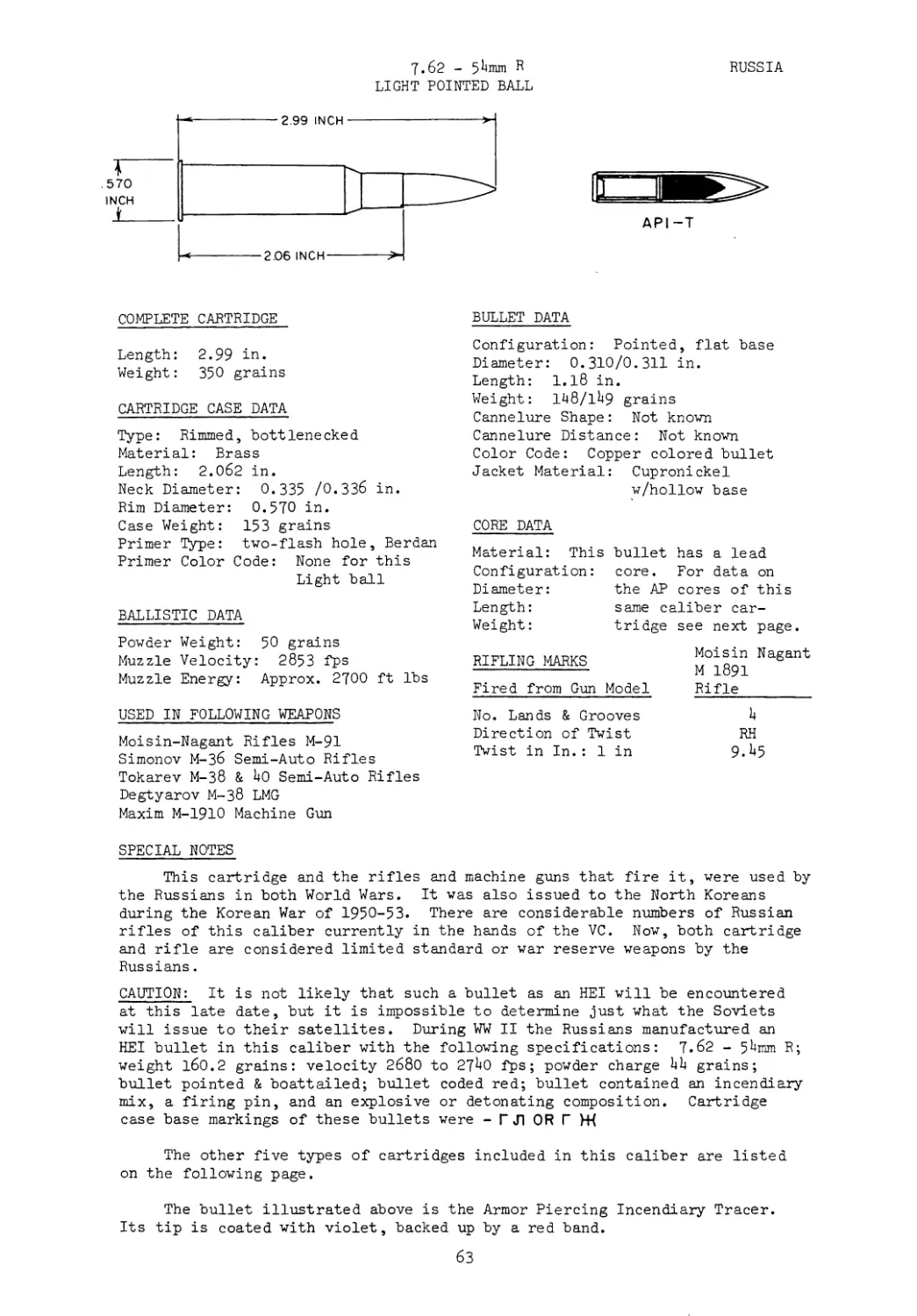


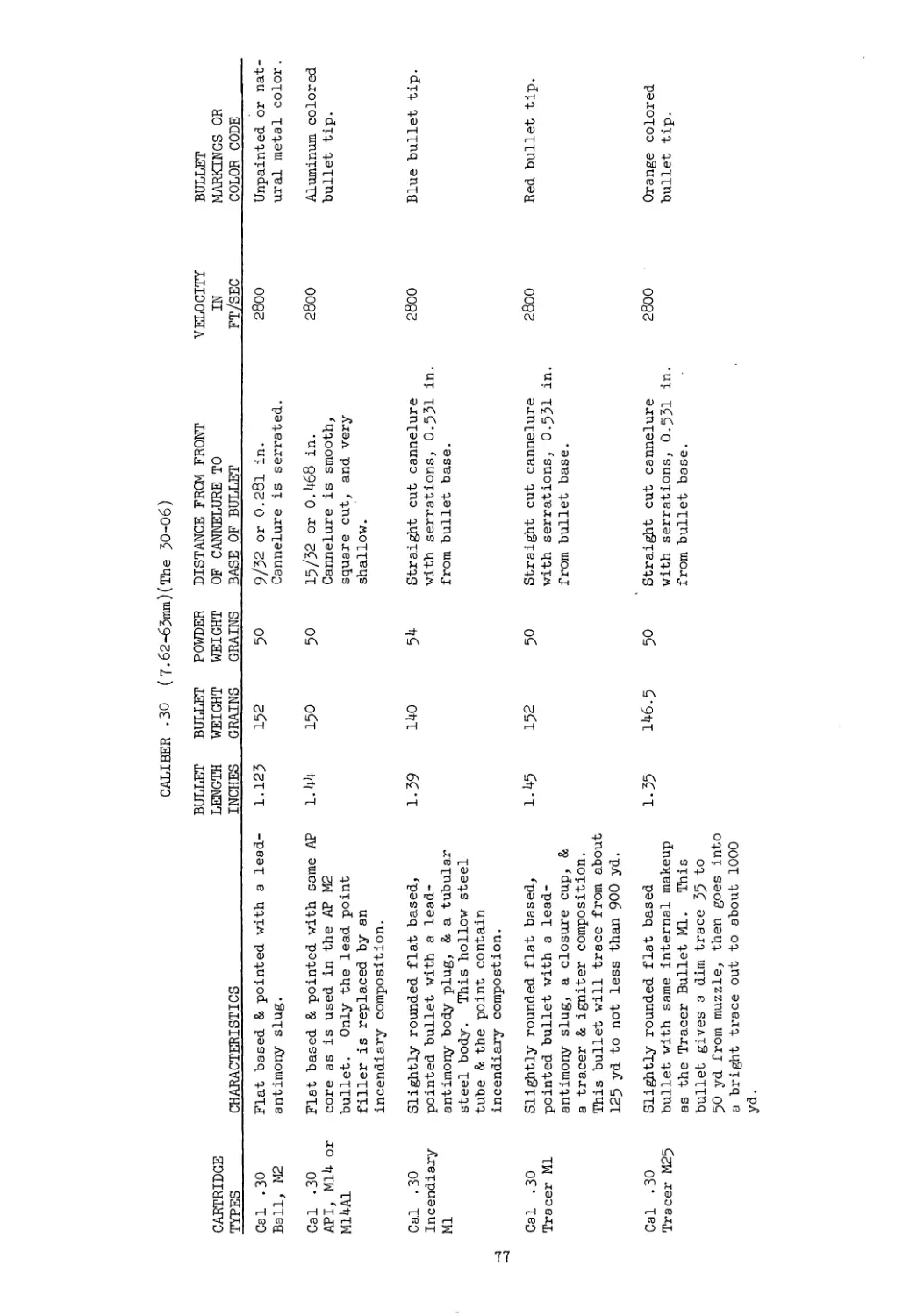







Text
                    ВRL R 1365
BRL
AD 816543
REPORT NO. 1365
SMALL ARMS BULLET IDENTIFICATION GUIDE
by
Emmet F. Donnelly
Walter S. Vikestad
May 1967
This document is subject to special export controls and each transmittal
to foreign governments or foreign nationals may be made only with prior
approval of Commanding Officer, U.S. Army Ballistic Research Laboratories,
Aberdeen Proving Ground, Maryland
U. S. ARMY MATERIEL COMMAND
BALLISTIC RESEARCH LABORATORIES
ABERDEEN PROVING GROUND, MARYLAND
Destroy this report when it is no longer needed.
Do not return it to the originator.
The. findings in this report are not to be construed as
an official Department of the Army position, unless
so designated by other authorized documents.
The use of trade'names or manufacturers' names in this report
does not constitute indorsement of any commercial, product.
BALLISTIC RESEARCH LABORATORIES
REPORT NO. 13б5
MAY 1967
SMALL ARMS BULLET IDENTIFICATION GUIDE
Emmet F. Donnelly
Walter S. Vikestad
Weapon Systems Laboratory
This document is subject to special export controls and each transmittal
to foreign governments or foreign nationals may be made only with prior
approval of Commanding Officer, U.S. Army Ballistic Research Laboratories,
Aberdeen Proving Ground, Maryland
RDT&E Project No. 1P121UO1A15O
ABERDEEN PROVING GROUND
MARYLAND

BALLISTIC RESEARCH LABORATORIES
REPORT NO. 1565
EFDonnelly/WSVikestad/s jw/cr/ilrn
Aberdeen Proving Ground, Md.
May 1967
SMALL ARMS BULLET IDENTIFICATION GUIDE
ABSTRACT
This guide presents a description of bullet characteristics that can
be used for identification of small arms ammunition. Techniques are also
described for the identification of recovered bullets and pieces of
bullets resulting from impact.
5

TABLE OF CONTENTS
Page
ABSTRACT............................................................... 5
GLOSSARY...............................................'............... 7
INTRODUCTION...........................................................II
GENERAL BULLET DESCRIPTION............................................1.2
TECHNIQUES FOR BULLET IDENTIFICATION LISTING...........................12
BIBLIOGRAPHY...........................................................21
APPENDICES:
A - BULLET IDENTIFICATION LISTING.................................23
В - WEAPONS AND RIFLING CHARACTERISTICS, CANNELURE TYPES AND
CONFIGURATIONS, AND CARTRIDGE CASE HEADSTAMP MARKINGS. . . 27
C - CARTRIDGE AND BULLET CHARACTERISTICS..........................35
D - SMALL ARMS WEAPONS PROBABLY BEING USED IN VIETNAM.............S5
DISTRIBUTION LIST......................................................S9
5

GLOSSARY
Annulus: A ring like band of color markings encircling a cartridge
primer, or about the ogive of a bullet or projectile. An annulus is
also sometimes found about that point of the cartridge case neck
where case and bullet meet. The annulus on a bullet's ogive (pointed
portion) denotes its type (i.e., AP, API-T, APT, Incendiary, HEI,
and Ball); however, annulus markings on ogives vary considerably from
nation to nation. CAUTION: Make no assumptions when handling
foreign bullets. If any color coding is still visible on an intact
fired bullet, handle with extreme care.
ACP: Automatic center fire pistol.
AP: An armor-piercing bullet or projectile which contains a core of
hardened steel, tungsten, or manganese molybdenum steel. AP bullets
are designed to penetrate armor and other resistant targets.
API: An armor-piercing incendiary bullet. The API contains, within its
jacket,, an armor-piercing core and an incendiary composition.
API-T: An armor-piercing incendiary tracer bullet. The typical API-T
bullet contains, within its jacket, an incendiary composition, an
armor-piercing core, and a tracer element.
APT: An armor-piercing tracer bullet. The APT contains, within its
jacket, an armor-piercing core and a. tracer element.
AT: Antitank, as in antitank rifle.
Ball: A bullet for general use as distinguished from bullets for special
uses, such as armor-piercing, incendiary tracer, etc. Currently, a
ball may have a lead, lead-antimony, or mild steel core within its
jacket.
Berdan Primer: A percussion primer used in double flash hole cartridge
cases. Most European small arms cartridge cases are manufactured
with double flash holes.
Boattailed Bullet: A bullet having a. tapered base shaped like the frustum
of a cone.
Bottlenecked Cartridge Case: A cartridge case with a constricted neck,
such as the caliber .50, or the 5-56mm (0.225) cartridge case.
Compare this configuration to а О.Ц5 ACP cartridge case, which has
almost straight sides.
Boxer Primer: A percussion primer used in single flash hole cartridge
cases.
7
GLOSSARY (Continued)
Cannelure: A groove in a bullet into which the cartridge case is crimped.
Also, a ringlike groove for locking the jacket of an armor-piercing
bullet to the core.
Cartridge Case: A container designed to hold an ammunition primer and
propellant to which a bullet may be affixed.
Chi-Com: An abbreviation for the Chinese Communist Forces.
Conical: A small arms ammunition term describing a round nosed bullet.
A nonsha.rp pointed bullet. The nose configuration of a 0.45 ACP
bullet is a good example of a conical bullet nose.
Core: The metallic filler used in a jacketed bullet. Core material may
be made of lead, lead antimony, mild or hard steel. Ball type
bullets contain either a. lead or lead-antimony core, or else a mild
steel core. Nonball type bullets such as the API, API-T, APT, and
Incendiary contain incendiary composition, or a tracer element, or
both, in addition to a hard steel core.
Cupronickel Jacket: An alloy, composed of copper and nickel, used to
jacket small arms bullets.
Flat Based Bullet: A flat ended bullet as opposed to a bullet with a
tapered-in base, i.e., boattailed.
Gilding Metal Jacket: A copper alloy used to jacket small arms bullets,
to form detonator or primer cups, and to form rotating bands for
artillery projectiles. Gilding metal is composed of approximately
90 percent copper and 10 percent zinc.
HEI: An abbreviation for high explosive incendiary. As used in this
guide, HEI refers to a Russian 7-62 - 5^mm R rifle bullet of World
War II which contained a small explosive charge.
HMG: Heavy machine gun.
Incendiary (l): A bullet or projectile which gives an incendiary effect
at the target.
Jacket: A metal shell surrounding a metal core, the combination compris-
ing a. bullet for small arms. The jacket is either composed of, or
coated with, a relatively soft metal such as gilding metal which
engages the rifling in the bore and causes rotation of the bullet.
Lead-Antimony: A filler material for jacketed bullets composed mostly
of lead with a hardening agent added to it.
8
GLOSSARY (Continued)
LMG: Light machine gun.
Metric Designation: As used in this guide, the term refers to the
European system for designating cartridges. It is a most thorough
system, for it specifically identifies a complete round by giving
the metric dimensions of both the diameter of the bullet and of the
cartridge case length. For example, consider the 7*62 - 6jmm car-
tridge, a well-known American round. The 7*62 figure refers to the
diameter of the bullet which is 0.J08 inch. The last number - 6jmm
refers to the cartridge case length only which is 2.U9 inches long.
This cartridge is actually the U.S. caliber >30 or •50-06 as it is
popularly known. Concerning the rimmed type of cartridge cases,
many European countries, particularly Germany, designate a rimmed
case by placing the letter R after the metric designation. R, as
such, stands for Rand, the German word for rim. An example of this
system is the 7*62 - 5^™ R which is the Russian rimmed service
cartridge.
Muzzle Energy: The kinetic energy of a projectile as it emerges from the
muzzle of a firearm. The muzzle energy of a bullet is expressed in
foot pounds. To determine this energy, we must know the bullet's
velocity at muzzle (V) and the weight of the bullet in grains (w)
must be known. The following formula may be used to calculate
muzzle energy:
E =
4502Ц0 '
Ogive: This term refers to the curved or tapered front of a bullet or
projectile.
Parahelium: European term for the 9“19тшп pistol and submachine gun
cartridge. In many English speaking countries, this cartridge is
also known as the 9пнп Luger.
Primer: This term refers to an assembly pressed into the base end of a
cartridge case. Its function is to ignite the propellant within the
case.
Rifling: The helical grooves cut in the Азге of a rifled gun tube. The
gun bore diameter is determined by the ridges between the rifling
grooves. These ridges are referred to collectively as the lands.
True bore diameter is measured between the lands. The purpose of
rifling is to impart spin and stability to the projectile so that
the projectile will travel nose first to the target.
SMG: : Submachine gun.
9
GLOSSARY (Continued)
Spitzer Point: A small arms term referring to a very sharp pointed
jacketed bullet.
Tracer (T): A bullet containing a pyrotechnic mixture to make the flight
of the projectile visible by day and night.
Twist (of Rifling): Inclination of the spiral grooves (rifling) to the
axis of the bore of a weapon. In small arms weapons, it is usually
expressed in the number of inches it takes for a bullet to make one
complete turn (e.g., 1 turn in 10 inches).
Twist, Left-Hand (LH): Rifling in which the twist is such to impart a
left-hand or counter clockwise rotation to a bullet as viewed from
the breech.
Twist, Right-Hand (RH): Rifling in which the twist is such to impart a
right-hand or clockwise rotation to a bullet as viewed from the
breech.
10
INTRODUCTION
Determination of the vulnerability of aircraft and other targets is
based on many parameters, one of which is the ammunition threat to the
aircraft. An aircraft in a battle zone is subject to attack by a variety
of arms ranging from hand held weapons such as rifles or automatic weapons
to large antia.ircra.ft guns and surface-to-air missiles. Fire support air-
craft, such as U.S. Army helicopters, are subject to a greater percentage
of sma.ll-arms hits than any other threat. A review of the world's small
arms indicates a large variety of small arms-type ammunition potentially
available to ground forces for use against aircraft.
The U.S. Army Ballistic Research Laboratories (USABRL) are presently
acquiring combat damage data on aircraft and aircrews from various sources
in South Vietnam. In order for these reports to be as complete as possi-
ble, identification of the projectile striking the aircraft is not only
desirable but necessary. There are many sources of information available
which give a few of the characteristics of bullets but these do not fully
exploit the available variety of these descriptors. This guide is an
attempt to compile these characteristics from the many sources available
and to present a description of small arms bullets that would be useful
for identification of recovered bullets, especially after the distortion
and mutilation that results from impact.
At first glance bullets seem to be very much alike, but there are
many small differences which, if known, enables one to make a positive
identification of a particular specimen. A suggested technique is pre-
sented for using the bullet characteristics included in this report. A
number of appendices are included which present details of ammunition
characteristics available a.t the present time. Included are listings of
weapons and ammunition with descriptions of the rifling twist for each
known weapon and cartridge case markings. Also included as Appendix D is
a list of the small arms weapons expected to be in use in Vietnam.
11
GENERAL BULLET DESCRIPTION
Since this guide may be used by people who are not familiar with
ballistics, a. discussion of the construction and markings of bullets
would probably be helpful. Since the stone hammer was put aside and mis-
sile weapons were introduced into warfare, man has been able to identify
his opponent’s projectiles by certain known peculiarities or character-
istics. For example, the military slingers of ancient Rome would stamp
their lead or clay balls with the insignia of the Legion to which they
were assigned. Since the introduction of rifling in firearms, it has been
generally known that the rifling (i.e., the spiralling lands and grooves)
of each weapon leaves its own peculiar trademark on the projectile it fires.
The small arms military bullets of the world fall into six general
types: Ball, Armor-Piercing, Armor-Piercing Incendiary, Armor-Piercing
Incendiary Tracer, Incendiary, and Tracer. The drawings in Figure 1 •
illustrate the differences between bullet types.
As can be seen from the illustrations, there are differences in
materials used in the manufacturing of bullets. Jacket materials are
usually of a gilding metal or a. cupronickel construction. The cores,
as shown, are either lead-antimony, mild steel, hard steel, or tungsten
carbide, or a combination of these. The incendiary and tracer mixtures
are not easily identifiable (outside a laboratory) from fired or damaged
bullets.
TECHNIQUES FOR BULLET IDENTIFICATION
A few simple tools are needed to accomplish the task of bullet
identification. They include a micrometer, a. scale or ruler, a small
magnifying glass, a balance with a capacity of 500 grains, and an identi-
fication guide - such as this one. It should be realized that to
completely cover the characteristics of all the world’s military bullets
would probably fill a. few volumes, but the purpose of this guide is to
keep the chore of identification as simple as possible.
12
API-T, M20
AP М2
API, M8
J
Tracer, Ml?
IT
X
Tracer, Headlight, M21
Incendiary, M23
A - Gilding-Metal Jacket
В - Steel Core
C - Lead-Antimony Point Filler
D - Hardened Alloy Steel Core
E - Lead-Antimony Base Filler
F - Incendiary Mixture
G - Igniter Composition
H - Tracer
J - Lead-Antimony Slug
К - Steel Body
L - Gilding-Metal-Glad Steel
Container
N - Gilding-Metal Closure
I - Gilding-Metal-Clad Steel Jacket
FIGURE 1
15
Suppose you want to identify a bullet that has just been received;
the first step is to make a. quick visual observation to note the damage
to the bullet, the color of the jacket; the color coding; if any; and the
general size of the bullet. Next; by using the balance; you may a.scertain
the weight of the bullet (if complete). The micrometer and the ruler will
give the diameter and length of the bullet. This information will quickly
eliminate many of the possibilities presented in Appendix A of this guide;
and may be enough to positively identify the bullet. A comparison with
known bullets is very helpful if a collection of these are kept on ha.nd.
The bullet features which differs most; aside from the more obvious
ones such as the length; weight; and diameter; are the ogive; the canne-
lure; the base; and the distinctive rifling marks imprinted on the bullet
by the rifling of a particular weapon. Figure 2 illustrates these points.
These figures illustrate the differences that can be noted as to the
type of bullet base; the shape of the ogive; and the position and shape
of the cannelure. Such differences are tabulated in Appendix В showing
individual bullet characteristics. Known rifling marks of specific
weapons; giving the number of lands and grooves and the direction of twist;
are also detailed in this report.
Unfortunately; many recovered bullets are damaged to some extent; so
that identification can only be made from the core of the bullet. Visual
observation will determine the core to be either a soft material such as
lead or mild steel; or a hard material such as hard steel or tungsten
carbide. The softer ma.terials are usually deformed or bent by impact.
The hard materials are usually fractured rather than deformed or bent. If
a hardness tester is available; a test of the material will provide more
positive information. If the material is soft; then the bullet is a. ball
type. If hard; it is an armor-piercing type. Even if the hard cores are
broken-up; identification may be made by comparing the pieces to the
illustrations in this guide and attempting to match the pieces to the
whole cores.
1A
FLAT BASE BULLET
FLAT BASE CORP:
CANNELURE
RIFLING MARKS IMPRINTED ON FLAT BASED AND BOATTAILED BULLETS BY A
RIFLED BARREL WITH A RIGHT HAND TWIST
RIFLING MARKS IMPRINTED ON A BULLET FIRED FROM A RIFLED
BARREL WITH A LEFT HAND TWIST
FIGURE 2
15
Jacket remnants are also a help towards tracing the origin of an
unknown bullet. Though the core of a bullet may be completely missing
a.nd the jacket itself crushed and distorted by the impact, if enough of
the rifling marks can be seen, it is still possible that an identification
can be made. Similarly, if a. cannelure can be seen or measured on a
jacket remnant, identification can be made.
If the bullet hole or impact area can be observed visually, some
clues may be evident which will assist in the identification. Such marks
as burn, smoke, or flash marks at the impact area, may have been caused by
API, API-T, I, or T ammunition. Check for stripped off jacket remnants
around impact areas as this may indicate an armor piercing bullet which
often tends to strip off its jacket upon impact. Check the damage the
bullet has done to the target and the damage done to the bullet by the
target. This may assist in determining whether it was a ball or armor
piercing type of bullet.
At this point, with the help of the accompanying photograph (Figure j)
let us illustrate the techniques we follow to use this Bullet Identifi-
cation Guide to establish the origin of an unknown bullet.
The top three specimens shown in Figure J are photographs of actual
bullets or bullet remnants of the Russian or Chi-Com cartridge known as
the 7-62 x 59mm. The latter is the standard caliber of the basic Soviet
AK U? Assault Rifle.
The identification of the bullet shown on the left was accomplished
in the following manner: a. visual inspection showed that the rifling
marks on the bullet were imprinted by a rifle with a four-land and groove
barrel with a. RH twist. This fact immediately eliminated all French and
British rifle bullets from further consideration, for these nations
usually employ rifling with LH twists. Next, the micrometer showed that
the bullet is 0.5Ю inch at its widest diameter. Similarly, a scale
indicated that the overall length of the bullet is roughly 1.02 inches.
The bullet was then weighed and found to weigh 121.5 grains. With the
information thus obtained, a quick rundown through the listings of bullets
16
MILD STEEL
CORE.
TYPICAL RUSSIAN 7.62 x 39 mm API AK ROUND
MILD STEEL
CORE
LEAD
CORE
CHICOM 7.62 x 54 mm R BALL
CALIBER .45 SUBMACHINE GUN
FIGURE 3
17
given in Appendix A revealed that as now known, there is only one military
bullet which meets these specifications. The last step wa.s to turn to the
data sheets of this guide which cover Soviet and Chi-Com cartridges and
verify the identification.
Identification of the center bullet (top line of photograph) wa.s
equally simple, despite the fact that the ogive or point of the bullet’s
jacket had been torn open and destroyed. The following observations were
made to establish its identity: the-rifling marks showed four lands and
grooves with a. RH twist. Visual observation showed a small flat nosed
core which proved to be of a. mild steel. (The latter fact was established
by scratching the flat portion with a steel scribe.) Further observation
showed tha.t the steel core was seated within a lead sleeve. The overall
length of the bullet could not be accurately determined because of the
damage to its nose. Similarly, distortion of the bullet caused by impact,
eliminated the possibility of making a true reading of its diameter.
However, when the bullet was weighed, it was found to be well within the
weight limits of a known bullet. The final observation made was that the
distance from the base of this bullet to the most forward portion of its
cannelure was roughly 0.Ц inch. The information thus gathered checks with
the data sheet on the 7-62 x 59mm cartridge. For a further verification
of this identification, the core could also have been withdrawn from the
jacket; but this point is best illustrated by considering the next or
upper right bullet core shown in the photograph.
The bullet core depicted was simple to identify because it was intact
and easy to measure. Its configuration, diameter, length, weight, and the
fact that it wa.s quite obviously mild steel conformed exactly to the
bullet core specifications outlined in the data sheet for the 7-62 x 59mm
cartridge.
Identification of the two bullet remnants shown in the center of the
photograph was not too difficult. The configuration, weight, length, and
diameter of the unknown core match the dimensions of the core known to be
used only in the 7-62 x 59mm API AK U7 cartridge. Further, this is the
18
only military bullet currently known in which the AP core with its incen-
diary mix is loaded into the front of a solidly made jacket base. Once
this is accomplished, the front or ogive portion of the jacket is fitted
and sealed onto the bullet proper. Inspection of the 7-62 x 59™i API
bullet will reveal that it has a. solid base or inclosed jacket. As for
the remnant point shown on the right of the photograph; the identification
technique employed followed this sequence: Its identification as an AP
core was determined by the fact that the core fractured upon impact rather
than bending or warping as would have happened had the core been of mild
steel. Secondly; most cores of mild steel have a small flat-nosed con-
figuration rather than a pointed or spitzer point as this core has.
Thirdly; enough of this point is intact tha.t a micrometer reading revealed
it to be within the dimension limits of the 7-62 x 59^1 API AK cartridge
and its bullet. If this specimen had been a. little shorter; the only
other method of establishing a tentative identification would have entailed
making a. visual comparison with an existing and known core point.
Concerning the two specimens at the bottom of the photograph; the
mild steel core a.t the left was identified by employing the same techniques
as those just described. The fairly intact bullet on the bottom right
tells its own story very well. Its weight; length; exposed lead core
filler; color; and configuration immediately mark it as a caliber . Uj
pistol bullet. However; this bullet was not fired from a pistol. If it
had been; the six land and groove markings would have shown a LH twist.
If it had been fired from a U.S. or Chinese MJ type SMG; it would have
borne a. four land and groove RH twist. As it is, the bullet was fired
from one of the earlier type Thompson SMGs either of U.S.; Chinese; or
Red Chinese manufacture. All of the Thompson SMGs either of foreign or
domestic manufacture employed a six-land and groove RH twist rifling.
19
ACKFTOWLEDGEMEITTS
The authors are indebted to Mr. Karl Kempf, Curator of the U.S. Army
Ordnance Center and School Museum, and to his assistant, Mr. Charles H.
Yust, Jr. Mr. Kempf placed the resources of the Museum at the disposal
of the USABRL personnel engaged in compiling this da.ta. Mr. Yust, car-
tridge expert and former editor of ”Gun and Cartridge Record,’1 gave
permission to use ma.terial from his articles printed in the ’’American
Rifleman,” ’’The Gun Digest,” and ”Gun and Cartridge Record.”
20
BIBLIOGRAPHY
Much of the ballistic data presented in this guide was obtained by
the disassembly, study, velocity testing, and mea.surement of a great
variety of foreign and domestic cartridges. To accomplish this task,
cartridges and weapons were drawn from normal supply channels, from two
individually owned cartridge and weapons collections, and the U.S. Army
Ordnance Center and School Museum. Additional da.ta were obtained from
the following military and commercial publica.tions:
Logan, Herschel C., ’’Cartridges.”
Smith, W. H., ’’Small Arms of the World."
"Small-Arms Ammunition," TM9-1505-200; Air Force TO 11A15-1-101,
June 1961.
"Handbook of Cast Bullets/Lyman Reloading Handbook," Lyman
Guns i ght Corporat ion.
"The Gun Digest," The Gun Digest Corporation.
"Handbook of Ordnance Data," UOS. Army Ordnance Department, 1919.
"The Shooter’s Bible," Stoeger Arms Corporation.
"Small Arms, Light Field Mortars and 20-mm Aircraft Cannon,"
TM9-2200, 11 October 19^5.
"The American Rifleman Magazine," National Rifle Association of
America.
"Kennblaetter Fremden Geraets," Berlin, 1 August 19^-1. (Data on
Foreign Small Arms Ammunition.)
"Geco Waffen und Munition Nr. 65/’ Germany, 1957- (Geco Weapons
and Ammunition Catalog No. 65.)
"Mauser Bolt Rifles," Volume I, Ludwig Olson, 1950.
"Gun and Cartridge Record," Chagrin Falls, Ohio.
"Glossary of Ordnance Terms," Duke University, June 1959-
21

APPENDIX A
BULLET IDENTIFICATION LISTING
25

Rifle and Machine Gun Calibers
English Name or Caliber	Metric Designation (mm)	Bullet Diameter (in. )	Bullet Weight (grains)	Muzzle Velocity (ft/sec)	National Origin
.225 or 5-5^mm	5.56-45	0.225	55 '	5200	USA
6.5mm Japanese	6.5-5O.5 SR	0.265	156	2500	Japan
6.5mm Italian	6.5-52.5	0.264	162	2590	Italy
6.5mm Dutch Mann	6.5-5^ R	0.264	159	2400	Holland
6.5 Mannlicher Schon	6.5-54	0.265	160	2195	Austria
6.5mm Mauser	6.5-5U	0.262	126	2465	Germany
6.5mm Krag	6.5-55	0.265	156	2400	Norway
6.5mm Portuguese	6.5-58	0.265	156	2568	Portugal
7mm Mauser	7-57	0.284	154	2666	Mexico
7.55mm Italian	7.55-52	0.298	128	2485	Italy
7.5mm Swiss	7.5-55.5	0.504	174	25OO	Swiss
7.5mm French	7-5-5^	0.507	159	2690	France
_J0 Carbine	7-62-55	0.508	109	1950+	USA
7.62mm NATO (/508")	7.62-51	0.508	150	2860	USA
Cal .50 (50-06)	7.62-65	0.508	150	2800+	USA
50/40 Kra.g	7.62-58.5 R	0.508	220	2000	USA
7.62mm Russian	7.62-54 R	0.510	150	2800	Russia
7.62mm M45	7.62~59mm	0.510	122	2529+	Russia
7. б^тшп Mauser	7.65-55.5	0.510	150	2600	Belgium
.505 British	7.7-56 R	0.511	174	2440+	England
8-50mm Steyr	8-50.5 R	0.525	244	2100	Austria
8-56mm R	8-56 R	0.550	208	2500	Hungarian
8mm Lebel	8-50.5 R	0.525	192	2200+	France
8mm Mauser (Mod 98)	7.92-57	0.525	150	2800	Germany
8mm Mauser (Mod 88)	7.92-57	0.518	226	2000	Germany
9mm Mauser	9-57	0.556	275	2254	Germany
Cal .50 Browning MG	12.7-99	0.510	708/9	2800+	USA
R - The capital letter R after a. metric designation indicates a rimmed
cartridge case.
SR - These letters refer to a semirimmed cartridge case.
25
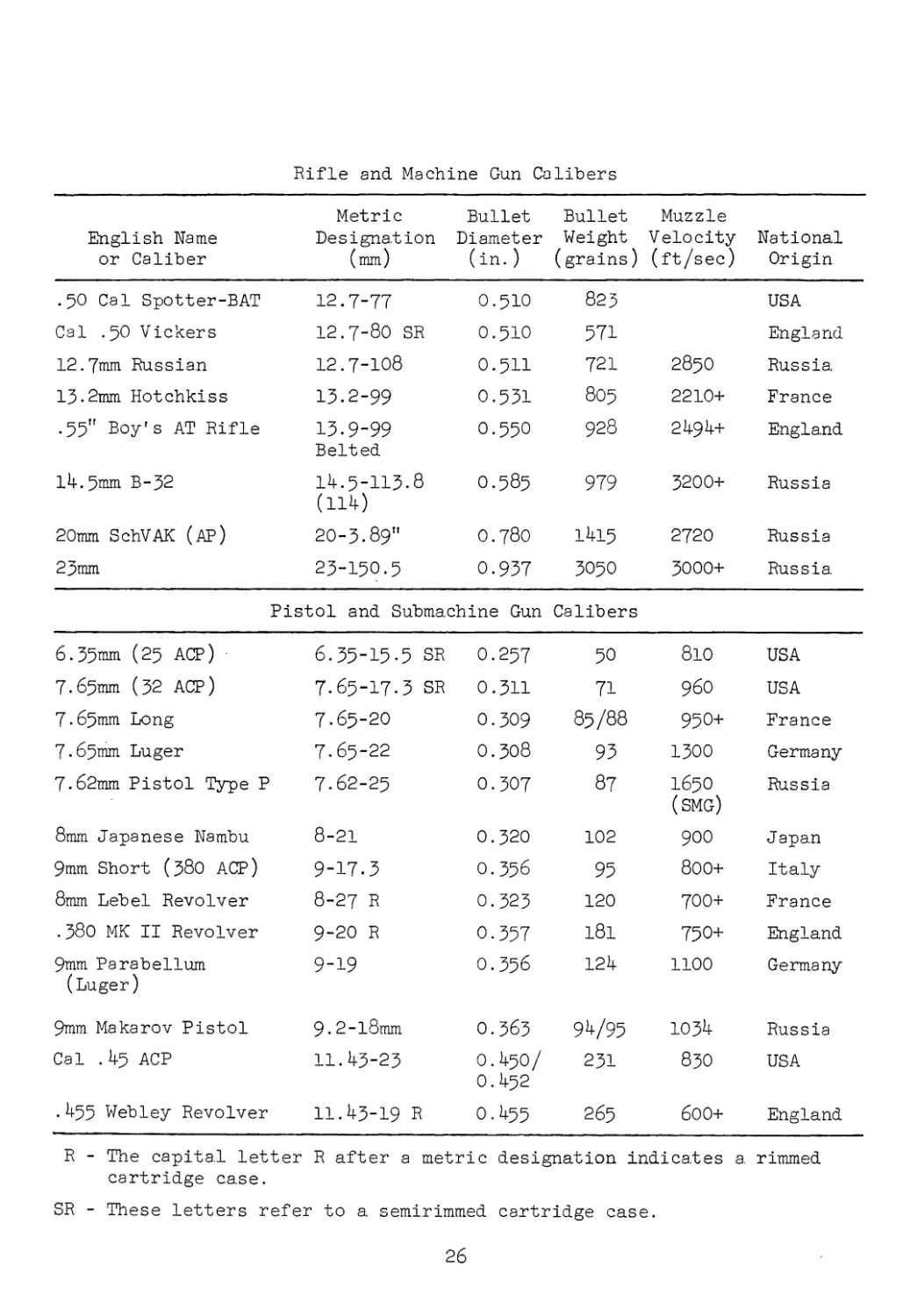
Rifle and. Machine Gun Calibers
English Name or Caliber	Metric Designation (mm)	Bullet Diameter (in.)	Bullet Weight (grains)	Muzzle Velocity (ft/sec)	National Origin
.50 Cal Spotter-BAT	12.7-77	0.510	825		USA
Cal .50 Vickers	12.7-80 SR	0.510	571		England
12.7nim Russian	12.7-108	0.511	721	2850	Russia
IJ.2mm Hotchkiss	15.2-99	0.551	805	2210+	France
.55" Boy's AT Rifle	15-9-99 Belted	O.55O	928	2191+	England
1^. 5™i B-J2	H.5-II5.8 (111)	0.585	979	5200+	Russia
20mm SchVAK (AP)	20-5.89"	O.78O	1115	2720	Russia
2Jmm	25-150.5	0.957	5050	5000+	Russia.
Pistol and Submachine Gun			Calibers
6.55mm (25 ACP)	6.55-15-5 SR	0.257	50	810	USA
7.65mm (52 ACP)	7.65-17.5 SR	0.511	71	960	USA
7.65mm Long	7.65-20	0.509	85/88	950+	France
7.65mm Luger	7.65-22	0.508	95	1500	Germany
7.62mm Pistol Type P	7.62-25	0.507	87	1650 (smg)	Russia
8mm Japanese Nambu	8-21	0.520	102	900	J apan
9mm Short (580 ACP)	9-17.5	0.556	95	800+	Italy
8mm Lebel Revolver	8-27 R	0.525	120	700+	France
.580 MK II Revolver	9-20 R	0.557	181	750+	England
9mm Parahelium (Luger)	9-19	0.556	121	1100	Germany
9mm Makarov Pistol	9.2-18mm	0.565	91/95	10 51	Russia
Cal . I5 ACP	11.15-25	0.I50/ 0.152	251	850	USA
.I55 Webley Revolver	11.15-19 R	O.I55	265	600+	England
R - The capita.! letter R after a metric designation indicates a. rimmed
cartridge case.
SR - These letters refer to a semirimmed cartridge case.
26
APPENDIX В
WEAPONS AND RIFLING CHARACTERISTICS, CANNELURE
TYPES AND CONFIGURATIONS, AND CARTRIDGE
CASE HEADSTAMP MARKINGS
27

WEAPONS AND RIFLING CHARACTERISTICS
Origin	Caliber	No. of Lands & Grooves	* Twist
USA	5* 56”^5™m (.225)	6	RH
	Cal .JO Carbine	1+	RH
	Cal .JO (7-62-63mm)(.30-06)	1+	RH
	Cal .30 (?•62-бЗтт)(.30-06)	2	RH
	Cal .JO (7-62-65mm)(.50-06)	5	LH
	(Rifle, Cal .30, M1917 - The Enfield)
	7.62-51mm (7-62mm NATO)(.508 Winchester)	1+	RH
	7.65™ Browning (.32 Colt Automatic)	6	LH
	9mm Parahelium (9mm Luger)	6	RH
	Cal .1+5 ACP used in M1911 Pistol	6	LH
	Cal .U5 ACP used in М3 SMG	1+	RH
	Cal .1+5 ACP used in Thompson Type SMG	6	RH
	Cal .50 Browning Machine Gun	8	RH
	20mm Guns М3, M39, M61, Ml, & М2	9	RH
USSR	7.62mm Pistol & SMG	1+	RH
and	7.62-51jmm R Rifle & SMG	1+	RH
Other	7.62-39mm Ml+3 (Assault Rifle & SKS)	1+	RH
Iron	12.7-108mm HMG	8	RH
Curtain	ll+.5~H^mm Soviet ZPU Machine Guns	8	RH
Countries	20mm SchVAK Aircraft/Cannon	8	RH
	23mm Aircraft/Cannon	10	RH
France	7.65mm Long Pistol & SMG	6	LH
	9mm Parahelium Pistol & SMG	6	LH
	7.5“5^mm Rifle & Machine Gun	1+	LH
	8-5O.5mm R (8mm Lehel Rifle & Machine Gun)	4	LH
Twist refers to the directional rotation of the rifling of a rifled
firearm.
R - The ca.p/Zal letter R after a. metric designation indicates a rimmed
cartridge case.
SR - These letters refer to a semirimmed cartridge case.
29
WEAPONS AND RIFLING CHARACTERISTICS (Continued)
No. of
Lands &
Origin	Caliber	Grooves Twist
England .505 British (7*7“56mm R)(Rifle & Machine Gun) 5	LH
.50? British (7.7-56mm R)(WW II Rifle Only)	2 LH
7.92_57mm Besa. Machine Gun	RH
(8mm Mauser Cartridge)
,J8O MK II Enfield Revolver	7
.U55 Webley Revolver	7
Austria	8-5O Steyr (8-50.5mm R) Rifle & Machine Gun	1
Italy	6.5-52.5mm Italian Rifle & Machine Gun	1
Germany	9mm Parahelium (9mm Luger) Pistol & SMG	6
	7.92"57mm (8mm Mauser) Rifle & Machine Gun	u
Japan	6.5_50-5mm SR Arisaka Carbine
	6-5“5O-J0®1 SR Arisaka Rifle	6
Spain	7-57mm M95 Rifle	u
Switzerland	7.5-55-5mm Schmidt-Rubin Rifle Mil	3
aaasaaaaaa
Twist refers to the directional rotation of the rifling of a rifled
firearm.
R - The capital letter R after a. metric designa.tion indicates a rimmed
cartridge case.
SR - These letters refer to a semirimmed cartridge case.
30
CARTRIDGE CASE HEADSTAMP MARKINGS
The following illustrations of cartridge case «headstamp markings
represent only a small sampling of the military cartridges of the world.
Complete information on this subject can be found in ’’Small Arms Ammuni-
tion Identification Guide/’ a. booklet put out by the U.S. Army Foreign
Science and Technology Center of the U.S. Army Materiel Command. The
booklet is unclassified and is listed as Product Identification FSTC-CW-
07-02-66. SQV1ET 7>62MM TOKAREV PISTOL	CHI-COM
AND SUB-MACHINE GUN
7. 62MM 7.62-39MM
PISTOL A. K. 47
&	ASSAULT
S.M.G. RIFLE
YUGOSLAVIA 7.62MM TOKAREV PISTOL
CZECH
AND SUB-MACHINE GUN
7.62-45MM
POLAND
7,62- 39MM
7.62MM	7.62MM
7.62MM	7.92-57MM
RIFLE AND
MACHINE GUN
A. K. 47
ASSAULT
RIFLE
M52 RIFLE
AND
MACHINE GUN
NATIONALIST CHINESE
7.92-57MM
7.92-57MM
ARISAKA
6.5-5IMM
EGYPT
ISRAELI
ITALY
RIFLE 5
MACHINE GUN
RIFLE
MACHINE GUN
7.92-57MM
RIFLE a
7,62-51 MM
NATO
GREAT BRITAIN
MACHINE GUN
9MM
PARABELLUM
(9MM LUGER)
WEST	FRANCE	FRANCE FRANCE
GERMANY 8-50,5MMR
7.5-54MM	7.5-54MM
.303 CAL. 7.92-57MM
9MM LUGER 8MM LEBEL
(7.7-56MMR) ( 7.92-57MM
MAUSER)
51
CARTRIDGE CASE HEADSTAMP MARKINGS (Continued)
BELGIUM
JAPAN
SWISS VENEZUELA
7. 65MM 9MM LUGER
7.7MM 7.7MMR
7.5MM	7-57MM
ARMY	NAVY	RIFLE	RIFLE
FRANCE FINNISH
AUSTRALIA POLAND
DANISH
CANADA
9MM
LUGER
9MM
LUGER
9MM
LU GER
7.7MM
( .303 BRIT)
9MM
LUGER
9MM
LUGER
SOVIET
CZECH
FINLAND
FRANCE
7.62-39MM
7.62-45MM	7.62-39MM	7.65MM
LONG
GREECE NORWAY
HOLLAND TURKEY
WEST GERMANY
7.92-57MM II.25MM
CAL. 30	7.65MM
7.62MM	12.7 X 99MM
(CAL .45	CARBINE PISTOL
NATO ( CAL 50 BMG)
PI STOL
52
CANNELURE TYRES CONFIGURATIONS
SQUARE SHOULDERED CANNELURE
WITH SMOOTH FINISH
SERRATED CANNELURE
GROOVES
WITHOUT
CANNELURE
a
SUB-MACHINE GUN
BULLETS
THREE INDENTS OR
INDEX MARKS THROUGH
CARTRIDGE CASE INTO
BODY OF BULLET
SHALLOW HALF V CANNELURE
WAISTED , OR DISH SHAPED
SMOOTH CANNELURE
FOR PURPOSES OF IDENTIFICATION, MEASUREMENT CAN BE TAKEN FROM FORWARD
EDGE OF CANNELURE TO BASE END OF BULLET JACKET. THIS DISTANCE IS UNIFORM
ON MILITARY BULLETS OF A GIVEN CALIBER, TYPE AND ORIGIN.
55

APPENDIX С
CARTRIDGE AND BULLET CHARACTERISTICS
35

AUSTRIA
8 - 50mm R
8mm M1893
3 INCHES
.554
NCHES
1.99 INCHES
TRACER
COMPLETE CARTRIDGE (BALL BULLET)
Length: 3 in.
Weight: ^37 grains
CARTRIDGE CASE DATA
Type: Rimmed, bottlenecked
Material: Brass
Length: 1.99 in.
Neck Diameter: 0.355 in.
Rim Diameter: 0.55^ in.
Case Weight: 166.5 grains
Primer Type: Single flash hole.
Primer Color Code: None
BALLISTIC DATA
Powder Weight: U2 grains
Muzzle Velocity: 2030 fps
Muzzle Energy: 2300 ft lbs
USED IN FOLLOWING WEAPONS
Austrian M90 Rifles & Carbines
Austrian M95 Rifles & Carbines
Austrian Schwarzlose Machine Gun
BULLET DATA
Configuration: Ball has round nose &
flat base.
Diameter: 0.3228 in. maximum
Length: 1.2 b- in.
Weight: 2hh grains
Cannelure Shape: Shallow dish shaped.
Cannelure Distance: 0.250 in, to bullet
base.
Color Code: Silver or nickel colored.
Jacket Material: Lubricated steel
CORE DATA
Material: Lead
Configuration: Same as jacket
Diameter: Not known
Length: Not known
Weight: Not known
RIFLING MARKS	_ _ _
--------------	M95 Rifle
Fired from Gun Model	Austrian
No. Lands & Grooves
Direction of Twist	RH
Twist in In.: 1 in	9.8^2
SPECIAL NOTES
The M95 Rifle with this cartridge was the official rifle of Austria
and Bulgaria during World Wars I and II. It was also used by the Italians.
The cartridge has also been manufactured and used by the Kingdom of
Thailand since 1900. Both Thai and Austrian cartridges are practically
interchangeable.
The 8 - 56mm R cartridge, as used by the Hungarians, differs from
the 8 - 50mm R as follows: Complete round weight is hUl grains; complete
round length is 3.02 in; the bullet weight is 208 grains; the bullet
diameter is 0.330 in; the powder charge is 55 grains; and the rim diameter
is 0.55 in. Both cartridges are rimmed, bottlenecked cases of a type that
has been obsolete in design for many years. The 8 - 56mm R cartridge is
used in the Hungarian M35 Rifle and the M31 Machine Gun, the Austrian M30
Machine Gun, and in rebarrelled M95 Mannlicher Steyr Rifles & Carbines.
The 8 - 50mm R Model 1908 (M. 08) Armor-Piercing Bullet has a steel
jacket, with a hardened steel core partially inclosed by a lead sleeve.
That portion of the bullet within the cartridge case is copper washed.
The bullet is flat based, pointed, and there is a blue annulus about its
primer for identification.
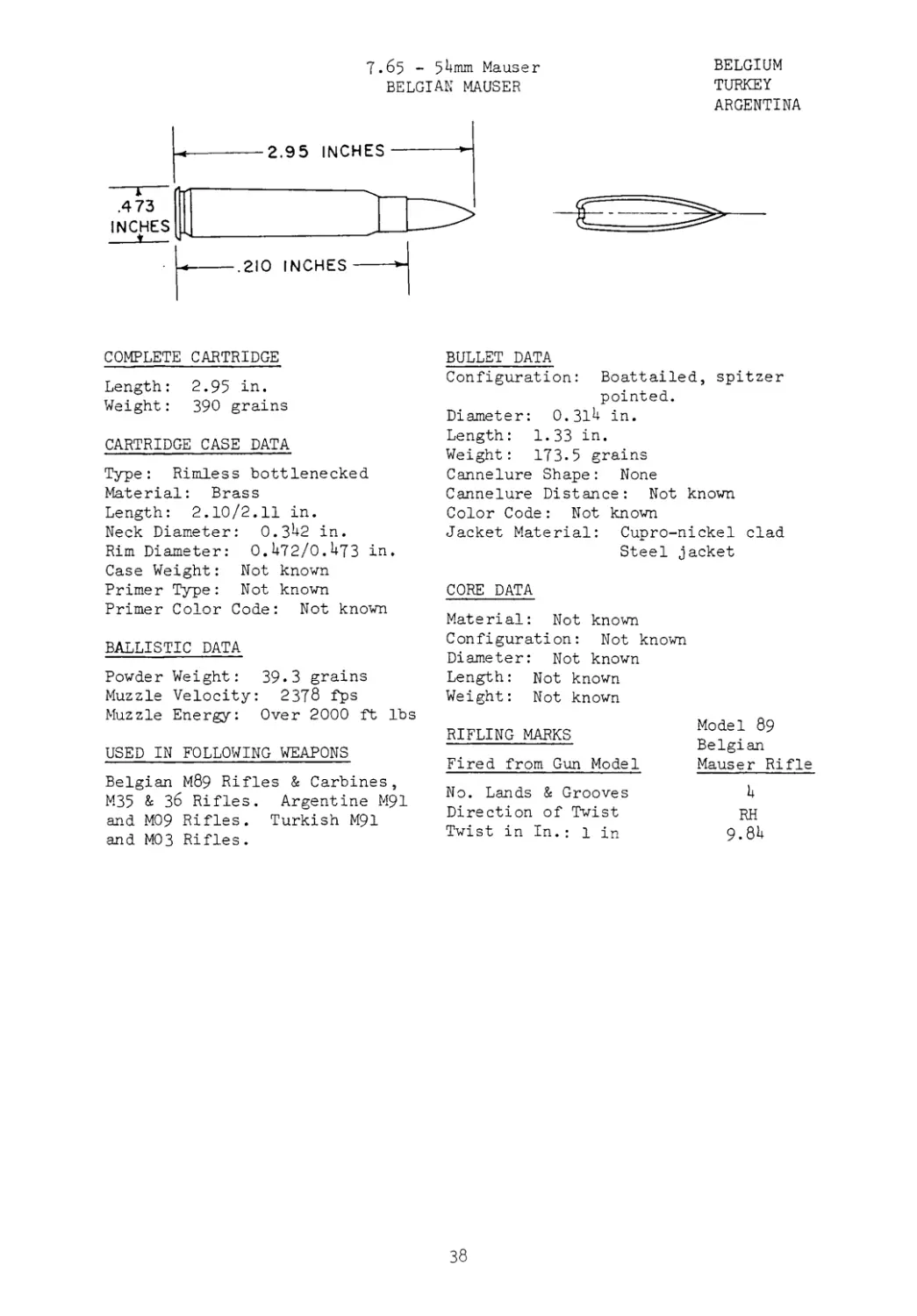
37
BELGIUM
7.65 ~ 5^nim Mauser
BELGIAN MAUSER
---1
.473
INCHES
COMPLETE CARTRIDGE
Length: 2.95 in.
Weight: 390 grains
CARTRIDGE CASE DATA
Type: Rimless bottlenecked
Material: Brass
Length: 2.10/2.11 in.
Neck Diameter: 0.3^2 in.
Rim Diameter: 0.1+72/0.^73 in.
Case Weight: Not known
Primer Type: Not known
Primer Color Code: Not known
BALLISTIC DATA
Powder Weight: 39.3 grains
Muzzle Velocity: 2378 fps
Muzzle Energy: Over 2000 ft lbs
USED IN FOLLOWING WEAPONS
Belgian M89 Rifles & Carbines,
M35 & Зб Rifles. Argentine M91
and M09 Rifles. Turkish M91
and M03 Rifles.
BULLET DATA
Configuration: Boattailed, spitzer
pointed.
Diameter: 0.31^ in.
Length: 1.33 in.
Weight: 173.5 grains
Cannelure Shape: None
Cannelure Distance: Not known
Color Code: Not known
Jacket Material: Cupro-nickel clad
Steel jacket
CORE DATA
Material: Not known
Configuration: Not 1
Diameter: Not known
Length: Not known
Weight: Not known
RIFLING MARKS
Fired from Gun Model
No. Lands & Grooves
Direction of Twist
Twist in In.: 1 in
Model 89
Belgian
Mauser Rifle
RH
9-8U
38
7.62 - ^5mm
7.62mm CZECH SHORT
CZECHOSLOVAKIA
.442
INCH
BALL BULLET HAS
MILD STEEL CORE INCLOSED
IN A LEAD SLEEVE. SHALLOW
CANNELURE IN BULLET JACKET.
COMPLETE CARTRIDGE
Length: 2.35 in.
Weight: 280.7 grains
CARTRIDGE CASE DATA
Type: Bottle necked rimless.
Material: Steel or brass
Length: 1.77 in.
Neck Diameter: 0.336 in.
Rim Diameter: 0ДЬ2 in.
Case Weight: 120.9 grains
Primer Type: Berdan
Primer Color Code: None on Ball.
BALLISTIC DATA
Powder Weight: 27 grains
Muzzle Velocity: 2^0 fps*
Muzzle Energy: Over 1550 ft lbs
USED IN FOLLOWING WEAPONS
Czech M52 Rifle
Light Machine Gun
BULLET DATA
Configuration: Pointed & boattailed
Diameter: 0.309 in. min/0.310 in. max
Length: lo115 in.
Weight: 131Д grains
Cannelure Shape: Very shallow 1/2 of
V notch.
Cannelure Distance: 0.531 in.
Color Code: Copper colored Ball
Jacket Material: Cupronickel
CORE DATA
Material: Mild steel. Hardness B-90
Configuration: Small flat nose & flat
base.
Diameter: 0.222 in. Length: 0.905/0.906 in. Weight: 62.8 grains RIFLING MARKS Fired From Gun Model	(This core is inclosed in a lead sleeve.) Czech M52 Rifle or A.R.
No. Lands & Grooves	u
Direction of Twist	RH
Twist in In.
SPECIAL NOTES
This cartridge and the rifle and light machine gun in which it is
used have been obsolete since the mid 1950’s. However the Czechs have sent
considerable numbers of these weapons to the Viet Cong. The Czechs have
also supplied the United Arab Republic (UAR), Cuba, and various revolutionary
groups in Africa and South America with the M52 Rifle. The Czechs are now
using the Soviet 7.62 - 39mm cartridge, and manufacturing the Abtomat
Kaleshnikov (AK) Assault Rifle to use it. According to reliable sources
there are considerable quantities of 7»92 - 57mm Caliber Mauser rifles and
machine guns still in use by the Czechs.
*
Velocity of the Czech M52 Machine Gun is given as 2^50 fps.
39
FRANCE
7.5 - 5^mm
BALL M1929C
MOD. 1929 A.P.T,
COMPLETE CARTRIDGE
Length: 2.986 in.
Weight: ЗбЗ grains
CARTRIDGE CASE DATA
Type: Rimless bottlenecked
Material: Brass
Length: 2.12/2.13 in.
Neck Diameter: 0.339/0.3^0 in.
Rim Diameter: 0.U83 in.
Case Weight: 186.7 grains
Primer Type: Berdan, two-flash holes
Primer Color Code: Black annulus,
around primer
BALLISTIC DATA
Powder Weight: U5 grains
Muzzle Velocity: 2650 plus
Muzzle Energy: Over 2300 ft lbs
USED IN FOLLOWING WEAPONS
MAS 1936 7.5™ Rifle
MAS 19^9 7.5mm Rifle
M-1931 Machine Gun
M-1952 Machine Gun
M-192U/29 Machine Gun
BULLET DATA
Configuration: Pointed, flat based
Ball
Diameter: 0.307/0.308 in.
Length: 1.075/1.08 in.
Weight: 139.5 grains to 1U0 grains,
Ball
Cannelure Shape: 1/2 of V notch
Cannelure Distance: 0.218 in.
Color Code: Copper bullet color,
black annulus
Jacket Material: Cupronickel
CORE DATA
Material: Lead filler, point to
base of jacket
Configuration: Same as jacket
interior
Diameter: Not known
Length: Not known
Weight: 86 grains pl
RIFLING MARKS
Fired from Gun Model
No. Lands & Grooves
Direction of Twist
Twist in In.: 1 in
MAS
36
Rifle
U
LH
10
SPECIAL NOTES
The bullet illustrated above is the Model 1929 TP, Armor-Piercing-
Tracer. Bullet has a copper-zinc alloy jacket, a pointed flat based tungsten
steel core, tracer composition, and a green bullet tip and case mouth. There
is also a green annulus around the primer. This bullet is 1.38 in. in length
weighs 1U7 grains, and is propelled by U3.2 grains of flake powder.
All other cartridges of this caliber are listed on the following page.
Uo
OTHER FRENCH 7.5 - 5^ММ CARTRIDGES
CALIBER	COMPLETE CARTRIDGE WEIGHT AND LENGTH	BULLET WEIGHT AND LENGTH	CARTRIDGE TYPE AND LENGTH	POWDER TYPE AND WEIGHT				! OTHER DETAILS
7»5 - 5^mm heavy pointed Ball, Model 1929D	Ц09 grains	190 grains l.h6 in.	Brass rimless	Flake powder ЦО.2 grains	Bullet has a cupronickel jacket with a lead core. Bullet is black or blackened metal. Annulus color varies.
7.5 - 5^mm Pointed AP Model 1929P	370 grains	lb2 grains 1.26 in.	Brass rimless	Flake powder U3.2 grains	Bullet has a copper-zinc alloy jacket, with an AP core. Bullet is copper colored. Cannelure shape is that of a half of V notch. Distance from base of bullet to front of cannelure is 0.221 in. This is a flat based bullet.
7.5 - 5^mm Incendiary Model 19291	375 grains 2.986 in.	1UЪ grains 1.3b in.	Brass rimless	Flake powder j hl.7 grains	Bullet has a cupronickel jacket with a lead core, a steel disc and a phosphorus filler. Bullet has a blue annulus at its tip and also at the cartridge case j mouth.
7.62 - 51mm NATO Ball		1Ь6.9 grains I.56 in.	Brass rimless	1	The cartridge case dimensions are the same as U.S. made cases. However, the French cartridge cases use the Berdan, two flash hole primer pocket; whereas, the U.S. uses the single flash hole or Boxer Primer pocket.
.252 INCH-----
.217 INCH
Dimensions of' one typo Al5
Core used by the French
during WW ’ 11 .
.834 INCH
.177 INCH-------
1.062 INCHES
Bullet has boattailed configuration. It
is a nickel color with a red annulus at
case mouth. Bullet has an arrow shaped
mild steel core, which is quite distinc-
tive. The cannelure is smooth and in
the shape of a half V notch.. Distance
from base of bullet to front of cannelure
is 1/2 in.
FRANCE
7.65mm LONG
PISTOL AND SUBMACHINE GUN
7.65 - 20mm
—• .778 INCH
1
.334 INCH
4
*-1.187 INCHES-*
—LEAD FILLER
COMPLETE CARTRIDGE
Length: 1.187 in.
Weight: 132 grains
CARTRIDGE CASE DATA
Type: Rimless straight case.
Material: Brass or blackened steel
Length: 0.773/0.778 in.
Neck Diameter: 0.333/0.33^ in.
Rim Diameter: 0.33^/0.33^5 in.
Case Weight: 40.3 grains
Primer Type: two*hole Berdan
Primer Color Code: None.
BALLISTIC DATA
Powder Weight: 5 grains
Muzzle Velocity: 1175 in pistol
Muzzle Energy: 258 ft lbs
Muzzle Velocity: 1350 in SMG
USED IN FOLLOWING WEAPONS
Automatic Pistol M 1935A
SMG Model 1938 (MAS)
BULLET DATA
Configuration: Round nosed Ball,
w/flat base.
Diameter: 0.308/0.309 in.
Length: 0.553/0.570 in.
Weight: 85 to 88 grains
Cannelure Shape: Very shallow dish
shaped.
Cannelure Distance: l/8th in. from
bullet1s base.
Color Code: Metallic gray
Jacket Material: Unknown
CORE DATA
Material: Lead for Ball
Configuration: Completely fills bullet
Diameter: Not known
Length: Not known
Weight: Not known
RIFLING MARKS	n
-------------------------------	Pistol
Fired from Gun Model	M1935A	MAS
No. Lands & Grooves	6
Direction of Twist	LH
Twist in In.: 1 in	12
Above specifications from Manufacture
D’Armes des Pyrenies Francaises , Henday
France as of 5 May 1958.
SPECIAL NOTES
The French also employ a 9mm Parahelium cartridge in a pistol and SMG
manufactured since WW II. The Hendaye source of4 information provides the
following data on the round.
Bore diameter of weapon: 0.3^8 in. Twist of rifling in in.: 1 in 12
Groove diameter of weapon: 0.355 in. Direction of rifling twist: LH
Land width: 0.039 in.	Number of grooves: 6
The French 7.65mm Long is an adaptation of the .30 caliber Pistol Car-
tridge, M1918, which was developed by the United States for use with the
Pedersen Device, a semiautomatic modification of the U.S. Rifle, Cal .30,
M1903.
This cartridge is somewhat longer than the American 0.32 Colt Automatic
cartridge, and is a more powerful round.
t2
8mm FRENCH LEBEL
8 - 50.5mm R
COMPLETE CARTRIDGE
TRACER
BULLET DATA
Cartouche Modele Balle D
(Ball)
Length: 2.95 in.
Weight: 431.5 grains
CARTRIDGE CASE DATA
Type: Rimmed, bottlenecked.
Material: Brass
Length: 1.987 in.
Neck Diameter: 0.349 in.
Rim Diameter: 0.626 in. - 0.629 in.
Case Weight: 187.2 grains
Primer Type: Berdan - two-flash
holes.
Primer Color Code: None
BALLISTIC DATA
Powder Weight: 46 grains
Muzzle Velocity: 2380 fps
Muzzle Energy: 2300 ft lbs
USED IN FOLLOWING WEAPONS
Mod 1886 Lebel Rifle
Fusil M 1907-15
Mousqueton (Carbine)
Chauchet 8mm Machine Gun
M 1914 Hotchkiss 8mm HMG
Configuration: Pointed and boattailed.
Diameter: 0.327 in.
Length: 1.625 in.
Weight: 198.5 grains
Cannelure Shape: 1/2 of V notch.
Cannelure Distance: 0.578 in. from
base
Color Code: Copper, w/black annulus
@ case mouth
Jacket Material: None. Solid bronze
alloy bullet.
CORE DATA
Material: (see Above)
Configuration: Not known
Diameter: Not known
Length: Not known
Weight: Not known
RIFLING MARKS	Model	1892
------------------------------	Lebel	C arb i n e
Fired from Gun Model 1916 Issue
No. Lands & Grooves	4
Direction of Twist	LH
Twist in In.: 1 in	9.45
SPECIAL NOTES
The 8mm French Lebel was the first small bore military rifle to use
smokeless powder. The rifle and caliber both were already obsolete when
WW II started, but great numbers of the weapons listed above were used by the
French during the war. Considerable numbers of these same weapons fell into
the hands of the Viet Minh at the time of the French surrender at Dien Bien
Puh in 1954. The Viet Minh are now the Viet Cong, and the 8mm French Lebel
cartridge is still in limited use by the VC.
The sketch of the bullet above shows the tracer. This bullet is solid
copper with a tracer cavity in its base. It has a coating of tin for identi-
fication. Color markings at case mouth and around the primer are waterproofing
lacquer that has no significance for identification purposes.
Other types of cartridges in this caliber are listed on the following
page.
1+3
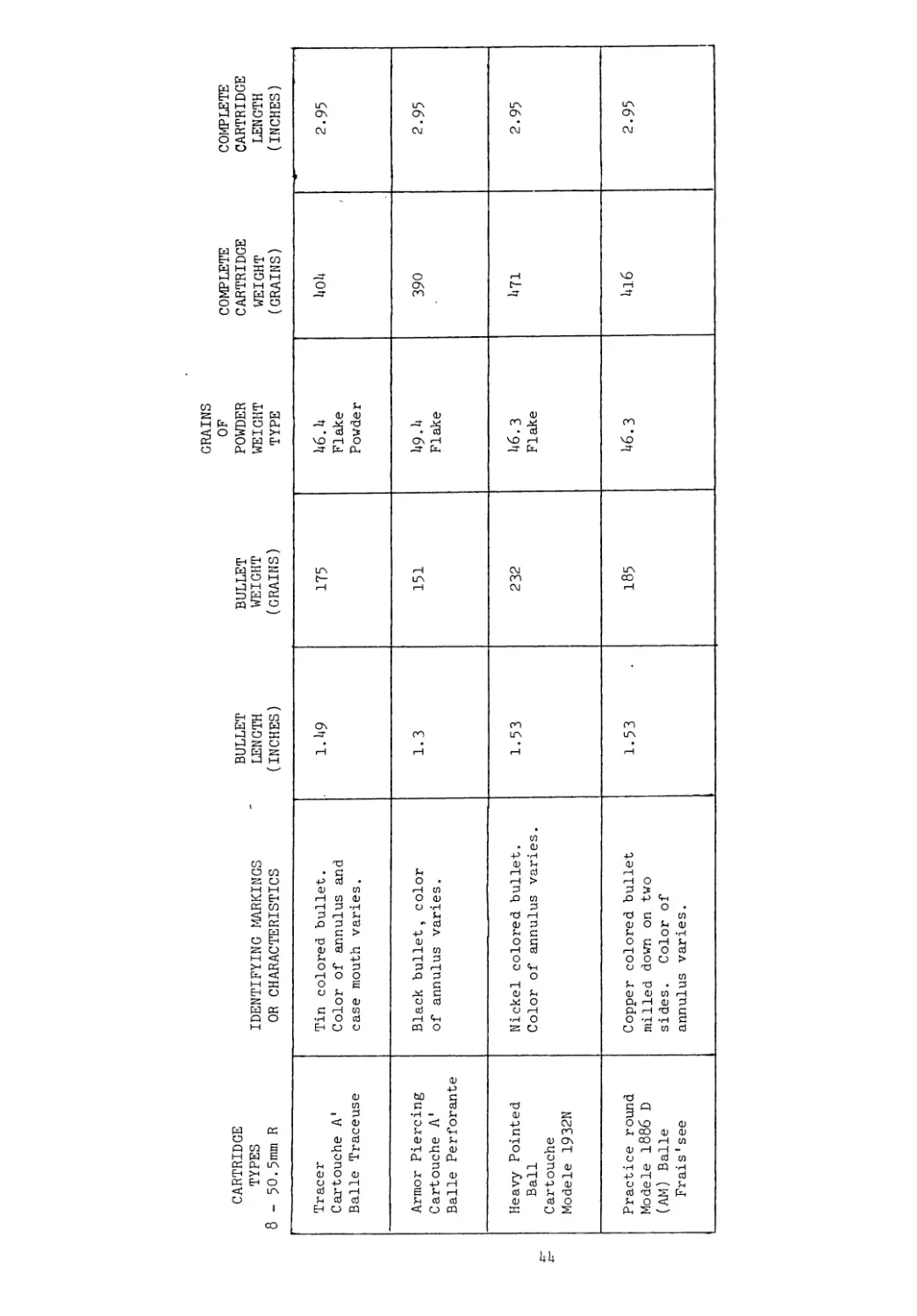
CARTRIDGE TYPES	IDENTIFYING MARKINGS	BULLET LENGTH	BULLET WEIGHT	GRAINS OF POWDER WEIGHT	COMPLETE CARTRIDGE WEIGHT	COMPLETE CARTRIDGE LENGTH
8 - 50.5mm R	OR CHARACTERISTICS	(INCHES)	(GRAINS)	TYPE	(GRAINS)	(INCHES)
Tracer Cartouche A1 Balle Traceuse	Tin colored bullet. Color of annulus and case mouth varies.	I.h9	175	Н6Л Flake Powder	hoh	2.95
Armor Piercing Cartouche A1 Balle Perforante	Black bullet, color of annulus varies.	1.3	151	149Л Flake	390	2.95
Heavy Pointed Ball Cartouche Modele 1932N	Nickel colored bullet. Color of annulus varies.	1.53	232	h6.3 Flake	1»71	2.95
Practice round Modele 1886 D (AM) Balle Frais1 see	Copper colored bullet milled down on two sides. Color of annulus varies.	1.53	185	h6.3	I»x6	2.95
GERMANY
9mm PARABELLUM (9mm LUGER)
9 - 19mm
GILDING METAL JACKET
\	z—LEAD SHEATH AROUND
>--V—^LOWER HALF OF
/	\ IRON CORE
1
IRON CORE
COMPLETE CARTRIDGE
Length: 1.169 in.
Weight: 181.6 grains
CARTRIDGE CASE DATA
Type: Rimless, straight case
Material: Brass or steel
Length: 0.750 in.
Neck Diameter: 0.373/0.380 in.
Rim Diameter: 0.386/0.394 in*
Case Weight: 60.4 grains
Primer Type: two-hole Berdan
Primer Color Code: Varies
BALLISTIC DATA
Powder Weight: 5*5 grains
Muzzle Velocity: 1150 fps in pistol
Muzzle Energy: 345 ft lbs
Muzzle Velocity in SMG: 1500 plus
USED IN FOLLOWING WEAPONS
Pistol 08 (The Luger)
Browning Pistol Hi-Power M1935
French Pistol (Military Issue)
Walther Pistol P-38, Beretta SMG,
Astra Pistol, UZI SMG, Colt,
Smith & Wesson Pistols, Schmeisser
SMG's Models 38, 40 & 41. U.S. SMG
M-3, English Sten Gun, Austen Gun and
many others.
French SMG MAT 1949
SPECIAL NOTES
BULLET DATA
Configuration: Round nose, flat base
bullet
Diameter: 0.354/0.356 in.
Length: 0.595/0.597 in.
Weight: 125 grains, most typical
ball weight
Cannelure Shape: no cannelure
Cannelure Distance: Not known
Color Code: Varies with type. See
’’Notes” below.
Jacket Material: Cupronickel on
common ball.
CORE DATA
Material: See Notes below
Configuration: See Notes below
Diameter: Not known
Length: Not known
Weight: See Notes below
RIFLING MARKS	J?yger
-------------	Pistol
Fired from Gun Model	Mod 08
No. Lands & Grooves	6
Direction of Twist	RH
Twist in In.: 1 in	9.84
Cartridge cases are made of brass, blackened brass, blackened and
lacquered steel, and copper plated steel.
9mm bullets are of various types: Bullet shaped like a truncated cone
weighs about 124 grains; Boattailed bullet of O.676 in. in length weighs
127 grains; A round nosed bullet of 89 to 92 grains is made of sintered iron,
or solid compressed powdered iron; A round nosed black-colored bullet weighs
97 to 101 grains and has a solid iron core; The most common bullet throughout
the world is the copper colored ball, with a cupronickel jacket, and a lead
core. Its weight is 125 grains, and its length is 0.597 in.
Present Users: Belgium, Canada, Denmark, France, Italy, Netherlands,
Norway, Portugal, Turkey, United Kingdom, West Germany. Limited use by the
United States, Russia, and every Iron Curtain country.
GERMANY
7.92 - 57mm
POPULAR NAME 8mm MAUSER
COMPLETE CARTRIDGE
Length: 3.15 in./w 198 grain Ball
Weight: U08 grains w/ above.
CARTRIDGE CASE DATA
Type: Rimless bottlenecked
Material: Brass or steel
Length: 2.21/2.2U in.
Neck Diameter: 0.338 in.
Rim Diameter: O.U68/O.U69 in
Case Weight: 161Л grains
Primer Type: two-hole Berdan
Primer Color Code: green annulus
about primer.
BALLISTIC DATA
Powder Weight: U3.6 grains
Muzzle Velocity: 2650 fps
Muzzle Energy: 2800 ft lbs
USED IN FOLLOWING WEAPONS
German rifles and machine guns of
WW II and before. This round is
still in use by the Greeks, Portugese,
Turks, Spaniards, British, Czechs,
Poles, and by the Red Chinese. It is
still one of the most popular
cartridges in the world.
West Germany now uses the 7.62 - 51mm
NATO Cartridge.
SPECIAL NOTES
BULLET DATA
Configuration: Pointed, boattailed.
Diameter: 0.323 in.
Length: 1.385 in.
Weight: 198 grains
Cannelure Shape: 1/2 of V notch
Cannelure Distance: O.U53 in. from
bullet’s base.
Color Code: Copper colored bullet.
Jacket Material: Cupronickel.
CORE DATA
Material: Lead
Configuration: Not 1
Diameter: Not known
Length: Not known
Weight: Not known
RIFLING MARKS
Fired from Gun Model
No. Lands & Grooves
Direction of Twist
Twist in In.: 1 in
Mauser
Rifle
Model 98
Ц
RH
9Л5
The older German Mauser Rifle of pre WW I days was the Model 88 series
Bullet diameters for the Model 88’s ran about 0.318 to 0.319 in.
Bullet shown above is the APT (SmK L’spur). This bullet has a black
bullet tip and a red primer annulus or red primer. Core is of hard steel,
pointed and flat based.
Other cartridges in this caliber are listed on the following page.
^6
GERMAN MILITARY 7.9MM AMMUNITION (7.9 x 57MM)
CARTRIDGE	ABBREVIATION FOR GERMAN DESIGNATION OF CARTRIDGE	IDENTIFYING MARKINGS OR CHARACTERISTICS	BULLET LENGTH IN INCHES	BULLET WEIGHT IN GRAINS	POWDER TYPE, AND WEIGHT IN GRAINS	MUZZLE VELOCITY 	FT SEC		MAXIMUM PRESSURE LBS PER SO, IN.
						RIFLE MOD 98	CARBINE MOD 98K
88 Ball		Round nose bullet	1.18	226.9	1*0.5 Flake	2033.6
Armor Piercing	SmK	Red primer annulus	1Л6	178.2	1*1*. 7 Flake	2571*.8	21f60.0	1*6,926
Armor Piercing Tracer	SmK L’spur	Red primer annulus, and black bullet tip.	1.1*6	156.6	Ulf.7 Flake	2689-6	2558.4	1*1* ,082
Armor Piercing Incendiary	PmK	Black primer annulus	1.1*6	157.0	1*5.0 Flake
Iron Core Bullet	SmE	Blue primer annulus	1.1*5	178.2	1*3.2 Flake		2525.6
Long Iron Core Bullet	SmE lang	Colorless lacquer on primer	1.57	162.0	1*2.1* Flake		2h60.0
Iron Core Bullet w/Tracer	SmE L’spur	Red primer annulus, and blackened bullet tip		163.5	1*3.2 Flake		2656.8
Observation	B. Patrone	Black primer annulus. Bullet	1.56	167. b	1*1*.7 Flake	2689.6	262lf .0	51,192
blackened to
within 10mm of
tip.
Л55 WEBLEY REVOLVER
11. НЗ - 19mm R
ENGLAND
CANADA
AUSTRALIA
SOUTH AMERICA
INDIA
1.26 INCHES
.535 INCH
4- -76~*
INCH
COMPLETE CARTRIDGE
Length: 1.22/1.26 in.
Weight: 31+7.6 to 350 grains
CARTRIDGE CASS DATA
Type: Rimmed case, straight
Material: Brass
Length: 0.76 in.
Neck Diameter: Not known
Rim Diameter: 0.532 in.
Case Weight: 75 grains
Primer Type: Boxer
Primer Color Code: None
BALLISTIC DATA
Powder Weight: 7.5 grains
Muzzle Velocity: 600 fps *
Muzzle Energy: 212 ft lbs
USED IN FOLLOWING WEAPONS
Pistol No. 1, MK IV, V, & VI
Webley Revolver .1+55 MK XI
Colt DA Revolvers
BULLET DATA
Configuration: Round nose, hollow,
flat base **
Diameter: 0.1+55 in.
Length: 0.75 to 0.76 in.
Weight: 265 grains
Cannelure Shape: dish shaped &
serrated
Cannelure Distance: 0.250 in. from
base of bullet
Color Code: None
Jacket Material: Not known
CORE DATA
Material: Lead-Antimony
Configuration: Not known
Diameter: Not known
Length: Not known
Weight: Not known
RIFLING MARKS
Fired from Gun Model
No. Lands & Grooves
Direction of Twist
Twist in In.
Webley
Mark II
Revolver
7
RH
SPECIAL NOTES
*
Although the velocity of this bullet is rather low by comparison with
those in use by other nations of the world, this round is most effective
against personnel.
**
The base of this large and heavy bullet is deeply hollowed in a manner
similar to that of the old Civil War Minie Ball. This is done for two
reasons: to lighten the bullet and to form a more perfect bore seal.
England now uses the 9mm Parahelium cartridge for pistols and submachine
guns. The .U55 revolver is now a secondary weapon, along with the .38/200
and other older calibers.
The 0.1+55 Webley Automatic cartridge used in the UK Model 1913 Ml Webley
Automatic Pistol provides the same approximate velocity and energy as the
0.1+55 revolver cartridge. The metric designation of this rimless cartridge
is 11.1+3 - 23.5mm.
1+8
CALIBER .303 BRITISH
7.7 - 56mm R
UNITED KINGDOM
COMPLETE CARTRIDGE
Length: 3.01+ in. MK VII Ball
Weight: 392 grains w/175 grain, Ball
CARTRIDGE CASE DATA
Type: Rimmed, bottlenecked
Material: Brass
Length: 2.16 in.
Neck Diameter: 0.31+0 in.
Rim Diameter: 0.>^+0 in.
Case Weight: 175.5 grains
Primer Type: two-hole Berdan
Primer Color Code: Purple primer
annulus on MK VII
BALLISTIC DATA
Powder Weight: 35.5 grains
Muzzle Velocity: 2^+50 fps
Muzzle Energy: 2320 ft lbs
USED IN FOLLOWING WEAPONS
British SMLE Rifles
Pattern 11+ Rifle, Lewis MG
Hotchkiss MG, Bren Gun MK I, II,
III, IV
Vickers MG MK I, Canadian Ross Rifles
M05 & MIO
Madsen MG M931
BULLET DATA
Configuration: Pointed, flat base
MK VII Ball
Diameter: 0.310/0.311 in.
Length: 1.286 in.
Weight: 175 grains
Cannelure Shape: Smooth dish shaped
on MK VII Ball
Cannelure Distance: 0.317 in to bullet’s
base
Color Code: Nickel or silver colored
ball
Jacket Material: Cupronickel
Annulus: Green @ Case mouth of
MK VII Ball
CORE DATA
Material: Lead in MK VII Ball
Configuration: See Notes below for
AP data
Diameter: Not known
Length: Not known
Weight: Not known
RIFLING MARKS
Fired from Gun Model
No. Lands & Grooves
Direction of Twist
Twist in In.: 1 in
SMLE
MK III
Rifle
5
LH
10
SPECIAL NOTES
The 0.303 is Britain’s war reserve rifle now. Since the advent of
NATO, Britain has adopted the 7.62 - 51mm NATO cartridge
0.303 AP MK I - Nickel colored with Bullet weight - 178 grains
green annulus	Bullet length - 1.37 in.
Tungsten Core weight - 77.3 grains
Tungsten Core length - 1.12 in.
Tungsten Core diameter - 0.250 in.
0.303 AP Copper colored bullet. Flat base, dished serrated cannelure,
with forward portion of cannelure 0.1+12 in. from base.
Bullet weight - 172.3 grains
Bullet length - 1.37 in.
This AP core is inclosed in a lead sleeve.
Core is flat based, and very sharply pointed.
Tungsten core weight - 86.6 grains
Tungsten length - 1.121 in.
Tungsten diameter - 0.250 in.
This cartridge is still used by the United Kingdom, Italy, Portugal
and Turkey. The bullet shown in the illustration is the Australian Tracer
GII. The cartridge has a red primer annulus.
1<9
COMPLETE CARTRIDGE CALIBER	WEIGHT AND LENGTH	BULLET WEIGHT AND LENGTH
.303 in.	36h grains MARK IX	3.03 in. Tracer Cartridge	lh8 grains l.hh in.
.303 in.	392 grains MARK VIIIz	3.03 in. Ball Cartridge	l?h grains 1.33 in.
.303 in.	39^ grains W-MARK I	3.03 in. AP Cartridge	178 grains 13.7 in.
.303 in.	366 grains B-MARK IV	3.03 in. Incendiary Cartridge	lh3 grains l.h3 in.
CARTRIDGE TYPE AND LENGTH	POWDER TYPE AND WEIGHT	JACKET INFORMATION AND COLOR CODING
Brass, rimmed	Cordite (O.Oh - 1.52 in.) 35.5 grains	Bullet has a nickel jacket with a lead core and tracer compound. Red annulus about case mouth and primer.
Brass, rimmed	Flake Powder (0.0b - 0.05 - 0.01 in.) 37.0 grains	This boattailed bullet has a copper colored jacket with a pale violet tip. A purple annulus is about primer. The jacket is of a copper-zinc alloy.
Brass, rimmed	Cordite (0.0b - 1.52 in.) 35-6 grains	This is a nickel colored bullet with a green annulus. The jacket is of cupronickel steel.
Brass, rimmed	Stick Powder (0.01» - 1.38 in.) 37.1 grains	This is a nickel colored bullet with a blue annulus. Bullet has a cupronickel steel jacket with a lead core and a phosphorus filler. NOTE: Approximately 3/16th of an inch above the cartridge case mouth, this bullet is noticeably reduced to a smaller diameter.
6.5mm MANNLICHER-CARCANО
6.5 - 52.5mm
ITALY
POST WW II
3 SHALLOW INDENTS
COMPLETE CARTRIDGE
Length: 3.01 in.
Weight: 350 grains (162 grain Ball)
CARTRIDGE CASE DATA
Type: Rimless, bottlenecked
Material: Brass
Length: 2.01/2.06 in.
Neck Diameter: 0.296 in.
Rim Diameter: 0.U50 in.
Case Weight: 152 grains
Primer Type: two-hole Berdan
Primer Color Code: None
BALLISTIC DATA
Powder Weight: 35.5 grains
Muzzle Velocity: 2390 fps
Muzzle Energy: 2000 ft lbs plus
USED IN FOLLOWING WEAPONS
Mannlicher Carcano Rifle Model 38
Mannlicher Carcano Carbine Model 38
Breda Machine Gun Model 1930
BULLET DATA
Configuration: Concical or round
nose/flat base
Diameter: 0.265/0.266 in.
Length: 1.2 in.
Weight: 162 grains
Cannelure Shape: Smooth, shallow,
dish shaped **
Cannelure Distance: See * * and **
Color Code: None. Ball is nickel
colored.
Jacket Material: Cupronickel
CORE DATA
Material: Lead core
Configuration: Same
Diameter: Not known
Length: Not known
Weight: Not known
RIFLING MARKS
Fired from Gun Model
No. Lands & Grooves
Direction of Twist
Twist in In.: 1 in
as jacket
Mannlicher
Carcano Carb
Model 38
h
RH
7.87
SPECIAL NOTES
All other small arms cartridges in use by the Italian armed forces are
listed on the following page.
*
From base of bullet to the first slope of this shallow cannelure is
approximately 0.196 in.
**
Another Ball round in this caliber has a smooth, straight cut cannelure.
The distance from forward portion of cannelure to base on this bullet is
0.203 in. The bullet measured is 1.187 in. in length.
51
OTHER CARTRIDGES USED BY ITALY IN WW II
CALIBER	COMPLETE CARTRIDGE WEIGHT AND LENGTH	I	BULLET WEIGHT !	AND LENGTH	CARTRIDGE TYPE AND LENGTH	POWDER WEIGHT	I COLOR CODING	:
7.35mm Pointed Ball 7.35 -51mm	310 grains 2.9 in.	128.1* grains 1.08 in.	Brass, rimless 2.02 in.	Weight Unknown	Nickel colored bullet with rounded point. Has nickel coated steel jacket with lead core and aluminum filling in tip.
7.7mm Pointed Ball	39^ grains 3.05 in.	17^ grains 1.3 in.	Brass rimmed 2.2 in.	39.6 grains	Nickel colored bullet. Cupronickel coated steel jacket with aluminum filling in tip, and with lead core.
7.7 Tracer	367 grains 3.03 in.	159 grains 1.37 in.	Brass rimmed 2.2 in.	37Л grains	Red tipped bullet with nickel jacket, lead core and tracer.
7.7mm API	ЗбО grains	15^ grains 1	Brass rimmed	37.7 grains	Blue tipped bullet. Nickel jacket with four openings near tip, copper inner jacket, phosphorous in tip, hard steel core with lead plug.
8mm Heavy Pointed Ball	Ьб7 grains 3.17 in.	208 grains	1 1.39 in. 1	Brass, rimless 2.32 in.	Weight Unknown	Copper colored bullet. Copper zinc alloy coated steel jacket with lead core.
8mm AP	U53 grains 3.16 in.	19I1 grains 1.1*5 in.	Brass, rimless 2.32 in.	1*7.6 grains	White tipped bullet. Same jacket as above, with lead sleeve and AP core.
12.7mm Incendiary	1305 grains h.2 in.	565 grains 1.76 in.	Brass, rimless 3.19 in.	Weight Unknown	Blue tipped. Nickel jacket with copper tip, phosphorous in tip brass core and lead plug.
12.7mm API	1290 grains h.2 in.	552 grains 1.99 in.	Brass, rimless 3.19 in.	Weight Unknown	White tipped bullet. Nickel jacket, copper tip, steel cap, steel core, tracer, lead sleeve plug.
NOTE: The 12.7mm Explosive Bullet is easily recognized by a Brass fuze protruding from the bullet nose.
JAPAN
8mm JAP TYPE lh
8 - 21mm
1.23 INCHES
.411 INCH
.83 INCH
COMPLETE CARTRIDGE
Length: 1.23 in.
Weight: 177.5 grains
CARTRIDGE CASE DATA
Type: Rimless, bottlenecked
Material: Brass
Length: 0.83 in.
Neck Diameter: Not known
Rim Diameter: 0Л11 in.
Case Weight: 7^.^ grains
Primer Type: two-hole Berdan
Primer Color Code: None
BALLISTIC DATA
Powder Weight: 5.0 grains
Muzzle Velocity: 1000 - 10б5 Pistol
Muzzle Energy: 222 fps
SMG Velocity: 1100 fps
USED IN FOLLOWING WEAPONS
Type 1H & Type 9^ Pistols
Type 100 SMG's
BULLET DATA
Configuration: Round nosed, flat
based bullet
Diameter: 0.320 in.
Length: 0.60 in.
Weight: 100.5 to 102 grains
Cannelure Shape: Only three indents
in bullet wall
Cannelure Distance: 0.093 in. from
base of bullet
Color Code: Silver or nickel color
bullet
Jacket Material: Cupronickel
CORE DATA
Material: Lead-antimony slug
Configuration: Same configuration
as jacket
Diameter: Not known
Length: Not known
Weight: Not known
RIFLING MARKS	P™ .
----------------------------	Type	14
Fired from Gun Model Pistol
No. Lands & Grooves	6
Direction of Twist	RH
Twist in In.
53
JAPAN
6.5mm JAPANESE
6.5 - 51mm SEMI-RIMMED
I
0.475
INCHES
NO BULLET
DRAWING
AVAILABLE
COMPLETE CARTRIDGE
Length: 2.98 in.
Weight:	326 grains
CARTRIDGE CASS DATA
Type: Semi-rimmed, bottlenecked
Material: Brass
Length: 2.00 in.
Neck Diameter: 0.290/0.293 in.
Rim Diameter: 0.175 in.
Case Weight: 157 grains
Primer Type: two-hole Berdan
Primer Color Code: gold colored
primer, with no
annulus
BALLISTIC DATA
Powder Weight:	33 grains
Muzzle Velocity: 25 fps
Muzzle Energy: 1815 ft lbs
USED IN FOLLOWING WEAPONS
Japanese Type 38 Rifles
Japanese Type 11 Carbines
Japanese Type 11 & 96 Machine Guns
Japanese Type 30 Rifles
SPECIAL NOTES
BULLET DATA
Configuration: Pointed, flat base
Diameter: 0.260/0.262 in.
Length: 1.253 in.
Weight: 136 to 139 grains
Cannelure Shape: Very shallow -
almost none
Cannelure Distance: 0.281 in. from
base of bullet
Color Code: None. Ball is silver
colored
Jacket Material: Copper coated,
silver finished
CORE DATA
Material: Lead-antimony Configuration: Same as Jacket Diameter: Not known
Length: Not known Weight: Not known RIFLING MARKS Fired from Gun Model	aj (D 5 3.5 k сл ,a <d •H $-» TJ a) О < О S	co on (D (D rd Ен CC
No. Lands & Grooves	1	6
Direction of Twist	RH	RH
Twist in In.: 1 in	7.87	7.87
Thousands of rifles and machine guns of this caliber were turned over
to the Chinese Army at the time of the Japanese surrender in 1915. These
weapons are still in use in the Red Chinese Armed Forces.
5 It
7.7 - 56mm R
JAPAN
COMPLETE CARTRIDGE
Length: 3.1^6 in.
Weight: UUU.7 grains
CARTRIDGE CASE DATA
Type: Rimmed - bottlenecked case
Material: Brass
Length: 2.16 in.
Neck Diameter: 0.3^0 in.
Rim Diameter: 0.5^0 in.
Case Weight: 196.2 grains
Primer Type: two-hole Berdan
Primer Color Code: Green colored
primer
BALLISTIC DATA
Powder Weight: hU.l grains
Muzzle Velocity: 2^00 fps
Muzzle Energy: Approx. 2600 ft lbs
USED IN FOLLOWING WEAPONS
Japanese Type 92 Machine Gun
Japanese Type 97 Machine Gun
Various British Rifles and
Machine Guns
BULLET DATA
Configuration: Pointed, boattailed
bullet
Diameter: 0.310 in.
Length: 1.39 in.
Weight: 205 grains
Cannelure Shape: Very shallow and
serrated
Cannelure Distance: 0.531 in. from
base of bullet
Color Code: red annulus at case
mouth
Jacket Material: Cupronickel
CORE DATA
Material: Lead-antimony
Configuration: Same as jacket
Diameter: Not known
Length: Not known
Weight: Not known
RIFLING MARKS	. 92
-------------- Machine
Fired from Gun Model Gun
No. Lands & Grooves	й
Direction of Twist	RH
Twist in In.
SPECIAL NOTES
This cartridge and the British
.303 are interchangeable.
55
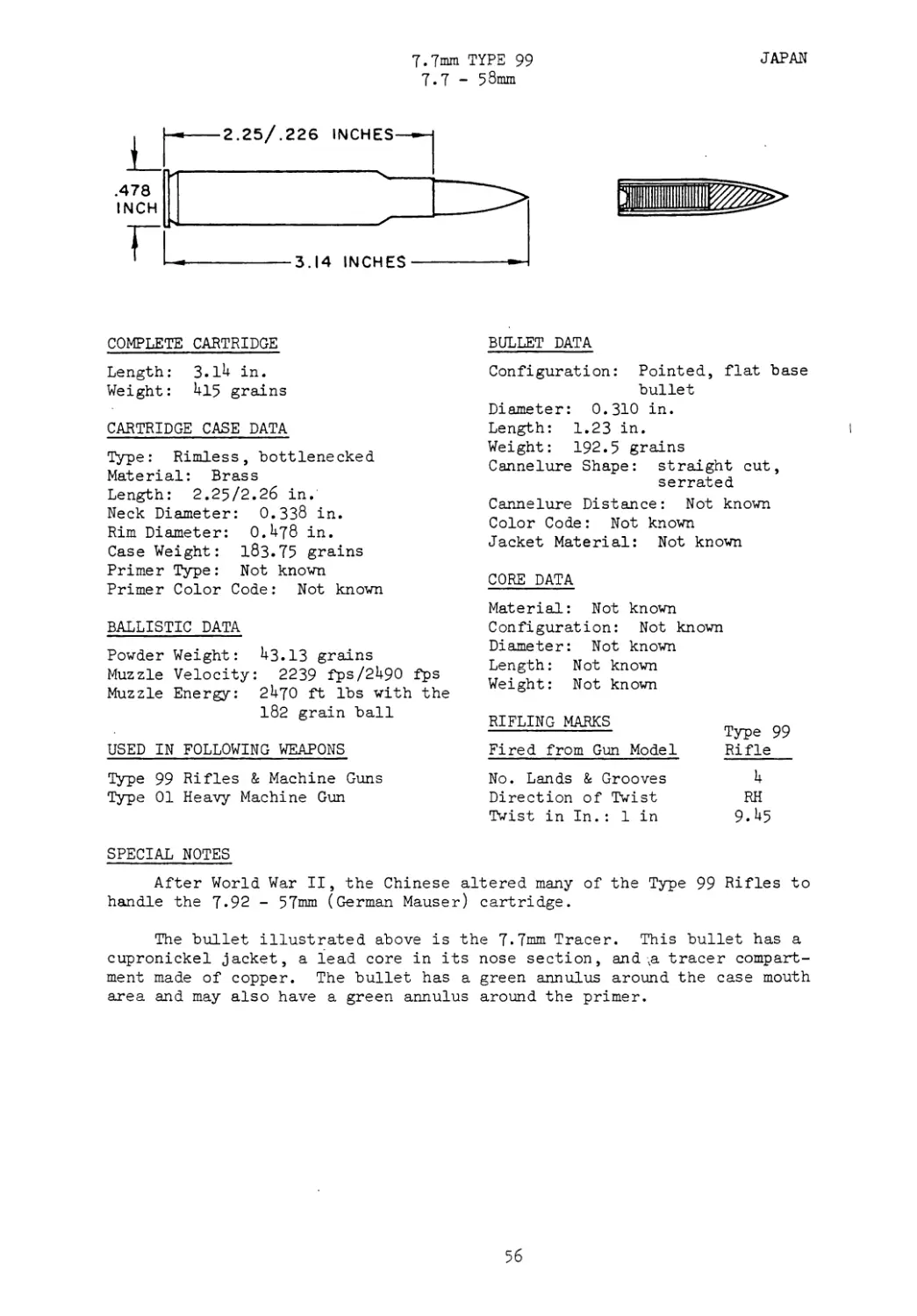
JAPAN
7.7mm TYPE 99
7.7 - 58mm
НИЙ
COMPLETE CARTRIDGE
Length: 3.1Л in.
Weight: U15 grains
CARTRIDGE CASE DATA
Type: Rimless, bottlenecked
Material: Brass
Length: 2.25/2.26 in.
Neck Diameter: 0.338 in.
Rim Diameter: О.Ц78 in.
Case Weight: 183.75 grains
Primer Type: Not known
Primer Color Code; Not known
BALLISTIC DATA
Powder Weight: U3.13 grains
Muzzle Velocity: 2239 fps/2^90 fps
Muzzle Energy: 2^70 ft lbs with the
182 grain ball
USED IN FOLLOWING WEAPONS
Type 99 Rifles & Machine Guns
Type 01 Heavy Machine Gun
BULLET DATA
Configuration: Pointed, flat base
bullet
Diameter: 0.310 in.
Length: 1.23 in.
Weight: 192.5 grains
Cannelure Shape: straight cut,
serrated
Cannelure Distance: Not known
Color Code: Not known
Jacket Material: Not known
CORE DATA
Material: Not known
Configuration: Not known
Diameter: Not known
Length: Not known
Weight: Not known
RIFLING MARKS
-------------- Type 99
Fired from Gun Model	Rifle
No. Lands & Grooves	U
Direction of Twist	RH
Twist in In.: 1 in	9.^5
SPECIAL NOTES
After World War II, the Chinese altered many of the Type 99 Rifles to
handle the 7-92 - 57mm (German Mauser) cartridge.
The bullet illustrated above is the 7» 7mm Tracer. This bullet has a
cupronickel jacket, a lead core in its nose section, and ;a tracer compart-
ment made of copper. The bullet has a green annulus around the case mouth
area and may also have a green annulus around the primer.
56
13.2mm HOTCHKISS
13.2 - 99mm
FRANCE
JAPAN - NAVY ONLY
3.899 INCHES
COMPLETE CARTRIDGE
Length: 5.35 in.
Weight: 1836 grains
CARTRIDGE CASE DATA
Type: Rimless, bottlenecked
Material: Brass
Length: 3.9 in.
Neck Diameter: ID is O„571 in.
Rim Diameter: 0.897 in.
Case Weight: Not known
Primer Type: Not known
Primer Color Coder Not known
BALLISTIC DATA
Powder Weight: 232 grains
Muzzle Velocity: 2210 fps
Muzzle Energy: For 805 grain bullet
only ME is over 8600
ft lbs
USED IN FOLLOWING WEAPONS
French M30 Machine Gun
Japanese Type 93 Machine Gun
BULLET DATA
Configuration: Pointed, boattailed
Diameter: 0.531 in.
Length: 2.375 in. (Japanese AP
bullet is 2.1+5 in.)
Weight: 805 grains
Cannelure Shape: Dish shaped,
0.30 in. wide
Cannelure Distance: Not known
Color Code: Not known
Jacket Material: Gilding Metal
CORE DATA
Ball core is of soft iron
Material: AP Core is of hard steel
Configuration: Pointed and
boattailed *
Diameter: AP core is 0.1+53 in.
(Japanese mfg)
Length: AP core only - 1.875 in.
Weight: Not known
RIFLING MARKS
Fired from Gun Model
No. Lands & Grooves
Direction of Twist
Twist in In.
J apanese
Hotchkiss
Type 93
8
LH
SPECIAL NOTES
*
The Japanese AP core is shown at top of page. The width of the
waist portion of this core is 0.1+28 in.
57
RUSSIA
9mm MAKAROV (9.2mm)
NEW RUSSIAN PISTOL CARTRIDGE
9.2 - 18шт
COMPLETE CARTRIDGE
Length: 0.97 in.
Weight: 156 grains
CARTRIDGE CASE DATA
Type: Rimless, straight case
Material: Probably brass & steel
Length: 0.71 in.
Neck Diameter: Not known
Rim Diameter: 0.389 in.
Case Weight: Not known
Primer Type: two-hole Berdan
Primer Color Code: Not known
BALLISTIC DATA
Powder Weight: 3.7 grains
Muzzle Velocity: 103H to 1116 fps
Muzzle Energy: Over 300 ft lbs
USED IN FOLLOWING WEAPONS
Soviet Makarov Pistol
Soviet Stechkin Pistol
BULLET DATA
Configuration: Flat based, round
nosed
Diameter: О.ЗбЗ in.
Length: 11.3mm
Weight: 9H to 95 grains
Cannelure Shape: Not known
Cannelure Distance: Not known
Color Code: Not known
Jacket Material: Not known
CORE DATA
Material: Not known
Configuration: Not known
Diameter: Not known
Length: Not known
Weight: Not known
RIFLING MARKS
Fired from Gun Model *
No. Lands & Grooves - U
Direction of Twist - R.H.
Twist in In.	- Not Known
SPECIAL NOTES
This caliber is not a true 9mm such as is the 9mm Parahelium. The bullet
diameter of the Parahelium measures 0.35^- in., as compared to this Makarov
round which measures O.362 in./О.ЗбЗ in. This condition means that in an
emergency the 9mm Parahelium cartridge could be used in the Russian pistols,
whereas the Makarov could not be used in the standard NATO 9mm weapons.
Not too much is known about either of these two pistols. However it is
known that the Stechkin has a Walther P-38 type of double action for the first
shot only. In other words, one continuous pull on the trigger will cock and
fire the pistol for its first shot, providing, of course, that the round had
been chambered. After this first shot however, the pistol reverts to a
normal semiautomatic action.
* Rifling data obtained from study of an East German copy of the Soviet
’’Makarov Pistol.”
58
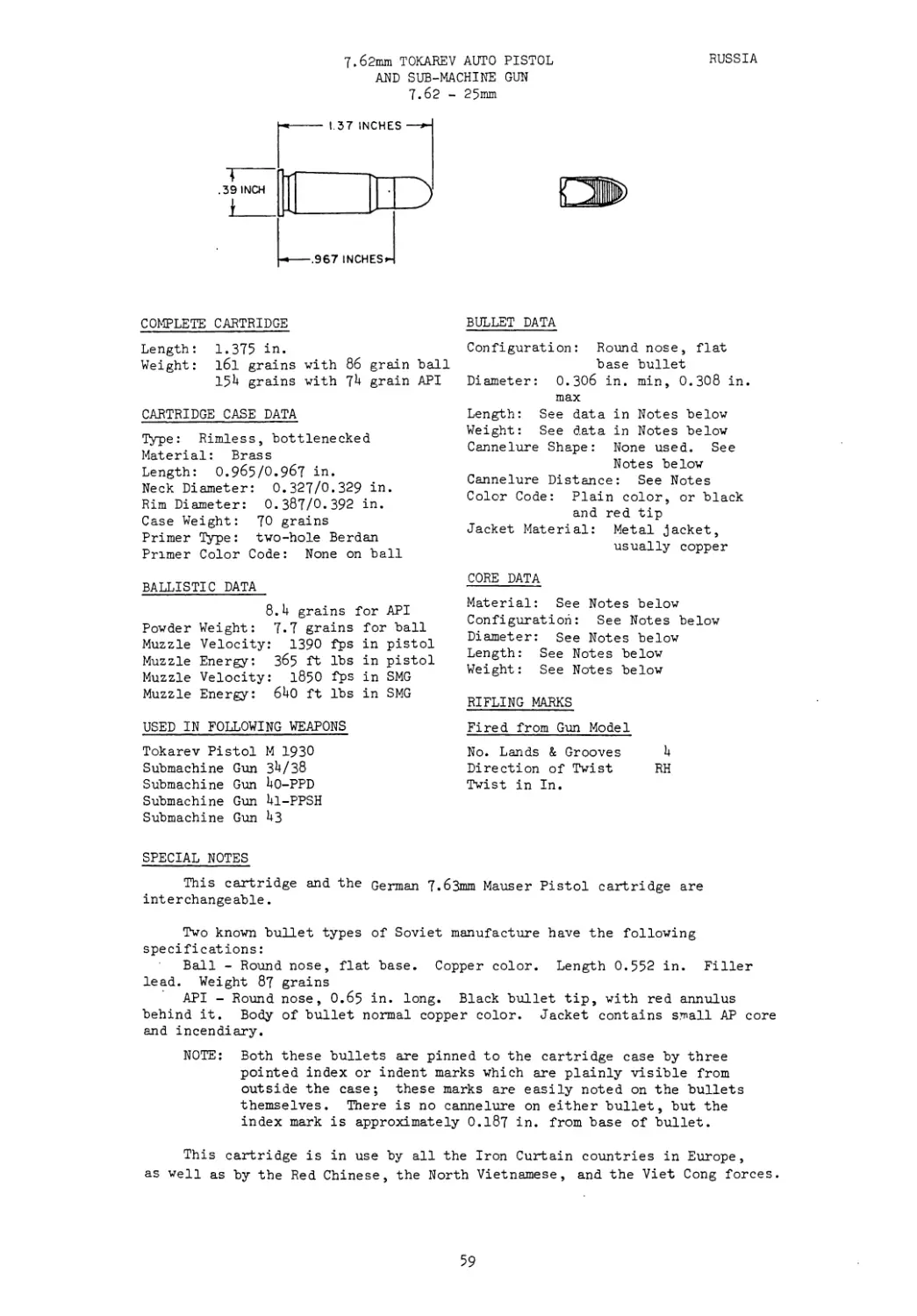
RUSSIA
7.62mm TOKAREV AUTO PISTOL
AND SUB-MACHINE GUN
7.62 - 25mm
H----- 1.37 INCHES —*-
-•--.967 INCHES^
COMPLETE CARTRIDGE
Length: 1.375 in.
Weight: 161 grains with 86 grain ball
15 grains with 7^ grain API
CARTRIDGE CASE DATA
Type: Rimless, bottlenecked
Material: Brass
Length: 0.965/0.96? in.
Neck Diameter: 0.327/0.329 in.
Rim Diameter: 0.387/0.392 in.
Case Weight: 70 grains
Primer Type: two-hole Berdan
Primer Color Code: None on ball
BALLISTIC DATA
8.U grains for API
Powder Weight: 7-7 grains for ball
Muzzle Velocity: 1390 fps in pistol
Muzzle Energy: З65 ft lbs in pistol
Muzzle Velocity: 1850 fps in SMG
Muzzle Energy: 6U0 ft lbs in SMG
USED IN FOLLOWING WEAPONS
Tokarev Pistol M 1930
Submachine Gun 3*4/38
Submachine Gun *1O-PPD
Submachine Gun hl-PPSH
Submachine Gun b3
BULLET DATA
Configuration: Round nose, flat
base bullet
Diameter: 0.306 in. min, 0.308 in.
max
Length: See data in Notes below
Weight: See data in Notes below
Cannelure Shape: None used. See
Notes below
Cannelure Distance: See Notes
Color Code: Plain color, or black
and red tip
Jacket Material: Metal jacket,
usually copper
CORE DATA
Material: See Notes below
Configuration: See Notes below
Diameter: See Notes below
Length: See Notes below
Weight: See Notes below
RIFLING MARKS
Fired from Gun Model
No. Lands & Grooves h
Direction of Twist	RH
Twist in In.
SPECIAL NOTES
This cartridge and the German 7.63mm Mauser Pistol cartridge are
interchangeable.
Two known bullet types of Soviet manufacture have the following
specifications:
Ball - Round nose, flat base. Copper color. Length 0.552 in. Filler
lead. Weight 87 grains
API - Round nose, O.65 in. long. Black bullet tip, with red annulus
behind it. Body of bullet normal copper color. Jacket contains small AP core
and incendiary.
NOTE: Both these bullets are pinned to the cartridge case by three
pointed index or indent marks which are plainly visible from
outside the case; these marks are easily noted on the bullets
themselves. There is no cannelure on either bullet, but the
index mark is approximately 0.187 in. from base of bullet.
This cartridge is in use by all the Iron Curtain countries in Europe,
as well as by the Red Chinese, the North Vietnamese, and the Viet Cong forces.
59
RUSSIA
7.62 - 39mm
7.62mm М19^3 TYPE PS
COMPLETE CARTRIDGE
Length: 2.2 in.
Weight: 253 grains
CARTRIDGE CASE DATA
Type: Rimless, bottlenecked case
Material: Brass or steel
Length: 1 1/2 in. or 39mm
Neck Diameter: 0.333/0.33^- in.
Rim Diameter: O.UU3/O.UUU in.
Case Weight: Brass-128 grains
Steel-150 grains
Primer Type: two-hole Berdan
Primer Color Code: On ball, none
BALLISTIC DATA
Powder Weight: 25.H grains
Muzzle Velocity: 2320 to 2U00 fps
Muzzle Energy: Over lUOO ft lbs
USED IN FOLLOWING WEAPONS
Soviet AK Assault Rifle (AK U?);
SKS Carbine; RPK Light Machine Gun*
RPD LMG
Plus various foreign copies of the
above
BULLET DATA
Configuration: Short, pointed,
boattailed
Diameter: 0.310 in.
Length: 1.062 in.
Weight: 123.5 grains plus or minus
half grain.
Cannelure Shape: 1/2 of V notch &
shallow depth
Cannelure Distance: 0.375 in. from
base bullet
Color Code: None for ball cartridge
Jacket Material: Cupronickel
CORE DATA
Material: Mild Steel core with lead
sleeve
Configuration: flat base with small
flat nose
Diameter: 0.2265/0.227 in.
Length: 0.778 in.
Weight: 5^.7 grains. With lead
sleeve about this core, its
total weight is 69 grains
RIFLING MARKS	AT, ,
--------------	AK U7
Fired	from Gun Model	Rifle
No. Lands & Grooves	h
Direction of Twist	RH
Twist	in In.: 1 in	9-^5
SPECIAL NOTES
This cartridge is manufactured by Russia, Poland, Czechoslovakia, East
Germany, Red China and Finland. The cartridge is also used by the United
Arab Republic (UAR). The other types of cartridges listed under this caliber
are covered on the next page. These will include the API and Tracer type.
DATA ON THE AK Ц7 ASSAULT RIFLE
Bore diameter: 0.301 in.
Groove diameter: 0.311 in.
Cyclic rate of fire: 600 rounds per
minute
Magazine capacity: 30 rounds
Weight of fully loaded AK Ц7: 10.5 lbs
Barrel length: 16.3U in.
The RPK Light Machine Gun uses
either a 75-round drum magazine, a
U0-round box magazine, or the 30-
round box magazine of the AK h7
Assault Rifle. It is also fitted
for a detachable Bl-POD muzzle
mount.
60
BULLET BULLET
CARTRIDGE IDENTIFYING MARKINGS	LENGTH WEIGHT POWDER WEIGHT
TYPES	OR CHARACTERISTICS	INCHES	GRAINS	IN GRAINS, TYPE
DISTANCE FROM
FRONT OF	BASE
CANNELURE TO	MARKS
BASE OF BULLET
7.62 x 39mm	Tracer, green tip with
red annulus at case
mouth and about the
primer. Flat base
b ullet, sli ghtly
rounded.
25.2 grains,
black, tubular
Cannelure is
0.h68 in. from
base
Weight of complete round - 2U8.6 grains
Length of complete round - 2.192 in.
SOVIET
7.62 x 39mm	Ball, no annulus at
case mouth or around
primer. Bullet is
copper colored. Ball
is boattailed.
25.U grains,
black, tubular
Cannelure is
0.375 in. from
base
Weight of complete round - 253.J. grains
Length of complete round - 2.18 in.
CHICOM
7.62 x 39mm
API black & red tip.
Boattailed, very shallow
cannelure. This bullet
is loaded with its AP
core and incendiary mix
from the front. Tip is
then affixed. Closure
mark is 0.250 in. from
tip. No annulus at
mouth or around primer.
1.187 in. 118.3
2U.7 grains
Cannelure is
0.250 in. from
base
Weight of complete round - 252.5 grains
Length of complete round - 2.187 in.
Core Length 0.875 Core Diamater 0.239/
0.2h0 in.
Core configuration - pointed and flat based
Core weight - 62 grains
SOVIET
NOTE: This bullet has a solid base to it. The
incendiary composition and armor piercing
core is loaded into it from the front, and
then it is closed. The closure point can
be seen approximately 1/h in. down from
the bullet’s point.
CHI-COM VERSIONS OF THE 7.62 X 39MM CARTRIDGE
	BULLET	BULLET
CARTRIDGE TYPES	IDENTIFYING MARKINGS	LENGTH	WEIGHT	POWDER WEIGHT	DISTANCE FROM FRONT OF	BASE OR CHARACTERISTICS	INCHES	GRAINS	IN GRAINS, TYPE	CANNELURE TO BASE OF BULLET	MARKS
7.62 X 39mm	Red Tip, flat base bullet, slightly- rounded.	1.09 inch	102. h Weight Length	25 grains of complete round of complete round	Cannelure is 1/2 of V notch, O.h37 inch from base. 1 - 252 grains L - 2.187 inches	\57у/
7.62 X 39mm	Tracer, green tip with a boattailed base.	1.09 inch	116.1	25 grains	No cannelure on this bullet. Jacket wall is smooth
7.62 X 39mm O\ • ГО	API, black and red tipped bullet. (See Russian API bullet for full description.)	1.06 inch	116.6 Weight Length	25 grains of complete round of complete round	Cannelure is 1/2 of V notch, O.ho6 inch from base. 1 - 2h6.h grains I - 2.187 inches
7.62 X 5^nnn R	CHI Ball, with a white painted nose tip, and copper colored jacket body. Brass cartridge case weighs 152 grains. This bullet contains a mild steel core, and has a boattailed base.	-COM COPY OF THE RUSSIAN 7.62 X 5*<MM 1.27	1П6.5	h8.5 grains inch Core Data Configuration - Flat pointed, Length - 0.915/0.918 inch Diameter - 0.238/0.239 inch Weight - 73 grains			R CARTRIDGE Cannelure is straight cut and smooth, 0.375 inch from base. slight boattailed base.	/8l\ \^57
RUSSIA
7.62 - 5 hmm R
LIGHT POINTED BALL
API—T
COMPLETE CARTRIDGE
Length: 2.99 in.
Weight: 350 grains
CARTRIDGE CASE DATA
Type: Rimmed, bottlenecked
Material: Brass
Length: 2.062 in.
Neck Diameter: 0.335 /0.336 in.
Rim Diameter: 0.570 in.
Case Weight: 153 grains
Primer Type: two-flash hole, Berdan
Primer Color Code: None for this
Light ball
BALLISTIC DATA
Powder Weight: 50 grains
Muzzle Velocity: 2853 fps
Muzzle Energy: Approx. 2700 ft lbs
USED IN FOLLOWING WEAPONS
Moisin-Nagant Rifles M-91
Simonov M-Зб Semi-Auto Rifles
Tokarev M-38 & 1+0 Semi-Auto Rifles
Degtyarov M-38 LMG
Maxim М-19Ю Machine Gun
SPECIAL NOTES
BULLET DATA
Configuration: Pointed, flat base
Diameter: 0.310/0.311 in.
Length: 1.18 in.
Weight: IM8/1U9 grains
Cannelure Shape: Not known
Cannelure Distance: Not known
Color Code: Copper colored bullet
Jacket Material: Cupronickel
w/hollow base
CORE DATA
Material: This bullet has a lead
Configuration: core. For data on
Diameter:	the AP cores of this
Length:	same caliber car-
Weight:	tridge see next page.
RIFLING MARKS Fired from Gun Model	Moisin Nagant M 1891 Rifle
No. Lands & Grooves	1»
Direction of Twist	RH
Twist in In.: 1 in	9.1*5
This cartridge and the rifles and machine guns that fire it, were used by
the Russians in both World Wars. It was also issued to the North Koreans
during the Korean War of 1950-53. There are considerable numbers of Russian
rifles of this caliber currently in the hands of the VC. Now, both cartridge
and rifle are considered limited standard or war reserve weapons by the
Russians.
CAUTION: It is not likely that such a bullet as an HEI will be encountered
at this late date, but it is impossible to determine just what the Soviets
will issue to their satellites. During WW II the Russians manufactured an
HEI bullet in this caliber with the following specifications: 7.62 - 5hmm R;
weight 160.2 grains: velocity 2680 to 27h0 fps; powder charge 1+h grains;
bullet pointed & boattailed; bullet coded red; bullet contained an incendiary
mix, a firing pin, and an explosive or detonating composition. Cartridge
case base markings of these bullets were - Г JI OR Г Ж
The other five types of cartridges included in this caliber are listed
on the following page.
The bullet illustrated above is the Armor Piercing Incendiary Tracer.
Its tip is coated with violet, backed up by a red band.
63
RUSSIA
CARTRIDGE
TYPES
7.62 - 5bMMR
IDENTIFYING MARKINGS
OR CHARACTERISTICS
BULLET	BULLET
LENGTH	WEIGHT
IN •	IN
INCHES	GRAINS
POWDER TYPE
WEIGHT IN
GRAINS
MUZZLE
VELOCITY
FT SEC
DISTANCE FROM
FRONT EDGE OF
CANNELURE TO BASE
OF BULLET
Light Ball
Heavy Ball
Copper colored bullet
with small hollow base
like Civil War Minie
Ball
Boattailed Ball with
yellow tip, copper
colored body
1.18
1.312
Armor Piercing
Black tipped bullet,	l.h32
with copper colored
body, and tungsten
core
Tracer, Pointed
Ball
Green tipped bullet,	1.5
with copper colored
body
Armor Piercing
Tracer Incendiary
Violet & Red tipped
bullet with copper
colored body
1.58
Armor Piercing
Incendiary
Black & Red tipped	l.hU
bullet with copper	to
colored body	1Л7
1U8 to 150	Cylindrical (0.02 _ 0.07 in.) 50.2 grains	2853	0.260 in. flat smooth cannelure
182	Cylindrical (0.02 - 0.0? in.) 1)7-7 grains	2571)	O.h32 in. boattailed smooth cannelure
170	Cylindrical (0.02 - 0.07 in. ) 1)9.0 grains	2667	0.515 in. boattailed smooth cannelure
lh8	Cylindrical (0.02 - 0.07 in.) h6.5 grains	2839	Smooth boattailed bullet with no cannelure.
lh9	Cylindrical (0.02 - 0.07 in.) 1)5.6 grains	281)1
153 to 15*».7	. Cylindrical (0.02 - 0.07 in.) 50 grains to 1)9.1	2560	0.591 in. boattailed smooth cannelure
NOTE: AP core has a roughly machined boattailed core with weight at 82. h grains/length at 1.177 in./diameter at 0.239 in.
API core has a smooth machined boattailed core with weight at 8h.5 grains/length at 1.17 in./diameter at O.2hO5 in.
RUSSIA
12.Тип АР INCENDIARY TRACER
12.7 - 108mm
TRACER
CUP
INCENDIARY
A.P. CORE
LEAD SLEEVE IS AROUND
BOTH A.P. CORE AND
TRACER CUP.
COMPLETE CARTRIDGE
Length: 5«79 in. or lh7mm
Weight: 2050 grains or 0.29^ lbs
CARTRIDGE CASE DATA
Type: Rimless, bottlenecked case
Material: Brass
Length: b.25 in.
Neck Diameter: 0.55 in.
Rim Diameter: 0.853 in.
Case Weight: 1025 grains
Primer Type: two-hole Berdan
Primer Color Code: Blue or Black
annulus about
primer
BALLISTIC DATA
Powder Weight: 2^5.2 grains
Muzzle Velocity: 2850/2900 fps
Muzzle Energy: Over 12,000 ft lbs
USED IN FOLLOWING WEAPON
Degtyarev 12.7mm Heavy Machine Gun
BULLET DATA
Configuration: Pointed and boattailed
Diameter: О.5Ю/О.5Ю5 in.
Length: 2.5 in. or 63.5mm
Weight: 739 grains
Cannelure Shape: two cannelures,
smooth straight cut
Cannelure Distance: front 1 in.,
rear 0.781 in.
Color Code: Violet and red tip,
copper body
Jacket Material: Copper-zinc alloy
coated steel
CORE DATA	Steel Core	Tracer Cup
Material:	hard steel	Copper
Configuration: flat base, pointed		open end
Diameter:	O.h285/O.h31 in.	0.Н25/ O.h27 in.
Length:	1.23 in.	0.760/ 0.761 in.
Weight:	258.3 grains	Full - 129.6 grains
Hardness:	C-65	Empty - 10h.6 grains
RIFLING MARKS	„
----------------------------	12.7	mm
Fired from Gun Model HMG М38
No. Lands & Grooves	8
Direction of Twist	RH
Twist in In.: 1 in 15/16
NOTE: The 12.7mm Degtyarov rifling
prints 8 land marks on a fired
bullet, each measuring
approximately 0.093 in. in width.
The U.S. Caliber .50 Browning
Machine Gun rifling prints a
land mark of approximately
0.062 in.
SPECIAL NOTES
The rifling marks left on U.S. Caliber .50 bullets, and the marks left on
a Russian 12.7mm bullet are very similar. Both bullets will show the marks of •
8 lands and grooves with a right hand twist. Probably the best way to make a
certain identification between the two is to have a U.S. Caliber -50 bullet
(that has been fired) on hand and make a visual comparison. The difference is
quite apparent when the two can be compared, side by side.
NOTE: The bullet diameters of both the Russian and U.S. bullets are approxi-
mately the same. In fact the 12.7mm bullets can be removed from their
cartridge cases, reseated in U.S. Caliber «50 cartridge cases and fired
from Caliber .50 Machine guns with perfect safety. However, this type
of reloading should only be done by experienced personnel.
NOTE: The short AP core, and the cup holding the tracer compound, are
inclosed in a lead sleeve which runs from the jacket tip to its base.
The tracer cup is similar in appearance to a Caliber «^5 ACP blank
cartridge, only without the extracting rim. Upon impact this bullet
is prone to come apart at the point where the AP core and the tracer
cup meet. Thus the finding of a short core or the remnants of a
tracer cup is fairly good evidence that the whole bullet had been a
12.7mm API-T.'
65
12.7mm AP INCENDIARY
RUSSIA
12.7 - 108mm
A.R I.
H.E. I.
D С В A
A-INCENOIARY B-DETONATING
COMPOSITION
C-FIRING PIN D-LEAD FILLER
COMPLETE CARTRIDGE
Length: 5.79 in. or lU7mm
Weight: 2070 grains or 0.296 lbs
CARTRIDGE CASE DATA
Type: Rimless, bottlenecked case
Material: Brass
Length: U.25 in.
Neck Diameter: 0.55 in.
Rim Diameter: 0.853 in.
Case Weight: 1025 grains
Primer Type: two-hole Berdan
Primer Color Code: Black or dark
purple about
primer
BALLISTIC DATA
Powder Weight: 25^ grains
Muzzle Velocity: 2750/2850 fps
Muzzle Energy: Over 12,500 ft lbs
USED IN FOLLOWING WEAPON
Degtyarov 12.7mm Heavy Machine Gun
BULLET DATA
Configuration: Pointed and boattailed
Diameter: О.5Ю/О.511 in.
Length: 2.5 in. or 63.5mm
Weight: 7Ц6 grains (196^ Russian
mfg)
Cannelure Shape: two each/smooth
straight cut
Cannelure Distance: to front 1 in.
to rear 0.781 in.
Color Code: Black tip w/red annulus
around it
Jacket Material: Copper-zinc alloy
coated steel
CORE DATA
Material: hard steel
Configuration: pointed and boattailed
Diameter: O.U27 in.
Length: 2.07 in.
Weight: UU8/UU9 grains
RIFLING MARKS	JI * 1
----------------------------	HMG
Fired from Gun Model	M38
No. Lands	& Grooves	8
Direction	of Twist	RH
Twist in In.: 1 in 15/16
SPECIAL NOTES
There are two other loads in this caliber which may be encountered in the
field. The first is an AP bullet with a black tip, weighing 801 grains. The
powder charge for this one weighs between 270 and 290 grains, and its velocity
is about 2821 fps.
The other bullet is an HEI with a red tip. This bullet weighs 691 grains
has a powder charge of 270 to 293 grains, and a velocity of 2835 to 2887 fps.
This bullet is depicted at the top of the page* and should be treated with
caution. Note that it contains an incendiary composition* a firing pin, and
an explosive or detonating composition.
66
114.5 -113.8mm	RUSSIA
HEAVY ARMOR PIERCING INCENDIARY
114.5mm AP (TUNGSTEN), INCENDIARY (VS-ЛО)
COMPLETE CARTRIDGE
Length: 6.1 in. or 155mm
Weight: 3672.9 grains
CARTRIDGE CASE DATA
Type: Rimless, bottlenecked
Material: Brass
Length: I4.I48 in.
Neck Diameter: 0.66 in.
Rim Diameter: 1.0б0/1.0б2 in.
Case Weight: 1605 grains
Primer Type: two-hole Berdan
Primer Color Code: None
BALLISTIC DATA
Powder Weight: h71 grains
Muzzle Velocity: 3280 gps
Muzzle Energy: Over 21,000 ft lbs
USED IN FOLLOWING WEAPONS
PTRS 1941 AT Rifle
11х . 5mm KPV Heavy Machine Gun
ZPU-2 114.5mm Machine Gun (Two MGs
mounted in tandem on a ground
mount. )
ZPU-I4 114.5mm Machine Gun (A four
barreled MG similar to our WW II
Quad 0.50, Ml+5)
BULLET DATA
Configuration: Pointed, flat based
Diameter: O.586/O.5865 in.
Length: 1.99 in. *
Weight: 991 grains
Cannelure Shape: Smooth, straight
cut, one only
Cannelure Distance: Not known
Color Code: Black tip with red
annulus
Jacket Material: Copper-zinc alloy
coated steel
CORE DATA
Material: Hard core,
Configuration: Round
base
Diameter: Not known
Length: Not known
Weight: 596.7 grains
RIFLING MARKS
Fired from Gun Model
No. Lands & Grooves
Direction of Twist
Twist in In.
tungsten
nose, flat
PTRS
M19141
AT Rifle
8
RH
SPECIAL NOTES
A number of the PTRS 19^1 Antitank rifles in this caliber were supplied
to the Red Chinese and North Korean troops during the Korean War. The PTRS
projectile is supposedly capable of penetrating 30mm (about 1.182 in.)
thickness of armor plate at 100 meters.
67
RUSSIA
1U.5 - 113.8шт
lU.5mm AP, INCENDIARY
COMPLETE CARTRIDGE
Length: 6.1 in. or 155nm in.
Weight: ЗбОЗ.б grains
CARTRIDGE CASE DATA
Type: Rimless, bottlenecked
Material: Brass
Length: U.U8 in.
Neck Diameter: 0.66 in.
Rim Diameter: 1.0б0/1.0б2 in.
Case Weight: 1605 grains
Primer Type: two-hole Berdan
Primer Color Code: None
BALLISTIC DATA
Powder Weight: U90 grains (1957
issue)
Muzzle Velocity: 3280 fps
Muzzle Energy: Over 21,000 ft lbs
USED IN FOLLOWING WEAPONS
PTRS 19U1 AT Rifle
lU.5mm KPV Heavy Machine Gun
ZPU-2 lU.5mm Machine Gun (Two MGs
mounted in tandem on a ground
mount.)
ZPU-^i lU.5mm Machine Gun (A four
barreled MG similar to our WW II
Quad 0.50, MU5-)
BULLET DATA
Configuration: Pointed, boattailed
Diameter: O.586/O.5865 in.
Length: 2.6 in.
Weight: 963 grain's
Cannelure Shape: Smooth, straight
cut, one only
Cannelure Distance: O.98U to 1 in.
from base
Color Code: Black tip with red
annulus
Jacket Material: Copper-zinc alloy
coated steel
CORE DATA
Material: Hard steel
Configuration: Pointed and boattailed
Diameter: Not known
Length: Not known
Weight: 65^.5 grains
RIFLING MARKS
Fired from Gun Model
No. Lands & Grooves
Direction of Twist
Twist in In.
PTRS
M19U1
AT Rifle
8
RH
68
RUSSIA
20mm SchVAK A.P
2.36 INCHES------
COMPLETE CARTRIDGE AP Bullet	BULLET DATA
Length: 5.62 in. Weight: Not known	Configuration: Flat nosed, boattailed bullet
CARTRIDGE CASE DATA	Diameter: O.78O in. Length: 2.36 in..
Type: Straight tapered rimmed case Material: Brass Length: 3.89 in. Neck Diameter: 0.816 in. Rim Diameter: 0.989 in. Case Weight: 1028 grains Primer Type: Berdan, two-flash hole Primer Color Code: Not known	Weight:	1^15 grains Cannelure Shape: 1 each dish shaped and smooth/ 0.125 in. wide Cannelure Distance: ОД68 in. Color Code: Black body, copper band colored red Jacket Material: Mild steel
BALLISTIC DATA	CORE DATA
Powder Weight: Not known Muzzle Velocity: 2750 - 2?60 fps Muzzle Energy: Over 22,600 ft lbs	Material: Hard steel Configuration: Not known Diameter: Not known Length: Not known
USED IN FOLLOWING WEAPON	Weight: Not known
20mm SchVAK Aircraft Cannon	RIFLING MARKS	2?шт SchVAK 		Aircraft Fired from Gun Model Cannon	 No. Lands & Grooves	8 Direction of Twist	RH Twist in In.
SPECIAL NOTES
This cartridge was used in the Russian fighter planes of World War II,
known as the Stormovick. It was also used in the Korean War.
69
RUSSIA
20mm SchVAK
H.E.T.
COMPLETE CARTRIDGE (HEI)
Length: 5.68? in.
Weight: Not known
CARTRIDGE CASE DATA
Type: Straight tapered rimmed case
Material: Brass
Length: 3.89 in.
Neck Diameter: 0.816 in.
Rim Diameter: 0.989 in.
Case Weight: 1028 grains
Primer Type: Berdan, two-flash hole
Primer Color Code: Not known
BALLISTIC DATA
Powder Weight: Not known
Muzzle Velocity: 2750 -2?б0 fps
Muzzle Energy: Not known
USED IN FOLLOWING WEAPON
20mm SchVAK Aircraft Cannon
BULLET DATA
Configuration: Flat nosed, boattailed *
Diameter: 0.780 in.
Length: 2.61 in.
Weight: 1390 grains w/o HE & Tracer
fillers
Cannelure Shape: 1 each, dish shaped &
smooth
Cannelure Distance: 0.531 in.
Color Code: Black body, with red nose
tip fuze
Jacket Material: Mild Steel
CORE DATA
Material: High Explosive & Tracer
composition
Configuration: As shown in above
drawing
Diameter: Not known
Length: Not known
Weight: Not known
RIFLING MARKS
Fired from Gun Model
No. Lands & Grooves 8
Direction of Twist	RH
Twist in In.
SPECIAL NOTES
The cartridge case is of Korean War issue. There is a cannelure just to
the rear of the case mouth which appears to be of the shallow dish type.
There is not sufficient accurate data to complete the above information
section. The information given has been gathered by examining projectiles
and cases of 19^9 vintage.
*
Protruding from the base of this projectile is an extension, 1/2 in. in
diameter, and O.156 in. in length. This may be an extension of the tracer
compartment.
70
1.31 INCHES
23mm AP INCENDIARY	RUSSIA
23 - 150.5mm
5. INCENDIARY COMPOSITION 12. ALUMINUM WINDSHIELD NOSE
COMPLETE CARTRIDGE
Length: 9*3 in- or 236mm
Weight: 1.0b lbs
CARTRIDGE CASE DATA
Type: Bottlenecked, rimless
Material: Brass
Length: 5.93 in.
Neck Diameter: 0.96 in.
Rim Diameter: 1.31 in.
Case Weight: 3156 grains
Primer Type: two-hole Berdan
Primer Color Code: Not known
BALLISTIC DATA
Powder Weight: 991 grains
Muzzle Velocity: 2900 to 3000 fps
Muzzle Energy: Not known
USED IN FOLLOWING WEAPONS
23mm Aircraft Cannon, V-la
BULLET DATA
Configuration: Flat based. See above
sketch
Diameter: 0.937 in. on rotating band
(0.888 in. on body)
Length: 14.2 in. or 106;5mm
Weight: 0.U31 lbs
Cannelure Shape: two, dish shaped
Cannelure Distance: base to front
O.5U6 in. to
rear 0.281 in.
Color Code: Black - red, or unpainted
Jacket Material: Steel w/copper
rotating band,
aluminum windshield,
incendiary & steel
core
CORE DATA
Material: AP hard core steel
Configuration: flat based, round
nosed
Diameter: Not known
Length: Over 2 & 1/2 in. long
Weight: Not known
RIFLING MARKS	23““1
----------------------------	V-la
Fired from Gun Model Cannon
No. Lands & Grooves	10
Direction of Twist	RH
Twist in In.
SPECIAL NOTES
The cartridge case described above was of 19^8 manufacture. The 196b
version of the same caliber is made of steel. Both of these cases are of
the same length, but on the newer issue, the rim is thicker than the older
case, (O.156 in. versus 0.125 in.) and the seating rim just above the
extractor groove is more advanced than on the brass case. There is also a
difference in the cannelures of these two cases. The older has a continuous
dish shaped pair of cannelures, while the newer case has two bands of
cannelures with six interrupted dish shaped segments in each band. The newer
fired case also indicates that changes must have been made in the aircraft
cannon chamber itself, for the unmistakeable marks of a fluted chamber can
be seen on fired cartridge cases of current manufacture. This may also
indicate that the velocity of the newer 23mm ammunition could be higher than
is shown in the above data.
71
7.5 - 55.5mm
SWITZERLAND
7.5mm SCHMIDT-RUBIN
COMPLETE CARTRIDGE (AP Round)
Length: 3.O5/3.OU in.
Weight U18 grains
CARTRIDGE CASE DATA
Type: Rimless, bottlenecked
'Material: Brass
Length: 2.18 in.
Neck Diameter: Not known
Rim Diameter: О.Ц96 in.
Case Weight: Not known
Primer Type: Not known
Primer Color Code: Not known
BALLISTIC DATA
Powder Weight: U9.35 grains
Muzzle Velocity: 2500 fps
Muzzle Energy: 2U15 ft lbs
USED IN FOLLOWING WEAPONS
Swiss Mil Rifle & Mil, M31, M31/U2,
M31/H3 Carbines. M57 Assault Rifle,
and Mil, M25 and M51 Machine Guns.
BULLET DATA
Configuration: Pointed, boattailed
Diameter: 0.319 in. maximum
Length: 1.U6 in.
Weight: 17^- grains
Cannelure Shape: Not known
Cannelure Distance: Not known
Color Code: Not known
Jacket Material: Not known
CORE DATA
Material: Hard steel
Configuration: Pointed & boattailed
Diameter: Not known
Length: Not known
Weight: Not known.
RIFLING MARKS	Model 96
S chmi dt - Rub i n
Fired from Gun Model	Rifle
No. Lands & Grooves	3
Direction of Twist	rh
Twist in In.: 1 in	10.63
72
7mm MAUSER
7 - 57mm
SPAIN
LATIN AMERICA
MEXICO
J-----
.474 INCH
2.24 INCHES
<-1.22 INCHES—*
COMPLETE CARTRIDGE
Length: 5 in.
Weight: 577 grains
CARTRIDGE CASE DATA
Type: Rimless, bottlenecked
Material: Brass
Length: 2.24 in.
Neck Diameter: 0.524 in.
Rim Diameter: 0.474 in.
Case Weight: 168.8 grains
Primer Type: Not known
Primer Color Code: Not known
BALLISTIC DATA
Powder Weight: 58.5 grains **
Muzzle Velocity: 2197/2550 fps
Muzzle Energy: Over 2000 ft lbs for
the 2550 fps round
USED IN FOLLOWING WEAPONS
Spanish M95 Carbine & M95 Rifle
Mexican Mauser Rifle, 7mm Model 1902 &
Model 19З6
Mexican M195^ Rifle is in Cal 0.50
(50-06)
BULLET DATA
Configuration: Round nosed, flat based
Diameter: 0.285 to O.285 in.
Length: 1.22 in.
Weight: 172.8 grains
Cannelure Shape: Very shallow & dish
shaped
Cannelure Distance: 0.575 in. from
base of bullet
Color Code: Nickel or silver colored
bullet
Jacket Material: Cupronickel steel
clad jacket
CORE DATA
Material: Lead-antimony in Ball Bullet
Configuration: Same
bull(
Diameter: Not known
Length: Not known
Weight: Not known
RIFLING MARKS
Fired from Gun Model
No. Land & Grooves
Direction of Twist
Twist in In.:	1 in
as jacket in Ball
Model 93
Spanish
Mauser Rifle
4
RH
8.64
SPECIAL NOTES
*
The high velocity load for this cartridge is a.s follows: Bullet is a
spitzer point with a flat base. Its length is 1.19 in. Its weight is
158.8 grains. The propellant charge of 44.7 grains of flake powder
yields a. velocity of 2788 fps.
Normal velocity reading for this cartridge is 2550 fps. Other issues of
this cartridge give velocities up to 2660 fps.
The 7“57mm is an old cartridge, but a good one, - noted for its light recoil,
and exceptionally fine accuracy.
73
UNITED STATES
CARTRIDGE BALL, 5.56mm (0.225)
5.56 - 45mm
LEAD CORE
GILDING
BALL M 193 METAL JACKET
COMPLETE CARTRIDGE
Length: 2.25 in. or 45mm
Weight: 177 grains
CARTRIDGE CASE DATA
Type: Rimless, bottlenecked case
Material: Brass
Length: 1.75 in. or 45mm
Neck Diameter: 0.249 in.
Rim Diameter: 0.575 in.
Case Weight: 94 grains
Primer Type: Boxer, one flash hole
Primer Color Code: Not known
BALLISTIC DATA
Powder Weight: 24 grains
Muzzle Velocity: 5200 fps
Muzzle Energy: Approximately 1250
ft lb
USED IN FOLLOWING WEAPONS
BULLET DATA
Configuration: Pointed, boattailed
bullet
Diameter: 0.225 in. or 5.56mm
Length: 0.755 in.
Weight: 55 grains"
Cannelure Shape: Dish shaped &
serrated
Cannelure Distance: 0.250 in. from
base of bullet
Color Code: None for Ball, Red tip
for Tra.cer
Jacket Material: Gilding metal
CORE DATA
Material: Lead-antimony slug
Configuration: Completely fills
jacket’s contour
Diameter: 0.182/0.185 in.
Length: 0.645 in.
Weight: 58.5 - 1 grains
AR 15 & M16 Rifles	RIFLING MARKS	M16
Stoner & other systems of semiautomatic Fired from Gun Model Rifle
& full automatic machine	guns.	,, т о	r
°	Noо Lands & Grooves	6
Direction of Twist	RH
Twist in Inches: 1 in	12
7U
CARTRIDGE, CAL. 30 CARBINE
UNITED STATES
HH.28 INCHES*-!
COMPLETE CARTRIDGE BALL Ml
Length: 1.68 in.
Weight: 193 grains
CARTRIDGE CASE DATA
Type: Rimless, straight taper case
Material: Brass, (steel for USA only)
Length: 1.28 in.
Neck Diameter: 0.331 in.
Rim Diameter: 0.35 to 0.35^ in.
Case Weight: 71 grains
Primer Type: Boxer, one flash hole
Primer Color Code: See bullet data
BALLISTIC DATA
Powder Weight: 13 grains
Muzzle Velocity: 1970 fps in 18 in.
barrel
Muzzle Energy: Approx. 9^-5 ft lbs
USED IN FOLLOWING WEAPONS
U.S. Carbines Ml, М2
The Cristobal Carbine М2 of the
Dominican Republic
Japanese copies of U.S. Carbines.
BULLET DATA
Configuration: Flat based, round nose
bullet
Diameter: 0.308 in.
Length: O.69O in.
Weight: 108 to 111 grains
Cannelure Shape: None
Cannelure Distance : Not known
Color Code: None for ball (See Tracers
below)
Jacket Material: Gilding metal or
gilding metal clad
steel.
CORE DATA
Material: lead-antimony slug
Configuration: completely fills jacket
contour
Diameter: Not known
Length: Not known
Weight: 83 grains
RIFLING MARKS	U.S.
Carbine
Fired from Gun Model	M
No. Lands & Grooves
Direction of Twist	RH
Twist in In.: 1 in	20
SPECIAL NOTES
Tracers: There are two tracer cartridges available in this caliber. Tracer M16
has a red tipped bullet weighing 107 grains. Its length is 0.88 in.
The length of the complete cartridge is 1.68 in. and its weight is
187 grains. The bullet is made with a gilding metal-clad steel jacket,
a lead-antimony slug, and a tracer and igniter composition.
Tracer M27 has an orange tipped bullet weighing 101 grains. Its length
is 0.880 in. The length of the complete cartridge is 1.68 in., and
its weight is 183 grains. The internal makeup of the bullet is the
same as that of the M16.
75
UNITED STATES
(50 - Об)(7.62 - 65mm)
CARTRIDGE CAL .30
T
.469
INCHES
CAL. 30 A.R/M2
SHOWING CORE AND
CANNELURE
COMPLETE CARTRIDGE Cal .30m AP М2
Length: 5-34 in.
Weight: 412 grains
CARTRIDGE CASE DATA
Type: Rimless, bottlenecked
Material: Brass
Length: 2.494 in. or 65mm
Neck Diameter: 0.536 in.
Rim Diameter: 0.469 in.
Case Weight:- 200 grains
Primer Type: Boxer, single flash hole
Primer Color Code: Not known
BULLET DATA
Configuration: Flat based, pointed
bullet.
Diameter: 0.508 in.
Length: 1.59 in.
Weight: 165-7 grains
Cannelure Shape: 1/2 of V notch
Cannelure Distance: 0.531 in. from
base.
Color Code: Black tipped bullet
Jacket Material: Gilding metal clad
steel
CORE DATA
BALLISTIC DATA
Material: Hard steel core.
Powder Weight: 53 grains
Muzzle Velocity: 2750/2800 fps
Muzzle Energy: Over 2800 ft lbs
USED IN FOLLOWING WEAPONS
U.S. Rifle Cal 50, M19O5, 05A1, O5A5-A4
U.S. Rifle Cal 50, M1917 (The Enfield)
U.S. Rifle Cal 50, Ml, BAR M1918A2
U.S. Browning Machine Guns, M1917A1,
1919A4, A4E1, A6
U.S. Machine Gun M57
Configuration: Boattailed & pointed
sharply
Diameter: 0.244/0.245 in.
Length: 1.08 in.
Weight: 80 to 81.2 grains
	<	3	K\ < *
RIFLING MARKS	K\ <D	b- (D (D t	| t	|	K\ d) О r—1
Fired from Gun Model	О < 1 O\ «м f—1 S К	O\ <4-4 <4-1 s § «	o\ <4-1

No. Lands & Grooves	4	5	2
Direction of Twist	RH	LH	RH
Twist in In.: 1 in	10	10	10
Also by the United Kingdom, Turkey,
Norway, Netherlands, Italy, Denmark,
Belgium, South Korea, & The Nationalist
Chinese Government.
SPECIAL NOTES
*
During WW II, many M19O5A5 and M1917 Rifles were fitted with newly
manufactured two-groove barrels.
Other information about Cal .30 cartridges is contained on the following
page.
76
CALIBER .30 (7.62-65mm)(The 50-06)
CARTRIDGE TYPES	CHARACTERISTICS	BULLET LENGTH INCHES	BULLET WEIGHT GRAINS	POWDER WEIGHT GRAINS	DISTANCE FROM FRONT OF CANNELURE TO BASE OF BULLET		VELOCITY IN FT/SEC	BULLET MARKINGS OR COLOR CODE
Cal .30 Ball, М2	Flat based & pointed with a lead- antimony slug.	1.123	152	50	9/52 or 0.281 in. Cannelure is serrated.		2800	Unpainted or nat- ural metal color
Cal .30 API, M1U or M1UA1	Flat based & pointed with same AP core as is used in the AP М2 bullet. Only the lead point filler is replaced by an incendiary composition.	l.U	150	50	15/32 or 0.U68 in. Cannelure is smooth, square cut, and very shallow.		2800	Aluminum colored bullet tip.
Cal .30 Incendiary Ml	Slightly rounded flat based, pointed bullet with a lead- antimony body plug, & a tubular steel body. This hollow steel tube & the point contain incendiary compostion.	1.59	1U0		Straight cut cannelure with serrations, 0.531 from bullet base.	in.	2800	Blue bullet tip.
Cal .30 Tracer Ml	Slightly rounded flat based, pointed bullet with a lead- antimony slug, a closure cup, & a tracer & igniter composition. This bullet will trace from about 125 yd to not less than 900 yd.	1Л5	152	50	Straight cut cannelure with serrations, 0.531 from bullet base.	in.	2800	Red bullet tip.
Cal .30 Tracer M25	Slightly rounded flat based bullet with same internal makeup as the Tracer Bullet Ml. This	1.55	114-6.5	50	Straight cut cannelure with serrations, 0.551 from bullet base.	in.	2800	Orange colored bullet tip.
bullet gives a dim trace 35 to
50 yd from muzzle, then goes into
a bright trace out to about 1000
UNITED STATES
7.62 - 51mm NATO
(O.3O8 Winchester)
TRACER, M62
COMPLETE CARTRIDGE (AP M61)
Length: 2.80 in.
Weight: 388 grains
CARTRIDGE CASE DATA
Type: Rimless, bottlenecked
Material: Brass
Length: 2.015 in.
Neck Diameter: О.З^-З in.
Rim Diameter: O.i+73 in.
Case Weight: 185 grains
Primer Type: Boxer, single flash hole
Primer Color Code: Red annulus about
the primer
BALLISTIC DATA
Powder Weight: h? grains
Muzzle Velocity: 2750 + or - 30 fps
Muzzle Energy: 2700 ft lbs, approx.
USED IN FOLLOWING WEAPONS
U.S. 7.62mm rifles & machine guns
(M1U rifles and МбО & M73 MGs)
British L2A1 rifle; Belgian FN Rifle
& MG; Canadian Cl Rifle & C2 LMG
West Germany FN & CETME Rifles
SPECIAL NOTES
BULLET DATA
Configuration: Boattailed and pointed
Diameter: 0.308 in.
Length: 1.28 in.'
Weight: 150.5 grains
Cannelure Shape: Straight cut, smooth
Cannelure Distance: 1/2 in. from base
(See NOTES)*
Color Code: Black tipped bullet
Jacket Material: gilding metal clad
jacket
CORE DATA
Material: Hard steel
Configuration: flat based, sharply pointed
Diameter: 0.2^45/0.2UH in.
Length: O.836 in.
Weight: 53 grains
RIFLING MARKS
Fired from Gun Model	M-1U Rifle
No. Lands & Grooves	4
Direction of Twist	RH
Twist in In.: 1 in	12
This bullet has another cannelure just 1/32 in. from the smooth cannelure
described above. This cannelure is serrated and is the closer of the two to
the tip of the bullet.
The 7*62-51mm cartridge has been adopted as standard by all members of NATO
(North Atlantic Treaty Organization) except France. The latter country uses
the 7.5-5^-mm cartridge. See the following page for details on other bullets
used with this cartridge.
78
CARTRIDGE TYPES	CHARACTERISTICS	BULLET LENGTH INCHES	BULLET WEIGHT GRAINS	POWDER WEIGHT GRAINS	DISTANCE FROM FRONT OF CANNELURE TO BASE OF BULLET	VELOCITY IN FT/PER/SEC	BULLET MARKINGS OR COLOR CODE
Ball, M59 7.62mm NATO	Boattailed and pointed, with steel core, lead antimony point & base filler*	1.28	150.5	1*7	O.h99 in. from base. Serrated cannelure.	2750	Unpainted or natural metal color
Ball, M80 7.62mm NATO **	Boattailed and pointed, with a lead antimony slug*	1.1H0	11*9.0	**7	3/8 or 375 in. from base. Serrated cannelure.	2750	Unpainted or natural metal color
AP, M61 7.62mm NATO	Boattailed and pointed with a hard steel core*	1.28	150.5	1*7	1/2 in. from base. A second cannelure ahead of this one is serrated.	2750	Black tipped bullet
Tracer, Мб2 7.62mm NATO \o	Boattailed and pointed, with a lead- antimony point, tracer, subigniter, igniter composition and closure cup*	1.35	11*1.0	1*7	O.562 in. from base of bullet. This cannelure is serrated.	2750	Orange Tip Bullet
Ball, M198	This Ball is really two separate bullets loaded into one case. The point of the rear bullet fits up into the hollow base of first bullet.	0.958 First bullet O.9H5 Second bullet	166 grains total weight. Each bulle- weighs 83 grains.	t	First bullet: cannelure is 3/16 or 0.187 in. from base. Smooth, straight cut cannelure. Second bullet: cannelure is 5/32 or O.I56 in. at shortest point from base.		First bullet has a green tip. Second bullet is within cartridge case
Smooth, straight cut cannelure
The above bullets all use a gilding metal jacket.
See French version of this same Ball type NATO cartridge.
UNITED STATES
CARTRIDGE, CAL Л5 , BALL M1911
11.25mm PISTOL
45 TH ACER BULLET M26
COMPLETE CARTRIDGE BALL M1911
Length: 1.275 in.
Weight: Brass Case 319 grains
Steel Case 310 grains
CARTRIDGE CASE DATA
Type*. Rimless straight sides case
Material: Brass or steel
Length: 0.90 in.
Neck Diameter: О.Ц76 in.
Rim Diameter: О.Ц78 to 0.U80 in.
Case Weight: Brass 8? grs/steel 78 grs.
Primer Type: Boxer, one flash hole
Primer Color Code: None for Ball
BALLISTIC DATA •
Powder Weight:	5 grains
Muzzle Velocity: In pistol 830 fps
Muzzle Energy: In pistol 378 ft lbs
Muzzle Energy: In SMG ^32 ft lbs
USED IN FOLLOWING WEAPONS
Pistol M1911A1; SMG М3; Thompson SMG;
US Colt & Smith & Wesson Revolvers M1917;
U.S. Reising SMG; Red Chinese copies of
the above pistols and sub-machine guns.
Mexican Obregon 0Л5 Service Pistol.
Pistol M191U of Norway. Ballester Pistol
of Argentina.
SPECIAL NOTES
BULLET DATA
Configuration: Flat based, round
nose bullet
Diameter: O.U5O in.
Length: 0.68 in.
Weight: 231 to 23^ grains
Cannelure Shape: None
Cannelure Distance: None
Color Code: None for Ball (See
tracer below)
Jacket Material: Copper plated
steel, or gliding
metal-clad steel
CORE DATA
Material: Lead-antimony slug
Configuration: Completely fills
Jacket contour
Diameter: Approx. 0.	U2U -	0Л25	in.
Length: 0.625 in.				03 OJ
Weight: 197 grains	1	1	CO	Й 0	*O\ sg
RIFLING MARKS	0 Й -P H	S	tn &	tn " — r—1
	и o\	О	О
Fired from Gun Model	•H r—1 s	2 ca		co 1
No. Lands & Grooves	6	u		6
Direction of Twist	LH	RH		RH
Twist in Inches: 1 in	. 16	16		16
Tracer: The Tracer M26 shown above is essentially the Ball bullet with a
tracer filled cavity in its base. The bullet weighs 208 grains and
has a red tip.
80
UNITED STATES
CARTRIDGE, CAL .50
12.7 - 99mm
COMPLETE CARTRIDGE (Cal 50, AP М2) Length: 5.1+5 in. Weight:	1822 or 1812 grains	BULLET DATA Configuration: Boattailed, with small flat point Diameter: 0.510 to 0.511 in.
CARTRIDGE CASE DATA	Lenght: 2.31 in. '
Type: Rimless, bottleneck case Material: Brass Length: 3.90 in. for 99mm Neck Diameter: O.56O to O.562 in. Rim Diameter: 0.80 in. Case Weight: 850 grains Primer Type: Boxer, one flash hole Primer Color Code: Unknown	Weight: 708 grains Cannelure Shape: Straight cut, smooth finish Cannelure Distance: 0.781 in. from bullet base Color Code: Black tipped bullet Jacket Material: Gilding-metal CORE DATA
BALLISTIC DATA	Material; Hard core of manganese-
Powder Weight: 23U grains Muzzle Velocity: 2800 fps* Muzzle Energy: Over 12,100 ft lbs	molybdenum steel Configuration: Boattailed and pointed Diameter: 0.1+26 to 0.1+265 in. Length: 1.85 to 1.86 in.
USED IN FOLLOWING WEAPONS	W7eight: 1+00 to 1+10 grains
U.S. Browning Machine Guns Cal .50, all types, both ground and air.	RIFLING MARKS В GM Fired from Gun Model	НВ М2 No. Lands & Grooves	8 Direction of Twist	RH Twist in In. : 1 in	15
SPECIAL NOTES
See next page for other types of ammunition in this caliber.
*
When fired from a 1+5 in. barrel, this cartridge will deliver a velocity
of 2935 fps, plus or minus 30 fps.
81
CALIBER .50 CARTRIDGE TYPES
CARTRIDGE TYPES	CHARACTERISTICS	BULLET LENGTH INCHES	BULLET WEIGHT GRAINS	BULLET WEIGHT GRAINS	DISTANCE FROM FRONT OF CANNELURE TO BASE OF BULLET	VELOCITY IN FT/SEC	BULLET MARKINGS OR COLOR CODE
Cal .50 Ball, М2	Boa.tta.iled, flat pointed, with mild steel core about 1.8 in. long, & weighing UOO grains. This core has a shallow cannelure O.781 in. from its own base.	2.51	709.5	235	ЗД in. from bullet base. Cannelure is straight cut, & serrated.	2800 In 45" barrel it is 2935.	Unpainted or natural metal colored bullet.
Cal .50 API M8 (AP Core weight is 575 grains)	Boattailed with small flat point. Has same core as the AP М2 but point filler is replaced with an incendiary composition.	2.31	622 or 649	233	O.78I in. from bullet base. Cannelure is straight cut & smooth.	2800 to 2850	Aluminum colored bullet tip.
Cal .50 API-T M20 (API-T core weight od is 355 grains)	Boattailed with small flat point. This bullet has an incendiary & tracer element. Visible trace starts at approximately 100 yd and continues to 1600 to 175° yd.	2.31	612 to 624	235	Cannelure is straight cut & smooth.	2800 to 2850	Red colored bullet tip.
Cal .50 Incendiary M23	Flat based, small flat nosed point. This bullet contains a. lead-antimony slug & a point filler of incendiary composition.	2.29	512	237	This bullet has two cannelures, both are serrated. The larger is nearest the base, the smaller nearest the point.	3450	Blue colored bullet tip. Light blue a annulus behind dark blue.
Cal .50 Incendiary Ml	Boattailed with small flat point. This bullet has a hollow cylindrical steel body, a lead- antimony base slug, and a. point filler of incendiary composition.	2.09	633	240	This bullet has two straight cut, serrated cannelures, both of the same width. (Note the difference between this Bullet & the M23.)	2800 to 2850	Light blue colored tip.
	OTHER MILITARY PISTOL & SMG CARTRIDGES OF THE WORLD COMPLETE	BULLET	POWDER	COMPLETE	CASE	BULLET	RIM	VELOCITY
CARTRIDGE	ROUND WT.	WEIGHT	WEIGHT	ROUND LENGTH	LENGTH	DIAMETER	DIAMETER	IN FPS	WEAPONS USED IN
7.65mm (0.32 ACR) Browning, semi- rimmed straight case	121.0	73	2.1(7	0.98 inch	0.68	О.ЗО8-	0.35b	960	Colt Automatic; grains	grains	grains	inch	0.311	inch	Walther Models PP & PPK; Browning M 1922; Sauer; Mauser; etc.
7.65mm Luger rimless and bottlenecked	160.0	93	5.2	1.17	0.85	0.308	0.389	1220 grains	grains	grains	inches	inch	inch	Cal .30 Luger; Swiss M06/29 Pistol; Pre- WWII Bergman & SIG SMG1s
0.30 Mauser	Check data on Russian 7.62 Tokarev Pistol. The .030 Mauser and 7.62 Tokarev are identical in dimensions.
8mm Lebel Revolver, rimmed straight case	I9I1.5	120	11.5	l.hb	1.07	0.323	0.U08	750+	French Model 1892 grains	grains	grains	inches	inches	inch	Revolver
9MM Largo rimless, straight case	192.0	12h	6.6	1.32	0.91	0.35^	0.385	1100	Bergman Bayard grains	grains	grains	inches	inch	inch	cartridge is used in the Spanish Super Star Pistol; Star
00 ио 9mm Short	Model Zh5 SMG 1U8.8	95	3.5	O.98	0.68	0.356	0.375	955	Colt Automatic;
(0.380 Colt ACP) straight case, rimless	grains	grains	grains	inch	inch	inch	Italian Beretta Pistol M-31+; Walther Pistols PP & PPK; Hungarian Pistol M-37
0.380 MK II rimmed, revolver case	2h6.5	181	5.0	1.22	0.76	0.357	0Л35	750	.38 S&W Revolvers; grains	grains	grains	inches	inch	inch	.38 Webley & Scott Revolvers; British Pistol No. 2 in all Marks; Webley Mk IV Revolver
ОЛ55 Webley- rimless , straight automatic cartirdge		32П.0	22b	7.0	1.22	0.91	0.455	0.502	600+	O.U55 Webley grains	grains	grains	inches	inch	inch	Automatic Pistol
* These are cartridges	not covered by individual sheets in this Guide.

APPENDIX D
SMALL ARMS WEAPONS PROBABLY BEING USED IN VIETNAM
85

The following table presents a listing of weapons that are probably
available in Vietnam. The sources of supply for these weapons are many
and identification of them is beyond the scope of this report.
RIFLES
Japanese Type 38 Rifles and Carbines 6.5 - 51mmSR
Japanese Type 99 Rifles in 7.7mm
German Mauser Rifles Model 98 in 7-92 - 57mm
U.S. Rifles Model 1903 and M1903A3 in Cal .30
British SMLE Rifles in Cal .303 British
U.S. Rifles Cal .30, M1917 (The American Enfield)
French Lebel Rifles in 8 - 5O.5mmR
French MAS Model 1936 Rifles in 7-5 - 5^imn
French MAS Model 19^9 Rifles in 7*5 - 5^mm
U.S. Ml Carbine in Carbine Cal .30
U.S. Ml Rifle in Cal .30
Russian Moisin/Nagant Model 1891 Rifles in 7.62 - 5^mmR
Russian AK Assault Rifle Model AK ^7 in 7.62 - 39mm
Russian SKS Carbine in 7-62 - 39mm
Czech Model 52 Rifle and LMG in 7.62 - 145mm
MACHINE GUNS
Japanese Nambu 6.5mm M1922 LMG
Japanese Nambu 6.5mm M1936 LMG
Japanese Model 99 (M1939) 7.7mm LMG
Czech BRNO (1925) 7.92mm LMG
Japanese Hotchkiss 7-7mm Model 92 HMG
87
MACHINE GUNS
Japanese 7.7mm Type 01 HMG
French M-192^/29 7 • 5mm
French M-1931 7 • 5mm
French M-1952 7-5mm
French Hotchkiss Model 191^ 8mm Lebel
US BAR M1918A2 Cal .30
US Browning Machine Guns Cal .30
Russian Degtyarov MG 7.62 - 53mmR
Russian RPD 7-62 - 39mm
Russian DS-DP 7-62 - 39mm
Czech Model 52 7-62 - U5mm
Russian Degtyarov HMG Model 19^+0 12.7 - 108mm
Russian ZPU Series 1U.5 - 113.8mm
SUB-MACHINE GUNS
French MAS SMG 38, 7.65mm Long
French MAT SMG U9, 9mm Parahelium (9mm Luger)
U.S. Thompson SMG, Cal .U5 ACP
U.S. SMG M-3, Cal Л5 ACP
German Schmeisser SMG, 9mm Parahelium
Russian Machine Pistol, Model PPSH-U1, 7.62mm Pistol
Russian PPS Model 19^3, 7-62mm Pistol
PISTOLS
French Modele d'Ordonnance Revolver Mod 1892 in 8mm Lebel Revolver
French MAS Model 1935 in 7.65mm Long
French Model 1950 in 9mm Parahelium
U.S. Pistol M19H in Cal Л5 ACP
Czech Model 52 Pistol in 7.62mm Russian Pistol Caliber
Russian Tokarev Pistol in 7-62mm Tokarev caliber
88
DISTRIBUTION LIST
No. of
Copies
No. of
Organization
Copies Organization
20 Commander
Defense Documentation Center
ATTN: TIPCR
Cameron Station
Alexandria, Virginia 2231U
1 Director of Defense Research
and Engineering (OSD)
Washington, D.C. 20315
1 Director
Advanced Research Project
Agency
Department of Defense
Washington, D.C. 20301
1 Director
Institute for Defense Analyses
UOO Army-Navy Drive
Arlington, Virginia 2220^-
1 Commanding General
U.S. Army Materiel Command
ATTN: AMCRD-T, Mr. Gardner
Washington, D.C. 20315
1 Commanding General
U.S. Army Materiel Command
ATTN: AMCRD-TC
Washington, D.C. 20315
1 Commanding General
U.S. Army Materiel Command
ATTN: AMCRD-TE
Washington, D.C. 20315
1 Commanding General
U.S. Army Materiel Command
ATTN: AMCRD-FA
Washington, D.C. 20315
1 Commanding General
U.S. Army Materiel Command
ATTN: AMCRD-FS
Washington, D.C. 20315
1 Commanding General
U.S. Army Materiel Command
ATTN: AMCRD-L
Washington, D.C. 20315
1 Commanding General
U.S. Army Materiel Command
ATTN: AMCRD-M
Washington, D.C. 20315
1 Commanding General
U.S. Army Materiel Command
ATTN: AMCPM-AFS
Washington, D.C. 20315
1 Commanding General
U.S. Army Materiel Command
ATTN: AMCPM-AI
Washington, D.C. 20315
1 Commanding General
U.S. Army Materiel Command
ATTN: AMCPM-CH
Washington, D.C. 20305
1 Commanding General
U.S. Army Materiel Command
ATTN: AMCPM-IR
Washington, D.C. 20315
1 Commanding General
U.S. Army Materiel Command
ATTN:	AMCPM-LH
Washington, D.C. 20315
1 Commanding General
U.S. Army Materiel Command
ATTN: AMCPM-MO
Washington, D.C. 20315
1 Commanding General
U.S. Army Materiel Command
ATTN: AMCMI-E
Washington, D.C. 20315
89
DISTRIBUTION LIST
No. of
Copies
Organization
No. of
Copies
Organization
1 Commanding General
U.S. Army Aviation Materiel
Command
ATTN: SMOSM-EGS, MAJ Meissner
12th and Spruce Streets
St. Louis, Missouri 63166
1 Commanding Officer
U.S. Army Aviation Materiel
Laboratories
ATTN: Mr. J. Robinson
Fort Eustis, Virginia 236o4
1 Commanding General
U.S. Army Electronics Command
ATTN: AMSEL-CB
Fort Monmouth, New Jersey
07703
1 Commanding General
U.S. Army Missile Command
ATTN: AMSMI-R
Redstone Arsenal, Alabama
35809
1 Commanding General
U.S. Army Tank-Automot ive
Center
ATTN: SM0TA-RCM.1
Warren, Michigan 48090
1 Commanding Officer
U.S. Army Engineer Research &
Development Laboratories
ATTN: STINFO Div
Fort Belvoir, Virginia 220б0
1 Commanding Officer
U.S. Army Edgewood Arsenal
ATTN: SMUEA-RB
Edgewood Arsenal, Maryland
21010
50 Commanding Officer
U.S. Army Edgewood Arsenal
ATTN: CO, WDMET, V
Edgewood Arsenal, Maryland
21010
1 Commanding Officer
U.S. Army Frankford Arsenal
ATTN: SMUFA-L7000
Philadelphia, Pennsylvania
19137
1 Commanding Officer
U.S. Army Picatinny Arsenal
ATTN: SMUPA-V, Mr. W. Powers
SMUPA-D, Mr. G. Gaydos
Dover, New Jersey 07801
1 Commanding Officer
U.S. Army Arctic Test Center
APO Seattle 987ЗЗ
1 President
U.S. Army Aviation Test Board
Fort Rucker, Alabama 36362
1 President
U.S. Army Infantry Board
Fort Benning, Georgia 31905
1 Commanding General
U.S. Army Weapons Command
ATTN: AMSWE-RDR
Rock Island, Illinois 61202
1 Commanding Officer
U.S. Army Aeronautical Depot
Maintenance Center
ATTN: AMXAC-Q
Naval Air Station
Corpus Christi, Texas 78419
90
DISTRIBUTION LIST
No. of
Copies
Organization
No. of
Copies
Organization
1 Commanding Officer
U.S. Army Foreign Science &
Technology Center
Munitions Building
Washington, D.C. 20315
1	Commanding Officer
U.S. Army Materials Research
Agency
ATTN: AMSMR-AT
Watertown, Massachusetts 02172
2	Commanding General
U.S. Army Natick Laboratories
ATTN: Mr. A. Alesi
Mr. T. Bailey
Natick, Massachusetts 01762
1	Director, Iroquois Project
Manager Field Office
U.S. Army Materiel Command
ATTN: AMCPM-IRFO
12th and Spruce Streets
St. Louis, Missouri 63166
2	Commanding General
U.S. Army Combat Developments
Command
ATTN: CDCRE
CDCMR-0
Fort Belvoir, Virginia 220б0
1 Commanding General
U.S. Army Combat Developments
Command
Combat Arms Group
Fort Leavenworth, Kansas 66027
1 Commanding General
U.S. Army Combat Developments
Command
Combat Service Support Group
Fort Lee, Virginia 238OI
1 Commanding General
U.S. Army Combat Developments
Command
Experimentation Command
ATTN: CDEC-LO, MAJ Boling
Fort Ord, California 939^1
1 Commanding Officer
U.S. Army Combat Developments
Command
Institute of Special Studies
Fort Belvoir, Virginia 220б0
1 Commanding Officer
U.S. Army Combat Developments
Command
Air Defense Agency
Fort Bliss, Texas 79916
1 Command mg Officer
U.S. Army Combat Developments
Command
Armor Agency
Fort Knox, Kentucky U0121
1 Commanding Officer
U.S. Army Combat Developments
Command
Artillery Agency
Fort Sill, Oklahoma 735OU
1 Commanding Officer
U.S. Army Combat Developments
Command
Aviation Agency
Fort Rucker, Alabama 36362
1 Commanding Officer
U.S. Army Combat Developments
Command
Infantry Agency
Fort Benning, Georgia 31905
91
DISTRIBUTION LIST
No. of	No. of
Copies Organization	Copies Organization
1 Commanding Officer
U.S. Army Combat Developments
Command
Transportation Agency
Fort Eustis, Virginia 2360^
1 U.S. Army Combat Developments
Command Liaison Office
U.S. Strike Command
MacDill AFB, Florida 33608
1 Commanding General
U.S. Continental Army Command
ATTN: Avn Sec
Fort Monroe, Virginia 23351
1 Commandant
U.S. Army Aviation School
Fort Rucker, Alabama 36362
1 Commandant
U.S. Army Infantry School
Fort Benning, Georgia 31905
2 Commanding General
U.S. Army John F. Kennedy Center
for Special Warfare (Abn)
ATTN: ACofS G2, SGM Moyer (1 cy)
Fort Bragg, North Carolina
28307
1 Under Secretary of the Army
ATTN: Ofc of Op Rsch
Mr. Golub
Washington, D.C. 20310
3 Commanding General
Headquarters, U.S. Army Vietnam
ATTN: AVAV-A
APO San Francisco 96 307
1	Commanding Officer
U.S. Army Medical Research &
Development Command
ATTN: LTC Kovaric
Washington, D.C. 20315
2	Chief of Research and Development
ATTN: CRDAM
CRDCM, MAJ Dukes
Department of the Army
Washington, D.C. 20310
3	Assistant Chief of Staff for
Force Development
ATTN: Ch, ACTIV Ln Ofc (2 cys)
FOR AV
Department of the Army
Washington, D.C. 20310
1 Director
U.S. Army Board for Aviation
Accident Research
Fort Rucker, Alabama 36362
1 Commandant
U.S. Army Command and General
Staff College
ATTN: Archives
Fort Leavenworth, Kansas 66027
1 Chief, U.S. Army Strategy &
Tactics Analysis Group
ATTN: STAG-SM
8120 Woodmont Avenue
Bethesda, Maryland 2001^-
3 Commander
U.S. Naval Air Systems Command
Headquarters
ATTN: AIR-5321
AIR-O6221
AIR 5Ю^С
Washington, D.C. 20360
1 Commanding Officer & Director
David W. Taylor Model Basin
ATTN: Code 735, Mr. A. Willner
Washington, D.C. 20007
DISTRIBUTION LIST
No. of		No. of
Copies	Organization		Copies	Organization
1	Commanding Officer	2	ASD (ASOP; ASJ)
	U.S. Naval Air Development		Wright-Patterson AFB
	Center, Johnsville		Ohio U5U33
	ATTN: Code WR-U Warminis ter, Pennsylvania	1	AFML (MAAE, Mr. R. Wittman)
	18974		Wright-Patterson AFB Ohio 45^33
1	Commanding Officer U.S. Naval Air Engineering	1	SEG (SESE)
	Center		Wright-Patterson AFB
	ATTN: Aerospace Crew Equip		Ohio U5U33
	Lab
	Philadelphia, Pennsylvania	1	Director
	19112		Federal Bureau of Investigation Washington^ D.C. 20535
1	Commandpt U.S. Naval Ordnance Test	1	Director
	Station		P.O. Box 1925
	ATTN: Mr. M. Keith		ATTN: James Casey
	China Lake, California 93557		Washington; D.C. 20505
1	Commander	1	AVCO Manufacturing Corporation
	U.S. Naval Weapons Laboratory		Lycoming Division
	ATTN: Code WWY		550 S Main Street
	Dahlgren, Virginia 22448		Stratford; Connecticut 06U97
2	Commandant	1	The Boeing Company
	U.S. Marine Corps		Vertol Division
	ATTN: Code АОЗН		ATTN: Mr. Gonsalves
	Code AAW-4		100 Woodland Avenue
	Washington, D.C. 20380		Morton; Pennsylvania 19070
1	HQ USAF (AFCSAl)	1	Dynalectron Corporation
	Washington, D.C.		Aerospace Operation Division
	20330		6000 Camp Bowie Blvd Fort Worth; Texas 76116
1	CINCPACAF (DOOA, Mr. Torgerson)
	APO San Francisco	1	Grumman Aircraft Corporation
	96553		Bethpage; New York 117U
1	AFATL (ATB) Eglin AFB Florida 32542
93
DISTRIBUTION LIST
No. of
Copies Organization
1 United Aircraft Corporation
Sikorsky Aircraft Division
ATTN: Mr. R. Hunt
Stratford, Connecticut O6U97
Aberdeen Proving Ground
Ch, Tech Lib
Air Force Ln Ofc
Marine Corps Ln Ofc
Navy Ln Ofc
CDC Ln Ofc
Dir, D&PS
ATTN: STEAP-DS-TU
Tech Dir, USAHEL
CG, USAIECOM
CO, FTIO
9U
Security Classification
Unclassified
DOCUMENT CONTROL DaTA - R & D (Security classification of title, body of abstract and indexing annotation must be entered when the overall report is classified)
1. ORIGINATING ACTIVITY (Corporate author) U.S. Army Ballistic Research Laboratories Aberdeen Proving Ground, Maryland		2a. REPORT SECURITY CLASSIFICATION Unclassified
		2b. GROUP
Э. REPORT TITLE SMALL ARMS BULLET IDENTIFICATION GUIDE
4. DESCRIPTIVE N О T E S (Type of report and indue i ve dates)
5. AUTHORISI (First name, middle initial, last name) Emmet F. Donnelly and Walter S. Vikestad
в. REPORT DATE May 1967	7a. TOTAL NO. OF PAGES	7b. NO. OF REFS 91+
•4». CONTRACT OR GRANT NO. b. PROJECT NO. RDT&E 1P121U01A150 d.	©в. ORIGINATOR’S REPORT NUM*BER(S) Report No. 13б5
	9b. OTHER REPORT NO(S) (Any other numbers that may be assigned this report)
10. DISTRIBUTION STATEMENT _ .	,	,	.	-1 .	.	,	.	,	,	. This document is subject to special export controls and each transmittal to foreign governments or foreign nationals may be made only with prior approval of Commanding Officer, U.S. Army Ballistic Research Laboratories, Aberdeen Provine Ground, Maryland-
11. SUPPLEMENTARY NOTES	12. SPONSORING MILITARY ACTIVITY U.S. Army Materiel Command Washington, D.C.
13. ABSTRACT This guide presents a description of bullet characteristics that can be used for identification of small arms ammunition. Techniques are also described for the identification of recovered bullets and pieces of bullets resulting from impact.
PMM 4 A "JO RSPLACKS DD FORM 147». 1 JAN 44. WHICH 14
WW 1 NOV •»I*V /w OR4OLKTK FOR ARMY U»K.
Security Clat.ific.tion
Unclassified
Security Classification
Unclassified
1 4. KEY WORDS	LINK A		LINK В		L IN К C
	ROLE	W T	ROLE |	| WT	ROLE	WT
Small Arms Bullets Bullet Identification Guide Foreign and U.S. Small Arms Bullets
Unclassified
Security Classification