/


Author: Noonan Barry J. Steves Howard K.
Tags: weapons military affairs firearms ammunition
Year: 1969



Text
                    NOLTR 70-174
THE PERFORMANCE OF SMALL ARMS AMMUNITION
WHEN FIRED INTO WATER
By
Barry J. Noonan
Howard K. Steves
T	T 8 SEPTEMBER 1970
NOL
OCT 30 1970 1
JOILLdSlI utsk.
UNITED STA..S NAVAL ORDNANCE LABORATORY, WHITE OAK, MARYLAND
NOLTR 70-174
ATTENTION
This document has been approved for
public release and eale, it» distribution
is unlimited.
UNCLASSIFIED
NOLTR 70-174
THE PERFORMANCE OF SMALL ARMS AMMUNITION
WHEN FIRED INTO WATER
Prepared by:
Barry J. Noonan and Howard K. Steves
ABSTRACT: Standard small arms ammunition was tested by firing
into water from air. The test results show this ammunition to
be relatively ineffective in water, having a lethal slant range
of 1.5 feet. By proper design of the projectile, staying within
the restrictions for standard ammunition, the lethal slant range
can be increased to about 8 feet.
U. S. NAVAL ORDNANCE LABORATORY
WHITE OAK, MARYLAND
UNCLASSIFIED
UNCLASSIFIED
NOLTR 70-17^
8 September 1969
THE PERFORMANCE OF SMALL ARMS AMMUNITION WHEN FIRED INTO WATER
Preparation of this report was accomplished under Task No.
MAT 03L OO1/ZF35 ^19 001 Problem 908. The purpose of the tests
was to provide a guide to the effective underwater performance
of small arms ammunition.
The authors wish to offer special thanks to Mr. Lawrence Plant
of the Technical Shops for his timely efforts in providing the
many variations of test projectiles.
GEORGE G. BALL
Captain, USN
Commander
<г.£..Л4и.
A. E. Shxdfti
By direction
ii
UNCLASSIFIED
UNCLASSIFIED
NOLTR 70-174
CONTENTS
Page
INTRODUCTION...................................................1
ANALYSIS AND EXPERIMENTAL DESIGN...............................1
TEST RESULTS...................................................4
SUMMARY OF CONCLUSIONS.........................................7
ILLUSTRATIONS
Figure
1	Hydroballistics Pilot Tank
2	Schematic of a Typical Test Setup
3	Military Bullets
4	M-14 Ball Round 90° Entry
5	Velocity Vs Distance M-14 Ball Round 90° Entry
6	Double Strobe Exposures	of	Two	Different M-16 Ball Rounds
7	Recovered Pieces and	Unfired	Rounds
8	Pressure Records
9	Test Projedtiles
10	Performance of Standard and New Rounds
11	Target After Test
12	Comparison of Standard and New Rounds
13	New Round Sketch
TABLE
1 Physical Constants for Ammunition........................4
REFERENCES
1.	"Wound Ballistics," U. S. Army Medical Service Washington,
Office of the Surgeon General, 1962
2.	"Hydroballistics Design Handbook," NAVORD Rpt 3533, Mar 1955
3.	"Model Tests and Scaling," H. G. Snay, NOLTR 63-257,
1 Dec 1964
4.	"Antiswimmer Explosive Weapon Survey," J. 0. Mobley,
NOLTR 67-196, 20 Dec I967
ill
UNCIASSIFIED
BLANK PAGE
s
NOLTR 70-174
INTRODUCTION
The hydrodynamic forces experienced by a missile as it
breaks the air-water interface are proportional to the square of
the impact velocity. As the missile proceeds through the new
medium, its stability and acceleration are greatly influenced by
the water impact force and an induced angular acceleration (whip).
In the case of high-velocity water entry the problems associated
with water impact and whip are obviously compounded.
Consider now the particular high-speed water-entry problem
of a bullet-like projectile. In this case it is desirable to have
the missile enter not only at high speeds, but also at oblique
angles. To be a lethal underwater projectile it must continue
along a predictable trajectory and deliver a fixed minimum of
energy to the target. This problem was brought to the attention
of the Naval Ordnance Laboratory by the Vietnam Laboratory
Assistance Program. Small arms fire is used in an attempt to
protect bridges or water-bound installations from swimmer placed
or water borne explosive charges. The floating charges may be
surface or subsurface. Sentries are instructed to fire on all
suspicious objects in the hope of discouraging enemy swimmers or
destroying floating charges. Previous experience with bullets
fired into water caused the effectiveness of such tactics to be
questioned. A standard ogival bullet is spin-stabilized for its
air flight and is unstable in water. The instability of the
bullet for water flight is increased by the water-entry forces.
A tumbling projectile has the double disadvantages of rapidly
decreasing energy and an unpredictable trajectory.
The purposes of this study were: (1) provide an experimental
evaluation of the effectiveness of small arms when fired from air
into water; (2) design, if possible, a bullet that would be more
effective than the standard round without causing any changes in
the weapons themselves.
ANALYSIS AND EXPERIMENTAL DESIGN
The small arms rounds studied were the 7.62mm NATO round
fired by the M-60 machinegun and the 5.56mm round fired by the
M-16 rifle. The muzzle velocity for both of these weapons is
about 3000 feet per second. At 100 yards the velocity is still
well over 2500 feet per second. At these velocities in water a
cavity is generated which envelopes the missile except at the nose.
1
NOLTR 70-174
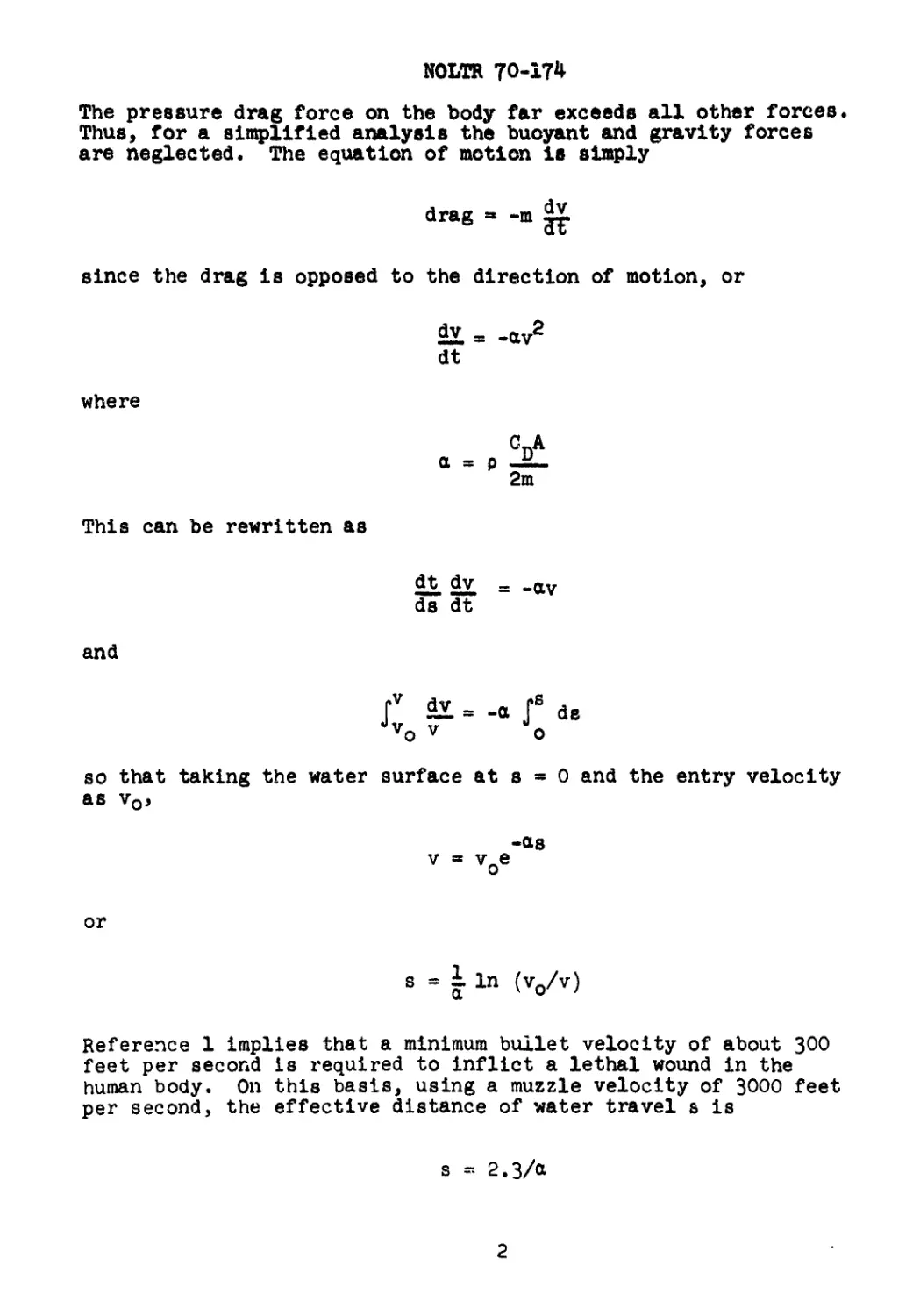
The pressure drag force on the body far exceeds all other forces.
Thus, for a simplified analysis the buoyant and gravity forces
are neglected. The equation of motion Is simply
drag » -m
dv
a?
since the drag Is opposed to the direction of motion, or
dv = _av2
dt
where
C A
a = p
2m
This can be rewritten as
dt dv - _av
ds dt
and
fV dv
Jvo v
-a J de
о
so that taking the water surface at s = 0 and the entry velocity
as v0,
-as
v - vQe
or
s = 1 m (v0/v)
Reference 1 implies that a minimum bullet velocity of about 300
feet per second is required to inflict a lethal wound in the
human body. On this basis, using a muzzle velocity of 3000 feet
per second, the effective distance of water travel s is
s = 2.3/a
2
NOLTR 70-174
The bullet weights are fixed at 55 grains for the 5*56mm round
and 145 grains for the 7.62mm, round. It is advantageous to keep
any new bullet design close to these weights to avoid any changes
in powder loads and therefore air flight ballistics. The distance
traveled through water over which the bullet can be considered
effective is dependent upon its CjjA product. Experience with
water-entry shapes has demonstrated that a nose flat with a
minimum diameter of one-half the actual body diameter could give
good high-speed water-flight characteristics. The pressure drag
coefficient for a disc is 0.8. Using this size the maximum
effective range for the two bullets can be calculated as approxi-
mately 15 feet for the 7.62mm round and 11 feet for the 5.56mm
round. Note that these are the maximums expected for effective
underwater flight presuming the bullet remains stable.
The ogive bullets would have a lower drag coefficient but
again past experience tells us that during oblique water entry
they are subject to high transverse forces which cause them to
be unstable. A flat nosed projectile should offer better entry
characteristics. In addition, the flat nose provides a more
stable cavity running vehicle. Unfortunately, the small length-
to-diameter ratio of a bullet is not good for a cavity running
vehicle. With a larger L/D, angular motion induced at entry can
be compensated for by the afterbody bouncing off the wall of the
cavity. Reference 2 suggested an entry shape that would give
little or no induced angular acceleration at entry.
As noted in the initial request for assistance, the first
part of the test series was devoted to the determination of
lethality and underwater penetration of light metal containers
for standard ammunition. This phase also included a survey of
the pressure pulses generated at water entry in an effort to
establish what effects these could have in the event of a near
miss. The second and third test phases were to improve under-
water penetration of a bullet by changing its shape considering
optimum water-entry characteristics within the constraints imposed
by the launching weapon.
All tests were run in the Pilot Hydroballistics Facility at
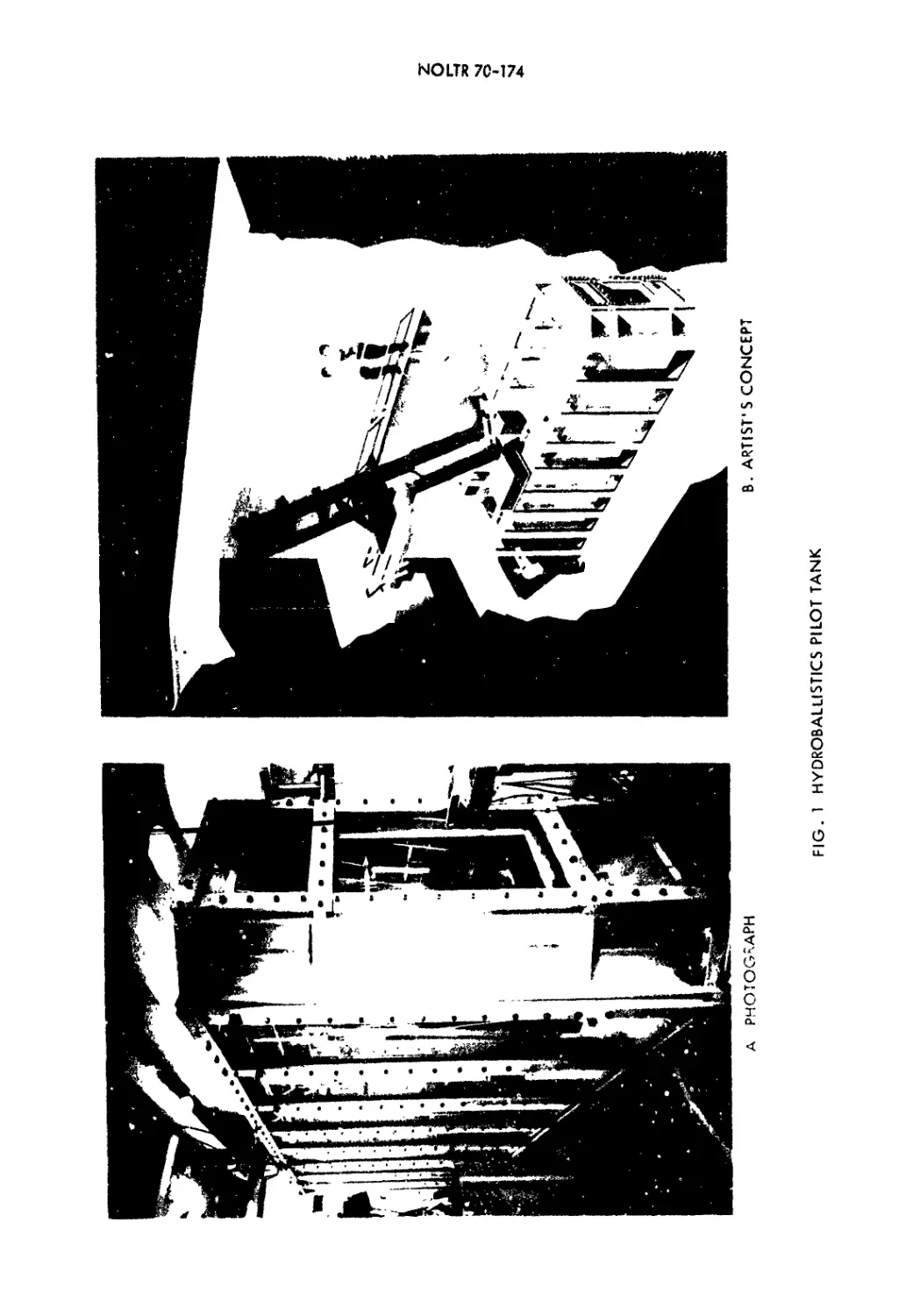
the Naval Ordnance Laboratory, A photograph and artist’s concept
of the tank are shown in Figure 1. Launcher stands were built
which allowed angle variations from vertical to near zero degrees.
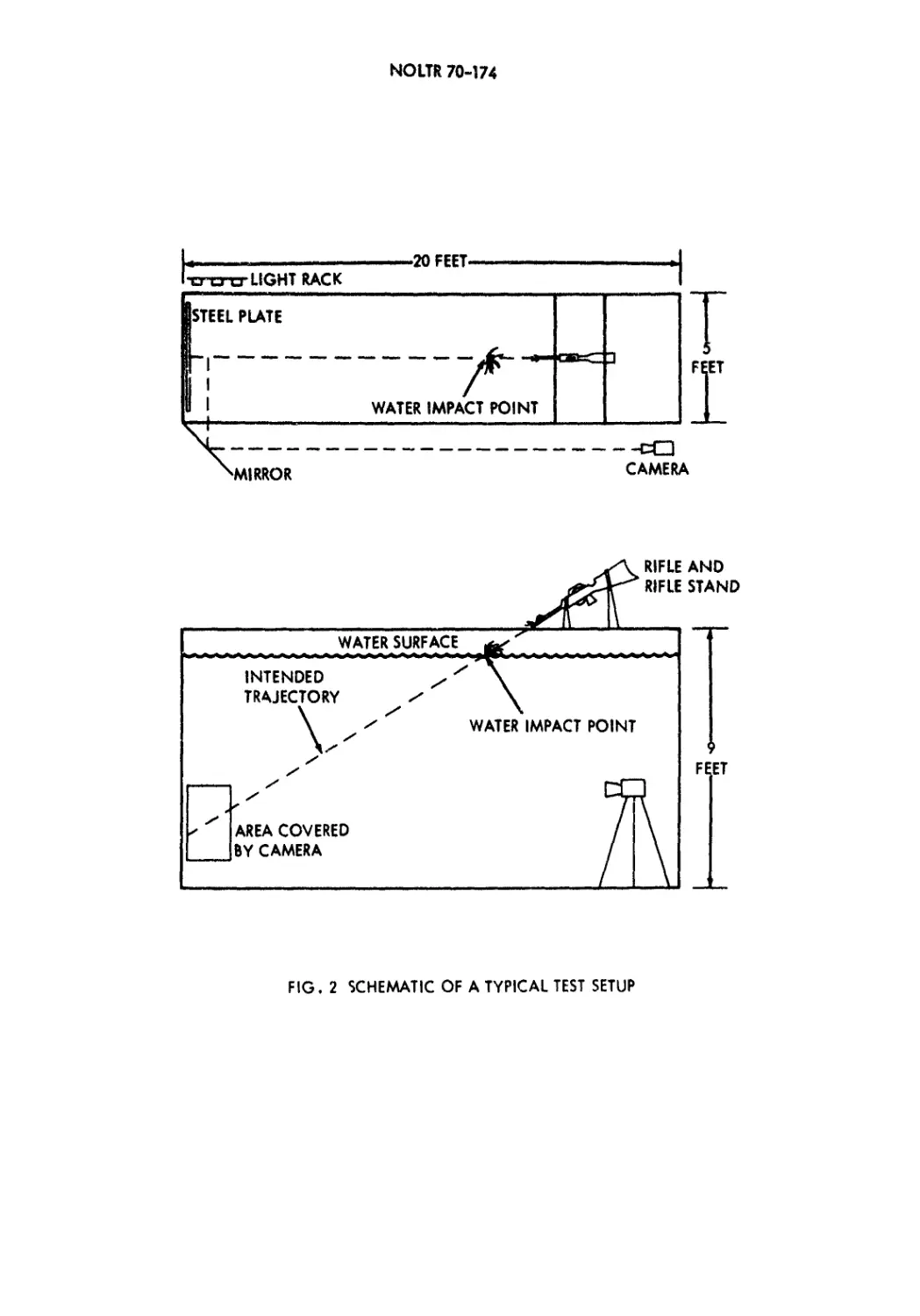
These were mounted on top of the tank as shown in Figure 2.
Firing was done remotely by means of a solenoid connected to the
gun trigger. In general, rounds were individually fired. The
firing pulse was fed into a Fastax high-speed motion picture camera
so the bullet trajectory could be recorded from water entry
onward. LC 10 pressure transducers were located at various points
in the water to record pressures associated with the shot. A
schematic of a typical test setup is shown in Figure 2. An M-14
rifle was borrowed from the Aberdeen Proving Ground and used
instead of an M-60 machinegun because of handling ease. The M-14
fires the same 7.62mm NATO round. An M-16 rifle was available
3
NOLTR 70-174
for testing the smaller 5.56mm round. A 30-06, 1903 A3 rifle was
used for the bulk of the new shape testing. General physical
constants for the corresponding military ammunition of each of
these rifles is given in Table 1.
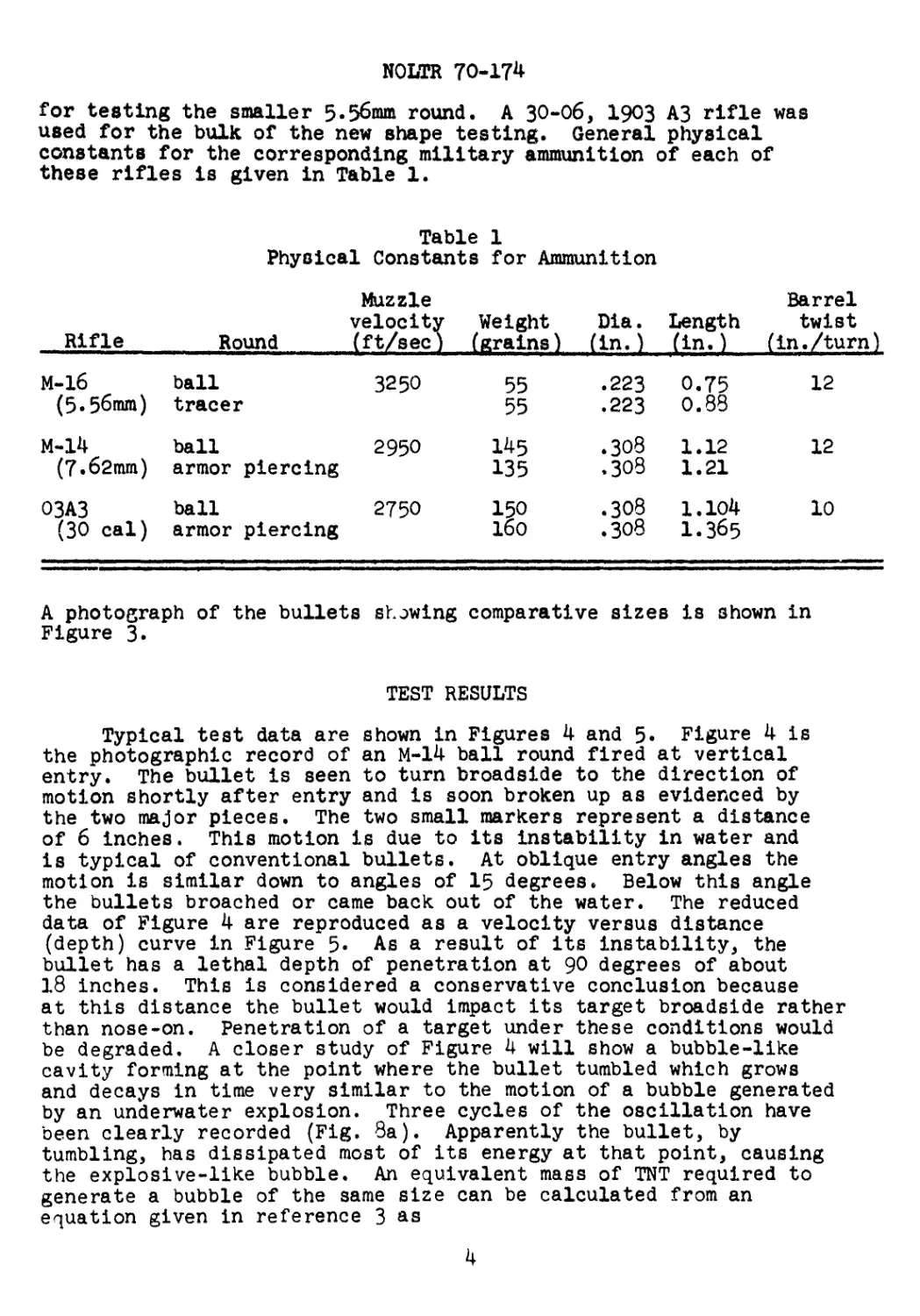
Table 1
Physical Constants for Ammunition
Rifle	Round	Muzzle velocity (ft/sec)	Weight (grains)	Dia. (in.)	Length (in.)	Barrel twist (in./turn)
M-16	ball	3250	55	.223	0.75	12
(5.56mm)	tracer		55	.223	0.88
M-14	ball	2950	145	.308	1.12	12
(7.62mm)	armor piercing		135	.308	1.21
O3A3	ball	2750	150	.308	1.Ю4	10
(30 cal)	armor piercing		16o	.308	1.365
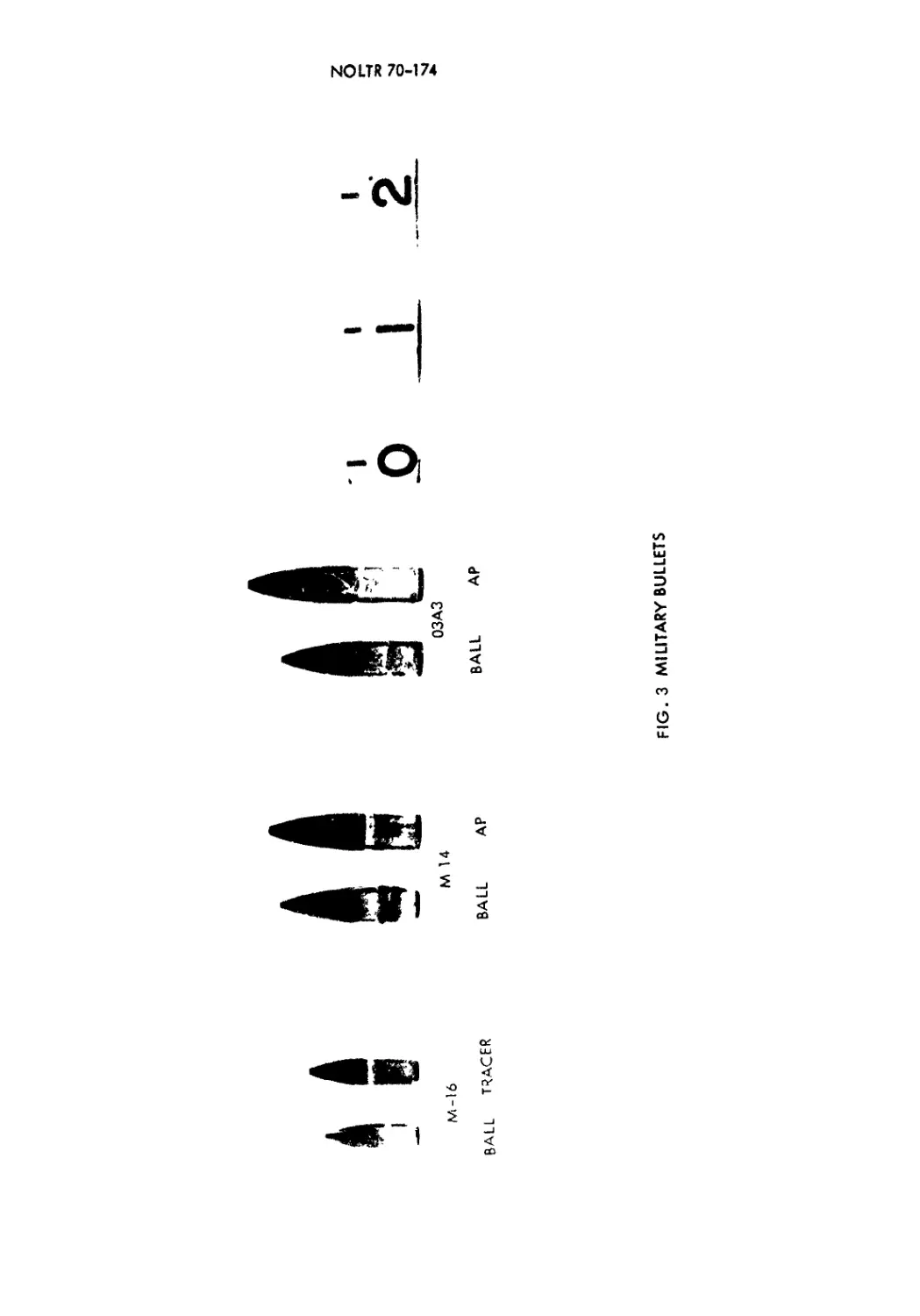
A photograph of the bullets shewing comparative sizes is shown in
Figure 3.
TEST RESULTS
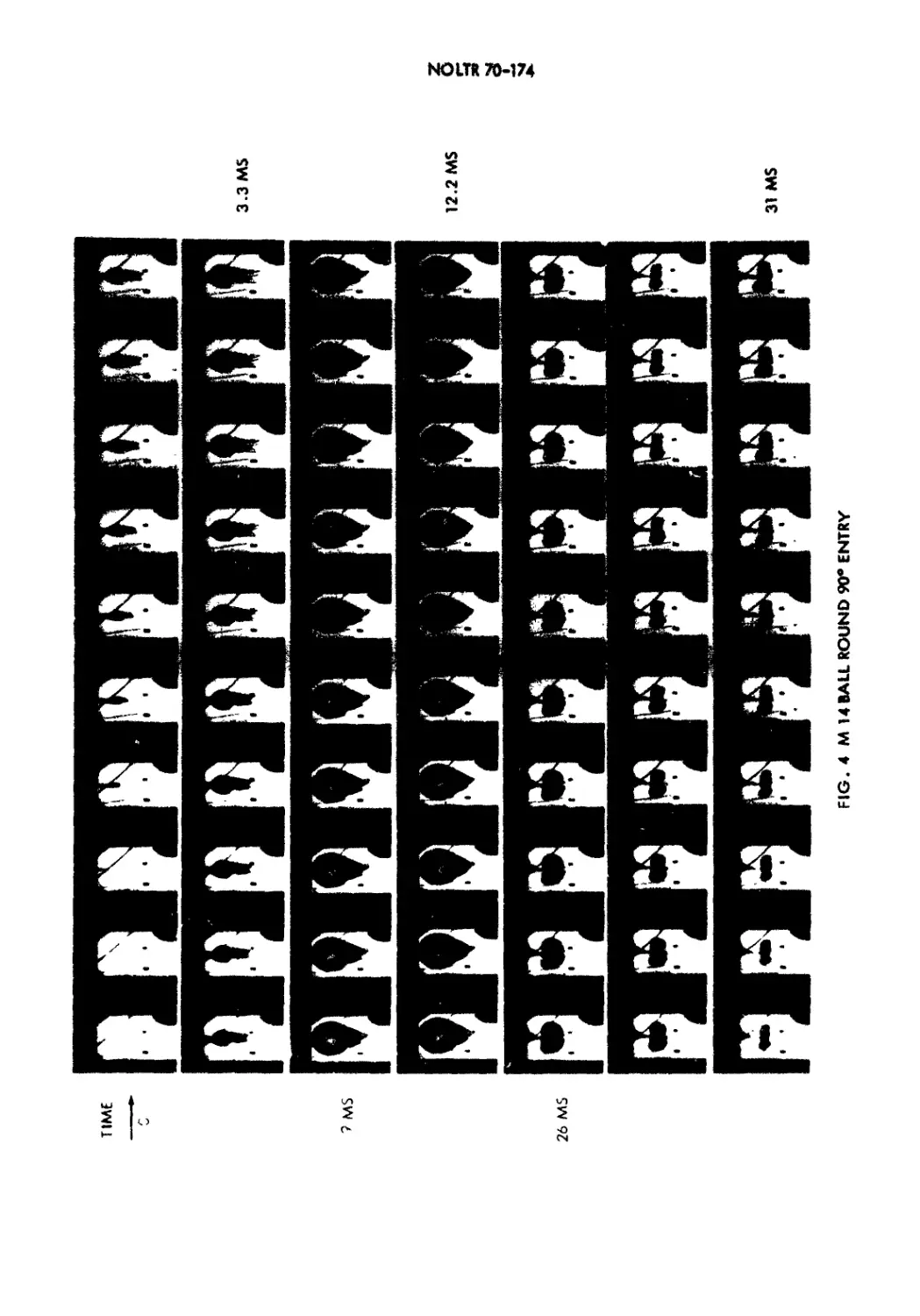
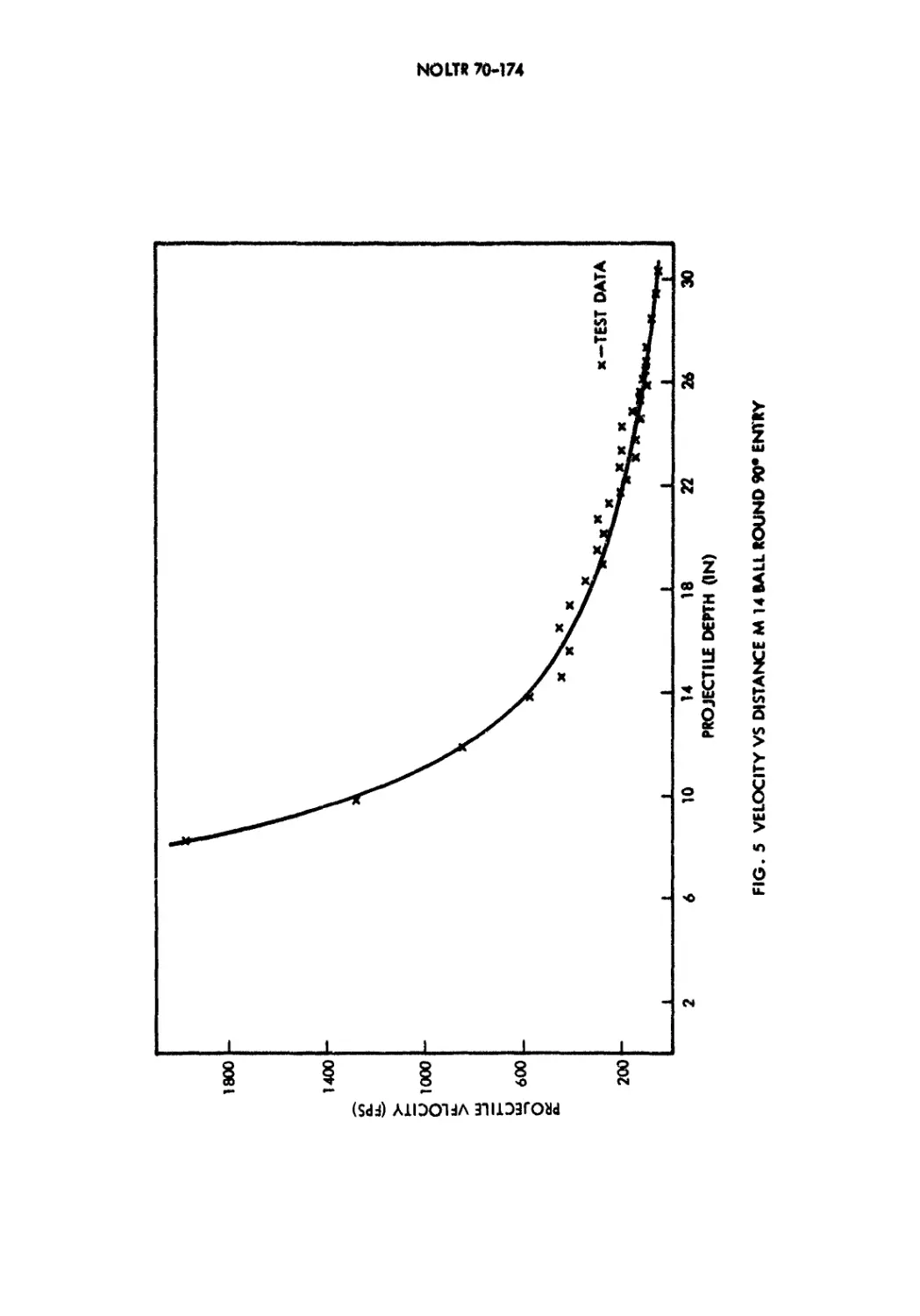
Typical test data are shown in Figures 4 and 5. Figure 4 is
the photographic record of an M-14 ball round fired at vertical
entry. The bullet is seen to turn broadside to the direction of
motion shortly after entry and is soon broken up as evidenced by
the two major pieces. The two small markers represent a distance
of 6 inches. This motion is due to its instability in water and
is typical of conventional bullets. At oblique entry angles the
motion is similar down to angles of 15 degrees. Below this angle
the bullets broached or came back out of the water. The reduced
data of Figure 4 are reproduced as a velocity versus distance
(depth) curve in Figure 5» As a result of its instability, the
bullet has a lethal depth of penetration at 90 degrees of about
18 inches. This is considered a conservative conclusion because
at this distance the bullet would impact its target broadside rather
than nose-on. Penetration of a target under these conditions would
be degraded. A closer study of Figure 4 will show a bubble-like
cavity forming at the point where the bullet tumbled which grows
and decays in time very similar to the motion of a bubble generated
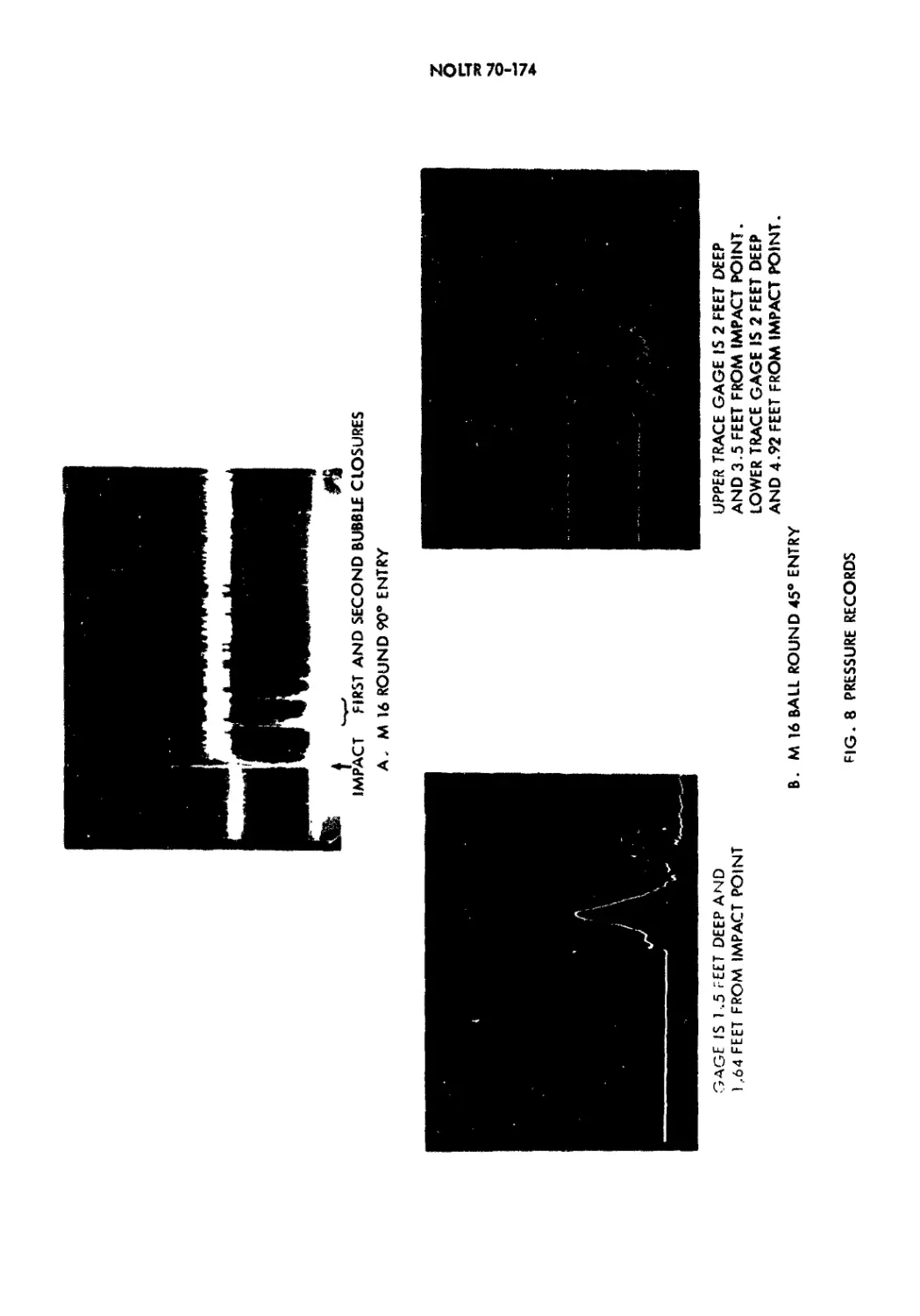
by an underwater explosion. Three cycles of the oscillation have
been clearly recorded (Fig. 8a). Apparently the bullet, by
tumbling, has dissipated most of its energy at that point, causing
the explosive-like bubble. An equivalent mass of TNT required to
generate a bubble of the same size can be calculated from an
equation given in reference 3 as
NOLTR 70-174
^max ~	= max bubble radius (ft)
&
z = absolute hydrostatic pressure (ft)
J = constant for TNT = 12.6 ft^/lb1^
Analysis of the bubble size from the films of tests on both the
M—16 and the M-14 bullets indicates equivalent masses of approxi-
mately 2 and 4 grams, respectively, of TNT would generate a similar
bubble under water. However, as can be calculated from reference 3»
the lethality of the bubble generated pressure pulse is approxi-
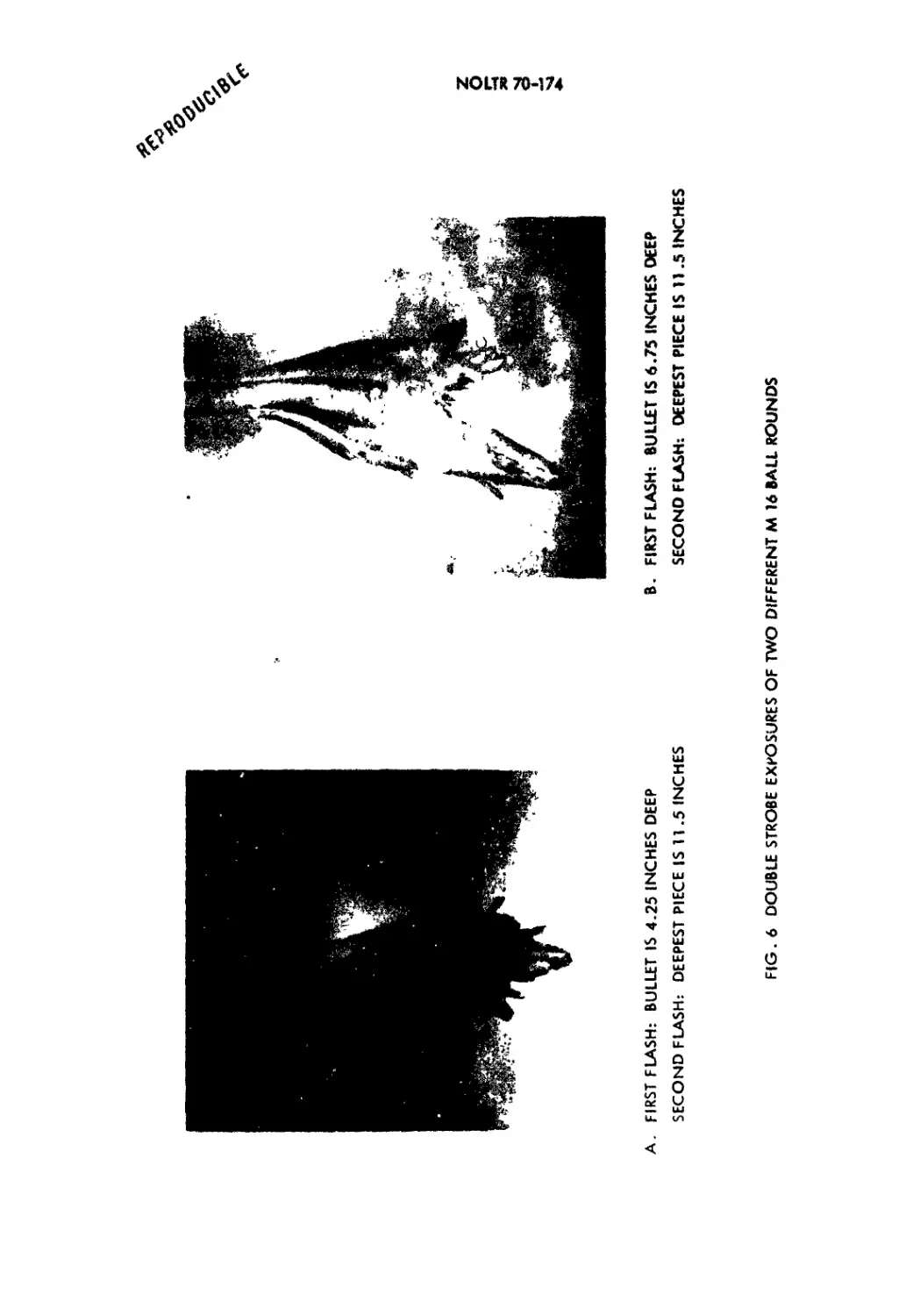
mately 6 inches. Figure 6(a) shows a double flash strobe picture
of an M-16 bullet just after entry and just after it turns and
fails. The bubble is seen in its initial stages of growth. In
Figure 6(b) a similar event is shown. The large accelerations
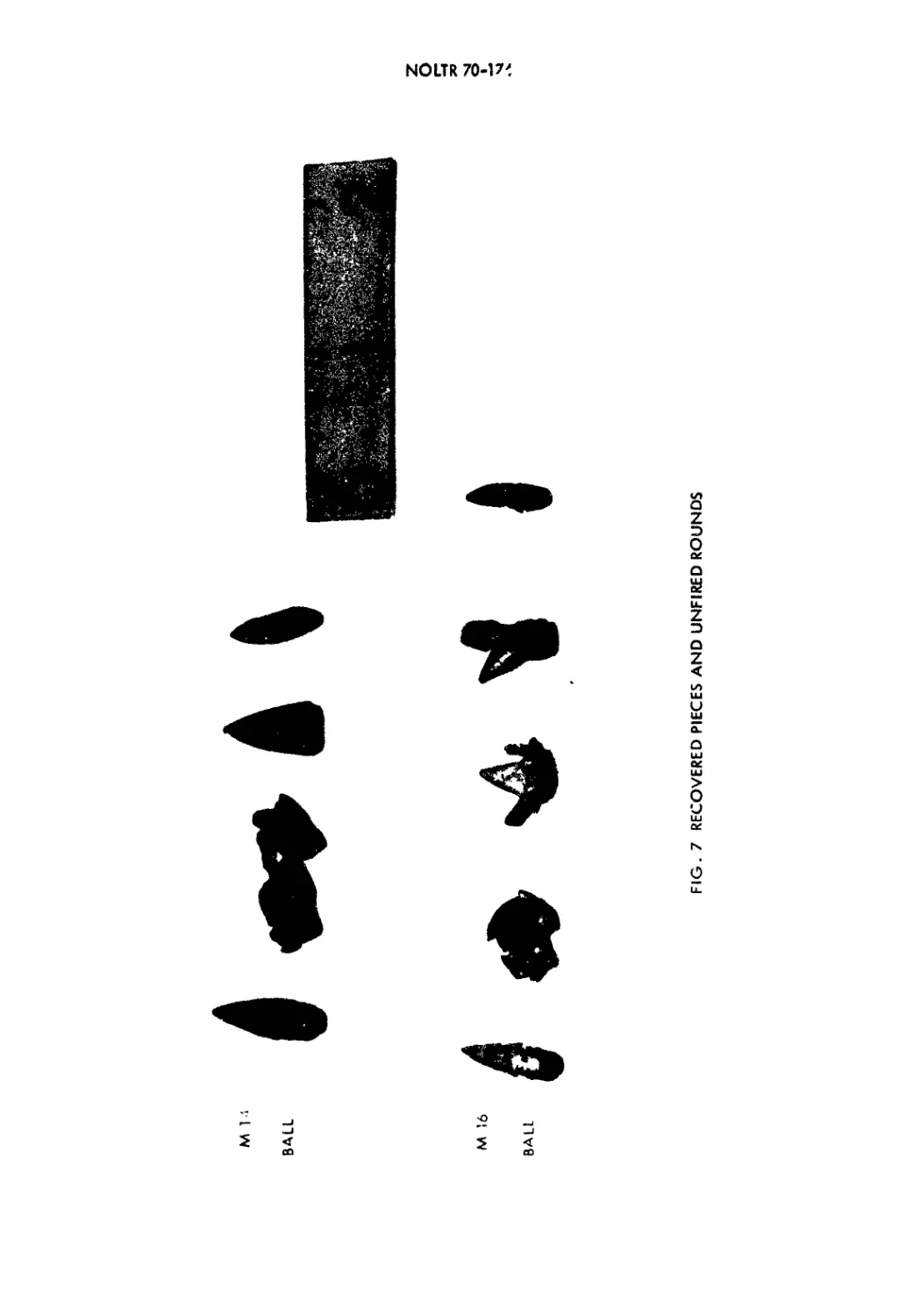
acting on these projectiles are apparent. Pieces of the ball
round, recovered after firing from the M-14 and M-16, are compared
to whole bullets in Figure 7. A pressure record from a typical
bubble oscillation is shown in Figure 8 along with a time
stretched record for a typical impact pressure. This impact
record was recorded for an M-16 ball round entering the water at
45 degrees. The closest gage was 1.5 feet deep in the water and
a slant distance of 1.64 feet away from the entry point. The next
two gages were both at the same depth but at respective slant
ranges of 3*5 feet and 4.92 feet. The impact traces are typical
for the bullets tested at 90 degrees and 45 degrees. That is,
the pressure records have the same shape and about the same pulse
width, approximately 150 microseconds. Differences occur in
amplitudes. For example, the peak pressure for the number one
gage shown in Figure 8 is about 145 psi whereas the same gage
located at the same depth but at a slant range of 2.12 feet
recorded a peak pressure of about 300 psi during impact of the
heavier M-14 ball round. This information is offered not as a
refined study of impact pressures but simply to give an idea of
the magnitude of the pressures associated with the bullet entry
in water. Reference 4 indicates that for a pressure wave to be
lethal to humans, 130 psi-milliseconds must be delivered in 2.1
milliseconds. On this basis, we conclude that any pressure
associated with the water flight history of these bullets has a
much smaller lethal range than the bullet itself. In general,
the impact pressure will have no effect on a swimmer.
In addition to numerous tests at various angles of entry with
the ball ammunition, an attempt was made to establish the ability
of the M-16 to penetrate a 0.042-inch thick aluminum plate. It
was found that the plate could not be penetrated below a depth of
1 foot; at 10 inches, penetration was marginal. These metal
penetration tests were made at an entry angle of 90 degrees in an
effort to establish the damage that might bt done to lightly clad
explosive charges floating on or near the water’s surface. Again
the conclusion is that the conventional bullets had very limited
effectiveness due to the inability to penetrate stably into water.
5
NOLTR 70-174
In summary of the tests on standarc ball ammunition it is
concluded that the ammunition tested has an effective underwater
slant range of 18 inches against personnel. This figure represents
a maximum for the M-14 rifle. The M-16 effective slant range is
closer to 12 inches. These ranges are considered conservative
because of the unpredictable trajectory after entry.
An attempt was made to improve the entry characteristics of
the ball and armor-piercing rounds by filing flat noses on the
bullets. This was ineffective due to material failure, i.e.,
mushrooming of the end of the bullet. The next step was to launch
an equivalent weight aluminum projectile with a one-half diameter
nose flat. This was a cylinder 3 inches Iona, O.298 inches in
diameter with a truncated cone nose. These "b”llets" had an
average velocity of 800 feet per second after traveling 5 feet
through water thus showing a greatly improved performance. The
length however is too great to be used as standard ammunition.
A trial and error procedure with different combinations of
materials and nose shapes produced a bullet of more standard
dimensions but with a lesser performance than the 3-inch long
aluminum projectile. It also was realized that a bullet of that
length could not be spin-stabilized by the standard rifling. A
solid copper bullet with a truncated cone nose was found to be
very effective at 90-degree entry. This bullet was 1.2 inches
long, .308 inch in diameter with a nose flat of .18 inch and a
weight of 170 grains. The average velocity after 5 feet in water
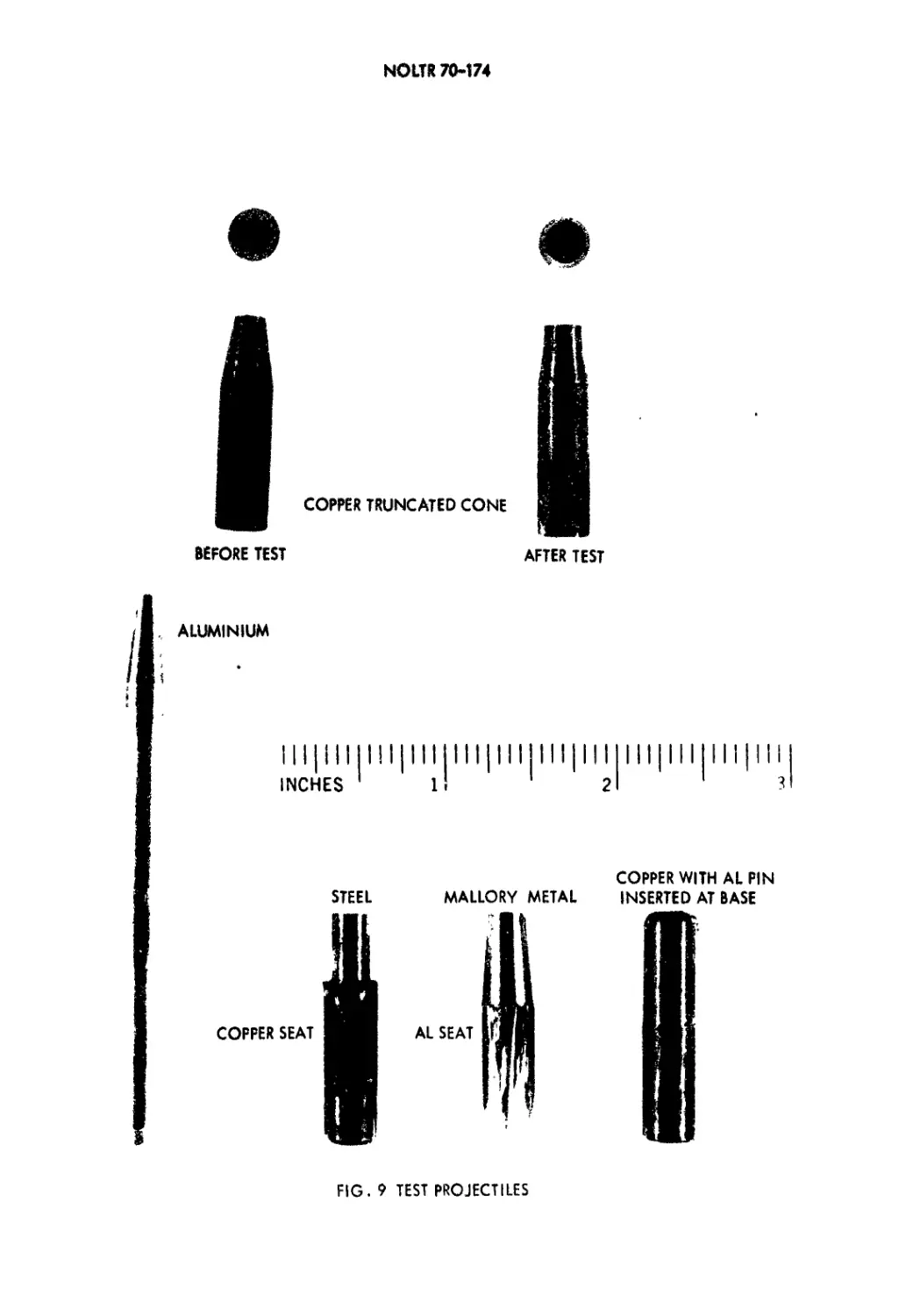
was 600 feet per second. However, the copper yielded at impact,
see Figure 9a, and due to this, or whip at oblique entry, an
instability caused these bullets to tumble after traveling about
6 feet through water. To avoid the impact deformation, a bullet,
as shown in Figure 9b, was tested. This consisted of a steel
cylinder .18 inch in diameter enclosed for about two-thirds of
its length in a copper cup .308 inch in diameter. The overall
length was 1.2 inches and the weight about 170 grains. At the
time, the test plan was to use the O3A3 as a development launcher.
When design was finalized, the bullets could then be tested in the
newer M-14 and scaled down for tests in the M-16. The performance
of the same bullet when fired from the M-14 however was not con-
sistent with that of the ОЗАЗ» For example, the steel, copper-
clad bullet described above, when fired from the O3A3, traveled a
straight trajectory and still had a velocity of 350 feet per
second after 9 feet of water flight with an entry angle of
30 degrees. The same bullet when fired from the M-14 at the same
angle consistently tumbled after about 6 feet of water flight.
The only difference in the two weapons is about 200 feet per
second out of about 2800 in muzzle velocity and about 300 revolu-
tions per second out of 3000 in spin rate. The reasons for the
inconsistent bullet performance were not investigated. At this
time tests with the 03АЗ were dropped and the M-14 was used as the
prime launcher. After trying various sizes of the steel, copper-
clad bullets dhich consistently tumbled at about 6 feet, it was
decided that some entry induced instability was degrading perfor-
mance. A truncated cone oi Mallory metal was attached to a
6
NOLTR 70-174
cylindrical afterbody of aluminum. The nose flat was .21 inch.
Here the object was to move the center of gravity much farther
forward. This bullet performed very well, did not tumble, and
had a velocity cf 300 feet per second after 8 feet of water flight.
However, the bullet was decided to be impractical due to cost of
manufacture. The next bullet tried was the low or zero whip
shape described in reference 2. This bullet was copper with an
aluminum pin inserted in the aft section to lighten the bullet
and move the center of gravity forward, see Figure 9b. The
performance was good, 300 feet per second at about 7.5 feet, and
consistent when scaled down to the M-16. Oblique entry was
attempted down to 3 degrees where about 50 percent of the rounds
did not broach or ricochet. At 5 degrees all rounds entered the
water and maintained a straight trajectory. Air flight tests of
this round indicated sufficient stability in air. As a final test
to check the feeding for semiautomatic or automatic fire, two of
the ; ew rounds were loaded behind one standard armor piercing round
into an M-14 clip. The gun was aimed at a light metal can 3 feet
below the water surface. The -run angle of 51 degrees gave a
slant distance in water of 3*7 -Films of the test are shown
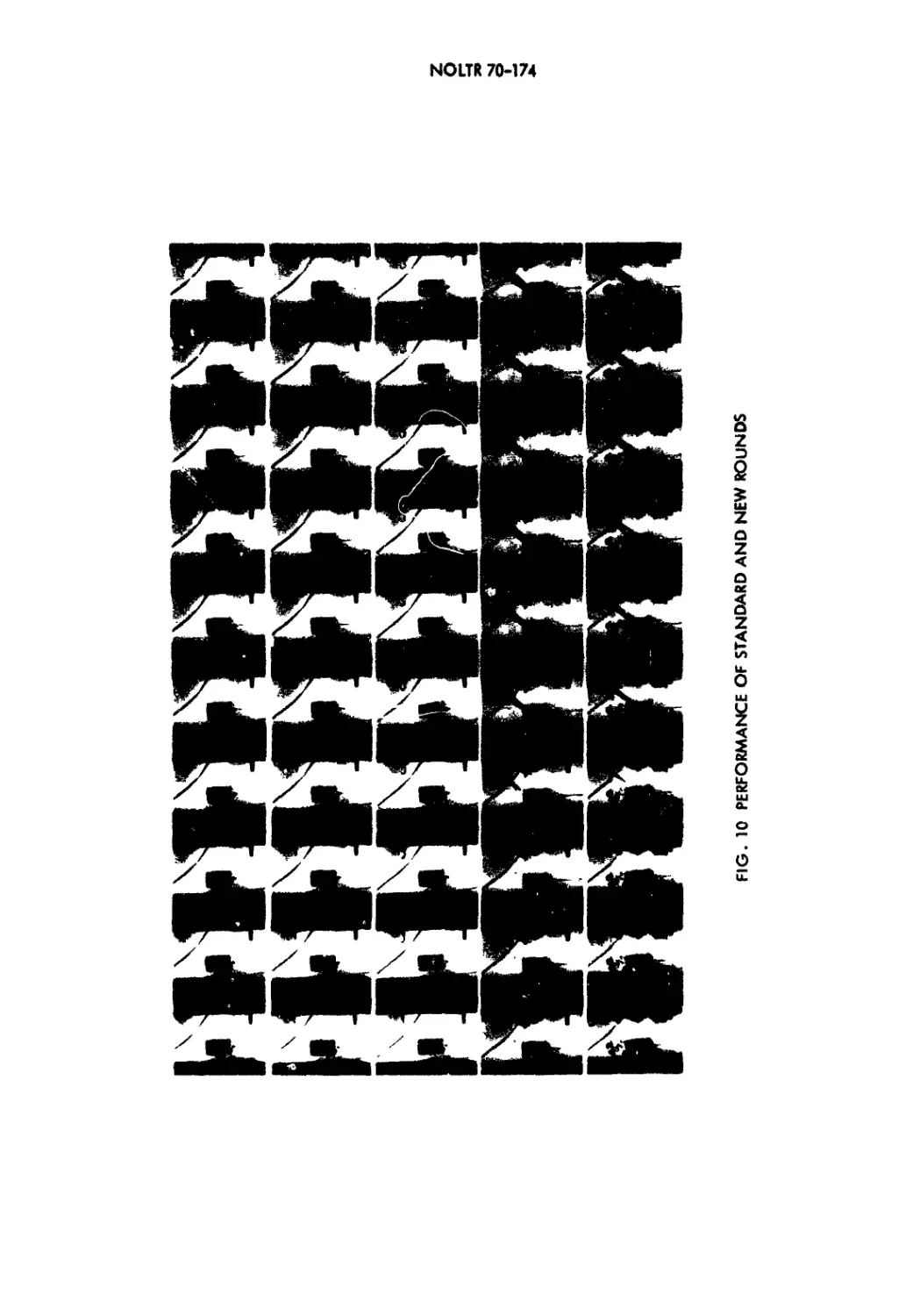
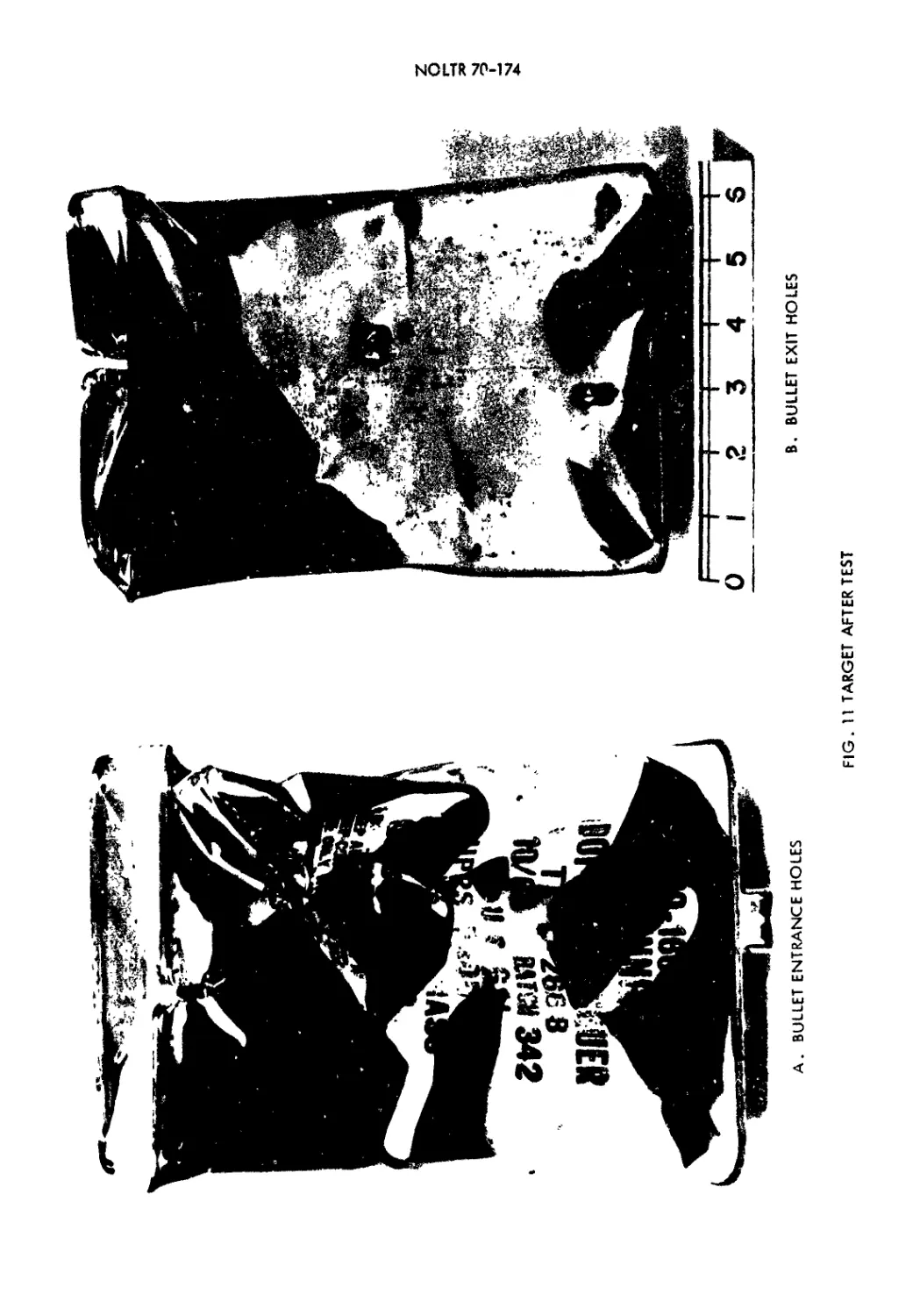
in Figure 10. Note that the AP round does not even get to the
target. Figure 11 shows the pierced can. No feeding problems
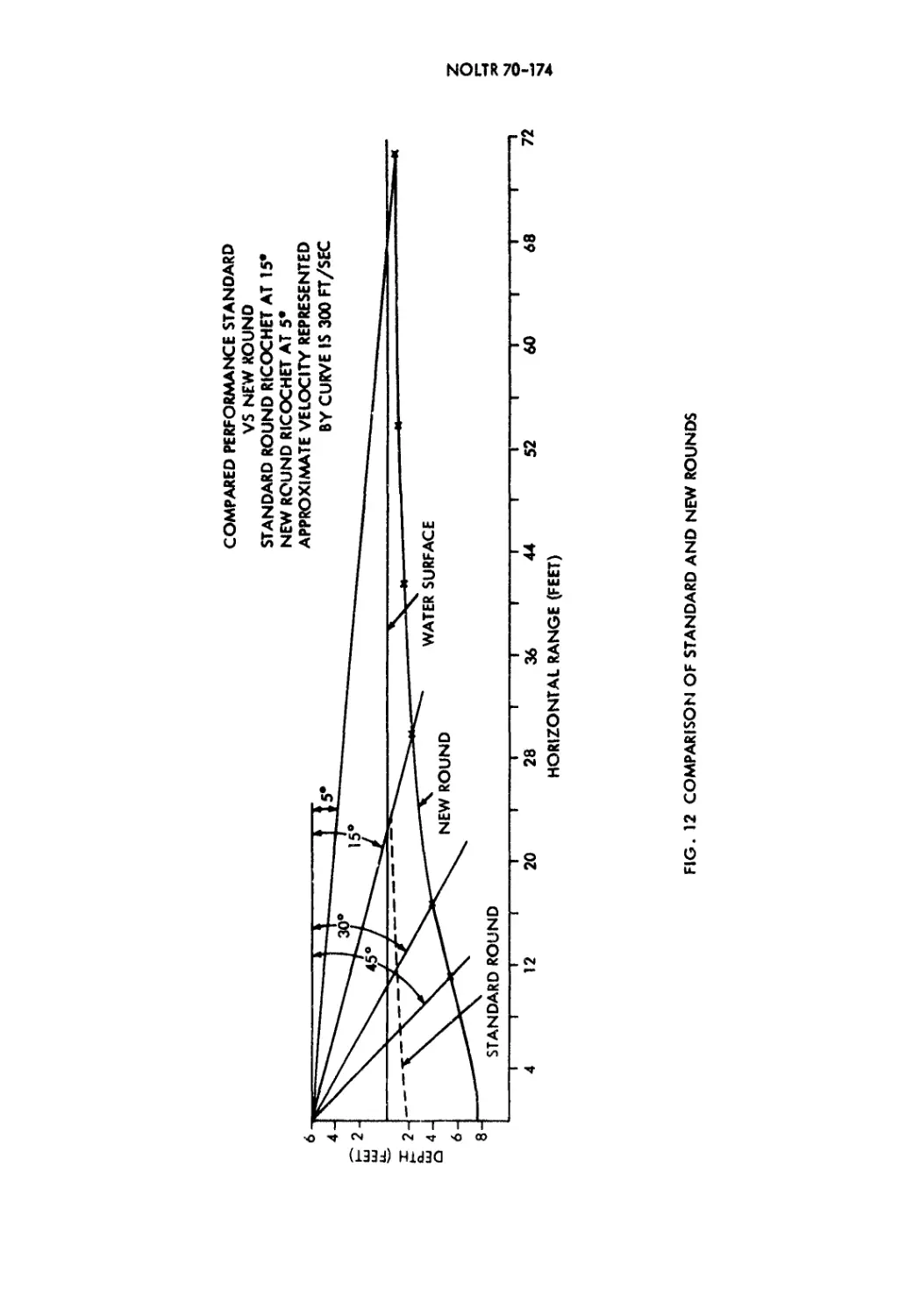
were detected in this test. A comparison of the effectiveness of
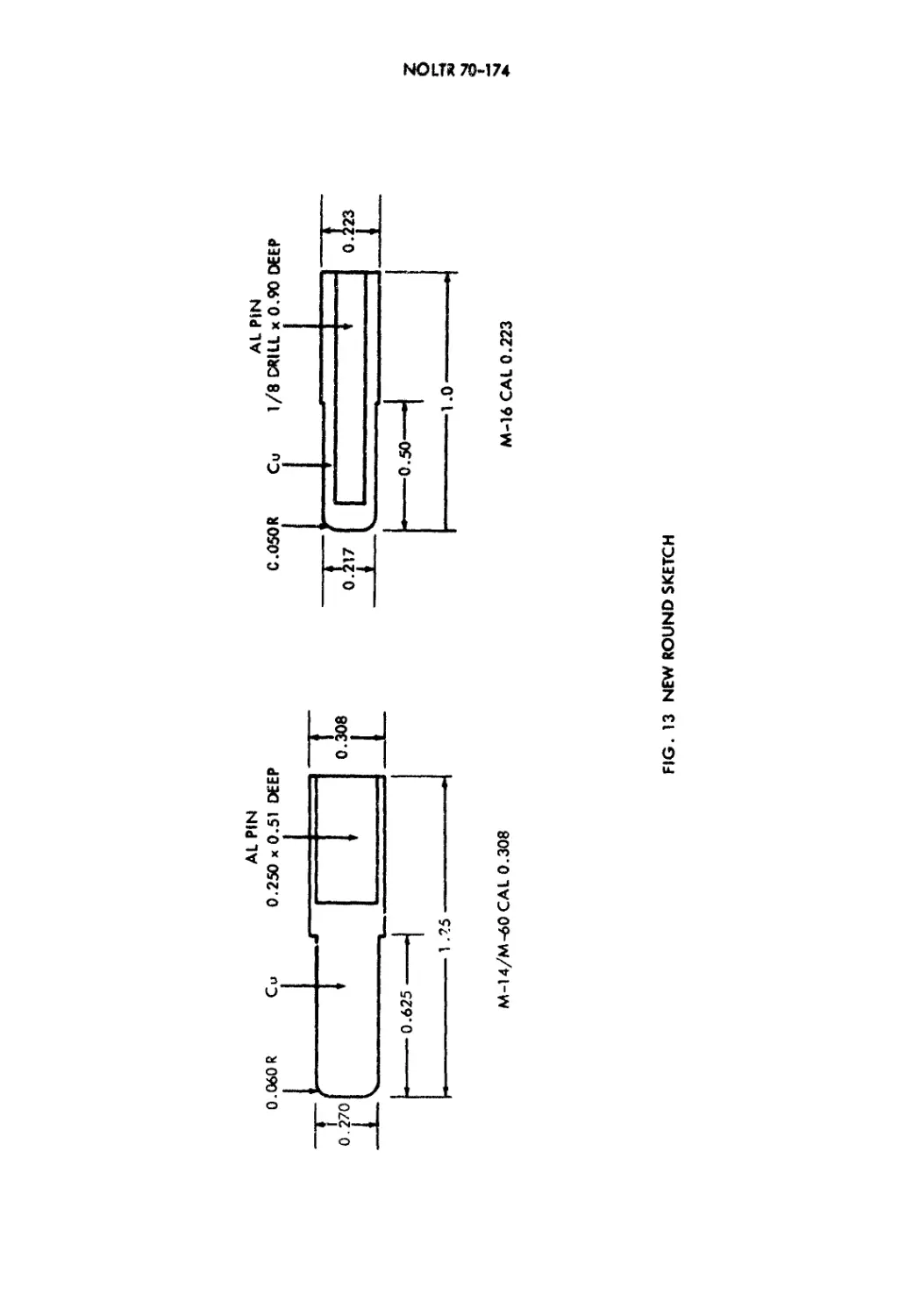
the new round with the standard round is given in Figure 12 and a
sketch of the round is shown in Figure 13,
SUMMARY OF CONCLUSIONS
Conclusions based on these tests are summarized as follows:
1.	Conventional small arms ammunition, ball and AP, have
little underwater effectiveness against personnel or light gage
metal containers. Effective range is not much more than 1 foot
in water.
2.	The underwater effectiveness of small arms can be improved
greatly by proper design of th? projectile keeping within the
following restrictions; the bullet should (a) have approximately
the same dimensions and weight as a standard ball round, (b) be
fired from the M-14 or M-16 without changes being made to the
weapon, (c) not change the normal firing rate of the weapon,
(d) be launched from the standard cartridge with the standard
powder load, (e) be stable in air flight, (f) be relatively
inexpensive to produce in quantity. Within these constraints, a
round was designed with an effective range of 7.5 feet in water.
3.	As an expedient solution to the problem presented, this
solution is considered acceptable. As a general underwater pro-
jectile, the range is still limited. The range can probably be
extended by considering a different system; for example, one that
utilizes longer dart-shaped missiles. This is certainly an area
that needs more study.
7
BLANK PAGE
A PHOTOGRAPH
В. ARTIST'S CONCEPT
NOLTR 7C-174
FIG. 1 HYDROBALLISTICS PILOT TANK
NOLTR 70-174
FIG. 2 SCHEMATIC OF A TYPICAL TEST SETUP
*
I
м
BALL
16
RACER
M 14
03A3
BALL AP
BALL AP
FIG. 3 MILITARY BULLETS
I	I
L	2
NOLTR 70-174
FIG. 4 M 14 BALL ROUND 90° ENTRY
NOLTR 70-174
PROJECTILE VELOCITY (FPS)
FIG. 5 VELOCITY VS DISTANCE M 14 BALL BOUND 90е ENTRY
NOLTR 70-174
NOLTR 70-174
A.	FIRST FLASH: BULLET IS 4.25 INCHES DEEP
SECOND FLASH: DEEPEST PIECE IS И .5 INCHES
B.	FIRST FLASH: BULLET IS 6.75 INCHES DEEP
SECOND FLASH-. DEEPEST PIECE IS 11.5 INCHES
FIG. 6 DOUBLE STROBE EXPOSURES OF TWO DIFFERENT M 16 BALL ROUNDS
NOLTR 70-17'
FIG. 7 RECOVERED PIECES AND UNFIRED ROUNDS
IMPACT FIRST AND SECOND BUBBLE CLOSURES
A. M 16 ROUND 90° ENTRY
NOLTR 70-174
GAGE IS 1.5 FEET DEEP AND
1,64 FEET FROM IMPACT POINT
UPPER TRACE GAGE IS 2 FEET DEEP
AND 3.5 FEET FROM IMPACT POINT .
LOWER TRACE GAGE IS 2 FEET DEEP
AND 4.92 FEET FROM IMPACT POINT.
В. M 16 BALL ROUND 45° ENTRY
FIG. 8 PRESSURE RECORDS
NOLTR 70-174
BEFORE TEST	AFTER TEST
ALUMINIUM
FIG. 9 TEST PROJECTILES
COPPER WITH AL PIN
FIG. 10 PERFORMANCE OF STANDARD AND NEW ROUNDS
A. BULLET ENTRANCE HOLES
NOLTR 70-174
B. BULLET EXIT HOLES
FIG. 11 TARGET AFTER TEST
DEPTH (FEET)
COMPARED PERFORMANCE STANDARD
VS NEW ROUND
STANDARD ROUND RICOCHET AT 15*
NOLTR 70-174
FIG. 12 COMPARISON OF STANDARD AND NEW ROUNDS
AL PIN
AL PIN
C.050R Си 1/8 DRILL x 0.90 DEEP
1.0
M-14/M-60 CAL 0.308
M-16 CAL 0.223
NOLTR 70-174
FIG. 13 NEW ROUND SKETCH
UNCLASSIFIED
WCIMlff CCHTIKM. CATA. ft* ft (SvruHty	at Utla. tfA atMUt! amt inOattna annafaHaa aw*t M witFMMf wlw» Я»а avanU rafatt la alaaalUady
I. onirinatino activity fCMporat*BMfearj U. S. Naval Ordnance laboratory White Oak, Silver Spring, Maryland 20910		M. REPORT SECURITY CLASSIFICATION UNCIASSIFIED
		Sb. GROUP N/A
>	TITLE THE PERFORMANCE OF SMALL ARMS AMMUNITION WHEN FIRED INTO WATER
«. descriptive notes (ТУр* al rspwr and Inclusive dataa)
4. authORiSi (Pint пажа. mltUa initial, laatnaina) Barry J. Noonan Howard K. Steves
t< REPORT GAVE 8 September 1969	TS. TOTAL NO. OF PAOKS	Th. NO. OF NEFS 23	4
•а. contract OR «mat nO. Гаек HAT 03L OOI/ZF35 419 001 Probloe 908 4. PROJECT NO. €. if.	©RlClN A TOR’S REPORT NUMBfiRlS) NOLTR 70-174
	sb. OTHER report noiSI (Any eiharnumbata Htat may b. taal&tad tMa rapatt)
10 DtOTWauriOM STATEMENT This document has been approved for public release and sale, its distribution is unlimited.
И SUPPLEMENTARY NOTE»	11. sbonsorine military activity
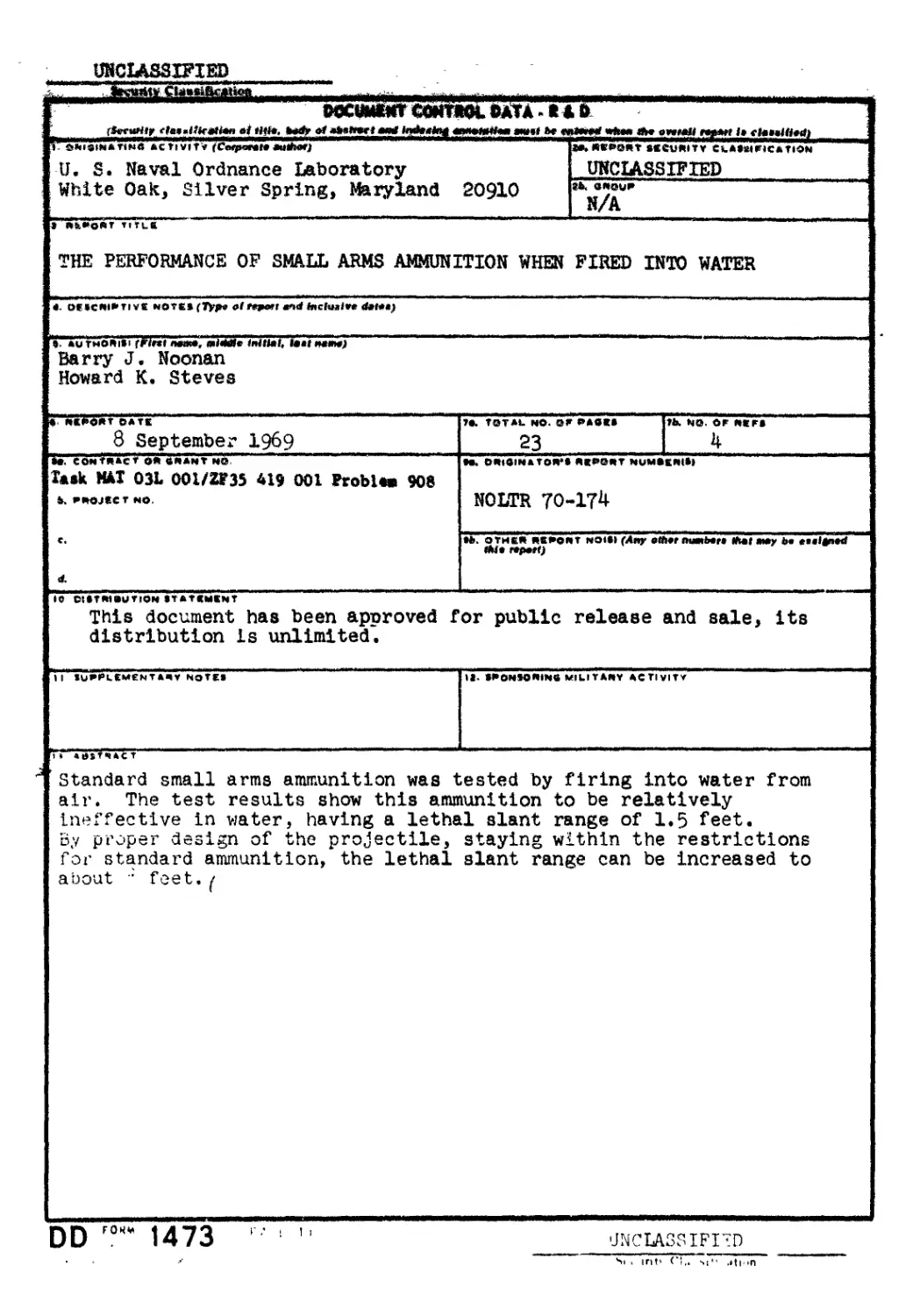
ТГ ABSTRACT Standard small arms ammunition was tested by firing into water from air. The test results show this ammunition to be relatively ineffective in water, having a lethal slant range of 1.5 feet. By proper design of the projectile, staying within the restrictions for standard ammunition, the lethal slant range can be increased to about •' feet.
DD F04M 1473
'JNCIA3SIFI"D
Si i irit> (’I,, s," .ltl-'П
UNCLASSIFIED
t< K«V WOR9I	UtWK A				LINK e
	wou*	wr	яви	ft?	wove	WT
Water entry Underwater flight Munitions Small arms	*
UNCLASSIFIED
Security CUv.ificatton
DD ",'.“..1473 <•«<>
(P'VGt 2)