/


Author: Millar F.
Tags: ancient rome roman empire ancient and ancient world history of rome
Year: 1964



Text
                    Oxford University Press, Amen House, London E.C.4
GLASGOW NEW YORK TORONTO MELBOURNE WELLINGTON
BOMBAY CALCUTTA MADRAS KARACHI LAHORE DACCA
CAPE TOWN SALISBURY NAIROBI IBADAN ACCRA
KUALA LUMPUR HONG KONG

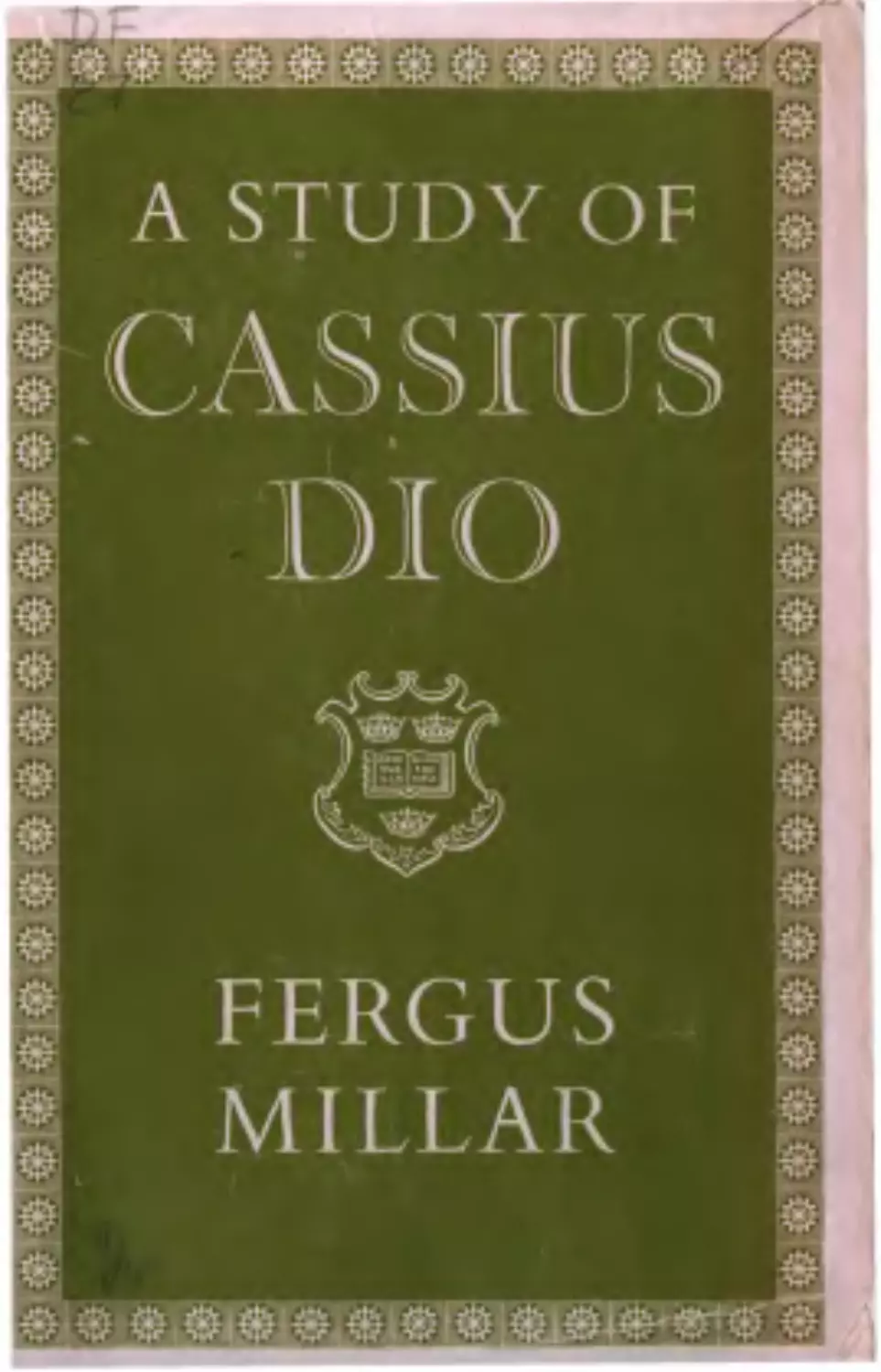
A STUDY OF
CASSIUS DIO
BY
FERGUS MILLAR
OXFORD
AT THE CLARENDON PRESS
1964

© Oxford University Press ig6$
PRINTED IN GREAT BRITAIN

TO
SUSANNA

PREFACE
A
BOOK must be its own justification and must stand or fall
on its own merits. But a preface (which, like most pre-
faces, is in reality a postscript) may serve some purpose
if it allows the author to stand back for a moment from the book
as he has written it and say something about its context and
purpose and about the methods adopted in it.
As the subject of a book, Dio stands in no need of apology.
His work, the fullest surviving history of classical Rome, is not
the object of any study with the slightest claims to comprehen-
siveness; almost all that has been written about it has been
concerned with style and language, with particular books or
passages or with the ever-recurrent subject of source-criticism.
In a word, whiïé the Roman History has received considerable
attention as a text and a source of facts, it has very rarely been
treated as a historical work in its own right. That is the gap
which this book sets out to fill.
The approach I have adopted has been, in essence, that of
presenting the History in terms of its author's reaction to the
world in which he lived. Hence this book is intended not least
as a contribution to our understanding of the Severan period.
It is, indeed, not too much to say that there is no pagan of
that vital period of whom we may know as much as we can of
Dio. History must include not only 'what happened', but how
those happenings appeared to those who lived through them.
In Dio we can see not only the perspective of Roman history
available to a man who was born in the reign of Marcus
Aurelius and lived into that of Severus Alexander, but also,
not in his contemporary history alone, the reactions of a con-
servative observer to an age full of stress and change. More-
over, as a Greek who was a Roman consul, Dio can represent
in a unique way a fairly advanced stage in that fusion between
two historical and cultural traditions which found its full
expression in Byzantium. To trace from scattered passages in
the History Dio's position within the complex cultural patterns
of his day is to reveal something at least of the roots from which
East Rome arose.

vin
PREFACE
The emphasis, therefore, falls on Dio himself and on those
aspects of his History which are original to him. What is said
about the composition of the work has the aim merely of making
clear the time and manner of writing, and the fact that Dio
evolved his own structure for the narrative and cannot be
assumed, at any point, to have slavishly followed some prede-
cessor. This is inevitably merely a sketch; I have not attempted
to give a full account of the literary character of the History.
In particular, little space has been devoted to source-criticism.
Some might regard a work which claims to deal with a histo-
rian, and yet largely ignores the question of his sources, as
Hamlet without the Prince. Yet the procedure can, I think, be
justified. It is not merely that a large proportion of the work on
Dio, including the major part of the standard article on him,
that of Schwartz in Pauly-Wissowa, has. concentrated on this
aspect (though no man who had been through much of this
type of work on Dio could feel very inclined to add to it), but
that it seems to me that no satisfactory terms of reference in
source-criticism have been yet evolved. In plain terms, we do
not know enough about how ancient historians worked. We
have no grounds for general assumptions about what an an-
cient historian would do when using one or more existing works
as sources of material, or how he would redeploy that material
in composing his own narrative. For the fact remains that,
although there are many books on individual historians, and
some others on what historians say about their methods, there
is not a single general work which analyses in detail the tech-
niques of ancient historiography. Without some such technical
guidance, source-criticism is mere speculation, and its results
often no more than the product of the assumptions with which
the examination of a text was begun.
Such are the intentions with which this book has been
written. It does no more than give a provisional definition of
some aspects of Dio's enormous text. Much more could be
done; in particular this book might provoke some scholar to
attempt a full analysis of the intellectual and literary proce-
dures involved when a man composed, from many different
sources, a continuous narrative covering the entire history of
Rome.
It will hardly escape notice that this book could not have

PREFACE
ix
been what it is without the influence of Professor Syme's
Tacitus. No other work can set before one with such vigour and
clarity that range of techniques by which an historical work can
be analysed, and illuminated in detail as the product of a man
writing in a certain political and cultural environment. I have
been doubly fortunate, however, in having the influence not
only of Tacitus, but of Professor Syme himself, who supervised
the thesis of which this book is a partially expanded version
and took a vital and enlivening interest in it at all stages. Syme
stands in no need of praise; but one thing must be mentioned,
his capacity for inspiring confidence—confidence that out of
material which seemed at first burdensome and unmanageable
something alive and significant could be made. To that vivida
vis animi of his I owe a debt which I can neyer hope to repay.
My thanks are due also to Mr. P . M. Fraser, who has never
grudged time or trouble on any of the very frequent occasions
on which I asked him for assistance; to Mr. E. W . Gray and
Mr. R . Browning, who examined this work as a thesis and made
many valuable corrections and suggestions; and to Mr.
J. P. V. D . Balsdon, who very kindly read it for me and made
a number of suggestions for expansion and clarification to
which the present form of the book owes a great deal.
A considerable part of the material in Chapter II. 6 ('Cicero')
and Chapter III. 2 ('The Speeches') was used in an article
which appeared in Museum Helveticum, 1961. I am very grateful
to the editors for allowing me to include a revised version of it
in this book.
My work has been made possible by the tenure of a Fellow-
ship at All Souls, and I must record my gratitude to the Warden
and Fellows for an opportunity to pursue my studies in circum-
stances which could nowhere be bettered.
My greatest debt, none the less, is to my wife, without whom
I should hardly have had the courage to begin, much less to
complete, this contribution to the study of Dio and of the age
in which he lived.
F. M.
All Souls College, Oxford
15 February 1963

CONTENTS
LIST OF ABBREVIATIONS
Xlll
INTRODUCTION: THE BYZANTINE EXCERPTS,
XIPHILINUS AND ZONARAS
I
I. THE MAN AND HIS CAREER
5
II. THE COMPOSITION OF THE HISTORY
28
The Time of Composition
28
The First Stage : the Collection of Material
32
The Use of Sources
34
The Secend Stage: Composition
38
Style
40
Cicero
46
Brutus and Cassius from the Ides of March to
Philippi
55
The Reign of Hadrian
60
Conclusion
72
III. POLITICAL AND HISTORICAL VIEWS
73
Political Judgements and Generalizations
74
The Speeches
78
The Reign of Augustus
83
Agrippa and Maecenas
102
Conclusion
118
IV. THE HISTORY OF HIS OWN TIME
Iig
Composition
119
Commodus
122
Pertinax
134
Didius Julianus
136
Septimius Severus
138
Caracalla
150

xii
CONTENTS
Macrinus
160
Elagabal
168
Severus Alexander
170
Conclusion
171
V. DIO AND ROME
174
CHRONOLOGICAL TABLE OF Dio'S LIFE AND WRITINGS 193
APPENDIXES
i. Xiphilinus' and Zonaras' Epitomes of Dio Book 54 195
11. The Date of Dio's First Consulship
204
in. References in the History to Datable Events
within Dio's Lifetime
208
iv. References in the History to Contemporary
Institutions and Customs
211
v. The Pseudo-Alexander of A.D . 221
214
BIBLIOGRAPHY
219
INDEX OF PASSAGES IN DIO
227
INDEX
229

ABBREVIATIONS
i. SPECIAL ABBREVIATIONS
Alio
G. Barbieri, L'Albo senatoria da Settimio Seven a Carina
{193-285) (Rome, 195a).
Boissevain
Cassii Dionis Cocceiani Historiarum Romanarum Quae
Supersunt, ed. U. P. Boissevain, vols. 1 -3 (text), 4
(index historiens, ed. Smilda), 5 {index Graecitatis, ed.
Nawijn), Berlin, 1898-1931 . Photo-reprint of 1-4,
Berlin, 1955 . Where necessary for clarity, references
are given with the page number of the relevant
volume in brackets, e.g . 72. 23 . 5 (305).
Magie, Roman Rule D. Magie, Roman Rule in Asia Minor to the End of the
Third Century after Christ, 1-2 (Princeton, 1950).
Pflaum, Carrières H. G . Pflaum, Les Carrières procuratoriennes équestres
*» sous le Haut-Empire romain, 1-3 : Inst. franc, d'arch. de
Beyrouth, Biblioth. arch, et hist. 57 (Paris, 1960-1).
Rostovtzeff, SEHRE2 M. Rostovtzeff, Social and Economie History of the
Roman Empire
2
, ed. P. M . Fraser (Oxford, 1957).
Schwartz
RE 3, 'Cassius' (40), reprinted in Ed. Schwartz,
Griechische Geschichtschreiber (Leipzig, 1957), 394-450.
References are given by the column numbers in RE,
which are marked in the new edition.
2. PERIODICALS, COLLECTIONS OF DOCUMENTS,
REFERENCE WORKS
A. Arch. Hung. Acta Archaeologica Academiae Scientiarum Hungaricae.
AE
L'A nnée épig raphique.
AJA
American Journal ofArchaeology.
AJPh
American Journal of Philology.
Arch.Ért.
Archa eolôgiai ÉrtesitS.
Ath. Mitt.
Mitteilungen des Deutschen Archaeologischen Instituts, Athenische
Abteilung .
BCH
Bulletin de Correspondance Hellénique.
BE
Robert, Bulletin épigraphique, published in REG.
BICS
Bulletin of the Institute of Classical Studies, London.
BSNAF
Bulletin de la Société nationale des Antiquaires de France.
CAH
Cambridge Ancient History.
CE
Chronique d'Egypte.
CIG
Corpus Inscriptionum Graecarum.

xiv
ABBREVIATIONS
CIL
Corp us Ins criptionum Latinarum.
CQ
Classical Quarterly.
CRAI
Comptes rendus de l'Académie des Inscriptions et Belles-Lettres, Paris.
FGrH
F. Jacoby, Die Fragmente der griechischen Historiker.
HRR
H. Peter, Historicorum Romanorum Reliquiae.
HSCPh
Harvard Studies in Classical Philology.
IG
Inscriptions Gr aeca e.
IGLS
L. Jalabert and R. Mouterde, Inscriptions grecques et latines
de la Syrie .
IGR
Inscriptiones Graecae ad Res Romanas pertinentes.
ILS
Inscriptiones Latinae Selectae.
Ist. Mitt.
Mitteilungen de s Deutschen Archa eologis che n Instituts, Istanbuler
Abteilung.
JDAI
Jahrbuch des Deutschen Archäologischen Instituts.
JEA
Journal of Egyptian Archaeology.
JÖAI
Jah reshefte des öster reichische n A rchäologisch en Instituts.
JRS
Journal of Roman Studies.
MEFR
Mélanges d'archéologie et d'histoire de l'École française de Rome.
MH
Museum Helveticum.
MSNAF
Mémoires de la Société nationale des Antiquaires de France.
NC
Numismatic Chronicle .
PBSR
Papers of the British School at Rome.
PCPhS
Proceedings of the Cambridge Philological Society.
PIR
Prosop og raphia Imp erii R oma ni.
RE
Pauly-Wissowa, Real-Encyclopädie der classischen Altertums-
wiss enschaft.
REA
Revue des études anciennes.
REG
Revue des études grecques.
REL
Revue des études latines.
RFIC
Rivista difilologia e d'istr uzione cla ssic a.
RhM
Rheinisches Mus eum für Philologie .
RSI
Rivista storica italiana.
SBAW
Sitzungsberichte der Bayerischen Akademie der Wissenschaften.
SCIV
Studi si cercetäri di istorie veche.
SDAW
Sitzungsberichte der Deutschen Akademie der Wissenschaften zu
Berlin.
TAPhA
Transactions and Proceedings of the American Philological Associa-
tion .
TCS
Tale Classical Studies.

INTRODUCTION
The Byzantine Excerpts, Xiphilinus
and gonaras
THE text ofDio's Roman History is preserved only in Books 36-54
(68-10 B.C .), in substantial fragments of Books 55-60 (9 B.C-
A.D. 46), and in a section covering part of Books 79-80 (from the
death of Caracalla to the middle of the reign of Elagabal). It may
be useful, therefore, to give a guide here to the three main sources
from which the rest of the text has to be restored, and a brief
discussion of their reliability.
1
The earliest of the three sources is the excerpts from historical
works made on the instructions of the Emperor Constantine
Porphyrogenitus (912-59).
2
The excerpts, from a large number
of classical and Byzantine Greek historians, are arranged in
books according to theme—IJepl yvœjj.û>v or Ilepl imßovXcov Kara
jSaorAeW yeyowi&v for example.
3
Excerpts from Dio appear in
the books Ilepl Trpeoßeiwv, Ilepl àperfjs Kal «a/a'as, and Ilepl
yvœ/jLÔJv. They are of considerable value where the text of Dio is
missing, in that, in the nature of the case, they very largely pre-
serve Dio's own words. The types of textual change which the
excerpts introduce can be conveniently surveyed in Boissevain,
vol. 3, pp. 767-75, where a number of them are printed in parallel
with the relevant passages of Dio. In brief, the following altera-
tions are common : (1) All the excerpts begin with the word Sri.
(2) The opening sentence is sometimes expanded to make the
context intelligible. (3) In the body of each excerpt minor
grammatical changes are fairly frequent and whole clauses or
sentences are sometimes cut. Where Dio uses the first person
the excerpts tend to have the sentence corrected into the third.
(4) The text may break off in mid-sentence, or occasionally
end with a summary of the following passage in Dio where
1 For a full discussion of the elements of the restored text of Dio, and all textual
questions, see Boissevain's edition.
•* See K. Krumbacher, Geschichte der byzantinischen Literatur (Munich, 1897),
a
52 f., especially 258 f.
3 They are edited by Boissevain, de Boor, and Büttner-Wobst, Excerpta Historica
lussu Imp. Constantini Porphyrogeniti confecta (Berlin, 1903-6).
814336
B

2
INTRODUCTION
it is too long to excerpt in full.
1
Alternatively a passage
may be given in two successive excerpts, both beginning with
"
7
OTIS
Such minor changes apart, the excerpts, which cover the whole
range of Dio's History, can be taken as reliable evidence for his
text.
In the second half of the eleventh century the monk Ioannes
Xiphilinus of Trapezus made an Epitome of Books 36-80 of the
History, dividing it by reigns—beginning with those of Pompey
and Julius Caesar.
3
It is this Epitome which provides the bulk of
the work as we have it from Book 61 to the end, as well as filling
gaps in the preceding six books. Xiphilinus' work is not so much
a précis of Dio as a rather erratic selection from his material,
substantially, but not invariably, in Dio's order and often keep-
ing very close to Dio's wording.
4
Thus a large amount of material
is omitted without trace, some is given in brief, and some, espe-
cially where there is a coherent narrative or anecdote of some
special interest, is reproduced almost in full. Occasionally he adds
material or comments of his own, mostly concerned with the
history of Christianity.
Read as a work in its own right, the Epitome provides only
a spasmodic and often barely intelligible narrative. Xiphilinus'
inability to digest and condense Dio's material is, however, the
source of the most valuable feature of his work, his reproduction
in the first person of many statements by Dio about both his own
career and the writing of his History. Without this we should
know little of Dio as a man and could hardly attempt to analyse
the structure of his later books, covering the years from A.D. 47
to 229.
Half a century later Ioannes Zonaras composed his 'Emrofxri
laropiwv, from the Creation to 1118.
5
He used Dio, firstly, for his
Books 7-9, the history of Rome from the arrival of Aeneas in
1
See, for example, Ilepl irptoßaüiv 'Pco/xcuW 11—Dio 49. 27 . 3-4.
2
e.g . Ilcpi dpcTrjs Kal «ra/aa? 142 and 143—Dio 47. 10. 2-11. 1 .
3
The work is headed 'E-mro/irj TTJS Altovos TOV Nacaécos 'PwnaXicijs 'Iaroplas fjv
ovv€Tep.€v 'Icoavvqs 6 Si(f>i\îvos 7T€ptlx
0V oa
fiovapxtois Kai<jdpwv çlKoanrévTe àiro
nopmrjiov nâyvov ficxph Ä\e£av&pov TOÜ Mapatas. On Xiphilinus see Krumbacher,
op. cit.369f.
4
I can find no grounds for the view, as in Krumbacher, op. cit. 370, and Wachs-
muth, Einleitung in das Studium der alten Geschichte (Leipzig, 1895), 598 , n. 3, that
Xiphilinus was using an earlier epitome of Dio.
5
See Krumbacher, op. cit. 370 f .

INTRODUCTION
3
Italy to 146 B.C . , where he states that his authorities failed him
lg. 31). This Epitome is thus the most important source for the
reconstruction of the first quarter of Dio's History.
1
He returns
to Dio with the death ofJulius Caesar (10. 12 —Dio 44. 3 f.) and
from that point until the reign of Nerva (11. 20) follows Dio and
combines with him large amounts of material from Plutarch
and later some from Eusebius (for instance 10. 39 on the birth of
Christ), Josephus (11. 11), and Appian (11. 16). He may have
used Xiphilinus' Epitome as an aid, since there are a few mistakes
which occur in both of them, but it is clear that he also read Dio
in the original and can be used as a supplement to Xiphilinus.
2
From the reign of Trajan onwards he seems to have given up
direct use of Dio, and to have excerpted Xiphilinus. From that
point he thus provides no independent material for the study
ofDio.3
As a literary work Zonaras' Epitome is rather more coherent
and intelligible«-than that of Xiphilinus. He is less prone to
transcribe sections of Dio almost literally and, although he too
inevitably omits much material altogether, he is more successful
in abbreviating passages while retaining the sense. Appendix I
gives a comparative table of Xiphilinus' and Zonaras' treatment
of Dio Book 54 as an example of their technique.
Zonaras' chief usefulness with regard to Dio is that he pre-
serves the structure of the first twenty books.
4
Dio's treatment of
the history of Rome to 146 B.C. has never been discussed except in
terms of source-criticism
5
and is not analysed in the present work.
The task would repay anyone who attempted it.
The limitations which beset any discussion of those books of
Dio in which the original text is not preserved are thus severe.
They must be remembered particularly in connexion with the
1
It is printed alongside the fragments of Dio 1-20 in Boissevain, vol. 1 .
2
See the detailed discussion by Th. Büttner-Wobst, 'Die Abhängigkeit des
Geschichtschreibers Zonaras von den erhaltenen Quellen', Commentationes Fleck-
eisenianae (Leipzig, 1890), 121 , pp . 151 f .
3
This is demonstrated, as against Büttner-Wobst, op. cit. 163 f., by U. P.
Boissevain, 'Zonaras' Quelle für die römische Kaisergeschichte von Nerva bis
Severus Alexander', Hermes 26 (1891), 440. See also Boissevain, vol. 3, p. 187 .
4
Though he includes also some material from Plutarch. See Büttnei -Wobst,
°P-cit.142f.
5
See Schwarz 1692 f.; A. Klotz, 'Über die Stellung des Cassius Dio unter den
Quellen zur Geschichte des zweiten punischen Krieges', RhM 85(1936), 68 and 97,
a
nd the works listed by Boissevain, vol. i, pp. cii-ciii.

4
INTRODUCTION
analysis of Dio's history of his own time, where, for reasons of
style, it has clearly been impossible to insert repeated warnings
about the state of the text. But even here it is, I believe, possible
to arrive, by a close examination of the existing text, at a true and
reliable conception of how Dio wrote history.

I
THE MAN AND HIS CAREER
r-rr -T -iTH Cassius Dio, the writing of full histories of Rome
y \ / ended, as it had begun, with a work written in Greek by
V V a Roman senator. Half a millennium of change within
the Roman governing class is exemplified in the contrast between
Q. Fabius Pictor, the contemporary of Hannibal, who chose
Greek as the only language for a prose work—and perhaps as
a vehicle for putting Rome's political standpoint before a Greek
audience
1
—a nd Dio, from Bithynia in Asia Minor, for whom it
was his native tongue. Yet more significant perhaps than this
contrast is the -similarity of their social standing, for the writing
of history at Rome was almost the exclusive preserve of senators,
from those who followed Fabius Pictor in using Greek
2
to Cato
the Elder who established the fashion for Latin; to Sallust,
Asinius Pollio, Velleius Paterculus, Tacitus, and the little-known
senatorial historians of the early Empire ;
3
and in the second
century Flavius Arrianus, the friend of Hadrian,
4
and the wealthy
senator from Pergamum, Claudius Charax.
5
For those who were
not senators some official position was better than none. Appian
carefully informs the reader in his preface that he had been
prominent in his native Alexandria, had appeared as an advo-
cate before the Emperors in Rome, and had been an imperial
1
See K. Haneil, 'Zur Problematik der älteren römischen Geschichtsschreibung',
Fondation Hardt: Entretiens sur l'antiquité classique IV, Histoire et historiens dans l'anti-
quité (Geneva, 1956), 147.
2
L. Cincius Alimentus (FGrH810), P. Cornelius Scipio (FGrH811), A. Postu-
miusAlbinus (FGrH812), C . Acilius (FGrH 813), Cn. Aufidius (FGrH 814), P.
Rutilius Rufus (FGrH 815).
3
e.g. C . Clodius Licinus (HRR 2. cviif.; PIR* C 1167), A. Cremutius Cordus
(HRR2 . cxiii f.), Bruttedius Niger (HRR 2. cxvi), Cn. Cornelius Lentulus Gaetuli-
cus (HRR 2. cxvii), M. Servilius Nonianus (HRR 2. cxxviiif.).
4
See Ed. Schwartz, Griechische Geschichtschreiber (Leipzig, 1957), 130 f. He is
a partial exception in that of his historical works only that on the Pardiian wars
dealt with Roman history.
5
See Chr. Habicht, 'Zwei neue Inschriften aus Pergamon', Ist. Mitt. 9-10
('959-60), 10g. He wrote 'EXAT]VIK<ÖV TC KOX ('ITO .XI.KUV (or 'P<ofiaïKtâv)y ßißXla p' .
See the Suda s.v . Xdpai (ed. Adler 4. 787 -8) and FGrH 103.

6
THE MAN AND HIS CAREER
procurator,
1
while Herodian gives the posts he had held as his
qualification for writing the history of his own time, from Com-
modus to Maximinus.
2
Of those historians at Rome who were
neither senators nor équités many were in some way attached to
prominent senators or to Emperors, as freedmen, secretaries,
or protégés ;
3
in this class come two considerable figures of the
Augustan age, Strabo and Dionysius of Halicarnassus.
4
This pattern must in part be merely a reflection of the nature
of Roman society—few Roman exponents of any branch of
literature stood outside the circles where power and patronage
were exercised.
5
But there was also a theoretical justification for
the predominance of senators, for a long-established convention,
which took Thucydides as its model and which was formally
expressed by Polybius, laid down that history could only properly
be written by men of affairs. The historian, Polybius state's, must
have political and military experience
6
and one of the chief aims
of his work must be the interpretation of political action for the
benefit of statesmen in the present and the future.
7
This concep-
tion of history is reflected by the Roman historian Sempronius
Asellio early in the following century, who lays down that history
should not merely record what happened but make clear the
reasons and purposes for which men had acted.
8
The underlying
1
Prooim. 62 . H. G . Pflaum, Les Procurateurs équestres sous le Haut-Empire romain
(Paris, 1950), 204-5 shows, as against PIR2 A 943, that Appian was not advocatus
fisci in Rome, but gained a procuratorship by the intercession of Fronto.
2
I. 2 . 5. cart §' (5v Kai 7retpa JUÇTÇCT^OV CV ßaaXiKats T) h"f]fj.oatais vrnjpçfjlais
y€v6/j.evo$.
3
For instance Theophanes of Mitylene (FGrH 188), the friend and historian of
Pompey, Empylus, the companion of Brutus (FGrH 191), C . Julius Hyginus,
a freedman of Augustus (HRR 2. ci f.), Potamon of Mitylene, a friend of Tiberius
(FGrH 147), Kriton, Trajan's doctor and historian of the Dacian wars (FGrH 200),
Phlegon of Tralles, a freedman of Hadrian (FGrH 257), and Chryserus, a freedman
of Marcus Aurelius, who wrote a chronicle of Roman history to A.D. 180 (FGrH 96).
4
Strabo travelled in Egypt with the Prefect, Aelius Gallus, in 25-24 B.C . (Str.
2. 5 . 12) and was a friend of Athenodorus, the sophist and teacher of Augustus
(16. 4 . 21). Dionysius was the protégé of the senator and historian, Q_. Aelius
Tubero, to whom he addressed his work on Thucydides.
5
On the role of dedication and patronage in the publication of literary works
see Th. Birt, Kritik und Hermeneutik: nebst Abriß des antiken Buchwesens (Munich,
i9!3)> 319
f
-
6
Polyb. 12. 25g. 1 .
7
See the concise sketch of Polybius' views on history in F. W . Walbank, A His-
torical Commentary on Polybius, 1 (Oxford, 1957), 6 f.
8
HRR 1, p. 179, fr. 1. See R. Till, 'Sempronius Asellio', Würzburger Jahrbücher 4
(1949-50), 330 and J. P. V . D . Balsdon, 'Some Questions about Historical Writing
in the Second Century B.c .', CQ., N.s . 3 (1953), 158.

THE MAN AND HIS CAREER
7
assumption that the task could be performed only by a man of
the right social standing is fully brought out by Lucian in his
work on the writing of history: the bare record of a campaign
which some soldier or artisan or trader might compose could be
no more than material for a real historian.
1
For Polybius the most satisfactory type of history was that con-
fined to events within one's own lifetime or at least to events re-
cent enough for eyewitnesses and participants to survive.
2
It is
conspicuous that the majority of the most famous historians in
antiquity, Thucydides, Polybius himself, Sallust, and Tacitus,
kept within these limits. But even when a man dealt with long
periods of the past, where he had necessarily to rely on written
accounts, political judgement and experience were still relevant,
and it is noteworthy that a number of men, for instance Velleius
Paterculus—or, for that matter, Nicolaus of Damascus or Jose-
phus—Aman^nd Dio himself, wrote histories which began in
the distant past but came up to and included their own time.
The well-established tradition of how history should be written
by men of standing had lost none of its force by the turn of the
second and third centuries—and it is no accident that Dio took
Thucydides as the model for his style and to some degree for his
thought. As a consequence, even if Dio could not impose his
personality on the eighty books of his Roman History with the
intensity of a Tacitus surveying the evils of his own age, the exa-
mination of his political experience must be highly important
for the study of his work. Moreover, his background is of especial
complexity and interest simply because he was a Greek and a
Roman consul, a member of two societies and the heir of two
very different social traditions.
It is fortunate that in recording the history of his own time Dio
tells us much about himself, his experiences in Rome, his move-
ments, offices, and governorships. It is thus possible to reconstruct
his life in considerable detail over a period of nearly fifty years,
from the accession of Gommodus to his own second consulship in
229 with Severus Alexander, a time of no little importance in the
history of Rome. Indeed, it could be said that we have for Dio
a more valuable record of personal experience than for any other
ancient historian, even Polybius.
1
Lucian irais Sef loropiav avyypi^>ei.v 15.
2
Polyb.4.2.2.

8
THE MAN AND HIS CAREER
Dio's native city was Nicaea in Bithynia, a Hellenistic founda-
tion and now a prosperous city of the second rank and a vital
cross-roads in the military system of the Empire.
1
Little remains
of the ancient site except an imposing town wall. It has never been
excavated and our information is largely limited to inscriptions
showing on the surface.
2
But it is clear that Roman rule brought
the city an importance which it had not enjoyed previously, for
Strabo calls Nicaea the metropolis of Bithynia
3
(though in fact
Nicomedia retained the title), and local coinage shows the city's
rivalry with Nicomedia which had been the capital of the Bithy-
nian dynasty.
4
The literary evidence, Pliny's correspondence with
Trajan and the orations of Dio of Prusa
5
— exceptionally rich for
a provincial city and dating to slightly over half a century before
Dio's birth—shows not only inter-city rivalries but a province
beset by social conflicts : a sign, probably, ofincreasing prosperity
rather than decline.
6
It is not without significance that Dio re-
garded the struggles of cities for primacy and honorific titles with
profound scorn—city titles, he notes in a passing comment, used
to be awarded by the Senate, while now cities appropriate whole
lists of titles as they please.
7
In the speech he puts into the mouth
of Maecenas he even recommends the abolition of local coinage,
a right possessed by both Nicaea and Nicomedia.
8
Dio's father, Cassius Apronianus, was himself a senator and
consul, who governed Lycia-Pamphylia, Cilicia (where Dio ac-
companied him), and Dalmatia.
9
It is not unlikely that he was
descended from a rich Nicaean of the Julio-Claudian period,
Cassius Asclepiodotus, who, as Tacitus and Dio himself record,
was the friend of Barea Soranus and had his property confiscated
1
See E. Gren, Kleinasien und der Ostbalkan in der wirtschaftlichen Entwicklung der
römischen Kaiserzeit (Uppsala, 1941), especially 52 f.
2
See especially A. M. Schneider and W. Karnapp, Die Stadtmauer von Iznik
(Nicaea), Istanbuler Forschungen, Bd. 9 (Berlin, 1938); W. Rüge, RE 17 (1936),
'Nikaia' (7), 226.
3
Strabo 12. 4. 7.
* See Rüge, art. cit. 229-31. On the coinage of Nicomedia see C. Bosch, Die
kleinasiatischen Münzen der römischen Kaiserzeit II. 1. Bithynien 1. (Stuttgart, 1935),
200 f., especially 220 f.
5
For Nicaea, Pliny, Ep. 10.31,39, 40,81,83, 84; Dio, Or. 38, 39 (and Or. 47.
>3)-
6
So Gren, op. cit. 20 .
' 54.23.8.
8
52.30.9.
9
PIR? C 485; W. Jagenteufel, Die Statthalter der römischen Provinz Dalmatia von
Augustus bis Diokletian, Ost. Akad. der Wiss., Sehr, der Balkan-Kom. Ant. Abt. 12 .
(Wien, 1958), 84-85.

THE MAN AND HIS CAREER
9
by Nero and restored by Galba.
1
The obelisk of Asclepiodotus'
son, Cassius Philiscus, stands outside the city.
2
How this family
gained the Roman citizenship is not clear: no Cassius is known to
have governed Bithynia, or served there, in its first century as
a province.
3
From the same family may come the Cassius Chres-
tus who supervised the construction of a tower in the town wall in
78/7C),
4
and another Nicaean Cassius was perhaps consul in 130.
5
Other Cassii from Bithynia are known,
6
but the evidence sug-
gests that there was a single wealthy family in Nicaea whose links
with Roman society were already close in the first century A.D .
By contrast, there is little to show that they had close connexions
with their native city. This may be important, for it is a pre-
dominant characteristic of Greek senators in the second and
third centuries that they came from families which played, and
continued to play, an important part in thfe official life of their
homelands.
7
The same families could include magistrates of
Greek cities, provincial High Priests, Roman equestrian officials
and senators.
8
A striking example from Bithynia, of a family with
strong local connexions and members in the service of Rome
and in the Senate itself, is afforded by the Domitii of Prusias ad
Hypium. There were many Domitii and Domitiani in Bithy-
nia, whose name went back probably to grants of citizenship
by Cn. Domitius Ahenobarbus, the legate of Antonius,
9
but the
1
Tac. Ann. 16. 33 : 'magnitudine opum praecipuus inter Bithynos.' Dio 62. 26. 2
mentions Asclepiodotus' restoration under Galba. See PIR
2
C 486.
2
See PIR
2
C 515.
3
See Magie, Roman Rule, 1590-3 .
4
IGR 3. 37 = Schneider and Karnapp, op. cit., no. 11 (p. 45).
5
[Ca]ssius Agrifppa?], surftet consul in A.D. 130 (PIR2 C 481), may be identical
with the [rd'Cov? Kda]aiov [Äypi-mrav, Tatov? Kaaoiov Äypi\imov viov who appears
in A. M . Schneider, Die römischen und byzantinischen Denkmäler von Iznik-Nicaea
(Berlin, 1943), ins. no. 2 . See BE 1947, no. 189.
6
See BCH 24 (1900), 383, 407 -8; 25 (1901), 67, no. 208; L. Robert, Études
anatoliennes (Paris, 1937), 245.
7
The term 'Oriental', which is largely used, is entirely invalid (see the remarks
of L. Robert, Hellenica 9 (Paris, 1950), 51 n. 3). 'Greek' has the advantage of a
clear reference to language and culture. Even this term, however, has its ambi-
guities (see the discussion on pp. 182 f.).
The evidence has not yet been put together in convenient form. The best
illustration is A. Stein, 'Zur sozialen Stellung der Provinzialen Oberpriester',
EmTÜfißiov H. Swoboda (Reichenberg, 1927), 300.
9
Domitii—IGR 3 . 73, BCH 24 (1900), 418 no. iig, 419 no. 120, 426 no. 141;
*• K. Dörner, Bericht über eine Reise in Bithynien, Ost. Akad. derWiss., Phil. -h ist.
Klasse, 75. 1 (1952), ins. nos . 106, 112, 149, BCH 25 (1901), 87 no. 218. Domitiani—•
CH 25 (1901), 65 no. 208, 80 no. 211 ; 27 (1903), 316 no. 5 . See BE 1953, no. 194
"dfin. and BE 1958, no. 476 (T. Flavius Domitianus Nestor).

io
THE MAN AND HIS CAREER
most numerous and prominent seem to have derived from a
family or group of families in Prusias.
1
From here came M.
Domitius Candidus, a consul and imperial legate, and probably
a younger contemporary of Dio.
2
The evidence suggests, however vaguely, that the Cassii were
attached as much to Rome as to Nicaea. Dio himself appears to
be divided in his local loyalties: in the first fragment of his
History he refers to Italy as 'this land in which we dwell', but at
the very end he speaks ofgoing home to Bithynia—'I set offhome
to pass the remaining part of my life in my native land.'
3
In
theory, as Trajan laid down, all senators were supposed to own
property in Italy and to regard it as more than a place of busi-
ness.« There is some evidence of Greek senators owning property
in Italy, but not perhaps as much as could be expected if the
regulations were in fact observed.
5
A certain change of emphasis
can be detected in a passage of the Digest where Paulus states
that a senator has a double domicilium—Rome in addition to his
patriae Cassius Apronianus himself may have had Italian pro-
perty. An inscription, now lost, bearing his name, was found in
Portus Augusti, but it is not clear whether it was on a tile (which
would indicate property) or merely on a bronze clasp.
7
Dio says
that when free of public business he used to retire to Capua to
1
See BCH 25 (1901), 65 no. 208 (three examples), 76 no. 209, 78 no. 210,
83 no. 214 (an equestrian military career), 87 no. 218. Dörner, Bericht, nos. 5, 18.
A. Körte, Ath. Mitt. 24 (1899), 435-6.
2
M. Domitius Candidus is known from Dörner, Bericht, no. 4 and BE 1958, no.
476 (p. 326) and can be identified with M. Domitius Valerianus, legate of Arabia
in 238-9 (PIR2 D 168).
3
Fr. I. 3 . rrfvSe rr\v yijv, rjv KaToiKoSfiev. 80 . 5 . 2 (476) àmjpa oi/caSe . . . ûittre
•navra T6V XOITTOV TOO ßlov xpovov eV rfj narplSi Ifiaai. See J. Palm, Rom, Römertum
und Imperium in der griechischen Literatur der Kaiserzeit (Lund, 1959), 82.
4
Pliny, Ep. 6 . 19. One-third of their property should be invested in Italian land.
It was shameful that 'honorem petituros urbem Italiamque non pro patria sed pro
hospitio aut stabulo quasi peregrinantes habere'. Marcus Aurelius lowered the re-
quirement to a quarter, SHA vita M. A. 11 . 8.
5
M. Ulpius Arabianus from Amastris, Pontus (PIR1 U 540—Albo no. 532)—
a house in Rome; Ti. Claudius Telemachus (PIR2 C 1037—Albo no. 175) bought
the Fundus Rutilianus—Dig. 4 . 4. 38 praef. (Paulus) ; C. Asinius Nicomachus
Julianus (PIR2 A 1237), not certainly of Greek origin, had property at Drepanum ;
L. Calpurnius Proculus (PIR2 C 303) had property near Volsinii. The Julii Frugi
(father and son, RE 10 (1917), 252-3) had a house in Rome and property at
Alba Fucens, but the view that they came from north-west Asia Minor is not secure.
T. Flavius (Claudius?) Sulpicianus (PIR2 F 373), who may have originated from
Crete, had property near Praeneste.
6
Dig. 1.9.11.
' CIL 14. 4089, 26 = 15. 2164.

THE MAN AND HIS CAREER
ii
write in peace. He clearly knew and liked the area (TOCTO yàp TO
ycûolov e(;ei,\6p/qv Tœv re aAAwv éVefca Kal rfjs ijtxu^îaç on fidXiaTa).1
He also records elsewhere that the inhabitants took pride in the
aqueduct and enjoyed the fruits of the territory of Knossos which
Octavian had given them,
2
and devotes a lengthy and enthusiastic
excursus to Agrippa's constructions at Baiae, which, he says, he
had seen himself.
3
The possession of property at Nicaea, more
(presumably a villa) at Capua, and, it can be inferred, at least
a. pied-à-terre in Rome indicates a comfortable level ofwealth. It is
clear, however, from some remarks of his about Pertinax that
Dio did not identify himself with the richest members of the
Senate ; the Emperor, he says, was assiduous in hospitality and
when not giving a dinner would send round choice dishes to his
friends—the rich and arrogant laughed, but the others approved.
4
It is generally inferred from Dio's full name, Cassius Dio Coc-
ceianus, that he must have been a descendant of the rhetor,
Cocceianus Dio of Prusa. Some have even given the relation-
ship—grandson
5
(which is, in fact, impossible on chronological
grounds). Dio himself gives no help, for, although he makes one
reference to the rhetor, he does not actually name him (in the
extant text) or claim any connexion.
6
It remains possible that
the names 'Dio Cocceianus' were given to him in honour of
a famous local figure and do not indicate any connexion; one
L. Valerius Cocceianus Callicles is attested at the Bithynian town
of Prusias ad Hypium, for example.
7
But Dio of Prusa himself
happens to mention marriages between citizens of different cities
in Bithynia,
8
and it is probable that Dio's name does indeed arise
from a marriage-connexion between the Cassii of Nicaea and
the family of Cocceianus Dio of Prusa. If so, the marriage was
probably that of Dio's father, for his own name, Cassius Apro-
nianus, shows no trace of the connexion. He will have made
1 76. a . 1 (358). Capua seems to have been relatively in decline in this period
and very little is known about it. See J. Beloch, Campanien (Berlin, 1879), 295 f.
and the remarks of M. W. Frederiksen, 'Republican Capua ; a Social and Economic
Study', PBSR, N.S . 14 (1959), 80, on p. 124.
2 49-H-5-
3
48. 50-51 -
4
73- 3- 4 (3°8)-
5
e.g. H . Peter, Die geschichtliche Literatur über die römische Kaiserzeit, I (Leipzig,
'897)) 431, and A. von Gutschmid, Kleine Schriften 5 (Leipzig, 1894), 547.
6
69. 3 . 6 (225). Philos. VS 1. 8 (Teubner ed. 9) shows that Dio of Prusa is re-
ferred to.
' Robert, BE 1953, no. 193 init.
8
Or.38.22.

la
THE MAN AND HIS CAREER
a good match, for Dio of Prusa's speeches show that his family
was rich, and influential in the area.
1
Such a marriage between wealthy families in the Greek pro-
vinces would have followed a well-established pattern. For, with
all due caution (since the inscriptional evidence, for obvious
reasons, tends to relate to local dynasts and benefactors), it can
be said at least that there is evidence to show that Greek families
could retain their local position and connexions after some
members had become Roman senators, and that there are only
a few known cases of their marrying into Italian senatorial
families. Marcus Aurelius, for instance, endeavoured to marry
his daughters to the most virtuous members of the Senate ;
2
one
of those selected was Cn. Claudius Severus, consul for the second
time in 173. This seems a clear example of a family from Phrygia
or Paphlagonia whose connexion with Rome is attested from
Trajan to 235 (Cn. Claudius Severus, consul II) and perhaps to
Diocletian ; the inscriptions do not, however, make clear whether
they abandoned their original connexions and possessions.
3
An-
other was Ti. Claudius Pompeianus from Antioch, also consul for
the second time in 173 ; his descendants certainly stayed in Rome.
4
Apart from these political alliances put through by Marcus
Aurelius the evidence is fairly sparse : the most notable cases are
Herodes Atticus, married to Appia Annia Regula Atilia Cau-
cidia Tertulla, the sister of a consul and probably the descendant
of an Italian family whose citizenship went back to Marius,
5
and
Pompeia Agrippinilla, sister of M. Pompeius Macrinus the con-
sul of 164, who was married to M. Gavius Squilla Gallicanus
consul of 150 ; both families are represented in the famous Bacchic
inscription from Tusculum.
6
Since the connexions of the My-
tilenean family of the Pompeii with Rome went back to the last
age of the Republic they are not perhaps a true exception to the
1
Evidence in H. von Arnim, Leben und Werke des Dio von Prusa (Berlin, 1898),
122 f.
2
Herodian 1. 2. 2 . See J. Keil, 'Kaiser Marcus und die Thronfolge', Klio 31
(1938), 293 .
3
SeePIW-C1023-8.
•» PIR
Z
C 973, 970-2, 1177.
5
Herodes PIR
2
C 802 ; Annia, A 720 ; citizenship, A 653.
6
A. Vogliano, 'La grande iscrizione bacchica del Metropolitan Museum', AJA
37 ('933)J 2I5> M. P . Nilsson, The Dionysiac Mysteries of the Hellenistic and Roman
Age, Skrift. Svenska Institut. Athen 8°, 5 (Lund, 1957), 46 f. On the family of the
Pompeii, H. G. Pflaum, 'La Chronologie de la carrière de M. Pompeius Macrinus
Theophanes legatus leg. VI Victrix', Germania 37 (1959), 150.

THE MAN AND HIS CAREER
13
pattern. There are few other known cases of Greek senators who
married into Italian families.
1
Dio too was married, or so one may justifiably assume from
the appearance of a Cassius Dion, consul of 291 and Praefectus
Urbi in 2g6/72
—probably a great-grandson. He managed, it may
be noted, to write a speech of some individuality and conviction
on the delights of marriage, which he puts into the mouth of
Augustus addressing the equestrian order in A.D. J).
3
It would be
of some interest to know to whom he was married, but amid all
that he tells us of his own life, this detail is not recorded,
Dio must have been born about 163 or 164.
4
We know
nothing of his life until he came to Rome about 180, but these
years, and the first two stages of his education, were presumably
spent in Nicaea. If he followed the established pattern of Graeco-
Roman education he will have gone first to a y/ja/A/iaTtcmfc or
primus magister at the age of seven, then to a grammaticus, and
finally, at eighteen or so, to a rhetor.
5
The traces of rhetorical
training are obvious throughout his work, while a reference to the
teachers of Marcus Aurelius makes clear his approval of sophists
and dislike of philosophers.
6
Moreover, an important passage
shows that he read Atticist writers with the conscious aim of
1
T. Flavius Sulpicianus, who may have originated from Crete (see p. 10,
n. 5, and Albo no. 243), was the father-in-law of Helvius Pertinax. It is significant
that, for instance, in the lines descended from C. Julius Demosthenes, procurator
Augusti, Licinius Musaeus and Marcus Titianus, Lyciarch (stemmata in PIR* 2,
pp. 166 and 230),no Italian appears until Q_. Pompeius Sosius Falco, the consul of
193, husband of Sulpicia Agrippina—five generations from the procurator.
1
P//PC491.
3
56- 2-9.
4
The date has been disputed and many have preferred to place Dio's birth
about 155—see the opinions assembled by G. Vrind, De Cassii Dionis vocabulis quae
ad ius publicum pertinent (The Hague, 1923), 164-5. This view depends on the belief
that Dio was a senator as early as 180. The pattern of Dio's career as set out below
shows that such a view is untenable. In particular, Dio, as the son of an imperial
legate, would expect to have his praetorship (in 194) at thirty or soon after ; and
it is difficult to imagine that he could have governed Pannonia (226-28) in his
seventies. Recently J. F. Gilliam, 'The plague under Marcus Aurelius', AJPh 82
('961), 225 has tried to use Dio's statement in 72. 14. 3 (296) that the plague of
(probably) 189 was 'the greatest he had experienced' to show that the plague of 166
and the following years was not as great as has usually been thought. But when
Verus' armies, bringing the plague, passed through Nicaea in 166—see RE 17
v'936), 233—Dio was about two or three years old and no doubt failed to notice.
s
H. I . Marrou, A History of Education in Antiquity (trans. G . Lamb, London,
J
956), 265 f .
6
71-35 - 1 -2 (277).

14
THE MAN AND HIS CAREER
purifying his Style—rû>v 'EXXrjvwv Se rives, &v rà ßißXla im TW
am/a^ew àvayivœaKO/xev.
1
For the third stage of his education Dio might normally, as
a well-born Greek, have gone to hear one of the famous sophists
who taught in the great cities of Asia. Philostratus records that
pupils came to Scopelianus at Smyrna from all parts of Asia
Minor, Syria, and Egypt and to Heracleides from all Asia and
European Greece as well.
3
An Ephesian inscription lists the
pupils of Soter, with their native cities; one is from Nicaea.
3
But when Dio comes to record the arrival of Commodus in
Rome in the autumn of 180 he states that from this point on he
speaks as an eyewitness of events—Xéyco Se Tavrd re Kal rà Xoiirà
ovK i£ àXXoTplas en TrapaSôcTecoç àXX' ef otKelas 7]8rj
rrjptjaews—
and carries on with a reference to Commodus' first speech in the
Senate.
4
He was not yet a senator himself (it is not until late in
his account of Commodus' reign that he begins to speak of the
Senate in the first person)
5
but he may well have been present,
for Augustus had laid down that the sons of senators, in order to
gain experience of public life, should, on assuming the toga virilis,
take the latus claims and attend the Senate.
6
It was thus at the age of sixteen or seventeen that Dio came to
Rome. He may have taken the sea-route to Thessalonica and
then travelled along the Via Egnatia, for it was perhaps on
this journey that he visited Apollonia in Illyria and tried the
prophetic powers of the river Aoos, of which he gives a rapt
description.
7
To come to Rome did not, however, mean the loss of rhetorical
training in Greek. For, as Philostratus tells us, in the earlier part
of the reign of Commodus the famous sophist, Adrianos of Tyre,
occupied the chair in Rome ; so popular were his declamations
1
55- 12 - 4-5- Seep. 41.
2
Philos. VS 1. 21 (Teubner ed. 31), 2 . 26 (113).
3
J. Keil, 'Vertreter der zweiten Sophistik in Ephesos', ,70^/40 (1953), no. 7 .
* 72. 4. 2 (284).
5
The first instance is 72. 16. 3 (298) •q/iâs re Kal ràs yvvaÎKas 17/acüv. See also 72.
18. 2 (299), 20. 1 (301), ai. 1 -3 (302). All come in Dio's account of the year 192.
6
Suet. Div. Aug. 38 . 2 . See J. C . P. Smits, Die Vita Commodi und Cassius Dio
(Leiden, 1914), 83-84. The age of assuming the toga virilis varied, but sixteen or
seventeen would be normal—RE 12A (1937), 'tirocinium fori' 1450-3.
7
See 41. 45. The phrases '5 re ndXiara Sià •nâ.vraiv côau/ioora' and 'XißavcoTov Sij
\aßwv . . . pîiTTds' suggest that he is referring to a single personal experience.
See also pp. 180 -j .

THE MAN AND HIS CAREER
15
that senators and équités would leave their business and run to the
Athenaeum to hear them.
1
But, if Dio did continue his education
in Rome, it was soon interrupted, for the news of Commodus'
murder of the Quintilii brothers, generally placed in 182/3, came
to him while he was with his father in CiHcia—ovhk ëaxov aura
ov/JLßaAetv, rôt narpl avvojv apyovri -rfjs KiXifâas, nplv TrvQiaOcu. TOUS
T€ à&e\<f)ovç VTTO TOV KofifiôSov
.
.
.
rpâvov riva TTViyévras.
2
(The
temporal reference seems clear enough and it is hard to see why
this governorship has sometimes been placed in the late 170's.)
3
It was here, as Dio says, that Apronianus learnt the true story of
Hadrian's accession—Trajan's death had been concealed for
several days while the coup was effected.
4
Dio must have gone to
Cilicia simply as his father's comes, for there were no legions there,
and he could not have been doing his service as military tribune.
What posts Dio held before his praetorship is a matter of
guesswork. One would expect the son of a senator to have had a
post in the vigintivirate, to be a tribunus militum laticlavius, which
is not found invariably, quaestor and tribune, or possibly aedile.
The quaestorship should have come at twenty-five
5
(so in about
188-9), which accords well with the fact that it is after this that
Dio begins to use i^efr in referring to the Senate, and that his
information about the last three years of Commodus (in the form
in which we have it) is very much fuller than for the earlier years.
6
Dio's military tribunate, if he held one, will have fallen in the mid-
180's. His quaestorship was probably held at Rome or in a Greek
province. No Greek senators seem to have served as quaestor in
non-Greek provinces—Africa Proconsularis, Narbonensis, or
Baetica. The only, partial, exception is the historian, Claudius
Charax, who served in half-hellenized Sicily.
7
At one point Dio
mentions in passing that he had visited Hierapolis in Phrygia and
had tested the poisonous fumes of the cavern there ;
8
it may be
that Dio spent his quaestorship in Asia—at least we have no
evidence to suggest on what other occasion he can have been
there.
1
Philos. VS 2 . 10 (93).
2
72. 7. 2 (287). See also pp. 127, 180.
3
So PIR* C 485.
* 69.1.3(222).
5
Mommsen, Römisches Staatsrecht, I
3
, 573. Note 59. 9. 5. irplv äpfai riva àpxty
01 ys is TTjv yçpovatav iaepxoficöa.
6
Seep. 131 .
7
See Chr. Habicht, 'Zwei neue Inschriften aus Pergamon', Ist. Mitt. 9/10
('959/60), 109.
8
68. 27 . 3 (215-16).

i6
THE MAN AND HIS CAREER
One may suppose that his tribunate fell in about 191, and it is
certain that he was in the Senate during the latter years of Corn-
modus; under Pertinax the venerable Claudius Pompeianus re-
appeared in the Senate, and Dio emphasizes that he had never
seen him there in the previous reign.
1
We have only a single hint
of his activities—he had reason to fear Didius Julianus since he
had often accused him in the Courts.
2
After the depressing scenes of Commodus' last years there
came the all-too-short reign of Pertinax, in the first three months
of 193. Dio was in favour now and he records that he received
from the Emperor, among other unspecified honours, the appoint-
ment as praetor for the following year.
3
Then followed the
troubled months of Didius Julianus' régime and the arrival of
Septimius Severus in Rome, backed by his army. Dio took the
precaution of composing, and sending to the new Emperor,
a pamphlet on the dreams and portents which had foretold to
Severus his ascent to the throne.
4
Thus, it seems, Dio won con-
firmation for his coming praetorship; common prudence dic-
tated that Severus, after his successful coup d'état, should do nothing
to upset the aspirations of safe and respectable senators.
Dio gives an enthusiastic eyewitness description of the deifica-
tion of Pertinax in the summer of 1935
and must have been in
Rome throughout his praetorship in 194. But from 193 until 197
his narrative follows the movements of Severus and the civil
wars, in which he himself played no part. We therefore catch
a glimpse of Dio's whereabouts only once, at the ludi circenses
during the Saturnalia of December 196, when the crowd used the
occasion to shout slogans hostile to Severus. Dio was present, and
able to hear and record what happened, by virtue of being
a friend of the consul.
6
In 197 Severus returned from his bloody victory over the rival
Emperor, Clodius Albinus, at Lugdunum. Dio was present when
he addressed the Senate in threatening terms, praising the
1
73-3-a-3 (3°8)-c /
,
,
,
2
73- 'a -2 -3 (316).
3
73- 12. 2 (316) VTTO T6 rov ITeprivaKos rd re aAAa eVeri/xiy/r^v /cat orpa-njyoy
àwE8e8eiV/iT)i' . It is perhaps possible that Pertinax was filling up a vacant place for
193. But it is far more likely that he was hopefully making his dispositions for the
following year. Dio will then have been candidatus Caesaris. A parallel in the case of
consulships is afforded by Tac. Hist, i. 77, which shows that Nero must have made
his dispositions of the suffect consulships for 69 before the beginning of June 68.
4
Seep.29.
5
74- 4 -5 (327-9)-
6
75-4-3(340-

THE MAN AND HIS CAREER
17
severity of Marius, Sulla, and Augustus.
1
At this point Dio once
again took care to keep himself in favour and presented Severus
with a history of the civil wars which had just ended. Inspired,
furthermore, by the success of his work he began preparation for
his Roman History, which he was not to complete until over
thirty years had passed.
2
From 197 Dio recounts the Eastern wars and travels of Severus
up to his return in 202 and has no occasion to say anything of
himself. We should expect, however, that in this period he would
have held some praetorian governorship. A rescript of Severus to
'Dio' may well indeed refer to him (no other Dio is known who
could have been the recipient). It comes from the first book of
Paulus' de officio proconsulis and concerns the case of a man who
has promised aid to a city in some calamity.
3
It seems clear,
therefore, that the Dio in question is a provincial governor—
and probably in the Greek East, where the cities were vocal and
powerful.
From 202 or 203 until 208, when he went on his expedition to
Britain, Severus was in Rome and Dio's narrative thus includes
a number of incidents at which he was present himself. It was
during this period that he held his first consulship, probably as
suffect consul in 205 or 206. The date, much disputed, is certain
to within a few years. Once established, it removes all grounds
for the theory, based on the view that he was not consul until
about 223, that Dio was out of favour in Severus' reign.
4
He men-
tions in connexion with Severus' legislation on adultery that
while he was consul he saw a list of 3,000 cases pending on this
charge—rpia^ihiaç yovv VTrarevœv evpov iv râ> TTLVO-KI iyyeypa.fi-
[Jievas.
5
Ât this time he was also an amicus of Severus and was
a member of the imperial consilium.
6
He records, firstly, that he
took part in the trial of one Raecius Gonstans in 204— avrov rod
Eeovqpov veavieV(rap.évov npos rj/J-âs roiis owSiKaÇovras
avr œ.
7
Then
1
75- 8 . 1 -3 (344-5)-
2
Seep.29.
* Dig. 50 . 12. 7 (Paulus).
4
The date of Dio's first consulship is fully discussed in Appendix II.
' 76. 16. 4 (371).
See J. Crook, Consilium Principis (Cambridge, 1955), 81. B . Gabba, 'Sulla
"Storia Romana" di Cassio Dione', RSI 67 (1955), 289 argues (p. 293, n. 5) that
these passages show Dio only as a member of the Senate. But the second passage
quoted here is conclusive.
7
75- 16 . 2-4. Boissevain, vol. 3, p. 356 heads the page A.D. 200 but the date is
clear from internal evidence—16 . 4 oùS' ànrjviavnaev avris OÎTOÏ 6 IlXavriavàs
aW cV^ôyij (A.D. 205).
814336
G

18
THE MAN AND HIS CAREER
at the end of his account of Severus he gives a description of the
Emperor's working life in Rome—he would begin work before
dawn, then have a stroll discussing official business and later, if
there were not a festival, would sit in judgement, giving sufficient
time to the defendants—Kal rjjxîv roîç crwSiKâÇovmv avrw nap-
p-qalav noùÀrjv èSt'Sou.
1
The reference is clearly to a meeting of the
amici, for the procedure is described as part of the Emperor's
routine early-morning business.
2
The composition of the consi-
lium was not fixed, and there is no way of telling how often Dio
took part or how close a friend of Severus he was ; but that he
was technically an amicus is certain and is confirmed by the fact
that he appears in the same role under Caracalla. It was standard
practice for the friends of one Emperor to remain as advisers to
his successor.
Dio's reports of scenes in the Senate under Severus show him
solely as a passive participant who does not intervene or speak.
There is a selection of anecdotes about (apparently) several
meetings after the fall of Plautianus, where he mostly uses the
first person and is certainly reporting from personal observation.
3
A little later he shows a certain rueful sense of humour in describ-
ing the case of a proconsul of Asia accused in the Senate ; the
evidence implicated an unidentified bald senator and Dio has to
admit that he was unable to refrain from putting up his hand to
feel his own hair.
4
Dio and the rest of the Senate sat by while the
bald Baebius Marcellinus was dragged out and executed; and
later when his accuser, Pollenius Sebennus, lay and begged for
his life in his turn, only to be saved at the last moment.
5
For the last three years of his reign Severus was in Britain and
Dio tells us nothing of himself. But the fragments of Dio's account
of the briefjoint reign of Caracalla and Geta and of Caracalla's
doings in Rome up to his departure in 213 are full of vivid,
anecdotal material, much of which probably comes from per-
sonal observations, though none actually attests it. It is likely
that Dio was in Rome, and we can guess that he was there when
a Thessalian sophist called Philiscus attached himself to the court
1
76. 17 . 1-2 (371-2).
2
Compare Pliny, Ep, 3. 5. 9.
3
76. 5 -6 (360-1).
4
76. 8—9 (363—4) : 8. 4- °^
K
à-TTOKpvi/toficu TO Tore HOL avfxßdv, et Kal yeAotdrardv
eoTW TocravT7f yàp âfirjxavla avv€axeBr\v câarc Kal rijs Kç^aXrjs ràs rpix&s rfj X€lP
l
£,7]T7JOai.
576.9.2-4(364).

THE MAN AND HIS CAREER
ig
in about 213.
1
Philostratus, who tells the story of Philiscus'
vicissitudes in Rome,
2
was himself a Court figure of the time—
he was present on Caracalla's expedition of 213 to Gaul and
Germany, when the sophist Heliodorus appeared before the Em-
peror
3
—a nd there are certain traces of a connexion between
him and Dio which are worth examining. Dio makes two re-
ferences to the philosophical circle which had formed round the
Empress Julia. The first says that Julia Domna took to philosophy,
and the company of sophists, when ousted by Plautianus from the
main position of influence with Severus—the context dates this
passage to some point during Severus' travels in the East in 199-
202, when Plautianus, who travelled with him, laid the basis of
his power.
4
The second, which dates to the Court's stay in
Nicomedia over the winter of 214/15, when Dio was present,
relates how Julia, while doing most of Caracalla's work for him,
still found time for philosophy.
5
Certainly the elder Philostratus
(the author ofthe Lives and the Life ofApollonius) and, probably,
Philostratus of Lemnos
6
travelled with the Court on Caracalla's
Eastern expedition ;
7
Philostratus' 'HpwïKÔs was written to cele-
brate Caracalla's visit to Ilium
8
in 214 and his Life of Apol-
lonius was probably being composed in these years.
9
Philostratus
of Lemnos won exemption from liturgies for a /xeAeVij before
Caracalla at the age of twenty-four ; he was born in 190 or 191,
10
so the performance took place in 214 or 215—perhaps during the
winter of 214/15 at Nicomedia. It was about then too that Dio
wrote, and probably declaimed, the dialogue of Agrippa and
Maecenas which occupies most of Book 52.
11
All this merely shows that Dio and Philostratus belonged in
the same world, and in itself reveals little. But there are indica-
tions of a closer connexion. Dio tells a story about the sophist
Favorinus and Hadrian, which Philostratus was later to incorpo-
rate in the Lives.
12
Far more significant than this are Dio's two
1
Seepp.50-51.
z
VS2.30.
3
VS 2. 32 (Teubner ed. 124).
4
75- '5 - 6-7 (354-5)-
5
77- 18 . 2-3 (397).
6
See F. Solmsen, 'Philostratos' (8-12), RE 20 (1941), 124-77, °n the various
Philostrati.
' See Philos. VA 8. 31 and VS praef.
8
Solmsen, op. cit. 154, argues that it was written before 21g and probably
between 217 and 219.
* VA 1.3.4f.SeeSolmsen, op.cit. 139.
10
Solmsen, op. cit. 174-5.
" See p. 104.
12
Dio 69. 3 . 6 (225). Philos. VS 1 . 8 (Teubner ed. 9). Philostratus does not use
the anecdote about Dionysius of Miletus—69. 3. 5 (225).

ao
THE MAN AND HIS CAREER
references to Apollonius of Tyana. The first tells the story of how
Apollonius in Ephesus cried out encouragement to the slave
Stephanus at precisely the moment when he was murdering
Domitian in Rome;
1
the story differs in some details from the
version given by Philostratus,
2
but agrees in the main and ends
with a fervent affirmation of its truth—TOVTO p,èv OVTCOS èyévero,
Kctv [ivpuxKis ri? àmortfor). This will have been written in about
217 ; its tone contrasts strongly with his attitude when (some time
about 220) he described Caracalla's interest in Apollonius :
TOÎÇ Se fjLayois Kal yô-qaw ovrœs 'éxaipev <hs Kal ATTOXKÛ>VI,OV TOV
KamraSÔKTjv TOV im TOV Aofimavov àvO-qaavra iTraweîv Kal Tifxâv,
OOTIS Kal yorjç Kal fidyos aKpißrjc iyéveTO, Kal -fjpœov avTÔJ
KaT aaKe vaa ai .
3
It is reasonable to deduce from this contrast that while Julia
Domna (of whom Dio speaks with sympathy)4 was alive and her
circle in existence, Dio was influenced by their interests and enthu-
siasms. Some years later his attitude was rather different.
It is not until Dio describes the Court's stay at Nicomedia in
214/15 that we learn anything further of his own movements. It
seems probable that it was only there that he joined the Court,
for in describing the conduct of the eunuch, Sempronius Rufus,
whom Caracalla left in charge of Rome in 214, he uses the first
person (evvovxos rjiJuàv . . . KaTCKpaTrjcre),
5
which implies that he
was there himself.
It is not difficult to see why Dio had to join the Emperor at
Nicomedia. The journeys of the imperial train were a burden on
the provincials comparable to the passing of an army ; only the
intervention of a local magnate could save the situation, and
numerous inscriptions attest the generosity of rich men in the
East who produced supplies for armies or Emperors. A number
of such inscriptions come from Bithynia in just this period.
6
It
might be expected that Dio, as a landowner in nearby Nicaea,
1 67.18.1-2 (185).
2 VA8.25-26.
3 77. 18 . 4 (397). See Philos. VA 8. 31 . The Heroon was dedicated at Tyana as
the expedition passed there on its way through Asia Minor, cf. Magie, Roman
Rule, ch. 28, n. 43 . ydrjs and fidyos were abusive terms in Dio's vocabulary—see
52-36.3-
* See 75. 15. 6 -7 (354-5), 77. 2 . 3-6 (374), 78. 24 . 1 -2 (43O-0- Though com-
pare 77. 10. 2 (383).
s 77. 17. 2 (396).
6
See Rostovtzeff, SEHRE*, ch. 9, n. 46.

THE MAN AND HIS CAREER
31
would come in for this obligation, and in fact he records that this
was so himself:
ô Se (Caracalla) eÀeye fièv p,rj8evos etjcu rœv àVay/ccu'aw TrpoaSet-
adai, Kal em rovrcp /cat iaepwvvero dis ori eirreXecrrdTT) rfj
StaiVrj xprjcrdai Svvdfievos, r\v Se ovSev OVK eWyetov, ov oaAarrtov,
OVK àépiov, S fifj ov Kal tôia Kal Srjfwaiq. avrâ> Trapelxopev.
1
If Dio did not join the court until it arrived at Nicomedia, he
appears also to have left it before the winter was over. For he
later says that after Caracalla's death he remembered the Em-
peror at dinner in Nicomedia quoting some lines of Euripides on
the mutability of human fortune ; this was at the Saturnalia (in
December) and the last occasion on which he spoke to Dio—
reXevralav ravrrjv (fjwvfjv Trpos ifnè ëpprjtje.
2
The inference that Dio
took his leave of the court in mid-winter (presumably he simply
retired to Nicaea) is confirmed by the fact that he was not present
at the gladiatorial games which were held there on the Emperor's
birthday (4 April) .3
Life at Nicomedia was acutely unpleasant for Caracalla's
senatorial friends. The Emperor would send for them soon after
dawn to consult about a case or some public business and then
keep them waiting outside the door, sometimes till evening—and
not only that : before the horrified eyes of the amici he would send
round cups of wine to the soldiers who guarded him within.
Only then would he begin taking cases.
4
Moreover he would
rarely dine with the amici (the occasion of the Saturnalia must have
been an exception) and preferred the company of his freedmen.
5
What Dio recounts is confirmed by the headings of two docu-
ments from the reign of Caracalla: one, from the Codex of
Justinian, an administrative hearing which probably belongs to
the Eastern expedition ; the other an inscription of a case at
Antioch, in 216.
6
In both of them the Praefecti praetorio take
precedence over the amici and the principales officiorum, who are
classed together.
It was to Nicomedia also that an anonymous Ephesian made
one of his numerous journeys to present before the Emperor the
1
77- i8.3(397)-
z
78.8.4-5(411).
3
77- 19- 3-4 (399)—êvfla Axerai.
477. I7
.
3_4 (396).
5
77- 18 . 4 (397)-
6
Cod. Just. 9 . 51 . 1 . W . Kunkel, 'Der Prozess der Gohariener vor Caracalla',
Festschrift H. Lewald (Basel, 1953), 81. See Crook, op. cit. 82 f .

22
THE MAN AND HIS CAREER
claims of Ephesus to have precedence in Asia and to be the seat of
the proconsul's juridical conventus.
1
It is noteworthy that it was, as
will be argued, under these circumstances that Dio wrote the
speech of Maecenas, which is devoted to the reassertion of sena-
torial dignity and, among other things, takes a severely repressive
line about the privileges of cities within the Empire.
2
There is no certain evidence as to Dio's movements in the next
two years, though it is likely that in the spring of 215 he returned
to Rome. He quotes a letter to the Senate which Caracalla
wrote from Antioch in 215,
3
and mentions an exploit of his about
which he reported in 216;4 the most probable inference is that
Dio was in the Senate when the communications arrived.
5
He was certainly in Rome during the reign of Macrinus, for
he says that he was present in the Senate when the first letter
from Macrinus announcing that he had taken power (on 11 April
217) was read out. It was in this letter that Macrinus, without
awaiting the vote of the Senate, awarded himself the titles of
Caesar, Imperator, Severus, Pius, Felix and Augustus.
6
Dio was there
also when the Senate assembled (awrjXBofiev) to hear Macrinus'
letter concerning honours for his son Diadumenianus,
7
and re-
cords various incidents in Rome throughout the reign.
8
1
See the inscription from Ephesus published by J. Keil, 'Ein ephesischer Anwalt
des dritten Jahrhunderts durchreist das Imperium Romanum', SBA W 1956, 3.
Also Piganiol, REG 70 (1957), 108, Robert, BE 1958, no. 422 , and Duval, REA 60
(•958), 381. The importunities to which Emperors were subjected are vividly
illustrated also by an inscription {IGR 3. 1422) from Prusias ad Hypium in honour
of one M. Aurelius Asclepiodotianus Asclepiades who petitioned Caracalla, suc-
cessfully, on his way through the town in the spring of 215 for the right to wear die
latus clavus—alr^aavra avTov TTJV -nopfyvpav Kal Xaßovra. He is also described proudly
as 'aeßaoTOyvtaoTos'. See the parallels given by L. Robert, Études Anatoliennes
(Paris, 1937), 228.
2
See pp. 106 f.
^
,,
,,
3
77-2° (399)-
* 78. I . 4 -5 (403) tas aùros cWaroAcv.
5
If, as seems clear, Dio did not accompany Caracalla any further on his
Eastern expedition, there must be an error in Boissevain's reading at 78. 3. 5
(405) where Dio is describing Caracalla's clothing in the last stages of his life ;
woiTfp Kal iyù> ciSov is in any case ill supported by the manuscripts (see Boissevain's
apparatus ad loc.). Similarly when Dio later says that Caracalla used to kill inter-
preters between himself and the Scyths and Celts 'so that nothing should leak out to
us' and that 'we' later learnt of his dealings with them from the barbarians them-
selves—78 . 6. 2-3 (409)—'we' must be the Senate, not the Emperor's comités on the
expedition.
6
78. 37- 5 (446). 78. 16. 2-17. 4 (419-ai).
7
78. 37- 5 (446).
8
e.g. 78 . 20 . 1 (424), the birthday of Diadumenianus—14 September 217 ; 25. 2
(431), the Volcanalia—25 August 217.

THE MAN AND HIS CAREER
23
At what must have been very near the end ofhis reign Macrinus
appointed Dio as curator of Pergamum and Smyrna.
1
Dio was still
in Rome when the Emperor first wrote concerning the rebellion
of Elagabal,
2
but must have left soon after this, for the rebellion,
which began on 16 May 218, was successful by 8 June. By
the winter of 218/19 he was at Pergamum, for he says that he
was able there to confirm the details of an attempted mutiny in
the fleet while Elagabal was wintering at Nicomedia.
3
He was
still there when there took place the strange incident of a pseudo-
Alexander who appeared in Moesia near the Danube, and with
a company of 400 men proceeded down to Byzantium, aided and
fed by the people and untouched by the authorities, crossed to
Chalcedon and disappeared.
4
The incident took place before Dio
heard anything about Bassianus in Rome—the reference must
be to the adoption of Bassianus by his cousin, Elagabal, his re-
naming as 'Alexander' and his elevation to the title of Caesar,
which took place on 26 June 221.
5
Dio's mission to Pergamum
and Smyrna was perhaps concerned with the incessant rivalry over
titles—Pergamum was deprived by Macrinus of titles granted by
Caracalla, as Dio tells us himself, and had responded with in-
sults.
6
The repeated journeys of the Epheszan dignitary are no
doubt part of the same story.
7
At the beginning of his brief account of Severus Alexander's
reign Dio explains that, while he has so far recorded events as
fully as possible, from now on he can only give a summary ;8 the
reason was his absence from Rome, for on leaving Asia he went to
Bithynia (that is, presumably, to his home in Nicaea), was ill
there for a time and then went to Africa—as proconsul of the
senatorial province, perhaps in 223. From there he returned to
Italy and was appointed almost immediately to the unarmed
province of Dalmatia as legatus Augusti, probably in 224-6, and
then to Pannonia Superior, a military province with two legions,
probably in 226-8.' If Dio was still in Pannonia in 228, then he
1
79- 7- 4 (461)-
2
78. 36 . 1 (444). Dio's presence is shown by 38. 2 (447).
3
79- 7- 4 (461).
4
79. 18. 1 -3 (471). The context shows that .lan'as in line 13 should read Mvolas.
See App. V.
5
Feriale Duranum, col. 2 . 16 -17 . See TCS 7 (1940), 141-3 and Welles, Fink, Gil-
liam, The Excavations at Dura-Europos. Final Report V. 1 . The Parchments and Papyri
(New Haven, 1959), 209.
6
78. 20 . 4 (425).
7
SoKeil, op.cit.8f.
8
80.1.2-2.1(474).
9
These dates are suggested by Jagenteufel, op. cit. 94 .

24
THE MAN AND HIS CAREER
was consul-designate there, for in 229 he was given the honour of
being consul for the second time, as Ordinarius with the Emperor.
1
A reputation for disciplinary severity had preceded him from
Pannonia, and such was the hostility of the praetorian cohorts
that the Emperor allowed him to spend the two months of his
consulship outside Rome. He also relieved Dio of the expenditures
of his office (a further sign that Dio was not in the wealthiest
group of senators) and after its termination invited him to spend
a few days at Rome and in Campania— perhaps at Baiae where
there were magnificent imperial villas.
2
With that, Dio, now aged
about sixty-six and suffering from an ailment of the legs,
3
re-
turned home to Nicaea to spend there the rest of his life.
4
Here
he brings his History to a close, and if he lived to see the armies
of Severus Alexander pass through Bithynia on the way to the
East in 231
5
he does not record it.
Such was Dio's career, so far as it can be traced. The gaps in
our information about it (principally the early posts and prae-
torian appointments) hardly allow its evaluation in technical
terms. It is sufficiently clear at least that he did not enjoy the
rapid ascent to the consulship which was granted to viri militares
who were going to have important commands. The view, how-
ever, that such careers represent the maximum political success
and power is perhaps a misconception. Public honour and status
was one thing, power quite another ; and power could be exer-
cised only at the Emperor's side and depended not on status but
on access and influence.
Dio himself played no traceable role in the politics of his time.
A couple of pamphlets ensured his safety in the early years of
Severus, and thereafter his position was respectable but incon-
spicuous : he neither records any actions on his own part nor is
mentioned by Herodian or the Historia Augusta. On the other
1
Documentary evidence listed in PIR
2
C 492 ; also a papyrus, Dura Final Report,
V. I, no. 69, and an inscription published in SCIV8 (1957), 317-21 = AE i960.
348.
» See Josephus, AJ 18. 249 .
3
It is perhaps relevant that according to Galen (Kühn I8A, 42) iroSdypa was
common in his time as a result of gross over-indulgence in food and drink ; on Dio's
testimony the affliction was shared by the Empress Faustina, 71. 29 . 1 (268), by
Pertinax, 73. 1 . 5 (307), and by Septimius Severus, 76. 16. 1 (370).
« 80.4.2-5.3(476).
s Gren, op. cit. 126 and D. R. Wilson, 'Two Milestones from Pontus', Anatolian
Studies 10 (i960), 133, especially p. 135.

THE MAN AND HIS CAREER
25
hand, there is not the slightest indication that he at any time fell
into disgrace. While he makes certain criticisms of Severus' con-
duct in the early years,
1
it would be rash to assume that he ex-
pressed them publicly while Severus was alive ; if he had, he
would hardly have remained, as he did, the amicus of Severus and
his son. Dio, it is clear, was a safe man, known perhaps to be
engaged primarily on his History. This may explain why he had
no consular appointment until sent to Pergamum and Smyrna by
Macrinus, twelve years or more after his consulship. The main
bulk of his History, to the death of Severus, will have been
finished while he was there.
So far his career was respectable but not distinguished. Only
with the reign of Severus Alexander did he begin to govern im-
portant provinces. By 222 he had reached, and perhaps exceeded,
the normal interval which lay between the suffect consulship
and the proconsulate of Africa or Asia. However, the honour
now came, not disgracefully late, and perhaps, if the Historia
Augusta is to be believed, by the decision of the Senate.
2
It was
after this that his career became exceptional, for since the Julio-
Claudian era no known legate ofDalmatia had come from the pro-
consulate of Africa.
3
The province, without legions since A.D . 86,
was low in the hierarchy of consular offices and in the second
century was normally governed within one to three years of the
suffect consulship.
4
The legate of Dalmatia in the early third
century commanded a standing force of, probably, two milliary
and two quingenary cohorts, 3,000 men in all,
5
and his officium
had to be manned from the legions of Pannonia and Moesia.
6
It may well be that this command was given to Dio specifically
to prepare him for that which followed, the governorship of Pan-
nonia Superior. It was normal for the governors of Dalmatia to
move on to major military commands, especially Germania In-
ferior and Pannonia Superior itself.
7
This province stood very
high in the hierarchy, second only to Syria among the imperial
1
See pp. 140 -3.
a
vitaSev.Alex. 24.1.
3
Jagenteufel, op. cit. 125.
4
Ibid. 124.
5
G. M . Bersanetti, 'Gli auxilia di stanza nella Dalmazia nei secoli I—III', Bull.
Mus. Imp. Rom. 12 (1941), 47. I am very grateful to Professor E. Birley of Durham
University for this reference and for his full and helpful reply to my query about the
garrison of Dalmatia. See now also G. Alföldy in A. Arch. Hung. 14 (1962), 259 f.
6
A. Betz, Untersuchungen zur Militärgeschichte der römischen Provinz Dalmatien
(Baden bei Wien, 1939), 61-62.
7
Jagenteufel, op. cit. 127.

s6
THE MAN AND HIS CAREER
provinces, and was normally governed between three and ten
years after a man's suffect consulship.
1
Again, Dio is an exception
in that Greeks are not often found governing the military pro-
vinces of central Europe—of the other known governors of Pan-
nonia Superior only T. Pomponius Protomachus is thought to
have been a Greek.
2
Dio's sudden rise to important posts under Severus Alexander
can only be seen as a by-product of the resurgence of the Senate
in the face of the dynasty's weakness, discredited as it was by
Elagabal, and with only the thirteen-year-old Alexander to put in
his place. No one could have been more acceptable to the sena-
torial oligarchy3 than the elderly Dio, whose Sai/zöVioi- had al-
ready, while he was in Bithynia in about 222, announced to him
his retirement,
4
and whose views emphasized stability, the repres-
sion of the lower orders, and senatorial dignity.
5
It was thus
perhaps that this rather unmilitary figure found himself com-
manding two legions and a key province in the defence of the
Empire.
6
Once there, his efforts had to be directed against his
own undisciplined troops ;
7
and, when he records his experience
of the fierce and blood-thirsty character of the Pannonians
(OvfiiKcoTaroi yàp Kal (ßoviKayraTOi, oïa firjSèv aÇiov rov KaXœs Çrjv
êxovres, eîat'),
8
the knowledge was not, on the evidence, gained in
battle. A second consulship was a fit reward for his pains, an
honour granted to few Greeks among his contemporaries.
9
1
W. Reidinger, Die Statthalter des ungeteilten Pannoniens und Oberpannoniens von
Augustus bis Diokletian, Antiquitas: Abh. z. alt. Gesch. 2 (Bonn, 1956), 120-2 .
2
Ibid. 127.
3
On the leading figures in the senatorial reaction see H. G. Pflaum, Le Marbre
de Thorigny, Bibl. Éc. Hautes-Ét. 292 (Paris, 1948), A. Stein, 'Le Marbre de
Thorigny', Eunomia 1 (1957), i,and P. W . Townsend, 'The Revolution of A.D. 238:
the Leaders and their Aims', TCS 14 (1955), 49, on pp. 83 f.
4
80. 5. 2 (476).
5
See pp. 108 f.
6
On Pannonia see P. Oliva, Pannonia and the Onset of Crisis in the Roman Empire
(Prague, 1962), and J. Fitz in A. Arch. Hung. 14 (1962).
7
80.1.2(476).
8
49. 36 . See Appendix III.
9
C. Aufidius Marcellus {Albo no. 70), who perhaps came from Pisidia, was eos.
II ord. in 226. Others were ordinarii—Clodius Pompeianus (Albo no. 1531 = 1256),
L. Ti . Claudius Aurelius Quintianus (Albo no. 1001)—both connexions of the
famous Ti. Claudius Pompeianus eos. II ord. 173; L. ? Annius Maximus, 207 (Albo
no. 31 = ? 773), perhaps from Lydia; Cn. Claudius Severus, 235 (Albo no. 1002),
probably son of Ti. Claudius Severus Proculusw«. ord. 200 (Albo no. 171 ), probably
from Phrygia; Pontius Proculus Pontianus, 238 (Albono. 1137), had property at
Philippi. None of these are apparently eos. II, and in all cases their Greek origin is
not e ntirely certai n.

THE MAN AND HIS CAREER
27
The succession of provincial posts which Dio held towards the
end of his life formed an epilogue to his career and came after
the main bulk of his History was written. The work itself was the
product of a long period in the middle of his life, when he was
mostly in Rome and could watch, in safety, civil wars, proscrip-
tions, alleged conspiracies, the murder of two Emperors, and
then the ascent to the throne of an equestrian—all the phenomena
of an age of instability in which the pre-eminence of his own order
was for the first time seriously assailed.

II
THE COMPOSITION OF THE HISTORY
SCHOLARS have perhaps done themselves less than justice in
assuming, as so often, that the most important thing to dis-
cover about a classical historian is the books from which he
has copied. The material which confronts a historian does not of
itself dictate the character of his work, any more than does the
character of the historical works which he uses. A real historian,
says Josephus, is one who does notjust take over the structure and
form of his predecessor's work but who creates an original
composition of his own.
1
It was indeed the attempt at originality
of form, as opposed to that of content, which was characteristic of
ancient historians ; the essential thing was not the discovery of
new facts but the retelling of known facts in a certain style. Not
only the literary taste of his own age but also other more elemen-
tary considerations, the time available for composition and the
intended length and scope of the work, shaped what a historian
wrote at any given point.
Dio's History is, to say the least, not a literary work of the first
rank. It is hardly surprising that he has been used mainly as
a source of individual facts and examined simply for his 'credi-
bility'. Works which analyse his methods of composition have not
been frequent.
2
Nevertheless, to understand the work and the
man, it is necessary to make clear how he set about writing his
History, what literary canons he followed, and what his style and
technique of narration were. To do this effectively sections from
various parts of the History have to be examined in detail. The
first thing to establish is the time of composition, which will give
the work its setting within Dio's career .
The Time of Composition
Dio records how and why he began to write his enormous work,
and how he went through with it, in a passage which he inserts
1
Jos. BJ I. 15 (J>I\6TTOVOS Se oiîx ° fieTtnroiwv oiKovofxlav Kal ràÇiv aWorplav, ÔAA'
6 fiera TOV Kaivà XéyçLV Kal TO fxwfia rijs loropias KaratTKevaCiov tSiov.
2
Principally A. von Gutschmid, Kleine Schriften, 5 (Leipzig, 1894), 547~54> and
G. Vrind, 'De Gassii Dionis Historiis', Mnemosyne 54 (1926), 321 , on pp. 321 -7 .

THE COMPOSITION OF THE HISTORY
29
after the death of Commodus.
1
He begins by mentioning the two
works with which his literary career opened: a pamphlet of
dreams and portents by which Severus was warned that he would
ascend the throne, and the history of the wars in the first part of
Severus' reign. Of the first of these Dio says that he published it
{iSrjfwaievaa) and also sent a copy to Severus, who answered with
a warm and favourable acknowledgement the same evening. The
setting, it seems clear, is Severus' first stay in Rome as Emperor,
in June 193 after his march from Pannonia;
2
only then, in 196,
and in 197 was he in Rome—or near enough to reply to Dio on
the same day. Moreover, the dangerous and unpleasant period
when the new Emperor established himself in the capital at the
head of his army was just the moment for a senator to make some
form of propitiation. What Dio's second work was emerges from
two sentences which are separate but related to each other :
• n -oAe/xoi Se fiera TOVTO /cat OTaoeis /xeyiorat aweßrjaav, avvédrjKa
S' iyœ rovTcav TTJV ovyypa<fyr]v i(j airiaç roiâoSe . . . Kal OVTOU 8rj
raiha Trepl c5v vvv Kadlorafixu êypaijja.
This too, Dio claims, won approval, both generally and with
Severus himself. That the work must have described the wars
after the death of Commodus is clear enough ;3 what is not so
clear is how far it went. The context again suggests that Severus
was in Rome at the moment when the work was completed. The
date must therefore be 196, 197—or not until the summer of 202
when he finally returned from the East. It seems unlikely that
Severus, who in that year celebrated his decennalia and the mar-
riage of his son to Plautianus' daughter, would have welcomed
a reminder of the civil wars which had ended five years earlier.
If a date as late as this is excluded, 196 and 197 remain. The
expression ordaeis fiéyicrrai which Dio uses ought to have in-
cluded the last act of the civil wars, Severus' great victory over
Clodius Albinus in 197. It is tempting to assume that it was on
Severus' arrival in Rome later that year that Dio presented his
historical work (which could include at least one irôXefxos, the
expedition into Mesopotamia in 195) and that it was from that
moment that he began his major work, the whole history of
Rome from its foundation.
• 72. 23 (304-5).
2
For evidence on chronology in the reign of Severus, see Chapter IV.
3
See J. C. P. Smits, Die Vita Commodi und Cassius Dio (Leiden, 1914), 68 n. 81 .

30
THE COMPOSITION OF THE HISTORY
Preparation, then, began in the summer of 197. In a single
sentence at the end of this same paragraph Dio gives the vital
information about how long the work took and in what manner it
was done—avveXe^a Se navra rà âir' àpxrjs rots 'Pu>p.aiois jwe'xpi rfjs
Ueotrrjpov fjLeTaXÀayrjs irpay^uevra iv ërem 8eKa, Kal awéypaijja iv
aAAots SœSeKa.
1
The ten years of note-taking will thus have been
from 197 to 207 and the twelve years of composition from 207
to 219.
2
That the work as we have it was not altered or revised by Dio
later cannot be assumed without question. The only available
check is to examine the references to dateable events within Dio's
lifetime which occur in the main body of the text. Since these, or
some ofthem, are of interest in themselves it is worth treating them
fairly fully : the passages are listed and discussed in Appendix III.
What emerges confirms the supposition that Dio's History was
not revised, but comes to us as he wrote it in the years 207 to 219.
Apart from a single passage referring to his own career, and one
clause interpolated at the end of a sentence, nothing is referred
to which took place later than the early years of Caracalla.
Even the most striking events that took place later in Dio's life-
time—the reigns of Macrinus and Elagabal, or the rise of Persia—
have left no trace ; the case of Persia is especially clear, for Dio
refers to the Parthian Empire as being still in existence and a
danger to Rome. In the last part of his life Dio brought his
History up to his own second consulship in 229, treating the
reigns of Caracalla, Macrinus, and Elagabal in full and that of
Severus Alexander very briefly, but did not go back to the main
bulk ofhis narrative. This allows no inference about the 'publica-
tion' of his work—it cannot be assumed without evidence that
any ancient literary work which has come down to us was
'published' at all, in the sense of a simultaneous distribution of
a number of identical copies.
3
Parts of the History, such as
Philiscus' consolatio of Cicero
4
and the debate between Agrippa
and Maecenas,
5
were probably read out, or intended to be read
1
23- 5 (3°5)-
2
For this to be accepted, it must be taken that the sentence is not pedantically
correct, since the period of note-taking ends before the death of Severus. rà . . .
vpaxOeina is the object of both verbs and is placed where it is for stylistic reasons.
3
See Th. Birt, Kritik und Hermeneutik : nebst Abriß des antiken Buchwesens (Munich,
1913). 3°7 f-» especially pp. 325-6.
+ See pp. 49-51.
5
Seepp.102f.

THE COMPOSITION OF THE HISTORY
31
out, immediately after they had been written. But, so far as we
can tell, it was a long time before the work as a whole was much
known or used.
1
Furthermore, Dio's references to events within his lifetime do
nothing to upset the natural inference that it is possible to estab-
lish the approximate date at which each book was written by
spacing them appropriately between the years 207 and 219. No
doubt, as in all literary or scholastic work, there were interrup-
tions and difficulties and periods of better or worse progress.
2
But, if the formula which presents itself as the natural one is
applied, it is found to work ; at only two points does Dio refer to
things which took place after the relevant part of the History will
have been written, while there are two passages, those referring
to the attachment of the legion I Adiutrix to Pannonia Inferior and
to the introduction of Egyptians into the Senate, which were
written within a year or two of the event. Finally, the formula
gives a satisfactory setting and relevance for both Philiscus'
consolatio and the debate of Agrippa and Maecenas.
If this scheme is accepted important results follow. Scholars
have for instance reproached Dio with lack of detail and grip of
technicalities in his narration of military operations ; Schwartz
waxes strong on the point—'Und dabei ist Dio kein dem Staats-
leben fernestehender Deklamator gewesen, sondern ein hoher
Reichsbeamter von anerkannter Tüchtigkeit, der gefärhliche
Truppenkommandos geführt und wichtige Grenzprovinzen ver-
waltet hat... .'
3
The reference is clearly to Dio's governorship of
Pannonia, which began some seven years after the main body of
the History was completed. To disregard chronology and regard
Dio's posts as a sort of timeless characteristic of the man is a wild
error, though Schwartz is not the only one to commit it.
4
Dio
may have been a military tribune or governed a province as
a praetorian, but there is no certain evidence that he had so
much as seen a Roman army, except that which came with
Severus to Rome in 193, until he stayed with Caracalla's court in
the last part of 214.
It must be taken that passages in Dio were written when he
1
See p. 72.
2
See 76. 2 . 1 (358) on Dio's villa at Capua—TOVTO yàp TO \wpiov itjeiXoix-qv . . .
cva oxoXrjv àiro TWV àtjriKœv npayuaTtüv dyojv TaÛTa ypdipaip.1 .
3
Schwartz 1690.
4
See, for example, H. Haupt in Philologus 44 (1885), 558.

32
THE COMPOSITION OF THE HISTORY
came to their place in his work unless there is evidence to the
contrary. In considering the political background to his writing
it is therefore necessary to dismiss Severus Alexander and the
'senatorial reaction' from the scene. Dio's History, and his think-
ing as it is reflected there, is the product of the age of Severus and
Caracalla.
The First Stage: the Collection of Material
The enormous task which Dio imposed on himself set severe
limits on the quality of his performance in detail. The method he
adopted added others. The fact that he first went through the
whole of Roman history taking notes and then, ten to twelveyears
later, went through his material again, arranging it and writing
it out in finished style, must account for much of the vagueness in
his narrative and for his failure to achieve any effective analysis
of events. There is more to admire in the fact that the task was
accomplished at all than to complain of in the fact that precise
topographical details are missing in his battle-scenes . A hunger
for accurate accounts of battles afflicts many scholars ; but, even
if such accounts are a central virtue in a historian, no man (and
certainly not a senator, whose movements were controlled by the
Emperor) could visit all, or many, of the battlefields in Roman
history ; and, had he done so, there is little probability that any
of the existing accounts would have given him much to go on.
Ten years were spent in the taking of notes from previous his-
torians. The purpose of this stage was to assemble {avXXèyew)
a mass of material in a raw state ready for reworking in a literary
style.
1
It can reasonably be assumed that these notes were taken
down on membranae or chartae and assembled in order ;
2
the basic
work of condensing a long text would most probably be done by
the author himself—only in the final stage might he dictate his
corrected version to a slave for a fair copy to be taken.
3
The vital point was the selection of the material, but it is pre-
cisely here that Dio gives least help. The fragment which Boisse-
vain prints first in his edition lays down a principle—{
.
.
.
.)
TrdvTOL oiy ecTreîv rà irepl avrcàv rim yey/safi/xeva, owéypcufia Se ov
1
For a collection of illustrative passages, with discussion, see G. Avenarius,
Lukians Schrift zur Geschichtsschreibung (Meisenheim-Glan, 1956), 85 -104 .
2
See Birt, op. cit. 289-92.
3
See N. I. Herescu, 'Le mode de composition des écrivains ("dictare")', REL 34
(1956), 132.

THE COMPOSITION OF THE HISTORY
33
•n avra àAA' Sua egeKpiva.
1
A later fragment adds a further point—
<mov8f]V e^co ovyypmjiai ndvd' ocra Tof? 'Pcopialois Kal eipyjvovcrt. Kal
TToXefiovm àÇlœs fiv^ixrjs iTrpayßt) . . .
z
The first passage yields, or
can be made to yield, an important clue to Dio's method of
composition. avyypd<f>eiv is his word for the second stage, that of
reworking the material in literary style. The verb in the first part
of the sentence is missing ; the restoration àvéyvcov has been sug-
gested,
3
but it is permissible to assume that the word was not that
but owe'Ae£a, which appears in the primary passage describing his
method. Even if this was not actually the word used, the contrast
between the two stages should be the same in each case. If this is
so, the implication is that the selection of material (iCeKpiva) took
place in the second stage—a conclusion supported by the second
fragment—he wrote down only what was 'worthy of mention'.
In other words it was in the years 207 to 219 and not 197 to 207
that the decisive shape was given to the work. The procedure
which is best attested for ancient historical works was that of
forming the material first into a vTrôfivrjfia (commentarius), that is
making the basic selection and arrangement of it, and then in the
final stage simply rewriting it in correct literary style as a finished
work.
4
There is no indication that Dio followed this procedure ;
his words, if taken literally, seem to mean that selection and
composition took place simultaneously in the second stage. It
would also be at this point that he inserted not only his references
to events after 207 but his personal comments and explanations
5
and also his numerous and lengthy speeches.
6
If this was so, it is
hardly surprising that it took him two years longer to compose
his work than to read nearly all the existing works on Roman
history.
Inevitably, however, much must remain obscure in the work-
ing procedures of any ancient historian. A chance in a million
might one day produce a parchment or papyrus with the notes
for a known text ; until then what can be said about this vital
stage in the production of a history must be largely guesswork.
1
1. a.
* 1. 1 (Boissevain, p. 12). On these two fragments see A. G . Roos, 'Über einige
Fragmente des Cassius Dio', Klio 16 (1919), 75, on pp. 76 f.
3
See Vrind, op. cit. 322-3.
4
See Avenarius, op. cit. 85 f .
5
See especially Chapter V and Appendixes III and IV.
6
See pp. 78 f.
811336
D

34
THE COMPOSITION OF THE HISTORY
The Use of Sources
Quellenforschung makes up the vast majority of the literature on
Dio,
1
but has hardly led to satisfactory results. It is difficult to see
what, if anything, is proved by the retailing of the same fact by
two ancient historians. It certainly does not prove that the later
read the earlier one ; nor does the fact that a later historian gives
a different version of an event prove that he had not read his
predecessor. Dio claims to have read nearly all works on Roman
history and later refers to 'the many books which I have read'.
2
Passing references to Livy,
3
Sallust,
4
and Arrian
5
(none of them
quoted as sources of information) show that, as one would expect,
these writers were familiar figures to him. He could hardly have
made such sweeping claims to wide reading if Livy at least were
not included ; again there are a couple of not quite certain re-
ferences to Plutarch as a source.
6
But the only writers who are
unmistakably quoted by name as the source ofparticular facts are
Augustus in his autobiography (and here the quoted figure is
wrong)7
and Hadrian on the deaths of Vespasian and Antinous.
8
Hopeless uncertainties prevail in the field of source-criticism.
Even where a historian quotes a writer by name it is not certain
that he had read him, for the name could have come from an
intermediate source. No two historians covering the same period
could fail to record some of the same facts, but what a historian
1
There is no modern bibliography of work directly concerned with Dio. For the
older literature see the 'Jahresberichte' by H. Haupt in Philologus 39-41 (1880-2),
43-44 (1884-5), Boissevain, vol. i, ci-iii, and Schwartz, 1685. The fullest recent
survey is in Fifty Tears of Classical Scholarship, ed. M . Platnauer (Oxford, 1954),
175-6 and notes.
2
53- '9-6-
3
67. 12. 4.
4
40. 63 . 4 tov TTjv loroplav ypat/iavra. 43 . 9 . 2-3 on Sallust's governorship in
Africa, his prosecution for res repetundae and the added shame on roiavra avyypdfx-
fiara ovyypdijjas Kal 7roXXà Kal TriKpà irçpl TÛIV èKKap7rovp,évcûv Ttvàs €iirojv OVK
(/xifirjaaTo rû> épyw rovs Xôyovs. The reference is to Sallust's denunciation of
rapacity in his historical works, not to pamphlets allegedly by him. See R. Syme,
'Pseudo-Sallust', MH 15 (1958) 46, on pp. 49-50. Both passages show total igno-
rance of the chronology of Sallust's writings, for the first comes under 50 and the
second under 46 B.C .
5
69. 15 . 1 . See p. 70 . Note also references to Q.Dellius: 49. 39 . 2, &c. ; Asinius
Pollio 57. 2 . 5 (not explicit) ; Cremutius Cordus : 57. 24 . 2, 4 (see p. 85) ; Cluvius
Rufus: 63. 14. 3-4, and Josephus: 66. 1 . 4.
6
Fr. 40 . 5. See Boissevain, ad loc. (r. 116). Fr. 107. 1, referring to Plutarch's
comparison of Pompey and Agesilaus.
7
44-35-3-Seep.85.
8
66. 17. 1 (perhaps referring to a remark by Hadrian) and 69. 11.2 (see p. 61).

THE COMPOSITION OF THE HISTORY
35
actually wrote will have been dictated largely by the character of
his own work. No attempt will be made to discuss Dio's sources as
such, though the question inevitably arises at various points.
What can be done more usefully is to discuss some points about
Dio's explicit attitude to his sources and instances of his use of
them.
Like other ancient historians, he rarely names a source (we
cannot even assume that his own notes included the names of the
writers he had excerpted) but oblique, anonymous references are
fairly common.
1
They tend to appear either where a story is
attested, but prima facie improbable, or where he was con-
fronted with a conflict of authorities. Even in the latter case
Dio lays down no principles (political experience or personal
acquaintance with events) for preferring one authority to another,
but simply says, for instance, that 'the more trustworthy' gave one
version—ravra yàp OVTCD roîç re irXeioai Kal (TOIS)
à^ioT nar orép ois
yéypaTTTai
2
— or just gives one of the versions as the true one—
ravra /xev TaAijöecrraTcr ij'Sij Se rweç Kal eKeîvo eînov.
3
It was some-
times possible to refer to special authorities—ol rà aa<f>earara
EaßLvojv et'SoVes
4
—but normally, where the narrative sources dis-
agreed, or agreed in recording something utterly improbable,
the only thing was to disclaim all power of interpretation
5
or
to resort to the test of common sense. This he does for instance in
giving the reason why Octavian's fleet failed to pursue that of
Pompey after the battle of Lilybaeum in 36 B.C . ; as he thought
and as was probable {<ï>s per èp,ol So/ceî /cat TO SIKOS crv^dWerai) it
was because they could not catch them and feared shipwreck;
others supposed that Agrippa felt he had done enough, since he
was fighting for Octavian, not for himself.
6
As a supplement to what appeared in the narrative sources
an historian could use what he had seen himself or what he had
heard from others.
7
Dio knew the value of recording his personal
experience as a means of adding weight to his account—he can
testify to the character of the Pannonians not from hearsay or
reading alone but from his own dealings with them.
8
He gives
1
The full list would serve no purpose. For examples of the manner in which
hereferstohisauthoritiessee:Fr. 43.26;40.27.3;41.14.4;47.3.3;57.14.3;
57-22.3;62.11.4.
2
56.31.1.
3
44. 19. 5-
4
Fr-6.5.
5
e.g. Fr. 35. 7-8; compare 38. 13 . 5 .
«49.4.1.
7
See Avenarius, op. cit. 71 f.
8
49. 36 . 4. See Appendix III.

36
THE COMPOSITION OF THE HISTORY
accounts of things he had seen in Campania, where his villa was,
and in various provinces,
1
but always, it must be said, of things
which were curiosities rather than germane to his narrative. He
does not use personal knowledge of the terrain to clarify his
account of any military operations in his History.
Information from eyewitnesses of events or from participants
was only possible, of course, with the history of the recent past.
The furthest into the past that his personal inquiries took him was
to 117, the death of Trajan. His father, as governor of Cilicia,
heard the true version and passed it on ; Dio was able to use the
information when writing about the death of Trajan a century
after the event.
2
For the reign of Marcus Aurelius, during which
he was born but which ended before he came to Rome, there was
much more to be learnt from hearsay. He heard from men who
had been there how the Emperor, on his Danubian campaigns,
had once used the ancient Fetial rite for declaring war;
3
and he
was told, and believed, the story that Marcus had been killed by
his doctors on the instructions of Commodus.
4
In another passage
he seems to refer to contemporary discussions of Marcus' rule,
and refutes those who thought him parsimonious.
5
Apart from these references to eyewitness reports there are
a considerable number of passages where he introduces informa-
tion with the word rJKovaa, the earliest from his account of the
building of Pompey's theatre in 55 B.C.
6
This paragraph is a med-
ley ofdifferent elements : the story ofhow the elephants which took
part in the first show there appeared to trumpet for mercy, some
information on elephants' foresight, and a version according to
which the theatre was built by one Demetrius, not Pompey
himself. It is not surprising that stories should circulate about the
foundation of a major public building which, as Dio says, was
still in use. In considering the sources used by ancient historians
we perhaps underestimate the part played by the vague area of
knowledge about figures and events in the past, and anecdotes
and legends, which would be common to any given society.
7
1
See pp. 11, 180-1.
2
69.1.3.Seep.62.
3
7i- 33- 3 (273)-
4
7i- 33- 4
2
(275)-
5
7i- 32- 3 (373).
6
39- 38- Note 38. 4 Aeyfrai yàp... 17877 yâp rives Kal ixetvo eltrov. See also 42. 2 .5;
50.12.5554.35.3;57. 3.3.^
7
See Plut. Dem. 2 . I Kal oaa TOVS ypd<f>ovTas Sia<j>vy6vra aaiTTjpla fivqfirjs ewt-
<j>av€<7T€pav 6tAi7^€ TTIOTIV, vTroXap.ßa.vaiv aKofj Kal oia-nvvdavofievos ....

THE COMPOSITION OF THE HISTORY
37
Equally, items about events in the more distant past which Dio
says he has 'heard' might derive from the historical or antiquarian
reading of his friends.
Finally, documentary evidence was a possible source, but
although a number of inscriptions are mentioned, as curiosities or
to give colour to the narrative, they were not used as basic
evidence.
1
There is no trace of his using the acta Senatus or any
other 'archives'. Two documents are mentioned, one merely
referred to, the other actually used as evidence. Relating how
Cicero was too terrified to utter more than a few words of his Pro
Milone he says 'the speech which now circulates as the Pro Milone
he wrote later at leisure when he had got up his courage'.
2
There
is nothing to show that he used it, however; the speeches of
Cicero were in current circulation, but were regarded as literary
models, not as the material of history.
3
The other document was
a letter of Hadrian to Antoninus, perhaps even an autograph
letter (eon ye avrov Kal eVioroAij avro rovro ivSeiKvvfievrf) ; it is not
impossible that we have a transcript of it on a second-century
papyrus.
4
Only in one place does Dio discuss seriously the nature of his
sources. This is the much-quoted chapter 19 of Book 53 where he
analyses the difference between the material for Republican and
for Imperial history. Two main factors governed the change—in
the Republic everything was publicly known, being brought
before the Senate and People ; while in the Empire all important
political business was done in private by the Emperor and his
advisers, and what was made public was disbelieved, even if
it happened to be true. Secondly, the sheer size of the Empire
meant that many things which happened were known to none
except the participants. The truth in Republican history could
be checked from the accounts of various historians and even from
public records (jrapa . . . TOLS re virofW-qpLaai. TOÎS Sy]p,oalot,s rpôitov
nvà evptaKÇTo)—he is referring, it should be noted, to the way in
which the sources from which he worked were built up, not to
possible consultation of archives by himself.
All that could be done therefore was to record what was made
1
See D. R . Stuart, 'The Attitude of Dio Cassius towards Epigraphic Sources',
Univ. Michigan Stud. 1 (1904), 101.
2
40.54.2.
3
See, for example, Fronto, ed. van den Hout, 108, 109, 139, &c.
4
69.17.3.Seep.70.

38
THE COMPOSITION OF THE HISTORY
public, whether it were true or not. Beyond that Dio could only
use his own judgement, on the basis of any further information he
had from all that he had read, heard or seen.
1
This comes near to
being a complete list of the critical weapons available to a histo-
rian in Dio's time.
The question of exactly which authorities an ancient historian
used in each section of his narrative, while important for those
whose sole concern is with the truth or falsehood of the facts he
records, is not essential for the study of the historian himself.
What was distinctively his was not any new array of facts but the
composition of a new literary narrative on the basis of accepted
facts.
The Second Stage: Composition
It was in the second stage of the composition of Dio's History,
in the years from 207 to 219, that the economy and form of the
work will have been established. The Suda indicates that the
work was divided into eight decads ;
2
and, within the limits set
by the state of the text, it is possible to see how this was done.
The most important division was that which marked the begin-
ning of the Empire, the re-establishment of monarchy, which Dio
dates from the battle of Actium ; this is placed at the beginning
of Book 51.
3
So 50 books covered the 723 years of the Kings and
the Republic, and 30 the remaining period of some 250 years.
Precisely up to what date the 80 books went is not at all clear. To
achieve an exact total of 80 books, and a division into round
numbers, the terminal point ought, one would have thought, to
have been fixed in advance. The main passage in which Dio
describes the composition of his work implies that the original
terminal point was the death of Severus. Photius, on the other
hand, writing about Dio's History in his Bibliotheca, seems to
imply that the 80 books went up to the death of Elagabal,
4
the
1
53* *9* 6: TTpooearai poivrot Ti avToîs Kal rrjs èfiijs SoÇamas . . . ee oïs âXXo Ti
fiâXXov 7) TO 6pvXovp.evov Tjhvvrjdr]v eV TTOXXWV thv àvêyvwv T) Kal rjKovaa T) Kal eîSov
TSKp^Tjpaadai.
2
Suidas s.v . Aiwv, 6 Kâoaws (ed. Adler vol. 2, pp . 116—17) êypaijie 'Pa>p.aÏKr)v
loTopîav ev ßißXlois it'' StatpowTat Se Kara Se/caSas.
3
See p. 74.
4
Photius, Bib . 71 àvçyvatadr] ßißXiov . . . iv Xoyoïs tr'' apx6Tal
V*
v
• • • Stcp^CTat Se
KadeÇijs aTrorravofievos ets rr)v rov ÄVTÜJVLVOV, OU 'EXayaßaXov àneKÔiXovv, <7<f>ayrjv . . . ov
fiôvov Se dAAà Kal els Tijv apx^v K6.T€\,OO> AXt£âv$pov.

THE COMPOSITION OF THE HISTORY
39
point at which in his own narrative Dio disclaims further direct
acquaintance with events. This version is confirmed by the fifth-
or sixth-century Vatican Codex which contains the text of Dio,
with some gaps, from the last part of Caracalla's reign to the
middle of Elagabal's .
1
It gives the numbering of the books it
covers as 79 and 80.
2
The few pages that Dio then wrote on the
reign of Severus Alexander should therefore, as Photius implies,
be considered as an appendix to the main work and numbered
separately.
3
At any given stage Dio must have had a rough idea
of how many books he intended to write, but in the nature of the
case the aim was constantly being revised. He says that the main
bulk of the narrative took him to the death of Severus ; but, when
Severus died, on 4 February 211, Dio will already have completed
some 24 books. Then, between the deaths of Severus and of Geta,
he had a dream which instructed him to record the reign of
Caracalla,
4
and by 219 he was intending to go on as long as fate
allowed. It is not surprising therefore that in the end he went
slightly over the round total of 80 books.
Apart from his main division of 50 books for the regal period
and Republic and 30 for the Empire, it is clear that Dio made
an attempt to end each decad at a major turning-point. Boisse-
vain's arrangement of the early fragments makes Book 11 open at
the beginning of the First Punic War and Book 21 at the begin-
ning of the Third, which is probable, though it cannot be for-
mally proved.
5
The beginning of the fourth decad is irretrievably
lost, but Book 41 opens at New Year 49 B.C., the start of the civil
war of Caesar and Pompey. So far the divisions appear to have
been neat and successful. For the books on the Empire no satisfac-
tory pattern can be discovered. It is possible that the seventh
decad began with the accession of Nero
6
and the eighth with that
of Marcus Aurelius, but there can be no certainty.
Within this framework Dio's History is in principle annalistic.
1
78. 2 . 2 (4045-79 . 8 . 3 (461). See Boissevain, vol. 3, pp. iii -ix.
2
See Boissevain, vol. 3, p. viii.
3
It is not practicable to follow the implications of this rigidly, and in refer-
ences to Dio's text the numbering used in the index to Boissevain—vol. 4, ed.
Smilda (1926)—has been followed.
4
78. 10 . 1-2 (412-13). See pp. 120, 180.
5
The opening of the third decad is fairly certain. Bekker, Anecd., p. 124, g
(Fr. 71. 2), has ûiuivos KO.' ßißXCw "S re Ëa/téas àiroyvovs TO T&V Kapx'tSoviiav it d-
yfiaTa". See Zon. 9. 27. 6.
6
See Boissevain, ad loc. (vol. 3, 19) and vol. 2, pp. xxi f.

40
THE COMPOSITION OF THE HISTORY
In the books which are extant in full the consuls of each year are
given—and at the point where suffect consuls make their ap-
pearance he explains that, while the suffecti may or may not be
mentioned (depending on whether they play a part in the narra-
tive), the ordinarii will continue to be recorded as a matter of
principle, for the sake of clarity.
1
The principle, however, was
by no means rigidly adhered to, and to say that Dio wrote 'not
historiae but annales'
2
is an oversimplification. Not only must the
regal period have been divided by reigns: in the imperial period
also each reign begins and ends with a collection of material
taken out ofits chronological setting and designed to illustrate the
character and manner of government of the Emperor concerned.
3
The design is conscious and shows a fair degree of regularity from
reign to reign, and the introduction is often marked off explicitly
from the chronological section, as for instance with Claudius—
TOIOVTOS ofiv Srj ns, tu? ye cruveXovn elireîv, œv . . . XéÇio Se Kal KCLO'
eKaarov <5v èiroL-qoe.* Even in the supposedly chronological sec-
tions, however, he does not keep strictly to the annalistic struc-
ture,
5
and the practice of giving the names of the consuls year by
year seems, from our fragmentary text, to have been maintained
until he reached about the end of the first century, and then
abandoned.
6
There is no trace of it in his account ofhis own time.
Even in the books which cover the end of the Republic much of
the period of the civil wars is handled in long resumptive sections
which are conspicuously weak in chronology and ill related to
each other.
7
Style
The essential thing in composing an historical work was to
produce an even flow of narrative, interspersed with speeches,
and with comments by the author, in correct and suitably
elevated diction. It is clear that Dio made great efforts to achieve
1
43.46.6.
2
Schwartz, 1687 . The distinction made here relates solely to the arrangement
of material, not to the nature and purpose of historical writing (as in Sempronius
Asellio, Peter, HRR fr. 1 and 2).
3
See C. Questa, 'Tecnica biographica e tecnica annalistica nei libri LIII-
LXIII di Cassio Dione', Studi Urbinati 31, N.s., B. 1 -2 (1957), 37.
* 60. 3. 1 (665).
5
See below on the reign of Hadrian.
6
The last instance is 67. 14 . 5, the consuls of 96.
7
See below, pp. 55 f.

THE COMPOSITION OF THE HISTORY
41
a correct style and he reveals in passing that he read Atticist
writers in order to imitate them :
Xpvcrow yàp 8r) Kal iyœ TO v6[u<jp,a TO ras nevre Kal
eiKoai
Spaxfiàç 8vvdfjievov Kara TO imyœpiov 6vopAl,œ-
Kal rœv
'EX-
Àrjvœv Se' Ttve?, âtv Ta ßißXLa im rœ aTTi./a'Cew àvayivœcrKopLev,
ovrœs avrè e'/caÀeouv.
1
The reference is not to Thucydides and the Attic orators
2
—they
had no need to find a word to translate aureus—but to writers who
followed the Atticist convention which reigned supreme in his
own day,
3
and long afterwards, rœv 'EXXrjvœv Se' Ttve? means men
of Greek culture ; if he wished to refer to the Greeks of the classical
era he used a different expression, ol àpxaîoi "EXXrjvesS
A fragment from the very beginning of the History refers to his
efforts to write in pure style (as far as the subject-matter allowed)
and offers a defence against the suspicion that this might be in-
compatible with truth :
p,7] fiévroi p.r]8' on KeKa\AieTTr)fj,évoi,s , is ooov ye Kal TO
npayfiara
iTrerpeifre, Aoyoi? Kexpyjuai, is TTJV àÀijoetav avrœv Sià TOÛTO TI?
VTTOTTTevcrrj. . . iyœ yàp àpujjôrepa, a>? olôv re r\v, ô/xot'cus aKpi,ßu>(jat,
eWovSaaa.
5
It was impossible, however, as Dio admits, to write a history of
Rome in entirely pure Attic. Not only had certain Latinisms
crept into Dio's style,
6
but there was also the constant problem of
Latin constitutional terms and various others which were no less
difficult. Dio uses three methods for handling this problem:
transcription (JaAÀiaç rfjs roydrrjs), translation (éraipt/ca for col-
legia), and equivalents {dplap,ßos for triumph).
7
There are times
1
55. 12. 4-5 . The discussion of this passage by T. F. Buttrey, 'Dio, Zonaras and
the Value of the Roman Aureus', JRS 51 (1961), 40, adds nothing of importance.
His historical conclusions are vitiated by his belief that the passage was written in
the reign of Severus Alexander and by his ignorance of Pekâry's article in Historia 8
2
So Schwartz, 1709.
3
See W. Schmid, Der Atticismus (Stuttgart, 1887-97).
4
75- 13 - 5 (351)- Seep. 178 .
5
1.2(p.1).
6
See K. Niemeyer, 'Zu Cassius Dion', Jahrbücher für classische Philologie 22
(1876), 583-4.
7
See G. Vrind, De Cassii Dionis vocabtdis quae ad ius publicum pertinent (Leiden,
1923), 22 f. The problem was not, of course, Dio's alone and many of the terms he
uses for Roman institutions were common currency.

42
THE COMPOSITION OF THE HISTORY
when he is unable to find any effective way of dealing with a
Latin term except by a long explanation, as for instance with
auctoritas (senatus)—TOIOÛTOV yâp TC 17 SùVa/iiç rov êvôfiaros TOUTOU
8rj\oî- cAAijvt'crai yàp axno Kaddna^ àhvvarôv èori.
1
Troublesome as it was to Dio, this was not something which
much affected the character of his work as a whole. More im-
portant was his imitation of Thucydides—and, more important
than that, the influence of rhetoric. As Photius remarked, the in-
fluence of Thucydides is most obvious in his speeches,
2
and it affects
not only his language but sometimes the whole cast of his thought.
3
The same is true of some passages outside the speeches. It has
been shown that his account of the fighting against Sextus Pom-
peius in 36 B.C . is largely modelled on Thucydides, in particular
on the sea-battle in the Great Harbour at Syracuse.
4
The same is
perhaps true of his paragraph on the causes of the First Punic
War—the alleged reasons (amai) were Carthaginian aid to Taren-
tum and the Roman alliance with Hiero, but the real cause was
the power and continuing expansion of Rome.
5
Again, his descrip-
tion of the character and generalship of Hannibal perhaps owes
something to Thucydides' summing-up of the abilities of Themi-
stocles.
6
A much more pervasive influence was that of rhetoric, the
canons of which supplied what there was of historiographical
theory in the ancient world.
7
The majority of Dio's work is
written in periodic style as appropriate to narrative. His rhetori-
cal training shows itself most clearly in moments of heightened
tension or drama, for instance in his description of the two sides
at the battle of Pharsalus, which is a mass of antitheses ending
with an asyndeton—oweßaXov àX\rj\oLs rovs 6p,o<f>vXovs, rovs
1
55-3-4
-
5- Compare 42. 26 . 4: 'Fortuna Respiciens' was rpowov riva OVK
evaifirfyrjTov "EW-qmv. For 'auctoritas' in other contexts Dio was able to use a^ioifia.
Fr. 91 on 6 SçpoviXios VTTO rov Trpos rov crvvdpxovTa <f>06vov (rà p.èv <yàp)» âAAa e£
taov ol iTrerçrptnrro, rôt Se Si) âftto/icm ota imarevovros avrov rjXarrovro). . . .
2
Photius, Biblioth. 71 . See E. Litsch, De Cassio Dione imitatore Tkucydidis (Diss.
Freiburg, 1893) and E. Kyhnitzsch, De contionibus, quos Cassius Dio historiae suae
intexuit, cum Thucydideis comparatis (Diss. Leipzig, 1894).
3Seee.g.p.137.
4
49. 1 f . See J. Melber, 'Dio Cassius über die letzten Kämpfe gegen Sextus
Pompeius 36. v . Chr.', Abh. W . Christ dargebracht (Munich, 1891), an.
5
Fr. 43. 1-3.
6
Fr. 54.1-3.CompareThuc. 1.138.3.
7
See P. Scheller, De hellenistica historiae conscribendae arte (Diss. Leipzig, 1911) and
Avenarius, op. cit.

THE COMPOSITION OF THE HISTORY
43
ovaKrjvovs, TOVS avaairovs, rovs SfioaTrôvSovs.
1
A little later there is
a reference to Corinth and Carthage—n-dAet? àpxalas, Xafiirpâç,
iiriorjiiovs, airoXcuXvlas.
2
Antithesis was a favourite trick, used
above all in his summings-up of the careers of famous men,
3
where he presents his own political views, and in his speeches. On
occasion he allowed himself some more enterprising rhetorical
conceits, as for instance about Nero's appearances on the stage :
Ti'ç yàp av Trpoypa([>r] ravrrjs
^aXeirutrepa yevono iv fj ^où)>
UvXXas p,kv äXXovs Népwv Se iavrov Trpoéypaifiev ; TI'Ç 8è VCKTJ
aTOTrcürepa, iv fi rov KOTWOV r\ rrjv Sd(j)vr]v t] TO aéXivov rj TTJV TTCTVV
Xaßcov, àrrcoXeoe rov TTOXLTLKOV; . . . èSeÎTo <hs SpaTTeTrjç, Ino-
Sr/yeiTO œç rv<j>X6s, eKvei ëriKTev èp,atvero r/Xäro. . . .
4
Then there were occasions of a different type, horrors and calami-
ties where vivid detail could be used to arouse the emotions of the
reader or audience. This was the genre which, with all due
reservation, may still be given the label 'tragic history'.
5
Dio
gives, for instance, a vivid description of the earthquake at
Antioch in 115, with a mass of details of buildings falling, trees
uprooted, and men buried alive—and a woman who survived by
feeding herself and her baby on her own milk.
6
But above all
there is his account of the proscriptions carried out by Sulla,
7
which comes near to being a piece of great writing and shows
a man who lived through a similar, if much less terrible, period in
the civil wars under Severus. But, dramatic as is the detail which
he uses—men rushing to look at the album as if it contained good
news, then killed even for frowning, or for smiling, when they had
done so, and much more besides—it is conspicuous that the
passage contains not a name nor a figure nor any indication of
the course of events. The design is to create a certain emotional
climate, not to reproduce particular facts.
This avoidance of detail is a characteristic of his work through-
out, not merely in the rhetorical passages. It is the result of a
conscious literary principle which Dio follows, that the narrative
should not be overburdened with details which were trivial,
1
4i-57-1-3-
z
43- 5°-4-
3Seep.47.
* 63. 9 . 3-4 (74-75).
5
See F. W. Walbank, 'Tragic History: A Reconsideration', BICS 2 (1955), 4,
and 'History and Tragedy', Historia 9 (i960), 216; C. O . Brink, 'Tragic History
and Aristotle's School', PCPhS 186 (i960), 14.
6
68.24.1-25.4.
' Fr. 109.6-21.

44
THE COMPOSITION OF THE HISTORY
tedious, or unworthy of the dignity of history. It is unfortunate
that by following this principle he often deliberately leaves out
just those facts which we should now wish him to have included.
The most striking example is perhaps that of Caesar's legislative
programme in 59—TOVTOVS fièv odv (the leges Juliae), on 7ra/z7roAAoi
re elot, Kal ov8' STLOVV 7778e 777 arryypcufyrj avfißdXXovrat, TrapaXiujiw1—
but there are many other places where he indicates that unseemly
detail is being omitted or cut short for reasons of style.
2
Similarly,
he feels it necessary to explain on occasion why an apparently
unworthy item has been included—it revealed an example of
virtue
3
or showed in a nutshell the character of an historical figure.
4
The same stylistic considerations applied to the indication of
exact dates, which he scrupulously avoids for most of his History.
He knew, for instance that Augustus entered on his first consul-
ship in the month of August,
5
but does not say so at the relevant
point in his narrative.
6
Only with the lives and reigns of Emperors
does he make a regular practice of giving an accurate record in
years, months and days, even devoting a short excursus to ex-
plaining how he numbered the overlapping reigns of the year of
the four Emperors.
7
The battle of Actium, to Dio the major
turning-point in Roman history, was an exception to his normal
rule, and here he gives the exact date, and explains why :
rovTo Se oiiK aXXœç eîirov (oùSè yàp eicoöa avro rroieîv) âXX' Sri
Tore Trpœrov 6 Kaîaap ro Kparos irâv [lovos koyev, mare Kai rqv
àTrapîdfx-qmv TWV TTJS p.ovapxias avrov ircùv an €Kei.vr)S rrjs
-q/xépaç aKpißovoda t, .
8
Only when he comes to the reign of Macrinus does he drop the
literary convention and give various dates in days and months.
9
These were some of the conventions which Dio adopted, and
followed with some consistency throughout his work. There were
«38.7.6-8.1.
1 e.g . 44 . 14. 3 : iyœ Se rà p:èv rœv äXXwv ovofiara ovhkv Seo/xat KaraXéyecv : 47. IO . I
èyà> ovv TO fièv Trdvra avrà aKpißws Kad* ctcaarov e7re£eAôetv napaXeiipüi (irapnroXv TC
yàp êpyov àv ei-q, Kal ovbèv fiéya rfj avyypafâ TrapéÇçrcu) : 48. 13 . I Kal avrojv €yw rà
fièv 77-oAAa, Kal èv ois ovre Tt fiéya ovr' àtjwXoyov èirpâx®
7
)* iraptfaco, rà 5e 8^ Xoyov
jLtaAtcrra a£ta avvTOfiws hn)yrioop.ai.
3 64. 6. 5 (105). Compare 65. 14. 1 (148).
« 65.9.4 (143).
5
55-6.7-
6
46-45-
7
See W. F . Snyder, 'On Chronology in the Imperial Books of Cassius Dio's
Roman History', Klio 33 (1940-1), 39 .
8 51-i-J-2-
* See 78. 30 . 1 (424), 31. 4 (440), 39. 1 (447).

THE COMPOSITION OF THE HISTORY
45
others which he announces but which seem to have had little
effect on his practice. He states fairly near the beginning of his
work that he 'is not accustomed to inserting excursuses in his
text'
1
— but in fact throughout it there are numerous, and often
valuable, digressions on antiquities, customs, constitutional prac-
tice, geographical points and the like.
2
Again, at the conclusion
of some reflections on the Senate's responsibility for the civil strife
of the late Republic, he makes a general pronouncement on
historical method :
Kal yàp Kal 7rai'Seti<7is iv rovrœ rà p.aXiara cirai /JLOL So/cet, orav
-U ? rà ëpya roîç Xoyicrfioîs
vnoXéycov rr/v Te eVeiVcuv <j)vmv IK
TOVTCOV iXéyxjj /cat TOVTOVS €K TTJS ÊWIVUJV ôfxoXoyias
reKurjpioî.
3
Schwartz took this to be the principle which justified the omission
of awkward detail from the narrative.
4
But this does not seem to
be the meaning of the sentence, which must be translated in more
general terms—T consider it to be the chief characteristic of
a trained mind to be able to apply rational principles to historical
facts, thereby demonstrating the true nature of the facts and also,
by co-ordinating the facts, showing the truth of the principles.'
This is not a reference to a stylistic convention but a formulation
of the view, expressed for instance by Sempronius Asellio,^ that
history is by definition the meaningful interpretation ofpast events
and not merely a record of them. The application ofthis principle,
however, is not discernible in Dio's writing of history, from which
large-scale interpretations are clearly absent.
6
It is tempting to
conclude that it is merely a passing thought, which has no rele-
vance to the actual structure of his History.
Such is the general character of Dio's work, dictated largely by
the sheer bulk of material to be handled and the methods Dio
adopted from the start in tackling it. A full analysis of how it
worked out in all the various parts of Roman history would not
be practicable. But a selection of three types of material, the
career of a political figure, the course of civil wars and the reign
1
Fr. 32 : OVK elcoBàis iKßoXats roß \6yov xprjaBai. Compare Thuc. 1 . 97. 2 : rty
CKjßoA^v rod Xoyov eironjoafi-qv, and see Cic. ad Att. 7. 1 .6.
2
See especially Chapter V and Appendixes HI and IV.
3
46-35-i-
+
op. cit. 1689 .
5
Peter, HRR, Fr. 1 and 2 (Aulus Gellius, NA 5. 18). For a discussion of the text
see R. Till , 'Sempronius Asellio', Würzburger Jahrbücher 4 (1949-50), 330-4.
6
See Chapter III.

46
THE COMPOSITION OF THE HISTORY
of an Emperor, may help to illustrate in greater detail what sort
of history Dio wrote.
Cicero
To write a connected narrative of late Republican political
history is a task that might daunt anyone. For Dio, who came to
it only as part of the whole sweep of Roman history, the chances
of dealing with it in a way that was profound or original were
small indeed. None the less it had to be done, and the results are
best seen in his portrait, if such it can be called, of Cicero.
1
That
he fails to deal adequately with Cicero, and indeed appears to
show a marked prejudice against him, has long been a subject of
comment.
2
But, as will appear, there is a vein of hostility to
Cicero which persists in writers of the Imperial period,
3
to which
Dio owes many, perhaps all, of his expressed views on him. It is
not clear that we should look for personal motives in Dio's
hostility, and there is certainly nothing in the view that he dis-
liked Cicero for his opposition to monarchy.
4
That misrepresents
his own attitude to monarchy,s and also attributes to Dio more
feeling about Republican politics than he had time to acquire.
The framework of Dio's history did not enable him to present
Cicero in his context in a meaningful way. Cicero could hardly be
understood, for instance, without some indication of his social
position and upbringing. But there was no space for giving
introductions to the careers of important figures ; their names
simply make their appearance in the text at the first historical
event in which they take part. In the history of the Republic only
one figure, Octavian, is introduced with a brief description of his
background and education
6
— and this may owe its existence to
Augustus' autobiography, or to the Greek version of it by Nico-
1
Much of the material in this section (as in the section on Dio's speeches in
Chapter III) was used in an article, 'Some Speeches in Cassius Dio', MH 18(1961),
11. It has been re-used here with various changes in emphasis and conclusions, and
the article will not be quoted except for peripheral points.
2
See, for example, Conyers Middleton, quoted in MH 18, p. 15, n. 48, and G.I.
Vossius, De Historicis Graecis (ed. Westermann, Leipzig, 1838), 283.
3
See Th. Zielinski, Cicero im Wandel der Jahrhunderte* (Leipzig-Berlin, 1912),
280-8, and E. Gabba, 'Note sulla polemica anticiceroniana di Asinio Pollione',
RSI6g( 1957), 317 .
4
So K. Wachsmuth, Einleitung in das Studium der alten Geschichte (Leipzig, 1895),
600.
5
See Chapter III.
45.1.1-2.',

THE COMPOSITION OF THE HISTORY
47
laus of Damascus.
1
On the other hand, Dio is fond of composing
a brief summing-up, normally built up from rhetorical antitheses,
when he records the death of any famous character;
2
a highly
developed example of this type of writing is his comment on the
death of Capitolinus :
ra re yàp TToXep.ua aKpißcoaas eiprjveîv OVK rfirLaraTO Kai TO
KaiTLTCüXwv 8 iaecrcoKet, KareKaßev èrrl rvpawlSi,,
eimaTplhr}s
re
œv OIKITOV èpyov iyévero,
Kal TroÀep.iKos vojiiaôels èv àv8paTr68ov
Tpômp avveXq^ôrj, Kara re rfjç rrérpaç aurfj? à<^>' rjs rovs J^aAaTac
àTT€(Laaro èppîcf>T].
3
A similar example, at greater length, is his summing up of
Pompey's career, which goes into considerable detail, contrasting
his conquests as a youth with his defeat and death in middle age,
his former command of a thousand ships with his murder in
a small boat, and so on.
4
It cannot be pretended that Dio
achieved great depth at these points, but none the less even
a rhetorical paragraph of this type served to mark the passing
of a great man, to recall the events of his life, and to emphasize
a recurring, if conventional, theme in Dio, the instability of
human fortune.
5
Cicero is given no elogium. His death is mentioned twice—
once in recording that his head was brought to the Triumvirs
5
and again in giving a version of his murder by Popilius Laenas.
7
Here there is a sardonic comment—àperfjç fièv 8rj Kal eioeßeias
roaavra rdre èm(f>avfj êpya iyévero—but nothing more. It is neces-
sary, therefore, to turn directly to the examination of how Dio
deals with Cicero in the various scenes in which he appears. It is
noteworthy that there are three speeches by Cicero, or rather
scenes in which Cicero speaks at length : his dialogue with Phili-
scus, his speech on the Amnesty, and the debate with Calenus.
8
Given the use of speeches in ancient historians to illustrate charac-
ter and situation, these episodes should be important and can be
1
See H. Malcovati, Imperatoris Caesaris Augusti Operum Fragmenta
2
(Turin, 1948),
xlii f. ; Nicolaus, Jacoby, FGrH 90, Fr. 125 -30.
2
e.g . 51. 15 . 1-4 (Antonius and Cleopatra), 58. 11 . 1 -2 and 12. 6 (Sejanus).
3
Fr. 26.2.
4
42.5.
5
See p. 76.
6
47.8.3.
7
47. 11 . 1-2. Compare Plut. Cic. 48.
8
Philiscus, 38 . 18 -29; amnesty, 44 . 23 -33; debate, 45. 18 -47 (Cicero), 46 . 1-28
(Calenus).

48
THE COMPOSITION OF THE HISTORY
treated as a group after a discussion of the way in which Dio
presents Cicero directly.
In the extant text Cicero is mentioned first in 66
1
—he sup-
ported the lex Manilia neither in the public interest nor to please
Pompey but to advance himself and demonstrate to both sides
that he could help them if he chose. Similar charges of ambition
and disloyalty, not with regard to this particular episode, are
a commonplace, and can be found in Pseudo-Sallust, Seneca, and
Plutarch's Life.
2
Then comes the conspiracy of Catiline, which
Dio has inevitably to recount in compressed and abbreviated
form, missing all the real course of events and only able to treat
a few of the main scenes in anything like adequate detail.
3
He
sums it up by claiming that the fame of Cicero and of his speeches
had made it seem much more important than it really was,
4
but
none the less it is here alone that he awards Cicero some slight
measure ofpraise—it was lucky for Rome that Cicero remained in
the city (instead of going to Macedonia).
5
This is not much from
an author whose own views on public order were so strict.
6
The hostile tone continues in later references. On Cicero's
speech Pro C. Antonio in March 5g
7
Dio mentions his attack on
Caesar (without making clear that it was indirect—Caesar's
name was not mentioned)8
and interprets it solely in terms of
Cicero's desire to make himself the equal of a man who was his
superior, by the exchange of abuse. Caesar was too noble to reply
in the same terms.
9
Then, when he comes to Clodius' plans to
bring down Cicero, Dio says that Cicero's support among sena-
tors and équités came from fear rather than goodwill, for he gained
more hostility among those whom his eloquence harmed than
favour from those it helped. Only enmity resulted from his at-
tacks on the powerful, his unbridled tongue and his evident
preference for a reputation for brilliance and eloquence rather
than for that of being a good citizen. His arrogance and self-
praise made him burdensome, envied and disliked even by his
1
36. 43. 2-44. 2 . There is one previous mention in Xiphilinus, see Boissevain
vol. 1, p. 359.
2
Ps.- Sallust Invectiva in Ciceronem, 4. 7; Sen. Contr. 7. 3. 9; Plut. Cic. 5. 2-3;
6.4-5.
3
For instance the senatorial meeting of 5 December. See 37. 35 . 4-36. 3 .
4
37-42-1.
5
37-34-i-
6
See pp. 108 f.
? See M. Gelzer, RE 13A (1939), 'M. Tullius Cicero', 907-8.
8
de domo sua, 41.
» 38.10.4-11.2.

THE COMPOSITION OF THE HISTORY
49
supporters.
1
Comments on the same lines can be found in Plutarch's
Life.
2
Further hostile comments come in the period after Cicero's
return from exile. Caesar and Crassus snowed him outward
friendship. But Cicero knew that they were the authors of his
exile and, while he could not show open hostility, composed what
Dio calls ßißXiov... ri aTropprjTov which contained Trepl rœv éavrov
fiovXeviiârœv <x7roÀoyio/xôV rira. He filled it with dire charges
against Caesar, Crassus, and others and gave it to his son with
instructions not to publish it until after his death.
3
This is clearly
a garbled reference to the work referred to as Anecdota, or better
de consiliis suis. Dio has misplaced the time of its composition, for
it was still being completed in 44, and also blundered in the
reference to Cicero's son, who was now aged eight.
4
Dio seems to
have got hold of the fact that the de consiliis suis made some
charges against Crassus and Caesar
5
and arbitrarily thrust it in
where there seemed to be an occasion for it. Two further re-
ferences emphasize Cicero's cowardice—his inability to get out
more than a few words of his Pro Milone for fear of the soldiers,
6
and his fear of going as legate of the Senate to Antonius in 43.
7
Dio's explicit opinion of Cicero—that he was vain, self-seeking,
cowardly and, in a word, contemptible—is consistent, but in no
way original, and does not begin to take into account the realities
of politics at the end of the Republic. Much the same picture
emerges from the three episodes in which Dio employs direct
speech.
The first in order is Cicero's dialogue with Philiscus, which
takes place during his exile from Rome.
8
Philiscus meets Cicero
and in a long conversation consoles and fortifies him. Cicero's
despair and contemplation of suicide are known from his letters,
9
1
38. 12. 4-7.
2
Plut. Cic. 5. 6; 24; 27. 1. It is possible that a phrase in Dio 38. 12 . 7: fopnices
Te Kal tnaxSrjs rfv is an echo of Plutarch 24. 3 Kal T<5V \6yov (of his own achieve-
ments) . . . èirax^yj Kal tfropriKov eiroiTjae rots aKpoaiiievois. Dio uses the phrase in
only one other place, 61. 3 . 2, of Pallas.
3
39. 10. 2-3 .
4
See Büchner, RE 13A (1939), 'M. Tullius Cicero', 1267 -9.
5
See Plut. Crassus, 13. 4 .
6
40. 54. 1 -4 . Compare Plut. Cic. 35 .
7
46.32.3-4.
8
The statement in MH 18 (1961), 15 that the dialogue takes place in Athens
was due to a misreading of 38. 18. I ivrvxcov 8' aircô &I\COKOS TLS àvr/p êv rt Tats
ÜPTpcus vvyyeyovtxis ol Kal Tore Kara TT^I* TVXTJV OVVTVXWV.
9
e.g.AdAtt. 3.3;3.8.2-4;3.10;12;15.
814386
E

5°
THE COMPOSITION OF THE HISTORY
and Plutarch makes his lack of fortitude a reproach—it was not
to be expected of a man of his education.
1
But there is no trace in
the other sources of a figure called Philiscus or of any specific
scene in which Cicero received consolation. Philiscus must be an
invention. It may be that the invention was taken over by Dio
from some predecessor, but a much more interesting possibility
is to hand, for a Philiscus is known who was a contemporary of
Dio's, a rhetor who held the chair of rhetoric at Athens.
2
Not
only was he a contemporary, but he travelled to Rome in the
reign of Caracalla to pursue a lawsuit and attached himself
closely to the circle ofJulia Domna (through whom he now ob-
tained the chair at Athens). After a time he was made to defend
his case before Caracalla and by displeasing the Emperor lost the
immunity from taxation which normally went with the chair.
Caracalla was in Rome as sole ruler from the murder of Geta in
late February 212 to the spring of 213 and again over the winter
of 213-14. So the story of Philiscus' appearance before him, told
by Philostratus, must date to one of these two periods. Dio will
have been writing Book 38 in about 212 or 213. It is possible to
suggest, tentatively, that the name was taken from the rhetor,
Philiscus, and even that the dialogue was written, perhaps as
a compliment and display of its author's literary taste, while
Philiscus was in Rome. There is some evidence to suggest that
Dio had connexions with the Empress's circle.
3
Dio's Philiscus speaks the conventional language of popular
philosophic tracts, influenced by the later cynicism.
4
Various
consolationes and tracts Trepl <f>vyr)s are known, but none of them
can be distinguished as Dio's source ; on the other hand, a num-
ber of parallels and resemblances can be listed, showing that Dio
was familiar with the common stock of ideas on the subject.
5
In
1
Plut. Cic. 32. 5 . See Ed. Meyer, Caesars Monarchie und das Principat des Pompeius3
(Stuttgart-Berlin, 1922), 120, n. 1, comparing Appian BC 2. 55-57 on Cicero's
cowardice in the face of Clodius.
2
Philos. VS2. 30 . See RE 19. 2 (1938), 'Philiskos' (10), 2387-8, and a dedica-
tion from Delphi published in BCH 73 (1949), 473-5 = AE 1951. 58 .
3Seep.19.
• So RE 19. 2 (1938), 'Philiskos' (8), 2384.
5
The following parallels are worth noting. Teles and Musonius are quoted by
page and line in Stobaeus 3, éd. Hense, Favorinus' irepl <f>vyrjs from Norsa and
Vitelli, Ilpapiro ValicanogrecoXI. Studi e Testi 53 (Vatican, 1931). Dio 23.2 : Teles,
pp. 738 -9 (on the soul and the body) 523.3: Cic., Disp. Tusc. 5 . 107, Musonius 755.
15 f., Plut. Mor. 599 c (only convention makes exile a disgrace); 24. 1 -3: Disp.
Tusc. 5 . 106, Sen. ad Helv. 6, Plut. Mor. 601 b, Favorinus 8. 35 f . (residence abroad

THE COMPOSITION OF THE HISTORY
51
brief, Philiscus reproves Cicero for the unphilosophical weakness
he displays in spite of his education, points out that he has
physical health and needs nothing more, and that his soul is
unaffected ; that his exile was destined by fate, that many people
live abroad anyway—including famous men in the past who left
their native land to avoid dishonour, and others who later
prospered again. Cicero has had honour enough and can afford
to retire to an estate by the coast, to farm and write history, like
Thucydides and Xenophon—this should be a personal touch, if
Dio was thinking of his own Campanian villa, and his use of it.
1
He ends with an unashamed vaticinium post eventum—death might
await Cicero on his return, for those who seek power will betray
even their dearest friends.
The dialogue has no function within the History, unless to
underline the weakness of Cicero's character, and no justification
from historical evidence. But if the suggestion made is correct,
Dio's èvTO)(ù)v 8' avrco &I\ICTKOS ris àvrjp êv re raïs Ädijvais
avy -
yeyovcos ol
2
is a personal allusion. If there were earlier rhetorical
pieces using this theme and setting, we do not know of them. As
the evidence stands, we have a rare, probably unique, case of
initiative in composition by Dio and perhaps the circumstances to
explain how it came about.
The case of Cicero's speech supporting the Amnesty, at the
meeting of the Senate on 17 March 44,
3
is very different, for it is
amply attested, first by Cicero himself in the first paragraph of his
first Philippic—' ieci fundamenta pacis Atheniensiumque renovavi
vetus exemplum, Graecum etiam verbum usurpavi, quo tum in
sedandis discordiis usa erat civitas ilia.'
4
There can be no doubt
that the speech was made by Cicero, but there is no evidence that
it was published and none of the sources seems to know anything
of its contents in detail. There can be little doubt that the speech in
Dio is a free composition by himself, though it has been suggested
that the excerpts made by the freedman, Tiro, played their part
is common) ; 26. 1 f . : Teles 742. 5 f ., Musonius 753. 4 f ., Favorinus 21-22 (cases
where exile has been the honourable course) ; 26.3: Plut. Mor. 605 e, Teles 739.
9 f., Musonius 753. 9 f . (famous men gaining by exile) ; 28. 2 : Musonius 749. 20 f .
(profit from leisure of exile). Compare also Philo, In Flaccum, 183-4 .
* 76. 2. 1 (358).
2
38.18.1.
3
44. 23-33.
4
Repeated in substance by Vell. Pat. 2 . 58 . 4 and Plut. Cic. 42 . 3. Other re-
ferences (see MH 18, p. 17, n. 62) either omit mention of Cicero or do not enlarge
on the part he played.

52
THE COMPOSITION OF THE HISTORY
in the tradition.
1
As it stands, the speech is in Dio's style and
language,
2
and the presence of occasional Ciceronian mannerisms
—for instance -rfj? àplcm)s xal àp-)(a.ioTwn)s 77oAea>s
3
—is no dis-
proof, for such things were easy to imitate. Nor is there any
reason to suppose that Livy included here a speech by Cicero,
so he cannot be taken as the source.
4
It must be assumed that Dio
set out to write the speech with no clearer evidence than was given
at the beginning of the First Philippic, or by sources deriving from
it. The task was not especially difficult, and Dio does not make
much of it. A reference to the Amnesty of 403 B.C . in Athens,
5
some obvious examples from Republican history
6
and some
general indications of the current position
7
were all that was re-
quired, and all that he provided. That Dio wrote the speech at
all, thus emphasizing Cicero's importance and conciliatory role,
must be a result of his fondness for the theme of civil concord and
the exercise of mercy.
8
Finally, there is the debate between Cicero and (Q. Fufius)
Calenus which occupies the last half of Book 45 and the first of 46,
evidently an attempt to sum up in the two balanced speeches the
complex political situation at the beginning of 43 B.C . The same
thing is attempted by Appian who, however, gives the second
speech to L. Calpurnius Piso.
9
Like Appian, Dio sets the debate
in the context of the senatorial meeting which covered the first
three days ofJanuary 43.
10
It is not clear on which of the days Dio
intended to place the speeches (if indeed he was thinking in such
detailed terms), but a reference to the temple of Concordia in
Calenus' speech suggests that it was the second or third.
11
But
it is in fact fruitless to attempt to give an actual point at which
either Dio's or Appian's debate took place. Both are fictional, and
1
See H. Haupt, Philologus 43 (1884), 689-90.
2
Kyhnitzsch, op. cit. 26 f., finds five cases where he has imitated the language
ofThucydides:25.4:Thuc.2.43.1;27.2:4.62.3-4;30.5:3.66.2;32.1:3.44.
4; 32. 4: 3. 46 . 4 —and others which are less certain.
3
44.26.1.SeeHaupt, op.cit. 692-3.
4
As suggested by E. G. Sihler, Cicero ofArpinum2 (New York, 1933), 396.
5
26.2f.
6
25;28;30.4-5.
7
3I-33-
8
See pp. 78 f.
9
B.C. 3. 213 -20 , 222-48. Both Piso and Calenus are mentioned by Cicero in the
Philippics as prominent opponents of his. See e.g . Phil . 12 . 3 f .
10
See45.17.1.
n
46. 28 . 3. See P. Stein, Die Senatssitzungen der ciceronischen Z
e
it (Diss. Münster,
'930), 80-82, 206-9 and RE 13A, 1060.

THE COMPOSITION OF THE HISTORY
53
designed as a substitute for the complex political history of
the time.
1
The question is simply—what sort of fiction? The speech of
Calenus is more rich in obvious clues, since it includes many
of the elements common to anti-Ciceronian literature ; a recent
study concludes that it derives from the polemics of Asinius
Pollio.
2
The fundamentally non-historical character of it is shown
by a reference to Cicero's letters to his friends—i<f>' ois oûrcu
oavTw âSiKovvTL avvoicrda ware f^r/Sè Syj/xoaieveLV aura ToXfiâv.
3
This charge, sufficiently absurd in itself, is carried further a few
chapters later, where Calenus speaks of Cicero's correspondence
with Caerellia, a blameless elderly lady interested in philosophy,
4
makes an otherwise unrecorded allegation ofimmorality with her,
and casts aspersions on the character of his letters— 77/30? r\v Kal
avrrjv Toiavras imuToXàs ypâcpeis oïas av ypa.ipet.ev àvr/p aKamTÔXrjs
àÔvpôyXtoaaos itpos yvvaîxa éj38o/MiKOVTOÛTiv 7rXrjKTi^6fievos.
s
This
item cannot have taken its place in the repertory of Cicero-
abuse at least until the publication of his letters, which took place
after his death, perhaps many years after.
A common assumption is that Dio derived at least the main
elements of the speech from a Greek rhetor, probably of the early
Empire.
6
One item which seems to support this is the row of puns
on Cicero's name to which Calenus gives vent— -u> Kixepcov T}
KixipKovXe rj Kitcep&Kie 77 KiKepide 77 FpaiKovXe.
7
The last expres-
sion reflects the prejudice against Cicero's Greek education, to
which Plutarch also refers.
8
The others are punning allusions
to the slur that Cicero's father was a fuller.
9
Dio is not given to
punning, and it is legitimate to doubt whether he himself made
up this elaborate play on words.
There were numerous possible sources of anti-Ciceronian
material. Antonius' criticisms of Cicero in his speech of 19 Sep-
tember 44 can be reconstructed in part from Philippic II, and
1
Appian commits serious chronological errors. For instance 3. 253 mentions
the death of Trebonius and the declaration of Dolabella as hostis (late February
43 B.C.). On these points see Gabba, 'Note sulla polemica . . .', 328-31.
2
Gabb a, op. cit.
3
46.8.1.
4
See RE 3 (1897-9), 'Caerellia' (10), 1284. The correspondence was known to
Quintilian (Inst. 6 . 3 . 112) and Ausonius (Cent. Nupt., p. 218, Peiper).
5
18.4.
6
So Haupt and Zielinski, op. cit.
7
18. 1.
s Plut. Cic.5.2.
* See also46.5.2and7.3f. and Plut. Cic. 1.2.SeeZielinski,op.cit.284.

54
THE COMPOSITION OF THE HISTORY
a number of them reappear in Calenus' speech;1
similarly,
Calenus' attack on Cicero's divorce and remarriage
2
is said by
Plutarch to have been made by Antonius in his anti-Philippics.
3
Again, Asinius Pollio's Pro Lamia made various sordid charges so
clearly false that even he did not include them in his Histories.
4
As a secondary source there is the, surely spurious, Sallustian
Invectiva in Ciceronem,
5
where again there are parallels to passages
in the speech of Calenus.
6
In other words, Dio was well acquainted
with the sort of material which would go into a speech against
Cicero, as his own comments on him show. There is no reason to
suppose a single source for the whole speech.
7
Cicero's speech cannot from internal evidence be attached to
any identifiable moment in the political history of the winter
44/43. As has long been recognized, it uses material from all the
first eight Philippics, especially the Second, Third and Fifth.
8
It is clear that the Philippics have been sifted to provide a selec-
tion of the charges which were brought against Antonius over
this period and that these were put together to make a speech
which has no real historical context. It is, however, worthy of
note that in it Dio makes use of a number of details which derive
from the Philippics but are not to be found in his own narrative.
9
It is hardly possible to escape the inference that Dio read the
Philippics for the express purpose of composing this speech (the
supposition of a proto-Dio, his 'source', who read Cicero for him,
will not help). If so, this illustrates a curious, but important,
feature of ancient historiography—while it was possible to use
Cicero's speeches for putting together a speech 'by Cicero', it was
1
Gabba, op. cit. 321-2.
2
18. 3.
3
Hut. Cic.41.6.
* Sen. Suas.6.15.
5
See especially G. Jachmann, 'Die Invektive gegen Cicero', Misc. Acad. Berol.
2. 1 (1950), 235 .
6
Gabba, op. cit. 320 -1 .
7
Some further, inconclusive speculations on the source in MH 18, pp. 18 f .
8
See Haupt, op. c it. 687-92.
0
e.g. 45 . 26 . 4: Phil. 2. 19 (Antonius' visits to Gabinius in Egypt and Caesar in
Gaul) ; 27. 5: Phil. 2. 2 and 32, 5. 3 (Antonius' claim to the augurate) ; 28. 1 :
Phil. 2. 25 (Antonius vomiting from the tribunal) ; 28. 2 : Phil. 2. 24 (Antonius'
progress through Italy) ; 28. 3: Phil. 2 . 27 (purchase of Pompeius' property) ; 30.
1 : Phil. 3 . 5 (naked procession as consul). Note also 27-4 OSTOS 6 TO avipixa rwv
KO.K&V T&V nerà ravra ix(jivvTuiv efißa\u>v. Phil . 2 . 22 huius luctuosissimi belli semen tu
fuisti; and 28. 4: Phil. 2. 27 (comparison to Charybdis). The list could be greatly
extended. See the parallels in the edition of Dio by F. G. Sturzius, vol. 5 (Leipzig,
1824), 457-71 -

THE COMPOSITION OF THE HISTORY
55
not possible to use them to provide evidence for the main narra-
tive; that was supplied by the narrative sources alone. None the
less, the use of contemporary material does bring these speeches
perceptibly closer to their context than is the case with the
majority of Dio's speeches.
1
The richness of the material must
account for the length of the debate (thirty-six pages in Boisse-
vain), for Dio himself has no discernible axe to grind here. Once
again, however, he manages to end the exchange with an attack
on Cicero—he was always outspoken in his attacks on others
but was not prepared to suffer outspokenness in return from his
opponents.
2
Dio's handling of Cicero is a failure, perhaps the most com-
plete failure in his History. The character of it can be explained
largely—though not entirely—in literary terms. It was governed
by two factors : firstly Dio's extensive knowledge of anti-Ciceronian
literature, which meant that there was always a derogatory com-
ment to hand ; and secondly by the nature of Dio's narrative,
which of necessity moved from one major scene to the next.
Cicero suffered defeat and public humiliation, and this was all
that could emerge in Dio. There was no time to explain the forces
at work, even if Dio understood them.
Brutus and Cassiusfrom the Ides of March to Philippi
The handüng of complex political events in a single city pre-
sented certain difficult problems to a narrative historian. Quite
different problems had to be dealt with in organizing his account
of a period when important events were taking place simulta-
neously in different parts of the world. Thucydides had solved
the problem by arranging his narrative on a strict chronological
basis, which largely preserved the relations of events to each other
but meant the total loss of continuity in dealing with operations
in any particular area. Dio, like most later historians, chose
rather to arrange the narrative in large resumptive sections, thus
breaking through the annalistic framework of his History. The
pattern can be seen in simple form in his account of Caesar's
Gallic Wars, which he treats in considerable detail, even develop-
ing a brief speech of Caesar's into a full-length oration of his own.'
Initially, the annalistic pattern is retained, with a long section
1
See pp. 78 f.
2
46.29.1.
3
38. 36-46 . Compare BG 1. 40. See pp. 81-83.

56
THE COMPOSITION OF THE HISTORY
which forms the last part of Dio's account of 58 B.C. and the first
of 57 B.C.
1
The story is taken up again under 55 B.C. with a passage
covering the events of 56 and 55.
2
Then the operations of 54 are
given under the right year.
3
Finally, the pattern breaks down
and under 51 he goes back with a weak indication of chronology
(eV Se TOI aurai itcetvq) xP°
v
v)
to
§iye
the events of 53 onwards, or
rather a résumé of them—wv èyœ rà aijioXoyouTara bvryyriaofiai
[MÔva—and takes the story down to 50 B.C .
4
In his narrative of events from the murder of Caesar to Philippi
Dio throws aside the annalistic convention completely. He con-
centrates on the story of political events in Italy, including the
very long orations of Cicero and Calenus, and leaves his account
of the movements of Brutus and Cassius until he has brought the
narrative down to the formation of the Triumvirate and the
proscriptions of the winter 43/42 B.C . This scheme is, as far as
can be seen, his own. Neither Appian
5
nor Livy (if the Periochae
are any guide)
6
used it. Plutarch's Life could have provided Dio
with a continuous account of Brutus' movements and it is possible,
though perhaps unlikely, that he used it. The various ways in
which the people appealed to Brutus to imitate his namesake, the
Liberator, and the scene in which Porcia proved herself worthy
to share in the conspiracy are recounted in similar terms by both
writers.
7
Dio's narrative of Brutus' operations from 44 to 42 is not,
however, strikingly similar to that of Plutarch (which is of course
much longer). Some passages are fairly similar
8
but there are also
items in Dio which Plutarch omits
9
and others where the details
are rather different.
10
The answer is not clear; but the relation
between Dio and Plutarch's Roman biographies is one area of
source-criticism which might repay attention.
Given this scheme, it is striking how little attempt Dio made to
indicate in his narrative the connexions between events in dif-
ferent areas. The speeches of Cicero and Calenus each have a
single reference to the fact that Brutus had been given the com-
mand of Crete," but in the narrative itself, there is only a single,
1
38-31-39-5-
2
39- 4°- 53-
3
40- i-n-
4
40- 3"-44- !•
5
BC3-4- 373-
6
117-124.
7
44. 12:Plut.g.5-7;44.13.1-14. i :Plut. 13. a-ii.
8
e.g.47.20.4 andPlut.24.1.
9
e.g . 47 . 22 . 2 —the Senate's vote of mains imperium.
10
Compare 47. 34 . 4 -6, on the siege of Patara, with Plut. 32.
11
45-32-4;46
-
23.3-

THE COMPOSITION OF THE HISTORY
57
oblique reference to the whereabouts of Brutus and Cassius up to
the point where the account of their own movements begins—the
senatus consultum of March 43 B.C. giving them Macedonia and
Syria for the war against Dolabella.
1
In turn, while Dolabella's
appointment to Syria had been mentioned before this,
2
his actual
position at the time is not made clear until much later.
3
Similarly, the movements of Brutus and Cassius themselves
are brought in when Dio narrates the departure to the war of
Antonius and Octavianus in the early summer of 42.+ The
reader is not, however, told where they were going, and Dio does
not revert to them until he comes to the preliminaries of Philippi
itself, when he recounts how Antonius delayed at Brundisium and
Octavianus watched Sextus Pompeius in Sicily.
5
To bring the
movements of Brutus and Cassius up to date, Dio has now to go
right back to the events which followed the Ides of March and to
their stay in Italy in the summer of 44.
6
There they stayed until
Octavianus began to win power in the city, an event which Dio
had related two books earlier.
7
When they learned, while in
Athens, that Octavianus' power had increased still further, they
abandoned all thought of the governorships of Crete (mentioned
only in the speeches of Cicero and Calenus) and Bithynia (not
mentioned previously) and planned to gain Syria and Macedonia
instead. Cassius now went off to Syria, where, as Dio says, he was
popular from his conduct on the expedition of Crassus,
8
and the
following chapters are devoted to Brutus.
9
The narrative is
straightforward and, within the limits of its style, accurate—
though there is a curious statement that Brutus was preparing to
sail to Italy in the early summer of 43.
10
There are no formal
indications of chronology; the whole section is treated as an
excursus ; and the consuls', Dio's normal method of dating, are not
given here as they are in the main narrative. A number of dates
are indicated implicitly, by the connexions with contemporary
events already narrated. But it is hard to believe that Dio's
1
46.40.3.
2
45. 15.2.
3
47.28.5f.
4
47.20. 1.
5
47.36.2f.
6
47. 20 . 1-3 . There is an implicit indication of chronology in the mention of the
ludi Apollinares (6-13 July).
7
45- 8-9.
8
Mentioned in 40. 28 . 1-2 .
9
47. si. 2-25. 3 .
10
22. 3 . See the remarks by M. Gelzer, RE 10. 1 (1917), 'M. Iunius Brutus',
1004.

58
THE COMPOSITION OF THE HISTORY
readers, or hearers, could have known (if they cared) what year
the narrative had reached unless they already had a considerable
acquaintance with the period. For instance, Dio says that Brutus
invaded Macedonia when C. Antonius had just arrived in the
province
1
(having in fact received it at the senatorial meeting of
28 November 44) ;2 to recollect that, Dio's readers would have
had to rely on passing references in Book 45 and in Cicero's
speech.
3
A further fixed point is provided by the Senate's con-
firmation of Brutus as proconsul in Macedonia, Achaea, and
Illyricum, towards the end of March 43.
4
This Dio had not men-
tioned in his narrative of events in Rome ; what he had given was
the joint grant, late in April 43, of maius imperium to Brutus and
Cassius for the war against Dolabella
5
—which he gives in his
section on Cassius,
6
but not in that on Brutus. Then, as another
fixed point, there is a reference to Octavianus' march on Rome in
43 and the lex Pedia providing for the prosecution of Caesar's
murderers.
7
This, however, merely serves to expose a mistake on
Dio's part, for he says that after receiving the news Brutus re-
mained in Macedonia and only later moved east into Thrace ;
8
but it is known that he was already on the march in May.
9
Dio
goes on to say that Brutus now crossed into Asia, returned to
Europe, and then crossed again in the autumn.
10
Some have
doubted whether the first crossing is a reality, but Dio's account
is at least self-consistent.
11
Dio thus brings Brutus' movements up to the autumn of 43,
and now goes back to recount Cassius' operations over the same
period (eV Se roîç avroîs eVeîvotç %pdvot?).
12
Here the narrative is
rather more complicated. Over the winter of 44/43 Cassius ar-
rived in Asia, acquired from Trebonius some cavalry sent on by
Dolabella, brought over the Tarsians, and arrived in Syria.
13
The
situation here needed some explanation (77 8è 617 KardoTams 77 eV
rfj Svpiq. Tore roiaSe rjv) and Dio was forced to go back and cover
1
21.4.
2
See T. R. S . Broughton, The Magistrates of the Roman Republic, 2 (New York,
I952)> 3
T
9-
3
45-9-3and22.3.
* 22. 2 . For the date see Gelzer, op. cit. 1002, Broughton, op. cit. 346 .
5
46. 40 . 3. For the date see Gelzer, loc. cit., Broughton 343 and 346.
6
47.28.5.
7
22.4.Narrated in46.42f.
8
22. 4 -24. 2.
' Gelzer, op. cit. 1005 f .
10
See24.2;25.1;25.2.
11
For die doubts see Magie, Roman Rule, ch. 17, n. 52 . For Dio's consistency see
the preceding note.
I2
26.1.
'3 26. 1-2.

THE COMPOSITION OF THE HISTORY
59
the military history of the province from 46 B.C . onwards
1
— thus
having in effect an excursus within an excursus.
Cassius managed to acquire all the troops operating in the
province and it was then, in April 43, that his governorship of
Syria and maius imperium against Dolabella were granted by the
Senate.
2
Here again Dio has to make an excursus, which he
begins by repeating the one fact about Dolabella that he had
related before, his departure for the province while still consul, in
44.
3
The first chapter on Dolabella seems to be muddled, for
Dio says that, after making his way slowly through Macedonia
and Thrace, he stayed in Asia and there heard of TÔ Bôyna (which
must mean the grant of imperium to Brutus and Cassius) ; he goes
on to describe the murder of Trebonius and the Senate's declara-
tion of Dolabella as hostis.
4
Dio has reversed the true order of
events, for Trebonius was murdered in January, the Senate's
declaration was in late February or early March,
5
and the grant
of imperium in April. The right chronology is in fact implicit in the
following lines,
6
where Dio says that Dolabella was made a hostis
before Octavianus had defeated Antonius (at Mutina in April)
and before the Senate knew that Cassius was master of Syria.
Dolabella's remaining actions, his advance into Syria, his defence
of Laodicea against Cassius and his death are retailed fairly
briefly by Dio
7
and need no comment. Dio then collects in a
chapter
8
the operations of Tillius Cimber against Tarsus, which
began before Dolabella's death and continued until after the
formation of the Triumvirate in November.
The news of the measures which the Triumvirs had taken
against them
9
caused Brutus and Cassius to meet again in Asia.
10
Dio briefly sets out their plans and then turns to the mopping-up
operations which they conducted before advancing into Mace-
donia, listing them—against Ariobarzanes of Cappadocia, Rhodes,
and Lycia"—before taking them in succession. Cassius' campaign
against Rhodes is treated very briefly, in contrast to the long
account, complete with speeches, which Appian gives it.
12
Dio
I
26.3-27.5.
2
28. 5. See above.
3
45.15.2;47.29.1.OnhismovementsseeMagie, eh.17,n.48.
4
29. 1-4.
s
See Magie, loc. cit.
6
29.4-6.
7
30.1-7-
8
31-
0
Dio had recorded these in 46. 56 . 1 .
10
32. 1 . This gives a further fixed point in Dio's narrative.
II
33- 1.
"IBC 4. 66-74.

6o
THE COMPOSITION OF THE HISTORY
however includes a colourful detail, the Rhodians boastfully sail-
ing up to the mainland and displaying fetters for their prospec-
tive prisoners,
1
which no other source has, and another, that
Cassius stripped the Rhodians of everything except the chariot of
the Sun, an item which he shares only with Valerius Maximus.
2
Brutus' campaign against the Lycians, with the sieges of Xanthus
and Patara, gets more vivid treatment and here Dio may well, in
spite of some differences in detail, be condensing the account in
Plutarch's Brutus* The relation persists in the following section,
where Dio's brief note of the differences between Brutus and Cas-
sius which were composed at Sardis could be a condensation of
Plutarch's long account of the same business.
4
With that Dio
comes to the crossing into Macedonia and a detailed treatment
of how they made contact with the hostile forces under C. Nor-
banus and Decidius Saxa (who are now mentioned for the first
time) and of the topography of the area. All that remained to set
the scene of the battle was to go back and relate how Antonius
and Octavianus, with many delays, made their way over from
Italy to the scene of operations.s
Dio's treatment of these years is a prime example of how narra-
tive history was written. A great number of things vanish, nearly
all links between events in Rome and in the East, all facts and
figures as to the size of the forces involved, and even most details
about the character of Brutus and Cassius and the relations
between them. Dio did no more, and tried to do no more, than
write down 'what happened' in each area in succession, in correct
style and easily digestible form.
The Reign of Hadrian
The history of the Empire, from the point of view of the histo-
rian, was a very different thing from that of the Republic. Not
only did the withdrawal of major decisions from public debate
mean a decline in the weight and reliability of the information
available ; such information as there was inevitably centred on
the persons of the Emperors themselves, and the details of their
1
33-3-
2
Dio47.33.4:Val.Max. 1.5.8.
3
Dio 34: Plut. 30 .4-32. 4 (compare Appian, BC4. 316-43). For the differences
in detail see, for example, Dio 34. 5 —Brutus parading leading prisoners before the
walls of Patara, and Plut. 32. 1 -2 —mentioning female prisoners only.
* Dio 47. 35 . J. Plut. Brut. 34-35.
5
36. 2-37. 3 .

THE COMPOSITION OF THE HISTORY
61
conduct might be more fully recorded than many an important
war. Dio made no attempt to avoid what the nature of his
material implied and used a clearly-marked biographical tech-
nique by which much of the information on each reign was
collected in illustrative sections at the beginning and end.
1
The
model, may, for all we know, have been adopted from some
predecessor,
2
but Dio made it his own and used it for all the
reigns he recorded, up to and including those of his own time.
3
In the case of Hadrian's reign the introduction takes seven of
a total of twenty pages in Boissevain and the resumption of the
narrative is clearly indicated—ravra nepl ye TOV Tpânov, <I>s kv
Ke<f>a\alw elrreîv, TrpoelprjKa- XéÇca Se Kal KO.6' eKacnov, oaa âvay-
KCLÎÔV èori iAvr)(iovevea6cuA The closing section is comparatively
brief: a note of the chronology of his reign, of the location of his
mausoleum, and of popular reactions and memories of him.
5
Whether there were any formal histories of the reign, or
biographies, which Dio consulted, remains a mystery. He men-
tions the autobiography ofHadrian once, on the death ofAntinous,
only to refute it;6 the references to the autobiography in the
Historia Augusta are not sufficient to give much idea of its scope or
contents.
7
References to a work on the reign by Philon of Byblos
and to an encomium of Hadrian by Aspasius of Byblos
8
take us no
further. Nor are there the slightest grounds for supposing any
relationship between Dio's work and the imperial biographies of
his contemporary, Marius Maximus.
9
Dio mentions him several
times, as Praefectus Urbi under Macrinus,
10
but there is no indica-
tion that he knew of his literary activity. Then there was yet
1 See p. 40 and Questa, op. cit.
2 Questa, op. cit. 52, suggests Plutarch's imperial biographies.
3
See F. Millar, 'The Date of the Constitutio Antoniniana', JEA 48 (1962), 124.
4
69.8.i
1
(228).
5
69. 23 (241-2).
6 69. II. 2 (231) etr* oZv es Toy NçlXov eKireocôv, dis ftSpcavos ypdfftÇL, être Kal
UpovpyjjBets, (is 17 aXrjßeia lx
el
* Dio's expression does not suggest that he was re-
futing Hadrian from another written source.
7
See Peter, HRR 2. 117-18 and CLXXVI-CLXXVIII. For the connexion of this work
with that of Phlegon of Tralles seeJacoby, FGrH 257, T. 5, F. 35, and commentary.
8
FGrH 790, T. 1, and 792.
9
L. Marius Maximus Perpetuus Aurelianus. See Albo no. 1100 and addenda
(p. 620), Peter, HRR 2. 121 -9, CLXXX-vm, and G. Barbieri, 'Mario Massimo',
RFIC 32 (1954), 36 f. and 262 f. Subsequent documentary evidence on his career
in AE 1955. 188, Dura Final Report,W. 1. The Parchments and Papyri, no. 56, 60 B, C.
See also J. F . Gilliam, 'The Governors of Syria Coele from Severus to Diocletian',
A
JPh 79 (1958), 225, on p. 230 .
10 78. 14. 3 (418); 78. 36. 1 (444); 79. 2. 1 (453)-

62
THE COMPOSITION OF THE HISTORY
a third senator of the Severan age, Asinius Quadratus, whose
work, covering all Roman history, will also have dealt with
Hadrian.
1
He is not mentioned as a person, or quoted as a source,
2
by Dio—and here again there is nothing to show any connexion.
Nor is it necessary to chase once again the ghost of the 'annalistic
historian' whom a former generation detected in the Historia
Augusta.
It is permissible to wonder whether a major 'source' in the
form of a history or biography was in fact required. The only part
of the text as it stands where a coherent source seems to underlie
Dio's account is on the Jewish revolt of 132-5.3 It is possible that
Dio's information here was derived, directly or indirectly, from
Hadrian's reports to the Senate, for he mentions the wording of
one of the letters explicitly,
4
and the only points of detail which
his account contains are the number of places taken and men
slain and the name of the commander, Julius Severus.
We tend perhaps to disregard the fund of common knowledge
which would be available to a historian in recording events which
took place not more than a century before he wrote—Book 69
will have been written in 217 or 218. There was, for instance, the
information which Cassius Apronianus was able to gather in
Gilicia and transmit to his son, about the death of Trajan at
Selinus and the accession of Hadrian. But there is also an incident
from Dio's account of his own time which is significant ; Quintil-
lus, an elderly and respected senator, was forced to suicide after
the execution of Plautianus, and before his death proclaimed :
T offer up the same prayer which Servianus made against
Hadrian'
5
—that he should wish for death and not find it.
6
The
saying would have been pointless if the story had not been well
known. To this one might add various details about Hadrian
to be found in writers who were not concerned formally with
history, the sententiae et epistulae of Hadrian in a grammarian,
7
or
1
C. Asinius Protimus Quadratus; see Albo no. 59 and Jacoby, FGrH 97. Ac-
cording to the Suda s.v . KoSpdros he wrote a history of Rome in Ionic dialect
from the foundation to Severus Alexander.
2
Christ-Schmid, Geschichte der griechischen Literatur
6
, 2. 2 (Munich, 1924), 801
and n. 6, claims that the quotation in Xiphilinus—Dio 70. 3. 3 (244)—originates
from Dio. But Xiphilinus is quoting a number of authors, on the death of Antoninus
Pius, precisely because he had no text of Dio here.
3
69. 12 -14 (232-4).
• 14.3.
5
76. 7. 5 (362).
6
69. 17. 2 (236-7).
7
Corpus Gloss, Lot. 3 . 31 f.

THE COMPOSITION OF THE HISTORY
63
Epiphanius' description of Hadrian's travels and the foundation
of Aelia Capitolina,
1
and other references in Athenaeus, Aulus
Gellius, and Philostratus' Lives of the Sophists.
2
The latter's Life
of Apollonius of Tyana shows how far a Severan writer could
assume a general basis of historical knowledge, not necessarily
accurate or detailed, in the readers of a religious novel.
3
In the
Lives of the Sophists Philostratus was later to re-use one story
included by Dio.
4
It has to be assumed, until evidence to the contrary is pro-
duced, that what Dio wrote about Hadrian was compiled by
himself. It is clear enough that Hadrian's autobiography, the
only source we know he used, could not have provided all or
even a large part of his material, in which a hostile and critical
spirit prevails. Dio's text is of course seriously defective, being
constructed substantially from Xiphilinus, supplemented by a
number of excerpts. But by studying what is there, without
indulging in extensive surmises about what is lost, it is possible to
gain a fair conception of what and how he wrote.
His father's inside information allowed Dio to start the reign
with an unusually bold and polemical sentence—ÄSpiavos Be vno
IJièv Tpaïavov OVK e'owoi-qöij. In spite of his close association with
Trajan Hadrian had never been specially honoured by him and
the thing was only put through by Plotina and Attianus, the
Prefect of the Guard.
5
It is probable that the circumstances of
Hadrian's accession were from the first a subject of dispute
6
and
that Dio was trying to clinch the argument with a piece of evi-
dence which had not yet been produced.
Dio completes his account of the first days of the reign with
a prophetic dream of Hadrian's and some details about his first
letter to the Senate, in which he refused various honours and
promised not to execute any senators.
7
Then he turns to a sys-
tematic introduction to the reign, which embraces in succession
1
TTçpl fierpcüv 14.
2
Athenaeus, Deip. 361 f., 574 f., 677 e. Aulus Gellius, NA 3. 16. 12, 13. 22. I,
16. 13. 4-5. Philostratus, VS 1. 8 (Teubner ed. 9) 1. 22 (37), 1.25 (42, 44), 2. 1
(57 f-) -
3
For an exhaustive discussion of this work's relation to historical fact, see F.
Grosso, 'La "Vita di Apollonio di Tiana" come fonte storica', Acme 7 (1954),
333-530 .
4
See p. 19.
s
69. 1. 1 -4 (222).
6
See SHA, vita Had. 4 . 8: 'Frequens sane opinio fuit. . . .'
7
69. 2 . 1 -3 (222-3). Compare vita Had. 6. 1-5.

64
THE COMPOSITION OF THE HISTORY
Hadrian's executions of prominent men, his origin and personal
character, his finances, military measures and travels, his treat-
ment of the people, and various facets of his conduct and manner
of government. The first thing to be dealt with was the executions
at the beginning and end of his reign, which made him hated in
spite of his generally benevolent rule and almost prevented his
deification after death.
1
On the 'conspiracy of the four consulars'
Dio gives only their names, Palma, Celsus, Nigrinus, and Lusius,
and the fact, which he does not believe, that two of them at-
tempted to assassinate Hadrian while on a hunting expedition (ol
/j,èv (Ls iv drjpa Sfjdev imßovXevKores
aurai). The attempt to prove
that what Dio disbelieved was in fact the case cannot ultimately
be sustained.
2
The hostility aroused by the executions, Dio says,
was such that Hadrian was forced to defend himself and swear
that he had not given the order. The Historia Augusta, where the
conspiracy is given as a fact, says that Hadrian's defence appeared
in his Autobiography.
3
At the end of the reign came the deaths of
Servianus and Fuscus, to which Dio returns when he comes to
them in the narrative.
4
The next section, which opens with a brief reference to Hadrian's
father, the praetorian (P. Aelius) Hadrianus Afer, is entirely de-
voted to anecdotes illustrating the Emperor's character, chiefly
his restless intellectual ambition and his jealousy of the major
literary and intellectual figures of his time.
5
He tried, Dio claims,
to humiliate Favorinus of Arelate and Dionysius of Miletus by
favouring their (inferior) rivals. This view is ill supported, for
Philostratus emphasizes the favour in which Hadrian held Diony-
sius,
6
and all that Dio can bring as evidence is a story of Dionysius
sarcastically dismissing the claims of Avidius Heliodorus, the ab
epistulis, to be a rhetor. As for Favorinus, Dio may be referring
obliquely to the high favour which his rival, Polemo, enjoyed
with Hadrian,
7
but in telling a story of his appearance in a law-
suit before Hadrian he omits (at least in the extant text) to record
what Philostratus tell us, that through Hadrian's mercy Favorinus
1
69. 2 . 5 -6 (223). This is repeated in substance in the final summing-up
69. 23 . 2 (241).
2
See von Premerstein, Das Attentat der Konsulare auf Hadrian im Jahre 118. n. Chr.
Klio: Beiheft 8 (1908), criticized by P. L . Strack, Untersuchungen zur römischen
Reichsprägung des zweiten Jahrhunderts 2 (Stuttgart, 1933), 197 -9 .
3
vita Had. 7. 1-2.
4
69. 17. 1 (236).
5
69. 3 -4 (224-6).
6
VS 1. 22 (Teubner ed. 37).
?VS1.25(44).

THE COMPOSITION OF THE HISTORY
65
escaped serious consequences.
1
It would be idle to claim that 'the
facts' can be disentangled from these conflicting stories ; but it is
clear that Dio is using his material with hostile intent.
The story of Hadrian's relations with the architect Apollodo-
rus, which is designed to serve the same end, offers considerable
difficulties. Apollodorus plays a peculiarly large part in Dio's
narrative, for he earlier devotes a long paragraph to an enthu-
siastic description of the bridge he built over the Danube in
Trajan's reign,
2
not forgetting to note that Hadrian, through fear,
had the upper part of it removed. In the extant text (that of
Xiphilinus) the name of Apollodorus does not appear in con-
nexion with the bridge, but it is clear that it stood there originally.
3
In his account of Hadrian and Apollodorus Dio goes back again
to the reign ofTrajan and recounts an incident when Apollodorus
and Trajan were discussing plans for buildings (apparently the
Forum Traianum, Odeum, and Gymnasium)—when Hadrian
interrupted, the architect sharply dismissed him. The course of
events which Dio then narrates is obscure in itself but can be dated
with reasonable certainty. He begins by saying that Hadrian,
once on the throne, first exiled and then killed Apollodorus.
With that he brings in a notorious difficulty, the building of the
temple of Venus and Roma; Hadrian sent the plan of the temple
to Apollodorus, to show him that a great work could be built with-
out his help, and Apollodorus wrote back pointing out numerous
errors in construction. Hadrian was angry and distressed o« Kal
èç à8i,6pda)Tov afiapriav iireTTTWKei,, and had Apollodorus executed.
4
It is clear that the story implies a moment at which the temple, if
not complete, was at least well under way. It was inaugurated on
21 April 121 (the Parilia, which the festival of Roma was designed
to supersede)
5
but not dedicated until 136/7.
6
This chronological
scheme removes the difficulties which were once felt7
and allows
1
3.6.Philos. VS 1.8.
2
68. 13 (199-200).
3
See Tzetzes, Chil. 2 . 65 f . and 4. 504-5. Procopius, de aed. 4. 6.
4
69. 4. 1-5 (225-6).
s
Athenaeus, Deip. 361 f.
6
So G. A. S. Snijder, 'Kaiser Hadrian und der Tempel der Venus und Roma',
JDAI55 i1
^
0
)) i.Platner-Ashby, Topographical Dictionary ofAncient Rome (Oxford,
1929), 553, has A.D . 135 . F. Préchac, 'La Date du déplacement du colosse de Rome
sous Hadrien', MEFR 37 (1918-19), 285, brings some evidence, not entirely con-
vincing, to show that the colossus was not moved, to make way for the temple,
until 128.
7
See J. Plew, Quellenuntersuchungen zur Geschichte des Kaisers Hadrian (Straßburg,
1890), 89 f.
811336
F

66
THE COMPOSITION OF THE HISTORY
the extant letter of ApoUodorus to Hadrian, on the building of
military engines,
1
to refer, as it should, to the Jewish War. The
date of ApoUodorus' death is therefore fixed to within a few years.
The whole story is an admirable illustration of the way in which,
by concentrating on the delineation of personality, Dio could
record things of the greatest importance in the history of Rome
2
in an utterly trivial context. He follows it with an absurdity, the
claim that Hadrian replaced Homer by Antimachus 'whose very
name many had not known before'.
3
The three remaining sections of the introduction cover Ha-
drian's dealings with the army, the provinces, and the Roman
people ; and some items from his manner of government, parti-
cularly his relations with senators. Although Dio begins these
sections in a hostile spirit—TJTICDVTO fièv S-i) ravrâ re avTov Kal TO
•ndvv axpißes TO re TrepUpyov Kal TO TroXvirpayfiov4
— the
tone is in
fact entirely favourable. The benefactions in the provinces and
the reforms of the army (to which he returns later) are given only
in the most general terms. But various other aspects of his rule,
his holding of cognitiones in public, his respect for the consuls, his
visits to sick senators, and so forth, are given in considerable
detail.
5
Of the annalistic, or semi-annalistic, section, on Hadrian's
activities between 117 and 132, very little remains ;
6
and although
Xiphilinus must be responsible for some of the omissions—for
there is a reference to the Alexandrian stasis which appears only
in a fragment of Petrus Patricius
7
—it is clear that Dio himself did
not treat the period in detail. He gives a full description of the
character of Hadrian's military reforms,
8
butitisonlyafew
rhetorical phrases that reveal where Hadrian's travels had in fact
taken him—iv Tals ^too-i
Ta
fr KekriKals (121/2)9 Kal iv rot?
1
Plew, op. cit. 92 -93. Revised text by R. Schneider, Gott. Abh., hist. -phil. K .I.,
N.F. 10 (1908), 1.
2
On the festival of Roma see Fink, Hoey, Snyder, 'The Feriale Duranurri, YCS 7
(1940), 1, on pp. 103 f .
3
4. 6 (226). On the 'catachannae' which Hadrian wrote in imitation of Anti-
machus {vita Had. 16. 2), see Bardon, Les Empereurs et les lettres latines (Paris, 1940),
414-15.
4
5. 1 (226).
5
Compare vita Had. 9 . 7-8 .
6
69. 8. ia (229) - 11. 4 (232).
?8.ia.
8
9. 1 -6 (229-30). The authorities are discussed by Plew, op. cit. 61 f.
« Hadrian passed the winter of 121/2 in Germany, Raetia, and Noricum.
So W. Weber, Untersuchungen zur Geschichte des Kaisers Hadrianus (Leipzig, 1907),
108-9 .

THE COMPOSITION OF THE HISTORY
67
Kcw/xaox TOÎS AlyvTmaKOLs (123?)1
— and then the story of how
the Batavian cavalry swam the Danube, thus impressing the
barbarians (124).
2
The references to places are more or less in
chronological order, for what that is worth. But the value of the
passage lies more in the revelation of Dio's own attitude to mili-
tary matters. Hadrian's regulations, he says, lasted until his own
time.
3
By his revival of military training and discipline he was
able to preserve peace, for the barbarians, seeing this and not
being given any occasion for grievance—and in fact receiving
payments—made no warlike moves. The relevance of this opinion
in 217 or 218, when Caracalla's Eastern expedition had achieved
nothing except his own murder, is obvious. The passage reaffirms
the attitude Dio took to Severus' military operations.
4
A brief appendix to the account of the Emperor's first journey
concentrates on his personal conduct, his abandonment of the full
Imperial train, and his love of hunting, and mentions the founda-
tion of Hadrianoutherai in 123.
5
This takes Dio back to the
monument which Hadrian set up to his horse Borysthenes—in
Narbonensis in 121—and to the verses which he wrote himself
and had inscribed on the tomb.
6
From there he runs on by a
natural progression to the death of Plotina and to the temple Ha-
drian dedicated to her memory.
7
Dio (or at least Xiphilinus) does
not mention the place or time, Nemausus in (probably) 122.
8
It is clear, even from the fragmentary text we have, that the
annalistic section is not as annalistic as it might be, for here too
the material tends to be grouped round leading characteristics of
the main figure and the chronological sequence, if never entirely
lost, is often vague in the extreme.
In the narrative of the next few years Xiphilinus has done more
than his usual damage to the text, for successive sentences make
a further reference to Hadrian's hunting,
9
to his visit to Greece—
1
This is perhaps a slip, and refers to Hadrian's visit to North Africa in 123—
Weber, op. cit. iigf. If not, then die reference is entirely out of context, for Hadrian
did not visit Egypt until 130. See E. Breccia, 'II viaggio dell'imperatore Adriano in
Egitto e cio' che resta délia città di Antinoo', Atti IVCongr. naz. Stud. Rom. (1938) 1,
119, on p. 120.
2
Weber, op. cit. 153 f . See especially CIL 3. 3676 .
3
9.4.
4
See pp. 82, 141-3.
5
10. 2 (230). For the date see Weber, op. cit. 131 . For the site, Magie, Roman
Rule, ch.2,n. 20,alsoch.26,n. 20.
6
Weber, op. cit. 105. Bardon, op. cit. 419 f .
7
See 10. 3
1
(231).
8
vita Had. 12. 2 . Weber, op. cit. 112.
*10.3
2
(231).

68
THE COMPOSITION OF THE HISTORY
à(j}iK6[ievos Se is TTJV 'EÀXdSa iTTcôirrevcre rà lAVcrrrjpia—which
must
be that of 128/9,
1
and his journey through Judaea to Egypt in
129/30.
2
At this point the narrative becomes more complete,
though still anecdotal, and Dio records Hadrian's sacrifice to
Pompey and the rebuilding of his tomb.
3
Then came the death of
Antinous and the foundation of Antinoopolis, and all the rest
of the paragraph deals with rumours about his death/ and the
honours then paid to him. This is followed by another incident,
the death of Paulina, and Hadrian's failure to give appropriate
honour to her at once—which is again used as an illustration of
character.
5
The revolt of the Jews under Bar Kochba which covered the
years 132 to 135 is given at length in Xiphilinus' text of Dio,
6
no
doubt because it was of greater religious interest than much else
in his narrative. The text as we have it opens abruptly with
Hadrian's decision to rebuild Jerusalem as Aelia Capitolina and
establish there a temple of Jupiter. This is the sole reason that
Dio mentions and he knows nothing of the cause adduced by the
Historia Augusta, the banning of circumcision.
7
The decision was
clearly taken on Hadrian's visit in 129/30,
8
for Dio indicates that,
while Hadrian was in Egypt (130-1) and then again in Syria
(131), the Jews, though indignant, remained quiet. When he was
'far away' (at Athens in 131/2)9 they revolted. The passage re-
veals that Dio had better information about Hadrian's move-
ments and their chronology than its style might suggest. Dio's
account of the war itself amounts to a general description of its
character but in no degree to an account of its course. The name
of Bar Kochba (which was known to Eusebius)
l0
is not mentioned ;
1
Weber, op. cit. 207, and P. Graindor, Athènes sous Hadrien (Cairo, 1934), 37-39.
2
See W. F. Stinespring, 'Hadrian in Palestine 129/30 A.D .', Journal of the
American Oriental Society 59 (1939), 360.
3
li. 1 (231). Compare vita Had. 14. 4.
4
Compare vita Had. 14. 5-7 .
5
11.4. 8ià ravrd T€ loKtâtrrero, Kai Sri rfj 77auAiVj7 rij aStA^;; .... The date of
Paulina's death is not known. PIR
2
D 186.
6
69. 12 -14 (232-4).
7
vita Had. 14. 2 . See also Dig. 48. 8 . 11 praef. For the rabbinical tradition of
a period of persecution which can be placed before the outbreak of the war, see
E. M. Smallwood, 'The Legislation of Hadrian and Antoninus Pius against
Circumcision', Latomus 18 (1959), 334, and ibid. 20 (1961), 93.
8
See Epiphanius irepl nérpœv 14 and Stinespring, op. cit.
9
Weber, op. cit. 268 f. ; Graindor, op. cit. 49 f .
10
Euseb. HE 4. 6. 2 . The literary evidence is most fully discussed by E. Schürer,
Geschichte desjüdischen Volkes im Zeitalter Jesu Christi, i
5
(Leipzig, 1920), 670 f .

THE COMPOSITION OF THE HISTORY
69
nor are any place-names or any indications of chronology. Dio
describes the preparations of the Jews, their fortifications and
underground refuges,
1
and the outbreak of the revolt, followed
by the participation of neighbouring Gentiles and disturbances
throughout the oikoumene.
1
Hadrian then sent (Sextus) Julius
Severus from Britain, and the rest is the account of his slow but
steady progress, taking the strongpoints of the Jews in succession.
Dio gives the figures, 50 major fortresses and 985 villages taken
and 580,000 slain.
3
Typically, he ends with two illustrative details,
the one trivial the other not: firstly he gives some portents which
foretold the devastation of the land; and secondly refers to
Hadrian's letter to the Senate which, because of the heavy
Roman losses, omitted the usual formula 'If you and your sons
are well, it is well; I and the army are well.'
4
This is the only
indication he gives that Hadrian visited the scene of operations.
When he did so is obscure
5
but it was probably before his return
to Rome in 134,
6
so this item refers back to the early years of the
war, perhaps to the loss of the legion XXII Deiotariana.
7
It is not
necessary to suppose that Dio discovered the omission of the
formula in the course of his researches in the acta Senatus.
After theJewish War Xiphilinus provides brief and compressed
notes of events and measures in the East, which are supplemented
by three excerpts. The first item, the dispatch of Cn. Julius
Severus to Bithynia, as legatus Augusti pro praetore ad corrigendum
statum provinciae, reveals another type of tradition of which Dio
was able to make use—Kal 6 fièv Sirjyaye Kal SiœK-qae Kal rà tSta
Kal rà Koivà avrœv, OVTCOÇ œcrd' rj/xâç Kal es Sevpo àel avrov fiwr)-
Hovevew.
s
Then comes a reference to an invasion by the Alani,
1
This detail is amply confirmed by recent discoveries. See Benoît, Milik , de
Vaux, Discoveries in the Judaean Desert, 2, Les Grottes de Murabba'at (Oxford, 1961 )
and Israel Exploration Journal 11 (1961), especially 16-24 , 36-52, 77 -81 .
2
No other source suggests this. It is just possible that the papyrus IEJ 11 (1961),
46, no. 11, mentioning one Thyriss bar Tinianus, offers some confirmation of the
detail that Gentiles in the area took part in the war.
3
14.1.
4
H-2-3-
5
See Schürer, op. cit. 690, and Weber, op. cit. 276 .
6
Strack, op. cit. 133 f., brought some evidence to show that Hadrian went to
Judaea after his return to Rome in 134. This is not accepted by H. Mattingly, Coins
of the Roman Empire in the British Museum, 3 (1936), cxlii f.
7
See Ritterling, RE 12 (1925), 'Legio', 1794 -5.
8
14. 4. On the appointment see Magie, Roman Rule, ch. 26, n. 54 . On the
puzzling clause which follows—rjj 8è 87) ßovXfj Kal T<J> KXrjp<p 1} VlajijivXia ami T^S

70
THE COMPOSITION OF THE HISTORY
bribed by Pharasmanes of Iberia, and its repulse by Flavius
Arrianus, the legate of Cappadocia. The reference to him is too
brief to afford much support for the Suda's statement that Dio
wrote his biography.
1
Dio now reverts to the visit of Hadrian to Athens in 131/2
2
—
another indication of how far he had abandoned annalistic
methods. He gives Hadrian's measures there in unvarnished
detail (omitting, for instance, the oration given at the consecra-
tion of the Olympieion by the famous sophist, Polemo) ;3
all the
details seem to be correct, except the statement that Hadrian
granted all Cephallenia to Athens. An inscription from Pale makes
clear that this city at least remained free and autonomous.
4
Of the years after Hadrian's return to Rome in 134, everything
that Dio records, except for an incident at the moment of return,
5
relates to the problem of the succession, along with some details
about prominent figures of the time. The purpose of this latter
material is probably to form a telling contrast to what he says of
Hadrian's first choice for the succession, L. Ceionius Commodus.
He balances a reference to the adoption of Commodus with the
murder of Servianus and Fuscus,
6
giving Hadrian's opinion that
Servianus was capax imperii and quoting Servianus' dying wish,
which was not fruitless, that Hadrian should long for death and
not find it. It is here that he mentions an extant letter of Hadrian
in which he expressed his desire for death, and of which we may
have a copy on a second-century papyrus.
7
Then two other prominent contemporary figures, the Prae-
torian Prefects (Q,. Marcius) Turbo and (Ser. Sulpicius) Similis,
are brought in solely to be praised (yeyovam 8e Kal âAAoi TOT«
âpiCTToi âvSpes œv èm^ai'éoTa.Toi . . .) .
8
Of Turbo he notes merely
Bißwtas èhoBij—see Magie, eh. 28, n. 7. The suggestion that the clause is mis-
placed in the Excerpta Valesiana (Exe. de virt. et vit. 296) will not do, as it contains
a reference to the first half of the sentence (and it is difficult to see how in making
excerpts this sort of mistake could occur). It is possible that the reference is to a tem-
porary measure, but far more probable that Dio is referring to the transfer under
Marcus Aurelius. He does not say that Hadrian made the transfer.
1
69. 15. 1 (235). See the Suda s.v. Alcav 6 Kdaaios and K. Hartmann, 'Über das
Verhältnis des Cassius Dio zur Parthergeschichte des Flavius Arrianus', Philologus
74 (1917)» 73= on PP- 89
f
-
%
69. 16. 1 -2 (236).
3
Philos. VS 1 . 25 (Teubner ed. 44).
4
IG 3. 481. See Graindor, op. cit. 55 .
5
69. 16. 3 (236).
6
17-1-3-
7
17. 3. See P. J . Alexander, 'Letters and Speeches of the Emperor Hadrian',
HSCPh 49 (1938), 141 , on pp. 170-2 .
8
18. 1 -19. 2.

THE COMPOSITION OF THE HISTORY
71
an unidentified prefecture before that of the Praetorian cohorts,
1
and goes on to give two anecdotes illustrating the devotion with
which he applied himself, at Hadrian's side, to public business.
Similis is even more highly praised—entirely, it should be noted,
for the modesty with which he conducted himself. Dio goes back
to an incident in the reign of Trajan, when the Emperor admitted
Similis, who was still a centurion, to his presence before the
Praefecti; Similis reproved him for upsetting the due order of
precedence. In the year 217 or 218, when Dio was writing, not all
Praetorian Prefects were equally self-effacing. The reference to
Similis is out of place chronologically, for he left office soon after
Hadrian's accession, probably in 119, and died, as Dio says,
seven years later.
2
With the death of L. Ceionius Commodus and the adoption of
Antoninus, Dio had the opportunity to introduce a brief speech
by Hadrian.
3
That it is his own composition is beyond question,
4
and is confirmed, if necessary, by the appearance of familiar fea-
tures of his language and style—TO 8cufj.6vi.ov, the neutral term for
divine agency, and some much-used rhetorical devices.
5
The argu-
ments for adoption bear some resemblance to those which Tacitus
put into the mouth of Galba, adopting Piso Licinianus. Chance
might give an Emperor an unworthy son but the exercise of free
choice would mean that only the best could come to the throne.
6
With that, all that remained was to give a sketch of Hadrian's
complicated adoption scheme
7
and of his painful and protracted
death,
8
and to bring the narrative to a close in the accustomed
manner.
9
What Dio records of Hadrian is largely a collection of anec-
dotes, from a variety of sources, centred round the Emperor and
the leading men of his time. Some chronological structure is pre-
served, but it is vague and uncertain. Hadrian is seen from the
point of view of the Roman aristocracy, and while his military
reforms are praised there is no indication that his philhellenism,
1
On his career see E. Frézouls, 'Inscription de Cyrrhus relative à Q_. Marcius
Turbo', Syria 30 (1953), 247, and Pflaum, Carrières no. 94, and compare R. Syme,
'The Wrong Marcius Turbo', JRS 52 (1962), 87.
2
See RE 7A (1931), 871-2.
3 69. 20 . 2-5 (239-40).
4
See Bardon, op. cit. 402.
5 See 20. 4 evyevij Trpaov eveiKTOv <j>povip.ov, pvrjO' viro veorrjTOS npoTTCTes p.Ty&* viro
yrjpws àfltXès TTOirjoat Ti hvvdfievov.
6
20. 2-3: Tac. Hist. 1 . 15 -16. See Ch. Wirzubski, Libertas (Cambridge, 1950),
154 f.
'21. 1-2.
8
22. Compare vita Had. 24 . 8-25. 7 .
9
23. See p. 61.

72
THE COMPOSITION OF THE HISTORY
which led him, among many other things, to benefit Nicaea,
seemed to Dio either important or praiseworthy.
Conclusion
A historian who set out with Dio's aims and methods ought
perhaps to be judged by purely literary standards, or even nar-
rower canons of style and language. To apply to Dio modern
standards of historical criticism—that is, in effect, to compare
what he wrote with what we should like him to have told us—is in
itself a solecism. The exercise is worth while, however, if it is used
precisely to show by contrast what Dio's methods of composition
were and how the conventions he followed allowed him to handle
the various types of narration required.
How far this massive work, which in its original state must
have approached twice its present length, satisfied the literary
taste of Dio's contemporaries we cannot tell. History was in
vogue, as we know from Lucian, and above all histories which fol-
lowed the rules of rhetoric and paid lip-service to Thucydides.
The earliest literary judgement on Dio is that of Photius, who
praises him for his pure and elevated diction.
1
But, while we can-
not be sure that the History was in any way 'published' on com-
pletion, it is perhaps significant, not only that there are no
papyrus fragments ofit, a thing which proves nothing in itself, but
that there is no certain mention of it in any writer before the sixth
century. Byzantine writers used it largely as a storehouse of facts.
2
Even if it is admitted that the task of making a satisfactory
literary work out of an 8o-book history of Rome was beyond Dio,
as it might be beyond any man, neither the magnitude of the
achievement nor Dio's personal contribution to the work should
be underestimated. It is not possible to show, and there is no
reason to believe, that for long stretches of the work Dio would
follow a single source, contributing little of his own. On the
contrary, the whole structure and composition of the History is
his alone ; and beyond that, he put into it much of his own know-
ledge and attitudes. If the work is not a masterpiece, its author
still deserves attention and respect.
1
Biblioth. 71.
2
On Dio's Nachleben see Schwartz, 1720-21, and Christ-Schmid, op. cit. 799 .
The suggestion made in the latter work that there is a trace of Dio in Julian's
Caesares rests on a passage of Xiphilinus where he had no text of Dio—70 . 3 . 3 (244).
Seep.62,n.2.

Ill
POLITICAL AND HISTORICAL VIEWS
T
H E question of a historian's political and historical views is not
summed up in the mere definition of what he was for and
what against, of what he approved and of what disap-
proved. It is necessary to consider first in what terms he viewed
historical development: whether, like Polybius, he interpreted
events in the light of a political theory or, like Thucydides, was
able to see the economic basis which underlay historical change.
Above all, with Dio, who lived in a period which most historians
have taken to be crucial in the change from the early to the late
Empire, it is worth considering whether this left any recognizable
mark on his thinking, either in his political views or in his atti-
tude to earlier periods.
The widest issue is easily settled: Dio has no explicit framework
in terms of which he interprets the events he narrates, and there
is nothing to show that he had any specific aim in view save that
of composing the work itself and leaving his name with it to
posterity. His views must therefore be looked for throughout his
text, beginning with those passages in which he makes formal
statements about Rome's successive constitutions. Then there are
various passing comments on historical figures and situations, and
generalizations about politics ; it was precisely for such ad hoc
judgements that, according to the basic tenets of ancient history-
writing, his political experience should have fitted him. Even
more valuable are the numerous and lengthy speeches which he
inserts, not so much to show his formal political attitudes—the
assumption that some of them are political pamphlets is some-
times made but can rarely be justified—as to make clear, first,
which were the questions that troubled him and to which he
would return, and, second, what was the philosophical, or semi-
philosophical, background of his thinking. That is to say, the
speeches illustrate primarily the scope and limits of his political
thought, rather than his own views. The clear exception is the
speech of Maecenas, the part of the History which reveals most

74
POLITICAL AND HISTORICAL VIEWS
about Dio and his time. To appreciate it properly, however, it is
necessary to discuss its context, Dio's account of the reign of
Augustus. This in its turn has much to reveal, for in describing it
Dio is dealing with the period which definitively shaped the world
in which he lived. That world too should be better understood
when the examination is complete.
Political Judgements and Generalizations
Dio makes clear statements of his attitude to different types of
constitution only in those books which cover the fall of the
Republic and the establishment of the Principate. Three types
of constitution are concerned—monarchy, democracy, and
' dynasties' :
rav ra
/j,èv êv re rfj ßaaiXeia Kal iv rfj S-qfioKparla raïs re 8wa-
crretcus . . . Kal enpaCav ol 'Pco/xacot, Kal enadov €K Se TOVTOV
fiovapxetcrdai, avdis aKpißcoc f[pi;avTo.
1
The period of the dynasties is not accurately defined ; he uses the
term to denote a state of affairs, characterized by violence and
illegality,
2
in which one or more faction-leaders held power un-
constitutionally. 'Monarchy' in Dio means the estabUshed rule of
a single man, or even by an extension of the term two or three
men ruling together.
3
It applies equally to the regal period and
the Empire, which he regards as effectively equivalent—the Em-
perors avoided only the name of King.
4
Summing up Augustus'
achievement, however, he gives a rather different interpretation
of the Principate—rr/v [lovapylav rfj hrmoKparlq /xi'£a?.
5
Here
h-qfjLOKpaTia has no philosophical overtones but simply refers to
a state of affairs in which order and due social distinctions were
preserved and Republican institutions functioned
6
— he says that
Marcus Antonius by summoning the Senate eÏKÔva nvà TT}S
S-qfioKpaTiaç Trape^eTo
7
— and in this sense Dio's statement is
literally correct. In discussing democracy and its alternatives
Dio's concern is not with the responsible participation of citizens
1
52- I- I.
2
See Fr. 83. 4 iroXXà fièv /cat ßtaia, anjirtp €v Swaoreia rivi àW ov S^/^o/cparta,
Éirpaf av. Compare Appian, BC 1. 7 .
3
53- 17- i.
4
53- '7-a-
5
56-43 -4 -
6
See C. G. Starr, 'The Perfect Democracy of the Roman Empire', American
Historical Review 58 (1952-3), 1. especially p. 15 .
7
42. 27. 2.

POLITICAL AND HISTORICAL VIEWS
75
in the management of their affairs, or any similar formulation,
but with the formal outward functioning of the State. His pre-
ferences are dictated solely by considerations of public order. It
was clear that the free functioning of the Republican constitution
meant disorder and the imposition of a single ruler order ; within
these terms the conclusion that monarchy was preferable was
inescapable.
Four passages set out the conclusion in detail. Introducing his
account of the murder ofJulius Caesar he mentions the claim of
the assassins to the title of Liberators and refutes it by a disquisi-
tion on the merits of democracy and monarchy : democracy had
a fair name but brought discord ; historically, democracies had
flourished only for short periods; Rome above all, with her
Empire, wealth, and mixed population, could not have both
democracy and concord. Monarchy had an ill name but was
effective—it was easier to find one good man than many.
1
In his
commentary on the battle of Philippi he seems at first to take
a different view—this was the greatest battle of the civil wars for it
was fought for democracy and freedom. But in fact, he goes on,
the Romans gained by the defeat of the Liberators. Democracy,
incapable of bringing order, would have meant slavery or mass
destruction.
2
Then, after a brief statement that the Principate was
better and safer,
3
he comes to his summing-up of Augustus's
career and achievements, which gives a convenient opportunity
for a closely-packed set of rhetorical antitheses :
rfjv p.ovap)(iav rjj hy]p,oKparia [iî£as rô re iXevôepôv a<f)ioiv errfp-qae
Kal TO Koap.iov r6 re àcr^aAèç TrpooTrapeoKevaoev,
war' e£a> p,ev rov
8r]p,oKpaTiKOv ôpdcrovç ê£u> Se Kal rœv rvpavviKwv
vßpecDV ovras
ev re èXevOepia oai<f>povi Kal iv /xovap^ta àSeef Çrjv,
ßaaiX evo-
fiévovs re ävev SovXeCas Kal S^pLOKparovpievovs avev Si^oaratriaç.
4
The conclusion was the only one to which a man could come.
The rule of one man was a necessity,
5
and freedom had hence-
forth to mean the preservation of personal dignity and no more ;
6
if a ruler allowed that, if he behaved as a Basileus, or even a civis,
1
44.2.1-4.
2
47.39.
3
53-19-i-
4
56.43-4-
5
Compare Tac. Hist. 1 . 1, 'postquam bellatum apud Actium atque omnem
potentiam ad unum conferri pacis interfuit . . . .'
6
See Ch. Wirzubski, Libertas (Cambridge, 1950), especially 167 f.

76
POLITICAL AND HISTORICAL VIEWS
not a Tyrannos, that was the most that could be expected. Accep-
tance of this position did not mean, however, that Dio in writing
history had to abandon political comment or pass over without
mention the gap that lay between political reality and constitu-
tional façade.
Apart from such formal statements of his political position
there are numerous comments on politics and human nature
scattered throughout the text, most of them pessimistic. Human
nature is the key and he looks no further for the explanation of
events. Defects of character explain the career of political figures
in the later Republic. Tiberius Gracchus was perverted by <£iAo-
TijLu'a,
1
while his brother was worse—rapaxiôSrjs re <f>voei ijv.
2
Marius was the same—araauvSyjs Kal TapaxœSrjç, Kal navras [ièv
rod ovp<f>eT<L8ovs . . . <f>lAos.
3
The same went for social phenomena
— piracy would always be rife while human nature remained the sameA
Thejudgement contrasts with the passage from his contemporary
history where he notes that it was Severus' exclusion of Italians
from the Praetorian guard which caused the youth of Italy to turn
to banditry.
5
Most of his judgements are no more than commonplace.
Especially in the early books he is fond of emphasizing the
instability of human fortune—success leading to over-confidence
and over-confidence to disaster.
6
Almost as common are com-
ments on the behaviour of the mob in politics, the people's dis-
like of being ruled by those familiar to them,
7
their fickleness,
8
their search for novel remedies in crises,
9
their habit of casting
blame on those who have already fallen from power,
10
and so on.
Other things he says are more interesting and show a man who
had seen something of politics—that two or three men who hold
power together are not likely to agree,
11
that those who have
brought a man into power cannot necessarily take it away again
when they wish to,
12
or that civil wars are always fatal to the
1
Fr. 83. 1-3 .
2
Fr.85.1.
3
Fr. 89.2.
4
36. 20. I . ou yàp eoriv OT€ ravr' OVK èyêvero, oùS* av -jrauaaiTO TTOTC CÜ>S 8' av
rj avT-rj (pvais àvOpmirwv Jj (compare Thuc. 3. 82 . 2 . . . «0? av 17 aur^ <f>vais àvdpanTWv
fl). The passage is illuminating for Dio's period and reinforces the contemporary
evidence for piracy—see H. von Domaszewski, 'Die Piraterie im Mittelmeere
unter Severus Alexander', ALM 58 (1903), 382.
5
74-2.5-6 (326).
6
See,for example, Fr. 39.3;50.2;57.79;36.1.2;39.6.1;47.11.5.
7
Fr. 5. 12.
8
Fr. 19;53.24.1.
9
Fr. 24.1.
10
58.12.4.
" 48.1.2.
" 61.7.3.

POLITICAL AND HISTORICAL VIEWS
77
noble.
1
The first two of these can hardly fail to be direct refer-
ences to his own experience. The same is perhaps true of another
passing generalization—rulers know everything except what
happens in their own households.
2
The list of his passing comments on men and situations need
not be continued. It is clear enough that just as there was no
overall interpretation of history, there was no detailed analysis
of historical events. Narrative ruled supreme and Dio's comments
are mere adornments to it. The same is in part true of the im-
mense number of prodigies and portents which fill his pages.
3
They could serve a literary and dramatic aim in forming a pre-
lude to a great event or, alternatively, light relief and contrasting
detail.« But it is clear also that, for all the inconclusiveness of the
one passage where he discusses the genuineness of portents, he
really believed in them ;
5
this is shown most clearly in a passage
where he gives alternative explanations of the flooding of the
Tiber banks but rejects natural causes in favour of divine inter-
vention—eifre Kaî /x.âAAov, dis VTTOTTT€V€TO, 4K TrapaaKevfjs Scu/iowou
TWOS.
6
None the less it would be going much too far to say that
divine intervention functions as an alternative type of historical
explanation in his History, and only on a single occasion does he
represent a god taking an active part in human affairs; Hatra was
protected by its local deity, Helios, against the assaults of both
Trajan and Septimius Severus.
7
In sum, his use of prodigies and
portents is harmless and trivial, not affecting his treatment of
events, and hardly deserving the scorn which some have poured
on it.
8
Except in his set pieces on the fall of the Republic, where he
presents a firm and coherent, if unoriginal view, Dio contributes
little of interest in his comments on events—only in his treatment
of the early years of Augustus' reign does his own interpretation
give structure and force to the narrative. Before that, something
can be gained from a study of his speeches.
1
52. 42 . 5; compare 47. 5. 1-2.
2
55.10.13.
3
See the index in Boissevain, vol. 4 (ed. Smilda), s.v. 'prodigium'.
4
See the remarks of P. G . Walsh, Livy: His Historical Aims and Methods (Cam-
bridge, 1961), 62 n. 3, and i75f.
» See p. 179.
6
39.61.1.
7
68. 31 .2. On dedications to Deus Sol Invictus at Hatra see A. Maricq, 'Les
dernières années d'Hatra: l'alliance avec Rome', Syria 34 (1957), 289-90.
8
See CAH 10, 876 .

78
POLITICAL AND HISTORICAL VIEWS
The Speeches
The majority of Dio's speeches come in the first two-thirds of
his History, on the Republic and the reign of Augustus.
1
The few
which come later, all except one addressed by generals to troops,
are much shorter, more related to the context in which they are
set, and are not used for the extended development of political
ideas. It may be that the fragmentary nature of the text in the
later books has exaggerated this sharp distinction; but the dis-
tinction persists and the reasons for it remain obscure. Possibly
the structure of the sources Dio used for the Principate was more
anecdotal and gave less opportunity for rhetorical set-pieces ; or
it may be that he was writing more hurriedly in the later years
(the books from Tiberius to Septimius Severus will have been
written in about 215 or 216 to 219) and was unable to give the
text its full adornment.
It is therefore the earlier speeches which give a picture of the
range and direction of Dio's political thought. The most impor-
tant preoccupation which emerges is with two closely related
themes : firstly the need for the exercise of mercy by the powerful,
and secondly the contrast between the vicious and the benevolent
rule of a single man—in other words they are devoted to the con-
ventional subject of how a Basileus should behave.
2
The fullest
development of this theme is the long dialogue between Augustus
and Livia on the conspiracy of Cn. Cornelius Cinna Magnus.
3
As has often been noted, this must derive from Seneca's de
dementia; it has been suggested that because Dio misdated the
conspiracy to A.D . 4, he must have been using some intermediate
source.
4
This is possible, but the argument allows too little for the
limitations on accuracy which his methods of work imposed. It
seems equally likely that Dio read the de dementia itself, for he
mentions, and appears to be acquainted with, two other works
by Seneca, the ad Polybium and the Apocolocyntosis,
5
a type of
1
They are listed by Schwartz, 1718-19 . He omitted two, Antonius' funeral
oration for Caesar—44 . 36-49—and a speech by Hadrian—69 . 20 . 2-5.
2
See the sketch of Hellenistic views on kingship in T. A . Sinclair, A History of
Greek Political Thought (London, 1951), 287 f .
3
55.14-22.1.
4
So M. Adler, 'Die Verschwörung des Cn. Cornelius Cinna bei Seneca und
Cassius Dio', Z
e
^
tsc
^
r
-för die Ost. Gymn. 60 (1909), 193, on p. 198, and H. R. W.
Smith, 'Problems Historical and Numismatic in the Reign of Augustus', Univ.
Calif. Pub. Class. Arch. 2. 4 (1951), 133, especially pp. 183 f .
5
60. 35. 3-4 (18) ; 61. 10. 2 (31). See F. Giancotti, 'La consolazione di Seneca
a Polibio in Cassio Dione, LXI, 10. 2.' RFIC 34 (1956), 30.

POLITICAL AND HISTORICAL VIEWS
79
reference not common in ancient historical works. Dio's dialogue
owes to Seneca not only its setting and characters
1
but a good deal
of its argument.
2
It was certainly normal practice for historians
in antiquity to rely on historical sources in building up a narra-
tive; we should not assume too readily that they did not some-
times include facts from literary sources of other types.
Two of the early fragments of speeches cover the same theme.
The first is that of Fabius Rullus the elder in 325 B.C., of which
a version in oratio obliqua is given by Livy.
3
The speech in Dio, as
it stands, is no more than a series of generalities about human
nature—savage punishments do not deter, men are better per-
suaded than driven, and so forth. It forms an illuminating contrast
with the speech in Livy, whose argument is entirely built up with
material from its historical context. Livy's speech belongs in its
setting, Dio's could have been put in at any point in his History
at which the relevant moral situation occurred. It illustrates what
is a general, though not quite universal, tendency in Dio, to use
his speeches not to focus a particular political situation or a parti-
cular character,
4
but to set forth the moral sentiments appropriate
to the situation.
Very shortly afterwards there follows another speech on the
same theme
5
which seems to be that of the Samnite, Herennius
Pontius, recommending the release of the Roman army trapped
at the Caudine Forks.
6
The same unexceptionable sentiments are
expressed—those who have done wrong should be pitied, advised
and schooled, mercy can make friends out of enemies, and the
like; only a reference to the Romans in the third person and a
mention of the speaker's age and experience make it possible to
recognize the context. Finally there is Cicero's speech on the
Amnesty after the murder of Julius Caesar, the only moment in
Dio in which he is allowed an honourable role.
7
The related theme of Basileus and Tjrannos is given more
detailed treatment, beginning with a debate at the establish-
ment of the Republic,
8
perhaps suggested by that in Dionysius of
1
See de clem. 1.9.
2
See Adler, op. cit. 200 f.
3
Fr. 36. 1 -5: Livy 8. 33. 12 -22.
4
See the accurate formulation of the functions of speeches in ancient historians
by M. F. Dibelius, Studies in the Acts of the Apostles (London, 1956), ch. 9 .
5
Fr. 36.11-14.
6
See Boissevain, vol. 1 . pp. 98-99. Schwartz, 1718.
7
See pp. 51-52.
8
Fr. 12.

8o
POLITICAL AND HISTORICAL VIEWS
Halicarnassus.
1
From Zonaras
2
it appears that the debate takes
place on the arrival of ambassadors from Tarquin to request his
restoration, and the majority of the fragments seem to come from
their speech—observations on mob psychology and the dangers of
fteraßoXal in constitutions.
3
Then there are some sentiments about
the qualities required in a king :
ort TO rrjs ßaoiÄeias irpâyp.a OVK àperrjs fiévov àAÀà Kal emcmj/x^s'
Kal ovvTjdelaç, eînep ri âXXo, TTOXXTJS Seîrai, Kal ovx oîôv ré ecmv
aveu sKeîvœv âifidfievôv riva
oœ^povfjcrai..*
It is unfortunate that more of this debate is not preserved, for
there are traces in the last two fragments of the Republican case
also.
5
This would have been a valuable exposition of the range of
Dio's political thinking.
The tyrant-theme comes into its own with the invasion of
Pyrrhus in 280 B.c ., the first fully historical event in Roman his-
tory, but none the less suitable as an occasion for rhetorical dis-
course and improving sentiments. First there comes a fragment
which cannot be placed satisfactorily but which, starting from the
principle that equality is necessary to friendship and co-operation,
develops the point of the inevitable friendlessness and suspicious-
ness of a tyrant.
6
The subject gets its full dramatic treatment in
the dialogue between Fabricius and Pyrrhus.
7
Pyrrhus offers
Fabricius a post as general and adviser ; Fabricius reproves him,
pointing out at some length the evils of his greed and ambition,
and the fact that it is as dangerous to himself as to others.
Apart from the debate of Agrippa and Maecenas the fullest
treatment of the sole ruler's position and duties comes in the
speech ofJulius Caesar to the Senate in 46 B.C .
8
Some have taken
this as evidence that Caesar made a speech, even indeed for
what he said.
9
But it is clearly a fiction, a propaganda speech, as
Beranger has put it, packed with imperial slogans.
10
Perhaps that
is going too far; for the demands which the propertied and noble
1
Ant. Rom. 4 . 72-75.
2
7.12.1.
3
Fr. 12. 3a. Compare Dion. Hal. Ant. Rom. 4. 73 . 1 .
4
Fr. 12.9.
5
Fr. 12. 7 and 10.
6
Fr.40.14-16.
7
Fr. 40 . 33-49. See RE 6 (1909), 'Fabricius' (9), 1934 f .
8
43- '5- 2 -18. 5.
9
See P. Stein, Die Senatssitzungen der ciceronischen Zeit (Diss. Münster, 1930), 69;
Klotz, RE 10 (1917), 'Julius' (131), 244.
10
J. Beranger, Recherches sur l'aspect idéologique du Principat, Schweiz. Beitr. zur
Altertumswiss. 6 (Basel, 1953), 197.

POLITICAL AND HISTORICAL VIEWS
81
classes made of their monarchs remained fairly constant—and
the political thought of the Hellenistic and Roman age was
largely reduced to pious exhortation to rulers to preserve the
lives, dignity, and property of the upper classes. Thus, in this
speech Caesar is made to say (in brief) that, in contrast to Marius,
Cinna, and Sulla, he will be milder after gaining power than
before, that he will be not a despot or tyrant but a champion and
leader, that there will be no executions, he will act as a father,
the soldiers will be kept to protect the Senate not to oppress it,
his money will be spent on public needs and he will not attack
the rich or introduce any new taxes.
No other source mentions this speech and it must be concluded
that not only the content but the occasion was fabricated by Dio.
1
The only works to which it might have some relation are the Epi-
stulae ad Caesarem senem (surely not by Sallust).
2
The first of these
(in the manuscript order) also touches on the need for exercising
mercy ;3 Dio might have read it,
4
though there is nothing to prove
that he did. All that emerges is that the relationship between
Caesar and the Senate could be used as a vehicle for laying down
those precepts which Emperors were supposed to follow. Dio's
sentiments in the speech were applicable to any age, but perhaps
particularly to that of Severus and Caracalla. They can be re-
garded as a stage between the rhetorical moralizings of the early
fragments and the detailed proposals (whose relevance to his own
age is barely disguised) in the dialogue ofAgrippa and Maecenas.
Outside the sphere of internal politics a senator's attention fell
naturally on military affairs, and Dio adorned his History with
a large number of addresses to troops.
5
One at least of these
(Julius Caesar's speech to the army at Vesontio)
6
has been
thought to reflect Dio's experiences with the legions of Pannonia,
and therefore to be a late insertion
7
—a view for which there is no
1
Plutarch, Caesar, 55. 1, mentions only a speech to the Plebs.
2
See Latte, JRS 27 (1937), 300-1, and Fraenkel, JRS 41 (1951), 192-4 . But the
point cannot be argued here—and is perhaps not worth arguing.
34.i;13.
4
R. Syme, 'Pseudo-Sallust', MH 15 (1958), 46, suggests (p. 54) that the second
Suasoria might be a product of the Antonine age.
5
Fr. 40 . 14-16 (not certainly an address to troops. See Boissevain, vol. 1, p. 122 .
It is referred to above, on the tyrant theme). 57 . 5 ; 57. 6a-b( ?) ; 57. 47 (49) ? 107.
2-3; 38- 36 -46; 41- 27 -35; 5°- 16 -22, 24-30; 62. 3-6, 9-11 ; 63. 22. 3-6; 64. 13.
(in); 71. 24 -26 (265-67).
6
38. 36-46.
' H.R.W.Smith, op.cit. 188-91.
814336
G

8a
POLITICAL AND HISTORICAL VIEWS
evidence and which the frequent recurrence of the theme else-
where effectively disproves. In fact there is nothing of note in
Dio's use of this theme, which, for all its frequency, is never
employed without justification from his sources.
1
There is more of interest in his treatment of the question of war
and peace. This theme is first developed in the debate between
Fabius and Lentulus in the Senate in 218 B.C.
2
Lentulus' argu-
ments echo those of the Athenians in the Melian debate—on
Tré(f>VKe TTÔV TO àvdpdmeiov SeovroÇew Te imdvfieîv rwv vireiKÔvrcov Kal
rfj rrapà TTJÇ TU^IJÇ ponfj Kara TCÙV ideXoSovXowrœv
xp ijadai. —and
urge the advantages to be gained by war. Fabius gives the con-
ventional arguments for caution, using the commonplace of men
destroyed by rash use ofgood fortune. Neither side, as represented
in the extant fragments, makes any specific reference to the cur-
rent situation ; the debate is once again solely a development of
commonplace moral attitudes to the issue at stake.
The type of argument used by Lentulus is taken up and ex-
panded in the speech of Caesar at Vesontio—an amplification of
the speech in the Bellum Gallicum3
— andjoined with stoic concepts
of the mission of Empire and Rome's duty of trusteeship towards
the provinces. All this has been fully discussed by Gabba and
recapitulation would serve no purpose.
4
Gabba, however, failed
to note the connexion with the debate set in 218 B.C. (where Dio
presents both sides of the case) and regards this as a straight-
forward exposition of Dio's views on the military policy of the
Empire. Dio's explicit comments on the campaigns of his own
time, however, present an entirely different picture—he regarded
Severus' Eastern expeditions as a waste of men and money and
a source of future trouble, and looked on the British campaign
without apparent enthusiasm.
5
What we have here is evidence
not for Dio's views but for his acquaintance with a certain
range of political thought, that is Greek philosophical justifica-
tions of empire.
6
Caesar's speech in Dio is an extrapolation in
1
See the parallels listed by Schwartz, 1718-19 .
2
Fr. 55. 1 -8 . Polybius 3. 20 denies that any such debate took place. See F. W .
Walbank, Commentary on Polybius, 1 (Oxford, 1957) ad loc, who regards it as
genuine.
3
1.40.
* E. Gabba, RSI 77 (1955), 301-11.
s
See pp. 141 -3, 149.
6
See W. Capelle, 'Griechische Ethik und römischer Imperialismus', Klio 25,
N.F. 7 (1932), 86.

POLITICAL AND HISTORICAL VIEWS
83
commonplace philosophical terms (with some examples from
Republican history thrown in) of a speech in which a general
urged his soldiers to fight.
Dio's speeches carry further the tendency towards generality
and lack of apposite detail which characterizes his History as
a whole. Not all of them are built up so completely from general
considerations as those just discussed, and one, Cicero's 'anti-
Philippic', actually adds details not given in the text.
1
But in
general their interest must lie not in what they can contribute to
historical knowledge, but in the insight they can give into the
mind of a senator writing under the Severi, the political questions
which were uppermost in his mind and the sort of reasoning he
could apply to them. In the former respect they are undoubtedly
an accurate reflection of Dio's time, when the principal causes of
tension lay in relations between the Emperor and the governing
class and between the army and society. In the second respect
they are disappointing, for Dio's reasoningis banal and unoriginal.
Only in one place, the debate of Agrippa and Maecenas, does he
seriously come to grips with the problems of his time. Its context,
Dio's account of Augustus, is of equal significance and must be
taken first.
The Reign of Augustus
It is curious that Dio's account of this reign, the most complete
and satisfactory one we have, has never been studied for its own
sake.
2
There are certain passages which are important for the
constitutional positions taken up by Augustus, and these have
been discussed and examined over and over again. But the whole
account, that is Books 51-56, deserves consideration in its own
right ; for, as will be seen, it is here that the structure of the
narrative owes more to Dio himself than at any other point in
his History. In the course of doing this he gives a good deal of
explicit comment of his own and also outlines the constitution
of the Principate as it was in his own time.
Before discussing Dio's own contribution it will be necessary to
consider the various types of material in these books and, briefly,
his sources. It is possible to see this problem in very simple terms—
1
See p. 54.
1
Though one may note the pages devoted to Dio by A. E . Egger, Examen
critique des historiens anciens de la vie et du règne d'Auguste (Paris, 1844), 280-311 .

84
POLITICAL AND HISTORICAL VIEWS
where does he stop using Livy and begin using Aufidius Bassus?
1
This approach is no great help, for it is not even certain that
Aufidius wrote about this period ; the only evidence is that of the
elder Seneca who says that, among other historians, he dealt with
the death of Cicero
2
— it is convenient but not necessary to as-
sume that this was in an early book of his Histories, and that
consequently these continued over Augustus' reign. It would be
equally possible to assume that just as Pliny began afineAufidi
Bassi so Aufidius began afineTui Livi—g B .C.
3
The attractive sug-
gestion has been made that the reason why Dio says so little about
Germanicus' campaigns in Germany from A.D. 14 to 16 is that he
was using Aufidius' Histories—and he, having given a full ac-
count in his German Wars, did not repeat it here.
4
But, if this is
accepted, it does not help for the first half of Augustus' reign. So
there can be little force in the suggestion that Dio 53. 17-19 marks
the end of Livy and the beginning of Aufidius.
A rival version makes Dio's use of Livy continue for another
book—the break comes probably in Book 54 : there was however
'a strong secondary anti-Augustan source (perhaps Timagenes ?) ' .
5
The testimonia on Timagenes indicate that, while he was a his-
torian with an anti-Roman bias who also said rude things of
Augustus, the books he wrote about Augustus were burned by
him.
6
Moreover none of the extant fragments ofTimagenes' work,
as distinct from reports of things he said, refers to Augustus. This
suggestion will not help—and it is doing Dio less than justice to
assume that an equivocal judgement in his work will simply be
the result of using sources with opposing views.
Source-criticism normally ends in mere speculation. It is prob-
able that Nicolaus of Damascus continued his Histories down to
4B.C.,
7
but there is no guarantee that Dio used them ; though
Dio's account of the Indian embassy of 20 B.C .
8
probably goes
1
So M. A . Levi, 'Dopo Azio : appunti sulle fonti Augustee : Dione Cassio',
Athenaeum, N .S. 15 (1937), 3 ; II tempo di Augusto (Florence, 1951), 415-34.
2 Suas. 6 . 18. 23 (Peter, HRR, frr. 1 and 2).
3
A view which gets some support from Cassiodorus, in fin. chron. p. 65g, Mom.
(HRR tr. 3).
4 F. A . Marx, 'Die Quellen der Germanenkriege bei Tacitus und Dio', Klio 26
(1933), 323 ; 'Aufidius Bassus', ibid. 29 (1936), 94 ; 'Die Überlieferung der Germa-
nenkriege besonders der augusteischen Zeit', ibid. 202.
s CAH 10, 875-6.
6
Jacoby, FGrH 88.
? Ibid. 2. C 229 . R. Syme, 'Livy and Augustus', HSCPh 64 (1959), 27 on p. 65.
8
54. 9 . 8-10.

POLITICAL AND HISTORICAL VIEWS
85
back ultimately to Nicolaus' eyewitness report.
1
Dio does quote
the autobiography of Augustus—but the quoted figure (on the
amount of Caesar's legacy) is wrong.
2
If there is any profit in
coming to the decision that Dio used one author whose works are
lost rather than another whose works are lost, then the most
reasonable choice would be Cremutius Cordus. Dio treats the
lectio senatus of 18 B.C . in some detail,
3
and Suetonius quotes
Cremutius on the searching of senators on this occasion.
4
More-
over, in his account of Tiberius, Dio mentions with approval
Cremutius' history of Augustus—he had praised Brutus and
Cassius, taken the side of the Senate and People and, while not
slandering Caesar and Augustus, had not lauded them either.
5
The search for a proto-Dio is futile. Dio's sources were various
and complex, including at one point Seneca. His reference to
sources on the death of Augustus should, if pressed, indicate at
least five separate accounts—the majority of writers, and the
more reliable, said that his death was concealed until Tiberius
arrived ; others said that Tiberius was at the death-bed.
6
There are
a certain number of other, colourless, references to sources, and
some, typical of his method, indicating that he is leaving out some
details for stylistic reasons or to avoid boring the reader—for in-
stance Tavrd re ovrcos, 00a ye Kal is laropiav àvayKatd icm, Sievo/xo-
derrjdr].
7
Similarly, he makes clear on occasion that the evidence
of his sources is obscure or inadequate ; in this category there
are two passages of particular interest, one on the difficulties of
Imperial history in general and another on the added difficulties
of discovering the truth about real or alleged conspiracies.
8
In effect, while Dio makes fairly frequent references to his
sources in the Augustan books he neither names them nor reveals
anything of their character—and we cannot even tell whether his
primary sources were in Latin or Greek. It may not be an acci-
dent, however, that a number of passages indicate a close relation
with Suetonius. For instance, where he describes a portent of
1
Strabo 719-20 .
2
44. 35. 3 . See Malcovati, Imperatoris Caesaris Augusti Operum Fragmenta
1
(Turin,
1948), 86 .
3
54. 13 -14.
4
Suet. Div. Aug. 35. 2.
5
57. 24. 2 -3. Not derived from Tac. Ann. 4 . 34-35.
6
56. 31 . 1 . See C. Questa, 'La morte di Augusto secondo Cassio Dione', Parola
del Passato 14 (1959), 41.
7
56.27.4.Comparepp.43-44.
8
53. 19 and 54. 15 . 2-4. See pp. 37-38.

86
POLITICAL AND HISTORICAL VIEWS
Augustus' death (a thunderbolt struck the letter 'C from the
word 'Caesar' leaving 'aesar', the Etruscan for 'god') he gives
a direct translation of Suetonius' account of the same incident
(with the necessary addition of a phrase meaning 'in Latin' —
•napà roîs Aarivois—a curious expression) .' Again, his explanation
of the word 'Augustus' is close to Suetonius ; Suetonius gives some
etymology—- 'loca quoque religiosa et in quibus auguratu quid
consecratur augusta dicuntur, ab auctu vel ab avium gestu
gustuve'—and quotes Ennius. Dio is limited to a more colourless
version—Travra yàp ra evrijjLorara /ecu rà lepclyra/ra avyovora
irpoa-
ayopeverai.
2
Similarly, he repeats Suetonius' explanation of why
Augustus had the month Sextilis and not September named after
him.
3
Apart from agreement in major matters of fact (which
proves nothing) there are numerous other significant correlations
between Suetonius and Dio—references to minor matters, ex-
planations, and anecdotes.
4
There can be no proof that Dio used
Suetonius directly, though it is an attractive possibility; one
objection is that in his account of Augustus' death he tacks on
to the story which Suetonius has, of how the Emperor had his
friends come in and applaud him as he died,
5
the saying of
Augustus which Suetonius records in another connexion
6
—
'I found Rome brick and leave it marble'—and makes it his last
words.
7
Whether Suetonius was used or not, there is a certain amount of
anecdotal material which Dio uses to illustrate the characters of
the main figures in the narrative. Just as the death of Augustus is
followed by illustrative anecdotes
8
so also are the deaths of Vedius
Pollio
9
and Maecenas;
10
then there is the aphorism of Pylades
the dancer—'it is fortunate for you, Caesar, that the people waste
their time on us' ;" the anecdote of Augustus' intervention in
a lawsuit involving Appuleius and Maecenas,
12
and of an appeal
to Augustus by a veteran who had served under him (possibly an
1
56. 29. 4: Suet. Div. Aug. 97 . 3.
2
53-
J
6- 7 -8: Suet. Div. Aug. 7. 4.
3
55. 6. 7: Suet. Div. Aug. 31. 2 .
4
51.3. 6 -7 and Suet. 50 (compare Pliny, NH 37. 8 -10) ; 51. 14 . 3-4 and Suet.
17.8;53.22.3andSuet.52.1;54.4.3andSuet.91.3;54.11.7andSuet.42.1;
55.3.1 andSuet.35.4;55.10.7andSuet.43.2(seeResGestae, 23);55.10.16 and
Suet. 65. 5 ; Boissevain vol. 2, p. 557, n. 4 (attributed to Dio by Boissevain vol. 3,
p. xvii) andSuet.88.2.
5
Suet. Div. Aug. 99 . 1.
6
28. 5.
7
56
-
3°- 3-4 -
8
56
-
43-
*54-23-1-6.
»° 55.4.2-3.
" 54-17-5-
" 54-3°-4-

POLITICAL AND HISTORICAL VIEWS
87
expansion of a story in Suetonius).
1
It is hard to tell whether ma-
terial of this type was in position in the sources Dio read or was
arranged by him for his own purposes. There is, as will be seen,
little trace of a strong annalistic source in these books ; but on the
other hand it has been shown that on Tiberius he retells in the
introduction items which occur as late as the year 37 in Tacitus.
2
Certainty is impossible, but the impression remains of material
gathered from a number of separate sources, not necessarily
annalistic histories.
One of these sources was perhaps Ti. Claudius Balbillus, the
Claudian littérateur and Prefect of Egypt ; it has been suggested
that some material in Suetonius goes back to him
3
and, if the
suggestion can be followed, more can be found in Dio. Thrasyl-
lus the astrologer is prominent in this material and it is significant
that a story in Suetonius—of how Tiberius in Rhodes was de-
terred from hurling Thrasyllus into the sea by the latter's an-
nouncement that a ship on the horizon was bringing good news
(Tiberius' recall to Rome)*—is repeated by Dio, less firmly in
context (Kal \6yov ye fyec on jxeXX-qcras irorè èv Trj 'P68<o) and with
changes in detail.
5
The same chapter of Suetonius tells of the
portents of Tiberius' accession which occurred as he passed
Philippi—and this too is repeated elsewhere, with slight changes,
by Dio.
6
The most serious chronological problems are presented by
Dio's accounts ofvarious conspiracies against Augustus. So marked
is this tendency that it is tempting to follow the suggestion of
a separate source which dealt with the opposition to Augustus
without much regard for chronology ;7
some reflection of it might
be found in a passage of Suetonius giving a list of conspiracies.
8
Dio leaves his general introduction to the conspiracies to Book 54,
but the chronological difficulties begin much earlier. Under 26 B.C .
he discusses the career of Egnatius Rufus: Egnatius TOTC . . .
1
55.4.2:Dio.Aug.56.7.
2 See C. Questa, 'Tecnica biographica e tecnica annalistica nei libri LIII-
Lxin di Cassio Dione', Studi Urbinati 36. 1 -2 (1957), 37, on p. 43.
3
See G. B . Townend, 'The Sources of the Greek in Suetonius', Hermes 88
(i960), 98, especially 115-17.
* Suet. Tib. 14. 6.
5
55.11.2.
6
54-9-
6
-
7
So H. A . Andersen, Cassius Dio und die Begründung des Principates, Neue deutsche
Forschungen; Abteilung alte Geschichte (Berlin, 1938), n. 74.
8 Suet. Div. Aug. 19.

88
POLITICAL AND HISTORICAL VIEWS
ayopavo/jiriaas had used his own and hired slaves as a fire-brigade
and, once illegally elected praetor, was seized with dangerous
ambitions. Augustus intended to punish him, but for the moment
merely made fire-watching a permanent duty of the aediles.
1
Something has gone wrong here, for under 22 B.C . Dio records,
with no mention of Egnatius, the appointment of the curule
aediles to this task and Augustus' gift of 600 slaves for the job.
2
Further, Velleius Paterculus gives the story of how Sentius
Saturninus, sole consul of 19 B.C., forbade Egnatius—'florentem
favore publico sperantemque ut praeturam aedilitati ita consul-
tum praeturae se iuncturum'—to stand for the consulship : this
passage also has the story of the private fire-brigade.
3
The true
chronology was thus, perhaps, that Egnatius was aedile in 22,
praetor in 21 or 20, and then attempted to gain election to the
consulship of 19 in that year. This last date is supported by Dio—
Sentius was conducting the election of a colleague for himself,
since Augustus had refused to take the office.
4
But Dio makes no
mention here of Egnatius Rufus. The only reasonable explanation
seems to be the use of two sources, firstly a non-annalistic one
which described the career of Egnatius without giving a date—
why Dio puts the account under 26 B.C . is not clear. The link with
the preceding passage (anecdotes about incidents following the
condemnation of Cornelius Gallus) is weak—OVTW 8' o#v ol iroXXol
rà epya rivœv,
xav vovrjpà fj, /xaXXov t^Xovoiv TJ rà TTadtf/JxiTa
<f>v\dcroovTat, ware Kal. . . .
5
The second, annalistic, source men-
tioned the appointment of curule aediles to control fires, and the
riots of 19 B.C., but said nothing about Egnatius. Such a source,
if there was one, might have been very brief. For instance two
years, 17 and 14 B.C., get only a paragraph each in Dio.
6
The
lack of a detailed chronological source might serve to explain
why Dio inserts so much from subsidiary sources or from his own
knowledge. He may have had no choice.
Further difficulties arise over the case of Marcus Primus and
the conspiracy of Murena and Caepio. Dio records both under
22 B.C. ,
7
but it should be noted that he comes to the case of Primus
in the course of giving examples of how Augustus helped his
1
53- 24 - 4-6-
2
54-
2
-
4-
3
2.92.
* 54. 10. 1-2.
5
53.24.4.
6
54. 18. 1-3 and 24. 1-25. 1 . Annalistic histories could be filled out if it was
required, as Tacitus knew (Ann. 13. 31. 1).
7
54- 3-

POLITICAL AND HISTORICAL VIEWS
89
friends in court—iv Se 817 roîç äXXois ip-erptaÇev, wore Kal <j>i\ois
naiv evdwofievois irapayiyveadai (there is something odd here, for
Augustus' intervention did not help Primus).
1
Thus it is not
entirely certain that Dio meant to date the trial specifically to 22.
The normal assumption, however, that the trial can be confi-
dently attributed to 23,
2
has now been vigorously challenged.
Murena need not be identified with the consul of 23 ; and the
Marcellus to whose instructions Dio says Primus appealed might
be M. Claudius Marcellus Aeserninus, the consul of 22
3
(though
Dio was clearly thinking of the other Marcellus, and there are
difficulties about chronology if all the events are to go into 22).
Velleius Paterculus says that the death of Marcellus (August or
later in 23) occurred 'ante triennium fere quam Egnatianum
scelus erumperet, circa Murenae Caepionisque coniurationis tern-
pus'.* This suggests 23 but is hardly definite enough to prove it.
The date must be left open.
Dio, moreover, carries on from the trial of Primus with the
sentence im oiïv TOVTOIS VTTO ph> rœv ev <f>povovvrutv iTrrjveîro, <Z>crre
Kal TO rrjv ßovXr/v àdpoCÇew OOUKI? âi> ideXr/oji Xaßelv, TÛ>V §' âXXcuv
rives Kar^pôvqaav avrov.
5
The connexion with what goes before is
weak ; it looks as if Dio, finding a brief note of this grant in an
annalistic source, has used it as a connecting link between the
story of Primus and that of Murena and Caepio.
Dio clearly regards the Licinius Murena who prosecuted Primus
and the conspirator Murena as the same person. But is this cor-
rect? Velleius calls the conspirator L. Murena;
6
Suetonius has
Varro Murena.
7
An L. Terentius Varro Murena (as the brother
of Terentia, the wife of Maecenas)
8
is possible; a Licinius Varro
Murena is much less likely. It is possible therefore that Dio,
1
Mr. E . W. Gray has suggested that the anomaly might have arisen because
Dio was about to tell the story of Augustus' intervention in favour of Castricius,
the informer who revealed the conspiracy of Murena and Caepio (Suet. Div. Aug.
56. 7), but, having begun the story, never finished it.
2
e.g. R . Syme, The Roman Revolution (Oxford, 1939), 333, and P. Sattler,
Augustus und der Senat (Göttingen, i960), 63 f.
3
K. M . T . Atkinson, 'Constitutional and Legal Aspects of the Trials of Marcus
Primus and Varro Murena', Historia 9 (i960), 440, see especially 445; the pos-
sibility that 'Marcellus' here might be the consul of 22 was suggested by Andersen,
op. cit., n. 74.
*2.93.1.
5
54.3.3.
6
2.91.2.
7
Div. Aug.19.1;Tib.8.1.
8
See the stemma produced by Atkinson, op. cit. 473.

9°
POLITICAL AND HISTORICAL VIEWS
finding the conspirator referred to simply as 'Murena', assumed
that he was identical with the patronus of Primus and, therefore,
that the conspiracy must have come after the trial of Primus. He
was well informed about the conspiracy, being aware that Caepio
was the leader, that neither Murena's brother-in-law, Maecenas,
nor his cousin, Proculeius, had intervened to save him, and of
how Caepio's father freed a slave who had stayed with his son and
punished another who betrayed him. In other words it can be
suggested that Dio had a fairly full account ofthe conspiracy from
a non-annalistic source, which he inserted in his history where it
seemed most appropriate. From Velleius it appears that he may
have put it a year too late.
The same pattern of chronological misplacement appears in
Dio's version of the conspiracy of Cinna,
1
while that of the
younger Lepidus gets a passing reference later,
2
but is not re-
corded in context, 30 B.C. It is difficult to believe that this suc-
cession of chronological difficulties in a basically annalistic work
is a coincidence. The only, partial, objection to the theory of
a separate source on conspiracies is that Dio fails to note some
other minor examples listed by Suetonius.
3
If there was a separate work on conspiracies which Dio used, it
seems clear that there was also one which listed the honours and
powers voted to Caesar and Augustus. It has been shown that
a number of such lists as given by Dio are not firmly placed in
their narrative context and further that they are not in them-
selves evidence that the powers or honours were actually ac-
cepted ; Dio normally leaves the point obscure.* It might be that
Dio gathered documentary material for these items, but it is not
easy to believe and would be a surprising exception to his normal
methods of work ; it is far more probable that they came from
some literary source.
Finally, it is worth noting Dio's treatment of military history
under Augustus. Dio's sources were fuller than the version he
1
See p. 78.
2
54-15-4-
3
See Div. Aug. I9. Though the IloimXlov TWOS 'Pov<j>ov mentioned by Dio under
A.D. 6 as suspected of distributing subversive libelli (53. 27 . 2) is probably the
Plautius Rufus in Suetonius.
* Andersen, op. cit. 9-48. It cannot be emphasized too strongly that Ander-
sen's important work shows that it can never be assumed without further evidence
that any of the powers and honours included in these lists by Dio actually came
into effect.

POLITICAL AND HISTORICAL VIEWS
91
gives; under 19 B.C. he mentions a large number of triumphs
given for minor police operations;
1
similarly, under A.D. 6:
Kav roîs avToîs TOVTOIS xpovois Kal TrSAepiot, TTOXXOI iyévovro
.
.
.
ov fiévToi Kal nepl TrdvTwv avrœv aKpißcas èire£d£œ • iroXXd re yàp
d)S é/caoroi? Kal OVK àfiôÀoya avnmjveyßf], Kal ovSèv av XeTTToXoyrq-
Oévra w<f>eÄrjoei,€. rd ye purpi pLvrjftrjs rivas â£ia Ke<f>aXaia>aras, TTXTJV
TWV fieylorwv,
èpâ>.
2
The implication is that he had three ways of treating military
history. Some items were ignored, some were given in brief (so, in
this passage, with the Gaetulians and Isaurians), and some he
transmitted as he found them more or less in full. This should
apply especially to the detailed treatment of the campaigns of
M. Crassus in Thrace,
3
the Spanish wars,
4
the Pannonian revolt5
and the clades Variana.
6
This is confirmed for the campaigns of
Crassus by a note of Dio's—ravra p,èv iv XP°
V
Q èyévero, ypd<f>œ Se
Ta aAAa ws TTOV napahéhorai.,
Kal avrà rà ov6p.ara —followed
by an
indication of the varying names and habitations of various Balkan
tribes down to his own day.
7
The most extensive treatment of all
is that given to the Pannonian revolt and the defeat of Varus.
Both look as if they were taken in full from Dio's source. It is
significant that there is no trace of any conflict of sources in any
of Dio's accounts of military operations under Augustus (com-
pare the reference to Augustus in Rome rending his clothes on
the news of Varus' disaster—'as some say').
8
For all the consi-
derable bulk of his military history here, it is difficult not to feel
that he was not especially interested ; he makes little of it in either
literary or historical terms—though in writing of Aelius Gallus'
Arabian expedition he was given the opportunity, which as
a loyal imitator of Thucydides he must have welcomed, of giving
a short technical account of a 'plague'.
9
In sum, a survey of the material in these books of Dio suggests '(/
that he did not follow one main source—and perhaps that
no adequate chronological source was available. Much had to be
1
54. 12. 1-2. Compare Suet. Div. Aug. 38 . 1 .
z
55. 28 . 1-3.
3
51 • 23. 2-27.
4
53-25-2-26. 1;29.1-2; 54.5.1-3; 11.2-6.
5
55-28.7-34.7;56.11-17.
6
56.18-22.
' 51. 27 . 2. Compare 53. 25. 2-3 on the Salassi, Cantabri, and Astures.
8
56.23.1.
9
53- 29 . 4 -6. Compare Lucian, IIws Set laroptav avyypâifiav, 15.

ga
POLITICAL AND HISTORICAL VIEWS
supplied from non-annalistic sources and from the writer's own
knowledge and experience. Just how much Dio puts in from his
own knowledge can be illustrated for a start by a simple list of the
passages in which he gives information, varying from trivialities
to items of major importance, on the customs and constitutional
practice of his own day. It is no accident that such references,
though found throughout his History, are particularly common
in the books on Augustus,
1
for it is here that Dio's personal im-
print on the structure and tone, and even the style,
2
of his narra-
tive is most marked. This extremely important element, Dio's
personal contribution, has to be borne in mind in considering
his account of the constitution established by Augustus.
A simple rule, not always kept, has to be observed—when he
uses the present tense he is speaking either specifically of his own
time or, more often, of the constitution of the Empire over the
whole period. When the rule is applied many of the constitutional
anachronisms attributed to him disappear. We are then left with
his conception of Augustus' own institutions ; in this there are
unquestionably some serious errors and some ambiguities. But
some errors derive from the determination of commentators to
see alleged constitutional measures in what are in fact Dio's political
judgements.
Two examples will suffice. One is his comment on Julius
Caesar's adoption of Octavian as his heir : w? Kal rov àvôfiaros Kal
T-rjs itjovalas
rrjs re [j,ovap)(las StaSo^ov KaraXeû/jœv.
3
It has been
suggested that Dio, misled by the conditions of his own time, is
making a mistake here.* But, firstly, even in the early third
century the Principate could not constitutionally be inherited;
Dio cannot be making some legal error. Secondly the suggestion
ignores the fact that Dio's statement is, in political terms, true.
If Octavian had not been Caesar's heir he could not have made
himself Emperor.
Similarly, such a misreading of Dio was the starting-point for
von Premerstein's invention of Augustus' cura et tutela rei publicae
1
The relevant passages are included in Appendix IV, which does not include
passages from the continuous account and analysis of the Principate in Book 53
(discussed below in this chapter).
2
See E. Norden, Die antike Kunstprosa
5
(Darmstadt, 1958), 395 .
3
45. 1.2. Compare Fr. 102.2 : [Sulla] . . . rov Kivvav rvcuov ri TWO. 'OKT6.OVI.OV
SiaSoxous airefavcv and 58. 18. 1 on the adoption of Gaius and Lucius.
4
Levi, Tempo, 422.

POLITICAL AND HISTORICAL VIEWS
93
universae as a blanket grant of powers to Augustus in 27.
1
Dio has
TTJV [lev <f>povrl8a rr)v re TTpoaraalav
rœv KOIVWV iraaav eos Kal
im/j.e\etas nvos Seo/xdvajv îmeSéÇaro.
2
To admit that Dio is re-
ferring to a grant of legal powers is to make the constitutional
history of Augustus' reign unintelligible. In fact all that Dio is
saying is that the settlement of 27 was an acceptance of Augustus'
complete political control of the State.
3
It is therefore essential to attend to this distinction in studying
Dio's view of Augustus. Dio accepts the Empire as the only
stable form of government, but this in no way blinds him to the
gap between political realities and constitutional forms.
To Dio the Empire was a monarchy, the rule of one man. At \
the beginning of Book 51 he dates the beginning of monarchy
firmly to Actium, the second of September 31 B.C. ; Actium was
not a constitutional but a political turning-point.' At the beginning
of 52 he returns to the subject: after 725 years of successive mon-
archy, democracy, and dynasties, monarchy had come back.
This is merely a formal introduction to the debate of Agrippa and
Maecenas; there is no need to see in it a different system of
dating. Finally, Augustus' address to the Senate in January 27 B.c .
was followed by a vote of double pay to the praetorians—ovrœs
(Ls àÀrjdœs KaraOéodcu TT)V /jiovapxlav hteQv\ir\a^ Dio's irony is
heavy but to the point.
Whatever the constitutional formulae, the rule of one man had
begun at Actium and continued. Thus Dio feels entitled to pass at
numerous points from recording an institution of Augustus to
indicating a constitutional feature of the Principate in general. It
is not, however, correct to call this a static picture of the Princi-
pate,
5
if that means that Dio was unaware of changes in constitu-
tional practice in the interval between Augustus and the early
third century. He mentions changes in the distribution of the
provinces,
6
and the legions,
7
the formalization of the decennalia of
later Emperors
8
and the abandonment since Domitian of the
1
Vom Werden und Wesen des Prinzipats, ABAW Ph. -h ist. Abt., N.F. 15 (1937),
117-33 .
2
53-12.1.
3
See the treatment of this passage by Beranger, Recherches, 199 f. and 203 f.
Compare also Dio's description of the power of Perennis in the reign of Commodus,
72. 9 . I (290) : o Ilepévvios TJvayKa^ero ov\ ort TO arpariüyriKa âXXà Kal TSAACX Stà
X€tp0S €X€IV Kal TOV KOLVOV TTpOOTaTtlV.
4
53-ii-5-
5
So Andersen, op. cit. 61 -64.
6
53- 12. 7-8.
' 55.23-24.4.
8
53-16-3-

94
POLITICAL AND HISTORICAL VIEWS
title 'censor';
1
he records that the ius trium liberorum, formerly
granted by the Senate, was now in the hands of the Emperor,
2
as was the appointment of Praefecti aerarii militaris, once made by
lot.
3
He indicates changes in the recruitment and organization
of the vigiles;* and he knows that in the early Empire it was not
always an exceptional honour for a man to be consul for the
whole year.s
So it cannot be maintained that he believed, mistakenly, that
the constitutional practice of the Principate had remained identi-
cal throughout. The impression that he does so results from the
very close interweaving of information about Augustus and about
the general constitution of the Principate, above all in Book 53.
Sometimes the link is made explicit, for instance in a passage on
imperial policy with regard to Emperor-worship ; the passage be-
gins with measures of Augustus, passes to developments under
other Emperors, and finishes up in the present tense—jueTaAAa^aat
/xevroi Kavravda TOÎS opôœs avrapxtfaacriv äXXai re laôdeoi rt/zaî
St'SovTat /cat Si] Kal -qpuia TTOI€ÎTCU.
6
Similarly with the tribunicia
potestas—Augustus and later Emperors used the power, but neither
he nor they took the title of tribune.
7
More often he passes directly
into the present tense and it is here that the 'anachronisms' occur.
Various such points arise, for instance, in 53. 13-15, on the ad-
ministration of the provinces. There are references to the provi-
sions of the leges Iuliae—irXrjv et ra TroÄvTraiSlas 7} ya/xou TTpovop,la
Trpoaelrj—to senators in praetorios adlecti (8OKOWTWV ye earparqyi)-
/céVat fiôvov), quinquefascales, consuls and praetors governing pro-
vinces, and procurators deriving their titles from the amount of
their salary. Of these, the first two are explicitly put among
regulations of Augustus ;
8
by the third Dio has slipped into the
present tense [ravra p.èv oSv ovrws e^ei) ;9 in the fourth case the
reference is not entirely clear . .. /cat iroWol Kal crrpar^yovvres Kal
VTrarevovres rjye/iovlas èBvûiv ecr^ov, 5 /cat vvv earw ore ylyverai,
10
while the last is again in the present tense. The following one and
a half chapters show the same mixture of temporal references, as
for instance on provincial governors—raCra p.èv . . . èvo^îad-q.
•rrefjuTTovTat, yàp . . . ." Dio is taking the opportunity to give an
1
53- "8 - 4-5-
2
55- 2- 6-
3
55-25-3-
+55.26.5.
s56.a6.1.
6
51.20.6-8.
7
53- 3
2
-
6.
8
See 13. 4 eVe'Aeuoe.
'
13. 8.
"> 14.1.
» 14.5.

POLITICAL AND HISTORICAL VIEWS
95
account of the administration of the Empire. He may well have
had some predecessors—his description of the division of the
provinces is paralleled by the last chapter of Strabo,
1
who retails
what is apparently the official version, that the Emperor wished
to take on the more arduous and troublesome provinces.
2
Dio
dismisses this as a sham—the idea was to deprive the Senate of
troops. But Dio has at least something to add : he promises to re-
cord future changes, notes the subsequent subdivision of the
provinces, and describes the principles upon which the imperial
half grew. Later he gives, his grounds for translating assessor as
•ndpeSpos rather than TrpecrßevTrjs and continues (in the present
tense) with an account of how assessores were appointed.
3
Of the 'anachronisms' in 53. 13-15 two disappear, and one is
a reference to a measure passed later in the reign of Augustus.
Two remain. One is the mention of consuls arid praetors govern-
ing provinces. The earliest known possible instance of a consulate
in absence is Petilius Cerealis in 70, the earliest documented case
that of P. Pactumeius Clemens, legatus of Cilicia and consul in
138.4 The earliest praetorship in absence comes from the reign of
Hadrian.
5
If Dio means that such appointments were made under
Augustus he is guilty of a serious anachronism—but does he ?
He normally refers to Augustus as 6 Kato-ap; but this passage has
o p,kv avroKparaip 67101 ré TWO. KOX 6TT6T€ -tjdeXev eoreXXe. He is refer-
ring to the general practice of the Principate at some (unstated)
period earlier than his own. All that can be said is that he fails to
make clear that this was not the practice under Augustus. If he is
guilty it is of vagueness rather than error.
The reference to men adlected interpraetorios occurs in the con-
text of regulations by Augustus ; such adlections began under
Vespasian.
6
The presence in the passage of another minor
anachronism (the provisions of the leges Iuliae) makes it probable
that Dio's è/ce'Aeucre is merely a literary device for describing
Augustus' arrangements, not a reference to instructions issued at
a particular moment. None the less this is clearly an error.
1
53. 12: Strabo 840.
2
Also in Suet. Div. Aug. ^rj. 1 .
3
14. 6 -7.
4
See R. Syme, 'Consulates in Absence', JRS 48 (1958), 1. But one may note
the case of Germanicus, who entered on his consulate in 18 at Nicopolis, Tac.
Arm.2.53.
5
Mommsen, Römisches Staatsrecht, 1
3
,516n.2.
A. Stein, Der römische Ritterstand (Munich, 1927), 267 f .

g6
POLITICAL AND HISTORICAL VIEWS
Another anachronism, or so it seems, comes in his account of
Augustus' return to Rome in 24 B.C. AS he was approaching,
Augustus promised a congianum to the people but refused to have
a formal announcement of it until the Senate had voted permis-
sion. The Senate's response was simple :
•ndarqs avrov rfjs rœv vôpxnv àvdyKrjs anrjWaCav, iv', toonep
eïprjTaî /xoi, Kal avroreXf/s ovrws Kal avroKpdrwp Kal éavrov Kal
TÛ>V vôpuav Trdvra re ôaa ßovXoi/ro Ttoiolt] Kal 7rdv9' oaa dßovÄolr)
fJLT) TTpaTTT).1
As he says, Dio had noted this provision in an earlier passage,
one which, however, refers explicitly to his own time
2
and accords
with the principle ofprinceps supra leges which was then coming to
be formally expressed.
3
Possibly, Dio does indeed read into the
dispensation to Augustus the (newly established) legal principle of
his own time. It is equally possible that, as he does elsewhere, Dio
has recorded a vote of the Senate without making clear that it was
not accepted, or not accepted in full, by Augustus. What he
writes is certainly misleading, not necessarily literally false.
Dio passes from his account of the establishment of Augustus'
monarchy to an explanation of how the Romans hated the name
of King, and an examination of the titles and powers of the
Emperors as in his own time.
4
There is an element of political
interpretation here, but primarily the two chapters are simply
a list and explanation of the powers held by the Emperors.
Various features of it suggest that it was included for the benefit
of a Greek audience (ifit is not a mere truism to say that works in
Greek are written for Greeks) ; at one point the Romans are
spoken of in the third person;
5
the tribunicia potestas (17 re igovala
17 Srjp.apxiKri Ka\ovp,évi)) is explained in some detail ;6
similarly he
makes clear the force of Caesar, Augustus, and Pater Patriae.
1
The
value of the terms 'Greek' and 'Roman' with reference to Dio's
time is an uncomfortable subject; but it can perhaps be pre-
sumed that, even among educated Greeks, many would know
little or nothing of the historic significance of the names and titles
of the Emperors.
1
53.28. 1—2.
2
53. 18. I XéXvvrai. yàp Sir) TWV vo/iaiv.
3
Dig. 1. 3. 31 (Ulpian). See A. Magdelain, Auctoritas Principis (Paris, 1947), 109.
4
53- 17-1B.
5
17. 2.
6
17. 9-10 .
7
18. 2-3.

POLITICAL AND HISTORICAL VIEWS
97
In the same way, under 13 B.C ., he mentions a senatus consultum
enabling the appointment of vigintiviri from among the équités,
and follows it with an exposition of their functions, in the present
tense.
1
The explanation can hardly have been of enthralling
interest to Dio's Roman contemporaries; only those unfamiliar
with Roman offices could have benefited—unless the information
were recorded for posterity.
The explanation of the standing constitution of the Principate
is one purpose which Dio is carrying out in his Augustan books ;
another, which has to be distinguished from the first, is to indicate
the political realities of the Principate, in both its foundation and
its permanent form. Dio accepts the Empire as the only secure
form ofgovernment, but this does not prevent him from writing in
an ironical, not to say cynical, tone of the political structure which
Augustus erected. For to Dio this political structure was a mere
façade, masking the simple reality of the rule of one man.
There are many passages in which this attitude is apparent. In
part he attributes duplicity to Augustus himself; he wished to
have his monarchy confirmed by willing subjects to avoid the
appearance of ruling by force
2
—r e-emphasized at the end of Augus-
tus' speech—KaTTjvdyKaaav Sijöev avrov aùra^ijcrai—the immediate
consequence was the granting of double pay to the praetorians.
3
The word Srjdev has an important part in the account ofAugustus,
most notably where Dio refers to the renewals of Augustus'
powers. In a summary account of them he implies, without
stating, that the five and ten year terms of Augustus' powers were
a sham, and moves on to the purely formal decennial festival held
by later Emperors.
4
Later the irony becomes more pronounced
and is clearly marked where he writes of the renewal of powers in
8 B.C., A.D . 3, and A.D. 13.
5
Another verbal weapon is the X6yœ /xev . . . êpyœ Se which he
borrowed, if it was necessary, from Thucydides. The division of
the provinces was in theory to put the heavier burden on the
Emperor, in fact to keep the Senate harmless.
6
In theory Augustus
1
54- 26. 5-7.
2
53.2.6.
3
53- "• 4-5-
4
53- 16. 1-3.
5
55. 6 . I Tqv re rjyefiovlav . . . S.KWV Srjßtv aSBis viréarj] (8 B.c .) ; 55.12 . 2 —3 (Xiph.
Zon.) 7-171' TjyefiovCav . . . eKßtauOds Srjdev, virehéÇaTO (A.D. 3) ; 56. 28. I rrjv T€
TTpoaraaiav rœv KOIVÛV rrjv Se#ceTiï> TTJV iréfji,7rTTjv axwv Brj 6 AvyovoTOS ZAaße (A.D . 13).
Compare 46. 55 . 3 on the Triumviral quinquennium.
6
53- 12. 3-
811336
H

g8
POLITICAL AND HISTORICAL VIEWS
was answerable to the Senate for his expenditure, in practice he
could spend the public moneys as he wished.
1
Dio did not confine himself to the mere transmission of what
other people had written about Augustus, nor did he simply
impose on the early Empire the image of his own time. He_has
a firm and realistic view of the establishment of the Principate.
Monarchy returned to Rome at the moment of final victory in the
civil wars and did not await constitutional formulation. Over and
above this simple fact, the important thing was the settlement of
27 B.C .; and beside this the alterations of Augustus' powers and
titles in 23 B.C . and 19 B.C . were, to Dio, peripheral—27 B .C . had
settled the permanent shape of the constitution.
It is therefore on the first part of Book 53 that Dio lays the
greatest emphasis. Chapters 2-19 contain his version of what took
place in 27, with numerous additions and explanations. A table of
contents is the simplest way to indicate the character of this
account :
2. 5 Abolition of Triumviral acta (sixth consulate).
6-7 Augustus plans grant of power by Senate (K<XI Trap' ÎKOVTWV
ST) TWV àvÔpdjmov rr/v fiovapxlav ßeßaicücraaröai). His supporters
in Senate prepared.
3. 10 Speech of Augustus.
11
Confusion of Senate. Vote of powers. Double pay for prae-
torians.
12. 1
•qyefx.ovia confirmed.
2-7 Division of provinces.
Kote
8-9 Dio to indicate future changes. List given because early
division in larger units than contemporary. Reference to
client kingdoms and additions to imperial section.
13.1 Decennial powers.
13. 2 -15 . 1 Senatorial Governors.
Note
13-3 fcges Iuliae.
4 in praetorios adlecti.
5-6 Explanation of proconsul and legatus pro praetore.
7-8 Transfer to present time (SéSorai).
14. 1 Absent consuls and praetors.
3-4 Transfer to later Emperors (varepov Se . . .), then to
present tense (SîSœcriv . . .), then back (eW^^av).
1
53-
l6
-
'•

POLITICAL AND HISTORICAL VIEWS
99
14. 5 Transfer èvop.iadf] . Tripvuovrai. . . .
5-7 Discussion of translation of assessor.
7 Reference to short-lived measure by Augustus (not
described).
15. 1 Imperial legati—present tense.
15. 2-6 Procurators.
All in present tense except :
15. 2
uxjirep Tore Trpos rov avrov Kaiaapos èvop.lo9r) (pro-
Curators sent to both types of province).
4-5 Augustus the first to give fixed salary.
16. 1 De facto control of public funds.
2-3 Later renewals of decennial powers; decennial festival of
later Emperors.
4 Votes of laurel and oak wreaths.
5-6 Explanation of orpaTrjyiov (Praetorium).
6-8 Augustus' Refusal of .'Romulus'. Explanation of 'Augustus'—
and Seßaaros.
17. 1-2 Monarchy. Avoidance of title 'King'.
3-18 . 5 Magistracies, powers, and titles of Emperors.
17. 3 Magistracies still exist, except censorship. Emperors
use Republican titles to avoid appearance of 8wa-
OTela.
4 Consul, Proconsul when outside Pomerium.
Imperator—not only those who have triumphed but
all the others.
5-7 List of Powers.
9-10 Tribunicia potestas, sacrosanctity, dating of reigns.
18. 1 Princeps legibus solutus (present tense).
2-3 Augustus and Pater Patriae.
19. 4-5 Censorship. Office abandoned since Domitian. Obscurity and
untrustworthiness of Imperial history.
This table may serve to re-emphasize the extent to which Dio
switches directly from the institutions of Augustus to the per-
manent features of the Principate. But it also shows those elements
of the settlement of 27 B.C . which Dio found important. The
fundamental fact was the division of the provinces ; then came the
methods of appointment of the administrators of both types of
province, and their duties and powers. Finally the various titles
and powers of the Emperors could be separated and explained—
but, given the basic fact of monarchy, such things could be left to
the end. He fails altogether to mention the election of magistrates ;
a reference to this is left to a briefsurvey ofAugustus' administrative

ioo
POLITICAL AND HISTORICAL VIEWS
practice ;
J
this is a biographical element—Dio gives similar sur-
veys for Tiberius and later Emperors.
This comparative lack of emphasis on the details of Imperial
power and titles reappears in the accounts of 23 and 19 B.C. The
vote of tribunicia potestas and proconsulate imperium is given in a few
lines ;
2
Dio passes no comment except to note that later Emperors
took the power, but never the office, of tribune. Similarly for
19 B.C. : the much-discussed votes are passed off in a sentence.
3
It
is not necessary to dispute here the existence or character of these
powers ; the point is the unimportance of them to Dio. He records
under 12 B.C. the renewal of Augustus' cura morum,* but does not
see in it any fundamental change in Augustus' power; beyond
that he is not conscious of recording anything more than the right
to twelve fasces and of sitting between the consuls. These two
passages together take up less than half the space allotted to his
survey ofthe legions and other troops from Augustus to Septimius
Severus.
5
Dio's account of Augustus is a medley of diverse elements,
among which only a very thin chronological narrative can be
discerned. He attempts to keep to the annalistic convention of
beginning each year with the names of the consuls, but even this
scheme is not adhered to strictly.
6
Nor is there any attempt to
balance the amount of space allotted to the various years. The
imbalance is increased by the insertion of three set speeches,
a debate, and a dialogue.
7
The conversation between Livia and
Augustus (an 'edifying fiction')
8
has already been noted. Augus-
tus' speech on the lex Papia Poppaea is not otherwise directly
attested, though Suetonius records that an extant speech by
Q_. Caecilius Metellus Macedonicus, censor of 131, de prole augenda
was read by Augustus in toto to the Senate and published in an
1
53. 21. 6-7.
*53.32.5.
3
54.10.5.
+54.30.1.
5
55-
2
3- 2-24. 8 . The account of the legions is correct so far as it can be checked ;
there maybe an error in 23. 6—see Ritterling, RE 12. 2 (1925), 'Legio', 1798, and
A. Betz, 'Zur Dislokation der Legionen in der Zeit vom Tode des Augustus bis
zum Ende der Prinzipatsepoche', Carntmtina, ed. Swoboda (Graz-Köln, 1956), 17,
on p. 22 —but the text here is disturbed.
6
The beginning of Octavian's seventh consulate (27 B.C.) is not noted. The con-
suls of 25 and 18 B.c. appear awkwardly in parenthesis (53. 25. 3 ; 54. 12.4). 55 . 1 . 1
gives the consuls for both 10 and 9 B.c .
7
52. 2-40, Agrippa and Maecenas; 53. 3-10, Augustus in 27 B.c.; 55. 14 -21,
Augustus and Livia; 56. 2-9, Augustus on the marriage laws; 56. 35 -41, funeral
speech of Tiberius for Augustus.
8
R. Syme, Tacitus (Oxford, 1958), 404 n. 2.

POLITICAL AND HISTORICAL VIEWS
edict to the people.
1
In Dio, Augustus seems to be addressing the
équités ; there is nothing to indicate that the speech is modelled on
that of the censor.
2
Both Dio and Suetonius record that Augustus was honoured
with two funeral orations, one by Tiberius and another by his
son, Drusus.
3
Tacitus mentions the funeral but no orations.
4
If
any authentic record of Tiberius' oration survived Dio failed to
follow it, for he begins with a bad mistake—ris yàp äv StKaiôrepov
i/jiov TOV Kal iraihos
avro v
Kal StaSo^ou TOV STT' avrco
ënacvov
eVex«i/3i'aörj; The speech in fact contains a number of elements
from Dio's books on Augustus,
5
and it can be assumed that it was
a composition by Dio made up to suit the occasion.
6
The occasion on which Octavian formally laid down his
powers in January 27 B.C . is amply attested in literary and epi-
graphic sources,
7
but no other source gives the text of Octavian's
speech ; Dio may have had a genuine, or fictitious, text before
him, but if he had none the task was not insuperable, for among
standard rhetorical motifs were pactiones deponentium imperium tyran-
norumß Dio makes clear that in his view the speech was hypo-
critical ; in writing it he was therefore free .to follow the conventions
of the controversia configurata. The content is appropriate to the
situation and requires no comment.
The essential feature of Dio's account of Augustus—one which
is highly relevant to his debate between Agrippa and Maecenas—
is the sense of continuity he felt between that time and his own.
Dio felt himself to be living in a society whose constitution had in
its main lines been settled by 27 B.C., a monarchy whose con-
stitutional forms were mere trappings. It is normal, now, to take
1
Suet. Div. Aug. 89. 5, \Àvy,Periochae, 59. Aulus Gellius, Noct. Att. 1 . 6, gives two
fragments of the speech de ducendis uxoribus by another Metellus, namely Numi-
dicus, censor of 102 B.c.
2
I have not been able to see K. Atzert, Kaiser Augustus im Kampf gegen Ehescheu
und Kinderlosigkeit. Zwei Reden aus Dio Cassius Cocceianus LVI /./(Breslau, 1935).
3
Dio56.34.4.Suet.Div. Aug. 100.6.
+
Ann. 1.8.
5
See, for instance, 56. 38 . 2 on M. Aemilius Scaurus (51. 2. 4-5), C. Sosius (51.
2. 4) and Lepidus (54. 15. 4 f.), 41. 6 on the marriage laws, 40. 2 and 41. 6-7 on
soldiers' pay (54. 25. 5 —6). The speech includes some points which Dio specifically
disbelieves—39 . 6, Augustus was forced to renew his powers ; 40. 2, Augustus took
on the more difficult provinces. It does not represent Dio's own view of Augustus.
6
On various misconceptions on Dio's part embodied in the speech see D. M .
Pippidi, Autour de Tibère (Bucarest, 1944), 135 f .
7
Fasti Praenestini (CIL 1, p. 312) ; Ovid, Fasti 1. 589; Res Gestae, 34. 1 .
8
See Quintilian, Inst. 9 . 2 . 65-67. I owe the point to Sattler, op. cit. 36 .

102
POLITICAL AND HISTORICAL VIEWS
the opposite view and to regard the successive constitutional for-
mulations as fundamental, a view which is no less a subjective
interpretation of Augustus' reign than Dio's. Interpretations of
the early Principate, however, need not be argued here; the
essential thing is Dio's attitude of mixed acceptance and indigna-
tion. It is noteworthy that he does not waste much time on
praise of Augustus. A single sentence of commendation suffices
1
until he reaches Augustus' death, where he gives popular opinions
of him and a summary, in his customary antithetical style, of his
own. The elements ofthe passage had been laid down long before.
2
He has nothing new to say in praise of the founder of the Empire ;
and it is perhaps no accident that his account of Augustus' reign
ends with the story of how the Senate, forced by the mob, voted
a pay rise for dancers.
3
Agrippa and Maecenas
The debate between Agrippa and Maecenas, against and for
Augustus' continuation in power, which Dio sets in 29 B.C., has
always attracted attention but has never been satisfactorily inter-
preted. The classic treatment, that of Meyer, argues the view that
the latter half of Maecenas' speech is a pamphlet directed against
the 'senatorial' policy of Severus Alexander—and as a conse-
quence that this part of it is a later insertion, tacked on to a
formal debate on monarchy which was all the text in its first form
contained.
4
This view, though brilliantly argued, presents considerable
difficulties. Does the text really permit the assumption that
a large part of Maecenas' speech is inserted ? It is certainly the
case that there is a marked imbalance between the two speeches
in the debate ; Agrippa's speech, of which some is lost at the end,
takes eight and a half pages in Boissevain, Maecenas', of which
some is lost at the beginning, has just over twenty-two. Also,
there is a marked break at chapter 18. 6-7, where Maecenas
apologizes for going on to speak at such length—and it is from
this point that the detailed proposals begin. The difficulties arise
when one considers the setting of the whole debate. It is introduced
• 53. 33 . I : Kal /ioi So/cef raCÔ' OVTCO TOTC OVK ÎK KoXaKtlas àXX' cV àXrjOeias
Tt^öeis Xaßctv.
2
Compare Tac. Ann. i. 9-10. See R. Syme, Tacitus, 271-2, 690-91.
3
56.47-a-
* P. Meyer, De Maecenatis oratione a Dianeficta (Diss.jBerlin, 1891).

i
POLITICAL AND HISTORICAL VIEWS
103
at the beginning of Book 52 with a brief summary of the
periods of Roman history,
1
which partially reduplicates the first
paragraph of Book 51 ; it is clear that its sole purpose is to serve as
an introduction to the debate and that it is not an indication that
Dio hesitated between 31 and 29 B.C. as the moment of the re-
introduction of monarchy. At the end of the book there remains
a mere couple of pages after the debate has closed. In its present
form the book takes some thirty pages in Boissevain, a normal
length for Dio's books; without chapters 19-42 it would be a
mere ten pages or so. So, if one wishes to believe that these chap-
ters are an insertion, one must conclude either that the book was
originally very much shorter than all the others or that there was
some other material in it which was later omitted. It is not easy to
see what this could have been. The remaining possibility is that
Book 52 in its entirety is a later insertion, the final chapters being
put in from Book 53, but this is even harder to square with what is
known of Dio's method of composition.
None of these solutions could, therefore, be accepted unless
there were very pressing historical reasons for relating the debate
to the reign of Severus Alexander. None such can be found. On
his own evidence Dio was in Rome and Italy very briefly about
223, and again during his consulship, and for a few days after
it, in 229. There is no evidence that he was a close adviser of
Severus Alexander, who was probably fourteen years old on the
first ofthese occasions and still only twenty on the second ; it is not
indeed certain that Dio ever met him until 229. Nor is there any
reason to believe that he was in any way concerned in the
politics of the reign ; his Sai/zovicw had already told him to retire
while he was in Bithynia.before embarking on his governorships,
2
while his account of the reign is extremely brief and makes
no certain mention of the 'senatorial' policy then in force.
3
Furthermore, the idea that Dio could have advised the Emperor
against the 'senatorial' policy is a misunderstanding at once of the
whole tenor of the speech of Maecenas and of the realities of
politics under Severus Alexander. The increased influence of the
Senate was due not to the virtue but the weakness ofthe régime
4
—
1
Compare Tac. Ann. 1. 1 .
2
80.5.2(476).
3
Seepp. 170-1.
4
That weakness is best seen in Severus Alexander's speech in P. Fayum 20.
See C. Préaux, 'Sur le déclin de l'Empire au IIIe siècle de notre ère : à propos
du P. Fayum 20', CE 16 (1941)1 123.

104
POLITICAL AND HISTORICAL VIEWS
and was the only way by which it could maintain itself in
power.
If on the other hand it is assumed that the speech was written
as it stands when Dio came to it in the course of composition, it
will then date to the middle of Caracalla's reign
1
and the most
probable moment of writing will be the end of 214, when Dio was
in Nicomedia as the comes of Caracalla.
2
Certainty in such matters
is impossible ; but convenience and probability combine to sug-
gest that it was at that point that the speech was written. If it was
indeed read before Caracalla (a sign of considerable courage in
view of its contents) it was not the only performance which a
Court littérateur gave on the journey. There is no serious room for
doubt that Maecenas' speech is in itself a propaganda pamphlet,
for its entire content (with trivial exceptions) relates to the early
third century and not to the time of Augustus. That it was
directly aimed at Severus Alexander was put forward by Meyer
and has been assumed by many others since. One may accept this
conception of its character and suggest with greater probability
that the addressee was Caracalla. It is even possible to guess why
the two halves of the debate are not balanced. Dio was in Rome
during 214 and came to Nicomedia only for the first part of the
winter 214/15. He may well have begun a conventional debate but,
faced with a demand to read part of his work to the court, have
gathered his courage and put out his own programme for remedy-
ing the ills of his time. That this suggestion need not be pressed
goes without saying.
The words which respectable senators address to bloodthirsty
Emperors are not necessarily sincere, and there is a significant
indication that at one point at least Dio indulged in a certain
flattery of Caracalla. Maecenas is made to speak in high-flown
terms (which owe something to Aelius Aristides) of a universal
1
Compare E. Gabba, Studi in onore diA. Fanfani (Milan, 1962), 25, who suggests,
on a different calculation, the end of Severus' or the beginning of Caracalla's
reign.
2
A strict calculation, taking summer 207 as the moment when composition was
begun (see the Chronological Table on pp. 193 -4), would put the writing of this
debate in summer 215. It is clear, however, that the winter of 214/15 was the only
time Dio was with Caracalla after the winter of 213/14. If the Maecenas speech
is to be regarded not as the musings of an historian but as a polemical pamphlet
aimed at Caracalla, which I regard as being beyond reasonable doubt, then the
chronological scheme of composition, which is intended only as a guide, must be
slightly adjusted.

POLITICAL AND HISTORICAL VIEWS
105
grant of citizenship, in which men would regard their own cities
as villages in the territory of Rome.
1
His own attitude (as recorded
later) to the Constitutio Antoniniana, which, it can be argued, had
just been published, was rather different—it was merely a device
for raising cash.
2
The writing of such a debate may have been prompted by
Dio's source, or sources, for Suetonius records that Augustus twice
thought of restoring the Republic, once immediately after the fall
ofAntonius and once when exhausted by illness (that is in 23 B.C .) .
But he realized that it would be dangerous to himself to retire into
private life and dangerous to the State to give it into a multiplicity
of hands.
3
Both arguments are used in the speech of Maecenas.
4
The first of the occasions mentioned by Suetonius does not seem
to be identical with Augustus' public 'restoration' of January
27 B.C ., so it can be taken that there was a separate tradition, in
which Augustus considered this step in private. Since there are
fairly strong grounds for thinking that Dio used Suetonius, it may
be that the whole debate is a development of this one brief
reference, which would be enough to suggest the theme.
Of the two halves into which the debate falls, the balanced
exchange between the two advisers and the long series of detailed
proposals with which Maecenas continues, the latter is by far the
more important and interesting. But the first part, as an example
of Dio's thought, and art of composition, deserves consideration
in its own right.
In his final summing-up of Agrippa's career Dio describes him
as a fervent supporter of monarchy,
5
so it must be taken that he
1
52. 19. 6. œ(jTT€p Tivà jLttW TT)V r)p.çT€pav TT6X.IV oiKOvvres, Kal ravrrjv fièv ovrtas
TTOXIV Ta Se Sr) oipérepa àypovs Kal K<l>p.as vop-i^ovres clvai : Aristides, Roman Oration 61
<paLrjs av ircpioiKovs airavras -q Kara Srjfiov olKovvras dXXov \wpov ei? p^iav ravTTjv
aKTipoTroXiv ovvépxeoSai. The theme may, however, have been a commonplace, for
it appears on a Ptolemaic papyrus from Berlin (P. Berl. 13045, lines 28 f.) with
reference to Alexandria—at p,èv yàp àXXai TTOXCIS rijs VTroKeip,é\yrjS x^Jpas
woAeis etVtV, AXçÇavopçtas Se Kcopai' TTJS yàp olKovp.évrns -MAe^avSpeia TTOXIS iarlv.
See Archiv für Papyrusforschung 7 (1923), 240.
2
On Dio's reference—77 . 9. 5(382)—seep. 153 . The view that the constitutio was
published in the late summer of 214 is argued in 'The Date of the Constitutio
Antoni niana',
JEA 48 (1962), 124. It need not be denied that there is an element of
interdependence (which the unkind might call circularity) in the arguments for
dating the debate and the constitutio to this year. But arguments from coherence
are often necessary and I believe that this one is sound.
3
Suet.Div. Aug. 28.1.
• 15.5-6;17.
5
54-29.3.

io6
POLITICAL AND HISTORICAL VIEWS
does not seriously attribute the anti-monarchical arguments to the
historical Agrippa but simply used the name as that of a well-
known friend and adviser of Augustus. The speech itself is some-
thing more than a conventional elaboration of the difficulties and
disadvantages of tyranny, of the type which Dio had composed
earlier. Certain of these themes are taken up again—above all,
the suspicions, jealousies, and dangers which characterize the
Court of a sole ruler.
1
It develops the contrast between this state,
where the rich, prominent, and noble are a constant danger, and
a democracy, where they are its chief glory and support.
2
But,
beyond that, the speech gives an accurate account of some of the
actual political difficulties and limitations which faced an Em-
peror. There was the enormous difficulty of collecting revenues,
for the subjects were reluctant to pay, regarded the State as
excessively rich, and failed to consider its expenses. Moreover,
while in a democracy (as in the early Republic) the same men
paid taxes and received stipendia, in the Empire the funds were
collected from some and paid to others.
3
Again, justice had to be
administered, and punishment meted out, but the suspicion of
bias would be ever-present ;4 while the exercise of patronage,
which might be expected to be a pleasure, would be merely
invidious, giving less pleasure to those honoured than pain to
those excluded.
5
In a word, monarchy was a grim and tedious
burden.
6
The first part of Maecenas' speech is largely a development of
the view of democracy which Dio expresses in his own right and
a recommendation, without details, of cabinet government.
7
If
some fragments printed by Boissevain are in fact from the missing
beginning of the speech, it opened with some general remarks
about democracy and kingship—some kings have done good,
some democracies harm, and it is the rulers who set the tone for
their subjects.
8
The first part ends by justifying Augustus' posi-
tion, throwing the blame for his entry into politics on the mur-
derers of Caesar ; fate having given him his position, it was his
duty to care for the State and ensure its stability.
9
Thus far this
1
e.g. 2-3, 7-8, 12-13.
2
8-9.
3
6.
*7.
5
II-I2.
6
IO.
7
15. 1 . See J. Crook, Consilium Principis (Cambridge, 1955), 18, 88-89 .
8
Fr. no . 2-6. See Boissevain, vol. 1, p. 358 .
9
18. 1-4. Compare Augustus' own statements in Res Gestae, 1, and Suet. Div.
Aug.28.3.

POLITICAL AND HISTORICAL VIEWS
107
speechJs rather shorter than that of Agrippa, which it balances,
and it may be that in the original design it would have continued
a few chapters further in the same vein ; for instance, Agrippa's
arguments about taxation and the payment of troops are not
answered until late in the second half of Maecenas' speech.
1
But
in chapter 18 the pattern is broken and Maecenas introduces
the second half of the speech with an apology for its length.
What we have in the remaining chapters is, beyond all doubt,
a political pamphlet. It has little relation to the conventional
oration -rrepl ßacaXeiac, whose whole burden is moral, concentrat-
ing on the personal behaviour of the ruler. Nor is it a summary of
constitutional developments in the Empire down to Dio's time,
with some suggestions by the author
2
— that some of its proposals
coincide with past or present practice in the Empire is hardly
surprising, for Dio was not inventing a Utopia. It is a serious,
coherent, and fairly comprehensive plan for coping with what
Dio conceived to be the evils of his time. If it bears any re-
semblance to other literary works it is to the 'constitution of
Romulus' in Dionysius of Halicarnassus
3
or to the Epistulae ad
Caesarem senem attributed to Sallust ; a proposal made in Maecenas'
speech partially coincides with one in the Sallustian letters,
4
though there is no reason to suppose a direct connexion.
As has been shown, Dio passed through two less developed
stages of political thought about the Empire, writing first moraliz-
ing speeches about tyranny and then one, in the mouth of Julius
Caesar, which sketches the main elements of Imperial propa-
ganda, as directed to the propertied classes (or, in different terms,
the main demands of these classes on the Emperor). With the
speech of Maecenas he comes to the fullest formal expression of
his political thought.
With the foundation of the Empire the Roman upper classes
had effectively sacrificed their power to make political decisions
in return for the maintenance of their outward dignity and posi-
tion in the State. But by the early third century their position as
well as their power was threatened; on the very expedition on
1
28-29.
2
So M. Hammond, 'The Significance of the Speech of Maecenas in Dio Cas-
sius, Book LII', TAPhA 63 (1932), 88.
3
Ant. Rom. 2.7-29.
4
Secret voting (in the imperial consilium) 52. 33 . 4—(in the Senate) Ep. 2 .
" •5-

io8
POLITICAL AND HISTORICAL VIEWS
which this oration was written and perhaps read we know that
the Praefecti praetorio took precedence over the senators in the
Emperor's train.
1
Dio's speech, far from being anti-senatorial, is
a plea for a return to the formal practice of the early Empire ; the
Emperor may regard consultation of the Senate as a formality
—which should none the less never be omitted
2
— provided that he re-
spects the dignity (and the personal safety) of its members.
3
In saying this Dio was not proposing that the Senate should be
deprived of anything which it currently possessed ; on the con-
trary, he was proposing that something which it had virtually lost
should be restored to it. Indeed he went further than that, for the
governmental scheme he proposed gave more administrative
posts into the hands of the Senate than it had ever held under the
Empire.
4
This is the main, counter-revolutionary, theme of the speech,
but before it is discussed it needs to be set in the context of
Maecenas' other proposals, whose character is equally firmly
marked. Dio describes and advocates a stable, centrally governed,
sharply graded society of which the primary object is to avoid at
all costs disorder and change. Thus he does not mince his words
in recommending the persecution of those who introduce innova-
tions in religion (among whom the Christians, though not men-
tioned by name, must surely be included),
5
and also those who
indulge in the black arts of divination and philosophy.
6
The same
rigidly repressive attitude is shown in his discussion of the cities
of the Empire, on whose ambitions he expresses himself sourly
elsewhere;
7
the cities were to have no popular assemblies, to
limit their expenditure on building, to have some festivals but no
horse-races, which were the occasion of expense and public excite-
ment, and to give public maintenance only to victors in the
Olympic or Pythian games. They were to have no coinage of their
1
See p. 2i.
2
31. 1-2.
3
3i-3-io;37-1-4-
4
The overall tendency of the speech is recognized by J. Bleicken, 'Der politische
Standpunkt Dios gegenüber der Monarchie', Hermes 90 (1962), 444, which ap-
peared when this book was ready for the press. Bleicken's discussion of the speech
is selective, not related to the rest of Dio's History, and assumes the traditional
dating to the reign of Severus Alexander. But it offers a welcome confirmation of
the interpretation given here and a fuller discussion of some points.
5
See K. Bihlmeyer, Die 'syrischen' Kaiser zu Rom (211-35) und das Christentum
(Rottenburg, 1916), 105 f .
6
36.
7
54- 23' 8-

POLITICAL AND HISTORICAL VIEWS
109
own,
1
and were not to send embassies to the Emperor, but to
apply to the governor of their province. In one paragraph Dio has
delineated, and attacked, the main features of public life in the
rich and privileged cities of the Greek East.
2
He has only to add
the necessity of repressing firmly the tendency of the cities towards
disorder, ambition, and mutual rivalry.
3
His attitude to the
population of Rome is hardly less forbidding: while the city was
to be adorned in a style worthy of the capital, to awe her allies
and abash her enemies, her people were not to come together for
any sort of assembly, election, or court.
4
Dio himself testifies that
in his day the comitia were still held for ritual purposes.
5
What he says in a brief paragraph on the army puts the argu-
ment for a professional force and emphasizes again the impor-
tance of stability and public order.
6
To put arms into the hands
of the whole population in case of need is to invite revolution, but
to recruit the fittest and strongest into a standing army is to pro-
tect the people effectively and prevent the strongest themselves
from turning to banditry. This last point is a clear reference to
what ensued when Septimius Severus ended the recruitment
of Italians into the praetorian cohorts.
7
In this chapter it is
noteworthy that, although Dio was addressing the would-be ag-
gressive son of an aggressive father, he makes no mention of the
use of troops for any purpose except defence. In this, as in all else,
Dio puts his emphasis on the maintenance of the status quo.
The two chapters in which Dio discusses the revenues of the
State
8
are designed as an answer to the arguments of the speech
of Agrippa concerning the hatred which tax-collection incurred.
The tenor of this section is rather different from the rest in that
1
On this proposal see T. Pekâry, 'Studien zur römischen Währungs- und
Finanzgeschichte von 161 bis 235 n. Chr.', Historia 8 (1959), 443, on pp. 486-7.
In the first half of the third century 295 cities had the right in Asia alone.
2
3°-
3
37- 9
-11
-
See Magie, Roman Rule, 635 and ch. 27, n. 17.
4
3°- a-
5
58. 20 . 4. See Appendix IV.
6
27.
7
74-2.5-6 (326).Seep.140.
8
28-29. See Pekâry, op. cit. 485 -8 —who unfortunately believes both that the
debate was written about 225 (p. 468) and that Dio was in public life in 176
(p. 486). A full and valuable discussion of these chapters is given by E. Gabba,
Progetti di riforme economiche e fiscali in uno storico dell' età dei Severi', Studi
m onore di A. Fanfani (Milan, 1962), 5, which demonstrates in detail the contempo-
rary relevance of Dio's proposals by reference to the current economic position and
to instances of similar measures under the Principate.

POLITICAL AND HISTORICAL VIEWS
the emphasis is on not repression but conciliation—though the
ultimate object is the same, to allow the machinery of the State
to function without disturbance. The section opens with a formal
statement to the effect that (given that a citizen army is too
dangerous) revenues are necessary for the upkeep of the army in
all states, irrespective of their constitutions.
1
The order in which
the detailed suggestions for revenue are put is of great interest.
Firstly, all the public property accumulated as a result of the
civil wars should be sold and the cash lent out to landholders at
a moderate rate; thus the land would be cultivated and an
adequate and permanent revenue ensured.
2
This is clearly a topi-
cal reference—the end of the Republic had seen precisely the
dissolution of the ager publiais, but considerable confiscations had
followed on Septimius Severus' wars against Niger and Albinus ;
3
given the obscurity which surrounds the question of imperial and
public property in this period,
4
it is allowable to suppose that it is
to these properties that Dio refers. What he suggests bears a close
relation to the procedure adopted by Trajan, who sold off (but
did not give back) the properties confiscated by Domitian ;
5
he
too loaned large funds to landholders, though in this case the
interest was directed for a special purpose, the alimenta—which
still continued, though precariously, in Dio's lifetime.
6
The next step should be to calculate how much came in from
mines and other properties and to set off against it whatever
would be needed for the army and administration and for
emergencies. Only after that, to cover any gap that remained,
should direct taxes be levied on produce (there is no mention of
the tributum capitis) and indirect taxes be established. This should
be done equally throughout the Empire—implicitly, though not
explicitly, including Italy—and the taxes should be raised in
each area by procurators, who should take in as much as was
1
Compare Tac. Hist. 4. 74 and Ps. -Quintilian, Declam. 341 (ed. Ritter, p. 346,
lines 27 f.) .
2
28. 1-4.
3
Discussed by G. Barbieri, 'Aspetti della politica di Settimio Severo', Epi-
graphica 14 (1952), 3 .
4
It seems probable that under Severus the remaining portions of ager publiais
were, at least administratively, equated with the domains of the Patrimonium. So
O. Hirschfeld, Die kaiserlichen Verwaltungsbeamten
2
(Berlin, 1905), 139-43 .
5
Pliny, Pan. 50 .
6
See R. A, Ashley, 'The "Alimenta" of Nerva and his Successors', English
Historical Review 36 (1921), 5.

POLITICAL AND HISTORICAL VIEWS
needed for the duration of their office.
1
If this were done and if
the people were assured that the money was being spent for their
good—and that the Emperor was not lavishing money on him-
self—they would pay willingly and peacefully.
2
The hint about
the Emperor's personal gratification fell on deaf ears, for a
couple of years later we find Caracalla remitting the debts to the
Fiscus of a Mauretanian community, in return for elephants
dispatched to adorn his train and add verisimilitude to his
impersonation of Alexander.
3
What Dio proposes amounts in effect to reliance on primarily
domainial revenues, that is a system of state finance where the
State relies in the first instance on the income of its own properties
and cash reserves. How far this reflects the actual structure of
finance in the Empire we cannot tell.
,
The most important part of the speech concerns the recruit-
ment, training, functions, and status of the two leading orders of
the State. He does not give a great deal of space or emphasis to
delineating the proper conduct of the Emperor himself. Apart
from a recommendation that the Emperor should take only cases
on appeal or capital cases concerning prominent private indivi-
duals, équités, and centurions,
4
the points are largely common-
place : he should be economical,
5
should refuse excessive religious
honours,
6
should be an example to his subjects
7
and should seek
their praise
8
—should be, as he sums it up in the final exhortation,
KOaf uov, ev ßwrov ,
ev noXefiov,
elprjvaîov.
9
It is highly significant
that only a single short paragraph is devoted to the imperial
freedmen and other court functionaries ; they are to be valued, to
be rewarded or punished as they deserve—and not allowed to be
too important.
10
The main theme of the speech occupies the first seven chapters
of the second half,
11
with some points later on. The first of these
1
28. 4-8.
2
29.
3
An inscription from Banasa, AE 1948, 109. See J. Guey, 'Les éléphants de
Caracalla (216 après J.- C.)', REA 49 (1947), 248, and Pekâry, op. cit. 483.
Dio 77. 7 . 4 (381) refers to Caracalla's elephants.
4
33. 1-2 .
5
29. 2 (above) ; 35.
6
35-
' 34. 2 . Compare Sen. de clem. 1.8.
8
38.
9
39- 3 - Compare [Aelius Aristides] Or. 35 Keil (els ßamXea) 38 oofylq . . .
avSpeia . . . evoeßtla . . . evrvxCa, and the catalogue of imperial virtues in a Latin
inscription from Ephesus, JOAI 44 (1959), Beiblatt 286.
10
37- 5 -8.
"
19-26 .

na
POLITICAL AND HISTORICAL VIEWS
chapters, on the recruitment and selection of the Senate, strikes
the same note of anxiety about political stability as was noted in
the other themes. Senators should come from the noblest, best,
and richest classes not only in Italy but throughout the Empire—
and thus the potential leaders of revolt will be conciliated and
disarmed. The same principle should be applied with the eques-
trian order: enrol as many as possible without troubling about
numbers, and the populace will believe they are not slaves but
participants in the Empire. It is here that Dio uses those lofty
terms about universal citizenship which accord so ill with his
own view of the matter.
The next chapter concerns senatorial magistracies and governor-
ships and is a plea for the preservation of order and dignity. The
aim is summed up in a sentence :
/j.7] [levTot, Kal Tas Svvdfieiç o<f>ô>v (the magistracies) ràs àpxaîaç
Trjprjarjs, ïva fx,rj rà avrà aSOis yévryrai, àAÀà njv fièv TIJJLTJV
<f>v\a£ov, rfjs S' la^yoç TrapdXvaov roaovrov oaov fiijTe TOV à£iœ-
tiarô s Ti avTcov à(f)aip ^(jet, Kal roîs veco repia ai Ti èQeX -qa ovai, pji)
imTpétfiei.
1
A regular ladder of promotion was essential: they should become
equestrians at eighteen, senators at twenty-five, praetors at thirty.
It was essential too that magistracies should be held at Rome,
a convention which, as he observes elsewhere, was not always
observed in his own day.
2
His recommendation that the Emperor
should appoint all the magistrates himself corresponds with the
plain statement ofa contemporaryjurist,
3
ignoring whatever anti-
quarian fictions were still maintained. But here too the theme of
security recurs: magistrates should be at Rome not only for the
sake of tradition but to keep arms out of their hands, and they
should be sent to govern military provinces only after a suitable
interval in private life. Thus revolts would be avoided. Finally,
the magistrates should conduct the festivals attached to their
office and judge cases other than murder; they should have
8t,Ka<rrripia of senators and équités but (apparently) use them in
the manner of a consilium and give judgement themselves.
4
1
so. 3.
2
53.14-i-Seep.94.
3
Dig. 42 . 1 . 57 (Ulpian) 'princeps enim, qui ei magistratum dedit' ; see Meyer,
op. cit. 10 .
4
20. 5. avvayiadaj fièv yàp §LKa<rnjpia Kal itc TWV äX\a>v ßovXevrwv TCÙV re l-mréaiVy
TO S' SXov is c/ceiVous àvaneiaBca. The exact meaning of this sentence is obscure.

POLITICAL AND HISTORICAL VIEWS
113
It is where he deals with posts outside the cursus and with the
government of the provinces
1
that Dio makes clear proposals
which are not mere adaptations of existing practice, but far-
reaching reforms. The vital feature of the governmental scheme
which he proposes is that it has no place for the government of
areas of the Empire, or the command of legions, by équités.
Their functions are limited to the handling of state funds
2
and
the holding of prefectures in Rome—of the praetorian guard, the
vigiles, and the annonae This Dio puts forward in an age when not
only Egypt but the newly conquered province of Mesopotamia
was under the rule of an equestrian Prefect. Once this revolu-
tionary, or counter-revolutionary, element is established, the fact
that there are various parallels to existing or past practice in the
speech
4
is shown to be trivial.
Dio makes two major proposals which seem to be entirely his
own. The first is the creation of a senatorial subcensor (iVoTt/x^T^s),
salaried and appointed for life, to carry out the censorial func-
tions ofthe Emperor vis-à -vis the Senate and the equestrian order.
5
There is no need to think of the Augustan boards censoria cum
potestate to see the purpose of this proposal. To persuade the
Emperor to hand over his censorial powers to an experienced
senator, second in seniority to the Praefectus Urbi, would have
been to remove at a single blow one of the main elements of his
hold over the members of the Roman upper classes. Caracalla
was not likely to fall into a trap of that sort.
The other proposal concerns the government of the provinces
(including Italy, which was to take its place as a province).
6
It
envisages a more or less uniform system in which every province
was governed by a consular with two praetorian legati ; if there
was only one legion in the province, one of the legati was to com-
mand it and to control the affairs of the cities, while the other, the
junior one, was to take the civil jurisdiction
7
and the provision of
1
ai-25.
2
25.
3
24.
4
See Hammond, op. cit. 91 -101 .
5
21. 3-7.
6
22. 1 . Bleicken, op. cit. 451 n. 2, points to the functions oiiuridici in Italy as an
indication that this suggestion was based partially on actual practice, and notes that
a senator electus ad corrigendum statum Italiae appeared in Caracalla's reign. On my
dating of the speech to 214 it must precede the appointment of the senator con-
cerned, C. Octavius Appius Suetrius Sabinus {Albo no. 387), to the post, which
he must have held in the last year or two of the reign. It remains possible that
the need for such an appointment was being discussed when Dio was writing the
speech.
7
If that is the meaning of 22. 2 : Kal avrto rd re tStam/cà irpdy^iara ... TrpoaKela&ca.
8U336
I

ii4
POLITICAL AND HISTORICAL VIEWS
supplies for the army. If there were two legions in the province—
he advises against having more than that, precisely the reform
which Severus had begun and Caracalla had just completed
1
—
the legati should command one each and have identical civilian
functions. The consular should take cases involving loss of rights
or capital punishment, except for those concerning centurions and
leading citizens, which should be reserved for the Emperor. In
other words, Dio's scheme is that the government of all parts of
the Empire should, with slight modifications, follow the pattern
which already existed in the major military provinces. It is not
clear whether he intends the creation of a smaller number of
large provinces or whether he really means that there should be
at least one legion in all the existing provinces. But the pattern
would certainly have involved on the one hand the exclusion of
equestrians from executive positions and on the other an increase
of senatorial employment in provincial and military posts. More-
over, he suggests that posts should be held for between three and
five years ;
2
what evidence there is gives an average actual tenure
in this period of one and a half to two years.
3
In effect, senators
were to have more posts for a longer time. It is hardly necessary
to point out that in suggesting this Dio was running directly
counter to the main administrative tendencies of his age. None
the less, it should be added, he ends the section by reaffirming the
necessity of arranging appointments so that no senator acquires
dangerous ambitions.
4
No such striking reform appear in his discussion of the Prae-
fectura Urbis,
s
but even here he is not content with reproducing
existing practice. He suggests that the Prefect of the City should
hear appeals in capital cases from the area inside the iooth
milestone from Rome (Italy outside that limit was a province in
Dio's scheme) ; Severus had laid down that his jurisdiction ex-*
tended to the whole of Italy.
6
More important than that is the
proposal that the Praefectus Urbi should hear appeals from other
magistrates and governors;
7
that was an entire novelty,
8
and
must be seen as the counterpart to his implicit denial of an
1
See Ritterling, RE 12. 1 (1924), 'Legio', 1310 . Compare p. 210.
2
23.2.
3
Barbieri, Albo, 554-61 .
*23.3.
5
21.1-2.
6
Dig. 1.12.1praef.
' 21.2.
8
See RE 22. 2 (1954), 'Praefectura Urbi', 2522.

POLITICAL AND HISTORICAL VIEWS
115
important legal role to the Praefectus praetorio.
1
The same tendency
appears here as in his views on provincial government.
In discussing the equestrian posts Dio concentrates on the
Praetorian Prefecture and the handling of state funds
2
(the
equestrian secretarial posts get a mere passing mention).
3
With
the first he begins with a topical point—there should always be
two Praefecti, for one was too dangerous. The reference to Plau-
tianus, who was sole Praefectus at the time of his fall,
4
is un-
mistakable. Their imperium should stretch over all the troops in
Italy, with jurisdiction over all except centurions and troops at-
tached to senatorial magistrates (the cohortes urbanae) ; and should
also include the imperial slaves and freedmen employed there,
and other prominent persons. (There is an anomaly here, which
Dio does not resolve, for elsewhere he proposes that Italy should
be a senatorial province like the other parts of the Empire.)
That, Dio claims, is sufficient for them to do :
ravra yàp Kal Trpoa^KOvra Kal avrâpK-q avroîs Siayew eorai, ïva
pvr) Kal TrXeiœ Trpdypiara cLv KaXais (frepeiv Sw^owrai
èitiTa^Oévres
aaxoXoi Trpos rà àvayKaîa fj Kal dSvvaroi TTOVTCUV avrœv irpoîcna-
adai yevcDvrat..
5
This sentence is the key to the whole section. For while Dio
extends the standing military command of the Praefecti by giving
them all the troops in Italy,
6
including implicitly the legion II
Parthica, he makes no mention of their occasional active com-
mands outside Italy;7
and, a far more significant omission, he
deprives them of their very considerable civil jurisdiction—which
becomes independent and clearly established precisely in the
reign of Severus.
8
Dio is attempting to relegate the Prefecture to
what was its original function, the command of the Emperor's
praetorium ; in the light of the fact that the office had already been
held by Papinian and at the time of writing was held by Opellius
1
See below.
2
23.3-25.5.
3
33-5-
* L. L. Howe, The Praetorian Prefect from Commodus to Diocletian (Chicago,
1942), 69 .
6
For the extent of the Praetorian Prefect's military command see W. Ensslin,
RE 22. 2 (1954), 'Praefectus Praetorio', 2407 f.
7
Ibid. 2408 -9 .
8
See Howe, op. cit. 32-40. Ensslin, 2412-17 .

II6
POLITICAL AND HISTORICAL VIEWS
Macrinus, whose rise was partly the result of his earnest applica-
tion to the law,
1
this proposal is of some significance.
2
What Dio says of the administration of public funds
3
is less
detailed and is largely devoted to outlining two principles: the
necessity of giving the équités concerned a fixed salary according
to rank
4
and the advantages of a division of powers—the soldiers
and the cash should be under different control. This is, therefore,
a further element in Dio's view that all the provinces should be
administered in the way that imperial ones in fact were, with
senatorial legati governing and commanding the troops, and im-
perial procurators handling the funds. He says further that there
should be in Rome an equestrian for each branch of the financial
administration with the necessary subordinates.
5
Dio does not
say what division of functions he intends, and it seems probable
that he is referring to existing practice and is not putting forward
any reform.
Nor is it clear whether there is anything original in his propo-
sals for the education of the senatorial and equestrian classes.
6
He lays down that they should first go together to teachers sup-
ported by the State and should then, as iuvenes, undergo military
training. We know of publicly supported philosophers, rhetori-
cians, and grammatici in Dio's time,
7
but of Augustus' elaborate
training programme for the Roman iuventus
8
little evidence ap-
pears in the early third century.
9
The rest of the chapter explains
the advantages of the system in creating a loyal and effective
ruling class and reducing the dangers of incompetence and in-
subordination;
10
and this concern for reducing tension between
Emperor and Senate is reflected in two later chapters where he
suggests that the Emperor should not inquire too closely into the
1
78. 11. 2 (413)- Compare Herodian 4. 12. 1 rwv hk iv àyopâ OVK àndpws «x«,
Kal iiakiora vo^uav èiîiaTfipvqs.
2
Dio keeps to it consistently; in 33. 1 the Praefectus Praetorio is excluded from the
list of officials from whom appeals are to be heard by the Emperor.
325
'
I_5
"
4
On this classification, of which the first mention relates to the reign of Claudius
(Suet. Div. Claud. 24. 1), see H. G . Pflaum, Les Procurateurs équestres sous le Haut-
Empire romain (Paris, 1950), 210 f., and JRS 53 (1963), 194 f .
5
25.5.
6
26. 1-4.
7
See Dig. 27 . 1. 6. 5 (Paulus) and C. Barbagallo, Lo Stato e l'istruzione pubblica
nell'Impero Romano (Catania, 1911), 183 f.
8
See M. Rostovtzeff, Römische Bleitesserae, Klio Beiheft 3 (1905), 59 f.
9
OnlyHerod.5.7.7.
10
26. 4-8 .

POLITICAL AND HISTORICAL VIEWS
117
private lives of his subjects;
1
and, while admitting the necessity
for spies and informers, he urges him to be cautious in believing
what they say.
2
The same theme reappears in a long passage on
accusations for maiestas:
3
reports of persons abusing the Emperor
should be ignored, for the Emperor must be above them. If
a genuine conspiracy has taken place the accused should be
brought before the Senate, and not punished excessively.
The last point, as important as any, was the question of how
and by whom executive decisions should be made and how they
should be formally expressed and presented to the world. The
basic position had been laid down in a passage from the first part
of the speech :* everything should be decided by the Emperor in
council with the 'best' men, in secret and with no public debate.
A passage in the second part adds that the best men should come
from both the Senate and the équités and that the occasion should
be used by the Emperor for testing their qualities with a view to
promotion.
5
This is in general terms no more than a description
of how decisions had been made in the Empire from its inception.
The real innovation comes when he says that the Senate should
none the less seem to control everything: embassies from allies,
client kings, and provincial communities should be brought before
it and, this being the vital point, all imperial decisions should be
expressed and published as senatus consulta.
6
AU these proposals cut
right across the established practice of the Empire—and it was
precisely in Dio's lifetime that the principle was formally esta-
blished that law could be made, in a number of forms, by the
pronouncement of the Emperor.
7
If Dio's suggestion had been
adopted the Senate might have been hard put to it to endorse
the whole mass of imperial legislation.
8
Dio's purpose in writing the speech of Maecenas was to outline
a scheme by which, within a framework of rigidly established
1
34. 4 -8.
2
37. 1 -4.
31.5-10.
* 15. 1 -4. See above.
5
33- 3 - On secret voting in the consilium (33. 4) compare Suet. Nero, 15. 3 .
° 31. 1—2 . ra re yàp aAAa Kal o~ep.vov Kal à£i6\oyov ècm TO Te TTJV ßovX-rjv TTOVTCUV
Kvpiav hoKçîv çlvai . . . c7retTa Se av iravra Ta vofioBcTovjieva Si' auTâw TTOITJ, Kal
fj.rjèkv TO irapairav aÀAo eVÏ 7râVTaç 6fiola>s <f>£piJ TrXrjy râ)V ÇKGIVTJS eoyfidrcov.
7
Dig. I. 4 . 1 (Ulpian) 'quod principi placuit, legis habet vigorem. quod-
cumque igitur imperator per epistulam et subscriptionem statuit, vel cognoscens
decrevit vel de piano interlocutus est vel edicto praecepit, legem esse constat.'
Compare Gaius Inst. 1 .5.
8
See, for example, the legislation of Severus and Caracalla in G. Haenel,
Corpus Legum (Leipzig, 1857), 134-56 .

II8
POLITICAL AND HISTORICAL VIEWS
order and privilege, the dignity, status, and personal security of
the senatorial class could be preserved and enhanced ; if that were
gained, the claim to political power, which had long been lost
and could never be recovered, could painlessly be abandoned.
Conclusion
The long years of working through the whole of Roman his-
tory brought Dio to formulate no general historical views what-
soever. The sheer effort of note-taking and composition absorbed
his energies and left no time for analysis or interpretation, and
what he produced was a history whose justification lay simply in
being itself, a continuous literary record which began at the
beginning and went on as far as its author could take it. The
opinions he expresses are therefore incidental, and largely called
into existence by the demands of literary form, the need to write
a suitable summing-up of the career of a historical figure, to out-
line the political issues which were at stake in a great battle, or to
give proper expression in dialogue form to the meeting ofa Roman
hero and a Greek monarch. His formal statements on the transfer
from the 'democracy' of the Republic to the tempered autocracy
of the Empire have a certain value. But his critical faculties are
awakened only when he comes to consider the birth of the
particular institutions under which he himself lived. This was a
question not of abstract political theory but of analysis, of seeing
what was a sham and what was not. Dio, unlike some of his
modern commentators, did not have to explain the fact that the
Emperor's word was law in terms of some legal 'power' which
he possessed. Those who live under an autocracy know what the
word means: if personal security and a measure of dignity can be
salvaged that is as much as can be hoped for. Dio, alone of im-
perial writers, expressed this aspiration, not in pious exhortations
to benevolence and restraint, but in a coherent plan by which
relations between the Emperor and the ruling class could be put
on a secure and satisfactory footing. The plan was hopelessly reac-
tionary and the Senate was to lose half a century later precisely
the privilege which Dio most wished it to retain, the command
of the legions by senators. But it is not given to all men to see those
forces which make their hopes of permanence and social stability
unavailing.

IV
THE HISTORY OF HIS OWN TIME
IT could be said of Dio, as of Livy, that we would willingly
exchange what we have of him for what we have not. On the
one hand, while Dio's history of Augustus is of the greatest
value, the complex political and military events of the late Re-
public were a hopeless task for his narrative technique. On the
other, the straight narration of early Republican history would
have suited him perfectly, though the account might not have
given many new facts or insights ; and above all the full version
of what he wrote about the obscure period of the Antonines and
of his eyewitness record of the Severan age would be beyond all
price.
As it is, in spite of the dire state of the text, enough remains of
his contemporary history to be worth investigation. For, in spite
of its fragmentary condition, Dio's account of his own time still
occupies nearly 200 pages in Boissevain's edition and is thus the
longest and fullest contemporary narrative we have of any period
of the early Empire. Like Dio's books on Augustus, this narrative
has never been studied for its own sake, and the analysis of it will
have perforce to proceed on a fairly elementary level, first estab-
lishing how and when it was composed and then discussing the
different sections of it in succession, with the aim of determining
both the structure of the narrative and the nature of the attitudes
Dio adopts in it.
Composition
The major part of Dio's History was designed to end with the
death of Severus and was completed in 219; thereafter he went
on adding as much as fate allowed.
1
The narrative of events from
the accession of Gommodus onward was probably composed in
the years 218 and 219, largely perhaps while he was curator of
Pergamum and Smyrna. For two elements of the story he was
able to use pre-existing works of his own; the first was his
1
72. 23 (304-5). See pp. 28 f.

120
THE HISTORY OF HIS OWN TIME
pamphlet on the dreams and portents by which Severus was fore-
warned of his ascent to the throne, and which has left its trace in
the text.
1
The second was his work on the civil wars of Severus
which, in all probability, was presented in 197 and went down to
the defeat ofAlbums.
2
It was at this point that Dio was seized with
the idea of writing the whole history of Rome and it is possible
that he began at the same time to take notes of contemporary
events, preparatory to their insertion at the appropriate point. It
cannot, however, be said that there is much trace of such notes,
though the list of senators murdered by Caracalla is perhaps an
example.
3
There are no grounds for supposing that he had been
doing the same during the reign of Commodus; and in writing the
history of this reign some twenty-six years after its close he must
have relied mainly on memory. He gives his own presence in
Rome as the guarantee of his account—Xéyco 8è ravrd re Kal
T<X Aowà ovK i£ àXXorplas en Trapahôoews àXX i£ ot/ceiaç -fjSrj
TTjp-q aewç .*
The passage which describes the genesis of his History seems to
have been inserted (under 192/3, after the death of Commodus)
immediately on completion of the books up to the end of Severus'
reign. He was already prepared to continue, however, for in
a dream, which seems to have taken place between the death of
Severus and that of Geta,s Severus had told him to write down
and narrate what he saw ; thus he had been led to expect that he
would write the history of Caracalla. In fact he got further, and
was able to go as far as the death of Elagabal. This much was^
done in full ; for the rest, up to 229 he could give only brief notes—
rà Se Sri Àonrà aVpijStùç iireÇeAdeîv ovx oïoç re èyevôfJLrjv Sià TO fxrj èrrl
TTOAVV xpôvov ev rfj 'Pcô/xr) Siarpîtfiai... KecfaaXauioaç fiévroi ravra,
oaa
ye Kal (J-éxP
1T
VS Sevrépaç p,ov virarelas eTTpaxOrj, SiTjyrjaofiaifi This
passage presents a certain difficulty, for it was not only during the
reign of Severus Alexander that Dio was largely out of Rome, but
also over the preceding four years, ever since he had been sent by
Macrinus to be curator of Pergamum and Smyrna in 218. None
1
See 74. 3 (326-7). The connexion between this work and what Severus is
said to have written himself on the same subject in his autobiography (see Herod.
2. 9. 3; Peter, HRR 2. 118 -20 and OLXXVIII-OLXXIX) is obscure.
2
Seep. 29 .
3 77, 6. 1 (379).
• 72. 4. 2 (284).
5
78. 10. 1 -2 (412-13). See Boissevain's comments ad loc.
6
80. 1 . 2-2. 1 (474).

THE HISTORY OF HIS OWN TIME
121
the less he was able to treat the reign of Elagabal in full ; the
passage must be taken to imply that it was Dio's stay in Rome in
223 or 224, however brief it was, which enabled him to collect
material on the previous reign (it is not surprising to find that the
account is in fact almost entirely composed of anecdotes). The
few days he spent in Rome in 229 were not enough to provide full
material for the reign of Severus Alexander.
The substance of his narrative was provided by personal ob-
servation. The result is largely a series of scenes in Rome—
things which, he explains in an apologetic passage, he would have
omitted but for the fact that he experienced them himself and
knew no one better fitted to preserve the memory of them for
posterity.
1
But personal observation cannot account for every-
thing, in particular not for the wars of Severus,, events in the East
from the spring of 215 to the arrival of Elagabal in Rome and all
the events after Dio's departure for Asia in 218. It is here that
difficulties arise : how was the information obtained ?
The question is of some importance, for while criticism of
ancient historians has tended to concentrate on the analysis of
how they used written sources, the fact that in each case some
writer must have been the first to record a given period has at
times almost been forgotten. With Dio we have the rare advan-
tage of examining how a well-placed witness gathered and put
together information on contemporary events.
2
The Emperor's formal reports to the Senate may perhaps have
helped with the campaigns of Severus, as they clearly did with the
reign of Macrinus, where they are explicitly quoted and where
a large part of the text is built round them. Other material from
scenes at which Dio was not present looks very like current
anecdotes—for instance the story of a British woman's riposte to
Julia Domna.
3
Information about Elagabal's stay at Nicomedia
over the winter 218/19 came explicitly from two sources, one
reliable witnesses (-n-ap' âvSpœv àÇiomcnœv TTvOe/Aevos), the other
local sources in Smyrna;
4
the contrast seems to imply that the
former group were Roman, not local. Similarly, in describing the
progress of a 'pseudo-Alexander' through Moesia and Thrace in
1
72. 18 . 3-4 (300).
2
Even here the ghost of a 'source' on the reign of Commodus (common to Dio
and the Historia Augusta) has been raised. See p. 124.
'
76. 16. 5 (371).
* 79- 7- 4 (46i)-

122
THE HISTORY OF HIS OWN TIME
22i, he relies on the testimony of 'all those (presumably Roman
officials) who were in Thrace at the time' .
1
The possibility that Dio used any formal written sources need
not be discussed, except for his reference to the autobiography of
Severus: describing the death of Albinus he says Xéyco yàp oi>x ôaa
6 Seovrjpos ëypcufrev, dAA' ooa àXrjdws iyevero.
2
Also, it is perhaps
not impossible that he knew the account of the res gestae of
Severus which was written by the sophist Aelius Antipater. Dio
does not mention him, but he was a Court figure and belonged
to the circle of Philostratus.
3
But if any material came from such
sources it was only isolated facts, for the personal and original
structure of the whole narrative is beyond doubt.
Dio represents the knowledge and experience of the senatorial
order in his time. His friends may have given him more than
casual help, for we know from other periods how a historian's
acquaintances could help him to build up the history of his time.
Tacitus asked Pliny for an account of the eruption of Vesuvius,
so that it might be passed down to posterity in his Histories ;
4
while
Cicero wrote to Lucceius to suggest that a (suitably laudatory)
account of his life from 63 to 57 might form an admirable
monograph, detached from the main body of the other's history.*
Nearer Dio's time, Cornelius Fronto wrote a history of the
Parthian wars of Lucius Verus, using as a basis commentarii with
which Verus had supplied him.
6
It is possible that Dio too had the
benefit of reports sent by friends who knew that he was taking
notes on events as they passed. Such are the possibilities; what
sort of account he actually gave and how it was constructed can
only be made clear by a study of each of the reigns in turn.
Commodus
In Dio, as in Herodian,
7
the account of Commodus is intro-
duced by emphasizing the contrast between him and his father,
Marcus Aurelius. In a famous sentence Dio describes the change
from father to son as the descent from a kingdom of gold to one of
1
79. 18. 2 (471) oijLtoAoyTjTO Sc irapoL iravrwv TÛ>V ev TTJ SpaK-rj TOTC yevoftevtov.
On the episode see Appendix V.
2
75- 7- 3 (344)- See M. Platnauer, The Life and Reign of the Emperor Lucius
Septimius Severus (Oxford, 1918), no.
3 Philos. VS 2 . 24 (Teubner ed. 109).
4
Pliny, Ep. 6 . 16 and 20.
s
adfam. 5. 12.
6
Fronto, ed. van den Hout, 191, see 191-200 .
7
Herod. 1 . 2-4.

THE HISTORY OF HIS OWN TIME
123
iron.
1
The metaphor implicitly satirizes elements in Commodus'
imperial propaganda ;
2
but it does more than that, for it reveals
the terms in which its author saw the period. The reign of Marcus
Aurelius had been a time of constant wars, heavy expenditure
and danger to the Empire—but the upper classes were treated
with courtesy and tact. Commodus concluded a successful, if
inglorious, treaty with the barbarians on the Danube and from
that moment the frontiers of Rome suffered no serious threat
until the rise of Persia, some years after Dio's phrase was written.
War was replaced by civil war, and the life of senators became
precarious and humiliating.
A number of serious limitations beset the study of how Dio
wrote about the Emperors of his time. Dio's text is fragmentary.
Except for a long section on the last years of Caracalla, the reign
of Macrinus, and the first years of Elagabal, where the original
text is available,
3
it is made up from the Epitome of Xiphilinus
and the Excerpts of Constantine Porphyrogenitus. Even without
Dio's original text for comparison it is possible to see that these
two sources display here their characteristic strengths and weak-
nesses. The Excerpts retain much valuable material but convert
Dio's uses of the first person into the third.
4
Xiphilinus omits much
and also puts in some additions or explanations of his own—
notably on the concubine Marcia's adherence to Christianity.
5
Each separate section of the text as we have it can be accepted
as giving a reasonable impression of what Dio wrote, but there is
no way of telling how much has been lost. Xiphilinus, for in-
stance, omits altogether the important details of Commodus'
settlement with the barbarians, which are given in the Excerpts
de legationibus.
6
Similarly, the extant text has no reference to the
war of the deserters, to Maternus, or to the classis Commodiana, but
it is difficult to believe that these were all omitted by Dio.
It would be helpful if other literary sources could be used
confidently in restoration, but in fact they merely impose further
1
71. 36. 4 (279) àvrà xpvorjs TC ßaoiXelas is aiSr/pâv Kal KaTiwfiévrjv TWV T€
7TpayßOiTü)v rots TOTC 'PwfialoLS Kal rjp,lv vvv KaraTTeaovcnjs rijs laTopias. This passage
will have been written in the reign of Macrinus.
2
See J. Beaujeu, La Religion romaine à l'apogée de l'Empire, 1 (Paris, 1955), 395 f .
3
78.2.2-79.8.3(404-61).
4
See, for example, 72 . 16. 3 (Xiph.) and Exe. Val. 322 (298).
5 72. 4. 7 (285). See Boissevain, ad loc.
6
72. 2 -3 (282-4).

124
THE HISTORY OF HIS OWN TIME
limitations ; for both Herodian
1
and the Historia Augusta
2
are less
reliable than Dio even in the present state of his text. This study
must therefore be confined to the limited aim of discovering how
and what Dio wrote about a particular Emperor; the question
of its truth, still more the question of how we should now inter-
pret the reign, must largely be left aside. Dio's picture of Commo-
dus must be taken as an objective fact about him and men like
him. In the Christian tradition the reign of Commodus was
remembered as a time of peace.
3
Dio begins by saying that Commodus was not congenitally
wicked; simplicity and cowardice had combined to make him
vulnerable to bad companions.
4
This contradicts the version
given by the Historia Augusta? and has led some to suppose that
Dio was polemicizing against a source common to both (allegedly
Marius Maximus), which was also responsible for a number
of similarities between the two accounts.
6
No such interpreta-
tion, which denies Dio's direct testimony that his material was
derived from his own experience, can possibly be accepted. If any
explanation is needed for the fact that two authorities bear
a resemblance to each other the most natural assumption is that
the later one owes something to the earlier. But the problem of
the Historia Augusta is one into which sane men refrain from
entering.
Commodus' agreement with the barbarians is given in full,
prefaced by the view that the manpower and supplies of the
Marcomanni were exhausted and that they could easily have been
conquered if the effort had been made. In effect the terms seem
satisfactory—and were followed by a long period in which peace
was not seriously disturbed. The Marcomanni were to give up all
deserters and prisoners, pay a yearly tribute of corn, and supply
weapons and soldiers—though less than the 15,000 required of
the Quadi. They were to assemble only once a month, under the
1
See E. Hohl, 'Kaiser Commodus und Herodian', SDAW 1954, 1.
2
See in general A. Momigliano, 'An Unsolved Problem of Historical Forgery :
the Scriptores Hisloriae Augustae', Journal of the Warburg and Courtauld Institutes 17
(1954), 22; E. Hohl, 'Über die Glaubwürdigkeit der Historia Augusta', SDAW
1953, 2. On the reign of Commodus J. M . Heer, 'Der historische Wert der vita
Commodi in der Sammlung der scriptores historiae Augustae', Philotogus,
Supp. 9 (1901), 1, and J. C . P. Smits, Die Vita Commodi und Cassius Dio
(Leiden, 1914).
3 Eusebius, HE 5. ai. 1.
* 72. 1 (282).
5
VitaCom.t. 7f.
6
Smits, op. cit. 33 .

THE HISTORY OF HIS OWN TIME
125
supervision of a centurion, and were forbidden to make war on
certain neighbouring tribes. In return Commodus withdrew all
the forts beyond the frontier. The Buri, now crushed, gave up
hostages and captives—15,000 came also from 'the others' (the
Marcomanniand Quadi?)—and these others were also forbidden
to settle within 400 stades of the border of Dacia. Meanwhile
Sabinianus brought back 12,000 Dacians who had been displaced
and were off to help the enemies of Rome, promising them land
in Roman Dacia.
So far Dio's account is clear and valuable. There follows a long
section concerning conspiracies against Commodus and his execu-
tions of prominent persons.
1
Considered as part of an annalistic
history, it is hopelessly muddled ; but it may be that this section is
part of a feature which is found in Dio's earlier accounts of Em-
perors, a collection of incidents taken out of their chronological
setting, designed to illustrate the ruler's character and method
of government.
2
There are no more than faint hints in the text
that other aspects of Commodus were illustrated in a similar
way,
3
but enough to support the inference that here, as in most of
the other contemporary reigns, Dio followed the same convention
that he had adopted in composing his earlier narrative of the
Empire. It follows from this that all the incidents recorded in
this section have to be dated by other evidence and that their
appearance early in Dio's account of Commodus is no evidence
that they happened early in his reign.
The section begins with a paragraph which is compressed to
the point of unintelligibility (Xiphilinus has presumably excised
some connecting sentences) ; it begins with a general reference to
conspiracies and executions, carries on immediately with Dio's
statement that from now on he was an eyewitness of events,
mentions Commodus' arrival in Rome (probably 22 October
180)4
and his speech to the Senate, and moves immediately to the
attempt at assassination by Claudius Pompeianus.
5
When the
attempt took place is difficult to decide. Herodian says that
Commodus was restrained for a time by the memory of his
father and shame before his friends ; it was when these restraints
1
72. 4-7 (284-8).
2
See pp. 40 and 61.
3
See 72. 7- 4 (288) on 6 K6^t,fioBos iroXXà ([levy TTXOVTOV iTTtSelyfiaTa, 7TOAAÙ> Se
JrAeûo Kal <pi\oKa\las iv airf) rfj 'Pw/iri irapiox^o-
ion hl n Kal SijfiaxjxXès VTT'
avToû TrpaxBév . . . .'
4
RE s (1895-6), ' Aurelius' (89), 2471 -2 .
s
72. 4 . 1-5 (284-5).

126
THE HISTORY OF HIS OWN TIME
vanished that the conspiracy took place.
1
The HistoriaAugusta makes
Tarrutenius Paternus
2
a party to the attempt ; if, when Perennis
was denounced at the Capitolia of 182,
3
he had already disposed of
his colleague, that provides a limiting date. Dio's interpretation
of the conspiracy is obscure, for the text has been compressed
and partly corrupted by Xiphilinus;
4
he appears to mean that
Lucilla, the sister of Commodus, initiated the attempt by Clau-
dius Pompeianus Quintianus
5
—who was not only her prospective
son-in-law, but her lover and her stepson—as a way of getting
rid of her elderly husband, Claudius Pompeianus ; or possibly he
means that Lucilla wished to punish her husband by getting his
son executed. Either interpretation presents obvious difficulties.
Herodian and the Historia Augusta introduce one Quadratus as
Lucilla's main accomplice (Herodian making him, not the young
Pompeianus, her lover),
6
which, if true, would disembarrass the
story of some of the complexities introduced by Dio. But again
the Historia Augusta gives as the motive of the conspiracy their
indignation at Commodus' way of life, and Herodian makes the
motive Lucilla's jealousy of Commodus' new wife, Crispina. The
story is a perfect exemplification of a dictum by Dio himself—the
truth about conspiracies is never likely to be known.
7
At this point Dio mentions the banishment and death of
Crispina, without making clear that this took place some years
later—she is still honoured on an inscription of 187
8
—a nd also
carries on with the later history of Eclectus and Marcia, the
cubicularius and concubine of Quadratus ('one of those killed at
that time'—he had not been mentioned before), who were trans-
ferred to the service of Commodus.
9
The passage breaks off (or
rather is capped by Xiphilinus' insertion on Marcia's devotion to
Christianity) with an oblique reference to the fate of Commodus
and Eclectus—Marcia saw them both die violent deaths. The facts
which Dio does not state are that, after Marcia and Eclectus had
prepared the death of Commodus, he was killed with Pertinax,
10
while she lived long enough to be killed by Didius Julianus.
11
The next section is of particular interest in that it comes from
1
1.8.3.
2
See Kunkel, Herkunft, 219 f.
3
See p. 129.
4
See Boissevain, 3, p. 285 .
5
PIR2 C 975.
6
Herod. 1.8.3-6; Vita4.1-4.
7
54.15.2-4.
8
See Heer, op. cit. 60.
« 72.4.6-7 (285).
10
See PIR2 E 3.
" 73. 16. 5 (321).

THE HISTORY OF HIS OWN TIME
127
the Excerpts, and can be taken as a full reproduction of Dio's
text.
1
It records the deaths of Salvius Julianus and Tarrutenius
Paternus, with the detail that the latter had been made a consular
first,
2
but omitting the fact, found in the Historia Augusta,* that
Paternus' daughter was betrothed to the son of Julianus. Men-
tioning that others were killed at the same time, Dio merely has
'others and a certain patrician lady'—the Historia Augusta sup-
plies the names—Vitruvius Secundus the ab epistulis, Vitrasia
Faustina, Velius Rufus, and Egnatius Capito.
4
It is clear that Dio,
if he is not merely carrying out his principle of omitting details,
had no more than a very general knowledge of the facts of the
purge ; he knew at least that Julianus was the commander of
a great army, had the troops on his side and could have risen in
revolt if he had wished—though he fails to say which army.
5
Here, as in a passage further on about Ulpius Marcellus, we
catch a glimpse of the heroic role which the major senatorial mili-
tary figures could play in the eyes of a young man of senatorial
birth.
Dio's ignorance of detail in these events is probably to be
explained by his absence from Rome. For in his account of how
the house of the Quintilii was destroyed (here again there is
a brief eulogy of two famous senatorial figures and army com-
manders)
6
it emerges that the news reached him while he was in
Cilicia with his father. It was there, no doubt, that he learnt the
story, which he retails at length, of how Sextus Quintilius Con-
dianus, in Syria, escaped by feigning death, and of the long and
fruitless search for him. He adds to it an anecdote about how a pre-
tender to the name of Sextus appeared in the reign of Pertinax
and, in Dio's presence, was shown up by his ignorance of Greek.
7
In the next chapter Dio takes up the narrative of the wars in
Commodus' reign. After a brief reference to fighting against the
barbarians beyond Dacia,
8
he goes on to the war in Britain;
the natives crossed the Wall and slaughtered a general and his
troops, and Commodus in a panic sent out Ulpius Marcellus.
The rest of the account of the war is taken up entirely with a
description of Marcellus' character, generalship, and disciplinary
1
72. 5. 1 -2 (285-6).
2
Compare Vita Com. 4 . 7 .
3
Vita Com. 4. 8.
« Ibid. 4. 8-10.
s
It was perhaps that of Germania Inferior (PIR1 S 104).
6
72- 5 - 3-4 (286).
•> 72. 6 . 1-7. 1 (286-7).
8
SeeVitaCom.6.1.

128
THE HISTORY OF HIS OWN TIME
quirks.
1
Over and above that only the simple fact that the barba-
rians were defeated is recorded.
2
This has all the signs of having
been written down solely from memory ; personalities and anec-
dotes about them are retained more easily than the detailed
course of a campaign—if indeed Dio ever knew much about it.
3
The British campaign brings Dio to the fall of Perennis, the
Praetorian Prefect, which in his version was brought about partly
by the army in Britain. He differs from the other sources in his
view both of Perennis himself and of how he fell. To Dio it was
the idleness and frivolity of Commodus that forced Perennis
to take affairs into his own hands.
4
His fate was undeserved—•
except in that he had caused the death of Paternus—for he was
neither ambitious nor avaricious, but had carried on affairs with
wisdom and integrity and ensured the safety of Commodus and
his throne.
5
The Historia Augusta makes of Perennis an avaricious
tyrant who deliberately turned Commodus' attention to frivoli-
ties to increase his own power
6
— and this picture is supported by
Herodian.
7
There is no valid way of deciding between the two
versions; the arbitrary attribution of certain frontier measures to
the influence of Perennis
8
will not help, and the claim that what
we learn of the trial of a Christian 'senator', Apollonius, demon-
strates Perennis' justice and observance of legal forms has little
basis.
9
On the other hand, to escape from the difficulty by the
announcement that Dio had received benefits from Perennis
10
is
feeble and unconvincing. The contradiction cannot be resolved—
even supposing that there could be a 'true' interpretation of the
career of a political figure.
The confusion goes further with the rival accounts of Perennis'
death. Herodian has a detailed description of how a figure
dressed as a philosopher appeared on the stage at the Capitolia and
1
72. 8 . 3—5 (288-9). One phrase—xP
7
lli
°-
Ta
"'
Te
Sia^aWus àBuipôraTos fy—comes
from Thucydides 2. 65. 8 xP
r
îlJL
°-
70iV T€
Sia^avoiç àScopoTaros yçvofievos.
2
72. 8. 6 (290).
3
The date of these operations is not certain. Commodus took the title Britanniens
in 184, the year of his seventh salutation, H. Mattingly, Coins of the Roman Empire
in the British Museum IV: Antoninus Pius to Commodus (London, 1940), clviii. This was
certainly the year of Marcellus' victory. Mattingly also (clvii) refers the sixth
salutation of 183 to Britain. The Dacian war is more probable.
4
72.9.1-2(290).
5 72. 10. 1 (291).
6
Vita Com. 5-6.
' 1.8.1-2; 9.1.
8
See G. M. Bersanetti, 'Perenne e Commodo', Athenaeum 29 (1951), 151.
9
See Howe, The Praetorian Prefect, 96-97.
I0
So Heer, op. cit. 56.

THE HISTORY OF HIS OWN TIME
129
warned Commodus against Perennis, mentioning that his sons
were suborning the army of Illyricum. This was shortly followed
by the arrival of soldiers from an army commanded by Perennis'
son (only one is mentioned this time) bringing as evidence coins
with his image. Commodus then had Perennis executed and,
sending for the son, disposed of him also.
1
It is one of the more alarming paradoxes in ancient history
that two historians can produce not merely different interpreta-
tions but entirely different versions of events within their own
lifetime with which they both equally claim personal acquain-
tance. Dio has a circumstantial account which agrees in no
particular with that of Herodian. In Dio's version the mutinous
British army selected 1,500 men as a delegation, who made their
way unopposed to the neighbourhood of Rome and, met there
by Commodus, announced, 'We have come. Perennis is plotting
against you to make his own son Emperor.' The deaths of Peren-
nis, his wife, and his two sons followed.
2
Finally, the Historia Augusta seems to attempt a reconciliation
of the two versions.
3
Perennis transferred the credit for the other
generals' feats in Sarmatia (presumably the fighting of 183) to his
son. He also replaced the senatorial legati ofBritain by equestrians.
But Commodus was informed ('prodita re per legates exercitus')
and Perennis was handed over to the soldiers for execution.
Herodian's introductory anecdote must relate to the Capitolia of
182,
4
when Dio was in all probability out of Rome, and there is
no reason to presume that he would have heard of the incident ;
Perennis' fall did not come till 185.5 Dio's account of the fall
itself, however, is very unsatisfactory. The other versions centre
round the Danube army and Perennis' son (or sons) who was
a legate there. Dio knows of the claim that Perennis was trying to
make his son Emperor, but the only incident he knows of is that
involving the delegation from the British army. If any combina-
tion can be effected it is that a vexillum oftroops on their way from
Britain to the East was bribed by Cleander, or some other
interested party, to shout against Perennis while being received
by the Emperor—and that this incident was all that Dio really
heard of the whole business. At this point he was still only about
1
1. 9. 2-9.
2
72.9.2
2
-4 (290-1).
3
Vita Com. 6. 1-2.
4
Hohl, 'Kaiser Commodus', 16-17 .
5
Heer, op. cit. 66 .
814326
K

130
THE HISTORY OF HIS OWN TIME
,
twenty-one, and not yet in the Senate ; it cannot indeed be proved \
that he was in Rome at any given moment between the beginning
of the reign and 189.
The period up to that date is filled with some generalities on |
Commodus' way of life
1
and, again, a set of anecdotes illustrating i
the virtue and incorruptibility of a famous general, C. Aufidius
Victorinus ; two items about him, that Commodus set up a statue
to him after his Prefecture of the city and that he went from the
governorship of Germany to that of Africa, are confirmed by an
inscription.
2
From a noble senator Dio moves to an ignoble slave, Cleander,
who rose from being sold in the market to be a cubiculo and finally
Praefedus Praetorio of Commodus (or, to be exact, a pugione, the •
freedman colleague of the Praeferti Praetorio).1 The dates ofhis rise
to that office (which Dio does not mention explicitly—he has only
rjvÇrfdr] tScrre Kal TOV KofifioSov TTpoKoirfjcrai)* and of his fall are !
difficult. He could not have been appointed before December
186,
5
but appears as a pugione in a dedication to the consul T.
Aius Sanctus
6
and was responsible for the demotion to Praefedus
annonae of M. Aurelius Papirius Dionysius, who was still Praefedus
Aegypti on 23 August 189.
7
Cleander's downfall, engineered in his
turn by Dionysius, probably came in 190. Dio's paragraph on his
period of power is a string of accusations of murder, bribery,
avarice, and corruption
8
— with some details, such as his marriage
to Demostratia, a concubine of Commodus, his sale of a place
in the Senate to Julius Solon, a man of the lowest birth, and the
scandal of twenty-five consuls in a single year, among them
Septimius Severus.
9
In the course of it he goes back to mention
the power wielded by Saoterus, the previous a cubiculo, whose
influence had procured an agon and a temple of Commodus for
1
72. 10. 2-3 (291-2).
2
See H. G . Pflaum, 'La Carrière de C. Aufidius Victorinus, condisciple de
Marc-A urèle' , CRAI19 56, 189.
3
Vita Com. 6 . 13. is confirmed by documentary evidence. See L. Moretti, 'Due
iscrizioni latine inédite di Roma', RFIC 38 (i960), 68 .
4
72. 12. 1 (293).
5
See the letter of Commodus on an Athenian inscription. A. E. Raubitschek,
'Commodus and Athens', Hesperia, Supp. 8 (1949), 279, on p. 288 f., and J. H.
Oliver, 'Three Attic Inscriptions concerning the Emperor Commodus', AJPh 71
(1950), 170, on pp. 178 -9 .
6
Moretti, op. cit. The year is not certain.
7
A. Stein, Die Praefekten von Ägypten (Bern, 1950), 102-3 .
8
72. 12 (293-4).
9
Compare Vita Sept. Sev. 4. 4.

THE HISTORY OF HIS OWN TIME
131
Nicomedia ; he had been disposed of some years earlier, when
Paternus was Praefectus Praetorio.
1
About 189 Dio had his quaestorship and entered the Senate,
and it is significant that it is at just this point that his narrative
gains in force, detail and clarity. It is also, in its present form at
least, considerably fuller. If the fall of Oleander can be placed in
190, then the last three years of the reign fill eleven pages in
Boissevain, while the first ten years have thirteen. It is only the
last part which clearly justifies the claim that Dio makes at the
beginning, that henceforward he is recording events from his own
observation.
His account of the fall of Oleander is, by contrast with that of
Herodian, circumstantial and apparently accurate.
2
Papirius
Dionysius, the Praefectus annonae, used a corn shortage to incite the
mob against Oleander; then, at a race-meeting in the Circus
Maximus, there was a demonstration (described in detail) against
Oleander, after which the mob began to make for Commodus'
house near the Appian way. Oleander sent troops against them,
but to no avail. Finally, warned by Marcia, Commodus ordered
the execution of Oleander and his son ; the mob took the body,
disfigured it, and carried the head round the city on a spike.
3
Then came more murders, among them those ofJulianus, the
Praefectus Urbi, Dionysius, the Praefectus annonae, and Julius Alexan-
der, whose death while in flight from his native city, Emesa, is
recorded at length. Dio includes also a mention of a plague, the
greatest he had experienced, and a peculiar business, the poison-
ing of many throughout the Empire by men armed with poisoned
needles, a thing which had happened under Domitian.
4
All the rest is devoted to Commodus' behaviour in the last three
years ofhis life, and to his murder. First place is given to the titles
which Commodus liberally took and bestowed—Commodiana for
the city5 (its title is also given by Dio as àdâvarov evTvxfj KOXCDVLCLV
oiKovfiévrjv rrjs yfjs),
6
for the legions, and for the day on which this
was voted—and Hercules for himself.
7
Then follows a full list of
* See Hohl, ^Kaiser Commodus', 13-14 .
2 Ibid. 19f.; Herod. 1.12.5-13-6.
3 72- 13 (294-5)-
* 72- 14 (295-6).
s
This title belongs to Commodus' sixth consulate, in 190. See Mattingly, op. cit.
clxxvii.
6
72. 15. 2 (296). The reading is not clear. See Boissevain, ad loc.
7
Dating from 191. RE 2. 2478.

132
THE HISTORY OF HIS OWN TIME
the months as renamed by Commodus, probably in 191,
l
and the
heading of a letter to the Senate with the full titulature of his
seventh consulate, in 192.
2
There is no indication in Dio of the
dates at which these various titles were assumed ; the purpose is
purely illustrative, to show the heights which Commodus' arro-
gance reached.
Most ofDio's attention is however concentrated on Commodus'
public performances in 192. Introducing them, Dio breaks into
expostulation—OSTOS OSV 6 xp
var
°vs, ofiros 6 'HpaKXrjs, OSTOS 6
6e6s—a form ofwords he had already used of the Emperor Gaius.
3
The sequence of events in this section is for once quite clear.
Commodus arrived in Rome unexpectedly one day from the
suburbans and began an expensive series of shows, which led
him in turn to condemnations of the rich to restore his funds.
Then on his birthday (31 August) he extorted a contribution of
two aurei each from the senators, and also from their wives and
children.
5
After that, there followed the ludi Romani of 4-18
September,
6
during which Commodus displayed himself for the
first time in public as a gladiator.? Dio's description of the games
comes from memory ; he relates how 'we' and the people had to
shout "^CT«as" each time the Emperor paused for refreshment,
8
gives other acclamations which they were compelled to make, and
says that of all the Senate only the aged Claudius Pompeianus
had the courage to stay away.
9
He defends this account of apparent
trivialities on the ground that no one else was so well placed to
record them
10
— rightly, for it is precisely for this, the quality of the
personal experience undergone by members of the Senate in his
time, that his contemporary history is most valuable. The crown-
ing point of this personal record comes in an incident when
1
72.15-3-4(297). On the date see RE 2.2478; compare the list in Vita Com. u.Z .
2
72- 15 - 5 (297)-
3
72. 16. 1 (297) ; on Gaius, 59. 28 . 8 (Xiph.) OSTOS OVV 6 0e<5r Kal OJTOS 6 Zoic.
It is not clear what connexion there is, if any, between Dio's usage and the some-
what similar phrase in Vita Com. 8. 2, 'ille Commodus, ille Felix'. See Baaz, Philo-
logische Wochenschrift, 1916, 197.
4
72. 16. I (297).
5
72. 16. 3 (298).
6
This seems clear from the reference to fourteen days in 72. 20. 1 (301). Every-
thing from 18. 1 (299)—a reference to 'die first day' (see also 19. 1)—to 21. 3
(302)—'the last day'—seems to refer to these games.
7
See Hohl, 'Kaiser Commodus', 23 f.
8
18.2.
' 20.iand2.
I0
18. 3 -4.

THE HISTORY OF HIS OWN TIME
133
Commodus, after killing an ostrich, cut off its head and, ad-
vancing to where the senators sat at the games, brandished it
menacingly as a sign of the fate which awaited them. The Senate's
reaction to this fearsome threat deserves to be quoted :
KOV avxyol Trapaxpfj/J-a eV avTco yeXdaavres àTrTjXXdyqarav T<3
£i0ei (yéXœs yà,p ij/xâs dXX' ov Xvnrj eXaßev), el [AT] Sd(f>vrjs <f>vXXa,
a. €K TOV OT€<j)dvov eïxov, avrôs re Siérpayov Kal TOVS aAAou? roiis
TTXTJOIOV fxov KaOrjfiévovs Siarpayeîv ëneiaa, îv' iv TTJ TOV oro/uaTO?
ovvexeî Karfaei TOV TOV yeXâv eXeyxov
aTTOKpvijjwfieOa.
1
With that Dio comes to the murder ofCommodus, giving as the
causes of the conspiracy Commodus' threats to Laetus and Ecle-
ctus and his plans to murder the consules ordinarii of 193, Erucius
Clarus and Sosius Falco, and to usurp the qonsulship in their
place.
2
He planned to make his procession, in the dual character
of sole consul ana primus palus secutorum, from the barracks of the
gladiators. Other measures of self-glorification accompanied this
(Kal p,r]Sels àmo-Trjorr) Dio is forced to add) ; the Emperor removed
the head of the colossal statue of Helios and replaced it with one
bearing his own features, refitting the statue with a club and
bronze lion to represent Hercules.
3
He also put on his statue-
bases inscriptions which Dio (in Xiphilinus) gives thus— 'VpwTo-
T7aAo? oeKOVTopœv,
âpiOTepos pâvos viK-qaaç SüiSe/ca/cis"
oîfiai
"xiXiovs"—Dio is quoting from memory, wrongly it seems, for the
other sources give a different figure.
4
Dio's account of the death of Commodus is brief and, as far as
we can tell, factual. Once again it contrasts favourably with that
in Herodian which contains mythical elements, some of which
bear an unexplained resemblance to the version of Domitian's
death which appears in Dio.
5
Laetus and Eclectus communicated
their plans to Marcia and began, on the last night of 192, with an
attempt to poison him ; when this failed, they sent in a wrestler,
1 21.2.
2
72. 22 . 1-2 (302-3).
3
22. 3 . See Heer, op. cit. 100-1 . The Hercules motifis also reflected in a series of
bronze medallions of December 192 showing the Emperor as Hercules Romanus
and the refounder of Rome. See Mattingly, op. cit. clxxxii—clxxxiii.
4
22. 3 . Compare Herod. 1. 15. 9 and Vita Com. 12. 11 -12 . See D. R . Stuart,
'The Attitude of Dio Cassius towards Epigraphic Sources', Univ. Mich. Stud. 1
('904), ioi,onpp. 134 -7.
5
See E. Hohl, 'Die Ermordung des Commodus', Philologische Wochenschrift 52
(•932), Poland-Festschrift, 191.

134
THE HISTORY OF HIS OWN TIME
Narcissus, who strangled him in his bath.
1
Dio ends as usual by
giving the length of the ruler's life and his reign and (after the
paragraph on the composition of his History) the portents which
foreshadowed his death, among them a fire which destroyed the
temple of Pax and other buildings, the same one in which many
books of Galen were lost.
2
If he found it necessary to sum up the
character of Commodus there is no trace of it in the text.
Pertinax
In 193 and the following years Dio was in Rome, and all that
he records of Pertinax and Didius Julianus derives from his
personal experience ; to say this is to claim not that he was pre-
sent at all the scenes he describes, but that his narrative reflects
what was known and felt at the time in senatorial circles. In the
reign of Pertinax Dio was in favour, for it was Pertinax who de-
signated him as praetor of the following year,
3
and an anecdote
he tells under the reign of Commodus shows him with Pertinax
when an impostor was being examined.
4
With a single sentence of introduction, summing up Pertinax'
character and fate—Tlepriva^ Se •fjv rwv KOXCÔV Kayadâiv, ijp£e Se
Trdvv ßpaxvv TWO. xpôvov, eîra npos TCÔV orpa/TUOTcàv àvrjpédrj
5
— Dio
takes up the story of the last night of 192 where he had left it and
runs quickly through the arrival of Laetus and Eclectus to see
Pertinax, his dispatch of an agent to see the body,
6
his secret
journey to the Praetorian camp, and his speech to the soldiers.
Before dawn Pertinax had arrived at the Senate
7
and greeted the
senators, among whom was Dio, as well as he could in the tumult.
8
Thus Dio can record Pertinax' speech and the Senate's acclama-
tion of him from personal recollection ; there follows the vivid
scene in which Senate and people, after the damnatio memoriae of
Commodus, shouted against him, parodying the acclamations
they had once had to voice in his honour.
9
Dio was not the only
senator in whose memory that scene lived long.
10
1
72. 22 . 4 -6 (303-4).
2
72. 24 (305). Galen 13 Kühn, 362.
3
73.12.2.Seep. 16.
4
72. 6 . 4-5 (287).
5
73.1.1(306).
6
1. 2 . E. Hohl, 'Kaiser Pertinax und die Thronbesteigung seines Nachfolgers
im Lichte der Herodiankritik', SDAW 1956, 2 , p . 6, arbitrarily identifies this un-
named agent with the P. Livius Larensis who appears in Vita Com. 20 . 1 (Pflaum,
Carrières no. 194).
7
Compare Vita Pert, 4. 9 .
8
73- 1-4-
* 73-2.(307).
10
Marius Maximus also gave a verbatim report of the shouts of the crowd. Vita
Com. 18 -19 .

THE HISTORY OF HIS OWN TIME
135
The events of the first night and morning described, Dio goes
back to give a formal introduction to Pertinax and the character
of his rule, beginning with his origin and career,
1
and his extreme
courtesy and accessibility to senators. The first item takes Dio on
to a story about Pertinax' patron, Claudius Pompeianus, who in
Commodus' reign had kept away from the city on the excuse of
his age and bad eyesight ; when Pertinax came to the throne his
eyesight miraculously recovered and he reappeared in the Senate.
2
Then, with a brief digression on reactions to the news in the
provinces—some governors thought it too good to be true and
imprisoned the messengers to be on the safe side—
3
Dio comes to
the other conventional item of his introduction, the portents of
Pertinax' reign, all in this case stories about a race-horse called
Pertinax in the reign of Commodus.
4
The las,t item is Pertinax'
titles as Emperor, the usual ones, with the addition of Princeps
Senatus.
From this point until his narrative of Pertinax' fall begins,
5
Dio
describes a number of the Emperor's measures, not apparently
in any strict chronological order. At the end he reverts to the
attempt of the Senate, which was refused, to vote the titles of
Augusta to Pertinax' wife, Flavia Titiana, and Caesar to his son ;
6
this vote in fact took place on 1 January.
7
In the same paragraph
Dio retails another measure of the first of January—Pertinax di-
vested himself of his property, gave it to his son and daughter,
and sent them off to live with their grandfather.
8
The mutiny of the praetorian cohorts which brought about
Pertinax' death was prefaced by an attempted coup on the part
of Sosius Falco, the consul Ordinarius, instigated by Laetus ; Perti-
nax hastened back from. Ostia, where he had been supervising
arrangements for the annona,
9
and addressed the Senate, among
whom again was Dio. Dio quotes the passage in Pertinax' speech
1
See PIR
2
H 73. Dio's account is compressed, but accurate.
2
73- 3 (307-8)-
3
73- 2 - 5 -6 (308-9).
4
73- 4 (309)-
5
73- 8 (312).
6
73. 7. 1 -2 (311)- See H. Bloch, 'Die Gemahlin des Kaisers Balbinus', Mem.
Pont. Acad. Roma, ser. 3 . 4 (1938), 107, on p. 108. The title was used on documents in
Egypt, probably through ignorance, and also in ILS 410 (Metz).
7
Vita Pert. 5 . 4.
8
73- 7 - 3 (3II_I2
)-S
ee
Herod. 2. 4. 9, Vita Pert. 13 . 4.
9
Hohl, 'Kaiser Pertinax', 16 n. 52, claims that the incident must therefore date
from after 5 March. It may well be so, but there is no proof that preparations for
the annona were not in hand before the navigation season began.

136
THE HISTORY OF HIS OWN TIME
in which he claimed to have given as large a donative to the
soldiers as Marcus Aurelius and Lucius Verus had; the claim
was false and Dio corrects it in detail.
1
The scene in the Senate
endedwith the declaration of Falco as hostis and Pertinax standing
up andshouting, 'No senator will be killed in myreign, evenjustly !'
All that remained was the final tragedy, of which Dio gives an
informed account, with a word of praise for Eclectus, who tried
to save the Emperor (S6ev iy<b Kal -npo TOV ävbpa avrov àyaOov
yey ové vai
vofillcov, Tore Srj Kal TTOVV èdavfiacra) ,
2
He ends as usual
by giving the years, months, and days of his rule, prefacing this
with a firm and apposite politicaljudgement—Pertinax attempted
to put everything to rights in a short time, not recognizing, for
all his experience of affairs, that it is dangerous to attempt the
rectification of everything at once and that the achievement of
political stability, above all things, requires time and skill.
3
Didius Julianus
Dio's brief account of the short reign of Julianus offers little
for comment. He is undisguisedly hostile throughout—in dealing
with the Emperors of his own time he makes no attempt at objec-
tivity and claims none, distributing praise, blame, and abuse as
he feels inclined.
Nor is there much trace of formal arrangement in this section.
A few words on the character of Julianus—avaricious, spend-
thrift, and turbulent—and an incident from his past, his confine-
ment by Gommodus to his patria, Mediolanum,
4
bring Dio to the
famous scene of the auction of the Empire (ore S?) Kal npayiia
aïa)(iaT6v re /cal àvâÇiov rrjs 'Pcôfïqs èyévero . . .).
5
Nothing is to be
gained by attempting to reconcile the three accounts of it.
Herodian's owes more to imagination than information;
6
the
Historia Augusta agrees with Dio only so far as to establish the
fact that Flavius Sulpicianus was already inside the camp and
Julianus outside it.
7
Dio was not present at the scene—fjfieîs Se
TTw6av6[jL€voi Tovra, ws TTOV eKaarw Sir^yyeAAero
8
— and his eyewit-
ness report begins only with the moment when the senators, who
had not only had their evening baths but dined, as he indignantly
1
73- 8 . 3-4 (312). See Smits, op. cit. 77 n. 86 .
2
73. 10 . 2 (314).
3
73- io-3 (3I4)-
4
73- »• 2 (315).
s
73- "• 3 (315)-
6
2.6.8-9.
7
Vita Did. Jul. 2. 6-7: Dio 73. 11 . 3 -6 (315-16).
8
73. 12. 2 (316).

THE HISTORY OF HIS OWN TIME
137
observes, made their way to the curia jostled by the soldiers, to
hear a self-laudatory address by the new Emperor, some of which
Dio quotes verbatim.
1
An unpleasant storyfollowsin Dio—Julianus entered the Pala-
tium and found dinner laid for Pertinax; while the body of his
predecessor lay within, he dined and diced.
2
The story may be no
more than the product of rumour; for a less detailed version, that
Julianus dined richly on the first night of his reign, is mentioned
as an agreed falsehood by the Historia Augusta.
3
The events of the
next day, as Dio recounts them, are more instructive. While the
senators went to pay their respects to the Emperor, masking their
grief-—TrXaTTOfievot, rpôirov riva Kal a)(rjfiaTi,^6p,evoL 6TTU>S (M) Kasra-
<f>wpoi im rfj XVTTJ) yevdopeOa—the mob broke loose, shouted against
Julianus and, undeterred by the assaults of the troops, gathered in
the Circus Maximus and remained there for a day and a night
without food, shouting in support of Pescennius Niger, the legate
of Syria.
4
In this picture Dio emphasizes a contrast which he was
to recall later,
5
between the hypocrisy and servility which were
forced on the senators, each one of whom could be observed and
his conduct marked, and the freedom of the anonymous mob who
could make their anger or indifference felt as they wished. The
point is an important one: to ignore the political pressure which
the people of Rome could and did bring on Emperors
6
is to fail
totally to see one of the shaping forces of the Principate.
With a description ofJulianus' efforts to win over the senators
and a quotation from a speech of his in the Senate,
7
Dio passes to
a sketch of the three pretenders who now arose, Albinus in Britain,
Septimius Severus in Pannonia, and Pescennius Niger in Syria.
Severus was the most important, and in describing him Dio does
not forget the aid which rhetoric could offer for the delineation
of character :
OTL o Ueovrjpos Seworaros ~qv TO re p,éXXov aKpißcos irpovorjoai Kal
TO Trapov aatfiaXaJs SioiKrjaai, Kal irâv p,ev TO K€Kpvp,p.evov <hs Kal
è[i<f>avès ètjevpeîv, TTÔV 8è TO 8vaX6yiarov dis Kal a/nXovv SiaKpîvai,,
TTÔV Se TO SvaSiâôerov J>s Kal pâarov
è£epydcra(jdai.
s
1
12.3-5.
a
73. 13. i (317).
3
VitaDid.Jul. 3.8-9.
4 73-13-2-5(3i7)-
5
On the reign of Macrinus, 78. 19. 5 -20. 2 (424-5).
6 As does M. Hammond, The Antonine Monarchy (American Academy, Rome,
!959), 321-2 .
7
73. 14. i-2a (318).
8 73.15.1(319).CompareThuc. 1.138.3.

i38
THE HISTORY OF HIS OWN TIME
The rest is taken up with Julianus' frenzied efforts to create some
sort of defence for Rome against the rapid approach of Severus.
The reaction of the Senate was simple—laughter.
1
For all that,
they remained entirely passive in the grip of events. At first
Julianus made them declare Severus a hostis publicus ;
2
then, as he
approached, he made them declare Severus his colleague on the
throne.
3
Finally, when the troops went over, the consul, Silius
Messala, summoned the Senate, among them Dio, and had
Julianus condemned to death and Severus proclaimed.
4
All this
Dio retails impassively and without comment. He ends by giving
the last words ofJulianus and, as usual, the length of his life and
reign.
5
Septimius Severus
Attempts to interpret the character of Severus and the im-
portance ofhis reign have led scholars in widely diverse directions.
We have had a military despot
6
or even a 'great bandit'
7
on the
one hand and a 'Roman bureaucrat' on the other.
8
In face of this
diversity, a first step can be taken by paying particular attention
to what is said of him by Dio, the only man who knew Severus
personally and left a judgement of him to posterity. This will not
in itself help very much in considering Severus' place in the
history of the Empire; but it will show how he stood with a man
who was both a respectable contemporary senator and a typical
representative of Graeco-Roman culture.
One avenue of approach has already been discarded—Dio did
not fall into disgrace during Severus' reign. On the contrary, he
secured his position at the very outset and in the course of the
reign was praetor, perhaps then a provincial governor, consul,
and an amicus of the Emperor.
9
There is in fact little justification
for the view that Dio was hostile to Severus. Certain strong
criticisms are indeed evoked by Severus' conduct during the civil
wars and his expensive and wasteful campaigns in the East. But
1
73. 16. 3 —4 (321) lern Se ore Kal yéXws ^/iâs eXafißavev . . . /iaAnrra Sc èyeAcù/icv.
* 73-16.I (320).
3 73. 17. 2 -3 (322).
* 73- 17-4 (322)-
s
73- 17- 5 (322).
6
So Rostovtzeff, SEHRE*, 401 f.
7
A. Passerini, Le coortepretorie (Rome, 1939), 182.
8
M. Hammond, 'Septimius Severus, Roman Bureaucrat', HSCPh 51 (1940),
137-
» See Chapter I.

THE HISTORY OF HIS OWN TIME
139
when Dio comes, after Severus' death, to his final summing-up
of the man and his reign his judgement is very far from un-
favourable.
1
He notes the Emperor's energy of body and, with
a touch of condescension, of mind (iraiSelas /tèv yàp eTredv/iei
/jiâXXov 7} èTT€Tvyxave, Kal Sià TOVTO TroXvyvœfiœv (MCLXXOV rj TTOXV-
Xoyos fy). He states that, while Severus gathered funds eagerly
from every source, he condemned no one for his property, and
spent lavishly on necessary objects. Severus also—and here a cer-
tain note of criticism can be felt—repaired a great many old
buildings and put his own name on them as if they were new.
2
None the less, he left a large reserve of funds at his death. Dio's
description of Severus' daily routine in Rome is a tribute to his
conscientiousness, simplicity, and devotion to duty—so great that
on his deathbed he cried out 'Come, give i,t to me, if there is
anything we have to do'. Dio did not feel as warmly about Severus
as he had about Pertinax, but his words are those of a man who
regarded the Emperor, if not with affection, at least with sincere
respect.
In the early part of Dio's account of Severus it is possible, with
all due caution, to detect three separate strands. One is clear—
the residue ofthat pamphlet of portents which some twenty-four
years earlier he had sent to the Emperor.
3
Then there are certain
notably enthusiastic passages which fit ill with the generally
critical tone in the first part and which may well have been put in
from the second work, that on the wars and civil wars of Severus.
The most obvious of these is the rapturous description of Seve-
rus' entry into Rome
4
in 193 which conflicts directly with the
versions of the Historia Augusta ('fuitque ingressus Severi odiosus
atque terribilis') and of Herodian.
5
The critical tone is resumed
immediately after this. Later there is a formal periphrasis on the
'funeral' and deification of Pertinax
6
(followed by what may be
part of Severus' funeral oration),
7
the most important political
gesture of Severus' first stay in Rome. It is not improbable that
this had its place in the history of Severus' early struggles ; and the
1
76. 16. 1 -17 .4 (370-2)-
2
Severus' buildings and repairs are listed by H. W. Benario, 'Rome of the
Severi', Latomus 17 (1958), 712 .
3 See pp. 29 and 119-20 .
4
74. 1 . 3-5 (324-5).
5
Vita Sept. Sev. 7. 1-3; Herodian 2. 14. 1.
6
74. 4 . 1 -5 . 5 (327-9). Brief account in Vita Pert. 15. 1 .
7
74. 5 . 6-7 (329). See Boissevain, ad loc.

140
THE HISTORY OF HIS OWN TIME
same may be true of the long set piece on the three-year siege of
Byzantium,
1
which is filled with all those dramatic details which
befit the story of a beleaguered city—divers cutting the cables of
ships, merchant ships running the blockade, women cutting off
their hair, and statues being used for defensive works.
2
If all this
was in the original work, it was not put in entirely untouched, for
Dio ends by criticizing Severus for the destruction of the walls of
Byzantium
3
— and omits to mention that he rebuilt them.
4
Of Severus' first stay in Rome as Emperor Dio's extant text
adds nothing, except a sarcastic account of Severus' speech, in
which he promised to put no senator to death ; not only was the
promise not kept, but the very senator, Julius Solon, who drew
up the senatus consultum which followed, was himself executed.
5
Dio
further complains of the mass of soldiers who infested and terri-
fied the city6
—though the extant text does not contain a detail
which he mentions in Book 46, that the soldiers terrified Severus
also and extorted a donative from him.
7
Finally there comes a rare
item of direct social observation, that Severus, by barring the
recruitment of Italians into the praetorian cohorts, forced the
youth of the country to turn to brigandage.
8
The remains of Dio's narrative of the civil wars are too frag-
mentary for a coherent picture of how the subject was tackled to
emerge. Xiphilinus retains continuous accounts of the first cam-
paign, that of Cyzicus and Issus in 194,
9
of the siege of Byzantium,
and of the defeat of Clodius Albinus in 197.
10
The changes of for-
tune in each battle are related in considerable detail, though no
indication is given of how the information was acquired ; in the
case ofthe battles in Bithynia and at Issus Dio will have known the
terrain already. As with his accounts of campaigns in the body of
his history, there is no attempt to fix with any accuracy the
1
74. 10. 1-14. 6 (334-8).
2
The intention is quite conscious. See 10. i ol Se SI) BvÇâvTioi . . . woAAà Kal
OavfjLaarà ehpaaav and 12. I AeAe^erat Se oAtya Kal rà exoptva TIVOS davpaTOS.
3
14. 4-5 . The words T&V Se S17 'Pai/iaiœv \ilya Kal (pvXaKTtfpiov Kal 6pp,rjTrjpiov
•npos TOUS eic TOV TIOVTOV Kal rrjs Äaias ßapßdpovs seem puzzling if written by Dio,
who could hardly have imagined barbarians in Asia. Were they perhaps inserted by
Xiphilinus ?
4
See Platnauer, Septimius Severus, 98.
s 74.2.1-2 (325).
6
74. 2 . 2-3 (325-6).
7
46. 46 . 7 (see Appendix III). Compare Vita Sept. Sev. 7 . 6 .
8
74.2.5-6 (326).
* 74.6.3-S.3(330-2).
"
75.6.1-7. 3(342-4).

THE HISTORY OF HIS OWN TIME
141
chronological sequence of events. The siege of Byzantium is
covered in a single long passage with no separation of events into
years ; the expedition to Osroëne and Adiabene (in 195) is dated
merely as having taken place during the siege.
1
A few incidents
come to life in the narrative, the troops shouting 'Water, water!'
in Mesopotamia,
2
the brigand Claudius coming up unrecognized
to greet the Emperor,
3
and the dignified defence of a senator,
Cassius Clemens, who was judged before Severus for having sup-
ported Pescennius Niger.
4
The case, it seems, took place in Syria
and Dio must have received his verbatim report of it from some
informant.
More interest attaches to Dio's comments on persons and
events. Introducing Pescennius Niger, he says that he was a com-
plete mediocrity and for that reason had been made governor of
Syria by Commodus
5
— the best men were not always rushed
through the cursus to take the great military commands. Of
Severus' attempt to make Nisibis the bulwark of Syria he says
that the sole effect was to waste money and involve the Empire in
a series of wars with Parthia ; written as it was in 218 or 219, this
comment is not lacking in point.
6
Meanwhile Dio was in Rome, in 194 as praetor. At the Saturnalia
of December 196 he was an eyewitness of a demonstration in
which the people protested against the continuance of civil war—
'How long shall we suffer such things ?'—'How long shall we be
at war?' Dio thought it must be divine inspiration—how else
could tens of thousands of people have chanted slogans together?
7
The technique, if it is a conscious technique, of using popular
reactions in Rome, which were vivid and forceful, as a sort of
commentary or counterweight to the progress of events elsewhere
is taken up again and used more fully in the reign of Macrinus.
The end of the civil wars is recounted in a tone of profound
bitterness: Severus' victory brought a heavy drain on the strength
of the Empire. It is here alone, on the manner of Albums' death,
that he mentions and refutes the version of events in Severus'
autobiography.
8
What followed revealed that Severus was not
a good Emperor. He inspected the body of Albinus with pleasure
1
75- i- 1 (338).
2
75- =• 2 (339)-
3
75-2.4(340).
4
74- 9- 1 -4 (333-4)-
s
74- 6. 1 (329).
6
75- 3 - 3 (34°)- See Appendix III, the first passage.
7
75. 4 . a -6 (341-2).
8
75.7-3 (344)-

142
THE HISTORY OF HIS OWN TIME
and had the head sent on to Rome. Then his wrath turned from
his armed opponents to the defenceless Senate and people ; and
he signified his change of attitude by calling himself the son of
Marcus Aurelius, and (more to the point) the brother of Com-
modus.
1
Dio's hostility in this passage is more marked than at any
other point, and it may well be that he was countering not only
what Severus had written but what he had written himself in the
work on Severus' wars, which in all probability was presented at
this very moment, the brief stay of Severus in Rome in the sum-
mer of 197. It is likely to have contained a flattering account
which Dio would later have wished to expunge—and the atmo-
sphere ofterror and oppression which made flattery necessary are
well illustrated in the passage which follows. Severus came to the
Senate and made a threatening speech, praising the sternness of
Marius, Sulla, and Augustus, defending Commodus, and casting
scorn on his audience. Dio gives extracts from it in direct speech,
and was probably there himself.
2
In recording the humiliations of
the Senate,
3
Dio is none the less scrupulous in giving the numbers
of those freed as well as those executed.
4
The narrative of the Parthian wars and Severus' travels in the
East offers the same difficulties as that of the civil wars ; the text
is compressed or fragmentary and all sure indications of date are
lacking. Dio begins by giving the casus belli, the Parthian attack
on Nisibis while Severus was still engaged on the civil wars, but
then moves straight to the arrival of Severus before Nisibis,
5
omitting the games given to the people of Rome
6
and the time
and manner of his journey to the East.
7
Of the campaign itself he
records an apparently pointless anecdote of Severus' encounter
with a dangerous boar, and then moves swiftly on to the voyage
down the Euphrates and the capture of Seleuceia, Babylon, and
Ctesiphon,
8
which took place at some point in the winter of
1
75-7-3
_
4 (344)- The official attachment to the Antonine house in fact ap-
pears in his titulature from the year 195. See J. Hasebroek, Untersuchungen zur
Geschichte des Kaisers Septimius Severus (Heidelberg, 1921), 90 f.
2
75- 8 - 1-3 (344-5)-
s Seefurther 75.8.5-74.9.6 (345-6).
4
75. 8 . 4 (345). See G. Barbieri, 'Aspetti della politica di Settimio Severo',
Epigrapkica 14 (1952), 3, on pp. 6-8.
5
75- 9- 1 -2 (346-7)-
6
Vita Sept. Sev. 14 . 11; Herod. 3. 8 . 9.
7
See Vita Sept. Sev. 15. 2.
8
75. 9. 2-4 (347).

THE HISTORY OF HIS OWN TIME
I43
197/8.
l
Dio's tone is severely critical—Severus neither pursued
Vologaeses nor held Ctesiphon ; the only purpose of the whole
operation was apparently to ravage the place, and the army had to
be split into two divisions for the return march because of the
scarcity of supplies.
2
The remaining events of the Parthian war, namely the two
sieges of Hatra, should probably be dated to 198 ; Severus was in
Egypt certainly by the autumn of 199 and perhaps as early as the
spring ofthat year.
3
On the way there he visited Syria, Palestine
and, possibly, Arabia.
4
It is likely, therefore, that the first siege
took place in the spring of 198 and the second, which lasted
twenty days,
5
in the late summer or autumn.
Dio had given a brief description of Hatra, its barren situation
and the temple of Helios,
6
and had mentioned Severus' attempt
on it, in narrating the equally unsuccessful siege by Trajan.
7
Here
he gives only a single sentence on the first siege, emphasizing the
loss of men and materials which it involved, but describes in fuller
detail the executions during its course of the tribune Julius Cris-
pus
8
and Laetus, the defender of Nisibis, whose renown was too
great for safety.
9
The second siege gets a full set-piece description
which does not omit to note once again the waste of men, money,
and machines.
10
The succession of disasters is vividly recounted:
Arabian horsemen skirmished on the enemy's flanks and other
1
See G. J. Murphy, The Reign of the Emperor L. Septimius Severusfrom the Evidence
of the Inscriptions (Philadelphia, I945), 21-22, 24-26. The Feriale Duranum, col. 1 .
14-16, dates the capture of Ctesiphon to 28 January. But see Dura Final Report,
V. 1,p.206.
2
75- 9- 4-5 (347-8).
3
K. Hannestad, 'Septimius Severus in Egypt', Classica et Mediaevalia 6 (1944),
194, suggests that Severus was in Egypt by the spring. But see W. L . Westermann
and A. A . Schiller, Apokrimata: Decisions of Septimius Severus on Inegal Matters (New
York, 1954), 26 f., especially p. 30 .
4
Hasebroek, op. cit. 120.
s
75. 13. 1 (350).
6
See A. Maricq, Syria 34 (1957), 289-90 .
7
68. 31. See Appendix III.
8
The man's crime had been to criticize the conduct of the war by quoting three
lines of Virgil—Aen. xi. 371-3 'Scilicet ut Turno contingat regia coniunx / nos
animae viles, inhumata infletaque turba / sternamur campis. ' D io gives a rather
flat paraphrase—Iva Brj TTJV Aaovtvtav 6 Tovpvos aydyrjTai, yneîs èv ovaept X6yu>
•napairoWvixeda. (10. 2). It is none the less the only formal indication that Latin
poetry was something familiar to him.
9
75-
I0
-
3 (348). See also Dio's fervent praise in 75. 9. 1 -2 (347). Compare
Vita Sept. Sev. 15. 6 —Marius Maximus also mentioned this execution and said that
Severus later denied responsibility. The man himself is little known—Albo no. 323a.
10
75. 11 . 1 (Dio's comment)—13. 1 (348-50).

144
THE HISTORY OF HIS OWN TIME
Arabians who were expected to help failed to arrive. The Euro-
pean troops mutinied and the Syrian ones, pressed reluctantly
into battle, suffered heavy losses.
1
The Emperor was disheartened ;
when someone claimed that given 550 European troops he could
take the town, he replied, 'Where can I get as many soldiers
as that?'
Severus' visit to Egypt marked the most important step in the
history of the province since its absorption into the Empire.
Alexandria was given a boulé and the other communities received
some autonomous institutions.
2
Only the establishment of the
Alexandrian bouléfindsa place in the literary sources, and in Dio
it appears not in the (extant) narrative of Severus' travels but
in a passing reference in the reign of Augustus.
3
All that Dio has
at this point is Severus' voyage up the Nile, his removal of sacred
books from the temples, and his closing of the tomb ofAlexander ;
4
according to the Historia Augusta Severus used later to refer to the
pleasure he had gained from antiquarian and religious interests
on this journey.
5
Dio excuses himself from giving a full descrip-
tion of Egypt, but announces that he is qualified, after wide
research, to indicate the sources of the Nile, which he does.
6
How long Severus and his household remained in Egypt is un-
certain. If the Historia Augusta can be relied upon, Caracalla as-
sumed the toga virilis in Antioch and immediately afterwards
entered upon the consulship of 202 there with his father;
7
an
inscription from Rome seems to show that the imperial house-
hold made a sea-voyage in 201, perhaps that from Alexandria to
Antioch.
8
From there Severus made his way back to Rome by
land, visiting the armies of Moesia and Pannonia on the way, and
arriving in time for the celebration of his decennalia in 202—which
he must have celebrated not on 13 April but on 9 June, the
anniversary of his arrival in Rome in 193.
9
1
On the units which took part in the Eastern Campaigns see Murphy, op. cit.
22-24.
2
See, for example, A. H. M . Jones, Cities of the Eastern Roman Provinces (Oxford,
1937). 329-
3
Vita Sept. Sev. 17 . 2; Dio 51. 17. 3 (see Appendix III).
4
75.13.1-2 (350).
5
Vita Sept. Sev. 17. 3-4.
6
75- !3 - 3-5 (351)-
See
P-178.
7
Vita Sept. Sev. 16. 8 (put before the visit to Egypt). See G. Downey, A History of
Antioch in Syria (Princeton, 1961), 242.
8
See Murphy, op. cit. 28-29.
9
Herod. 3. 10. 1 -2 . See J. Fitz, 'Der Besuch des Septimius Severus in Pan-
nonien im Jahre 202 n. Chr.', A. Arch. Hung. 11 (1959),
2
37- For this dating of

THE HISTORY OF HIS OWN TIME
145
In the extant text of Dio there is no formal account of any
events between Severus' journey to Upper Egypt and the celebra-
tion of the decennalia. Instead, there is a long section designed to
illustrate the growing power of Plautianus and his abuse of it.
1
The material collected in this section covers a period of some five
years, beginning with the murder of Q,. Aemilius Saturninus in
about 2002
and Plautianus' theft ofsome sacred horses from islands
in the Red Sea, which must date from the stay in Egypt.
3
It
includes also incidents at Tyana and Nicaea which date from the
return journey early in 202,
4
the wedding of his daughter, Plau-
tilla, to Caracalla in 202 and his consulship in 203,
5
a case before
Severus in 204, at which Dio was in the consilium*
1
and even, in
parenthesis, a reference to some discoveries made after Plautianus
had been killed in 205.
7
The evidence is not given in strict
chronological order, and that this is intentional is clear when
Dio later resumes annalistic treatment with the decennalia of
202 and a full description of the wedding of Caracalla and
Plautilla.
8
With that, the text moves straight to the fall of Plautianus,
omitting any mention of the visit to Africa by Severus and the
Court in, probably, 202/3
9
or of the ludi saeculares of 204. Plau-
tianus' fall itself is introduced by a portent, an eruption of Vesu-
vius, the sound ofwhich reached Capua,
10
and by a demonstration
against him, at which Dio was no doubt present, by the crowd in
the Circus Maximus.
11
Dio then continues with a long and detailed
account of the circumstances which brought about Plautianus'
death, including the motives of the main characters and a full
narrative of various events at which he could not have been
present himself; suspect as his account is, there is no way of con-
trolling it, for Herodian's version is even less reliable.
12
The two
Severus' return, as against Hasebroek, op. cit. 126 -8, see Fitz, pp. 250-2. The
attempt by F. Papazoglou, 'Septimia Aurelia Heraclea', BCH 85 (1961), 162, to
show that Severus returned along the Via Egnatia is quite unacceptable.
1
75. 14. 1—16 . 5 (351-6).
2
14.2.SeeHowe, op.cit. 70.
3
14-3-4-
4
*5-3-5-
5l
5- 2-See14.5.
6
16.2-4.Seep. 17.
'14 .4-5.
s
76. 1 (357-8).
9
Murphy, op. cit. 33 -34, has 203-4. But see J. Guey, 'Lepticana Septimiana
VI', Revue Africaine 95 (1950), 51, on pp. 55-67. The visit is mentioned by Philo-
stratus, VS 2 . 20 (Teubner ed. 103).
10
76.2.1(358).
"
76- a - 2-3 (358).
12
76.2.4-4.5 (358-60) : Herod. 3. 11 . 4 -12. 12. SeeE. Hohl, 'Herodian und der
Sturz Plautians', SDAW 1956, 2, pp. 33-46.
814836
L

i46
THE HISTORY OF HIS OWN TIME
are in direct conflict ; Herodian accepts, and Dio does not, the
official story that Plautianus had engineered a plot against Severus
and Caracalla. This was no doubt the story which, as Dio records,
was immediately afterwards recited to the Senate by the agents
of Severus,
1
and Dio's version is in effect a critique ofit. He begins
with a brief survey of the relations of Severus' family with
Plautianus ; the Emperor's brother P. Septimius Geta had warned
against Plautianus on his death-bed,
2
and Plautianus and Cara-
calla were on bad terms over Plautilla. Dio shows no hesitation in
making clear that Plautianus' plot was an invention by Caracalla,
who arranged that some tribunes should report to Severus that
they had been entrusted with the murder, and even supplied them
with written evidence. The absurdity of the thing, he says, was
patent—Plautianus would never have given such an order to ten
tribunes, above all not in writing, before dinner on a day in
which a festival (the ludi palatini of 21-23 January) was being
celebrated in the Palatium. None the less he makes clear that in
his view Severus really believed the story, havingjust had a dream
in which Clodius Albinus appeared and plotted against him. The
rest is taken up with a circumstantial account of Plautianus' sum-
mons to the palace, the words which passed between him,
Severus, and Caracalla, and his death. Dio concludes with a brief
echo of a familiar moral and rhetorical theme—Plautianus
had raised himself to the pinnacle of power and had ended
with his body's being thrown down from the palace into the
street.
The death of Plautianus meant the usual consequences for his
friends and enemies. Within the framework of what appear to be
several successive meetings of the Senate which followed, Dio
recounts in detail the banishment, and later recall (in 212), of
a prominent hanger-on, Aelius Coeranus, the suicide of another,
Caecilius Agricola, and the banishment to Liparia of Plautianus'
children, Plautius and Plautilla—and their execution under Cara-
calla. The role of the Senate was no more noble than could be
expected; they voted thanks (ifjrjfaÇofiévœv Se ij/xcôv) to Euodos,
who had prepared the trap for Plautianus, and were then
1
76.5.2(360).
2
His death must fall between his consulate with Plautianus in 203 and January
205. On his career see G. M. Bersanetti, 'P. Settimio Geta, fratello di Settimio
Severo', Epigraphica 4 (1942), 105, who suggests (p. 129) 204 as die year of his
deatii.

THE HISTORY OF HIS OWN TIME
147
reproved by Severus. Later they acclaimed the Emperor—' ' -nivrts
Trdvra KaÀws TTOIOVOW, èneihrj av KaÀœs â/r^eiy" .
1
For the period between the death of Plautianus and the British
expedition of 208 the anecdotal character of Dio's work is par-
ticularly marked. The material consists in sum of comments on
the behaviour of Caracalla and Geta, 'rid of Plautianus as of
a pedagogue',
2
eyewitness accounts of the proceedings which led
to the death ofvarious senators, and the story ofthe famous bandit,
Felix Bulla, who held sway in southern Italy with a band of 600
men, mainly recruited from slaves who had escaped from im-
perial estates.
3
The literary and documentary sources do not make
clear what, if anything, has been omitted from the narrative of
these years—Herodian indeed states that Severus spent them
peacefully in conducting public business frorn Rome or Cam-
pania.
4
Some have thought that the inscriptions showed a serious
revolt in 207, but the evidence for it is unconvincing.
5
What Dio
records, however, has its own interest in that it shows the workings
of imperial politics as they were seen by an ordinary senator who
was close to events but did not intervene in them. The most
revealing section is the long report of how the proconsul of Asia,
Apronianus,
6
was charged in his absence with maiestas, and of the
other accusations which followed.
7
The charge was that Apro-
nianus' nurse had dreamed that he would be Emperor and that
he had used magic to bring this about. The Senate assembled to
have read to it the transcript of the interrogation of witnesses,
with (apparently) additions by Severus himself.
8
The testimony
implicated an unnamed bald senator and an extraordinary scene
ensued. Men eyed each other suspiciously, murmurs arose naming
one senator or another, all except those with a good head of hair
were thrown into confusion, and Dio admits to having put up his
1
76. 5 -6 (360-1). 6 . 3 67ri 8' ÄvTwvivov ànwXovro shows that the passage must
have been written after the death of Caracalla (8 April 217).
2
76. 7. 1 (361).
* 76. 10 (364-5).
4
3-«3-i-
5
See Murphy, op. cit. 38-40, reviewed by M. Hammond, AJPh 71 (1950), 193,
on pp. 194-9.
6
Probably Popilius Pedo Apronianus—Albo no. 431. See Magie, Roman Rule,
ch. 28, n. 32.
7
76. 8-9 (363-4). The opening sentence (. . . TO Trepl rev A-npiaviavov ereAeVoij,
•rrapâhoÇa ôvra Kal aKovadrpiai) makes clear that Dio was deliberately selecting
dramatic incidents for inclusion.
8
8. 3 notes that Severus had not added a certain point.

148
THE HISTORY OF HIS OWN TIME
hand to feel the hair on his own head. All this took place while the
reading continued, for now a further item was added—the bald
senator had been wearing the toga praetexta. At once all looked
(aTTetSofiev) at the aedile, Baebius Marcellinus,
1
who was bald.
The latter stood up and challenged the informer to recognize him.
Amid applause the informer was brought in and stood for a long
time looking round before saying, in obedience to a nod from
someone, that Baebius was the man. He was immediately dragged
off and executed, before Septimius was aware that he had been
condemned, so Dio says. The consequences of the case did not
stop at that: the accuser, Pollenius Sebennus,
2
was in his turn
accused—of malpractices in his government of Noricum—by one
Sabinus (presumably P. Catius Sabinus who also governed Nori-
cum, before 209, and was suffect consul by 210).
3
Sebennus was
handed over to the provincials for execution and the Senate had
the spectacle (eiSofiw) of his lying on the ground and begging for
mercy ; he would have lost his life but for the intervention of his
uncle, Pollenius Auspex,* a savage wit, equipped to help his
friends and harm his enemies, and to mock the Emperor to
his face.
Many things are revealed in this story. Political trials continued
under the Empire as they had in the Republic—maiestas merely
added another weapon for use in mutual strife—and gave Em-
perors another means to divide and rule. Personal enmities and
alliances were the dominating factors and political power meant
the ability to ensure the safety, and property, of oneself and one's
friends. When one senator fell, some others would be gratified.
Even those who, like Dio, could see how things were done, and
were indignant, did not dare to speak out.
The expedition to Britain which occupied the last three years
of Severus' life is covered at considerable length in Dio—though,
as might be expected, he uses it largely for anecdote and descrip-
tion, ignoring both the detailed course of the campaigns and their
purpose. It can now be seen to have served two major ends, the
repulse of the Maeatae
5
and the establishment of a new frontier
1
Albo no. 86 . Nothing more is known of him.
1
Albo no. 414 . Barbieri makes CIL 3. 5537 refer to him. PIR
1
P 411 was justly
sceptical.
3
Albo no. 126 .
* Albo no. 412 . See Jagenteufel, op. cit. 69-72.
5 Referred to by Dio in 75. 5 . 4 (346). See Boissevain, ad loc.

THE HISTORY OF HIS OWN TIME
149
system based on Hadrian's Wall.
1
Dio, like Herodian, represents
it as an excuse for removing Caracalla and Geta from the pleas-
ures of Rome and reviving the discipline of the troops;
2
and once
again he represents the actual fighting as a mere ravaging expedi-
tion attended with great difficulty and loss and little profit.
3
He begins, after noting some omens which indicated that
Severus would not return,
4
with an account of Britain and its
inhabitants—the barbarians of the North, that is, for the in-
habitants of the Roman province are ignored. The description of
the island itself and also an account of how the voyage round it
was once again accomplished appear to have dropped out,
5
though he gives the dimensions of the country and the proportion
of it held by Rome.
6
What remains is his famous description of
the Caledonii and Maeatae—'a strange compqund of generalities
and travellers' tales . . . practically worthless'.
7
Dio, as an amicus
of Severus, might have gone on the expedition, but in the absence
offirst-personreports it is safe to assume that he did not. What he
says about Britain must be made up from literary sources, pos-
sibly from official reports, though there is no obvious trace of
these, and above all from anecdotes and stories from persons
serving in the country or with the imperial household. This source
must account for the retort of the British women to Julia Domna
— 'We satisfy our natural desires much more fittingly than you ;
for while we consort openly with the noblest men, you do so
secretly with the lowest'
8
—and probably for Caracalla's attempts
to get rid of the imperial slave, Castor, and of Severus himself;9
the story that Caracalla in fact helped on his father's death and
the report of some sayings of Severus near the end of his life are
explicitly attributed to hearsay.
10
Such details apart, Dio's information on the fighting itself
amounts only to a graphic description of the army's advance
through difficult country nearly to the farthest point of Scotland,
1
See K. A. Steer in Roman and Native in North Britain, ed. I . A . Richmond (Edin-
burgh, 1958), 91 -111 .
* 76.11.1(365);Herod. 3.14.1-2.
3
76. 13. 1-2 (368).
4
76. 11. 1-2 (365-6).
5
See the reference in 39. 50. 4 . (See p. 177 and Appendix III.) The description
of Britain will have been between 76. 11 and 12 (366).
6
76. 12; 5-13. 1 (367-8).
7
Steer, op. cit. 93.
8
76. 16. 5 (371).
;
«76. 14 (368-9).
10
76- *5« 2j 4 (370) avvepyaoafievov TI npos rovro Kal rod AVTCHVLPOV, CÜS Xéyerai...
TaSe Aéyerat rots' rraialv eiiretv . . . Xiyerai Se . . . eliretv.

i5o
THE HISTORY OF HIS OWN TIME
with a mention of the agreement which followed, that the bar-
barians should give up some land;1
a glimpse of Severus and
Caracalla making another journey northwards to parley with the
Caledonii,
2
and a mention of the preparations for further fighting,
which were taking place when Severus died at York on 4 February
211. Dio ends with a summing-up of Severus' rule
3
(which is
effectively confined to Dio's direct experience of him in the middle
years while he was in Rome) and, as before, by giving the length
of his life and reign.
4
Caracalla
The death of Severus, leaving his two sons as joint Augusti, had
an easily predictable result: they quarrelled, set up separate esta-
blishments, and finally Caracalla, after an abortive attempt in
December 211, was able to dispatch his brother, in late February
of 212—in his mother's arms, according to Dio. Dio's account of
the murder and what followed is circumstantial,
5
though there is
no indication in it of his own movements at the time ; Caracalla
went straight to the praetorian camp and gained the support of
the troops with lavish gifts and promises. The next day he ap-
peared before the Senate and announced, without excessive
formality, the return of all exiles. Even this could not please
Dio ; it was simply bringing back to Rome all the worst charac-
ters
6
—an
attitude which reaffirms his basic approval of Severus'
régime.
Writing about Caracalla some eight years after his accession
and two after his death, Dio described him with unabashed
hatred. For contrast he could portray Julia Domna, the Empress
who alone of all women was not allowed to mourn her own son,
7
and the figure of Severus, who now appears as the wise and
conscientious father who did his best to educate and train his son
' 76. 13 (368).
2
76. 14. 3 (369). HerQdian 3. 14. g can explain one point here—Geta had been
left behind.
3
Seep, 139.
4
76. 17 . 4 (372). Dio is right, a.s against VitaSept. Sev. 1 . 3, in putting his birth in
145, not 146. See J. Guey, 'La Date de naissance de l'empereur Septime-Sévère,
d'après son horoscope', BSNAF 1956, 33.
5
77. 2. 2-3 . 3 (374-6). Compare Herod. 4. 4. 3-5 . 7 .
6
77- 3 - 3 - Supported in detail by 76. 5 . 5 (360)—Aelius Coeranus; 77. 17. 2
(396)—Sempronius Rufus; 78. 13. 3-4 (417)—Aelius Triccianus (on the name see
Albo no. 926) ; 79. 3 . 5 (457)—Claudius Attalus.
7
77-2-6(374)-

THE HISTORY OF HIS OWN TIME
151
—but all in vain, the boy might never have heard the word
•naiSevms and, even worse, despised 'those of us with some smat-
tering of culture' .
1
His dislike of the Emperor evokes in Dio the
revelation of some interesting prejudices. Not only was Caracalla
obstinate, self-willed, and ignorant;2 deeper faults were ingrained
in him, the levity, cowardice and rashness of a Gaul, the rough-
ness and ferocity of an African, and the cunning of a Syrian.
3
Hatred and mockery combine when Dio describes Caracalla's
self-identification with Alexander the Great, of which he gives an
account as part of his introductory treatment of the Emperor's
character,
4
though its manifestations began with the march
through the Balkans in 214. Reverence for Alexander had a long
history in Rome
5
but had never been carried to such lengths. Not
content with dressing up for the part, and with using weapons and
cups which were said to have belonged to Alexander, Caracalla,
imitating Nero,
6
formed a phalanx of Macedonians (in 214),
7
persecuted the Peripatetics on the grounds of their supposed part
in Alexander's death,
8
and, on discovering a Macedonian called
Antigonus the son of Philip, instantly promoted him and later
adlected him inter praetorios.
Most of what Dio records of Caracalla's early years in Rome,
and even before he arrived there,
9
concerns, inevitably, the
executions of leading men. Dio made a list of those executed,
according to Xiphilinus,
10
and it is to these names that the narra-
tive of the years 211-12 is attached.
The episode which is described in the greatest detail is the
escape of Cilo—L. Fabius Cilo Septiminus Catinius Acilianus
Lepidus Fulcinianus
11
— a famous figure who had been a general of
Severus in the civil wars and Praefectus Urbi, whom Dio introduces
with the phrase TOV Tpocj>éa TOV evepyérqv,
TOV era TOC Trcvrpos avTov
I
77. 11 . 2-4 (385).
2
See 77. 11 . 2-7 (385-6).
3
77. 6 . 1 a (379-80). Compare 77. 10. 2 (383).
4
77. 7-8 (380-1). The structure of Dio's introductory chapters on Caracalla is
analysed in JEA 48 (1962), 124.
5
See A. Brühl, 'Le Souvenir d'Alexandre le Grand et les Romains', MEFR 47
(1930), 202 .
6
Suet. Nero, 19. 4.
* Herod.4.8.2.
8
Their syssitia in Alexandria were abolished (7. 3) ; this was no doubt during
his visit in 215—see especially 77. 23 . 3 (401).
» See77.1.1-2 (373).
I0
77-6.1(379).
II
Albo no. 213, and additions (p. 593) and Magie, Roman Rule, ch. 28, n. 19.
See G. Vitucci, Rkerche sulla Praefectura Urbi in età imperiale (Rome, 1956), 75 f.,
107-8 .

152
THE HISTORY OF HIS OWN TIME
77e7roAia/3^Tj/<oTa, ov Kal Trarépa iroWâias eKeKA^Kei.
1
It is charac-
teristic of the casual (or at least the fragmentary) nature of Dio's
history of his own times that Gilo is mentioned here for the first
time. Cilo was dragged from his bath, brutally treated, and
would have been killed but for the anger of the populace and the
cohortes urbanae. Caracalla was forced to pretend that the order
had never been given and to execute those he had sent to carry it
out. Many other prominent men were less fortunate, including
the jurist, Papinian, who suffered the ultimate indignity of
execution by the axe, instead of the sword.
2
In such an atmosphere it was perhaps not to be expected that
a respectable senator would view the Emperor's administrative
measures dispassionately ; and Dio shows marked hostility to an
important measure of the Severan régime, the establishment of
a system ofmansiones or stations along the main military roads, for
the delivery of supplies to the Court in transit.
3
Dio interprets
Caracalla's measures to this end solely as the erection of numerous
and unnecessary stopping-places for himself.
4
Similarly, Dio later
gives a contemptuous description of Caracalla, on the campaign
against the Alamanni, choosing sites for settlements
5
—a r chaeology
shows that these will have been castella and posts of auxiliaries on
the limes.
6
To Dio (and to those who reported it to him) this was
just another example of the Emperor's vanity and folly.
• 77- 4- 2-5 (377)-
2
77. 4 . 2 (377). He too plays little part in Dio's extant narrative: see 76. 10. 7
(365) and 77. 1. 1 (373)—his dismissal by Caracalla.
3
D. van Berchem, 'L'annone militaire dans l'Empire romain au III
e
siècle',
MSJVAFvm" sér. 10 (1937), 117,followed by R. Mouterde, 'Une dédicace d'Apamée
de Syrie à l'approche de Caracalla et VItinerarium Antonini', CRAI 1952 , 355
(= IGLS 1346), argues thatSeverus introduced at one blow the full system of the
annona militaris, familiar from the fourth century. His evidence, however, will not
bear the weight put upon it—see, for instance, P. A. Brunt, 'Pay and Superannua-
tion in the Roman Army', PBSR 18 (1950), 50, n. 75, and L. Robert in REA 42
(1940), Melanges Radet, 307, n. 6 . Robert (BE 1954, no. 244) does not accept
Mouterde's interpretation of the Apamea inscription. All that can be proved is
that this period saw the irregular beginning of what became the system in the
fourth century.
4
77*9-5
—
7 (382—3). otKias avrtà TravToSairdS) e7retS^ rfjs 'Pœfi-qs èÇcbpfnjoe, Kal
KaraXvocts TToXvreXcts cv /zeaais Tats oSoîs Kal rats ßpaxvrdTCus oiVei'ois Sairavrjuaai
KaraoKevâÇeiv lyvay/ca^o/xcöa, iv aïs ovx ooov OVK ivwK-qaé irore àAA' ovSè oi/teadat,
avTwv Tira c/icAAe.
5
77- 13 - 4 (388-9).
6
See W. Schleiermacher, 'Der obergermanische Limes und spätrömische
Wehranlagen am Rhein', 33 . Bericht der röm.- germ. Kommission 1943-50 (1951),
133, on pp. 146-7.

THE HISTORY OF HIS OWN TIME
i53
Hostility does, however, lead him to give an accurate and
instructive account of the ways in which Caracalla set about
raising cash
1
— the aurum coronarium, 'gifts' from communities or
rich individuals, and the doubling of the vicesima libertatis and the
vicesima hereditatium. On the latter tax the provision by which
heirs who were close relatives were exempt2 was removed and at
the same time, since only citizens paid on legacies, the citizenship
was extended to all the inhabitants of the Empire. This is all that
Dio has to say on the famous question on which so much thought,
and ink, has been expended.
3
It now seems clear that those sub-
jects of the Empire who were not members of recognized com-
munities were in fact excluded from the grant,
4
and to that
extent Dio's account of it cannot be literally true. But his inter-
pretation of it is if anything strengthened; Iowas it was, the limit
below which legacies were not liable to tax
5
was probably high
enough to exclude the possessions of the average peasant in the
Empire. By extending the vicesima hereditatium to all members of
recognized communities Caracalla will have included most people
who were worth taxing. The mystery is hardly solved with that,
but the opinion of the observer who, with Ulpian,
6
stood closest
to the event is worth considering.
7
Another, less important,
difficulty arises in the passage where Dio states that Caracalla,
while giving good coins to the barbarians, gave debased ones to
his own subjects.
8
The allegation is not effectively supported by
the coins themselves.
9
Of Caracalla's conduct in foreign relations and war only scat-
tered, and largely derogatory, anecdotes are preserved in Dio.
1
77- 9 - 2-5 (382).
2
See Pliny, Pan. 37 -40 .
3
The literature is summed up by Chr. Sasse, Die Constitutio Antoniniana (Wies-
baden, 1958).
4
Em. Condurachi, 'La Costituzione Antoniniana e la sua applicazione nell'Im-
pero Romano', Dacia, N.S . 2 (1958), 281.
5
See J. F. Gilliam, 'The Minimum Subject to the Vicesima Hereditatium', AJPh
73 (1952), 397 -
6
Dig. 1.5.17.
7
It follows from the character of this section of Dio's text that he does not date
the constitutio to 212. In 'The Date of the Constitutio Antoniniana', JE A 48 (1962),
124, I attempt to show that there is no evidence for 212 and that the true date is
probably 214.
8
77- H - 3-4 (39")-
9
See H. Mattingly, Coins of the Roman Empire in the British Museum V: Pertinax to
Elagabalus (London, 1950), p. xvii.

154
THE HISTORY OF HIS OWN TIME
The purpose is explicitly to illustrate the Emperor's character—
TO jnèv ovv ovfiTrav roiovTOS rfv. iv Se TOÎÇ TToXéjj^ois ÔTTOÎOS, ipov/xev
1
—
and this purpose is re-emphasized in a passage which refers to the
expedition of 213 : the Celtic people witnessed neither wisdom nor
courage in the Emperor, but found him deceitful, stupid, and
cowardly.
2
Even the endurance which Caracalla displayed in the
campaign of 213, and his determination to share the lives of the
troops in every detail, could be turned to good effect—he seemed
to think that victory lay in these things and not in good general-
ship.
3
Later Dio describes without pity Caracalla's mental tor-
ments—his remorse and dreams of Severus and Geta and the
physical sufferings which led him to seek the aid, in vain, of
Apollo Grannus, Asclepius, and Serapis.
4
Similarly what Dio says of diplomatic relations with the East
in the early years is used entirely to illustrate the Emperor's
duplicity. The first example of treachery concerned Abgar IX of
Osroëne who was summoned by Caracalla and then imprisoned ;5
unless the King travelled all the way to Gaul the incident must
have taken place before Caracalla's departure in the early spring
of 213,
6
probably in 212.
7
The same fate awaited the King of
Armenia and his sons ; Dio is happy to note that this did not lead
to the submission of the Armenians, and rubs the point in with
a little apposite moralizing about the proper conduct ofa monarch
towards his friends.
8
The culminating example of shamelessness
was Caracalla's letter to the Senate on the dispute between
Vologaeses V and Artabanus V, the sons of the deceased King of
Parthia (he had died in 207/8, though Dio does not make this
clear), which broke out in about 213." The letter will then have
been sent while Caracalla was in Gaul, or perhaps on the first
part of his Eastern expedition in the following year ; in it he
moralized upon the dangers which the dispute between two
1
77. 12. 1 (386).
2
77. 13 . 3 (388).
3 77. 13 .1 -2 (389-90).
4
77. 15. 2-7 (392-3). The visit to the shrine of Apollo Grannus was in 213 (on
the shrine see Robert, BE 1958, no. 422), that to Asclepius at Pergamum in the
autumn of 214 (see Magie, op. cit., ch. 28, n. 41) and that to Serapis in Alexandria
in 215.
5
77. 12. I
2
(386).
6
See von Rohden, RE 2 (1895-6), 'Aurelius' (46), 2446.
7
A. Maricq, 'La Chronologie des dernières années de Caracalla', Syria 34 ( 1957),
297, corrects von Rohden's attribution of this incident to 216 (op. cit. 2449)
but puts it in 213, not noting Caracalla's absence from Rome.
8
77. 12. 1 -2 (387).
« N. C. Debevoise, A Political History of Parthia (Chicago, 1938), 263.

THE HISTORY OF HIS OWN TIME
155
brothers had brought upon the Parthian state, thus affording
Dio the opportunity for some heavy irony at his expense.
1
Amid all this the amount of concrete information on the cam-
paign of 213 is very small ; there are stories of the treacherous
slaughter of the youth of the Alamanni,
2
a bought victory over
the 'Cenni',
3
the suicide of the captured womenfolk of the Chatti
and Alamanni/ and the establishment of relations with tribes as
far as the Elbe by means of lavish payments.
5
That is all, and
there is no way of discovering how full the original account was.
At the end of the year Caracalla returned to Rome,
6
and it is
from the winter of 213/14 that various trials and executions re-
ported by Dio seem to derive—the case of a youth who took into
a brothel a coin bearing the image of the Emperor, the execu-
tion of two Vestal virgins and the suicide of a third, for trans-
gression of the rule of chastity, and the suicide of Cornificia, the
daughter of Marcus Aurelius.
7
Xiphilinus, who is exceptionally inadequate for the reign of
Caracalla, does not take up the story again until the stay of the
Court at Nicomedia in the winter of 214/15. To fill the gap there
is a passing reference to the journeys through Dacia and Thrace,
8
and an oblique mention of Caracalla's accident while crossing the
Hellespont;9 then there follows the celebration of games at Ilium
and anecdotes about the visit to Pergamum.
10
What Dio records of
1
77- 12. 3-5 (387)- Also 13. 3 (388).
2
77. 13 . 5 (389).
3
77. 14. 1 -2 (390). The name is probably corrupt. See Boissevain, ad loc. The
report came from hearsay, see 14. 1 ow Ac'yercu . . . and also a reference to a letter
to the Senate 77. 13. 6 (389).
4
77- H-2 (390-1 )•
5
77. 14. 3-4 (391).
6
This is difficult to establish with certainty. See von Rohden, op. cit. 2447, and
Mattingly, op. cit. ccv. The Liberalitas Villi of this year (Mattingly, ccxi and
nos. 70, 71 ) does not formally prove that the Emperor himself was in Rome. But
the Itinerarium Antonini (see van Berchem, op. cit. 170 f.) shows (Cuntz, pp. 18 f.)
Caracalla's route beginning at Rome.
7
77. 16. i -6a (393-5).
8
See F. W. Drexler, Caracallas Z"g nach dem Orient und der letzte Partherkrieg (Diss.
Halle, 1880), 8 f., von Rohden, op. cit. 2447-8, and for the important work of con-
structing fortifications in Dacia, M. Macrea, 'Apararea granitei de vest si nord-est
a Daciei pe timpul imparatului Caracalla', SCIV 8 (1957), 215. (French résumé
248-51). He suggests that it was at Porolissum that the negotiations with the
Dacians, Vandals, and Quadi, referred to by Dio 77. 20. 3 (398) and 78. 27 . 5
(435)» took place.
9
77. 16. 7 (395) Kal TOT 'EXX-qcrnovTov ovK àicivSvvœs Sia/?aA<ûv. See Vita Ant. Car.
5. 8 and CIL 6. 2103a (Acta Arvalium), line 8 '[ex naufragii periculo s]alvus serva-
tus sit'. See also p. 215.
10
77. 16. 7-8 (395-6). See Magie, op. cit., ch. 28, n. 41 .

156
THE HISTORY OF HIS OWN TIME
the winter at Nicomedia is again devoted to the illustration of
the Emperor's iniquities : his laziness, neglect of his senatorial
amid—and favour to his freedmen—and his absurd military
preparations.
1
For the events of 215, apart from the Alexandrian massacre,
Dio's text is (and perhaps always was) brief and anecdotal. He
had left the Court in the winter and all that he records of Cara-
calla from now on must come from hearsay; the fragmentary
text gives us the death of another senator, some boastful remarks
from Caracalla, his behaviour in Antioch and a letter of his to the
Senate, quoted in part.
2
Of the Parthian expedition itself there is
the mere mention that it took place because Vologaeses refused
to give up Tiridates and a Cynic philosopher called Antiochus,
and that it ended when he did so.
3
More space is devoted to
Antiochus, who had once given a lesson in endurance to the
troops of Severus by rolling in the snow ; but Dio believed that
all philosophers were fraudulent—<f>i.\ooo<j>eîv KVVT)86V rà Trpœra
eVAaTTeTo.
4
The same pattern emerges with the expedition of Theo-
critus into Armenia: the bare fact is mentioned, while a whole
paragraph is devoted to the rise of Theocritus himself from being
the favourite of Saoterus (Commodus' a cubiculo) to the post of
Caracalla's dancing-master, and finally chief adviser. His actual
function, it is clear from Dio's description, was that of Praefectus
annonae for the expedition.
5
The real course of events, and the causes, of the Alexandrian
massacre carried out late in 215 remain a mystery, and the thing
is an object lesson in how little our sources help us to understand
particular events. Of the literary sources, Dio has a massacre of
the leading men of the city who came out on an embassy (pos-
sibly a thiasos), to greet the Emperor, followed by a massacre of
the population.
6
Herodian and the Historia Augusta have the last
item, but precede it by a massacre of the youth of the city, drawn
up for inspection.
7
A papyrus, the so-called Acta Heracliti, the re-
cord of a cognitio before Caracalla in 215, is probably, though not
1
77. 17-18 (396-7). See p. 21.
2
77-202
2
-20.2
1
(398-9).
3
77. ig . 1 (397) and 21. I (399). Tiridates was 'perhaps an Armenian prince',
Debevoise, op. cit. 264 .
4
77. 19. 1-2 (397-8).
5
77. 21 . 2 -4 (399-400). See van Berchem, op. cit. 177-8 .
6
77. 22. 2-23. 2 (400-1).
7
Herod.4.8.6-9.8; VitaAnt. Car.6.2-3.

THE HISTORY OF HIS OWN TIME
i57
certainly, connected with these disturbances and suggests that
the initial incident was the destruction by the mob of statues of
Alexander—presumably ones being prepared for Caracalla.
1
It
has a possible reference to the embassy mentioned by Dio
2
and
a more dubious one to persons of military age
3
(which would sup-
port Herodian and the Historia Augusta). Another detail given by
Dio—that strangers, other than merchants, were expelled from
the city4
— is confirmed by the last decree of Caracalla in the
famous papyrus, P. Giessen 40, which lays down that Egyptians
who had no valid reason for being in the city should be ejected.
5
One person who left Alexandria at this point was Origen, who
fled to Caesarea.
6
Finally, the papyri add one entirely new dimen-
sion to the story—that Caracalla had plans, which were not ful-
filled, for returning to Egypt in the spring of ,2i6.
7
So although the evidence is relatively rich in detail there is no
hope of establishing an authoritative picture of the causes and
course of the massacre against which Dio's version could be set.
All that can be done is to set out the character of his version as it
stands. He distinguishes four stages :first,previous provocation by
the Alexandrians, who abused Caracalla, particularly over the
murder of Geta; second, the arrival of Caracalla and the killing of
the delegation ; third, the occupation of the city and the massacre ;
and fourth, the expulsion of strangers. Finally he gives some
measures which followed—the abolition of the syssitia and the
establishment of cross-walls and guards in the city. He implies
that he could have given more detail than this but preferred to
spare the feelings of his readers.
8
There is no formal indication of
the source of his information except two references to letters of
1
See H. A. Musurillo, The Acts of the Pagan Martyrs (Oxford, 1954), xviii (text
77-79 , commentary 229-32).
2
Col.2.14.
3
Col. 2 . 1 . See the restoration by P. Benoît and J. Schwartz, 'Caracalla et les
troubles d'Alexandrie', Études de Papyrologie 7 (1948), 17, on pp. 26, 30 .
4
77- 23- 2 (401).
5
Text (P. Giss. 40, col. 2 . 17 f .) and translation in F. M. Heichelheim, 'The
Text of the Constitutio Antoniniana and the Three Other Decrees of the Emperor
Caracalla contained in Papyrus Gissensis 40', JEA 26 (1940), 10. Heichelheim's
view that the second half of col. 1 contains a separate edict (making four in all) of
Caracalla is entirely hypothetical, as is his 'restoration' of it.
6
RE 18. 1 (1939). i°39-
7
J. Schwartz, 'Note sur le séjour de Caracalla en Egypte', CE 34 (1959), 120.
8
22. 3. Kal tva Tas Karà fiépos ovfitfropàs ras TOTC Karaa^ovaas rrjv àOXtav TTOXIV
Trapu

158
THE HISTORY OF HIS OWN TIME
Caracalla to the Senate,
1
in which he claimed that the Alexan-
drians had deserved death and boasted of having executed them.
He also tells a story about Theocritus and his clash with one
Flavius Titianus, an official in Alexandria,
2
which must have
occurred after the Court had arrived—and which shows that Dio
had at least one informant in Egypt. If this was not the same
source as that from which he got a story about politics in Egypt
under Macrinus
3
it was probablysomeone who was travelling with
the Court.
4
Dio gives no explanation of the massacre, beyond
the motive of revenge, and he uses it to pile on instances of the
Emperor's wickedness.
5
It was yet another example of Caracalla's
utter depravity and that was all that needed to be made known
about it.
The Parthian expedition of 216 itself was not remarkable for
great military exploits and Dio makes as little of it as he can. He
gives briefly the occasion of the war, Caracalla's demand for the
hand of Artabanus' daughter—a further element of his imitation
of Alexander
6
— and Artabanus' refusal to hand her over ;
7
and
the course of events—a rapid incursion into 'Media',
8
the destruc-
tion offerts, the capture of Arbela and the despoiling of the royal
tombs; the Parthians did not offer battle. Dio is compelled to
look for colourful incidents to liven up the narrative, and inserts
stories of two soldiers quarrelling over a wineskin and of the
Emperor's encounter with a lion—a thing Caracalla had re-
corded himself in his report.
9
1
22. 3 (Xiph.); 23. 2
a
(Exe. Val. 392). The references might be to the same
letter.
2
77. a 1. 4 (400) imrpoTrfvcov yàp eV Trj AXetjavSpeiq.. Stein, Praefekten, 119 -20
shows that this cannot mean Praefectus Aegypti. He was perhaps idiologus—see
Pflaum, Carrières, 1085 .
3
78. 35 (443-4).
4
For what it is worth, ILS 1738 shows a freedman of Caracalla, who died 'on
his way back to the city from the expeditions' in 217. No doubt there were other
people who, like Dio, joined the Court for a time and then left it.
5
Especially 77* 23* 4 (401)* Toiavra nept TY/V TaXaiiratpov Ä\e£dv8peiav eèpaoçv 6
Avaovws Br\p ....
6
On the historical and political significance of Caracalla's plan for a marriage
alliance between the two dynasties see J. Vogt, 'Die Tochter des Großkönigs und
Pausanias, Alexander, Caracalla', Satura : Früchte aus der antiken Welt 0. Weinreich
. . . dargebracht (Baden-Baden, 1952), 163.
7
78. 1 . 1 (403). Herodian 4. 10. 1 f . has a different story. See Debevoise, op. cit.
265, and Magie, op. cit. ch. 28, n. 44 .
8
See Magie, op. cit. ch. 28, n. 45.
9
78. 1 . 2-5 (403). The intention is again conscious—oùSè îa\ov ri iÇalperov . . .
avyypaifjai, 7rXrjv on ....

THE HISTORY OF HIS OWN TIME
159
From this point up to the middle of the reign of Elagabal we
have a Vatican codex of Dio, very deficient in parts but retaining
a large proportion of the original text.
1
It is valuable not only for
what it contains itself, but especially because it makes clear that
the reconstructed text of the other parts of Dio's contemporary
history does not grossly misrepresent what he originally wrote.
Here too anecdotes, stories of the fortunes of individuals and the
examination of the personal conduct of Emperors, predominate.
Beginning with an account of the means by which Caracalla
tried to discover whether individual senators were favourable to
him or not, it moves on to a description of his behaviour in the
face of Parthian military preparations. Rhetoric as usual comes
to the aid of character analysis—dpaavraros /xèv yàp àTreiXfjoaî rt,
Kal TTpoTrereararos ToXp,fjaai, SeiAoTaro? Se Sia/avSweû(7cu TTJJ Kal
àaôevéaraTos TTovfjaai rjv.
2
There follows a description of the
Emperor's clothing—his light imitation breastplate, the Celtic
cloak from which his nickname was derived, and his Celtic shoes ;
and, leading on from that, the demoralized and untrained state
of the army.
3
Preparations for war were interrupted by the murder of the
Emperor, and it is here that Dio's narrative style comes into its
own. The whole thing is recorded in the greatest detail. First there
is the prophecy of his own ascent to the throne, which brought
Macrinus into danger, and made murder the only way out ; then
a similar prophecy on the spot by an Egyptian called Serapion—
and the fate of the prophet ; a detail from this story is attributed
to hearsay.
4
The murder itself, which took place on 8 April 217
as Caracalla stopped to relieve himself on the road from Edessa
to Carrhae, is described circumstantially, with the names of the
main participants.
5
Dio follows this up with an excursus on Cara-
calla's Scythian and German guard and on his supply of poisons ;
the details about the poisons were later communicated to the
Senate by Macrinus, and some other facts, on Caracalla's dealings
with embassies from Scythia, were learnt from the barbarians
themselves.
6
Finally comes the customary statement of the length
1
78. 2 . 2-79. 8. 3 (404-61). See Boissevain's discussion in vol. 3, pp. iii-ix.
2
78.3.1(405).
3
78. 3 . 2 -5 (405-6). On Boissevain's reading in 3. 3 see p. 32, n. 5 .
* 78-4- '-5 (406-7):4.5eus</>am.
5
78. 5 . 1 -5 (407-8). See the discussion by E. Hohl, 'Das Ende Caracallas',
Misc. Acad. Berol. 2/1 (Berlin, 1950), 276.
6
78.6.1-4 (408-9).Seep.22,n.5.

i6o
THE HISTORY OF HIS OWN TIME
of the Emperor's life and reign and a long section on various
portents and prophecies of his death, including a dream of Cara-
calla's at Antioch, his last words to Dio at Nicomedia, and inci-
dents at the games in Rome to celebrate Severus' dies imperii,
which took place on the following day (9 April).
1
A summing-up of Caracalla's reign was not required ; in its
place there is a paragraph on the Emperor's fate after death—his
body was burned and the bones later taken to Rome and buried.
The senatorial order hated him to a man, but could not damn his
memory for fear of the troops, and he was later deified.
2
Dio closes
with a survey of the various names the Emperor had borne,
Bassianus, Antoninus, Garacalla—and Tarautas, after a gladiator
who was very small and very ugly in body and very fierce and
bloodthirsty in character.
3
Macrinus
Dio's treatment of the reign of Macrinus is in many ways the
most important and revealing part of his contemporary history.
This is not solely because for the whole of it we have the (fairly
complete) original text. Two accidents combine to give it a force
and accuracy unknown to the rest of the narrative: the arrival of
an eques on the throne was a severe shock to conservative sentiment
and called forth in Dio a more analytical attitude to the conduct
of affairs than he shows elsewhere. This tendency is reinforced by
the fact that throughout his fourteen-month reign Macrinus was in
the East while Dio was in Rome. A large part of Dio's narrative
has therefore to be built up from the letters Macrinus sent to the
Senate and from the news of appointments affecting senators,
most of which were greeted with dismay. A further valuable
element which the situation brings into Dio's text is his reports of
senatorial and popular reactions in Rome, which form a com-
mentary on the events of the reign. The treatment of Macrinus'
governmental measures and their reception in Rome therefore
occupies a high proportion of the text. The operations against
Parthia, such as they were, get only a few pages and the rest is
devoted to the rising of Elagabal, which began and came to
a successful conclusion within the space of a month.
1
78. 6 . 5-8. 6 (409-11). For Severus' dies imperii see Feriale Duranum, col. 2. 3.
2
78. 9. 1-2 (412). See von Rohden, op. cit. 2450 .
3
78- 9- 3 (412).

THE HISTORY OF HIS OWN TIME
161
The life-story of Macrinus, with which Dio begins,
1
is in itself a
superb illustration of the workings of politics in imperial Rome,
the sort of story which must lie behind many an apparently
orderly cursus inscription. Dio must have had personal acquain-
tance with Macrinus on the imperial consilium2
and is able to
testify that while his knowledge of the law was not profound he
administered it with integrity. It was this, and contact with
Plautianus over a lawsuit, which set him on the road to success,
from the most obscure beginnings in Mauretania. He became
Plautianus' financial agent, but, when he fell, avoided destruc-
tion by the protection of Fabius Cilo. This danger over, he was
appointed Praefectus vehiculorum per Flaminiam by Severus, and by
Caracalla first to some other procuratorial post and then quickly
to that of Praefectus praetorio, probably in 212.
3
Success, even in
gaining minor administrative posts, depended on personal con-
tacts and political skill.
Once he has narrated Macrinus' initial moves to secure the
throne,* Dio comes to his main point of criticism, Macrinus'
handling of senatorial appointments.
5
The Empire saw the re-
placement of a system whereby power and position were the
prerogatives of birth by one in which first power and then posi-
tion went to those, irrespective of birth, who had the trust of the
monarch or, if not that, military experience. The final break-up
of the old pattern of status began precisely in Dio's lifetime and
was revealed with ruthless clarity by Macrinus. Dio gives in
detail the careers of two men who were sent to govern Dacia and
Pannonia Inferior—to replace senators whom Macrinus wished
to have safely by him. One was Marcius Claudius Agrippa, who
began as the slave and hairdresser of a Roman lady and was then
advocatusfisciof Severus ; banished by him, he was brought back
by Caracalla and made a cognitionibus and ab epistulis and finally
adlected inter praetorios—which was effectively a demotion.
6
If the
Historia Augusta is to be believed he took part in Caracalla's
expedition as commander of the fleet.
7
The other was Aelius
1
78. 11 . 1-3 (413).
z
See Cod. Just. 9. 51 . 1 . Compare p. 21.
3
For the full details of his career see H. von Petrikovits, RE 18 (1939), 'Opel-
lius' (2), 542-3, and Pflaum, Carrières no. 248 .
4
78. n. 5-12. 7 (413-16). The latter part of the text is almost completely lost,
s See 78. 13. 1 (416).
6
78. 13. 2-4 (416-17). 4/6o no. 353 and Hohl, op. cit. 284, 287.
'
Vita Ant. Car. 6 . 7.
814336
M

i6a
THE HISTORY OF HIS OWN TIME
Triccianus, who served in the ranks of a Pannonian legion, was
domicurius of the provincial legate, and then Prefect of the legion
II Parthica.
1
Worse was to follow, for Macrinus made his aged colleague as
Praefectus praetorio, M. Oclatinius Adventus (who himself had
claimed the throne and solemnly yielded it on grounds of age), not
only a senator but consul with himself for 218, and Praefectus
Urbi. He had been a speculator then a.frumentarius, adding to the
indignity of service in the ranks the shame of being an executioner
and a spy ; later he rose to be Princeps peregrinorum and to procura-
torial posts. He was an easy target for Dio's sarcasm—JLMJÔ' 6pâv
mo yr/pcos p-tyr' dvayiyvcoaKeiv VTT' OLTraiSevmas prryn irparreiv rt vir'
âireipias Svvdpevov—unable to make a proper speech in the Senate,
on the day ofthe elections he had to pretend illness. The culminat-
ing insult, however, was that he became Praefectus Urbi before
being a senator—a disturbance of the proper order of appoint-
ments which was only to be expected of a man who claimed the
throne while only an eques?
The theme of Macrinus' appointments continues here with the
promotion to Praefecti praetorio of Ulpius Julianus and Julianus
Nestor, who had damned themselves in Dio's eyes by serving as
Principes peregrinorum under Caracalla.
3
Later, Dio reverts to
senatorial appointments, notably a complicated series of trans-
actions involving the proconsulship of Asia. Caracalla had
appointed C. Julius Asper,
4
ignoring his attempt to decline the
post; he was actually on his way there when Macrinus re-
placed him by Ch Anicius Faustus,
5
whom Severus had passed
over in drawing the lot for the consular provinces. As it was
already late in the year (217) he was given a second year, thus
displacing Aufidius Fronto (who had been consul as far back as
199 and was the son of a famous Antonine general, Aufidius
Victorinus).
6
He had originally drawn Africa, was rejected by the
1
Dio 78. 13 . 3 (417) has AÎKKIOV TpiKKiavôv which is probably a textual corrup-
tion. See Albo no. 926 and AE 1953. 11 .
2
yS. 14 . 4 (417—18): 14. 4-Tavrayàp Tiepi aùroy œairep rà Ka&* eavrôv, ort Ti]U
avTOKpdropa àpxty l-mreviüv €TI ypTràicei, eirr/Xvyaaoixevos €7rpa£çv.
3
78. 15. I (418). Dio has rœv àyye\ia<f>6pcov ... r)yovp.évovs. See Stein, Ritterstand,
165 f., Howe, op. cit. 73-74, and Pflaum, Carrières no. 288 .
4
On the name see Albo no. 285,
5
Albo no. 27 and H. G . Pflaum, 'A propos de la date de création de la province
de Numidie', Libyen 5 (1957), 61 , and Leglay in CRAI 1956, 294.
6
Albo no. 69 .

THE HISTORY OF HIS OWN TIME
163
province, and now lost Asia as well. Offered the appropriate
salary of 250,000 denarii in its place, he refused, saying that he
wanted not money but a governorship, a remark which seems to
have earned him restoration to Asia by Elagabal.
1
The story
illustrates how carefully an Emperor had to proceed if he was
not to antagonize a Senate which clung with desperation to the
orderly regulation of honours and advancement. Yet Macrinus
succeeded in breaking all the rules, as, for instance, when he first
made Marius Secundus a senator and governor of Syria Phoenice
and then gave him some function in Egypt, where no senator was
supposed to be.
2
The rest of the first part, up to the few pages on Macrinus'
military operations, is largely concerned with scenes and re-
actions in Rome : first the fair hopes entertained, and rapidly
dismissed, of the new Emperor;
3
then his first letter to the Senate
in which he called himself Caesar, Imperator, Severus, Pius, Felix,
Augustus, and Proconsul—OVK àvafiévwv ri, eos eiKos rjv, •nap' rjfiwv
iprjcjiiofiaS Dio was present when the letter was read out, as he
reveals much later in recounting the portents of Macrinus' fall.
5
The accustomed titles were now duly voted to Macrinus and
those of Caesar and Princeps Juventutis to his son Diadumenianus.
6
Dio's memory has failed him here, for in fact Diadumenianus did
not receive these titles until the summer of 217 ; and he himself
indicates this later in saying that the title of Caesar was awarded
when Macrinus was passing through Zeugma on his expedition
against Parthia. The senatus consultum will have followed then.
7
What follows is a long and complicated account of Macrinus'
reasons for neither deifying Caracalla nor damning his memory—
and, as a counterpart to this, popular attitudes in Rome to the
new Emperor and the old.
8
Reactions to Caracalla were hostile
1
78. 22 . 2 -5 (427-8). The lines (428. 9 -10) on the restoration of the province
are fragmentary. Magie, Roman Rule, 1585 queries.
2
78. 35 - 1 (443)-
3
78. 15- 2 -4 (418-19).
4
78. 16. 2 (420). 17 . 2 -3 (421) seems to refer to contents of the same letter,
with comments by Dio. But the reference may be to later letters. The version of the
letter in Herodian 5. 1. 2 -8 is clearly an invention.
5
78. 37 - 5 (446).
6
78. 17 - 1 (481)-
7
78. 40. 1 (449). See H. von Petrikovits, RE 18 (1939), 'Opellius' (1), 540 .
Diadumenianus was in fact entitled nobilissimus Caesar.
8
78. 17. 4 -20. 4 (421-25). The early part partially reduplicates what Dio had
written about the end of Caracalla. See 78. 9 . 1-2 (412) on Caracalla's fate after
death.

i64
THE HISTORY OF HIS OWN TIME
and brought about, among other things, the abolition of the
celebration of his natcdia (4 April—so for the next year) but were
partially repressed by fear of the soldiers. The crowd were
enabled to acclaim the name of Martialis (the murderer of Gara-
calla) only by its resemblance to that of Mars
1
—the reference
must be to the ludi Martiales of 12 May. But public opinion, which
began by welcoming Macrinus, or rather rejoicing at the death of
Caracalla, swung against him after the award to Diadumenianus
of the title of Caesar and the name Antoninus. At the games to
celebrate the natalia ofDiadumenianus, on 14 September,
2
a popu-
lar outburst occurred; the crowd stretched out their hands to
the heavens and shouted, 'He is the Augustus of the Romans ;
having him we have all.'
3
Their Augustus, it is clear, was Jupiter,
for Diadumenianus' birthday fell during the ludi romani and on
the day following the consecration of the temple ofJupiter Opti-
mus Maximus. Here Dio emphasizes once again the relative
freedom of expression which the crowd enjoyed—6 8è 8T)/AOS, are
Kal ev rfj àytovia, Xavddvcov Kal VTTO TOV TrXrjdovs <j<f>œv /xâAAov
dpa<jvv6[i.evos, fiéya aveßorjcrev. The soldiers now joined the current
of feeling against Macrinus, as did the people of Pergamum who
had lost some privileges granted by Caracalla; they abused
Macrinus and were punished by a general loss of rights.
4
This
information was probably obtained during Dio's cura of Perga-
mum and Smyrna which began in the following year.
Postponing a more detailed account of Macrinus' relations
with the troops, Dio reverts to his correspondence with the
Senate and its consequences. One of the pleasures ofa new régime
was the dispatch of those who had acted as informers under the
old one. Macrinus could not afford to neglect the tradition, but
refrained from sending a mass of evidence to the Senate, claiming
that he had found none in Caracalla's archives. Instead he sent
the names of three senators, laying down that they should be
banished, but not executed.
5
The Senate added a name ofits own,
Lucilius PrisciUianus, ofwhom Dio (who is a born prosopographer)
gives a brief biography.
6
PrisciUianus was renowned equally for
• 78. 18. 3 (422).
2
78. 20. 1 (424). Vita Diod. 5. 5 has 19 September.
3 78. 20. 2 (425).
* 78.20.4(425).
5 78. 21. 1-2 (425-6).
6
78. 31 . 3 -5 (426). Dio has AOVKIOS IIpi,oKiX\i.av6s. See Albo no. 337 and also
Pflaum, Carrures no. 249.

THE HISTORY OF HIS OWN TIME
165
his prowess in the arena and for the accusation of senators and
équités ; treasured for these qualities by Caracalla, he was adlected
inter praetorios by him and made governor of Achaia—napà TO
KadijKov, Dio again emphasizes. The Senate loathed him heartily
and he was banished to an island.
The rest of the narrative, up to the rising of Elagabal, forms in
effect an introduction, or series of introductions, to the fall of
Macrinus. First there is an excursus on Julia Domna, her tenta-
tive relations with Macrinus (where the text is largely lost), her
death, and her burial by Julia Maesa. Dio adds an unexcep-
tionable, if unilluminating, comment—one cannot call the power-
ful fortunate unless they also enjoy private happiness.
1
This leads
him on to the imminent death of Macrinus and he gives a number
of portents which foreshadowed it ; all of them, including one at
the Volcanalia on 23 August, occurred in Rome.
2
From here Dio
passes to Macrinus' operations against Artabanus, which them-
selves form the background to the promised analysis of the
Emperor's relations with the troops. The military operations get
little space ; we have firstly the diplomatic preliminaries in which
Artabanus was on the offensive
3
and then, largely lost, a descrip-
tion of the battles at Nisibis.
4
The chronology is obscure, since
Dio's narrative is divided by subjects and Herodian does not
help,
5
but it seems probable that the battles did not take place till
the autumn of 217.
6
Though Macrinus claimed a victory, he had
to pay reparations to Artabanus and his allies to secure peace
over the winter ; in commenting on this Dio reveals further group
prejudices—Kal yàp Mavpos wv SeivcD? iSeip.ai.vev. '
7
Not only was
Macrinus cowardly, his troops were restive and undisciplined.
Then Dio states that Macrinus concealed the truth of the situa-
tion in his letter to the Senate ; the implication is that he had
private sources of information. He mentions also, what the docu-
mentary sources confirm, that Macrinus declined the title of
Parthicus.
%
1
78. 23-24 . 2 (428-31).
2
78. 25 (431-2).
3
78. 26. 2 -4 (432-3)-
4
78- 26. 5 -8 (433-4).
5
See4. 14.3-15. 9.
6
H. von Petrikovits, 'Die Chronologie der Regierung Macrins', Klio 31 (1938),
103, puts the battles in May (p. 104) without giving reasons. The coins, however,
do not show Victoria Parthica till the next year. See Mattingly, op. cit. ccxxi-ccxxii.
The only temporal reference in Dio is 26. 8 where the text is partly restored—TOTE
fi€v brj TaCra eyevcTO, ei> Se Srj rôt {j.€Toiraipq) rôt re x^t/xâivt ....
' 78. 27. i (434).
8
78. 27 . 2 -3 (434-5)-

i66
THE HISTORY OF HIS OWN TIME
With a brief note of settlements with Armenia and the Dacians
1
Dio comes now to a full analysis of Macrinus' relations with the
troops, the prelude to the civil war of 218. Over and above their
indiscipline and intolerance of hardship, they were at once restive
over prospective decreases in pay and privileges and concentrated
for the war in dangerously large numbers. Macrinus in fact pro-
posed to do no more than bring the pay offuture recruits down to
the level established by Severus, and to leave that of soldiers al-
ready in service as it was ;
2
this manoeuvre, Dio believes, would
have succeeded ifhe had dispersed the troops to separate camps—
and put them under senatorial commanders. But it was not to be,
and the result was the death of the Emperor and his replacement
by one under whom nothing happened that was not wicked and
shameful.
3
The narrative of ElagabaPs rising opens with a detailed survey
of his family,'» going back to his grandmother, Julia Maesa, the
sister ofJulia Domna, and her consular husband Julius Avitus;
5
of their two daughters, Soaemias was married to Varius Mar-
cellus from Apamea, who served in procuratorial posts and was
then adlected into the Senate,
6
and was the mother of Varius
Avitus (Elagabal). Her sister, Julia Mammaea, was the wife of
Gessius Marcianus, from Arce in Syria, who also served as pro-
curator.
7
The passage shows again Dio's interest in the persons
and careers of his contemporaries ; but it is also significant that it
is precisely on this aspect, the official standing of the family, that
he concentrates. There is no sign that he regarded the family as
such as anything strange, exotic, or 'Oriental'. Roman senators
and équités from Syria were not an unknown phenomenon in the
early third century.
8
In the next section, the early stages of the revolt, the text is
largely lost. A fragment mentions the initiative taken by one
1
78-27.4-5(435)-
2
This appears to be the meaning of 78. 28 . 3-4 (436). So A. Passerini, 'Gli
aumenti del soldo militare da Commodo a Massimino', Athenaeum 24 (1946), 145,
on pp. 156-7.
3
78- 9 - 3 (436). A minor point of difficulty follows at this point. Dio 78. 30 . 1
(437) refers to an eclipse which portended Macrinus' death. But the only eclipse
at about this time must have been that of 7 October 218, after his death had
occurred—see von Petrikovits, Klio 31 (1938), 105-6 . Dio must simply have for-
gotten when it took place.
* 78. 30 . 2-3 (437-8).
' Albono.286.
6
See RE 8A (1955), 'Varius' (16), 407-10.
? PIR2 G 171.
8
See Albo, 440-1, 446-7, and Stein, Ritterstand, 405 f.

THE HISTORY OF HIS OWN TIME
167
Eutychianus, who is almost certainly not to be identified with
Valerius Comazon whom Elagabal later made Praefectus Urbi,
1
and there are clear references to the soldiers' hatred of Macrinus,
to favourable omens from the god Elagabal, and to the plan to
pass off the young Varius Avitus as the son of Caracalla.
2
The
story becomes clear again with the entry of Varius Avitus into
the camp (of the legion III Gallica near Emesa) on the morning of
16 May 218.
3
From then on there is a straightforward narrative,
with some gaps in the text. The Praefectus praetorio Julianus at-
tempted to storm the camp of the III Gallica, but on being ad-
dressed from the walls his troops deserted and he fled, to be
captured and killed later. Meanwhile Macrinus arrived at the
camp of the legion II Parthica at Apamea, proclaimed Diadu-
menianus Augustus, and distributed largesse ,to the troops and
people. But on hearing of the death ofJulianus he fled to Antioch
and the II Parthica deserted in its turn.* How Dio came by his
detailed and confident narrative of these events there is no direct
indication. At this point he turns aside to describe the effects of
the situation in other parts of the Empire—many messengers sent
by both sides were killed and those who failed to come over
quickly enough suffered for it later. The details he ignores as
being uniform and trivial (the implication is none the less that he
had information about events in other provinces), though what
happened in Egypt is narrated in full.
5
From Egypt Dio turns to the situation in Rome and the recep-
tion of Macrinus' letter, addressed to the Praefectus Urbi, Marius
Maximus, in which he described Elagabal's rising in abusive
terms and went on to discuss the grievances of the troops. Dio
relates the contents of much of the letter, quotes part of it in
direct speech, and gives an interjection by a member of the
Senate ;
6
a later passage describes more of the letter and of the
debate which followed, in which Elagabal and his family were
declared hostes publia. It is clear that Dio was present on the
1
See Boissevain's discussion ad loc. (438), Albo no. 1174, RE 14A (1948),
'Valerius' (131), 2412-13, and D. M. Pippidi, 'Beiträge zur römischen Prosopogra-
phie des dritten Jahrhunderts', Philologus 101 (1957), 148. Dio's wording, 78. 31. 1
(438), EvTvxiavôs TLS, makes it difficult to believe that he is referring to a figure
who was prominent in the following years.
2
78.31-1-3 (439)-
3
78. 3i - 4 (439-40)-
4
78.31-4-34-5(440-3)-
5
78. 34- 6 -35 - 3 (434-4)-
6
78. 36 (444-5)-

168
THE HISTORY OF HIS OWN TIME
occasion.
1
This last section, along with some notes about earlier
letters, comes rather awkwardly between the two passages in
which Dio describes the battle between Macrinus and Elagabal
near Antioch on 8 June.
2
It remained only to describe how Diadumenianus, sent by his
father to Artabanus for safety, was caught at Zeugma, and how
Macrinus himself, posing as afrumentarius, got as far as Ghalcedon
by the cursus publiais before being arrested.
3
The details were per-
haps learnt when Dio came to Bithynia a few years later. He
inserts a valuable comment—if Macrinus could have got to
Rome he would have been saved, for the Senate and people
favoured him, resenting the impertinence of the Syrians, the
youth of Elagabal, and the presumption of Gannys and Comazon.
In summing up, Dio gives not only the conventional series of
rhetorical contrasts between the former power and ultimate fate
of the Emperor,
4
but also a considered reaffirmation of his judge-
ment on the reign. Macrinus' only crime was that as an eques
he had taken power himself; he should have selected a senator
as the ruler of the Empire.
5
Elagabal
Dio was in Asia throughout the reign of Elagabal and (unless
he saw the young Elagabal while he was being reared at Cara-
calla's Court)6
never had any personal experience of him. How
he came by his information on the reign, which must have been
written down under Severus Alexander,? can only be surmised.
Some rumours and reports will have come to Pergamum and
Smyrna; he quotes hearsay evidence from reliable sources
for events which occurred during Elagabal's stay at Nicomedia
over the winter of 218/19,
8
and refers obliquely to the news of
Severus Alexander's nomination as Caesar (on 26 June 221).
9
For
the rest he seems to have relied on verbal information gathered
in Rome on his way between Bithynia and Africa.
10
In 222,
1
78. 38 . 1 -2 (446-7). See 38. 2 i£ tuv . . . Karîyvuiixcv.
2
78. 37- 3-4 (446) and 38. 2-4 (447).
3?8.39
-
4o. 2 (447-9).
4
78. 40. 3 -5 (449-50)-
s
78- 4
1
-
2~4 (450-1)-
6
Herodian, 5. 3. 2 -3 . See Lambertz, RE 15A (1955), 'Varius' (10), 392.
7
The first sentence of the narrative, 79. 1. 1 (453), already refers to Elagabal's
death.
8
See p. 121.
9
79. 18 . 3 (471). For the date, Feriale Duranum, col. 2. 16-17 . Cf . p . 23 .
10
See p. 121.

THE HISTORY OF HIS OWN TIME
169
immediately after the death of Elagabal, the sophist Aelianus
wrote a work entitled Karr/yopi'a ro€ lYmSoc which he read
aloud, apparently in public.
1
There was patently no lack of
material.
An examination of Dio's narrative supports this hypothesis ; it
is a collection of anecdotes, many of which are profoundly ob-
scene,
2
and which relate to all parts of the reign without regard to
temporal order. There is a certain element of chronological
sequence in that Dio describes the Emperor's journey to Rome,
staying at Nicomedia over the winter of 218/19 and going on via
Thrace, Moesia, and the two Pannonias;
3
while at the end he re-
lates in order events from the adoption of ElagabaPs cousin
Bassianus, and his renaming as 'Alexander', to the death of Elaga-
bal on 11 March 222.
4
These sections apart, however, Dio's whole
account of Elagabal is designed as an illustration of character,
5
and the stories about him are therefore grouped by subjects—his
murders of prominent men,
6
his religious innovations
7
and his
private life.
8
His marriages—three are attested though Dio seems
to suggest more—are collected in a single paragraph.
9
Thus
stories relating to events in Rome, in Nicomedia,
10
and in Syria in
21811
can be brought in at any point.
Little of this calls for comment. To Dio the whole episode was
an outrage.
12
His attitude to the introduction of the god Elagabal
and the Carthaginian Urania is of a traditional Roman pattern :
1
Philos. VS 2 . 31 (Teubner ed. 123).
2
Above all, the story of Elagabal and Zoticus of Smyrna, 79. 16. 1 -6 (468-70).
3
79- 3 - 2 (456). He arrived in September 219—CIL 6. 31162 = ILS 2188
(29 Sept.) .
4
79. 17. 2-20. 2 (470-3).
5
See 79« 3- 2 —3 (456) ev ix4v Ti Kal o<f>68pa àya&ov avroKpâropos êpyov Trovqaas . . .
es Se Srj râXXa -navra Kal alaxpovpyoraTa Kal TrapavopLajrara Kal fiLat<f>ovwTara
çÇoKetAas.
6
79- 3- 4 -7 - 4 (457-6')-
i 79. 11 (462); 79. 11 . 3 -12 (464).
8
79- !3- 2 -16 . 6 (465-70).
9
79- 9 (463)- The wedding to Julia Cornelia Paula belongs to 219, the first
wedding to Aquilia Severa to 220/1, that to Anicia Faustina to 221, and the second
wedding to Aquilia Severa to 221/2. See Lambertz, op. cit. 401, and Ph. Lederer,
'A New Coin of Aquilia Severa of Alexandria', NC, 6th ser. 3 (1943), 94.
10
79. 6. 1-2 (460). 7. 3 and 8. 3 (461).
11
79- 3 - 4 (457)- Possibly also the revolts of... us Verus and Gellius Maximus in
Syria belong to 218. They are normally assigned to 219 (e.g . Lambertz, op. cit.
396) but the context, 79. 7 (460-1), suggests that they took place before the events
at Nicomedia.
12
See especially his comment on the award to Comazon, of first the ornamenta
consularia, then the consulship (220), and finally the Praefectura Urbis for three terms
—SQçv TTOV Kal TOUT' èv rois -JTapavopuoTdroLS eCapcdptrjoeTai. 79 . 4*
I_
2 (457)*

170
THE HISTORY OF HIS OWN TIME
shock relieved by derision. The whole thing is an illustration of
how far social disintegration had gone, in that a senator could see
nothing in a four-year reign that deserved praise or even required
interpretation and understanding. It also shows that in consider-
ing the scandalous stories which collected round some earlier
Emperors we do not have to look to the later elaboration of
tradition. A fiercely hostile and fantastic conception of an Em-
peror's conduct can easily be the accurate reflection of contem-
porary rumour and belief.
Severus Alexander
In this reign also Dio was out of Rome, except for a brief
moment between his governorships of Africa and Dalmatia and
a few days after his second consulship in 229, the last event that
he records. What he relates of the reign, apart from information
about himself, amounts to very little. Beginning with the dis-
patch of some of Elagabal's aides—and the survival of Comazon
1
— he passes to the appointment of Ulpian as Praefectus praetorio
and the entrustment to him of the main charge of affairs.
2
Then,
after the passage on his own movements, he comes to the only
events which (in Xiphilinus' text) he records from the internal
history of Rome under Alexander, the deaths of the Prefects
Flavianus and Chrestus at the hands of Ulpian and then the
death of Ulpian himself, which is related in more detail ; it was
preceded by a battle between the populace and the troops in
Rome and followed by the dispatch of Epagathos, the main
culprit.
3
This is all that Xiphilinus has, except a general reference
to other risings and disorders. Zonaras, however, has a reference
to the influence of Mammaea and the senatorial council which
may perhaps come from Dio.
4
He could hardly have been un-
aware of political conditions in Rome, since the last phase of his
own career was a product of them.
1
On the fact that Comazon now had yet another term as Praefectus Urbis, in suc-
cession to Fulvius, Dio produces for once a vivid and not inapposite simile—wcmep
yàp TTpoa(i)7Tçî6v ri is rà Béarpa év rôt 8iaKevœ TTJS TÛV KùjpcœScuv viroKploeais e<7€-
(f>ép€To, ovTco Kal eKÇÎvos rrj râ>v iro\iapxt}oavT<av €TT avrov K€vij x^PQ npocrerarreTO
79-21 -2 (473)-
2
80. 1 . 1 (473). Dio's abbreviated text can hardly help towards a solution of the
problems which surround the chronology of Ulpian's prefecture. See Howe, op. cit.
75-76; Pflaum, Marbre de Thorigny, 41 -44; Stein, Eunomia 1 (1957), 4-6; Kunkel,
Herkunft, 245-6.
3
80. 2 . 2-4 (424)-
4
See Boissevain, 3, p. 477 .

THE HISTORY OF HIS OWN TIME
171
All the rest of what Dio narrates about public affairs concerns
the overthrow of Parthia and the rise of Sassanid Persia.
1
Dio's
version is brief but apparently accurate. Artaxerxes the Persian de-
feated the Parthians in three battles,
2
killed the king Artabanus V
and attacked Hatra, unsuccessfully. Artabanus was killed on
28 April 224,
3
and Artaxerxes was crowned in Ctesiphon in 226.+
The attack on Hatra, the subjugation of large parts of Media and
Parthia, and the unsuccessful invasion of Armenia, all noted by
Dio, appear to be subsequent to the coronation. Dio gives two
possible interpretations of the retreat from Armenia—œs fxév rives
Aéyovmv, €<j>vyev, œs 8' erepoi, ave^c6pij(je. It seems clear that the
story is made up from contemporary reports of what was hap-
pening in the East. These are the last historical events he records,
and he ends by emphasizing the danger to the, Empire of a power
which claimed all that the ancient Persians had once held. The
danger was all the greater because of the unreliability of the
Roman armies—and with that he comes to the legions of Pan-
nonia, the turbulence of the praetorian cohorts, and the con-
clusion of his own career as a Roman senator.
Conclusio n
Dio was no Polybius. In writing the history of his own times he
had no conscious historical theory or framework, but was simply
concerned to carry on his History as far as fate would allow. The
result is inevitably disappointing; Dio did not see, or did not
appreciate, what can now be seen as the fundamental historical
processes of the age, the growth of Christianity and the danger
which threatened from the northern barbarians. Instead, he
carries on doing much as he had done in describing reigns before
his own time. The Emperors dominate the scene and the narra-
tive is largely concerned with their actions, personal behaviour,
treatment of the Senate, and campaigns. General judgements, in
so far as there are any, tend to be reserved for the biographical
introductions and summings-up for each reign.
1
80. 3 . 2-4 (475).
2
On the localities see H. Christensen, L'Iran sous les Sassanides
1
(Copenhagen,
1944), 87 f.
3
So Christensen, op. cit., and R. Ghirshman, 'Un bas-relief d'Artaban V,
Monuments Piot 44 (1950), 97, on pp. 105 -7 . A different chronology is proposed by
B. Simonetta, 'A Note on Vologeses V, Artabanus V and Artavasdes', NC, 6th ser.
16
(!956). 77-
4
Agathias 4. 24 .

172
THE HISTORY OF HIS OWN TIME
It is not only the Emperors who bulk large in the narrative of
his own time. The reign of Commodus, the early part of Dio's
public life, was dominated in the eyes of a young man by the re-
maining Antonine military figures, Claudius Pompeianus, Aufi-
dius Victorinus, or Ulpius Marcellus (though it is notable that the
first of the great Danubian generals, Valerius Maximianus,
1
finds
no mention) ; the later period of Dio's life saw the rise of figures
ofa very different social background—Theocritus, Valerius Coma-
zon, Adventus, Marcius Agrippa, Aelius Triccianus—men who
rose from the ranks, from being household slaves or from humble
posts in the imperial service. Dio analyses their careers with the
fixed attention born of hatred and resentment. In between,
the fortunes of ordinary senators and anecdotes of scenes in the
Senate take up a fair proportion of the text.
Governmental measures, on the other hand, get relatively scant
attention, and where he gives exceptionally valuable details of
them—as with Commodus' settlement with the barbarians, Cara-
calla's financial methods, or Macrinus' senatorial appointments—
it is usually with the design of emphasizing the enormity of an
Emperor's actions. Similarly, the only wars within his time which
get fairly full treatment, those of Severus against Parthia and
Britain, are ones in which Dio was convinced of the wastefulness
and folly of the operations (the siege of Byzantium was an excep-
tional case, presenting literary attractions of its own).
A curious feature of his work is that, while in writing about
Augustus he solemnly warns the reader that the truth about
events in the provinces or about conspiracies in the capital is
hard or impossible to discover, he rarely seems conscious of any
such difficulty in writing about his own time. He seems assured of
his own knowledge of a large number of events both in Rome and
outside it at which he was certainly not present; and these
include episodes like the 'conspiracy' of Plautianus which were
precisely of the type where, he said, the truth is always obscure.
The basic stuff of his contemporary history was the general
knowledge of affairs and incidents which any man in public life
1
On the long inscription of his career see H. G. Pflaum, 'Deux carrières
équestres de Lambèse et de Zana (Diana Veteranorum)', Libyca 3 (1955) 123
(pp. 135 f .) =AE 1956. 124. The latest treatment, quoting subsequent literature,
is I. Berciu and AI. Popa, 'Marcus Valerius Maximianus, legatus Augusti legionis
XIII Geminae', SCIV 12 (1961), 93 (French summary, 103 -4). See also Pflaum,
Carrières no. 181 bis and addenda (p. 982).

THE HISTORY OF HIS OWN TIME
173
would possess. If he mentions what can be called 'documents'—
the album of adultery cases under Severus, or imperial speeches
and letters—this is only in the sense that he happened to come
across them or hear them at the time ; there is no indication that
he felt the need to consult documents in the full sense of the word.
About occasions on which he was not present he could still learn
at the time from those who were ; so homogeneous is this blend of
personal and second-hand information that it is often difficult to
be certain whether he was present on a given occasion or not.
Dio's contemporary history is therefore essentially reminiscence,
though its form is the compound of history and biography which
characterizes his account of earlier Emperors. He makes no
attempt to step away from the standpoint which personal circum-
stance had given him, to avoid Studium et ira, or to impose a pat-
tern on his experience. Such limitations perhaps raise rather than
lower the historical value of these books.

V
DIO AND ROME
B
EHIND Dio and his History lies an important phenomenon
which has not yet found its historian—the renaissance of
the Greek cities and Greek cultural life which appears in
the latter half of the first century, continues into the third, and
reappears in the fourth. The peaceful and prosperous life of the
Greek Near East under Roman rule represents the most com-
plete development of Greek civilization in antiquity ; more than
that, it provides the vital cultural and economic link between the
Hellenistic world and the Byzantine Empire
1
and is thus one of
the basic elements in the history of the ancient world. Nothing
would be more valuable than a full account of the life of the
Greek world in the Roman period, with all the vast range of
documentary and literary evidence that is available.
The whole civilization was centred on the cities. The peasants
by whose work the cities lived
2
have left little trace in history ;
but there is evidence to show that, behind the international and
almost uniform culture of the cities,
3
native languages (and no
doubt local customs) survived, to emerge in the Byzantine age.
4
Greek city-life found its fullest expression in public entertain-
ments and performances, from races and athletic contests to
1
See N. H . Baynes, 'The Hellenistic Civilization and East Rome', Byzantine
Studies and Other Essays (London, 1955), 1.
* The most remarkable single item of evidence on this point is a passage in
Galen (Kühn 6, 749 f. = Corp. Med. Graec. 5.4. 2,pp. 389f.). The inhabitants of
the cities as a matter of course removed the best crops in the autumn, to be stored
up for the year. The peasants were left with inferior foods, and not much of those.
In bad years it was possible to observe in them the gruesome effects of malnutrition,
which Galen describes in detail.
3 On the fringes of the Greek world, especially, there were cities where Greek
and native cultures intermingled, for instance Dura-Europus on the Euphrates,
Palmyra, or the northernmost Greek settlement, Tanais at the mouth of the Don.
See D. B . Shelov in Griechische Städte und einheimische Völker des Schwarzmeergebietes
(Berlin, 1961), 112 f.
4
P. Charanis, 'Ethnic Changes in the Byzantine Empire in the Seventh Cen-
tury', Dumbarton Oaks Papers 13 (1959), 23, gives (pp. 25-26) the fullest collection
of the evidence. See also Rostovtzeff, SEHRE
2
, ch.6,n.1.

DIO AND ROME
i75
gladiatorial shows, a Roman innovation which found a ready
public in the East,
1
and to public declamations by rhetors, the
most distinctive feature of the age. The most famous rhetors held
state in Athens or in the chief cities of Asia, Ephesus, Pergamum,
and Smyrna ; but their greatest triumphs were won when they
appeared before the Emperor to represent a city or a province
2
and might hope to gain imperial favour and a prominent post in
the imperial service. But rhetors, who gained power and standing,
became the friends of Emperors and governors, and might dare
to show an unwelcome proconsul the door,
3
were only the most
prominent members of the wealthy classes in the Greek world,
not a few of whom had Latin names and were descended from
Italian merchants or settlers. Their great wealth was expended in
distributions of bread or oil, games and shows, but above all in
splendid buildings for their cities, like those of the sanctuary of
Asclepius at Pergamum,
4
or the library at Ephesus.
5
In the early
Empire at least, Roman rule brought little but benefit to the
upper classes, for their privileged status was protected and indeed
furthered,
6
and the way into equestrian and senatorial posts was
soon open. For the lower classes in the cities, robbed of political
power and at the mercy of the rich if bread was short, as it often
was,
7
life was not always easy and the evidence gives occasional
glimpses of riots and political strife in the East.
8
The cultural milieu stretched from Egypt and Cyrene to Pontus
and the Cimmerian Bosphorus and from Mesopotamia to Gaul,
but the primacy was maintained by areas which had been Greek
before Alexander's conquests, mainland Greece (or rather Athens
1
L. Robert, Les Gladiateurs dans l'Orient grec (Paris, 1940).
2
See, for example, Philostratus, VS 1. 21 (Teubner éd. 33-34), Scopelianus
before Domitian; 1. 24 (42), Marcus of Byzantium before Hadrian; 1. 25 (43),
Polemo before Hadrian; 2. 5 (77), Alexander of Seleuceia before Antoninus; 2. 7
(83), Hermogenes of Tarsus before Marcus Aurelius; 2. 32 (124), Heliodorus be-
fore Caracalla.
3
Philostratus, VS 1. 25 (44-45), tells the story of how the sophist Polemo ar-
rived at his house in Smyrna to find it occupied by the future Emperor, Antoninus
Pius, then proconsul of Asia. He made him move out.
4
See Th. Wiegand, Zweiter Bericht über die Ausgrabungen in Pergamon 1928-32 : das
Asklepieion, Abh. Preuß. Ak. Wiss. 1932, Ph.- h ist. Kl. 5 .
5
See Forschungen in Ephesos V. 1 : die Bibliothek (Munich, 1944).
6
See especially A. H. M. Jones, The Greek City (Oxford, 1940), 170 f.
7
The frequency of corn shortages can easily be seen from the indexes of IGR s.v.
WoSeiV. See also Rostovtzeff, SEHRE
2
, ch.5,n.9.
8
The evidence is collected by Rostovtzeff, SEHRE
2
, p.621,n.45.SeealsoB.
Baldwin, 'Lucian as a Social Satirist', CQ_, N.s. 11 (1961), 199, especially 205-7.

176
DIO AND ROME
alone) and the cities of Ionia.
1
Bithynia occupied the second rank,
less prosperous and civilized than the province of Asia, but less
remote and uncultured than Cappadocia or Pontus.
2
Its social
structure was a microcosm of the historical development of Asia
Minor in the classical period.
3
A small number of Greek colonies
of the archaic and classical period lay along the coasts of the
Propontis, but inland the native Bithynians, of Thracian origin,
maintained their independence and defeated a force sent by
Alexander. In the following age the Bithynian kings, Hellenized
like the members of other eastern dynasties, founded a number of
cities of Greek type and language in the interior and absorbed
Nicaea, which Antigonus had founded with a population of
Greeks and Macedonians. In the Roman period, from Julius
Caesar to Vespasian, a number of new foundations were made,
nearly all on the sites of existing Greek cities or villages. Still, in
this period, Thracian and other pre-Greek names appear on some
Bithynian inscriptions,
4
though there is no clear evidence that the
native language persisted.
5
By the time of Augustus, Nicaea had
a regular settlement of Romans,
6
and under the Empire a signi-
ficant minority of Latin names appears in the inscriptions of
the Greek cities ;
7
some a result of Italian settlement, others of
the acquisition of Roman citizenship.
Geographical and military factors dictated that half a century
after Dio's death Nicomedia, and half a century after that
Byzantium across the Straits, should become the capital of the
eastern half ofthe Empire. But, if Bithynia was never so important
as a centre of Greek civilization as it was in Roman administra-
tion, there were still a number of individuals from the province
1
Note Dio's significant comment (63. 7. 1) on Tiridates' return journey from
Rome in 66—Kal cfSe Kai ràs iv rfj 'Adla iroAcu, ware Kal ef èxelvuiv -nyx r&v 'Pui^attov
àpxyv KarairXayfjvai Kal lax^°s €V€Ka Kal icaAAous.
2
That Bithynia was joined by the Romans to Pontus as a single province was
an administrative convenience which reflected no social or historical unity. The
province was called 'Pontus et Bithynia'; Dio 53. 12. 4 calls it BiBvvia /uerà rod
TTpOCTKei-fiÇVÛV Oi IIoVTOV.
3
For what follows see A. H. M. Jones, Cities of the Eastern Roman Provinces
(Oxford, 1937), J48 f., C. Bosch, Die kleinasiatischen Münzen der römischen Kaiserzeit
II. 1. Bithynien 1 (Stuttgart, 1935), 89 f., and G. Vitucci, Il regno di Bitinia (Rome,
1953), 121 f .
* See Bosch, op. cit. 93, n. 122 .
5
Though Charanis, op. cit. 26, notes evidence for the survival of the native
language in neighbouring Mysia.
6
Dio51.20.6.
' Bosch, op. cit. 93, n. 120.

DIO AND ROME
I?7
who gained fame in literature or rhetoric. Dio of Prusa, the rhe-
tor and philosopher, was the most prominent ; while from Nico-
media there was the historian, Flavius Arrianus, a well-known
sophist, Quirinus,
1
and an obscure one, Aelius Samius Isocrates.
2
In Nicaea, so far as we know, there were no rivals to Dio.
3
The formative influence of the wider Greek culture is manifest
throughout Dio's work. It is not a matter merely of the prevalence
of rhetorical forms, his attempt to follow the canons of Atticism,
or his imitation of Thucydides, fashionable in contemporary
history-writing.* He was familiar with the standard philosophical
justifications of monarchy and Empire
5
and could introduce the
themes of popular philosophy, as in the dialogue of Cicero and
Philiscus
6
or in a curious early fragment, also part of a speech, in
which he develops the contrast between beasts, men, and gods.
7
There are also certain items of abstruse learning. If we can trust
his own affirmation, he had studied the early geographical litera-
ture on Britain, and he feels able to pour contempt on those
scholars who had endlessly debated about whether it was an
island or not—Kal TTOAAOÎ? ecf>' eKdrepov, el86m [lev ovSèv are JU^T'
avTOnrais pxyr' avrqKoois
rcov imxoopîœv yevofiévois,
T€Kp,aipo-
fiévois Se clos ê/cacTTOt a^oXfjs rj Kal <j)t,XoXoyîas eîx
ov
>
ovyyéypamai?
It is curious that history does not seem to record any such debate,
for the fact that Britain was an island was known already to
Pytheas of Massilia in the fourth century B.C.
9
To Dio, however,
the thing had only been established with the expansion of Roman
power, first by Agricola and then by Severus. It seems to have
been Severus' expedition which aroused his interest in the ques-
tion, and the fact that he did not go there himself did not deter
him from inserting a colourful and notoriously inaccurate descrip-
tion of the island in the relevant place.
10
1
Philos, VS 2. 29 . The name should perhaps be Quirinius.
2
See Mot. d. Scavi 5-6 (1944-5), 79, BE 1949, no. 233, and J. Keil, JOAI 40
(1953). 81-
3
We know only of a grammaticw of the first half of the first century A.D ., Epi-
therses, and his son Aemilianus, a rhetor. See RE 6 (1909), 221, 'Epitherses' (2).
4
See Lucian, 77<3j 8« ioroptav avy/pd<f>ci.v 2, 15, 18, 19, 26; and F.J . Stein,
Dexippus et Herodianus return scriptores quatenus Thucydidem secuti sint (Diss. Bonn,
1957).
sSeepp.78f.
6
Seepp.50-51.
7
Fr. 30 . 2-4 (87-88).
8
39- 5°- 3 -4- Compare 66. 20. 1 (155) and see Appendix III.
* See J. O. Thomson, History of Ancient Geography (Cambridge, 1948), 144 f.
10
76. 12 (366-8). See p. 149.
814336
N

178
DIO AND ROME
The same wide reading is claimed where he discusses the origin
of the name Dyrrachium
1
or gives his account of the source of the
Nile (o Se Srj Trepl TOV NeiXov TroWa)(66ev e,Kpiß<Loas e)(Cû, Si/caio-
rarôs elpu elireîv)
2
— the answer was the marshes at the foot of
Mt. Atlas.
3
The passage ends with a sentence which accurately
mirrors the intellectual position of a Greek under Roman
rule:
Kal davfidarj fiTjSels el T<X TO LÇ âpxalois "EWqaiv
ayvctiora èÇrjvptf-
Kafiev nXqaiov yàp ot Ma/cewîrai TTJ MavpeTavlq, TTJ KOTCÛ OIKOVCFI,
Kal TTOXXOI rwv CKÉZ aTpaTevo/Aevtov Kal Trpos TOV 'ÄrXavTa à<j>-
iKVOvvrai .
— yet another question which Greek theorists had debated had
been solved, or appeared to be solved, by the physical might of
Rome. There was still a place, however, for the cultural snobisme
of a Greek. He records the story of'a pantomimus called Theocritus,
the favourite of Saoterus and dancing-master of Caracalla, who
failed to win applause in Rome ; ejected from there he went to
Lugdunum where the boorish inhabitants were delighted.
4
Dio
does not seem to have liked Gauls, and a couple of passing re-
ferences indicate that he conceived them to be typically brutal,
unstable, and treacherous.
5
Dio's learning was not limited to geography. Pompey's capture
of Jerusalem in 63 B.C . afforded an opportunity for a fairly
detailed and accurate digression on Jewish religion.
6
It was the
Sabbath7
and the institution of the seven-day week which chiefly
interested him, and he devotes to it an excursus
8
which is in fact
an accurate account of the (probably Hellenistic) planetary week
in which each of the seven days was named after a god.
9
If there
was in reality any connexion between this and the Jewish week,
in which the days other than the Sabbath had no names, it was
very ancient and obscure. Of the two explanations that Dio gives
1
4'- 49- 2 -3-
2
75- 13 - 3-5 (35')-_
3
In this he follows the view put forward by King Juba. See Thomson, op. cit.
267.
4
77.21.2 (399-400). On the imperial school oîpantomimi and their performances
in Rome, Italy, and the western provinces see M. Sordi, 'L'epigrafe di un panto-
mimo recentemente scoperta a Roma', Epigraphica 15 (1953), 104.
5
SeeFr. 50.2-3.Fr. 57.6
b
(perhaps part of a speech—see Boissevain, ad loa).
6
37-
J
6- 5-17- 3- See Appendix IV.
' Seealso49.22.4-5 and65.7.2(140).
8
37. 17. 4 -19. 3.
5
See Boll, RE 7. 2 (1912), 'Hebdomas', 2547-78 .

DIO AND ROME
i79
of the construction of the hebdomas, one is precisely that which
had been given by Vettius Valens in his Anthologies.
1
An interest in the Jews and Jewish custom
2
might naturally
have led to a similar interest in Christians, but it is one of the
curiosities of Dio's History that they are never so much as men-
tioned, and this in an age in which Christianity was beginning to
loom large in the attention of the ruling powers.
3
Given Dio's re-
pressive views on religious innovation
4
one might even surmise
that his references were so hostile that Christian excerptors and
epitomists simply omitted them ; but it is clear that in his account
of the 'miracle of the rainstorm' which saved a Roman army on
the Danube under Marcus Aurelius he gave simply the official
version—that the miracle was brought about by Arnuphis, an
Egyptian magus—and did not mention the Christian claim.
5
Similarly, with the burning of Rome in 64 he gives a straight-
forward account in which Nero's guilt is not questioned
6
(had he
blamed the Christians in his text, we could have expected some
comments from Xiphilinus here also). The thing remains a
mystery, but it is difficult to believe that his total silence about
Christianity was not deliberate.
By contrast it is clear that he was an unquestioning adherent of
traditional pagan belief and observance. His literary career began
with a book, or pamphlet, on the dreams and portents by which
Severus learnt that he would ascend the throne.
7
The purpose
was no doubt diplomatic but the subject-matter was to him
a reality. Although he expresses himself in guarded terms on the
meaning of portents,
8
they bulk large in his work, even in the
account of his own time.
9
Dreams play an even more important
part, for it was TO Sai/javtav (the neutral term by which he desig-
nates any divine force or intervention) which appeared to him in
his sleep, encouraged him to write his second work, on the civil
1
I. 10 . Iîçpl éiTTaÇatvov TJTOI aaßßariKrjs ij/xe/jas a770 xetpos.
2
Dio's numerous references in Boissevain, vol. 4 (ed. Smilda), Index s.v .
'Iudaei', 'Iudaea'.
3
See K. Bihlmeyer, Die 'syrischen' Kaiser zu Rom {211-35) und das Christentum
(Rottenburg, 1916).
4
52-36.
5
71. 8 (259-60). See the comments by Xiphilinus which follow in the extant
text. Cf . J. Beaujeu, La Religion romaine à l'apogée de l'Empire, 1 (Paris, 1955),
342-7-
6
62. 16-18 (55-57).
' 72.23.1(304).Seepp.29,119-20.
8
Fr. 57.22.
' Index s.v . 'prodigium'.

i8o
DIO AND ROME
wars of Severus, and thereafter heartened him in moments of
doubt and difficulty.
1
He gives us one example of a dream which
he had in the reign of Caracalla. It was that he was standing on
a hill near Severus who was reviewing his army when, turning to
Dio, the Emperor bade him come closer so that he might see and
hear everything, and record it.
2
There is no special reason to
doubt that Dio actually had this dream, which is of a well-known
type, a xp
r
ltuina
r
l
°s or spectaculum in which a god or prominent
figure announces or prescribes what is to happen ;
3
and this being
so something more is revealed—Dio could not have dreamed thus,
or at least would not have recorded it, if Severus had not been to
him a respected and authoritative figure. Dio, in common with
his time, made no attempt to rationalize his dreams ;
4
to him they
were significant events in his life whose nature required no
elucidation.
Dreams take us back to an earlier episode in Dio's life, when he
was in Cilicia with his father. Shortly before, a senator, Sextus
Quintilius Condianus, the son of one of the brothers Quintilii,
had been to the temple of Mallos to inquire of the oracle, which
prophesied by dreams. The dream he had during the incubation,
of a child strangling two serpents and a lion pursuing a fawn, he
portrayed on a votive tablet at the temple. Later, when Condianus
had departed to Syria, Dio came to examine the tablet and at-
tempt to interpret the dream, but before he could do so news
came of the murder of the Quintilii.
5
The passage is important, for with the revival of Greek culture
went the final flourishing of the pagan cult centres ; the hundred
years from the mid-second to the mid-third century saw the
height of their prosperity, followed by a sharp decline.
6
Dio went
not only to the temple at Mallos. We find him (it seems) visiting
the famous Nymphaion at Apollonia and testing the prophetic
powers of the river Aoos ; you take some frankincense, he explains,
1
72. 23 . 2-4 (304). In this Dio had respectable literary antecedents; Pliny,
Ep. 3.5.4 records that Pliny the Elder had begun his twenty books on the German
Wars somnio monitus while on military service in Germany.
2
78. 10. 1 -2 (412-13).
3
See E. R. Dodds, The Greeks and the Irrational (Berkeley and Los Angeles,
195O. 107 .
4
Ibid. 121 .
5
72.7.1-2. (287-8);CondianusinSyria—72.6. 1(286).Cf.p.15.
6
See J. Geffcken, Der Ausgang des griechisch-römischen Heidentums (Heidelberg,
1920), eh. 1.

DIO AND ROME
I8I
and murmuring what prayer you will, throw the frankincense
bearing it on to the river—if the river accepts it the prayer will
be granted, if not, not; and so for all subjects except death and
marriage, on which no questioning of the oracle is permitted.
1
At the sanctuary of Hierapolis in Phrygia he tried a different sort
of experiment, testing the asphyxiating vapours of the cavern
there by bending over himself and seeing the fumes and also by
sending birds over it. According to Dio and others it killed all
living things except eunuchs.
2
He probably did not actually visit
the two temples of Ma at Pontic and Cappadocian Comana, but
he describes their antiquities and did some research on the
intriguing question of how a Tauric wooden statue had come to
(Pontic) Comana ; no clear answer could be found—ov StW/xai TO
oa<f>ès TTOXXCÔV Xeyofxevajv evpeîv.
3
,
Such evidence of Dio's attachment to Greek cult centres is
valuable, and not the less so for the contrast it affords with his
silence about the western, Latin, provinces. Apart from Britain,
where there was fighting during his lifetime, no features of these
provinces, over and above some details of geography or nomencla-
ture,
4
are discussed at all. There is nothing to show that he ever
went further west than Rome and Africa Proconsularis.
Such was Dio's mental horizon ; and what went to balance it on
the Roman side is confined to constitutional matters, not only his
massively reactionary programme for setting to rights the govern-
ment of his own day but also various digressions on constitutional
antiquities, and passing references to contemporary constitu-
tional and legal practice.
5
The digressions cover the history of the
tribunate,
6
the censors,
7
a note on precedence in the Senate,
8
and
an explanation of the place of portents in the constitution,
brought in to explain why Clodius brought in a law to prevent
any of the magistrates watching the heavens on the day of his
1
41. 45. Seep. 14.
2
68. 27. 3 (215-16).
3
36. 11 . 1-2. Dio describes both temples as being in 'Cappadocia' ; that is he
uses the geographical term used in Roman administration. On the temples see
Magie, Roman Rule, ch. 8, n. 13, ch. 9, n. 9.
4
See,forexample,Fr. 56.2(Zon.8.21.5);57.2.3;46.50.4-5;46.55.5.Itis
worth noting 49. 36 . 5 -6 where Dio states that the correct expression is Ilavvovioi
(aiairep TTOV Kal avroi iavrovs Kal 'Pcûfiaîol a<pas KaXova) as against IJaloves (as rœv
Se Sî) 'EXXrfVOiv Tivès TaÀTjôts àyvoijaravTeç . . . (r<f>as -irpoaçÎTTov).
5
See Appendix IV.
6
Zon. 7. 15. 1-10 (Boissevain, vol. 1, pp. 47-50).
7
Zon. 7. 19 . 6-9 (67-68).
8
Zon. 7. 19. 10.

182
DIO AND ROME
case against Cicero—nepl oS Sià TrXecôvcov àvayKaîôv èariv etTTeîv,
STTCÜS craffiéarepos roîs TTOXXOÎS yévrjTat..
1
There is nothing to show
that these discussions were derived from Dio's 'source' ; that on
the tribunes, for instance, is a full description of the office, with
translation and explanation of the terms,
2
and a sketch of its
history from its inception down to the late Republic—ending
with a reference to men giving up the Patriciate in order to
qualify for it.
To announce baldly that Dio was 'not a Greek but a Roman'
3
is to show a certain misconception ofthe historical situation. While
there existed an undercurrent, perhaps a strong undercurrent, of
anti-Roman feeling among Greeks, on cultural and patriotic
grounds,
4
it was clearly not universal ; and to be a loyal servant of
the régime, and to be identified with it, was not to cease to be
a Greek. It is true, admittedly, that even among those Greeks
who were honoured and privileged by the state, evidence of a cer-
tain tension between the two ways of life can be detected. Apol-
lonius of Tyana meets in Rome a youth from Messene whose
father, rather than educate him as a Greek, had sent him to
Rome to study law,
5
and in the fourth century Libanius com-
plained that ambition led the youth of Antioch to the law in
preference to Greek culture ;
6
while Philostratus says of Herodes
Atticus that he was more anxious to be a great extempore orator
than to be known as a consular and descendant of consulars.
7
None the less, it should be observed, Herodes allowed the con-
sulship to be thrust upon him, and one of the most striking
features of the period is the way in which Greek families, and
even individuals, manage to retain a professional standing in
rhetoric or poetry or history while winning high office in Rome.
« 38.13-.3-6.
2
See Vrind, De Cassii Dionis vocabulis, 20.
3
E. Gabba, 'Storici greci dell'impero romano da Augusto ai Severi', RSI 71
(1959), 3
6l
>°nP-378-
4
See H. Fuchs, Der geistige Widerstand gegen Rom in der antiken Welt (Berlin,
1938), especially 14 f. and notes.
5
Philos. VA 7. 42 . 'o iraTTjp . . . ovra yap fie ÄpK<i§a ÇK Mçaatfirns OV rà 'EXXrfvcov
èiralhçvo-ev , âXX* èvravQa éffTetAe ftaO-noôfievov rjdv] vo/u/ca.'
6
See Palm, Rom, Römertum und Imperium, 84-85. On Greeks studying Roman
law see, for example, the inscriptions quoted by Kunkel, Herkunft und soziale
Stellung, 264 no. 8, 269 no. 41, and in general L. Hahn, Rom und Romanismus im
griechisch-römischen Osten (Leipzig, 1906), 201 f., and Marrou, History of Education,
257 f
-
' Ph ilos. VS1.25 (Teubner ed. 47).

DIO AND ROME
183
One may think of a rhetor from Antioch on the Maeander, a high
priest at Sardis and the father of senators,
1
or of an Athenian
inscription in which T. Flavius Glaucus, a poet, rhetor, and
philosopher—and also advocatusfisci—honouredhis distant rela-
tion, Q_ . Statius Themistocles, the descendant of philosophers,
consulars, and Asiarchs.
2
That is a fine example of the system at
work. But its greatest glory was reserved for the cities ofAsia, and
one may note, for instance, an inscription from Pergamum in
honour of Claudius Charax, which gives his career, including the
suffect consulship of 147, ending with the words rov Çvyypa^éa :
he wrote histories of which some fragments remain, and was
a major benefactor of his city.
3
Flavius Damianus, the sophist,
who was himself descended from a rich and famous family,
4
married into the leading family of Ephesus, ]the Vedii Antonini,
who were perhaps descended from Italian settlers.
5
His descen-
dants, as Philostratus notes, all entered the Senate.
6
In many
cases it was precisely a man's reputation as a sophist which gained
him power and rank in the Roman hierarchy; Dionysius was
honoured at Ephesus with an inscription calling him sophist,
rhetor, and procurator Augusti ;7
at the end of his life Adrianos was
appointed ab epistulis graecis by Commodus,
8
while Aelius Anti-
pater, who was the son of an advocatusfisciand the grandson of an
Asiarch,
9
gained the same post under Severus, was the teacher of
Garacalla and Geta, and was then adlected inter consulares and
made legate of Bithynia.
10
1
Robert, BE 1959, no . 172.
2
See J. H. Oliver, 'Two Athenian Poets', Hesperia, Suppl. 8 (1949), 243,
stemma at p. 248 .
3
See FGrH 103 and Chr. Habicht, 'Zwei neue Inschriften aus Pergamon',
Ist. Mitt. 9 -10 (1959-60), 109.
4
Philos. VS 2 . 23.
s See J. Keil, 'Vedii Antonini', RE 15A (1955), 563 f., with Robert, BE 1959,
no. 381, and F. Miltner, 'Vorläufiger Bericht über die Ausgrabungen in Ephesos',
JOAl 44 (1959), Beiblatt 243 ; ins. nos . 3-4 (257-66). R . Syme, 'Who Was Vedius
Pollio?', JRS 51 (1961), 23, suggests (p. 28) that the name might have been
assumed in honour of P. Vedius Pollio when a local family gained the citizenship,
or have been transmitted through a freedman of Pollio.
6
See the stemma in Keil, op. cit. 565 .
? Keil, JOAI 40 (1953), 6 .
8
Philos. VS 2. 10 (Teubner ed. 93-94).
9
His father, P. Aelius Zeuxidemus Aristus Zeno, advocatusfisciin Phrygia and
then in all Asia, PIR
2
A 281 ; grandfather, P. Aelius Zeuxidemus Cassianus, PIR*
A 282.
10
VS 2. 24 . See Albo, no. 4 and Pflaum, Carrures, no. 230 . Note also Heliodorus,
from Arabia {PIRZ H 54), who was made advocatusfisciat Rome.

i84
DIO AND ROME
The historical significance of the appearance of Greeks in the
Roman Senate is a subject of the greatest difficulty and also,
above all in view of the creation of a separate Eastern Senate
a century after Dio's death, of the greatest importance. It is
possible to produce statistics showing the steadily increasing num-
ber of so-called 'Orientals' and other provincials who came into
the Senate and the results are, at first sight, impressive.
1
A closer
look dispels that illusion, for the question immediately presents
itself, what is a provincial ? Senatorial statistics, for instance, re-
present the sons and descendants of a senator from the provinces
as being themselves provincials. But for such an assumption to be
well founded we must know, in each case, at least that they
retained strong connexions with the province. Then there are
other types of ambiguity involved. To take a prominent example
from Dio's time, there is a certain temptation, for the sake of
drama, to regard Septimius Severus as a native African brigand,
hostile to Rome and to Graeco-Roman culture ; but while the
attempt to represent him as a 'Roman bureaucrat' has no validity,
2
it has to be admitted that his ancestors on his father's side had held
equestrian rank since the first century
3
while those on his mother's
side were, in all probability, descended from Italian settlers.
4
In
other words he was, in social origin, a standard representative of
the provincial bourgeoisie.
5
Italian emigration is an important factor also in considering
Greek senators. It has been shown that of 69 senators from Asia
Minor up to the reign of Commodus whose patria is known, 55
come from Roman colonies or places where settlements of Italians
are attested ;6 the majority have names with no specifically Greek
elements. Fifteen of them come from Pisidian Antioch alone. This
* See M. Hammond, 'The Composition of the Senate A.D. 68-235', JRS 47
(1957)» 74 -
2
M. Hammond, 'Septimius Severus, Roman Bureaucrat', HSCPh 51(1940) ,137.
See the effective dismissal by T. Pekary, 'Studien zur römischen Währungs- und
Finanzgeschichte von 161 bis 235 n. Chr.', Historia 8 (1959), 473, n. 220 .
' J. Guey, 'L'Inscription du grand-père de Septime-Sévère à Leptis Magna',
MSNAF 82, N.S . 2 (1951), 161.
4
P. Romanelli, 'Fulvii Lepcitani', Archeologia Classica 10 (1958), 258 .
5
It may none the less be true that, as the Historia Augusta claims, Severus'
sister could barely speak Latin {Vita Sept. Sev. 15. 7) and he himself spoke with an
African accent to the end of his life (19. 9). His written Latin could be extremely
elegant—so Ulpian, Digest 1. 16. 6. 3, quoting a letter of Severus and Caracalla
on xen ia.
6
Habicht, op. cit. 121 f . Places listed by Magie, Roman Rule, 1615-16 .

DIO AND ROME
185
demonstration is striking and important, but care must be used
before anything positive is deduced from it. Nicaea was among
the places with a settlement of Romans,
1
and from that one might
conclude that a Nicaean senator called Cassius Apronianus was
not a Greek by descent. The fact is that the question of origin and
descent is not necessarily relevant for considering the significance
of an individual or a class of men in a given historical setting.
Cultures can be absorbed and shed very easily within a few
generations, or even a lifetime. It is worth remembering the lines
of Statius about a man who was perhaps the ancestor of Septi-
mius Severus—
non sermo Poenus, non habitus tibi,
externa non mens ; Italus, Italus.
2
On the other side, the elder Seneca describes an orator from
Smyrna called L. Cestius Pius, who must have been of Italian de-
scent, as homo graecus—and makes clear that his Latin was not
without faults.
3
Similarly, if the Vedii Antonini of Ephesus were
descended from immigrants, they were none the less leading
figures, as benefactors and provincial dignitaries, in a Greek
milieu, as well as holders ofsenatorial posts. The first holder of the
chair of rhetoric in Athens, P. Hordeonius Lollianus, whom an
inscription from Ephesus describes as TOV oofaoTTjv, àp^orépœv
pTjrfjpa 8u<œv fieXerfjat, re apiorov,* was himself the descendant of
Italian immigrants.
5
The lines are too blurred for statistics as such to be other than
misleading. Even within the class, if it can be called one, of
Greek senators there are various distinctions to be made, both
local and social, before any meaningful results can emerge. Dio
would have looked askance at any classification which put him
with Syrians,
6
let alone with the Egyptians who began to arrive
in the Senate during his lifetime.
7
Some Greek senators were the
descendants of local dynasts,
8
others came from therichbourgeoisie
of the Greek cities, who held magistracies and high-priesthoods
1
Dio51.20.6.
2
Silvae, 4 . 5 . 45-46.
3
Contr.7.1.27.SeePIR
Z
C 694.
4
Keil, JO'AI 40 (1953), 9.
s PIR* H 203.
6
Seep.151.
7
See Albo nos. 6 and 7, where Dio's references are given. For his attitude to
Egyptians in general see 42. 34 . 2 and to the Alexandrians 65. 8 . 4-7 (142-3).
8
See R. Syme, Tacitus (Oxford, 1958), 510-11, and Habicht, op. cit. 124-5.

186
DIO AND ROME
in their provinces ;' others had served in equestrian posts
2
or in
the Emperor's household ; and others, still rare in Dio's lifetime,
came up from the lowest ranks of the army.
3
Two factors are clearly of importance in considering the social
composition of the Senate. One is the simple question of wealth.
4
Those rich enough to support public life had to be sought where
they could be found, and the map of the local origins ofsenators is
in a sense simply the map ofprosperous city life within the Empire
(it is significant that no British senators appear in the first three
centuries). We badly need a full survey of senatorial incomes and
their relation to the economy of the various parts of the Roman
world. The other factor is the personal influence and personal
contacts of the Emperor: cases of promotion from within the
imperial service apart, Emperors were constantly being confronted
with delegations manned by sophists and prominent citizens
from the cities and provinces of the Empire and were thus
brought into contact with men whom it might be useful, or neces-
sary, to conciliate. On their own journeys they needed the aid of
local plutocrats for the entertainment and supply of the Court,
and ofwhole armies—as they did indeed for the regular payment
of taxes. It is doubtful therefore whether we should speak of the
'policy' of an Emperor in the recruitment of the Senate, let alone
say that Emperors were 'guided by a hope of increasing the
efficiency of the government by a supply of competent men with
a knowledge of local conditions'.
5
Those who seem to choose are
not often as free (or as high-minded) as they may wish to appear,
and the pressure for high positions in Rome which Greeks exer-
cised as early as Trajan is illustrated by a well-known passage of
Plutarch: Chians, Galatians, and Bithynians clamoured for office,
feeling each stage in the cursus to be yet too low.
6
It is as yet impossible to assess realistically the effect, if any,
of the entry of Greeks into the Senate. A full study of the workings
of power, patronage, and influence under the Empire has still to
1
See A. Stein, 'Zur sozialen Stellung der Provinzialen Oberpriester', 'Emrvtißiov
H. Swoboda (Reichenberg, 1927), 300, and Barbieri, Albo 544-9 .
a
A. Stein, Der römische Ritterstand (Munich, 1927), 195 f. and Albo, 540 f.
3
e.g . P. Valerius Comazon, Albo no. 1174.
4
Rightly emphasized by Habicht, op. cit. 125.
5
C. S. Walton, 'Oriental Senators in the Service of Rome', JRS 19 (1929),
38, on p. 63.
6
Plut, de tranqu. anim. 10 (470 c) ; compare Philostratus, VA 5. 38 .

DIO AND ROME
187
be written, and without such an analysis generalizations can be
no more than hopeful speculation. A number of isolated points
must suffice instead. It has long been recognized that Greek sena-
tors tended to hold governorships predominantly in Greek-speak-
ing lands ;
:
the same pattern can be seen in the quaestorship
2
and
to some extent in the military tribunate, where appointments
tend to divide between the Danube and the Greek provinces;
only one Greek senator in the century up to 230 can be found
serving as tribune on the Rhine,
3
and none, so far as is known, in
Britain. It was clearly more convenient that men should govern
provinces with whose language and customs they were familiar.
4
The only danger might be if a man governed the province from
which he himself came, and this was forbidden after the revolt
of Avidius Cassius.
5
It is quite incorrect, however, to see this re-
volt as the first sign of separatism and of the split between the
Eastern and Western Empires.
6
Avidius gained support in the
East, particularly in some communities ;
7
so also had the Italian,
Vespasian, and so did another Italian, Pescennius Niger. It is a
fair generalization that any army in the Empire which revolted
gained the support of at least some of the communities near it.
A far more significant pattern in Dio's time lay in the extent to
which it was typical of Greek senators that, while their careers
were passed in Rome and various provinces, their families re-
mained rooted in their native cities.
8
Whether or not, as Herodian
records, Caracalla and Geta actually proposed to divide the
Empire, with Geta removing the Greek senators to Antioch or
Alexandria,
9
the conception was realistic in social terms—
and approximates to what happened in the fourth century. The
1
See Walton, op. cit., and' P. Lambrechts, La Composition du Sénat romain de
l'accession au trône d'Hadrien à la mort de Commode (j/7-92) (Antwerp, 1936), 202-7.
Lambrechts' title for this section, 'Les sénateurs orientaux gouverneurs de leurs
pays d'origine', is a misnomer; he in fact lists Greek senators governing Greek
provinces ; also H. G . Pflaum, 'Principes de l'administration romaine impériale',
Bull, de la Fac. de Lett, de Strasbourg 35 (1958), 184 (overstated).
2
Seep.15.
3
Ti. Flavius Claudianus, from Antioch in Syria, military tribune of XXII
Primigenia Pia Fidelis at Mainz, CIL 13. 11801 . See PIR
2
F 236.
4
The principle is expressed by Philostratus, VA 5. 36 . <fn]fù Seîv we/xweiv . . .
dWrjvlÇovTas fxev 'EWrjvtKcov ap^e«', pü>/xat£ovras Se 6[/,oy\d>TTojv Kal Çviujxtivctiv.
5
Dio 71. 31. 1 (272).
6
So Lambrechts, op. cit. 202.
' SHA VitaAvid.Cass.6.5;9.1;VitaM. Ant. Phil.25.8.
8
Seepp.9f.
» Herod.4.3.5-9.

188
DIO AND ROME
historically significant feature of it is not the possibility of a divi-
sion in the Empire but the implicit and unquestioned assumption
that the Greeks in their Eastern capital would form a Senate on
the Roman model.
What was most essentially Roman was Roman law and it is worth
examining the role of Greeks in its development and practice.
In the development of Roman law the Severan age was both the
definitive moment of its formulation and the period at which the
participation of Greeks is most marked ;r
and the participation of
these, and other non-Italians, did not bring any significant change
in principles or practice.
2
The formulation of the law was largely
the work of men who held equestrian posts and served in the
imperial consilium ; it is significant therefore that the only senator
of this period who is known for certain as the author of a legal
work is M. Cn. Licinius Rufinus, from Thyatira in Lydia.
3
He
too may have descended from Italian immigrants, for there was
a settlement at Thyatira,* but that, as we have seen, proves
nothing to the point ; an inscription from Thyatira calls Licinius
Rufinus the founder and benefactor of his city,
5
and it is a legiti-
mate inference that he was in the full sense a native of the place,
in culture and background a Greek.
It is not clear how much law a governor or magistrate had to
know himself, thoughjurisdiction was a major part of the work of
anyone who ascended the cursus ; in the field of private law Dio
mentions only that the lex Falcidia of 40 B.C. , regulating inheri-
tances and legacies, was still in effect ;6 Greek senators can be
found aspraetores urbanus,peregrinus, and tutelaris ;
7
there do not seem
to be any examples ofpraetores defidei commissis, pupillaris, hastarius,
or de liberalibus causis. On the other hand the son of the first
Egyptian to enter the Senate became iuridicus per Flaminiam et
Umbriam.
8
We do not hear of the sons of senators undergoing
1
So Kunkel, Herkunft, 311.
* Ibid. 317 .
3
See L. Robert, Hellenica 5 (Paris, 1948), 29-34; Kunkel, op. cit. 255 -6 is in-
complete.
4
Magie, Roman Rule, 1616.
5
Robert, op. cit. 31.
'48.33.5.
7
Praetor urbanus, M . Pompeius Macrinus Neos Theophanes (PIR1 P 475)—on
this family and its long and close attachment to Rome, see p. 12 ; C. Iulius C. f . Fab.
Severus—RE 10 (1917), 820-2 . Praetor peregrinus, M. Sentius Proculus—Albo
no. 851. Praetor tutelaris—a number of instances, including Claudius Pompeianus,
PIR2 C 970 (from Ulpian, Fr. Vat. 232).
8
Albo no. 7. A possible parallel is an ignotus (from Lydia?) in ILS 8842—
iuridicus of Tarraconensis, Apulia, Calabria, and Lycaonia.

DIO AND ROME
189
a formal legal training—what they learned had to be picked up
ad hoc by observation and experience, as part of the technique
of government. Any Greek senator who held a magistracy or
governed a Western province must have been able to take cases
in Latin—and it is of interest that an inscription from Rome has
a dedication by M. Aurelius Papirius Socrates, the father of
a senator,
1
to someone described as 'Latinae linguae facundissimo
in causis' ;
2
it was worth recording. Dio himself mentions that he
had practised in the courts in Rome and must of course have
spoken in Latin.
3
In the Greek provinces cases could be heard in
Greek, and we are fortunate to have two inscriptions from Dio's
time, one of a case before Caracalla in Syria
4
and another of
an administrative hearing by imperial procurators in Phrygia,
5
in which the protocol is in Latin while the proceedings are in
Greek.
How far Roman law itself had taken root in the Greek pro-
vinces by the early third century it is not possible to say ;6
most of
the vofiLKoi who are attested in these provinces were probably
concerned with local law.
7
An inscription from Petra, however,
reveals a man who seems to claim a knowledge of Avaovlcov . . .
öecr/xcüv,
8
while A. Servilius Maximus, described as iuris prudens
and VO/JM<6S, from Apamea
9
and M. Aristonicus Timocrates at
Smyrna, who was learned in the law and an advocate at the
tribunal of the provincial governors, no doubt concerned them-
selves with both systems of law.
10
The details here escape us. But there can be no doubt that for
the leading families in the Greek East, posts in the Roman govern-
mental hierarchy were the objects of ambition and the crown of
1
PIR? A 1568. See Kunkel, op. cit. 222-4.
1
CIL 6. 1357.
3
73. 12 .2 (316).
4
W. Kunkel, 'Der Prozeß der Gohariener vor Caracalla', Festschrift H. Lewald
(Basel, 1953), 81.
5
W. H. C . Frend, 'A Third-century Inscription relating to Angareia in Phrygia',
JRS 46 (1956), 46. See Robert, BE 1958 no. 469, and T. Zawadski, 'Sur une
inscription de Phrygie relative au cursus publiais', REA 62 (1960), 80. Compare the
inscription from the Dobrudja now republished by I. Stoian, 'De nouveau sur la
plainte des paysans du territoire d'Histria', Dacia 3 ( 1959), 369, where the subscriptio
of the governor is given in Latin.
6
See the discussion of Reichsrecht and Volksrecht in H. F . Jolowicz, Historical
Introduction to the Study of Roman Law
1
(Cambridge, 1952), 542-7.
7
See Kunkel, Herkunft, 354 f. See also L. Robert, Hellenica 1 (1940), 62, n. 9 .
8
IGR 3. 1383 . On this expression see Robert, Hellenica 5 (1948), 34 n. 3.
» CIL 3. 14188
2
= IGR3.16.
I0
Kunkel, op. cit. 267.

igo
DIO AND ROME
social prestige—as witness the large number of inscriptions claim-
ing relationship with senators and consulars.
1
To gain these they
must have acquired not only Latin but certain governmental
skills and attitudes of mind. What Dio represents—and with him
a whole class, or series of classes, of men—is the fusion of two
traditions, of Greek civilization and Roman government. How
far a Greek from Asia Minor who became a senator in the second
century A.D . can be regarded as a 'Roman' is something which
the facts of his career will not necessarily tell us—though there is
a significant difference in outlook between Dio and Arrian, who
was the priest of Demeter and Kore at Nicomedia and Archon
at Athens.* To be a Roman in Dio's time, when only one sena-
torial family, the Acilii Glabriones, survived from the Republic,
was to have a certain attitude to history, to identify oneself with
an historical tradition going back to the Republic and beyond,
and to look at history from Rome outwards.
3
What no amount of
research on the prosopography of Greek senators will make clear
is revealed, for Dio at least, in the pages of his History.
It is in these terms that Dio is a Roman. He does not set out to
prove anything about Rome or to compare her Empire with the
less glorious and stable empires of the past ;4 there is no need for
him to protest about the greatness of Rome,
5
to praise her capa-
city for absorbing foreign skills,
6
or indeed to discuss her at all.
His identification with Rome is complete and unquestioned, and
just as hostility is unthought of, so praise is superfluous. Those
expositions of the glory of Rome which were perhaps to be
expected are confined to a passing reference where he explains
that it was the power and glory of the city which made democracy
impossible,
7
and a Thucydidean oration, put into the mouth of
1
They are too numerous to quote. Perhaps the most striking is that of an old
Lycian lady, Marcia Tlepolemis, nâppr) ovyK\T\TiKÛ>v {IGR 4. 912). See the stemma,
PIR?3,p.230.
2
PIR2 T 21g. E . Gabba, 'Storici greci . . .', RSI 71 (1959), 361, makes the con-
trast but oversimplifies Dio's position (see above).
3
Note the speech by Septimius Severus, recorded by Dio 75. 8. 1 (344), in
which he invoked the names of Marius, Sulla, Pompey, Caesar, and Augustus.
* Compare Aelius Aristides, Eh 'P<Ji\i/ny, 14—58, and the commentary by J. H.
Oliver, The Ruling Power: A Study of the Roman Empire in the Second Century after
Christ through the Roman Oration of Aelius Aristides, Trans. Am. Phil. Assoc, N.S . 43. 4
(Philadelphia, 1953), 911-26.
5
Compare Appian, Prooimion 1-44.
6
As Arrian, Tactica, 33. Compare Athenaeus, Deip. 273 d-f.
7
44.4.2.

DIO AND ROME
lg,
Julius Caesar, where he outlines the successive conquests and
military glories of the Republic.
1
The identification is perhaps
only self-conscious in the speech of Maecenas, where he recom-
mends lavish adornment of Rome along with rigorous economy
in the provincial cities.
2
With this he accepts in full the mili-
taristic traditions of the Roman ruling class ; in a vivid passage
he describes how, under Nero, people from the provinces could
sit and watch with shame the descendants of those who had
conquered their native lands performing in the arena.
3
It is
consonant with this that his only comment on the destruction of
Corinth and Carthage is to note that both places later flourished
as Roman colonies.
4
To Dio the Greeks of the classical age (ol
àpxaîoi "EXX-qves) were men of learning—if one knew more than
they did, it was a matter for comment
5
— though he does note
Flamininus' fear that the Greeks 'might resume their ancient
courage'.
6
Roman attitudes are predominant; he accepts the
traditional truisms about Asiatic luxury
7
and its counterpart, the
pristine vigour of the northern barbarians—until it was ruined
by hot baths.
8
On the other hand he has no comment to make on
the Kings of Bithynia,« an instructive contrast with the philoso-
pher who talked of Alexander as 'my Emperor',
10
with Appian, to
whom the Lagids were 'my kings',
11
and with Arrian, who wrote
the history of Bithynia down to its absorption by Rome.
12
Dio thus took as his own the political and national traditions
of the Roman state, while retaining unimpaired the cultural out-
look of the Greek world in which he was born. These facts might
allow us to regard him as a symbol of the process that brought
about a Roman Empire ruled from Byzantium, which survived
1
38-37 -3 -38 -4 -
,
,'
,
,
2
52.30.Seepp.108-9. ^
3
61. 17. 4 —5 . Kal eiSov ol Tore avdpojnot rà yévrj rà p.eyà\a, rovs *Povpiovs TOUS
' OpcLTiovs TOUS <Paßlovs TOVS IJopKLOVs rovs OvaXçpiovs . . . Kal èo'aKTVÀob'eiKTOvv ye
avrovs àWrfXois, Kal iireXeyov Ma/ceSdveç p.èv 'oüros iortv 6 TOV TTavXov cKyovos',
"EXXyves Se 'OVTOS TOV Mofip,lov', EiKeXiûiTai 'tSere TOV KXavSiov'
....
4
Zon. 9. 31. 9 (See Boissevain ad loc. 1 , 320). Compare the reference to the
destruction of Corintii and Carthage in Orac. Sib. 4 . 105 -6.
5
75- *3- 5 (351)
on
the sources of the Nile, quoted above.
6
Fr. 60 p>rj OL Te "EWrjves . . . TO re tppovTjfia TO TraAatov avaXdßatot.
7
Fr. 64. I. Compare 48. 30. 1 and the speech of Marcus Aurelius in 71. 25 . 1
(266).
8
Fr. 94 . 2. Compare the speech of Boudicca, 62 . 6. 2 -5.
» SeeFr. 57.58,Fr. 69.
10
Philos. VS2. 1 . (Teubner ed. 65).
11
Prooim . 39.
I2
FGrH 156, fr. 14 -29 .

192
DIO AND ROME
for a thousand years after the western part had passed away.
An age may be revealed in the historians it produces, and it is
hardly an accident that, as the millennium of Rome approached,
it was two senators who wrote in Greek, Dio and Asinius Qua-
dratus,
1
who composed histories of Rome going right back to the
foundation of the city. Their Christian contemporaries, Hippo-
lytus and Sextus Iulius Africanus, could go back further, to the
creation of the world. But the victory of that outlook was still
to come.
1
See Albo no. 59, and FGrH 97. He wrote a Roman History of fifteen books in
Ionic dialect, from the foundation to the reign of Severus Alexander, and called
it, prematurely, XiXicrqpis. A benefactor of Ephesus and honoured at Olympia, he
was quite possibly, though not certainly, of Greek origin.

CHRONOLOGICAL TABLE OF DIO'S
LIFE AND WRITINGS
This table sets out the conclusions as to the dates of Dio's life and the
composition of the History argued in Chapters I and II and Ap-
pendixes II and III. Only the dates of Dio's praetorship, appointment
as curator of Pergamum and Smyrna, and second consulship can be
regarded as certain. The dates at which Dio wrote the individual
books of his History between 207 and 219 have been slightly adjusted
to allow for the view that Book 52 was written at the end of 214;
those which would emerge from a strict calculation are given in
brackets beside them. These calculations are of course schematic and
solely intended as a guide.
c. 163/4
180
182-3
183-8
189?
191?
193
194
196
197
LIFE
. Birth
Comes to Rome
With father in Cilicia
? Post in Vigintivirate
? Military Tribunate
Quaestor. Enters Senate
Tribune
Appointed Praetor for 194 by
Pertinax
Summer
Praetor
In Rome during Saturnalia
(December)
Summer
WRITINGS
Pamphlet on Dreams and Por-
tents presented to Severus.
Work on Civil Wars of 193-
spring 197 presented ,to Se-
verus. Preparation for Roman
History begun.
198-204 ? Praetorian governorship
205 or 206 Suffect consul
207 Summer
208
209
210
211
212
213
81433d
Reading for Roman History com-
pleted. Composition begun.
Books 1-4 written. (1-4)
5-11
(5-11)
12-18
(12-17)
19-25
(18-23)
26-32
(24-30)
33-39
(31-36)
40-45
(37-42)

194
DIO'S LIFE AND WRITINGS
214
215
216
217
LIFE
December. With Caracalla at
Nicomedia
Returns to Rome
In Senate for receipt of
WRITINGS
46-52 (Maecenas'
speech).
53-58
59-63
64-69
(43-49)
(50-55)
(56-61)
(62-68)
218
Macrinus' letters
In Senate
May or June. Made curator of
Pergamum and Smyrna by
Macrinus. Leaves Rome
218/19 Winter. At Pergamum
219
First half of year
? 219-22
221
At Pergamum and Smyrna
222
Goes to Bithynia
222/3 Returns to Rome
? 222/3
223
224-6
226-8
229
Proconsul of Africa
Legate of Dalmatia
Legate of Pannonia
Consul II Ordinarius with Severus
Alexander
Returns to Nicaea
229 or after
70-75
(69-74)
7&-77
(75-77)
78-79 (Caracalla and
Macrinus).
80 (Elagabal).
Postscript on Severus
Alexander.

APPENDIX I
XIPHILINUS' AND ZONARAS ' EPITOMES
OF DIO BOOK 54
THE references to Xiphilinus follow those used by Boissevain in his
text of Dio and in the text of Xiphilinus which he prints in vol. 3,
pp. 479 f . Zonaras is cited by page and line in the Teubner edition by
Dindorf, vol. 2 (1869).
I have had to use my discretion in abbreviating Dio (an object
lesson in the difficulty of the task). Passages are quoted in Greek at
some points where Dio is followed literally, or almost literally, by one
or both of his epitomizers. Where no entry appears in the Xiphilinus-
or Zonaras-column opposite an entry in the Dio-column the material
has been entirely omitted in the epitome. Conversely, where an entry
appears in one of those columns with none in the Dio column, material
has been added from another source.
DIO 54
i. 1 -2. Consuls of 22,
portents, plague, fa-
mine.
1. 3 . Offer of dictator-
ship, attack on Senate
house ; mob take fasces,
offer dictatorship and
cura annonae.
i. 4. Aug. accepts cura,
appoints two senators,
refuses dictatorship,
tears clothes.
I. 5. TTjV T€ yàp èÇovolav
Kal TTfV Tifity Kal virèp
TOUS SiKTaTopay exanS
opOœs TO T€ iirl<f>9ovov
Kal TO jaioTjTÔv rrjs
çiriKXqaecas avrwv ç<f>v-
Aa£aTO.
a. 1 . Offer of censorship.
Aug. appoints Aemi-
lius Lepidus and
Munatius Plancus—
XIPHILINUS 90-95
90. 27. Offer of dicta-
torship.
90. 29. Fasces.
90. 29 . Tears clothes.
90. 30—32. àpBtàs TO TE itrC-
<j>$OVOV Kal TO p.l(T7JT0V
TTJS KATJOCWS* tj>v\arr6-
fievos- TTp> yàp è(ovoîav
Kal -rip> np.rp> virèp roiis
SiKTarcapas (txe
-
ZONARAS 10. 33-34
440. 29 -31 . Plague and
famine.
440. 32-441. 4. Offer
of dictatorship, attack
on Senate house, mob
approach Augustus,
offer dictatorship and
cura annonae.
441
-
5_7- Accepts cura,
refuses dictatorship,
tears clothes.
441. 8 —10 . op&cîis yàp Kal
avverôis TO fiiaijTov rrjs
èiriKÀrjottas i<j>v\âf;aTO
Kal èiruj>6ovovs virèp TOVS
hiKTaruipa s ex< ov T^V
èfovaîav Kal rr)v Tifnjv.

196
Dio 54
2. 2. the last privati to
be censors.
2.3. Aug. carries out
many censorial func-
tions—
2. 3-5. measures of Aug.
3. 1-3. Case of Marcus
Primus.
3.4 -8. Conspiracy of
Murena and Caepio.
4. 1 -4 . Cyprus and Gall.
Narb. given to Senate.
Dedication of temple
of Jupiter Tonans.
5-i 3 . War against Can-
tabri and Astures.
5.4 -6 . Ethiopians in-
vade Egypt. Gaius
Petronius' expedition
into Ethiopia.
6. 1 . Aug. goes to Sicily.
Riots over consular
elections.
.
..
ware Kal c« TOUTOU
ScaSeLxd-ijvai ôVi dSûVa-
rov
TJV hrjfioKparoV'
fievovs u$6.s <rct)&rjvcu.
6. 2. Place as consul left
for Aug. Refuses. Dis-
puted between Q,.
Lepidus and L. Sil -
vanus. Aug. sum -
m oned.
6. 3. Lepidus and
Silvanus to Aug.
Dismissed. Aug. orders
further elections. Lepi-
dus finally elected.
6. 4. Aug. angry. Unable
to go to Rome. Puts
Agrippa in cha rge.
6. 5 . Agrippa summoned,
made to divorce wife,
marry Julia, sent to
Rome. Maecenas' ad-
APPENDIX I
XIPHILINUS 9O-95
91. i—11 . MarcusPrimus
(little abbreviated).
91. 11-27 .
batim.)
(Almost ver-
91. 27 -31 . Aug. to Sicily.
Riots at consular elec-
tions.
.
..[
] oTt aSvvarov fy
SrjfioKparovfievovs oco-
drjv ai.
91.31 -92. I.Aug, angry.
Unable to go to Rome.
Sends for Agrippa.
92. 1 -6 . Gives Julia as
wife to Agrippa. Sends
to Rome. Maecenas'
advice.
ZONARAS 10. 33 -34
441. 10-13. Conspiracy
(no names). Partici-
pants flee, soon killed.
441. 14 -17 . Aug. to Si-
cily. Riots at consular
elections.
.
..
cos KavT€v6ev Sct-
X&T)vai ÔTI àhvvarov
TJV bi)fioKparovp,€vovs
avT oi s <7< odijvai.
441.17-19. Disturbances.
Aug. summoned.
441. 19-24 (Almost ver-
batim transcription of
Dio.)
441. 24 -442 . 1. (Almost
verbatim transcrip-
tion.)

XIPHILINUS' AND ZONARAS' EPITOMES
XIPHILINUS 90-95
197
DIO 54
6.6 . Agrippa rà fièv
âXXa olSovvra €Tt evpù>v
xareoTyociTO, expels
Egyptian rites, bans
election of Praef. Urbis
because of riots.
7. 1. Aug.'s measures in
Sicily : makes Syracuse
and
other
cities
colonies, crosses to
Greece.
7. 2 . Sparta given Cy-
thera and Syssitia.
Athens deprived of
Aigina and Eretria.
7. 3 . (Statue of Athene
moves, portent.)
7. 4. o S' ovv Avyovaros
TO T€ 'EXXvjVLKOV Sl-
ijyayc Kal es Säpov
enXevoev, eVraûôa re
e^etjuaac.
Spring 20 B.C . - —to Asia,
measures there and
Bithynia,
7. 5 . Imperial and public
provinces alike. Some
get grants, some in-
creased taxes.
7. 6. Libertas of Cyzicus
removed for flogging
to death of Roman,
similarly Tyre and
Sidon.
8. 1 . Phraates fears at-
tack, returns standards
and prisoners.
8. 2 . Aug celebrates as
victory.
8. 3. Sacrifices, dedica-
tion of temple of Mars
Ultor, entry to city on
chariot.
8. 4 . Honours voted to
Aug.
92. 6. Crosses to Greece.
92. 6 -10 Sparta
honoured, Athens loses
Aigina.
92. 11 -12 . Libertas of
Cyzicus and other
cities removed for
harming Roman citi-
zens.
92.12-15. Phraates fears
attack, returns stan-
dards and prisoners.
92. 15 -16 . Aug. cele-
brates as victory.
92. 16 -18 . Sacrifices, and
entry on chariot.
ZONARAS 10. 33 -34
442. 1 -3 . ÄypLmras oSv
oiSovvra evpcov èv TJJ
Püifirj rà irpdyfiara
KaTear rj oaTO .
442. 3 -4. Measures
Sicily,
cro sse s
Greece.
442. 4—5 . Kal TO 'EX-
XT/VIKOV Siayayiov is TT)V
Zdfiov eirXevae KaKel
Xtipâo-as,
442. 6-7. In spring
c ros ses
to
Asia,
measures there and
Bithynia.
442. 7 -10 . (Almost ver-
batim transcription.)

ig8
Dio 54
8. 5. Julia gives birth to
Gaius. Honours and
games.
9. 1 . Aug. rules pro-
vinces as before, allies
left with own laws;
ov8*
rj^Utiaev
ovr e
eKeivüi Ti TrpooQétj&ai
OVTC ircpov Ti TtpoaKrri-
aao6ai3 aAÀ' aKpißcos àp~
Keî aOcu rot s vi rapypvai v
èSiKaiov.
9. 2 -5 . Aug.'s disposi-
tion of client kingdoms
(named and given in
detail).
9. 6 . Portent of Tiberius'
rule.
9. 7 . Aug. returns to
Samos for winter, re-
wards Samos with
libertas.
9. 8. Numerous embas-
sies, including In-
dians—
9. 9 . their gifts, tigers,
armless boy.
g. 10 . Suicide of Indian
Zarmarus.
10. 1 -2 . Gaius Sentius
consul. Riots at elec-
tions. Embassy to Aug.
Appoints Cn. Lucre-
tius consul, comes to
Rome himself.
10. 3. Various honours
voted to Aug., some
accepted .
10. 4. Preparations for
greeting Aug. Enters
city by night. Honours
for Tiberius
and
Drusus.
10. 5 . Cura morum for five
years and consular
power for life.
APPENDIX I
xiPHiLiNus go-g5
92. ig. «rgveiTO Si Kal
e(f>' oTs OVK Tj^LOV €TCpOV
n •npooierqaaoBai, dAA*
cLKpißws âpKeîo&at. rots
virdpyovoiv iSiieatov (no
context).
92. 20-24. Client king-
doms (one sentence, no
details).
92.24 - g3- 2 . Embassies,
Indians, gifts, tigers,
armless boy, Zarmarus
(précis of Dio's ac-
count).
93. 3-7. Preparations for
greeting Aug. Enters
by night.
ZONARAS 10. 33-34
442. 10-11. Julia gives
birth to Gaius.
442. 11 -12 . Client king-
doms (èBvwv Tjyep.ovias
rial SeSaiKios).
442.12 -13. iiravfjXOev els
2anov, K6.KCÎ Kal aSBts
èxdy- aae
Kal jroAAà
Supicnoev.
442. 14 -16. Embassies,
Indians' gifts, tigers.
442. 16 -20. Riots at
consular
elections.
Aug. hastens to Rome
and appoints consul.
442. 20-24 . Preparations
for greeting Aug. En-
ters by night.
442. 24-26. Cura morum
for five years and con-
sular power for life
(précis of Dio's para-
graph).

XIPHILINUS' AND ZONARAS ' EPITOMES
>99
Dio 54
10.6-7. Aug.'s measures,
leges Iuliae.
11. 1-7. Agrippa in
Sicily and Gaul. War
in Spain. Anecdotes of
Agrippa's character.
12. 1-5. Miscellaneous
measures of 18 B.C .
13-14 . Lectio Senatus.
15. 1-3 . Many conspira-
cies against Aug. and
Agrippa. Dio's obser-
vations on difficulty of
discovering truth.
15. 4 . äXXovs p.iv «vets
cbiKalaiae, hated Lepi-
dus because of son's
conspiracy [in 30B.C.],
15. 5-6. did not execute
but subjected him to
humiliations.
15. 7 -8. Anecdotes of
Antistius Labeo.
16. 1 -2 . Provisions of lex
Iulia on marriage.
16. 2 -5 . Moral legisla-
tion. Story of Aug.'s
em b arras sment
in
Senate over advice to
Livia.
16.6. Aug. judging case
of adulterous mar-
riage.
16. 7 . Aug.'s ruling on
engagements to 10-
year-old girls.
XIPHILINUS 90-95
93. 6 —8. TTjV S« jSouA^V
aSBis els ßpaxvrepov
avaréXXaiv re Kal opt-
I,tov.
93.9-10. Many con-
spiracies against Aug.
93. 10 -12 . Kal TTOAAOI/S
rjvdyKa^ev éavrovs Sia-
Xprfoaadar (èv oîs^ Kal
Movp-qvas o TrappTjaia-
<jdp.€VOS
TTO TÇ TT pOS
auTOV.
93.13—14 . aAAous p.èv odv
rivas eSiVaae, Kal TOV
AenlSov vlov. Lepidus
humiliated (some ver-
bal transcription).
93. 20 —26. Second anec-
dote, almost verbatim.
93. 26-30. Moral legisla-
tion, embarrassment of
Aug.
93- 3!-94-
6Au
8- Joe-
ing case, almost ver-
batim.
ZONARAS 10. 33 -34
442. 26-27. Some con-
spiracies against Aug.
and Agrippa.
442. 27 -31 . âAAous y.év
rtvas eStKauoo-e , Lepi-
dus hated because of
son's conspiracy, not
executed but humi-
liated (some verbal
transcription).
442. 31-443 .7 . Pro-
visions in full, almost
verbatim .
443. 7 -13 . (Full trans-
cription, almost ver-
batim.)

200
APPENDIX I
Dio 54
17. 1 -4 . Various mea-
sures of Aug.
J
7- 4~5 - Anecdote of
saying by dancer Py-
lades.
18. 1. Consuls of 17 B.C .
Birth of Agrippa's son
Lucius. Adopted, with
his brother Gaius, by
Aug. and made his
successors.
18. 2-3. Various mea-
sures of Aug.
19. 1-2 . Consuls of 16
B.c . Aug. leaves for
Gaul—desire to avoid
political tensions of
Rome.
19. 3. (Alternative reason
for departure.) Aug.'s
relations with Mae-
cenas' wife Terentia.
19. 4-8. Various mea-
sures of Augustus.
20. 1-6 . Campaigns in
Alps, Noricum, Dal-
matia, Spain, Mace-
donia, Thrace, and on
Rhine.
91. 1 . Consuls of 15 B.C.
ai. 2-8. Exactions of
Aug.'s
procurator
Licinus in Gaul.
22. 1 -5 . Campaigns of
Drusus and Tiberius
in Raetia.
XIPHILINUS 90-95
94. 6-10. Anecdote in
brief, saying verbatim.
94. 10 -13 . Adds from
Dio ch.19.6: rw Se
Mcuicqvq Sià T17V ywaî'
Ka OVKéO' 6[lOl<0$
ëxaipev then describes
relations with Teren-
tia (no context).
94- H
-
95- 9 - (Story
given with very slight
abbreviation.)
g5- 1 of.
TOV Se Sij
Tißepiov Kal TOV Apov-
aov rrjs yvvaiKos
av roS
waîoas 6 Kataap iirl
roils TToXefitovs e-nefnrç,
Kal KareoTpéfpovTO oZ roi
TOUS re TTapiarpiovs
avrût ßapßapovs K al
Tovs
irapcüK eavel ov s
KCXTOVS. Xiphilinus
ZONARAS 10. 33-34
443. 13 -17 . Birth [ô Se
Äypliriras Kal erepov
vlov €K T-tjs
'IovXias
èyeîvaro] of Lucius.
Adoption of Gaius and
Lucius, made succes-
sors.

XIPHILINUS' AND ZONARAS ' EPITOMES
Dio 54
23. 1 . Death of Vedius
Pollio. Recorded be-
cause of his wealth and
brutality.
23. 2 -6 . Man-eating lam-
preys, story of Aug. at
dinner. Property inhe-
rited from Pollio.
23. 7. Aug. founds cities
in Gaul and Spain, re-
stores libertas of Cyzi-
cus,
aids Paphos,
giving title Augusta.
23. 8. Dio's reasons for
recording these mea-
sures.
24.1. Consulsof14B.C.
Aediles resign, then
resume office.
24.2-3. Fire in Rome,
and rebuilding. Cam-
paigns in Pannonia
and Alps.
24.4-8 . Settlement of
affairs of Bosporan
kingdom.
25-27. Aug.'s return to
Rome and various
measures.
28.1-2. Consuls of 12
B.C . Agrippa given
XIPHILINUS 90-95
here abandons Dio's
order and mentions
Drusus' death and
Tiberius'
accession,
the adoption of Gaius
and
Lucius (Dio,
ch. 18. 1, above), Aug.
wearing a breastplate
in die Senate (12. 3),
and isolated points
from 35. 2-3, 30. 4,
and 27. 4.
96. 11 —16 . Death of
Vedius. Reasons given
(uses first person, dif-
ferent construction).
96. 16 -97. 6 . (Account
in full with slight ver-
bal changes.)
97. 6 —8. nôXeis fteVroi
(rvxvàs 6 Kaîaap äWr)
re iravraxfj Kal Kara
TTJV 'Ißrjpiav Kal JaAa-
Tiay à-nwKiotv.
97. 9-12. Dedication of
temple of Quirinus
(from Dio, ch. 19. 4).
(Xiphilinus omits the
rest of Book 54.)
ZONARAS 10. 33-34
443. 17 -32. Story of Aug.
at dinner only (no con-
text).

Dio 54
trib. pot. for five years
and imperium maius for
campaign in Pan-
noni a.
Pannonians
keep quiet, Agrippa
returns to Campania,
falls ill.
28. 3. Aug. returns from
Athens, finds Agrippa
dead, brings body to
Rome.
28. 3-5. Funeral oration
by Aug. (with discus-
sion of why the body
was covered with a
shr oud).
Agrippa
buried in Aug.'s pri-
vate tomb.
29. 1 -3 . Summing-up of
Agrippa' s career an d
character: . .
,ro«
aAAa âpioros rœv KaO*
eamov àv9pcî>ircov Sia-
<f>avws yevofievos, Kal Trj
TOO Avyovarov (friXiq.
irpôs re TO aura) cVetVai
Kal rrpos TO T<p KOivaj
ovpjj> op ojraTov xp rioà "-
/levos .
29. 4. Legacies to people
of Rome.
29. 5. Legacies to Aug.
29. 5 -8 . Public regret,
and portents.
30.1 -5 . Aug.'s cura morum
renewed.
Various
measures.
31. 1. With death of
Agrippa, need for
partner in Empire.
Aug.
rel uct antly
chooses Tiberius —
Agrippa's son is too
young.
31. 2 . Tiberius divorced
from his pregnant wife,
APPENDIX I
XIPHILINUS 9O-95
ZONARAS 10. 33 -34
444. 1—3 . Ayp'nnras
oè
voarjoas èv Kap.rravia
arredavev ou 0 Kaîoap
7ra.payev6p.cvos TO Te
o-üjfia OIÎTOÛ els "riff
'Pa tfirjv eKOfiLffe .
444. 3-5. Funeral ora-
tion, burial m Aug.'s
tomb.
444. 7 -14 . Summing-up:
.
.
.
TO. re yàp aAAa
apiaros rœv Ka9' eavrov
àvBpwircov èyévero Kal
rfj TOÖ Avyovarov ^lAia
rrpos TO exeivov Kal
npos TO Koivfj avp,(f>épov
eVt'xpi/TO.
444. 14 -18 . Agrippa's
death, need of partner,
Tiberius (some verbal
transcription).
444. 18-20 . Divorce and
re-marriage (less detail,

XIPHILINUS' AND ZONARAS ' EPITOMES
203
Dio 54
married to Agrippa's
widow Julia, and sent
off to Pannonia.
31. 3. Tiberius defeats
Pannoni ans.
31.4 . Celebration of vic-
tory in Rome.
32-33. Drusus' victories
in Germany.
34. 1 -2. Celebrations in
Rome and elsewhere.
34. 3. Tiberius defeats
Pannonians and Dal-
m atians.
34. 4. Dalmatia en-
trusted to Emperor.
34. 5 -7. Lucius Piso
quells disturbances in
Thrace .
35.1. Census, lectio Sena-
tus, ruling on sena-
torial quorum.
35. 2 . «r«8i? re àpyvpiov
aSBis is eiKovas avrov
Kal €Kelvrj Kal 6 817/xos
uwea rj veyKav, e avr ov
pÀv oüSe/u'av, 'Yyielas
he Brj^ioaias Kal rrpoo-eri
Kal 'O/tovolas Elprjvqs
T€ €(7T1JCT€V.
35-
2_
3- Aug. receives
contributions of people
on 1 Jan., makes gifts
of larger amounts to
senators and the rest.
35. 4-5. Death of Aug.'s
sister Octavia, buried
in tomb of Julii.
Funeral orations by
Aug. and Drusus.
Senators wear mourn-
ing. Body carried by
in-laws, honours voted,
not all accepted.
36. 1-2 . Various mea-
sures of Aug.
36. 2-4. Campaigns of
Tiberius and Drusus.
They return to Rome.
xiPHiLiNUS 90-95
ZONARAS 10. 33-34
some verbal trans-
cr iption).
444. 20-22 . etra Sui re
rovrov Kal hià TOÛ
Apovaov Kal Stà Ileioio-
vos AOVKIOV woAAà TCDV
èôvwv vmjyâyero.
444* 22—25. àpyvpiov hè
rf)S re ßovX-ijs Kal TOO
otfp.ov els elKovas avrov
owev eyKo rt av, e avr ov
jièv ovhep.lav éorrjaev,
'Yyielas Se Sypoolas Kal
' O /iovoîas Kal ElprpirjS
eiKovas elpydaaro.
444. 26-30. Contribu-
tions on 1 Jan., Aug.'s
gifts
(abbreviated,
some verbal transcrip-
tion).
444. 30-445. 2 . Death of
Octavia,
funeral
orations by Aug.
and Drusus, Senate
as s ume s m ourning.

APPENDIX II
THE DATE OF DIO'S FIRST CONSULSHIP
THE orthodox view is that Dio was consul for the first time under
Septimius Severus. From this it would follow that in his later posts he
was consular curator of Pergamum and Smyrna, proconsul pf Africa,
and then went on to be imperial legate of Dalmatia and Pannonia.
The other view is that he was consul for the first time in 223 or 224,
under Alexander Severus;
1
on this assumption he was a praetorian
curator (which was far more common) and legate of the legion III Au-
gusta in Numidia, also a praetorian post. A further consequence of this
view is that he was out of favour under Severus and Caracalla and that
this affected both his attitude to them and his political views in general.
Recent writers on the Fasti of North Africa have simply assumed
that Dio was the proconsul of Africa.
2
The question does not yet
admit of such high-handed treatment; the argument is delicately
balanced and it will be necessary to take the evidence for each of the
relevant offices in turn. The most important passage on the consulate
occurs in Dio's summing-up of the character of Severus and his rule :
(Severus) iveKaXei fxèv rois fJ-7) oio<f>povovoiv, ws Kal vepl rfjs fioi)(e(as
vofxoderTJCFai TWO.-
Kal 81a TOVTO ypa(f>al avrrjs Saai TrXeîarai èyévovro
(rpia^iXtas yovv vrrarejoiv edpov év râ> mVa/a
iyyeypafifievas).
3
This has been taken to mean that 3,000 was the total of prosecutions
under Severus, and therefore that Dio saw the list after Severus'
death.
4
There is some difficulty about this view, for it is not clear that
lists of prosecutions were filed, or in what form ; the only records of
this sort we know of are the commentarii principum, which included
information on delations and trials,
5
but it is difficult to believe that
1
E. Gabba, 'Sulla "Storia Romana" di Cassio Dione', RSI67 (1955), 289. The
two views are tabulated by A. Wirth, Quaestiones Severianae (Diss. Leipzig, 1888),
54 f-
2
E. Birley, 'The Governors of Numidia, A.D. 193 -268', JRS 40 (1950), 60
ignores Dio. B. E . Thomasson, Die Statthalter der römischen Provinzen Nordafrikas von
Augustus bis Diokletian (Lund, i960) 2, 118 -ig, lists him, without discussion, as
proconsul of Africa.
3 76. 16. 4 (371).
4
So Gabba, op. cit. 289-90, and M. Platnauer, The Life and Reign of the Em-
peror Lucius Septimius Severus (Oxford, 1918), 4 n. 4.
5
References collected in Furneaux's edition of Tacitus' Annals (Oxford, 1896),
1, 19-20.

DATE OF DIO'S FIRST CONSULSHIP
205
'6 mvaÇ' could refer to these. A far more convincing interpretation was
given by Mommsen
1
— the m'va£ contained the list of cases pending at
the moment;2
confirmation comes from a papyrus which has a re-
ference to accusers who left defendants in albo pendentes.* The only
obscurity about this interpretation is that there is no obvious connexion
between being (suffect) consul and seeing the album of prosecutions,
since the consuls did not preside at the quaestio de adulteriis. The pas-
sage might, however, indicate that these cases were taken in the Senate,
where the consuls presided.
4
Dio makes two other passing references, using the first person plural,
to consuls and consulares. In Book 43 he notes that in his own time all
consuls held office for only two months. The ordinarii gave their names
to the year but otherwise there was no distinction—ovSèv 8ia<f>épofj.ev
âXXrjXwv.s The sudden use of the first person is awkward and might be
due to a subsequent correction of the text. But the other passage, in
Book 60, seems perfectly normal—not only Emperors but also consu-
lares were now carried in litters—ovx on ol avroKpâropes âXXà Kal rj^îs
ol virarevKOTes Si^po^opovfieöa.
6
If these passages are not subsequent
additions they will have been written in about 213 and 216 respec-
tively.?
So far, the evidence points all the same way, though not quite
conclusively. The next point is the cura of Pergamum and Smyrna to
which Dio was appointed by Macrinus.
8
Praetorian curatores are far
more frequent than consular ones, but some consulars with this post
are known, for instance an anonymous curator of Pergamon« and
Rutilius Pudens Crispinus, consul between 235 and 238 and later
curator of some Italian towns.
10
The cura therefore proves nothing.
The nub of the whole question is the post held by Dio in Africa.
Two arguments have been used to oppose the orthodox view. The
first is that if Dio was proconsul of Africa and then went on to govern
imperial provinces this was a unique case and therefore unacceptable. ' '
The second, put forward by Vrind
12
and accepted by Gabba, rests on
the terminology in which Dio describes his African post.
The first argument cannot be formally sustained. Cases where men
governed imperial provinces after the proconsulates of Africa or Asia
1
Th. Mommsen, Römisches Strafrecht (Leipzig, 1899), 220 n. 5; 696 n. 2.
2
The formula is given in Dig. 48 . 2. 3 praef. (Paulus).
3
BGU611, col. 2 . 14 . On the text see J. Stroux, 'Ein Gerichtsreform des Kaisers
Claudius', SBAW Ph . -h ist. Kl. 8 (1929).
4
The point is discussed, and left open, by Mommsen, op. cit. 696 n. 2.
5
43-46.5-
6
-
6
60.2.3.
7
See the Chronological Table, pp. 193 -4 .
8
79. 7. 4 (461).
» Albo no. 551.
I0
Albo no. 1147 .
11
Gabba, op. cit. 292 .
12
G. Vrind, op. cit. 158 f.

ao6
APPENDIX II
are rare, but can be found. There are two first-century examples,
Ti. Plautius Silvanus Aelianus, proconsul of Asia soon after 54 and
later legate of Moesia Inferior and Tarraconensis,
1
and (in a period of
civil war) C. Fonteius Agrippa, proconsul of Asia in 68, legate of
Moesia in 6g.
2
From the second century we have Bruttius Praesens,
suffect consul in 118 or 119, proconsul of Africa in 133 or 134, legate
of Syria in 135-7, and consul Ordinarius in 13g.
3
These cases are certain
and there are others which are less certain,
4
though none in either
category from the Severan period. The orthodox view cannot there-
fore be ruled out on this count, though it would make Dio's career
a rarity, unique so far as we know among his own contemporaries.
But, whichever solution is adopted, Dio's career did not follow any
known rules.
Vrind's view rests on the expression Dio uses in speaking of his
African post—rrçv èv rfj Ä<f>piKfj yyepoviav
s
— as opposed, that is, to rijs
ÄfoiKrjs âpxeiv or rjyefioveveiv which he uses of the proconsulship.
6
The
force of the distinction, as Vrind sees it, is that <xpx«v with the genitive
denotes the government of a region, while the use of the preposition
cv indicates the carrying out of a function within an area. Dio was
therefore legate of die legion III Augusta in Numidia, a post which
was not, technically, the governorship of the area.
7
The whole basis of
the argument is removed, however, if Numidia had become a full
province not, as Vrind tried to prove, under Severus Alexander but
under Septimius Severus. Recent attempts to demonstrate that the
change took place in the long command of Q,. Anicius Faustus (196
or 197-201)8
are not entirely conclusive; but an inscription of Ti.
Claudius Subatianus Proculus, legate in 208/10, refers to him as leg.
Augg. pr. pr. prov, splend. Numide and, while this will not help to date
the actual moment of the change, it does make clear that by the early
1
R. Hanslik, 'Prosopographische Bemerkungen', JÖAI 41 (1954), 159, on
p. 163.
2
A. Stein, Die Legaten von Moesien (Budapest, 1940), ag f.
3
H. G . Pflaum and G. Ch. Picard, 'Notes d'épigraphie latine', Karthago 2
(1951), 89 — AE 1952. 94; Thomasson, op. cit. 2 . 66 -68. Compare R. Syme,
'Pliny's Less Successful Friends', Historia 9 (i960), 362, on pp. 374 -6.
* T. Pomponius Proculus Vitrasius Pollio, Hanslik, op. cit. 161 -3 . See H. G .
Pflaum, CRAI1956, 195-6, and Thomasson, op. cit. 2. 84 . L. Venuleius Apronianus
Octavius, Hanslik, op. cit. 166 -70 and RE 15A (1955), 822. C . Aufidius Victorinus,
H. G. Pflaum, 'La Carrière de C. Aufidius Victorinus, condisciple de Marc-
Aurèle', CRAI 1956, 189-200 . L. Hedius Rufus LoUianus Avitus, PIR
1
H 40.
5
49- 36 . 4; 80. 1. 2-3 (474).
6
See Vrind, op. cit. 158 n. 390.
' Op. cit. 141-52.
8
M. Leglay, 'Inscriptions de Lambèse sur les deux premiers légats de la pro-
vince de Numidie', CRAI1956, 294; H. G. Pflaum, 'A propos de la date de créa-
tion de la province de Numidie', Libyca 5 (1957), 61. See Thomasson, op. cit. 1. 86 .
» AE 1911. 107 = ILS 9488 (Cuicul).

DATE OF DIO'S FIRST CONSULSHIP
207
220's the province of Numidia as such was in being. The change in
status was but slight, for the legate of III Augusta had always in effect
carried out the functions of a governor. Tertullian, writing in 211-13,
can still call him the praeses legionis,
1
while Dio in his own passage on
the separation of the legion and the province in A.D . 39 does not seem
to be aware of any alteration since that date.
2
The orthodox view must be accepted. It is possible to be reasonably
sure that Dio's career, though not according to pattern, was not so
odd that some thirty years elapsed between his praetorship and his
suffect consulate. Given, therefore, that Dio's first consulate was in the
reign of Severus, is it possible to date it more closely ? The primary
passage on the consulate makes clear that it could not have been very
near the end of Severus' reign ; Severus was for a time, Dio says, very
strict over adultery cases; then, meeting with little response, lost
interest. All these phases must (presumably) have been gone through
before Severus' departure to Britain in 208 and after his return from
the East in 202—perhaps indeed after his visit to Africa in 202-3.
The relevant period is therefore from the latter half of 203 to 207.
Calculating from Dio's proconsulship, a post which was normally at
this period held some 15-17 years after the consulate,
3
and which he
took up about 223, one arrives at 206-8 . The interval might have been
lengthened by the fact that Dio was ill for a time before he went to
Africa. The supposition that he was consul in 205 or 206 cannot be far
w rong. *
1
AdScap.4.
2
59. 20. 7 (Gaius) St'xa TÔ eövoc veip.as irdpcp TO TC oTparuoTiitov Kal TOUS JVo/xâSas
Tovs irçpl aiÎTÔ irpoctéraÇc' Kal e£ eK€ivov Kal Bevpo TOVTO ylyverau Written in
about 216.
3
Thomasson, op. cit. 1.31 .
4
This would make him consul in his early forties and thus be in accordance with
the normal pattern. See M. Hammond, The Antonine Monarchy (American Academy
in Rome, 1959), 291.

APPENDIX III
REFERENCES IN THE HISTORY TO DATABLE
EVENTS WITHIN DIO'S LIFETIME
36. 6 . 2 . Nisibis . . . Kat vvv p.kv rifierépa iarl Kal ânoiKos ijfxtSv vop.l^erai.
Nisibis, which was probably taken by Lucius Verus, became a
colony in A.D . 196 . See RE 17. 1 (1936), 737- Dio notes the confer-
ment of the title colonia in 75. 3. 2-3 (340) and complains that the
'bulwark of Syria' was merely a cause of continual wars against the
neighbouring Medes and Parthians. This passage in its turn offers
confirmation that the main bulk of Dio's History, up to the death
of Severus, was written before the rise of Persia (224).
39. 50. 4. Britain, irpoïôvTOç Se Srj TOV XP°VOV npôrçpév re iv' Äypi-
KÔXOV àvTitjTpaTriyov Kal vvv im Zeovqpov avroKparopos vrjoos ovoa
aa<f>û)s eA^Aey/crat. Dio makes a further reference to Agricola in the
appropriate place, giving the story of how some deserters sailed
round the island (66. 20. 1-2: Tac. Agric. 28). 76. 12 . 5 (367)
shows that the (partly missing) account of Britain, which he at-
tached to the narrative of Severus' campaigns in 208-11, also re-
lated how the fact that Britain was an island was again proved. The
expression vvv ivl Heovypov avroKparopos must mean 'recently, in the
reign of Severus' ; Book 39 should have been written in 212 or 213.
40. 14 . On the Parthian Empire. This passage confirms that the main
body of the text was written before the 220's. Parthia is described,
largely in the present tense, as a powerful enemy of Rome from
54 B.C . up to and including the moment of writing. The passage
should have been written in 213, when diplomatic relations on the
Eastern frontier were already tense (see p. 154).
46. 46. 4. Ueovfjpos yàp avroKparcop irpâiros IlXavriavov vnariKaîs
Tirais rifirjoas, Kal p.erà rovro es re TO ßovÄevriKov ioayaycov Kal
VTTOTOv ànoSelÇas, d>s Kai Sevrepov inraTevoavra avçK-qpvtjev, Kai air
eKeîvov Kal i<f>' érépœv TO avro e'yeWro. Plautianus was consul Ordi-
narius (nominally bis) in 203 and was killed in 205 (PIRZ F 554).
58. 14. i has another reference to Plautianus, comparing Sejanus'
power to his. On the comparison see E. Köstermann, 'Der Sturz
Sejans', Hermes 83 (1955), 350. The main chronological interest of
the passage lies in the last clause, the reference to nominal consules
bis after Plautianus. The list of consules ordinarii in the following

REFERENCES IN THE HISTORY TO DATABLE EVENTS 209
years (see A. Degrassi, / Fasti Consolari deWImpero Romano (Rome,
1952), 57 f.) does not reveal any before Q,. Maecius Laetus in 215
(on his career see Albo no. 341, Stein, Praefekten von Ägypten, 110-11,
and Pflaum, Carrières no. 219). The next was M. Oclatinius Adven-
tus (Albo no. 1117 and Addenda, and Pflaum, op. cit. no . 247) in
218. Dio in 78. 13. 1 (416) refers to this with the words Snep im
roß Zzovqpov àpÇâfievov Kal 6 vlos avrov iTTenoir/Kei. See also Stein,
Ritterstand, 249 f. If Dio's use of the plural (irepaov) is to be taken
literally, 46. 46. 4 must date from not earlier than 217 (when
Adventus was designated consul). The suggested scheme would
put the writing of it in about 214. A single clause at the end of
a sentence does not, however, seem sufficient reason for abandoning
the scheme ; and it has to be inferred that the clause is an addition,
put in when Dio was confronted with yet another disruption of the
established system of senatorial advancement. If the plural could be
regarded as rhetorical, then the passage could have been written as
it stands in 214.
46. 46. 7 . The troops who came with Severus to Rome in 193 terrified
him and the Senate with demands for money, which he satisfied.
In the extant text Dio says that the city was crowded with troops—
74. 2. 3 (325)—but does not mention this donative. Compare
SHA, Vita Sept. Sev. 7 . 6, which also cites the parallel between the
demands of Octavian's troops and those of Severus,
49. 36 . 4 . Description of the Pannonians. Dio gives his authority for
it—ravra Se OVK aKovoas 0Ù8' àvayvovs p,6vov, àXXà Kal êpyui fj.a9à>v
ware Kal âpÇas avT&v, oiSa—and goes on to mention his governor-
ships of Africa, Dalmatia, and Upper Pannonia. This section at
least must date from after the completion of the whole work. It is
tempting to suggest that all that was inserted after 228 was Dio's
reference to himself. The sentences before and after it can be
read straight through—QvpuKwraroi yàp . . . eicri. / ovop,dt,ovrai. 8è
ovTws .... If this is so, Dio is not being entirely candid, for what
he wrote about the Pannonians will have been written prior to any
personal acquaintance with them—and this is perhaps hinted at
in the expression OVK aKovaas ovb
%
àvayvovs p.ôvov.... It maybe how-
ever, though it is less probable, that the whole passage (49. 36. 2 -6)
is an insertion and with it also the description of Siscia (49. 37.
3-4) which Dio will have known as legate of Pannonia. In either
case this is the only example of a whole passage inserted a good
number of years after the original composition of the work.
51. 17. 2 -3 . Severus allowed Alexandria to have a council, and Cara-
calla even admitted Alexandrians to the Senate. The Alexandrian
814336
P

210
APPENDIX III
council dates from Severus' visit to Egypt in 199-201 (see p. 144).
The Alexandrian senators are Aelius Coeranus and his son P.
Aelius Coeranus [Albo nos. 6 and 7). The father was a libellis of
Severus and Caracalla, was exiled in 205, recalled by Caracalla and
made a senator. Dio 76. 5. 3 -5 (360) says he was exiled for seven
years (so was recalled in 212) and was consul without having held
any previous office. The year of his consulship is unknown (Degrassi,
Fasti, 59—212 or a little later?). 51. 17. 2 -3 will perhaps have been
written towards the end of 214, some two years after Coeranus'
adlection, and does not mention his consulship. This date is sup-
ported by 17. 3 which says of Augustus' other regulations for Egypt
Kal vvv laxvp&s <j>v\âooeTcu. One of them was the prohibition on the
entry of senators into Egypt (17. 1), a rule which Macrinus, in
217/18, ceased to observe—78. 35 . 1 (443).
53. 17. 1-2 and 8. The Empire should properly be called a povapxla,
even if two or three men hold power simultaneously. This can
hardly fail to be an allusion to the joint rule of Severus, Caracalla,
and Geta in 209-11 . See also 48. 1. 2.
55. 24. 2 -4 . Dio's survey of the legions from Augustus to his own time.
One forward reference is explicit—Severus created three new legions,
I and III Parthica stationed in Mesopotamia and II Parthica in
Italy. There is another which is concealed but more important—
Galba created TO re trpSirov TO èiriKovpiKov ro h> rfj Flawovla rfj
Karoo. The territory of Brigetio, with the legion I Adiutrix which was
stationed there, was transferred from Upper to Lower Pannonia by
Caracalla in 214. See Ritterling, 'Legio' 1393, Reidinger, Statt-
halter, 141, G . Alföldy, 'Megjegyzések egy brigetiöi szarkofâg-
felirathoz (CIL 3. 4327)', Arch. Ért. 86 (1959), 70-72 (German
summary, 72) and A. Betz, 'Zur Dislokation der Legionen in der
Zeit vom Tode des Augustus bis zum Ende der Prinzipatsepoche',
Camuntina, ed. Swoboda (Graz-Köln, 1956), 17, on p. 23 . Dio
should have written this passage in 215 and it is therefore closer to
the event than any of his other references.
68. 31 . 2 . Trajan's siege of Hatra—not taken by Severus either.
Severus made two attempts on Hatra, both probably in 198.
75. 10 . 1 (348); 11. 1 -12 . 5 (348-5°)- See p. 143.

APPENDIX IV
REFERENCES IN THE HISTORY TO
CONTEMPORARY INSTITUTIONS AND
CUSTOMS'
Fr. 26. 1 . Condemnation of Capitolinus—his house destroyed, pro-
perty confiscated, and name erased from statues—Kal vvv Se TTXVJV
rfjs KaTaaKa</>ijs Traira yiyverai iirl rots TÔJ KOIVÛI eTnßovXevovcnv.
Fr. 39. 7 . Senatorial dress $ Kar' âyopàv xpâ>tie8a.
36. 50. 3. Pompey's foundation of Nicopolis—Kal elal Kal vvv, NIKOTTOXT-
rai T€ wvofiaafievoi Kal is rov KamraSoKiKov vop,ov awreXovvres. (For
this use of vo/io? compare 48. 12 . 5, 53. 26. 3 and 60. 17. 3 .)
37. 15 . I . Äpaßicov fièv râ>v VVV roîs 'Pcofxaîois hovXevôvrwv (the Naba-
taeans).
37. 16 . 5 -17. 3 . On Jews and Jewish customs, in present tense. Refers
to proselytes, Jewish community in Rome, contemporary freedom
of worship, monotheism, Sabbath (excursus on origin of Sabbath
follows, 17. 4 -19 . 3. Seep. 178). Compare 65. 7 . 2 (140) èv avrfj rfj
rov Kpôvov rjfjiépa, f/v p-aXiara éVi Kal vvv 'IovSaîoi oeßovoiv.
37. 20 . 2 . Pompey's arrangements in Asia—ware Kal 8evpo avrovs rots
vn' eKelvov vopicrdeicri ^pr}<7Ôat.
37. 28. 1-3. Garrison and flag on Janiculum during comitia centuriata.
Custom explained.
37. 46. 4 . Interval for lunch in gladiatorial shows.
38. 47. 2 . Caesar's legions (58 B.C.) named irpos TTJV TWV KaraXôycov
rdtjuv . . . ôdevnep Kal vvv ôp.oîu)S Ta vvv övra ras imKXiqcreis è'^et.
40. 18 . 1 -2. Description (present tense) of legionary eagle.
41. 49 . 2 . Dyrrachium èv rfj yfj . . . vvv Se Kal TOTS ye 17877 MaKebovias
v evop ,iafiévrj Ketrai.
43. 46. 5 -6. On suffect consuls. Compare 48. 35. 2-3, which contains
a reference to suffecti in the present tense, and 56. 26. 1.
47.18.3.NewYearoaths.Also57.8.4;59.9.1;60.4.6.
1
Omitting the systematic description and analysis of the Principate in 53.
12-21, also a number of passages in the present tense referring to geographical
points, national character, or existing public buildings. No attempt has been made
to provide a full commentary.

212
APPENDIX IV
48. 33 . 5. Lex Falcidia—nXelarr/v Kal vvv en ïa^vv is ras rwv xX-qpwv
StaSo^as . . . ix(uv
-
48. 45 . 8 -9 . Emperors granting right to wear gold ring to individual
liberti.
49. 30. Description of testudo.
51. 17. 1-3. Augustus' regulations for Egypt (no senator allowed to
govern or even set foot there—compare Tac. Ann. 2. 59 . 4). rà p,èv
aWa Kal vvv laxvpaJs <j>v\do-creTai except Severus' permission for
Alexandrian council and Caracalla's introduction of Alexandrians
into Senate (see Appendix III).
52. 42 . 6. Senators forbidden to leave Italy, except for Sicily and
Narbonensis, without Emperor's permission.
53. 20. 4. Greeting to Emperor 'croi Ka#a><naj/xe0a'.
54. 4 . 3 -4 . Bells carried by night watchmen in Rome.
54. 18 . 2 . Festival of Honos and Virtus moved is ras vvv r^epas—
15-17 July? See K. Latte, Römische Religionsgeschichte (Munich,
i960), 236.
54. 23 . 8 . Cities giving themselves honorific titles.
54. 26. 6 -7 . Account of vigintiviri.
54. 32 . i . Festival at altar of Augustus at Lugdunum.
54. 34. 2 . Augu stalia.
55. 2. 5 -6 . Ius trium liberorum granted by Emperor (formerly voted by
Senate).
55. 3. 3. Names of senators inscribed on album—Kal è| e'/ceiVou Kal vvv
Kar eros rovro iroieirai .
55. 8. 7 . Magistri vicorum.
55. 22. 4. Separate places of Senate and équités in circus. See 60. 7 . 4 .
55. 23 . 2-24 . 8 . Survey of legions and auxiliaries up to and including
the present.
55-
2
5- 3 - Praefecti aerarii militaris selected by Emperor (formerly
chosen by lot).
55. 26. 5. Vigiles now recruited from soldiers, not liberti, still paid from
ae rariu m.
56. 46 . 5 . Ludi Palatini established by Livia.
57. 15.4.
.
.
.
èv re OKi[j.TTo8lcp Karacneyw, 677010} al râJv ßovXevrwv
•yvvaÎKes xP'"
V Tal
-
Compare 60. 2 . 3 èv aKipmohiois, OTTOIOIS at
yvvaÎKes en Kai vvv vop.i£,ovcnv.

CONTEMPORARY INSTITUTIONS AND CUSTOMS 213
57. 22. 5. (Xiph.) Those under aquae et ignis interdictio forbidden to
make wills.
58. 20. 4. Elections to magistracies decided by Emperor and Senate.
Kal fiera TOVTO is re TOV Srjfiov Kal is TO nXfjOos ol npoorjKOVTes
eKaripu), rfjs appâtas ôoias iveKa, Kadâirep Kal vvv, «Sore iv et/covt
8OK£ÎV yiyveoBai, iolovTes àTTeSeÎKwvTo.
59- 9
-
5*•••
7T
P'-
V
âpÇat. riva apxyv Si' tfs is TTJV yçpovalav ioepxôp,eda.
59. 20. 7 . Gaius' appointment oîlegatus leg. Ill Augustae in Africa. Kal
è£ eKelvov Kal Sevpo TOVTO ylyverai. See p. 207.
60. 2 . 3. From Claudius, not only Emperors aXkà Kal rjp,eîs ol îmarev-
Kores hi(j>po(j>opovp.€6a. See p. 205.
60. 3 . 3 . Emperors from Claudius on guarded by soldiers at dinner—
also 61. 34. 2 (16)—searching of guests abandoned by Vespasian.
60. 21. 5. No more than one acclamation as Imperator allowed from
each war.
68. 5.1.
...
ävo'pa TrpeaßvTTjv iv lp.aTlw Kal iaßrJTi TTepnrop(f>vpu>, en 8è
Kal OT€<f>av<p ioToXt.op.ivov, 01a ITOV Kal TTJV yepovoiav ypa<f>ovoi....
6g. 9 . 4. Hadrian's military regulations wore Kal vvv TO. Tore ÛÏT' avrov
TaxdivTa v6p,ov ocf>loi TTJS OTparelas eïvai. See p. 67.

APPENDIX V
THE PSEUDO-ALEXANDER OF A .D . 221
Dio is the only source for one of the most curious incidents in the
history of the early third century, the appearance of a 'pseudo-
Alexander' in Moesia in 221. The passage in which he describes the
pretender's exploits
1
deserves a full discussion on its own. Translated,
it runs as follows :
Just before this a daemon, calling himself Alexander of Macedon and re-
sembling him in appearance and dress, set off from the region of the Danube
—having arisen there in some way—and travelled through Moesia and
Thrace conducting Bacchic rites, with 400 men equipped with wands and
faun-skins but doing no harm. All those who were then in Thrace attest
that accommodation and provisions were provided for him at public ex-
pense. Not a soul, neither governor nor soldier nor procurator, nor the
magistrates of the local communities, dared to withstand him or say any-
thing against him, and he travelled as far as Byzantium in a sort of formal
progress, travelling by day and with announcements of his coming in ad-
vance. From there he crossed to Chalcedon, carried out some rites at night,
made a hollow wooden horse and disappeared.
The mysterious appearance of a pretender to the name of Alexander
five and a half centuries after his death seems at first sight incapable
of explanation. But the story can be understood, I believe, if one looks
back a few years to the journey Garacalla made through Moesia and
Thrace in the first half of 214. Setting out from Rome he travelled to
the Danube on the normal route to the East and then made a detour
into Dacia.
2
From there he returned, probably, to Viminacium and
inspected the camps along the Danube.
3
If it is correct that we should
recognize a route in the Itinerarium Antonini as that of Caracalla on this
occasion, he travelled down to the mouth of the Danube, took the
road which led down the west coast of the Euxine to Marcianopolis,
and then branched inland to join the main route from Sirmium to
Byzantium.
4
It was at the moment when he entered Thrace, so Hero-
1
79. 18. 1-3 (471). For the date see p. 23.
2
SHA, Vita Ant. Car. 5. 4 'dein ad orientem provectionem parans omisso itinere
in Dacia resedit'. See D. van Berchem, 'L'Annone militaire dans l'Empire romain
au III
e
siècle', MSNAF, viii
e
sér. 10 (1937), 117, on pp. 172 f.
3
Herodian 4. 8 . 1.
4
So van Berchem, op. cit. 172-3 . The route is that given by the Itinerarium
Antonini, 2i7s
- 23i
3
(Cuntz, Itin. Rom. 32 -33). While the interpretation remains

THE PSEUDO-ALEXANDER OF A .D. 221
315
dian says, that he began to imitate Alexander (evövs ÄAegavSpos tfv),
not only setting up statues of him in many cities but also imitating
him in his dress and recruiting a phalanx from Macedonia.
1
Dio
describes his setting up of statues, his formation of a phalanx of 16,000
Macedonians, and his assumption of armour of the type used by
Alexander.
2
He also mentions that Caracalla gathered elephants to
aid his imitation of Alexander—'or rather of Dionysos'—and describes
the favour he showed to a Macedonian tribune called Antigonus the
son of Philip.
3
It was also no doubt his desire to imitate Alexander which led
Caracalla to cross over into Asia not by the normal route to Chalce-
don but over the Hellespont. His accident during the crossing—his
ship capsized and he had to be rescued by his Praefectus classis—is in-
telligible if, like Alexander, he had insisted on both steering the ship
himself and making a sacrifice to Poseidon in midstream.
4
At Ilium,
Caracalla, like Alexander, carried out sacrifices to commemorate the
Trojan wars.
5
From there he paid a visit to Pergamum, to seek the aid
of Asclepius, and to some other cities in the province of Asia, and re-
turned to Nicomedia for the winter.
It might thus be suggested that the appearance of a pseudo-
Alexander is not entirely unintelligible. The pseudo-Alexander was in
reality, so to speak, a pseudo-pseudo-Alexander. He was imitating
Caracalla imitating Alexander.
If this is correct, the pseudo-Alexander no doubt followed Cara-
calla's actual route, from the mouth of the Danube. Like Caracalla
he imitated the appearance and clothing of Alexander. He had not,
however, like Caracalla, the facilities to have himself transported
across the Hellespont, but was forced to use the normal crossing, to
Chalcedon. Once on the opposite shore he carried out some cere-
monies, but in the wrong place, and made a wooden horse, then as
always the most striking element in the story of the Trojan war.
Whether the Dionysiac rites and the Bacchants who accompanied
the pseudo-Alexander were part of the imitation of Caracalla is not at
all clear. Tradition related that Alexander had celebrated the rites of
probable, it must be pointed out that the text of the itinerary gives the positions of
two legions, I Iouia and II Herculia, which were created by Diocletian, and puts
V Macedonica at Oescus—to which it returned after the abandonment of Dacia.
See Ritterling, RE 12 'Legio', 1581.
l
4.8. 1-2.
* 77. 7. 1-2 (380).
377.7.4-8.2(381).
4
On Alexander's crossing Arrian, Anab. 1 . 11 . 5 -6; Plut. Alex. 15 . 7. For
Caracalla's, SHA, Vita Ant. Car. 5 . 8; Dio 77. 16. 7 (395).
5
Alexander: Arrian, Anab. 1 . 11 . 6-12 . 1, Plut. Alex. 15. 8, Aelian, Var. Hist.
12. 7, Diodorus 17. 17. 2 -3 . See H. U . Instinsky, Alexander der Große am Hellespont
(Godesberg, 1949). Caracalla: Dio loc. cit., Herodian 4. 8 . 4 -5 . See Magie, Roman
Rule, ch. 28, n. 41.

2l6
APPENDIX V
Dionysos on a number of occasions, perhaps annually,
1
but of the
literary sources only Dio states that Caracalla identified himself with
Dionysos—i\é<f>avTas TTOÀXOVS <JV\nrç.pvqyc.no, omos Kal ev rovrco rov
Ä\4£av8pov, fiâÀAov Se rov Aiôwaov [Ufieîo~6ai SôÇrj. Elephants were
a prominent motif in the symbolism of a ruler as Neos Dionysos
2
and
Caracalla himself is given the appellation Neos Dionysos in an inscrip-
tion, probably from Pergamum, which dates to the years 198-209 .
3
An Emperor who identified himself as Neos Dionysos might, like
Hadrian, take part in the rites which formed his own cult, but it is
not attested in every case.
4
Attractive though the possibility is, it
cannot therefore be assumed, in the absence of a direct statement,
that the provincials would have seen Caracalla celebrating Bacchic
rites as he travelled through Thrace. It is safer to regard the Bac-
chants who followed the pseudo-Alexander as a local element. The
worship of Dionysos was popular over the whole area of Thrace and
the west coast of the Euxine, especially in the Dobrudja
5
— precisely
the area, it seems, from which the pseudo-Alexander arose.
More significance attaches to another feature of the pseudo-
Alexander's progress, as Dio describes it, the fact that he was supplied
with lodging and provisions by the communities through which he
passed («rat Karaywyal Kal rà imTrjbeia avrû) Ttâvra èr]fj.oaia irap-
eo-Kevâo-8rj). For elsewhere Dio recounts with indignation how stopping-
places had to be made ready for Caracalla's journeys on all the roads,
even those on which he never travelled and never intended to travel,
6
and further expostulates about the provisions exacted from com-
munities and individuals (of whom he himself seems to have been one)
for the maintenance of Caracalla at Nicomedia over the winter of
214/15.
7
An inscription from Apamea in Syria seems to show a tnansio
being prepared for Caracalla's arrival on this same journey; and if it
cannot be accepted that the whole system of the annona militaris was a
Severan creation,
8
it is clear enough that the provision of mansiones,
for the court at least, was an important feature of the régime.
The business of supplying soldiers, armies, or the court on the
1
See A. Piganiol, 'Les dionysies d'Alexandre', REA 42 (1940), 285.
2
See F. Matz, 'Der Gott auf dem Elefantenwagen', Akad. Wiss. Lit. Abh .
Geistes- u . sozialwiss. Klasse (Mainz, 1952), no. 10 .
sCIG6829=IGR4.468.
4
J. Beaujeu, La Religion romaine à l'apogée de l'Empire, I (Paris, 1955), 199-200 —
Hadrian did participate—and 307-9—Antoninus probably did not.
5
See D. M. Pippidi, 'Dionysische Inschriften aus Histria aus dem II.— II I . Jh .
u. Z .', Dada 3 (1959), 391. Note also the Thracian revolt of 11 B.C., led by a priest
of Dionysos, described by Dio 54. 34. 5 .
6
77- 9 - 5 -7 (38a-3)- See p. 152.
7
77-i8-3(397)-Seep.21.
8
On the theory put forward by van Berchem, L'Annone militaire, see p. 152.

THE PSEUDO-ALEXANDER OF A .D . 221
217
march was, moreover, one of the main causes of tension between state
and people under the Empire ; a number of documents illustrate the
exactions of official travellers and the complaints of subject com-
munities.
1
Dio's account of the pseudo-Alexander's progress can thus
be added to the other evidence, in that it illustrates neatly the way in
which communal experience of what was demanded when a real
Emperor passed came into play with the appearance of a false one.
There is still much that we cannot hope to understand in the story
Dio tells. But if the resemblance between the progresses of Caracalla
and the pseudo-Alexander can be accorded the significance I attach
to it, then the story can be related to the evidence we have con-
cerning other appearances of pretenders at intervals during the early
Empire. The case which most resembles that being discussed is that
of a pretender who claimed to be another Alexander, the son of Herod
the Great, executed by his father in 7 B.C. Shortly after Herod's death
in 4 B.C. the pretender appeared in Crete and, receiving supplies from
the Jewish community there, sailed to Melos, where he was given an
escort (of the local Jews, possibly) and went on to Dicaearchia. He
arrived in Rome with a royal escort and regalia and was welcomed
by large crowds ofJews, only to be unmasked by Augustus.
2
Here we have a clear political motive, which is lacking in the
incident of 221. But the form of the movement is the same, a pseudo-
royal progress in which the pretender assumes the outward appearance
of the man whose identity he claims, and is given an escort and ap-
propriate supplies and honours. Another, less close, parallel is afforded
by thefalsi Nerones, who appeared on three occasions between 69 and
89. Here, as in the case of the Jewish Alexander and in the cases to be
noted below, the claim is to the identity of a royal person who has met
a sudden death and might otherwise still be alive.
3
The first 'Nero'—
who was a slave from Pontus, or a freedman from Italy (Tacitus does
not know which)—arose in Greece in 69 and, gaining credence by his
skill at singing and playing the lyre, gathered a band of deserters and
beggars and set sail with the hope of reaching the Syrian legions.
1
The relevant documents are listed by T. Zawadzki, 'Sur une inscription de
Phrygie relative au cursus publiais', REA 62 (i960), 80 . See also P. Herrmann,
Ergebnisse einer Reise in Nordostlydien, Denkschr. Ost. Akad. Wiss. Ph. -hist. Kl. 80
(1962), no. 19 . The complaint of the Histrian peasants has now been republished
by I. Stoian, 'De nouveau sur la plainte des paysans du territoire d'Histria',
Dacia 3 (1959), 369, and is of particular interest in the present connexion, since
the inscription itself, though not the proceedings recorded in the extant part of it,
seems to date from the Severan period—and also derives from the area in which
the pseudo-Alexander arose.
2
Josephus BJ 2. 101 -10 , AJ 17 . 324-38.
3
Dio of Prusa, Or. 21. 10, states that most people believed that Nero was still
alive. See R. Syme, Tacitus (Oxford, 1958), 518.

2l8
APPENDIX V
Carried by storms to the Aegean island of Cythnus, he won over some
soldiers on their way back from the East and set up a base, despoiling
merchants and arming the slaves who were with him. Many turned
to him in the hope of revolution ('rerum novarum cupidine et odio
praesentium'). But the end was swift—though Tacitus does not indi-
cate how it came.
1
Then, under Titus, there came another, one Terentius Maximus,
claiming that he, Nero, had escaped the soldiers sent to kill him and
had lived in obscurity in the meantime. He too resembled Nero in
appearance and in his skill on the lyre and as a singer. He gained a fol-
lowing in Asia and made his way toward the Euphrates gathering
support on his way. At the end he fled to Parthia where he was
unmasked and killed.
2
Finally, in 88/89, yet a third arose, this time
supported by Parthia, and nearly brought about war between the two
empires.
3
In 34 a false Drusus arose in the Cyclades and crossed to Asia.
Again he relied on personal resemblance to the dead man and was
welcomed and escorted by the cities. He aimed to reach Syria and
would have won over the legions, but was recognized, arrested, and
sent to Tiberius.
4
Finally there is the case of Clemens, a slave of Agrippa Postumus
who appeared in A.D. 16 masquerading as his master, was greeted by
large crowds in Rome and met the usual end—he was trapped, ques-
tioned, and executed.
5
These cases cannot be fully discussed here. But they do suffice to
provide something resembling an intelligible pattern against which to
set the story of the pseudo-Alexander. Their common features can also
help to illuminate a little the question of popular conceptions of mon-
archy, and reactions to individual monarchs, in the ancient world.
For they show both that the personal appearance and habits of a
monarch could be well known to the population over a wide area and
that, when a pretender arose, the movement naturally took the form
of a royal progress, with an escort and greetings from communities
along the route. The progress of the pseudo-Alexander, indeed, seems
to reflect something more specific than this, namely the impact made
on the subject population by the passing of an Emperor through their
midst, along a particular route and at a certain moment, seven years
before.
1
Tacitus, Hist. 2.8; Dio64.9.3.
2
Dio 66. 19. 3b-c .
3
Tacitus, Hist. 1. 2 . 1; Suetonius, Nero 57. 3.
4
Dio58.25.1;Tac.Ann. 5.10.
5
Tac. Ann. 2.39-40;Dio57.16.3-4.

BIBLIOGRAPHY
SINCE this book touches on a fairly wide range of different subjects no
useful purpose would be served by a combined list of all the books and
articles cited in it. The bibliography is therefore divided under four head-
ings : Dio, Historiography and other Historians, the Roman Empire in Dio's
Time (including general works on the Empire), and the Greek East in the
Roman Period. These are not bibliographies of the subjects concerned,
but solely lists of the works to which explicit reference has been made.
Standard works of reference are not included.
i. Cassius Dio and the Roman History
ADLER, M. 'Die Verschwörung des Cn. Cornelius Cinna bei Seneca und
Cassius Dio', Zeitschrift für die Österreich. Gymnasien 60 (1909), 193 .
ANDERSEN, H . A . Cassius Dio und die Begründung des Principates. Neue deutsche
Forschungen: Abteilung Alte Geschichte, 196 (Berlin, 1938).
BLEICKEN, J . 'Der politische Standpunkt Dios gegenüber der Monarchie',
Hermes 90 (1962), 444.
BOISSEVAIN, U. P. 'Zonaras' Quelle für die römische Kaisergeschichte von
Nerva bis Severus Alexander', Hermes 26 (1891), 440.
BÜTTNER-WOBST , Th. 'D ie Abhängigkeit des Geschichtsschreibers Zonaras
von den erhaltenen Quellen', Commentationes Fleckeisenianae (Leipzig,
1890), 121 .
BUTTREY, T. F . 'Dio, Zonaras and the Value of the Roman Aureus', JRS
51 (1960,40.
GABBA, E. 'Sulla "Storia romana" di Cassio Dione', RSI 67 (1955), 289.
'Note sulla polemica anticiceroniana di Asinio Pollione', RSI 69
(1957)= 317 -
'Storici greci dell'impero romano da Augusto ai Severi', RSI 71
(1959)» 361.
'Progetti di riforme economiche e fiscali in uno storico dell'età dei
Severi', Studi in onore di Amintore Fanfani (Milan, 1962), 5 .
GiANcoTTi, F. 'La consolazione di Seneca a Polibio in Cassio Dione, LXI,
10. 2 ', ÄF/C34 (1956), 30.
GUTSCHMID, A. von . Kleine Schriften, 5 (Leipzig, 1894), 547-54 .
HAMMOND, M. 'The Significance of the Speech of Maecenas in Dio Cassius
Book LH', TAPhA 63 (1932), 88.
HARTMANN, K. 'Über das Verhältnis des Cassius Dio zur Parthergeschichte
des Flavius Arrianus', Philologus 74 (1917), 73.
HAUPT, H. 'Jahresberichte: Dio Cassius', Philologus 39 (1880), 54; 40 (1881),
139; 41 (1882), 140; 43 (1884), 678; 44 (1885), 132 , 557.
KLOTZ, A. 'Über die Stellung des Cassius Dio unter den Quellen zur
Geschichte des zweiten punischen Krieges', RhM 85 (1936), 68 .

220
BIBLIOGRAPHY
KYHNITSZCH, E. De contionibus, quos Cassius Dio historiae suae intexuit, cum
Thucydideis comparatis (Diss. Leipzig, 1894).
LEVI, M. A. 'Dopo Azio: Appunti sulle fonte augustee: Dione Cassio',
Athenaeum, N.S . 15 (1937), 3.
LITSCH, E . De Cassio Dione imitatore Thucydidis (Diss. Freiburg, 1893).
MARX, F. A. 'Die Quellen der Germanenkriege bei Tacitus and Dio',
Klio 26 (1933), 323 .
'Die Überlieferung der Germanenkriege besonders der augusteischen
Zeit', Klio 29 (1936), 202 .
MELBER, J. 'Dio Cassius über die letzten Kämpfe gegen Sextus Pompeius,
36 v. Chr. ', Ab handlungen W. Christ dargebracht (Munich, 1891), 211 .
MEYER, P. De Maecenatis oratione a Dioneficta (Diss. Berlin, 1891).
NIEMEYER, K. 'ZU Cassius Dion', Jahrbücher für class. Philologie 22 (1876),
583-
QUESTA, C. ' Tecnica biographica e tecnica annalistica nei libri LIII-
LVIII di Cassio Dione', Studi Urbinati 31, N.S. B. 1 -2 (1957), 37.
'La morte di Augusto secondo Cassio Dione', Parola del Passato 64
(1959). 4>- . .
Roos, A. G . 'Über einige Fragmente des Cassius Dio', Klio 16 (1919), 75.
SCHWARTZ, E. 'Cassius' (40), RE 3 , 1684-1722 = Schwartz, Griechische
Geschichtsschreiber (Leipzig, 1957), 394-450 .
SMITH, H. R . W . 'Problems Historical and Numismatic in the Reign of
Augustus', University of California Publications in Classical Archaeology 2. 4
(t953)> 133-
SNYDER, W. F . 'On Chronology in the Imperial Books of Cassius Dio's
Roman History', Klio 33 (1940-1), 39.
STUART, D. R. 'The Attitude of Cassius Dio towards Epigraphic Sources',
University of Michigan Studies 1 (1904), 101.
VRIND, G. De Cassii Dionis vocabulis quae ad ius publicum pertinent (Leiden,
I923)-
'De Cassii Dionis Historiis', Mnemosyne 54 (1926), 321.
WACHSMUTH, K. Einleitung in das Studium der alten Geschichte (Leipzig, 1895),
596-601 .
2. Historiography and Historians
AVENARIUS, G. Lukians Schrift zur Geschichtsschreibung (Meisenheim-Glan,
1956).
BALSDON, J. P. V . D. 'Some Questions about Historical Writing in the
Second Century B.C.', CQ_, N.S . 3 (1953), 158.
BARBIERI, G. 'Mario Massimo', RFIC 32 (1954), 36, 262.
BRINK, C. O . ' Tragic History and Aristotle's School', PCPhS 186 (i960), 14 .
GROSSO, F. 'La "Vita di Apollonio di Tiana" come fonte storica', Acme 7
(i954)> 333-
HANELL, K. 'Zur Problematik der älteren römischen Geschichtsschreibung',
Fondation Hardt: Entretiens sur l'antiquité classique IV, Histoire et historiens
dans l'antiquité (Geneva, 1956), 147 .
HEER, J. M. 'Der historische Wert der Vita Commodi in der Sammlung der
scriptores historiae Augustae', Philologus, Supp.- Band 9 (1904), 1.

BIBLIOGRAPHY
221
HOHL, E. 'Über die Glaubwürdigkeit der Historia Augusta', SDAW 1953, 2.
MARX, F. A. 'Aufidius Bassus', Klio 29 (1936), 94.
MoMiGLiANo, A. 'An Unsolved Problem of Historical Forgery : the Scriptores
Historiae Augustae', Journal of the Warburg and Courtauld Institutes 17 (1954),
22.
PETER, H. Die geschichtliche Literatur über die römische Kaiserzeit, 1 -2 (Leipzig,
1897)-
SCHELLER, P. De hellenistica historiae conscribendae arte (Diss. Leipzig, 1911).
STEIN, F. J. Dexippus et Herodianus rerum scriptores quatenus Thucydidem secuti
sint (Diss. Bonn, 1957).
SYME, R. Tacitus, 1 -2 (Oxford, 1958).
—•— 'Pseudo-Sallust', MH 15 (1958), 46.
'Livy and Augustus', HSCPh 64 (1959), 27.
TILL, R. 'Sempronius Asellio', Würzburger Jahrbücher 4 (1949-50), 330.
TOWNEND, G. B. 'The Sources of the Greek in Suetonius', Hermes 88 (i960),
98.
Vossius, G. I . De Historicis Graecis, ed. A. Westermann (Leipzig, 1838).
WALBANK, F. W . 'Tragic History: A Reconsideration', BICS 2 (1955), 4.
'History and Tragedy', Historia 9 (i960), 216.
WALSH, P. G. Livy: His Historical Aims and Methods (Cambridge, 1961).
3. The Roman Empire {A.D. 180-230)
ALFÖLDY, G. 'Megjegyzések egy brigetiôi szarkofâgfelirathoz (CIL 3. 4327)',
Arch. Ért. 86 (1959), 70.
BARBAGALLO, C . LO Stato e I'istruzione pubblica nell'Impero Romano (Catania,
1911).
BARBIERI, G. L'Albo senatorio da Settimio Severn a Carino {193-285) : Studi pub-
blicati dall'Istituto Italiano per la Storia Antica, 6 (Rome, 1952).
'Aspetti della politica di Settimio Severo', Epigraphica 15 (1952), 3 .
BEAUJEU, J . La Religion romaine à l'apogée de l'Empire I: la politique religieuse des
Antonius (gß-ig2) (Paris, 1955).
BENARIO, H. W. 'Rome of the Severi', Latomus 17 (1958), 712.
BENOÎT, P. and SCHWARTZ, J. 'Caracalla et les troubles d'Alexandrie',
Études de Papyrologie 7 (1948), 17.
BERCHEM, D. van. 'L'annone militaire dans l'Empire romain au IIIe siècle',
MSNAF, viii
e
sér. 10 (1937), 117.
BERSANETTI, G. M. 'P. Settimio Geta, fratello di Settimio Severo', Epi-
graphica 4 (1942), 105.
'Gli auxilia di stanza nella Dalmazia nei secoli I—III', Bulletino del
Museo dell'Impero Romano 12 (1941), 47.
BETZ, A. Untersuchungen zur Militärgeschichte der römischen Provinz Dalmatien
(Baden bei Wien, 1939).
'Zur Dislokation der Legionen vom Tode des Augustus bis zum Ende
der Prinzipatsepoche', Carnuntina, ed. Swoboda (Graz-Köln, 1956), 17.
BIHLMEYER, K . Die 'syrischen' Kaiser zu Rom {311-35) und das Christentum
(Rottenburg, 1916).
BIRLEY, E. 'The Governors of Numidia, A.D . 193-268', JRS 40 (1950), 60.

222
BIBLIOGRAPHY
BRUNT, P. A . 'Pay and Superannuation in the Roman Army', PBSR 18
(i95°)> 5° -
CHRISTENSEN, H . L'Iran sous les Sassanides
2
(Copenhagen, 1944).
CONDURACHI, E. 'LaCostituzioneAntoniniana e la sua applicazione nell'Im-
pero Romano', Dacia, N.S. 2 (1958), 281.
CROOK, J . Consilium Principis (Cambridge, 1955).
DEBEVOISE, N . C . A Political History of Parthia (Chicago, 1938).
DOMASZEWSKI, H. von . 'Die Piraterie im Mittelmeere unter Severus
Alexander', RhM 58 (1903), 382.
DREXLER, F. W . Caracallas Zug nach dem Orient und der letzte Partherkrieg
(Diss. Halle, 1880).
FINK, HOEY, SNYDER. 'The Feriale Duranum', TCS 7 (1940), 1.
FITZ, J. 'Der Besuch des Septimius Severus in Pannonien im Jahre 202 u.
Z. ', A. Arch. Hung. 11 (1959), 237.
FREND, W. H. C . 'A T h ird-century Inscription relating to Angareia in
Phrygia', 7/^46(1956), 46 .
GILLIAM, J. F. 'The Minimum Subject to the Vicesima Hereditatium',
AJPh
73 (1952), 397 -
'The Governors of Syria Coele from Severus to Diocletian', AJPh 79
(1958), 225.
'The Plague under Marcus Aurelius', AJPh 82 (1961), 225.
GUEY, J. 'Les éléphants de Caracalla (216 après J. - C)', REA 49 (1947), 248.
'Lepticana Septimiana VI', Revue Africaine 95 (1950), 51.
'L'Inscription du grand-père de Septime-Sévère à Leptis Magna',
MSNAF82, N .S. 2 (1951), 161 .
'La date de naissance de l'empereur Septime-Sévère, d'après son
horoscope', BSNAF 1956, 33.
HAMMOND, M. 'Septimius Severus, Roman Bureaucrat', HSCPh 51 (1940),
137-
'The Composition of the Senate A.D. 68 -235', J&> 47 (r957)> 74-
The Antonine Monarchy (American Academy, Rome, 1959).
HANNESTAD, K.
'Septimius Severus in Egypt', Classica et Mediaevalia 6
(1944)» '94 -
HANSLIK, R. 'Prosopographische Bemerkungen', JOAI41 (1954), 159.
HASEBROEK, J. Untersuchungen zur Geschichte des Kaisers Septimius Severus
(Heidelberg, 1921).
HEICHELHEIM, F. M . 'The Text of the Constitutio Antoniniana and three
other Decrees of the Emperor Caracalla contained in Papyrus Gissensis
40', JEA 26 (1940), 10 .
HIRSCHFELD, O. 'Die kaiserlichen Verwaltungsbeamten bis auf Diocletian
2
(Berlin,
1905)-
HOHL, E. 'Die Ermordung des Commodus', Philologische Wochenschrift 52
(1932), Poland-Festschrift, 191 .
'Das Ende Caracallas', Miscellanea Academica Berolinensis, 2/1 (Berlin,
1950), 276.
'Kaiser Commodus und Herodian', SDAW i954>
1
-
'Kaiser Pertinax und die Thronbesteigung seines Nachfolgers im
Lichte der Herodiankritik', SDAW 1956, 2.

BIBLIOGRAPHY
223
HOHL, E. 'Herodian und der Sturz Plautians', SD AW 1956, 2, 33 f.
HOWE, L. L. The Praetorian Prefect from Commodus to Diocletian (Chicago,
1942).
JAGENTEUFEL, W. Die Statthalter der römischen Provinz Dalmatien von Augustus
bis Diokletian, Ost. Akad. der Wiss., Sehr, der Balkankomm.: Antiqu.
Abt. 12 (Wien, 1958).
KEIL, J. 'Kaiser Marcus und die Thronfolge', Klio 31 (1938), 293.
KUNKEL, W. Herkunft und soziale Stellung der römischen Juristen: Forschungen
zum römischen Recht 4 (Weimar, 1952).
'Der Prozess der Gohariener vor Caracalla', Festschrift H. Lewald (Basel,
1953)» 81.
LAMBRECHTS, P. La Composition du Sénat romain de l'accession au trône d'Hadrien
à la mort de Commode (117-92) (Antwerp, 1936).
LEDERER, Ph. 'A New Coin of Aquilia Severa of Alexandria', JVC, 6th ser. 3
(1943), 487 .
LEGLAY, M. 'Inscriptions de Lambèse sur les deux premiers légats de la
province de Numidie', CRAI1956, 294.
,
MACREA, M. 'Apärarea granitei de vest si nord-esta Daciei pe timpul
împaratului Caracalla', SCIV8 (1957), 215.
MARICQ,, A. 'Les dernières années d'Hatra: l'alliance avec Rome', Syria
34 (1957)» 289.
'La chronologie des dernières années de Caracalla', Syria 34 (1957),
297-
MILLAR, F. 'The Date of the Constitutio Antoniniana', JEA 48 (1962), 124.
MORETTI, L . ' Due iscrizioni latine inédite di Roma', RFIC 38 (i960), 68.
MOUTERDE, R. 'Une dédicace d'Apamée de Syrie à l'approche de Cara-
calla et Vltinerarium Antonini', CRAI 1952, 355.
MURPHY, G. J. The Reign of the Emperor L. Septimius Severusfrom the Evidence
of the Inscriptions (Philadelphia, 1945).
MUSURILLO, H. A. The Acts of the Pagan Martyrs (Oxford, 1954).
OLIVA, P. Pannonia and the Onset of Crisis in the Roman Empire (Prague, 1962).
OLIVER, J. H. 'T hree Attic Inscriptions concerning the Emperor Corn-
modus', AJPh 71 (1950), 170. .
The Ruling Power: A Study of the Roman Empire in the Second Century after
Christ through the Roman Oration of Aelius Aristides. Transactions of the
American Philological Association, N .S . 43 . 4 (Philadelphia, 1953).
PASSERINI, A. Le coorte pretorie (Rome, 1939).
'Gli aumenti del soldo militare da Commodo a Massimino', Athenaeum
24 (1946), 145.
PEKÂRY, T. 'Studien zur römischen Währungs- und Finanzgeschichte von
161 bis 235 n. Chr.', Historia 8 (1959), 443.
PETRIKOVITS, H. von . 'Die Chronologie der Regierung Macrins', Klio 31
(1938), 103.
PFLAUM, H. G. Le Marbre de Thorigny. Bibliothèque de l'École des Hautes-
Études, 292 (Paris, 1948).
Les Procurateurs équestres sous le Haut-Empire romain (Paris, 1950).
'Deux carrières équestres de Lambèse et de Zana (Diana Veterano-
rum)', Libyca 3 (1955), 123.

224
BIBLIOGRAPHY
PFLAUM, H. G. 'La Carrière de C. Aufidius Victorinus, condisciple de Marc-
Aurèle', CRAI1956, 189 .
'A propos de la date de création de la province de Numidie', Libyca 5
(1957). 61.
'Principes de l'administration romaine impériale', Bulletin de la Faculté
de Lettres de Strasbourg 35 (1958), 179 .
Les Carrières procuratoriennes équestres sous le Haut-Empire romain, 1 -3:
Institut français d'Archéologie de Beyrouth, Bibliothèque archéologique
et historique, 57 (Paris, 1960 -1).
and PICARD, G. CH . 'Notes d'épigraphie latine', Karthago 2 (1951), 89.
PipPiDi, D. M . 'Beiträge zur römischen Prosopographie des dritten Jahr-
hunderts', Philologus 101 (1957), 148 .
PLATNAUER, M. The Life and Reign of the Emperor Lucius Septimius Severus
(Oxfo rd, 1918).
PRÉAUX, C. 'Sur le déclin de l'Empire au 111e siècle de notre ère : à propos
du P. Fayum 20', CE 16 (1941), 123.
RAUBITSCHEK, A. E . 'Commodus and Athens', Hesperia, Suppl. 8 (1949),
279-
REIDINGER, W. Die Statthalter des ungeteilten Pannoniens und Oberpannoniens von
Augustus bis Diokletian. Antiquitas : Abhandlungen zur alten Geschichte 2
(Bonn, 1956).
RICHMOND, I. A ., ed. Roman and Native in North Britain (Edinburgh, 1958).
ROSTOVTZEFF, M. Social and Economic History of the Roman Empire,
2
ed. P. M.
Fraser (Oxford, 1957).
SASSE, Chr. Die Constitutio Antoniniana (Wiesbaden, 1958).
SCHLEIERMACHER, W.
'Der obergermanische Limes und spätrömische
Wehranlagen am Rhein', 33. Bericht der Röm-germ. Kommission, 1949-50
(i95')> 133-
SCHWARTZ, J. 'Note sur le séjour de Caracalla en Egypte', CE 34 (1959),
120.
SoRDi, M. 'L'epigrafe di un pantomimo recentemente scoperta a Roma',
Epigraphica 15 (1953), 104 .
STEIN, A. Der römische Ritterstand. Münchener Beiträge zur Papyrusforschung
und antiker Rechtsgeschichte 10 (Munich, 1927).
Die Legaten von Moesien, Diss. Pann. I . 11 (Budapest, 1940).
Die Praefekten von Ägypten (Bern, 1950).
'Le marbre de Thorigny', Eunomia 1 (1957), 1.
STOIAN, I. 'De nouveau sur la plainte des paysans du territoire d'Histria',
Dacia 3 (1959), 369.
THOMASSON, B. E. Die Statthalter der römischen Provinzen Nordafrikas von
Augustus bis Diokletian, 1 -2 (Lund, i960).
TOWNSEND, P. W . 'The Revolution of A.D . 238: the Leaders and their Aims',
rCS 14 (1955), 49.
ViTucci, G. Ricerche sulla Praefectura Urbi in età imperiale (Rome, 1956).
VOGT, J. 'Die Tochter des Großkönigs und Pausanias, Alexander, Cara-
calla', Satura; Früchte aus der antiken Welt 0. Weinreich . . . dargebracht
(Baden-Baden, 1952), 163.
WALTON, C. S . 'Oriental Senators in the Service of Rome', JRS 19 (1929),
38.

BIBLIOGRAPHY
325
WELLES, C. B., FINK, R. O., GILLIAM,J. F. The Excavations at Dura-Europos.
Final Report, V. 1. The Parchments and Papyri (New Haven, Mass., 1959).
WESTERMANN, W. L. , and SCHILLER, A . A . Apokrimata: Decisions ofSeptimius
Severus on Legal Matters (New York, 1954).
WILSON, D . R. ' TWO Milestones from Pontus', Anatolian Studies 10 (i960),
133-
WIRTH, A . Quaestiones Severianae (Leipzig, 1888).
ZAWADZKI, T. 'Sur une inscription de Phrygie relative au cursus publicus',
REA 62 (i960), 80.
4. The Greek East in the Roman Period
ARNIM, H. von. Leben und Werke des Dio von Prusa (Berlin, 1898).
BALDWIN, B. 'Lucian as a Social Satirist', CQN.S. II (1961), igg.
BAYNES, N. H . 'The Hellenistic Civilization and East Rome', Byzantine
Studies and other Essays (London, 1955), 1.
1
BOSCH, C. Die kleinasiatischen Münzen der römischen Kaiserzeit, s. 1. Bithynien I
(Stuttgart, 1935).
CHARANIS, P. 'Ethnic Changes in the Byzantine Empire in the Seventh
Century', Dumbarton Oaks Papers 13 (1959), 23.
DÖRNER, F. K. Bericht über eine Reise in Bithynien. Ost. Akad. der Wiss., Phil.-
hist. Kl. 75. 1 (1952).
DOWNEY, G. A History of Antioch in Syria from Seleucus to the Arab Conquest
(Princeton, 1961).
FUCHS, H. Der geistige Widerstand gegen Rom in der antiken Welt (Berlin,
1920).
GEFFCKEN, J. Der Ausgang des griechisch-römischen Heidentums (Heidelberg,
1920).
GREN, E. Kleinasien und der Ostbalkan in der wirtschaftlichen Entwicklung der
römischen Kaiserzeit (Uppsala, 1941).
HABICHT, Chr. 'Zwei neue Inschriften aus Pergamon', Ist. Mitt. 9 -10
(i959-6o), 109 .
HAHN, L . Rom und Romanismus im griechische-römischen Osten (Leipzig, 1906).
HERRMANN, P. Ergebnisse einer Reise in Nordostlydien. Denkschriften der Ost.
Akad. der Wiss., Phil. -h ist. Kl. 80 (1962).
JONES, A. H . M . Cities of the Eastern Roman Provinces (Oxford 1937).
The Greek City (Oxford, 1940).
KEIL, J. 'Vertreter der zweiten Sophistik in Ephesos', JÖAI 40 (1953), 5.
'Ein ephesischer Anwalt des dritten Jahrhunderts durchreist das Im-
perium Romanum', SBAW 1956, 3.
KÖRTE, A. 'Kleinasiatische Studien V: Inschriften aus Bithynien', Ath.
Mitt. 24 (1879), 398 .
MAGIE, D. Roman Rule in Asia Minor to the End of the Third Century after Christ
(Princeton, 1950).
MENDEL, G. 'Inscriptions de Bithynie', BCH 24 (1900), 361.
'Inscriptions de Bithynie', BCH 25 (1901), 5.
'Inscriptions de Bithynie et de Paphlagonie', BCH 27 (1903), 314.
814336
Q_

226
BIBLIOGRAPHY
MILTNER, F. 'Vorläufiger Bericht über die Ausgrabungen in Ephesos',
JOAI44 (1959), Beiblatt, 243 .
OLIVER, J. H. 'Two Athenian Poets', Hesperia, Suppl. 8 (1949), 243.
PALM, J. Rom, Römertum und Imperium in der griechischen Literatur der Kaiser-
zeit (Lund, 1959).
ROBERT, L. Études Anatoliennes (Paris, 1937).
Les Gladiateurs dans l'Orient grec (Paris, 1940).
Hellenica 1 (Paris, 1940), 5 (Paris, 1948), 9 (Paris, 1950).
SCHNEIDER, A . M. Die römischen und byzantinischen Denkmäler von Iznik-Nicaea:
Istanbuler Forschungen 16 (Berlin, 1943).
and KARNAPP, W. Die Stadtmauer von Iznik {Nicaea) : Istanbuler For-
schungen 9 (Berlin, 1938).
STEIN, A. 'Zur sozialen Stellung der Provinzialen Oberpriester',
' Emr v^ ßiov
H. Swoboda (Reichenberg, 1927), 300.
ViTucci, G. II regno di Bitinia (Rome, 1953).

INDEX OF PASSAGES IN DIO
This index is necessarily selective. It also omits the passages cited in
Appendix IV, and almost all passages from chapters where substantial
sections of Dio's text are discussed continuously.
Fr. i.
i.
i.
12
26.
32
36
43-
54-
55-
109.
Book 36.
38.
39-
40.
42.
43-
44.
45-
46.
49-
51
-
52-
53-
3 (Boissevain 1,
2 (Boissevain 1
1 (Boissevain 1.
2
1-5 . »-I
1-3
1-3
1-8
6-21
6.2
11. 1-2
20. 1
7. 6-8. 1
12. 4-7
18-29
36-46
38
5°- 3-4
14
63.4
5
9. 2-3
15. 2-18.
46.5-6
2. 1-4
23-33
1.2
18-47
1-28
35- 1
46.4
46.7
36.4
1. 1-2
17. 2-3
1.1
19.6
2-19
12
12. 1
'4
5
p. 1)
10
, p. 1) 32-33
. P-12)
33
79-80
47
45
79
42
42
82
43
208
181
76
44
48-49
49-51
81-83
36
177, 208
208
34
47
34
80-81
205
75
51-52
92
54-55
53-54
45
208
140, 209
206, 209
44
209-10
74
104-5
98-99
95
92-93
Book 53.
54-
55-
56.
59-
60.
61.
62.
63.
67.
68.
69.
7i-
72.
75-
76.
77-
78.
79-
80.
13-15
17-18
'9
24.4-6
28. 1-2
2.4
3
12. 4-5
14-22. 1
24. 2-4
35-41
43-4
20. 7
2-3
17- 4-5
16-18
9-3 -4
18. 1-2
24. 1-25. 4
27-3
31. 2
i-3
8
4.2
7.2
H-3
23
29-
3-2 -3
13- 3-5
16. 2-4
12.5
16. 4
7. 1-8. 2
9-5 -7
18.3
18.4
21. 2
3-5-
10. 1-2
18. 1-3
1. 2-2. 1
5-2
94-95
96
37-38
87-88
96
88
88-90
13-14, 41
78-79
210
101
74-75
207
205
191
179
43
20
43
15, 181
77» 210
15.36
179
14, 120
15, 127, 180
13
-3°, »9, 179-80
208
178
17-18
208
17, 204-5, 207
215
152,216
21, 216
20
178
22
120, 180
214/.
23, 120-1
10

INDEX
Emperors, authors, and legal writers are given under their conven-
tional English names. Material from Appendix I (the Epitomes of Dio,
Book 54) is not includ ed.
Acilii Glabriones, 190.
G. Acilius, historian, 5.
Actium, 38, 44.
Adiabene, Severus invades, 141.
Adlecti inter praetorios, 95.
Adrianos of Tyre, orations in Rome, 14-
15; ai epistulis graecis, 183.
Adultery, prosecutions under Severus,
17, 204-5, 207 .
Aelianus, sophist, 169.
Aelius Antipater, sophist, historian of
Severus, 122; descent and career,
Aelius Aristides, sophist, Dio borrows
phrase?, 104 -5 .
Aelius Coeranus, Egyptian, exiled in
205, 146, 210; recalled in 212, 146,
r50,210:career, entry to Senate, 210.
P. Aelius Coeranus, Egyptian senator,
210; iuridicus, 188.
Aelius Gallus, 6.
P. Aelius Hadrianus Afer, praetorian,
father of Hadrian, 64.
Aelius Samius Isocrates, sophist from
Nicomedia, 177 .
Aelius Triccianus, recalled from exile in
212, 150; made legatus of Pannonia
Inferior by Macrinus, 161-2, 172.
Q,. Aelius Tubero, 6.
Q_ . Aemilius Saturninus, murdered by
Plautianus, 145 .
Africa, no Greek senator as quaestor of,
15; Dio proconsul, 23, 205-7; Pr°-
consulate of, 25, 205-7.
M. Agrippa, 11, 35 .
T. Aius Sanctus, consul under Com-
modus, 120.
Alamanni, C aracall a's campaign, 15 2,
I55-.
Alani, invasion by, 69-70.
Alexander the Qreat, Caracalla imitates,
151, 215-16; crossing of Hellespont,
rites at Ilium, 215; Dionysiac rites,
215-16 .
Alexander, son of Herod, executed, pre-
tender, 217.
Alexander of Seleuceia, rhetor, 175.
Alexandria, birthplace of Appian, 5;
boule given by Severus, 144, 209 -10 ,
212; Caracalla's visit and massacre,
156-8; proposed as capital of E.
Empire, 187.
Anicia Faustina, wife of Elagabal, 169.
Q_. Anicius Faustus, legatus in Africa,
206; Severus passes over in drawing
lot for proconsular provinces, 162.
'Annalistic historian', alleged source of
Historia Augusta, 62.
L.? Annius Maximus eos, ord. in 207,
from Lydia?; 26.
Annona militaris, 152, 216.
Antimachus, Hadrian 'replaced Homer
by', wrote catachannae in imitation of,
66.
Antinoopolis, foundation of, 68 .
Antinous, 61, 68 .
Antioch, Caracalla there, 21, 22, 156,
160; battles there in 218, 167, 168;
Dio's description of earthquake there,
47; proposed as capital of E. Empire,
l8
7-
Antioch in Pisidia, senators from, 184.
Antiochus, Cynic, 156 .
Antoninus Pius, Hadrian's letter to, 37,
70; adopted by Hadrian, 71 ; death,
62.
C. Antonius, 58.
M. Antonius, his legate in Bithynia, 9;
senatorial delegation to, 49; criti-
cisms of Cicero, 53; criticized by
Cicero, 54; movements in 42, 57 , 60;
defeated at Mutina, 59; summons
Senate, 74; funeral oration for
Caesar, 78 .
M. Antonius Pallas, 49.
Apollodorus, architect, anecdotes of,
executed by Hadrian, 65-66.
Apollonia, Dio visits Nymphaion, 14 ,
180-1 .
Apollonius of Tyana, proclaims Domi-
tian's murder, 20; Caracalla dedi-
cates Heroon, 20; meets Messenian
youth in Rome, 182 .
Appia Annia Regula, wife of Herodes
Atticus, 12 .
Appian, career, 5-6; treatment of
senatorial debate, January 43 B.C.,
52-53; narrative of 44-42 B.C. , 56;

230
INDEX
of Cassius' campaign against Rhodes,
59; reference to Lagids, 191.
Aquilia Severa, wife of Elagabal, 169.
Arabia, an .
Ariobarzanes of Cappadocia, 59 .
Armenia, Caracalla imprisons King of
and sons, 154; Theocritus' expedi-
tion to, 156; Macrinus' settlement
with, 165; unsuccessful invasion by
Persians, 171.
Army, Dio's view of, in Maecenas'
speech, 109; Hadrian's regulations
for, 67, 213. See Legions.
Arrian, historian, 5, 7; Dio refers to, 34,
70; no evidence that Dio wrote bio-
graphy of, 70; from Nicomedia, 177;
priest at Nicomedia, Archon at
Athens, 190; wrote history of Bithy-
nia, 191.
Asia, Sophists teaching there, 14; Dio
quaestor there?, 15; proconsulate of,
25, 205 -6; cities of, 175; Pompey's
arrang ements, a n.
C. Asinius Nicomachus Julianus, to.
Asinius Pollio, historian, 5; referred to
by Dio, 34; alleged source of
Calenus' speech in Dio, 53-54; his
Pro Lamia and Histories, 54.
Asinius Quadratus, senator, and histo-
rian of Rome, 61, 192 ; not mentioned
by Dio, 61 ; possibly of Greek origin,
Aspasius of Byblos, encomium of Hadrian,
61.
Athenaeum, in Rome, 15.
Athenaeus, evidence about Hadrian,
63.
Athens, Hadrian visits, 68, 70; pro-
minence of in second century, 175-6 .
Attianus (P. Acilius Attianus), Praefec-
tus praetorio, 63.
Atticists, 13-14,41.
Cn. Aufidius, historian, 5.
Aufidius Bassus, his Histories used by
Dio?, 84 .
Aufidius Fronto, proconsulate of Asia
prevented by Macrinus, probably
restored by Elagabal, 162-3 .
C. Aufidius Marcellus, eos. II ord. in
226,26 .
C. Aufidius Victorinus, Antonine
general, 130 , 162, 172; career, 130;
206.
Augustus, Dio's narrative of his reign,
83-102 ; gift of territory to Capua, 11 ;
regulation about sons of senators, 14;
autobiography, 34, 46 , 85; first
consulship, 44; movements in 42, 57,
60; actions in 44, 57; march on
Rome in 43, 58; defeats Antonius
at Mutina, 59; Dio's view of his
achievement, 74, 75; dialogue with
Livia in Dio, 78 -79; regulations for
Egypt, 210 , 212 .
Aulus Gellius, evidence about Hadrian,
63.
M. Aurelius Asclepiodotianus Ascle-
piades, petitions Caracalla for latus
claims, 22.
Aurelius Oleander, Praefectus praetorio (a
pugione) of Commodus, career and
fall, 129 -31.
M. Aurelius Papirius Dionysius, Praef.
Aeg. under Commodus, made Prae-
fectus annonae, 130 ; executed, 131.
M. Aurelius Papirius Socrates, 189.
Aurum coronarium, 153.
Avidius Cassius, revolt of, 187.
Bacchic inscription, Tusculum, 12.
Baebius MarcelUnus, aedile, condemned
in Senate and executed, 18, 148.
Baiae, n, 24.
Banditry, youth of Italy turn to, 76 ,
109, 140; Felix Bulla, 147.
Bar Kochba, 68.
Barea Soranus, 8.
Bithynia, Dio's native province, 5;
under Roman rule, 8; Cassii from,
9; Domitii and Domitiani from, 9-
10; Dio goes there c. 222, 23, 26; at
end of career, 10, 24; Severus Alex-
ander marches through, 24; Hadrian
appoints corrector, 69; made imperial
province, 69; social development,
176 ; famous individuals from, 176-7 ;
Dio's references to kings, 191;
Arrian wrote history, 1 g 1.
Borysthenes, Hadrian's horse, monu-
ment to, 67.
Britain, Severus' expedition, 148-50,
177; Dio's account, 149, 177, 208;
no British senators, 186; no Greek
senators known to have served there,
187.
Bruttedius Niger, historian, 5.
Bruttius Praesens, career, 206.
Brutus, his companion Empylus, 6;
55-60 passim.
Byzantium, besieged by Severus, 140 .
Q. Caecilius Metellus Macedonicus,
100.
Caepio, see Fannius Caepio.
Caerellia, correspondence with Cicero,
53-
Calenus, see Q,. Fufius Calenus.
L. Calpurnius Piso, speech of in Appian,
52-53-
L. Calpurnius Proculus, 10.

INDEX
231
Campania, Dio's villa there, his know-
ledge of, 10 -11, 36; Dio received
there by Severus Alexander, 24.
Capitolinus, 47, 211.
Capua, Dio's villa there, 10-11; 145.
Caracalla, Dio's account of reign, 150-
60; marriage, 145; kills Plautianus,
146; with Severus in Britain, 149-50;
joint rule with Severus and Geta,
210; joint rule with Geta, 150; pro-
posal to divide Empire, 187; in
Rome 212/13, 213/14 , 18 , 50; to
Gaul and Germany in 213, 19; hears
case of Philiscus, 18-19, 50; Eastern
expedition, 19, 22, 67; journeys in
214, 214-15; imitation of Alexander,
215; Dionysiac rites?, 215 -16; at
Nicomedia 214/15, 19 -21 , 216 .
admits Egyptians to Senate, 209-
10, 212; grants titles to Pergamum,
23; remits debts to Fiscus, m;
appoints senator ad corrigendum statum
Italiae, 113; executes children of
Plautianus, 146; adlects Lucilius
Priscillianus inter praetorios, 165.
reactions to after death, 163-4;
Elagabal passed off as his son, 167.
Carthage, destruction of, 43, 191 .
Cassii in Bithynia, 9 .
Cassius, 55-60 passim.
Cassius Agrippa, ancestor of Dio?, 9.
Cassius Apronianus, father of Dio, con -
sul, 8 ; governor of Lycia-Pamphylia
8; of Cilicia, 8, 15, 36, 62, 127; of
Dalmatia, 8; property at Portus
Augusti? 10; marriage, 11-12; in-
formation about accession of Ha-
drian, 36, 63.
Cassius Asclepiodotus, ancestor of Dio?,
8-9.
Cassius Clemens, senator judged by
Severus, 141.
Cassius Dio Cocceianus, native city, 8;
family, 8-13; property, 10-11;
wealth, 11 , 24; date of birth, 13;
education, 13-15; early career, 15;
quaestorship, 15, tribunate, 16 ; at
ludi Romani of 192, 132 -3; accuses
Didius Julianus, 16 , i8g;praetorship,
16; presents work on dreams and
portents to Severus, 16, 29 ; in Senate
in 193, 134, 136-8; at Saturnalia of
196,16, 141; in Senate in 197, 16-17,
142; presents work on Civil Wars to
Severus, 17, 29 , 120; provincial
governor?, 17; suffect consulship,
17, 204-7; amicus of Severus and
Caracalla, 17-18, 21; in Senate
under Severus, 18, 146-8; connexion
with Philostratus, 18-20; in Rome
in 214, 20; at Nicomedia with Cara-
calla, winter 214, 20-22, 104, 155-
6 ; declaimed debate of Agrippa and
Maecenas there?, 19, 22 , 104 -5;
in Senate in 215-18, 22-23, 163,
167-8; curator of Pergamum and
Smyrna, 23, 25, 121 , 168; returns to
Bithynia, 23, 26, 168; proconsul of
Africa, 23, 25, 205-7; legatus of
Dalmatia, 23, 25, 26; legatus of Pan-
nonia Superior, 23, 25-26, 209;
consul bis Ordinarius in 229, 24, 26; not
closely connected with Severus Alex-
ander, 103.
visits Apollonia, 14, 180-1 ; Heira-
polis, 15, 181; Mallos, 180.
philosophical knowledge, 177; geo-
graphical studies, 177 -8 ; devotion to
paganism, 179 -81; attitude to dreams,
179-80; knowledge of Judaism, 178-
9-
political (Views, 74 f .
identification with Roman political
tradition, 190 -2 .
The Roman History, Epitomes and
Excerpts, 1-4; time of composition,
28-32, 119-21; references to con-
temporary events, 31, 208-10; collec-
tion of material, 32-33.
sources, 34-38; for Augustus, 78-
79. 83-92, 105; Hadrian, 61-63,
6
9î
contemporary history, 121-2, 149;
Philippics used for speech by Ci-
cero, 54-55 .
composition and structure, 38-40;
account of Cicero, 46-55 ; Brutus and
Cassius, 55-60; Gallic wars of Caesar,
55-56; Hadrian, 60 -72; Augustus,
83-102, esp. 100 -1 ; contemporary
history, 119 -73 .
style, 40-46.
speeches, 49-55, 78-83, 100-1 ;
Agrippa and Maecenas, 102-18 .
Cassius Dion, senator, descendant of
Dio, 13.
Cassius Philiscus, ancestor of Dio?, g.
Catiline, Dio's account of conspiracy,
48.
P. Catius Sabinus, senator, 148.
Cato the Elder, 5.
L. Ceionius Commodus, adopted by
Hadrian, 70; death, 71.
Cephallenia, granted to Athens by
Hadrian, 70.
L. Cestius Pius, orator, 185.
Chatti, Caracalla campaigns against,
155-
Chrestus, Praefectus praetorio, 170.
Christianity, no reference to in Dio,
179, see 108.

232
INDEX
Chryserus, historian, 6.
Cicero, 46-55 passim; Pro Milone, 37;
speeches, 37; debate with Calenus in
Dio, 56,57, 58; speech on Amnesty in
Dio, 79; asks Lucceius to write ac-
count of his life from 63 to 57, 122.
Cilicia, governed by Cassius Apronia-
nus, 8, 15, 36, 62, 127.
L. Cincius Alimentus, historian, 5.
Circumcision, forbidden by Hadrian,
68.
Claudius, protective measures, 231.
Claudius Attalus, exile recalled by
Caracalla, 150 .
L. Ti. Claudius Aurelius Quintianus, 26.
Ti. Claudius Balbillus, source for Dio?,
87.
Claudius Charax, Pergemene senator
and historian, 5, 183; quaestor in
Sicily, 15.
Ti. Claudius Pompeianus eos. II ord. in
173, son-in-law of Marcus Aurelius,
12, 126; avoids Senate under Corn-
modus, 16, 135; related senators, 12,
26; avoids gladiatorial performance
by Commodus, 132; patron of
Pertinax, returns to Senate in his
reign, 135; 172.
Claudius Pompeianus Quintianus, sen-
ator, attempts to kill Commodus,
125-6 .
Cn. Claudius Severus, eos. IIord. in 173,
son-in-law of Marcus Aurelius, 12.
Cn. Claudius Severus, eos. IIord. in 235,
12, 26.
Ti. Claudius Severus Proculus, eos. ord.
in 200, 26.
Ti. Claudius Subatianus Proculus, lega-
tus of Numidia under Severus, 206.
Ti. Claudius Telemachus, senator, 10.
Clemens, slave of Agrippa Postumus,
218.
Clodius, 48, 181.
Clodius Albinus, pretender in 193, 137;
defeated at Lugdunum in 197, 16,
29, 140.
C. Clodius Licinus, historian, 5.
Clodius Pompeianus, senator, 26.
Cluvius Rufus, historian, referred to by
Dio, 34.
Comana, Dio on temples of Ma at
Pontic and Cappadocian C, 181 .
Comitia, 211, 213 .
Commentant principum, 204 .
Commodus, Dio's account of reign,
122-34; arrival in Rome, 14; Dio not
senator until late in reign, 14; murder
of Quintilii, 15; Claudius Pompeia-
nus avoids Senate during reign, 16,
135; Dio believed he murdered
Marcus Aurelius, 26 ; makes Adrianos
ab epistulis graecis, 183.
Constitutio Antoniniana, referred to in
speech of Maecenas, 104-5; probably
dates to 214, 105, 153; Dio's view of,
153-
Consulate, in absence, 95; suffect con-
sulate, 2 n ; nominal consules bis, 208-
9-
Corinth, destruction of, 43, 191.
Cn. Cornelius Cinna Magnus, conspi-
racy against Augustus, 78.
Cornelius Fronto, wrote history of wars
of L. Verus, 122.
Cn. Cornelius Lentulus Gaetulicus,
historian, 5.
P. Cornelius Scipio, historian, 5.
Cornificia, daughter of Marcus Aure-
lius, suicide under Caracalla, 155.
Crassus, relations with Cicero, 49; in
Syria, 57.
A. Cremutius Cordus, historian, 5;
referred to by Dio, 34 ; possible source
for Dio's account of Augustus, 85.
Crispina, wife of Commodus, banished,
126.
Dacians, settled by Commodus, 125;
Caracalla negotiates with, 155;
Macrinus' agreement with, 165.
Dalmatia, governed by Cassius Apro-
nianus, 8; by Dio, 23, 25; place in
hierarchy of provinces, 25; garrison,
25-
Decidius Saxa, 60.
Q,.Dellius, historian, referred to by Dio,
34-
Democracy, Dio's view of, 74-76, see
106.
Diadumenianus, honours granted by
Macrinus, 22, 263; proclaimed
Augustus, 167; death, 168.
Didius Julianus, Dio's account of reign,
136-8; accused by Dio, 16.
Dio Cocceianus (Chrysostom) of Prusa,
177; orations, 8; ancestor of Dio?,
11-12 .
Dionysius of Halicarnassus, 6; debate in
on institution of Republic possibly
model for that in Dio, 79-80; 'consti-
tution of Romulus' in, 107.
Dionysius of Miletus, sophist, anecdote
of , 19, 64; procurat or, honour ed at
Ephesus, 183.
Dionysos, worship of, 214-16.
Dolabella, 57, 58, 59.
Domitian, murdered by Stephanus, 20;
Apollonius of Tyana fl. in his reign,
20; confiscations, no; Dio's account
of death, 133.

INDEX
833
Domitiani in Bithynia, g.
Domitii in Bithynia, g .
Domitii in Prusias ad Hypium, g-io.
Cn. Domitius Ahenobarbus, g .
Dreams, role in Dio's life, 179-80 .
Drusus, false, 218.
' Dynasties', political term in Dio, 74 .
Dyrrachium, 178, an.
Eclectus, cubicularius of Commodus,
killed with Pertinax, 126, 136; his
murder planned by Commodus, 133;
has Commodus killed, goes to Perti-
nax, 133-4 .
Education, Graeco-Roman, 13; Dio's
proposais for education of senators
and équités, 116.
Egnatius Rufus, 87-88.
Egypt, Hadrian visits, 67; Severus
visits, 143-4; h'
s
reorganization,
144; Macrinus appoints senator
there, 163, 210; Augustus' regula-
tions, 210, 212.
Egyptians, introduced into Senate by
Caracalla, 31, 185, 188, 209 -10 , 212;
Dio's attitude to, 185.
Elagabal (Varius Avitus), Dio's account
of reign, 168 -70; family, 166; rising,
166-8 ; Macrinus reports his rebellion,
23; winters at Nicomedia in 218/19,
23; adopts Bassianus, renames him
'Alexander', makes Caesar, 23.
Elagabal, god from Emesa, introduced
to Rome, 169.
Embassies to Emperor, Dio's view of in
Maecenas' speech, 109; role of rhetors
on, 175 ; from Ephesus to Severus and
Caracalla , 21-22, 23.
Empylus, historian, 6.
Ephesus, embassy to Caracalla, 21-22,
23; rhetors teach there, 14, 175;
library, 175 .
Epiphanius, evidence about Hadrian,
63.
Erucius Clarus, eos. ord. in 193, Commo-
dus plans his murder, 133.
Euripides, quoted by Caracalla, 21.
Eusebius, used by Zonaras, 3 ; mentions
Bar Kochba, 68.
Exile, works on, 50.
L. Fabius Cilo, general of Severus,
Praefectus Urbi, almost executed by
Caracalla, 151 -2 .
Q,. Fabius Pictor, historian, 5.
Fabius Rullus, speech of, versions in
Dio and Livy, 79.
Fabricius, debate of with Pyrrhus in
Dio, 80.
Fal si Ne ron es, 217-18.
Fannius Caepio, conspirator, 88-90.
Faustina, Emperor, suffers from podagra,
24.
Favorinus, sophist, relations with Ha-
drian, 19, 64-65; his irepl <j>vyr)s, 50.
Finance, state, Dio's views on in
Maecenas'speech, 109 -11 ,116; finan-
cial measures of Caracalla, 153.
Fiscus, m.
Flavia Titiana, wife of Pertinax, 135.
Flavianus, Praefectus praetorio, 170.
Ti. Flavius Claudianus, senator, 187.
Flavius Damianus, sophist, 183 .
T. Flavius Glaucus, 183.
T. Flavius Sulpicianus, senator, pos-
sibly from Crete, 10, 13; father-in-
law of Pertinax, 13; bids for Empire
against Didius Julianus, 136.
C. Fonteius Agrippa, senator, 206.
Q,. Fufius Calenus, debate with Cicero
in Dio, 47, 5,3-55» 56, 57-
Fulvius Plautianus, Praefectus praetorio,
ousts Julia Domna from influence
with Severus, ig; travels with Severus,
ig, 145; his daughter marries Cara-
calla, 29, 145; fall and death, 18, 62,
145-6; sole Praefectus at death, 115;
career and nominal consulate bis,
208.
Fuscus, executed by Hadrian, 64, 70.
Galba, restores property of Cassius
Asclepiodotus, g ; speech of, adopting
Piso Licinianus, 71.
Gauls, Dio's view of, 178.
M. Gavius Squilla Gallicanus, consul
in 150, married to Pompeia Agrippi-
nilla, 12.
Germania Inferior, governors of, 25.
Gessius Marcianus, procurator, hus-
band of Julia Mammaea, 166.
Geta, Emperor, on British expedition,
i4g-5o; joint reign with Severus and
Caracalla, 20g; with Caracalla, J 8 ,
150; proposal to divide Empire, 187;
death, 3g, 150 .
Gracchi, Dio's view of, 76 .
Greece, Hadrian visits, 67-68.
Greek cities, culture of, 174 f.
Greek senators, not 'Orientals', g; con-
tinued role of their families in home
provinces, g; little evidence of pro-
perty in Italy, 10; little inter-
marriage with Italian senatorial
familes, 12-13; rarely govern European
militaryprovinces, 26; Greek senators
or members of their families also pro-
minent in rhetoric and history, 182-3 ;
circumstances and effects of their
appearance in Senate, 184-go.

234
INDEX
Hadrian, Dio's account of reign, 61-72;
friend of Arrian, 5; his freedman,
Phlegon of Tralles, 6 ; Dio hears true
story of accession, 15, 36; relations
with Favorinus, 19; Dio quotes him
on deaths of Vespasian and Antinous,
34; letter to Antoninus, 37; speech by
him in Dio, 78; military regulations,
213.
Hadrianoutherai, founded by Hadrian,
67.
Hatra, assaulted by Trajan, 77, 143,
210; by Septimius Severus, 77, 143-4,
210; by Persians, 171; local deity,
Helios, 77 , 143.
L. Hedius Rufus Lollianus Avitus,
senator, 206.
Heliodorus, Arabian sophist, appears
before Caracalla, 19 , 175; made
advocatusfisciat Rome, 183.
Heracleides, sophist, 14.
Hercules, Commodus' identification
with, 133.
Herennius Pontius, Samnite, speech of
in Dio, 79.
Hermogenes of Tarsus, rhetor, 175.
Herodes Atticus, marriage, 12; ambi-
tions as orator, and consulate, 182.
Herodian, histories from Commodus to
Maximinus, 6 ; does not mention Dio,
24; less reliable than Dio, 124; his
account of Pompeianus' conspiracy,
125-6 ; of Perennis' régime and fall,
128-30; of Cleander's fall, 131; of
Commodus' murder, 133; of auction
of Empire, 136 ; of Severus' entry into
Rome, 139; of Plautianus' death,
145-6; of Alexandrian massacre,
156-7; invents version of letter of
Macrinus, 163 .
Hierapolis, Phrygia, Dio visits sanctuary,
15, 181 .
Hippolytus, 192 .
Historia Augusta, does not mention Dio,
24; 'annalistic historian' alleged
source of, 62; less reliable than
Dio on own period, 124; alleged
common source with Dio, 121, 124;
account of Pompeianus' conspiracy,
126; of executions by Commodus,
127; of Perennis' régime and fall,
128-30; of auction of Empire, 136; of
Severus' entry into Rome, 139; of
Severus' travels, 144; of Alexandrian
massacre, 156-7 .
P. Hordeonius Lollianus, rhetor, first
holder of chair in Athens, Italian
descent, 185 .
Human nature, as explanation of
events in Dio, 76.
Italians, descendants of, settled in Greek
cities, 175-6, 183-5, '88.
Ius trium liberorum, 94, 212.
Jerusalem, Hadrian decides to refound
as Aelia Capitolina, 68 .
Jews, Hadrian's Jewish war, 62 , 68-69;
Dio's knowledge of, 178-9, 211.
Josephus, used by Zonaras, 3 ; historical
works, 7 ; referred to by Dio, 34.
Judaea, Hadrian visits, 68.
Julia Cornelia Paula, wife of Elagabal,
169.
Julia Domna, Empress, philosophical
circle, 19; Philiscus, sophist, attached
to, 50; ousted by Plautianus from
influence with Severus, 19; carrying
on administrative business for Cara-
calla, 19; Dio's sympathy for, 20;
anecdote of, 121, 149 ; Geta murdered
in her arms, not allowed to mourn,
150; family, 166; death, 165 .
Julia Maesa, buries Julia Domna, 165;
family, 166.
Julia Mammaea, family, 166; influ-
ence in reign of Severus Alexander,
170.
Julia Soaemias, family, 166.
Julianus Nestor, Praefectus praetorio, 162.
Julii Frugi, senators, possibly of Greek
origin, 10.
Sextus Julius Africanus, 192.
C. Julius Asper, made proconsul of
Asia by Caracalla, rejected by Ma-
crinus, 162.
Julius Caesar, leges Iuliae of, 44 ; relations
with Cicero, 48, 49; Dio's narrative
of Gallic wars, 55-56 ; murder of, 75,
79; M. Antonius' funeral oration for
in Dio, 78; speech of, to Senate, in
Dio, 80-81; speech of, at Vesontio,
in Dio, 81-83.
C.Julius Demosthenes,/>rocarator Augusti,
13- .
C.Julius Hyginus, freedman of Augus-
tus, historian, 6.
Cn. Julius Severus, corrector of Bithynia
under Hadrian, 69.
Sextus Julius Severus, commander in
Jewish war of Hadrian, 62 , 69.
Julius Ursus Servianus, executed by
Hadrian, 62, 64, 70; his dying wish,
62; Hadrian thought him 'capax
imperii', 70 .
Kriton, doctor and historian of Trajan,
6.
Laetus (Q.Aemilius Laetus), Praefectus
praetorio, Commodus plans his murder,

INDEX
235
133; has Commodus murdered, 133;
goes to Pertinax, 134.
Legions, Dio's survey of, 93, 100, 212;
naming of, 211.
I Adiutrix, transferred to Pannonia In-
ferior, 31, 210.
I Parthica, created by Severus, 210.
II Parthica, created by Severus, 210;
in Syria in 218, 167.
III Gallica, in Syria in 211, 167.
Ill Parthica, created by Severus, 210.
Ill Augusta, in Numidia, 204; legate
of, 207, 213.
XXII Deiotariana, lost under Hadrian,
69.
Lex Falcidia, 188, 212.
Lex Manilla, 48.
Lex Pedia, 58.
M. Cn. Licinius Rufinus, Greek senator,
and jurist, 188.
Livia, dialogue with Augustus in Dio,
78-79 -
P. Livius Larensis, 134.
Livy, referred to by Dio, 34; not source
for speech of Cicero in Dio, 52; narra-
tive of 44-42 B.C., 56; speech of
Fabius Rullus in compared with that
in Dio, 79 ; used by Dio on Augustus?,
84.
Lucian, on historians, 7; on con-
temporary historiography, 72 .
Lucilius Priscillianus, senator, 164-5 .
Ludi Palatini, 212 .
Lycia, Brutus' campaign against, 59-
60.
Lycia-Pamphylia, governed by Cassius
Apronianus, 8 ; transferred to Senate,
69, n. 8.
Macrinus, Dio's account of reign, 160—
8; see 30, 44; career, 161; Praefectus
praetorio, legal knowledge, 115-16; in
danger of execution by Caracalla,
159; letters to Senate, 22; appoints
Dio curator of Pergamum and Smyrna,
23, 25; letter about rebellion of
Elagabal, 23 ; removes titles of Per-
gamum, 23.
Q,. Maecius Laetus, nominal consul bis,
209.
Magisiri vicorum, 212.
Mallos, Dio examines votive tablet, 180.
Mansiones, 152, 216.
Marcia, concubine of Commodus,
Christian, 126; warns Commodus to
dispose of Cleander, 131; takes part
in murder of Commodus, 133; killed
with Didius Julianus, 125.
Marcius Agrippa, senator, career, 161;
17a.
Q,. Marcius Turbo, Praefectus praetorio,
70-71 .
Marcomanni, treaty with Commodus,
124-5 .
Marcus Aurelius, his freedman, Chry-
serus, 6; edict on senatorial pro-
perty, 10; marriage of his daugh-
ters, 12; Dio's hearsay evidence for
his reign, 36; accession, 39; trans-
fers Lycia-Pamphylia to Senate, 69
n. 8.
Marcus, rhetor from Byzantium, 175.
Marcus Titianus, Lyciarch, descen-
dants, 13 .
Marius, his severity praised by Severus,
16-17, 142, 190; Dio's view of, 76.
Marius Maximus (L. Marius Maximus
Perpetuus Aurelianus), imperial bio-
graphies of, 61 ; referred to by Dio as
Praefectus Urbi, 61 ; Macrinus writes to
as Praef. Urbi, 167; alleged source of
Dio and Historia Augusta, 124; reports
shouts of crowd after Commodus'
death, 134; mentions execution of
Laetus, 143.
Marius Secundus, Macrinus makes
senator and legatus of Syria Phoenice,
sends to Egypt, 163.
Mesopotamia, Severus' expedition to,
29, 141; governed by eques, 113 .
Mob, Dio's view of political behaviour
of, 76; political demonstrations in
Rome, 137, 141, 145, 164.
Moesia, legions of, 25.
Monarchy, Dio's view of, 74-118 passim,
esp. 74 -76; in speeches, 79-81 ; in
Maecenas' speech, 106.
Murena, conspirator, 88-90.
Narbonensis, 15, 67.
Native languages, survival of, 174.
Nero, confiscates property of Cassius
Asclepiodotus, 8 -9; appearances on
stage, 43.
Nicaea, native city of Dio, 8; Cassii
there, 9 -11; Dio probably educated
there, 13 ; pupil of rhetor Soter from
there, 14; Dio goes there, 21, 23;
retires there, 24; foundation, 176;
absorbed by Bithynian kingdom, 176;
Roman settlers there, 176, 185; ri-
valry with Nicomedia, 8; Hadrian's
benefits to, 72.
Nicolaus of Damascus, historian, 7;
life of Augustus, 46-47; possible
source for Dio, 84-85.
Nicomedia, metropolis of Bithynia, 8;
rivalry with Nicaea, 8; imperial
Court there, 19, 20 , 21, 23, 155 -6 ,
168, 169; agon and temple gained by

236
INDEX
influence of Saoterus, 130-1 ; pro-
minent men from, 177; capital of E.
Empire under Diocletian, 176.
Nicopolis, an.
Nile, Dio investigates sources of, 144,
178.
Nisibis, probably taken by L. Verus,
208; Severus attempts to make bul-
wark of Syria, 141, 208; beseiges,
142; makes colonia, 208; Macrinus'
battles there, 165.
C. Norbanus, 60.
Numidia, government of, 205-7, 213.
Oaths taken on 1 Jan., 211.
M. Oclatinius Adventus, career, 162,
172; Praefectus praetorio, 162; made
Praefectus Urbi by Macrinus, 162;
nominal consul bis, 209.
C. Octavius Appius Suetrius Sabinus,
electus ad corrigendum statum Italiae
under Caracalla, 113.
Origen, flees from Alexandria in 215,
157-
Osroëne, Severus' expedition to, 141 ;
Abgar IX of imprisoned by Caracalla,
154-
P. Pactumeius Clemens, senator, 95.
Pannonia Inferior, legion I Adiutrix
attached to, 31, 210.
Pannonia Superior, Dio legatus of, 13,
23, 24, 26 , 31, 209; legions 25, 81;
I Adiutrix removed, 31, 210; place
in hierarchy of provinces, 25 ; gover-
nors, 26.
Pannonians, Dio's view of their charac-
ter, 26, 35, 209.
Pantomimi, imperial, 178.
Papinian (Aemilius Papinianus), Prae-
fectus praetorio, 115; executed by
Caracalla , 15 2.
Parthia, Dio writing while empire still
in existence, 30, 208; Severan wars
against, 141, 142-4; dispute between
Vologaeses V and Artabanus V,
154-5; Caracalla's expedition against,
156, 158-9; Macrinus', 162, 165;
overthrown by Persians, 171.
Paulina, Empress, death, 68.
Peasants, 174.
Perennis, denounced, 126; his régime
and fall, 128 -30.
Pergamum, Dio appointed curator, 23,
25, 164; honours granted by Cara-
calla, removed by Macrinus, 23, 164;
rhetors teaching there, 175; sanc-
tuary of Asclepius, 175.
Peripatetics, persecuted by Caracalla,
I5I-
Persia, rise of, 30, 171.
Pertinax, Dio's account of reign, 134-6;
his hospitality, 11; son-in-law of
Flavius Sulpicianus, 13; Claudius
Pompeianus his patron, 135; reap-
pears in Senate in his reign, 16, 135;
deification, 16, 139; suffers from
podagra, 24.
Pescennius Niger, legate of Syria, 137,
141; mediocrity, 141; pretender in
193, 137; supported by Roman mob,
137; by Eastern communities, 187.
Petilius Cerealis, senator, 95.
Petrus Patricius, fragment about Ha-
drian, 66.
Pharasmenes of Iberia, 70 .
Pharsalus, battle of, 42-43.
Philiscus, Thessalian sophist, attached
to circle of Julia Domna, 18-19, 50;
lawsuit before Caracalla, 50 .
Philiscus, consolation of Cicero by in
Dio, 47, 49-51.
Philon of Byblos, work on reign of
Hadrian, 61.
Philosophers, Dio's view of, 13, 156.
Philostratus, connexion with Dio, 18 -
20; tells story of Philiscus, 19; of
Favorinus and Hadrian, 19; at Court
of Caracalla, 19; story of murder of
Domitian, 20; evidence about Ha-
drian, 63, 64; life of Apollonius, 63.
Philostratus of Lemnos, at Court of
Caracalla, 19 .
Phlegon of Tralles, historian, 6.
Photius, account of Dio's History, 38-
39, 72; notes Dio's imitation of
Thucydides, 4 2 .
Piracy, 76 .
Piso Licinianus, adopted by Galba, 71.
Ti. Plautius Silvanus Aelianus, senator,
206.
Pliny the Elder, 180.
Pliny the Younger, evidence about
Bithynia, 8; Tacitus asks him for
account of Vesuvius' eruption, 122.
Plotina, Empress, secures accession of
Hadrian, 61; death, Hadrian dedi-
cates temple to her, 67.
Plutarch, used by Zonaras, 3; Dio
refers to as source?, 34; his life of
Brutus (and other lives) as source for
Dio?, 56, 60.
Podagra, 24.
Polemo, sophist, oration at consecra-
tion of Olympieion, 70; appears
before Hadrian, 175 ; ejects proconsul
of Asia from house, 175.
Pollenius Auspex, senator, 148.
Pollenius Sebennus, senator, accused in
Senate and spared, 18, 148.

INDEX
237
Polybius, views of history, 6, 7, 73.
Pompeia Agrippinilla, 12.
M. Pompeius Macrinus, consul of 164,
family, 12 .
Q,. Pompeius Sosius Falco, eos. ord. in
193, marriage, 13; Gommodus plans
his murder, 133; conspires against
Pertinax and saved by him, 135-6 .
Pompey, his 'reign' in Xiphilinus, 2;
his friend and historian, Theophanes,
6; Dio on the building of his theatre,
36; Dio's summing-up of his career,
47; relations with Cicero, 48; Hadrian
sacrifices to, rebuilds tomb, 68;
founds Nicopolis, 211; regulations in
Asia, an.
T. Pomponius Proculus Vitrasius Pollio,
senator, 206.
T. Pomponius Protomachus, senator,
probably Greek, legatus of Pannonia
Superior, 26.
Pontius Proculus Pontianus, eos. ord. in
238, 26 .
Popilius Laenas, murders Cicero, 47.
Popilius Pedo Apronianus, proconsul of
Asi a, condem nedi n S en ate, 18,147-8.
Porcia, wife of Brutus, 56.
Portus Augusti, Cassius Apronianus has
property there?, 10 .
Potamon of Mitylene, historian, 6.
Praefecti aerarii militaris, 94, 212.
Praefecti praetorio, take precedence over
senators, si, 108; Dio's proposals for
in Macrinus' speech, 115; civil juris-
diction, 155.
Praefectus Urbi, Dio's proposals for in
Maecenas' speech, 114; jurisdiction,
114.
Praetorian cohorts, hostility to Dio, 24,
171; Italians excluded from by
Severus, 76 , 109, 140.
Praetorships in absence, 95.
M. Primus, 88-89.
Prodigies, use of in Dio, 77; Dio's
belief in, 77, 189.
Prusias ad Hypium, Domitii there,
9-10; a 'Cocceianus' there, 11, 22.
Pseudo-Alexander, 23, 121-2, 214 f.
Pyrrhus,invasion, debate with Fabricius
in Dio, 80.
Pytheas of Massilia, 177.
Quadi, treaty with Commodus, 124-5;
negotiations with Caracalla, 155 .
Quintilii, senatorial brothers murdered
by Commodus, 15, 127 , 180.
Sextus Quintilius Condianus, escapes
death under Commodus, 127, 180.
Quintilius, senator, executed under
Severus, 62.
Quirinus (Quirinius?), sophist, 177.
Raecius Constans, senator tried before
Severus, 17 .
Rhetors (sophists), Dio approves of, 13 ;
famous rhetors attracting pupils from
all Greek world, 14; prominence of,
175; rhetor from Antioch on the
Maeander, 183; rhetors in Roman
service, 183; chair of rhetoric in
Rome, 14; in Athens, 185.
Rhodes, Cassius' campaign against,
59-6°-
Roma, festival of, 65.
Roman Law, Greeks studying, 182;
role of Greeks in development and
administration of, 188-9.
Rutilius Pudens Crispinus, senator, 205.
P. Rutilius Rufus, historian, 5.
Sallust, 5, 7; Dio's reference to his
career and works, 34; pseudo-
Sallustian Epistulae, 81, 107; Invectiva
in Ciceronem, 54.
Salvius Julianus, senator, killed by
Commodus, 127.
Saoterus, a cubiculo of Commodus,
executed, 130-1 ; his favourite, Theo-
critus, 156 .
Saturnalia, 16, si, 141.
Scopelianus, sophist, pupils coming to
at Smyrna, 14; appears before Do-
mitian, 175.
Sempronius Asellio, view of history, 6,
40, 45.
Sempronius Rufus, eunuch, recalled by
Caracalla, 150; left in charge of
Rome in 214, 20.
Senate, scenes in Dio's time, 14, 16-18,
22-23,
r
25» '34. 135-8» H«. 14
6
-
8
,
162, 163, 167-8; Augustus' regula-
tion on attendance of sons of senators,
14; Lycia-Pamphylia transferred to,
69 n. 8; resurgence under Severus
Alexander, 26, 32, 103; Dio's pro-
posals for in Maecenas' speech, 108,
111—17. See also Greek senators.
Seneca, Dio's acquaintance with his
works, 78-79.
P. Septimius Geta, brother of Severus,
146.
Septimius Severus, Dio's account of
reign, 138-50; date of birth, 150;
origins and cultural standing, 184;
consulship, 130; arrival in Rome, 16,
29; Dio presents work on dreams and
portents, 16, 29 , 179; donative to
troops, 209; popular hostility to, 16;
expedition to Mesopotamia, 29;
civil wars, 43; confiscations, no;

238
INDEX
Septimius Severus (cont.)
assaults Hatra, 77, 210; defeats
Clodius Albinus, 16, 29; addresses
Senate, 16-17; Dio presents history
of Civil wars, 17, 29; Eastern wars
and travels, 17; decennalia, 29; in
Rome 202 or 203 to 208, 17.
Dio in consilium, 17—18; scenes in
Senate, 18; British expedition, 18,
177, 208 .
suffers from podagra, 24; excludes
Italians from Praetorian cohorts, 76,
109; extends jurisdiction of Prae-
fectus Urbi, 114; autobiography
mentioned by Dio, 122, 141; his
education of Caracalla, 150; adultery
cases under, 17, 204-5, 207; Numi-
dia made province under, 205-7;
makes three new legions, 210.
Dio's attitude to, 137, 138-9, 180;
to his military operations, 67, 82.
M. Servilius Nonianus, historian, 5.
Severus Alexander, Dio's account of
reign, 170-1, see 23, 39; eos. Ill ord.
with Dio in 229, 7, 24; receives Dio in
Rome and Campania, 24; marches
through Bithynia, 24; Dio begins to
have important posts under, 25; re-
surgence of Senate under, 26, 32,
103; no evidence that Dio had close
connexion with, 103; reign ir-
relevant to political attitudes in Dio's
History, 32, 103-4 .
Silius Messala, consul in 193,138.
Smyrna, Scopelianus and Heracleides
teaching rhetoric there, 14, see 175;
Dio curator of, 23, 25, 164.
Sophists, see Rhetors.
Sosius Falco, see Q_. Pompeius Sosiùs
Falco.
Soter, rhetor, pupils of at Ephesus, 14 .
Q,. Statius Themistocles, 183.
Strabo, travels with Aelius Gallus,
friend of Athenodorus, 6 ; calls Nicaea
metropolis of Bithynia, 8; on Augus-
tus' division of provinces, 95.
Suetonius, quotes Cremutius Cordus,
85; source of Dio on Augustus, 85-
87, 105 .
Sulla, his severity praised by Severus,
16-17, '42, 190; Dio's account of
proscriptions, 43 .
Sulpicia Agrippina, wife of Q,. Pom-
peius Sosius Falco, 13.
Ser. Sulpicius Similis, Praefectus prae-
torio, 70-71.
Syria, place in hierarchy of provinces,
25; Hadrian visits, 68; senators and
équités from, 166, 185.
Syrians, Dio's attitude to, 151, 185.
Tacitus, confines himself to own age, 7 ;
refers to Cassius Asclepiodotus, 8;
speech of Galba in, 71 ; asks Pliny for
account of Vesuvius eruption, 122.
Tarrutenius Paternus, Praefectus prae-
torio, 126; death, 127.
Theocritus, career, Praefectus annonae of
Caracalla's expedition, 156 ; in Egypt,
158, 172 ; performances as pantomimus
in Rome and Lugdunum, 178.
Theophanes of Mytilene, historian, 6 .
Thucydides, model for convention that
statesmen should write history, 6;
kept to own period, 7; imitated by
Dio, 42, 177, see 52, 76, 137; Dio
refers to in consolatio of Philiscus, 51 ;
structure of his narrative, 55 ; imita-
tion of by historians, 72, 177; saw
economic basis of historical change,
73-
Thyatira, M. Cn Licinius Rufinus from,
188; Italian immigrants in, 188.
Tiberius, his friend Potamon of Mity-
lene, 6 .
Tillius Cimber, operations against
Tarsus, 59 .
Timagenes, not a source of Dio's on
Augustus, 84.
Tiro, freedman of Cicero, 51.
' Tragic history', 43.
Trajan, his doctor, Kriton, 6; Pliny's
correspondence with, 8; Cassius
Apronianus learns true story of death,
• ' I5'r 36, 62; bridge over Danube, 65;
buildings in Rome, 65 ; anecdote of
With centurion, 71 ; assaults Hatra,
77, i43,2io;sellsimperialproperties,
no; Greeks in Senate under, 12, 186.
Treboni us, 58 , 59.
Triumvirate, 56, 59.
Tyrant, Dio's conception of, 75-76,
79-80 .
Ulpian, Praefectus praetorio, 170.
M. Ulpius Arabianus, senator, 10.
Ulpius Julianus, Praefectus praetorio,
career, i6a; death, 167.
Ulpius Marcellus, legatus of Britain
under Commodus, 127-8, 172.
Urania, Carthaginian goddess intro-
duced into Rome, 169.
M. Valerius Comazon, not identifiable
with Eutychianus, 167; ornamenta
consularia, consul, 169; Praefectus Urbi,
167, 169, 170, 172 .
L. Valerius Cocceianus Callicles, 11.
M. Valerius Maximianus, 172.
Valerius Maximus, anecdote in com-
mon with Dio, 60.

INDEX
239
Vandals, Caracalla negotiates with, 155.
Varius Marcellus, husband of Julia
Soaemias, career, 166.
Vedii Antonini, leading family of
Ephesus, 183 , 185 .
Velleius Paterculus, 5, 7.
L. Venuleius Apronianus Octavius,
senator, 206.
Venus and Roma, temple of, 65.
Vespasian, adlections inter praetorios, 95;
supported by Eastern communities,
187; abandons searching of guests,
.213.
Vicesima hereditatium, 153.
Vicesima libertatis, 153.
Vigiles, 94, 212.
Vigintivirate, 97, 212 .
Virgil, Dio's acquaintance with, 143.
Viri militares, careers of, 24.
Xenophon, Dio refers to in consolatio of
Philiscus, 51 .
Xiphilinus, Ioannes, his Epitome of Dio,
2-3; his Epitome of Dio Book 54
co m p ared with Zonaras' , 195-203;
used by Zonaras, 3; had no text of
Dio for reign of Antoninus Pius, 62,
72 ; major source for text of Dio on
Hadrian, 63; omissions on Hadrian,
66, 67; full narrative of Hadrian's
Jewish war, 68-69; brief reference to
events in East under Hadrian, 69;
adds reference to Christianity of
Marcia, 123; compresses Dio's text,
125-6; inserted comment on de-
struction of Byzantium?, 140; in-
adequate on reign of Caracalla, 155 ;
his text on reign of Severus Alexan-
der, 170.
Zonaras, Ioannes, his Epitome and Dio,
2-3 ; Epitome of Dio Book 54 com-
pared with Xiphilinus', 195 -203; his
reference to Severus Alexander, pos-
sibly from Dio, 170.
Zoticus of Smyrna, 169.